AB 1071: Supplemental environmental projects.
- Session Year: 2015-2016
- House: Assembly
- Latest Version Date: 2015-10-08
Existing law requires the Secretary for Environmental Protection to convene a Working Group on Environmental Justice to assist the secretary in developing an agencywide strategy for identifying and addressing gaps in existing programs, policies, or activities of the California Environmental Protection Agencys boards, departments, and offices that may impede the achievement of environmental justice.
This bill would require each board, department, and office within the agency that has enforcement authority to establish a specified policy on supplemental environmental projects, as defined, that benefits disadvantaged communities, as defined.
Existing law requires the Secretary for Environmental Protection to convene a Working Group on Environmental Justice to assist the secretary in developing an agencywide strategy for identifying and addressing gaps in existing programs, policies, or activities of the agencys California Environmental Protection Agencys boards, departments, and offices that may impede the achievement of environmental justice.
This bill would require each board, department, and office within the California Environmental Protection Agency agency to establish a specified policy on supplemental environmental projects, as defined, that benefits environmental justice disadvantaged communities, as defined.
Existing law requires the Secretary for Environmental Protection to convene a Working Group on Environmental Justice to assist the secretary in developing an agencywide strategy for identifying and addressing gaps in existing programs, policies, or activities of the agencys boards, departments, and offices that may impede the achievement of environmental justice.
This bill would require each board, department, and office within the California Environmental Protection Agency to establish a specified policy on supplemental environmental projects, as defined, that benefits environmental justice communities, as defined.
(a)The Legislature finds and declares all of the following:
(1)Many communities across California are located in areas disproportionately impacted from multiple sources of pollution, including air and water pollution, leading to higher rates of respiratory illness, hospitalizations, and premature death.
(2)These environmentally impacted communities, also known as environmental justice communities, need resources to appropriately address environmental health impacts and to implement community-led solutions.
(3)One way that environmental justice communities can see direct environmental and public health benefits in their neighborhoods is through the implementation of supplemental environmental projects, which allow entities in violation of environmental laws to voluntarily undertake environmental projects as part of a settlement of an enforcement action.
(4)Currently, not all boards, departments, and offices within the California Environmental Protection Agency have policies on supplemental environmental projects, and those with policies largely lack a focus on how to best help environmental justice communities.
(b)Therefore, it is the intent of the Legislature that all boards, departments, and offices within the California Environmental Protection Agency that have enforcement authority develop a policy on supplemental environmental projects that includes a focus on benefiting environmental justice communities and engaging community-based organizations through an accessible and open public process.
SEC. 2.Section 71118 is added to the Public Resources Code, to read:71118.(a)For purposes of this section, the following terms have the following meanings:
(1)Agency means the California Environmental Protection Agency.
(2)Disadvantaged community means a community identified pursuant to Section 39711 of the Health and Safety Code.
(3)Supplemental environmental project means an environmentally beneficial project that a person subject to an enforcement action voluntarily agrees to undertake in settlement of the action and to offset a portion of a civil penalty.
(b)Each board, department, and office within the agency that has enforcement authority shall establish a policy on supplemental environmental projects that benefits disadvantaged communities. The policy shall include, but need not be limited to, all of the following:
(1)A public process to solicit potential supplemental environmental projects from disadvantaged communities.
(2)Allowing the amount of a supplemental environmental project to be up to 50 percent of the enforcement action brought under the jurisdiction of a board, department, or office within the agency.
(3)An annual list of supplemental environmental projects that may be selected to settle a portion of an enforcement action under the jurisdiction of a board, department, or office within the agency.
(4)A consideration of the relationship between the location of the violation and the location of the proposed supplemental environmental project.
(c)The Secretary for Environmental Protection shall consolidate the projects compiled pursuant to subdivision (b) into one list and post that list on the agencys Internet Web site.
(a)The Legislature finds and declares all of the following:
(1)Many communities across California are located in areas disproportionately impacted from multiple sources of pollution, including air and water pollution, leading to higher rates of respiratory illness, hospitalizations, and premature death.
(2)These environmentally impacted communities, also known as environmental justice communities, need resources to appropriately address environmental health impacts and to implement community-led solutions.
(3)One way that environmental justice communities can see direct environmental and public health benefits in their neighborhoods is through the implementation of supplemental environmental projects, which allow entities in violation of environmental laws to voluntarily undertake environmental projects as part of a settlement of an enforcement action.
(4)Currently, not all boards, departments, and offices within the California Environmental Protection Agency have policies on supplemental environmental projects, and those with policies largely lack a focus on how to best help environmental justice communities.
(b)Therefore, it is the intent of the Legislature that all boards, departments, and offices develop a policy on supplemental environmental projects that includes a focus on benefiting environmental justice communities and engaging community-based organizations through an accessible and open public process.
SECTION 1.SEC. 2.Section 71118 is added to the Public Resources Code, to read:71118.(a)For purposes of this section, the following terms have the following meanings:
(1)Agency means the California Environmental Protection Agency.
(2)Environmental justice Disadvantaged community means a community identified pursuant to Section 39711 of the Health and Safety Code.
(3)Supplemental environmental project means an environmentally beneficial project that a person subject to an enforcement action voluntarily agrees to undertake in settlement of the action and to offset some a portion of a civil penalty.
(b)Each board, department, and office within the agency shall establish a policy on supplemental environmental projects that benefits environmental justice disadvantaged communities. The policy shall include, but need not be limited to, all of the following:
(1)A public process to solicit potential supplemental environmental projects from environmental justice disadvantaged communities.
(2)Allowing the amount of a supplemental environmental project to be up to 50 percent of the enforcement action brought under the jurisdiction of a board, department, or office within the agency.
(3)An annual list of supplemental environmental projects that may be selected to settle a portion of an enforcement action under the jurisdiction of a board, department, or office within the agency.
(4)A consideration of the relationship between the location of the violation and the location of the proposed supplemental environmental project.
(c)The Secretary for Environmental Protection shall consolidate the projects compiled pursuant to subdivision (b) into one list and post that list on the agencys Internet Web site.
(a)For purposes of this section, the following terms have the following meanings:
(1)Agency means the California Environmental Protection Agency.
(2)Environmental justice community means a community identified pursuant to Section 39711 of the Health and Safety Code.
(3)Supplemental environmental project means an environmentally beneficial project that a person subject to an enforcement action voluntarily agrees to undertake in settlement of the action and to offset some of a civil penalty.
(b)Each board, department, and office within the agency shall establish a policy on supplemental environmental projects that benefits environmental justice communities. The policy shall include, but need not be limited to, all of the following:
(1)A public process to solicit potential supplemental environmental projects from environmental justice communities.
(2)Allowing the amount of a supplemental environmental project to be up to 50 percent of the enforcement action brought under the jurisdiction of a board, department, or office within the agency.
(3)An annual list of supplemental environmental projects that may be selected to settle a portion of an enforcement action under the jurisdiction of a board, department, or office within the agency.
(c)The Secretary for Environmental Protection shall consolidate the projects compiled pursuant subdivision (b) into one list and post that list on the agencys Internet Web site.
(a)For purposes of this section, the following terms have the following meanings:
(1)Agency means the California Environmental Protection Agency.
(2)Environmental justice community means a community identified pursuant to Section 39711 of the Health and Safety Code.
(3)Supplemental environmental project means an environmentally beneficial project that a person subject to an enforcement action voluntarily agrees to undertake in settlement of the action and to offset some of a civil penalty.
(b)Each board, department, and office within the agency shall establish a policy on supplemental environmental projects that benefits environmental justice communities. The policy shall include, but need not be limited to, all of the following:
(1)A public process to solicit potential supplemental environmental projects from environmental justice communities.
(2)Allowing the amount of a supplemental environmental project to be up to 50 percent of the enforcement action brought under the jurisdiction of a board, department, or office within the agency.
(3)An annual list of supplemental environmental projects that may be selected to settle an enforcement action under the jurisdiction of a board, department, or office within the agency.
(c)The Secretary for Environmental Protection shall consolidate the projects compiled pursuant subdivision (b) into one list and post that list on the agencys Internet Web site.
|
Date
|
Status
|
|---|---|
| Oct 8, 2015 | Chaptered by Secretary of State - Chapter 585, Statutes of 2015. |
| Oct 8, 2015 | Approved by the Governor. |
| Sep 16, 2015 | Enrolled and presented to the Governor at 4 p.m. |
| Sep 4, 2015 | Senate amendments concurred in. To Engrossing and Enrolling. (Ayes 78. Noes 0. Page 2922.). |
| Sep 4, 2015 | Assembly Rule 77 suspended. (Page 2915.) |
| Sep 4, 2015 | Senate amendments concurred in. To Engrossing and Enrolling. (Ayes 78. Noes 0.). |
| Sep 4, 2015 | Senate amendments concurred in. To Engrossing and Enrolling. |
| Sep 4, 2015 | Assembly Rule 77 suspended. |
| Sep 3, 2015 | Read third time. Passed. Ordered to the Assembly. (Ayes 39. Noes 1. Page 2477.). |
| Sep 3, 2015 | In Assembly. Concurrence in Senate amendments pending. May be considered on or after September 5 pursuant to Assembly Rule 77. |
| Sep 3, 2015 | Read third time. Passed. Ordered to the Assembly. |
| Aug 31, 2015 | Read second time and amended. Ordered to third reading. |
| Aug 27, 2015 | From committee: Amend, and do pass as amended. (Ayes 6. Noes 1.) (August 27). |
| Aug 24, 2015 | In committee: Referred to APPR. suspense file. |
| Aug 18, 2015 | Read second time and amended. Re-referred to Com. on APPR. |
| Aug 17, 2015 | From committee: Amend, and do pass as amended and re-refer to Com. on APPR. (Ayes 7. Noes 0.) (July 15). |
| Jun 18, 2015 | In committee: Set, first hearing. Hearing canceled at the request of author. |
| Jun 11, 2015 | Referred to Com. on E.Q. |
| Jun 1, 2015 | In Senate. Read first time. To Com. on RLS. for assignment. |
| Jun 1, 2015 | Read third time. Passed. Ordered to the Senate. (Ayes 79. Noes 0. Page 1708.) |
| Jun 1, 2015 | Read third time. Passed. Ordered to the Senate. |
| May 28, 2015 | Read second time. Ordered to third reading. |
| May 28, 2015 | From committee: Do pass. (Ayes 17. Noes 0.) (May 28). |
| May 28, 2015 | Joint Rule 62(a), file notice suspended. (Page 1613.) |
| May 28, 2015 | Joint Rule 62(a), file notice suspended. |
| May 27, 2015 | In committee: Set, first hearing. Referred to APPR. suspense file. |
| May 11, 2015 | Re-referred to Com. on APPR. |
| May 7, 2015 | From committee chair, with author's amendments: Amend, and re-refer to Com. on APPR. Read second time and amended. |
| Apr 28, 2015 | From committee: Do pass and re-refer to Com. on APPR. (Ayes 9. Noes 0.) (April 27). Re-referred to Com. on APPR. |
| Mar 19, 2015 | Referred to Com. on NAT. RES. |
| Feb 27, 2015 | From printer. May be heard in committee March 29. |
| Feb 26, 2015 | Read first time. To print. |
|
Date
|
Description
|
Location
|
Votes
|
|
|---|---|---|---|---|
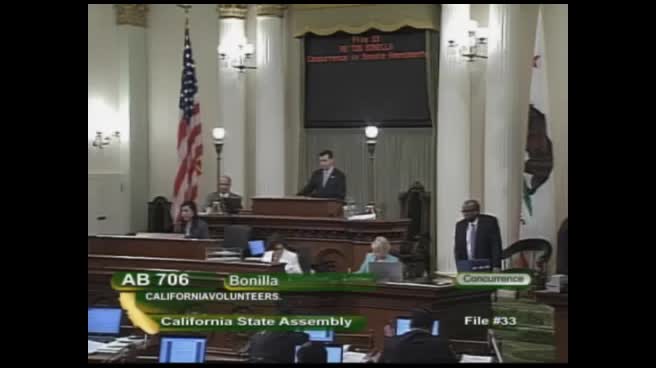
| Sep 4, 2015 | AB 1071 ATKINS Concurrence in Senate Amendments | Assembly Floor |
Passed |
|
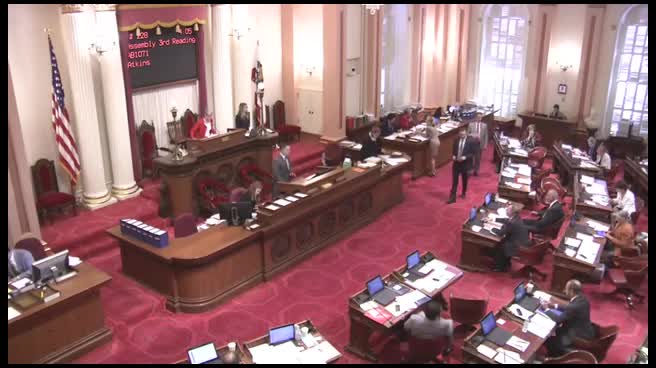
| Sep 3, 2015 | Assembly 3rd Reading AB1071 Atkins By Mitchell | Senate Floor |
Passed |
|
| Aug 27, 2015 | Do pass as amended | Senate Standing Committee on Appropriations |
Passed |
|
| Aug 24, 2015 | Placed on suspense file | Senate Standing Committee on Appropriations |
Passed |
|
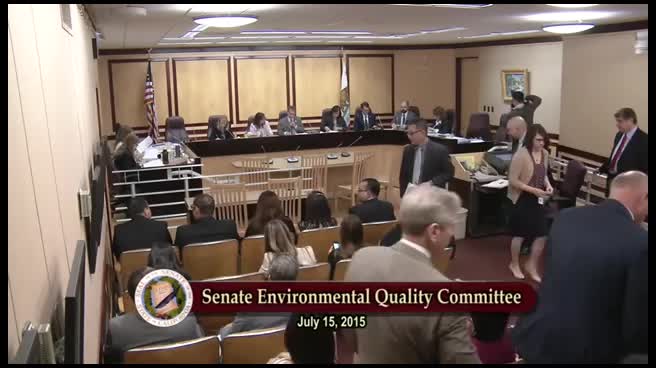
| Jul 15, 2015 | Do pass as amended, but first amend, and re-refer to the Committee on [Appropriations] | Senate Standing Committee on Environmental Quality |
Passed |
|
| Jun 1, 2015 | AB 1071 ATKINS Assembly Third Reading | Assembly Floor |
Passed |
|
| May 28, 2015 | Do pass. | Assembly Standing Committee on Appropriations |
Passed |
|
| Apr 27, 2015 | Do pass and be re-referred to the Committee on [Appropriations] | Assembly Standing Committee on Natural Resources |
Passed |
This list shows positions taken on this bill by organizations on the date displayed, which is linked to the original source.
Positions by individuals are not included.
AB 1071
Page 2
CONCURRENCE IN SENATE AMENDMENTS
AB 1071
(Atkins and Eduardo Garcia)
As Amended August 31, 2015
Majority vote
ASSEMBLY: |
79-0 |
(June 1, 2015) |
SENATE: |
39-1 |
(September 3, 2015) |
Original Committee Reference: NAT. RES.
SUMMARY: Requires each board, department, and office within the California Environmental Protection Agency (CalEPA) to establish a policy on supplemental environmental projects (SEPs) that benefits environmental justice communities.
The Senate amendments:
Add legislative findings and declarations relating to disproportionate environmental and public health impacts on disadvantaged communities and the benefits of SEPs.
Replace the term "environmental justice community" with "disadvantaged community."
Specifies that the bill applies to boards, departments, and offices that have enforcement authority.
Require that the SEP policy include consideration of the relationship between the location of the violation and the location of the proposed SEP.
FISCAL EFFECT: According to the Senate Appropriations Committee, this bill has minor and absorbable costs to various special funds to oversee SEPs and result in unknown lost revenues, likely in the millions of dollars, to various special funds as a result of penalty reductions as a result of SEPs.
COMMENTS: According to the Office of Environmental Health Hazard Assessment (OEHHA), approximately eight million Californians (21%) live in zip codes that are considered "highly impacted" by environmental, public health, and socioeconomic stressors. Nearly half of all Californians live within six miles of a facility that is a significant greenhouse gas emitter (46%), and they are disproportionately people of color (62%). Throughout California, people of color face a 50% higher risk of cancer from ambient concentrations of air pollutants listed under the Clean Air Act. These impacts are felt by all Californians. ARB estimates that air pollution exposure accounts for 19,000 premature deaths, 280,000 cases of asthma, and 1.9 million lost work days every year.
SEPs are environmentally beneficial projects that a violator agrees to undertake as part of a settlement for an enforcement action, but which the violator is not otherwise legally required to perform. In 2003, CalEPA released guidelines for the use of SEPs for its boards, departments, and offices. The guidelines specify that an SEP must improve, protect, or reduce risks to public health and the environment at large. The enforcing agency must have the opportunity to help shape the scope of the project before it is implemented and the project must not be commenced until the enforcing agency has identified a violation. Finally, the SEP must not be required by a federal, state, or local law or regulation. CalEPA's SEP guidelines suggest limiting the SEP to 25% of the total enforcement action.
Within CalEPA, the Air Resources Board (ARB), Department of Toxic Substances Control (DTSC), and the State Water Resources Control Board (SWRCB) have adopted SEP policies. ARB and DTSC's policies are consistent with CalEPA's guidelines and allow SEPs up to 25% of the amount of the enforcement action. SWRCB, consistent with authority granted by SB 1733 (Aanestad), Chapter 404, Statutes of 2006, allow SEPs up to 50% of the amount of the penalty.
Under this bill, the Department of Resources Recycling and Recovery (CalRecycle), OEHHA, and the Department of Pesticide Regulation (DPR) to adopt SEP policies directed toward disadvantaged communities and specify that SEPs can account for up to 50% of an enforcement action.
CalEPA's 2012 Environmental Compliance and Enforcement Report provides information on the use of SEPs in California. For hazardous waste law violations, three cases totaling over $33.9 million, of which $5.5 million was used for SEPs. ARB assessed just under $16.1 million in penalties, and $525,000 was used for SEPs. In the report, SWRCB provided aggregated data for "backlogged violations," which showed total penalties of over $25 million and $2.5 million for SEPs.
Analysis Prepared by: Elizabeth MacMillan / NAT. RES. / (916) 319-2092 FN: 0001952
AB 1071
Page 7
|
Office of Senate Floor Analyses (916) 651-1520 Fax: (916) 327-4478 |
THIRD READING
Bill No: AB 1071
Author: Atkins (D) and Eduardo Garcia (D)
Amended: 8/31/15 in Senate
SENATE ENVIRONMENTAL QUALITY COMMITTEE: 7-0, 7/15/15
AYES: Wieckowski, Gaines, Bates, Hill, Jackson, Leno, Pavley
SENATE APPROPRIATIONS COMMITTEE: 6-1, 8/27/15
AYES: Lara, Bates, Beall, Hill, Leyva, Mendoza
NOES: Nielsen
ASSEMBLY FLOOR: 79-0, 6/1/15 - See last page for vote
SUBJECT: Supplemental environmental projects
DIGEST: This bill requires each board, department, and office (BDOs) within the California Environmental Protection Agency (CalEPA) that has an enforcement authority to establish a policy on the use of supplemental environmental projects (SEPs) that benefit disadvantaged communities which may be voluntarily undertaken in a settlement action in order to offset a civil penalty.
Existing law:
Defines “environmental justice” as “the fair treatment of people of all races, cultures, and incomes with respect to the development, adoption, implementation, and enforcement of all environmental laws, regulations, and policies.” (Government Code §65040.12)
Requires the Secretary of CalEPA to convene a Working Group on Environmental Justice to assist the Agency in developing an agencywide strategy for identifying gaps in existing programs, policy or activities that may impede achievement of environmental justice, as specified. (Public Resources Code (PRC) §71113)
Requires each BDO within the CalEPA, in coordination with the Secretary and the Director of the Office of Planning and Research (OPR), to review programs, policies, and activities and identify and address any gaps that may impede the achievement of environmental justice. (PRC §71114.1)
Requires the CalEPA to identify “disadvantaged communities” based on geographic, socioeconomic, public health, and environmental hazard criteria. (Health and Safety Code §39711)
Provides that under compliance with the provisions of the Federal Water Pollution Control Act as amended in 1972 (Water Code §13385):
Defines a “supplemental environmental project” as “an environmentally beneficial project that a person agrees to undertake, with the approval of the regional water board, that would not be undertaken in the absence of an enforcement action.”
Allows the state or regional water board to direct a portion of the penalty amount of a penalty to be expended on an SEP in accordance with the enforcement policy of the state board.
Allows a Regional Water Quality Control Board (regional board) to allow a violator, pursuant to the Storm Water Enforcement Act of 1998, to reduce penalties by up to 50% by undertaking a SEP in accordance with the enforcement policy of the State Water Resources Control Board (SWRCB) and any applicable guidance document. (WAT §13399.35)
This bill:
States the intent of the Legislature that all BDOs within CalEPA that have an enforcement authority develop a policy on SEPs with a focus on benefiting environmental justice communities.
Defines:
“Agency” as the CalEPA.
“Disadvantaged community” as a community identified pursuant to Section 39711 of the Health and Safety Code.
A “supplemental environmental project” as an environmentally beneficial project that someone subject to an enforcement action voluntarily agrees to in a settlement to offset some of a portion of a civil penalty.
Requires each BDO within the CalEPA that has an enforcement authority to establish a policy on SEPs that benefits disadvantaged communities.
Requires that the SEP policy include, at minimum:
A public solicitation process for potential SEPs from disadvantaged communities.
An allowance that the SEP may be up to 50% of the enforcement action.
An annual list of SEPs that may be selected from to settle a portion of the enforcement action.
A consideration of the relationship between the location of the violation and location of the proposed SEP.
Requires the Secretary of CalEPA to compile a list of SEPs and post it on the Agency’s Internet Web site.
Background
Supplemental Environmental Policies overview. As of 2007, 28 states and the District of Columbia had formal policies in the form of legislation, executive agency regulation or guidelines on SEPs. In a report from the same year, the Public Law Research Institute noted that SEPs represent a “real and practicable opportunity to provide significant benefits to all the stakeholders” including direct benefits to the environment.
They also note, however, that one must be aware of the potential pitfalls of using SEPs over direct penalties. These might include insufficient transparency and open process leading to inequities for both violators and affected communities and a perceived softening of enforcement penalties. In order to make the best use of SEPs, it follows that clear guidelines and regular monitoring, evaluating, and reporting on SEPs programs are essential.
In 2015, the United States Environmental Protection Agency (U.S. EPA) released an update to the 1998 U.S. EPA Supplemental Environmental Projects Policy. The federal agency notes in the update that they are in strong support of SEPs to “secure significant environmental and public health benefits beyond those achieved by compliance, and to help address the needs of communities impacted by violations of environmental laws.”
SEP guidance in California. In 2003, CalEPA released recommended guidance on SEPs for its BDOs in settlements of environmental enforcement cases. Qualifications to list a project as an SEP include ensuring that the project meets the specified definition and implementation criteria, has an appropriate cost in relation to fines paid, fits within a specified category, and that all legal guidelines, including nexus, are satisfied.
Specifically, SEPs must improve, protect, or reduce risks to public health or the environment at large and allow the enforcing agency to help shape the scope of the project prior to approval, while remaining a voluntary action that a defendant/respondent is not legally required to perform. Furthermore, all projects should have an adequate “nexus,” defined as “the relationship between the violation and the proposed project [which] exists if the project remediates or reduces the probably overall environmental or public health impacts or risks to which the violation at issue contributes, or if the project is designed to reduce the likelihood that similar violations will occur in the future.”
Since the release of these guidelines, various CalEPA BDOs have adopted their own SEP policies. In 2009, for example, the SWRCB developed a Policy on Supplemental Environmental Projects. In accordance with CalEPA’s guidance document, SEPs may be performed by either the discharger or third-parties paid by the discharger. Each regional water board is allowed to maintain a list of pre-approved SEPs for consideration and must post an annual list of completed and in-progress SEPs from the previous year. The Air Resources Board (ARB) also has a SEPs policy posted on its Internet Web site as reviewed April 2015, and the Department of Toxic Substances Control (DTSC) recently released a draft policy.
SEPs and disadvantaged communities. In 2014, the Central Valley Regional Water Board engaged in a partnership with the Rose Foundation, a grantmaking public charity based in Oakland, to administer SEPs to Disadvantaged Communities projects. According to the regional board’s resolution (R5-2014-0040), “Many disadvantaged communities in the Central Valley would benefit from SEPs, yet it is difficult for dischargers that do not have day-to-day relationships with these communities to create SEPs that are responsive to their needs. The Rose Foundation, by virtue of its grantmaking experience, is uniquely situated to implement a program that would allow SEP monies to penetrate deeply into disadvantaged communities while supporting the water-quality related SEP criteria contained in the Water Quality Enforcement Policy and the SEP Policy.”
Comments
Purpose of bill. According to the author, “Many communities across California are located in areas disproportionately subjected to multiple sources of pollution. As a result, these communities are more vulnerable to and impacted by the harmful effects of pollution than others. These environmentally impacted communities, also known as environmental justice communities, need resources to appropriately address environmental health impacts and to implement community led solutions. Unfortunately, there is no strong mechanism to ensure communities disproportionally impacted receive any improvements after environmental damage has occurred. Furthermore, when an environmental violation occurs, there is no mechanism to ensure that the communities who are directly impacted by the violation are able to receive any benefits.
“One way that environmental justice communities might see direct environmental or public health benefits in their neighborhoods is through the creation of an Environmental Justice Supplemental Environmental Projects policy.
“AB 1071 will ensure that all CalEPA boards, departments, and offices establish a SEP policy specifically for environmental justice communities.”
FISCAL EFFECT: Appropriation: No Fiscal Com.: Yes Local: No
According to the Senate Appropriations Committee:
Unknown lost revenues, likely in the millions of dollars, to various special funds as a result of penalty reductions as a result of SEPs.
Minor and absorbable costs to various special funds for the BDOs to oversee SEPs.
Asian Pacific Environmental Network
California Environmental Justice Alliance
California Environmental Justice Coalition
Center for Community Action and Environmental Justice
Center on Race, Poverty & the Environment
Central California Environmental Justice Network
City Heights Community Development Corporation
Clergy and Laity United for Economic Justice
Comite Civico Del Valle, Inc.
Communities for a Better Environment
Environmental Health Coalition
Environmental Justice Coalition for Water
Food Empowerment Project
Green Action for Health and Environmental Justice
Inland Congregations United for Change
Los Angeles Waterkeeper
Maximizing Access to Advance our Communities
People Organizing to Demand Environmental and Economic Rights
San Diego – Imperial Counties Labor Council
San Joaquin Valley Latino Environmental Advancement & Policy
Project
Sierra Club California
Warehouse Worker Resource Center
OPPOSITION: (Verified 8/28/15)
None received
ARGUMENTS IN SUPPORT: According to supporters, “AB 1071 will provide a mechanism to bring environmentally beneficial projects directly into low-income communities disproportionately burdened by pollution. Currently, there is no way to ensure that when a violation occurs, the communities most impacted are able to receive direct benefits or repair the harm done from pollution.
“The California Environmental Protection Agency (Cal EPA) has a policy that allows agencies to authorize environmentally beneficial projects as part of enforcement actions or settlements. These projects are called ‘Supplemental Environmental Projects’ (SEPS). The projects are a successful means of ensuring environmentally beneficial projects are implemented when a violation occurs.
“Unfortunately, the existing policy is not set up to provide benefits directly to disadvantaged communities, and there is very little public information about how to engage the program. Additionally, the Boards, Departments, and Offices within Cal EPA underutilize this policy, thus limiting its effectiveness.”
ASSEMBLY FLOOR: 79-0, 6/1/15
AYES: Achadjian, Alejo, Travis Allen, Baker, Bigelow, Bloom, Bonilla, Bonta, Brough, Brown, Burke, Calderon, Campos, Chang, Chau, Chávez, Chiu, Chu, Cooley, Cooper, Dababneh, Dahle, Daly, Dodd, Eggman, Frazier, Gallagher, Cristina Garcia, Eduardo Garcia, Gatto, Gipson, Gomez, Gonzalez, Gordon, Gray, Grove, Hadley, Harper, Roger Hernández, Holden, Irwin, Jones, Jones-Sawyer, Kim, Lackey, Levine, Linder, Lopez, Low, Maienschein, Mathis, Mayes, McCarty, Medina, Melendez, Mullin, Nazarian, Obernolte, O'Donnell, Olsen, Patterson, Perea, Quirk, Rendon, Ridley-Thomas, Rodriguez, Salas, Santiago, Steinorth, Mark Stone, Thurmond, Ting, Wagner, Waldron, Weber, Wilk, Williams, Wood, Atkins
NO VOTE RECORDED: Beth Gaines
Prepared by: Laurie Harris / E.Q. / (916) 651-4108
8/31/15 17:13:57
**** END ****
AB 1071 (Atkins) Page 0 of 1
SENATE COMMITTEE ON APPROPRIATIONS
Senator Ricardo Lara, Chair
2015 - 2016 Regular Session
AB 1071 (Atkins) - Supplemental environmental projects
|
|
Version: August 18, 2015 |
Policy Vote: E.Q. 7 - 0 |
Urgency: No |
Mandate: No |
Hearing Date: August 27, 2015 |
Consultant: Marie Liu |
*********** ANALYSIS ADDENDUM – SUSPENSE FILE ***********
The following information is revised to reflect amendments
adopted by the committee on August 27, 2015
Bill Summary:
This bill would require each of the boards, departments, and offices (BDOs) of the California Environmental Protection Agency (CalEPA) to establish a policy on the use of supplemental environmental projects (SEPs) that benefit disadvantaged communities that may be voluntarily undertaken to offset a civil penalty.
Fiscal Impact:
Unknown lost revenues, likely in the millions of dollars, to various special funds as a result of penalty reductions as a result of SEPs.
Minor and absorbable costs to various special funds for the BDOs to oversee SEPs.
Author Amendments:
Clarify that only BDOs that have enforcement authority need to develop a policy on SEPs
-- END --
AB 1071 (Atkins) Page 2 of 2
SENATE COMMITTEE ON APPROPRIATIONS
Senator Ricardo Lara, Chair
2015 - 2016 Regular Session
AB 1071 (Atkins) - Supplemental environmental projects.
|
|
Version: August 18, 2015 |
Policy Vote: E.Q. 7 - 0 |
Urgency: No |
Mandate: No |
Hearing Date: August 24, 2015 |
Consultant: Marie Liu |
This bill meets the criteria for referral to the Suspense File.
Bill Summary:
This bill would require each of the boards, departments, and offices (BDOs) of the California Environmental Protection Agency (CalEPA) to establish a policy on the use of supplemental environmental projects (SEPs) that benefit disadvantaged communities that may be voluntarily undertaken to offset a civil penalty.
Fiscal Impact:
Unknown lost revenues, likely in the millions of dollars, to various special funds as a result of penalty reductions as a result of SEPs.
Minor and absorbable costs to various special funds for the BDOs to oversee SEPs.
Background:
Under existing law, penalties for violations of environmental laws can be partially offset by a commitment to undertake an SEP. Under CalEPA’s recommended guidance on SEPs, released in 2003, SEPs must improve, protect, or reduce risks to public health or the environment at large. The enforcing agency is required to help shape the scope of the project prior to approval, though the project must remain a voluntary action that the defendant is not legally required to perform. There must also be a relationship between the violation and the SEP. For example, the SEP may remediate or reduce the environmental or public health impacts of the violations. Various CalEPA BDOs have adopted their own SEP policies since the release of the CalEPA guidelines.
Proposed Law:
This bill would require each of the BDOs within CalEPA to adopt a policy on SEPs that include the following:
A public process to solicit potential SEPs from disadvantaged communities
Allowance for the amount of SEP to be up to 50% of the enforcement action
A consideration of the relationship between the location of the violation and the location of the proposed SEP
An annual list of SEPs that may be used to settle a portion of an enforcement actions.
This bill would require CalEPA to post a list of adopted SEPs on its website.
Staff Comments:
CalEPA anticipates that the cost for its BDOs to create the required policies or to amend an existing policy to conform with the requirements of the bill is minor and absorbable.
By requiring the establishment of a policy that allows up to 50% of an enforcement action to be satisfied by a SEP, this bill will likely result in decreased penalty revenues to various special funds in the millions of dollars.
The BDOs may also have some costs to oversee the additional SEPs that are likely to be adopted by the creation of a SEP policy. These costs are likely to be minor and absorbable or covered by penalty settlement terms.
-- END --
AB 1071 (Atkins) Page 7 of 7
SENATE COMMITTEE ON ENVIRONMENTAL QUALITY
Senator Wieckowski, Chair
2015 - 2016 Regular
Bill No: AB 1071
Author: |
Atkins and E. Garcia |
||
Version: |
5/7/2015 |
Hearing Date: |
7/15/2015 |
Urgency: |
No |
Fiscal: |
Yes |
Consultant: |
Laurie Harris |
||
SUBJECT: Supplemental environmental projects.
ANALYSIS:
Existing law:
Defines “environmental justice” as “the fair treatment of people of all races, cultures, and incomes with respect to the development, adoption, implementation, and enforcement of all environmental laws, regulations, and policies.” (Government Code §65040.12)
Requires the Secretary for Environmental Protection to convene a Working Group on Environmental Justice to assist the Agency in developing an agencywide strategy for identifying gaps in existing programs, policy or activities that may impede achievement of environmental justice, as specified. Public Resources Code (PRC) §71113)
Requires each board, department, and office within the California Environmental Protection Agency (CalEPA), in coordination with the Secretary and the Director of the Office of Planning and Research (OPR), to review programs, policies, and activities and identify and address any gaps that may impede the achievement of environmental justice. (PRC §71114.1)
Requires the CalEPA to identify “disadvantaged communities” based on geographic, socioeconomic, public health, and environmental hazard criteria. (Health and Safety Code §39711)
Under compliance with the provisions of the Federal Water Pollution Control Act as Amended in 1972 (Water Code §13385):
Defines a “supplemental environmental project” (SEP) as “an environmentally beneficial project that a person agrees to undertake, with the approval of the regional water board, that would not be undertaken in the absence of an enforcement action.”
Allows the state or regional water board to direct a portion of the penalty amount of a penalty to be expended on an SEP in accordance with the enforcement policy of the state board.
Allows a Regional Water Quality Control Board (regional board) to allow a violator, pursuant to the Storm Water Enforcement Act of 1998, to reduce penalties by up to 50% by undertaking a supplemental environmental project (SEP) in accordance with the enforcement policy of the State Water Resources Control Board (SWRCB) and any applicable guidance document. (WAT §13399.35)
This bill:
Defines:
An “environmental justice community” (EJ community) as a disadvantaged community, identified pursuant to Section 39711 of the Health and Safety Code.
A “supplemental environmental project” (SEP) as an environmentally beneficial project that someone subject to an enforcement action voluntarily agrees to in a settlement to offset some of a civil penalty.
Requires each board, department, and office within the California Environmental Protection Agency (CalEPA) to establish a policy on SEPs that benefits EJ communities.
Requires that the SEP policy include, at minimum:
A public solicitation process for potential SEPs from EJ communities.
An allowance that the SEP may be up to 50% of the enforcement action.
An annual list of SEPs that may be selected from to settle a portion of the enforcement action.
Requires the Secretary of CalEPA to compile a list of SEPs and post it on the agency’s Internet Web site.
Background
Supplemental Environmental Policies (SEPs) Overview. As of 2007, twenty-eight states and the District of Columbia had formal policies in the form of legislation, executive agency regulation or guidelines on SEPs. In a report from the same year, the Public Law Research Institute noted that SEPs represent a “real and practicable opportunity to provide significant benefits to all the stakeholders” including direct benefits to the environment.
They also note, however, that one must be aware of the potential pitfalls of using SEPs over direct penalties. These might include insufficient transparency and open process leading to inequities for both violators and affected communities and a perceived softening of enforcement penalties. In order to make the best use of SEPs, it follows that clear guidelines and regular monitoring, evaluating, and reporting on SEPs programs are essential.
In 2015, the United States Environmental Protection Agency released an update to the 1998 U.S. EPA Supplemental Environmental Projects Policy. The federal agency notes in the update that they are in strong support of SEPs to “secure significant environmental and public health benefits beyond those achieved by compliance, and to help address the needs of communities impacted by violations of environmental laws.”
SEP Guidance in California. In 2003, CalEPA released recommended guidance on SEPs for its boards, departments, and offices (BDOs) in settlements of environmental enforcement cases. Qualifications to list a project as an SEP include ensuring that the project meets the specified definition and implementation criteria, has an appropriate cost in relation to fines paid, fits within a specified category, and that all legal guidelines, including nexus, are satisfied.
Specifically, SEPs must improve, protect, or reduce risks to public health or the environment at large and allow the enforcing agency to help shape the scope of the project prior to approval, while remaining a voluntary action that a defendant/respondent is not legally required to perform. Furthermore, all projects should have an adequate “nexus,” defined as “the relationship between the violation and the proposed project [which] exists if the project remediates or reduces the probably overall environmental or public health impacts or risks to which the violation at issue contributes, or if the project is designed to reduce the likelihood that similar violations will occur in the future.”
Since the release of these guidelines, various CalEPA BDOs have adopted their own SEP policies. In 2009, for example, the SWRCB developed a Policy on Supplemental Environmental Projects. In accordance with CalEPA’s guidance document, SEPs may be performed by either the discharger or third-parties paid by the discharger. Each regional water board is allowed to maintain a list of pre-approved SEPs for consideration and must post an annual list of completed and in-progress SEPs from the previous year. The Air Resources Board (ARB) also has a SEPs policy posted on its Internet Web site as reviewed April 2015, and the Department of Toxic Substances Control (DTSC) recently released a draft policy.
SEPs and Disadvantaged Communities. In 2014, the Central Valley Regional Water Board engaged in a partnership with the Rose Foundation, a grantmaking public charity based in Oakland, to administer SEPs to Disadvantaged Communities projects. According to the regional board’s resolution (R5-2014-0040), “Many disadvantaged communities in the Central Valley would benefit from SEPs, yet it is difficult for dischargers that do not have day-to-day relationships with these communities to create SEPs that are responsive to their needs. The Rose Foundation, by virtue of its grantmaking experience, is uniquely situated to implement a program that would allow SEP monies to penetrate deeply into disadvantaged communities while supporting the water-quality related SEP criteria contained in the Water Quality Enforcement Policy and the SEP Policy.”
Comments
Purpose of Bill. According to the author, “Many communities across California are located in areas disproportionately subjected to multiple sources of pollution. As a result, these communities are more vulnerable to and impacted by the harmful effects of pollution than others. These environmentally impacted communities, also known as environmental justice communities, need resources to appropriately address environmental health impacts and to implement community led solutions. Unfortunately, there is no strong mechanism to ensure communities disproportionally impacted receive any improvements after environmental damage has occurred. Furthermore, when an environmental violation occurs, there is no mechanism to ensure that the communities who are directly impacted by the violation are able to receive any benefits.
“One way that environmental justice communities might see direct environmental or public health benefits in their neighborhoods is through the creation of an Environmental Justice Supplemental Environmental Projects policy.
“AB 1071 will ensure that all CalEPA boards, departments, and offices establish a SEP policy specifically for environmental justice communities.”
Nexus Considerations. An important consideration in responding to environmental violations is mitigating the impacts to the affected communities. While an emphasis on the particular burden to disadvantaged communities from environmental degradation and pollution is also important, there should be a focus on first considering the impacts to those communities that are directly impacted from any environmental violation. Therefore, an amendment is needed to specify that the SEPs policies should include a consideration of a nexus between the violation resulting in an enforcement action and the impacted community.
Environmental Justice Communities vs. Disadvantaged Communities. In statute, there are a few references to EJ communities, but while there is a definition for environmental justice, no definitions are provided for “EJ communities.” Section 40612 of the Health and Safety Code (HSC) concerning the San Joaquin Valley Clean Air Attainment Program leaves this task up to a local committee, noting, “The district board shall convene an environmental justice advisory committee, selected from a list given to the board by environmental justice groups from the San Joaquin Valley, to recommend the neighborhoods in the district that constitute environmental justice communities.” According to the air districts EJ Strategy of June 2012, they define an EJ community as per the federal Executive Order 12898 as, “minority and low-income populations with disproportionately high and adverse human health or environmental impacts.” This definition seems to reflect many of the factors included in the CalEnviroScreen tool to identify disadvantaged communities.
This bill currently defines an environmental justice community as a disadvantaged community identified pursuant to Section 39711 of the HSC. As there are no other qualifiers in the definition, it serves to rename a disadvantaged community as an environmental justice community, for the purposes of the section, which could lead to inconsistency and confusion in statute more broadly.
The author may wish to add additional details in the definition of an EJ community to distinguish it from a disadvantaged community. However, as currently written, in order to maintain consistency and clarity, an amendment is needed to use the term disadvantaged community in place of EJ community throughout the section.
SOURCE:
Author
SUPPORT:
Alameda County Board of Supervisors
Asian Health Services
Asian Pacific Environmental Network
California Environmental Justice Alliance
California Equity Leaders Network
California League of Conservation Voters (CLCV)
California Pan-Ethnic Health Network (CPEHN)
Catholic Charities, Diocese of Stockton
Center for Community Action and Environmental Justice
Center on Race, Poverty and the Environment
Central California Environmental Justice Network (CCEJN)
Central Coast Alliance United for a Sustainable Economy
Clean Water Action
Coalition for Clean Air
Communities for a Better Environment
Community Water Center
Environmental Health Coalition
Environmental Justice Coalition for Water
Environmental Working Group
Leadership Counsel for Justice and Accountability
MAAC
Pacoima Beautiful
People Organizing to Demand Environmental and Economic Rights (PODER)
Physicians for social Responsibility – Los Angeles
Planning and Conservation League
San Diego-Imperial Counties Labor Council (SDICLC)
Sierra Club California
West Marin Environmental Action Committee
OPPOSITION:
None received
ARGUMENTS IN SUPPORT:
According to supporters, “AB 1071 will provide a mechanism to bring environmentally beneficial projects directly into low-income communities disproportionately burdened by pollution. Currently, there is no way to ensure that when a violation occurs, the communities most impacted are able to receive direct benefits or repair the harm done from pollution.
“The California Environmental Protection Agency (Cal EPA) has a policy that allows agencies to authorize environmentally beneficial projects as part of enforcement actions or settlements. These projects are called ‘Supplemental Environmental Projects’ (SEPS). The projects are a successful means of ensuring environmentally beneficial projects are implemented when a violation occurs.
“Unfortunately, the existing policy is not set up to provide benefits directly to disadvantaged communities, and there is very little public information about how to engage the program. Additionally, the Boards, Departments, and Offices within Cal EPA underutilize this policy, thus limiting its effectiveness.”
-- END --
AB 1071
Page 3
ASSEMBLY THIRD READING
AB 1071
(Atkins and Eduardo Garcia)
As Amended May 7, 2015
Majority vote
Committee |
Votes |
Ayes |
Noes |
Natural Resources |
9-0 |
Williams, Dahle, Cristina Garcia, Hadley, Harper, McCarty, Rendon, Mark Stone, Wood |
|
Appropriations |
17-0 |
Gomez, Bigelow, Bonta, Calderon, Chang, Daly, Eggman, Gallagher, Eduardo Garcia, Gordon, Holden, Jones, Quirk, Rendon, Wagner, Weber, Wood |
|
SUMMARY: Requires each board, department, and office within the California Environmental Protection Agency (CalEPA) to establish a policy on supplemental environmental projects (SEPs) that benefits environmental justice communities. Specifically, this bill:
Defines SEP as an environmentally beneficial project that a person subject to an enforcement action voluntarily agrees to undertake in settlement of the action and to offset some of a civil penalty.
Requires the Air Resources Board (ARB), Department of Resources Recycling and Recovery (CalRecycle), Department of Toxic Substances Control (DTSC), Department of Pesticide Regulation (DPR), and Office of Environmental Health Hazard Assessment (OEHHA) to establish policies on SEPs that benefit environmental justice communities. The policies shall:
Include a public process to solicit potential supplemental environmental projects from environmental justice communities.
Allow a SEP to comprise up to 50% of an enforcement action brought by a CalEPA board, department, or office.
Include an annual list of SEPs that may be selected to settle an enforcement action.
Requires CalEPA to consolidate the list of SEPs and post the list on its Web site.
FISCAL EFFECT: According to the Assembly Appropriations Committee:
Unknown, significant impacts resulting from penalty diversions.
Current policy developed by CalEPA suggests a cap of 25% for penalty diversions to a SEP. This bill increases the cap to 50% for SEP funding for environmental justice projects (all CalEPA enforcement/penalty funds). Depending on the cost pressures on the various funds, it is very likely other expenditures would have to be reduced.
Absorbable administrative costs.
COMMENTS: According to the OEHHA, approximately eight million Californians (21%) live in zip codes that are considered "highly impacted" by environmental, public health, and socioeconomic stressors. Nearly half of all Californians live within six miles of a facility that is a significant greenhouse gas emitter (46%), and they are disproportionately people of color (62%). Throughout California, people of color face a 50% higher risk of cancer from ambient concentrations of air pollutants listed under the Clean Air Act. These impacts are felt by all Californians. ARB estimates that air pollution exposure accounts for 19,000 premature deaths, 280,000 cases of asthma, and 1.9 million lost work days every year.
In 2000, legislation [SB 89 (Escutia), Chapter 728, Statutes of 2000] required CalEPA to convene the Environmental Justice Working Group and develop an agency-wide environmental justice strategy. In 2001, follow up legislation [SB 828 (Alarcon), Chapter 765, Statutes of 2001] established a timeline for these requirements and required CalEPA to update its report to the Legislature every three years. In October of 2004, CalEPA released its Environmental Justice Action Plan, but did not complete the required updates for a decade.
SB 535 (De Léon), Chapter 850, Statutes of 2012, required the Cap and Trade Proceeds Investment Plan to direct a minimum of 25% of the available moneys in the fund to projects that provide benefits to identified disadvantaged communities; and, a minimum of 10% of the available moneys in the fund to projects located within identified disadvantaged communities. SB 535 also required CalEPA to identify disadvantaged communities (i.e., environmental justice communities). In order to accurately identify environmental justice communities, OEHHA, on behalf of CalEPA, created the California Communities Environmental Health Screening Tool (CalEnviroScreen). CalEnviroScreen is a screening methodology that can be used to help identify California communities that are disproportionately burdened by multiple sources of pollution.
In February of 2014, CalEPA issued an Environmental Justice Program Update, which included four main areas for future actions: 1) increase efforts to eliminate discrimination on the basis of race, national origin, ethnic group identification, religion, age, sex, sexual orientation, color, genetic information, or disability in any program or activity conducted or funded by the state; 2) develop guidance to promote a sound legal framework for CalEPA to advance environmental justice goals and objectives; 3) lead an agency-wide working group dedicated to increase compliance with environmental laws in communities with relatively higher environmental burdens; and, 4) add additional indicators to CalEnviroScreen.
SEPs are environmentally beneficial projects that a violator agrees to undertake as part of a settlement for an enforcement action, but which the violator is not otherwise legally required to perform. In 2003, CalEPA released guidelines for the use of SEPs for its boards, departments, and offices. The guidelines specify that an SEP must improve, protect, or reduce risks to public health and the environment at large. The enforcing agency must have the opportunity to help shape the scope of the project before it is implemented and the project must not be commenced until the enforcing agency has identified a violation. Finally, the SEP must not be required by a federal, state, or local law or regulation. CalEPA's SEP guidelines suggest limiting the SEP to 25% of the total enforcement action.
Within CalEPA, ARB, DTSC, and the State Water Resources Control Board (SWRCB) have adopted SEP policies. ARB and DTSC's policies are consistent with CalEPA's guidelines and allow SEPs up to 25% of the amount of the enforcement action. SWRCB, consistent with authority granted by SB 1733 (Aanestad), Chapter 404, Statutes of 2006, allow SEPs up to 50% of the amount of the penalty.
CalEPA's 2012 Environmental Compliance and Enforcement Report provides information on the use of SEPs in California. For hazardous waste law violations, three cases totaling over $33.9 million, of which $5.5 million was used for SEPs. ARB assessed just under $16.1 million in penalties, and $525,000 was used for SEPs. In the report, SWRCB provided aggregated data for "backlogged violations," which showed total penalties of over $25 million and $2.5 million for SEPs.
This bill would require CalRecycle, OEHHA, and DPR to adopt SEP policies directed toward environmental justice communities and specify that SEPs can account for up to 50% of an enforcement action.
Analysis Prepared by: Elizabeth MacMillan / NAT. RES. / (916) 319-2092 FN: 0000691
AB 1071
Page 2
Date of Hearing: May 27, 2015
ASSEMBLY COMMITTEE ON APPROPRIATIONS
Jimmy Gomez, Chair
AB 1071
(Atkins) – As Amended May 7, 2015
Policy Committee: |
Natural Resources |
Vote: |
9 - 0 |
|
|
|
|
|
|
|
|
Urgency: No State Mandated Local Program: No Reimbursable: No
SUMMARY:
This bill requires each board, department and office within the California Environmental Protection Agency (CalEPA) to establish a policy on supplemental environmental projects (SEPs) to benefit environmental justice communities. Specifically, this bill:
Defines SEP as an environmentally beneficial project a person subject to an enforcement action agrees to undertake in settlement of the action and to offset a portion of a civil penalty.
Requires the Air Resources Board (ARB), CalRecycle, the Department of Toxic Substances (DTSC), the Department of Pesticide Regulation (DPR), and the Office of Environmental Health Hazard Assessment (OEHHA ) to establish policies on SEPs to benefit environmental justice communities. Requires the policies to include the following:
A public process to solicit potential supplemental environmental projects from environmental justice communities.
A provision allowing a SEP to comprise up to 50% of an enforcement action brought by a CalEPA board, department, or office.
An annual list of SEPs that may be selected to settle a portion of an enforcement action.
Requires CalEPA to consolidate and post the list of SEPs on its website.
FISCAL EFFECT:
Unknown significant revenue shifts resulting from penalty diversions.
Current policy developed by CalEPA suggests a cap of 25% for penalty diversions to a SEP. This bill increases the cap to 50% for SEP funding for environmental justice projects (all CalEPA enforcement/penalty funds). Depending on the cost pressures on the various funds, it is very likely other expenditures would have to be reduced.
Absorbable administrative costs.
COMMENTS:
Purpose. According to the author, there is no strong mechanism to ensure communities disproportionally impacted by multiple sources of pollution receive any improvements after environmental damage has occurred. When an environmental violation occurs, there is no mechanism to ensure that the communities who are directly impacted by the violation are able to receive any benefits. This bill addresses that problem by requiring all CalEPA boards, departments, and offices to establish a specific SEP policy for environmental justice communities.
Supplemental environmental projects. SEPs are environmentally beneficial projects that a violator agrees to undertake as part of a settlement for an enforcement action, but which the violator is not otherwise legally required to perform. In 2003, CalEPA released guidelines for the use of SEPs for its boards, departments, and offices. The guidelines require SEPs to improve, protect, or reduce risks to public health and the environment at large.
The enforcing agency must have the opportunity to shape the scope of the project before it is implemented and the project must not commence until the enforcing agency has identified a violation. Finally, the SEP must not be required by a federal, state, or local law or regulation. CalEPA's SEP guidelines suggest limiting the SEP to 25% of the total enforcement action.
Within CalEPA, ARB, DTSC, and SWRCB have adopted SEP policies. ARB and DTSC's policies are consistent with CalEPA's guidelines and allow SEPs up to 25% of the amount of the enforcement action. SWRCB, consistent with authority granted by SB 1733 (Aanestad), Chapter 404, Statutes of 2006, allows SEPs of up to 50% of the amount of the penalty.
According to CalEPA's 2012 Environmental Compliance and Enforcement Report, for three hazardous waste law violations totaling over $33.9 million, $5.5 million was used for SEPs. ARB assessed just under $16.1 million in penalties, and $525,000 was used for SEPs. In the report, SWRCB provided aggregated data for "backlogged violations," which showed total penalties of over $25 million, and $2.5 million for SEPs.
Environmental Justice. According to the federal Environmental Protection Agency (EPA),
Environmental Justice is the fair treatment and meaningful involvement of all people regardless of race, color, national origin, or income with respect to the development, implementation, and enforcement of environmental laws, regulations, and policies.
Environmental justice will be achieved when everyone enjoys the same degree of protection from environmental and health hazards and equal access to the decision-making processes.
Analysis Prepared by: Jennifer Galehouse / APPR. / (916) 319-2081
AB 1071
Page 5
Date of Hearing: April 27, 2015
ASSEMBLY COMMITTEE ON NATURAL RESOURCES
Das Williams, Chair
AB 1071
(Atkins) – As Introduced February 26, 2015
SUBJECT: Supplemental environmental projects
SUMMARY: Requires each board, department, and office within the California Environmental Protection Agency (CalEPA) to establish a policy on supplemental environmental projects (SEPs) that benefits environmental justice communities.
EXISTING LAW:
Defines “environmental justice” to mean the fair treatment of people of all races, cultures, and incomes with respect to the development, adoption, implementation, and enforcement of environmental laws, regulations, and policies.
Defines "environmental justice community" as a community identified by CalEPA based on geographic, socioeconomic, public health, and environmental hazard criteria, including:
Areas disproportionately affected by environmental pollution and other hazards that can lead to negative public health effects, exposure, or environmental degradation; and,
Areas with concentrations of people that are of low income, high unemployment, low levels of homeownership, high rent burden, sensitive populations, or low levels of educational attainment.
Requires CalEPA to:
Conduct its programs, policies, and activities and enforce all health and environmental statutes within its jurisdiction in a manner that ensures the fair treatment of people of all races, cultures, and income levels, including minority and low-income populations.
Convene a Working Group on Environmental Justice (Working Group) comprised of the Secretary of CalEPA, the Chairs of the Air Resources Board (ARB), the California Integrated Waste Management Board (now CalRecycle), the State Water Resources Control Board (SWRCB), the Director of the Department of Toxic Substances Control (DTSC), the Director of the Department of Pesticide Regulation (DPR), the Director of the Office of Environmental Health Hazard Assessment (OEHHA), and the Director of the Office of Planning and Research (OPR). Requires the Working Group to examine existing data and studies on environmental justice and recommending policies for implementation by CalEPA; recommend criteria to the Secretary of CalEPA for identifying and addressing any gaps in existing programs, policies, or activities that may impede the achievement of environmental justice; and, hold public meetings to receive and respond to public comments prior to the finalization of the recommendations.
Requires each board, department, and office within CalEPA to review its programs, policies, and activities and identify and address any gaps in its existing programs, policies, or activities that may impede the achievement of environmental justice.
Names OPR as the coordinating agency in state government for environmental justice programs.
THIS BILL:
Defines SEP as an environmentally beneficial project that a person subject to an enforcement action voluntarily agrees to undertake in settlement of the action and to offset some of a civil penalty.
Requires ARB, CalRecycle, DTSC, DPR, and OEHHA to establish policies on SEPs that benefit environmental justice communities. The policies shall include all of the following:
A public process to solicit potential supplemental environmental projects from environmental justice communities.
Allow a SEP to comprise up to 50% of an enforcement action brought by a CalEPA board, department, or office.
An annual list of SEPs that may be selected to settle an enforcement action.
Requires CalEPA to consolidate the list of SEPs and post the list on its website.
FISCAL EFFECT: Unknown
COMMENTS:
Author's statement.
Many communities across California are located in areas disproportionately subjected to multiple sources of pollution. As a result, these communities are more vulnerable to and impacted by the harmful effects of pollution than others. These environmentally impacted communities, also known as environmental justice communities, need resources to appropriately address environmental health impacts and to implement community led solutions. Unfortunately, there is no strong mechanism to ensure communities disproportionally impacted receive any improvements after environmental damage has occurred. Furthermore, when an environmental violation occurs, there is no mechanism to ensure that the communities who are directly impacted by the violation are able to receive any benefits.
One way that environmental justice communities might see direct environmental or public health benefits in their neighborhoods is through the creation of an Environmental Justice Supplemental Environmental Projects policy…
AB 1071 will ensure that all CalEPA boards,
departments, and offices establish a SEP policy specifically for
environmental justice communities.
Environmental justice. According to the Office of Environmental Health Hazard Assessment (OEHHA), approximately 8 million Californians (21%) live in zip codes that are
considered "highly impacted" by environmental, public health, and socioeconomic stressors.
Nearly half of all Californians live within six miles of a facility that is a significant
greenhouse gas emitter (46%), and they are disproportionately people of color (62
%). Throughout California, people of color face a 50% higher risk of cancer
from ambient concentrations of air pollutants listed under the Clean Air Act. These impacts
are felt by all Californians. ARB estimates that air pollution exposure accounts for 19,000
premature deaths, 280,000 cases of asthma, and 1.9 million lost work days every year.
In 2000, legislation [SB 89 (Escutia), Chapter 728] required CalEPA to convene the
Environmental Justice Working Group and develop an agency-wide environmental justice
strategy. In 2001, follow up legislation [SB 828 (Alarcon), Chapter 765] established a
timeline for these requirements and required CalEPA to update its report to the Legislature
every three years. In October of 2004, CalEPA released its Environmental Justice Action Plan, but did not complete the required updates for a decade.
SB 535 (DeLeon), Chapter 850, Statutes of 2012 requires the Cap and Trade Proceeds Investment Plan to direct a minimum of 25% of the available moneys in the fund to projects that provide benefits to identified disadvantaged communities; and, a minimum of 10% of the available moneys in the fund to projects located within identified disadvantaged communities. SB 535 also required CalEPA to identify disadvantaged communities (i.e., environmental justice communities). In order to accurately identify environmental justice communities, OEHHA, on behalf of CalEPA, created the California Communities Environmental Health Screening Tool (CalEnviroScreen). CalEnviroScreen is a screening methodology that can be used to help identify California communities that are disproportionately burdened by multiple sources of pollution.
In February of 2014, CalEPA issued an Environmental Justice Program Update, which included four main areas for future actions: 1) increase efforts to eliminate discrimination on the basis of race, national origin, ethnic group identification, religion, age, sex, sexual orientation, color, genetic information, or disability in any program or activity conducted or funded by the state; 2) develop guidance to promote a sound legal framework for CalEPA to advance environmental justice goals and objectives; 3) lead an agency-wide working group dedicated to increase compliance with environmental laws in communities with relatively higher environmental burdens; and, 4) add additional indicators to CalEnviroScreen.
Supplemental environmental projects. SEPs are environmentally beneficial projects that a violator agrees to undertake as part of a settlement for an enforcement action, but which the violator is not otherwise legally required to perform. In 2003, CalEPA released guidelines for the use of SEPs for its boards, departments, and offices. The guidelines specify that an SEP must improve, protect, or reduce risks to public health and the environment at large. The enforcing agency must have the opportunity to help shape the scope of the project before it is implemented and the project must not be commenced until the enforcing agency has identified a violation. Finally, the SEP must not be required by a federal, state, or local law or regulation. CalEPA's SEP guidelines suggest limiting the SEP to 25% of the total enforcement action.
Within CalEPA, ARB, DTSC, and SWRCB have adopted SEP policies. ARB and DTSC's policies are consistent with CalEPA's guidelines and allow SEPs up to 25% of the amount of the enforcement action. SWRCB, consistent with authority granted by SB 1733 (Aanestad), Chapter 404, Statutes of 2006, allow SEPs up to 50% of the amount of the penalty.
CalEPA's 2012 Environmental Compliance and Enforcement Report provides information on the use of SEPs in California. For hazardous waste law violations, three cases totaling over $33.9 million, of which $5.5 million was used for SEPs. ARB assessed just under $16.1 million in penalties, and $525,000 was used for SEPs. In the report, SWRCB provided aggregated data for "backlogged violations," which showed total penalties of over $25 million and $2.5 million for SEPs.
This bill would require CalRecycle, OEHHA, and DPR to adopt SEP policies directed toward environmental justice communities and specify that SEPs can account for up to 50% of an enforcement action.
REGISTERED SUPPORT / OPPOSITION:
Support
Asian Pacific Environmental Network
California Environmental Justice Alliance
California Pan-Ethnic Health Network (CPEHN)
Center for Community Action and Environmental Justice
Center on Race, Poverty and the Environment
Central California Environmental Justice Network
City Heights Community Development Corporation
Clean Water Action
Clergy and Laity United for Economic Justice
Comite Civico Del Valle
Communities for a Better Environment
Community Water Center
Environmental Health Coalition
Environmental Justice Coalition for Water
Food Empowerment Project
Greenaction for Health and Environmental Justice
Inland Congregations United for Change
Leadership Counsel for Justice and Accountability
Los Angeles Waterkeeper
MAAC
People Organizing to Demand Environmental and Economic Rights
San Diego-Imperial Counties Labor Council
San Joaquin Valley Latino Environmental Advancement and Policy Project
Sierra Club California
Warehouse Worker Resource Center
Opposition
None on file
Analysis Prepared by: Elizabeth MacMillan / NAT. RES. / (916) 319-2092
Discussed in Hearing
 1MIN
Assembly Floor
 3MIN
Senate Floor
 41SEC
Senate Standing Committee on Appropriations
 6MIN
Senate Standing Committee on Environmental Quality
 2MIN
Assembly Floor
 9MIN
Assembly Standing Committee on Natural Resources


Bill Co-Author(s):