AB 536: Counties: federal funding.
- Session Year: 2017-2018
- House: Assembly
- Latest Version Date: 2017-02-13
The California Constitution establishes counties as legal subdivisions of the state and authorizes counties to make and enforce within their limits all police, sanitary, and other ordinances and regulations not in conflict with general laws. Existing law sets forth the powers and duties of county governments and imposes various duties on county officials. Existing federal law establishes various programs through which counties receive funding as either recipients, subrecipients, or passthrough entities.
This bill, if compliance with state law would result in a loss of federal funding, would authorize counties to elect to not comply with that state law to the extent that compliance jeopardizes federal funding.
If compliance with any state law would result in a county losing federal funding, the county may elect to not comply with that state law to the extent that compliance jeopardizes federal funding.
|
Date
|
Status
|
|---|---|
| Jun 20, 2017 | From committee: Without further action pursuant to Joint Rule 62(a). |
| May 9, 2017 | In committee: Set, first hearing. Failed passage. |
| Apr 24, 2017 | In committee: Hearing postponed by committee. |
| Mar 20, 2017 | Referred to Com. on JUD. |
| Feb 14, 2017 | From printer. May be heard in committee March 16. |
| Feb 13, 2017 | Read first time. To print. |
|
Date
|
Description
|
Location
|
Votes
|
|
|---|---|---|---|---|
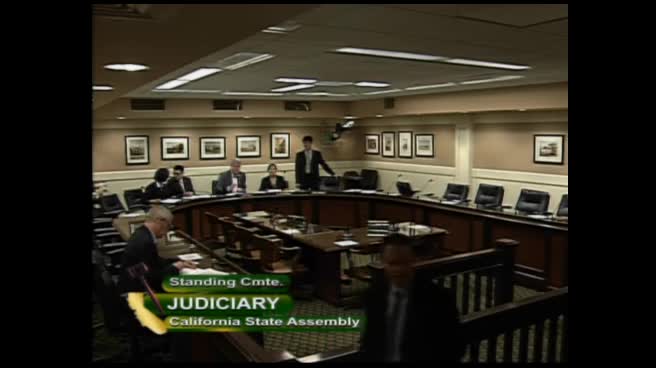
| May 9, 2017 | Do pass. | Assembly Standing Committee on Judiciary |
Failed |
This list shows positions taken on this bill by organizations on the date displayed, which is linked to the original source.
Positions by individuals are not included.
Date of Hearing:
ASSEMBLY COMMITTEE ON
, Chair
ABPCA Bill Id:
Author:() – As Ver:
SUBJECT:
KEY ISSUES:
- should a county be allowed to violate state law if the county believes that compliance with that law would result in the county losing federal funding?
- if this bill were to become law, What county entity would have the authority to determine whether compliance with a state law would result in a loss of federal funding, and how would that authority demonstrate that it would result in a loss of federal funding?
SYNOPSIS
This bill is one of several bills introduced in response to White House executive orders threatening to take a more aggressive approach to immigration enforcement. For example, this Committee recently heard AB 450 (Chiu), which, among other things, would require employers to demand a warrant – as they are permitted to do by federal law – before allowing federal immigration officers to search a worksite. Other bills have proposed similar policies for schools and colleges confronted with immigration enforcement actions on their campuses. SB 54 (De Leon) would prohibit state and local law enforcement officials from accepting designation as "immigration officers" under federal law and would impose other limitations on the ability of local officials to cooperate with immigration officials, except as required by federal law. This bill moves in the opposite direction and, according to the author and supporters, it is an attempt to counter that other legislation. Specifically, this bill would allow a county to elect not to comply with state law if compliance would result in the county losing federal funding. This bill assumes that the federal administration will follow through on Executive Order 13768, which, among other things, declares that "sanctuary jurisdictions" (those that do not fully cooperate with federal immigration officers) are not eligible to receive federal grants, except as deemed necessary for law enforcement purposes. This bill may have been rendered moot by a recent federal court injunction blocking enforcement of the executive order until the court can rule on the constitutionality of the executive order. Even if that decision does not render this bill moot, however, the Committee may wish to consider whether it is wise to (1) authorize county governments, as administrative units of the state, to ignore general state laws, quite possibly in violation of the state constitution; and (2) pass a bill that conflicts with the spirit and aims of bills that have recently passed out of this Committee. The bill is supported by the Howard Jarvis Taxpayers Association and the Southwest California Legislative Council, a coalition of local chambers of commerce. The bill is opposed by the ACLU, the California Immigrant Policy Center, and the California chapter of the National Association of Social Workers.
SUMMARY: Authorizes a county to elect to not comply with any state law if compliance with that law would result in a county losing federal funding.
EXISTING LAW:
- Establishes counties as legal subdivisions of the state and authorizes counties to make and enforce within their limits all police, sanitary, and other ordinances and regulations not in conflict with general laws. (California Constitution Article XI, especially sections 1, 4, and 7.)
- Holds that in our federal system the states are sovereign but cities and counties are not; in California and elsewhere they are mere creatures of the state and exist only at the state's sufferance. (Board of Supervisors v. Local Agency Formation Com. (1992) 3 Cal. 4th 903.)
- Authorizes the Secretary of Homeland Security under the 287(g) program to enter into agreements that delegate immigration powers to state or local law enforcement. (8 U.S.C. Section 1357 (g).)
- States that notwithstanding any other provision of Federal, State or local law, a Federal, State or local government entity or official may not prohibit, or in any way restrict any government entity or official from sending to, or receiving from, the Immigration and Naturalization Service information regarding the citizenship or immigration status of any individual. (8 U.S.C. Section1373 (a).)
FISCAL EFFECT: As currently in print this bill is keyed non-fiscal.
COMMENTS: Shortly after his election, the current occupant of the White House issued a series of executive orders, several of which signaled intent to pursue more aggressive immigration enforcement, including building a wall along the U.S.-Mexico border, hiring thousands of new immigration officers, and otherwise using the full force of federal law to detain, arrest, and deport undocumented immigrants. Of particular relevance to this bill, Executive Order (EO) 13768, among other things, threatened to withhold federal funding from any "sanctuary jurisdiction." Although the EO did not define this term with any precision, it appears to apply to any jurisdiction that refuses to cooperate with federal immigration officials, especially in regards to providing information about a person's immigration status to the Immigration and Naturalization Service (INS).
The Legislature has responded to this seeming resurgence of nativism by introducing a number of bills designed to protect California's immigrant community, both documented and undocumented, to the fullest extent permitted by federal law. For example, this Committee recently heard AB 450 (Chiu), which, among other things, would require employers to demand a warrant – as they are permitted to do by federal law – before allowing federal immigration officers to search a worksite. Other bills have proposed similar policies for schools and colleges confronted with immigration enforcement actions on their campuses. Perhaps most controversially, SB 54 (De Leon) would prohibit state and local law enforcement officials from accepting designation as "immigration officers" under federal law and would impose other limitations on the ability of local officials to cooperate with immigration officials, except as required by federal law. The bill now before the Committee moves in the opposite direction and, according to the author, it is calculated to counter the effect of those other bills, especially SB 54. Specifically, this bill would allow a county to elect not to comply with a state law if compliance would result in the county losing federal funding. This bill assumes that the federal administration will follow through on EO 13768, especially the threat to withhold federal funds from "sanctuary jurisdictions," as designated by the U.S. Attorney General and the Department of Homeland Security and that such an order would actually eliminate billions of dollars in federal funds payable to the State of California and local governments within the state.
Recent Court Ruling on Executive Order 13768 and the Withholding of Federal Funds: This bill's assumption that the federal executive branch, pursuant to Executive Order (EO) 13768, will withhold federal funds if SB 54, or similar legislation, is enacted may be questioned on two grounds.
First, EO 13768 provides that funds can only be withheld if a state or local agency is deemed a "sanctuary jurisdiction" by violating 8 USC Section 1373, a provision of the Immigration and Naturalization Act that makes it unlawful for a state or local jurisdiction to prohibit its agencies or officials from exchanging information on a person's immigration status with the INS. (Executive Order # 13768, Section 9 (a).) However, SB 54 does not authorize, much less require, local officials to violate this federal law. It merely prevents immigration officials from having free access to agency databases. SB 54 does not appear, for example, to prevent a local agency or official from sending information about an individual to INS when requested and required to so by federal law. SB 54 also prohibits state or local law enforcement officials from accepting designation as "immigration officers" – with the power to investigate, interrogate, detain, or arrest persons for immigration enforcement purposes under INS supervision – pursuant to 8 USC Section 1357(g). However, this provision of SB 54 is also consistent with federal law because federal law does not require state and local law enforcement to become designated "immigration officers." It merely gives state and local governments the option to do so. SB 54 simply makes it the policy of the state to refuse this designation, and as subdivisions and instruments of the state, counties are expected to conform to a general statewide policy. Moreover, even if any of these policies constituted a violation of federal law so as to trigger the "sanctuary jurisdiction" designation and the withholding of federal funds, it would be the state, not the counties, that adopted the policy.
Second, even if EO 13768, in conjunction with SB 54, were to trigger a "sanctuary jurisdiction" designation for either the state or the county, on April 25, 2017, Judge William H. Orrick of the U.S. District Court in San Francisco temporarily blocked the provision in EO 13768 threatening to withhold federal funds from "sanctuary jurisdictions." The order consolidates separate actions brought by Santa Clara County and the City and County of San Francisco. (U.S. District Court, Northern District of California, County of Santa Clara v. Donald J. Trump and City and County of San Francisco v. Donald J. Trump, Case Nos. 17-cv-00574-WHO and 17-cv-00485-WHO.) Although the court only issued a temporary injunction pending a full constitutional ruling, Judge Orrick's order appears highly skeptical of the constitutionality of that particular provision of EO 13768, and for good reason.
The U.S. Supreme Court has made it clear that the federal government cannot "commandeer" state and local governments to enforce federal laws, and it cannot withhold federal funds to coerce a state or local government to enforce those laws. For example, in Printz v. U.S. (1997) 521 U.S. 898, the Court held that local officials could not be compelled to perform background checks required by a federal gun control law. In so doing, the court relied upon the longtime principle that the federal government cannot "commandeer" local officials by making them enforcers of federal laws. In addition, the federal government cannot force participation in a federal program by threatening to cut off federal funds, unless the funds are directly earmarked for that program. (See NFIB v. Sibelius (2012) 132 S. Ct. 2566 [holding that the federal government could not deny all Medicaid funding if a state refused to participate in Medicaid expansion under the Affordable Care Act].)
Moreover, as Judge Orrick noted in his opinion, the plaintiffs (San Francisco and Santa Clara County) and federal government both agreed that withholding federal funds beyond those relating to immigration enforcement programs would violate the anti-commandeering principle rooted in the Tenth Amendment. The two sides differed in that the plaintiffs argued that the vagueness of the order threatened to withhold virtually all federal funds, whereas the federal government lawyers denied that the EO was this broad. Summarizing the federal government's position, Judge Orrick wrote:
Under the [federal government's] interpretation, Section 9 (a) [of the Executive Order] applies only to three federal grants in the Departments of Justice and Homeland Security that already have conditions requiring compliance with 8 U.S.C. 1373. This interpretation renders the Order toothless; the Government can already enforce these three grants by the terms of those grants and can enforce 8 U.S.C. 1373 to the extent legally possible under the terms of existing law. Counsel [for the Government] disavowed any right through the Order for the Government to affect any other part of the billions of dollars in federal funds the Counties receive every year. . . It is heartening that the Government's lawyers recognize that the Order cannot do more constitutionally than enforce existing law. (Id. at 2, emphasis added.)
Therefore, while the author claims that AB 536 is necessary in order to protect billions of dollars in federal funds that support an array of educational, health care, social service, transportation, child welfare, and other programs, the lawyers for the administration that issued the EO 13768 admit that the President does not have the power to do so; and neither does Congress. While Congress has greater power to set conditions on federal spending than does the President, even Congress is limited in its ability impose arbitrary restrictions on federal funds. According to Judge Orrick, and as established by U.S. Supreme Court decisions such as the aforementioned Printz and Sibelius:
[T]he Tenth Amendment requires that conditions on federal funds be unambiguous and timely made; that they bear some relation to the funds at issue; and that the total financial incentive not be coercive. Federal funding that bears no meaningful relationship to immigration enforcement cannot be threatened merely because a jurisdiction chooses an immigration strategy of which the President disapproves. (Id. at 3.)
In short, if this bill is premised on the belief that SB 54 will jeopardize billions of federal dollars for community block grants and various health, social service, transportation, and educational programs, the weight of authority, as well as the federal government's own lawyers, suggest that such actions on the part of the federal government would be unconstitutional. This is not to suggest the current administration will not flip-flop and argue in the future that the Constitution permits broad withholding of federal funds unrelated to immigration – indeed recent history suggests that the administration is likely to do exactly that – but that reversal will not change the constitutional principles at issue.
This measure may violate the California Constitution: In addition to the fact EO 13768 has been enjoined and the plaintiffs in the case are likely to succeed on the merits when the constitutional issues are fully addressed, this bill may also violate the California Constitution. Under the California Constitution, as construed by our courts, the counties are not "sovereign" but are rather administrative subdivisions of the state. "They are mere creatures of the state and exist only at the state's sufferance." (Board of Supervisors v. Local Agency Formation Com. (1992) 3 Cal. 4th 903.) Moreover, while Article XI, Section 7 of the California Constitution gives counties the power to enact local ordinances and regulations, they may only enact "ordinances and regulations not in conflict with general laws." Furthermore, AB 536 is arguably unconstitutionally vague, for it offers no guidance whatsoever as to how a county would make the determination that compliance with a state law would jeopardize federal funding. Would the County Board of Supervisors simply pass a resolution stating its "belief" that compliance with a state law would lead to the loss of federal funding? Or would the county need to notify the state and set forth, with some particularity, specific arguments and authorities supporting its legal conclusion that compliance would lead to the loss of federal funds? Would there be some process by which the courts could review the claims made by the county before it could unilaterally violate state law? As currently in print, the bill would apparently allow any county, by any means, to refuse to comply with any state law because someone (who, we do not know) had determined (how, we do not know) that compliance with state law will jeopardize federal funding. Finally, it is not even clear how a county that refused to comply with a state law would continue receiving federal funding if the federal government had withheld federal funds from the state.
In conclusion, it appears that the recent federal injunction, the established anti-commandeering principle embodied in decisions like Printz and Sibelius, the Tenth Amendment, and the federal lawyers own admissions in defending EO 13768 render this bill flawed and unnecessary. Even if this is not so, the Committee may wish to consider whether it is wise to (1) authorize county governments, as administrative units of the state, to ignore state laws, quite possibly in violation of the state constitution; and (2) pass a bill that conflicts with the spirit and aims of bills that have recently passed out of this Committee.
ARGUMENTS IN SUPPORT: The Howard Jarvis Taxpayers Associations (HJTA) supports this bill because of the potential consequences of SB 54, should that measure become law. While HJTA takes no position on SB 54, or immigration policy generally, it argues that "the state should not be able to impose their will on counties to the extent that they run the risk of losing federal funding for important programs. Just because some local government agencies refuse to abide by longstanding federal law and policy on issues like immigration, it does not mean all local government agencies who don't wish to comply deserve to be punished. If SB 54 continues to move forward, AB 536 is necessary to protect the hundreds of local agencies that will not comply with it in order to preserve federal funding."
The Southwest California Legislative Council, representing several local chambers of commerce, writes that given "the current political climate, it is not unreasonable to assume that the state of California may indeed enact legislation putting it on a collision course with the federal government and impacting funding sources that counties and municipalities rely on. As legal subdivisions of the state, counties must be able to disassociate from state policies that put [federal] funding in jeopardy."
ARGUMENTS IN OPPOSITION: The ACLU argues that "AB 536 contradicts the California Constitution and state law. AB 536 allows counties to opt out of compliance with state law. But the California Constitution states that counties are legal subdivisions of the state." In addition, ACLU points out that "AB 536 fails to specify what entity would be responsible for determining that a state law jeopardizes federal funding and what burden that entity would have of demonstrating that compliance would jeopardize this funding." ACLU adds that if "each of California's 58 counties was permitted to make an individualized determination, AB 536 could lead to inconsistent application of state law across the state. Such a result is contrary to the California Constitution, which clearly states that the general laws of the state are to be uniformly applied." The California Immigrant Policy Center opposes this bill for substantially the same reasons.
The National Association of Social Workers, California Chapter (NASW-CA) questions the underlying premise of this bill: "that the federal government will withhold funding from California due to proposed legislation that conflict with federal law." NASW-CA also points out that it is not even clear that it will be possible for counties to continue receiving federal funding if the federal government does in fact withhold funds from the state. NASW-CA concludes that AB 536 "proposes to split the state up into territories or factions based on their compliance with federal law. California needs to stand as a united front to help support our most vulnerable communities."
REGISTERED SUPPORT / OPPOSITION:
Support
Howard Jarvis Taxpayers Association
Southwest California Legislature Council
Opposition
ACLU
California Immigrant Policy Center
National Association of Social Workers, California Chapter
Analysis Prepared by:
Bill Author

Bill Co-Author(s):