AB 63: Driver’s licenses: instruction permits and provisional licenses.
- Session Year: 2017-2018
- House: Assembly
- Latest Version Date: 2017-09-15
(1)Existing law, the Brady-Jared Teen Driver Safety Act of 1997, establishes a provisional licensing program and generally requires that a drivers license issued to a person at least 16 years of age but under 18 years of age be issued pursuant to that provisional licensing program. Existing law requires a person to hold an instruction permit for not less than 6 months prior to applying for a provisional license. During the first 12 months after issuance of a provisional license, existing law prohibits the licensee from driving between the hours of 11 p.m. and 5 a.m. and transporting passengers who are under 20 years of age, unless he or she is accompanied and supervised by a licensed driver, as specified, or a licensed or certified driving instructor. Existing law provides limited exceptions to these restrictions under which a licensee is authorized to drive under specified circumstances, including a school or school-authorized activity or an employment necessity, and requires the licensee to keep certain supporting documentation in his or her possession. Existing law requires a person to complete 50 hours of supervised driving practice prior to the issuance of a provisional license, as specified, and requires the person to submit to the Department of Motor Vehicles the certification of a parent, spouse, guardian, or licensed or certified driving instructor that the applicant has completed the required amount of driving practice and is prepared to take the departments driving test. Existing law allows a person without a parent, spouse, guardian, or who is an emancipated minor, to have a licensed driver 25 years of age or older or a licensed or certified driving instructor complete the certification. A violation of these provisions is punishable as an infraction.
This bill would, commencing January 1, 2020, expand the scope of the provisional licensing program by extending the applicable age range for the program to 16 to under 21 years of age. The bill would exempt active duty members of the California National Guard, the State Military Reserve, or the United States Armed Forces who are at least 18 years of age from the program. The bill would also exempt a person who is at least 18 years of age and possesses an ambulance driver certificate, a certificate to drive other specified vehicles, including school buses, or a commercial drivers license from the program. The bill would, commencing January 1, 2020, apply the requirement to hold an instruction permit for not less than 6 months only to persons under 18 years of age, and would reduce that time period to not less than 60 days for persons at least 18 years of age, but under 21 years of age. The bill also would, commencing January 1, 2020, authorize persons at least 18 years of age, but under 21 years of age, to have a driving practice certification completed by a licensed driver or certified driving instructor, as specified. By expanding the scope of the provisional licensing program, the violation of which constitutes an infraction, the bill would impose a state-mandated local program. The bill would, commencing January 1, 2020, authorize a licensee who is 18, 19, or 20 years of age to keep in his or her possession a copy of his or her class schedule or work schedule as documentation to satisfy the exceptions for a school or school-authorized activity and employment necessity, respectively, and would provide that a signed statement by a parent or legal guardian is not required if reasonable transportation facilities are inadequate and the operation of a vehicle by a licensee who is 18, 19, or 20 years of age is necessary to transport the licensee or the licensees immediate family member. The bill would, commencing January 1, 2020, make other technical and conforming changes, including changes to age restriction provisions for the issuance of an M1 or M2 motorcycle license. The bill would also include specified findings and declarations.
(2)Existing law generally authorizes the Department of Motor Vehicles, for good cause, to issue an instruction permit to any physically and mentally qualified person who applies to the department for an instruction permit and who meets any one of 5 specified requirements, including that the person is 17 years and 6 months of age or older.
This bill would, commencing January 1, 2020, raise the age for the above requirement to 20 years and 6 months.
Existing law provides that a person, while having in his or her immediate possession a valid permit issued pursuant to the above provisions, may operate a motor vehicle, other than a motorcycle, motorized scooter, or a motorized bicycle, when accompanied by, and under the immediate supervision of, a California-licensed driver with a valid license of the appropriate class, 18 years of age or over whose driving privilege is not on probation, as specified. A violation of this provision is punishable as an infraction.
This bill would, commencing January 1, 2020, raise the required age of the California-licensed driver to 21 years of age. By changing the definition of an existing infraction, the bill would impose a state-mandated local program.
(3)Existing law prohibits a person from owning or operating a driving school or giving driving instruction for compensation without a license issued by the Department of Motor Vehicles.
This bill would require an owner or operator of a driving school or an independent driving instructor, as a condition to obtain a new license or renewed license from the department on and after January 1, 2018, to offer and accept installment payments, as specified, for the compensation to provide the instruction required by the Brady-Jared Teen Driver Safety Act of 1997. The bill would also authorize the Department of Motor Vehicles to charge a driving school, as specified, a fee not to exceed $1 for each driver education or driver training certificate of completion furnished by the department and issued to a person who has demonstrated satisfactory completion of a certified driver education and driver training course, in order to recover the departments reasonable costs in administering the provisional licensing program. The bill would prohibit a driving school from charging an applicant a fee for a certificate of completion that exceeds the fee the department charges the school.
(4)The California Constitution requires the state to reimburse local agencies and school districts for certain costs mandated by the state. Statutory provisions establish procedures for making that reimbursement.
This bill would provide that no reimbursement is required by this act for a specified reason.
(1)Existing law, the Brady-Jared Teen Driver Safety Act of 1997, establishes a provisional licensing program and generally requires that a drivers license issued to a person at least 16 years of age but under 18 years of age be issued pursuant to that provisional licensing program. Existing law requires a person to hold an instruction permit for not less than 6 months prior to applying for a provisional license. During the first 12 months after issuance of a provisional license, existing law prohibits the licensee from driving between the hours of 11 p.m. and 5 a.m. and transporting passengers who are under 20 years of age, unless he or she is accompanied and supervised by a licensed driver, as specified, or a licensed or certified driving instructor. Existing law provides limited exceptions to these restrictions under which a licensee is authorized to drive under specified circumstances, including a school or school-authorized activity or an employment necessity, and requires the licensee to keep certain supporting documentation in his or her possession. Existing law requires a person to complete 50 hours of supervised driving practice prior to the issuance of a provisional license, as specified, and requires the person to submit to the Department of Motor Vehicles the certification of a parent, spouse, guardian, or licensed or certified driving instructor that the applicant has completed the required amount of driving practice and is prepared to take the departments driving test. Existing law allows a person without a parent, spouse, guardian, or who is an emancipated minor, to have a licensed driver 25 years of age or older or a licensed or certified driving instructor complete the certification. A violation of these provisions is punishable as an infraction.
This bill would would, commencing January 1, 2020, expand the scope of the provisional licensing program by extending the applicable age range for the program to 16 to under 21 years of age, and age. The bill would exempt active duty members of the California National Guard, the State Military Reserve, or the United States Armed Forces who are at least 18 years of age from the program. The bill would also exempt a person who is at least 18 years of age and possesses an ambulance driver certificate, a certificate to drive other specified vehicles, including school buses, or a commercial drivers license from the program. The bill would would, commencing January 1, 2020, apply the requirement to hold an instruction permit for not less than 6 months only to persons under 18 years of age, and would reduce that time period to not less than 60 days for persons at least 18 years of age, but under 21 years of age. The bill also would would, commencing January 1, 2020, authorize persons at least 18 years of age, but under 21 years of age, to have a driving practice certification completed by a licensed driver or certified driving instructor, as specified. By expanding the scope of the provisional licensing program, the violation of which constitutes an infraction, the bill would impose a state-mandated local program. The bill would would, commencing January 1, 2020, authorize a licensee who is 18, 19, or 20 years of age to keep in his or her possession a copy of his or her class schedule or work schedule as documentation to satisfy the exceptions for a school or school-authorized activity and employment necessity, respectively, and would provide that a signed statement by a parent or legal guardian is not required if reasonable transportation facilities are inadequate and the operation of a vehicle by a licensee who is 18, 19, or 20 years of age is necessary to transport the licensee or the licensees immediate family member. The bill would would, commencing January 1, 2020, make other technical and conforming changes, including changes to age restriction provisions for the issuance of an M1 or M2 motorcycle license. The bill would also include specified findings and declarations.
(2)Existing law generally authorizes the Department of Motor Vehicles, for good cause, to issue an instruction permit to any physically and mentally qualified person who applies to the department for an instruction permit and who meets any one of 5 specified requirements, including that the person is 17 years and 6 months of age or older.
This bill would would, commencing January 1, 2020, raise the age for the above requirement to 20 years and 6 months.
Existing law provides that a person, while having in his or her immediate possession a valid permit issued pursuant to the above provisions, may operate a motor vehicle, other than a motorcycle, motorized scooter, or a motorized bicycle, when accompanied by, and under the immediate supervision of, a California-licensed driver with a valid license of the appropriate class, 18 years of age or over whose driving privilege is not on probation, as specified. A violation of this provision is punishable as an infraction.
This bill would would, commencing January 1, 2020, raise the required age of the California-licensed driver to 21 years of age. By changing the definition of an existing infraction, the bill would impose a state-mandated local program.
(3)Existing law prohibits a person from owning or operating a driving school or giving driving instruction for compensation without a license issued by the Department of Motor Vehicles.
This bill would require an owner or operator of a driving school or an independent driving instructor, as a condition to obtain a new license or renewed license from the department on and after January 1, 2018, to offer and accept installment payments, as specified, for the compensation to provide the instruction required by Brady-Jared Teen Driver Safety Act of 1997. The bill would also authorize the Department of Motor Vehicles to charge a driving school, as specified, a fee not to exceed $1 for each driver education or driver training certificate of completion furnished by the department and issued to a person who has demonstrated satisfactory completion of a certified driver education and driver training course, in order to recover the departments reasonable costs in administering the provisional licensing program. The bill would prohibit a driving school from charging an applicant a fee for a certificate of completion that exceeds the fee the department charges the school.
(4)The California Constitution requires the state to reimburse local agencies and school districts for certain costs mandated by the state. Statutory provisions establish procedures for making that reimbursement.
This bill would provide that no reimbursement is required by this act for a specified reason.
(1)Existing law, the Brady-Jared Teen Driver Safety Act of 1997, establishes a provisional licensing program and generally requires that a drivers license issued to a person at least 16 years of age but under 18 years of age be issued pursuant to that provisional licensing program. Existing law requires a person to hold an instruction permit for not less than 6 months prior to applying for a provisional license. During the first 12 months after issuance of a provisional license, existing law prohibits the licensee from driving between the hours of 11 p.m. and 5 a.m. and transporting passengers who are under 20 years of age, unless he or she is accompanied and supervised by a licensed driver, as specified, or a licensed or certified driving instructor. Existing law provides limited exceptions to these restrictions under which a licensee is authorized to drive under specified circumstances, including a school or school-authorized activity or an employment necessity, and requires the licensee to keep certain supporting documentation in his or her possession. Existing law requires a person to complete 50 hours of supervised driving practice prior to the issuance of a provisional license, as specified, and requires the person to submit to the Department of Motor Vehicles the certification of a parent, spouse, guardian, or licensed or certified driving instructor that the applicant has completed the required amount of driving practice and is prepared to take the departments driving test. Existing law allows a person without a parent, spouse, guardian, or who is an emancipated minor, to have a licensed driver 25 years of age or older or a licensed or certified driving instructor complete the certification. A violation of these provisions is punishable as an infraction.
This bill would expand the scope of the provisional licensing program by extending the applicable age range for the program to 16 to under 21 years of age, and would exempt active duty members of the California National Guard, the State Military Reserve, or the United States Armed Forces who are at least 18 years of age from the program. The bill would apply the requirement to hold an instruction permit for not less than 6 months only to persons under 18 years of age, and would reduce that time period to not less than 60 days for persons at least 18 years of age, but under 21 years of age. The bill also would authorize persons at least 18 years of age, but under 21 years of age, to have a driving practice certification completed by a licensed driver or certified driving instructor, as specified. By expanding the scope of the provisional licensing program, the violation of which constitutes an infraction, the bill would impose a state-mandated local program. The bill would authorize a licensee who is 18, 19, or 20 years of age to keep in his or her possession a copy of his or her class schedule or work schedule as documentation to satisfy the exceptions for a school or school-authorized activity and employment necessity, respectively, and would provide that a signed statement by a parent or legal guardian is not required if reasonable transportation facilities are inadequate and the operation of a vehicle by a licensee who is 18, 19, or 20 years of age is necessary to transport the licensee or the licensees immediate family member. The bill would make other technical and conforming changes. changes, including changes to age restriction provisions for the issuance of an M1 or M2 motorcycle license. The bill would also include specified findings and declarations.
(2)Existing law generally authorizes the Department of Motor Vehicles, for good cause, to issue an instruction permit to any physically and mentally qualified person who applies to the department for an instruction permit and who meets any one of 5 specified requirements, including that the person is 17 years and 6 months of age or older.
This bill would raise the age for the above requirement to 20 years and 6 months.
Existing law provides that a person, while having in his or her immediate possession a valid permit issued pursuant to the above provisions, may operate a motor vehicle, other than a motorcycle, motorized scooter, or a motorized bicycle, when accompanied by, and under the immediate supervision of, a California-licensed driver with a valid license of the appropriate class, 18 years of age or over whose driving privilege is not on probation, as specified. A violation of this provision is punishable as an infraction.
This bill would raise the required age of the California-licensed driver to 21 years of age. By changing the definition of an existing infraction, the bill would impose a state-mandated local program.
(3)Existing law prohibits a person from owning or operating a driving school or giving driving instruction for compensation without a license issued by the Department of Motor Vehicles.
This bill would require an owner or operator of a driving school or an independent driving instructor, as a condition to obtain a new license or renewed license from the department on and after January 1, 2018, to offer and accept installment payments, as specified, for the compensation to provide the instruction required by Brady-Jared Teen Driver Safety Act of 1997.
(4)The California Constitution requires the state to reimburse local agencies and school districts for certain costs mandated by the state. Statutory provisions establish procedures for making that reimbursement.This bill would provide that no reimbursement is required by this act for a specified reason.
(1)Existing law, the Brady-Jared Teen Driver Safety Act of 1997, establishes a provisional licensing program and generally requires that a drivers license issued to a person at least 16 years of age but under 18 years of age be issued pursuant to that provisional licensing program. Existing law requires a person to hold an instruction permit for not less than 6 months prior to applying for a provisional license. During the first 12 months after issuance of a provisional license, existing law prohibits the licensee from driving between the hours of 11 p.m. and 5 a.m. and transporting passengers who are under 20 years of age, unless he or she is accompanied and supervised by a licensed driver, as specified, or a licensed or certified driving instructor. Existing law provides limited exceptions to these restrictions under which a licensee is authorized to drive under specified circumstances, including a school or school-authorized activity or an employment necessity, and requires the licensee to keep certain supporting documentation in his or her possession. Existing law requires a person to complete 50 hours of supervised driving practice prior to the issuance of a provisional license, as specified, and requires the person to submit to the Department of Motor Vehicles the certification of a parent, spouse, guardian, or licensed or certified driving instructor that the applicant has completed the required amount of driving practice and is prepared to take the departments driving test. Existing law allows a person without a parent, spouse, guardian, or who is an emancipated minor, to have a licensed driver 25 years of age or older or a licensed or certified driving instructor complete the certification. A violation of these provisions is punishable as an infraction.
This bill would expand the scope of the provisional licensing program by extending the applicable age range for the program to 16 to under 21 years of age. age, and would exempt active duty members of the United States Armed Forces who are at least 18 years of age from the program. The bill would apply the requirement to hold an instruction permit for not less than 6 months only to persons under 18 years of age, and would reduce that time period to not less than 60 days for persons at least 18 years of age, but under 21 years of age. The bill also would authorize persons at least 18 years of age, but under 21 years of age, to have a driving practice certification completed by a licensed driver or certified driving instructor, as specified. By expanding the scope of the provisional licensing program, the violation of which constitutes an infraction, the bill would impose a state-mandated local program. The bill would authorize a licensee who is 18, 19, or 20 years of age to keep in his or her possession a copy of his or her class schedule or work schedule as documentation to satisfy the exceptions for a school or school-authorized activity and employment necessity, respectively, and would provide that a signed statement by a parent or legal guardian is not required if reasonable transportation facilities are inadequate and the operation of a vehicle by a licensee who is 18, 19, or 20 years of age is necessary to transport the licensee or the licensees immediate family member. The bill would make other technical and conforming changes. The bill would also include specified findings and declarations.
(2)Existing law generally authorizes the Department of Motor Vehicles, for good cause, to issue an instruction permit to any physically and mentally qualified person who applies to the department for an instruction permit and who meets any one of 5 specified requirements, including that the person is 17 years and 6 months of age or older.
This bill would raise the age for the above requirement to 20 years and 6 months.
Existing law provides that a person, while having in his or her immediate possession a valid permit issued pursuant to the above provisions, may operate a motor vehicle, other than a motorcycle, motorized scooter, or a motorized bicycle, when accompanied by, and under the immediate supervision of, a California-licensed driver with a valid license of the appropriate class, 18 years of age or over whose driving privilege is not on probation, as specified. A violation of this provision is punishable as an infraction.
This bill would raise the required age of the California-licensed driver to 21 years of age. By changing the definition of an existing infraction, the bill would impose a state-mandated local program.
(2)(3)Existing law prohibits a person from owning or operating a driving school or giving driving instruction for compensation without a license issued by the Department of Motor Vehicles.
This bill would require an owner or operator of a driving school or an independent driving instructor, as a condition to obtain a new license or renewed license from the department on and after January 1, 2018, to offer and accept installment payments, as specified, for the compensation to provide the instruction required by Brady-Jared Teen Driver Safety Act of 1997.
(3)(4)The California Constitution requires the state to reimburse local agencies and school districts for certain costs mandated by the state. Statutory provisions establish procedures for making that reimbursement.
This bill would provide that no reimbursement is required by this act for a specified reason.
Existing
(1)Existing law, the Brady-Jared Teen Driver Safety Act of 1997, establishes a provisional licensing program and generally requires that a drivers license issued to a person at least 16 years of age but under 18 years of age be issued pursuant to that provisional licensing program. During the first 12 months after issuance of a provisional license, existing law prohibits the licensee from driving between the hours of 11 p.m. and 5 a.m. and transporting passengers who are under 20 years of age, unless he or she is accompanied and supervised by a licensed driver, as specified, or a licensed or certified driving instructor. Existing law provides limited exceptions to these restrictions under which a licensee is authorized to drive under specified circumstances, including a school or school-authorized activity or an employment necessity, and requires the licensee to keep certain supporting documentation in his or her possession. A violation of these provisions is punishable as an infraction.
This bill would expand the scope of the provisional licensing program by extending the applicable age range for the program to 16 to under 21 years of age. By expanding the scope of the provisional licensing program, the violation of which constitutes an infraction, the bill would impose a state-mandated local program. The bill would authorize a licensee who is 18, 19, or 20 years of age to keep in his or her possession a copy of his or her class schedule or work schedule as documentation to satisfy the exceptions for a school or school-authorized activity and employment necessity, respectively, and would provide that a signed statement by a parent or legal guardian is not required if reasonable transportation facilities are inadequate and the operation of a vehicle by a licensee who is 18, 19, or 20 years of age is necessary to transport the licensee or the licensees immediate family member. The bill would make other technical and conforming changes. The bill would also include specified findings and declarations.
(2)Existing law prohibits a person from owning or operating a driving school or giving driving instruction for compensation without a license issued by the Department of Motor Vehicles.
This bill would require an owner or operator of a driving school or an independent driving instructor, as a condition to obtain a new license or renewed license from the department on and after January 1, 2018, to offer and accept installment payments, as specified, for the compensation to provide the instruction required by Brady-Jared Teen Driver Safety Act of 1997.
The
(3)The California Constitution requires the state to reimburse local agencies and school districts for certain costs mandated by the state. Statutory provisions establish procedures for making that reimbursement.
This bill would provide that no reimbursement is required by this act for a specified reason.
Existing law, the Brady-Jared Teen Driver Safety Act of 1997, establishes a provisional licensing program and generally requires that a drivers license issued to a person at least 16 years of age but under 18 years of age be issued pursuant to that provisional licensing program. During the first 12 months after issuance of a provisional license, existing law prohibits the licensee from driving between the hours of 11 p.m. and 5 a.m. and transporting passengers who are under 20 years of age, unless he or she is accompanied and supervised by a licensed driver, as specified, or a licensed or certified driving instructor. Existing law provides limited exceptions to these restrictions under which a licensee is authorized to drive under specified circumstances, including a school or school-authorized activity or an employment necessity, and requires the licensee to keep certain supporting documentation in his or her possession. A violation of these provisions is punishable as an infraction.
This bill would expand the scope of the provisional licensing program by extending the applicable age range for the program to 16 to under 21 years of age. By expanding the scope of the provisional licensing program, the violation of which constitutes an infraction, the bill would impose a state-mandated local program. The bill would authorize a licensee who is 18, 19, or 20 years of age to keep in his or her possession a copy of his or her class schedule or work schedule as documentation to satisfy the exceptions for a school or school-authorized activity and employment necessity, respectively, and would provide that a signed statement by a parent or legal guardian is not required if reasonable transportation facilities are inadequate and the operation of a vehicle by a licensee who is 18, 19, or 20 years of age is necessary to transport the licensee or the licensees immediate family member. The bill would make other technical and conforming changes. The bill would also include specified findings and declarations.
Existing law requires the Department of Motor Vehicles to regulate the issuance of licenses in this state and to impose and collect fees for the issuance of those licenses.This bill would authorize the department to impose and, except as specified, collect a fee from each student who earns a provisional drivers license pursuant to the provisions described above, on and after January 1, 2018, in the amount of $2 or an amount not to exceed the reasonable regulatory costs to the department in implementing the changes described above, whichever is less.The California Constitution requires the state to reimburse local agencies and school districts for certain costs mandated by the state. Statutory provisions establish procedures for making that reimbursement.
This bill would provide that no reimbursement is required by this act for a specified reason.
Existing law, the Brady-Jared Teen Driver Safety Act of 1997, establishes a provisional licensing program and generally requires that a drivers license issued to a person at least 16 years of age but under 18 years of age be issued pursuant to that provisional licensing program. During the first 12 months after issuance of a provisional license, existing law prohibits the licensee from driving between the hours of 11 p.m. and 5 a.m. and transporting passengers who are under 20 years of age, unless he or she is accompanied and supervised by a licensed driver, as specified, or a licensed or certified driving instructor. Existing law provides limited exceptions to these restrictions under which a licensee is authorized to drive under specified circumstances, including a school or school-authorized activity or an employment necessity, and requires the licensee to keep certain supporting documentation in his or her possession. A violation of these provisions is punishable as an infraction.
This bill would expand the scope of the provisional licensing program by extending the applicable age range for the program to 16 to under 21 years of age. By expanding the scope of the provisional licensing program, the violation of which constitutes an infraction, the bill would impose a state-mandated local program. The bill would authorize a licensee who is 18, 19, or 20 years of age to keep in his or her possession a copy of his or her class schedule or work schedule as documentation to satisfy the exceptions for a school or school-authorized activity and employment necessity, respectively, and would provide that a signed statement by a parent or legal guardian is not required if reasonable transportation facilities are inadequate and the operation of a vehicle by a licensee who is 18, 19, or 20 years of age is necessary to transport the licensee or the licensees immediate family member. The bill would make other technical and conforming changes. The bill would also include specified findings and declarations.
Existing law requires the Department of Motor Vehicles to regulate the issuance of licenses in this state and to impose and collect fees for the issuance of those licenses.
This bill would authorize the department to impose and, except as specified, collect a fee from each student who earns a provisional drivers license pursuant to the provisions described above, on and after January 1, 2018, in the amount of $2 or an amount not to exceed the reasonable regulatory costs to the department in implementing the changes described above, whichever is less.
The California Constitution requires the state to reimburse local agencies and school districts for certain costs mandated by the state. Statutory provisions establish procedures for making that reimbursement.
This bill would provide that no reimbursement is required by this act for a specified reason.
The Legislature finds and declares all of the following:
(a)According to the State Department of Public Healths EpiCenter and data provided by the National Center for Injury Prevention and Control of the federal Centers for Disease Control and Prevention (CDC), unintentional injuries are the leading cause of death and hospitalizations for Californias children and youth between 1 and 19 years of age and the leading cause of injury-related deaths for children under one year of age. The EpiCenter data shows that every 10 years unintentional injuries cause the death of nearly 10,000 California children and youth, result in the hospitalization of another 240,000, and result in more than four million emergency room visits, at a cost of more than $617 million a year in medical costs and $3.4 billion a year in medical and wage loss costs combined when parents, caregivers, or guardians have to take time off work to help care for an injured child or plan for a funeral.
(b)According to the EpiCenter, the National Center for Injury Prevention and Control, the National Highway Traffic Safety Administration (NHTSA), and the American Academy of Pediatrics, vehicle crashes are the leading cause of death and hospitalizations for teenage youth nationwide, and crashes involving teenage drivers are most likely to lead to teenage deaths and hospitalizations.
(c)Vehicle crashes involving children and youth 19 years of age or younger cost Californias health care system $110 million in medical costs and $387 million in medical and wage loss costs combined, excluding ongoing medical, followup care, special education, services provided by the State Department of Developmental Services, and other associated costs.
(d)According to the CDC, the Insurance Institute for Highway Safety, the Department of Motor Vehicles, the Department of the California Highway Patrol, and NHTSA data, there are five factors that have a documented impact on reducing teenage driver-involved crashes and result in fewer deaths and injuries involving first-time teenage drivers:
(1)Teenage drivers obtaining their first drivers license after completing a Graduated Driver Licensing (GDL) program, which requires driver education training, and a period of time during which the driver gains experience driving under the restrictions of a provisional license.
(2)Teenage drivers not texting or using a cellular telephone while driving.
(3)Teenage drivers not having peers in the car as passengers, especially during the provisional drivers license time period.
(4)Teenage drivers not drinking alcohol and driving.
(5)Teenage drivers wearing a shoulder harness seatbelt at all times while driving.
(e)According to the CDC, NHTSA, and Insurance Institute for Highway Safety data, first-time teenage drivers who have obtained their unrestricted drivers license after completing a GDL program, similar to the GDL program in California, have 40 to 60 percent fewer crashes than first-time teenage drivers who have not gone through GDL. Californias GDL program only covers first-time teenage drivers who are 16 or 17 years of age. First-time California teenage drivers who are 18 or 19 years of age are not required to complete Californias GDL program.
(f)According to the Department of Motor Vehicles, 35 percent or more of Californias teenagers do not first obtain their drivers license until they are 18 or 19 years of age.
(g)The California 20152019 Strategic Highway Safety Plan Implementation Plan, prepared in part by the California Emergency Medical Services Authority, the California Office of Traffic Safety, the California Department of Transportation, the State Department of Public Health, the Department of the California Highway Patrol, and the Department of Motor Vehicles, calls for extending Californias Graduated Drivers Licensing program to apply to novice drivers through 20 years of age.
(h)For all of these reasons, and because Californias GDL program has proven to be successful in greatly reducing first-time teenage driver-involved crashes, the Legislature has a compelling reason to protect all of our states teenage drivers, and everyone else who drives on the same roadways, by expanding Californias first-time teenage driver GDL program to include persons who are under 21 years of age, but over 17 years of age, to allow first-time teenage drivers enough time to fully complete the driver education and provisional or restricted drivers license phase of the GDL program.
SEC. 2.Section 11103.5 is added to the Vehicle Code, to read:11103.5.(a)To the extent required by subdivision (b), an owner or operator of a driving school or an independent driving instructor who requires compensation to provide the behind-the-wheel instruction or driver training instruction specified in Section 12814.6 shall affirmatively offer and accept compensation in installments through the duration of the instruction for up to 12 months from the first date the instruction begins. Final payment shall be due upon issuance of a certificate of completion furnished to the driving school by the department and issued to the person completing the instruction. An owner or operator of a driving school or an independent driving instructor shall not charge any additional amount, in any form, including, but not limited to, interest charges or a processing or administrative fee, for accepting the compensation by installment payments.
(b)On and after January 1, 2018, an owner or operator of a driving school or an independent driving instructor shall accept and perform the requirements of subdivision (a) as a condition of receiving a license or a renewal of a license pursuant to this chapter. An owner or operator of a driving school or an independent driving instructor providing instruction for compensation pursuant to a current license the department issued pursuant to this chapter before the date the measure adding this section went into effect shall not be required to accept and perform the requirements of subdivision (a) for the duration of that current license period only.
SEC. 3.Section 12509 of the Vehicle Code is amended to read:12509.(a)Except as otherwise provided in subdivision (f) of Section 12514, the department, for good cause, may issue an instruction permit to a physically and mentally qualified person who meets one of the following requirements and who applies to the department for an instruction permit:
(1)Is 15 years and 6 months of age or older, and has successfully completed approved courses in automobile driver education and driver training as provided in paragraph (3) of subdivision (a) of Section 12814.6.
(2)Is 15 years and 6 months of age or older, and has successfully completed an approved course in automobile driver education and is taking driver training as provided in paragraph (3) of subdivision (a) of Section 12814.6.
(3)Is 15 years and 6 months of age and enrolled and participating in an integrated automobile driver education and training program as provided in subparagraph (B) of paragraph (3) of subdivision (a) of Section 12814.6.
(4)Is over 16 years of age and is applying for a restricted drivers license pursuant to Section 12814.7.
(5)Is over 17 years and 6 months of age.
(b)The applicant shall qualify for, and be issued, an instruction permit within 12 months from the date of the application.
(c)An instruction permit issued pursuant to subdivision (a) shall entitle the applicant to operate a vehicle, subject to the limitations imposed by this section and any other provisions of law, upon the highways for a period not exceeding 24 months from the date of the application.
(d)Except as provided in Section 12814.6, a person, while having in his or her immediate possession a valid permit issued pursuant to paragraphs (1) to (3), inclusive, of subdivision (a), may operate a motor vehicle, other than a motorcycle, motorized scooter, or a motorized bicycle, when accompanied by, and under the immediate supervision of, a California-licensed driver with a valid license of the appropriate class who is 18 years of age or over and whose driving privilege is not subject to probation. An accompanying licensed driver at all times shall occupy a position within the drivers compartment that would enable the accompanying licensed driver to assist the person in controlling the vehicle as may be necessary to avoid a collision and to provide immediate guidance in the safe operation of the vehicle.
(e)A person, while having in his or her immediate possession a valid permit issued pursuant to paragraph (4) of subdivision (a), may only operate a government-owned motor vehicle, other than a motorcycle, motorized scooter, or a motorized bicycle, when taking driver training instruction administered by the California National Guard.
(f)The department may also issue an instruction permit to a person who has been issued a valid drivers license to authorize the person to obtain driver training instruction and to practice that instruction in order to obtain another class of drivers license or an endorsement.
(g)The department may further restrict permits issued under subdivision (a) as it may determine to be appropriate to ensure the safe operation of a motor vehicle by the permittee.
(h)This section shall remain in effect only until January 1, 2020, and as of that date is repealed.
SEC. 4.Section 12509 is added to the Vehicle Code, to read:12509.(a)Except as otherwise provided in subdivision (f) of Section 12514, the department, for good cause, may issue an instruction permit to a physically and mentally qualified person who meets one of the following requirements and who applies to the department for an instruction permit:
(1)Is 15 years and 6 months of age or older, and has successfully completed approved courses in automobile driver education and driver training as provided in paragraph (3) of subdivision (a) of Section 12814.6.
(2)Is 15 years and 6 months of age or older, and has successfully completed an approved course in automobile driver education and is taking driver training as provided in paragraph (3) of subdivision (a) of Section 12814.6.
(3)Is 15 years and 6 months of age and enrolled and participating in an integrated automobile driver education and training program as provided in subparagraph (B) of paragraph (3) of subdivision (a) of Section 12814.6.
(4)Is over 16 years of age and is applying for a restricted drivers license pursuant to Section 12814.7.
(5)Is over 20 years and 6 months of age.
(b)The applicant shall qualify for, and be issued, an instruction permit within 12 months from the date of the application.
(c)An instruction permit issued pursuant to subdivision (a) shall entitle the applicant to operate a vehicle, subject to the limitations imposed by this section and any other provisions of law, upon the highways for a period not exceeding 24 months from the date of the application.
(d)Except as provided in Section 12814.6, a person, while having in his or her immediate possession a valid permit issued pursuant to paragraphs (1) to (3), inclusive, of subdivision (a), may operate a motor vehicle, other than a motorcycle, motorized scooter, or a motorized bicycle, when accompanied by, and under the immediate supervision of, a California-licensed driver with a valid license of the appropriate class who is 21 years of age or over and whose driving privilege is not subject to probation. An accompanying licensed driver at all times shall occupy a position within the drivers compartment that would enable the accompanying licensed driver to assist the person in controlling the vehicle as may be necessary to avoid a collision and to provide immediate guidance in the safe operation of the vehicle.
(e)A person, while having in his or her immediate possession a valid permit issued pursuant to paragraph (4) of subdivision (a), may only operate a government-owned motor vehicle, other than a motorcycle, motorized scooter, or a motorized bicycle, when taking driver training instruction administered by the California National Guard.
(f)The department may also issue an instruction permit to a person who has been issued a valid drivers license to authorize the person to obtain driver training instruction and to practice that instruction in order to obtain another class of drivers license or an endorsement.
(g)The department may further restrict permits issued under subdivision (a) as it may determine to be appropriate to ensure the safe operation of a motor vehicle by the permittee.
(h)This section shall become operative on January 1, 2020.
SEC. 5.Section 12509.5 of the Vehicle Code is amended to read:12509.5.(a)A person shall obtain an instruction permit issued pursuant to this section prior to operating, or being issued a class M1 or M2 drivers license to operate, a two-wheel motorcycle, motor-driven cycle, motorized scooter, motorized bicycle, moped, or bicycle with an attached motor. The person shall meet the following requirements to obtain an instruction permit for purposes of this section:
(1)If age 15 years and 6 months or older, but under the age of 18 years, the applicant shall meet all of the following requirements:
(A)Have a valid class C license or complete driver education and training pursuant to paragraph (3) of subdivision (a) of Section 12814.6.
(B)Successfully complete a motorcyclist safety program that is operated pursuant to Article 2 (commencing with Section 2930) of Chapter 5 of Division 2.
(C)Pass the motorcycle drivers written exam.
(2)If 18 years of age or older, but under 21 years of age, the applicant shall meet both of the following requirements:
(A)Successfully complete a motorcyclist safety program that is operated pursuant to Article 2 (commencing with Section 2930) of Chapter 5 of Division 2.
(B)Pass the motorcycle drivers written exam.
(3)If 21 years of age or older, pass the motorcycle drivers written exam.
(b)A person described in paragraph (1) or (2) of subdivision (a) shall hold an instruction permit issued pursuant to this section for a minimum of six months prior to being issued a class M1 or M2 license.
(c)A person issued an instruction permit pursuant to this section shall not operate a two-wheel motorcycle, motor-driven cycle, motorized scooter, motorized bicycle, moped, or bicycle with an attached motor during the hours of darkness, shall stay off any freeways that have full control of access and have no crossings at grade, and shall not carry any passenger except an instructor licensed under Chapter 1 (commencing with Section 11100) of Division 5 or a qualified instructor as defined in Section 41907 of the Education Code.
(d)An instruction permit issued pursuant to this section shall be valid for a period not exceeding 24 months from the date of application.
(e)The department may perform, during regularly scheduled computer system maintenance and upgrades, any necessary software updates related to the changes made by the addition, during the 20092010 Regular Session, of this section.
(f)This section shall remain in effect only until January 1, 2020, and as of that date is repealed.
SEC. 6.Section 12509.5 is added to the Vehicle Code, to read:12509.5.(a)A person shall obtain an instruction permit issued pursuant to this section prior to operating, or being issued a class M1 or M2 drivers license to operate, a two-wheel motorcycle, motor-driven cycle, motorized scooter, motorized bicycle, moped, or bicycle with an attached motor. The person shall meet the following requirements to obtain an instruction permit for purposes of this section:
(1)If age 15 years and 6 months or older, but under 21 years of age, the applicant shall meet all of the following requirements:
(A)Have a valid class C license or complete driver education and training pursuant to paragraph (3) of subdivision (a) of Section 12814.6.
(B)Successfully complete a motorcyclist safety program that is operated pursuant to Article 2 (commencing with Section 2930) of Chapter 5 of Division 2.
(C)Pass the motorcycle drivers written exam.
(2)If 21 years of age or older, pass the motorcycle drivers written exam.
(b)A person described in paragraph (1) of subdivision (a) shall hold an instruction permit issued pursuant to this section for a minimum of six months prior to being issued a class M1 or M2 license.
(c)A person issued an instruction permit pursuant to this section shall not operate a two-wheel motorcycle, motor-driven cycle, motorized scooter, motorized bicycle, moped, or bicycle with an attached motor during the hours of darkness, shall stay off any freeways that have full control of access and have no crossings at grade, and shall not carry any passenger except an instructor licensed under Chapter 1 (commencing with Section 11100) of Division 5 or a qualified instructor as defined in Section 41907 of the Education Code.
(d)An instruction permit issued pursuant to this section shall be valid for a period not exceeding 24 months from the date of application.
(e)The department may perform, during regularly scheduled computer system maintenance and upgrades, any necessary software updates related to the changes made by the addition, during the 20092010 Regular Session, of this section.
(f)This section shall become operative on January 1, 2020.
SEC. 7.Section 12660 of the Vehicle Code is amended to read:12660.(a)The department may establish a program authorizing a driving school licensed under Chapter 1 (commencing with Section 11100) of Division 5 to issue a student license to operate a class 3 vehicle to any applicant 15 years of age or older, subject to the conditions specified in subdivision (d).
(b)The department may charge any driving school participating in the program a fee not to exceed two dollars ($2) per applicant to recover the departments cost in establishing and monitoring the program. The fee that a participating school may charge an applicant for a student license may not exceed the fee that the department charges the school for the license.
(c)The department may remove a driving school from the program if the department determines that the school has issued a student license fraudulently, or has otherwise not followed the requirements of the program. This fraudulent conduct may result in cause for suspension or revocation of the driving school license.
(d)(1)Applicants shall meet the qualification standards specified in regulations adopted by the department pursuant to Section 12661. The student license application shall be accompanied by a statement signed by the parents or guardian, or person having custody of the minor, consenting to the issuance of a student license to the applicant.
(2)A licensed driving school may not issue a student license to an applicant under the age of 17 years and 6 months unless that applicant shows proof of satisfactory completion of an approved course in driver education, pursuant to standards specified in paragraph (4) of subdivision (a) of Section 12814.6.
(e)A driving school owner or an independent instructor licensed under Section 11105.5 shall maintain liability insurance for bodily injury or property damage caused by the use of a motor vehicle in driving instruction, and for the liability of the driving school, the instructor, and the student, in accordance with Section 11103.
(f)The department shall submit a report to the Legislature on the progress of the program established under subdivision (a) within two years after the program is implemented. The report shall include, but not be limited to, an analysis of the costs and benefits of the program and shall include recommendations by the department.
(g)The director may terminate the program at any time the department determines that continued operation of the program would have an adverse effect on traffic safety. The finding upon which the termination is based shall be reported to the Legislature within 30 days following termination of the program.
(h)This section shall remain in effect only until January 1, 2020, and as of that date is repealed.
SEC. 8.Section 12660 is added to the Vehicle Code, to read:12660.(a)The department may establish a program authorizing a driving school licensed under Chapter 1 (commencing with Section 11100) of Division 5 to issue a student license to operate a class 3 vehicle to any applicant 15 years of age or older, subject to the conditions specified in subdivision (d).
(b)The department may charge any driving school participating in the program a fee not to exceed two dollars ($2) per applicant to recover the departments cost in establishing and monitoring the program. The fee that a participating school may charge an applicant for a student license may not exceed the fee that the department charges the school for the license.
(c)The department may remove a driving school from the program if the department determines that the school has issued a student license fraudulently, or has otherwise not followed the requirements of the program. This fraudulent conduct may result in cause for suspension or revocation of the driving school license.
(d)(1) Applicants shall meet the qualification standards specified in regulations adopted by the department pursuant to Section 12661. The student license application shall be accompanied by a statement signed by the parents or guardian, or person having custody of the minor, consenting to the issuance of a student license to the applicant.
(2)A licensed driving school may not issue a student license to an applicant under the age of 20 years and 6 months unless that applicant shows proof of satisfactory completion of an approved course in driver education, pursuant to standards specified in paragraph (4) of subdivision (a) of Section 12814.6.
(e)A driving school owner or an independent instructor licensed under Section 11105.5 shall maintain liability insurance for bodily injury or property damage caused by the use of a motor vehicle in driving instruction, and for the liability of the driving school, the instructor, and the student, in accordance with Section 11103.
(f)The department shall submit a report to the Legislature on the progress of the program established under subdivision (a) within two years after the program is implemented. The report shall include, but not be limited to, an analysis of the costs and benefits of the program and shall include recommendations by the department.
(g)The director may terminate the program at any time the department determines that continued operation of the program would have an adverse effect on traffic safety. The finding upon which the termination is based shall be reported to the Legislature within 30 days following termination of the program.
(h)This section shall become operative on January 1, 2020.
SEC. 9.Section 12814.6 of the Vehicle Code is amended to read:12814.6.(a)Except as provided in Section 12814.7, a drivers license issued to a person at least 16 years of age but under 18 years of age shall be issued pursuant to the provisional licensing program contained in this section. The program shall consist of all of the following components:
(1)Upon application for an original license, the applicant shall be issued an instruction permit pursuant to Section 12509. A person who has in his or her immediate possession a valid permit issued pursuant to Section 12509 may operate a motor vehicle, other than a motorcycle or motorized bicycle, only when the person is either taking the driver training instruction referred to in paragraph (3) or practicing that instruction, provided the person is accompanied by, and is under the immediate supervision of, a California licensed driver 25 years of age or older whose driving privilege is not on probation. The age requirement of this paragraph does not apply if the licensed driver is the parent, spouse, or guardian of the permitholder or is a licensed or certified driving instructor.
(2)The person shall hold an instruction permit for not less than six months prior to applying for a provisional drivers license.
(3)The person shall have complied with one of the following:
(A)Satisfactory completion of approved courses in automobile driver education and driver training maintained pursuant to provisions of the Education Code in any secondary school of California, or equivalent instruction in a secondary school of another state.
(B)Satisfactory completion of an integrated driver education and training program that is approved by the department and conducted by a driving instructor licensed under Chapter 1 (commencing with Section 11100) of Division 5. The program shall utilize segmented modules, whereby a portion of the educational instruction is provided by, and then reinforced through, specific behind-the-wheel training before moving to the next phase of driver education and training. The program shall contain a minimum of 30 hours of classroom instruction and six hours of behind-the-wheel training.
(C)Satisfactory completion of six hours or more of behind-the-wheel instruction by a driving school or an independent driving instructor licensed under Chapter 1 (commencing with Section 11100) of Division 5 and either an accredited course in automobile driver education in any secondary school of California pursuant to provisions of the Education Code or satisfactory completion of equivalent professional instruction acceptable to the department. To be acceptable to the department, the professional instruction shall meet minimum standards to be prescribed by the department, and the standards shall be at least equal to the requirements for driver education and driver training contained in the rules and regulations adopted by the State Board of Education pursuant to the Education Code. A person who has complied with this subparagraph shall not be required by the governing board of a school district to comply with subparagraph (A) in order to graduate from high school.
(D)Except as provided under subparagraph (B), a student may not take driver training instruction, unless he or she has successfully completed driver education.
(4)The person shall complete 50 hours of supervised driving practice prior to the issuance of a provisional license, which is in addition to any other driver training instruction required by law. Not less than 10 of the required practice hours shall include driving during darkness, as defined in Section 280. Upon application for a provisional license, the person shall submit to the department the certification of a parent, spouse, guardian, or licensed or certified driving instructor that the applicant has completed the required amount of driving practice and is prepared to take the departments driving test. A person without a parent, spouse, or guardian, or an emancipated minor, may have a licensed driver 25 years of age or older or a licensed or certified driving instructor complete the certification. This requirement does not apply to motorcycle practice.
(5)The person shall successfully complete an examination required by the department. Before retaking a test, the person shall wait for not less than one week after failure of the written test and for not less than two weeks after failure of the driving test.
(6)The Department of Motor Vehicles may charge a driving school licensed under Chapter 1 (commencing with Section 11100) of Division 5 a fee not to exceed one dollar ($1) for each driver education or driver training certificate of completion furnished by the department and issued to a person who has demonstrated satisfactory completion of a certified driver education and driver training course, in order to recover the departments reasonable costs in administering this section. The fee that a participating school may charge an applicant for a certificate of completion shall not exceed the fee that the department charges the school for the certificate.
(b)Except as provided in Section 12814.7, the provisional drivers license shall be subject to all of the following restrictions:
(1)Except as specified in paragraph (2), during the first 12 months after issuance of a provisional license the licensee may not do any of the following unless accompanied and supervised by a licensed driver who is the licensees parent or guardian, a licensed driver who is 25 years of age or older, or a licensed or certified driving instructor:
(A)Drive between the hours of 11 p.m. and 5 a.m.
(B)Transport passengers who are under 20 years of age.
(2)A licensee may drive between the hours of 11 p.m. and 5 a.m. or transport an immediate family member without being accompanied and supervised by a licensed driver who is the licensees parent or guardian, a licensed driver who is 25 years of age or older, or a licensed or certified driving instructor, in the following circumstances:
(A)Medical necessity of the licensee when reasonable transportation facilities are inadequate and operation of a vehicle by a licensee is necessary. The licensee shall keep in his or her possession a signed statement from a physician familiar with the condition, containing a diagnosis and probable date when sufficient recovery will have been made to terminate the necessity.
(B)School or school-authorized activities of the licensee when reasonable transportation facilities are inadequate and operation of a vehicle by a minor is necessary. The licensee shall keep in his or her possession a signed statement from the school principal, dean, or school staff member designated by the principal or dean, containing a probable date that the school or school-authorized activity will have been completed.
(C)Employment necessity of the licensee when reasonable transportation facilities are inadequate and operation of a vehicle by a minor is necessary. The licensee shall keep in his or her possession a signed statement from the employer, verifying employment and containing a probable date that the employment will have been completed.
(D)Necessity of the licensee or the licensees immediate family member when reasonable transportation facilities are inadequate and operation of a vehicle by a licensee is necessary to transport the licensee or the licensees immediate family member. The licensee shall keep in his or her possession a signed statement from a parent or legal guardian verifying the reason and containing a probable date that the necessity will have ceased.
(E)The licensee is an emancipated minor.
(c)A law enforcement officer shall not stop a vehicle for the sole purpose of determining whether the driver is in violation of the restrictions imposed under subdivision (b).
(d)A law enforcement officer shall not stop a vehicle for the sole purpose of determining whether a driver who is subject to the license restrictions in subdivision (b) is in violation of Article 2.5 (commencing with Section 118947) of Chapter 4 of Part 15 of Division 104 of the Health and Safety Code.
(e)(1)Upon a finding that any licensee has violated paragraph (1) of subdivision (b), the court shall impose one of the following:
(A)Not less than eight hours nor more than 16 hours of community service for a first offense and not less than 16 hours nor more than 24 hours of community service for a second or subsequent offense.
(B)A fine of not more than thirty-five dollars ($35) for a first offense and a fine of not more than fifty dollars ($50) for a second or subsequent offense.
(2)If the court orders community service, the court shall retain jurisdiction until the hours of community service have been completed.
(3)If the hours of community service have not been completed within 90 days, the court shall impose a fine of not more than thirty-five dollars ($35) for a first offense and not more than fifty dollars ($50) for a second or subsequent offense.
(f)A conviction of paragraph (1) of subdivision (b), when reported to the department, may not be disclosed as otherwise specified in Section 1808 or constitute a violation point count value pursuant to Section 12810.
(g)Any term of restriction or suspension of the driving privilege imposed on a person pursuant to this subdivision shall remain in effect until the end of the term even though the person becomes 18 years of age before the term ends.
(1)The driving privilege shall be suspended when the record of the person shows one or more notifications issued pursuant to Section 40509 or 40509.5. The suspension shall continue until any notification issued pursuant to Section 40509 or 40509.5 has been cleared.
(2)A 30-day restriction shall be imposed when a drivers record shows a violation point count of two or more points in 12 months, as determined in accordance with Section 12810. The restriction shall require the licensee to be accompanied by a licensed parent, spouse, guardian, or other licensed driver 25 years of age or older, except when operating a class M vehicle, or so licensed, with no passengers aboard.
(3)A six-month suspension of the driving privilege and a one-year term of probation shall be imposed whenever a licensees record shows a violation point count of three or more points in 12 months, as determined in accordance with Section 12810. The terms and conditions of probation shall include, but not be limited to, both of the following:
(A)The person shall not violate any law that, if resulting in conviction, is reportable to the department under Section 1803.
(B)The person shall remain free from accident responsibility.
(h)Whenever action by the department under subdivision (g) arises as a result of a motor vehicle accident, the person may, in writing and within 10 days, demand a hearing to present evidence that he or she was not responsible for the accident upon which the action is based. Whenever action by the department is based upon a conviction reportable to the department under Section 1803, the person has no right to a hearing pursuant to Article 3 (commencing with Section 14100) of Chapter 3.
(i)The department shall require a person whose driving privilege is suspended or revoked pursuant to subdivision (g) to submit proof of financial responsibility as defined in Section 16430. The proof of financial responsibility shall be filed on or before the date of reinstatement following the suspension or revocation. The proof of financial responsibility shall be maintained with the department for three years following the date of reinstatement.
(j)(1)Notwithstanding any other provision of this code, the department may issue a distinctive drivers license, that displays a distinctive color or a distinctively colored stripe or other distinguishing characteristic, to persons at least 16 years of age and older but under 18 years of age, and to persons 18 years of age and older but under 21 years of age, so that the distinctive license feature is immediately recognizable. The features shall clearly differentiate between drivers licenses issued to persons at least 16 years of age or older but under 18 years of age and to persons 18 years of age or older but under 21 years of age.
(2)If changes in the format or appearance of drivers licenses are adopted pursuant to this subdivision, those changes may be implemented under any new contract for the production of drivers licenses entered into after the adoption of those changes.
(k)The department shall include, on the face of the provisional drivers license, the original issuance date of the provisional drivers license in addition to any other issuance date.
(l)This section shall be known and may be cited as the Brady-Jared Teen Driver Safety Act of 1997.
(m)This section shall remain in effect only until January 1, 2020, and as of that date is repealed.
SEC. 10.Section 12814.6 is added to the Vehicle Code, to read:12814.6.(a)Except as provided in Section 12814.7, a drivers license issued to a person at least 16 years of age but under 21 years of age shall be issued pursuant to the provisional licensing program contained in this section. The program shall consist of all of the following components:
(1)Upon application for an original license, the applicant shall be issued an instruction permit pursuant to Section 12509. A person who has in his or her immediate possession a valid permit issued pursuant to Section 12509 may operate a motor vehicle, other than a motorcycle or motorized bicycle, only when the person is either taking the driver training instruction referred to in paragraph (3) or practicing that instruction, provided the person is accompanied by, and is under the immediate supervision of, a California licensed driver 25 years of age or older whose driving privilege is not on probation. The age requirement of this paragraph does not apply if the licensed driver is the parent, spouse, or guardian of the permitholder or is a licensed or certified driving instructor.
(2)A person under 18 years of age shall hold an instruction permit for not less than six months prior to applying for a provisional drivers license. A person at least 18 years of age, but under 21 years of age, shall hold an instruction permit for not less than 60 days prior to applying for a provisional drivers license.
(3)The person shall have complied with one of the following:
(A)Satisfactory completion of approved courses in automobile driver education and driver training maintained pursuant to provisions of the Education Code in any secondary school of California, or equivalent instruction in a secondary school of another state.
(B)Satisfactory completion of an integrated driver education and training program that is approved by the department and conducted by a driving instructor licensed under Chapter 1 (commencing with Section 11100) of Division 5. The program shall utilize segmented modules, whereby a portion of the educational instruction is provided by, and then reinforced through, specific behind-the-wheel training before moving to the next phase of driver education and training. The program shall contain a minimum of 30 hours of classroom instruction and six hours of behind-the-wheel training.
(C)Satisfactory completion of six hours or more of behind-the-wheel instruction by a driving school or an independent driving instructor licensed under Chapter 1 (commencing with Section 11100) of Division 5 and either an accredited course in automobile driver education in any secondary school of California pursuant to provisions of the Education Code or satisfactory completion of equivalent professional instruction acceptable to the department. To be acceptable to the department, the professional instruction shall meet minimum standards to be prescribed by the department, and the standards shall be at least equal to the requirements for driver education and driver training contained in the rules and regulations adopted by the State Board of Education pursuant to the Education Code. A person who has complied with this subparagraph shall not be required by the governing board of a school district to comply with subparagraph (A) in order to graduate from high school.
(D)Except as provided under subparagraph (B), a student shall not take driver training instruction, unless he or she has successfully completed driver education.
(4)The person shall complete 50 hours of supervised driving practice prior to the issuance of a provisional license, which is in addition to any other driver training instruction required by law. Not less than 10 of the required practice hours shall include driving during darkness, as defined in Section 280. Upon application for a provisional license, the person shall submit to the department the certification of a parent, spouse, guardian, or licensed or certified driving instructor that the applicant has completed the required amount of driving practice and is prepared to take the departments driving test. A person without a parent, spouse, or guardian, an emancipated minor, or a person at least 18 years of age, but under 21 years of age, may have a licensed driver 25 years of age or older or a licensed or certified driving instructor complete the certification. This requirement does not apply to motorcycle practice.
(5)The person shall successfully complete an examination required by the department. Before retaking a test, the person shall wait for not less than one week after failure of the written test and for not less than two weeks after failure of the driving test.
(6)The Department of Motor Vehicles may charge a driving school licensed under Chapter 1 (commencing with Section 11100) of Division 5 a fee not to exceed one dollar ($1) for each driver education or driver training certificate of completion furnished by the department and issued to a person who has demonstrated satisfactory completion of a certified driver education and driver training course, in order to recover the departments reasonable costs in administering this section. The fee that a participating school may charge an applicant for a certificate of completion shall not exceed the fee that the department charges the school for the certificate.
(b)Except as provided in Section 12814.7, the provisional drivers license shall be subject to all of the following restrictions:
(1)Except as specified in paragraph (2), during the first 12 months after issuance of a provisional license the licensee shall not do any of the following unless accompanied and supervised by a licensed driver who is the licensees parent or guardian, a licensed driver who is 25 years of age or older, or a licensed or certified driving instructor:
(A)Drive between the hours of 11 p.m. and 5 a.m.
(B)Transport passengers who are under 20 years of age.
(2)A licensee may drive between the hours of 11 p.m. and 5 a.m. or transport an immediate family member without being accompanied and supervised by a licensed driver who is the licensees parent or guardian, a licensed driver who is 25 years of age or older, or a licensed or certified driving instructor, in the following circumstances:
(A)Medical necessity of the licensee when reasonable transportation facilities are inadequate and operation of a vehicle by a licensee is necessary. The licensee shall keep in his or her possession a signed statement from a physician familiar with the condition, containing a diagnosis and probable date when sufficient recovery will have been made to terminate the necessity.
(B)School or school-authorized activities of the licensee when reasonable transportation facilities are inadequate and operation of a vehicle by a licensee is necessary.
(i)The licensee shall keep in his or her possession a signed statement from the school principal, dean, or school staff member designated by the principal or dean, containing a probable date that the school or school-authorized activity will have been completed.
(ii)A licensee who is 18, 19, or 20 years of age may keep in his or her possession a copy of his or her class schedule as documentation to satisfy clause (i).
(C)Employment necessity of the licensee when reasonable transportation facilities are inadequate and operation of a vehicle by a licensee is necessary.
(i)The licensee shall keep in his or her possession a signed statement from the employer, verifying employment and containing a probable date that the employment will have been completed.
(ii)A licensee who is 18, 19, or 20 years of age may keep in his or her possession a copy of his or her work schedule as documentation to satisfy clause (i).
(D)Necessity of the licensee or the licensees immediate family member when reasonable transportation facilities are inadequate and operation of a vehicle by a licensee is necessary to transport the licensee or the licensees immediate family member. The licensee shall keep in his or her possession a signed statement from a parent or legal guardian verifying the reason and containing a probable date that the necessity will have ceased. If reasonable transportation facilities are inadequate and operation of a vehicle by a licensee who is 18, 19, or 20 years of age is necessary to transport the licensee or the licensees immediate family member, a signed statement by a parent or legal guardian is not required.
(E)The licensee is an emancipated minor.
(c)A law enforcement officer shall not stop a vehicle for the sole purpose of determining whether the driver is in violation of the restrictions imposed under subdivision (b).
(d)A law enforcement officer shall not stop a vehicle for the sole purpose of determining whether a driver who is subject to the license restrictions in subdivision (b) is in violation of Article 2.5 (commencing with Section 118947) of Chapter 4 of Part 15 of Division 104 of the Health and Safety Code.
(e)(1) Upon a finding that any licensee has violated paragraph (1) of subdivision (b), the court shall impose one of the following:
(A)Not less than eight hours nor more than 16 hours of community service for a first offense and not less than 16 hours nor more than 24 hours of community service for a second or subsequent offense.
(B)A fine of not more than thirty-five dollars ($35) for a first offense and a fine of not more than fifty dollars ($50) for a second or subsequent offense.
(2)If the court orders community service, the court shall retain jurisdiction until the hours of community service have been completed.
(3)If the hours of community service have not been completed within 90 days, the court shall impose a fine of not more than thirty-five dollars ($35) for a first offense and not more than fifty dollars ($50) for a second or subsequent offense.
(f)A conviction of paragraph (1) of subdivision (b), when reported to the department, shall not be disclosed as otherwise specified in Section 1808 or constitute a violation point count value pursuant to Section 12810.
(g)Any term of restriction or suspension of the driving privilege imposed on a person pursuant to this subdivision shall remain in effect until the end of the term even though the person becomes 21 years of age before the term ends.
(1)The driving privilege shall be suspended when the record of the person shows one or more notifications issued pursuant to Section 40509 or 40509.5. The suspension shall continue until any notification issued pursuant to Section 40509 or 40509.5 has been cleared.
(2)A 30-day restriction shall be imposed when a drivers record shows a violation point count of two or more points in 12 months, as determined in accordance with Section 12810. The restriction shall require the licensee to be accompanied by a licensed parent, spouse, guardian, or other licensed driver 25 years of age or older, except when operating a class M vehicle, or so licensed, with no passengers aboard.
(3)A six-month suspension of the driving privilege and a one-year term of probation shall be imposed whenever a licensees record shows a violation point count of three or more points in 12 months, as determined in accordance with Section 12810. The terms and conditions of probation shall include, but not be limited to, both of the following:
(A)The person shall not violate any law that, if resulting in conviction, is reportable to the department under Section 1803.
(B)The person shall remain free from accident responsibility.
(h)Whenever action by the department under subdivision (g) arises as a result of a motor vehicle accident, the person may, in writing and within 10 days, demand a hearing to present evidence that he or she was not responsible for the accident upon which the action is based. Whenever action by the department is based upon a conviction reportable to the department under Section 1803, the person has no right to a hearing pursuant to Article 3 (commencing with Section 14100) of Chapter 3.
(i)The department shall require a person whose driving privilege is suspended or revoked pursuant to subdivision (g) to submit proof of financial responsibility as defined in Section 16430. The proof of financial responsibility shall be filed on or before the date of reinstatement following the suspension or revocation. The proof of financial responsibility shall be maintained with the department for three years following the date of reinstatement.
(j)(1)Notwithstanding any other provision of this code, the department may issue a distinctive drivers license, that displays a distinctive color or a distinctively colored stripe or other distinguishing characteristic, to persons at least 16 years of age and older but under 18 years of age, and to persons 18 years of age and older but under 21 years of age, so that the distinctive license feature is immediately recognizable. The features shall clearly differentiate between drivers licenses issued to persons at least 16 years of age or older but under 18 years of age and to persons 18 years of age or older but under 21 years of age.
(2)If changes in the format or appearance of drivers licenses are adopted pursuant to this subdivision, those changes may be implemented under any new contract for the production of drivers licenses entered into after the adoption of those changes.
(k)The department shall include, on the face of the provisional drivers license, the original issuance date of the provisional drivers license in addition to any other issuance date.
(l)This section shall be known and may be cited as the Brady-Jared Teen Driver Safety Act of 1997.
(m)This section does not apply to a member of the California National Guard, the State Military Reserve, or the United States Armed Forces on active duty who is at least 18 years of age. An identification card issued by the United States Armed Forces is acceptable proof of age for purposes of this subdivision.
(n)This section does not apply to a person who is at least 18 years of age and possesses an ambulance driver certificate pursuant to Section 12527, a certificate to drive a vehicle specified in Section 12517.4, or a commercial drivers license pursuant to Section 15250.
(o)This section shall become operative on January 1, 2020.
SEC. 11.No reimbursement is required by this act pursuant to Section 6 of Article XIIIB of the California Constitution because the only costs that may be incurred by a local agency or school district will be incurred because this act creates a new crime or infraction, eliminates a crime or infraction, or changes the penalty for a crime or infraction, within the meaning of Section 17556 of the Government Code, or changes the definition of a crime within the meaning of Section 6 of Article XIIIB of the California Constitution.
The Legislature finds and declares all of the following:
(a)According to the State Department of Public Healths EpiCenter and data provided by the National Center for Injury Prevention and Control of the federal Centers for Disease Control and Prevention (CDC), unintentional injuries are the leading cause of death and hospitalizations for Californias children and youth between 1 and 19 years of age and the leading cause of injury-related deaths for children under one year of age. The EpiCenter data shows that every 10 years unintentional injuries cause the death of nearly 10,000 California children and youth, result in the hospitalization of another 240,000, and result in more than four million emergency room visits, at a cost of more than $617 million a year in medical costs and $3.4 billion a year in medical and wage loss costs combined when parents, caregivers, or guardians have to take time off work to help care for an injured child or plan for a funeral.
(b)According to the EpiCenter, the National Center for Injury Prevention and Control, the National Highway Traffic Safety Administration (NHTSA), and the American Academy of Pediatrics, vehicle crashes are the leading cause of death and hospitalizations for teenage youth nationwide, and crashes involving teenage drivers are most likely to lead to teenage deaths and hospitalizations.
(c)Vehicle crashes involving children and youth 19 years of age or younger cost Californias health care system $110 million in medical costs and $387 million in medical and wage loss costs combined, excluding ongoing medical, followup care, special education, services provided by the State Department of Developmental Services, and other associated costs.
(d)According to the CDC, the Insurance Institute for Highway Safety, the Department of Motor Vehicles, the Department of the California Highway Patrol, and NHTSA data, there are five factors that have a documented impact on reducing teenage driver-involved crashes and result in fewer deaths and injuries involving first-time teenage drivers:
(1)Teenage drivers obtaining their first drivers license after completing a Graduated Driver Licensing (GDL) program, which requires driver education training, and a period of time during which the driver gains experience driving under the restrictions of a provisional license.
(2)Teenage drivers not texting or using a cellular telephone while driving.
(3)Teenage drivers not having peers in the car as passengers, especially during the provisional drivers license time period.
(4)Teenage drivers not drinking alcohol and driving.
(5)Teenage drivers wearing a shoulder harness seatbelt at all times while driving.
(e)According to the CDC, NHTSA, and Insurance Institute for Highway Safety data, first-time teenage drivers who have obtained their unrestricted drivers license after completing a GDL program, similar to the GDL program in California, have 40 to 60 percent fewer crashes than first-time teenage drivers who have not gone through GDL. Californias GDL program only covers first-time teenage drivers who are 16 or 17 years of age. First-time California teenage drivers who are 18 or 19 years of age are not required to complete Californias GDL program.
(f)According to the Department of Motor Vehicles, 35 percent or more of Californias teenagers do not first obtain their drivers license until they are 18 or 19 years of age.
(g)The California 20152019 Strategic Highway Safety Plan Implementation Plan, prepared in part by the California Emergency Medical Services Authority, the California Office of Traffic Safety, the California Department of Transportation, the State Department of Public Health, the Department of the California Highway Patrol, and the Department of Motor Vehicles, calls for extending Californias Graduated Drivers Licensing program to apply to novice drivers through 20 years of age.
(h)For all of these reasons, and because Californias GDL program has proven to be successful in greatly reducing first-time teenage driver-involved crashes, the Legislature has a compelling reason to protect all of our states teenage drivers, and everyone else who drives on the same roadways, by expanding Californias first-time teenage driver GDL program to include persons who are under 21 years of age, but over 17 years of age, to allow first-time teenage drivers enough time to fully complete the driver education and provisional or restricted drivers license phase of the GDL program.
SEC. 2.Section 11103.5 is added to the Vehicle Code, to read:11103.5.(a)To the extent required by subdivision (b), an owner or operator of a driving school or an independent driving instructor who requires compensation to provide the behind-the-wheel instruction or driver training instruction specified in Section 12814.6 shall affirmatively offer and accept compensation in installments through the duration of the instruction for up to 12 months from the first date the instruction begins. Final payment shall be due upon issuance of a certificate of completion furnished to the driving school by the department and issued to the person completing the instruction. An owner or operator of a driving school or an independent driving instructor shall not charge any additional amount, in any form, including, but not limited to, interest charges or a processing or administrative fee, for accepting the compensation by installment payments.
(b)On and after January 1, 2018, an owner or operator of a driving school or an independent driving instructor shall accept and perform the requirements of subdivision (a) as a condition of receiving a license or a renewal of a license pursuant to this chapter. An owner or operator of a driving school or an independent driving instructor providing instruction for compensation pursuant to a current license the department issued pursuant to this chapter before the date the measure adding this section went into effect shall not be required to accept and perform the requirements of subdivision (a) for the duration of that current license period only.
SEC. 3.Section 12509 of the Vehicle Code is amended to read:12509.(a)Except as otherwise provided in subdivision (f) of Section 12514, the department, for good cause, may issue an instruction permit to a physically and mentally qualified person who meets one of the following requirements and who applies to the department for an instruction permit:(1)Is 15 years and 6 months of age or older, and has successfully completed approved courses in automobile driver education and driver training as provided in paragraph (3) of subdivision (a) of Section 12814.6.(2)Is 15 years and 6 months of age or older, and has successfully completed an approved course in automobile driver education and is taking driver training as provided in paragraph (3) of subdivision (a) of Section 12814.6.(3)Is 15 years and 6 months of age and enrolled and participating in an integrated automobile driver education and training program as provided in subparagraph (B) of paragraph (3) of subdivision (a) of Section 12814.6.(4)Is over 16 years of age and is applying for a restricted drivers license pursuant to Section 12814.7.(5)Is over 20 years and 6 months of age.(b)The applicant shall qualify for, and be issued, an instruction permit within 12 months from the date of the application.(c)An instruction permit issued pursuant to subdivision (a) shall entitle the applicant to operate a vehicle, subject to the limitations imposed by this section and any other provisions of law, upon the highways for a period not exceeding 24 months from the date of the application.(d)Except as provided in Section 12814.6, a person, while having in his or her immediate possession a valid permit issued pursuant to paragraphs (1) to (3), inclusive, of subdivision (a), may operate a motor vehicle, other than a motorcycle, motorized scooter, or a motorized bicycle, when accompanied by, and under the immediate supervision of, a California-licensed driver with a valid license of the appropriate class who is 21 years of age or over and whose driving privilege is not subject to probation. An accompanying licensed driver at all times shall occupy a position within the drivers compartment that would enable the accompanying licensed driver to assist the person in controlling the vehicle as may be necessary to avoid a collision and to provide immediate guidance in the safe operation of the vehicle.(e)A person, while having in his or her immediate possession a valid permit issued pursuant to paragraph (4) of subdivision (a), may only operate a government-owned motor vehicle, other than a motorcycle, motorized scooter, or a motorized bicycle, when taking driver training instruction administered by the California National Guard.(f)The department may also issue an instruction permit to a person who has been issued a valid drivers license to authorize the person to obtain driver training instruction and to practice that instruction in order to obtain another class of drivers license or an endorsement.(g)The department may further restrict permits issued under subdivision (a) as it may determine to be appropriate to ensure the safe operation of a motor vehicle by the permittee.SEC. 3.Section 12509 of the Vehicle Code is amended to read:12509.(a)Except as otherwise provided in subdivision (f) of Section 12514, the department, for good cause, may issue an instruction permit to a physically and mentally qualified person who meets one of the following requirements and who applies to the department for an instruction permit:
(1)Is 15 years and 6 months of age or older, and has successfully completed approved courses in automobile driver education and driver training as provided in paragraph (3) of subdivision (a) of Section 12814.6.
(2)Is 15 years and 6 months of age or older, and has successfully completed an approved course in automobile driver education and is taking driver training as provided in paragraph (3) of subdivision (a) of Section 12814.6.
(3)Is 15 years and 6 months of age and enrolled and participating in an integrated automobile driver education and training program as provided in subparagraph (B) of paragraph (3) of subdivision (a) of Section 12814.6.
(4)Is over 16 years of age and is applying for a restricted drivers license pursuant to Section 12814.7.
(5)Is over 17 years and 6 months of age.
(b)The applicant shall qualify for, and be issued, an instruction permit within 12 months from the date of the application.
(c)An instruction permit issued pursuant to subdivision (a) shall entitle the applicant to operate a vehicle, subject to the limitations imposed by this section and any other provisions of law, upon the highways for a period not exceeding 24 months from the date of the application.
(d)Except as provided in Section 12814.6, a person, while having in his or her immediate possession a valid permit issued pursuant to paragraphs (1) to (3), inclusive, of subdivision (a), may operate a motor vehicle, other than a motorcycle, motorized scooter, or a motorized bicycle, when accompanied by, and under the immediate supervision of, a California-licensed driver with a valid license of the appropriate class who is 18 years of age or over and whose driving privilege is not subject to probation. An accompanying licensed driver at all times shall occupy a position within the drivers compartment that would enable the accompanying licensed driver to assist the person in controlling the vehicle as may be necessary to avoid a collision and to provide immediate guidance in the safe operation of the vehicle.
(e)A person, while having in his or her immediate possession a valid permit issued pursuant to paragraph (4) of subdivision (a), may only operate a government-owned motor vehicle, other than a motorcycle, motorized scooter, or a motorized bicycle, when taking driver training instruction administered by the California National Guard.
(f)The department may also issue an instruction permit to a person who has been issued a valid drivers license to authorize the person to obtain driver training instruction and to practice that instruction in order to obtain another class of drivers license or an endorsement.
(g)The department may further restrict permits issued under subdivision (a) as it may determine to be appropriate to ensure the safe operation of a motor vehicle by the permittee.
(h)This section shall remain in effect only until January 1, 2020, and as of that date is repealed.
SEC. 4.Section 12509 is added to the Vehicle Code, to read:12509.(a)Except as otherwise provided in subdivision (f) of Section 12514, the department, for good cause, may issue an instruction permit to a physically and mentally qualified person who meets one of the following requirements and who applies to the department for an instruction permit:
(1)Is 15 years and 6 months of age or older, and has successfully completed approved courses in automobile driver education and driver training as provided in paragraph (3) of subdivision (a) of Section 12814.6.
(2)Is 15 years and 6 months of age or older, and has successfully completed an approved course in automobile driver education and is taking driver training as provided in paragraph (3) of subdivision (a) of Section 12814.6.
(3)Is 15 years and 6 months of age and enrolled and participating in an integrated automobile driver education and training program as provided in subparagraph (B) of paragraph (3) of subdivision (a) of Section 12814.6.
(4)Is over 16 years of age and is applying for a restricted drivers license pursuant to Section 12814.7.
(5)Is over 20 years and 6 months of age.
(b)The applicant shall qualify for, and be issued, an instruction permit within 12 months from the date of the application.
(c)An instruction permit issued pursuant to subdivision (a) shall entitle the applicant to operate a vehicle, subject to the limitations imposed by this section and any other provisions of law, upon the highways for a period not exceeding 24 months from the date of the application.
(d)Except as provided in Section 12814.6, a person, while having in his or her immediate possession a valid permit issued pursuant to paragraphs (1) to (3), inclusive, of subdivision (a), may operate a motor vehicle, other than a motorcycle, motorized scooter, or a motorized bicycle, when accompanied by, and under the immediate supervision of, a California-licensed driver with a valid license of the appropriate class who is 21 years of age or over and whose driving privilege is not subject to probation. An accompanying licensed driver at all times shall occupy a position within the drivers compartment that would enable the accompanying licensed driver to assist the person in controlling the vehicle as may be necessary to avoid a collision and to provide immediate guidance in the safe operation of the vehicle.
(e)A person, while having in his or her immediate possession a valid permit issued pursuant to paragraph (4) of subdivision (a), may only operate a government-owned motor vehicle, other than a motorcycle, motorized scooter, or a motorized bicycle, when taking driver training instruction administered by the California National Guard.
(f)The department may also issue an instruction permit to a person who has been issued a valid drivers license to authorize the person to obtain driver training instruction and to practice that instruction in order to obtain another class of drivers license or an endorsement.
(g)The department may further restrict permits issued under subdivision (a) as it may determine to be appropriate to ensure the safe operation of a motor vehicle by the permittee.
(h)This section shall become operative on January 1, 2020.
SEC. 4.Section 12509.5 of the Vehicle Code is amended to read:12509.5.(a)A person shall obtain an instruction permit issued pursuant to this section prior to operating, or being issued a class M1 or M2 drivers license to operate, a two-wheel motorcycle, motor-driven cycle, motorized scooter, motorized bicycle, moped, or bicycle with an attached motor. The person shall meet the following requirements to obtain an instruction permit for purposes of this section:(1)If age 15 years and 6 months or older, but under 21 years of age, the applicant shall meet all of the following requirements:(A)Have a valid class C license or complete driver education and training pursuant to paragraph (3) of subdivision (a) of Section 12814.6.(B)Successfully complete a motorcyclist safety program that is operated pursuant to Article 2 (commencing with Section 2930) of Chapter 5 of Division 2.(C)Pass the motorcycle drivers written exam.(2)If 21 years of age or older, pass the motorcycle drivers written exam.(b)A person described in paragraph (1) of subdivision (a) shall hold an instruction permit issued pursuant to this section for a minimum of six months prior to being issued a class M1 or M2 license.(c)A person issued an instruction permit pursuant to this section shall not operate a two-wheel motorcycle, motor-driven cycle, motorized scooter, motorized bicycle, moped, or bicycle with an attached motor during the hours of darkness, shall stay off any freeways that have full control of access and have no crossings at grade, and shall not carry any passenger except an instructor licensed under Chapter 1 (commencing with Section 11100) of Division 5 or a qualified instructor as defined in Section 41907 of the Education Code.(d)An instruction permit issued pursuant to this section shall be valid for a period not exceeding 24 months from the date of application.(e)The department may perform, during regularly scheduled computer system maintenance and upgrades, any necessary software updates related to the changes made by the addition, during the 20092010 Regular Session, of this section.SEC. 5.Section 12509.5 of the Vehicle Code is amended to read:12509.5.(a)A person shall obtain an instruction permit issued pursuant to this section prior to operating, or being issued a class M1 or M2 drivers license to operate, a two-wheel motorcycle, motor-driven cycle, motorized scooter, motorized bicycle, moped, or bicycle with an attached motor. The person shall meet the following requirements to obtain an instruction permit for purposes of this section:
(1)If age 15 years and 6 months or older, but under the age of 18 years, the applicant shall meet all of the following requirements:
(A)Have a valid class C license or complete driver education and training pursuant to paragraph (3) of subdivision (a) of Section 12814.6.
(B)Successfully complete a motorcyclist safety program that is operated pursuant to Article 2 (commencing with Section 2930) of Chapter 5 of Division 2.
(C)Pass the motorcycle drivers written exam.
(2)If 18 years of age or older, but under 21 years of age, the applicant shall meet both of the following requirements:
(A)Successfully complete a motorcyclist safety program that is operated pursuant to Article 2 (commencing with Section 2930) of Chapter 5 of Division 2.
(B)Pass the motorcycle drivers written exam.
(3)If 21 years of age or older, pass the motorcycle drivers written exam.
(b)A person described in paragraph (1) or (2) of subdivision (a) shall hold an instruction permit issued pursuant to this section for a minimum of six months prior to being issued a class M1 or M2 license.
(c)A person issued an instruction permit pursuant to this section shall not operate a two-wheel motorcycle, motor-driven cycle, motorized scooter, motorized bicycle, moped, or bicycle with an attached motor during the hours of darkness, shall stay off any freeways that have full control of access and have no crossings at grade, and shall not carry any passenger except an instructor licensed under Chapter 1 (commencing with Section 11100) of Division 5 or a qualified instructor as defined in Section 41907 of the Education Code.
(d)An instruction permit issued pursuant to this section shall be valid for a period not exceeding 24 months from the date of application.
(e)The department may perform, during regularly scheduled computer system maintenance and upgrades, any necessary software updates related to the changes made by the addition, during the 20092010 Regular Session, of this section.
(f)This section shall remain in effect only until January 1, 2020, and as of that date is repealed.
SEC. 6.Section 12509.5 is added to the Vehicle Code, to read:12509.5.(a)A person shall obtain an instruction permit issued pursuant to this section prior to operating, or being issued a class M1 or M2 drivers license to operate, a two-wheel motorcycle, motor-driven cycle, motorized scooter, motorized bicycle, moped, or bicycle with an attached motor. The person shall meet the following requirements to obtain an instruction permit for purposes of this section:
(1)If age 15 years and 6 months or older, but under 21 years of age, the applicant shall meet all of the following requirements:
(A)Have a valid class C license or complete driver education and training pursuant to paragraph (3) of subdivision (a) of Section 12814.6.
(B)Successfully complete a motorcyclist safety program that is operated pursuant to Article 2 (commencing with Section 2930) of Chapter 5 of Division 2.
(C)Pass the motorcycle drivers written exam.
(2)If 21 years of age or older, pass the motorcycle drivers written exam.
(b)A person described in paragraph (1) of subdivision (a) shall hold an instruction permit issued pursuant to this section for a minimum of six months prior to being issued a class M1 or M2 license.
(c)A person issued an instruction permit pursuant to this section shall not operate a two-wheel motorcycle, motor-driven cycle, motorized scooter, motorized bicycle, moped, or bicycle with an attached motor during the hours of darkness, shall stay off any freeways that have full control of access and have no crossings at grade, and shall not carry any passenger except an instructor licensed under Chapter 1 (commencing with Section 11100) of Division 5 or a qualified instructor as defined in Section 41907 of the Education Code.
(d)An instruction permit issued pursuant to this section shall be valid for a period not exceeding 24 months from the date of application.
(e)The department may perform, during regularly scheduled computer system maintenance and upgrades, any necessary software updates related to the changes made by the addition, during the 20092010 Regular Session, of this section.
(f)This section shall become operative on January 1, 2020.
SEC. 5.Section 12660 of the Vehicle Code is amended to read:12660.(a)The department may establish a program authorizing a driving school licensed under Chapter 1 (commencing with Section 11100) of Division 5 to issue a student license to operate a class 3 vehicle to any applicant 15 years of age or older, subject to the conditions specified in subdivision (d).(b)The department may charge any driving school participating in the program a fee not to exceed two dollars ($2) per applicant to recover the departments cost in establishing and monitoring the program. The fee that a participating school may charge an applicant for a student license may not exceed the fee that the department charges the school for the license.(c)The department may remove a driving school from the program if the department determines that the school has issued a student license fraudulently, or has otherwise not followed the requirements of the program. This fraudulent conduct may result in cause for suspension or revocation of the driving school license.(d)(1)Applicants shall meet the qualification standards specified in regulations adopted by the department pursuant to Section 12661. The student license application shall be accompanied by a statement signed by the parents or guardian, or person having custody of the minor, consenting to the issuance of a student license to the applicant.(2)A licensed driving school may not issue a student license to an applicant under the age of 20 years and 6 months unless that applicant shows proof of satisfactory completion of an approved course in driver education, pursuant to standards specified in paragraph (4) of subdivision (a) of Section 12814.6.(e)A driving school owner or an independent instructor licensed under Section 11105.5 shall maintain liability insurance for bodily injury or property damage caused by the use of a motor vehicle in driving instruction, and for the liability of the driving school, the instructor, and the student, in accordance with Section 11103.(f)The department shall submit a report to the Legislature on the progress of the program established under subdivision (a) within two years after the program is implemented. The report shall include, but not be limited to, an analysis of the costs and benefits of the program and shall include recommendations by the department.(g)The director may terminate the program at any time the department determines that continued operation of the program would have an adverse effect on traffic safety. The finding upon which the termination is based shall be reported to the Legislature within 30 days following termination of the program.SEC. 7.Section 12660 of the Vehicle Code is amended to read:12660.(a)The department may establish a program authorizing a driving school licensed under Chapter 1 (commencing with Section 11100) of Division 5 to issue a student license to operate a class 3 vehicle to any applicant 15 years of age or older, subject to the conditions specified in subdivision (d).
(b)The department may charge any driving school participating in the program a fee not to exceed two dollars ($2) per applicant to recover the departments cost in establishing and monitoring the program. The fee that a participating school may charge an applicant for a student license may not exceed the fee that the department charges the school for the license.
(c)The department may remove a driving school from the program if the department determines that the school has issued a student license fraudulently, or has otherwise not followed the requirements of the program. This fraudulent conduct may result in cause for suspension or revocation of the driving school license.
(d)(1)Applicants shall meet the qualification standards specified in regulations adopted by the department pursuant to Section 12661. The student license application shall be accompanied by a statement signed by the parents or guardian, or person having custody of the minor, consenting to the issuance of a student license to the applicant.
(2)No A licensed driving school may not issue a student license to any an applicant under the age of 17 years and 6 months unless that applicant shows proof of satisfactory completion of an approved course in driver education, pursuant to standards specified in paragraph (4) of subdivision (a) of Section 12814.6.
(e)A driving school owner or an independent instructor licensed under Section 11105.5 shall maintain liability insurance for bodily injury or property damage caused by the use of a motor vehicle in driving instruction, and for the liability of the driving school, the instructor, and the student, in accordance with Section 11103.
(f)The department shall submit a report to the Legislature on the progress of the program established under subdivision (a) within two years after the program is implemented. The report shall include, but not be limited to, an analysis of the costs and benefits of the program and shall include recommendations by the department.
(g)The director may terminate the program at any time the department determines that continued operation of the program would have an adverse effect on traffic safety. The finding upon which the termination is based shall be reported to the Legislature within 30 days following termination of the program.
(h)This section shall remain in effect only until January 1, 2020, and as of that date is repealed.
SEC. 8.Section 12660 is added to the Vehicle Code, to read:12660.(a)The department may establish a program authorizing a driving school licensed under Chapter 1 (commencing with Section 11100) of Division 5 to issue a student license to operate a class 3 vehicle to any applicant 15 years of age or older, subject to the conditions specified in subdivision (d).
(b)The department may charge any driving school participating in the program a fee not to exceed two dollars ($2) per applicant to recover the departments cost in establishing and monitoring the program. The fee that a participating school may charge an applicant for a student license may not exceed the fee that the department charges the school for the license.
(c)The department may remove a driving school from the program if the department determines that the school has issued a student license fraudulently, or has otherwise not followed the requirements of the program. This fraudulent conduct may result in cause for suspension or revocation of the driving school license.
(d)(1) Applicants shall meet the qualification standards specified in regulations adopted by the department pursuant to Section 12661. The student license application shall be accompanied by a statement signed by the parents or guardian, or person having custody of the minor, consenting to the issuance of a student license to the applicant.
(2)A licensed driving school may not issue a student license to an applicant under the age of 20 years and 6 months unless that applicant shows proof of satisfactory completion of an approved course in driver education, pursuant to standards specified in paragraph (4) of subdivision (a) of Section 12814.6.
(e)A driving school owner or an independent instructor licensed under Section 11105.5 shall maintain liability insurance for bodily injury or property damage caused by the use of a motor vehicle in driving instruction, and for the liability of the driving school, the instructor, and the student, in accordance with Section 11103.
(f)The department shall submit a report to the Legislature on the progress of the program established under subdivision (a) within two years after the program is implemented. The report shall include, but not be limited to, an analysis of the costs and benefits of the program and shall include recommendations by the department.
(g)The director may terminate the program at any time the department determines that continued operation of the program would have an adverse effect on traffic safety. The finding upon which the termination is based shall be reported to the Legislature within 30 days following termination of the program.
(h)This section shall become operative on January 1, 2020.
SEC. 6.Section 12814.6 of the Vehicle Code is amended to read:12814.6.(a)Except as provided in Section 12814.7, a drivers license issued to a person at least 16 years of age but under 21 years of age shall be issued pursuant to the provisional licensing program contained in this section. The program shall consist of all of the following components:(1)Upon application for an original license, the applicant shall be issued an instruction permit pursuant to Section 12509. A person who has in his or her immediate possession a valid permit issued pursuant to Section 12509 may operate a motor vehicle, other than a motorcycle or motorized bicycle, only when the person is either taking the driver training instruction referred to in paragraph (3) or practicing that instruction, provided the person is accompanied by, and is under the immediate supervision of, a California licensed driver 25 years of age or older whose driving privilege is not on probation. The age requirement of this paragraph does not apply if the licensed driver is the parent, spouse, or guardian of the permitholder or is a licensed or certified driving instructor.(2)A person under 18 years of age shall hold an instruction permit for not less than six months prior to applying for a provisional drivers license. A person at least 18 years of age, but under 21 years of age, shall hold an instruction permit for not less than 60 days prior to applying for a provisional drivers license.(3)The person shall have complied with one of the following:(A)Satisfactory completion of approved courses in automobile driver education and driver training maintained pursuant to provisions of the Education Code in any secondary school of California, or equivalent instruction in a secondary school of another state.(B)Satisfactory completion of an integrated driver education and training program that is approved by the department and conducted by a driving instructor licensed under Chapter 1 (commencing with Section 11100) of Division 5. The program shall utilize segmented modules, whereby a portion of the educational instruction is provided by, and then reinforced through, specific behind-the-wheel training before moving to the next phase of driver education and training. The program shall contain a minimum of 30 hours of classroom instruction and six hours of behind-the-wheel training.(C)Satisfactory completion of six hours or more of behind-the-wheel instruction by a driving school or an independent driving instructor licensed under Chapter 1 (commencing with Section 11100) of Division 5 and either an accredited course in automobile driver education in any secondary school of California pursuant to provisions of the Education Code or satisfactory completion of equivalent professional instruction acceptable to the department. To be acceptable to the department, the professional instruction shall meet minimum standards to be prescribed by the department, and the standards shall be at least equal to the requirements for driver education and driver training contained in the rules and regulations adopted by the State Board of Education pursuant to the Education Code. A person who has complied with this subparagraph shall not be required by the governing board of a school district to comply with subparagraph (A) in order to graduate from high school.(D)Except as provided under subparagraph (B), a student shall not take driver training instruction, unless he or she has successfully completed driver education.(4)The person shall complete 50 hours of supervised driving practice prior to the issuance of a provisional license, which is in addition to any other driver training instruction required by law. Not less than 10 of the required practice hours shall include driving during darkness, as defined in Section 280. Upon application for a provisional license, the person shall submit to the department the certification of a parent, spouse, guardian, or licensed or certified driving instructor that the applicant has completed the required amount of driving practice and is prepared to take the departments driving test. A person without a parent, spouse, or guardian, an emancipated minor, or a person at least 18 years of age, but under 21 years of age, may have a licensed driver 25 years of age or older or a licensed or certified driving instructor complete the certification. This requirement does not apply to motorcycle practice.(5)The person shall successfully complete an examination required by the department. Before retaking a test, the person shall wait for not less than one week after failure of the written test and for not less than two weeks after failure of the driving test.(b)Except as provided in Section 12814.7, the provisional drivers license shall be subject to all of the following restrictions:(1)Except as specified in paragraph (2), during the first 12 months after issuance of a provisional license the licensee shall not do any of the following unless accompanied and supervised by a licensed driver who is the licensees parent or guardian, a licensed driver who is 25 years of age or older, or a licensed or certified driving instructor:(A)Drive between the hours of 11 p.m. and 5 a.m.(B)Transport passengers who are under 20 years of age.(2)A licensee may drive between the hours of 11 p.m. and 5 a.m. or transport an immediate family member without being accompanied and supervised by a licensed driver who is the licensees parent or guardian, a licensed driver who is 25 years of age or older, or a licensed or certified driving instructor, in the following circumstances:(A)Medical necessity of the licensee when reasonable transportation facilities are inadequate and operation of a vehicle by a licensee is necessary. The licensee shall keep in his or her possession a signed statement from a physician familiar with the condition, containing a diagnosis and probable date when sufficient recovery will have been made to terminate the necessity.(B)School or school-authorized activities of the licensee when reasonable transportation facilities are inadequate and operation of a vehicle by a licensee is necessary.(i)The licensee shall keep in his or her possession a signed statement from the school principal, dean, or school staff member designated by the principal or dean, containing a probable date that the school or school-authorized activity will have been completed.(ii)A licensee who is 18, 19, or 20 years of age may keep in his or her possession a copy of his or her class schedule as documentation to satisfy clause (i).(C)Employment necessity of the licensee when reasonable transportation facilities are inadequate and operation of a vehicle by a licensee is necessary.(i)The licensee shall keep in his or her possession a signed statement from the employer, verifying employment and containing a probable date that the employment will have been completed.(ii)A licensee who is 18, 19, or 20 years of age may keep in his or her possession a copy of his or her work schedule as documentation to satisfy clause (i).(D)Necessity of the licensee or the licensees immediate family member when reasonable transportation facilities are inadequate and operation of a vehicle by a licensee is necessary to transport the licensee or the licensees immediate family member. The licensee shall keep in his or her possession a signed statement from a parent or legal guardian verifying the reason and containing a probable date that the necessity will have ceased. If reasonable transportation facilities are inadequate and operation of a vehicle by a licensee who is 18, 19, or 20 years of age is necessary to transport the licensee or the licensees immediate family member, a signed statement by a parent or legal guardian is not required.(E)The licensee is an emancipated minor.(c)A law enforcement officer shall not stop a vehicle for the sole purpose of determining whether the driver is in violation of the restrictions imposed under subdivision (b).(d)A law enforcement officer shall not stop a vehicle for the sole purpose of determining whether a driver who is subject to the license restrictions in subdivision (b) is in violation of Article 2.5 (commencing with Section 118947) of Chapter 4 of Part 15 of Division 104 of the Health and Safety Code.(e)(1)Upon a finding that any licensee has violated paragraph (1) of subdivision (b), the court shall impose one of the following:(A)Not less than eight hours nor more than 16 hours of community service for a first offense and not less than 16 hours nor more than 24 hours of community service for a second or subsequent offense.(B)A fine of not more than thirty-five dollars ($35) for a first offense and a fine of not more than fifty dollars ($50) for a second or subsequent offense.(2)If the court orders community service, the court shall retain jurisdiction until the hours of community service have been completed.(3)If the hours of community service have not been completed within 90 days, the court shall impose a fine of not more than thirty-five dollars ($35) for a first offense and not more than fifty dollars ($50) for a second or subsequent offense.(f)A conviction of paragraph (1) of subdivision (b), when reported to the department, shall not be disclosed as otherwise specified in Section 1808 or constitute a violation point count value pursuant to Section 12810.(g)Any term of restriction or suspension of the driving privilege imposed on a person pursuant to this subdivision shall remain in effect until the end of the term even though the person becomes 21 years of age before the term ends.(1)The driving privilege shall be suspended when the record of the person shows one or more notifications issued pursuant to Section 40509 or 40509.5. The suspension shall continue until any notification issued pursuant to Section 40509 or 40509.5 has been cleared.(2)A 30-day restriction shall be imposed when a drivers record shows a violation point count of two or more points in 12 months, as determined in accordance with Section 12810. The restriction shall require the licensee to be accompanied by a licensed parent, spouse, guardian, or other licensed driver 25 years of age or older, except when operating a class M vehicle, or so licensed, with no passengers aboard.(3)A six-month suspension of the driving privilege and a one-year term of probation shall be imposed whenever a licensees record shows a violation point count of three or more points in 12 months, as determined in accordance with Section 12810. The terms and conditions of probation shall include, but not be limited to, both of the following:(A)The person shall not violate any law that, if resulting in conviction, is reportable to the department under Section 1803.(B)The person shall remain free from accident responsibility.(h)Whenever action by the department under subdivision (g) arises as a result of a motor vehicle accident, the person may, in writing and within 10 days, demand a hearing to present evidence that he or she was not responsible for the accident upon which the action is based. Whenever action by the department is based upon a conviction reportable to the department under Section 1803, the person has no right to a hearing pursuant to Article 3 (commencing with Section 14100) of Chapter 3.(i)The department shall require a person whose driving privilege is suspended or revoked pursuant to subdivision (g) to submit proof of financial responsibility as defined in Section 16430. The proof of financial responsibility shall be filed on or before the date of reinstatement following the suspension or revocation. The proof of financial responsibility shall be maintained with the department for three years following the date of reinstatement.(j)(1)Notwithstanding any other provision of this code, the department may issue a distinctive drivers license, that displays a distinctive color or a distinctively colored stripe or other distinguishing characteristic, to persons at least 16 years of age and older but under 18 years of age, and to persons 18 years of age and older but under 21 years of age, so that the distinctive license feature is immediately recognizable. The features shall clearly differentiate between drivers licenses issued to persons at least 16 years of age or older but under 18 years of age and to persons 18 years of age or older but under 21 years of age.(2)If changes in the format or appearance of drivers licenses are adopted pursuant to this subdivision, those changes may be implemented under any new contract for the production of drivers licenses entered into after the adoption of those changes.(k)The department shall include, on the face of the provisional drivers license, the original issuance date of the provisional drivers license in addition to any other issuance date.(l)This section shall be known and may be cited as the Brady-Jared Teen Driver Safety Act of 1997.(m)This section does not apply to a member of the California National Guard, the State Military Reserve, or the United States Armed Forces on active duty who is at least 18 years of age. An identification card issued by the United States Armed Forces is acceptable proof of age for purposes of this subdivision.SEC. 9.Section 12814.6 of the Vehicle Code is amended to read:12814.6.(a)Except as provided in Section 12814.7, a drivers license issued to a person at least 16 years of age but under 18 years of age shall be issued pursuant to the provisional licensing program contained in this section. The program shall consist of all of the following components:
(1)Upon application for an original license, the applicant shall be issued an instruction permit pursuant to Section 12509. A person who has in his or her immediate possession a valid permit issued pursuant to Section 12509 may operate a motor vehicle, other than a motorcycle or motorized bicycle, only when the person is either taking the driver training instruction referred to in paragraph (3) or practicing that instruction, provided the person is accompanied by, and is under the immediate supervision of, a California licensed driver 25 years of age or older whose driving privilege is not on probation. The age requirement of this paragraph does not apply if the licensed driver is the parent, spouse, or guardian of the permitholder or is a licensed or certified driving instructor.
(2)The person shall hold an instruction permit for not less than six months prior to applying for a provisional drivers license.
(3)The person shall have complied with one of the following:
(A)Satisfactory completion of approved courses in automobile driver education and driver training maintained pursuant to provisions of the Education Code in any secondary school of California, or equivalent instruction in a secondary school of another state.
(B)Satisfactory completion of an integrated driver education and training program that is approved by the department and conducted by a driving instructor licensed under Chapter 1 (commencing with Section 11100) of Division 5. The program shall utilize segmented modules, whereby a portion of the educational instruction is provided by, and then reinforced through, specific behind-the-wheel training before moving to the next phase of driver education and training. The program shall contain a minimum of 30 hours of classroom instruction and six hours of behind-the-wheel training.
(C)Satisfactory completion of six hours or more of behind-the-wheel instruction by a driving school or an independent driving instructor licensed under Chapter 1 (commencing with Section 11100) of Division 5 and either an accredited course in automobile driver education in any secondary school of California pursuant to provisions of the Education Code or satisfactory completion of equivalent professional instruction acceptable to the department. To be acceptable to the department, the professional instruction shall meet minimum standards to be prescribed by the department, and the standards shall be at least equal to the requirements for driver education and driver training contained in the rules and regulations adopted by the State Board of Education pursuant to the Education Code. A person who has complied with this subdivision subparagraph shall not be required by the governing board of a school district to comply with subparagraph (A) in order to graduate from high school.
(D)Except as provided under subparagraph (B), a student may not take driver training instruction, unless he or she has successfully completed driver education.
(4)The person shall complete 50 hours of supervised driving practice prior to the issuance of a provisional license, which is in addition to any other driver training instruction required by law. Not less than 10 of the required practice hours shall include driving during darkness, as defined in Section 280. Upon application for a provisional license, the person shall submit to the department the certification of a parent, spouse, guardian, or licensed or certified driving instructor that the applicant has completed the required amount of driving practice and is prepared to take the departments driving test. A person without a parent, spouse, guardian, or who is or guardian, or an emancipated minor, may have a licensed driver 25 years of age or older or a licensed or certified driving instructor complete the certification. This requirement does not apply to motorcycle practice.
(5)The person shall successfully complete an examination required by the department. Before retaking a test, the person shall wait for not less than one week after failure of the written test and for not less than two weeks after failure of the driving test.
(6)The Department of Motor Vehicles may charge a driving school licensed under Chapter 1 (commencing with Section 11100) of Division 5 a fee not to exceed one dollar ($1) for each driver education or driver training certificate of completion furnished by the department and issued to a person who has demonstrated satisfactory completion of a certified driver education and driver training course, in order to recover the departments reasonable costs in administering this section. The fee that a participating school may charge an applicant for a certificate of completion shall not exceed the fee that the department charges the school for the certificate.
(b)Except as provided in Section 12814.7, the provisional drivers license shall be subject to all of the following restrictions:
(1)Except as specified in paragraph (2), during the first 12 months after issuance of a provisional license the licensee may not do any of the following unless accompanied and supervised by a licensed driver who is the licensees parent or guardian, a licensed driver who is 25 years of age or older, or a licensed or certified driving instructor:
(A)Drive between the hours of 11 p.m. and 5 a.m.
(B)Transport passengers who are under 20 years of age.
(2)A licensee may drive between the hours of 11 p.m. and 5 a.m. or transport an immediate family member without being accompanied and supervised by a licensed driver who is the licensees parent or guardian, a licensed driver who is 25 years of age or older, or a licensed or certified driving instructor, in the following circumstances:
(A)Medical necessity of the licensee when reasonable transportation facilities are inadequate and operation of a vehicle by a minor licensee is necessary. The licensee shall keep in his or her possession a signed statement from a physician familiar with the condition, containing a diagnosis and probable date when sufficient recovery will have been made to terminate the necessity.
(B)Schooling School or school-authorized activities of the licensee when reasonable transportation facilities are inadequate and operation of a vehicle by a minor is necessary. The licensee shall keep in his or her possession a signed statement from the school principal, dean, or school staff member designated by the principal or dean, containing a probable date that the schooling school or school-authorized activity will have been completed.
(C)Employment necessity of the licensee when reasonable transportation facilities are inadequate and operation of a vehicle by a minor is necessary. The licensee shall keep in his or her possession a signed statement from the employer, verifying employment and containing a probable date that the employment will have been completed.
(D)Necessity of the licensee or the licensees immediate family member when reasonable transportation facilities are inadequate and operation of a vehicle by a minor licensee is necessary to transport the licensee or the licensees immediate family member. The licensee shall keep in his or her possession a signed statement from a parent or legal guardian verifying the reason and containing a probable date that the necessity will have ceased.
(E)The licensee is an emancipated minor.
(c)A law enforcement officer shall not stop a vehicle for the sole purpose of determining whether the driver is in violation of the restrictions imposed under subdivision (b).
(d)A law enforcement officer shall not stop a vehicle for the sole purpose of determining whether a driver who is subject to the license restrictions in subdivision (b) is in violation of Article 2.5 (commencing with Section 118947) of Chapter 4 of Part 15 of Division 104 of the Health and Safety Code.
(e)(1)Upon a finding that any licensee has violated paragraph (1) of subdivision (b), the court shall impose one of the following:
(A)Not less than eight hours nor more than 16 hours of community service for a first offense and not less than 16 hours nor more than 24 hours of community service for a second or subsequent offense.
(B)A fine of not more than thirty-five dollars ($35) for a first offense and a fine of not more than fifty dollars ($50) for a second or subsequent offense.
(2)If the court orders community service, the court shall retain jurisdiction until the hours of community service have been completed.
(3)If the hours of community service have not been completed within 90 days, the court shall impose a fine of not more than thirty-five dollars ($35) for a first offense and not more than fifty dollars ($50) for a second or subsequent offense.
(f)A conviction of paragraph (1) of subdivision (b), when reported to the department, may not be disclosed as otherwise specified in Section 1808 or constitute a violation point count value pursuant to Section 12810.
(g)Any term of restriction or suspension of the driving privilege imposed on a person pursuant to this subdivision shall remain in effect until the end of the term even though the person becomes 18 years of age before the term ends.
(1)The driving privilege shall be suspended when the record of the person shows one or more notifications issued pursuant to Section 40509 or 40509.5. The suspension shall continue until any notification issued pursuant to Section 40509 or 40509.5 has been cleared.
(2)A 30-day restriction shall be imposed when a drivers record shows a violation point count of two or more points in 12 months, as determined in accordance with Section 12810. The restriction shall require the licensee to be accompanied by a licensed parent, spouse, guardian, or other licensed driver 25 years of age or older, except when operating a class M vehicle, or so licensed, with no passengers aboard.
(3)A six-month suspension of the driving privilege and a one-year term of probation shall be imposed whenever a licensees record shows a violation point count of three or more points in 12 months, as determined in accordance with Section 12810. The terms and conditions of probation shall include, but not be limited to, both of the following:
(A)The person shall violate no law which, not violate any law that, if resulting in conviction, is reportable to the department under Section 1803.
(B)The person shall remain free from accident responsibility.
(h)Whenever action by the department under subdivision (g) arises as a result of a motor vehicle accident, the person may, in writing and within 10 days, demand a hearing to present evidence that he or she was not responsible for the accident upon which the action is based. Whenever action by the department is based upon a conviction reportable to the department under Section 1803, the person has no right to a hearing pursuant to Article 3 (commencing with Section 14100) of Chapter 3.
(i)The department shall require a person whose driving privilege is suspended or revoked pursuant to subdivision (g) to submit proof of financial responsibility as defined in Section 16430. The proof of financial responsibility shall be filed on or before the date of reinstatement following the suspension or revocation. The proof of financial responsibility shall be maintained with the department for three years following the date of reinstatement.
(j)(1)Notwithstanding any other provision of this code, the department may issue a distinctive drivers license, that displays a distinctive color or a distinctively colored stripe or other distinguishing characteristic, to persons at least 16 years of age and older but under 18 years of age, and to persons 18 years of age and older but under 21 years of age, so that the distinctive license feature is immediately recognizable. The features shall clearly differentiate between drivers licenses issued to persons at least 16 years of age or older but under 18 years of age and to persons 18 years of age or older but under 21 years of age.
(2)If changes in the format or appearance of drivers licenses are adopted pursuant to this subdivision, those changes may be implemented under any new contract for the production of drivers licenses entered into after the adoption of those changes.
(k)The department shall include, on the face of the provisional drivers license, the original issuance date of the provisional drivers license in addition to any other issuance date.
(l)This section shall be known and may be cited as the Brady-Jared Teen Driver Safety Act of 1997.
(m)This section shall remain in effect only until January 1, 2020, and as of that date is repealed.
SEC. 10.Section 12814.6 is added to the Vehicle Code, to read:12814.6.(a)Except as provided in Section 12814.7, a drivers license issued to a person at least 16 years of age but under 21 years of age shall be issued pursuant to the provisional licensing program contained in this section. The program shall consist of all of the following components:
(1)Upon application for an original license, the applicant shall be issued an instruction permit pursuant to Section 12509. A person who has in his or her immediate possession a valid permit issued pursuant to Section 12509 may operate a motor vehicle, other than a motorcycle or motorized bicycle, only when the person is either taking the driver training instruction referred to in paragraph (3) or practicing that instruction, provided the person is accompanied by, and is under the immediate supervision of, a California licensed driver 25 years of age or older whose driving privilege is not on probation. The age requirement of this paragraph does not apply if the licensed driver is the parent, spouse, or guardian of the permitholder or is a licensed or certified driving instructor.
(2)A person under 18 years of age shall hold an instruction permit for not less than six months prior to applying for a provisional drivers license. A person at least 18 years of age, but under 21 years of age, shall hold an instruction permit for not less than 60 days prior to applying for a provisional drivers license.
(3)The person shall have complied with one of the following:
(A)Satisfactory completion of approved courses in automobile driver education and driver training maintained pursuant to provisions of the Education Code in any secondary school of California, or equivalent instruction in a secondary school of another state.
(B)Satisfactory completion of an integrated driver education and training program that is approved by the department and conducted by a driving instructor licensed under Chapter 1 (commencing with Section 11100) of Division 5. The program shall utilize segmented modules, whereby a portion of the educational instruction is provided by, and then reinforced through, specific behind-the-wheel training before moving to the next phase of driver education and training. The program shall contain a minimum of 30 hours of classroom instruction and six hours of behind-the-wheel training.
(C)Satisfactory completion of six hours or more of behind-the-wheel instruction by a driving school or an independent driving instructor licensed under Chapter 1 (commencing with Section 11100) of Division 5 and either an accredited course in automobile driver education in any secondary school of California pursuant to provisions of the Education Code or satisfactory completion of equivalent professional instruction acceptable to the department. To be acceptable to the department, the professional instruction shall meet minimum standards to be prescribed by the department, and the standards shall be at least equal to the requirements for driver education and driver training contained in the rules and regulations adopted by the State Board of Education pursuant to the Education Code. A person who has complied with this subparagraph shall not be required by the governing board of a school district to comply with subparagraph (A) in order to graduate from high school.
(D)Except as provided under subparagraph (B), a student shall not take driver training instruction, unless he or she has successfully completed driver education.
(4)The person shall complete 50 hours of supervised driving practice prior to the issuance of a provisional license, which is in addition to any other driver training instruction required by law. Not less than 10 of the required practice hours shall include driving during darkness, as defined in Section 280. Upon application for a provisional license, the person shall submit to the department the certification of a parent, spouse, guardian, or licensed or certified driving instructor that the applicant has completed the required amount of driving practice and is prepared to take the departments driving test. A person without a parent, spouse, or guardian, an emancipated minor, or a person at least 18 years of age, but under 21 years of age, may have a licensed driver 25 years of age or older or a licensed or certified driving instructor complete the certification. This requirement does not apply to motorcycle practice.
(5)The person shall successfully complete an examination required by the department. Before retaking a test, the person shall wait for not less than one week after failure of the written test and for not less than two weeks after failure of the driving test.
(6)The Department of Motor Vehicles may charge a driving school licensed under Chapter 1 (commencing with Section 11100) of Division 5 a fee not to exceed one dollar ($1) for each driver education or driver training certificate of completion furnished by the department and issued to a person who has demonstrated satisfactory completion of a certified driver education and driver training course, in order to recover the departments reasonable costs in administering this section. The fee that a participating school may charge an applicant for a certificate of completion shall not exceed the fee that the department charges the school for the certificate.
(b)Except as provided in Section 12814.7, the provisional drivers license shall be subject to all of the following restrictions:
(1)Except as specified in paragraph (2), during the first 12 months after issuance of a provisional license the licensee shall not do any of the following unless accompanied and supervised by a licensed driver who is the licensees parent or guardian, a licensed driver who is 25 years of age or older, or a licensed or certified driving instructor:
(A)Drive between the hours of 11 p.m. and 5 a.m.
(B)Transport passengers who are under 20 years of age.
(2)A licensee may drive between the hours of 11 p.m. and 5 a.m. or transport an immediate family member without being accompanied and supervised by a licensed driver who is the licensees parent or guardian, a licensed driver who is 25 years of age or older, or a licensed or certified driving instructor, in the following circumstances:
(A)Medical necessity of the licensee when reasonable transportation facilities are inadequate and operation of a vehicle by a licensee is necessary. The licensee shall keep in his or her possession a signed statement from a physician familiar with the condition, containing a diagnosis and probable date when sufficient recovery will have been made to terminate the necessity.
(B)School or school-authorized activities of the licensee when reasonable transportation facilities are inadequate and operation of a vehicle by a licensee is necessary.
(i)The licensee shall keep in his or her possession a signed statement from the school principal, dean, or school staff member designated by the principal or dean, containing a probable date that the school or school-authorized activity will have been completed.
(ii)A licensee who is 18, 19, or 20 years of age may keep in his or her possession a copy of his or her class schedule as documentation to satisfy clause (i).
(C)Employment necessity of the licensee when reasonable transportation facilities are inadequate and operation of a vehicle by a licensee is necessary.
(i)The licensee shall keep in his or her possession a signed statement from the employer, verifying employment and containing a probable date that the employment will have been completed.
(ii)A licensee who is 18, 19, or 20 years of age may keep in his or her possession a copy of his or her work schedule as documentation to satisfy clause (i).
(D)Necessity of the licensee or the licensees immediate family member when reasonable transportation facilities are inadequate and operation of a vehicle by a licensee is necessary to transport the licensee or the licensees immediate family member. The licensee shall keep in his or her possession a signed statement from a parent or legal guardian verifying the reason and containing a probable date that the necessity will have ceased. If reasonable transportation facilities are inadequate and operation of a vehicle by a licensee who is 18, 19, or 20 years of age is necessary to transport the licensee or the licensees immediate family member, a signed statement by a parent or legal guardian is not required.
(E)The licensee is an emancipated minor.
(c)A law enforcement officer shall not stop a vehicle for the sole purpose of determining whether the driver is in violation of the restrictions imposed under subdivision (b).
(d)A law enforcement officer shall not stop a vehicle for the sole purpose of determining whether a driver who is subject to the license restrictions in subdivision (b) is in violation of Article 2.5 (commencing with Section 118947) of Chapter 4 of Part 15 of Division 104 of the Health and Safety Code.
(e)(1) Upon a finding that any licensee has violated paragraph (1) of subdivision (b), the court shall impose one of the following:
(A)Not less than eight hours nor more than 16 hours of community service for a first offense and not less than 16 hours nor more than 24 hours of community service for a second or subsequent offense.
(B)A fine of not more than thirty-five dollars ($35) for a first offense and a fine of not more than fifty dollars ($50) for a second or subsequent offense.
(2)If the court orders community service, the court shall retain jurisdiction until the hours of community service have been completed.
(3)If the hours of community service have not been completed within 90 days, the court shall impose a fine of not more than thirty-five dollars ($35) for a first offense and not more than fifty dollars ($50) for a second or subsequent offense.
(f)A conviction of paragraph (1) of subdivision (b), when reported to the department, shall not be disclosed as otherwise specified in Section 1808 or constitute a violation point count value pursuant to Section 12810.
(g)Any term of restriction or suspension of the driving privilege imposed on a person pursuant to this subdivision shall remain in effect until the end of the term even though the person becomes 21 years of age before the term ends.
(1)The driving privilege shall be suspended when the record of the person shows one or more notifications issued pursuant to Section 40509 or 40509.5. The suspension shall continue until any notification issued pursuant to Section 40509 or 40509.5 has been cleared.
(2)A 30-day restriction shall be imposed when a drivers record shows a violation point count of two or more points in 12 months, as determined in accordance with Section 12810. The restriction shall require the licensee to be accompanied by a licensed parent, spouse, guardian, or other licensed driver 25 years of age or older, except when operating a class M vehicle, or so licensed, with no passengers aboard.
(3)A six-month suspension of the driving privilege and a one-year term of probation shall be imposed whenever a licensees record shows a violation point count of three or more points in 12 months, as determined in accordance with Section 12810. The terms and conditions of probation shall include, but not be limited to, both of the following:
(A)The person shall not violate any law that, if resulting in conviction, is reportable to the department under Section 1803.
(B)The person shall remain free from accident responsibility.
(h)Whenever action by the department under subdivision (g) arises as a result of a motor vehicle accident, the person may, in writing and within 10 days, demand a hearing to present evidence that he or she was not responsible for the accident upon which the action is based. Whenever action by the department is based upon a conviction reportable to the department under Section 1803, the person has no right to a hearing pursuant to Article 3 (commencing with Section 14100) of Chapter 3.
(i)The department shall require a person whose driving privilege is suspended or revoked pursuant to subdivision (g) to submit proof of financial responsibility as defined in Section 16430. The proof of financial responsibility shall be filed on or before the date of reinstatement following the suspension or revocation. The proof of financial responsibility shall be maintained with the department for three years following the date of reinstatement.
(j)(1)Notwithstanding any other provision of this code, the department may issue a distinctive drivers license, that displays a distinctive color or a distinctively colored stripe or other distinguishing characteristic, to persons at least 16 years of age and older but under 18 years of age, and to persons 18 years of age and older but under 21 years of age, so that the distinctive license feature is immediately recognizable. The features shall clearly differentiate between drivers licenses issued to persons at least 16 years of age or older but under 18 years of age and to persons 18 years of age or older but under 21 years of age.
(2)If changes in the format or appearance of drivers licenses are adopted pursuant to this subdivision, those changes may be implemented under any new contract for the production of drivers licenses entered into after the adoption of those changes.
(k)The department shall include, on the face of the provisional drivers license, the original issuance date of the provisional drivers license in addition to any other issuance date.
(l)This section shall be known and may be cited as the Brady-Jared Teen Driver Safety Act of 1997.
(m)This section does not apply to a member of the California National Guard, the State Military Reserve, or the United States Armed Forces on active duty who is at least 18 years of age. An identification card issued by the United States Armed Forces is acceptable proof of age for purposes of this subdivision.
(n)This section does not apply to a person who is at least 18 years of age and possesses an ambulance driver certificate pursuant to Section 12527, a certificate to drive a vehicle specified in Section 12517.4, or a commercial drivers license pursuant to Section 15250.
(o)This section shall become operative on January 1, 2020.
SEC. 7.SEC. 11.No reimbursement is required by this act pursuant to Section 6 of Article XIIIB of the California Constitution because the only costs that may be incurred by a local agency or school district will be incurred because this act creates a new crime or infraction, eliminates a crime or infraction, or changes the penalty for a crime or infraction, within the meaning of Section 17556 of the Government Code, or changes the definition of a crime within the meaning of Section 6 of Article XIIIB of the California Constitution.
The Legislature finds and declares all of the following:
(a)According to the State Department of Public Healths EpiCenter and data provided by the National Center for Injury Prevention and Control of the federal Centers for Disease Control and Prevention (CDC), unintentional injuries are the leading cause of death and hospitalizations for Californias children and youth between one 1 and 19 years of age and the leading cause of injury-related deaths for children under one year of age. The EpiCenter data shows that every 10 years unintentional injuries cause the death of nearly 10,000 California children and youth, result in the hospitalization of another 240,000, and result in more than four million emergency room visits, at a cost of more than $617 million a year in medical costs and $3.4 billion a year in medical and wage loss costs combined when parents, caregivers, or guardians have to take time off work to help care for an injured child or plan for a funeral.
(b)According to the EpiCenter, the National Center for Injury Prevention and Control, the National Highway Traffic Safety Administration (NHTSA), and the American Academy of Pediatrics, vehicle crashes are the leading cause of death and hospitalizations for teenage youth nationwide, and crashes involving teenage drivers are most likely to lead to teenage deaths and hospitalizations.
(c)Vehicle crashes involving children and youth 19 years of age or younger cost Californias health care system $110 million in medical costs and $387 million in medical and wage loss costs combined, excluding ongoing medical, followup care, special education, services provided by the State Department of Developmental Services, and other associated costs.
(d)According to the CDC, the Insurance Institute for Highway Safety, the Department of Motor Vehicles, the Department of the California Highway Patrol, and NHTSA data, there are five factors that have a documented impact on reducing teenage driver-involved crashes and result in fewer deaths and injuries involving first-time teenage drivers:
(1)Teenage drivers obtaining their first drivers license after completing a Graduated Driver Licensing (GDL) program, which requires driver education training, and a period of time during which the driver gains experience driving under the restrictions of a provisional license.
(2)Teenage drivers not texting or using a cellular telephone while driving.
(3)Teenage drivers not having peers in the car as passengers, especially during the provisional drivers license time period.
(4)Teenage drivers not drinking alcohol and driving.
(5)Teenage drivers wearing a shoulder harness seatbelt at all times while driving.
(e)According to the CDC, NHTSA, and Insurance Institute for Highway Safety data, first-time teenage drivers who have obtained their unrestricted drivers license after completing a GDL program, similar to the GDL program in California, have 40 to 60 percent fewer crashes than first-time teenage drivers who have not gone through GDL. Californias GDL program only covers first-time teenage drivers who are 16 or 17 years of age. First-time California teenage drivers who are 18 or 19 years of age are not required to complete Californias GDL program.
(f)According to the Department of Motor Vehicles, 35 percent or more of Californias teenagers do not first obtain their drivers license until they are 18 or 19 years of age.
(g)The California 20152019 Strategic Highway Safety Plan Implementation Plan, prepared in part by the California Emergency Medical Services Authority, the California Office of Traffic Safety, the California Department of Transportation, the State Department of Public Health, the Department of the California Highway Patrol, and the Department of Motor Vehicles, calls for extending Californias Graduated Drivers Licensing program to apply to novice drivers through 20 years of age.
(h)For all of these reasons, and because Californias GDL program has proven to be successful in greatly reducing first-time teenage driver-involved crashes, the Legislature has a compelling reason to protect all of our states teenage drivers, and everyone else who drives on the same roadways, by expanding Californias first-time teenage driver GDL program to include persons who are under 21 years of age, but over 17 years of age, to allow first-time teenage drivers enough time to fully complete the driver education and provisional or restricted drivers license phase of the GDL program.
SEC. 2.Section 11103.5 is added to the Vehicle Code, to read:11103.5.(a)To the extent required by subdivision (b), an owner or operator of a driving school or an independent driving instructor who requires compensation to provide the behind-the-wheel instruction or driver training instruction specified in Section 12814.6 shall affirmatively offer and accept compensation in equal monthly installments installments through the duration of the instruction for up to 12 months from the first date the instruction begins. Final payment shall be due upon issuance of a certificate of completion furnished to the driving school by the department and issued to the person completing the instruction. An owner or operator of a driving school or an independent driving instructor shall not charge any additional amount, in any form, including, but not limited to, interest charges or a processing or administrative fee, for accepting the compensation by installment payments.
(b)On and after January 1, 2018, an owner or operator of a driving school or an independent driving instructor shall accept and perform the requirements of subdivision (a) as a condition of receiving a license or a renewal of a license pursuant to this chapter. An owner or operator of a driving school or an independent driving instructor providing instruction for compensation pursuant to a current license the department issued pursuant to this chapter before the date the measure adding this section went into effect shall not be required to accept and perform the requirements of subdivision (a) for the duration of that current license period only.
SEC. 3.Section 12509 of the Vehicle Code is amended to read:12509.(a)Except as otherwise provided in subdivision (f) of Section 12514, the department, for good cause, may issue an instruction permit to a physically and mentally qualified person who meets one of the following requirements and who applies to the department for an instruction permit:
(1)Is 15 years and 6 months of age or older, and has successfully completed approved courses in automobile driver education and driver training as provided in paragraph (3) of subdivision (a) of Section 12814.6.
(2)Is 15 years and 6 months of age or older, and has successfully completed an approved course in automobile driver education and is taking driver training as provided in paragraph (3) of subdivision (a) of Section 12814.6.
(3)Is 15 years and 6 months of age and enrolled and participating in an integrated automobile driver education and training program as provided in subparagraph (B) of paragraph (3) of subdivision (a) of Section 12814.6.
(4)Is over 16 years of age and is applying for a restricted drivers license pursuant to Section 12814.7.
(5)Is over 20 years and 6 months of age.
(b)The applicant shall qualify for, and be issued, an instruction permit within 12 months from the date of the application.
(c)An instruction permit issued pursuant to subdivision (a) shall entitle the applicant to operate a vehicle, subject to the limitations imposed by this section and any other provisions of law, upon the highways for a period not exceeding 24 months from the date of the application.
(d)Except as provided in Section 12814.6, a person, while having in his or her immediate possession a valid permit issued pursuant to paragraphs (1) to (3), inclusive, of subdivision (a), may operate a motor vehicle, other than a motorcycle, motorized scooter, or a motorized bicycle, when accompanied by, and under the immediate supervision of, a California-licensed driver with a valid license of the appropriate class who is 21 years of age or over and whose driving privilege is not subject to probation. An accompanying licensed driver at all times shall occupy a position within the drivers compartment that would enable the accompanying licensed driver to assist the person in controlling the vehicle as may be necessary to avoid a collision and to provide immediate guidance in the safe operation of the vehicle.
(e)A person, while having in his or her immediate possession a valid permit issued pursuant to paragraph (4) of subdivision (a), may only operate a government-owned motor vehicle, other than a motorcycle, motorized scooter, or a motorized bicycle, when taking driver training instruction administered by the California National Guard.
(f)The department may also issue an instruction permit to a person who has been issued a valid drivers license to authorize the person to obtain driver training instruction and to practice that instruction in order to obtain another class of drivers license or an endorsement.
(g)The department may further restrict permits issued under subdivision (a) as it may determine to be appropriate to ensure the safe operation of a motor vehicle by the permittee.
SEC. 4.Section 12509.5 of the Vehicle Code is amended to read:12509.5.(a)A person shall obtain an instruction permit issued pursuant to this section prior to operating, or being issued a class M1 or M2 drivers license to operate, a two-wheel motorcycle, motor-driven cycle, motorized scooter, motorized bicycle, moped, or bicycle with an attached motor. The person shall meet the following requirements to obtain an instruction permit for purposes of this section:
(1)If age 15 years and 6 months or older, but under the age of 18 years, 21 years of age, the applicant shall meet all of the following requirements:
(A)Have a valid class C license or complete driver education and training pursuant to paragraph (3) of subdivision (a) of Section 12814.6.
(B)Successfully complete a motorcyclist safety program that is operated pursuant to Article 2 (commencing with Section 2930) of Chapter 5 of Division 2.
(C)Pass the motorcycle drivers written exam.
(2)If 18 years of age or older, but under 21 years of age, the applicant shall meet both of the following requirements:(A)Successfully complete a motorcyclist safety program that is operated pursuant to Article 2 (commencing with Section 2930) of Chapter 5 of Division 2.(B)Pass the motorcycle drivers written exam.(3)(2)If 21 years of age or older, pass the motorcycle drivers written exam.
(b)A person described in paragraph (1) or (2) of subdivision (a) shall hold an instruction permit issued pursuant to this section for a minimum of six months prior to being issued a class M1 or M2 license.
(c)A person issued an instruction permit pursuant to this section shall not operate a two-wheel motorcycle, motor-driven cycle, motorized scooter, motorized bicycle, moped, or bicycle with an attached motor during the hours of darkness, shall stay off any freeways that have full control of access and have no crossings at grade, and shall not carry any passenger except an instructor licensed under Chapter 1 (commencing with Section 11100) of Division 5 or a qualified instructor as defined in Section 41907 of the Education Code.
(d)An instruction permit issued pursuant to this section shall be valid for a period not exceeding 24 months from the date of application.
(e)The department may perform, during regularly scheduled computer system maintenance and upgrades, any necessary software updates related to the changes made by the addition, during the 20092010 Regular Session, of this section.
SEC. 5.Section 12660 of the Vehicle Code is amended to read:12660.(a)The department may establish a program authorizing a driving school licensed under Chapter 1 (commencing with Section 11100) of Division 5 to issue a student license to operate a class 3 vehicle to any applicant 15 years of age or older, subject to the conditions specified in subdivision (d).
(b)The department may charge any driving school participating in the program a fee not to exceed two dollars ($2) per applicant to recover the departments cost in establishing and monitoring the program. The fee that a participating school may charge an applicant for a student license may not exceed the fee that the department charges the school for the license.
(c)The department may remove a driving school from the program if the department determines that the school has issued a student license fraudulently, or has otherwise not followed the requirements of the program. This fraudulent conduct may result in cause for suspension or revocation of the driving school license.
(d)(1)Applicants shall meet the qualification standards specified in regulations adopted by the department pursuant to Section 12661. The student license application shall be accompanied by a statement signed by the parents or guardian, or person having custody of the minor, consenting to the issuance of a student license to the applicant.
(2)No A licensed driving school may not issue a student license to any an applicant under the age of 17 20 years and 6 months unless that applicant shows proof of satisfactory completion of an approved course in driver education, pursuant to standards specified in paragraph (4) of subdivision (a) of Section 12814.6.
(e)A driving school owner or an independent instructor licensed under Section 11105.5 shall maintain liability insurance for bodily injury or property damage caused by the use of a motor vehicle in driving instruction, and for the liability of the driving school, the instructor, and the student, in accordance with Section 11103.
(f)The department shall submit a report to the Legislature on the progress of the program established under subdivision (a) within two years after the program is implemented. The report shall include, but not be limited to, an analysis of the costs and benefits of the program and shall include recommendations by the department.
(g)The director may terminate the program at any time the department determines that continued operation of the program would have an adverse effect on traffic safety. The finding upon which the termination is based shall be reported to the Legislature within 30 days following termination of the program.
SEC. 4.SEC. 6.Section 12814.6 of the Vehicle Code is amended to read:12814.6.(a)Except as provided in Section 12814.7, a drivers license issued to a person at least 16 years of age but under 21 years of age shall be issued pursuant to the provisional licensing program contained in this section. The program shall consist of all of the following components:
(1)Upon application for an original license, the applicant shall be issued an instruction permit pursuant to Section 12509. A person who has in his or her immediate possession a valid permit issued pursuant to Section 12509 may operate a motor vehicle, other than a motorcycle or motorized bicycle, only when the person is either taking the driver training instruction referred to in paragraph (3) or practicing that instruction, provided the person is accompanied by, and is under the immediate supervision of, a California licensed driver 25 years of age or older whose driving privilege is not on probation. The age requirement of this paragraph does not apply if the licensed driver is the parent, spouse, or guardian of the permitholder or is a licensed or certified driving instructor.
(2)A person under 18 years of age shall hold an instruction permit for not less than six months prior to applying for a provisional drivers license. A person at least 18 years of age, but under 21 years of age, shall hold an instruction permit for not less than 60 days prior to applying for a provisional drivers license.
(3)The person shall have complied with one of the following:
(A)Satisfactory completion of approved courses in automobile driver education and driver training maintained pursuant to provisions of the Education Code in any secondary school of California, or equivalent instruction in a secondary school of another state.
(B)Satisfactory completion of an integrated driver education and training program that is approved by the department and conducted by a driving instructor licensed under Chapter 1 (commencing with Section 11100) of Division 5. The program shall utilize segmented modules, whereby a portion of the educational instruction is provided by, and then reinforced through, specific behind-the-wheel training before moving to the next phase of driver education and training. The program shall contain a minimum of 30 hours of classroom instruction and six hours of behind-the-wheel training.
(C)Satisfactory completion of six hours or more of behind-the-wheel instruction by a driving school or an independent driving instructor licensed under Chapter 1 (commencing with Section 11100) of Division 5 and either an accredited course in automobile driver education in any secondary school of California pursuant to provisions of the Education Code or satisfactory completion of equivalent professional instruction acceptable to the department. To be acceptable to the department, the professional instruction shall meet minimum standards to be prescribed by the department, and the standards shall be at least equal to the requirements for driver education and driver training contained in the rules and regulations adopted by the State Board of Education pursuant to the Education Code. A person who has complied with this subparagraph shall not be required by the governing board of a school district to comply with subparagraph (A) in order to graduate from high school.
(D)Except as provided under subparagraph (B), a student shall not take driver training instruction, unless he or she has successfully completed driver education.
(4)The person shall complete 50 hours of supervised driving practice prior to the issuance of a provisional license, which is in addition to any other driver training instruction required by law. Not less than 10 of the required practice hours shall include driving during darkness, as defined in Section 280. Upon application for a provisional license, the person shall submit to the department the certification of a parent, spouse, guardian, or licensed or certified driving instructor that the applicant has completed the required amount of driving practice and is prepared to take the departments driving test. A person without a parent, spouse, or guardian, an emancipated minor, or a person at least 18 years of age, but under 21 years of age, may have a licensed driver 25 years of age or older or a licensed or certified driving instructor complete the certification. This requirement does not apply to motorcycle practice.
(5)The person shall successfully complete an examination required by the department. Before retaking a test, the person shall wait for not less than one week after failure of the written test and for not less than two weeks after failure of the driving test.
(b)Except as provided in Section 12814.7, the provisional drivers license shall be subject to all of the following restrictions:
(1)Except as specified in paragraph (2), during the first 12 months after issuance of a provisional license the licensee shall not do any of the following unless accompanied and supervised by a licensed driver who is the licensees parent or guardian, a licensed driver who is 25 years of age or older, or a licensed or certified driving instructor:
(A)Drive between the hours of 11 p.m. and 5 a.m.
(B)Transport passengers who are under 20 years of age.
(2)A licensee may drive between the hours of 11 p.m. and 5 a.m. or transport an immediate family member without being accompanied and supervised by a licensed driver who is the licensees parent or guardian, a licensed driver who is 25 years of age or older, or a licensed or certified driving instructor, in the following circumstances:
(A)Medical necessity of the licensee when reasonable transportation facilities are inadequate and operation of a vehicle by a licensee is necessary. The licensee shall keep in his or her possession a signed statement from a physician familiar with the condition, containing a diagnosis and probable date when sufficient recovery will have been made to terminate the necessity.
(B)School or school-authorized activities of the licensee when reasonable transportation facilities are inadequate and operation of a vehicle by a licensee is necessary.
(i)The licensee shall keep in his or her possession a signed statement from the school principal, dean, or school staff member designated by the principal or dean, containing a probable date that the school or school-authorized activity will have been completed.
(ii)A licensee who is 18, 19, or 20 years of age may keep in his or her possession a copy of his or her class schedule as documentation to satisfy clause (i).
(C)Employment necessity of the licensee when reasonable transportation facilities are inadequate and operation of a vehicle by a licensee is necessary.
(i)The licensee shall keep in his or her possession a signed statement from the employer, verifying employment and containing a probable date that the employment will have been completed.
(ii)A licensee who is 18, 19, or 20 years of age may keep in his or her possession a copy of his or her work schedule as documentation to satisfy clause (i).
(D)Necessity of the licensee or the licensees immediate family member when reasonable transportation facilities are inadequate and operation of a vehicle by a licensee is necessary to transport the licensee or the licensees immediate family member. The licensee shall keep in his or her possession a signed statement from a parent or legal guardian verifying the reason and containing a probable date that the necessity will have ceased. If reasonable transportation facilities are inadequate and operation of a vehicle by a licensee who is 18, 19, or 20 years of age is necessary to transport the licensee or the licensees immediate family member, a signed statement by a parent or legal guardian is not required.
(E)The licensee is an emancipated minor.
(c)A law enforcement officer shall not stop a vehicle for the sole purpose of determining whether the driver is in violation of the restrictions imposed under subdivision (b).
(d)A law enforcement officer shall not stop a vehicle for the sole purpose of determining whether a driver who is subject to the license restrictions in subdivision (b) is in violation of Article 2.5 (commencing with Section 118947) of Chapter 4 of Part 15 of Division 104 of the Health and Safety Code.
(e)(1)Upon a finding that any licensee has violated paragraph (1) of subdivision (b), the court shall impose one of the following:
(A)Not less than eight hours nor more than 16 hours of community service for a first offense and not less than 16 hours nor more than 24 hours of community service for a second or subsequent offense.
(B)A fine of not more than thirty-five dollars ($35) for a first offense and a fine of not more than fifty dollars ($50) for a second or subsequent offense.
(2)If the court orders community service, the court shall retain jurisdiction until the hours of community service have been completed.
(3)If the hours of community service have not been completed within 90 days, the court shall impose a fine of not more than thirty-five dollars ($35) for a first offense and not more than fifty dollars ($50) for a second or subsequent offense.
(f)A conviction of paragraph (1) of subdivision (b), when reported to the department, shall not be disclosed as otherwise specified in Section 1808 or constitute a violation point count value pursuant to Section 12810.
(g)Any term of restriction or suspension of the driving privilege imposed on a person pursuant to this subdivision shall remain in effect until the end of the term even though the person becomes 21 years of age before the term ends.
(1)The driving privilege shall be suspended when the record of the person shows one or more notifications issued pursuant to Section 40509 or 40509.5. The suspension shall continue until any notification issued pursuant to Section 40509 or 40509.5 has been cleared.
(2)A 30-day restriction shall be imposed when a drivers record shows a violation point count of two or more points in 12 months, as determined in accordance with Section 12810. The restriction shall require the licensee to be accompanied by a licensed parent, spouse, guardian, or other licensed driver 25 years of age or older, except when operating a class M vehicle, or so licensed, with no passengers aboard.
(3)A six-month suspension of the driving privilege and a one-year term of probation shall be imposed whenever a licensees record shows a violation point count of three or more points in 12 months, as determined in accordance with Section 12810. The terms and conditions of probation shall include, but not be limited to, both of the following:
(A)The person shall not violate any law that, if resulting in conviction, is reportable to the department under Section 1803.
(B)The person shall remain free from accident responsibility.
(h)Whenever action by the department under subdivision (g) arises as a result of a motor vehicle accident, the person may, in writing and within 10 days, demand a hearing to present evidence that he or she was not responsible for the accident upon which the action is based. Whenever action by the department is based upon a conviction reportable to the department under Section 1803, the person has no right to a hearing pursuant to Article 3 (commencing with Section 14100) of Chapter 3.
(i)The department shall require a person whose driving privilege is suspended or revoked pursuant to subdivision (g) to submit proof of financial responsibility as defined in Section 16430. The proof of financial responsibility shall be filed on or before the date of reinstatement following the suspension or revocation. The proof of financial responsibility shall be maintained with the department for three years following the date of reinstatement.
(j)(1)Notwithstanding any other provision of this code, the department may issue a distinctive drivers license, that displays a distinctive color or a distinctively colored stripe or other distinguishing characteristic, to persons at least 16 years of age and older but under 18 years of age, and to persons 18 years of age and older but under 21 years of age, so that the distinctive license feature is immediately recognizable. The features shall clearly differentiate between drivers licenses issued to persons at least 16 years of age or older but under 18 years of age and to persons 18 years of age or older but under 21 years of age.
(2)If changes in the format or appearance of drivers licenses are adopted pursuant to this subdivision, those changes may be implemented under any new contract for the production of drivers licenses entered into after the adoption of those changes.
(k)The department shall include, on the face of the provisional drivers license, the original issuance date of the provisional drivers license in addition to any other issuance date.
(l)This section shall be known and may be cited as the Brady-Jared Teen Driver Safety Act of 1997.
(m)This section does not apply to a member of the California National Guard, the State Military Reserve, or the United States Armed Forces on active duty who is at least 18 years of age. An identification card issued by the United States Armed Forces is acceptable proof of age for purposes of this subdivision.
SEC. 5.SEC. 7.No reimbursement is required by this act pursuant to Section 6 of Article XIIIB of the California Constitution because the only costs that may be incurred by a local agency or school district will be incurred because this act creates a new crime or infraction, eliminates a crime or infraction, or changes the penalty for a crime or infraction, within the meaning of Section 17556 of the Government Code, or changes the definition of a crime within the meaning of Section 6 of Article XIIIB of the California Constitution.
The Legislature finds and declares all of the following:
(a)According to the State Department of Public Healths EpiCenter and data provided by the National Center for Injury Prevention and Control of the federal Centers for Disease Control and Prevention (CDC), unintentional injuries are the leading cause of death and hospitalizations for Californias children and youth between 1 one and 19 years of age and the leading cause of injury-related deaths for children under one year of age. The EpiCenter data shows that every 10 years unintentional injuries cause the death of nearly 10,000 California children and youth, result in the hospitalization of another 240,000, and result in more than four million emergency room visits, at a cost of more than $617 million a year in medical costs and $3.4 billion a year in medical and wage loss costs combined when parents, caregivers, or guardians have to take time off work to help care for an injured child or plan for a funeral.
(b)According to the EpiCenter, the National Center for Injury Prevention and Control, the National Highway Traffic Safety Administration (NHTSA), and the American Academy of Pediatrics, vehicle crashes are the leading cause of death and hospitalizations for teenage youth nationwide, and crashes involving teenage drivers are most likely to lead to teenage deaths and hospitalizations.
(c)Vehicle crashes involving children and youth 19 years of age or younger cost Californias health care system $110 million in medical costs and $387 million in medical and wage loss costs combined, excluding ongoing medical, followup care, special education, services provided by the State Department of Developmental Services, and other associated costs.
(d)According to the CDC, the Insurance Institute for Highway Safety, the Department of Motor Vehicles, the Department of the California Highway Patrol, and NHTSA data, there are five factors that have a documented impact on reducing teenage driver-involved crashes and result in fewer deaths and injuries involving first-time teenage drivers:
(1)Teenage drivers obtaining their first drivers license after completing a Graduated Driver Licensing (GDL) program, which requires driver education training, and a period of time during which the driver gains experience driving under the restrictions of a provisional license.
(2)Teenage drivers not texting or using a cellular telephone while driving.
(3)Teenage drivers not having peers in the car as passengers, especially during the provisional drivers license time period.
(4)Teenage drivers not drinking alcohol and driving.
(5)Teenage drivers wearing a shoulder harness seatbelt at all times while driving.
(e)According to the CDC, NHTSA, and Insurance Institute for Highway Safety data, first-time teenage drivers who have obtained their unrestricted drivers license after completing a GDL program, similar to the GDL program in California, have 40 to 60 percent fewer crashes than first-time teenage drivers who have not gone through GDL. Californias GDL program only covers first-time teenage drivers who are 16 or 17 years of age. First-time California teenage drivers who are 18 or 19 years of age are not required to complete Californias GDL program.
(f)According to the Department of Motor Vehicles, 35 percent or more of Californias teenagers do not first obtain their drivers license until they are 18 or 19 years of age.
(g)The California 20152019 Strategic Highway Safety Plan Implementation Plan, prepared in part by the California Emergency Medical Services Authority, the California Office of Traffic Safety, the California Department of Transportation, the State Department of Public Health, the Department of the California Highway Patrol, and the Department of Motor Vehicles, calls for extending Californias Graduated Drivers Licensing program to apply to novice drivers through 20 years of age.
(h)For all of these reasons, and because Californias GDL program has proven to be successful in greatly reducing first-time teenage driver-involved crashes, the Legislature has a compelling reason to protect all of our states teenage drivers, and everyone else who drives on the same roadways, by expanding Californias first-time teenage driver GDL program to include persons who are under 21 years of age, but over 17 years of age, to allow first-time teenage drivers enough time to fully complete the driver education and provisional or restricted drivers license phase of the GDL program.
SEC. 2.Section 11103.5 is added to the Vehicle Code, to read:11103.5.(a)To the extent required by subdivision (b), an owner or operator of a driving school or an independent driving instructor who requires compensation to provide the behind-the-wheel instruction or driver training instruction specified in Section 12814.6 shall affirmatively offer and accept compensation in equal monthly installments for up to 12 months from the first date the instruction begins. An owner or operator of a driving school or an independent driving instructor shall not charge any additional amount, in any form, including, but not limited to, interest charges or a processing or administrative fee, for accepting the compensation by installment payments.
(b)On and after January 1, 2018, an owner or operator of a driving school or an independent driving instructor shall accept and perform the requirements of subdivision (a) as a condition of receiving a license or a renewal of a license pursuant to this chapter. An owner or operator of a driving school or an independent driving instructor providing instruction for compensation pursuant to a current license the department issued pursuant to this chapter before the date the measure adding this section went into effect shall not be required to accept and perform the requirements of subdivision (a) for the duration of that current license period only.
SEC. 3.Section 12509 of the Vehicle Code is amended to read:12509.(a)Except as otherwise provided in subdivision (f) of Section 12514, the department, for good cause, may issue an instruction permit to a physically and mentally qualified person who meets one of the following requirements and who applies to the department for an instruction permit:
(1)Is 15 years and 6 months of age or older, and has successfully completed approved courses in automobile driver education and driver training as provided in paragraph (3) of subdivision (a) of Section 12814.6.
(2)Is 15 years and 6 months of age or older, and has successfully completed an approved course in automobile driver education and is taking driver training as provided in paragraph (3) of subdivision (a) of Section 12814.6.
(3)Is 15 years and 6 months of age and enrolled and participating in an integrated automobile driver education and training program as provided in subparagraph (B) of paragraph (3) of subdivision (a) of Section 12814.6.
(4)Is over 16 years of age and is applying for a restricted drivers license pursuant to Section 12814.7.
(5)Is over 17 20 years and 6 months of age.
(b)The applicant shall qualify for, and be issued, an instruction permit within 12 months from the date of the application.
(c)An instruction permit issued pursuant to subdivision (a) shall entitle the applicant to operate a vehicle, subject to the limitations imposed by this section and any other provisions of law, upon the highways for a period not exceeding 24 months from the date of the application.
(d)Except as provided in Section 12814.6, a person, while having in his or her immediate possession a valid permit issued pursuant to paragraphs (1) to (3), inclusive, of subdivision (a), may operate a motor vehicle, other than a motorcycle, motorized scooter, or a motorized bicycle, when accompanied by, and under the immediate supervision of, a California-licensed driver with a valid license of the appropriate class who is 18 21 years of age or over and whose driving privilege is not subject to probation. An accompanying licensed driver at all times shall occupy a position within the drivers compartment that would enable the accompanying licensed driver to assist the person in controlling the vehicle as may be necessary to avoid a collision and to provide immediate guidance in the safe operation of the vehicle.
(e)A person, while having in his or her immediate possession a valid permit issued pursuant to paragraph (4) of subdivision (a), may only operate a government-owned motor vehicle, other than a motorcycle, motorized scooter, or a motorized bicycle, when taking driver training instruction administered by the California National Guard.
(f)The department may also issue an instruction permit to a person who has been issued a valid drivers license to authorize the person to obtain driver training instruction and to practice that instruction in order to obtain another class of drivers license or an endorsement.
(g)The department may further restrict permits issued under subdivision (a) as it may determine to be appropriate to ensure the safe operation of a motor vehicle by the permittee.
SEC. 3.SEC. 4.Section 12814.6 of the Vehicle Code is amended to read:12814.6.(a)Except as provided in Section 12814.7, a drivers license issued to a person at least 16 years of age but under 21 years of age shall be issued pursuant to the provisional licensing program contained in this section. The program shall consist of all of the following components:
(1)Upon application for an original license, the applicant shall be issued an instruction permit pursuant to Section 12509. A person who has in his or her immediate possession a valid permit issued pursuant to Section 12509 may operate a motor vehicle, other than a motorcycle or motorized bicycle, only when the person is either taking the driver training instruction referred to in paragraph (3) or practicing that instruction, provided the person is accompanied by, and is under the immediate supervision of, a California licensed driver 25 years of age or older whose driving privilege is not on probation. The age requirement of this paragraph does not apply if the licensed driver is the parent, spouse, or guardian of the permitholder or is a licensed or certified driving instructor.
(2)The person A person under 18 years of age shall hold an instruction permit for not less than six months prior to applying for a provisional drivers license. A person at least 18 years of age, but under 21 years of age, shall hold an instruction permit for not less than 60 days prior to applying for a provisional drivers license.
(3)The person shall have complied with one of the following:
(A)Satisfactory completion of approved courses in automobile driver education and driver training maintained pursuant to provisions of the Education Code in any secondary school of California, or equivalent instruction in a secondary school of another state.
(B)Satisfactory completion of an integrated driver education and training program that is approved by the department and conducted by a driving instructor licensed under Chapter 1 (commencing with Section 11100) of Division 5. The program shall utilize segmented modules, whereby a portion of the educational instruction is provided by, and then reinforced through, specific behind-the-wheel training before moving to the next phase of driver education and training. The program shall contain a minimum of 30 hours of classroom instruction and six hours of behind-the-wheel training.
(C)Satisfactory completion of six hours or more of behind-the-wheel instruction by a driving school or an independent driving instructor licensed under Chapter 1 (commencing with Section 11100) of Division 5 and either an accredited course in automobile driver education in any secondary school of California pursuant to provisions of the Education Code or satisfactory completion of equivalent professional instruction acceptable to the department. To be acceptable to the department, the professional instruction shall meet minimum standards to be prescribed by the department, and the standards shall be at least equal to the requirements for driver education and driver training contained in the rules and regulations adopted by the State Board of Education pursuant to the Education Code. A person who has complied with this subparagraph shall not be required by the governing board of a school district to comply with subparagraph (A) in order to graduate from high school.
(D)Except as provided under subparagraph (B), a student shall not take driver training instruction, unless he or she has successfully completed driver education.
(4)The person shall complete 50 hours of supervised driving practice prior to the issuance of a provisional license, which is in addition to any other driver training instruction required by law. Not less than 10 of the required practice hours shall include driving during darkness, as defined in Section 280. Upon application for a provisional license, the person shall submit to the department the certification of a parent, spouse, guardian, or licensed or certified driving instructor that the applicant has completed the required amount of driving practice and is prepared to take the departments driving test. A person without a parent, spouse, guardian, or who is or guardian, an emancipated minor, or a person at least 18 years of age, but under 21 years of age, may have a licensed driver 25 years of age or older or a licensed or certified driving instructor complete the certification. This requirement does not apply to motorcycle practice.
(5)The person shall successfully complete an examination required by the department. Before retaking a test, the person shall wait for not less than one week after failure of the written test and for not less than two weeks after failure of the driving test.
(b)Except as provided in Section 12814.7, the provisional drivers license shall be subject to all of the following restrictions:
(1)Except as specified in paragraph (2), during the first 12 months after issuance of a provisional license the licensee shall not do any of the following unless accompanied and supervised by a licensed driver who is the licensees parent or guardian, a licensed driver who is 25 years of age or older, or a licensed or certified driving instructor:
(A)Drive between the hours of 11 p.m. and 5 a.m.
(B)Transport passengers who are under 20 years of age.
(2)A licensee may drive between the hours of 11 p.m. and 5 a.m. or transport an immediate family member without being accompanied and supervised by a licensed driver who is the licensees parent or guardian, a licensed driver who is 25 years of age or older, or a licensed or certified driving instructor, in the following circumstances:
(A)Medical necessity of the licensee when reasonable transportation facilities are inadequate and operation of a vehicle by a licensee is necessary. The licensee shall keep in his or her possession a signed statement from a physician familiar with the condition, containing a diagnosis and probable date when sufficient recovery will have been made to terminate the necessity.
(B)School or school-authorized activities of the licensee when reasonable transportation facilities are inadequate and operation of a vehicle by a licensee is necessary.
(i)The licensee shall keep in his or her possession a signed statement from the school principal, dean, or school staff member designated by the principal or dean, containing a probable date that the school or school-authorized activity will have been completed.
(ii)A licensee who is 18, 19, or 20 years of age may keep in his or her possession a copy of his or her class schedule as documentation to satisfy clause (i).
(C)Employment necessity of the licensee when reasonable transportation facilities are inadequate and operation of a vehicle by a licensee is necessary.
(i)The licensee shall keep in his or her possession a signed statement from the employer, verifying employment and containing a probable date that the employment will have been completed.
(ii)A licensee who is 18, 19, or 20 years of age may keep in his or her possession a copy of his or her work schedule as documentation to satisfy clause (i).
(D)Necessity of the licensee or the licensees immediate family member when reasonable transportation facilities are inadequate and operation of a vehicle by a licensee is necessary to transport the licensee or the licensees immediate family member. The licensee shall keep in his or her possession a signed statement from a parent or legal guardian verifying the reason and containing a probable date that the necessity will have ceased. If reasonable transportation facilities are inadequate and operation of a vehicle by a licensee who is 18, 19, or 20 years of age is necessary to transport the licensee or the licensees immediate family member, a signed statement by a parent or legal guardian is not required.
(E)The licensee is an emancipated minor.
(c)A law enforcement officer shall not stop a vehicle for the sole purpose of determining whether the driver is in violation of the restrictions imposed under subdivision (b).
(d)A law enforcement officer shall not stop a vehicle for the sole purpose of determining whether a driver who is subject to the license restrictions in subdivision (b) is in violation of Article 2.5 (commencing with Section 118947) of Chapter 4 of Part 15 of Division 104 of the Health and Safety Code.
(e)(1)Upon a finding that any licensee has violated paragraph (1) of subdivision (b), the court shall impose one of the following:
(A)Not less than eight hours nor more than 16 hours of community service for a first offense and not less than 16 hours nor more than 24 hours of community service for a second or subsequent offense.
(B)A fine of not more than thirty-five dollars ($35) for a first offense and a fine of not more than fifty dollars ($50) for a second or subsequent offense.
(2)If the court orders community service, the court shall retain jurisdiction until the hours of community service have been completed.
(3)If the hours of community service have not been completed within 90 days, the court shall impose a fine of not more than thirty-five dollars ($35) for a first offense and not more than fifty dollars ($50) for a second or subsequent offense.
(f)A conviction of paragraph (1) of subdivision (b), when reported to the department, shall not be disclosed as otherwise specified in Section 1808 or constitute a violation point count value pursuant to Section 12810.
(g)Any term of restriction or suspension of the driving privilege imposed on a person pursuant to this subdivision shall remain in effect until the end of the term even though the person becomes 21 years of age before the term ends.
(1)The driving privilege shall be suspended when the record of the person shows one or more notifications issued pursuant to Section 40509 or 40509.5. The suspension shall continue until any notification issued pursuant to Section 40509 or 40509.5 has been cleared.
(2)A 30-day restriction shall be imposed when a drivers record shows a violation point count of two or more points in 12 months, as determined in accordance with Section 12810. The restriction shall require the licensee to be accompanied by a licensed parent, spouse, guardian, or other licensed driver 25 years of age or older, except when operating a class M vehicle, or so licensed, with no passengers aboard.
(3)A six-month suspension of the driving privilege and a one-year term of probation shall be imposed whenever a licensees record shows a violation point count of three or more points in 12 months, as determined in accordance with Section 12810. The terms and conditions of probation shall include, but not be limited to, both of the following:
(A)The person shall not violate any law that, if resulting in conviction, is reportable to the department under Section 1803.
(B)The person shall remain free from accident responsibility.
(h)Whenever action by the department under subdivision (g) arises as a result of a motor vehicle accident, the person may, in writing and within 10 days, demand a hearing to present evidence that he or she was not responsible for the accident upon which the action is based. Whenever action by the department is based upon a conviction reportable to the department under Section 1803, the person has no right to a hearing pursuant to Article 3 (commencing with Section 14100) of Chapter 3.
(i)The department shall require a person whose driving privilege is suspended or revoked pursuant to subdivision (g) to submit proof of financial responsibility as defined in Section 16430. The proof of financial responsibility shall be filed on or before the date of reinstatement following the suspension or revocation. The proof of financial responsibility shall be maintained with the department for three years following the date of reinstatement.
(j)(1)Notwithstanding any other provision of this code, the department may issue a distinctive drivers license, that displays a distinctive color or a distinctively colored stripe or other distinguishing characteristic, to persons at least 16 years of age and older but under 18 years of age, and to persons 18 years of age and older but under 21 years of age, so that the distinctive license feature is immediately recognizable. The features shall clearly differentiate between drivers licenses issued to persons at least 16 years of age or older but under 18 years of age and to persons 18 years of age or older but under 21 years of age.
(2)If changes in the format or appearance of drivers licenses are adopted pursuant to this subdivision, those changes may be implemented under any new contract for the production of drivers licenses entered into after the adoption of those changes.
(k)The department shall include, on the face of the provisional drivers license, the original issuance date of the provisional drivers license in addition to any other issuance date.
(l)This section shall be known and may be cited as the Brady-Jared Teen Driver Safety Act of 1997.
(m)This section does not apply to a member of the United States Armed Forces on active duty who is at least 18 years of age. An identification card issued by the United States Armed Forces is acceptable proof of age for purposes of this subdivision.
SEC. 4.SEC. 5.No reimbursement is required by this act pursuant to Section 6 of Article XIIIB of the California Constitution because the only costs that may be incurred by a local agency or school district will be incurred because this act creates a new crime or infraction, eliminates a crime or infraction, or changes the penalty for a crime or infraction, within the meaning of Section 17556 of the Government Code, or changes the definition of a crime within the meaning of Section 6 of Article XIIIB of the California Constitution.
The Legislature finds and declares all of the following:
(a)According to the State Department of Public Healths EpiCenter and data provided by the National Center for Injury Prevention and Control of the federal Centers for Disease Control and Prevention (CDC), unintentional injuries are the leading cause of death and hospitalizations for Californias children and youth between 1 and 19 years of age and the leading cause of injury-related deaths for children under one year of age. The EpiCenter data shows that every 10 years unintentional injuries cause the death of nearly 10,000 California children and youth, result in the hospitalization of another 240,000, and result in more than 4 four million emergency room visits, at a cost of more than $617 million a year in medical costs and $3.4 billion a year in medical and wage loss costs combined when parents, caregivers, or guardians have to take time off work to help care for an injured child or plan for a funeral.
(b)According to the EpiCenter, the National Center for Injury Prevention and Control, the National Highway Traffic Safety Administration (NHTSA), and the American Academy of Pediatrics, vehicle crashes are the leading cause of death and hospitalizations for teenage youth nationwide, and crashes involving teenage drivers are most likely to lead to teenage deaths and hospitalizations.
(c)Vehicle crashes involving children and youth 19 years of age or younger cost Californias health care system $110 million in medical costs and $387 million in medical and wage loss costs combined, excluding ongoing medical, follow-up followup care, special education, services provided by the State Department of Developmental Services, and other associated costs.
(d)According to the CDC, the Insurance Institute for Highway Safety, the Department of Motor Vehicles, the Department of the California Highway Patrol, and NHTSA data, there are five factors that have a documented impact on reducing teenage driver-involved crashes and result in fewer deaths and injuries involving first-time teenage drivers:
(1)Teenage drivers obtaining their first drivers license after completing a Graduated Driver Licensing (GDL) program, which requires driver education training, and a period of time during which the driver gains experience driving under the restrictions of a provisional license.
(2)Teenage drivers not texting or using a cellular telephone while driving.
(3)Teenage drivers not having peers in the car as passengers, especially during the provisional drivers license time period.
(4)Teenage drivers not drinking alcohol and driving.
(5)Teenage drivers wearing a shoulder harness seatbelt at all times while driving.
(e)According to the CDC, NHTSA, and Insurance Institute for Highway Safety, Safety data, first-time teenage drivers who have obtained their unrestricted drivers license after completing a GDL program, similar to the GDL program in California, have 40 to 60 percent fewer crashes than first-time teenage drivers who have not gone through GDL. Californias GDL program only covers first-time teenage drivers who are 16 or 17 years of age. First-time California teenage drivers who are 18 or 19 years of age are not required to complete Californias GDL program.
(f)According to the Department of Motor Vehicles, 35 percent or more of Californias teenagers do not first obtain their drivers license until they are 18 or 19 years of age.
(g)The California 20152019 Strategic Highway Safety Plan Implementation Plan, prepared in part by the California Emergency Medical Services Authority, the California Office of Traffic Safety, the California Department of Transportation, the California State Department of Public Health, the Department of the California Highway Patrol, and the Department of Motor Vehicles, calls for extending Californias graduated drivers license Graduated Drivers Licensing program to apply to novice drivers through 20 years of age.
(h)For all of these reasons, and because Californias GDL program has proven to be successful in greatly reducing first-time teenage driver-involved crashes, the Legislature has a compelling reason to protect all of our states teenage drivers, and everyone else who drives on the same roadways, by expanding Californias first-time teenage driver GDL program to include persons who are under 21 years of age, but over 17 years of age, to allow first-time teenage drivers enough time to fully complete the driver education and provisional or restricted drivers license phase of the GDL program.
SEC. 2.Section 11103.5 is added to the Vehicle Code, to read:11103.5.(a)To the extent required by subdivision (b), an owner or operator of a driving school or an independent driving instructor who requires compensation to provide the behind-the-wheel instruction or driver training instruction specified in Section 12814.6 shall affirmatively offer and accept compensation in equal monthly installments for up to 12 months from the first date the instruction begins. An owner or operator of a driving school or an independent driving instructor shall not charge any additional amount, in any form, including, but not limited to, interest charges or a processing or administrative fee, for accepting the compensation by installment payments.
(b)On and after January 1, 2018, an owner or operator of a driving school or an independent driving instructor shall accept and perform the requirements of subdivision (a) as a condition of receiving a license or a renewal of a license pursuant to this chapter. An owner or operator of a driving school or an independent driving instructor providing instruction for compensation pursuant to a current license the department issued pursuant to this chapter before the date the measure adding this section went into effect shall not be required to accept and perform the requirements of subdivision (a) for the duration of that current license period only.
SEC. 2.SEC. 3.Section 12814.6 of the Vehicle Code is amended to read:12814.6.(a)Except as provided in Section 12814.7, a drivers license issued to a person at least 16 years of age but under 21 years of age shall be issued pursuant to the provisional licensing program contained in this section. The program shall consist of all of the following components:
(1)Upon application for an original license, the applicant shall be issued an instruction permit pursuant to Section 12509. A person who has in his or her immediate possession a valid permit issued pursuant to Section 12509 may operate a motor vehicle, other than a motorcycle or motorized bicycle, only when the person is either taking the driver training instruction referred to in paragraph (3) or practicing that instruction, provided the person is accompanied by, and is under the immediate supervision of, a California licensed driver 25 years of age or older whose driving privilege is not on probation. The age requirement of this paragraph does not apply if the licensed driver is the parent, spouse, or guardian of the permitholder or is a licensed or certified driving instructor.
(2)The person shall hold an instruction permit for not less than six months prior to applying for a provisional drivers license.
(3)The person shall have complied with one of the following:
(A)Satisfactory completion of approved courses in automobile driver education and driver training maintained pursuant to provisions of the Education Code in any secondary school of California, or equivalent instruction in a secondary school of another state.
(B)Satisfactory completion of an integrated driver education and training program that is approved by the department and conducted by a driving instructor licensed under Chapter 1 (commencing with Section 11100) of Division 5. The program shall utilize segmented modules, whereby a portion of the educational instruction is provided by, and then reinforced through, specific behind-the-wheel training before moving to the next phase of driver education and training. The program shall contain a minimum of 30 hours of classroom instruction and six hours of behind-the-wheel training.
(C)Satisfactory completion of six hours or more of behind-the-wheel instruction by a driving school or an independent driving instructor licensed under Chapter 1 (commencing with Section 11100) of Division 5 and either an accredited course in automobile driver education in any secondary school of California pursuant to provisions of the Education Code or satisfactory completion of equivalent professional instruction acceptable to the department. To be acceptable to the department, the professional instruction shall meet minimum standards to be prescribed by the department, and the standards shall be at least equal to the requirements for driver education and driver training contained in the rules and regulations adopted by the State Board of Education pursuant to the Education Code. A person who has complied with this subparagraph shall not be required by the governing board of a school district to comply with subparagraph (A) in order to graduate from high school.
(D)Except as provided under subparagraph (B), a student shall not take driver training instruction, unless he or she has successfully completed driver education.
(4)The person shall complete 50 hours of supervised driving practice prior to the issuance of a provisional license, which is in addition to any other driver training instruction required by law. Not less than 10 of the required practice hours shall include driving during darkness, as defined in Section 280. Upon application for a provisional license, the person shall submit to the department the certification of a parent, spouse, guardian, or licensed or certified driving instructor that the applicant has completed the required amount of driving practice and is prepared to take the departments driving test. A person without a parent, spouse, guardian, or who is an emancipated minor, may have a licensed driver 25 years of age or older or a licensed or certified driving instructor complete the certification. This requirement does not apply to motorcycle practice.
(5)The person shall successfully complete an examination required by the department. Before retaking a test, the person shall wait for not less than one week after failure of the written test and for not less than two weeks after failure of the driving test.
(b)Except as provided in Section 12814.7, the provisional drivers license shall be subject to all of the following restrictions:
(1)Except as specified in paragraph (2), during the first 12 months after issuance of a provisional license the licensee shall not do any of the following unless accompanied and supervised by a licensed driver who is the licensees parent or guardian, a licensed driver who is 25 years of age or older, or a licensed or certified driving instructor:
(A)Drive between the hours of 11 p.m. and 5 a.m.
(B)Transport passengers who are under 20 years of age.
(2)A licensee may drive between the hours of 11 p.m. and 5 a.m. or transport an immediate family member without being accompanied and supervised by a licensed driver who is the licensees parent or guardian, a licensed driver who is 25 years of age or older, or a licensed or certified driving instructor, in the following circumstances:
(A)Medical necessity of the licensee when reasonable transportation facilities are inadequate and operation of a vehicle by a licensee is necessary. The licensee shall keep in his or her possession a signed statement from a physician familiar with the condition, containing a diagnosis and probable date when sufficient recovery will have been made to terminate the necessity.
(B)School or school-authorized activities of the licensee when reasonable transportation facilities are inadequate and operation of a vehicle by a licensee is necessary.
(i)The licensee shall keep in his or her possession a signed statement from the school principal, dean, or school staff member designated by the principal or dean, containing a probable date that the school or school-authorized activity will have been completed.
(ii)A licensee who is 18, 19, or 20 years of age may keep in his or her possession a copy of his or her class schedule as documentation to satisfy clause (i).
(C)Employment necessity of the licensee when reasonable transportation facilities are inadequate and operation of a vehicle by a licensee is necessary.
(i)The licensee shall keep in his or her possession a signed statement from the employer, verifying employment and containing a probable date that the employment will have been completed.
(ii)A licensee who is 18, 19, or 20 years of age may keep in his or her possession a copy of his or her work schedule as documentation to satisfy clause (i).
(D)Necessity of the licensee or the licensees immediate family member when reasonable transportation facilities are inadequate and operation of a vehicle by a licensee is necessary to transport the licensee or the licensees immediate family member. The licensee shall keep in his or her possession a signed statement from a parent or legal guardian verifying the reason and containing a probable date that the necessity will have ceased. If reasonable transportation facilities are inadequate and operation of a vehicle by a licensee who is 18, 19, or 20 years of age is necessary to transport the licensee or the licensees immediate family member, a signed statement by a parent or legal guardian is not required.
(E)The licensee is an emancipated minor.
(c)A law enforcement officer shall not stop a vehicle for the sole purpose of determining whether the driver is in violation of the restrictions imposed under subdivision (b).
(d)A law enforcement officer shall not stop a vehicle for the sole purpose of determining whether a driver who is subject to the license restrictions in subdivision (b) is in violation of Article 2.5 (commencing with Section 118947) of Chapter 4 of Part 15 of Division 104 of the Health and Safety Code.
(e)(1)Upon a finding that any licensee has violated paragraph (1) of subdivision (b), the court shall impose one of the following:
(A)Not less than eight hours nor more than 16 hours of community service for a first offense and not less than 16 hours nor more than 24 hours of community service for a second or subsequent offense.
(B)A fine of not more than thirty-five dollars ($35) for a first offense and a fine of not more than fifty dollars ($50) for a second or subsequent offense.
(2)If the court orders community service, the court shall retain jurisdiction until the hours of community service have been completed.
(3)If the hours of community service have not been completed within 90 days, the court shall impose a fine of not more than thirty-five dollars ($35) for a first offense and not more than fifty dollars ($50) for a second or subsequent offense.
(f)A conviction of paragraph (1) of subdivision (b), when reported to the department, shall not be disclosed as otherwise specified in Section 1808 or constitute a violation point count value pursuant to Section 12810.
(g)Any term of restriction or suspension of the driving privilege imposed on a person pursuant to this subdivision shall remain in effect until the end of the term even though the person becomes 21 years of age before the term ends.
(1)The driving privilege shall be suspended when the record of the person shows one or more notifications issued pursuant to Section 40509 or 40509.5. The suspension shall continue until any notification issued pursuant to Section 40509 or 40509.5 has been cleared.
(2)A 30-day restriction shall be imposed when a drivers record shows a violation point count of two or more points in 12 months, as determined in accordance with Section 12810. The restriction shall require the licensee to be accompanied by a licensed parent, spouse, guardian, or other licensed driver 25 years of age or older, except when operating a class M vehicle, or so licensed, with no passengers aboard.
(3)A six-month suspension of the driving privilege and a one-year term of probation shall be imposed whenever a licensees record shows a violation point count of three or more points in 12 months, as determined in accordance with Section 12810. The terms and conditions of probation shall include, but not be limited to, both of the following:
(A)The person shall not violate any law that, if resulting in conviction, is reportable to the department under Section 1803.
(B)The person shall remain free from accident responsibility.
(h)Whenever action by the department under subdivision (g) arises as a result of a motor vehicle accident, the person may, in writing and within 10 days, demand a hearing to present evidence that he or she was not responsible for the accident upon which the action is based. Whenever action by the department is based upon a conviction reportable to the department under Section 1803, the person has no right to a hearing pursuant to Article 3 (commencing with Section 14100) of Chapter 3.
(i)The department shall require a person whose driving privilege is suspended or revoked pursuant to subdivision (g) to submit proof of financial responsibility as defined in Section 16430. The proof of financial responsibility shall be filed on or before the date of reinstatement following the suspension or revocation. The proof of financial responsibility shall be maintained with the department for three years following the date of reinstatement.
(j)(1)Notwithstanding any other provision of this code, the department may issue a distinctive drivers license, that displays a distinctive color or a distinctively colored stripe or other distinguishing characteristic, to persons at least 16 years of age and older but under 18 years of age, and to persons 18 years of age and older but under 21 years of age, so that the distinctive license feature is immediately recognizable. The features shall clearly differentiate between drivers licenses issued to persons at least 16 years of age or older but under 18 years of age and to persons 18 years of age or older but under 21 years of age.
(2)If changes in the format or appearance of drivers licenses are adopted pursuant to this subdivision, those changes may be implemented under any new contract for the production of drivers licenses entered into after the adoption of those changes.
(k)The department shall include, on the face of the provisional drivers license, the original issuance date of the provisional drivers license in addition to any other issuance date.
(l)This section shall be known and may be cited as the Brady-Jared Teen Driver Safety Act of 1997.
SEC. 3.SEC. 4.No reimbursement is required by this act pursuant to Section 6 of Article XIIIB of the California Constitution because the only costs that may be incurred by a local agency or school district will be incurred because this act creates a new crime or infraction, eliminates a crime or infraction, or changes the penalty for a crime or infraction, within the meaning of Section 17556 of the Government Code, or changes the definition of a crime within the meaning of Section 6 of Article XIIIB of the California Constitution.
The Legislature finds and declares all of the following:
(a)According to the State Department of Public Healths EpiCenter and data provided by the National Center for Injury Prevention and Control of the federal Centers for Disease Control and Prevention (CDC), unintentional injuries are the leading cause of death and hospitalizations for Californias children and youth between 1 and 19 years of age and the leading cause of injury-related deaths for children under one year of age. The EpiCenter data shows that every 10 years unintentional injuries cause the death of nearly 10,000 California children and youth, result in the hospitalization of another 240,000, and result in more than 4 million emergency room visits, at a cost of more than $617 million a year in medical costs and $3.4 billion a year in medical and wage loss costs combined when parents, caregivers, or guardians have to take time off work to help care for an injured child or plan for a funeral.
(b)According to the EpiCenter, the National Center for Injury Prevention and Control, the National Highway Traffic Safety Administration (NHTSA), and the American Academy of Pediatrics, vehicle crashes are the leading cause of death and hospitalizations for teenage youth nationwide, and crashes involving teenage drivers are most likely to lead to teenage deaths and hospitalizations.
(c)Vehicle crashes involving children and youth 19 years of age or younger cost Californias health care system $110 million in medical costs and $387 million in medical and wage loss costs combined, excluding ongoing medical, follow-up care, special education, services provided by the State Department of Developmental Services, and other associated costs.
(d)According to the CDC, the Insurance Institute for Highway Safety, the Department of Motor Vehicles, the Department of the California Highway Patrol, and NHTSA data, there are five factors that have a documented impact on reducing teenage driver-involved crashes and result in fewer deaths and injuries involving first-time teenage drivers:
(1)Teenage drivers obtaining their first drivers license after completing a Graduated Driver Licensing (GDL) program, which requires driver education training, and a period of time during which the driver gains experience driving under the restrictions of a provisional license.
(2)Teenage drivers not texting or using a cellular telephone while driving.
(3)Teenage drivers not having peers in the car as passengers, especially during the provisional drivers license time period.
(4)Teenage drivers not drinking alcohol and driving.
(5)Teenage drivers wearing a shoulder harness seatbelt at all times while driving.
(e)According to the CDC, NHTSA, and Insurance Institute for Highway Safety, data, first-time teenage drivers who have obtained their unrestricted drivers license after completing a GDL program, similar to the GDL program in California, have 40 to 60 percent fewer crashes than first-time teenage drivers who have not gone through GDL. Californias GDL program only covers first-time teenage drivers who are 16 or 17 years of age. First-time California teenage drivers who are 18 or 19 years of age are not required to complete Californias GDL program.
(f)According to the Department of Motor Vehicles, 35 percent or more of Californias teenagers do not first obtain their drivers license until they are 18 or 19 years of age.
(g)The California 20152019 Strategic Highway Safety Plan Implementation Plan, prepared in part by the California Emergency Medical Services Authority, the California Office of Traffic Safety, the California Department of Transportation, the California Department of Public Health, the Department of the California Highway Patrol, and the Department of Motor Vehicles, calls for extending Californias graduated drivers license program to apply to novice drivers through 20 years of age.
(g)(h)For all of these reasons, and because Californias GDL program has proven to be successful in greatly reducing first-time teenage driver-involved crashes, the Legislature has a compelling reason to protect all of our states teenage drivers, and everyone else who drives on the same roadways, by expanding Californias first-time teenage driver GDL program to include persons who are under 21 years of age, but over 17 years of age, to allow first-time teenage drivers enough time to fully complete the driver education and provisional or restricted drivers license phase of the GDL program.
SEC. 2.Section 12814.6 of the Vehicle Code is amended to read:12814.6.(a)Except as provided in Section 12814.7, a drivers license issued to a person at least 16 years of age but under 21 years of age shall be issued pursuant to the provisional licensing program contained in this section. The program shall consist of all of the following components:
(1)Upon application for an original license, the applicant shall be issued an instruction permit pursuant to Section 12509. A person who has in his or her immediate possession a valid permit issued pursuant to Section 12509 may operate a motor vehicle, other than a motorcycle or motorized bicycle, only when the person is either taking the driver training instruction referred to in paragraph (3) or practicing that instruction, provided the person is accompanied by, and is under the immediate supervision of, a California licensed driver 25 years of age or older whose driving privilege is not on probation. The age requirement of this paragraph does not apply if the licensed driver is the parent, spouse, or guardian of the permitholder or is a licensed or certified driving instructor.
(2)The person shall hold an instruction permit for not less than six months prior to applying for a provisional drivers license.
(3)The person shall have complied with one of the following:
(A)Satisfactory completion of approved courses in automobile driver education and driver training maintained pursuant to provisions of the Education Code in any secondary school of California, or equivalent instruction in a secondary school of another state.
(B)Satisfactory completion of an integrated driver education and training program that is approved by the department and conducted by a driving instructor licensed under Chapter 1 (commencing with Section 11100) of Division 5. The program shall utilize segmented modules, whereby a portion of the educational instruction is provided by, and then reinforced through, specific behind-the-wheel training before moving to the next phase of driver education and training. The program shall contain a minimum of 30 hours of classroom instruction and six hours of behind-the-wheel training.
(C)Satisfactory completion of six hours or more of behind-the-wheel instruction by a driving school or an independent driving instructor licensed under Chapter 1 (commencing with Section 11100) of Division 5 and either an accredited course in automobile driver education in any secondary school of California pursuant to provisions of the Education Code or satisfactory completion of equivalent professional instruction acceptable to the department. To be acceptable to the department, the professional instruction shall meet minimum standards to be prescribed by the department, and the standards shall be at least equal to the requirements for driver education and driver training contained in the rules and regulations adopted by the State Board of Education pursuant to the Education Code. A person who has complied with this subparagraph shall not be required by the governing board of a school district to comply with subparagraph (A) in order to graduate from high school.
(D)Except as provided under subparagraph (B), a student shall not take driver training instruction, unless he or she has successfully completed driver education.
(4)The person shall complete 50 hours of supervised driving practice prior to the issuance of a provisional license, which is in addition to any other driver training instruction required by law. Not less than 10 of the required practice hours shall include driving during darkness, as defined in Section 280. Upon application for a provisional license, the person shall submit to the department the certification of a parent, spouse, guardian, or licensed or certified driving instructor that the applicant has completed the required amount of driving practice and is prepared to take the departments driving test. A person without a parent, spouse, guardian, or who is an emancipated minor, may have a licensed driver 25 years of age or older or a licensed or certified driving instructor complete the certification. This requirement does not apply to motorcycle practice.
(5)The person shall successfully complete an examination required by the department. Before retaking a test, the person shall wait for not less than one week after failure of the written test and for not less than two weeks after failure of the driving test.
(b)Except as provided in Section 12814.7, the provisional drivers license shall be subject to all of the following restrictions:
(1)Except as specified in paragraph (2), during the first 12 months after issuance of a provisional license the licensee shall not do any of the following unless accompanied and supervised by a licensed driver who is the licensees parent or guardian, a licensed driver who is 25 years of age or older, or a licensed or certified driving instructor:
(A)Drive between the hours of 11 p.m. and 5 a.m.
(B)Transport passengers who are under 20 years of age.
(2)A licensee may drive between the hours of 11 p.m. and 5 a.m. or transport an immediate family member without being accompanied and supervised by a licensed driver who is the licensees parent or guardian, a licensed driver who is 25 years of age or older, or a licensed or certified driving instructor, in the following circumstances:
(A)Medical necessity of the licensee when reasonable transportation facilities are inadequate and operation of a vehicle by a licensee is necessary. The licensee shall keep in his or her possession a signed statement from a physician familiar with the condition, containing a diagnosis and probable date when sufficient recovery will have been made to terminate the necessity.
(B)School or school-authorized activities of the licensee when reasonable transportation facilities are inadequate and operation of a vehicle by a licensee is necessary.
(i)The licensee shall keep in his or her possession a signed statement from the school principal, dean, or school staff member designated by the principal or dean, containing a probable date that the school or school-authorized activity will have been completed.
(ii)A licensee who is 18, 19, or 20 years of age may keep in his or her possession a copy of his or her class schedule as documentation to satisfy clause (i).
(C)Employment necessity of the licensee when reasonable transportation facilities are inadequate and operation of a vehicle by a licensee is necessary.
(i)The licensee shall keep in his or her possession a signed statement from the employer, verifying employment and containing a probable date that the employment will have been completed.
(ii)A licensee who is 18, 19, or 20 years of age may keep in his or her possession a copy of his or her work schedule as documentation to satisfy clause (i).
(D)Necessity of the licensee or the licensees immediate family member when reasonable transportation facilities are inadequate and operation of a vehicle by a licensee is necessary to transport the licensee or the licensees immediate family member. The licensee shall keep in his or her possession a signed statement from a parent or legal guardian verifying the reason and containing a probable date that the necessity will have ceased. If reasonable transportation facilities are inadequate and operation of a vehicle by a licensee who is 18, 19, or 20 years of age is necessary to transport the licensee or the licensees immediate family member, a signed statement by a parent or legal guardian is not required.
(E)The licensee is an emancipated minor.
(c)A law enforcement officer shall not stop a vehicle for the sole purpose of determining whether the driver is in violation of the restrictions imposed under subdivision (b).
(d)A law enforcement officer shall not stop a vehicle for the sole purpose of determining whether a driver who is subject to the license restrictions in subdivision (b) is in violation of Article 2.5 (commencing with Section 118947) of Chapter 4 of Part 15 of Division 104 of the Health and Safety Code.
(e)(1)Upon a finding that any licensee has violated paragraph (1) of subdivision (b), the court shall impose one of the following:
(A)Not less than eight hours nor more than 16 hours of community service for a first offense and not less than 16 hours nor more than 24 hours of community service for a second or subsequent offense.
(B)A fine of not more than thirty-five dollars ($35) for a first offense and a fine of not more than fifty dollars ($50) for a second or subsequent offense.
(2)If the court orders community service, the court shall retain jurisdiction until the hours of community service have been completed.
(3)If the hours of community service have not been completed within 90 days, the court shall impose a fine of not more than thirty-five dollars ($35) for a first offense and not more than fifty dollars ($50) for a second or subsequent offense.
(f)A conviction of paragraph (1) of subdivision (b), when reported to the department, shall not be disclosed as otherwise specified in Section 1808 or constitute a violation point count value pursuant to Section 12810.
(g)Any term of restriction or suspension of the driving privilege imposed on a person pursuant to this subdivision shall remain in effect until the end of the term even though the person becomes 21 years of age before the term ends.
(1)The driving privilege shall be suspended when the record of the person shows one or more notifications issued pursuant to Section 40509 or 40509.5. The suspension shall continue until any notification issued pursuant to Section 40509 or 40509.5 has been cleared.
(2)A 30-day restriction shall be imposed when a drivers record shows a violation point count of two or more points in 12 months, as determined in accordance with Section 12810. The restriction shall require the licensee to be accompanied by a licensed parent, spouse, guardian, or other licensed driver 25 years of age or older, except when operating a class M vehicle, or so licensed, with no passengers aboard.
(3)A six-month suspension of the driving privilege and a one-year term of probation shall be imposed whenever a licensees record shows a violation point count of three or more points in 12 months, as determined in accordance with Section 12810. The terms and conditions of probation shall include, but not be limited to, both of the following:
(A)The person shall not violate any law that, if resulting in conviction, is reportable to the department under Section 1803.
(B)The person shall remain free from accident responsibility.
(h)Whenever action by the department under subdivision (g) arises as a result of a motor vehicle accident, the person may, in writing and within 10 days, demand a hearing to present evidence that he or she was not responsible for the accident upon which the action is based. Whenever action by the department is based upon a conviction reportable to the department under Section 1803, the person has no right to a hearing pursuant to Article 3 (commencing with Section 14100) of Chapter 3.
(i)The department shall require a person whose driving privilege is suspended or revoked pursuant to subdivision (g) to submit proof of financial responsibility as defined in Section 16430. The proof of financial responsibility shall be filed on or before the date of reinstatement following the suspension or revocation. The proof of financial responsibility shall be maintained with the department for three years following the date of reinstatement.
(j)(1)Notwithstanding any other provision of this code, the department may issue a distinctive drivers license, that displays a distinctive color or a distinctively colored stripe or other distinguishing characteristic, to persons at least 16 years of age and older but under 18 years of age, and to persons 18 years of age and older but under 21 years of age, so that the distinctive license feature is immediately recognizable. The features shall clearly differentiate between drivers licenses issued to persons at least 16 years of age or older but under 18 years of age and to persons 18 years of age or older but under 21 years of age.
(2)If changes in the format or appearance of drivers licenses are adopted pursuant to this subdivision, those changes may be implemented under any new contract for the production of drivers licenses entered into after the adoption of those changes.
(k)The department shall include, on the face of the provisional drivers license, the original issuance date of the provisional drivers license in addition to any other issuance date.
(l)The department shall impose and, except as otherwise provided in this subdivision, collect a fee from each student who earns a provisional drivers license pursuant to this section, on and after January 1, 2018, in the amount of two dollars ($2) or an amount not to exceed the reasonable regulatory costs to the department, whichever is less, of implementing the changes made to this section by the act adding this subdivision. If the student completes the requirements set forth in paragraph (3) of subdivision (a) at a driving school, as described in Section 12660, the department may require the driving school to collect the fee from students who complete those requirements at that driving school and remit the two-dollar ($2) fee to the department.(m)(l)This section shall be known and may be cited as the Brady-Jared Teen Driver Safety Act of 1997.
SEC. 3.No reimbursement is required by this act pursuant to Section 6 of Article XIIIB of the California Constitution because the only costs that may be incurred by a local agency or school district will be incurred because this act creates a new crime or infraction, eliminates a crime or infraction, or changes the penalty for a crime or infraction, within the meaning of Section 17556 of the Government Code, or changes the definition of a crime within the meaning of Section 6 of Article XIIIB of the California Constitution.
CORRECTIONS: HeadingLine 2.The Legislature finds and declares all of the following:
(a)According to the State Department of Public Healths EpiCenter and data provided by the National Center for Injury Prevention and Control of the federal Centers for Disease Control and Prevention (CDC), unintentional injuries are the leading cause of death and hospitalizations for Californias children and youth between 1 and 19 years of age and the leading cause of injury-related deaths for children under one year of age. The EpiCenter data shows that every 10 years unintentional injuries cause the death of nearly 10,000 California children and youth, result in the hospitalization of another 240,000, and result in more than 4 million emergency room visits, at a cost of more than $617 million a year in medical costs and $3.4 billion a year in medical and wage loss costs combined when parents, caregivers, or guardians have to take time off work to help care for an injured child or plan for a funeral.
(b)According to the EpiCenter, the National Center for Injury Prevention and Control, the National Highway Traffic Safety Administration (NHTSA), and the American Academy of Pediatrics, vehicle crashes are the leading cause of death and hospitalizations for teenage youth nationwide, and crashes involving teenage drivers are most likely to lead to teenage deaths and hospitalizations.
(c)Vehicle crashes involving children and youth 19 years of age or younger cost Californias health care system $110 million in medical costs and $387 million in medical and wage loss costs combined, excluding ongoing medical, follow-up care, special education, services provided by the State Department of Developmental Services, and other associated costs.
(d)According to the CDC, the Insurance Institute for Highway Safety, the Department of Motor Vehicles, the Department of the California Highway Patrol, and NHTSA data, there are five factors that have a documented impact on reducing teenage driver-involved crashes and result in fewer deaths and injuries involving first-time teenage drivers:
(1)Teenage drivers obtaining their first drivers license after completing a Graduated Driver Licensing (GDL) program, which requires driver education training, and a period of time during which the driver gains experience driving under the restrictions of a provisional license.
(2)Teenage drivers not texting or using a cellular telephone while driving.
(3)Teenage drivers not having peers in the car as passengers, especially during the provisional drivers license time period.
(4)Teenage drivers not drinking alcohol and driving.
(5)Teenage drivers wearing a shoulder harness seatbelt at all times while driving.
(e)According to the CDC, NHTSA, and Insurance Institute for Highway Safety, data, first-time teenage drivers who have obtained their unrestricted drivers license after completing a GDL program, similar to the GDL program in California, have 40 to 60 percent fewer crashes than first-time teenage drivers who have not gone through GDL. Californias GDL program only covers first-time teenage drivers who are 16 or 17 years of age. First-time California teenage drivers who are 18 or 19 years of age are not required to complete Californias GDL program.
(f)According to the Department of Motor Vehicles, 35 percent or more of Californias teenagers do not first obtain their drivers license until they are 18 or 19 years of age.
(g)For all of these reasons, and because Californias GDL program has proven to be successful in greatly reducing first-time teenage driver-involved crashes, the Legislature has a compelling reason to protect all of our states teenage drivers, and everyone else who drives on the same roadways, by expanding Californias first-time teenage driver GDL program to include persons who are under 21 years of age, but over 17 years of age, to allow first-time teenage drivers enough time to fully complete the driver education and provisional or restricted drivers license phase of the GDL program.
SEC. 2.Section 12814.6 of the Vehicle Code is amended to read:12814.6.(a)Except as provided in Section 12814.7, a drivers license issued to a person at least 16 years of age but under 18 21 years of age shall be issued pursuant to the provisional licensing program contained in this section. The program shall consist of all of the following components:
(1)Upon application for an original license, the applicant shall be issued an instruction permit pursuant to Section 12509. A person who has in his or her immediate possession a valid permit issued pursuant to Section 12509 may operate a motor vehicle, other than a motorcycle or motorized bicycle, only when the person is either taking the driver training instruction referred to in paragraph (3) or practicing that instruction, provided the person is accompanied by, and is under the immediate supervision of, a California licensed driver 25 years of age or older whose driving privilege is not on probation. The age requirement of this paragraph does not apply if the licensed driver is the parent, spouse, or guardian of the permitholder or is a licensed or certified driving instructor.
(2)The person shall hold an instruction permit for not less than six months prior to applying for a provisional drivers license.
(3)The person shall have complied with one of the following:
(A)Satisfactory completion of approved courses in automobile driver education and driver training maintained pursuant to provisions of the Education Code in any secondary school of California, or equivalent instruction in a secondary school of another state.
(B)Satisfactory completion of an integrated driver education and training program that is approved by the department and conducted by a driving instructor licensed under Chapter 1 (commencing with Section 11100) of Division 5. The program shall utilize segmented modules, whereby a portion of the educational instruction is provided by, and then reinforced through, specific behind-the-wheel training before moving to the next phase of driver education and training. The program shall contain a minimum of 30 hours of classroom instruction and six hours of behind-the-wheel training.
(C)Satisfactory completion of six hours or more of behind-the-wheel instruction by a driving school or an independent driving instructor licensed under Chapter 1 (commencing with Section 11100) of Division 5 and either an accredited course in automobile driver education in any secondary school of California pursuant to provisions of the Education Code or satisfactory completion of equivalent professional instruction acceptable to the department. To be acceptable to the department, the professional instruction shall meet minimum standards to be prescribed by the department, and the standards shall be at least equal to the requirements for driver education and driver training contained in the rules and regulations adopted by the State Board of Education pursuant to the Education Code. A person who has complied with this subdivision subparagraph shall not be required by the governing board of a school district to comply with subparagraph (A) in order to graduate from high school.
(D)Except as provided under subparagraph (B), a student may shall not take driver training instruction, unless he or she has successfully completed driver education.
(4)The person shall complete 50 hours of supervised driving practice prior to the issuance of a provisional license, which is in addition to any other driver training instruction required by law. Not less than 10 of the required practice hours shall include driving during darkness, as defined in Section 280. Upon application for a provisional license, the person shall submit to the department the certification of a parent, spouse, guardian, or licensed or certified driving instructor that the applicant has completed the required amount of driving practice and is prepared to take the departments driving test. A person without a parent, spouse, guardian, or who is an emancipated minor, may have a licensed driver 25 years of age or older or a licensed or certified driving instructor complete the certification. This requirement does not apply to motorcycle practice.
(5)The person shall successfully complete an examination required by the department. Before retaking a test, the person shall wait for not less than one week after failure of the written test and for not less than two weeks after failure of the driving test.
(b)Except as provided in Section 12814.7, the provisional drivers license shall be subject to all of the following restrictions:
(1)Except as specified in paragraph (2), during the first 12 months after issuance of a provisional license the licensee may shall not do any of the following unless accompanied and supervised by a licensed driver who is the licensees parent or guardian, a licensed driver who is 25 years of age or older, or a licensed or certified driving instructor:
(A)Drive between the hours of 11 p.m. and 5 a.m.
(B)Transport passengers who are under 20 years of age.
(2)A licensee may drive between the hours of 11 p.m. and 5 a.m. or transport an immediate family member without being accompanied and supervised by a licensed driver who is the licensees parent or guardian, a licensed driver who is 25 years of age or older, or a licensed or certified driving instructor, in the following circumstances:
(A)Medical necessity of the licensee when reasonable transportation facilities are inadequate and operation of a vehicle by a minor licensee is necessary. The licensee shall keep in his or her possession a signed statement from a physician familiar with the condition, containing a diagnosis and probable date when sufficient recovery will have been made to terminate the necessity.
(B)Schooling School or school-authorized activities of the licensee when reasonable transportation facilities are inadequate and operation of a vehicle by a minor licensee is necessary. The
(i)The licensee shall keep in his or her possession a signed statement from the school principal, dean, or school staff member designated by the principal or dean, containing a probable date that the schooling school or school-authorized activity will have been completed.
(ii)A licensee who is 18, 19, or 20 years of age may keep in his or her possession a copy of his or her class schedule as documentation to satisfy clause (i).
(C)Employment necessity of the licensee when reasonable transportation facilities are inadequate and operation of a vehicle by a minor licensee is necessary. The
(i)The licensee shall keep in his or her possession a signed statement from the employer, verifying employment and containing a probable date that the employment will have been completed.
(ii)A licensee who is 18, 19, or 20 years of age may keep in his or her possession a copy of his or her work schedule as documentation to satisfy clause (i).
(D)Necessity of the licensee or the licensees immediate family member when reasonable transportation facilities are inadequate and operation of a vehicle by a minor licensee is necessary to transport the licensee or the licensees immediate family member. The licensee shall keep in his or her possession a signed statement from a parent or legal guardian verifying the reason and containing a probable date that the necessity will have ceased. If reasonable transportation facilities are inadequate and operation of a vehicle by a licensee who is 18, 19, or 20 years of age is necessary to transport the licensee or the licensees immediate family member, a signed statement by a parent or legal guardian is not required.
(E)The licensee is an emancipated minor.
(c)A law enforcement officer shall not stop a vehicle for the sole purpose of determining whether the driver is in violation of the restrictions imposed under subdivision (b).
(d)A law enforcement officer shall not stop a vehicle for the sole purpose of determining whether a driver who is subject to the license restrictions in subdivision (b) is in violation of Article 2.5 (commencing with Section 118947) of Chapter 4 of Part 15 of Division 104 of the Health and Safety Code.
(e)(1)Upon a finding that any licensee has violated paragraph (1) of subdivision (b), the court shall impose one of the following:
(A)Not less than eight hours nor more than 16 hours of community service for a first offense and not less than 16 hours nor more than 24 hours of community service for a second or subsequent offense.
(B)A fine of not more than thirty-five dollars ($35) for a first offense and a fine of not more than fifty dollars ($50) for a second or subsequent offense.
(2)If the court orders community service, the court shall retain jurisdiction until the hours of community service have been completed.
(3)If the hours of community service have not been completed within 90 days, the court shall impose a fine of not more than thirty-five dollars ($35) for a first offense and not more than fifty dollars ($50) for a second or subsequent offense.
(f)A conviction of paragraph (1) of subdivision (b), when reported to the department, may shall not be disclosed as otherwise specified in Section 1808 or constitute a violation point count value pursuant to Section 12810.
(g)Any term of restriction or suspension of the driving privilege imposed on a person pursuant to this subdivision shall remain in effect until the end of the term even though the person becomes 18 21 years of age before the term ends.
(1)The driving privilege shall be suspended when the record of the person shows one or more notifications issued pursuant to Section 40509 or 40509.5. The suspension shall continue until any notification issued pursuant to Section 40509 or 40509.5 has been cleared.
(2)A 30-day restriction shall be imposed when a drivers record shows a violation point count of two or more points in 12 months, as determined in accordance with Section 12810. The restriction shall require the licensee to be accompanied by a licensed parent, spouse, guardian, or other licensed driver 25 years of age or older, except when operating a class M vehicle, or so licensed, with no passengers aboard.
(3)A six-month suspension of the driving privilege and a one-year term of probation shall be imposed whenever a licensees record shows a violation point count of three or more points in 12 months, as determined in accordance with Section 12810. The terms and conditions of probation shall include, but not be limited to, both of the following:
(A)The person shall not violate no any law which, that, if resulting in conviction, is reportable to the department under Section 1803.
(B)The person shall remain free from accident responsibility.
(h)Whenever action by the department under subdivision (g) arises as a result of a motor vehicle accident, the person may, in writing and within 10 days, demand a hearing to present evidence that he or she was not responsible for the accident upon which the action is based. Whenever action by the department is based upon a conviction reportable to the department under Section 1803, the person has no right to a hearing pursuant to Article 3 (commencing with Section 14100) of Chapter 3.
(i)The department shall require a person whose driving privilege is suspended or revoked pursuant to subdivision (g) to submit proof of financial responsibility as defined in Section 16430. The proof of financial responsibility shall be filed on or before the date of reinstatement following the suspension or revocation. The proof of financial responsibility shall be maintained with the department for three years following the date of reinstatement.
(j)(1)Notwithstanding any other provision of this code, the department may issue a distinctive drivers license, that displays a distinctive color or a distinctively colored stripe or other distinguishing characteristic, to persons at least 16 years of age and older but under 18 years of age, and to persons 18 years of age and older but under 21 years of age, so that the distinctive license feature is immediately recognizable. The features shall clearly differentiate between drivers licenses issued to persons at least 16 years of age or older but under 18 years of age and to persons 18 years of age or older but under 21 years of age.
(2)If changes in the format or appearance of drivers licenses are adopted pursuant to this subdivision, those changes may be implemented under any new contract for the production of drivers licenses entered into after the adoption of those changes.
(k)The department shall include, on the face of the provisional drivers license, the original issuance date of the provisional drivers license in addition to any other issuance date.
(l)The department shall impose and, except as otherwise provided in this subdivision, collect a fee from each student who earns a provisional drivers license pursuant to this section, on and after January 1, 2018, in the amount of two dollars ($2) or an amount not to exceed the reasonable regulatory costs to the department, whichever is less, of implementing the changes made to this section by the act adding this subdivision. If the student completes the requirements set forth in paragraph (3) of subdivision (a) at a driving school, as described in Section 12660, the department may require the driving school to collect the fee from students who complete those requirements at that driving school and remit the two-dollar ($2) fee to the department.
(l)(m)This section shall be known and may be cited as the Brady-Jared Teen Driver Safety Act of 1997.
SEC. 3.No reimbursement is required by this act pursuant to Section 6 of Article XIIIB of the California Constitution because the only costs that may be incurred by a local agency or school district will be incurred because this act creates a new crime or infraction, eliminates a crime or infraction, or changes the penalty for a crime or infraction, within the meaning of Section 17556 of the Government Code, or changes the definition of a crime within the meaning of Section 6 of Article XIIIB of the California Constitution.
|
Date
|
Status
|
|---|---|
| Jan 12, 2018 | Stricken from file. |
| Jan 3, 2018 | Consideration of Governor's veto pending. |
| Oct 7, 2017 | Vetoed by Governor. |
| Sep 20, 2017 | Enrolled and presented to the Governor at 4:30 p.m. |
| Sep 13, 2017 | Senate amendments concurred in. To Engrossing and Enrolling. |
| Sep 12, 2017 | Assembly Rule 77(a) suspended. |
| Sep 11, 2017 | In Assembly. Concurrence in Senate amendments pending. May be considered on or after September 13 pursuant to Assembly Rule 77. |
| Sep 11, 2017 | Read third time. Passed. Ordered to the Assembly. |
| Sep 7, 2017 | Read second time. Ordered to third reading. |
| Sep 6, 2017 | Read third time and amended. Ordered to second reading. |
| Sep 5, 2017 | Read second time. Ordered to third reading. |
| Sep 1, 2017 | From committee: Do pass. (Ayes 5. Noes 2.) (September 1). |
| Aug 23, 2017 | From committee chair, with author's amendments: Amend, and re-refer to committee. Read second time, amended, and re-referred to Com. on APPR. |
| Aug 21, 2017 | In committee: Referred to APPR. suspense file. |
| Jul 12, 2017 | From committee: Do pass and re-refer to Com. on APPR. (Ayes 12. Noes 0.) (July 11). Re-referred to Com. on APPR. |
| Jul 3, 2017 | From committee chair, with author's amendments: Amend, and re-refer to committee. Read second time, amended, and re-referred to Com. on T. & H. |
| Jun 14, 2017 | Referred to Com. on T. & H. |
| Jun 5, 2017 | In Senate. Read first time. To Com. on RLS. for assignment. |
| Jun 1, 2017 | Read third time. Passed. Ordered to the Senate. (Ayes 47. Noes 21. Page 2084.) |
| May 30, 2017 | Read second time and amended. Ordered returned to second reading. |
| May 26, 2017 | From committee: Amend, and do pass as amended. (Ayes 11. Noes 6.) (May 26). |
| Apr 26, 2017 | In committee: Set, first hearing. Referred to APPR. suspense file. |
| Apr 18, 2017 | From committee: Do pass and re-refer to Com. on APPR. (Ayes 8. Noes 3.) (April 17). Re-referred to Com. on APPR. |
| Apr 6, 2017 | Measure version as amended on April 5 corrected. |
| Apr 5, 2017 | From committee chair, with author's amendments: Amend, and re-refer to Com. on TRANS. Read second time and amended. |
| Mar 20, 2017 | In committee: Hearing postponed by committee. |
| Jan 19, 2017 | Referred to Com. on TRANS. |
| Jan 4, 2017 | Read first time. |
| Dec 13, 2016 | From printer. May be heard in committee January 12. |
| Dec 12, 2016 | Introduced. To print. |
|
Date
|
Description
|
Location
|
Votes
|
|
|---|---|---|---|---|
| Sep 13, 2017 | AB 63 FRAZIER Concurrence in Senate Amendments | Assembly Floor |
Passed |
|
| Sep 11, 2017 | Assembly 3rd Reading AB63 Frazier et al. By Newman | Senate Floor |
Passed |
|
| Sep 1, 2017 | Do pass | Senate Standing Committee on Appropriations |
Passed |
|
| Aug 21, 2017 | Placed on suspense file | Senate Standing Committee on Appropriations |
Passed |
|
| Jul 11, 2017 | Do pass, but first be re-referred to the Committee on [Appropriations] | Senate Standing Committee on Transportation and Housing |
Passed |
|
| Jun 1, 2017 | AB 63 FRAZIER Assembly Third Reading | Assembly Floor |
Passed |
|
| May 26, 2017 | Do pass as amended. | Assembly Standing Committee on Appropriations |
Passed |
|
| Apr 17, 2017 | Do pass and be re-referred to the Committee on [Appropriations] | Assembly Standing Committee on Transportation |
Passed |
This list shows positions taken on this bill by organizations on the date displayed, which is linked to the original source.
Positions by individuals are not included.
GOVERNOR'S VETO
GV Bill Id:AB 63
Author:(Frazier)
As Enrolled Ver:September 15, 2017
2/3 vote
ASSEMBLY: | 47-21 | (June 1, 2017) | SENATE: | 32-8 | (September 11, 2017) |
ASSEMBLY: | 47-25 | (September 13, 2017) |
Original Committee Reference: TRANS.
SUMMARY: Raises the age at which a first-time driver must obtain a provisional driver's license (PDL) from 18 to 21.
The Senate amendments:
- Shorten the amount of time a person at least 18 years of age, but less than 21 years of age, must hold a learner's permit before obtaining a driver's license from six months to 60 days.
- Authorize a person holding a learner's permit who is at least 18 years of age, but less than 21 years of age, to have a licensed driver 25 years of age or older or a licensed and certified driving instructor, instead of the permit holder's parent, certify that the permit holder has completed supervised driving practice, as specified.
- Authorize the Department of Motor Vehicles (DMV) to charge $1 for driver training certificates.
- Exempt an active duty member of the United States Armed Forces who is at least 18 years of age from the requirements of this bill.
- Exempt applicants for the following three types of certificates/licenses from the extended PDL provisions:
- Certificates to drive a schoolbus, school pupil activity bus, youth bus, general public paratransit vehicle, or farm labor vehicle;
- Commercial driver's licenses; and,
- Ambulance certificates.
- Delay the operational date of the PDL age extension until January 1, 2020.
AS PASSED BY THE ASSEMBLY, this bill:
- Made finding and declarations regarding the safety benefits of graduated driver's licenses to crash rates and medical expenses of teen drivers.
- Raised the age at which a person must obtain a PDL from 18 to 21.
- Authorized a licensee who is 18, 19, or 20 to keep in his or her possession a copy of his or her class or work schedule to qualify for an exception to restrictions on a PDL.
- Provided that if reasonable transportation facilities are inadequate and operation of a motor vehicle by a license who is 18, 19, or 20 is necessary to transport the licensee or the licensee's immediate family member, a note from a parent or legal guardian is not required.
- Required the owner or operator of a driving school or an independent driving instructor providing specified behind-the-wheel instruction or driver training to offer and accept 12 month installment financing plans with no additional interest or charges as a requirement of their professional license, beginning January 1, 2018.
FISCAL EFFECT: According to the Senate Appropriations Committee:
- One-time DMV costs of approximately $600,000 in 2017-18 to adopt regulations, make changes to information technology systems, and modify forms and publications.
- Ongoing DMV costs of approximately $300,000 in staff time to manage increased transaction times in field offices and call volumes at call centers.
Note: After this bill was heard in the Senate Appropriations Committee, the bill was amended to authorize DMV to charge $1 fee for driving certificates. Revenue from this fee is intended to offset the costs of implementing the extended PDL program.
COMMENTS: The Brady-Jared Teen Driver Safety Act of 1997 established a PDL program for licenses issued to drivers at least 16 years of age but under 18 years of age. After holding a learner's permit for six months and completing driver education, behind-the-wheel training, and 50 hours of supervised driving, a person who is at least 16 years old may apply to DMV for a PDL. During the first 12 months after a PDL is issued, a licensee is prohibited from driving between the hours of 11 p.m. and 5 a.m. and transporting passengers who are under 21 years of age, unless he or she is accompanied and supervised by a licensed driver or certified driving instructor, with certain exceptions. These exceptions include driving to and from school with a note from a principal or dean, driving to and from employment with a note from an employer, and transportation immediate family members when existing transportation facilities are inadequate with a note from the driver's parent or guardian. After the 12 months elapse, the restrictions are lifted, and the driver must avoid accumulating negligent operator violation points.
This bill would extend the PDL program to apply to all first-time drivers between 16 and 21 years of age. After completing the one-year period of restrictions licensee's driving privilege that begins when the PDL is issued, the licensee would then be required to comply with the limits on the number of negligent operator violation points a driver can accumulate until the licensee turns 21, instead of when he or she turns 18 as is required under existing law. This bill would not extend or alter the restrictions placed upon first-time teen drivers during their first 12 months of licensure. This bill does loosen the restrictions placed upon drivers who are 18, 19, and 20 years old during their first 12 months of holding a driver's license, by allowing them to carry a school or work schedule instead of a signed note, and waiving the note altogether to transport immediate family members if existing transportation facilities are inadequate.
With this bill, the author intends to provide more novice teen drivers with the opportunity to safely hone their driving skills while undergoing a provisional period in order to reduce older teen injuries and deaths from motor vehicle accidents.
According to the California Department of Public Health (CDPH) and the Centers for Disease Control and Prevention (CDC), vehicle crashes are the leading cause of emergency room visits, hospitalizations, and deaths for California children ages one to 19 years old. Furthermore, according to the author, approximately one in three drivers wait until they are 18 to get their driver's license, creating a large portion of teen drivers on California roads who have not undergone a provisional licensing period.
According to the CDC, the National Highway Traffic Safety Administration, and the Insurance Institute for Highway Safety, drivers who go through a provisional licensing period experience 40-60% fewer vehicle crashes than those who obtain a license after reaching the age of 18. The Governor's Highway Safety Association (GHSA) found that 15 to 17 year olds had a greater decrease in fatal crashes over the past decade than 18 to 20 year olds who did not participate in a PDL program, and recommended all states adopt a PDL program up to the age of 21. New Jersey and Maryland are among the states that have extended their PDL program to 21.
Similarly, California's 2015-19 Strategic Highway Safety Plan (SHSP) Implementation Plan, prepared in accordance with federal requirements by the California Department of Transportation with input from the California Emergency Medical Services Authority, OTS, CDPH, the California Highway Patrol (CHP), and DMV, states that fatalities and severe injuries among drivers between the ages of 15 and 20 comprised 14% of all fatalities and severe injuries from 2012 to 2014 in California and recommends extending graduated driver's license requirements through age 20.
This bill would extend California's PDL program to all first-time drivers under age 21, consistent with recommendations from GHSA and the state agencies compiling the SHSP Implementation Plan. By targeting older teen drivers who may have not undergone the same provisional period as their younger counterparts, this bill may result in greater driver safety benefits and a reduction in accidents, injuries, and fatalities.
This bill takes existing driver license restrictions placed on minors aged 16 and 17 years and extends it to adults between 18 to 21 years old.
While I understand the author's intent of needing to address factors that contribute to the unnecessary collisions and deaths of young Californians on our highways, the provisions of this bill create a burden on a segment of adult Californians that are no longer seen as a minor in the eyes of the law. Eighteen year olds are eligible to enlist in the military, vote in national, state, and local elections, enter into contracts, and buy their own car. I believe adults should not be subject to the same driving restrictions presently applied to minors.
When I vetoed a similar bill in 2013, I believed that efforts would be better focused on teen driver training and education programs that improve transportation safety for provisional drivers. That is still my view today.
Analysis Prepared by: Justin Behrens & Janet Dawson / TRANS. / (916) 319-2093 FN: 0002459
CONCURRENCE IN SENATE AMENDMENTS
CSA1 Bill Id:AB 63
Author:(Frazier)
As Amended Ver:September 6, 2017
Majority vote
ASSEMBLY: | 47-21 | (June 1, 2017) | SENATE: | 32-8 | (September 11, 2017) |
Original Committee Reference: TRANS.
SUMMARY: Raises the age at which a first-time driver must obtain a provisional driver's license (PDL) from 18 to 21.
The Senate amendments:
- Shorten the amount of time a person at least 18 years of age, but less than 21 years of age, must hold a learner's permit before obtaining a driver's license from six months to 60 days.
- Authorize a person holding a learner's permit who is at least 18 years of age, but less than 21 years of age, to have a licensed driver 25 years of age or older or a licensed and certified driving instructor, instead of the permit holder's parent, certify that the permit holder has completed supervised driving practice, as specified.
- Authorize the Department of Motor Vehicles (DMV) to charge $1 for driver training certificates.
- Exempt an active duty member of the United States Armed Forces who is at least 18 years of age from the requirements of this bill.
- Exempt applicants for the following three types of certificates/licenses from the extended PDL provisions:
- Certificates to drive a schoolbus, school pupil activity bus, youth bus, general public paratransit vehicle, or farm labor vehicle;
- Commercial driver's licenses; and,
- Ambulance certificates.
- Delay the operational date of the PDL age extension until January 1, 2020.
AS PASSED BY THE ASSEMBLY, this bill:
- Made finding and declarations regarding the safety benefits of graduated driver's licenses to crash rates and medical expenses of teen drivers.
- Raised the age at which a person must obtain a PDL from 18 to 21.
- Authorized a licensee who is 18, 19, or 20 to keep in his or her possession a copy of his or her class or work schedule to qualify for an exception to restrictions on a PDL.
- Provided that if reasonable transportation facilities are inadequate and operation of a motor vehicle by a license who is 18, 19, or 20 is necessary to transport the licensee or the licensee's immediate family member, a note from a parent or legal guardian is not required.
- Required the owner or operator of a driving school or an independent driving instructor providing specified behind-the-wheel instruction or driver training to offer and accept 12 month installment financing plans with no additional interest or charges as a requirement of their professional license, beginning January 1, 2018.
FISCAL EFFECT: According to the Senate Appropriations Committee:
- One-time DMV costs of approximately $600,000 in 2017-18 to adopt regulations, make changes to information technology systems, and modify forms and publications.
- Ongoing DMV costs of approximately $300,000 in staff time to manage increased transaction times in field offices and call volumes at call centers.
Note: After the bill was heard in the Senate Appropriations Committee, the bill was amended to authorize DMV to charge $1 fee for driving certificates. Revenue from this fee is intended to offset the costs of implementing the extended PDL program.
COMMENTS: The Brady-Jared Teen Driver Safety Act of 1997 established a PDL program for licenses issued to drivers at least 16 years of age but under 18 years of age. After holding a learner's permit for six months and completing driver education, behind-the-wheel training, and 50 hours of supervised driving, a person who is at least 16 years old may apply to DMV for a PDL. During the first 12 months after a PDL is issued, a licensee is prohibited from driving between the hours of 11 p.m. and 5 a.m. and transporting passengers who are under 21 years of age, unless he or she is accompanied and supervised by a licensed driver or certified driving instructor, with certain exceptions. These exceptions include driving to and from school with a note from a principal or dean, driving to and from employment with a note from an employer, and transportation immediate family members when existing transportation facilities are inadequate with a note from the driver's parent or guardian. After the 12 months elapse, the restrictions are lifted, and the driver must avoid accumulating negligent operator violation points.
This bill would extend the PDL program to apply to all first-time drivers between 16 and 21 years of age. After completing the one-year period of restrictions licensee's driving privilege that begins when the PDL is issued, the licensee would then be required to comply with the limits on the number of negligent operator violation points a driver can accumulate until the licensee turns 21, instead of when he or she turns 18 as is required under existing law. This bill would not extend or alter the restrictions placed upon first-time teen drivers during their first 12 months of licensure. This bill does loosen the restrictions placed upon drivers who are 18, 19, and 20 years old during their first 12 months of holding a driver's license, by allowing them to carry a school or work schedule instead of a signed note, and waiving the note altogether to transport immediate family members if existing transportation facilities are inadequate.
With this bill, the author intends to provide more novice teen drivers with the opportunity to safely hone their driving skills while undergoing a provisional period in order to reduce older teen injuries and deaths from motor vehicle accidents.
According to the California Department of Public Health (CDPH) and the Centers for Disease Control and Prevention (CDC), vehicle crashes are the leading cause of emergency room visits, hospitalizations, and deaths for California children ages one to 19 years old. Furthermore, according to the author, approximately one in three drivers wait until they are 18 to get their driver's license, creating a large portion of teen drivers on California roads who have not undergone a provisional licensing period.
According to the CDC, the National Highway Traffic Safety Administration, and the Insurance Institute for Highway Safety, drivers who go through a provisional licensing period experience 40-60% fewer vehicle crashes than those who obtain a license after reaching the age of 18. The Governor's Highway Safety Association (GHSA) found that 15 to 17 year olds had a greater decrease in fatal crashes over the past decade than 18 to 20 year olds who did not participate in a PDL program, and recommended all states adopt a PDL program up to the age of 21. New Jersey and Maryland are among the states that have extended their PDL program to 21.
Similarly, California's 2015-19 Strategic Highway Safety Plan (SHSP) Implementation Plan, prepared in accordance with federal requirements by the California Department of Transportation with input from the California Emergency Medical Services Authority, OTS, CDPH, the California Highway Patrol (CHP), and DMV, states that fatalities and severe injuries among drivers between the ages of 15 and 20 comprised 14% of all fatalities and severe injuries from 2012 to 2014 in California and recommends extending graduated driver's license requirements through age 20.
This bill would extend California's PDL program to all first-time drivers under age 21, consistent with recommendations from GHSA and the state agencies compiling the SHSP Implementation Plan. By targeting older teen drivers who may have not undergone the same provisional period as their younger counterparts, this bill may result in greater driver safety benefits and a reduction in accidents, injuries, and fatalities.
Please see the policy committee analysis for full discussion of this bill.
Analysis Prepared by: Justin Behrens & Janet Dawson / TRANS. / (916) 319-2093 FN: 0002047
Office of Senate Floor Analyses (916) 651-1520 Fax: (916) 327-4478 | AB |
THIRD READING
Bill No: AB 63
: 9/6/17
SENATE TRANS. & HOUSING COMMITTEE: 12-0, 7/11/17
AYES: Beall, Cannella, Allen, Atkins, Gaines, McGuire, Mendoza, Morrell, Roth, Skinner, Vidak, Wiener
NO VOTE RECORDED: Wieckowski
SENATE APPROPRIATIONS COMMITTEE: 5-2, 9/1/17
AYES: Lara, Beall, Bradford, Hill, Wiener
NOES: Bates, Nielsen
ASSEMBLY FLOOR: 47-21, 6/1/17 - See last page for vote
SOURCE: California Association for Children’s Safety and Health
California Association of Highway Patrolmen
Impact Teen Drivers
DIGEST:
This bill extends the provisional driver’s license (PDL) program to individuals 21 years of age.
Senate Floor Amendments of 9/6/17 delay the operative date until January 1, 2020; authorize the Department of Motor Vehicles (DMV) to charge a $1 fee for driver training certificates to help offset implementation costs; and exempt three types of certificates and licenses from this bill.
Existing law:
- Establishes a PDL program for individuals between 16 and 18 years of age.
- Provides that prior to issuing a PDL, the DMV must issue an instruction permit, commonly known as a learner’s permit. An individual must be at least 15 years and six months old to apply for a learner’s permit, and must have taken, or be enrolled in, driver education and training classes. (An individual 17 years and six months or older can apply without having taken driver education or training.) The learner’s permit authorizes the holder to operate a motor vehicle only when he or she is either taking a driver training class or is practicing under the immediate supervision of a California licensed driver 25 years or older.
- Prohibits a learner’s permit holder from applying for a PDL until he or she has held the permit for at least six months. Requires a permit holder, prior to applying for a PDL, to successfully complete driver education and training classes; at least six hours of behind-the-wheel training; 50 hours of supervised driving practice, including at least 10 hours of nighttime driving; and written and driving tests required by DMV.
- Prohibits, during the first 12 months, a PDL holder from driving between the hours of 11 p.m. and 5 a.m., or from transporting passengers who are under 20 years old, unless accompanied by the PDL holder’s parent or guardian, a licensed driver who is 25 years or older, or a licensed and certified driving instructor. Provides exceptions for medical necessity, school activities, job necessity, need to transport an immediate family member, or if the licensee is an emancipated minor.
- Requires an individual to submit to DMV the certification of a parent, spouse, guardian, or licensed and certified driving instructor that the applicant has completed the required amount of driving practices. Provides that an individual may have a licensed driver 25 years or older certify that he or she has completed these requirements if he or she does not have a parent, spouse, or guardian, or is an emancipated minor.
- Requires a PDL holder who needs to drive under one of the exceptions listed above to keep in his or her possession the appropriate document, as follows:
- Medical necessity exception: a signed statement from a physician.
- School activity exception: a signed statement from the school principal, dean, or school staff member designated by the principal or dean.
- Employment exception: a signed statement from the employer.
- Family member exception: a signed statement from a parent or legal guardian.
- Allows an individual 18 years or older to apply for an original driver’s license by passing a traffic laws and signs test, among other requirements. Provides that an individual 18 years or older who holds a learner’s permit must be accompanied by another individual 18 years or older when practicing driving. Provides that this individual may schedule a driving test at DMV any time once he or she has obtained the learner’s permit.
- Requires DMV, notwithstanding the PDL program, to issue a restricted driver’s license to an individual who is between 16 and 18 years old, valid for the operation of US Army and California National Guard vehicles, if specified conditions are met.
This bill:
- Provides that the PDL program covers individuals between 16 and 21 years of age.
- Provides that an individual under 18 must hold a learner’s permit for at least six months, and an individual aged 18-21 must hold a learner’s permit for at least 60 days, prior to applying for a PDL. Allows an individual 20 years and six months or older to apply for a PDL without driver education or training.
- Authorizes a PDL holder who is 18-20 years old to use a copy of his or her class schedule to document the school activity exception, and a copy of his or her work schedule for the employment exception. Waives the requirement for a PDL holder who is 18-20 years old to document the family member exception.
- Allows an individual 18 to 20 years old to have a licensed driver 25 years or older certify that he or she has completed the PDL requirements.
- Exempts from these requirements the following individuals:
- An individual who is at least 18 years old, is a member of the US Armed Forces, California National Guard, or State Military Reserve, and is on active duty.
- An individual who is at least 18 years old and possesses an ambulance driver certificate, a certificate to drive a schoolbus, school pupil activity bus, youth bus, general public paratransit vehicle, or farm labor vehicle.
- An individual who is at least 18 years old and possesses a commercial driver’s license.
- Requires an owner or operator of a driving school, or an independent driving instructor, to affirmatively offer and accept compensation in installments for up to a year and prohibits charging of any additional fees such as interest or administrative fees. Provides that beginning January 1, 2018, allowing installment payments shall be a condition of receiving or renewing a driving school or instructor license.
- Makes conforming changes elsewhere in statute, including to the requirements for obtaining a Class M1 or M2 (motorcycle/moped) license.
- Authorizes DMV to charge a maximum $1 fee to a driving school for each driver who satisfactorily completes a driver education or driver training course, to cover DMV’s administration costs. Prohibits a driving school from charging an applicant a fee for a certificate of completion that exceeds the fee that DMV charges to the school.
- Provides that this bill takes effect on January 1, 2020.
Background
Prior to 1998, California law allowed teenagers aged 16 to 18 years to obtain a learner’s permit or PDL with only minimal restrictions, such as requiring the individual to hold a permit for at least 30 days before applying for a PDL. SB 1329 (Leslie, Chapter 760, Statutes of 1997) enacted the state’s initial graduated driver’s licensing system, including the six-month learner’s permit period, nighttime driving ban, and supervised driving provisions. AB 1747 (Maze, Chapter 337, Statutes of 2005) extended the ban on nighttime driving and on transporting passengers under 20 years of age, to 12 months. It also expanded the nighttime ban by one hour. All states have had some form of graduated driver’s licensing restrictions since the mid-1990s.
Comments
- Purpose. The author states that the national and state data are clear: novice drivers who undergo a PDL program experience 40% to 60% fewer vehicle crashes than those drivers who obtain a license after reaching the age of 18. This bill imposes reasonable and effective PDL requirements on first-time drivers between the ages of 18 and 21, ensuring that additional novice drivers undergo education and training before receiving their licenses. Consistent with the recommendations of the Governors Highway Safety Association and the California Strategic Highway Safety Plan, this bill will help protect the lives of our youngest, most vulnerable drivers, as well as the lives of everyone else who travels on our roads.
- Making it more difficult for older teens to get to work or school? By increasing the PDL requirements to 21, this bill could make it more difficult for 18- to 20-year-olds to work and/or attend school. To address this concern, this bill provides less stringent requirements on documentation for 18- to 20-year-olds relating to school and work activities, as well as waiving the requirement to document the need to transport an immediate family member. It also exempts active military members from PDL requirements. Finally, it requires driving schools and independent driving instructors to offer 12-month, zero-interest payment plans to customers to help address affordability concerns.
- Teen drivers a shrinking demographic. Recent data published by the Federal Highway Administration indicates that the number of young drivers in the US has hit an all-time low. In 2014, roughly 8.5 million people aged 19 and younger had a driver’s license, and of those, only about a million were 16 and younger — the lowest number since the 1960s. This drop may be attributable to a variety of reasons, including increased communication via social media, online shopping, and shifting attitudes. In addition, most high schools no longer offer driver education and training, meaning teens must instead pay to take courses and find time to fit them into busy schedules.
- Will teens simply put off their license until 21? The sponsors of this bill note that state and national data suggest enhanced safety outcomes for all first-time novice drivers who participate in a PDL program up to the age of 21. In addition, the state’s 2015-2019 Strategic Highway Safety Plan states that
“Young drivers have less driving experience, may be less likely to identify hazardous conditions and react to them, and are disproportionately involved in risky driving behaviors that directly result in more crashes than experienced drivers,” The report notes that fatalities and severe injuries among drivers between the ages of 15 and 20 comprised 14% of all fatalities and severe injuries from 2012 to 2014 in California, and recommends extending the PDL program to cover novice drivers through age 20. The author notes that currently, an estimated one in three California drivers chooses to wait until they are 18 to obtain a driver’s license, creating a substantial number of teen drivers on the road with unrestricted driver’s licenses and no driver’s education or behind-the-wheel training. Extending the PDL period to 21, however, could encourage teens to wait even longer to obtain a driver’s license – resulting in even more “untrained” drivers on California’s roads.
FISCAL EFFECT: Appropriation: Fiscal Com.: Local:
According to the Senate Appropriations Committee:
- One-time DMV costs of approximately $600,000 in 2017-18 to adopt regulations, make changes to information technology systems, and modify forms and publications. (Motor Vehicle Account)
- Ongoing DMV costs of approximately $300,000 in staff time to manage increased transaction times in field offices and call volumes at call centers. (Motor Vehicle Account)
SUPPORT: (Verified 9/6/17)
California Association for Children’s Safety and Health (co-source)
California Association of Highway Patrolmen (co-source)
Impact Teen Drivers (co-source)
Advocates for Highway and Auto Safety
Alcohol Justice
Allstate
American Academy of Pediatrics
Association of California Life and Health Insurance Companies
California Alcohol Policy Alliance
California Association for Safety Education
California State PTA
Health Officers Association of California
Liberty Mutual Insurance
National Safety Council
Nationwide Mutual Insurance Company
Peace Officers Research Association of California
Personal Insurance Federation of California
Safe Kids
San Marco Prevention Coalition
Sentry Insurance
State Farm
One individual
OPPOSITION: (Verified 9/6/17)
Valley Industry and Commerce Association
ARGUMENTS IN SUPPORT: Impact Teen Drivers, one of the sponsors of this bill, states that initial fatal and injury crash rates of 18-20 year old “novice drivers” are much higher than their same-age peers who were licensed under PDL and that this bill will help achieve the goal of stopping car crashes, the #1 killer of young people in America.
ARGUMENTS IN OPPOSITION: The Valley Industry and Commerce Association states that this bill will create more barriers to young adults pursuing an education or employment while worsening traffic.
ASSEMBLY FLOOR: 47-21, 6/1/17
AYES: Arambula, Berman, Bloom, Bocanegra, Bonta, Burke, Caballero, Chau, Chen, Chiu, Chu, Cooley, Cooper, Cunningham, Dababneh, Daly, Eggman, Frazier, Friedman, Cristina Garcia, Eduardo Garcia, Gipson, Gomez, Grayson, Jones-Sawyer, Kalra, Lackey, Low, Maienschein, Medina, Mullin, Muratsuchi, Nazarian, Quirk, Quirk-Silva, Reyes, Ridley-Thomas, Rodriguez, Rubio, Salas, Santiago, Thurmond, Voepel, Waldron, Weber, Wood, Rendon
NOES: Travis Allen, Baker, Bigelow, Brough, Cervantes, Chávez, Dahle, Flora, Fong, Gallagher, Gray, Harper, Irwin, Kiley, Levine, Mathis, Mayes, Melendez, Obernolte, Steinorth, Mark Stone
NO VOTE RECORDED: Acosta, Aguiar-Curry, Calderon, Choi, Gloria, Gonzalez Fletcher, Holden, Limón, McCarty, O'Donnell, Patterson, Ting
9/8/17 10:36:30
**** END ****
Office of Senate Floor Analyses (916) 651-1520 Fax: (916) 327-4478 | AB |
THIRD READING
Bill No: AB 63
: 8/23/17
SENATE TRANS. & HOUSING COMMITTEE: 12-0, 7/11/17
AYES: Beall, Cannella, Allen, Atkins, Gaines, McGuire, Mendoza, Morrell, Roth, Skinner, Vidak, Wiener
NO VOTE RECORDED: Wieckowski
SENATE APPROPRIATIONS COMMITTEE: 5-2, 9/1/17
AYES: Lara, Beall, Bradford, Hill, Wiener
NOES: Bates, Nielsen
ASSEMBLY FLOOR: 47-21, 6/1/17 - See last page for vote
SOURCE: California Association of Highway Patrolmen
California Association for Children’s Safety and Health
Impact Teen Drivers
DIGEST:
This bill extends the provisional driver’s license (PDL) program to individuals 21 years of age.
Existing law:
- Establishes a PDL program for individuals between 16 and 18 years of age.
- Provides that prior to issuing a PDL, the state Department of Motor Vehicles (DMV) must issue an instruction permit, commonly known as a learner’s permit. An individual must be at least 15 years and six months old to apply for a learner’s permit, and must have taken, or be enrolled in, driver education and training classes. (An individual 17 years and six months or older can apply without having taken driver education or training.) The learner’s permit authorizes the holder to operate a motor vehicle only when he or she is either taking a driver training class or is practicing under the immediate supervision of a California licensed driver 25 years or older.
- Prohibits a learner’s permit holder from applying for a PDL until he or she has held the permit for at least six months. Requires a permit holder, prior to applying for a PDL, to successfully complete driver education and training classes; at least six hours of behind-the-wheel training; 50 hours of supervised driving practice, including at least 10 hours of nighttime driving; and written and driving tests required by DMV.
- Prohibits, during the first 12 months, a PDL holder from driving between the hours of 11 p.m. and 5 a.m., or from transporting passengers who are under 20 years old, unless accompanied by the PDL holder’s parent or guardian, a licensed driver who is 25 years or older, or a licensed and certified driving instructor. Provides exceptions for medical necessity, school activities, job necessity, need to transport an immediate family member, or if the licensee is an emancipated minor.
- Requires an individual to submit to DMV the certification of a parent, spouse, guardian, or licensed and certified driving instructor that the applicant has completed the required amount of driving practices. Provides that an individual may have a licensed driver 25 years or older certify that he or she has completed these requirements if he or she does not have a parent, spouse, or guardian, or is an emancipated minor.
- Requires a PDL holder who needs to drive under one of the exceptions listed above to keep in his or her possession the appropriate document, as follows:
- Medical necessity exception: a signed statement from a physician.
- School activity exception: a signed statement from the school principal, dean, or school staff member designated by the principal or dean.
- Employment exception: a signed statement from the employer.
- Family member exception: a signed statement from a parent or legal guardian.
- Allows an individual 18 years or older to apply for an original driver’s license by passing a traffic laws and signs test, among other requirements. Provides that an individual 18 years or older who holds a learner’s permit must be accompanied by another individual 18 years or older when practicing driving. Provides that this individual may schedule a driving test at DMV any time once he or she has obtained the learner’s permit.
- Notwithstanding the PDL program, requires DMV to issue a restricted driver’s license to an individual who is between 16 and 18 years old, valid for the operation of US Army and California National Guard vehicles, if specified conditions are met.
This bill:
- Provides that the PDL program covers individuals between 16 and 21 years of age.
- Provides that an individual under 18 must hold a learner’s permit for at least six months, and an individual aged 18-21 must hold a learner’s permit for at least 60 days, prior to applying for a PDL. Allows an individual 20 years and six months or older to apply for a PDL without driver education or training.
- Authorizes a PDL holder who is 18-20 years old to use a copy of his or her class schedule to document the school activity exception, and a copy of his or her work schedule for the employment exception. Waives the requirement for a PDL holder who is 18-20 years old to document the family member exception.
- Allows an individual 18 to 20 years old to have a licensed driver 25 years or older certify that he or she has completed the PDL requirements.
- Exempts from these requirements a member of the US Armed Forces, California National Guard, or State Military Reserve who is on active duty and is at least 18 years old.
- Requires an owner or operator of a driving school, or an independent driving instructor, to affirmatively offer and accept compensation in installments for up to a year and prohibits charging of any additional fees such as interest or administrative fees. Provides that beginning January 1, 2018, allowing installment payments shall be a condition of receiving or renewing a driving school or instructor license.
- Makes conforming changes elsewhere in statute, including to the requirements for obtaining a Class M1 or M2 (motorcycle/moped) license.
Background
Prior to 1998, California law allowed teenagers aged 16 to 18 years to obtain a learner’s permit or PDL with only minimal restrictions, such as requiring the individual to hold a permit for at least 30 days before applying for a PDL. SB 1329 (Leslie, Chapter 760, Statutes of 1997) enacted the state’s initial graduated driver’s licensing system, including the six-month learner’s permit period, nighttime driving ban, and supervised driving provisions. AB 1747 (Maze, Chapter 337, Statutes of 2005) extended the ban on nighttime driving and on transporting passengers under 20 years of age, to 12 months. It also expanded the nighttime ban by one hour. All states have had some form of graduated driver’s licensing restrictions since the mid-1990s.
Comments
- Purpose. The author states that the national and state data are clear: novice drivers who undergo a PDL program experience 40% to 60% fewer vehicle crashes than those drivers who obtain a license after reaching the age of 18. This bill imposes reasonable and effective PDL requirements on first-time drivers between the ages of 18 and 21, ensuring that additional novice drivers undergo education and training before receiving their licenses. Consistent with the recommendations of the Governors Highway Safety Association and the California Strategic Highway Safety Plan, this bill will help protect the lives of our youngest, most vulnerable drivers, as well as the lives of everyone else who travels on our roads.
- Making it more difficult for older teens to get to work or school? By increasing the PDL requirements to 21, this bill could make it more difficult for 18- to 20-year-olds to work and/or attend school. To address this concern, this bill provides less stringent requirements on documentation for 18- to 20-year-olds relating to school and work activities, as well as waiving the requirement to document the need to transport an immediate family member. It also exempts active military members from PDL requirements. Finally, it requires driving schools and independent driving instructors to offer 12-month, zero-interest payment plans to customers to help address affordability concerns.
- Teen drivers a shrinking demographic. Recent data published by the Federal Highway Administration indicates that the number of young drivers in the US has hit an all-time low. In 2014, roughly 8.5 million people aged 19 and younger had a driver’s license, and of those, only about a million were 16 and younger — the lowest number since the 1960s. This drop may be attributable to a variety of reasons, including increased communication via social media, online shopping, and shifting attitudes. In addition, most high schools no longer offer driver education and training, meaning teens must instead pay to take courses and find time to fit them into busy schedules.
- Will teens simply put off their license until 21? The sponsors of this bill note that state and national data suggest enhanced safety outcomes for all first-time novice drivers who participate in a PDL program up to the age of 21. In addition, the state’s 2015-2019 Strategic Highway Safety Plan states that
“Young drivers have less driving experience, may be less likely to identify hazardous conditions and react to them, and are disproportionately involved in risky driving behaviors that directly result in more crashes than experienced drivers,” The report notes that fatalities and severe injuries among drivers between the ages of 15 and 20 comprised 14% of all fatalities and severe injuries from 2012 to 2014 in California, and recommends extending the PDL program to cover novice drivers through age 20. The author notes that currently, an estimated one in three California drivers chooses to wait until they are 18 to obtain a driver’s license, creating a substantial number of teen drivers on the road with unrestricted driver’s licenses and no driver’s education or behind-the-wheel training. Extending the PDL period to 21, however, could encourage teens to wait even longer to obtain a driver’s license – resulting in even more “untrained” drivers on California’s roads.
FISCAL EFFECT: Appropriation: Fiscal Com.: Local:
According to the Senate Appropriations Committee:
- One-time DMV costs of approximately $600,000 in 2017-18 to adopt regulations, make changes to information technology systems, and modify forms and publications. (Motor Vehicle Account)
- Ongoing DMV costs of approximately $300,000 in staff time to manage increased transaction times in field offices and call volumes at call centers. (Motor Vehicle Account)
California Association of Highway Patrolmen (co-source)
California Association for Children’s Safety and Health (co-source)
Impact Teen Drivers (co-source)
Advocates for Highway and Auto Safety
Alcohol Justice
Allstate
American Academy of Pediatrics
Association of California Life and Health Insurance Companies
California Alcohol Policy Alliance
California Association for Safety Education
California State PTA
Health Officers Association of California
Liberty Mutual Insurance
National Safety Council
Nationwide Mutual Insurance Company
Peace Officers Research Association of California
Personal Insurance Federation of California
Safe Kids
San Marco Prevention Coalition
Sentry Insurance
State Farm
One individual
Valley Industry and Commerce Association
ARGUMENTS IN SUPPORT: Impact Teen Drivers, one of the sponsors of this bill, states that initial fatal and injury crash rates of 18-20 year old “novice drivers” are much higher than their same-age peers who were licensed under PDL and that this bill will help achieve the goal of stopping car crashes, the #1 killer of young people in America.
ARGUMENTS IN OPPOSITION: The Valley Industry and Commerce Association states that this bill will create more barriers to young adults pursuing an education or employment while worsening traffic.
ASSEMBLY FLOOR: 47-21, 6/1/17
AYES: Arambula, Berman, Bloom, Bocanegra, Bonta, Burke, Caballero, Chau, Chen, Chiu, Chu, Cooley, Cooper, Cunningham, Dababneh, Daly, Eggman, Frazier, Friedman, Cristina Garcia, Eduardo Garcia, Gipson, Gomez, Grayson, Jones-Sawyer, Kalra, Lackey, Low, Maienschein, Medina, Mullin, Muratsuchi, Nazarian, Quirk, Quirk-Silva, Reyes, Ridley-Thomas, Rodriguez, Rubio, Salas, Santiago, Thurmond, Voepel, Waldron, Weber, Wood, Rendon
NOES: Travis Allen, Baker, Bigelow, Brough, Cervantes, Chávez, Dahle, Flora, Fong, Gallagher, Gray, Harper, Irwin, Kiley, Levine, Mathis, Mayes, Melendez, Obernolte, Steinorth, Mark Stone
NO VOTE RECORDED: Acosta, Aguiar-Curry, Calderon, Choi, Gloria, Gonzalez Fletcher, Holden, Limón, McCarty, O'Donnell, Patterson, Ting
9/3/17 18:18:25
**** END ****
SENATE COMMITTEE ON
Senator Ricardo Lara, Chair
2017 - 2018 Regular Session
AB 63 (Frazier) - Driver’s licenses: instruction permits and provisional licenses
Version: | Policy Vote: |
Urgency: | Mandate: |
Hearing Date: | Consultant: |
This bill meets the criteria for referral to the Suspense File.
Bill Summary:
AB 63 would expand the applicability of the provisional driver’s license program to new drivers under the age of 21, as specified.
Fiscal Impact:
- One-time Department of Motor Vehicle (DMV) costs of approximately $600,000 in 2017-18 to adopt regulations, make changes to information technology systems, and modify forms and publications. (Motor Vehicle Account)
- Ongoing DMV costs of approximately $300,000 in staff time to manage increased transaction times in field offices and call volumes at call centers. (Motor Vehicle Account)
Background:
Existing law provides for a graduated driver’s licensing structure and provisional driver’s license program that restricts the driving privileges of young drivers under the age of 18 in light of their operating inexperience. Prior to applying for a provisional license, a person at least 15-1/2 years of age may apply for an instructional permit. A young driver must hold the instructional permit for at least six months, complete specified driver training instruction, document 50 hours of supervised driving practice, including at least 10 hours of driving during darkness, and successfully complete DMV’s examination requirements prior to applying for a provisional license. Certification of supervised driving practice must be provided by a parent, spouse, guardian, or licensed driver training instructor, but certification may be provided by a licensed driver who is 25 years of age or older if the applicant does not have a parent, spouse, or guardian, or if that person is an emancipated minor.
During the first 12 months following issuance of a provisional license to a person between the ages of 16 and 18, the licensee is prohibited from driving between 11 p.m. and 5 a.m. and transporting passengers under the age of 20, unless accompanied by a parent, driving instructor, or a licensed driver who is at least 25 years old. Existing law provides exceptions to these restrictions and requirements in cases of medical necessity, school activities, employment necessity, and transporting immediate family members, as specified. A provisional licensee must be in possession of certain signed documentation when driving under one of those exceptions.
Existing law authorizes a person who is 18 years of age or older to apply for an original driver’s license by passing a traffic laws and signs test, among other requirements. There are no graduated driving requirements or provisional restrictions on a person who initially applies for a driver’s license at age 18 or older.
Proposed Law:
AB 63 would extend the requirements of the provisional driver’s license program to drivers under the age of 21, rather than to drivers under the age of 18. The bill also authorizes a provisional licensee who is 18-20 years old to drive an immediate family member without a signed statement from a parent or legal guardian, and to use the following alternative documentation to drive under restricted circumstances:
- A copy of a class schedule as documentation to authorize driving for school or school-authorized activities
- A copy of a work schedule as documentation to authorize driving for employment necessity.
This bill would also do the following:
- Require an applicant for a provisional license who is 18, 19, or 20 years old to have held a learner’s permit for at least 60 days, rather than the six-month period required for applicants under the age of 18.
- Authorize certification of supervised driving practice to be provided by a licensed driver who is 25 years of age or older if an applicant for a provisional license is at least 18 years old, but under the age of 21.
- Exempt a member of the U.S. Armed Forces on active duty who is at least 18 years old from provisional driver’s license requirements, as specified.
- Require driving school owners or operators, or independent driving instructors to offer and accept compensation in equal monthly installment payments for up to a year, without charging additional interest or other charges. As of January 1, 2018, allowing installment payments would be a condition of licensure for driving schools and independent instructors.
Related Legislation:
SB 1223 (Huff), which was held on this Committee’s Suspense File last year, was similar to this bill and would have extended provisional driver’s license requirements to those under the age of 21, with some modifications for provisional licensees who are 18-20 years old, as specified.
AB 235 (Frazier), which was held on this Committee’s Suspense File in 2015, would have required provisional driver’s license restrictions to remain in effect until the end of the provisional period at age 18, instead of 12 months after issuance of the provisional license. AB 1801 (Frazier), an identical bill to AB 235, was held on the Assembly Appropriations Committee’s Suspense File in 2014.
AB 724 (Cooley), which was held on the Assembly Appropriations Committee’s Suspense File in 2013, would have extended provisional driver’s license requirements to those under the age of 20.
Staff Comments:
This bill is intended to reduce the incidence of traffic fatalities and accidents caused by young and inexperienced drivers by applying a graduated driver’s licensing structure and 12-month restricted driving period to all new drivers under the age of 21, except as specified. An increasing number of teens wait until they are 18 or older to obtain a driver’s license, which means they are not subject to the mandatory driver’s training or restricted driving requirements of the provisional driver’s license program. Existing data indicates that young drivers without provisional driver’s license training have a much higher crash rate than those who undergo a graduated driver’s licensing structure.
Implementation of the bill would require DMV to make programming changes to revise the applicability of provisional restrictions, adopt regulations, and make necessary updates to informational brochures, handbooks, and DMV’s website. One-time costs to perform these tasks are expected to be approximately $600,000. DMV also estimates additional ongoing costs of approximately $300,000 annually for increased transaction time in field offices and increased call volumes.
Staff notes that DMV currently has numerous significant mandatory programming requirements underway, including projects associated with federal REAL ID compliance, the imposition of new fees as a result of the recent passage of SB 1 (Beall), Chap. 5/2017, the issuance of temporary license plates as a result of AB 516 (Mullin), Chap. 90/2016, work related to the installation of ignition interlock devices for DUI offenders as a result of SB 1046 (Hill), Chap. 783/2016, and automatic voter registration as a result of AB 1461 (Gonzalez), Chap.729/2015, among others. As a result of this existing workload, it is unlikely that DMV would be able to implement the changes to vehicle registration records in this bill without impacting current projects.
Proposed Author Amendments:
The author has proposed amendments (RN 18184) to do the following:
- Revise provisions requiring driving schools to accept installment payments to provide that the payments may be paid through the duration of the instruction, and that final payment would be due upon issuance of a certificate of completion, as specified.
- Require applicants for a motorcycle license who are 18-20 years old to have a valid Class C driver’s license or complete driver education and training requirements under the provisional driver’s license program, in addition to other existing requirements.
- Prohibit a driving school from issuing a student license to an applicant under the age of 20 years and 6 months, rather than an applicant under the age of 17 years and six months, as specified.
- Expand the bill’s military exemption from provisional driver’s license requirements to members of the California National Guard and State Military Reserve.
Recommended Amendments:
Staff recommends an amendment to delay implementation of the bill to avoid impacts to DMVs current programming priorities.
-- END --
SENATE COMMITTEE ON TRANSPORTATION AND HOUSING
Senator Jim Beall, Chair
2017 - 2018 Regular
Bill No: AB 63 Hearing Date: 7/11/2017
Author: | Frazier | ||
Version: | 7/3/17 | ||
Urgency: | No | Fiscal: | Yes |
Consultant: | Erin Riches | ||
SUBJECT: Driver’s licenses: provisional licenses
DIGEST: This bill extends the provisional driver’s license (PDL) program to individuals 21 years of age.
ANALYSIS:
Existing law:
- Establishes a PDL program for individuals between 16 and 18 years of age.
- Provides that prior to issuing a PDL, the state Department of Motor Vehicles (DMV) must issue an instruction permit, commonly known as a learner’s permit. An individual must be at least 15 years and six months old to apply for a learner’s permit, and must have taken, or be enrolled in, driver education and training classes. (An individual 17 years and six months or older can apply without having taken driver education or training.) The learner’s permit authorizes the holder to operate a motor vehicle only when he or she is either taking a driver training class or is practicing under the immediate supervision of a California licensed driver 25 years or older.
- Prohibits a learner’s permit holder from applying for a PDL until he or she has held the permit for at least six months. Requires a permit holder, prior to applying for a PDL, to successfully complete driver education and training classes; at least six hours of behind-the-wheel training; 50 hours of supervised driving practice, including at least 10 hours of nighttime driving; and written and driving tests required by DMV.
- Prohibits, during the first 12 months, a PDL holder from driving between the hours of 11 p.m. and 5 a.m., or from transporting passengers who are under 20 years old, unless accompanied by the PDL holder’s parent or guardian, a licensed driver who is 25 years or older, or a licensed and certified driving instructor. Provides exceptions for medical necessity, school activities, job necessity, need to transport an immediate family member, or if the licensee is an emancipated minor.
- Requires an individual to submit to DMV the certification of a parent, spouse, guardian, or licensed and certified driving instructor that the applicant has completed the required amount of driving practices. Provides that an individual may have a licensed driver 25 years or older certify that he or she has completed these requirements if he or she does not have a parent, spouse, or guardian, or is an emancipated minor.
- Requires a PDL holder who needs to drive under one of the exceptions listed above to keep in his or her possession the appropriate document, as follows:
- Medical necessity exception: a signed statement from a physician.
- School activity exception: a signed statement from the school principal, dean, or school staff member designated by the principal or dean.
- Employment exception: a signed statement from the employer.
- Family member exception: a signed statement from a parent or legal guardian.
- Allows an individual 18 years or older to apply for an original driver’s license by passing a traffic laws and signs test, among other requirements. Provides that an individual 18 years or older who holds a learner’s permit must be accompanied by another individual 18 years or older when practicing driving. Provides that this individual may schedule a driving test at DMV any time once he or she has obtained the learner’s permit.
- Notwithstanding the PDL program, requires DMV to issue a restricted driver’s license to an individual who is between 16 and 18 years old, valid for the operation of US Army and California National Guard vehicles, if specified conditions are met.
This bill:
- Provides that the PDL program covers individuals between 16 and 21 years of age.
- Provides that an individual under 18 must hold a learner’s permit for at least six months, and an individual aged 18-21 must hold a learner’s permit for at least 60 days, prior to applying for a PDL. Allows an individual 20 years and six months or older to apply for a PDL without driver education or training.
- Authorizes a PDL holder who is 18-20 years old to use a copy of his or her class schedule to document the school activity exception, and a copy of his or her work schedule for the employment exception. Waives the requirement for a PDL holder who is 18-20 years old to document the family member exception.
- Allows an individual 18 to 20 years old to have a licensed driver 25 years or older certify that he or she has completed the PDL requirements.
- Exempts from these requirements a member of the US Armed Forces who is on active duty and is at least 18 years old.
- Requires an owner or operator of a driving school, or an independent driving instructor, to affirmatively offer and accept compensation in equal monthly installments for up to a year and prohibits charging of any additional fees such as interest or administrative fees. Provides that beginning January 1, 2018, allowing installment payments shall be a condition of receiving or renewing a driving school or instructor license.
COMMENTS:
- Purpose. The author states that the national and state data are clear: novice drivers who undergo a PDL program experience 40% to 60% fewer vehicle crashes than those drivers who obtain a license after reaching the age of 18. This bill imposes reasonable and effective PDL requirements on first-time drivers between the ages of 18 and 21, ensuring that additional novice drivers undergo education and training before receiving their licenses. Consistent with the recommendations of the Governors Highway Safety Association and the California Strategic Highway Safety Plan, this bill will help protect the lives of our youngest, most vulnerable drivers, as well as the lives of everyone else who travels on our roads.
- Background: California’s PDL system. Prior to 1998, California law allowed teenagers aged 16 to 18 years to obtain a learner’s permit or PDL with only minimal restrictions, such as requiring the individual to hold a permit for at least 30 days before applying for a PDL. SB 1329 (Leslie, Chapter 760, Statutes of 1997) enacted the state’s initial graduated driver’s licensing system, including the six-month learner’s permit period, nighttime driving ban, and supervised driving provisions. AB 1747 (Maze, Chapter 337, Statutes of 2005) extended the ban on nighttime driving and on transporting passengers under 20 years of age, to 12 months. It also expanded the nighttime ban by one hour. All states have had some form of graduated driver’s licensing restrictions since the mid-1990s.
- Making it more difficult for older teens to get to work or school? By increasing the PDL requirements to 21, this bill could make it more difficult for 18- to 20-year-olds to work and/or attend school. To address this concern, this bill provides less stringent requirements on documentation for 18- to 20-year-olds relating to school and work activities, as well as waiving the requirement to document the need to transport an immediate family member. It also exempts active military members from PDL requirements. Finally, it requires driving schools and independent driving instructors to offer 12-month, zero-interest payment plans to customers to help address affordability concerns.
- Teen drivers a shrinking demographic. Recent data published by the Federal Highway Administration indicates that the number of young drivers in the US has hit an all-time low. In 2014, roughly 8.5 million people aged 19 and younger had a driver’s license, and of those, only about a million were 16 and younger — the lowest number since the 1960s. This drop may be attributable to a variety of reasons, including increased communication via social media, online shopping, and shifting attitudes. In addition, most high schools no longer offer driver education and training, meaning teens must instead pay to take courses and find time to fit them into busy schedules.
- Will teens simply put off their license until 21? The sponsors of this bill note that state and national data suggest enhanced safety outcomes for all first-time novice drivers who participate in a PDL program up to the age of 21. In addition, the state’s 2015-2019 Strategic Highway Safety Plan states that
“Young drivers have less driving experience, may be less likely to identify hazardous conditions and react to them, and are disproportionately involved in risky driving behaviors that directly result in more crashes than experienced drivers,” The report notes that fatalities and severe injuries among drivers between the ages of 15 and 20 comprised 14% of all fatalities and severe injuries from 2012 to 2014 in California, and recommends extending the PDL program to cover novice drivers through age 20. The author notes that currently, an estimated one in three California drivers chooses to wait until they are 18 to obtain a driver’s license, creating a substantial number of teen drivers on the road with unrestricted driver’s licenses and no driver’s education or behind-the-wheel training. Extending the PDL period to 21, however, could encourage teens to wait even longer to obtain a driver’s license – resulting in even more “untrained” drivers on California’s roads. - REAL ID workload. The federal REAL ID Act of 2005 establishes new standards for driver’s licenses and identification (ID) cards and will require a federally compliant license or ID card in order to board an airplane or enter a federal building by October 1, 2020. In California, beginning in January 2018, individuals will have the option to obtain a federally compliant driver’s license or ID card when applying for an original or renewal at a DMV field office. There are currently 29.5 million license and ID card holders in the state; DMV estimates 62% of current and new applicants will choose to have a federally compliant card over the next five years. The recently approved state budget includes 218 positions and $23 million in funding for 2017-18, and 550 positions and $47 million in funding for 2018-19, for this purpose. It is clear that REAL ID compliance will significantly increase DMV’s workload, and could affect its ability to meet current and new workload demands.
- Opposition concerns. The Valley Industry and Commerce Association, writing in opposition to this bill, states that this bill goes too far by banning legal adults from carpooling; for example, non-related students would not be able to carpool to school, work, or other activities. VICA also notes that it is unclear whether this bill will increase safety, as a recent report by the Governors Highway Safety Association shows that drivers between the ages of 15 and 17 cause more accidents than drivers between the ages of 18 and 20.
Related Legislation:
SB 1223 (Huff, 2016) — would have expanded the provisional driver’s license period from 18 to 21 years of age. This bill was held on the suspense file in the Senate Appropriations Committee.
AB 235 (Frazier, 2015) — would have expanded restrictions on driving for provisional licensees from the first 12 months to the entire period of the provisional license. This bill was held on the suspense file in the Senate Appropriations Committee.
AB 1801 (Frazier, 2014) — was identical to AB 235. This bill was held on the suspense file in the Assembly Appropriations Committee.
AB 1113 (Frazier, 2013) — would have required an individual to hold a learner’s permit for nine months before applying for a provisional driver’s license and would have extended and expanded the driving restrictions on a PDL to the entire duration of the PDL. This bill was vetoed by the Governor.
AB 724 (Cooley, 2013) — would have risen the age at which an individual must obtain a PDL from 18 to 20. This bill was held on the suspense file in the Assembly Appropriations Committee.
SB 1329 (Leslie, Chapter 760, Statutes of 1997) — established the Brady-Jared Teen Driver Safety Act of 1997, creating the PDL program in its current form.
Assembly Votes:
Floor: 47-21
Appr: 11-6
Trans: 8-3
FISCAL EFFECT: Appropriation: Fiscal Com.: Local:
POSITIONS: (Communicated to the committee before noon on Wednesday,
July 5, 2017.)
SUPPORT:
California Association of Highway Patrolmen (co-sponsor)
California Association for Children’s Safety and Health (co-sponsor)
Impact Teen Drivers (co-sponsor)
Advocates for Highway and Auto Safety
Alcohol Justice
Allstate
American Academy of Pediatrics
Association of California Life and Health Insurance Companies
California Alcohol Policy Alliance
California Association for Safety Education
California State PTA
Health Officers Association of California
Liberty Mutual Insurance
National Safety Council
Nationwide Mutual Insurance Company
Peace Officers Research Association of California
Personal Insurance Federation of California
Safe Kids
San Marco Prevention Coalition
Sentry Insurance
State Farm
1 individual
OPPOSITION:
Valley Industry and Commerce Association
-- END --
ASSEMBLY THIRD READING
ATR Bill Id:AB 63
Author:(Frazier)
As Amended Ver:May 30, 2017
Majority vote
Committee | Votes | Ayes | Noes |
Transportation | 8-3 | Frazier, Berman, Bocanegra, Chu, Daly, Friedman, Medina, Nazarian | Fong, Baker, Harper |
Appropriations | 11-6 | Gonzalez Fletcher, Bloom, Bocanegra, Bonta, Calderon, McCarty, Quirk, Friedman, Eduardo Garcia, Muratsuchi, Reyes | Bigelow, Brough, Fong, Gallagher, Gray, Obernolte |
SUMMARY: Raises the age at which a first-time driver must obtain a provisional driver's license (PDL) from 18 to 21. Specifically, this bill:
- Makes finding and declarations regarding the safety benefits of graduated driver's licenses to crash rates and medical expenses of teen drivers.
- Raises the age at which a person must obtain a PDL from 18 to 21.
- Authorizes a licensee who is 18, 19, or 20 to keep in his or her possession a copy of his or her class or work schedule to qualify for an exception to restrictions on a PDL.
- Provides that if reasonable transportation facilities are inadequate and operation of a motor vehicle by a license who is 18, 19, or 20 is necessary to transport the licensee or the licensee's immediate family member, a note from a parent or legal guardian is not required.
- Requires the owner or operator of a driving school or an independent driving instructor providing specified behind-the-wheel instruction or driver training to offer and accept 12 month installment financing plans with no additional interest or charges as a requirement of their professional license, beginning January 1, 2018.
FISCAL EFFECT: According to the Assembly Appropriations Committee:
- One-time implementation costs of about $600,000 from the Motor Vehicle Account (MVA) for the Department of Motor Vehicles (DMV) to promulgate regulations, modify forms and handbooks, and reprogram information technology systems.
- Ongoing costs of about $300,000 from the MVA for DMV for increased transaction times in field offices and increased call volume to call centers.
COMMENTS: The Brady-Jared Teen Driver Safety Act of 1997 established a PDL program for licenses issued to drivers at least 16 years of age but under 18 years of age. After holding a learner's permit for six months and completing driver education, behind-the-wheel training, and 50 hours of supervised driving, a person who is at least 16 years old may apply to DMV for a PDL. During the first 12 months after a PDL is issued, a licensee is prohibited from driving between the hours of 11 p.m. and 5 a.m. and transporting passengers who are under 21 years of age, unless he or she is accompanied and supervised by a licensed driver or certified driving instructor, with certain exceptions. These exceptions include driving to and from school with a note from a principal or dean, driving to and from employment with a note from an employer, and transportation immediate family members when existing transportation facilities are inadequate with a note from the driver's parent or guardian. After the 12 months elapse, the restrictions are lifted, and the driver must avoid accumulating negligent operator violation points.
This bill would extend the PDL program to apply to all first-time drivers between 16 and 21 years of age. After completing the one-year period of restrictions licensee's driving privilege that begins when the PDL is issued, the licensee would then be required to comply with the limits on the number of negligent operator violation points a driver can accumulate until the licensee turns 21, instead of when he or she turns 18 as is required under existing law. This bill would not extend or alter the restrictions placed upon first-time teen drivers during their first 12 months of licensure. This bill does loosen the restrictions placed upon drivers who are 18, 19, and 20 years old during their first 12 months of holding a driver's license, by allowing them to carry a school or work schedule instead of a signed note, and waiving the note altogether to transport immediate family members if existing transportation facilities are inadequate.
With this bill, the author intends to provide more novice teen drivers with the opportunity to safely hone their driving skills while undergoing a provisional period in order to reduce older teen injuries and deaths from motor vehicle accidents.
According to the California Department of Public Health (CDPH) and the Centers for Disease Control and Prevention (CDC), vehicle crashes are the leading cause of emergency room visits, hospitalizations, and deaths for California children ages one to 19 years old. Furthermore, according to the author, approximately one in three drivers wait until they are 18 to get their driver's license, creating a large portion of teen drivers on California roads who have not undergone a provisional licensing period.
According to the CDC, the National Highway Traffic Safety Administration, and the Insurance Institute for Highway Safety, drivers who go through a provisional licensing period experience 40-60% fewer vehicle crashes than those who obtain a license after reaching the age of 18. The Governor's Highway Safety Association (GHSA) found that 15 to 17 year olds had a greater decrease in fatal crashes over the past decade than 18 to 20 year olds who did not participate in a PDL program, and recommended all states adopt a PDL program up to the age of 21. New Jersey and Maryland are among the states that have extended their PDL program to 21.
Similarly, California's 2015-19 Strategic Highway Safety Plan (SHSP) Implementation Plan, prepared in accordance with federal requirements by the California Department of Transportation with input from the California Emergency Medical Services Authority, OTS, CDPH, the California Highway Patrol (CHP), and DMV, states that fatalities and severe injuries among drivers between the ages of 15 and 20 comprised 14% of all fatalities and severe injuries from 2012 to 2014 in California and recommends extending graduated driver's license requirements through age 20.
This bill would extend California's PDL program to all first-time drivers under age 21, consistent with recommendations from GHSA and the state agencies compiling the SHSP Implementation Plan. By targeting older teen drivers who may have not undergone the same provisional period as their younger counterparts, this bill may result in greater driver safety benefits and a reduction in accidents, injuries, and fatalities.
Please see the policy committee analysis for full discussion of this bill.
Analysis Prepared by: Justin Behrens / TRANS. / (916) 319-2093 FN: 0000870
Date of Hearing: April 26, 2017
ASSEMBLY COMMITTEE ON APPROPRIATIONS
Lorena Gonzalez Fletcher, Chair
ABPCA Bill Id:AB 63
Author:(Frazier) – As Amended Ver:April 5, 2017
Policy Committee: | Transportation | Vote: | 8 - 3 |
Urgency: No State Mandated Local Program: Yes Reimbursable: No
SUMMARY:
This bill raises the age at which a driver must obtain a provisional driver’s license (PDL) from 18 to 21. In doing so, this bill subjects drivers who are 18, 19, or 20 years old to the various restrictions in existing law for the first year after issuance of a PDL, as well as some of the existing exemptions to those restrictions.
However, this bill provides various differences in the way a licensee who is 18, 19, or 20 years old can qualify for certain exemptions to the driving restrictions in place during the first year after issuance of the license. First, this bill authorizes a licensee who is 18, 19, or 20 to keep in their possession a copy of their class or work schedule rather than requiring a signed statement from their school or employer. Second, this bill allows a licensee who is 18, 19, or 20 years old to qualify for an exemption to the restrictions of a PDL in the event of other types of driving necessity without having a signed statement from their parent or guardian, which is required for 16 and 17 year olds.
FISCAL EFFECT:
- One-time implementation costs of about $600,000 from the Motor Vehicle Account (MVA) for the Department of Motor Vehicles (DMV) to promulgate regulations, modify forms and handbooks, and reprogram information technology systems.
- Ongoing costs of about $300,000 from the MVA for DMV for increased transaction times in field offices and increased call volume to call centers.
COMMENTS:
- Background. Existing law authorizes the Department of Motor Vehicles (DMV) to issue a PDL to a person between the ages of 16 and 18 who has met the following criteria:
- Has held an instructional permit issued by DMV for at least six months;
- Has completed driver education and training offered by a secondary school or licensed driving instructor, as specified;
- Has completed at least six hours of behind-the-wheel instruction by a driving school or licensed driving instructor, as specified;
- Has completed 50 hours of supervised driving practice, as specified; and,
- Has passed an examination required by DMV.
Drivers with a PDL are subject to certain restrictions to their driving privilege. First, a driver with a PDL is prohibited for the first year after issuance of the license from (1) driving between the hours of 11 p.m. and 5 a.m., and (2) transporting passengers who are under 20 years of age. Existing law provides a couple of exceptions to these restrictions, including if the driver is accompanied and supervised by a parent, driving instructor, or licensed driver who is at least 25 years of age. In addition, drivers with PDLs can drive during the hours of 11 p.m. and 5 a.m., or transport an immediate family member, without supervision, in specified circumstances:
Existing law specifies that a law enforcement officer must not stop a vehicle for the sole purpose of determining whether a driver is in violation of the PDL driving restrictions. However, if a driver with a PDL is found to have violated the restrictions, they are subject to various penalties, including fines, community service, and/or suspension of their driving privilege.
- Purpose. According to the author, “Extending the age for PDLs to 21 will lead to more novice drivers undergoing the provisional period to safely hone their driving skills and will significantly reduce older teen deaths from vehicle crashes.” In addition, the author notes that “a recent report from the Governors Highway Safety Association found that 15 to 17 year olds had a greater decrease in fatal crashes over the past decade than 18 to 20 year olds who did not participate in a PDL program.”
- Previous Legislation. SB 1223 (Huff), of the 2015-16 Legislative Session, was similar to this bill and would have raised the age at which a person must obtain a PDL from 18 to 21. SB 1223 was held on the Senate Appropriations Committee Suspense File.
AB 235 (Frazier), of the 2015-16 Legislative Session, would have extended the driving restrictions on a PDL from the just the first 12 months of licensure to the entire duration of the PDL. AB 235 was held on the Senate Appropriations Committee Suspense File.
AB 1801 (Frazier), of the 2013-14 Legislative Session, was identical to AB 235 and was held on the Assembly Appropriations Committee Suspense File.
AB 724 (Cooley), of the 2013-14 Legislative Session, would have raised the age at which a person must obtain a PDL from 18 to 20. AB 724 was held in this Committee’s Suspense File.
Analysis Prepared by: Jessica Peters / APPR. / (916) 319-2081
Date of Hearing: April 17, 2017
ASSEMBLY COMMITTEE ON TRANSPORTATION
Jim Frazier, Chair
ABPCA Bill Id:AB 63 (
Author:Frazier) – As Amended Ver:April 5, 2017
SUBJECT: Driver’s licenses: provisional licenses
SUMMARY: Raises the age at which a first-time driver must obtain a provisional driver’s license (PDL) from 18 to 21. Specifically, this bill:
- Makes finding and declarations regarding the safety benefits of graduated driver’s licenses to crash rates and medical expenses of teen drivers.
- Raises the age at which a person must obtain a PDL from 18 to 21.
- Authorizes a licensee who is 18, 19, or 20 to keep in his or her possession a copy of his or her class or work schedule to qualify for an exception to restrictions on a PDL.
- Provides that if reasonable transportation facilities are inadequate and operation of a motor vehicle by a license who is 18, 19, or 20 is necessary to transport the licensee or the licensee’s immediate family member, a signed statement by a parent or legal guardian is not required.
EXISTING LAW:
- Authorizes the Department of Motor Vehicles (DMV) to issue an instructional permit to a person who is at least 15 and a half years of age and requires a person driving on an instructional permit to be accompanied and supervised by a licensed driver at all times.
- Authorizes DMV to issue a PDL to a person between the ages of 16 and 18 who has met the following criteria:
- Has held an instructional permit issued by DMV for at least six months;
- Has completed driver education and training offered by a secondary school or licensed driving instructor, as specified;
- Has completed at least six hours of behind-the-wheel instruction by a driving school or licensed driving instructor, as specified;
- Has completed 50 hours of supervised driving practice, as specified; and,
- Has passed an examination required by DMV.
- Prohibits the holder of a PDL from driving between the hours of 11 p.m. and 5 a.m. or transporting passengers under the age of 20 unless accompanied and supervised by a licensed driver during the first 12 months after issuance of a PDL, as specified.
- Authorizes the holder of a PDL to drive between the hours of 11 p.m. and 5 a.m. or transport an immediate family member without being accompanied and supervised by a licensed driver in the following circumstances:
- Medical necessity when reasonable transportation facilities are inadequate with a signed statement from a physician;
- Schooling or school-authorized activities when reasonable transportation facilities are inadequate with a signed statement from a school principal, dean, or school staff member;
- Employment when reasonable transportation facilities are inadequate with a signed statement from an employer;
- Necessity of the licensee or the licensee’s immediate family member when reasonable transportation facilities are inadequate with a signed statement from a parent or legal guardian; or,
- The licensee is an emancipated minor.
- Prohibits a law enforcement officer from stopping a vehicle for the sole purpose of determining if the driver is in violation of PDL restrictions.
- Establishes a penalty of community service or fines for a violation of PDL restrictions and provides that a violation does not constitute a negligent operator violation point.
- Establishes periods of suspension, probation, and license restrictions for accumulation of negligent operator violation points while driving on a PDL as follows:
- A suspension of the driving privilege for a PDL licensee with one or more notifications of having failed to appear in court, pay a fine, or obey a court order to attend traffic violator school.
- A 30-day restriction requiring the PDL licensee to be accompanied by a licensed parent, spouse, guardian, or other licensed driver 25 years of older or with no passengers aboard when the licensee’s record shows a violation point count of two or more points in 12 months.
- A six-month suspension of the driving privilege and a one-year term of probation requiring the PDL licensee to not violate any law that is reportable to DMV, as specified, and to remain free from accident responsibility when the licensee’s record shows a negligent operator violation point count of three or more points in 12 months.
FISCAL EFFECT: Unknown
COMMENTS: The Brady-Jared Teen Driver Safety Act of 1997 established a PDL program for licenses issued to drivers at least 16 years of age but under 18 years of age. After holding a learner’s permit for six months and completing driver education, behind-the-wheel training, and 50 hours of supervised driving, a person who is at least 16 years old may apply to DMV for a PDL. During the first 12 months after a PDL is issued, a licensee is prohibited from driving between the hours of 11:00 p.m. and 5:00 a.m. and transporting passengers who are under 21 years of age, unless he or she is accompanied and supervised by a licensed driver or certified driving instructor, with certain exceptions. These exceptions include driving to and from school with a note from a principal or dean, driving to and from employment with a note from an employer, and transportation immediate family members when existing transportation facilities are inadequate with a note from the driver’s parent or guardian. After the 12 months elapse, the restrictions are lifted, and the driver must avoid accumulating negligent operator violation points. The PDL program was intended to promote safer driving by first-time drivers by restricting their driving hours and conditions of driving while they gaining driving experience and improve driving safety generally.
This bill would extend the PDL program to apply to all first-time drivers between 16 and 21 years of age. After completing the one-year period of restrictions licensee’s driving privilege that begins when the PDL is issued, the licensee would then be required to comply with the limits on the number of negligent operator violation points a driver can accumulate until the licensee turns 21, instead of when he or she turns 18 as is required under existing law. This bill would not extend or alter the restrictions placed upon first-time teen drivers during their first 12 months of licensure. This bill does loosen the restrictions placed upon drivers who are 18, 19, and 20 years old during their first 12 months of holding a driver’s license, by allowing them to carry a school or work schedule instead of a signed note, and waiving the note altogether to transport immediate family members if existing transportation facilities are inadequate.
With this bill, the author intends to provide more novice teen drivers with the opportunity to safely hone their driving skills while undergoing a provisional period in order to reduce older teen injuries and deaths from motor vehicle accidents.
According to the California Department of Public Health (CDPH) and the Centers for Disease Control and Prevention (CDC), vehicle crashes are the leading cause of emergency room visits, hospitalizations, and deaths for California children ages 1 to 19 years old. Furthermore, according to the author, approximately 1 in 3 drivers wait until they are 18 to get their driver’s license, which eliminates their eligibility to participate in the PDL program when receiving their driver’s license for the first time. This creates a large portion of teen drivers on California roads who have not undergone a provisional licensing period.
According to the CDC, the National Highway Traffic Safety Administration, and the Insurance Institute for Highway Safety, drivers who go through a provisional licensing period experience 40-60% fewer vehicle crashes than those who obtain a license after reaching the age of 18. A recent report by the Governor’s Highway Safety Association (GHSA), in which California is represented by the Office of Traffic Safety (OTS), found that 15 to 17 year olds had a greater decrease in fatal crashes over the past decade than 18 to 20 year olds who did not participate in a PDL program, and recommended all states adopt a PDL program up to the age of 21. New Jersey and Maryland are among the states that have extended their PDL program to at least the age of 21.
Similarly, California’s 2015-19 Strategic Highway Safety Plan (SHSP) Implementation Plan, prepared in accordance with federal requirements by the California Department of Transportation with input from the California Emergency Medical Services Authority, OTS, CDPH, the California Highway Patrol (CHP), and DMV, states that “Young drivers have less driving experience, may be less likely to identify hazardous conditions and react to them, and are disproportionately involved in risky driving behaviors that directly result in more crashes than experienced drivers,” and that fatalities and severe injuries among drivers between the ages of 15 and 20 comprised 14% of all fatalities and severe injuries from 2012 to 2014 in California. The SHSP Implementation Plan recommends extending graduated driver’s license requirements through age 20.
This bill would extend California’s PDL program to all first-time drivers under age 21, consistent with recommendations from GHSA and the state agencies compiling the SHSP Implementation Plan. By targeting older teen drivers who may have not undergone the same provisional period as their younger counterparts, this bill may result in greater driver safety benefits and a reduction in accidents, injuries, and fatalities.
Previous legislation: SB 1223 (Huff) of 2016 would have raised the age at which a person must obtain a PDL from 18 to 21. SB 1223 was held on the Senate Appropriations Committee Suspense File.
AB 235 (Frazier) of 2015 would have extended the driving restrictions on a PDL from the just the first 12 months of licensure to the entire duration of the PDL. AB 235 passed out of this committee with a vote of 14-0, but was held on the Senate Appropriations Committee Suspense File.
AB 1801 (Frazier) of 2014 was identical to AB 235 and passed out of this committee with a vote of 14-1, but was held on the Assembly Appropriations Committee Suspense File.
AB 1113 (Frazier) of 2013 would have required a person to hold a learner’s permit for 9 months before applying for a PDL and extended and expanded the driving restrictions on a PDL to the entire duration of the PDL. AB 1113 was vetoed by Governor Brown. In his veto message, the Governor directed DMV, CHP, and OTS to implement a teen driver training and education program to improve transportation safety for provisional drivers.
AB 724 (Cooley) of 2013 would have raised the age at which a person must obtain a PDL from 18 to 20. AB 724 passed out of this committee with a vote of 10-4, but was held in the Assembly Appropriations Committee Suspense File.
SB 1329 (Leslie) Chapter 760, Statutes of 1997, the Brady-Jared Teen Driver Safety Act of 1997, created California’s PDL program in its current form.
REGISTERED SUPPORT / OPPOSITION:
Support
Advocates for Highway and Auto Safety
Alcohol Justice
Allstate Insurance
American Academy of Pediatrics, California
Association of California Life and Health Insurance Companies
California Alcohol Policy Alliance
California Association for Safety Education
California Association of Highway Patrolmen
California Coalition for Children’s Safety and Health
California State PTA
Health Officers Association of California
Impact Teen Drivers
Liberty Mutual Insurance
National Safety Council
Nationwide Mutual Insurance Company
Personal Insurance Federation of California
Peace Officers Research Association of California
Safe Kids California
San Marcos Prevention Coalition
State Farm Insurance
Opposition
None on file
Analysis Prepared by: Justin Behrens / TRANS. / (916) 319-2093
Discussed in Hearing
 5MIN
Assembly Floor
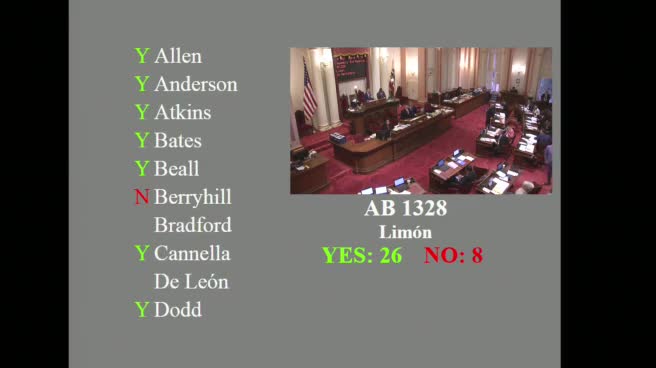 7MIN
Senate Floor
 1H
Senate Standing Committee on Appropriations
 16MIN
Senate Standing Committee on Transportation and Housing
 9MIN
Assembly Floor
 1H
Assembly Standing Committee on Appropriations
 21MIN
Assembly Standing Committee on Transportation
Bill Author



