AB 686: Housing discrimination: affirmatively further fair housing.
- Session Year: 2017-2018
- House: Assembly
- Latest Version Date: 2018-09-30
Existing federal law, the federal Fair Housing Act, requires, among other things, certain federal executive departments and agencies to administer their programs relating to housing and urban development in a manner affirmatively to further the purposes of the federal act. Existing federal law requires specified state and local agencies that contract with, or receive funding from, specified federal agencies to certify that they will affirmatively further fair housing by completing an assessment of fair housing and submitting that assessment to the United States Department of Housing and Urban Development.
Existing law, the California Fair Employment and Housing Act, generally prohibits housing discrimination with respect to the personal characteristics of race, color, religion, sex, gender, gender identity, gender expression, sexual orientation, marital status, national origin, ancestry, familial status, source of income, disability, or genetic information. Existing law also prohibits the discrimination through public or private land use practices, decisions, and authorizations because of one of those personal characteristics. Existing law establishes the Department of Fair Employment and Housing in the Business, Consumer Services, and Housing Agency, with the powers and duties to, among other things, receive, investigate, and conciliate complaints relating to housing discrimination. Existing law requires the Director of Fair Employment and Housing to investigate verified complaints that allege a violation of the act, subject to certain procedures and requirements, and requires the director, if attempts at mediation or other forms of dispute resolution do not eliminate a violation of the act, to file a civil action on behalf of the aggrieved person, as provided.
This bill would require a public agency, as defined, to administer its programs and activities relating to housing and community development in a manner to affirmatively further fair housing, and to not take any action that is materially inconsistent with this obligation, as provided.
The Planning and Zoning Law requires each city, county, and city and county to prepare and adopt a general plan that contains certain mandatory elements, including a housing element that is required to contain specified information and analysis, including a program setting forth a schedule of actions during the planning period that the local government is undertaking or intends to undertake to implement the policies and achieve the goals and objectives of the housing element, as provided.
The bill would require the above-described program for achieving the goals and objectives of the housing element to affirmatively further fair housing pursuant to provisions added by this bill, and for revisions to the housing element that occur on and after January 1, 2021, would require the program to include an assessment of fair housing within the jurisdiction, as specified.
Existing law requires the housing element to include an inventory of land suitable and available for development and requires that inventory to be used to identify sites that can be developed for housing within the planning period and that are sufficient to provide for the jurisdictions share of the regional housing need for all income levels.
This bill would require the inventory to be used to identify sites throughout the community, consistent with the provisions requiring the above-described program, within the housing element to affirmatively further fair housing.
By increasing the duties of local officials, this bill would impose a state-mandated local program.
This bill would incorporate additional changes to Section 65583 of the Government Code proposed by AB 2162 to be operative only if this bill and AB 2162 are enacted and this bill is enacted last.
This bill would incorporate additional changes to Section 65583.2 of the Government Code proposed by SB 1078 to be operative only if this bill and SB 1078 are enacted and this bill is enacted last.
The California Constitution requires the state to reimburse local agencies and school districts for certain costs mandated by the state. Statutory provisions establish procedures for making that reimbursement.
This bill would provide that with regard to certain mandates no reimbursement is required by this act for a specified reason.
With regard to any other mandates, this bill would provide that, if the Commission on State Mandates determines that the bill contains costs so mandated by the state, reimbursement for those costs shall be made pursuant to the statutory provisions noted above.
Existing federal law, the federal Fair Housing Act, requires, among other things, certain federal executive departments and agencies to administer their programs relating to housing and urban development in a manner affirmatively to further the purposes of the federal act. Existing federal law requires specified state and local agencies that contract with, or receive funding from, specified federal agencies to certify that they will affirmatively further fair housing by completing an assessment of fair housing and submitting that assessment to the United States Department of Housing and Urban Development.
Existing law, the California Fair Employment and Housing Act, generally prohibits housing discrimination with respect to the personal characteristics of race, color, religion, sex, gender, gender identity, gender expression, sexual orientation, marital status, national origin, ancestry, familial status, source of income, disability, or genetic information. Existing law also prohibits the discrimination through public or private land use practices, decisions, and authorizations because of one of those personal characteristics. Existing law establishes the Department of Fair Employment and Housing in the Business, Consumer Services, and Housing Agency, with the powers and duties to, among other things, receive, investigate, and conciliate complaints relating to housing discrimination. Existing law requires the Director of Fair Employment and Housing to investigate verified complaints that allege a violation of the act, subject to certain procedures and requirements, and requires the director, if attempts at mediation or other forms of dispute resolution do not eliminate a violation of the act, to file a civil action on behalf of the aggrieved person, as provided.
This bill would require a public agency, as defined, to administer its programs and activities relating to housing and community development in a manner to affirmatively further fair housing, and to not take any action that is materially inconsistent with this obligation, as provided.
The Planning and Zoning Law requires each city, county, and city and county to prepare and adopt a general plan that contains certain mandatory elements, including a housing element that is required to contain specified information and analysis, including a program setting forth a schedule of actions during the planning period that the local government is undertaking or intends to undertake to implement the policies and achieve the goals and objectives of the housing element, as provided.
The bill would require the above-described program for achieving the goals and objectives of the housing element to affirmatively further fair housing pursuant to provisions added by this bill, and for revisions to the housing element that occur on and after January 1, 2021, would require the program to include an assessment of fair housing within the jurisdiction, as specified.
Existing law requires the housing element to include an inventory of land suitable and available for development and requires that inventory to be used to identify sites that can be developed for housing within the planning period and that are sufficient to provide for the jurisdictions share of the regional housing need for all income levels.
This bill would require the inventory to be used to identify sites throughout the community, consistent with the provisions requiring the above-described program, within the housing element to affirmatively further fair housing.
By increasing the duties of local officials, this bill would impose a state-mandated local program.
The California Constitution requires the state to reimburse local agencies and school districts for certain costs mandated by the state. Statutory provisions establish procedures for making that reimbursement.
This bill would provide that with regard to certain mandates no reimbursement is required by this act for a specified reason.
With regard to any other mandates, this bill would provide that, if the Commission on State Mandates determines that the bill contains costs mandated by the state, reimbursement for those costs shall be made pursuant to the statutory provisions noted above.
Existing federal law, the federal Fair Housing Act, requires, among other things, certain federal executive departments and agencies to administer their programs relating to housing and urban development in a manner affirmatively to further the purposes of the federal act. Existing federal law requires specified state and local agencies that contract with, or receive funding from, specified federal agencies to certify that they will affirmatively further fair housing by completing an assessment of fair housing and submitting that assessment to the United States Department of Housing and Urban Development.
Existing law, the California Fair Employment and Housing Act, generally prohibits housing discrimination with respect to the personal characteristics of race, color, religion, sex, gender, gender identity, gender expression, sexual orientation, marital status, national origin, ancestry, familial status, source of income, disability, or genetic information. Existing law also prohibits the discrimination through public or private land use practices, decisions, and authorizations because of one of those personal characteristics. Existing law establishes the Department of Fair Employment and Housing in the Business, Consumer Services, and Housing Agency, with the powers and duties to, among other things, receive, investigate, and conciliate complaints relating to housing discrimination. Existing law requires the Director of Fair Employment and Housing to investigate verified complaints that allege a violation of the act, subject to certain procedures and requirements, and requires the director, if attempts at mediation or other forms of dispute resolution do not eliminate a violation of the act, to file a civil action on behalf of the aggrieved person, as provided.
This bill would require a public agency agency, as defined, to administer its programs and activities relating to housing and community development in a manner to affirmatively further fair housing, and to not take any action that is materially inconsistent with this obligation. The bill would make it unlawful under the California Fair Employment and Housing Act for a public agency to fail to meet its obligation to affirmatively further fair housing, and would provide that failure would constitute housing discrimination under the act. The bill would authorize the Director of Fair Employment and Housing to exercise discretion to investigate, or to bring a civil action, based on a verified complaint that alleges a violation of these provisions. obligation, as provided.
The Planning and Zoning Law requires each city, county, and city and county to prepare and adopt a general plan that contains certain mandatory elements, including a housing element that is required to contain specified information and analysis, including a program setting forth a schedule of actions during the planning period that the local government is undertaking or intends to undertake to implement the policies and achieve the goals and objectives of the housing element, as provided.
Existing law requires certain transportation planning activities on the part of designated regional transportation planning agencies, including development of a regional transportation plan. Certain of these agencies are designated under federal law as metropolitan planning organizations. Existing law requires metropolitan planning organizations to adopt a sustainable communities strategy or alternative planning strategy, subject to specified requirements, as part of a regional transportation plan.The bill would require a public agency that completes or revises an assessment of fair housing pursuant to specified provisions of the federal Fair Housing Act and its implementing regulations to submit a copy of that assessment or revised assessment to the department. The bill would require the department to post any assessment received pursuant to these provisions on its Internet Web site within a reasonable period of time. This bill would require a public agency that is required to adopt a housing element or a sustainable communities strategy to include in that element or strategy an analysis of barriers that restrict access to opportunity and a commitment to specific meaningful actions to affirmatively further fair housing. The bill would authorize a public agency of that nature that also is required to complete or revise an assessment of fair housing pursuant to the federal act, as described above, to include relevant portions of that assessment or revised assessment in its housing element or sustainable communities strategy, as applicable. The bill would also require that the above-described program for achieving the goals and objectives of the housing element to affirmatively further fair housing pursuant to provisions added by this bill. bill, and for revisions to the housing element that occur on and after January 1, 2021, would require the program to include an assessment of fair housing within the jurisdiction, as specified.
The bill would define the term public agency for these purposes to mean any state or local agency, regional transportation agency, or council of governments. By imposing additional duties upon a local government, this bill would impose a state-mandated local program.Existing law requires the housing element to include an inventory of land suitable and available for development and requires that inventory to be used to identify sites that can be developed for housing within the planning period and that are sufficient to provide for the jurisdictions share of the regional housing need for all income levels.
This bill would require the inventory to be used to identify sites throughout the community, consistent with the provisions requiring the above-described program, within the housing element to affirmatively further fair housing.
By increasing the duties of local officials, this bill would impose a state-mandated local program.
The California Constitution requires the state to reimburse local agencies and school districts for certain costs mandated by the state. Statutory provisions establish procedures for making that reimbursement.
This bill would provide that with regard to certain mandates no reimbursement is required by this act for a specified reason.
With regard to any other mandates, this bill would provide that, if the Commission on State Mandates determines that the bill contains costs mandated by the state, reimbursement for those costs shall be made pursuant to the statutory provisions noted above.
Existing federal law, the federal Fair Housing Act, requires, among other things, certain federal executive departments and agencies to administer their programs relating to housing and urban development in a manner affirmatively to further the purposes of the federal act. Existing federal law requires specified state and local agencies that contract with, or receive funding from, specified federal agencies to certify that they will affirmatively further fair housing by completing an assessment of fair housing and submitting that assessment to the United States Department of Housing and Urban Development.
Existing law, the California Fair Employment and Housing Act, generally prohibits housing discrimination with respect to the personal characteristics of race, color, religion, sex, gender, gender identity, gender expression, sexual orientation, marital status, national origin, ancestry, familial status, source of income, disability, or genetic information. Existing law also prohibits the discrimination through public or private land use practices, decisions, and authorizations because of one of those personal characteristics. Existing law establishes the Department of Fair Employment and Housing in the Business, Consumer Services, and Housing Agency, with the powers and duties to, among other things, receive, investigate, and conciliate complaints relating to housing discrimination. Existing law requires the Director of Fair Employment and Housing to investigate verified complaints that allege a violation of the act, subject to certain procedures and requirements, and requires the director, if attempts at mediation or other forms of dispute resolution do not eliminate a violation of the act, to file a civil action on behalf of the aggrieved person, as provided.
This bill would require a public agency to administer its programs and activities relating to housing and community development in a manner to affirmatively further fair housing, and to not take any action that is inconsistent with this obligation. The bill would make it unlawful under the California Fair Employment and Housing Act for a public agency to fail to meet its obligation to affirmatively further fair housing, and would provide that failure would constitute housing discrimination under the act. The bill would authorize the Director of Fair Employment and Housing to exercise discretion to investigate, or to bring a civil action, based on a verified complaint that alleges a violation of these provisions.
The Planning and Zoning Law requires each city, county, and city and county to prepare and adopt a general plan that contains certain mandatory elements, including a housing element that is required to contain specified information and analysis, including a program setting forth a schedule of actions during the planning period that the local government is undertaking or intends to undertake to implement the policies and achieve the goals and objectives of the housing element, as provided.
Existing law requires certain transportation planning activities on the part of designated regional transportation planning agencies, including development of a regional transportation plan. Certain of these agencies are designated under federal law as metropolitan planning organizations. Existing law requires metropolitan planning organizations to adopt a sustainable communities strategy or alternative planning strategy, subject to specified requirements, as part of a regional transportation plan.
The bill would require a public agency that completes or revises an assessment of fair housing pursuant to specified provisions of the federal Fair Housing Act and its implementing regulations to submit a copy of that assessment or revised assessment to the department. The bill would require the department to post any assessment received pursuant to these provisions on its Internet Web site within a reasonable period of time. This bill would require a public agency that is required to adopt a housing element or a sustainable communities strategy to include in that element or strategy an analysis of barriers that restrict access to opportunity and a commitment to specific meaningful actions to affirmatively further fair housing. The bill would authorize a public agency of that nature that also is required to complete or revise an assessment of fair housing pursuant to the federal act, as described above, to include relevant portions of that assessment or revised assessment in its housing element or sustainable communities strategy, as applicable. The bill would also require that the above-described program for achieving the goals and objectives of the housing element affirmatively further fair housing pursuant to provisions added by this bill.
The bill would define the term public agency for these purposes to mean any state or local agency, regional transportation agency, or council of governments. By imposing additional duties upon a local government, this bill would impose a state-mandated local program.
The California Constitution requires the state to reimburse local agencies and school districts for certain costs mandated by the state. Statutory provisions establish procedures for making that reimbursement.
This bill would provide that with regard to certain mandates no reimbursement is required by this act for a specified reason.
ThisWith regard to any other mandates, this bill would provide that, if the Commission on State Mandates determines that the bill contains costs mandated by the state, reimbursement for those costs shall be made pursuant to the statutory provisions noted above.
Existing federal law, the federal Fair Housing Act, requires, among other things, certain federal executive departments and agencies to administer their programs relating to housing and urban development in a manner affirmatively to further the purposes of the federal act. Existing federal law requires specified state and local agencies that contract with, or receive funding from, specified federal agencies to certify that they will affirmatively further fair housing by completing an assessment of fair housing and submitting that assessment to the United States Department of Housing and Urban Development.
Existing law, the California Fair Employment and Housing Act, generally prohibits housing discrimination with respect to the personal characteristics of race, color, religion, sex, gender, gender identity, gender expression, sexual orientation, marital status, national origin, ancestry, familial status, source of income, disability, or genetic information. Existing law also prohibits the discrimination through public or private land use practices, decisions, and authorizations because of one of those personal characteristics. Existing law establishes the Department of Fair Employment and Housing in the Business, Consumer Services, and Housing Agency, with the powers and duties to, among other things, receive, investigate, and conciliate complaints relating to housing discrimination. Existing law requires the Director of Fair Employment and Housing to investigate verified complaints that allege a violation of the act, subject to certain procedures and requirements, and requires the director, if attempts at mediation or other forms of dispute resolution do not eliminate a violation of the act, to file a civil action on behalf of the aggrieved person, as provided.
This bill would require a public agency to administer its programs and activities relating to housing and community development in a manner to affirmatively further fair housing, and to not take any action that is inconsistent with this obligation. The bill would make it unlawful under the California Fair Employment and Housing Act for a public agency to fail to meet its obligation to affirmatively further fair housing, and would provide that failure would constitute housing discrimination under the act. The bill would authorize the Director of Fair Employment and Housing to exercise his or her discretion to investigate, or to bring a civil action, based on a verified complaint that alleges a violation of these provisions.
The Planning and Zoning Law requires each city, county, and city and county to prepare and adopt a general plan that contains certain mandatory elements, including a housing element that is required to contain specified information and analysis. analysis, including a program setting forth a schedule of actions during the planning period that the local government is undertaking or intends to undertake to implement the policies and achieve the goals and objectives of the housing element, as provided.
Existing law requires certain transportation planning activities on the part of designated regional transportation planning agencies, including development of a regional transportation plan. Certain of these agencies are designated under federal law as metropolitan planning organizations. Existing law requires metropolitan planning organizations to adopt a sustainable communities strategy or alternative planning strategy, subject to specified requirements, as part of a regional transportation plan.
The bill would require a public agency that completes or revises an assessment of fair housing pursuant to specified provisions of the federal Fair Housing Act and its implementing regulations to submit a copy of that assessment or revised assessment to the department. The bill would require the department to post any assessment received pursuant to these provisions on its Internet Web site within a reasonable period of time. This bill would require a public agency that is required to adopt a housing element or a sustainable communities strategy to include in that element or strategy an analysis of barriers that restrict access to opportunity and a commitment to specific meaningful actions to affirmatively further fair housing. The bill would authorize a public agency of that nature that also is required to complete or revise an assessment of fair housing pursuant to the federal act, as described above, to include relevant portions of that assessment or revised assessment in its housing element or sustainable communities strategy, as applicable. The bill would also require that the above-described program for achieving the goals and objectives of the housing element affirmatively further fair housing pursuant to provisions added by this bill.
The bill would define the term public agency for these purposes to mean any state or local agency, regional transportation agency, or council of governments. By imposing additional duties upon a local government, this bill would impose a state-mandated local program.
The California Constitution requires the state to reimburse local agencies and school districts for certain costs mandated by the state. Statutory provisions establish procedures for making that reimbursement.
This bill would provide that, if the Commission on State Mandates determines that the bill contains costs mandated by the state, reimbursement for those costs shall be made pursuant to the statutory provisions noted above.
Existing federal law, the federal Fair Housing Act, requires, among other things, certain federal executive departments and agencies to administer their programs relating to housing and urban development in a manner affirmatively to further the purposes of the federal act. Existing federal law requires specified state and local agencies that contract with, or receive funding from, specified federal agencies to certify that it they will affirmatively further fair housing by completing an assessment of fair housing and submitting that assessment to the United States Department of Housing and Urban Development.
Existing law, the California Fair Employment and Housing Act, generally prohibits housing discrimination with respect to the personal characteristics of race, color, religion, sex, gender, gender identity, gender expression, sexual orientation, marital status, national origin, ancestry, familial status, source of income, disability, or genetic information. Existing law also prohibits the discrimination through public or private land use practices, decisions, and authorizations because of one of those personal characteristics. Existing law establishes the Department of Fair Employment and Housing in the Business, Consumer Services, and Housing Agency, with the powers and duties to, among other things, receive, investigate, and conciliate complaints relating to housing discrimination. Existing law requires the Director of Fair Employment and Housing to investigate verified complaints that allege a violation of the act, subject to certain procedures and requirements, and requires the director, if attempts at mediation or other forms of dispute resolution do not eliminate a violation of the act, to file a civil action on behalf of the aggrieved person, as provided.
This bill would require a public agency to administer its programs and activities relating to housing and community development in a manner to affirmatively further fair housing, and to not take any action that is inconsistent with this obligation. The bill would make it unlawful under the California Fair Employment and Housing Act for a public agency to fail to meet its obligation to affirmatively further fair housing, and would provide that failure would constitute housing discrimination under the act. The bill would require a public agency that completes or revises an assessment of fair housing pursuant to specified provisions of the federal Fair Housing Act and its implementing regulations to submit a copy of that assessment or revised assessment to the department. The bill would require the department to post any assessment received pursuant to these provisions on its Internet Web site within a reasonable period of time. The bill would define the term public agency to mean any state or local agency, regional transportation agency, or council of governments. By imposing additional duties upon a local government, this bill would impose a state-mandated local program. The bill would authorize the Director of Fair Employment and Housing to exercise his or her discretion to investigate, or to bring a civil action, based on a verified complaint that alleges a violation of these provisions.
The Planning and Zoning Law requires each city, county, and city and county to prepare and adopt a general plan that contains certain mandatory elements, including a housing element that is required to contain specified information and analysis.
Existing law requires certain transportation planning activities on the part of designated regional transportation planning agencies, including development of a regional transportation plan. Certain of these agencies are designated under federal law as metropolitan planning organizations. Existing law requires metropolitan planning organizations to adopt a sustainable communities strategy or alternative planning strategy, subject to specified requirements, as part of a regional transportation plan.
The bill would require a public agency that completes or revises an assessment of fair housing pursuant to specified provisions of the federal Fair Housing Act and its implementing regulations to submit a copy of that assessment or revised assessment to the department. The bill would require the department to post any assessment received pursuant to these provisions on its Internet Web site within a reasonable period of time. This bill would require a public agency that is required to adopt a housing element or a sustainable communities strategy to include in that element or strategy an analysis of barriers that restrict access to opportunity and a commitment to specific meaningful actions to affirmatively further fair housing. The bill would authorize a public agency of that nature that also is required to complete or revise an assessment of fair housing pursuant to the federal act, as described above, to include relevant portions of that assessment or revised assessment in its housing element or sustainable communities strategy, as applicable.
The bill would define the term public agency to mean any state or local agency, regional transportation agency, or council of governments. By imposing additional duties upon a local government, this bill would impose a state-mandated local program.
The California Constitution requires the state to reimburse local agencies and school districts for certain costs mandated by the state. Statutory provisions establish procedures for making that reimbursement.
This bill would provide that, if the Commission on State Mandates determines that the bill contains costs mandated by the state, reimbursement for those costs shall be made pursuant to the statutory provisions noted above.
Existing federal law, the federal Fair Housing Act, requires, among other things, certain federal executive departments and agencies to administer their programs relating to housing and urban development in a manner affirmatively to further the purposes of the federal act. Existing federal law requires specified state and local agencies that contract with, or receive funding from, specified federal agencies to certify that it will affirmatively further fair housing by completing an assessment of fair housing and submitting that assessment to the United States Department of Housing and Urban Development.
Existing law, the California Fair Employment and Housing Act, generally prohibits housing discrimination with respect to the personal characteristics of race, color, religion, sex, gender, gender identity, gender expression, sexual orientation, marital status, national origin, ancestry, familial status, source of income, disability, or genetic information. Existing law also prohibits the discrimination through public or private land use practices, decisions, and authorizations because of one of those personal characteristics. Existing law establishes the Department of Fair Employment and Housing in the State and Consumer Services Business, Consumer Services, and Housing Agency, with the powers and duties to, among other things, receive, investigate, and conciliate complaints relating to housing discrimination.
This bill would require a public agency to administer its programs and activities relating to housing and community development in a manner to affirmatively further fair housing, and to not take any action that is materially inconsistent with this obligation. The bill would provide that if make it unlawful under the California Fair Employment and Housing Act for a public agency fails to to fail to meet its obligation to affirmatively further fair housing, then and would provide that failure would constitute housing discrimination under the California Fair Employment and Housing Act. act. The bill would require a public agency that completes or revises an assessment of fair housing pursuant to specified provisions of the federal Fair Housing Act and its implementing regulations to submit a copy of that assessment or revised assessment to the department. The bill would require the department to post any assessment received pursuant to these provisions on its Internet Web site within a reasonable period of time. The bill would define the term public agency to mean any state or local agency, regional transportation agency, or council of governments. By imposing additional duties upon a local government, this bill would impose a state-mandated local program.
The California Constitution requires the state to reimburse local agencies and school districts for certain costs mandated by the state. Statutory provisions establish procedures for making that reimbursement.
This bill would provide that, if the Commission on State Mandates determines that the bill contains costs mandated by the state, reimbursement for those costs shall be made pursuant to the statutory provisions noted above.
Existing federal law, the federal Fair Housing Act, requires, among other things, certain federal executive departments and agencies to administer their programs relating to housing and urban development in a manner affirmatively to further the purposes of the federal act. Existing federal law requires specified state and local agencies that contract with, or receive funding from, specified federal agencies to certify that it will affirmatively further fair housing by completing an assessment of fair housing and submitting that assessment to the United States Department of Housing and Urban Development.
Existing law, the California Fair Employment and Housing Act, generally prohibits housing discrimination with respect to the personal characteristics of race, color, religion, sex, gender, gender identity, gender expression, sexual orientation, marital status, national origin, ancestry, familial status, source of income, disability, or genetic information. Existing law also prohibits the discrimination through public or private land use practices, decisions, and authorizations because of one of those personal characteristics. Existing law establishes the Department of Fair Employment and Housing in the State and Consumer Services Agency, with the powers and duties to, among other things, receive, investigate, and conciliate complaints relating to housing discrimination.
This bill would require a public agency to administer its programs and activities relating to housing and community development in a manner to affirmatively further fair housing, and to not take any action that is materially inconsistent with this obligation. The bill would provide that if a public agency fails to meet its obligation to affirmatively further fair housing, then that failure would constitute housing discrimination under the California Fair Employment and Housing Act. The bill would require a public agency that completes an assessment of fair housing pursuant to specified provisions of the federal Fair Housing Act to submit a copy of that assessment to the department. The bill would define the term public agency to mean any state or local agency, regional transportation agency, or council of governments. By imposing additional duties upon a local government, this bill would impose a state-mandated local program.
The California Constitution requires the state to reimburse local agencies and school districts for certain costs mandated by the state. Statutory provisions establish procedures for making that reimbursement.
This bill would provide that, if the Commission on State Mandates determines that the bill contains costs mandated by the state, reimbursement for those costs shall be made pursuant to the statutory provisions noted above.
(a)For purposes of this section, the following terms have the following meanings:
(1)Affirmatively furthering fair housing means taking meaningful actions, in addition to combating discrimination, that overcome patterns of segregation and foster inclusive communities free from barriers that restrict access to opportunity based on protected characteristics. Specifically, affirmatively furthering fair housing means taking meaningful actions that, taken together, address significant disparities in housing needs and in access to opportunity, replacing segregated living patterns with truly integrated and balanced living patterns, transforming racially and ethnically concentrated areas of poverty into areas of opportunity, and fostering and maintaining compliance with civil rights and fair housing laws. The duty to affirmatively further fair housing extends to all of a public agencys activities and programs relating to housing and community development.
(2)Public agency means all of the following:
(A)The state, including every state office, officer, department, division, bureau, board, and commission, including the California State University.
(B)A city, including a charter city, county, including a charter county, city and county, and a redevelopment successor agency.
(C)A public housing authority created pursuant to the Housing Authorities Law (Chapter 1 (commencing with Section 34200) of Part 2 of Division 24 of the Health and Safety Code).
(D)A public housing agency, as defined in the United States Housing Act of 1937 (codified at 42 U.S.C. Sec. 1437 et seq.), as amended.
(E)Any other political subdivision of the state that is a grantee or subgrantee receiving funds provided by the United States Department of Housing and Urban Development under the Community Development Block Grant program, the Emergency Solutions Grants program, the HOME Investment Partnerships program, or the Housing Opportunities for Persons With AIDS program.
(b)A public agency shall administer its programs and activities relating to housing and community development in a manner to affirmatively further fair housing, and take no action that is materially inconsistent with its obligation to affirmatively further fair housing.
(c)This section shall be interpreted consistent with the Affirmatively Furthering Fair Housing Final Rule and accompanying commentary published by the United States Department of Housing and Urban Development contained in Volume 80 of the Federal Register, Number 136, pages 42272 to 42371, inclusive, dated July 16, 2015. Subsequent amendment, suspension, or revocation of this Final Rule or its accompanying commentary by the federal government shall not impact the interpretation of this section.
(d)In selecting meaningful actions to fulfill the obligation to affirmatively further fair housing, this section does not require a public agency to take, or prohibit a public agency from taking, any one particular action.
SEC. 2.Section 65583 of the Government Code is amended to read:65583.The housing element shall consist of an identification and analysis of existing and projected housing needs and a statement of goals, policies, quantified objectives, financial resources, and scheduled programs for the preservation, improvement, and development of housing. The housing element shall identify adequate sites for housing, including rental housing, factory-built housing, mobilehomes, and emergency shelters, and shall make adequate provision for the existing and projected needs of all economic segments of the community. The element shall contain all of the following:
(a)An assessment of housing needs and an inventory of resources and constraints relevant to the meeting of these needs. The assessment and inventory shall include all of the following:
(1)An analysis of population and employment trends and documentation of projections and a quantification of the localitys existing and projected housing needs for all income levels, including extremely low income households, as defined in subdivision (b) of Section 50105 and Section 50106 of the Health and Safety Code. These existing and projected needs shall include the localitys share of the regional housing need in accordance with Section 65584. Local agencies shall calculate the subset of very low income households allotted under Section 65584 that qualify as extremely low income households. The local agency may either use available census data to calculate the percentage of very low income households that qualify as extremely low income households or presume that 50 percent of the very low income households qualify as extremely low income households. The number of extremely low income households and very low income households shall equal the jurisdictions allocation of very low income households pursuant to Section 65584.
(2)An analysis and documentation of household characteristics, including level of payment compared to ability to pay, housing characteristics, including overcrowding, and housing stock condition.
(3)An inventory of land suitable and available for residential development, including vacant sites and sites having realistic and demonstrated potential for redevelopment during the planning period to meet the localitys housing need for a designated income level, and an analysis of the relationship of zoning and public facilities and services to these sites.
(4)(A)The identification of a zone or zones where emergency shelters are allowed as a permitted use without a conditional use or other discretionary permit. The identified zone or zones shall include sufficient capacity to accommodate the need for emergency shelter identified in paragraph (7), except that each local government shall identify a zone or zones that can accommodate at least one year-round emergency shelter. If the local government cannot identify a zone or zones with sufficient capacity, the local government shall include a program to amend its zoning ordinance to meet the requirements of this paragraph within one year of the adoption of the housing element. The local government may identify additional zones where emergency shelters are permitted with a conditional use permit. The local government shall also demonstrate that existing or proposed permit processing, development, and management standards are objective and encourage and facilitate the development of, or conversion to, emergency shelters. Emergency shelters may only be subject to those development and management standards that apply to residential or commercial development within the same zone except that a local government may apply written, objective standards that include all of the following:
(i)The maximum number of beds or persons permitted to be served nightly by the facility.
(ii)Off-street parking based upon demonstrated need, provided that the standards do not require more parking for emergency shelters than for other residential or commercial uses within the same zone.
(iii)The size and location of exterior and interior onsite waiting and client intake areas.
(iv)The provision of onsite management.
(v)The proximity to other emergency shelters, provided that emergency shelters are not required to be more than 300 feet apart.
(vi)The length of stay.
(vii)Lighting.
(viii)Security during hours that the emergency shelter is in operation.
(B)The permit processing, development, and management standards applied under this paragraph shall not be deemed to be discretionary acts within the meaning of the California Environmental Quality Act (Division 13 (commencing with Section 21000) of the Public Resources Code).
(C)A local government that can demonstrate to the satisfaction of the department the existence of one or more emergency shelters either within its jurisdiction or pursuant to a multijurisdictional agreement that can accommodate that jurisdictions need for emergency shelter identified in paragraph (7) may comply with the zoning requirements of subparagraph (A) by identifying a zone or zones where new emergency shelters are allowed with a conditional use permit.
(D)A local government with an existing ordinance or ordinances that comply with this paragraph shall not be required to take additional action to identify zones for emergency shelters. The housing element must only describe how existing ordinances, policies, and standards are consistent with the requirements of this paragraph.
(5)An analysis of potential and actual governmental constraints upon the maintenance, improvement, or development of housing for all income levels, including the types of housing identified in paragraph (1) of subdivision (c), and for persons with disabilities as identified in the analysis pursuant to paragraph (7), including land use controls, building codes and their enforcement, site improvements, fees and other exactions required of developers, local processing and permit procedures, and any locally adopted ordinances that directly impact the cost and supply of residential development. The analysis shall also demonstrate local efforts to remove governmental constraints that hinder the locality from meeting its share of the regional housing need in accordance with Section 65584 and from meeting the need for housing for persons with disabilities, supportive housing, transitional housing, and emergency shelters identified pursuant to paragraph (7). Transitional housing and supportive housing shall be considered a residential use of property, and shall be subject only to those restrictions that apply to other residential dwellings of the same type in the same zone.
(6)An analysis of potential and actual nongovernmental constraints upon the maintenance, improvement, or development of housing for all income levels, including the availability of financing, the price of land, the cost of construction, the requests to develop housing at densities below those anticipated in the analysis required by subdivision (c) of Section 65583.2, and the length of time between receiving approval for a housing development and submittal of an application for building permits for that housing development that hinder the construction of a localitys share of the regional housing need in accordance with Section 65584. The analysis shall also demonstrate local efforts to remove nongovernmental constraints that create a gap between the localitys planning for the development of housing for all income levels and the construction of that housing.
(7)An analysis of any special housing needs, such as those of the elderly; persons with disabilities, including a developmental disability, as defined in Section 4512 of the Welfare and Institutions Code; large families; farmworkers; families with female heads of households; and families and persons in need of emergency shelter. The need for emergency shelter shall be assessed based on annual and seasonal need. The need for emergency shelter may be reduced by the number of supportive housing units that are identified in an adopted 10-year plan to end chronic homelessness and that are either vacant or for which funding has been identified to allow construction during the planning period. An analysis of special housing needs by a city or county may include an analysis of the need for frequent user coordinated care housing services.
(8)An analysis of opportunities for energy conservation with respect to residential development. Cities and counties are encouraged to include weatherization and energy efficiency improvements as part of publicly subsidized housing rehabilitation projects. This may include energy efficiency measures that encompass the building envelope, its heating and cooling systems, and its electrical system.
(9)An analysis of existing assisted housing developments that are eligible to change from low-income housing uses during the next 10 years due to termination of subsidy contracts, mortgage prepayment, or expiration of restrictions on use. Assisted housing developments, for the purpose of this section, shall mean multifamily rental housing that receives governmental assistance under federal programs listed in subdivision (a) of Section 65863.10, state and local multifamily revenue bond programs, local redevelopment programs, the federal Community Development Block Grant Program, or local in-lieu fees. Assisted housing developments shall also include multifamily rental units that were developed pursuant to a local inclusionary housing program or used to qualify for a density bonus pursuant to Section 65916.
(A)The analysis shall include a listing of each development by project name and address, the type of governmental assistance received, the earliest possible date of change from low-income use, and the total number of elderly and nonelderly units that could be lost from the localitys low-income housing stock in each year during the 10-year period. For purposes of state and federally funded projects, the analysis required by this subparagraph need only contain information available on a statewide basis.
(B)The analysis shall estimate the total cost of producing new rental housing that is comparable in size and rent levels, to replace the units that could change from low-income use, and an estimated cost of preserving the assisted housing developments. This cost analysis for replacement housing may be done aggregately for each five-year period and does not have to contain a project-by-project cost estimate.
(C)The analysis shall identify public and private nonprofit corporations known to the local government that have legal and managerial capacity to acquire and manage these housing developments.
(D)The analysis shall identify and consider the use of all federal, state, and local financing and subsidy programs that can be used to preserve, for lower income households, the assisted housing developments, identified in this paragraph, including, but not limited to, federal Community Development Block Grant Program funds, tax increment funds received by a redevelopment agency of the community, and administrative fees received by a housing authority operating within the community. In considering the use of these financing and subsidy programs, the analysis shall identify the amounts of funds under each available program that have not been legally obligated for other purposes and that could be available for use in preserving assisted housing developments.
(b)(1)A statement of the communitys goals, quantified objectives, and policies relative to the maintenance, preservation, improvement, and development of housing.
(2)It is recognized that the total housing needs identified pursuant to subdivision (a) may exceed available resources and the communitys ability to satisfy this need within the content of the general plan requirements outlined in Article 5 (commencing with Section 65300). Under these circumstances, the quantified objectives need not be identical to the total housing needs. The quantified objectives shall establish the maximum number of housing units by income category, including extremely low income, that can be constructed, rehabilitated, and conserved over a five-year time period.
(c)A program that sets forth a schedule of actions during the planning period, each with a timeline for implementation, that may recognize that certain programs are ongoing, such that there will be beneficial impacts of the programs within the planning period, that the local government is undertaking or intends to undertake to implement the policies and achieve the goals and objectives of the housing element through the administration of land use and development controls, the provision of regulatory concessions and incentives, the utilization of appropriate federal and state financing and subsidy programs when available, and the utilization of moneys in a low- and moderate-income housing fund of an agency if the locality has established a redevelopment project area pursuant to the Community Redevelopment Law (Division 24 (commencing with Section 33000) of the Health and Safety Code). In order to make adequate provision for the housing needs of all economic segments of the community, the program shall do all of the following:
(1)Identify actions that will be taken to make sites available during the planning period with appropriate zoning and development standards and with services and facilities to accommodate that portion of the citys or countys share of the regional housing need for each income level that could not be accommodated on sites identified in the inventory completed pursuant to paragraph (3) of subdivision (a) without rezoning, and to comply with the requirements of Section 65584.09. Sites shall be identified as needed to facilitate and encourage the development of a variety of types of housing for all income levels, including multifamily rental housing, factory-built housing, mobilehomes, housing for agricultural employees, supportive housing, single-room occupancy units, emergency shelters, and transitional housing.
(A)Where the inventory of sites, pursuant to paragraph (3) of subdivision (a), does not identify adequate sites to accommodate the need for groups of all household income levels pursuant to Section 65584, rezoning of those sites, including adoption of minimum density and development standards, for jurisdictions with an eight-year housing element planning period pursuant to Section 65588, shall be completed no later than three years after either the date the housing element is adopted pursuant to subdivision (f) of Section 65585 or the date that is 90 days after receipt of comments from the department pursuant to subdivision (b) of Section 65585, whichever is earlier, unless the deadline is extended pursuant to subdivision (f). Notwithstanding the foregoing, for a local government that fails to adopt a housing element within 120 days of the statutory deadline in Section 65588 for adoption of the housing element, rezoning of those sites, including adoption of minimum density and development standards, shall be completed no later than three years and 120 days from the statutory deadline in Section 65588 for adoption of the housing element.
(B)Where the inventory of sites, pursuant to paragraph (3) of subdivision (a), does not identify adequate sites to accommodate the need for groups of all household income levels pursuant to Section 65584, the program shall identify sites that can be developed for housing within the planning period pursuant to subdivision (h) of Section 65583.2. The identification of sites shall include all components specified in Section 65583.2.
(C)Where the inventory of sites pursuant to paragraph (3) of subdivision (a) does not identify adequate sites to accommodate the need for farmworker housing, the program shall provide for sufficient sites to meet the need with zoning that permits farmworker housing use by right, including density and development standards that could accommodate and facilitate the feasibility of the development of farmworker housing for low- and very low income households.
(2)Assist in the development of adequate housing to meet the needs of extremely low, very low, low-, and moderate-income households.
(3)Address and, where appropriate and legally possible, remove governmental and nongovernmental constraints to the maintenance, improvement, and development of housing, including housing for all income levels and housing for persons with disabilities. The program shall remove constraints to, and provide reasonable accommodations for housing designed for, intended for occupancy by, or with supportive services for, persons with disabilities.
(4)Conserve and improve the condition of the existing affordable housing stock, which may include addressing ways to mitigate the loss of dwelling units demolished by public or private action.
(5)Promote and affirmatively further fair housing opportunities and promote housing throughout the community or communities for all persons regardless of race, religion, sex, marital status, ancestry, national origin, color, familial status, or disability, and other characteristics protected by the California Fair Employment and Housing Act (Part 2.8 (commencing with Section 12900) of Division 3 of Title 2), Section 65008, and any other state and federal fair housing and planning law.
(6)Preserve for lower income households the assisted housing developments identified pursuant to paragraph (9) of subdivision (a). The program for preservation of the assisted housing developments shall utilize, to the extent necessary, all available federal, state, and local financing and subsidy programs identified in paragraph (9) of subdivision (a), except where a community has other urgent needs for which alternative funding sources are not available. The program may include strategies that involve local regulation and technical assistance.
(7)Include an identification of the agencies and officials responsible for the implementation of the various actions and the means by which consistency will be achieved with other general plan elements and community goals.
(8)Include a diligent effort by the local government to achieve public participation of all economic segments of the community in the development of the housing element, and the program shall describe this effort.
(9)(A)Affirmatively further fair housing in accordance with Chapter 15 (commencing with Section 8899.50) of Division 1 of Title 2. The program shall include an assessment of fair housing in the jurisdiction that shall include all of the following components:
(i)A summary of fair housing issues in the jurisdiction and an assessment of the jurisdictions fair housing enforcement and fair housing outreach capacity.
(ii)An analysis of available federal, state, and local data and knowledge to identify integration and segregation patterns and trends, racially or ethnically concentrated areas of poverty, disparities in access to opportunity, and disproportionate housing needs within the jurisdiction, including displacement risk.
(iii)An assessment of the contributing factors for the fair housing issues identified under clause (ii).
(iv)An identification of the jurisdictions fair housing priorities and goals, giving highest priority to those factors identified in clause (iii) that limit or deny fair housing choice or access to opportunity, or negatively impact fair housing or civil rights compliance, and identifying the metrics and milestones for determining what fair housing results will be achieved.
(v)Strategies and actions to implement those priorities and goals, which may include, but are not limited to, enhancing mobility strategies and encouraging development of new affordable housing in areas of opportunity, as well as place-based strategies to encourage community revitalization, including preservation of existing affordable housing, and protecting existing residents from displacement.
(B)A jurisdiction that completes or revises an assessment of fair housing pursuant to Subpart A (commencing with Section 5.150) of Part 5 of Subtitle A of Title 24 of the Code of Federal Regulations, as published in Volume 80 of the Federal Register, Number 136, page 42272, dated July 16, 2015, or an analysis of impediments to fair housing choice in accordance with the requirements of Section 91.225 of Title 24 of the Code of Federal Regulations in effect prior to August 17, 2015, may incorporate relevant portions of that assessment or revised assessment of fair housing or analysis or revised analysis of impediments to fair housing into its housing element.
(C)The requirements of this paragraph shall apply to housing elements due to be revised pursuant to Section 65588 on or after January 1, 2021.
(d)(1)A local government may satisfy all or part of its requirement to identify a zone or zones suitable for the development of emergency shelters pursuant to paragraph (4) of subdivision (a) by adopting and implementing a multijurisdictional agreement, with a maximum of two other adjacent communities, that requires the participating jurisdictions to develop at least one year-round emergency shelter within two years of the beginning of the planning period.
(2)The agreement shall allocate a portion of the new shelter capacity to each jurisdiction as credit toward its emergency shelter need, and each jurisdiction shall describe how the capacity was allocated as part of its housing element.
(3)Each member jurisdiction of a multijurisdictional agreement shall describe in its housing element all of the following:
(A)How the joint facility will meet the jurisdictions emergency shelter need.
(B)The jurisdictions contribution to the facility for both the development and ongoing operation and management of the facility.
(C)The amount and source of the funding that the jurisdiction contributes to the facility.
(4)The aggregate capacity claimed by the participating jurisdictions in their housing elements shall not exceed the actual capacity of the shelter.
(e)Except as otherwise provided in this article, amendments to this article that alter the required content of a housing element shall apply to both of the following:
(1)A housing element or housing element amendment prepared pursuant to subdivision (e) of Section 65588 or Section 65584.02, when a city, county, or city and county submits a draft to the department for review pursuant to Section 65585 more than 90 days after the effective date of the amendment to this section.
(2)Any housing element or housing element amendment prepared pursuant to subdivision (e) of Section 65588 or Section 65584.02, when the city, county, or city and county fails to submit the first draft to the department before the due date specified in Section 65588 or 65584.02.
(f)The deadline for completing required rezoning pursuant to subparagraph (A) of paragraph (1) of subdivision (c) shall be extended by one year if the local government has completed the rezoning at densities sufficient to accommodate at least 75 percent of the units for low- and very low income households and if the legislative body at the conclusion of a public hearing determines, based upon substantial evidence, that any of the following circumstances exist:
(1)The local government has been unable to complete the rezoning because of the action or inaction beyond the control of the local government of any other state, federal, or local agency.
(2)The local government is unable to complete the rezoning because of infrastructure deficiencies due to fiscal or regulatory constraints.
(3)The local government must undertake a major revision to its general plan in order to accommodate the housing-related policies of a sustainable communities strategy or an alternative planning strategy adopted pursuant to Section 65080.
The resolution and the findings shall be transmitted to the department together with a detailed budget and schedule for preparation and adoption of the required rezonings, including plans for citizen participation and expected interim action. The schedule shall provide for adoption of the required rezoning within one year of the adoption of the resolution.
(g)(1)If a local government fails to complete the rezoning by the deadline provided in subparagraph (A) of paragraph (1) of subdivision (c), as it may be extended pursuant to subdivision (f), except as provided in paragraph (2), a local government may not disapprove a housing development project, nor require a conditional use permit, planned unit development permit, or other locally imposed discretionary permit, or impose a condition that would render the project infeasible, if the housing development project (A) is proposed to be located on a site required to be rezoned pursuant to the program action required by that subparagraph and (B) complies with applicable, objective general plan and zoning standards and criteria, including design review standards, described in the program action required by that subparagraph. Any subdivision of sites shall be subject to the Subdivision Map Act (Division 2 (commencing with Section 66410)). Design review shall not constitute a project for purposes of Division 13 (commencing with Section 21000) of the Public Resources Code.
(2)A local government may disapprove a housing development described in paragraph (1) if it makes written findings supported by substantial evidence on the record that both of the following conditions exist:
(A)The housing development project would have a specific, adverse impact upon the public health or safety unless the project is disapproved or approved upon the condition that the project be developed at a lower density. As used in this paragraph, a specific, adverse impact means a significant, quantifiable, direct, and unavoidable impact, based on objective, identified written public health or safety standards, policies, or conditions as they existed on the date the application was deemed complete.
(B)There is no feasible method to satisfactorily mitigate or avoid the adverse impact identified pursuant to paragraph (1), other than the disapproval of the housing development project or the approval of the project upon the condition that it be developed at a lower density.
(3)The applicant or any interested person may bring an action to enforce this subdivision. If a court finds that the local agency disapproved a project or conditioned its approval in violation of this subdivision, the court shall issue an order or judgment compelling compliance within 60 days. The court shall retain jurisdiction to ensure that its order or judgment is carried out. If the court determines that its order or judgment has not been carried out within 60 days, the court may issue further orders to ensure that the purposes and policies of this subdivision are fulfilled. In any such action, the city, county, or city and county shall bear the burden of proof.
(4)For purposes of this subdivision, housing development project means a project to construct residential units for which the project developer provides sufficient legal commitments to the appropriate local agency to ensure the continued availability and use of at least 49 percent of the housing units for very low, low-, and moderate-income households with an affordable housing cost or affordable rent, as defined in Section 50052.5 or 50053 of the Health and Safety Code, respectively, for the period required by the applicable financing.
(h)An action to enforce the program actions of the housing element shall be brought pursuant to Section 1085 of the Code of Civil Procedure.
SEC. 2.5.Section 65583 of the Government Code is amended to read:65583.The housing element shall consist of an identification and analysis of existing and projected housing needs and a statement of goals, policies, quantified objectives, financial resources, and scheduled programs for the preservation, improvement, and development of housing. The housing element shall identify adequate sites for housing, including rental housing, factory-built housing, mobilehomes, and emergency shelters, and shall make adequate provision for the existing and projected needs of all economic segments of the community. The element shall contain all of the following:
(a)An assessment of housing needs and an inventory of resources and constraints relevant to the meeting of these needs. The assessment and inventory shall include all of the following:
(1)An analysis of population and employment trends and documentation of projections and a quantification of the localitys existing and projected housing needs for all income levels, including extremely low income households, as defined in subdivision (b) of Section 50105 and Section 50106 of the Health and Safety Code. These existing and projected needs shall include the localitys share of the regional housing need in accordance with Section 65584. Local agencies shall calculate the subset of very low income households allotted under Section 65584 that qualify as extremely low income households. The local agency may either use available census data to calculate the percentage of very low income households that qualify as extremely low income households or presume that 50 percent of the very low income households qualify as extremely low income households. The number of extremely low income households and very low income households shall equal the jurisdictions allocation of very low income households pursuant to Section 65584.
(2)An analysis and documentation of household characteristics, including level of payment compared to ability to pay, housing characteristics, including overcrowding, and housing stock condition.
(3)An inventory of land suitable and available for residential development, including vacant sites and sites having realistic and demonstrated potential for redevelopment during the planning period to meet the localitys housing need for a designated income level, and an analysis of the relationship of zoning and public facilities and services to these sites.
(4)(A)The identification of a zone or zones where emergency shelters are allowed as a permitted use without a conditional use or other discretionary permit. The identified zone or zones shall include sufficient capacity to accommodate the need for emergency shelter identified in paragraph (7), except that each local government shall identify a zone or zones that can accommodate at least one year-round emergency shelter. If the local government cannot identify a zone or zones with sufficient capacity, the local government shall include a program to amend its zoning ordinance to meet the requirements of this paragraph within one year of the adoption of the housing element. The local government may identify additional zones where emergency shelters are permitted with a conditional use permit. The local government shall also demonstrate that existing or proposed permit processing, development, and management standards are objective and encourage and facilitate the development of, or conversion to, emergency shelters. Emergency shelters may only be subject to those development and management standards that apply to residential or commercial development within the same zone except that a local government may apply written, objective standards that include all of the following:
(i)The maximum number of beds or persons permitted to be served nightly by the facility.
(ii)Off-street parking based upon demonstrated need, provided that the standards do not require more parking for emergency shelters than for other residential or commercial uses within the same zone.
(iii)The size and location of exterior and interior onsite waiting and client intake areas.
(iv)The provision of onsite management.
(v)The proximity to other emergency shelters, provided that emergency shelters are not required to be more than 300 feet apart.
(vi)The length of stay.
(vii)Lighting.
(viii)Security during hours that the emergency shelter is in operation.
(B)The permit processing, development, and management standards applied under this paragraph shall not be deemed to be discretionary acts within the meaning of the California Environmental Quality Act (Division 13 (commencing with Section 21000) of the Public Resources Code).
(C)A local government that can demonstrate to the satisfaction of the department the existence of one or more emergency shelters either within its jurisdiction or pursuant to a multijurisdictional agreement that can accommodate that jurisdictions need for emergency shelter identified in paragraph (7) may comply with the zoning requirements of subparagraph (A) by identifying a zone or zones where new emergency shelters are allowed with a conditional use permit.
(D)A local government with an existing ordinance or ordinances that comply with this paragraph shall not be required to take additional action to identify zones for emergency shelters. The housing element must only describe how existing ordinances, policies, and standards are consistent with the requirements of this paragraph.
(5)An analysis of potential and actual governmental constraints upon the maintenance, improvement, or development of housing for all income levels, including the types of housing identified in paragraph (1) of subdivision (c), and for persons with disabilities as identified in the analysis pursuant to paragraph (7), including land use controls, building codes and their enforcement, site improvements, fees and other exactions required of developers, local processing and permit procedures, and any locally adopted ordinances that directly impact the cost and supply of residential development. The analysis shall also demonstrate local efforts to remove governmental constraints that hinder the locality from meeting its share of the regional housing need in accordance with Section 65584 and from meeting the need for housing for persons with disabilities, supportive housing, transitional housing, and emergency shelters identified pursuant to paragraph (7).
(6)An analysis of potential and actual nongovernmental constraints upon the maintenance, improvement, or development of housing for all income levels, including the availability of financing, the price of land, the cost of construction, the requests to develop housing at densities below those anticipated in the analysis required by subdivision (c) of Section 65583.2, and the length of time between receiving approval for a housing development and submittal of an application for building permits for that housing development that hinder the construction of a localitys share of the regional housing need in accordance with Section 65584. The analysis shall also demonstrate local efforts to remove nongovernmental constraints that create a gap between the localitys planning for the development of housing for all income levels and the construction of that housing.
(7)An analysis of any special housing needs, such as those of the elderly; persons with disabilities, including a developmental disability, as defined in Section 4512 of the Welfare and Institutions Code; large families; farmworkers; families with female heads of households; and families and persons in need of emergency shelter. The need for emergency shelter shall be assessed based on annual and seasonal need. The need for emergency shelter may be reduced by the number of supportive housing units that are identified in an adopted 10-year plan to end chronic homelessness and that are either vacant or for which funding has been identified to allow construction during the planning period. An analysis of special housing needs by a city or county may include an analysis of the need for frequent user coordinated care housing services.
(8)An analysis of opportunities for energy conservation with respect to residential development. Cities and counties are encouraged to include weatherization and energy efficiency improvements as part of publicly subsidized housing rehabilitation projects. This may include energy efficiency measures that encompass the building envelope, its heating and cooling systems, and its electrical system.
(9)An analysis of existing assisted housing developments that are eligible to change from low-income housing uses during the next 10 years due to termination of subsidy contracts, mortgage prepayment, or expiration of restrictions on use. Assisted housing developments, for the purpose of this section, shall mean multifamily rental housing that receives governmental assistance under federal programs listed in subdivision (a) of Section 65863.10, state and local multifamily revenue bond programs, local redevelopment programs, the federal Community Development Block Grant Program, or local in-lieu fees. Assisted housing developments shall also include multifamily rental units that were developed pursuant to a local inclusionary housing program or used to qualify for a density bonus pursuant to Section 65916.
(A)The analysis shall include a listing of each development by project name and address, the type of governmental assistance received, the earliest possible date of change from low-income use, and the total number of elderly and nonelderly units that could be lost from the localitys low-income housing stock in each year during the 10-year period. For purposes of state and federally funded projects, the analysis required by this subparagraph need only contain information available on a statewide basis.
(B)The analysis shall estimate the total cost of producing new rental housing that is comparable in size and rent levels, to replace the units that could change from low-income use, and an estimated cost of preserving the assisted housing developments. This cost analysis for replacement housing may be done aggregately for each five-year period and does not have to contain a project-by-project cost estimate.
(C)The analysis shall identify public and private nonprofit corporations known to the local government that have legal and managerial capacity to acquire and manage these housing developments.
(D)The analysis shall identify and consider the use of all federal, state, and local financing and subsidy programs that can be used to preserve, for lower income households, the assisted housing developments, identified in this paragraph, including, but not limited to, federal Community Development Block Grant Program funds, tax increment funds received by a redevelopment agency of the community, and administrative fees received by a housing authority operating within the community. In considering the use of these financing and subsidy programs, the analysis shall identify the amounts of funds under each available program that have not been legally obligated for other purposes and that could be available for use in preserving assisted housing developments.
(b)(1)A statement of the communitys goals, quantified objectives, and policies relative to the maintenance, preservation, improvement, and development of housing.
(2)It is recognized that the total housing needs identified pursuant to subdivision (a) may exceed available resources and the communitys ability to satisfy this need within the content of the general plan requirements outlined in Article 5 (commencing with Section 65300). Under these circumstances, the quantified objectives need not be identical to the total housing needs. The quantified objectives shall establish the maximum number of housing units by income category, including extremely low income, that can be constructed, rehabilitated, and conserved over a five-year time period.
(c)A program that sets forth a schedule of actions during the planning period, each with a timeline for implementation, that may recognize that certain programs are ongoing, such that there will be beneficial impacts of the programs within the planning period, that the local government is undertaking or intends to undertake to implement the policies and achieve the goals and objectives of the housing element through the administration of land use and development controls, the provision of regulatory concessions and incentives, the utilization of appropriate federal and state financing and subsidy programs when available, and the utilization of moneys in a low- and moderate-income housing fund of an agency if the locality has established a redevelopment project area pursuant to the Community Redevelopment Law (Division 24 (commencing with Section 33000) of the Health and Safety Code). In order to make adequate provision for the housing needs of all economic segments of the community, the program shall do all of the following:
(1)Identify actions that will be taken to make sites available during the planning period with appropriate zoning and development standards and with services and facilities to accommodate that portion of the citys or countys share of the regional housing need for each income level that could not be accommodated on sites identified in the inventory completed pursuant to paragraph (3) of subdivision (a) without rezoning, and to comply with the requirements of Section 65584.09. Sites shall be identified as needed to facilitate and encourage the development of a variety of types of housing for all income levels, including multifamily rental housing, factory-built housing, mobilehomes, housing for agricultural employees, supportive housing, single-room occupancy units, emergency shelters, and transitional housing.
(A)Where the inventory of sites, pursuant to paragraph (3) of subdivision (a), does not identify adequate sites to accommodate the need for groups of all household income levels pursuant to Section 65584, rezoning of those sites, including adoption of minimum density and development standards, for jurisdictions with an eight-year housing element planning period pursuant to Section 65588, shall be completed no later than three years after either the date the housing element is adopted pursuant to subdivision (f) of Section 65585 or the date that is 90 days after receipt of comments from the department pursuant to subdivision (b) of Section 65585, whichever is earlier, unless the deadline is extended pursuant to subdivision (f). Notwithstanding the foregoing, for a local government that fails to adopt a housing element within 120 days of the statutory deadline in Section 65588 for adoption of the housing element, rezoning of those sites, including adoption of minimum density and development standards, shall be completed no later than three years and 120 days from the statutory deadline in Section 65588 for adoption of the housing element.
(B)Where the inventory of sites, pursuant to paragraph (3) of subdivision (a), does not identify adequate sites to accommodate the need for groups of all household income levels pursuant to Section 65584, the program shall identify sites that can be developed for housing within the planning period pursuant to subdivision (h) of Section 65583.2. The identification of sites shall include all components specified in Section 65583.2.
(C)Where the inventory of sites pursuant to paragraph (3) of subdivision (a) does not identify adequate sites to accommodate the need for farmworker housing, the program shall provide for sufficient sites to meet the need with zoning that permits farmworker housing use by right, including density and development standards that could accommodate and facilitate the feasibility of the development of farmworker housing for low- and very low income households.
(2)Assist in the development of adequate housing to meet the needs of extremely low, very low, low-, and moderate-income households.
(3)Address and, where appropriate and legally possible, remove governmental and nongovernmental constraints to the maintenance, improvement, and development of housing, including housing for all income levels and housing for persons with disabilities. The program shall remove constraints to, and provide reasonable accommodations for housing designed for, intended for occupancy by, or with supportive services for, persons with disabilities. Transitional housing and supportive housing shall be considered a residential use of property and shall be subject only to those restrictions that apply to other residential dwellings of the same type in the same zone. Supportive housing, as defined in Section 65650, shall be a use by right in all zones where multifamily and mixed uses are permitted, as provided in Article 11 (commencing with Section 65650).
(4)Conserve and improve the condition of the existing affordable housing stock, which may include addressing ways to mitigate the loss of dwelling units demolished by public or private action.
(5)Promote and affirmatively further fair housing opportunities and promote housing throughout the community or communities for all persons regardless of race, religion, sex, marital status, ancestry, national origin, color, familial status, or disability, and other characteristics protected by the California Fair Employment and Housing Act (Part 2.8 (commencing with Section 12900) of Division 3 of Title 2), Section 65008, and any other state and federal fair housing and planning law.
(6)Preserve for lower income households the assisted housing developments identified pursuant to paragraph (9) of subdivision (a). The program for preservation of the assisted housing developments shall utilize, to the extent necessary, all available federal, state, and local financing and subsidy programs identified in paragraph (9) of subdivision (a), except where a community has other urgent needs for which alternative funding sources are not available. The program may include strategies that involve local regulation and technical assistance.
(7)Include an identification of the agencies and officials responsible for the implementation of the various actions and the means by which consistency will be achieved with other general plan elements and community goals.
(8)Include a diligent effort by the local government to achieve public participation of all economic segments of the community in the development of the housing element, and the program shall describe this effort.
(9)(A)Affirmatively further fair housing in accordance with Chapter 15 (commencing with Section 8899.50) of Division 1 of Title 2. The program shall include an assessment of fair housing in the jurisdiction that shall include all of the following components:
(i)A summary of fair housing issues in the jurisdiction and an assessment of the jurisdictions fair housing enforcement and fair housing outreach capacity.
(ii)An analysis of available federal, state, and local data and knowledge to identify integration and segregation patterns and trends, racially or ethnically concentrated areas of poverty, disparities in access to opportunity, and disproportionate housing needs within the jurisdiction, including displacement risk.
(iii)An assessment of the contributing factors for the fair housing issues identified under clause (ii).
(iv)An identification of the jurisdictions fair housing priorities and goals, giving highest priority to those factors identified in clause (iii) that limit or deny fair housing choice or access to opportunity, or negatively impact fair housing or civil rights compliance, and identifying the metrics and milestones for determining what fair housing results will be achieved.
(v)Strategies and actions to implement those priorities and goals, which may include, but are not limited to, enhancing mobility strategies and encouraging development of new affordable housing in areas of opportunity, as well as place-based strategies to encourage community revitalization, including preservation of existing affordable housing, and protecting existing residents from displacement.
(B)A jurisdiction that completes or revises an assessment of fair housing pursuant to Subpart A (commencing with Section 5.150) of Part 5 of Subtitle A of Title 24 of the Code of Federal Regulations, as published in Volume 80 of the Federal Register, Number 136, page 42272, dated July 16, 2015, or an analysis of impediments to fair housing choice in accordance with the requirements of Section 91.225 of Title 24 of the Code of Federal Regulations in effect prior to August 17, 2015, may incorporate relevant portions of that assessment or revised assessment of fair housing or analysis or revised analysis of impediments to fair housing into its housing element.
(C)The requirements of this paragraph shall apply to housing elements due to be revised pursuant to Section 65588 on or after January 1, 2021.
(d)(1)A local government may satisfy all or part of its requirement to identify a zone or zones suitable for the development of emergency shelters pursuant to paragraph (4) of subdivision (a) by adopting and implementing a multijurisdictional agreement, with a maximum of two other adjacent communities, that requires the participating jurisdictions to develop at least one year-round emergency shelter within two years of the beginning of the planning period.
(2)The agreement shall allocate a portion of the new shelter capacity to each jurisdiction as credit toward its emergency shelter need, and each jurisdiction shall describe how the capacity was allocated as part of its housing element.
(3)Each member jurisdiction of a multijurisdictional agreement shall describe in its housing element all of the following:
(A)How the joint facility will meet the jurisdictions emergency shelter need.
(B)The jurisdictions contribution to the facility for both the development and ongoing operation and management of the facility.
(C)The amount and source of the funding that the jurisdiction contributes to the facility.
(4)The aggregate capacity claimed by the participating jurisdictions in their housing elements shall not exceed the actual capacity of the shelter.
(e)Except as otherwise provided in this article, amendments to this article that alter the required content of a housing element shall apply to both of the following:
(1)A housing element or housing element amendment prepared pursuant to subdivision (e) of Section 65588 or Section 65584.02, when a city, county, or city and county submits a draft to the department for review pursuant to Section 65585 more than 90 days after the effective date of the amendment to this section.
(2)Any housing element or housing element amendment prepared pursuant to subdivision (e) of Section 65588 or Section 65584.02, when the city, county, or city and county fails to submit the first draft to the department before the due date specified in Section 65588 or 65584.02.
(f)The deadline for completing required rezoning pursuant to subparagraph (A) of paragraph (1) of subdivision (c) shall be extended by one year if the local government has completed the rezoning at densities sufficient to accommodate at least 75 percent of the units for low- and very low income households and if the legislative body at the conclusion of a public hearing determines, based upon substantial evidence, that any of the following circumstances exist:
(1)The local government has been unable to complete the rezoning because of the action or inaction beyond the control of the local government of any other state, federal, or local agency.
(2)The local government is unable to complete the rezoning because of infrastructure deficiencies due to fiscal or regulatory constraints.
(3)The local government must undertake a major revision to its general plan in order to accommodate the housing-related policies of a sustainable communities strategy or an alternative planning strategy adopted pursuant to Section 65080.
The resolution and the findings shall be transmitted to the department together with a detailed budget and schedule for preparation and adoption of the required rezonings, including plans for citizen participation and expected interim action. The schedule shall provide for adoption of the required rezoning within one year of the adoption of the resolution.
(g)(1)If a local government fails to complete the rezoning by the deadline provided in subparagraph (A) of paragraph (1) of subdivision (c), as it may be extended pursuant to subdivision (f), except as provided in paragraph (2), a local government may not disapprove a housing development project, nor require a conditional use permit, planned unit development permit, or other locally imposed discretionary permit, or impose a condition that would render the project infeasible, if the housing development project (A) is proposed to be located on a site required to be rezoned pursuant to the program action required by that subparagraph and (B) complies with applicable, objective general plan and zoning standards and criteria, including design review standards, described in the program action required by that subparagraph. Any subdivision of sites shall be subject to the Subdivision Map Act (Division 2 (commencing with Section 66410)). Design review shall not constitute a project for purposes of Division 13 (commencing with Section 21000) of the Public Resources Code.
(2)A local government may disapprove a housing development described in paragraph (1) if it makes written findings supported by substantial evidence on the record that both of the following conditions exist:
(A)The housing development project would have a specific, adverse impact upon the public health or safety unless the project is disapproved or approved upon the condition that the project be developed at a lower density. As used in this paragraph, a specific, adverse impact means a significant, quantifiable, direct, and unavoidable impact, based on objective, identified written public health or safety standards, policies, or conditions as they existed on the date the application was deemed complete.
(B)There is no feasible method to satisfactorily mitigate or avoid the adverse impact identified pursuant to paragraph (1), other than the disapproval of the housing development project or the approval of the project upon the condition that it be developed at a lower density.
(3)The applicant or any interested person may bring an action to enforce this subdivision. If a court finds that the local agency disapproved a project or conditioned its approval in violation of this subdivision, the court shall issue an order or judgment compelling compliance within 60 days. The court shall retain jurisdiction to ensure that its order or judgment is carried out. If the court determines that its order or judgment has not been carried out within 60 days, the court may issue further orders to ensure that the purposes and policies of this subdivision are fulfilled. In any such action, the city, county, or city and county shall bear the burden of proof.
(4)For purposes of this subdivision, housing development project means a project to construct residential units for which the project developer provides sufficient legal commitments to the appropriate local agency to ensure the continued availability and use of at least 49 percent of the housing units for very low, low-, and moderate-income households with an affordable housing cost or affordable rent, as defined in Section 50052.5 or 50053 of the Health and Safety Code, respectively, for the period required by the applicable financing.
(h)An action to enforce the program actions of the housing element shall be brought pursuant to Section 1085 of the Code of Civil Procedure.
SEC. 3.Section 65583.2 of the Government Code, as amended by Section 3 of Chapter 375 of the Statutes of 2017, is amended to read:65583.2.(a)A citys or countys inventory of land suitable for residential development pursuant to paragraph (3) of subdivision (a) of Section 65583 shall be used to identify sites throughout the community, consistent with paragraph (9) of subdivision (c) of Section 65583, that can be developed for housing within the planning period and that are sufficient to provide for the jurisdictions share of the regional housing need for all income levels pursuant to Section 65584. As used in this section, land suitable for residential development includes all of the sites that meet the standards set forth in subdivisions (c) and (g):
(1)Vacant sites zoned for residential use.
(2)Vacant sites zoned for nonresidential use that allows residential development.
(3)Residentially zoned sites that are capable of being developed at a higher density, including the airspace above sites owned or leased by a city, county, or city and county.
(4)Sites zoned for nonresidential use that can be redeveloped for residential use, and for which the housing element includes a program to rezone the site, as necessary, rezoned for, to permit residential use, including sites owned or leased by a city, county, or city and county.
(b)The inventory of land shall include all of the following:
(1)A listing of properties by assessor parcel number.
(2)The size of each property listed pursuant to paragraph (1), and the general plan designation and zoning of each property.
(3)For nonvacant sites, a description of the existing use of each property.
(4)A general description of any environmental constraints to the development of housing within the jurisdiction, the documentation for which has been made available to the jurisdiction. This information need not be identified on a site-specific basis.
(5)(A)A description of existing or planned water, sewer, and other dry utilities supply, including the availability and access to distribution facilities.
(B)Parcels included in the inventory must have sufficient water, sewer, and dry utilities supply available and accessible to support housing development or be included in an existing general plan program or other mandatory program or plan, including a program or plan of a public or private entity providing water or sewer service, to secure sufficient water, sewer, and dry utilities supply to support housing development. This paragraph does not impose any additional duty on the city or county to construct, finance, or otherwise provide water, sewer, or dry utilities to parcels included in the inventory.
(6)Sites identified as available for housing for above moderate-income households in areas not served by public sewer systems. This information need not be identified on a site-specific basis.
(7)A map that shows the location of the sites included in the inventory, such as the land use map from the jurisdictions general plan, for reference purposes only.
(c)Based on the information provided in subdivision (b), a city or county shall determine whether each site in the inventory can accommodate the development of some portion of its share of the regional housing need by income level during the planning period, as determined pursuant to Section 65584. The inventory shall specify for each site the number of units that can realistically be accommodated on that site and whether the site is adequate to accommodate lower-income housing, moderate-income housing, or above moderate-income housing. A nonvacant site identified pursuant to paragraph (3) or (4) of subdivision (a) in a prior housing element and a vacant site that has been included in two or more consecutive planning periods that was not approved to develop a portion of the localitys housing need shall not be deemed adequate to accommodate a portion of the housing need for lower income households that must be accommodated in the current housing element planning period unless the site is zoned at residential densities consistent with paragraph (3) of this subdivision and the site is subject to a program in the housing element requiring rezoning within three years of the beginning of the planning period to allow residential use by right for housing developments in which at least 20 percent of the units are affordable to lower income households. A city that is an unincorporated area in a nonmetropolitan county pursuant to clause (ii) of subparagraph (B) of paragraph (3) shall not be subject to the requirements of this subdivision to allow residential use by right. analysis shall determine whether the inventory can provide for a variety of types of housing, including multifamily rental housing, factory-built housing, mobilehomes, housing for agricultural employees, supportive housing, single-room occupancy units, emergency shelters, and transitional housing. The city or county shall determine the number of housing units that can be accommodated on each site as follows:
(1)If local law or regulations require the development of a site at a minimum density, the department shall accept the planning agencys calculation of the total housing unit capacity on that site based on the established minimum density. If the city or county does not adopt a law or regulation requiring the development of a site at a minimum density, then it shall demonstrate how the number of units determined for that site pursuant to this subdivision will be accommodated.
(2)The number of units calculated pursuant to paragraph (1) shall be adjusted as necessary, based on the land use controls and site improvements requirement identified in paragraph (5) of subdivision (a) of Section 65583, the realistic development capacity for the site, typical densities of existing or approved residential developments at a similar affordability level in that jurisdiction, and on the current or planned availability and accessibility of sufficient water, sewer, and dry utilities.
(A)A site smaller than half an acre shall not be deemed adequate to accommodate lower income housing need unless the locality can demonstrate that sites of equivalent size were successfully developed during the prior planning period for an equivalent number of lower income housing units as projected for the site or unless the locality provides other evidence to the department that the site is adequate to accommodate lower income housing.
(B)A site larger than 10 acres shall not be deemed adequate to accommodate lower income housing need unless the locality can demonstrate that sites of equivalent size were successfully developed during the prior planning period for an equivalent number of lower income housing units as projected for the site or unless the locality provides other evidence to the department that the site can be developed as lower income housing. For purposes of this subparagraph, site means that portion of a parcel or parcels designated to accommodate lower income housing needs pursuant to this subdivision.
(C)A site may be presumed to be realistic for development to accommodate lower income housing need if, at the time of the adoption of the housing element, a development affordable to lower income households has been proposed and approved for development on the site.
(3)For the number of units calculated to accommodate its share of the regional housing need for lower income households pursuant to paragraph (2), a city or county shall do either of the following:
(A)Provide an analysis demonstrating how the adopted densities accommodate this need. The analysis shall include, but is not limited to, factors such as market demand, financial feasibility, or information based on development project experience within a zone or zones that provide housing for lower income households.
(B)The following densities shall be deemed appropriate to accommodate housing for lower income households:
(i)For an incorporated city within a nonmetropolitan county and for a nonmetropolitan county that has a micropolitan area: sites allowing at least 15 units per acre.
(ii)For an unincorporated area in a nonmetropolitan county not included in clause (i): sites allowing at least 10 units per acre.
(iii)For a suburban jurisdiction: sites allowing at least 20 units per acre.
(iv)For a jurisdiction in a metropolitan county: sites allowing at least 30 units per acre.
(d)For purposes of this section, a metropolitan county, nonmetropolitan county, and nonmetropolitan county with a micropolitan area shall be as determined by the United States Census Bureau. A nonmetropolitan county with a micropolitan area includes the following counties: Del Norte, Humboldt, Lake, Mendocino, Nevada, Tehama, and Tuolumne and other counties as may be determined by the United States Census Bureau to be nonmetropolitan counties with micropolitan areas in the future.
(e)(1)Except as provided in paragraph (2), a jurisdiction shall be considered suburban if the jurisdiction does not meet the requirements of clauses (i) and (ii) of subparagraph (B) of paragraph (3) of subdivision (c) and is located in a Metropolitan Statistical Area (MSA) of less than 2,000,000 in population, unless that jurisdictions population is greater than 100,000, in which case it shall be considered metropolitan. A county, not including the City and County of San Francisco, shall be considered suburban unless the county is in an MSA of 2,000,000 or greater in population in which case the county shall be considered metropolitan.
(2)(A)(i)Notwithstanding paragraph (1), if a county that is in the San Francisco-Oakland-Fremont California MSA has a population of less than 400,000, that county shall be considered suburban. If this county includes an incorporated city that has a population of less than 100,000, this city shall also be considered suburban. This paragraph shall apply to a housing element revision cycle, as described in subparagraph (A) of paragraph (3) of subdivision (e) of Section 65588, that is in effect from July 1, 2014, to December 31, 2028, inclusive.
(ii)A county subject to this subparagraph shall utilize the sum existing in the countys housing trust fund as of June 30, 2013, for the development and preservation of housing affordable to low- and very low income households.
(B)A jurisdiction that is classified as suburban pursuant to this paragraph shall report to the Assembly Committee on Housing and Community Development, the Senate Committee on Transportation and Housing, and the Department of Housing and Community Development regarding its progress in developing low- and very low income housing consistent with the requirements of Section 65400. The report shall be provided three times: once, on or before December 31, 2019, which report shall address the initial four years of the housing element cycle, a second time, on or before December 31, 2023, which report shall address the subsequent four years of the housing element cycle, and a third time, on or before December 31, 2027, which report shall address the subsequent four years of the housing element cycle and the cycle as a whole. The reports shall be provided consistent with the requirements of Section 9795.
(f)A jurisdiction shall be considered metropolitan if the jurisdiction does not meet the requirements for suburban area above and is located in an MSA of 2,000,000 or greater in population, unless that jurisdictions population is less than 25,000 in which case it shall be considered suburban.
(g)(1)For sites described in paragraph (3) of subdivision (b), the city or county shall specify the additional development potential for each site within the planning period and shall provide an explanation of the methodology used to determine the development potential. The methodology shall consider factors including the extent to which existing uses may constitute an impediment to additional residential development, the citys or countys past experience with converting existing uses to higher density residential development, the current market demand for the existing use, an analysis of any existing leases or other contracts that would perpetuate the existing use or prevent redevelopment of the site for additional residential development, development trends, market conditions, and regulatory or other incentives or standards to encourage additional residential development on these sites.
(2)In addition to the analysis required in paragraph (1), when a city or county is relying on nonvacant sites described in paragraph (3) of subdivision (b) to accommodate 50 percent or more of its housing need for lower income households, the methodology used to determine additional development potential shall demonstrate that the existing use identified pursuant to paragraph (3) of subdivision (b) does not constitute an impediment to additional residential development during the period covered by the housing element. An existing use shall be presumed to impede additional residential development, absent findings based on substantial evidence that the use is likely to be discontinued during the planning period.
(3)Notwithstanding any other law, and in addition to the requirements in paragraphs (1) and (2), sites that currently have residential uses, or within the past five years have had residential uses that have been vacated or demolished, that are or were subject to a recorded covenant, ordinance, or law that restricts rents to levels affordable to persons and families of low or very low income, subject to any other form of rent or price control through a public entitys valid exercise of its police power, or occupied by low or very low income households, shall be subject to a policy requiring the replacement of all those units affordable to the same or lower income level as a condition of any development on the site. Replacement requirements shall be consistent with those set forth in paragraph (3) of subdivision (c) of Section 65915.
(h)The program required by subparagraph (A) of paragraph (1) of subdivision (c) of Section 65583 shall accommodate 100 percent of the need for housing for very low and low-income households allocated pursuant to Section 65584 for which site capacity has not been identified in the inventory of sites pursuant to paragraph (3) of subdivision (a) on sites that shall be zoned to permit owner-occupied and rental multifamily residential use by right for developments in which at least 20 percent of the units are affordable to lower income households during the planning period. These sites shall be zoned with minimum density and development standards that permit at least 16 units per site at a density of at least 16 units per acre in jurisdictions described in clause (i) of subparagraph (B) of paragraph (3) of subdivision (c), shall be at least 20 units per acre in jurisdictions described in clauses (iii) and (iv) of subparagraph (B) of paragraph (3) of subdivision (c) and shall meet the standards set forth in subparagraph (B) of paragraph (5) of subdivision (b). At least 50 percent of the very low and low-income housing need shall be accommodated on sites designated for residential use and for which nonresidential uses or mixed uses are not permitted, except that a city or county may accommodate all of the very low and low-income housing need on sites designated for mixed uses if those sites allow 100 percent residential use and require that residential use occupy 50 percent of the total floor area of a mixed-use project.
(i)For purposes of this section and Section 65583, the phrase use by right shall mean that the local governments review of the owner-occupied or multifamily residential use may not require a conditional use permit, planned unit development permit, or other discretionary local government review or approval that would constitute a project for purposes of Division 13 (commencing with Section 21000) of the Public Resources Code. Any subdivision of the sites shall be subject to all laws, including, but not limited to, the local government ordinance implementing the Subdivision Map Act. A local ordinance may provide that use by right does not exempt the use from design review. However, that design review shall not constitute a project for purposes of Division 13 (commencing with Section 21000) of the Public Resources Code. Use by right for all rental multifamily residential housing shall be provided in accordance with subdivision (f) of Section 65589.5.
(j)Notwithstanding any other provision of this section, within one-half mile of a Sonoma-Marin Area Rail Transit station, housing density requirements in place on June 30, 2014, shall apply.
(k)For purposes of subdivisions (a) and (b), the department shall provide guidance to local governments to properly survey, detail, and account for sites listed pursuant to Section 65585.
(l)This section shall remain in effect only until December 31, 2028, and as of that date is repealed.
SEC. 3.5.Section 65583.2 of the Government Code, as amended by Section 3 of Chapter 375 of the Statutes of 2017, is amended to read:65583.2.(a)A citys or countys inventory of land suitable for residential development pursuant to paragraph (3) of subdivision (a) of Section 65583 shall be used to identify sites throughout the community, consistent with paragraph (9) of subdivision (c) of Section 65583, that can be developed for housing within the planning period and that are sufficient to provide for the jurisdictions share of the regional housing need for all income levels pursuant to Section 65584. As used in this section, land suitable for residential development includes all of the following sites that meet the standards set forth in subdivisions (c) and (g):
(1)Vacant sites zoned for residential use.
(2)Vacant sites zoned for nonresidential use that allows residential development.
(3)Residentially zoned sites that are capable of being developed at a higher density, including sites owned or leased by a city, county, or city and county.
(4)Sites zoned for nonresidential use that can be redeveloped for residential use, and for which the housing element includes a program to rezone the site, as necessary, rezoned for, to permit residential use, including sites owned or leased by a city, county, or city and county.
(b)The inventory of land shall include all of the following:
(1)A listing of properties by assessor parcel number.
(2)The size of each property listed pursuant to paragraph (1), and the general plan designation and zoning of each property.
(3)For nonvacant sites, a description of the existing use of each property.
(4)A general description of any environmental constraints to the development of housing within the jurisdiction, the documentation for which has been made available to the jurisdiction. This information need not be identified on a site-specific basis.
(5)(A)A description of existing or planned water, sewer, and other dry utilities supply, including the availability and access to distribution facilities.
(B)Parcels included in the inventory must have sufficient water, sewer, and dry utilities supply available and accessible to support housing development or be included in an existing general plan program or other mandatory program or plan, including a program or plan of a public or private entity providing water or sewer service, to secure sufficient water, sewer, and dry utilities supply to support housing development. This paragraph does not impose any additional duty on the city or county to construct, finance, or otherwise provide water, sewer, or dry utilities to parcels included in the inventory.
(6)Sites identified as available for housing for above moderate-income households in areas not served by public sewer systems. This information need not be identified on a site-specific basis.
(7)A map that shows the location of the sites included in the inventory, such as the land use map from the jurisdictions general plan, for reference purposes only.
(c)Based on the information provided in subdivision (b), a city or county shall determine whether each site in the inventory can accommodate the development of some portion of its share of the regional housing need by income level during the planning period, as determined pursuant to Section 65584. The inventory shall specify for each site the number of units that can realistically be accommodated on that site and whether the site is adequate to accommodate lower-income housing, moderate-income housing, or above moderate-income housing. A nonvacant site identified pursuant to paragraph (3) or (4) of subdivision (a) in a prior housing element and a vacant site that has been included in two or more consecutive planning periods that was not approved to develop a portion of the localitys housing need shall not be deemed adequate to accommodate a portion of the housing need for lower income households that must be accommodated in the current housing element planning period unless the site is zoned at residential densities consistent with paragraph (3) of this subdivision and the site is subject to a program in the housing element requiring rezoning within three years of the beginning of the planning period to allow residential use by right for housing developments in which at least 20 percent of the units are affordable to lower income households. An unincorporated area in a nonmetropolitan county pursuant to clause (ii) of subparagraph (B) of paragraph (3) shall not be subject to the requirements of this subdivision to allow residential use by right. The analysis shall determine whether the inventory can provide for a variety of types of housing, including multifamily rental housing, factory-built housing, mobilehomes, housing for agricultural employees, supportive housing, single-room occupancy units, emergency shelters, and transitional housing. The city or county shall determine the number of housing units that can be accommodated on each site as follows:
(1)If local law or regulations require the development of a site at a minimum density, the department shall accept the planning agencys calculation of the total housing unit capacity on that site based on the established minimum density. If the city or county does not adopt a law or regulation requiring the development of a site at a minimum density, then it shall demonstrate how the number of units determined for that site pursuant to this subdivision will be accommodated.
(2)The number of units calculated pursuant to paragraph (1) shall be adjusted as necessary, based on the land use controls and site improvements requirement identified in paragraph (5) of subdivision (a) of Section 65583, the realistic development capacity for the site, typical densities of existing or approved residential developments at a similar affordability level in that jurisdiction, and on the current or planned availability and accessibility of sufficient water, sewer, and dry utilities.
(A)A site smaller than half an acre shall not be deemed adequate to accommodate lower income housing need unless the locality can demonstrate that sites of equivalent size were successfully developed during the prior planning period for an equivalent number of lower income housing units as projected for the site or unless the locality provides other evidence to the department that the site is adequate to accommodate lower income housing.
(B)A site larger than 10 acres shall not be deemed adequate to accommodate lower income housing need unless the locality can demonstrate that sites of equivalent size were successfully developed during the prior planning period for an equivalent number of lower income housing units as projected for the site or unless the locality provides other evidence to the department that the site can be developed as lower income housing. For purposes of this subparagraph, site means that portion of a parcel or parcels designated to accommodate lower income housing needs pursuant to this subdivision.
(C)A site may be presumed to be realistic for development to accommodate lower income housing need if, at the time of the adoption of the housing element, a development affordable to lower income households has been proposed and approved for development on the site.
(3)For the number of units calculated to accommodate its share of the regional housing need for lower income households pursuant to paragraph (2), a city or county shall do either of the following:
(A)Provide an analysis demonstrating how the adopted densities accommodate this need. The analysis shall include, but is not limited to, factors such as market demand, financial feasibility, or information based on development project experience within a zone or zones that provide housing for lower income households.
(B)The following densities shall be deemed appropriate to accommodate housing for lower income households:
(i)For an incorporated city within a nonmetropolitan county and for a nonmetropolitan county that has a micropolitan area: sites allowing at least 15 units per acre.
(ii)For an unincorporated area in a nonmetropolitan county not included in clause (i): sites allowing at least 10 units per acre.
(iii)For a suburban jurisdiction: sites allowing at least 20 units per acre.
(iv)For a jurisdiction in a metropolitan county: sites allowing at least 30 units per acre.
(d)For purposes of this section, a metropolitan county, nonmetropolitan county, and nonmetropolitan county with a micropolitan area shall be as determined by the United States Census Bureau. A nonmetropolitan county with a micropolitan area includes the following counties: Del Norte, Humboldt, Lake, Mendocino, Nevada, Tehama, and Tuolumne and other counties as may be determined by the United States Census Bureau to be nonmetropolitan counties with micropolitan areas in the future.
(e)(1)Except as provided in paragraph (2), a jurisdiction shall be considered suburban if the jurisdiction does not meet the requirements of clauses (i) and (ii) of subparagraph (B) of paragraph (3) of subdivision (c) and is located in a Metropolitan Statistical Area (MSA) of less than 2,000,000 in population, unless that jurisdictions population is greater than 100,000, in which case it shall be considered metropolitan. A county, not including the City and County of San Francisco, shall be considered suburban unless the county is in an MSA of 2,000,000 or greater in population in which case the county shall be considered metropolitan.
(2)(A)(i)Notwithstanding paragraph (1), if a county that is in the San Francisco-Oakland-Fremont California MSA has a population of less than 400,000, that county shall be considered suburban. If this county includes an incorporated city that has a population of less than 100,000, this city shall also be considered suburban. This paragraph shall apply to a housing element revision cycle, as described in subparagraph (A) of paragraph (3) of subdivision (e) of Section 65588, that is in effect from July 1, 2014, to December 31, 2028, inclusive.
(ii)A county subject to this subparagraph shall utilize the sum existing in the countys housing trust fund as of June 30, 2013, for the development and preservation of housing affordable to low- and very low income households.
(B)A jurisdiction that is classified as suburban pursuant to this paragraph shall report to the Assembly Committee on Housing and Community Development, the Senate Committee on Transportation and Housing, and the Department of Housing and Community Development regarding its progress in developing low- and very low income housing consistent with the requirements of Section 65400. The report shall be provided three times: once, on or before December 31, 2019, which report shall address the initial four years of the housing element cycle, a second time, on or before December 31, 2023, which report shall address the subsequent four years of the housing element cycle, and a third time, on or before December 31, 2027, which report shall address the subsequent four years of the housing element cycle and the cycle as a whole. The reports shall be provided consistent with the requirements of Section 9795.
(f)A jurisdiction shall be considered metropolitan if the jurisdiction does not meet the requirements for suburban area above and is located in an MSA of 2,000,000 or greater in population, unless that jurisdictions population is less than 25,000 in which case it shall be considered suburban.
(g)(1)For sites described in paragraph (3) of subdivision (b), the city or county shall specify the additional development potential for each site within the planning period and shall provide an explanation of the methodology used to determine the development potential. The methodology shall consider factors including the extent to which existing uses may constitute an impediment to additional residential development, the citys or countys past experience with converting existing uses to higher density residential development, the current market demand for the existing use, an analysis of any existing leases or other contracts that would perpetuate the existing use or prevent redevelopment of the site for additional residential development, development trends, market conditions, and regulatory or other incentives or standards to encourage additional residential development on these sites.
(2)In addition to the analysis required in paragraph (1), when a city or county is relying on nonvacant sites described in paragraph (3) of subdivision (b) to accommodate 50 percent or more of its housing need for lower income households, the methodology used to determine additional development potential shall demonstrate that the existing use identified pursuant to paragraph (3) of subdivision (b) does not constitute an impediment to additional residential development during the period covered by the housing element. An existing use shall be presumed to impede additional residential development, absent findings based on substantial evidence that the use is likely to be discontinued during the planning period.
(3)Notwithstanding any other law, and in addition to the requirements in paragraphs (1) and (2), sites that currently have residential uses, or within the past five years have had residential uses that have been vacated or demolished, that are or were subject to a recorded covenant, ordinance, or law that restricts rents to levels affordable to persons and families of low or very low income, subject to any other form of rent or price control through a public entitys valid exercise of its police power, or occupied by low or very low income households, shall be subject to a policy requiring the replacement of all those units affordable to the same or lower income level as a condition of any development on the site. Replacement requirements shall be consistent with those set forth in paragraph (3) of subdivision (c) of Section 65915.
(h)The program required by subparagraph (A) of paragraph (1) of subdivision (c) of Section 65583 shall accommodate 100 percent of the need for housing for very low and low-income households allocated pursuant to Section 65584 for which site capacity has not been identified in the inventory of sites pursuant to paragraph (3) of subdivision (a) on sites that shall be zoned to permit owner-occupied and rental multifamily residential use by right for developments in which at least 20 percent of the units are affordable to lower income households during the planning period. These sites shall be zoned with minimum density and development standards that permit at least 16 units per site at a density of at least 16 units per acre in jurisdictions described in clause (i) of subparagraph (B) of paragraph (3) of subdivision (c), shall be at least 20 units per acre in jurisdictions described in clauses (iii) and (iv) of subparagraph (B) of paragraph (3) of subdivision (c) and shall meet the standards set forth in subparagraph (B) of paragraph (5) of subdivision (b). At least 50 percent of the very low and low-income housing need shall be accommodated on sites designated for residential use and for which nonresidential uses or mixed uses are not permitted, except that a city or county may accommodate all of the very low and low-income housing need on sites designated for mixed uses if those sites allow 100 percent residential use and require that residential use occupy 50 percent of the total floor area of a mixed-use project.
(i)For purposes of this section and Section 65583, the phrase use by right shall mean that the local governments review of the owner-occupied or multifamily residential use may not require a conditional use permit, planned unit development permit, or other discretionary local government review or approval that would constitute a project for purposes of Division 13 (commencing with Section 21000) of the Public Resources Code. Any subdivision of the sites shall be subject to all laws, including, but not limited to, the local government ordinance implementing the Subdivision Map Act. A local ordinance may provide that use by right does not exempt the use from design review. However, that design review shall not constitute a project for purposes of Division 13 (commencing with Section 21000) of the Public Resources Code. Use by right for all rental multifamily residential housing shall be provided in accordance with subdivision (f) of Section 65589.5.
(j)Notwithstanding any other provision of this section, within one-half mile of a Sonoma-Marin Area Rail Transit station, housing density requirements in place on June 30, 2014, shall apply.
(k)For purposes of subdivisions (a) and (b), the department shall provide guidance to local governments to properly survey, detail, and account for sites listed pursuant to Section 65585.
(l)This section shall remain in effect only until December 31, 2028, and as of that date is repealed.
SEC. 4.Section 65583.2 of the Government Code, as amended by Section 4 of Chapter 375 of the Statutes of 2017, is amended to read:65583.2.(a)A citys or countys inventory of land suitable for residential development pursuant to paragraph (3) of subdivision (a) of Section 65583 shall be used to identify sites throughout the community, consistent with paragraph (9) of subdivision (c) of Section 65583, that can be developed for housing within the planning period and that are sufficient to provide for the jurisdictions share of the regional housing need for all income levels pursuant to Section 65584. As used in this section, land suitable for residential development includes all of the sites that meet the standards set forth in subdivisions (c) and (g):
(1)Vacant sites zoned for residential use.
(2)Vacant sites zoned for nonresidential use that allows residential development.
(3)Residentially zoned sites that are capable of being developed at a higher density, sites owned or leased by a city, county, or city and county.
(4)Sites zoned for nonresidential use that can be redeveloped for residential use, and for which the housing element includes a program to rezone the sites, as necessary, to permit residential use, including sites owned or leased by a city, county, or city and county.
(b)The inventory of land shall include all of the following:
(1)A listing of properties by assessor parcel number.
(2)The size of each property listed pursuant to paragraph (1), and the general plan designation and zoning of each property.
(3)For nonvacant sites, a description of the existing use of each property.
(4)A general description of any environmental constraints to the development of housing within the jurisdiction, the documentation for which has been made available to the jurisdiction. This information need not be identified on a site-specific basis.
(5)(A)A description of existing or planned water, sewer, and other dry utilities supply, including the availability and access to distribution facilities.
(B)Parcels included in the inventory must have sufficient water, sewer, and dry utilities supply available and accessible to support housing development or be included in an existing general plan program or other mandatory program or plan, including a program or plan of a public or private entity providing water or sewer service, to secure sufficient water, sewer, and dry utilities supply to support housing development. This paragraph does not impose any additional duty on the city or county to construct, finance, or otherwise provide water, sewer, or dry utilities to parcels included in the inventory.
(6)Sites identified as available for housing for above moderate-income households in areas not served by public sewer systems. This information need not be identified on a site-specific basis.
(7)A map that shows the location of the sites included in the inventory, such as the land use map from the jurisdictions general plan for reference purposes only.
(c)Based on the information provided in subdivision (b), a city or county shall determine whether each site in the inventory can accommodate the development of some portion of its share of the regional housing need by income level during the planning period, as determined pursuant to Section 65584. The inventory shall specify for each site the number of units that can realistically be accommodated on that site and whether the site is adequate to accommodate lower-income housing, moderate-income housing, or above moderate-income housing. A nonvacant site identified pursuant to paragraph (3) or (4) of subdivision (a) in a prior housing element and a vacant site that has been included in two or more consecutive planning periods that was not approved to develop a portion of the localitys housing need shall not be deemed adequate to accommodate a portion of the housing need for lower income households that must be accommodated in the current housing element planning period unless the site is zoned at residential densities consistent with paragraph (3) of this subdivision and the site is subject to a program in the housing element requiring rezoning within three years of the beginning of the planning period to allow residential use by right for housing developments in which at least 20 percent of the units are affordable to lower income households. A city that is an unincorporated area in a nonmetropolitan county pursuant to clause (ii) of subparagraph (B) of paragraph (3) shall not be subject to the requirements of this subdivision to allow residential use by right. The analysis shall determine whether the inventory can provide for a variety of types of housing, including multifamily rental housing, factory-built housing, mobilehomes, housing for agricultural employees, supportive housing, single-room occupancy units, emergency shelters, and transitional housing. The city or county shall determine the number of housing units that can be accommodated on each site as follows:
(1)If local law or regulations require the development of a site at a minimum density, the department shall accept the planning agencys calculation of the total housing unit capacity on that site based on the established minimum density. If the city or county does not adopt a law or regulation requiring the development of a site at a minimum density, then it shall demonstrate how the number of units determined for that site pursuant to this subdivision will be accommodated.
(2)The number of units calculated pursuant to paragraph (1) shall be adjusted as necessary, based on the land use controls and site improvements requirement identified in paragraph (5) of subdivision (a) of Section 65583, the realistic development capacity for the site, typical densities of existing or approved residential developments at a similar affordability level in that jurisdiction, and on the current or planned availability and accessibility of sufficient water, sewer, and dry utilities.
(A)A site smaller than half an acre shall not be deemed adequate to accommodate lower income housing need unless the locality can demonstrate that sites of equivalent size were successfully developed during the prior planning period for an equivalent number of lower income housing units as projected for the site or unless the locality provides other evidence to the department that the site is adequate to accommodate lower income housing.
(B)A site larger than 10 acres shall not be deemed adequate to accommodate lower income housing need unless the locality can demonstrate that sites of equivalent size were successfully developed during the prior planning period for an equivalent number of lower income housing units as projected for the site or unless the locality provides other evidence to the department that the site can be developed as lower income housing. For purposes of this subparagraph, site means that portion of a parcel or parcels designated to accommodate lower income housing needs pursuant to this subdivision.
(C)A site may be presumed to be realistic for development to accommodate lower income housing need if, at the time of the adoption of the housing element, a development affordable to lower income households has been proposed and approved for development on the site.
(3)For the number of units calculated to accommodate its share of the regional housing need for lower income households pursuant to paragraph (2), a city or county shall do either of the following:
(A)Provide an analysis demonstrating how the adopted densities accommodate this need. The analysis shall include, but is not limited to, factors such as market demand, financial feasibility, or information based on development project experience within a zone or zones that provide housing for lower income households.
(B)The following densities shall be deemed appropriate to accommodate housing for lower income households:
(i)For an incorporated city within a nonmetropolitan county and for a nonmetropolitan county that has a micropolitan area: sites allowing at least 15 units per acre.
(ii)For an unincorporated area in a nonmetropolitan county not included in clause (i): sites allowing at least 10 units per acre.
(iii)For a suburban jurisdiction: sites allowing at least 20 units per acre.
(iv)For a jurisdiction in a metropolitan county: sites allowing at least 30 units per acre.
(d)For purposes of this section, a metropolitan county, nonmetropolitan county, and nonmetropolitan county with a micropolitan area shall be as determined by the United States Census Bureau. A nonmetropolitan county with a micropolitan area includes the following counties: Del Norte, Humboldt, Lake, Mendocino, Nevada, Tehama, and Tuolumne and other counties as may be determined by the United States Census Bureau to be nonmetropolitan counties with micropolitan areas in the future.
(e)A jurisdiction shall be considered suburban if the jurisdiction does not meet the requirements of clauses (i) and (ii) of subparagraph (B) of paragraph (3) of subdivision (c) and is located in a Metropolitan Statistical Area (MSA) of less than 2,000,000 in population, unless that jurisdictions population is greater than 100,000, in which case it shall be considered metropolitan. A county, not including the City and County of San Francisco, shall be considered suburban unless the county is in an MSA of 2,000,000 or greater in population in which case the county shall be considered metropolitan.
(f)A jurisdiction shall be considered metropolitan if the jurisdiction does not meet the requirements for suburban area above and is located in an MSA of 2,000,000 or greater in population, unless that jurisdictions population is less than 25,000 in which case it shall be considered suburban.
(g)(1)For sites described in paragraph (3) of subdivision (b), the city or county shall specify the additional development potential for each site within the planning period and shall provide an explanation of the methodology used to determine the development potential. The methodology shall consider factors including the extent to which existing uses may constitute an impediment to additional residential development, the citys or countys past experience with converting existing uses to higher density residential development, the current market demand for the existing use, an analysis of any existing leases or other contracts that would perpetuate the existing use or prevent redevelopment of the site for additional residential development, development trends, market conditions, and regulatory or other incentives or standards to encourage additional residential development on these sites.
(2)In addition to the analysis required in paragraph (1), when a city or county is relying on nonvacant sites described in paragraph (3) of subdivision (b) to accommodate 50 percent or more of its housing need for lower income households, the methodology used to determine additional development potential shall demonstrate that the existing use identified pursuant to paragraph (3) of subdivision (b) does not constitute an impediment to additional residential development during the period covered by the housing element. An existing use shall be presumed to impede additional residential development, absent findings based on substantial evidence that the use is likely to be discontinued during the planning period.
(3)Notwithstanding any other law, and in addition to the requirements in paragraphs (1) and (2), sites that currently have residential uses, or within the past five years have had residential uses that have been vacated or demolished, that are or were subject to a recorded covenant, ordinance, or law that restricts rents to levels affordable to persons and families of low or very low income, subject to any other form of rent or price control through a public entitys valid exercise of its police power, or occupied by low or very low income households, shall be subject to a policy requiring the replacement of all those units affordable to the same or lower income level as a condition of any development on the site. Replacement requirements shall be consistent with those set forth in paragraph (3) of subdivision (c) of Section 65915.
(h)The program required by subparagraph (A) of paragraph (1) of subdivision (c) of Section 65583 shall accommodate 100 percent of the need for housing for very low and low-income households allocated pursuant to Section 65584 for which site capacity has not been identified in the inventory of sites pursuant to paragraph (3) of subdivision (a) on sites that shall be zoned to permit owner-occupied and rental multifamily residential use by right for developments in which at least 20 percent of the units are affordable to lower income households during the planning period. These sites shall be zoned with minimum density and development standards that permit at least 16 units per site at a density of at least 16 units per acre in jurisdictions described in clause (i) of subparagraph (B) of paragraph (3) of subdivision (c), shall be at least 20 units per acre in jurisdictions described in clauses (iii) and (iv) of subparagraph (B) of paragraph (3) of subdivision (c), and shall meet the standards set forth in subparagraph (B) of paragraph (5) of subdivision (b). At least 50 percent of the very low and low-income housing need shall be accommodated on sites designated for residential use and for which nonresidential uses or mixed uses are not permitted, except that a city or county may accommodate all of the very low and low-income housing need on sites designated for mixed uses if those sites allow 100 percent residential use and require that residential use occupy 50 percent of the total floor area of a mixed uses project.
(i)For purposes of this section and Section 65583, the phrase use by right shall mean that the local governments review of the owner-occupied or multifamily residential use may not require a conditional use permit, planned unit development permit, or other discretionary local government review or approval that would constitute a project for purposes of Division 13 (commencing with Section 21000) of the Public Resources Code. Any subdivision of the sites shall be subject to all laws, including, but not limited to, the local government ordinance implementing the Subdivision Map Act. A local ordinance may provide that use by right does not exempt the use from design review. However, that design review shall not constitute a project for purposes of Division 13 (commencing with Section 21000) of the Public Resources Code. Use by right for all rental multifamily residential housing shall be provided in accordance with subdivision (f) of Section 65589.5.
(j)For purposes of subdivisions (a) and (b), the department shall provide guidance to local governments to properly survey, detail, and account for sites listed pursuant to Section 65585.
(k)This section shall become operative on December 31, 2028.
SEC. 4.5.Section 65583.2 of the Government Code, as amended by Section 4 of Chapter 375 of the Statutes of 2017, is amended to read:65583.2.(a)A citys or countys inventory of land suitable for residential development pursuant to paragraph (3) of subdivision (a) of Section 65583 shall be used to identify sites throughout the community, consistent with paragraph (9) of subdivision (c) of Section 65583, that can be developed for housing within the planning period and that are sufficient to provide for the jurisdictions share of the regional housing need for all income levels pursuant to Section 65584. As used in this section, land suitable for residential development includes all of the following sites that meet the standards set forth in subdivisions (c) and (g):
(1)Vacant sites zoned for residential use.
(2)Vacant sites zoned for nonresidential use that allows residential development.
(3)Residentially zoned sites that are capable of being developed at a higher density, including sites owned or leased by a city, county, or city and county.
(4)Sites zoned for nonresidential use that can be redeveloped for residential use, and for which the housing element includes a program to rezone the site, as necessary, to permit residential use, including sites owned or leased by a city, county, or city and county.
(b)The inventory of land shall include all of the following:
(1)A listing of properties by assessor parcel number.
(2)The size of each property listed pursuant to paragraph (1), and the general plan designation and zoning of each property.
(3)For nonvacant sites, a description of the existing use of each property.
(4)A general description of any environmental constraints to the development of housing within the jurisdiction, the documentation for which has been made available to the jurisdiction. This information need not be identified on a site-specific basis.
(5)(A)A description of existing or planned water, sewer, and other dry utilities supply, including the availability and access to distribution facilities.
(B)Parcels included in the inventory must have sufficient water, sewer, and dry utilities supply available and accessible to support housing development or be included in an existing general plan program or other mandatory program or plan, including a program or plan of a public or private entity providing water or sewer service, to secure sufficient water, sewer, and dry utilities supply to support housing development. This paragraph does not impose any additional duty on the city or county to construct, finance, or otherwise provide water, sewer, or dry utilities to parcels included in the inventory.
(6)Sites identified as available for housing for above moderate-income households in areas not served by public sewer systems. This information need not be identified on a site-specific basis.
(7)A map that shows the location of the sites included in the inventory, such as the land use map from the jurisdictions general plan, for reference purposes only.
(c)Based on the information provided in subdivision (b), a city or county shall determine whether each site in the inventory can accommodate the development of some portion of its share of the regional housing need by income level during the planning period, as determined pursuant to Section 65584. The inventory shall specify for each site the number of units that can realistically be accommodated on that site and whether the site is adequate to accommodate lower-income housing, moderate-income housing, or above moderate-income housing. A nonvacant site identified pursuant to paragraph (3) or (4) of subdivision (a) in a prior housing element and a vacant site that has been included in two or more consecutive planning periods that was not approved to develop a portion of the localitys housing need shall not be deemed adequate to accommodate a portion of the housing need for lower income households that must be accommodated in the current housing element planning period unless the site is zoned at residential densities consistent with paragraph (3) of this subdivision and the site is subject to a program in the housing element requiring rezoning within three years of the beginning of the planning period to allow residential use by right for housing developments in which at least 20 percent of the units are affordable to lower income households. An unincorporated area in a nonmetropolitan county pursuant to clause (ii) of subparagraph (B) of paragraph (3) shall not be subject to the requirements of this subdivision to allow residential use by right. The analysis shall determine whether the inventory can provide for a variety of types of housing, including multifamily rental housing, factory-built housing, mobilehomes, housing for agricultural employees, supportive housing, single-room occupancy units, emergency shelters, and transitional housing. The city or county shall determine the number of housing units that can be accommodated on each site as follows:
(1)If local law or regulations require the development of a site at a minimum density, the department shall accept the planning agencys calculation of the total housing unit capacity on that site based on the established minimum density. If the city or county does not adopt a law or regulation requiring the development of a site at a minimum density, then it shall demonstrate how the number of units determined for that site pursuant to this subdivision will be accommodated.
(2)The number of units calculated pursuant to paragraph (1) shall be adjusted as necessary, based on the land use controls and site improvements requirement identified in paragraph (5) of subdivision (a) of Section 65583, the realistic development capacity for the site, typical densities of existing or approved residential developments at a similar affordability level in that jurisdiction, and on the current or planned availability and accessibility of sufficient water, sewer, and dry utilities.
(A)A site smaller than half an acre shall not be deemed adequate to accommodate lower income housing need unless the locality can demonstrate that sites of equivalent size were successfully developed during the prior planning period for an equivalent number of lower income housing units as projected for the site or unless the locality provides other evidence to the department that the site is adequate to accommodate lower income housing.
(B)A site larger than 10 acres shall not be deemed adequate to accommodate lower income housing need unless the locality can demonstrate that sites of equivalent size were successfully developed during the prior planning period for an equivalent number of lower income housing units as projected for the site or unless the locality provides other evidence to the department that the site can be developed as lower income housing. For purposes of this subparagraph, site means that portion of a parcel or parcels designated to accommodate lower income housing needs pursuant to this subdivision.
(C)A site may be presumed to be realistic for development to accommodate lower income housing need if, at the time of the adoption of the housing element, a development affordable to lower income households has been proposed and approved for development on the site.
(3)For the number of units calculated to accommodate its share of the regional housing need for lower income households pursuant to paragraph (2), a city or county shall do either of the following:
(A)Provide an analysis demonstrating how the adopted densities accommodate this need. The analysis shall include, but is not limited to, factors such as market demand, financial feasibility, or information based on development project experience within a zone or zones that provide housing for lower income households.
(B)The following densities shall be deemed appropriate to accommodate housing for lower income households:
(i)For an incorporated city within a nonmetropolitan county and for a nonmetropolitan county that has a micropolitan area: sites allowing at least 15 units per acre.
(ii)For an unincorporated area in a nonmetropolitan county not included in clause (i): sites allowing at least 10 units per acre.
(iii)For a suburban jurisdiction: sites allowing at least 20 units per acre.
(iv)For a jurisdiction in a metropolitan county: sites allowing at least 30 units per acre.
(d)For purposes of this section, a metropolitan county, nonmetropolitan county, and nonmetropolitan county with a micropolitan area shall be as determined by the United States Census Bureau. A nonmetropolitan county with a micropolitan area includes the following counties: Del Norte, Humboldt, Lake, Mendocino, Nevada, Tehama, and Tuolumne and other counties as may be determined by the United States Census Bureau to be nonmetropolitan counties with micropolitan areas in the future.
(e)A jurisdiction shall be considered suburban if the jurisdiction does not meet the requirements of clauses (i) and (ii) of subparagraph (B) of paragraph (3) of subdivision (c) and is located in a Metropolitan Statistical Area (MSA) of less than 2,000,000 in population, unless that jurisdictions population is greater than 100,000, in which case it shall be considered metropolitan. A county, not including the City and County of San Francisco, shall be considered suburban unless the county is in an MSA of 2,000,000 or greater in population in which case the county shall be considered metropolitan.
(f)A jurisdiction shall be considered metropolitan if the jurisdiction does not meet the requirements for suburban area above and is located in an MSA of 2,000,000 or greater in population, unless that jurisdictions population is less than 25,000 in which case it shall be considered suburban.
(g)(1)For sites described in paragraph (3) of subdivision (b), the city or county shall specify the additional development potential for each site within the planning period and shall provide an explanation of the methodology used to determine the development potential. The methodology shall consider factors including the extent to which existing uses may constitute an impediment to additional residential development, the citys or countys past experience with converting existing uses to higher density residential development, the current market demand for the existing use, an analysis of any existing leases or other contracts that would perpetuate the existing use or prevent redevelopment of the site for additional residential development, development trends, market conditions, and regulatory or other incentives or standards to encourage additional residential development on these sites.
(2)In addition to the analysis required in paragraph (1), when a city or county is relying on nonvacant sites described in paragraph (3) of subdivision (b) to accommodate 50 percent or more of its housing need for lower income households, the methodology used to determine additional development potential shall demonstrate that the existing use identified pursuant to paragraph (3) of subdivision (b) does not constitute an impediment to additional residential development during the period covered by the housing element. An existing use shall be presumed to impede additional residential development, absent findings based on substantial evidence that the use is likely to be discontinued during the planning period.
(3)Notwithstanding any other law, and in addition to the requirements in paragraphs (1) and (2), sites that currently have residential uses, or within the past five years have had residential uses that have been vacated or demolished, that are or were subject to a recorded covenant, ordinance, or law that restricts rents to levels affordable to persons and families of low or very low income, subject to any other form of rent or price control through a public entitys valid exercise of its police power, or occupied by low or very low income households, shall be subject to a policy requiring the replacement of all those units affordable to the same or lower income level as a condition of any development on the site. Replacement requirements shall be consistent with those set forth in paragraph (3) of subdivision (c) of Section 65915.
(h)The program required by subparagraph (A) of paragraph (1) of subdivision (c) of Section 65583 shall accommodate 100 percent of the need for housing for very low and low-income households allocated pursuant to Section 65584 for which site capacity has not been identified in the inventory of sites pursuant to paragraph (3) of subdivision (a) on sites that shall be zoned to permit owner-occupied and rental multifamily residential use by right for developments in which at least 20 percent of the units are affordable to lower income households during the planning period. These sites shall be zoned with minimum density and development standards that permit at least 16 units per site at a density of at least 16 units per acre in jurisdictions described in clause (i) of subparagraph (B) of paragraph (3) of subdivision (c), shall be at least 20 units per acre in jurisdictions described in clauses (iii) and (iv) of subparagraph (B) of paragraph (3) of subdivision (c), and shall meet the standards set forth in subparagraph (B) of paragraph (5) of subdivision (b). At least 50 percent of the very low and low-income housing need shall be accommodated on sites designated for residential use and for which nonresidential uses or mixed uses are not permitted, except that a city or county may accommodate all of the very low and low-income housing need on sites designated for mixed uses if those sites allow 100 percent residential use and require that residential use occupy 50 percent of the total floor area of a mixed-use project.
(i)For purposes of this section and Section 65583, the phrase use by right shall mean that the local governments review of the owner-occupied or multifamily residential use may not require a conditional use permit, planned unit development permit, or other discretionary local government review or approval that would constitute a project for purposes of Division 13 (commencing with Section 21000) of the Public Resources Code. Any subdivision of the sites shall be subject to all laws, including, but not limited to, the local government ordinance implementing the Subdivision Map Act. A local ordinance may provide that use by right does not exempt the use from design review. However, that design review shall not constitute a project for purposes of Division 13 (commencing with Section 21000) of the Public Resources Code. Use by right for all rental multifamily residential housing shall be provided in accordance with subdivision (f) of Section 65589.5.
(j)For purposes of subdivisions (a) and (b), the department shall provide guidance to local governments to properly survey, detail, and account for sites listed pursuant to Section 65585.
(k)This section shall become operative on December 31, 2028.
SEC. 5.Section 2.5 of this bill incorporates amendments to Section 65583 of the Government Code proposed by both this bill and Assembly Bill 2162. That section shall only become operative if (1) both bills are enacted and become effective on or before January 1, 2019, (2) each bill amends Section 65583 of the Government Code, and (3) this bill is enacted after Assembly Bill 2162, in which case Section 2 of this bill shall not become operative.
SEC. 6.Section 3.5 of this bill incorporates amendments to Section 65583.2 of the Government Code proposed by both this bill and Senate Bill 1078. That section shall only become operative if (1) both bills are enacted and become effective on or before January 1, 2019, (2) each bill amends Section 65583.2 of the Government Code, and (3) this bill is enacted after Senate Bill 1078, in which case Section 3 of this bill shall not become operative.
SEC. 7.Section 4.5 of this bill incorporates amendments to Section 65583.2 of the Government Code proposed by both this bill and Senate Bill 1078. That section shall only become operative if (1) both bills are enacted and become effective on or before January 1, 2019, (2) each bill amends Section 65583.2 of the Government Code, and (3) this bill is enacted after Senate Bill 1078, in which case Section 4 of this bill shall not become operative.
SEC. 8.No reimbursement is required by this act pursuant to Section 6 of Article XIIIB of the California Constitution for certain costs that may be incurred by a local agency or school district because, in that regard, a local agency or school district has the authority to levy service charges, fees, or assessments sufficient to pay for the program or level of service mandated by this act, within the meaning of Section 17556 of the Government Code.
However, if the Commission on State Mandates determines that this act contains other costs mandated by the state, reimbursement to local agencies and school districts for those costs shall be made pursuant to Part 7 (commencing with Section 17500) of Division 4 of Title 2 of the Government Code.
(a)For purposes of this section, the following terms have the following meanings:
(1)Affirmatively furthering fair housing means taking meaningful actions, in addition to combating discrimination, that overcome patterns of segregation and foster inclusive communities free from barriers that restrict access to opportunity based on protected characteristics. Specifically, affirmatively furthering fair housing means taking meaningful actions that, taken together, address significant disparities in housing needs and in access to opportunity, replacing segregated living patterns with truly integrated and balanced living patterns, transforming racially and ethnically concentrated areas of poverty into areas of opportunity, and fostering and maintaining compliance with civil rights and fair housing laws. The duty to affirmatively further fair housing extends to all of a public agencys activities and programs relating to housing and community development.
(2)Public agency means all of the following:
(A)The state, including every state office, officer, department, division, bureau, board, and commission, including the California State University.
(B)A city, including a charter city, county, including a charter county, city and county, and a redevelopment successor agency.
(C)A public housing authority created pursuant to the Housing Authorities Law (Chapter 1 (commencing with Section 34200) of Part 2 of Division 24 of the Health and Safety Code).
(D)A public housing agency, as defined in the United States Housing Act of 1937 (codified at 42 U.S.C. Sec. 1437 et seq.), as amended.
(E)Any other political subdivision of the state that is a grantee or subgrantee receiving funds provided by the United States Department of Housing and Urban Development under the Community Development Block Grant program, the Emergency Solutions Grants program, the HOME Investment Partnerships program, or the Housing Opportunities for Persons With AIDS program.
(b)A public agency shall administer its programs and activities relating to housing and community development in a manner to affirmatively further fair housing, and take no action that is materially inconsistent with its obligation to affirmatively further fair housing.
(c)This section shall be interpreted consistent with the Affirmatively Furthering Fair Housing Final Rule and accompanying commentary published by the United States Department of Housing and Urban Development contained in Volume 80 of the Federal Register, Number 136, pages 42272 to 42371, inclusive, dated July 16, 2015. Subsequent amendment, suspension, or revocation of this Final Rule or its accompanying commentary by the federal government shall not impact the interpretation of this section.
(d)In selecting meaningful actions to fulfill the obligation to affirmatively further fair housing, this section does not require a public agency to take, or prohibit a public agency from taking, any one particular action.
SEC. 2.Section 65583 of the Government Code is amended to read:65583.The housing element shall consist of an identification and analysis of existing and projected housing needs and a statement of goals, policies, quantified objectives, financial resources, and scheduled programs for the preservation, improvement, and development of housing. The housing element shall identify adequate sites for housing, including rental housing, factory-built housing, mobilehomes, and emergency shelters, and shall make adequate provision for the existing and projected needs of all economic segments of the community. The element shall contain all of the following:
(a)An assessment of housing needs and an inventory of resources and constraints relevant to the meeting of these needs. The assessment and inventory shall include all of the following:
(1)An analysis of population and employment trends and documentation of projections and a quantification of the localitys existing and projected housing needs for all income levels, including extremely low income households, as defined in subdivision (b) of Section 50105 and Section 50106 of the Health and Safety Code. These existing and projected needs shall include the localitys share of the regional housing need in accordance with Section 65584. Local agencies shall calculate the subset of very low income households allotted under Section 65584 that qualify as extremely low income households. The local agency may either use available census data to calculate the percentage of very low income households that qualify as extremely low income households or presume that 50 percent of the very low income households qualify as extremely low income households. The number of extremely low income households and very low income households shall equal the jurisdictions allocation of very low income households pursuant to Section 65584.
(2)An analysis and documentation of household characteristics, including level of payment compared to ability to pay, housing characteristics, including overcrowding, and housing stock condition.
(3)An inventory of land suitable and available for residential development, including vacant sites and sites having realistic and demonstrated potential for redevelopment during the planning period to meet the localitys housing need for a designated income level, and an analysis of the relationship of zoning and public facilities and services to these sites.
(4)(A)The identification of a zone or zones where emergency shelters are allowed as a permitted use without a conditional use or other discretionary permit. The identified zone or zones shall include sufficient capacity to accommodate the need for emergency shelter identified in paragraph (7), except that each local government shall identify a zone or zones that can accommodate at least one year-round emergency shelter. If the local government cannot identify a zone or zones with sufficient capacity, the local government shall include a program to amend its zoning ordinance to meet the requirements of this paragraph within one year of the adoption of the housing element. The local government may identify additional zones where emergency shelters are permitted with a conditional use permit. The local government shall also demonstrate that existing or proposed permit processing, development, and management standards are objective and encourage and facilitate the development of, or conversion to, emergency shelters. Emergency shelters may only be subject to those development and management standards that apply to residential or commercial development within the same zone except that a local government may apply written, objective standards that include all of the following:
(i)The maximum number of beds or persons permitted to be served nightly by the facility.
(ii)Off-street parking based upon demonstrated need, provided that the standards do not require more parking for emergency shelters than for other residential or commercial uses within the same zone.
(iii)The size and location of exterior and interior onsite waiting and client intake areas.
(iv)The provision of onsite management.
(v)The proximity to other emergency shelters, provided that emergency shelters are not required to be more than 300 feet apart.
(vi)The length of stay.
(vii)Lighting.
(viii)Security during hours that the emergency shelter is in operation.
(B)The permit processing, development, and management standards applied under this paragraph shall not be deemed to be discretionary acts within the meaning of the California Environmental Quality Act (Division 13 (commencing with Section 21000) of the Public Resources Code).
(C)A local government that can demonstrate to the satisfaction of the department the existence of one or more emergency shelters either within its jurisdiction or pursuant to a multijurisdictional agreement that can accommodate that jurisdictions need for emergency shelter identified in paragraph (7) may comply with the zoning requirements of subparagraph (A) by identifying a zone or zones where new emergency shelters are allowed with a conditional use permit.
(D)A local government with an existing ordinance or ordinances that comply with this paragraph shall not be required to take additional action to identify zones for emergency shelters. The housing element must only describe how existing ordinances, policies, and standards are consistent with the requirements of this paragraph.
(5)An analysis of potential and actual governmental constraints upon the maintenance, improvement, or development of housing for all income levels, including the types of housing identified in paragraph (1) of subdivision (c), and for persons with disabilities as identified in the analysis pursuant to paragraph (7), including land use controls, building codes and their enforcement, site improvements, fees and other exactions required of developers, local processing and permit procedures, and any locally adopted ordinances that directly impact the cost and supply of residential development. The analysis shall also demonstrate local efforts to remove governmental constraints that hinder the locality from meeting its share of the regional housing need in accordance with Section 65584 and from meeting the need for housing for persons with disabilities, supportive housing, transitional housing, and emergency shelters identified pursuant to paragraph (7). Transitional housing and supportive housing shall be considered a residential use of property, and shall be subject only to those restrictions that apply to other residential dwellings of the same type in the same zone.
(6)An analysis of potential and actual nongovernmental constraints upon the maintenance, improvement, or development of housing for all income levels, including the availability of financing, the price of land, the cost of construction, the requests to develop housing at densities below those anticipated in the analysis required by subdivision (c) of Section 65583.2, and the length of time between receiving approval for a housing development and submittal of an application for building permits for that housing development that hinder the construction of a localitys share of the regional housing need in accordance with Section 65584. The analysis shall also demonstrate local efforts to remove nongovernmental constraints that create a gap between the localitys planning for the development of housing for all income levels and the construction of that housing.
(7)An analysis of any special housing needs, such as those of the elderly; persons with disabilities, including a developmental disability, as defined in Section 4512 of the Welfare and Institutions Code; large families; farmworkers; families with female heads of households; and families and persons in need of emergency shelter. The need for emergency shelter shall be assessed based on annual and seasonal need. The need for emergency shelter may be reduced by the number of supportive housing units that are identified in an adopted 10-year plan to end chronic homelessness and that are either vacant or for which funding has been identified to allow construction during the planning period. An analysis of special housing needs by a city or county may include an analysis of the need for frequent user coordinated care housing services.
(8)An analysis of opportunities for energy conservation with respect to residential development. Cities and counties are encouraged to include weatherization and energy efficiency improvements as part of publicly subsidized housing rehabilitation projects. This may include energy efficiency measures that encompass the building envelope, its heating and cooling systems, and its electrical system.
(9)An analysis of existing assisted housing developments that are eligible to change from low-income housing uses during the next 10 years due to termination of subsidy contracts, mortgage prepayment, or expiration of restrictions on use. Assisted housing developments, for the purpose of this section, shall mean multifamily rental housing that receives governmental assistance under federal programs listed in subdivision (a) of Section 65863.10, state and local multifamily revenue bond programs, local redevelopment programs, the federal Community Development Block Grant Program, or local in-lieu fees. Assisted housing developments shall also include multifamily rental units that were developed pursuant to a local inclusionary housing program or used to qualify for a density bonus pursuant to Section 65916.
(A)The analysis shall include a listing of each development by project name and address, the type of governmental assistance received, the earliest possible date of change from low-income use, and the total number of elderly and nonelderly units that could be lost from the localitys low-income housing stock in each year during the 10-year period. For purposes of state and federally funded projects, the analysis required by this subparagraph need only contain information available on a statewide basis.
(B)The analysis shall estimate the total cost of producing new rental housing that is comparable in size and rent levels, to replace the units that could change from low-income use, and an estimated cost of preserving the assisted housing developments. This cost analysis for replacement housing may be done aggregately for each five-year period and does not have to contain a project-by-project cost estimate.
(C)The analysis shall identify public and private nonprofit corporations known to the local government that have legal and managerial capacity to acquire and manage these housing developments.
(D)The analysis shall identify and consider the use of all federal, state, and local financing and subsidy programs that can be used to preserve, for lower income households, the assisted housing developments, identified in this paragraph, including, but not limited to, federal Community Development Block Grant Program funds, tax increment funds received by a redevelopment agency of the community, and administrative fees received by a housing authority operating within the community. In considering the use of these financing and subsidy programs, the analysis shall identify the amounts of funds under each available program that have not been legally obligated for other purposes and that could be available for use in preserving assisted housing developments.
(b)(1)A statement of the communitys goals, quantified objectives, and policies relative to the maintenance, preservation, improvement, and development of housing.
(2)It is recognized that the total housing needs identified pursuant to subdivision (a) may exceed available resources and the communitys ability to satisfy this need within the content of the general plan requirements outlined in Article 5 (commencing with Section 65300). Under these circumstances, the quantified objectives need not be identical to the total housing needs. The quantified objectives shall establish the maximum number of housing units by income category, including extremely low income, that can be constructed, rehabilitated, and conserved over a five-year time period.
(c)A program that sets forth a schedule of actions during the planning period, each with a timeline for implementation, that may recognize that certain programs are ongoing, such that there will be beneficial impacts of the programs within the planning period, that the local government is undertaking or intends to undertake to implement the policies and achieve the goals and objectives of the housing element through the administration of land use and development controls, the provision of regulatory concessions and incentives, the utilization of appropriate federal and state financing and subsidy programs when available, and the utilization of moneys in a low- and moderate-income housing fund of an agency if the locality has established a redevelopment project area pursuant to the Community Redevelopment Law (Division 24 (commencing with Section 33000) of the Health and Safety Code). In order to make adequate provision for the housing needs of all economic segments of the community, the program shall do all of the following:
(1)Identify actions that will be taken to make sites available during the planning period with appropriate zoning and development standards and with services and facilities to accommodate that portion of the citys or countys share of the regional housing need for each income level that could not be accommodated on sites identified in the inventory completed pursuant to paragraph (3) of subdivision (a) without rezoning, and to comply with the requirements of Section 65584.09. Sites shall be identified as needed to facilitate and encourage the development of a variety of types of housing for all income levels, including multifamily rental housing, factory-built housing, mobilehomes, housing for agricultural employees, supportive housing, single-room occupancy units, emergency shelters, and transitional housing.
(A)Where the inventory of sites, pursuant to paragraph (3) of subdivision (a), does not identify adequate sites to accommodate the need for groups of all household income levels pursuant to Section 65584, rezoning of those sites, including adoption of minimum density and development standards, for jurisdictions with an eight-year housing element planning period pursuant to Section 65588, shall be completed no later than three years after either the date the housing element is adopted pursuant to subdivision (f) of Section 65585 or the date that is 90 days after receipt of comments from the department pursuant to subdivision (b) of Section 65585, whichever is earlier, unless the deadline is extended pursuant to subdivision (f). Notwithstanding the foregoing, for a local government that fails to adopt a housing element within 120 days of the statutory deadline in Section 65588 for adoption of the housing element, rezoning of those sites, including adoption of minimum density and development standards, shall be completed no later than three years and 120 days from the statutory deadline in Section 65588 for adoption of the housing element.
(B)Where the inventory of sites, pursuant to paragraph (3) of subdivision (a), does not identify adequate sites to accommodate the need for groups of all household income levels pursuant to Section 65584, the program shall identify sites that can be developed for housing within the planning period pursuant to subdivision (h) of Section 65583.2. The identification of sites shall include all components specified in Section 65583.2.
(C)Where the inventory of sites pursuant to paragraph (3) of subdivision (a) does not identify adequate sites to accommodate the need for farmworker housing, the program shall provide for sufficient sites to meet the need with zoning that permits farmworker housing use by right, including density and development standards that could accommodate and facilitate the feasibility of the development of farmworker housing for low- and very low income households.
(2)Assist in the development of adequate housing to meet the needs of extremely low, very low, low-, and moderate-income households.
(3)Address and, where appropriate and legally possible, remove governmental and nongovernmental constraints to the maintenance, improvement, and development of housing, including housing for all income levels and housing for persons with disabilities. The program shall remove constraints to, and provide reasonable accommodations for housing designed for, intended for occupancy by, or with supportive services for, persons with disabilities.
(4)Conserve and improve the condition of the existing affordable housing stock, which may include addressing ways to mitigate the loss of dwelling units demolished by public or private action.
(5)Promote and affirmatively further fair housing opportunities and promote housing throughout the community or communities for all persons regardless of race, religion, sex, marital status, ancestry, national origin, color, familial status, or disability, and other characteristics protected by the California Fair Employment and Housing Act (Part 2.8 (commencing with Section 12900) of Division 3 of Title 2), Section 65008, and any other state and federal fair housing and planning law.
(6)Preserve for lower income households the assisted housing developments identified pursuant to paragraph (9) of subdivision (a). The program for preservation of the assisted housing developments shall utilize, to the extent necessary, all available federal, state, and local financing and subsidy programs identified in paragraph (9) of subdivision (a), except where a community has other urgent needs for which alternative funding sources are not available. The program may include strategies that involve local regulation and technical assistance.
(7)Include an identification of the agencies and officials responsible for the implementation of the various actions and the means by which consistency will be achieved with other general plan elements and community goals.
(8)Include a diligent effort by the local government to achieve public participation of all economic segments of the community in the development of the housing element, and the program shall describe this effort.
(9)(A)Affirmatively further fair housing in accordance with Chapter 15 (commencing with Section 8899.50) of Division 1 of Title 2. The program shall include an assessment of fair housing in the jurisdiction that shall include all of the following components:
(i)A summary of fair housing issues in the jurisdiction and an assessment of the jurisdictions fair housing enforcement and fair housing outreach capacity.
(ii)An analysis of available federal, state, and local data and knowledge to identify integration and segregation patterns and trends, racially or ethnically concentrated areas of poverty, disparities in access to opportunity, and disproportionate housing needs within the jurisdiction, including displacement risk.
(iii)An assessment of the contributing factors for the fair housing issues identified under clause (ii).
(iv)An identification of the jurisdictions fair housing priorities and goals, giving highest priority to those factors identified in clause (iii) that limit or deny fair housing choice or access to opportunity, or negatively impact fair housing or civil rights compliance, and identifying the metrics and milestones for determining what fair housing results will be achieved.
(v)Strategies and actions to implement those priorities and goals, which may include, but are not limited to, enhancing mobility strategies and encouraging development of new affordable housing in areas of opportunity, as well as place-based strategies to encourage community revitalization, including preservation of existing affordable housing, and protecting existing residents from displacement.
(B)A jurisdiction that completes or revises an assessment of fair housing pursuant to Subpart A (commencing with Section 5.150) of Part 5 of Subtitle A of Title 24 of the Code of Federal Regulations, as published in Volume 80 of the Federal Register, Number 136, page 42272, dated July 16, 2015, or an analysis of impediments to fair housing choice in accordance with the requirements of Section 91.225 of Title 24 of the Code of Federal Regulations in effect prior to August 17, 2015, may incorporate relevant portions of that assessment or revised assessment of fair housing or analysis or revised analysis of impediments to fair housing into its housing element.
(C)The requirements of this paragraph shall apply to housing elements due to be revised pursuant to Section 65588 on or after January 1, 2021.
(d)(1)A local government may satisfy all or part of its requirement to identify a zone or zones suitable for the development of emergency shelters pursuant to paragraph (4) of subdivision (a) by adopting and implementing a multijurisdictional agreement, with a maximum of two other adjacent communities, that requires the participating jurisdictions to develop at least one year-round emergency shelter within two years of the beginning of the planning period.
(2)The agreement shall allocate a portion of the new shelter capacity to each jurisdiction as credit toward its emergency shelter need, and each jurisdiction shall describe how the capacity was allocated as part of its housing element.
(3)Each member jurisdiction of a multijurisdictional agreement shall describe in its housing element all of the following:
(A)How the joint facility will meet the jurisdictions emergency shelter need.
(B)The jurisdictions contribution to the facility for both the development and ongoing operation and management of the facility.
(C)The amount and source of the funding that the jurisdiction contributes to the facility.
(4)The aggregate capacity claimed by the participating jurisdictions in their housing elements shall not exceed the actual capacity of the shelter.
(e)Except as otherwise provided in this article, amendments to this article that alter the required content of a housing element shall apply to both of the following:
(1)A housing element or housing element amendment prepared pursuant to subdivision (e) of Section 65588 or Section 65584.02, when a city, county, or city and county submits a draft to the department for review pursuant to Section 65585 more than 90 days after the effective date of the amendment to this section.
(2)Any housing element or housing element amendment prepared pursuant to subdivision (e) of Section 65588 or Section 65584.02, when the city, county, or city and county fails to submit the first draft to the department before the due date specified in Section 65588 or 65584.02.
(f)The deadline for completing required rezoning pursuant to subparagraph (A) of paragraph (1) of subdivision (c) shall be extended by one year if the local government has completed the rezoning at densities sufficient to accommodate at least 75 percent of the units for low- and very low income households and if the legislative body at the conclusion of a public hearing determines, based upon substantial evidence, that any of the following circumstances exist:
(1)The local government has been unable to complete the rezoning because of the action or inaction beyond the control of the local government of any other state, federal, or local agency.
(2)The local government is unable to complete the rezoning because of infrastructure deficiencies due to fiscal or regulatory constraints.
(3)The local government must undertake a major revision to its general plan in order to accommodate the housing-related policies of a sustainable communities strategy or an alternative planning strategy adopted pursuant to Section 65080.
The resolution and the findings shall be transmitted to the department together with a detailed budget and schedule for preparation and adoption of the required rezonings, including plans for citizen participation and expected interim action. The schedule shall provide for adoption of the required rezoning within one year of the adoption of the resolution.
(g)(1)If a local government fails to complete the rezoning by the deadline provided in subparagraph (A) of paragraph (1) of subdivision (c), as it may be extended pursuant to subdivision (f), except as provided in paragraph (2), a local government may not disapprove a housing development project, nor require a conditional use permit, planned unit development permit, or other locally imposed discretionary permit, or impose a condition that would render the project infeasible, if the housing development project (A) is proposed to be located on a site required to be rezoned pursuant to the program action required by that subparagraph and (B) complies with applicable, objective general plan and zoning standards and criteria, including design review standards, described in the program action required by that subparagraph. Any subdivision of sites shall be subject to the Subdivision Map Act (Division 2 (commencing with Section 66410)). Design review shall not constitute a project for purposes of Division 13 (commencing with Section 21000) of the Public Resources Code.
(2)A local government may disapprove a housing development described in paragraph (1) if it makes written findings supported by substantial evidence on the record that both of the following conditions exist:
(A)The housing development project would have a specific, adverse impact upon the public health or safety unless the project is disapproved or approved upon the condition that the project be developed at a lower density. As used in this paragraph, a specific, adverse impact means a significant, quantifiable, direct, and unavoidable impact, based on objective, identified written public health or safety standards, policies, or conditions as they existed on the date the application was deemed complete.
(B)There is no feasible method to satisfactorily mitigate or avoid the adverse impact identified pursuant to paragraph (1), other than the disapproval of the housing development project or the approval of the project upon the condition that it be developed at a lower density.
(3)The applicant or any interested person may bring an action to enforce this subdivision. If a court finds that the local agency disapproved a project or conditioned its approval in violation of this subdivision, the court shall issue an order or judgment compelling compliance within 60 days. The court shall retain jurisdiction to ensure that its order or judgment is carried out. If the court determines that its order or judgment has not been carried out within 60 days, the court may issue further orders to ensure that the purposes and policies of this subdivision are fulfilled. In any such action, the city, county, or city and county shall bear the burden of proof.
(4)For purposes of this subdivision, housing development project means a project to construct residential units for which the project developer provides sufficient legal commitments to the appropriate local agency to ensure the continued availability and use of at least 49 percent of the housing units for very low, low-, and moderate-income households with an affordable housing cost or affordable rent, as defined in Section 50052.5 or 50053 of the Health and Safety Code, respectively, for the period required by the applicable financing.
(h)An action to enforce the program actions of the housing element shall be brought pursuant to Section 1085 of the Code of Civil Procedure.
SEC. 2.5.Section 65583 of the Government Code is amended to read:65583.The housing element shall consist of an identification and analysis of existing and projected housing needs and a statement of goals, policies, quantified objectives, financial resources, and scheduled programs for the preservation, improvement, and development of housing. The housing element shall identify adequate sites for housing, including rental housing, factory-built housing, mobilehomes, and emergency shelters, and shall make adequate provision for the existing and projected needs of all economic segments of the community. The element shall contain all of the following:
(a)An assessment of housing needs and an inventory of resources and constraints relevant to the meeting of these needs. The assessment and inventory shall include all of the following:
(1)An analysis of population and employment trends and documentation of projections and a quantification of the localitys existing and projected housing needs for all income levels, including extremely low income households, as defined in subdivision (b) of Section 50105 and Section 50106 of the Health and Safety Code. These existing and projected needs shall include the localitys share of the regional housing need in accordance with Section 65584. Local agencies shall calculate the subset of very low income households allotted under Section 65584 that qualify as extremely low income households. The local agency may either use available census data to calculate the percentage of very low income households that qualify as extremely low income households or presume that 50 percent of the very low income households qualify as extremely low income households. The number of extremely low income households and very low income households shall equal the jurisdictions allocation of very low income households pursuant to Section 65584.
(2)An analysis and documentation of household characteristics, including level of payment compared to ability to pay, housing characteristics, including overcrowding, and housing stock condition.
(3)An inventory of land suitable and available for residential development, including vacant sites and sites having realistic and demonstrated potential for redevelopment during the planning period to meet the localitys housing need for a designated income level, and an analysis of the relationship of zoning and public facilities and services to these sites.
(4)(A)The identification of a zone or zones where emergency shelters are allowed as a permitted use without a conditional use or other discretionary permit. The identified zone or zones shall include sufficient capacity to accommodate the need for emergency shelter identified in paragraph (7), except that each local government shall identify a zone or zones that can accommodate at least one year-round emergency shelter. If the local government cannot identify a zone or zones with sufficient capacity, the local government shall include a program to amend its zoning ordinance to meet the requirements of this paragraph within one year of the adoption of the housing element. The local government may identify additional zones where emergency shelters are permitted with a conditional use permit. The local government shall also demonstrate that existing or proposed permit processing, development, and management standards are objective and encourage and facilitate the development of, or conversion to, emergency shelters. Emergency shelters may only be subject to those development and management standards that apply to residential or commercial development within the same zone except that a local government may apply written, objective standards that include all of the following:
(i)The maximum number of beds or persons permitted to be served nightly by the facility.
(ii)Off-street parking based upon demonstrated need, provided that the standards do not require more parking for emergency shelters than for other residential or commercial uses within the same zone.
(iii)The size and location of exterior and interior onsite waiting and client intake areas.
(iv)The provision of onsite management.
(v)The proximity to other emergency shelters, provided that emergency shelters are not required to be more than 300 feet apart.
(vi)The length of stay.
(vii)Lighting.
(viii)Security during hours that the emergency shelter is in operation.
(B)The permit processing, development, and management standards applied under this paragraph shall not be deemed to be discretionary acts within the meaning of the California Environmental Quality Act (Division 13 (commencing with Section 21000) of the Public Resources Code).
(C)A local government that can demonstrate to the satisfaction of the department the existence of one or more emergency shelters either within its jurisdiction or pursuant to a multijurisdictional agreement that can accommodate that jurisdictions need for emergency shelter identified in paragraph (7) may comply with the zoning requirements of subparagraph (A) by identifying a zone or zones where new emergency shelters are allowed with a conditional use permit.
(D)A local government with an existing ordinance or ordinances that comply with this paragraph shall not be required to take additional action to identify zones for emergency shelters. The housing element must only describe how existing ordinances, policies, and standards are consistent with the requirements of this paragraph.
(5)An analysis of potential and actual governmental constraints upon the maintenance, improvement, or development of housing for all income levels, including the types of housing identified in paragraph (1) of subdivision (c), and for persons with disabilities as identified in the analysis pursuant to paragraph (7), including land use controls, building codes and their enforcement, site improvements, fees and other exactions required of developers, local processing and permit procedures, and any locally adopted ordinances that directly impact the cost and supply of residential development. The analysis shall also demonstrate local efforts to remove governmental constraints that hinder the locality from meeting its share of the regional housing need in accordance with Section 65584 and from meeting the need for housing for persons with disabilities, supportive housing, transitional housing, and emergency shelters identified pursuant to paragraph (7). Transitional housing and supportive housing shall be considered a residential use of property, and shall be subject only to those restrictions that apply to other residential dwellings of the same type in the same zone.
(6)An analysis of potential and actual nongovernmental constraints upon the maintenance, improvement, or development of housing for all income levels, including the availability of financing, the price of land, the cost of construction, the requests to develop housing at densities below those anticipated in the analysis required by subdivision (c) of Section 65583.2, and the length of time between receiving approval for a housing development and submittal of an application for building permits for that housing development that hinder the construction of a localitys share of the regional housing need in accordance with Section 65584. The analysis shall also demonstrate local efforts to remove nongovernmental constraints that create a gap between the localitys planning for the development of housing for all income levels and the construction of that housing.
(7)An analysis of any special housing needs, such as those of the elderly; persons with disabilities, including a developmental disability, as defined in Section 4512 of the Welfare and Institutions Code; large families; farmworkers; families with female heads of households; and families and persons in need of emergency shelter. The need for emergency shelter shall be assessed based on annual and seasonal need. The need for emergency shelter may be reduced by the number of supportive housing units that are identified in an adopted 10-year plan to end chronic homelessness and that are either vacant or for which funding has been identified to allow construction during the planning period. An analysis of special housing needs by a city or county may include an analysis of the need for frequent user coordinated care housing services.
(8)An analysis of opportunities for energy conservation with respect to residential development. Cities and counties are encouraged to include weatherization and energy efficiency improvements as part of publicly subsidized housing rehabilitation projects. This may include energy efficiency measures that encompass the building envelope, its heating and cooling systems, and its electrical system.
(9)An analysis of existing assisted housing developments that are eligible to change from low-income housing uses during the next 10 years due to termination of subsidy contracts, mortgage prepayment, or expiration of restrictions on use. Assisted housing developments, for the purpose of this section, shall mean multifamily rental housing that receives governmental assistance under federal programs listed in subdivision (a) of Section 65863.10, state and local multifamily revenue bond programs, local redevelopment programs, the federal Community Development Block Grant Program, or local in-lieu fees. Assisted housing developments shall also include multifamily rental units that were developed pursuant to a local inclusionary housing program or used to qualify for a density bonus pursuant to Section 65916.
(A)The analysis shall include a listing of each development by project name and address, the type of governmental assistance received, the earliest possible date of change from low-income use, and the total number of elderly and nonelderly units that could be lost from the localitys low-income housing stock in each year during the 10-year period. For purposes of state and federally funded projects, the analysis required by this subparagraph need only contain information available on a statewide basis.
(B)The analysis shall estimate the total cost of producing new rental housing that is comparable in size and rent levels, to replace the units that could change from low-income use, and an estimated cost of preserving the assisted housing developments. This cost analysis for replacement housing may be done aggregately for each five-year period and does not have to contain a project-by-project cost estimate.
(C)The analysis shall identify public and private nonprofit corporations known to the local government which that have legal and managerial capacity to acquire and manage these housing developments.
(D)The analysis shall identify and consider the use of all federal, state, and local financing and subsidy programs which that can be used to preserve, for lower income households, the assisted housing developments, identified in this paragraph, including, but not limited to, federal Community Development Block Grant Program funds, tax increment funds received by a redevelopment agency of the community, and administrative fees received by a housing authority operating within the community. In considering the use of these financing and subsidy programs, the analysis shall identify the amounts of funds under each available program which that have not been legally obligated for other purposes and which that could be available for use in preserving assisted housing developments.
(b)(1)A statement of the communitys goals, quantified objectives, and policies relative to the maintenance, preservation, improvement, and development of housing.
(2)It is recognized that the total housing needs identified pursuant to subdivision (a) may exceed available resources and the communitys ability to satisfy this need within the content of the general plan requirements outlined in Article 5 (commencing with Section 65300). Under these circumstances, the quantified objectives need not be identical to the total housing needs. The quantified objectives shall establish the maximum number of housing units by income category, including extremely low income, that can be constructed, rehabilitated, and conserved over a five-year time period.
(c)A program which that sets forth a schedule of actions during the planning period, each with a timeline for implementation, which that may recognize that certain programs are ongoing, such that there will be beneficial impacts of the programs within the planning period, that the local government is undertaking or intends to undertake to implement the policies and achieve the goals and objectives of the housing element through the administration of land use and development controls, the provision of regulatory concessions and incentives, the utilization of appropriate federal and state financing and subsidy programs when available, and the utilization of moneys in a low- and moderate-income housing fund of an agency if the locality has established a redevelopment project area pursuant to the Community Redevelopment Law (Division 24 (commencing with Section 33000) of the Health and Safety Code). In order to make adequate provision for the housing needs of all economic segments of the community, the program shall do all of the following:
(1)Identify actions that will be taken to make sites available during the planning period with appropriate zoning and development standards and with services and facilities to accommodate that portion of the citys or countys share of the regional housing need for each income level that could not be accommodated on sites identified in the inventory completed pursuant to paragraph (3) of subdivision (a) without rezoning, and to comply with the requirements of Section 65584.09. Sites shall be identified as needed to facilitate and encourage the development of a variety of types of housing for all income levels, including multifamily rental housing, factory-built housing, mobilehomes, housing for agricultural employees, supportive housing, single-room occupancy units, emergency shelters, and transitional housing.
(A)Where the inventory of sites, pursuant to paragraph (3) of subdivision (a), does not identify adequate sites to accommodate the need for groups of all household income levels pursuant to Section 65584, rezoning of those sites, including adoption of minimum density and development standards, for jurisdictions with an eight-year housing element planning period pursuant to Section 65588, shall be completed no later than three years after either the date the housing element is adopted pursuant to subdivision (f) of Section 65585 or the date that is 90 days after receipt of comments from the department pursuant to subdivision (b) of Section 65585, whichever is earlier, unless the deadline is extended pursuant to subdivision (f). Notwithstanding the foregoing, for a local government that fails to adopt a housing element within 120 days of the statutory deadline in Section 65588 for adoption of the housing element, rezoning of those sites, including adoption of minimum density and development standards, shall be completed no later than three years and 120 days from the statutory deadline in Section 65588 for adoption of the housing element.
(B)Where the inventory of sites, pursuant to paragraph (3) of subdivision (a), does not identify adequate sites to accommodate the need for groups of all household income levels pursuant to Section 65584, the program shall identify sites that can be developed for housing within the planning period pursuant to subdivision (h) of Section 65583.2. The identification of sites shall include all components specified in Section 65583.2.
(C)Where the inventory of sites pursuant to paragraph (3) of subdivision (a) does not identify adequate sites to accommodate the need for farmworker housing, the program shall provide for sufficient sites to meet the need with zoning that permits farmworker housing use by right, including density and development standards that could accommodate and facilitate the feasibility of the development of farmworker housing for low- and very low income households.
(2)Assist in the development of adequate housing to meet the needs of extremely low, very low, low-, and moderate-income households.
(3)Address and, where appropriate and legally possible, remove governmental and nongovernmental constraints to the maintenance, improvement, and development of housing, including housing for all income levels and housing for persons with disabilities. The program shall remove constraints to, and provide reasonable accommodations for housing designed for, intended for occupancy by, or with supportive services for, persons with disabilities. Transitional housing and supportive housing shall be considered a residential use of property and shall be subject only to those restrictions that apply to other residential dwellings of the same type in the same zone. Supportive housing, as defined in Section 65650, shall be a use by right in all zones where multifamily and mixed uses are permitted, as provided in Article 11 (commencing with Section 65650).
(4)Conserve and improve the condition of the existing affordable housing stock, which may include addressing ways to mitigate the loss of dwelling units demolished by public or private action.
(5)Promote housing opportunities and affirmatively further fair housing opportunities and promote housing throughout the community or communities for all persons regardless of race, religion, sex, marital status, ancestry, national origin, color, familial status, or disability. disability, and other characteristics protected by the California Fair Employment and Housing Act (Part 2.8 (commencing with Section 12900) of Division 3 of Title 2), Section 65008, and any other state and federal fair housing and planning law.
(6)Preserve for lower income households the assisted housing developments identified pursuant to paragraph (9) of subdivision (a). The program for preservation of the assisted housing developments shall utilize, to the extent necessary, all available federal, state, and local financing and subsidy programs identified in paragraph (9) of subdivision (a), except where a community has other urgent needs for which alternative funding sources are not available. The program may include strategies that involve local regulation and technical assistance.
(7)Include an identification of the agencies and officials responsible for the implementation of the various actions and the means by which consistency will be achieved with other general plan elements and community goals.
(8)Include a diligent effort by the local government to achieve public participation of all economic segments of the community in the development of the housing element, and the program shall describe this effort.
(9)(A)Affirmatively further fair housing in accordance with Chapter 15 (commencing with Section 8899.50) of Division 1 of Title 2. The program shall include an assessment of fair housing in the jurisdiction that shall include all of the following components:
(i)A summary of fair housing issues in the jurisdiction and an assessment of the jurisdictions fair housing enforcement and fair housing outreach capacity.
(ii)An analysis of available federal, state, and local data and knowledge to identify integration and segregation patterns and trends, racially or ethnically concentrated areas of poverty, disparities in access to opportunity, and disproportionate housing needs within the jurisdiction, including displacement risk.
(iii)An assessment of the contributing factors for the fair housing issues identified under clause (ii).
(iv)An identification of the jurisdictions fair housing priorities and goals, giving highest priority to those factors identified in clause (iii) that limit or deny fair housing choice or access to opportunity, or negatively impact fair housing or civil rights compliance, and identifying the metrics and milestones for determining what fair housing results will be achieved.
(v)Strategies and actions to implement those priorities and goals, which may include, but are not limited to, enhancing mobility strategies and encouraging development of new affordable housing in areas of opportunity, as well as place-based strategies to encourage community revitalization, including preservation of existing affordable housing, and protecting existing residents from displacement.
(B)A jurisdiction that completes or revises an assessment of fair housing pursuant to Subpart A (commencing with Section 5.150) of Part 5 of Subtitle A of Title 24 of the Code of Federal Regulations, as published in Volume 80 of the Federal Register, Number 136, page 42272, dated July 16, 2015, or an analysis of impediments to fair housing choice in accordance with the requirements of Section 91.225 of Title 24 of the Code of Federal Regulations in effect prior to August 17, 2015, may incorporate relevant portions of that assessment or revised assessment of fair housing or analysis or revised analysis of impediments to fair housing into its housing element.
(C)The requirements of this paragraph shall apply to housing elements due to be revised pursuant to Section 65588 on or after January 1, 2021.
(d)(1)A local government may satisfy all or part of its requirement to identify a zone or zones suitable for the development of emergency shelters pursuant to paragraph (4) of subdivision (a) by adopting and implementing a multijurisdictional agreement, with a maximum of two other adjacent communities, that requires the participating jurisdictions to develop at least one year-round emergency shelter within two years of the beginning of the planning period.
(2)The agreement shall allocate a portion of the new shelter capacity to each jurisdiction as credit toward its emergency shelter need, and each jurisdiction shall describe how the capacity was allocated as part of its housing element.
(3)Each member jurisdiction of a multijurisdictional agreement shall describe in its housing element all of the following:
(A)How the joint facility will meet the jurisdictions emergency shelter need.
(B)The jurisdictions contribution to the facility for both the development and ongoing operation and management of the facility.
(C)The amount and source of the funding that the jurisdiction contributes to the facility.
(4)The aggregate capacity claimed by the participating jurisdictions in their housing elements shall not exceed the actual capacity of the shelter.
(e)Except as otherwise provided in this article, amendments to this article that alter the required content of a housing element shall apply to both of the following:
(1)A housing element or housing element amendment prepared pursuant to subdivision (e) of Section 65588 or Section 65584.02, when a city, county, or city and county submits a draft to the department for review pursuant to Section 65585 more than 90 days after the effective date of the amendment to this section.
(2)Any housing element or housing element amendment prepared pursuant to subdivision (e) of Section 65588 or Section 65584.02, when the city, county, or city and county fails to submit the first draft to the department before the due date specified in Section 65588 or 65584.02.
(f)The deadline for completing required rezoning pursuant to subparagraph (A) of paragraph (1) of subdivision (c) shall be extended by one year if the local government has completed the rezoning at densities sufficient to accommodate at least 75 percent of the units for low- and very low income households and if the legislative body at the conclusion of a public hearing determines, based upon substantial evidence, that any of the following circumstances exist:
(1)The local government has been unable to complete the rezoning because of the action or inaction beyond the control of the local government of any other state, federal, or local agency.
(2)The local government is unable to complete the rezoning because of infrastructure deficiencies due to fiscal or regulatory constraints.
(3)The local government must undertake a major revision to its general plan in order to accommodate the housing-related policies of a sustainable communities strategy or an alternative planning strategy adopted pursuant to Section 65080.
The resolution and the findings shall be transmitted to the department together with a detailed budget and schedule for preparation and adoption of the required rezonings, including plans for citizen participation and expected interim action. The schedule shall provide for adoption of the required rezoning within one year of the adoption of the resolution.
(g)(1)If a local government fails to complete the rezoning by the deadline provided in subparagraph (A) of paragraph (1) of subdivision (c), as it may be extended pursuant to subdivision (f), except as provided in paragraph (2), a local government may not disapprove a housing development project, nor require a conditional use permit, planned unit development permit, or other locally imposed discretionary permit, or impose a condition that would render the project infeasible, if the housing development project (A) is proposed to be located on a site required to be rezoned pursuant to the program action required by that subparagraph and (B) complies with applicable, objective general plan and zoning standards and criteria, including design review standards, described in the program action required by that subparagraph. Any subdivision of sites shall be subject to the Subdivision Map Act (Division 2 (commencing with Section 66410)). Design review shall not constitute a project for purposes of Division 13 (commencing with Section 21000) of the Public Resources Code.
(2)A local government may disapprove a housing development described in paragraph (1) if it makes written findings supported by substantial evidence on the record that both of the following conditions exist:
(A)The housing development project would have a specific, adverse impact upon the public health or safety unless the project is disapproved or approved upon the condition that the project be developed at a lower density. As used in this paragraph, a specific, adverse impact means a significant, quantifiable, direct, and unavoidable impact, based on objective, identified written public health or safety standards, policies, or conditions as they existed on the date the application was deemed complete.
(B)There is no feasible method to satisfactorily mitigate or avoid the adverse impact identified pursuant to paragraph (1), other than the disapproval of the housing development project or the approval of the project upon the condition that it be developed at a lower density.
(3)The applicant or any interested person may bring an action to enforce this subdivision. If a court finds that the local agency disapproved a project or conditioned its approval in violation of this subdivision, the court shall issue an order or judgment compelling compliance within 60 days. The court shall retain jurisdiction to ensure that its order or judgment is carried out. If the court determines that its order or judgment has not been carried out within 60 days, the court may issue further orders to ensure that the purposes and policies of this subdivision are fulfilled. In any such action, the city, county, or city and county shall bear the burden of proof.
(4)For purposes of this subdivision, housing development project means a project to construct residential units for which the project developer provides sufficient legal commitments to the appropriate local agency to ensure the continued availability and use of at least 49 percent of the housing units for very low, low-, and moderate-income households with an affordable housing cost or affordable rent, as defined in Section 50052.5 or 50053 of the Health and Safety Code, respectively, for the period required by the applicable financing.
(h)An action to enforce the program actions of the housing element shall be brought pursuant to Section 1085 of the Code of Civil Procedure.
SEC. 3.Section 65583.2 of the Government Code, as amended by Section 3 of Chapter 375 of the Statutes of 2017, is amended to read:65583.2.(a)A citys or countys inventory of land suitable for residential development pursuant to paragraph (3) of subdivision (a) of Section 65583 shall be used to identify sites throughout the community, consistent with paragraph (9) of subdivision (c) of Section 65583, that can be developed for housing within the planning period and that are sufficient to provide for the jurisdictions share of the regional housing need for all income levels pursuant to Section 65584. As used in this section, land suitable for residential development includes all of the sites that meet the standards set forth in subdivisions (c) and (g):
(1)Vacant sites zoned for residential use.
(2)Vacant sites zoned for nonresidential use that allows residential development.
(3)Residentially zoned sites that are capable of being developed at a higher density, including the airspace above sites owned or leased by a city, county, or city and county.
(4)Sites zoned for nonresidential use that can be redeveloped for residential use, and for which the housing element includes a program to rezone the site, as necessary, rezoned for, to permit residential use, including sites owned or leased by a city, county, or city and county.
(b)The inventory of land shall include all of the following:
(1)A listing of properties by assessor parcel number.
(2)The size of each property listed pursuant to paragraph (1), and the general plan designation and zoning of each property.
(3)For nonvacant sites, a description of the existing use of each property.
(4)A general description of any environmental constraints to the development of housing within the jurisdiction, the documentation for which has been made available to the jurisdiction. This information need not be identified on a site-specific basis.
(5)(A)A description of existing or planned water, sewer, and other dry utilities supply, including the availability and access to distribution facilities.
(B)Parcels included in the inventory must have sufficient water, sewer, and dry utilities supply available and accessible to support housing development or be included in an existing general plan program or other mandatory program or plan, including a program or plan of a public or private entity providing water or sewer service, to secure sufficient water, sewer, and dry utilities supply to support housing development. This paragraph does not impose any additional duty on the city or county to construct, finance, or otherwise provide water, sewer, or dry utilities to parcels included in the inventory.
(6)Sites identified as available for housing for above moderate-income households in areas not served by public sewer systems. This information need not be identified on a site-specific basis.
(7)A map that shows the location of the sites included in the inventory, such as the land use map from the jurisdictions general plan, for reference purposes only.
(c)Based on the information provided in subdivision (b), a city or county shall determine whether each site in the inventory can accommodate the development of some portion of its share of the regional housing need by income level during the planning period, as determined pursuant to Section 65584. The inventory shall specify for each site the number of units that can realistically be accommodated on that site and whether the site is adequate to accommodate lower-income housing, moderate-income housing, or above moderate-income housing. A nonvacant site identified pursuant to paragraph (3) or (4) of subdivision (a) in a prior housing element and a vacant site that has been included in two or more consecutive planning periods that was not approved to develop a portion of the localitys housing need shall not be deemed adequate to accommodate a portion of the housing need for lower income households that must be accommodated in the current housing element planning period unless the site is zoned at residential densities consistent with paragraph (3) of this subdivision and the site is subject to a program in the housing element requiring rezoning within three years of the beginning of the planning period to allow residential use by right for housing developments in which at least 20 percent of the units are affordable to lower income households. A city that is an unincorporated area in a nonmetropolitan county pursuant to clause (ii) of subparagraph (B) of paragraph (3) shall not be subject to the requirements of this subdivision to allow residential use by right. analysis shall determine whether the inventory can provide for a variety of types of housing, including multifamily rental housing, factory-built housing, mobilehomes, housing for agricultural employees, supportive housing, single room single-room occupancy units, emergency shelters, and transitional housing. The city or county shall determine the number of housing units that can be accommodated on each site as follows:
(1)If local law or regulations require the development of a site at a minimum density, the department shall accept the planning agencys calculation of the total housing unit capacity on that site based on the established minimum density. If the city or county does not adopt a law or regulation requiring the development of a site at a minimum density, then it shall demonstrate how the number of units determined for that site pursuant to this subdivision will be accommodated.
(2)The number of units calculated pursuant to paragraph (1) shall be adjusted as necessary, based on the land use controls and site improvements requirement identified in paragraph (5) of subdivision (a) of Section 65583, the realistic development capacity for the site, typical densities of existing or approved residential developments at a similar affordability level in that jurisdiction, and on the current or planned availability and accessibility of sufficient water, sewer, and dry utilities.
(A)A site smaller than half an acre shall not be deemed adequate to accommodate lower income housing need unless the locality can demonstrate that sites of equivalent size were successfully developed during the prior planning period for an equivalent number of lower income housing units as projected for the site or unless the locality provides other evidence to the department that the site is adequate to accommodate lower income housing.
(B)A site larger than 10 acres shall not be deemed adequate to accommodate lower income housing need unless the locality can demonstrate that sites of equivalent size were successfully developed during the prior planning period for an equivalent number of lower income housing units as projected for the site or unless the locality provides other evidence to the department that the site can be developed as lower income housing. For purposes of this subparagraph, site means that portion of a parcel or parcels designated to accommodate lower income housing needs pursuant to this subdivision.
(C)A site may be presumed to be realistic for development to accommodate lower income housing need if, at the time of the adoption of the housing element, a development affordable to lower income households has been proposed and approved for development on the site.
(3)For the number of units calculated to accommodate its share of the regional housing need for lower income households pursuant to paragraph (2), a city or county shall do either of the following:
(A)Provide an analysis demonstrating how the adopted densities accommodate this need. The analysis shall include, but is not limited to, factors such as market demand, financial feasibility, or information based on development project experience within a zone or zones that provide housing for lower income households.
(B)The following densities shall be deemed appropriate to accommodate housing for lower income households:
(i)For an incorporated city within a nonmetropolitan county and for a nonmetropolitan county that has a micropolitan area: sites allowing at least 15 units per acre.
(ii)For an unincorporated area in a nonmetropolitan county not included in clause (i): sites allowing at least 10 units per acre.
(iii)For a suburban jurisdiction: sites allowing at least 20 units per acre.
(iv)For a jurisdiction in a metropolitan county: sites allowing at least 30 units per acre.
(d)For purposes of this section, a metropolitan county, nonmetropolitan county, and nonmetropolitan county with a micropolitan area shall be as determined by the United States Census Bureau. A nonmetropolitan county with a micropolitan area includes the following counties: Del Norte, Humboldt, Lake, Mendocino, Nevada, Tehama, and Tuolumne and other counties as may be determined by the United States Census Bureau to be nonmetropolitan counties with micropolitan areas in the future.
(e)(1)Except as provided in paragraph (2), a jurisdiction shall be considered suburban if the jurisdiction does not meet the requirements of clauses (i) and (ii) of subparagraph (B) of paragraph (3) of subdivision (c) and is located in a Metropolitan Statistical Area (MSA) of less than 2,000,000 in population, unless that jurisdictions population is greater than 100,000, in which case it shall be considered metropolitan. A county, not including the City and County of San Francisco, shall be considered suburban unless the county is in an MSA of 2,000,000 or greater in population in which case the county shall be considered metropolitan.
(2)(A)(i)Notwithstanding paragraph (1), if a county that is in the San Francisco-Oakland-Fremont California MSA has a population of less than 400,000, that county shall be considered suburban. If this county includes an incorporated city that has a population of less than 100,000, this city shall also be considered suburban. This paragraph shall apply to a housing element revision cycle, as described in subparagraph (A) of paragraph (3) of subdivision (e) of Section 65588, that is in effect from July 1, 2014, to December 31, 2028, inclusive.
(ii)A county subject to this subparagraph shall utilize the sum existing in the countys housing trust fund as of June 30, 2013, for the development and preservation of housing affordable to low- and very low income households.
(B)A jurisdiction that is classified as suburban pursuant to this paragraph shall report to the Assembly Committee on Housing and Community Development, the Senate Committee on Transportation and Housing, and the Department of Housing and Community Development regarding its progress in developing low- and very low income housing consistent with the requirements of Section 65400. The report shall be provided three times: once, on or before December 31, 2019, which report shall address the initial four years of the housing element cycle, a second time, on or before December 31, 2023, which report shall address the subsequent four years of the housing element cycle, and a third time, on or before December 31, 2027, which report shall address the subsequent four years of the housing element cycle and the cycle as a whole. The reports shall be provided consistent with the requirements of Section 9795.
(f)A jurisdiction shall be considered metropolitan if the jurisdiction does not meet the requirements for suburban area above and is located in an MSA of 2,000,000 or greater in population, unless that jurisdictions population is less than 25,000 in which case it shall be considered suburban.
(g)(1)For sites described in paragraph (3) of subdivision (b), the city or county shall specify the additional development potential for each site within the planning period and shall provide an explanation of the methodology used to determine the development potential. The methodology shall consider factors including the extent to which existing uses may constitute an impediment to additional residential development, the citys or countys past experience with converting existing uses to higher density residential development, the current market demand for the existing use, an analysis of any existing leases or other contracts that would perpetuate the existing use or prevent redevelopment of the site for additional residential development, development trends, market conditions, and regulatory or other incentives or standards to encourage additional residential development on these sites.
(2)In addition to the analysis required in paragraph (1), when a city or county is relying on nonvacant sites described in paragraph (3) of subdivision (b) to accommodate 50 percent or more of its housing need for lower income households, the methodology used to determine additional development potential shall demonstrate that the existing use identified pursuant to paragraph (3) of subdivision (b) does not constitute an impediment to additional residential development during the period covered by the housing element. An existing use shall be presumed to impede additional residential development, absent findings based on substantial evidence that the use is likely to be discontinued during the planning period.
(3)Notwithstanding any other law, and in addition to the requirements in paragraphs (1) and (2), sites that currently have residential uses, or within the past five years have had residential uses that have been vacated or demolished, that are or were subject to a recorded covenant, ordinance, or law that restricts rents to levels affordable to persons and families of low or very low income, subject to any other form of rent or price control through a public entitys valid exercise of its police power, or occupied by low or very low income households, shall be subject to a policy requiring the replacement of all those units affordable to the same or lower income level as a condition of any development on the site. Replacement requirements shall be consistent with those set forth in paragraph (3) of subdivision (c) of Section 65915.
(h)The program required by subparagraph (A) of paragraph (1) of subdivision (c) of Section 65583 shall accommodate 100 percent of the need for housing for very low and low-income households allocated pursuant to Section 65584 for which site capacity has not been identified in the inventory of sites pursuant to paragraph (3) of subdivision (a) on sites that shall be zoned to permit owner-occupied and rental multifamily residential use by right for developments in which at least 20 percent of the units are affordable to lower income households during the planning period. These sites shall be zoned with minimum density and development standards that permit at least 16 units per site at a density of at least 16 units per acre in jurisdictions described in clause (i) of subparagraph (B) of paragraph (3) of subdivision (c), shall be at least 20 units per acre in jurisdictions described in clauses (iii) and (iv) of subparagraph (B) of paragraph (3) of subdivision (c) and shall meet the standards set forth in subparagraph (B) of paragraph (5) of subdivision (b). At least 50 percent of the very low and low-income housing need shall be accommodated on sites designated for residential use and for which nonresidential uses or mixed uses are not permitted, except that a city or county may accommodate all of the very low and low-income housing need on sites designated for mixed uses if those sites allow 100 percent residential use and require that residential use occupy 50 percent of the total floor area of a mixed-use project.
(i)For purposes of this section and Section 65583, the phrase use by right shall mean that the local governments review of the owner-occupied or multifamily residential use may not require a conditional use permit, planned unit development permit, or other discretionary local government review or approval that would constitute a project for purposes of Division 13 (commencing with Section 21000) of the Public Resources Code. Any subdivision of the sites shall be subject to all laws, including, but not limited to, the local government ordinance implementing the Subdivision Map Act. A local ordinance may provide that use by right does not exempt the use from design review. However, that design review shall not constitute a project for purposes of Division 13 (commencing with Section 21000) of the Public Resources Code. Use by right for all rental multifamily residential housing shall be provided in accordance with subdivision (f) of Section 65589.5.
(j)Notwithstanding any other provision of this section, within one-half mile of a Sonoma-Marin Area Rail Transit station, housing density requirements in place on June 30, 2014, shall apply.
(k)For purposes of subdivisions (a) and (b), the department shall provide guidance to local governments to properly survey, detail, and account for sites listed pursuant to Section 65585.
(l)This section shall remain in effect only until December 31, 2028, and as of that date is repealed.
SEC. 3.5.Section 65583.2 of the Government Code, as amended by Section 3 of Chapter 375 of the Statutes of 2017, is amended to read:65583.2.(a)A citys or countys inventory of land suitable for residential development pursuant to paragraph (3) of subdivision (a) of Section 65583 shall be used to identify sites throughout the community, consistent with paragraph (9) of subdivision (c) of Section 65583, that can be developed for housing within the planning period and that are sufficient to provide for the jurisdictions share of the regional housing need for all income levels pursuant to Section 65584. As used in this section, land suitable for residential development includes all of the following sites that meet the standards set forth in subdivisions (c) and (g):
(1)Vacant sites zoned for residential use.
(2)Vacant sites zoned for nonresidential use that allows residential development.
(3)Residentially zoned sites that are capable of being developed at a higher density, including the airspace above sites owned or leased by a city, county, or city and county.
(4)Sites zoned for nonresidential use that can be redeveloped for residential use, and for which the housing element includes a program to rezone the site, as necessary, rezoned for, to permit residential use, including sites owned or leased by a city, county, or city and county.
(b)The inventory of land shall include all of the following:
(1)A listing of properties by assessor parcel number.
(2)The size of each property listed pursuant to paragraph (1), and the general plan designation and zoning of each property.
(3)For nonvacant sites, a description of the existing use of each property.
(4)A general description of any environmental constraints to the development of housing within the jurisdiction, the documentation for which has been made available to the jurisdiction. This information need not be identified on a site-specific basis.
(5)(A)A description of existing or planned water, sewer, and other dry utilities supply, including the availability and access to distribution facilities.
(B)Parcels included in the inventory must have sufficient water, sewer, and dry utilities supply available and accessible to support housing development or be included in an existing general plan program or other mandatory program or plan, including a program or plan of a public or private entity providing water or sewer service, to secure sufficient water, sewer, and dry utilities supply to support housing development. This paragraph does not impose any additional duty on the city or county to construct, finance, or otherwise provide water, sewer, or dry utilities to parcels included in the inventory.
(6)Sites identified as available for housing for above moderate-income households in areas not served by public sewer systems. This information need not be identified on a site-specific basis.
(7)A map that shows the location of the sites included in the inventory, such as the land use map from the jurisdictions general plan, for reference purposes only.
(c)Based on the information provided in subdivision (b), a city or county shall determine whether each site in the inventory can accommodate the development of some portion of its share of the regional housing need by income level during the planning period, as determined pursuant to Section 65584. The inventory shall specify for each site the number of units that can realistically be accommodated on that site and whether the site is adequate to accommodate lower-income housing, moderate-income housing, or above moderate-income housing. A nonvacant site identified pursuant to paragraph (3) or (4) of subdivision (a) in a prior housing element and a vacant site that has been included in two or more consecutive planning periods that was not approved to develop a portion of the localitys housing need shall not be deemed adequate to accommodate a portion of the housing need for lower income households that must be accommodated in the current housing element planning period unless the site is zoned at residential densities consistent with paragraph (3) of this subdivision and the site is subject to a program in the housing element requiring rezoning within three years of the beginning of the planning period to allow residential use by right for housing developments in which at least 20 percent of the units are affordable to lower income households. A city that is an An unincorporated area in a nonmetropolitan county pursuant to clause (ii) of subparagraph (B) of paragraph (3) shall not be subject to the requirements of this subdivision to allow residential use by right. The analysis shall determine whether the inventory can provide for a variety of types of housing, including multifamily rental housing, factory-built housing, mobilehomes, housing for agricultural employees, supportive housing, single room single-room occupancy units, emergency shelters, and transitional housing. The city or county shall determine the number of housing units that can be accommodated on each site as follows:
(1)If local law or regulations require the development of a site at a minimum density, the department shall accept the planning agencys calculation of the total housing unit capacity on that site based on the established minimum density. If the city or county does not adopt a law or regulation requiring the development of a site at a minimum density, then it shall demonstrate how the number of units determined for that site pursuant to this subdivision will be accommodated.
(2)The number of units calculated pursuant to paragraph (1) shall be adjusted as necessary, based on the land use controls and site improvements requirement identified in paragraph (5) of subdivision (a) of Section 65583, the realistic development capacity for the site, typical densities of existing or approved residential developments at a similar affordability level in that jurisdiction, and on the current or planned availability and accessibility of sufficient water, sewer, and dry utilities.
(A)A site smaller than half an acre shall not be deemed adequate to accommodate lower income housing need unless the locality can demonstrate that sites of equivalent size were successfully developed during the prior planning period for an equivalent number of lower income housing units as projected for the site or unless the locality provides other evidence to the department that the site is adequate to accommodate lower income housing.
(B)A site larger than 10 acres shall not be deemed adequate to accommodate lower income housing need unless the locality can demonstrate that sites of equivalent size were successfully developed during the prior planning period for an equivalent number of lower income housing units as projected for the site or unless the locality provides other evidence to the department that the site can be developed as lower income housing. For purposes of this subparagraph, site means that portion of a parcel or parcels designated to accommodate lower income housing needs pursuant to this subdivision.
(C)A site may be presumed to be realistic for development to accommodate lower income housing need if, at the time of the adoption of the housing element, a development affordable to lower income households has been proposed and approved for development on the site.
(3)For the number of units calculated to accommodate its share of the regional housing need for lower income households pursuant to paragraph (2), a city or county shall do either of the following:
(A)Provide an analysis demonstrating how the adopted densities accommodate this need. The analysis shall include, but is not limited to, factors such as market demand, financial feasibility, or information based on development project experience within a zone or zones that provide housing for lower income households.
(B)The following densities shall be deemed appropriate to accommodate housing for lower income households:
(i)For an incorporated city within a nonmetropolitan county and for a nonmetropolitan county that has a micropolitan area: sites allowing at least 15 units per acre.
(ii)For an unincorporated area in a nonmetropolitan county not included in clause (i): sites allowing at least 10 units per acre.
(iii)For a suburban jurisdiction: sites allowing at least 20 units per acre.
(iv)For a jurisdiction in a metropolitan county: sites allowing at least 30 units per acre.
(d)For purposes of this section, a metropolitan county, nonmetropolitan county, and nonmetropolitan county with a micropolitan area shall be as determined by the United States Census Bureau. A nonmetropolitan county with a micropolitan area includes the following counties: Del Norte, Humboldt, Lake, Mendocino, Nevada, Tehama, and Tuolumne and other counties as may be determined by the United States Census Bureau to be nonmetropolitan counties with micropolitan areas in the future.
(e)(1)Except as provided in paragraph (2), a jurisdiction shall be considered suburban if the jurisdiction does not meet the requirements of clauses (i) and (ii) of subparagraph (B) of paragraph (3) of subdivision (c) and is located in a Metropolitan Statistical Area (MSA) of less than 2,000,000 in population, unless that jurisdictions population is greater than 100,000, in which case it shall be considered metropolitan. A county, not including the City and County of San Francisco, shall be considered suburban unless the county is in an MSA of 2,000,000 or greater in population in which case the county shall be considered metropolitan.
(2)(A)(i)Notwithstanding paragraph (1), if a county that is in the San Francisco-Oakland-Fremont California MSA has a population of less than 400,000, that county shall be considered suburban. If this county includes an incorporated city that has a population of less than 100,000, this city shall also be considered suburban. This paragraph shall apply to a housing element revision cycle, as described in subparagraph (A) of paragraph (3) of subdivision (e) of Section 65588, that is in effect from July 1, 2014, to December 31, 2028, inclusive.
(ii)A county subject to this subparagraph shall utilize the sum existing in the countys housing trust fund as of June 30, 2013, for the development and preservation of housing affordable to low- and very low income households.
(B)A jurisdiction that is classified as suburban pursuant to this paragraph shall report to the Assembly Committee on Housing and Community Development, the Senate Committee on Transportation and Housing, and the Department of Housing and Community Development regarding its progress in developing low- and very low income housing consistent with the requirements of Section 65400. The report shall be provided three times: once, on or before December 31, 2019, which report shall address the initial four years of the housing element cycle, a second time, on or before December 31, 2023, which report shall address the subsequent four years of the housing element cycle, and a third time, on or before December 31, 2027, which report shall address the subsequent four years of the housing element cycle and the cycle as a whole. The reports shall be provided consistent with the requirements of Section 9795.
(f)A jurisdiction shall be considered metropolitan if the jurisdiction does not meet the requirements for suburban area above and is located in an MSA of 2,000,000 or greater in population, unless that jurisdictions population is less than 25,000 in which case it shall be considered suburban.
(g)(1)For sites described in paragraph (3) of subdivision (b), the city or county shall specify the additional development potential for each site within the planning period and shall provide an explanation of the methodology used to determine the development potential. The methodology shall consider factors including the extent to which existing uses may constitute an impediment to additional residential development, the citys or countys past experience with converting existing uses to higher density residential development, the current market demand for the existing use, an analysis of any existing leases or other contracts that would perpetuate the existing use or prevent redevelopment of the site for additional residential development, development trends, market conditions, and regulatory or other incentives or standards to encourage additional residential development on these sites.
(2)In addition to the analysis required in paragraph (1), when a city or county is relying on nonvacant sites described in paragraph (3) of subdivision (b) to accommodate 50 percent or more of its housing need for lower income households, the methodology used to determine additional development potential shall demonstrate that the existing use identified pursuant to paragraph (3) of subdivision (b) does not constitute an impediment to additional residential development during the period covered by the housing element. An existing use shall be presumed to impede additional residential development, absent findings based on substantial evidence that the use is likely to be discontinued during the planning period.
(3)Notwithstanding any other law, and in addition to the requirements in paragraphs (1) and (2), sites that currently have residential uses, or within the past five years have had residential uses that have been vacated or demolished, that are or were subject to a recorded covenant, ordinance, or law that restricts rents to levels affordable to persons and families of low or very low income, subject to any other form of rent or price control through a public entitys valid exercise of its police power, or occupied by low or very low income households, shall be subject to a policy requiring the replacement of all those units affordable to the same or lower income level as a condition of any development on the site. Replacement requirements shall be consistent with those set forth in paragraph (3) of subdivision (c) of Section 65915.
(h)The program required by subparagraph (A) of paragraph (1) of subdivision (c) of Section 65583 shall accommodate 100 percent of the need for housing for very low and low-income households allocated pursuant to Section 65584 for which site capacity has not been identified in the inventory of sites pursuant to paragraph (3) of subdivision (a) on sites that shall be zoned to permit owner-occupied and rental multifamily residential use by right for developments in which at least 20 percent of the units are affordable to lower income households during the planning period. These sites shall be zoned with minimum density and development standards that permit at least 16 units per site at a density of at least 16 units per acre in jurisdictions described in clause (i) of subparagraph (B) of paragraph (3) of subdivision (c), shall be at least 20 units per acre in jurisdictions described in clauses (iii) and (iv) of subparagraph (B) of paragraph (3) of subdivision (c) and shall meet the standards set forth in subparagraph (B) of paragraph (5) of subdivision (b). At least 50 percent of the very low and low-income housing need shall be accommodated on sites designated for residential use and for which nonresidential uses or mixed uses are not permitted, except that a city or county may accommodate all of the very low and low-income housing need on sites designated for mixed uses if those sites allow 100 percent residential use and require that residential use occupy 50 percent of the total floor area of a mixed-use project.
(i)For purposes of this section and Section 65583, the phrase use by right shall mean that the local governments review of the owner-occupied or multifamily residential use may not require a conditional use permit, planned unit development permit, or other discretionary local government review or approval that would constitute a project for purposes of Division 13 (commencing with Section 21000) of the Public Resources Code. Any subdivision of the sites shall be subject to all laws, including, but not limited to, the local government ordinance implementing the Subdivision Map Act. A local ordinance may provide that use by right does not exempt the use from design review. However, that design review shall not constitute a project for purposes of Division 13 (commencing with Section 21000) of the Public Resources Code. Use by right for all rental multifamily residential housing shall be provided in accordance with subdivision (f) of Section 65589.5.
(j)Notwithstanding any other provision of this section, within one-half mile of a Sonoma-Marin Area Rail Transit station, housing density requirements in place on June 30, 2014, shall apply.
(k)For purposes of subdivisions (a) and (b), the department shall provide guidance to local governments to properly survey, detail, and account for sites listed pursuant to Section 65585.
(l)This section shall remain in effect only until December 31, 2028, and as of that date is repealed.
SEC. 4.Section 65583.2 of the Government Code, as amended by Section 4 of Chapter 375 of the Statutes of 2017, is amended to read:65583.2.(a)A citys or countys inventory of land suitable for residential development pursuant to paragraph (3) of subdivision (a) of Section 65583 shall be used to identify sites throughout the community, consistent with paragraph (9) of subdivision (c) of Section 65583, that can be developed for housing within the planning period and that are sufficient to provide for the jurisdictions share of the regional housing need for all income levels pursuant to Section 65584. As used in this section, land suitable for residential development includes all of the sites that meet the standards set forth in subdivisions (c) and (g):
(1)Vacant sites zoned for residential use.
(2)Vacant sites zoned for nonresidential use that allows residential development.
(3)Residentially zoned sites that are capable of being developed at a higher density, sites owned or leased by a city, county, or city and county.
(4)Sites zoned for nonresidential use that can be redeveloped for residential use, and for which the housing element includes a program to rezone the sites, as necessary, to permit residential use, including sites owned or leased by a city, county, or city and county.
(b)The inventory of land shall include all of the following:
(1)A listing of properties by assessor parcel number.
(2)The size of each property listed pursuant to paragraph (1), and the general plan designation and zoning of each property.
(3)For nonvacant sites, a description of the existing use of each property.
(4)A general description of any environmental constraints to the development of housing within the jurisdiction, the documentation for which has been made available to the jurisdiction. This information need not be identified on a site-specific basis.
(5)(A)A description of existing or planned water, sewer, and other dry utilities supply, including the availability and access to distribution facilities.
(B)Parcels included in the inventory must have sufficient water, sewer, and dry utilities supply available and accessible to support housing development or be included in an existing general plan program or other mandatory program or plan, including a program or plan of a public or private entity providing water or sewer service, to secure sufficient water, sewer, and dry utilities supply to support housing development. This paragraph does not impose any additional duty on the city or county to construct, finance, or otherwise provide water, sewer, or dry utilities to parcels included in the inventory.
(6)Sites identified as available for housing for above moderate-income households in areas not served by public sewer systems. This information need not be identified on a site-specific basis.
(7)A map that shows the location of the sites included in the inventory, such as the land use map from the jurisdictions general plan for reference purposes only.
(c)Based on the information provided in subdivision (b), a city or county shall determine whether each site in the inventory can accommodate the development of some portion of its share of the regional housing need by income level during the planning period, as determined pursuant to Section 65584. The inventory shall specify for each site the number of units that can realistically be accommodated on that site and whether the site is adequate to accommodate lower-income housing, moderate-income housing, or above moderate-income housing. A nonvacant site identified pursuant to paragraph (3) or (4) of subdivision (a) in a prior housing element and a vacant site that has been included in two or more consecutive planning periods that was not approved to develop a portion of the localitys housing need shall not be deemed adequate to accommodate a portion of the housing need for lower income households that must be accommodated in the current housing element planning period unless the site is zoned at residential densities consistent with paragraph (3) of this subdivision and the site is subject to a program in the housing element requiring rezoning within three years of the beginning of the planning period to allow residential use by right for housing developments in which at least 20 percent of the units are affordable to lower income households. A city that is an unincorporated area in a nonmetropolitan county pursuant to clause (ii) of subparagraph (B) of paragraph (3) shall not be subject to the requirements of this subdivision to allow residential use by right. The analysis shall determine whether the inventory can provide for a variety of types of housing, including multifamily rental housing, factory-built housing, mobilehomes, housing for agricultural employees, supportive housing, single room single-room occupancy units, emergency shelters, and transitional housing. The city or county shall determine the number of housing units that can be accommodated on each site as follows:
(1)If local law or regulations require the development of a site at a minimum density, the department shall accept the planning agencys calculation of the total housing unit capacity on that site based on the established minimum density. If the city or county does not adopt a law or regulation requiring the development of a site at a minimum density, then it shall demonstrate how the number of units determined for that site pursuant to this subdivision will be accommodated.
(2)The number of units calculated pursuant to paragraph (1) shall be adjusted as necessary, based on the land use controls and site improvements requirement identified in paragraph (5) of subdivision (a) of Section 65583. 65583, the realistic development capacity for the site, typical densities of existing or approved residential developments at a similar affordability level in that jurisdiction, and on the current or planned availability and accessibility of sufficient water, sewer, and dry utilities.
(A)A site smaller than half an acre shall not be deemed adequate to accommodate lower income housing need unless the locality can demonstrate that sites of equivalent size were successfully developed during the prior planning period for an equivalent number of lower income housing units as projected for the site or unless the locality provides other evidence to the department that the site is adequate to accommodate lower income housing.
(B)A site larger than 10 acres shall not be deemed adequate to accommodate lower income housing need unless the locality can demonstrate that sites of equivalent size were successfully developed during the prior planning period for an equivalent number of lower income housing units as projected for the site or unless the locality provides other evidence to the department that the site can be developed as lower income housing. For purposes of this subparagraph, site means that portion of a parcel or parcels designated to accommodate lower income housing needs pursuant to this subdivision.
(C)A site may be presumed to be realistic for development to accommodate lower income housing need if, at the time of the adoption of the housing element, a development affordable to lower income households has been proposed and approved for development on the site.
(3)For the number of units calculated to accommodate its share of the regional housing need for lower income households pursuant to paragraph (2), a city or county shall do either of the following:
(A)Provide an analysis demonstrating how the adopted densities accommodate this need. The analysis shall include, but is not limited to, factors such as market demand, financial feasibility, or information based on development project experience within a zone or zones that provide housing for lower income households.
(B)The following densities shall be deemed appropriate to accommodate housing for lower income households:
(i)For an incorporated city within a nonmetropolitan county and for a nonmetropolitan county that has a micropolitan area: sites allowing at least 15 units per acre.
(ii)For an unincorporated area in a nonmetropolitan county not included in clause (i): sites allowing at least 10 units per acre.
(iii)For a suburban jurisdiction: sites allowing at least 20 units per acre.
(iv)For a jurisdiction in a metropolitan county: sites allowing at least 30 units per acre.
(d)For purposes of this section, a metropolitan county, nonmetropolitan county, and nonmetropolitan county with a micropolitan area shall be as determined by the United States Census Bureau. A nonmetropolitan county with a micropolitan area includes the following counties: Del Norte, Humboldt, Lake, Mendocino, Nevada, Tehama, and Tuolumne and other counties as may be determined by the United States Census Bureau to be nonmetropolitan counties with micropolitan areas in the future.
(e)A jurisdiction shall be considered suburban if the jurisdiction does not meet the requirements of clauses (i) and (ii) of subparagraph (B) of paragraph (3) of subdivision (c) and is located in a Metropolitan Statistical Area (MSA) of less than 2,000,000 in population, unless that jurisdictions population is greater than 100,000, in which case it shall be considered metropolitan. A county, not including the City and County of San Francisco, shall be considered suburban unless the county is in an MSA of 2,000,000 or greater in population in which case the county shall be considered metropolitan.
(f)A jurisdiction shall be considered metropolitan if the jurisdiction does not meet the requirements for suburban area above and is located in an MSA of 2,000,000 or greater in population, unless that jurisdictions population is less than 25,000 in which case it shall be considered suburban.
(g)(1)For sites described in paragraph (3) of subdivision (b), the city or county shall specify the additional development potential for each site within the planning period and shall provide an explanation of the methodology used to determine the development potential. The methodology shall consider factors including the extent to which existing uses may constitute an impediment to additional residential development, the citys or countys past experience with converting existing uses to higher density residential development, the current market demand for the existing use, an analysis of any existing leases or other contracts that would perpetuate the existing use or prevent redevelopment of the site for additional residential development, development trends, market conditions, and regulatory or other incentives or standards to encourage additional residential development on these sites.
(2)In addition to the analysis required in paragraph (1), when a city or county is relying on nonvacant sites described in paragraph (3) of subdivision (b) to accommodate 50 percent or more of its housing need for lower income households, the methodology used to determine additional development potential shall demonstrate that the existing use identified pursuant to paragraph (3) of subdivision (b) does not constitute an impediment to additional residential development during the period covered by the housing element. An existing use shall be presumed to impede additional residential development, absent findings based on substantial evidence that the use is likely to be discontinued during the planning period.
(3)Notwithstanding any other law, and in addition to the requirements in paragraphs (1) and (2), sites that currently have residential uses, or within the past five years have had residential uses that have been vacated or demolished, that are or were subject to a recorded covenant, ordinance, or law that restricts rents to levels affordable to persons and families of low or very low income, subject to any other form of rent or price control through a public entitys valid exercise of its police power, or occupied by low or very low income households, shall be subject to a policy requiring the replacement of all those units affordable to the same or lower income level as a condition of any development on the site. Replacement requirements shall be consistent with those set forth in paragraph (3) of subdivision (c) of Section 65915.
(h)The program required by subparagraph (A) of paragraph (1) of subdivision (c) of Section 65583 shall accommodate 100 percent of the need for housing for very low and low-income households allocated pursuant to Section 65584 for which site capacity has not been identified in the inventory of sites pursuant to paragraph (3) of subdivision (a) on sites that shall be zoned to permit owner-occupied and rental multifamily residential use by right for developments in which at least 20 percent of the units are affordable to lower income households during the planning period. These sites shall be zoned with minimum density and development standards that permit at least 16 units per site at a density of at least 16 units per acre in jurisdictions described in clause (i) of subparagraph (B) of paragraph (3) of subdivision (c), shall be at least 20 units per acre in jurisdictions described in clauses (iii) and (iv) of subparagraph (B) of paragraph (3) of subdivision (c), and shall meet the standards set forth in subparagraph (B) of paragraph (5) of subdivision (b). At least 50 percent of the very low and low-income housing need shall be accommodated on sites designated for residential use and for which nonresidential uses or mixed uses are not permitted, except that a city or county may accommodate all of the very low and low-income housing need on sites designated for mixed uses if those sites allow 100 percent residential use and require that residential use occupy 50 percent of the total floor area of a mixed uses project.
(i)For purposes of this section and Section 65583, the phrase use by right shall mean that the local governments review of the owner-occupied or multifamily residential use may not require a conditional use permit, planned unit development permit, or other discretionary local government review or approval that would constitute a project for purposes of Division 13 (commencing with Section 21000) of the Public Resources Code. Any subdivision of the sites shall be subject to all laws, including, but not limited to, the local government ordinance implementing the Subdivision Map Act. A local ordinance may provide that use by right does not exempt the use from design review. However, that design review shall not constitute a project for purposes of Division 13 (commencing with Section 21000) of the Public Resources Code. Use by right for all rental multifamily residential housing shall be provided in accordance with subdivision (f) of Section 65589.5.
(j)For purposes of subdivisions (a) and (b), the department shall provide guidance to local governments to properly survey, detail, and account for sites listed pursuant to Section 65585.
(k)This section shall become operative on December 31, 2028.
SEC. 4.5.Section 65583.2 of the Government Code, as amended by Section 4 of Chapter 375 of the Statutes of 2017, is amended to read:65583.2.(a)A citys or countys inventory of land suitable for residential development pursuant to paragraph (3) of subdivision (a) of Section 65583 shall be used to identify sites throughout the community, consistent with paragraph (9) of subdivision (c) of Section 65583, that can be developed for housing within the planning period and that are sufficient to provide for the jurisdictions share of the regional housing need for all income levels pursuant to Section 65584. As used in this section, land suitable for residential development includes all of the following sites that meet the standards set forth in subdivisions (c) and (g):
(1)Vacant sites zoned for residential use.
(2)Vacant sites zoned for nonresidential use that allows residential development.
(3)Residentially zoned sites that are capable of being developed at a higher density, including sites owned or leased by a city, county, or city and county.
(4)Sites zoned for nonresidential use that can be redeveloped for residential use, and for which the housing element includes a program to rezone the sites, site, as necessary, to permit residential use, including sites owned or leased by a city, county, or city and county.
(b)The inventory of land shall include all of the following:
(1)A listing of properties by assessor parcel number.
(2)The size of each property listed pursuant to paragraph (1), and the general plan designation and zoning of each property.
(3)For nonvacant sites, a description of the existing use of each property.
(4)A general description of any environmental constraints to the development of housing within the jurisdiction, the documentation for which has been made available to the jurisdiction. This information need not be identified on a site-specific basis.
(5)(A)A description of existing or planned water, sewer, and other dry utilities supply, including the availability and access to distribution facilities.
(B)Parcels included in the inventory must have sufficient water, sewer, and dry utilities supply available and accessible to support housing development or be included in an existing general plan program or other mandatory program or plan, including a program or plan of a public or private entity providing water or sewer service, to secure sufficient water, sewer, and dry utilities supply to support housing development. This paragraph does not impose any additional duty on the city or county to construct, finance, or otherwise provide water, sewer, or dry utilities to parcels included in the inventory.
(6)Sites identified as available for housing for above moderate-income households in areas not served by public sewer systems. This information need not be identified on a site-specific basis.
(7)A map that shows the location of the sites included in the inventory, such as the land use map from the jurisdictions general plan plan, for reference purposes only.
(c)Based on the information provided in subdivision (b), a city or county shall determine whether each site in the inventory can accommodate the development of some portion of its share of the regional housing need by income level during the planning period, as determined pursuant to Section 65584. The inventory shall specify for each site the number of units that can realistically be accommodated on that site and whether the site is adequate to accommodate lower-income housing, moderate-income housing, or above moderate-income housing. A nonvacant site identified pursuant to paragraph (3) or (4) of subdivision (a) in a prior housing element and a vacant site that has been included in two or more consecutive planning periods that was not approved to develop a portion of the localitys housing need shall not be deemed adequate to accommodate a portion of the housing need for lower income households that must be accommodated in the current housing element planning period unless the site is zoned at residential densities consistent with paragraph (3) of this subdivision and the site is subject to a program in the housing element requiring rezoning within three years of the beginning of the planning period to allow residential use by right for housing developments in which at least 20 percent of the units are affordable to lower income households. A city that is an An unincorporated area in a nonmetropolitan county pursuant to clause (ii) of subparagraph (B) of paragraph (3) shall not be subject to the requirements of this subdivision to allow residential use by right. The analysis shall determine whether the inventory can provide for a variety of types of housing, including multifamily rental housing, factory-built housing, mobilehomes, housing for agricultural employees, supportive housing, single room single-room occupancy units, emergency shelters, and transitional housing. The city or county shall determine the number of housing units that can be accommodated on each site as follows:
(1)If local law or regulations require the development of a site at a minimum density, the department shall accept the planning agencys calculation of the total housing unit capacity on that site based on the established minimum density. If the city or county does not adopt a law or regulation requiring the development of a site at a minimum density, then it shall demonstrate how the number of units determined for that site pursuant to this subdivision will be accommodated.
(2)The number of units calculated pursuant to paragraph (1) shall be adjusted as necessary, based on the land use controls and site improvements requirement identified in paragraph (5) of subdivision (a) of Section 65583. 65583, the realistic development capacity for the site, typical densities of existing or approved residential developments at a similar affordability level in that jurisdiction, and on the current or planned availability and accessibility of sufficient water, sewer, and dry utilities.
(A)A site smaller than half an acre shall not be deemed adequate to accommodate lower income housing need unless the locality can demonstrate that sites of equivalent size were successfully developed during the prior planning period for an equivalent number of lower income housing units as projected for the site or unless the locality provides other evidence to the department that the site is adequate to accommodate lower income housing.
(B)A site larger than 10 acres shall not be deemed adequate to accommodate lower income housing need unless the locality can demonstrate that sites of equivalent size were successfully developed during the prior planning period for an equivalent number of lower income housing units as projected for the site or unless the locality provides other evidence to the department that the site can be developed as lower income housing. For purposes of this subparagraph, site means that portion of a parcel or parcels designated to accommodate lower income housing needs pursuant to this subdivision.
(C)A site may be presumed to be realistic for development to accommodate lower income housing need if, at the time of the adoption of the housing element, a development affordable to lower income households has been proposed and approved for development on the site.
(3)For the number of units calculated to accommodate its share of the regional housing need for lower income households pursuant to paragraph (2), a city or county shall do either of the following:
(A)Provide an analysis demonstrating how the adopted densities accommodate this need. The analysis shall include, but is not limited to, factors such as market demand, financial feasibility, or information based on development project experience within a zone or zones that provide housing for lower income households.
(B)The following densities shall be deemed appropriate to accommodate housing for lower income households:
(i)For an incorporated city within a nonmetropolitan county and for a nonmetropolitan county that has a micropolitan area: sites allowing at least 15 units per acre.
(ii)For an unincorporated area in a nonmetropolitan county not included in clause (i): sites allowing at least 10 units per acre.
(iii)For a suburban jurisdiction: sites allowing at least 20 units per acre.
(iv)For a jurisdiction in a metropolitan county: sites allowing at least 30 units per acre.
(d)For purposes of this section, a metropolitan county, nonmetropolitan county, and nonmetropolitan county with a micropolitan area shall be as determined by the United States Census Bureau. A nonmetropolitan county with a micropolitan area includes the following counties: Del Norte, Humboldt, Lake, Mendocino, Nevada, Tehama, and Tuolumne and other counties as may be determined by the United States Census Bureau to be nonmetropolitan counties with micropolitan areas in the future.
(e)A jurisdiction shall be considered suburban if the jurisdiction does not meet the requirements of clauses (i) and (ii) of subparagraph (B) of paragraph (3) of subdivision (c) and is located in a Metropolitan Statistical Area (MSA) of less than 2,000,000 in population, unless that jurisdictions population is greater than 100,000, in which case it shall be considered metropolitan. A county, not including the City and County of San Francisco, shall be considered suburban unless the county is in an MSA of 2,000,000 or greater in population in which case the county shall be considered metropolitan.
(f)A jurisdiction shall be considered metropolitan if the jurisdiction does not meet the requirements for suburban area above and is located in an MSA of 2,000,000 or greater in population, unless that jurisdictions population is less than 25,000 in which case it shall be considered suburban.
(g)(1)For sites described in paragraph (3) of subdivision (b), the city or county shall specify the additional development potential for each site within the planning period and shall provide an explanation of the methodology used to determine the development potential. The methodology shall consider factors including the extent to which existing uses may constitute an impediment to additional residential development, the citys or countys past experience with converting existing uses to higher density residential development, the current market demand for the existing use, an analysis of any existing leases or other contracts that would perpetuate the existing use or prevent redevelopment of the site for additional residential development, development trends, market conditions, and regulatory or other incentives or standards to encourage additional residential development on these sites.
(2)In addition to the analysis required in paragraph (1), when a city or county is relying on nonvacant sites described in paragraph (3) of subdivision (b) to accommodate 50 percent or more of its housing need for lower income households, the methodology used to determine additional development potential shall demonstrate that the existing use identified pursuant to paragraph (3) of subdivision (b) does not constitute an impediment to additional residential development during the period covered by the housing element. An existing use shall be presumed to impede additional residential development, absent findings based on substantial evidence that the use is likely to be discontinued during the planning period.
(3)Notwithstanding any other law, and in addition to the requirements in paragraphs (1) and (2), sites that currently have residential uses, or within the past five years have had residential uses that have been vacated or demolished, that are or were subject to a recorded covenant, ordinance, or law that restricts rents to levels affordable to persons and families of low or very low income, subject to any other form of rent or price control through a public entitys valid exercise of its police power, or occupied by low or very low income households, shall be subject to a policy requiring the replacement of all those units affordable to the same or lower income level as a condition of any development on the site. Replacement requirements shall be consistent with those set forth in paragraph (3) of subdivision (c) of Section 65915.
(h)The program required by subparagraph (A) of paragraph (1) of subdivision (c) of Section 65583 shall accommodate 100 percent of the need for housing for very low and low-income households allocated pursuant to Section 65584 for which site capacity has not been identified in the inventory of sites pursuant to paragraph (3) of subdivision (a) on sites that shall be zoned to permit owner-occupied and rental multifamily residential use by right for developments in which at least 20 percent of the units are affordable to lower income households during the planning period. These sites shall be zoned with minimum density and development standards that permit at least 16 units per site at a density of at least 16 units per acre in jurisdictions described in clause (i) of subparagraph (B) of paragraph (3) of subdivision (c), shall be at least 20 units per acre in jurisdictions described in clauses (iii) and (iv) of subparagraph (B) of paragraph (3) of subdivision (c), and shall meet the standards set forth in subparagraph (B) of paragraph (5) of subdivision (b). At least 50 percent of the very low and low-income housing need shall be accommodated on sites designated for residential use and for which nonresidential uses or mixed uses are not permitted, except that a city or county may accommodate all of the very low and low-income housing need on sites designated for mixed uses if those sites allow 100 percent residential use and require that residential use occupy 50 percent of the total floor area of a mixed uses mixed-use project.
(i)For purposes of this section and Section 65583, the phrase use by right shall mean that the local governments review of the owner-occupied or multifamily residential use may not require a conditional use permit, planned unit development permit, or other discretionary local government review or approval that would constitute a project for purposes of Division 13 (commencing with Section 21000) of the Public Resources Code. Any subdivision of the sites shall be subject to all laws, including, but not limited to, the local government ordinance implementing the Subdivision Map Act. A local ordinance may provide that use by right does not exempt the use from design review. However, that design review shall not constitute a project for purposes of Division 13 (commencing with Section 21000) of the Public Resources Code. Use by right for all rental multifamily residential housing shall be provided in accordance with subdivision (f) of Section 65589.5.
(j)For purposes of subdivisions (a) and (b), the department shall provide guidance to local governments to properly survey, detail, and account for sites listed pursuant to Section 65585.
(k)This section shall become operative on December 31, 2028.
SEC. 5.Section 2.5 of this bill incorporates amendments to Section 65583 of the Government Code proposed by both this bill and Assembly Bill 2162. That section shall only become operative if (1) both bills are enacted and become effective on or before January 1, 2019, (2) each bill amends Section 65583 of the Government Code, and (3) this bill is enacted after Assembly Bill 2162, in which case Section 2 of this bill shall not become operative.
SEC. 6.Section 3.5 of this bill incorporates amendments to Section 65583.2 of the Government Code proposed by both this bill and Senate Bill 1078. That section shall only become operative if (1) both bills are enacted and become effective on or before January 1, 2019, (2) each bill amends Section 65583.2 of the Government Code, and (3) this bill is enacted after Senate Bill 1078, in which case Section 3 of this bill shall not become operative.
SEC. 7.Section 4.5 of this bill incorporates amendments to Section 65583.2 of the Government Code proposed by both this bill and Senate Bill 1078. That section shall only become operative if (1) both bills are enacted and become effective on or before January 1, 2019, (2) each bill amends Section 65583.2 of the Government Code, and (3) this bill is enacted after Senate Bill 1078, in which case Section 4 of this bill shall not become operative.
SEC. 5.SEC. 8.No reimbursement is required by this act pursuant to Section 6 of Article XIIIB of the California Constitution for certain costs that may be incurred by a local agency or school district because, in that regard, a local agency or school district has the authority to levy service charges, fees, or assessments sufficient to pay for the program or level of service mandated by this act, within the meaning of Section 17556 of the Government Code.
However, if the Commission on State Mandates determines that this act contains other costs mandated by the state, reimbursement to local agencies and school districts for those costs shall be made pursuant to Part 7 (commencing with Section 17500) of Division 4 of Title 2 of the Government Code.
(a)For purposes of this section, the following terms have the following meanings:
(1)Affirmatively furthering fair housing means taking meaningful actions, in addition to combating discrimination, that overcome patterns of segregation and foster inclusive communities free from barriers that restrict access to opportunity based on protected characteristics. Specifically, affirmatively furthering fair housing means taking meaningful actions that, taken together, address significant disparities in housing needs and in access to opportunity, replacing segregated living patterns with truly integrated and balanced living patterns, transforming racially and ethnically concentrated areas of poverty into areas of opportunity, and fostering and maintaining compliance with civil rights and fair housing laws. The duty to affirmatively further fair housing extends to all of a public agencys activities and programs relating to housing and community development.
(2)Public agency means all of the following:
(A)The state, including every state office, officer, department, division, bureau, board, and commission, including the California State University.
(B)A city, including a charter city, county, including a charter county, city and county, and a redevelopment successor agency.
(C)A regional transportation planning agency, a council of governments, or any other political subdivision of the state that is required to adopt a sustainable communities strategy pursuant to Section 65080.(D)(C)A public housing authority created pursuant to the Housing Authorities Law (Chapter 1 (commencing with Section 34200) of Part 2 of Division 24 of the Health and Safety Code).
(E)(D)A public housing agency, as defined in the United States Housing Act of 1937 (codified at 42 U.S.C. Sec. 1437 et seq.), as amended.
(F)(E)Any other political subdivision of the state that is a grantee or subgrantee receiving funds provided by the United States Department of Housing and Urban Development under the Community Development Block Grant program, the Emergency Solutions Grants program, the HOME Investment Partnerships program, or the Housing Opportunities for Persons With AIDS program.
(b)A public agency shall administer its programs and activities relating to housing and community development in a manner to affirmatively further fair housing, and take no action relating to housing and community development that is materially inconsistent with its obligation to affirmatively further fair housing.
(c)This section shall be interpreted consistent with the Affirmatively Furthering Fair Housing Final Rule and accompanying commentary published by the United States Department of Housing and Urban Development contained in Volume 80 of the Federal Register, Number 136, pages 42272 to 42371, inclusive, dated July 16, 2015. Subsequent amendment, suspension, or revocation of this Final Rule or its accompanying commentary by the federal government shall not impact the interpretation of this section.
(d)In selecting meaningful actions to fulfill the obligation to affirmatively further fair housing, this section does not require a public agency to take, or prohibit a public agency from taking, any one particular action.
SEC. 2.Section 65583 of the Government Code is amended to read:65583.The housing element shall consist of an identification and analysis of existing and projected housing needs and a statement of goals, policies, quantified objectives, financial resources, and scheduled programs for the preservation, improvement, and development of housing. The housing element shall identify adequate sites for housing, including rental housing, factory-built housing, mobilehomes, and emergency shelters, and shall make adequate provision for the existing and projected needs of all economic segments of the community. The element shall contain all of the following:(a)An assessment of housing needs and an inventory of resources and constraints relevant to the meeting of these needs. The assessment and inventory shall include all of the following:(1)An analysis of population and employment trends and documentation of projections and a quantification of the localitys existing and projected housing needs for all income levels, including extremely low income households, as defined in subdivision (b) of Section 50105 and Section 50106 of the Health and Safety Code. These existing and projected needs shall include the localitys share of the regional housing need in accordance with Section 65584. Local agencies shall calculate the subset of very low income households allotted under Section 65584 that qualify as extremely low income households. The local agency may either use available census data to calculate the percentage of very low income households that qualify as extremely low income households or presume that 50 percent of the very low income households qualify as extremely low income households. The number of extremely low income households and very low income households shall equal the jurisdictions allocation of very low income households pursuant to Section 65584.(2)An analysis and documentation of household characteristics, including level of payment compared to ability to pay, housing characteristics, including overcrowding, and housing stock condition.(3)An inventory of land suitable and available for residential development, including vacant sites and sites having realistic and demonstrated potential for redevelopment during the planning period to meet the localitys housing need for a designated income level, and an analysis of the relationship of zoning and public facilities and services to these sites.(4)(A)The identification of a zone or zones where emergency shelters are allowed as a permitted use without a conditional use or other discretionary permit. The identified zone or zones shall include sufficient capacity to accommodate the need for emergency shelter identified in paragraph (7), except that each local government shall identify a zone or zones that can accommodate at least one year-round emergency shelter. If the local government cannot identify a zone or zones with sufficient capacity, the local government shall include a program to amend its zoning ordinance to meet the requirements of this paragraph within one year of the adoption of the housing element. The local government may identify additional zones where emergency shelters are permitted with a conditional use permit. The local government shall also demonstrate that existing or proposed permit processing, development, and management standards are objective and encourage and facilitate the development of, or conversion to, emergency shelters. Emergency shelters may only be subject to those development and management standards that apply to residential or commercial development within the same zone except that a local government may apply written, objective standards that include all of the following:(i)The maximum number of beds or persons permitted to be served nightly by the facility.(ii)Off-street parking based upon demonstrated need, provided that the standards do not require more parking for emergency shelters than for other residential or commercial uses within the same zone.(iii)The size and location of exterior and interior onsite waiting and client intake areas.(iv)The provision of onsite management.(v)The proximity to other emergency shelters, provided that emergency shelters are not required to be more than 300 feet apart.(vi)The length of stay.(vii)Lighting.(viii)Security during hours that the emergency shelter is in operation.(B)The permit processing, development, and management standards applied under this paragraph shall not be deemed to be discretionary acts within the meaning of the California Environmental Quality Act (Division 13 (commencing with Section 21000) of the Public Resources Code).(C)A local government that can demonstrate to the satisfaction of the department the existence of one or more emergency shelters either within its jurisdiction or pursuant to a multijurisdictional agreement that can accommodate that jurisdictions need for emergency shelter identified in paragraph (7) may comply with the zoning requirements of subparagraph (A) by identifying a zone or zones where new emergency shelters are allowed with a conditional use permit.(D)A local government with an existing ordinance or ordinances that comply with this paragraph shall not be required to take additional action to identify zones for emergency shelters. The housing element must only describe how existing ordinances, policies, and standards are consistent with the requirements of this paragraph.(5)An analysis of potential and actual governmental constraints upon the maintenance, improvement, or development of housing for all income levels, including the types of housing identified in paragraph (1) of subdivision (c), and for persons with disabilities as identified in the analysis pursuant to paragraph (7), including land use controls, building codes and their enforcement, site improvements, fees and other exactions required of developers, local processing and permit procedures, and any locally adopted ordinances that directly impact the cost and supply of residential development. The analysis shall also demonstrate local efforts to remove governmental constraints that hinder the locality from meeting its share of the regional housing need in accordance with Section 65584 and from meeting the need for housing for persons with disabilities, supportive housing, transitional housing, and emergency shelters identified pursuant to paragraph (7). Transitional housing and supportive housing shall be considered a residential use of property, and shall be subject only to those restrictions that apply to other residential dwellings of the same type in the same zone.(6)An analysis of potential and actual nongovernmental constraints upon the maintenance, improvement, or development of housing for all income levels, including the availability of financing, the price of land, the cost of construction, the requests to develop housing at densities below those anticipated in the analysis required by subdivision (c) of Section 65583.2, and the length of time between receiving approval for a housing development and submittal of an application for building permits for that housing development that hinder the construction of a localitys share of the regional housing need in accordance with Section 65584. The analysis shall also demonstrate local efforts to remove nongovernmental constraints that create a gap between the localitys planning for the development of housing for all income levels and the construction of that housing.(7)An analysis of any special housing needs, such as those of the elderly; persons with disabilities, including a developmental disability, as defined in Section 4512 of the Welfare and Institutions Code; large families; farmworkers; families with female heads of households; and families and persons in need of emergency shelter. The need for emergency shelter shall be assessed based on annual and seasonal need. The need for emergency shelter may be reduced by the number of supportive housing units that are identified in an adopted 10-year plan to end chronic homelessness and that are either vacant or for which funding has been identified to allow construction during the planning period. An analysis of special housing needs by a city or county may include an analysis of the need for frequent user coordinated care housing services.(8)An analysis of opportunities for energy conservation with respect to residential development. Cities and counties are encouraged to include weatherization and energy efficiency improvements as part of publicly subsidized housing rehabilitation projects. This may include energy efficiency measures that encompass the building envelope, its heating and cooling systems, and its electrical system.(9)An analysis of existing assisted housing developments that are eligible to change from low-income housing uses during the next 10 years due to termination of subsidy contracts, mortgage prepayment, or expiration of restrictions on use. Assisted housing developments, for the purpose of this section, shall mean multifamily rental housing that receives governmental assistance under federal programs listed in subdivision (a) of Section 65863.10, state and local multifamily revenue bond programs, local redevelopment programs, the federal Community Development Block Grant Program, or local in-lieu fees. Assisted housing developments shall also include multifamily rental units that were developed pursuant to a local inclusionary housing program or used to qualify for a density bonus pursuant to Section 65916.(A)The analysis shall include a listing of each development by project name and address, the type of governmental assistance received, the earliest possible date of change from low-income use, and the total number of elderly and nonelderly units that could be lost from the localitys low-income housing stock in each year during the 10-year period. For purposes of state and federally funded projects, the analysis required by this subparagraph need only contain information available on a statewide basis.(B)The analysis shall estimate the total cost of producing new rental housing that is comparable in size and rent levels, to replace the units that could change from low-income use, and an estimated cost of preserving the assisted housing developments. This cost analysis for replacement housing may be done aggregately for each five-year period and does not have to contain a project-by-project cost estimate.(C)The analysis shall identify public and private nonprofit corporations known to the local government that have legal and managerial capacity to acquire and manage these housing developments.(D)The analysis shall identify and consider the use of all federal, state, and local financing and subsidy programs that can be used to preserve, for lower income households, the assisted housing developments, identified in this paragraph, including, but not limited to, federal Community Development Block Grant Program funds, tax increment funds received by a redevelopment agency of the community, and administrative fees received by a housing authority operating within the community. In considering the use of these financing and subsidy programs, the analysis shall identify the amounts of funds under each available program that have not been legally obligated for other purposes and that could be available for use in preserving assisted housing developments.(b)(1)A statement of the communitys goals, quantified objectives, and policies relative to the maintenance, preservation, improvement, and development of housing.(2)It is recognized that the total housing needs identified pursuant to subdivision (a) may exceed available resources and the communitys ability to satisfy this need within the content of the general plan requirements outlined in Article 5 (commencing with Section 65300). Under these circumstances, the quantified objectives need not be identical to the total housing needs. The quantified objectives shall establish the maximum number of housing units by income category, including extremely low income, that can be constructed, rehabilitated, and conserved over a five-year time period.(c)A program that sets forth a schedule of actions during the planning period, each with a timeline for implementation, that may recognize that certain programs are ongoing, such that there will be beneficial impacts of the programs within the planning period, that the local government is undertaking or intends to undertake to implement the policies and achieve the goals and objectives of the housing element through the administration of land use and development controls, the provision of regulatory concessions and incentives, the utilization of appropriate federal and state financing and subsidy programs when available, and the utilization of moneys in a low- and moderate-income housing fund of an agency if the locality has established a redevelopment project area pursuant to the Community Redevelopment Law (Division 24 (commencing with Section 33000) of the Health and Safety Code). In order to make adequate provision for the housing needs of all economic segments of the community, the program shall do all of the following:(1)Identify actions that will be taken to make sites available during the planning period with appropriate zoning and development standards and with services and facilities to accommodate that portion of the citys or countys share of the regional housing need for each income level that could not be accommodated on sites identified in the inventory completed pursuant to paragraph (3) of subdivision (a) without rezoning, and to comply with the requirements of Section 65584.09. Sites shall be identified as needed to facilitate and encourage the development of a variety of types of housing for all income levels, including multifamily rental housing, factory-built housing, mobilehomes, housing for agricultural employees, supportive housing, single-room occupancy units, emergency shelters, and transitional housing.(A)Where the inventory of sites, pursuant to paragraph (3) of subdivision (a), does not identify adequate sites to accommodate the need for groups of all household income levels pursuant to Section 65584, rezoning of those sites, including adoption of minimum density and development standards, for jurisdictions with an eight-year housing element planning period pursuant to Section 65588, shall be completed no later than three years after either the date the housing element is adopted pursuant to subdivision (f) of Section 65585 or the date that is 90 days after receipt of comments from the department pursuant to subdivision (b) of Section 65585, whichever is earlier, unless the deadline is extended pursuant to subdivision (f). Notwithstanding the foregoing, for a local government that fails to adopt a housing element within 120 days of the statutory deadline in Section 65588 for adoption of the housing element, rezoning of those sites, including adoption of minimum density and development standards, shall be completed no later than three years and 120 days from the statutory deadline in Section 65588 for adoption of the housing element.(B)Where the inventory of sites, pursuant to paragraph (3) of subdivision (a), does not identify adequate sites to accommodate the need for groups of all household income levels pursuant to Section 65584, the program shall identify sites that can be developed for housing within the planning period pursuant to subdivision (h) of Section 65583.2. The identification of sites shall include all components specified in Section 65583.2.(C)Where the inventory of sites pursuant to paragraph (3) of subdivision (a) does not identify adequate sites to accommodate the need for farmworker housing, the program shall provide for sufficient sites to meet the need with zoning that permits farmworker housing use by right, including density and development standards that could accommodate and facilitate the feasibility of the development of farmworker housing for low- and very low income households.(2)Assist in the development of adequate housing to meet the needs of extremely low, very low, low-, and moderate-income households.(3)Address and, where appropriate and legally possible, remove governmental and nongovernmental constraints to the maintenance, improvement, and development of housing, including housing for all income levels and housing for persons with disabilities. The program shall remove constraints to, and provide reasonable accommodations for housing designed for, intended for occupancy by, or with supportive services for, persons with disabilities.(4)Conserve and improve the condition of the existing affordable housing stock, which may include addressing ways to mitigate the loss of dwelling units demolished by public or private action.(5)Promote and affirmatively further fair housing opportunities and promote housing throughout the community or communities for all persons regardless of race, religion, sex, marital status, ancestry, national origin, color, familial status, or disability, and other characteristics protected by the California Fair Employment and Housing Act (Part 2.8 (commencing with Section 12900) of Division 3 of Title 2), Section 65008, and any other state and federal fair housing and planning law.(6)Preserve for lower income households the assisted housing developments identified pursuant to paragraph (9) of subdivision (a). The program for preservation of the assisted housing developments shall utilize, to the extent necessary, all available federal, state, and local financing and subsidy programs identified in paragraph (9) of subdivision (a), except where a community has other urgent needs for which alternative funding sources are not available. The program may include strategies that involve local regulation and technical assistance.(7)Include an identification of the agencies and officials responsible for the implementation of the various actions and the means by which consistency will be achieved with other general plan elements and community goals.(8)Include a diligent effort by the local government to achieve public participation of all economic segments of the community in the development of the housing element, and the program shall describe this effort.(9)(A)Affirmatively further fair housing in accordance with Chapter 15 (commencing with Section 8899.50) of Division 1 of Title 2. The program shall include an assessment of fair housing in the jurisdiction that shall include all of the following components:(i)A summary of fair housing issues in the jurisdiction and an assessment of the jurisdictions fair housing enforcement and fair housing outreach capacity.(ii)An analysis of available federal, state, and local data and knowledge to identify integration and segregation patterns and trends, racially or ethnically concentrated areas of poverty, disparities in access to opportunity, and disproportionate housing needs within the jurisdiction, including displacement risk.(iii)An assessment of the contributing factors for the fair housing issues identified under clause (ii).(iv)An identification of the jurisdictions fair housing priorities and goals, giving highest priority to those factors identified in clause (iii) that limit or deny fair housing choice or access to opportunity, or negatively impact fair housing or civil rights compliance, and identifying the metrics and milestones for determining what fair housing results will be achieved.(v)Strategies and actions to implement those priorities and goals, which may include, but are not limited to, enhancing mobility strategies and encouraging development of new affordable housing in areas of opportunity, as well as place-based strategies to encourage community revitalization, including preservation of existing affordable housing, and protecting existing residents from displacement.(B)A jurisdiction that completes or revises an assessment of fair housing pursuant to Subpart A (commencing with Section 5.150) of Part 5 of Subtitle A of Title 24 of the Code of Federal Regulations, as published in Volume 80 of the Federal Register, Number 136, page 42272, dated July 16, 2015, or an analysis of impediments to fair housing choice in accordance with the requirements of Section 91.225 of Title 24 of the Code of Federal Regulations in effect prior to August 17, 2015, may incorporate relevant portions of that assessment or revised assessment of fair housing or analysis or revised analysis of impediments to fair housing into its housing element.(C)The requirements of this paragraph shall apply to housing elements due to be revised pursuant to Section 65588 on or after January 1, 2021.(d)(1)A local government may satisfy all or part of its requirement to identify a zone or zones suitable for the development of emergency shelters pursuant to paragraph (4) of subdivision (a) by adopting and implementing a multijurisdictional agreement, with a maximum of two other adjacent communities, that requires the participating jurisdictions to develop at least one year-round emergency shelter within two years of the beginning of the planning period.(2)The agreement shall allocate a portion of the new shelter capacity to each jurisdiction as credit toward its emergency shelter need, and each jurisdiction shall describe how the capacity was allocated as part of its housing element.(3)Each member jurisdiction of a multijurisdictional agreement shall describe in its housing element all of the following:(A)How the joint facility will meet the jurisdictions emergency shelter need.(B)The jurisdictions contribution to the facility for both the development and ongoing operation and management of the facility.(C)The amount and source of the funding that the jurisdiction contributes to the facility.(4)The aggregate capacity claimed by the participating jurisdictions in their housing elements shall not exceed the actual capacity of the shelter.(e)Except as otherwise provided in this article, amendments to this article that alter the required content of a housing element shall apply to both of the following:(1)A housing element or housing element amendment prepared pursuant to subdivision (e) of Section 65588 or Section 65584.02, when a city, county, or city and county submits a draft to the department for review pursuant to Section 65585 more than 90 days after the effective date of the amendment to this section.(2)Any housing element or housing element amendment prepared pursuant to subdivision (e) of Section 65588 or Section 65584.02, when the city, county, or city and county fails to submit the first draft to the department before the due date specified in Section 65588 or 65584.02.(f)The deadline for completing required rezoning pursuant to subparagraph (A) of paragraph (1) of subdivision (c) shall be extended by one year if the local government has completed the rezoning at densities sufficient to accommodate at least 75 percent of the units for low- and very low income households and if the legislative body at the conclusion of a public hearing determines, based upon substantial evidence, that any of the following circumstances exist:(1)The local government has been unable to complete the rezoning because of the action or inaction beyond the control of the local government of any other state, federal, or local agency.(2)The local government is unable to complete the rezoning because of infrastructure deficiencies due to fiscal or regulatory constraints.(3)The local government must undertake a major revision to its general plan in order to accommodate the housing-related policies of a sustainable communities strategy or an alternative planning strategy adopted pursuant to Section 65080.The resolution and the findings shall be transmitted to the department together with a detailed budget and schedule for preparation and adoption of the required rezonings, including plans for citizen participation and expected interim action. The schedule shall provide for adoption of the required rezoning within one year of the adoption of the resolution.(g)(1)If a local government fails to complete the rezoning by the deadline provided in subparagraph (A) of paragraph (1) of subdivision (c), as it may be extended pursuant to subdivision (f), except as provided in paragraph (2), a local government may not disapprove a housing development project, nor require a conditional use permit, planned unit development permit, or other locally imposed discretionary permit, or impose a condition that would render the project infeasible, if the housing development project (A) is proposed to be located on a site required to be rezoned pursuant to the program action required by that subparagraph and (B) complies with applicable, objective general plan and zoning standards and criteria, including design review standards, described in the program action required by that subparagraph. Any subdivision of sites shall be subject to the Subdivision Map Act (Division 2 (commencing with Section 66410)). Design review shall not constitute a project for purposes of Division 13 (commencing with Section 21000) of the Public Resources Code.(2)A local government may disapprove a housing development described in paragraph (1) if it makes written findings supported by substantial evidence on the record that both of the following conditions exist:(A)The housing development project would have a specific, adverse impact upon the public health or safety unless the project is disapproved or approved upon the condition that the project be developed at a lower density. As used in this paragraph, a specific, adverse impact means a significant, quantifiable, direct, and unavoidable impact, based on objective, identified written public health or safety standards, policies, or conditions as they existed on the date the application was deemed complete.(B)There is no feasible method to satisfactorily mitigate or avoid the adverse impact identified pursuant to paragraph (1), other than the disapproval of the housing development project or the approval of the project upon the condition that it be developed at a lower density.(3)The applicant or any interested person may bring an action to enforce this subdivision. If a court finds that the local agency disapproved a project or conditioned its approval in violation of this subdivision, the court shall issue an order or judgment compelling compliance within 60 days. The court shall retain jurisdiction to ensure that its order or judgment is carried out. If the court determines that its order or judgment has not been carried out within 60 days, the court may issue further orders to ensure that the purposes and policies of this subdivision are fulfilled. In any such action, the city, county, or city and county shall bear the burden of proof.(4)For purposes of this subdivision, housing development project means a project to construct residential units for which the project developer provides sufficient legal commitments to the appropriate local agency to ensure the continued availability and use of at least 49 percent of the housing units for very low, low-, and moderate-income households with an affordable housing cost or affordable rent, as defined in Section 50052.5 or 50053 of the Health and Safety Code, respectively, for the period required by the applicable financing.(h)An action to enforce the program actions of the housing element shall be brought pursuant to Section 1085 of the Code of Civil Procedure.SEC. 2.Section 65583 of the Government Code is amended to read:65583.The housing element shall consist of an identification and analysis of existing and projected housing needs and a statement of goals, policies, quantified objectives, financial resources, and scheduled programs for the preservation, improvement, and development of housing. The housing element shall identify adequate sites for housing, including rental housing, factory-built housing, mobilehomes, and emergency shelters, and shall make adequate provision for the existing and projected needs of all economic segments of the community. The element shall contain all of the following:
(a)An assessment of housing needs and an inventory of resources and constraints relevant to the meeting of these needs. The assessment and inventory shall include all of the following:
(1)An analysis of population and employment trends and documentation of projections and a quantification of the localitys existing and projected housing needs for all income levels, including extremely low income households, as defined in subdivision (b) of Section 50105 and Section 50106 of the Health and Safety Code. These existing and projected needs shall include the localitys share of the regional housing need in accordance with Section 65584. Local agencies shall calculate the subset of very low income households allotted under Section 65584 that qualify as extremely low income households. The local agency may either use available census data to calculate the percentage of very low income households that qualify as extremely low income households or presume that 50 percent of the very low income households qualify as extremely low income households. The number of extremely low income households and very low income households shall equal the jurisdictions allocation of very low income households pursuant to Section 65584.
(2)An analysis and documentation of household characteristics, including level of payment compared to ability to pay, housing characteristics, including overcrowding, and housing stock condition.
(3)An inventory of land suitable and available for residential development, including vacant sites and sites having realistic and demonstrated potential for redevelopment during the planning period to meet the localitys housing need for a designated income level, and an analysis of the relationship of zoning and public facilities and services to these sites.
(4)(A)The identification of a zone or zones where emergency shelters are allowed as a permitted use without a conditional use or other discretionary permit. The identified zone or zones shall include sufficient capacity to accommodate the need for emergency shelter identified in paragraph (7), except that each local government shall identify a zone or zones that can accommodate at least one year-round emergency shelter. If the local government cannot identify a zone or zones with sufficient capacity, the local government shall include a program to amend its zoning ordinance to meet the requirements of this paragraph within one year of the adoption of the housing element. The local government may identify additional zones where emergency shelters are permitted with a conditional use permit. The local government shall also demonstrate that existing or proposed permit processing, development, and management standards are objective and encourage and facilitate the development of, or conversion to, emergency shelters. Emergency shelters may only be subject to those development and management standards that apply to residential or commercial development within the same zone except that a local government may apply written, objective standards that include all of the following:
(i)The maximum number of beds or persons permitted to be served nightly by the facility.
(ii)Off-street parking based upon demonstrated need, provided that the standards do not require more parking for emergency shelters than for other residential or commercial uses within the same zone.
(iii)The size and location of exterior and interior onsite waiting and client intake areas.
(iv)The provision of onsite management.
(v)The proximity to other emergency shelters, provided that emergency shelters are not required to be more than 300 feet apart.
(vi)The length of stay.
(vii)Lighting.
(viii)Security during hours that the emergency shelter is in operation.
(B)The permit processing, development, and management standards applied under this paragraph shall not be deemed to be discretionary acts within the meaning of the California Environmental Quality Act (Division 13 (commencing with Section 21000) of the Public Resources Code).
(C)A local government that can demonstrate to the satisfaction of the department the existence of one or more emergency shelters either within its jurisdiction or pursuant to a multijurisdictional agreement that can accommodate that jurisdictions need for emergency shelter identified in paragraph (7) may comply with the zoning requirements of subparagraph (A) by identifying a zone or zones where new emergency shelters are allowed with a conditional use permit.
(D)A local government with an existing ordinance or ordinances that comply with this paragraph shall not be required to take additional action to identify zones for emergency shelters. The housing element must only describe how existing ordinances, policies, and standards are consistent with the requirements of this paragraph.
(5)An analysis of potential and actual governmental constraints upon the maintenance, improvement, or development of housing for all income levels, including the types of housing identified in paragraph (1) of subdivision (c), and for persons with disabilities as identified in the analysis pursuant to paragraph (7), including land use controls, building codes and their enforcement, site improvements, fees and other exactions required of developers, local processing and permit procedures, and any locally adopted ordinances that directly impact the cost and supply of residential development. The analysis shall also demonstrate local efforts to remove governmental constraints that hinder the locality from meeting its share of the regional housing need in accordance with Section 65584 and from meeting the need for housing for persons with disabilities, supportive housing, transitional housing, and emergency shelters identified pursuant to paragraph (7). Transitional housing and supportive housing shall be considered a residential use of property, and shall be subject only to those restrictions that apply to other residential dwellings of the same type in the same zone.
(6)An analysis of potential and actual nongovernmental constraints upon the maintenance, improvement, or development of housing for all income levels, including the availability of financing, the price of land, the cost of construction, the requests to develop housing at densities below those anticipated in the analysis required by subdivision (c) of Section 65583.2, and the length of time between receiving approval for a housing development and submittal of an application for building permits for that housing development that hinder the construction of a localitys share of the regional housing need in accordance with Section 65584. The analysis shall also demonstrate local efforts to remove nongovernmental constraints that create a gap between the localitys planning for the development of housing for all income levels and the construction of that housing.
(7)An analysis of any special housing needs, such as those of the elderly; persons with disabilities, including a developmental disability, as defined in Section 4512 of the Welfare and Institutions Code; large families; farmworkers; families with female heads of households; and families and persons in need of emergency shelter. The need for emergency shelter shall be assessed based on annual and seasonal need. The need for emergency shelter may be reduced by the number of supportive housing units that are identified in an adopted 10-year plan to end chronic homelessness and that are either vacant or for which funding has been identified to allow construction during the planning period. An analysis of special housing needs by a city or county may include an analysis of the need for frequent user coordinated care housing services.
(8)An analysis of opportunities for energy conservation with respect to residential development. Cities and counties are encouraged to include weatherization and energy efficiency improvements as part of publicly subsidized housing rehabilitation projects. This may include energy efficiency measures that encompass the building envelope, its heating and cooling systems, and its electrical system.
(9)An analysis of existing assisted housing developments that are eligible to change from low-income housing uses during the next 10 years due to termination of subsidy contracts, mortgage prepayment, or expiration of restrictions on use. Assisted housing developments, for the purpose of this section, shall mean multifamily rental housing that receives governmental assistance under federal programs listed in subdivision (a) of Section 65863.10, state and local multifamily revenue bond programs, local redevelopment programs, the federal Community Development Block Grant Program, or local in-lieu fees. Assisted housing developments shall also include multifamily rental units that were developed pursuant to a local inclusionary housing program or used to qualify for a density bonus pursuant to Section 65916.
(A)The analysis shall include a listing of each development by project name and address, the type of governmental assistance received, the earliest possible date of change from low-income use, and the total number of elderly and nonelderly units that could be lost from the localitys low-income housing stock in each year during the 10-year period. For purposes of state and federally funded projects, the analysis required by this subparagraph need only contain information available on a statewide basis.
(B)The analysis shall estimate the total cost of producing new rental housing that is comparable in size and rent levels, to replace the units that could change from low-income use, and an estimated cost of preserving the assisted housing developments. This cost analysis for replacement housing may be done aggregately for each five-year period and does not have to contain a project-by-project cost estimate.
(C)The analysis shall identify public and private nonprofit corporations known to the local government which that have legal and managerial capacity to acquire and manage these housing developments.
(D)The analysis shall identify and consider the use of all federal, state, and local financing and subsidy programs which that can be used to preserve, for lower income households, the assisted housing developments, identified in this paragraph, including, but not limited to, federal Community Development Block Grant Program funds, tax increment funds received by a redevelopment agency of the community, and administrative fees received by a housing authority operating within the community. In considering the use of these financing and subsidy programs, the analysis shall identify the amounts of funds under each available program which that have not been legally obligated for other purposes and which that could be available for use in preserving assisted housing developments.
(b)(1)A statement of the communitys goals, quantified objectives, and policies relative to the maintenance, preservation, improvement, and development of housing.
(2)It is recognized that the total housing needs identified pursuant to subdivision (a) may exceed available resources and the communitys ability to satisfy this need within the content of the general plan requirements outlined in Article 5 (commencing with Section 65300). Under these circumstances, the quantified objectives need not be identical to the total housing needs. The quantified objectives shall establish the maximum number of housing units by income category, including extremely low income, that can be constructed, rehabilitated, and conserved over a five-year time period.
(c)A program which that sets forth a schedule of actions during the planning period, each with a timeline for implementation, which that may recognize that certain programs are ongoing, such that there will be beneficial impacts of the programs within the planning period, that the local government is undertaking or intends to undertake to implement the policies and achieve the goals and objectives of the housing element through the administration of land use and development controls, the provision of regulatory concessions and incentives, the utilization of appropriate federal and state financing and subsidy programs when available, and the utilization of moneys in a low- and moderate-income housing fund of an agency if the locality has established a redevelopment project area pursuant to the Community Redevelopment Law (Division 24 (commencing with Section 33000) of the Health and Safety Code). In order to make adequate provision for the housing needs of all economic segments of the community, the program shall do all of the following:
(1)Identify actions that will be taken to make sites available during the planning period with appropriate zoning and development standards and with services and facilities to accommodate that portion of the citys or countys share of the regional housing need for each income level that could not be accommodated on sites identified in the inventory completed pursuant to paragraph (3) of subdivision (a) without rezoning, and to comply with the requirements of Section 65584.09. Sites shall be identified as needed to facilitate and encourage the development of a variety of types of housing for all income levels, including multifamily rental housing, factory-built housing, mobilehomes, housing for agricultural employees, supportive housing, single-room occupancy units, emergency shelters, and transitional housing.
(A)Where the inventory of sites, pursuant to paragraph (3) of subdivision (a), does not identify adequate sites to accommodate the need for groups of all household income levels pursuant to Section 65584, rezoning of those sites, including adoption of minimum density and development standards, for jurisdictions with an eight-year housing element planning period pursuant to Section 65588, shall be completed no later than three years after either the date the housing element is adopted pursuant to subdivision (f) of Section 65585 or the date that is 90 days after receipt of comments from the department pursuant to subdivision (b) of Section 65585, whichever is earlier, unless the deadline is extended pursuant to subdivision (f). Notwithstanding the foregoing, for a local government that fails to adopt a housing element within 120 days of the statutory deadline in Section 65588 for adoption of the housing element, rezoning of those sites, including adoption of minimum density and development standards, shall be completed no later than three years and 120 days from the statutory deadline in Section 65588 for adoption of the housing element.
(B)Where the inventory of sites, pursuant to paragraph (3) of subdivision (a), does not identify adequate sites to accommodate the need for groups of all household income levels pursuant to Section 65584, the program shall identify sites that can be developed for housing within the planning period pursuant to subdivision (h) of Section 65583.2. The identification of sites shall include all components specified in Section 65583.2.
(C)Where the inventory of sites pursuant to paragraph (3) of subdivision (a) does not identify adequate sites to accommodate the need for farmworker housing, the program shall provide for sufficient sites to meet the need with zoning that permits farmworker housing use by right, including density and development standards that could accommodate and facilitate the feasibility of the development of farmworker housing for low- and very low income households.
(2)Assist in the development of adequate housing to meet the needs of extremely low, very low, low-, and moderate-income households.
(3)Address and, where appropriate and legally possible, remove governmental and nongovernmental constraints to the maintenance, improvement, and development of housing, including housing for all income levels and housing for persons with disabilities. The program shall remove constraints to, and provide reasonable accommodations for housing designed for, intended for occupancy by, or with supportive services for, persons with disabilities.
(4)Conserve and improve the condition of the existing affordable housing stock, which may include addressing ways to mitigate the loss of dwelling units demolished by public or private action.
(5)Promote housing opportunities and affirmatively further fair housing opportunities and promote housing throughout the community or communities for all persons regardless of race, religion, sex, marital status, ancestry, national origin, color, familial status, or disability. disability, and other characteristics protected by the California Fair Employment and Housing Act (Part 2.8 (commencing with Section 12900) of Division 3 of Title 2), Section 65008, and any other state and federal fair housing and planning law.
(6)Preserve for lower income households the assisted housing developments identified pursuant to paragraph (9) of subdivision (a). The program for preservation of the assisted housing developments shall utilize, to the extent necessary, all available federal, state, and local financing and subsidy programs identified in paragraph (9) of subdivision (a), except where a community has other urgent needs for which alternative funding sources are not available. The program may include strategies that involve local regulation and technical assistance.
(7)Include an identification of the agencies and officials responsible for the implementation of the various actions and the means by which consistency will be achieved with other general plan elements and community goals.
(8)Include a diligent effort by the local government to achieve public participation of all economic segments of the community in the development of the housing element, and the program shall describe this effort.
(9)(A)Affirmatively further fair housing in accordance with Chapter 15 (commencing with Section 8899.50) of Division 1 of Title 2. The program shall include an assessment of fair housing in the jurisdiction that shall include all of the following components:
(i)A summary of fair housing issues in the jurisdiction and an assessment of the jurisdictions fair housing enforcement and fair housing outreach capacity.
(ii)An analysis of available federal, state, and local data and knowledge to identify integration and segregation patterns and trends, racially or ethnically concentrated areas of poverty, disparities in access to opportunity, and disproportionate housing needs within the jurisdiction, including displacement risk.
(iii)An assessment of the contributing factors for the fair housing issues identified under clause (ii).
(iv)An identification of the jurisdictions fair housing priorities and goals, giving highest priority to those factors identified in clause (iii) that limit or deny fair housing choice or access to opportunity, or negatively impact fair housing or civil rights compliance, and identifying the metrics and milestones for determining what fair housing results will be achieved.
(v)Strategies and actions to implement those priorities and goals, which may include, but are not limited to, enhancing mobility strategies and encouraging development of new affordable housing in areas of opportunity, as well as place-based strategies to encourage community revitalization, including preservation of existing affordable housing, and protecting existing residents from displacement.
(B)A jurisdiction that completes or revises an assessment of fair housing pursuant to Subpart A (commencing with Section 5.150) of Part 5 of Subtitle A of Title 24 of the Code of Federal Regulations, as published in Volume 80 of the Federal Register, Number 136, page 42272, dated July 16, 2015, or an analysis of impediments to fair housing choice in accordance with the requirements of Section 91.225 of Title 24 of the Code of Federal Regulations in effect prior to August 17, 2015, may incorporate relevant portions of that assessment or revised assessment of fair housing or analysis or revised analysis of impediments to fair housing into its housing element.
(C)The requirements of this paragraph shall apply to housing elements due to be revised pursuant to Section 65588 on or after January 1, 2021.
(d)(1)A local government may satisfy all or part of its requirement to identify a zone or zones suitable for the development of emergency shelters pursuant to paragraph (4) of subdivision (a) by adopting and implementing a multijurisdictional agreement, with a maximum of two other adjacent communities, that requires the participating jurisdictions to develop at least one year-round emergency shelter within two years of the beginning of the planning period.
(2)The agreement shall allocate a portion of the new shelter capacity to each jurisdiction as credit toward its emergency shelter need, and each jurisdiction shall describe how the capacity was allocated as part of its housing element.
(3)Each member jurisdiction of a multijurisdictional agreement shall describe in its housing element all of the following:
(A)How the joint facility will meet the jurisdictions emergency shelter need.
(B)The jurisdictions contribution to the facility for both the development and ongoing operation and management of the facility.
(C)The amount and source of the funding that the jurisdiction contributes to the facility.
(4)The aggregate capacity claimed by the participating jurisdictions in their housing elements shall not exceed the actual capacity of the shelter.
(e)Except as otherwise provided in this article, amendments to this article that alter the required content of a housing element shall apply to both of the following:
(1)A housing element or housing element amendment prepared pursuant to subdivision (e) of Section 65588 or Section 65584.02, when a city, county, or city and county submits a draft to the department for review pursuant to Section 65585 more than 90 days after the effective date of the amendment to this section.
(2)Any housing element or housing element amendment prepared pursuant to subdivision (e) of Section 65588 or Section 65584.02, when the city, county, or city and county fails to submit the first draft to the department before the due date specified in Section 65588 or 65584.02.
(f)The deadline for completing required rezoning pursuant to subparagraph (A) of paragraph (1) of subdivision (c) shall be extended by one year if the local government has completed the rezoning at densities sufficient to accommodate at least 75 percent of the units for low- and very low income households and if the legislative body at the conclusion of a public hearing determines, based upon substantial evidence, that any of the following circumstances exist:
(1)The local government has been unable to complete the rezoning because of the action or inaction beyond the control of the local government of any other state, federal, or local agency.
(2)The local government is unable to complete the rezoning because of infrastructure deficiencies due to fiscal or regulatory constraints.
(3)The local government must undertake a major revision to its general plan in order to accommodate the housing-related policies of a sustainable communities strategy or an alternative planning strategy adopted pursuant to Section 65080.
The resolution and the findings shall be transmitted to the department together with a detailed budget and schedule for preparation and adoption of the required rezonings, including plans for citizen participation and expected interim action. The schedule shall provide for adoption of the required rezoning within one year of the adoption of the resolution.
(g)(1)If a local government fails to complete the rezoning by the deadline provided in subparagraph (A) of paragraph (1) of subdivision (c), as it may be extended pursuant to subdivision (f), except as provided in paragraph (2), a local government may not disapprove a housing development project, nor require a conditional use permit, planned unit development permit, or other locally imposed discretionary permit, or impose a condition that would render the project infeasible, if the housing development project (A) is proposed to be located on a site required to be rezoned pursuant to the program action required by that subparagraph and (B) complies with applicable, objective general plan and zoning standards and criteria, including design review standards, described in the program action required by that subparagraph. Any subdivision of sites shall be subject to the Subdivision Map Act (Division 2 (commencing with Section 66410)). Design review shall not constitute a project for purposes of Division 13 (commencing with Section 21000) of the Public Resources Code.
(2)A local government may disapprove a housing development described in paragraph (1) if it makes written findings supported by substantial evidence on the record that both of the following conditions exist:
(A)The housing development project would have a specific, adverse impact upon the public health or safety unless the project is disapproved or approved upon the condition that the project be developed at a lower density. As used in this paragraph, a specific, adverse impact means a significant, quantifiable, direct, and unavoidable impact, based on objective, identified written public health or safety standards, policies, or conditions as they existed on the date the application was deemed complete.
(B)There is no feasible method to satisfactorily mitigate or avoid the adverse impact identified pursuant to paragraph (1), other than the disapproval of the housing development project or the approval of the project upon the condition that it be developed at a lower density.
(3)The applicant or any interested person may bring an action to enforce this subdivision. If a court finds that the local agency disapproved a project or conditioned its approval in violation of this subdivision, the court shall issue an order or judgment compelling compliance within 60 days. The court shall retain jurisdiction to ensure that its order or judgment is carried out. If the court determines that its order or judgment has not been carried out within 60 days, the court may issue further orders to ensure that the purposes and policies of this subdivision are fulfilled. In any such action, the city, county, or city and county shall bear the burden of proof.
(4)For purposes of this subdivision, housing development project means a project to construct residential units for which the project developer provides sufficient legal commitments to the appropriate local agency to ensure the continued availability and use of at least 49 percent of the housing units for very low, low-, and moderate-income households with an affordable housing cost or affordable rent, as defined in Section 50052.5 or 50053 of the Health and Safety Code, respectively, for the period required by the applicable financing.
(h)An action to enforce the program actions of the housing element shall be brought pursuant to Section 1085 of the Code of Civil Procedure.
SEC. 3.Section 65583.2 of the Government Code, as amended by Section 3 of Chapter 375 of the Statutes of 2017, is amended to read:65583.2.(a)A citys or countys inventory of land suitable for residential development pursuant to paragraph (3) of subdivision (a) of Section 65583 shall be used to identify sites throughout the community, consistent with paragraph (9) of subdivision (c) of Section 65583, that can be developed for housing within the planning period and that are sufficient to provide for the jurisdictions share of the regional housing need for all income levels pursuant to Section 65584. As used in this section, land suitable for residential development includes all of the sites that meet the standards set forth in subdivisions (c) and (g):
(1)Vacant sites zoned for residential use.
(2)Vacant sites zoned for nonresidential use that allows residential development.
(3)Residentially zoned sites that are capable of being developed at a higher density, including the airspace above sites owned or leased by a city, county, or city and county.
(4)Sites zoned for nonresidential use that can be redeveloped for residential use, and for which the housing element includes a program to rezone the site, as necessary, rezoned for, to permit residential use, including sites owned or leased by a city, county, or city and county.
(b)The inventory of land shall include all of the following:
(1)A listing of properties by assessor parcel number.
(2)The size of each property listed pursuant to paragraph (1), and the general plan designation and zoning of each property.
(3)For nonvacant sites, a description of the existing use of each property.
(4)A general description of any environmental constraints to the development of housing within the jurisdiction, the documentation for which has been made available to the jurisdiction. This information need not be identified on a site-specific basis.
(5)(A)A description of existing or planned water, sewer, and other dry utilities supply, including the availability and access to distribution facilities.
(B)Parcels included in the inventory must have sufficient water, sewer, and dry utilities supply available and accessible to support housing development or be included in an existing general plan program or other mandatory program or plan, including a program or plan of a public or private entity providing water or sewer service, to secure sufficient water, sewer, and dry utilities supply to support housing development. This paragraph does not impose any additional duty on the city or county to construct, finance, or otherwise provide water, sewer, or dry utilities to parcels included in the inventory.
(6)Sites identified as available for housing for above moderate-income households in areas not served by public sewer systems. This information need not be identified on a site-specific basis.
(7)A map that shows the location of the sites included in the inventory, such as the land use map from the jurisdictions general plan, for reference purposes only.
(c)Based on the information provided in subdivision (b), a city or county shall determine whether each site in the inventory can accommodate the development of some portion of its share of the regional housing need by income level during the planning period, as determined pursuant to Section 65584. The inventory shall specify for each site the number of units that can realistically be accommodated on that site and whether the site is adequate to accommodate lower-income housing, moderate-income housing, or above moderate-income housing. A nonvacant site identified pursuant to paragraph (3) or (4) of subdivision (a) in a prior housing element and a vacant site that has been included in two or more consecutive planning periods that was not approved to develop a portion of the localitys housing need shall not be deemed adequate to accommodate a portion of the housing need for lower income households that must be accommodated in the current housing element planning period unless the site is zoned at residential densities consistent with paragraph (3) of this subdivision and the site is subject to a program in the housing element requiring rezoning within three years of the beginning of the planning period to allow residential use by right for housing developments in which at least 20 percent of the units are affordable to lower income households. A city that is an unincorporated area in a nonmetropolitan county pursuant to clause (ii) of subparagraph (B) of paragraph (3) shall not be subject to the requirements of this subdivision to allow residential use by right. analysis shall determine whether the inventory can provide for a variety of types of housing, including multifamily rental housing, factory-built housing, mobilehomes, housing for agricultural employees, supportive housing, single room occupancy units, emergency shelters, and transitional housing. The city or county shall determine the number of housing units that can be accommodated on each site as follows:
(1)If local law or regulations require the development of a site at a minimum density, the department shall accept the planning agencys calculation of the total housing unit capacity on that site based on the established minimum density. If the city or county does not adopt a law or regulation requiring the development of a site at a minimum density, then it shall demonstrate how the number of units determined for that site pursuant to this subdivision will be accommodated.
(2)The number of units calculated pursuant to paragraph (1) shall be adjusted as necessary, based on the land use controls and site improvements requirement identified in paragraph (5) of subdivision (a) of Section 65583, the realistic development capacity for the site, typical densities of existing or approved residential developments at a similar affordability level in that jurisdiction, and on the current or planned availability and accessibility of sufficient water, sewer, and dry utilities.
(A)A site smaller than half an acre shall not be deemed adequate to accommodate lower income housing need unless the locality can demonstrate that sites of equivalent size were successfully developed during the prior planning period for an equivalent number of lower income housing units as projected for the site or unless the locality provides other evidence to the department that the site is adequate to accommodate lower income housing.
(B)A site larger than 10 acres shall not be deemed adequate to accommodate lower income housing need unless the locality can demonstrate that sites of equivalent size were successfully developed during the prior planning period for an equivalent number of lower income housing units as projected for the site or unless the locality provides other evidence to the department that the site can be developed as lower income housing. For purposes of this subparagraph, site means that portion of a parcel or parcels designated to accommodate lower income housing needs pursuant to this subdivision.
(C)A site may be presumed to be realistic for development to accommodate lower income housing need if, at the time of the adoption of the housing element, a development affordable to lower income households has been proposed and approved for development on the site.
(3)For the number of units calculated to accommodate its share of the regional housing need for lower income households pursuant to paragraph (2), a city or county shall do either of the following:
(A)Provide an analysis demonstrating how the adopted densities accommodate this need. The analysis shall include, but is not limited to, factors such as market demand, financial feasibility, or information based on development project experience within a zone or zones that provide housing for lower income households.
(B)The following densities shall be deemed appropriate to accommodate housing for lower income households:
(i)For an incorporated city within a nonmetropolitan county and for a nonmetropolitan county that has a micropolitan area: sites allowing at least 15 units per acre.
(ii)For an unincorporated area in a nonmetropolitan county not included in clause (i): sites allowing at least 10 units per acre.
(iii)For a suburban jurisdiction: sites allowing at least 20 units per acre.
(iv)For a jurisdiction in a metropolitan county: sites allowing at least 30 units per acre.
(d)For purposes of this section, a metropolitan county, nonmetropolitan county, and nonmetropolitan county with a micropolitan area shall be as determined by the United States Census Bureau. A nonmetropolitan county with a micropolitan area includes the following counties: Del Norte, Humboldt, Lake, Mendocino, Nevada, Tehama, and Tuolumne and other counties as may be determined by the United States Census Bureau to be nonmetropolitan counties with micropolitan areas in the future.
(e)(1)Except as provided in paragraph (2), a jurisdiction shall be considered suburban if the jurisdiction does not meet the requirements of clauses (i) and (ii) of subparagraph (B) of paragraph (3) of subdivision (c) and is located in a Metropolitan Statistical Area (MSA) of less than 2,000,000 in population, unless that jurisdictions population is greater than 100,000, in which case it shall be considered metropolitan. A county, not including the City and County of San Francisco, shall be considered suburban unless the county is in an MSA of 2,000,000 or greater in population in which case the county shall be considered metropolitan.
(2)(A)(i)Notwithstanding paragraph (1), if a county that is in the San Francisco-Oakland-Fremont California MSA has a population of less than 400,000, that county shall be considered suburban. If this county includes an incorporated city that has a population of less than 100,000, this city shall also be considered suburban. This paragraph shall apply to a housing element revision cycle, as described in subparagraph (A) of paragraph (3) of subdivision (e) of Section 65588, that is in effect from July 1, 2014, to December 31, 2028, inclusive.
(ii)A county subject to this subparagraph shall utilize the sum existing in the countys housing trust fund as of June 30, 2013, for the development and preservation of housing affordable to low- and very low income households.
(B)A jurisdiction that is classified as suburban pursuant to this paragraph shall report to the Assembly Committee on Housing and Community Development, the Senate Committee on Transportation and Housing, and the Department of Housing and Community Development regarding its progress in developing low- and very low income housing consistent with the requirements of Section 65400. The report shall be provided three times: once, on or before December 31, 2019, which report shall address the initial four years of the housing element cycle, a second time, on or before December 31, 2023, which report shall address the subsequent four years of the housing element cycle, and a third time, on or before December 31, 2027, which report shall address the subsequent four years of the housing element cycle and the cycle as a whole. The reports shall be provided consistent with the requirements of Section 9795.
(f)A jurisdiction shall be considered metropolitan if the jurisdiction does not meet the requirements for suburban area above and is located in an MSA of 2,000,000 or greater in population, unless that jurisdictions population is less than 25,000 in which case it shall be considered suburban.
(g)(1)For sites described in paragraph (3) of subdivision (b), the city or county shall specify the additional development potential for each site within the planning period and shall provide an explanation of the methodology used to determine the development potential. The methodology shall consider factors including the extent to which existing uses may constitute an impediment to additional residential development, the citys or countys past experience with converting existing uses to higher density residential development, the current market demand for the existing use, an analysis of any existing leases or other contracts that would perpetuate the existing use or prevent redevelopment of the site for additional residential development, development trends, market conditions, and regulatory or other incentives or standards to encourage additional residential development on these sites.
(2)In addition to the analysis required in paragraph (1), when a city or county is relying on nonvacant sites described in paragraph (3) of subdivision (b) to accommodate 50 percent or more of its housing need for lower income households, the methodology used to determine additional development potential shall demonstrate that the existing use identified pursuant to paragraph (3) of subdivision (b) does not constitute an impediment to additional residential development during the period covered by the housing element. An existing use shall be presumed to impede additional residential development, absent findings based on substantial evidence that the use is likely to be discontinued during the planning period.
(3)Notwithstanding any other law, and in addition to the requirements in paragraphs (1) and (2), sites that currently have residential uses, or within the past five years have had residential uses that have been vacated or demolished, that are or were subject to a recorded covenant, ordinance, or law that restricts rents to levels affordable to persons and families of low or very low income, subject to any other form of rent or price control through a public entitys valid exercise of its police power, or occupied by low or very low income households, shall be subject to a policy requiring the replacement of all those units affordable to the same or lower income level as a condition of any development on the site. Replacement requirements shall be consistent with those set forth in paragraph (3) of subdivision (c) of Section 65915.
(h)The program required by subparagraph (A) of paragraph (1) of subdivision (c) of Section 65583 shall accommodate 100 percent of the need for housing for very low and low-income households allocated pursuant to Section 65584 for which site capacity has not been identified in the inventory of sites pursuant to paragraph (3) of subdivision (a) on sites that shall be zoned to permit owner-occupied and rental multifamily residential use by right for developments in which at least 20 percent of the units are affordable to lower income households during the planning period. These sites shall be zoned with minimum density and development standards that permit at least 16 units per site at a density of at least 16 units per acre in jurisdictions described in clause (i) of subparagraph (B) of paragraph (3) of subdivision (c), shall be at least 20 units per acre in jurisdictions described in clauses (iii) and (iv) of subparagraph (B) of paragraph (3) of subdivision (c) and shall meet the standards set forth in subparagraph (B) of paragraph (5) of subdivision (b). At least 50 percent of the very low and low-income housing need shall be accommodated on sites designated for residential use and for which nonresidential uses or mixed uses are not permitted, except that a city or county may accommodate all of the very low and low-income housing need on sites designated for mixed uses if those sites allow 100 percent residential use and require that residential use occupy 50 percent of the total floor area of a mixed-use project.
(i)For purposes of this section and Section 65583, the phrase use by right shall mean that the local governments review of the owner-occupied or multifamily residential use may not require a conditional use permit, planned unit development permit, or other discretionary local government review or approval that would constitute a project for purposes of Division 13 (commencing with Section 21000) of the Public Resources Code. Any subdivision of the sites shall be subject to all laws, including, but not limited to, the local government ordinance implementing the Subdivision Map Act. A local ordinance may provide that use by right does not exempt the use from design review. However, that design review shall not constitute a project for purposes of Division 13 (commencing with Section 21000) of the Public Resources Code. Use by right for all rental multifamily residential housing shall be provided in accordance with subdivision (f) of Section 65589.5.
(j)Notwithstanding any other provision of this section, within one-half mile of a Sonoma-Marin Area Rail Transit station, housing density requirements in place on June 30, 2014, shall apply.
(k)For purposes of subdivisions (a) and (b), the department shall provide guidance to local governments to properly survey, detail, and account for sites listed pursuant to Section 65585.
(l)This section shall remain in effect only until December 31, 2028, and as of that date is repealed.
SEC. 4.Section 65583.2 of the Government Code, as amended by Section 4 of Chapter 375 of the Statutes of 2017, is amended to read:65583.2.(a)A citys or countys inventory of land suitable for residential development pursuant to paragraph (3) of subdivision (a) of Section 65583 shall be used to identify sites throughout the community, consistent with paragraph (9) of subdivision (c) of Section 65583, that can be developed for housing within the planning period and that are sufficient to provide for the jurisdictions share of the regional housing need for all income levels pursuant to Section 65584. As used in this section, land suitable for residential development includes all of the sites that meet the standards set forth in subdivisions (c) and (g):
(1)Vacant sites zoned for residential use.
(2)Vacant sites zoned for nonresidential use that allows residential development.
(3)Residentially zoned sites that are capable of being developed at a higher density, sites owned or leased by a city, county, or city and county.
(4)Sites zoned for nonresidential use that can be redeveloped for residential use, and for which the housing element includes a program to rezone the sites, as necessary, to permit residential use, including sites owned or leased by a city, county, or city and county.
(b)The inventory of land shall include all of the following:
(1)A listing of properties by assessor parcel number.
(2)The size of each property listed pursuant to paragraph (1), and the general plan designation and zoning of each property.
(3)For nonvacant sites, a description of the existing use of each property.
(4)A general description of any environmental constraints to the development of housing within the jurisdiction, the documentation for which has been made available to the jurisdiction. This information need not be identified on a site-specific basis.
(5)(A)A description of existing or planned water, sewer, and other dry utilities supply, including the availability and access to distribution facilities.
(B)Parcels included in the inventory must have sufficient water, sewer, and dry utilities supply available and accessible to support housing development or be included in an existing general plan program or other mandatory program or plan, including a program or plan of a public or private entity providing water or sewer service, to secure sufficient water, sewer, and dry utilities supply to support housing development. This paragraph does not impose any additional duty on the city or county to construct, finance, or otherwise provide water, sewer, or dry utilities to parcels included in the inventory.
(6)Sites identified as available for housing for above moderate-income households in areas not served by public sewer systems. This information need not be identified on a site-specific basis.
(7)A map that shows the location of the sites included in the inventory, such as the land use map from the jurisdictions general plan for reference purposes only.
(c)Based on the information provided in subdivision (b), a city or county shall determine whether each site in the inventory can accommodate the development of some portion of its share of the regional housing need by income level during the planning period, as determined pursuant to Section 65584. The inventory shall specify for each site the number of units that can realistically be accommodated on that site and whether the site is adequate to accommodate lower-income housing, moderate-income housing, or above moderate-income housing. A nonvacant site identified pursuant to paragraph (3) or (4) of subdivision (a) in a prior housing element and a vacant site that has been included in two or more consecutive planning periods that was not approved to develop a portion of the localitys housing need shall not be deemed adequate to accommodate a portion of the housing need for lower income households that must be accommodated in the current housing element planning period unless the site is zoned at residential densities consistent with paragraph (3) of this subdivision and the site is subject to a program in the housing element requiring rezoning within three years of the beginning of the planning period to allow residential use by right for housing developments in which at least 20 percent of the units are affordable to lower income households. A city that is an unincorporated area in a nonmetropolitan county pursuant to clause (ii) of subparagraph (B) of paragraph (3) shall not be subject to the requirements of this subdivision to allow residential use by right. The analysis shall determine whether the inventory can provide for a variety of types of housing, including multifamily rental housing, factory-built housing, mobilehomes, housing for agricultural employees, supportive housing, single room occupancy units, emergency shelters, and transitional housing. The city or county shall determine the number of housing units that can be accommodated on each site as follows:
(1)If local law or regulations require the development of a site at a minimum density, the department shall accept the planning agencys calculation of the total housing unit capacity on that site based on the established minimum density. If the city or county does not adopt a law or regulation requiring the development of a site at a minimum density, then it shall demonstrate how the number of units determined for that site pursuant to this subdivision will be accommodated.
(2)The number of units calculated pursuant to paragraph (1) shall be adjusted as necessary, based on the land use controls and site improvements requirement identified in paragraph (5) of subdivision (a) of Section 65583. 65583, the realistic development capacity for the site, typical densities of existing or approved residential developments at a similar affordability level in that jurisdiction, and on the current or planned availability and accessibility of sufficient water, sewer, and dry utilities.
(A)A site smaller than half an acre shall not be deemed adequate to accommodate lower income housing need unless the locality can demonstrate that sites of equivalent size were successfully developed during the prior planning period for an equivalent number of lower income housing units as projected for the site or unless the locality provides other evidence to the department that the site is adequate to accommodate lower income housing.
(B)A site larger than 10 acres shall not be deemed adequate to accommodate lower income housing need unless the locality can demonstrate that sites of equivalent size were successfully developed during the prior planning period for an equivalent number of lower income housing units as projected for the site or unless the locality provides other evidence to the department that the site can be developed as lower income housing. For purposes of this subparagraph, site means that portion of a parcel or parcels designated to accommodate lower income housing needs pursuant to this subdivision.
(C)A site may be presumed to be realistic for development to accommodate lower income housing need if, at the time of the adoption of the housing element, a development affordable to lower income households has been proposed and approved for development on the site.
(3)For the number of units calculated to accommodate its share of the regional housing need for lower income households pursuant to paragraph (2), a city or county shall do either of the following:
(A)Provide an analysis demonstrating how the adopted densities accommodate this need. The analysis shall include, but is not limited to, factors such as market demand, financial feasibility, or information based on development project experience within a zone or zones that provide housing for lower income households.
(B)The following densities shall be deemed appropriate to accommodate housing for lower income households:
(i)For an incorporated city within a nonmetropolitan county and for a nonmetropolitan county that has a micropolitan area: sites allowing at least 15 units per acre.
(ii)For an unincorporated area in a nonmetropolitan county not included in clause (i): sites allowing at least 10 units per acre.
(iii)For a suburban jurisdiction: sites allowing at least 20 units per acre.
(iv)For a jurisdiction in a metropolitan county: sites allowing at least 30 units per acre.
(d)For purposes of this section, a metropolitan county, nonmetropolitan county, and nonmetropolitan county with a micropolitan area shall be as determined by the United States Census Bureau. A nonmetropolitan county with a micropolitan area includes the following counties: Del Norte, Humboldt, Lake, Mendocino, Nevada, Tehama, and Tuolumne and other counties as may be determined by the United States Census Bureau to be nonmetropolitan counties with micropolitan areas in the future.
(e)A jurisdiction shall be considered suburban if the jurisdiction does not meet the requirements of clauses (i) and (ii) of subparagraph (B) of paragraph (3) of subdivision (c) and is located in a Metropolitan Statistical Area (MSA) of less than 2,000,000 in population, unless that jurisdictions population is greater than 100,000, in which case it shall be considered metropolitan. A county, not including the City and County of San Francisco, shall be considered suburban unless the county is in an MSA of 2,000,000 or greater in population in which case the county shall be considered metropolitan.
(f)A jurisdiction shall be considered metropolitan if the jurisdiction does not meet the requirements for suburban area above and is located in an MSA of 2,000,000 or greater in population, unless that jurisdictions population is less than 25,000 in which case it shall be considered suburban.
(g)(1)For sites described in paragraph (3) of subdivision (b), the city or county shall specify the additional development potential for each site within the planning period and shall provide an explanation of the methodology used to determine the development potential. The methodology shall consider factors including the extent to which existing uses may constitute an impediment to additional residential development, the citys or countys past experience with converting existing uses to higher density residential development, the current market demand for the existing use, an analysis of any existing leases or other contracts that would perpetuate the existing use or prevent redevelopment of the site for additional residential development, development trends, market conditions, and regulatory or other incentives or standards to encourage additional residential development on these sites.
(2)In addition to the analysis required in paragraph (1), when a city or county is relying on nonvacant sites described in paragraph (3) of subdivision (b) to accommodate 50 percent or more of its housing need for lower income households, the methodology used to determine additional development potential shall demonstrate that the existing use identified pursuant to paragraph (3) of subdivision (b) does not constitute an impediment to additional residential development during the period covered by the housing element. An existing use shall be presumed to impede additional residential development, absent findings based on substantial evidence that the use is likely to be discontinued during the planning period.
(3)Notwithstanding any other law, and in addition to the requirements in paragraphs (1) and (2), sites that currently have residential uses, or within the past five years have had residential uses that have been vacated or demolished, that are or were subject to a recorded covenant, ordinance, or law that restricts rents to levels affordable to persons and families of low or very low income, subject to any other form of rent or price control through a public entitys valid exercise of its police power, or occupied by low or very low income households, shall be subject to a policy requiring the replacement of all those units affordable to the same or lower income level as a condition of any development on the site. Replacement requirements shall be consistent with those set forth in paragraph (3) of subdivision (c) of Section 65915.
(h)The program required by subparagraph (A) of paragraph (1) of subdivision (c) of Section 65583 shall accommodate 100 percent of the need for housing for very low and low-income households allocated pursuant to Section 65584 for which site capacity has not been identified in the inventory of sites pursuant to paragraph (3) of subdivision (a) on sites that shall be zoned to permit owner-occupied and rental multifamily residential use by right for developments in which at least 20 percent of the units are affordable to lower income households during the planning period. These sites shall be zoned with minimum density and development standards that permit at least 16 units per site at a density of at least 16 units per acre in jurisdictions described in clause (i) of subparagraph (B) of paragraph (3) of subdivision (c), shall be at least 20 units per acre in jurisdictions described in clauses (iii) and (iv) of subparagraph (B) of paragraph (3) of subdivision (c), and shall meet the standards set forth in subparagraph (B) of paragraph (5) of subdivision (b). At least 50 percent of the very low and low-income housing need shall be accommodated on sites designated for residential use and for which nonresidential uses or mixed uses are not permitted, except that a city or county may accommodate all of the very low and low-income housing need on sites designated for mixed uses if those sites allow 100 percent residential use and require that residential use occupy 50 percent of the total floor area of a mixed uses project.
(i)For purposes of this section and Section 65583, the phrase use by right shall mean that the local governments review of the owner-occupied or multifamily residential use may not require a conditional use permit, planned unit development permit, or other discretionary local government review or approval that would constitute a project for purposes of Division 13 (commencing with Section 21000) of the Public Resources Code. Any subdivision of the sites shall be subject to all laws, including, but not limited to, the local government ordinance implementing the Subdivision Map Act. A local ordinance may provide that use by right does not exempt the use from design review. However, that design review shall not constitute a project for purposes of Division 13 (commencing with Section 21000) of the Public Resources Code. Use by right for all rental multifamily residential housing shall be provided in accordance with subdivision (f) of Section 65589.5.
(j)For purposes of subdivisions (a) and (b), the department shall provide guidance to local governments to properly survey, detail, and account for sites listed pursuant to Section 65585.
(k)This section shall become operative on December 31, 2028.
SEC. 5.No reimbursement is required by this act pursuant to Section 6 of Article XIIIB of the California Constitution for certain costs that may be incurred by a local agency or school district because, in that regard, a local agency or school district has the authority to levy service charges, fees, or assessments sufficient to pay for the program or level of service mandated by this act, within the meaning of Section 17556 of the Government Code.
However, if the Commission on State Mandates determines that this act contains other costs mandated by the state, reimbursement to local agencies and school districts for those costs shall be made pursuant to Part 7 (commencing with Section 17500) of Division 4 of Title 2 of the Government Code.
(a)For purposes of this section, the following terms have the following meanings:
(1)Affirmatively furthering fair housing means taking meaningful actions, in addition to combating discrimination, that overcome patterns of segregation and foster inclusive communities free from barriers that restrict access to opportunity based on protected characteristics. Specifically, affirmatively furthering fair housing means taking meaningful actions that, taken together, address significant disparities in housing needs and in access to opportunity, replacing segregated living patterns with truly integrated and balanced living patterns, transforming racially and ethnically concentrated areas of poverty into areas of opportunity, and fostering and maintaining compliance with civil rights and fair housing laws. The duty to affirmatively further fair housing extends to all of a public agencys activities and programs relating to housing and community development.
(2)Public agency means all of the following:
(A)The state, including every state office, officer, department, division, bureau, board, and commission, including the California State University.
(B)A city, including a charter city, county, including a charter county, city and county, and a redevelopment successor agency.
(C)A regional transportation planning agency, a council of governments, or any other political subdivision of the state that is required to adopt a sustainable communities strategy pursuant to Section 65080.
(D)A public housing authority created pursuant to the Housing Authorities Law (Chapter 1 (commencing with Section 34200) of Part 2 of Division 24 of the Health and Safety Code).
(E)A public housing agency, as defined in the United States Housing Act of 1937 (codified at 42 U.S.C. Sec. 1437 et seq.), as amended.
(F)Any other political subdivision of the state that is a grantee or subgrantee receiving funds provided by the United States Department of Housing and Urban Development under the Community Development Block Grant program, the Emergency Solutions Grants program, the HOME Investment Partnerships program, or the Housing Opportunities for Persons With AIDS program.
(b)A public agency shall administer its programs and activities relating to housing and community development in a manner to affirmatively further fair housing, and take no action relating to housing and community development that is materially inconsistent with its obligation to affirmatively further fair housing.
(c)This section shall be interpreted consistent with the Affirmatively Furthering Fair Housing Final Rule and accompanying commentary published by the United States Department of Housing and Urban Development contained in Volume 80 of the Federal Register, Number 136, pages 42272 to 42371, inclusive, dated July 16, 2015. Subsequent amendment, suspension, or revocation of this Final Rule or its accompanying commentary by the federal government shall not impact the interpretation of this section.
(d)In selecting meaningful actions to fulfill the obligation to affirmatively further fair housing, this section does not require a public agency to take, or prohibit a public agency from taking, any one particular action.
SEC. 4.SEC. 2.Section 65583 of the Government Code is amended to read:65583.The housing element shall consist of an identification and analysis of existing and projected housing needs and a statement of goals, policies, quantified objectives, financial resources, and scheduled programs for the preservation, improvement, and development of housing. The housing element shall identify adequate sites for housing, including rental housing, factory-built housing, mobilehomes, and emergency shelters, and shall make adequate provision for the existing and projected needs of all economic segments of the community. The element shall contain all of the following:
(a)An assessment of housing needs and an inventory of resources and constraints relevant to the meeting of these needs. The assessment and inventory shall include all of the following:
(1)An analysis of population and employment trends and documentation of projections and a quantification of the localitys existing and projected housing needs for all income levels, including extremely low income households, as defined in subdivision (b) of Section 50105 and Section 50106 of the Health and Safety Code. These existing and projected needs shall include the localitys share of the regional housing need in accordance with Section 65584. Local agencies shall calculate the subset of very low income households allotted under Section 65584 that qualify as extremely low income households. The local agency may either use available census data to calculate the percentage of very low income households that qualify as extremely low income households or presume that 50 percent of the very low income households qualify as extremely low income households. The number of extremely low income households and very low income households shall equal the jurisdictions allocation of very low income households pursuant to Section 65584.
(2)An analysis and documentation of household characteristics, including level of payment compared to ability to pay, housing characteristics, including overcrowding, and housing stock condition.
(3)An inventory of land suitable and available for residential development, including vacant sites and sites having potential for redevelopment, realistic and demonstrated potential for redevelopment during the planning period to meet the localitys housing need for a designated income level, and an analysis of the relationship of zoning and public facilities and services to these sites.
(4)(A)The identification of a zone or zones where emergency shelters are allowed as a permitted use without a conditional use or other discretionary permit. The identified zone or zones shall include sufficient capacity to accommodate the need for emergency shelter identified in paragraph (7), except that each local government shall identify a zone or zones that can accommodate at least one year-round emergency shelter. If the local government cannot identify a zone or zones with sufficient capacity, the local government shall include a program to amend its zoning ordinance to meet the requirements of this paragraph within one year of the adoption of the housing element. The local government may identify additional zones where emergency shelters are permitted with a conditional use permit. The local government shall also demonstrate that existing or proposed permit processing, development, and management standards are objective and encourage and facilitate the development of, or conversion to, emergency shelters. Emergency shelters may only be subject to those development and management standards that apply to residential or commercial development within the same zone except that a local government may apply written, objective standards that include all of the following:
(i)The maximum number of beds or persons permitted to be served nightly by the facility.
(ii)Off-street parking based upon demonstrated need, provided that the standards do not require more parking for emergency shelters than for other residential or commercial uses within the same zone.
(iii)The size and location of exterior and interior onsite waiting and client intake areas.
(iv)The provision of onsite management.
(v)The proximity to other emergency shelters, provided that emergency shelters are not required to be more than 300 feet apart.
(vi)The length of stay.
(vii)Lighting.
(viii)Security during hours that the emergency shelter is in operation.
(B)The permit processing, development, and management standards applied under this paragraph shall not be deemed to be discretionary acts within the meaning of the California Environmental Quality Act (Division 13 (commencing with Section 21000) of the Public Resources Code).
(C)A local government that can demonstrate to the satisfaction of the department the existence of one or more emergency shelters either within its jurisdiction or pursuant to a multijurisdictional agreement that can accommodate that jurisdictions need for emergency shelter identified in paragraph (7) may comply with the zoning requirements of subparagraph (A) by identifying a zone or zones where new emergency shelters are allowed with a conditional use permit.
(D)A local government with an existing ordinance or ordinances that comply with this paragraph shall not be required to take additional action to identify zones for emergency shelters. The housing element must only describe how existing ordinances, policies, and standards are consistent with the requirements of this paragraph.
(5)An analysis of potential and actual governmental constraints upon the maintenance, improvement, or development of housing for all income levels, including the types of housing identified in paragraph (1) of subdivision (c), and for persons with disabilities as identified in the analysis pursuant to paragraph (7), including land use controls, building codes and their enforcement, site improvements, fees and other exactions required of developers, and local processing and permit procedures. procedures, and any locally adopted ordinances that directly impact the cost and supply of residential development. The analysis shall also demonstrate local efforts to remove governmental constraints that hinder the locality from meeting its share of the regional housing need in accordance with Section 65584 and from meeting the need for housing for persons with disabilities, supportive housing, transitional housing, and emergency shelters identified pursuant to paragraph (7). Transitional housing and supportive housing shall be considered a residential use of property, and shall be subject only to those restrictions that apply to other residential dwellings of the same type in the same zone.
(6)An analysis of potential and actual nongovernmental constraints upon the maintenance, improvement, or development of housing for all income levels, including the availability of financing, the price of land, and the cost of construction. construction, the requests to develop housing at densities below those anticipated in the analysis required by subdivision (c) of Section 65583.2, and the length of time between receiving approval for a housing development and submittal of an application for building permits for that housing development that hinder the construction of a localitys share of the regional housing need in accordance with Section 65584. The analysis shall also demonstrate local efforts to remove nongovernmental constraints that create a gap between the localitys planning for the development of housing for all income levels and the construction of that housing.
(7)An analysis of any special housing needs, such as those of the elderly; persons with disabilities, including a developmental disability, as defined in Section 4512 of the Welfare and Institutions Code; large families; farmworkers; families with female heads of households; and families and persons in need of emergency shelter. The need for emergency shelter shall be assessed based on annual and seasonal need. The need for emergency shelter may be reduced by the number of supportive housing units that are identified in an adopted 10-year plan to end chronic homelessness and that are either vacant or for which funding has been identified to allow construction during the planning period. An analysis of special housing needs by a city or county may include an analysis of the need for frequent user coordinated care housing services.
(8)An analysis of opportunities for energy conservation with respect to residential development. Cities and counties are encouraged to include weatherization and energy efficiency improvements as part of publicly subsidized housing rehabilitation projects. This may include energy efficiency measures that encompass the building envelope, its heating and cooling systems, and its electrical system.
(9)An analysis of existing assisted housing developments that are eligible to change from low-income housing uses during the next 10 years due to termination of subsidy contracts, mortgage prepayment, or expiration of restrictions on use. Assisted housing developments, for the purpose of this section, shall mean multifamily rental housing that receives governmental assistance under federal programs listed in subdivision (a) of Section 65863.10, state and local multifamily revenue bond programs, local redevelopment programs, the federal Community Development Block Grant Program, or local in-lieu fees. Assisted housing developments shall also include multifamily rental units that were developed pursuant to a local inclusionary housing program or used to qualify for a density bonus pursuant to Section 65916.
(A)The analysis shall include a listing of each development by project name and address, the type of governmental assistance received, the earliest possible date of change from low-income use, and the total number of elderly and nonelderly units that could be lost from the localitys low-income housing stock in each year during the 10-year period. For purposes of state and federally funded projects, the analysis required by this subparagraph need only contain information available on a statewide basis.
(B)The analysis shall estimate the total cost of producing new rental housing that is comparable in size and rent levels, to replace the units that could change from low-income use, and an estimated cost of preserving the assisted housing developments. This cost analysis for replacement housing may be done aggregately for each five-year period and does not have to contain a project-by-project cost estimate.
(C)The analysis shall identify public and private nonprofit corporations known to the local government that have legal and managerial capacity to acquire and manage these housing developments.
(D)The analysis shall identify and consider the use of all federal, state, and local financing and subsidy programs that can be used to preserve, for lower income households, the assisted housing developments, identified in this paragraph, including, but not limited to, federal Community Development Block Grant Program funds, tax increment funds received by a redevelopment agency of the community, and administrative fees received by a housing authority operating within the community. In considering the use of these financing and subsidy programs, the analysis shall identify the amounts of funds under each available program that have not been legally obligated for other purposes and that could be available for use in preserving assisted housing developments.
(10)An analysis of barriers that restrict access to opportunity and a commitment to specific meaningful actions to affirmatively further fair housing pursuant to Section 12958.(b)(1)A statement of the communitys goals, quantified objectives, and policies relative to the maintenance, preservation, improvement, and development of housing.
(2)It is recognized that the total housing needs identified pursuant to subdivision (a) may exceed available resources and the communitys ability to satisfy this need within the content of the general plan requirements outlined in Article 5 (commencing with Section 65300). Under these circumstances, the quantified objectives need not be identical to the total housing needs. The quantified objectives shall establish the maximum number of housing units by income category, including extremely low income, that can be constructed, rehabilitated, and conserved over a five-year time period.
(c)A program that sets forth a schedule of actions during the planning period, each with a timeline for implementation, that may recognize that certain programs are ongoing, such that there will be beneficial impacts of the programs within the planning period, that the local government is undertaking or intends to undertake to implement the policies and achieve the goals and objectives of the housing element through the administration of land use and development controls, the provision of regulatory concessions and incentives, the utilization of appropriate federal and state financing and subsidy programs when available, and the utilization of moneys in a low- and moderate-income housing fund of an agency if the locality has established a redevelopment project area pursuant to the Community Redevelopment Law (Division 24 (commencing with Section 33000) of the Health and Safety Code). In order to make adequate provision for the housing needs of all economic segments of the community, the program shall do all of the following:
(1)Identify actions that will be taken to make sites available during the planning period with appropriate zoning and development standards and with services and facilities to accommodate that portion of the citys or countys share of the regional housing need for each income level that could not be accommodated on sites identified in the inventory completed pursuant to paragraph (3) of subdivision (a) without rezoning, and to comply with the requirements of Section 65584.09. Sites shall be identified as needed to facilitate and encourage the development of a variety of types of housing for all income levels, including multifamily rental housing, factory-built housing, mobilehomes, housing for agricultural employees, supportive housing, single-room occupancy units, emergency shelters, and transitional housing.
(A)Where the inventory of sites, pursuant to paragraph (3) of subdivision (a), does not identify adequate sites to accommodate the need for groups of all household income levels pursuant to Section 65584, rezoning of those sites, including adoption of minimum density and development standards, for jurisdictions with an eight-year housing element planning period pursuant to Section 65588, shall be completed no later than three years after either the date the housing element is adopted pursuant to subdivision (f) of Section 65585 or the date that is 90 days after receipt of comments from the department pursuant to subdivision (b) of Section 65585, whichever is earlier, unless the deadline is extended pursuant to subdivision (f). Notwithstanding the foregoing, for a local government that fails to adopt a housing element within 120 days of the statutory deadline in Section 65588 for adoption of the housing element, rezoning of those sites, including adoption of minimum density and development standards, shall be completed no later than three years and 120 days from the statutory deadline in Section 65588 for adoption of the housing element.
(B)Where the inventory of sites, pursuant to paragraph (3) of subdivision (a), does not identify adequate sites to accommodate the need for groups of all household income levels pursuant to Section 65584, the program shall identify sites that can be developed for housing within the planning period pursuant to subdivision (h) of Section 65583.2. The identification of sites shall include all components specified in subdivision (b) of Section 65583.2.
(C)Where the inventory of sites pursuant to paragraph (3) of subdivision (a) does not identify adequate sites to accommodate the need for farmworker housing, the program shall provide for sufficient sites to meet the need with zoning that permits farmworker housing use by right, including density and development standards that could accommodate and facilitate the feasibility of the development of farmworker housing for low- and very low income households.
(2)Assist in the development of adequate housing to meet the needs of extremely low, very low, low-, and moderate-income households.
(3)Address and, where appropriate and legally possible, remove governmental and nongovernmental constraints to the maintenance, improvement, and development of housing, including housing for all income levels and housing for persons with disabilities. The program shall remove constraints to, and provide reasonable accommodations for housing designed for, intended for occupancy by, or with supportive services for, persons with disabilities.
(4)Conserve and improve the condition of the existing affordable housing stock, which may include addressing ways to mitigate the loss of dwelling units demolished by public or private action.
(5)Promote and affirmatively further fair housing opportunities and promote housing throughout the community or communities for all persons regardless of race, religion, sex, marital status, ancestry, national origin, color, familial status, or disability, and affirmatively further fair housing pursuant to Section 12958. other characteristics protected by the California Fair Employment and Housing Act (Part 2.8 (commencing with Section 12900) of Division 3 of Title 2), Section 65008, and any other state and federal fair housing and planning law.
(6)Preserve for lower income households the assisted housing developments identified pursuant to paragraph (9) of subdivision (a). The program for preservation of the assisted housing developments shall utilize, to the extent necessary, all available federal, state, and local financing and subsidy programs identified in paragraph (9) of subdivision (a), except where a community has other urgent needs for which alternative funding sources are not available. The program may include strategies that involve local regulation and technical assistance.
(7)Include an identification of the agencies and officials responsible for the implementation of the various actions and the means by which consistency will be achieved with other general plan elements and community goals.
(8)Include a diligent effort by the local government to achieve public participation of all economic segments of the community in the development of the housing element, and the program shall describe this effort.
(9)(A)Affirmatively further fair housing in accordance with Chapter 15 (commencing with Section 8899.50) of Division 1 of Title 2. The program shall include an assessment of fair housing in the jurisdiction that shall include all of the following components:
(i)A summary of fair housing issues in the jurisdiction and an assessment of the jurisdictions fair housing enforcement and fair housing outreach capacity.
(ii)An analysis of available federal, state, and local data and knowledge to identify integration and segregation patterns and trends, racially or ethnically concentrated areas of poverty, disparities in access to opportunity, and disproportionate housing needs within the jurisdiction, including displacement risk.
(iii)An assessment of the contributing factors for the fair housing issues identified under clause (ii).
(iv)An identification of the jurisdictions fair housing priorities and goals, giving highest priority to those factors identified in clause (iii) that limit or deny fair housing choice or access to opportunity, or negatively impact fair housing or civil rights compliance, and identifying the metrics and milestones for determining what fair housing results will be achieved.
(v)Strategies and actions to implement those priorities and goals, which may include, but are not limited to, enhancing mobility strategies and encouraging development of new affordable housing in areas of opportunity, as well as place-based strategies to encourage community revitalization, including preservation of existing affordable housing, and protecting existing residents from displacement.
(B)A jurisdiction that completes or revises an assessment of fair housing pursuant to Subpart A (commencing with Section 5.150) of Part 5 of Subtitle A of Title 24 of the Code of Federal Regulations, as published in Volume 80 of the Federal Register, Number 136, page 42272, dated July 16, 2015, or an analysis of impediments to fair housing choice in accordance with the requirements of Section 91.225 of Title 24 of the Code of Federal Regulations in effect prior to August 17, 2015, may incorporate relevant portions of that assessment or revised assessment of fair housing or analysis or revised analysis of impediments to fair housing into its housing element.
(C)The requirements of this paragraph shall apply to housing elements due to be revised pursuant to Section 65588 on or after January 1, 2021.
(d)(1)A local government may satisfy all or part of its requirement to identify a zone or zones suitable for the development of emergency shelters pursuant to paragraph (4) of subdivision (a) by adopting and implementing a multijurisdictional agreement, with a maximum of two other adjacent communities, that requires the participating jurisdictions to develop at least one year-round emergency shelter within two years of the beginning of the planning period.
(2)The agreement shall allocate a portion of the new shelter capacity to each jurisdiction as credit toward its emergency shelter need, and each jurisdiction shall describe how the capacity was allocated as part of its housing element.
(3)Each member jurisdiction of a multijurisdictional agreement shall describe in its housing element all of the following:
(A)How the joint facility will meet the jurisdictions emergency shelter need.
(B)The jurisdictions contribution to the facility for both the development and ongoing operation and management of the facility.
(C)The amount and source of the funding that the jurisdiction contributes to the facility.
(4)The aggregate capacity claimed by the participating jurisdictions in their housing elements shall not exceed the actual capacity of the shelter.
(e)Except as otherwise provided in this article, amendments to this article that alter the required content of a housing element shall apply to both of the following:
(1)A housing element or housing element amendment prepared pursuant to subdivision (e) of Section 65588 or Section 65584.02, when a city, county, or city and county submits a draft to the department for review pursuant to Section 65585 more than 90 days after the effective date of the amendment to this section.
(2)Any housing element or housing element amendment prepared pursuant to subdivision (e) of Section 65588 or Section 65584.02, when the city, county, or city and county fails to submit the first draft to the department before the due date specified in Section 65588 or 65584.02.
(f)The deadline for completing required rezoning pursuant to subparagraph (A) of paragraph (1) of subdivision (c) shall be extended by one year if the local government has completed the rezoning at densities sufficient to accommodate at least 75 percent of the units for low- and very low income households and if the legislative body at the conclusion of a public hearing determines, based upon substantial evidence, that any of the following circumstances exist:
(1)The local government has been unable to complete the rezoning because of the action or inaction beyond the control of the local government of any other state, federal, or local agency.
(2)The local government is unable to complete the rezoning because of infrastructure deficiencies due to fiscal or regulatory constraints.
(3)The local government must undertake a major revision to its general plan in order to accommodate the housing-related policies of a sustainable communities strategy or an alternative planning strategy adopted pursuant to Section 65080.
The resolution and the findings shall be transmitted to the department together with a detailed budget and schedule for preparation and adoption of the required rezonings, including plans for citizen participation and expected interim action. The schedule shall provide for adoption of the required rezoning within one year of the adoption of the resolution.
(g)(1)If a local government fails to complete the rezoning by the deadline provided in subparagraph (A) of paragraph (1) of subdivision (c), as it may be extended pursuant to subdivision (f), except as provided in paragraph (2), a local government may not disapprove a housing development project, nor require a conditional use permit, planned unit development permit, or other locally imposed discretionary permit, or impose a condition that would render the project infeasible, if the housing development project (A) is proposed to be located on a site required to be rezoned pursuant to the program action required by that subparagraph and (B) complies with applicable, objective general plan and zoning standards and criteria, including design review standards, described in the program action required by that subparagraph. Any subdivision of sites shall be subject to the Subdivision Map Act (Division 2 (commencing with Section 66410)). Design review shall not constitute a project for purposes of Division 13 (commencing with Section 21000) of the Public Resources Code.
(2)A local government may disapprove a housing development described in paragraph (1) if it makes written findings supported by substantial evidence on the record that both of the following conditions exist:
(A)The housing development project would have a specific, adverse impact upon the public health or safety unless the project is disapproved or approved upon the condition that the project be developed at a lower density. As used in this paragraph, a specific, adverse impact means a significant, quantifiable, direct, and unavoidable impact, based on objective, identified written public health or safety standards, policies, or conditions as they existed on the date the application was deemed complete.
(B)There is no feasible method to satisfactorily mitigate or avoid the adverse impact identified pursuant to paragraph (1), other than the disapproval of the housing development project or the approval of the project upon the condition that it be developed at a lower density.
(3)The applicant or any interested person may bring an action to enforce this subdivision. If a court finds that the local agency disapproved a project or conditioned its approval in violation of this subdivision, the court shall issue an order or judgment compelling compliance within 60 days. The court shall retain jurisdiction to ensure that its order or judgment is carried out. If the court determines that its order or judgment has not been carried out within 60 days, the court may issue further orders to ensure that the purposes and policies of this subdivision are fulfilled. In any such action, the city, county, or city and county shall bear the burden of proof.
(4)For purposes of this subdivision, housing development project means a project to construct residential units for which the project developer provides sufficient legal commitments to the appropriate local agency to ensure the continued availability and use of at least 49 percent of the housing units for very low, low-, and moderate-income households with an affordable housing cost or affordable rent, as defined in Section 50052.5 or 50053 of the Health and Safety Code, respectively, for the period required by the applicable financing.
(h)An action to enforce the program actions of the housing element shall be brought pursuant to Section 1085 of the Code of Civil Procedure.
SEC. 3.Section 65583.2 of the Government Code, as amended by Section 3 of Chapter 375 of the Statutes of 2017, is amended to read:65583.2.(a)A citys or countys inventory of land suitable for residential development pursuant to paragraph (3) of subdivision (a) of Section 65583 shall be used to identify sites throughout the community, consistent with paragraph (9) of subdivision (c) of Section 65583, that can be developed for housing within the planning period and that are sufficient to provide for the jurisdictions share of the regional housing need for all income levels pursuant to Section 65584. As used in this section, land suitable for residential development includes all of the sites that meet the standards set forth in subdivisions (c) and (g):
(1)Vacant sites zoned for residential use.
(2)Vacant sites zoned for nonresidential use that allows residential development.
(3)Residentially zoned sites that are capable of being developed at a higher density, including the airspace above sites owned or leased by a city, county, or city and county.
(4)Sites zoned for nonresidential use that can be redeveloped for residential use, and for which the housing element includes a program to rezone the site, as necessary, rezoned for, to permit residential use, including sites owned or leased by a city, county, or city and county.
(b)The inventory of land shall include all of the following:
(1)A listing of properties by assessor parcel number.
(2)The size of each property listed pursuant to paragraph (1), and the general plan designation and zoning of each property.
(3)For nonvacant sites, a description of the existing use of each property.
(4)A general description of any environmental constraints to the development of housing within the jurisdiction, the documentation for which has been made available to the jurisdiction. This information need not be identified on a site-specific basis.
(5)(A)A description of existing or planned water, sewer, and other dry utilities supply, including the availability and access to distribution facilities.
(B)Parcels included in the inventory must have sufficient water, sewer, and dry utilities supply available and accessible to support housing development or be included in an existing general plan program or other mandatory program or plan, including a program or plan of a public or private entity providing water or sewer service, to secure sufficient water, sewer, and dry utilities supply to support housing development. This paragraph does not impose any additional duty on the city or county to construct, finance, or otherwise provide water, sewer, or dry utilities to parcels included in the inventory.
(6)Sites identified as available for housing for above moderate-income households in areas not served by public sewer systems. This information need not be identified on a site-specific basis.
(7)A map that shows the location of the sites included in the inventory, such as the land use map from the jurisdictions general plan, for reference purposes only.
(c)Based on the information provided in subdivision (b), a city or county shall determine whether each site in the inventory can accommodate the development of some portion of its share of the regional housing need by income level during the planning period, as determined pursuant to Section 65584. The inventory shall specify for each site the number of units that can realistically be accommodated on that site and whether the site is adequate to accommodate lower-income housing, moderate-income housing, or above moderate-income housing. A nonvacant site identified pursuant to paragraph (3) or (4) of subdivision (a) in a prior housing element and a vacant site that has been included in two or more consecutive planning periods that was not approved to develop a portion of the localitys housing need shall not be deemed adequate to accommodate a portion of the housing need for lower income households that must be accommodated in the current housing element planning period unless the site is zoned at residential densities consistent with paragraph (3) of this subdivision and the site is subject to a program in the housing element requiring rezoning within three years of the beginning of the planning period to allow residential use by right for housing developments in which at least 20 percent of the units are affordable to lower income households. A city that is an unincorporated area in a nonmetropolitan county pursuant to clause (ii) of subparagraph (B) of paragraph (3) shall not be subject to the requirements of this subdivision to allow residential use by right. analysis shall determine whether the inventory can provide for a variety of types of housing, including multifamily rental housing, factory-built housing, mobilehomes, housing for agricultural employees, supportive housing, single room occupancy units, emergency shelters, and transitional housing. The city or county shall determine the number of housing units that can be accommodated on each site as follows:
(1)If local law or regulations require the development of a site at a minimum density, the department shall accept the planning agencys calculation of the total housing unit capacity on that site based on the established minimum density. If the city or county does not adopt a law or regulation requiring the development of a site at a minimum density, then it shall demonstrate how the number of units determined for that site pursuant to this subdivision will be accommodated.
(2)The number of units calculated pursuant to paragraph (1) shall be adjusted as necessary, based on the land use controls and site improvements requirement identified in paragraph (5) of subdivision (a) of Section 65583, the realistic development capacity for the site, typical densities of existing or approved residential developments at a similar affordability level in that jurisdiction, and on the current or planned availability and accessibility of sufficient water, sewer, and dry utilities.
(A)A site smaller than half an acre shall not be deemed adequate to accommodate lower income housing need unless the locality can demonstrate that sites of equivalent size were successfully developed during the prior planning period for an equivalent number of lower income housing units as projected for the site or unless the locality provides other evidence to the department that the site is adequate to accommodate lower income housing.
(B)A site larger than 10 acres shall not be deemed adequate to accommodate lower income housing need unless the locality can demonstrate that sites of equivalent size were successfully developed during the prior planning period for an equivalent number of lower income housing units as projected for the site or unless the locality provides other evidence to the department that the site can be developed as lower income housing. For purposes of this subparagraph, site means that portion of a parcel or parcels designated to accommodate lower income housing needs pursuant to this subdivision.
(C)A site may be presumed to be realistic for development to accommodate lower income housing need if, at the time of the adoption of the housing element, a development affordable to lower income households has been proposed and approved for development on the site.
(3)For the number of units calculated to accommodate its share of the regional housing need for lower income households pursuant to paragraph (2), a city or county shall do either of the following:
(A)Provide an analysis demonstrating how the adopted densities accommodate this need. The analysis shall include, but is not limited to, factors such as market demand, financial feasibility, or information based on development project experience within a zone or zones that provide housing for lower income households.
(B)The following densities shall be deemed appropriate to accommodate housing for lower income households:
(i)For an incorporated city within a nonmetropolitan county and for a nonmetropolitan county that has a micropolitan area: sites allowing at least 15 units per acre.
(ii)For an unincorporated area in a nonmetropolitan county not included in clause (i): sites allowing at least 10 units per acre.
(iii)For a suburban jurisdiction: sites allowing at least 20 units per acre.
(iv)For a jurisdiction in a metropolitan county: sites allowing at least 30 units per acre.
(d)For purposes of this section, a metropolitan county, nonmetropolitan county, and nonmetropolitan county with a micropolitan area shall be as determined by the United States Census Bureau. A nonmetropolitan county with a micropolitan area includes the following counties: Del Norte, Humboldt, Lake, Mendocino, Nevada, Tehama, and Tuolumne and other counties as may be determined by the United States Census Bureau to be nonmetropolitan counties with micropolitan areas in the future.
(e)(1)Except as provided in paragraph (2), a jurisdiction shall be considered suburban if the jurisdiction does not meet the requirements of clauses (i) and (ii) of subparagraph (B) of paragraph (3) of subdivision (c) and is located in a Metropolitan Statistical Area (MSA) of less than 2,000,000 in population, unless that jurisdictions population is greater than 100,000, in which case it shall be considered metropolitan. A county, not including the City and County of San Francisco, shall be considered suburban unless the county is in an MSA of 2,000,000 or greater in population in which case the county shall be considered metropolitan.
(2)(A)(i)Notwithstanding paragraph (1), if a county that is in the San Francisco-Oakland-Fremont California MSA has a population of less than 400,000, that county shall be considered suburban. If this county includes an incorporated city that has a population of less than 100,000, this city shall also be considered suburban. This paragraph shall apply to a housing element revision cycle, as described in subparagraph (A) of paragraph (3) of subdivision (e) of Section 65588, that is in effect from July 1, 2014, to December 31, 2028, inclusive.
(ii)A county subject to this subparagraph shall utilize the sum existing in the countys housing trust fund as of June 30, 2013, for the development and preservation of housing affordable to low- and very low income households.
(B)A jurisdiction that is classified as suburban pursuant to this paragraph shall report to the Assembly Committee on Housing and Community Development, the Senate Committee on Transportation and Housing, and the Department of Housing and Community Development regarding its progress in developing low- and very low income housing consistent with the requirements of Section 65400. The report shall be provided three times: once, on or before December 31, 2019, which report shall address the initial four years of the housing element cycle, a second time, on or before December 31, 2023, which report shall address the subsequent four years of the housing element cycle, and a third time, on or before December 31, 2027, which report shall address the subsequent four years of the housing element cycle and the cycle as a whole. The reports shall be provided consistent with the requirements of Section 9795.
(f)A jurisdiction shall be considered metropolitan if the jurisdiction does not meet the requirements for suburban area above and is located in an MSA of 2,000,000 or greater in population, unless that jurisdictions population is less than 25,000 in which case it shall be considered suburban.
(g)(1)For sites described in paragraph (3) of subdivision (b), the city or county shall specify the additional development potential for each site within the planning period and shall provide an explanation of the methodology used to determine the development potential. The methodology shall consider factors including the extent to which existing uses may constitute an impediment to additional residential development, the citys or countys past experience with converting existing uses to higher density residential development, the current market demand for the existing use, an analysis of any existing leases or other contracts that would perpetuate the existing use or prevent redevelopment of the site for additional residential development, development trends, market conditions, and regulatory or other incentives or standards to encourage additional residential development on these sites.
(2)In addition to the analysis required in paragraph (1), when a city or county is relying on nonvacant sites described in paragraph (3) of subdivision (b) to accommodate 50 percent or more of its housing need for lower income households, the methodology used to determine additional development potential shall demonstrate that the existing use identified pursuant to paragraph (3) of subdivision (b) does not constitute an impediment to additional residential development during the period covered by the housing element. An existing use shall be presumed to impede additional residential development, absent findings based on substantial evidence that the use is likely to be discontinued during the planning period.
(3)Notwithstanding any other law, and in addition to the requirements in paragraphs (1) and (2), sites that currently have residential uses, or within the past five years have had residential uses that have been vacated or demolished, that are or were subject to a recorded covenant, ordinance, or law that restricts rents to levels affordable to persons and families of low or very low income, subject to any other form of rent or price control through a public entitys valid exercise of its police power, or occupied by low or very low income households, shall be subject to a policy requiring the replacement of all those units affordable to the same or lower income level as a condition of any development on the site. Replacement requirements shall be consistent with those set forth in paragraph (3) of subdivision (c) of Section 65915.
(h)The program required by subparagraph (A) of paragraph (1) of subdivision (c) of Section 65583 shall accommodate 100 percent of the need for housing for very low and low-income households allocated pursuant to Section 65584 for which site capacity has not been identified in the inventory of sites pursuant to paragraph (3) of subdivision (a) on sites that shall be zoned to permit owner-occupied and rental multifamily residential use by right for developments in which at least 20 percent of the units are affordable to lower income households during the planning period. These sites shall be zoned with minimum density and development standards that permit at least 16 units per site at a density of at least 16 units per acre in jurisdictions described in clause (i) of subparagraph (B) of paragraph (3) of subdivision (c), shall be at least 20 units per acre in jurisdictions described in clauses (iii) and (iv) of subparagraph (B) of paragraph (3) of subdivision (c) and shall meet the standards set forth in subparagraph (B) of paragraph (5) of subdivision (b). At least 50 percent of the very low and low-income housing need shall be accommodated on sites designated for residential use and for which nonresidential uses or mixed uses are not permitted, except that a city or county may accommodate all of the very low and low-income housing need on sites designated for mixed uses if those sites allow 100 percent residential use and require that residential use occupy 50 percent of the total floor area of a mixed-use project.
(i)For purposes of this section and Section 65583, the phrase use by right shall mean that the local governments review of the owner-occupied or multifamily residential use may not require a conditional use permit, planned unit development permit, or other discretionary local government review or approval that would constitute a project for purposes of Division 13 (commencing with Section 21000) of the Public Resources Code. Any subdivision of the sites shall be subject to all laws, including, but not limited to, the local government ordinance implementing the Subdivision Map Act. A local ordinance may provide that use by right does not exempt the use from design review. However, that design review shall not constitute a project for purposes of Division 13 (commencing with Section 21000) of the Public Resources Code. Use by right for all rental multifamily residential housing shall be provided in accordance with subdivision (f) of Section 65589.5.
(j)Notwithstanding any other provision of this section, within one-half mile of a Sonoma-Marin Area Rail Transit station, housing density requirements in place on June 30, 2014, shall apply.
(k)For purposes of subdivisions (a) and (b), the department shall provide guidance to local governments to properly survey, detail, and account for sites listed pursuant to Section 65585.
(l)This section shall remain in effect only until December 31, 2028, and as of that date is repealed.
SEC. 4.Section 65583.2 of the Government Code, as amended by Section 4 of Chapter 375 of the Statutes of 2017, is amended to read:65583.2.(a)A citys or countys inventory of land suitable for residential development pursuant to paragraph (3) of subdivision (a) of Section 65583 shall be used to identify sites throughout the community, consistent with paragraph (9) of subdivision (c) of Section 65583, that can be developed for housing within the planning period and that are sufficient to provide for the jurisdictions share of the regional housing need for all income levels pursuant to Section 65584. As used in this section, land suitable for residential development includes all of the sites that meet the standards set forth in subdivisions (c) and (g):
(1)Vacant sites zoned for residential use.
(2)Vacant sites zoned for nonresidential use that allows residential development.
(3)Residentially zoned sites that are capable of being developed at a higher density, sites owned or leased by a city, county, or city and county.
(4)Sites zoned for nonresidential use that can be redeveloped for residential use, and for which the housing element includes a program to rezone the sites, as necessary, to permit residential use, including sites owned or leased by a city, county, or city and county.
(b)The inventory of land shall include all of the following:
(1)A listing of properties by assessor parcel number.
(2)The size of each property listed pursuant to paragraph (1), and the general plan designation and zoning of each property.
(3)For nonvacant sites, a description of the existing use of each property.
(4)A general description of any environmental constraints to the development of housing within the jurisdiction, the documentation for which has been made available to the jurisdiction. This information need not be identified on a site-specific basis.
(5)(A)A description of existing or planned water, sewer, and other dry utilities supply, including the availability and access to distribution facilities.
(B)Parcels included in the inventory must have sufficient water, sewer, and dry utilities supply available and accessible to support housing development or be included in an existing general plan program or other mandatory program or plan, including a program or plan of a public or private entity providing water or sewer service, to secure sufficient water, sewer, and dry utilities supply to support housing development. This paragraph does not impose any additional duty on the city or county to construct, finance, or otherwise provide water, sewer, or dry utilities to parcels included in the inventory.
(6)Sites identified as available for housing for above moderate-income households in areas not served by public sewer systems. This information need not be identified on a site-specific basis.
(7)A map that shows the location of the sites included in the inventory, such as the land use map from the jurisdictions general plan for reference purposes only.
(c)Based on the information provided in subdivision (b), a city or county shall determine whether each site in the inventory can accommodate the development of some portion of its share of the regional housing need by income level during the planning period, as determined pursuant to Section 65584. The inventory shall specify for each site the number of units that can realistically be accommodated on that site and whether the site is adequate to accommodate lower-income housing, moderate-income housing, or above moderate-income housing. A nonvacant site identified pursuant to paragraph (3) or (4) of subdivision (a) in a prior housing element and a vacant site that has been included in two or more consecutive planning periods that was not approved to develop a portion of the localitys housing need shall not be deemed adequate to accommodate a portion of the housing need for lower income households that must be accommodated in the current housing element planning period unless the site is zoned at residential densities consistent with paragraph (3) of this subdivision and the site is subject to a program in the housing element requiring rezoning within three years of the beginning of the planning period to allow residential use by right for housing developments in which at least 20 percent of the units are affordable to lower income households. A city that is an unincorporated area in a nonmetropolitan county pursuant to clause (ii) of subparagraph (B) of paragraph (3) shall not be subject to the requirements of this subdivision to allow residential use by right. The analysis shall determine whether the inventory can provide for a variety of types of housing, including multifamily rental housing, factory-built housing, mobilehomes, housing for agricultural employees, supportive housing, single room occupancy units, emergency shelters, and transitional housing. The city or county shall determine the number of housing units that can be accommodated on each site as follows:
(1)If local law or regulations require the development of a site at a minimum density, the department shall accept the planning agencys calculation of the total housing unit capacity on that site based on the established minimum density. If the city or county does not adopt a law or regulation requiring the development of a site at a minimum density, then it shall demonstrate how the number of units determined for that site pursuant to this subdivision will be accommodated.
(2)The number of units calculated pursuant to paragraph (1) shall be adjusted as necessary, based on the land use controls and site improvements requirement identified in paragraph (5) of subdivision (a) of Section 65583. 65583, the realistic development capacity for the site, typical densities of existing or approved residential developments at a similar affordability level in that jurisdiction, and on the current or planned availability and accessibility of sufficient water, sewer, and dry utilities.
(A)A site smaller than half an acre shall not be deemed adequate to accommodate lower income housing need unless the locality can demonstrate that sites of equivalent size were successfully developed during the prior planning period for an equivalent number of lower income housing units as projected for the site or unless the locality provides other evidence to the department that the site is adequate to accommodate lower income housing.
(B)A site larger than 10 acres shall not be deemed adequate to accommodate lower income housing need unless the locality can demonstrate that sites of equivalent size were successfully developed during the prior planning period for an equivalent number of lower income housing units as projected for the site or unless the locality provides other evidence to the department that the site can be developed as lower income housing. For purposes of this subparagraph, site means that portion of a parcel or parcels designated to accommodate lower income housing needs pursuant to this subdivision.
(C)A site may be presumed to be realistic for development to accommodate lower income housing need if, at the time of the adoption of the housing element, a development affordable to lower income households has been proposed and approved for development on the site.
(3)For the number of units calculated to accommodate its share of the regional housing need for lower income households pursuant to paragraph (2), a city or county shall do either of the following:
(A)Provide an analysis demonstrating how the adopted densities accommodate this need. The analysis shall include, but is not limited to, factors such as market demand, financial feasibility, or information based on development project experience within a zone or zones that provide housing for lower income households.
(B)The following densities shall be deemed appropriate to accommodate housing for lower income households:
(i)For an incorporated city within a nonmetropolitan county and for a nonmetropolitan county that has a micropolitan area: sites allowing at least 15 units per acre.
(ii)For an unincorporated area in a nonmetropolitan county not included in clause (i): sites allowing at least 10 units per acre.
(iii)For a suburban jurisdiction: sites allowing at least 20 units per acre.
(iv)For a jurisdiction in a metropolitan county: sites allowing at least 30 units per acre.
(d)For purposes of this section, a metropolitan county, nonmetropolitan county, and nonmetropolitan county with a micropolitan area shall be as determined by the United States Census Bureau. A nonmetropolitan county with a micropolitan area includes the following counties: Del Norte, Humboldt, Lake, Mendocino, Nevada, Tehama, and Tuolumne and other counties as may be determined by the United States Census Bureau to be nonmetropolitan counties with micropolitan areas in the future.
(e)A jurisdiction shall be considered suburban if the jurisdiction does not meet the requirements of clauses (i) and (ii) of subparagraph (B) of paragraph (3) of subdivision (c) and is located in a Metropolitan Statistical Area (MSA) of less than 2,000,000 in population, unless that jurisdictions population is greater than 100,000, in which case it shall be considered metropolitan. A county, not including the City and County of San Francisco, shall be considered suburban unless the county is in an MSA of 2,000,000 or greater in population in which case the county shall be considered metropolitan.
(f)A jurisdiction shall be considered metropolitan if the jurisdiction does not meet the requirements for suburban area above and is located in an MSA of 2,000,000 or greater in population, unless that jurisdictions population is less than 25,000 in which case it shall be considered suburban.
(g)(1)For sites described in paragraph (3) of subdivision (b), the city or county shall specify the additional development potential for each site within the planning period and shall provide an explanation of the methodology used to determine the development potential. The methodology shall consider factors including the extent to which existing uses may constitute an impediment to additional residential development, the citys or countys past experience with converting existing uses to higher density residential development, the current market demand for the existing use, an analysis of any existing leases or other contracts that would perpetuate the existing use or prevent redevelopment of the site for additional residential development, development trends, market conditions, and regulatory or other incentives or standards to encourage additional residential development on these sites.
(2)In addition to the analysis required in paragraph (1), when a city or county is relying on nonvacant sites described in paragraph (3) of subdivision (b) to accommodate 50 percent or more of its housing need for lower income households, the methodology used to determine additional development potential shall demonstrate that the existing use identified pursuant to paragraph (3) of subdivision (b) does not constitute an impediment to additional residential development during the period covered by the housing element. An existing use shall be presumed to impede additional residential development, absent findings based on substantial evidence that the use is likely to be discontinued during the planning period.
(3)Notwithstanding any other law, and in addition to the requirements in paragraphs (1) and (2), sites that currently have residential uses, or within the past five years have had residential uses that have been vacated or demolished, that are or were subject to a recorded covenant, ordinance, or law that restricts rents to levels affordable to persons and families of low or very low income, subject to any other form of rent or price control through a public entitys valid exercise of its police power, or occupied by low or very low income households, shall be subject to a policy requiring the replacement of all those units affordable to the same or lower income level as a condition of any development on the site. Replacement requirements shall be consistent with those set forth in paragraph (3) of subdivision (c) of Section 65915.
(h)The program required by subparagraph (A) of paragraph (1) of subdivision (c) of Section 65583 shall accommodate 100 percent of the need for housing for very low and low-income households allocated pursuant to Section 65584 for which site capacity has not been identified in the inventory of sites pursuant to paragraph (3) of subdivision (a) on sites that shall be zoned to permit owner-occupied and rental multifamily residential use by right for developments in which at least 20 percent of the units are affordable to lower income households during the planning period. These sites shall be zoned with minimum density and development standards that permit at least 16 units per site at a density of at least 16 units per acre in jurisdictions described in clause (i) of subparagraph (B) of paragraph (3) of subdivision (c), shall be at least 20 units per acre in jurisdictions described in clauses (iii) and (iv) of subparagraph (B) of paragraph (3) of subdivision (c), and shall meet the standards set forth in subparagraph (B) of paragraph (5) of subdivision (b). At least 50 percent of the very low and low-income housing need shall be accommodated on sites designated for residential use and for which nonresidential uses or mixed uses are not permitted, except that a city or county may accommodate all of the very low and low-income housing need on sites designated for mixed uses if those sites allow 100 percent residential use and require that residential use occupy 50 percent of the total floor area of a mixed uses project.
(i)For purposes of this section and Section 65583, the phrase use by right shall mean that the local governments review of the owner-occupied or multifamily residential use may not require a conditional use permit, planned unit development permit, or other discretionary local government review or approval that would constitute a project for purposes of Division 13 (commencing with Section 21000) of the Public Resources Code. Any subdivision of the sites shall be subject to all laws, including, but not limited to, the local government ordinance implementing the Subdivision Map Act. A local ordinance may provide that use by right does not exempt the use from design review. However, that design review shall not constitute a project for purposes of Division 13 (commencing with Section 21000) of the Public Resources Code. Use by right for all rental multifamily residential housing shall be provided in accordance with subdivision (f) of Section 65589.5.
(j)For purposes of subdivisions (a) and (b), the department shall provide guidance to local governments to properly survey, detail, and account for sites listed pursuant to Section 65585.
(k)This section shall become operative on December 31, 2028.
SEC. 5.No reimbursement is required by this act pursuant to Section 6 of Article XIIIB of the California Constitution for certain costs that may be incurred by a local agency or school district because, in that regard, a local agency or school district has the authority to levy service charges, fees, or assessments sufficient to pay for the program or level of service mandated by this act, within the meaning of Section 17556 of the Government Code.
However, if the Commission on State Mandates determines that this act contains other costs mandated by the state, reimbursement to local agencies and school districts for those costs shall be made pursuant to Part 7 (commencing with Section 17500) of Division 4 of Title 2 of the Government Code.
It shall be unlawful:
(a)For the owner of any housing accommodation to discriminate against or harass any person because of the race, color, religion, sex, gender, gender identity, gender expression, sexual orientation, marital status, national origin, ancestry, familial status, source of income, disability, or genetic information of that person.
(b)For the owner of any housing accommodation to make or to cause to be made any written or oral inquiry concerning the race, color, religion, sex, gender, gender identity, gender expression, sexual orientation, marital status, national origin, ancestry, familial status, disability, or genetic information of any person seeking to purchase, rent, or lease any housing accommodation.
(c)For any person to make, print, or publish, or cause to be made, printed, or published any notice, statement, or advertisement, with respect to the sale or rental of a housing accommodation that indicates any preference, limitation, or discrimination based on race, color, religion, sex, gender, gender identity, gender expression, sexual orientation, marital status, national origin, ancestry, familial status, source of income, disability, or genetic information or an intention to make that preference, limitation, or discrimination.
(d)For any person subject to the provisions of Section 51 of the Civil Code, as that section applies to housing accommodations, to discriminate against any person on the basis of sex, gender, gender identity, gender expression, sexual orientation, color, race, religion, ancestry, national origin, familial status, marital status, disability, genetic information, source of income, or on any other basis prohibited by that section. Selection preferences based on age, imposed in connection with a federally approved housing program, do not constitute age discrimination in housing.
(e)For any person, bank, mortgage company or other financial institution that provides financial assistance for the purchase, organization, or construction of any housing accommodation to discriminate against any person or group of persons because of the race, color, religion, sex, gender, gender identity, gender expression, sexual orientation, marital status, national origin, ancestry, familial status, source of income, disability, or genetic information in the terms, conditions, or privileges relating to the obtaining or use of that financial assistance.
(f)For any owner of housing accommodations to harass, evict, or otherwise discriminate against any person in the sale or rental of housing accommodations when the owners dominant purpose is retaliation against a person who has opposed practices unlawful under this section, informed law enforcement agencies of practices believed unlawful under this section, has testified or assisted in any proceeding under this part, or has aided or encouraged a person to exercise or enjoy the rights secured by this part. Nothing herein is intended to cause or permit the delay of an unlawful detainer action.
(g)For any person to aid, abet, incite, compel, or coerce the doing of any of the acts or practices declared unlawful in this section, or to attempt to do so.
(h)For any person, for profit, to induce any person to sell or rent any dwelling by representations regarding the entry or prospective entry into the neighborhood of a person or persons of a particular race, color, religion, sex, gender, gender identity, gender expression, sexual orientation, marital status, ancestry, disability, genetic information, source of income, familial status, or national origin.
(i)For any person or other organization or entity whose business involves real estate-related transactions to discriminate against any person in making available a transaction, or in the terms and conditions of a transaction, because of race, color, religion, sex, gender, gender identity, gender expression, sexual orientation, marital status, national origin, ancestry, source of income, familial status, disability, or genetic information.
(j)To deny a person access to, or membership or participation in, a multiple listing service, real estate brokerage organization, or other service because of race, color, religion, sex, gender, gender identity, gender expression, sexual orientation, marital status, ancestry, disability, genetic information, familial status, source of income, or national origin.
(k)To otherwise make unavailable or deny a dwelling based on discrimination because of race, color, religion, sex, gender, gender identity, gender expression, sexual orientation, familial status, source of income, disability, genetic information, or national origin.
(l)To discriminate through public or private land use practices, decisions, and authorizations because of race, color, religion, sex, gender, gender identity, gender expression, sexual orientation, familial status, marital status, disability, genetic information, national origin, source of income, or ancestry. Discrimination includes, but is not limited to, restrictive covenants, zoning laws, denials of use permits, and other actions authorized under the Planning and Zoning Law (Title 7 (commencing with Section 65000)), that make housing opportunities unavailable.
Discrimination under this subdivision also includes the existence of a restrictive covenant, regardless of whether accompanied by a statement that the restrictive covenant is repealed or void.
(m)As used in this section, race, color, religion, sex, gender, gender identity, gender expression, sexual orientation, marital status, national origin, ancestry, familial status, source of income, disability, or genetic information, includes a perception that the person has any of those characteristics or that the person is associated with a person who has, or is perceived to have, any of those characteristics.
(n)To use a financial or income standard in the rental of housing that fails to account for the aggregate income of persons residing together or proposing to reside together on the same basis as the aggregate income of married persons residing together or proposing to reside together.
(o)In instances where there is a government rent subsidy, to use a financial or income standard in assessing eligibility for the rental of housing that is not based on the portion of the rent to be paid by the tenant.
(p)(1)For the purposes of this section, source of income means lawful, verifiable income paid directly to a tenant or paid to a representative of a tenant. For the purposes of this section, a landlord is not considered a representative of a tenant.
(2)For the purposes of this section, it shall not constitute discrimination based on source of income to make a written or oral inquiry concerning the level or source of income.
(q)For a public agency to fail to comply with its obligation to affirmatively further fair housing pursuant to Section 12958. A public agencys failure to affirmatively further fair housing shall constitute a discriminatory housing practice. Notwithstanding Section 12980, subdivision (a) of Section 12981, or Section 12981.1, the director may exercise discretion to investigate, or to bring a civil action, based on a verified complaint that alleges a violation of this subdivision.
SEC. 2.Section 12958 is added to the Government Code, to read:12958.(a)Notwithstanding any other law, a public agency shall administer its programs and activities relating to housing and community development in a manner to affirmatively further fair housing, and shall not take any action that is inconsistent with this obligation.
(b)For purposes of this section, the following terms have the following meanings:
(1)Affirmatively furthering fair housing means taking meaningful actions, in addition to combating discrimination, that: overcome patterns of segregation; address disparities in housing needs and in access to opportunity based on characteristics protected by this part; promote fair housing choice, both within and outside of areas of concentrated poverty; foster inclusive communities free from barriers that restrict access to opportunity based on characteristics protected by this part; and that transform racially and ethnically concentrated areas of poverty into areas of opportunity, while protecting existing residents from displacement.
(2)Barriers that restrict access to opportunity means barriers that are specific to the type of neighborhood or jurisdiction, such as whether it is an area of high opportunity, a gentrifying neighborhood, or a segregated area of concentrated poverty, and may include: inadequate supply of affordable housing or poorly maintained affordable housing; segregated housing; housing that is inaccessible to persons with disabilities; zoning restrictions, development limitations, and other actions, inactions, policies, regulations, programs, practices, decisions or investments that restrict access to high-quality education, transportation, jobs, health care, recreation, features of a healthy environment including clean water and air, safe neighborhoods, social services, cultural institutions, and other opportunities based on characteristics protected by this part.
(3)Local agency means a city or county, including a charter city or county, a city and county, a special district, a redevelopment successor agency, a joint powers authority, a public housing authority created pursuant to the Housing Authorities Law (Chapter 1 (Commencing with Section 34200) of Part 2 of Division 24 of the Health and Safety Code), a public housing agency, as defined in the United States Housing Act of 1937 (codified at 42 U.S.C. Sec. 1437 and following), as amended, or any political subdivision of the state not otherwise listed.
(4)Meaningful actions means significant actions that are legally possible for the public agency to undertake that are designed and can be reasonably expected to achieve materially positive change that affirmatively furthers fair housing. Meaningful actions must eliminate or materially ameliorate within a reasonable period of time the impact of significant barriers that restrict access to opportunity, and must be commensurate with the scale of those barriers.
(5)Programs and activities relating to housing and community development means any action, inaction, policy, regulation, program, practice, decision, activity, or investment by the public agency that affects where a person may live, a persons ability to remain in their current housing, and the degree of access that person, based on where they live, has to opportunity, including education, jobs, health care, social services, features of a healthy environment including clean water, air, and secure and affordable housing and community conditions.
(6)Public agency means any state or local agency, regional transportation agency, or council of governments.
(7)State agency means every state office, officer, department, division, bureau, board, and commission, including the California State University.
(c)(1)Any public agency required to adopt a housing element, pursuant to Article 10.6 (commencing with Section 65580) of Chapter 3 of Division 1 of Title 7, or a sustainable communities strategy, pursuant to Section 65080, shall include in that element or strategy an analysis of barriers that restrict access to opportunity and a commitment to specific meaningful actions to affirmatively further fair housing.
(2)If the public agency completes or revises an assessment of fair housing pursuant to Section 3608(d) and (e)(5) of Title 42 of the United States Code, and any regulation implementing that requirement, including Subpart A (commencing with Section 5.150) of Part 5 of Subtitle A of Title 24 of the Code of Federal Regulations, as published on July 16, 2015, on page 42272 of Volume 80 of the Federal Register, the public agency may incorporate relevant portions of that assessment of fair housing or revised assessment of fair housing into its housing element or sustainable communities strategy to fulfill the requirement in paragraph (1). Incorporation of an assessment of fair housing or revised assessment of fair housing into a public agencys housing element or sustainable communities strategy pursuant to this paragraph shall not create a presumption that the assessment of fair housing or revised assessment of fair housing meets the requirements of this section, Section 65080, or Article 10.6 (commencing with Section 65580) of Chapter 3 of Division 1 of Title 7.
(3)A public agency that completes or revises an assessment of fair housing pursuant to Section 3608(d) and (e)(5) of Title 42 of the United States Code, and any regulation implementing that requirement, including Subpart A (commencing with Section 5.150) of Part 5 of Subtitle A of Title 24 of the Code of Federal Regulations, as published on July 16, 2015, on page 42272 of Volume 80 of the Federal Register, shall submit a copy of that assessment or revised assessment to the department at the same time that agency submits the assessment or the revised assessment to the United States Department of Housing and Urban Development. The department shall post the assessment on its Internet Web site within a reasonable period of time.
(d)In selecting meaningful actions to fulfill the obligation to affirmatively further fair housing, this section does not require a public agency to select, or prohibit a public agency from selecting, any one particular action.
SEC. 3.Section 65080 of the Government Code is amended to read:65080.(a)Each transportation planning agency designated under Section 29532 or 29532.1 shall prepare and adopt a regional transportation plan directed at achieving a coordinated and balanced regional transportation system, including, but not limited to, mass transportation, highway, railroad, maritime, bicycle, pedestrian, goods movement, and aviation facilities and services. The plan shall be action-oriented and pragmatic, considering both the short-term and long-term future, and shall present clear, concise policy guidance to local and state officials. The regional transportation plan shall consider factors specified in Section 134 of Title 23 of the United States Code. Each transportation planning agency shall consider and incorporate, as appropriate, the transportation plans of cities, counties, districts, private organizations, and state and federal agencies.
(b)The regional transportation plan shall be an internally consistent document and shall include all of the following:
(1)A policy element that describes the transportation issues in the region, identifies and quantifies regional needs, and describes the desired short-range and long-range transportation goals, and pragmatic objective and policy statements. The objective and policy statements shall be consistent with the funding estimates of the financial element. The policy element of transportation planning agencies with populations that exceed 200,000 persons may quantify a set of indicators including, but not limited to, all of the following:
(A)Measures of mobility and traffic congestion, including, but not limited to, daily vehicle hours of delay per capita and vehicle miles traveled per capita.
(B)Measures of road and bridge maintenance and rehabilitation needs, including, but not limited to, roadway pavement and bridge conditions.
(C)Measures of means of travel, including, but not limited to, percentage share of all trips (work and nonwork) made by all of the following:
(i)Single occupant vehicle.
(ii)Multiple occupant vehicle or carpool.
(iii)Public transit including commuter rail and intercity rail.
(iv)Walking.
(v)Bicycling.
(D)Measures of safety and security, including, but not limited to, total injuries and fatalities assigned to each of the modes set forth in subparagraph (C).
(E)Measures of equity and accessibility, including, but not limited to, percentage of the population served by frequent and reliable public transit, with a breakdown by income bracket, and percentage of all jobs accessible by frequent and reliable public transit service, with a breakdown by income bracket.
(F)The requirements of this section may be met utilizing existing sources of information. No additional traffic counts, household surveys, or other sources of data shall be required.
(2)A sustainable communities strategy prepared by each metropolitan planning organization as follows:
(A)No later than September 30, 2010, the State Air Resources Board shall provide each affected region with greenhouse gas emission reduction targets for the automobile and light truck sector for 2020 and 2035, respectively.
(i)No later than January 31, 2009, the state board shall appoint a Regional Targets Advisory Committee to recommend factors to be considered and methodologies to be used for setting greenhouse gas emission reduction targets for the affected regions. The committee shall be composed of representatives of the metropolitan planning organizations, affected air districts, the League of California Cities, the California State Association of Counties, local transportation agencies, and members of the public, including homebuilders, environmental organizations, planning organizations, environmental justice organizations, affordable housing organizations, and others. The advisory committee shall transmit a report with its recommendations to the state board no later than September 30, 2009. In recommending factors to be considered and methodologies to be used, the advisory committee may consider any relevant issues, including, but not limited to, data needs, modeling techniques, growth forecasts, the impacts of regional jobs-housing balance on interregional travel and greenhouse gas emissions, economic and demographic trends, the magnitude of greenhouse gas reduction benefits from a variety of land use and transportation strategies, and appropriate methods to describe regional targets and to monitor performance in attaining those targets. The state board shall consider the report prior to setting the targets.
(ii)Prior to setting the targets for a region, the state board shall exchange technical information with the metropolitan planning organization and the affected air district. The metropolitan planning organization may recommend a target for the region. The metropolitan planning organization shall hold at least one public workshop within the region after receipt of the report from the advisory committee. The state board shall release draft targets for each region no later than June 30, 2010.
(iii)In establishing these targets, the state board shall take into account greenhouse gas emission reductions that will be achieved by improved vehicle emission standards, changes in fuel composition, and other measures it has approved that will reduce greenhouse gas emissions in the affected regions, and prospective measures the state board plans to adopt to reduce greenhouse gas emissions from other greenhouse gas emission sources as that term is defined in subdivision (i) of Section 38505 of the Health and Safety Code and consistent with the regulations promulgated pursuant to the California Global Warming Solutions Act of 2006 (Division 25.5 (commencing with Section 38500) of the Health and Safety Code).
(iv)The state board shall update the regional greenhouse gas emission reduction targets every eight years consistent with each metropolitan planning organizations timeframe for updating its regional transportation plan under federal law until 2050. The state board may revise the targets every four years based on changes in the factors considered under clause (iii). The state board shall exchange technical information with the Department of Transportation, metropolitan planning organizations, local governments, and affected air districts and engage in a consultative process with public and private stakeholders prior to updating these targets.
(v)The greenhouse gas emission reduction targets may be expressed in gross tons, tons per capita, tons per household, or in any other metric deemed appropriate by the state board.
(B)Each metropolitan planning organization shall prepare a sustainable communities strategy, subject to the requirements of Part 450 of Title 23 of, and Part 93 of Title 40 of, the Code of Federal Regulations, including the requirement to utilize the most recent planning assumptions considering local general plans and other factors. The sustainable communities strategy shall (i) identify the general location of uses, residential densities, and building intensities within the region, (ii) identify areas within the region sufficient to house all the population of the region, including all economic segments of the population, over the course of the planning period of the regional transportation plan taking into account net migration into the region, population growth, household formation and employment growth, (iii) identify areas within the region sufficient to house an eight-year projection of the regional housing need for the region pursuant to Section 65584, (iv) identify a transportation network to service the transportation needs of the region, (v) gather and consider the best practically available scientific information regarding resource areas and farmland in the region as defined in subdivisions (a) and (b) of Section 65080.01, (vi) consider the state housing goals specified in Sections 65580 and 65581, (vii) set forth a forecasted development pattern for the region, which, when integrated with the transportation network, and other transportation measures and policies, will reduce the greenhouse gas emissions from automobiles and light trucks to achieve, if there is a feasible way to do so, the greenhouse gas emission reduction targets approved by the state board, (viii) allow the regional transportation plan to comply with Section 176 of the federal Clean Air Act (42 U.S.C. Sec. 7506), and (ix) analyze barriers that restrict access to opportunity and include a commitment to specific meaningful actions to affirmatively further fair housing pursuant to Section 12958.
(C)(i)Within the jurisdiction of the Metropolitan Transportation Commission, as defined by Section 66502, the Association of Bay Area Governments shall be responsible for clauses (i), (ii), (iii), (v), and (vi) of subparagraph (B), the Metropolitan Transportation Commission shall be responsible for clauses (iv) and (viii) of subparagraph (B); and the Association of Bay Area Governments and the Metropolitan Transportation Commission shall jointly be responsible for clause (vii) of subparagraph (B).
(ii)Within the jurisdiction of the Tahoe Regional Planning Agency, as defined in Sections 66800 and 66801, the Tahoe Metropolitan Planning Organization shall use the Regional Plan for the Lake Tahoe Region as the sustainable community strategy, provided that it complies with clauses (vii) and (viii) of subparagraph (B).
(D)In the region served by the multicounty transportation planning agency described in Section 130004 of the Public Utilities Code, a subregional council of governments and the county transportation commission may work together to propose the sustainable communities strategy and an alternative planning strategy, if one is prepared pursuant to subparagraph (I), for that subregional area. The metropolitan planning organization may adopt a framework for a subregional sustainable communities strategy or a subregional alternative planning strategy to address the intraregional land use, transportation, economic, air quality, and climate policy relationships. The metropolitan planning organization shall include the subregional sustainable communities strategy for that subregion in the regional sustainable communities strategy to the extent consistent with this section and federal law and approve the subregional alternative planning strategy, if one is prepared pursuant to subparagraph (I), for that subregional area to the extent consistent with this section. The metropolitan planning organization shall develop overall guidelines, create public participation plans pursuant to subparagraph (F), ensure coordination, resolve conflicts, make sure that the overall plan complies with applicable legal requirements, and adopt the plan for the region.
(E)The metropolitan planning organization shall conduct at least two informational meetings in each county within the region for members of the board of supervisors and city councils on the sustainable communities strategy and alternative planning strategy, if any. The metropolitan planning organization may conduct only one informational meeting if it is attended by representatives of the county board of supervisors and city council members representing a majority of the cities representing a majority of the population in the incorporated areas of that county. Notice of the meeting or meetings shall be sent to the clerk of the board of supervisors and to each city clerk. The purpose of the meeting or meetings shall be to discuss the sustainable communities strategy and the alternative planning strategy, if any, including the key land use and planning assumptions to the members of the board of supervisors and the city council members in that county and to solicit and consider their input and recommendations.
(F)Each metropolitan planning organization shall adopt a public participation plan, for development of the sustainable communities strategy and an alternative planning strategy, if any, that includes all of the following:
(i)Outreach efforts to encourage the active participation of a broad range of stakeholder groups in the planning process, consistent with the agencys adopted Federal Public Participation Plan, including, but not limited to, affordable housing advocates, transportation advocates, neighborhood and community groups, environmental advocates, home builder representatives, broad-based business organizations, landowners, commercial property interests, and homeowner associations.
(ii)Consultation with congestion management agencies, transportation agencies, and transportation commissions.
(iii)Workshops throughout the region to provide the public with the information and tools necessary to provide a clear understanding of the issues and policy choices. At least one workshop shall be held in each county in the region. For counties with a population greater than 500,000, at least three workshops shall be held. Each workshop, to the extent practicable, shall include urban simulation computer modeling to create visual representations of the sustainable communities strategy and the alternative planning strategy.
(iv)Preparation and circulation of a draft sustainable communities strategy and an alternative planning strategy, if one is prepared, not less than 55 days before adoption of a final regional transportation plan.
(v)At least three public hearings on the draft sustainable communities strategy in the regional transportation plan and alternative planning strategy, if one is prepared. If the metropolitan transportation organization consists of a single county, at least two public hearings shall be held. To the maximum extent feasible, the hearings shall be in different parts of the region to maximize the opportunity for participation by members of the public throughout the region.
(vi)A process for enabling members of the public to provide a single request to receive notices, information, and updates.
(G)In preparing a sustainable communities strategy, the metropolitan planning organization shall consider spheres of influence that have been adopted by the local agency formation commissions within its region.
(H)Before adopting a sustainable communities strategy, the metropolitan planning organization shall quantify the reduction in greenhouse gas emissions projected to be achieved by the sustainable communities strategy and set forth the difference, if any, between the amount of that reduction and the target for the region established by the state board.
(I)If the sustainable communities strategy, prepared in compliance with subparagraph (B) or (D), is unable to reduce greenhouse gas emissions to achieve the greenhouse gas emission reduction targets established by the state board, the metropolitan planning organization shall prepare an alternative planning strategy to the sustainable communities strategy showing how those greenhouse gas emission targets would be achieved through alternative development patterns, infrastructure, or additional transportation measures or policies. The alternative planning strategy shall be a separate document from the regional transportation plan, but it may be adopted concurrently with the regional transportation plan. In preparing the alternative planning strategy, the metropolitan planning organization:
(i)Shall identify the principal impediments to achieving the targets within the sustainable communities strategy.
(ii)May include an alternative development pattern for the region pursuant to subparagraphs (B) to (G), inclusive.
(iii)Shall describe how the greenhouse gas emission reduction targets would be achieved by the alternative planning strategy, and why the development pattern, measures, and policies in the alternative planning strategy are the most practicable choices for achievement of the greenhouse gas emission reduction targets.
(iv)An alternative development pattern set forth in the alternative planning strategy shall comply with Part 450 of Title 23 of, and Part 93 of Title 40 of, the Code of Federal Regulations, except to the extent that compliance will prevent achievement of the greenhouse gas emission reduction targets approved by the state board.
(v)For purposes of the California Environmental Quality Act (Division 13 (commencing with Section 21000) of the Public Resources Code), an alternative planning strategy shall not constitute a land use plan, policy, or regulation, and the inconsistency of a project with an alternative planning strategy shall not be a consideration in determining whether a project may have an environmental effect.
(J)(i)Before starting the public participation process adopted pursuant to subparagraph (F), the metropolitan planning organization shall submit a description to the state board of the technical methodology it intends to use to estimate the greenhouse gas emissions from its sustainable communities strategy and, if appropriate, its alternative planning strategy. The state board shall respond to the metropolitan planning organization in a timely manner with written comments about the technical methodology, including specifically describing any aspects of that methodology it concludes will not yield accurate estimates of greenhouse gas emissions, and suggested remedies. The metropolitan planning organization is encouraged to work with the state board until the state board concludes that the technical methodology operates accurately.
(ii)After adoption, a metropolitan planning organization shall submit a sustainable communities strategy or an alternative planning strategy, if one has been adopted, to the state board for review, including the quantification of the greenhouse gas emission reductions the strategy would achieve and a description of the technical methodology used to obtain that result. Review by the state board shall be limited to acceptance or rejection of the metropolitan planning organizations determination that the strategy submitted would, if implemented, achieve the greenhouse gas emission reduction targets established by the state board. The state board shall complete its review within 60 days.
(iii)If the state board determines that the strategy submitted would not, if implemented, achieve the greenhouse gas emission reduction targets, the metropolitan planning organization shall revise its strategy or adopt an alternative planning strategy, if not previously adopted, and submit the strategy for review pursuant to clause (ii). At a minimum, the metropolitan planning organization must obtain state board acceptance that an alternative planning strategy would, if implemented, achieve the greenhouse gas emission reduction targets established for that region by the state board.
(K)Neither a sustainable communities strategy nor an alternative planning strategy regulates the use of land, nor, except as provided by subparagraph (J), shall either one be subject to any state approval. Nothing in a sustainable communities strategy shall be interpreted as superseding the exercise of the land use authority of cities and counties within the region. Nothing in this section shall be interpreted to limit the state boards authority under any other provision of law. Nothing in this section shall be interpreted to authorize the abrogation of any vested right whether created by statute or by common law. Nothing in this section shall require a citys or countys land use policies and regulations, including its general plan, to be consistent with the regional transportation plan or an alternative planning strategy. Nothing in this section requires a metropolitan planning organization to approve a sustainable communities strategy that would be inconsistent with Part 450 of Title 23 of, or Part 93 of Title 40 of, the Code of Federal Regulations and any administrative guidance under those regulations. Nothing in this section relieves a public or private entity or any person from compliance with any other local, state, or federal law.
(L)Nothing in this section requires projects programmed for funding on or before December 31, 2011, to be subject to the provisions of this paragraph if they (i) are contained in the 2007 or 2009 Federal Statewide Transportation Improvement Program, (ii) are funded pursuant to Chapter 12.49 (commencing with Section 8879.20) of Division 1 of Title 2, or (iii) were specifically listed in a ballot measure prior to December 31, 2008, approving a sales tax increase for transportation projects. Nothing in this section shall require a transportation sales tax authority to change the funding allocations approved by the voters for categories of transportation projects in a sales tax measure adopted prior to December 31, 2010. For purposes of this subparagraph, a transportation sales tax authority is a district, as defined in Section 7252 of the Revenue and Taxation Code, that is authorized to impose a sales tax for transportation purposes.
(M)A metropolitan planning organization, or a regional transportation planning agency not within a metropolitan planning organization, that is required to adopt a regional transportation plan not less than every five years, may elect to adopt the plan not less than every four years. This election shall be made by the board of directors of the metropolitan planning organization or regional transportation planning agency no later than June 1, 2009, or thereafter 54 months prior to the statutory deadline for the adoption of housing elements for the local jurisdictions within the region, after a public hearing at which comments are accepted from members of the public and representatives of cities and counties within the region covered by the metropolitan planning organization or regional transportation planning agency. Notice of the public hearing shall be given to the general public and by mail to cities and counties within the region no later than 30 days prior to the date of the public hearing. Notice of election shall be promptly given to the Department of Housing and Community Development. The metropolitan planning organization or the regional transportation planning agency shall complete its next regional transportation plan within three years of the notice of election.
(N)Two or more of the metropolitan planning organizations for Fresno County, Kern County, Kings County, Madera County, Merced County, San Joaquin County, Stanislaus County, and Tulare County may work together to develop and adopt multiregional goals and policies that may address interregional land use, transportation, economic, air quality, and climate relationships. The participating metropolitan planning organizations may also develop a multiregional sustainable communities strategy, to the extent consistent with federal law, or an alternative planning strategy for adoption by the metropolitan planning organizations. Each participating metropolitan planning organization shall consider any adopted multiregional goals and policies in the development of a sustainable communities strategy and, if applicable, an alternative planning strategy for its region.
(3)An action element that describes the programs and actions necessary to implement the plan and assigns implementation responsibilities. The action element may describe all transportation projects proposed for development during the 20-year or greater life of the plan. The action element shall consider congestion management programming activities carried out within the region.
(4)(A)A financial element that summarizes the cost of plan implementation constrained by a realistic projection of available revenues. The financial element shall also contain recommendations for allocation of funds. A county transportation commission created pursuant to Section 130000 of the Public Utilities Code shall be responsible for recommending projects to be funded with regional improvement funds, if the project is consistent with the regional transportation plan. The first five years of the financial element shall be based on the five-year estimate of funds developed pursuant to Section 14524. The financial element may recommend the development of specified new sources of revenue, consistent with the policy element and action element.
(B)The financial element of transportation planning agencies with populations that exceed 200,000 persons may include a project cost breakdown for all projects proposed for development during the 20-year life of the plan that includes total expenditures and related percentages of total expenditures for all of the following:
(i)State highway expansion.
(ii)State highway rehabilitation, maintenance, and operations.
(iii)Local road and street expansion.
(iv)Local road and street rehabilitation, maintenance, and operation.
(v)Mass transit, commuter rail, and intercity rail expansion.
(vi)Mass transit, commuter rail, and intercity rail rehabilitation, maintenance, and operations.
(vii)Pedestrian and bicycle facilities.
(viii)Environmental enhancements and mitigation.
(ix)Research and planning.
(x)Other categories.
(C)The metropolitan planning organization or county transportation agency, whichever entity is appropriate, shall consider financial incentives for cities and counties that have resource areas or farmland, as defined in Section 65080.01, for the purposes of, for example, transportation investments for the preservation and safety of the city street or county road system and farm-to-market and interconnectivity transportation needs. The metropolitan planning organization or county transportation agency, whichever entity is appropriate, shall also consider financial assistance for counties to address countywide service responsibilities in counties that contribute toward the greenhouse gas emission reduction targets by implementing policies for growth to occur within their cities.
(c)Each transportation planning agency may also include other factors of local significance as an element of the regional transportation plan, including, but not limited to, issues of mobility for specific sectors of the community, including, but not limited to, senior citizens.
(d)Except as otherwise provided in this subdivision, each transportation planning agency shall adopt and submit, every four years, an updated regional transportation plan to the California Transportation Commission and the Department of Transportation. A transportation planning agency located in a federally designated air quality attainment area or that does not contain an urbanized area may at its option adopt and submit a regional transportation plan every five years. When applicable, the plan shall be consistent with federal planning and programming requirements and shall conform to the regional transportation plan guidelines adopted by the California Transportation Commission. Before adoption of the regional transportation plan, a public hearing shall be held after the giving of notice of the hearing by publication in the affected county or counties pursuant to Section 6061.
SEC. 4.Section 65583 of the Government Code is amended to read:65583.The housing element shall consist of an identification and analysis of existing and projected housing needs and a statement of goals, policies, quantified objectives, financial resources, and scheduled programs for the preservation, improvement, and development of housing. The housing element shall identify adequate sites for housing, including rental housing, factory-built housing, mobilehomes, and emergency shelters, and shall make adequate provision for the existing and projected needs of all economic segments of the community. The element shall contain all of the following:
(a)An assessment of housing needs and an inventory of resources and constraints relevant to the meeting of these needs. The assessment and inventory shall include all of the following:
(1)An analysis of population and employment trends and documentation of projections and a quantification of the localitys existing and projected housing needs for all income levels, including extremely low income households, as defined in subdivision (b) of Section 50105 and Section 50106 of the Health and Safety Code. These existing and projected needs shall include the localitys share of the regional housing need in accordance with Section 65584. Local agencies shall calculate the subset of very low income households allotted under Section 65584 that qualify as extremely low income households. The local agency may either use available census data to calculate the percentage of very low income households that qualify as extremely low income households or presume that 50 percent of the very low income households qualify as extremely low income households. The number of extremely low income households and very low income households shall equal the jurisdictions allocation of very low income households pursuant to Section 65584.
(2)An analysis and documentation of household characteristics, including level of payment compared to ability to pay, housing characteristics, including overcrowding, and housing stock condition.
(3)An inventory of land suitable for residential development, including vacant sites and sites having potential for redevelopment, and an analysis of the relationship of zoning and public facilities and services to these sites.
(4)(A)The identification of a zone or zones where emergency shelters are allowed as a permitted use without a conditional use or other discretionary permit. The identified zone or zones shall include sufficient capacity to accommodate the need for emergency shelter identified in paragraph (7), except that each local government shall identify a zone or zones that can accommodate at least one year-round emergency shelter. If the local government cannot identify a zone or zones with sufficient capacity, the local government shall include a program to amend its zoning ordinance to meet the requirements of this paragraph within one year of the adoption of the housing element. The local government may identify additional zones where emergency shelters are permitted with a conditional use permit. The local government shall also demonstrate that existing or proposed permit processing, development, and management standards are objective and encourage and facilitate the development of, or conversion to, emergency shelters. Emergency shelters may only be subject to those development and management standards that apply to residential or commercial development within the same zone except that a local government may apply written, objective standards that include all of the following:
(i)The maximum number of beds or persons permitted to be served nightly by the facility.
(ii)Off-street parking based upon demonstrated need, provided that the standards do not require more parking for emergency shelters than for other residential or commercial uses within the same zone.
(iii)The size and location of exterior and interior onsite waiting and client intake areas.
(iv)The provision of onsite management.
(v)The proximity to other emergency shelters, provided that emergency shelters are not required to be more than 300 feet apart.
(vi)The length of stay.
(vii)Lighting.
(viii)Security during hours that the emergency shelter is in operation.
(B)The permit processing, development, and management standards applied under this paragraph shall not be deemed to be discretionary acts within the meaning of the California Environmental Quality Act (Division 13 (commencing with Section 21000) of the Public Resources Code).
(C)A local government that can demonstrate to the satisfaction of the department the existence of one or more emergency shelters either within its jurisdiction or pursuant to a multijurisdictional agreement that can accommodate that jurisdictions need for emergency shelter identified in paragraph (7) may comply with the zoning requirements of subparagraph (A) by identifying a zone or zones where new emergency shelters are allowed with a conditional use permit.
(D)A local government with an existing ordinance or ordinances that comply with this paragraph shall not be required to take additional action to identify zones for emergency shelters. The housing element must only describe how existing ordinances, policies, and standards are consistent with the requirements of this paragraph.
(5)An analysis of potential and actual governmental constraints upon the maintenance, improvement, or development of housing for all income levels, including the types of housing identified in paragraph (1) of subdivision (c), and for persons with disabilities as identified in the analysis pursuant to paragraph (7), including land use controls, building codes and their enforcement, site improvements, fees and other exactions required of developers, and local processing and permit procedures. The analysis shall also demonstrate local efforts to remove governmental constraints that hinder the locality from meeting its share of the regional housing need in accordance with Section 65584 and from meeting the need for housing for persons with disabilities, supportive housing, transitional housing, and emergency shelters identified pursuant to paragraph (7). Transitional housing and supportive housing shall be considered a residential use of property, and shall be subject only to those restrictions that apply to other residential dwellings of the same type in the same zone.
(6)An analysis of potential and actual nongovernmental constraints upon the maintenance, improvement, or development of housing for all income levels, including the availability of financing, the price of land, and the cost of construction.
(7)An analysis of any special housing needs, such as those of the elderly; persons with disabilities, including a developmental disability, as defined in Section 4512 of the Welfare and Institutions Code; large families; farmworkers; families with female heads of households; and families and persons in need of emergency shelter. The need for emergency shelter shall be assessed based on annual and seasonal need. The need for emergency shelter may be reduced by the number of supportive housing units that are identified in an adopted 10-year plan to end chronic homelessness and that are either vacant or for which funding has been identified to allow construction during the planning period. An analysis of special housing needs by a city or county may include an analysis of the need for frequent user coordinated care housing services.
(8)An analysis of opportunities for energy conservation with respect to residential development. Cities and counties are encouraged to include weatherization and energy efficiency improvements as part of publicly subsidized housing rehabilitation projects. This may include energy efficiency measures that encompass the building envelope, its heating and cooling systems, and its electrical system.
(9)An analysis of existing assisted housing developments that are eligible to change from low-income housing uses during the next 10 years due to termination of subsidy contracts, mortgage prepayment, or expiration of restrictions on use. Assisted housing developments, for the purpose of this section, shall mean multifamily rental housing that receives governmental assistance under federal programs listed in subdivision (a) of Section 65863.10, state and local multifamily revenue bond programs, local redevelopment programs, the federal Community Development Block Grant Program, or local in-lieu fees. Assisted housing developments shall also include multifamily rental units that were developed pursuant to a local inclusionary housing program or used to qualify for a density bonus pursuant to Section 65916.
(A)The analysis shall include a listing of each development by project name and address, the type of governmental assistance received, the earliest possible date of change from low-income use, and the total number of elderly and nonelderly units that could be lost from the localitys low-income housing stock in each year during the 10-year period. For purposes of state and federally funded projects, the analysis required by this subparagraph need only contain information available on a statewide basis.
(B)The analysis shall estimate the total cost of producing new rental housing that is comparable in size and rent levels, to replace the units that could change from low-income use, and an estimated cost of preserving the assisted housing developments. This cost analysis for replacement housing may be done aggregately for each five-year period and does not have to contain a project-by-project cost estimate.
(C)The analysis shall identify public and private nonprofit corporations known to the local government that have legal and managerial capacity to acquire and manage these housing developments.
(D)The analysis shall identify and consider the use of all federal, state, and local financing and subsidy programs that can be used to preserve, for lower income households, the assisted housing developments, identified in this paragraph, including, but not limited to, federal Community Development Block Grant Program funds, tax increment funds received by a redevelopment agency of the community, and administrative fees received by a housing authority operating within the community. In considering the use of these financing and subsidy programs, the analysis shall identify the amounts of funds under each available program that have not been legally obligated for other purposes and that could be available for use in preserving assisted housing developments.
(10)An analysis of barriers that restrict access to opportunity and a commitment to specific meaningful actions to affirmatively further fair housing pursuant to Section 12958.
(b)(1)A statement of the communitys goals, quantified objectives, and policies relative to the maintenance, preservation, improvement, and development of housing.
(2)It is recognized that the total housing needs identified pursuant to subdivision (a) may exceed available resources and the communitys ability to satisfy this need within the content of the general plan requirements outlined in Article 5 (commencing with Section 65300). Under these circumstances, the quantified objectives need not be identical to the total housing needs. The quantified objectives shall establish the maximum number of housing units by income category, including extremely low income, that can be constructed, rehabilitated, and conserved over a five-year time period.
(c)A program that sets forth a schedule of actions during the planning period, each with a timeline for implementation, that may recognize that certain programs are ongoing, such that there will be beneficial impacts of the programs within the planning period, that the local government is undertaking or intends to undertake to implement the policies and achieve the goals and objectives of the housing element through the administration of land use and development controls, the provision of regulatory concessions and incentives, the utilization of appropriate federal and state financing and subsidy programs when available, and the utilization of moneys in a low- and moderate-income housing fund of an agency if the locality has established a redevelopment project area pursuant to the Community Redevelopment Law (Division 24 (commencing with Section 33000) of the Health and Safety Code). In order to make adequate provision for the housing needs of all economic segments of the community, the program shall do all of the following:
(1)Identify actions that will be taken to make sites available during the planning period with appropriate zoning and development standards and with services and facilities to accommodate that portion of the citys or countys share of the regional housing need for each income level that could not be accommodated on sites identified in the inventory completed pursuant to paragraph (3) of subdivision (a) without rezoning, and to comply with the requirements of Section 65584.09. Sites shall be identified as needed to facilitate and encourage the development of a variety of types of housing for all income levels, including multifamily rental housing, factory-built housing, mobilehomes, housing for agricultural employees, supportive housing, single-room occupancy units, emergency shelters, and transitional housing.
(A)Where the inventory of sites, pursuant to paragraph (3) of subdivision (a), does not identify adequate sites to accommodate the need for groups of all household income levels pursuant to Section 65584, rezoning of those sites, including adoption of minimum density and development standards, for jurisdictions with an eight-year housing element planning period pursuant to Section 65588, shall be completed no later than three years after either the date the housing element is adopted pursuant to subdivision (f) of Section 65585 or the date that is 90 days after receipt of comments from the department pursuant to subdivision (b) of Section 65585, whichever is earlier, unless the deadline is extended pursuant to subdivision (f). Notwithstanding the foregoing, for a local government that fails to adopt a housing element within 120 days of the statutory deadline in Section 65588 for adoption of the housing element, rezoning of those sites, including adoption of minimum density and development standards, shall be completed no later than three years and 120 days from the statutory deadline in Section 65588 for adoption of the housing element.
(B)Where the inventory of sites, pursuant to paragraph (3) of subdivision (a), does not identify adequate sites to accommodate the need for groups of all household income levels pursuant to Section 65584, the program shall identify sites that can be developed for housing within the planning period pursuant to subdivision (h) of Section 65583.2. The identification of sites shall include all components specified in subdivision (b) of Section 65583.2.
(C)Where the inventory of sites pursuant to paragraph (3) of subdivision (a) does not identify adequate sites to accommodate the need for farmworker housing, the program shall provide for sufficient sites to meet the need with zoning that permits farmworker housing use by right, including density and development standards that could accommodate and facilitate the feasibility of the development of farmworker housing for low- and very low income households.
(2)Assist in the development of adequate housing to meet the needs of extremely low, very low, low-, and moderate-income households.
(3)Address and, where appropriate and legally possible, remove governmental constraints to the maintenance, improvement, and development of housing, including housing for all income levels and housing for persons with disabilities. The program shall remove constraints to, and provide reasonable accommodations for housing designed for, intended for occupancy by, or with supportive services for, persons with disabilities.
(4)Conserve and improve the condition of the existing affordable housing stock, which may include addressing ways to mitigate the loss of dwelling units demolished by public or private action.
(5)Promote housing opportunities for all persons regardless of race, religion, sex, marital status, ancestry, national origin, color, familial status, or disability, and affirmatively further fair housing pursuant to Section 12958.
(6)Preserve for lower income households the assisted housing developments identified pursuant to paragraph (9) of subdivision (a). The program for preservation of the assisted housing developments shall utilize, to the extent necessary, all available federal, state, and local financing and subsidy programs identified in paragraph (9) of subdivision (a), except where a community has other urgent needs for which alternative funding sources are not available. The program may include strategies that involve local regulation and technical assistance.
(7)Include an identification of the agencies and officials responsible for the implementation of the various actions and the means by which consistency will be achieved with other general plan elements and community goals.
(8)Include a diligent effort by the local government to achieve public participation of all economic segments of the community in the development of the housing element, and the program shall describe this effort.
(d)(1)A local government may satisfy all or part of its requirement to identify a zone or zones suitable for the development of emergency shelters pursuant to paragraph (4) of subdivision (a) by adopting and implementing a multijurisdictional agreement, with a maximum of two other adjacent communities, that requires the participating jurisdictions to develop at least one year-round emergency shelter within two years of the beginning of the planning period.
(2)The agreement shall allocate a portion of the new shelter capacity to each jurisdiction as credit toward its emergency shelter need, and each jurisdiction shall describe how the capacity was allocated as part of its housing element.
(3)Each member jurisdiction of a multijurisdictional agreement shall describe in its housing element all of the following:
(A)How the joint facility will meet the jurisdictions emergency shelter need.
(B)The jurisdictions contribution to the facility for both the development and ongoing operation and management of the facility.
(C)The amount and source of the funding that the jurisdiction contributes to the facility.
(4)The aggregate capacity claimed by the participating jurisdictions in their housing elements shall not exceed the actual capacity of the shelter.
(e)Except as otherwise provided in this article, amendments to this article that alter the required content of a housing element shall apply to both of the following:
(1)A housing element or housing element amendment prepared pursuant to subdivision (e) of Section 65588 or Section 65584.02, when a city, county, or city and county submits a draft to the department for review pursuant to Section 65585 more than 90 days after the effective date of the amendment to this section.
(2)Any housing element or housing element amendment prepared pursuant to subdivision (e) of Section 65588 or Section 65584.02, when the city, county, or city and county fails to submit the first draft to the department before the due date specified in Section 65588 or 65584.02.
(f)The deadline for completing required rezoning pursuant to subparagraph (A) of paragraph (1) of subdivision (c) shall be extended by one year if the local government has completed the rezoning at densities sufficient to accommodate at least 75 percent of the units for low- and very low income households and if the legislative body at the conclusion of a public hearing determines, based upon substantial evidence, that any of the following circumstances exist:
(1)The local government has been unable to complete the rezoning because of the action or inaction beyond the control of the local government of any other state, federal, or local agency.
(2)The local government is unable to complete the rezoning because of infrastructure deficiencies due to fiscal or regulatory constraints.
(3)The local government must undertake a major revision to its general plan in order to accommodate the housing-related policies of a sustainable communities strategy or an alternative planning strategy adopted pursuant to Section 65080.
The resolution and the findings shall be transmitted to the department together with a detailed budget and schedule for preparation and adoption of the required rezonings, including plans for citizen participation and expected interim action. The schedule shall provide for adoption of the required rezoning within one year of the adoption of the resolution.
(g)(1)If a local government fails to complete the rezoning by the deadline provided in subparagraph (A) of paragraph (1) of subdivision (c), as it may be extended pursuant to subdivision (f), except as provided in paragraph (2), a local government may not disapprove a housing development project, nor require a conditional use permit, planned unit development permit, or other locally imposed discretionary permit, or impose a condition that would render the project infeasible, if the housing development project (A) is proposed to be located on a site required to be rezoned pursuant to the program action required by that subparagraph and (B) complies with applicable, objective general plan and zoning standards and criteria, including design review standards, described in the program action required by that subparagraph. Any subdivision of sites shall be subject to the Subdivision Map Act (Division 2 (commencing with Section 66410)). Design review shall not constitute a project for purposes of Division 13 (commencing with Section 21000) of the Public Resources Code.
(2)A local government may disapprove a housing development described in paragraph (1) if it makes written findings supported by substantial evidence on the record that both of the following conditions exist:
(A)The housing development project would have a specific, adverse impact upon the public health or safety unless the project is disapproved or approved upon the condition that the project be developed at a lower density. As used in this paragraph, a specific, adverse impact means a significant, quantifiable, direct, and unavoidable impact, based on objective, identified written public health or safety standards, policies, or conditions as they existed on the date the application was deemed complete.
(B)There is no feasible method to satisfactorily mitigate or avoid the adverse impact identified pursuant to paragraph (1), other than the disapproval of the housing development project or the approval of the project upon the condition that it be developed at a lower density.
(3)The applicant or any interested person may bring an action to enforce this subdivision. If a court finds that the local agency disapproved a project or conditioned its approval in violation of this subdivision, the court shall issue an order or judgment compelling compliance within 60 days. The court shall retain jurisdiction to ensure that its order or judgment is carried out. If the court determines that its order or judgment has not been carried out within 60 days, the court may issue further orders to ensure that the purposes and policies of this subdivision are fulfilled. In any such action, the city, county, or city and county shall bear the burden of proof.
(4)For purposes of this subdivision, housing development project means a project to construct residential units for which the project developer provides sufficient legal commitments to the appropriate local agency to ensure the continued availability and use of at least 49 percent of the housing units for very low, low-, and moderate-income households with an affordable housing cost or affordable rent, as defined in Section 50052.5 or 50053 of the Health and Safety Code, respectively, for the period required by the applicable financing.
(h)An action to enforce the program actions of the housing element shall be brought pursuant to Section 1085 of the Code of Civil Procedure.
SEC. 5.No reimbursement is required by this act pursuant to Section 6 of Article XIIIB of the California Constitution for certain costs that may be incurred by a local agency or school district because, in that regard, a local agency or school district has the authority to levy service charges, fees, or assessments sufficient to pay for the program or level of service mandated by this act, within the meaning of Section 17556 of the Government Code.
However, if the Commission on State Mandates determines that this act contains other costs mandated by the state, reimbursement to local agencies and school districts for those costs shall be made pursuant to Part 7 (commencing with Section 17500) of Division 4 of Title 2 of the Government Code.
It shall be unlawful:
(a)For the owner of any housing accommodation to discriminate against or harass any person because of the race, color, religion, sex, gender, gender identity, gender expression, sexual orientation, marital status, national origin, ancestry, familial status, source of income, disability, or genetic information of that person.
(b)For the owner of any housing accommodation to make or to cause to be made any written or oral inquiry concerning the race, color, religion, sex, gender, gender identity, gender expression, sexual orientation, marital status, national origin, ancestry, familial status, disability, or genetic information of any person seeking to purchase, rent, or lease any housing accommodation.
(c)For any person to make, print, or publish, or cause to be made, printed, or published any notice, statement, or advertisement, with respect to the sale or rental of a housing accommodation that indicates any preference, limitation, or discrimination based on race, color, religion, sex, gender, gender identity, gender expression, sexual orientation, marital status, national origin, ancestry, familial status, source of income, disability, or genetic information or an intention to make that preference, limitation, or discrimination.
(d)For any person subject to the provisions of Section 51 of the Civil Code, as that section applies to housing accommodations, to discriminate against any person on the basis of sex, gender, gender identity, gender expression, sexual orientation, color, race, religion, ancestry, national origin, familial status, marital status, disability, genetic information, source of income, or on any other basis prohibited by that section. Selection preferences based on age, imposed in connection with a federally approved housing program, do not constitute age discrimination in housing.
(e)For any person, bank, mortgage company or other financial institution that provides financial assistance for the purchase, organization, or construction of any housing accommodation to discriminate against any person or group of persons because of the race, color, religion, sex, gender, gender identity, gender expression, sexual orientation, marital status, national origin, ancestry, familial status, source of income, disability, or genetic information in the terms, conditions, or privileges relating to the obtaining or use of that financial assistance.
(f)For any owner of housing accommodations to harass, evict, or otherwise discriminate against any person in the sale or rental of housing accommodations when the owners dominant purpose is retaliation against a person who has opposed practices unlawful under this section, informed law enforcement agencies of practices believed unlawful under this section, has testified or assisted in any proceeding under this part, or has aided or encouraged a person to exercise or enjoy the rights secured by this part. Nothing herein is intended to cause or permit the delay of an unlawful detainer action.
(g)For any person to aid, abet, incite, compel, or coerce the doing of any of the acts or practices declared unlawful in this section, or to attempt to do so.
(h)For any person, for profit, to induce any person to sell or rent any dwelling by representations regarding the entry or prospective entry into the neighborhood of a person or persons of a particular race, color, religion, sex, gender, gender identity, gender expression, sexual orientation, marital status, ancestry, disability, genetic information, source of income, familial status, or national origin.
(i)For any person or other organization or entity whose business involves real estate-related transactions to discriminate against any person in making available a transaction, or in the terms and conditions of a transaction, because of race, color, religion, sex, gender, gender identity, gender expression, sexual orientation, marital status, national origin, ancestry, source of income, familial status, disability, or genetic information.
(j)To deny a person access to, or membership or participation in, a multiple listing service, real estate brokerage organization, or other service because of race, color, religion, sex, gender, gender identity, gender expression, sexual orientation, marital status, ancestry, disability, genetic information, familial status, source of income, or national origin.
(k)To otherwise make unavailable or deny a dwelling based on discrimination because of race, color, religion, sex, gender, gender identity, gender expression, sexual orientation, familial status, source of income, disability, genetic information, or national origin.
(l)To discriminate through public or private land use practices, decisions, and authorizations because of race, color, religion, sex, gender, gender identity, gender expression, sexual orientation, familial status, marital status, disability, genetic information, national origin, source of income, or ancestry. Discrimination includes, but is not limited to, restrictive covenants, zoning laws, denials of use permits, and other actions authorized under the Planning and Zoning Law (Title 7 (commencing with Section 65000)), that make housing opportunities unavailable.
Discrimination under this subdivision also includes the existence of a restrictive covenant, regardless of whether accompanied by a statement that the restrictive covenant is repealed or void.
(m)As used in this section, race, color, religion, sex, gender, gender identity, gender expression, sexual orientation, marital status, national origin, ancestry, familial status, source of income, disability, or genetic information, includes a perception that the person has any of those characteristics or that the person is associated with a person who has, or is perceived to have, any of those characteristics.
(n)To use a financial or income standard in the rental of housing that fails to account for the aggregate income of persons residing together or proposing to reside together on the same basis as the aggregate income of married persons residing together or proposing to reside together.
(o)In instances where there is a government rent subsidy, to use a financial or income standard in assessing eligibility for the rental of housing that is not based on the portion of the rent to be paid by the tenant.
(p)(1)For the purposes of this section, source of income means lawful, verifiable income paid directly to a tenant or paid to a representative of a tenant. For the purposes of this section, a landlord is not considered a representative of a tenant.
(2)For the purposes of this section, it shall not constitute discrimination based on source of income to make a written or oral inquiry concerning the level or source of income.
(q)For a public agency to fail to comply with its obligation to affirmatively further fair housing pursuant to Section 12958. A public agencys failure to affirmatively further fair housing shall constitute a discriminatory housing practice. Notwithstanding Section 12980, subdivision (a) of Section 12981, or Section 12981.1, the director may exercise discretion to investigate, or to bring a civil action, based on a verified complaint that alleges a violation of this subdivision.
SEC. 2.Section 12958 is added to the Government Code, to read:12958.(a)Notwithstanding any other law, a public agency shall administer its programs and activities relating to housing and community development in a manner to affirmatively further fair housing, and shall not take any action that is inconsistent with this obligation.
(b)For purposes of this section, the following terms have the following meanings:
(1)Affirmatively furthering fair housing means taking meaningful actions, in addition to combating discrimination, that: overcome patterns of segregation; address disparities in housing needs and in access to opportunity based on characteristics protected by this part; promote fair housing choice, both within and outside of areas of concentrated poverty; foster inclusive communities free from barriers that restrict access to opportunity based on characteristics protected by this part; and that transform racially and ethnically concentrated areas of poverty into areas of opportunity, while protecting existing residents from displacement.
(2)Barriers that restrict access to opportunity means barriers that are specific to the type of neighborhood or jurisdiction, such as whether it is an area of high opportunity, a gentrifying neighborhood, or a segregated area of concentrated poverty, and may include: inadequate supply of affordable housing or poorly maintained affordable housing; segregated housing; housing that is inaccessible to persons with disabilities; zoning restrictions, development limitations, and other actions, inactions, policies, regulations, programs, practices, decisions or investments that restrict access to high-quality education, transportation, jobs, health care, recreation, features of a healthy environment including clean water and air, safe neighborhoods, social services, cultural institutions, and other opportunities based on characteristics protected by this part.
(3)Local agency means a city or county, including a charter city or county, a city and county, a special district, a redevelopment successor agency, a joint powers authority, a public housing authority created pursuant to the Housing Authorities Law (Chapter 1 (Commencing with Section 34200) of Part 2 of Division 24 of the Health and Safety Code), a public housing agency, as defined in the United States Housing Act of 1937 (codified at 42 U.S.C. Sec. 1437 and following), as amended, or any political subdivision of the state not otherwise listed.
(4)Meaningful actions means significant actions that are legally possible for the public agency to undertake that are designed and can be reasonably expected to achieve materially positive change that affirmatively furthers fair housing. Meaningful actions must eliminate or materially ameliorate within a reasonable period of time the impact of significant barriers that restrict access to opportunity, and must be commensurate with the scale of those barriers.
(5)Programs and activities relating to housing and community development means any action, inaction, policy, regulation, program, practice, decision, activity, or investment by the public agency that affects where a person may live, a persons ability to remain in their current housing, and the degree of access that person, based on where they live, has to opportunity, including education, jobs, health care, social services, features of a healthy environment including clean water, air, and secure and affordable housing and community conditions.
(6)Public agency means any state or local agency, regional transportation agency, or council of governments.
(7)State agency means every state office, officer, department, division, bureau, board, and commission, including the California State University.
(c)(1)Any public agency required to adopt a housing element, pursuant to Article 10.6 (commencing with Section 65580) of Chapter 3 of Division 1 of Title 7, or a sustainable communities strategy, pursuant to Section 65080, shall include in that element or strategy an analysis of barriers that restrict access to opportunity and a commitment to specific meaningful actions to affirmatively further fair housing.
(2)If the public agency completes or revises an assessment of fair housing pursuant to Section 3608(d) and (e)(5) of Title 42 of the United States Code, and any regulation implementing that requirement, including Subpart A (commencing with Section 5.150) of Part 5 of Subtitle A of Title 24 of the Code of Federal Regulations, as published on July 16, 2015, on page 42272 of Volume 80 of the Federal Register, the public agency may incorporate relevant portions of that assessment of fair housing or revised assessment of fair housing into its housing element or sustainable communities strategy to fulfill the requirement in paragraph (1). Incorporation of an assessment of fair housing or revised assessment of fair housing into a public agencys housing element or sustainable communities strategy pursuant to this paragraph shall not create a presumption that the assessment of fair housing or revised assessment of fair housing meets the requirements of this section, Section 65080, or Article 10.6 (commencing with Section 65580) of Chapter 3 of Division 1 of Title 7.
(3)A public agency that completes or revises an assessment of fair housing pursuant to Section 3608(d) and (e)(5) of Title 42 of the United States Code, and any regulation implementing that requirement, including Subpart A (commencing with Section 5.150) of Part 5 of Subtitle A of Title 24 of the Code of Federal Regulations, as published on July 16, 2015, on page 42272 of Volume 80 of the Federal Register, shall submit a copy of that assessment or revised assessment to the department at the same time that agency submits the assessment or the revised assessment to the United States Department of Housing and Urban Development. The department shall post the assessment on its Internet Web site within a reasonable period of time.
SEC. 3.Section 65080 of the Government Code is amended to read:65080.(a)Each transportation planning agency designated under Section 29532 or 29532.1 shall prepare and adopt a regional transportation plan directed at achieving a coordinated and balanced regional transportation system, including, but not limited to, mass transportation, highway, railroad, maritime, bicycle, pedestrian, goods movement, and aviation facilities and services. The plan shall be action-oriented and pragmatic, considering both the short-term and long-term future, and shall present clear, concise policy guidance to local and state officials. The regional transportation plan shall consider factors specified in Section 134 of Title 23 of the United States Code. Each transportation planning agency shall consider and incorporate, as appropriate, the transportation plans of cities, counties, districts, private organizations, and state and federal agencies.
(b)The regional transportation plan shall be an internally consistent document and shall include all of the following:
(1)A policy element that describes the transportation issues in the region, identifies and quantifies regional needs, and describes the desired short-range and long-range transportation goals, and pragmatic objective and policy statements. The objective and policy statements shall be consistent with the funding estimates of the financial element. The policy element of transportation planning agencies with populations that exceed 200,000 persons may quantify a set of indicators including, but not limited to, all of the following:
(A)Measures of mobility and traffic congestion, including, but not limited to, daily vehicle hours of delay per capita and vehicle miles traveled per capita.
(B)Measures of road and bridge maintenance and rehabilitation needs, including, but not limited to, roadway pavement and bridge conditions.
(C)Measures of means of travel, including, but not limited to, percentage share of all trips (work and nonwork) made by all of the following:
(i)Single occupant vehicle.
(ii)Multiple occupant vehicle or carpool.
(iii)Public transit including commuter rail and intercity rail.
(iv)Walking.
(v)Bicycling.
(D)Measures of safety and security, including, but not limited to, total injuries and fatalities assigned to each of the modes set forth in subparagraph (C).
(E)Measures of equity and accessibility, including, but not limited to, percentage of the population served by frequent and reliable public transit, with a breakdown by income bracket, and percentage of all jobs accessible by frequent and reliable public transit service, with a breakdown by income bracket.
(F)The requirements of this section may be met utilizing existing sources of information. No additional traffic counts, household surveys, or other sources of data shall be required.
(2)A sustainable communities strategy prepared by each metropolitan planning organization as follows:
(A)No later than September 30, 2010, the State Air Resources Board shall provide each affected region with greenhouse gas emission reduction targets for the automobile and light truck sector for 2020 and 2035, respectively.
(i)No later than January 31, 2009, the state board shall appoint a Regional Targets Advisory Committee to recommend factors to be considered and methodologies to be used for setting greenhouse gas emission reduction targets for the affected regions. The committee shall be composed of representatives of the metropolitan planning organizations, affected air districts, the League of California Cities, the California State Association of Counties, local transportation agencies, and members of the public, including homebuilders, environmental organizations, planning organizations, environmental justice organizations, affordable housing organizations, and others. The advisory committee shall transmit a report with its recommendations to the state board no later than September 30, 2009. In recommending factors to be considered and methodologies to be used, the advisory committee may consider any relevant issues, including, but not limited to, data needs, modeling techniques, growth forecasts, the impacts of regional jobs-housing balance on interregional travel and greenhouse gas emissions, economic and demographic trends, the magnitude of greenhouse gas reduction benefits from a variety of land use and transportation strategies, and appropriate methods to describe regional targets and to monitor performance in attaining those targets. The state board shall consider the report prior to setting the targets.
(ii)Prior to setting the targets for a region, the state board shall exchange technical information with the metropolitan planning organization and the affected air district. The metropolitan planning organization may recommend a target for the region. The metropolitan planning organization shall hold at least one public workshop within the region after receipt of the report from the advisory committee. The state board shall release draft targets for each region no later than June 30, 2010.
(iii)In establishing these targets, the state board shall take into account greenhouse gas emission reductions that will be achieved by improved vehicle emission standards, changes in fuel composition, and other measures it has approved that will reduce greenhouse gas emissions in the affected regions, and prospective measures the state board plans to adopt to reduce greenhouse gas emissions from other greenhouse gas emission sources as that term is defined in subdivision (i) of Section 38505 of the Health and Safety Code and consistent with the regulations promulgated pursuant to the California Global Warming Solutions Act of 2006 (Division 25.5 (commencing with Section 38500) of the Health and Safety Code).
(iv)The state board shall update the regional greenhouse gas emission reduction targets every eight years consistent with each metropolitan planning organizations timeframe for updating its regional transportation plan under federal law until 2050. The state board may revise the targets every four years based on changes in the factors considered under clause (iii). The state board shall exchange technical information with the Department of Transportation, metropolitan planning organizations, local governments, and affected air districts and engage in a consultative process with public and private stakeholders prior to updating these targets.
(v)The greenhouse gas emission reduction targets may be expressed in gross tons, tons per capita, tons per household, or in any other metric deemed appropriate by the state board.
(B)Each metropolitan planning organization shall prepare a sustainable communities strategy, subject to the requirements of Part 450 of Title 23 of, and Part 93 of Title 40 of, the Code of Federal Regulations, including the requirement to utilize the most recent planning assumptions considering local general plans and other factors. The sustainable communities strategy shall (i) identify the general location of uses, residential densities, and building intensities within the region, (ii) identify areas within the region sufficient to house all the population of the region, including all economic segments of the population, over the course of the planning period of the regional transportation plan taking into account net migration into the region, population growth, household formation and employment growth, (iii) identify areas within the region sufficient to house an eight-year projection of the regional housing need for the region pursuant to Section 65584, (iv) identify a transportation network to service the transportation needs of the region, (v) gather and consider the best practically available scientific information regarding resource areas and farmland in the region as defined in subdivisions (a) and (b) of Section 65080.01, (vi) consider the state housing goals specified in Sections 65580 and 65581, (vii) set forth a forecasted development pattern for the region, which, when integrated with the transportation network, and other transportation measures and policies, will reduce the greenhouse gas emissions from automobiles and light trucks to achieve, if there is a feasible way to do so, the greenhouse gas emission reduction targets approved by the state board, (viii) allow the regional transportation plan to comply with Section 176 of the federal Clean Air Act (42 U.S.C. Sec. 7506), and (ix) analyze barriers that restrict access to opportunity and include a commitment to specific meaningful actions to affirmatively further fair housing pursuant to Section 12958.
(C)(i)Within the jurisdiction of the Metropolitan Transportation Commission, as defined by Section 66502, the Association of Bay Area Governments shall be responsible for clauses (i), (ii), (iii), (v), and (vi) of subparagraph (B), the Metropolitan Transportation Commission shall be responsible for clauses (iv) and (viii) of subparagraph (B); and the Association of Bay Area Governments and the Metropolitan Transportation Commission shall jointly be responsible for clause (vii) of subparagraph (B).
(ii)Within the jurisdiction of the Tahoe Regional Planning Agency, as defined in Sections 66800 and 66801, the Tahoe Metropolitan Planning Organization shall use the Regional Plan for the Lake Tahoe Region as the sustainable community strategy, provided that it complies with clauses (vii) and (viii) of subparagraph (B).
(D)In the region served by the multicounty transportation planning agency described in Section 130004 of the Public Utilities Code, a subregional council of governments and the county transportation commission may work together to propose the sustainable communities strategy and an alternative planning strategy, if one is prepared pursuant to subparagraph (I), for that subregional area. The metropolitan planning organization may adopt a framework for a subregional sustainable communities strategy or a subregional alternative planning strategy to address the intraregional land use, transportation, economic, air quality, and climate policy relationships. The metropolitan planning organization shall include the subregional sustainable communities strategy for that subregion in the regional sustainable communities strategy to the extent consistent with this section and federal law and approve the subregional alternative planning strategy, if one is prepared pursuant to subparagraph (I), for that subregional area to the extent consistent with this section. The metropolitan planning organization shall develop overall guidelines, create public participation plans pursuant to subparagraph (F), ensure coordination, resolve conflicts, make sure that the overall plan complies with applicable legal requirements, and adopt the plan for the region.
(E)The metropolitan planning organization shall conduct at least two informational meetings in each county within the region for members of the board of supervisors and city councils on the sustainable communities strategy and alternative planning strategy, if any. The metropolitan planning organization may conduct only one informational meeting if it is attended by representatives of the county board of supervisors and city council members representing a majority of the cities representing a majority of the population in the incorporated areas of that county. Notice of the meeting or meetings shall be sent to the clerk of the board of supervisors and to each city clerk. The purpose of the meeting or meetings shall be to discuss the sustainable communities strategy and the alternative planning strategy, if any, including the key land use and planning assumptions to the members of the board of supervisors and the city council members in that county and to solicit and consider their input and recommendations.
(F)Each metropolitan planning organization shall adopt a public participation plan, for development of the sustainable communities strategy and an alternative planning strategy, if any, that includes all of the following:
(i)Outreach efforts to encourage the active participation of a broad range of stakeholder groups in the planning process, consistent with the agencys adopted Federal Public Participation Plan, including, but not limited to, affordable housing advocates, transportation advocates, neighborhood and community groups, environmental advocates, home builder representatives, broad-based business organizations, landowners, commercial property interests, and homeowner associations.
(ii)Consultation with congestion management agencies, transportation agencies, and transportation commissions.
(iii)Workshops throughout the region to provide the public with the information and tools necessary to provide a clear understanding of the issues and policy choices. At least one workshop shall be held in each county in the region. For counties with a population greater than 500,000, at least three workshops shall be held. Each workshop, to the extent practicable, shall include urban simulation computer modeling to create visual representations of the sustainable communities strategy and the alternative planning strategy.
(iv)Preparation and circulation of a draft sustainable communities strategy and an alternative planning strategy, if one is prepared, not less than 55 days before adoption of a final regional transportation plan.
(v)At least three public hearings on the draft sustainable communities strategy in the regional transportation plan and alternative planning strategy, if one is prepared. If the metropolitan transportation organization consists of a single county, at least two public hearings shall be held. To the maximum extent feasible, the hearings shall be in different parts of the region to maximize the opportunity for participation by members of the public throughout the region.
(vi)A process for enabling members of the public to provide a single request to receive notices, information, and updates.
(G)In preparing a sustainable communities strategy, the metropolitan planning organization shall consider spheres of influence that have been adopted by the local agency formation commissions within its region.
(H)Before adopting a sustainable communities strategy, the metropolitan planning organization shall quantify the reduction in greenhouse gas emissions projected to be achieved by the sustainable communities strategy and set forth the difference, if any, between the amount of that reduction and the target for the region established by the state board.
(I)If the sustainable communities strategy, prepared in compliance with subparagraph (B) or (D), is unable to reduce greenhouse gas emissions to achieve the greenhouse gas emission reduction targets established by the state board, the metropolitan planning organization shall prepare an alternative planning strategy to the sustainable communities strategy showing how those greenhouse gas emission targets would be achieved through alternative development patterns, infrastructure, or additional transportation measures or policies. The alternative planning strategy shall be a separate document from the regional transportation plan, but it may be adopted concurrently with the regional transportation plan. In preparing the alternative planning strategy, the metropolitan planning organization:
(i)Shall identify the principal impediments to achieving the targets within the sustainable communities strategy.
(ii)May include an alternative development pattern for the region pursuant to subparagraphs (B) to (G), inclusive.
(iii)Shall describe how the greenhouse gas emission reduction targets would be achieved by the alternative planning strategy, and why the development pattern, measures, and policies in the alternative planning strategy are the most practicable choices for achievement of the greenhouse gas emission reduction targets.
(iv)An alternative development pattern set forth in the alternative planning strategy shall comply with Part 450 of Title 23 of, and Part 93 of Title 40 of, the Code of Federal Regulations, except to the extent that compliance will prevent achievement of the greenhouse gas emission reduction targets approved by the state board.
(v)For purposes of the California Environmental Quality Act (Division 13 (commencing with Section 21000) of the Public Resources Code), an alternative planning strategy shall not constitute a land use plan, policy, or regulation, and the inconsistency of a project with an alternative planning strategy shall not be a consideration in determining whether a project may have an environmental effect.
(J)(i)Before starting the public participation process adopted pursuant to subparagraph (F), the metropolitan planning organization shall submit a description to the state board of the technical methodology it intends to use to estimate the greenhouse gas emissions from its sustainable communities strategy and, if appropriate, its alternative planning strategy. The state board shall respond to the metropolitan planning organization in a timely manner with written comments about the technical methodology, including specifically describing any aspects of that methodology it concludes will not yield accurate estimates of greenhouse gas emissions, and suggested remedies. The metropolitan planning organization is encouraged to work with the state board until the state board concludes that the technical methodology operates accurately.
(ii)After adoption, a metropolitan planning organization shall submit a sustainable communities strategy or an alternative planning strategy, if one has been adopted, to the state board for review, including the quantification of the greenhouse gas emission reductions the strategy would achieve and a description of the technical methodology used to obtain that result. Review by the state board shall be limited to acceptance or rejection of the metropolitan planning organizations determination that the strategy submitted would, if implemented, achieve the greenhouse gas emission reduction targets established by the state board. The state board shall complete its review within 60 days.
(iii)If the state board determines that the strategy submitted would not, if implemented, achieve the greenhouse gas emission reduction targets, the metropolitan planning organization shall revise its strategy or adopt an alternative planning strategy, if not previously adopted, and submit the strategy for review pursuant to clause (ii). At a minimum, the metropolitan planning organization must obtain state board acceptance that an alternative planning strategy would, if implemented, achieve the greenhouse gas emission reduction targets established for that region by the state board.
(K)Neither a sustainable communities strategy nor an alternative planning strategy regulates the use of land, nor, except as provided by subparagraph (J), shall either one be subject to any state approval. Nothing in a sustainable communities strategy shall be interpreted as superseding the exercise of the land use authority of cities and counties within the region. Nothing in this section shall be interpreted to limit the state boards authority under any other provision of law. Nothing in this section shall be interpreted to authorize the abrogation of any vested right whether created by statute or by common law. Nothing in this section shall require a citys or countys land use policies and regulations, including its general plan, to be consistent with the regional transportation plan or an alternative planning strategy. Nothing in this section requires a metropolitan planning organization to approve a sustainable communities strategy that would be inconsistent with Part 450 of Title 23 of, or Part 93 of Title 40 of, the Code of Federal Regulations and any administrative guidance under those regulations. Nothing in this section relieves a public or private entity or any person from compliance with any other local, state, or federal law.
(L)Nothing in this section requires projects programmed for funding on or before December 31, 2011, to be subject to the provisions of this paragraph if they (i) are contained in the 2007 or 2009 Federal Statewide Transportation Improvement Program, (ii) are funded pursuant to Chapter 12.49 (commencing with Section 8879.20) of Division 1 of Title 2, or (iii) were specifically listed in a ballot measure prior to December 31, 2008, approving a sales tax increase for transportation projects. Nothing in this section shall require a transportation sales tax authority to change the funding allocations approved by the voters for categories of transportation projects in a sales tax measure adopted prior to December 31, 2010. For purposes of this subparagraph, a transportation sales tax authority is a district, as defined in Section 7252 of the Revenue and Taxation Code, that is authorized to impose a sales tax for transportation purposes.
(M)A metropolitan planning organization, or a regional transportation planning agency not within a metropolitan planning organization, that is required to adopt a regional transportation plan not less than every five years, may elect to adopt the plan not less than every four years. This election shall be made by the board of directors of the metropolitan planning organization or regional transportation planning agency no later than June 1, 2009, or thereafter 54 months prior to the statutory deadline for the adoption of housing elements for the local jurisdictions within the region, after a public hearing at which comments are accepted from members of the public and representatives of cities and counties within the region covered by the metropolitan planning organization or regional transportation planning agency. Notice of the public hearing shall be given to the general public and by mail to cities and counties within the region no later than 30 days prior to the date of the public hearing. Notice of election shall be promptly given to the Department of Housing and Community Development. The metropolitan planning organization or the regional transportation planning agency shall complete its next regional transportation plan within three years of the notice of election.
(N)Two or more of the metropolitan planning organizations for Fresno County, Kern County, Kings County, Madera County, Merced County, San Joaquin County, Stanislaus County, and Tulare County may work together to develop and adopt multiregional goals and policies that may address interregional land use, transportation, economic, air quality, and climate relationships. The participating metropolitan planning organizations may also develop a multiregional sustainable communities strategy, to the extent consistent with federal law, or an alternative planning strategy for adoption by the metropolitan planning organizations. Each participating metropolitan planning organization shall consider any adopted multiregional goals and policies in the development of a sustainable communities strategy and, if applicable, an alternative planning strategy for its region.
(3)An action element that describes the programs and actions necessary to implement the plan and assigns implementation responsibilities. The action element may describe all transportation projects proposed for development during the 20-year or greater life of the plan. The action element shall consider congestion management programming activities carried out within the region.
(4)(A)A financial element that summarizes the cost of plan implementation constrained by a realistic projection of available revenues. The financial element shall also contain recommendations for allocation of funds. A county transportation commission created pursuant to Section 130000 of the Public Utilities Code shall be responsible for recommending projects to be funded with regional improvement funds, if the project is consistent with the regional transportation plan. The first five years of the financial element shall be based on the five-year estimate of funds developed pursuant to Section 14524. The financial element may recommend the development of specified new sources of revenue, consistent with the policy element and action element.
(B)The financial element of transportation planning agencies with populations that exceed 200,000 persons may include a project cost breakdown for all projects proposed for development during the 20-year life of the plan that includes total expenditures and related percentages of total expenditures for all of the following:
(i)State highway expansion.
(ii)State highway rehabilitation, maintenance, and operations.
(iii)Local road and street expansion.
(iv)Local road and street rehabilitation, maintenance, and operation.
(v)Mass transit, commuter rail, and intercity rail expansion.
(vi)Mass transit, commuter rail, and intercity rail rehabilitation, maintenance, and operations.
(vii)Pedestrian and bicycle facilities.
(viii)Environmental enhancements and mitigation.
(ix)Research and planning.
(x)Other categories.
(C)The metropolitan planning organization or county transportation agency, whichever entity is appropriate, shall consider financial incentives for cities and counties that have resource areas or farmland, as defined in Section 65080.01, for the purposes of, for example, transportation investments for the preservation and safety of the city street or county road system and farm-to-market and interconnectivity transportation needs. The metropolitan planning organization or county transportation agency, whichever entity is appropriate, shall also consider financial assistance for counties to address countywide service responsibilities in counties that contribute toward the greenhouse gas emission reduction targets by implementing policies for growth to occur within their cities.
(c)Each transportation planning agency may also include other factors of local significance as an element of the regional transportation plan, including, but not limited to, issues of mobility for specific sectors of the community, including, but not limited to, senior citizens.
(d)Except as otherwise provided in this subdivision, each transportation planning agency shall adopt and submit, every four years, an updated regional transportation plan to the California Transportation Commission and the Department of Transportation. A transportation planning agency located in a federally designated air quality attainment area or that does not contain an urbanized area may at its option adopt and submit a regional transportation plan every five years. When applicable, the plan shall be consistent with federal planning and programming requirements and shall conform to the regional transportation plan guidelines adopted by the California Transportation Commission. Before adoption of the regional transportation plan, a public hearing shall be held after the giving of notice of the hearing by publication in the affected county or counties pursuant to Section 6061.
SEC. 4.Section 65583 of the Government Code is amended to read:65583.The housing element shall consist of an identification and analysis of existing and projected housing needs and a statement of goals, policies, quantified objectives, financial resources, and scheduled programs for the preservation, improvement, and development of housing. The housing element shall identify adequate sites for housing, including rental housing, factory-built housing, mobilehomes, and emergency shelters, and shall make adequate provision for the existing and projected needs of all economic segments of the community. The element shall contain all of the following:
(a)An assessment of housing needs and an inventory of resources and constraints relevant to the meeting of these needs. The assessment and inventory shall include all of the following:
(1)An analysis of population and employment trends and documentation of projections and a quantification of the localitys existing and projected housing needs for all income levels, including extremely low income households, as defined in subdivision (b) of Section 50105 and Section 50106 of the Health and Safety Code. These existing and projected needs shall include the localitys share of the regional housing need in accordance with Section 65584. Local agencies shall calculate the subset of very low income households allotted under Section 65584 that qualify as extremely low income households. The local agency may either use available census data to calculate the percentage of very low income households that qualify as extremely low income households or presume that 50 percent of the very low income households qualify as extremely low income households. The number of extremely low income households and very low income households shall equal the jurisdictions allocation of very low income households pursuant to Section 65584.
(2)An analysis and documentation of household characteristics, including level of payment compared to ability to pay, housing characteristics, including overcrowding, and housing stock condition.
(3)An inventory of land suitable for residential development, including vacant sites and sites having potential for redevelopment, and an analysis of the relationship of zoning and public facilities and services to these sites.
(4)(A)The identification of a zone or zones where emergency shelters are allowed as a permitted use without a conditional use or other discretionary permit. The identified zone or zones shall include sufficient capacity to accommodate the need for emergency shelter identified in paragraph (7), except that each local government shall identify a zone or zones that can accommodate at least one year-round emergency shelter. If the local government cannot identify a zone or zones with sufficient capacity, the local government shall include a program to amend its zoning ordinance to meet the requirements of this paragraph within one year of the adoption of the housing element. The local government may identify additional zones where emergency shelters are permitted with a conditional use permit. The local government shall also demonstrate that existing or proposed permit processing, development, and management standards are objective and encourage and facilitate the development of, or conversion to, emergency shelters. Emergency shelters may only be subject to those development and management standards that apply to residential or commercial development within the same zone except that a local government may apply written, objective standards that include all of the following:
(i)The maximum number of beds or persons permitted to be served nightly by the facility.
(ii)Off-street parking based upon demonstrated need, provided that the standards do not require more parking for emergency shelters than for other residential or commercial uses within the same zone.
(iii)The size and location of exterior and interior onsite waiting and client intake areas.
(iv)The provision of onsite management.
(v)The proximity to other emergency shelters, provided that emergency shelters are not required to be more than 300 feet apart.
(vi)The length of stay.
(vii)Lighting.
(viii)Security during hours that the emergency shelter is in operation.
(B)The permit processing, development, and management standards applied under this paragraph shall not be deemed to be discretionary acts within the meaning of the California Environmental Quality Act (Division 13 (commencing with Section 21000) of the Public Resources Code).
(C)A local government that can demonstrate to the satisfaction of the department the existence of one or more emergency shelters either within its jurisdiction or pursuant to a multijurisdictional agreement that can accommodate that jurisdictions need for emergency shelter identified in paragraph (7) may comply with the zoning requirements of subparagraph (A) by identifying a zone or zones where new emergency shelters are allowed with a conditional use permit.
(D)A local government with an existing ordinance or ordinances that comply with this paragraph shall not be required to take additional action to identify zones for emergency shelters. The housing element must only describe how existing ordinances, policies, and standards are consistent with the requirements of this paragraph.
(5)An analysis of potential and actual governmental constraints upon the maintenance, improvement, or development of housing for all income levels, including the types of housing identified in paragraph (1) of subdivision (c), and for persons with disabilities as identified in the analysis pursuant to paragraph (7), including land use controls, building codes and their enforcement, site improvements, fees and other exactions required of developers, and local processing and permit procedures. The analysis shall also demonstrate local efforts to remove governmental constraints that hinder the locality from meeting its share of the regional housing need in accordance with Section 65584 and from meeting the need for housing for persons with disabilities, supportive housing, transitional housing, and emergency shelters identified pursuant to paragraph (7). Transitional housing and supportive housing shall be considered a residential use of property, and shall be subject only to those restrictions that apply to other residential dwellings of the same type in the same zone.
(6)An analysis of potential and actual nongovernmental constraints upon the maintenance, improvement, or development of housing for all income levels, including the availability of financing, the price of land, and the cost of construction.
(7)An analysis of any special housing needs, such as those of the elderly; persons with disabilities, including a developmental disability, as defined in Section 4512 of the Welfare and Institutions Code; large families; farmworkers; families with female heads of households; and families and persons in need of emergency shelter. The need for emergency shelter shall be assessed based on annual and seasonal need. The need for emergency shelter may be reduced by the number of supportive housing units that are identified in an adopted 10-year plan to end chronic homelessness and that are either vacant or for which funding has been identified to allow construction during the planning period. An analysis of special housing needs by a city or county may include an analysis of the need for frequent user coordinated care housing services.
(8)An analysis of opportunities for energy conservation with respect to residential development. Cities and counties are encouraged to include weatherization and energy efficiency improvements as part of publicly subsidized housing rehabilitation projects. This may include energy efficiency measures that encompass the building envelope, its heating and cooling systems, and its electrical system.
(9)An analysis of existing assisted housing developments that are eligible to change from low-income housing uses during the next 10 years due to termination of subsidy contracts, mortgage prepayment, or expiration of restrictions on use. Assisted housing developments, for the purpose of this section, shall mean multifamily rental housing that receives governmental assistance under federal programs listed in subdivision (a) of Section 65863.10, state and local multifamily revenue bond programs, local redevelopment programs, the federal Community Development Block Grant Program, or local in-lieu fees. Assisted housing developments shall also include multifamily rental units that were developed pursuant to a local inclusionary housing program or used to qualify for a density bonus pursuant to Section 65916.
(A)The analysis shall include a listing of each development by project name and address, the type of governmental assistance received, the earliest possible date of change from low-income use, and the total number of elderly and nonelderly units that could be lost from the localitys low-income housing stock in each year during the 10-year period. For purposes of state and federally funded projects, the analysis required by this subparagraph need only contain information available on a statewide basis.
(B)The analysis shall estimate the total cost of producing new rental housing that is comparable in size and rent levels, to replace the units that could change from low-income use, and an estimated cost of preserving the assisted housing developments. This cost analysis for replacement housing may be done aggregately for each five-year period and does not have to contain a project-by-project cost estimate.
(C)The analysis shall identify public and private nonprofit corporations known to the local government that have legal and managerial capacity to acquire and manage these housing developments.
(D)The analysis shall identify and consider the use of all federal, state, and local financing and subsidy programs that can be used to preserve, for lower income households, the assisted housing developments, identified in this paragraph, including, but not limited to, federal Community Development Block Grant Program funds, tax increment funds received by a redevelopment agency of the community, and administrative fees received by a housing authority operating within the community. In considering the use of these financing and subsidy programs, the analysis shall identify the amounts of funds under each available program that have not been legally obligated for other purposes and that could be available for use in preserving assisted housing developments.
(10)An analysis of barriers that restrict access to opportunity and a commitment to specific meaningful actions to affirmatively further fair housing pursuant to Section 12958.
(b)(1)A statement of the communitys goals, quantified objectives, and policies relative to the maintenance, preservation, improvement, and development of housing.
(2)It is recognized that the total housing needs identified pursuant to subdivision (a) may exceed available resources and the communitys ability to satisfy this need within the content of the general plan requirements outlined in Article 5 (commencing with Section 65300). Under these circumstances, the quantified objectives need not be identical to the total housing needs. The quantified objectives shall establish the maximum number of housing units by income category, including extremely low income, that can be constructed, rehabilitated, and conserved over a five-year time period.
(c)A program that sets forth a schedule of actions during the planning period, each with a timeline for implementation, that may recognize that certain programs are ongoing, such that there will be beneficial impacts of the programs within the planning period, that the local government is undertaking or intends to undertake to implement the policies and achieve the goals and objectives of the housing element through the administration of land use and development controls, the provision of regulatory concessions and incentives, the utilization of appropriate federal and state financing and subsidy programs when available, and the utilization of moneys in a low- and moderate-income housing fund of an agency if the locality has established a redevelopment project area pursuant to the Community Redevelopment Law (Division 24 (commencing with Section 33000) of the Health and Safety Code). In order to make adequate provision for the housing needs of all economic segments of the community, the program shall do all of the following:
(1)Identify actions that will be taken to make sites available during the planning period with appropriate zoning and development standards and with services and facilities to accommodate that portion of the citys or countys share of the regional housing need for each income level that could not be accommodated on sites identified in the inventory completed pursuant to paragraph (3) of subdivision (a) without rezoning, and to comply with the requirements of Section 65584.09. Sites shall be identified as needed to facilitate and encourage the development of a variety of types of housing for all income levels, including multifamily rental housing, factory-built housing, mobilehomes, housing for agricultural employees, supportive housing, single-room occupancy units, emergency shelters, and transitional housing.
(A)Where the inventory of sites, pursuant to paragraph (3) of subdivision (a), does not identify adequate sites to accommodate the need for groups of all household income levels pursuant to Section 65584, rezoning of those sites, including adoption of minimum density and development standards, for jurisdictions with an eight-year housing element planning period pursuant to Section 65588, shall be completed no later than three years after either the date the housing element is adopted pursuant to subdivision (f) of Section 65585 or the date that is 90 days after receipt of comments from the department pursuant to subdivision (b) of Section 65585, whichever is earlier, unless the deadline is extended pursuant to subdivision (f). Notwithstanding the foregoing, for a local government that fails to adopt a housing element within 120 days of the statutory deadline in Section 65588 for adoption of the housing element, rezoning of those sites, including adoption of minimum density and development standards, shall be completed no later than three years and 120 days from the statutory deadline in Section 65588 for adoption of the housing element.
(B)Where the inventory of sites, pursuant to paragraph (3) of subdivision (a), does not identify adequate sites to accommodate the need for groups of all household income levels pursuant to Section 65584, the program shall identify sites that can be developed for housing within the planning period pursuant to subdivision (h) of Section 65583.2. The identification of sites shall include all components specified in subdivision (b) of Section 65583.2.
(C)Where the inventory of sites pursuant to paragraph (3) of subdivision (a) does not identify adequate sites to accommodate the need for farmworker housing, the program shall provide for sufficient sites to meet the need with zoning that permits farmworker housing use by right, including density and development standards that could accommodate and facilitate the feasibility of the development of farmworker housing for low- and very low income households.
(2)Assist in the development of adequate housing to meet the needs of extremely low, very low, low-, and moderate-income households.
(3)Address and, where appropriate and legally possible, remove governmental constraints to the maintenance, improvement, and development of housing, including housing for all income levels and housing for persons with disabilities. The program shall remove constraints to, and provide reasonable accommodations for housing designed for, intended for occupancy by, or with supportive services for, persons with disabilities.
(4)Conserve and improve the condition of the existing affordable housing stock, which may include addressing ways to mitigate the loss of dwelling units demolished by public or private action.
(5)Promote housing opportunities for all persons regardless of race, religion, sex, marital status, ancestry, national origin, color, familial status, or disability, and affirmatively further fair housing pursuant to Section 12958.
(6)Preserve for lower income households the assisted housing developments identified pursuant to paragraph (9) of subdivision (a). The program for preservation of the assisted housing developments shall utilize, to the extent necessary, all available federal, state, and local financing and subsidy programs identified in paragraph (9) of subdivision (a), except where a community has other urgent needs for which alternative funding sources are not available. The program may include strategies that involve local regulation and technical assistance.
(7)Include an identification of the agencies and officials responsible for the implementation of the various actions and the means by which consistency will be achieved with other general plan elements and community goals.
(8)Include a diligent effort by the local government to achieve public participation of all economic segments of the community in the development of the housing element, and the program shall describe this effort.
(d)(1)A local government may satisfy all or part of its requirement to identify a zone or zones suitable for the development of emergency shelters pursuant to paragraph (4) of subdivision (a) by adopting and implementing a multijurisdictional agreement, with a maximum of two other adjacent communities, that requires the participating jurisdictions to develop at least one year-round emergency shelter within two years of the beginning of the planning period.
(2)The agreement shall allocate a portion of the new shelter capacity to each jurisdiction as credit toward its emergency shelter need, and each jurisdiction shall describe how the capacity was allocated as part of its housing element.
(3)Each member jurisdiction of a multijurisdictional agreement shall describe in its housing element all of the following:
(A)How the joint facility will meet the jurisdictions emergency shelter need.
(B)The jurisdictions contribution to the facility for both the development and ongoing operation and management of the facility.
(C)The amount and source of the funding that the jurisdiction contributes to the facility.
(4)The aggregate capacity claimed by the participating jurisdictions in their housing elements shall not exceed the actual capacity of the shelter.
(e)Except as otherwise provided in this article, amendments to this article that alter the required content of a housing element shall apply to both of the following:
(1)A housing element or housing element amendment prepared pursuant to subdivision (e) of Section 65588 or Section 65584.02, when a city, county, or city and county submits a draft to the department for review pursuant to Section 65585 more than 90 days after the effective date of the amendment to this section.
(2)Any housing element or housing element amendment prepared pursuant to subdivision (e) of Section 65588 or Section 65584.02, when the city, county, or city and county fails to submit the first draft to the department before the due date specified in Section 65588 or 65584.02.
(f)The deadline for completing required rezoning pursuant to subparagraph (A) of paragraph (1) of subdivision (c) shall be extended by one year if the local government has completed the rezoning at densities sufficient to accommodate at least 75 percent of the units for low- and very low income households and if the legislative body at the conclusion of a public hearing determines, based upon substantial evidence, that any of the following circumstances exist:
(1)The local government has been unable to complete the rezoning because of the action or inaction beyond the control of the local government of any other state, federal, or local agency.
(2)The local government is unable to complete the rezoning because of infrastructure deficiencies due to fiscal or regulatory constraints.
(3)The local government must undertake a major revision to its general plan in order to accommodate the housing-related policies of a sustainable communities strategy or an alternative planning strategy adopted pursuant to Section 65080.
The resolution and the findings shall be transmitted to the department together with a detailed budget and schedule for preparation and adoption of the required rezonings, including plans for citizen participation and expected interim action. The schedule shall provide for adoption of the required rezoning within one year of the adoption of the resolution.
(g)(1)If a local government fails to complete the rezoning by the deadline provided in subparagraph (A) of paragraph (1) of subdivision (c), as it may be extended pursuant to subdivision (f), except as provided in paragraph (2), a local government may not disapprove a housing development project, nor require a conditional use permit, planned unit development permit, or other locally imposed discretionary permit, or impose a condition that would render the project infeasible, if the housing development project (A) is proposed to be located on a site required to be rezoned pursuant to the program action required by that subparagraph and (B) complies with applicable, objective general plan and zoning standards and criteria, including design review standards, described in the program action required by that subparagraph. Any subdivision of sites shall be subject to the Subdivision Map Act (Division 2 (commencing with Section 66410)). Design review shall not constitute a project for purposes of Division 13 (commencing with Section 21000) of the Public Resources Code.
(2)A local government may disapprove a housing development described in paragraph (1) if it makes written findings supported by substantial evidence on the record that both of the following conditions exist:
(A)The housing development project would have a specific, adverse impact upon the public health or safety unless the project is disapproved or approved upon the condition that the project be developed at a lower density. As used in this paragraph, a specific, adverse impact means a significant, quantifiable, direct, and unavoidable impact, based on objective, identified written public health or safety standards, policies, or conditions as they existed on the date the application was deemed complete.
(B)There is no feasible method to satisfactorily mitigate or avoid the adverse impact identified pursuant to paragraph (1), other than the disapproval of the housing development project or the approval of the project upon the condition that it be developed at a lower density.
(3)The applicant or any interested person may bring an action to enforce this subdivision. If a court finds that the local agency disapproved a project or conditioned its approval in violation of this subdivision, the court shall issue an order or judgment compelling compliance within 60 days. The court shall retain jurisdiction to ensure that its order or judgment is carried out. If the court determines that its order or judgment has not been carried out within 60 days, the court may issue further orders to ensure that the purposes and policies of this subdivision are fulfilled. In any such action, the city, county, or city and county shall bear the burden of proof.
(4)For purposes of this subdivision, housing development project means a project to construct residential units for which the project developer provides sufficient legal commitments to the appropriate local agency to ensure the continued availability and use of at least 49 percent of the housing units for very low, low-, and moderate-income households with an affordable housing cost or affordable rent, as defined in Section 50052.5 or 50053 of the Health and Safety Code, respectively, for the period required by the applicable financing.
(h)An action to enforce the program actions of the housing element shall be brought pursuant to Section 1085 of the Code of Civil Procedure.
SEC. 5.If the Commission on State Mandates determines that this act contains costs mandated by the state, reimbursement to local agencies and school districts for those costs shall be made pursuant to Part 7 (commencing with Section 17500) of Division 4 of Title 2 of the Government Code.SEC. 5.No reimbursement is required by this act pursuant to Section 6 of Article XIIIB of the California Constitution for certain costs that may be incurred by a local agency or school district because, in that regard, a local agency or school district has the authority to levy service charges, fees, or assessments sufficient to pay for the program or level of service mandated by this act, within the meaning of Section 17556 of the Government Code.
However, if the Commission on State Mandates determines that this act contains other costs mandated by the state, reimbursement to local agencies and school districts for those costs shall be made pursuant to Part 7 (commencing with Section 17500) of Division 4 of Title 2 of the Government Code.
It shall be unlawful:
(a)For the owner of any housing accommodation to discriminate against or harass any person because of the race, color, religion, sex, gender, gender identity, gender expression, sexual orientation, marital status, national origin, ancestry, familial status, source of income, disability, or genetic information of that person.
(b)For the owner of any housing accommodation to make or to cause to be made any written or oral inquiry concerning the race, color, religion, sex, gender, gender identity, gender expression, sexual orientation, marital status, national origin, ancestry, familial status, disability, or genetic information of any person seeking to purchase, rent, or lease any housing accommodation.
(c)For any person to make, print, or publish, or cause to be made, printed, or published any notice, statement, or advertisement, with respect to the sale or rental of a housing accommodation that indicates any preference, limitation, or discrimination based on race, color, religion, sex, gender, gender identity, gender expression, sexual orientation, marital status, national origin, ancestry, familial status, source of income, disability, or genetic information or an intention to make that preference, limitation, or discrimination.
(d)For any person subject to the provisions of Section 51 of the Civil Code, as that section applies to housing accommodations, to discriminate against any person on the basis of sex, gender, gender identity, gender expression, sexual orientation, color, race, religion, ancestry, national origin, familial status, marital status, disability, genetic information, source of income, or on any other basis prohibited by that section. Selection preferences based on age, imposed in connection with a federally approved housing program, do not constitute age discrimination in housing.
(e)For any person, bank, mortgage company or other financial institution that provides financial assistance for the purchase, organization, or construction of any housing accommodation to discriminate against any person or group of persons because of the race, color, religion, sex, gender, gender identity, gender expression, sexual orientation, marital status, national origin, ancestry, familial status, source of income, disability, or genetic information in the terms, conditions, or privileges relating to the obtaining or use of that financial assistance.
(f)For any owner of housing accommodations to harass, evict, or otherwise discriminate against any person in the sale or rental of housing accommodations when the owners dominant purpose is retaliation against a person who has opposed practices unlawful under this section, informed law enforcement agencies of practices believed unlawful under this section, has testified or assisted in any proceeding under this part, or has aided or encouraged a person to exercise or enjoy the rights secured by this part. Nothing herein is intended to cause or permit the delay of an unlawful detainer action.
(g)For any person to aid, abet, incite, compel, or coerce the doing of any of the acts or practices declared unlawful in this section, or to attempt to do so.
(h)For any person, for profit, to induce any person to sell or rent any dwelling by representations regarding the entry or prospective entry into the neighborhood of a person or persons of a particular race, color, religion, sex, gender, gender identity, gender expression, sexual orientation, marital status, ancestry, disability, genetic information, source of income, familial status, or national origin.
(i)For any person or other organization or entity whose business involves real estate-related transactions to discriminate against any person in making available a transaction, or in the terms and conditions of a transaction, because of race, color, religion, sex, gender, gender identity, gender expression, sexual orientation, marital status, national origin, ancestry, source of income, familial status, disability, or genetic information.
(j)To deny a person access to, or membership or participation in, a multiple listing service, real estate brokerage organization, or other service because of race, color, religion, sex, gender, gender identity, gender expression, sexual orientation, marital status, ancestry, disability, genetic information, familial status, source of income, or national origin.
(k)To otherwise make unavailable or deny a dwelling based on discrimination because of race, color, religion, sex, gender, gender identity, gender expression, sexual orientation, familial status, source of income, disability, genetic information, or national origin.
(l)To discriminate through public or private land use practices, decisions, and authorizations because of race, color, religion, sex, gender, gender identity, gender expression, sexual orientation, familial status, marital status, disability, genetic information, national origin, source of income, or ancestry. Discrimination includes, but is not limited to, restrictive covenants, zoning laws, denials of use permits, and other actions authorized under the Planning and Zoning Law (Title 7 (commencing with Section 65000)), that make housing opportunities unavailable.
Discrimination under this subdivision also includes the existence of a restrictive covenant, regardless of whether accompanied by a statement that the restrictive covenant is repealed or void.
(m)As used in this section, race, color, religion, sex, gender, gender identity, gender expression, sexual orientation, marital status, national origin, ancestry, familial status, source of income, disability, or genetic information, includes a perception that the person has any of those characteristics or that the person is associated with a person who has, or is perceived to have, any of those characteristics.
(n)To use a financial or income standard in the rental of housing that fails to account for the aggregate income of persons residing together or proposing to reside together on the same basis as the aggregate income of married persons residing together or proposing to reside together.
(o)In instances where there is a government rent subsidy, to use a financial or income standard in assessing eligibility for the rental of housing that is not based on the portion of the rent to be paid by the tenant.
(p)(1)For the purposes of this section, source of income means lawful, verifiable income paid directly to a tenant or paid to a representative of a tenant. For the purposes of this section, a landlord is not considered a representative of a tenant.
(2)For the purposes of this section, it shall not constitute discrimination based on source of income to make a written or oral inquiry concerning the level or source of income.
(q)For a public agency to fail to comply with its obligation to affirmatively further fair housing pursuant to Section 12958. A public agencys failure to affirmatively further fair housing shall constitute a discriminatory housing practice. Notwithstanding Section 12980, subdivision (a) of Section 12981, or Section 12981.1, the director may exercise his or her discretion to investigate, or to bring a civil action, based on a verified complaint that alleges a violation of this subdivision.
SEC. 2.Section 12958 is added to the Government Code, to read:12958.(a)Notwithstanding any other law, a public agency shall administer its programs and activities relating to housing and community development in a manner to affirmatively further fair housing, and shall not take any action that is inconsistent with this obligation.
(b)For purposes of this section, the following terms have the following meanings:
(1)Affirmatively furthering fair housing means taking meaningful actions, in addition to combating discrimination, that: overcome patterns of segregation; address disparities in housing needs and in access to opportunity based on characteristics protected by this part; promote fair housing choice, both within and outside of areas of concentrated poverty; foster inclusive communities free from barriers that restrict access to opportunity based on characteristics protected by this part; and that transform racially and ethnically concentrated areas of poverty into areas of opportunity, while protecting existing residents from displacement.
(2)Barriers that restrict access to opportunity means barriers that are specific to the type of neighborhood or jurisdiction, such as whether it is an area of high opportunity, a gentrifying neighborhood, or a segregated area of concentrated poverty, and may include: inadequate supply of affordable housing or poorly maintained affordable housing; segregated housing; housing that is inaccessible to persons with disabilities; zoning restrictions, development limitations, and other actions, inactions, policies, regulations, programs, practices, decisions or investments that restrict access to high-quality education, transportation, jobs, health care, recreation, features of a healthy environment including clean water and air, safe neighborhoods, social services, cultural institutions, and other opportunities based on characteristics protected by this part.
(3)Local agency means a city or county, including a charter city or county, a city and county, a special district, a redevelopment successor agency, a joint powers authority, a public housing authority created pursuant to the Housing Authorities Law (Chapter 1 (Commencing with Section 34200) of Part 2 of Division 24 of the Health and Safety Code), a public housing agency, as defined in the United States Housing Act of 1937 (codified at 42 U.S.C. Sec. 1437 and following), as amended, or any political subdivision of the state not otherwise listed.
(4)Meaningful actions means significant actions that are designed and can be reasonably expected to achieve materially positive change that affirmatively furthers fair housing. Meaningful actions must eliminate or materially ameliorate within a reasonable period of time the impact of significant barriers that restrict access to opportunity, and must be commensurate with the scale of those barriers.
(5)Programs and activities relating to housing and community development means any action, inaction, policy, regulation, program, practice, decision, activity, or investment by the public agency that affects where a person may live, a persons ability to remain in their current housing, and the degree of access that person, based on where they live, has to opportunity, including education, jobs, health care, social services, features of a healthy environment including clean water, air, and secure and affordable housing and community conditions.
(6)Public agency means any state or local agency, regional transportation agency, or council of governments.
(7)State agency means every state office, officer, department, division, bureau, board, and commission, including the California State University.
(c)(1)Any public agency required to adopt a housing element, pursuant to Article 10.6 (commencing with Section 65580) of Chapter 3 of Division 1 of Title 7, or a sustainable communities strategy, pursuant to Section 65080, shall include in that element or strategy an analysis of barriers that restrict access to opportunity and a commitment to specific meaningful actions to affirmatively further fair housing.
(2)If the public agency completes or revises an assessment of fair housing pursuant to Section 3608(d) and (e)(5) of Title 42 of the United States Code, and any regulation implementing that requirement, including Subpart A (commencing with Section 5.150) of Part 5 of Subtitle A of Title 24 of the Code of Federal Regulations, as published on July 16, 2015, on page 42272 of Volume 80 of the Federal Register, the public agency may incorporate relevant portions of that assessment of fair housing or revised assessment of fair housing into its housing element or sustainable communities strategy to fulfill the requirement in paragraph (1). Incorporation of an assessment of fair housing or revised assessment of fair housing into a public agencys housing element or sustainable communities strategy pursuant to this paragraph shall not create a presumption that the assessment of fair housing or revised assessment of fair housing meets the requirements of this section, Section 65080, or Article 10.6 (commencing with Section 65580) of Chapter 3 of Division 1 of Title 7.
(3)A public agency that completes or revises an assessment of fair housing pursuant to Section 3608(d) and (e)(5) of Title 42 of the United States Code, and any regulation implementing that requirement, including Subpart A (commencing with Section 5.150) of Part 5 of Subtitle A of Title 24 of the Code of Federal Regulations, as published on July 16, 2015, on page 42272 of Volume 80 of the Federal Register, shall submit a copy of that assessment or revised assessment to the department at the same time that agency submits the assessment or the revised assessment to the United States Department of Housing and Urban Development. The department shall post the assessment on its Internet Web site within a reasonable period of time.
SEC. 3.Section 65080 of the Government Code is amended to read:65080.(a)Each transportation planning agency designated under Section 29532 or 29532.1 shall prepare and adopt a regional transportation plan directed at achieving a coordinated and balanced regional transportation system, including, but not limited to, mass transportation, highway, railroad, maritime, bicycle, pedestrian, goods movement, and aviation facilities and services. The plan shall be action-oriented and pragmatic, considering both the short-term and long-term future, and shall present clear, concise policy guidance to local and state officials. The regional transportation plan shall consider factors specified in Section 134 of Title 23 of the United States Code. Each transportation planning agency shall consider and incorporate, as appropriate, the transportation plans of cities, counties, districts, private organizations, and state and federal agencies.
(b)The regional transportation plan shall be an internally consistent document and shall include all of the following:
(1)A policy element that describes the transportation issues in the region, identifies and quantifies regional needs, and describes the desired short-range and long-range transportation goals, and pragmatic objective and policy statements. The objective and policy statements shall be consistent with the funding estimates of the financial element. The policy element of transportation planning agencies with populations that exceed 200,000 persons may quantify a set of indicators including, but not limited to, all of the following:
(A)Measures of mobility and traffic congestion, including, but not limited to, daily vehicle hours of delay per capita and vehicle miles traveled per capita.
(B)Measures of road and bridge maintenance and rehabilitation needs, including, but not limited to, roadway pavement and bridge conditions.
(C)Measures of means of travel, including, but not limited to, percentage share of all trips (work and nonwork) made by all of the following:
(i)Single occupant vehicle.
(ii)Multiple occupant vehicle or carpool.
(iii)Public transit including commuter rail and intercity rail.
(iv)Walking.
(v)Bicycling.
(D)Measures of safety and security, including, but not limited to, total injuries and fatalities assigned to each of the modes set forth in subparagraph (C).
(E)Measures of equity and accessibility, including, but not limited to, percentage of the population served by frequent and reliable public transit, with a breakdown by income bracket, and percentage of all jobs accessible by frequent and reliable public transit service, with a breakdown by income bracket.
(F)The requirements of this section may be met utilizing existing sources of information. No additional traffic counts, household surveys, or other sources of data shall be required.
(2)A sustainable communities strategy prepared by each metropolitan planning organization as follows:
(A)No later than September 30, 2010, the State Air Resources Board shall provide each affected region with greenhouse gas emission reduction targets for the automobile and light truck sector for 2020 and 2035, respectively.
(i)No later than January 31, 2009, the state board shall appoint a Regional Targets Advisory Committee to recommend factors to be considered and methodologies to be used for setting greenhouse gas emission reduction targets for the affected regions. The committee shall be composed of representatives of the metropolitan planning organizations, affected air districts, the League of California Cities, the California State Association of Counties, local transportation agencies, and members of the public, including homebuilders, environmental organizations, planning organizations, environmental justice organizations, affordable housing organizations, and others. The advisory committee shall transmit a report with its recommendations to the state board no later than September 30, 2009. In recommending factors to be considered and methodologies to be used, the advisory committee may consider any relevant issues, including, but not limited to, data needs, modeling techniques, growth forecasts, the impacts of regional jobs-housing balance on interregional travel and greenhouse gas emissions, economic and demographic trends, the magnitude of greenhouse gas reduction benefits from a variety of land use and transportation strategies, and appropriate methods to describe regional targets and to monitor performance in attaining those targets. The state board shall consider the report prior to setting the targets.
(ii)Prior to setting the targets for a region, the state board shall exchange technical information with the metropolitan planning organization and the affected air district. The metropolitan planning organization may recommend a target for the region. The metropolitan planning organization shall hold at least one public workshop within the region after receipt of the report from the advisory committee. The state board shall release draft targets for each region no later than June 30, 2010.
(iii)In establishing these targets, the state board shall take into account greenhouse gas emission reductions that will be achieved by improved vehicle emission standards, changes in fuel composition, and other measures it has approved that will reduce greenhouse gas emissions in the affected regions, and prospective measures the state board plans to adopt to reduce greenhouse gas emissions from other greenhouse gas emission sources as that term is defined in subdivision (i) of Section 38505 of the Health and Safety Code and consistent with the regulations promulgated pursuant to the California Global Warming Solutions Act of 2006 (Division 25.5 (commencing with Section 38500) of the Health and Safety Code).
(iv)The state board shall update the regional greenhouse gas emission reduction targets every eight years consistent with each metropolitan planning organizations timeframe for updating its regional transportation plan under federal law until 2050. The state board may revise the targets every four years based on changes in the factors considered under clause (iii). The state board shall exchange technical information with the Department of Transportation, metropolitan planning organizations, local governments, and affected air districts and engage in a consultative process with public and private stakeholders prior to updating these targets.
(v)The greenhouse gas emission reduction targets may be expressed in gross tons, tons per capita, tons per household, or in any other metric deemed appropriate by the state board.
(B)Each metropolitan planning organization shall prepare a sustainable communities strategy, subject to the requirements of Part 450 of Title 23 of, and Part 93 of Title 40 of, the Code of Federal Regulations, including the requirement to utilize the most recent planning assumptions considering local general plans and other factors. The sustainable communities strategy shall (i) identify the general location of uses, residential densities, and building intensities within the region, (ii) identify areas within the region sufficient to house all the population of the region, including all economic segments of the population, over the course of the planning period of the regional transportation plan taking into account net migration into the region, population growth, household formation and employment growth, (iii) identify areas within the region sufficient to house an eight-year projection of the regional housing need for the region pursuant to Section 65584, (iv) identify a transportation network to service the transportation needs of the region, (v) gather and consider the best practically available scientific information regarding resource areas and farmland in the region as defined in subdivisions (a) and (b) of Section 65080.01, (vi) consider the state housing goals specified in Sections 65580 and 65581, (vii) set forth a forecasted development pattern for the region, which, when integrated with the transportation network, and other transportation measures and policies, will reduce the greenhouse gas emissions from automobiles and light trucks to achieve, if there is a feasible way to do so, the greenhouse gas emission reduction targets approved by the state board, (viii) allow the regional transportation plan to comply with Section 176 of the federal Clean Air Act (42 U.S.C. Sec. 7506), and (ix) analyze barriers that restrict access to opportunity and include a commitment to specific meaningful actions to affirmatively further fair housing pursuant to Section 12958.
(C)(i)Within the jurisdiction of the Metropolitan Transportation Commission, as defined by Section 66502, the Association of Bay Area Governments shall be responsible for clauses (i), (ii), (iii), (v), and (vi) of subparagraph (B), the Metropolitan Transportation Commission shall be responsible for clauses (iv) and (viii) of subparagraph (B); and the Association of Bay Area Governments and the Metropolitan Transportation Commission shall jointly be responsible for clause (vii) of subparagraph (B).
(ii)Within the jurisdiction of the Tahoe Regional Planning Agency, as defined in Sections 66800 and 66801, the Tahoe Metropolitan Planning Organization shall use the Regional Plan for the Lake Tahoe Region as the sustainable community strategy, provided that it complies with clauses (vii) and (viii) of subparagraph (B).
(D)In the region served by the multicounty transportation planning agency described in Section 130004 of the Public Utilities Code, a subregional council of governments and the county transportation commission may work together to propose the sustainable communities strategy and an alternative planning strategy, if one is prepared pursuant to subparagraph (I), for that subregional area. The metropolitan planning organization may adopt a framework for a subregional sustainable communities strategy or a subregional alternative planning strategy to address the intraregional land use, transportation, economic, air quality, and climate policy relationships. The metropolitan planning organization shall include the subregional sustainable communities strategy for that subregion in the regional sustainable communities strategy to the extent consistent with this section and federal law and approve the subregional alternative planning strategy, if one is prepared pursuant to subparagraph (I), for that subregional area to the extent consistent with this section. The metropolitan planning organization shall develop overall guidelines, create public participation plans pursuant to subparagraph (F), ensure coordination, resolve conflicts, make sure that the overall plan complies with applicable legal requirements, and adopt the plan for the region.
(E)The metropolitan planning organization shall conduct at least two informational meetings in each county within the region for members of the board of supervisors and city councils on the sustainable communities strategy and alternative planning strategy, if any. The metropolitan planning organization may conduct only one informational meeting if it is attended by representatives of the county board of supervisors and city council members representing a majority of the cities representing a majority of the population in the incorporated areas of that county. Notice of the meeting or meetings shall be sent to the clerk of the board of supervisors and to each city clerk. The purpose of the meeting or meetings shall be to discuss the sustainable communities strategy and the alternative planning strategy, if any, including the key land use and planning assumptions to the members of the board of supervisors and the city council members in that county and to solicit and consider their input and recommendations.
(F)Each metropolitan planning organization shall adopt a public participation plan, for development of the sustainable communities strategy and an alternative planning strategy, if any, that includes all of the following:
(i)Outreach efforts to encourage the active participation of a broad range of stakeholder groups in the planning process, consistent with the agencys adopted Federal Public Participation Plan, including, but not limited to, affordable housing advocates, transportation advocates, neighborhood and community groups, environmental advocates, home builder representatives, broad-based business organizations, landowners, commercial property interests, and homeowner associations.
(ii)Consultation with congestion management agencies, transportation agencies, and transportation commissions.
(iii)Workshops throughout the region to provide the public with the information and tools necessary to provide a clear understanding of the issues and policy choices. At least one workshop shall be held in each county in the region. For counties with a population greater than 500,000, at least three workshops shall be held. Each workshop, to the extent practicable, shall include urban simulation computer modeling to create visual representations of the sustainable communities strategy and the alternative planning strategy.
(iv)Preparation and circulation of a draft sustainable communities strategy and an alternative planning strategy, if one is prepared, not less than 55 days before adoption of a final regional transportation plan.
(v)At least three public hearings on the draft sustainable communities strategy in the regional transportation plan and alternative planning strategy, if one is prepared. If the metropolitan transportation organization consists of a single county, at least two public hearings shall be held. To the maximum extent feasible, the hearings shall be in different parts of the region to maximize the opportunity for participation by members of the public throughout the region.
(vi)A process for enabling members of the public to provide a single request to receive notices, information, and updates.
(G)In preparing a sustainable communities strategy, the metropolitan planning organization shall consider spheres of influence that have been adopted by the local agency formation commissions within its region.
(H)Before adopting a sustainable communities strategy, the metropolitan planning organization shall quantify the reduction in greenhouse gas emissions projected to be achieved by the sustainable communities strategy and set forth the difference, if any, between the amount of that reduction and the target for the region established by the state board.
(I)If the sustainable communities strategy, prepared in compliance with subparagraph (B) or (D), is unable to reduce greenhouse gas emissions to achieve the greenhouse gas emission reduction targets established by the state board, the metropolitan planning organization shall prepare an alternative planning strategy to the sustainable communities strategy showing how those greenhouse gas emission targets would be achieved through alternative development patterns, infrastructure, or additional transportation measures or policies. The alternative planning strategy shall be a separate document from the regional transportation plan, but it may be adopted concurrently with the regional transportation plan. In preparing the alternative planning strategy, the metropolitan planning organization:
(i)Shall identify the principal impediments to achieving the targets within the sustainable communities strategy.
(ii)May include an alternative development pattern for the region pursuant to subparagraphs (B) to (G), inclusive.
(iii)Shall describe how the greenhouse gas emission reduction targets would be achieved by the alternative planning strategy, and why the development pattern, measures, and policies in the alternative planning strategy are the most practicable choices for achievement of the greenhouse gas emission reduction targets.
(iv)An alternative development pattern set forth in the alternative planning strategy shall comply with Part 450 of Title 23 of, and Part 93 of Title 40 of, the Code of Federal Regulations, except to the extent that compliance will prevent achievement of the greenhouse gas emission reduction targets approved by the state board.
(v)For purposes of the California Environmental Quality Act (Division 13 (commencing with Section 21000) of the Public Resources Code), an alternative planning strategy shall not constitute a land use plan, policy, or regulation, and the inconsistency of a project with an alternative planning strategy shall not be a consideration in determining whether a project may have an environmental effect.
(J)(i)Before starting the public participation process adopted pursuant to subparagraph (F), the metropolitan planning organization shall submit a description to the state board of the technical methodology it intends to use to estimate the greenhouse gas emissions from its sustainable communities strategy and, if appropriate, its alternative planning strategy. The state board shall respond to the metropolitan planning organization in a timely manner with written comments about the technical methodology, including specifically describing any aspects of that methodology it concludes will not yield accurate estimates of greenhouse gas emissions, and suggested remedies. The metropolitan planning organization is encouraged to work with the state board until the state board concludes that the technical methodology operates accurately.
(ii)After adoption, a metropolitan planning organization shall submit a sustainable communities strategy or an alternative planning strategy, if one has been adopted, to the state board for review, including the quantification of the greenhouse gas emission reductions the strategy would achieve and a description of the technical methodology used to obtain that result. Review by the state board shall be limited to acceptance or rejection of the metropolitan planning organizations determination that the strategy submitted would, if implemented, achieve the greenhouse gas emission reduction targets established by the state board. The state board shall complete its review within 60 days.
(iii)If the state board determines that the strategy submitted would not, if implemented, achieve the greenhouse gas emission reduction targets, the metropolitan planning organization shall revise its strategy or adopt an alternative planning strategy, if not previously adopted, and submit the strategy for review pursuant to clause (ii). At a minimum, the metropolitan planning organization must obtain state board acceptance that an alternative planning strategy would, if implemented, achieve the greenhouse gas emission reduction targets established for that region by the state board.
(K)Neither a sustainable communities strategy nor an alternative planning strategy regulates the use of land, nor, except as provided by subparagraph (J), shall either one be subject to any state approval. Nothing in a sustainable communities strategy shall be interpreted as superseding the exercise of the land use authority of cities and counties within the region. Nothing in this section shall be interpreted to limit the state boards authority under any other provision of law. Nothing in this section shall be interpreted to authorize the abrogation of any vested right whether created by statute or by common law. Nothing in this section shall require a citys or countys land use policies and regulations, including its general plan, to be consistent with the regional transportation plan or an alternative planning strategy. Nothing in this section requires a metropolitan planning organization to approve a sustainable communities strategy that would be inconsistent with Part 450 of Title 23 of, or Part 93 of Title 40 of, the Code of Federal Regulations and any administrative guidance under those regulations. Nothing in this section relieves a public or private entity or any person from compliance with any other local, state, or federal law.
(L)Nothing in this section requires projects programmed for funding on or before December 31, 2011, to be subject to the provisions of this paragraph if they (i) are contained in the 2007 or 2009 Federal Statewide Transportation Improvement Program, (ii) are funded pursuant to Chapter 12.49 (commencing with Section 8879.20) of Division 1 of Title 2, or (iii) were specifically listed in a ballot measure prior to December 31, 2008, approving a sales tax increase for transportation projects. Nothing in this section shall require a transportation sales tax authority to change the funding allocations approved by the voters for categories of transportation projects in a sales tax measure adopted prior to December 31, 2010. For purposes of this subparagraph, a transportation sales tax authority is a district, as defined in Section 7252 of the Revenue and Taxation Code, that is authorized to impose a sales tax for transportation purposes.
(M)A metropolitan planning organization, or a regional transportation planning agency not within a metropolitan planning organization, that is required to adopt a regional transportation plan not less than every five years, may elect to adopt the plan not less than every four years. This election shall be made by the board of directors of the metropolitan planning organization or regional transportation planning agency no later than June 1, 2009, or thereafter 54 months prior to the statutory deadline for the adoption of housing elements for the local jurisdictions within the region, after a public hearing at which comments are accepted from members of the public and representatives of cities and counties within the region covered by the metropolitan planning organization or regional transportation planning agency. Notice of the public hearing shall be given to the general public and by mail to cities and counties within the region no later than 30 days prior to the date of the public hearing. Notice of election shall be promptly given to the Department of Housing and Community Development. The metropolitan planning organization or the regional transportation planning agency shall complete its next regional transportation plan within three years of the notice of election.
(N)Two or more of the metropolitan planning organizations for Fresno County, Kern County, Kings County, Madera County, Merced County, San Joaquin County, Stanislaus County, and Tulare County may work together to develop and adopt multiregional goals and policies that may address interregional land use, transportation, economic, air quality, and climate relationships. The participating metropolitan planning organizations may also develop a multiregional sustainable communities strategy, to the extent consistent with federal law, or an alternative planning strategy for adoption by the metropolitan planning organizations. Each participating metropolitan planning organization shall consider any adopted multiregional goals and policies in the development of a sustainable communities strategy and, if applicable, an alternative planning strategy for its region.
(3)An action element that describes the programs and actions necessary to implement the plan and assigns implementation responsibilities. The action element may describe all transportation projects proposed for development during the 20-year or greater life of the plan. The action element shall consider congestion management programming activities carried out within the region.
(4)(A)A financial element that summarizes the cost of plan implementation constrained by a realistic projection of available revenues. The financial element shall also contain recommendations for allocation of funds. A county transportation commission created pursuant to Section 130000 of the Public Utilities Code shall be responsible for recommending projects to be funded with regional improvement funds, if the project is consistent with the regional transportation plan. The first five years of the financial element shall be based on the five-year estimate of funds developed pursuant to Section 14524. The financial element may recommend the development of specified new sources of revenue, consistent with the policy element and action element.
(B)The financial element of transportation planning agencies with populations that exceed 200,000 persons may include a project cost breakdown for all projects proposed for development during the 20-year life of the plan that includes total expenditures and related percentages of total expenditures for all of the following:
(i)State highway expansion.
(ii)State highway rehabilitation, maintenance, and operations.
(iii)Local road and street expansion.
(iv)Local road and street rehabilitation, maintenance, and operation.
(v)Mass transit, commuter rail, and intercity rail expansion.
(vi)Mass transit, commuter rail, and intercity rail rehabilitation, maintenance, and operations.
(vii)Pedestrian and bicycle facilities.
(viii)Environmental enhancements and mitigation.
(ix)Research and planning.
(x)Other categories.
(C)The metropolitan planning organization or county transportation agency, whichever entity is appropriate, shall consider financial incentives for cities and counties that have resource areas or farmland, as defined in Section 65080.01, for the purposes of, for example, transportation investments for the preservation and safety of the city street or county road system and farm-to-market and interconnectivity transportation needs. The metropolitan planning organization or county transportation agency, whichever entity is appropriate, shall also consider financial assistance for counties to address countywide service responsibilities in counties that contribute toward the greenhouse gas emission reduction targets by implementing policies for growth to occur within their cities.
(c)Each transportation planning agency may also include other factors of local significance as an element of the regional transportation plan, including, but not limited to, issues of mobility for specific sectors of the community, including, but not limited to, senior citizens.
(d)Except as otherwise provided in this subdivision, each transportation planning agency shall adopt and submit, every four years, an updated regional transportation plan to the California Transportation Commission and the Department of Transportation. A transportation planning agency located in a federally designated air quality attainment area or that does not contain an urbanized area may at its option adopt and submit a regional transportation plan every five years. When applicable, the plan shall be consistent with federal planning and programming requirements and shall conform to the regional transportation plan guidelines adopted by the California Transportation Commission. Before adoption of the regional transportation plan, a public hearing shall be held after the giving of notice of the hearing by publication in the affected county or counties pursuant to Section 6061.
SEC. 4.Section 65583 of the Government Code is amended to read:65583.The housing element shall consist of an identification and analysis of existing and projected housing needs and a statement of goals, policies, quantified objectives, financial resources, and scheduled programs for the preservation, improvement, and development of housing. The housing element shall identify adequate sites for housing, including rental housing, factory-built housing, mobilehomes, and emergency shelters, and shall make adequate provision for the existing and projected needs of all economic segments of the community. The element shall contain all of the following:
(a)An assessment of housing needs and an inventory of resources and constraints relevant to the meeting of these needs. The assessment and inventory shall include all of the following:
(1)An analysis of population and employment trends and documentation of projections and a quantification of the localitys existing and projected housing needs for all income levels, including extremely low income households, as defined in subdivision (b) of Section 50105 and Section 50106 of the Health and Safety Code. These existing and projected needs shall include the localitys share of the regional housing need in accordance with Section 65584. Local agencies shall calculate the subset of very low income households allotted under Section 65584 that qualify as extremely low income households. The local agency may either use available census data to calculate the percentage of very low income households that qualify as extremely low income households or presume that 50 percent of the very low income households qualify as extremely low income households. The number of extremely low income households and very low income households shall equal the jurisdictions allocation of very low income households pursuant to Section 65584.
(2)An analysis and documentation of household characteristics, including level of payment compared to ability to pay, housing characteristics, including overcrowding, and housing stock condition.
(3)An inventory of land suitable for residential development, including vacant sites and sites having potential for redevelopment, and an analysis of the relationship of zoning and public facilities and services to these sites.
(4)(A)The identification of a zone or zones where emergency shelters are allowed as a permitted use without a conditional use or other discretionary permit. The identified zone or zones shall include sufficient capacity to accommodate the need for emergency shelter identified in paragraph (7), except that each local government shall identify a zone or zones that can accommodate at least one year-round emergency shelter. If the local government cannot identify a zone or zones with sufficient capacity, the local government shall include a program to amend its zoning ordinance to meet the requirements of this paragraph within one year of the adoption of the housing element. The local government may identify additional zones where emergency shelters are permitted with a conditional use permit. The local government shall also demonstrate that existing or proposed permit processing, development, and management standards are objective and encourage and facilitate the development of, or conversion to, emergency shelters. Emergency shelters may only be subject to those development and management standards that apply to residential or commercial development within the same zone except that a local government may apply written, objective standards that include all of the following:
(i)The maximum number of beds or persons permitted to be served nightly by the facility.
(ii)Off-street parking based upon demonstrated need, provided that the standards do not require more parking for emergency shelters than for other residential or commercial uses within the same zone.
(iii)The size and location of exterior and interior onsite waiting and client intake areas.
(iv)The provision of onsite management.
(v)The proximity to other emergency shelters, provided that emergency shelters are not required to be more than 300 feet apart.
(vi)The length of stay.
(vii)Lighting.
(viii)Security during hours that the emergency shelter is in operation.
(B)The permit processing, development, and management standards applied under this paragraph shall not be deemed to be discretionary acts within the meaning of the California Environmental Quality Act (Division 13 (commencing with Section 21000) of the Public Resources Code).
(C)A local government that can demonstrate to the satisfaction of the department the existence of one or more emergency shelters either within its jurisdiction or pursuant to a multijurisdictional agreement that can accommodate that jurisdictions need for emergency shelter identified in paragraph (7) may comply with the zoning requirements of subparagraph (A) by identifying a zone or zones where new emergency shelters are allowed with a conditional use permit.
(D)A local government with an existing ordinance or ordinances that comply with this paragraph shall not be required to take additional action to identify zones for emergency shelters. The housing element must only describe how existing ordinances, policies, and standards are consistent with the requirements of this paragraph.
(5)An analysis of potential and actual governmental constraints upon the maintenance, improvement, or development of housing for all income levels, including the types of housing identified in paragraph (1) of subdivision (c), and for persons with disabilities as identified in the analysis pursuant to paragraph (7), including land use controls, building codes and their enforcement, site improvements, fees and other exactions required of developers, and local processing and permit procedures. The analysis shall also demonstrate local efforts to remove governmental constraints that hinder the locality from meeting its share of the regional housing need in accordance with Section 65584 and from meeting the need for housing for persons with disabilities, supportive housing, transitional housing, and emergency shelters identified pursuant to paragraph (7). Transitional housing and supportive housing shall be considered a residential use of property, and shall be subject only to those restrictions that apply to other residential dwellings of the same type in the same zone.
(6)An analysis of potential and actual nongovernmental constraints upon the maintenance, improvement, or development of housing for all income levels, including the availability of financing, the price of land, and the cost of construction.
(7)An analysis of any special housing needs, such as those of the elderly; persons with disabilities, including a developmental disability, as defined in Section 4512 of the Welfare and Institutions Code; large families; farmworkers; families with female heads of households; and families and persons in need of emergency shelter. The need for emergency shelter shall be assessed based on annual and seasonal need. The need for emergency shelter may be reduced by the number of supportive housing units that are identified in an adopted 10-year plan to end chronic homelessness and that are either vacant or for which funding has been identified to allow construction during the planning period. An analysis of special housing needs by a city or county may include an analysis of the need for frequent user coordinated care housing services.
(8)An analysis of opportunities for energy conservation with respect to residential development. Cities and counties are encouraged to include weatherization and energy efficiency improvements as part of publicly subsidized housing rehabilitation projects. This may include energy efficiency measures that encompass the building envelope, its heating and cooling systems, and its electrical system.
(9)An analysis of existing assisted housing developments that are eligible to change from low-income housing uses during the next 10 years due to termination of subsidy contracts, mortgage prepayment, or expiration of restrictions on use. Assisted housing developments, for the purpose of this section, shall mean multifamily rental housing that receives governmental assistance under federal programs listed in subdivision (a) of Section 65863.10, state and local multifamily revenue bond programs, local redevelopment programs, the federal Community Development Block Grant Program, or local in-lieu fees. Assisted housing developments shall also include multifamily rental units that were developed pursuant to a local inclusionary housing program or used to qualify for a density bonus pursuant to Section 65916.
(A)The analysis shall include a listing of each development by project name and address, the type of governmental assistance received, the earliest possible date of change from low-income use, and the total number of elderly and nonelderly units that could be lost from the localitys low-income housing stock in each year during the 10-year period. For purposes of state and federally funded projects, the analysis required by this subparagraph need only contain information available on a statewide basis.
(B)The analysis shall estimate the total cost of producing new rental housing that is comparable in size and rent levels, to replace the units that could change from low-income use, and an estimated cost of preserving the assisted housing developments. This cost analysis for replacement housing may be done aggregately for each five-year period and does not have to contain a project-by-project cost estimate.
(C)The analysis shall identify public and private nonprofit corporations known to the local government that have legal and managerial capacity to acquire and manage these housing developments.
(D)The analysis shall identify and consider the use of all federal, state, and local financing and subsidy programs that can be used to preserve, for lower income households, the assisted housing developments, identified in this paragraph, including, but not limited to, federal Community Development Block Grant Program funds, tax increment funds received by a redevelopment agency of the community, and administrative fees received by a housing authority operating within the community. In considering the use of these financing and subsidy programs, the analysis shall identify the amounts of funds under each available program that have not been legally obligated for other purposes and that could be available for use in preserving assisted housing developments.
(10)An analysis of barriers that restrict access to opportunity and a commitment to specific meaningful actions to affirmatively further fair housing pursuant to Section 12958.
(b)(1)A statement of the communitys goals, quantified objectives, and policies relative to the maintenance, preservation, improvement, and development of housing.
(2)It is recognized that the total housing needs identified pursuant to subdivision (a) may exceed available resources and the communitys ability to satisfy this need within the content of the general plan requirements outlined in Article 5 (commencing with Section 65300). Under these circumstances, the quantified objectives need not be identical to the total housing needs. The quantified objectives shall establish the maximum number of housing units by income category, including extremely low income, that can be constructed, rehabilitated, and conserved over a five-year time period.
(c)A program that sets forth a schedule of actions during the planning period, each with a timeline for implementation, that may recognize that certain programs are ongoing, such that there will be beneficial impacts of the programs within the planning period, that the local government is undertaking or intends to undertake to implement the policies and achieve the goals and objectives of the housing element through the administration of land use and development controls, the provision of regulatory concessions and incentives, the utilization of appropriate federal and state financing and subsidy programs when available, and the utilization of moneys in a low- and moderate-income housing fund of an agency if the locality has established a redevelopment project area pursuant to the Community Redevelopment Law (Division 24 (commencing with Section 33000) of the Health and Safety Code). In order to make adequate provision for the housing needs of all economic segments of the community, the program shall do all of the following:
(1)Identify actions that will be taken to make sites available during the planning period with appropriate zoning and development standards and with services and facilities to accommodate that portion of the citys or countys share of the regional housing need for each income level that could not be accommodated on sites identified in the inventory completed pursuant to paragraph (3) of subdivision (a) without rezoning, and to comply with the requirements of Section 65584.09. Sites shall be identified as needed to facilitate and encourage the development of a variety of types of housing for all income levels, including multifamily rental housing, factory-built housing, mobilehomes, housing for agricultural employees, supportive housing, single-room occupancy units, emergency shelters, and transitional housing.
(A)Where the inventory of sites, pursuant to paragraph (3) of subdivision (a), does not identify adequate sites to accommodate the need for groups of all household income levels pursuant to Section 65584, rezoning of those sites, including adoption of minimum density and development standards, for jurisdictions with an eight-year housing element planning period pursuant to Section 65588, shall be completed no later than three years after either the date the housing element is adopted pursuant to subdivision (f) of Section 65585 or the date that is 90 days after receipt of comments from the department pursuant to subdivision (b) of Section 65585, whichever is earlier, unless the deadline is extended pursuant to subdivision (f). Notwithstanding the foregoing, for a local government that fails to adopt a housing element within 120 days of the statutory deadline in Section 65588 for adoption of the housing element, rezoning of those sites, including adoption of minimum density and development standards, shall be completed no later than three years and 120 days from the statutory deadline in Section 65588 for adoption of the housing element.
(B)Where the inventory of sites, pursuant to paragraph (3) of subdivision (a), does not identify adequate sites to accommodate the need for groups of all household income levels pursuant to Section 65584, the program shall identify sites that can be developed for housing within the planning period pursuant to subdivision (h) of Section 65583.2. The identification of sites shall include all components specified in subdivision (b) of Section 65583.2.
(C)Where the inventory of sites pursuant to paragraph (3) of subdivision (a) does not identify adequate sites to accommodate the need for farmworker housing, the program shall provide for sufficient sites to meet the need with zoning that permits farmworker housing use by right, including density and development standards that could accommodate and facilitate the feasibility of the development of farmworker housing for low- and very low income households.
(2)Assist in the development of adequate housing to meet the needs of extremely low, very low, low-, and moderate-income households.
(3)Address and, where appropriate and legally possible, remove governmental constraints to the maintenance, improvement, and development of housing, including housing for all income levels and housing for persons with disabilities. The program shall remove constraints to, and provide reasonable accommodations for housing designed for, intended for occupancy by, or with supportive services for, persons with disabilities.
(4)Conserve and improve the condition of the existing affordable housing stock, which may include addressing ways to mitigate the loss of dwelling units demolished by public or private action.
(5)Promote housing opportunities for all persons regardless of race, religion, sex, marital status, ancestry, national origin, color, familial status, or disability. disability, and affirmatively further fair housing pursuant to Section 12958.
(6)Preserve for lower income households the assisted housing developments identified pursuant to paragraph (9) of subdivision (a). The program for preservation of the assisted housing developments shall utilize, to the extent necessary, all available federal, state, and local financing and subsidy programs identified in paragraph (9) of subdivision (a), except where a community has other urgent needs for which alternative funding sources are not available. The program may include strategies that involve local regulation and technical assistance.
(7)Include an identification of the agencies and officials responsible for the implementation of the various actions and the means by which consistency will be achieved with other general plan elements and community goals.
(8)Include a diligent effort by the local government to achieve public participation of all economic segments of the community in the development of the housing element, and the program shall describe this effort.
(d)(1)A local government may satisfy all or part of its requirement to identify a zone or zones suitable for the development of emergency shelters pursuant to paragraph (4) of subdivision (a) by adopting and implementing a multijurisdictional agreement, with a maximum of two other adjacent communities, that requires the participating jurisdictions to develop at least one year-round emergency shelter within two years of the beginning of the planning period.
(2)The agreement shall allocate a portion of the new shelter capacity to each jurisdiction as credit toward its emergency shelter need, and each jurisdiction shall describe how the capacity was allocated as part of its housing element.
(3)Each member jurisdiction of a multijurisdictional agreement shall describe in its housing element all of the following:
(A)How the joint facility will meet the jurisdictions emergency shelter need.
(B)The jurisdictions contribution to the facility for both the development and ongoing operation and management of the facility.
(C)The amount and source of the funding that the jurisdiction contributes to the facility.
(4)The aggregate capacity claimed by the participating jurisdictions in their housing elements shall not exceed the actual capacity of the shelter.
(e)Except as otherwise provided in this article, amendments to this article that alter the required content of a housing element shall apply to both of the following:
(1)A housing element or housing element amendment prepared pursuant to subdivision (e) of Section 65588 or Section 65584.02, when a city, county, or city and county submits a draft to the department for review pursuant to Section 65585 more than 90 days after the effective date of the amendment to this section.
(2)Any housing element or housing element amendment prepared pursuant to subdivision (e) of Section 65588 or Section 65584.02, when the city, county, or city and county fails to submit the first draft to the department before the due date specified in Section 65588 or 65584.02.
(f)The deadline for completing required rezoning pursuant to subparagraph (A) of paragraph (1) of subdivision (c) shall be extended by one year if the local government has completed the rezoning at densities sufficient to accommodate at least 75 percent of the units for low- and very low income households and if the legislative body at the conclusion of a public hearing determines, based upon substantial evidence, that any of the following circumstances exist:
(1)The local government has been unable to complete the rezoning because of the action or inaction beyond the control of the local government of any other state, federal, or local agency.
(2)The local government is unable to complete the rezoning because of infrastructure deficiencies due to fiscal or regulatory constraints.
(3)The local government must undertake a major revision to its general plan in order to accommodate the housing-related policies of a sustainable communities strategy or an alternative planning strategy adopted pursuant to Section 65080.
The resolution and the findings shall be transmitted to the department together with a detailed budget and schedule for preparation and adoption of the required rezonings, including plans for citizen participation and expected interim action. The schedule shall provide for adoption of the required rezoning within one year of the adoption of the resolution.
(g)(1)If a local government fails to complete the rezoning by the deadline provided in subparagraph (A) of paragraph (1) of subdivision (c), as it may be extended pursuant to subdivision (f), except as provided in paragraph (2), a local government may not disapprove a housing development project, nor require a conditional use permit, planned unit development permit, or other locally imposed discretionary permit, or impose a condition that would render the project infeasible, if the housing development project (A) is proposed to be located on a site required to be rezoned pursuant to the program action required by that subparagraph and (B) complies with applicable, objective general plan and zoning standards and criteria, including design review standards, described in the program action required by that subparagraph. Any subdivision of sites shall be subject to the Subdivision Map Act (Division 2 (commencing with Section 66410)). Design review shall not constitute a project for purposes of Division 13 (commencing with Section 21000) of the Public Resources Code.
(2)A local government may disapprove a housing development described in paragraph (1) if it makes written findings supported by substantial evidence on the record that both of the following conditions exist:
(A)The housing development project would have a specific, adverse impact upon the public health or safety unless the project is disapproved or approved upon the condition that the project be developed at a lower density. As used in this paragraph, a specific, adverse impact means a significant, quantifiable, direct, and unavoidable impact, based on objective, identified written public health or safety standards, policies, or conditions as they existed on the date the application was deemed complete.
(B)There is no feasible method to satisfactorily mitigate or avoid the adverse impact identified pursuant to paragraph (1), other than the disapproval of the housing development project or the approval of the project upon the condition that it be developed at a lower density.
(3)The applicant or any interested person may bring an action to enforce this subdivision. If a court finds that the local agency disapproved a project or conditioned its approval in violation of this subdivision, the court shall issue an order or judgment compelling compliance within 60 days. The court shall retain jurisdiction to ensure that its order or judgment is carried out. If the court determines that its order or judgment has not been carried out within 60 days, the court may issue further orders to ensure that the purposes and policies of this subdivision are fulfilled. In any such action, the city, county, or city and county shall bear the burden of proof.
(4)For purposes of this subdivision, housing development project means a project to construct residential units for which the project developer provides sufficient legal commitments to the appropriate local agency to ensure the continued availability and use of at least 49 percent of the housing units for very low, low-, and moderate-income households with an affordable housing cost or affordable rent, as defined in Section 50052.5 or 50053 of the Health and Safety Code, respectively, for the period required by the applicable financing.
(h)An action to enforce the program actions of the housing element shall be brought pursuant to Section 1085 of the Code of Civil Procedure.
SEC. 5.If the Commission on State Mandates determines that this act contains costs mandated by the state, reimbursement to local agencies and school districts for those costs shall be made pursuant to Part 7 (commencing with Section 17500) of Division 4 of Title 2 of the Government Code.
CORRECTIONS: HeadingLine 3.It shall be unlawful:
(a)For the owner of any housing accommodation to discriminate against or harass any person because of the race, color, religion, sex, gender, gender identity, gender expression, sexual orientation, marital status, national origin, ancestry, familial status, source of income, disability, or genetic information of that person.
(b)For the owner of any housing accommodation to make or to cause to be made any written or oral inquiry concerning the race, color, religion, sex, gender, gender identity, gender expression, sexual orientation, marital status, national origin, ancestry, familial status, disability, or genetic information of any person seeking to purchase, rent, or lease any housing accommodation.
(c)For any person to make, print, or publish, or cause to be made, printed, or published any notice, statement, or advertisement, with respect to the sale or rental of a housing accommodation that indicates any preference, limitation, or discrimination based on race, color, religion, sex, gender, gender identity, gender expression, sexual orientation, marital status, national origin, ancestry, familial status, source of income, disability, or genetic information or an intention to make that preference, limitation, or discrimination.
(d)For any person subject to the provisions of Section 51 of the Civil Code, as that section applies to housing accommodations, to discriminate against any person on the basis of sex, gender, gender identity, gender expression, sexual orientation, color, race, religion, ancestry, national origin, familial status, marital status, disability, genetic information, source of income, or on any other basis prohibited by that section. Selection preferences based on age, imposed in connection with a federally approved housing program, do not constitute age discrimination in housing.
(e)For any person, bank, mortgage company or other financial institution that provides financial assistance for the purchase, organization, or construction of any housing accommodation to discriminate against any person or group of persons because of the race, color, religion, sex, gender, gender identity, gender expression, sexual orientation, marital status, national origin, ancestry, familial status, source of income, disability, or genetic information in the terms, conditions, or privileges relating to the obtaining or use of that financial assistance.
(f)For any owner of housing accommodations to harass, evict, or otherwise discriminate against any person in the sale or rental of housing accommodations when the owners dominant purpose is retaliation against a person who has opposed practices unlawful under this section, informed law enforcement agencies of practices believed unlawful under this section, has testified or assisted in any proceeding under this part, or has aided or encouraged a person to exercise or enjoy the rights secured by this part. Nothing herein is intended to cause or permit the delay of an unlawful detainer action.
(g)For any person to aid, abet, incite, compel, or coerce the doing of any of the acts or practices declared unlawful in this section, or to attempt to do so.
(h)For any person, for profit, to induce any person to sell or rent any dwelling by representations regarding the entry or prospective entry into the neighborhood of a person or persons of a particular race, color, religion, sex, gender, gender identity, gender expression, sexual orientation, marital status, ancestry, disability, genetic information, source of income, familial status, or national origin.
(i)For any person or other organization or entity whose business involves real estate-related transactions to discriminate against any person in making available a transaction, or in the terms and conditions of a transaction, because of race, color, religion, sex, gender, gender identity, gender expression, sexual orientation, marital status, national origin, ancestry, source of income, familial status, disability, or genetic information.
(j)To deny a person access to, or membership or participation in, a multiple listing service, real estate brokerage organization, or other service because of race, color, religion, sex, gender, gender identity, gender expression, sexual orientation, marital status, ancestry, disability, genetic information, familial status, source of income, or national origin.
(k)To otherwise make unavailable or deny a dwelling based on discrimination because of race, color, religion, sex, gender, gender identity, gender expression, sexual orientation, familial status, source of income, disability, genetic information, or national origin.
(l)To discriminate through public or private land use practices, decisions, and authorizations because of race, color, religion, sex, gender, gender identity, gender expression, sexual orientation, familial status, marital status, disability, genetic information, national origin, source of income, or ancestry. Discrimination includes, but is not limited to, restrictive covenants, zoning laws, denials of use permits, and other actions authorized under the Planning and Zoning Law (Title 7 (commencing with Section 65000)), that make housing opportunities unavailable.
Discrimination under this subdivision also includes the existence of a restrictive covenant, regardless of whether accompanied by a statement that the restrictive covenant is repealed or void.
(m)As used in this section, race, color, religion, sex, gender, gender identity, gender expression, sexual orientation, marital status, national origin, ancestry, familial status, source of income, disability, or genetic information, includes a perception that the person has any of those characteristics or that the person is associated with a person who has, or is perceived to have, any of those characteristics.
(n)To use a financial or income standard in the rental of housing that fails to account for the aggregate income of persons residing together or proposing to reside together on the same basis as the aggregate income of married persons residing together or proposing to reside together.
(o)In instances where there is a government rent subsidy, to use a financial or income standard in assessing eligibility for the rental of housing that is not based on the portion of the rent to be paid by the tenant.
(p)(1)For the purposes of this section, source of income means lawful, verifiable income paid directly to a tenant or paid to a representative of a tenant. For the purposes of this section, a landlord is not considered a representative of a tenant.
(2)For the purposes of this section, it shall not constitute discrimination based on source of income to make a written or oral inquiry concerning the level or source of income.
(q)For a public agency to fail to comply with its obligation to affirmatively further fair housing pursuant to Section 12958. A public agencys failure to affirmatively further fair housing shall constitute a discriminatory housing practice. Notwithstanding Section 12980, subdivision (a) of Section 12981, or Section 12981.1, the director may exercise his or her discretion to investigate, or to bring a civil action, based on a verified complaint that alleges a violation of this subdivision.
SEC. 2.Section 12958 is added to the Government Code, to read:12958.(a)Notwithstanding any other law, a public agency shall administer its programs and activities relating to housing and community development in a manner to affirmatively further fair housing, and shall not take any action that is inconsistent with this obligation.
(b)A public agency that completes or revises an assessment of fair housing pursuant to Section 3608(d) and (e)(5) of Title 42 of the United States Code, and any regulation implementing that requirement, including Subpart A (commencing with Section 5.150) of Part 5 of Subtitle A of Title 24 of the Code of Federal Regulations, as published on July 16, 2015, on page 42272 of Volume 80 of the Federal Register, shall submit a copy that assessment or revised assessment to the department at the same time that agency submits the assessment or the revised assessment to the United States Department of Housing and Urban Development. The department shall post the assessment on its Internet Web site within a reasonable period of time.(c)(b)For purposes of this section, the following terms have the following meanings:
(1)Affirmatively furthering fair housing means taking meaningful actions, in addition to combating discrimination, that that: overcome patterns of segregation, segregation; address disparities in housing needs and in access to opportunity, opportunity based on characteristics protected by this part; promote fair housing choice, and choice, both within and outside of areas of concentrated poverty; foster inclusive communities free from barriers that restrict access to opportunity based on characteristics protected by this part; and that transform racially and ethnically concentrated areas of poverty into areas of opportunity, while protecting existing residents from displacement.
(2)Barriers that restrict access to opportunity means barriers that are specific to the type of neighborhood or jurisdiction, such as whether it is an area of high opportunity, a gentrifying neighborhood, or a segregated area of concentrated poverty, but and may include include: inadequate supply of affordable housing or poorly maintained affordable housing, housing; segregated housing, housing; housing that is inaccessible to persons with disabilities, disabilities; zoning restrictions, development limitations, and other actions, inactions, policies, regulations, programs, practices, decisions or investments that restrict access to high-quality education, transportation, jobs, health care, recreation, features of a healthy environment including clean water and air, safe neighborhoods, social services, cultural institutions, and other opportunities based on characteristics protected by this part.
(3)Local agency means a city or county, including a charter city or county, a city and county, a special district, a redevelopment successor agency, a joint powers authority, a public housing authority created pursuant to the Housing Authorities Law (Chapter 1 (Commencing with Section 34200) of Part 2 of Division 24 of the Health and Safety Code), a public housing agency, as defined in the United States Housing Act of 1937 (codified at 42 U.S.C. Sec. 1437 and following), as amended, or any political subdivision of the state not otherwise listed.
(4)Meaningful actions means significant actions that are designed and can be reasonably expected to achieve a materially positive change that affirmatively furthers fair housing. Meaningful actions must eliminate or materially ameliorate within a reasonable period of time the impact of significant barriers that restrict access to opportunity, and must be commensurate with the scale of those barriers. Meaningful actions may include the following activities:
(A)Developing affordable housing, and removing barriers to the development and occupancy of affordable housing, in areas of high opportunity.(B)Strategically enhancing access to opportunity, including through targeted investment in neighborhood revitalization or stabilization, while protecting existing residents from displacement.(C)Preservation or rehabilitation of existing affordable housing.(D)Promoting greater housing choice within and outside of areas of concentrated poverty and greater access to areas of high opportunity.(E)Stabilizing and protecting low-income communities in areas in which housing costs are rising or displacement is occurring, including by developing affordable housing.(F)Improving community assets such as quality schools, employment, cultural institutions, social services, and transportation in underserved areas.(G)Improving environmental health in low-income communities.(5)Programs and activities relating to housing and community development means any action, inaction, policy, regulation, program, practice, decision, activity, or investment by the public agency that impacts affects where a person may live live, a persons ability to remain in their current housing, and the degree of access that person, based on where they live, has to opportunity, including education, jobs, health care, social services, features of a healthy environment including clean water, air, and secure and safe and affordable living conditions. Actions, inactions, policies, regulations, programs, practices, decisions, activities, or investments relating to housing and community development include the following: and affordable housing and community conditions.
(A)The development or demolition of housing.(B)The enactment of local zoning or land use ordinances.(C)Use permits.(D)Development agreements.(E)Any actions authorized under the Planning and Zoning Law (Title 7 (commencing with Section 65000)).(F)Land use or transportation planning.(G)Code enforcement.(H)Ordinances regulating tenancies.(I)Investment in transportation and infrastructure, including water and wastewater infrastructure.(J)Public housing authority or public housing agency policies, practices, and planning.(6)Public agency means any state or local agency, regional transportation agency, or council of governments.
(7)State agency means every state office, officer, department, division, bureau, board, and commission, including the California State University.
(c)(1)Any public agency required to adopt a housing element, pursuant to Article 10.6 (commencing with Section 65580) of Chapter 3 of Division 1 of Title 7, or a sustainable communities strategy, pursuant to Section 65080, shall include in that element or strategy an analysis of barriers that restrict access to opportunity and a commitment to specific meaningful actions to affirmatively further fair housing.
(2)If the public agency completes or revises an assessment of fair housing pursuant to Section 3608(d) and (e)(5) of Title 42 of the United States Code, and any regulation implementing that requirement, including Subpart A (commencing with Section 5.150) of Part 5 of Subtitle A of Title 24 of the Code of Federal Regulations, as published on July 16, 2015, on page 42272 of Volume 80 of the Federal Register, the public agency may incorporate relevant portions of that assessment of fair housing or revised assessment of fair housing into its housing element or sustainable communities strategy to fulfill the requirement in paragraph (1).
(3)A public agency that completes or revises an assessment of fair housing pursuant to Section 3608(d) and (e)(5) of Title 42 of the United States Code, and any regulation implementing that requirement, including Subpart A (commencing with Section 5.150) of Part 5 of Subtitle A of Title 24 of the Code of Federal Regulations, as published on July 16, 2015, on page 42272 of Volume 80 of the Federal Register, shall submit a copy of that assessment or revised assessment to the department at the same time that agency submits the assessment or the revised assessment to the United States Department of Housing and Urban Development. The department shall post the assessment on its Internet Web site within a reasonable period of time.
SEC. 3.Section 65080 of the Government Code is amended to read:65080.(a)Each transportation planning agency designated under Section 29532 or 29532.1 shall prepare and adopt a regional transportation plan directed at achieving a coordinated and balanced regional transportation system, including, but not limited to, mass transportation, highway, railroad, maritime, bicycle, pedestrian, goods movement, and aviation facilities and services. The plan shall be action-oriented and pragmatic, considering both the short-term and long-term future, and shall present clear, concise policy guidance to local and state officials. The regional transportation plan shall consider factors specified in Section 134 of Title 23 of the United States Code. Each transportation planning agency shall consider and incorporate, as appropriate, the transportation plans of cities, counties, districts, private organizations, and state and federal agencies.
(b)The regional transportation plan shall be an internally consistent document and shall include all of the following:
(1)A policy element that describes the transportation issues in the region, identifies and quantifies regional needs, and describes the desired short-range and long-range transportation goals, and pragmatic objective and policy statements. The objective and policy statements shall be consistent with the funding estimates of the financial element. The policy element of transportation planning agencies with populations that exceed 200,000 persons may quantify a set of indicators including, but not limited to, all of the following:
(A)Measures of mobility and traffic congestion, including, but not limited to, daily vehicle hours of delay per capita and vehicle miles traveled per capita.
(B)Measures of road and bridge maintenance and rehabilitation needs, including, but not limited to, roadway pavement and bridge conditions.
(C)Measures of means of travel, including, but not limited to, percentage share of all trips (work and nonwork) made by all of the following:
(i)Single occupant vehicle.
(ii)Multiple occupant vehicle or carpool.
(iii)Public transit including commuter rail and intercity rail.
(iv)Walking.
(v)Bicycling.
(D)Measures of safety and security, including, but not limited to, total injuries and fatalities assigned to each of the modes set forth in subparagraph (C).
(E)Measures of equity and accessibility, including, but not limited to, percentage of the population served by frequent and reliable public transit, with a breakdown by income bracket, and percentage of all jobs accessible by frequent and reliable public transit service, with a breakdown by income bracket.
(F)The requirements of this section may be met utilizing existing sources of information. No additional traffic counts, household surveys, or other sources of data shall be required.
(2)A sustainable communities strategy prepared by each metropolitan planning organization as follows:
(A)No later than September 30, 2010, the State Air Resources Board shall provide each affected region with greenhouse gas emission reduction targets for the automobile and light truck sector for 2020 and 2035, respectively.
(i)No later than January 31, 2009, the state board shall appoint a Regional Targets Advisory Committee to recommend factors to be considered and methodologies to be used for setting greenhouse gas emission reduction targets for the affected regions. The committee shall be composed of representatives of the metropolitan planning organizations, affected air districts, the League of California Cities, the California State Association of Counties, local transportation agencies, and members of the public, including homebuilders, environmental organizations, planning organizations, environmental justice organizations, affordable housing organizations, and others. The advisory committee shall transmit a report with its recommendations to the state board no later than September 30, 2009. In recommending factors to be considered and methodologies to be used, the advisory committee may consider any relevant issues, including, but not limited to, data needs, modeling techniques, growth forecasts, the impacts of regional jobs-housing balance on interregional travel and greenhouse gas emissions, economic and demographic trends, the magnitude of greenhouse gas reduction benefits from a variety of land use and transportation strategies, and appropriate methods to describe regional targets and to monitor performance in attaining those targets. The state board shall consider the report prior to setting the targets.
(ii)Prior to setting the targets for a region, the state board shall exchange technical information with the metropolitan planning organization and the affected air district. The metropolitan planning organization may recommend a target for the region. The metropolitan planning organization shall hold at least one public workshop within the region after receipt of the report from the advisory committee. The state board shall release draft targets for each region no later than June 30, 2010.
(iii)In establishing these targets, the state board shall take into account greenhouse gas emission reductions that will be achieved by improved vehicle emission standards, changes in fuel composition, and other measures it has approved that will reduce greenhouse gas emissions in the affected regions, and prospective measures the state board plans to adopt to reduce greenhouse gas emissions from other greenhouse gas emission sources as that term is defined in subdivision (i) of Section 38505 of the Health and Safety Code and consistent with the regulations promulgated pursuant to the California Global Warming Solutions Act of 2006 (Division 25.5 (commencing with Section 38500) of the Health and Safety Code).
(iv)The state board shall update the regional greenhouse gas emission reduction targets every eight years consistent with each metropolitan planning organizations timeframe for updating its regional transportation plan under federal law until 2050. The state board may revise the targets every four years based on changes in the factors considered under clause (iii). The state board shall exchange technical information with the Department of Transportation, metropolitan planning organizations, local governments, and affected air districts and engage in a consultative process with public and private stakeholders prior to updating these targets.
(v)The greenhouse gas emission reduction targets may be expressed in gross tons, tons per capita, tons per household, or in any other metric deemed appropriate by the state board.
(B)Each metropolitan planning organization shall prepare a sustainable communities strategy, subject to the requirements of Part 450 of Title 23 of, and Part 93 of Title 40 of, the Code of Federal Regulations, including the requirement to utilize the most recent planning assumptions considering local general plans and other factors. The sustainable communities strategy shall (i) identify the general location of uses, residential densities, and building intensities within the region, (ii) identify areas within the region sufficient to house all the population of the region, including all economic segments of the population, over the course of the planning period of the regional transportation plan taking into account net migration into the region, population growth, household formation and employment growth, (iii) identify areas within the region sufficient to house an eight-year projection of the regional housing need for the region pursuant to Section 65584, (iv) identify a transportation network to service the transportation needs of the region, (v) gather and consider the best practically available scientific information regarding resource areas and farmland in the region as defined in subdivisions (a) and (b) of Section 65080.01, (vi) consider the state housing goals specified in Sections 65580 and 65581, (vii) set forth a forecasted development pattern for the region, which, when integrated with the transportation network, and other transportation measures and policies, will reduce the greenhouse gas emissions from automobiles and light trucks to achieve, if there is a feasible way to do so, the greenhouse gas emission reduction targets approved by the state board, and (viii) allow the regional transportation plan to comply with Section 176 of the federal Clean Air Act (42 U.S.C. Sec. 7506). 7506), and (ix) analyze barriers that restrict access to opportunity and include a commitment to specific meaningful actions to affirmatively further fair housing pursuant to Section 12958.
(C)(i)Within the jurisdiction of the Metropolitan Transportation Commission, as defined by Section 66502, the Association of Bay Area Governments shall be responsible for clauses (i), (ii), (iii), (v), and (vi) of subparagraph (B), the Metropolitan Transportation Commission shall be responsible for clauses (iv) and (viii) of subparagraph (B); and the Association of Bay Area Governments and the Metropolitan Transportation Commission shall jointly be responsible for clause (vii) of subparagraph (B).
(ii)Within the jurisdiction of the Tahoe Regional Planning Agency, as defined in Sections 66800 and 66801, the Tahoe Metropolitan Planning Organization shall use the Regional Plan for the Lake Tahoe Region as the sustainable community strategy, provided that it complies with clauses (vii) and (viii) of subparagraph (B).
(D)In the region served by the multicounty transportation planning agency described in Section 130004 of the Public Utilities Code, a subregional council of governments and the county transportation commission may work together to propose the sustainable communities strategy and an alternative planning strategy, if one is prepared pursuant to subparagraph (I), for that subregional area. The metropolitan planning organization may adopt a framework for a subregional sustainable communities strategy or a subregional alternative planning strategy to address the intraregional land use, transportation, economic, air quality, and climate policy relationships. The metropolitan planning organization shall include the subregional sustainable communities strategy for that subregion in the regional sustainable communities strategy to the extent consistent with this section and federal law and approve the subregional alternative planning strategy, if one is prepared pursuant to subparagraph (I), for that subregional area to the extent consistent with this section. The metropolitan planning organization shall develop overall guidelines, create public participation plans pursuant to subparagraph (F), ensure coordination, resolve conflicts, make sure that the overall plan complies with applicable legal requirements, and adopt the plan for the region.
(E)The metropolitan planning organization shall conduct at least two informational meetings in each county within the region for members of the board of supervisors and city councils on the sustainable communities strategy and alternative planning strategy, if any. The metropolitan planning organization may conduct only one informational meeting if it is attended by representatives of the county board of supervisors and city council members representing a majority of the cities representing a majority of the population in the incorporated areas of that county. Notice of the meeting or meetings shall be sent to the clerk of the board of supervisors and to each city clerk. The purpose of the meeting or meetings shall be to discuss the sustainable communities strategy and the alternative planning strategy, if any, including the key land use and planning assumptions to the members of the board of supervisors and the city council members in that county and to solicit and consider their input and recommendations.
(F)Each metropolitan planning organization shall adopt a public participation plan, for development of the sustainable communities strategy and an alternative planning strategy, if any, that includes all of the following:
(i)Outreach efforts to encourage the active participation of a broad range of stakeholder groups in the planning process, consistent with the agencys adopted Federal Public Participation Plan, including, but not limited to, affordable housing advocates, transportation advocates, neighborhood and community groups, environmental advocates, home builder representatives, broad-based business organizations, landowners, commercial property interests, and homeowner associations.
(ii)Consultation with congestion management agencies, transportation agencies, and transportation commissions.
(iii)Workshops throughout the region to provide the public with the information and tools necessary to provide a clear understanding of the issues and policy choices. At least one workshop shall be held in each county in the region. For counties with a population greater than 500,000, at least three workshops shall be held. Each workshop, to the extent practicable, shall include urban simulation computer modeling to create visual representations of the sustainable communities strategy and the alternative planning strategy.
(iv)Preparation and circulation of a draft sustainable communities strategy and an alternative planning strategy, if one is prepared, not less than 55 days before adoption of a final regional transportation plan.
(v)At least three public hearings on the draft sustainable communities strategy in the regional transportation plan and alternative planning strategy, if one is prepared. If the metropolitan transportation organization consists of a single county, at least two public hearings shall be held. To the maximum extent feasible, the hearings shall be in different parts of the region to maximize the opportunity for participation by members of the public throughout the region.
(vi)A process for enabling members of the public to provide a single request to receive notices, information, and updates.
(G)In preparing a sustainable communities strategy, the metropolitan planning organization shall consider spheres of influence that have been adopted by the local agency formation commissions within its region.
(H)Prior to Before adopting a sustainable communities strategy, the metropolitan planning organization shall quantify the reduction in greenhouse gas emissions projected to be achieved by the sustainable communities strategy and set forth the difference, if any, between the amount of that reduction and the target for the region established by the state board.
(I)If the sustainable communities strategy, prepared in compliance with subparagraph (B) or (D), is unable to reduce greenhouse gas emissions to achieve the greenhouse gas emission reduction targets established by the state board, the metropolitan planning organization shall prepare an alternative planning strategy to the sustainable communities strategy showing how those greenhouse gas emission targets would be achieved through alternative development patterns, infrastructure, or additional transportation measures or policies. The alternative planning strategy shall be a separate document from the regional transportation plan, but it may be adopted concurrently with the regional transportation plan. In preparing the alternative planning strategy, the metropolitan planning organization:
(i)Shall identify the principal impediments to achieving the targets within the sustainable communities strategy.
(ii)May include an alternative development pattern for the region pursuant to subparagraphs (B) to (G), inclusive.
(iii)Shall describe how the greenhouse gas emission reduction targets would be achieved by the alternative planning strategy, and why the development pattern, measures, and policies in the alternative planning strategy are the most practicable choices for achievement of the greenhouse gas emission reduction targets.
(iv)An alternative development pattern set forth in the alternative planning strategy shall comply with Part 450 of Title 23 of, and Part 93 of Title 40 of, the Code of Federal Regulations, except to the extent that compliance will prevent achievement of the greenhouse gas emission reduction targets approved by the state board.
(v)For purposes of the California Environmental Quality Act (Division 13 (commencing with Section 21000) of the Public Resources Code), an alternative planning strategy shall not constitute a land use plan, policy, or regulation, and the inconsistency of a project with an alternative planning strategy shall not be a consideration in determining whether a project may have an environmental effect.
(J)(i)Prior to Before starting the public participation process adopted pursuant to subparagraph (F), the metropolitan planning organization shall submit a description to the state board of the technical methodology it intends to use to estimate the greenhouse gas emissions from its sustainable communities strategy and, if appropriate, its alternative planning strategy. The state board shall respond to the metropolitan planning organization in a timely manner with written comments about the technical methodology, including specifically describing any aspects of that methodology it concludes will not yield accurate estimates of greenhouse gas emissions, and suggested remedies. The metropolitan planning organization is encouraged to work with the state board until the state board concludes that the technical methodology operates accurately.
(ii)After adoption, a metropolitan planning organization shall submit a sustainable communities strategy or an alternative planning strategy, if one has been adopted, to the state board for review, including the quantification of the greenhouse gas emission reductions the strategy would achieve and a description of the technical methodology used to obtain that result. Review by the state board shall be limited to acceptance or rejection of the metropolitan planning organizations determination that the strategy submitted would, if implemented, achieve the greenhouse gas emission reduction targets established by the state board. The state board shall complete its review within 60 days.
(iii)If the state board determines that the strategy submitted would not, if implemented, achieve the greenhouse gas emission reduction targets, the metropolitan planning organization shall revise its strategy or adopt an alternative planning strategy, if not previously adopted, and submit the strategy for review pursuant to clause (ii). At a minimum, the metropolitan planning organization must obtain state board acceptance that an alternative planning strategy would, if implemented, achieve the greenhouse gas emission reduction targets established for that region by the state board.
(K)Neither a sustainable communities strategy nor an alternative planning strategy regulates the use of land, nor, except as provided by subparagraph (J), shall either one be subject to any state approval. Nothing in a sustainable communities strategy shall be interpreted as superseding the exercise of the land use authority of cities and counties within the region. Nothing in this section shall be interpreted to limit the state boards authority under any other provision of law. Nothing in this section shall be interpreted to authorize the abrogation of any vested right whether created by statute or by common law. Nothing in this section shall require a citys or countys land use policies and regulations, including its general plan, to be consistent with the regional transportation plan or an alternative planning strategy. Nothing in this section requires a metropolitan planning organization to approve a sustainable communities strategy that would be inconsistent with Part 450 of Title 23 of, or Part 93 of Title 40 of, the Code of Federal Regulations and any administrative guidance under those regulations. Nothing in this section relieves a public or private entity or any person from compliance with any other local, state, or federal law.
(L)Nothing in this section requires projects programmed for funding on or before December 31, 2011, to be subject to the provisions of this paragraph if they (i) are contained in the 2007 or 2009 Federal Statewide Transportation Improvement Program, (ii) are funded pursuant to Chapter 12.49 (commencing with Section 8879.20) of Division 1 of Title 2, or (iii) were specifically listed in a ballot measure prior to December 31, 2008, approving a sales tax increase for transportation projects. Nothing in this section shall require a transportation sales tax authority to change the funding allocations approved by the voters for categories of transportation projects in a sales tax measure adopted prior to December 31, 2010. For purposes of this subparagraph, a transportation sales tax authority is a district, as defined in Section 7252 of the Revenue and Taxation Code, that is authorized to impose a sales tax for transportation purposes.
(M)A metropolitan planning organization, or a regional transportation planning agency not within a metropolitan planning organization, that is required to adopt a regional transportation plan not less than every five years, may elect to adopt the plan not less than every four years. This election shall be made by the board of directors of the metropolitan planning organization or regional transportation planning agency no later than June 1, 2009, or thereafter 54 months prior to the statutory deadline for the adoption of housing elements for the local jurisdictions within the region, after a public hearing at which comments are accepted from members of the public and representatives of cities and counties within the region covered by the metropolitan planning organization or regional transportation planning agency. Notice of the public hearing shall be given to the general public and by mail to cities and counties within the region no later than 30 days prior to the date of the public hearing. Notice of election shall be promptly given to the Department of Housing and Community Development. The metropolitan planning organization or the regional transportation planning agency shall complete its next regional transportation plan within three years of the notice of election.
(N)Two or more of the metropolitan planning organizations for Fresno County, Kern County, Kings County, Madera County, Merced County, San Joaquin County, Stanislaus County, and Tulare County may work together to develop and adopt multiregional goals and policies that may address interregional land use, transportation, economic, air quality, and climate relationships. The participating metropolitan planning organizations may also develop a multiregional sustainable communities strategy, to the extent consistent with federal law, or an alternative planning strategy for adoption by the metropolitan planning organizations. Each participating metropolitan planning organization shall consider any adopted multiregional goals and policies in the development of a sustainable communities strategy and, if applicable, an alternative planning strategy for its region.
(3)An action element that describes the programs and actions necessary to implement the plan and assigns implementation responsibilities. The action element may describe all transportation projects proposed for development during the 20-year or greater life of the plan. The action element shall consider congestion management programming activities carried out within the region.
(4)(A)A financial element that summarizes the cost of plan implementation constrained by a realistic projection of available revenues. The financial element shall also contain recommendations for allocation of funds. A county transportation commission created pursuant to Section 130000 of the Public Utilities Code shall be responsible for recommending projects to be funded with regional improvement funds, if the project is consistent with the regional transportation plan. The first five years of the financial element shall be based on the five-year estimate of funds developed pursuant to Section 14524. The financial element may recommend the development of specified new sources of revenue, consistent with the policy element and action element.
(B)The financial element of transportation planning agencies with populations that exceed 200,000 persons may include a project cost breakdown for all projects proposed for development during the 20-year life of the plan that includes total expenditures and related percentages of total expenditures for all of the following:
(i)State highway expansion.
(ii)State highway rehabilitation, maintenance, and operations.
(iii)Local road and street expansion.
(iv)Local road and street rehabilitation, maintenance, and operation.
(v)Mass transit, commuter rail, and intercity rail expansion.
(vi)Mass transit, commuter rail, and intercity rail rehabilitation, maintenance, and operations.
(vii)Pedestrian and bicycle facilities.
(viii)Environmental enhancements and mitigation.
(ix)Research and planning.
(x)Other categories.
(C)The metropolitan planning organization or county transportation agency, whichever entity is appropriate, shall consider financial incentives for cities and counties that have resource areas or farmland, as defined in Section 65080.01, for the purposes of, for example, transportation investments for the preservation and safety of the city street or county road system and farm-to-market and interconnectivity transportation needs. The metropolitan planning organization or county transportation agency, whichever entity is appropriate, shall also consider financial assistance for counties to address countywide service responsibilities in counties that contribute toward the greenhouse gas emission reduction targets by implementing policies for growth to occur within their cities.
(c)Each transportation planning agency may also include other factors of local significance as an element of the regional transportation plan, including, but not limited to, issues of mobility for specific sectors of the community, including, but not limited to, senior citizens.
(d)Except as otherwise provided in this subdivision, each transportation planning agency shall adopt and submit, every four years, an updated regional transportation plan to the California Transportation Commission and the Department of Transportation. A transportation planning agency located in a federally designated air quality attainment area or that does not contain an urbanized area may at its option adopt and submit a regional transportation plan every five years. When applicable, the plan shall be consistent with federal planning and programming requirements and shall conform to the regional transportation plan guidelines adopted by the California Transportation Commission. Prior to Before adoption of the regional transportation plan, a public hearing shall be held after the giving of notice of the hearing by publication in the affected county or counties pursuant to Section 6061.
SEC. 4.Section 65583 of the Government Code is amended to read:65583.The housing element shall consist of an identification and analysis of existing and projected housing needs and a statement of goals, policies, quantified objectives, financial resources, and scheduled programs for the preservation, improvement, and development of housing. The housing element shall identify adequate sites for housing, including rental housing, factory-built housing, mobilehomes, and emergency shelters, and shall make adequate provision for the existing and projected needs of all economic segments of the community. The element shall contain all of the following:
(a)An assessment of housing needs and an inventory of resources and constraints relevant to the meeting of these needs. The assessment and inventory shall include all of the following:
(1)An analysis of population and employment trends and documentation of projections and a quantification of the localitys existing and projected housing needs for all income levels, including extremely low income households, as defined in subdivision (b) of Section 50105 and Section 50106 of the Health and Safety Code. These existing and projected needs shall include the localitys share of the regional housing need in accordance with Section 65584. Local agencies shall calculate the subset of very low income households allotted under Section 65584 that qualify as extremely low income households. The local agency may either use available census data to calculate the percentage of very low income households that qualify as extremely low income households or presume that 50 percent of the very low income households qualify as extremely low income households. The number of extremely low income households and very low income households shall equal the jurisdictions allocation of very low income households pursuant to Section 65584.
(2)An analysis and documentation of household characteristics, including level of payment compared to ability to pay, housing characteristics, including overcrowding, and housing stock condition.
(3)An inventory of land suitable for residential development, including vacant sites and sites having potential for redevelopment, and an analysis of the relationship of zoning and public facilities and services to these sites.
(4)(A)The identification of a zone or zones where emergency shelters are allowed as a permitted use without a conditional use or other discretionary permit. The identified zone or zones shall include sufficient capacity to accommodate the need for emergency shelter identified in paragraph (7), except that each local government shall identify a zone or zones that can accommodate at least one year-round emergency shelter. If the local government cannot identify a zone or zones with sufficient capacity, the local government shall include a program to amend its zoning ordinance to meet the requirements of this paragraph within one year of the adoption of the housing element. The local government may identify additional zones where emergency shelters are permitted with a conditional use permit. The local government shall also demonstrate that existing or proposed permit processing, development, and management standards are objective and encourage and facilitate the development of, or conversion to, emergency shelters. Emergency shelters may only be subject to those development and management standards that apply to residential or commercial development within the same zone except that a local government may apply written, objective standards that include all of the following:
(i)The maximum number of beds or persons permitted to be served nightly by the facility.
(ii)Off-street parking based upon demonstrated need, provided that the standards do not require more parking for emergency shelters than for other residential or commercial uses within the same zone.
(iii)The size and location of exterior and interior onsite waiting and client intake areas.
(iv)The provision of onsite management.
(v)The proximity to other emergency shelters, provided that emergency shelters are not required to be more than 300 feet apart.
(vi)The length of stay.
(vii)Lighting.
(viii)Security during hours that the emergency shelter is in operation.
(B)The permit processing, development, and management standards applied under this paragraph shall not be deemed to be discretionary acts within the meaning of the California Environmental Quality Act (Division 13 (commencing with Section 21000) of the Public Resources Code).
(C)A local government that can demonstrate to the satisfaction of the department the existence of one or more emergency shelters either within its jurisdiction or pursuant to a multijurisdictional agreement that can accommodate that jurisdictions need for emergency shelter identified in paragraph (7) may comply with the zoning requirements of subparagraph (A) by identifying a zone or zones where new emergency shelters are allowed with a conditional use permit.
(D)A local government with an existing ordinance or ordinances that comply with this paragraph shall not be required to take additional action to identify zones for emergency shelters. The housing element must only describe how existing ordinances, policies, and standards are consistent with the requirements of this paragraph.
(5)An analysis of potential and actual governmental constraints upon the maintenance, improvement, or development of housing for all income levels, including the types of housing identified in paragraph (1) of subdivision (c), and for persons with disabilities as identified in the analysis pursuant to paragraph (7), including land use controls, building codes and their enforcement, site improvements, fees and other exactions required of developers, and local processing and permit procedures. The analysis shall also demonstrate local efforts to remove governmental constraints that hinder the locality from meeting its share of the regional housing need in accordance with Section 65584 and from meeting the need for housing for persons with disabilities, supportive housing, transitional housing, and emergency shelters identified pursuant to paragraph (7). Transitional housing and supportive housing shall be considered a residential use of property, and shall be subject only to those restrictions that apply to other residential dwellings of the same type in the same zone.
(6)An analysis of potential and actual nongovernmental constraints upon the maintenance, improvement, or development of housing for all income levels, including the availability of financing, the price of land, and the cost of construction.
(7)An analysis of any special housing needs, such as those of the elderly; persons with disabilities, including a developmental disability, as defined in Section 4512 of the Welfare and Institutions Code; large families; farmworkers; families with female heads of households; and families and persons in need of emergency shelter. The need for emergency shelter shall be assessed based on annual and seasonal need. The need for emergency shelter may be reduced by the number of supportive housing units that are identified in an adopted 10-year plan to end chronic homelessness and that are either vacant or for which funding has been identified to allow construction during the planning period. An analysis of special housing needs by a city or county may include an analysis of the need for frequent user coordinated care housing services.
(8)An analysis of opportunities for energy conservation with respect to residential development. Cities and counties are encouraged to include weatherization and energy efficiency improvements as part of publicly subsidized housing rehabilitation projects. This may include energy efficiency measures that encompass the building envelope, its heating and cooling systems, and its electrical system.
(9)An analysis of existing assisted housing developments that are eligible to change from low-income housing uses during the next 10 years due to termination of subsidy contracts, mortgage prepayment, or expiration of restrictions on use. Assisted housing developments, for the purpose of this section, shall mean multifamily rental housing that receives governmental assistance under federal programs listed in subdivision (a) of Section 65863.10, state and local multifamily revenue bond programs, local redevelopment programs, the federal Community Development Block Grant Program, or local in-lieu fees. Assisted housing developments shall also include multifamily rental units that were developed pursuant to a local inclusionary housing program or used to qualify for a density bonus pursuant to Section 65916.
(A)The analysis shall include a listing of each development by project name and address, the type of governmental assistance received, the earliest possible date of change from low-income use, and the total number of elderly and nonelderly units that could be lost from the localitys low-income housing stock in each year during the 10-year period. For purposes of state and federally funded projects, the analysis required by this subparagraph need only contain information available on a statewide basis.
(B)The analysis shall estimate the total cost of producing new rental housing that is comparable in size and rent levels, to replace the units that could change from low-income use, and an estimated cost of preserving the assisted housing developments. This cost analysis for replacement housing may be done aggregately for each five-year period and does not have to contain a project-by-project cost estimate.
(C)The analysis shall identify public and private nonprofit corporations known to the local government which that have legal and managerial capacity to acquire and manage these housing developments.
(D)The analysis shall identify and consider the use of all federal, state, and local financing and subsidy programs which that can be used to preserve, for lower income households, the assisted housing developments, identified in this paragraph, including, but not limited to, federal Community Development Block Grant Program funds, tax increment funds received by a redevelopment agency of the community, and administrative fees received by a housing authority operating within the community. In considering the use of these financing and subsidy programs, the analysis shall identify the amounts of funds under each available program which that have not been legally obligated for other purposes and which that could be available for use in preserving assisted housing developments.
(10)An analysis of barriers that restrict access to opportunity and a commitment to specific meaningful actions to affirmatively further fair housing pursuant to Section 12958.
(b)(1)A statement of the communitys goals, quantified objectives, and policies relative to the maintenance, preservation, improvement, and development of housing.
(2)It is recognized that the total housing needs identified pursuant to subdivision (a) may exceed available resources and the communitys ability to satisfy this need within the content of the general plan requirements outlined in Article 5 (commencing with Section 65300). Under these circumstances, the quantified objectives need not be identical to the total housing needs. The quantified objectives shall establish the maximum number of housing units by income category, including extremely low income, that can be constructed, rehabilitated, and conserved over a five-year time period.
(c)A program which that sets forth a schedule of actions during the planning period, each with a timeline for implementation, which that may recognize that certain programs are ongoing, such that there will be beneficial impacts of the programs within the planning period, that the local government is undertaking or intends to undertake to implement the policies and achieve the goals and objectives of the housing element through the administration of land use and development controls, the provision of regulatory concessions and incentives, the utilization of appropriate federal and state financing and subsidy programs when available, and the utilization of moneys in a low- and moderate-income housing fund of an agency if the locality has established a redevelopment project area pursuant to the Community Redevelopment Law (Division 24 (commencing with Section 33000) of the Health and Safety Code). In order to make adequate provision for the housing needs of all economic segments of the community, the program shall do all of the following:
(1)Identify actions that will be taken to make sites available during the planning period with appropriate zoning and development standards and with services and facilities to accommodate that portion of the citys or countys share of the regional housing need for each income level that could not be accommodated on sites identified in the inventory completed pursuant to paragraph (3) of subdivision (a) without rezoning, and to comply with the requirements of Section 65584.09. Sites shall be identified as needed to facilitate and encourage the development of a variety of types of housing for all income levels, including multifamily rental housing, factory-built housing, mobilehomes, housing for agricultural employees, supportive housing, single-room occupancy units, emergency shelters, and transitional housing.
(A)Where the inventory of sites, pursuant to paragraph (3) of subdivision (a), does not identify adequate sites to accommodate the need for groups of all household income levels pursuant to Section 65584, rezoning of those sites, including adoption of minimum density and development standards, for jurisdictions with an eight-year housing element planning period pursuant to Section 65588, shall be completed no later than three years after either the date the housing element is adopted pursuant to subdivision (f) of Section 65585 or the date that is 90 days after receipt of comments from the department pursuant to subdivision (b) of Section 65585, whichever is earlier, unless the deadline is extended pursuant to subdivision (f). Notwithstanding the foregoing, for a local government that fails to adopt a housing element within 120 days of the statutory deadline in Section 65588 for adoption of the housing element, rezoning of those sites, including adoption of minimum density and development standards, shall be completed no later than three years and 120 days from the statutory deadline in Section 65588 for adoption of the housing element.
(B)Where the inventory of sites, pursuant to paragraph (3) of subdivision (a), does not identify adequate sites to accommodate the need for groups of all household income levels pursuant to Section 65584, the program shall identify sites that can be developed for housing within the planning period pursuant to subdivision (h) of Section 65583.2. The identification of sites shall include all components specified in subdivision (b) of Section 65583.2.
(C)Where the inventory of sites pursuant to paragraph (3) of subdivision (a) does not identify adequate sites to accommodate the need for farmworker housing, the program shall provide for sufficient sites to meet the need with zoning that permits farmworker housing use by right, including density and development standards that could accommodate and facilitate the feasibility of the development of farmworker housing for low- and very low income households.
(2)Assist in the development of adequate housing to meet the needs of extremely low, very low, low-, and moderate-income households.
(3)Address and, where appropriate and legally possible, remove governmental constraints to the maintenance, improvement, and development of housing, including housing for all income levels and housing for persons with disabilities. The program shall remove constraints to, and provide reasonable accommodations for housing designed for, intended for occupancy by, or with supportive services for, persons with disabilities.
(4)Conserve and improve the condition of the existing affordable housing stock, which may include addressing ways to mitigate the loss of dwelling units demolished by public or private action.
(5)Promote housing opportunities for all persons regardless of race, religion, sex, marital status, ancestry, national origin, color, familial status, or disability.
(6)Preserve for lower income households the assisted housing developments identified pursuant to paragraph (9) of subdivision (a). The program for preservation of the assisted housing developments shall utilize, to the extent necessary, all available federal, state, and local financing and subsidy programs identified in paragraph (9) of subdivision (a), except where a community has other urgent needs for which alternative funding sources are not available. The program may include strategies that involve local regulation and technical assistance.
(7)Include an identification of the agencies and officials responsible for the implementation of the various actions and the means by which consistency will be achieved with other general plan elements and community goals.
(8)Include a diligent effort by the local government to achieve public participation of all economic segments of the community in the development of the housing element, and the program shall describe this effort.
(d)(1)A local government may satisfy all or part of its requirement to identify a zone or zones suitable for the development of emergency shelters pursuant to paragraph (4) of subdivision (a) by adopting and implementing a multijurisdictional agreement, with a maximum of two other adjacent communities, that requires the participating jurisdictions to develop at least one year-round emergency shelter within two years of the beginning of the planning period.
(2)The agreement shall allocate a portion of the new shelter capacity to each jurisdiction as credit toward its emergency shelter need, and each jurisdiction shall describe how the capacity was allocated as part of its housing element.
(3)Each member jurisdiction of a multijurisdictional agreement shall describe in its housing element all of the following:
(A)How the joint facility will meet the jurisdictions emergency shelter need.
(B)The jurisdictions contribution to the facility for both the development and ongoing operation and management of the facility.
(C)The amount and source of the funding that the jurisdiction contributes to the facility.
(4)The aggregate capacity claimed by the participating jurisdictions in their housing elements shall not exceed the actual capacity of the shelter.
(e)Except as otherwise provided in this article, amendments to this article that alter the required content of a housing element shall apply to both of the following:
(1)A housing element or housing element amendment prepared pursuant to subdivision (e) of Section 65588 or Section 65584.02, when a city, county, or city and county submits a draft to the department for review pursuant to Section 65585 more than 90 days after the effective date of the amendment to this section.
(2)Any housing element or housing element amendment prepared pursuant to subdivision (e) of Section 65588 or Section 65584.02, when the city, county, or city and county fails to submit the first draft to the department before the due date specified in Section 65588 or 65584.02.
(f)The deadline for completing required rezoning pursuant to subparagraph (A) of paragraph (1) of subdivision (c) shall be extended by one year if the local government has completed the rezoning at densities sufficient to accommodate at least 75 percent of the units for low- and very low income households and if the legislative body at the conclusion of a public hearing determines, based upon substantial evidence, that any of the following circumstances exist:
(1)The local government has been unable to complete the rezoning because of the action or inaction beyond the control of the local government of any other state, federal, or local agency.
(2)The local government is unable to complete the rezoning because of infrastructure deficiencies due to fiscal or regulatory constraints.
(3)The local government must undertake a major revision to its general plan in order to accommodate the housing-related policies of a sustainable communities strategy or an alternative planning strategy adopted pursuant to Section 65080.
The resolution and the findings shall be transmitted to the department together with a detailed budget and schedule for preparation and adoption of the required rezonings, including plans for citizen participation and expected interim action. The schedule shall provide for adoption of the required rezoning within one year of the adoption of the resolution.
(g)(1)If a local government fails to complete the rezoning by the deadline provided in subparagraph (A) of paragraph (1) of subdivision (c), as it may be extended pursuant to subdivision (f), except as provided in paragraph (2), a local government may not disapprove a housing development project, nor require a conditional use permit, planned unit development permit, or other locally imposed discretionary permit, or impose a condition that would render the project infeasible, if the housing development project (A) is proposed to be located on a site required to be rezoned pursuant to the program action required by that subparagraph and (B) complies with applicable, objective general plan and zoning standards and criteria, including design review standards, described in the program action required by that subparagraph. Any subdivision of sites shall be subject to the Subdivision Map Act (Division 2 (commencing with Section 66410)). Design review shall not constitute a project for purposes of Division 13 (commencing with Section 21000) of the Public Resources Code.
(2)A local government may disapprove a housing development described in paragraph (1) if it makes written findings supported by substantial evidence on the record that both of the following conditions exist:
(A)The housing development project would have a specific, adverse impact upon the public health or safety unless the project is disapproved or approved upon the condition that the project be developed at a lower density. As used in this paragraph, a specific, adverse impact means a significant, quantifiable, direct, and unavoidable impact, based on objective, identified written public health or safety standards, policies, or conditions as they existed on the date the application was deemed complete.
(B)There is no feasible method to satisfactorily mitigate or avoid the adverse impact identified pursuant to paragraph (1), other than the disapproval of the housing development project or the approval of the project upon the condition that it be developed at a lower density.
(3)The applicant or any interested person may bring an action to enforce this subdivision. If a court finds that the local agency disapproved a project or conditioned its approval in violation of this subdivision, the court shall issue an order or judgment compelling compliance within 60 days. The court shall retain jurisdiction to ensure that its order or judgment is carried out. If the court determines that its order or judgment has not been carried out within 60 days, the court may issue further orders to ensure that the purposes and policies of this subdivision are fulfilled. In any such action, the city, county, or city and county shall bear the burden of proof.
(4)For purposes of this subdivision, housing development project means a project to construct residential units for which the project developer provides sufficient legal commitments to the appropriate local agency to ensure the continued availability and use of at least 49 percent of the housing units for very low, low-, and moderate-income households with an affordable housing cost or affordable rent, as defined in Section 50052.5 or 50053 of the Health and Safety Code, respectively, for the period required by the applicable financing.
(h)An action to enforce the program actions of the housing element shall be brought pursuant to Section 1085 of the Code of Civil Procedure.
SEC. 3.SEC. 5.If the Commission on State Mandates determines that this act contains costs mandated by the state, reimbursement to local agencies and school districts for those costs shall be made pursuant to Part 7 (commencing with Section 17500) of Division 4 of Title 2 of the Government Code.
It shall be unlawful:
(a)For the owner of any housing accommodation to discriminate against or harass any person because of the race, color, religion, sex, gender, gender identity, gender expression, sexual orientation, marital status, national origin, ancestry, familial status, source of income, disability, or genetic information of that person.
(b)For the owner of any housing accommodation to make or to cause to be made any written or oral inquiry concerning the race, color, religion, sex, gender, gender identity, gender expression, sexual orientation, marital status, national origin, ancestry, familial status, disability, or genetic information of any person seeking to purchase, rent, or lease any housing accommodation.
(c)For any person to make, print, or publish, or cause to be made, printed, or published any notice, statement, or advertisement, with respect to the sale or rental of a housing accommodation that indicates any preference, limitation, or discrimination based on race, color, religion, sex, gender, gender identity, gender expression, sexual orientation, marital status, national origin, ancestry, familial status, source of income, disability, or genetic information or an intention to make that preference, limitation, or discrimination.
(d)For any person subject to the provisions of Section 51 of the Civil Code, as that section applies to housing accommodations, to discriminate against any person on the basis of sex, gender, gender identity, gender expression, sexual orientation, color, race, religion, ancestry, national origin, familial status, marital status, disability, genetic information, source of income, or on any other basis prohibited by that section. Selection preferences based on age, imposed in connection with a federally approved housing program, do not constitute age discrimination in housing.
(e)For any person, bank, mortgage company or other financial institution that provides financial assistance for the purchase, organization, or construction of any housing accommodation to discriminate against any person or group of persons because of the race, color, religion, sex, gender, gender identity, gender expression, sexual orientation, marital status, national origin, ancestry, familial status, source of income, disability, or genetic information in the terms, conditions, or privileges relating to the obtaining or use of that financial assistance.
(f)For any owner of housing accommodations to harass, evict, or otherwise discriminate against any person in the sale or rental of housing accommodations when the owners dominant purpose is retaliation against a person who has opposed practices unlawful under this section, informed law enforcement agencies of practices believed unlawful under this section, has testified or assisted in any proceeding under this part, or has aided or encouraged a person to exercise or enjoy the rights secured by this part. Nothing herein is intended to cause or permit the delay of an unlawful detainer action.
(g)For any person to aid, abet, incite, compel, or coerce the doing of any of the acts or practices declared unlawful in this section, or to attempt to do so.
(h)For any person, for profit, to induce any person to sell or rent any dwelling by representations regarding the entry or prospective entry into the neighborhood of a person or persons of a particular race, color, religion, sex, gender, gender identity, gender expression, sexual orientation, marital status, ancestry, disability, genetic information, source of income, familial status, or national origin.
(i)For any person or other organization or entity whose business involves real estate-related transactions to discriminate against any person in making available a transaction, or in the terms and conditions of a transaction, because of race, color, religion, sex, gender, gender identity, gender expression, sexual orientation, marital status, national origin, ancestry, source of income, familial status, disability, or genetic information.
(j)To deny a person access to, or membership or participation in, a multiple listing service, real estate brokerage organization, or other service because of race, color, religion, sex, gender, gender identity, gender expression, sexual orientation, marital status, ancestry, disability, genetic information, familial status, source of income, or national origin.
(k)To otherwise make unavailable or deny a dwelling based on discrimination because of race, color, religion, sex, gender, gender identity, gender expression, sexual orientation, familial status, source of income, disability, genetic information, or national origin.
(l)(1)To discriminate through public or private land use practices, decisions, and authorizations because of race, color, religion, sex, gender, gender identity, gender expression, sexual orientation, familial status, marital status, disability, genetic information, national origin, source of income, or ancestry. Discrimination includes, but is not limited to, restrictive covenants, zoning laws, denials of use permits, and other actions authorized under the Planning and Zoning Law (Title 7 (commencing with Section 65000)), that make housing opportunities unavailable.
(2)Discrimination under this subdivision also includes the existence of a restrictive covenant, regardless of whether accompanied by a statement that the restrictive covenant is repealed or void.
(3)Discrimination under this subdivision also includes the failure of a public agency to comply with its obligation to affirmatively further fair housing pursuant to Section 12957.(m)As used in this section, race, color, religion, sex, gender, gender identity, gender expression, sexual orientation, marital status, national origin, ancestry, familial status, source of income, disability, or genetic information, includes a perception that the person has any of those characteristics or that the person is associated with a person who has, or is perceived to have, any of those characteristics.
(n)To use a financial or income standard in the rental of housing that fails to account for the aggregate income of persons residing together or proposing to reside together on the same basis as the aggregate income of married persons residing together or proposing to reside together.
(o)In instances where there is a government rent subsidy, to use a financial or income standard in assessing eligibility for the rental of housing that is not based on the portion of the rent to be paid by the tenant.
(p)(1)For the purposes of this section, source of income means lawful, verifiable income paid directly to a tenant or paid to a representative of a tenant. For the purposes of this section, a landlord is not considered a representative of a tenant.
(2)For the purposes of this section, it shall not constitute discrimination based on source of income to make a written or oral inquiry concerning the level or source of income.
(q)For a public agency to fail to comply with its obligation to affirmatively further fair housing pursuant to Section 12958. A public agencys failure to affirmatively further fair housing shall constitute a discriminatory housing practice.
SEC. 2.Section 12957 is added to the Government Code, to read:12957.(a)A public agency shall administer its programs and activities relating to housing and community development in a manner to affirmatively further fair housing, and shall not take any action that is materially inconsistent with this obligation.(b)A public agency that completes an assessment of fair housing pursuant to Subpart A (commencing with Section 5.150) of Part 5 of Subtitle A of Title 24 of the Code of Federal Regulations, as published on July 16, 2015, on page 42273 of the Federal Register, shall submit a copy of that assessment to the department.(c)For purposes of this section, the following terms have the following meanings:(1)Affirmatively furthering fair housing means taking meaningful actions, in addition to combating discrimination, that overcome patterns of segregation, promote fair housing choice, and foster inclusive communities free from barriers that restrict access to opportunity-based characteristics protected by this part; and that transform racially and ethnically concentrated areas of poverty into areas of opportunity, while protecting existing residents from displacement.(2)Barriers that restrict access to opportunity includes, but is not limited to, inadequate or poorly maintained affordable housing, segregated housing, housing that is inaccessible to persons with disabilities, zoning restrictions, development limitations, and other policies, regulations, or investment decisions that restrict access to high-quality education, transportation, jobs, health care, recreation, clean water and air, safe neighborhoods, and other important opportunities.(3)Local agency means a city or county, including a charter city or county, a special district, including a regional transportation agency, a joint powers authority, a public housing authority, or any other political subdivision of the state.(4)Meaningful actions means significant actions that are designed and can be reasonably expected to achieve a materially positive change that affirmatively furthers fair housing. Meaningful actions include, but are not limited to, the following activities:(A)Developing affordable housing, and removing barriers to the development and occupancy of affordable housing, in areas of high opportunity.(B)Strategically enhancing access to opportunity, including through targeted investment in neighborhood revitalization or stabilization, while protecting existing residents from displacement.(C)Preservation or rehabilitation of existing affordable housing.(D)Promoting greater housing choice within and outside of areas of concentrated poverty and greater access to areas of high opportunity.(E)Stabilizing and protecting low-income communities in areas in which housing costs are rising or displacement is occurring.(F)Improving community assets such as quality schools, employment, and transportation in underserved areas.(G)Improving environmental health in low-income communities.(5)Programs and activities relating to housing and community development means any action, inaction, policy, or program by the public agency that impacts where a person may live and the degree of access that person, based on where they live, has to opportunity, including education, jobs, health care, social services, and secure and safe and affordable living conditions. Actions, inactions, programs, and activities relating to housing and community development shall include, but are not limited to, the following:(A)The development or demolition of housing.(B)The enactment of local zoning or land use ordinances.(C)The denials of use permits.(D)Development agreements.(E)Any actions authorized under the Planning and Zoning Law (Title 7 (commencing with Section 65000)).(F)Land use or transportation planning.(G)Code enforcement.(H)Ordinances regulating tenancies.(I)Investment in transportation and infrastructure, including water and wastewater infrastructure.(6)Public agency means any state or local agency, regional transportation agency, or council of governments.(7)State agency means every state office, officer, department, division, bureau, board, and commission, including the California State University.SEC. 2.Section 12958 is added to the Government Code, to read:12958.(a)Notwithstanding any other law, a public agency shall administer its programs and activities relating to housing and community development in a manner to affirmatively further fair housing, and shall not take any action that is inconsistent with this obligation.
(b)A public agency that completes or revises an assessment of fair housing pursuant to Section 3608(d) and (e)(5) of Title 42 of the United States Code, and any regulation implementing that requirement, including Subpart A (commencing with Section 5.150) of Part 5 of Subtitle A of Title 24 of the Code of Federal Regulations, as published on July 16, 2015, on page 42272 of Volume 80 of the Federal Register, shall submit a copy that assessment or revised assessment to the department at the same time that agency submits the assessment or the revised assessment to the United States Department of Housing and Urban Development. The department shall post the assessment on its Internet Web site within a reasonable period of time.
(c)For purposes of this section, the following terms have the following meanings:
(1)Affirmatively furthering fair housing means taking meaningful actions, in addition to combating discrimination, that overcome patterns of segregation, address disparities in housing needs and in access to opportunity, promote fair housing choice, and foster inclusive communities free from barriers that restrict access to opportunity based on characteristics protected by this part; and that transform racially and ethnically concentrated areas of poverty into areas of opportunity, while protecting existing residents from displacement.
(2)Barriers that restrict access to opportunity means barriers that are specific to the type of neighborhood or jurisdiction, such as whether it is an area of high opportunity, a gentrifying neighborhood, or a segregated area of concentrated poverty, but may include inadequate supply of affordable housing or poorly maintained affordable housing, segregated housing, housing that is inaccessible to persons with disabilities, zoning restrictions, development limitations, and other actions, inactions, policies, regulations, programs, practices, decisions or investments that restrict access to high-quality education, transportation, jobs, health care, recreation, clean water and air, safe neighborhoods, social services, cultural institutions, and other opportunities based on characteristics protected by this part.
(3)Local agency means a city or county, including a charter city or county, a city and county, a special district, a redevelopment successor agency, a joint powers authority, a public housing authority created pursuant to the Housing Authorities Law (Chapter 1 (Commencing with Section 34200) of Part 2 of Division 24 of the Health and Safety Code), a public housing agency, as defined in the United States Housing Act of 1937 (codified at 42 U.S.C. Sec. 1437 and following), as amended, or any political subdivision of the state not otherwise listed.
(4)Meaningful actions means significant actions that are designed and can be reasonably expected to achieve a materially positive change that affirmatively furthers fair housing. Meaningful actions must eliminate or materially ameliorate within a reasonable period of time the impact of significant barriers that restrict access to opportunity, and must be commensurate with the scale of those barriers. Meaningful actions may include the following activities:
(A)Developing affordable housing, and removing barriers to the development and occupancy of affordable housing, in areas of high opportunity.
(B)Strategically enhancing access to opportunity, including through targeted investment in neighborhood revitalization or stabilization, while protecting existing residents from displacement.
(C)Preservation or rehabilitation of existing affordable housing.
(D)Promoting greater housing choice within and outside of areas of concentrated poverty and greater access to areas of high opportunity.
(E)Stabilizing and protecting low-income communities in areas in which housing costs are rising or displacement is occurring, including by developing affordable housing.
(F)Improving community assets such as quality schools, employment, cultural institutions, social services, and transportation in underserved areas.
(G)Improving environmental health in low-income communities.
(5)Programs and activities relating to housing and community development means any action, inaction, policy, regulation, program, practice, decision, activity, or investment by the public agency that impacts where a person may live and the degree of access that person, based on where they live, has to opportunity, including education, jobs, health care, social services, and secure and safe and affordable living conditions. Actions, inactions, policies, regulations, programs, practices, decisions, activities, or investments relating to housing and community development include the following:
(A)The development or demolition of housing.
(B)The enactment of local zoning or land use ordinances.
(C)Use permits.
(D)Development agreements.
(E)Any actions authorized under the Planning and Zoning Law (Title 7 (commencing with Section 65000)).
(F)Land use or transportation planning.
(G)Code enforcement.
(H)Ordinances regulating tenancies.
(I)Investment in transportation and infrastructure, including water and wastewater infrastructure.
(J)Public housing authority or public housing agency policies, practices, and planning.
(6)Public agency means any state or local agency, regional transportation agency, or council of governments.
(7)State agency means every state office, officer, department, division, bureau, board, and commission, including the California State University.
SEC. 3.If the Commission on State Mandates determines that this act contains costs mandated by the state, reimbursement to local agencies and school districts for those costs shall be made pursuant to Part 7 (commencing with Section 17500) of Division 4 of Title 2 of the Government Code.
It shall be unlawful:
(a)For the owner of any housing accommodation to discriminate against or harass any person because of the race, color, religion, sex, gender, gender identity, gender expression, sexual orientation, marital status, national origin, ancestry, familial status, source of income, disability, or genetic information of that person.
(b)For the owner of any housing accommodation to make or to cause to be made any written or oral inquiry concerning the race, color, religion, sex, gender, gender identity, gender expression, sexual orientation, marital status, national origin, ancestry, familial status, disability, or genetic information of any person seeking to purchase, rent, or lease any housing accommodation.
(c)For any person to make, print, or publish, or cause to be made, printed, or published any notice, statement, or advertisement, with respect to the sale or rental of a housing accommodation that indicates any preference, limitation, or discrimination based on race, color, religion, sex, gender, gender identity, gender expression, sexual orientation, marital status, national origin, ancestry, familial status, source of income, disability, or genetic information or an intention to make that preference, limitation, or discrimination.
(d)For any person subject to the provisions of Section 51 of the Civil Code, as that section applies to housing accommodations, to discriminate against any person on the basis of sex, gender, gender identity, gender expression, sexual orientation, color, race, religion, ancestry, national origin, familial status, marital status, disability, genetic information, source of income, or on any other basis prohibited by that section. Selection preferences based on age, imposed in connection with a federally approved housing program, do not constitute age discrimination in housing.
(e)For any person, bank, mortgage company or other financial institution that provides financial assistance for the purchase, organization, or construction of any housing accommodation to discriminate against any person or group of persons because of the race, color, religion, sex, gender, gender identity, gender expression, sexual orientation, marital status, national origin, ancestry, familial status, source of income, disability, or genetic information in the terms, conditions, or privileges relating to the obtaining or use of that financial assistance.
(f)For any owner of housing accommodations to harass, evict, or otherwise discriminate against any person in the sale or rental of housing accommodations when the owners dominant purpose is retaliation against a person who has opposed practices unlawful under this section, informed law enforcement agencies of practices believed unlawful under this section, has testified or assisted in any proceeding under this part, or has aided or encouraged a person to exercise or enjoy the rights secured by this part. Nothing herein is intended to cause or permit the delay of an unlawful detainer action.
(g)For any person to aid, abet, incite, compel, or coerce the doing of any of the acts or practices declared unlawful in this section, or to attempt to do so.
(h)For any person, for profit, to induce any person to sell or rent any dwelling by representations regarding the entry or prospective entry into the neighborhood of a person or persons of a particular race, color, religion, sex, gender, gender identity, gender expression, sexual orientation, marital status, ancestry, disability, genetic information, source of income, familial status, or national origin.
(i)For any person or other organization or entity whose business involves real estate-related transactions to discriminate against any person in making available a transaction, or in the terms and conditions of a transaction, because of race, color, religion, sex, gender, gender identity, gender expression, sexual orientation, marital status, national origin, ancestry, source of income, familial status, disability, or genetic information.
(j)To deny a person access to, or membership or participation in, a multiple listing service, real estate brokerage organization, or other service because of race, color, religion, sex, gender, gender identity, gender expression, sexual orientation, marital status, ancestry, disability, genetic information, familial status, source of income, or national origin.
(k)To otherwise make unavailable or deny a dwelling based on discrimination because of race, color, religion, sex, gender, gender identity, gender expression, sexual orientation, familial status, source of income, disability, genetic information, or national origin.
(l)(1)To discriminate through public or private land use practices, decisions, and authorizations because of race, color, religion, sex, gender, gender identity, gender expression, sexual orientation, familial status, marital status, disability, genetic information, national origin, source of income, or ancestry. Discrimination includes, but is not limited to, restrictive covenants, zoning laws, denials of use permits, and other actions authorized under the Planning and Zoning Law (Title 7 (commencing with Section 65000)), that make housing opportunities unavailable.
Discrimination(2)Discrimination under this subdivision also includes the existence of a restrictive covenant, regardless of whether accompanied by a statement that the restrictive covenant is repealed or void.
(3)Discrimination under this subdivision also includes the failure of a public agency to comply with its obligation to affirmatively further fair housing pursuant to Section 12957.
(m)As used in this section, race, color, religion, sex, gender, gender identity, gender expression, sexual orientation, marital status, national origin, ancestry, familial status, source of income, disability, or genetic information, includes a perception that the person has any of those characteristics or that the person is associated with a person who has, or is perceived to have, any of those characteristics.
(n)To use a financial or income standard in the rental of housing that fails to account for the aggregate income of persons residing together or proposing to reside together on the same basis as the aggregate income of married persons residing together or proposing to reside together.
(o)In instances where there is a government rent subsidy, to use a financial or income standard in assessing eligibility for the rental of housing that is not based on the portion of the rent to be paid by the tenant.
(p)(1)For the purposes of this section, source of income means lawful, verifiable income paid directly to a tenant or paid to a representative of a tenant. For the purposes of this section, a landlord is not considered a representative of a tenant.
(2)For the purposes of this section, it shall not constitute discrimination based on source of income to make a written or oral inquiry concerning the level or source of income.
SEC. 2.Section 12957 is added to the Government Code, to read:12957.(a)A public agency shall administer its programs and activities relating to housing and community development in a manner to affirmatively further fair housing, and shall not take any action that is materially inconsistent with this obligation.
(b)A public agency that completes an assessment of fair housing pursuant to Subpart A (commencing with Section 5.150) of Part 5 of Subtitle A of Title 24 of the Code of Federal Regulations, as published on July 16, 2015, on page 42273 of the Federal Register, shall submit a copy of that assessment to the department.
(c)For purposes of this section, the following terms have the following meanings:
(1)Affirmatively furthering fair housing means taking meaningful actions, in addition to combating discrimination, that overcome patterns of segregation, promote fair housing choice, and foster inclusive communities free from barriers that restrict access to opportunity-based characteristics protected by this part; and that transform racially and ethnically concentrated areas of poverty into areas of opportunity, while protecting existing residents from displacement.
(2)Barriers that restrict access to opportunity includes, but is not limited to, inadequate or poorly maintained affordable housing, segregated housing, housing that is inaccessible to persons with disabilities, zoning restrictions, development limitations, and other policies, regulations, or investment decisions that restrict access to high-quality education, transportation, jobs, health care, recreation, clean water and air, safe neighborhoods, and other important opportunities.
(3)Local agency means a city or county, including a charter city or county, a special district, including a regional transportation agency, a joint powers authority, a public housing authority, or any other political subdivision of the state.
(4)Meaningful actions means significant actions that are designed and can be reasonably expected to achieve a materially positive change that affirmatively furthers fair housing. Meaningful actions include, but are not limited to, the following activities:
(A)Developing affordable housing, and removing barriers to the development and occupancy of affordable housing, in areas of high opportunity.
(B)Strategically enhancing access to opportunity, including through targeted investment in neighborhood revitalization or stabilization, while protecting existing residents from displacement.
(C)Preservation or rehabilitation of existing affordable housing.
(D)Promoting greater housing choice within and outside of areas of concentrated poverty and greater access to areas of high opportunity.
(E)Stabilizing and protecting low-income communities in areas in which housing costs are rising or displacement is occurring.
(F)Improving community assets such as quality schools, employment, and transportation in underserved areas.
(G)Improving environmental health in low-income communities.
(5)Programs and activities relating to housing and community development means any action, inaction, policy, or program by the public agency that impacts where a person may live and the degree of access that person, based on where they live, has to opportunity, including education, jobs, health care, social services, and secure and safe and affordable living conditions. Actions, inactions, programs, and activities relating to housing and community development shall include, but are not limited to, the following:
(A)The development or demolition of housing.
(B)The enactment of local zoning or land use ordinances.
(C)The denials of use permits.
(D)Development agreements.
(E)Any actions authorized under the Planning and Zoning Law (Title 7 (commencing with Section 65000)).
(F)Land use or transportation planning.
(G)Code enforcement.
(H)Ordinances regulating tenancies.
(I)Investment in transportation and infrastructure, including water and wastewater infrastructure.
(6)Public agency means any state or local agency, regional transportation agency, or council of governments.
(7)State agency means every state office, officer, department, division, bureau, board, and commission, including the California State University.
SEC. 3.If the Commission on State Mandates determines that this act contains costs mandated by the state, reimbursement to local agencies and school districts for those costs shall be made pursuant to Part 7 (commencing with Section 17500) of Division 4 of Title 2 of the Government Code.
|
Date
|
Status
|
|---|---|
| Sep 30, 2018 | Chaptered by Secretary of State - Chapter 958, Statutes of 2018. |
| Sep 30, 2018 | Approved by the Governor. |
| Sep 4, 2018 | Enrolled and presented to the Governor at 3 p.m. |
| Aug 27, 2018 | Senate amendments concurred in. To Engrossing and Enrolling. |
| Aug 22, 2018 | In Assembly. Concurrence in Senate amendments pending. May be considered on or after August 24 pursuant to Assembly Rule 77. |
| Aug 21, 2018 | Read third time. Passed. Ordered to the Assembly. |
| Aug 20, 2018 | Read second time. Ordered to third reading. |
| Aug 17, 2018 | From committee: Amend, and do pass as amended. (Ayes 5. Noes 2.) (August 16). |
| Aug 6, 2018 | In committee: Referred to APPR. suspense file. |
| Jun 27, 2018 | From committee: Do pass and re-refer to Com. on APPR. (Ayes 5. Noes 1.) (June 26). Re-referred to Com. on APPR. |
| Jun 13, 2018 | Read second time and amended. Re-referred to Com. on JUD. |
| Jun 12, 2018 | From committee: Amend, and do pass as amended and re-refer to Com. on JUD. (Ayes 11. Noes 1.) (June 12). |
| Jun 4, 2018 | From committee chair, with author's amendments: Amend, and re-refer to committee. Read second time, amended, and re-referred to Com. on T. & H. |
| Jul 17, 2017 | From committee chair, with author's amendments: Amend, and re-refer to committee. Read second time, amended, and re-referred to Com. on T. & H. |
| Jun 22, 2017 | In committee: Set, first hearing. Hearing canceled at the request of author. |
| Jun 14, 2017 | Referred to Coms. on T. & H. and JUD. |
| Jun 1, 2017 | In Senate. Read first time. To Com. on RLS. for assignment. |
| May 31, 2017 | Read third time. Passed. Ordered to the Senate. (Ayes 55. Noes 21. Page 1960.) |
| May 30, 2017 | Read second time. Ordered to third reading. |
| May 26, 2017 | From committee: Amend, and do pass as amended. (Ayes 12. Noes 5.) (May 26). |
| May 17, 2017 | In committee: Set, first hearing. Referred to APPR. suspense file. |
| May 1, 2017 | Re-referred to Com. on APPR. |
| Apr 27, 2017 | Read second time and amended. |
| Apr 26, 2017 | From committee: Amend, and do pass as amended and re-refer to Com. on APPR. (Ayes 8. Noes 2.) (April 25). |
| Apr 17, 2017 | Re-referred to Com. on JUD. |
| Apr 6, 2017 | Read second time and amended. |
| Apr 5, 2017 | From committee: Amend, and do pass as amended and re-refer to Com. on JUD. (Ayes 5. Noes 2.) (April 5). |
| Mar 16, 2017 | In committee: Hearing postponed by committee. |
| Mar 16, 2017 | Re-referred to Com. on H. & C.D. |
| Mar 15, 2017 | From committee chair, with author's amendments: Amend, and re-refer to Com. on H. & C.D. Read second time and amended. |
| Mar 2, 2017 | Referred to Coms. on H. & C.D. and JUD. |
| Feb 16, 2017 | From printer. May be heard in committee March 18. |
| Feb 15, 2017 | Read first time. To print. |
|
Date
|
Description
|
Location
|
Votes
|
|
|---|---|---|---|---|
| Aug 27, 2018 | AB 686 SANTIAGO Concurrence in Senate Amendments | Assembly Floor |
Passed |
|
| Aug 21, 2018 | Assembly 3rd Reading AB686 Santiago et al. By Wiener | Senate Floor |
Passed |
|
| Aug 16, 2018 | Do pass as amended | Senate Standing Committee on Appropriations |
Passed |
|
| Aug 6, 2018 | Placed on suspense file | Senate Standing Committee on Appropriations |
Passed |
|
| Jun 26, 2018 | Do pass, but first be re-referred to the Committee on [Appropriations] | Senate Standing Committee on Judiciary |
Passed |
|
| Jun 12, 2018 | Do pass as amended, but first amend, and re-refer to the Committee on [Judiciary] | Senate Standing Committee on Transportation and Housing |
Passed |
|
| May 31, 2017 | AB 686 SANTIAGO Assembly Third Reading | Assembly Floor |
Passed |
|
| May 26, 2017 | Do pass as amended. | Assembly Standing Committee on Appropriations |
Passed |
|
| Apr 25, 2017 | Do pass as amended and be re-referred to the Committee on [Appropriations] | Assembly Standing Committee on Judiciary |
Passed |
|
| Apr 5, 2017 | Do pass as amended and be re-referred to the Committee on [Judiciary] | Assembly Standing Committee on Housing and Community Development |
Passed |
This list shows positions taken on this bill by organizations on the date displayed, which is linked to the original source.
Positions by individuals are not included.
CONCURRENCE IN SENATE AMENDMENTS
CSA1 Bill Id:AB 686
Author:(Santiago)
As Amended Ver:August 17, 2018
Majority vote
ASSEMBLY: | 55-21 | (May 31, 2018) | SENATE: | 39-7 | (August 21, 2018) |
Original Committee Reference: H. & C.D.
SUMMARY: This bill would require a public agency to administer its programs and activities relating to housing and community development in a manner to affirmatively further fair housing (AFFH). Specifically, this bill:
- Requires a public agency to administer its programs and activities relating to housing and community development in a manner to affirmatively further fair housing, and prohibits a public agency from taking any action that is materially inconsistent with that obligation.
- Provides that this bill's requirements shall be interpreted consistent with the AFFH Rule. Provides that subsequent amendment, suspension, or revocation of the AFFH Final Rule by the federal government shall not impact the interpretation of this bill.
- Provides that in selecting meaningful actions to fulfill the obligation to affirmatively further fair housing, a public agency is not required to take, nor is a public agency prohibited from taking, any one particular action.
- Defines "public agency" as the state; a city, county, or redevelopment agency; a public housing authority; a public housing agency; and any other political subdivision of the state that receives certain HUD funds.
- Defines "affirmatively furthering fair housing" as taking meaningful actions, in addition to combating discrimination, that overcome patterns of segregation and foster inclusive communities free from barriers that restrict access to opportunity based on protected characteristics. Specifically, AFFH means taking meaningful actions that together address segregated living patterns with truly integrated and balanced living patterns, transforming racially and ethnically concentrated areas of poverty into areas of opportunity, and fostering and maintaining compliance with civil rights and fair housing laws. The duty to AFFH extends to all of a public agency's activities and programs relating to housing and community development.
- Requires a city's or county's housing element to promote and affirmatively further fair housing opportunities and promote housing throughout the community or communities for all persons regardless of race, religion, sex, marital status, ancestry, national origin, color, familial status, or disability, and other characteristics protected by FEHA and any other state and federal fair housing and planning law.
- Requires a city's or county's housing element to affirmatively further fair housing in accordance with the provisions of this bill. The program shall include an assessment of fair housing in the jurisdiction that shall include all of the following components:
- A summary of fair housing issues in the jurisdiction and an assessment of the jurisdiction's fair housing enforcement and fair housing outreach capacity;
- An analysis of available federal, state, and local data and knowledge to identify integration and segregation patterns and trends, racially or ethnically concentrated areas of poverty, disparities in access to opportunity, and disproportionate housing needs within the jurisdiction, including displacement risk;
- An assessment of the contributing factors for the fair housing issues identified under b), above;
- An identification of the jurisdiction's fair housing priorities and goals, giving highest priority to those factors identified in c), above, that limit or deny fair housing choice or access to opportunity, or negatively impact fair housing or civil rights compliance, and identifying the metrics and milestones for determining what fair housing results will be achieved; and
- Strategies and actions to implement those priorities and goals, which may include but are not limited to, enhancing mobility strategies and encouraging development of new affordable housing in areas of opportunity, as well as place-based strategies to encourage community revitalization, including preservation of existing affordable housing, and protecting existing residents from displacement.
- Requires a city's or county's inventory of land suitable for residential development shall be used to identify sites throughout the community, consistent with the requirements of 7), above.
- Requires a jurisdiction that completes an assessment of fair housing or an analysis of impediments to fair housing choice pursuant to federal regulations may incorporate relevant portions of that assessment or analysis into its housing element.
- Provides that this bill applies to housing elements due to be revised by existing state law on or after January 1, 2021.
The Senate amendments:
- Deletes the provision that if a public agency fails to meet its obligation to affirmatively further fair housing, then that failure would constitute housing discrimination under the California Fair Employment and Housing Act (FEHA).
- Delete the authority provided to the director of the Department of the Department of Fair Employment and Housing (DFEH) to investigate, or to bring a civil action, based on a verified complaint that alleges a violation of the duty to affirmatively further fair housing.
- Delete the requirement that a public agency that complete an assessment of fair housing pursuant to specified provisions of the federal Fair Housing Act (FHA) and submit a copy of that assessment to DFEH.
- Incorporates requirements to AFFH into the housing elements on or after January 1, 2021.
- Adds changes to avoid chaptering out other AB 2162 (Chiu) of the current legislative session and SB 1078 (Housing and Transportation Committee) of the current legislative session.
FISCAL EFFECT: According to the Senate Appropriations Committee:
- The Department of Housing and Community Development (HCD) estimates costs of approximately $519,000 in 2019-20 and $315,000 annually thereafter to develop and provide technical assistance around AFFH requirements and to perform an ongoing increased level of housing element review. (General Fund)
- Unknown significant local costs for increased analysis and workload related to the preparation of the housing element. These costs are not state-reimbursable because local agencies can adjust planning and development fees to cover the administrative costs associated with new planning mandates. (Local funds)
- Unknown, potentially reimbursable mandated costs, to the extent a local agency incurs other costs associated with the mandate to affirmatively further fair housing in the administration of housing programs and files a successful claim with the Commission on State Mandates. (General Fund)
COMMENTS:
Affirmatively furthering fair housing (AFFH): Since its enactment in 1968, the federal FHA has directed HUD and its program participants to affirmatively further the FHA's goals of promoting fair housing and equal opportunity. To that end, subsequent federal laws required HUD grantees to certify that they are taking steps to affirmatively further fair housing in their jurisdictions, such as measures to reduce patterns of segregated housing. In 2010, the United States Government Accountability Office issued a report critical of HUD's requirements and oversight of this process.
In 2015, the Obama administration issued regulations on AFFH. According to HUD, the federal agency charged with writing the rules for the FHA, the purpose of the AFFH rule is to "set out a framework for local governments, States and Insular Areas, and public housing agencies (PHAs) to take meaningful actions to overcome historic patterns of segregation, promote fair housing choice, and foster inclusive communities that are free from discrimination. The rule is designed to help program participants better understand what they are required to do to meet their AFFH duties and enables them to assess fair housing issues in their communities and then to make informed policy decisions." The AFFH rule incorporates an "Assessment of Fair Housing" (AFH) process into broader existing planning processes, including the Consolidated Plan and the PHA Five-Year Plan.
Under the AFFH rule, HUD grantees must use the AFH process to examine barriers to fair housing choices and access to opportunity within their jurisdictions. The AFH Assessment Tool, which includes instructions and data provided by HUD, consists of a series of questions designed to help program participants identify issues such as fair housing issues pertaining to patterns of integration and segregation; racially and ethnically concentrated areas of poverty; disparities in access to opportunity; and disproportionate housing needs, as well as the contributing factors for those issues. Grantees must engage residents and organizations in the community and region by convening at least one public hearing about the AFH and accepting public comments on the draft AFH.
HUD grantees must submit their AFHs to HUD for review and acceptance. Completion of the AFH process does not automatically mean that the grantee has met its obligation to affirmatively further fair housing under the FHA. Rather, completion of the AFH means that the grantee has met its obligations under the AFFH rule. Failure to submit an AFH that is accepted by HUD could impact the receipt of HUD funds, including the loss of funding.
On January 5, 2018, HUD published a notice in the Federal Register suspending most local governments' obligation to submit an Assessment, effectively postponing implementation of the AFFH Rule until 2025. HUD is currently soliciting public comment on propose changes to the rule.
FEHA: California's FEHA prohibits employment and housing discrimination based on the protected classes of race, color, religion, sex, gender, gender identity, gender expression, sexual orientation, marital status, national origin, ancestry, familial status, source of income, disability, or genetic information. FEHA further provides that it is a civil right to be able to pursue and maintain housing or employment without facing discrimination.
While FEHA does not explicitly include an AFFH obligation, it does prohibit discrimination through public or private land use practices, decisions, and authorizations because of membership in a protected class. Discrimination includes restrictive covenants, zoning laws, denials of use permits, and other actions authorized under the Planning and Zoning Law that make housing opportunities unavailable.
Federal AFFH Rule v. this bill. The author and sponsors introduced this bill last year to ensure that public agencies in California are meeting their fair housing obligations. The initial version of this bill was much broader than the AFFH Rule. In response to opposition concerns, the author parked this bill in Senate policy committee last year to provide more time to work with stakeholders. Extensive negotiations resulted in a bill that is for the most part verbatim with the federal AFFH Rule. Differences include:
- This bill refers to "housing and community development" while the federal regulation references "housing and urban development." The author and sponsors note that "housing and community development" is consistent with established terminology in California law.
- This bill includes language (in the housing element provisions) about protecting residents from displacement. The author and sponsors note that although the displacement concept is included generally in the federal regulation, the prevalence of displacement pressures in California makes it important to elevate displacement requirements in this bill.
- This bill covers all cities and counties, while the federal regulations apply only to recipients of certain HUD funds. The author and sponsors note that this expansion recognizes the fact that a broad array of agencies engage in activities related to housing and community development that can have the effect of either increasing fair housing choice or perpetuating segregation or inequality in housing opportunity.
Related legislation:
SB 1053 (Leno) of 2016: Would have increased the protections against housing discrimination on the basis of one's source of income under FEHA by revising the definition of "source of income" to include lawful, verifiable income paid to a housing owner or landlord on behalf of a tenant, including federal, state, or local public assistance or housing subsidies, including, but not limited to, federal housing assistance vouchers under Section 8 of the United States Housing Act of 1937, as specified. This bill was placed on suspense in the Senate Committee on Appropriations.
AB 396 (Jones-Sawyer) of 2015: Would have provided that it is an unlawful housing practice under FEHA for the owner of rental housing to inquire about, or to require an applicant for rental housing to disclose, a criminal record during the initial application assessment phase, unless otherwise required by state or federal law. This bill died in the Assembly Committee on Appropriations.
AB 559 (Padilla), Chapter 261, Statutes of 2011: Expanded the prohibited bases of discrimination under the Unruh Civil Rights Act and the California Fair Employment and Housing Act to include genetic information.
AB 887 (Atkins), Chapter 719, Statutes of 2011: Clarifies the definition of gender in certain anti-discrimination laws to expressly include the terms "gender identity" and "gender expression" where only the term "gender" previously appeared.
AB 2244 (Polanco), Chapter 1277, Statutes of 1993: Among other things, provided that discriminatory land use regulations, zoning laws and restrictive covenants are unlawful acts.
Analysis Prepared by: Lisa Engel / H. & C.D. / (916) 319-2085 FN: 0004535
Office of Senate Floor Analyses (916) 651-1520 Fax: (916) 327-4478 | AB |
THIRD READING
Bill No: AB 686
:
SENATE TRANS. & HOUSING COMMITTEE: 11-1, 6/12/18
AYES: Beall, Cannella, Allen, Dodd, Galgiani, McGuire, Roth, Skinner, Vidak, Wieckowski, Wiener
NOES: Gaines
NO VOTE RECORDED: Morrell
SENATE JUDICIARY COMMITTEE: 5-1, 6/26/18
AYES: Jackson, Hertzberg, Monning, Stern, Wieckowski
NOES: Anderson
NO VOTE RECORDED: Moorlach
SENATE APPROPRIATIONS COMMITTEE: 5-2, 8/16/18
AYES: Portantino, Beall, Bradford, Hill, Wiener
NOES: Bates, Nielsen
ASSEMBLY FLOOR: 55-21, 5/31/17 - See last page for vote
SOURCE: National Housing Law Project
Public Advocates
Western Center on Law & Poverty
DIGEST:
This bill requires a public agency to administer its programs and activities relating to housing and community development in a manner to affirmatively further fair housing.
Existing federal law:
- Requires, pursuant to the Fair Housing Act (FHA), that all executive branch departments and agencies administering housing and urban development programs and activities must administer these programs in a manner that affirmatively furthers fair housing.
- Requires, pursuant to the FHA, that United States Department of Housing and Urban Development (HUD) programs and activities must be administered in a manner affirmatively furthering the policies of the FHA.
- Requires, pursuant to the Affirmatively Furthering Fair Housing regulation (AFFH Rule) issued pursuant to the FHA, that specified state and local agencies that contract with, or receive funding from, HUD must certify they will affirmatively further fair housing by completing an assessment of fair housing and submitting it to HUD.
- Declares the practice of discrimination because of race, color, religion, sex, gender, gender identity, gender expression, sexual orientation, marital status, national origin, ancestry, familial status, source of income, disability, or genetic information to be against public policy; and that every person has a civil right to be given the opportunity to seek, obtain, or hold employment and housing without facing discrimination based on these protected classes.
Existing state law:
- Declares it unlawful, pursuant to the California Fair Employment and Housing Act (FEHA), for any housing accommodation owner to inquire about, make known any preference or limitation as to, discriminate, or harass a person based on the person’s race, color, religion, sex, gender, gender identity, gender expression, sexual orientation, marital status, national origin, ancestry, familial status, source of income, disability, or genetic information.
- Prohibits discrimination through public or private land use practices, decisions, and authorizations because of race, color, religion, sex, gender, gender identity, gender expression, sexual orientation, familial status, marital status, disability, genetic information, national origin, source of income, or ancestry. Discrimination includes, but is not limited to, restrictive covenants, zoning laws, denials of use permits, and other actions authorized under the Planning and Zoning Law that make housing opportunities unavailable.
- Establishes the state Department of Fair Employment and Housing (DFEH) with the powers and duties to, among other things, receive, investigate, and conciliate complaints relating to housing discrimination.
- Requires every city and county to prepare and adopt a general plan containing seven mandatory elements, including a housing element.
- Requires a jurisdiction's housing element to identify and analyze existing and projected housing needs, identify adequate sites with appropriate zoning to meet the housing needs of all income segments of the community, and ensure that regulatory systems provide opportunities for, and do not unduly constrain, housing development.
This bill:
- Requires a public agency to administer its programs and activities relating to housing and community development in a manner to affirmatively further fair housing, and prohibits a public agency from taking any action that is materially inconsistent with that obligation.
- Provides that this bill’s requirements shall be interpreted consistent with the AFFH Rule. Provides that subsequent amendment, suspension, or revocation of the AFFH Final Rule by the federal government shall not impact the interpretation of this bill.
- Provides that in selecting meaningful actions to fulfill the obligation to affirmatively further fair housing, a public agency is not required to take, nor is a public agency prohibited from taking, any one particular action.
- Defines “public agency” as the state; a city, county, or redevelopment agency; a public housing authority; a public housing agency; and any other political subdivision of the state that receives certain HUD funds.
- Defines “affirmatively furthering fair housing” as taking meaningful actions, in addition to combating discrimination, that overcome patterns of segregation and foster inclusive communities free from barriers that restrict access to opportunity based on protected characteristics. Specifically, AFFH means taking meaningful actions that together address segregated living patterns with truly integrated and balanced living patterns, transforming racially and ethnically concentrated areas of poverty into areas of opportunity, and fostering and maintaining compliance with civil rights and fair housing laws. The duty to AFFH extends to all of a public agency’s activities and programs relating to housing and community development.
- Requires a city’s or county’s housing element to promote and affirmatively further fair housing opportunities and promote housing throughout the community or communities for all persons regardless of race, religion, sex, marital status, ancestry, national origin, color, familial status, or disability, and other characteristics protected by FEHA and any other state and federal fair housing and planning law.
- Requires a city’s or county’s housing element to affirmatively further fair housing in accordance with the provisions of this bill. The program shall include an assessment of fair housing in the jurisdiction that shall include all of the following components:
- A summary of fair housing issues in the jurisdiction and an assessment of the jurisdiction’s fair housing enforcement and fair housing outreach capacity.
- An analysis of available federal, state, and local data and knowledge to identify integration and segregation patterns and trends, racially or ethnically concentrated areas of poverty, disparities in access to opportunity, and disproportionate housing needs within the jurisdiction, including displacement risk.
- An assessment of the contributing factors for the fair housing issues identified under (b).
- An identification of the jurisdiction’s fair housing priorities and goals, giving highest priority to those factors identified in (c) that limit or deny fair housing choice or access to opportunity, or negatively impact fair housing or civil rights compliance, and identifying the metrics and milestones for determining what fair housing results will be achieved.
- Strategies and actions to implement those priorities and goals, which may include but are not limited to, enhancing mobility strategies and encouraging development of new affordable housing in areas of opportunity, as well as place-based strategies to encourage community revitalization, including preservation of existing affordable housing, and protecting existing residents from displacement.
- Requires a city’s or county’s inventory of land suitable for residential development shall be used to identify sites throughout the community, consistent with the requirements of 7) above.
- Requires a jurisdiction that completes an assessment of fair housing or an analysis of impediments to fair housing choice pursuant to federal regulations may incorporate relevant portions of that assessment or analysis into its housing element.
- Provides that this bill applies to housing elements due to be revised by existing state law on or after January 1, 2021.
Background
Since its enactment in 1968, the federal FHA has directed HUD, other federal agencies, and program participants to affirmatively further the FHA's goals of promoting fair housing and equal opportunity. To that end, subsequent federal laws required HUD grantees to certify that they are taking steps to affirmatively further fair housing in their jurisdictions, such as measures to reduce patterns of segregated housing.
In 2015, the Obama administration issued the AFFH Rule, pursuant to FHA, to clarify what it means to “affirmatively further fair housing.” According to HUD, the federal agency charged with writing the rules for the FHA, the purpose of the AFFH Rule is to "set out a framework for local governments, States and Insular Areas, and public housing agencies to take meaningful actions to overcome historic patterns of segregation, promote fair housing choice, and foster inclusive communities that are free from discrimination. The AFFH Rule is designed to help program participants better understand what they are required to do to meet their AFFH duties and enables them to assess fair housing issues in their communities and then to make informed policy decisions." The AFFH rule incorporates an "Assessment of Fair Housing” (Assessment) process into broader existing planning processes.
Under the AFFH rule, HUD grantees must use the Assessment process to examine barriers to fair housing choices and access to opportunity within their jurisdictions. The Assessment Tool, which includes instructions and data provided by HUD, consists of a series of questions designed to help program participants identify issues such as fair housing issues pertaining to patterns of integration and segregation; racially and ethnically concentrated areas of poverty; disparities in access to opportunity; and disproportionate housing needs, as well as the contributing factors for those issues. HUD grantees must submit their Assessments to HUD for review and acceptance. Completion of the Assessment process does not automatically mean that the grantee has met its obligation to affirmatively further fair housing under the FHA; rather it means the grantee has met its obligations under the AFFH Rule. Failure to submit an Assessment could result in the loss of HUD funding.
Comments
- Purpose. According to the author, this bill “reinforces California’s commitment to fair and equal housing by requiring public agencies to administer their programs and activities related to housing and community development in a manner that affirmatively furthers fair housing. Actions taken under this bill can help overcome patterns of segregation, promote fair housing choice, address environmental justice, foster inclusive communities free from barriers that restrict access to opportunities, and protect residents from displacement.”
- California FEHA. California’s FEHA prohibits employment and housing discrimination based on the protected classes of race, color, religion, sex, gender, gender identity, gender expression, sexual orientation, marital status, national origin, ancestry, familial status, source of income, disability, or genetic information. FEHA further provides that it is a civil right to be able to pursue and maintain housing or employment without facing discrimination. If a dispute is not resolved, DFEH may take legal action if evidence supports a finding of discrimination. In housing discrimination cases, an individual also has the right to file a lawsuit on his or her own behalf. It is not necessary to file a complaint with DFEH before filing a lawsuit or to get a “right-to-sue” letter.
While FEHA does not explicitly include an AFFH obligation, it does prohibit discrimination through public or private land use practices, decisions, and authorizations because of membership in a protected class. Discrimination includes restrictive covenants, zoning laws, denials of use permits, and other actions authorized under the Planning and Zoning Law that make housing opportunities unavailable.
- Federal AFFH Rule v. this bill. The author and sponsors introduced this bill last year to ensure that public agencies in California are meeting their fair housing obligations. On January 5, 2018, HUD published a notice in the Federal Register suspending most local governments’ obligation to submit an Assessment, effectively postponing implementation of the AFFH Rule until 2025. HUD is currently soliciting public comment on propose changes to the rule.
The initial version of this bill was much broader than the AFFH Rule. In response to opposition concerns, the author parked this bill in Senate policy committee last year to provide more time to work with stakeholders. Extensive negotiations resulted in a bill that is for the most part verbatim with the federal AFFH Rule. Differences include:
- This bill refers to “housing and community development” while the federal regulation references “housing and urban development.” The author and sponsors note that “housing and community development” is consistent with established terminology in California law.
- This bill includes language (in the housing element provisions) about protecting residents from displacement. The author and sponsors note that although the displacement concept is included generally in the federal regulation, the prevalence of displacement pressures in California makes it important to elevate displacement requirements in this bill.
- This bill covers all cities and counties, while the federal regulations apply only to recipients of certain HUD funds. The author and sponsors note that this expansion recognizes the fact that a broad array of agencies engage in activities related to housing and community development that can have the effect of either increasing fair housing choice or perpetuating segregation or inequality in housing opportunity.
- Appropriations amendments. This bill was amended in the Senate Appropriations Committee to prevent chaptering out conflicts with other bills.
FISCAL EFFECT: Appropriation: Fiscal Com.: Local:
According to the Senate Appropriations Committee:
- HCD estimates costs of approximately $519,000 in 2019-20 and $315,000 annually thereafter to develop and provide technical assistance around AFFH requirements and to perform an ongoing increased level of housing element review. (General Fund)
- Unknown significant local costs for increased analysis and workload related to the preparation of the housing element. These costs are not state-reimbursable because local agencies can adjust planning and development fees to cover the administrative costs associated with new planning mandates. (Local funds)
- Unknown, potentially reimbursable mandated costs, to the extent a local agency incurs other costs associated with the mandate to affirmatively further fair housing in the administration of housing programs and files a successful claim with the Commission on State Mandates. (General Fund)
National Housing Law Project (co-source)
Public Advocates (co-source)
Western Center on Law & Poverty (co-source)
AFSCME, AFL-CIO
Alliance of Californians for Community Empowerment
Asian Americans Advancing Justice—California
Bay Area Legal Aid
California Alliance for Retired Americans
California Bicycle Coalition
California Environmental Justice Alliance
California Housing Partnership Corporation
California Reinvestment Coalition
California Rural Legal Assistance Foundation
ClimatePlan
Communities for a Better Environment
Community Water Center
Courage Campaign
Disability Rights California
Enterprise Community Partners
Equal Justice Society
Fair Housing Advocates of Northern California
Fair Housing Council of Orange County
Grounded Solutions Network
Housing and Economic Rights Advocates
Housing Equality Law Project
Law Foundation of Silicon Valley
Lawyers’ Committee for Civil Rights Under Law
Leadership Counsel for Justice and Accountability
Legal Aid Association of California
Legal Aid Foundation of Los Angeles
Legal Aid Society of San Diego, Inc.
Legal Services of Northern California
Little Tokyo Service Center
Migrante Northern San Mateo County
Mission Economic Development Agency
National Association of Social Workers - California Chapter
Non-Profit Housing Association of Northern California
PolicyLink
Project Sentinel
Public Counsel
Public Interest Law Project
64 individuals
OPPOSITION: (Verified 8/16/18)
None received
ARGUMENTS IN SUPPORT: The sponsors of this bill state that this bill will enshrine a key fair housing provision in state law, sending a powerful message that California will stand up for the principles of equity and non-discrimination despite threats to civil rights protections at the national level.
ASSEMBLY FLOOR: 55-21, 5/31/17
AYES: Aguiar-Curry, Arambula, Berman, Bloom, Bocanegra, Bonta, Burke, Caballero, Calderon, Cervantes, Chau, Chiu, Chu, Cooley, Cooper, Dababneh, Daly, Frazier, Friedman, Cristina Garcia, Eduardo Garcia, Gipson, Gloria, Gomez, Gonzalez Fletcher, Gray, Grayson, Holden, Irwin, Jones-Sawyer, Kalra, Levine, Limón, Low, Maienschein, McCarty, Medina, Mullin, Muratsuchi, Nazarian, O'Donnell, Quirk, Quirk-Silva, Reyes, Ridley-Thomas, Rodriguez, Rubio, Salas, Santiago, Mark Stone, Thurmond, Ting, Weber, Wood, Rendon
NOES: Acosta, Travis Allen, Baker, Bigelow, Brough, Chávez, Cunningham, Dahle, Flora, Fong, Gallagher, Harper, Kiley, Lackey, Mathis, Mayes, Obernolte, Patterson, Steinorth, Voepel, Waldron
NO VOTE RECORDED: Chen, Choi, Eggman, Melendez
8/20/18 9:55:46
**** END ****
SENATE COMMITTEE ON APPROPRIATIONS
Senator Anthony Portantino, Chair
2017 - 2018 Regular Session
AB 686 (Santiago) - Housing discrimination: affirmatively further fair housing
Version: June 13, 2018 | Policy Vote: T. & H. 11 - 1, JUD. 5 - 1 |
Urgency: No | Mandate: Yes |
Hearing Date: August 16, 2018 | Consultant: Mark McKenzie |
Bill Summary:
AB 686 would require a public agency to administer its programs and activities relating to housing and community development in a manner to affirmatively further fair housing (AFFH), as specified. As part of this effort, the bill would require a city or county to include in its housing element an assessment of fair housing within its jurisdiction and to identify housing sites to affirmatively further fair housing.
*********** ANALYSIS ADDENDUM – SUSPENSE FILE ***********
The following information is revised to reflect amendments
adopted by the committee on August 16, 2018
Fiscal Impact:
- The Department of Housing and Community Development (HCD) estimates costs of approximately $519,000 in 2019-20 and $315,000 annually thereafter to develop and provide technical assistance around AFFH requirements and to perform an ongoing increased level of housing element review. (General Fund)
- Unknown significant local costs for increased analysis and workload related to the preparation of the housing element. These costs are not state-reimbursable because local agencies can adjust planning and development fees to cover the administrative costs associated with new planning mandates. (local funds)
- Unknown, potentially reimbursable mandated costs, to the extent a local agency incurs other costs associated with the mandate to affirmatively further fair housing in the administration of housing programs and files a successful claim with the Commission on State Mandates. See staff comments. (General Fund)
Author Amendments:
Make numerous technical changes to avoid chaptering conflicts with SB 1078 and AB 2162.
-- END --
SENATE COMMITTEE ON
Senator Anthony Portantino, Chair
2017 - 2018 Regular Session
AB 686 (Santiago) - Housing discrimination: affirmatively further fair housing
Version: | Policy Vote: |
Urgency: | Mandate: |
Hearing Date: | Consultant: |
This bill meets the criteria for referral to the Suspense File.
Bill Summary:
AB 686 would require a public agency to administer its programs and activities relating to housing and community development in a manner to affirmatively further fair housing (AFFH), as specified. As part of this effort, the bill would require a city or county to include in its housing element an assessment of fair housing within its jurisdiction and to identify housing sites to affirmatively further fair housing.
Fiscal Impact:
- The Department of Housing and Community Development (HCD) estimates costs of approximately $519,000 in 2019-20 and $315,000 annually thereafter to develop and provide technical assistance around AFFH requirements and to perform an ongoing increased level of housing element review. (General Fund)
- Unknown significant local costs for increased analysis and workload related to the preparation of the housing element. These costs are not state-reimbursable because local agencies can adjust planning and development fees to cover the administrative costs associated with new planning mandates. (local funds)
- Unknown, potentially reimbursable mandated costs, to the extent a local agency incurs other costs associated with the mandate to affirmatively further fair housing in the administration of housing programs and files a successful claim with the Commission on State Mandates. See staff comments. (General Fund)
Background:
Since its enactment in 1968, the federal Fair Housing Act (FHA) has directed the Department of Housing and Urban Development (HUD) , other federal agencies, and program participants to affirmatively further the FHA's goals of promoting fair housing and equal opportunity. To that end, subsequent federal laws required HUD grantees to certify that they are taking steps to affirmatively further fair housing in their jurisdictions, such as measures to reduce patterns of segregated housing.
In 2015, the Obama administration issued the AFFH Rule, pursuant to FHA, to clarify what it means to “affirmatively further fair housing.” According to HUD, the federal agency charged with writing the rules for the FHA, the purpose of the AFFH Rule is to "set out a framework for local governments, States and Insular Areas, and public housing agencies to take meaningful actions to overcome historic patterns of segregation, promote fair housing choice, and foster inclusive communities that are free from discrimination. The AFFH Rule is designed to help program participants better understand what they are required to do to meet their AFFH duties and enables them to assess fair housing issues in their communities and then to make informed policy decisions." The AFFH Rule incorporates an "Assessment of Fair Housing” (Assessment) process into broader existing planning processes.
Under the AFFH Rule, HUD grantees must use the Assessment process to examine barriers to fair housing choices and access to opportunity within their jurisdictions. The Assessment Tool, which includes instructions, data, and mapping provided by HUD, consists of a series of questions designed to help program participants identify contributing factors and issues, such as: patterns of integration and segregation; racially and ethnically concentrated areas of poverty; disparities in access to opportunity; and disproportionate housing needs. HUD grantees must submit their Assessments to HUD for review and acceptance. Failure to submit an Assessment could result in the loss of HUD funding.
On January 5, 2018, HUD published a notice in the Federal Register suspending most local governments’ obligation to submit an Assessment, effectively postponing implementation of the AFFH Rule until 2025.
Existing law requires cities and counties to prepare a general plan comprised of seven mandatory elements, including a housing element that identifies existing and projected housing needs. The housing element must include an inventory of adequate sites zoned for housing at all income levels and to accommodate a jurisdiction’s share of the regional housing needs that is sufficient to account for population growth and to overcome existing housing deficiencies over the planning period. The housing element must also ensure that regulatory systems provide opportunities for, and do not unduly constrain, housing development.
Existing law, the California Fair Employment and Housing Act (FEHA), makes it unlawful for any housing accommodation owner to inquire about, make known any preference or limitation as to, discriminate, or harass a person based on the person’s race, color, religion, sex, gender, gender identity, gender expression, sexual orientation, marital status, national origin, ancestry, familial status, source of income, disability, or genetic information. Existing law also prohibits discrimination through public or private land use practices, decisions, and authorizations because of race, color, religion, sex, gender, gender identity, gender expression, sexual orientation, familial status, marital status, disability, genetic information, national origin, source of income, or ancestry. Discrimination includes, but is not limited to, restrictive covenants, zoning laws, denials of use permits, and other actions authorized under the Planning and Zoning Law that make housing opportunities unavailable.
Proposed Law:
AB 686 would require a public agency to administer its housing and community development programs in a manner to affirmatively further fair housing, and take no action that is materially inconsistent with this obligation. This requirement shall be interpreted consistent with the published 2015 federal AFFH Rule.
The bill defines “affirmatively further fair housing” as taking meaningful actions, in addition to combating discrimination, that overcome patterns of segregation and foster inclusive communities free from barriers that restrict access to opportunity based on protected characteristics. Specifically, AFFH means taking meaningful actions that together address segregated living patterns with truly integrated and balanced living patterns, transforming racially and ethnically concentrated areas of poverty into areas of opportunity, and fostering and maintaining compliance with civil rights and fair housing laws. The duty to AFFH extends to all of a public agency’s activities and programs relating to housing and community development.
AB 686 would require a city or county to include the following in its housing element on or after January 1, 2021:
- Require the program of actions that a jurisdiction must take to provide for the housing needs of all economic sectors to promote and affirmatively further fair housing opportunities and promote housing throughout the community, as specified.
- Require the program to include all of the following components:
- A summary of fair housing issues in the jurisdiction and an assessment of its fair housing enforcement and outreach capacity.
- An analysis of available federal, state, and local data and knowledge to identify integration and segregation patterns trends, racially or ethnically concentrated areas of poverty, disparities in access to opportunity, and disproportionate housing needs within the jurisdiction.
- An assessment of the contributing factors for those fair housing issues identified above.
- An identification of the jurisdiction’s fair housing priorities and goals, as specified.
- Strategies and actions to implement those priorities and goals, as specified.
- Authorize a jurisdiction that completes or revises an Assessment, pursuant to federal requirements, or an analysis of impediments to fair housing choice, as specified, to incorporate relevant portions of that assessment or analysis into its housing element.
- Require a jurisdiction’s inventory of land suitable for residential development be used to identify sites throughout the community that are consistent with the program and specified components noted above.
Staff Comments:
The bill’s mandated local costs associated with the housing element requirements would not be subject to state reimbursement because local agencies have the authority to charge and adjust planning and permitting fees as necessary to cover administrative costs. Existing law authorizes planning and zoning fees to “include the costs reasonably necessary to prepare and revise the plans and policies that a local agency is required to adopt before it can make any necessary findings and determinations.” Case law and previous decisions by the Commission on State Mandates support the position that local governments’ planning costs are not reimbursable when the state imposes new planning mandates. Staff notes, however, that it is unclear what other specific duties a local agency must perform to comply with the general requirement to administer its housing and community development programs in a manner to affirmatively further fair housing. To the extent a local agency incurs direct costs associated with these requirements, and files a successful reimbursement claim, the bill could result in General Fund costs to reimburse those local costs.
-- END --
Senator Hannah-Beth Jackson, Chair
2017-2018 Regular Session
Bill No: AB 686 (Author:Santiago)
Version: June 13, 2018
Hearing Date: June 26, 2018
Fiscal: Yes
Urgency: No
Consultant: TSG
SUBJECT
Housing discrimination: affirmatively further fair housing
DESCRIPTION
This bill would obligate California public agencies to administer their programs and activities relating to housing and community development in such a way as to affirmatively further fair housing. That obligation would entail taking meaningful actions that address segregated living patterns with truly integrated and balanced living patterns, transform racially and ethnically concentrated areas of poverty into areas of opportunity, and foster compliance with civil rights and fair housing laws.
BACKGROUND
Title VIII of the Civil Rights Act of 1968 is the federal Fair Housing Act (FHA). It prohibits discrimination in the provision of housing and housing related services throughout the United States. (42 U.S.C. 3601 et seq.) The FHA not only directed realtors and landlords to sell and rent to all people regardless of their race and ethnicity, it also created an infrastructure through which people could submit complaints about violations for investigation and enforcement. The drafters of the FHA also recognized, however, that the residual effects of longstanding legalized housing discrimination would continue to influence where people lived even once such discrimination became unlawful.
When housing segregation was legal, governments disproportionately invested in the schools, parks, and other public amenities in white neighborhoods, while communities of color were left marginalized. Not coincidentally, the property values of homes in white communities grew far more quickly than those in other neighborhoods, meaning that white homeowners built greater equity than their counterparts. The built-in economic advantage these white homeowners received, coupled with the ongoing access to better schools and other public amenities, led to entrenched cycles of wealth and opportunity for white folks. The inverse effect drove cycles of poverty in many communities of color. In essence, housing segregation and differences in access to opportunity arose from the laws, but ultimately became baked into financial, social, and geographic disparities that reproduced themselves independently of the law. Merely making housing discrimination unlawful, therefore, would not alone result in true housing equality or integration.
The drafters of the FHA therefore did not just outlaw housing discrimination. They also included a provision obligating federal government agencies involved in housing and urban development to administer their programs and activities “in a manner that affirmatively furthers fair housing.” (42 U.S.C. Sec. 3608.) In doing so, the FHA recognized that “where a family lives, where it is allowed to live, is inextricably bound up with better education, better jobs, economic motivation, and good living conditions.” (114 Cong. Rec. 2276-2707 (1968).)
Though the “affirmatively furthering fair housing” obligation has been around for decades, housing segregation remains prevalent throughout the United States.[1] California, with its tremendous diversity, has done a little better according to some studies, but significant housing segregation remains here.[2]
In an apparent attempt to breathe new life into the FHA’s duty to affirmatively further fair housing and increase its impact, in 2015 the Obama Administration promulgated a set of federal regulations that more fully fleshed the meaning of that obligation and federal expectations about how it should be carried out. (80 Fed. Reg. 42,272.) In place of the Analysis of Impediments to Fair Housing Choice that state and local agencies previously had to submit in order to receive U.S. Department of Housing and Urban Development (HUD) funds, the new Affirmatively Furthering Fair Housing Rule required covered entities to complete an Assessment of Fair Housing. (24. C.F.R. Sec. 5.154(b).) The Assessment is a planning document based on housing data, an assessment of fair housing issues and contributing factors, and an identification of fair housing priorities and goals. HUD made a special online Assessment Tool, featuring data and mapping capabilities to help local jurisdictions undertake the required assessment.[3]
The Affirmatively Furthering Fair Housing Rule also contained an obligation for the covered entities to take “meaningful actions, in addition to combating discrimination, that overcome patterns of segregation and foster inclusive communities free from barriers that restrict access to opportunity based on protected characteristics.” (24 C.F.R. Sec. 5.152.)
In May of this year, the Trump Administration put the Affirmatively Furthering Fair Housing Rules on hold indefinitely. (83 FR 23928.)
There is no existing analog to the FHA’s affirmatively furthering fair housing provision in California law. This bill, begun in prescient anticipation of the Trump Administration’s repeal of the affirmatively further fair housing regulations, would establish the duty to affirmatively further fair housing in state law and capture both the language and interpretive framework behind the Obama era regulations. In this way, the bill would affirm California’s commitment to the goal of affirmatively furthering fair housing, even as the federal government drifts in another direction.
This bill passed out of the Senate Committee on Transportation and Housing by a 11-1 vote.
CHANGES TO EXISTING LAW
Existing federal law requires all executive branch departments and agencies administering housing and urban development programs and activities to administer these programs in a manner that affirmatively furthers fair housing. (42 U.S.C. Sec. 3608(d).)
Existing federal law requires that United States Department of Housing and Urban Development (HUD) programs and activities be administered in a manner that affirmatively furthers fair housing. (42 U.S.C. Sec. 3608(e)(5).)
Existing state law declares the practice of discrimination because of race, color, religion, sex, gender, gender identity, gender expression, sexual orientation, marital status, national origin, ancestry, familial status, source of income, disability, or genetic information to be against public policy; and that every person has a civil right to be given the opportunity to seek, obtain, or hold employment and housing without facing discrimination based on these protected classes. (Gov. Code Secs. 12920 and 12921.)
Existing state law declares it unlawful, pursuant to FEHA, for any housing accommodation owner to inquire about; make known any preference or limitation as to; discriminate; or harass a person based on the person’s race, color, religion, sex, gender, gender identity, gender expression, sexual orientation, marital status, national origin, ancestry, familial status, source of income, disability, or genetic information. (Gov. Code Sec. 12955(a) to (c).)
Existing state law prohibits discrimination through public or private land use practices, decisions, and authorizations because of race, color, religion, sex, gender, gender identity, gender expression, sexual orientation, familial status, marital status, disability, genetic information, national origin, source of income, or ancestry. Such discrimination includes, but is not limited to, restrictive covenants, zoning laws, denials of use permits, and other actions authorized under the Planning and Zoning Law that make housing opportunities unavailable. (Gov. Code Sec. 12955(l).)
Existing state law requires every city and county to prepare and adopt a general plan containing seven mandatory elements, including a housing element. (Gov. Code Secs. 65300 and 65302.)
Existing state law requires a jurisdiction’s housing element to identify and analyze existing and projected housing needs, identify adequate sites with appropriate zoning to meet the housing needs of all income segments of the community, and ensure that regulatory systems provide opportunities for, and do not unduly constrain, housing development. (Gov. Code Sec. 65583.)
Existing state law requires a Metropolitan Planning Organization to include, within its Regional Transportation Plan, a Sustainable Communities Strategy designed to achieve specific targets for greenhouse gas reduction. (Gov. Code Sec. 65080.)
This bill would require public agency in California to administer its programs and activities relating to housing and community development in a manner to affirmatively further fair housing, and prohibits a public agency from taking any action relating to housing and community development that is materially inconsistent with that obligation.
This bill would provide that this bill’s requirements shall be interpreted consistent with the federal Affirmatively Furthering Fair Housing (AFFH) Rule dated July 16, 2015 and that subsequent amendment, suspension, or revocation of the AFFH Final Rule by the federal government shall not impact the interpretation of this bill.
This bill would provide that in selecting meaningful actions to fulfill the obligation to affirmatively further fair housing, a public agency is not required to take, nor is a public agency prohibited from taking, any one particular action.
This bill would define “public agency” as the state; a city, county, or redevelopment agency; a regional transportation planning agency (RTPA), council of governments (COG), or any other political subdivision of the state that is required to adopt a sustainable communities strategy (e.g., metropolitan planning organizations, or MPOs); a public housing authority; a public housing agency; and any other political subdivision of the state that receives certain HUD funds.
This bill would define “affirmatively furthering fair housing” as taking meaningful actions, in addition to combating discrimination, that overcome patterns of segregation and foster inclusive communities free from barriers that restrict access to opportunity based on protected characteristics. Specifically, AFFH would mean taking meaningful actions that together address segregated living patterns with truly integrated and balanced living patterns, transforming racially and ethnically concentrated areas of poverty into areas of opportunity, and fostering and maintaining compliance with civil rights and fair housing laws. The duty to AFFH would extend to all of a public agency’s activities and programs relating to housing and community development.
This bill would require a city’s or county’s housing element to promote and affirmatively further fair housing opportunities and promote housing throughout the community or communities for all persons regardless of race, religion, sex, marital status, ancestry, national origin, color, familial status, or disability, and other characteristics protected by the California Fair Employment and Housing Act and any other state and federal fair housing and planning law.
This bill would require a city’s or county’s housing element to affirmatively further fair housing in accordance with the provisions of this bill. The city’s or county’s program shall include an assessment of fair housing in the jurisdiction with all of the following components:
- a summary of fair housing issues in the jurisdiction and an assessment of the jurisdiction’s fair housing enforcement and fair housing outreach capacity;
- an analysis of available federal, state, and local data and knowledge to identify integration and segregation patterns and trends, racially or ethnically concentrated areas of poverty, disparities in access to opportunity, and disproportionate housing needs within the jurisdiction, including displacement risk;
- an assessment of the contributing factors for the fair housing issues identified;
- an identification of the jurisdiction’s fair housing priorities and goals, giving highest priority to those factors identified that limit or deny fair housing choice or access to opportunity, or negatively impact fair housing or civil rights compliance, and identifying the metrics and milestones for determining what fair housing results will be achieved; and
- strategies and actions to implement those priorities and goals, which may include but are not limited to, enhancing mobility strategies and encouraging development of new affordable housing in areas of opportunity, as well as place-based strategies to encourage community revitalization, including preservation of existing affordable housing, and protecting existing residents from displacement.
This bill would require a city’s or county’s inventory of land suitable for residential development to be used to identify sites throughout the community, consistent with the obligation to affirmatively further fair housing.
This bill would permit a jurisdiction that completes an assessment of fair housing or an analysis of impediments to fair housing choice in order to comply with its obligations pursuant to federal regulations to incorporate relevant portions of that assessment or analysis into its housing element.
This bill would provide that it only applies to housing elements due to be revised by existing state law on or after January 1, 2021.
COMMENT
1. Stated need for the bill
According to the author:
AB 686 reinforces California’s commitment to fair and equal housing by requiring public agencies to administer their programs and activities related to housing and community development in a manner that affirmatively furthers fair housing. Actions taken under this bill can help overcome patterns of segregation, promote fair housing choice, address environmental justice, foster inclusive communities free from barriers that restrict access to opportunities, and protect residents from displacement.
As sponsors of the bill, the National Housing Law Project, Public Advocates, and the Western Center on Law & Poverty writes:
California has a long way to go in fulfilling FHA’s promise. Historic patterns of segregation persist and many people of color live in neighborhoods with severe environmental health burdens and lack of access to necessities as reliable public transportation. Simultaneously, displacement and disinvestment threaten the stability of low-income communities.
This bill comes at a time when California faces an unprecedented affordable housing crisis – particularly acute for people of color. […] This leaves these households vulnerable to homelessness and unable to afford necessities like food, healthcare, and transportation. […]
AB 686 would provide a foundation upon which communities could address longstanding issues of segregation and inclusion, as well as displacement and disinvestment in low-income communities – particularly communities of color.
In support of the bill, the California Housing Partnership Corporation writes:
With the Trump Administration and Congress poised to gut the federal AFFH obligation, passing AB 686 sends a strong message that California is steadfast in its commitment to creating equal opportunity for all. AB 686 would play a key role in tackling issues of segregation and inclusion, as well as displacement and disinvestment in low-income communities – particularly communities of color.
2. Comparison between the federal AFFH regulations and this bill
The concept behind this bill was to enact the federal AFFH regulations promulgated by the Obama administration into California law. There were two motivations for this. First, the author and sponsors believe that the AFFH obligation is good public policy: the federal regulations promoted steps to break down barriers to equality of opportunity in housing, all things that are consistent with California values. Second, the author and sponsors were worried – with good reason, as it turned out – that the Trump Administration might try to repeal or rescind the federal regulations.
Though the concept behind this bill was to codify the Obama era AFFH regulations in California law, the initial version of the bill drew considerable opposition from planners and representatives of local government agencies. While supportive of the concept behind AFFH and even the idea of enshrining an AFFH obligation in California law, these opponents argued that early versions of the bill went considerably further than what was in the federal AFFH rules and might expose them to significant liability for decision-making and outcomes that they do not always fully control.
Extensive negotiations ensued, lasting through the fall and much of this spring. The resulting bill takes most of its language nearly verbatim from the federal regulations and there is an intent clause directing anyone seeking to interpret this bill’s provision to the commentary that accompanied the promulgation of the federal regulations. In short, this bill quite tightly reflects the Obama-era federal AFFH regulations. As the Senate Transportation and Housing Committee highlighted, the key remaining differences are:
- This bill refers to “housing and community development” while the federal regulation references “housing and urban development.” The author and sponsors note that “housing and community development” is consistent with established terminology in California law.
- This bill includes language (in the housing element provisions) about protecting residents from displacement. The author and sponsors note that although the displacement concept is included generally in the federal regulation, the prevalence of displacement pressures in California makes it important to elevate displacement requirements in this bill.
- This bill covers all cities, counties, Metropolitan Planning Organizations (MPOs), and Councils of Government (COGs), while the federal regulations apply only to recipients of certain HUD funds. The author and sponsors note that this expansion recognizes the fact that a broad array of agencies engage in activities related to housing and community development that can have the effect of either increasing fair housing choice or perpetuating segregation or inequality in housing opportunity.
3. Administrative Enforcement Options and Remedies
As originally introduced, the statutes that this bill proposed to enact would have been housed within the Fair Employment and Housing Act (FEHA). (Gov. Code Sec. 12900 et. seq.) This made a good deal of sense, in as much as FEHA is the state equivalent of the federal Fair Housing Act, and the Department of Fair Employment and Housing oversees enforcement of California’s fair housing laws much as HUD does on the federal level.
The concept of housing the proposed new state duty to affirmatively further fair housing with FEHA caused a great deal of consternation for some of the California agencies that would be subject to this rule, however. Their objections were twofold. First, since the new affirmatively furthering fair housing rule proposed by AB 686 also has a planning element, and such planning is overseen by the Department of Housing and Community Development, placing enforcement within DFEH would result in a two administrative agencies overseeing these policies. Second, the local agencies were not enthusiastic about the robust remedies that aggrieved parties have under FEHA, preferring instead that any enforcement options be available through petitions to court for writs of mandamus, only.
Through the extensive negotiations referenced previously, the parties have agreed to put the proposed new affirmatively furthering fair housing duty in a separate section of the Government Code, outside of FEHA. These negotiations have resulted in the removal of all opposition to the bill.
Support: AFSCME, AFL-CIO; Alliance of Californians for Community Empowerment; Asian Americans Advancing Justice—California; Bay Area Legal Aid; California Alliance for Retired Americans; California Bicycle Coalition; California Environmental Justice Alliance; California Housing Partnership Corporation; California Reinvestment Coalition; California Rural Legal Assistance Foundation; ClimatePlan; Communities for a Better Environment; Community Water Center; Courage Campaign; Disability Rights California; Enterprise Community Partners; Equal Justice Society; Fair Housing Advocates of Northern California; Fair Housing Council of Orange County; Grounded Solutions Network; Housing and Economic Rights Advocates; Housing Equality Law Project; Law Foundation of Silicon Valley; Lawyers’ Committee for Civil Rights Under Law; Leadership Counsel for Justice and Accountability; Legal Aid Association of California; Legal Aid Foundation of Los Angeles; Legal Aid Society of San Diego, Inc.; Legal Services of Northern California; Little Tokyo Service Center; Migrante Northern San Mateo County; Mission Economic Development Agency; National Association of Social Workers - CA Chapter; Non-Profit Housing Association of Northern CA; PolicyLink; Project Sentinel; Public Counsel; Public Interest Law Project; 64 individuals
Opposition: CSAC Excess Insurance Authority
HISTORY
Source: National Housing Law Project; Public Advocates; Western Center on Law & Poverty
Related Pending Legislation: AB 1771 (Bloom, 2017-2018) would make changes to the regional housing needs allocation (RHNA) plan objectives, methodology, and distribution process. AB 1771 is currently pending consideration before the Senate Committee on Transportation and Housing.
Prior Legislation: None known
Prior Vote:
Senate Transportation and Housing Committee (Ayes 11, Noes 1)
Assembly Floor (Ayes 55, Noes 21)
Assembly Appropriations Committee (Ayes 12, Noes 5)
Assembly Judiciary Committee (Ayes 8, Noes 2)
Assembly Housing and Community Development Committee (Ayes 5, Noes 2)
**************
Williams, Segregation's Legacy (Apr. 20, 2018) U.S. News & World Report <https://www.usnews.com/news/the-report/articles/2018-04-20/us-is-still-segregated-even-after-fair-housing-act> (as of June 19, 2018). ↑
Sandoval, Johnson, Tofoya, Who’s Your Neighbor? Residential Segregation and Diversity in California (2002) Public Policy Institute of California <http://www.ppic.org/content/pubs/cacounts/CC_802JSCC.pdf> (as of June 19, 2018.) ↑
The Assessment Tool can still be accessed at https://egis.hud.gov/affht/ ↑
SENATE COMMITTEE ON TRANSPORTATION AND HOUSING
Senator Jim Beall, Chair
2017 - 2018 Regular
Bill No: AB 686 Hearing Date: 6/12/2018
Author: | Santiago | ||
Version: | 6/4/18 Amended | ||
Urgency: | No | Fiscal: | Yes |
Consultant: | Erin Riches | ||
SUBJECT: Housing discrimination: affirmatively further fair housing
DIGEST: This bill requires a public agency to administer its programs and activities relating to housing and community development in a manner to affirmatively further fair housing.
ANALYSIS:
Existing federal law:
- Requires, pursuant to the Fair Housing Act (FHA), that all executive branch departments and agencies administering housing and urban development programs and activities must administer these programs in a manner that affirmatively furthers fair housing.
- Requires, pursuant to the FHA, that United States Department of Housing and Urban Development (HUD) programs and activities must be administered in a manner affirmatively furthering the policies of the FHA.
- Requires, pursuant to the Affirmatively Furthering Fair Housing regulation (AFFH Rule) issued pursuant to the FHA, that specified state and local agencies that contract with, or receive funding from, HUD must certify they will affirmatively further fair housing by completing an assessment of fair housing and submitting it to HUD.
- Declares the practice of discrimination because of race, color, religion, sex, gender, gender identity, gender expression, sexual orientation, marital status, national origin, ancestry, familial status, source of income, disability, or genetic information to be against public policy; and that every person has a civil right to be given the opportunity to seek, obtain, or hold employment and housing without facing discrimination based on these protected classes.
Existing state law:
- Declares it unlawful, pursuant to the California Fair Employment and Housing Act (FEHA), for any housing accommodation owner to inquire about, make known any preference or limitation as to, discriminate, or harass a person based on the person’s race, color, religion, sex, gender, gender identity, gender expression, sexual orientation, marital status, national origin, ancestry, familial status, source of income, disability, or genetic information.
- Prohibits discrimination through public or private land use practices, decisions, and authorizations because of race, color, religion, sex, gender, gender identity, gender expression, sexual orientation, familial status, marital status, disability, genetic information, national origin, source of income, or ancestry. Discrimination includes, but is not limited to, restrictive covenants, zoning laws, denials of use permits, and other actions authorized under the Planning and Zoning Law that make housing opportunities unavailable.
- Establishes the state Department of Fair Employment and Housing (DFEH) with the powers and duties to, among other things, receive, investigate, and conciliate complaints relating to housing discrimination.
- Requires every city and county to prepare and adopt a general plan containing seven mandatory elements, including a housing element.
- Requires a jurisdiction's housing element to identify and analyze existing and projected housing needs, identify adequate sites with appropriate zoning to meet the housing needs of all income segments of the community, and ensure that regulatory systems provide opportunities for, and do not unduly constrain, housing development.
This bill:
- Requires a public agency to administer its programs and activities relating to housing and community development in a manner to affirmatively further fair housing, and prohibits a public agency from taking any action relating to housing and community development that is materially inconsistent with that obligation.
- Provides that this bill’s requirements shall be interpreted consistent with the Affirmatively Furthering Fair Housing (AFFH) Rule. Provides that subsequent amendment, suspension, or revocation of the AFFH Final Rule by the federal government shall not impact the interpretation of this bill.
- Provides that in selecting meaningful actions to fulfill the obligation to affirmatively further fair housing, a public agency is not required to take, nor is a public agency prohibited from taking, any one particular action.
- Defines “public agency” as the state; a city, county, or redevelopment agency; a regional transportation planning agency (RTPA), council of governments (COG), or any other political subdivision of the state that is required to adopt a sustainable communities strategy (e.g., metropolitan planning organizations, or MPOs); a public housing authority; a public housing agency; and any other political subdivision of the state that receives certain HUD funds.
- Defines “affirmatively furthering fair housing” as taking meaningful actions, in addition to combating discrimination, that overcome patterns of segregation and foster inclusive communities free from barriers that restrict access to opportunity based on protected characteristics. Specifically, AFFH means taking meaningful actions that together address segregated living patterns with truly integrated and balanced living patterns, transforming racially and ethnically concentrated areas of poverty into areas of opportunity, and fostering and maintaining compliance with civil rights and fair housing laws. The duty to AFFH extends to all of a public agency’s activities and programs relating to housing and community development.
- Requires a city’s or county’s housing element to promote and affirmatively further fair housing opportunities and promote housing throughout the community or communities for all persons regardless of race, religion, sex, marital status, ancestry, national origin, color, familial status, or disability, and other characteristics protected by the California Fair Employment and Housing Act and any other state and federal fair housing and planning law.
- Also requires a city’s or county’s housing element to affirmatively further fair housing in accordance with the provisions of this bill. The program shall include an assessment of fair housing in the jurisdiction that shall include all of the following components:
- A summary of fair housing issues in the jurisdiction and an assessment of the jurisdiction’s fair housing enforcement and fair housing outreach capacity.
- An analysis of available federal, state, and local data and knowledge to identify integration and segregation patterns and trends, racially or ethnically concentrated areas of poverty, disparities in access to opportunity, and disproportionate housing needs within the jurisdiction, including displacement risk.
- An assessment of the contributing factors for the fair housing issues identified under (b).
- An identification of the jurisdiction’s fair housing priorities and goals, giving highest priority to those factors identified in (c) that limit or deny fair housing choice or access to opportunity, or negatively impact fair housing or civil rights compliance, and identifying the metrics and milestones for determining what fair housing results will be achieved.
- Strategies and actions to implement those priorities and goals, which may include but are not limited to, enhancing mobility strategies and encouraging development of new affordable housing in areas of opportunity, as well as place-based strategies to encourage community revitalization, including preservation of existing affordable housing, and protecting existing residents from displacement.
- Requires a city’s or county’s inventory of land suitable for residential development shall be used to identify sites throughout the community, consistent with the requirements of (7).
- Requires a jurisdiction that completes an assessment of fair housing or an analysis of impediments to fair housing choice pursuant to federal regulations may incorporate relevant portions of that assessment or analysis into its housing element.
- Provides that this bill applies to housing elements due to be revised by existing state law on or after January 1, 2021.
COMMENTS
- Purpose. According to the author, this bill “reinforces California’s commitment to fair and equal housing by requiring public agencies to administer their programs and activities related to housing and community development in a manner that affirmatively furthers fair housing. Actions taken under this bill can help overcome patterns of segregation, promote fair housing choice, address environmental justice, foster inclusive communities free from barriers that restrict access to opportunities, and protect residents from displacement.”
- Affirmatively furthering fair housing. Since its enactment in 1968, the federal FHA has directed HUD, other federal agencies, and program participants to affirmatively further the FHA's goals of promoting fair housing and equal opportunity. To that end, subsequent federal laws required HUD grantees to certify that they are taking steps to affirmatively further fair housing in their jurisdictions, such as measures to reduce patterns of segregated housing.
In 2015, the Obama administration issued the AFFH Rule, pursuant to FHA, to clarify what it means to “affirmatively further fair housing.” According to HUD, the federal agency charged with writing the rules for the FHA, the purpose of the AFFH Rule is to "set out a framework for local governments, States and Insular Areas, and public housing agencies to take meaningful actions to overcome historic patterns of segregation, promote fair housing choice, and foster inclusive communities that are free from discrimination. The AFFH Rule is designed to help program participants better understand what they are required to do to meet their AFFH duties and enables them to assess fair housing issues in their communities and then to make informed policy decisions." The AFFH rule incorporates an "Assessment of Fair Housing” (Assessment) process into broader existing planning processes.
Under the AFFH rule, HUD grantees must use the Assessment process to examine barriers to fair housing choices and access to opportunity within their jurisdictions. The Assessment Tool, which includes instructions and data provided by HUD, consists of a series of questions designed to help program participants identify issues such as fair housing issues pertaining to patterns of integration and segregation; racially and ethnically concentrated areas of poverty; disparities in access to opportunity; and disproportionate housing needs, as well as the contributing factors for those issues. HUD grantees must submit their Assessments to HUD for review and acceptance. Completion of the Assessment process does not automatically mean that the grantee has met its obligation to affirmatively further fair housing under the FHA; rather it means the grantee has met its obligations under the AFFH Rule. Failure to submit an Assessment could result in the loss of HUD funding.
3) California FEHA. California’s FEHA prohibits employment and housing discrimination based on the protected classes of race, color, religion, sex, gender, gender identity, gender expression, sexual orientation, marital status, national origin, ancestry, familial status, source of income, disability, or genetic information. FEHA further provides that it is a civil right to be able to pursue and maintain housing or employment without facing discrimination. If a dispute is not resolved, DFEH may take legal action if evidence supports a finding of discrimination. In housing discrimination cases, an individual also has the right to file a lawsuit on his or her own behalf. It is not necessary to file a complaint with DFEH before filing a lawsuit or to get a “right-to-sue” letter.
While FEHA does not explicitly include an AFFH obligation, it does prohibit discrimination through public or private land use practices, decisions, and authorizations because of membership in a protected class. Discrimination includes restrictive covenants, zoning laws, denials of use permits, and other actions authorized under the Planning and Zoning Law that make housing opportunities unavailable.
- Federal AFFH Rule v. this bill. The author and sponsors introduced this bill last year to ensure that public agencies in California are meeting their fair housing obligations. On January 5, 2018, HUD published a notice in the Federal Register suspending most local governments’ obligation to submit an Assessment, effectively postponing implementation of the AFFH Rule until 2025.
The initial version of this bill was much broader than the AFFH Rule. In response to opposition concerns, the author parked this bill in the Transportation and Housing Committee last year to provide more time to work with stakeholders. Extensive negotiations led to the current (June 4th) version of this bill, most of which is verbatim, or close, to the federal AFFH Rule. Differences include:
- This bill refers to “housing and community development” while the federal regulation references “housing and urban development.” The author and sponsors note that “housing and community development” is consistent with established terminology in California law.
- This bill includes language (in the housing element provisions) about protecting residents from displacement. The author and sponsors note that although the displacement concept is included generally in the federal regulation, the prevalence of displacement pressures in California makes it important to elevate displacement requirements in this bill.
- This bill covers all cities, counties, RTPAs, MPOs, and COGs, while the federal regulations apply only to recipients of certain HUD funds. The author and sponsors note that this expansion recognizes the fact that a broad array of agencies engage in activities related to housing and community development that can have the effect of either increasing fair housing choice or perpetuating segregation or inequality in housing opportunity.
- Amendments. Two additional amendments will be accepted by the author in this hearing. The first addresses concerns expressed by the California Association of Councils of Government (CalCOG) and was negotiated too late to be included in the June 4th amendments. The second corrects a drafting error in the June 4th language. The amendments:
- Remove RTPAs, MPOs, and COGs from the definition of “public agency” (page 22, lines 11-14).
- Correct a drafting error as follows:
A public agency shall administer its programs and activities relating to housing and community development in a manner to affirmatively further fair housing and take no action relating to housing and community development that is materially inconsistent with its obligation to affirmatively further fair housing (page 22, lines 28-32).
- Opposition removed. Because the current version of this bill is so close to the wording of the federal AFFH rule, and because the author is taking the amendment in (6)(a), most opponents and concerned parties have moved to a neutral position.
- Double-referral. This bill has also been referred to the Senate Judiciary Committee.
Assembly Votes:
Floor: 55-21
Appr: 12-5
Jud: 8-2
H&CD: 5-2
FISCAL EFFECT: Appropriation: Fiscal Com.: Local:
POSITIONS: (Communicated to the committee before noon on Wednesday,
June 6, 2018.)
SUPPORT:
National Housing Law Project (co-sponsor)
Public Advocates (co-sponsor)
Western Center on Law & Poverty (co-sponsor)
AFSCME, AFL-CIO
Alliance of Californians for Community Empowerment
Asian Americans Advancing Justice—California
Bay Area Legal Aid
California Alliance for Retired Americans
California Bicycle Coalition
California Environmental Justice Alliance
California Housing Partnership Corporation
California Reinvestment Coalition
California Rural Legal Assistance Foundation
ClimatePlan
Communities for a Better Environment
Community Water Center
Courage Campaign
Disability Rights California
Enterprise Community Partners
Equal Justice Society
Fair Housing Advocates of Northern California
Fair Housing Council of Orange County
Grounded Solutions Network
Housing and Economic Rights Advocates
Housing Equality Law Project
Law Foundation of Silicon Valley
Lawyers’ Committee for Civil Rights Under Law
Leadership Counsel for Justice and Accountability
Legal Aid Association of California
Legal Aid Foundation of Los Angeles
Legal Aid Society of San Diego, Inc.
Legal Services of Northern California
Little Tokyo Service Center
Migrante Northern San Mateo County
Mission Economic Development Agency
National Association of Social Workers - CA Chapter
Non-Profit Housing Association of Northern CA
PolicyLink
Project Sentinel
Public Counsel
Public Interest Law Project
64 individuals
OPPOSITION:
CSAC Excess Insurance Authority
-- END --
ASSEMBLY THIRD READING
ATR Bill Id:AB 686
Author:(Santiago)
As Amended Ver:May 30, 2017
Majority vote
Committee | Votes | Ayes | Noes |
Housing | 5-2 | Chiu, Bocanegra, Chau, Kalra, Limón | Steinorth, Choi |
Judiciary | 8-2 | Mark Stone, Chau, Chiu, Cristina Garcia, Holden, Kalra, Reyes, Ting | Cunningham, Kiley |
Appropriations | 12-5 | Gonzalez Fletcher, Bloom, Bocanegra, Bonta, Calderon, McCarty, Quirk, Friedman, Eduardo Garcia, Gray, Muratsuchi, Reyes | Bigelow, Brough, Fong, Gallagher, Obernolte |
SUMMARY: This bill would require a public agency to administer its programs and activities relating to housing and community development in a manner to affirmatively further fair housing. Specifically, this bill:
- Requires a public agency to administer its programs and activities relating to housing and community development in a manner to affirmatively further fair housing, and to not take any action that is inconsistent with this obligation.
- Provides that if a public agency fails to meet its obligation to affirmatively further fair housing, then that failure would constitute housing discrimination under the California Fair Employment and Housing Act (FEHA).
- Provides that the director of the Department of the Department of Fair Employment and Housing (DFEH) may exercise his or her discretion to investigate, or to bring a civil action, based on a verified complaint that alleges a violation of the duty to affirmatively further fair housing.
- Requires a public agency that completes an assessment of fair housing pursuant to specified provisions of the federal Fair Housing Act (FHA) to also submit a copy of that assessment to DFEH. Requires DFEH to post the assessment on its Internet Web site within a reasonable period of time.
- Requires any public agency required to adopt a housing element or a sustainable communities strategy to include in those plans an analysis of barriers that restrict access to opportunity and a commitment to specific meaningful actions to affirmatively further fair housing.
- Provides that, if a public agency completes or revises an assessment of fair housing pursuant to the federal FHA, the public agency may incorporate relevant portions of that assessment into its housing element or sustainable communities strategy to fulfill the requirement in 5). Specifies that incorporation of an assessment of fair housing into a public agency’s housing element or sustainable communities strategy shall not create a presumption that the assessment of fair housing satisfies the requirement to affirmatively further fair housing.
- Defines "affirmatively furthering fair housing” to mean taking meaningful actions, in addition to combating discrimination, that: overcome patterns of segregation; address disparities in housing needs and in access to opportunity based on protected characteristics; promote fair housing choice both within and outside of areas of concentrated poverty; foster inclusive communities free from barriers that restrict access to opportunity based on protected characteristics; and that transform racially and ethnically concentrated areas of poverty into areas of opportunity, while protecting existing residents from displacement.
- Defines "programs and activities relating to housing and community development" as any action, inaction, policy, regulation, program, practice, decision, activity, or investment by the public agency that affects where a person may live, a person's ability to remain in their current housing, and the degree of access that person, based on where they live, has to opportunity, including education, jobs, health care, social services, features of a healthy environment including clean water and air, and secure and affordable housing and community conditions.
- Defines "meaningful actions" as significant actions that are legally possible for the public agency to undertake that are designed and can be reasonably expected to achieve materially positive change that affirmatively furthers fair housing. Meaningful actions must eliminate or materially ameliorate within a reasonable period of time the impact of significant barriers that restrict access to opportunity, and must be commensurate with the scale of those barriers.
- Defines "barriers that restrict access to opportunity" to mean barriers that are specific to the type of neighborhood or jurisdiction, such as whether it is an area of high opportunity, a gentrifying neighborhood, or a segregated area of concentrated poverty, and may include: inadequate supply of affordable housing or poorly maintained affordable housing; segregated housing; housing that is inaccessible to persons with disabilities; zoning restrictions, development limitations, and other actions, inactions, policies, regulations, programs, practices, decisions or investments that restrict access to high-quality education, transportation, jobs, health care, recreation, features of a healthy environment including clean water and air, safe neighborhoods, social services, cultural institutions, and other opportunities based on protected characteristics.
- Defines "local agency" as a city or county, including a charter city or county, a city and county, a special district, a redevelopment successor agency, a joint powers authority, a public housing authority, a public housing agency, or any political subdivision of the state not otherwise listed.
- Defines "public agency" as any state or local agency, regional transportation agency, or council of governments.
- Defines "state agency" as every state office, officer, department, division, bureau, board, and commission, including the California State University.
- Provides that no reimbursement is required by this act for certain costs that may be incurred. Provides that if the Commission on State Mandates determines that the bill contains other costs mandated by the state, reimbursement for those costs shall be made pursuant to state law.
FISCAL EFFECT: According to the Assembly Committee on Appropriations:
- Substantial costs pressures to DFEH, likely in the hundreds of thousands of dollars, to the extent this bill results in increased litigation.
- Minor and absorbable costs to DFEH to accept fair housing complaints and post online assessments.
- Unknown costs to HCD to review their programs and local housing elements for compliance, and to develop technical assistance for preparation of housing elements.
- Unknown, but likely significant reimbursable mandated costs to local agencies to include in their housing elements and sustainable communities strategies, an analysis of barriers that restrict access to opportunity and a commitment to specific meaningful actions to affirmatively further fair housing. These costs will be offset to the extent a local agency can incorporate and use portions of the current federal Assessment of Fair Housing, which agencies already prepare to comply with the federal AFFH rule.
COMMENTS:
Affirmatively furthering fair housing (AFFH): Since its enactment in 1968, the federal FHA has directed HUD and its program participants to affirmatively further the FHA's goals of promoting fair housing and equal opportunity. To that end, subsequent federal laws required HUD grantees to certify that they are taking steps to affirmatively further fair housing in their jurisdictions, such as measures to reduce patterns of segregated housing. In 2010, the U.S. Government Accountability Office issued a report critical of HUD's requirements and oversight of this process.
In 2015, the Obama administration issued regulations on AFFH. According to HUD, the federal agency charged with writing the rules for the FHA, the purpose of the AFFH rule is to "set out a framework for local governments, States and Insular Areas, and public housing agencies (PHAs) to take meaningful actions to overcome historic patterns of segregation, promote fair housing choice, and foster inclusive communities that are free from discrimination. The rule is designed to help program participants better understand what they are required to do to meet their AFFH duties and enables them to assess fair housing issues in their communities and then to make informed policy decisions." The AFFH rule incorporates an "Assessment of Fair Housing” (AFH) process into broader existing planning processes, including the Consolidated Plan and the PHA Five-Year Plan.
Under the AFFH rule, HUD grantees must use the AFH process to examine barriers to fair housing choices and access to opportunity within their jurisdictions. The AFH Assessment Tool, which includes instructions and data provided by HUD, consists of a series of questions designed to help program participants identify issues such as fair housing issues pertaining to patterns of integration and segregation; racially and ethnically concentrated areas of poverty; disparities in access to opportunity; and disproportionate housing needs, as well as the contributing factors for those issues. Grantees must engage residents and organizations in the community and region by convening at least one public hearing about the AFH and accepting public comments on the draft AFH.
HUD grantees must submit their AFHs to HUD for review and acceptance. Completion of the AFH process does not automatically mean that the grantee has met its obligation to affirmatively further fair housing under the FHA. Rather, completion of the AFH means that the grantee has met its obligations under the AFFH rule. Failure to submit an AFH that is accepted by HUD could impact the receipt of HUD funds, including the loss of funding.
Pending federal legislation: In January, Representative Paul Gosar (R-AZ) introduced H.R. 482 and Senator Mike Lee (R-UT) introduced a companion bill, S. 103. Both bills are titled the "Local Zoning Decisions Protection Act of 2017." The bills would nullify the AFFH rule and the Assessment Tools associated with the rule. The bills would also prohibit federal funds from being used for the HUD database containing geospatial information regarding community racial disparities and disparities in access to affordable housing. The bills would also require the HUD Secretary to consult with state, local government, and public housing agency officials to develop recommendations to further the purposes of the FHA by means other than through regulations. The HUD Secretary would be required to draft a report based on the consultation, and the recommendations in the report could only be those reached by consensus.
FEHA: California's FEHA prohibits employment and housing discrimination based on the protected classes of race, color, religion, sex, gender, gender identity, gender expression, sexual orientation, marital status, national origin, ancestry, familial status, source of income, disability, or genetic information. FEHA further provides that it is a civil right to be able to pursue and maintain housing or employment without facing discrimination.
While FEHA does not explicitly include an AFFH obligation, it does prohibit discrimination through public or private land use practices, decisions, and authorizations because of membership in a protected class. Discrimination includes restrictive covenants, zoning laws, denials of use permits, and other actions authorized under the Planning and Zoning Law that make housing opportunities unavailable.
DFEH is the state agency tasked with receiving, investigating, and conciliating complaints relating to housing discrimination. If a dispute is not resolved, DFEH may take legal action if evidence supports a finding of discrimination. In housing discrimination cases, an individual also has the right to file a lawsuit on his or her own behalf. It is not necessary to file a complaint with DFEH before filing a lawsuit or to get a “right-to-sue” letter.
Need for the bill:
According to the author,
"Historically, the AFFH obligation – which requires active government efforts to dismantle segregation and create equal housing opportunities – was largely overlooked. This contributed to the perpetuation of patterns of segregation and of disinvestment in communities of color – issues the FHA was meant to address.
"In 2015, the Obama administration reinvigorated the AFFH obligation through a new Affirmatively Furthering Fair Housing regulation (“AFFH Rule”)….Unfortunately, the current HUD Secretary, Ben Carson, has derided the AFFH Rule as "social-engineering," and members of Congress recently introduced legislation – H.R. 482 and S. 103 – to nullify the rule.
"Given the threats to fair housing from both the Trump Administration and Congress, AB 686 reinforces California's commitment to fair housing by amending FEHA to explicitly include a state AFFH obligation.
"Actions taken under this bill to affirmatively further fair housing can help overcome patterns of segregation, promote fair housing choice, address environmental justice, foster inclusive communities free from barriers that restrict access to opportunities, and protect residents from displacement.
"This bill comes at a time when the affordable housing crisis is particularly acute statewide—particularly for our communities of color. African-American households are nearly twice as likely to spend more than 50% of their income on housing compared to white households. Similarly, Latino households are over-paying at dramatic rates. For example, in Sacramento, 33% of African-American families pay more than 50% of their income on housing, in Modesto 39%, in Fresno 32%, in Los Angeles 34%, and in Stockton 38%....This leaves them vulnerable to homelessness and unable to afford necessities like food, healthcare, and transportation. Communities of color also face more burdens from environmental pollutants: “On average, neighborhoods with a facility that emitted localized GHGs within 2.5 miles have a 22 percent higher proportion of residents of color and 21 percent higher proportion of residents living in poverty than neighborhoods that are not within 2.5 miles of such a facility." (A Preliminary Environmental Equity Assessment of California’s Cap-and-Trade Program, 2016 http://dornsife.usc.edu/assets/sites/242/docs/Climate_Equity_Brief_CA_Cap_and_Trade_Sept2016_FINAL2.pdf)
Staff comment: As noted above, since 1968 federal law has required federal executive departments and agencies to administer their programs relating to housing and urban development in a manner affirmatively to further the purposes of the FHA. The federal AFFH rule created a fair housing planning process intended to assist HUD grantees in assessing their compliance with the longstanding obligation to affirmatively further fair housing. This bill places the AFFH duty in state antidiscrimination law and frames the failure to affirmatively further fair housing as a new category of housing discrimination under state law. While the federal AFFH rule applies to HUD grantees, this bill would apply to any state, regional, or local agency that administers programs and activities relating to housing and community development. In this bill, definitions of key terms are clarified in certain respects. For example, the federal AFFH rule does not define "barriers that restrict access to opportunity" or "programs and activities relating to housing and community development," while this bill includes definitions for each of these terms.
Arguments in support: Supporters point to the necessity of the bill in light of the uncertainty around the federal AFFH rule. The Public Interest Law Project contends that this bill is "crucial as communities confront a perfect storm of skyrocketing housing prices, displacement, burgeoning homelessness, and an all-out assault on social programs in Washington." Supporters argue that, in contrast to threats to fair housing and civil rights on the national level, California must reaffirm its commitment to inclusive communities and access to opportunity for all of it residents. In supporters' view, California still has a long way to go in fulfilling the promise of AFFH. Historic patterns of segregation persist and many people of color live in neighborhoods with severe environmental health burdens. Displacement and disinvestment threaten the stability of low-income communities. Incorporating an AFFH obligation in state law would play a key role in tackling these issues.
Supporters contend that significant new litigation is unlikely because fair housing and land use cases are particularly time-consuming and complex for plaintiffs' attorneys. By their own estimate, they contend there are likely fewer than 50 lawyers in the state who litigate these types of cases, many in the nonprofit legal services sector. According to their legal research, proponents estimate that in the last 49 years, only about 200 legal cases were brought nationwide under the federal AFFH requirement.
Arguments in opposition: Opponent CALCOG contends that the bill is likely to "result in a wave of new litigation . . . particularly because the plaintiff need only make a basic evidentiary showing before the burden of proof shifts to the public agency. As a result, we would anticipate that the broad sweeping terms and ambiguities included in this language will disrupt many of the transportation and climate goals in which regional agencies and branches of state government are responsible." The American Planning Association, California Chapter (APA) has taken a position of "support if amended" to narrow the bill to more closely reflect federal AFFH requirements. However, APA also expresses litigation concerns, similar to CALCOG, that the bill "would still allow almost any action related to land use or housing to be challenged as not 'affirmatively furthering fair housing."
Related legislation:
SB 1053 (Leno) of 2016: Would have increased the protections against housing discrimination on the basis of one’s source of income under FEHA by revising the definition of “source of income” to include lawful, verifiable income paid to a housing owner or landlord on behalf of a tenant, including federal, state, or local public assistance or housing subsidies, including, but not limited to, federal housing assistance vouchers under Section 8 of the United States Housing Act of 1937, as specified. This bill was placed on suspense in the Senate Committee on Appropriations.
AB 396 (Jones-Sawyer) of2015: Would have provided that it is an unlawful housing practice under FEHA for the owner of rental housing to inquire about, or to require an applicant for rental housing to disclose, a criminal record during the initial application assessment phase, unless otherwise required by state or federal law. This bill died in the Assembly Committee on Appropriations.
AB 559 (Padilla), Chapter 261, Statutes of 2011: Expanded the prohibited bases of discrimination under the Unruh Civil Rights Act and the California Fair Employment and Housing Act to include genetic information.
AB 887 (Atkins), Chapter 719, Statutes of 2011: Clarifies the definition of gender in certain anti-discrimination laws to expressly include the terms "gender identity" and "gender expression" where only the term "gender" previously appeared.
AB 2244 (Polanco), Chapter 1217, Statutes of 1993: Among other things, provided that discriminatory land use regulations, zoning laws and restrictive covenants are unlawful acts.
Analysis Prepared by: Rebecca Rabovsky / H. & C.D. / (916) 319-2085 FN: 0000885
Date of Hearing: May 17, 2017
ASSEMBLY COMMITTEE ON APPROPRIATIONS
Lorena Gonzalez Fletcher, Chair
ABPCA Bill Id:AB 686
Author:(Santiago) – As Amended Ver:April 27, 2017
Policy Committee: | Housing and Community Development | Vote: | 5 - 2 |
Judiciary | 8 - 2 | ||
|
|
Urgency: No State Mandated Local Program: Yes Reimbursable: Yes
SUMMARY:
This bill requires a public agency to administer its programs and activities relating to housing and community development in a manner to affirmatively further fair housing and to not take any action that is inconsistent with this obligation. Specifically, this bill:
- Provides that if a public agency fails to meet its obligation to affirmatively further fair housing, then that failure would constitute housing discrimination under the California Fair Employment and Housing Act (FEHA).
- Provides that the director of the Department of the Department of Fair Employment and Housing (DFEH) may exercise his or her discretion to investigate, or to bring a civil action, based on a verified complaint that alleges a violation of the duty to affirmatively further fair housing.
- Requires any public agency required to adopt a housing element or a sustainable communities strategy to include in those plans an analysis of barriers that restrict access to opportunity and a commitment to specific meaningful actions to affirmatively further fair housing.
- Requires a public agency that completes or revises an assessment of fair housing pursuant to the federal Fair Housing Act (FHA) to also submit a copy of that assessment to DFEH, and requires DFEH to post the assessment on its Internet Web site within a reasonable period of time.
FISCAL EFFECT:
- Minor and absorbable costs to DFEH to accept fair housing complaints and post online assessments.
- Potential cost pressures, likely in the hundreds of thousands of dollars, to DFEH due to increased litigation resulting from this bill. The bill authorizes DFEH to investigate and litigate alleged violations in specified circumstances. To the extent this bill results in increased litigation, there could be substantial costs to DFEH.
- Unknown costs to HCD to review their programs and local housing elements for compliance, and to develop technical assistance for preparation of housing elements.
- Unknown, but likely significant reimbursable mandated costs to local agencies to include in their housing elements and sustainable communities strategies, an analysis of barriers that restrict access to opportunity and a commitment to specific meaningful actions to affirmatively further fair housing. These costs will be offset to the extent a local agency can incorporate and use portions of the current federal Assessment of Fair Housing, which agencies already prepare to comply with the federal AFFH rule.
COMMENTS:
- Purpose. According to the author, this bill is needed to protect fair housing policy because of troubling indications at the federal level that either the Department of Housing and Urban Development (HUD), under Trump appointee Ben Carson, or Congress will act to effectively nullify AFFH obligations under federal law. Earlier this year, Republican members of Congress introduced the "Local Zoning Decisions Protection Act of 2017" (H.R. 482 and S. 103), legislation that would nullify the AFFH rule and the Assessment Tools associated with the rule, and would also prohibit federal funds from being used for the HUD database containing geospatial information regarding community racial disparities and disparities in access to affordable housing.
- Background. Existing federal law, the FHA, prohibits discrimination in the rental, sale, or financing of housing on the basis of race, color, national origin, religion, sex, family status, and/or disability. The FHA requires the HUD, and other federal agencies, to administer their “programs and activities relating to housing and urban development…in a manner affirmatively to further” the purposes of the FHA—known as the "affirmatively furthering fair housing" (AFFH) obligation. HUD passes on this affirmative duty to all states, local governments, and public housing authorities that receive HUD funding.
In 2015, the Obama administration reinvigorated the AFFH obligation through a new Affirmatively Furthering Fair Housing regulation (“AFFH Rule”). This rule requires certain HUD grantees to conduct an Assessment of Fair Housing—a planning process with community input. According to HUD, the rule will “help communities analyze challenges to fair housing choice and…address the fair housing barriers in their community.”
The California counterpart to the federal FHA—known as the FEHA--prohibits housing discrimination based upon race, color, religion, sex, gender, gender identity, gender expression, sexual orientation, marital status, national origin, ancestry, familial status, source of income, disability, or genetic information, but does not explicitly include an AFFH obligation.
This bill seeks to amend FEHA to explicitly include an AFFH obligation under state law, and makes a number of conforming changes to provide guidance to local governments and planning agencies on how to comply with the obligation.
- Prior legislation. SB 1053 (Leno), of the 2015-16 Legislative Session, would have increased the protections against housing discrimination on the basis of one’s source of income under FEHA by revising the definition of “source of income” to include federal, state, or local public assistance or housing subsidies. This bill was held on suspense in the Senate Committee on Appropriations.
AB 396 (Jones-Sawyer), of the 2015-16 Legislative Session, would have made it unlawful under FEHA for the owner of rental housing to inquire about, or to require an applicant for rental housing to disclose, a criminal record during the initial application assessment phase, unless required by state or federal law. This bill was held on suspense in this Committee.
AB 559 (Padilla), Chapter 261, Statutes of 2011, included genetic information in the prohibited bases of discrimination under the Unruh Civil Rights Act and the California Fair Employment and Housing Act.
AB 887 (Atkins), Chapter 719, Statutes of 2011, clarified the definition of gender in certain anti-discrimination laws to expressly include the terms “gender identity” and “gender expression."
AB 2244 (Polanco), Chapter 1217, Statutes of 1993, among other things, provided that discriminatory land use regulations, zoning laws and restrictive covenants are unlawful acts.
Analysis Prepared by: Jennifer Swenson / APPR. / (916) 319-2081
Date of Hearing: April 25, 2017
ASSEMBLY COMMITTEE ON JUDICIARY
Mark Stone, Chair
ABPCA Bill Id:AB 686
Author:(Santiago) – As Amended Ver:April 6, 2017
As Proposed to be Amended
SUBJECT: HOUSING DISCRIMINATION: AFFIRMATIVELY FURTHER FAIR HOUSING
KEY ISSUE: IN ORDER TO PROMOTE AND PRESERVE THE EXISTING FEDERAL OBLIGATION TO "AFFIRMATIVELY FURTHER FAIR HOUSING" (affh), WHICH IS INTENDED TO CREATE EQUAL HOUSING OPPORTUNITIES AND DISMANTLE PATTERNS OF SEGREGATION BUT is UNDER ATTACK AT THE FEDERAL LEVEL, SHOULD CALIFORNIA'S FAIR EMPLOYMENT AND HOUSING aCT BE AMENDED TO INCLUDE AN EXPLICIT AFFH OBLIGATION IN STATE LAW?
SYNOPSIS
The federal Fair Housing Act of 1968 contains a mandate requiring that federal agencies actively work to dismantle segregation and create equal housing opportunities. This is known as the obligation to “affirmatively further fair housing” (hereafter "AFFH”). In 2015, the Obama Administration issued an AFFH rule that requires states, local governments, and public housing authorities that receive HUD funds to conduct an Assessment of Fair Housing—a planning process with community input—and to affirmatively further fair housing, by taking “meaningful actions, in addition to combating discrimination, that overcome patterns of segregation and foster inclusive communities free from barriers that restrict access to opportunity based on protected characteristics.” The California Fair Employment and Housing Act (FEHA)-- the state counterpart to the federal FHA--prohibits housing discrimination based upon race, color, religion, sex, and many other protected characteristics, but, perhaps surprisingly, does not explicitly include an AFFH obligation.
Considering the stated policies of President Trump and HUD Secretary Ben Carson, however, many advocates have good reason to think that the Department will take steps to nullify or extinguish the AFFH obligation under federal law. Accordingly, in order to preserve an AFFH rule in state law, this bill would add a new section to FEHA, requiring all public agencies in California to administer their programs and activities related to housing and community development in a manner that affirmatively furthers fair housing, and not to take any action inconsistent with that obligation. The bill would also amend FEHA to make the failure of a public agency to comply with its obligation to affirmatively further fair housing a discriminatory housing practice. The bill is supported by a coalition of over 30 community organizations, including legal aid providers and civil rights advocates, who contend that an AFFH obligation is needed in state law to address persistent problems of housing inequity, environmental justice, and the well-documented affordable housing crisis in California. The bill is opposed by the California Association of Councils of Governments (CALCOG), who contend that the scope of the bill is too broad and creates unnecessary liability for public agencies when they take certain actions arguably not intended to be covered by this bill. The sponsors of the bill, including Public Advocates, National Housing Law Project, and Western Center on Law and Poverty, cite several reasons to why the bill will not lead to a flood of new litigation, and contend that the bill provides a great deal of flexibility to public agencies for how to meet their AFFH obligations. Proposed author's amendments to the bill are largely clarifying and technical in nature. This bill previously was approved by the Assembly Housing and Community Development Committee by a 5 to 2 vote, and will next be referred to the Appropriations Committee if it is approved here.
SUMMARY: Establishes an AFFH obligation within FEHA, thus requiring public agencies in California to administer their programs, planning and activities relating to housing and community development in a manner that affirmatively furthers fair housing, as defined. Specifically, this bill:
- Requires a public agency to administer its programs and activities relating to housing and community development in a manner to affirmatively further fair housing, and to not take any action that is inconsistent with this obligation.
- Provides that if a public agency fails to meet its obligation to affirmatively further fair housing, then that failure would constitute housing discrimination under the California Fair Employment and Housing Act (FEHA).
- Provides that the director of the Department of the Department of Fair Employment and Housing (DFEH) may exercise his or her discretion to investigate, or to bring a civil action, based on a verified complaint that alleges a violation of the duty to affirmatively further fair housing.
- Defines "affirmatively furthering fair housing” to mean taking meaningful actions, in addition to combating discrimination, that: overcome patterns of segregation; address disparities in housing needs and in access to opportunity based on protected characteristics; promote fair housing choice both within and outside of areas of concentrated poverty; foster inclusive communities free from barriers that restrict access to opportunity based on protected characteristics; and that transform racially and ethnically concentrated areas of poverty into areas of opportunity, while protecting existing residents from displacement.
- Defines “meaningful actions” as significant actions that are designed and can be reasonably expected to achieve materially positive change that affirmatively furthers fair housing. Meaningful actions must eliminate or materially ameliorate within a reasonable period of time the impact of significant barriers that restrict access to opportunity, and must be commensurate with the scale of those barriers.
- Requires any public agency required to adopt a housing element or a sustainable communities strategy to include in those plans an analysis of barriers that restrict access to opportunity and a commitment to specific meaningful actions to affirmatively further fair housing.
- Provides that, if a public agency completes or revises an assessment of fair housing pursuant to the federal FHA, the public agency may incorporate relevant portions of that assessment into its housing element or sustainable communities strategy to fulfill the requirement in 6).
- Requires a public agency that completes an assessment of fair housing pursuant to specified provisions of the federal Fair Housing Act (FHA) to also submit a copy of that assessment to the Department of Housing and Community Development (HCD). Requires HCD to post the assessment on its Internet Web site within a reasonable period of time.
- Requires that a sustainable communities strategy prepared by a metropolitan planning organization also include an analysis of barriers that restrict access to opportunity and include a commitment to specific meaningful actions to affirmatively further fair housing.
- Requires that an assessment of housing needs and an inventory of resources and constraints, which is a required part of a housing element, also include an analysis of barriers that restrict access to opportunity and include a commitment to specific meaningful actions to affirmatively further fair housing.
EXISTING FEDERAL LAW:
- Requires all executive branch departments and agencies administering housing and urban development programs and activities to administer these programs in a manner that affirmatively furthers fair housing. (42 U.S.C. § 3608.)
- Requires that United States Department of Housing and Urban Development (HUD) programs and activities be administered in a manner affirmatively furthering the policies of the FHA. (42 U.S.C. § 3608.)
- Requires specified state and local agencies that contract with, or receive funding from, HUD to certify that they will affirmatively further fair housing by completing an assessment of fair housing and submitting that assessment to HUD. (42 U.S.C. § 3608.)
EXISTING STATE LAW:
- Declares it to be against public policy the practice of discrimination because of race, color, religion, sex, gender, gender identity, gender expression, sexual orientation, marital status, national origin, ancestry, familial status, source of income, disability, or genetic information; and that every person has a civil right to be given the opportunity to seek, obtain, or hold employment and housing without facing discrimination based on these protected classes. (Government Code Sections 12920 and 12921. All further references are to this code unless otherwise stated.)
- Declares it unlawful, pursuant to FEHA, for any housing accommodation owner to inquire about; make known any preference or limitation as to; discriminate; or harass a person based on the person’s race, color, religion, sex, gender, gender identity, gender expression, sexual orientation, marital status, national origin, ancestry, familial status, source of income, disability, or genetic information. (Section 12955, subd. (a) to (c).)
- Prohibits discrimination through public or private land use practices, decisions, and authorizations because of race, color, religion, sex, gender, gender identity, gender expression, sexual orientation, familial status, marital status, disability, genetic information, national origin, source of income, or ancestry. Discrimination includes, but is not limited to, restrictive covenants, zoning laws, denials of use permits, and other actions authorized under the Planning and Zoning Law that make housing opportunities unavailable. (Section 12955(l).)
- Establishes DFEH in the Business, Consumer Services, and Housing Agency with the powers and duties to, among other things, receive, investigate, and conciliate complaints relating to housing discrimination. (Sections 12901 and 12930.)
- Requires every city and county to prepare and adopt a general plan containing seven mandatory elements, including a housing element. (Sections 65300 and 65302.)
- Requires a jurisdiction's housing element to identify and analyze existing and projected housing needs, identify adequate sites with appropriate zoning to meet the housing needs of all income segments of the community, and ensure that regulatory systems provide opportunities for, and do not unduly constrain, housing development. (Section 65583.)
- Requires a Metropolitan Planning Organization to include, within its Regional Transportation Plan, a Sustainable Communities Strategy designed to achieve specific targets for greenhouse gas reduction. (Section 65080.)
FISCAL EFFECT: As currently in print this bill is keyed fiscal.
COMMENTS: Existing federal law, the Fair Housing Act (FHA), prohibits discrimination in the rental, sale, or financing of housing on the basis of race, color, national origin, religion, sex, family status, and/or disability. The FHA requires the U.S. Department of Housing and Urban Development (HUD), and other federal agencies, to administer their “programs and activities relating to housing and urban development…in a manner affirmatively to further” the purposes of the FHA—known as the "affirmatively furthering fair housing" (AFFH) obligation. HUD passes on this affirmative duty to all states, local governments, and public housing authorities that receive HUD funding.
According to the author, the AFFH obligation was largely overlooked historically, contributing to the perpetuation of patterns of segregation and of disinvestment in communities of color—ironically, issues that the FHA was meant to address. In 2015, however, the Obama administration reinvigorated the AFFH obligation through a new Affirmatively Furthering Fair Housing regulation (“AFFH Rule”). This rule requires certain HUD grantees to conduct an Assessment of Fair Housing—a planning process with community input. According to HUD, the rule will “help communities analyze challenges to fair housing choice and…address the fair housing barriers in their community.” (See https://www.huduser.gov/portal/ affht_pt.html.)
The California counterpart to the federal FHA—known as the Fair Employment and Housing Act (FEHA)--prohibits housing discrimination based upon race, color, religion, sex, gender, gender identity, gender expression, sexual orientation, marital status, national origin, ancestry, familial status, source of income, disability, or genetic information (Govt. Code Section 12920) but does not explicitly include an AFFH obligation.
This bill is needed to establish the AFFH obligation in state law, particularly because it may be nullified at the federal level under the Trump administration. This bill seeks to amend FEHA to explicitly include an AFFH obligation under state law, and makes a number of conforming changes to provide guidance to local governments and planning agencies on how to comply with the obligation. According to the author, this bill is needed to protect fair housing policy because of troubling indications at the federal level that either HUD, under Trump appointee Ben Carson, or Congress will act to effectively nullify AFFH obligations under federal law. Earlier this year, Republican members of Congress introduced the "Local Zoning Decisions Protection Act of 2017" (H.R. 482 and S. 103), legislation that would nullify the AFFH rule and the Assessment Tools associated with the rule, and would also prohibit federal funds from being used for the HUD database containing geospatial information regarding community racial disparities and disparities in access to affordable housing. In addition, in a 2015 opinion piece written before he was appointed Secretary of HUD by President Trump, Ben Carson mischaracterized and derided the Obama Administration’s 2015 AFFH rule as an example of “social-engineering." (Ben Carson, Experimenting with failed socialism again, Washington Times (July 23, 2015).) Under Secretary Carson’s leadership, there is good reason to think that HUD will take steps to undo or at least undercut the AFFH obligation under federal law.
Requiring public agencies to affirmatively further fair housing. The bill would add a new section to FEHA, requiring all public agencies in California to administer their programs and activities related to housing and community development in a manner that affirmatively furthers fair housing, and to take no action that is inconsistent with that obligation. The bill would also amend FEHA (Section 12955, articulating prohibited forms of discrimination) to make the failure of a public agency to comply with its obligation to affirmatively further fair housing a discriminatory housing practice. The bill's definition of “affirmatively further fair housing” is drawn from the Federal Fair Housing Act and the 2015 AFFH rule; which specifically defined it as follows:
Taking meaningful actions, in addition to combating discrimination, that: overcome patterns of segregation; address disparities in housing needs and in access to opportunity based on protected characteristics; promote fair housing choice both within and outside of areas of concentrated poverty; foster inclusive communities free from barriers that restrict access to opportunity based on protected characteristics; and that transform racially and ethnically concentrated areas of poverty into areas of opportunity, while protecting existing residents from displacement.
The bill also provides definitions for key concepts such as "meaningful actions" and "barriers that restrict access to opportunity.
The bill is opposed by the California Association of Councils of Governments (CALCOG), who disagree with the premise that equates failure of a public agency to "affirmatively further fair housing" to a "discriminatory housing practice." CALCOG writes:
The problem is that state law often mandates public agencies to take specific actions that are likely to fall under this bill’s overly broad and ambiguous definitions. Thus, there will be many instances where a public agency is mandated to further another state policy goal that may be “inconsistent with this obligation” to “affirmatively further fair housing" . . . There are many provisions in state and federal law that require regional agencies to take actions related to protecting the traveling public and pedestrian safety, reducing congestion, fostering the movement of goods, improving air quality, and reducing greenhouse gas emissions. [E]ach one of these individual actions could easily be swept up in the overly broad scope of AB 686.
Proponents of the bill, including the National Housing Law Project, contend that the bill provides leeway for public agencies to meet their AFFH obligations, depending on local context. They disagree with CALCOG's implication that a particular action taken by a public agency in furtherance of a different state policy (say, greenhouse gas reduction) necessarily means that action will qualify as a failure to affirmatively further fair housing under the current version of the bill. Public Advocates explains, "There is not a fundamental conflict between environmental, transportation, and social equity or civil rights objectives. In fact, there are multiple examples of policies that promote all of these objectives together, including expenditures from the Greenhouse Gas Reduction Fund, which includes the Affordable Housing Sustainable Communities (AHSC) program."
Consideration of AFFH in the planning sphere. AB 686 includes a planning component that requires consideration of the duty to affirmatively further fair housing in two specific contexts. For public agencies that adopt a Housing Element (pursuant to Section 65583) or a Sustainable Communities Strategy (pursuant to Section 65080), the bill requires the inclusion within those plans: (1) an analysis of barriers that restrict access to opportunity; and (2) a commitment to specific meaningful actions to affirmatively further fair housing (hereafter "12958(c) inclusion requirement.") According to proponents, public agencies that are completing either a Housing Element or Sustainable Communities Strategy will already be analyzing fair housing barriers as part of these planning processes, and if the agency is not affirmatively furthering fair housing, then it is the intent of this bill that these planning processes now help identify that fact for the agency. Additionally, the requirement that public agencies, when completing these planning documents, also commit to specific meaningful actions to affirmatively further fair housing will force these agencies to consider how to address existing barriers that restrict access to opportunity.
To the extent that a public agency completes or revises an Assessment of Fair Housing in accordance with HUD’s current AFFH Rule, the bill allows the agency to “incorporate relevant portions” of the assessment or revised assessment into its Housing Element or Sustainable Communities Strategy in order to comply with the bill’s planning requirement. According to the author, this ability to incorporate and use portions of the federal Assessment, which agencies are already doing to comply with the federal AFFH rule, will help avoid duplicative planning efforts by an agency and conserve its resources.
Proposed author's amendments to the bill clarify that while an agency may incorporate portions of its federal Assessment of Fair Housing into its Housing Element or Sustainable Communities Strategy to fulfill the 12958(c) inclusion requirement, such incorporation does not create a presumption that the assessment of fair housing satisfies the requirement to affirmatively further fair housing. The amendment is the following:
On page 10, line 14, insert after the period: "This does not create a presumption that the assessment of fair housing or a revised assessment of fair housing meets the requirements of Section 12958, Article 10.6 (commencing with Section 65580) of Chapter 3 of Division 1 of Title 7, or Section 65080."
Another proposed author's amendment updates a provision in the planning and implementation component of the housing element law to reflect the new AFFH requirement established by this bill. The amendment is:
On page 29, line 5, after "disability", insert: "and affirmatively further fair housing pursuant to Section 12958"
Requirement for simultaneous submission of federal Assessments to DFEH. As long as HUD funding recipients are submitting their Assessments of Fair Housing to HUD, the bill would require simultaneous submission of these assessments (or revised assessments) to DFEH for publication on its website within a reasonable timeframe. According to the author, this requirement is a deliberate attempt to guard against future purging or depublication of data by the federal government, which some believe may occur under the current Secretary of HUD. This would not, however, require DFEH to review, certify, or otherwise oversee the Assessment of Fair Housing process, which would remain a federal role.
Enforcement of AFFH obligations. As previously described, the bill amends FEHA (Section 12955) to make the failure of a public agency to comply with its obligation to affirmatively further fair housing a discriminatory housing practice. The bill provides that the director of DFEH "may exercise his or her discretion to investigate, or to bring a civil action, based on a verified complaint that alleges a violation" of the AFFH obligation. According to the author, discussions with DFEH highlighted that the department has limited capacity to investigate what often are very fact-intensive claims. As a result, the most recent amendments to the bill provide the DFEH director with the discretion to investigate or bring a lawsuit, rather than a mandate. According to the author, "permitting this discretion is intended to provide DFEH with flexibility to take into consideration its own resources when evaluating whether to investigate or file a civil action in response to an AFFH complaint." Finally, a proposed author's amendment, suggested by DFEH, makes a small technical change to promote the use of gender-neutral terminology with FEHA. The amendment is:
On page 6, line 39, strike "his or her"
Wave of New Litigation? CALCOG contends that the bill is likely to "result in a wave of new litigation . . . particularly because the plaintiff need only make a basic evidentiary showing before the burden of proof shifts to the public agency. As a result, we would anticipate that the broad sweeping terms and ambiguities included in this language will disrupt many of the transportation and climate goals in which regional agencies and branches of state government are responsible." The American Planning Association, California Chapter (APA) has taken a position of "support if amended" to narrow the bill to more closely reflect federal AFFH requirements. However, APA also expresses litigation concerns, similar to CALCOG, that the bill "would still allow almost any action related to land use or housing to be challenged as not 'affirmatively furthering fair housing.'”
Proponents dispute the charge that the bill will result in a wave of new litigation. CALCOG contends this bill could be used, for example, to challenge the Strategic Growth Council’s administration of the Affordable Housing Sustainable Communities (AHSC) program as a “discriminatory housing practice” because it is inconsistent with the obligation to affirmatively further fair housing. In response, Public Advocates notes that federal law already requires many state agencies to affirmatively further fair housing as a condition of receiving HUD funding (See, e.g., 42 U.S.C. § 5304(b)(2), providing that states and local governments that receive HUD Community Development Block Grant funds must certify that they will affirmatively further fair housing). According to proponents, this obligation applies to the AHSC program, and therefore a party wishing to challenge the AHSC program for failing to affirmatively further fair housing would already be able to do so under existing law by filing a complaint with HUD. They state: "Such a complaint could jeopardize tens or hundreds of millions of dollars in federal funding received by the state, a severe and meaningful penalty, and one that likely exceeds any judicial remedy that would be available under AB 686."
Proponents also discount the likelihood that the bill would result in a significant amount of new litigation for several reasons. First, as a practical matter, proponents contend that AFFH claims will generally take the form of additional claims in litigation, such as a disparate impact claim under the Fair Housing Act or FEHA, or as a claim brought under other civil rights laws; in other words, not "new" litigation, but additional claims to litigation that is already being brought. Next, they contend that significant new litigation is unlikely because fair housing and land use cases are particularly time-consuming and complex for plaintiffs' attorneys. By their own estimate, they contend there are likely fewer than 50 lawyers in the state who litigate these types of cases, many in the nonprofit legal services sector. According to their legal research, proponents estimate that in the last 49 years, only about 200 legal cases were brought statewide under the federal AFFH requirement—again, a likely reflection of the complexity of those cases and the difficulty in preparing such litigation.
ARGUMENTS IN SUPPORT: The bill is supported by a coalition of over 30 community organizations, including legal aid providers and civil rights advocates. Even if the fate of the AFFH rule were not so uncertain at the federal level, these proponents contend that, in any case, an AFFH obligation in state law is needed to address persistent problems of housing inequity, environmental justice, and the well-documented affordable housing crisis in California. For example, Housing and Economic Rights Advocates writes in support:
California has a long way to go in fulfilling the promise of AFFH. Historic patterns of segregation persist and many people of color live in neighborhoods with severe environmental health burdens. Displacement and disinvestment threaten the stability of low-income communities. The statewide affordable housing crisis is especially acute for people of color. African-American households are about twice as likely to spend more than 50 percent of their income on housing compared to white households, and Latino households are also over-paying at dramatic rates. This leaves them vulnerable to homelessness and unable to afford necessities like food, healthcare, and transportation.
AB 686 would play a key role in tackling issues of segregation and inclusion, as well as displacement and disinvestment in low-income communities—particularly communities of color. In stark contrast to the threats to fair housing and civil rights at the national level, California must reaffirm its commitment to inclusive communities and access to opportunity for all of its residents.
REGISTERED SUPPORT / OPPOSITION:
Support
National Housing Law Project (co-sponsor)
Public Advocates (co-sponsor)
Western Center on Law & Poverty (co-sponsor)
AFSCME
Alliance of Californians for Community Empowerment (ACCE)
Bay Area Legal Aid
California Environmental Justice Alliance
California Housing Partnership Corporation
California Reinvestment Coalition
Communities for a Better Environment
Courage Campaign
Disability Rights California
Enterprise Community Partners
Equal Justice Society
Fair Housing Advocates of Northern California
Fair Housing Council of Orange County
Grounded Solutions Network
Human Equality law Project (HELP)
Housing and Economic Rights Advocates (HERA)
Law Foundation of Silicon Valley
Lawyers' Committee for Civil Rights Under Law
Leadership Counsel for Justice and Accountability
Legal Aid Association of California (LAAC)
Legal Aid Foundation of Los Angeles
Legal Aid Society of San Diego
Legal Services of Northern California
Little Tokyo Service Center
Mission Economic Development Agency
National Association of Social Workers (NASW)
Non-Profit Housing Association of Northern California
Peace and Freedom Party of California
Policy Link
Project Sentinel
Public Counsel
Public Interest Law Project
Tenants Together
Support (if amended)
American Planning Association, California Chapter
Opposition
California Association of Councils of Governments (CALCOG)
Analysis Prepared by: Anthony Lew / JUD. / (916) 319-2334
Date of Hearing: April 5, 2017
ASSEMBLY COMMITTEE ON HOUSING AND COMMUNITY DEVELOPMENT
David Chiu, Chair
ABPCA Bill Id:AB 686 (
Author:Santiago) – As Amended Ver:March 15, 2017
AS PROPOSED TO BE AMENDED
SUBJECT: Housing discrimination: affirmatively further fair housing
SUMMARY: This bill would require a public agency to administer its programs and activities relating to housing and community development in a manner to affirmatively further fair housing. Specifically, this bill:
- Requires a public agency to administer its programs and activities relating to housing and community development in a manner to affirmatively further fair housing, and to not take any action that is inconsistent with this obligation.
- Provides that if a public agency fails to meet its obligation to affirmatively further fair housing, then that failure would constitute housing discrimination under the California Fair Employment and Housing Act (FEHA).
- Provides that the director of the Department of the Department of Fair Employment and Housing (DFEH) may exercise his or her discretion to investigate, or to bring a civil action, based on a verified complaint that alleges a violation of the duty to affirmatively further fair housing.
- Requires a public agency that completes an assessment of fair housing pursuant to specified provisions of the federal Fair Housing Act (FHA) to also submit a copy of that assessment to the Department of Housing and Community Development (HCD). Requires HCD to post the assessment on its Internet Web site within a reasonable period of time.
- Requires any public agency required to adopt a housing element or a sustainable communities strategy to include in those plans an analysis of barriers that restrict access to opportunity and a commitment to specific meaningful actions to affirmatively further fair housing.
- Provides that, if a public agency completes or revises an assessment of fair housing pursuant to the federal FHA, the public agency may incorporate relevant portions of that assessment into its housing element or sustainable communities strategy to fulfill the requirement in 5).
- Defines "affirmatively furthering fair housing” to mean taking meaningful actions, in addition to combating discrimination, that: overcome patterns of segregation; address disparities in housing needs and in access to opportunity based on protected characteristics; promote fair housing choice both within and outside of areas of concentrated poverty; foster inclusive communities free from barriers that restrict access to opportunity based on protected characteristics; and that transform racially and ethnically concentrated areas of poverty into areas of opportunity, while protecting existing residents from displacement.
- Defines “programs and activities relating to housing and community development” as any action, inaction, policy, regulation, program, practice, decision, activity, or investment by the public agency that affects where a person may live, a person’s ability to remain in their current housing, and the degree of access that person, based on where they live, has to opportunity, including education, jobs, health care, social services, features of a healthy environment including clean water and air, and secure and affordable housing and community conditions.
- Defines “meaningful actions” as significant actions that are designed and can be reasonably expected to achieve materially positive change that affirmatively furthers fair housing. Meaningful actions must eliminate or materially ameliorate within a reasonable period of time the impact of significant barriers that restrict access to opportunity, and must be commensurate with the scale of those barriers.
- Defines “barriers that restrict access to opportunity” to mean barriers that are specific to the type of neighborhood or jurisdiction, such as whether it is an area of high opportunity, a gentrifying neighborhood, or a segregated area of concentrated poverty, and may include: inadequate supply of affordable housing or poorly maintained affordable housing; segregated housing; housing that is inaccessible to persons with disabilities; zoning restrictions, development limitations, and other actions, inactions, policies, regulations, programs, practices, decisions or investments that restrict access to high-quality education, transportation, jobs, health care, recreation, features of a healthy environment including clean water and air, safe neighborhoods, social services, cultural institutions, and other opportunities based on protected characteristics.
- Defines "local agency" as a city or county, including a charter city or county, a city and county, a special district, a redevelopment successor agency, a joint powers authority, a public housing authority, a public housing agency, or any political subdivision of the state not otherwise listed.
- Defines “public agency” as any state or local agency, regional transportation agency, or council of governments.
- Defines "state agency” as every state office, officer, department, division, bureau, board, and commission, including the California State University.
- Provides that if the Commission on State Mandates determines that the bill contains costs mandated by the state, reimbursement for those costs shall be made pursuant to state law.
EXISTING LAW:
- Pursuant to federal law, requires all executive branch departments and agencies administering housing and urban development programs and activities to administer these programs in a manner that affirmatively furthers fair housing (42 U.S.C. § 3608).
- Pursuant to federal law, requires that United States Department of Housing and Urban Development (HUD) programs and activities be administered in a manner affirmatively furthering the policies of the FHA (42 U.S.C. § 3608).
- Pursuant to federal law, requires specified state and local agencies that contract with, or receive funding from, HUD to certify that they will affirmatively further fair housing by completing an assessment of fair housing and submitting that assessment to HUD.
- Declares it to be against public policy the practice of discrimination because of race, color, religion, sex, gender, gender identity, gender expression, sexual orientation, marital status, national origin, ancestry, familial status, source of income, disability, or genetic information; and that every person has a civil right to be given the opportunity to seek, obtain, or hold employment and housing without facing discrimination based on these protected classes (Govt. Code Sections 12920-12921).
- Declares it unlawful, pursuant to FEHA, for any housing accommodation owner to inquire about; make known any preference or limitation as to; discriminate; or harass a person based on the person’s race, color, religion, sex, gender, gender identity, gender expression, sexual orientation, marital status, national origin, ancestry, familial status, source of income, disability, or genetic information (Govt. Code Section 12955).
- Prohibits discrimination through public or private land use practices, decisions, and authorizations because of race, color, religion, sex, gender, gender identity, gender expression, sexual orientation, familial status, marital status, disability, genetic information, national origin, source of income, or ancestry. Discrimination includes, but is not limited to, restrictive covenants, zoning laws, denials of use permits, and other actions authorized under the Planning and Zoning Law that make housing opportunities unavailable (Govt. Code Section 12955).
- Establishes DFEH in the Business, Consumer Services, and Housing Agency with the powers and duties to, among other things, receive, investigate, and conciliate complaints relating to housing discrimination.
- Requires every city and county to prepare and adopt a general plan containing seven mandatory elements, including a housing element (Govt. Code Sections 65300 and 65302).
- Requires a jurisdiction's housing element to identify and analyze existing and projected housing needs, identify adequate sites with appropriate zoning to meet the housing needs of all income segments of the community, and ensure that regulatory systems provide opportunities for, and do not unduly constrain, housing development (Govt. Code Section 65583).
- Requires a Metropolitan Planning Organization to include, within its Regional Transportation Plan, a Sustainable Communities Strategy designed to achieve specific targets for greenhouse gas reduction (Govt. Code Section 65080).
FISCAL EFFECT: Unknown
COMMENTS:
Affirmatively furthering fair housing (AFFH): Since its enactment in 1968, the federal FHA has directed HUD and its program participants to affirmatively further the FHA's goals of promoting fair housing and equal opportunity. To that end, subsequent federal laws required HUD grantees to certify that they are taking steps to affirmatively further fair housing in their jurisdictions, such as measures to reduce patterns of segregated housing. In 2010, the U.S. Government Accountability Office issued a report critical of HUD's requirements and oversight of this process.
In 2015, the Obama administration issued regulations on AFFH. According to HUD, the federal agency charged with writing the rules for the FHA, the purpose of the AFFH rule is to "set out a framework for local governments, States and Insular Areas, and public housing agencies (PHAs) to take meaningful actions to overcome historic patterns of segregation, promote fair housing choice, and foster inclusive communities that are free from discrimination. The rule is designed to help program participants better understand what they are required to do to meet their AFFH duties and enables them to assess fair housing issues in their communities and then to make informed policy decisions." The AFFH rule incorporates an "Assessment of Fair Housing” (AFH) process into broader existing planning processes, including the Consolidated Plan and the PHA Five-Year Plan.
Under the AFFH rule, HUD grantees must use the AFH process to examine barriers to fair housing choices and access to opportunity within their jurisdictions. The AFH Assessment Tool, which includes instructions and data provided by HUD, consists of a series of questions designed to help program participants identify issues such as fair housing issues pertaining to patterns of integration and segregation; racially and ethnically concentrated areas of poverty; disparities in access to opportunity; and disproportionate housing needs, as well as the contributing factors for those issues. Grantees must engage residents and organizations in the community and region by convening at least one public hearing about the AFH and accepting public comments on the draft AFH.
HUD grantees must submit their AFHs to HUD for review and acceptance. Completion of the AFH process does not automatically mean that the grantee has met its obligation to affirmatively further fair housing under the FHA. Rather, completion of the AFH means that the grantee has met its obligations under the AFFH rule. Failure to submit an AFH that is accepted by HUD could impact the receipt of HUD funds, including the loss of funding.
Pending federal legislation: In January, Representative Paul Gosar (R-AZ) introduced H.R. 482 and Senator Mike Lee (R-UT) introduced a companion bill, S. 103. Both bills are titled the “Local Zoning Decisions Protection Act of 2017.” The bills would nullify the AFFH rule and the Assessment Tools associated with the rule. The bills would also prohibit federal funds from being used for the HUD database containing geospatial information regarding community racial disparities and disparities in access to affordable housing. The bills would also require the HUD Secretary to consult with state, local government, and public housing agency officials to develop recommendations to further the purposes of the FHA by means other than through regulations. The HUD Secretary would be required to draft a report based on the consultation, and the recommendations in the report could only be those reached by consensus.
FEHA: California's FEHA prohibits employment and housing discrimination based on the protected classes of race, color, religion, sex, gender, gender identity, gender expression, sexual orientation, marital status, national origin, ancestry, familial status, source of income, disability, or genetic information. FEHA further provides that it is a civil right to be able to pursue and maintain housing or employment without facing discrimination.
While FEHA does not explicitly include an AFFH obligation, it does prohibit discrimination through public or private land use practices, decisions, and authorizations because of membership in a protected class. Discrimination includes restrictive covenants, zoning laws, denials of use permits, and other actions authorized under the Planning and Zoning Law that make housing opportunities unavailable.
DFEH is the state agency tasked with receiving, investigating, and conciliating complaints relating to housing discrimination. If a dispute is not resolved, DFEH may take legal action if evidence supports a finding of discrimination. In housing discrimination cases, an individual also has the right to file a lawsuit on his or her own behalf. It is not necessary to file a complaint with DFEH before filing a lawsuit or to get a “right-to-sue” letter.
Need for the bill:
According to the author,
"Historically, the AFFH obligation—which requires active government efforts to dismantle segregation and create equal housing opportunities—was largely overlooked. This contributed to the perpetuation of patterns of segregation and of disinvestment in communities of color – issues the FHA was meant to address.
"In 2015, the Obama administration reinvigorated the AFFH obligation through a new Affirmatively Furthering Fair Housing regulation (“AFFH Rule”)….Unfortunately, the current HUD Secretary, Ben Carson, has derided the AFFH Rule as “social-engineering,” and members of Congress recently introduced legislation—H.R. 482 and S. 103—to nullify the rule.
"Given the threats to fair housing from both the Trump Administration and Congress, AB 686 reinforces California’s commitment to fair housing by amending FEHA to explicitly include a state AFFH obligation.
"Actions taken under this bill to affirmatively further fair housing can help overcome patterns of segregation, promote fair housing choice, address environmental justice, foster inclusive communities free from barriers that restrict access to opportunities, and protect residents from displacement.
"This bill comes at a time when the affordable housing crisis is particularly acute statewide—particularly for our communities of color. African-American households are nearly twice as likely to spend more than 50% of their income on housing compared to white households. Similarly, Latino households are over-paying at dramatic rates. For example, in Sacramento, 33% of African-American families pay more than 50% of their income on housing, in Modesto 39%, in Fresno 32%, in Los Angeles 34%, and in Stockton 38%....This leaves them vulnerable to homelessness and unable to afford necessities like food, healthcare, and transportation. Communities of color also face more burdens from environmental pollutants: “On average, neighborhoods with a facility that emitted localized GHGs within 2.5 miles have a 22 percent higher proportion of residents of color and 21 percent higher proportion of residents living in poverty than neighborhoods that are not within 2.5 miles of such a facility.” (A Preliminary Environmental Equity Assessment of California’s Cap-and-Trade Program, 2016 http://dornsife.usc.edu/assets/sites/242/docs/Climate_Equity_Brief_CA_Cap_and_Trade_Sept2016_FINAL2.pdf)
Staff comment: As noted above, since 1968 federal law has required federal executive departments and agencies to administer their programs relating to housing and urban development in a manner affirmatively to further the purposes of the FHA. The federal AFFH rule created a fair housing planning process intended to assist HUD grantees in assessing their compliance with the longstanding obligation to affirmatively further fair housing. This bill places the AFFH duty in state antidiscrimination law and frames the failure to affirmatively further fair housing as a new category of housing discrimination under state law. While the federal AFFH rule applies to HUD grantees, this bill would apply to any state, regional, or local agency that administers programs and activities relating to housing and community development. In this bill, definitions of key terms are clarified in certain respects. For example, the federal AFFH rule does not define “barriers that restrict access to opportunity” or “programs and activities relating to housing and community development,” while this bill includes definitions for each of these terms.
The American Planning Association, California Chapter (APA), has a support if amended position due to how the bill differs from the federal AFFH rule. In APA's view, the bill "allows an AFFH claim to be made for virtually every land use decision." APA contends this bill should direct cities to prepare an AFFH plan consistent with the federal requirements and to ensure their general plans and housing elements are consistent with that plan. APA also contends that the state would have to supply all of the data agencies would need to develop the AFFH plan because, if the federal AFFH rule is repealed, the data that local agencies would have relied upon will no longer be available from HUD and local agencies won’t receive any HUD dollars for the effort.
Supporters point to the necessity of the bill in light of the uncertainty around the federal AFFH rule. The Public Interest Law Project contends that this bill is "crucial as communities confront a perfect storm of skyrocketing housing prices, displacement, burgeoning homelessness, and an all-out assault on social programs in Washington." Supporters argue that, in contrast to threats to fair housing and civil rights on the national level, California must reaffirm its commitment to inclusive communities and access to opportunity for all of it residents. In supporters' view, California still has a long way to go in fulfilling the promise of AFFH. Historic patterns of segregation persist and many people of color live in neighborhoods with severe environmental health burdens. Displacement and disinvestment threaten the stability of low-income communities. Incorporating an AFFH obligation in state law would play a key role in tackling these issues.
Committee amendments:
This bill is analyzed as proposed to be amended. The Committee amendments make the following changes:
1. Provide that DFEH has the option of investigating or enforcing a verified complaint based on the failure to affirmatively further fair housing.
2. Delete the list of examples of "meaningful actions" and "programs and activities relating to housing and community development." This amendment is intended for brevity. It is not intended to exclude any examples provided in the previous versions of the bill.
3. Provide that public agencies already required to complete a housing element or a sustainable communities strategy must include in those plans an analysis of barriers that restrict access to opportunity and a commitment to specific meaningful actions to affirmatively further fair housing. Public agencies already required to undertake a federal fair housing assessment may incorporate relevant portions of that assessment into its housing element or sustainable communities strategy to fulfill this requirement.
4. Make technical, clarifying changes.
Below are the committee amendments:
1. In the title, in line 1, strike out "Section 12955" and insert:
Sections 12955, 65080, and 65583
2. On page 5, line 37, after the period insert:
Notwithstanding Section 12980, subdivision (a) of Section 12981, or Section 12981.1, the director may exercise his or her discretion to investigate, or to bring a civil action, based on a verified complaint that alleges a violation of this subdivision.
3. On page 8, strike out lines 6 through 17, inclusive, in line 18, strike out "(c)" and insert:
(b)
4. On page 8, in line 21, strike out "that" and insert:
that:
5. On page 8, in line 22, strike out "segregation" and insert:
segregation;
6. On page 8, in line 23, strike out "opportunity and insert:
opportunity based on characteristics protected by this part;
7. On page 8, in lines 23 and 24, strike out " choice, and" and insert:
choice, both within and outside of areas of concentrated poverty;
8. On page 8, line 32, strike out "but" and insert
and
9. On page 8, in line 33, strike out "include" and insert:
include:
10. On page 8, in line 34, strike out the first "housing," and insert:
housing;
11. On page 8, in line 34, strike out the second "housing," and insert:
housing;
12. On page 8, in line 35, strike out "disabilities," and insert:
disabilities;
13. On page 8, in line 39, after the second comma insert:
features of a healthy environment including
14. On page 9, in line 13, strike out "a"
15. On page 9, in line 18, strike out "Meaningful actions may include the following activities:" and strike out lines 19 to 35, inclusive.
16. On page 9, in line 39, strike out "impacts" and insert:
affects
17. On page 9, in line 39, strike out "live" and insert:
live, a person's ability to remain in their current housing
18. On page 10, in line 1, after the fourth comma insert:
features of a healthy environment including clean water, air,
19. On page 10, strike out lines 2 to 5, inclusive, and insert:
and affordable housing and community conditions.
20. On page 10, strike out lines 6 to 18, inclusive.
21. On page 10, between lines 23 and 24 insert:
(c)(1) Any public agency required to adopt a housing element, pursuant to Article 10.6 (commencing with Section 65580) of Chapter 3 of Division 1 of Title 7, or a sustainable communities strategy, pursuant to Section 65080, shall include in that element or strategy an analysis of barriers that restrict access to opportunity and a commitment to specific meaningful actions to affirmatively further fair housing.
(2) If the public agency completes or revises an assessment of fair housing pursuant to Section 3608(d) and (e)(5) of Title 42 of the United States Code, and any regulation implementing that requirement, including Subpart A (commencing with Section 5.150) of Part 5 of Subtitle A of Title 24 of the Code of Federal Regulations, as published on July 16, 2015, on page 42272 of Volume 80 of the Federal Register, the public agency may incorporate relevant portions of that assessment of fair housing or revised assessment of fair housing into its housing element or sustainable communities strategy to fulfill the requirement in paragraph (1).
(3) A public agency that completes or revises an assessment of fair housing pursuant to Section 3608(d) and (e)(5) of Title 42 of the United States Code, and any regulation implementing that requirement, including Subpart A (commencing with Section 5.150) of Part 5 of Subtitle A of Title 24 of the Code of Federal Regulations, as published on July 16, 2015, on page 42272 of Volume 80 of the Federal Register, shall submit a copy of that assessment or revised assessment to the department at the same time that agency submits the assessment or the revised assessment to the United States Department of Housing and Urban Development. The department shall post the assessment on its Internet Web site within a reasonable period of time.
22. Add the following section to the bill:
SEC. 3: Government Code Section 65080(b)2(B) is amended to read:
(B) Each metropolitan planning organization shall prepare a sustainable communities strategy, subject to the requirements of Part 450 of Title 23 of, and Part 93 of Title 40 of, the Code of Federal Regulations, including the requirement to utilize the most recent planning assumptions considering local general plans and other factors. The sustainable communities strategy shall (i) identify the general location of uses, residential densities, and building intensities within the region, (ii) identify areas within the region sufficient to house all the population of the region, including all economic segments of the population, over the course of the planning period of the regional transportation plan taking into account net migration into the region, population growth, household formation and employment growth, (iii) identify areas within the region sufficient to house an eight-year projection of the regional housing need for the region pursuant to Section 65584, (iv) identify a transportation network to service the transportation needs of the region, (v) gather and consider the best practically available scientific information regarding resource areas and farmland in the region as defined in subdivisions (a) and (b) of Section 65080.01, (vi) consider the state housing goals specified in Sections 65580 and 65581, (vii) set forth a forecasted development pattern for the region, which, when integrated with the transportation network, and other transportation measures and policies, will reduce the greenhouse gas emissions from automobiles and light trucks to achieve, if there is a feasible way to do so, the greenhouse gas emission reduction targets approved by the state board, and (viii) allow the regional transportation plan to comply with Section 176 of the federal Clean Air Act (42 U.S.C. Sec. 7506,) and (ix) analyze barriers that restrict access to opportunity and include a commitment to specific meaningful actions to affirmatively further fair housing pursuant to Section 12958.
23. Add the following section to the bill:
SEC. 4: Add subsection (10) to Government Code Section 65583(a):
(10) An analysis of barriers that restrict access to opportunity and a commitment to specific meaningful actions to affirmatively further fair housing pursuant to Section 12958.
Related legislation:
SB 1053 (Leno, 2016): Would have increased the protections against housing discrimination on the basis of one’s source of income under FEHA by revising the definition of “source of income” to include lawful, verifiable income paid to a housing owner or landlord on behalf of a tenant, including federal, state, or local public assistance or housing subsidies, including, but not limited to, federal housing assistance vouchers under Section 8 of the United States Housing Act of 1937, as specified. This bill was placed on suspense in the Senate Committee on Appropriations.
AB 396 (Jones-Sawyer, 2015): Would have provided that it is an unlawful housing practice under FEHA for the owner of rental housing to inquire about, or to require an applicant for rental housing to disclose, a criminal record during the initial application assessment phase, unless otherwise required by state or federal law. This bill died in the Assembly Committee on Appropriations.
AB 559 (Padilla), Chapter 261, Statutes of 2011: Expanded the prohibited bases of discrimination under the Unruh Civil Rights Act and the California Fair Employment and Housing Act to include genetic information.
AB 887 (Atkins), Chapter 719, Statutes of 2011: Clarifies the definition of gender in certain anti-discrimination laws to expressly include the terms “gender identity” and “gender expression” where only the term “gender” previously appeared.
AB 2244 (Polanco), Chapter 1217, Statutes of 1993: Among other things, provided that discriminatory land use regulations, zoning laws and restrictive covenants are unlawful acts.
Double-referred: This bill was also referred to the Judiciary Committee where it will be heard should it pass out of this committee.
REGISTERED SUPPORT / OPPOSITION:
Support
National Housing Law Project (co-sponsor)
Public Advocates (co-sponsor)
Western Center on Law & Poverty (co-sponsor)
ACCE
American Planning Association, California Chapter (Support if amended)
Bay Area Legal Aid
California Environmental Justice Alliance
California Housing Partnership Corporation
California Reinvestment Coalition
Communities for a Better Environment
Courage Campaign
Disability Rights California
Enterprise Community Partners
Equal Justice Society
Fair Housing Advocates of Northern California
Fair Housing Council of Orange County
Grounded Solutions Network
HELP
HERA
Law Foundation of Silicon Valley
Lawyers' Committee for Civil Rights Under Law
Legal Aid Association of California
Legal Aid Foundation of Los Angeles
Legal Aid Society of San Diego
Legal Services of Northern California
Little Tokyo Service Center
Mission Economic Development Agency
Non-Profit Housing Association of Northern California
Peace and Freedom Party of California
Policy Link
Project Sentinel
Public Counsel
Public Interest Law Project
Tenants Together, California
Opposition
None on file
Analysis Prepared by: Rebecca Rabovsky / H. & C.D. /
Discussed in Hearing
 1MIN
Assembly Floor
 2MIN
Senate Floor
 1H
Senate Standing Committee on Appropriations
 8MIN
Senate Standing Committee on Transportation and Housing
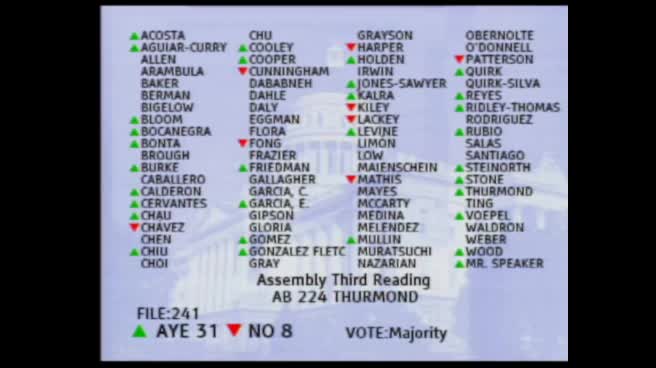 2MIN
Assembly Floor
 1H
Assembly Standing Committee on Appropriations
 5MIN
Assembly Standing Committee on Judiciary
 6MIN
Assembly Standing Committee on Housing and Community Development
Bill Author





