AB 720: Inmates: psychiatric medication: informed consent.
- Session Year: 2017-2018
- House: Assembly
- Latest Version Date: 2017-09-28
Existing law prohibits, except as specified, a person sentenced to imprisonment in a county jail from being administered any psychiatric medication without his or her prior informed consent. Existing law authorizes a county department of mental health, or other designated county department, to administer to an inmate involuntary medication on a nonemergency basis only after the inmate is provided, among other things, a hearing before a superior court judge, a court-appointed commissioner or referee, or a court-appointed hearing officer.
This bill would extend to an inmate confined in a county jail the protection from being administered any psychiatric medication without his or her prior informed consent, with certain exceptions. The bill would impose additional criteria that must be satisfied before a county department of mental health or other designated county department may administer involuntary medication. This criteria include that the jail first make a documented attempt to locate an available bed for the inmate in a community-based treatment facility, under certain conditions, in lieu of seeking involuntary administration of psychiatric medication, and, if the inmate is awaiting resolution of a criminal case, that a hearing to administer involuntary medication on a nonemergency basis be held before, and any requests for ex parte orders be submitted to, a judge in the superior court where the criminal case is pending. The bill would also set limits on the amount of time such orders are valid. The bill would require any court-ordered psychiatric medication to be administered in consultation with a psychiatrist who is not involved in the treatment of the inmate at the jail, if one is available. The bill would also make a clarifying change.
The bill would require a county that administers involuntary psychiatric medication to file a report with prescribed information to certain committees of the Legislature, as specified.
The bill would repeal its provisions on January 1, 2022.
Existing law prohibits, except as specified, a person sentenced to imprisonment in a county jail from being administered any psychiatric medication without his or her prior informed consent. Existing law authorizes a county department of mental health, or other designated county department, to administer to an inmate involuntary medication on a nonemergency basis only after the inmate is provided, among other things, a hearing before a superior court judge, a court-appointed commissioner or referee, or a court-appointed hearing officer.
This bill would extend to an inmate confined in a county jail the protection from being administered any psychiatric medication without his or her prior informed consent, with certain exceptions. The bill would impose additional criteria that must be satisfied before a county department of mental health or other designated county department may administer involuntary medication. This criteria include that the jail first make a documented attempt to locate an available bed for the inmate in a community-based treatment facility, under certain conditions, in lieu of seeking involuntary administration of psychiatric medication, and, if the inmate is awaiting resolution of a criminal case, that a hearing to administer involuntary medication on a nonemergency basis be held before, and any requests for ex parte orders be submitted to, a judge in the superior court where the criminal case is pending. The bill would also set limits on the amount of time such orders are valid. The bill would require any court-ordered psychiatric medication to be administered in consultation with a psychiatrist who is not involved in the treatment of the inmate at the jail, if one is available. The bill would also make a clarifying change.
The bill would require a county that administers involuntary psychiatric medication to file a report with prescribed information to certain committees of the Legislature, as specified.
The bill would repeal its provisions on January 1, 2022.
Existing law prohibits, except as specified, a person sentenced to imprisonment in a county jail from being administered any psychiatric medication without his or her prior informed consent. Existing law authorizes a county department of mental health, or other designated county department, to administer to an inmate involuntary medication on a nonemergency basis only after the inmate is provided, among other things, a hearing before a superior court judge, a court-appointed commissioner or referee, or a court-appointed hearing officer.
This bill would extend to an inmate confined in a county jail the protection from being administered any psychiatric medication without his or her prior informed consent, with certain exceptions. The bill would impose additional criteria that must be satisfied before a county department of mental health or other designated county department may administer involuntary medication. This criteria include that the jail first make a documented attempt to locate an available bed for the inmate in a community-based treatment facility, under certain conditions, in lieu of seeking involuntary administration of psychiatric medication, and, if the inmate is awaiting resolution of a criminal case, that a hearing to administer involuntary medication on a nonemergency basis be held before, and any requests for ex parte orders be submitted to, a judge in the superior court where the criminal case is pending. The bill would also set limits on the amount of time such orders are valid. The bill would require any court-ordered psychiatric medicine to be administered in consultation with a psychiatrist who is not involved in the treatment of the inmate at the jail, if one is available. The bill would also make a clarifying change.
The bill would require a county that administers involuntary psychiatric medication to file a report with prescribed information to certain committees of the Legislature, as specified.
The bill would repeal its provisions on January 1, 2022.
Existing law prohibits, except as specified, a person sentenced to imprisonment in a county jail from being administered any psychiatric medication without his or her prior informed consent. Existing law authorizes a county department of mental health, or other designated county department, to administer to an inmate involuntary medication on a nonemergency basis only after the inmate is provided, among other things, a hearing before a superior court judge, a court-appointed commissioner or referee, or a court-appointed hearing officer.
This bill would extend to an inmate confined in a county jail the protection from being administered any psychiatric medication without his or her prior informed consent, with certain exceptions. The bill would impose additional criteria that must be satisfied before a county department of mental health or other designated county department may administer involuntary medication. This criteria include that the jail first attempted to transfer the inmate to make a documented attempt to locate an available bed for the inmate in a community-based treatment facility, under certain conditions, in lieu of seeking involuntary administration of psychiatric medication, and, if the inmate is awaiting resolution of a criminal case, that a hearing to administer involuntary medication on a nonemergency basis be held before, and any requests for ex parte orders be submitted to, a judge in the superior court where the criminal case is pending. The bill would also set limits on the amount of time such orders are valid. The bill would require any court-ordered psychiatric medicine to be administered in consultation with a psychiatrist who is not involved in the treatment of the inmate at the jail, if one is available. The bill would also make a clarifying change.
The bill would require a county that administers involuntary psychiatric medication to file a report with prescribed information to certain committees of the Legislature, as specified.
The bill would repeal its provisions on January 1, 2022.
Existing law prohibits, except as specified, a person sentenced to imprisonment in a county jail from being administered any psychiatric medication without his or her prior informed consent. Existing law authorizes a county department of mental health, or other designated county department, to administer to an inmate involuntary medication on a nonemergency basis only after the inmate is provided, among other things, a hearing before a superior court judge, a court-appointed commissioner or referee, or a court-appointed hearing officer.
This bill would extend to an inmate confined in a county jail the protection from being administered any psychiatric medication without his or her prior informed consent, with certain exceptions. The bill would impose additional criteria that must be satisfied before a county department of mental health or other designated county department may administer involuntary medication. This criteria include that the jail first attempted to transfer the inmate to a community-based treatment facility, under certain conditions, in lieu of seeking involuntary administration of psychiatric medication, and, if the inmate is awaiting resolution of a criminal case, that a hearing to administer involuntary medication on a nonemergency basis be held before, and any requests for ex parte orders be submitted to, a judge in the superior court where the criminal case is pending. The bill would also set limits on the amount of time such orders are valid. The bill would require any court-ordered psychiatric medicine to be administered in consultation with a psychiatrist who is not involved in the treatment of the inmate at the jail, if one is available. The bill would also make a clarifying change.
The bill would require a county that administers involuntary psychiatric medication to file a report with prescribed information to certain committees of the Legislature, as specified.
The bill would repeal its provisions on January 1, 2022.
Existing law prohibits, except as specified, a person sentenced to imprisonment in a county jail from being administered any psychiatric medication without his or her prior informed consent. Existing law authorizes a county department of mental health, or other designated county department, to administer to an inmate involuntary medication on a nonemergency basis only after the inmate is provided, among other things, a hearing before a superior court judge, a court-appointed commissioner or referee, or a court-appointed hearing officer.
This bill would extend to an inmate confined in a county jail the protection from being administered any psychiatric medication without his or her prior informed consent, with certain exceptions. The bill would require, if the inmate is in custody awaiting trial, impose additional criteria that must be satisfied before a county department of mental health or other designated county department may administer involuntary medication. This criteria include that the jail first attempted to transfer the inmate to a community-based treatment facility, under certain conditions, in lieu of seeking involuntary administration of psychiatric medication, and, if the inmate is awaiting resolution of a criminal case, that a hearing to administer involuntary medication on a nonemergency basis, basis be held before, and any requests for ex parte orders be submitted to, a judge in the superior court where the criminal case is pending. The bill would also set limits on the amount of time such orders are valid. The bill would require any court-ordered psychiatric medicine to be administered in consultation with a psychiatrist who is not involved in the treatment of the inmate at the jail, if one is available. The bill would also make a clarifying change.
The bill would require a county that administers involuntary psychiatric medication to file a report with prescribed information to certain committees of the Legislature, as specified.
The bill would repeal its provisions on January 1, 2022.
Existing law prohibits, except as specified, a person sentenced to imprisonment in a county jail from being administered any psychiatric medication without his or her prior informed consent. Existing law authorizes a county department of mental health, or other designated county department, to administer to an inmate involuntary medication on a nonemergency basis only after the inmate is provided, among other things, a hearing before a superior court judge, a court-appointed commissioner or referee, or a court-appointed hearing officer.
This bill would instead prohibit, except as specified, an inmate, as defined, confined in a county jail, extend to an inmate confined in a county jail the protection from being administered any psychiatric medication without his or her prior informed consent. consent, with certain exceptions. The bill would require, if the inmate is in custody awaiting trial, that a hearing to administer involuntary medication on a nonemergency basis, be held before, and any requests for ex parte orders be submitted to, a judge in the superior court where the criminal case is pending. The bill would also make a clarifying change.
Existing law prohibits, except as specified, a person sentenced to imprisonment in a county jail from being administered any psychiatric medication without his or her prior informed consent.
This bill would instead prohibit, except as specified, a an inmate, as defined, confined in a county jail, from being administered any psychiatric medication without his or her prior informed consent.
Existing law prohibits, except as specified, a person sentenced to imprisonment in a county jail from being administered any psychiatric medication without his or her prior informed consent.
This bill would instead prohibit, except as specified, a inmate, as defined, confined in a county jail, from being administered any psychiatric medication without his or her prior informed consent.
The Legislature finds and declares all of the following:
(a)The large number of persons with mental health disabilities in California jails is a matter of serious concern that merits the attention of policymakers. Expert consensus identifies insufficient community mental health treatment resources, including inpatient psychiatric beds to treat individuals in psychiatric crisis, available housing, and outpatient treatment options, as primary contributing causes.
(b)A State Department of Health Care Services fiscal year 201415 report indicated that jails in the state provided mental health outpatient services to 103,490 persons detained in jail facilities.
(c)Jails are not therapeutic environments and were not intended or designed to be mental health facilities.
(d)It is the policy of the State of California to prevent persons with mental health disabilities from inappropriate involvement with the criminal justice system. As part of an effort to decriminalize the treatment of persons with mental health disabilities, individuals should be treated whenever and wherever possible in community treatment settings and not in jails.
(e)The Sequential Intercept Model is a comprehensive effort to divert such persons with mental health disabilities from criminal justice involvement and reduce the criminalization of persons with a mental illness. The model is endorsed by the Substance Abuse and Mental Health Services Administration, the Justice Center for the Council of State Governments, the National Association of Counties, and the American Psychiatric Association. The model identifies five intercepts:
(1)Provide training for first responders to provide more therapeutic and effective responses in mental health emergencies and information about community treatment programs that may be appropriate for the individual.
(2)Reduce the number of persons with mental health disabilities booked into jail by offering diversion programs with mental health services when appropriate.
(3)Reduce the length of time persons with mental health disabilities remain in jail, and assure that appropriate treatment is available to them while in jail.
(4)Develop reentry programs which work with the inmate prior to release for success in the community and to provide safe handoffs and connections to community-based mental health programs.
(5)Reduce recidivism by providing high quality community corrections programs and linkages to community programs designed for the mental health needs of the released inmate.
(f)This act provides county jails with the authority to administer involuntary psychotropic medications to inmates awaiting arraignment, trial, and sentencing, and seeks to decrease the duration of untreated illness within a jail setting consistent with the third intercept.
(g)It is the intent of the Legislature that jails should also provide discharged inmates with adequate discharge plans upon their release from jail in order to obtain community-based support and services while maintaining needed therapeutic treatment, including, but not limited to, the following:
(1)Providing inmates with mental health disabilities with a discharge plan that is reasonably calculated to give them meaningful access to essential medical and mental health services upon their release.
(2)Ensuring that all people with mental health disabilities can benefit from such a plan.
(3)Ensuring that released prisoners with mental health disabilities are offered placement in the least restrictive postrelease environment that is clinically appropriate.
SEC. 2.Section 2603 of the Penal Code is amended to read:2603.(a)Except as provided in subdivision (b), an inmate confined in a county jail shall not be administered any psychiatric medication without his or her prior informed consent.
(b)If a psychiatrist determines that an inmate should be treated with psychiatric medication, but the inmate does not consent, the inmate may be involuntarily treated with the medication. Treatment may be given on either a nonemergency basis as provided in subdivision (c), or on an emergency or interim basis as provided in subdivision (d).
(c)A county department of mental health, or other designated county department, may administer involuntary medication on a nonemergency basis only if all of the following conditions have been met:
(1)A psychiatrist or psychologist has determined that the inmate has a serious mental disorder.
(2)A psychiatrist or psychologist has determined that, as a result of that mental disorder, the inmate is gravely disabled and does not have the capacity to refuse treatment with psychiatric medications, or is a danger to self or others.
(3)A psychiatrist has prescribed one or more psychiatric medications for the treatment of the inmates disorder, has considered the risks, benefits, and treatment alternatives to involuntary medication, and has determined that the treatment alternatives to involuntary medication are unlikely to meet the needs of the patient.
(4)The inmate has been advised of the risks and benefits of, and treatment alternatives to, the psychiatric medication and refuses, or is unable to consent to, the administration of the medication.
(5)The jail has made a documented attempt to locate an available bed for the inmate in a community-based treatment facility in lieu of seeking to administer involuntary medication. The jail shall transfer that inmate to such a facility only if the facility can provide care for the mental health needs, and the physical health needs, if any, of the inmate and upon the agreement of the facility. In enacting the act that added this paragraph, it is the intent of the Legislature to recognize the lack of community-based beds and the inability of many facilities to accept transfers from correctional facilities.
(6)The inmate is provided a hearing before a superior court judge, a court-appointed commissioner or referee, or a court-appointed hearing officer, as specified in subdivision (c) of Section 5334 of the Welfare and Institutions Code.
(A)If the inmate is in custody awaiting trial, any hearing pursuant to this section shall be held before, and any requests for ex parte orders shall be submitted to, a judge in the superior court where the criminal case is pending.
(B)A superior court judge may consider whether involuntary medication would prejudice the inmates defense.
(7)(A)The inmate is provided counsel at least 21 days prior to the hearing, unless emergency or interim medication is being administered pursuant to subdivision (d), in which case the inmate would receive expedited access to counsel.
(B)In the case of an inmate awaiting arraignment, the inmate is provided counsel within 48 hours of the filing of the notice of the hearing with the superior court, unless counsel has previously been appointed.
(C)The hearing shall be held not more than 30 days after the filing of the notice with the superior court, unless counsel for the inmate agrees to extend the date of the hearing.
(8)(A)The inmate and counsel are provided with written notice of the hearing at least 21 days prior to the hearing, unless emergency or interim medication is being administered pursuant to subdivision (d), in which case the inmate would receive an expedited hearing.
(B)The written notice shall do all of the following:
(i)Set forth the diagnosis, the factual basis for the diagnosis, the basis upon which psychiatric medication is recommended, the expected benefits of the medication, any potential side effects and risks to the inmate from the medication, and any alternatives to treatment with the medication.
(ii)Advise the inmate of the right to be present at the hearing, the right to be represented by counsel at all stages of the proceedings, the right to present evidence, and the right to cross-examine witnesses. Counsel for the inmate shall have access to all medical records and files of the inmate, but shall not have access to the confidential section of the inmates central file which contains materials unrelated to medical treatment.
(iii)Inform the inmate of his or her right to appeal the determination to the superior court or the court of appeal as specified in subdivisions (e) and (f) of Section 5334 of the Welfare and Institutions Code, and his or her right to file a petition for writ of habeas corpus with respect to any decision of the county department of mental health, or other designated county department, to continue treatment with involuntary medication after the superior court judge, court-appointed commissioner or referee, or court-appointed hearing officer has authorized treatment with involuntary medication.
(9)(A)In the hearing described in paragraph (6), the superior court judge, a court-appointed commissioner or referee, or a court-appointed hearing officer determines by clear and convincing evidence that the inmate has a mental illness or disorder, that as a result of that illness the inmate is gravely disabled and lacks the capacity to consent to or refuse treatment with psychiatric medications or is a danger to self or others if not medicated, that there is no less intrusive alternative to involuntary medication, and that the medication is in the inmates best medical interest.
(B)The superior court judge, court-appointed commissioner or referee, or a court-appointed hearing officer shall not make a finding pursuant to subparagraph (A) of this paragraph that there is no less intrusive alternative to involuntary medication and that the medication is in the inmates best medical interest, without information from the jail to indicate that neither of the conditions specified in paragraph (5) is present.
(C)If the court makes the findings in subparagraph (A), that administration shall occur in consultation with a psychiatrist who is not involved in the treatment of the inmate at the jail, if available.
(D)In the event of any statutory notice issues with either initial or renewal filings by the county department of mental health, or other designated county department, the superior court judge, court-appointed commissioner or referee, or court-appointed hearing officer shall hear arguments as to why the case should be heard, and shall consider factors such as the ability of the inmates counsel to adequately prepare the case and to confer with the inmate, the continuity of care, and, if applicable, the need for protection of the inmate or institutional staff that would be compromised by a procedural default.
(10)The historical course of the inmates mental disorder, as determined by available relevant information about the course of the inmates mental disorder, shall be considered when it has direct bearing on the determination of whether the inmate is a danger to self or others, or is gravely disabled and incompetent to refuse medication as the result of a mental disorder.
(11)An inmate is entitled to file one motion for reconsideration following a determination that he or she may receive involuntary medication, and may seek a hearing to present new evidence, upon good cause shown. This paragraph does not prevent a court from reviewing, modifying, or terminating an involuntary medication order for an inmate awaiting trial, if there is a showing that the involuntary medication is interfering with the inmates due process rights in the criminal proceeding.
(d)(1)(A)This section does not prohibit a physician from taking appropriate action in an emergency. An emergency exists when both of the following criteria are met:
(i)There is a sudden and marked change in an inmates mental condition so that action is immediately necessary for the preservation of life or the prevention of serious bodily harm to the inmate or others.
(ii)It is impractical, due to the seriousness of the emergency, to first obtain informed consent.
(B)If psychiatric medication is administered during an emergency, the medication shall only be that which is required to treat the emergency condition and shall be administered for only so long as the emergency continues to exist.
(2)(A)If the clinicians of the county department of mental health, or other designated county department, identify a situation that jeopardizes the inmates health or well-being as the result of a serious mental illness, and necessitates the continuation of medication beyond the initial 72 hours pending the full mental health hearing, the county department may seek to continue the medication by giving notice to the inmate and his or her counsel of its intention to seek an ex parte order to allow the continuance of medication pending the full hearing, and filing an ex parte order within the initial 72-hour period. Treatment of the inmate in a facility pursuant to Section 4011.6 shall not be required in order to continue medication under this subdivision unless the treatment is otherwise medically necessary.
(B)The notice shall be served upon the inmate and counsel at the same time the inmate is given the written notice that the involuntary medication proceedings are being initiated and is appointed counsel as provided in subdivision (c).
(C)The order may be issued ex parte upon a showing that, in the absence of the medication, the emergency conditions are likely to recur. The request for an ex parte order shall be supported by an affidavit from the psychiatrist or psychologist showing specific facts.
(D)The inmate and the inmates appointed counsel shall have two business days to respond to the county departments ex parte request to continue interim medication, and may present facts supported by an affidavit in opposition to the departments request. A superior court judge, a court-appointed commissioner or referee, or a court-appointed hearing officer shall review the ex parte request and shall have three business days to determine the merits of the departments request for an ex parte order.
(E)If an order is issued, the psychiatrist may continue the administration of the medication until the hearing described in paragraph (6) of subdivision (c) is held.
(3)If the county elects to seek an ex parte order pursuant to this subdivision, the county department of mental health, or other designated county department, shall file with the superior court, and serve on the inmate and his or her counsel, the written notice described in paragraph (8) of subdivision (c) within 72 hours of commencing medication pursuant to this subdivision, unless either of the following occurs:
(A)The inmate gives informed consent to continue the medication.
(B)A psychiatrist determines that the psychiatric medication is not necessary and administration of the medication is discontinued.
(4)If medication is being administered pursuant to this subdivision, the hearing described in paragraph (6) of subdivision (c) shall commence within 21 days of the filing and service of the notice, unless counsel for the inmate agrees to a different period of time.
(5)With the exception of the timeline provisions specified in paragraphs (3) and (4) for providing notice and commencement of the hearing in emergency or interim situations, the inmate shall be entitled to and be given the same due process protections as specified in subdivision (c). The county department of mental health, or other designated county department, shall prove the same elements supporting the involuntary administration of psychiatric medication and the superior court judge, court-appointed commissioner or referee, or court-appointed hearing officer shall be required to make the same findings described in subdivision (c).
(e)(1)(A)An order by the court authorizing involuntary medication of an inmate shall be valid for no more than one year after the date of determination.
(B)Notwithstanding subparagraph (A), in the case of an inmate who is awaiting arraignment, trial, or sentencing, the determination that an inmate may receive involuntary medication shall be valid for no more than 180 days. The court shall review the order at intervals of not more than 60 days to determine whether the grounds for the order remain. At each review, the psychiatrist shall file an affidavit with the court that ordered the involuntary medication affirming that the person who is the subject of the order continues to meet the criteria for involuntary medication. A copy of the affidavit shall be provided to the defendant and the defendants attorney. In determining whether the criteria for involuntary medication still exist, the court shall consider the affidavit of the psychiatrist or psychiatrists and any supplemental information provided by the defendants attorney. The court may also require the testimony from the psychiatrist, if necessary. The court, at each review, may continue the order authorizing involuntary medication, vacate the order, or make any other appropriate order.
(2)Notwithstanding subparagraph (A) of paragraph (1), any determination of an inmates incapacity to refuse treatment with antipsychotic medication made pursuant to this section shall remain in effect only until one of the following occurs, whichever occurs first:
(A)The duration of the inmates confinement ends.
(B)A court determines that the inmate no longer meets the criteria of subdivision (c) or (d), or by any other order of the court.
(3)An inmates period of confinement may not be extended in order to provide treatment to the inmate with antipsychotic medication pursuant to this section.
(f)This section does not prohibit the court, upon making a determination that an inmate awaiting arraignment, preliminary hearing, trial, sentencing, or a postconviction proceeding to revoke or modify supervision may receive involuntary medication pursuant to subdivision (c) or (d), and, upon ex parte request of the defendant or counsel, from suspending all proceedings in the criminal prosecution, until the court determines that the defendants medication will not interfere with his or her ability to meaningfully participate in the criminal proceedings.
(g)If a determination has been made to involuntarily medicate an inmate pursuant to subdivision (c) or (d), the medication shall be discontinued one year after the date of that determination, unless the inmate gives his or her informed consent to the administration of the medication, or unless a new determination is made pursuant to the procedures set forth in subdivision (h).
(h)To renew an existing order allowing involuntary medication, the county department of mental health, or other designated county department, shall file with the superior court, and shall serve on the inmate and his or her counsel, a written notice indicating the departments intent to renew the existing involuntary medication order.
(1)The request to renew the order shall be filed and served no later than 21 days prior to the expiration of the current order authorizing involuntary medication.
(2)The inmate shall be entitled to, and shall be given, the same due process protections as specified in subdivision (c).
(3)(A)Except as provided in subparagraph (B), renewal orders shall be valid for one year from the date of the hearing.
(B)In the case of an inmate awaiting arraignment, trial, or sentencing, the renewal order shall be valid for no more than 180 days. The court shall review the order at intervals of not more than 60 days to determine whether the grounds for the order remain. At each review, the psychiatrist shall file an affidavit with the court that ordered the involuntary medication affirming that the person who is the subject of the order continues to meet the criteria for involuntary medication. A copy of the affidavit shall be provided to the defendant and the defendants attorney. In determining whether the criteria for involuntary medication still exist, the court shall consider the affidavit of the psychiatrist or psychiatrists and any supplemental information provided by the defendants attorney. The court may also require the testimony from the psychiatrist, if necessary. The court, at each review, may continue the order authorizing involuntary medication, vacate the order, or make any other appropriate order.
(4)(A)An order renewing an existing order shall be granted based on clear and convincing evidence that the inmate has a serious mental disorder that requires treatment with psychiatric medication, and that, but for the medication, the inmate would revert to the behavior that was the basis for the prior order authorizing involuntary medication, coupled with evidence that the inmate lacks insight regarding his or her need for the medication, such that it is unlikely that the inmate would be able to manage his or her own medication and treatment regimen. No new acts need be alleged or proven.
(B)The superior court judge, court-appointed commissioner or referee, or a court-appointed hearing officer shall also make a finding that treatment of the inmate in a correctional setting continues to be necessary if neither of the criteria in paragraph (5) of subdivision (c) is present.
(5)If the county department of mental health, or other designated county department, wishes to add a basis to an existing order, it shall give the inmate and the inmates counsel notice in advance of the hearing via a renewal notice or supplemental petition. Within the renewal notice or supplemental petition, as described in subdivision (h), the county department of mental health, or other designated county department, shall specify what additional basis is being alleged and what qualifying conduct within the past year supports that additional basis. The county department of mental health, or other designated county department, shall prove the additional basis and conduct by clear and convincing evidence at a hearing as specified in subdivision (c).
(6)The hearing on any petition to renew an order for involuntary medication shall be conducted prior to the expiration of the current order.
(i)In the event of a conflict between the provisions of this section and the Administrative Procedure Act (Chapter 4.5 (commencing with Section 11400) of Part 1 of Division 3 of the Government Code), this section shall control.
(j)As used in this section, inmate means a person confined in the county jail, including, but not limited to, a person sentenced to imprisonment in a county jail, a person housed in a county jail during or awaiting trial proceedings, and a person who has been booked into a county jail and is awaiting arraignment.
(k)This section does not apply to a person housed in a county jail solely on the basis of an immigration hold, except as it applies to medication provided on an emergency or interim basis as provided in subdivision (d).
(l)Each county that administers involuntary medication to an inmate awaiting arraignment, trial, or sentencing, shall file, by January 1, 2021, a written report with the Assembly Committees on Judiciary and Public Safety and the Senate Committee on Public Safety summarizing the following: the number of inmates who received involuntary medication while awaiting arraignment, trial, or sentencing between January 1, 2018, and July 1, 2020; the crime for which those inmates were arrested; the total time those inmates were detained while awaiting arraignment, trial, or sentencing; the duration of the administration of involuntary medication; the reason for termination of administration of involuntary medication; the number of times, if any, that an existing order for the administration of involuntary medication was renewed; and the reason for termination of the administration of involuntary medication.
(m)This section shall remain in effect only until January 1, 2022, and as of that date is repealed, unless a later enacted statute, which is chaptered before that date, deletes or extends the date.
SEC. 3.Section 2603 is added to the Penal Code, to read:2603.(a)Except as provided in subdivision (b), no person sentenced to imprisonment in a county jail shall be administered any psychiatric medication without his or her prior informed consent.
(b)If a psychiatrist determines that an inmate should be treated with psychiatric medication, but the inmate does not consent, the inmate may be involuntarily treated with the medication. Treatment may be given on either a nonemergency basis as provided in subdivision (c), or on an emergency or interim basis as provided in subdivision (d).
(c)A county department of mental health, or other designated county department, may seek to initiate involuntary medication on a nonemergency basis only if all of the following conditions have been met:
(1)A psychiatrist or psychologist has determined that the inmate has a serious mental disorder.
(2)A psychiatrist or psychologist has determined that, as a result of that mental disorder, the inmate is gravely disabled and does not have the capacity to refuse treatment with psychiatric medications, or is a danger to self or others.
(3)A psychiatrist has prescribed one or more psychiatric medications for the treatment of the inmates disorder, has considered the risks, benefits, and treatment alternatives to involuntary medication, and has determined that the treatment alternatives to involuntary medication are unlikely to meet the needs of the patient.
(4)The inmate has been advised of the risks and benefits of, and treatment alternatives to, the psychiatric medication, and refuses, or is unable to consent to, the administration of the medication.
(5)The inmate is provided a hearing before a superior court judge, a court-appointed commissioner or referee, or a court-appointed hearing officer, as specified in subdivision (c) of Section 5334 of the Welfare and Institutions Code.
(6)The inmate is provided counsel at least 21 days prior to the hearing, unless emergency or interim medication is being administered pursuant to subdivision (d), in which case the inmate would receive expedited access to counsel. The hearing shall be held not more than 30 days after the filing of the notice with the superior court, unless counsel for the inmate agrees to extend the date of the hearing.
(7)The inmate and counsel are provided with written notice of the hearing at least 21 days prior to the hearing, unless emergency or interim medication is being administered pursuant to subdivision (d), in which case the inmate would receive an expedited hearing. The written notice shall do all of the following:
(A)Set forth the diagnosis, the factual basis for the diagnosis, the basis upon which psychiatric medication is recommended, the expected benefits of the medication, any potential side effects and risks to the inmate from the medication, and any alternatives to treatment with the medication.
(B)Advise the inmate of the right to be present at the hearing, the right to be represented by counsel at all stages of the proceedings, the right to present evidence, and the right to cross-examine witnesses. Counsel for the inmate shall have access to all medical records and files of the inmate, but shall not have access to the confidential section of the inmates central file which contains materials unrelated to medical treatment.
(C)Inform the inmate of his or her right to appeal the determination to the superior court or the court of appeal as specified in subdivisions (e) and (f) of Section 5334 of the Welfare and Institutions Code, and of his or her right to file a petition for writ of habeas corpus with respect to any decision of the county department of mental health, or other designated county department, to continue treatment with involuntary medication after the superior court judge, court-appointed commissioner or referee, or court-appointed hearing officer has authorized treatment with involuntary medication.
(8)A superior court judge, a court-appointed commissioner or referee, or a court-appointed hearing officer determines by clear and convincing evidence that the inmate has a mental illness or disorder, that as a result of that illness the inmate is gravely disabled and lacks the capacity to consent to or refuse treatment with psychiatric medications or is a danger to self or others if not medicated, that there is no less intrusive alternative to involuntary medication, and that the medication is in the inmates best medical interest. In the event of any statutory notice issues with either initial or renewal filings by the county department of mental health, or other designated county department, the superior court judge, court-appointed commissioner or referee, or court-appointed hearing officer shall hear arguments as to why the case should be heard, and shall consider factors such as the ability of the inmates counsel to adequately prepare the case and to confer with the inmate, the continuity of care, and, if applicable, the need for protection of the inmate or institutional staff that would be compromised by a procedural default.
(9)The historical course of the inmates mental disorder, as determined by available relevant information about the course of the inmates mental disorder, shall be considered when it has direct bearing on the determination of whether the inmate is a danger to self or others, or is gravely disabled and incompetent to refuse medication as the result of a mental disorder.
(10)An inmate is entitled to file one motion for reconsideration following a determination that he or she may receive involuntary medication, and may seek a hearing to present new evidence, upon good cause shown.
(d)Nothing in this section is intended to prohibit a physician from taking appropriate action in an emergency. An emergency exists when there is a sudden and marked change in an inmates mental condition so that action is immediately necessary for the preservation of life or the prevention of serious bodily harm to the inmate or others, and it is impractical, due to the seriousness of the emergency, to first obtain informed consent. If psychiatric medication is administered during an emergency, the medication shall only be that which is required to treat the emergency condition and shall be administered for only so long as the emergency continues to exist. If the clinicians of the county department of mental health, or other designated county department, identify a situation that jeopardizes the inmates health or well-being as the result of a serious mental illness, and necessitates the continuation of medication beyond the initial 72 hours pending the full mental health hearing, the county department may seek to continue the medication by giving notice to the inmate and his or her counsel of its intention to seek an ex parte order to allow the continuance of medication pending the full hearing. Treatment of the inmate in a facility pursuant to Section 4011.6 shall not be required in order to continue medication under this subdivision unless the treatment is otherwise medically necessary. The notice shall be served upon the inmate and counsel at the same time the inmate is given the written notice that the involuntary medication proceedings are being initiated and is appointed counsel as provided in subdivision (c). The order may be issued ex parte upon a showing that, in the absence of the medication, the emergency conditions are likely to recur. The request for an ex parte order shall be supported by an affidavit from the psychiatrist or psychologist showing specific facts. The inmate and the inmates appointed counsel shall have two business days to respond to the county departments ex parte request to continue interim medication, and may present facts supported by an affidavit in opposition to the departments request. A superior court judge, a court-appointed commissioner or referee, or a court-appointed hearing officer shall review the ex parte request and shall have three business days to determine the merits of the departments request for an ex parte order. If an order is issued, the psychiatrist may continue the administration of the medication until the hearing described in paragraph (5) of subdivision (c) is held.
(1)If the county elects to seek an ex parte order pursuant to this subdivision, the county department of mental health, or other designated county department, shall file with the superior court, and serve on the inmate and his or her counsel, the written notice described in paragraph (7) of subdivision (c) within 72 hours of commencing medication pursuant to this subdivision, unless either of the following occurs:
(A)The inmate gives informed consent to continue the medication.
(B)A psychiatrist determines that the psychiatric medication is not necessary and administration of the medication is discontinued.
(2)If medication is being administered pursuant to this subdivision, the hearing described in paragraph (5) of subdivision (c) shall commence within 21 days of the filing and service of the notice, unless counsel for the inmate agrees to a different period of time.
(3)With the exception of the timeline provisions specified in paragraphs (1) and (2) for providing notice and commencement of the hearing in emergency or interim situations, the inmate shall be entitled to and be given the same due process protections as specified in subdivision (c). The county department of mental health, or other designated county department, shall prove the same elements supporting the involuntary administration of psychiatric medication, and the superior court judge, court-appointed commissioner or referee, or court-appointed hearing officer shall be required to make the same findings described in subdivision (c).
(e)The determination that an inmate may receive involuntary medication shall be valid for one year from the date of the determination, regardless of whether the inmate subsequently gives his or her informed consent.
(f)If a determination has been made to involuntarily medicate an inmate pursuant to subdivision (c) or (d), the medication shall be discontinued one year after the date of that determination, unless the inmate gives his or her informed consent to the administration of the medication, or unless a new determination is made pursuant to the procedures set forth in subdivision (g).
(g)To renew an existing order allowing involuntary medication, the county department of mental health, or other designated county department, shall file with the superior court, and shall serve on the inmate and his or her counsel, a written notice indicating the departments intent to renew the existing involuntary medication order.
(1)The request to renew the order shall be filed and served no later than 21 days prior to the expiration of the current order authorizing involuntary medication.
(2)The inmate shall be entitled to, and shall be given, the same due process protections as specified in subdivision (c).
(3)Renewal orders shall be valid for one year from the date of the hearing.
(4)An order renewing an existing order shall be granted based on clear and convincing evidence that the inmate has a serious mental disorder that requires treatment with psychiatric medication, and that, but for the medication, the inmate would revert to the behavior that was the basis for the prior order authorizing involuntary medication, coupled with evidence that the inmate lacks insight regarding his or her need for the medication, such that it is unlikely that the inmate would be able to manage his or her own medication and treatment regimen. No new acts need be alleged or proven.
(5)If the county department of mental health, or other designated county department, wishes to add a basis to an existing order, it shall give the inmate and the inmates counsel notice in advance of the hearing via a renewal notice or supplemental petition. Within the renewal notice or supplemental petition, as described in subdivision (g), the county department of mental health, or other designated county department, shall specify what additional basis is being alleged and what qualifying conduct within the past year supports that additional basis. The county department of mental health, or other designated county department, shall prove the additional basis and conduct by clear and convincing evidence at a hearing as specified in subdivision (c).
(6)The hearing on any petition to renew an order for involuntary medication shall be conducted prior to the expiration of the current order.
(h)In the event of a conflict between the provisions of this section and the Administrative Procedure Act (Chapter 4.5 (commencing with Section 11400) of Part 1 of Division 3 of Title 2 of the Government Code), this section shall control.
(i)This section shall become effective on January 1, 2022.
The Legislature finds and declares all of the following:
(a)The large number of persons with mental health disabilities in California jails is a matter of serious concern that merits the attention of policymakers. Expert consensus identifies insufficient community mental health treatment resources, including inpatient psychiatric beds to treat individuals in psychiatric crisis, available housing, and outpatient treatment options, as primary contributing causes.
(b)A State Department of Health Care Services fiscal year 201415 report indicated that jails in the state provided mental health outpatient services to 103,490 persons detained in jail facilities.
(c)Jails are not therapeutic environments and were not intended or designed to be mental health facilities.
(d)It is the policy of the State of California to prevent persons with mental health disabilities from inappropriate involvement with the criminal justice system. As part of an effort to decriminalize the treatment of persons with mental health disabilities, individuals should be treated whenever and wherever possible in community treatment settings and not in jails.
(e)The Sequential Intercept Model is a comprehensive effort to divert such persons with mental health disabilities from criminal justice involvement and reduce the criminalization of persons with a mental illness. The model is endorsed by the Substance Abuse and Mental Health Services Administration, the Justice Center for the Council of State Governments, the National Association of Counties, and the American Psychiatric Association. The model identifies five intercepts:
(1)Provide training for first responders to provide more therapeutic and effective responses in mental health emergencies and information about community treatment programs that may be appropriate for the individual.
(2)Reduce the number of persons with mental health disabilities booked into jail by offering diversion programs with mental health services when appropriate.
(3)Reduce the length of time persons with mental health disabilities remain in jail, and assure that appropriate treatment is available to them while in jail.
(4)Develop reentry programs which work with the inmate prior to release for success in the community and to provide safe handoffs and connections to community-based mental health programs.
(5)Reduce recidivism by providing high quality community corrections programs and linkages to community programs designed for the mental health needs of the released inmate.
(f)This act provides county jails with the authority to administer involuntary psychotropic medications to inmates awaiting arraignment, trial, and sentencing, and seeks to decrease the duration of untreated illness within a jail setting consistent with the third intercept.
(g)It is the intent of the Legislature that jails should also provide discharged inmates with adequate discharge plans upon their release from jail in order to obtain community-based support and services while maintaining needed therapeutic treatment, including, but not limited to, the following:
(1)Providing inmates with mental health disabilities with a discharge plan that is reasonably calculated to give them meaningful access to essential medical and mental health services upon their release.
(2)Ensuring that all people with mental health disabilities can benefit from such a plan.
(3)Ensuring that released prisoners with mental health disabilities are offered placement in the least restrictive postrelease environment that is clinically appropriate.
SEC. 2.Section 2603 of the Penal Code is amended to read:2603.(a)Except as provided in subdivision (b), an inmate confined in a county jail shall not be administered any psychiatric medication without his or her prior informed consent.
(b)If a psychiatrist determines that an inmate should be treated with psychiatric medication, but the inmate does not consent, the inmate may be involuntarily treated with the medication. Treatment may be given on either a nonemergency basis as provided in subdivision (c), or on an emergency or interim basis as provided in subdivision (d).
(c)A county department of mental health, or other designated county department, may administer involuntary medication on a nonemergency basis only if all of the following conditions have been met:
(1)A psychiatrist or psychologist has determined that the inmate has a serious mental disorder.
(2)A psychiatrist or psychologist has determined that, as a result of that mental disorder, the inmate is gravely disabled and does not have the capacity to refuse treatment with psychiatric medications, or is a danger to self or others.
(3)A psychiatrist has prescribed one or more psychiatric medications for the treatment of the inmates disorder, has considered the risks, benefits, and treatment alternatives to involuntary medication, and has determined that the treatment alternatives to involuntary medication are unlikely to meet the needs of the patient.
(4)The inmate has been advised of the risks and benefits of, and treatment alternatives to, the psychiatric medication and refuses, or is unable to consent to, the administration of the medication.
(5)The jail has made a documented attempt to locate an available bed for the inmate in a community-based treatment facility in lieu of seeking to administer involuntary medication. The jail shall transfer that inmate to such a facility only if the facility can provide care for the mental health needs, and the physical health needs, if any, of the inmate and upon the agreement of the facility. In enacting the act that added this paragraph, it is the intent of the Legislature to recognize the lack of community-based beds and the inability of many facilities to accept transfers from correctional facilities.
(6)The inmate is provided a hearing before a superior court judge, a court-appointed commissioner or referee, or a court-appointed hearing officer, as specified in subdivision (c) of Section 5334 of the Welfare and Institutions Code.
(A)If the inmate is in custody awaiting trial, any hearing pursuant to this section shall be held before, and any requests for ex parte orders shall be submitted to, a judge in the superior court where the criminal case is pending.
(B)A superior court judge may consider whether involuntary medication would prejudice the inmates defense.
(7)(A)The inmate is provided counsel at least 21 days prior to the hearing, unless emergency or interim medication is being administered pursuant to subdivision (d), in which case the inmate would receive expedited access to counsel.
(B)In the case of an inmate awaiting arraignment, the inmate is provided counsel within 48 hours of the filing of the notice of the hearing with the superior court, unless counsel has previously been appointed.
(C)The hearing shall be held not more than 30 days after the filing of the notice with the superior court, unless counsel for the inmate agrees to extend the date of the hearing.
(8)(A)The inmate and counsel are provided with written notice of the hearing at least 21 days prior to the hearing, unless emergency or interim medication is being administered pursuant to subdivision (d), in which case the inmate would receive an expedited hearing.
(B)The written notice shall do all of the following:
(i)Set forth the diagnosis, the factual basis for the diagnosis, the basis upon which psychiatric medication is recommended, the expected benefits of the medication, any potential side effects and risks to the inmate from the medication, and any alternatives to treatment with the medication.
(ii)Advise the inmate of the right to be present at the hearing, the right to be represented by counsel at all stages of the proceedings, the right to present evidence, and the right to cross-examine witnesses. Counsel for the inmate shall have access to all medical records and files of the inmate, but shall not have access to the confidential section of the inmates central file which contains materials unrelated to medical treatment.
(iii)Inform the inmate of his or her right to appeal the determination to the superior court or the court of appeal as specified in subdivisions (e) and (f) of Section 5334 of the Welfare and Institutions Code, and his or her right to file a petition for writ of habeas corpus with respect to any decision of the county department of mental health, or other designated county department, to continue treatment with involuntary medication after the superior court judge, court-appointed commissioner or referee, or court-appointed hearing officer has authorized treatment with involuntary medication.
(9)(A)In the hearing described in paragraph (6), the superior court judge, a court-appointed commissioner or referee, or a court-appointed hearing officer determines by clear and convincing evidence that the inmate has a mental illness or disorder, that as a result of that illness the inmate is gravely disabled and lacks the capacity to consent to or refuse treatment with psychiatric medications or is a danger to self or others if not medicated, that there is no less intrusive alternative to involuntary medication, and that the medication is in the inmates best medical interest.
(B)The superior court judge, court-appointed commissioner or referee, or a court-appointed hearing officer shall not make a finding pursuant to subparagraph (A) of this paragraph that there is no less intrusive alternative to involuntary medication and that the medication is in the inmates best medical interest, without information from the jail to indicate that neither of the conditions specified in paragraph (5) is present.
(C)If the court makes the findings in subparagraph (A), that administration shall occur in consultation with a psychiatrist who is not involved in the treatment of the inmate at the jail, if available.
(D)In the event of any statutory notice issues with either initial or renewal filings by the county department of mental health, or other designated county department, the superior court judge, court-appointed commissioner or referee, or court-appointed hearing officer shall hear arguments as to why the case should be heard, and shall consider factors such as the ability of the inmates counsel to adequately prepare the case and to confer with the inmate, the continuity of care, and, if applicable, the need for protection of the inmate or institutional staff that would be compromised by a procedural default.
(10)The historical course of the inmates mental disorder, as determined by available relevant information about the course of the inmates mental disorder, shall be considered when it has direct bearing on the determination of whether the inmate is a danger to self or others, or is gravely disabled and incompetent to refuse medication as the result of a mental disorder.
(11)An inmate is entitled to file one motion for reconsideration following a determination that he or she may receive involuntary medication, and may seek a hearing to present new evidence, upon good cause shown. This paragraph does not prevent a court from reviewing, modifying, or terminating an involuntary medication order for an inmate awaiting trial, if there is a showing that the involuntary medication is interfering with the inmates due process rights in the criminal proceeding.
(d)(1)(A)This section does not prohibit a physician from taking appropriate action in an emergency. An emergency exists when both of the following criteria are met:
(i)There is a sudden and marked change in an inmates mental condition so that action is immediately necessary for the preservation of life or the prevention of serious bodily harm to the inmate or others.
(ii)It is impractical, due to the seriousness of the emergency, to first obtain informed consent.
(B)If psychiatric medication is administered during an emergency, the medication shall only be that which is required to treat the emergency condition and shall be administered for only so long as the emergency continues to exist.
(2)(A)If the clinicians of the county department of mental health, or other designated county department, identify a situation that jeopardizes the inmates health or well-being as the result of a serious mental illness, and necessitates the continuation of medication beyond the initial 72 hours pending the full mental health hearing, the county department may seek to continue the medication by giving notice to the inmate and his or her counsel of its intention to seek an ex parte order to allow the continuance of medication pending the full hearing, and filing an ex parte order within the initial 72-hour period. Treatment of the inmate in a facility pursuant to Section 4011.6 shall not be required in order to continue medication under this subdivision unless the treatment is otherwise medically necessary.
(B)The notice shall be served upon the inmate and counsel at the same time the inmate is given the written notice that the involuntary medication proceedings are being initiated and is appointed counsel as provided in subdivision (c).
(C)The order may be issued ex parte upon a showing that, in the absence of the medication, the emergency conditions are likely to recur. The request for an ex parte order shall be supported by an affidavit from the psychiatrist or psychologist showing specific facts.
(D)The inmate and the inmates appointed counsel shall have two business days to respond to the county departments ex parte request to continue interim medication, and may present facts supported by an affidavit in opposition to the departments request. A superior court judge, a court-appointed commissioner or referee, or a court-appointed hearing officer shall review the ex parte request and shall have three business days to determine the merits of the departments request for an ex parte order.
(E)If an order is issued, the psychiatrist may continue the administration of the medication until the hearing described in paragraph (6) of subdivision (c) is held.
(3)If the county elects to seek an ex parte order pursuant to this subdivision, the county department of mental health, or other designated county department, shall file with the superior court, and serve on the inmate and his or her counsel, the written notice described in paragraph (8) of subdivision (c) within 72 hours of commencing medication pursuant to this subdivision, unless either of the following occurs:
(A)The inmate gives informed consent to continue the medication.
(B)A psychiatrist determines that the psychiatric medication is not necessary and administration of the medication is discontinued.
(4)If medication is being administered pursuant to this subdivision, the hearing described in paragraph (6) of subdivision (c) shall commence within 21 days of the filing and service of the notice, unless counsel for the inmate agrees to a different period of time.
(5)With the exception of the timeline provisions specified in paragraphs (3) and (4) for providing notice and commencement of the hearing in emergency or interim situations, the inmate shall be entitled to and be given the same due process protections as specified in subdivision (c). The county department of mental health, or other designated county department, shall prove the same elements supporting the involuntary administration of psychiatric medication and the superior court judge, court-appointed commissioner or referee, or court-appointed hearing officer shall be required to make the same findings described in subdivision (c).
(e)(1)(A)An order by the court authorizing involuntary medication of an inmate shall be valid for no more than one year after the date of determination.
(B)Notwithstanding subparagraph (A), in the case of an inmate who is awaiting arraignment, trial, or sentencing, the determination that an inmate may receive involuntary medication shall be valid for no more than 180 days. The court shall review the order at intervals of not more than 60 days to determine whether the grounds for the order remain. At each review, the psychiatrist shall file an affidavit with the court that ordered the involuntary medication affirming that the person who is the subject of the order continues to meet the criteria for involuntary medication. A copy of the affidavit shall be provided to the defendant and the defendants attorney. In determining whether the criteria for involuntary medication still exist, the court shall consider the affidavit of the psychiatrist or psychiatrists and any supplemental information provided by the defendants attorney. The court may also require the testimony from the psychiatrist, if necessary. The court, at each review, may continue the order authorizing involuntary medication, vacate the order, or make any other appropriate order.
(2)Notwithstanding subparagraph (A) of paragraph (1), any determination of an inmates incapacity to refuse treatment with antipsychotic medication made pursuant to this section shall remain in effect only until one of the following occurs, whichever occurs first:
(A)The duration of the inmates confinement ends.
(B)A court determines that the inmate no longer meets the criteria of subdivision (c) or (d), or by any other order of the court.
(3)An inmates period of confinement may not be extended in order to provide treatment to the inmate with antipsychotic medication pursuant to this section.
(f)This section does not prohibit the court, upon making a determination that an inmate awaiting arraignment, preliminary hearing, trial, sentencing, or a postconviction proceeding to revoke or modify supervision may receive involuntary medication pursuant to subdivision (c) or (d), and, upon ex parte request of the defendant or counsel, from suspending all proceedings in the criminal prosecution, until the court determines that the defendants medication will not interfere with his or her ability to meaningfully participate in the criminal proceedings.
(g)If a determination has been made to involuntarily medicate an inmate pursuant to subdivision (c) or (d), the medication shall be discontinued one year after the date of that determination, unless the inmate gives his or her informed consent to the administration of the medication, or unless a new determination is made pursuant to the procedures set forth in subdivision (h).
(h)To renew an existing order allowing involuntary medication, the county department of mental health, or other designated county department, shall file with the superior court, and shall serve on the inmate and his or her counsel, a written notice indicating the departments intent to renew the existing involuntary medication order.
(1)The request to renew the order shall be filed and served no later than 21 days prior to the expiration of the current order authorizing involuntary medication.
(2)The inmate shall be entitled to, and shall be given, the same due process protections as specified in subdivision (c).
(3)(A)Except as provided in subparagraph (B), renewal orders shall be valid for one year from the date of the hearing.
(B)In the case of an inmate awaiting arraignment, trial, or sentencing, the renewal order shall be valid for no more than 180 days. The court shall review the order at intervals of not more than 60 days to determine whether the grounds for the order remain. At each review, the psychiatrist shall file an affidavit with the court that ordered the involuntary medication affirming that the person who is the subject of the order continues to meet the criteria for involuntary medication. A copy of the affidavit shall be provided to the defendant and the defendants attorney. In determining whether the criteria for involuntary medication still exist, the court shall consider the affidavit of the psychiatrist or psychiatrists and any supplemental information provided by the defendants attorney. The court may also require the testimony from the psychiatrist, if necessary. The court, at each review, may continue the order authorizing involuntary medication, vacate the order, or make any other appropriate order.
(4)(A)An order renewing an existing order shall be granted based on clear and convincing evidence that the inmate has a serious mental disorder that requires treatment with psychiatric medication, and that, but for the medication, the inmate would revert to the behavior that was the basis for the prior order authorizing involuntary medication, coupled with evidence that the inmate lacks insight regarding his or her need for the medication, such that it is unlikely that the inmate would be able to manage his or her own medication and treatment regimen. No new acts need be alleged or proven.
(B)The superior court judge, court-appointed commissioner or referee, or a court-appointed hearing officer shall also make a finding that treatment of the inmate in a correctional setting continues to be necessary if neither of the criteria in paragraph (5) of subdivision (c) is present.
(5)If the county department of mental health, or other designated county department, wishes to add a basis to an existing order, it shall give the inmate and the inmates counsel notice in advance of the hearing via a renewal notice or supplemental petition. Within the renewal notice or supplemental petition, as described in subdivision (h), the county department of mental health, or other designated county department, shall specify what additional basis is being alleged and what qualifying conduct within the past year supports that additional basis. The county department of mental health, or other designated county department, shall prove the additional basis and conduct by clear and convincing evidence at a hearing as specified in subdivision (c).
(6)The hearing on any petition to renew an order for involuntary medication shall be conducted prior to the expiration of the current order.
(i)In the event of a conflict between the provisions of this section and the Administrative Procedure Act (Chapter 4.5 (commencing with Section 11400) of Part 1 of Division 3 of the Government Code), this section shall control.
(j)As used in this section, inmate means a person confined in the county jail, including, but not limited to, a person sentenced to imprisonment in a county jail, a person housed in a county jail during or awaiting trial proceedings, and a person who has been booked into a county jail and is awaiting arraignment.
(k)This section does not apply to a person housed in a county jail solely on the basis of an immigration hold, except as it applies to medication provided on an emergency or interim basis as provided in subdivision (d).
(l)Each county that administers involuntary medication to an inmate awaiting arraignment, trial, or sentencing, shall file, by January 1, 2021, a written report with the Assembly Committees on Judiciary and Public Safety and the Senate Committee on Public Safety summarizing the following: the number of inmates who received involuntary medication while awaiting arraignment, trial, or sentencing between January 1, 2018, and July 1, 2020; the crime for which those inmates were arrested; the total time those inmates were detained while awaiting arraignment, trial, or sentencing; the duration of the administration of involuntary medication; the reason for termination of administration of involuntary medication; the number of times, if any, that an existing order for the administration of involuntary medication was renewed; and the reason for termination of the administration of involuntary medication.
(m)This section shall remain in effect only until January 1, 2022, and as of that date is repealed, unless a later enacted statute, which is chaptered before that date, deletes or extends the date.
SEC. 3.Section 2603 is added to the Penal Code, to read:2603.(a)Except as provided in subdivision (b), no person sentenced to imprisonment in a county jail shall be administered any psychiatric medication without his or her prior informed consent.
(b)If a psychiatrist determines that an inmate should be treated with psychiatric medication, but the inmate does not consent, the inmate may be involuntarily treated with the medication. Treatment may be given on either a nonemergency basis as provided in subdivision (c), or on an emergency or interim basis as provided in subdivision (d).
(c)A county department of mental health, or other designated county department, may seek to initiate involuntary medication on a nonemergency basis only if all of the following conditions have been met:
(1)A psychiatrist or psychologist has determined that the inmate has a serious mental disorder.
(2)A psychiatrist or psychologist has determined that, as a result of that mental disorder, the inmate is gravely disabled and does not have the capacity to refuse treatment with psychiatric medications, or is a danger to self or others.
(3)A psychiatrist has prescribed one or more psychiatric medications for the treatment of the inmates disorder, has considered the risks, benefits, and treatment alternatives to involuntary medication, and has determined that the treatment alternatives to involuntary medication are unlikely to meet the needs of the patient.
(4)The inmate has been advised of the risks and benefits of, and treatment alternatives to, the psychiatric medication, and refuses, or is unable to consent to, the administration of the medication.
(5)The inmate is provided a hearing before a superior court judge, a court-appointed commissioner or referee, or a court-appointed hearing officer, as specified in subdivision (c) of Section 5334 of the Welfare and Institutions Code.
(6)The inmate is provided counsel at least 21 days prior to the hearing, unless emergency or interim medication is being administered pursuant to subdivision (d), in which case the inmate would receive expedited access to counsel. The hearing shall be held not more than 30 days after the filing of the notice with the superior court, unless counsel for the inmate agrees to extend the date of the hearing.
(7)The inmate and counsel are provided with written notice of the hearing at least 21 days prior to the hearing, unless emergency or interim medication is being administered pursuant to subdivision (d), in which case the inmate would receive an expedited hearing. The written notice shall do all of the following:
(A)Set forth the diagnosis, the factual basis for the diagnosis, the basis upon which psychiatric medication is recommended, the expected benefits of the medication, any potential side effects and risks to the inmate from the medication, and any alternatives to treatment with the medication.
(B)Advise the inmate of the right to be present at the hearing, the right to be represented by counsel at all stages of the proceedings, the right to present evidence, and the right to cross-examine witnesses. Counsel for the inmate shall have access to all medical records and files of the inmate, but shall not have access to the confidential section of the inmates central file which contains materials unrelated to medical treatment.
(C)Inform the inmate of his or her right to appeal the determination to the superior court or the court of appeal as specified in subdivisions (e) and (f) of Section 5334 of the Welfare and Institutions Code, and of his or her right to file a petition for writ of habeas corpus with respect to any decision of the county department of mental health, or other designated county department, to continue treatment with involuntary medication after the superior court judge, court-appointed commissioner or referee, or court-appointed hearing officer has authorized treatment with involuntary medication.
(8)A superior court judge, a court-appointed commissioner or referee, or a court-appointed hearing officer determines by clear and convincing evidence that the inmate has a mental illness or disorder, that as a result of that illness the inmate is gravely disabled and lacks the capacity to consent to or refuse treatment with psychiatric medications or is a danger to self or others if not medicated, that there is no less intrusive alternative to involuntary medication, and that the medication is in the inmates best medical interest. In the event of any statutory notice issues with either initial or renewal filings by the county department of mental health, or other designated county department, the superior court judge, court-appointed commissioner or referee, or court-appointed hearing officer shall hear arguments as to why the case should be heard, and shall consider factors such as the ability of the inmates counsel to adequately prepare the case and to confer with the inmate, the continuity of care, and, if applicable, the need for protection of the inmate or institutional staff that would be compromised by a procedural default.
(9)The historical course of the inmates mental disorder, as determined by available relevant information about the course of the inmates mental disorder, shall be considered when it has direct bearing on the determination of whether the inmate is a danger to self or others, or is gravely disabled and incompetent to refuse medication as the result of a mental disorder.
(10)An inmate is entitled to file one motion for reconsideration following a determination that he or she may receive involuntary medication, and may seek a hearing to present new evidence, upon good cause shown.
(d)Nothing in this section is intended to prohibit a physician from taking appropriate action in an emergency. An emergency exists when there is a sudden and marked change in an inmates mental condition so that action is immediately necessary for the preservation of life or the prevention of serious bodily harm to the inmate or others, and it is impractical, due to the seriousness of the emergency, to first obtain informed consent. If psychiatric medication is administered during an emergency, the medication shall only be that which is required to treat the emergency condition and shall be administered for only so long as the emergency continues to exist. If the clinicians of the county department of mental health, or other designated county department, identify a situation that jeopardizes the inmates health or well-being as the result of a serious mental illness, and necessitates the continuation of medication beyond the initial 72 hours pending the full mental health hearing, the county department may seek to continue the medication by giving notice to the inmate and his or her counsel of its intention to seek an ex parte order to allow the continuance of medication pending the full hearing. Treatment of the inmate in a facility pursuant to Section 4011.6 shall not be required in order to continue medication under this subdivision unless the treatment is otherwise medically necessary. The notice shall be served upon the inmate and counsel at the same time the inmate is given the written notice that the involuntary medication proceedings are being initiated and is appointed counsel as provided in subdivision (c). The order may be issued ex parte upon a showing that, in the absence of the medication, the emergency conditions are likely to recur. The request for an ex parte order shall be supported by an affidavit from the psychiatrist or psychologist showing specific facts. The inmate and the inmates appointed counsel shall have two business days to respond to the county departments ex parte request to continue interim medication, and may present facts supported by an affidavit in opposition to the departments request. A superior court judge, a court-appointed commissioner or referee, or a court-appointed hearing officer shall review the ex parte request and shall have three business days to determine the merits of the departments request for an ex parte order. If an order is issued, the psychiatrist may continue the administration of the medication until the hearing described in paragraph (5) of subdivision (c) is held.
(1)If the county elects to seek an ex parte order pursuant to this subdivision, the county department of mental health, or other designated county department, shall file with the superior court, and serve on the inmate and his or her counsel, the written notice described in paragraph (7) of subdivision (c) within 72 hours of commencing medication pursuant to this subdivision, unless either of the following occurs:
(A)The inmate gives informed consent to continue the medication.
(B)A psychiatrist determines that the psychiatric medication is not necessary and administration of the medication is discontinued.
(2)If medication is being administered pursuant to this subdivision, the hearing described in paragraph (5) of subdivision (c) shall commence within 21 days of the filing and service of the notice, unless counsel for the inmate agrees to a different period of time.
(3)With the exception of the timeline provisions specified in paragraphs (1) and (2) for providing notice and commencement of the hearing in emergency or interim situations, the inmate shall be entitled to and be given the same due process protections as specified in subdivision (c). The county department of mental health, or other designated county department, shall prove the same elements supporting the involuntary administration of psychiatric medication, and the superior court judge, court-appointed commissioner or referee, or court-appointed hearing officer shall be required to make the same findings described in subdivision (c).
(e)The determination that an inmate may receive involuntary medication shall be valid for one year from the date of the determination, regardless of whether the inmate subsequently gives his or her informed consent.
(f)If a determination has been made to involuntarily medicate an inmate pursuant to subdivision (c) or (d), the medication shall be discontinued one year after the date of that determination, unless the inmate gives his or her informed consent to the administration of the medication, or unless a new determination is made pursuant to the procedures set forth in subdivision (g).
(g)To renew an existing order allowing involuntary medication, the county department of mental health, or other designated county department, shall file with the superior court, and shall serve on the inmate and his or her counsel, a written notice indicating the departments intent to renew the existing involuntary medication order.
(1)The request to renew the order shall be filed and served no later than 21 days prior to the expiration of the current order authorizing involuntary medication.
(2)The inmate shall be entitled to, and shall be given, the same due process protections as specified in subdivision (c).
(3)Renewal orders shall be valid for one year from the date of the hearing.
(4)An order renewing an existing order shall be granted based on clear and convincing evidence that the inmate has a serious mental disorder that requires treatment with psychiatric medication, and that, but for the medication, the inmate would revert to the behavior that was the basis for the prior order authorizing involuntary medication, coupled with evidence that the inmate lacks insight regarding his or her need for the medication, such that it is unlikely that the inmate would be able to manage his or her own medication and treatment regimen. No new acts need be alleged or proven.
(5)If the county department of mental health, or other designated county department, wishes to add a basis to an existing order, it shall give the inmate and the inmates counsel notice in advance of the hearing via a renewal notice or supplemental petition. Within the renewal notice or supplemental petition, as described in subdivision (g), the county department of mental health, or other designated county department, shall specify what additional basis is being alleged and what qualifying conduct within the past year supports that additional basis. The county department of mental health, or other designated county department, shall prove the additional basis and conduct by clear and convincing evidence at a hearing as specified in subdivision (c).
(6)The hearing on any petition to renew an order for involuntary medication shall be conducted prior to the expiration of the current order.
(h)In the event of a conflict between the provisions of this section and the Administrative Procedure Act (Chapter 4.5 (commencing with Section 11400) of Part 1 of Division 3 of Title 2 of the Government Code), this section shall control.
(i)This section shall become effective on January 1, 2022.
The Legislature finds and declares all of the following:
(a)The large number of persons with mental health disabilities in California jails is a matter of serious concern that merits the attention of policymakers. Expert consensus identifies insufficient community mental health treatment resources, including inpatient psychiatric beds to treat individuals in psychiatric crisis, available housing, and outpatient treatment options, as primary contributing causes.
(b)A State Department of Health Care Services fiscal year 201415 report indicated that jails in the state provided mental health outpatient services to 103,490 persons detained in jail facilities.
(c)Jails are not therapeutic environments and were not intended or designed to be mental health facilities.
(d)It is the policy of the State of California to prevent persons with mental health disabilities from inappropriate involvement with the criminal justice system. As part of an effort to decriminalize the treatment of persons with mental health disabilities, individuals should be treated whenever and wherever possible in community treatment settings and not in jails.
(e)The Sequential Intercept Model is a comprehensive effort to divert such persons with mental health disabilities from criminal justice involvement and reduce the criminalization of persons with a mental illness. The model is endorsed by the Substance Abuse and Mental Health Services Administration, the Justice Center for the Council of State Governments, the National Association of Counties, and the American Psychiatric Association. The model identifies five intercepts:
(1)Provide training for first responders to provide more therapeutic and effective responses in mental health emergencies and information about community treatment programs that may be appropriate for the individual.
(2)Reduce the number of persons with mental health disabilities booked into jail by offering diversion programs with mental health services when appropriate.
(3)Reduce the length of time persons with mental health disabilities remain in jail, and assure that appropriate treatment is available to them while in jail.
(4)Develop reentry programs which work with the inmate prior to release for success in the community and to provide safe handoffs and connections to community-based mental health programs.
(5)Reduce recidivism by providing high quality community corrections programs and linkages to community programs designed for the mental health needs of the released inmate.
(f)This act provides county jails with the authority to administer involuntary psychotropic medications to inmates awaiting arraignment, trial, and sentencing, and seeks to decrease the duration of untreated illness within a jail setting consistent with the third intercept.
(g)It is the intent of the Legislature that jails should also provide discharged inmates with adequate discharge plans upon their release from jail in order to obtain community-based support and services while maintaining needed therapeutic treatment, including, but not limited to, the following:
(1)Providing inmates with mental health disabilities with a discharge plan that is reasonably calculated to give them meaningful access to essential medical and mental health services upon their release.
(2)Ensuring that all people with mental health disabilities can benefit from such a plan.
(3)Ensuring that released prisoners with mental health disabilities are offered placement in the least restrictive postrelease environment that is clinically appropriate.
SEC. 2.Section 2603 of the Penal Code is amended to read:2603.(a)Except as provided in subdivision (b), an inmate confined in a county jail shall not be administered any psychiatric medication without his or her prior informed consent.
(b)If a psychiatrist determines that an inmate should be treated with psychiatric medication, but the inmate does not consent, the inmate may be involuntarily treated with the medication. Treatment may be given on either a nonemergency basis as provided in subdivision (c), or on an emergency or interim basis as provided in subdivision (d).
(c)A county department of mental health, or other designated county department, may administer involuntary medication on a nonemergency basis only if all of the following conditions have been met:
(1)A psychiatrist or psychologist has determined that the inmate has a serious mental disorder.
(2)A psychiatrist or psychologist has determined that, as a result of that mental disorder, the inmate is gravely disabled and does not have the capacity to refuse treatment with psychiatric medications, or is a danger to self or others.
(3)A psychiatrist has prescribed one or more psychiatric medications for the treatment of the inmates disorder, has considered the risks, benefits, and treatment alternatives to involuntary medication, and has determined that the treatment alternatives to involuntary medication are unlikely to meet the needs of the patient.
(4)The inmate has been advised of the risks and benefits of, and treatment alternatives to, the psychiatric medication and refuses, or is unable to consent to, the administration of the medication.
(5)The jail has made a documented attempt to locate an available bed for the inmate in a community-based treatment facility in lieu of seeking to administer involuntary medication. The jail shall transfer that inmate to such a facility only if the facility can provide care for the mental health needs, and the physical health needs, if any, of the inmate and upon the agreement of the facility. In enacting the act that added this paragraph, it is the intent of the Legislature to recognize the lack of community-based beds and the inability of many facilities to accept transfers from correctional facilities.
(6)The inmate is provided a hearing before a superior court judge, a court-appointed commissioner or referee, or a court-appointed hearing officer, as specified in subdivision (c) of Section 5334 of the Welfare and Institutions Code.
(A)If the inmate is in custody awaiting trial, any hearing pursuant to this section shall be held before, and any requests for ex parte orders shall be submitted to, a judge in the superior court where the criminal case is pending.
(B)A superior court judge may consider whether involuntary medication would prejudice the inmates defense.
(7)(A)The inmate is provided counsel at least 21 days prior to the hearing, unless emergency or interim medication is being administered pursuant to subdivision (d), in which case the inmate would receive expedited access to counsel.
(B)In the case of an inmate awaiting arraignment, the inmate is provided counsel within 48 hours of the filing of the notice of the hearing with the superior court, unless counsel has previously been appointed.
(C)The hearing shall be held not more than 30 days after the filing of the notice with the superior court, unless counsel for the inmate agrees to extend the date of the hearing.
(8)(A)The inmate and counsel are provided with written notice of the hearing at least 21 days prior to the hearing, unless emergency or interim medication is being administered pursuant to subdivision (d), in which case the inmate would receive an expedited hearing.
(B)The written notice shall do all of the following:
(i)Set forth the diagnosis, the factual basis for the diagnosis, the basis upon which psychiatric medication is recommended, the expected benefits of the medication, any potential side effects and risks to the inmate from the medication, and any alternatives to treatment with the medication.
(ii)Advise the inmate of the right to be present at the hearing, the right to be represented by counsel at all stages of the proceedings, the right to present evidence, and the right to cross-examine witnesses. Counsel for the inmate shall have access to all medical records and files of the inmate, but shall not have access to the confidential section of the inmates central file which contains materials unrelated to medical treatment.
(iii)Inform the inmate of his or her right to appeal the determination to the superior court or the court of appeal as specified in subdivisions (e) and (f) of Section 5334 of the Welfare and Institutions Code, and his or her right to file a petition for writ of habeas corpus with respect to any decision of the county department of mental health, or other designated county department, to continue treatment with involuntary medication after the superior court judge, court-appointed commissioner or referee, or court-appointed hearing officer has authorized treatment with involuntary medication.
(9)(A)In the hearing described in paragraph (6), the superior court judge, a court-appointed commissioner or referee, or a court-appointed hearing officer determines by clear and convincing evidence that the inmate has a mental illness or disorder, that as a result of that illness the inmate is gravely disabled and lacks the capacity to consent to or refuse treatment with psychiatric medications or is a danger to self or others if not medicated, that there is no less intrusive alternative to involuntary medication, and that the medication is in the inmates best medical interest.
(B)The superior court judge, court-appointed commissioner or referee, or a court-appointed hearing officer shall not make a finding pursuant to subparagraph (A) of this paragraph that there is no less intrusive alternative to involuntary medication and that the medication is in the inmates best medical interest, without information from the jail to indicate that neither of the conditions specified in paragraph (5) is present.
(C)If the court makes the findings in subparagraph (A), that administration shall occur in consultation with a psychiatrist who is not involved in the treatment of the inmate at the jail, if available.
(D)In the event of any statutory notice issues with either initial or renewal filings by the county department of mental health, or other designated county department, the superior court judge, court-appointed commissioner or referee, or court-appointed hearing officer shall hear arguments as to why the case should be heard, and shall consider factors such as the ability of the inmates counsel to adequately prepare the case and to confer with the inmate, the continuity of care, and, if applicable, the need for protection of the inmate or institutional staff that would be compromised by a procedural default.
(10)The historical course of the inmates mental disorder, as determined by available relevant information about the course of the inmates mental disorder, shall be considered when it has direct bearing on the determination of whether the inmate is a danger to self or others, or is gravely disabled and incompetent to refuse medication as the result of a mental disorder.
(11)An inmate is entitled to file one motion for reconsideration following a determination that he or she may receive involuntary medication, and may seek a hearing to present new evidence, upon good cause shown. This paragraph does not prevent a court from reviewing, modifying, or terminating an involuntary medication order for an inmate awaiting trial, if there is a showing that the involuntary medication is interfering with the inmates due process rights in the criminal proceeding.
(d)(1)(A)This section does not prohibit a physician from taking appropriate action in an emergency. An emergency exists when both of the following criteria are met:
(i)There is a sudden and marked change in an inmates mental condition so that action is immediately necessary for the preservation of life or the prevention of serious bodily harm to the inmate or others.
(ii)It is impractical, due to the seriousness of the emergency, to first obtain informed consent.
(B)If psychiatric medication is administered during an emergency, the medication shall only be that which is required to treat the emergency condition and shall be administered for only so long as the emergency continues to exist.
(2)(A)If the clinicians of the county department of mental health, or other designated county department, identify a situation that jeopardizes the inmates health or well-being as the result of a serious mental illness, and necessitates the continuation of medication beyond the initial 72 hours pending the full mental health hearing, the county department may seek to continue the medication by giving notice to the inmate and his or her counsel of its intention to seek an ex parte order to allow the continuance of medication pending the full hearing, and filing an ex parte order within the initial 72-hour period. Treatment of the inmate in a facility pursuant to Section 4011.6 shall not be required in order to continue medication under this subdivision unless the treatment is otherwise medically necessary.
(B)The notice shall be served upon the inmate and counsel at the same time the inmate is given the written notice that the involuntary medication proceedings are being initiated and is appointed counsel as provided in subdivision (c).
(C)The order may be issued ex parte upon a showing that, in the absence of the medication, the emergency conditions are likely to recur. The request for an ex parte order shall be supported by an affidavit from the psychiatrist or psychologist showing specific facts.
(D)The inmate and the inmates appointed counsel shall have two business days to respond to the county departments ex parte request to continue interim medication, and may present facts supported by an affidavit in opposition to the departments request. A superior court judge, a court-appointed commissioner or referee, or a court-appointed hearing officer shall review the ex parte request and shall have three business days to determine the merits of the departments request for an ex parte order.
(E)If an order is issued, the psychiatrist may continue the administration of the medication until the hearing described in paragraph (6) of subdivision (c) is held.
(3)If the county elects to seek an ex parte order pursuant to this subdivision, the county department of mental health, or other designated county department, shall file with the superior court, and serve on the inmate and his or her counsel, the written notice described in paragraph (8) of subdivision (c) within 72 hours of commencing medication pursuant to this subdivision, unless either of the following occurs:
(A)The inmate gives informed consent to continue the medication.
(B)A psychiatrist determines that the psychiatric medication is not necessary and administration of the medication is discontinued.
(4)If medication is being administered pursuant to this subdivision, the hearing described in paragraph (6) of subdivision (c) shall commence within 21 days of the filing and service of the notice, unless counsel for the inmate agrees to a different period of time.
(5)With the exception of the timeline provisions specified in paragraphs (3) and (4) for providing notice and commencement of the hearing in emergency or interim situations, the inmate shall be entitled to and be given the same due process protections as specified in subdivision (c). The county department of mental health, or other designated county department, shall prove the same elements supporting the involuntary administration of psychiatric medication and the superior court judge, court-appointed commissioner or referee, or court-appointed hearing officer shall be required to make the same findings described in subdivision (c).
(e)(1)(A)The determination that an inmate may receive involuntary medication shall be valid for one year from the date of the determination, regardless of whether the inmate subsequently gives informed consent to the administration of the medication.(e)(1)(A)An order by the court authorizing involuntary medication of an inmate shall be valid for no more than one year after the date of determination.
(B)Notwithstanding subparagraph (A), in the case of an inmate who is awaiting arraignment, trial, or sentencing, the determination that an inmate may receive involuntary medication shall be valid for no more than 180 days. At intervals of not less than 90 days, the attending The court shall review the order at intervals of not more than 60 days to determine whether the grounds for the order remain. At each review, the psychiatrist shall file an affidavit with the court that ordered the involuntary medication affirming that the person who is the subject of the order continues to meet the criteria for involuntary medication. A copy of the affidavit shall be provided to the defendant and the defendants attorney. In determining whether the criteria for involuntary medication still exist, the court shall consider the affidavit of the treating psychiatrist or psychiatrists and any supplemental information provided by the defendants attorney. The court may also require the testimony from the psychiatrist, if necessary. The court, at each review, may continue the order authorizing involuntary medication, vacate the order, or make any other appropriate order.
(2)Notwithstanding subparagraph (A) of paragraph (1), any determination of an inmates incapacity to refuse treatment with antipsychotic medication made pursuant to this section shall remain in effect only until one of the following occurs, whichever occurs first:
(A)The duration of the inmates confinement ends.
(B)A court determines that the inmate no longer meets the criteria of subdivision (c) or (d), or by any other order of the court.
(3)An inmates period of confinement may not be extended in order to provide treatment to the inmate with antipsychotic medication pursuant to this section.
(f)This section does not prohibit the court, upon making a determination that an inmate awaiting arraignment, preliminary hearing, trial, sentencing, or a postconviction proceeding to revoke or modify supervision may receive involuntary medication pursuant to subdivision (c) or (d), and, upon ex parte request of the defendant or counsel, from suspending all proceedings in the criminal prosecution, until the court determines that the defendants medication will not interfere with his or her ability to meaningfully participate in the criminal proceedings.
(f)(g)If a determination has been made to involuntarily medicate an inmate pursuant to subdivision (c) or (d), the medication shall be discontinued one year after the date of that determination, unless the inmate gives his or her informed consent to the administration of the medication, or unless a new determination is made pursuant to the procedures set forth in subdivision (g). (h).
(g)(h)To renew an existing order allowing involuntary medication, the county department of mental health, or other designated county department, shall file with the superior court, and shall serve on the inmate and his or her counsel, a written notice indicating the departments intent to renew the existing involuntary medication order.
(1)The request to renew the order shall be filed and served no later than 21 days prior to the expiration of the current order authorizing involuntary medication.
(2)The inmate shall be entitled to, and shall be given, the same due process protections as specified in subdivision (c).
(3)(A)Except as provided in subparagraph (B), renewal orders shall be valid for one year from the date of the hearing.
(B)In the case of an inmate awaiting arraignment, trial, or sentencing, the renewal order shall be valid for no more than 180 days. At intervals of not less than 90 days, the attending The court shall review the order at intervals of not more than 60 days to determine whether the grounds for the order remain. At each review, the psychiatrist shall file an affidavit with the court that ordered the involuntary medication affirming that the person who is the subject of the order continues to meet the criteria for involuntary medication. A copy of the affidavit shall be provided to the defendant and the defendants attorney. In determining whether the criteria for involuntary medication still exist, the court shall consider the affidavit of the treating psychiatrist or psychiatrists and any supplemental information provided by the defendants attorney. The court may also require the testimony from the psychiatrist, if necessary. The court, at each review, may continue the order authorizing involuntary medication, vacate the order, or make any other appropriate order.
(4)(A)An order renewing an existing order shall be granted based on clear and convincing evidence that the inmate has a serious mental disorder that requires treatment with psychiatric medication, and that, but for the medication, the inmate would revert to the behavior that was the basis for the prior order authorizing involuntary medication, coupled with evidence that the inmate lacks insight regarding his or her need for the medication, such that it is unlikely that the inmate would be able to manage his or her own medication and treatment regimen. No new acts need be alleged or proven.
(B)The superior court judge, court-appointed commissioner or referee, or a court-appointed hearing officer shall also make a finding that treatment of the inmate in a correctional setting continues to be necessary if neither of the criteria in paragraph (5) of subdivision (c) is present.
(5)If the county department of mental health, or other designated county department, wishes to add a basis to an existing order, it shall give the inmate and the inmates counsel notice in advance of the hearing via a renewal notice or supplemental petition. Within the renewal notice or supplemental petition, as described in subdivision (g), (h), the county department of mental health, or other designated county department, shall specify what additional basis is being alleged and what qualifying conduct within the past year supports that additional basis. The county department of mental health, or other designated county department, shall prove the additional basis and conduct by clear and convincing evidence at a hearing as specified in subdivision (c).
(6)The hearing on any petition to renew an order for involuntary medication shall be conducted prior to the expiration of the current order.
(h)(i)In the event of a conflict between the provisions of this section and the Administrative Procedure Act (Chapter 4.5 (commencing with Section 11400) of Part 1 of Division 3 of the Government Code), this section shall control.
(i)(j)As used in this section, inmate means a person confined in the county jail, including, but not limited to, a person sentenced to imprisonment in a county jail, a person housed in a county jail during or awaiting trial proceedings, and a person who has been booked into a county jail and is awaiting arraignment.
(j)(k)This section does not apply to a person housed in a county jail solely on the basis of an immigration hold, except as it applies to medication provided on an emergency or interim basis as provided in subdivision (d).
(k)(l)Each county that administers involuntary medication to an inmate awaiting arraignment, trial, or sentencing, shall file, by January 1, 2021, a written report with the Assembly Committees on Judiciary and Public Safety and the Senate Committee on Public Safety summarizing the following: the number of inmates who received involuntary medication while awaiting arraignment, trial, or sentencing between January 1, 2018, and July 1, 2020; the crime for which those inmates were arrested; the total time those inmates were detained while awaiting arraignment, trial, or sentencing; the duration of the administration of involuntary medication; the reason for termination of administration of involuntary medication; the number of times, if any, that an existing order for the administration of involuntary medication was renewed; and the reason for termination of the administration of involuntary medication.
(l)(m)This section shall remain in effect only until January 1, 2022, and as of that date is repealed, unless a later enacted statute, which is chaptered before that date, deletes or extends the date.
SEC. 3.Section 2603 is added to the Penal Code, to read:2603.(a)Except as provided in subdivision (b), no person sentenced to imprisonment in a county jail shall be administered any psychiatric medication without his or her prior informed consent.
(b)If a psychiatrist determines that an inmate should be treated with psychiatric medication, but the inmate does not consent, the inmate may be involuntarily treated with the medication. Treatment may be given on either a nonemergency basis as provided in subdivision (c), or on an emergency or interim basis as provided in subdivision (d).
(c)A county department of mental health, or other designated county department, may seek to initiate involuntary medication on a nonemergency basis only if all of the following conditions have been met:
(1)A psychiatrist or psychologist has determined that the inmate has a serious mental disorder.
(2)A psychiatrist or psychologist has determined that, as a result of that mental disorder, the inmate is gravely disabled and does not have the capacity to refuse treatment with psychiatric medications, or is a danger to self or others.
(3)A psychiatrist has prescribed one or more psychiatric medications for the treatment of the inmates disorder, has considered the risks, benefits, and treatment alternatives to involuntary medication, and has determined that the treatment alternatives to involuntary medication are unlikely to meet the needs of the patient.
(4)The inmate has been advised of the risks and benefits of, and treatment alternatives to, the psychiatric medication, and refuses, or is unable to consent to, the administration of the medication.
(5)The inmate is provided a hearing before a superior court judge, a court-appointed commissioner or referee, or a court-appointed hearing officer, as specified in subdivision (c) of Section 5334 of the Welfare and Institutions Code.
(6)The inmate is provided counsel at least 21 days prior to the hearing, unless emergency or interim medication is being administered pursuant to subdivision (d), in which case the inmate would receive expedited access to counsel. The hearing shall be held not more than 30 days after the filing of the notice with the superior court, unless counsel for the inmate agrees to extend the date of the hearing.
(7)The inmate and counsel are provided with written notice of the hearing at least 21 days prior to the hearing, unless emergency or interim medication is being administered pursuant to subdivision (d), in which case the inmate would receive an expedited hearing. The written notice shall do all of the following:
(A)Set forth the diagnosis, the factual basis for the diagnosis, the basis upon which psychiatric medication is recommended, the expected benefits of the medication, any potential side effects and risks to the inmate from the medication, and any alternatives to treatment with the medication.
(B)Advise the inmate of the right to be present at the hearing, the right to be represented by counsel at all stages of the proceedings, the right to present evidence, and the right to cross-examine witnesses. Counsel for the inmate shall have access to all medical records and files of the inmate, but shall not have access to the confidential section of the inmates central file which contains materials unrelated to medical treatment.
(C)Inform the inmate of his or her right to appeal the determination to the superior court or the court of appeal as specified in subdivisions (e) and (f) of Section 5334 of the Welfare and Institutions Code, and of his or her right to file a petition for writ of habeas corpus with respect to any decision of the county department of mental health, or other designated county department, to continue treatment with involuntary medication after the superior court judge, court-appointed commissioner or referee, or court-appointed hearing officer has authorized treatment with involuntary medication.
(8)A superior court judge, a court-appointed commissioner or referee, or a court-appointed hearing officer determines by clear and convincing evidence that the inmate has a mental illness or disorder, that as a result of that illness the inmate is gravely disabled and lacks the capacity to consent to or refuse treatment with psychiatric medications or is a danger to self or others if not medicated, that there is no less intrusive alternative to involuntary medication, and that the medication is in the inmates best medical interest. In the event of any statutory notice issues with either initial or renewal filings by the county department of mental health, or other designated county department, the superior court judge, court-appointed commissioner or referee, or court-appointed hearing officer shall hear arguments as to why the case should be heard, and shall consider factors such as the ability of the inmates counsel to adequately prepare the case and to confer with the inmate, the continuity of care, and, if applicable, the need for protection of the inmate or institutional staff that would be compromised by a procedural default.
(9)The historical course of the inmates mental disorder, as determined by available relevant information about the course of the inmates mental disorder, shall be considered when it has direct bearing on the determination of whether the inmate is a danger to self or others, or is gravely disabled and incompetent to refuse medication as the result of a mental disorder.
(10)An inmate is entitled to file one motion for reconsideration following a determination that he or she may receive involuntary medication, and may seek a hearing to present new evidence, upon good cause shown.
(d)Nothing in this section is intended to prohibit a physician from taking appropriate action in an emergency. An emergency exists when there is a sudden and marked change in an inmates mental condition so that action is immediately necessary for the preservation of life or the prevention of serious bodily harm to the inmate or others, and it is impractical, due to the seriousness of the emergency, to first obtain informed consent. If psychiatric medication is administered during an emergency, the medication shall only be that which is required to treat the emergency condition and shall be administered for only so long as the emergency continues to exist. If the clinicians of the county department of mental health, or other designated county department, identify a situation that jeopardizes the inmates health or well-being as the result of a serious mental illness, and necessitates the continuation of medication beyond the initial 72 hours pending the full mental health hearing, the county department may seek to continue the medication by giving notice to the inmate and his or her counsel of its intention to seek an ex parte order to allow the continuance of medication pending the full hearing. Treatment of the inmate in a facility pursuant to Section 4011.6 shall not be required in order to continue medication under this subdivision unless the treatment is otherwise medically necessary. The notice shall be served upon the inmate and counsel at the same time the inmate is given the written notice that the involuntary medication proceedings are being initiated and is appointed counsel as provided in subdivision (c). The order may be issued ex parte upon a showing that, in the absence of the medication, the emergency conditions are likely to recur. The request for an ex parte order shall be supported by an affidavit from the psychiatrist or psychologist showing specific facts. The inmate and the inmates appointed counsel shall have two business days to respond to the county departments ex parte request to continue interim medication, and may present facts supported by an affidavit in opposition to the departments request. A superior court judge, a court-appointed commissioner or referee, or a court-appointed hearing officer shall review the ex parte request and shall have three business days to determine the merits of the departments request for an ex parte order. If an order is issued, the psychiatrist may continue the administration of the medication until the hearing described in paragraph (5) of subdivision (c) is held.
(1)If the county elects to seek an ex parte order pursuant to this subdivision, the county department of mental health, or other designated county department, shall file with the superior court, and serve on the inmate and his or her counsel, the written notice described in paragraph (7) of subdivision (c) within 72 hours of commencing medication pursuant to this subdivision, unless either of the following occurs:
(A)The inmate gives informed consent to continue the medication.
(B)A psychiatrist determines that the psychiatric medication is not necessary and administration of the medication is discontinued.
(2)If medication is being administered pursuant to this subdivision, the hearing described in paragraph (5) of subdivision (c) shall commence within 21 days of the filing and service of the notice, unless counsel for the inmate agrees to a different period of time.
(3)With the exception of the timeline provisions specified in paragraphs (1) and (2) for providing notice and commencement of the hearing in emergency or interim situations, the inmate shall be entitled to and be given the same due process protections as specified in subdivision (c). The county department of mental health, or other designated county department, shall prove the same elements supporting the involuntary administration of psychiatric medication, and the superior court judge, court-appointed commissioner or referee, or court-appointed hearing officer shall be required to make the same findings described in subdivision (c).
(e)The determination that an inmate may receive involuntary medication shall be valid for one year from the date of the determination, regardless of whether the inmate subsequently gives his or her informed consent.
(f)If a determination has been made to involuntarily medicate an inmate pursuant to subdivision (c) or (d), the medication shall be discontinued one year after the date of that determination, unless the inmate gives his or her informed consent to the administration of the medication, or unless a new determination is made pursuant to the procedures set forth in subdivision (g).
(g)To renew an existing order allowing involuntary medication, the county department of mental health, or other designated county department, shall file with the superior court, and shall serve on the inmate and his or her counsel, a written notice indicating the departments intent to renew the existing involuntary medication order.
(1)The request to renew the order shall be filed and served no later than 21 days prior to the expiration of the current order authorizing involuntary medication.
(2)The inmate shall be entitled to, and shall be given, the same due process protections as specified in subdivision (c).
(3)Renewal orders shall be valid for one year from the date of the hearing.
(4)An order renewing an existing order shall be granted based on clear and convincing evidence that the inmate has a serious mental disorder that requires treatment with psychiatric medication, and that, but for the medication, the inmate would revert to the behavior that was the basis for the prior order authorizing involuntary medication, coupled with evidence that the inmate lacks insight regarding his or her need for the medication, such that it is unlikely that the inmate would be able to manage his or her own medication and treatment regimen. No new acts need be alleged or proven.
(5)If the county department of mental health, or other designated county department, wishes to add a basis to an existing order, it shall give the inmate and the inmates counsel notice in advance of the hearing via a renewal notice or supplemental petition. Within the renewal notice or supplemental petition, as described in subdivision (g), the county department of mental health, or other designated county department, shall specify what additional basis is being alleged and what qualifying conduct within the past year supports that additional basis. The county department of mental health, or other designated county department, shall prove the additional basis and conduct by clear and convincing evidence at a hearing as specified in subdivision (c).
(6)The hearing on any petition to renew an order for involuntary medication shall be conducted prior to the expiration of the current order.
(h)In the event of a conflict between the provisions of this section and the Administrative Procedure Act (Chapter 4.5 (commencing with Section 11400) of Part 1 of Division 3 of Title 2 of the Government Code), this section shall control.
(i)This section shall become effective on January 1, 2022.
The Legislature finds and declares all of the following:
(a)The large number of persons with mental health disabilities in California jails is a matter of serious concern that merits the attention of policymakers. Expert consensus identifies insufficient community mental health treatment resources, including inpatient psychiatric beds to treat individuals in psychiatric crisis, available housing, and outpatient treatment options, as primary contributing causes.
(b)A State Department of Health Care Services fiscal year 201415 report indicated that jails in the state provided mental health outpatient services to 103,490 persons detained in jail facilities.
(c)Jails are not therapeutic environments and were not intended or designed to be mental health facilities.
(d)It is the policy of the State of California to prevent persons with mental health disabilities from inappropriate involvement with the criminal justice system. As part of an effort to decriminalize the treatment of persons with mental health disabilities, individuals should be treated whenever and wherever possible in community treatment settings and not in jails.
(e)The Sequential Intercept Model is a comprehensive effort to divert such persons with mental health disabilities from criminal justice involvement and reduce the criminalization of persons with a mental illness. The model is endorsed by the Substance Abuse and Mental Health Services Administration, the Justice Center for the Council of State Governments, the National Association of Counties, and the American Psychiatric Association. The model identifies five intercepts:
(1)Provide training for first responders to provide more therapeutic and effective responses in mental health emergencies and information about community treatment programs that may be appropriate for the individual.
(2)Reduce the number of persons with mental health disabilities booked into jail by offering diversion programs with mental health services when appropriate.
(3)Reduce the length of time persons with mental health disabilities remain in jail, and assure that appropriate treatment is available to them while in jail.
(4)Develop reentry programs which work with the inmate prior to release for success in the community and to provide safe handoffs and connections to community-based mental health programs.
(5)Reduce recidivism by providing high quality community corrections programs and linkages to community programs designed for the mental health needs of the released inmate.
(f)This act provides county jails with the authority to administer involuntary psychotropic medications to inmates awaiting arraignment, trial, and sentencing, and seeks to decrease the duration of untreated illness within a jail setting consistent with the third intercept.
(g)It is the intent of the Legislature that jails should also provide discharged inmates with adequate discharge plans upon their release from jail in order to obtain community-based support and services while maintaining needed therapeutic treatment, including, but not limited to, the following:
(1)Providing inmates with mental health disabilities with a discharge plan that is reasonably calculated to give them meaningful access to essential medical and mental health services upon their release.
(2)Ensuring that all people with mental health disabilities can benefit from such a plan.
(3)Ensuring that released prisoners with mental health disabilities are offered placement in the least restrictive postrelease environment that is clinically appropriate.
SEC. 2.Section 2603 of the Penal Code is amended to read:2603.(a)Except as provided in subdivision (b), an inmate confined in a county jail shall not be administered any psychiatric medication without his or her prior informed consent.
(b)If a psychiatrist determines that an inmate should be treated with psychiatric medication, but the inmate does not consent, the inmate may be involuntarily treated with the medication. Treatment may be given on either a nonemergency basis as provided in subdivision (c), or on an emergency or interim basis as provided in subdivision (d).
(c)A county department of mental health, or other designated county department, may administer involuntary medication on a nonemergency basis only if all of the following conditions have been met:
(1)A psychiatrist or psychologist has determined that the inmate has a serious mental disorder.
(2)A psychiatrist or psychologist has determined that, as a result of that mental disorder, the inmate is gravely disabled and does not have the capacity to refuse treatment with psychiatric medications, or is a danger to self or others.
(3)A psychiatrist has prescribed one or more psychiatric medications for the treatment of the inmates disorder, has considered the risks, benefits, and treatment alternatives to involuntary medication, and has determined that the treatment alternatives to involuntary medication are unlikely to meet the needs of the patient.
(4)The inmate has been advised of the risks and benefits of, and treatment alternatives to, the psychiatric medication and refuses, or is unable to consent to, the administration of the medication.
(5)In a case where one of the following conditions is present, the jail has attempted to transfer the inmate to a community-based treatment facility that is capable of addressing both the physical and mental conditions of the inmate in lieu of seeking to administer involuntary medication:(A)The jail knows of a community-based mental health treatment facility that accepts inmates with the physical and mental health issues affecting the inmate.(B)The inmate has a significant physical health condition that, in combination with the inmates mental condition, prevents effective treatment of the inmate in a correctional setting.(5)The jail has made a documented attempt to locate an available bed for the inmate in a community-based treatment facility in lieu of seeking to administer involuntary medication. The jail shall transfer that inmate to such a facility only if the facility can provide care for the mental health needs, and the physical health needs, if any, of the inmate and upon the agreement of the facility. In enacting the act that added this paragraph, it is the intent of the Legislature to recognize the lack of community-based beds and the inability of many facilities to accept transfers from correctional facilities.
(6)The inmate is provided a hearing before a superior court judge, a court-appointed commissioner or referee, or a court-appointed hearing officer, as specified in subdivision (c) of Section 5334 of the Welfare and Institutions Code.
(A)If the inmate is in custody awaiting trial, any hearing pursuant to this section shall be held before, and any requests for ex parte orders shall be submitted to, a judge in the superior court where the criminal case is pending.
(B)A superior court judge may consider whether involuntary medication would prejudice the inmates defense.
(7)(A)The inmate is provided counsel at least 21 days prior to the hearing, unless emergency or interim medication is being administered pursuant to subdivision (d), in which case the inmate would receive expedited access to counsel.
(B)In the case of an inmate awaiting arraignment, the inmate is provided counsel within 48 hours of the filing of the notice of the hearing with the superior court, unless counsel has previously been appointed.
(C)The hearing shall be held not more than 30 days after the filing of the notice with the superior court, unless counsel for the inmate agrees to extend the date of the hearing.
(8)(A)The inmate and counsel are provided with written notice of the hearing at least 21 days prior to the hearing, unless emergency or interim medication is being administered pursuant to subdivision (d), in which case the inmate would receive an expedited hearing.
(B)The written notice shall do all of the following:
(i)Set forth the diagnosis, the factual basis for the diagnosis, the basis upon which psychiatric medication is recommended, the expected benefits of the medication, any potential side effects and risks to the inmate from the medication, and any alternatives to treatment with the medication.
(ii)Advise the inmate of the right to be present at the hearing, the right to be represented by counsel at all stages of the proceedings, the right to present evidence, and the right to cross-examine witnesses. Counsel for the inmate shall have access to all medical records and files of the inmate, but shall not have access to the confidential section of the inmates central file which contains materials unrelated to medical treatment.
(iii)Inform the inmate of his or her right to appeal the determination to the superior court or the court of appeal as specified in subdivisions (e) and (f) of Section 5334 of the Welfare and Institutions Code, and his or her right to file a petition for writ of habeas corpus with respect to any decision of the county department of mental health, or other designated county department, to continue treatment with involuntary medication after the superior court judge, court-appointed commissioner or referee, or court-appointed hearing officer has authorized treatment with involuntary medication.
(9)(A)In the hearing described in paragraph (6), the superior court judge, a court-appointed commissioner or referee, or a court-appointed hearing officer determines by clear and convincing evidence that the inmate has a mental illness or disorder, that as a result of that illness the inmate is gravely disabled and lacks the capacity to consent to or refuse treatment with psychiatric medications or is a danger to self or others if not medicated, that there is no less intrusive alternative to involuntary medication, and that the medication is in the inmates best medical interest.
(B)The superior court judge, court-appointed commissioner or referee, or a court-appointed hearing officer shall not make a finding pursuant to subparagraph (A) of this paragraph that there is no less intrusive alternative to involuntary medication and that the medication is in the inmates best medical interest, without information from the jail to indicate that neither of the conditions specified in paragraph (5) is present.
(C)If the court makes the findings in subparagraph (A), that administration shall occur in consultation with a psychiatrist who is not involved in the treatment of the inmate at the jail, if available.
(D)In the event of any statutory notice issues with either initial or renewal filings by the county department of mental health, or other designated county department, the superior court judge, court-appointed commissioner or referee, or court-appointed hearing officer shall hear arguments as to why the case should be heard, and shall consider factors such as the ability of the inmates counsel to adequately prepare the case and to confer with the inmate, the continuity of care, and, if applicable, the need for protection of the inmate or institutional staff that would be compromised by a procedural default.
(10)The historical course of the inmates mental disorder, as determined by available relevant information about the course of the inmates mental disorder, shall be considered when it has direct bearing on the determination of whether the inmate is a danger to self or others, or is gravely disabled and incompetent to refuse medication as the result of a mental disorder.
(11)An inmate is entitled to file one motion for reconsideration following a determination that he or she may receive involuntary medication, and may seek a hearing to present new evidence, upon good cause shown. This paragraph does not prevent a court from reviewing, modifying, or terminating an involuntary medication order for an inmate awaiting trial, if there is a showing that the involuntary medication is interfering with the inmates due process rights in the criminal proceeding.
(d)(1)(A)This section does not prohibit a physician from taking appropriate action in an emergency. An emergency exists when both of the following criteria are met:
(i)There is a sudden and marked change in an inmates mental condition so that action is immediately necessary for the preservation of life or the prevention of serious bodily harm to the inmate or others.
(ii)It is impractical, due to the seriousness of the emergency, to first obtain informed consent.
(B)If psychiatric medication is administered during an emergency, the medication shall only be that which is required to treat the emergency condition and shall be administered for only so long as the emergency continues to exist.
(2)(A)If the clinicians of the county department of mental health, or other designated county department, identify a situation that jeopardizes the inmates health or well-being as the result of a serious mental illness, and necessitates the continuation of medication beyond the initial 72 hours pending the full mental health hearing, the county department may seek to continue the medication by giving notice to the inmate and his or her counsel of its intention to seek an ex parte order to allow the continuance of medication pending the full hearing, and filing an ex parte order within the initial 72-hour period. Treatment of the inmate in a facility pursuant to Section 4011.6 shall not be required in order to continue medication under this subdivision unless the treatment is otherwise medically necessary.
(B)The notice shall be served upon the inmate and counsel at the same time the inmate is given the written notice that the involuntary medication proceedings are being initiated and is appointed counsel as provided in subdivision (c).
(C)The order may be issued ex parte upon a showing that, in the absence of the medication, the emergency conditions are likely to recur. The request for an ex parte order shall be supported by an affidavit from the psychiatrist or psychologist showing specific facts.
(D)The inmate and the inmates appointed counsel shall have two business days to respond to the county departments ex parte request to continue interim medication, and may present facts supported by an affidavit in opposition to the departments request. A superior court judge, a court-appointed commissioner or referee, or a court-appointed hearing officer shall review the ex parte request and shall have three business days to determine the merits of the departments request for an ex parte order.
(E)If an order is issued, the psychiatrist may continue the administration of the medication until the hearing described in paragraph (6) of subdivision (c) is held.
(3)If the county elects to seek an ex parte order pursuant to this subdivision, the county department of mental health, or other designated county department, shall file with the superior court, and serve on the inmate and his or her counsel, the written notice described in paragraph (8) of subdivision (c) within 72 hours of commencing medication pursuant to this subdivision, unless either of the following occurs:
(A)The inmate gives informed consent to continue the medication.
(B)A psychiatrist determines that the psychiatric medication is not necessary and administration of the medication is discontinued.
(4)If medication is being administered pursuant to this subdivision, the hearing described in paragraph (6) of subdivision (c) shall commence within 21 days of the filing and service of the notice, unless counsel for the inmate agrees to a different period of time.
(5)With the exception of the timeline provisions specified in paragraphs (3) and (4) for providing notice and commencement of the hearing in emergency or interim situations, the inmate shall be entitled to and be given the same due process protections as specified in subdivision (c). The county department of mental health, or other designated county department, shall prove the same elements supporting the involuntary administration of psychiatric medication and the superior court judge, court-appointed commissioner or referee, or court-appointed hearing officer shall be required to make the same findings described in subdivision (c).
(e)(1)(A)The determination that an inmate may receive involuntary medication shall be valid for one year from the date of the determination, regardless of whether the inmate subsequently gives informed consent to the administration of the medication.
(B)Notwithstanding subparagraph (A), in the case of an inmate who is awaiting arraignment, trial, or sentencing, the determination that an inmate may receive involuntary medication shall be valid for no more than 180 days. At intervals of not less than 90 days, the attending psychiatrist shall file an affidavit with the court that ordered the involuntary medication affirming that the person who is the subject of the order continues to meet the criteria for involuntary medication. A copy of the affidavit shall be provided to the defendant and the defendants attorney. In determining whether the criteria for involuntary medication still exist, the court shall consider the affidavit of the treating psychiatrist or psychiatrists and any supplemental information provided by the defendants attorney.
(2)Notwithstanding subparagraph (A) of paragraph (1), any determination of an inmates incapacity to refuse treatment with antipsychotic medication made pursuant to this section shall remain in effect only until one of the following occurs, whichever occurs first:
(A)The duration of the inmates confinement ends.
(B)A court determines that the inmate no longer meets the criteria of subdivision (c) or (d), or by any other order of the court.
(3)An inmates period of confinement may not be extended in order to provide treatment to the inmate with antipsychotic medication pursuant to this section.
(f)If a determination has been made to involuntarily medicate an inmate pursuant to subdivision (c) or (d), the medication shall be discontinued one year after the date of that determination, unless the inmate gives his or her informed consent to the administration of the medication, or unless a new determination is made pursuant to the procedures set forth in subdivision (g).
(g)To renew an existing order allowing involuntary medication, the county department of mental health, or other designated county department, shall file with the superior court, and shall serve on the inmate and his or her counsel, a written notice indicating the departments intent to renew the existing involuntary medication order.
(1)The request to renew the order shall be filed and served no later than 21 days prior to the expiration of the current order authorizing involuntary medication.
(2)The inmate shall be entitled to, and shall be given, the same due process protections as specified in subdivision (c).
(3)(A)Except as provided in subparagraph (B), renewal orders shall be valid for one year from the date of the hearing.
(B)In the case of an inmate awaiting arraignment, trial, or sentencing, the renewal order shall be valid for no more than 180 days. At intervals of not less than 90 days, the attending psychiatrist shall file an affidavit with the court that ordered the involuntary medication affirming that the person who is the subject of the order continues to meet the criteria for involuntary medication. A copy of the affidavit shall be provided to the defendant and the defendants attorney. In determining whether the criteria for involuntary medication still exist, the court shall consider the affidavit of the treating psychiatrist or psychiatrists and any supplemental information provided by the defendants attorney.
(4)(A)An order renewing an existing order shall be granted based on clear and convincing evidence that the inmate has a serious mental disorder that requires treatment with psychiatric medication, and that, but for the medication, the inmate would revert to the behavior that was the basis for the prior order authorizing involuntary medication, coupled with evidence that the inmate lacks insight regarding his or her need for the medication, such that it is unlikely that the inmate would be able to manage his or her own medication and treatment regimen. No new acts need be alleged or proven.
(B)The superior court judge, court-appointed commissioner or referee, or a court-appointed hearing officer shall also make a finding that treatment of the inmate in a correctional setting continues to be necessary if neither of the criteria in paragraph (5) of subdivision (c) is present.
(5)If the county department of mental health, or other designated county department, wishes to add a basis to an existing order, it shall give the inmate and the inmates counsel notice in advance of the hearing via a renewal notice or supplemental petition. Within the renewal notice or supplemental petition, as described in subdivision (g), the county department of mental health, or other designated county department, shall specify what additional basis is being alleged and what qualifying conduct within the past year supports that additional basis. The county department of mental health, or other designated county department, shall prove the additional basis and conduct by clear and convincing evidence at a hearing as specified in subdivision (c).
(6)The hearing on any petition to renew an order for involuntary medication shall be conducted prior to the expiration of the current order.
(h)In the event of a conflict between the provisions of this section and the Administrative Procedure Act (Chapter 4.5 (commencing with Section 11400) of Part 1 of Division 3 of the Government Code), this section shall control.
(i)As used in this section, inmate means a person confined in the county jail, including, but not limited to, a person sentenced to imprisonment in a county jail, a person housed in a county jail during or awaiting trial proceedings, and a person who has been booked into a county jail and is awaiting arraignment.
(j)This section does not apply to a person housed in a county jail solely on the basis of an immigration hold, except as it applies to medication provided on an emergency or interim basis as provided in subdivision (d).
(k)Each county that administers involuntary medication to an inmate awaiting arraignment, trial, or sentencing, shall file, by January 1, 2021, a written report with the Assembly Committee Committees on Judiciary and Public Safety and the Senate Committee on Judiciary Public Safety summarizing the following: the number of inmates who received involuntary medication while awaiting arraignment, trial, or sentencing between January 1, 2018, and July 1, 2020; the crime for which those inmates were arrested; the total time those inmates were detained while awaiting arraignment, trial, or sentencing; the duration of the administration of involuntary medication; the reason for termination of administration of involuntary medication; the number of times, if any, that an existing order for the administration of involuntary medication was renewed; and the reason for termination of the administration of involuntary medication.
(l)This section shall remain in effect only until January 1, 2022, and as of that date is repealed, unless a later enacted statute, which is chaptered before that date, deletes or extends the date.
SEC. 3.Section 2603 is added to the Penal Code, to read:2603.(a)Except as provided in subdivision (b), no person sentenced to imprisonment in a county jail shall be administered any psychiatric medication without his or her prior informed consent.
(b)If a psychiatrist determines that an inmate should be treated with psychiatric medication, but the inmate does not consent, the inmate may be involuntarily treated with the medication. Treatment may be given on either a nonemergency basis as provided in subdivision (c), or on an emergency or interim basis as provided in subdivision (d).
(c)A county department of mental health, or other designated county department, may seek to initiate involuntary medication on a nonemergency basis only if all of the following conditions have been met:
(1)A psychiatrist or psychologist has determined that the inmate has a serious mental disorder.
(2)A psychiatrist or psychologist has determined that, as a result of that mental disorder, the inmate is gravely disabled and does not have the capacity to refuse treatment with psychiatric medications, or is a danger to self or others.
(3)A psychiatrist has prescribed one or more psychiatric medications for the treatment of the inmates disorder, has considered the risks, benefits, and treatment alternatives to involuntary medication, and has determined that the treatment alternatives to involuntary medication are unlikely to meet the needs of the patient.
(4)The inmate has been advised of the risks and benefits of, and treatment alternatives to, the psychiatric medication, and refuses, or is unable to consent to, the administration of the medication.
(5)The inmate is provided a hearing before a superior court judge, a court-appointed commissioner or referee, or a court-appointed hearing officer, as specified in subdivision (c) of Section 5334 of the Welfare and Institutions Code.
(6)The inmate is provided counsel at least 21 days prior to the hearing, unless emergency or interim medication is being administered pursuant to subdivision (d), in which case the inmate would receive expedited access to counsel. The hearing shall be held not more than 30 days after the filing of the notice with the superior court, unless counsel for the inmate agrees to extend the date of the hearing.
(7)The inmate and counsel are provided with written notice of the hearing at least 21 days prior to the hearing, unless emergency or interim medication is being administered pursuant to subdivision (d), in which case the inmate would receive an expedited hearing. The written notice shall do all of the following:
(A)Set forth the diagnosis, the factual basis for the diagnosis, the basis upon which psychiatric medication is recommended, the expected benefits of the medication, any potential side effects and risks to the inmate from the medication, and any alternatives to treatment with the medication.
(B)Advise the inmate of the right to be present at the hearing, the right to be represented by counsel at all stages of the proceedings, the right to present evidence, and the right to cross-examine witnesses. Counsel for the inmate shall have access to all medical records and files of the inmate, but shall not have access to the confidential section of the inmates central file which contains materials unrelated to medical treatment.
(C)Inform the inmate of his or her right to appeal the determination to the superior court or the court of appeal as specified in subdivisions (e) and (f) of Section 5334 of the Welfare and Institutions Code, and of his or her right to file a petition for writ of habeas corpus with respect to any decision of the county department of mental health, or other designated county department, to continue treatment with involuntary medication after the superior court judge, court-appointed commissioner or referee, or court-appointed hearing officer has authorized treatment with involuntary medication.
(8)A superior court judge, a court-appointed commissioner or referee, or a court-appointed hearing officer determines by clear and convincing evidence that the inmate has a mental illness or disorder, that as a result of that illness the inmate is gravely disabled and lacks the capacity to consent to or refuse treatment with psychiatric medications or is a danger to self or others if not medicated, that there is no less intrusive alternative to involuntary medication, and that the medication is in the inmates best medical interest. In the event of any statutory notice issues with either initial or renewal filings by the county department of mental health, or other designated county department, the superior court judge, court-appointed commissioner or referee, or court-appointed hearing officer shall hear arguments as to why the case should be heard, and shall consider factors such as the ability of the inmates counsel to adequately prepare the case and to confer with the inmate, the continuity of care, and, if applicable, the need for protection of the inmate or institutional staff that would be compromised by a procedural default.
(9)The historical course of the inmates mental disorder, as determined by available relevant information about the course of the inmates mental disorder, shall be considered when it has direct bearing on the determination of whether the inmate is a danger to self or others, or is gravely disabled and incompetent to refuse medication as the result of a mental disorder.
(10)An inmate is entitled to file one motion for reconsideration following a determination that he or she may receive involuntary medication, and may seek a hearing to present new evidence, upon good cause shown.
(d)Nothing in this section is intended to prohibit a physician from taking appropriate action in an emergency. An emergency exists when there is a sudden and marked change in an inmates mental condition so that action is immediately necessary for the preservation of life or the prevention of serious bodily harm to the inmate or others, and it is impractical, due to the seriousness of the emergency, to first obtain informed consent. If psychiatric medication is administered during an emergency, the medication shall only be that which is required to treat the emergency condition and shall be administered for only so long as the emergency continues to exist. If the clinicians of the county department of mental health, or other designated county department, identify a situation that jeopardizes the inmates health or well-being as the result of a serious mental illness, and necessitates the continuation of medication beyond the initial 72 hours pending the full mental health hearing, the county department may seek to continue the medication by giving notice to the inmate and his or her counsel of its intention to seek an ex parte order to allow the continuance of medication pending the full hearing. Treatment of the inmate in a facility pursuant to Section 4011.6 shall not be required in order to continue medication under this subdivision unless the treatment is otherwise medically necessary. The notice shall be served upon the inmate and counsel at the same time the inmate is given the written notice that the involuntary medication proceedings are being initiated and is appointed counsel as provided in subdivision (c). The order may be issued ex parte upon a showing that, in the absence of the medication, the emergency conditions are likely to recur. The request for an ex parte order shall be supported by an affidavit from the psychiatrist or psychologist showing specific facts. The inmate and the inmates appointed counsel shall have two business days to respond to the county departments ex parte request to continue interim medication, and may present facts supported by an affidavit in opposition to the departments request. A superior court judge, a court-appointed commissioner or referee, or a court-appointed hearing officer shall review the ex parte request and shall have three business days to determine the merits of the departments request for an ex parte order. If an order is issued, the psychiatrist may continue the administration of the medication until the hearing described in paragraph (5) of subdivision (c) is held.
(1)If the county elects to seek an ex parte order pursuant to this subdivision, the county department of mental health, or other designated county department, shall file with the superior court, and serve on the inmate and his or her counsel, the written notice described in paragraph (7) of subdivision (c) within 72 hours of commencing medication pursuant to this subdivision, unless either of the following occurs:
(A)The inmate gives informed consent to continue the medication.
(B)A psychiatrist determines that the psychiatric medication is not necessary and administration of the medication is discontinued.
(2)If medication is being administered pursuant to this subdivision, the hearing described in paragraph (5) of subdivision (c) shall commence within 21 days of the filing and service of the notice, unless counsel for the inmate agrees to a different period of time.
(3)With the exception of the timeline provisions specified in paragraphs (1) and (2) for providing notice and commencement of the hearing in emergency or interim situations, the inmate shall be entitled to and be given the same due process protections as specified in subdivision (c). The county department of mental health, or other designated county department, shall prove the same elements supporting the involuntary administration of psychiatric medication, and the superior court judge, court-appointed commissioner or referee, or court-appointed hearing officer shall be required to make the same findings described in subdivision (c).
(e)The determination that an inmate may receive involuntary medication shall be valid for one year from the date of the determination, regardless of whether the inmate subsequently gives his or her informed consent.
(f)If a determination has been made to involuntarily medicate an inmate pursuant to subdivision (c) or (d), the medication shall be discontinued one year after the date of that determination, unless the inmate gives his or her informed consent to the administration of the medication, or unless a new determination is made pursuant to the procedures set forth in subdivision (g).
(g)To renew an existing order allowing involuntary medication, the county department of mental health, or other designated county department, shall file with the superior court, and shall serve on the inmate and his or her counsel, a written notice indicating the departments intent to renew the existing involuntary medication order.
(1)The request to renew the order shall be filed and served no later than 21 days prior to the expiration of the current order authorizing involuntary medication.
(2)The inmate shall be entitled to, and shall be given, the same due process protections as specified in subdivision (c).
(3)Renewal orders shall be valid for one year from the date of the hearing.
(4)An order renewing an existing order shall be granted based on clear and convincing evidence that the inmate has a serious mental disorder that requires treatment with psychiatric medication, and that, but for the medication, the inmate would revert to the behavior that was the basis for the prior order authorizing involuntary medication, coupled with evidence that the inmate lacks insight regarding his or her need for the medication, such that it is unlikely that the inmate would be able to manage his or her own medication and treatment regimen. No new acts need be alleged or proven.
(5)If the county department of mental health, or other designated county department, wishes to add a basis to an existing order, it shall give the inmate and the inmates counsel notice in advance of the hearing via a renewal notice or supplemental petition. Within the renewal notice or supplemental petition, as described in subdivision (g), the county department of mental health, or other designated county department, shall specify what additional basis is being alleged and what qualifying conduct within the past year supports that additional basis. The county department of mental health, or other designated county department, shall prove the additional basis and conduct by clear and convincing evidence at a hearing as specified in subdivision (c).
(6)The hearing on any petition to renew an order for involuntary medication shall be conducted prior to the expiration of the current order.
(h)In the event of a conflict between the provisions of this section and the Administrative Procedure Act (Chapter 4.5 (commencing with Section 11400) of Part 1 of Division 3 of Title 2 of the Government Code), this section shall control.
(i)This section shall become effective on January 1, 2022.
The Legislature finds and declares all of the following:
(a)The large number of persons with mental health disabilities in California jails is a matter of serious concern that merits the attention of policymakers. Expert consensus identifies insufficient community mental health treatment resources, including inpatient psychiatric beds to treat individuals in psychiatric crisis, available housing, and outpatient treatment options, as primary contributing causes.
(b)A State Department of Health Care Services fiscal year 201415 report indicated that jails in the state provided mental health outpatient services to 103,490 persons detained in jail facilities.
(c)Jails are not therapeutic environments and were not intended or designed to be mental health facilities.
(d)It is the policy of the State of California to prevent persons with mental health disabilities from inappropriate involvement with the criminal justice system. As part of an effort to decriminalize the treatment of persons with mental health disabilities, individuals should be treated whenever and wherever possible in community treatment settings and not in jails.
(e)The Sequential Intercept Model is a comprehensive effort to divert such persons with mental health disabilities from criminal justice involvement and reduce the criminalization of persons with a mental illness. The model is endorsed by the Substance Abuse and Mental Health Services Administration, the Justice Center for the Council of State Governments, the National Association of Counties, and the American Psychiatric Association. The model identifies five intercepts:
(1)Provide training for first responders to provide more therapeutic and effective responses in mental health emergences emergencies and information about community treatment programs that may be appropriate for the individual.
(2)Reduce the number of persons with mental health disabilities booked into jail by offering diversion programs with mental health services when appropriate.
(3)Reduce the length of time persons with mental health disabilities remain in jail, and assure that appropriate treatment is available to them while in jail.
(4)Develop reentry programs which work with the inmate prior to release for success in the community and to provide safe handoffs and connections to community-based mental health programs.
(5)Reduce recidivism by providing high quality community corrections programs and linkages to community programs designed for the mental health needs of the released inmate.
(f)This act provides county jails with the authority to administer involuntary psychotropic medications to inmates awaiting arraignment, trial, and sentencing, and seeks to decrease the duration of untreated illness within a jail setting consistent with the third intercept.
(g)It is the intent of the Legislature that jails should also provide discharged inmates with adequate discharge plans upon their release from jail in order to obtain community-based support and services while maintaining needed therapeutic treatment, including, but not limited to, the following:
(1)Providing inmates with mental health disabilities with a discharge plan that is reasonably calculated to give them meaningful access to essential medical and mental health services upon their release.
(2)Ensuring that all people with mental health disabilities can benefit from such a plan.
(3)Ensuring that released prisoners with mental health disabilities are offered placement in the least restrictive postrelease environment that is clinically appropriate.
SEC. 2.Section 2603 of the Penal Code is amended to read:2603.(a)Except as provided in subdivision (b), an inmate confined in a county jail shall not be administered any psychiatric medication without his or her prior informed consent.
(b)If a psychiatrist determines that an inmate should be treated with psychiatric medication, but the inmate does not consent, the inmate may be involuntarily treated with the medication. Treatment may be given on either a nonemergency basis as provided in subdivision (c), or on an emergency or interim basis as provided in subdivision (d).
(c)A county department of mental health, or other designated county department, may administer involuntary medication on a nonemergency basis only if all of the following conditions have been met:
(1)A psychiatrist or psychologist has determined that the inmate has a serious mental disorder.
(2)A psychiatrist or psychologist has determined that, as a result of that mental disorder, the inmate is gravely disabled and does not have the capacity to refuse treatment with psychiatric medications, or is a danger to self or others.
(3)A psychiatrist has prescribed one or more psychiatric medications for the treatment of the inmates disorder, has considered the risks, benefits, and treatment alternatives to involuntary medication, and has determined that the treatment alternatives to involuntary medication are unlikely to meet the needs of the patient.
(4)The inmate has been advised of the risks and benefits of, and treatment alternatives to, the psychiatric medication and refuses, or is unable to consent to, the administration of the medication.
(5)In a case where one of the following conditions is present, the jail has attempted to transfer the inmate to a community-based treatment facility that is capable of addressing both the physical and mental conditions of the inmate in lieu of seeking to administer involuntary medication:
(A)The jail knows of a community-based mental health treatment facility that accepts inmates with the physical and mental health issues affecting the inmate.
(B)The inmate has a significant physical health condition that, in combination with the inmates mental condition, prevents effective treatment of the inmate in a correctional setting.
(6)The inmate is provided a hearing before a superior court judge, a court-appointed commissioner or referee, or a court-appointed hearing officer, as specified in subdivision (c) of Section 5334 of the Welfare and Institutions Code.
(A)If the inmate is in custody awaiting trial, any hearing pursuant to this section shall be held before, and any requests for ex parte orders shall be submitted to, a judge in the superior court where the criminal case is pending.
(B)This paragraph does not prevent the A superior court judge, court-appointed commissioner or referee, or court-appointed hearing officer from considering judge may consider whether involuntary medication would prejudice the inmates defense.
(7)(A)The inmate is provided counsel at least 21 days prior to the hearing, unless emergency or interim medication is being administered pursuant to subdivision (d), in which case the inmate would receive expedited access to counsel.
(B)In the case of an inmate awaiting arraignment, the inmate is provided counsel within 48 hours of the filing of the notice of the hearing with the superior court, unless counsel has previously been appointed.
(C)The hearing shall be held not more than 30 days after the filing of the notice with the superior court, unless counsel for the inmate agrees to extend the date of the hearing.
(8)(A)The inmate and counsel are provided with written notice of the hearing at least 21 days prior to the hearing, unless emergency or interim medication is being administered pursuant to subdivision (d), in which case the inmate would receive an expedited hearing.
(B)The written notice shall do all of the following:
(i)Set forth the diagnosis, the factual basis for the diagnosis, the basis upon which psychiatric medication is recommended, the expected benefits of the medication, any potential side effects and risks to the inmate from the medication, and any alternatives to treatment with the medication.
(ii)Advise the inmate of the right to be present at the hearing, the right to be represented by counsel at all stages of the proceedings, the right to present evidence, and the right to cross-examine witnesses. Counsel for the inmate shall have access to all medical records and files of the inmate, but shall not have access to the confidential section of the inmates central file which contains materials unrelated to medical treatment.
(iii)Inform the inmate of his or her right to appeal the determination to the superior court or the court of appeal as specified in subdivisions (e) and (f) of Section 5334 of the Welfare and Institutions Code, and his or her right to file a petition for writ of habeas corpus with respect to any decision of the county department of mental health, or other designated county department, to continue treatment with involuntary medication after the superior court judge, court-appointed commissioner or referee, or court-appointed hearing officer has authorized treatment with involuntary medication.
(9)(A)In the hearing described in paragraph (6), the superior court judge, a court-appointed commissioner or referee, or a court-appointed hearing officer determines by clear and convincing evidence that the inmate has a mental illness or disorder, that as a result of that illness the inmate is gravely disabled and lacks the capacity to consent to or refuse treatment with psychiatric medications or is a danger to self or others if not medicated, that there is no less intrusive alternative to involuntary medication, and that the medication is in the inmates best medical interest.
(B)The superior court judge, court-appointed commissioner or referee, or a court-appointed hearing officer shall not make a finding pursuant to subparagraph (A) of this paragraph that there is no less intrusive alternative to involuntary medication and that the medication is in the inmates best medical interest, without information from the jail to indicate that neither of the conditions specified in paragraph (5) is present.
(C)If the court makes the findings in subparagraph (A), that administration shall occur in consultation with a psychiatrist who is not involved in the treatment of the inmate at the jail, if available.
(D)In the event of any statutory notice issues with either initial or renewal filings by the county department of mental health, or other designated county department, the superior court judge, court-appointed commissioner or referee, or court-appointed hearing officer shall hear arguments as to why the case should be heard, and shall consider factors such as the ability of the inmates counsel to adequately prepare the case and to confer with the inmate, the continuity of care, and, if applicable, the need for protection of the inmate or institutional staff that would be compromised by a procedural default.
(10)The historical course of the inmates mental disorder, as determined by available relevant information about the course of the inmates mental disorder, shall be considered when it has direct bearing on the determination of whether the inmate is a danger to self or others, or is gravely disabled and incompetent to refuse medication as the result of a mental disorder.
(11)An inmate is entitled to file one motion for reconsideration following a determination that he or she may receive involuntary medication, and may seek a hearing to present new evidence, upon good cause shown. This paragraph does not prevent a court from reviewing, modifying, or terminating an involuntary medication order for an inmate awaiting trial, if there is a showing that the involuntary medication is interfering with the inmates due process rights in the criminal proceeding.
(d)(1)(A)This section does not prohibit a physician from taking appropriate action in an emergency. An emergency exists when both of the following criteria are met:
(i)There is a sudden and marked change in an inmates mental condition so that action is immediately necessary for the preservation of life or the prevention of serious bodily harm to the inmate or others.
(ii)It is impractical, due to the seriousness of the emergency, to first obtain informed consent.
(B)If psychiatric medication is administered during an emergency, the medication shall only be that which is required to treat the emergency condition and shall be administered for only so long as the emergency continues to exist.
(2)(A)If the clinicians of the county department of mental health, or other designated county department, identify a situation that jeopardizes the inmates health or well-being as the result of a serious mental illness, and necessitates the continuation of medication beyond the initial 72 hours pending the full mental health hearing, the county department may seek to continue the medication by giving notice to the inmate and his or her counsel of its intention to seek an ex parte order to allow the continuance of medication pending the full hearing, and filing an ex parte order within the initial 72-hour period. Treatment of the inmate in a facility pursuant to Section 4011.6 shall not be required in order to continue medication under this subdivision unless the treatment is otherwise medically necessary.
(B)The notice shall be served upon the inmate and counsel at the same time the inmate is given the written notice that the involuntary medication proceedings are being initiated and is appointed counsel as provided in subdivision (c).
(C)The order may be issued ex parte upon a showing that, in the absence of the medication, the emergency conditions are likely to recur. The request for an ex parte order shall be supported by an affidavit from the psychiatrist or psychologist showing specific facts.
(D)The inmate and the inmates appointed counsel shall have two business days to respond to the county departments ex parte request to continue interim medication, and may present facts supported by an affidavit in opposition to the departments request. A superior court judge, a court-appointed commissioner or referee, or a court-appointed hearing officer shall review the ex parte request and shall have three business days to determine the merits of the departments request for an ex parte order.
(E)If an order is issued, the psychiatrist may continue the administration of the medication until the hearing described in paragraph (6) of subdivision (c) is held.
(3)If the county elects to seek an ex parte order pursuant to this subdivision, the county department of mental health, or other designated county department, shall file with the superior court, and serve on the inmate and his or her counsel, the written notice described in paragraph (8) of subdivision (c) within 72 hours of commencing medication pursuant to this subdivision, unless either of the following occurs:
(A)The inmate gives informed consent to continue the medication.
(B)A psychiatrist determines that the psychiatric medication is not necessary and administration of the medication is discontinued.
(4)If medication is being administered pursuant to this subdivision, the hearing described in paragraph (6) of subdivision (c) shall commence within 21 days of the filing and service of the notice, unless counsel for the inmate agrees to a different period of time.
(5)With the exception of the timeline provisions specified in paragraphs (3) and (4) for providing notice and commencement of the hearing in emergency or interim situations, the inmate shall be entitled to and be given the same due process protections as specified in subdivision (c). The county department of mental health, or other designated county department, shall prove the same elements supporting the involuntary administration of psychiatric medication and the superior court judge, court-appointed commissioner or referee, or court-appointed hearing officer shall be required to make the same findings described in subdivision (c).
(e)(1)(A)The determination that an inmate may receive involuntary medication shall be valid for one year from the date of the determination, regardless of whether the inmate subsequently gives informed consent to the administration of the medication.
(B)Notwithstanding subparagraph (A), in the case of an inmate who is awaiting arraignment, trial, or sentencing, the determination that an inmate may receive involuntary medication shall be valid for no more than 180 days.
(2)Notwithstanding subparagraph (A) of paragraph (1), any determination of an inmates incapacity to refuse treatment with antipsychotic medication made pursuant to this section shall remain in effect only until one of the following occurs, whichever occurs first:
(A)The duration of the inmates confinement ends.
(B)A court determines that the inmate no longer meets the criteria of subdivision (c) or (d), or by any other order of the court.
(3)An inmates period of confinement may not be extended in order to provide treatment to the inmate with antipsychotic medication pursuant to this section.
(f)If a determination has been made to involuntarily medicate an inmate pursuant to subdivision (c) or (d), the medication shall be discontinued one year after the date of that determination, unless the inmate gives his or her informed consent to the administration of the medication, or unless a new determination is made pursuant to the procedures set forth in subdivision (g).
(g)To renew an existing order allowing involuntary medication, the county department of mental health, or other designated county department, shall file with the superior court, and shall serve on the inmate and his or her counsel, a written notice indicating the departments intent to renew the existing involuntary medication order.
(1)The request to renew the order shall be filed and served no later than 21 days prior to the expiration of the current order authorizing involuntary medication.
(2)The inmate shall be entitled to, and shall be given, the same due process protections as specified in subdivision (c).
(3)(A)Except as provided in subparagraph (B), renewal orders shall be valid for one year from the date of the hearing.
(B)In the case of an inmate awaiting arraignment, trial, or sentencing, the renewal order shall be valid for no more than 180 days.
(4)(A)An order renewing an existing order shall be granted based on clear and convincing evidence that the inmate has a serious mental disorder that requires treatment with psychiatric medication, and that, but for the medication, the inmate would revert to the behavior that was the basis for the prior order authorizing involuntary medication, coupled with evidence that the inmate lacks insight regarding his or her need for the medication, such that it is unlikely that the inmate would be able to manage his or her own medication and treatment regimen. No new acts need be alleged or proven.
(B)In the case of an inmate awaiting arraignment, trial, or sentencing, the The superior court judge, court-appointed commissioner or referee, or a court-appointed hearing officer shall also make a finding that treatment of the inmate in a correctional setting continues to be necessary if neither of the criteria in paragraph (5) of subdivision (c) is present.
(5)If the county department of mental health, or other designated county department, wishes to add a basis to an existing order, it shall give the inmate and the inmates counsel notice in advance of the hearing via a renewal notice or supplemental petition. Within the renewal notice or supplemental petition, as described in subdivision (g), the county department of mental health, or other designated county department, shall specify what additional basis is being alleged and what qualifying conduct within the past year supports that additional basis. The county department of mental health, or other designated county department, shall prove the additional basis and conduct by clear and convincing evidence at a hearing as specified in subdivision (c).
(6)The hearing on any petition to renew an order for involuntary medication shall be conducted prior to the expiration of the current order.
(h)In the event of a conflict between the provisions of this section and the Administrative Procedure Act (Chapter 4.5 (commencing with Section 11400) of Part 1 of Division 3 of the Government Code), this section shall control.
(i)As used in this section, inmate means a person confined in the county jail, including, but not limited to, a person sentenced to imprisonment in a county jail, a person housed in a county jail during or awaiting trial proceedings, and a person who has been booked into a county jail and is awaiting arraignment.
(j)This section does not apply to a person housed in a county jail solely on the basis of an immigration hold, except as it applies to medication provided on an emergency or interim basis as provided in subdivision (d).
(k)Each county that administers involuntary medication to an inmate awaiting arraignment, trial, or sentencing, shall file, by January 1, 2021, a written report with the Assembly Committee on Judiciary and the Senate Committee on Judiciary summarizing the following: the number of inmates who received involuntary medication while awaiting arraignment, trial, or sentencing between January 1, 2018, and July 1, 2020; the crime for which those inmates were arrested; the total time those inmates were detained while awaiting arraignment, trial, or sentencing; the duration of the administration of involuntary medication; the reason for termination of administration of involuntary medication; the number of times, if any, that an existing order for the administration of involuntary medication was renewed; and the reason for termination of the administration of involuntary medication.
(l)This section shall remain in effect only until January 1, 2022, and as of that date is repealed, unless a later enacted statute, which is chaptered before that date, deletes or extends the date.
SEC. 3.Section 2603 is added to the Penal Code, to read:2603.(a)Except as provided in subdivision (b), no person sentenced to imprisonment in a county jail shall be administered any psychiatric medication without his or her prior informed consent.
(b)If a psychiatrist determines that an inmate should be treated with psychiatric medication, but the inmate does not consent, the inmate may be involuntarily treated with the medication. Treatment may be given on either a nonemergency basis as provided in subdivision (c), or on an emergency or interim basis as provided in subdivision (d).
(c)A county department of mental health, or other designated county department, may seek to initiate involuntary medication on a nonemergency basis only if all of the following conditions have been met:
(1)A psychiatrist or psychologist has determined that the inmate has a serious mental disorder.
(2)A psychiatrist or psychologist has determined that, as a result of that mental disorder, the inmate is gravely disabled and does not have the capacity to refuse treatment with psychiatric medications, or is a danger to self or others.
(3)A psychiatrist has prescribed one or more psychiatric medications for the treatment of the inmates disorder, has considered the risks, benefits, and treatment alternatives to involuntary medication, and has determined that the treatment alternatives to involuntary medication are unlikely to meet the needs of the patient.
(4)The inmate has been advised of the risks and benefits of, and treatment alternatives to, the psychiatric medication, and refuses, or is unable to consent to, the administration of the medication.
(5)The inmate is provided a hearing before a superior court judge, a court-appointed commissioner or referee, or a court-appointed hearing officer, as specified in subdivision (c) of Section 5334 of the Welfare and Institutions Code.
(6)The inmate is provided counsel at least 21 days prior to the hearing, unless emergency or interim medication is being administered pursuant to subdivision (d), in which case the inmate would receive expedited access to counsel. The hearing shall be held not more than 30 days after the filing of the notice with the superior court, unless counsel for the inmate agrees to extend the date of the hearing.
(7)The inmate and counsel are provided with written notice of the hearing at least 21 days prior to the hearing, unless emergency or interim medication is being administered pursuant to subdivision (d), in which case the inmate would receive an expedited hearing. The written notice shall do all of the following:
(A)Set forth the diagnosis, the factual basis for the diagnosis, the basis upon which psychiatric medication is recommended, the expected benefits of the medication, any potential side effects and risks to the inmate from the medication, and any alternatives to treatment with the medication.
(B)Advise the inmate of the right to be present at the hearing, the right to be represented by counsel at all stages of the proceedings, the right to present evidence, and the right to cross-examine witnesses. Counsel for the inmate shall have access to all medical records and files of the inmate, but shall not have access to the confidential section of the inmates central file which contains materials unrelated to medical treatment.
(C)Inform the inmate of his or her right to appeal the determination to the superior court or the court of appeal as specified in subdivisions (e) and (f) of Section 5334 of the Welfare and Institutions Code, and of his or her right to file a petition for writ of habeas corpus with respect to any decision of the county department of mental health, or other designated county department, to continue treatment with involuntary medication after the superior court judge, court-appointed commissioner or referee, or court-appointed hearing officer has authorized treatment with involuntary medication.
(8)A superior court judge, a court-appointed commissioner or referee, or a court-appointed hearing officer determines by clear and convincing evidence that the inmate has a mental illness or disorder, that as a result of that illness the inmate is gravely disabled and lacks the capacity to consent to or refuse treatment with psychiatric medications or is a danger to self or others if not medicated, that there is no less intrusive alternative to involuntary medication, and that the medication is in the inmates best medical interest. In the event of any statutory notice issues with either initial or renewal filings by the county department of mental health, or other designated county department, the superior court judge, court-appointed commissioner or referee, or court-appointed hearing officer shall hear arguments as to why the case should be heard, and shall consider factors such as the ability of the inmates counsel to adequately prepare the case and to confer with the inmate, the continuity of care, and, if applicable, the need for protection of the inmate or institutional staff that would be compromised by a procedural default.
(9)The historical course of the inmates mental disorder, as determined by available relevant information about the course of the inmates mental disorder, shall be considered when it has direct bearing on the determination of whether the inmate is a danger to self or others, or is gravely disabled and incompetent to refuse medication as the result of a mental disorder.
(10)An inmate is entitled to file one motion for reconsideration following a determination that he or she may receive involuntary medication, and may seek a hearing to present new evidence, upon good cause shown.
(d)Nothing in this section is intended to prohibit a physician from taking appropriate action in an emergency. An emergency exists when there is a sudden and marked change in an inmates mental condition so that action is immediately necessary for the preservation of life or the prevention of serious bodily harm to the inmate or others, and it is impractical, due to the seriousness of the emergency, to first obtain informed consent. If psychiatric medication is administered during an emergency, the medication shall only be that which is required to treat the emergency condition and shall be administered for only so long as the emergency continues to exist. If the clinicians of the county department of mental health, or other designated county department, identify a situation that jeopardizes the inmates health or well-being as the result of a serious mental illness, and necessitates the continuation of medication beyond the initial 72 hours pending the full mental health hearing, the county department may seek to continue the medication by giving notice to the inmate and his or her counsel of its intention to seek an ex parte order to allow the continuance of medication pending the full hearing. Treatment of the inmate in a facility pursuant to Section 4011.6 shall not be required in order to continue medication under this subdivision unless the treatment is otherwise medically necessary. The notice shall be served upon the inmate and counsel at the same time the inmate is given the written notice that the involuntary medication proceedings are being initiated and is appointed counsel as provided in subdivision (c). The order may be issued ex parte upon a showing that, in the absence of the medication, the emergency conditions are likely to recur. The request for an ex parte order shall be supported by an affidavit from the psychiatrist or psychologist showing specific facts. The inmate and the inmates appointed counsel shall have two business days to respond to the county departments ex parte request to continue interim medication, and may present facts supported by an affidavit in opposition to the departments request. A superior court judge, a court-appointed commissioner or referee, or a court-appointed hearing officer shall review the ex parte request and shall have three business days to determine the merits of the departments request for an ex parte order. If an order is issued, the psychiatrist may continue the administration of the medication until the hearing described in paragraph (5) of subdivision (c) is held.
(1)If the county elects to seek an ex parte order pursuant to this subdivision, the county department of mental health, or other designated county department, shall file with the superior court, and serve on the inmate and his or her counsel, the written notice described in paragraph (7) of subdivision (c) within 72 hours of commencing medication pursuant to this subdivision, unless either of the following occurs:
(A)The inmate gives informed consent to continue the medication.
(B)A psychiatrist determines that the psychiatric medication is not necessary and administration of the medication is discontinued.
(2)If medication is being administered pursuant to this subdivision, the hearing described in paragraph (5) of subdivision (c) shall commence within 21 days of the filing and service of the notice, unless counsel for the inmate agrees to a different period of time.
(3)With the exception of the timeline provisions specified in paragraphs (1) and (2) for providing notice and commencement of the hearing in emergency or interim situations, the inmate shall be entitled to and be given the same due process protections as specified in subdivision (c). The county department of mental health, or other designated county department, shall prove the same elements supporting the involuntary administration of psychiatric medication, and the superior court judge, court-appointed commissioner or referee, or court-appointed hearing officer shall be required to make the same findings described in subdivision (c).
(e)The determination that an inmate may receive involuntary medication shall be valid for one year from the date of the determination, regardless of whether the inmate subsequently gives his or her informed consent.
(f)If a determination has been made to involuntarily medicate an inmate pursuant to subdivision (c) or (d), the medication shall be discontinued one year after the date of that determination, unless the inmate gives his or her informed consent to the administration of the medication, or unless a new determination is made pursuant to the procedures set forth in subdivision (g).
(g)To renew an existing order allowing involuntary medication, the county department of mental health, or other designated county department, shall file with the superior court, and shall serve on the inmate and his or her counsel, a written notice indicating the departments intent to renew the existing involuntary medication order.
(1)The request to renew the order shall be filed and served no later than 21 days prior to the expiration of the current order authorizing involuntary medication.
(2)The inmate shall be entitled to, and shall be given, the same due process protections as specified in subdivision (c).
(3)Renewal orders shall be valid for one year from the date of the hearing.
(4)An order renewing an existing order shall be granted based on clear and convincing evidence that the inmate has a serious mental disorder that requires treatment with psychiatric medication, and that, but for the medication, the inmate would revert to the behavior that was the basis for the prior order authorizing involuntary medication, coupled with evidence that the inmate lacks insight regarding his or her need for the medication, such that it is unlikely that the inmate would be able to manage his or her own medication and treatment regimen. No new acts need be alleged or proven.
(5)If the county department of mental health, or other designated county department, wishes to add a basis to an existing order, it shall give the inmate and the inmates counsel notice in advance of the hearing via a renewal notice or supplemental petition. Within the renewal notice or supplemental petition, as described in subdivision (g), the county department of mental health, or other designated county department, shall specify what additional basis is being alleged and what qualifying conduct within the past year supports that additional basis. The county department of mental health, or other designated county department, shall prove the additional basis and conduct by clear and convincing evidence at a hearing as specified in subdivision (c).
(6)The hearing on any petition to renew an order for involuntary medication shall be conducted prior to the expiration of the current order.
(h)In the event of a conflict between the provisions of this section and the Administrative Procedure Act (Chapter 4.5 (commencing with Section 11400) of Part 1 of Division 3 of Title 2 of the Government Code), this section shall control.
(i)This section shall become effective on January 1, 2022.
The Legislature finds and declares all of the following:
(a)The large number of persons with mental health disabilities in California jails is a matter of serious concern that merits the attention of policymakers. Expert consensus identifies insufficient community mental health treatment resources, including inpatient psychiatric beds to treat individuals in psychiatric crisis, available housing, and outpatient treatment options, as primary contributing causes.
(b)A State Department of Health Care Services fiscal year 201415 report indicated that jails in the state provided mental health outpatient services to 103,490 persons detained in jail facilities.
(c)Jails are not therapeutic environments and were not intended or designed to be mental health facilities.
(d)It is the policy of the State of California to prevent persons with mental health disabilities from inappropriate involvement with the criminal justice system. As part of an effort to decriminalize the treatment of persons with mental health disabilities, individuals should be treated whenever and wherever possible in community treatment settings and not in jails.
(e)The Sequential Intercept Model is a comprehensive effort to divert such persons with mental health disabilities from criminal justice involvement and reduce the criminalization of persons with a mental illness. The model is endorsed by the Substance Abuse and Mental Health Services Administration, the Justice Center for the Council of State Governments, the National Association of Counties, and the American Psychiatric Association. The model identifies five intercepts:
(1)Provide training for first responders to provide more therapeutic and effective responses in mental health emergences and information about community treatment programs that may be appropriate for the individual.
(2)Reduce the number of persons with mental health disabilities booked into jail by offering diversion programs with mental health services when appropriate.
(3)Reduce the length of time persons with mental health disabilities remain in jail, and assure that appropriate treatment is available to them while in jail.
(4)Develop reentry programs which work with the inmate prior to release for success in the community and to provide safe handoffs and connections to community-based mental health programs.
(5)Reduce recidivism by providing high quality community corrections programs and linkages to community programs designed for the mental health needs of the released inmate.
(f)This act provides county jails with the authority to administer involuntary psychotropic medications to inmates awaiting arraignment, trial, and sentencing, and seeks to decrease the duration of untreated illness within a jail setting consistent with the third intercept.
(g)It is the intent of the Legislature that jails should also provide discharged inmates with adequate discharge plans upon their release from jail in order to obtain community-based support and services while maintaining needed therapeutic treatment, including, but not limited to, the following:
(1)Providing inmates with mental health disabilities with a discharge plan that is reasonably calculated to give them meaningful access to essential medical and mental health services upon their release.
(2)Ensuring that all people with mental health disabilities can benefit from such a plan.
(3)Ensuring that released prisoners with mental health disabilities are offered placement in the least restrictive postrelease environment that is clinically appropriate.
SECTION 1.SEC. 2.Section 2603 of the Penal Code is amended to read:2603.(a)Except as provided in subdivision (b), an inmate confined in a county jail shall not be administered any psychiatric medication without his or her prior informed consent.
(b)If a psychiatrist determines that an inmate should be treated with psychiatric medication, but the inmate does not consent, the inmate may be involuntarily treated with the medication. Treatment may be given on either a nonemergency basis as provided in subdivision (c), or on an emergency or interim basis as provided in subdivision (d).
(c)A county department of mental health, or other designated county department, may administer involuntary medication on a nonemergency basis only if all of the following conditions have been met:
(1)A psychiatrist or psychologist has determined that the inmate has a serious mental disorder.
(2)A psychiatrist or psychologist has determined that, as a result of that mental disorder, the inmate is gravely disabled and does not have the capacity to refuse treatment with psychiatric medications, or is a danger to self or others.
(3)A psychiatrist has prescribed one or more psychiatric medications for the treatment of the inmates disorder, has considered the risks, benefits, and treatment alternatives to involuntary medication, and has determined that the treatment alternatives to involuntary medication are unlikely to meet the needs of the patient.
(4)The inmate has been advised of the risks and benefits of, and treatment alternatives to, the psychiatric medication and refuses, or is unable to consent to, the administration of the medication.
(5)In a case where one of the following conditions is present, the jail has attempted to transfer the inmate to a community-based treatment facility that is capable of addressing both the physical and mental conditions of the inmate in lieu of seeking to administer involuntary medication:
(A)The jail knows of a community-based mental health treatment facility that accepts inmates with the physical and mental health issues affecting the inmate.
(B)The inmate has a significant physical health condition that, in combination with the inmates mental condition, prevents effective treatment of the inmate in a correctional setting.
(5)(6)The inmate is provided a hearing before a superior court judge, a court-appointed commissioner or referee, or a court-appointed hearing officer, as specified in subdivision (c) of Section 5334 of the Welfare and Institutions Code.
(A)If the inmate is in custody awaiting trial, any hearing pursuant to this section shall be held before, and any requests for ex parte orders shall be submitted to, a judge in the superior court where the criminal case is pending.
(B)This paragraph does not prevent the superior court judge, court-appointed commissioner or referee, or court-appointed hearing officer from considering whether involuntary medication would prejudice the inmates defense.
(6)(7)(A)The inmate is provided counsel at least 21 days prior to the hearing, unless emergency or interim medication is being administered pursuant to subdivision (d), in which case the inmate would receive expedited access to counsel. The
(B)In the case of an inmate awaiting arraignment, the inmate is provided counsel within 48 hours of the filing of the notice of the hearing with the superior court, unless counsel has previously been appointed.
(C)The hearing shall be held not more than 30 days after the filing of the notice with the superior court, unless counsel for the inmate agrees to extend the date of the hearing.
(7)(8)(A)The inmate and counsel are provided with written notice of the hearing at least 21 days prior to the hearing, unless emergency or interim medication is being administered pursuant to subdivision (d), in which case the inmate would receive an expedited hearing. The
(B)The written notice shall do all of the following:
(A)(i)Set forth the diagnosis, the factual basis for the diagnosis, the basis upon which psychiatric medication is recommended, the expected benefits of the medication, any potential side effects and risks to the inmate from the medication, and any alternatives to treatment with the medication.
(B)(ii)Advise the inmate of the right to be present at the hearing, the right to be represented by counsel at all stages of the proceedings, the right to present evidence, and the right to cross-examine witnesses. Counsel for the inmate shall have access to all medical records and files of the inmate, but shall not have access to the confidential section of the inmates central file which contains materials unrelated to medical treatment.
(C)(iii)Inform the inmate of his or her right to appeal the determination to the superior court or the court of appeal as specified in subdivisions (e) and (f) of Section 5334 of the Welfare and Institutions Code, and his or her right to file a petition for writ of habeas corpus with respect to any decision of the county department of mental health, or other designated county department, to continue treatment with involuntary medication after the superior court judge, court-appointed commissioner or referee, or court-appointed hearing officer has authorized treatment with involuntary medication.
(8)A(9)(A)In the hearing described in paragraph (6), the superior court judge, a court-appointed commissioner or referee, or a court-appointed hearing officer determines by clear and convincing evidence that the inmate has a mental illness or disorder, that as a result of that illness the inmate is gravely disabled and lacks the capacity to consent to or refuse treatment with psychiatric medications or is a danger to self or others if not medicated, that there is no less intrusive alternative to involuntary medication, and that the medication is in the inmates best medical interest. In
(B)The superior court judge, court-appointed commissioner or referee, or a court-appointed hearing officer shall not make a finding pursuant to subparagraph (A) of this paragraph that there is no less intrusive alternative to involuntary medication and that the medication is in the inmates best medical interest, without information from the jail to indicate that neither of the conditions specified in paragraph (5) is present.
(C)If the court makes the findings in subparagraph (A), that administration shall occur in consultation with a psychiatrist who is not involved in the treatment of the inmate at the jail, if available.
(D)In the event of any statutory notice issues with either initial or renewal filings by the county department of mental health, or other designated county department, the superior court judge, court-appointed commissioner or referee, or court-appointed hearing officer shall hear arguments as to why the case should be heard, and shall consider factors such as the ability of the inmates counsel to adequately prepare the case and to confer with the inmate, the continuity of care, and, if applicable, the need for protection of the inmate or institutional staff that would be compromised by a procedural default.
(9)(10)The historical course of the inmates mental disorder, as determined by available relevant information about the course of the inmates mental disorder, shall be considered when it has direct bearing on the determination of whether the inmate is a danger to self or others, or is gravely disabled and incompetent to refuse medication as the result of a mental disorder.
(10)(11)An inmate is entitled to file one motion for reconsideration following a determination that he or she may receive involuntary medication, and may seek a hearing to present new evidence, upon good cause shown. This paragraph does not prevent a court from reviewing, modifying, or terminating an involuntary medication order for an inmate awaiting trial, if there is a showing that the involuntary medication is interfering with the inmates due process rights in the criminal proceeding.
(d)Nothing in this (1)(A)This section is intended to does not prohibit a physician from taking appropriate action in an emergency. An emergency exists when there both of the following criteria are met:
(i)There is a sudden and marked change in an inmates mental condition so that action is immediately necessary for the preservation of life or the prevention of serious bodily harm to the inmate or others, and it others.
(ii)It is impractical, due to the seriousness of the emergency, to first obtain informed consent. If
(B)If psychiatric medication is administered during an emergency, the medication shall only be that which is required to treat the emergency condition and shall be administered for only so long as the emergency continues to exist. If
(2)(A)If the clinicians of the county department of mental health, or other designated county department, identify a situation that jeopardizes the inmates health or well-being as the result of a serious mental illness, and necessitates the continuation of medication beyond the initial 72 hours pending the full mental health hearing, the county department may seek to continue the medication by giving notice to the inmate and his or her counsel of its intention to seek an ex parte order to allow the continuance of medication pending the full hearing. hearing, and filing an ex parte order within the initial 72-hour period. Treatment of the inmate in a facility pursuant to Section 4011.6 shall not be required in order to continue medication under this subdivision unless the treatment is otherwise medically necessary. The
(B)The notice shall be served upon the inmate and counsel at the same time the inmate is given the written notice that the involuntary medication proceedings are being initiated and is appointed counsel as provided in subdivision (c). The
(C)The order may be issued ex parte upon a showing that, in the absence of the medication, the emergency conditions are likely to recur. The request for an ex parte order shall be supported by an affidavit from the psychiatrist or psychologist showing specific facts. The
(D)The inmate and the inmates appointed counsel shall have two business days to respond to the county departments ex parte request to continue interim medication, and may present facts supported by an affidavit in opposition to the departments request. A superior court judge, a court-appointed commissioner or referee, or a court-appointed hearing officer shall review the ex parte request and shall have three business days to determine the merits of the departments request for an ex parte order. If
(E)If an order is issued, the psychiatrist may continue the administration of the medication until the hearing described in paragraph (5) (6) of subdivision (c) is held.
(1)(3)If the county elects to seek an ex parte order pursuant to this subdivision, the county department of mental health, or other designated county department, shall file with the superior court, and serve on the inmate and his or her counsel, the written notice described in paragraph (7) (8) of subdivision (c) within 72 hours of commencing medication pursuant to this subdivision, unless either of the following occurs:
(A)The inmate gives informed consent to continue the medication.
(B)A psychiatrist determines that the psychiatric medication is not necessary and administration of the medication is discontinued.
(2)(4)If medication is being administered pursuant to this subdivision, the hearing described in paragraph (5) (6) of subdivision (c) shall commence within 21 days of the filing and service of the notice, unless counsel for the inmate agrees to a different period of time.
(3)(5)With the exception of the timeline provisions specified in paragraphs (1) and (2) (3) and (4) for providing notice and commencement of the hearing in emergency or interim situations, the inmate shall be entitled to and be given the same due process protections as specified in subdivision (c). The county department of mental health, or other designated county department, shall prove the same elements supporting the involuntary administration of psychiatric medication and the superior court judge, court-appointed commissioner or referee, or court-appointed hearing officer shall be required to make the same findings described in subdivision (c).
(e)(1)(A)The determination that an inmate may receive involuntary medication shall be valid for one year from the date of the determination, regardless of whether the inmate subsequently gives his or her informed consent. consent to the administration of the medication.
(B)Notwithstanding subparagraph (A), in the case of an inmate who is awaiting arraignment, trial, or sentencing, the determination that an inmate may receive involuntary medication shall be valid for no more than 180 days.
(2)Notwithstanding subparagraph (A) of paragraph (1), any determination of an inmates incapacity to refuse treatment with antipsychotic medication made pursuant to this section shall remain in effect only until one of the following occurs, whichever occurs first:
(A)The duration of the inmates confinement ends.
(B)A court determines that the inmate no longer meets the criteria of subdivision (c) or (d), or by any other order of the court.
(3)An inmates period of confinement may not be extended in order to provide treatment to the inmate with antipsychotic medication pursuant to this section.
(f)If a determination has been made to involuntarily medicate an inmate pursuant to subdivision (c) or (d), the medication shall be discontinued one year after the date of that determination, unless the inmate gives his or her informed consent to the administration of the medication, or unless a new determination is made pursuant to the procedures set forth in subdivision (g).
(g)To renew an existing order allowing involuntary medication, the county department of mental health, or other designated county department, shall file with the superior court, and shall serve on the inmate and his or her counsel, a written notice indicating the departments intent to renew the existing involuntary medication order.
(1)The request to renew the order shall be filed and served no later than 21 days prior to the expiration of the current order authorizing involuntary medication.
(2)The inmate shall be entitled to, and shall be given, the same due process protections as specified in subdivision (c).
(3)Renewal (A)Except as provided in subparagraph (B), renewal orders shall be valid for one year from the date of the hearing.
(B)In the case of an inmate awaiting arraignment, trial, or sentencing, the renewal order shall be valid for no more than 180 days.
(4)(A)An order renewing an existing order shall be granted based on clear and convincing evidence that the inmate has a serious mental disorder that requires treatment with psychiatric medication, and that, but for the medication, the inmate would revert to the behavior that was the basis for the prior order authorizing involuntary medication, coupled with evidence that the inmate lacks insight regarding his or her need for the medication, such that it is unlikely that the inmate would be able to manage his or her own medication and treatment regimen. No new acts need be alleged or proven.
(B)In the case of an inmate awaiting arraignment, trial, or sentencing, the superior court judge, court-appointed commissioner or referee, or a court-appointed hearing officer shall also make a finding that treatment of the inmate in a correctional setting continues to be necessary if neither of the criteria in paragraph (5) of subdivision (c) is present.
(5)If the county department of mental health, or other designated county department, wishes to add a basis to an existing order, it shall give the inmate and the inmates counsel notice in advance of the hearing via a renewal notice or supplemental petition. Within the renewal notice or supplemental petition, as described in subdivision (g), the county department of mental health, or other designated county department, shall specify what additional basis is being alleged and what qualifying conduct within the past year supports that additional basis. The county department of mental health, or other designated county department, shall prove the additional basis and conduct by clear and convincing evidence at a hearing as specified in subdivision (c).
(6)The hearing on any petition to renew an order for involuntary medication shall be conducted prior to the expiration of the current order.
(h)In the event of a conflict between the provisions of this section and the Administrative Procedure Act (Chapter 4.5 (commencing with Section 11400) of Part 1 of Division 3 of the Government Code), this section shall control.
(i)As used in this section, inmate means a person confined in the county jail, including, but not limited to, a person sentenced to imprisonment in a county jail, a person housed in a county jail during or awaiting trial proceedings, and a person who has been booked into a county jail and is awaiting arraignment, transfer, or release. arraignment.
(j)If the inmate is in custody awaiting trial, the hearing described in paragraph (5) of subdivision (c) shall be held before, and any requests for ex parte orders shall be submitted to, a judge in the superior court where the criminal case is pending. This section does not prevent a superior court judge from considering whether involuntary medication prejudices a pretrial detainees defense in the hearing described in paragraph (5) of subdivision (c).(j)This section does not apply to a person housed in a county jail solely on the basis of an immigration hold, except as it applies to medication provided on an emergency or interim basis as provided in subdivision (d).
(k)Each county that administers involuntary medication to an inmate awaiting arraignment, trial, or sentencing, shall file, by January 1, 2021, a written report with the Assembly Committee on Judiciary and the Senate Committee on Judiciary summarizing the following: the number of inmates who received involuntary medication while awaiting arraignment, trial, or sentencing between January 1, 2018, and July 1, 2020; the crime for which those inmates were arrested; the total time those inmates were detained while awaiting arraignment, trial, or sentencing; the duration of the administration of involuntary medication; the reason for termination of administration of involuntary medication; the number of times, if any, that an existing order for the administration of involuntary medication was renewed; and the reason for termination of the administration of involuntary medication.
(l)This section shall remain in effect only until January 1, 2022, and as of that date is repealed, unless a later enacted statute, which is chaptered before that date, deletes or extends the date.
SEC. 3.Section 2603 is added to the Penal Code, to read:2603.(a)Except as provided in subdivision (b), no person sentenced to imprisonment in a county jail shall be administered any psychiatric medication without his or her prior informed consent.
(b)If a psychiatrist determines that an inmate should be treated with psychiatric medication, but the inmate does not consent, the inmate may be involuntarily treated with the medication. Treatment may be given on either a nonemergency basis as provided in subdivision (c), or on an emergency or interim basis as provided in subdivision (d).
(c)A county department of mental health, or other designated county department, may seek to initiate involuntary medication on a nonemergency basis only if all of the following conditions have been met:
(1)A psychiatrist or psychologist has determined that the inmate has a serious mental disorder.
(2)A psychiatrist or psychologist has determined that, as a result of that mental disorder, the inmate is gravely disabled and does not have the capacity to refuse treatment with psychiatric medications, or is a danger to self or others.
(3)A psychiatrist has prescribed one or more psychiatric medications for the treatment of the inmates disorder, has considered the risks, benefits, and treatment alternatives to involuntary medication, and has determined that the treatment alternatives to involuntary medication are unlikely to meet the needs of the patient.
(4)The inmate has been advised of the risks and benefits of, and treatment alternatives to, the psychiatric medication, and refuses, or is unable to consent to, the administration of the medication.
(5)The inmate is provided a hearing before a superior court judge, a court-appointed commissioner or referee, or a court-appointed hearing officer, as specified in subdivision (c) of Section 5334 of the Welfare and Institutions Code.
(6)The inmate is provided counsel at least 21 days prior to the hearing, unless emergency or interim medication is being administered pursuant to subdivision (d), in which case the inmate would receive expedited access to counsel. The hearing shall be held not more than 30 days after the filing of the notice with the superior court, unless counsel for the inmate agrees to extend the date of the hearing.
(7)The inmate and counsel are provided with written notice of the hearing at least 21 days prior to the hearing, unless emergency or interim medication is being administered pursuant to subdivision (d), in which case the inmate would receive an expedited hearing. The written notice shall do all of the following:
(A)Set forth the diagnosis, the factual basis for the diagnosis, the basis upon which psychiatric medication is recommended, the expected benefits of the medication, any potential side effects and risks to the inmate from the medication, and any alternatives to treatment with the medication.
(B)Advise the inmate of the right to be present at the hearing, the right to be represented by counsel at all stages of the proceedings, the right to present evidence, and the right to cross-examine witnesses. Counsel for the inmate shall have access to all medical records and files of the inmate, but shall not have access to the confidential section of the inmates central file which contains materials unrelated to medical treatment.
(C)Inform the inmate of his or her right to appeal the determination to the superior court or the court of appeal as specified in subdivisions (e) and (f) of Section 5334 of the Welfare and Institutions Code, and of his or her right to file a petition for writ of habeas corpus with respect to any decision of the county department of mental health, or other designated county department, to continue treatment with involuntary medication after the superior court judge, court-appointed commissioner or referee, or court-appointed hearing officer has authorized treatment with involuntary medication.
(8)A superior court judge, a court-appointed commissioner or referee, or a court-appointed hearing officer determines by clear and convincing evidence that the inmate has a mental illness or disorder, that as a result of that illness the inmate is gravely disabled and lacks the capacity to consent to or refuse treatment with psychiatric medications or is a danger to self or others if not medicated, that there is no less intrusive alternative to involuntary medication, and that the medication is in the inmates best medical interest. In the event of any statutory notice issues with either initial or renewal filings by the county department of mental health, or other designated county department, the superior court judge, court-appointed commissioner or referee, or court-appointed hearing officer shall hear arguments as to why the case should be heard, and shall consider factors such as the ability of the inmates counsel to adequately prepare the case and to confer with the inmate, the continuity of care, and, if applicable, the need for protection of the inmate or institutional staff that would be compromised by a procedural default.
(9)The historical course of the inmates mental disorder, as determined by available relevant information about the course of the inmates mental disorder, shall be considered when it has direct bearing on the determination of whether the inmate is a danger to self or others, or is gravely disabled and incompetent to refuse medication as the result of a mental disorder.
(10)An inmate is entitled to file one motion for reconsideration following a determination that he or she may receive involuntary medication, and may seek a hearing to present new evidence, upon good cause shown.
(d)Nothing in this section is intended to prohibit a physician from taking appropriate action in an emergency. An emergency exists when there is a sudden and marked change in an inmates mental condition so that action is immediately necessary for the preservation of life or the prevention of serious bodily harm to the inmate or others, and it is impractical, due to the seriousness of the emergency, to first obtain informed consent. If psychiatric medication is administered during an emergency, the medication shall only be that which is required to treat the emergency condition and shall be administered for only so long as the emergency continues to exist. If the clinicians of the county department of mental health, or other designated county department, identify a situation that jeopardizes the inmates health or well-being as the result of a serious mental illness, and necessitates the continuation of medication beyond the initial 72 hours pending the full mental health hearing, the county department may seek to continue the medication by giving notice to the inmate and his or her counsel of its intention to seek an ex parte order to allow the continuance of medication pending the full hearing. Treatment of the inmate in a facility pursuant to Section 4011.6 shall not be required in order to continue medication under this subdivision unless the treatment is otherwise medically necessary. The notice shall be served upon the inmate and counsel at the same time the inmate is given the written notice that the involuntary medication proceedings are being initiated and is appointed counsel as provided in subdivision (c). The order may be issued ex parte upon a showing that, in the absence of the medication, the emergency conditions are likely to recur. The request for an ex parte order shall be supported by an affidavit from the psychiatrist or psychologist showing specific facts. The inmate and the inmates appointed counsel shall have two business days to respond to the county departments ex parte request to continue interim medication, and may present facts supported by an affidavit in opposition to the departments request. A superior court judge, a court-appointed commissioner or referee, or a court-appointed hearing officer shall review the ex parte request and shall have three business days to determine the merits of the departments request for an ex parte order. If an order is issued, the psychiatrist may continue the administration of the medication until the hearing described in paragraph (5) of subdivision (c) is held.
(1)If the county elects to seek an ex parte order pursuant to this subdivision, the county department of mental health, or other designated county department, shall file with the superior court, and serve on the inmate and his or her counsel, the written notice described in paragraph (7) of subdivision (c) within 72 hours of commencing medication pursuant to this subdivision, unless either of the following occurs:
(A)The inmate gives informed consent to continue the medication.
(B)A psychiatrist determines that the psychiatric medication is not necessary and administration of the medication is discontinued.
(2)If medication is being administered pursuant to this subdivision, the hearing described in paragraph (5) of subdivision (c) shall commence within 21 days of the filing and service of the notice, unless counsel for the inmate agrees to a different period of time.
(3)With the exception of the timeline provisions specified in paragraphs (1) and (2) for providing notice and commencement of the hearing in emergency or interim situations, the inmate shall be entitled to and be given the same due process protections as specified in subdivision (c). The county department of mental health, or other designated county department, shall prove the same elements supporting the involuntary administration of psychiatric medication, and the superior court judge, court-appointed commissioner or referee, or court-appointed hearing officer shall be required to make the same findings described in subdivision (c).
(e)The determination that an inmate may receive involuntary medication shall be valid for one year from the date of the determination, regardless of whether the inmate subsequently gives his or her informed consent.
(f)If a determination has been made to involuntarily medicate an inmate pursuant to subdivision (c) or (d), the medication shall be discontinued one year after the date of that determination, unless the inmate gives his or her informed consent to the administration of the medication, or unless a new determination is made pursuant to the procedures set forth in subdivision (g).
(g)To renew an existing order allowing involuntary medication, the county department of mental health, or other designated county department, shall file with the superior court, and shall serve on the inmate and his or her counsel, a written notice indicating the departments intent to renew the existing involuntary medication order.
(1)The request to renew the order shall be filed and served no later than 21 days prior to the expiration of the current order authorizing involuntary medication.
(2)The inmate shall be entitled to, and shall be given, the same due process protections as specified in subdivision (c).
(3)Renewal orders shall be valid for one year from the date of the hearing.
(4)An order renewing an existing order shall be granted based on clear and convincing evidence that the inmate has a serious mental disorder that requires treatment with psychiatric medication, and that, but for the medication, the inmate would revert to the behavior that was the basis for the prior order authorizing involuntary medication, coupled with evidence that the inmate lacks insight regarding his or her need for the medication, such that it is unlikely that the inmate would be able to manage his or her own medication and treatment regimen. No new acts need be alleged or proven.
(5)If the county department of mental health, or other designated county department, wishes to add a basis to an existing order, it shall give the inmate and the inmates counsel notice in advance of the hearing via a renewal notice or supplemental petition. Within the renewal notice or supplemental petition, as described in subdivision (g), the county department of mental health, or other designated county department, shall specify what additional basis is being alleged and what qualifying conduct within the past year supports that additional basis. The county department of mental health, or other designated county department, shall prove the additional basis and conduct by clear and convincing evidence at a hearing as specified in subdivision (c).
(6)The hearing on any petition to renew an order for involuntary medication shall be conducted prior to the expiration of the current order.
(h)In the event of a conflict between the provisions of this section and the Administrative Procedure Act (Chapter 4.5 (commencing with Section 11400) of Part 1 of Division 3 of Title 2 of the Government Code), this section shall control.
(i)This section shall become effective on January 1, 2022.
(a)Except as provided in subdivision (b), an inmate confined in a county jail shall not be administered any psychiatric medication without his or her prior informed consent.
(b)If a psychiatrist determines that an inmate should be treated with psychiatric medication, but the inmate does not consent, the inmate may be involuntarily treated with the medication. Treatment may be given on either a nonemergency basis as provided in subdivision (c), or on an emergency or interim basis as provided in subdivision (d).
(c)A county department of mental health, or other designated county department, may seek to initiate administer involuntary medication on a nonemergency basis only if all of the following conditions have been met:
(1)A psychiatrist or psychologist has determined that the inmate has a serious mental disorder.
(2)A psychiatrist or psychologist has determined that, as a result of that mental disorder, the inmate is gravely disabled and does not have the capacity to refuse treatment with psychiatric medications, or is a danger to self or others.
(3)A psychiatrist has prescribed one or more psychiatric medications for the treatment of the inmates disorder, has considered the risks, benefits, and treatment alternatives to involuntary medication, and has determined that the treatment alternatives to involuntary medication are unlikely to meet the needs of the patient.
(4)The inmate has been advised of the risks and benefits of, and treatment alternatives to, the psychiatric medication and refuses, or is unable to consent to, the administration of the medication.
(5)The inmate is provided a hearing before a superior court judge, a court-appointed commissioner or referee, or a court-appointed hearing officer, as specified in subdivision (c) of Section 5334 of the Welfare and Institutions Code.
(6)The inmate is provided counsel at least 21 days prior to the hearing, unless emergency or interim medication is being administered pursuant to subdivision (d), in which case the inmate would receive expedited access to counsel. The hearing shall be held not more than 30 days after the filing of the notice with the superior court, unless counsel for the inmate agrees to extend the date of the hearing.
(7)The inmate and counsel are provided with written notice of the hearing at least 21 days prior to the hearing, unless emergency or interim medication is being administered pursuant to subdivision (d), in which case the inmate would receive an expedited hearing. The written notice shall do all of the following:
(A)Set forth the diagnosis, the factual basis for the diagnosis, the basis upon which psychiatric medication is recommended, the expected benefits of the medication, any potential side effects and risks to the inmate from the medication, and any alternatives to treatment with the medication.
(B)Advise the inmate of the right to be present at the hearing, the right to be represented by counsel at all stages of the proceedings, the right to present evidence, and the right to cross-examine witnesses. Counsel for the inmate shall have access to all medical records and files of the inmate, but shall not have access to the confidential section of the inmates central file which contains materials unrelated to medical treatment.
(C)Inform the inmate of his or her right to appeal the determination to the superior court or the court of appeal as specified in subdivisions (e) and (f) of Section 5334 of the Welfare and Institutions Code, and his or her right to file a petition for writ of habeas corpus with respect to any decision of the county department of mental health, or other designated county department, to continue treatment with involuntary medication after the superior court judge, court-appointed commissioner or referee, or court-appointed hearing officer has authorized treatment with involuntary medication.
(8)A superior court judge, a court-appointed commissioner or referee, or a court-appointed hearing officer determines by clear and convincing evidence that the inmate has a mental illness or disorder, that as a result of that illness the inmate is gravely disabled and lacks the capacity to consent to or refuse treatment with psychiatric medications or is a danger to self or others if not medicated, that there is no less intrusive alternative to involuntary medication, and that the medication is in the inmates best medical interest. In the event of any statutory notice issues with either initial or renewal filings by the county department of mental health, or other designated county department, the superior court judge, court-appointed commissioner or referee, or court-appointed hearing officer shall hear arguments as to why the case should be heard, and shall consider factors such as the ability of the inmates counsel to adequately prepare the case and to confer with the inmate, the continuity of care, and, if applicable, the need for protection of the inmate or institutional staff that would be compromised by a procedural default.
(9)The historical course of the inmates mental disorder, as determined by available relevant information about the course of the inmates mental disorder, shall be considered when it has direct bearing on the determination of whether the inmate is a danger to self or others, or is gravely disabled and incompetent to refuse medication as the result of a mental disorder.
(10)An inmate is entitled to file one motion for reconsideration following a determination that he or she may receive involuntary medication, and may seek a hearing to present new evidence, upon good cause shown. This paragraph does not prevent a court from reviewing, modifying, or terminating an involuntary medication order for an inmate awaiting trial, if there is a showing that the involuntary medication is interfering with the inmates due process rights in the criminal proceeding.
(d)Nothing in this section is intended to prohibit a physician from taking appropriate action in an emergency. An emergency exists when there is a sudden and marked change in an inmates mental condition so that action is immediately necessary for the preservation of life or the prevention of serious bodily harm to the inmate or others, and it is impractical, due to the seriousness of the emergency, to first obtain informed consent. If psychiatric medication is administered during an emergency, the medication shall only be that which is required to treat the emergency condition and shall be administered for only so long as the emergency continues to exist. If the clinicians of the county department of mental health, or other designated county department, identify a situation that jeopardizes the inmates health or well-being as the result of a serious mental illness, and necessitates the continuation of medication beyond the initial 72 hours pending the full mental health hearing, the county department may seek to continue the medication by giving notice to the inmate and his or her counsel of its intention to seek an ex parte order to allow the continuance of medication pending the full hearing. Treatment of the inmate in a facility pursuant to Section 4011.6 shall not be required in order to continue medication under this subdivision unless the treatment is otherwise medically necessary. The notice shall be served upon the inmate and counsel at the same time the inmate is given the written notice that the involuntary medication proceedings are being initiated and is appointed counsel as provided in subdivision (c). The order may be issued ex parte upon a showing that, in the absence of the medication, the emergency conditions are likely to recur. The request for an ex parte order shall be supported by an affidavit from the psychiatrist or psychologist showing specific facts. The inmate and the inmates appointed counsel shall have two business days to respond to the county departments ex parte request to continue interim medication, and may present facts supported by an affidavit in opposition to the departments request. A superior court judge, a court-appointed commissioner or referee, or a court-appointed hearing officer shall review the ex parte request and shall have three business days to determine the merits of the departments request for an ex parte order. If an order is issued, the psychiatrist may continue the administration of the medication until the hearing described in paragraph (5) of subdivision (c) is held.
(1)If the county elects to seek an ex parte order pursuant to this subdivision, the county department of mental health, or other designated county department, shall file with the superior court, and serve on the inmate and his or her counsel, the written notice described in paragraph (7) of subdivision (c) within 72 hours of commencing medication pursuant to this subdivision, unless either of the following occurs:
(A)The inmate gives informed consent to continue the medication.
(B)A psychiatrist determines that the psychiatric medication is not necessary and administration of the medication is discontinued.
(2)If medication is being administered pursuant to this subdivision, the hearing described in paragraph (5) of subdivision (c) shall commence within 21 days of the filing and service of the notice, unless counsel for the inmate agrees to a different period of time.
(3)With the exception of the timeline provisions specified in paragraphs (1) and (2) for providing notice and commencement of the hearing in emergency or interim situations, the inmate shall be entitled to and be given the same due process protections as specified in subdivision (c). The county department of mental health, or other designated county department, shall prove the same elements supporting the involuntary administration of psychiatric medication and the superior court judge, court-appointed commissioner or referee, or court-appointed hearing officer shall be required to make the same findings described in subdivision (c).
(e)The determination that an inmate may receive involuntary medication shall be valid for one year from the date of the determination, regardless of whether the inmate subsequently gives his or her informed consent.
(f)If a determination has been made to involuntarily medicate an inmate pursuant to subdivision (c) or (d), the medication shall be discontinued one year after the date of that determination, unless the inmate gives his or her informed consent to the administration of the medication, or unless a new determination is made pursuant to the procedures set forth in subdivision (g).
(g)To renew an existing order allowing involuntary medication, the county department of mental health, or other designated county department, shall file with the superior court, and shall serve on the inmate and his or her counsel, a written notice indicating the departments intent to renew the existing involuntary medication order.
(1)The request to renew the order shall be filed and served no later than 21 days prior to the expiration of the current order authorizing involuntary medication.
(2)The inmate shall be entitled to, and shall be given, the same due process protections as specified in subdivision (c).
(3)Renewal orders shall be valid for one year from the date of the hearing.
(4)An order renewing an existing order shall be granted based on clear and convincing evidence that the inmate has a serious mental disorder that requires treatment with psychiatric medication, and that, but for the medication, the inmate would revert to the behavior that was the basis for the prior order authorizing involuntary medication, coupled with evidence that the inmate lacks insight regarding his or her need for the medication, such that it is unlikely that the inmate would be able to manage his or her own medication and treatment regimen. No new acts need be alleged or proven.
(5)If the county department of mental health, or other designated county department, wishes to add a basis to an existing order, it shall give the inmate and the inmates counsel notice in advance of the hearing via a renewal notice or supplemental petition. Within the renewal notice or supplemental petition, as described in subdivision (g), the county department of mental health, or other designated county department, shall specify what additional basis is being alleged and what qualifying conduct within the past year supports that additional basis. The county department of mental health, or other designated county department, shall prove the additional basis and conduct by clear and convincing evidence at a hearing as specified in subdivision (c).
(6)The hearing on any petition to renew an order for involuntary medication shall be conducted prior to the expiration of the current order.
(h)In the event of a conflict between the provisions of this section and the Administrative Procedure Act (Chapter 4.5 (commencing with Section 11400) of Part 1 of Division 3 of the Government Code), this section shall control.
(i)As used in this section, inmate means a person confined in the county jail, including, but not limited to, a person sentenced to imprisonment in a county jail, a person housed in a county jail during or awaiting trial proceedings, and a person who has been booked into a county jail and is awaiting arraignment, transfer, or release.
(j)If the inmate is in custody awaiting trial, the hearing described in paragraph (5) of subdivision (c) shall be held before, and any requests for ex parte orders shall be submitted to, a judge in the superior court where the criminal case is pending. This section does not prevent a superior court judge from considering whether involuntary medication prejudices a pretrial detainees defense in the hearing described in paragraph (5) of subdivision (c).
(a)Except as provided in subdivision (b), an inmate confined in a county jail shall not be administered any psychiatric medication without his or her prior informed consent.
(b)If a psychiatrist determines that an inmate should be treated with psychiatric medication, but the inmate does not consent, the inmate may be involuntarily treated with the medication. Treatment may be given on either a nonemergency basis as provided in subdivision (c), or on an emergency or interim basis as provided in subdivision (d).
(c)A county department of mental health, or other designated county department, may seek to initiate involuntary medication on a nonemergency basis only if all of the following conditions have been met:
(1)A psychiatrist or psychologist has determined that the inmate has a serious mental disorder.
(2)A psychiatrist or psychologist has determined that, as a result of that mental disorder, the inmate is gravely disabled and does not have the capacity to refuse treatment with psychiatric medications, or is a danger to self or others.
(3)A psychiatrist has prescribed one or more psychiatric medications for the treatment of the inmates disorder, has considered the risks, benefits, and treatment alternatives to involuntary medication, and has determined that the treatment alternatives to involuntary medication are unlikely to meet the needs of the patient.
(4)The inmate has been advised of the risks and benefits of, and treatment alternatives to, the psychiatric medication and refuses, or is unable to consent to, the administration of the medication.
(5)The inmate is provided a hearing before a superior court judge, a court-appointed commissioner or referee, or a court-appointed hearing officer, as specified in subdivision (c) of Section 5334 of the Welfare and Institutions Code.
(6)The inmate is provided counsel at least 21 days prior to the hearing, unless emergency or interim medication is being administered pursuant to subdivision (d), in which case the inmate would receive expedited access to counsel. The hearing shall be held not more than 30 days after the filing of the notice with the superior court, unless counsel for the inmate agrees to extend the date of the hearing.
(7)The inmate and counsel are provided with written notice of the hearing at least 21 days prior to the hearing, unless emergency or interim medication is being administered pursuant to subdivision (d), in which case the inmate would receive an expedited hearing. The written notice shall do all of the following:
(A)Set forth the diagnosis, the factual basis for the diagnosis, the basis upon which psychiatric medication is recommended, the expected benefits of the medication, any potential side effects and risks to the inmate from the medication, and any alternatives to treatment with the medication.
(B)Advise the inmate of the right to be present at the hearing, the right to be represented by counsel at all stages of the proceedings, the right to present evidence, and the right to cross-examine witnesses. Counsel for the inmate shall have access to all medical records and files of the inmate, but shall not have access to the confidential section of the inmates central file which contains materials unrelated to medical treatment.
(C)Inform the inmate of his or her right to appeal the determination to the superior court or the court of appeal as specified in subdivisions (e) and (f) of Section 5334 of the Welfare and Institutions Code, and his or her right to file a petition for writ of habeas corpus with respect to any decision of the county department of mental health, or other designated county department, to continue treatment with involuntary medication after the superior court judge, court-appointed commissioner or referee, or court-appointed hearing officer has authorized treatment with involuntary medication.
(8)A superior court judge, a court-appointed commissioner or referee, or a court-appointed hearing officer determines by clear and convincing evidence that the inmate has a mental illness or disorder, that as a result of that illness the inmate is gravely disabled and lacks the capacity to consent to or refuse treatment with psychiatric medications or is a danger to self or others if not medicated, that there is no less intrusive alternative to involuntary medication, and that the medication is in the inmates best medical interest. In the event of any statutory notice issues with either initial or renewal filings by the county department of mental health, or other designated county department, the superior court judge, court-appointed commissioner or referee, or court-appointed hearing officer shall hear arguments as to why the case should be heard, and shall consider factors such as the ability of the inmates counsel to adequately prepare the case and to confer with the inmate, the continuity of care, and, if applicable, the need for protection of the inmate or institutional staff that would be compromised by a procedural default.
(9)The historical course of the inmates mental disorder, as determined by available relevant information about the course of the inmates mental disorder, shall be considered when it has direct bearing on the determination of whether the inmate is a danger to self or others, or is gravely disabled and incompetent to refuse medication as the result of a mental disorder.
(10)An inmate is entitled to file one motion for reconsideration following a determination that he or she may receive involuntary medication, and may seek a hearing to present new evidence, upon good cause shown.
(d)Nothing in this section is intended to prohibit a physician from taking appropriate action in an emergency. An emergency exists when there is a sudden and marked change in an inmates mental condition so that action is immediately necessary for the preservation of life or the prevention of serious bodily harm to the inmate or others, and it is impractical, due to the seriousness of the emergency, to first obtain informed consent. If psychiatric medication is administered during an emergency, the medication shall only be that which is required to treat the emergency condition and shall be administered for only so long as the emergency continues to exist. If the clinicians of the county department of mental health, or other designated county department, identify a situation that jeopardizes the inmates health or well-being as the result of a serious mental illness, and necessitates the continuation of medication beyond the initial 72 hours pending the full mental health hearing, the county department may seek to continue the medication by giving notice to the inmate and his or her counsel of its intention to seek an ex parte order to allow the continuance of medication pending the full hearing. Treatment of the inmate in a facility pursuant to Section 4011.6 shall not be required in order to continue medication under this subdivision unless the treatment is otherwise medically necessary. The notice shall be served upon the inmate and counsel at the same time the inmate is given the written notice that the involuntary medication proceedings are being initiated and is appointed counsel as provided in subdivision (c). The order may be issued ex parte upon a showing that, in the absence of the medication medication, the emergency conditions are likely to recur. The request for an ex parte order shall be supported by an affidavit from the psychiatrist or psychologist showing specific facts. The inmate and the inmates appointed counsel shall have two business days to respond to the county departments ex parte request to continue interim medication, and may present facts supported by an affidavit in opposition to the departments request. A superior court judge, a court-appointed commissioner or referee, or a court-appointed hearing officer shall review the ex parte request and shall have three business days to determine the merits of the departments request for an ex parte order. If an order is issued, the psychiatrist may continue the administration of the medication until the hearing described in paragraph (5) of subdivision (c) is held.
(1)If the county elects to seek an ex parte order pursuant to this subdivision, the county department of mental health, or other designated county department, shall file with the superior court, and serve on the inmate and his or her counsel, the written notice described in paragraph (7) of subdivision (c) within 72 hours of commencing medication pursuant to this subdivision, unless either of the following occurs:
(A)The inmate gives informed consent to continue the medication.
(B)A psychiatrist determines that the psychiatric medication is not necessary and administration of the medication is discontinued.
(2)If medication is being administered pursuant to this subdivision, the hearing described in paragraph (5) of subdivision (c) shall commence within 21 days of the filing and service of the notice, unless counsel for the inmate agrees to a different period of time.
(3)With the exception of the timeline provisions specified in paragraphs (1) and (2) for providing notice and commencement of the hearing in emergency or interim situations, the inmate shall be entitled to and be given the same due process protections as specified in subdivision (c). The county department of mental health, or other designated county department, shall prove the same elements supporting the involuntary administration of psychiatric medication and the superior court judge, court-appointed commissioner or referee, or court-appointed hearing officer shall be required to make the same findings described in subdivision (c).
(e)The determination that an inmate may receive involuntary medication shall be valid for one year from the date of the determination, regardless of whether the inmate subsequently gives his or her informed consent.
(f)If a determination has been made to involuntarily medicate an inmate pursuant to subdivision (c) or (d), the medication shall be discontinued one year after the date of that determination, unless the inmate gives his or her informed consent to the administration of the medication, or unless a new determination is made pursuant to the procedures set forth in subdivision (g).
(g)To renew an existing order allowing involuntary medication, the county department of mental health, or other designated county department, shall file with the superior court, and shall serve on the inmate and his or her counsel, a written notice indicating the departments intent to renew the existing involuntary medication order.
(1)The request to renew the order shall be filed and served no later than 21 days prior to the expiration of the current order authorizing involuntary medication.
(2)The inmate shall be entitled to, and shall be given, the same due process protections as specified in subdivision (c).
(3)Renewal orders shall be valid for one year from the date of the hearing.
(4)An order renewing an existing order shall be granted based on clear and convincing evidence that the inmate has a serious mental disorder that requires treatment with psychiatric medication, and that, but for the medication, the inmate would revert to the behavior that was the basis for the prior order authorizing involuntary medication, coupled with evidence that the inmate lacks insight regarding his or her need for the medication, such that it is unlikely that the inmate would be able to manage his or her own medication and treatment regimen. No new acts need be alleged or proven.
(5)If the county department of mental health, or other designated county department, wishes to add a basis to an existing order, it shall give the inmate and the inmates counsel notice in advance of the hearing via a renewal notice or supplemental petition. Within the renewal notice or supplemental petition, as described in subdivision (g), the county department of mental health, or other designated county department, shall specify what additional basis is being alleged and what qualifying conduct within the past year supports that additional basis. The county department of mental health, or other designated county department, shall prove the additional basis and conduct by clear and convincing evidence at a hearing as specified in subdivision (c).
(6)The hearing on any petition to renew an order for involuntary medication shall be conducted prior to the expiration of the current order.
(h)In the event of a conflict between the provisions of this section and the Administrative Procedure Act (Chapter 4.5 (commencing with Section 11400) of Part 1 of Division 3 of the Government Code), this section shall control.
(i)As used in this section, inmate means a person confined in the county jail, including, but not limited to, a person sentenced to imprisonment in a county jail, a person housed in a county jail during or awaiting trial proceedings, and a person who has been booked into a county jail and is awaiting arraignment, transfer, or release, and an intoxicated person who is being held in a county jail until sober. release.
(a)Except as provided in subdivision (b), no person sentenced to imprisonment an inmate confined in a county jail shall not be administered any psychiatric medication without his or her prior informed consent.
(b)If a psychiatrist determines that an inmate should be treated with psychiatric medication, but the inmate does not consent, the inmate may be involuntarily treated with the medication. Treatment may be given on either a nonemergency basis as provided in subdivision (c), or on an emergency or interim basis as provided in subdivision (d).
(c)A county department of mental health, or other designated county department, may seek to initiate involuntary medication on a nonemergency basis only if all of the following conditions have been met:
(1)A psychiatrist or psychologist has determined that the inmate has a serious mental disorder.
(2)A psychiatrist or psychologist has determined that, as a result of that mental disorder, the inmate is gravely disabled and does not have the capacity to refuse treatment with psychiatric medications, or is a danger to self or others.
(3)A psychiatrist has prescribed one or more psychiatric medications for the treatment of the inmates disorder, has considered the risks, benefits, and treatment alternatives to involuntary medication, and has determined that the treatment alternatives to involuntary medication are unlikely to meet the needs of the patient.
(4)The inmate has been advised of the risks and benefits of, and treatment alternatives to, the psychiatric medication and refuses, or is unable to consent to, the administration of the medication.
(5)The inmate is provided a hearing before a superior court judge, a court-appointed commissioner or referee, or a court-appointed hearing officer, as specified in subdivision (c) of Section 5334 of the Welfare and Institutions Code.
(6)The inmate is provided counsel at least 21 days prior to the hearing, unless emergency or interim medication is being administered pursuant to subdivision (d), in which case the inmate would receive expedited access to counsel. The hearing shall be held not more than 30 days after the filing of the notice with the superior court, unless counsel for the inmate agrees to extend the date of the hearing.
(7)The inmate and counsel are provided with written notice of the hearing at least 21 days prior to the hearing, unless emergency or interim medication is being administered pursuant to subdivision (d), in which case the inmate would receive an expedited hearing. The written notice shall do all of the following:
(A)Set forth the diagnosis, the factual basis for the diagnosis, the basis upon which psychiatric medication is recommended, the expected benefits of the medication, any potential side effects and risks to the inmate from the medication, and any alternatives to treatment with the medication.
(B)Advise the inmate of the right to be present at the hearing, the right to be represented by counsel at all stages of the proceedings, the right to present evidence, and the right to cross-examine witnesses. Counsel for the inmate shall have access to all medical records and files of the inmate, but shall not have access to the confidential section of the inmates central file which contains materials unrelated to medical treatment.
(C)Inform the inmate of his or her right to appeal the determination to the superior court or the court of appeal as specified in subdivisions (e) and (f) of Section 5334 of the Welfare and Institutions Code, and his or her right to file a petition for writ of habeas corpus with respect to any decision of the county department of mental health, or other designated county department, to continue treatment with involuntary medication after the superior court judge, court-appointed commissioner or referee, or court-appointed hearing officer has authorized treatment with involuntary medication.
(8)A superior court judge, a court-appointed commissioner or referee, or a court-appointed hearing officer determines by clear and convincing evidence that the inmate has a mental illness or disorder, that as a result of that illness the inmate is gravely disabled and lacks the capacity to consent to or refuse treatment with psychiatric medications or is a danger to self or others if not medicated, that there is no less intrusive alternative to involuntary medication, and that the medication is in the inmates best medical interest. In the event of any statutory notice issues with either initial or renewal filings by the county department of mental health, or other designated county department, the superior court judge, court-appointed commissioner or referee, or court-appointed hearing officer shall hear arguments as to why the case should be heard, and shall consider factors such as the ability of the inmates counsel to adequately prepare the case and to confer with the inmate, the continuity of care, and, if applicable, the need for protection of the inmate or institutional staff that would be compromised by a procedural default.
(9)The historical course of the inmates mental disorder, as determined by available relevant information about the course of the inmates mental disorder, shall be considered when it has direct bearing on the determination of whether the inmate is a danger to self or others, or is gravely disabled and incompetent to refuse medication as the result of a mental disorder.
(10)An inmate is entitled to file one motion for reconsideration following a determination that he or she may receive involuntary medication, and may seek a hearing to present new evidence, upon good cause shown.
(d)Nothing in this section is intended to prohibit a physician from taking appropriate action in an emergency. An emergency exists when there is a sudden and marked change in an inmates mental condition so that action is immediately necessary for the preservation of life or the prevention of serious bodily harm to the inmate or others, and it is impractical, due to the seriousness of the emergency, to first obtain informed consent. If psychiatric medication is administered during an emergency, the medication shall only be that which is required to treat the emergency condition and shall be administered for only so long as the emergency continues to exist. If the clinicians of the county department of mental health, or other designated county department, identify a situation that jeopardizes the inmates health or well-being as the result of a serious mental illness, and necessitates the continuation of medication beyond the initial 72 hours pending the full mental health hearing, the county department may seek to continue the medication by giving notice to the inmate and his or her counsel of its intention to seek an ex parte order to allow the continuance of medication pending the full hearing. Treatment of the inmate in a facility pursuant to Section 4011.6 shall not be required in order to continue medication under this subdivision unless the treatment is otherwise medically necessary. The notice shall be served upon the inmate and counsel at the same time the inmate is given the written notice that the involuntary medication proceedings are being initiated and is appointed counsel as provided in subdivision (c). The order may be issued ex parte upon a showing that, in the absence of the medication the emergency conditions are likely to recur. The request for an ex parte order shall be supported by an affidavit from the psychiatrist or psychologist showing specific facts. The inmate and the inmates appointed counsel shall have two business days to respond to the county departments ex parte request to continue interim medication, and may present facts supported by an affidavit in opposition to the departments request. A superior court judge, a court-appointed commissioner or referee, or a court-appointed hearing officer shall review the ex parte request and shall have three business days to determine the merits of the departments request for an ex parte order. If an order is issued, the psychiatrist may continue the administration of the medication until the hearing described in paragraph (5) of subdivision (c) is held.
(1)If the county elects to seek an ex parte order pursuant to this subdivision, the county department of mental health, or other designated county department, shall file with the superior court, and serve on the inmate and his or her counsel, the written notice described in paragraph (7) of subdivision (c) within 72 hours of commencing medication pursuant to this subdivision, unless either of the following occurs:
(A)The inmate gives informed consent to continue the medication.
(B)A psychiatrist determines that the psychiatric medication is not necessary and administration of the medication is discontinued.
(2)If medication is being administered pursuant to this subdivision, the hearing described in paragraph (5) of subdivision (c) shall commence within 21 days of the filing and service of the notice, unless counsel for the inmate agrees to a different period of time.
(3)With the exception of the timeline provisions specified in paragraphs (1) and (2) for providing notice and commencement of the hearing in emergency or interim situations, the inmate shall be entitled to and be given the same due process protections as specified in subdivision (c). The county department of mental health, or other designated county department, shall prove the same elements supporting the involuntary administration of psychiatric medication and the superior court judge, court-appointed commissioner or referee, or court-appointed hearing officer shall be required to make the same findings described in subdivision (c).
(e)The determination that an inmate may receive involuntary medication shall be valid for one year from the date of the determination, regardless of whether the inmate subsequently gives his or her informed consent.
(f)If a determination has been made to involuntarily medicate an inmate pursuant to subdivision (c) or (d), the medication shall be discontinued one year after the date of that determination, unless the inmate gives his or her informed consent to the administration of the medication, or unless a new determination is made pursuant to the procedures set forth in subdivision (g).
(g)To renew an existing order allowing involuntary medication, the county department of mental health, or other designated county department, shall file with the superior court, and shall serve on the inmate and his or her counsel, a written notice indicating the departments intent to renew the existing involuntary medication order.
(1)The request to renew the order shall be filed and served no later than 21 days prior to the expiration of the current order authorizing involuntary medication.
(2)The inmate shall be entitled to, and shall be given, the same due process protections as specified in subdivision (c).
(3)Renewal orders shall be valid for one year from the date of the hearing.
(4)An order renewing an existing order shall be granted based on clear and convincing evidence that the inmate has a serious mental disorder that requires treatment with psychiatric medication, and that, but for the medication, the inmate would revert to the behavior that was the basis for the prior order authorizing involuntary medication, coupled with evidence that the inmate lacks insight regarding his or her need for the medication, such that it is unlikely that the inmate would be able to manage his or her own medication and treatment regimen. No new acts need be alleged or proven.
(5)If the county department of mental health, or other designated county department, wishes to add a basis to an existing order, it shall give the inmate and the inmates counsel notice in advance of the hearing via a renewal notice or supplemental petition. Within the renewal notice or supplemental petition, as described in subdivision (g), the county department of mental health, or other designated county department, shall specify what additional basis is being alleged and what qualifying conduct within the past year supports that additional basis. The county department of mental health, or other designated county department, shall prove the additional basis and conduct by clear and convincing evidence at a hearing as specified in subdivision (c).
(6)The hearing on any petition to renew an order for involuntary medication shall be conducted prior to the expiration of the current order.
(h)In the event of a conflict between the provisions of this section and the Administrative Procedure Act (Chapter 4.5 (commencing with Section 11400) of Part 1 of Division 3 of the Government Code), this section shall control.
(i)As used in this section, inmate means a person confined in the county jail, including, but not limited to, a person sentenced to imprisonment in a county jail, a person housed in a county jail during or awaiting trial proceedings, a person who has been booked into a county jail and is awaiting arraignment, transfer, or release, and an intoxicated person who is being held in a county jail until sober.
|
Date
|
Status
|
|---|---|
| Sep 28, 2017 | Chaptered by Secretary of State - Chapter 347, Statutes of 2017. |
| Sep 28, 2017 | Approved by the Governor. |
| Sep 25, 2017 | Enrolled and presented to the Governor at 12 p.m. |
| Sep 14, 2017 | Senate amendments concurred in. To Engrossing and Enrolling. |
| Sep 14, 2017 | In Assembly. Concurrence in Senate amendments pending. |
| Sep 14, 2017 | Read third time. Passed. Ordered to the Assembly. |
| Sep 12, 2017 | Ordered to special consent calendar. |
| Sep 11, 2017 | Read second time. Ordered to third reading. |
| Sep 7, 2017 | Read third time and amended. Ordered to second reading. |
| Sep 5, 2017 | Read second time. Ordered to third reading. |
| Sep 1, 2017 | From committee: Do pass. (Ayes 7. Noes 0.) (September 1). |
| Aug 21, 2017 | In committee: Referred to APPR. suspense file. |
| Jul 13, 2017 | Read second time and amended. Re-referred to Com. on APPR. |
| Jul 12, 2017 | From committee: Amend, and do pass as amended and re-refer to Com. on APPR. (Ayes 7. Noes 0.) (July 11). |
| Jun 20, 2017 | In committee: Set, first hearing. Hearing canceled at the request of author. |
| Jun 6, 2017 | From committee chair, with author's amendments: Amend, and re-refer to committee. Read second time, amended, and re-referred to Com. on PUB. S. |
| Jun 1, 2017 | Referred to Coms. on PUB. S. and APPR. |
| May 22, 2017 | In Senate. Read first time. To Com. on RLS. for assignment. |
| May 22, 2017 | Read third time. Passed. Ordered to the Senate. (Ayes 75. Noes 0. Page 1657.) |
| May 16, 2017 | Read second time. Ordered to third reading. |
| May 15, 2017 | Read second time and amended. Ordered returned to second reading. |
| May 11, 2017 | From committee: Amend, and do pass as amended. (Ayes 10. Noes 0.) (May 9). |
| May 1, 2017 | In committee: Set, first hearing. Hearing canceled at the request of author. |
| Apr 18, 2017 | Re-referred to Com. on JUD. |
| Apr 17, 2017 | Read second time and amended. |
| Apr 6, 2017 | From committee: Amend, and do pass as amended and re-refer to Com. on JUD. (Ayes 7. Noes 0.) (April 4). |
| Mar 28, 2017 | Re-referred to Com. on PUB. S. |
| Mar 27, 2017 | From committee chair, with author's amendments: Amend, and re-refer to Com. on PUB. S. Read second time and amended. |
| Mar 2, 2017 | Referred to Coms. on PUB. S. and JUD. |
| Feb 16, 2017 | From printer. May be heard in committee March 18. |
| Feb 15, 2017 | Read first time. To print. |
|
Date
|
Description
|
Location
|
Votes
|
|
|---|---|---|---|---|
| Sep 14, 2017 | Special Consent Calendar # AB720 | Senate Floor |
Passed |
|
| Sep 14, 2017 | AB 720 Eggman Special Consent Calendar 1st Day Regular Session | Assembly Floor |
Passed |
|
| Sep 1, 2017 | Do pass | Senate Standing Committee on Appropriations |
Passed |
|
| Aug 21, 2017 | Placed on suspense file | Senate Standing Committee on Appropriations |
Passed |
|
| Jul 11, 2017 | Do pass as amended, but first amend, and re-refer to the Committee on [Appropriations] | Senate Standing Committee on Public Safety |
Passed |
|
| May 22, 2017 | AB 720 EGGMAN Assembly Third Reading | Assembly Floor |
Passed |
|
| May 9, 2017 | Do pass as amended. | Assembly Standing Committee on Judiciary |
Passed |
|
| Apr 4, 2017 | Do pass as amended and be re-referred to the Committee on [Judiciary] | Assembly Standing Committee on Public Safety |
Passed |
This list shows positions taken on this bill by organizations on the date displayed, which is linked to the original source.
Positions by individuals are not included.
CONCURRENCE IN SENATE AMENDMENTS
CSA1 Bill Id:AB 720
Author:(Eggman)
As Amended Ver:September 7, 2017
Majority vote
ASSEMBLY: | 75-0 | (May 22, 2017) | SENATE: | 40-0 | (September 14, 2017) |
Original Committee Reference: PUB. S.
SUMMARY: Applies the existing framework for involuntary medication of a person in county jail after being sentenced on a criminal conviction, to other inmates in county jail including those awaiting arraignment, trial, or sentencing. Limits the time period for an involuntary medication order for county jail inmates awaiting arraignment, trial, or sentencing to six months. Requires counties to report to the Legislature on the involuntary medication of inmates awaiting arraignment, trial, or sentencing, if a county engages in such a practice. Provides a sunset date of January 1, 2022.
The Senate amendments:
- Require the jail to make a documented attempt to locate an available bed for the inmate in a community-based treatment facility in lieu of seeking to administer involuntary medication on a non-emergency basis.
- State that a jail shall transfer inmate to community-based treatment facility only if the facility can provide care for the mental health needs, and the physical health needs, if any, of the inmate and upon the agreement of the facility.
- Require the attending psychiatrist, at intervals of not less than 90 days, to file an affidavit with the court that ordered the involuntary medication, affirming that the person who is the subject of the order continues to meet the criteria for involuntary medication, when the person is an inmate who is awaiting arraignment, trial, or sentencing.
- Require a copy of the affidavit to be provided to the defendant and the defendant's attorney.
- Require the court to consider the affidavit of the treating psychiatrist or psychiatrists and any supplemental information provided by the defendant's attorney in determining whether the criteria for involuntary medication still exist.
- Add the Assembly and Senate Public Safety Committees to the entities receiving written reports summarizing the administration of involuntary medication to inmates awaiting arraignment, trial, or sentencing.
- Delete the Senate Judiciary Committee from the entities receiving written reports summarizing the administration of involuntary medication to inmates awaiting arraignment, trial, or sentencing.
- Clarify that an order for involuntary medication shall be valid for no more than one year.
- Specify that in the case of an inmate who is awaiting arraignment, trial, or sentencing, the court shall review the order for involuntary medication at intervals of not more than 60 days to determine whether the grounds for the order remain.
- Clarify that this bill does not prohibit the court from suspending the criminal prosecution until the court determines that the involuntarily medicating the defendant will not interfere with his or her ability to meaningfully participate in the criminal proceedings.
- Make technical changes.
EXISTING LAW:
- Prohibits a person sentenced to imprisonment in a county jail from being administered any psychiatric medication without his or her prior informed consent, except under specified circumstances.
- States that if a psychiatrist determines that an inmate should be treated with psychiatric medication, but the inmate does not consent, the inmate may be involuntarily treated with the medication; or treatment may be given on either a nonemergency basis as specified, or on an emergency or interim basis as specified.
- Provides a county department of mental health, or other designated county department, may seek to initiate involuntary medication on a nonemergency basis only if all of the following conditions have been met:
- A psychiatrist or psychologist has determined that the inmate has a serious mental disorder;
- A psychiatrist or psychologist has determined that, as a result of that mental disorder, the inmate is gravely disabled and does not have the capacity to refuse treatment with psychiatric medications, or is a danger to self or others;
- A psychiatrist has prescribed psychiatric medications for the treatment of the inmate's disorder, has considered the risks, benefits, and treatment alternatives to involuntary medication, and has determined that the treatment alternatives to involuntary medication are unlikely to meet the needs of the patient;
- The inmate has been advised of the risks and benefits of, and treatment alternatives to, the psychiatric medication and refuses, or is unable to consent to, the administration of the medication;
- The inmate is provided a hearing before a superior court judge, a court-appointed commissioner or referee, or a court-appointed hearing officer, as specified;
- The inmate is provided counsel at least 21 days prior to the hearing, unless emergency medication is being administered, in which case the inmate would receive expedited access to counsel. The hearing shall be held not more than 30 days after the filing of the notice with the superior court, unless counsel for the inmate agrees to extend the date of the hearing; and
- The inmate and counsel are provided with written notice of the hearing at least 21 days prior to the hearing, unless emergency or interim medication is being administered in which case the inmate would receive an expedited hearing. The written notice shall do all of the following:
- Set forth the diagnosis, the factual basis for the diagnosis, the basis upon which psychiatric medication is recommended, the expected benefits of the medication, any potential side effects and risks to the inmate from the medication, and any alternatives to treatment with the medication; and
- Advise the inmate of the right to be present at the hearing, the right to be represented by counsel at all stages of the proceedings, the right to present evidence, and the right to cross-examine witnesses. Counsel for the inmate shall have access to all medical records and files of the inmate; and
- Inform the inmate of his or her right to appeal the determination to the superior court or the court of appeal as specified, and his or her right to file a petition for writ of habeas corpus.
- States that an order for involuntary medication from a superior court judge, a court-appointed commissioner or referee, or a court-appointed hearing officer must be supported by a determination based on clear and convincing evidence that the inmate has a mental illness or disorder, that as a result of that illness the inmate is gravely disabled and lacks the capacity to consent to or refuse treatment with psychiatric medications or is a danger to self or others if not medicated, that there is no less intrusive alternative to involuntary medication, and that the medication is in the inmate's best medical interest.
- Provides that an inmate is entitled to file one motion for reconsideration following a determination that he or she may receive involuntary medication, and may seek a hearing to present new evidence, upon good cause shown.
- Provides that a physician may take appropriate action in an emergency.
- States that an emergency exists when there is a sudden and marked change in an inmate's mental condition so that action is immediately necessary for the preservation of life or the prevention of serious bodily harm to the inmate or others, and it is impractical, due to the seriousness of the emergency, to first obtain informed consent.
- Specifies that if psychiatric medication is administered during an emergency, the medication shall only be that which is required to treat the emergency condition and shall be administered for only so long as the emergency continues to exist.
- States that if the clinicians of the county department of mental health, or other designated county department, identify a situation that jeopardizes the inmate's health or well-being as the result of a serious mental illness, and necessitates the continuation of medication beyond the initial 72 hours pending the full mental health hearing, the county department may seek to continue the medication by giving notice to the inmate and his or her counsel of its intention to seek an ex parte order to allow the continuance of medication pending the full hearing. If an order is issued, the psychiatrist may continue the administration of the medication until the hearing is held.
- States that the determination that an inmate may receive involuntary medication shall be valid for one year from the date of the determination, regardless of whether the inmate subsequently gives his or her informed consent.
- States that if a determination has been made to involuntarily medicate a county jail inmate, the medication shall be discontinued one year after the date of that determination, unless the inmate gives his or her informed consent to the administration of the medication, or unless a new determination is made pursuant to the procedures set forth above.
- Specifies that any case in which it appears to the person in charge of a jail, or juvenile detention facility, or to a judge, that a person in custody in that jail or juvenile detention facility may be mentally disordered, he or she may cause the prisoner to be taken to a facility for 72-hour treatment and evaluation and he or she shall inform the facility in writing, which shall be confidential, of the reasons that the person is being taken to the facility.
- States that a person cannot be tried or adjudged to punishment while he or she is mentally incompetent.
- Provides that a defendant is incompetent to stand trial where he or she has a mental disorder or developmental disability that renders him or her unable to understand the nature of the criminal proceedings or assist counsel in his or her defense.
AS PASSED BY THE ASSEMBLY, this bill:
- Stated that if a psychiatrist determines that an inmate should be treated with psychiatric medication, but the inmate does not consent, the inmate may be involuntarily treated with the medication if the inmate is a danger to self or others, or is gravely disabled, and specified procedures involving a hearing and independent review are followed.
- Defined "inmate" for purposes of this bill as a person confined in the county jail, including, but not limited to, a person sentenced to imprisonment in a county jail, a person housed in a county jail during or awaiting trial proceedings, a person who has been booked into a county jail and is awaiting arraignment.
- Stated that a jail must attempt to transfer an inmate to a community-based treatment facility that is capable of addressing both the physical and mental conditions of the inmate in lieu of seeking to administer involuntary medication if either of the following conditions is present:
- The jail knows of a community-based mental health treatment facility that accepts inmates with physical and mental health issues affecting the inmate; or
- The inmate has a significant physical health condition that, in combination with the inmate's mental condition, prevents effective treatment of the inmate in a correctional setting.
- Stated that at the hearing on involuntary medication of a county jail inmate, the hearing officer shall not make a finding for an involuntary medication order without information from the jail that neither of the conditions specified above are present.
- Allowed a judge to consider whether involuntary medication would prejudice a pretrial detainees defense.
- Required any court ordered involuntary medication to be administered in consultation with a psychiatrist who is not involved in the treatment of the inmate at the jail, if one is available.
- Specified that this bill does not apply to a person housed in a county jail solely on the basis of an immigration hold, except as it applies to medication provided on an emergency basis, as specified.
- States that a court may review, modify, or terminate an involuntary medication order for an inmate awaiting trial, where there is a showing that the involuntary medication is interfering with the inmate's due process rights in the criminal proceeding.
- Stated that any involuntary medication order shall remain in effect only until one of the following occurs:
- The inmate's confinement ends.
- A court determines that the involuntary medication order is no longer valid.
- Clarified that an inmate's period of confinement may not be extended in order to provide treatment to the inmate under this bill.
- Provided that in the case of an inmate awaiting arraignment, the inmate must be provided counsel within 48 hours of the filing of the notice for an involuntary medication hearing.
States that an order for involuntary medication of an inmate who is awaiting arraignment, trial, or sentencing, shall be valid for no more than 180 days. - Provided that hearings and ex parte orders involving involuntary medication of an inmate awaiting arraignment, trial, or sentencing shall be before a judge in the superior court where the criminal case is pending.
- Required each county that has administered involuntary medication to inmates awaiting arraignment, trial or sentencing, to file a written report with the Legislature, by January 1, 2021, regarding the administration of involuntary medication to inmates awaiting arraignment, trial, or sentencing.
- Established a sunset date of January 1, 2022.
FISCAL EFFECT: According to the Senate Appropriations Committee:
- Unknown, potentially-significant cost pressures (General Fund*) to the court to hold hearings to consider whether to allow the administration of medication involuntarily and to review the periodic affidavits submitted by the attending psychiatrists. While the superior courts are not funded on a workload basis, an increase in workload could result in delayed court services and would put pressure on the General Fund to fund additional staff and resources.
- Unknown costs to county agencies (local funds) to comply with the requirements of this bill in order to involuntarily medicate a pre-sentenced inmate. These costs would not be subject to state reimbursement, as the county would be electing to administer the medication.
*Trial Court Trust Fund
COMMENTS: According to the author, "With limited availability of inpatient psychiatric care in the community, many people dealing with severe mental illness end up in county jails and those facilities must provide treatment. According to the National Association of Counties, 64% of the jail population nationwide has a mental illness. A 2009 study found that 15% of male inmates and 31% of female inmates are dealing with a severe mental illness. Part of the solution in recent years has been to clarify protections for inmates who may need to receive involuntary medication in jails and prisons, in the event they become a danger to themselves or others, or gravely disabled.
"In California alone, over 100,000 people received mental health treatment in county jails in 2014-2015, according to the Department of Health Care Services. The department also acknowledges that this number is likely underreported because contractors providing mental health services in jails did not always report data to the state on services provided.
"Despite the fact that we have improved access to diversion programs and community mental health treatment, many people dealing with mental illness still end up in our county jails, and we must continue to strive to provide them timely and effective treatment. Involuntary medication in jails can help reduce harm in extreme cases of danger to the inmate, other inmates or staff, as well as treat an inmate's grave disability."
Analysis Prepared by: David Billingsley / PUB. S. / (916) 319-3744 FN: 0002187
Office of Senate Floor Analyses (916) 651-1520 Fax: (916) 327-4478 | AB |
THIRD READING
Bill No: AB 720
:
SENATE PUBLIC SAFETY COMMITTEE: 7-0, 7/11/17
AYES: Skinner, Anderson, Bradford, Jackson, Mitchell, Stone, Wiener
ASSEMBLY FLOOR: 75-0, 5/22/17 - See last page for vote
SOURCE: California Psychiatric Association
Los Angeles County Sheriff’s Department
DIGEST:
This bill authorizes specified procedures for the involuntary medication of inmates awaiting arraignment, trial, or sentencing.
Senate Floor Amendments of 9/7/17 clarify that the court may suspend all proceedings in the criminal prosecution when the court has authorized involuntary medication of an inmate awaiting trial or sentencing.
Existing law:
- Prohibits a person sentenced to imprisonment in a county jail from being administered any psychiatric medication without his or her prior informed consent, except under specified circumstances. (Pen. Code, § 2603, subd. (a).)
- States that if a psychiatrist determines that an inmate should be treated with psychiatric medication, but the inmate does not consent, the inmate may be involuntarily treated with the medication; or treatment may be given on either a nonemergency basis as specified, or on an emergency or interim basis as specified. (Pen. Code, § 2603, subd. (b).)
- Provides that a county department of mental health, or other designated county department, may seek to initiate involuntary medication on a nonemergency basis only if all of the following conditions have been met:
- A psychiatrist or psychologist has determined that the inmate has a serious mental disorder.
- A psychiatrist or psychologist has determined that, as a result of that mental disorder, the inmate is gravely disabled and does not have the capacity to refuse treatment with psychiatric medications, or is a danger to self or others.
- A psychiatrist has prescribed psychiatric medications for the treatment of the inmate’s disorder, has considered the risks, benefits, and treatment alternatives to involuntary medication, and has determined that the treatment alternatives to involuntary medication are unlikely to meet the needs of the patient.
- The inmate has been advised of the risks and benefits of, and treatment alternatives to, the psychiatric medication and refuses, or is unable to consent to, the administration of the medication.
- The inmate is provided a hearing before a superior court judge, a court-appointed commissioner or referee, or a court-appointed hearing officer, as specified.
- The inmate is provided counsel at least 21 days prior to the hearing, unless emergency medication is being administered, in which case the inmate would receive expedited access to counsel. The hearing shall be held not more than 30 days after the filing of the notice with the superior court, unless counsel for the inmate agrees to extend the date of the hearing.
- The inmate and counsel are provided with written notice of the hearing at least 21 days prior to the hearing, unless emergency or interim medication is being administered in which case the inmate would receive an expedited hearing. (Pen. Code, § 2603, subd. (c)(1)-(7).)
- States that an order for involuntary medication from a superior court judge, a court-appointed commissioner or referee, or a court-appointed hearing officer must be supported by a determination based on clear and convincing evidence that the inmate has a mental illness or disorder, that as a result of that illness the inmate is gravely disabled and lacks the capacity to consent to or refuse treatment with psychiatric medications or is a danger to self or others if not medicated, that there is no less intrusive alternative to involuntary medication, and that the medication is in the inmate’s best medical interest. (Pen. Code, § 2603, subd. (c)(8).)
- Provides that an inmate is entitled to file one motion for reconsideration following a determination that he or she may receive involuntary medication, and may seek a hearing to present new evidence, upon good cause shown. (Pen. Code, § 2603, subd. (c)(10).)
- Provides that a physician may take appropriate action in an emergency. (Pen. Code, § 2603, subd. (d).)
- States that an emergency exists when there is a sudden and marked change in an inmate’s mental condition so that action is immediately necessary for the preservation of life or the prevention of serious bodily harm to the inmate or others, and it is impractical, due to the seriousness of the emergency, to first obtain informed consent. (Pen. Code, § 2603, subd. (d).)
- Specifies that if psychiatric medication is administered during an emergency, the medication shall only be that which is required to treat the emergency condition and shall be administered for only so long as the emergency continues to exist. (Id.)
- States that if the clinicians of the county department of mental health, or other designated county department, identify a situation that jeopardizes the inmate’s health or well-being as the result of a serious mental illness, and necessitates the continuation of medication beyond the initial 72 hours pending the full mental health hearing, the county department may seek to continue the medication by giving notice to the inmate and his or her counsel of its intention to seek an ex parte order to allow the continuance of medication pending the full hearing. If an order is issued, the psychiatrist may continue the administration of the medication until the hearing is held. (Id.)
- States that the determination that an inmate may receive involuntary medication shall be valid for one year from the date of the determination, regardless of whether the inmate subsequently gives his or her informed consent. (Pen. Code, § 2603, subd. (e).)
- States that if a determination has been made to involuntarily medicate a county jail inmate, the medication shall be discontinued one year after the date of that determination, unless the inmate gives his or her informed consent to the administration of the medication, or unless a new determination is made pursuant to the procedures set forth above. (Pen. Code, § 2603, subd. (f).)
- Specifies that any case in which it appears to the person in charge of a jail, or juvenile detention facility, or to a judge, that a person in custody in that jail or juvenile detention facility may be mentally disordered, he or she may cause the prisoner to be taken to a facility for 72-hour treatment and evaluation and he or she shall inform the facility in writing, which shall be confidential, of the reasons that the person is being taken to the facility. (Pen. Code, § 4011.6.)
- States that a person cannot be tried or adjudged to punishment while he or she is mentally incompetent. (Pen. Code, § 1367, subd. (a).)
- Provides that a defendant is incompetent to stand trial where he or she has a mental disorder or developmental disability that renders him or her unable to understand the nature of the criminal proceedings or assist counsel in his or her defense. (Id.)
This bill:
- Authorizes the administration of psychotropic medication on an involuntary basis to county jail inmates who are awaiting arraignment, trial, or sentencing.
- Requires the jail to make a documented attempt to locate an available bed for the inmate in a community-based treatment facility in lieu of seeking to administer involuntary medication. The jail shall transfer that inmate to such a facility only if the facility can provide care for the mental health needs, and health needs if any, of the inmate and upon agreement of the facility.
- Specifies that for inmates awaiting trial, any required hearing shall be held before, and any requests for ex parte orders shall be submitted to, a judge in the superior court where the criminal case is pending.
- States that for an inmate awaiting arraignment, the inmate must be provided counsel within 48 hours of the filing of the notice of the hearing with the superior court, unless counsel has previously been appointed.
- Requires the hearing to be held not more than 30 days after the filing of the notice with the superior court, unless counsel for the inmate agrees to extend the date of the hearing.
- Requires that the superior court judge, a court-appointed commissioner or referee, or a court-appointed hearing officer determines by clear and convincing evidence that:
- The inmate has a mental illness or disorder;
- As a result of that illness the inmate is gravely disabled;
- Lacks the capacity to consent to or refuse treatment with psychiatric medications or is a danger to self or others if not medicated; and,
- There is no less intrusive alternative to involuntary medication and the medication is in the inmate’s best medical interest.
- Requires the findings above to be made in consultation with a psychiatrist who is not involved in the treatment of the inmate at the jail, if available.
- States that the superior court, court-appointed commissioner or referee, or a court-appointed hearing officer shall not make a finding that there is no less intrusive alternative to involuntary medication and that the medication is in the inmate’s best medical interest without obtaining information from the jail about whether the inmate could be transferred to a community-based treatment facility, as provided.
- Provides that a court may review, modify, or terminate an involuntary medication order for an inmate awaiting trial, if there is a showing that the involuntary medication is interfering with the inmate’s due process rights in the criminal proceeding.
- Clarifies the provisions in this bill do not prohibit a physician from appropriate action in cases of an emergency.
- Provides that an emergency exists when both of the following criteria are met:
- There is a sudden and marked change in an inmate’s mental condition so that action is immediately necessary for the preservation of life or the prevention of serious bodily harm to the inmate or others; and,
- It is impractical, due to the seriousness of the emergency, to first obtain informed consent.
- This bill provides when psychiatric medication is administered during an emergency, the medication shall only be that which is required to treat the emergency condition and shall be administered for only so long as the emergency continues to exist.
- This bill states that in situations that necessitate the continuation of medication beyond the initial 72 hours pending the full mental health hearing, the ex parte notice to continue medication beyond the initial 72-hour period shall filed within the initial 72 hour period.
- Specifies that an involuntary medication order for an inmate who is awaiting arraignment, trial, or sentencing, shall be valid for no more than 180 days.
- States that the involuntary medication order shall remain in effect only until one of the following occurs, whichever occurs first:
- The duration of the inmate’s confinement ends; or,
- A court determines that the inmate no longer meets the criteria for involuntary medication.
- States that an inmate’s period of confinement may not be extended in order to provide treatment to the inmate with antipsychotic medication pursuant to the provisions in this bill.
- States that in the case of an inmate awaiting arraignment, trial, or sentencing, the renewal order shall be valid for no more than 180 days.
- Requires the court to review the involuntary medication order at intervals of not more than 60 days to determine whether the grounds for the order remain. At each review, the psychiatrist shall file an affidavit with the court affirming that the person who is the subject of the order continues to meet the criteria for involuntary medication and a copy of the report shall be provided to the defendant and defendant’s attorney.
- Provides that in determining whether the criteria for involuntary medication still exists, the court shall consider the report of the treating psychiatrist or psychiatrists and any supplemental information provided by the defendant’s attorney. If necessary, the court may require testimony from the psychiatrist.
- States that the provisions of this bill do not prohibit the court, upon making a determination that an inmate awaiting arraignment, trial, or sentencing, and upon ex parte request of the defendant or counsel, from suspending all proceedings in the criminal prosecution, until the court determines that the defendant’s medication will not interfere with his or her ability to meaningfully participate in criminal proceedings.
- Requires that for a renewal order, a superior court judge, court-appointed commissioner or referee, or a court-appointed hearing officer shall also make a finding that treatment of the inmate in a correctional setting continues to be necessary if there are no community-based treatment facility available and the inmate does not have a health condition that prevents effective treatment in a correctional setting.
- Defines “inmate” to mean “a person confined in the county jail, including, but not limited to, a person sentenced to imprisonment in a county jail, a person housed in a county jail during or awaiting trial proceedings, and a person who has been booked into a county jail and is awaiting arraignment.”
- Does not apply to a person housed in a county jail solely on the basis of an immigration hold, except as it applies to medication provided on an emergency or interim basis.
- Requires each county that administers involuntary medication to an inmate awaiting arraignment, trial, or sentencing to file, by January 1, 2021, a written report to the Senate Committee on Public Safety and the Assembly Committees on Public Safety and Judiciary summarizing the following:
- The number of inmates who received involuntary medication while awaiting arraignment, trial, or sentencing between January 1, 2018 and July 1, 2020;
- The crime for which those inmates were arrested;
- The total time those inmates were detained while awaiting arraignment, trial, or sentencing;
- The duration of the administration of involuntary medication;
- The reason for termination of administration of involuntary medication;
- The number of times, if any, that an existing order for the administration of involuntary medication was renewed; and,
- The reason for termination of the administration of involuntary medication.
- Sunsets on January 1, 2022.
FISCAL EFFECT: Appropriation: Fiscal Com.: Local:
According to the Senate Appropriations Committee:
- Unknown, potentially-significant cost pressures (General Fund*) to the court to hold hearings to consider whether to allow the administration of medication involuntarily and to review the periodic affidavits submitted by the attending psychiatrists. While the superior courts are not funded on a workload basis, an increase in workload could result in delayed court services and would put pressure on the General Fund to fund additional staff and resources.
- Unknown costs to county agencies (local funds) to comply with the requirements of this bill in order to involuntarily medicate a pre-sentenced inmate. These costs would not be subject to state reimbursement, as the county would be electing to administer the medication.
*Trial Court Trust Fund
California Association of Psychiatric Technicians
California Attorneys for Criminal Justice
California State Association of Counties
California State Sheriffs’ Association
California Treatment Advocacy Coalition
Riverside Sheriffs’ Association
California Council of Community Behavioral Health Agencies
Disability Rights California
ASSEMBLY FLOOR: 75-0, 5/22/17
AYES: Acosta, Aguiar-Curry, Travis Allen, Arambula, Baker, Berman, Bigelow, Bloom, Bocanegra, Brough, Burke, Caballero, Calderon, Cervantes, Chau, Chávez, Chiu, Choi, Chu, Cooley, Cooper, Cunningham, Dababneh, Dahle, Daly, Eggman, Flora, Fong, Frazier, Friedman, Gallagher, Cristina Garcia, Eduardo Garcia, Gipson, Gloria, Gomez, Gonzalez Fletcher, Gray, Grayson, Harper, Holden, Irwin, Jones-Sawyer, Kiley, Lackey, Levine, Limón, Low, Maienschein, Mathis, Mayes, McCarty, Medina, Melendez, Mullin, Muratsuchi, Obernolte, O'Donnell, Patterson, Quirk, Quirk-Silva, Reyes, Ridley-Thomas, Rodriguez, Rubio, Salas, Santiago, Steinorth, Mark Stone, Thurmond, Ting, Waldron, Weber, Wood, Rendon
NO VOTE RECORDED: Bonta, Chen, Kalra, Nazarian, Voepel
9/9/17 15:15:08
**** END ****
Office of Senate Floor Analyses (916) 651-1520 Fax: (916) 327-4478 | AB |
THIRD READING
Bill No: AB 720
:
SENATE PUBLIC SAFETY COMMITTEE: 7-0, 7/11/17
AYES: Skinner, Anderson, Bradford, Jackson, Mitchell, Stone, Wiener
SENATE APPROPRIATIONS COMMITTEE: 7-0, 9/1/17
AYES: Lara, Bates, Beall, Bradford, Hill, Nielsen, Wiener
ASSEMBLY FLOOR: 75-0, 5/22/17 - See last page for vote
SOURCE: California Psychiatric Association
Los Angeles County Sheriff’s Department
DIGEST:
This bill authorizes specified procedures for the involuntary medication of inmates awaiting arraignment, trial, or sentencing.
Existing law:
- Prohibits a person sentenced to imprisonment in a county jail from being administered any psychiatric medication without his or her prior informed consent, except under specified circumstances. (Pen. Code, § 2603, subd. (a).)
- States that if a psychiatrist determines that an inmate should be treated with psychiatric medication, but the inmate does not consent, the inmate may be involuntarily treated with the medication; or treatment may be given on either a nonemergency basis as specified, or on an emergency or interim basis as specified. (Pen. Code, § 2603, subd. (b).)
- Provides that a county department of mental health, or other designated county department, may seek to initiate involuntary medication on a nonemergency basis only if all of the following conditions have been met:
- A psychiatrist or psychologist has determined that the inmate has a serious mental disorder.
- A psychiatrist or psychologist has determined that, as a result of that mental disorder, the inmate is gravely disabled and does not have the capacity to refuse treatment with psychiatric medications, or is a danger to self or others.
- A psychiatrist has prescribed psychiatric medications for the treatment of the inmate’s disorder, has considered the risks, benefits, and treatment alternatives to involuntary medication, and has determined that the treatment alternatives to involuntary medication are unlikely to meet the needs of the patient.
- The inmate has been advised of the risks and benefits of, and treatment alternatives to, the psychiatric medication and refuses, or is unable to consent to, the administration of the medication.
- The inmate is provided a hearing before a superior court judge, a court-appointed commissioner or referee, or a court-appointed hearing officer, as specified.
- The inmate is provided counsel at least 21 days prior to the hearing, unless emergency medication is being administered, in which case the inmate would receive expedited access to counsel. The hearing shall be held not more than 30 days after the filing of the notice with the superior court, unless counsel for the inmate agrees to extend the date of the hearing.
- The inmate and counsel are provided with written notice of the hearing at least 21 days prior to the hearing, unless emergency or interim medication is being administered in which case the inmate would receive an expedited hearing. (Pen. Code, § 2603, subd. (c)(1)-(7).)
- States that an order for involuntary medication from a superior court judge, a court-appointed commissioner or referee, or a court-appointed hearing officer must be supported by a determination based on clear and convincing evidence that the inmate has a mental illness or disorder, that as a result of that illness the inmate is gravely disabled and lacks the capacity to consent to or refuse treatment with psychiatric medications or is a danger to self or others if not medicated, that there is no less intrusive alternative to involuntary medication, and that the medication is in the inmate’s best medical interest. (Pen. Code, § 2603, subd. (c)(8).)
- Provides that an inmate is entitled to file one motion for reconsideration following a determination that he or she may receive involuntary medication, and may seek a hearing to present new evidence, upon good cause shown. (Pen. Code, § 2603, subd. (c)(10).)
- Provides that a physician may take appropriate action in an emergency. (Pen. Code, § 2603, subd. (d).)
- States that an emergency exists when there is a sudden and marked change in an inmate’s mental condition so that action is immediately necessary for the preservation of life or the prevention of serious bodily harm to the inmate or others, and it is impractical, due to the seriousness of the emergency, to first obtain informed consent. (Pen. Code, § 2603, subd. (d).)
- Specifies that if psychiatric medication is administered during an emergency, the medication shall only be that which is required to treat the emergency condition and shall be administered for only so long as the emergency continues to exist. (Id.)
- States that if the clinicians of the county department of mental health, or other designated county department, identify a situation that jeopardizes the inmate’s health or well-being as the result of a serious mental illness, and necessitates the continuation of medication beyond the initial 72 hours pending the full mental health hearing, the county department may seek to continue the medication by giving notice to the inmate and his or her counsel of its intention to seek an ex parte order to allow the continuance of medication pending the full hearing. If an order is issued, the psychiatrist may continue the administration of the medication until the hearing is held. (Id.)
- States that the determination that an inmate may receive involuntary medication shall be valid for one year from the date of the determination, regardless of whether the inmate subsequently gives his or her informed consent. (Pen. Code, § 2603, subd. (e).)
- States that if a determination has been made to involuntarily medicate a county jail inmate, the medication shall be discontinued one year after the date of that determination, unless the inmate gives his or her informed consent to the administration of the medication, or unless a new determination is made pursuant to the procedures set forth above. (Pen. Code, § 2603, subd. (f).)
- Specifies that any case in which it appears to the person in charge of a jail, or juvenile detention facility, or to a judge, that a person in custody in that jail or juvenile detention facility may be mentally disordered, he or she may cause the prisoner to be taken to a facility for 72-hour treatment and evaluation and he or she shall inform the facility in writing, which shall be confidential, of the reasons that the person is being taken to the facility. (Pen. Code, § 4011.6.)
- States that a person cannot be tried or adjudged to punishment while he or she is mentally incompetent. (Pen. Code, § 1367, subd. (a).)
- Provides that a defendant is incompetent to stand trial where he or she has a mental disorder or developmental disability that renders him or her unable to understand the nature of the criminal proceedings or assist counsel in his or her defense. (Id.)
This bill:
- Authorizes the administration of psychotropic medication on an involuntary basis to county jail inmates who are awaiting arraignment, trial, or sentencing.
- Requires the jail to make a documented attempt to locate an available bed for the inmate in a community-based treatment facility in lieu of seeking to administer involuntary medication. The jail shall transfer that inmate to such a facility only if the facility can provide care for the mental health needs, and health needs if any, of the inmate and upon agreement of the facility.
- Specifies that for inmates awaiting trial, any required hearing shall be held before, and any requests for ex parte orders shall be submitted to, a judge in the superior court where the criminal case is pending.
- States that for an inmate awaiting arraignment, the inmate must be provided counsel within 48 hours of the filing of the notice of the hearing with the superior court, unless counsel has previously been appointed.
- Requires the hearing to be held not more than 30 days after the filing of the notice with the superior court, unless counsel for the inmate agrees to extend the date of the hearing.
- Requires that the superior court judge, a court-appointed commissioner or referee, or a court-appointed hearing officer determines by clear and convincing evidence that:
- The inmate has a mental illness or disorder;
- As a result of that illness the inmate is gravely disabled;
- Lacks the capacity to consent to or refuse treatment with psychiatric medications or is a danger to self or others if not medicated; and,
- There is no less intrusive alternative to involuntary medication and the medication is in the inmate’s best medical interest.
- Requires the findings above to be made in consultation with a psychiatrist who is not involved in the treatment of the inmate at the jail, if available.
- States that the superior court, court-appointed commissioner or referee, or a court-appointed hearing officer shall not make a finding that there is no less intrusive alternative to involuntary medication and that the medication is in the inmate’s best medical interest without obtaining information from the jail about whether the inmate could be transferred to a community-based treatment facility, as provided.
- Provides that a court may review, modify, or terminate an involuntary medication order for an inmate awaiting trial, if there is a showing that the involuntary medication is interfering with the inmate’s due process rights in the criminal proceeding.
- Clarifies the provisions in this bill do not prohibit a physician from appropriate action in cases of an emergency.
- Provides that an emergency exists when both of the following criteria are met:
- There is a sudden and marked change in an inmate’s mental condition so that action is immediately necessary for the preservation of life or the prevention of serious bodily harm to the inmate or others; and,
- It is impractical, due to the seriousness of the emergency, to first obtain informed consent.
This bill provides when psychiatric medication is administered during an emergency, the medication shall only be that which is required to treat the emergency condition and shall be administered for only so long as the emergency continues to exist.
This bill states that in situations that necessitate the continuation of medication beyond the initial 72 hours pending the full mental health hearing, the ex parte notice to continue medication beyond the initial 72-hour period shall filed within the initial 72 hour period.
- Specifies that an involuntary medication order for an inmate who is awaiting arraignment, trial, or sentencing, shall be valid for no more than 180 days.
- States that the involuntary medication order shall remain in effect only until one of the following occurs, whichever occurs first:
- The duration of the inmate’s confinement ends; or
- A court determines that the inmate no longer meets the criteria for involuntary medication.
- States that an inmate’s period of confinement may not be extended in order to provide treatment to the inmate with antipsychotic medication pursuant to the provisions in this bill.
- States that in the case of an inmate awaiting arraignment, trial, or sentencing, the renewal order shall be valid for no more than 180 days.
- Requires, at intervals of not less than 90 days, the attending psychiatrist to file an affidavit with the court that ordered the involuntary medication affirming that the person who is the subject of the order continues to meet the criteria for involuntary medication. A copy of the report shall be provided to the defendant and defendant’s attorney.
- Provides that in determining whether the criteria for involuntary medication still exists, the court shall consider the report of the treating psychiatrist or psychiatrists and any supplemental information provided by the defendant’s attorney.
- Requires that for a renewal order, a superior court judge, court-appointed commissioner or referee, or a court-appointed hearing officer shall also make a finding that treatment of the inmate in a correctional setting continues to be necessary if there are no community-based treatment facility available and the inmate does not have a health condition that prevents effective treatment in a correctional setting.
- Defines “inmate” to mean “a person confined in the county jail, including, but not limited to, a person sentenced to imprisonment in a county jail, a person housed in a county jail during or awaiting trial proceedings, and a person who has been booked into a county jail and is awaiting arraignment.”
- Does not apply to a person housed in a county jail solely on the basis of an immigration hold, except as it applies to medication provided on an emergency or interim basis.
- Requires each county that administers involuntary medication to an inmate awaiting arraignment, trial, or sentencing to file, by January 1, 2021, a written report to the Senate Committee on Public Safety and the Assembly Committees on Public Safety and Judiciary summarizing the following:
- The number of inmates who received involuntary medication while awaiting arraignment, trial, or sentencing between January 1, 2018 and July 1, 2020;
- The crime for which those inmates were arrested;
- The total time those inmates were detained while awaiting arraignment, trial, or sentencing;
- The duration of the administration of involuntary medication;
- The reason for termination of administration of involuntary medication;
- The number of times, if any, that an existing order for the administration of involuntary medication was renewed; and,
- The reason for termination of the administration of involuntary medication.
- Sunsets on January 1, 2022.
FISCAL EFFECT: Appropriation: Fiscal Com.: Local:
According to the Senate Appropriations Committee:
- Unknown, potentially-significant cost pressures (General Fund*) to the court to hold hearings to consider whether to allow the administration of medication involuntarily and to review the periodic affidavits submitted by the attending psychiatrists. While the superior courts are not funded on a workload basis, an increase in workload could result in delayed court services and would put pressure on the General Fund to fund additional staff and resources.
- Unknown costs to county agencies (local funds) to comply with the requirements of this bill in order to involuntarily medicate a pre-sentenced inmate. These costs would not be subject to state reimbursement, as the county would be electing to administer the medication.
*Trial Court Trust Fund
California Psychiatric Association (co-source)
Los Angeles County Sheriff’s Department (co-source)
California Association of Psychiatric Technicians
California Attorneys for Criminal Justice
California State Association of Counties
California State Sheriffs’ Association
California Treatment Advocacy Coalition
Riverside Sheriffs’ Association
California Council of Community Behavioral Health Agencies
Disability Rights California
ASSEMBLY FLOOR: 75-0, 5/22/17
AYES: Acosta, Aguiar-Curry, Travis Allen, Arambula, Baker, Berman, Bigelow, Bloom, Bocanegra, Brough, Burke, Caballero, Calderon, Cervantes, Chau, Chávez, Chiu, Choi, Chu, Cooley, Cooper, Cunningham, Dababneh, Dahle, Daly, Eggman, Flora, Fong, Frazier, Friedman, Gallagher, Cristina Garcia, Eduardo Garcia, Gipson, Gloria, Gomez, Gonzalez Fletcher, Gray, Grayson, Harper, Holden, Irwin, Jones-Sawyer, Kiley, Lackey, Levine, Limón, Low, Maienschein, Mathis, Mayes, McCarty, Medina, Melendez, Mullin, Muratsuchi, Obernolte, O'Donnell, Patterson, Quirk, Quirk-Silva, Reyes, Ridley-Thomas, Rodriguez, Rubio, Salas, Santiago, Steinorth, Mark Stone, Thurmond, Ting, Waldron, Weber, Wood, Rendon
NO VOTE RECORDED: Bonta, Chen, Kalra, Nazarian, Voepel
9/3/17 17:53:50
**** END ****
SENATE COMMITTEE ON APPROPRIATIONS
Senator Ricardo Lara, Chair
2017 - 2018 Regular Session
AB 720 (Eggman) - Inmates: psychiatric medication: informed consent
Version: July 13, 2017 | Policy Vote: PUB. S. 7 - 0 |
Urgency: No | Mandate: No |
Hearing Date: August 21, 2017 | Consultant: Shaun Naidu |
This bill meets the criteria for referral to the Suspense File.
Bill Summary:
AB 720 would allow for the nonemergency involuntary administration of psychiatric medication to inmates who are awaiting arraignment, trial, or sentencing, as specified.
Fiscal Impact:
- Unknown, potentially-significant cost pressures (General Fund*) to the court to hold hearings to consider whether to allow the administration of medication involuntarily and to review the periodic affidavits submitted by the attending psychiatrists. While the superior courts are not funded on a workload basis, an increase in workload could result in delayed court services and would put pressure on the General Fund to fund additional staff and resources.
- Unknown costs to county agencies (local funds) to comply with the requirements of this bill in order to involuntarily medicate a pre-sentenced inmate. These costs would not be subject to state reimbursement, as the county would be electing to administer the medication.
*Trial Court Trust Fund
Background:
Existing law provides a procedure and criteria for the administration of psychiatric medication involuntarily to persons sentenced to imprisonment in a county jail. Existing law authorizes a county department of mental health, or other designated county department, to administer to an inmate involuntary medication on a nonemergency basis only after the inmate is provided, among other things, a hearing before a superior court judge, a court-appointed commissioner or referee, or a court-appointed hearing officer.
Proposed Law:
This bill would:
- Impose additional criteria that must be satisfied before a county department of mental health or other designated county department may administer involuntary medication. The criteria include:
- The jail first make a documented attempt to locate an available bed for the inmate in a community-based treatment facility, under certain conditions, in lieu of seeking involuntary administration of psychiatric medication;
- If the inmate is awaiting resolution of a criminal case, that a hearing to administer involuntary medication on a nonemergency basis be held before, and any requests for ex parte orders be submitted to, a judge in the superior court where the criminal case is pending.
- Set limits on the amount of time such orders are valid.
- Require any court-ordered psychiatric medicine to be administered in consultation with a psychiatrist who is not involved in the treatment of the inmate at the jail, if one is available.
- Require a county that administers involuntary psychiatric medication to file a report with prescribed information to the Legislature, as specified.
- Repeal its provisions on January 1, 2022.
Related Legislation:
AB 2186 (Lowenthal, Ch. 733, Stats. 2014) allowed the representative of any facility where a defendant found incompetent to stand trial is committed, and specified others, to petition for an order to involuntarily medicate the defendant, and, upon issuance of that order, authorizes the involuntary administration of antipsychotic medication to the defendant when and as prescribed by the defendant' s treating psychiatrist at any facility housing him or her for purposes of recovering mental competency.
AB 623 (Lowenthal, 2013) would have allowed for the administration of involuntary medication to a person confined in a county jail, as specified. AB 623 failed passage in the Assembly Committee on Public Safety.
AB 1907 (Lowenthal, Ch. 814, Stats. 2012) specified procedures and requirements for the involuntary medication of inmates in county jail.
AB 1114 (Lowenthal, Ch. 665, Stats. 2011) changed the procedures for involuntary medication of inmates in the Department of Corrections and Rehabilitation.
AB 2380 (Dymally, 2006) would have clarified that treatment for medically disordered offenders paroled to other facilities for treatment includes involuntary medication. AB 2380 failed passage in the Assembly Committee on Public Safety.
AB 1424 (Thompson, Ch. 506, Stats. 2001) related to the involuntary medication for individuals under the Lanterman-Petris-Short Act.
AB 2798 (Thompson, 2000) would have authorized a judicially-committed forensic patient in a state hospital to be medicated involuntarily with antipsychotic mediation in accordance with specified procedures. AB 2798 failed passage in the Assembly Committee on Public Safety.
Staff Comments: According to several reports, the population of inmates in county jails and in state prisons has increased over the years. A Los Angeles Times article from June 2016 reported that “the number of mentally ill inmates has grown in both county jails and state prisons, although overall inmate populations have shrunk. In Los Angeles County jails, the average population of mentally-ill inmates was 3,081 in 2013. As of mid-May [2016] it was 4,139, a 34-percent increase.” Hypothetically, if Los Angeles County had a yearly average of 4,000 inmates confined in its jails with a mental illness (which would be an underestimation given the rise in population), and 60 percent were pre-sentence inmates, and the county sought to involuntarily medicate 2 percent of those inmates, if the hearing and review of the progress affidavits for each inmate took on average one hour of court time, it would cost about $42,000 in court time in Los Angeles County alone. While it is difficult to anticipate how many times the provisions of this bill would be used, if these estimates were applied statewide, the court costs of this measure would exceed the Suspense File threshold.
-- END --
SENATE COMMITTEE ON PUBLIC SAFETY
Senator Nancy Skinner, Chair
2017 - 2018 Regular
Bill No: AB 720 Hearing Date: July 11, 2017
Author: | Eggman | ||
Version: | June 6, 2017 | ||
Urgency: | No | Fiscal: | No |
Consultant: | SC | ||
Subject: Inmates: Psychiatric Medication: Informed Consent
HISTORY
Source: California Psychiatric Association
Los Angeles County Sheriff’s Department
Prior Legislation: AB 1907 (Lowenthal), Ch. 814, Stats. 2012
AB 1114 (Lowenthal), Ch. 665, Stats. 2011
AB 2380 (Dymally), failed passage in Assembly Public Safety (2005)
AB 1424 (Thompson), Ch. 506, Stats. 2001
Support: California Association of Psychiatric Technicians; California Attorneys for Criminal Justice; California State Association of Counties; California State Sheriffs’ Association; California Treatment Advocacy Coalition; Riverside Sheriffs’ Association
Opposition: American Civil Liberties Union of California; California Council of Community Behavioral Health Agencies; Disability Rights California
Assembly Floor Vote: 75 - 0
ANALYSIS REFLECTS AUTHOR’S AMENDMENTS TO BE OFFERED IN COMMITTEE
PURPOSE
The purpose of this bill is to authorize specified procedures for the involuntary medication of inmates awaiting arraignment, trial, or sentencing.
Existing law prohibits a person sentenced to imprisonment in a county jail from being administered any psychiatric medication without his or her prior informed consent, except under specified circumstances. (Pen. Code, § 2603, subd. (a).)
Existing law states that if a psychiatrist determines that an inmate should be treated with psychiatric medication, but the inmate does not consent, the inmate may be involuntarily treated with the medication; or treatment may be given on either a nonemergency basis as specified, or on an emergency or interim basis as specified. (Pen. Code, § 2603, subd. (b).)
Existing law provides that a county department of mental health, or other designated county department, may seek to initiate involuntary medication on a nonemergency basis only if all of the following conditions have been met:
- A psychiatrist or psychologist has determined that the inmate has a serious mental disorder.
- A psychiatrist or psychologist has determined that, as a result of that mental disorder, the inmate is gravely disabled and does not have the capacity to refuse treatment with psychiatric medications, or is a danger to self or others.
- A psychiatrist has prescribed psychiatric medications for the treatment of the inmate’s disorder, has considered the risks, benefits, and treatment alternatives to involuntary medication, and has determined that the treatment alternatives to involuntary medication are unlikely to meet the needs of the patient.
- The inmate has been advised of the risks and benefits of, and treatment alternatives to, the psychiatric medication and refuses, or is unable to consent to, the administration of the medication.
- The inmate is provided a hearing before a superior court judge, a court-appointed commissioner or referee, or a court-appointed hearing officer, as specified.
- The inmate is provided counsel at least 21 days prior to the hearing, unless emergency medication is being administered, in which case the inmate would receive expedited access to counsel. The hearing shall be held not more than 30 days after the filing of the notice with the superior court, unless counsel for the inmate agrees to extend the date of the hearing.
- The inmate and counsel are provided with written notice of the hearing at least 21 days prior to the hearing, unless emergency or interim medication is being administered in which case the inmate would receive an expedited hearing. (Pen. Code, § 2603, subd. (c)(1)-(7).)
Existing law states that an order for involuntary medication from a superior court judge, a court-appointed commissioner or referee, or a court-appointed hearing officer must be supported by a determination based on clear and convincing evidence that the inmate has a mental illness or disorder, that as a result of that illness the inmate is gravely disabled and lacks the capacity to consent to or refuse treatment with psychiatric medications or is a danger to self or others if not medicated, that there is no less intrusive alternative to involuntary medication, and that the medication is in the inmate’s best medical interest. (Pen. Code, § 2603, subd. (c)(8).)
Existing law provides that an inmate is entitled to file one motion for reconsideration following a determination that he or she may receive involuntary medication, and may seek a hearing to present new evidence, upon good cause shown. (Pen. Code, § 2603, subd. (c)(10).)
Existing law provides that a physician may take appropriate action in an emergency. (Pen. Code, § 2603, subd. (d).)
Existing law states that an emergency exists when there is a sudden and marked change in an inmate’s mental condition so that action is immediately necessary for the preservation of life or the prevention of serious bodily harm to the inmate or others, and it is impractical, due to the seriousness of the emergency, to first obtain informed consent. (Pen. Code, § 2603, subd. (d).)
Existing law specifies that if psychiatric medication is administered during an emergency, the medication shall only be that which is required to treat the emergency condition and shall be administered for only so long as the emergency continues to exist. (Id.)
Existing law states that if the clinicians of the county department of mental health, or other designated county department, identify a situation that jeopardizes the inmate’s health or well-being as the result of a serious mental illness, and necessitates the continuation of medication beyond the initial 72 hours pending the full mental health hearing, the county department may seek to continue the medication by giving notice to the inmate and his or her counsel of its intention to seek an ex parte order to allow the continuance of medication pending the full hearing. If an order is issued, the psychiatrist may continue the administration of the medication until the hearing is held. (Id.)
Existing law states that the determination that an inmate may receive involuntary medication shall be valid for one year from the date of the determination, regardless of whether the inmate subsequently gives his or her informed consent. (Pen. Code, § 2603, subd. (e).)
Existing law states that if a determination has been made to involuntarily medicate a county jail inmate, the medication shall be discontinued one year after the date of that determination, unless the inmate gives his or her informed consent to the administration of the medication, or unless a new determination is made pursuant to the procedures set forth above. (Pen. Code, § 2603, subd. (f).)
Existing law specifies that any case in which it appears to the person in charge of a jail, or juvenile detention facility, or to a judge, that a person in custody in that jail or juvenile detention facility may be mentally disordered, he or she may cause the prisoner to be taken to a facility for 72-hour treatment and evaluation and he or she shall inform the facility in writing, which shall be confidential, of the reasons that the person is being taken to the facility. (Pen. Code, § 4011.6.)
Existing law states that a person cannot be tried or adjudged to punishment while he or she is mentally incompetent. (Pen. Code, § 1367, subd. (a).)
Existing law provides that a defendant is incompetent to stand trial where he or she has a mental disorder or developmental disability that renders him or her unable to understand the nature of the criminal proceedings or assist counsel in his or her defense. (Id.)
This bill authorizes the administration of psychotropic medication on an involuntary basis to county jail inmates who are awaiting arraignment, trial, or sentencing.
This bill requires the jail to make a documented attempt to locate an available bed for the inmate in a community-based treatment facility in lieu of seeking to administer involuntary medication. The jail shall transfer that inmate to such a facility only if the facility can provide care for the mental health needs, and health needs if any, of the inmate and upon agreement of the facility.
This bill specifies that for inmates awaiting trial, any required hearing shall be held before, and any requests for ex parte orders shall be submitted to, a judge in the superior court where the criminal case is pending.
This bill states that for an inmate awaiting arraignment, the inmate must be provided counsel within 48 hours of the filing of the notice of the hearing with the superior court, unless counsel has previously been appointed.
This bill requires the hearing to be held not more than 30 days after the filing of the notice with the superior court, unless counsel for the inmate agrees to extend the date of the hearing.
This bill requires that the superior court judge, a court-appointed commissioner or referee, or a court-appointed hearing officer determines by clear and convincing evidence that:
- The inmate has a mental illness or disorder;
- As a result of that illness the inmate is gravely disabled;
- Lacks the capacity to consent to or refuse treatment with psychiatric medications or is a danger to self or others if not medicated; and,
- There is no less intrusive alternative to involuntary medication and the medication is in the inmate’s best medical interest.
This bill requires the findings above to be made in consultation with a psychiatrist who is not involved in the treatment of the inmate at the jail, if available.
This bill states that the superior court, court-appointed commissioner or referee, or a court-appointed hearing officer shall not make a finding that there is no less intrusive alternative to involuntary medication and that the medication is in the inmate’s best medical interest without obtaining information from the jail about whether the inmate could be transferred to a community-based treatment facility, as provided.
This bill provides that a court may review, modify, or terminate an involuntary medication order for an inmate awaiting trial, if there is a showing that the involuntary medication is interfering with the inmate’s due process rights in the criminal proceeding.
This bill clarifies the provisions in this bill do not prohibit a physician from appropriate action in cases of an emergency.
This bill provides that an emergency exists when both of the following criteria are met:
- There is a sudden and marked change in an inmate’s mental condition so that action is immediately necessary for the preservation of life or the prevention of serious bodily harm to the inmate or others; and,
- It is impractical, due to the seriousness of the emergency, to first obtain informed consent.
This bill provides when psychiatric medication is administered during an emergency, the medication shall only be that which is required to treat the emergency condition and shall be administered for only so long as the emergency continues to exist.
This bill states that in situations that necessitate the continuation of medication beyond the initial 72 hours pending the full mental health hearing, the ex parte notice to continue medication beyond the initial 72-hour period shall filed within the initial 72 hour period.
This bill specifies that an involuntary medication order for an inmate who is awaiting arraignment, trial, or sentencing, shall be valid for no more than 180 days.
This bill states that the involuntary medication order shall remain in effect only until one of the following occurs, whichever occurs first:
- The duration of the inmate’s confinement ends; or,
- A court determines that the inmate no longer meets the criteria for involuntary medication.
This bill states that an inmate’s period of confinement may not be extended in order to provide treatment to the inmate with antipsychotic medication pursuant to the provisions in this bill.
This bill states that in the case of an inmate awaiting arraignment, trial, or sentencing, the renewal order shall be valid for no more than 180 days.
This bill requires, at intervals of not less than 90 days, the attending psychiatrist to file an affidavit with the court that ordered the involuntary medication affirming that the person who is the subject of the order continues to meet the criteria for involuntary medication. A copy of the report shall be provided to the defendant and defendant’s attorney.
This bill provides that in determining whether the criteria for involuntary medication still exists, the court shall consider the report of the treating psychiatrist or psychiatrists and any supplemental information provided by the defendant’s attorney.
This bill requires that for a renewal order, a superior court judge, court-appointed commissioner or referee, or a court-appointed hearing officer shall also make a finding that treatment of the inmate in a correctional setting continues to be necessary if there are no community-based treatment facility available and the inmate does not have a health condition that prevents effective treatment in a correctional setting.
This bill defines “inmate” to mean “a person confined in the county jail, including, but not limited to, a person sentenced to imprisonment in a county jail, a person housed in a county jail during or awaiting trial proceedings, and a person who has been booked into a county jail and is awaiting arraignment.”
This bill does not apply to a person housed in a county jail solely on the basis of an immigration hold, except as it applies to medication provided on an emergency or interim basis.
This bill require each county that administers involuntary medication to an inmate awaiting arraignment, trial, or sentencing to file, by January 1, 2021, a written report to the Senate Committee on Public Safety and the Assembly Committees on Public Safety and Judiciary summarizing the following:
- The number of inmates who received involuntary medication while awaiting arraignment, trial, or sentencing between January 1, 2018 and July 1, 2020;
- The crime for which those inmates were arrested;
- The total time those inmates were detained while awaiting arraignment, trial, or sentencing;
- The duration of the administration of involuntary medication;
- The reason for termination of administration of involuntary medication;
- The number of times, if any, that an existing order for the administration of involuntary medication was renewed; and,
- The reason for termination of the administration of involuntary medication.
This bills provisions sunset on January 1, 2022.
This bill contains various Legislative findings and declarations.
COMMENTS
1. Need for This Bill
According to the author:
Current law (PEN 2603) provides a process for the involuntary medication of inmates who have been sentenced to county jail and have been determined by a psychiatrist to be gravely disabled or a danger to themselves or others. However, this section fails to include those in jail who are awaiting trial or further adjudication. With over 100,000 people receiving mental health treatment in California jails and the lack of psychiatric care in the community, many can be caught in this gap in the law until they decompensate into full psychiatric crisis. AB 720 would extend the process currently in law to those awaiting trial, while reducing the time a medication order can last for the pretrial population, specifying other criteria for ceasing medication, clarifying that this does not apply to those held for their immigration status, and ensures that the order be heard before the court in which their criminal case is pending.
2. Population of Inmates Suffering from a Mental Disorder is Growing
According to several reports, the population of inmates in county jails and in state prisons has increased over the years. A Los Angeles Times article from June 2016 reported that “the number of mentally ill inmates has grown in both county jails and state prisons, although overall inmate populations have shrunk. In L.A. County jails, the average population of mentally ill inmates in 2013 was 3,081. As of mid-May it was 4,139, a 34% increase.
“In the state prison system, the mentally ill inmate population was 32,525 in April 2013, making up 24.5% of the overall population. As of February, according to a recently released monitoring report, the overall population had fallen by 5,230 while the mental health population had grown by 4,275, and made up 29% of the total population.” (Sewell, Mentally ill inmates are swamping the state's prisons and jails. Here's one man's story (June 19, 2016) Los Angeles Times see full article at < http://www.latimes.com/local/california/la-me-mentally-ill-inmate-snap-story.html> [as of June 7, 2017].)
Nationally, the U.S. Department of Justice Bureau of Justice Statistics reports that 64 percent of the jail population has a mental illness. (Ortiz, Addressing Mental Illness and Medical Conditions in County Jail, National Association of Counties: Why Counties Matter Series, Issue 3 (Sept. 2015).)
3. Relevant Case Law
In Washington v. Harper, (1990) 494 U.S. 210, the U.S. Supreme Court held that a mentally-ill prisoner who is a danger to himself or others can be involuntarily medicated. Furthermore, the Court held in Riggins v. Nevada (1992) 504 U.S. 127, that forced medication in order to render a defendant competent to stand trial for murder was constitutionally permissible under certain circumstances. Read together, the Court has stated that these two cases "indicate that the Constitution permits the Government to involuntarily to administer antipsychotic drugs to a mentally ill defendant facing serious criminal charges in order to render that defendant competent to stand trial, but only if the treatment is medically appropriate, is substantially unlikely to have side effects that may undermine the fairness of the trial, and, talking account of less intrusive alternatives, is necessary significantly to the further important governmental trial-related interests." (Sell v. United States (2003) 539 U.S. 166, 179.)
In Sell, the Court goes on to further specify the limited circumstances when the U.S. Constitution permits the government to administer drugs to a pretrial detainee against the mentally ill criminal detainee's will when seeking to render him competent for trial.
The 9th Circuit Court of Appeal, in United States v. Loughner, (2012) (9th Cir.) 672 F.3d 731, considered the following issue: what substantive due process standard must the government satisfy to medicate involuntarily a pretrial detainee on the ground that he is dangerous. The court differentiated between Harper and Sell, stating that the standard that applies depends on the purpose of the involuntary medication:
If the government seeks to medicate involuntarily a pretrial detainee on trial competency grounds, that is a matter of trial administration and the heightened standard announced in Sell applies. See Sell, 539 U.S. at 183. When dangerousness is a basis for the involuntary medication, however, . . ., the concerns are the orderly administration of the prison and the inmate’s medical interests. See Harper, 494 U.S. at 222-25; citations omitted.
The court in Loughner stated, “. . . , we now hold that when the government seeks to medicate a detainee—whether pretrial or post-conviction—on the grounds that he is a danger to himself or others, the government must satisfy the standard set forth in Harper. ‘[T]he Due Process Clause permits the State to treat a prison inmate who has a serious mental illness with antipsychotic drugs against his will, if the inmate is dangerous to himself or others and the treatment is in the inmate' s medical interest." (Loughner, supra, 672 F.3d at 752 (citing Harper, supra at 227.)
This bill specifically authorizes the involuntary medication of inmates confined to county jail including those awaiting arraignment, trial and sentencing.
4. The Procedures for Involuntary Medication Required Under this Bill
County jails house inmates that have been through the criminal process and have been sentenced to county jails, but they also house individuals who are detained in jail while they face criminal charges. Existing law provides procedures for involuntary medication which specifically apply to the portion of the county jail population that has been sentenced. This bill would extend the involuntary medication procedure to inmates confined in the county jail, including, but not limited to, a person sentenced to imprisonment in a county jail, a person housed in a county jail during or awaiting trial proceedings, a person who has been booked into a county jail and is awaiting arraignment, transfer, or release.
Specifically, this bill authorizes procedures for involuntary medication of pretrial detainees who have a serious mental disorder and as a result of the disorder are gravely disabled, or present a danger to self or others. This bill requires the judge to determine by clear and convincing evidence (1) that the inmate has a mental illness or disorder, (2) that as a result of that illness the inmate is gravely disabled and lacks the capacity to consent to or refuse treatment with psychiatric medications or is a danger to self or others if not medicated, (3) that there is no less intrusive alternative to involuntary medication, and (4) that the medication is in the inmate’s best medical interest. If the judge makes this determination, the administration of the medication must occur in consultation with a psychiatrist who is not involved in the treatment of the inmate at the jail, if available. A court is also authorized to review, modify, or terminate an involuntary medication order for an inmate awaiting trial, if there is a showing that the involuntary medication is interfering with the inmate’s due process rights in the criminal proceeding.
This bill provides that the duration of the involuntary medication order is up to 180 days rather than the year that is allowed for sentenced inmates, and any renewal orders may only last up to 180 days. The order is only to remain in effect until the duration of the inmate’s confinement ends or a court determines that the inmate no longer meets the criteria for involuntary medication. This bill requires the attending psychiatrist to provide an affidavit to the court, at intervals of not less than 90 days, affirming that the person who is the subject of the order continues to meet the criteria for involuntary medication and the court must make a determination whether the criteria for the order still exists. This bill specifies that an inmate’s period of confinement may not be extended in order to provide treatment to unsentenced inmates.
The jail is required to first attempt to transfer the inmate to a community-based treatment facility in lieu of seeking to administer involuntary medication. The jail is required to transfer the inmate to a facility, if the facility agrees to accept the inmate and the facility has the ability to provide care for the mental health and health needs, if any, of the inmate.
The inmate must be provided a hearing before a superior court judge where the criminal case is pending prior to the administration of medication and the judge may consider whether the involuntary medication would prejudice the inmate’s defense. The bill requires an inmate to be provided with counsel within 48 hours of the filing of the notice of the involuntary medication request with the superior court.
This bill also contains a sunset provision and requires counties that administer psychiatric medication on an involuntary basis to provide a report to the Legislature with specified data.
5. Argument in Support
According to the California Psychiatric Association, the sponsor of this bill:
With the marked reduction in psychiatric hospital beds in California communities in the last 5 decades, county jails have become the de facto default destination to house untreated, often homeless, mentally ill persons. In a jail setting, many of these inmates who are admitted – often very sick with a mental disorder – become even more delusional, disorganized and disruptive in confinement.
Mentally ill individuals tend to spend much longer in the pretrial process than their peers without mental illness when charged with the same crimes. Many weeks, and more likely months, may pass before adjudication. Many of these inmates refuse to accept medication, in fact are so sick they are not able to recognize they are ill and need help. Under these circumstances psychotic individuals, for instance, who are delusional and experiencing hallucinations cannot follow correction officer orders, may bang their heads against walls, scream at all hours, or smear feces around their cells. They suffer mightily from their illness.
Case law, most recently United States v. Loughner, in the 9th Circuit Court of Appeal (2012), has determined that the same standards for involuntary medication of convicted inmates who are dangerous or gravely disabled because of a mental disorder apply to pretrial detainees who are dangerous or gravely disabled because of a mental disorder. The proposal in AB 720 lies squarely within these clearly defined legal parameters.
6. Argument in Opposition
According to Disability Rights California, who writes in opposition:
We oppose this bill for several reasons. First, jails should not be facilities where people with mental health disabilities are treated. People should be moved to an appropriate treatment facility for care, if their needs are that intensive. Second, because of the undetermined, and often short, time periods that this newly affected group is in custody, an expansion of a county jail’s authority may mean the person will not be afforded due process. We suggest shortening the length of time for an involuntary medication order. Third, the uncertainty of continued access to medication raises continuity of care concerns. Fourth, it may impact a person’s ability to participate in the defense of their active criminal case. We appreciate the author’s amendments to help lessen this impact. Finally, the bill affects poor people disproportionately.
-- END –
SENATE COMMITTEE ON PUBLIC SAFETY
Senator Nancy Skinner, Chair
2017 - 2018 Regular
Bill No: AB 720 Hearing Date: June 20, 2017
Author: | Eggman | ||
Version: | June 6, 2017 | ||
Urgency: | No | Fiscal: | No |
Consultant: | SC | ||
Subject: Inmates: Psychiatric Medication: Informed Consent
HISTORY
Source: California Psychiatric Association
Los Angeles County Sheriff’s Department
Prior Legislation: AB 1907 (Lowenthal), Ch. 814, Stats. 2012
AB 1114 (Lowenthal), Ch. 665, Stats. 2011
AB 2380 (Dymally), failed passage in Assembly Public Safety (2005)
AB 1424 (Thompson), Ch. 506, Stats. 2001
Support: California Association of Psychiatric Technicians; California Attorneys for Criminal Justice; California State Association of Counties; California State Sheriffs’ Association; California Treatment Advocacy Coalition; Riverside Sheriffs’ Association
Opposition: American Civil Liberties Union of California; California Council of Community Behavioral Health Agencies; Disability Rights California
Assembly Floor Vote: 75 - 0
PURPOSE
The purpose of this bill is to authorize specified procedures for the involuntary medication of inmates awaiting arraignment, trial, or sentencing.
Existing law prohibits a person sentenced to imprisonment in a county jail from being administered any psychiatric medication without his or her prior informed consent, except under specified circumstances. (Pen. Code, § 2603, subd. (a).)
Existing law states that if a psychiatrist determines that an inmate should be treated with psychiatric medication, but the inmate does not consent, the inmate may be involuntarily treated with the medication; or treatment may be given on either a nonemergency basis as specified, or on an emergency or interim basis as specified. (Pen. Code, § 2603, subd. (b).)
Existing law provides that a county department of mental health, or other designated county department, may seek to initiate involuntary medication on a nonemergency basis only if all of the following conditions have been met:
- A psychiatrist or psychologist has determined that the inmate has a serious mental disorder.
- A psychiatrist or psychologist has determined that, as a result of that mental disorder, the inmate is gravely disabled and does not have the capacity to refuse treatment with psychiatric medications, or is a danger to self or others.
- A psychiatrist has prescribed psychiatric medications for the treatment of the inmate’s disorder, has considered the risks, benefits, and treatment alternatives to involuntary medication, and has determined that the treatment alternatives to involuntary medication are unlikely to meet the needs of the patient.
- The inmate has been advised of the risks and benefits of, and treatment alternatives to, the psychiatric medication and refuses, or is unable to consent to, the administration of the medication.
- The inmate is provided a hearing before a superior court judge, a court-appointed commissioner or referee, or a court-appointed hearing officer, as specified.
- The inmate is provided counsel at least 21 days prior to the hearing, unless emergency medication is being administered, in which case the inmate would receive expedited access to counsel. The hearing shall be held not more than 30 days after the filing of the notice with the superior court, unless counsel for the inmate agrees to extend the date of the hearing.
- The inmate and counsel are provided with written notice of the hearing at least 21 days prior to the hearing, unless emergency or interim medication is being administered in which case the inmate would receive an expedited hearing. (Pen. Code, § 2603, subd. (c)(1)-(7).)
Existing law states that an order for involuntary medication from a superior court judge, a court-appointed commissioner or referee, or a court-appointed hearing officer must be supported by a determination based on clear and convincing evidence that the inmate has a mental illness or disorder, that as a result of that illness the inmate is gravely disabled and lacks the capacity to consent to or refuse treatment with psychiatric medications or is a danger to self or others if not medicated, that there is no less intrusive alternative to involuntary medication, and that the medication is in the inmate’s best medical interest. (Pen. Code, § 2603, subd. (c)(8).)
Existing law provides that an inmate is entitled to file one motion for reconsideration following a determination that he or she may receive involuntary medication, and may seek a hearing to present new evidence, upon good cause shown. (Pen. Code, § 2603, subd. (c)(10).)
Existing law provides that a physician may take appropriate action in an emergency. (Pen. Code, § 2603, subd. (d).)
Existing law states that an emergency exists when there is a sudden and marked change in an inmate’s mental condition so that action is immediately necessary for the preservation of life or the prevention of serious bodily harm to the inmate or others, and it is impractical, due to the seriousness of the emergency, to first obtain informed consent. (Pen. Code, § 2603, subd. (d).)
Existing law specifies that if psychiatric medication is administered during an emergency, the medication shall only be that which is required to treat the emergency condition and shall be administered for only so long as the emergency continues to exist. (Id.)
Existing law states that if the clinicians of the county department of mental health, or other designated county department, identify a situation that jeopardizes the inmate’s health or well-being as the result of a serious mental illness, and necessitates the continuation of medication beyond the initial 72 hours pending the full mental health hearing, the county department may seek to continue the medication by giving notice to the inmate and his or her counsel of its intention to seek an ex parte order to allow the continuance of medication pending the full hearing. If an order is issued, the psychiatrist may continue the administration of the medication until the hearing is held. (Id.)
Existing law states that the determination that an inmate may receive involuntary medication shall be valid for one year from the date of the determination, regardless of whether the inmate subsequently gives his or her informed consent. (Pen. Code, § 2603, subd. (e).)
Existing law states that if a determination has been made to involuntarily medicate a county jail inmate, the medication shall be discontinued one year after the date of that determination, unless the inmate gives his or her informed consent to the administration of the medication, or unless a new determination is made pursuant to the procedures set forth above. (Pen. Code, § 2603, subd. (f).)
Existing law specifies that any case in which it appears to the person in charge of a jail, or juvenile detention facility, or to a judge, that a person in custody in that jail or juvenile detention facility may be mentally disordered, he or she may cause the prisoner to be taken to a facility for 72-hour treatment and evaluation and he or she shall inform the facility in writing, which shall be confidential, of the reasons that the person is being taken to the facility. (Pen. Code, § 4011.6.)
Existing law states that a person cannot be tried or adjudged to punishment while he or she is mentally incompetent. (Pen. Code, § 1367, subd. (a).)
Existing law provides that a defendant is incompetent to stand trial where he or she has a mental disorder or developmental disability that renders him or her unable to understand the nature of the criminal proceedings or assist counsel in his or her defense. (Id.)
This bill authorizes the administration of psychotropic medication on an involuntary basis to county jail inmates who are awaiting arraignment, trial, or sentencing.
This bill requires the jail to attempt to transfer the inmate to a community-based treatment facility that is capable of addressing both the physical and mental conditions of the inmate in lieu of seeking to administer involuntary medication if any of the following conditions are present:
- The jail knows of a community-based mental health treatment facility that accepts inmates with the physical and mental health issues affecting the inmate; or,
- The inmate has a significant physical health condition that, in combination with the inmate’s mental condition, prevents effective treatment of the inmate in a correctional setting.
This bill specifies that for inmates awaiting trial, any required hearing shall be held before, and any requests for ex parte orders shall be submitted to, a judge in the superior court where the criminal case is pending.
This bill states that for an inmate awaiting arraignment, the inmate must be provided counsel within 48 hours of the filing of the notice of the hearing with the superior court, unless counsel has previously been appointed.
This bill requires the hearing to be held not more than 30 days after the filing of the notice with the superior court, unless counsel for the inmate agrees to extend the date of the hearing.
This bill requires that the superior court judge, a court-appointed commissioner or referee, or a court-appointed hearing officer determines by clear and convincing evidence that:
- The inmate has a mental illness or disorder;
- As a result of that illness the inmate is gravely disabled;
- Lacks the capacity to consent to or refuse treatment with psychiatric medications or is a danger to self or others if not medicated; and,
- There is no less intrusive alternative to involuntary medication and the medication is in the inmate’s best medical interest.
This bill requires the findings above to be made in consultation with a psychiatrist who is not involved in the treatment of the inmate at the jail, if available.
This bill states that the superior court, court-appointed commissioner or referee, or a court-appointed hearing officer shall not make a finding that there is no less intrusive alternative to involuntary medication and that the medication is in the inmate’s best medical interest without obtaining information from the jail about whether the inmate could be transferred to a community-based treatment facility, as provided.
This bill provides that a court may review, modify, or terminate an involuntary medication order for an inmate awaiting trial, if there is a showing that the involuntary medication is interfering with the inmate’s due process rights in the criminal proceeding.
This bill clarifies the provisions in this bill do not prohibit a physician from appropriate action in cases of an emergency.
This bill provides that an emergency exists when both of the following criteria are met:
- There is a sudden and marked change in an inmate’s mental condition so that action is immediately necessary for the preservation of life or the prevention of serious bodily harm to the inmate or others; and,
- It is impractical, due to the seriousness of the emergency, to first obtain informed consent.
This bill provides when psychiatric medication is administered during an emergency, the medication shall only be that which is required to treat the emergency condition and shall be administered for only so long as the emergency continues to exist.
This bill states that in situations that necessitate the continuation of medication beyond the initial 72 hours pending the full mental health hearing, the ex parte notice to continue medication beyond the initial 72-hour period shall filed within the initial 72 hour period.
This bill specifies that an involuntary medication order for an inmate who is awaiting arraignment, trial, or sentencing, shall be valid for no more than 180 days.
This bill states that the involuntary medication order shall remain in effect only until one of the following occurs, whichever occurs first:
- The duration of the inmate’s confinement ends; or,
- A court determines that the inmate no longer meets the criteria for involuntary medication.
This bill states that an inmate’s period of confinement may not be extended in order to provide treatment to the inmate with antipsychotic medication pursuant to the provisions in this bill.
This bill states that in the case of an inmate awaiting arraignment, trial, or sentencing, the renewal order shall be valid for no more than 180 days.
This bill requires that for a renewal order, a superior court judge, court-appointed commissioner or referee, or a court-appointed hearing officer shall also make a finding that treatment of the inmate in a correctional setting continues to be necessary if there are no community-based treatment facility available and the inmate does not have a health condition that prevents effective treatment in a correctional setting.
This bill defines “inmate” to mean “a person confined in the county jail, including, but not limited to, a person sentenced to imprisonment in a county jail, a person housed in a county jail during or awaiting trial proceedings, and a person who has been booked into a county jail and is awaiting arraignment.”
This bill does not apply to a person housed in a county jail solely on the basis of an immigration hold, except as it applies to medication provided on an emergency or interim basis.
This bill require each county that administers involuntary medication to an inmate awaiting arraignment, trial, or sentencing to file, by January 1, 2021, a written report to the Assembly and Senate Committees on Judiciary summarizing the following:
- The number of inmates who received involuntary medication while awaiting arraignment, trial, or sentencing between January 1, 2018 and July 1, 2020;
- The crime for which those inmates were arrested;
- The total time those inmates were detained while awaiting arraignment, trial, or sentencing;
- The duration of the administration of involuntary medication;
- The reason for termination of administration of involuntary medication;
- The number of times, if any, that an existing order for the administration of involuntary medication was renewed; and,
- The reason for termination of the administration of involuntary medication.
This bills provisions sunset on January 1, 2022.
This bill contains various Legislative findings and declarations.
COMMENTS
1. Need for This Bill
According to the author:
Current law (PEN 2603) provides a process for the involuntary medication of inmates who have been sentenced to county jail and have been determined by a psychiatrist to be gravely disabled or a danger to themselves or others. However, this section fails to include those in jail who are awaiting trial or further adjudication. With over 100,000 people receiving mental health treatment in California jails and the lack of psychiatric care in the community, many can be caught in this gap in the law until they decompensate into full psychiatric crisis. AB 720 would extend the process currently in law to those awaiting trial, while reducing the time a medication order can last for the pretrial population, specifying other criteria for ceasing medication, clarifying that this does not apply to those held for their immigration status, and ensures that the order be heard before the court in which their criminal case is pending.
2. Population of Inmates Suffering from a Mental Disorder is Growing
According to several reports, the population of inmates in county jails and in state prisons has increased over the years. A Los Angeles Times article from June 2016 reported that “the number of mentally ill inmates has grown in both county jails and state prisons, although overall inmate populations have shrunk. In L.A. County jails, the average population of mentally ill inmates in 2013 was 3,081. As of mid-May it was 4,139, a 34% increase.
“In the state prison system, the mentally ill inmate population was 32,525 in April 2013, making up 24.5% of the overall population. As of February, according to a recently released monitoring report, the overall population had fallen by 5,230 while the mental health population had grown by 4,275, and made up 29% of the total population.” (Sewell, Mentally ill inmates are swamping the state's prisons and jails. Here's one man's story (June 19, 2016) Los Angeles Times see full article at < http://www.latimes.com/local/california/la-me-mentally-ill-inmate-snap-story.html> [as of June 7, 2017].)
Nationally, the U.S. Department of Justice Bureau of Justice Statistics reports that 64 percent of the jail population has a mental illness. (Ortiz, Addressing Mental Illness and Medical Conditions in County Jail, National Association of Counties: Why Counties Matter Series, Issue 3 (Sept. 2015).)
3. Relevant Case Law
In Washington v. Harper, (1990) 494 U.S. 210, the U.S. Supreme Court held that a mentally-ill prisoner who is a danger to himself or others can be involuntarily medicated. Furthermore, the Court held in Riggins v. Nevada (1992) 504 U.S. 127, that forced medication in order to render a defendant competent to stand trial for murder was constitutionally permissible under certain circumstances. Read together, the Court has stated that these two cases "indicate that the Constitution permits the Government to involuntarily to administer antipsychotic drugs to a mentally ill defendant facing serious criminal charges in order to render that defendant competent to stand trial, but only if the treatment is medically appropriate, is substantially unlikely to have side effects that may undermine the fairness of the trial, and, talking account of less intrusive alternatives, is necessary significantly to the further important governmental trial-related interests." (Sell v. United States (2003) 539 U.S. 166, 179.)
In Sell, the Court goes on to further specify the limited circumstances when the U.S. Constitution permits the government to administer drugs to a pretrial detainee against the mentally ill criminal detainee's will when seeking to render him competent for trial.
The 9th Circuit Court of Appeal, in United States v. Loughner, (2012) (9th Cir.) 672 F.3d 731, considered the following issue: what substantive due process standard must the government satisfy to medicate involuntarily a pretrial detainee on the ground that he is dangerous. The court differentiated between Harper and Sell, stating that the standard that applies depends on the purpose of the involuntary medication:
If the government seeks to medicate involuntarily a pretrial detainee on trial competency grounds, that is a matter of trial administration and the heightened standard announced in Sell applies. See Sell, 539 U.S. at 183. When dangerousness is a basis for the involuntary medication, however, . . ., the concerns are the orderly administration of the prison and the inmate’s medical interests. See Harper, 494 U.S. at 222-25; citations omitted.
The court in Loughner stated, “. . . , we now hold that when the government seeks to medicate a detainee—whether pretrial or post-conviction—on the grounds that he is a danger to himself or others, the government must satisfy the standard set forth in Harper. ‘[T]he Due Process Clause permits the State to treat a prison inmate who has a serious mental illness with antipsychotic drugs against his will, if the inmate is dangerous to himself or others and the treatment is in the inmate' s medical interest." (Loughner, supra, 672 F.3d at 752 (citing Harper, supra at 227.)
This bill specifically authorizes the involuntary medication of inmates confined to county jail including those awaiting arraignment, trial and sentencing.
4. The Procedures for Involuntary Medication Required Under this Bill
County jails house inmates that have been through the criminal process and have been sentenced to county jails, but they also house individuals who are detained in jail while they face criminal charges. Existing law provides procedures for involuntary medication which specifically apply to the portion of the county jail population that has been sentenced. This bill would extend the involuntary medication procedure to inmates confined in the county jail, including, but not limited to, a person sentenced to imprisonment in a county jail, a person housed in a county jail during or awaiting trial proceedings, a person who has been booked into a county jail and is awaiting arraignment, transfer, or release.
Specifically, this bill authorizes procedures for involuntary medication of pretrial detainees who have a serious mental disorder and as a result of the disorder are gravely disabled, or present a danger to self or others, and imposes additional protections for unsentenced inmates. These additional protections include a shorter duration of time that the involuntary medication order could be in place, up to 180 days rather than the year that is allowed for sentenced inmates, and any renewal orders may only last up to 180 days. The order is only to remain in effect until the duration of the inmate’s confinement ends or a court determines that the inmate no longer meets the criteria for involuntary medication. This bill specifies that an inmate’s period of confinement may not be extended in order to provide treatment to unsentenced inmates.
The jail is required to first attempt to transfer the inmate to a community-based treatment facility if the jail knows of one that is capable of addressing the inmate’s mental and physical conditions, or if the inmate has a condition that prevents effective treatment in a correctional setting. The inmate must be provided a hearing before a superior court judge where the criminal case is pending prior to the administration of medication and the judge may consider whether the involuntary medication would prejudice the inmate’s defense. The bill requires an inmate to be provided with counsel within 48 hours of the filing of the notice of the involuntary medication request with the superior court.
This bill requires the judge to determine by clear and convincing evidence (1) that the inmate has a mental illness or disorder, (2) that as a result of that illness the inmate is gravely disabled and lacks the capacity to consent to or refuse treatment with psychiatric medications or is a danger to self or others if not medicated, (3) that there is no less intrusive alternative to involuntary medication, and (4) that the medication is in the inmate’s best medical interest. If the judge makes this determination, the administration of the medication must occur in consultation with a psychiatrist who is not involved in the treatment of the inmate at the jail, if available. A court is also authorized to review, modify, or terminate an involuntary medication order for an inmate awaiting trial, if there is a showing that the involuntary medication is interfering with the inmate’s due process rights in the criminal proceeding.
This bill also contains a sunset provision and requires counties that administer psychiatric medication on an involuntary basis to provide a report to the Legislature with specified data.
5. Proposed Amendment
This bill contains a reporting requirement to evaluate the effect of this legislation. Currently, this bill requires each county that administers involuntary medication to an inmate awaiting arraignment, trial, or sentencing to file, by January 1, 2021, a written report to the Assembly and Senate Committees on Judiciary.
The author intends to amend the bill in committee hearing to require the report to be submitted to the Senate and Assembly Committees on Public Safety. The amendment will delete the requirement to report to the Senate Committee on Judiciary because this bill is not being heard by the Senate Committee on Judiciary.
6. Argument in Support
According to the California Psychiatric Association, the sponsor of this bill:
With the marked reduction in psychiatric hospital beds in California communities in the last 5 decades, county jails have become the de facto default destination to house untreated, often homeless, mentally ill persons. In a jail setting, many of these inmates who are admitted – often very sick with a mental disorder – become even more delusional, disorganized and disruptive in confinement.
Mentally ill individuals tend to spend much longer in the pretrial process than their peers without mental illness when charged with the same crimes. Many weeks, and more likely months, may pass before adjudication. Many of these inmates refuse to accept medication, in fact are so sick they are not able to recognize they are ill and need help. Under these circumstances psychotic individuals, for instance, who are delusional and experiencing hallucinations cannot follow correction officer orders, may bang their heads against walls, scream at all hours, or smear feces around their cells. They suffer mightily from their illness.
Case law, most recently United States v. Loughner, in the 9th Circuit Court of Appeal (2012), has determined that the same standards for involuntary medication of convicted inmates who are dangerous or gravely disabled because of a mental disorder apply to pretrial detainees who are dangerous or gravely disabled because of a mental disorder. The proposal in AB 720 lies squarely within these clearly defined legal parameters.
6. Argument in Opposition
According to the American Civil Liberties Union of California, who writes in opposition:
Jails are not designed to serve as mental health facilities – they are designed for punishment and incapacitation, goals that directly interfere with the proper treatment of mental illness. Indeed, the correctional environment, with the loss of autonomy, the separation from family and other familiar support networks, and the intimidating and violent environment, often exacerbates mental illness and can cause psychiatric conditions to deteriorate substantially.
If a person is “gravely disabled,” they should be transferred to a state hospital or acute care facility where they can be treated properly. We recognize that availability at community-based mental health care facilities is extremely limited, but this bill is the wrong approach to this very serious problem. Rather than assume that California will never invest in these critical resources by giving jails the ill-advised authority to act as mental health providers, this bill should require jails to attempt to transfer people who are seriously disabled by mental illness to mental health treatment centers that provide appropriate care.
People who are detained while awaiting trail are legally innocent, and many are detained simply because they are too poor to post bail. They should not, by virtue of their poverty, lose the rights they would have if they could afford to be released into the community. (Footnotes omitted.)
-- END –
ASSEMBLY THIRD READING
ATR Bill Id:AB 720
Author:(Eggman)
As Amended Ver:May 15, 2017
Majority vote
Committee | Votes | Ayes | Noes |
Public Safety | 7-0 | Jones-Sawyer, Lackey, Flora, Gonzalez Fletcher, Quirk, Rubio, Santiago | |
Judiciary | 10-0 | Mark Stone, Cunningham, Chau, Chiu, Cristina Garcia, Holden, Kiley, Maienschein, Reyes, Ting |
|
SUMMARY: Applies the existing framework for involuntary medication of a person in county jail after being sentenced on a criminal conviction, to other inmates in county jail including those awaiting arraignment, trial, or sentencing. Limits the time period for an involuntary medication order for county jail inmates awaiting arraignment, trial, or sentencing to six months. Requires counties to report to the Legislature on the involuntary medication of inmates awaiting arraignment, trial, or sentencing, if a county engages in such a practice. Provides a sunset date of January 1, 2022. Specifically, this bill:
- States that if a psychiatrist determines that an inmate should be treated with psychiatric medication, but the inmate does not consent, the inmate may be involuntarily treated with the medication if the inmate is a danger to self or others, or is gravely disabled, and specified procedures involving a hearing and independent review are followed.
- Defines "inmate" for purposes of this bill as a person confined in the county jail, including, but not limited to, a person sentenced to imprisonment in a county jail, a person housed in a county jail during or awaiting trial proceedings, a person who has been booked into a county jail and is awaiting arraignment.
- States that a jail must attempt to transfer an inmate to a community-based treatment facility that is capable of addressing both the physical and mental conditions of the inmate in lieu of seeking to administer involuntary medication if either of the following conditions is present:
- The jail knows of a community-based mental health treatment facility that accepts inmates with physical and mental health issues affecting the inmate; or
- The inmate has a significant physical health condition that, in combination with the inmate's mental condition, prevents effective treatment of the inmate in a correctional setting.
- States that at the hearing on involuntary medication of a county jail inmate, the hearing officer shall not make a finding for an involuntary medication order without information from the jail that neither of the conditions specified above are present.
- Allows a judge to consider whether involuntary medication would prejudice a pretrial detainees defense.
- Requires any court ordered involuntary medication to be administered in consultation with a psychiatrist who is not involved in the treatment of the inmate at the jail, if one is available.
- Specifies that this bill does not apply to a person housed in a county jail solely on the basis of an immigration hold, except as it applies to medication provided on an emergency basis, as specified.
- States that a court may review, modify, or terminate an involuntary medication order for an inmate awaiting trial, where there is a showing that the involuntary medication is interfering with the inmate's due process rights in the criminal proceeding.
- States that any involuntary medication order shall remain in effect only until one of the following occurs:
- The inmate's confinement ends.
- A court determines that the involuntary medication order is no longer valid.
- Clarifies that an inmate's period of confinement may not be extended in order to provide treatment to the inmate under this bill.
- Provides that in the case of an inmate awaiting arraignment, the inmate must be provided counsel within 48 hours of the filing of the notice for an involuntary medication hearing.
- States that an order for involuntary medication of an inmate who is awaiting arraignment, trial, or sentencing, shall be valid for no more than 180 days.
- Provides that hearings and ex parte orders involving involuntary medication of an inmate awaiting arraignment, trial, or sentencing shall be before a judge in the superior court where the criminal case is pending.
- Requires each county that has administered involuntary medication to inmates awaiting arraignment, trial or sentencing, to file a written report with the Legislature, by January 1, 2021, regarding the administration of involuntary medication to inmates awaiting arraignment, trial, or sentencing.
- Establishes a sunset date of January 1, 2022.
EXISTING LAW:
- Prohibits a person sentenced to imprisonment in a county jail from being administered any psychiatric medication without his or her prior informed consent, except under specified circumstances.
- States that if a psychiatrist determines that an inmate should be treated with psychiatric medication, but the inmate does not consent, the inmate may be involuntarily treated with the medication; or treatment may be given on either a nonemergency basis as specified, or on an emergency or interim basis as specified.
- Provides a county department of mental health, or other designated county department, may seek to initiate involuntary medication on a nonemergency basis only if all of the following conditions have been met:
- A psychiatrist or psychologist has determined that the inmate has a serious mental disorder;
- A psychiatrist or psychologist has determined that, as a result of that mental disorder, the inmate is gravely disabled and does not have the capacity to refuse treatment with psychiatric medications, or is a danger to self or others;
- A psychiatrist has prescribed psychiatric medications for the treatment of the inmate's disorder, has considered the risks, benefits, and treatment alternatives to involuntary medication, and has determined that the treatment alternatives to involuntary medication are unlikely to meet the needs of the patient;
- The inmate has been advised of the risks and benefits of, and treatment alternatives to, the psychiatric medication and refuses, or is unable to consent to, the administration of the medication;
- The inmate is provided a hearing before a superior court judge, a court-appointed commissioner or referee, or a court-appointed hearing officer, as specified;
- The inmate is provided counsel at least 21 days prior to the hearing, unless emergency medication is being administered, in which case the inmate would receive expedited access to counsel. The hearing shall be held not more than 30 days after the filing of the notice with the superior court, unless counsel for the inmate agrees to extend the date of the hearing; and
- The inmate and counsel are provided with written notice of the hearing at least 21 days prior to the hearing, unless emergency or interim medication is being administered in which case the inmate would receive an expedited hearing. The written notice shall do all of the following:
- Set forth the diagnosis, the factual basis for the diagnosis, the basis upon which psychiatric medication is recommended, the expected benefits of the medication, any potential side effects and risks to the inmate from the medication, and any alternatives to treatment with the medication; and
- Advise the inmate of the right to be present at the hearing, the right to be represented by counsel at all stages of the proceedings, the right to present evidence, and the right to cross-examine witnesses. Counsel for the inmate shall have access to all medical records and files of the inmate; and
- Inform the inmate of his or her right to appeal the determination to the superior court or the court of appeal as specified, and his or her right to file a petition for writ of habeas corpus.
- States that an order for involuntary medication from a superior court judge, a court-appointed commissioner or referee, or a court-appointed hearing officer must be supported by a determination based on clear and convincing evidence that the inmate has a mental illness or disorder, that as a result of that illness the inmate is gravely disabled and lacks the capacity to consent to or refuse treatment with psychiatric medications or is a danger to self or others if not medicated, that there is no less intrusive alternative to involuntary medication, and that the medication is in the inmate's best medical interest.
- Provides that an inmate is entitled to file one motion for reconsideration following a determination that he or she may receive involuntary medication, and may seek a hearing to present new evidence, upon good cause shown.
- Provides that a physician may take appropriate action in an emergency.
- States that an emergency exists when there is a sudden and marked change in an inmate's mental condition so that action is immediately necessary for the preservation of life or the prevention of serious bodily harm to the inmate or others, and it is impractical, due to the seriousness of the emergency, to first obtain informed consent.
- Specifies that if psychiatric medication is administered during an emergency, the medication shall only be that which is required to treat the emergency condition and shall be administered for only so long as the emergency continues to exist.
- States that if the clinicians of the county department of mental health, or other designated county department, identify a situation that jeopardizes the inmate's health or well-being as the result of a serious mental illness, and necessitates the continuation of medication beyond the initial 72 hours pending the full mental health hearing, the county department may seek to continue the medication by giving notice to the inmate and his or her counsel of its intention to seek an ex parte order to allow the continuance of medication pending the full hearing. If an order is issued, the psychiatrist may continue the administration of the medication until the hearing is held.
- States that the determination that an inmate may receive involuntary medication shall be valid for one year from the date of the determination, regardless of whether the inmate subsequently gives his or her informed consent.
- States that if a determination has been made to involuntarily medicate a county jail inmate, the medication shall be discontinued one year after the date of that determination, unless the inmate gives his or her informed consent to the administration of the medication, or unless a new determination is made pursuant to the procedures set forth above.
- Specifies that any case in which it appears to the person in charge of a jail, or juvenile detention facility, or to a judge, that a person in custody in that jail or juvenile detention facility may be mentally disordered, he or she may cause the prisoner to be taken to a facility for 72-hour treatment and evaluation and he or she shall inform the facility in writing, which shall be confidential, of the reasons that the person is being taken to the facility.
- States that a person cannot be tried or adjudged to punishment while he or she is mentally incompetent.
- Provides that a defendant is incompetent to stand trial where he or she has a mental disorder or developmental disability that renders him or her unable to understand the nature of the criminal proceedings or assist counsel in his or her defense.
FISCAL EFFECT: Unknown. This bill is keyed non-fiscal by the Legislative Counsel.
COMMENTS: "With limited availability of inpatient psychiatric care in the community, many people dealing with severe mental illness end up in county jails and those facilities must provide treatment. According to the National Association of Counties, 64% of the jail population nationwide has a mental illness. A 2009 study found that 15% of male inmates and 31% of female inmates are dealing with a severe mental illness. Part of the solution in recent years has been to clarify protections for inmates who may need to receive involuntary medication in jails and prisons, in the event they become a danger to themselves or others, or gravely disabled.
"In California alone, over 100,000 people received mental health treatment in county jails in 2014-2015, according to the Department of Health Care Services. The department also acknowledges that this number is likely underreported because contractors providing mental health services in jails did not always report data to the state on services provided.
"Despite the fact that we have improved access to diversion programs and community mental health treatment, many people dealing with mental illness still end up in our county jails, and we must continue to strive to provide them timely and effective treatment. Involuntary medication in jails can help reduce harm in extreme cases of danger to the inmate, other inmates or staff, as well as treat an inmate's grave disability."
Analysis Prepared by: David Billingsley / PUB. S. / (916) 319-3744 FN: 0000362
Date of Hearing: May 9, 2017
ASSEMBLY COMMITTEE ON JUDICIARY
Mark Stone, Chair
ABPCA Bill Id:AB 720
Author:(Eggman) – As Amended Ver:April 17, 2017
As Proposed to be Amended
SUBJECT: UNSENTENCED JAIL INMATES: PSYCHIATRIC MEDICATION: INFORMED CONSENT
KEY ISSUES:
- SHOULD COUNTY JAILS BE AUTHORIZED TO ADMINISTER PSYCHIATRIC MEDICATION ON AN INVOLUNTARY BASIS TO INMATES WHO ARE AWAITING ARRAIGNMENT, TRIAL, AND SENTENCING FOR UP TO 180 DAYS, AND TO RENEW SUCH ADMINISTRATION FOR UP TO 180-DAY PERIODS?
- SHOULD THE AUTHORIZATION TO ADMINISTER PSYCHIATRIC MEDICATION TO UNSENTENCED INMATES SUNSET AFTER FOUR YEARS, WITH A REQUIREMENT FOR COUNTY JAILS TO REPORT TO THE LEGISLATURE INFORMATION ABOUT SUCH ADMINISTRATION IF THEY USE THE AUTHORITY PROVIDED UNDER THIS BILL?
SYNOPSIS
This bill, co-sponsored by the California Psychiatric Association and the Los Angeles County Sheriff’s Department, seeks to address the needs of the people with mental health disabilities who are awaiting criminal proceedings in county jails by authorizing the administration of psychotropic medication on an involuntary basis. Current state law allows for the involuntary administration of psychotropic medication to both inmates in state prison (Penal Code Section 2602) and inmates in county jail (Penal Code Section 2603). Both statutes set forth the procedures and timelines for providing notice and judicial review hearings of such orders. Current law does not make these provisions applicable to inmates in county jails who have not yet been sentenced, however, leaving what the author describes as a loophole in the law.
The United States Supreme Court has recognized that an individual has a ‘significant’ constitutionally protected ‘liberty interest’ in ‘avoiding the unwanted administration of antipsychotic drugs.’ The Due Process Clause permits the State to treat a prison inmate who has a serious mental illness with antipsychotic drugs against his will, if (1) the inmate is gravely disabled or represents a significant danger to himself or others and (2) the treatment is in the inmate's medical interest. Procedural due process is provided by a court hearing.
A 2014 report by the Treatment Advocacy Center and the National Sheriffs' Association found ten times more people with mental health disabilities in America's jails and prisons than in its state hospitals. And the treatment they receive is not necessarily appropriate or therapeutic. In August of 2015, after an investigation that spanned a decade, the U.S. Department of Justice entered into a comprehensive settlement agreement with the County of Los Angeles and the Los Angeles County Sheriff’s Department to protect prisoners from serious suicide risks and excessive force in the Los Angeles County jails.
This bill brings county jail inmates, who are awaiting trial, into the existing procedural framework for involuntary administration of psychotropic medication to sentenced inmates in county jail, but the procedural framework provided to unsentenced inmates under the bill differs from the framework for sentenced inmates in several important ways, including the following: (1) Requires any hearing to be held before, and any requests for ex parte orders shall be submitted to, the court where the inmate’s criminal case is pending; (2) Requires that the inmate is provided counsel within 48 hours of the filing of the notice of the hearing with the superior court, unless counsel has previously been appointed; (3) Allows an original (or renewal) order to only last for 180 days (as opposed to one year for sentenced inmates); (4) Requires jails to considering transferring an inmate awaiting arraignment, trial, or sentencing to community-based treatment facilities; (5) Clarifies that an inmate who is detained on an immigration hold is not an “inmate” for purposes of the bill’s authorization for involuntary medication, except in an emergency; (6) Imposes a sunset provision on the newly enacted provisions of the bill so that they will be repealed on January 1, 2022, unless extended by future legislation; and (7) Requires county jails that utilize the new authority provided by the bill to report specified information to the Legislature. The bill is opposed by Disability Rights California which, among other things, has a philosophical problem with the concept of using county jails as de facto mental health facilities. ACLU opposes the bill unless amended to require that county jails seek outpatient treatment options for inmates. The author will take amendments in this Committee. Those amendments are reflected in the bill summary and analysis below.
SUMMARY: Authorizes the administration of psychotropic medication to county jail inmates who are awaiting arraignment, trial, and sentencing on an involuntary basis. Specifically, this bill:
- Makes a number of legislative findings and declarations, including the following:
- The large number of persons with mental health disabilities in California jails is a matter of serious concern that merits the attention of policymakers. Expert consensus identifies insufficient community mental health treatment resources, including inpatient psychiatric beds to treat individuals in psychiatric crisis, available housing, and outpatient treatment options, as primary contributing causes.
- It is the intent of the Legislature that jails should also provide discharged inmates with adequate discharge plans upon their release from jail in order to obtain community-based support and services while maintaining needed therapeutic treatment, including but not limited to the following:
- Providing inmates with mental health disabilities with a discharge plan that is reasonably calculated to give them meaningful access to essential medical and mental health services upon their release.
- Ensuring that all people with mental health disabilities can benefit from such a plan.
- Ensuring that released prisoners with mental health disabilities are offered placement in the least restrictive post-release environment that is clinically appropriate.
- Authorizes the involuntary administration of psychotropic medication to a county jail inmate prior to the inmate being sentenced for a crime.
- Requires the inmate to be provided with a hearing before a superior court judge, a court-appointed commissioner or referee, or a court-appointed hearing officer, prior to administration of medication.
- Requires any hearing to be held before, and any requests for ex parte orders shall be submitted to, the court where the inmate’s criminal case is pending.
- Specifies that the hearing requirement does not prevent the superior court judge, court-appointed commissioner or referee, or court-appointed hearing officer from considering whether involuntary medication would prejudice the inmate’s defense.
- Requires that the inmate is provided counsel within 48 hours of the filing of the notice of the hearing with the superior court, unless counsel has previously been appointed.
- Requires, in a case where one of the following conditions is present, the jail to consider transferring the inmate to a community-based treatment facility that is capable of addressing both the physical and mental conditions of the inmate:
- The jail knows of a community-based mental health treatment facility that accepts inmates with the physical and mental health issues affecting the inmate.
- The inmate has a significant physical health condition that, in combination with the inmate’s mental condition, prevents effective treatment of the comorbidities the inmate in a correctional setting.
- Prohibits the superior court judge, court-appointed commissioner or referee, or a court-appointed hearing officer from making a finding that there is no less intrusive alternative to involuntary medication and that the medication is in the inmate’s best medical interest, without information from the jail to indicate that neither of the conditions specified in 5), above, is present.
- Requires that if the administration of medication is authorized, such administration shall occur in consultation with a psychiatrist who is not involved in the treatment of the inmate at the jail, if available.
- Provides that the determination that an inmate may receive involuntary medication shall be valid for no more than 180 days.
- Clarifies that any determination of an inmate’s incapacity to refuse treatment with antipsychotic medication made pursuant to this section shall remain in effect only until one of the following occurs, whichever occurs first:
- The duration of the inmate’s confinement ends.
- A court determines that the inmate no longer meets the criteria required for involuntary administration of medication
- By any other order of the court.
- Provides that an inmate’s period of confinement may not be extended in order to provide treatment to the inmate with antipsychotic medication pursuant to this section.
- Allows a renewal of a treatment order to be valid for no more than 180 days.
- Defines “inmate” to mean a person confined in the county jail, including, but not limited to, a person sentenced to imprisonment in a county jail, a person housed in a county jail during or awaiting trial proceedings, and a person who has been booked into a county jail and is awaiting arraignment, but states that a person who is held in county jail solely on the basis of an immigration hold is not an “inmate” for purposes of the bill, unless emergency or interim medication is being administered to the person.
- Provides that the changes enacted by this bill shall remain in effect only until January 1, 2022, and as of that date are repealed, unless a later enacted statute, which is chaptered before that date, deletes or extends the date.
- Requires each county that provides involuntary medication to an inmate awaiting arraignment, trial, or sentencing, to file, by January 1, 2021, a written report with the Assembly Committee on Judiciary and the Senate Committee on Judiciary summarizing the following: the number of inmates who received involuntary medication while awaiting arraignment, trial, or sentencing between January 1, 2018 and July 1, 2020; the crime for which those inmates were arrested; the total time those inmates were detained while awaiting arraignment, trial, or sentencing; the duration of the administration of involuntary medication; the number of times, if any, that an existing order for the administration of involuntary medication was renewed; and the reason for termination of the administration of involuntary medication.
EXISTING LAW:
- Provides, according to the U.S. Supreme Court, that involuntary administration of antipsychotic medications to an inmate is permissible “if the inmate is dangerous to himself or others and the treatment is in the inmate’s medical interest.” (Washington v. Harper (1990) 494 U.S. 210, 227.)
- Provides, according to the U.S. Supreme Court, that the government may, in circumstances of pre-trial detention, employ Harper-type procedures to address involuntary medication on dangerousness grounds. (Sell v. United States (2003) 539 U.S. 166.)
- Prohibits a person sentenced to imprisonment in a county jail from being administered any psychiatric medication without his or her prior informed consent, except under specified circumstances. (Penal Code Section 2603 (a). All further statutory references are to the Penal Code, unless otherwise indicated.)
- States that if a psychiatrist determines that an inmate should be treated with psychiatric medication, but the inmate does not consent, the inmate may be involuntarily treated with the medication; or treatment may be given on either a nonemergency basis as specified, or on an emergency or interim basis as specified. (Section 2603 (b).)
- Provides that a county department of mental health, or other designated county department, may seek to initiate involuntary medication on a nonemergency basis only if all of the following conditions have been met:
- A psychiatrist or psychologist has determined that the inmate has a serious mental disorder.
- A psychiatrist or psychologist has determined that, as a result of that mental disorder, the inmate is gravely disabled and does not have the capacity to refuse treatment with psychiatric medications, or is a danger to self or others.
- A psychiatrist has prescribed psychiatric medications for the treatment of the inmate’s disorder, has considered the risks, benefits, and treatment alternatives to involuntary medication, and has determined that the treatment alternatives to involuntary medication are unlikely to meet the needs of the patient.
- The inmate has been advised of the risks and benefits of, and treatment alternatives to, the psychiatric medication and refuses, or is unable to consent to, the administration of the medication.
- The inmate is provided a hearing before a superior court judge, a court-appointed commissioner or referee, or a court-appointed hearing officer, as specified.
- The inmate is provided counsel at least 21 days prior to the hearing, unless emergency medication is being administered, in which case the inmate would receive expedited access to counsel. The hearing shall be held not more than 30 days after the filing of the notice with the superior court, unless counsel for the inmate agrees to extend the date of the hearing.
- The inmate and counsel are provided with written notice of the hearing at least 21 days prior to the hearing, unless emergency or interim medication is being administered in which case the inmate would receive an expedited hearing. (Section 2603 (c)(1)-(7).)
- States that an order for involuntary medication from a superior court judge, a court-appointed commissioner or referee, or a court-appointed hearing officer must be supported by a determination based on clear and convincing evidence that the inmate has a mental illness or disorder, that as a result of that illness the inmate is gravely disabled and lacks the capacity to consent to or refuse treatment with psychiatric medications or is a danger to self or others if not medicated, that there is no less intrusive alternative to involuntary medication, and that the medication is in the inmate’s best medical interest. (Section 2603 (c)(8).)
- Provides that an inmate is entitled to file one motion for reconsideration following a determination that he or she may receive involuntary medication, and may seek a hearing to present new evidence, upon good cause shown. (Section 2603 (c)(10).)
- Provides that a physician may take appropriate action in an emergency. (Section 2603 (d).)
- States that an emergency exists when there is a sudden and marked change in an inmate’s mental condition so that action is immediately necessary for the preservation of life or the prevention of serious bodily harm to the inmate or others, and it is impractical, due to the seriousness of the emergency, to first obtain informed consent. (Section 2603 (d).)
- Specifies that if psychiatric medication is administered during an emergency, the medication shall only be that which is required to treat the emergency condition and shall be administered for only so long as the emergency continues to exist. (Section 2603 (d).)
- States that if the clinicians of the county department of mental health, or other designated county department, identify a situation that jeopardizes the inmate’s health or well-being as the result of a serious mental illness, and necessitates the continuation of medication beyond the initial 72 hours pending the full mental health hearing, the county department may seek to continue the medication by giving notice to the inmate and his or her counsel of its intention to seek an ex parte order to allow the continuance of medication pending the full hearing. If an order is issued, the psychiatrist may continue the administration of the medication until the hearing is held. (Section 2603 (d).)
- States that the determination that an inmate may receive involuntary medication shall be valid for one year from the date of the determination, regardless of whether the inmate subsequently gives his or her informed consent. (Section 2603 (e).)
- States that if a determination has been made to involuntarily medicate a county jail inmate, the medication shall be discontinued one year after the date of that determination, unless the inmate gives his or her informed consent to the administration of the medication, or unless a new determination is made pursuant to the procedures set forth above. (Section 2603 (f).)
- Specifies that any case in which it appears to the person in charge of a jail, or juvenile detention facility, or to a judge, that a person in custody in that jail or juvenile detention facility may be mentally disordered, he or she may cause the prisoner to be taken to a facility for 72-hour treatment and evaluation and he or she shall inform the facility in writing, which shall be confidential, of the reasons that the person is being taken to the facility. (Section 4011.6.)
- States that a person cannot be tried or adjudged to punishment while he or she is mentally incompetent. (Section 1367 (a).)
- Provides that a defendant is incompetent to stand trial where he or she has a mental disorder or developmental disability that renders him or her unable to understand the nature of the criminal proceedings or assist counsel in his or her defense. (Section 1367 (a).)
FISCAL EFFECT: As currently in print this bill is keyed non-fiscal.
COMMENTS: This bill seeks to address the needs of the mentally ill who are awaiting criminal proceedings in county jails by authorizing the administration of psychotropic medication on an involuntary basis. It brings county jail inmates, who are awaiting trial, into the existing procedural framework for involuntary administration of psychotropic medication to sentenced inmates in county jail.
In general, jails tend to exacerbate mental illness and endanger inmates with mental health disabilities. A recent report by the Treatment Advocacy Center highlights some of the risks of pretrial detainment to those with mental health disabilities:
Behind bars, inmates with mental illness are at heightened risk for victimization, including assault and sexual abuse. They are also more likely to attempt or complete suicide, which is the leading cause of death in US jails. And the number of inmates with mental illness is growing, particularly among those awaiting [Incompetent to Stand Trial (IST)] services. In 2016, the population of pretrial detainees with mental illness was estimated to have grown 32.5% in Wisconsin, 76.3% in Washington, 90.0% in Oregon and 350% in Los Angeles County over varying stretches of the 21st century. In 2015, Colorado reported a 500% increase in referrals to the state hospital for pretrial competency evaluations over a 10-year period.
Current state law allows for the involuntary administration of psychotropic medication to both inmates in state prison (Section 2602) and inmates in county jail (Section 2603). Both statutes set forth the procedures and timelines for providing notice and judicial review hearings of such orders. Current law does not make these provisions applicable to inmates in county jails who have not yet been sentenced, however, leaving what the author describes as a loophole in the law.
This bill would extend the involuntary medication procedure to inmates confined in the county jail, including, but not limited to, a person housed in a county jail during or awaiting trial proceedings, and a person who has been booked into a county jail and is awaiting arraignment. The bill also clarifies that a person who is held in county jail solely on the basis of an immigration hold is not an “inmate” for purposes of this bill, and therefore cannot be administered psychotropic medication on an involuntary basis, except on an emergency or interim basis.
Requirements, pursuant to the U.S. Constitution, for substantive and procedural due process before involuntary administration of psychiatric medication. The United States Supreme Court has “recognized that an individual has a ‘significant’ constitutionally protected ‘liberty interest’ in ‘avoiding the unwanted administration of antipsychotic drugs.’” (Sell v. United States, supra, 539 U.S. at p. 178.) Antipsychotic medication is no different in this regard from other medication: because an individual has a constitutional interest in avoiding any involuntary bodily intrusion, justification is required to administer any type of medication to an objecting individual.
An inmate’s constitutional interest against bodily intrusion, however, is balanced by the state’s interest in avoiding danger in a custodial setting – to others or to the inmate – and therefore justifies administration of medically appropriate antipsychotic drugs to be administered in certain circumstances. (See Washington v. Harper, supra, 494 U.S. at p. 227.) The state interest does not depend on whether the inmate in question has been convicted of a crime; rather, it reflects the state’s interest in maintaining the “safety and security” of the custodial institution and in protecting the life and safety of the inmate and others in the institutional setting. (Id. at 223.)
As the U.S. Supreme Court observed in Washington v. Harper, supra, the administration of psychiatric medication against the wishes of an inmate implicates constitutional interests of both substantive and procedural due process: “the substantive issue is what factual circumstances must exist before the State may administer antipsychotic drugs to the prisoner against his will; the procedural issue is whether the State's nonjudicial mechanisms used to determine the facts in a particular case are sufficient.” (Washington v. Harper, supra, 494 U.S.at p. 220.) Regarding the substantive due process issues, the Harper court found that the Due Process Clause permits the State to treat a prison inmate who has a serious mental illness with antipsychotic drugs against his will, if (1) the inmate is gravely disabled or represents a significant danger to himself or others and (2) the treatment is in the inmate's medical interest. (Id., at pp. 226-27.) Regarding the procedural due process issues, “an inmate's interests are adequately protected, and perhaps better served, by allowing the decision to medicate to be made by medical professionals rather than a judge.” (Id., at p. 204.)
Author’s statement regarding the need for the bill.
With limited availability of inpatient psychiatric care in the community, many people dealing with severe mental illness end up in county jails and those facilities must provide treatment. According to the National Association of Counties, 64 percent of the jail population nationwide has a mental illness.. . . Despite the fact that we have improved access to diversion programs and community mental health treatment, many people dealing with mental illness still end up in our county jails, and we must continue to strive to provide them timely and effective treatment. Involuntary medication in jails can help reduce harm in extreme cases of danger to the inmate, other inmates or staff, as well as treat an inmate’s grave disability.
Recent increase in inmates in county jails with mental health disabilities and troubling information about the treatment they receive in such facilities. A 2014 report by the Treatment Advocacy Center and the National Sheriffs' Association found ten times more people with mental health disabilities in America's jails and prisons than in its state hospitals. The report also showed the number of mentally ill prisoners and the severity of their conditions continued to climb. In 2016, nearly 400,000 inmates in U.S. jails and prisons were estimated to have a mental health condition, 90,000 of whom had not come to trial because they were too disordered to understand the charges on which they were detained. According to the Los Angeles County Sheriff’s Department, sponsor of this bill, the Los Angeles County Jail serves more people with mental illnesses than any single mental health facility in the United States.
In August of 2015, after an investigation that spanned a decade, the U.S. Department of Justice entered into a comprehensive settlement agreement with the County of Los Angeles and the Los Angeles County Sheriff’s Department to protect prisoners from serious suicide risks and excessive force in the Los Angeles County jails. The Justice Department’s investigation into mental health care at the jails found a pattern of constitutionally deficient mental health care for prisoners, including inadequate suicide prevention practices. The investigation involved an in-depth review of thousands of pages of documents and other records, on-site visits and interviews with numerous jails staff members, prisoners and others. The Justice Department was assisted by subject matter experts in the fields of mental health care, suicide prevention and correctional practices.
The settlement agreement between the Justice Department and the county was filed simultaneously with a complaint that alleged a pattern or practice of inadequate mental health care and excessive force at the jails in violation of prisoners’ federal constitutional rights. The parties requested that the federal district court enter the settlement agreement as an order to bring court oversight to the reforms, to ensure that the reforms are implemented fully and transparently, and to strengthen public confidence in the jails.
According to the Justice Department, “The settlement agreement is designed to prevent and respond more effectively to suicides and self-inflicted injuries through measures that include: Additional steps to recognize, assess and treat prisoners with mental illness, from intake to discharge; Significant new training on crisis intervention and interacting with prisoners with mental illness for new and existing custody staff; [and] Improved documentation in prisoners’ medical and mental health records to ensure continuity of care.” (Press release, “Justice Department Reaches Agreement with Los Angeles County to Implement Sweeping Reforms on Mental Health Care and Use of Force Throughout the County Jail System,” U.S. Department of Justice, Office of Public Affairs, August 5, 2015.)
One paragraph of the lengthy settlement required the jail to provide specific discharge planning services to inmates suffering from mental illness. Among the stipulated terms is a provision regarding inmate discharge planning, which required the jail to, among other things, do the following:
34. The County and the Sheriff will conduct discharge planning and linkage to community mental health providers and aftercare services for all prisoners with serious mental illness as follows:
(a) For prisoners who are in Jail seven days or less, a preliminary treatment plan, including discharge information, will be developed.
(b) For prisoners who are in Jail more than seven days, a [Qualified Mental Health Professional] will also make available:
(i) for prisoners who are receiving psychotropic medications, a 30-day prescription for those medications will be offered either through the release planning process, through referral to a re-entry resource center, or through referral to an appropriate community provider, unless clinically contraindicated;
(ii) in-person consultation to address housing, mental health/medical/substance abuse treatment, income/benefits establishment, and family/community/social supports. This consultation will also identify specific action to be taken and identify individuals responsible for each action;
. . . (c) The County will provide a re-entry resource center . . . available to all prisoners where they may obtain information about available mental health services and other community resources.
Unfortunately, the plight of mentally ill inmates did not end with the settlement, despite the extensive settlement agreement. In May of 2016, the federal court overseeing the Justice Department settlement ruled that a group of homeless former jail inmates could intervene in the matter. According to the former inmates, Los Angeles County’s jail release policies perpetuated the cycle of inmates with untreated mental illness bouncing from incarceration to skid row and back. The former inmates sought to obtain changes to the discharge planning provision of the settlement agreement, saying that it did not ensure meaningful access to essential mental health, medical, and social services upon discharge from jail. The federal court agreed.
“Intervenors have then been released onto the streets, often in a more vulnerable, less stable state than when they entered the jail system,” said Judge Pregerson in his ruling. “Certain inmates are released... in a manner that allows them to access state services, programs, and activities. Intervenors, whose manner of release is allegedly determined by their particular disabilities, are not afforded that same access.”
The failure to provide adequate discharge planning perpetuates the Skid Row to jail cycle and exacerbates homelessness in Los Angeles, which is already at emergency levels. The Intervenors will seek to modify the settlement to ensure that meaningful discharge planning is provided to all mentally disabled individuals when they are released from County jails. (Press release, Public Counsel, May 20, 2016, “In Major Step to Help End the Jail-to-Homelessness Cycle, Court Denies LA County's Motion to End Case on Jails Discharge.” Available at: http://www.publiccounsel.org/stories?id=0188.)
The former inmates sought, in their intervention complaint, to compel Los Angeles County to improve its discharge planning for mentally ill inmates, specifically by requiring the county to do all of the following:
- The County should provide mentally disabled prisoners with a discharge plan that is reasonably calculated to give them meaningful access to essential medical and mental health services upon their release.
- The County should ensure that all people with mental disabilities can benefit from such a plan.
- The County should ensure that released prisoners with mental disabilities are offered placement in the most integrated post-release environment that is clinically appropriate.
One former inmate who intervened in the settlement, Derrick Thomas, 55, is a former Army First Sergeant who served two tours in the Persian Gulf War who was caught in a pattern of cycling between the jails and Skid Row for years. Thomas was quoted by his legal counsel, Public Counsel, describing the troubling and counterproductive policies:
I was released from jail at 2 a.m. with no notice. I received no information about community resources, and the only thing they gave me was my clothes. They kept my driver’s license, social security card, and my schizophrenia medicine that I had with me when I was arrested. I had no help, no money and did not know where to go next. I couldn’t get medication for 10 weeks after I got out, because they didn’t give me my ID back. You can’t get benefits without ID, and you can’t get ID unless you can pay for it. It’s a catch-22.”
Just days ago, the Associated Press reported that “[p]erhaps the largest group of mentally ill inmates in the U.S. resides in Los Angeles in one of the world's largest jail complexes. Over the past seven years, the jail's population has spiked almost 50 percent - with nearly every inmate having both mental illness and substance abuse problems . . . The increase in the number of mentally ill prisoners - about 30 percent of the county's total jail population - has led the sheriff's department to adapt its policies as deputies and clinicians work to treat people dealing with both psychiatric disorders and substance abuse.” It continued that, “The American Civil Liberties Union routinely receives complaints from Twin Towers inmates who say they haven't been able to see doctors or psychiatrists, haven't received their medication and that their medical needs are being ignored,” and quoted Esther Lim, Jails Project director at the ACLU of Southern California, as saying, "The jail has a history of not providing adequate medical care or mental health care." It also quoted a representative of the jail as conceding that “more work needs to be done.” (MICHAEL BALSAMO, “L.A. jail adapts amid meth-fueled rise in mentally ill inmates” Associated Press, April 29, 2017; Available at http://hosted.ap.org/dynamic/stories/U/US_METH_MENTALLY_ILL_INMATES_CAOL-?SITE=AP&SECTION=HOME&TEMPLATE=DEFAULT)
Author’s amendments. This bill would—for the first time—authorize the involuntary administration of psychotropic medication to a county jail inmate prior to the inmate being sentenced for a crime. The minimum procedural and substantive due process protections of the inmate, as required by the U.S. Supreme Court in Washington v. Harper appear to be satisfied by the bill. Nevertheless, the circumstances under which inmates with mental health disabilities are treated in county jails—without adequate safeguards against suicide, without trained personnel or mental health professionals on staff, and without discharge planning for housing, medication, and treatment—makes the premise of this bill somewhat troubling at the very least. It may be true that our jails have become de facto mental institutions, but that does not make it right. Is the solution for the recent increase in the number of people with mental health disabilities in county jails for jails to become more like mental institutions, or for additional community-based treatment options (which are likely far less expensive) to be available to help keep people with mental health disabilities out of jail to begin with?
Expiration of 180 days initial authorization (and renewal) for medication and other options for ending an order for involuntary medication. Existing law allows a court order for the involuntary administration of psychiatric medication to a sentenced inmate to remain in place for one year. (Section 2603 (e).) A renewal order also remains in place for one year. (Section 2603 (g)(3).) As currently in print, this bill establishes the same timelines for inmates who are awaiting arraignment, trial, or sentencing. As proposed to be amended by the author, however, the timelines are shorter. The bill provides that in the case of an unsentenced inmate, the determination that an inmate may receive involuntary medication shall be valid for no more than 180 days. Similarly, the bill now provides that a renewal of a treatment order to be valid for no more than 180 days.
Furthermore, the bill clarifies that any determination by a court that an inmate does not have the capacity to refuse (or consent to) treatment with antipsychotic medication only remains in effect only until one of the following occurs, whichever occurs first: (1) The duration of the inmate’s confinement ends; (2) A court determines that the inmate no longer meets the criteria required for involuntary administration of medication; or (3) The authority is terminated by any other order of the court. Finally, the bill sensibly provides that an inmate’s period of confinement may not be extended in order to provide treatment to the inmate with antipsychotic medication pursuant to the bill.
Requirement for the jail to consider transferring the inmate to a community-based treatment facility. According to the author, the “limited availability of inpatient psychiatric care in the community” means that “many people dealing with severe mental illness end up in county jails.” Indeed, based upon the large number of people with mental health disabilities who are now housed in correctional facilities, it appears that there is a shortage of community-based mental health treatment facilities. Nevertheless, community-based treatment options would clearly be preferable to jails for mental health care if such placement were available.
Perhaps because of the unlikelihood of finding suitable placements outside of jails, the bill only requires the jail to consider transferring the inmate to a community-based treatment facility that is capable of addressing both the physical and mental conditions of the inmate in one of the following circumstances: (1) The jail knows of a community-based mental health treatment facility that accepts inmates with the physical and mental health issues affecting the inmate; and (2) The inmate has a significant physical health condition that, in combination with the inmate’s mental condition, prevents effective treatment of the comorbidities in a correctional setting. However, as a measure to ensure that this consideration is made, the bill prohibits the superior court judge, court-appointed commissioner or referee, or a court-appointed hearing officer from making a finding that there is no less intrusive alternative to involuntary medication and that the medication is in the inmate’s best medical interest, without information from the jail to indicate that neither of the conditions above is present.
Limited definition of “inmate.” As currently in print, the bill would apply to an inmate who is “awaiting transfer, or release” from a county jail. Authority to treat such an inmate is likely inappropriate, unnecessary, and possibly counterproductive given that the inmate would be in the jail on a short-term basis. The author sensibly recognizes that it does not make sense to initiate treatment with psychiatric medication when the inmate is about to be transferred or released. Furthermore, the bill clarifies that a person who is held in county jail solely on the basis of an immigration hold is not an “inmate” for purposes of the bill, unless emergency or interim medication is being administered to the person.
Sunset and reporting provisions. Given the fact that the bill creates, for the first time, the authority to administer psychotropic medication to jail inmates who have not been sentenced for crimes and there is evidence of inadequate treatment of people with mental health disabilities in county jails, it seems appropriate to grant the new authority on a temporary basis. Therefore, the amended bill provides that the changes enacted by this bill will remain in effect only until January 1, 2022, and as of that date are repealed. In the meantime, the bill requires that each county that provides involuntary medication to an inmate awaiting arraignment, trial, or sentencing, to report information about their use of medication of unsentenced inmates to the Legislature. Specifically, the bill, as proposed to be amended, will require those counties to file, by January 1, 2021, a written report with the Assembly Committee on Judiciary and the Senate Committee on Judiciary summarizing the following information: (1) the number of inmates who received involuntary medication while awaiting arraignment, trial, or sentencing between January 1, 2018 and July 1, 2020; (2) the crime for which those inmates were arrested; (3) the total time those inmates were detained while awaiting arraignment, trial, or sentencing; (4) the duration of the administration of involuntary medication; (5) the number of times, if any, that an existing order for the administration of involuntary medication was renewed; and (6) the reason for termination of the administration of involuntary medication.
Does this bill, even as proposed to be amended, adequately address the needs of mentally ill inmates, or does it merely seek short-term a solution to facilitate more orderly administration of county jails? The problem of mental illness and the lack of treatment options—both in and out of correctional institutions—is serious, complex, and deeply troubling. The ongoing problems in the Los Angeles County jail have exposed the complex challenges faced by county jails across the state, but also the plight of inmates struggling with drug addiction, homelessness and mental illness but receiving limited, if any, help to address those chronic problems. Clearly more needs to be done for the mentally ill in general, and mentally ill inmates in particular, than simply medicating them. Given these issues, the author may wish to work with stakeholders to ensure that the types of resources sought by Public Counsel in the settlement between the U.S. Justice Department and Los Angeles County, are made available to all mentally ill inmates in the state’s county jails by requiring all county jails to do the following: (1) Provide mentally disabled prisoners with a discharge plan that is reasonably calculated to give them meaningful access to essential medical and mental health services upon their release; (2) Ensure that all people with mental disabilities can benefit from such a plan; and (3) Ensure that released prisoners with mental disabilities are offered placement in the most integrated post-release environment that is clinically appropriate.
ARGUMENTS IN SUPPORT: Co-sponsor Los Angeles County Sheriff’s Department writes that “Forty percent of the Los Angeles County Jail population are pre-sentenced inmates, many of whom have a mental health disorder and refuse to accept medication, and oftentimes are too sick to even know they are ill and in need of help. In many instances, these inmates are delusional, suffer from hallucinations, scream and bang on cell walls for hours . . . Ideally, these inmates should be treated outside of the jail environment. However, there are not enough psychiatric beds to handle this ever increasing population. Unfortunately, California jails have becomes the de facto mental health treatment facilities.”
Co-sponsor California Psychiatric Associations (CPA) writes that with "the marked reductions in psychiatric hospital beds in California . . . county jails have become the de facto default destination to house untreated, often homeless, mentally ill persons." CPA believes that expanding the definition of "inmates" to include pretrial detainees will provide both due process and access to treatment for "what is now a neglected population that cannot currently be treated despite dangerousness or grave disability." CPA believes that United States v. Loughner (9th Circuit, 2012) determined that the same standards for involuntary medication that apply to convicted inmates who dangerous or gravely disabled due to mental illness apply to pretrial detainees who are dangerous or gravely disabled due to mental illness. CPA contends, therefore, that AB 720 is fully consistent with these standards.
ARGUMENTS IN OPPOSITION: Disability Rights California writes that it “opposes this bill for several reasons. First, jails should not be facilities where people with mental health disabilities are treated. People should be moved to an appropriate treatment facility for care, if their needs are that intensive. Second, because of the undetermined, and often short, time periods that this newly affected group is in custody, an expansion of a county jail’s authority may mean the person will not be afforded due process. We suggest shortening the length of time for an involuntary medication order. Third, the uncertainty of continued access to medication raises continuity of care concerns. Fourth, it may impact a person’s ability to participate in the defense of their active criminal case. . . Fifth, the bill affects poor people disproportionality. And finally, the bill would treat differently situated individuals in very dissimilar positions the same, when different procedures are appropriate.”
DRC has a basic philosophical problem with the idea of jails being de facto mental health treatment facilities. “Resources should be put into increasing diversion and community mental health programs rather than using jails as mental health treatment programs. Allowing jails to become treatment facilities criminalizes people who have mental health disabilities and treats them in nontherapeutic environments. We encourage the legislature to ensure it is California’s public policy to treat people in the least restrictive environment and ensure our laws are not biased towards criminalizing mental health disabilities. People placed in jail who need mental health treatment should be transferred to a licensed facility to receive treatment rather than be housed in jail.”
ACLU opposes this bill unless it is amended to require county jails to seek outpatient treatment options for inmates: "We recognize that availability at community-based mental health care facilities is extremely limited, but this bill is the wrong approach to this very serious problem. Rather than assume that California will never invest in these critical resources by giving jails the ill-advised authority to act as mental health providers, this bill should require jails to attempt to transfer people who are seriously disabled by mental illness to mental health treatment centers that provide appropriate care."
PRIOR SIMILAR LEGISLATION: AB 1907 (Lowenthal), Chapter 818, Statutes of 2012, authorized the administration of involuntary medication to sentenced state prison and county jail inmates.
AB 2380 (Dymally), of the 2005-06 Legislative Session, would have clarified that “treatment” for medically disordered offenders paroled to other facilities for treatment includes involuntary medication. AB 2380 failed passage in the Assembly Public Safety Committee.
AB 1424 (Thompson), Chapter 506, Statutes of 2001, made various changes to the Lanterman-Petris-Short (LPS) Act and prohibits health plans and disability insurers from using the voluntary or involuntary status of a psychiatric inpatient admission in determining eligibility for claim reimbursement.
AB 2798 (Thompson), of the 1999-2000 Legislative Session, would have authorized a judicially committed forensic patient in a state hospital to be medicated involuntarily with antipsychotic mediation in accordance with specified procedures. AB 2798 died in the Assembly Public Safety Committee.
REGISTERED SUPPORT / OPPOSITION:
Support
California Psychiatric Association (co-sponsor)
Los Angeles County Sheriff’s Department (co-sponsor)
California State Sheriffs Association
Opposition
ACLU (unless amended)
Disability Rights California
Analysis Prepared by: Alison Merrilees / JUD. / (916) 319-2334
Date of Hearing:
Counsel: David Billingsley
ASSEMBLY COMMITTEE ON PUBLIC SAFETY
Reginald Byron Jones-Sawyer, Sr., Chair
ABPCA Bill Id:AB 720
Author:(Eggman) – As Amended Ver:March 27, 2017
As Proposed to be Amended in Committee
SUMMARY:
Applies the existing framework for involuntary medication of a person in county jail after being sentenced on a criminal conviction, to all inmates in county jail. Specifically, this bill:
- States that if a psychiatrist determines that an inmate should be treated with psychiatric medication, but the inmate does not consent, the inmate may be involuntarily treated with the medication if the inmate is a danger to self or others, or is gravely disabled, and specified procedures involving a hearing and independent review are followed.
- Defines “inmate” for purposes of this bill as a person confined in the county jail, including, but not limited to, a person sentenced to imprisonment in a county jail, a person housed in a county jail during or awaiting trial proceedings, a person who has been booked into a county jail and is awaiting arraignment, transfer, or release.
- States that a court may review, modify, or terminate an involuntary medication order for a inmate awaiting trial, where there is a showing that the involuntary medication is interfering with the inmate’s due process rights in the criminal proceeding.
- Specifies that the hearing officer can consider whether involuntary medication would prejudice a pretrial detainees defense.
- Provides that hearings and ex parte orders involving involuntary medication of pretrial detainees shall be before a judge in the superior court where the criminal case is pending.
EXISTING LAW:
- Prohibits a person sentenced to imprisonment in a county jail from being administered any psychiatric medication without his or her prior informed consent, except under specified circumstances. (Pen. Code, § 2603, subd. (a).)
- States that if a psychiatrist determines that an inmate should be treated with psychiatric medication, but the inmate does not consent, the inmate may be involuntarily treated with the medication; or treatment may be given on either a nonemergency basis as specified, or on an emergency or interim basis as specified. (Pen. Code, § 2603, subd. (b).)
- Provides a county department of mental health, or other designated county department, may seek to initiate involuntary medication on a nonemergency basis only if all of the following conditions have been met: (Pen. Code, § 2603, subd. (c)(1)-(7).)
- A psychiatrist or psychologist has determined that the inmate has a serious mental disorder;
- A psychiatrist or psychologist has determined that, as a result of that mental disorder, the inmate is gravely disabled and does not have the capacity to refuse treatment with psychiatric medications, or is a danger to self or others;
- A psychiatrist has prescribed psychiatric medications for the treatment of the inmate’s disorder, has considered the risks, benefits, and treatment alternatives to involuntary medication, and has determined that the treatment alternatives to involuntary medication are unlikely to meet the needs of the patient;
- The inmate has been advised of the risks and benefits of, and treatment alternatives to, the psychiatric medication and refuses, or is unable to consent to, the administration of the medication;
- The inmate is provided a hearing before a superior court judge, a court-appointed commissioner or referee, or a court-appointed hearing officer, as specified;
- The inmate is provided counsel at least 21 days prior to the hearing, unless emergency medication is being administered, in which case the inmate would receive expedited access to counsel. The hearing shall be held not more than 30 days after the filing of the notice with the superior court, unless counsel for the inmate agrees to extend the date of the hearing; and
- The inmate and counsel are provided with written notice of the hearing at least 21 days prior to the hearing, unless emergency or interim medication is being administered in which case the inmate would receive an expedited hearing. The written notice shall do all of the following:
- Set forth the diagnosis, the factual basis for the diagnosis, the basis upon which psychiatric medication is recommended, the expected benefits of the medication, any potential side effects and risks to the inmate from the medication, and any alternatives to treatment with the medication; and
- Advise the inmate of the right to be present at the hearing, the right to be represented by counsel at all stages of the proceedings, the right to present evidence, and the right to cross-examine witnesses. Counsel for the inmate shall have access to all medical records and files of the inmate; and
- Inform the inmate of his or her right to appeal the determination to the superior court or the court of appeal as specified, and his or her right to file a petition for writ of habeas corpus.
- Set forth the diagnosis, the factual basis for the diagnosis, the basis upon which psychiatric medication is recommended, the expected benefits of the medication, any potential side effects and risks to the inmate from the medication, and any alternatives to treatment with the medication; and
- A psychiatrist or psychologist has determined that the inmate has a serious mental disorder;
- States that an order for involuntary medication from a superior court judge, a court-appointed commissioner or referee, or a court-appointed hearing officer must be supported by a determination based on clear and convincing evidence that the inmate has a mental illness or disorder, that as a result of that illness the inmate is gravely disabled and lacks the capacity to consent to or refuse treatment with psychiatric medications or is a danger to self or others if not medicated, that there is no less intrusive alternative to involuntary medication, and that the medication is in the inmate’s best medical interest. (Pen. Code, § 2603, subd. (c)(8).)
- Provides that an inmate is entitled to file one motion for reconsideration following a determination that he or she may receive involuntary medication, and may seek a hearing to present new evidence, upon good cause shown. (Pen. Code, § 2603, subd. (c)(10).)
- Provides that a physician may take appropriate action in an emergency. (Pen. Code, § 2603, subd. (d).)
- States that an emergency exists when there is a sudden and marked change in an inmate’s mental condition so that action is immediately necessary for the preservation of life or the prevention of serious bodily harm to the inmate or others, and it is impractical, due to the seriousness of the emergency, to first obtain informed consent. (Pen. Code, § 2603, subd. (d).)
- Specifies that if psychiatric medication is administered during an emergency, the medication shall only be that which is required to treat the emergency condition and shall be administered for only so long as the emergency continues to exist. (Pen. Code, § 2603, subd. (d).)
- States that if the clinicians of the county department of mental health, or other designated county department, identify a situation that jeopardizes the inmate’s health or well-being as the result of a serious mental illness, and necessitates the continuation of medication beyond the initial 72 hours pending the full mental health hearing, the county department may seek to continue the medication by giving notice to the inmate and his or her counsel of its intention to seek an ex parte order to allow the continuance of medication pending the full hearing. If an order is issued, the psychiatrist may continue the administration of the medication until the hearing is held. (Pen. Code, § 2603, subd. (d).)
- States that the determination that an inmate may receive involuntary medication shall be valid for one year from the date of the determination, regardless of whether the inmate subsequently gives his or her informed consent. (Pen. Code, § 2603, subd. (e).)
- States that if a determination has been made to involuntarily medicate a county jail inmate, the medication shall be discontinued one year after the date of that determination, unless the inmate gives his or her informed consent to the administration of the medication, or unless a new determination is made pursuant to the procedures set forth above. (Pen. Code, § 2603, subd. (f).)
- Specifies that any case in which it appears to the person in charge of a jail, or juvenile detention facility, or to a judge, that a person in custody in that jail or juvenile detention facility may be mentally disordered, he or she may cause the prisoner to be taken to a facility for 72-hour treatment and evaluation and he or she shall inform the facility in writing, which shall be confidential, of the reasons that the person is being taken to the facility. (Pen. Code § 4011.6.)
- States that a person cannot be tried or adjudged to punishment while he or she is mentally incompetent. (Pen. Code, § 1367, subd. (a).)
- Provides that a defendant is incompetent to stand trial where he or she has a mental disorder or developmental disability that renders him or her unable to understand the nature of the criminal proceedings or assist counsel in his or her defense. (Pen. Code, § 1367, subd. (a).)
FISCAL EFFECT:
Unknown
COMMENTS:
- Author's Statement: According to the author, "With limited availability of inpatient psychiatric care in the community, many people dealing with severe mental illness end up in county jails and those facilities must provide treatment. According to the National Association of Counties, 64 percent of the jail population nationwide has a mental illness. A 2009 study found that 15 percent of male inmates and 31 percent of female inmates are dealing with a severe mental illness. Part of the solution in recent years has been to clarify protections for inmates who may need to receive involuntary medication in jails and prisons, in the event they become a danger to themselves or others, or gravely disabled.
“In California alone, over 100,000 people received mental health treatment in county jails in 2014-2015, according to the Department of Health Care Services. The department also acknowledges that this number is likely underreported because contractors providing mental health services in jails did not always report data to the state on services provided.
“Despite the fact that we have improved access to diversion programs and community mental health treatment, many people dealing with mental illness still end up in our county jails, and we must continue to strive to provide them timely and effective treatment. Involuntary medication in jails can help reduce harm in extreme cases of danger to the inmate, other inmates or staff, as well as treat an inmate’s grave disability.”
- Existing Law Only Codifies Procedures for Involuntary Medication for People in County Jails that Have Been Already Been Sentenced: County jails house inmates that have been through the criminal process and have been sentenced to county jails, but they also house individuals who are detained in jail while they face criminal charges. Existing law provides procedures for involuntary medication which specifically apply to the portion of the county jail population that has been sentenced.
This bill brings county jail inmates, who are awaiting trial, into the existing procedural framework when evaluating involuntary medication. This bill would extend the involuntary medication procedure to inmates confined in the county jail, including, but not limited to, a person sentenced to imprisonment in a county jail, a person housed in a county jail during or awaiting trial proceedings, a person who has been booked into a county jail and is awaiting arraignment, transfer, or release.
This bill specifies procedures for involuntary medication of pretrial detainees when they are gravely disabled, or when they present a danger to self or others. “Gravely disabled” means that a person is presently unable to provide for his or her basic needs for food, clothing, or shelter because of mental disorder. (California Civil Jury Instructions, 4002.) When a person is in a custodial setting such a jail, the facility serves to provide for their basic needs of food, clothing, or shelter. Given that the jail ensures that such needs are met, whether a pretrial detainee is gravely disabled does not necessarily present the same concerns or urgency as a situation where a pretrial detainee is dangerous to themselves or others. - Constitutional Considerations Regarding Involuntary Medication for In Custody Individuals: In Washington v. Harper, (1990) 494 U.S. 210, the U.S. Supreme Court held that a mentally-ill prisoner who is a danger to himself or others can be involuntarily medicated. Furthermore, the Court held in Riggins v. Nevada, (1992) 504 U.S. 127, that forced medication in order to render a defendant competent to stand trial for murder was constitutionally permissible under certain circumstances. Read together, the Court has stated that these two cases "indicate that the Constitution permits the Government to involuntarily to administer antipsychotic drugs to a mentally ill defendant facing serious criminal charges in order to render that defendant competent to stand trial, but only if the treatment is medically appropriate, is substantially unlikely to have side effects that may undermine the fairness of the trial, and, talking account of less intrusive alternatives, is necessary significantly to the further important governmental trial-related interests." Sell v. United States (2003) 539 U.S. 166, 179.
In Sell, the Court goes on to further specify the limited circumstances when the U.S. Constitution permits the government to administer drugs to a pretrial detainee against the mentally ill criminal detainee's will when seeking to render him competent for trial. Under those circumstances, all of the following conditions must apply:- A court must find that important governmental interests are at stake. While bringing to trial a person accused of a serious crime is an important government interest, and timely prosecution satisfies the literal aspect of this element, that alone does not satisfy the purpose as there may be special circumstances that lessen its importance in a particular case. Consequently, this analysis must be done on a case-by-case basis. Id. at 180; Carter v. Superior Court (2006) 141 Cal.App.4th 992, 1002.
- A "court must conclude that involuntary medication will significantly further those concomitant state interests. It must find that administration of the drugs is substantially likely to render the defendant competent to stand trial." Sell, supra, 539 U.S. at 181.
- A court must find that the administration of the drugs is "substantially unlikely" to have side effects that interfere significantly with the person's ability to assist his or her counsel in conducting a defense. Ibid (citing Riggins v. Nevada (1992) 504 U.S. 127, 142-145.)
- A court must find that involuntary medication is necessary to further those interests and that alternative, less intrusive treatments are unlikely to achieve substantially the same results. Ibid.
- A court must find that administering the medication is medically appropriate, that is to say, in the inmate's best medical interest in light of his or her condition. Ibid.
- A court must find that important governmental interests are at stake. While bringing to trial a person accused of a serious crime is an important government interest, and timely prosecution satisfies the literal aspect of this element, that alone does not satisfy the purpose as there may be special circumstances that lessen its importance in a particular case. Consequently, this analysis must be done on a case-by-case basis. Id. at 180; Carter v. Superior Court (2006) 141 Cal.App.4th 992, 1002.
The 9th Circuit Court of Appeal held that the U.S. Supreme Court standard articulated in Harper, supra, also applies to pre trial detainees who are a danger to self or others. (United States v. Loughner, (2012) (9th Cir.) 672 F.3d 731, 750.) The court in Loughner stated, “. . . , we now hold that when the government seeks to medicate a detainee—whether pretrial or post-conviction—on the grounds that he is a danger to himself or others, the government must satisfy the standard set forth in Harper. ‘[T]he Due Process Clause permits the State to treat a prison inmate who has a serious mental illness with antipsychotic drugs against his will, if the inmate is dangerous to himself or others and the treatment is in the inmate' s medical interest." (Loughner at 752 (citing Harper, supra at 227.)
- Involuntary Medication May Interfere with a Pretrial Detainee’s Due Process Rights to a Fair Trial and to Ability to Present a Defense: Existing law only provides a procedure for the involuntary medication of individuals in county jail serving sentences where their criminal case has already been adjudicated. A person in county jail awaiting trial faces some additional considerations concerning the involuntary administration of medication compared to an individual whose case has already been adjudicated and is serving a sentence in county jail. An individual in custody on a pretrial basis has constitutional due process rights to a fair trial. Those rights can be negatively affected by the imposition of involuntary medication.
The U.S. Supreme Court in Riggins v. Nevada (1992) 504 U.S. 127, 142-43 (Justice Kennedy Concurring), noted the involuntary medication can prejudice a defendant’s trial rights in two principal ways: (1) by altering his demeanor in a manner that will prejudice his reactions and presentation in the courtroom, and (2) by rendering him unable or unwilling to assist counsel.
In discussing the potential prejudice Justice Kennedy said “At all stages of the proceedings, the defendant's behavior, manner, facial expressions, and emotional responses, or their absence, combine to make an overall impression on the trier of fact, an impression that can have a powerful influence on the outcome of the trial. If the defendant takes the stand, as Riggins did, his demeanor can have a great bearing on his credibility and persuasiveness, and on the degree to which he evokes sympathy.” (Id. at 142.)
Justice Kennedy went on to say, “The defendant must be able to provide needed information to his lawyer and to participate in the making of decisions on his own behalf. The side effects of antipsychotic drugs can hamper the attorney-client relation, preventing effective communication and rendering the defendant less able or willing to take part in his defense.” (Id. at 144.)
In an effort to balance the necessity of involuntary medication with the individual’s trial rights, this bill contains language allowing consideration of the potential prejudice to a pretrial inmate subject to involuntary. This bill specifies that when a pretrial inmate is the subject of involuntary medication, the superior court evaluating the appropriateness of the involuntary medication can evaluate whether such medication would prejudice the inmates defense. - Existing Law Provides Treatment Alternatives to County Jail for Individuals Experiencing Severe Mental Health Issues: Existing law, under the Lanterman-Petris-Short Act, authorizes peace officers, members of the attending staff of an evaluation facility designated by the county, or other professional persons designated by the county to take an individual into custody if they believe that, due to a mental disorder, a person is: (1) a danger to himself or herself; (2) a danger to others; or (3) gravely disabled, meaning unable to provide for his or her basic needs for food, clothing, and shelter.
Existing law provides that individuals in custody in county jails can be transferred to a county facility when because of a mental disorder the person is a danger to himself/herself or others, or is gravely disabled. (Pen. Code, § 4011.6.) Such facilities are locked and are staffed by medical personnel specifically trained to treat the individuals described above.
Given that existing law provides options for pretrial individuals to be transported to secure mental health facilities, it raises the question as to whether it would be preferable to have them treated in such a facility as opposed to a county jail. If such an approach is preferable, it might not be practical due to lack of available space in county facilities. The sponsors of this bill indicate that there is not sufficient bed space in the existing locked mental health facilities to accommodate the needs of individuals currently in the jail setting. - Proposed Amendments to be Adopted in Committee: The proposed amendments:
- State that a court may review, modify, or terminate an involuntary medication order for a inmate awaiting trial, where there is a showing that the involuntary medication is interfering with the inmate’s due process rights in the criminal proceeding.
- Specify that the hearing officer can consider whether involuntary medication would prejudice a pretrial detainees defense.
- Provide that hearings and ex parte orders involving involuntary medication of pretrial detainees shall be before a judge in the superior court where the criminal case is pending.
- Argument in Support: According to the California Psychiatric Association, “With the marked reduction in psychiatric hospital beds in California communities in the last 5 decades, county jails have become the de facto default destination to house untreated, often homeless, mentally ill persons. In a jail setting, many of these inmates or detainees who are admitted - often very sick with a mental disorder - become even more delusional, disorganized and disruptive in confinement.
“Mentally ill individuals tend to spend much longer in the pretrial process than their peers without mental illness when charged with the same crimes. Many weeks, and more likely months, may pass before adjudication. Many of these inmates refuse to accept medication, in fact are so sick they are not able to recognize they are ill and need help. Under these circumstances psychotic individuals, for instance, who are delusional and experiencing hallucinations cannot follow correction officer orders, may bang their heads against cell walls, scream at all hours, or smear feces around their cells. They suffer mightily from their illness.
“Case law, most recently United States v Loughner, in the 9th Circuit Court of Appeal (2012), has determined that the same standards for the involuntary medication of convicted inmates who are dangerous or gravely disabled because of a mental disorder apply to pretrial detainees who are dangerous or gravely disabled because of a mental disorder. The proposal in AB 720 lies squarely within these clearly defined legal parameters.
AB 720 will facilitate the earliest possible treatment in jail consistent with detainee due process rights, which can have many beneficial effects including reducing the demand for community inpatient hospitalization or state hospital admission for many of the prisoners who may deteriorate to ‘incompetent to stand trial’ status if their urgent mental health care needs are not addressed promptly.” - Argument in Opposition: According to Disability Rights California (DRC), “DRC opposes this bill for several reasons. First, because of the undetermined, and often short, time periods that this newly affected group is in custody. This expansion of a county jail’s authority may mean the person will not be afforded due process. Second, the uncertainty of continued access to medication raises continuity of care concerns. Third, it may impact a person’s ability to participate in the defense of their active criminal case. Fourth, the bill impacts poor people disproportionality. And fifth, this bill would treat differently situated individuals in very dissimilar positions the same, when different procedures are appropriate.
“Unlike the individuals currently covered by Penal Code section 2603, individuals in this new group are not incarcerated for a set period of time. The proposed bill would take away this group’s right to a timely hearing to determine if involuntary medication is in fact warranted. It compromises their due process and other rights, and suggests that the administrative convenience of a county trumps the rights of these individuals who have not been convicted of a crime.
“Further, if pretrial defendants are released quickly, as many are, they may have continuity of care issues that may lead to life threatening medical situations. Insufficient monitoring of side effects and other dangers is inherent in unmonitored and involuntarily imposed medication. Given the difficulty in providing continuing services to this population after release, it is impossible to ensure the continuity of medication needed, a problem that does not occur under current law.
Additionally, medicating people in the midst of their trial may negatively impact their ability to participate in their case. It can take a while to identify the proper medication and become stabilized on it. Forcing an individual to go through this process pretrial threatens the person’s constitutional right to participate in their case. A person may be drowsy, have side effects or even be aggressive because of the type of medication given resulting in challenges when working with their attorney or participating in court proceedings, at a time when their involvement is crucial.
“The change would also disproportionately affect low-income defendants. Criminal defendants who are poor and unable to afford or secure bail are more likely to be detained in a county jail while awaiting trial and resolution of criminal charges. There would be a deep and fundamental unfairness if this bill passes: allowing a criminal defendant with the financial ability to secure release while awaiting trial to maintain the customary statutory protections against involuntary medication enshrined in state law, while criminal defendants too poor to afford bail face the watered down legal protections currently reserved only for individuals who have been convicted of a crime and sentenced.
“Lastly, under this bill, the same involuntary medication procedures would be given to people in very different situations. For example, many Immigration and Customs Enforcement (ICE) detainees are currently housed in county jails. Their ability to participate in pending deportation proceedings, where the stakes are often extraordinarily high, may be compromised by the imposition of involuntary medication without adequate due process protections. Further, they may be deported while on medication, which would likely be abruptly stopped, causing continuity of care concerns raised above. This bill also applies to intoxicated people – involuntarily medicating such individuals could be dangerous and life threatening. In addition, they will most likely be released before a hearing to determine if medication is appropriate.” - Related Legislation:
- SB 684 (Bates), would make changes to existing procedures regarding a defendant who is incompetent to stand trial. SB 684 is set for hearing on April 18th, in the Senate Public Safety Committee.
- SB 565 (Portantino), would require the mental health facility to make reasonable attempts to notify family members or any other person designated by the patient during specified proceedings involving a person that has been involuntarily committed for a mental disorder. SB 565 is awaiting a hearing in the Senate Appropriations Committee.
- SB 684 (Bates), would make changes to existing procedures regarding a defendant who is incompetent to stand trial. SB 684 is set for hearing on April 18th, in the Senate Public Safety Committee.
- Prior Legislation:
- AB 1907 (Lowenthal), Chapter 814, Statutes of 2012, created the statute that is the subject of this bill.
- AB 1114 (Lowenthal), Chapter 665, Statutes of 2011, changed the procedures for involuntary medication of inmates in the California Department of Corrections.
- AB 2380 (Dymally), of the 2005-06 Legislative Session, would have clarified that “treatment” for medically disordered offenders paroled to other facilities for treatment includes involuntary medication. AB 2380 failed passage in Public Safety Committee.
- AB 1424 (Thompson), Chapter 506, Statutes of 2001, related to the involuntary medication for individuals under the Lanterman-Petris-Short Act.
- AB 2798 (Thompson), of the 1999-2000 Legislative Session, would have authorized a judicially committed forensic patient in a state hospital to be medicated involuntarily with antipsychotic mediation in accordance with specified procedures. AB 2798 was never heard by Public Safety Committee.
- AB 1907 (Lowenthal), Chapter 814, Statutes of 2012, created the statute that is the subject of this bill.
REGISTERED SUPPORT / OPPOSITION:
Support
California Psychiatric Association (Sponsor)
California Attorneys for Criminal Justice
California State Sheriff’s Association
California Treatment Advocacy Coalition
Treatment Advocacy Center
Opposition
Disability Rights California
Analysis Prepared by:
David Billingsley / PUB. S. /
Discussed in Hearing
 1H
Senate Standing Committee on Appropriations
 10MIN
Senate Standing Committee on Public Safety
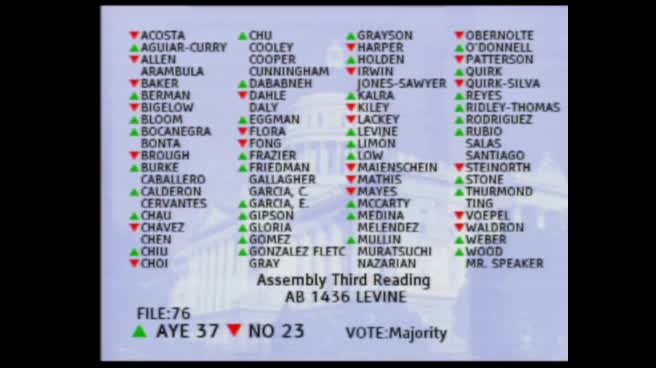 2MIN
Assembly Floor
 34MIN
Assembly Standing Committee on Judiciary
 10MIN
Assembly Standing Committee on Public Safety
 10MIN
Assembly Standing Committee on Public Safety
Bill Author

Bill Co-Author(s):