AB 908: Hospitals: seismic safety.
- Session Year: 2017-2018
- House: Assembly
- Latest Version Date: 2017-09-28
Existing law, the Alfred E. Alquist Hospital Facilities Seismic Safety Act of 1983, establishes, under the jurisdiction of the Office of Statewide Health Planning and Development, a program of seismic safety building standards for certain hospitals constructed on and after March 7, 1973.
Existing law provides that, after January 1, 2008, a general acute care hospital building that is determined to be a potential risk of collapse or to pose significant loss of life in the event of seismic activity be used only for nonacute care hospital purposes, except that the office may grant a 5-year extension under prescribed circumstances. Existing law allows the office to grant a hospital that has received extensions under specified provisions an additional extension of up to 7 years for a hospital building that it owns or operates if the hospital meets specified milestones.
This bill would authorize a hospital in the Tarzana neighborhood in the City of Los Angeles that has received specified extensions to request an additional extension, as specified, until October 1, 2022, in order to obtain a certificate of occupancy from the office for a replacement building.
This bill would make legislative findings and declarations as to the necessity of a special statute for the Tarzana neighborhood in the City of Los Angeles.
Existing law, the Alfred E. Alquist Hospital Facilities Seismic Safety Act of 1983, establishes, under the jurisdiction of the Office of Statewide Health Planning and Development, a program of seismic safety building standards for certain hospitals constructed on and after March 7, 1973.
Existing law provides that, after January 1, 2008, a general acute care hospital building that is determined to be a potential risk of collapse or to pose significant loss of life in the event of seismic activity be used only for nonacute care hospital purposes, except that the office may grant a 5-year extension under prescribed circumstances. Existing law allows the office to grant a hospital that has received extensions under specified provisions an additional extension of up to 7 years for a hospital building that it owns or operates if the hospital meets specified milestones.
This bill would authorize a hospital in the Tarzana neighborhood in the City of Los Angeles that has received specified extensions to request an additional extension extension, as specified, until October 1, 2022, in order to obtain a certificate of occupancy from the office for a replacement building.
This bill would make legislative findings and declarations as to the necessity of a special statute for the Tarzana neighborhood in the City of Los Angeles.
Existing law, the Alfred E. Alquist Hospital Facilities Seismic Safety Act of 1983, establishes, under the jurisdiction of the Office of Statewide Health Planning and Development, a program of seismic safety building standards for certain hospitals constructed on and after March 7, 1973.
Existing law provides that, after January 1, 2008, a general acute care hospital building that is determined to be a potential risk of collapse or to pose significant loss of life in the event of seismic activity be used only for nonacute care hospital purposes, except that the office may grant a 5-year extension under prescribed circumstances. Existing law also allows the office to grant an additional 2-year extension in specified circumstances. Existing law authorizes the office to revoke an extension for any hospital building when it is determined that any information submitted for the extensions was falsified, or if the hospital failed to meet specified milestones, or if the work of construction is abandoned or suspended for a period of at least 6 months, unless the hospital demonstrates in a publicly available document that the abandonment or suspension was caused by factors beyond its control. Existing law allows the office to grant a hospital that has received extensions under specified provisions an additional extension of up to 7 years for a hospital building that it owns or operates if the hospital meets specified milestones.
This bill would require the office to provide a 30-day notice to a hospital prior to revoking an extension.This bill would authorize a hospital in the Tarzana neighborhood in the City of Los Angeles that has received specified extensions to request an additional extension until October 1, 2022, in order to obtain a certificate of occupancy from the office for a replacement building.
This bill would make legislative findings and declarations as to the necessity of a special statute for the Tarzana neighborhood in the City of Los Angeles.
Existing law, the Alfred E. Alquist Hospital Facilities Seismic Safety Act of 1983, establishes, under the jurisdiction of the Office of Statewide Health Planning and Development, a program of seismic safety building standards for certain hospitals constructed on and after March 7, 1973.
Existing law provides that, after January 1, 2008, a general acute care hospital building that is determined to be a potential risk of collapse or to pose significant loss of life in the event of seismic activity be used only for nonacute care hospital purposes, except that the office may grant a 5-year extension under prescribed circumstances. Existing law also allows the office to grant an additional 2-year extension in specified circumstances. Existing law authorizes the office to revoke an extension for any hospital building when it is determined that any information submitted for the extensions was falsified, or if the hospital failed to meet specified milestones, or if the work of construction is abandoned or suspended for a period of at least 6 months, unless the hospital demonstrates in a publicly available document that the abandonment or suspension was caused by factors beyond its control.
This bill would require the office to provide a 30-day notice to a hospital prior to revoking an extension, and would require the office to provide the hospital with an opportunity to provide evidence and information to challenge the revocation. extension.
Existing law, the Alfred E. Alquist Hospital Facilities Seismic Safety Act of 1983, establishes, under the jurisdiction of the Office of Statewide Health Planning and Development, a program of seismic safety building standards for certain hospitals constructed on and after March 7, 1973.
Existing law provides that, after January 1, 2008, a general acute care hospital building that is determined to be a potential risk of collapse or to pose significant loss of life in the event of seismic activity be used only for nonacute care hospital purposes, except that the office may grant a 5-year extension under prescribed circumstances. Existing law also allows the office to grant an additional 2-year extension in specified circumstances. Existing law authorizes the office to revoke an extension for any hospital building when it is determined that any information submitted for the extensions was falsified, or if the hospital failed to meet specified milestones, or if the work of construction is abandoned or suspended for a period of at least 6 months, unless the hospital demonstrates in a publicly available document that the abandonment or suspension was caused by factors beyond its control.
This bill would require the office to provide a 30-day notice to a hospital prior to revoking an extension, and would require the office to provide the hospital with an opportunity to provide evidence and information to challenge the revocation.
(a)(1)After January 1, 2008, a general acute care hospital building that is determined to be a potential risk of collapse or pose significant loss of life shall only be used for nonacute care hospital purposes, unless an extension of this deadline has been granted and either of the following occurs before the end of the extension:
(A)A replacement building has been constructed and a certificate of occupancy has been granted by the office for the replacement building.
(B)A retrofit has been performed on the building and a construction final has been obtained by the office.
(2)An extension of the deadline may be granted by the office upon a demonstration by the owner that compliance will result in a loss of health care capacity that may not be provided by other general acute care hospitals within a reasonable proximity. In its request for an extension of the deadline, a hospital shall state why the hospital is unable to comply with the January 1, 2008, deadline requirement.
(3)Prior to granting an extension of the January 1, 2008, deadline pursuant to this section, the office shall do all of the following:
(A)Provide public notice of a hospitals request for an extension of the deadline. The notice, at a minimum, shall be posted on the offices Internet Web site, and shall include the facilitys name and identification number, the status of the request, and the beginning and ending dates of the comment period, and shall advise the public of the opportunity to submit public comments pursuant to subparagraph (C). The office shall also provide notice of all requests for the deadline extension directly to interested parties upon request of the interested parties.
(B)Provide copies of extension requests to interested parties within 10 working days to allow interested parties to review and provide comment within the 45-day comment period. The copies shall include those records that are available to the public pursuant to the California Public Records Act (Chapter 3.5 (commencing with Section 6250) of Division 7 of Title 1 of the Government Code).
(C)Allow the public to submit written comments on the extension proposal for a period of not less than 45 days from the date of the public notice.
(b)(1)It is the intent of the Legislature, in enacting this subdivision, to facilitate the process of having more hospital buildings in substantial compliance with this chapter and to take nonconforming general acute care hospital inpatient buildings out of service more quickly.
(2)The functional contiguous grouping of hospital buildings of a general acute care hospital, each of which provides, as the primary source, one or more of the hospitals eight basic services as specified in subdivision (a) of Section 1250, may receive a five-year extension of the January 1, 2008, deadline specified in subdivision (a) of this section pursuant to this subdivision for both structural and nonstructural requirements. A functional contiguous grouping refers to buildings containing one or more basic hospital services that are either attached or connected in a way that is acceptable to the State Department of Health Care Services. These buildings may be either on the existing site or a new site.
(3)To receive the five-year extension, a single building containing all of the basic services or at least one building within the contiguous grouping of hospital buildings shall have obtained a building permit prior to 1973 and this building shall be evaluated and classified as a nonconforming, Structural Performance Category-1 (SPC-1) building. The classification shall be submitted to and accepted by the Office of Statewide Health Planning and Development. The identified hospital building shall be exempt from the requirement in subdivision (a) until January 1, 2013, if the hospital agrees that the basic service or services that were provided in that building shall be provided, on or before January 1, 2013, as follows:
(A)Moved into an existing conforming Structural Performance Category-3 (SPC-3), Structural Performance Category-4 (SPC-4), or Structural Performance Category-5 (SPC-5) and Non-Structural Performance Category-4 (NPC-4) or Non-Structural Performance Category-5 (NPC-5) building.
(B)Relocated to a newly built compliant SPC-5 and NPC-4 or NPC-5 building.
(C)Continued in the building if the building is retrofitted to an SPC-5 and NPC-4 or NPC-5 building.
(4)A five-year extension is also provided to a post-1973 building if the hospital owner informs the Office of Statewide Health Planning and Development that the building is classified as SPC-1, SPC-3, or SPC-4 and will be closed to general acute care inpatient service use by January 1, 2013. The basic services in the building shall be relocated into an SPC-5 and NPC-4 or NPC-5 building by January 1, 2013.
(5)SPC-1 buildings, other than the building identified in paragraph (3) or (4), in the contiguous grouping of hospital buildings shall also be exempt from the requirement in subdivision (a) until January 1, 2013. However, on or before January 1, 2013, at a minimum, each of these buildings shall be retrofitted to an SPC-2 and NPC-3 building, or no longer be used for general acute care hospital inpatient services.
(c)On or before March 1, 2001, the office shall establish a schedule of interim work progress deadlines that hospitals shall be required to meet to be eligible for the extension specified in subdivision (b). To receive this extension, the hospital building or buildings shall meet the year 2002 nonstructural requirements.
(d)A hospital building that is eligible for an extension pursuant to this section shall meet the January 1, 2030, nonstructural and structural deadline requirements if the building is to be used for general acute care inpatient services after January 1, 2030.
(e)Upon compliance with subdivision (b), the hospital shall be issued a written notice of compliance by the office. The office shall send a written notice of violation to hospital owners that fail to comply with this section. The office shall make copies of these notices available on its Internet Web site.
(f)(1)A hospital that has received an extension of the January 1, 2008, deadline pursuant to subdivision (a) or (b) may request an additional extension of up to two years for a hospital building that it owns or operates and that meets the criteria specified in paragraph (2), (3), or (5).
(2)The office may grant the additional extension if the hospital building subject to the extension meets all of the following criteria:
(A)The hospital building is under construction at the time of the request for extension under this subdivision and the purpose of the construction is to meet the requirements of subdivision (a) to allow the use of the building as a general acute care hospital building after the extension deadline granted by the office pursuant to subdivision (a) or (b).
(B)The hospital building plans were submitted to the office and were deemed ready for review by the office at least four years prior to the applicable deadline for the building. The hospital shall indicate, upon submission of its plans, the SPC-1 building or buildings that will be retrofitted or replaced to meet the requirements of this section as a result of the project.
(C)The hospital received a building permit for the construction described in subparagraph (A) at least two years prior to the applicable deadline for the building.
(D)The hospital submitted a construction timeline at least two years prior to the applicable deadline for the building demonstrating the hospitals intent to meet the applicable deadline. The timeline shall include all of the following:
(i)The projected construction start date.
(ii)The projected construction completion date.
(iii)Identification of the contractor.
(E)The hospital is making reasonable progress toward meeting the timeline set forth in subparagraph (D), but factors beyond the hospitals control make it impossible for the hospital to meet the deadline.
(3)The office may grant the additional extension if the hospital building subject to the extension meets all of the following criteria:
(A)The hospital building is owned by a health care district that has, as owner, received the extension of the January 1, 2008, deadline, but where the hospital is operated by an unaffiliated third-party lessee pursuant to a facility lease that extends at least through December 31, 2009. The district shall file a declaration with the office with a request for an extension stating that, as of the date of the filing, the district has lacked, and continues to lack, unrestricted access to the subject hospital building for seismic planning purposes during the term of the lease, and that the district is under contract with the county to maintain hospital services when the hospital comes under district control. The office shall not grant the extension if an unaffiliated third-party lessee will operate the hospital beyond December 31, 2010.
(B)The hospital building plans were submitted to the office and were deemed ready for review by the office at least four years prior to the applicable deadline for the building. The hospital shall indicate, upon submission of its plans, the SPC-1 building or buildings that will be retrofitted or replaced to meet the requirements of this section as a result of the project.
(C)The hospital received a building permit for the construction described in subparagraph (B) by December 31, 2011.
(D)The hospital submitted, by December 31, 2011, a construction timeline for the building demonstrating the hospitals intent and ability to meet the deadline of December 31, 2014. The timeline shall include all of the following:
(i)The projected construction start date.
(ii)The projected construction completion date.
(iii)Identification of the contractor.
(E)The hospital building is under construction at the time of the request for the extension, the purpose of the construction is to meet the requirements of subdivision (a) to allow the use of the building as a general acute care hospital building after the extension deadline granted by the office pursuant to subdivision (a) or (b), and the hospital is making reasonable progress toward meeting the timeline set forth in subparagraph (D).
(F)The hospital granted an extension pursuant to this paragraph shall submit an additional status report to the office, equivalent to that required by subdivision (c) of Section 130061, no later than June 30, 2013.
(4)An extension granted pursuant to paragraph (3) shall be applicable only to the health care district applicant and its affiliated hospital while the hospital is operated by the district or an entity under the control of the district.
(5)The office may grant the additional extension if the hospital building subject to the extension meets all of the following criteria:
(A)The hospital owner submitted to the office, prior to June 30, 2009, a request for review using current computer modeling utilized by the office and based upon software developed by the Federal Emergency Management Agency (FEMA), referred to as Hazards US, and the building was deemed SPC-1 after that review.
(B)The hospital building plans for the building are submitted to the office and deemed ready for review by the office prior to July 1, 2010. The hospital shall indicate, upon submission of its plans, the SPC-1 building or buildings that shall be retrofitted or replaced to meet the requirements of this section as a result of the project.
(C)The hospital receives a building permit from the office for the construction described in subparagraph (B) prior to January 1, 2012.
(D)The hospital submits, prior to January 1, 2012, a construction timeline for the building demonstrating the hospitals intent and ability to meet the applicable deadline. The timeline shall include all of the following:
(i)The projected construction start date.
(ii)The projected construction completion date.
(iii)Identification of the contractor.
(E)The hospital building is under construction at the time of the request for the extension, the purpose of the construction is to meet the requirements of subdivision (a) to allow the use of the building as a general acute care hospital building after the extension deadline granted by the office pursuant to subdivision (a) or (b), and the hospital is making reasonable progress toward meeting the timeline set forth in subparagraph (D).
(F)The hospital owner completes construction such that the hospital meets all criteria to enable the office to issue a certificate of occupancy by the applicable deadline for the building.
(6)A hospital located in the County of Sacramento, San Mateo, or Santa Barbara or the City of San Jose or the City of Willits that has received an additional extension pursuant to paragraph (2) or (5) may request an additional extension until September 1, 2015, to obtain either a certificate of occupancy from the office for a replacement building, or a construction final from the office for a building on which a retrofit has been performed.
(7)A hospital denied an extension pursuant to this subdivision may appeal the denial to the Hospital Building Safety Board.
(8)The office may revoke an extension granted pursuant to this subdivision for any hospital building where the work of construction is abandoned or suspended for a period of at least one year, unless the hospital demonstrates in a public document that the abandonment or suspension was caused by factors beyond its control.
(g)(1)Notwithstanding subdivisions (a), (b), (c), and (f), and Sections 130061.5 and 130064, a hospital that has received an extension of the January 1, 2008, deadline pursuant to subdivision (a) or (b) also may request an additional extension of up to seven years for a hospital building that it owns or operates. The office may grant the extension subject to the hospital meeting the milestones set forth in paragraph (2).
(2)The hospital building subject to the extension shall meet all of the following milestones, unless the hospital building is reclassified as SPC-2 or higher as a result of its Hazards US score:
(A)The hospital owner submits to the office, no later than September 30, 2012, a letter of intent stating whether it intends to rebuild, replace, or retrofit the building, or remove all general acute care beds and services from the building, and the amount of time necessary to complete the construction.
(B)The hospital owner submits to the office, no later than September 30, 2012, a schedule detailing why the requested extension is necessary, and specifically how the hospital intends to meet the requested deadline.
(C)The hospital owner submits to the office, no later than September 30, 2012, an application ready for review seeking structural reassessment of each of its SPC-1 buildings using current computer modeling based upon software developed by FEMA, referred to as Hazards US.
(D)The hospital owner submits to the office, no later than January 1, 2015, plans ready for review consistent with the letter of intent submitted pursuant to subparagraph (A) and the schedule submitted pursuant to subparagraph (B).
(E)The hospital owner submits a financial report to the office at the time the plans are submitted pursuant to subparagraph (D). The report shall demonstrate the hospital owners financial capacity to implement the construction plans submitted pursuant to subparagraph (D).
(F)The hospital owner receives a building permit consistent with the letter of intent submitted pursuant to subparagraph (A) and the schedule submitted pursuant to subparagraph (B), no later than July 1, 2018.
(3)To evaluate public safety and determine whether to grant an extension of the deadline, the office shall consider the structural integrity of the hospitals SPC-1 buildings based on its Hazards US scores, community access to essential hospital services, and the hospital owners financial capacity to meet the deadline as determined by either a bond rating of BBB or below or the financial report on the hospital owners financial capacity submitted pursuant to subparagraph (E) of paragraph (2). The criteria contained in this paragraph shall be considered by the office in its determination of the length of an extension or whether an extension should be granted.
(4)The extension or subsequent adjustments granted pursuant to this subdivision may not exceed the amount of time that is reasonably necessary to complete the construction specified in paragraph (2).
(5)If the circumstances underlying the request for extension submitted to the office pursuant to paragraph (2) change, the hospital owner shall notify the office as soon as practicable, but in no event later than six months after the hospital owner discovered the change of circumstances. The office may adjust the length of the extension granted pursuant to paragraphs (2) and (3) as necessary, but in no event longer than the period specified in paragraph (1).
(6)A hospital denied an extension pursuant to this subdivision may appeal the denial to the Hospital Building Safety Board.
(7)The office may revoke an extension granted pursuant to this subdivision for any hospital building when it is determined that any information submitted pursuant to this section was falsified, or if the hospital failed to meet a milestone set forth in paragraph (2), or where the work of construction is abandoned or suspended for a period of at least six months, unless the hospital demonstrates in a publicly available document that the abandonment or suspension was caused by factors beyond its control.
(8)Regulatory submissions made by the office to the California Building Standards Commission to implement this section shall be deemed to be emergency regulations and shall be adopted as emergency regulations.
(9)The hospital owner that applies for an extension pursuant to this subdivision shall pay the office an additional fee, to be determined by the office, sufficient to cover the additional reasonable costs incurred by the office for maintaining the additional reporting requirements established under this section, including, but not limited to, the costs of reviewing and verifying the extension documentation submitted pursuant to this subdivision. This additional fee shall not include any cost for review of the plans or other duties related to receiving a building or occupancy permit.
(10)This subdivision shall become operative on the date that the State Department of Health Care Services receives all necessary federal approvals for a 201112 fiscal year hospital quality assurance fee program that includes three hundred twenty million dollars ($320,000,000) in fee revenue to pay for health care coverage for children, which is made available as a result of the legislative enactment of a 201112 fiscal year hospital quality assurance fee program.
(h)A critical access hospital located in the City of Tehachapi may submit a seismic safety extension application pursuant to subdivision (g), notwithstanding deadlines in that subdivision that are earlier than the effective date of the act that added this subdivision. The submitted application shall include a timetable as required pursuant to subdivision (g).
(i)(1)A hospital located in the Tarzana neighborhood of the City of Los Angeles that has received extensions pursuant to subdivisions (b) and (g) may request an additional extension for a single building until October 1, 2022, in order to obtain a certificate of occupancy from the office for a replacement building.
(2)The hospital owner seeking the extension shall submit a written request that includes a timeline specifying how the hospital intends to meet the new deadline, including the construction document submission dates. The following timeline shall be met for construction document submissions:
(A)No later than January 1, 2018, the hospital owner shall submit construction documents, deemed ready for review, related to the first final review of the second increment with information including the building core and shell of the hospital. Failure to submit the construction documents by January 1, 2018, shall result in the assessment of a fine of five thousand dollars ($5,000) per calendar day until the documents are submitted.
(B)No later than March 1, 2018, the hospital owner shall submit construction documents, deemed ready for review, related to the first final review of the first increment with information including the structural foundation, frame, and underslab utilities of the hospital. Failure to submit the construction documents by March 1, 2018, shall result in the assessment of a fine of five thousand dollars ($5,000) per calendar day until the documents are submitted.
(C)No later than September 1, 2018, the hospital owner shall submit construction documents, deemed ready for review, related to the first final review of the third increment with information on the build-out of the hospital. Failure to submit the construction documents by September 1, 2018, shall result in the assessment of a fine of five thousand dollars ($5,000) per calendar day until the documents are submitted.
(D)No later than November 1, 2018, the hospital owner shall submit construction documents, deemed ready for review, related to the first final review of the fourth increment with information on the seismic support and anchorage of the hospital. Failure to submit the construction documents by November 1, 2018, shall result in the assessment of a fine of five thousand dollars ($5,000) per calendar day until the documents are submitted.
(E)The hospital owner may submit a written request to the office seeking an extension of the deadlines set forth in subparagraphs (A), (B), (C), and (D). The written request shall state with specificity the reason for the request and how the reason preventing compliance with the deadlines was outside of the control of the hospital owner. After review of the request for extension, the office may grant the request for a period of time not to exceed 30 calendar days. If the office grants the request for an extension, no fine shall accrue or be imposed during the extension period.
(3)Notwithstanding any other law, any fines assessed pursuant to paragraph (2) shall be deposited into the General Fund following a determination on appeal, if any. A hospital assessed a fine pursuant to this subdivision may appeal the assessment to the Hospital Building Safety Board, provided the hospital posts the funds for any fines to be held by the office pending the resolution of the appeal.
(4)The office shall not issue a certificate of occupancy for the single replacement building until such time as all assessed fines accrued pursuant to paragraph (2) have been paid in full, or, if an appeal is pending, have been posted subject to resolution of an appeal. Fines deposited by the hospital pursuant to paragraph (3) shall be considered paid in full for purposes of issuing a certificate of occupancy pursuant to this paragraph. This paragraph is in addition to, and is not intended to supersede, any other requirements that must be met by the hospital for issuance by the office of a certificate of occupancy.
SEC. 2.The Legislature finds and declares that a special statute is necessary and that a general statute cannot be made applicable within the meaning of Section 16 of Article IV of the California Constitution because of the special circumstances in the neighborhood of Tarzana in the City of Los Angeles relating to efforts to meet applicable seismic safety and building standards.
(a)(1)After January 1, 2008, a general acute care hospital building that is determined to be a potential risk of collapse or pose significant loss of life shall only be used for nonacute care hospital purposes, unless an extension of this deadline has been granted and either of the following occurs before the end of the extension:
(A)A replacement building has been constructed and a certificate of occupancy has been granted by the office for the replacement building.
(B)A retrofit has been performed on the building and a construction final has been obtained by the office.
(2)An extension of the deadline may be granted by the office upon a demonstration by the owner that compliance will result in a loss of health care capacity that may not be provided by other general acute care hospitals within a reasonable proximity. In its request for an extension of the deadline, a hospital shall state why the hospital is unable to comply with the January 1, 2008, deadline requirement.
(3)Prior to granting an extension of the January 1, 2008, deadline pursuant to this section, the office shall do all of the following:
(A)Provide public notice of a hospitals request for an extension of the deadline. The notice, at a minimum, shall be posted on the offices Internet Web site, and shall include the facilitys name and identification number, the status of the request, and the beginning and ending dates of the comment period, and shall advise the public of the opportunity to submit public comments pursuant to subparagraph (C). The office shall also provide notice of all requests for the deadline extension directly to interested parties upon request of the interested parties.
(B)Provide copies of extension requests to interested parties within 10 working days to allow interested parties to review and provide comment within the 45-day comment period. The copies shall include those records that are available to the public pursuant to the California Public Records Act (Chapter 3.5 (commencing with Section 6250) of Division 7 of Title 1 of the Government Code).
(C)Allow the public to submit written comments on the extension proposal for a period of not less than 45 days from the date of the public notice.
(b)(1)It is the intent of the Legislature, in enacting this subdivision, to facilitate the process of having more hospital buildings in substantial compliance with this chapter and to take nonconforming general acute care hospital inpatient buildings out of service more quickly.
(2)The functional contiguous grouping of hospital buildings of a general acute care hospital, each of which provides, as the primary source, one or more of the hospitals eight basic services as specified in subdivision (a) of Section 1250, may receive a five-year extension of the January 1, 2008, deadline specified in subdivision (a) of this section pursuant to this subdivision for both structural and nonstructural requirements. A functional contiguous grouping refers to buildings containing one or more basic hospital services that are either attached or connected in a way that is acceptable to the State Department of Health Care Services. These buildings may be either on the existing site or a new site.
(3)To receive the five-year extension, a single building containing all of the basic services or at least one building within the contiguous grouping of hospital buildings shall have obtained a building permit prior to 1973 and this building shall be evaluated and classified as a nonconforming, Structural Performance Category-1 (SPC-1) building. The classification shall be submitted to and accepted by the Office of Statewide Health Planning and Development. The identified hospital building shall be exempt from the requirement in subdivision (a) until January 1, 2013, if the hospital agrees that the basic service or services that were provided in that building shall be provided, on or before January 1, 2013, as follows:
(A)Moved into an existing conforming Structural Performance Category-3 (SPC-3), Structural Performance Category-4 (SPC-4), or Structural Performance Category-5 (SPC-5) and Non-Structural Performance Category-4 (NPC-4) or Non-Structural Performance Category-5 (NPC-5) building.
(B)Relocated to a newly built compliant SPC-5 and NPC-4 or NPC-5 building.
(C)Continued in the building if the building is retrofitted to an SPC-5 and NPC-4 or NPC-5 building.
(4)A five-year extension is also provided to a post-1973 building if the hospital owner informs the Office of Statewide Health Planning and Development that the building is classified as SPC-1, SPC-3, or SPC-4 and will be closed to general acute care inpatient service use by January 1, 2013. The basic services in the building shall be relocated into an SPC-5 and NPC-4 or NPC-5 building by January 1, 2013.
(5)SPC-1 buildings, other than the building identified in paragraph (3) or (4), in the contiguous grouping of hospital buildings shall also be exempt from the requirement in subdivision (a) until January 1, 2013. However, on or before January 1, 2013, at a minimum, each of these buildings shall be retrofitted to an SPC-2 and NPC-3 building, or no longer be used for general acute care hospital inpatient services.
(c)On or before March 1, 2001, the office shall establish a schedule of interim work progress deadlines that hospitals shall be required to meet to be eligible for the extension specified in subdivision (b). To receive this extension, the hospital building or buildings shall meet the year 2002 nonstructural requirements.
(d)A hospital building that is eligible for an extension pursuant to this section shall meet the January 1, 2030, nonstructural and structural deadline requirements if the building is to be used for general acute care inpatient services after January 1, 2030.
(e)Upon compliance with subdivision (b), the hospital shall be issued a written notice of compliance by the office. The office shall send a written notice of violation to hospital owners that fail to comply with this section. The office shall make copies of these notices available on its Internet Web site.
(f)(1)A hospital that has received an extension of the January 1, 2008, deadline pursuant to subdivision (a) or (b) may request an additional extension of up to two years for a hospital building that it owns or operates and that meets the criteria specified in paragraph (2), (3), or (5).
(2)The office may grant the additional extension if the hospital building subject to the extension meets all of the following criteria:
(A)The hospital building is under construction at the time of the request for extension under this subdivision and the purpose of the construction is to meet the requirements of subdivision (a) to allow the use of the building as a general acute care hospital building after the extension deadline granted by the office pursuant to subdivision (a) or (b).
(B)The hospital building plans were submitted to the office and were deemed ready for review by the office at least four years prior to the applicable deadline for the building. The hospital shall indicate, upon submission of its plans, the SPC-1 building or buildings that will be retrofitted or replaced to meet the requirements of this section as a result of the project.
(C)The hospital received a building permit for the construction described in subparagraph (A) at least two years prior to the applicable deadline for the building.
(D)The hospital submitted a construction timeline at least two years prior to the applicable deadline for the building demonstrating the hospitals intent to meet the applicable deadline. The timeline shall include all of the following:
(i)The projected construction start date.
(ii)The projected construction completion date.
(iii)Identification of the contractor.
(E)The hospital is making reasonable progress toward meeting the timeline set forth in subparagraph (D), but factors beyond the hospitals control make it impossible for the hospital to meet the deadline.
(3)The office may grant the additional extension if the hospital building subject to the extension meets all of the following criteria:
(A)The hospital building is owned by a health care district that has, as owner, received the extension of the January 1, 2008, deadline, but where the hospital is operated by an unaffiliated third-party lessee pursuant to a facility lease that extends at least through December 31, 2009. The district shall file a declaration with the office with a request for an extension stating that, as of the date of the filing, the district has lacked, and continues to lack, unrestricted access to the subject hospital building for seismic planning purposes during the term of the lease, and that the district is under contract with the county to maintain hospital services when the hospital comes under district control. The office shall not grant the extension if an unaffiliated third-party lessee will operate the hospital beyond December 31, 2010.
(B)The hospital building plans were submitted to the office and were deemed ready for review by the office at least four years prior to the applicable deadline for the building. The hospital shall indicate, upon submission of its plans, the SPC-1 building or buildings that will be retrofitted or replaced to meet the requirements of this section as a result of the project.
(C)The hospital received a building permit for the construction described in subparagraph (B) by December 31, 2011.
(D)The hospital submitted, by December 31, 2011, a construction timeline for the building demonstrating the hospitals intent and ability to meet the deadline of December 31, 2014. The timeline shall include all of the following:
(i)The projected construction start date.
(ii)The projected construction completion date.
(iii)Identification of the contractor.
(E)The hospital building is under construction at the time of the request for the extension, the purpose of the construction is to meet the requirements of subdivision (a) to allow the use of the building as a general acute care hospital building after the extension deadline granted by the office pursuant to subdivision (a) or (b), and the hospital is making reasonable progress toward meeting the timeline set forth in subparagraph (D).
(F)The hospital granted an extension pursuant to this paragraph shall submit an additional status report to the office, equivalent to that required by subdivision (c) of Section 130061, no later than June 30, 2013.
(4)An extension granted pursuant to paragraph (3) shall be applicable only to the health care district applicant and its affiliated hospital while the hospital is operated by the district or an entity under the control of the district.
(5)The office may grant the additional extension if the hospital building subject to the extension meets all of the following criteria:
(A)The hospital owner submitted to the office, prior to June 30, 2009, a request for review using current computer modeling utilized by the office and based upon software developed by the Federal Emergency Management Agency (FEMA), referred to as Hazards US, and the building was deemed SPC-1 after that review.
(B)The hospital building plans for the building are submitted to the office and deemed ready for review by the office prior to July 1, 2010. The hospital shall indicate, upon submission of its plans, the SPC-1 building or buildings that shall be retrofitted or replaced to meet the requirements of this section as a result of the project.
(C)The hospital receives a building permit from the office for the construction described in subparagraph (B) prior to January 1, 2012.
(D)The hospital submits, prior to January 1, 2012, a construction timeline for the building demonstrating the hospitals intent and ability to meet the applicable deadline. The timeline shall include all of the following:
(i)The projected construction start date.
(ii)The projected construction completion date.
(iii)Identification of the contractor.
(E)The hospital building is under construction at the time of the request for the extension, the purpose of the construction is to meet the requirements of subdivision (a) to allow the use of the building as a general acute care hospital building after the extension deadline granted by the office pursuant to subdivision (a) or (b), and the hospital is making reasonable progress toward meeting the timeline set forth in subparagraph (D).
(F)The hospital owner completes construction such that the hospital meets all criteria to enable the office to issue a certificate of occupancy by the applicable deadline for the building.
(6)A hospital located in the County of Sacramento, San Mateo, or Santa Barbara or the City of San Jose or the City of Willits that has received an additional extension pursuant to paragraph (2) or (5) may request an additional extension until September 1, 2015, to obtain either a certificate of occupancy from the office for a replacement building, or a construction final from the office for a building on which a retrofit has been performed.
(7)A hospital denied an extension pursuant to this subdivision may appeal the denial to the Hospital Building Safety Board.
(8)The office may revoke an extension granted pursuant to this subdivision for any hospital building where the work of construction is abandoned or suspended for a period of at least one year, unless the hospital demonstrates in a public document that the abandonment or suspension was caused by factors beyond its control.
(g)(1)Notwithstanding subdivisions (a), (b), (c), and (f), and Sections 130061.5 and 130064, a hospital that has received an extension of the January 1, 2008, deadline pursuant to subdivision (a) or (b) also may request an additional extension of up to seven years for a hospital building that it owns or operates. The office may grant the extension subject to the hospital meeting the milestones set forth in paragraph (2).
(2)The hospital building subject to the extension shall meet all of the following milestones, unless the hospital building is reclassified as SPC-2 or higher as a result of its Hazards US score:
(A)The hospital owner submits to the office, no later than September 30, 2012, a letter of intent stating whether it intends to rebuild, replace, or retrofit the building, or remove all general acute care beds and services from the building, and the amount of time necessary to complete the construction.
(B)The hospital owner submits to the office, no later than September 30, 2012, a schedule detailing why the requested extension is necessary, and specifically how the hospital intends to meet the requested deadline.
(C)The hospital owner submits to the office, no later than September 30, 2012, an application ready for review seeking structural reassessment of each of its SPC-1 buildings using current computer modeling based upon software developed by FEMA, referred to as Hazards US.
(D)The hospital owner submits to the office, no later than January 1, 2015, plans ready for review consistent with the letter of intent submitted pursuant to subparagraph (A) and the schedule submitted pursuant to subparagraph (B).
(E)The hospital owner submits a financial report to the office at the time the plans are submitted pursuant to subparagraph (D). The report shall demonstrate the hospital owners financial capacity to implement the construction plans submitted pursuant to subparagraph (D).
(F)The hospital owner receives a building permit consistent with the letter of intent submitted pursuant to subparagraph (A) and the schedule submitted pursuant to subparagraph (B), no later than July 1, 2018.
(3)To evaluate public safety and determine whether to grant an extension of the deadline, the office shall consider the structural integrity of the hospitals SPC-1 buildings based on its Hazards US scores, community access to essential hospital services, and the hospital owners financial capacity to meet the deadline as determined by either a bond rating of BBB or below or the financial report on the hospital owners financial capacity submitted pursuant to subparagraph (E) of paragraph (2). The criteria contained in this paragraph shall be considered by the office in its determination of the length of an extension or whether an extension should be granted.
(4)The extension or subsequent adjustments granted pursuant to this subdivision may not exceed the amount of time that is reasonably necessary to complete the construction specified in paragraph (2).
(5)If the circumstances underlying the request for extension submitted to the office pursuant to paragraph (2) change, the hospital owner shall notify the office as soon as practicable, but in no event later than six months after the hospital owner discovered the change of circumstances. The office may adjust the length of the extension granted pursuant to paragraphs (2) and (3) as necessary, but in no event longer than the period specified in paragraph (1).
(6)A hospital denied an extension pursuant to this subdivision may appeal the denial to the Hospital Building Safety Board.
(7)The office may revoke an extension granted pursuant to this subdivision for any hospital building when it is determined that any information submitted pursuant to this section was falsified, or if the hospital failed to meet a milestone set forth in paragraph (2), or where the work of construction is abandoned or suspended for a period of at least six months, unless the hospital demonstrates in a publicly available document that the abandonment or suspension was caused by factors beyond its control.
(8)Regulatory submissions made by the office to the California Building Standards Commission to implement this section shall be deemed to be emergency regulations and shall be adopted as emergency regulations.
(9)The hospital owner that applies for an extension pursuant to this subdivision shall pay the office an additional fee, to be determined by the office, sufficient to cover the additional reasonable costs incurred by the office for maintaining the additional reporting requirements established under this section, including, but not limited to, the costs of reviewing and verifying the extension documentation submitted pursuant to this subdivision. This additional fee shall not include any cost for review of the plans or other duties related to receiving a building or occupancy permit.
(10)This subdivision shall become operative on the date that the State Department of Health Care Services receives all necessary federal approvals for a 201112 fiscal year hospital quality assurance fee program that includes three hundred twenty million dollars ($320,000,000) in fee revenue to pay for health care coverage for children, which is made available as a result of the legislative enactment of a 201112 fiscal year hospital quality assurance fee program.
(h)A critical access hospital located in the City of Tehachapi may submit a seismic safety extension application pursuant to subdivision (g), notwithstanding deadlines in that subdivision that are earlier than the effective date of the act that added this subdivision. The submitted application shall include a timetable as required pursuant to subdivision (g).
(i)A hospital located in the Tarzana neighborhood of the City of Los Angeles that has received extensions pursuant to subdivisions (b) and (g) may request an additional extension for a single building until October 1, 2022, in order to obtain a certificate of occupancy from the office for a replacement building. The request for an extension shall include a timeline specifying how the hospital intends to meet the requested deadline. The office may grant the extension subject to the hospital meeting milestones established by the office based on the timeline submitted with the request for an extension, including obtaining plan approval from the Office of Statewide Health Planning and Development, obtaining necessary building permits, and beginning construction.(i)(1)A hospital located in the Tarzana neighborhood of the City of Los Angeles that has received extensions pursuant to subdivisions (b) and (g) may request an additional extension for a single building until October 1, 2022, in order to obtain a certificate of occupancy from the office for a replacement building.
(2)The hospital owner seeking the extension shall submit a written request that includes a timeline specifying how the hospital intends to meet the new deadline, including the construction document submission dates. The following timeline shall be met for construction document submissions:
(A)No later than January 1, 2018, the hospital owner shall submit construction documents, deemed ready for review, related to the first final review of the second increment with information including the building core and shell of the hospital. Failure to submit the construction documents by January 1, 2018, shall result in the assessment of a fine of five thousand dollars ($5,000) per calendar day until the documents are submitted.
(B)No later than March 1, 2018, the hospital owner shall submit construction documents, deemed ready for review, related to the first final review of the first increment with information including the structural foundation, frame, and underslab utilities of the hospital. Failure to submit the construction documents by March 1, 2018, shall result in the assessment of a fine of five thousand dollars ($5,000) per calendar day until the documents are submitted.
(C)No later than September 1, 2018, the hospital owner shall submit construction documents, deemed ready for review, related to the first final review of the third increment with information on the build-out of the hospital. Failure to submit the construction documents by September 1, 2018, shall result in the assessment of a fine of five thousand dollars ($5,000) per calendar day until the documents are submitted.
(D)No later than November 1, 2018, the hospital owner shall submit construction documents, deemed ready for review, related to the first final review of the fourth increment with information on the seismic support and anchorage of the hospital. Failure to submit the construction documents by November 1, 2018, shall result in the assessment of a fine of five thousand dollars ($5,000) per calendar day until the documents are submitted.
(E)The hospital owner may submit a written request to the office seeking an extension of the deadlines set forth in subparagraphs (A), (B), (C), and (D). The written request shall state with specificity the reason for the request and how the reason preventing compliance with the deadlines was outside of the control of the hospital owner. After review of the request for extension, the office may grant the request for a period of time not to exceed 30 calendar days. If the office grants the request for an extension, no fine shall accrue or be imposed during the extension period.
(3)Notwithstanding any other law, any fines assessed pursuant to paragraph (2) shall be deposited into the General Fund following a determination on appeal, if any. A hospital assessed a fine pursuant to this subdivision may appeal the assessment to the Hospital Building Safety Board, provided the hospital posts the funds for any fines to be held by the office pending the resolution of the appeal.
(4)The office shall not issue a certificate of occupancy for the single replacement building until such time as all assessed fines accrued pursuant to paragraph (2) have been paid in full, or, if an appeal is pending, have been posted subject to resolution of an appeal. Fines deposited by the hospital pursuant to paragraph (3) shall be considered paid in full for purposes of issuing a certificate of occupancy pursuant to this paragraph. This paragraph is in addition to, and is not intended to supersede, any other requirements that must be met by the hospital for issuance by the office of a certificate of occupancy.
SEC. 2.The Legislature finds and declares that a special statute is necessary and that a general statute cannot be made applicable within the meaning of Section 16 of Article IV of the California Constitution because of the special circumstances in the neighborhood of Tarzana in the City of Los Angeles relating to efforts to meet applicable seismic safety and building standards.
(a)(1)After January 1, 2008, a general acute care hospital building that is determined to be a potential risk of collapse or pose significant loss of life shall only be used for nonacute care hospital purposes, unless an extension of this deadline has been granted and either of the following occurs before the end of the extension:
(A)A replacement building has been constructed and a certificate of occupancy has been granted by the office for the replacement building.
(B)A retrofit has been performed on the building and a construction final has been obtained by the office.
(2)An extension of the deadline may be granted by the office upon a demonstration by the owner that compliance will result in a loss of health care capacity that may not be provided by other general acute care hospitals within a reasonable proximity. In its request for an extension of the deadline, a hospital shall state why the hospital is unable to comply with the January 1, 2008, deadline requirement.
(3)Prior to granting an extension of the January 1, 2008, deadline pursuant to this section, the office shall do all of the following:
(A)Provide public notice of a hospitals request for an extension of the deadline. The notice, at a minimum, shall be posted on the offices Internet Web site, and shall include the facilitys name and identification number, the status of the request, and the beginning and ending dates of the comment period, and shall advise the public of the opportunity to submit public comments pursuant to subparagraph (C). The office shall also provide notice of all requests for the deadline extension directly to interested parties upon request of the interested parties.
(B)Provide copies of extension requests to interested parties within 10 working days to allow interested parties to review and provide comment within the 45-day comment period. The copies shall include those records that are available to the public pursuant to the California Public Records Act (Chapter 3.5 (commencing with Section 6250) of Division 7 of Title 1 of the Government Code).
(C)Allow the public to submit written comments on the extension proposal for a period of not less than 45 days from the date of the public notice.
(b)(1)It is the intent of the Legislature, in enacting this subdivision, to facilitate the process of having more hospital buildings in substantial compliance with this chapter and to take nonconforming general acute care hospital inpatient buildings out of service more quickly.
(2)The functional contiguous grouping of hospital buildings of a general acute care hospital, each of which provides, as the primary source, one or more of the hospitals eight basic services as specified in subdivision (a) of Section 1250, may receive a five-year extension of the January 1, 2008, deadline specified in subdivision (a) of this section pursuant to this subdivision for both structural and nonstructural requirements. A functional contiguous grouping refers to buildings containing one or more basic hospital services that are either attached or connected in a way that is acceptable to the State Department of Health Care Services. These buildings may be either on the existing site or a new site.
(3)To receive the five-year extension, a single building containing all of the basic services or at least one building within the contiguous grouping of hospital buildings shall have obtained a building permit prior to 1973 and this building shall be evaluated and classified as a nonconforming, Structural Performance Category-1 (SPC-1) building. The classification shall be submitted to and accepted by the Office of Statewide Health Planning and Development. The identified hospital building shall be exempt from the requirement in subdivision (a) until January 1, 2013, if the hospital agrees that the basic service or services that were provided in that building shall be provided, on or before January 1, 2013, as follows:
(A)Moved into an existing conforming Structural Performance Category-3 (SPC-3), Structural Performance Category-4 (SPC-4), or Structural Performance Category-5 (SPC-5) and Non-Structural Performance Category-4 (NPC-4) or Non-Structural Performance Category-5 (NPC-5) building.
(B)Relocated to a newly built compliant SPC-5 and NPC-4 or NPC-5 building.
(C)Continued in the building if the building is retrofitted to a an SPC-5 and NPC-4 or NPC-5 building.
(4)A five-year extension is also provided to a post-1973 building if the hospital owner informs the Office of Statewide Health Planning and Development that the building is classified as SPC-1, SPC-3, or SPC-4 and will be closed to general acute care inpatient service use by January 1, 2013. The basic services in the building shall be relocated into a an SPC-5 and NPC-4 or NPC-5 building by January 1, 2013.
(5)SPC-1 buildings, other than the building identified in paragraph (3) or (4), in the contiguous grouping of hospital buildings shall also be exempt from the requirement in subdivision (a) until January 1, 2013. However, on or before January 1, 2013, at a minimum, each of these buildings shall be retrofitted to a an SPC-2 and NPC-3 building, or no longer be used for general acute care hospital inpatient services.
(c)On or before March 1, 2001, the office shall establish a schedule of interim work progress deadlines that hospitals shall be required to meet to be eligible for the extension specified in subdivision (b). To receive this extension, the hospital building or buildings shall meet the year 2002 nonstructural requirements.
(d)A hospital building that is eligible for an extension pursuant to this section shall meet the January 1, 2030, nonstructural and structural deadline requirements if the building is to be used for general acute care inpatient services after January 1, 2030.
(e)Upon compliance with subdivision (b), the hospital shall be issued a written notice of compliance by the office. The office shall send a written notice of violation to hospital owners that fail to comply with this section. The office shall make copies of these notices available on its Internet Web site.
(f)(1)A hospital that has received an extension of the January 1, 2008, deadline pursuant to subdivision (a) or (b) may request an additional extension of up to two years for a hospital building that it owns or operates and that meets the criteria specified in paragraph (2), (3), or (5).
(2)The office may grant the additional extension if the hospital building subject to the extension meets all of the following criteria:
(A)The hospital building is under construction at the time of the request for extension under this subdivision and the purpose of the construction is to meet the requirements of subdivision (a) to allow the use of the building as a general acute care hospital building after the extension deadline granted by the office pursuant to subdivision (a) or (b).
(B)The hospital building plans were submitted to the office and were deemed ready for review by the office at least four years prior to the applicable deadline for the building. The hospital shall indicate, upon submission of its plans, the SPC-1 building or buildings that will be retrofitted or replaced to meet the requirements of this section as a result of the project.
(C)The hospital received a building permit for the construction described in subparagraph (A) at least two years prior to the applicable deadline for the building.
(D)The hospital submitted a construction timeline at least two years prior to the applicable deadline for the building demonstrating the hospitals intent to meet the applicable deadline. The timeline shall include all of the following:
(i)The projected construction start date.
(ii)The projected construction completion date.
(iii)Identification of the contractor.
(E)The hospital is making reasonable progress toward meeting the timeline set forth in subparagraph (D), but factors beyond the hospitals control make it impossible for the hospital to meet the deadline.
(3)The office may grant the additional extension if the hospital building subject to the extension meets all of the following criteria:
(A)The hospital building is owned by a health care district that has, as owner, received the extension of the January 1, 2008, deadline, but where the hospital is operated by an unaffiliated third-party lessee pursuant to a facility lease that extends at least through December 31, 2009. The district shall file a declaration with the office with a request for an extension stating that, as of the date of the filing, the district has lacked, and continues to lack, unrestricted access to the subject hospital building for seismic planning purposes during the term of the lease, and that the district is under contract with the county to maintain hospital services when the hospital comes under district control. The office shall not grant the extension if an unaffiliated third-party lessee will operate the hospital beyond December 31, 2010.
(B)The hospital building plans were submitted to the office and were deemed ready for review by the office at least four years prior to the applicable deadline for the building. The hospital shall indicate, upon submission of its plans, the SPC-1 building or buildings that will be retrofitted or replaced to meet the requirements of this section as a result of the project.
(C)The hospital received a building permit for the construction described in subparagraph (B) by December 31, 2011.
(D)The hospital submitted, by December 31, 2011, a construction timeline for the building demonstrating the hospitals intent and ability to meet the deadline of December 31, 2014. The timeline shall include all of the following:
(i)The projected construction start date.
(ii)The projected construction completion date.
(iii)Identification of the contractor.
(E)The hospital building is under construction at the time of the request for the extension, the purpose of the construction is to meet the requirements of subdivision (a) to allow the use of the building as a general acute care hospital building after the extension deadline granted by the office pursuant to subdivision (a) or (b), and the hospital is making reasonable progress toward meeting the timeline set forth in subparagraph (D).
(F)The hospital granted an extension pursuant to this paragraph shall submit an additional status report to the office, equivalent to that required by subdivision (c) of Section 130061, no later than June 30, 2013.
(4)An extension granted pursuant to paragraph (3) shall be applicable only to the health care district applicant and its affiliated hospital while the hospital is operated by the district or an entity under the control of the district.
(5)The office may grant the additional extension if the hospital building subject to the extension meets all of the following criteria:
(A)The hospital owner submitted to the office, prior to June 30, 2009, a request for review using current computer modeling utilized by the office and based upon software developed by the Federal Emergency Management Agency (FEMA), referred to as Hazards US, and the building was deemed SPC-1 after that review.
(B)The hospital building plans for the building are submitted to the office and deemed ready for review by the office prior to July 1, 2010. The hospital shall indicate, upon submission of its plans, the SPC-1 building or buildings that shall be retrofitted or replaced to meet the requirements of this section as a result of the project.
(C)The hospital receives a building permit from the office for the construction described in subparagraph (B) prior to January 1, 2012.
(D)The hospital submits, prior to January 1, 2012, a construction timeline for the building demonstrating the hospitals intent and ability to meet the applicable deadline. The timeline shall include all of the following:
(i)The projected construction start date.
(ii)The projected construction completion date.
(iii)Identification of the contractor.
(E)The hospital building is under construction at the time of the request for the extension, the purpose of the construction is to meet the requirements of subdivision (a) to allow the use of the building as a general acute care hospital building after the extension deadline granted by the office pursuant to subdivision (a) or (b), and the hospital is making reasonable progress toward meeting the timeline set forth in subparagraph (D).
(F)The hospital owner completes construction such that the hospital meets all criteria to enable the office to issue a certificate of occupancy by the applicable deadline for the building.
(6)A hospital located in the County of Sacramento, San Mateo, or Santa Barbara or the City of San Jose or the City of Willits that has received an additional extension pursuant to paragraph (2) or (5) may request an additional extension until September 1, 2015, to obtain either a certificate of occupancy from the office for a replacement building, or a construction final from the office for a building on which a retrofit has been performed.
(7)A hospital denied an extension pursuant to this subdivision may appeal the denial to the Hospital Building Safety Board.
(8)The office may revoke an extension granted pursuant to this subdivision for any hospital building where the work of construction is abandoned or suspended for a period of at least one year, unless the hospital demonstrates in a public document that the abandonment or suspension was caused by factors beyond its control.
(g)(1)Notwithstanding subdivisions (a), (b), (c), and (f), and Sections 130061.5 and 130064, a hospital that has received an extension of the January 1, 2008, deadline pursuant to subdivision (a) or (b) also may request an additional extension of up to seven years for a hospital building that it owns or operates. The office may grant the extension subject to the hospital meeting the milestones set forth in paragraph (2).
(2)The hospital building subject to the extension shall meet all of the following milestones, unless the hospital building is reclassified as SPC-2 or higher as a result of its Hazards US score:
(A)The hospital owner submits to the office, no later than September 30, 2012, a letter of intent stating whether it intends to rebuild, replace, or retrofit the building, or remove all general acute care beds and services from the building, and the amount of time necessary to complete the construction.
(B)The hospital owner submits to the office, no later than September 30, 2012, a schedule detailing why the requested extension is necessary, and specifically how the hospital intends to meet the requested deadline.
(C)The hospital owner submits to the office, no later than September 30, 2012, an application ready for review seeking structural reassessment of each of its SPC-1 buildings using current computer modeling based upon software developed by FEMA, referred to as Hazards US.
(D)The hospital owner submits to the office, no later than January 1, 2015, plans ready for review consistent with the letter of intent submitted pursuant to subparagraph (A) and the schedule submitted pursuant to subparagraph (B).
(E)The hospital owner submits a financial report to the office at the time the plans are submitted pursuant to subparagraph (D). The report shall demonstrate the hospital owners financial capacity to implement the construction plans submitted pursuant to subparagraph (D).
(F)The hospital owner receives a building permit consistent with the letter of intent submitted pursuant to subparagraph (A) and the schedule submitted pursuant to subparagraph (B), no later than July 1, 2018.
(3)To evaluate public safety and determine whether to grant an extension of the deadline, the office shall consider the structural integrity of the hospitals SPC-1 buildings based on its Hazards US scores, community access to essential hospital services, and the hospital owners financial capacity to meet the deadline as determined by either a bond rating of BBB or below or the financial report on the hospital owners financial capacity submitted pursuant to subparagraph (E) of paragraph (2). The criteria contained in this paragraph shall be considered by the office in its determination of the length of an extension or whether an extension should be granted.
(4)The extension or subsequent adjustments granted pursuant to this subdivision may not exceed the amount of time that is reasonably necessary to complete the construction specified in paragraph (2).
(5)If the circumstances underlying the request for extension submitted to the office pursuant to paragraph (2) change, the hospital owner shall notify the office as soon as practicable, but in no event later than six months after the hospital owner discovered the change of circumstances. The office may adjust the length of the extension granted pursuant to paragraphs (2) and (3) as necessary, but in no event longer than the period specified in paragraph (1).
(6)A hospital denied an extension pursuant to this subdivision may appeal the denial to the Hospital Building Safety Board.
(7)The office may revoke an extension granted pursuant to this subdivision for any hospital building when it is determined that any information submitted pursuant to this section was falsified, or if the hospital failed to meet a milestone set forth in paragraph (2), or where the work of construction is abandoned or suspended for a period of at least six months, unless the hospital demonstrates in a publicly available document that the abandonment or suspension was caused by factors beyond its control.
(8)Regulatory submissions made by the office to the California Building Standards Commission to implement this section shall be deemed to be emergency regulations and shall be adopted as emergency regulations.
(9)The hospital owner that applies for an extension pursuant to this subdivision shall pay the office an additional fee, to be determined by the office, sufficient to cover the additional reasonable costs incurred by the office for maintaining the additional reporting requirements established under this section, including, but not limited to, the costs of reviewing and verifying the extension documentation submitted pursuant to this subdivision. This additional fee shall not include any cost for review of the plans or other duties related to receiving a building or occupancy permit.
(10)This subdivision shall become operative on the date that the State Department of Health Care Services receives all necessary federal approvals for a 201112 fiscal year hospital quality assurance fee program that includes three hundred twenty million dollars ($320,000,000) in fee revenue to pay for health care coverage for children, which is made available as a result of the legislative enactment of a 201112 fiscal year hospital quality assurance fee program.
(h)A critical access hospital located in the City of Tehachapi may submit a seismic safety extension application pursuant to subdivision (g), notwithstanding deadlines in that subdivision that are earlier than the effective date of the act that added this subdivision. The submitted application shall include a timetable as required pursuant to subdivision (g).
(i)A hospital located in the Tarzana neighborhood of the City of Los Angeles that has received extensions pursuant to subdivisions (b) and (g) may request an additional extension for a single building until October 1, 2022, in order to obtain a certificate of occupancy from the office for a replacement building. The request for an extension shall include a timeline specifying how the hospital intends to meet the requested deadline. The office may grant the extension subject to the hospital meeting milestones established by the office based on the timeline submitted with the request for an extension, including obtaining plan approval from the Office of Statewide Health Planning and Development, obtaining necessary building permits, and beginning construction.
SEC. 2.The Legislature finds and declares that a special statute is necessary and that a general statute cannot be made applicable within the meaning of Section 16 of Article IV of the California Constitution because of the special circumstances in the neighborhood of Tarzana in the City of Los Angeles relating to efforts to meet applicable seismic safety and building standards.
(a)(1)After January 1, 2008, a general acute care hospital building that is determined to be a potential risk of collapse or pose significant loss of life shall only be used for nonacute care hospital purposes, unless an extension of this deadline has been granted and either of the following occurs before the end of the extension:
(A)A replacement building has been constructed and a certificate of occupancy has been granted by the office for the replacement building.
(B)A retrofit has been performed on the building and a construction final has been obtained by the office.
(2)An extension of the deadline may be granted by the office upon a demonstration by the owner that compliance will result in a loss of health care capacity that may not be provided by other general acute care hospitals within a reasonable proximity. In its request for an extension of the deadline, a hospital shall state why the hospital is unable to comply with the January 1, 2008, deadline requirement.
(3)Prior to granting an extension of the January 1, 2008, deadline pursuant to this section, the office shall do all of the following:
(A)Provide public notice of a hospitals request for an extension of the deadline. The notice, at a minimum, shall be posted on the offices Internet Web site, and shall include the facilitys name and identification number, the status of the request, and the beginning and ending dates of the comment period, and shall advise the public of the opportunity to submit public comments pursuant to subparagraph (C). The office shall also provide notice of all requests for the deadline extension directly to interested parties upon request of the interested parties.
(B)Provide copies of extension requests to interested parties within 10 working days to allow interested parties to review and provide comment within the 45-day comment period. The copies shall include those records that are available to the public pursuant to the California Public Records Act (Chapter 3.5 (commencing with Section 6250) of Division 7 of Title 1 of the Government Code).
(C)Allow the public to submit written comments on the extension proposal for a period of not less than 45 days from the date of the public notice.
(b)(1)It is the intent of the Legislature, in enacting this subdivision, to facilitate the process of having more hospital buildings in substantial compliance with this chapter and to take nonconforming general acute care hospital inpatient buildings out of service more quickly.
(2)The functional contiguous grouping of hospital buildings of a general acute care hospital, each of which provides, as the primary source, one or more of the hospitals eight basic services as specified in subdivision (a) of Section 1250, may receive a five-year extension of the January 1, 2008, deadline specified in subdivision (a) of this section pursuant to this subdivision for both structural and nonstructural requirements. A functional contiguous grouping refers to buildings containing one or more basic hospital services that are either attached or connected in a way that is acceptable to the State Department of Health Care Services. These buildings may be either on the existing site or a new site.
(3)To receive the five-year extension, a single building containing all of the basic services or at least one building within the contiguous grouping of hospital buildings shall have obtained a building permit prior to 1973 and this building shall be evaluated and classified as a nonconforming, Structural Performance Category-1 (SPC-1) building. The classification shall be submitted to and accepted by the Office of Statewide Health Planning and Development. The identified hospital building shall be exempt from the requirement in subdivision (a) until January 1, 2013, if the hospital agrees that the basic service or services that were provided in that building shall be provided, on or before January 1, 2013, as follows:
(A)Moved into an existing conforming Structural Performance Category-3 (SPC-3), Structural Performance Category-4 (SPC-4), or Structural Performance Category-5 (SPC-5) and Non-Structural Performance Category-4 (NPC-4) or Non-Structural Performance Category-5 (NPC-5) building.
(B)Relocated to a newly built compliant SPC-5 and NPC-4 or NPC-5 building.
(C)Continued in the building if the building is retrofitted to a SPC-5 and NPC-4 or NPC-5 building.
(4)A five-year extension is also provided to a post-1973 building if the hospital owner informs the Office of Statewide Health Planning and Development that the building is classified as SPC-1, SPC-3, or SPC-4 and will be closed to general acute care inpatient service use by January 1, 2013. The basic services in the building shall be relocated into a SPC-5 and NPC-4 or NPC-5 building by January 1, 2013.
(5)SPC-1 buildings, other than the building identified in paragraph (3) or (4), in the contiguous grouping of hospital buildings shall also be exempt from the requirement in subdivision (a) until January 1, 2013. However, on or before January 1, 2013, at a minimum, each of these buildings shall be retrofitted to a SPC-2 and NPC-3 building, or no longer be used for general acute care hospital inpatient services.
(c)On or before March 1, 2001, the office shall establish a schedule of interim work progress deadlines that hospitals shall be required to meet to be eligible for the extension specified in subdivision (b). To receive this extension, the hospital building or buildings shall meet the year 2002 nonstructural requirements.
(d)A hospital building that is eligible for an extension pursuant to this section shall meet the January 1, 2030, nonstructural and structural deadline requirements if the building is to be used for general acute care inpatient services after January 1, 2030.
(e)Upon compliance with subdivision (b), the hospital shall be issued a written notice of compliance by the office. The office shall send a written notice of violation to hospital owners that fail to comply with this section. The office shall make copies of these notices available on its Internet Web site.
(f)(1)A hospital that has received an extension of the January 1, 2008, deadline pursuant to subdivision (a) or (b) may request an additional extension of up to two years for a hospital building that it owns or operates and that meets the criteria specified in paragraph (2), (3), or (5).
(2)The office may grant the additional extension if the hospital building subject to the extension meets all of the following criteria:
(A)The hospital building is under construction at the time of the request for extension under this subdivision and the purpose of the construction is to meet the requirements of subdivision (a) to allow the use of the building as a general acute care hospital building after the extension deadline granted by the office pursuant to subdivision (a) or (b).
(B)The hospital building plans were submitted to the office and were deemed ready for review by the office at least four years prior to the applicable deadline for the building. The hospital shall indicate, upon submission of its plans, the SPC-1 building or buildings that will be retrofitted or replaced to meet the requirements of this section as a result of the project.
(C)The hospital received a building permit for the construction described in subparagraph (A) at least two years prior to the applicable deadline for the building.
(D)The hospital submitted a construction timeline at least two years prior to the applicable deadline for the building demonstrating the hospitals intent to meet the applicable deadline. The timeline shall include all of the following:
(i)The projected construction start date.
(ii)The projected construction completion date.
(iii)Identification of the contractor.
(E)The hospital is making reasonable progress toward meeting the timeline set forth in subparagraph (D), but factors beyond the hospitals control make it impossible for the hospital to meet the deadline.
(3)The office may grant the additional extension if the hospital building subject to the extension meets all of the following criteria:
(A)The hospital building is owned by a health care district that has, as owner, received the extension of the January 1, 2008, deadline, but where the hospital is operated by an unaffiliated third-party lessee pursuant to a facility lease that extends at least through December 31, 2009. The district shall file a declaration with the office with a request for an extension stating that, as of the date of the filing, the district has lacked, and continues to lack, unrestricted access to the subject hospital building for seismic planning purposes during the term of the lease, and that the district is under contract with the county to maintain hospital services when the hospital comes under district control. The office shall not grant the extension if an unaffiliated third-party lessee will operate the hospital beyond December 31, 2010.
(B)The hospital building plans were submitted to the office and were deemed ready for review by the office at least four years prior to the applicable deadline for the building. The hospital shall indicate, upon submission of its plans, the SPC-1 building or buildings that will be retrofitted or replaced to meet the requirements of this section as a result of the project.
(C)The hospital received a building permit for the construction described in subparagraph (B) by December 31, 2011.
(D)The hospital submitted, by December 31, 2011, a construction timeline for the building demonstrating the hospitals intent and ability to meet the deadline of December 31, 2014. The timeline shall include all of the following:
(i)The projected construction start date.
(ii)The projected construction completion date.
(iii)Identification of the contractor.
(E)The hospital building is under construction at the time of the request for the extension, the purpose of the construction is to meet the requirements of subdivision (a) to allow the use of the building as a general acute care hospital building after the extension deadline granted by the office pursuant to subdivision (a) or (b), and the hospital is making reasonable progress toward meeting the timeline set forth in subparagraph (D).
(F)The hospital granted an extension pursuant to this paragraph shall submit an additional status report to the office, equivalent to that required by subdivision (c) of Section 130061, no later than June 30, 2013.
(4)An extension granted pursuant to paragraph (3) shall be applicable only to the health care district applicant and its affiliated hospital while the hospital is operated by the district or an entity under the control of the district.
(5)The office may grant the additional extension if the hospital building subject to the extension meets all of the following criteria:
(A)The hospital owner submitted to the office, prior to June 30, 2009, a request for review using current computer modeling utilized by the office and based upon software developed by the Federal Emergency Management Agency (FEMA), referred to as Hazards US, and the building was deemed SPC-1 after that review.
(B)The hospital building plans for the building are submitted to the office and deemed ready for review by the office prior to July 1, 2010. The hospital shall indicate, upon submission of its plans, the SPC-1 building or buildings that shall be retrofitted or replaced to meet the requirements of this section as a result of the project.
(C)The hospital receives a building permit from the office for the construction described in subparagraph (B) prior to January 1, 2012.
(D)The hospital submits, prior to January 1, 2012, a construction timeline for the building demonstrating the hospitals intent and ability to meet the applicable deadline. The timeline shall include all of the following:
(i)The projected construction start date.
(ii)The projected construction completion date.
(iii)Identification of the contractor.
(E)The hospital building is under construction at the time of the request for the extension, the purpose of the construction is to meet the requirements of subdivision (a) to allow the use of the building as a general acute care hospital building after the extension deadline granted by the office pursuant to subdivision (a) or (b), and the hospital is making reasonable progress toward meeting the timeline set forth in subparagraph (D).
(F)The hospital owner completes construction such that the hospital meets all criteria to enable the office to issue a certificate of occupancy by the applicable deadline for the building.
(6)A hospital located in the County of Sacramento, San Mateo, or Santa Barbara or the City of San Jose or the City of Willits that has received an additional extension pursuant to paragraph (2) or (5) may request an additional extension until September 1, 2015, to obtain either a certificate of occupancy from the office for a replacement building, or a construction final from the office for a building on which a retrofit has been performed.
(7)A hospital denied an extension pursuant to this subdivision may appeal the denial to the Hospital Building Safety Board.
(8)The office may revoke an extension granted pursuant to this subdivision for any hospital building where the work of construction is abandoned or suspended for a period of at least one year, unless the hospital demonstrates in a public document that the abandonment or suspension was caused by factors beyond its control.
(g)(1)Notwithstanding subdivisions (a), (b), (c), and (f), and Sections 130061.5 and 130064, a hospital that has received an extension of the January 1, 2008, deadline pursuant to subdivision (a) or (b) also may request an additional extension of up to seven years for a hospital building that it owns or operates. The office may grant the extension subject to the hospital meeting the milestones set forth in paragraph (2).
(2)The hospital building subject to the extension shall meet all of the following milestones, unless the hospital building is reclassified as SPC-2 or higher as a result of its Hazards US score:
(A)The hospital owner submits to the office, no later than September 30, 2012, a letter of intent stating whether it intends to rebuild, replace, or retrofit the building, or remove all general acute care beds and services from the building, and the amount of time necessary to complete the construction.
(B)The hospital owner submits to the office, no later than September 30, 2012, a schedule detailing why the requested extension is necessary, and specifically how the hospital intends to meet the requested deadline.
(C)The hospital owner submits to the office, no later than September 30, 2012, an application ready for review seeking structural reassessment of each of its SPC-1 buildings using current computer modeling based upon software developed by FEMA, referred to as Hazards US.
(D)The hospital owner submits to the office, no later than January 1, 2015, plans ready for review consistent with the letter of intent submitted pursuant to subparagraph (A) and the schedule submitted pursuant to subparagraph (B).
(E)The hospital owner submits a financial report to the office at the time the plans are submitted pursuant to subparagraph (D). The report shall demonstrate the hospital owners financial capacity to implement the construction plans submitted pursuant to subparagraph (D).
(F)The hospital owner receives a building permit consistent with the letter of intent submitted pursuant to subparagraph (A) and the schedule submitted pursuant to subparagraph (B), no later than July 1, 2018.
(3)To evaluate public safety and determine whether to grant an extension of the deadline, the office shall consider the structural integrity of the hospitals SPC-1 buildings based on its Hazards US scores, community access to essential hospital services, and the hospital owners financial capacity to meet the deadline as determined by either a bond rating of BBB or below or the financial report on the hospital owners financial capacity submitted pursuant to subparagraph (E) of paragraph (2). The criteria contained in this paragraph shall be considered by the office in its determination of the length of an extension or whether an extension should be granted.
(4)The extension or subsequent adjustments granted pursuant to this subdivision may not exceed the amount of time that is reasonably necessary to complete the construction specified in paragraph (2).
(5)If the circumstances underlying the request for extension submitted to the office pursuant to paragraph (2) change, the hospital owner shall notify the office as soon as practicable, but in no event later than six months after the hospital owner discovered the change of circumstances. The office may adjust the length of the extension granted pursuant to paragraphs (2) and (3) as necessary, but in no event longer than the period specified in paragraph (1).
(6)A hospital denied an extension pursuant to this subdivision may appeal the denial to the Hospital Building Safety Board.
(7)The office may revoke an extension granted pursuant to this subdivision for any hospital building when it is determined that any information submitted pursuant to this section was falsified, or if the hospital failed to meet a milestone set forth in paragraph (2), or where the work of construction is abandoned or suspended for a period of at least six months, unless the hospital demonstrates in a publicly available document that the abandonment or suspension was caused by factors beyond its control.
(8)Regulatory submissions made by the office to the California Building Standards Commission to implement this section shall be deemed to be emergency regulations and shall be adopted as emergency regulations.
(9)The hospital owner that applies for an extension pursuant to this subdivision shall pay the office an additional fee, to be determined by the office, sufficient to cover the additional reasonable costs incurred by the office for maintaining the additional reporting requirements established under this section, including, but not limited to, the costs of reviewing and verifying the extension documentation submitted pursuant to this subdivision. This additional fee shall not include any cost for review of the plans or other duties related to receiving a building or occupancy permit.
(10)This subdivision shall become operative on the date that the State Department of Health Care Services receives all necessary federal approvals for a 201112 fiscal year hospital quality assurance fee program that includes three hundred twenty million dollars ($320,000,000) in fee revenue to pay for health care coverage for children, which is made available as a result of the legislative enactment of a 201112 fiscal year hospital quality assurance fee program.
(h)A critical access hospital located in the City of Tehachapi may submit a seismic safety extension application pursuant to subdivision (g), notwithstanding deadlines in that subdivision that are earlier than the effective date of the act that added this subdivision. The submitted application shall include a timetable as required pursuant to subdivision (g).
(i)A hospital located in the Tarzana neighborhood of the City of Los Angeles that has received extensions pursuant to subdivisions (b) and (g) may request an additional extension until October 1, 2022, in order to obtain a certificate of occupancy from the office for a replacement building.
SEC. 2.The Legislature finds and declares that a special statute is necessary and that a general statute cannot be made applicable within the meaning of Section 16 of Article IV of the California Constitution because of the special circumstances in the neighborhood of Tarzana in the City of Los Angeles relating to efforts to meet applicable seismic safety and building standards.
All matter omitted in this version of the bill appears in the bill as amended in the Assembly, April 6, 2017. (JR11)(a)(1)After January 1, 2008, a general acute care hospital building that is determined to be a potential risk of collapse or pose significant loss of life shall only be used for nonacute care hospital purposes, unless an extension of this January 1, 2008, deadline has been granted and either of the following occurs before the end of the extension:
(A)A replacement building has been constructed and a certificate of occupancy has been granted by the office for the replacement building.
(B)A retrofit has been performed on the building and a construction final has been obtained by the office.
(2)An extension of the deadline may be granted by the office upon a demonstration by the owner that compliance will result in a loss of health care capacity that may not be provided by other general acute care hospitals within a reasonable proximity. In its request for an extension of the deadline, a hospital shall state why the hospital is unable to comply with the January 1, 2008, deadline requirement.
(3)Prior to granting an extension of the January 1, 2008, deadline pursuant to this section, the office shall do all of the following:
(A)Provide public notice of a hospitals request for an extension of the deadline. The notice, at a minimum, shall be posted on the offices Internet Web site, and shall include the facilitys name and identification number, the status of the request, and the beginning and ending dates of the comment period, and shall advise the public of the opportunity to submit public comments pursuant to subparagraph (C). The office shall also provide notice of all requests for the deadline extension directly to interested parties upon request of the interested parties.
(B)Provide copies of extension requests to interested parties within 10 working days to allow interested parties to review and provide comment within the 45-day comment period. The copies shall include those records that are available to the public pursuant to the California Public Records Act (Chapter 3.5 (commencing with Section 6250) of Division 7 of Title 1 of the Government Code).
(C)Allow the public to submit written comments on the extension proposal for a period of not less than 45 days from the date of the public notice.
(b)(1)It is the intent of the Legislature, in enacting this subdivision, to facilitate the process of having more hospital buildings in substantial compliance with this chapter and to take nonconforming general acute care hospital inpatient buildings out of service more quickly.
(2)The functional contiguous grouping of hospital buildings of a general acute care hospital, each of which provides, as the primary source, one or more of the hospitals eight basic services as specified in subdivision (a) of Section 1250, may receive a five-year extension of the January 1, 2008, deadline specified in subdivision (a) of this section pursuant to this subdivision for both structural and nonstructural requirements. A functional contiguous grouping refers to buildings containing one or more basic hospital services that are either attached or connected in a way that is acceptable to the State Department of Health Care Services. These buildings may be either on the existing site or a new site.
(3)To receive the five-year extension, a single building containing all of the basic services or at least one building within the contiguous grouping of hospital buildings shall have obtained a building permit prior to 1973 and this building shall be evaluated and classified as a nonconforming, Structural Performance Category-1 (SPC-1) building. The classification shall be submitted to and accepted by the Office of Statewide Health Planning and Development. The identified hospital building shall be exempt from the requirement in subdivision (a) until January 1, 2013, if the hospital agrees that the basic service or services that were provided in that building shall be provided, on or before January 1, 2013, as follows:
(A)Moved into an existing conforming Structural Performance Category-3 (SPC-3), Structural Performance Category-4 (SPC-4), or Structural Performance Category-5 (SPC-5) and Non-Structural Performance Category-4 (NPC-4) or Non-Structural Performance Category-5 (NPC-5) building.
(B)Relocated to a newly built compliant SPC-5 and NPC-4 or NPC-5 building.
(C)Continued in the building if the building is retrofitted to a SPC-5 and NPC-4 or NPC-5 building.
(4)A five-year extension is also provided to a post-1973 building if the hospital owner informs the Office of Statewide Health Planning and Development that the building is classified as SPC-1, SPC-3, or SPC-4 and will be closed to general acute care inpatient service use by January 1, 2013. The basic services in the building shall be relocated into a SPC-5 and NPC-4 or NPC-5 building by January 1, 2013.
(5)SPC-1 buildings, other than the building identified in paragraph (3) or (4), in the contiguous grouping of hospital buildings shall also be exempt from the requirement in subdivision (a) until January 1, 2013. However, on or before January 1, 2013, at a minimum, each of these buildings shall be retrofitted to a SPC-2 and NPC-3 building, or no longer be used for general acute care hospital inpatient services.
(c)On or before March 1, 2001, the office shall establish a schedule of interim work progress deadlines that hospitals shall be required to meet to be eligible for the extension specified in subdivision (b). To receive this extension, the hospital building or buildings shall meet the year 2002 nonstructural requirements.
(d)A hospital building that is eligible for an extension pursuant to this section shall meet the January 1, 2030, nonstructural and structural deadline requirements if the building is to be used for general acute care inpatient services after January 1, 2030.
(e)Upon compliance with subdivision (b), the hospital shall be issued a written notice of compliance by the office. The office shall send a written notice of violation to hospital owners that fail to comply with this section. The office shall make copies of these notices available on its Internet Web site.
(f)(1)A hospital that has received an extension of the January 1, 2008, deadline pursuant to subdivision (a) or (b) may request an additional extension of up to two years for a hospital building that it owns or operates and that meets the criteria specified in paragraph (2), (3), or (5).
(2)The office may grant the additional extension if the hospital building subject to the extension meets all of the following criteria:
(A)The hospital building is under construction at the time of the request for extension under this subdivision and the purpose of the construction is to meet the requirements of subdivision (a) to allow the use of the building as a general acute care hospital building after the extension deadline granted by the office pursuant to subdivision (a) or (b).
(B)The hospital building plans were submitted to the office and were deemed ready for review by the office at least four years prior to the applicable deadline for the building. The hospital shall indicate, upon submission of its plans, the SPC-1 building or buildings that will be retrofitted or replaced to meet the requirements of this section as a result of the project.
(C)The hospital received a building permit for the construction described in subparagraph (A) at least two years prior to the applicable deadline for the building.
(D)The hospital submitted a construction timeline at least two years prior to the applicable deadline for the building demonstrating the hospitals intent to meet the applicable deadline. The timeline shall include all of the following:
(i)The projected construction start date.
(ii)The projected construction completion date.
(iii)Identification of the contractor.
(E)The hospital is making reasonable progress toward meeting the timeline set forth in subparagraph (D), but factors beyond the hospitals control make it impossible for the hospital to meet the deadline.
(3)The office may grant the additional extension if the hospital building subject to the extension meets all of the following criteria:
(A)The hospital building is owned by a health care district that has, as owner, received the extension of the January 1, 2008, deadline, but where the hospital is operated by an unaffiliated third-party lessee pursuant to a facility lease that extends at least through December 31, 2009. The district shall file a declaration with the office with a request for an extension stating that, as of the date of the filing, the district has lacked, and continues to lack, unrestricted access to the subject hospital building for seismic planning purposes during the term of the lease, and that the district is under contract with the county to maintain hospital services when the hospital comes under district control. The office shall not grant the extension if an unaffiliated third-party lessee will operate the hospital beyond December 31, 2010.
(B)The hospital building plans were submitted to the office and were deemed ready for review by the office at least four years prior to the applicable deadline for the building. The hospital shall indicate, upon submission of its plans, the SPC-1 building or buildings that will be retrofitted or replaced to meet the requirements of this section as a result of the project.
(C)The hospital received a building permit for the construction described in subparagraph (B) by December 31, 2011.
(D)The hospital submitted, by December 31, 2011, a construction timeline for the building demonstrating the hospitals intent and ability to meet the deadline of December 31, 2014. The timeline shall include all of the following:
(i)The projected construction start date.
(ii)The projected construction completion date.
(iii)Identification of the contractor.
(E)The hospital building is under construction at the time of the request for the extension, the purpose of the construction is to meet the requirements of subdivision (a) to allow the use of the building as a general acute care hospital building after the extension deadline granted by the office pursuant to subdivision (a) or (b), and the hospital is making reasonable progress toward meeting the timeline set forth in subparagraph (D).
(F)The hospital granted an extension pursuant to this paragraph shall submit an additional status report to the office, equivalent to that required by subdivision (c) of Section 130061, no later than June 30, 2013.
(4)An extension granted pursuant to paragraph (3) shall be applicable only to the health care district applicant and its affiliated hospital while the hospital is operated by the district or an entity under the control of the district.
(5)The office may grant the additional extension if the hospital building subject to the extension meets all of the following criteria:
(A)The hospital owner submitted to the office, prior to June 30, 2009, a request for review using current computer modeling utilized by the office and based upon software developed by the Federal Emergency Management Agency (FEMA), referred to as Hazards US, and the building was deemed SPC-1 after that review.
(B)The hospital building plans for the building are submitted to the office and deemed ready for review by the office prior to July 1, 2010. The hospital shall indicate, upon submission of its plans, the SPC-1 building or buildings that shall be retrofitted or replaced to meet the requirements of this section as a result of the project.
(C)The hospital receives a building permit from the office for the construction described in subparagraph (B) prior to January 1, 2012.
(D)The hospital submits, prior to January 1, 2012, a construction timeline for the building demonstrating the hospitals intent and ability to meet the applicable deadline. The timeline shall include all of the following:
(i)The projected construction start date.
(ii)The projected construction completion date.
(iii)Identification of the contractor.
(E)The hospital building is under construction at the time of the request for the extension, the purpose of the construction is to meet the requirements of subdivision (a) to allow the use of the building as a general acute care hospital building after the extension deadline granted by the office pursuant to subdivision (a) or (b), and the hospital is making reasonable progress toward meeting the timeline set forth in subparagraph (D).
(F)The hospital owner completes construction such that the hospital meets all criteria to enable the office to issue a certificate of occupancy by the applicable deadline for the building.
(6)A hospital located in the County of Sacramento, San Mateo, or Santa Barbara or the City of San Jose or the City of Willits that has received an additional extension pursuant to paragraph (2) or (5) may request an additional extension until September 1, 2015, to obtain either a certificate of occupancy from the office for a replacement building, or a construction final from the office for a building on which a retrofit has been performed.
(7)A hospital denied an extension pursuant to this subdivision may appeal the denial to the Hospital Building Safety Board.
(8)The office may revoke an extension granted pursuant to this subdivision for any hospital building where the work of construction is abandoned or suspended for a period of at least one year, unless the hospital demonstrates in a public document that the abandonment or suspension was caused by factors beyond its control.
(g)(1)Notwithstanding subdivisions (a), (b), (c), and (f), and Sections 130061.5 and 130064, a hospital that has received an extension of the January 1, 2008, deadline pursuant to subdivision (a) or (b) also may request an additional extension of up to seven years for a hospital building that it owns or operates. The office may grant the extension subject to the hospital meeting the milestones set forth in paragraph (2).
(2)The hospital building subject to the extension shall meet all of the following milestones, unless the hospital building is reclassified as SPC-2 or higher as a result of its Hazards US score:
(A)The hospital owner submits to the office, no later than September 30, 2012, a letter of intent stating whether it intends to rebuild, replace, or retrofit the building, or remove all general acute care beds and services from the building, and the amount of time necessary to complete the construction.
(B)The hospital owner submits to the office, no later than September 30, 2012, a schedule detailing why the requested extension is necessary, and specifically how the hospital intends to meet the requested deadline.
(C)The hospital owner submits to the office, no later than September 30, 2012, an application ready for review seeking structural reassessment of each of its SPC-1 buildings using current computer modeling based upon software developed by FEMA, referred to as Hazards US.
(D)The hospital owner submits to the office, no later than January 1, 2015, plans ready for review consistent with the letter of intent submitted pursuant to subparagraph (A) and the schedule submitted pursuant to subparagraph (B).
(E)The hospital owner submits a financial report to the office at the time the plans are submitted pursuant to subparagraph (D). The report shall demonstrate the hospital owners financial capacity to implement the construction plans submitted pursuant to subparagraph (D).
(F)The hospital owner receives a building permit consistent with the letter of intent submitted pursuant to subparagraph (A) and the schedule submitted pursuant to subparagraph (B), no later than July 1, 2018.
(3)To evaluate public safety and determine whether to grant an extension of the deadline, the office shall consider the structural integrity of the hospitals SPC-1 buildings based on its Hazards US scores, community access to essential hospital services, and the hospital owners financial capacity to meet the deadline as determined by either a bond rating of BBB or below or the financial report on the hospital owners financial capacity submitted pursuant to subparagraph (E) of paragraph (2). The criteria contained in this paragraph shall be considered by the office in its determination of the length of an extension or whether an extension should be granted.
(4)The extension or subsequent adjustments granted pursuant to this subdivision may not exceed the amount of time that is reasonably necessary to complete the construction specified in paragraph (2).
(5)If the circumstances underlying the request for extension submitted to the office pursuant to paragraph (2) change, the hospital owner shall notify the office as soon as practicable, but in no event later than six months after the hospital owner discovered the change of circumstances. The office may adjust the length of the extension granted pursuant to paragraphs (2) and (3) as necessary, but in no event longer than the period specified in paragraph (1).
(6)A hospital denied an extension pursuant to this subdivision may appeal the denial to the Hospital Building Safety Board.
(7)The office may revoke an extension granted pursuant to this subdivision for any hospital building when it is determined that any information submitted pursuant to this section was falsified, or if the hospital failed to meet a milestone set forth in paragraph (2), or where the work of construction is abandoned or suspended for a period of at least six months, unless the hospital demonstrates in a publicly available document that the abandonment or suspension was caused by factors beyond its control. The office shall provide a 30-day notice to the hospital prior to revoking an extension. The office shall provide the hospital with the opportunity to provide evidence and information to challenge the revocation.
(8)Regulatory submissions made by the office to the California Building Standards Commission to implement this section shall be deemed to be emergency regulations and shall be adopted as emergency regulations.
(9)The hospital owner that applies for an extension pursuant to this subdivision shall pay the office an additional fee, to be determined by the office, sufficient to cover the additional reasonable costs incurred by the office for maintaining the additional reporting requirements established under this section, including, but not limited to, the costs of reviewing and verifying the extension documentation submitted pursuant to this subdivision. This additional fee shall not include any cost for review of the plans or other duties related to receiving a building or occupancy permit.
(10)This subdivision shall become operative on the date that the State Department of Health Care Services receives all necessary federal approvals for a 201112 fiscal year hospital quality assurance fee program that includes three hundred twenty million dollars ($320,000,000) in fee revenue to pay for health care coverage for children, which is made available as a result of the legislative enactment of a 201112 fiscal year hospital quality assurance fee program.
(h)A critical access hospital located in the City of Tehachapi may submit a seismic safety extension application pursuant to subdivision (g), notwithstanding deadlines in that subdivision that are earlier than the effective date of the act that added this subdivision. The submitted application shall include a timetable as required pursuant to subdivision (g).
(a)(1)After January 1, 2008, a general acute care hospital building that is determined to be a potential risk of collapse or pose significant loss of life shall only be used for nonacute care hospital purposes, unless an extension of this January 1, 2008 deadline has been granted and either of the following occurs before the end of the extension:
(A)A replacement building has been constructed and a certificate of occupancy has been granted by the office for the replacement building.
(B)A retrofit has been performed on the building and a construction final has been obtained by the office.
(2)An extension of the deadline may be granted by the office upon a demonstration by the owner that compliance will result in a loss of health care capacity that may not be provided by other general acute care hospitals within a reasonable proximity. In its request for an extension of the deadline, a hospital shall state why the hospital is unable to comply with the January 1, 2008, deadline requirement.
(3)Prior to granting an extension of the January 1, 2008, deadline pursuant to this section, the office shall do all of the following:
(A)Provide public notice of a hospitals request for an extension of the deadline. The notice, at a minimum, shall be posted on the offices Internet Web site, and shall include the facilitys name and identification number, the status of the request, and the beginning and ending dates of the comment period, and shall advise the public of the opportunity to submit public comments pursuant to subparagraph (C). The office shall also provide notice of all requests for the deadline extension directly to interested parties upon request of the interested parties.
(B)Provide copies of extension requests to interested parties within 10 working days to allow interested parties to review and provide comment within the 45-day comment period. The copies shall include those records that are available to the public pursuant to the California Public Records Act (Chapter 3.5 (commencing with Section 6250) of Division 7 of Title 1 of the Government Code).
(C)Allow the public to submit written comments on the extension proposal for a period of not less than 45 days from the date of the public notice.
(b)(1)It is the intent of the Legislature, in enacting this subdivision, to facilitate the process of having more hospital buildings in substantial compliance with this chapter and to take nonconforming general acute care hospital inpatient buildings out of service more quickly.
(2)The functional contiguous grouping of hospital buildings of a general acute care hospital, each of which provides, as the primary source, one or more of the hospitals eight basic services as specified in subdivision (a) of Section 1250, may receive a five-year extension of the January 1, 2008, deadline specified in subdivision (a) of this section pursuant to this subdivision for both structural and nonstructural requirements. A functional contiguous grouping refers to buildings containing one or more basic hospital services that are either attached or connected in a way that is acceptable to the State Department of Health Care Services. These buildings may be either on the existing site or a new site.
(3)To receive the five-year extension, a single building containing all of the basic services or at least one building within the contiguous grouping of hospital buildings shall have obtained a building permit prior to 1973 and this building shall be evaluated and classified as a nonconforming, Structural Performance Category-1 (SPC-1) building. The classification shall be submitted to and accepted by the Office of Statewide Health Planning and Development. The identified hospital building shall be exempt from the requirement in subdivision (a) until January 1, 2013, if the hospital agrees that the basic service or services that were provided in that building shall be provided, on or before January 1, 2013, as follows:
(A)Moved into an existing conforming Structural Performance Category-3 (SPC-3), Structural Performance Category-4 (SPC-4), or Structural Performance Category-5 (SPC-5) and Non-Structural Performance Category-4 (NPC-4) or Non-Structural Performance Category-5 (NPC-5) building.
(B)Relocated to a newly built compliant SPC-5 and NPC-4 or NPC-5 building.
(C)Continued in the building if the building is retrofitted to a SPC-5 and NPC-4 or NPC-5 building.
(4)A five-year extension is also provided to a post-1973 building if the hospital owner informs the Office of Statewide Health Planning and Development that the building is classified as SPC-1, SPC-3, or SPC-4 and will be closed to general acute care inpatient service use by January 1, 2013. The basic services in the building shall be relocated into a SPC-5 and NPC-4 or NPC-5 building by January 1, 2013.
(5)SPC-1 buildings, other than the building identified in paragraph (3) or (4), in the contiguous grouping of hospital buildings shall also be exempt from the requirement in subdivision (a) until January 1, 2013. However, on or before January 1, 2013, at a minimum, each of these buildings shall be retrofitted to a SPC-2 and NPC-3 building, or no longer be used for general acute care hospital inpatient services.
(c)On or before March 1, 2001, the office shall establish a schedule of interim work progress deadlines that hospitals shall be required to meet to be eligible for the extension specified in subdivision (b). To receive this extension, the hospital building or buildings shall meet the year 2002 nonstructural requirements.
(d)A hospital building that is eligible for an extension pursuant to this section shall meet the January 1, 2030, nonstructural and structural deadline requirements if the building is to be used for general acute care inpatient services after January 1, 2030.
(e)Upon compliance with subdivision (b), the hospital shall be issued a written notice of compliance by the office. The office shall send a written notice of violation to hospital owners that fail to comply with this section. The office shall make copies of these notices available on its Internet Web site.
(f)(1)A hospital that has received an extension of the January 1, 2008, deadline pursuant to subdivision (a) or (b) may request an additional extension of up to two years for a hospital building that it owns or operates and that meets the criteria specified in paragraph (2), (3), or (5).
(2)The office may grant the additional extension if the hospital building subject to the extension meets all of the following criteria:
(A)The hospital building is under construction at the time of the request for extension under this subdivision and the purpose of the construction is to meet the requirements of subdivision (a) to allow the use of the building as a general acute care hospital building after the extension deadline granted by the office pursuant to subdivision (a) or (b).
(B)The hospital building plans were submitted to the office and were deemed ready for review by the office at least four years prior to the applicable deadline for the building. The hospital shall indicate, upon submission of its plans, the SPC-1 building or buildings that will be retrofitted or replaced to meet the requirements of this section as a result of the project.
(C)The hospital received a building permit for the construction described in subparagraph (A) at least two years prior to the applicable deadline for the building.
(D)The hospital submitted a construction timeline at least two years prior to the applicable deadline for the building demonstrating the hospitals intent to meet the applicable deadline. The timeline shall include all of the following:
(i)The projected construction start date.
(ii)The projected construction completion date.
(iii)Identification of the contractor.
(E)The hospital is making reasonable progress toward meeting the timeline set forth in subparagraph (D), but factors beyond the hospitals control make it impossible for the hospital to meet the deadline.
(3)The office may grant the additional extension if the hospital building subject to the extension meets all of the following criteria:
(A)The hospital building is owned by a health care district that has, as owner, received the extension of the January 1, 2008, deadline, but where the hospital is operated by an unaffiliated third-party lessee pursuant to a facility lease that extends at least through December 31, 2009. The district shall file a declaration with the office with a request for an extension stating that, as of the date of the filing, the district has lacked, and continues to lack, unrestricted access to the subject hospital building for seismic planning purposes during the term of the lease, and that the district is under contract with the county to maintain hospital services when the hospital comes under district control. The office shall not grant the extension if an unaffiliated third-party lessee will operate the hospital beyond December 31, 2010.
(B)The hospital building plans were submitted to the office and were deemed ready for review by the office at least four years prior to the applicable deadline for the building. The hospital shall indicate, upon submission of its plans, the SPC-1 building or buildings that will be retrofitted or replaced to meet the requirements of this section as a result of the project.
(C)The hospital received a building permit for the construction described in subparagraph (B) by December 31, 2011.
(D)The hospital submitted, by December 31, 2011, a construction timeline for the building demonstrating the hospitals intent and ability to meet the deadline of December 31, 2014. The timeline shall include all of the following:
(i)The projected construction start date.
(ii)The projected construction completion date.
(iii)Identification of the contractor.
(E)The hospital building is under construction at the time of the request for the extension, the purpose of the construction is to meet the requirements of subdivision (a) to allow the use of the building as a general acute care hospital building after the extension deadline granted by the office pursuant to subdivision (a) or (b), and the hospital is making reasonable progress toward meeting the timeline set forth in subparagraph (D).
(F)The hospital granted an extension pursuant to this paragraph shall submit an additional status report to the office, equivalent to that required by subdivision (c) of Section 130061, no later than June 30, 2013.
(4)An extension granted pursuant to paragraph (3) shall be applicable only to the health care district applicant and its affiliated hospital while the hospital is operated by the district or an entity under the control of the district.
(5)The office may grant the additional extension if the hospital building subject to the extension meets all of the following criteria:
(A)The hospital owner submitted to the office, prior to June 30, 2009, a request for review using current computer modeling utilized by the office and based upon software developed by the Federal Emergency Management Agency (FEMA), referred to as Hazards US, and the building was deemed SPC-1 after that review.
(B)The hospital building plans for the building are submitted to the office and deemed ready for review by the office prior to July 1, 2010. The hospital shall indicate, upon submission of its plans, the SPC-1 building or buildings that shall be retrofitted or replaced to meet the requirements of this section as a result of the project.
(C)The hospital receives a building permit from the office for the construction described in subparagraph (B) prior to January 1, 2012.
(D)The hospital submits, prior to January 1, 2012, a construction timeline for the building demonstrating the hospitals intent and ability to meet the applicable deadline. The timeline shall include all of the following:
(i)The projected construction start date.
(ii)The projected construction completion date.
(iii)Identification of the contractor.
(E)The hospital building is under construction at the time of the request for the extension, the purpose of the construction is to meet the requirements of subdivision (a) to allow the use of the building as a general acute care hospital building after the extension deadline granted by the office pursuant to subdivision (a) or (b), and the hospital is making reasonable progress toward meeting the timeline set forth in subparagraph (D).
(F)The hospital owner completes construction such that the hospital meets all criteria to enable the office to issue a certificate of occupancy by the applicable deadline for the building.
(6)A hospital located in the County of Sacramento, San Mateo, or Santa Barbara or the City of San Jose or the City of Willits that has received an additional extension pursuant to paragraph (2) or (5) may request an additional extension until September 1, 2015, to obtain either a certificate of occupancy from the office for a replacement building, or a construction final from the office for a building on which a retrofit has been performed.
(7)A hospital denied an extension pursuant to this subdivision may appeal the denial to the Hospital Building Safety Board.
(8)The office may revoke an extension granted pursuant to this subdivision for any hospital building where the work of construction is abandoned or suspended for a period of at least one year, unless the hospital demonstrates in a public document that the abandonment or suspension was caused by factors beyond its control.
(g)(1)Notwithstanding subdivisions (a), (b), (c), and (f), and Sections 130061.5 and 130064, a hospital that has received an extension of the January 1, 2008, deadline pursuant to subdivision (a) or (b) also may request an additional extension of up to seven years for a hospital building that it owns or operates. The office may grant the extension subject to the hospital meeting the milestones set forth in paragraph (2).
(2)The hospital building subject to the extension shall meet all of the following milestones, unless the hospital building is reclassified as SPC-2 or higher as a result of its Hazards US score:
(A)The hospital owner submits to the office, no later than September 30, 2012, a letter of intent stating whether it intends to rebuild, replace, or retrofit the building, or remove all general acute care beds and services from the building, and the amount of time necessary to complete the construction.
(B)The hospital owner submits to the office, no later than September 30, 2012, a schedule detailing why the requested extension is necessary, and specifically how the hospital intends to meet the requested deadline.
(C)The hospital owner submits to the office, no later than September 30, 2012, an application ready for review seeking structural reassessment of each of its SPC-1 buildings using current computer modeling based upon software developed by FEMA, referred to as Hazards US.
(D)The hospital owner submits to the office, no later than January 1, 2015, plans ready for review consistent with the letter of intent submitted pursuant to subparagraph (A) and the schedule submitted pursuant to subparagraph (B).
(E)The hospital owner submits a financial report to the office at the time the plans are submitted pursuant to subparagraph (D). The report shall demonstrate the hospital owners financial capacity to implement the construction plans submitted pursuant to subparagraph (D).
(F)The hospital owner receives a building permit consistent with the letter of intent submitted pursuant to subparagraph (A) and the schedule submitted pursuant to subparagraph (B), no later than July 1, 2018.
(3)To evaluate public safety and determine whether to grant an extension of the deadline, the office shall consider the structural integrity of the hospitals SPC-1 buildings based on its Hazards US scores, community access to essential hospital services, and the hospital owners financial capacity to meet the deadline as determined by either a bond rating of BBB or below or the financial report on the hospital owners financial capacity submitted pursuant to subparagraph (E) of paragraph (2). The criteria contained in this paragraph shall be considered by the office in its determination of the length of an extension or whether an extension should be granted.
(4)The extension or subsequent adjustments granted pursuant to this subdivision may not exceed the amount of time that is reasonably necessary to complete the construction specified in paragraph (2).
(5)If the circumstances underlying the request for extension submitted to the office pursuant to paragraph (2) change, the hospital owner shall notify the office as soon as practicable, but in no event later than six months after the hospital owner discovered the change of circumstances. The office may adjust the length of the extension granted pursuant to paragraphs (2) and (3) as necessary, but in no event longer than the period specified in paragraph (1).
(6)A hospital denied an extension pursuant to this subdivision may appeal the denial to the Hospital Building Safety Board.
(7)The office may revoke an extension granted pursuant to this subdivision for any hospital building when it is determined that any information submitted pursuant to this section was falsified, or if the hospital failed to meet a milestone set forth in paragraph (2), or where the work of construction is abandoned or suspended for a period of at least six months, unless the hospital demonstrates in a publicly available document that the abandonment or suspension was caused by factors beyond its control. The office shall provide a 30-day notice to the hospital prior to revoking an extension. The office shall provide the hospital with the opportunity to provide evidence and information to challenge the revocation.
(8)Regulatory submissions made by the office to the California Building Standards Commission to implement this section shall be deemed to be emergency regulations and shall be adopted as emergency regulations.
(9)The hospital owner that applies for an extension pursuant to this subdivision shall pay the office an additional fee, to be determined by the office, sufficient to cover the additional reasonable costs incurred by the office for maintaining the additional reporting requirements established under this section, including, but not limited to, the costs of reviewing and verifying the extension documentation submitted pursuant to this subdivision. This additional fee shall not include any cost for review of the plans or other duties related to receiving a building or occupancy permit.
(10)This subdivision shall become operative on the date that the State Department of Health Care Services receives all necessary federal approvals for a 201112 fiscal year hospital quality assurance fee program that includes three hundred twenty million dollars ($320,000,000) in fee revenue to pay for health care coverage for children, which is made available as a result of the legislative enactment of a 201112 fiscal year hospital quality assurance fee program.
(h)A critical access hospital located in the City of Tehachapi may submit a seismic safety extension application pursuant to subdivision (g), notwithstanding deadlines in that subdivision that are earlier than the effective date of the act that added this subdivision. The submitted application shall include a timetable as required pursuant to subdivision (g).
|
Date
|
Status
|
|---|---|
| Sep 28, 2017 | Chaptered by Secretary of State - Chapter 350, Statutes of 2017. |
| Sep 28, 2017 | Approved by the Governor. |
| Sep 26, 2017 | Enrolled and presented to the Governor at 3 p.m. |
| Sep 15, 2017 | Senate amendments concurred in. To Engrossing and Enrolling. |
| Sep 15, 2017 | Senate amendments concurred in. To Engrossing and Enrolling. (Ayes 77. Noes 0. Page 3518.). |
| Sep 13, 2017 | Assembly Rule 77(a) suspended. |
| Sep 13, 2017 | In Assembly. Concurrence in Senate amendments pending. May be considered on or after September 15 pursuant to Assembly Rule 77. |
| Sep 12, 2017 | Read third time. Passed. Ordered to the Assembly. |
| Sep 11, 2017 | Read second time. Ordered to third reading. |
| Sep 7, 2017 | Read third time and amended. Ordered to second reading. |
| Aug 22, 2017 | Read second time. Ordered to third reading. |
| Aug 21, 2017 | From committee: Be ordered to second reading pursuant to Senate Rule 28.8. |
| Jul 11, 2017 | Read second time and amended. Re-referred to Com. on APPR. |
| Jul 10, 2017 | From committee: Amend, and do pass as amended and re-refer to Com. on APPR. (Ayes 9. Noes 0.) (July 5). |
| Jun 26, 2017 | From committee chair, with author's amendments: Amend, and re-refer to committee. Read second time, amended, and re-referred to Com. on HEALTH. |
| May 18, 2017 | Referred to Com. on HEALTH. |
| May 4, 2017 | In Senate. Read first time. To Com. on RLS. for assignment. |
| May 4, 2017 | Read third time. Passed. Ordered to the Senate. (Ayes 76. Noes 0. Page 1392.) |
| Apr 27, 2017 | Read second time. Ordered to Consent Calendar. |
| Apr 26, 2017 | From committee: Do pass. To Consent Calendar. (Ayes 16. Noes 0.) (April 26). |
| Apr 17, 2017 | Re-referred to Com. on APPR. |
| Apr 6, 2017 | Read second time and amended. |
| Apr 5, 2017 | From committee: Amend, and do pass as amended and re-refer to Com. on APPR. (Ayes 13. Noes 0.) (April 4). |
| Mar 2, 2017 | Referred to Com. on HEALTH. |
| Feb 17, 2017 | From printer. May be heard in committee March 19. |
| Feb 16, 2017 | Read first time. To print. |
|
Date
|
Description
|
Location
|
Votes
|
|
|---|---|---|---|---|
| Sep 15, 2017 | AB 908 DABABNEH Concurrence in Senate Amendments | Assembly Floor |
Passed |
|
| Sep 14, 2017 | With recommendation: That Senate amendments be concurred in. | Assembly Standing Committee on Health |
Passed |
|
| Sep 12, 2017 | Assembly 3rd Reading AB908 Dababneh et al. By Stern | Senate Floor |
Passed |
|
| Jul 5, 2017 | Do pass as amended, but first amend, and re-refer to the Committee on [Appropriations] | Senate Standing Committee on Health |
Passed |
|
| May 4, 2017 | AB 908 DABABNEH Consent Calendar Second Day Regular Session | Assembly Floor |
Passed |
|
| Apr 26, 2017 | Do pass. To Consent Calendar. | Assembly Standing Committee on Appropriations |
Passed |
|
| Apr 4, 2017 | Do pass as amended and be re-referred to the Committee on [Appropriations] | Assembly Standing Committee on Health |
Passed |
This list shows positions taken on this bill by organizations on the date displayed, which is linked to the original source.
Positions by individuals are not included.
CONCURRENCE IN SENATE AMENDMENTS
CSA2 Bill Id:AB 908
Author:(Dababneh)
As Amended Ver:September 7, 2017
Majority vote
ASSEMBLY: |
| (May 4, 2017) | SENATE: | 40-0 | (September 12, 2017) |
(vote not relevant)
COMMITTEE VOTE: | 11-0 | (September 14, 2017) | RECOMMENDATION: | concur |
(Health)
Original Committee Reference: HEALTH
SUMMARY: Authorizes Providence Tarzana Medical Center (PTMC) in Los Angeles to request an additional extension, until October 1, 2022, of the seismic safety requirement that hospital buildings must be rebuilt or retrofitted in order to be capable of withstanding an earthquake.
The Senate amendments delete the Assembly-approved version of this bill, and instead:
- Require the PTMC owner seeking the extension to submit a written request that includes a timeline specifying how the hospital intends to meet the new deadline, including construction document submission dates that include detailed updates on the progress of the hospital construction.
- Require the PTMC owner to adhere to the following timeline for construction document submissions:
- No later than January 1, 2018, submit construction documents, deemed ready for review, related to the first final review of the second increment, with information including the building core and shell of the hospital. Specifies that failure to submit the documents by January 1, 2018 will result in a fine of $5,000 per calendar day until the documents are submitted;
- No later than March 1, 2018, submit construction documents, deemed ready for review, related to the first final review of the first increment with information including the structural foundation, frame, and under-slab utilities of the hospital. Specifies that failure to submit the construction documents on time will result in a fine of $5,000 per day until the documents are submitted;
- No later than September 1, 2018, submit construction documents, deemed ready for review, related to the first final review of the third increment with information on the build-out of the hospital. Specifies that failure to submit the construction documents on time will result in a fine of $5,000 per day until the documents are submitted; and,
- No later than November 1, 2018, submit construction documents, deemed ready for review, related to the first final review of the fourth increment with information on the seismic support and anchorage of the hospital. Specifies that failure to submit the construction documents on time will result in a fine of $5,000 per day until the documents are submitted.
- Authorize the PTMC owner to submit a written request to the Office of Statewide Health Planning and Development (OSHPD) seeking an extension of the timeline in 2) above, and requires the request to state with specificity the reason for the request and how the reason preventing compliance with the deadlines was outside of the control of the hospital owner. Authorizes OSHPD, after a review of the request, to grant the request for a period of time not to exceed 30 calendar days and specifies that if an extension is granted, no fines will accrue or be imposed during the extension period.
- Specify that any fines assessed pursuant to 2) above will be deposited into the General Fund following a determination on appeal, if any. Authorizes a hospital to appeal an assessment to the Hospital Building Safety Board, provided the hospital posts the funds for any fines to be held by OSHPD pending resolution of the appeal.
- Prohibit OSHPD from issuing a certificate of occupancy for the replacement building until such time as all assessed fines accrued pursuant to 2) above have been posted, and specifies that fines deposited by the hospital be considered paid in full for purposes of issuing a certificate of occupancy. Specifies that these requirements are in addition to, and not intended to supersede, any other requirements that must be met by the hospital in order for OSHPD to issue a certificate of occupancy.
EXISTING LAW:
- Establishes the Alfred E. Alquist Hospital Facilities Seismic Safety Act of 1983 (Alquist Act), to ensure that hospital buildings are designed and constructed to resist the forces generated by earthquakes and requires OSHPD to propose building standards for earthquake resistance and to provide independent review of the design and construction of hospital buildings.
- Establishes timelines for hospital compliance with seismic safety standards, including a requirement that buildings posing a significant risk of collapse and a danger to the public [referred to as Structural Performance Categories (SPC)-1 buildings] be rebuilt or retrofitted to be capable of withstanding an earthquake, or removed from acute care service, by January 1, 2008, and a requirement that hospital buildings be capable of remaining intact after an earthquake and be capable of continued operation by January 1, 2030.
- Permits OSHPD to grant an extension of up to five years to the 2008 deadline (January 1, 2013) to hospitals for which compliance will result in a loss of health care capacity, as defined. Allows OSHPD to grant various further extensions beyond this, including up to two years (January 1, 2015) for certain hospitals that face construction delays, hospitals that encounter delays due to an attempt to reclassify their buildings to higher seismic status, and hospitals that experience local planning delays.
- Permits a hospital to continue operating under an extension if either of the following occurs before the end of the extension:
- A replacement building has been constructed and a certificate of occupancy has been granted by OSHPD for the replacement building; or,
- A retrofit has been performed on the building and a construction final has been obtained by OSHPD.
- Permits a hospital located in the counties of Sacramento, San Mateo, or Santa Barbara, or the cities of San Jose or Willits, that has received the additional two-year extension to January 1, 2015, described in 3), above, to request an additional extension until September 1, 2015, to obtain either a certificate of occupancy from OSHPD for a replacement building, or a construction final from OSHPD on a retrofitted building.
- Allows OSHPD to revoke an extension of the 2008 requirements if OSHPD has determined that any information submitted by the hospital was false, if the hospital failed to meet a required milestone, or the construction is abandoned or suspended for a period of at least six months, unless the hospital demonstrates that the abandonment or suspension was caused by factors beyond its control.
FISCAL EFFECT: According to the Senate Appropriations Committee, pursuant to Senate Rule 28.8, negligible state costs.
COMMENTS: According to the author, this is a district bill that will extend the 2020 seismic safety upgrade deadline for PTMC (located in the author's 45th Assembly District) to allow more time for construction of a new patient wing, rather than retrofit the aging patient tower and avoid having to close most of the hospital for two years, divert patients to already-burdened facilities miles away, and lose more than 600 jobs and hundreds of physicians. The author notes that PTMC is in the process of upgrading its facilities to comply with the state's seismic safety requirements; however, it has faced a lengthy local approval process for the new construction, which has delayed the completion date past its current 2020 seismic deadline. The author concludes that this bill is needed to provide certainty for the hospital to retrofit its existing buildings, temporarily move services into the patient tower, and commence construction on the new patient wing that will meet seismic safety standards.
Following the 1971 San Fernando Valley earthquake, California enacted the Alquist Act, which mandated that all new hospital construction meet stringent seismic safety standards. In 1994, after the Northridge earthquake, the Legislature passed and the Governor signed SB 1953 (Alquist), Chapter 740, which requires OSHPD to establish earthquake performance categories for hospitals, and established a January 1, 2008, deadline by which general acute care hospitals must be retrofitted or replaced so that they do not pose a risk of collapse in the event of an earthquake, and a January 1, 2030, deadline by which they must be capable of remaining operational following an earthquake. Subsequent legislation allowed most hospitals to qualify for an extension of the January 1, 2008 deadline to January 1, 2013.
OSHPD categorizes hospitals into five SPCs. SPC-1 is the category of buildings at most risk of collapse in an earthquake. These hospitals were originally required to be taken out of service or retrofitted by January 1, 2008, which has since been extended for some hospitals to January 1, 2020. Buildings in SPC-2, 3, 4, and 5 are categorized based on when they were built and the building code regulations in effect at that time. Hospital buildings in any of these categories may be used until January 1, 2030, at which time hospitals must either meet SPC-5 requirements, or under recently adopted regulations, the new category of SPC-4D. SPC-5 generally requires new construction for any building constructed before 1989, while SPC-4D allows for some older buildings to be retrofitted and still be compliant with January 1, 2030 standards.
In addition to the original five-year extension to January 1, 2013, the Legislature has passed additional bills allowing hospitals to extend the deadlines for retrofitting SPC-1 buildings beyond the 2013 deadline. SB 306 (Ducheny), Chapter 642, Statutes of 2007, permits a hospital owner to comply with seismic safety deadlines and requirements in current law by replacing all of its buildings subject to seismic retrofit by January 1, 2020, rather than retrofitting by 2013 and replacing them by 2030, if the hospital meets several conditions and OSHPD certifies that the hospital owner lacks the financial capacity to meet seismic standards, as defined. SB 90 (Steinberg), Chapter 19, Statutes of 2011, allows a hospital to seek an extension for seismic compliance for its SPC-1 buildings of up to seven years (no later than January 1, 2020) based on the following elements: the structural integrity of the building; the loss of essential hospital services to the community if the hospital closed; and, financial hardship.
- Current status of SPC-1 compliance. According to OSHPD, there are 72 hospital facilities that have SPC-1 buildings still in patient service; with a cumulative total of 170 buildings (some facilities have more than one SPC-1 building). These facilities have already received extensions authorized pursuant to either SB 90 or SB 306. According to OSHPD, of these 72 facilities, there are 23 facilities that have one or more SPC-1 buildings that OSHPD has some concern about making the 2020 deadline. PTMC is among the 23 facilities OSHPD has some concerns with making the 2020 deadline.
- PTMC. There are three SPC-1 buildings on the PTMC campus: the main hospital, a patient tower, and the ancillary wing. All three buildings were built in 1972. In 2012, PTMC requested, and was granted, SB 90 extensions for all three buildings, with a deadline of April 1, 2019. In 2013, PTMC submitted retrofit construction projects for all three buildings to OSHPD for approval. The patient tower was approved in June 2016, but construction has not started. The ancillary building was only recently approved (June 2017), while the main hospital building needs only minor revisions for approval.
According to OSHPD, in 2015 PTMC was notified that they had missed required milestones under their SB 90 extension, and in response, PTMC requested a further extension, which was approved to July 1, 2019. In March of 2016, PTMC proposed to retrofit the main hospital building and the ancillary wing to SPC-4D, and build a new six-story patient wing by 2022. However, OSHPD states that the designers expressed concern that SPC-4D would be difficult to accomplish for these buildings. In October 2016, PTMC requested a new compliance plan, involving demolishing and replacing the main building instead of retrofitting, and retrofitting the patient tower only to SPC-2.
PTMC submitted plans for the new six story patient wing project on December 23, 2016, and this project is currently under review. OSHPD notes that it cannot provide final approval for a new patient wing until the City of Los Angeles notifies OSHPD that all local jurisdictions have approved the project, and further notes that local approvals could potentially take two or more years based on experience with similar hospitals.
According to PTMC, an evaluation was done to assess bringing the existing patient tower into compliance with the SPC-4D standard that would allow it to remain in use beyond 2030, and found that it made more sense to construct a new building. However, this building will not be completed by the 2020 deadline to retrofit or remove all SPC-1 buildings from acute care service. OSHPD approved plans to retrofit the patient tower just to SPC-2, which would allow continued use until 2030, but to do that, would require closing multiple floors of the patient tower at a time to make the necessary construction improvements. According to PTMC, the patient tower cannot be retrofitted to meet the seismic deadline without the closure of its emergency department, intensive care unit and cardiovascular intensive care unit, the loss of 50% of its patient beds, and the loss of more than 600 jobs.
According to PTMC, obtaining an extension of the deadline would allow the existing patient tower to remain in use while it constructs the new patient wing, at which point it would be removed from acute care service. With regard to the other two SPC-1 buildings on its campus, PTMC states that it is moving forward with plans to demolish and replace the main hospital building, and to retrofit the ancillary wing to SPC-4D, and these plans are not affected by this bill.
Hospitals routinely break up large construction projects into phases or "increments" (California Code of Regulations, Title 24, Part 1, Section 7-159, Incremental design, bidding and construction) to start construction earlier rather than waiting for approval of the entire project for the OSHPD plan review process. For example, the foundations/structural frame are constructed first, therefore review and approval of the "increment" containing the foundations/structural frame is usually sought first. The hospital submits plans (with supporting documentation and calculations) for OSHPD to review and approve for each phase or "increment." "First Final Review" refers to the first submittal of the construction-ready documents. If OSHPD has corrections on this "First Final Review," subsequent submittals or "backchecks" may be required. Submittals prior to the "First Final Review" may be preliminary or portions (segments) of the plans, documentation or calculations that are not ready for construction.
Analysis Prepared by: Lara Flynn / HEALTH / (916) 319-2097 FN: 0002366
CONCURRENCE IN SENATE AMENDMENTS
CSA1 Bill Id:AB 908
Author:(Dababneh)
As Amended Ver:September 7, 2017
Majority vote
ASSEMBLY: | 76-0 | (May 4, 2017) | SENATE: | 40-0 | (September 12, 2017) |
Original Committee Reference: HEALTH
SUMMARY: Authorizes Providence Tarzana Medical Center (PTMC) in Los Angeles to request an additional extension, until October 1, 2022, of the seismic safety requirement that hospital buildings must be rebuilt or retrofitted in order to be capable of withstanding an earthquake.
The Senate amendments delete the Assembly-approved version of this bill, and instead:
- Require the PTMC owner seeking the extension to submit a written request that includes a timeline specifying how the hospital intends to meet the new deadline, including construction document submission dates that include detailed updates on the progress of the hospital construction.
- Require the PTMC owner to adhere to the following timeline for construction document submissions:
- No later than January 1, 2018, submit construction documents, deemed ready for review, related to the first final review of the second increment, with information including the building core and shell of the hospital. Specifies that failure to submit the documents by January 1, 2018 will result in a fine of $5,000 per calendar day until the documents are submitted;
- No later than March 1, 2018, submit construction documents, deemed ready for review, related to the first final review of the first increment with information including the structural foundation, frame, and under-slab utilities of the hospital. Specifies that failure to submit the construction documents on time will result in a fine of $5,000 per day until the documents are submitted;
- No later than September 1, 2018, submit construction documents, deemed ready for review, related to the first final review of the third increment with information on the build-out of the hospital. Specifies that failure to submit the construction documents on time will result in a fine of $5,000 per day until the documents are submitted; and,
- No later than November 1, 2018, submit construction documents, deemed ready for review, related to the first final review of the fourth increment with information on the seismic support and anchorage of the hospital. Specifies that failure to submit the construction documents on time will result in a fine of $5,000 per day until the documents are submitted.
- Authorize the PTMC owner to submit a written request to the Office of Statewide Health Planning and Development (OSHPD) seeking an extension of the timeline in 2), above, and requires the request to state with specificity the reason for the request and how the reason preventing compliance with the deadlines was outside of the control of the hospital owner. Authorizes OSHPD, after a review of the request, to grant the request for a period of time not to exceed 30 calendar days and specifies that if an extension is granted, no fines will accrue or be imposed during the extension period.
- Specify that any fines assessed pursuant to 2), above, will be deposited into the General Fund following a determination on appeal, if any. Authorizes a hospital to appeal an assessment to the Hospital Building Safety Board, provided the hospital posts the funds for any fines to be held by OSHPD pending resolution of the appeal.
- Prohibit OSHPD from issuing a certificate of occupancy for the replacement building until such time as all assessed fines accrued pursuant to 2), above, have been posted, and specifies that fines deposited by the hospital be considered paid in full for purposes of issuing a certificate of occupancy. Specifies that these requirements are in addition to, and not intended to supersede, any other requirements that must be met by the hospital in order for OSHPD to issue a certificate of occupancy.
EXISTING LAW:
- Establishes the Alfred E. Alquist Hospital Facilities Seismic Safety Act of 1983 (Alquist Act), to ensure that hospital buildings are designed and constructed to resist the forces generated by earthquakes and requires OSHPD to propose building standards for earthquake resistance and to provide independent review of the design and construction of hospital buildings.
- Establishes timelines for hospital compliance with seismic safety standards, including a requirement that buildings posing a significant risk of collapse and a danger to the public [referred to as Structural Performance Categories (SPC)-1 buildings] be rebuilt or retrofitted to be capable of withstanding an earthquake, or removed from acute care service, by January 1, 2008, and a requirement that hospital buildings be capable of remaining intact after an earthquake and be capable of continued operation by January 1, 2030.
- Permits OSHPD to grant an extension of up to five years to the 2008 deadline (January 1, 2013) to hospitals for which compliance will result in a loss of health care capacity, as defined. Allows OSHPD to grant various further extensions beyond this, including up to two years (January 1, 2015) for certain hospitals that face construction delays, hospitals that encounter delays due to an attempt to reclassify their buildings to higher seismic status, and hospitals that experience local planning delays.
- Permits a hospital to continue operating under an extension if either of the following occurs before the end of the extension:
- A replacement building has been constructed and a certificate of occupancy has been granted by OSHPD for the replacement building; or,
- A retrofit has been performed on the building and a construction final has been obtained by OSHPD.
- Permits a hospital located in the counties of Sacramento, San Mateo, or Santa Barbara, or the cities of San Jose or Willits, that has received the additional two-year extension to January 1, 2015, described in 3), above, to request an additional extension until September 1, 2015, to obtain either a certificate of occupancy from OSHPD for a replacement building, or a construction final from OSHPD on a retrofitted building.
- Allows OSHPD to revoke an extension of the 2008 requirements if OSHPD has determined that any information submitted by the hospital was false, if the hospital failed to meet a required milestone, or the construction is abandoned or suspended for a period of at least six months, unless the hospital demonstrates that the abandonment or suspension was caused by factors beyond its control.
FISCAL EFFECT: According to the Senate Appropriations Committee, pursuant to Senate Rule 28.8, negligible state costs.
COMMENTS:
- PURPOSE OF THIS BILL. According to the author, this is a district bill that will extend the 2020 seismic safety upgrade deadline for PTMC (located in the author's 45th Assembly District) to allow more time for construction of a new patient wing, rather than retrofit the aging patient tower and avoid having to close most of the hospital for two years, divert patients to already-burdened facilities miles away, and lose more than 600 jobs and hundreds of physicians. The author notes that PTMC is in the process of upgrading its facilities to comply with the state's seismic safety requirements; however, it has faced a lengthy local approval process for the new construction, which has delayed the completion date past its current 2020 seismic deadline. The author concludes that this bill is needed to provide certainty for the hospital to retrofit its existing buildings, temporarily move services into the patient tower, and commence construction on the new patient wing that will meet seismic safety standards.
- BACKGROUND. Following the 1971 San Fernando Valley earthquake, California enacted the Alquist Act, which mandated that all new hospital construction meet stringent seismic safety standards. In 1994, after the Northridge earthquake, the Legislature passed and the Governor signed SB 1953 (Alquist), Chapter 740, Statutes of 1994, which requires OSHPD to establish earthquake performance categories for hospitals, and established a January 1, 2008, deadline by which general acute care hospitals must be retrofitted or replaced so that they do not pose a risk of collapse in the event of an earthquake, and a January 1, 2030, deadline by which they must be capable of remaining operational following an earthquake. Subsequent legislation allowed most hospitals to qualify for an extension of the January 1, 2008 deadline to January 1, 2013.
OSHPD categorizes hospitals into five SPCs. SPC-1 is the category of buildings at most risk of collapse in an earthquake. These hospitals were originally required to be taken out of service or retrofitted by January 1, 2008, which has since been extended for some hospitals to January 1, 2020. Buildings in SPC-2, 3, 4, and 5 are categorized based on when they were built and the building code regulations in effect at that time. Hospital buildings in any of these categories may be used until January 1, 2030, at which time hospitals must either meet SPC-5 requirements, or under recently adopted regulations, the new category of SPC-4D. SPC-5 generally requires new construction for any building constructed before 1989, while SPC-4D allows for some older buildings to be retrofitted and still be compliant with January 1, 2030 standards.
In addition to the original five-year extension to January 1, 2013, the Legislature has passed additional bills allowing hospitals to extend the deadlines for retrofitting SPC-1 buildings beyond the 2013 deadline. SB 306 (Ducheny), Chapter 642, Statutes of 2007, permits a hospital owner to comply with seismic safety deadlines and requirements in current law by replacing all of its buildings subject to seismic retrofit by January 1, 2020, rather than retrofitting by 2013 and replacing them by 2030, if the hospital meets several conditions and OSHPD certifies that the hospital owner lacks the financial capacity to meet seismic standards, as defined. SB 90 (Steinberg), Chapter 19, Statutes of 2011, allows a hospital to seek an extension for seismic compliance for its SPC-1 buildings of up to seven years (no later than January 1, 2020) based on the following elements: the structural integrity of the building; the loss of essential hospital services to the community if the hospital closed; and, financial hardship.
- Current status of SPC-1 compliance. According to OSHPD, there are 72 hospital facilities that have SPC-1 buildings still in patient service; with a cumulative total of 170 buildings (some facilities have more than one SPC-1 building). These facilities have already received extensions authorized pursuant to either SB 90 or SB 306. According to OSHPD, of these 72 facilities, there are 23 facilities that have one or more SPC-1 buildings that OSHPD has some concern about making the 2020 deadline. PTMC is among the 23 facilities OSHPD has some concerns with making the 2020 deadline.
- PTMC. There are three SPC-1 buildings on the PTMC campus: the main hospital, a patient tower, and the ancillary wing. All three buildings were built in 1972. In 2012, PTMC requested, and was granted, SB 90 extensions for all three buildings, with a deadline of April 1, 2019. In 2013, PTMC submitted retrofit construction projects for all three buildings to OSHPD for approval. The patient tower was approved in June 2016, but construction has not started. The ancillary building was only recently approved (June 2017), while the main hospital building needs only minor revisions for approval.
According to OSHPD, in 2015 PTMC was notified that they had missed required milestones under their SB 90 extension, and in response, PTMC requested a further extension, which was approved to July 1, 2019. In March of 2016, PTMC proposed to retrofit the main hospital building and the ancillary wing to SPC-4D, and build a new six-story patient wing by 2022. However, OSHPD states that the designers expressed concern that SPC-4D would be difficult to accomplish for these buildings. In October 2016, PTMC requested a new compliance plan, involving demolishing and replacing the main building instead of retrofitting, and retrofitting the patient tower only to SPC-2.
PTMC submitted plans for the new six story patient wing project on December 23, 2016, and this project is currently under review. OSHPD notes that it cannot provide final approval for a new patient wing until the City of Los Angeles notifies OSHPD that all local jurisdictions have approved the project, and further notes that local approvals could potentially take two or more years based on experience with similar hospitals.
According to PTMC, an evaluation was done to assess bringing the existing patient tower into compliance with the SPC-4D standard that would allow it to remain in use beyond 2030, and found that it made more sense to construct a new building. However, this building will not be completed by the 2020 deadline to retrofit or remove all SPC-1 buildings from acute care service. OSHPD approved plans to retrofit the patient tower just to SPC-2, which would allow continued use until 2030, but to do that, would require closing multiple floors of the patient tower at a time to make the necessary construction improvements. According to PTMC, the patient tower cannot be retrofitted to meet the seismic deadline without the closure of its emergency department, intensive care unit and cardiovascular intensive care unit, the loss of 50% of its patient beds, and the loss of more than 600 jobs.
According to PTMC, obtaining an extension of the deadline would allow the existing patient tower to remain in use while it constructs the new patient wing, at which point it would be removed from acute care service. With regard to the other two SPC-1 buildings on its campus, PTMC states that it is moving forward with plans to demolish and replace the main hospital building, and to retrofit the ancillary wing to SPC-4D, and these plans are not affected by this bill.
- Incremental design, bidding and construction. Hospitals routinely break up large construction projects into phases or "increments" (California Code of Regulations, Title 24, Part 1, Section 7-159, Incremental design, bidding and construction) to start construction earlier rather than waiting for approval of the entire project for the OSHPD plan review process. For example, the foundations/structural frame are constructed first, therefore review and approval of the "increment" containing the foundations/structural frame is usually sought first. The hospital submits plans (with supporting documentation and calculations) for OSHPD to review and approve for each phase or "increment." "First Final Review" refers to the first submittal of the construction-ready documents. If OSHPD has corrections on this "First Final Review," subsequent submittals or "backchecks" may be required. Submittals prior to the "First Final Review" may be preliminary or portions (segments) of the plans, documentation or calculations that are not ready for construction.
- PREVIOUS LEGISLATION.
- AB 81 (Wood), Chapter 63, Statutes of 2015, permits a hospital in the City of Willits to request an eight-month deadline extension of a seismic safety requirement that hospitals be rebuilt or retrofitted by January 1, 2015, thus extending the deadline to September 1, 2015.
- AB 2557 (Pan), Chapter 821, Statutes of 2014, authorizes OSHPD to grant five hospitals, who had already received an extension of the January 1, 2008, seismic safety deadline, an additional extension until September 1, 2015.
- SB 499 (Ducheny), Chapter 601, Statutes of 2009, requires all general acute care hospitals that have SPC-1 buildings to report to OSHPD by November 1, 2010, and annually thereafter, on the status of their compliance with the seismic safety deadlines.
- SB 1661 (Cox), Chapter 679, Statutes of 2006, authorizes an extension of up to an additional two years for hospitals that had already received extensions of the January 1, 2008 seismic safety compliance deadline if specified criteria were met, and required specified hospital reports to be posted on the OSHPD Website.
Analysis Prepared by: Lara Flynn / HEALTH / (916) 319-2097 FN: 0002235
Office of Senate Floor Analyses (916) 651-1520 Fax: (916) 327-4478 | AB |
THIRD READING
Bill No: AB 908
Amended: 9/7/17 in Senate
SENATE HEALTH COMMITTEE: 9-0, 7/5/17
AYES: Hernandez, Nguyen, Atkins, Leyva, Mitchell, Monning, Newman, Nielsen, Roth
SENATE APPROPRIATIONS COMMITTEE: Senate Rule 28.8
ASSEMBLY FLOOR: 76-0, 5/4/17 (Consent) - See last page for vote
SOURCE: Providence Tarzana Medical Center
DIGEST:
This bill permits Providence Tarzana Medical Center in Los Angeles to request an additional extension, until October 1, 2022, of the seismic safety requirement that hospital buildings be rebuilt or retrofitted in order to be capable of withstanding an earthquake.
Senate Floor Amendments of 9/7/17 add additional requirements, with more specificity, to the timeline that must be submitted with the request for an extension of the seismic safety requirements, and include penalties for failure to meet milestones specified in this timeline.
Existing law:
- Establishes the Alfred E. Alquist Hospital Facilities Seismic Safety Act of 1983 (Alquist Act) to ensure that hospital buildings are designed and constructed to resist the forces generated by earthquakes and requires the Office of Statewide Health Planning and Development (OSHPD) to propose building standards for earthquake resistance and to provide independent review of the design and construction of hospital buildings.
- Establishes timelines for hospital compliance with seismic safety standards, including a requirement that buildings posing a significant risk of collapse and a danger to the public (referred to as SPC-1 buildings) be rebuilt or retrofitted to be capable of withstanding an earthquake, or removed from acute care service, by January 1, 2008, and a requirement that hospital buildings be capable of remaining intact after an earthquake, and must also be capable of continued operation by January 1, 2030.
- Permits OSHPD to grant an extension of up to five years to the 2008 deadline, which would be January 1, 2013, for hospitals for which compliance will result in a loss of health care capacity, as defined. Existing law also allows OSHPD to grant various further extensions beyond this, including up to seven years to January 1, 2020, in part based on the loss of essential hospital services to the community if the hospital closed, and financial hardship.
- Permits OSHPD to revoke an extension for any hospital building when it is determined that any information submitted was falsified, or if the hospital failed to meet a milestone, or where the work of construction is abandoned or suspended for a period of at least six months.
This bill:
- Permits a hospital located in the Tarzana neighborhood of the City of Los Angeles that has received specified deadline extensions of the seismic safety requirements that hospital buildings be rebuilt or retrofitted to be capable of withstanding an earthquake, to request an additional extension until October 1, 2022, in order to obtain a certificate of occupancy from OSHPD for a single replacement building.
- Requires the request for extension in 1) above to include the following timeline for construction documents to be submitted to OSHPD, which must be met as part of the request for an extension:
- Requires construction documents related to the building core and shell of the hospital, as specified, to be submitted for first final review by January 1, 2018, and establishes a fine of $5,000 per calendar day following this date until the documents are submitted.
- Requires construction documents related to the structural foundation, frame, and underslab utilities of the hospital, as specified, to be submitted for first final review by March 1, 2018, and establishes a fine of $5,000 per calendar day following this date until the documents are submitted.
- Requires construction documents related to the build-out of the hospital, as specified, to be submitted by September 1, 2018, and establishes a fine of $5,000 per calendar day following this date until the documents are submitted.
- Requires construction documents related to the seismic support and anchorage of the hospital to be submitted for first final review by November 1, 2018, and establishes a fine of $5,000 per calendar day following this date until the documents are submitted.
- Permits the hospital owner to submit a written request to OSHPD seeking an extension of the document submission deadlines in 2) above. Requires this request to state with specificity the reason for the request and how the reason preventing compliance was outside the control of the hospital. Permits OSHPD to grant the request for up to 30 calendar days, and if granted, prohibits fines from being imposed during the extension period.
- Permits a hospital assessed a fine to appeal the assessment to the Hospital Building Safety Board, and require any fines assessed to be deposited in the General Fund following a determination on appeal, if any.
- Prohibits OSHPD from issuing a certificate of occupancy for the building granted an extension under this bill until all assessed fines have been paid in full, or posted to OSHPD pending the resolution of an appeal.
Background
- Hospital seismic requirements. Following the 1971 San Fernando Valley earthquake, California enacted the Alquist Act, which mandated that all new hospital construction meet stringent seismic safety standards. In 1994, after the Northridge earthquake, the Legislature passed and the Governor signed SB 1953 (Alquist, Chapter 740, Statutes of 1994), which required OSHPD to establish earthquake performance categories for hospitals, and established a January 1, 2008 deadline by which general acute care hospitals must be retrofitted or replaced so that they do not pose a risk of collapse in the event of an earthquake, and a January 1, 2030 deadline by which they must be capable of remaining operational following an earthquake. Subsequent legislation allowed most hospitals to qualify for an extension of the January 1, 2008 deadline to January 1, 2013.
OSHPD categorizes hospitals into five Structural Performance Categories (SPCs). SPC-1 is the category of buildings at most risk of collapse in an earthquake, and it is these hospitals that were originally required to be taken out of service or retrofitted by January 1, 2008, which has since been extended for some hospitals to January 1, 2020. Buildings in SPC-2, 3, 4, and 5 are generally categorized based on when they were built and the building code regulations in effect at that time. Hospital buildings in any of these categories may be used up until January 1, 2030, at which time hospitals must either meet SPC-5 requirements, or under recently adopted regulations, the new category of SPC-4D. SPC-5 generally requires new construction for any building constructed before 1989, while SPC-4D allows for some older buildings to be retrofitted and still be compliant with January 1, 2030 standards.
In addition to the original five-year extension to January 1, 2013, the Legislature has passed additional bills allowing hospitals to extend the deadlines for retrofitting SPC-1 buildings beyond the 2013 deadline. SB 306 (Ducheny, Chapter 642, Statutes of 2007) permitted a hospital owner to comply with seismic safety deadlines and requirements in current law by replacing all of its buildings subject to seismic retrofit by January 1, 2020, rather than retrofitting by 2013 and replacing them by 2030, if the hospital meets several conditions and OSHPD certifies that the hospital owner lacks the financial capacity to meet seismic standards, as defined. SB 90 (Steinberg, Chapter 19, Statutes of 2011) allowed a hospital to seek an extension for seismic compliance for its SPC-1 buildings of up to seven years (no later than January 1, 2020) based on the following elements: the structural integrity of the building, the loss of essential hospital services to the community if the hospital closed, and financial hardship.
- Current status of SPC 1 seismic compliance in California. According to OSHPD, there are 72 hospital facilities that have SPC-1 buildings still in patient service, with a cumulative total of 170 buildings (some facilities have more than one SPC-1 building). These facilities have already received extensions authorized pursuant to either SB 90 or SB 306. According to OSHPD, of these 72 facilities, there are 23 facilities that have one or more SPC-1 buildings that OSHPD has some concern about making the 2020 deadline, but it is too early to say how many of these OSHPD should be “highly concerned” about. Providence Tarzana Medical Center is among the 23 facilities OSHPD has some concerns with making the 2020 deadline.
- Seismic status of Providence Tarzana Medical Center. There are three SPC-1 buildings on the Providence Tarzana campus: the main hospital, a patient tower, and the ancillary wing. All three buildings were built in 1972. In 2012, Providence Tarzana requested, and was granted, SB 90 extensions for all three buildings, with a deadline of April 1, 2019. In 2013, Providence Tarzana submitted retrofit construction projects for all three buildings to OSHPD for approval. The patient tower was approved in June of last year, but construction has not started. The ancillary building was only recently approved (June of 2017), while the main hospital building needs only minor revisions for approval.
According to OSHPD, in 2015 it notified Providence Tarzana that they had missed required milestones under their SB 90 extension, and in response, Providence Tarzana requested a further extension, which was approved to July 1, 2019. In March of 2016, Providence Tarzana proposed to retrofit the main hospital building and the ancillary wing to SPC-4D, and build a new six-story patient wing by 2022. However, OSHPD states that the designers expressed concern that SPC-4D would be difficult to accomplish for these buildings. In October 2016, Providence Tarzana requested a new compliance plan, involving demolishing and replacing the main building instead of retrofitting, and retrofitting the patient tower only to SPC-2.
Here is the current status of the extensions for the three SPC-1 buildings on the campus of Providence Tarzana Medical Center, as reflected in a revised SB 90 extension letter issued by OSHPD on May 22, 2017:
- Building 01 - Main Hospital amended from retrofit to replace. Extension date remains 7/1/19.
- Building 02 - Patient Tower retrofit extension amendment. New extension date is 12/27/19.
- Building 03- Ancillary Wing amended to be a retrofit from SPC-2 to SPC-4D. Extension date remains 7/1/19.
- Plans for new patient wing, desire to avoid retrofit. Providence Tarzana submitted plans for the new six story patient wing project on December 23, 2016, and this project is currently under review. OSHPD notes that it cannot provide final approval for a new patient wing until the City of Los Angeles notifies OSHPD that all local jurisdictions have approved the project, and further notes that local approvals could potentially take two or more years based on experience with similar hospitals.
According to Providence Tarzana, it evaluated bringing the existing patient tower into compliance with the SPC-4D standard that would allow it to remain in use beyond 2030, and found that it made more sense to construct a new building. However, this building will not be completed by the 2020 deadline to retrofit or remove all SPC-1 buildings from acute care service. It has approved plans to retrofit the patient tower just to SPC-2, which would allow it to continue to be used until 2030, but to do that, it would require closing multiple floors of the patient tower at a time to make the necessary construction improvements. According to Providence Tarzana, the patient tower cannot be retrofitted to meet the seismic deadline without the closure of its emergency department, intensive care unit and cardiovascular intensive care unit, the loss of 50% of its patient beds, and loss of more than 600 jobs.
According to Tarzana, obtaining an extension of the deadline would allow the existing patient tower to remain in use while it constructs the new patient wing, at which point it would be removed from acute care service. With regard to the other two SPC-1 buildings on its campus, Providence Tarzana states that it is moving forward with plans to demolish and replace the main hospital building, and to retrofit the ancillary wing to SPC-4D, and these plans are not affected by this bill.
Comments
Author’s statement. According to the author, this is a district bill that will extend the 2020 seismic safety upgrade deadline for Providence Tarzana Medical Center to allow more time for construction of a new patient wing, rather than retrofit the aging patient tower and avoid having to close most of the hospital for two years, divert patients to already-burdened facilities miles away, and lose more than 600 jobs and hundreds of physicians. Providence Tarzana Medical Center is in the process of upgrading its facilities to comply with the state’s seismic safety requirements; however, it has faced a lengthy local approval process for the new construction, which has delayed the completion date past its current 2020 seismic deadline. Therefore, this bill is needed to provide certainty for the hospital to retrofit its existing buildings, temporarily move services into the patient tower, and commence construction on the new patient wing that will meet seismic safety standards.
FISCAL EFFECT: Appropriation: Fiscal Com.: Local:
Providence Tarzana Medical Center (source)
Alliance of Catholic Health Care
California State Association of Electrical Workers
California State Council of Laborers
California State Pipe Trades Council
Child Development Institute
Emergent Medical Associates
Encino Chamber of Commerce
International Union of Elevator Constructors
Los Angeles Area Chamber of Commerce
Los Angeles County Business Federation
Los Angeles/Orange County Building & Construction Trades Council
ONEgeneration
State Building and Construction Trades Council, AFL-CIO
Tarzana Neighborhood Council
United Chambers of Commerce of the San Fernando Valley
United States Congressman Brad Sherman
Valley Industry and Commerce Association
Valley Village
West Valley-Warner Center Chamber of Commerce
Western States Council of Sheet Metal Workers
Numerous individuals
None received
ARGUMENTS IN SUPPORT: This bill is sponsored by Providence Tarzana Medical Center, which states that it is challenged by existing facilities, including the patient tower, which opened in 1973. According to Providence Tarzana, it has submitted plans to OSHPD to retrofit the patient tower as part of the requirements under SB 90, which call for renovations to begin in early 2018 and be completed at the end of 2019, but the impacts will be detrimental to patient care. Providence Tarzana expects to convert the existing patient tower for non-acute use, including administrative offices, storage, and community meeting space. Providence Tarzana states that the patient tower cannot be retrofitted without significant loss of patient beds and disruption to patient care during construction. According to Providence Tarzana, the proposed seismic extension will preserve access to care for thousands of patients and protect hundreds of jobs in the region while we retrofit other buildings on the campus to meet the deadline, and complete construction on a new patient wing.
Numerous organizations support this bill. The State Building and Construction Trades Council states that Providence Tarzana is investing more than $500 million in the new construction project that will feature private and adult pediatric rooms and a new emergency department, and that all of this work is being done under a project labor agreement which guarantees workers will earn a living wage. The Los Angeles County Business Federation states in support that Providence Tarzana services the health care needs for diverse populations across the San Fernando Valley, and that the new patient wing and other medical center enhancements will greatly improve the delivery of health care to vulnerable individuals. Emergent Medical Associates states that this bill is needed now to provide certainty as Providence Tarzana begins to retrofit existing buildings, temporarily move services into the patient tower, and commence construction on the new patient wing.
ASSEMBLY FLOOR: 76-0, 5/4/17
AYES: Acosta, Aguiar-Curry, Arambula, Baker, Berman, Bloom, Bocanegra, Bonta, Brough, Burke, Caballero, Calderon, Cervantes, Chau, Chávez, Chen, Chiu, Choi, Chu, Cooley, Cooper, Cunningham, Dababneh, Dahle, Daly, Eggman, Flora, Fong, Frazier, Friedman, Gallagher, Eduardo Garcia, Gipson, Gloria, Gomez, Gonzalez Fletcher, Gray, Grayson, Harper, Holden, Irwin, Jones-Sawyer, Kalra, Kiley, Lackey, Levine, Limón, Low, Maienschein, Mathis, Mayes, McCarty, Medina, Melendez, Mullin, Muratsuchi, Nazarian, Obernolte, O'Donnell, Quirk, Quirk-Silva, Reyes, Ridley-Thomas, Rodriguez, Rubio, Salas, Santiago, Steinorth, Mark Stone, Thurmond, Ting, Voepel, Waldron, Weber, Wood, Rendon
NO VOTE RECORDED: Travis Allen, Bigelow, Cristina Garcia, Patterson
9/9/17 16:09:54
**** END ****
Office of Senate Floor Analyses (916) 651-1520 Fax: (916) 327-4478 | AB |
THIRD READING
Bill No: AB 908
:
SENATE HEALTH COMMITTEE: 9-0, 7/5/17
AYES: Hernandez, Nguyen, Atkins, Leyva, Mitchell, Monning, Newman, Nielsen, Roth
SENATE APPROPRIATIONS COMMITTEE: Senate Rule 28.8
ASSEMBLY FLOOR: 76-0, 5/4/17 (Consent) - See last page for vote
SOURCE: Providence Tarzana Medical Center
DIGEST:
This bill permits Providence Tarzana Medical Center in Los Angeles to request an additional extension, until October 1, 2022, of the seismic safety requirement that hospital buildings be rebuilt or retrofitted in order to be capable of withstanding an earthquake.
Existing law:
- Establishes the Alfred E. Alquist Hospital Facilities Seismic Safety Act of 1983 (Alquist Act) to ensure that hospital buildings are designed and constructed to resist the forces generated by earthquakes and requires the Office of Statewide Health Planning and Development (OSHPD) to propose building standards for earthquake resistance and to provide independent review of the design and construction of hospital buildings.
- Establishes timelines for hospital compliance with seismic safety standards, including a requirement that buildings posing a significant risk of collapse and a danger to the public (referred to as SPC-1 buildings) be rebuilt or retrofitted to be capable of withstanding an earthquake, or removed from acute care service, by January 1, 2008, and a requirement that hospital buildings be capable of remaining intact after an earthquake, and must also be capable of continued operation by January 1, 2030.
- Permits OSHPD to grant an extension of up to five years to the 2008 deadline, which would be January 1, 2013, for hospitals for which compliance will result in a loss of health care capacity, as defined. Existing law also allows OSHPD to grant various further extensions beyond this, including up to seven years to January 1, 2020, in part based on the loss of essential hospital services to the community if the hospital closed, and financial hardship.
- Permits OSHPD to revoke an extension for any hospital building when it is determined that any information submitted was falsified, or if the hospital failed to meet a milestone, or where the work of construction is abandoned or suspended for a period of at least six months.
This bill:
- Permits a hospital located in the Tarzana neighborhood of the City of Los Angeles that has received specified deadline extensions of the seismic safety requirements that hospital buildings be rebuilt or retrofitted to be capable of withstanding an earthquake, to request an additional extension until October 1, 2022, in order to obtain a certificate of occupancy from OSHPD for a replacement building.
- Requires the request for extension in 1) above to include a timeline specifying how the hospital intends to meet the requested deadline.
- Permits OSHPD to grant the extension in 1) above based on the timeline submitted with the request for an extension, including obtaining plan approval from OSHPD, obtaining necessary building permits, and beginning construction.
Background
- Hospital seismic requirements. Following the 1971 San Fernando Valley earthquake, California enacted the Alquist Act, which mandated that all new hospital construction meet stringent seismic safety standards. In 1994, after the Northridge earthquake, the Legislature passed and the Governor signed SB 1953 (Alquist, Chapter 740, Statutes of 1994), which required OSHPD to establish earthquake performance categories for hospitals, and established a January 1, 2008 deadline by which general acute care hospitals must be retrofitted or replaced so that they do not pose a risk of collapse in the event of an earthquake, and a January 1, 2030 deadline by which they must be capable of remaining operational following an earthquake. Subsequent legislation allowed most hospitals to qualify for an extension of the January 1, 2008 deadline to January 1, 2013.
OSHPD categorizes hospitals into five Structural Performance Categories (SPCs). SPC-1 is the category of buildings at most risk of collapse in an earthquake, and it is these hospitals that were originally required to be taken out of service or retrofitted by January 1, 2008, which has since been extended for some hospitals to January 1, 2020. Buildings in SPC-2, 3, 4, and 5 are generally categorized based on when they were built and the building code regulations in effect at that time. Hospital buildings in any of these categories may be used up until January 1, 2030, at which time hospitals must either meet SPC-5 requirements, or under recently adopted regulations, the new category of SPC-4D. SPC-5 generally requires new construction for any building constructed before 1989, while SPC-4D allows for some older buildings to be retrofitted and still be compliant with January 1, 2030 standards.
In addition to the original five-year extension to January 1, 2013, the Legislature has passed additional bills allowing hospitals to extend the deadlines for retrofitting SPC-1 buildings beyond the 2013 deadline. SB 306 (Ducheny, Chapter 642, Statutes of 2007) permitted a hospital owner to comply with seismic safety deadlines and requirements in current law by replacing all of its buildings subject to seismic retrofit by January 1, 2020, rather than retrofitting by 2013 and replacing them by 2030, if the hospital meets several conditions and OSHPD certifies that the hospital owner lacks the financial capacity to meet seismic standards, as defined. SB 90 (Steinberg, Chapter 19, Statutes of 2011) allowed a hospital to seek an extension for seismic compliance for its SPC-1 buildings of up to seven years (no later than January 1, 2020) based on the following elements: the structural integrity of the building, the loss of essential hospital services to the community if the hospital closed, and financial hardship.
- Current status of SPC 1 seismic compliance in California. According to OSHPD, there are 72 hospital facilities that have SPC-1 buildings still in patient service, with a cumulative total of 170 buildings (some facilities have more than one SPC-1 building). These facilities have already received extensions authorized pursuant to either SB 90 or SB 306. According to OSHPD, of these 72 facilities, there are 23 facilities that have one or more SPC-1 buildings that OSHPD has some concern about making the 2020 deadline, but it is too early to say how many of these OSHPD should be “highly concerned” about. Providence Tarzana Medical Center is among the 23 facilities OSHPD has some concerns with making the 2020 deadline.
- Seismic status of Providence Tarzana Medical Center. There are three SPC-1 buildings on the Providence Tarzana campus: the main hospital, a patient tower, and the ancillary wing. All three buildings were built in 1972. In 2012, Providence Tarzana requested, and was granted, SB 90 extensions for all three buildings, with a deadline of April 1, 2019. In 2013, Providence Tarzana submitted retrofit construction projects for all three buildings to OSHPD for approval. The patient tower was approved in June of last year, but construction has not started. The ancillary building was only recently approved (June of 2017), while the main hospital building needs only minor revisions for approval.
According to OSHPD, in 2015 it notified Providence Tarzana that they had missed required milestones under their SB 90 extension, and in response, Providence Tarzana requested a further extension, which was approved to July 1, 2019. In March of 2016, Providence Tarzana proposed to retrofit the main hospital building and the ancillary wing to SPC-4D, and build a new six-story patient wing by 2022. However, OSHPD states that the designers expressed concern that SPC-4D would be difficult to accomplish for these buildings. In October 2016, Providence Tarzana requested a new compliance plan, involving demolishing and replacing the main building instead of retrofitting, and retrofitting the patient tower only to SPC-2.
Here is the current status of the extensions for the three SPC-1 buildings on the campus of Providence Tarzana Medical Center, as reflected in a revised SB 90 extension letter issued by OSHPD on May 22, 2017:
- Building 01 - Main Hospital amended from retrofit to replace. Extension date remains 7/1/19.
- Building 02 - Patient Tower retrofit extension amendment. New extension date is 12/27/19.
- Building 03- Ancillary Wing amended to be a retrofit from SPC-2 to SPC-4D. Extension date remains 7/1/19.
- Plans for new patient wing, desire to avoid retrofit. Providence Tarzana submitted plans for the new six story patient wing project on December 23, 2016, and this project is currently under review. OSHPD notes that it cannot provide final approval for a new patient wing until the City of Los Angeles notifies OSHPD that all local jurisdictions have approved the project, and further notes that local approvals could potentially take two or more years based on experience with similar hospitals.
According to Providence Tarzana, it evaluated bringing the existing patient tower into compliance with the SPC-4D standard that would allow it to remain in use beyond 2030, and found that it made more sense to construct a new building. However, this building will not be completed by the 2020 deadline to retrofit or remove all SPC-1 buildings from acute care service. It has approved plans to retrofit the patient tower just to SPC-2, which would allow it to continue to be used until 2030, but to do that, it would require closing multiple floors of the patient tower at a time to make the necessary construction improvements. According to Providence Tarzana, the patient tower cannot be retrofitted to meet the seismic deadline without the closure of its emergency department, intensive care unit and cardiovascular intensive care unit, the loss of 50% of its patient beds, and loss of more than 600 jobs.
According to Tarzana, obtaining an extension of the deadline would allow the existing patient tower to remain in use while it constructs the new patient wing, at which point it would be removed from acute care service. With regard to the other two SPC-1 buildings on its campus, Providence Tarzana states that it is moving forward with plans to demolish and replace the main hospital building, and to retrofit the ancillary wing to SPC-4D, and these plans are not affected by this bill.
Comments
Author’s statement. According to the author, this is a district bill that will extend the 2020 seismic safety upgrade deadline for Providence Tarzana Medical Center to allow more time for construction of a new patient wing, rather than retrofit the aging patient tower and avoid having to close most of the hospital for two years, divert patients to already-burdened facilities miles away, and lose more than 600 jobs and hundreds of physicians. Providence Tarzana Medical Center is in the process of upgrading its facilities to comply with the state’s seismic safety requirements; however, it has faced a lengthy local approval process for the new construction, which has delayed the completion date past its current 2020 seismic deadline. Therefore, this bill is needed to provide certainty for the hospital to retrofit its existing buildings, temporarily move services into the patient tower, and commence construction on the new patient wing that will meet seismic safety standards.
Related/Prior Legislation
AB 81 (Wood, Chapter 63, Statutes of 2015) permitted a hospital in the City of Willits to request an eight-month deadline extension of a seismic safety requirement that hospitals be rebuilt or retrofitted to be capable of withstanding an earthquake, which it is currently required to meet by January 1, 2015, so that this hospital could have until September 1, 2015, to meet this seismic safety requirement.
AB 2557 (Pan, Chapter 821, Statutes of 2014) permitted a hospital located in the Counties of Sacramento, San Mateo, or Santa Barbara or the City of San Jose, that had received an additional extension of the January 1, 2008, seismic safety requirements under specified provisions of existing law to January 1, 2015, to request an additional extension until September 1, 2015, in order to obtain either a certificate of occupancy or a construction final from the OSHPD.
SB 90 (Steinberg, Chapter 19, Statutes of 2011) allowed a hospital to seek an extension for seismic compliance for its SPC-1 buildings of up to seven years based on the following elements: the structural integrity of the building, the loss of essential hospital services to the community if the hospital closed, and financial hardship.
SB 306 (Ducheny, Chapter 642, Statutes of 2007) amended the Alquist Act to permit hospitals to delay compliance with the July 1, 2008 seismic retro deadline, and the 2013 extension, to the year 2020, by filing a declaration with OSHPD that the owner lacks financial capacity to comply with the law.
SB 1661 (Cox, Chapter 679, Statutes of 2006) authorized an extension of up to an additional two years for hospitals that had already received extensions of the January 1, 2008 seismic safety compliance deadline if specified criteria were met, and required specified hospital reports to be posted on the OSHPD Web site.
FISCAL EFFECT: Appropriation: Fiscal Com.: Local:
Providence Tarzana Medical Center (source)
Alliance of Catholic Health Care
California State Association of Electrical Workers
California State Council of Laborers
California State Pipe Trades Council
Child Development Institute
Emergent Medical Associates
Encino Chamber of Commerce
International Union of Elevator Constructors
Los Angeles Area Chamber of Commerce
Los Angeles County Business Federation
Los Angeles/Orange County Building & Construction Trades Council
ONEgeneration
State Building and Construction Trades Council, AFL-CIO
Tarzana Neighborhood Council
United Chambers of Commerce of the San Fernando Valley
United States Congressman Brad Sherman
Valley Industry and Commerce Association
Valley Village
West Valley-Warner Center Chamber of Commerce
Western States Council of Sheet Metal Workers
Numerous individuals
OPPOSITION: (Verified 8/22/17)
None received
ARGUMENTS IN SUPPORT: This bill is sponsored by Providence Tarzana Medical Center, which states that it is challenged by existing facilities, including the patient tower, which opened in 1973. According to Providence Tarzana, it has submitted plans to OSHPD to retrofit the patient tower as part of the requirements under SB 90, which call for renovations to begin in early 2018 and be completed at the end of 2019, but the impacts will be detrimental to patient care. Providence Tarzana expects to convert the existing patient tower for non-acute use, including administrative offices, storage, and community meeting space. Providence Tarzana states that the patient tower cannot be retrofitted without significant loss of patient beds and disruption to patient care during construction. According to Providence Tarzana, the proposed seismic extension will preserve access to care for thousands of patients and protect hundreds of jobs in the region while we retrofit other buildings on the campus to meet the deadline, and complete construction on a new patient wing.
Numerous organizations support this bill. The State Building and Construction Trades Council states that Providence Tarzana is investing more than $500 million in the new construction project that will feature private and adult pediatric rooms and a new emergency department, and that all of this work is being done under a project labor agreement which guarantees workers will earn a living wage. The Los Angeles County Business Federation states in support that Providence Tarzana services the health care needs for diverse populations across the San Fernando Valley, and that the new patient wing and other medical center enhancements will greatly improve the delivery of health care to vulnerable individuals. Emergent Medical Associates states that this bill is needed now to provide certainty as Providence Tarzana begins to retrofit existing buildings, temporarily move services into the patient tower, and commence construction on the new patient wing.
ASSEMBLY FLOOR: 76-0, 5/4/17
AYES: Acosta, Aguiar-Curry, Arambula, Baker, Berman, Bloom, Bocanegra, Bonta, Brough, Burke, Caballero, Calderon, Cervantes, Chau, Chávez, Chen, Chiu, Choi, Chu, Cooley, Cooper, Cunningham, Dababneh, Dahle, Daly, Eggman, Flora, Fong, Frazier, Friedman, Gallagher, Eduardo Garcia, Gipson, Gloria, Gomez, Gonzalez Fletcher, Gray, Grayson, Harper, Holden, Irwin, Jones-Sawyer, Kalra, Kiley, Lackey, Levine, Limón, Low, Maienschein, Mathis, Mayes, McCarty, Medina, Melendez, Mullin, Muratsuchi, Nazarian, Obernolte, O'Donnell, Quirk, Quirk-Silva, Reyes, Ridley-Thomas, Rodriguez, Rubio, Salas, Santiago, Steinorth, Mark Stone, Thurmond, Ting, Voepel, Waldron, Weber, Wood, Rendon
NO VOTE RECORDED: Travis Allen, Bigelow, Cristina Garcia, Patterson
8/23/17 11:07:27
**** END ****
SENATE COMMITTEE ON HEALTH
Senator Ed Hernandez, O.D., Chair
BILL NO: AB 908
AUTHOR: | Dababneh | ||
VERSION: | June 26, 2017 | ||
HEARING DATE: | July 5, 2017 | ||
CONSULTANT: | Vincent D. Marchand | ||
SUBJECT: Hospitals: seismic safety
SUMMARY:
Permits Providence Tarzana Medical Center in Los Angeles to request an additional extension, until October 1, 2022, of the seismic safety requirement that hospital buildings be rebuilt or retrofitted in order to be capable of withstanding an earthquake.
Existing law:
- Establishes the Alfred E. Alquist Hospital Facilities Seismic Safety Act of 1983 (Alquist Act), to ensure that hospital buildings are designed and constructed to resist the forces generated by earthquakes and requires the Office of Statewide Health Planning and Development (OSHPD) to propose building standards for earthquake resistance and to provide independent review of the design and construction of hospital buildings.
- Establishes timelines for hospital compliance with seismic safety standards, including a requirement that buildings posing a significant risk of collapse and a danger to the public (referred to as SPC -1 buildings) be rebuilt or retrofitted to be capable of withstanding an earthquake, or removed from acute care service, by January 1, 2008, and a requirement that hospital buildings be capable of remaining intact after an earthquake, and must also be capable of continued operation by January 1, 2030.
- Permits OSHPD to grant an extension of up to five years to the 2008 deadline, which would be January 1, 2013, for hospitals for which compliance will result in a loss of health care capacity, as defined. Existing law also allows OSHPD to grant various further extensions beyond this, including up to seven years to January 1, 2020, in part based on the loss of essential hospital services to the community if the hospital closed, and financial hardship.
- Permits a hospital to continue operating under a deadline extension if either of the following occurs before the end of the extension:
- A replacement building has been constructed and a certificate of occupancy has been granted by OSHPD for the replacement building; or,
- A retrofit has been performed on the building and a construction final has been obtained by OSHPD.
- Permits OSHPD to revoke an extension for any hospital building when it is determined that any information submitted was falsified, or if the hospital failed to meet a milestone, or where the work of construction is abandoned or suspended for a period of at least six months.
This bill: Permits a hospital located in the Tarzana neighborhood of the City of Los Angeles that has received specified deadline extensions of the seismic safety requirements that hospital buildings be rebuilt or retrofitted to be capable of withstanding an earthquake, to request an additional extension until October 1, 2022, in order to obtain a certificate of occupancy from OSHPD for a replacement building.
FISCAL EFFECT:
According to the Assembly Appropriations Committee, costs to OSHPD would be minor and absorbable (Hospital Building Fund).
PRIOR VOTES:
Assembly Floor: | 76 - 0 |
Assembly Appropriations Committee: | 16 - 0 |
Assembly Health Committee: | 13 - 0 |
COMMENTS:
- Author’s statement. According to the author, this is a district bill that will extend the 2020 seismic safety upgrade deadline for Providence Tarzana Medical Center to allow more time for construction of a new patient wing, rather than retrofit the aging patient tower and avoid having to close most of the hospital for two years, divert patients to already-burdened facilities miles away, and lose more than 600 jobs and hundreds of physicians. Providence Tarzana Medical Center is in the process of upgrading its facilities to comply with the state’s seismic safety requirements; however, it has faced a lengthy local approval process for the new construction, which has delayed the completion date past its current 2020 seismic deadline. Therefore, this bill is needed to provide certainty for the hospital to retrofit its existing buildings, temporarily move services into the patient tower, and commence construction on the new patient wing that will meet seismic safety standards.
- Hospital seismic requirements. Following the 1971 San Fernando Valley earthquake, California enacted the Alquist Act, which mandated that all new hospital construction meet stringent seismic safety standards. In 1994, after the Northridge earthquake, the Legislature passed and the Governor signed SB 1953 (Alquist, Chapter 740, Statutes of 1994), which required OSHPD to establish earthquake performance categories for hospitals, and established a January 1, 2008, deadline by which general acute care hospitals must be retrofitted or replaced so that they do not pose a risk of collapse in the event of an earthquake, and a January 1, 2030, deadline by which they must be capable of remaining operational following an earthquake. Subsequent legislation allowed most hospitals to qualify for an extension of the January 1, 2008 deadline to January 1, 2013.
OSHPD categorizes hospitals into five Structural Performance Categories (SPCs). SPC-1 is the category of buildings at most risk of collapse in an earthquake, and it is these hospitals that were originally required to be taken out of service or retrofitted by January 1, 2008, which has since been extended for some hospitals to January 1, 2020. Buildings in SPC-2, 3, 4, and 5 are generally categorized based on when they were built and the building code regulations in effect at that time. Hospital buildings in any of these categories may be used up until January 1, 2030, at which time hospitals must either meet SPC-5 requirements, or under recently adopted regulations, the new category of SPC-4D. SPC-5 generally requires new construction for any building constructed before 1989, while SPC-4D allows for some older buildings to be retrofitted and still be compliant with January 1, 2030 standards.
In addition to the original five-year extension to January 1, 2013, the Legislature has passed additional bills allowing hospitals to extend the deadlines for retrofitting SPC 1 buildings beyond the 2013 deadline. SB 306 (Ducheny, Chapter 642, Statutes of 2007), permitted a hospital owner to comply with seismic safety deadlines and requirements in current law by replacing all of its buildings subject to seismic retrofit by January 1, 2020, rather than retrofitting by 2013 and replacing them by 2030, if the hospital meets several conditions and OSHPD certifies that the hospital owner lacks the financial capacity to meet seismic standards, as defined. SB 90 (Steinberg, Chapter 19, Statutes of 2011), allowed a hospital to seek an extension for seismic compliance for its SPC-1 buildings of up to seven years (no later than January 1, 2020) based on the following elements: the structural integrity of the building, the loss of essential hospital services to the community if the hospital closed, and financial hardship.
- Current status of SPC 1 seismic compliance in California. According to OSHPD, there are 72 hospital facilities that have SPC 1 buildings still in patient service, with a cumulative total of 170 buildings (some facilities have more than one SPC-1 building). These facilities have already received extensions authorized pursuant to either SB 90 or SB 306. According to OSHPD, of these 72 facilities, there are 23 facilities that have one or more SPC-1 buildings that OSHPD has some concern about making the 2020 deadline, but it is too early to say how many of these OSHPD should be “highly concerned” about. Providence Tarzana Medical Center is among the 23 facilities OSHPD has some concerns with making the 2020 deadline.
- Background on the seismic status of Providence Tarzana Medical Center. There are three SPC-1 buildings on the Providence Tarzana campus: the main hospital, a patient tower, and the ancillary wing. All three buildings were built in 1972. In 2012, Providence Tarzana requested, and was granted, SB 90 extensions for all three buildings, with a deadline of April 1, 2019. In 2013, Providence Tarzana submitted retrofit construction projects for all three buildings to OSHPD for approval. The patient tower was approved in June of last year, but construction has not started. The ancillary building was only recently approved (June of 2017), while the main hospital building needs only minor revisions for approval.
According to OSHPD, in 2015 it notified Providence Tarzana that they had missed required milestones under their SB 90 extension, and in response, Providence Tarzana requested a further extension, which was approved to July 1, 2019. In March of 2016, Providence Tarzana proposed to retrofit the main hospital building and the ancillary wing to SPC-4D, and build a new 6-story patient wing by 2022. However, OSHPD states that the designers expressed concern that SPC-4D would be difficult to accomplish for these buildings. In October, Providence Tarzana requested a new compliance plan, involving demolishing and replacing the main building instead of retrofitting, and retrofitting the patient tower only to SPC-2.
Here is the current status of the extensions for the three SPC-1 buildings on the campus of Providence Tarzana Medical Center, as reflected in a revised SB 90 extension letter issued by OSHPD on May 22, 2017:
- Building 01 - Main Hospital amended from retrofit to replace. Extension date remains 7/1/2019.
- Building 02 - Patient Tower retrofit extension amendment. New extension date is 12/27/2019.
- Building 03- Ancillary Wing amended to be a retrofit from SPC-2 to SPC-4D. Extension date remains 7/1/2019.
- Plans for new patient wing, desire to avoid retrofit. Providence Tarzana submitted plans for the new six story patient wing project on December 23, 2016, and this project is currently under review. OSHPD notes that it cannot provide final approval for a new patient wing until the City of Los Angeles notifies OSHPD that all local jurisdictions have approved the project, and further notes that local approvals could potentially take two or more years based on experience with similar hospitals.
According to Providence Tarzana, it evaluated bringing the existing patient tower into compliance with the SPC-4D standard that would allow it to remain in use beyond 2030, and found that it made more sense to construct a new building. However, this building will not be completed by the 2020 deadline to retrofit or remove all SPC-1 buildings from acute care service. It has approved plans to retrofit the patient tower just to SPC-2, which would allow it to continue to be used until 2030, but to do that, it would require closing multiple floors of the patient tower at a time to make the necessary construction improvements. According to Providence Tarzana, the patient tower cannot be retrofitted to meet the seismic deadline without the closure of its emergency department, intensive care unit and cardiovascular intensive care unit, the loss of 50% of its patient beds, and loss of more than 600 jobs.
According to Tarzana, obtaining an extension of the deadline would allow the existing patient tower to remain in use while it constructs the new patient wing, at which point it would be removed from acute care service. With regard to the other two SPC-1 buildings on its campus, Providence Tarzana states that it is moving forward with plans to demolish and replace the main hospital building, and to retrofit the ancillary wing to SPC-4D, and these plans are not affected by this bill. - Prior legislation. AB 81 (Wood, Chapter 63, Statutes of 2015) permitted a hospital in the City of Willits to request an eight-month deadline extension of a seismic safety requirement that hospitals be rebuilt or retrofitted to be capable of withstanding an earthquake, which it is currently required to meet by January 1, 2015, so that this hospital could have until September 1, 2015, to meet this seismic safety requirement.
AB 2557 (Pan, Chapter 821, Statutes of 2014) permitted a hospital located in the Counties of Sacramento, San Mateo, or Santa Barbara or the City of San Jose, that had received an additional extension of the January 1, 2008, seismic safety requirements under specified provisions of existing law to January 1, 2015, to request an additional extension until September 1, 2015, in order to obtain either a certificate of occupancy or a construction final from the OSHPD.
SB 90 (Steinberg, Chapter 19, Statutes of 2011) allowed a hospital to seek an extension for seismic compliance for its SPC-1 buildings of up to seven years based on the following elements: the structural integrity of the building, the loss of essential hospital services to the community if the hospital closed, and financial hardship.
SB 499 (Ducheny, Chapter 601, Statutes of 2009) required all general acute care hospitals that have SPC-1 buildings to report to OSHPD by November 1, 2010, and annually thereafter, on the status of their compliance with the seismic safety deadlines.
SB 306 (Ducheny, Chapter 642, Statutes of 2007) amended the Alquist Act to permit hospitals to delay compliance with the July 1, 2008 seismic retro deadline, and the 2013 extension, to the year 2020, by filing a declaration with OSHPD that the owner lacks financial capacity to comply with the law.
SB 1661 (Cox, Chapter 679, Statutes of 2006) authorized an extension of up to an additional two years for hospitals that had already received extensions of the January 1, 2008 seismic safety compliance deadline if specified criteria were met, and required specified hospital reports to be posted on the OSHPD Web site.
- Support. This bill is sponsored by Providence Tarzana Medical Center, which states that it is challenged by existing facilities, including the patient tower, which opened in 1973. According to Providence Tarzana, it has submitted plans to OSHPD to retrofit the patient tower as part of the requirements under SB 90, which call for renovations to begin in early 2018 and be completed at the end of 2019, but the impacts will be detrimental to patient care. Providence Tarzana expects to convert the existing patient tower for non-acute use, including administrative offices, storage, and community meeting space. Providence Tarzana states that the patient tower cannot be retrofitted without significant loss of patient beds and disruption to patient care during construction. According to Providence Tarzana, the proposed seismic extension will preserve access to care for thousands of patients and protect hundreds of jobs in the region while we retrofit other buildings on the campus to meet the deadline, and complete construction on a new patient wing.
Numerous organizations support this bill. The State Building and Construction Trades Council (SBCTC) states that Providence Tarzana is investing more than $500 million in the new construction project that will feature private and adult pediatric rooms and a new emergency department, and that all of this work is being done under a project labor agreement which guarantees workers will earn a living wage. The Los Angeles County Business Federation states in support that Providence Tarzana services the health care needs for diverse populations across the San Fernando Valley, and that the new patient wing and other medical center enhancements will greatly improve the delivery of health care to vulnerable individuals. Emergent Medical Associates states that this bill is needed now to provide certainty as Providence Tarzana begins to retrofit existing buildings, temporarily move services into the patient tower, and commence construction on the new patient wing. - Policy comment. Under SB 90, hospitals applying for an extension were required to submit to OSHPD a schedule detailing how the hospital intends to meet the requested deadline, and were required to meet certain milestones. The milestones included submitting financial reports demonstrating the hospital owner’s financial capacity to implement the construction plans, and receiving a building permit consistent with the schedule submitted to OSHPD. The committee may wish to consider whether similar or other milestones should be required of Providence Tarzana Medical Center to ensure progress is being made toward completion of the project by the deadline in this bill.
SUPPORT AND OPPOSITION:
Support: Providence Tarzana Medical Center (sponsor)
Alliance of Catholic Health Care
California State Association of Electrical Workers
California State Pipe Trades Council
Child Development Institute
Emergent Medial Associates
Encino Chamber of Commerce
International Union of Elevator Constructors
California State Council of Laborers
Los Angeles Area Chamber of Commerce
Los Angeles County Business Federation
Los Angeles/Orange County Building & Construction Trades Council
ONEgeneration
State Building and Construction Trades Council, AFL-CIO
Tarzana Neighborhood Council
United Chambers of Commerce of the San Fernando Valley
Valley Industry and Commerce Association
Valley Village
West Valley-Warner Center Chamber of Commerce
Western States Council of Sheet Metal Workers
United States Congressman, Brad Sherman
Numerous Individuals
Oppose: None received
-- END --
Date of Hearing: April 26, 2017
ASSEMBLY COMMITTEE ON APPROPRIATIONS
Lorena Gonzalez Fletcher, Chair
ABPCA Bill Id:AB 908
Author:(Dababneh) – As Amended Ver:April 6, 2017
Policy Committee: | Health | Vote: | 13 - 0 |
|
|
Urgency: No State Mandated Local Program: No Reimbursable: No
SUMMARY:
This bill establishes a 30-day notice to a hospital before the Office of Statewide Health Planning and Development (OSHPD) revokes an extension of a deadline by which a hospital must comply with hospital seismic safety standards.
FISCAL EFFECT:
Costs to OSHPD would be minor and absorbable (Hospital Building Fund).
COMMENTS:
Purpose and Background. The author indicates this bill offers a hospital notice before a seismic deadline extension is revoked, which will provide due process and potentially allow the hospital time to resolve compliance issues while meeting safety standards. Existing law establishes seismic safety standards for hospitals, overseen by OSHPD. Hospitals are grouped into categories depending on risk, and must comply with seismic standards by specified deadlines. Although seismic safety is critical in the case of an earthquake, compliance can be expensive and difficult for hospitals, especially smaller hospitals, to manage. A hodgepodge of deadline extensions have been put into place in order to balance implementation of safety standards with access to hospital care. To qualify for a deadline extension, a hospital must meet specified standards, and OSHPD can revoke an extension if the standards are not met. This bill provides for a 30-day notice if an extension to a key January 1, 2008 deadline will be revoked.
Analysis Prepared by: Lisa Murawski / APPR. / (916) 319-2081
Date of Hearing: April 4, 2017
ASSEMBLY COMMITTEE ON HEALTH
Jim Wood, Chair
ABPCA Bill Id:AB 908
Author:(Dababneh) – As Introduced Ver:February 16, 2017
SUBJECT: Hospitals: seismic safety.
SUMMARY: Requires the Office of Statewide Health Planning and Development (OSHPD) to provide 30 days-notice to a hospital determined to be a potential risk of collapse or pose significant risk of life in the event of a seismic activity and can only be used for non-acute care hospital purposes, prior to revoking an extension of the January 1, 2008, deadline. Requires OSHPD to provide the hospital with the opportunity to provide evidence and information to challenge the revocation.
EXISTING LAW:
- Establishes the Alfred E. Alquist Hospital Facilities Seismic Safety Act of 1983 (Seismic Safety Act), to ensure that hospital buildings are designed and constructed to resist the forces generated by earthquakes and requires OSHPD to propose building standards for earthquake resistance and to provide independent review of the design and construction of hospital buildings.
- Establishes timelines for hospital compliance with seismic safety standards, including a requirement that buildings posing a significant risk of collapse and a danger to the public [referred to as Structural Performance Categories (SPC)-1 buildings] be rebuilt or retrofitted to be capable of withstanding an earthquake, or removed from acute care service, by January 1, 2008, and a requirement that hospital buildings be capable of remaining intact after an earthquake, and must also be capable of continued operation by January 1, 2030.
- Permits OSHPD to grant an extension of up to five years to the 2008 deadline (January 1, 2013) to hospitals for which compliance will result in a loss of health care capacity, as defined. Allows OSHPD to grant various further extensions beyond this, including up to two years (January 1, 2015) for certain hospitals that face construction delays, hospitals that encounter delays due to an attempt to reclassify their buildings to higher seismic status, and hospitals that experience local planning delays.
- Permits a hospital to continue operating under an extension if either of the following occurs before the end of the extension:
- A replacement building has been constructed and a certificate of occupancy has been granted by OSHPD for the replacement building; or,
- A retrofit has been performed on the building and a construction final has been obtained by OSHPD.
- A replacement building has been constructed and a certificate of occupancy has been granted by OSHPD for the replacement building; or,
- Permits a hospital located in the Counties of Sacramento, San Mateo, or Santa Barbara, or the Cities of San Jose or Willits, that has received the additional two-year extension to January 1, 2015, described in 3) above, to request an additional extension until September 1, 2015, to obtain either a certificate of occupancy from OSHPD for a replacement building, or a construction final from OSHPD on a retrofitted building.
- Allows OSHPD to revoke an extension of the 2008 requirements if it has determined that any information submitted by the hospital was false, if the hospital failed to meet a required milestone, or the construction is abandoned or suspended for a period of at least six months, unless the hospital demonstrates that the abandonment or suspension was caused by factors beyond its control.
FISCAL EFFECT: This bill has not yet been analyzed by a fiscal committee.
COMMENTS:
- PURPOSE OF THIS BILL. According to the author, access to quality healthcare is one of the most fundamentally important issues facing society today and our acute care hospitals are an integral part to providing that access. The author states that while access is key, we must also ensure that our hospitals are structurally sound and in compliance with the seismic safety building standards. The author notes that balance between safety and access does not need to be an either/or situation and hospital closures rarely benefit the communities at large. The author concludes that this bill adds a reasonable, additional communication between the state and hospitals that are facing potential closure in an attempt to provide an avenue for due process and find a way to avoid closure while meeting safety requirements.
- BACKGROUND. Existing law establishes a seismic safety building standards program under OSHPD's jurisdiction for hospitals built on or after March 7, 1973. These provisions were initiated because of the loss of life incurred due to the collapse of hospitals during the Sylmar earthquake of 1971. Approximately 470 general acute care hospital facilities comprised of 2,673 hospital buildings are impacted by existing seismic safety law. Hospitals built in accordance with the standards resisted the January 1994 Northridge earthquake with minimal structural damage, while several facilities built prior to the enforcement of the new standards experienced major structural damage and had to be evacuated.
One of the main provisions in existing law was the development, via regulation, of earthquake or seismic performance categories, specifically the SPC and Nonstructural Performance Categories. These include seismic performance categories, or life safety levels, for new and existing general acute care hospital facilities at various levels, i.e., from those capable of providing services to the public after a seismic event to those at significant risk of collapse and that represent a danger to the public. The goal of these regulations is to develop retrofit and repair designs for existing hospital buildings to yield predictable seismic performance, whether at the essential life safety level or post-earthquake continued operations level. Each general acute care hospital facility must be at certain SPC levels by specified timeframes. At one time all general acute care hospital facility buildings were required to be at the SPC-2 life safety level (do not significantly jeopardize life, but may not be repairable or functional following strong ground motion) by January 1, 2008, to be in compliance with the regulations. However, this deadline was extended to January 1, 2013, if compliance with the 2008 deadline would result in a diminished capacity of healthcare services to the community.
OSHPD's responsibilities are carried out by its Facilities Development Division (FDD). FDD is responsible for overseeing all aspects of general acute care hospital, psychiatric hospital, skilled nursing facility, and intermediate care facility construction in California. FDD has implemented a process called Comment Process Review (CPR) to provide a means to address issues that come up during project plan review and construction observation, such as unforeseen delays in plan reviews or construction delays. If the CPR process does not resolve the issue, and is faced with a possible revocation, a hospital may appeal to the Hospital Building Safety Board.
- SUPPORT. The Association of California Healthcare Districts (ACHD) supports this bill noting that many District Hospitals are in the process of meeting the seismic requirements; however, the financial burden is great, especially for small and rural hospitals operating in the most underserved areas of the state. ACHD concludes that this bill will provide District Hospitals with some protections when dealing with a seismic delay.
The California Hospital Association (CHA) supports this bill stating that requiring the 30-day notice is consistent with the CPR process, and would make it easier for hospitals to navigate that process.
- PREVIOUS LEGISLATION.
- AB 81 (Wood), Chapter 63, Statutes of 2015, permits a hospital in the City of Willits to request an eight-month deadline extension of a seismic safety requirement that hospitals be rebuilt or retrofitted by January 1, 2015, thus extending the deadline to September 1, 2015.
- AB 2557 (Pan), Chapter 821, Statutes of 2014, authorizes OSHPD to grant five hospitals, who had already received an extension of the January 1, 2008, seismic safety deadline, an additional extension until September 1, 2015.
- SB 90 (Steinberg), Chapter 19, Statutes of 2011, allows a hospital to seek an extension for seismic compliance for its SPC-1 buildings of up to seven years based on the following elements: the structural integrity of the building; the loss of essential hospital services to the community if the hospital closed; and, financial hardship.
- SB 499 (Ducheny), Chapter 601, Statutes of 2009, requires all general acute care hospitals that have SPC-1 buildings to report to OSHPD by November 1, 2010, and annually thereafter, on the status of their compliance with the seismic safety deadlines.
- SB 306 (Ducheny), Chapter 642, Statues of 2007, amends the Seismic Safety Act to permit hospitals to delay compliance with the July 1, 2008 seismic retro deadline, and the 2013 extension, to the year 2020, by filing a declaration with OSHPD that the owner lacks financial capacity to comply with the law.
- SB 1661 (Cox), Chapter 679, Statutes of 2006, authorizes an extension of up to an additional two years for hospitals that had already received extensions of the January 1, 2008 seismic safety compliance deadline if specified criteria were met, and required specified hospital reports to be posted on the OSHPD Website.
- SUGGESTED AMENDMENT: As currently drafted, this bill requires OSHPD to provide hospitals' that have had their 2008 seismic extension revoked with the opportunity to provide evidence and information to challenge the revocation. Existing law and the CPR process already provide hospitals with that opportunity; therefore the Committee may wish to amend the bill to remove that provision to eliminate redundancy.
REGISTERED SUPPORT / OPPOSITION:
Support
Association of California Healthcare Districts
California Hospital Association
Opposition
None on file.
Analysis Prepared by: Lara Flynn / HEALTH / (916) 319-2097
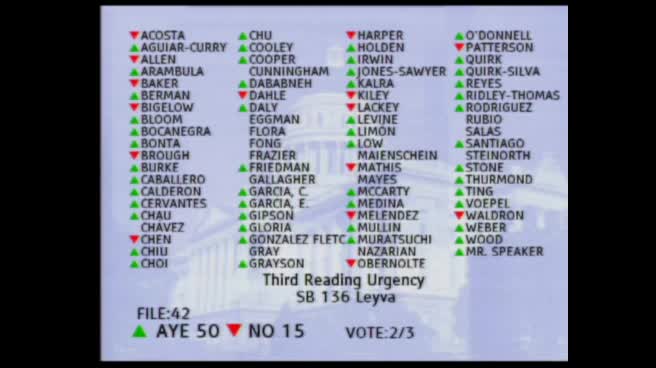
Bill Author



