AB 913: Construction-related accessibility claims: extremely high-frequency litigants.
- Session Year: 2017-2018
- House: Assembly
- Latest Version Date: 2017-02-16
Existing law provides that individuals with disabilities or medical conditions have the same right as the general public to the full and free use of the streets, highways, sidewalks, walkways, public buildings, medical facilities, public facilities, and other public places, and allows a person who is aggrieved or potentially aggrieved by a violation of specific provisions of law to bring an action to enjoin the violation. Existing law provides that an attorney or unrepresented party who presents a pleading, petition, or other similar paper to the court is certifying that specified conditions have been met, including, but not limited to, that the action is not being presented primarily for an improper purpose, such as to harass or to cause unnecessary delay.
This bill would authorize a court to enter a prefiling order prohibiting an extremely high-frequency litigant, as defined, from filing any new litigation in the courts of this state without first obtaining leave of the presiding justice or presiding judge of the court where the litigation is proposed to be filed. The bill would require the clerk of the court to provide the Judicial Council with a copy of all prefiling orders, and would require the Judicial Council to maintain and annually disseminate a record of extremely high-frequency litigants subject to those prefiling orders, as specified. The bill would also authorize a defendant in a construction-related disability action to move the court for an order requiring a plaintiff who is an extremely high-frequency litigant to furnish security or for an order dismissing the litigation on the ground that the plaintiff is an extremely high-frequency litigant subject to a prefiling order and the litigation was filed for an improper purpose.
(a)For purposes of this article, the following terms have the following meanings:
(1)Extremely high-frequency litigant means a plaintiff who has filed 15 or more complaints alleging a construction-related accessibility violation within the 12-month period immediately preceding the filing of the current complaint alleging a construction-related accessibility violation.
(2)Litigation means any construction-related accessibility claim, as defined in paragraph (1) of subdivision (a) of Section 55.52 of the Civil Code.
(b)In addition to any other relief provided in this section, the court may, on its own motion or the motion of any party, enter a prefiling order that prohibits an extremely high-frequency litigant from filing any new litigation in the courts of this state without first obtaining leave of the presiding justice or presiding judge of the court where the litigation is proposed to be filed. Disobedience of a prefiling order by an extremely high-frequency litigant may be punished as a contempt of court.
(c)A presiding justice or presiding judge shall only permit the filing of litigation by an extremely high-frequency litigant who is subject to a prefiling order if it appears that the litigation has merit and has not been filed for an improper purpose, such as to harass or to cause unnecessary delay or needless increase in the cost of litigation. A presiding justice or presiding judge may condition the filing of the litigation upon the furnishing of security for the benefit of the defendants.
(d)The clerk shall not accept for filing any litigation presented by an extremely high-frequency litigant subject to a prefiling order unless the extremely high-frequency litigant first obtains an order from the presiding justice or presiding judge permitting the filing. If the clerk mistakenly accepts the litigation without an order, any party may file with the clerk and serve, or the presiding justice or presiding judge may direct the clerk to file and serve, on the plaintiff and other parties a notice stating that the plaintiff is an extremely high-frequency litigant subject to a prefiling order as set forth in subdivision (b). The filing of the notice shall automatically stay the litigation. The litigation shall be automatically dismissed unless the plaintiff, within 10 days of the filing of the notice, obtains an order from the presiding justice or presiding judge permitting the filing of the litigation as set forth in subdivision (c). If the presiding justice or presiding judge issues an order permitting the filing, the stay of the litigation shall remain in effect, and the defendants need not plead, until 10 days after the defendants are served with a copy of the order.
(e)The presiding justice or presiding judge of a court may designate a justice or judge of the same court to act on his or her behalf in exercising the authority and responsibilities provided under subdivisions (b) to (d), inclusive.
(f)A court clerk shall provide to the Judicial Council a copy of all prefiling orders issued pursuant to subdivision (b). The Judicial Council shall maintain a record of extremely high-frequency litigants subject to prefiling orders and shall annually disseminate a list of those persons to the clerks of the courts of this state.
SEC. 2.Section 425.57 is added to the Code of Civil Procedure, to read:425.57.(a)A defendant may move the court, upon a noticed hearing, for an order dismissing litigation filed by an extremely high-frequency litigant or requiring the extremely high-frequency litigant to furnish security for the benefit of the defendant.
(b)If, after hearing evidence on the motion, the court determines that the plaintiff is an extremely high-frequency litigant, the court shall order the plaintiff to furnish, for the benefit of the moving defendant, security in an amount and within a time period determined by the court.
(c)If, after hearing evidence on the motion, the court determines that the plaintiff is an extremely high-frequency litigant, that the plaintiff is subject to a prefiling order, and that the litigation was filed for an improper purpose, such as to harass or to cause unnecessary delay, the court shall order the litigation dismissed.
|
Date
|
Status
|
|---|---|
| Feb 1, 2018 | From committee: Filed with the Chief Clerk pursuant to Joint Rule 56. |
| Jan 31, 2018 | Died pursuant to Art. IV, Sec. 10(c) of the Constitution. |
| Mar 28, 2017 | In committee: Set, first hearing. Failed passage. Reconsideration granted. |
| Mar 2, 2017 | Referred to Com. on JUD. |
| Feb 17, 2017 | From printer. May be heard in committee March 19. |
| Feb 16, 2017 | Read first time. To print. |
|
Date
|
Description
|
Location
|
Votes
|
|
|---|---|---|---|---|
| Mar 28, 2017 | Reconsideration. | Assembly Standing Committee on Judiciary |
Passed |
|
| Mar 28, 2017 | Do pass and be re-referred to the Committee on [Appropriations] | Assembly Standing Committee on Judiciary |
Failed |
This list shows positions taken on this bill by organizations on the date displayed, which is linked to the original source.
Positions by individuals are not included.
Date of Hearing: March 28, 2017
ASSEMBLY COMMITTEE ON JUDICIARY
Mark Stone, Chair
ABPCA Bill Id:AB 913 (
Author:Gray) – As Introduced Ver:February 16, 2017
SUBJECT: CONSTRUCTION-RELATED ACCESSIBILITY CLAIMS: EXTREMELY HIGH-FREQUENCY LITIGANTS
KEY ISSUES:
- SHOULD A COURT HAVE AUTHORITY TO ENTER A PREFILING ORDER THAT PROHIBITS A PLAINTIFF FROM ACCESS TO THE COURTS, A RIGHT PROTECTED BY THE STATE AND U.S. CONSTITUTION, WHENEVER THE PLAINTIFF HAS FILED 15 COMPLAINTS, ALTHOUGH HE OR SHE HAS NOT BEEN DECLARED A VEXATIOUS LITIGANT, THE COMPLAINTS MAY BE MERITORIOUS, AND FEDERAL CASE LAW ESTABLISHES A PRE-FILING ORDER IS AN “EXTREME REMEDY” THAT CANNOT BE ISSUED SOLELY BASED ON THE NUMBER OF COMPLAINTS FILED BY THE LITIGANT?
- WHAT EVIDENCE, IF ANY, SUPPORTS THE NEED FOR THIS BILL IN LIGHT OF DATA SHOWING THAT THE NUMBER OF COMPLAINTS ALLEGING CONSTRUCTION-RELATED ACCESSIBILITY CLAIMS FILED IN CALIFORNIA COURTS HAS DROPPED SIGNIFICANTLY IN THE PAST THREE YEARS SINCE THE RECENT ENACTMENT OF REFORMS THAT WERE INTENDED TO PROVIDE SIGNIFICANT RELIEF TO SMALL BUSINESSES ACCUSED OF THESE VIOLATIONS?
SYNOPSIS
The author characterizes this bill as an attempt to build on a model used by this Committee in its bill, AB 1521 (Committee on Judiciary), Chapter 755, Statutes of 2015, which imposed special pre-filing requirements on “high-frequency litigants” (HFLs)—plaintiffs who file more than 10 or more complaints in one year and attorneys who represent 10 or more high frequency litigant plaintiffs—and post-settlement reporting requirements on all attorneys who file construction-related accessibility claims. Despite the similarity in names—HFL in AB 1521 and EHFL in this bill—the bills have very little in common. AB 1521 provided additional information and legal resources to small business owners who may not realize how to minimize their liability for construction-related accessibility violations, or how to respond to a lawsuit filed against them. This bill, on the other hand, seeks to bar citizens who file 15 complaints alleging construction-related accessibility violations in 12 months (which is hardly “extreme” in comparison to the “10 or more” that are necessary under AB 1521 to be an HFL) from access to the courts without regard to the merits of their claims. For the reasons explained in the analysis, this bill is not only discriminatory and likely unconstitutional, but also premature.
The problem of obnoxious and overly litigious plaintiffs is not new, nor are they limited to plaintiffs pursuing construction-related accessibility claims. Courts currently have tools for dealing with such plaintiffs. In federal courts, the All Writs Act, 28 U.S.C. § 1651(a), provides district courts with the inherent power to enter pre-filing orders against vexatious litigants. (Weissman v. Quail Lodge Inc. (9th Cir. 1999) 179 F.3d 1194, 1197.) In California, courts have the authority to declare plaintiffs, after providing them with notice and an opportunity to be heard, to be “vexatious litigants,” require them to post security, and prohibit them from filing new claims without court permission. (CCP 391 et seq.)
Although these types of orders are authorized, they are only in the most extreme cases. According to the Ninth Circuit Court of Appeals, a pre-filing order “cannot issue merely upon a showing of litigiousness.” They cannot be issued without due process. Because the bill provides no “notice and an opportunity to be heard,” as required by federal courts, it would likely be held to violate a plaintiff’s constitutional right to due process of the law. In addition, the bill singles out a class of plaintiffs, who are entitled to special protections under state and federal law, and limits their right of access to the courts in a discriminatory way. It is unnecessary, given the fact that courts already have the tools to issue pre-filing orders—on a non-discriminatory basis—to vexatious litigants and to sanction unethical and improper conduct during litigation. In fact, recent data shows that the number of construction-related accessibility claims filed in STATE COURT has decreased dramatically in recent years, demonstrating the success of recent reform measures and showing that this bill is not needed. Finally, the bill would undermine recently enacted bipartisan disability access reform legislation that was the result of negotiated collaboration and compromise which provided pre-litigation relief to small businesses. The bill is supported by a number of business groups and opposed by many civil rights advocacy organizations, as well as the Consumer Attorneys of California.
SUMMARY: Imposes certain substantive and procedural burdens—including authority for the imposition of a prefiling order—on plaintiffs who file 15 or more construction-related accessibility claims in 12 months. Specifically, this bill:
- Defines an “Extremely high-frequency litigant” (EHFL) to mean a plaintiff who has filed 15 or more complaints alleging a construction-related accessibility violation within the 12-month period immediately preceding the filing of the current complaint alleging a construction-related accessibility violation.
- Authorizes a court, on its own motion or the motion of any party, to enter a prefiling order that prohibits an extremely high-frequency litigant from filing any new litigation in the courts of this state without first obtaining leave of the presiding justice or presiding judge of the court where the litigation is proposed to be filed and provides that disobedience of a prefiling order by an EHFL may be punished as a contempt of court.
- Prohibits a presiding justice or presiding judge from allowing an EHFL who is subject to a prefiling order to file a complaint unless it appears that the litigation has merit and has not been filed for an improper purpose, such as to harass or to cause unnecessary delay or needless increase in the cost of litigation.
- Prohibits a clerk from accepting for filing any litigation presented by an EHFL subject to a prefiling order, unless the extremely high-frequency litigant first obtains an order from the presiding justice or presiding judge permitting the filing.
- Requires any litigation by an EHFL subject to a prefiling order that is mistakenly accepted for filing by a clerk to be automatically dismissed unless the plaintiff, within 10 days of the filing of the notice, obtains an order from the presiding justice or presiding judge permitting the filing of the litigation as set forth in 4), above.
- Requires a court clerk to provide to the Judicial Council a copy of all prefiling orders issued pursuant to 2), above.
- Requires the Judicial Council to maintain a record of EHFLs subject to prefiling orders and annually disseminate a list of those persons to the clerks of the courts of this state.
- Allows a defendant to move the court, upon a noticed hearing, for an order dismissing litigation filed by an EHFL or requiring the EHFL to furnish security for the benefit of the defendant.
- Requires the court to order the plaintiff to furnish, for the benefit of the moving defendant, security in an amount and within a time period determined by the court if, after hearing evidence on the motion, the court determines that the plaintiff is an EHFL.
- Requires the court to order the litigation dismissed if, after hearing evidence on the motion, the court determines that the plaintiff is an EHFL who is subject to a prefiling order, and that the litigation was filed for an improper purpose, such as to harass or to cause unnecessary delay.
EXISTING LAW:
- Pursuant to federal law, under the Americans with Disabilities Act (ADA), provides that no individual shall be discriminated against on the basis of disability in the full and equal enjoyment of the goods, services, facilities, privileges, advantages, or accommodations of any place of public accommodation by any person who owns, leases, or leases to, or operates a place of public accommodation. (42 U.S.C. Section 12182.)
- Pursuant to the Unruh Civil Rights Act (Unruh), provides that all persons, regardless of sex, race, color, religion, ancestry, national origin, disability or medical condition, are entitled to the full and equal accommodations, advantages, facilities, privileges, or services in all business establishments of every kind; makes a violation of the ADA also constitutes a violation of Unruh; and subjects a person or entity in violation to actual damages incurred by an injured party, treble actual damages but not less than $4,000, and any attorney’s fees as the court may determine to be proper. (Civil Code Section 51 et seq. All further statutory references are to the California Civil Code, unless otherwise indicated.)
- Provides, pursuant to the Disabled Persons Act, that individuals with disabilities or medical conditions have the same right as the general public to the full and free use of the streets, highways, sidewalks, walkways, public buildings, medical facilities, including hospitals, clinics and physicians’ offices, public facilities and other public places, and also provides that a violation of an individual’s rights under the ADA constitutes a violation of state law. (Section 54.)
- Provides that individuals with disabilities shall be entitled to full and equal access to public accommodations, subject only to the conditions and limitations established by law, or state or federal regulation, and applicable alike to all persons. (Section 54.1.)
- Defines a "high-frequency litigant" (HFL) as a plaintiff who has filed 10 or more complaints alleging violations of construction-related accessibility standards in the past 12 months; or an attorney who has represented 10 or more such plaintiffs in the past year. (Code of Civil Procedure (CCP) Section 425.55 (b).)
- Requires an HFL to pay a supplemental filing fee of one thousand dollars ($1,000) and imposes the following pleading requirements on HFLs who file new claims:
- Whether the complaint is filed by, or on behalf of, an HFL.
- If the HFL is a plaintiff, the number of complaints filed by the plaintiff in the past 12 months.
- If the HFL is a plaintiff, the reason why the HFL was in the geographic area of the defendant’s business.
- If the HFL is a plaintiff, the reason why the individual desired to access the defendant’s business, including the specific commercial, business, personal, social, leisure, recreational, or other purpose. (CCP Sections 425.50 (a), 425.50 (b); Gov. Code Section 70616.5.)
- Allows a court, after notice and a reasonable opportunity to respond, to determine whether the requirements of 6), above, have been violated and, if so, impose sanctions. (CCP Section 425.50 (d).)
- Requires an attorney who sends or serves a complaint alleging a construction-related accessibility violation to do both of the following:
- Send a copy of the complaint to the California Commission on Disability Access (CCDA) within five business days of sending or serving the complaint.
- Notify the CCDA about how the claim is resolved, including whether the violations were remedied and whether the defendant applied for an early evaluation conference and stay. (Civil Code Section 55.32 (b).)
- Entitles any business that is served with a complaint by an HFL to obtain a stay of the proceedings and an early evaluation conference. (Civil Code Section 55.54 (b)(2)(D).)
- Allows a court to declare an unrepresented litigant, after providing notice and a hearing, to be a vexatious litigant, require them to post security, and prohibit them from filing new claims without court permission, including in a case where the litigant “repeatedly files unmeritorious motions, pleadings, or other papers, conducts unnecessary discovery, or engages in other tactics that are frivolous or solely intended to cause unnecessary delay.” (CCP Section 391 et seq.)
FISCAL EFFECT: As currently in print this bill is keyed fiscal.
COMMENTS: The author characterizes this bill as an attempt to build on a model used by this Committee in its bill, AB 1521 (Committee on Judiciary), Chapter 755, Statutes of 2015, which imposed special pre-filing requirements on “high-frequency litigants” (HFLs)—plaintiffs who file more than 10 or more complaints in one year and attorneys who represent 10 or more high frequency litigant plaintiffs—and post-settlement reporting requirements on all attorneys who file construction-related accessibility claims. Describing the purpose for this bill, the author writes the following:
AB 913 builds off of the approach taken with AB 1521 to target the excessive number of lawsuits filed by a relatively small group of plaintiffs which account for nearly half of all claims in the state.
The bill defines an extremely high-frequency litigant as a plaintiff who has filed 15 or more ADA lawsuits in the prior 12 months and provides that a court may impose a prefiling order to prohibit extremely high-frequency litigants from filing new ADA lawsuits without the court first determining that the new litigation has merit and has not been filed to harass the defendant.
Despite the similarity in names—HFL in AB 1521 and EHFL in this bill—the bills have very little in common. AB 1521 provided additional information and legal resources to small business owners who may not realize how to minimize their liability for construction-related accessibility violations, or how to respond to a lawsuit filed against them. Among other things, AB 1521 therefore required the Judicial Council to develop a new answer form, allowing business owners to respond to lawsuits and, where necessary or appropriate, to do so without hiring an attorney and additional notices to inform defendant businesses about ways to avoid liability for damages by correcting technical violations on their premises.
Most relevant to this bill, AB 1521 also limited the practice of high-volume lawsuits motivated by quick settlement with business owners, rather than correction of ADA violations, by enacting special procedural requirements—including payment of a $1,000 filing fee--and post-settlement reporting requirements on HFLs. AB 1521 requires an HFL who files a new claim to do the following, in addition to paying the higher filing fee: (1) comply with special pleading requirements, including an explanation of why he or she was on the premises of the accommodation; (2) certify that, among other things, the complaint is not being presented primarily for an improper purpose, such as to harass or to cause unnecessary delay or needless increase in the cost of litigation; (3) provide a notice and answer form to the defendant upon service of the complaint; and (4) meet the defendant, upon the defendant’s request, at the site of the accommodation to jointly inspect the premises, and review any programmatic or policy issues, that are claimed to constitute a violation of a construction-related accessibility standard. All of these provisions in AB 1521 were intended to deter lawsuits by HFLs; inform unsophisticated owners about their legal rights and responsibilities; and assist those business owners take self-help measures to limit their liability for violations.
This bill, on the other hand, seeks to bar citizens who file 15 complaints alleging construction-related accessibility violations in 12 months (which is hardly “extreme” in comparison to the “10 or more” that are necessary under AB 1521 to be an HFL) from access to the courts without regard to the merits of their claims. For the reasons explained below, this bill is not only discriminatory and likely unconstitutional, but also premature.
Vexatious litigants and the “extreme remedy” of a pre-filing order. The problem of obnoxious and overly litigious plaintiffs is not new, nor are they limited to plaintiffs pursing construction-related accessibility claims. Courts currently have tools for dealing with such plaintiffs. In federal courts, the All Writs Act, 28 U.S.C. § 1651(a), provides district courts with the inherent power to enter pre-filing orders against vexatious litigants. (Weissman v. Quail Lodge Inc. (9th Cir. 1999) 179 F.3d 1194, 1197.) In California, courts have the authority to declare plaintiffs, after providing them with notice and an opportunity to be heard, to be “vexatious litigants,” require them to post security, and prohibit them from filing new claims without court permission. (CCP 391 et seq.)
Although these types of orders are authorized, they are only in the most extreme cases. According to the Ninth Circuit, the ultimate substantive issue in resolving a motion for a prefiling order is "whether a litigant who has a history of vexatious litigation is likely to continue to abuse the judicial process and harass other parties." (Molski v. Evergreen Dynasty Corp. (9th Cir. 2007) 500 F.3d 1047, 1058.)
For example, the district court in In re Hartford Textile Corp. (2d Cir. 1982) 681 F.2d 895, 897, cert. denied, (1983) 459 U.S. 1206, issued such a pre-filing order because of what the appellate court described as the plaintiff’s “unparalleled history of frivolous and repetitious claims, motions, petitions, demands, and appeals” that arose out of her claim for $80,000 in sales commissions allegedly owed to her deceased husband. (Id. at p. 896.) She made at least twenty-five motions, most of which were meritless and repetitious, filed an appeal of her motion to disqualify the bankruptcy judge, which was denied, and then “more than doubled her previous output of meritless, frivolous filings,” necessitating 23 en banc orders from the appellate court and 23 meritless petitions to the U.S. Supreme Court. (Id. at p. 896.) The appellate court finally warned the plaintiff and her attorney, after the resolution of “more than a hundred” frivolous motions, petitions, demands, and appeals—every single one of which had been found to be completely and utterly without merit—that “further frivolous, vexatious, or repetitious motions might result in the issuance of injunctive restraint.” (Ibid.) It was only after reviewing all of those frivolous claims that plaintiff was finally subject to a pre-filing order. (Ibid.) As the Hartford case demonstrates, the number of lawsuits and claims filed by a litigant is only one factor for a court to consider, which turns out to be far less important than his or her conduct during the pendency of her claim.
Molski v. Evergreen Dynasty Corp. addressed the overly litigious conduct of a plaintiff and attorney who were truly high frequency litigants. In that case, Molski and his attorney filed approximately 400 lawsuits in the federal courts within the districts in California. (Molski v. Evergreen Dynasty Corp., supra, 500 F.3d at p. 1051.) But more significant than the extremely high number of lawsuits filed, according to the appellate court, was the fact that Molski fabricated evidence and his attorney committed numerous ethical violations in trying to extract settlements from the businesses he sued. The Ninth Circuit upheld the pre-filing order, finding that it was reasonable, “In light of the district court's finding that Molski did not suffer the injuries he claimed . . . to conclude that the large number of complaints filed by Molski containing false or exaggerated allegations of injury were vexatious” and that a pre-filing requirement could therefore be issued. (Id. at p. 1059.) The Ninth Circuit focused on the importance of trial courts engaging in close fact-based examinations of the facts of the case, and considering the specific conduct of the plaintiff, prior to issuing such an order:
[P]re-filing orders are an extreme remedy that should be narrowly tailored and rarely used” that courts “should not enter . . . with undue haste because such sanctions can tread on a litigant's due process right of access to the courts. A court should enter a pre-filing order constraining a litigant's scope of actions in future cases only after a cautious review of the pertinent circumstances [emphasis added]. (Id. at p. 1057.)
Pre-filing orders cannot be justified by the number of lawsuits filed by a plaintiff. According to the Ninth Circuit Court of Appeals, a pre-filing order “cannot issue merely upon a showing of litigiousness. The plaintiff's claims must not only be numerous, but also be patently without merit." (Moy v. United States (9th Cir. 1990) 906 F.2d 467, 470.) As the appellate court observed, “Because the right to access the courts implicates due process and First Amendment rights, courts have been exceedingly reluctant to restrict such access.” (Moy, supra, at p. 470.)
[T]he purpose and effect of the order is to pass a special rule directed specifically to appellant himself. Among all other citizens, he is to be restricted in his right of access to the courts. As far as he is concerned, his future filings run the risk of delay and even possible rejection before he can call upon defendants to respond to those filings. He will not even be permitted to enter the lists until a judicial officer gives him permission. That would, under the order before us, apply to any action he chooses to file. We cannot predict what harm might come to him as a result, and he should not be forced to predict it either. What he does know is that a Sword of Damocles hangs over his hopes for federal access for the foreseeable future. (Moy v. United States (9th Cir. 1990) 906 F.2d 467, 470.)
This bill proposes, contrary to the principles discussed by the federal appellate courts, above, to authorize issuance of a pre-filing order solely based on the number of complaints filed by the plaintiff in one year, rather than being based upon the litigious conduct of the plaintiff, or the frivolousness of the plaintiff’s case. The Merriam-Webster Dictionary defines “frivolous” as “of little weight or importance,” or “having no sound basis (as in fact or law) <a frivolous lawsuit>.” In other words, a lawsuit alleging a violation of a construction-related accessibility claim would only be “frivolous” if it had no basis in the law (i.e. it did not state an actual violation). The 15 complaints filed by a plaintiff who would be subject to this bill certainly could be meritorious. Under this bill’s theory, a lawsuit that stated a violation of the law, and a violation of the state’s anti-discrimination laws in the Unruh and Disabled Persons Act, would still be subject to a pre-filing order. For example, the author states the following to justify the need for the bill:
The bill’s provisions authorize a higher level of scrutiny for plaintiffs who routinely file excessive ADA lawsuits without infringing on the rights of businesses owners or those protected under the provisions of the ADA or California’s Unruh Civil Rights Act.
Clearly, the author focuses only on the number of lawsuits—arbitrarily determining that 15 lawsuits are “excessive”—rather on the merits of those claims. Furthermore, assuming that the claims have merit and the business owners are in violation of the law, such business owners do not have a legal “right” to be protected from liability for those violations. Instead, they should be encouraged to come into compliance with the more than 25-year old Americans with Disability Act. This bill’s approach to authorizing pre-filing orders is completely out of line with the federal court decisions, above, that require not only that cases are frivolous, but also that the plaintiff’s conduct is outrageous because of its intent to harass or waste court resources.
In order to protect a litigant’s constitutional rights, due process, including a hearing, is necessary before a pre-filing order may be issued. According to the Ninth Circuit Court of Appeals, a hearing and opportunity for the plaintiff to be heard is a key component for issuance of a valid pre-filing order to be upheld on appeal. According to the Molski court, “(1) notice and an opportunity to be heard and (2) the creation of an adequate record, are procedural considerations--that is, the factors define "[a] specific method or course of action" that district courts should use to assess whether to declare a party a vexatious litigant and enter a pre-filing order. Black's Law Dictionary 1241 (8th ed. 2004).” (Molski v. Evergreen Dynasty Corp., supra, 500 F.3d at pp. 1057-1058.)
This bill does not require a court to hold a hearing prior to issuing a pre-filing order and provides no mechanism for the plaintiff to challenge the issuance of a pre-filing order. In fact, the only hearing that is provided under the provisions of the bill is for a defendant to “move the court, upon a noticed hearing, for an order dismissing litigation filed by an extremely high-frequency litigant to furnish security for the benefit of the defendant.” (Page 3, at line 30-33.) Because the bill provides no “notice and an opportunity to be heard,” as required by Molski¸ it would likely be held to violate a plaintiff’s constitutional right to due process of the law.
The bill singles out a class of plaintiffs, who are entitled to special protections under state and federal law, and limits their right of access to the courts. The Americans with Disabilities Act (ADA) provides that no individual shall be discriminated against on the basis of disability in the full and equal enjoyment of the goods, services, facilities, privileges, advantages, or accommodations of any place of public accommodation by any person who owns, leases, or leases to, or operates a place of public accommodation. (42 U.S.C. Section 12182.) A violation of the ADA constitutes a violation of both the Unruh Act and the Disabled Persons Act under state law. (Sections 51 et seq. and 54 et seq.) Congress and the Legislature has identified this group as being particularly vulnerable to discrimination, and therefore granted them special protections under the law.
This bill actually discriminates against this protected class by subjecting them to unique restrictions on their ability to access the courts. This bill proposes that, unlike all other plaintiffs, they would be prohibited from filing more than 15 claims for violations of their legally protected right to access public buildings and other public accommodations, regardless of the merit of those claims. The author may argue that this bill is no different than AB 1521, which imposed special pleading requirements and a higher filing fee on plaintiffs who file ten or more construction-related accessibility violations in one year, but it is a far different matter to ask those plaintiffs to provide additional information when they file their complaint than to prohibit them from filing a complaint altogether. Furthermore, the higher filing fee in AB 1521, like other filing fees, can be waived for low-income plaintiffs. This bill has an incomparably greater impact on the rights of disabled persons who may have perfectly valid claims that their rights have been violated.
This bill is unnecessary, given the fact that courts already have the tools to issue pre-filing orders—on a non-discriminatory basis—to vexatious litigants and to sanction unethical and improper conduct during litigation. As discussed above, courts in California already have the authority to declare plaintiffs, after providing them with notice and an opportunity to be heard, to be “vexatious litigants,” require them to post security, and prohibit them from filing new claims without court permission. (CCP 391 et seq.) A court can also issue an injunction—to stop a party from engaging in certain conduct-- for a number of reasons, including “Where the restraint is necessary to prevent a multiplicity of judicial proceedings.” (CCP Sections 525, 526 (a)(6).) Furthermore, a trial court may order a party, the party’s attorney, or both to pay the reasonable expenses, including attorney’s fees, incurred by another party as a result of bad-faith actions or tactics that are frivolous or solely intended to cause unnecessary delay. (CCP Section 128.1 (a).) Finally, a trial court may, after notice and a reasonable opportunity to respond, impose an appropriate sanction upon the attorneys, law firms, or parties for a number of types of improper conduct, including for presenting a claim “primarily for an improper purpose, such as to harass or to cause unnecessary delay or needless increase in the cost of litigation” or when the “claims, defenses, and other legal contentions therein are warranted by existing law or by a nonfrivolous argument for the extension, modification, or reversal of existing law or the establishment of new law.” (CCP 128.7 (b).) There is no reason to believe that courts find these existing tools to be inadequate, or that a mechanism to prevent certain classes of plaintiffs from filing potentially meritorious claims is appropriate.
Recent data shows that the number of construction-related accessibility claims filed in STATE COURT has decreased dramatically in recent years, demonstrating the success of recent reform measures and showing that this bill is not needed. According to the 2016 report of the California Commission on Disability Access (CCDA), only 839 complaints alleging violations of construction-related accessibility claims were filed in California state courts and transmitted to the CCDA in 2016. That number is a dramatic decrease from 2013 (1,950 complaints), 2014 (1,412 complaints), and 2015 (1,240). The author does not cite these declines and, instead, mentions that the total number of claims that were filed in state and federal courts increased since 2015 as evidence that recent legislative reforms have been ineffective or inadequate. In fact, the opposite is true. The recent dramatic decline in state filings and increase in federal filings means that the recent changes to state law have motivated plaintiffs to stop filing claims in state courts. Naturally, California cannot impact the number of claims filed in federal courts and should stop listening to the siren call to “do more” and enact more reforms, which ultimately undermine the rights of disabled consumers, because if the calls are based on the false premise that claims are increasing in the state, or representing increases in federal claims as something that can be addressed by state law, then those calls will never end and the callers will never be satisfied. At some point—apparently now, based upon the most recent data from CCDA—enough [ADA “reform”] is enough.
The bill would undermine recently enacted bipartisan disability access reform legislation that was the result of negotiated collaboration and compromise which provided pre-litigation relief to small businesses. Just last session, the Legislature repeatedly grappled with the very difficult, controversial, and vexing problem of small businesses being sued for violating the more than 25 year-old Americans with Disability Act, which is enforced in California by private civil action pursuant to the state’s Unruh Civil Rights Act (Section 51 et seq.) and the Disabled Persons Act (Section 54 et seq.).
This Committee’s analysis of SB 269 (Roth), Chapter 13, Statutes of 2016, for example, described the problem as follows:
There has been widespread media coverage about the problem of what has been described as "serial ADA litigation." For example, last summer, the Modesto Bee and the Merced Sun-Star reported a series of articles, describing “how the Americans with Disabilities Act has been misused to create profit centers for opportunistic lawyers. These attorneys recruit people – some with minor disabilities, some with criminal records, some here illegally – to visit small businesses in hopes of spotting the most minute ADA violations. The lawyers then demand $4,000 for each violation.”
It is certainly true that a handful of highly litigious plaintiffs have targeted small businesses, especially those without the financial resources and sophistication to challenge such lawsuits on their merits. According to data compiled by the California Commission on Disability Access, more than half (54 percent) of the construction-related accessibility complaints filed between 2012 and 2014 were filed by two law firms; and 46 percent of all complaints were filed by just 14 parties. These figures indicate that the vast majority of all construction-related accessibility claims filed in this state are initiated by a very small number of plaintiffs (and their attorneys).
Because of the insupportable conduct of a very small number of unethical attorneys and plaintiffs, small business owners were justifiably fearful and angry about being sued. At the same time, disabled consumers were unfairly viewed with blame or suspicion, even though they have a right to full and equal access, should be able to access all public accommodations, just want to go about their daily lives without difficulty, discomfort, or embarrassment, and with the basic dignity that comes from being able to go to the same places and have the same access to services as non-disabled persons. The vast majority would only resort to the extreme measure of filing a lawsuit in response to the most egregious, humiliating, and pervasive violations of their rights. While sympathetic to the pleas for relief from small businesses, it would have been unfair for policymakers to assume that disabled persons were somehow trying to “game the system” or take advantage of small businesses when expecting compliance with the ADA.
After analyzing and hearing many measures that attempted to address the concerns on both sides of this difficult issue, the Legislature focused on three core issues upon which there was general consensus: (1) prospective tenants and lessors of commercial property who intend to operate that property as a public accommodation need to have more information about whether the property complies with construction-related accessibility standards and how to bring the property into compliance with those standards. Owners of those properties should generally be responsible for any violations that exist when the property is leased or rented, as well as in parking lots and common areas of the property, unless the parties agree otherwise; (2) operators of public accommodations should be able to correct minor and technical violations on their property without being liable for minimum statutory damages and should be able to correct violations on their property, with protection from liability during that correction period, after obtaining a CASp inspection of the premises; and (3) the very small number of plaintiffs and attorneys who make a business practice of filing construction-related accessibility claims in an effort to obtain quick settlements from unsophisticated business owners, rather than correcting the violations, should be deterred from those practices. As a result, the Legislature approved three bills that enacted major reforms to this area of the law: AB 1521 (Committee on Judiciary), AB SB 269 (Roth), and 2093 (Steinorth).
AB 1521 (Committee on Judiciary), Chapter 755, Statutes of 2015, as described above, provided additional information and legal resources to small business owners who may not realize how to minimize their liability for ADA violations or respond to a lawsuit filed against them. It also limited the practice of high-volume lawsuits motivated by quick settlement with business owners, rather than correction of ADA violations.
SB 269 (Roth), Chapter 13, Statutes of 2016, approved the following year, was the product of extended and careful consideration by policymakers; input from civil rights advocates and members of the disability community; and support from both Consumer Attorneys of California and the Civil Justice Association of California, as well as business organizations, such as the California Chamber of Commerce, California Business Properties Association, and Southwest California Legislative Council.
SB 269 enacted several reforms to increase ADA compliance by and financial security to small businesses. Specifically, in one of its most significant provision, SB 269 protects a business with 50 or fewer employees from liability for minimum statutory damages in a construction-related accessibility claim for the 120-day period after the business has obtained an inspection of its premises by a CASp, allowing the business to identify and correct violations during that period. SB 269 also established a presumption that certain “technical violations” of construction-related accessibility standards (such as faded paint on parking spaces or missing signage) do not constitute grounds for a complaint under Unruh or the DPA as long as those violations are corrected within 15 days of the business owner being notified about them.
AB 2093 (Steinorth), Chapter 379, Statutes of 2016, requires a commercial property owner to state on every lease form or rental agreement executed after January 1, 2017, whether or not the property being leased has undergone inspection by a CASp, and would have required a commercial property owner to provide additional information to the tenant or lessor about the condition of the rented or leased property.
Some provisions of AB 1521 took effect in October of 2015, while others took effect in January and even July of 2016. SB 269 took effect in May of 2016, but some of its provisions did not become effective until January 1, 2017. AB 2093 only took effect in January of 2017. Because of the recent implementation of these measures, there is insufficient data about their impact. Thus, it certainly seems reasonable for the Legislature to wait and see what effect these recent reforms have had on construction-related accessibility claims before approving additional changes to the law that could inadvertently undermine those efforts. Furthermore, as discussed above, the most recent data available about the frequency of construction-related accessibility claims in California from CCDA indicate that far fewer such claims are now being filed in California, indicating the success of either these measures, or the past measures discussed below.
ARGUMENTS IN SUPPORT: Supporters assert, perhaps referring to claims filed in federal court, that the bill is necessary to address a recent increase in construction-related accessibility claims and that it appropriately balances the “rights” of businesses and plaintiffs. For example, the California Association of Joint Powers Authorities writes that “CAJPA appreciates the attention you are bringing to this problem, as public entities have seen a recent and growing trend in high dollar construction disability access lawsuits over recent years.” Although AB 913 only applies to plaintiffs and not attorneys, the California Chamber of Commerce and the California Bankers Association write that “AB 913 seeks to target this small group of trial attorneys by allowing any party, or the court, to issue a prefiling order against an extremely high frequency litigant to preclude that litigant from pursuing additional claims for alleged construction-related accessibility violations without approval of the court.” And the California Association of Realtors argues that “the bill balances protecting access to the courts for bona fide plaintiffs while addressing the problem of ‘professional plaintiffs’ whose claims are often of dubious merit.”
ARGUMENTS IN OPPOSITION: Virtually all of the groups in opposition assert that the bill violates fundamental rights of a protected class of individuals (the disabled) and is unconstitutional for a number of reasons. For example, Disability Rights California writes, “AB 913 violates guarantees of due process of law and the right of access to the courts assured by the state and federal Constitutions. . . . AB 913 treats people with disabilities who are enforcing their rights as a “suspect class” and actually limits their access to the courts. It requires a judge to make a pre-filing determination on whether the case has merit based on nothing but the amount of times someone has filed a lawsuit to enforce their rights.” Likewise, according to the ACLU, “No compelling governmental purpose is served – and much less are the means narrowly tailored to any governmental interest – by AB 913, which singles out people with disabilities for special hurdles to vindicate their civil right of access to places of public accommodation simply on the ground that they have previously had recourse to the courts to vindicate their rights on prior occasions.” Californians for Disability Rights agrees with these interpretations of the bill and urges the members of the Committee to “join us in rejecting AB 913 and other legislation that seeks to paint any community or person with an unfair tint of wrongdoing for enforcing state and federal civil rights laws.” Finally, the Consumer Attorneys of California write that “AB 913 is an unnecessary expansion of a bill that went into effect less than six months ago.”
PRIOR OR PENDING SIMILAR LEGISLATION (OTHER THAN LEGISLATION DISCUSSED ABOVE):
Related Pending Legislation. AB 1569 (Caballero), as introduced, would require current or prospective tenants requesting disability-related reasonable accommodations to keep an animal on the real property to be subjected to third party evaluation and verification, at the request of the landlord or person renting out the property.
Related previous legislation. SB 1608 (Corbett and Harman), Chapter 549, Statutes of 2008, enacted several reforms to increase voluntary compliance with state and federal laws requiring access to the disabled in any place of public accommodation. It established incentives for compliance and protection from litigation by responsible businesses, including a process by which businesses, if sued for violation of accessibility standards, could obtain a temporary stay of any litigation along with an in-person early evaluation conference with the court, attended by persons with authority to resolve the dispute between the parties.
SB 1186 (Steinberg), Chapter 383, Statutes of 2012, enacted a number of provisions that were intended to increase compliance with the ADA and protect small business owners, including the following: prohibit attorneys issuing to a building owner or tenant a "demand for money" alleging construction-related accessibility violations as the basis of one or more construction-related accessibility claims; require a commercial property owner to state on the lease form or rental agreement whether property being leased or rented has been inspected by a Certified Access Specialist (CASp); and adds to the responsibilities of the Commission on Disability Access to review legislative measures and recommendations to promote disability access and reduce litigation.
AB 1230 (Gomez), Chapter 787, Statutes of 2015, establishes the California Americans With Disabilities Act Small Business Capital Access Loan Program within the California Capital Access Loan Program in order to create a self-sustaining program to provide loans to assist small businesses in financing the costs of projects that alter or retrofit existing small business facilities according to certain criteria, to comply with the ADA.
REGISTERED SUPPORT / OPPOSITION:
Support
California Apartment Association
California Association of Joint Powers Authorities
California Association of Realtors
California Bankers Association
California Building Industry Association
California Chamber of Commerce
California Grocers Association
Civil Justice Association of California
Opposition
American Civil Liberties Union of California
Consumer Attorneys of California
Californians for Disability Rights
Disability Rights California
Analysis Prepared by: Alison Merrilees / JUD. / (916) 319-2334
Discussed in Hearing
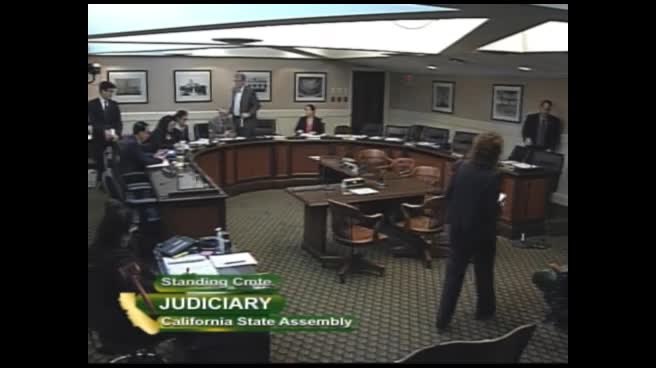 36MIN
Assembly Standing Committee on Judiciary
Bill Author

Bill Co-Author(s):