AB 939: Local government: taxicab transportation services.
- Session Year: 2017-2018
- House: Assembly
- Latest Version Date: 2018-09-18
(1)Existing law, commencing on January 1, 2019, requires every city or county in which a taxicab is substantially located to adopt an ordinance or resolution in regard to taxicab transportation service and requires each city or county to provide for a policy for entry into the business of providing taxicab transportation service, the establishment or registration of rates for the provision of taxicab transportation service, and a mandatory controlled substance and alcohol testing certification program for drivers. Existing law similarly authorizes the City and County of San Francisco, regardless of whether or not a taxicab company is substantially located within that city and county. Existing law prohibits a city or county from requiring a taxicab company or driver to comply with specified local regulations, unless that taxicab company or driver is substantially located within that city or county. Existing law prohibits a taxicab company or a taxicab driver from operating within a county unless the company and driver are substantially located in at least one city within that county or the unincorporated area of that county. Existing law authorizes a permitted taxicab company to arrange prearranged trips anywhere within the county in which it has obtained a permit.
This bill would, instead, require each city or county in which a taxicab company is substantially located to adopt an ordinance or resolution in regards to taxicab transportation service, that includes provisions for a permitting program for taxicab drivers, and would provide that it is unlawful to operate a taxicab company without a valid permit to operate issued by each city or county in which the taxicab company is substantially located. The bill would remove the prohibition on a taxicab company or a taxicab driver from operating within a county unless the company and driver are substantially located in at least one city within that county or the unincorporated area of that county. The bill would authorize a taxicab company permitted by a city or a county to arrange prearranged trips anywhere within that county. The bill would define permitted taxicab company for these purposes to mean a taxicab service provider that obtains all necessary permits required by these provisions, and to include a taxicab driver if a taxicab company consists of only one driver.
(2)Existing law requires a permitted taxicab company to comply with certain requirements, including that it be subject to an annual inspection by the Bureau of Automotive Repair.
This bill would, instead, require a permitted taxicab company to be subject to an annual inspection by the city or county in which it is substantially located, at a facility that is certified by the National Institute for Automotive Service Excellence or a facility registered with the Bureau of Automotive Repair.
(3)Existing law deems a city or county in which a taxicab company operates as a city or county in which a taxicab company driver is substantially located if the city or county enacts a resolution of intention to enter into a joint exercise of powers agreement or join a joint powers authority, or to enter into an agreement with a transit agency, for the purpose of regulating or administering taxicab companies.
This bill would, instead, authorize a city or county to enter into an agreement with another city or county to form a joint powers authority, or to enter into an agreement with a transit agency, for the purpose of regulating or administering taxicab companies and taxicab drivers, as applicable, that are substantially located within the jurisdictional boundaries of that entity.
(4)Existing law defines the term substantially located for these purposes to mean that the taxicab company has a primary business address within that jurisdiction, or that trips originating within that jurisdiction account for the largest share of the companys total number of trips within the county within the past year, and determined every 5 years thereafter. Existing law requires a taxicab company to collect specified data in order to determine what jurisdiction that company is substantially located in.
This bill would modify the test to specify that a taxicab company is substantially located within a city or county if that company has a primary business address within the jurisdiction of that entity, or if the total number of prearranged and nonprearranged trips that originate within that citys or countys jurisdiction account for the largest share of the taxicab companys total number of trips within each county where the taxicab company operated over the previous calendar year, as determined annually. The bill would establish a modified test for a taxicab company that initiates taxicab operations after January 1, 2019, in a county in which that company had not previously operated, by providing that for the first year of its operation the taxicab company is substantially located only in the jurisdiction in which it has a primary business address, and from that point forward would provide that the general substantially located test described above applies to determine whether the taxicab company is substantially located in a jurisdiction. The bill would make conforming changes to that effect.
The bill would require a taxicab company that changes from being substantially located in one city or county to another to notify the new city or county 6 months before making that change.
(5)By imposing additional duties on local governments, this bill would impose a state-mandated local program.
(6)The California Constitution requires the state to reimburse local agencies and school districts for certain costs mandated by the state. Statutory provisions establish procedures for making that reimbursement.
This bill would provide that no reimbursement is required by this act for a specified reason.
(1)Existing law, commencing on January 1, 2019, requires every city or county in which a taxicab is substantially located to adopt an ordinance or resolution in regard to taxicab transportation service and requires each city or county to provide for a policy for entry into the business of providing taxicab transportation service, the establishment or registration of rates for the provision of taxicab transportation service, and a mandatory controlled substance and alcohol testing certification program for drivers. Existing law similarly authorizes the City and County of San Francisco, regardless of whether or not a taxicab company is substantially located within that city and county. Existing law prohibits a city or county from requiring a taxicab company or driver to comply with specified local regulations, unless that taxicab company or driver is substantially located within that city or county. Existing law prohibits a taxicab company or a taxicab driver from operating within a county unless the company and driver are substantially located in at least one city within that county or the unincorporated area of that county. Existing law authorizes a permitted taxicab company to arrange prearranged trips anywhere within the county in which it has obtained a permit.
This bill would, instead, require each city or county in which a taxicab company is substantially located to adopt an ordinance or resolution in regards to taxicab transportation service, that includes provisions for a permitting program for taxicab drivers, and would provide that it is unlawful to operate a taxicab company without a valid permit to operate issued by each city or county in which the taxicab company is substantially located. The bill would remove the prohibition on a taxicab company or a taxicab driver from operating within a county unless the company and driver are substantially located in at least one city within that county or the unincorporated area of that county. The bill would authorize a taxicab company permitted by a city or a county to arrange prearranged trips anywhere within that county. The bill would define taxicab permitted taxicab company for these purposes to mean a taxicab service provider that obtains all necessary permits required by these provisions, and to include a taxicab driver if a taxicab company consists of only one driver.
(2)Existing law requires a permitted taxicab company to comply with certain requirements, including that it be subject to an annual inspection by the Bureau of Automotive Repair.
This bill would, instead, require a permitted taxicab company to be subject to an annual inspection by the city or county in which it is substantially located, at a facility that is certified by the National Institute for Automotive Service Excellence or a facility registered with the Bureau of Automotive Repair.
(3)Existing law deems a city or county in which a taxicab company operates as a city or county in which a taxicab company driver is substantially located if the city or county enacts a resolution of intention to enter into a joint exercise of powers agreement or join a joint powers authority, or to enter into an agreement with a transit agency, for the purpose of regulating or administering taxicab companies.
This bill would, instead, authorize a city or county to enter into an agreement with another city or county to form a joint powers authority, or to enter into an agreement with a transit agency, for the purpose of regulating or administering taxicab companies and taxicab drivers, as applicable, that are substantially located within the jurisdictional boundaries of that entity.
(4)Existing law defines the term substantially located for these purposes to mean that the taxicab company has a primary business address within that jurisdiction, or that trips originating within that jurisdiction account for the largest share of the companys total number of trips within the county within the past year, and determined every 5 years thereafter. Existing law requires a taxicab company to collect specified data in order to determine what jurisdiction that company is substantially located in.
This bill would modify the test to specify that a taxicab company is substantially located within a city or county if that company has a primary business address within the jurisdiction of that entity, or if the total number of prearranged and nonprearranged trips that originate within that citys or countys jurisdiction account for the largest share of the taxicab companys total number of trips within each county where the taxicab company operated over the previous calendar year, as determined annually. The bill would establish a modified test for a taxicab company that initiates taxicab operations after January 1, 2019, in a county in which that company had not previously operated, by providing that for the first year of its operation the taxicab company is substantially located only in the jurisdiction in which it has a primary business address, and from that point forward would establish a modified process to determine whether the taxicab company is substantially located in a jurisdiction that is similar to the process described above. provide that the general substantially located test described above applies to determine whether the taxicab company is substantially located in a jurisdiction. The bill would make conforming changes to that effect.
The bill would require a taxicab company that changes from being substantially located in one city or county to another to notify the new city or county 6 months before making that change.
(5)By imposing additional duties on local governments, this bill would impose a state-mandated local program.
(6)The California Constitution requires the state to reimburse local agencies and school districts for certain costs mandated by the state. Statutory provisions establish procedures for making that reimbursement.
This bill would provide that no reimbursement is required by this act for a specified reason.
(1)Existing law, commencing on January 1, 2019, requires every city or county in which a taxicab is substantially located to adopt an ordinance or resolution in regard to taxicab transportation service and requires each city or county to provide for a policy for entry into the business of providing taxicab transportation service, the establishment or registration of rates for the provision of taxicab transportation service, and a mandatory controlled substance and alcohol testing certification program for drivers. Existing law similarly authorizes the City and County of San Francisco, regardless of whether or not a taxicab company is substantially located within that city and county. Existing law prohibits a city or county from requiring a taxicab company or driver to comply with specified local regulations, unless that taxicab company or driver is substantially located within that city or county. Existing law makes it unlawful to operate a taxicab without a valid permit to operate issued by each jurisdiction in which the taxicab company or driver is substantially located. prohibits a taxicab company or a taxicab driver from operating within a county unless the company and driver are substantially located in at least one city within that county or the unincorporated area of that county. Existing law authorizes a permitted taxicab company to arrange prearranged trips anywhere within the county in which it has obtained a permit.
This bill would, instead, require each applicable permitting entity city or county in which a taxicab company is substantially located to adopt an ordinance or resolution in regards to taxicab transportation service, that includes provisions for a permitting program for taxicab drivers, and would provide that it is unlawful to operate a taxicab company without a valid permit to operate issued by each applicable permitting entity city or county in which the taxicab company is substantially located. The bill would remove the prohibition on a taxicab company or a taxicab driver from operating within a county unless the company and driver are substantially located in at least one city within that county or the unincorporated area of that county. The bill would authorize a permitted taxicab company permitted by a city or a county to arrange prearranged trips anywhere within the county in which the applicable permitting entity is located from which it has obtained a permit. The bill would define the term applicable permitting entity for these purposes to mean a city in which the taxicab company is substantially located, a county in which the taxicab company is substantially located, a joint powers authority or transit agency formed to regulate taxicabs, as described below. that county. The bill would define taxicab company for these purposes to include a taxicab driver if a taxicab company consists of only one driver.
(2)Existing law requires a permitted taxicab company to comply with certain requirements, including that it be subject to an annual inspection by the Bureau of Automotive Repair.
This bill would, instead, require a permitted taxicab company to be subject to an annual inspection by either the applicable permitting entity or the Bureau of Automotive Repair and would require that inspection to be conducted the city or county in which it is substantially located, at a facility that is certified by the National Institute for Automotive Service Excellence. Excellence or a facility registered with the Bureau of Automotive Repair.
(3)Existing law deems a city or county in which a taxicab company operates as a city or county in which a taxicab company driver is substantially located if the city or county enacts a resolution of intention to enter into a joint exercise of powers agreement or join a joint powers authority, or to enter into an agreement with a transit agency, for the purpose of regulating or administering taxicab companies.
This bill would, instead, authorize a city or county to enter into an agreement with another city or county to form a joint powers authority, or to enter into an agreement with a transit agency, for the purpose of regulating or administering taxicab companies and taxicab drivers, as applicable, that are substantially located within the jurisdictional boundaries of that entity.
(4)Existing law defines the term substantially located for these purposes to mean that the taxicab company has a primary business address within that jurisdiction, or that trips originating within that jurisdiction account for the largest share of the companys total number of trips within the county within the past year, and determined every 5 years thereafter. Existing law requires a taxicab company to collect specified data in order to determine what jurisdiction that company is substantially located in.
This bill would modify the test to specify that a taxicab company is substantially located within an applicable permitting entity a city or county if that company has a primary business address within the jurisdiction of that entity, or if, for the time period of January 1, 2019, to January 1, 2024, inclusive, the total number of prearranged and nonprearranged trips that originate within the applicable permitting entitys jurisdiction account for the largest share of the companys total number of trips and gross receipts during the 2018 calendar year. This bill would provide that after January 1, 2024, and every 5 years thereafter, a company is substantially located within an applicable permitting entity if the total number of trips, as described above, account for the largest share of the companys total number of trips and gross receipts as calculated over the last 5 years. if the total number of prearranged and nonprearranged trips that originate within that citys or countys jurisdiction account for the largest share of the taxicab companys total number of trips over the previous calendar year, as determined annually. The bill would establish a modified test for a taxicab company that initiates taxicab operations after January 1, 2019, in a county in which that company had not previously operated, by providing that, for the period of January 1, 2019, to January 1, 2020, that the taxicab company is substantially located only in the jurisdiction in which it has a primary business address, and from that point forward would establish a modified process to determine whether the taxicab company is substantially located in a jurisdiction that is similar to the process described above. The bill would make conforming changes to that effect.
The bill would require a taxicab company that changes from being substantially located in one applicable permitting entity city or county to another to notify the new applicable permitting entity city or county 6 months before making that change.
(5)By imposing additional duties on local governments, this bill would impose a state-mandated local program.
(6)The California Constitution requires the state to reimburse local agencies and school districts for certain costs mandated by the state. Statutory provisions establish procedures for making that reimbursement.
This bill would provide that no reimbursement is required by this act for a specified reason.
(1)Existing law, commencing on January 1, 2019, requires every city or county in which a taxicab is substantially located to adopt an ordinance or resolution in regard to taxicab transportation service and requires each city or county to provide for a policy for entry into the business of providing taxicab transportation service, the establishment or registration of rates for the provision of taxicab transportation service, and a mandatory controlled substance and alcohol testing certification program for drivers. Existing law similarly authorizes the City and County of San Francisco, regardless whether or not a taxicab company is substantially located within that city and county. Existing law prohibits a city or county from requiring a taxicab company or driver to comply with specified local regulations, unless that taxicab company or driver is substantially located within that city or county. Existing law makes it unlawful to operate a taxicab without a valid permit to operate issued by each jurisdiction in which the taxicab company or driver is substantially located. Existing law authorizes a permitted taxicab company to arrange prearranged trips anywhere within the county in which it has obtained a permit.
This bill would, instead, require each applicable permitting entity in which a taxicab company is substantially located to adopt an ordinance or resolution in regards to taxicab transportation service, and would provide that it is unlawful to operate a taxicab company without a valid permit to operate issued by each applicable permitting entity in which the taxicab company is substantially located, and would prohibit a taxicab company from operating within a county unless the company is substantially located within at least one city within the county or in the unincorporated area of the county. located. The bill would authorize a permitted taxicab company to arrange prearranged trips anywhere within the county in which the applicable permitting entity is located from which it has obtained a permit. The bill would define the term applicable permitting entity for these purposes to mean a city in which the taxicab company is substantially located, a county in which the taxicab company is substantially located, a joint powers authority or transit agency formed to regulate taxicabs, as described below, and the City and County of San Francisco, consistent with existing requirements that apply to that city and county. below. The bill would define taxicab company for these purposes to include a taxicab driver. driver if a taxicab company consists of only one driver.
(2)Existing law requires a permitted taxicab company to comply with certain requirements, including that it be subject to an annual inspection by the Bureau of Automotive Repair.
This bill would, instead, require a permitted taxicab company to be subject to an annual inspection by either the applicable permitting entity or the Bureau of Automotive Repair and would require that inspection to be conducted at a facility that is certified by the National Institute for Automotive Service Excellence.
(2)(3)Existing law deems a city or county in which a taxicab company operates as a city or county in which a taxicab company driver is substantially located if the city or county enacts a resolution of intention to enter into a joint exercise of powers agreement or join a joint powers authority, or to enter into an agreement with a transit agency, for the purpose of regulating or administering taxicab companies.
This bill would, instead, authorize a city or county to enter into an agreement with another city or county to form a joint powers authority, or to enter into an agreement with a transit agency, for the purpose of regulating or administering taxicab companies and taxicab drivers, as applicable, that are substantially located within the jurisdictional boundaries of that entity.
(3)(4)Existing law defines the term substantially located for these purposes to mean that the taxicab company has a primary business address within that jurisdiction, or that trips originating within that jurisdiction account for the largest share of the companys total number of trips within the county within the past year, and determined every 5 years thereafter. Existing law requires a taxicab company to collect specified data in order to determine what jurisdiction that company is substantially located in.
This bill would modify the test to specify that a taxicab company is substantially located within an applicable permitting entity if that company has a primary business address within the jurisdiction of that entity, or if, for the time period of January 1, 2019, to January 1, 2024, inclusive, the total number of prearranged and nonprearranged trips and gross receipts that originate within the applicable permitting entitys jurisdiction account for the largest share of the companys total number of trips and gross receipts during the 2018 calendar year. This bill would provide that after January 1, 2024, and every 5 years thereafter, a company is substantially located within an applicable permitting entity if the total number of trips and gross receipts, trips, as described above, account for the largest share of the companys total number of trips and gross receipts as calculated over the last 5 years. The bill would establish a modified test for a taxicab company that initiates taxicab operations after January 1, 2019, in a county in which that company had not previously operated, by providing that, for the period of January 1, 2019, to January 1, 2020, the taxicab company is substantially located only in the jurisdiction in which it has a primary business address, and from that point forward would establish a modified process to determine whether the taxicab company is substantially located in a jurisdiction that is similar to the process described above. The bill would make conforming changes to that effect.
(4)The bill would require a taxicab company that changes from one applicable permitting entity to another to notify the new applicable permitting entity 6 months before making that change.
(5)By imposing additional duties on local governments, this bill would impose a state-mandated local program.
(5)(6)The California Constitution requires the state to reimburse local agencies and school districts for certain costs mandated by the state. Statutory provisions establish procedures for making that reimbursement.
This bill would provide that no reimbursement is required by this act for a specified reason.
(1)Existing law, commencing on January 1, 2019, requires every city or county in which a taxicab is substantially located to adopt an ordinance or resolution in regard to taxicab transportation service and requires each city or county to provide for a policy for entry into the business of providing taxicab transportation service, the establishment or registration of rates for the provision of taxicab transportation service, and a mandatory controlled substance and alcohol testing certification program for drivers. Existing law similarly authorizes the City and County of San Francisco, regardless whether or not a taxicab company is substantially located within that city and county. Existing law prohibits a city or county from requiring a taxicab company or driver to comply with specified local regulations, unless that taxicab company or driver is substantially located within that city or county. Existing law makes it unlawful to operate a taxicab without a valid permit to operate issued by each jurisdiction in which the taxicab company or driver is substantially located.
This bill would, instead, provide that it is unlawful to operate a taxicab company without a valid permit to operate issued by each applicable permitting entity in which the taxicab company is substantially located, and would prohibit a taxicab company from operating within a county unless the company is substantially located within at least one city within the county or in the unincorporated area of the county. The bill would define the term applicable permitting entity for these purposes to mean a city in which the taxicab company is substantially located, a county in which the taxicab company is substantially located, a joint powers authority or transit agency formed to regulate taxicabs, as described below, and the City and County of San Francisco, consistent with existing requirements that apply to that city and county. The bill would define taxicab company for these purposes to include a taxicab driver.
(2)Existing law deems a city or county in which a taxicab company operates as a city or county in which a taxicab company driver is substantially located if the city or county enacts a resolution of intention to enter into a joint exercise of powers agreement or join a joint powers authority, or to enter into an agreement with a transit agency, for the purpose of regulating or administering taxicab companies.
This bill would, instead, authorize a city or county to enter into an agreement with another city or county to form a joint powers authority, or to enter into an agreement with a transit agency, for the purpose of regulating or administering taxicab companies that are substantially located within the jurisdictional boundaries of that entity.
(3)Existing law defines the term substantially located for these purposes to mean that the taxicab company has a primary business address within that jurisdiction, or that trips originating within that jurisdiction account for the largest share of the companys total number of trips within the county within the past year, and determined every 5 years thereafter. Existing law requires a taxicab company to collect specified data in order to determine what jurisdiction that company is substantially located in.
This bill would modify the test to specify that a taxicab company is substantially located within an applicable permitting entity if that company has a primary business address within the jurisdiction of that entity, or if, for the time period of January 1, 2019, to January 1, 2024, inclusive, the total number of prearranged and nonprearranged trips and gross receipts that originate within the applicable permitting entitys jurisdiction account for the largest share of the companys total number of trips and gross receipts during the 2018 calendar year. This bill would provide that after January 1, 2024, and every 5 years thereafter, a company is substantially located within an applicable permitting entity if the total number of trips and gross receipts, as described above, account for the largest share of the companys total number of trips and gross receipts as calculated over the last 5 years. The bill would make conforming changes to that effect.
(4)By imposing additional duties on local governments, this bill would impose a state-mandated local program.
(5)The California Constitution requires the state to reimburse local agencies and school districts for certain costs mandated by the state. Statutory provisions establish procedures for making that reimbursement.
This bill would provide that no reimbursement is required by this act for a specified reason.
Existing law, before opening the polls, requires the precinct board to post at least two copies of the index to the affidavits of voter registration for that precinct in separate, convenient places at or near the polling place. Existing law allows the copies of the index to be by street address in numerical order.This bill instead would require the copies of the index to be by street address in numerical order. By imposing additional duties on elections officials, the bill would impose a state-mandated local program.The California Constitution requires the state to reimburse local agencies and school districts for certain costs mandated by the state. Statutory provisions establish procedures for making that reimbursement.This bill would provide that, if the Commission on State Mandates determines that the bill contains costs mandated by the state, reimbursement for those costs shall be made pursuant to the statutory provisions noted above.Existing law, before opening the polls, requires the precinct board to post at least two copies of the index to the affidavits of voter registration for that precinct in separate, convenient places at or near the polling place. Existing law allows the copies of the index to be by street address in numerical order.
This bill instead would require the copies of the index to be by street address in numerical order. By imposing additional duties on elections officials, the bill would impose a state-mandated local program.
The California Constitution requires the state to reimburse local agencies and school districts for certain costs mandated by the state. Statutory provisions establish procedures for making that reimbursement.
This bill would provide that, if the Commission on State Mandates determines that the bill contains costs mandated by the state, reimbursement for those costs shall be made pursuant to the statutory provisions noted above.
(a)Notwithstanding Chapter 8 (commencing with Section 5351) of Division 2 of the Public Utilities Code, every city or county in which a taxicab company is substantially located, as defined in paragraph (5) of subdivision (k), shall protect the public health, safety, and welfare by adopting an ordinance or resolution in regard to taxicab transportation service rendered in vehicles designed for carrying not more than eight persons, excluding the driver, which are operated within the jurisdiction of the city or county.
(b)Each city or county that adopts an ordinance pursuant to subdivision (a) shall provide for, but is not limited to providing for, the following in that ordinance:
(1)A policy for entry into the business of providing taxicab transportation service. The policy shall include, but need not be limited to, a permitting program for taxicab drivers that includes all of the following provisions:
(A)Employment, or an offer of employment, as a taxicab driver in the jurisdiction, including compliance with all of the requirements of the program adopted pursuant to paragraph (3), shall be a condition of issuance of a drivers permit.
(B)The drivers permit shall become void upon termination of employment.
(C)The drivers permit shall state the name of the employer.
(D)The employer shall notify the city or county upon termination of employment.
(E)The driver shall return the permit to the city or county upon termination of employment.
(2)The establishment or registration of rates for the provision of taxicab transportation service that meets the following requirements:
(A)The taxicab company may set fares or charge a flat rate. However, the city or county may set a maximum rate.
(B)The taxicab company may use any type of device or technology approved by the Division of Measurement Standards to calculate fares, including the use of Global Positioning System metering, provided that the device or technology complies with Section 12500.5 of the Business and Professions Code and with all regulations established pursuant to Section 12107 of the Business and Professions Code.
(C)The taxicab company shall disclose fares, fees, or rates to the customer. A permitted taxicab company may satisfy this requirement by disclosing fares, fees, or rates on its Internet Web site, mobile telephone application, or telephone orders upon request by the customer.
(D)The taxicab company shall notify the passenger of the applicable rate prior to the passenger accepting the ride for walkup rides and street hails. The rate may be provided on the exterior of the vehicle, within an application of a mobile telephone, device, or other Internet-connected device, or be clearly visible in either print or electronic form inside the taxicab.
(3)(A)A mandatory controlled substance and alcohol testing certification program. The program shall include, but need not be limited to, all of the following requirements:
(i)Drivers shall test negative for each of the controlled substances specified in Part 40 (commencing with Section 40.1) of Title 49 of the Code of Federal Regulations, before employment. Drivers shall test negative for these controlled substances and for alcohol as a condition of permit renewal or, if no periodic permit renewals are required, at such other times as the city or county shall designate. As used in this section, a negative test for alcohol means an alcohol screening test showing a breath alcohol concentration of less than 0.02 percent.
(ii)Procedures shall be substantially as in Part 40 (commencing with Section 40.1) of Title 49 of the Code of Federal Regulations, except that the driver shall show a valid California drivers license at the time and place of testing, and except as provided otherwise in this section. Requirements for rehabilitation and for return-to-duty and followup testing and other requirements, except as provided otherwise in this section, shall be substantially as in Part 382 (commencing with Section 382.101) of Title 49 of the Code of Federal Regulations.
(iii)A test in one jurisdiction shall be accepted as meeting the same requirement in any other jurisdiction. Any negative test result shall be accepted for one year as meeting a requirement for periodic permit renewal testing or any other periodic testing in that jurisdiction or any other jurisdiction, if the driver has not tested positive subsequent to a negative result. However, an earlier negative result shall not be accepted as meeting the preemployment testing requirement for any subsequent employment, or any testing requirements under the program other than periodic testing.
(iv)In the case of a self-employed independent driver, the test results shall be reported directly to the city or county, which shall notify the taxicab leasing company of record, if any, of positive results. In all other cases, the results shall be reported directly to the employing transportation operator, who may be required to notify the city or county of positive results.
(v)All test results are confidential and shall not be released without the consent of the driver, except as authorized or required by law.
(vi)Self-employed independent drivers shall be responsible for compliance with, and shall pay all costs of, this program with regard to themselves. Employing transportation operators shall be responsible for compliance with, and shall pay all costs of, this program with respect to their employees and potential employees, except that an operator may require employees who test positive to pay the costs of rehabilitation and of return-to-duty and followup testing.
(vii)Upon the request of a driver applying for a permit, the city or county shall give the driver a list of the consortia certified pursuant to Part 382 (commencing with Section 382.101) of Title 49 of the Code of Federal Regulations that the city or county knows offer tests in or near the jurisdiction.
(B)No evidence derived from a positive test result pursuant to the program shall be admissible in a criminal prosecution concerning unlawful possession, sale, or distribution of controlled substances.
(c)Each city or county may levy service charges, fees, or assessments in an amount sufficient to pay for the costs of carrying out an ordinance or resolution adopted in regard to taxicab transportation services pursuant to this section.
(d)(1)The city or county may issue to a taxicab company that complies with all provisions of this section and Section 53075.52, and with all applicable local ordinances or resolutions of that city or county, an inspection sticker, photo permit, or other inspection compliance device. A taxicab driver shall display the applicable inspection sticker, photo permit, or other inspection compliance device in a place visible to a passenger.
(2)A city or county may accept a taxicab company or driver permit issued by another city or county as valid, and may issue to that taxicab company an inspection sticker or photo permit that authorizes that taxicab company or driver to operate within the county.
(e)A city or county shall not require a taxicab company or driver to obtain a business license, service permit, car inspection certification, or driver permit, or to comply with any requirement under this section or Section 53075.52, unless the company or driver is substantially located within the jurisdiction of that city or county.
(f)A taxicab company permitted by a city or county may provide prearranged trips anywhere within that county.
(g)A permitted taxicab company shall not prejudice, disadvantage, or require different rates or provide different service to a person because of race, national origin, religion, color, ancestry, physical disability, medical condition, occupation, marital status or change in marital status, sex, or any characteristic listed or defined in Section 11135 of the Government Code.
(h)A permitted taxicab company shall do all of the following:
(1)Maintain reasonable financial responsibility to conduct taxicab transportation services in accordance with the requirements of an ordinance adopted pursuant to subdivision (a).
(2)Participate in the pull-notice program pursuant to Section 1808.1 of the Vehicle Code to regularly check the driving records of all taxicab drivers, whether employees or contractors.
(3)Maintain a safety education and training program in effect for all taxicab drivers, whether employees or contractors.
(4)Maintain a disabled access education and training program to instruct its taxicab drivers on compliance with the federal Americans with Disabilities Act of 1990 (42 U.S.C. Sec. 12101 et seq.) and amendments thereto, and state disability rights laws, including making clear that it is illegal to decline to serve a person with a disability or who has a service animal.
(5)Maintain its motor vehicles used in taxicab transportation services in a safe operating condition, and in compliance with the Vehicle Code, subject to annual inspection by the city or county in which it is substantially located, at a facility that is certified by the National Institute for Automotive Service Excellence or a facility registered with the Bureau of Automotive Repair.
(6)Provide the city or county that has issued a permit under this article an address of an office or terminal where documents supporting the factual matters specified in the showing required by this subdivision may be inspected by the permitting city or county.
(7)Provide for a taxicab driver fingerprint-based criminal history check and a drug and alcohol testing program pursuant to paragraph (3) of subdivision (b).
(8)Comply with all provisions of an ordinance adopted pursuant to subdivision (a).
(9)Provide documentation and trip data in the format required by an ordinance adopted pursuant to subdivision (a) substantiating that the total number of prearranged and nonprearranged trips that originate within that citys or countys jurisdiction account for the largest share of the taxicab companys total number of trips over the applicable time period described in clause (ii) of subparagraph (A) or subclause (II) of clause (ii) of subparagraph (B) of paragraph (5) of subdivision (k).
(i)(1)It shall be unlawful to operate a taxicab without a valid permit to operate issued by each city or county in which the taxicab company is substantially located.
(2)The minimum fine for violation of paragraph (1) shall be five thousand dollars ($5,000) and may be imposed administratively by the permitting city or county.
(j)(1)Notwithstanding paragraph (5) of subdivision (k), a city or county may do either of the following:
(A)Enter into an agreement with any other city or county to form a joint powers authority for the purpose of regulating or administering taxicab companies and taxicab drivers that are substantially located within the jurisdictional boundaries of the joint powers authority. For purposes of this clause, a taxicab company is substantially located within the jurisdictional boundaries of the joint powers authority if it is substantially located within one of the parties to the joint powers agreement.
(B)Enter into an agreement with a transit agency for the purpose of regulating or administering the taxicab companies substantially located within the jurisdictional boundaries of the transit agency. For purposes of this clause, a taxicab company is substantially located within the jurisdictional boundaries of the transit agency if it is substantially located within the city or county that enters into an agreement pursuant to this clause, and the transit agency may exercise all powers granted to the city or county that is a party to the agreement by this section in order to regulate or administer taxicab companies within those boundaries.
(2)A city or county that forms a joint powers authority, or enters into an agreement with a transit agency, to regulate or administer taxicab companies pursuant to paragraph (1) shall not issue permits or require business licenses except as consistent with the terms of that agreement.
(k)For purposes of this section and Sections 53075.51 and 53075.52:
(1)City or county includes a charter city or charter county, but does not include the City and County of San Francisco.
(2)Employment includes self-employment as an independent driver.
(3)Permitted taxicab company means a taxicab service provider that obtains all necessary permits required by this article, and includes a taxicab driver if a taxicab company consists of only one driver.
(4)Prearranged trip means trip using an online enabled application, dispatch, or Internet Web site.
(5)(A)Substantially located means in reference to a city or county that the taxicab company meets either of the following:
(i)Has its primary business address within that citys or countys jurisdiction.
(ii)The total number of prearranged and nonprearranged trips that originate within that citys or countys jurisdiction account for the largest share of the taxicab companys total number of trips within each county where the taxicab company operated over the previous calendar year, as determined annually.
(B)Notwithstanding subparagraph (A), substantially located means, for a taxicab company that initiates taxicab operations after January 1, 2019, in reference to a city or county in which that company had not operated before January 1, 2019, the following:
(i)In the first year of its operation, the jurisdiction where that company has its primary business address.
(ii)After the first year of operation, it meets the test described in subparagraph (A).
(C)A taxicab company may be substantially located in more than one jurisdiction.(l)Notwithstanding any other provision of this section, an airport operator shall have separate and ultimate authority to regulate taxicab access to the airport and set access fees for taxicabs at the airport.
(m)Nothing in this section, or Section 53075.51, 53075.52, or 53075.53 shall affect the authority of a jurisdiction to regulate taxi access to an airport it owns or operates and to set access fees or requirements.
(n)This section shall become operative on January 1, 2019.
SEC. 2.Section 53075.51 of the Government Code is amended to read:53075.51.(a)Any city or county, regardless of whether a taxicab company is substantially located within its jurisdiction as defined in Section 53075.5, may adopt, by ordinance, operating requirements for taxicab companies and taxicab drivers that do not relate to permitting or business licensing, including, but not limited to, all of the following:
(1)Limits on the number of taxicab companies that may use taxi stand areas or pickup street hails within that citys or countys jurisdictional boundaries. If a city or county chooses to limit the number of taxis that use the stand areas or pick up street hails, the city or county shall identify those vehicles with a window sticker and shall not establish additional requirements or costs to the taxis beyond that authorized by Section 53075.5 or this section.
(2)Requirements on a taxicab company to provide services in a manner that provides equal accessibility for all populations within the jurisdictional boundaries of the city or county.
(3)Other public health, safety, or welfare ordinances relating to taxicabs.
(b)Compliance with requirements adopted pursuant to subdivision (a) shall not be a condition for issuance of a permit.
(c)A city or county may administratively impose civil liability for violation of ordinances adopted pursuant to this section. The minimum fine for violation of ordinances relative to this section shall be one hundred dollars ($100) and shall not exceed one thousand dollars ($1,000). Civil liability imposed pursuant to this section shall be paid to the city or county where the violation occurred and expended solely for the purposes of this chapter.
(d)This section shall become operative on January 1, 2019.
SEC. 3.Section 53075.52 of the Government Code is amended to read:53075.52.Beginning January 1, 2018, taxicab companies shall collect data that demonstrates the total number of prearranged and nonprearranged trips that originate within a particular local jurisdiction for the purpose of determining where that taxicab company is substantially located, and shall provide that data to the city or county in which it is substantially located, consistent with paragraph (9) of subdivision (h) of Section 53075.5. Beginning January 1, 2019, the trip data collected in the previous 12 months shall be provided upon date of renewal to the city or county in which the taxicab company is substantially located. If a taxicab company changes from being substantially located in one city or county to another, the taxicab company shall notify the new city or county six months before making that change and shall comply with the requirements of subparagraph (B) of paragraph (5) of subdivision (k) of Section 53075.5.
SEC. 4.No reimbursement is required by this act pursuant to Section 6 of Article XIIIB of the California Constitution because a local agency or school district has the authority to levy service charges, fees, or assessments sufficient to pay for the program or level of service mandated by this act, within the meaning of Section 17556 of the Government Code.
(a)Notwithstanding Chapter 8 (commencing with Section 5351) of Division 2 of the Public Utilities Code, every city or county in which a taxicab company is substantially located, as defined in paragraph (5) of subdivision (k), shall protect the public health, safety, and welfare by adopting an ordinance or resolution in regard to taxicab transportation service rendered in vehicles designed for carrying not more than eight persons, excluding the driver, which are operated within the jurisdiction of the city or county.
(b)Each city or county that adopts an ordinance pursuant to subdivision (a) shall provide for, but is not limited to providing for, the following in that ordinance:
(1)A policy for entry into the business of providing taxicab transportation service. The policy shall include, but need not be limited to, a permitting program for taxicab drivers that includes all of the following provisions:
(A)Employment, or an offer of employment, as a taxicab driver in the jurisdiction, including compliance with all of the requirements of the program adopted pursuant to paragraph (3), shall be a condition of issuance of a drivers permit.
(B)The drivers permit shall become void upon termination of employment.
(C)The drivers permit shall state the name of the employer.
(D)The employer shall notify the city or county upon termination of employment.
(E)The driver shall return the permit to the city or county upon termination of employment.
(2)The establishment or registration of rates for the provision of taxicab transportation service that meets the following requirements:
(A)The taxicab company may set fares or charge a flat rate. However, the city or county may set a maximum rate.
(B)The taxicab company may use any type of device or technology approved by the Division of Measurement Standards to calculate fares, including the use of Global Positioning System metering, provided that the device or technology complies with Section 12500.5 of the Business and Professions Code and with all regulations established pursuant to Section 12107 of the Business and Professions Code.
(C)The taxicab company shall disclose fares, fees, or rates to the customer. A permitted taxicab company may satisfy this requirement by disclosing fares, fees, or rates on its Internet Web site, mobile telephone application, or telephone orders upon request by the customer.
(D)The taxicab company shall notify the passenger of the applicable rate prior to the passenger accepting the ride for walkup rides and street hails. The rate may be provided on the exterior of the vehicle, within an application of a mobile telephone, device, or other Internet-connected device, or be clearly visible in either print or electronic form inside the taxicab.
(3)(A)A mandatory controlled substance and alcohol testing certification program. The program shall include, but need not be limited to, all of the following requirements:
(i)Drivers shall test negative for each of the controlled substances specified in Part 40 (commencing with Section 40.1) of Title 49 of the Code of Federal Regulations, before employment. Drivers shall test negative for these controlled substances and for alcohol as a condition of permit renewal or, if no periodic permit renewals are required, at such other times as the city or county shall designate. As used in this section, a negative test for alcohol means an alcohol screening test showing a breath alcohol concentration of less than 0.02 percent.
(ii)Procedures shall be substantially as in Part 40 (commencing with Section 40.1) of Title 49 of the Code of Federal Regulations, except that the driver shall show a valid California drivers license at the time and place of testing, and except as provided otherwise in this section. Requirements for rehabilitation and for return-to-duty and followup testing and other requirements, except as provided otherwise in this section, shall be substantially as in Part 382 (commencing with Section 382.101) of Title 49 of the Code of Federal Regulations.
(iii)A test in one jurisdiction shall be accepted as meeting the same requirement in any other jurisdiction. Any negative test result shall be accepted for one year as meeting a requirement for periodic permit renewal testing or any other periodic testing in that jurisdiction or any other jurisdiction, if the driver has not tested positive subsequent to a negative result. However, an earlier negative result shall not be accepted as meeting the preemployment testing requirement for any subsequent employment, or any testing requirements under the program other than periodic testing.
(iv)In the case of a self-employed independent driver, the test results shall be reported directly to the city or county, which shall notify the taxicab leasing company of record, if any, of positive results. In all other cases, the results shall be reported directly to the employing transportation operator, who may be required to notify the city or county of positive results.
(v)All test results are confidential and shall not be released without the consent of the driver, except as authorized or required by law.
(vi)Self-employed independent drivers shall be responsible for compliance with, and shall pay all costs of, this program with regard to themselves. Employing transportation operators shall be responsible for compliance with, and shall pay all costs of, this program with respect to their employees and potential employees, except that an operator may require employees who test positive to pay the costs of rehabilitation and of return-to-duty and followup testing.
(vii)Upon the request of a driver applying for a permit, the city or county shall give the driver a list of the consortia certified pursuant to Part 382 (commencing with Section 382.101) of Title 49 of the Code of Federal Regulations that the city or county knows offer tests in or near the jurisdiction.
(B)No evidence derived from a positive test result pursuant to the program shall be admissible in a criminal prosecution concerning unlawful possession, sale, or distribution of controlled substances.
(c)Each city or county may levy service charges, fees, or assessments in an amount sufficient to pay for the costs of carrying out an ordinance or resolution adopted in regard to taxicab transportation services pursuant to this section.
(d)(1)The city or county may issue to a taxicab company that complies with all provisions of this section and Section 53075.52, and with all applicable local ordinances or resolutions of that city or county, an inspection sticker, photo permit, or other inspection compliance device. A taxicab driver is required to shall display a photo permit issued as described in the previous sentence, the applicable inspection sticker, photo permit, or other inspection compliance device in a place visible to a passenger.
(2)A city or county may accept a taxicab company or driver permit issued by another city or county as valid, and may issue to that taxicab company an inspection sticker or photo permit that authorizes that taxicab company or driver to operate within the county.
(e)A city or county shall not require a taxicab company or driver to obtain a business license, service permit, car inspection certification, or driver permit, or to comply with any requirement under this section or Section 53075.52, unless the company or driver is substantially located within the jurisdiction of that city or county.
(f)A taxicab company permitted by a city or county may provide prearranged trips anywhere within that county.
(g)A permitted taxicab company shall not prejudice, disadvantage, or require different rates or provide different service to a person because of race, national origin, religion, color, ancestry, physical disability, medical condition, occupation, marital status or change in marital status, sex, or any characteristic listed or defined in Section 11135 of the Government Code.
(h)A permitted taxicab company shall do all of the following:
(1)Maintain reasonable financial responsibility to conduct taxicab transportation services in accordance with the requirements of an ordinance adopted pursuant to subdivision (a).
(2)Participate in the pull-notice program pursuant to Section 1808.1 of the Vehicle Code to regularly check the driving records of all taxicab drivers, whether employees or contractors.
(3)Maintain a safety education and training program in effect for all taxicab drivers, whether employees or contractors.
(4)Maintain a disabled access education and training program to instruct its taxicab drivers on compliance with the federal Americans with Disabilities Act of 1990 (42 U.S.C. Sec. 12101 et seq.) and amendments thereto, and state disability rights laws, including making clear that it is illegal to decline to serve a person with a disability or who has a service animal.
(5)Maintain its motor vehicles used in taxicab transportation services in a safe operating condition, and in compliance with the Vehicle Code, subject to annual inspection by the city or county in which it is substantially located, at a facility that is certified by the National Institute for Automotive Service Excellence or a facility registered with the Bureau of Automotive Repair.
(6)Provide the city or county that has issued a permit under this article an address of an office or terminal where documents supporting the factual matters specified in the showing required by this subdivision may be inspected by the permitting city or county.
(7)Provide for a taxicab driver fingerprint-based criminal history check and a drug and alcohol testing program pursuant to paragraph (3) of subdivision (b).
(8)Comply with all provisions of an ordinance adopted pursuant to subdivision (a).
(9)Provide documentation and trip data in the format required by an ordinance adopted pursuant to subdivision (a) substantiating that the total number of prearranged and nonprearranged trips that originate within that citys or countys jurisdiction account for the largest share of the taxicab companys total number of trips over the applicable time period described in clause (ii) of subparagraph (A) or subclause (II) of clause (ii) of subparagraph (B) of paragraph (5) of subdivision (k).
(i)(1)It shall be unlawful to operate a taxicab without a valid permit to operate issued by each city or county in which the taxicab company is substantially located.
(2)The minimum fine for violation of paragraph (1) shall be five thousand dollars ($5,000) and may be imposed administratively by the permitting city or county.
(j)(1)Notwithstanding paragraph (5) of subdivision (k), a city or county may do either of the following:
(A)Enter into an agreement with any other city or county to form a joint powers authority for the purpose of regulating or administering taxicab companies and taxicab drivers that are substantially located within the jurisdictional boundaries of the joint powers authority. For purposes of this clause, a taxicab company is substantially located within the jurisdictional boundaries of the joint powers authority if it is substantially located within one of the parties to the joint powers agreement.
(B)Enter into an agreement with a transit agency for the purpose of regulating or administering the taxicab companies substantially located within the jurisdictional boundaries of the transit agency. For purposes of this clause, a taxicab company is substantially located within the jurisdictional boundaries of the transit agency if it is substantially located within the city or county that enters into an agreement pursuant to this clause, and the transit agency may exercise all powers granted to the city or county that is a party to the agreement by this section in order to regulate or administer taxicab companies within those boundaries.
(2)A city or county that forms a joint powers authority, or enters into an agreement with a transit agency, to regulate or administer taxicab companies pursuant to paragraph (1) shall not issue permits or require business licenses except as consistent with the terms of that agreement.
(k)For purposes of this section and Sections 53075.51 and 53075.52:
(1)City or county includes a charter city or charter county, but does not include the City and County of San Francisco.
(2)Employment includes self-employment as an independent driver.
(3)Permitted taxicab company means a taxicab service provider that obtains all necessary permits required by this article. article, and includes a taxicab driver if a taxicab company consists of only one driver.
(4)Prearranged trip means trip using an online enabled application, dispatch, or Internet Web site.
(5)(A)Substantially located means in reference to a city or county that the taxicab company meets either of the following:
(i)Has its primary business address within that citys or countys jurisdiction.
(ii)The total number of prearranged and nonprearranged trips that originate within that citys or countys jurisdiction account for the largest share of the taxicab companys total number of trips within each county where the taxicab company operated over the previous calendar year, as determined annually.
(B)Notwithstanding subparagraph (A), substantially located means, for a taxicab company that initiates taxicab operations after January 1, 2019, in reference to a city or county in which that company had not operated before January 1, 2019, the following:
(i)The In the first year of its operation, the jurisdiction where that company has its primary business address.
(ii)After the first year of operation, it meets either of the following: the test described in subparagraph (A).
(I)It has its primary business address within the citys or countys jurisdiction.(II)The total number of prearranged and nonprearranged trips that originate within that citys or countys jurisdiction account for the largest share of the taxicab companys total number of trips over the previous calendar year, as determined annually.(C)A taxicab company may be substantially located in more than one jurisdiction.(6)Taxicab company includes a taxicab driver if a taxicab company consists of only one driver. The requirements of this article that apply to any company apply to that driver as if they were a company.(l)Notwithstanding any other provision of this section, an airport operator shall have separate and ultimate authority to regulate taxicab access to the airport and set access fees for taxicabs at the airport.
(m)Nothing in this section, or Section 53075.51, 53075.52, or 53075.53 shall affect the authority of a jurisdiction to regulate taxi access to an airport it owns or operates and to set access fees or requirements.
(n)This section shall become operative on January 1, 2019.
SEC. 2.Section 53075.51 of the Government Code is amended to read:53075.51.(a)Any city or county, regardless of whether a taxicab company is substantially located within its jurisdiction as defined in Section 53075.5, may adopt, by ordinance, operating requirements for taxicab companies and taxicab drivers that do not relate to permitting or business licensing, including, but not limited to, all of the following:
(1)Limits on the number of taxicab companies that may use taxi stand areas or pickup street hails within that citys or countys jurisdictional boundaries. If a city or county chooses to limit the number of taxis that use the stand areas or pick up street hails, the city or county shall identify those vehicles with a window sticker and shall not establish additional requirements or costs to the taxis beyond that authorized by Section 53075.5 or this section.
(2)Requirements on a taxicab company to provide services in a manner that provides equal accessibility for all populations within the jurisdictional boundaries of the city or county.
(3)Other public health, safety, or welfare ordinances relating to taxicabs.
(b)Compliance with requirements adopted pursuant to subdivision (a) shall not be a condition for issuance of a permit.
(c)A city or county may administratively impose civil liability for violation of ordinances adopted pursuant to this section. The minimum fine for violation of ordinances relative to this section shall be one hundred dollars ($100) and shall not exceed one thousand dollars ($1,000). Civil liability imposed pursuant to this section shall be paid to the city or county where the violation occurred and expended solely for the purposes of this chapter.
(d)This section shall become operative on January 1, 2019.
SEC. 3.Section 53075.52 of the Government Code is amended to read:53075.52.Beginning January 1, 2018, taxicab companies shall collect data that demonstrates the total number of prearranged and nonprearranged trips that originate within a particular local jurisdiction for the purpose of determining where that taxicab company is substantially located, and shall provide that data to the city or county in which it is substantially located, consistent with paragraph (9) of subdivision (h) of Section 53075.5. Beginning January 1, 2019, the trip data collected in the previous 12 months shall be provided upon date of renewal to the city or county in which the taxicab company is substantially located. If a taxicab company changes from being substantially located in one city or county to another, the taxicab company shall notify the new city or county six months before making that change. change and shall comply with the requirements of subparagraph (B) of paragraph (5) of subdivision (k) of Section 53075.5.
SEC. 4.No reimbursement is required by this act pursuant to Section 6 of Article XIIIB of the California Constitution because a local agency or school district has the authority to levy service charges, fees, or assessments sufficient to pay for the program or level of service mandated by this act, within the meaning of Section 17556 of the Government Code.
(a)Notwithstanding Chapter 8 (commencing with Section 5351) of Division 2 of the Public Utilities Code, every applicable permitting entity, city or county in which a taxicab company is substantially located, as defined in paragraph (5) of subdivision (k), shall protect the public health, safety, and welfare by adopting an ordinance or resolution in regard to taxicab transportation service rendered in vehicles designed for carrying not more than eight persons, excluding the driver, which are operated within the jurisdiction of the applicable permitting entity. city or county.
(b)Each applicable permitting entity city or county that adopts an ordinance pursuant to subdivision (a) shall provide for, but is not limited to providing for, the following in that ordinance:
(1)A policy for entry into the business of providing taxicab transportation service. The policy shall include, but need not be limited to, a permitting program for taxicab drivers that includes all of the following provisions:
(A)Employment, or an offer of employment, as a taxicab driver in the jurisdiction, including compliance with all of the requirements of the program adopted pursuant to paragraph (3), shall be a condition of issuance of a drivers permit.
(B)The drivers permit shall become void upon termination of employment.
(C)The drivers permit shall state the name of the employer.
(D)The employer shall notify the applicable permitting entity city or county upon termination of employment.
(E)The driver shall return the permit to the applicable permitting entity city or county upon termination of employment.
(2)The establishment or registration of rates for the provision of taxicab transportation service that meets the following requirements:
(A)The taxicab company may set fares or charge a flat rate. However, the applicable permitting entity city or county may set a maximum rate.
(B)The taxicab company may use any type of device or technology approved by the Division of Measurement Standards to calculate fares, including the use of Global Positioning System metering, provided that the device or technology complies with Section 12500.5 of the Business and Professions Code and with all regulations established pursuant to Section 12107 of the Business and Professions Code.
(C)The taxicab company shall disclose fares, fees, or rates to the customer. A permitted taxicab company may satisfy this requirement by disclosing fares, fees, or rates on its Internet Web site, mobile telephone application, or telephone orders upon request by the customer.
(D)The taxicab company shall notify the passenger of the applicable rate prior to the passenger accepting the ride for walkup rides and street hails. The rate may be provided on the exterior of the vehicle, within an application of a mobile telephone, device, or other Internet-connected device, or be clearly visible in either print or electronic form inside the taxicab.
(3)(A)A mandatory controlled substance and alcohol testing certification program. The program shall include, but need not be limited to, all of the following requirements:
(i)Drivers shall test negative for each of the controlled substances specified in Part 40 (commencing with Section 40.1) of Title 49 of the Code of Federal Regulations, before employment. Drivers shall test negative for these controlled substances and for alcohol as a condition of permit renewal or, if no periodic permit renewals are required, at such other times as the applicable permitting entity city or county shall designate. As used in this section, a negative test for alcohol means an alcohol screening test showing a breath alcohol concentration of less than 0.02 percent.
(ii)Procedures shall be substantially as in Part 40 (commencing with Section 40.1) of Title 49 of the Code of Federal Regulations, except that the driver shall show a valid California drivers license at the time and place of testing, and except as provided otherwise in this section. Requirements for rehabilitation and for return-to-duty and followup testing and other requirements, except as provided otherwise in this section, shall be substantially as in Part 382 (commencing with Section 382.101) of Title 49 of the Code of Federal Regulations.
(iii)A test in one jurisdiction shall be accepted as meeting the same requirement in any other jurisdiction. Any negative test result shall be accepted for one year as meeting a requirement for periodic permit renewal testing or any other periodic testing in that jurisdiction or any other jurisdiction, if the driver has not tested positive subsequent to a negative result. However, an earlier negative result shall not be accepted as meeting the preemployment testing requirement for any subsequent employment, or any testing requirements under the program other than periodic testing.
(iv)In the case of a self-employed independent driver, the test results shall be reported directly to the applicable permitting entity, city or county, which shall notify the taxicab leasing company of record, if any, of positive results. In all other cases, the results shall be reported directly to the employing transportation operator, who may be required to notify the applicable permitting entity city or county of positive results.
(v)All test results are confidential and shall not be released without the consent of the driver, except as authorized or required by law.
(vi)Self-employed independent drivers shall be responsible for compliance with, and shall pay all costs of, this program with regard to themselves. Employing transportation operators shall be responsible for compliance with, and shall pay all costs of, this program with respect to their employees and potential employees, except that an operator may require employees who test positive to pay the costs of rehabilitation and of return-to-duty and followup testing.
(vii)Upon the request of a driver applying for a permit, the applicable permitting entity city or county shall give the driver a list of the consortia certified pursuant to Part 382 (commencing with Section 382.101) of Title 49 of the Code of Federal Regulations that the applicable permitting entity city or county knows offer tests in or near the jurisdiction.
(B)No evidence derived from a positive test result pursuant to the program shall be admissible in a criminal prosecution concerning unlawful possession, sale, or distribution of controlled substances.
(c)Each applicable permitting entity city or county may levy service charges, fees, or assessments in an amount sufficient to pay for the costs of carrying out an ordinance or resolution adopted in regard to taxicab transportation services pursuant to this section.
(d)(1)The applicable permitting entity city or county may issue to a taxicab company that complies with all provisions of this section and Section 53075.52, and with all applicable local ordinances or resolutions of that applicable permitting entity, city or county, an inspection sticker, photo permit, or other inspection compliance device. A taxicab driver is required to display a photo permit issued as described in the previous sentence, in a place visible to a passenger.
(2)An applicable permitting entity A city or county may accept a taxicab company or driver permit issued by another applicable permitting entity city or county as valid, and may issue to that taxicab company an inspection sticker or photo permit that authorizes that taxicab company or driver to operate within the county.
(e)An applicable permitting entity A city or county shall not require a taxicab company or driver to obtain a business license, service permit, car inspection certification, or driver permit, or to comply with any requirement under this section or Section 53075.52, unless the company or driver is substantially located within the jurisdiction of that applicable permitting entity. city or county.
(f)A permitted taxicab company permitted by a city or county may provide prearranged trips anywhere within the county in which the applicable permitting entity is located from which the permitted taxicab company has obtained a permit under subdivision (d). that county.
(g)A permitted taxicab company shall not prejudice, disadvantage, or require different rates or provide different service to a person because of race, national origin, religion, color, ancestry, physical disability, medical condition, occupation, marital status or change in marital status, sex, or any characteristic listed or defined in Section 11135 of the Government Code.
(h)A permitted taxicab company shall do all of the following:
(1)Maintain reasonable financial responsibility to conduct taxicab transportation services in accordance with the requirements of an ordinance adopted pursuant to subdivision (a).
(2)Participate in the pull-notice program pursuant to Section 1808.1 of the Vehicle Code to regularly check the driving records of all taxicab drivers, whether employees or contractors.
(3)Maintain a safety education and training program in effect for all taxicab drivers, whether employees or contractors.
(4)Maintain a disabled access education and training program to instruct its taxicab drivers on compliance with the federal Americans with Disabilities Act of 1990 (42 U.S.C. Sec. 12101 et seq.) and amendments thereto, and state disability rights laws, including making clear that it is illegal to decline to serve a person with a disability or who has a service animal.
(5)Maintain its motor vehicles used in taxicab transportation services in a safe operating condition, and in compliance with the Vehicle Code, subject to annual inspection by the applicable permitting entity or the Bureau of Automotive Repair at a city or county in which it is substantially located, at a facility that is certified by the National Institute for Automotive Service Excellence. Excellence or a facility registered with the Bureau of Automotive Repair.
(6)Provide the applicable permitting entity city or county that has issued a permit under this article an address of an office or terminal where documents supporting the factual matters specified in the showing required by this subdivision may be inspected by the applicable permitting entity. permitting city or county.
(7)Provide for a taxicab driver fingerprint-based criminal history check and a drug and alcohol testing program pursuant to paragraph (3) of subdivision (b).
(8)Comply with all provisions of an ordinance adopted pursuant to subdivision (a).
(9)Provide documentation and trip data in the format required by an ordinance adopted pursuant to subdivision (a) substantiating that the total number of prearranged and nonprearranged trips that originate within that applicable permitting entitys citys or countys jurisdiction account for the largest share of the taxicab companys total number of trips over the applicable time period described in clause (ii) of subparagraph (A) or subclause (II) of clause (ii) of subparagraph (B) of paragraph (5) of subdivision (k).
(i)(1)It shall be unlawful to operate a taxicab without a valid permit to operate issued by each applicable permitting entity city or county in which the taxicab company is substantially located.
(2)The minimum fine for violation of paragraph (1) shall be five thousand dollars ($5,000) and may be imposed administratively by the applicable permitting entity. permitting city or county.
(j)(1)Notwithstanding paragraph (5) of subdivision (k), a city or county may do either of the following:
(A)Enter into an agreement with any other city or county to form a joint powers authority for the purpose of regulating or administering taxicab companies and taxicab drivers that are substantially located within the jurisdictional boundaries of the joint powers authority. For purposes of this clause, a taxicab company is substantially located within the jurisdictional boundaries of the joint powers authority may consist of the boundaries of all constituent members of that authority, and the authority so formed may exercise all powers granted to an applicable permitting entity by this section in order to regulate or administer taxicab companies within those boundaries. if it is substantially located within one of the parties to the joint powers agreement.
(B)Enter into an agreement with a transit agency for the purpose of regulating or administering the taxicab companies substantially located within the jurisdictional boundaries of the transit agency. For purposes of this clause, a taxicab company is substantially located within the jurisdictional boundaries of the transit agency may include the jurisdictional boundaries of if it is substantially located within the city or county that enters into an agreement pursuant to this clause, and the transit agency may exercise all powers granted to an applicable permitting entity the city or county that is a party to the agreement by this section in order to regulate or administer taxicab companies within those boundaries.
(2)A city or county that forms a joint powers authority, or enters into an agreement with a transit agency, to regulate or administer taxicab companies pursuant to paragraph (1) shall not issue permits or require business licenses except as consistent with the terms of that agreement.
(k)For purposes of this section and Sections 53075.51 and 53075.52:
(1)Applicable permitting entity means one of the following:(A)A city in which the taxicab company is substantially located.(B)A county in which the taxicab company is substantially located.(C)A joint powers authority formed or transit agency contracted with to regulate or administer taxicab companies pursuant to subdivision (j) in which the taxicab company is substantially located.(2)(1)City or county includes a charter city or charter county, but does not include the City and County of San Francisco.
(3)(2)Employment includes self-employment as an independent driver.
(3)Permitted taxicab company means a taxicab service provider that obtains all necessary permits required by this article.
(4)Prearranged trip means trip using an online enabled application, dispatch, or Internet Web site.
(5)(A)Substantially located means in reference to an applicable permitting entity a city or county that the taxicab company meets either of the following:
(i)Has its primary business address within that applicable permitting entitys citys or countys jurisdiction.
(ii)For the time period of January 1, 2019, to January 1, 2024, inclusive, the The total number of prearranged and nonprearranged trips that originate within that applicable permitting entitys citys or countys jurisdiction account for the largest share of the taxicab companys total number of trips over the 2018 calendar year. After January 1, 2024, and every five years thereafter, trips that originate within that applicable permitting entitys jurisdiction account for the largest share of the taxicab companys total number of trips as calculated over the last five years. previous calendar year, as determined annually.
(B)Notwithstanding subparagraph (A), substantially located means means, for a taxicab company that initiates taxicab operations after January 1, 2019, in reference to an applicable permitting entity for a taxicab company that initiates taxicab operations after January 1, 2019, in a county a city or county in which that company had not operated before January 1, 2019, the following:
(I)For the time period of January 1, 2019, to January 1, 2020, the(i)The jurisdiction where that company has its primary business address.
(II)For the time period of January 1, 2020, to January 1, 2024, inclusive,(ii)After the first year of operation, it meets either of the following:
(ia)(I)It has its primary business address within the applicable permitting entitys citys or countys jurisdiction.
(ib)(II)The total number of prearranged and nonprearranged trips that originate within that applicable permitting entitys citys or countys jurisdiction account for the largest share of the taxicab companys total number of trips over the 2018 previous calendar year. year, as determined annually.
(III)After January 1, 2024, and every five years thereafter, it meets either of the following:(ia)It has its primary business address within the applicable permitting entitys jurisdiction.(ib)The total number of trips that originate within that applicable permitting entitys jurisdiction account for the largest share of the taxicab companys total number of trips as calculated over the last five years.(C)A taxicab company may be substantially located in more than one jurisdiction.
(6)Taxicab company includes a taxicab driver if a taxicab company consists of only one driver. The requirements of this article that apply to any company apply to that driver as if they were a company.
(l)Notwithstanding any other provision of this section, an airport operator shall have separate and ultimate authority to regulate taxicab access to the airport and set access fees for taxicabs at the airport.
(m)Nothing in this section, or Section 53075.51, 53075.52, or 53075.53 shall affect the authority of a jurisdiction to regulate taxi access to an airport it owns or operates and to set access fees or requirements.
(n)This section shall become operative on January 1, 2019.
SEC. 2.Section 53075.51 of the Government Code is amended to read:53075.51.(a)Any city or county, regardless of whether a taxicab company is substantially located within its jurisdiction as defined in Section 53075.5, may adopt, by ordinance, operating requirements for taxicab companies and taxicab drivers that do not relate to permitting or business licensing, including, but not limited to, all of the following:
(1)Limits on the number of taxicab companies that may use taxi stand areas or pickup street hails within that citys or countys jurisdictional boundaries. If a city or county chooses to limit the number of taxis that use the stand areas or pick up street hails, the city or county shall identify those vehicles with a window sticker and shall not establish additional requirements or costs to the taxis beyond that authorized by Section 53075.5 or this section.
(2)Requirements on a taxicab company to provide services in a manner that provides equal accessibility for all populations within the jurisdictional boundaries of the city or county.
(3)Other public health, safety, or welfare ordinances relating to taxicabs.
(b)Compliance with requirements adopted pursuant to subdivision (a) shall not be a condition for issuance of a permit.
(c)A city or county may administratively impose civil liability for violation of ordinances adopted pursuant to this section. The minimum fine for violation of ordinances relative to this section shall be one hundred dollars ($100) and shall not exceed one thousand dollars ($1,000). Civil liability imposed pursuant to this section shall be paid to the city or county where the violation occurred and expended solely for the purposes of this chapter.
(d)This section shall become operative on January 1, 2019.
SEC. 3.Section 53075.52 of the Government Code is amended to read:53075.52.Beginning January 1, 2018, taxicab companies shall collect data that demonstrates the total number of prearranged and nonprearranged trips that originate within a particular local jurisdiction for the purpose of determining where that taxicab company is substantially located, and shall provide that data to the applicable permitting entity upon request, city or county in which it is substantially located, consistent with paragraph (9) of subdivision (h) of Section 53075.5. Beginning January 1, 2019, the trip data collected in the previous 12 months shall be provided upon date of renewal to the applicable permitting entity. city or county in which the taxicab company is substantially located. If a taxicab company changes from one applicable permitting entity being substantially located in one city or county to another, the taxicab company shall notify the new applicable permitting entity city or county six months before making that change.
SEC. 4.No reimbursement is required by this act pursuant to Section 6 of Article XIIIB of the California Constitution because a local agency or school district has the authority to levy service charges, fees, or assessments sufficient to pay for the program or level of service mandated by this act, within the meaning of Section 17556 of the Government Code.
(a)Notwithstanding Chapter 8 (commencing with Section 5351) of Division 2 of the Public Utilities Code, every city or county applicable permitting entity, in which a taxicab company is substantially located, as defined in paragraph (6) (5) of subdivision (k), shall protect the public health, safety, and welfare by adopting an ordinance or resolution in regard to taxicab transportation service rendered in vehicles designed for carrying not more than eight persons, excluding the driver, which are operated within the jurisdiction of the city or county. applicable permitting entity.
(b)Each city or county applicable permitting entity that adopts an ordinance pursuant to subdivision (a) shall provide for, but is not limited to providing for, the following in that ordinance:
(1)A policy for entry into the business of providing taxicab transportation service. The policy shall include, but need not be limited to, a permitting program for taxicab drivers that includes all of the following provisions:
(A)Employment, or an offer of employment, as a taxicab driver in the jurisdiction, including compliance with all of the requirements of the program adopted pursuant to paragraph (3), shall be a condition of issuance of a drivers permit.
(B)The drivers permit shall become void upon termination of employment.
(C)The drivers permit shall state the name of the employer.
(D)The employer shall notify the city or county applicable permitting entity upon termination of employment.
(E)The driver shall return the permit to the city or county applicable permitting entity upon termination of employment.
(2)The establishment or registration of rates for the provision of taxicab transportation service that meets the following requirements:
(A)The taxicab company may set fares or charge a flat rate. However, a city or county the applicable permitting entity may set a maximum rate.
(B)The taxicab company may use any type of device or technology approved by the Division of Measurement Standards to calculate fares, including the use of Global Positioning System metering, provided that the device or technology complies with Section 12500.5 of the Business and Professions Code and with all regulations established pursuant to Section 12107 of the Business and Professions Code.
(C)The taxicab company shall disclose fares, fees, or rates to the customer. A permitted taxicab company may satisfy this requirement by disclosing fares, fees, or rates on its Internet Web site, mobile telephone application, or telephone orders upon request by the customer.
(D)The taxicab company shall notify the passenger of the applicable rate prior to the passenger accepting the ride for walkup rides and street hails. The rate may be provided on the exterior of the vehicle, within an application of a mobile telephone, device, or other Internet-connected device, or be clearly visible in either print or electronic form inside the taxicab.
(3)(A)A mandatory controlled substance and alcohol testing certification program. The program shall include, but need not be limited to, all of the following requirements:
(i)Drivers shall test negative for each of the controlled substances specified in Part 40 (commencing with Section 40.1) of Title 49 of the Code of Federal Regulations, before employment. Drivers shall test negative for these controlled substances and for alcohol as a condition of permit renewal or, if no periodic permit renewals are required, at such other times as the city or county applicable permitting entity shall designate. As used in this section, a negative test for alcohol means an alcohol screening test showing a breath alcohol concentration of less than 0.02 percent.
(ii)Procedures shall be substantially as in Part 40 (commencing with Section 40.1) of Title 49 of the Code of Federal Regulations, except that the driver shall show a valid California drivers license at the time and place of testing, and except as provided otherwise in this section. Requirements for rehabilitation and for return-to-duty and followup testing and other requirements, except as provided otherwise in this section, shall be substantially as in Part 382 (commencing with Section 382.101) of Title 49 of the Code of Federal Regulations.
(iii)A test in one jurisdiction shall be accepted as meeting the same requirement in any other jurisdiction. Any negative test result shall be accepted for one year as meeting a requirement for periodic permit renewal testing or any other periodic testing in that jurisdiction or any other jurisdiction, if the driver has not tested positive subsequent to a negative result. However, an earlier negative result shall not be accepted as meeting the preemployment testing requirement for any subsequent employment, or any testing requirements under the program other than periodic testing.
(iv)In the case of a self-employed independent driver, the test results shall be reported directly to the city or county, applicable permitting entity, which shall notify the taxicab leasing company of record, if any, of positive results. In all other cases, the results shall be reported directly to the employing transportation operator, who may be required to notify the city or county applicable permitting entity of positive results.
(v)All test results are confidential and shall not be released without the consent of the driver, except as authorized or required by law.
(vi)Self-employed independent drivers shall be responsible for compliance with, and shall pay all costs of, this program with regard to themselves. Employing transportation operators shall be responsible for compliance with, and shall pay all costs of, this program with respect to their employees and potential employees, except that an operator may require employees who test positive to pay the costs of rehabilitation and of return-to-duty and followup testing.
(vii)Upon the request of a driver applying for a permit, the city or county applicable permitting entity shall give the driver a list of the consortia certified pursuant to Part 382 (commencing with Section 382.101) of Title 49 of the Code of Federal Regulations that the city or county applicable permitting entity knows offer tests in or near the jurisdiction.
(B)No evidence derived from a positive test result pursuant to the program shall be admissible in a criminal prosecution concerning unlawful possession, sale sale, or distribution of controlled substances.
(c)Each city or county applicable permitting entity may levy service charges, fees, or assessments in an amount sufficient to pay for the costs of carrying out an ordinance or resolution adopted in regard to taxicab transportation services pursuant to this section.
(d)(1)The applicable permitting entity may issue to a taxicab company that complies with all provisions of this section and Section 53075.52, and with all applicable local ordinances or resolutions of that applicable permitting entity, an inspection sticker, photo permit, or other inspection compliance device. A taxicab driver is required to display a photo permit issued as described in the previous sentence, in a place visible to a passenger.
(2)A city or county An applicable permitting entity may accept a taxicab company or driver permit issued by another city or county applicable permitting entity as valid, and may issue to that taxicab company an inspection sticker or photo permit that authorizes that taxicab company or driver to operate within the county.
(e)A city or county An applicable permitting entity shall not require a taxicab company or driver to obtain a business license, service permit, car inspection certification, or driver permit, or to comply with any requirement under this section or Section 53075.52, unless the company or driver is substantially located within the jurisdiction of that city or county. applicable permitting entity.
(f)A permitted taxicab company may provide prearranged trips anywhere within the county in which it the applicable permitting entity is located from which the permitted taxicab company has obtained a permit under subdivision (d).
(g)A permitted taxicab company shall not prejudice, disadvantage, or require different rates or provide different service to a person because of race, national origin, religion, color, ancestry, physical disability, medical condition, occupation, marital status or change in marital status, sex, or any characteristic listed or defined in Section 11135 of the Government Code.
(h)A permitted taxicab company shall do all of the following:
(1)Maintain reasonable financial responsibility to conduct taxicab transportation services in accordance with the requirements of an ordinance adopted pursuant to subdivision (a).
(2)Participate in the pull-notice program pursuant to Section 1808.1 of the Vehicle Code to regularly check the driving records of all taxicab drivers, whether employees or contractors.
(3)Maintain a safety education and training program in effect for all taxicab drivers, whether employees or contractors.
(4)Maintain a disabled access education and training program to instruct its taxicab drivers on compliance with the federal Americans with Disabilities Act of 1990 (42 U.S.C. Sec. 12101 et seq.) and amendments thereto, and state disability rights laws, including making clear that it is illegal to decline to serve a person with a disability or who has a service animal.
(5)Maintain its motor vehicles used in taxicab transportation services in a safe operating condition, and in compliance with the Vehicle Code and obtain a Code, subject to annual inspection by the applicable permitting entity or the Bureau of Automotive Repair inspection annually. at a facility that is certified by the National Institute for Automotive Service Excellence.
(6)Provide the applicable permitting entity that has issued a permit under this article an address of an office or terminal where documents supporting the factual matters specified in the showing required by this subdivision may be inspected by the applicable permitting entity.
(7)Provide for a taxicab driver fingerprint-based criminal history check and a drug and alcohol testing program pursuant to paragraph (3) of subdivision (b).
(8)Comply with all provisions of an ordinance adopted pursuant to subdivision (a).
(9)Provide documentation in the format required by an ordinance adopted pursuant to subdivision (a) substantiating that the total number of prearranged and nonprearranged trips and total gross receipts originate within that city or countys applicable permitting entitys jurisdiction account for the largest share of the taxicab companys total number of trips and gross receipts over the applicable time period described in clause (ii) of subparagraph (A) of paragraph (6) (5) of subdivision (k).
(i)(1)It shall be unlawful to operate a taxicab without a valid permit to operate issued by each applicable permitting entity in which the taxicab company is substantially located.
(2)The minimum fine for violation of paragraph (1) shall be five thousand dollars ($5,000) and may be imposed administratively by the applicable permitting entity.
(j)(1)A taxicab company shall not operate within a county unless the company is substantially located in at least one city within that county or the unincorporated area of the county.(2)(A)(j)(1)Notwithstanding paragraph (6) (5) of subdivision (k), a city or county may do either of the following:
(i)(A)Enter into an agreement with any other city or county to form a joint powers authority for the purpose of regulating or administering taxicab companies and taxicab drivers that are substantially located within the jurisdictional boundaries of the joint powers authority. For purposes of this clause, the jurisdictional boundaries of the joint powers authority may consist of the boundaries of all constituent members of that authority, and the authority so formed may exercise all powers granted to the constituent members an applicable permitting entity by this section in order to regulate or administer taxicab companies within those boundaries.
(ii)(B)Enter into an agreement with a transit agency for the purpose of regulating or administering the taxicab companies substantially located within the jurisdictional boundaries of the transit agency. For purposes of this clause, the jurisdictional boundaries of the transit agency may include the jurisdictional boundaries of the city or county that enters into an agreement pursuant to this clause, and the transit agency may exercise all powers granted to an applicable permitting entity by this section in order to regulate or administer taxicab companies within those boundaries.
(B)(2)A city or county that forms a joint powers authority, or enters into an agreement with a transit agency, to regulate or administer taxicab companies pursuant to subparagraph (A) paragraph (1) shall not issue permits or require business licenses except as consistent with the terms of that agreement.
(k)For purposes of this Section section and Sections 53075.51 and 53075.52:
(1)Applicable permitting entity means one of the following:
(A)A city in which the taxicab company is substantially located.
(B)A county in which the taxicab company is substantially located.
(C)A joint powers authority formed or transit agency that is formed contracted with to regulate or administer taxicab companies pursuant to paragraph (2) of subdivision (j) in which the taxicab company is substantially located.
(D)The City and County of San Francisco as described in Section 53075.53.(2)City or county includes a charter city or charter county, but does not include the City and County of San Francisco.
(3)Employment includes self-employment as an independent driver.
(4)Permitted taxicab company means a taxicab service provider who obtains all necessary permits required by this article.(5)(4)Prearranged trip means trip using an online enabled application, dispatch, or Internet Web site.
(6)(5)(A)Substantially located means in reference to an applicable permitting entity that the taxicab company either: meets either of the following:
(i)Has a its primary business address within that applicable permitting entitys jurisdiction.
(ii)For the time period of January 1, 2019, to January 1, 2024, inclusive, the total number of prearranged and nonprearranged trips and gross receipts that originate within that applicable permitting entitys jurisdiction account for the largest share of the taxicab companys total number of trips and gross receipts over the 2018 calendar year. After January 1, 2024, and every five years thereafter, trips and gross receipts that originate within that applicable permitting entitys jurisdiction account for the largest share of the taxicab companys total number of trips as calculated over the last five years.
(B)Notwithstanding subparagraph (A), substantially located means in reference to an applicable permitting entity for a taxicab company that initiates taxicab operations after January 1, 2019, in a county in which that company had not operated before January 1, 2019, the following:
(I)For the time period of January 1, 2019, to January 1, 2020, the jurisdiction where that company has its primary business address.
(II)For the time period of January 1, 2020, to January 1, 2024, inclusive, it meets either of the following:
(ia)It has its primary business address within the applicable permitting entitys jurisdiction.
(ib)The total number of prearranged and nonprearranged trips that originate within that applicable permitting entitys jurisdiction account for the largest share of the taxicab companys total number of trips over the 2018 calendar year.
(III)After January 1, 2024, and every five years thereafter, it meets either of the following:
(ia)It has its primary business address within the applicable permitting entitys jurisdiction.
(ib)The total number of trips that originate within that applicable permitting entitys jurisdiction account for the largest share of the taxicab companys total number of trips as calculated over the last five years.
(B)(C)A taxicab company or taxicab driver may be substantially located in more than one jurisdiction.
(7)(6)Taxicab company includes a taxicab driver. If driver if a taxicab company consists of only one driver, the driver. The requirements of this article that apply to any company apply to that driver as if he or she they were a company.
(l)Notwithstanding any other provision of this section, an airport operator shall have separate and ultimate authority to regulate taxicab access to the airport and set access fees for taxicabs at the airport.
(m)Nothing in this section, or Section 53075.51, 53075.52, or 53075.53 shall affect the authority of a jurisdiction to regulate taxi access to an airport it owns or operates and to set access fees or requirements.
(n)This section shall become operative on January 1, 2019.
SEC. 2.Section 53075.51 of the Government Code is amended to read:53075.51.(a)Any city or county, regardless of whether a taxicab company is substantially located within its jurisdiction as defined in Section 53075.5, may adopt, by ordinance, operating requirements for taxicab companies and taxicab drivers that do not relate to permitting or business licensing, including, but not limited to, all of the following:
(1)Limits on the number of taxicab company companies that may use taxi stand areas or pickup street hails within that citys or countys jurisdictional boundaries. If a city or county chooses to limit the number of taxis that use the stand areas or pick up street hails, the city or county shall identify those vehicles with a window sticker and shall not establish additional requirements or costs to the taxis beyond that authorized by Section 53075.5 or this section.
(2)Requirements on a taxicab company to provide services in a manner that provides equal accessibility for all populations within the jurisdictional boundaries of the city or county.
(3)Other public health, safety, or welfare ordinances relating to taxicabs.
(b)Compliance with requirements adopted pursuant to subdivision (a) shall not be a condition for issuance of a permit.
(c)A city or county may administratively impose civil liability for violation of ordinances adopted pursuant to this section. The minimum fine for violation of ordinances relative to this section shall be one hundred dollars ($100) and shall not exceed one thousand dollars ($1,000). Civil liability imposed pursuant to this section shall be paid to the city or county where the violation occurred and expended solely for the purposes of this chapter.
(d)This section shall become operative on January 1, 2019.
SEC. 3.Section 53075.52 of the Government Code is amended to read:53075.52.Beginning January 1, 2018, taxicab companies shall collect data that demonstrates the total number of prearranged and nonprearranged trips and gross receipts that originate within a particular local jurisdiction for the purpose of determining where that taxicab company is substantially located, and shall provide that data to the applicable permitting entity upon request, consistent with paragraph (9) of subdivision (h) of Section 53075.5. Beginning January 1, 2019, the trip data collected in the previous 12 months shall be provided upon date of renewal to the applicable permitting entity. If a taxicab company changes from one applicable permitting entity to another, the taxicab company shall notify the new applicable permitting entity six months before making that change.
SEC. 4.No reimbursement is required by this act pursuant to Section 6 of Article XIIIB of the California Constitution because a local agency or school district has the authority to levy service charges, fees, or assessments sufficient to pay for the program or level of service mandated by this act, within the meaning of Section 17556 of the Government Code.
(a)Notwithstanding Chapter 8 (commencing with Section 5351) of Division 2 of the Public Utilities Code, every city or county in which a taxicab company is substantially located, as defined in subparagraph (B) of paragraph (2) paragraph (6) of subdivision (k), shall protect the public health, safety, and welfare by adopting an ordinance or resolution in regard to taxicab transportation service rendered in vehicles designed for carrying not more than eight persons, excluding the driver, which are operated within the jurisdiction of the city or county.
(b)Each city or county that adopts an ordinance pursuant to subdivision (a) shall provide for, but is not limited to providing for, the following: following in that ordinance:
(1)A policy for entry into the business of providing taxicab transportation service. The policy shall include, but need not be limited to, all of the following provisions:
(A)Employment, or an offer of employment, as a taxicab driver in the jurisdiction, including compliance with all of the requirements of the program adopted pursuant to paragraph (3), shall be a condition of issuance of a drivers permit.
(B)The drivers permit shall become void upon termination of employment.
(C)The drivers permit shall state the name of the employer.
(D)The employer shall notify the city or county upon termination of employment.
(E)The driver shall return the permit to the city or county upon termination of employment.
(2)The establishment or registration of rates for the provision of taxicab transportation service that meets the following requirements:
(A)The taxicab company may set fares or charge a flat rate. However, a city or county may set a maximum rate.
(B)The taxicab company may use any type of device or technology approved by the Division of Measurement Standards to calculate fares, including the use of Global Positioning System metering, provided that the device or technology complies with Section 12500.5 of the Business and Professions Code and with all regulations established pursuant to Section 12107 of the Business and Professions Code.
(C)The taxicab company shall disclose fares, fees, or rates to the customer. A permitted taxicab company may satisfy this requirement by disclosing fares, fees, or rates on its Internet Web site, mobile telephone application, or telephone orders upon request by the customer.
(D)The taxicab company shall notify the passenger of the applicable rate prior to the passenger accepting the ride for walkup rides and street hails. The rate may be provided on the exterior of the vehicle, within an application of a mobile telephone, device, or other Internet-connected device, or be clearly visible in either print or electronic form inside the taxicab.
(3)(A)A mandatory controlled substance and alcohol testing certification program. The program shall include, but need not be limited to, all of the following requirements:
(i)Drivers shall test negative for each of the controlled substances specified in Part 40 (commencing with Section 40.1) of Title 49 of the Code of Federal Regulations, before employment. Drivers shall test negative for these controlled substances and for alcohol as a condition of permit renewal or, if no periodic permit renewals are required, at such other times as the city or county shall designate. As used in this section, a negative test for alcohol means an alcohol screening test showing a breath alcohol concentration of less than 0.02 percent.
(ii)Procedures shall be substantially as in Part 40 (commencing with Section 40.1) of Title 49 of the Code of Federal Regulations, except that the driver shall show a valid California drivers license at the time and place of testing, and except as provided otherwise in this section. Requirements for rehabilitation and for return-to-duty and followup testing and other requirements, except as provided otherwise in this section, shall be substantially as in Part 382 (commencing with Section 382.101) of Title 49 of the Code of Federal Regulations.
(iii)A test in one jurisdiction shall be accepted as meeting the same requirement in any other jurisdiction. Any negative test result shall be accepted for one year as meeting a requirement for periodic permit renewal testing or any other periodic testing in that jurisdiction or any other jurisdiction, if the driver has not tested positive subsequent to a negative result. However, an earlier negative result shall not be accepted as meeting the preemployment testing requirement for any subsequent employment, or any testing requirements under the program other than periodic testing.
(iv)In the case of a self-employed independent driver, the test results shall be reported directly to the city or county, which shall notify the taxicab leasing company of record, if any, of positive results. In all other cases, the results shall be reported directly to the employing transportation operator, who may be required to notify the city or county of positive results.
(v)All test results are confidential and shall not be released without the consent of the driver, except as authorized or required by law.
(vi)Self-employed independent drivers shall be responsible for compliance with, and shall pay all costs of, this program with regard to themselves. Employing transportation operators shall be responsible for compliance with, and shall pay all costs of, this program with respect to their employees and potential employees, except that an operator may require employees who test positive to pay the costs of rehabilitation and of return-to-duty and followup testing.
(vii)Upon the request of a driver applying for a permit, the city or county shall give the driver a list of the consortia certified pursuant to Part 382 (commencing with Section 382.101) of Title 49 of the Code of Federal Regulations that the city or county knows offer tests in or near the jurisdiction.
(B)No evidence derived from a positive test result pursuant to the program shall be admissible in a criminal prosecution concerning unlawful possession, sale or distribution of controlled substances.
(c)Each city or county may levy service charges, fees, or assessments in an amount sufficient to pay for the costs of carrying out an ordinance or resolution adopted in regard to taxicab transportation services pursuant to this section.
(d)(1)A city or county The applicable permitting entity may issue to a taxicab company that complies with all provisions of this section and Section 53075.52, and with all applicable local ordinances or resolutions of that city or county, applicable permitting entity, an inspection sticker sticker, photo permit, or other inspection compliance device. A city or county shall issue to a taxi driver that complies with all provisions of this section and Section 53075.52, and with all applicable local ordinances or resolutions of that county, a photo permit, and that driver A taxicab driver is required to display that a photo permit issued as described in the previous sentence, in a place visible to a passenger.
(2)A city or county may accept a taxicab company or driver permit issued by another city or county as valid, and may issue to that taxicab company or driver an inspection sticker or photo permit that authorizes that taxicab company or driver to operate within the county.
(e)A city or county shall not require a taxicab company or driver to obtain a business license, service permit, car inspection certification, or driver permit, or to comply with any requirement under this section or Section 53075.52, unless the company or driver is substantially located within the jurisdiction of that city or county.
(f)A permitted taxicab company may provide prearranged trips anywhere within the county in which it has obtained a permit under subdivision (a). (d).
(g)A permitted taxicab company shall not prejudice, disadvantage, or require different rates or provide different service to a person because of race, national origin, religion, color, ancestry, physical disability, medical condition, occupation, marital status or change in marital status, sex, or any characteristic listed or defined in Section 11135 of the Government Code.
(h)A permitted taxicab company shall do all of the following:
(1)Maintain reasonable financial responsibility to conduct taxicab transportation services in accordance with the requirements of an ordinance adopted pursuant to subdivision (a).
(2)Participate in the pull-notice program pursuant to Section 1808.1 of the Vehicle Code to regularly check the driving records of all taxicab drivers, whether employees or contractors.
(3)Maintain a safety education and training program in effect for all taxicab drivers, whether employees or contractors.
(4)Maintain a disabled access education and training program to instruct its taxicab drivers on compliance with the federal Americans with Disabilities Act of 1990 (42 U.S.C. Sec. 12101 et seq.) and amendments thereto, and state disability rights laws, including making clear that it is illegal to decline to serve a person with a disability or who has a service animal.
(5)Maintain its motor vehicles used in taxicab transportation services in a safe operating condition, and in compliance with the Vehicle Code and obtain a Bureau of Automotive Repair inspection annually.
(6)Provide the city or county applicable permitting entity that has issued a permit under this article an address of an office or terminal where documents supporting the factual matters specified in the showing required by this subdivision may be inspected by the permitting city or county. applicable permitting entity.
(7)Provide for a taxicab driver fingerprint-based criminal history check and a drug and alcohol testing program pursuant to paragraph (3) of subdivision (b).
(8)Comply with all provisions of an ordinance adopted pursuant to subdivision (a).
(9)Provide documentation in the format required by an ordinance adopted pursuant to subdivision (a) substantiating that 50 percent or more of the revenues from fares of the taxicab company or driver are generated from within a specific jurisdiction. the total number of prearranged and nonprearranged trips and total gross receipts originate within that city or countys jurisdiction account for the largest share of the taxicab companys total number of trips and gross receipts over the applicable time period described in clause (ii) of subparagraph (A) of paragraph (6) of subdivision (k).
(i)(1)It shall be unlawful to operate a taxicab without a valid permit to operate issued by each jurisdiction applicable permitting entity in which the taxicab company or driver is substantially located.
(2)The minimum fine for violation of paragraph (1) shall be five thousand dollars ($5,000) and may be imposed administratively by the permitting city or county. applicable permitting entity.
(j)(1)A taxicab company or a taxicab driver shall not operate within a county unless the company and the driver are is substantially located in at least one city within that county or the unincorporated area of the county.
(2)(A)Notwithstanding paragraph (2) (6) of subdivision (k), a city or county shall be deemed to have a taxicab company or taxicab driver substantially located within its jurisdiction if the company or driver operates within the jurisdiction of the city or county and the city or county has enacted a resolution of intention to do either of the following: may do either of the following:
(i)Enter into a joint exercise of powers agreement or join a Enter into an agreement with any other city or county to form a joint powers authority for the purpose of regulating or administering taxicab companies and taxicab drivers. that are substantially located within the jurisdictional boundaries of the joint powers authority. For purposes of this clause, the jurisdictional boundaries of the joint powers authority may consist of the boundaries of all constituent members of that authority, and the authority so formed may exercise all powers granted to the constituent members by this section in order to regulate or administer taxicab companies within those boundaries.
(ii)Enter into an agreement with a transit agency for the purpose of regulating or administering the taxicab companies and taxicab drivers. companies substantially located within the jurisdictional boundaries of the transit agency. For purposes of this clause, the jurisdictional boundaries of the transit agency may include the jurisdictional boundaries of the city or county that enters into an agreement pursuant to this clause, and the transit agency may exercise all powers granted by this section in order to regulate or administer taxicab companies within those boundaries.
(B)A city or county that is deemed to have a taxicab company or taxicab driver substantially located within its jurisdiction forms a joint powers authority, or enters into an agreement with a transit agency, to regulate or administer taxicab companies pursuant to subparagraph (A) shall not issue permits or require business licenses except through an agreement or joint powers authority. as consistent with the terms of that agreement.
(k)For purposes of this section: Section and Sections 53075.51 and 53075.52:
(1)Applicable permitting entity means one of the following:
(A)A city in which the taxicab company is substantially located.
(B)A county in which the taxicab company is substantially located.
(C)A joint powers authority or transit agency that is formed to regulate taxicab companies pursuant to paragraph (2) of subdivision (j) in which the taxicab company is substantially located.
(D)The City and County of San Francisco as described in Section 53075.53.
(2)City or county includes a charter city or charter county, but does not include the City and County of San Francisco.
(1)(3)Employment includes self-employment as an independent driver.
(2)(A)A taxicab company or taxicab driver is substantially located within the jurisdiction where the primary business address of the company or driver is located. A taxicab company or taxicab driver is also substantially located in the jurisdiction within a single county in which trips originating in that jurisdiction account for the largest share of that company or drivers total number of trips within that county over the past year and determined every five years thereafter.(B)A taxicab company or taxicab driver may be substantially located in more than one jurisdiction.(3)City or county includes a charter city or charter county, but does not include the City and County of San Francisco.(4)Permitted taxicab company means a taxicab service provider who obtains all necessary permits required by this article.
(4)(5)Prearranged trip means trip using an online enabled application, dispatch, or Internet Web site.
(6)(A)Substantially located means in reference to an applicable permitting entity that the taxicab company either:
(i)Has a primary business address within that applicable permitting entitys jurisdiction.
(ii)For the time period of January 1, 2019, to January 1, 2024, inclusive, the total number of prearranged and nonprearranged trips and gross receipts that originate within that applicable permitting entitys jurisdiction account for the largest share of the taxicab companys total number of trips and gross receipts over the 2018 calendar year. After January 1, 2024, and every five years thereafter, trips and gross receipts that originate within that applicable permitting entitys jurisdiction account for the largest share of the taxicab companys total number of trips as calculated over the last five years.
(B)A taxicab company or taxicab driver may be substantially located in more than one jurisdiction.
(7)Taxicab company includes a taxicab driver. If a taxicab company consists of only one driver, the requirements of this article that apply to any company apply to that driver as if he or she were a company.
(l)Notwithstanding any other provision of this section, an airport operator shall have separate and ultimate authority to regulate taxicab access to the airport and set access fees for taxicabs at the airport.
(m)Nothing in this section, or Section 53075.51, 53075.52, or 53075.53 shall affect the authority of a jurisdiction to regulate taxi access to an airport it owns or operates and to set access fees or requirements.
(n)This section shall become operative on January 1, 2019.
SEC. 2.Section 53075.51 of the Government Code is amended to read:53075.51.(a)Any city or county, regardless of whether a taxicab company or driver is substantially located within its jurisdiction as defined in Section 53075.5, may adopt, by ordinance, operating requirements for taxicab companies and taxicab drivers that do not relate to permitting or business licensing, including, but not limited to, all of the following:
(1)Limits on the number of taxicab service providers company that may use taxi stand areas or pickup street hails within that citys or countys jurisdiction. jurisdictional boundaries. If a city or county chooses to limit the number of taxis that use the stand areas or pick up street hails, the city or county shall identify those vehicles with a window sticker and shall not establish additional requirements or costs to the taxis beyond that authorized by Section 53075.5 or this section.
(2)Requirements on a taxicab service provider company to provide services in a manner that provides equal accessibility for all populations within a jurisdiction. the jurisdictional boundaries of the city or county.
(3)Other public health, safety, or welfare ordinances relating to taxicabs.
(b)Compliance with requirements adopted pursuant to subdivision (a) shall not be a condition for issuance of a permit.
(c)A city or county may administratively impose civil liability for violation of ordinances adopted pursuant to this section. The minimum fine for violation of ordinances relative to this section shall be one hundred dollars ($100) and shall not exceed one thousand dollars ($1,000). Civil liability imposed pursuant to this section shall be paid to the city or county where the violation occurred and expended solely for the purposes of this chapter.
(d)This section shall become operative on January 1, 2019.
SEC. 3.Section 53075.52 of the Government Code is amended to read:53075.52.Beginning January 1, 2018, taxicab companies and taxicab drivers shall collect trip data to determine in what jurisdictions each company and driver are substantially located. that demonstrates the total number of prearranged and nonprearranged trips and gross receipts that originate within a particular local jurisdiction for the purpose of determining where that taxicab company is substantially located, and shall provide that data to the applicable permitting entity upon request, consistent with paragraph (9) of subdivision (h) of Section 53075.5. Beginning January 1, 2019, the trip data collected in the previous 12 months shall be provided upon date of renewal to the jurisdictions in which the taxicab company and taxicab driver are substantially located, as defined in Section 53075.5. the applicable permitting entity.
SEC. 4.No reimbursement is required by this act pursuant to Section 6 of Article XIIIB of the California Constitution because a local agency or school district has the authority to levy service charges, fees, or assessments sufficient to pay for the program or level of service mandated by this act, within the meaning of Section 17556 of the Government Code.
SECTION 1.Section 14202 of the Elections Code is amended to read:14202.Before opening the polls, the precinct board shall post in separate, convenient places at or near the polling place, and of easy access to the voters, not less than two of the copies of the index to the affidavits of registration for that precinct. The copies of the index shall be by street address in numerical order.SEC. 2.If the Commission on State Mandates determines that this act contains costs mandated by the state, reimbursement to local agencies and school districts for those costs shall be made pursuant to Part 7 (commencing with Section 17500) of Division 4 of Title 2 of the Government Code.Before opening the polls, the precinct board shall post in separate, convenient places at or near the polling place, and of easy access to the voters, not less than two of the copies of the index to the affidavits of registration for that precinct. The copies of the index may shall be by street address in numerical order.
SEC. 2.If the Commission on State Mandates determines that this act contains costs mandated by the state, reimbursement to local agencies and school districts for those costs shall be made pursuant to Part 7 (commencing with Section 17500) of Division 4 of Title 2 of the Government Code.
|
Date
|
Status
|
|---|---|
| Sep 18, 2018 | Chaptered by Secretary of State - Chapter 472, Statutes of 2018. |
| Sep 18, 2018 | Approved by the Governor. |
| Sep 11, 2018 | Enrolled and presented to the Governor at 4:30 p.m. |
| Aug 31, 2018 | Senate amendments concurred in. To Engrossing and Enrolling. |
| Aug 30, 2018 | From committee: That the Senate amendments be concurred in. (Ayes 12. Noes 0.) (August 30). |
| Aug 29, 2018 | Re-referred to Com. on C. & C. pursuant to Assembly Rule 77.2. |
| Aug 28, 2018 | In Assembly. Concurrence in Senate amendments pending. May be considered on or after August 30 pursuant to Assembly Rule 77. |
| Aug 28, 2018 | Read third time. Passed. Ordered to the Assembly. |
| Aug 21, 2018 | Read second time. Ordered to third reading. |
| Aug 20, 2018 | Read third time and amended. Ordered to second reading. |
| Aug 7, 2018 | Read second time. Ordered to third reading. |
| Aug 6, 2018 | From committee: Be ordered to second reading pursuant to Senate Rule 28.8. |
| Aug 6, 2018 | From committee chair, with author's amendments: Amend, and re-refer to committee. Read second time, amended, and re-referred to Com. on APPR. |
| Jun 27, 2018 | From committee: Do pass and re-refer to Com. on APPR. (Ayes 12. Noes 0.) (June 26). Re-referred to Com. on APPR. |
| Jun 21, 2018 | Read second time and amended. Re-referred to Com. on T. & H. |
| Jun 20, 2018 | From committee: Amend, and do pass as amended and re-refer to Com. on T. & H. (Ayes 7. Noes 0.) (June 20). |
| Jun 7, 2018 | Re-referred to Coms. on GOV. & F. and T. & H. |
| May 31, 2018 | Read second time. Ordered to third reading. |
| May 30, 2018 | Read third time and amended. Ordered to second reading. |
| May 29, 2018 | Read second time. Ordered to third reading. |
| May 25, 2018 | From inactive file. |
| Sep 16, 2017 | Ordered to inactive file at the request of Senator McGuire. |
| Aug 24, 2017 | From Consent Calendar. |
| Aug 22, 2017 | Read second time. Ordered to Consent Calendar. |
| Aug 21, 2017 | From committee: Be placed on second reading file pursuant to Senate Rule 28.8 and ordered to consent calendar. |
| Jul 13, 2017 | From committee: Do pass and re-refer to Com. on APPR. with recommendation: To Consent Calendar. (Ayes 5. Noes 0.) (July 12). Re-referred to Com. on APPR. |
| Jun 8, 2017 | Referred to Com. on E. & C.A. |
| May 30, 2017 | In Senate. Read first time. To Com. on RLS. for assignment. |
| May 30, 2017 | Read third time. Passed. Ordered to the Senate. (Ayes 77. Noes 0. Page 1830.) |
| May 26, 2017 | From committee: Do pass. (Ayes 17. Noes 0.) (May 26). |
| Apr 5, 2017 | In committee: Set, first hearing. Referred to APPR. suspense file. |
| Mar 22, 2017 | From committee: Do pass and re-refer to Com. on APPR. with recommendation: To Consent Calendar. (Ayes 7. Noes 0.) (March 22). Re-referred to Com. on APPR. |
| Mar 2, 2017 | Referred to Com. on E. & R. |
| Feb 17, 2017 | From printer. May be heard in committee March 19. |
| Feb 16, 2017 | Read first time. To print. |
|
Date
|
Description
|
Location
|
Votes
|
|
|---|---|---|---|---|
| Aug 31, 2018 | AB 939 LOW Concurrence in Senate Amendments | Assembly Floor |
Passed |
|
| Aug 30, 2018 | With recommendation: That Senate amendments be concurred in. | Assembly Standing Committee on Communications and Conveyance |
Passed |
|
| Aug 28, 2018 | Assembly 3rd Reading AB939 Low By McGuire | Senate Floor |
Passed |
|
| Jun 26, 2018 | Do pass, but first be re-referred to the Committee on [Appropriations] | Senate Standing Committee on Transportation and Housing |
Passed |
|
| Jun 20, 2018 | Do pass as amended, but first amend, and re-refer to the Committee on [Transportation and Housing] | Senate Standing Committee on Governance and Finance |
Passed |
|
| Jul 12, 2017 | Do pass, but first be re-referred to the Committee on [Appropriations] with the recommendation: To Consent Calendar | Senate Standing Committee on Elections and Constitutional Amendments |
Passed |
|
| May 30, 2017 | AB 939 LOW Assembly Third Reading | Assembly Floor |
Passed |
|
| May 26, 2017 | Do pass. | Assembly Standing Committee on Appropriations |
Passed |
|
| Mar 22, 2017 | Do pass and be re-referred to the Committee on [Appropriations] with recommendation: To Consent Calendar | Assembly Standing Committee on Elections and Redistricting |
Passed |
This list shows positions taken on this bill by organizations on the date displayed, which is linked to the original source.
Positions by individuals are not included.
CONCURRENCE IN SENATE AMENDMENTS
CSA2 Bill Id:AB 939
Author:(Low)
As Amended Ver:August 20, 2018
Majority vote
ASSEMBLY: | 77-0 | (May 30, 2017) | SENATE: | 39-0 | (August 28, 2018) |
COMMITTEE VOTE: | 12-0 | (August 30, 2018) | RECOMMENDATION: | concur |
(C. & C.)
Original Committee Reference: E. & R.
SUMMARY: Makes administrative and clarifying changes to recently enacted statutes governing the regulation of taxicab transportation services.
The Senate amendments delete the previous contents in this bill and insert the following:
- Revises and clarifies the basis for determining where a taxicab company is substantially located to be that the taxicab company either:
- Has a primary business address within that city or county's jurisdiction; or,
- The total number of trips that originate within a city or county's jurisdiction account for the largest share of the taxicab company's total trips within each county where the taxicab company operated over the previous calendar year, as determined annually.
- If a taxicab company initiates operations after January 1, 2019:
- The jurisdiction where that company has its primary business address; or,
- After the first year of operation, it meets the same test for where it is substantially located as other taxicab companies.
- Requires a taxicab company to collect trip data and documentation to substantiate the determination of where a taxicab company is substantially located.
- Requires a taxicab company to be subject to annual inspection by the city or county in which it is substantially located, at a facility that is certified by the National Institute for Automotive Service Excellence or a facility registered with the Bureau of Automotive Repair, instead of just by the Bureau of Automotive Repair as under current law.
- Revises and clarifies provisions of current law that allow joint powers authorities (JPA) and transit agencies to regulate taxicabs by authorizing a city or county to do either of the following:
- Enter into an agreement with any other city or county to form a JPA for the purpose of regulating or administering taxicab companies that are substantially located within the jurisdictional boundaries of the JPA; or,
- Enter into an agreement with a transit agency for the purpose of regulating or administering the taxicab companies substantially located within the jurisdictional boundaries of the transit agency.
- Provides that a taxicab company is substantially located within the jurisdictional boundaries of the JPA or transit agency if it is substantially located within one of the parties to the joint powers agreement or agreement with a transit agency.
- Authorizes a transit agency to exercise all specified powers in order to regulate or administer taxicab companies within those boundaries.
- Repeals a prohibition on operating within a county unless the taxicab company or driver is substantially located in at least one city within that county or the unincorporated area of the county.
- Requires a taxicab company that changes jurisdiction to comply with the requirements for a new entrant into the taxicab company market.
- Eliminates specified references to taxicab drivers and instead includes a taxicab driver in the definition of a taxicab company, as well as those cases where a single independent driver operates a taxicab.
- Makes technical changes to the requirements for compliance devices to be issued by a local government and displayed in the cab by the driver.
- Makes other technical and conforming changes.
EXISTING LAW:
- Requires, until December 31, 2018, every city or county to adopt an ordinance or resolution in regards to taxicab transportation services, which include, among others, a policy for entry into the business, establishment of registration rates, and mandatory controlled substance and alcohol testing programs, as specified. (Government Code (GC) Section 53075.5)
- Requires, beginning in January 1, 2019, every city or county in which a taxicab company is substantially located, to adopt an ordinance or resolution in regard to taxicab transportation service which include, among others, a policy for entry into the business, establishment of registration rates, and mandatory controlled substance and alcohol testing programs, as specified. (GC Section 53075.5)
- Specifies that a taxicab company or taxicab driver is substantially located within the jurisdiction where the primary business address of the company or driver is located. A taxicab company or taxicab driver is also substantially located in the jurisdiction within a single county in which trips originating in that jurisdiction account for the largest share of that company or driver's total number of trips within that county over the past year and determined every five years thereafter. Specifies that a taxicab company or taxicab driver may be substantially located in more than one jurisdiction. (GC Section 53075.5)
- Provides a means for a JPA or other entity to regulate taxicab company or taxicab driver substantially located within its jurisdiction if the city or county has expressed intention to enter into a JPA for the purpose of regulating taxicabs or has entered into an agreement with a transit agency, as specified. (GC Section 53075.5)
- Requires a city or county with a taxicab company substantially located within its jurisdiction to issue a compliance sticker or other compliance device, and requires a city or county to issue a taxicab driver a photo permit that must be displayed in a place visible to a passenger, as specified. (GC Section 53075.5)
- Requires taxicab companies and taxicab drivers to collect trip data to determine in what jurisdiction each company and driver are substantially located. Requires, beginning
January 1, 2019, the trip data collected in the previous 12 months to be provide upon date of renewal to the jurisdiction in which the taxicab company and taxicab driver are substantially located, as specified. (GC Section 53075.52)
FISCAL EFFECT: According to the Senate Appropriations Committee, pursuant to Senate Rule 28.8, negligible state costs.
COMMENTS:
- Authors Statement: According to the author, "Prior to the passage of AB 1069 last year, California's taxi regulation process was convoluted. Taxis were fully regulated at the local level, while other for-hire transportation models have one set of statewide requirements governing their operation. AB 1069 helped create a level playing field for all models of for-hire transportation. AB 1069 allows taxis to retain their own model and character while providing the flexibility to compete with other for-hire transportation models. However, there are some clarifications that need to be made prior to the implementation of AB 1069 on January 1, 2019. AB 939 will make those definitional and reference changes to reduce confusion and allow for seamless implementation."
- Background: California law regulates different modes of passenger transportation for compensation. The California Public Utilities Commission regulates certain transportation services such as passenger stage corporations and charter-party carriers, including transportation network companies (TNCs). TNCs provide prearranged transportation services for compensation using an app to connect passengers with drivers using a personal vehicle. Taxi services are regulated by cities and/or counties. Current law requires every city or county to adopt an ordinance or resolution providing for taxicab transportation services.
- Taxi Regulation and Competition: Currently, cities and counties adopt taxi ordinances or resolutions which may be specifically tailored to meet the needs of that local jurisdiction such as rules to manage the supply of taxicabs in order to maintain vehicle safety and service quality, or to manage traffic or urban planning. Cities and counties implement various systems to govern taxicab transportation services including offering permits/certificates, franchise agreements, or medallions. With the emergence of TNCs, customers now have the ability to prearrange transportation services from an app. The emergence of TNC services has put the highly regulated taxi industry at a competitive disadvantaged compared to their TNC competitors.
Seeking to provide some regulatory relief, in 2017, the Legislature passed AB 1069 (Low), Chapter 753, Statutes of 2017, which required taxicab companies and drivers to only receive permits from those jurisdictions in which they are "substantially located," among other changes. AB 1069 sought to limit the number of localities in which a taxicab company would be required to obtain an operating permit. Major provisions of AB 1069 were delayed until January 1, 2019, to allow for a smoother implementation of the new regulatory system.
This bill makes administrative and clarifying changes to existing law that was enacted pursuant to AB 1069 including, revising and clarifying the basis for determining where a taxicab company is substantially located; revising and clarifying provisions of existing law that authorize JPAs and transit agencies to regulate taxicabs; and additional changes to how a taxicab company collects and provides trip data and documentation.
- Previous Legislation: AB 1069 (Low) made various changes to the regulation of taxicab transportation services including limiting the applicability of local taxicab services ordinance or resolution in which a taxicab company is substantially located.
Analysis Prepared by: Edmond Cheung / C. & C. / (916) 319-2637 FN: 0005188
CONCURRENCE IN SENATE AMENDMENTS
CSA1 Bill Id:AB 939
Author:(Low)
As Amended Ver:August 20, 2018
Majority vote
ASSEMBLY: | 77-0 | (May 30, 2017) | SENATE: | 39-0 | (August 28, 2018) |
Original Committee Reference: E. & R.
SUMMARY: Makes administrative and clarifying changes to recently enacted statutes governing the regulation of taxicab transportation services.
The Senate amendments delete the previous contents in this bill and insert the following:
- Revises and clarifies the basis for determining where a taxicab company is substantially located to be that the taxicab company either:
- Has a primary business address within that city or county's jurisdiction; or,
- The total number of trips that originate within a city or county's jurisdiction account for the largest share of the taxicab company's total trips within each county where the taxicab company operated over the previous calendar year, as determined annually.
- If a taxicab company initiates operations after January 1, 2019:
- The jurisdiction where that company has its primary business address; or,
- After the first year of operation, it meets the same test for where it is substantially located as other taxicab companies.
- Requires a taxicab company to collect trip data and documentation to substantiate the determination of where a taxicab company is substantially located.
- Requires a taxicab company to be subject to annual inspection by the city or county in which it is substantially located, at a facility that is certified by the National Institute for Automotive Service Excellence or a facility registered with the Bureau of Automotive Repair, instead of just by the Bureau of Automotive Repair as under current law.
- Revises and clarifies provisions of current law that allow joint powers authorities (JPA) and transit agencies to regulate taxicabs by authorizing a city or county to do either of the following:
- Enter into an agreement with any other city or county to form a JPA for the purpose of regulating or administering taxicab companies that are substantially located within the jurisdictional boundaries of the JPA; or,
- Enter into an agreement with a transit agency for the purpose of regulating or administering the taxicab companies substantially located within the jurisdictional boundaries of the transit agency.
- Provides that a taxicab company is substantially located within the jurisdictional boundaries of the JPA or transit agency if it is substantially located within one of the parties to the joint powers agreement or agreement with a transit agency.
- Authorizes a transit agency to exercise all specified powers in order to regulate or administer taxicab companies within those boundaries.
- Repeals a prohibition on operating within a county unless the taxicab company or driver is substantially located in at least one city within that county or the unincorporated area of the county.
- Requires a taxicab company that changes jurisdiction to comply with the requirements for a new entrant into the taxicab company market.
- Eliminates specified references to taxicab drivers and instead includes a taxicab driver in the definition of a taxicab company, as well as those cases where a single independent driver operates a taxicab.
- Makes technical changes to the requirements for compliance devices to be issued by a local government and displayed in the cab by the driver.
- Makes other technical and conforming changes.
EXISTING LAW:
- Requires, until December 31, 2018, every city or county to adopt an ordinance or resolution in regards to taxicab transportation services, which include, among others, a policy for entry into the business, establishment of registration rates, and mandatory controlled substance and alcohol testing programs, as specified. (Government Code (GC) Section 53075.5)
- Requires, beginning in January 1, 2019, every city or county in which a taxicab company is substantially located, to adopt an ordinance or resolution in regard to taxicab transportation service which include, among others, a policy for entry into the business, establishment of registration rates, and mandatory controlled substance and alcohol testing programs, as specified. (GC Section 53075.5)
- Specifies that a taxicab company or taxicab driver is substantially located within the jurisdiction where the primary business address of the company or driver is located. A taxicab company or taxicab driver is also substantially located in the jurisdiction within a single county in which trips originating in that jurisdiction account for the largest share of that company or driver's total number of trips within that county over the past year and determined every five years thereafter. Specifies that a taxicab company or taxicab driver may be substantially located in more than one jurisdiction. (GC Section 53075.5)
- Provides a means for a JPA or other entity to regulate taxicab company or taxicab driver substantially located within its jurisdiction if the city or county has expressed intention to enter into a JPA for the purpose of regulating taxicabs or has entered into an agreement with a transit agency, as specified. (GC Section 53075.5)
- Requires a city or county with a taxicab company substantially located within its jurisdiction to issue a compliance sticker or other compliance device, and requires a city or county to issue a taxicab driver a photo permit that must be displayed in a place visible to a passenger, as specified. (GC Section 53075.5)
- Requires taxicab companies and taxicab drivers to collect trip data to determine in what jurisdiction each company and driver are substantially located. Requires, beginning
January 1, 2019, the trip data collected in the previous 12 months to be provide upon date of renewal to the jurisdiction in which the taxicab company and taxicab driver are substantially located, as specified. (GC Section 53075.52)
FISCAL EFFECT: According to the Senate Appropriations Committee, pursuant to Senate Rule 28.8, negligible state costs.
COMMENTS:
- Author's Statement: According to the author, "Prior to the passage of AB 1069 last year, California's taxi regulation process was convoluted. Taxis were fully regulated at the local level, while other for-hire transportation models have one set of statewide requirements governing their operation. AB 1069 helped create a level playing field for all models of for-hire transportation. AB 1069 allows taxis to retain their own model and character while providing the flexibility to compete with other for-hire transportation models. However, there are some clarifications that need to be made prior to the implementation of AB 1069 on January 1, 2019. AB 939 will make those definitional and reference changes to reduce confusion and allow for seamless implementation."
- Background: California law regulates different modes of passenger transportation for compensation. The California Public Utilities Commission regulates certain transportation services such as passenger stage corporations and charter-party carriers, including transportation network companies (TNCs). TNCs provide prearranged transportation services for compensation using an app to connect passengers with drivers using a personal vehicle. Taxi services are regulated by cities and/or counties. Current law requires every city or county to adopt an ordinance or resolution providing for taxicab transportation services.
- Taxi Regulation and Competition: Currently, cities and counties adopt taxi ordinances or resolutions which may be specifically tailored to meet the needs of that local jurisdiction such as rules to manage the supply of taxicabs in order to maintain vehicle safety and service quality, or to manage traffic or urban planning. Cities and counties implement various systems to govern taxicab transportation services including offering permits/certificates, franchise agreements, or medallions. With the emergence of TNCs, customers now have the ability to prearrange transportation services from an app. The emergence of TNC services has put the highly regulated taxi industry at a competitive disadvantaged compared to their TNC competitors.
Seeking to provide some regulatory relief, in 2017, the Legislature passed AB 1069 (Low) Chapter 753, Statutes of 2017, which required taxicab companies and drivers to only receive permits from those jurisdictions in which they are "substantially located," among other changes. AB 1069 sought to limit the number of localities in which a taxicab company would be required to obtain an operating permit. Major provisions of AB 1069 were delayed until January 1, 2019, to allow for a smoother implementation of the new regulatory system.
This bill makes administrative and clarifying changes to existing law that was enacted pursuant to AB 1069 including, revising and clarifying the basis for determining where a taxicab company is substantially located; revising and clarifying provisions of existing law that authorize JPAs and transit agencies to regulate taxicabs; and additional changes to how a taxicab company collects and provides trip data and documentation.
- Previous Legislation: AB 1069 (Low) made various changes to the regulation of taxicab transportation services including limiting the applicability of local taxicab services ordinance or resolution in which a taxicab company is substantially located.
Analysis Prepared by: Edmond Cheung / C. & C. / (916) 319-2637 FN: 0005038
Office of Senate Floor Analyses (916) 651-1520 Fax: (916) 327-4478 | AB |
THIRD READING
Bill No: AB 939
:
PRIOR VOTES NOT RELEVANT
SENATE GOVERNANCE & FIN. COMMITTEE: 7-0, 6/20/18
AYES: McGuire, Nguyen, Beall, Hernandez, Hertzberg, Lara, Moorlach
SENATE TRANS. & HOUSING COMMITTEE: 12-0, 6/26/18
AYES: Beall, Cannella, Allen, Dodd, Gaines, Galgiani, McGuire, Morrell, Roth, Skinner, Vidak, Wiener
NO VOTE RECORDED: Wieckowski
SENATE APPROPRIATIONS COMMITTEE: Senate Rule 28.8
SUBJECT: Local government: taxicab transportation services
SOURCE: Taxicab Paratransit Association of California
DIGEST:
This bill makes administrative and clarifying changes to recently enacted statutes governing taxicab regulation.
Senate Floor Amendments of 8/20/18 clarify that a taxicab company must get a permit within each county in which it operates and makes other technical changes.
Existing law:
- Allows, under the California Constitution, a city or county to “make and enforce within its limits, all local, police, sanitary and other ordinances and regulations not in conflict with general laws,” known as the police power.
- Allows two or more public agencies to enter an agreement to jointly exercise any power held in common by the parties to the agreement. Each public agency must independently possess the authority to perform the activity that is to be performed jointly pursuant to a joint powers agreement.
- Requires, until December 31, 2018, every city and county to regulate taxicab transportation services operated within the city or county.
- Requires, beginning on January 1, 2019, taxicab companies and drivers to only receive permits from those jurisdictions in which they are “substantially located.”
- Defines “substantially located” to mean both of the following:
- The primary business address of where the company or driver is located.
- The jurisdiction within a single county in which trips originating in that jurisdiction account for 50 percent of that company or driver's total number of trips within that county over the past year and determined every five years thereafter.
- Allows a taxicab company to be substantially located in more than one jurisdiction. Accordingly, taxicab companies that operate in multiple jurisdictions within a single county will only be required to get permits from at most two jurisdictions.
- Allows only those cities and counties with taxicab companies substantially located within their jurisdictions to regulate taxicabs.
- Provides a means for a joint powers authority or other entity to regulate taxicabs in a uniform manner county-wide, by deeming a city or county to have a taxicab company or taxicab driver substantially located within its jurisdiction if the city or county has expressed intention to enter into a joint powers authority (JPA) for the purpose of regulating taxicabs or has entered into an agreement with a transit agency.
- Requires a city or county with a taxicab company substantially located within its jurisdiction to issue a compliance sticker or other compliance device, and requires a city or county to issue a taxicab driver a photo permit that must be displayed in the cab.
- Requires a taxicab company that changes from being substantially located in one city or county to another to notify the new city or county six months before making that change.
This bill:
- Revises and clarifies the basis for determining where a taxicab company is substantially located to be that the taxicab company either:
- Has a primary business address within that city or county’s jurisdiction;
- The total number of trips that originate within a city or county’s jurisdiction account for the largest share of the taxicab company’s total trips within each county where the taxicab company operated over the previous calendar year, as determined annually.
- If a taxicab company initiates operations after January 1, 2019:
- The jurisdiction where that company has its primary business address.
- After the first year of operation, it meets the same test for where it is substantially located as other taxicab companies.
- Requires a taxicab company to collect trip data and documentation to substantiate the determination of where a taxicab company is substantially located.
- Requires a taxicab company to be subject to annual inspection by the city or county in which it is substantially located, at a facility that is certified by the National Institute for Automotive Service Excellence or a facility registered with the Bureau of Automotive Repair, instead of by the Bureau itself as under current law.
- Revises and clarifies the provisions of existing law that authorize JPAs and transit agencies to regulate taxicabs. Specifically, notwithstanding the requirement to have a taxicab company substantially located in its jurisdiction, this bill allows a city or county to do either of the following:
- Enter into an agreement with any other city or county to form a joint powers authority for the purpose of regulating or administering taxicab companies that are substantially located within the jurisdictional boundaries of the joint powers authority.
- Enter into an agreement with a transit agency for the purpose of regulating or administering the taxicab companies substantially located within the jurisdictional boundaries of the transit agency.
- Provides that a taxicab company is substantially located within the jurisdictional boundaries of the JPA or transit agency if it is substantially located within one of the parties to the joint powers agreement or agreement with a transit agency.
- Allows a transit agency to exercise all powers granted by the taxicab statutes in order to regulate or administer taxicab companies within those boundaries.
- Repeals a prohibition on operating within a county unless the company and driver are substantially located in at least one city within that county or the unincorporated area of the county.
- Requires a taxicab company that changes jurisdiction to comply with the requirements for a new entrant into the taxicab company market.
- Eliminates references to taxicab drivers where the statutes require taxicab companies or drivers to receive permits, and instead includes in the definition of a taxicab company a taxicab driver, as well as those cases where a single independent driver operates a taxicab.
- Makes technical changes to the requirements for compliance devices to be issued by a local government and displayed in the cab by the driver.
- Makes other technical and conforming changes throughout the bill.
Background
State law requires regulation of taxicabs in an effort to provide a consistent quality of service and to prevent price gouging and discrimination. Currently, every city or county must adopt an ordinance or resolution to issue permits regulating taxicab transportation services operated within the city or county. The ordinance or resolution must set rates for the provision of taxicab transportation service and include a mandatory controlled substance and alcohol testing program. It must also specify a policy for entry into the business of providing taxicab transportation service. Accordingly, cities typically limit the number of taxi licenses and establish fixed rates for service, and taxi drivers must possess licenses to operate in each city and county where they would like to pick up passengers. Cities and counties also often have rules to ensure that taxis provide service throughout their jurisdiction and prevent discrimination.
Beginning as early as 2009, a new model for providing transportation services, known as a Transportation Network Company (TNC), allowed patrons to prearrange transportation services through an app on their smartphone or computer. These companies, including popular services like Uber and Lyft, allow passengers to hail drivers that use their personal vehicles to provide transportation services.
TNCs differ from traditional taxi and public transportation services in that they: (1) provide prearranged transportation services, (2) do not own their own fleet of vehicles, and (3) are regulated to some degree on a statewide—rather than local—basis. Specifically, because of local regulation on a jurisdiction-by-jurisdiction basis, a single taxi driver is often charged permit fees in multiple jurisdictions. TNCs, on the other hand, are a new transportation service and face relatively few regulations promulgated solely by the California Public Utilities Commission. A National Academy of Sciences report found that this disparity in regulation is one reason taxis have seen recent declines in trips and revenues.
Seeking to provide some regulatory relief to taxicab companies, last year the Legislature revised the state’s taxicab laws to reduce the number of permits that a taxicab company must get and address other issues impacting taxicab services (AB 1069, Low, Chapter 753, Statutes of 2017). Beginning on January 1, 2019, AB 1069 requires taxicab companies and drivers to only receive permits from those jurisdictions in which they are “substantially located,” among other changes. The taxicab industry wants the Legislature to make some administrative changes to these recently enacted statues to allow for smoother implementation of the new regulatory system.
Comments
Purpose of the bill. The taxi industry has been hit hard by the emergence of TNCs as an alternative in the for-hire transportation market. Just last year, the Legislature took a major step towards relieving the regulatory burden on taxicab companies with the passage of AB 1069. AB 1069 significantly reduces the number of permits required to operate in a single county, allows taxis to use GPS and new technologies, and change their rates so that taxis can better respond to the needs of their customers. Given the magnitude of this shift, AB 1069 wisely delayed implementation until January 1st, 2019, to allow stakeholders to preemptively identify issues and drafting errors before they cause issues. Since the passage of AB 1069, taxicab companies have identified several confusing parts of the law. AB 939 is a clean-up bill to fix those problems. It makes it easier for taxicab companies to know what data they need to collect to determine where they are substantially located, simplifies the laws allowing regulation of taxicabs through JPAs or transit agencies, and makes other changes needed to ensure that the new taxicab regulatory framework can start up smoothly when it goes into effect on January 1, 2019.
More than cleanup? According to the League of California Cities, “While this bill has been presented as cleanup to recently enacted AB 1069 (Chapter 753, Statutes of 2017), this bill is much more than ‘cleanup’ and only creates additional confusion to the complicated regulatory structure established in last year’s bill… Furthermore, taxicab companies would only have to furnish this self-collected information [regarding where they are substantially located] upon request, which would result in local agencies having to ‘chase down’ which companies are doing business in their jurisdiction in a way consistent with these complicated definitions. Unfortunately, the complexity of taxicab regulation established by AB 1069 coupled with the problems identified by the League in this bill has the potential of creating a loosely regulated industry responsible for transporting the general public and often vulnerable persons, including the elderly, the poor, or those unable to drive themselves.”
FISCAL EFFECT: Appropriation: Fiscal Com.: Local:
Taxicab Paratransit Association of California (source)
OPPOSITION: (Verified 8/21/18)
8/21/18 18:49:50
**** END ****
Office of Senate Floor Analyses (916) 651-1520 Fax: (916) 327-4478 | AB |
THIRD READING
Bill No: AB 939
:
PRIOR VOTES NOT RELEVANT
SENATE GOVERNANCE & FIN. COMMITTEE: 7-0, 6/20/18
AYES: McGuire, Nguyen, Beall, Hernandez, Hertzberg, Lara, Moorlach
SENATE TRANS. & HOUSING COMMITTEE: 12-0, 6/26/18
AYES: Beall, Cannella, Allen, Dodd, Gaines, Galgiani, McGuire, Morrell, Roth, Skinner, Vidak, Wiener
NO VOTE RECORDED: Wieckowski
SENATE APPROPRIATIONS COMMITTEE: Senate Rule 28.8
SOURCE: Taxicab Paratransit Association of California
DIGEST:
This bill makes administrative and clarifying changes to recently enacted statutes governing taxicab regulation.
Existing law:
- Allows, under the California Constitution, a city or county to “make and enforce within its limits, all local, police, sanitary and other ordinances and regulations not in conflict with general laws,” known as the police power.
- Allows two or more public agencies to enter an agreement to jointly exercise any power held in common by the parties to the agreement. Each public agency must independently possess the authority to perform the activity that is to be performed jointly pursuant to a joint powers agreement.
- Requires, until December 31, 2018, every city and county to regulate taxicab transportation services operated within the city or county.
- Requires, beginning on January 1, 2019, taxicab companies and drivers to only receive permits from those jurisdictions in which they are “substantially located.”
- Defines “substantially located” to mean both of the following:
- The primary business address of where the company or driver is located.
- The jurisdiction within a single county in which trips originating in that jurisdiction account for 50 percent of that company or driver's total number of trips within that county over the past year and determined every five years thereafter.
- Allows a taxicab company to be substantially located in more than one jurisdiction. Accordingly, taxicab companies that operate in multiple jurisdictions within a single county will only be required to get permits from at most two jurisdictions.
- Allows only those cities and counties with taxicab companies substantially located within their jurisdictions to regulate taxicabs.
- Provides a means for a joint powers authority or other entity to regulate taxicabs in a uniform manner county-wide, by deeming a city or county to have a taxicab company or taxicab driver substantially located within its jurisdiction if the city or county has expressed intention to enter into a joint powers authority (JPA) for the purpose of regulating taxicabs or has entered into an agreement with a transit agency.
This bill:
- Revises and clarifies the basis for determining where a taxicab company is substantially located to be that the taxicab company either:
- Has a primary business address within that city or county’s jurisdiction;
- The total number of trips that originate within a city or county’s jurisdiction account for the largest share of the taxicab company’s total trips over the previous calendar year, as determined annually.
- If a taxicab company initiates operations after January 1, 2019:
- The jurisdiction where that company has its primary business address.
- After the first year of operation, it meets either of the following:
- It has its primary business address within the city’s or county’s jurisdiction.
- The total number of trips that originate within that city’s or county’s jurisdiction account for the largest share of the taxicab company’s total number of trips over the previous calendar year, as determined annually.
- Requires a taxicab company to collect trip data and documentation to substantiate the determination of where a taxicab company is substantially located.
- Requires a taxicab company to be subject to annual inspection by the city or county in which it is substantially located, at a facility that is certified by the National Institute for Automotive Service Excellence or a facility registered with the Bureau of Automotive Repair, instead of by the Bureau itself as under current law.
- Revises and clarifies the provisions of existing law that authorize JPAs and transit agencies to regulate taxicabs. Specifically, notwithstanding the requirement to have a taxicab company substantially located in its jurisdiction, this bill allows a city or county to do either of the following:
- Enter into an agreement with any other city or county to form a joint powers authority for the purpose of regulating or administering taxicab companies that are substantially located within the jurisdictional boundaries of the joint powers authority.
- Enter into an agreement with a transit agency for the purpose of regulating or administering the taxicab companies substantially located within the jurisdictional boundaries of the transit agency.
- Provides that a taxicab company is substantially located within the jurisdictional boundaries of the JPA or transit agency if it is substantially located within one of the parties to the joint powers agreement or agreement with a transit agency.
- Allows a transit agency to exercise all powers granted by the taxicab statutes in order to regulate or administer taxicab companies within those boundaries.
- Repeals a prohibition on operating within a county unless the company and driver are substantially located in at least one city within that county or the unincorporated area of the county.
- Eliminates references to taxicab drivers where the statutes require taxicab companies or drivers to receive permits, and instead includes in the definition of a taxicab company a taxicab driver, as well as those cases where a single independent driver operates a taxicab.
- Makes other technical and conforming changes throughout the bill.
Background
State law requires regulation of taxicabs in an effort to provide a consistent quality of service and to prevent price gouging and discrimination. Currently, every city or county must adopt an ordinance or resolution to issue permits regulating taxicab transportation services operated within the city or county. The ordinance or resolution must set rates for the provision of taxicab transportation service and include a mandatory controlled substance and alcohol testing program. It must also specify a policy for entry into the business of providing taxicab transportation service. Accordingly, cities typically limit the number of taxi licenses and establish fixed rates for service, and taxi drivers must possess licenses to operate in each city and county where they would like to pick up passengers. Cities and counties also often have rules to ensure that taxis provide service throughout their jurisdiction and prevent discrimination.
Beginning as early as 2009, a new model for providing transportation services, known as a Transportation Network Company (TNC), allowed patrons to prearrange transportation services through an app on their smartphone or computer. These companies, including popular services like Uber and Lyft, allow passengers to hail drivers that use their personal vehicles to provide transportation services.
TNCs differ from traditional taxi and public transportation services in that they: (1) provide prearranged transportation services, (2) do not own their own fleet of vehicles, and (3) are regulated to some degree on a statewide—rather than local—basis. Specifically, because of local regulation on a jurisdiction-by-jurisdiction basis, a single taxi driver is often charged permit fees in multiple jurisdictions. TNCs, on the other hand, are a new transportation service and face relatively few regulations promulgated solely by the California Public Utilities Commission. A National Academy of Sciences report found that this disparity in regulation is one reason taxis have seen recent declines in trips and revenues.
Seeking to provide some regulatory relief to taxicab companies, last year the Legislature revised the state’s taxicab laws to reduce the number of permits that a taxicab company must get and address other issues impacting taxicab services (AB 1069, Low, Chapter 753, Statutes of 2017). Beginning on January 1, 2019, AB 1069 requires taxicab companies and drivers to only receive permits from those jurisdictions in which they are “substantially located,” among other changes. The taxicab industry wants the Legislature to make some administrative changes to these recently enacted statues to allow for smoother implementation of the new regulatory system.
Comments
Purpose of the bill. The taxi industry has been hit hard by the emergence of TNCs as an alternative in the for-hire transportation market. Just last year, the Legislature took a major step towards relieving the regulatory burden on taxicab companies with the passage of AB 1069. AB 1069 significantly reduces the number of permits required to operate in a single county, allows taxis to use GPS and new technologies, and change their rates so that taxis can better respond to the needs of their customers. Given the magnitude of this shift, AB 1069 wisely delayed implementation until January 1st, 2019, to allow stakeholders to preemptively identify issues and drafting errors before they cause issues. Since the passage of AB 1069, taxicab companies have identified several confusing parts of the law. AB 939 is a clean-up bill to fix those problems. It makes it easier for taxicab companies to know what data they need to collect to determine where they are substantially located, simplifies the laws allowing regulation of taxicabs through JPAs or transit agencies, and makes other changes needed to ensure that the new taxicab regulatory framework can start up smoothly when it goes into effect on January 1, 2019.
More than cleanup? According to the League of California Cities, “While this bill has been presented as cleanup to recently enacted AB 1069 (Chapter 753, Statutes of 2017), this bill is much more than ‘cleanup’ and only creates additional confusion to the complicated regulatory structure established in last year’s bill… Furthermore, taxicab companies would only have to furnish this self-collected information [regarding where they are substantially located] upon request, which would result in local agencies having to ‘chase down’ which companies are doing business in their jurisdiction in a way consistent with these complicated definitions. Unfortunately, the complexity of taxicab regulation established by AB 1069 coupled with the problems identified by the League in this bill has the potential of creating a loosely regulated industry responsible for transporting the general public and often vulnerable persons, including the elderly, the poor, or those unable to drive themselves.”
FISCAL EFFECT: Appropriation: Fiscal Com.: Local:
Taxicab Paratransit Association of California (source)
8/8/18 18:21:36
**** END ****
SENATE COMMITTEE ON TRANSPORTATION AND HOUSING
Senator Jim Beall, Chair
2017 - 2018 Regular
Bill No: Hearing Date: 6/26/2018
Author: | Low | ||
Version: | 6/21/2018 Amended | ||
Urgency: | No | Fiscal: | Yes |
Consultant: | Randy Chinn | ||
SUBJECT:
DIGEST: This bill makes numerous technical and minor changes to recently enacted taxi regulation statues.
ANALYSIS:
Existing law:
- Requires cities or counties to regulate a taxicab company or driver if the company or driver is substantially located in the jurisdiction, beginning January 1, 2019.
- Requires a taxicab company to do all of the following, beginning January 1, 2019:
- Obtain a permit in every county in which that provider is substantially located.
- Maintain reasonable financial responsibility to conduct taxicab transportation services.
- Participate in the pull-notice program pursuant to existing law to regularly check the driving records of all taxicab drivers.
- Maintain a safety education and training program for all taxicab drivers.
- Maintain a disabled access education and training program to instruct its drivers on compliance with the Americans with Disabilities Act.
- Maintain its taxicabs in a safe operating condition.
- Provide documentation that 50 percent or more of the number of fares are generated from within a specific jurisdiction.
- Provide the permitting agency an address where the permitting agency can inspect documentation required to demonstrate compliance with taxicab regulations.
- Provide for drug and alcohol testing and a fingerprint criminal history check of all drivers.
- Allows any city or county, beginning January 1, 2019, to adopt an ordinance that imposes operating requirements for taxicab companies and drivers that do not relate to permitting or business licensing, including, but not limited to:
- Limits on the number of taxicab service providers that may use taxistand areas or pick up street hails within that city’s or county’s jurisdiction, and identifies permitted providers that use taxistand areas with a window sticker.
- Requirements on a taxicab service provider to provide services in a manner that provides equal accessibility for all populations within a jurisdiction.
- Other public health, safety, or welfare ordinances relating to taxicabs.
This bill:
- Clarifies the circumstances under which a local government can regulate taxi companies.
- Requires a taxi company to give six months notice before moving to a new jurisdiction for regulatory purposes.
- Makes numerous technical and non-substantive clarifications.
COMMENTS
- Author’s Statement. Prior to the passage of AB 1069 last year, California’s taxi regulation process was convoluted. Taxis were fully regulated at the local level, while other for-hire transportation models have one set of statewide requirements governing their operations. AB 1069 helped create a level playing field for all models of for-hire transportation. AB 1069 allows taxis to retain their own model and character while providing the flexibility to compete with other for-hire transportation models. However, there are some clarifications that need to be made prior to the implementation of AB 1069 on January 1, 2019. AB 939 will make those definitional and reference changes to reduce confusion and allow for seamless implementation.
- Cleaning Up. This bill is a continuation of this author’s efforts to make the regulation of taxis more consistent with the regulation of Transportation Network Companies (e.g. Lyft, Uber), their primary competitors, leveling the playing field. Last year the author carried AB 1069 which provided for more regional regulation of the taxi industry as well as some regulatory relief regarding pricing. It also regionalized regulatory oversight. The provisions of that bill become effective on January 1, 2019, and since its passage some clarifications have proven necessary. Those clarifications are non-substantive, mostly dealing with determining who regulates (which is the jurisdiction of the Governance and Finance Committee), and technical.
- Opposition. The League of Cities has submitted late opposition. They seek minor changes in the process for determining whether a taxi company is subject to regulation and to extend the delayed implementation date by an additional year, to January 1, 2020. Their proposed revision to the determination process seems easily resolvable. The delayed implementation is opposed by the bill sponsor.
- Double Referral. This bill was heard by the Governance and Finance Committee on June 20, 2018 and approved 7-0.
Related Legislation:
AB 1069 (Low, Chapter 753 of 2017) — repealed the requirement that every city and county regulate taxicabs within their jurisdiction and instead requires only those that have a taxicab substantially located within their jurisdiction to regulate; makes other changes to relax taxicab regulation making it closer to the regulation of TNCs.
AB 650 (Low, 2016) — would have partially deregulated taxis subject to the transfer of taxi regulation to a state agency. This bill was vetoed.
FISCAL EFFECT: Appropriation: No Fiscal Com.: Yes Local: Yes
Assembly votes: Not relevant
POSITIONS: (Communicated to the committee before noon on Wednesday,
June 20, 2018.)
SUPPORT:
Taxicab Paratransit Association of California (sponsor)
OPPOSITION:
League of California Cities
-- END --
SENATE COMMITTEE ON GOVERNANCE AND FINANCE
Senator Mike McGuire, Chair
2017 - 2018 Regular
Bill No: | AB 939 | Hearing Date: | 6/20/18 |
Author: | Low | Tax Levy: | No |
Version: | 5/30/18 | Fiscal: | Yes |
Consultant: | Favorini-Csorba | ||
Local government: taxicab transportation services.
Makes clarifying and technical changes to recently enacted statutes governing taxicab regulation.
Background
Police power. The California Constitution allows a city or county to “make and enforce within its limits, all local, police, sanitary and other ordinances and regulations not in conflict with general laws,” known as the police power. It is from this fundamental power that local governments derive their authority to regulate behaviors, business operations, and land uses. Local agencies also use this police power to abate nuisances and protect public health, safety, and welfare. Cities exercise their police power within their jurisdictions, where not in conflict with state law, and counties exercise this power in unincorporated areas.
Where specifically authorized by the Legislature, counties may perform municipal functions at the request of cities within them. If provided by their respective charters, a county may agree with a city within it to assume and discharge specified municipal functions. For example, the Legislature has authorized counties to extend aid into a city for the construction of streets and highways with the consent of the city. However, counties do not exercise regulatory functions within a city’s jurisdiction; for example, county ordinances regulating businesses do not apply to cities within that county.
Joint Exercise of Powers. The Joint Exercise of Powers Act allows two or more public agencies to enter an agreement to jointly exercise any power held in common by the parties to the agreement. Each public agency must independently possess the authority to perform the activity that is to be performed jointly pursuant to a joint powers agreement. Sometimes an agreement creates a new, separate government called a joint powers authority (JPA).
Taxicab regulation. State law requires regulation of taxicabs in an effort to provide a consistent quality of service and to prevent price gouging and discrimination. Currently, every city or county must adopt an ordinance or resolution to issue permits regulating taxicab transportation services operated within the city or county. The ordinance or resolution must set rates for the provision of taxicab transportation service and include a mandatory controlled substance and alcohol testing program. It must also specify a policy for entry into the business of providing taxicab transportation service. Accordingly, cities typically limit the number of taxi licenses and establish fixed rates for service, and taxi drivers must possess licenses to operate in each city and county where they would like to pick up passengers. Cities and counties also often have rules to ensure that taxis provide service throughout their jurisdiction and prevent discrimination.
Transportation Network Companies. Beginning as early as 2009, a new model for providing transportation services, known as a Transportation Network Company (TNC), allowed patrons to prearrange transportation services through an app on their smartphone or computer. These companies, including popular services like Uber and Lyft, allow passengers to hail drivers that use their personal vehicles to provide transportation services.
TNCs differ from traditional taxi and public transportation services in that they: (1) provide prearranged transportation services, (2) do not own their own fleet of vehicles, and (3) are regulated to some degree on a statewide—rather than local—basis. Specifically, because of local regulation on a jurisdiction-by-jurisdiction basis, a single taxi driver is often charged permit fees in multiple jurisdictions. TNCs, on the other hand, are a new transportation service and face relatively few regulations promulgated solely by the California Public Utilities Commission. A National Academy of Sciences report found that this disparity in regulation is one reason taxis have seen recent declines in trips and revenues.
Recent revisions to taxicab laws. Seeking to provide some regulatory relief to taxicab companies, last year the Legislature revised the state’s taxicab laws to reduce the number of permits that a taxicab company must get and address other issues impacting taxicab services (AB 1069, Low). Beginning on January 1, 2019, AB 1069 requires taxicab companies and drivers to only receive permits from those jurisdictions in which they are “substantially located.” AB 1069 defines substantially located to mean both of the following:
- The primary business address of where the company or driver is located.
- The jurisdiction within a single county in which trips originating in that jurisdiction account for the largest share of that company or driver's total number of trips within that county over the past year and determined every five years thereafter.
A taxicab company may be substantially located in more than one jurisdiction. Accordingly, taxicab companies that operate in multiple jurisdictions within a single county will only be required to get permits from at most two jurisdictions.
Only those cities and counties with taxicab companies substantially located within their jurisdictions may regulate taxicabs. However, AB 1069 also provides a means for a joint powers authority or other entity to regulate taxicabs in a uniform manner county-wide. Specifically, AB 1069 deems a city or county to have a taxicab company or taxicab driver substantially located within its jurisdiction if the city or county has expressed intention to enter into a joint powers authority (JPA) for the purpose of regulating taxicabs or has entered into an agreement with a transit agency.
AB 1069’s provisions included a delayed implementation date of January 1, 2019. The taxicab industry wants the Legislature to make some administrative changes to these recently enacted statues to allow for smoother implementation of the new regulatory system.
Proposed Law
Assembly Bill 939 makes several changes to the state’s taxicab regulatory statutes.
Definitions. AB 939 changes certain references to “city or county” in the taxicab statutes to “applicable permitting entity,” and defines applicable permitting entity to be:
- A city in which the taxicab company is substantially located;
- A county in which the taxicab company is substantially located;
- A joint powers authority or transit agency that is formed to regulate taxicab companies; and
- The City and County of San Francisco.
The bill also eliminates references to taxicab drivers where the statutes require taxicab companies or drivers to receive permits, and instead includes in the definition of a taxicab company a taxicab driver, as well as those cases where a single independent driver operates a taxicab.
Substantially located. AB 939 revises the basis for determining whether a taxicab company is substantially located to be that the taxicab company either:
- Has a primary business address within that applicable permitting entity’s jurisdiction;
- For the time period of January 1, 2019, to January 1, 2024, inclusive, the total number of prearranged and nonprearranged trips and gross receipts that originate within that applicable permitting entity’s jurisdiction account for the largest share of the taxicab company’s total number of trips and gross receipts over the 2018 calendar year;
- After January 1, 2024, and every five years thereafter, trips and gross receipts that originate within that applicable permitting entity’s jurisdiction account for the largest share of the taxicab company’s total number of trips as calculated over the last five years.
AB 939 provides that a taxicab company may be substantially located in more than one jurisdiction, and makes changes throughout the statute to conform to this change in the definition of substantially located.
JPAs and transit agencies. AB 939 also revises the provisions of AB 1069 that authorize JPAs to regulate taxicabs. Specifically, notwithstanding the requirement to have a taxicab company substantially located in its jurisdiction, AB 939 allows a city or county to do either of the following:
- Enter into an agreement with any other city or county to form a joint powers authority for the purpose of regulating or administering taxicab companies that are substantially located within the jurisdictional boundaries of the joint powers authority.
- Enter into an agreement with a transit agency for the purpose of regulating or administering the taxicab companies substantially located within the jurisdictional boundaries of the transit agency.
AB 939 provides that the jurisdictional boundaries of the JPA or transit agency may include the jurisdictional boundaries of the city or county that enters into an agreement, and the JPA or transit agency may exercise all powers granted by the taxicab statutes in order to regulate or administer taxicab companies within those boundaries.
Other provisions. AB 939 repeals a requirement to issue a photo permit to a taxi driver and makes technical changes to the inspection compliance devices that permitting entities may issue to a taxicab driver or company.
AB 939 makes technical and conforming changes throughout the taxicab statutes.
State Revenue Impact
No estimate.
Comments
1. Purpose of the bill. The taxi industry has been hit hard by the emergence of TNCs as an alternative in the for-hire transportation market. Just last year, the Legislature took a major step towards relieving the regulatory burden on taxicab companies with the passage of AB 1069. AB 1069 significantly reduces the number of permits required to operate in a single county, allows taxis to use GPS and new technologies, and change their rates so that taxis can better respond to the needs of their customers. Given the magnitude of this shift, AB 1069 wisely delayed implementation until January 1st, 2019, to allow stakeholders to preemptively identify issues and drafting errors before they cause issues. Since the passage of AB 1069, taxicab companies have identified several confusing parts of the law. AB 939 is a clean-up bill to fix those problems. It makes it easier for taxicab companies to know what data they need to collect to determine where they are substantially located, simplifies the laws allowing regulation of taxicabs through JPAs or transit agencies, and makes other changes needed to ensure that the new taxicab regulatory framework can start up smoothly when it goes into effect on January 1, 2019.
2. Let’s be clear. The Committee may wish to consider the following clarifying and technical amendments:
- Delete gross receipts as one potential measure used to determine where a taxicab company is substantially located;
- Clarify that the calculation of trips for the purposes of substantially located is for trips within any given county;
- Clarify how a taxicab company that initiates operations after the effective date of the bill determines those jurisdictions in which it is substantially located;
- Require a taxicab company to notify a jurisdiction prior to changing where they are substantially located;
- Change additional references to city or county throughout the bill to “applicable permitting entity” to ensure consistency and that transit agencies and JPAs authorized to regulate under the bill have all the necessary powers and responsibilities;
- Revise the transit agency provisions so that a transit agency that regulates or administers taxicab permits does not have to be formed expressly for that purpose, but rather can be an already existing agency;
- Restore applicable references to taxicab driver to ensure that each driver is appropriately permitted;
- Delete reference to City and County of San Francisco because AB 1069 exempted the City and County of San Francisco from its regulatory changes;
- Delete redundant reference to “permitted taxicab company”; and
- Delete redundant provision that prohibits operation of a taxicab driver within a county unless it is substantially located somewhere within that county.
3. Gut and amend. As introduced and passed by the Assembly, AB 939 contained provisions relating to voter registration indices. The Senate Governance & Finance Committee never heard that version of the bill. The May 30 amendments deleted AB 939’s contents and inserted the current language relating to taxicab regulation.
4. Mandate. The California Constitution generally requires the state to reimburse local agencies for their costs when the state imposes new programs or additional duties on them. According to the Legislative Counsel’s Office, AB 939 creates a new state-mandated local program by imposing additional duties on local officials to regulate taxicabs. But this bill disclaims the state's responsibility for reimbursing local agencies by including findings and declarations that local agencies may levy fees to cover the costs of the program.
5. Double referral. The Senate Rules Committee has ordered a double referral of AB 939: first to the Senate Governance and Finance Committee to hear issues related to local authority, and then to the Senate Transportation and Housing Committee, which has jurisdiction over taxicab regulations.
6. Prior legislation. AB 1069 (Low, 2017), which the Senate Governance & Finance Committee approved at its July 5th, 2017, hearing on a vote of 7-0, repealed the requirement that every city and county regulate taxicabs within their jurisdiction and instead required only those that have a taxicab substantially located within their jurisdiction to regulate.
Assembly Actions
Not relevant to the May 30, 2018 version of the bill.
Support and Opposition
(6/15/18)
Support: Taxicab Paratransit Association of California.
Opposition: Unknown.
-- END --
Office of Senate Floor Analyses (916) 651-1520 Fax: (916) 327-4478 | AB |
THIRD READING
Bill No: AB 939
:
SENATE ELECTIONS & C.A. COMMITTEE: 5-0, 7/12/17
AYES: Stern, Anderson, Allen, Hertzberg, Leyva
SENATE APPROPRIATIONS COMMITTEE: Senate Rule 28.8
ASSEMBLY FLOOR: 77-0, 5/30/17 - See last page for vote
DIGEST:
This bill requires voter rosters posted at a polling place to be listed by street address.
Existing law:
- Requires the precinct board at a polling place, before opening the polls, to post at least two copies of the index to the affidavits of voter registration for the precinct. Provides that copies of the index may be by street address in numerical order.
- Requires a member of the precinct board to mark, on one of the copies of the index to the affidavits of voter registration that is posted at the polling place, the name of each person who has voted by drawing a line through the name of the voter, as specified. Requires the names of voters who have cast a ballot to be marked off at least once each hour until 6 p.m.
- Makes it a misdemeanor for a person to remove, tear, mark, or otherwise deface any voter index with the intent to falsify or prevent others from readily ascertaining the name, address, or political party preference of any voter, or the fact that a voter has or has not voted.
This bill requires the copies of the roster of registered voters for a precinct that are posted at the polling place to be listed by street address in numerical order.
Background
Polling Place Rosters. Since at least the 1870s, California law has required elections officials to publicly post copies of the list of registered voters at polling places on Election Day. The posting of these rosters serves as a public record of the individuals who are eligible to vote in that precinct on Election Day. Since 1933, poll workers have been required to update those lists at least once per hour on Election Day by crossing out the names of the individuals who have voted. Individuals and organizations that are involved in voter mobilization and turnout efforts often rely on these updates of the polling place roster to identify those voters who have already cast a ballot, thereby allowing those individuals and organizations to focus their efforts on turning out voters who have not yet cast a ballot.
Last year the Legislature approved and the Governor signed legislation that will permit counties to open vote centers in lieu of operating polling places at elections, among other provisions. While voters generally are assigned to vote at a particular polling place at an election, voters would have the option of voting at any vote center within the county in which they are a resident. As a result, the practice of posting rosters of registered voters at vote centers likely will be impractical in most situations. In order to ensure that there continues to be a public record of registered voters and to ensure that individuals and organizations that are involved in voter mobilization and turnout efforts can get information about the individuals who have already cast a ballot in an election, counties that operate vote centers in accordance with that legislation will be required to maintain electronic indexes of voters, which are required to be updated continuously during the time that vote centers are open.
Comments
- According to the author, under existing law, a roster of the voters who are registered to vote in a precinct is required to be posted at the polling place for that precinct, and is updated through the day by poll workers to identify those voters who have already cast a ballot. These copies of the voter registration index are designed to ensure that the public, including election observers and others involved in voter mobilization and outreach activities, can determine the names and addresses of voters in the precinct, and whether or not each voter has voted.
Last November, election observers reported that an increasing number of counties produced public copies of the voter registration indexes that were listed in an order other than by street addresses in numerical order. These changes in the format of polling place rosters made it more difficult to effectively and efficiently identify voters who had not yet voted. As a result, those changes hampered the efforts of individuals and organizations to improve voter participation.
AB 939 requires that copies of the indexes of registered voters that are posted at polling places be listed by street address in numerical order. This will better enable groups and individuals involved in voter mobilization and outreach to identify registered voters who have not yet voted, and to focus their efforts on getting those voters to the polls.
Related/Prior Legislation
AB 1020 (Ridley-Thomas, Chapter 728, Statutes of 2015), repealed a requirement that copies of the roster of registered voters that are posted at the polling place had to be listed by street address in numerical order if the county used "tabulating equipment" to produce the roster. Because elections officials stopped using tabulating equipment to maintain voter registration records many years ago, this obsolete language was repealed, and instead state law was amended to permit rosters to be posted by street address in numerical order.
FISCAL EFFECT: Appropriation: Fiscal Com.: Local:
None received
OPPOSITION: (Verified 5/29/18)
None received
ASSEMBLY FLOOR: 77-0, 5/30/17
AYES: Acosta, Aguiar-Curry, Travis Allen, Arambula, Baker, Berman, Bigelow, Bloom, Bocanegra, Bonta, Brough, Burke, Caballero, Calderon, Cervantes, Chávez, Chen, Chiu, Chu, Cooley, Cooper, Cunningham, Dababneh, Dahle, Daly, Flora, Fong, Frazier, Friedman, Gallagher, Cristina Garcia, Eduardo Garcia, Gipson, Gloria, Gomez, Gonzalez Fletcher, Gray, Grayson, Harper, Holden, Irwin, Jones-Sawyer, Kalra, Kiley, Lackey, Levine, Limón, Low, Maienschein, Mathis, Mayes, McCarty, Medina, Melendez, Mullin, Muratsuchi, Nazarian, Obernolte, O'Donnell, Patterson, Quirk, Quirk-Silva, Reyes, Ridley-Thomas, Rodriguez, Rubio, Salas, Santiago, Steinorth, Mark Stone, Thurmond, Ting, Voepel, Waldron, Weber, Wood, Rendon
NO VOTE RECORDED: Chau, Choi, Eggman
5/29/18 11:53:39
**** END ****
SENATE COMMITTEE ON
ELECTIONS AND CONSTITUTIONAL AMENDMENTS
Senator Henry Stern, Chair
2017 - 2018 Regular
Bill No: 939 Hearing Date: 7/12/17
Author: | Low | ||
Version: |
| ||
Urgency: | Fiscal: | ||
Consultant: | |||
Subject:
DIGEST
This bill requires voter rosters posted at a polling place to be listed by street address.
ANALYSIS
Existing law:
- Requires the precinct board at a polling place, before opening the polls, to post at least two copies of the index to the affidavits of voter registration for the precinct. Provides that copies of the index may be by street address in numerical order.
- Requires a member of the precinct board to mark, on one of the copies of the index to the affidavits of voter registration that is posted at the polling place, the name of each person who has voted by drawing a line through the name of the voter, as specified. Requires the names of voters who have cast a ballot to be marked off at least once each hour until 6 p.m.
- Makes it a misdemeanor for a person to remove, tear, mark, or otherwise deface any voter index with the intent to falsify or prevent others from readily ascertaining the name, address, or political party preference of any voter, or the fact that a voter has or has not voted.
This bill:
- Requires the copies of the roster of registered voters for a precinct that are posted at the polling place to be listed by street address in numerical order.
BACKGROUND
Polling Place Rosters. Since at least the 1870s, California law has required elections officials to publicly post copies of the list of registered voters at polling places on Election Day. The posting of these rosters serves as a public record of the individuals who are eligible to vote in that precinct on Election Day. Since 1933, poll workers have been required to update those lists at least once per hour on Election Day by crossing out the names of the individuals who have voted. Individuals and organizations that are involved in voter mobilization and turnout efforts often rely on these updates of the polling place roster to identify those voters who have already cast a ballot, thereby allowing those individuals and organizations to focus their efforts on turning out voters who have not yet cast a ballot.
Last year the Legislature approved and the Governor signed legislation that will permit counties to open vote centers in lieu of operating polling places at elections, among other provisions. While voters generally are assigned to vote at a particular polling place at an election, voters would have the option of voting at any vote center within the county in which they are a resident. As a result, the practice of posting rosters of registered voters at vote centers likely will be impractical in most situations. In order to ensure that there continues to be a public record of registered voters and to ensure that individuals and organizations that are involved in voter mobilization and turnout efforts can get information about the individuals who have already cast a ballot in an election, counties that operate vote centers in accordance with that legislation will be required to maintain electronic indexes of voters, which are required to be updated continuously during the time that vote centers are open.
COMMENTS
- According to the author: Under existing law, a roster of the voters who are registered to vote in a precinct is required to be posted at the polling place for that precinct, and is updated through the day by poll workers to identify those voters who have already cast a ballot. These copies of the voter registration index are designed to ensure that the public, including election observers and others involved in voter mobilization and outreach activities, can determine the names and addresses of voters in the precinct, and whether or not each voter has voted.
Last November, election observers reported that an increasing number of counties produced public copies of the voter registration indexes that were listed in an order other than by street addresses in numerical order. These changes in the format of polling place rosters made it more difficult to effectively and efficiently identify voters who had not yet voted. As a result, those changes hampered the efforts of individuals and organizations to improve voter participation.
AB 939 requires that copies of the indexes of registered voters that are posted at polling places be listed by street address in numerical order. This will better enable groups and individuals involved in voter mobilization and outreach to identify registered voters who have not yet voted, and to focus their efforts on getting those voters to the polls.
RELATED/PRIOR LEGISLATION
AB 1020 (Ridley-Thomas, Ch. 728, Statutes of 2015), repealed a requirement that copies of the roster of registered voters that are posted at the polling place had to be listed by street address in numerical order if the county used "tabulating equipment" to produce the roster. Because elections officials stopped using tabulating equipment to maintain voter registration records many years ago, this obsolete language was repealed, and instead state law was amended to permit rosters to be posted by street address in numerical order.
PRIOR ACTION
Assembly Floor: | 77 - 0 |
Assembly Appropriations Committee: | 17 - 0 |
Assembly Committee: | 7 - 0 |
POSITIONS
Sponsor: Author
Support: None received
Oppose: None received
-- END --
ASSEMBLY THIRD READING
ATR Bill Id:AB 939
Author:(Low)
As Introduced Ver:February 16, 2017
Majority vote
Committee | Votes | Ayes | Noes |
Elections | 7-0 | Low, Harper, Berman, Calderon, Cunningham, Mullin, Weber | |
Appropriations | 17-0 | Gonzalez Fletcher, Bigelow, Bloom, Bocanegra, Bonta, Brough, Calderon, McCarty, Quirk, Fong, Friedman, Gallagher, Eduardo Garcia, Gray, Muratsuchi, Obernolte, Reyes |
|
SUMMARY: Requires the copies of the roster of registered voters for a precinct that are posted at the polling place to be listed by street address in numerical order.
EXISTING LAW requires the precinct board at a polling place, before opening the polls, to post at least two copies of the index to the affidavits of voter registration for the precinct, and provides that copies of the index may be by street address in numerical order.
FISCAL EFFECT: According to the Assembly Appropriations Committee, if the Commission on State Mandates were to find that this bill creates a reimbursable mandate, the state could incur unknown costs, potentially in the hundreds of thousands of dollars. For example, one county has indicated that putting the roster of voters in street order could cost $200,000.
COMMENTS: According to the author, "under existing law, a roster of the voters who are registered to vote in a precinct is required to be posted at the polling place for that precinct, and is updated through the day by poll workers to identify those voters who have already cast a ballot. These copies of the voter registration index are designed to ensure that the public, including election observers and others involved in voter mobilization and outreach activities, can determine the names and addresses of voters in the precinct, and whether or not each voter has voted.
"Last November, election observers reported that an increasing number of counties produced public copies of the voter registration indexes that were listed in an order other than by street addresses in numerical order. These changes in the format of polling place rosters made it more difficult to effectively and efficiently identify voters who had not yet cast ballots. As a result, those changes hampered the efforts of individuals and organizations to mobilize voters and improve voter participation.
"AB 939 requires that copies of the indexes of registered voters that are posted at polling places be listed by street address in numerical order. This will better enable groups and individuals involved in voter mobilization and outreach to identify registered voters who have not yet voted, and to focus their efforts on getting those voters to the polls."
Since at least the 1870s, California law has required elections officials to publicly post copies of the list of registered voters at polling places on election day. The posting of these rosters serves as a public record of the individuals who are eligible to vote in that precinct on election day. Since 1933, poll workers have been required to update those lists at least once per hour on election day by crossing out the names of the individuals who have voted. Individuals and organizations that are involved in voter mobilization and turnout efforts often rely on these updates of the polling place roster to identify those voters who have already cast a ballot, thereby allowing those individuals and organizations to focus their efforts on turning out voters who have not yet cast a ballot.
Analysis Prepared by: Ethan Jones / E. & R. / (916) 319-2094 FN: 0000621
Date of Hearing: April 5, 2017
ASSEMBLY COMMITTEE ON APPROPRIATIONS
Lorena Gonzalez Fletcher, Chair
ABPCA Bill Id:AB 939
Author:(Low) – As Introduced Ver:February 16, 2017
Policy Committee: | Elections and Redistricting | Vote: | 7 - 0 |
|
| ||
|
|
Urgency: No State Mandated Local Program: Yes Reimbursable: Yes
SUMMARY:
This bill requires the copies of the roster of registered voters for a precinct that are posted at the polling place to be listed by street address in numerical order.
FISCAL EFFECT:
If the Commission on State Mandates were to find that this bill creates a reimbursable mandate, the state could incur unknown costs, potentially in the hundreds of thousands of dollars. For example, one county has indicated that putting the roster of voters in street order could cost $200,000.
COMMENTS:
- Background. Existing law requires the precinct board at a polling place, before opening the polls, to post at least two copies of the index to the affidavits of voter registration for the precinct. Existing law also provides that copies of the index may be by street address in numerical order, but is not required. In addition, existing law requires a member of the precinct board to mark, on one of the copies of the index to the affidavits of voter registration that is posted at the polling place, the name of each person who has voted by drawing a line through the name of the voter, as specified. Specifically the names of voters who have cast a ballot must be marked off at least once each hour until 6 p.m.
- Purpose. According to the author, “at last November’s statewide general election, election observers reported that an increasing number of counties produced public copies of the voter registration indexes that were listed in an order other than by street address in numerical order. These changes in the format of polling place rosters made it more difficult to effectively and efficiently identify voters who had not yet cast ballots. As a result, those changes hampered the efforts of individuals and organizations to mobilize voters and improve voter participation.”
Analysis Prepared by: Jessica Peters / APPR. / (916) 319-2081
Date of Hearing: March 22, 2017
ASSEMBLY COMMITTEE ON ELECTIONS AND REDISTRICTING
Evan Low, Chair
ABPCA Bill Id:AB 939 (
Author:Low) – As Introduced Ver:February 16, 2017
SUBJECT: Elections: precincts: postings.
SUMMARY: Requires the copies of the roster of registered voters for a precinct that are posted at the polling place to be listed by street address in numerical order.
EXISTING LAW:
- Requires the precinct board at a polling place, before opening the polls, to post at least two copies of the index to the affidavits of voter registration for the precinct. Provides that copies of the index may be by street address in numerical order.
- Requires a member of the precinct board to mark, on one of the copies of the index to the affidavits of voter registration that is posted at the polling place, the name of each person who has voted by drawing a line through the name of the voter, as specified. Requires the names of voters who have cast a ballot to be marked off at least once each hour until 6 p.m.
- Makes it a misdemeanor for a person to remove, tear, mark, or otherwise deface any voter index with the intent to falsify or prevent others from readily ascertaining the name, address, or political party preference of any voter, or the fact that a voter has or has not voted.
FISCAL EFFECT: Unknown. State-mandated local program; contains reimbursement direction.
COMMENTS:
- Purpose of the Bill: According to the author:
Under existing law, a roster of the voters who are registered to vote in a precinct is required to be posted at the polling place for that precinct, and is updated through the day by poll workers to identify those voters who have already cast a ballot. These copies of the voter registration index are designed to ensure that the public, including election observers and others involved in voter mobilization and outreach activities, can determine the names and addresses of voters in the precinct, and whether or not each voter has voted.
Last November, election observers reported that an increasing number of counties produced public copies of the voter registration indexes that were listed in an order other than by street addresses in numerical order. These changes in the format of polling place rosters made it more difficult to effectively and efficiently identify voters who had not yet cast ballots. As a result, those changes hampered the efforts of individuals and organizations to mobilize voters and improve voter participation.
AB 939 requires that copies of the indexes of registered voters that are posted at polling places be listed by street address in numerical order. This will better enable groups and individuals involved in voter mobilization and outreach to identify registered voters who have not yet voted, and to focus their efforts on getting those voters to the polls.
- Polling Place Rosters: Since at least the 1870s, California law has required elections officials to publicly post copies of the list of registered voters at polling places on election day. The posting of these rosters serves as a public record of the individuals who are eligible to vote in that precinct on election day. Since 1933, poll workers have been required to update those lists at least once per hour on election day by crossing out the names of the individuals who have voted. Individuals and organizations that are involved in voter mobilization and turnout efforts often rely on these updates of the polling place roster to identify those voters who have already cast a ballot, thereby allowing those individuals and organizations to focus their efforts on turning out voters who have not yet cast a ballot.
As detailed below, last year the Legislature approved and the Governor signed legislation that will permit counties to open vote centers in lieu of operating polling places at elections, among other provisions. While voters generally are assigned to vote at a particular polling place at an election, voters would have the option of voting at any vote center within the county in which they are a resident. As a result, the practice of posting rosters of registered voters at vote centers likely will be impractical in most situations. In order to ensure that there continues to be a public record of registered voters and to ensure that individuals and organizations that are involved in voter mobilization and turnout efforts can get information about the individuals who have already cast a ballot in an election, counties that operate vote centers in accordance with that legislation will be required to maintain electronic indexes of voters, which are required to be updated continuously during the time that vote centers are open. - Previous Legislation: AB 1020 (Ridley-Thomas), Chapter 728, Statutes of 2015, repealed a requirement that copies of the roster of registered voters that are posted at the polling place had to be listed by street address in numerical order if the county used "tabulating equipment" to produce the roster. Because elections officials stopped using tabulating equipment to maintain voter registration records many years ago, this obsolete language was repealed, and instead state law was amended to permit rosters to be posted by street address in numerical order.
SB 450 (Allen), Chapter 832, Statutes of 2016, permits counties to conduct elections in which every voter is mailed a ballot and vote centers and ballot drop-off locations are available prior to and on election day, in lieu of operating polling places for the election, subject to certain conditions.
REGISTERED SUPPORT / OPPOSITION:
Support
None on file.
Opposition
None on file.
Analysis Prepared by: Ethan Jones / E. & R. / (916) 319-2094
Discussed in Hearing
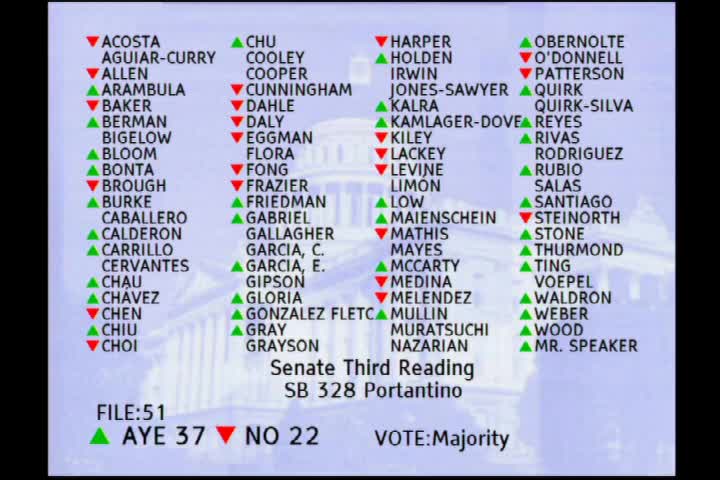 40SEC
Assembly Floor
 8MIN
Assembly Standing Committee on Communications and Conveyance
 1MIN
Senate Floor
 4MIN
Senate Standing Committee on Transportation and Housing
 1MIN
Assembly Floor
 1H
Assembly Standing Committee on Appropriations
Bill Author

Bill Co-Author(s):