ACR 247: 40th anniversary of Proposition 13.
- Session Year: 2017-2018
- House: Assembly
- Latest Version Date: 2018-05-31
This measure would commemorate Wednesday, June 6, 2018, as the 40th anniversary date of Proposition 13, in recognition of the impact Proposition 13 has had on the State of California.
WHEREAS, On June 6, 1978, Proposition 13, officially titled the Peoples Initiative to Limit Property Taxation, was overwhelmingly approved by Californias voters, establishing a 1 percent property tax cap and a two-thirds vote requirement for taxes approved by the Legislature, as well as for local special taxes approved by the voters; and
WHEREAS, Prior to the adoption of Proposition 13, Californias raging inflation had sent property tax bills in California soaring so high that some seniors on fixed incomes were forced to sell their homes, despite having paid off their mortgages, because they could no longer afford the property tax; and
WHEREAS, Prior to the adoption of Proposition 13, property tax assessments showed wider divergences than assessment disparities under the current acquisition-value system; and
WHEREAS, Prior to the adoption of Proposition 13, renters saw their rents increase when landlords saw their property taxes increase at a rapid rate; and
WHEREAS, With the approval of Proposition 13, real property values were adjusted to a base value equal to the 197576 assessed value of real property, thereby introducing an objective standard upon which real property would be taxed and ending the previous subjective standard for assessment that led to the property tax abuses that occurred in the 1960s and 1970s; and
WHEREAS, With the passage of Proposition 13, taxpayers, for the first time, were provided a measure of certainty with respect to their property taxes; and
WHEREAS, According to the non-partisan Legislative Analysts Office, the revenue from the 1 percent property tax has increased at an average annual rate of 7.3 percent from 1979 through 2012, faster than personal income tax revenue growth, and overall property tax revenue increased by 1,000 percent between 1978 and 2012; and
WHEREAS, In the 40 years following the passage of Proposition 13, a family who has owned their home ten years has saved an average of $60,000 on property taxes, proving that property owners benefit from these protections; and
WHEREAS, In the landmark case Nordlinger v. Hahn, the United States Supreme Court ruled nearly unanimously to uphold Proposition 13s acquisition value based system under the equal protection clause; and
WHEREAS, Proposition 13 has led to revenue stability for local governments, which have seen a nearly $40 billion increase in revenue since 1978; and
WHEREAS, The concept of revenue volatility surrounding both income and sales tax revenue to the state and local governments is a major flaw in Californias tax system; however, Proposition 13 has rendered Californias property taxes a stable and predictable source of public revenue even during economic downturns and has provided a major benefit to local governments in California; and
WHEREAS, In the last three-year recession, property tax was the only major revenue category to show a revenue increase; and
WHEREAS, This stability is important for local government in light of Californias ongoing unfunded pension liability crisis, and the fact that property tax revenue represents 60 percent of a municipalitys average annual revenue; and
WHEREAS, Proposition 13 does not create inequity between different classes of property, as the assessed valuation of commercial and business property has increased at a faster average annual rate than the assessed valuation of residential property; and
WHEREAS, Since the passage of Proposition 13, various polls continue to show that a split-roll alternative, which would alter the existing system so that one or more categories of non-residential property on the local assessment roll would not be subject to the acquisition value system established by Proposition 13, is not as popular as to the current system; and
WHEREAS, Increased property taxes would be a disincentive for first-time homebuyers and stand as a barrier to the growth of our housing market; and
WHEREAS, Proposition 13 incited a nationwide tax revolt at the state and local levels; within five years of passage, nearly one-half of the 50 states implemented similar limitations on the governments ability to raise revenue and nearly all of these tax-limitation measures remain the law of the land today; and
WHEREAS, Proposition 13 has become a nationwide symbol for a taxpayer revolt and for citizens exercising control and power over their governance; and
WHEREAS, Proposition 13 remains just as popular with voters today as it was when it was approved, with numerous recent surveys citing over 60 percent support; and
WHEREAS, Wednesday, June 6, 2018, marks the 40th year following the voters approval of Proposition 13; now, therefore, be it
Resolved by the Assembly of the State of California, the Senate thereof concurring,That in recognition of the impact Proposition 13 has had on the State of California, formally commemorates Wednesday, June 6, 2018, as the 40th anniversary date of Proposition 13; and be it further
Resolved,That the Assembly reaffirms its support for Proposition 13 and the benefit that it provides to individual homeowners and to the states overall economy; and be it further
Resolved,That the Chief Clerk will transmit copies of this resolution to the Governor of the State of California, and to the author for appropriate distribution.
|
Date
|
Status
|
|---|---|
| Jul 2, 2018 | In committee: Refused adoption. |
| Jun 7, 2018 | Referred to Com. on REV. & TAX. |
| Jun 1, 2018 | From printer. |
| May 31, 2018 | Introduced. To print. |
|
Date
|
Description
|
Location
|
Votes
|
|
|---|---|---|---|---|
| Jul 2, 2018 | Be adopted. To third reading. | Assembly Standing Committee on Revenue and Taxation |
Failed |
This list shows positions taken on this bill by organizations on the date displayed, which is linked to the original source.
Positions by individuals are not included.
Date of Hearing: July 2, 2018
ASSEMBLY COMMITTEE ON REVENUE AND TAXATION
Autumn R. Burke, Chairwoman
ABPCA Bill Id:ACR 247 (
Author:Acosta) – As Introduced Ver:May 31, 2018
Majority vote.
SUBJECT: 40th anniversary of Proposition 13
SUMMARY: Commemorates June 6, 2018, as the 40th anniversary date of Proposition 13 in recognition of Proposition 13's impact on California. Specifically, this resolution:
- Resolves that the Assembly reaffirms its support for Proposition 13 and the benefit that it provides to individual homeowners and to the state's overall economy based upon the following statements:
- That California's voters overwhelming approved, on June 6, 1978, Proposition 13, officially titled the "People's Initiative to Limit Property Taxation," establishing a 1% property tax cap and a 2/3 vote requirement for taxes approved by the Legislature, as well as for local special taxes approved by the voters.
- That the following conditions existed prior to Proposition 13's adoption:
- California's raging inflation had sent property tax bills in California soaring so high that some seniors on fixed incomes were forced to sell their homes, despite having paid off their mortgages, because they could no longer afford the property tax;
- Property tax assessments showed wider divergences than assessment disparities under today's acquisition-value system; and,
- Renters saw their rents increase when landlords saw their property taxes increase at a rapid rate.
- That the following events took place because of Proposition 13:
- Real property values were adjusted to a base value equal to the 1975-76 assessed value of real property, thereby introducing an objective standard upon which real property would be taxed and ending the previous subjective standard for assessment that led to the property tax abuses that occurred in the 1960's and 1970's;
- Taxpayers, for the first time, were provided a measure of property tax certainty;
- That a family that has owned their home ten years has saved an average of $60,000 on property taxes, proving that property owners benefit from these protections;
- Incited a nationwide tax revolt at the state and local levels; within five years of passage, nearly one-half of the 50 states implemented similar limitations on the government's ability to raise revenue and nearly all of these tax-limitation measures remain the law of the land today; and,
- Created a nationwide symbol for a taxpayer revolt and for citizens exercising control and power over their governance.
- That relative to issues of revenue:
- The revenue from the 1% property tax has increased at an average annual rate of 7.3% from 1979 through 2012, faster than personal income tax revenue growth, and overall property tax revenue increased by 1,000% between 1978 and 2012, according to the non-partisan Legislative Analyst's Office (LAO); and,
- The property tax was the only major revenue category to show a revenue increase in the last three-year recession.
- That relative to issues of revenue volatility and stability, volatility surrounding both income and sales tax revenue to the state and local governments is a major flaw in California's tax system, and that Proposition 13 has:
- Led to revenue stability for local governments, which have seen a nearly $40 billion increase in revenue since 1978;
- Provided a major benefit to local governments in California;
- Rendered California's property taxes a stable and predictable public revenue source even during economic downturns; and,
- Been important for local government in light of California's ongoing unfunded pension liability crisis, and the fact that property tax revenue represents 60% of a municipality's average annual revenue.
- That relative to Proposition 13's popularity and polling:
- Altering the existing system to a split-roll alternative, so that one or more categories of non-residential property on the local assessment roll is no longer subject to Proposition 13's "acquisition value" is not as popular as the current system; and,
- It remains just as popular with voters today as when approved, with numerous recent surveys citing over 60% support.
- That increased property taxes would be a disincentive for first-time homebuyers and stand as a barrier to the growth of our housing market.
- That the United States Supreme Court ruled nearly unanimously in the landmark case Nordlinger v. Hahn to uphold Proposition 13's acquisition value based system under the equal protection clause.
- That no inequity between different classes of property was created, as the assessed valuation of commercial and business property has increased at a faster average annual rate than the assessed valuation of residential property.
FISCAL EFFECT: None
COMMENTS:
- The author has provided the following statement in support of this concurrent resolution:
Over the last 40 years, Proposition 13 has provided property tax stability for all property owners, regardless of how long they've owned their property. In an era of massive unfunded pension liabilities, it has provided a steady consistent stream of revenue for local government. And it's allowed renters to stay in apartments by minimizing rent increases because of higher property taxes. With most Californians benefitting directly from this landmark initiative, it's easy to see why it continues to have support from over 60 percent of the population.
- In support of this resolution the Howard Jarvis Taxpayers Association states:
This resolution takes a strong stand against any weakening of Prop. 13, including "split roll" proposals which would be devastating to California businesses.
ACR 247 also references the horrific period prior to Proposition 13, when homeowners – many of whom has paid off their mortgages – lost their homes because they could not afford the property tax.
- Committee Staff Comments:
- Objectivity: This resolution extolls the virtues of Proposition 13 with a particular point of view. As such, it may not represent the views of the Assembly as a body.
- LAO Report: In 2016, the LAO published its report "Common Claims About Proposition 13". Should the Committee desire to commemorate the 40th anniversary of Proposition 13, the LAO's report might be a useful resource to improve upon this resolution's content.
- Accuracy: Several statements within this resolution appear inaccurate or misleading:
- Subjective/objective: This resolution states that property tax assessments were "subjective" prior to Proposition 13 and "objective" after Proposition 13. Real estate appraisal principles did not change before and after Proposition 13. When it is necessary to appraise a property's fair market value as of a specific date, the income, cost, and sales comparison approaches to value remain applicable.
- Assessment divergences: This resolution states that there were wider divergences in assessment disparities before Proposition 13 than under today's acquisition-value system. It is unclear on what basis or evidence this statement is made. Identical homes - one purchased in 1975, the other in 2018 - would have a significant "divergence" in assessed values. As the LAO notes, owners of properties that are similar but purchased at different times often pay vastly different amounts of property tax.
- First-time homebuyers: This resolution states that first-time homebuyers would have a disincentive to buy a home without Proposition 13. Committee staff notes that first-time homebuyers receive no immediate tax savings from Proposition 13 other than the capped tax rate applicable to all homebuyers. The LAO states that local governments appear to have responded to Proposition 13 by increasing fees on home builders and special assessments, such as Mello-Roos assessments, on newer homes. These higher charges increase costs for homebuyers.
- Local government impact: The LAO notes that Proposition 13 shifted authority from local governments to the State. Moreover, local government's property tax shares vary widely among each type of local government. The LAO explains that local governments were able to predict their property tax revenues year to year before and after Proposition 13. Their data indicates that local government's ability to set their property tax rates pre-Proposition 13 enabled them to moderate market value volatility.
- Full picture? The LAO notes that while property taxes remain the single largest source of local tax revenue for cities and counties, these local governments increasingly rely on other local taxes to make up for the revenue losses that resulted from Proposition 13. Specifically, Sales, Hotel, and Utility taxes largely replaced lost property tax revenue. This resolution fails to mention the increased special taxes, special assessments, and the creation of parcel taxes that ensued after Proposition 13. This resolution also makes no mention of the additional administrative costs associated to process these individual fees, taxes, and assessments.
- Related legislation: SR 39 (Morrell) would have commemorated the 39th Anniversary of Proposition 13. SR 39 failed passage in the Senate Committee on Governance and Finance (2-5).
- Prior legislation:
- SR 41 (Morrell), of the 2013-14 Legislative Session, would have commemorated the 36th anniversary of Proposition 13. SR 41 failed passage in the Senate Governance and Finance Committee (2-5).
- SCR 25 (Wyland), of the 2013-14 Legislative Session, would have commemorated the 35th anniversary of Proposition 13. SCR 25 failed passage in the Senate Governance and Finance Committee (2-0).
- SCR 116 (Harman), of the 2007-08 Legislative Session, would have commemorated the 30th anniversary of Proposition 13. SCR 116 failed passage in the Senate Revenue and Taxation Committee (3-4).
REGISTERED SUPPORT / OPPOSITION:
Support
Howard Jarvis Taxpayers Association
Opposition
None on file
Analysis Prepared by: Rose Marie Kinnee / REV. & TAX. / (916) 319-2098
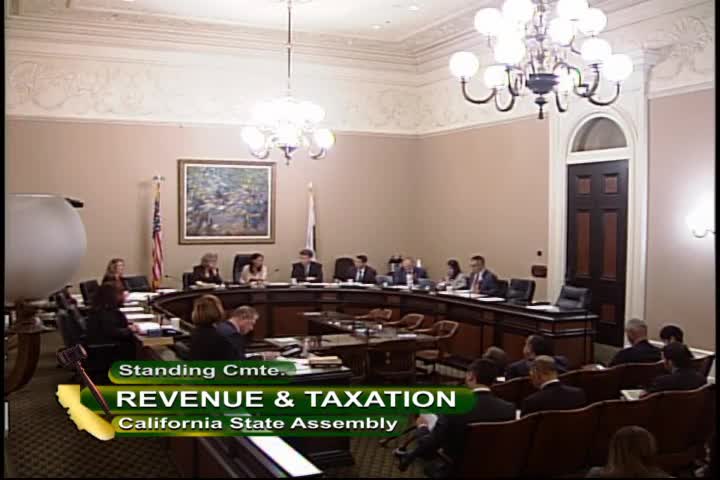
Discussed in Hearing
 7MIN
Assembly Standing Committee on Revenue and Taxation
Bill Author

Bill Co-Author(s):