AJR 38: Dams and reservoirs: federal jurisdiction: safety.
- Session Year: 2017-2018
- House: Assembly
- Latest Version Date: 2018-05-24
This measure would urge the Congress of the United States to implement revised dam safety and inspection requirements, with specified components, for all federally operated and regulated dams and reservoirs for the purpose of ensuring public safety.
This measure would urge the Congress of the United States to implement revised dam safety and inspection requirements, with specified components, for all federally operated and regulated dams and reservoirs for the purpose of ensuring public safety.
This measure would urge the Congress of the United States to implement revised dam safety and inspection requirements, with specified components, for all federally operated and regulated dams and reservoirs for the purpose of ensuring public safety.
WHEREAS, The February 7, 2017, failure of the Oroville Dams spillways highlighted that more has to be done to ensure we are taking care of our aging flood control infrastructure; and
WHEREAS, As the population continues to grow and Californians rely more and more on an aging infrastructure, ensuring proper inspection and maintenance of critical dams and reservoirs is paramount; and
WHEREAS, Of Californias 1,585 dams, 1,100 were built before 1969 and as the population around many of these dams has increased, dams that were previously designated as low risk have become high risk; and
WHEREAS, The Division of Safety of Dams within the Department of Water Resources regulates and inspects over 1,200 jurisdictional sized dams in California; and
WHEREAS, Recently signed legislation, Chapter 3 of the Statutes of 2018, strengthened Californias dam safety program by codifying a regular inspection schedule for dams and reservoirs, setting standards for what must be done during inspections, and requiring consultation with independent experts to update dam safety inspection and reevaluation protocols; and
WHEREAS, Unfortunately, Chapter 3 of the Statutes of 2018 does not cover 226 dams in California that are under federal jurisdiction; and
WHEREAS, These dams would greatly benefit from a review of operating standards to better incorporate best practices and inspections that include a review of the original design and construction, geotechnical, structural, hydraulic, hydrological, geologic, seismic hazard, monitoring and instrumentation, and overall dam performance; now, therefore, be it
Resolved by the Assembly and the Senate of the State of California, jointly, That the Legislature urges the Congress of the United States to implement revised dam safety and inspection requirements for all federally operated and regulated dams and reservoirs for the purpose of ensuring public safety; and be it further
Resolved, That the Legislature urges federal dam safety and inspection requirements to require that dams, reservoirs, and other critical structures under federal jurisdiction be inspected at least once per fiscal year, except for low hazard dams that should be inspected once every two fiscal years, to provide that dam inspection reports are public records but that some information may be kept confidential if it highlights a dams vulnerability or poses a security threat, and to require that the lead agency of a dam or reservoir revise its existing dam safety protocols to incorporate updated best practices and review those standards at least once every ten years; and be it further
Resolved, That the Chief Clerk of the Assembly transmit copies of this resolution to the President and Vice President of the United States, to the Speaker of the House of Representatives, to the Majority Leader of the Senate, to each Senator and Representative from California in the Congress of the United States, and to the author for appropriate distribution.
WHEREAS, The February 7, 2017, failure of the Oroville Dams spillways highlighted that more has to be done to ensure we are taking care of our aging flood control infrastructure; and
WHEREAS, As the population continues to grow and Californians rely more and more on an aging infrastructure, ensuring proper inspection and maintenance of critical dams and reservoirs is paramount; and
WHEREAS, Of Californias 1,585 dams, 1,100 were built before 1969 and as the population around many of these dams has increased, dams that were previously designated as low risk have become high risk; and
WHEREAS, The Division of Safety of Dams within the Department of Water Resources regulates and inspects over 1,200 jurisdictional sized dams in California; and
WHEREAS, Recently signed legislation, Chapter 3 of the Statutes of 2018, strengthened Californias dam safety program by codifying a regular inspection schedule for dams and reservoirs, setting standards for what must be done during inspections, and requiring consultation with independent experts to update dam safety inspection and reevaluation protocols; and
WHEREAS, Unfortunately, Chapter 3 of the Statutes of 2018 does not cover 226 dams in California that are under federal jurisdiction; and
WHEREAS, These dams would greatly benefit from a review of operating standards to better incorporate best practices and inspections that include a review of the original design and construction, geotechnical, structural, hydraulic, hydrological, geologic, seismic hazard, monitoring and instrumentation, and overall dam performance; now, therefore, be it,
Resolved by the Assembly and the Senate of the State of California, jointly, That the Legislature urges the Congress of the United States to implement revised dam safety and inspection requirements for all federally operated and regulated dams and reservoirs for the purpose of ensuring public safety; and be it further
Resolved, That the Legislature urges federal dam safety and inspection requirements to require that dams, reservoirs, and other critical structures under federal jurisdiction be inspected at least once per fiscal year, except for low hazard dams that should be inspected once every two fiscal years, to provide that dam inspection reports are public records but that some information may be kept confidential if it highlights a dams vulnerability or poses a security threat, and to require that the lead agency of a dam or reservoir revise its existing dam safety protocols to incorporate updated best practices and review those standards at least once every ten years; and be it further
Resolved, That the Chief Clerk of the Assembly transmit copies of this resolution to the President and Vice President of the United States, to the Speaker of the House of Representatives, to the Majority Leader of the Senate, to each Senator and Representative from California in the Congress of the United States, and to the author for appropriate distribution.
|
Date
|
Status
|
|---|---|
| May 24, 2018 | Chaptered by Secretary of State - Res. Chapter 76, Statutes of 2018. |
| May 24, 2018 | Enrolled and filed with the Secretary of State at 11:30 a.m. |
| May 21, 2018 | In Assembly. Ordered to Engrossing and Enrolling. |
| May 21, 2018 | Adopted and to Assembly. |
| May 16, 2018 | Ordered to special consent calendar. |
| May 9, 2018 | From committee: Ordered to third reading. |
| Apr 30, 2018 | In Senate. To Com. on RLS. |
| Apr 26, 2018 | Coauthors revised. |
| Apr 24, 2018 | Coauthors revised. |
| Apr 9, 2018 | Referred to Com. on W.,P., & W. |
| Apr 3, 2018 | From printer. |
| Apr 2, 2018 | Introduced. To print. |
|
Date
|
Description
|
Location
|
Votes
|
|
|---|---|---|---|---|
| May 21, 2018 | Special Consent AJR38 | Senate Floor |
Passed |
|
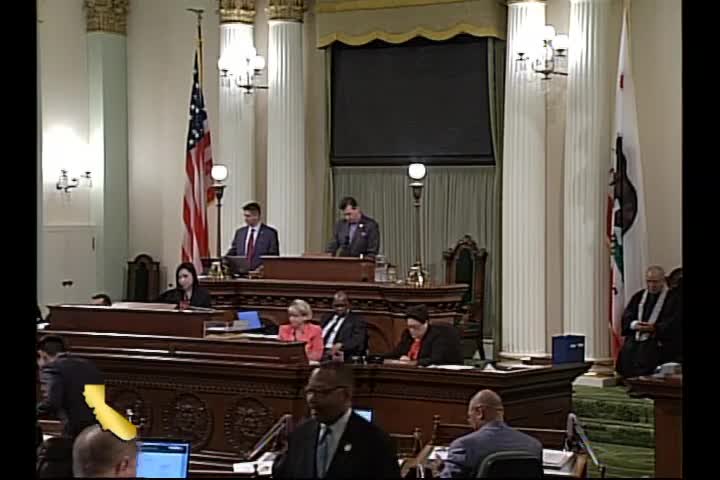
| Apr 26, 2018 | AJR 38 MATHIS Assembly Third Reading | Assembly Floor |
Passed |
|
| Apr 24, 2018 | Be adopted. To third reading. | Assembly Standing Committee on Water, Parks, and Wildlife |
Passed |
This list shows positions taken on this bill by organizations on the date displayed, which is linked to the original source.
Positions by individuals are not included.
Office of Senate Floor Analyses (916) 651-1520 Fax: (916) 327-4478 | AJR 38 |
THIRD READING
Bill No: AJR 38
Author: Mathis (R) and Gallagher (R), et al.
Introduced: 4/2/18
ASSEMBLY FLOOR: Read and adopted, 4/26/18
SUBJECT: Dams and reservoirs: federal jurisdiction: safety
DIGEST:
This resolution urges the Congress of the United States to implement revised dam safety and inspection requirements, with specified components, for all federally operated and regulated dams and reservoirs for the purpose of ensuring public safety.
ANALYSIS: This resolution makes the following legislative findings:
- As the population continues to grow and Californians rely more and more on an aging infrastructure, ensuring proper inspection and maintenance of critical dams and reservoirs is paramount.
- Of California’s 1,585 dams, 1,100 were built before 1969 and as the population around many of these dams has increased, dams that were previously designated as low risk have become high risk.
- Recently signed legislation, Chapter 3 of the Statutes of 2018, strengthened California’s dam safety program by codifying a regular inspection schedule for dams and reservoirs, setting standards for what must be done during inspections, and requiring consultation with independent experts to update dam safety inspection and reevaluation protocols.
- Unfortunately, Chapter 3 of the Statutes of 2018 does not cover 226 dams in California that are under federal jurisdiction.
- These dams would greatly benefit from a review of operating standards to better incorporate best practices and inspections that include a review of the original design and construction, geotechnical, structural, hydraulic, hydrological, geologic, seismic hazard, monitoring and instrumentation, and overall dam performance.
This resolution:
- Urges the Congress of the United States to implement revised dam safety and inspection requirements for all federally operated and regulated dams and reservoirs for the purpose of ensuring public safety.
- Urges federal dam safety and inspection requirements to require that dams, reservoirs, and other critical structures under federal jurisdiction be inspected at least once per fiscal year, except for low hazard dams that should be inspected once every two fiscal years, to provide that dam inspection reports are public records but that some information may be kept confidential if it highlights a dam’s vulnerability or poses a security threat, and to require that the lead agency of a dam or reservoir revise its existing dam safety protocols to incorporate updated best practices and review those standards at least once every 10 years.
Related/Prior Legislation
AB 1270 (Gallagher, Chapter 3, Statutes of 2018) provided for the Department of Water Resources to inspect dams, reservoirs, and appurtenant structures annually, with certain exemptions, and required reporting and updates to dam safety regulations.
FISCAL EFFECT: Appropriation: No Fiscal Com.: No Local: No
None received
None received
Prepared by: Karen Chow / SFA / (916) 651-1520
5/9/18 15:16:51
**** END ****
ASSEMBLY THIRD READING
ATR Bill Id:AJR 38
Author:(Mathis and Gallagher)
As Introduced Ver:April 2, 2018
Majority vote
Committee | Votes | Ayes | Noes |
Water | 15-0 | Eduardo Garcia, Gallagher, Bigelow, Carrillo, Choi, Chu, Friedman, Gloria, Harper, Kalra, Levine, Mathis, Rubio, Salas, Wood |
|
SUMMARY: Would urge the United States Congress to implement dam safety measures for federal dams within California. Specifically, this bill:
- Makes findings related to:
- The failure of Oroville Dam spillways in 2017.
- Reliance on an aging water infrastructure, including dams.
- The number of dams—specifically, that of the 1,585 dams in California, 1,100 dams were built before 1969.
- The jurisdiction of the Division of Dam Safety at the Department of Water Resources (DWR), regulating and inspecting over 1,200 dams within its jurisdiction.
- The recent passage of a series of laws aimed at improving dam inspection and safety in California.
- That our dam safety laws do not cover the 226 dams that are under federal jurisdiction, all of which would benefit from a review of operations similar to those found under California law.
- Urges Congress to implement revised dam safety and inspection requirements for all federally operated and regulated dams and reservoirs for the purpose of ensuring public safety.
- Requests transmittal to various federal entities.
EXISTING LAW:
- Establishes the Division of Safety of Dams within the DWR within jurisdiction over non-federal dams in California.
- Requires, the DWR, as of July 1, 2017, to classify the public safety risk of all state jurisdictional dams and to revise the classification of a dam to reflect changes in downstream population, critical infrastructure, and land use.
- Requires the DWR to inspect dams, reservoirs, and critical appurtenant structures within its jurisdiction once per fiscal year with the exception of low hazard potential dams which shall receive inspections, at a minimum, every two fiscal years.
- Requires dam owners to disclose information sufficient to enable the DWR to determine conditions of dams, reservoirs, and critical appurtenant structures regarding their safety and to perform, at the owner's expense, other work necessary to secure maintenance and operation that will safeguard life and property.
- Requires the inspection to include, but are not limited to, visual inspection of major features of the dam, including its groins, abutments, and toe areas, the dam's spillway, and the dam's outlet works. The inspection is to also evaluate seepage conditions and available instrumentation and geological data, as applicable.
FISCAL EFFECT: This resolution is keyed non-fiscal by the Legislative Counsel.
COMMENTS:
Background: Dam Safety Program. The DWR maintains a dam safety program that includes oversight of public and private dams (not including federal dams). They include annual maintenance inspections, construction oversight, application reviews, and re-evaluation of existing dams. Recent legislation (outlined below) place further restrictions on dams should they not meet Division of Safety of Dams criteria during inspections. One of the options available to the DWR, should a dam fail any of the safety inspections, is to restrict the level of water behind the dam or appurtenant structure. This reduces the potential downstream danger from failure, and should mitigate possible inundation scenarios, until the dam or feature is repaired. The determination of the level of water allowable would be considered in coordination with the existing information required to be provided by dam owners.
Flood Conditions in 2017. The heavy rainstorms in 2017 mostly ended the five-year drought in Northern California. Much of the Sierra Nevada saw its rainiest and snowiest October-February period on record. The heavy precipitation caused flooding, levee breaks, and sinkholes throughout the state. Snowpack was measured at over 160 % of normal water content. Even after the rains stopped, the record high snowpack in the mountains generated high-flows in the summer in many parts of the state.
Oroville Dam Disaster. On February 7, 2017, with heavy rains and runoff impacting reservoir levels at Oroville Reservoir, the DWR increased flows through its main spillway to 54,500 cubic feet per second (cfs). A large amount of debris was found coming out of the spillway, and after shutting down the spillway, authorities discovered a massive break in the spillway. As inflows increased, the lake reached capacity at 901 feet and water began flowing over the emergency spillway for the first time in history. Erosion progressed rapidly up the hillside on the emergency spillway, and on February 12, 188,000 people in towns downstream were evacuated due to the possibility of a failure of the emergency spillway. The DWR then increased flows over the broken main spillway to 100,000 cfs with continued heavy inflows. Water levels decreased, and on February 14, residents were allowed to return to their homes. Following the disaster, the Legislature held extensive hearings on the dam failure, and passed a series of bills intended to increase dam safety and public information related to dam failures.
Letter from Governor Brown to Federal Agencies. On February 24, 2017, immediately following the Oroville Dam disaster, Governor Brown sent a request to the Assistant Secretary of the Army (Army Corps of Engineers), the Acting Administrator of the Federal Emergency Management Agency, and the Acting Commissioner of the Bureau of Reclamation, all of whom have oversight over federal dams in California.
The letter specifically requested the federal government do the following:
- Expand inspection and review of all federally-owned dams. The inspections should parallel what the state is doing with its own dams, including review of ancillary structures such as spillways.
- Update the federal operating manuals for key California reservoirs. It is imperative to revise these manuals to reflect current scientific knowledge. The Army Corps of Engineers needs to be fully funded to complete these updates or allow non-federal authorities to finance this work.
- The recently enacted Water Infrastructure Improvements for the Nation Act authorizes a program for rehabilitation of high hazard dams. Provide funding to assist California in this rehabilitation effort.
- Over the next two years, California will spend over $1 billion on flood control projects. It is our hope that the federal government can help us with its appropriate share.
Related Legislation:
- SB 92 (Budget and Fiscal Review Committee), Chapter 26, Statutes of 2017 and AB 1270 (Gallagher), Chapter 3, Statues of 2018. These bills, after extensive hearings on dam safety, including a May 11, 2017, were passed and signed by the Governor, in part in response to the issues raised in that hearing, and require increased oversight of dams in California.
- AB 1270 (Gallagher), Chapter 3, Statutes of 2018. Requires the DWR, Division of Safety of Dams to inspect dams, reservoirs, and other critical structures within its jurisdiction once per fiscal year (except for low hazard dams which shall be inspected every two years). Provides that dam inspection reports are public records, but facilitates keeping some information confidential if it highlights a dam's vulnerability or poses a security threat. Requires the state to propose amendments to its existing dam safety protocols to incorporate updated best practices and to review those standards at least every ten years.
- AB 2516 (Eggman) of the current legislative session. Would require the DWR to post certain information related to reservoir restrictions, for dams under the jurisdiction of the Division of Safety of Dams, publicly.
Analysis Prepared by: Catherine Freeman / W., P., & W. / (916) 319-2096 FN: 0002734
Date of Hearing: April 24, 2018
ASSEMBLY COMMITTEE ON WATER, PARKS, AND WILDLIFE
Eduardo Garcia, Chair
ABPCA Bill Id:AJR 38 (
Author:Mathis) – As Introduced Ver:April 2, 2018
SUBJECT: Dams and reservoirs: federal jurisdiction: safety
SUMMARY: Would urge the United States Congress to implement dam safety measures for federal dams within California. Specifically, this bill:
- Makes findings related to:
- The failure of Oroville Dam spillways in 2017.
- Reliance on an aging water infrastructure, including dams.
- The number of dams—specifically, that of the 1,585 dams in California, 1,100 dams were built before 1969.
- The jurisdiction of the Division of Dam Safety at the Department of Water Resources (DWR), regulating and inspecting over 1,200 dams within its jurisdiction.
- The recent passage of a series of laws aimed at improving dam inspection and safety in California.
- That our dam safety laws do not cover the 226 dams that are under federal jurisdiction, all of which would benefit from a review of operations similar to those found under California law.
- Urges Congress to implement revised dam safety and inspection requirements for all federally operated and regulated dams and reservoirs for the purpose of ensuring public safety.
- Requests transmittal to various federal entities.
EXISTING LAW:
- Establishes the Division of Safety of Dams within the DWR within jurisdiction over non-federal dams in California.
- Requires, the DWR, as of July 1, 2017, to classify the public safety risk of all state jurisdictional dams and to revise the classification of a dam to reflect changes in downstream population, critical infrastructure, and land use.
- Requires the DWR to inspect dams, reservoirs, and critical appurtenant structures within its jurisdiction once per fiscal year with the exception of low hazard potential dams which shall receive inspections, at a minimum, every two fiscal years.
- Requires dam owners to disclose information sufficient to enable the DWR to determine conditions of dams, reservoirs, and critical appurtenant structures regarding their safety and to perform, at the owner’s expense, other work necessary to secure maintenance and operation that will safeguard life and property.
- Requires the inspection to include, but are not limited to, visual inspection of major features of the dam, including its groins, abutments, and toe areas, the dam’s spillway, and the dam’s outlet works. The inspection is to also evaluate seepage conditions and available instrumentation and geological data, as applicable.
- Establishes that dam inspection reports are public records subject to the California Public Records Act. Allows the DWR to withhold from public release sensitive data, images, or other information, as prescribed, if the department includes in the public release a statement of findings that the withheld information would disclose a dam’s vulnerability or pose a security threat.
FISCAL EFFECT: This resolution is keyed non-fiscal.
COMMENTS:
Author’s Statement:
The Oroville Dam spillway failure highlighted the need for more to be done to ensure that we are taking care of our aging flood control infrastructure. We cannot allow another incident to happen; the passage of AB 1270 (2018) will help to ensure this goal. We must now call upon Congress to also implement these comprehensive reforms for all dams and reservoirs under federal jurisdiction. With these reforms in place, we can help to better protect our residents from future flood infrastructure failure.
Background: Dam Safety Program. The DWR maintains a dam safety program that includes oversight of public and private dams (not including federal dams). They include annual maintenance inspections, construction oversight, application reviews, and re-evaluation of existing dams. Recent legislation (outlined below) place further restrictions on dams should they not meet Division of Safety of Dams criteria during inspections. One of the options available to the DWR, should a dam fail any of the safety inspections, is to restrict the level of water behind the dam or appurtenant structure. This reduces the potential downstream danger from failure, and should mitigate possible inundation scenarios, until the dam or feature is repaired. The determination of the level of water allowable would be considered in coordination with the existing information required to be provided by dam owners.
There are 1,250 dams in California subject to the program and that are inspected annually. These dams are currently classified in three categories consistent with federal definitions: high hazard (678); significant hazard (271); and low hazard (289). Two dams are under review for classification.
Flood Conditions in 2017. The heavy rainstorms in 2017 mostly ended the five-year drought in Northern California. Much of the Sierra Nevada saw its rainiest and snowiest October-February period on record. The heavy precipitation has caused flooding, levee breaks, and sinkholes throughout the state. Snowpack has been measured at over 160 percent of normal water content. Even after the rains stopped, the record high snowpack in the mountains generated high-flows in the summer in many parts of the state.
Oroville Dam Disaster. On February 7, 2017, with heavy rains and runoff impacting reservoir levels at Oroville Reservoir, the DWR increased flows through its main spillway to 54,500 cubic feet per second (cfs). A large amount of debris was found coming out of the spillway, and after shutting down the spillway, authorities discovered a massive break in the spillway. As inflows increased, the lake reached capacity at 901 feet and water began flowing over the emergency spillway for the first time in history. Erosion progressed rapidly up the hillside on the emergency spillway, and on February 12, 188,000 people in towns downstream were evacuated due to the possibility of a failure of the emergency spillway.
The DWR then increased flows over the broken main spillway to 100,000 cfs with continued heavy inflows. Water levels decreased, and on February 14, residents were allowed to return to their homes. Over the next few months, the DWR primarily used the broken main spillway to lower lake levels. Periodic shutdowns were required in order to clear debris from the base of the dam which was impacting the ability to release water through the main hydropower plant at the base of the dam itself.
The DWR, in April 2017, sought bids to repair the main spillway over a two-year period, shored up the emergency spillway, and brought the main hydropower plant back online. As of January 2018, phase one of the construction repair has been completed in time for the rainy season. The repair project is on track to be complete by December 2018.
Following the disaster, the Legislature held extensive hearings on the dam failure, and passed a series of bills intended to increase dam safety and public information related to dam failures.
Letter from Governor Brown to Federal Agencies. On February 24, 2017, immediately following the Oroville Dam disaster, Governor Brown sent a request to the Assistant Secretary of the Army (Army Corps of Engineers), the Acting Administrator of the Federal Emergency Management Agency, and the Acting Commissioner of the Bureau of Reclamation, all of whom have oversight over federal dams in California.
The letter specifically requested the federal government do the following:
- Expand inspection and review of all federally-owned dams. The inspections should parallel what the state is doing with its own dams, including review of ancillary structures such as spillways.
- Update the federal operating manuals for key California reservoirs. It is imperative to revise these manuals to reflect current scientific knowledge. The Army Corps of Engineers needs to be fully funded to complete these updates or allow non-federal authorities to finance this work.
- The recently enacted Water Infrastructure Improvements for the Nation Act authorizes a program for rehabilitation of high hazard dams. Provide funding to assist California in this rehabilitation effort.
- Over the next two years, California will spend over $1 billion on flood control projects. It is our hope that the federal government can help us with its appropriate share.
Related Legislation:
SB 92 (Committee on Budget), Chapter 26, Statutes of 2017 and AB 1270 (Gallagher), Chapter 3, Statues of 2018. These bills, after extensive hearings on dam safety, including a May 11, 2017, were passed and signed by the Governor, in part in response to the issues raised in that hearing, and require increased oversight of dams in California.
AB 1270 (Gallagher), Chapter 3, Statues of 2018. Requires the DWR, Division of Safety of Dams to inspect dams, reservoirs, and other critical structures within its jurisdiction once per fiscal year (except for low hazard dams which shall be inspected every two years). Provides that dam inspection reports are public records, but facilitates keeping some information confidential if it highlights a dam's vulnerability or poses a security threat. Requires the state to propose amendments to its existing dam safety protocols to incorporate updated best practices and to review those standards at least every ten years.
AB 2516 (Eggman), of this session. Would require the DWR to post certain information related to reservoir restrictions, for dams under the jurisdiction of the Division of Safety of Dams, publicly.
REGISTERED SUPPORT / OPPOSITION:
Support
None on file
Opposition
None on file
Analysis Prepared by: Catherine Freeman / W., P., & W. / (916) 319-2096


Bill Co-Author(s):