SB 100: California Renewables Portfolio Standard Program: emissions of greenhouse gases.
- Session Year: 2017-2018
- House: Senate
- Latest Version Date: 2018-09-10
(1)Under existing law, the Public Utilities Commission (PUC) has regulatory authority over public utilities, including electrical corporations, while local publicly owned electric utilities, as defined, are under the direction of their governing boards. The California Renewables Portfolio Standard Program requires the PUC to establish a renewables portfolio standard requiring all retail sellers, as defined, to procure a minimum quantity of electricity products from eligible renewable energy resources, as defined, so that the total kilowatthours of those products sold to their retail end-use customers achieve 25% of retail sales by December 31, 2016, 33% by December 31, 2020, 40% by December 31, 2024, 45% by December 31, 2027, and 50% by December 31, 2030. The program additionally requires each local publicly owned electric utility, as defined, to procure a minimum quantity of electricity products from eligible renewable energy resources to achieve the procurement requirements established by the program. The Legislature has found and declared that its intent in implementing the program is to attain, among other targets for sale of eligible renewable resources, the target of 50% of total retail sales of electricity by December 31, 2030.
This bill would revise the above-described legislative findings and declarations to state that the goal of the program is to achieve that 50% renewable resources target by December 31, 2026, and to achieve a 60% target by December 31, 2030. The bill would require that retail sellers and local publicly owned electric utilities procure a minimum quantity of electricity products from eligible renewable energy resources so that the total kilowatthours of those products sold to their retail end-use customers achieve 44% of retail sales by December 31, 2024, 52% by December 31, 2027, and 60% by December 31, 2030.
Under existing law, a local publicly owned electric utility is not required to procure more than a specified minimum quantity of eligible renewable energy resources under the program if it receives more than 50% of its retail sales from hydroelectric generation, as specified.
This bill would revise those provisions, limit the applicability of this exception to large hydroelectric generation, and reduce that threshold to 40%.
(2)Existing law establishes the California Environmental Protection Agency, establishes the State Air Resources Board within the agency as the entity with responsibility for control of emissions from motor vehicles, and designates the state board as the air pollution control agency for all purposes set forth in federal law. The California Global Warming Solutions Act of 2006 establishes the state board as the state agency charged with monitoring and regulating sources of emissions of greenhouse gases that cause global warming.
The Warren-Alquist State Energy Resources Conservation and Development Act establishes the State Energy Resources Conservation and Development Commission (Energy Commission) and requires it to conduct an ongoing assessment of the opportunities and constraints presented by all forms of energy, to encourage the balanced use of all sources of energy to meet the states needs, and to seek to avoid possible undesirable consequences of reliance on a single source of energy.
This bill would state that it is the policy of the state that eligible renewable energy resources and zero-carbon resources supply 100% of retail sales of electricity to California end-use customers and 100% of electricity procured to serve all state agencies by December 31, 2045. The bill would require that the achievement of this policy for California not increase carbon emissions elsewhere in the western grid and that the achievement not allow resource shuffling. The bill would require the PUC and the Energy Commission, in consultation with the state board, to take steps to ensure that a transition to a zero-carbon electric system for the State of California does not cause or contribute to greenhouse gas emissions increases elsewhere in the western grid. The bill would require the PUC, Energy Commission, state board, and all other state agencies to incorporate that policy into all relevant planning. The bill would require the PUC, Energy Commission, state board, and all other state agencies to ensure actions taken in furtherance of these purposes achieve specified objectives. The bill would require the PUC, Energy Commission, and state board to utilize programs authorized under existing statutes to achieve that policy and, as part of a public process, issue a joint report to the Legislature by January 1, 2021, and every 4 years thereafter, that includes specified information relating to the implementation of the policy.
(3)Under existing law, a violation of the Public Utilities Act or any order, decision, rule, direction, demand, or requirement of the PUC is a crime.
Because certain of the provisions of this bill would be a part of the act and because a violation of an order or decision of the PUC implementing its requirements would be a crime, the bill would impose a state-mandated local program. By expanding the requirements placed upon a local publicly owned electric utility, the bill would impose a state-mandated local program.
The California Constitution requires the state to reimburse local agencies and school districts for certain costs mandated by the state. Statutory provisions establish procedures for making that reimbursement.
This bill would provide that no reimbursement is required by this act for specified reasons.
(1)Under existing law, the Public Utilities Commission (PUC) has regulatory authority over public utilities, including electrical corporations, while local publicly owned electric utilities, as defined, are under the direction of their governing boards. The California Renewables Portfolio Standard Program requires the PUC to establish a renewables portfolio standard requiring all retail sellers, as defined, to procure a minimum quantity of electricity products from eligible renewable energy resources, as defined, so that the total kilowatthours of those products sold to their retail end-use customers achieve 25% of retail sales by December 31, 2016, 33% by December 31, 2020, 40% by December 31, 2024, 45% by December 31, 2027, and 50% by December 31, 2030. The program additionally requires each local publicly owned electric utility, as defined, to procure a minimum quantity of electricity products from eligible renewable energy resources to achieve the procurement requirements established by the program. The Legislature has found and declared that its intent in implementing the program is to attain, among other targets for sale of eligible renewable resources, the target of 50% of total retail sales of electricity by December 31, 2030.
This bill would revise the above-described legislative findings and declarations to state that the goal of the program is to achieve that 50% renewable resources target by December 31, 2026, and to achieve a 60% target by December 31, 2030. The bill would require that retail sellers and local publicly owned electric utilities procure a minimum quantity of electricity products from eligible renewable energy resources so that the total kilowatthours of those products sold to their retail end-use customers achieve 44% of retail sales by December 31, 2024, 52% by December 31, 2027, and 60% by December 31, 2030.
Under existing law, a local publicly owned electric utility is not required to procure more than a specified minimum quantity of eligible renewable energy resources under the program if it receives more than 50% of its retail sales from hydroelectric generation, as specified.
This bill would revise those provisions provisions, limit the applicability of this exception to large hydroelectric generation, and reduce that threshold to 40%.
(2)Existing law establishes the California Environmental Protection Agency, establishes the State Air Resources Board within the agency as the entity with responsibility for control of emissions from motor vehicles, and designates the state board as the air pollution control agency for all purposes set forth in federal law. The California Global Warming Solutions Act of 2006 establishes the state board as the state agency charged with monitoring and regulating sources of emissions of greenhouse gases that cause global warming.
The Warren-Alquist State Energy Resources Conservation and Development Act establishes the State Energy Resources Conservation and Development Commission (Energy Commission) and requires it to conduct an ongoing assessment of the opportunities and constraints presented by all forms of energy, to encourage the balanced use of all sources of energy to meet the states needs, and to seek to avoid possible undesirable consequences of reliance on a single source of energy.
This bill would state that it is the policy of the state that eligible renewable energy resources and zero-carbon resources supply 100% of retail sales of electricity to serve California end-use customers and 100% of electricity procured to serve all state agencies by December 31, 2045. The bill would require that the achievement of this policy for California not increase carbon emissions elsewhere in the western grid and that the achievement not allow resource shuffling. The bill would require the PUC and the Energy Commission, in consultation with the state board, to take steps to ensure that a transition to a zero-carbon electric system for the State of California does not cause or contribute to greenhouse gas emissions increases elsewhere in the western grid. The bill would require the PUC, Energy Commission, state board, and all other state agencies to incorporate that policy into all relevant planning. The bill would require the PUC, Energy Commission, state board, and all other state agencies to ensure actions taken in furtherance of these purposes achieve specified objectives. The bill would require the PUC, Energy Commission, and state board to utilize programs authorized under existing statutes to achieve that policy and, as part of a public process, issue a joint report to the Legislature by January 1, 2021, and every 4 years thereafter, that includes specified information relating to the implementation of the policy.
(3)Under existing law, a violation of the Public Utilities Act or any order, decision, rule, direction, demand, or requirement of the PUC is a crime.
Because certain of the provisions of this bill would be a part of the act and because a violation of an order or decision of the PUC implementing its requirements would be a crime, the bill would impose a state-mandated local program by creating a new crime. program. By expanding the requirements placed upon a local publicly owned electric utility, the bill would impose a state-mandated local program.
The California Constitution requires the state to reimburse local agencies and school districts for certain costs mandated by the state. Statutory provisions establish procedures for making that reimbursement.
This bill would provide that no reimbursement is required by this act for specified reasons.
(1)Under existing law, the Public Utilities Commission (PUC) has regulatory authority over public utilities, including electrical corporations, while local publicly owned electric utilities, as defined, are under the direction of their governing boards. The California Renewables Portfolio Standard Program requires the PUC to establish a renewables portfolio standard requiring all retail sellers, as defined, to procure a minimum quantity of electricity products from eligible renewable energy resources, as defined, so that the total kilowatthours of those products sold to their retail end-use customers achieve 25% of retail sales by December 31, 2016, 33% by December 31, 2020, 40% by December 31, 2024, 45% by December 31, 2027, and 50% by December 31, 2030. The program additionally requires each local publicly owned electric utility, as defined, to procure a minimum quantity of electricity products from eligible renewable energy resources to achieve the procurement requirements established by the program. The Legislature has found and declared that its intent in implementing the program is to attain, among other targets for sale of eligible renewable resources, the target of 50% of total retail sales of electricity by December 31, 2030.
This bill would revise the above-described legislative findings and declarations to state that the goal of the program is to achieve that 50% renewable resources target by December 31, 2026, and to achieve a 60% target by December 31, 2030. The bill would require that retail sellers and local publicly owned electric utilities procure a minimum quantity of electricity products from eligible renewable energy resources so that the total kilowatthours of those products sold to their retail end-use customers achieve 44% of retail sales by December 31, 2024, 52% by December 31, 2027, and 60% by December 31, 2030.
Under existing law, a local publicly owned electric utility is not required to procure more than a specified minimum quantity of eligible renewable energy resources under the program if it receives more than 50% of its retail sales from hydroelectric generation, as specified.
This bill would revise those provisions and reduce that threshold to 40%.
(2)Existing law establishes the California Environmental Protection Agency, establishes the State Air Resources Board within the agency as the entity with responsibility for control of emissions from motor vehicles, and designates the state board as the air pollution control agency for all purposes set forth in federal law. The California Global Warming Solutions Act of 2006 establishes the state board as the state agency charged with monitoring and regulating sources of emissions of greenhouse gases that cause global warming.
The Warren-Alquist State Energy Resources Conservation and Development Act establishes the State Energy Resources Conservation and Development Commission (Energy Commission) and requires it to conduct an ongoing assessment of the opportunities and constraints presented by all forms of energy, to encourage the balanced use of all sources of energy to meet the states needs, and to seek to avoid possible undesirable consequences of reliance on a single source of energy.
This bill would state that it is the policy of the state that eligible renewable energy resources and zero-carbon resources supply 100% of retail sales of electricity to serve California end-use customers and electricity procured to serve all state agencies by December 31, 2045. The bill would require that the achievement of this policy for California not increase carbon emissions elsewhere in the western grid and that the achievement not allow resource shuffling. The bill would require the PUC, Energy Commission, state board, and all other state agencies to incorporate that policy into all relevant planning. The bill would require the PUC, Energy Commission, state board, and all other state agencies to ensure actions taken in furtherance of these purposes achieve specified objectives. The bill would require the PUC, Energy Commission, and state board to utilize programs authorized under existing statutes to achieve that policy and, as part of a public process, issue a joint report to the Legislature by January 1, 2021, and every 4 years thereafter, that includes specified information relating to the implementation of the policy.
Existing law requires the state board to identify and adopt appropriate policies, rules, or regulations to remove regulatory disincentives preventing retail sellers and local publicly owned electric utilities from facilitating the achievement of greenhouse gas emission reductions in other sectors through increased investments in transportation electrification.This bill would require the state board to identify and adopt those policies, rules, and regulations by January 1, 2021, and would require those policies, rules, and regulations to also remove regulatory disincentives preventing retail sellers and local publicly owned electric utilities from converting buildings and ports from natural gas to electricity.(3)Under existing law, a violation of the Public Utilities Act or any order, decision, rule, direction, demand, or requirement of the PUC is a crime.
Because certain of the provisions of this bill would be a part of the act and because a violation of an order or decision of the PUC implementing its requirements would be a crime, the bill would impose a state-mandated local program by creating a new crime. By expanding the requirements placed upon a local publicly owned electric utility, the bill would impose a state-mandated local program.
The California Constitution requires the state to reimburse local agencies and school districts for certain costs mandated by the state. Statutory provisions establish procedures for making that reimbursement.
This bill would provide that no reimbursement is required by this act for specified reasons.
(1)Under existing law, the Public Utilities Commission (PUC) has regulatory authority over public utilities, including electrical corporations, while local publicly owned electric utilities, as defined, are under the direction of their governing boards. The California Renewables Portfolio Standard Program requires the PUC to establish a renewables portfolio standard requiring all retail sellers, as defined, to procure a minimum quantity of electricity products from eligible renewable energy resources, as defined, so that the total kilowatthours of those products sold to their retail end-use customers achieve 25% of retail sales by December 31, 2016, 33% by December 31, 2020, 40% by December 31, 2024, 45% by December 31, 2027, and 50% by December 31, 2030. The program additionally requires each local publicly owned electric utility, as defined, to procure a minimum quantity of electricity products from eligible renewable energy resources to achieve the procurement requirements established by the program. The Legislature has found and declared that its intent in implementing the program is to attain, among other targets for sale of eligible renewable resources, the target of 50% of total retail sales of electricity by December 31, 2030.
This bill would revise the above-described legislative findings and declarations to state that the goal of the program is to achieve that 50% renewable resources target by December 31, 2026, and to achieve a 60% target by December 31, 2030. The bill would require that retail sellers and local publicly owned electric utilities procure a minimum quantity of electricity products from eligible renewable energy resources so that the total kilowatthours of those products sold to their retail end-use customers achieve 44% of retail sales by December 31, 2024, 52% by December 31, 2027, and 60% by December 31, 2030.
Under existing law, a local publicly owned electric utility is not required to procure more than a specified minimum quantity of eligible renewable energy resources under the program if it receives more than 50% of its retail sales from hydroelectric generation, as specified.
This bill would revise those provisions and reduce that threshold to 40%.
(2)Existing law establishes the California Environmental Protection Agency, establishes the State Air Resources Board within the agency as the entity with responsibility for control of emissions from motor vehicles, and designates the state board as the air pollution control agency for all purposes set forth in federal law. The California Global Warming Solutions Act of 2006 establishes the state board as the state agency charged with monitoring and regulating sources of emissions of greenhouse gases that cause global warming.
The Warren-Alquist State Energy Resources Conservation and Development Act establishes the State Energy Resources Conservation and Development Commission (Energy Commission) and requires it to conduct an ongoing assessment of the opportunities and constraints presented by all forms of energy, to encourage the balanced use of all sources of energy to meet the states needs, and to seek to avoid possible undesirable consequences of reliance on a single source of energy.
This bill would state that it is the policy of the state that eligible renewable energy resources and zero-carbon resources supply 100% of retail sales of electricity to serve California end-use customers and electricity procured to serve all state agencies no later than by December 31, 2045. The bill would require that the achievement of this policy for California not increase carbon emissions elsewhere in the western grid and that the achievement not allow resource shuffling. The bill would require the PUC, Energy Commission, state board, and all other state agencies to incorporate that policy into all relevant planning. The bill would require the PUC, Energy Commission, state board, and all other state agencies to ensure actions taken in furtherance of these purposes achieve specified objectives. The bill would require the PUC, Energy Commission, and state board to utilize programs authorized under existing statutes to achieve that policy and to provide and, as part of a public process, issue a joint report to the Legislature no later than February 1, 2019, by January 1, 2021, and every 2 4 years thereafter, that identifies progress and describes remaining transmission, reliability, and other barriers to the full achievement of that policy. includes specified information relating to the implementation of the policy.
Existing law requires the state board to identify and adopt appropriate policies, rules, or regulations to remove regulatory disincentives preventing retail sellers and local publicly owned electric utilities from facilitating the achievement of greenhouse gas emission reductions in other sectors through increased investments in transportation electrification.
This bill would require the state board to identify and adopt those policies, rules, and regulations by January 1, 2021, and would require those policies, rules, and regulations to also remove regulatory disincentives preventing retail sellers and local publicly owned electric utilities from converting buildings and ports from natural gas to electricity.
(3)Under existing law, a violation of the Public Utilities Act or any order, decision, rule, direction, demand, or requirement of the PUC is a crime.
Because certain of the provisions of this bill would be a part of the act and because a violation of an order or decision of the PUC implementing its requirements would be a crime, the bill would impose a state-mandated local program by creating a new crime. By expanding the requirements placed upon a local publicly owned electric utility, the bill would impose a state-mandated local program.
The California Constitution requires the state to reimburse local agencies and school districts for certain costs mandated by the state. Statutory provisions establish procedures for making that reimbursement.
This bill would provide that no reimbursement is required by this act for specified reasons.
(1)Under existing law, the Public Utilities Commission (PUC) has regulatory authority over public utilities, including electrical corporations, while local publicly owned electric utilities, as defined, are under the direction of their governing boards. The California Renewables Portfolio Standard Program requires the PUC to establish a renewables portfolio standard requiring all retail sellers, as defined, to procure a minimum quantity of electricity products from eligible renewable energy resources, as defined, so that the total kilowatthours of those products sold to their retail end-use customers achieve 25% of retail sales by December 31, 2016, 33% by December 31, 2020, 40% by December 31, 2024, 45% by December 31, 2027, and 50% by December 31, 2030. The program additionally requires each local publicly owned electric utility, as defined, to procure a minimum quantity of electricity products from eligible renewable energy resources to achieve the procurement requirements established by the program. The Legislature has found and declared that its intent in implementing the program is to attain, among other targets for sale of eligible renewable resources, the target of 50% of total retail sales of electricity by December 31, 2030.
This bill would revise the above-described legislative findings and declarations to state that the goal of the program is to achieve that 50% renewable resources target by December 31, 2026, and to achieve a 60% target by December 31, 2030. The bill would require that retail sellers and local publicly owned electric utilities procure a minimum quantity of electricity products from eligible renewable energy resources so that the total kilowatthours of those products sold to their retail end-use customers achieve 44% of retail sales by December 31, 2024, 52% by December 31, 2027, and 60% by December 31, 2030.
(2)Existing law establishes the California Environmental Protection Agency, establishes the State Air Resources Board within the agency as the entity with responsibility for control of emissions from motor vehicles, and designates the state board as the air pollution control agency for all purposes set forth in federal law. The California Global Warming Solutions Act of 2006 establishes the state board as the state agency charged with monitoring and regulating sources of emissions of greenhouse gases that cause global warming.
The Warren-Alquist State Energy Resources Conservation and Development Act establishes the State Energy Resources Conservation and Development Commission (Energy Commission) and requires it to conduct an ongoing assessment of the opportunities and constraints presented by all forms of energy, to encourage the balanced use of all sources of energy to meet the states needs, and to seek to avoid possible undesirable consequences of reliance on a single source of energy.
This bill would state that it is the policy of the state that eligible renewable energy resources and zero-carbon resources supply 100% of retail sales of electricity to serve California end-use customers and electricity procured to serve all state agencies no later than December 31, 2045. The bill would require that the achievement of this policy for California not increase carbon emissions elsewhere in the western grid and that the achievement not allow resource shuffling. The bill would require the PUC, Energy Commission, state board, and all other state agencies to incorporate that policy into all relevant planning. The bill would require the PUC, Energy Commission, and state board board, and all other state agencies to ensure actions taken in furtherance of these purposes achieve specified objectives. The bill would require those entities the PUC, Energy Commission, and state board to utilize programs authorized under existing statutes to achieve that policy and to provide a joint report to the Legislature no later than February 1, 2019, and every 2 years thereafter, that identifies progress and describes remaining transmission, reliability, and other barriers to the full achievement of that policy.
(3)Under existing law, a violation of the Public Utilities Act or any order, decision, rule, direction, demand, or requirement of the PUC is a crime.
Because certain of the provisions of this bill would be a part of the act and because a violation of an order or decision of the PUC implementing its requirements would be a crime, the bill would impose a state-mandated local program by creating a new crime. By expanding the requirements placed upon a local publicly owned electric utility, the bill would impose a state-mandated local program.
The California Constitution requires the state to reimburse local agencies and school districts for certain costs mandated by the state. Statutory provisions establish procedures for making that reimbursement.
This bill would provide that no reimbursement is required by this act for specified reasons.
(1)Under existing law, the Public Utilities Commission (PUC) has regulatory authority over public utilities, including electrical corporations, while local publicly owned electric utilities, as defined, are under the direction of their governing boards. The California Renewables Portfolio Standard Program requires the PUC to establish a renewables portfolio standard requiring all retail sellers, as defined, to procure a minimum quantity of electricity products from eligible renewable energy resources, as defined, so that the total kilowatthours of those products sold to their retail end-use customers achieve 25% of retail sales by December 31, 2016, 33% by December 31, 2020, 40% by December 31, 2024, 45% by December 31, 2027, and 50% by December 31, 2030. The program additionally requires each local publicly owned electric utility, as defined, to procure a minimum quantity of electricity products from eligible renewable energy resources to achieve the procurement requirements established by the program. The Legislature has found and declared that its intent in implementing the program is to attain, among other targets for sale of eligible renewable resources, the target of 50% of total retail sales of electricity by December 31, 2030.
This bill would revise the above-described legislative findings and declarations to state that the goal of the program is to achieve that 50% renewable resources target by December 31, 2026, and to achieve a 60% target by December 31, 2030. The bill would require that retail sellers and local publicly owned electric utilities procure a minimum quantity of electricity products from eligible renewable energy resources so that the total kilowatthours of those products sold to their retail end-use customers achieve 44% of retail sales by December 31, 2024, 52% by December 31, 2027, and 60% by December 31, 2030.
(2)Existing law establishes the California Environmental Protection Agency, establishes the State Air Resources Board within the agency as the entity with responsibility for control of emissions from motor vehicles, and designates the state board as the air pollution control agency for all purposes set forth in federal law. The California Global Warming Solutions Act of 2006 establishes the state board as the state agency charged with monitoring and regulating sources of emissions of greenhouse gases that cause global warming.
The Warren-Alquist State Energy Resources Conservation and Development Act establishes the State Energy Resources Conservation and Development Commission (Energy Commission) and requires it to conduct an ongoing assessment of the opportunities and constraints presented by all forms of energy, to encourage the balanced use of all sources of energy to meet the states needs, and to seek to avoid possible undesirable consequences of reliance on a single source of energy.
This bill would state that it is the policy of the state that eligible renewable energy resources and zero-carbon resources supply all electricity procured 100% of retail sales of electricity to serve California end-use customers and the State Water Project no later than December 31, 2045. The bill would require that the transition to a zero-carbon electric system achievement of this policy for California not increase carbon emissions elsewhere in the western grid and that the transition achievement not allow resource shuffling. The bill would require the PUC, Energy Commission, Department of Water Resources, and state board board, and other state agencies to incorporate that policy into all relevant planning. The bill would require the PUC, Energy Commission, and state board to ensure actions taken in furtherance of these purposes achieve specified objectives. The bill would require those entities to utilize programs authorized under existing statutes to achieve that policy and to provide a joint report to the Legislature no later than February 1, 2019, and every 2 years thereafter, that identifies progress and describes remaining transmission, reliability, and other barriers to the full realization achievement of that policy.
(3)Under existing law, a violation of the Public Utilities Act or any order, decision, rule, direction, demand, or requirement of the PUC is a crime.
Because certain of the provisions of this bill would be a part of the act and because a violation of an order or decision of the PUC implementing its requirements would be a crime, the bill would impose a state-mandated local program by creating a new crime. By expanding the requirements placed upon a local publicly owned electric utility, the bill would impose a state-mandated local program.
The California Constitution requires the state to reimburse local agencies and school districts for certain costs mandated by the state. Statutory provisions establish procedures for making that reimbursement.
This bill would provide that no reimbursement is required by this act for specified reasons.
(1)Under existing law, the Public Utilities Commission (PUC) has regulatory authority over public utilities, including electrical corporations, while local publicly owned electric utilities, as defined, are under the direction of their governing boards. The California Renewables Portfolio Standard Program requires the PUC to establish a renewables portfolio standard requiring all retail sellers, as defined, to procure a minimum quantity of electricity products from eligible renewable energy resources, as defined, so that the total kilowatthours of those products sold to their retail end-use customers achieve 25% of retail sales by December 31, 2016, 33% by December 31, 2020, 40% by December 31, 2024, 45% by December 31, 2027, and 50% by December 31, 2030. The program additionally requires each local publicly owned electric utility, as defined, to procure a minimum quantity of electricity products from eligible renewable energy resources to achieve the procurement requirements established by the program. The Legislature has found and declared that its intent in implementing the program is to attain, among other targets for sale of eligible renewable resources, the target of 50% of total retail sales of electricity by December 31, 2030.
This bill would revise the above-described legislative findings and declarations to state that the goal of the program is to achieve that 50% renewable resources target by December 31, 2026, and to achieve a 60% target by December 31, 2030, and for all electricity sold at retail to be from zero-carbon resources by December 31, 2045. 2030. The bill would require that retail sellers and local publicly owned electric utilities procure a minimum quantity of electricity products from eligible renewable energy resources so that the total kilowatthours of those products sold to their retail end-use customers achieve 45% 44% of retail sales by December 31, 2023, 50% 2024, 52% by December 31, 2026, 2027, and 60% by December 31, 2030.
(2)Existing law establishes the California Environmental Protection Agency, establishes the State Air Resources Board within the agency as the entity with responsibility for control of emissions from motor vehicles, and designates the state board as the air pollution control agency for all purposes set forth in federal law. The California Global Warming Solutions Act of 2006 establishes the state board as the state agency charged with monitoring and regulating sources of emissions of greenhouse gases that cause global warming.
The Warren-Alquist State Energy Resources Conservation and Development Act establishes the State Energy Resources Conservation and Development Commission (Energy Commission) and requires it to conduct an ongoing assessment of the opportunities and constraints presented by all forms of energy, to encourage the balanced use of all sources of energy to meet the states needs, and to seek to avoid possible undesirable consequences of reliance on a single source of energy.
This bill would state that it is the policy of the state that eligible renewable energy resources and zero-carbon electric generating facilities resources supply all electricity procured to serve California end-use customers and the State Water Project no later than December 31, 2045. The bill would require that the transition to a zero-carbon electric system for California not increase carbon emissions elsewhere in the western grid and that the transition not allow resource shuffling. The bill would require the PUC, Energy Commission, Department of Water Resources, and state board to incorporate that policy into all relevant planning and programs, as specified. planning. The bill would require those entities to utilize programs authorized under existing statutes to achieve that policy and to provide a joint report to the Legislature no later than February 1, 2019, and every 2 years thereafter, that identifies progress and describes remaining transmission, reliability, and other barriers to the full realization of that policy.
(3)Under existing law, a violation of the Public Utilities Act or any order, decision, rule, direction, demand, or requirement of the PUC is a crime.
Because certain of the provisions of this bill would be a part of the act and because a violation of an order or decision of the PUC implementing its requirements would be a crime, the bill would impose a state-mandated local program by creating a new crime. By expanding the requirements placed upon a local publicly owned electric utility, the bill would impose a state-mandated local program.
The California Constitution requires the state to reimburse local agencies and school districts for certain costs mandated by the state. Statutory provisions establish procedures for making that reimbursement.
This bill would provide that no reimbursement is required by this act for specified reasons.
(1)Under existing law, the Public Utilities Commission (PUC) has regulatory authority over public utilities, including electrical corporations, while local publicly owned electric utilities, as defined, are under the direction of their governing boards. The California Renewables Portfolio Standard Program requires the PUC to establish a renewables portfolio standard requiring all retail sellers, as defined, to procure a minimum quantity of electricity products from eligible renewable energy resources, as defined, so that the total kilowatthours of those products sold to their retail end-use customers achieves achieve 25% of retail sales by December 31, 2016, 33% by December 31, 2020, 40% by December 31, 2024, 45% by December 31, 2027, and 50% by December 31, 2030. The program additionally requires each local publicly owned electric utility, as defined, to procure a minimum quantity of electricity products from eligible renewable energy resources to achieve the procurement requirements established by the program. The Legislature has found and declared that its intent in implementing the program is to attain, among other targets for sale of eligible renewable resources, the target of 50% of total retail sales of electricity by December 31, 2030.
This bill would revise the above-described legislative findings and declarations to state that the goal of the program is to achieve that 50% renewable resources target by December 31, 2026, to achieve a 60% target by December 31, 2030, and for all electricity sold at retail to be generated by eligible renewable energy resources from zero-carbon resources by December 31, 2045. The bill would require that retail sellers and local publicly owned electric utilities procure a minimum quantity of electricity products from eligible renewable energy resources so that the total kilowatthours of those products sold to their retail end-use customers achieve 45% of retail sales by December 31, 2023, 50% by December 31, 2026, and 60% by December 31, 2030.
(2)Existing law establishes the California Environmental Protection Agency, establishes the State Air Resources Board within the agency as the entity with responsibility for control of emissions from motor vehicles, and designates the state board as the air pollution control agency for all purposes set forth in federal law. The California Global Warming Solutions Act of 2006 establishes the state board as the state agency charged with monitoring and regulating sources of emissions of greenhouse gases that cause global warming.
The Warren-Alquist State Energy Resources Conservation and Development Act establishes the State Energy Resources Conservation and Development Commission (Energy Commission) and requires it to conduct an ongoing assessment of the opportunities and constraints presented by all forms of energy, to encourage the balanced use of all sources of energy to meet the states needs, and to seek to avoid possible undesirable consequences of reliance on a single source of energy.
This bill would require the PUC, Energy Commission, and state board to incorporate the planning goal and regulatory requirement state that it is the policy of the state that eligible renewable energy resources and zero-carbon electric generating facilities supply all electricity procured to serve California end-use customers no later than December 31, 2045, into all the energy and climate programs subject to their jurisdiction. 2045. The bill would require the PUC, Energy Commission, and state board to incorporate that policy into all relevant planning and programs, as specified. The bill would require those entities to utilize programs authorized under existing statutes to achieve that planning goal and regulatory requirement policy and to provide a joint report to the Legislature no later than February 1, 2019, and every 2 years thereafter, that identifies progress and describes remaining transmission, reliability, and other barriers to the full realization of that planning goal and regulatory requirement. policy.
(3)Under existing law, a violation of the Public Utilities Act or any order, decision, rule, direction, demand, or requirement of the PUC is a crime.
Because certain of the provisions of this bill would be a part of the act and because a violation of an order or decision of the PUC implementing its requirements would be a crime, the bill would impose a state-mandated local program by creating a new crime. By expanding the requirements placed upon a local publicly owned electric utility, the bill would impose a state-mandated local program.
The California Constitution requires the state to reimburse local agencies and school districts for certain costs mandated by the state. Statutory provisions establish procedures for making that reimbursement.
This bill would provide that no reimbursement is required by this act for specified reasons.
(1)Under existing law, the Public Utilities Commission (PUC) has regulatory authority over public utilities, including electrical corporations, while local publicly owned electric utilities, as defined, are under the direction of their governing boards. The California Renewables Portfolio Standard Program requires the PUC to establish a renewables portfolio standard requiring all retail sellers, as defined, to procure a minimum quantity of electricity products from eligible renewable energy resources, as defined, so that the total kilowatthours of those products sold to their retail end-use customers achieves 25% of retail sales by December 31, 2016, 33% by December 31, 2020, 40% by December 31, 2024, 45% by December 31, 2027, and 50% by December 31, 2030. The program additionally requires each local publicly owned electric utility, as defined, to procure a minimum quantity of electricity products from eligible renewable energy resources to achieve the procurement requirements established by the program. The Legislature has found and declared that its intent in implementing the program is to attain, among other targets for sale of eligible renewable resources, the target of 50% of total retail sales of electricity by December 31, 2030.
This bill would revise the above-described legislative findings and declarations to state that the goal of the program is to achieve that 50% renewable resources target by December 31, 2026, to achieve a 60% target by December 31, 2030, and for all electricity sold at retail to be generated by eligible renewable energy resources by December 31, 2045. The bill would require that retail sellers and local publicly owned electric utilities procure a minimum quantity of electricity products from eligible renewable energy resources so that the total kilowatthours of those products sold to their retail end-use customers achieve 45% of retail sales by December 31, 2023, 50% by December 31, 2026, and 60% by December 31, 2030.
(2)Existing law requires the PUC to adopt policies and programs that promote the in-state production and distribution of biomethane, as defined, that facilitate the development of a variety of sources of in-state biomethane.This bill would authorize the PUC to establish a requirement that gas sellers, as defined, procure a minimum percentage of biomethane or renewable gas, as defined, from sources that reduce emissions of short-lived climate pollutants in the state. The bill would require gas corporations to deliver biomethane or renewable gas from producers to the pipeline system.(3)(2)Existing law establishes the California Environmental Protection Agency, establishes the State Air Resources Board within the agency as the entity with responsibility for control of emissions from motor vehicles, and designates the state board as the air pollution control agency for all purposes set forth in federal law. The California Global Warming Solutions Act of 2006 establishes the state board as the state agency charged with monitoring and regulating sources of emissions of greenhouse gases that cause global warming.
The Warren-Alquist State Energy Resources Conservation and Development Act establishes the State Energy Resources Conservation and Development Commission (Energy Commission) and requires it to conduct an ongoing assessment of the opportunities and constraints presented by all forms of energy, to encourage the balanced use of all sources of energy to meet the states needs, and to seek to avoid possible undesirable consequences of reliance on a single source of energy.
This bill would require the PUC, Energy Commission, and state board to incorporate the planning goal and regulatory requirement that eligible renewable energy resources and zero-carbon electric generating facilities supply all electricity procured to serve California end-use customers no later than December 31, 2045, into all the energy and climate programs subject to their jurisdiction. The bill would require those entities to utilize programs authorized under existing statutes to achieve that planning goal and regulatory requirement and to provide a joint report to the Legislature no later than February 1, 2019, and every 2 years thereafter, that identifies progress and describes remaining barriers to the full realization of that planning goal and regulatory requirement.
(4)Existing law requires the PUC, in cooperation with the Energy Commission, the state board, air quality management districts and air pollution control districts, electrical and gas corporations, and the motor vehicle industry, to evaluate and implement policies to promote the development of equipment and infrastructure needed to facilitate the use of electric power and natural gas to fuel low-emission vehicles.This bill would require the PUC, in consultation with the state board and the Energy Commission, to direct gas corporations to file applications to implement programs to facilitate fueling with renewable gas to replace diesel-fueled heavy-duty trucks with near-zero-emission vehicles.(5)Existing law requires the Office of Environmental Health Hazard Assessment (OEHHA), in consultation with the state board, the Department of Toxic Substances Control, the Department of Resources Recycling and Recovery, and the California Environmental Protection Agency, to compile a list of constituents of concern that could pose risks to human health and that are found in biogas, as defined, at concentrations that significantly exceed the concentrations of those constituents in natural gas. Existing law requires OEHHA to determine the health protective levels for that list, as specified, and requires the state board to identify realistic exposure scenarios and the health risks associated with those scenarios, as specified. Existing law requires the state board to determine the appropriate concentrations of those constituents, as specified. Existing law requires the PUC to adopt, by rule or order, (A) standards for biomethane, as defined, that specify the concentrations of constituents of concern that are reasonably necessary to protect public health and ensure pipeline integrity and safety, as specified, and (B) requirements for monitoring, testing, reporting, and recordkeeping relative to those constituents of concern. Existing law requires a gas corporation to comply with those standards and requirements and requires the PUC to require gas corporation tariffs to condition access to common carrier pipelines on the applicable customer meeting those standards and requirements.This bill would revise the definition of biogas and biomethane for these purposes, would revise the definition of biomass conversion for certain waste management purposes, and would incorporate these revised definitions into the bills provisions.(6)(3)Under existing law, a violation of the Public Utilities Act or any order, decision, rule, direction, demand, or requirement of the PUC is a crime.
Because certain of the provisions of this bill would be a part of the act and because a violation of an order or decision of the PUC implementing its requirements would be a crime, the bill would impose a state-mandated local program by creating a new crime. By expanding the requirements placed upon a local publicly owned electric utility, the bill would impose a state-mandated local program.
The California Constitution requires the state to reimburse local agencies and school districts for certain costs mandated by the state. Statutory provisions establish procedures for making that reimbursement.
This bill would provide that no reimbursement is required by this act for specified reasons.
(1)Under existing law, the Public Utilities Commission (PUC) has regulatory authority over public utilities, including electrical corporations, while local publicly owned electric utilities, as defined, are under the direction of their governing boards. The California Renewables Portfolio Standard Program requires the PUC to establish a renewables portfolio standard requiring all retail sellers, as defined, to procure a minimum quantity of electricity products from eligible renewable energy resources, as defined, so that the total kilowatthours of those products sold to their retail end-use customers achieves 25% of retail sales by December 31, 2016, 33% by December 31, 2020, 40% by December 31, 2024, 45% by December 31, 2027, and 50% by December 31, 2030. The program additionally requires each local publicly owned electric utility, as defined, to procure a minimum quantity of electricity products from eligible renewable energy resources to achieve the procurement requirements established by the program. The Legislature has found and declared that its intent in implementing the program is to attain, among other targets for sale of eligible renewable resources, the target of 50% of total retail sales of electricity by December 31, 2030.
This bill would revise the above-described legislative findings and declarations to state that the goal of the program is to achieve that 50% renewable resources target by December 31, 2026, to achieve a 60% eligible renewable resources target by December 31, 2030, and for all electricity sold at retail to be generated by eligible renewable energy resources by December 31, 2045. The bill would require that retail sellers and local publicly owned electric utilities procure a minimum quantity of electricity products from eligible renewable energy resources so that the total kilowatthours of those products sold to their retail end-use customers achieve 45% of retail sales by December 31, 2023, 50% by December 31, 2026, and 60% by December 31, 2030.
(2)Existing law requires the PUC to adopt policies and programs that promote the in-state production and distribution of biomethane, as defined, that facilitate the development of a variety of sources of in-state biomethane.
This bill would authorize the PUC to establish a requirement that gas sellers, as defined, procure a minimum percentage of biomethane or renewable gas, as defined, from sources that reduce emissions of short-lived climate pollutants in the state. The bill would require gas corporations to deliver biomethane or renewable gas from producers to the pipeline system.
(3)Existing law establishes the California Environmental Protection Agency and Agency, establishes the State Air Resources Board within the agency as the entity with responsibility for control of emissions from motor vehicles vehicles, and designates the state board as being the air pollution control agency for all purposes set forth in federal law. The California Global Warming Solutions Act of 2006 establishes the state board as the state agency responsible for charged with monitoring and regulating sources emitting greenhouse gases. of emissions of greenhouse gases that cause global warming.
The Warren-Alquist State Energy Resources Conservation and Development Act establishes the State Energy Resources Conservation and Development Commission (Energy Commission) and requires it to conduct an ongoing assessment of the opportunities and constraints presented by all forms of energy and energy, to encourage the balanced use of all sources of energy to meet the states needs and needs, and to seek to avoid possible undesirable consequences of reliance on a single source of energy.
This bill would require the PUC, the Energy Commission, and the state board to incorporate the planning goal and regulatory requirement of achieving 100% reliance on that eligible renewable energy resources or and zero-carbon electric generating facilities to supply all electricity procured to serve California end-use customers no later than December 31, 2045, into all the energy and climate programs subject to their jurisdiction. The bill would require the PUC, the Energy Commission, and the state board those entities to utilize programs authorized under existing statutes to achieve the goal of achieving 100% reliance on eligible renewable energy resources or zero-carbon electric generating facilities to supply all electricity procured to serve California end-use customers no later than December 31, 2045, that planning goal and regulatory requirement and to provide a joint report to the Legislature no later than February 1, 2019, and every 2 years thereafter, that identifies progress and describes remaining barriers to the full realization of these planning goals. that planning goal and regulatory requirement.
(4)Existing law requires the PUC, in cooperation with the Energy Commission, the state board, air quality management districts and air pollution control districts, electrical and gas corporations, and the motor vehicle industry, to evaluate and implement policies to promote the development of equipment and infrastructure needed to facilitate the use of electric power and natural gas to fuel low-emission vehicles.
This bill would require the PUC, in consultation with the state board and the Energy Commission, to direct gas corporations to file applications to implement programs to facilitate fueling with renewable gas to replace diesel-fueled heavy-duty trucks with near-zero-emission vehicles.
(5)Existing law requires the Office of Environmental Health Hazard Assessment (OEHHA), in consultation with the state board, the Department of Toxic Substances Control, the Department of Resources Recycling and Recovery, and the California Environmental Protection Agency, to compile a list of constituents of concern that could pose risks to human health and that are found in biogas, as defined, at concentrations that significantly exceed the concentrations of those constituents in natural gas. Existing law requires OEHHA to determine the health protective levels for that list, as specified, and requires the state board to identify realistic exposure scenarios and the health risks associated with those scenarios, as specified. Existing law requires the state board to determine the appropriate concentrations of those constituents, as specified. Existing law requires the PUC to adopt, by rule or order, (A) standards for biomethane, as defined, that specify the concentrations of constituents of concern that are reasonably necessary to protect public health and ensure pipeline integrity and safety, as specified, and (B) requirements for monitoring, testing, reporting, and recordkeeping relative to those constituents of concern. Existing law requires a gas corporation to comply with those standards and requirements and requires the PUC to require gas corporation tariffs to condition access to common carrier pipelines on the applicable customer meeting those standards and requirements.
This bill would revise the definition of biogas and biomethane for these purposes, would revise the definition of biomass conversion for certain waste management purposes, and would incorporate these revised definitions into the bills provisions.
(6)Under existing law, a violation of the Public Utilities Act or any order, decision, rule, direction, demand, or requirement of the PUC is a crime.
Because certain of the provisions of this bill would be a part of the act and because a violation of an order or decision of the PUC implementing its requirements would be a crime, the bill would impose a state-mandated local program by creating a new crime. By expanding the requirements placed upon a local publicly owned electric utility, the bill would impose a state-mandated local program.
The California Constitution requires the state to reimburse local agencies and school districts for certain costs mandated by the state. Statutory provisions establish procedures for making that reimbursement.
This bill would provide that no reimbursement is required by this act for specified reasons.
(1)Under existing law, the Public Utilities Commission (PUC) has regulatory authority over public utilities, including electrical corporations, while local publicly owned electric utilities, as defined, are under the direction of their governing boards. The California Renewables Portfolio Standard Program requires the PUC to establish a renewables portfolio standard requiring all retail sellers, as defined, to procure a minimum quantity of electricity products from eligible renewable energy resources, as defined, so that the total kilowatthours of those products sold to their retail end-use customers achieves 25% of retail sales by December 31, 2016, 33% by December 31, 2020, 40% by December 31, 2024, 45% by December 31, 2027, and 50% by December 31, 2030. The program additionally requires each local publicly owned electric utility, as defined, to procure a minimum quantity of electricity products from eligible renewable energy resources to achieve the procurement requirements established by the program. The Legislature has declared that its intent in implementing the program is to attain, among other targets for sale of eligible renewable resources, the target of 50% of total retail sales of electricity by December 31, 2030.
This bill would revise the above-described legislative findings and declarations to state that the goal of the program is to achieve that 50% renewable resources target by December 31, 2026, to achieve 60% eligible renewable resources by December 31, 2030, and for all electricity sold at retail to be generated by eligible renewable energy resources by December 31, 2045. The bill would require that retail sellers and local publicly owned electric utilities procure a minimum quantity of electricity products from eligible renewable energy resources so that the total kilowatthours of those products sold to their retail end-use customers achieve 45% of retail sales by December 31, 2023, 50% by December 31, 2026, and 60% by December 31, 2030.
(2)Existing law requires the PUC to adopt policies and programs that promote the in-state production and distribution of biomethane, as defined, that facilitate the development of a variety of sources of in-state biomethane.
This bill would authorize the PUC to establish a requirement that gas sellers, as defined, procure a minimum percentage of biomethane or renewable gas, as defined, from sources that reduce emissions of short-lived climate pollutants in the state. The bill would require gas corporations to deliver biomethane or renewable gas from producers to the pipeline system.
(3)Existing law establishes the California Environmental Protection Agency and establishes the State Air Resources Board within the agency with responsibility for control of emissions from motor vehicles and designates the state board as being the air pollution control agency for all purposes set forth in federal law. The California Global Warming Solutions Act of 2006 establishes the state board as the state agency responsible for monitoring and regulating sources emitting greenhouse gases.
The Warren-Alquist State Energy Resources Conservation and Development Act establishes the State Energy Resources Conservation and Development Commission (Energy Commission) and requires it to conduct an ongoing assessment of the opportunities and constraints presented by all forms of energy and to encourage the balanced use of all sources of energy to meet the states needs and seek to avoid possible undesirable consequences of reliance on a single source of energy.
This bill would require the PUC, the Energy Commission, and the state board to incorporate the planning goal and regulatory requirement of achieving 100% reliance on eligible renewable energy resources or zero-carbon electric generating facilities to supply all electricity procured to serve California end-use customers no later than December 31, 2045, into all the energy and climate programs subject to their jurisdiction. The bill would require the PUC, the Energy Commission, and the state board to utilize programs authorized under existing statutes to achieve the goal of achieving 100% reliance on eligible renewable energy resources or zero-carbon electric generating facilities to supply all electricity procured to serve California end-use customers no later than December 31, 2045, and to provide a joint report to the Legislature no later than February 1, 2019, and every 2 years thereafter, that identifies progress and describes remaining barriers to the full realization of these planning goals.
(4)Existing law requires the PUC, in cooperation with the Energy Commission, the state board, air quality management districts and air pollution control districts, electrical and gas corporations, and the motor vehicle industry, to evaluate and implement policies to promote the development of equipment and infrastructure needed to facilitate the use of electric power and natural gas to fuel low-emission vehicles.
This bill would require the PUC, in consultation with the state board and the Energy Commission, to direct gas corporations to file applications to implement programs to facilitate fueling with renewable gas to replace diesel-fueled heavy-duty trucks with near-zero-emission vehicles.
(5)Existing law requires the Office of Environmental Health Hazard Assessment (OEHHA), in consultation with the state board, the Department of Toxic Substances Control, the Department of Resources Recycling and Recovery, and the California Environmental Protection Agency, to compile a list of constituents of concern that could pose risks to human health and that are found in biogas, as defined, at concentrations that significantly exceed the concentrations of those constituents in natural gas. Existing law requires OEHHA to determine the health protective levels for that list, as specified, and requires the state board to identify realistic exposure scenarios and the health risks associated with those scenarios, as specified. Existing law requires the state board to determine the appropriate concentrations of those constituents, as specified. Existing law requires the PUC to adopt, by rule or order, (A) standards for biomethane, as defined, that specify the concentrations of constituents of concern that are reasonably necessary to protect public health and ensure pipeline integrity and safety, as specified, and (B) requirements for monitoring, testing, reporting, and recordkeeping relative to those constituents of concern. Existing law requires a gas corporation to comply with those standards and requirements and requires the PUC to require gas corporation tariffs to condition access to common carrier pipelines on the applicable customer meeting those standards and requirements.
This bill would revise the definition of biogas and biomethane for these purposes, would revise the definition of biomass conversion for certain waste management purposes, and would incorporate these revised definitions into the bills provisions.
(6)Under existing law, a violation of the Public Utilities Act or any order, decision, rule, direction, demand, or requirement of the PUC is a crime.
Because certain of the provisions of this bill would be a part of the act and because a violation of an order or decision of the PUC implementing its requirements would be a crime, the bill would impose a state-mandated local program by creating a new crime. By expanding the requirements placed upon a local publicly owned electric utility, the bill would impose a state-mandated local program.
The California Constitution requires the state to reimburse local agencies and school districts for certain costs mandated by the state. Statutory provisions establish procedures for making that reimbursement.
This bill would provide that no reimbursement is required by this act for specified reasons.
This bill would express the intent of the Legislature to enact statutory changes relating to the Budget Act of 2017.This bill would express the intent of the Legislature to enact statutory changes relating to the Budget Act of 2017.
(a)This act shall be known as The 100 Percent Clean Energy Act of 2018.
(b)The Legislature finds and declares that the Public Utilities Commission, State Energy Resources Conservation and Development Commission, and State Air Resources Board should plan for 100 percent of total retail sales of electricity in California to come from eligible renewable energy resources and zero-carbon resources by December 31, 2045.
(c)It is the intent of the Legislature in enacting this act to extend and expand policies established pursuant to the California Renewables Portfolio Standard Program (Article 16 (commencing with Section 399.11) of Chapter 2.3 of Part 1 of Division 1 of the Public Utilities Code), and to codify the policies established pursuant to Section 454.53 of the Public Utilities Code, and that both be incorporated in long-term planning.
SEC. 2.Section 399.11 of the Public Utilities Code is amended to read:399.11.The Legislature finds and declares all of the following:
(a)In order to attain a target of generating 20 percent of total retail sales of electricity in California from eligible renewable energy resources by December 31, 2013, 33 percent by December 31, 2020, 50 percent by December 31, 2026, and 60 percent by December 31, 2030, it is the intent of the Legislature that the commission and the Energy Commission implement the California Renewables Portfolio Standard Program described in this article.
(b)Achieving the renewables portfolio standard through the procurement of various electricity products from eligible renewable energy resources is intended to provide unique benefits to California, including all of the following, each of which independently justifies the program:
(1)Displacing fossil fuel consumption within the state.
(2)Adding new electrical generating facilities in the transmission network within the WECC service area.
(3)Reducing air pollution, particularly criteria pollutant emissions and toxic air contaminants, in the state.
(4)Meeting the states climate change goals by reducing emissions of greenhouse gases associated with electrical generation.
(5)Promoting stable retail rates for electric service.
(6)Meeting the states need for a diversified and balanced energy generation portfolio.
(7)Assisting with meeting the states resource adequacy requirements.
(8)Contributing to the safe and reliable operation of the electrical grid, including providing predictable electrical supply, voltage support, lower line losses, and congestion relief.
(9)Implementing the states transmission and land use planning activities related to development of eligible renewable energy resources.
(c)The California Renewables Portfolio Standard Program is intended to complement the Renewable Energy Resources Program administered by the Energy Commission and established pursuant to Chapter 8.6 (commencing with Section 25740) of Division 15 of the Public Resources Code.
(d)New and modified electric transmission facilities may be necessary to facilitate the state achieving its renewables portfolio standard targets.
(e)(1)Supplying electricity to California end-use customers that is generated by eligible renewable energy resources is necessary to improve Californias air quality and public health, particularly in disadvantaged communities identified pursuant to Section 39711 of the Health and Safety Code, and the commission shall ensure rates are just and reasonable, and are not significantly affected by the procurement requirements of this article. This electricity may be generated anywhere in the interconnected grid that includes many states, and areas of both Canada and Mexico.
(2)This article requires generating resources located outside of California that are able to supply that electricity to California end-use customers to be treated identically to generating resources located within the state, without discrimination.
(3)California electrical corporations have already executed, and the commission has approved, power purchase agreements with eligible renewable energy resources located outside of California that will supply electricity to California end-use customers. These resources will fully count toward meeting the renewables portfolio standard procurement requirements.
SEC. 3.Section 399.15 of the Public Utilities Code is amended to read:399.15.(a)In order to fulfill unmet long-term resource needs, the commission shall establish a renewables portfolio standard requiring all retail sellers to procure a minimum quantity of electricity products from eligible renewable energy resources as a specified percentage of total kilowatthours sold to their retail end-use customers each compliance period to achieve the targets established under this article. For any retail seller procuring at least 14 percent of retail sales from eligible renewable energy resources in 2010, the deficits associated with any previous renewables portfolio standard shall not be added to any procurement requirement pursuant to this article.
(b)The commission shall implement renewables portfolio standard procurement requirements only as follows:
(1)Each retail seller shall procure a minimum quantity of eligible renewable energy resources for each of the following compliance periods:
(A)January 1, 2011, to December 31, 2013, inclusive.
(B)January 1, 2014, to December 31, 2016, inclusive.
(C)January 1, 2017, to December 31, 2020, inclusive.
(D)January 1, 2021, to December 31, 2024, inclusive.
(E)January 1, 2025, to December 31, 2027, inclusive.
(F)January 1, 2028, to December 31, 2030, inclusive.
(2)(A)No later than January 1, 2017, the commission shall establish the quantity of electricity products from eligible renewable energy resources to be procured by the retail seller for each compliance period. These quantities shall be established in the same manner for all retail sellers and result in the same percentages used to establish compliance period quantities for all retail sellers.
(B)In establishing quantities for the compliance period from January 1, 2011, to December 31, 2013, inclusive, the commission shall require procurement for each retail seller equal to an average of 20 percent of retail sales. For the following compliance periods, the quantities shall reflect reasonable progress in each of the intervening years sufficient to ensure that the procurement of electricity products from eligible renewable energy resources achieves 25 percent of retail sales by December 31, 2016, 33 percent by December 31, 2020, 44 percent by December 31, 2024, 52 percent by December 31, 2027, and 60 percent by December 31, 2030. The commission shall establish appropriate three-year compliance periods for all subsequent years that require retail sellers to procure not less than 60 percent of retail sales of electricity products from eligible renewable energy resources.
(C)Retail sellers shall be obligated to procure no less than the quantities associated with all intervening years by the end of each compliance period. Retail sellers shall not be required to demonstrate a specific quantity of procurement for any individual intervening year.
(3)The commission may require the procurement of eligible renewable energy resources in excess of the quantities specified in paragraph (2).
(4)Only for purposes of establishing the renewables portfolio standard procurement requirements of paragraph (1) and determining the quantities pursuant to paragraph (2), the commission shall include all electricity sold to retail customers by the Department of Water Resources pursuant to Division 27 (commencing with Section 80000) of the Water Code in the calculation of retail sales by an electrical corporation.
(5)The commission shall waive enforcement of this section if it finds that the retail seller has demonstrated any of the following conditions are beyond the control of the retail seller and will prevent compliance:
(A)There is inadequate transmission capacity to allow for sufficient electricity to be delivered from proposed eligible renewable energy resource projects using the current operational protocols of the Independent System Operator. In making its findings relative to the existence of this condition with respect to a retail seller that owns transmission lines, the commission shall consider both of the following:
(i)Whether the retail seller has undertaken, in a timely fashion, reasonable measures under its control and consistent with its obligations under local, state, and federal laws and regulations, to develop and construct new transmission lines or upgrades to existing lines intended to transmit electricity generated by eligible renewable energy resources. In determining the reasonableness of a retail sellers actions, the commission shall consider the retail sellers expectations for full-cost recovery for these transmission lines and upgrades.
(ii)Whether the retail seller has taken all reasonable operational measures to maximize cost-effective deliveries of electricity from eligible renewable energy resources in advance of transmission availability.
(B)Permitting, interconnection, or other circumstances that delay procured eligible renewable energy resource projects, or there is an insufficient supply of eligible renewable energy resources available to the retail seller. In making a finding that this condition prevents timely compliance, the commission shall consider whether the retail seller has done all of the following:
(i)Prudently managed portfolio risks, including relying on a sufficient number of viable projects.
(ii)Sought to develop one of the following: its own eligible renewable energy resources, transmission to interconnect to eligible renewable energy resources, or energy storage used to integrate eligible renewable energy resources. This clause shall not require an electrical corporation to pursue development of eligible renewable energy resources pursuant to Section 399.14.
(iii)Procured an appropriate minimum margin of procurement above the minimum procurement level necessary to comply with the renewables portfolio standard to compensate for foreseeable delays or insufficient supply.
(iv)Taken reasonable measures, under the control of the retail seller, to procure cost-effective distributed generation and allowable unbundled renewable energy credits.
(C)Unanticipated curtailment of eligible renewable energy resources if the waiver would not result in an increase in greenhouse gas emissions.
(D)Unanticipated increase in retail sales due to transportation electrification. In making a finding that this condition prevents timely compliance, the commission shall consider both of the following:
(i)Whether transportation electrification significantly exceeded forecasts in that retail sellers service territory based on the best and most recently available information filed with the State Air Resources Board, the Energy Commission, or another state agency.
(ii)Whether the retail seller has taken reasonable measures to procure sufficient resources to account for unanticipated increases in retail sales due to transportation electrification.
(6)If the commission waives the compliance requirements of this section, the commission shall establish additional reporting requirements on the retail seller to demonstrate that all reasonable actions under the control of the retail seller are taken in each of the intervening years sufficient to satisfy future procurement requirements.
(7)The commission shall not waive enforcement pursuant to this section, unless the retail seller demonstrates that it has taken all reasonable actions under its control, as set forth in paragraph (5), to achieve full compliance.
(8)If a retail seller fails to procure sufficient eligible renewable energy resources to comply with a procurement requirement pursuant to paragraphs (1) and (2) and fails to obtain an order from the commission waiving enforcement pursuant to paragraph (5), the commission shall assess penalties for noncompliance. A schedule of penalties shall be adopted by the commission that shall be comparable for electrical corporations and other retail sellers. For electrical corporations, the cost of any penalties shall not be collected in rates. Any penalties collected under this article shall be deposited into the Electric Program Investment Charge Fund and used for the purposes described in Chapter 8.1 (commencing with Section 25710) of Division 15 of the Public Resources Code.
(9)Deficits associated with the compliance period shall not be added to a future compliance period.
(c)The commission shall establish a limitation for each electrical corporation on the procurement expenditures for all eligible renewable energy resources used to comply with the renewables portfolio standard. This limitation shall be set at a level that prevents disproportionate rate impacts.
(d)If the cost limitation for an electrical corporation is insufficient to support the projected costs of meeting the renewables portfolio standard procurement requirements, the electrical corporation may refrain from entering into new contracts or constructing facilities beyond the quantity that can be procured within the limitation, unless eligible renewable energy resources can be procured without exceeding a de minimis increase in rates, consistent with the long-term procurement plan established for the electrical corporation pursuant to Section 454.5.
(e)(1)The commission shall monitor the status of the cost limitation for each electrical corporation in order to ensure compliance with this article.
(2)If the commission determines that an electrical corporation may exceed its cost limitation prior to achieving the renewables portfolio standard procurement requirements, the commission shall do both of the following within 60 days of making that determination:
(A)Investigate and identify the reasons why the electrical corporation may exceed its annual cost limitation.
(B)Notify the appropriate policy and fiscal committees of the Legislature that the electrical corporation may exceed its cost limitation, and include the reasons why the electrical corporation may exceed its cost limitation.
(f)The establishment of a renewables portfolio standard shall not constitute implementation by the commission of the federal Public Utility Regulatory Policies Act of 1978 (Public Law 95-617).
SEC. 4.Section 399.30 of the Public Utilities Code is amended to read:399.30.(a)(1)To fulfill unmet long-term generation resource needs, each local publicly owned electric utility shall adopt and implement a renewable energy resources procurement plan that requires the utility to procure a minimum quantity of electricity products from eligible renewable energy resources, including renewable energy credits, as a specified percentage of total kilowatthours sold to the utilitys retail end-use customers, each compliance period, to achieve the targets of subdivision (c).
(2)Beginning January 1, 2019, a local publicly owned electric utility subject to Section 9621 shall incorporate the renewable energy resources procurement plan required by this section as part of a broader integrated resource plan developed and adopted pursuant to Section 9621.
(b)The governing board shall implement procurement targets for a local publicly owned electric utility that require the utility to procure a minimum quantity of eligible renewable energy resources for each of the following compliance periods:
(1)January 1, 2011, to December 31, 2013, inclusive.
(2)January 1, 2014, to December 31, 2016, inclusive.
(3)January 1, 2017, to December 31, 2020, inclusive.
(4)January 1, 2021, to December 31, 2024, inclusive.
(5)January 1, 2025, to December 31, 2027, inclusive.
(6)January 1, 2028, to December 31, 2030, inclusive.
(c)The governing board of a local publicly owned electric utility shall ensure all of the following:
(1)The quantities of eligible renewable energy resources to be procured for the compliance period from January 1, 2011, to December 31, 2013, inclusive, are equal to an average of 20 percent of retail sales.
(2)The quantities of eligible renewable energy resources to be procured for all other compliance periods reflect reasonable progress in each of the intervening years sufficient to ensure that the procurement of electricity products from eligible renewable energy resources achieves 25 percent of retail sales by December 31, 2016, 33 percent by December 31, 2020, 44 percent by December 31, 2024, 52 percent by December 31, 2027, and 60 percent by December 31, 2030. The Energy Commission shall establish appropriate multiyear compliance periods for all subsequent years that require the local publicly owned electric utility to procure not less than 60 percent of retail sales of electricity products from eligible renewable energy resources.
(3)A local publicly owned electric utility shall adopt procurement requirements consistent with Section 399.16.
(4)Beginning January 1, 2014, in calculating the procurement requirements under this article, a local publicly owned electric utility may exclude from its total retail sales the kilowatthours generated by an eligible renewable energy resource that is credited to a participating customer pursuant to a voluntary green pricing or shared renewable generation program. Any exclusion shall be limited to electricity products that do not meet the portfolio content criteria set forth in paragraph (2) or (3) of subdivision (b) of Section 399.16. Any renewable energy credits associated with electricity credited to a participating customer shall not be used for compliance with procurement requirements under this article, shall be retired on behalf of the participating customer, and shall not be further sold, transferred, or otherwise monetized for any purpose. To the extent possible for generation that is excluded from retail sales under this subdivision, a local publicly owned electric utility shall seek to procure those eligible renewable energy resources that are located in reasonable proximity to program participants.
(d)(1)The governing board of a local publicly owned electric utility shall adopt procurement requirements consistent with subparagraph (B) of paragraph (4) of subdivision (a) of, and subdivision (b) of, Section 399.13.
(2)The governing board of a local publicly owned electric utility may adopt the following measures:
(A)Conditions that allow for delaying timely compliance consistent with subdivision (b) of Section 399.15.
(B)Cost limitations for procurement expenditures consistent with subdivision (c) of Section 399.15.
(e)The governing board of the local publicly owned electric utility shall adopt a program for the enforcement of this article. The program shall be adopted at a publicly noticed meeting offering all interested parties an opportunity to comment. Not less than 30 days notice shall be given to the public of any meeting held for purposes of adopting the program. Not less than 10 days notice shall be given to the public before any meeting is held to make a substantive change to the program.
(f)Each local publicly owned electric utility shall annually post notice, in accordance with the Ralph M. Brown Act (Chapter 9 (commencing with Section 54950) of Part 1 of Division 2 of Title 5 of the Government Code), whenever its governing body will deliberate in public on its renewable energy resources procurement plan.
(g)A public utility district that receives all of its electricity pursuant to a preference right adopted and authorized by the United States Congress pursuant to Section 4 of the Trinity River Division Act of August 12, 1955 (Public Law 84-386), shall be in compliance with the renewable energy procurement requirements of this article.
(h)For a local publicly owned electric utility that was in existence on or before January 1, 2009, that provides retail electric service to 15,000 or fewer customer accounts in California, and is interconnected to a balancing authority located outside this state but within the WECC, an eligible renewable energy resource includes a facility that is located outside California that is connected to the WECC transmission system, if all of the following conditions are met:
(1)The electricity generated by the facility is procured by the local publicly owned electric utility, is delivered to the balancing authority area in which the local publicly owned electric utility is located, and is not used to fulfill renewable energy procurement requirements of other states.
(2)The local publicly owned electric utility participates in, and complies with, the accounting system administered by the Energy Commission pursuant to this article.
(3)The Energy Commission verifies that the electricity generated by the facility is eligible to meet the renewables portfolio standard procurement requirements.
(i)Notwithstanding subdivision (a), for a local publicly owned electric utility that is a joint powers authority of districts established pursuant to state law on or before January 1, 2005, that furnishes electric services other than to residential customers, and is formed pursuant to the Irrigation District Law (Division 11 (commencing with Section 20500) of the Water Code), the percentage of total kilowatthours sold to the districts retail end-use customers, upon which the renewables portfolio standard procurement requirements in subdivision (b) are calculated, shall be based on the authoritys average retail sales over the previous seven years. If the authority has not furnished electric service for seven years, then the calculation shall be based on average retail sales over the number of completed years during which the authority has provided electric service.
(j)A local publicly owned electric utility in a city and county that only receives greater than 67 percent of its electricity sources from hydroelectric generation located within the state that it owns and operates, and that does not meet the definition of a renewable electrical generation facility pursuant to Section 25741 of the Public Resources Code, shall be required to procure eligible renewable energy resources, including renewable energy credits, to meet only the electricity demands unsatisfied by its hydroelectric generation in any given year, in order to satisfy its renewable energy procurement requirements.
(k)(1)For purposes of this subdivision, large hydroelectric generation means electricity generated from an existing hydroelectric facility located within the state that does not qualify as an eligible renewable energy resource and, as of January 1, 2018, was owned by a local publicly owned electric utility, the federal government as a part of the federal Central Valley Project, or a joint powers agency formed and created pursuant to the Joint Exercise of Powers Act (Chapter 5 (commencing with Section 6500) of Division 7 of Title 1 of the Government Code).
(2)If, during a year within a compliance period set forth in subdivision (b), a local publicly owned electric utility receives more than 40 percent of its retail sales from large hydroelectric generation under an ownership agreement or contract in effect as of January 1, 2018, it is not required to procure eligible renewable energy resources that exceed the lesser of the following for that year:
(A)The portion of the local publicly owned electric utilitys retail sales unsatisfied by the local publicly owned electric utilitys large hydroelectric generation.
(B)The soft target adopted by the Energy Commission for the intervening years of the relevant compliance period.
(3)An extension or renewal of a procurement agreement shall not be eligible to count towards the determination that the local publicly owned electric utility receives more than 40 percent of its retail sales from large hydroelectric generation in any year. This paragraph shall not apply to any agreement in effect on January 1, 2015, between a local publicly owned electric utility and the Western Area Power Administration or federal government as part of the federal Central Valley Project.
(4)The Energy Commission shall adjust the total quantities of eligible renewable energy resources to be procured by a local publicly owned electric utility for a compliance period to reflect any reductions required pursuant to paragraph (2).
(5)This subdivision does not modify the compliance obligation of a local publicly owned electric utility to satisfy the requirements of subdivision (c) of Section 399.16.
(l)(1)(A)For purposes of this subdivision, unavoidable long-term contracts and ownership agreements means commitments for electricity from a coal-fired powerplant, located outside the state, originally entered into by a local publicly owned electric utility before June 1, 2010, that is not subsequently modified to result in an extension of the duration of the agreement or result in an increase in total quantities of energy delivered during any compliance period set forth in subdivision (b).
(B)The governing board of a local publicly owned electric utility shall demonstrate in its renewable energy resources procurement plan required pursuant to subdivision (f) that any cancellation or divestment of the commitment would result in significant economic harm to its retail customers that cannot be substantially mitigated through resale, transfer to another entity, early closure of the facility, or other feasible measures.
(2)For the compliance period set forth in paragraph (4) of subdivision (b), a local publicly owned electric utility meeting the requirement of subparagraph (B) of paragraph (1) may adjust its renewable energy procurement targets to ensure that the procurement of additional electricity from eligible renewable energy resources, in combination with the procurement of electricity from unavoidable long-term contracts and ownership agreements, does not exceed the total retail sales of the local publicly owned electric utility during that compliance period. The local publicly owned electric utility may limit its procurement of eligible renewable energy resources for that compliance period to no less than an average of 33 percent of its retail sales.
(3)The Energy Commission shall approve any reductions in procurement targets proposed by a local publicly owned electric utility if it determines that the requirements of this subdivision are satisfied.
(m)A local publicly owned electric utility shall retain discretion over both of the following:
(1)The mix of eligible renewable energy resources procured by the utility and those additional generation resources procured by the utility for purposes of ensuring resource adequacy and reliability.
(2)The reasonable costs incurred by the utility for eligible renewable energy resources owned by the utility.
(n)The Energy Commission shall adopt regulations specifying procedures for enforcement of this article. The regulations shall include a public process under which the Energy Commission may issue a notice of violation and correction against a local publicly owned electric utility for failure to comply with this article, and for referral of violations to the State Air Resources Board for penalties pursuant to subdivision (o).
(o)(1)Upon a determination by the Energy Commission that a local publicly owned electric utility has failed to comply with this article, the Energy Commission shall refer the failure to comply with this article to the State Air Resources Board, which may impose penalties to enforce this article consistent with Part 6 (commencing with Section 38580) of Division 25.5 of the Health and Safety Code. Any penalties imposed shall be comparable to those adopted by the commission for noncompliance by retail sellers.
(2)Any penalties collected by the State Air Resources Board pursuant to this article shall be deposited in the Air Pollution Control Fund and, upon appropriation by the Legislature, shall be expended for reducing emissions of air pollution or greenhouse gases within the same geographic area as the local publicly owned electric utility.
SEC. 5.Section 454.53 is added to the Public Utilities Code, to read:454.53.(a)It is the policy of the state that eligible renewable energy resources and zero-carbon resources supply 100 percent of all retail sales of electricity to California end-use customers and 100 percent of electricity procured to serve all state agencies by December 31, 2045. The achievement of this policy for California shall not increase carbon emissions elsewhere in the western grid and shall not allow resource shuffling. The commission and Energy Commission, in consultation with the State Air Resources Board, shall take steps to ensure that a transition to a zero-carbon electric system for the State of California does not cause or contribute to greenhouse gas emissions increases elsewhere in the western grid, and is undertaken in a manner consistent with clause 3 of Section 8 of Article I of the United States Constitution. The commission, the Energy Commission, the State Air Resources Board, and all other state agencies shall incorporate this policy into all relevant planning.
(b)The commission, Energy Commission, state board, and all other state agencies shall ensure that actions taken in furtherance of subdivision (a) do all of the following:
(1)Maintain and protect the safety, reliable operation, and balancing of the electric system.
(2)Prevent unreasonable impacts to electricity, gas, and water customer rates and bills resulting from implementation of this section, taking into full consideration the economic and environmental costs and benefits of renewable energy and zero-carbon resources.
(3)To the extent feasible and authorized under law, lead to the adoption of policies and taking of actions in other sectors to obtain greenhouse gas emission reductions that ensure equity between other sectors and the electricity sector.
(4)Not affect in any manner the rules and requirements for the oversight of, and enforcement against, retail sellers and local publicly owned utilities pursuant to the California Renewables Portfolio Standard Program (Article 16 (commencing with Section 399.11) of Chapter 2.3) and Sections 454.51, 454.52, 9621, and 9622.
(c)Nothing in this section shall affect a retail sellers obligation to comply with the federal Public Utility Regulatory Policies Act of 1978 (16 U.S.C. Sec. 2601 et seq.).
(d)The commission, Energy Commission, and state board shall do both of the following:
(1)Utilize programs authorized under existing statutes to achieve the policy described in subdivision (a).
(2)In consultation with all California balancing authorities, as defined in subdivision (d) of Section 399.12, as part of a public process, issue a joint report to the Legislature by January 1, 2021, and at least every four years thereafter. The joint report shall include all of the following:
(A)A review of the policy described in subdivision (a) focused on technologies, forecasts, then-existing transmission, and maintaining safety, environmental and public safety protection, affordability, and system and local reliability.
(B)An evaluation identifying the potential benefits and impacts on system and local reliability associated with achieving the policy described in subdivision (a).
(C)An evaluation identifying the nature of any anticipated financial costs and benefits to electric, gas, and water utilities, including customer rate impacts and benefits.
(D)The barriers to, and benefits of, achieving the policy described in subdivision (a).
(E)Alternative scenarios in which the policy described in subdivision (a) can be achieved and the estimated costs and benefits of each scenario.
(e)Nothing in this section authorizes the commission to establish any requirements on a nonmobile self-cogeneration or cogeneration facility that served onsite load, or that served load pursuant to an over-the-fence arrangement if that arrangement existed on or before December 20, 1995.
SEC. 6.No reimbursement is required by this act pursuant to Section 6 of Article XIIIB of the California Constitution because a local agency or school district has the authority to levy service charges, fees, or assessments sufficient to pay for the program or level of service mandated by this act or because costs that may be incurred by a local agency or school district will be incurred because this act creates a new crime or infraction, eliminates a crime or infraction, or changes the penalty for a crime or infraction, within the meaning of Section 17556 of the Government Code, or changes the definition of a crime within the meaning of Section 6 of Article XIIIB of the California Constitution.
(a)This act shall be known as The 100 Percent Clean Energy Act of 2018.
(b)The Legislature finds and declares that the Public Utilities Commission, State Energy Resources Conservation and Development Commission, and State Air Resources Board should plan for 100 percent of total retail sales of electricity in California to come from eligible renewable energy resources and zero-carbon resources by December 31, 2045.
(c)It is the intent of the Legislature in enacting this act to extend and expand policies established pursuant to the California Renewables Portfolio Standard Program (Article 16 (commencing with Section 399.11) of Chapter 2.3 of Part 1 of Division 1 of the Public Utilities Code), and to codify the policies established pursuant to Section 454.53 of the Public Utilities Code, and that both be incorporated in long-term planning.
SEC. 2.Section 399.11 of the Public Utilities Code is amended to read:399.11.The Legislature finds and declares all of the following:
(a)In order to attain a target of generating 20 percent of total retail sales of electricity in California from eligible renewable energy resources by December 31, 2013, 33 percent by December 31, 2020, 50 percent by December 31, 2026, and 60 percent by December 31, 2030, it is the intent of the Legislature that the commission and the Energy Commission implement the California Renewables Portfolio Standard Program described in this article.
(b)Achieving the renewables portfolio standard through the procurement of various electricity products from eligible renewable energy resources is intended to provide unique benefits to California, including all of the following, each of which independently justifies the program:
(1)Displacing fossil fuel consumption within the state.
(2)Adding new electrical generating facilities in the transmission network within the WECC service area.
(3)Reducing air pollution, particularly criteria pollutant emissions and toxic air contaminants, in the state.
(4)Meeting the states climate change goals by reducing emissions of greenhouse gases associated with electrical generation.
(5)Promoting stable retail rates for electric service.
(6)Meeting the states need for a diversified and balanced energy generation portfolio.
(7)Assisting with meeting the states resource adequacy requirements.
(8)Contributing to the safe and reliable operation of the electrical grid, including providing predictable electrical supply, voltage support, lower line losses, and congestion relief.
(9)Implementing the states transmission and land use planning activities related to development of eligible renewable energy resources.
(c)The California Renewables Portfolio Standard Program is intended to complement the Renewable Energy Resources Program administered by the Energy Commission and established pursuant to Chapter 8.6 (commencing with Section 25740) of Division 15 of the Public Resources Code.
(d)New and modified electric transmission facilities may be necessary to facilitate the state achieving its renewables portfolio standard targets.
(e)(1)Supplying electricity to California end-use customers that is generated by eligible renewable energy resources is necessary to improve Californias air quality and public health, particularly in disadvantaged communities identified pursuant to Section 39711 of the Health and Safety Code, and the commission shall ensure rates are just and reasonable, and are not significantly affected by the procurement requirements of this article. This electricity may be generated anywhere in the interconnected grid that includes many states, and areas of both Canada and Mexico.
(2)This article requires generating resources located outside of California that are able to supply that electricity to California end-use customers to be treated identically to generating resources located within the state, without discrimination.
(3)California electrical corporations have already executed, and the commission has approved, power purchase agreements with eligible renewable energy resources located outside of California that will supply electricity to California end-use customers. These resources will fully count toward meeting the renewables portfolio standard procurement requirements.
SEC. 3.Section 399.15 of the Public Utilities Code is amended to read:399.15.(a)In order to fulfill unmet long-term resource needs, the commission shall establish a renewables portfolio standard requiring all retail sellers to procure a minimum quantity of electricity products from eligible renewable energy resources as a specified percentage of total kilowatthours sold to their retail end-use customers each compliance period to achieve the targets established under this article. For any retail seller procuring at least 14 percent of retail sales from eligible renewable energy resources in 2010, the deficits associated with any previous renewables portfolio standard shall not be added to any procurement requirement pursuant to this article.
(b)The commission shall implement renewables portfolio standard procurement requirements only as follows:
(1)Each retail seller shall procure a minimum quantity of eligible renewable energy resources for each of the following compliance periods:
(A)January 1, 2011, to December 31, 2013, inclusive.
(B)January 1, 2014, to December 31, 2016, inclusive.
(C)January 1, 2017, to December 31, 2020, inclusive.
(D)January 1, 2021, to December 31, 2024, inclusive.
(E)January 1, 2025, to December 31, 2027, inclusive.
(F)January 1, 2028, to December 31, 2030, inclusive.
(2)(A)No later than January 1, 2017, the commission shall establish the quantity of electricity products from eligible renewable energy resources to be procured by the retail seller for each compliance period. These quantities shall be established in the same manner for all retail sellers and result in the same percentages used to establish compliance period quantities for all retail sellers.
(B)In establishing quantities for the compliance period from January 1, 2011, to December 31, 2013, inclusive, the commission shall require procurement for each retail seller equal to an average of 20 percent of retail sales. For the following compliance periods, the quantities shall reflect reasonable progress in each of the intervening years sufficient to ensure that the procurement of electricity products from eligible renewable energy resources achieves 25 percent of retail sales by December 31, 2016, 33 percent by December 31, 2020, 44 percent by December 31, 2024, 52 percent by December 31, 2027, and 60 percent by December 31, 2030. The commission shall establish appropriate three-year compliance periods for all subsequent years that require retail sellers to procure not less than 60 percent of retail sales of electricity products from eligible renewable energy resources.
(C)Retail sellers shall be obligated to procure no less than the quantities associated with all intervening years by the end of each compliance period. Retail sellers shall not be required to demonstrate a specific quantity of procurement for any individual intervening year.
(3)The commission may require the procurement of eligible renewable energy resources in excess of the quantities specified in paragraph (2).
(4)Only for purposes of establishing the renewables portfolio standard procurement requirements of paragraph (1) and determining the quantities pursuant to paragraph (2), the commission shall include all electricity sold to retail customers by the Department of Water Resources pursuant to Division 27 (commencing with Section 80000) of the Water Code in the calculation of retail sales by an electrical corporation.
(5)The commission shall waive enforcement of this section if it finds that the retail seller has demonstrated any of the following conditions are beyond the control of the retail seller and will prevent compliance:
(A)There is inadequate transmission capacity to allow for sufficient electricity to be delivered from proposed eligible renewable energy resource projects using the current operational protocols of the Independent System Operator. In making its findings relative to the existence of this condition with respect to a retail seller that owns transmission lines, the commission shall consider both of the following:
(i)Whether the retail seller has undertaken, in a timely fashion, reasonable measures under its control and consistent with its obligations under local, state, and federal laws and regulations, to develop and construct new transmission lines or upgrades to existing lines intended to transmit electricity generated by eligible renewable energy resources. In determining the reasonableness of a retail sellers actions, the commission shall consider the retail sellers expectations for full-cost recovery for these transmission lines and upgrades.
(ii)Whether the retail seller has taken all reasonable operational measures to maximize cost-effective deliveries of electricity from eligible renewable energy resources in advance of transmission availability.
(B)Permitting, interconnection, or other circumstances that delay procured eligible renewable energy resource projects, or there is an insufficient supply of eligible renewable energy resources available to the retail seller. In making a finding that this condition prevents timely compliance, the commission shall consider whether the retail seller has done all of the following:
(i)Prudently managed portfolio risks, including relying on a sufficient number of viable projects.
(ii)Sought to develop one of the following: its own eligible renewable energy resources, transmission to interconnect to eligible renewable energy resources, or energy storage used to integrate eligible renewable energy resources. This clause shall not require an electrical corporation to pursue development of eligible renewable energy resources pursuant to Section 399.14.
(iii)Procured an appropriate minimum margin of procurement above the minimum procurement level necessary to comply with the renewables portfolio standard to compensate for foreseeable delays or insufficient supply.
(iv)Taken reasonable measures, under the control of the retail seller, to procure cost-effective distributed generation and allowable unbundled renewable energy credits.
(C)Unanticipated curtailment of eligible renewable energy resources if the waiver would not result in an increase in greenhouse gas emissions.
(D)Unanticipated increase in retail sales due to transportation electrification. In making a finding that this condition prevents timely compliance, the commission shall consider both of the following:
(i)Whether transportation electrification significantly exceeded forecasts in that retail sellers service territory based on the best and most recently available information filed with the State Air Resources Board, the Energy Commission, or other another state agency.
(ii)Whether the retail seller has taken reasonable measures to procure sufficient resources to account for unanticipated increases in retail sales due to transportation electrification.
(6)If the commission waives the compliance requirements of this section, the commission shall establish additional reporting requirements on the retail seller to demonstrate that all reasonable actions under the control of the retail seller are taken in each of the intervening years sufficient to satisfy future procurement requirements.
(7)The commission shall not waive enforcement pursuant to this section, unless the retail seller demonstrates that it has taken all reasonable actions under its control, as set forth in paragraph (5), to achieve full compliance.
(8)If a retail seller fails to procure sufficient eligible renewable energy resources to comply with a procurement requirement pursuant to paragraphs (1) and (2) and fails to obtain an order from the commission waiving enforcement pursuant to paragraph (5), the commission shall assess penalties for noncompliance. A schedule of penalties shall be adopted by the commission that shall be comparable for electrical corporations and other retail sellers. For electrical corporations, the cost of any penalties shall not be collected in rates. Any penalties collected under this article shall be deposited into the Electric Program Investment Charge Fund and used for the purposes described in Chapter 8.1 (commencing with Section 25710) of Division 15 of the Public Resources Code.
(9)Deficits associated with the compliance period shall not be added to a future compliance period.
(c)The commission shall establish a limitation for each electrical corporation on the procurement expenditures for all eligible renewable energy resources used to comply with the renewables portfolio standard. This limitation shall be set at a level that prevents disproportionate rate impacts.
(d)If the cost limitation for an electrical corporation is insufficient to support the projected costs of meeting the renewables portfolio standard procurement requirements, the electrical corporation may refrain from entering into new contracts or constructing facilities beyond the quantity that can be procured within the limitation, unless eligible renewable energy resources can be procured without exceeding a de minimis increase in rates, consistent with the long-term procurement plan established for the electrical corporation pursuant to Section 454.5.
(e)(1)The commission shall monitor the status of the cost limitation for each electrical corporation in order to ensure compliance with this article.
(2)If the commission determines that an electrical corporation may exceed its cost limitation prior to achieving the renewables portfolio standard procurement requirements, the commission shall do both of the following within 60 days of making that determination:
(A)Investigate and identify the reasons why the electrical corporation may exceed its annual cost limitation.
(B)Notify the appropriate policy and fiscal committees of the Legislature that the electrical corporation may exceed its cost limitation, and include the reasons why the electrical corporation may exceed its cost limitation.
(f)The establishment of a renewables portfolio standard shall not constitute implementation by the commission of the federal Public Utility Regulatory Policies Act of 1978 (Public Law 95-617).
SEC. 4.Section 399.30 of the Public Utilities Code is amended to read:399.30.(a)(1)To fulfill unmet long-term generation resource needs, each local publicly owned electric utility shall adopt and implement a renewable energy resources procurement plan that requires the utility to procure a minimum quantity of electricity products from eligible renewable energy resources, including renewable energy credits, as a specified percentage of total kilowatthours sold to the utilitys retail end-use customers, each compliance period, to achieve the targets of subdivision (c).
(2)Beginning January 1, 2019, a local publicly owned electric utility subject to Section 9621 shall incorporate the renewable energy resources procurement plan required by this section as part of a broader integrated resource plan developed and adopted pursuant to Section 9621.
(b)The governing board shall implement procurement targets for a local publicly owned electric utility that require the utility to procure a minimum quantity of eligible renewable energy resources for each of the following compliance periods:
(1)January 1, 2011, to December 31, 2013, inclusive.
(2)January 1, 2014, to December 31, 2016, inclusive.
(3)January 1, 2017, to December 31, 2020, inclusive.
(4)January 1, 2021, to December 31, 2024, inclusive.
(5)January 1, 2025, to December 31, 2027, inclusive.
(6)January 1, 2028, to December 31, 2030, inclusive.
(c)The governing board of a local publicly owned electric utility shall ensure all of the following:
(1)The quantities of eligible renewable energy resources to be procured for the compliance period from January 1, 2011, to December 31, 2013, inclusive, are equal to an average of 20 percent of retail sales.
(2)The quantities of eligible renewable energy resources to be procured for all other compliance periods reflect reasonable progress in each of the intervening years sufficient to ensure that the procurement of electricity products from eligible renewable energy resources achieves 25 percent of retail sales by December 31, 2016, 33 percent by December 31, 2020, 44 percent by December 31, 2024, 52 percent by December 31, 2027, and 60 percent by December 31, 2030. The Energy Commission shall establish appropriate multiyear compliance periods for all subsequent years that require the local publicly owned electric utility to procure not less than 60 percent of retail sales of electricity products from eligible renewable energy resources.
(3)A local publicly owned electric utility shall adopt procurement requirements consistent with Section 399.16.
(4)Beginning January 1, 2014, in calculating the procurement requirements under this article, a local publicly owned electric utility may exclude from its total retail sales the kilowatthours generated by an eligible renewable energy resource that is credited to a participating customer pursuant to a voluntary green pricing or shared renewable generation program. Any exclusion shall be limited to electricity products that do not meet the portfolio content criteria set forth in paragraph (2) or (3) of subdivision (b) of Section 399.16. Any renewable energy credits associated with electricity credited to a participating customer shall not be used for compliance with procurement requirements under this article, shall be retired on behalf of the participating customer, and shall not be further sold, transferred, or otherwise monetized for any purpose. To the extent possible for generation that is excluded from retail sales under this subdivision, a local publicly owned electric utility shall seek to procure those eligible renewable energy resources that are located in reasonable proximity to program participants.
(d)(1)The governing board of a local publicly owned electric utility shall adopt procurement requirements consistent with subparagraph (B) of paragraph (4) of subdivision (a) of, and subdivision (b) of, Section 399.13.
(2)The governing board of a local publicly owned electric utility may adopt the following measures:
(A)Conditions that allow for delaying timely compliance consistent with subdivision (b) of Section 399.15.
(B)Cost limitations for procurement expenditures consistent with subdivision (c) of Section 399.15.
(e)The governing board of the local publicly owned electric utility shall adopt a program for the enforcement of this article. The program shall be adopted at a publicly noticed meeting offering all interested parties an opportunity to comment. Not less than 30 days notice shall be given to the public of any meeting held for purposes of adopting the program. Not less than 10 days notice shall be given to the public before any meeting is held to make a substantive change to the program.
(f)Each local publicly owned electric utility shall annually post notice, in accordance with Chapter the Ralph M. Brown Act (Chapter 9 (commencing with Section 54950) of Part 1 of Division 2 of Title 5 of the Government Code, Code), whenever its governing body will deliberate in public on its renewable energy resources procurement plan.
(g)A public utility district that receives all of its electricity pursuant to a preference right adopted and authorized by the United States Congress pursuant to Section 4 of the Trinity River Division Act of August 12, 1955 (Public Law 84-386) 84-386), shall be in compliance with the renewable energy procurement requirements of this article.
(h)For a local publicly owned electric utility that was in existence on or before January 1, 2009, that provides retail electric service to 15,000 or fewer customer accounts in California, and is interconnected to a balancing authority located outside this state but within the WECC, an eligible renewable energy resource includes a facility that is located outside California that is connected to the WECC transmission system, if all of the following conditions are met:
(1)The electricity generated by the facility is procured by the local publicly owned electric utility, is delivered to the balancing authority area in which the local publicly owned electric utility is located, and is not used to fulfill renewable energy procurement requirements of other states.
(2)The local publicly owned electric utility participates in, and complies with, the accounting system administered by the Energy Commission pursuant to this article.
(3)The Energy Commission verifies that the electricity generated by the facility is eligible to meet the renewables portfolio standard procurement requirements.
(i)Notwithstanding subdivision (a), for a local publicly owned electric utility that is a joint powers authority of districts established pursuant to state law on or before January 1, 2005, that furnishes electric services other than to residential customers, and is formed pursuant to the Irrigation District Law (Division 11 (commencing with Section 20500) of the Water Code), the percentage of total kilowatthours sold to the districts retail end-use customers, upon which the renewables portfolio standard procurement requirements in subdivision (b) are calculated, shall be based on the authoritys average retail sales over the previous seven years. If the authority has not furnished electric service for seven years, then the calculation shall be based on average retail sales over the number of completed years during which the authority has provided electric service.
(j)A local publicly owned electric utility in a city and county that only receives greater than 67 percent of its electricity sources from hydroelectric generation located within the state that it owns and operates, and that does not meet the definition of a renewable electrical generation facility pursuant to Section 25741 of the Public Resources Code, shall be required to procure eligible renewable energy resources, including renewable energy credits, to meet only the electricity demands unsatisfied by its hydroelectric generation in any given year, in order to satisfy its renewable energy procurement requirements.
(k)(1)For purposes of this subdivision, large hydroelectric generation means electricity generated from an existing hydroelectric facility located within the state that does not qualify as an eligible renewable energy resource and, as of January 1, 2018, was owned by a local publicly owned electric utility, the federal government as a part of the federal Central Valley Project, or a joint powers agency formed and created pursuant to Chapter the Joint Exercise of Powers Act (Chapter 5 (commencing with Section 6500) of Division 7 of Title 1 of the Government Code. Code).
(2)If, during a year within a compliance period set forth in subdivision (b), a local publicly owned electric utility receives more than 40 percent of its retail sales from large hydroelectric generation under an ownership agreement or contract in effect as of January 1, 2018, it is not required to procure eligible renewable energy resources that exceed the lesser of the following for that year:
(A)The portion of the local publicly owned electric utilitys retail sales unsatisfied by the local publicly owned electric utilitys large hydroelectric generation.
(B)The soft target adopted by the Energy Commission for the intervening years of the relevant compliance period.
(3)An extension or renewal of a procurement agreement shall not be eligible to count towards the determination that the local publicly owned electric utility receives more than 40 percent of its retail sales from large hydroelectric generation in any year. This paragraph shall not apply to any agreement in effect on January 1, 2015, between a local publicly owned electric utility and the Western Area Power Administration or federal government as part of the federal Central Valley Project.
(4)The Energy Commission shall adjust the total quantities of eligible renewable energy resources to be procured by a local publicly owned electric utility for a compliance period to reflect any reductions required pursuant to paragraph (2).
(5)This subdivision does not modify the compliance obligation of a local publicly owned electric utility to satisfy the requirements of subdivision (c) of Section 399.16.
(l)(1)(A)For purposes of this subdivision, unavoidable long-term contracts and ownership agreements means commitments for electricity from a coal-fired powerplant, located outside the state, originally entered into by a local publicly owned electric utility before June 1, 2010, that is not subsequently modified to result in an extension of the duration of the agreement or result in an increase in total quantities of energy delivered during any compliance period set forth in subdivision (b).
(B)The governing board of a local publicly owned electric utility shall demonstrate in its renewable energy resources procurement plan required pursuant to subdivision (f) that any cancellation or divestment of the commitment would result in significant economic harm to its retail customers that cannot be substantially mitigated through resale, transfer to another entity, early closure of the facility, or other feasible measures.
(2)For the compliance period set forth in paragraph (4) of subdivision (b), a local publicly owned electric utility meeting the requirement of subparagraph (B) of paragraph (1) may adjust its renewable energy procurement targets to ensure that the procurement of additional electricity from eligible renewable energy resources, in combination with the procurement of electricity from unavoidable long-term contracts and ownership agreements, does not exceed the total retail sales of the local publicly owned electric utility during that compliance period. The local publicly owned electric utility may limit its procurement of eligible renewable energy resources for that compliance period to no less than an average of 33 percent of its retail sales.
(3)The Energy Commission shall approve any reductions in procurement targets proposed by a local publicly owned electric utility if it determines that the requirements of this subdivision are satisfied.
(m)A local publicly owned electric utility shall retain discretion over both of the following:
(1)The mix of eligible renewable energy resources procured by the utility and those additional generation resources procured by the utility for purposes of ensuring resource adequacy and reliability.
(2)The reasonable costs incurred by the utility for eligible renewable energy resources owned by the utility.
(n)The Energy Commission shall adopt regulations specifying procedures for enforcement of this article. The regulations shall include a public process under which the Energy Commission may issue a notice of violation and correction against a local publicly owned electric utility for failure to comply with this article, and for referral of violations to the State Air Resources Board for penalties pursuant to subdivision (m). (o).
(o)(1)Upon a determination by the Energy Commission that a local publicly owned electric utility has failed to comply with this article, the Energy Commission shall refer the failure to comply with this article to the State Air Resources Board, which may impose penalties to enforce this article consistent with Part 6 (commencing with Section 38580) of Division 25.5 of the Health and Safety Code. Any penalties imposed shall be comparable to those adopted by the commission for noncompliance by retail sellers.
(2)Any penalties collected by the State Air Resources Board pursuant to this article shall be deposited in the Air Pollution Control Fund and, upon appropriation by the Legislature, shall be expended for reducing emissions of air pollution or greenhouse gases within the same geographic area as the local publicly owned electric utility.
SEC. 5.Section 454.53 is added to the Public Utilities Code, to read:454.53.(a)It is the policy of the state that eligible renewable energy resources and zero-carbon resources supply 100 percent of all retail sales of electricity to California end-use customers and 100 percent of electricity procured to serve all state agencies by December 31, 2045. The achievement of this policy for California shall not increase carbon emissions elsewhere in the western grid and shall not allow resource shuffling. The commission and Energy Commission, in consultation with the State Air Resources Board, shall take steps to ensure that a transition to a zero-carbon electric system for the State of California does not cause or contribute to greenhouse gas emissions increases elsewhere in the western grid, and is undertaken in a manner consistent with clause 3 of Section 8 of Article I of the United States Constitution. The commission, the Energy Commission, the State Air Resources Board, and all other state agencies shall incorporate this policy into all relevant planning.
(b)The commission, Energy Commission, state board, and all other state agencies shall ensure that actions taken in furtherance of subdivision (a) do all of the following:
(1)Maintain and protect the safety, reliable operation, and balancing of the electric system.
(2)Prevent unreasonable impacts to electricity, gas, and water customer rates and bills resulting from implementation of this section, taking into full consideration the economic and environmental costs and benefits of renewable energy and zero-carbon resources.
(3)To the extent feasible and authorized under law, lead to the adoption of policies and taking of actions in other sectors to obtain greenhouse gas emission reductions that ensure equity between other sectors and the electricity sector.
(4)Not affect in any manner the rules and requirements for the oversight of, and enforcement against, retail sellers and local publicly owned utilities pursuant to the California Renewables Portfolio Standard Program (Article 16 (commencing with Section 399.11) of Chapter 2.3) and Sections 454.51, 454.52, 9621, and 9622.
(c)Nothing in this section shall affect a retail sellers obligation to comply with the federal Public Utility Regulatory Policies Act of 1978 (16 U.S.C. Sec. 2601 et seq.).
(d)The commission, Energy Commission, and state board shall do both of the following:
(1)Utilize programs authorized under existing statutes to achieve the policy described in subdivision (a).
(2)In consultation with all California balancing authorities, as defined in subdivision (d) of Section 399.12, as part of a public process, issue a joint report to the Legislature by January 1, 2021, and at least every four years thereafter. The joint report shall include all of the following:
(A)A review of the policy described in subdivision (a) focused on technologies, forecasts, then-existing transmission, and maintaining safety, environmental and public safety protection, affordability, and system and local reliability.
(B)An evaluation identifying the potential benefits and impacts on system and local reliability associated with achieving the policy described in subdivision (a).
(C)An evaluation identifying the nature of any anticipated financial costs and benefits to electric, gas, and water utilities, including customer rate impacts and benefits.
(D)The barriers to, and benefits of, achieving the policy described in subdivision (a).
(E)Alternative scenarios in which the policy described in subdivision (a) can be achieved and the estimated costs and benefits of each scenario.
(e)Nothing in this section authorizes the commission to establish any requirements on a nonmobile self-cogeneration or cogeneration facility that served onsite load, or that served load pursuant to an over-the-fence arrangement if that arrangement existed on or before December 20, 1995.
SEC. 6.No reimbursement is required by this act pursuant to Section 6 of Article XIIIB of the California Constitution because a local agency or school district has the authority to levy service charges, fees, or assessments sufficient to pay for the program or level of service mandated by this act or because costs that may be incurred by a local agency or school district will be incurred because this act creates a new crime or infraction, eliminates a crime or infraction, or changes the penalty for a crime or infraction, within the meaning of Section 17556 of the Government Code, or changes the definition of a crime within the meaning of Section 6 of Article XIIIB of the California Constitution.
(a)This act shall be known as The 100 Percent Clean Energy Act of 2017. 2018.
(b)The Legislature finds and declares that the Public Utilities Commission, State Energy Resources Conservation and Development Commission, and State Air Resources Board should plan for 100 percent of total retail sales of electricity in California to come from eligible renewable energy resources and zero-carbon resources by December 31, 2045.
(c)It is the intent of the Legislature in enacting this act to extend and expand policies established pursuant to the California Renewables Portfolio Standard Program (Article 16 (commencing with Section 399.11) of Chapter 2.3 of Part 1 of Division 1 of the Public Utilities Code), and to codify the policies established pursuant to Section 454.53 of the Public Utilities Code, and that both be incorporated in long-term planning.
SEC. 2.Section 44258.5 of the Health and Safety Code is amended to read:44258.5.(a)For the purposes of this section, the following terms mean the following:(1)Local publicly owned electric utility has the same meaning as defined in Section 224.3 of the Public Utilities Code.(2)Retail seller has the same meaning as set forth in subdivision (j) of Section 399.12 of the Public Utilities Code.(3)Transportation electrification has the same meaning as set forth in Section 237.5 of the Public Utilities Code.(b)Before January 1, 2021, the state board shall identify and adopt appropriate policies, rules, or regulations to remove regulatory disincentives preventing retail sellers and local publicly owned electric utilities from facilitating the achievement of greenhouse gas emission reductions in other sectors through increased investments in transportation electrification and from converting buildings and ports from natural gas to electricity. Policies to be considered shall include, but are not limited to, an allocation of greenhouse gas emissions allowances to retail sellers and local publicly owned electric utilities, or other regulatory mechanisms, to account for demonstrable increased greenhouse gas emissions in the electric sector from transportation electrification, and from converting buildings and ports from natural gas to electricity end uses if the conversion results in overall greenhouse gas emissions reductions. Any regulatory mechanisms adopted pursuant to this subdivision shall not require the use of methods that cannot be reasonably or cost-effectively demonstrated.SEC. 3.SEC. 2.Section 399.11 of the Public Utilities Code is amended to read:399.11.The Legislature finds and declares all of the following:
(a)In order to attain a target of generating 20 percent of total retail sales of electricity in California from eligible renewable energy resources by December 31, 2013, 33 percent by December 31, 2020, 50 percent by December 31, 2026, and 60 percent by December 31, 2030, it is the intent of the Legislature that the commission and the Energy Commission implement the California Renewables Portfolio Standard Program described in this article.
(b)Achieving the renewables portfolio standard through the procurement of various electricity products from eligible renewable energy resources is intended to provide unique benefits to California, including all of the following, each of which independently justifies the program:
(1)Displacing fossil fuel consumption within the state.
(2)Adding new electrical generating facilities in the transmission network within the WECC service area.
(3)Reducing air pollution, particularly criteria pollutant emissions and toxic air contaminants, in the state.
(4)Meeting the states climate change goals by reducing emissions of greenhouse gases associated with electrical generation.
(5)Promoting stable retail rates for electric service.
(6)Meeting the states need for a diversified and balanced energy generation portfolio.
(7)Assisting with meeting the states resource adequacy requirements.
(8)Contributing to the safe and reliable operation of the electrical grid, including providing predictable electrical supply, voltage support, lower line losses, and congestion relief.
(9)Implementing the states transmission and land use planning activities related to development of eligible renewable energy resources.
(c)The California Renewables Portfolio Standard Program is intended to complement the Renewable Energy Resources Program administered by the Energy Commission and established pursuant to Chapter 8.6 (commencing with Section 25740) of Division 15 of the Public Resources Code.
(d)New and modified electric transmission facilities may be necessary to facilitate the state achieving its renewables portfolio standard targets.
(e)(1)Supplying electricity to California end-use customers that is generated by eligible renewable energy resources is necessary to improve Californias air quality and public health, particularly in disadvantaged communities identified pursuant to Section 39711 of the Health and Safety Code, and the commission shall ensure rates are just and reasonable, and are not significantly affected by the procurement requirements of this article. This electricity may be generated anywhere in the interconnected grid that includes many states, and areas of both Canada and Mexico.
(2)This article requires generating resources located outside of California that are able to supply that electricity to California end-use customers to be treated identically to generating resources located within the state, without discrimination.
(3)California electrical corporations have already executed, and the commission has approved, power purchase agreements with eligible renewable energy resources located outside of California that will supply electricity to California end-use customers. These resources will fully count toward meeting the renewables portfolio standard procurement requirements.
SEC. 4.SEC. 3.Section 399.15 of the Public Utilities Code is amended to read:399.15.(a)In order to fulfill unmet long-term resource needs, the commission shall establish a renewables portfolio standard requiring all retail sellers to procure a minimum quantity of electricity products from eligible renewable energy resources as a specified percentage of total kilowatthours sold to their retail end-use customers each compliance period to achieve the targets established under this article. For any retail seller procuring at least 14 percent of retail sales from eligible renewable energy resources in 2010, the deficits associated with any previous renewables portfolio standard shall not be added to any procurement requirement pursuant to this article.
(b)The commission shall implement renewables portfolio standard procurement requirements only as follows:
(1)Each retail seller shall procure a minimum quantity of eligible renewable energy resources for each of the following compliance periods:
(A)January 1, 2011, to December 31, 2013, inclusive.
(B)January 1, 2014, to December 31, 2016, inclusive.
(C)January 1, 2017, to December 31, 2020, inclusive.
(D)January 1, 2021, to December 31, 2024, inclusive.
(E)January 1, 2025, to December 31, 2027, inclusive.
(F)January 1, 2028, to December 31, 2030, inclusive.
(2)(A)No later than January 1, 2017, the commission shall establish the quantity of electricity products from eligible renewable energy resources to be procured by the retail seller for each compliance period. These quantities shall be established in the same manner for all retail sellers and result in the same percentages used to establish compliance period quantities for all retail sellers.
(B)In establishing quantities for the compliance period from January 1, 2011, to December 31, 2013, inclusive, the commission shall require procurement for each retail seller equal to an average of 20 percent of retail sales. For the following compliance periods, the quantities shall reflect reasonable progress in each of the intervening years sufficient to ensure that the procurement of electricity products from eligible renewable energy resources achieves 25 percent of retail sales by December 31, 2016, 33 percent by December 31, 2020, 44 percent by December 31, 2024, 52 percent by December 31, 2027, and 60 percent by December 31, 2030. The commission shall establish appropriate three-year compliance periods for all subsequent years that require retail sellers to procure not less than 60 percent of retail sales of electricity products from eligible renewable energy resources.
(C)Retail sellers shall be obligated to procure no less than the quantities associated with all intervening years by the end of each compliance period. Retail sellers shall not be required to demonstrate a specific quantity of procurement for any individual intervening year.
(3)The commission may require the procurement of eligible renewable energy resources in excess of the quantities specified in paragraph (2).
(4)Only for purposes of establishing the renewables portfolio standard procurement requirements of paragraph (1) and determining the quantities pursuant to paragraph (2), the commission shall include all electricity sold to retail customers by the Department of Water Resources pursuant to Division 27 (commencing with Section 80000) of the Water Code in the calculation of retail sales by an electrical corporation.
(5)The commission shall waive enforcement of this section if it finds that the retail seller has demonstrated any of the following conditions are beyond the control of the retail seller and will prevent compliance:
(A)There is inadequate transmission capacity to allow for sufficient electricity to be delivered from proposed eligible renewable energy resource projects using the current operational protocols of the Independent System Operator. In making its findings relative to the existence of this condition with respect to a retail seller that owns transmission lines, the commission shall consider both of the following:
(i)Whether the retail seller has undertaken, in a timely fashion, reasonable measures under its control and consistent with its obligations under local, state, and federal laws and regulations, to develop and construct new transmission lines or upgrades to existing lines intended to transmit electricity generated by eligible renewable energy resources. In determining the reasonableness of a retail sellers actions, the commission shall consider the retail sellers expectations for full-cost recovery for these transmission lines and upgrades.
(ii)Whether the retail seller has taken all reasonable operational measures to maximize cost-effective deliveries of electricity from eligible renewable energy resources in advance of transmission availability.
(B)Permitting, interconnection, or other circumstances that delay procured eligible renewable energy resource projects, or there is an insufficient supply of eligible renewable energy resources available to the retail seller. In making a finding that this condition prevents timely compliance, the commission shall consider whether the retail seller has done all of the following:
(i)Prudently managed portfolio risks, including relying on a sufficient number of viable projects.
(ii)Sought to develop one of the following: its own eligible renewable energy resources, transmission to interconnect to eligible renewable energy resources, or energy storage used to integrate eligible renewable energy resources. This clause shall not require an electrical corporation to pursue development of eligible renewable energy resources pursuant to Section 399.14.
(iii)Procured an appropriate minimum margin of procurement above the minimum procurement level necessary to comply with the renewables portfolio standard to compensate for foreseeable delays or insufficient supply.
(iv)Taken reasonable measures, under the control of the retail seller, to procure cost-effective distributed generation and allowable unbundled renewable energy credits.
(C)Unanticipated curtailment of eligible renewable energy resources if the waiver would not result in an increase in greenhouse gas emissions.
(D)Unanticipated increase in retail sales due to transportation electrification. In making a finding that this condition prevents timely compliance, the commission shall consider both of the following:
(i)Whether transportation electrification significantly exceeded forecasts in that retail sellers service territory based on the best and most recently available information filed with the State Air Resources Board, the Energy Commission, or other state agency.
(ii)Whether the retail seller has taken reasonable measures to procure sufficient resources to account for unanticipated increases in retail sales due to transportation electrification.
(6)If the commission waives the compliance requirements of this section, the commission shall establish additional reporting requirements on the retail seller to demonstrate that all reasonable actions under the control of the retail seller are taken in each of the intervening years sufficient to satisfy future procurement requirements.
(7)The commission shall not waive enforcement pursuant to this section, unless the retail seller demonstrates that it has taken all reasonable actions under its control, as set forth in paragraph (5), to achieve full compliance.
(8)If a retail seller fails to procure sufficient eligible renewable energy resources to comply with a procurement requirement pursuant to paragraphs (1) and (2) and fails to obtain an order from the commission waiving enforcement pursuant to paragraph (5), the commission shall assess penalties for noncompliance. A schedule of penalties shall be adopted by the commission that shall be comparable for electrical corporations and other retail sellers. For electrical corporations, the cost of any penalties shall not be collected in rates. Any penalties collected under this article shall be deposited into the Electric Program Investment Charge Fund and used for the purposes described in Chapter 8.1 (commencing with Section 25710) of Division 15 of the Public Resources Code.
(9)Deficits associated with the compliance period shall not be added to a future compliance period.
(c)The commission shall establish a limitation for each electrical corporation on the procurement expenditures for all eligible renewable energy resources used to comply with the renewables portfolio standard. This limitation shall be set at a level that prevents disproportionate rate impacts.
(d)If the cost limitation for an electrical corporation is insufficient to support the projected costs of meeting the renewables portfolio standard procurement requirements, the electrical corporation may refrain from entering into new contracts or constructing facilities beyond the quantity that can be procured within the limitation, unless eligible renewable energy resources can be procured without exceeding a de minimis increase in rates, consistent with the long-term procurement plan established for the electrical corporation pursuant to Section 454.5.
(e)(1)The commission shall monitor the status of the cost limitation for each electrical corporation in order to ensure compliance with this article.
(2)If the commission determines that an electrical corporation may exceed its cost limitation prior to achieving the renewables portfolio standard procurement requirements, the commission shall do both of the following within 60 days of making that determination:
(A)Investigate and identify the reasons why the electrical corporation may exceed its annual cost limitation.
(B)Notify the appropriate policy and fiscal committees of the Legislature that the electrical corporation may exceed its cost limitation, and include the reasons why the electrical corporation may exceed its cost limitation.
(f)The establishment of a renewables portfolio standard shall not constitute implementation by the commission of the federal Public Utility Regulatory Policies Act of 1978 (Public Law 95-617).
SEC. 5.SEC. 4.Section 399.30 of the Public Utilities Code is amended to read:399.30.(a)(1)To fulfill unmet long-term generation resource needs, each local publicly owned electric utility shall adopt and implement a renewable energy resources procurement plan that requires the utility to procure a minimum quantity of electricity products from eligible renewable energy resources, including renewable energy credits, as a specified percentage of total kilowatthours sold to the utilitys retail end-use customers, each compliance period, to achieve the targets of subdivision (c).
(2)Beginning January 1, 2019, a local publicly owned electric utility subject to Section 9621 shall incorporate the renewable energy resources procurement plan required by this section as part of a broader integrated resource plan developed and adopted pursuant to Section 9621.
(b)The governing board shall implement procurement targets for a local publicly owned electric utility that require the utility to procure a minimum quantity of eligible renewable energy resources for each of the following compliance periods:
(1)January 1, 2011, to December 31, 2013, inclusive.
(2)January 1, 2014, to December 31, 2016, inclusive.
(3)January 1, 2017, to December 31, 2020, inclusive.
(4)January 1, 2021, to December 31, 2024, inclusive.
(5)January 1, 2025, to December 31, 2027, inclusive.
(6)January 1, 2028, to December 31, 2030, inclusive.
(c)The governing board of a local publicly owned electric utility shall ensure all of the following:
(1)The quantities of eligible renewable energy resources to be procured for the compliance period from January 1, 2011, to December 31, 2013, inclusive, are equal to an average of 20 percent of retail sales.
(2)The quantities of eligible renewable energy resources to be procured for all other compliance periods reflect reasonable progress in each of the intervening years sufficient to ensure that the procurement of electricity products from eligible renewable energy resources achieves 25 percent of retail sales by December 31, 2016, 33 percent by December 31, 2020, 44 percent by December 31, 2024, 52 percent by December 31, 2027, and 60 percent by December 31, 2030. The Energy Commission shall establish appropriate multiyear compliance periods for all subsequent years that require the local publicly owned electric utility to procure not less than 60 percent of retail sales of electricity products from eligible renewable energy resources.
(3)A local publicly owned electric utility shall adopt procurement requirements consistent with Section 399.16.
(4)Beginning January 1, 2014, in calculating the procurement requirements under this article, a local publicly owned electric utility may exclude from its total retail sales the kilowatthours generated by an eligible renewable energy resource that is credited to a participating customer pursuant to a voluntary green pricing or shared renewable generation program. Any exclusion shall be limited to electricity products that do not meet the portfolio content criteria set forth in paragraph (2) or (3) of subdivision (b) of Section 399.16. Any renewable energy credits associated with electricity credited to a participating customer shall not be used for compliance with procurement requirements under this article, shall be retired on behalf of the participating customer, and shall not be further sold, transferred, or otherwise monetized for any purpose. To the extent possible for generation that is excluded from retail sales under this subdivision, a local publicly owned electric utility shall seek to procure those eligible renewable energy resources that are located in reasonable proximity to program participants.
(d)(1)The governing board of a local publicly owned electric utility shall adopt procurement requirements consistent with subparagraph (B) of paragraph (4) of subdivision (a) of, and subdivision (b) of, Section 399.13.
(2)The governing board of a local publicly owned electric utility may adopt the following measures:
(A)Conditions that allow for delaying timely compliance consistent with subdivision (b) of Section 399.15.
(B)Cost limitations for procurement expenditures consistent with subdivision (c) of Section 399.15.
(e)The governing board of the local publicly owned electric utility shall adopt a program for the enforcement of this article. The program shall be adopted at a publicly noticed meeting offering all interested parties an opportunity to comment. Not less than 30 days notice shall be given to the public of any meeting held for purposes of adopting the program. Not less than 10 days notice shall be given to the public before any meeting is held to make a substantive change to the program.
(f)Each local publicly owned electric utility shall annually post notice, in accordance with Chapter 9 (commencing with Section 54950) of Part 1 of Division 2 of Title 5 of the Government Code, whenever its governing body will deliberate in public on its renewable energy resources procurement plan.
(g)A public utility district that receives all of its electricity pursuant to a preference right adopted and authorized by the United States Congress pursuant to Section 4 of the Trinity River Division Act of August 12, 1955 (Public Law 84-386) shall be in compliance with the renewable energy procurement requirements of this article.
(h)For a local publicly owned electric utility that was in existence on or before January 1, 2009, that provides retail electric service to 15,000 or fewer customer accounts in California, and is interconnected to a balancing authority located outside this state but within the WECC, an eligible renewable energy resource includes a facility that is located outside California that is connected to the WECC transmission system, if all of the following conditions are met:
(1)The electricity generated by the facility is procured by the local publicly owned electric utility, is delivered to the balancing authority area in which the local publicly owned electric utility is located, and is not used to fulfill renewable energy procurement requirements of other states.
(2)The local publicly owned electric utility participates in, and complies with, the accounting system administered by the Energy Commission pursuant to this article.
(3)The Energy Commission verifies that the electricity generated by the facility is eligible to meet the renewables portfolio standard procurement requirements.
(i)Notwithstanding subdivision (a), for a local publicly owned electric utility that is a joint powers authority of districts established pursuant to state law on or before January 1, 2005, that furnishes electric services other than to residential customers, and is formed pursuant to the Irrigation District Law (Division 11 (commencing with Section 20500) of the Water Code), the percentage of total kilowatthours sold to the districts retail end-use customers, upon which the renewables portfolio standard procurement requirements in subdivision (b) are calculated, shall be based on the authoritys average retail sales over the previous seven years. If the authority has not furnished electric service for seven years, then the calculation shall be based on average retail sales over the number of completed years during which the authority has provided electric service.
(j)A local publicly owned electric utility in a city and county that only receives greater than 67 percent of its electricity sources from hydroelectric generation located within the state that it owns and operates, and that does not meet the definition of a renewable electrical generation facility pursuant to Section 25741 of the Public Resources Code, shall be required to procure eligible renewable energy resources, including renewable energy credits, to meet only the electricity demands unsatisfied by its hydroelectric generation in any given year, in order to satisfy its renewable energy procurement requirements.
(k)(1)For purposes of this subdivision, large hydroelectric generation means electricity generated from an existing hydroelectric facility located within the state that does not qualify as an eligible renewable energy resource and, as of January 1, 2018, was owned by a local publicly owned electric utility, the federal government as a part of the federal Central Valley Project, or a joint powers agency formed and created pursuant to Chapter 5 (commencing with Section 6500) of Division 7 of Title 1 of the Government Code.
(2)If, during a year within a compliance period set forth in subdivision (b), a local publicly owned electric utility receives more than 40 percent of its retail sales from large hydroelectric generation under an ownership agreement or contract in effect as of January 1, 2018, it is not required to procure eligible renewable energy resources that exceed the lesser of the following for that year:
(A)The portion of the local publicly owned electric utilitys retail sales unsatisfied by the local publicly owned electric utilitys large hydroelectric generation.
(B)The soft target adopted by the Energy Commission for the intervening years of the relevant compliance period.
(3)An extension or renewal of a procurement agreement shall not be eligible to count towards the determination that the local publicly owned electric utility receives more than 40 percent of its retail sales from large hydroelectric generation in any year.
(4)The Energy Commission shall adjust the total quantities of eligible renewable energy resources to be procured by a local publicly owned electric utility for a compliance period to reflect any reductions required pursuant to paragraph (2).
(5)This subdivision does not modify the compliance obligation of a local publicly owned electric utility to satisfy the requirements of subdivision (c) of Section 399.16.
(l)(1)(A)For purposes of this subdivision, unavoidable long-term contracts and ownership agreements means commitments for electricity from a coal-fired powerplant, located outside the state, originally entered into by a local publicly owned electric utility before June 1, 2010, that is not subsequently modified to result in an extension of the duration of the agreement or result in an increase in total quantities of energy delivered during any compliance period set forth in subdivision (b).
(B)The governing board of a local publicly owned electric utility shall demonstrate in its renewable energy resources procurement plan required pursuant to subdivision (f) that any cancellation or divestment of the commitment would result in significant economic harm to its retail customers that cannot be substantially mitigated through resale, transfer to another entity, early closure of the facility, or other feasible measures.
(2)For the compliance period set forth in paragraph (4) of subdivision (b), a local publicly owned electric utility meeting the requirement of subparagraph (B) of paragraph (1) may adjust its renewable energy procurement targets to ensure that the procurement of additional electricity from eligible renewable energy resources, in combination with the procurement of electricity from unavoidable long-term contracts and ownership agreements, does not exceed the total retail sales of the local publicly owned electric utility during that compliance period. The local publicly owned electric utility may limit its procurement of eligible renewable energy resources for that compliance period to no less than an average of 33 percent of its retail sales.
(3)The Energy Commission shall approve any reductions in procurement targets proposed by a local publicly owned electric utility if it determines that the requirements of this subdivision are satisfied.
(m)A local publicly owned electric utility shall retain discretion over both of the following:
(1)The mix of eligible renewable energy resources procured by the utility and those additional generation resources procured by the utility for purposes of ensuring resource adequacy and reliability.
(2)The reasonable costs incurred by the utility for eligible renewable energy resources owned by the utility.
(n)The Energy Commission shall adopt regulations specifying procedures for enforcement of this article. The regulations shall include a public process under which the Energy Commission may issue a notice of violation and correction against a local publicly owned electric utility for failure to comply with this article, and for referral of violations to the State Air Resources Board for penalties pursuant to subdivision (m).
(o)(1)Upon a determination by the Energy Commission that a local publicly owned electric utility has failed to comply with this article, the Energy Commission shall refer the failure to comply with this article to the State Air Resources Board, which may impose penalties to enforce this article consistent with Part 6 (commencing with Section 38580) of Division 25.5 of the Health and Safety Code. Any penalties imposed shall be comparable to those adopted by the commission for noncompliance by retail sellers.
(2)Any penalties collected by the State Air Resources Board pursuant to this article shall be deposited in the Air Pollution Control Fund and, upon appropriation by the Legislature, shall be expended for reducing emissions of air pollution or greenhouse gases within the same geographic area as the local publicly owned electric utility.
SEC. 6.SEC. 5.Section 454.53 is added to the Public Utilities Code, to read:454.53.(a)It is the policy of the state that eligible renewable energy resources and zero-carbon resources supply 100 percent of all retail sales of electricity to California end-use customers and electricity procured to serve all state agencies by December 31, 2045. The achievement of this policy for California shall not increase carbon emissions elsewhere in the western grid and shall not allow resource shuffling. The commission, the Energy Commission, the State Air Resources Board, and all other state agencies shall incorporate this policy into all relevant planning.
(b)The commission, Energy Commission, state board, and all other state agencies shall ensure that actions taken in furtherance of subdivision (a) do all of the following:
(1)Maintain and protect the safety, reliable operation, and balancing of the electric system.
(2)Prevent unreasonable impacts to electricity, gas, and water customer rates and bills resulting from implementation of this section, taking into full consideration the economic and environmental costs and benefits of renewable energy and zero-carbon resources.
(3)To the extent feasible and authorized under law, lead to the adoption of policies and taking of actions in other sectors to obtain greenhouse gas emission reductions that ensure equity between other sectors and the electricity sector.
(4)Not affect in any manner the rules and requirements for the oversight of, and enforcement against, retail sellers and local publicly owned utilities pursuant to the California Renewables Portfolio Standard Program (Article 16 (commencing with Section 399.11) of Chapter 2.3) and Sections 454.51, 454.52, 9621, and 9622.
(c)Nothing in this section shall affect a retail sellers obligation to comply with the federal Public Utility Regulatory Policies Act of 1978 (16 U.S.C. Sec. 2601 et seq.).
(d)The commission, Energy Commission, and state board shall do both of the following:
(1)Utilize programs authorized under existing statutes to achieve the policy described in subdivision (a).
(2)In consultation with all California balancing authorities, as defined in subdivision (d) of Section 399.12, as part of a public process, issue a joint report to the Legislature by January 1, 2021, and at least every four years thereafter. The joint report shall include all of the following:
(A)A review of the policy described in subdivision (a) focused on technologies, forecasts, then-existing transmission, and maintaining safety, environmental and public safety protection, affordability, and system and local reliability.
(B)An evaluation identifying the potential benefits and impacts on system and local reliability associated with achieving the policy described in subdivision (a).
(C)An evaluation identifying the nature of any anticipated financial costs and benefits to electric, gas, and water utilities, including customer rate impacts and benefits.
(D)The barriers to, and benefits of, achieving the policy described in subdivision (a).
(E)Alternative scenarios in which the policy described in subdivision (a) can be achieved and the estimated costs and benefits of each scenario.
(e)Nothing in this section authorizes the commission to establish any requirements on a nonmobile self-cogeneration or cogeneration facility that served onsite load, or that served load pursuant to an over-the-fence arrangement if that arrangement existed on or before December 20, 1995.
SEC. 7.SEC. 6.No reimbursement is required by this act pursuant to Section 6 of Article XIIIB of the California Constitution because a local agency or school district has the authority to levy service charges, fees, or assessments sufficient to pay for the program or level of service mandated by this act or because costs that may be incurred by a local agency or school district will be incurred because this act creates a new crime or infraction, eliminates a crime or infraction, or changes the penalty for a crime or infraction, within the meaning of Section 17556 of the Government Code, or changes the definition of a crime within the meaning of Section 6 of Article XIIIB of the California Constitution.
(a)This act shall be known as The 100 Percent Clean Energy Act of 2017.
(b)The Legislature finds and declares that the Public Utilities Commission, State Energy Resources Conservation and Development Commission, and State Air Resources Board should plan for 100 percent of total retail sales of electricity in California to come from eligible renewable energy resources and zero-carbon resources by December 31, 2045.
(c)It is the intent of the Legislature in enacting this act to extend and expand policies established under Article pursuant to the California Renewables Portfolio Standard Program (Article 16 (commencing with Section 399.11) of Chapter 2.3 of Part 1 of Division 1 of the Public Utilities Code, Code), and to codify the policies established under pursuant to Section 454.53 of the Public Utilities Code, and that both be incorporated in long-term planning.
SEC. 2.Section 44258.5 of the Health and Safety Code is amended to read:44258.5.(a)For the purposes of this section, the following terms mean the following:
(1)Local publicly owned electric utility has the same meaning as defined in Section 224.3 of the Public Utilities Code.
(2)Retail seller has the same meaning as set forth in subdivision (j) of Section 399.12 of the Public Utilities Code.
(3)Transportation electrification has the same meaning as set forth in Section 237.5 of the Public Utilities Code.
(b)The Before January 1, 2021, the state board shall identify and adopt appropriate policies, rules, or regulations to remove regulatory disincentives preventing retail sellers and local publicly owned electric utilities from facilitating the achievement of greenhouse gas emission reductions in other sectors through increased investments in transportation electrification. electrification and from converting buildings and ports from natural gas to electricity. Policies to be considered shall include, but are not limited to, an allocation of greenhouse gas emissions allowances to retail sellers and local publicly owned electric utilities, or other regulatory mechanisms, to account for demonstrable increased greenhouse gas emissions in the electric sector from transportation electrification. electrification, and from converting buildings and ports from natural gas to electricity end uses if the conversion results in overall greenhouse gas emissions reductions. Any regulatory mechanisms adopted pursuant to this subdivision shall not require the use of methods that cannot be reasonably or cost-effectively demonstrated.
SEC. 2.SEC. 3.Section 399.11 of the Public Utilities Code is amended to read:399.11.The Legislature finds and declares all of the following:
(a)In order to attain a target of generating 20 percent of total retail sales of electricity in California from eligible renewable energy resources by December 31, 2013, 33 percent by December 31, 2020, 50 percent by December 31, 2026, and 60 percent by December 31, 2030, it is the intent of the Legislature that the commission and the Energy Commission implement the California Renewables Portfolio Standard Program described in this article.
(b)Achieving the renewables portfolio standard through the procurement of various electricity products from eligible renewable energy resources is intended to provide unique benefits to California, including all of the following, each of which independently justifies the program:
(1)Displacing fossil fuel consumption within the state.
(2)Adding new electrical generating facilities in the transmission network within the WECC service area.
(3)Reducing air pollution, particularly criteria pollutant emissions and toxic air contaminants, in the state.
(4)Meeting the states climate change goals by reducing emissions of greenhouse gases associated with electrical generation.
(5)Promoting stable retail rates for electric service.
(6)Meeting the states need for a diversified and balanced energy generation portfolio.
(7)Assisting with meeting the states resource adequacy requirements.
(8)Contributing to the safe and reliable operation of the electrical grid, including providing predictable electrical supply, voltage support, lower line losses, and congestion relief.
(9)Implementing the states transmission and land use planning activities related to development of eligible renewable energy resources.
(c)The California Renewables Portfolio Standard Program is intended to complement the Renewable Energy Resources Program administered by the Energy Commission and established pursuant to Chapter 8.6 (commencing with Section 25740) of Division 15 of the Public Resources Code.
(d)New and modified electric transmission facilities may be necessary to facilitate the state achieving its renewables portfolio standard targets.
(e)(1)Supplying electricity to California end-use customers that is generated by eligible renewable energy resources is necessary to improve Californias air quality and public health, particularly in disadvantaged communities identified pursuant to Section 39711 of the Health and Safety Code, and the commission shall ensure rates are just and reasonable, and are not significantly affected by the procurement requirements of this article. This electricity may be generated anywhere in the interconnected grid that includes many states, and areas of both Canada and Mexico.
(2)This article requires generating resources located outside of California that are able to supply that electricity to California end-use customers to be treated identically to generating resources located within the state, without discrimination.
(3)California electrical corporations have already executed, and the commission has approved, power purchase agreements with eligible renewable energy resources located outside of California that will supply electricity to California end-use customers. These resources will fully count toward meeting the renewables portfolio standard procurement requirements.
SEC. 3.SEC. 4.Section 399.15 of the Public Utilities Code is amended to read:399.15.(a)In order to fulfill unmet long-term resource needs, the commission shall establish a renewables portfolio standard requiring all retail sellers to procure a minimum quantity of electricity products from eligible renewable energy resources as a specified percentage of total kilowatthours sold to their retail end-use customers each compliance period to achieve the targets established under this article. For any retail seller procuring at least 14 percent of retail sales from eligible renewable energy resources in 2010, the deficits associated with any previous renewables portfolio standard shall not be added to any procurement requirement pursuant to this article.
(b)The commission shall implement renewables portfolio standard procurement requirements only as follows:
(1)Each retail seller shall procure a minimum quantity of eligible renewable energy resources for each of the following compliance periods:
(A)January 1, 2011, to December 31, 2013, inclusive.
(B)January 1, 2014, to December 31, 2016, inclusive.
(C)January 1, 2017, to December 31, 2020, inclusive.
(D)January 1, 2021, to December 31, 2024, inclusive.
(E)January 1, 2025, to December 31, 2027, inclusive.
(F)January 1, 2028, to December 31, 2030, inclusive.
(2)(A)No later than January 1, 2017, the commission shall establish the quantity of electricity products from eligible renewable energy resources to be procured by the retail seller for each compliance period. These quantities shall be established in the same manner for all retail sellers and result in the same percentages used to establish compliance period quantities for all retail sellers.
(B)In establishing quantities for the compliance period from January 1, 2011, to December 31, 2013, inclusive, the commission shall require procurement for each retail seller equal to an average of 20 percent of retail sales. For the following compliance periods, the quantities shall reflect reasonable progress in each of the intervening years sufficient to ensure that the procurement of electricity products from eligible renewable energy resources achieves 25 percent of retail sales by December 31, 2016, 33 percent by December 31, 2020, 44 percent by December 31, 2024, 52 percent by December 31, 2027, and 60 percent by December 31, 2030. The commission shall establish appropriate three-year compliance periods for all subsequent years that require retail sellers to procure not less than 60 percent of retail sales of electricity products from eligible renewable energy resources.
(C)Retail sellers shall be obligated to procure no less than the quantities associated with all intervening years by the end of each compliance period. Retail sellers shall not be required to demonstrate a specific quantity of procurement for any individual intervening year.
(3)The commission may require the procurement of eligible renewable energy resources in excess of the quantities specified in paragraph (2).
(4)Only for purposes of establishing the renewables portfolio standard procurement requirements of paragraph (1) and determining the quantities pursuant to paragraph (2), the commission shall include all electricity sold to retail customers by the Department of Water Resources pursuant to Division 27 (commencing with Section 80000) of the Water Code in the calculation of retail sales by an electrical corporation.
(5)The commission shall waive enforcement of this section if it finds that the retail seller has demonstrated any of the following conditions are beyond the control of the retail seller and will prevent compliance:
(A)There is inadequate transmission capacity to allow for sufficient electricity to be delivered from proposed eligible renewable energy resource projects using the current operational protocols of the Independent System Operator. In making its findings relative to the existence of this condition with respect to a retail seller that owns transmission lines, the commission shall consider both of the following:
(i)Whether the retail seller has undertaken, in a timely fashion, reasonable measures under its control and consistent with its obligations under local, state, and federal laws and regulations, to develop and construct new transmission lines or upgrades to existing lines intended to transmit electricity generated by eligible renewable energy resources. In determining the reasonableness of a retail sellers actions, the commission shall consider the retail sellers expectations for full-cost recovery for these transmission lines and upgrades.
(ii)Whether the retail seller has taken all reasonable operational measures to maximize cost-effective deliveries of electricity from eligible renewable energy resources in advance of transmission availability.
(B)Permitting, interconnection, or other circumstances that delay procured eligible renewable energy resource projects, or there is an insufficient supply of eligible renewable energy resources available to the retail seller. In making a finding that this condition prevents timely compliance, the commission shall consider whether the retail seller has done all of the following:
(i)Prudently managed portfolio risks, including relying on a sufficient number of viable projects.
(ii)Sought to develop one of the following: its own eligible renewable energy resources, transmission to interconnect to eligible renewable energy resources, or energy storage used to integrate eligible renewable energy resources. This clause shall not require an electrical corporation to pursue development of eligible renewable energy resources pursuant to Section 399.14.
(iii)Procured an appropriate minimum margin of procurement above the minimum procurement level necessary to comply with the renewables portfolio standard to compensate for foreseeable delays or insufficient supply.
(iv)Taken reasonable measures, under the control of the retail seller, to procure cost-effective distributed generation and allowable unbundled renewable energy credits.
(C)Unanticipated curtailment of eligible renewable energy resources if the waiver would not result in an increase in greenhouse gas emissions.
(D)Unanticipated increase in retail sales due to transportation electrification. In making a finding that this condition prevents timely compliance, the commission shall consider both of the following:
(i)Whether transportation electrification significantly exceeded forecasts in that retail sellers service territory based on the best and most recently available information filed with the State Air Resources Board, the Energy Commission, or other state agency.
(ii)Whether the retail seller has taken reasonable measures to procure sufficient resources to account for unanticipated increases in retail sales due to transportation electrification.
(6)If the commission waives the compliance requirements of this section, the commission shall establish additional reporting requirements on the retail seller to demonstrate that all reasonable actions under the control of the retail seller are taken in each of the intervening years sufficient to satisfy future procurement requirements.
(7)The commission shall not waive enforcement pursuant to this section, unless the retail seller demonstrates that it has taken all reasonable actions under its control, as set forth in paragraph (5), to achieve full compliance.
(8)If a retail seller fails to procure sufficient eligible renewable energy resources to comply with a procurement requirement pursuant to paragraphs (1) and (2) and fails to obtain an order from the commission waiving enforcement pursuant to paragraph (5), the commission shall assess penalties for noncompliance. A schedule of penalties shall be adopted by the commission that shall be comparable for electrical corporations and other retail sellers. For electrical corporations, the cost of any penalties shall not be collected in rates. Any penalties collected under this article shall be deposited into the Electric Program Investment Charge Fund and used for the purposes described in Chapter 8.1 (commencing with Section 25710) of Division 15 of the Public Resources Code.
(9)Deficits associated with the compliance period shall not be added to a future compliance period.
(c)The commission shall establish a limitation for each electrical corporation on the procurement expenditures for all eligible renewable energy resources used to comply with the renewables portfolio standard. This limitation shall be set at a level that prevents disproportionate rate impacts.
(d)If the cost limitation for an electrical corporation is insufficient to support the projected costs of meeting the renewables portfolio standard procurement requirements, the electrical corporation may refrain from entering into new contracts or constructing facilities beyond the quantity that can be procured within the limitation, unless eligible renewable energy resources can be procured without exceeding a de minimis increase in rates, consistent with the long-term procurement plan established for the electrical corporation pursuant to Section 454.5.
(e)(1)The commission shall monitor the status of the cost limitation for each electrical corporation in order to ensure compliance with this article.
(2)If the commission determines that an electrical corporation may exceed its cost limitation prior to achieving the renewables portfolio standard procurement requirements, the commission shall do both of the following within 60 days of making that determination:
(A)Investigate and identify the reasons why the electrical corporation may exceed its annual cost limitation.
(B)Notify the appropriate policy and fiscal committees of the Legislature that the electrical corporation may exceed its cost limitation, and include the reasons why the electrical corporation may exceed its cost limitation.
(f)The establishment of a renewables portfolio standard shall not constitute implementation by the commission of the federal Public Utility Regulatory Policies Act of 1978 (Public Law 95-617).
SEC. 4.SEC. 5.Section 399.30 of the Public Utilities Code is amended to read:399.30.(a)(1)To fulfill unmet long-term generation resource needs, each local publicly owned electric utility shall adopt and implement a renewable energy resources procurement plan that requires the utility to procure a minimum quantity of electricity products from eligible renewable energy resources, including renewable energy credits, as a specified percentage of total kilowatthours sold to the utilitys retail end-use customers, each compliance period, to achieve the targets of subdivision (c).
(2)Beginning January 1, 2019, a local publicly owned electric utility subject to Section 9621 shall incorporate the renewable energy resources procurement plan required by this section as part of a broader integrated resource plan developed and adopted pursuant to Section 9621.
(b)The governing board shall implement procurement targets for a local publicly owned electric utility that require the utility to procure a minimum quantity of eligible renewable energy resources for each of the following compliance periods:
(1)January 1, 2011, to December 31, 2013, inclusive.
(2)January 1, 2014, to December 31, 2016, inclusive.
(3)January 1, 2017, to December 31, 2020, inclusive.
(4)January 1, 2021, to December 31, 2024, inclusive.
(5)January 1, 2025, to December 31, 2027, inclusive.
(6)January 1, 2028, to December 31, 2030, inclusive.
(c)The governing board of a local publicly owned electric utility shall ensure all of the following:
(1)The quantities of eligible renewable energy resources to be procured for the compliance period from January 1, 2011, to December 31, 2013, inclusive, are equal to an average of 20 percent of retail sales.
(2)The quantities of eligible renewable energy resources to be procured for all other compliance periods reflect reasonable progress in each of the intervening years sufficient to ensure that the procurement of electricity products from eligible renewable energy resources achieves 25 percent of retail sales by December 31, 2016, 33 percent by December 31, 2020, 44 percent by December 31, 2024, 52 percent by December 31, 2027, and 60 percent by December 31, 2030. The Energy Commission shall establish appropriate multiyear compliance periods for all subsequent years that require the local publicly owned electric utility to procure not less than 60 percent of retail sales of electricity products from eligible renewable energy resources.
(3)A local publicly owned electric utility shall adopt procurement requirements consistent with Section 399.16.
(4)Beginning January 1, 2014, in calculating the procurement requirements under this article, a local publicly owned electric utility may exclude from its total retail sales the kilowatthours generated by an eligible renewable energy resource that is credited to a participating customer pursuant to a voluntary green pricing or shared renewable generation program. Any exclusion shall be limited to electricity products that do not meet the portfolio content criteria set forth in paragraph (2) or (3) of subdivision (b) of Section 399.16. Any renewable energy credits associated with electricity credited to a participating customer shall not be used for compliance with procurement requirements under this article, shall be retired on behalf of the participating customer, and shall not be further sold, transferred, or otherwise monetized for any purpose. To the extent possible for generation that is excluded from retail sales under this subdivision, a local publicly owned electric utility shall seek to procure those eligible renewable energy resources that are located in reasonable proximity to program participants.
(d)(1)The governing board of a local publicly owned electric utility shall adopt procurement requirements consistent with subparagraph (B) of paragraph (4) of subdivision (a) of, and subdivision (b) of, Section 399.13.
(2)The governing board of a local publicly owned electric utility may adopt the following measures:
(A)Conditions that allow for delaying timely compliance consistent with subdivision (b) of Section 399.15.
(B)Cost limitations for procurement expenditures consistent with subdivision (c) of Section 399.15.
(e)The governing board of the local publicly owned electric utility shall adopt a program for the enforcement of this article. The program shall be adopted at a publicly noticed meeting offering all interested parties an opportunity to comment. Not less than 30 days notice shall be given to the public of any meeting held for purposes of adopting the program. Not less than 10 days notice shall be given to the public before any meeting is held to make a substantive change to the program.
(f)Each local publicly owned electric utility shall annually post notice, in accordance with Chapter 9 (commencing with Section 54950) of Part 1 of Division 2 of Title 5 of the Government Code, whenever its governing body will deliberate in public on its renewable energy resources procurement plan.
(g)A public utility district that receives all of its electricity pursuant to a preference right adopted and authorized by the United States Congress pursuant to Section 4 of the Trinity River Division Act of August 12, 1955 (Public Law 84-386) shall be in compliance with the renewable energy procurement requirements of this article.
(h)For a local publicly owned electric utility that was in existence on or before January 1, 2009, that provides retail electric service to 15,000 or fewer customer accounts in California, and is interconnected to a balancing authority located outside this state but within the WECC, an eligible renewable energy resource includes a facility that is located outside California that is connected to the WECC transmission system, if all of the following conditions are met:
(1)The electricity generated by the facility is procured by the local publicly owned electric utility, is delivered to the balancing authority area in which the local publicly owned electric utility is located, and is not used to fulfill renewable energy procurement requirements of other states.
(2)The local publicly owned electric utility participates in, and complies with, the accounting system administered by the Energy Commission pursuant to this article.
(3)The Energy Commission verifies that the electricity generated by the facility is eligible to meet the renewables portfolio standard procurement requirements.
(i)Notwithstanding subdivision (a), for a local publicly owned electric utility that is a joint powers authority of districts established pursuant to state law on or before January 1, 2005, that furnishes electric services other than to residential customers, and is formed pursuant to the Irrigation District Law (Division 11 (commencing with Section 20500) of the Water Code), the percentage of total kilowatthours sold to the districts retail end-use customers, upon which the renewables portfolio standard procurement requirements in subdivision (b) are calculated, shall be based on the authoritys average retail sales over the previous seven years. If the authority has not furnished electric service for seven years, then the calculation shall be based on average retail sales over the number of completed years during which the authority has provided electric service.
(j)A local publicly owned electric utility in a city and county that only receives greater than 67 percent of its electricity sources from hydroelectric generation located within the state that it owns and operates, and that does not meet the definition of a renewable electrical generation facility pursuant to Section 25741 of the Public Resources Code, shall be required to procure eligible renewable energy resources, including renewable energy credits, to meet only the electricity demands unsatisfied by its hydroelectric generation in any given year, in order to satisfy its renewable energy procurement requirements.
(k)(1)For the purposes of this subdivision, hydroelectric generation means electricity generated from a hydroelectric facility that satisfies all of the following:(A)Is owned solely and operated by the local publicly owned electric utility as of 1967.(B)Serves a local publicly owned electric utility with a distribution system demand of less than 150 megawatts.(C)Involves a contract in which an electrical corporation receives the benefit of the electric generation through June of 2014, at which time the benefit reverts back to the ownership and control of the local publicly owned electric utility.(D)Has a maximum penstock flow capacity of no more than 3,200 cubic feet per second and includes a regulating reservoir with a small hydroelectric generation facility producing fewer than 20 megawatts with a maximum penstock flow capacity of no more than 3,000 cubic feet per second.(2)If, during a year within a compliance period set forth in subdivision (b), a local publicly owned electric utility receives greater than 50 percent of its retail sales from its own hydroelectric generation, it is not required to procure eligible renewable energy resources that exceed the lesser of the following for that year:(A)The portion of the local publicly owned electric utilitys retail sales unsatisfied by the local publicly owned electric utilitys hydroelectric generation. For these purposes, retail sales supplied by an increase in hydroelectric generation resulting from an increase in the amount of water stored by a dam because the dam is enlarged or otherwise modified after December 31, 2012, shall not count as being retail sales supplied by the utilitys own hydroelectric generation.(B)The soft target adopted by the Energy Commission for the intervening years of the relevant compliance period.(C)The cost limitation adopted pursuant to this section.(3)This subdivision does not reduce or eliminate any renewable procurement requirement for any compliance period ending prior to January 1, 2014.(4)This subdivision does not require a local publicly owned electric utility to purchase additional eligible renewable energy resources in excess of the procurement requirements of subdivision (c).(5)The Energy Commission shall adjust the total quantities of eligible renewable energy resources to be procured by a local publicly owned electric utility for a compliance period to reflect any reductions required pursuant to paragraph (2).(l)(k)(1)For purposes of this subdivision, large hydroelectric generation means electricity generated from a an existing hydroelectric facility located within the state that is does not qualify as an eligible renewable energy resource and provides electricity to and, as of January 1, 2018, was owned by a local publicly owned electric utility from facilities owned by utility, the federal government as a part of the federal Central Valley Project Project, or a joint powers agency formed and created pursuant to Chapter 5 (commencing with Section 6500) of Division 7 of Title 1 of the Government Code.
(2)If, during a year within a compliance period set forth in subdivision (b), a local publicly owned electric utility receives greater more than 50 40 percent of its retail sales from large hydroelectric generation, generation under an ownership agreement or contract in effect as of January 1, 2018, it is not required to procure eligible renewable energy resources that exceed the lesser of the following for that year:
(A)The portion of the local publicly owned electric utilitys retail sales unsatisfied by the local publicly owned electric utilitys large hydroelectric generation.
(B)The soft target adopted by the Energy Commission for the intervening years of the relevant compliance period.
(3)Except for an existing agreement effective as of January 1, 2015, or extension or renewal of that agreement, any new An extension or renewal of a procurement commitment agreement shall not be eligible to count towards the determination that the local publicly owned electric utility receives more than 50 40 percent of its retail sales from large hydroelectric generation in any year.
(4)The Energy Commission shall adjust the total quantities of eligible renewable energy resources to be procured by a local publicly owned electric utility for a compliance period to reflect any reductions required pursuant to paragraph (2).
(5)This subdivision does not modify the compliance obligation of a local publicly owned electric utility to satisfy the requirements of subdivision (c) of Section 399.16.
(m)(l)(1)(A)For purposes of this subdivision, unavoidable long-term contracts and ownership agreements means commitments for electricity from a coal-fired powerplant, located outside the state, originally entered into by a local publicly owned electric utility before June 1, 2010, that is not subsequently modified to result in an extension of the duration of the agreement or result in an increase in total quantities of energy delivered during any compliance period set forth in subdivision (b).
(B)The governing board of a local publicly owned electric utility shall demonstrate in its renewable energy resources procurement plan required pursuant to subdivision (f) that any cancellation or divestment of the commitment would result in significant economic harm to its retail customers that cannot be substantially mitigated through resale, transfer to another entity, early closure of the facility, or other feasible measures.
(2)For the compliance period set forth in paragraph (4) of subdivision (b), a local publicly owned electric utility meeting the requirement of subparagraph (B) of paragraph (1) may adjust its renewable energy procurement targets to ensure that the procurement of additional electricity from eligible renewable energy resources, in combination with the procurement of electricity from unavoidable long-term contracts and ownership agreements, does not exceed the total retail sales of the local publicly owned electric utility during that compliance period. The local publicly owned electric utility may limit its procurement of eligible renewable energy resources for that compliance period to no less than an average of 33 percent of its retail sales.
(3)The Energy Commission shall approve any reductions in procurement targets proposed by a local publicly owned electric utility if it determines that the requirements of this subdivision are satisfied.
(n)(m)A local publicly owned electric utility shall retain discretion over both of the following:
(1)The mix of eligible renewable energy resources procured by the utility and those additional generation resources procured by the utility for purposes of ensuring resource adequacy and reliability.
(2)The reasonable costs incurred by the utility for eligible renewable energy resources owned by the utility.
(o)(n)The Energy Commission shall adopt regulations specifying procedures for enforcement of this article. The regulations shall include a public process under which the Energy Commission may issue a notice of violation and correction against a local publicly owned electric utility for failure to comply with this article, and for referral of violations to the State Air Resources Board for penalties pursuant to subdivision (n). (m).
(p)(o)(1)Upon a determination by the Energy Commission that a local publicly owned electric utility has failed to comply with this article, the Energy Commission shall refer the failure to comply with this article to the State Air Resources Board, which may impose penalties to enforce this article consistent with Part 6 (commencing with Section 38580) of Division 25.5 of the Health and Safety Code. Any penalties imposed shall be comparable to those adopted by the commission for noncompliance by retail sellers.
(2)Any penalties collected by the State Air Resources Board pursuant to this article shall be deposited in the Air Pollution Control Fund and, upon appropriation by the Legislature, shall be expended for reducing emissions of air pollution or greenhouse gases within the same geographic area as the local publicly owned electric utility.
SEC. 5.SEC. 6.Section 454.53 is added to the Public Utilities Code, to read:454.53.(a)It is the policy of the state that eligible renewable energy resources and zero-carbon resources supply 100 percent of all retail sales of electricity to California end-use customers and electricity procured to serve all state agencies no later than by December 31, 2045. The achievement of this policy for California shall not increase carbon emissions elsewhere in the western grid and shall not allow resource shuffling. The commission, the Energy Commission, the State Air Resources Board, and all other state agencies shall incorporate this policy into all relevant planning.
(b)The commission, Energy Commission, state board, and all other state agencies shall ensure that actions taken in furtherance of subdivision (a) do all of the following:
(1)Maintain and protect the safety, reliable operation, and balancing of the electric system.
(2)Prevent unreasonable impacts to electricity electricity, gas, and water customer rates and bills resulting from implementation of this section, taking into full consideration the economic and environmental costs and benefits of renewable energy and zero-carbon resources.
(3)To the extent feasible and authorized under law, lead to the adoption of policies and taking of actions in other sectors to obtain greenhouse gas emission reductions that ensure equity between other sectors and the electricity sector.
(4)Not alter affect in any manner the rules and requirements for all the oversight of, and enforcement against, retail sellers and local publicly owned utilities under existing programs authorized pursuant to Article the California Renewables Portfolio Standard Program (Article 16 (commencing with Section 399.11) of Chapter 2.3) and Sections 454.51, 454.52, 9621, and 9622.
(c)Nothing in this section shall affect a retail sellers obligation to comply with the federal Public Utility Regulatory Policies Act of 1978 (16 U.S.C. Sec. 2601 et seq.).
(d)The commission, Energy Commission, and state board shall do both of the following:
(1)Utilize programs authorized under existing statutes to achieve the policy described in subdivision (a).
(2)In consultation with the Independent System Operator and other balancing authorities, provide a joint report to the Legislature no later than February 1, 2019, and every two years thereafter, that identifies progress and describes remaining transmission, reliability, and other barriers to achievement of the policy. The report shall also provide the electricity customer cost-per-ton of greenhouse gas emissions reduction compared to the cost-per-ton in other sectors and make recommendations on how to ensure equity in costs among sectors.(2)In consultation with all California balancing authorities, as defined in subdivision (d) of Section 399.12, as part of a public process, issue a joint report to the Legislature by January 1, 2021, and at least every four years thereafter. The joint report shall include all of the following:
(A)A review of the policy described in subdivision (a) focused on technologies, forecasts, then-existing transmission, and maintaining safety, environmental and public safety protection, affordability, and system and local reliability.
(B)An evaluation identifying the potential benefits and impacts on system and local reliability associated with achieving the policy described in subdivision (a).
(C)An evaluation identifying the nature of any anticipated financial costs and benefits to electric, gas, and water utilities, including customer rate impacts and benefits.
(D)The barriers to, and benefits of, achieving the policy described in subdivision (a).
(E)Alternative scenarios in which the policy described in subdivision (a) can be achieved and the estimated costs and benefits of each scenario.
(e)Nothing in this section authorizes the commission to establish any requirements on a nonmobile self-cogeneration or cogeneration facility that served onsite load, or that served load pursuant to an over-the-fence arrangement if that arrangement existed on or before December 20, 1995.
SEC. 6.SEC. 7.No reimbursement is required by this act pursuant to Section 6 of Article XIIIB of the California Constitution because a local agency or school district has the authority to levy service charges, fees, or assessments sufficient to pay for the program or level of service mandated by this act or because costs that may be incurred by a local agency or school district will be incurred because this act creates a new crime or infraction, eliminates a crime or infraction, or changes the penalty for a crime or infraction, within the meaning of Section 17556 of the Government Code, or changes the definition of a crime within the meaning of Section 6 of Article XIIIB of the California Constitution.
(a)This act shall be known as The 100 Percent Clean Energy Act of 2017.
(b)The Legislature finds and declares that the Public Utilities Commission, State Energy Resources Conservation and Development Commission, and State Air Resources Board should plan for 100 percent of total retail sales of electricity in California to come from eligible renewable energy resources and zero-carbon resources by December 31, 2045.
(c)It is the intent of the Legislature in enacting this act to extend and expand policies established under Article 16 (commencing with Section 399.11) of Chapter 2.3 of Part 1 of Division 1 of the Public Utilities Code, and to codify the policies established under Section 454.53 of the Public Utilities Code, and that both be incorporated in long-term planning.
SEC. 2.Section 399.11 of the Public Utilities Code is amended to read:399.11.The Legislature finds and declares all of the following:
(a)In order to attain a target of generating 20 percent of total retail sales of electricity in California from eligible renewable energy resources by December 31, 2013, 33 percent by December 31, 2020, 50 percent by December 31, 2026, and 60 percent by December 31, 2030, it is the intent of the Legislature that the commission and the Energy Commission implement the California Renewables Portfolio Standard Program described in this article.
(b)Achieving the renewables portfolio standard through the procurement of various electricity products from eligible renewable energy resources is intended to provide unique benefits to California, including all of the following, each of which independently justifies the program:
(1)Displacing fossil fuel consumption within the state.
(2)Adding new electrical generating facilities in the transmission network within the WECC service area.
(3)Reducing air pollution, particularly criteria pollutant emissions and toxic air contaminants, in the state.
(4)Meeting the states climate change goals by reducing emissions of greenhouse gases associated with electrical generation.
(5)Promoting stable retail rates for electric service.
(6)Meeting the states need for a diversified and balanced energy generation portfolio.
(7)Assisting with meeting the states resource adequacy requirements.
(8)Contributing to the safe and reliable operation of the electrical grid, including providing predictable electrical supply, voltage support, lower line losses, and congestion relief.
(9)Implementing the states transmission and land use planning activities related to development of eligible renewable energy resources.
(c)The California Renewables Portfolio Standard Program is intended to complement the Renewable Energy Resources Program administered by the Energy Commission and established pursuant to Chapter 8.6 (commencing with Section 25740) of Division 15 of the Public Resources Code.
(d)New and modified electric transmission facilities may be necessary to facilitate the state achieving its renewables portfolio standard targets.
(e)(1)Supplying electricity to California end-use customers that is generated by eligible renewable energy resources is necessary to improve Californias air quality and public health, particularly in disadvantaged communities identified pursuant to Section 39711 of the Health and Safety Code, and the commission shall ensure rates are just and reasonable, and are not significantly affected by the procurement requirements of this article. This electricity may be generated anywhere in the interconnected grid that includes many states, and areas of both Canada and Mexico.
(2)This article requires generating resources located outside of California that are able to supply that electricity to California end-use customers to be treated identically to generating resources located within the state, without discrimination.
(3)California electrical corporations have already executed, and the commission has approved, power purchase agreements with eligible renewable energy resources located outside of California that will supply electricity to California end-use customers. These resources will fully count toward meeting the renewables portfolio standard procurement requirements.
SEC. 3.Section 399.15 of the Public Utilities Code is amended to read:399.15.(a)In order to fulfill unmet long-term resource needs, the commission shall establish a renewables portfolio standard requiring all retail sellers to procure a minimum quantity of electricity products from eligible renewable energy resources as a specified percentage of total kilowatthours sold to their retail end-use customers each compliance period to achieve the targets established under this article. For any retail seller procuring at least 14 percent of retail sales from eligible renewable energy resources in 2010, the deficits associated with any previous renewables portfolio standard shall not be added to any procurement requirement pursuant to this article.
(b)The commission shall implement renewables portfolio standard procurement requirements only as follows:
(1)Each retail seller shall procure a minimum quantity of eligible renewable energy resources for each of the following compliance periods:
(A)January 1, 2011, to December 31, 2013, inclusive.
(B)January 1, 2014, to December 31, 2016, inclusive.
(C)January 1, 2017, to December 31, 2020, inclusive.
(D)January 1, 2021, to December 31, 2024, inclusive.
(E)January 1, 2025, to December 31, 2027, inclusive.
(F)January 1, 2028, to December 31, 2030, inclusive.
(2)(A)No later than January 1, 2017, the commission shall establish the quantity of electricity products from eligible renewable energy resources to be procured by the retail seller for each compliance period. These quantities shall be established in the same manner for all retail sellers and result in the same percentages used to establish compliance period quantities for all retail sellers.
(B)In establishing quantities for the compliance period from January 1, 2011, to December 31, 2013, inclusive, the commission shall require procurement for each retail seller equal to an average of 20 percent of retail sales. For the following compliance periods, the quantities shall reflect reasonable progress in each of the intervening years sufficient to ensure that the procurement of electricity products from eligible renewable energy resources achieves 25 percent of retail sales by December 31, 2016, 33 percent by December 31, 2020, 44 percent by December 31, 2024, 52 percent by December 31, 2027, and 60 percent by December 31, 2030. The commission shall establish appropriate three-year compliance periods for all subsequent years that require retail sellers to procure not less than 60 percent of retail sales of electricity products from eligible renewable energy resources.
(C)Retail sellers shall be obligated to procure no less than the quantities associated with all intervening years by the end of each compliance period. Retail sellers shall not be required to demonstrate a specific quantity of procurement for any individual intervening year.
(3)The commission may require the procurement of eligible renewable energy resources in excess of the quantities specified in paragraph (2).
(4)Only for purposes of establishing the renewables portfolio standard procurement requirements of paragraph (1) and determining the quantities pursuant to paragraph (2), the commission shall include all electricity sold to retail customers by the Department of Water Resources pursuant to Division 27 (commencing with Section 80000) of the Water Code in the calculation of retail sales by an electrical corporation.
(5)The commission shall waive enforcement of this section if it finds that the retail seller has demonstrated any of the following conditions are beyond the control of the retail seller and will prevent compliance:
(A)There is inadequate transmission capacity to allow for sufficient electricity to be delivered from proposed eligible renewable energy resource projects using the current operational protocols of the Independent System Operator. In making its findings relative to the existence of this condition with respect to a retail seller that owns transmission lines, the commission shall consider both of the following:
(i)Whether the retail seller has undertaken, in a timely fashion, reasonable measures under its control and consistent with its obligations under local, state, and federal laws and regulations, to develop and construct new transmission lines or upgrades to existing lines intended to transmit electricity generated by eligible renewable energy resources. In determining the reasonableness of a retail sellers actions, the commission shall consider the retail sellers expectations for full-cost recovery for these transmission lines and upgrades.
(ii)Whether the retail seller has taken all reasonable operational measures to maximize cost-effective deliveries of electricity from eligible renewable energy resources in advance of transmission availability.
(B)Permitting, interconnection, or other circumstances that delay procured eligible renewable energy resource projects, or there is an insufficient supply of eligible renewable energy resources available to the retail seller. In making a finding that this condition prevents timely compliance, the commission shall consider whether the retail seller has done all of the following:
(i)Prudently managed portfolio risks, including relying on a sufficient number of viable projects.
(ii)Sought to develop one of the following: its own eligible renewable energy resources, transmission to interconnect to eligible renewable energy resources, or energy storage used to integrate eligible renewable energy resources. This clause shall not require an electrical corporation to pursue development of eligible renewable energy resources pursuant to Section 399.14.
(iii)Procured an appropriate minimum margin of procurement above the minimum procurement level necessary to comply with the renewables portfolio standard to compensate for foreseeable delays or insufficient supply.
(iv)Taken reasonable measures, under the control of the retail seller, to procure cost-effective distributed generation and allowable unbundled renewable energy credits.
(C)Unanticipated curtailment of eligible renewable energy resources if the waiver would not result in an increase in greenhouse gas emissions.
(D)Unanticipated increase in retail sales due to transportation electrification. In making a finding that this condition prevents timely compliance, the commission shall consider both of the following:
(i)Whether transportation electrification significantly exceeded forecasts in that retail sellers service territory based on the best and most recently available information filed with the State Air Resources Board, the Energy Commission, or other state agency.
(ii)Whether the retail seller has taken reasonable measures to procure sufficient resources to account for unanticipated increases in retail sales due to transportation electrification.
(6)If the commission waives the compliance requirements of this section, the commission shall establish additional reporting requirements on the retail seller to demonstrate that all reasonable actions under the control of the retail seller are taken in each of the intervening years sufficient to satisfy future procurement requirements.
(7)The commission shall not waive enforcement pursuant to this section, unless the retail seller demonstrates that it has taken all reasonable actions under its control, as set forth in paragraph (5), to achieve full compliance.
(8)If a retail seller fails to procure sufficient eligible renewable energy resources to comply with a procurement requirement pursuant to paragraphs (1) and (2) and fails to obtain an order from the commission waiving enforcement pursuant to paragraph (5), the commission shall assess penalties for noncompliance. A schedule of penalties shall be adopted by the commission that shall be comparable for electrical corporations and other retail sellers. For electrical corporations, the cost of any penalties shall not be collected in rates. Any penalties collected under this article shall be deposited into the Electric Program Investment Charge Fund and used for the purposes described in Chapter 8.1 (commencing with Section 25710) of Division 15 of the Public Resources Code.
(9)Deficits associated with the compliance period shall not be added to a future compliance period.
(c)The commission shall establish a limitation for each electrical corporation on the procurement expenditures for all eligible renewable energy resources used to comply with the renewables portfolio standard. This limitation shall be set at a level that prevents disproportionate rate impacts.
(d)If the cost limitation for an electrical corporation is insufficient to support the projected costs of meeting the renewables portfolio standard procurement requirements, the electrical corporation may refrain from entering into new contracts or constructing facilities beyond the quantity that can be procured within the limitation, unless eligible renewable energy resources can be procured without exceeding a de minimis increase in rates, consistent with the long-term procurement plan established for the electrical corporation pursuant to Section 454.5.
(e)(1)The commission shall monitor the status of the cost limitation for each electrical corporation in order to ensure compliance with this article.
(2)If the commission determines that an electrical corporation may exceed its cost limitation prior to achieving the renewables portfolio standard procurement requirements, the commission shall do both of the following within 60 days of making that determination:
(A)Investigate and identify the reasons why the electrical corporation may exceed its annual cost limitation.
(B)Notify the appropriate policy and fiscal committees of the Legislature that the electrical corporation may exceed its cost limitation, and include the reasons why the electrical corporation may exceed its cost limitation.
(f)The establishment of a renewables portfolio standard shall not constitute implementation by the commission of the federal Public Utility Regulatory Policies Act of 1978 (Public Law 95-617).
SEC. 4.Section 399.30 of the Public Utilities Code is amended to read:399.30.(a)(1)To fulfill unmet long-term generation resource needs, each local publicly owned electric utility shall adopt and implement a renewable energy resources procurement plan that requires the utility to procure a minimum quantity of electricity products from eligible renewable energy resources, including renewable energy credits, as a specified percentage of total kilowatthours sold to the utilitys retail end-use customers, each compliance period, to achieve the targets of subdivision (c).
(2)Beginning January 1, 2019, a local publicly owned electric utility subject to Section 9621 shall incorporate the renewable energy resources procurement plan required by this section as part of a broader integrated resource plan developed and adopted pursuant to Section 9621.
(b)The governing board shall implement procurement targets for a local publicly owned electric utility that require the utility to procure a minimum quantity of eligible renewable energy resources for each of the following compliance periods:
(1)January 1, 2011, to December 31, 2013, inclusive.
(2)January 1, 2014, to December 31, 2016, inclusive.
(3)January 1, 2017, to December 31, 2020, inclusive.
(4)January 1, 2021, to December 31, 2024, inclusive.
(5)January 1, 2025, to December 31, 2027, inclusive.
(6)January 1, 2028, to December 31, 2030, inclusive.
(c)The governing board of a local publicly owned electric utility shall ensure all of the following:
(1)The quantities of eligible renewable energy resources to be procured for the compliance period from January 1, 2011, to December 31, 2013, inclusive, are equal to an average of 20 percent of retail sales.
(2)The quantities of eligible renewable energy resources to be procured for all other compliance periods reflect reasonable progress in each of the intervening years sufficient to ensure that the procurement of electricity products from eligible renewable energy resources achieves 25 percent of retail sales by December 31, 2016, 33 percent by December 31, 2020, 44 percent by December 31, 2024, 52 percent by December 31, 2027, and 60 percent by December 31, 2030. The Energy Commission shall establish appropriate multiyear compliance periods for all subsequent years that require the local publicly owned electric utility to procure not less than 60 percent of retail sales of electricity products from eligible renewable energy resources.
(3)A local publicly owned electric utility shall adopt procurement requirements consistent with Section 399.16.
(4)Beginning January 1, 2014, in calculating the procurement requirements under this article, a local publicly owned electric utility may exclude from its total retail sales the kilowatthours generated by an eligible renewable energy resource that is credited to a participating customer pursuant to a voluntary green pricing or shared renewable generation program. Any exclusion shall be limited to electricity products that do not meet the portfolio content criteria set forth in paragraph (2) or (3) of subdivision (b) of Section 399.16. Any renewable energy credits associated with electricity credited to a participating customer shall not be used for compliance with procurement requirements under this article, shall be retired on behalf of the participating customer, and shall not be further sold, transferred, or otherwise monetized for any purpose. To the extent possible for generation that is excluded from retail sales under this subdivision, a local publicly owned electric utility shall seek to procure those eligible renewable energy resources that are located in reasonable proximity to program participants.
(d)(1)The governing board of a local publicly owned electric utility shall adopt procurement requirements consistent with subparagraph (B) of paragraph (4) of subdivision (a) of, and subdivision (b) of, Section 399.13.
(2)The governing board of a local publicly owned electric utility may adopt the following measures:
(A)Conditions that allow for delaying timely compliance consistent with subdivision (b) of Section 399.15.
(B)Cost limitations for procurement expenditures consistent with subdivision (c) of Section 399.15.
(e)The governing board of the local publicly owned electric utility shall adopt a program for the enforcement of this article. The program shall be adopted at a publicly noticed meeting offering all interested parties an opportunity to comment. Not less than 30 days notice shall be given to the public of any meeting held for purposes of adopting the program. Not less than 10 days notice shall be given to the public before any meeting is held to make a substantive change to the program.
(f)Each local publicly owned electric utility shall annually post notice, in accordance with Chapter 9 (commencing with Section 54950) of Part 1 of Division 2 of Title 5 of the Government Code, whenever its governing body will deliberate in public on its renewable energy resources procurement plan.
(g)A public utility district that receives all of its electricity pursuant to a preference right adopted and authorized by the United States Congress pursuant to Section 4 of the Trinity River Division Act of August 12, 1955 (Public Law 84-386) shall be in compliance with the renewable energy procurement requirements of this article.
(h)For a local publicly owned electric utility that was in existence on or before January 1, 2009, that provides retail electric service to 15,000 or fewer customer accounts in California, and is interconnected to a balancing authority located outside this state but within the WECC, an eligible renewable energy resource includes a facility that is located outside California that is connected to the WECC transmission system, if all of the following conditions are met:
(1)The electricity generated by the facility is procured by the local publicly owned electric utility, is delivered to the balancing authority area in which the local publicly owned electric utility is located, and is not used to fulfill renewable energy procurement requirements of other states.
(2)The local publicly owned electric utility participates in, and complies with, the accounting system administered by the Energy Commission pursuant to this article.
(3)The Energy Commission verifies that the electricity generated by the facility is eligible to meet the renewables portfolio standard procurement requirements.
(i)Notwithstanding subdivision (a), for a local publicly owned electric utility that is a joint powers authority of districts established pursuant to state law on or before January 1, 2005, that furnishes electric services other than to residential customers, and is formed pursuant to the Irrigation District Law (Division 11 (commencing with Section 20500) of the Water Code), the percentage of total kilowatthours sold to the districts retail end-use customers, upon which the renewables portfolio standard procurement requirements in subdivision (b) are calculated, shall be based on the authoritys average retail sales over the previous seven years. If the authority has not furnished electric service for seven years, then the calculation shall be based on average retail sales over the number of completed years during which the authority has provided electric service.
(j)A local publicly owned electric utility in a city and county that only receives greater than 67 percent of its electricity sources from hydroelectric generation located within the state that it owns and operates, and that does not meet the definition of a renewable electrical generation facility pursuant to Section 25741 of the Public Resources Code, shall be required to procure eligible renewable energy resources, including renewable energy credits, to meet only the electricity demands unsatisfied by its hydroelectric generation in any given year, in order to satisfy its renewable energy procurement requirements.
(k)(1)For the purposes of this subdivision, hydroelectric generation means electricity generated from a hydroelectric facility that satisfies all of the following:
(A)Is owned solely and operated by the local publicly owned electric utility as of 1967.
(B)Serves a local publicly owned electric utility with a distribution system demand of less than 150 megawatts.
(C)Involves a contract in which an electrical corporation receives the benefit of the electric generation through June of 2014, at which time the benefit reverts back to the ownership and control of the local publicly owned electric utility.
(D)Has a maximum penstock flow capacity of no more than 3,200 cubic feet per second and includes a regulating reservoir with a small hydroelectric generation facility producing fewer than 20 megawatts with a maximum penstock flow capacity of no more than 3,000 cubic feet per second.
(2)If, during a year within a compliance period set forth in subdivision (b), a local publicly owned electric utility receives greater than 50 percent of its retail sales from its own hydroelectric generation, it is not required to procure eligible renewable energy resources that exceed the lesser of the following for that year:
(A)The portion of the local publicly owned electric utilitys retail sales unsatisfied by the local publicly owned electric utilitys hydroelectric generation. For these purposes, retail sales supplied by an increase in hydroelectric generation resulting from an increase in the amount of water stored by a dam because the dam is enlarged or otherwise modified after December 31, 2012, shall not count as being retail sales supplied by the utilitys own hydroelectric generation.
(B)The soft target adopted by the Energy Commission for the intervening years of the relevant compliance period.
(C)The cost limitation adopted pursuant to this section.
(3)This subdivision does not reduce or eliminate any renewable procurement requirement for any compliance period ending prior to January 1, 2014.
(4)This subdivision does not require a local publicly owned electric utility to purchase additional eligible renewable energy resources in excess of the procurement requirements of subdivision (c).
(5)The Energy Commission shall adjust the total quantities of eligible renewable energy resources to be procured by a local publicly owned electric utility for a compliance period to reflect any reductions required pursuant to paragraph (2).
(l)(1)For purposes of this subdivision, large hydroelectric generation means electricity generated from a hydroelectric facility that is not an eligible renewable energy resource and provides electricity to a local publicly owned electric utility from facilities owned by the federal government as a part of the federal Central Valley Project or a joint powers agency formed and created pursuant to Chapter 5 (commencing with Section 6500) of Division 7 of Title 1 of the Government Code.
(2)If, during a year within a compliance period set forth in subdivision (b), a local publicly owned electric utility receives greater than 50 percent of its retail sales from large hydroelectric generation, it is not required to procure eligible renewable energy resources that exceed the lesser of the following for that year:
(A)The portion of the local publicly owned electric utilitys retail sales unsatisfied by the local publicly owned electric utilitys large hydroelectric generation.
(B)The soft target adopted by the Energy Commission for the intervening years of the relevant compliance period.
(3)Except for an existing agreement effective as of January 1, 2015, or extension or renewal of that agreement, any new procurement commitment shall not be eligible to count towards the determination that the local publicly owned electric utility receives more than 50 percent of its retail sales from large hydroelectric generation in any year.
(4)The Energy Commission shall adjust the total quantities of eligible renewable energy resources to be procured by a local publicly owned electric utility for a compliance period to reflect any reductions required pursuant to paragraph (2).
(5)This subdivision does not modify the compliance obligation of a local publicly owned electric utility to satisfy the requirements of subdivision (c) of Section 399.16.
(m)(1)(A)For purposes of this subdivision, unavoidable long-term contracts and ownership agreements means commitments for electricity from a coal-fired powerplant, located outside the state, originally entered into by a local publicly owned electric utility before June 1, 2010, that is not subsequently modified to result in an extension of the duration of the agreement or result in an increase in total quantities of energy delivered during any compliance period set forth in subdivision (b).
(B)The governing board of a local publicly owned electric utility shall demonstrate in its renewable energy resources procurement plan required pursuant to subdivision (f) that any cancellation or divestment of the commitment would result in significant economic harm to its retail customers that cannot be substantially mitigated through resale, transfer to another entity, early closure of the facility, or other feasible measures.
(2)For the compliance period set forth in paragraph (4) of subdivision (b), a local publicly owned electric utility meeting the requirement of subparagraph (B) of paragraph (1) may adjust its renewable energy procurement targets to ensure that the procurement of additional electricity from eligible renewable energy resources, in combination with the procurement of electricity from unavoidable long-term contracts and ownership agreements, does not exceed the total retail sales of the local publicly owned electric utility during that compliance period. The local publicly owned electric utility may limit its procurement of eligible renewable energy resources for that compliance period to no less than an average of 33 percent of its retail sales.
(3)The Energy Commission shall approve any reductions in procurement targets proposed by a local publicly owned electric utility if it determines that the requirements of this subdivision are satisfied.
(n)A local publicly owned electric utility shall retain discretion over both of the following:
(1)The mix of eligible renewable energy resources procured by the utility and those additional generation resources procured by the utility for purposes of ensuring resource adequacy and reliability.
(2)The reasonable costs incurred by the utility for eligible renewable energy resources owned by the utility.
(o)The Energy Commission shall adopt regulations specifying procedures for enforcement of this article. The regulations shall include a public process under which the Energy Commission may issue a notice of violation and correction against a local publicly owned electric utility for failure to comply with this article, and for referral of violations to the State Air Resources Board for penalties pursuant to subdivision (n).
(p)(1)Upon a determination by the Energy Commission that a local publicly owned electric utility has failed to comply with this article, the Energy Commission shall refer the failure to comply with this article to the State Air Resources Board, which may impose penalties to enforce this article consistent with Part 6 (commencing with Section 38580) of Division 25.5 of the Health and Safety Code. Any penalties imposed shall be comparable to those adopted by the commission for noncompliance by retail sellers.
(2)Any penalties collected by the State Air Resources Board pursuant to this article shall be deposited in the Air Pollution Control Fund and, upon appropriation by the Legislature, shall be expended for reducing emissions of air pollution or greenhouse gases within the same geographic area as the local publicly owned electric utility.
SEC. 5.Section 454.53 is added to the Public Utilities Code, to read:454.53.(a)It is the policy of the state that eligible renewable energy resources and zero-carbon resources supply 100 percent of all retail sales of electricity to California end-use customers and electricity procured to serve all state agencies no later than December 31, 2045. The achievement of this policy for California shall not increase carbon emissions elsewhere in the western grid and shall not allow resource shuffling. The commission, the Energy Commission, the State Air Resources Board, and all other state agencies shall incorporate this policy into all relevant planning.
(b)The commission, Energy Commission, and state board board, and all other state agencies shall ensure that actions taken in furtherance of subdivision (a) do all of the following:
(1)Maintain and protect the safety, reliable operation, and balancing of the electric system.
(2)Prevent unreasonable impacts to electricity customer rates and bills. bills resulting from implementation of this section, taking into full consideration the economic and environmental costs and benefits of renewable energy and zero-carbon resources.
(3)To the extent feasible and authorized under law, lead to the adoption of policies and taking of actions in other sectors to obtain greenhouse gas emission reductions that ensure equity between those other sectors and the electricity sector.
(4)Ensure equivalent rules and requirements for all retail sellers and local publicly owned utilities under programs authorized pursuant to Article 16 (commencing with Section 399.11) and Sections 454.51, 454.52, 9621, and 9622.(4)Not alter in any manner the rules and requirements for all retail sellers and local publicly owned utilities under existing programs authorized pursuant to Article 16 (commencing with Section 399.11) and Sections 454.51, 454.52, 9621, and 9622.
(c)Nothing in this section shall affect a retail sellers obligation to comply with the federal Public Utility Regulatory Policies Act of 1978 (16 U.S.C. Sec. 2601 et seq.).
(d)The commission, Energy Commission, and state board shall do both of the following:
(1)Utilize programs authorized under existing statutes to achieve the policy described in subdivision (a).
(2)In consultation with the Independent System Operator and other balancing authorities, provide a joint report to the Legislature no later than February 1, 2019, and every two years thereafter, that identifies progress and describes remaining transmission, reliability, and other barriers to achievement of the policy. The report shall also provide the electricity customer cost-per-ton of greenhouse gas emissions reduction compared to the cost-per-ton in other sectors and make recommendations on how to ensure equity in costs among sectors.
SEC. 6.No reimbursement is required by this act pursuant to Section 6 of Article XIIIB of the California Constitution because a local agency or school district has the authority to levy service charges, fees, or assessments sufficient to pay for the program or level of service mandated by this act or because costs that may be incurred by a local agency or school district will be incurred because this act creates a new crime or infraction, eliminates a crime or infraction, or changes the penalty for a crime or infraction, within the meaning of Section 17556 of the Government Code, or changes the definition of a crime within the meaning of Section 6 of Article XIIIB of the California Constitution.
(a)This act shall be known as The 100 Percent Clean Energy Act of 2017.
(b)The Legislature finds and declares that the Public Utilities Commission, State Energy Resources Conservation and Development Commission, and State Air Resources Board should plan for 100 percent of total retail sales of electricity in California to come from eligible renewable energy resources and zero-carbon resources by December 31, 2045.
(c)It is the intent of the Legislature in enacting this act to extend and expand policies established under Article 16 (commencing with Section 399.11) of Chapter 2.3 of Part 1 of Division 1 of the Public Utilities Code, and to codify targets to the policies established under Section 454.53 of the Public Utilities Code, and that both be incorporated in long-term planning.
SEC. 2.Section 399.11 of the Public Utilities Code is amended to read:399.11.The Legislature finds and declares all of the following:
(a)In order to attain a target of generating 20 percent of total retail sales of electricity in California from eligible renewable energy resources by December 31, 2013, 33 percent by December 31, 2020, 50 percent by December 31, 2026, and 60 percent by December 31, 2030, it is the intent of the Legislature that the commission and the Energy Commission implement the California Renewables Portfolio Standard Program described in this article.
(b)Achieving the renewables portfolio standard through the procurement of various electricity products from eligible renewable energy resources is intended to provide unique benefits to California, including all of the following, each of which independently justifies the program:
(1)Displacing fossil fuel consumption within the state.
(2)Adding new electrical generating facilities in the transmission network within the WECC service area.
(3)Reducing air pollution, particularly criteria pollutant emissions and toxic air contaminants, in the state.
(4)Meeting the states climate change goals by reducing emissions of greenhouse gases associated with electrical generation.
(5)Promoting stable retail rates for electric service.
(6)Meeting the states need for a diversified and balanced energy generation portfolio.
(7)Assisting with meeting the states resource adequacy requirements.
(8)Contributing to the safe and reliable operation of the electrical grid, including providing predictable electrical supply, voltage support, lower line losses, and congestion relief.
(9)Implementing the states transmission and land use planning activities related to development of eligible renewable energy resources.
(c)The California Renewables Portfolio Standard Program is intended to complement the Renewable Energy Resources Program administered by the Energy Commission and established pursuant to Chapter 8.6 (commencing with Section 25740) of Division 15 of the Public Resources Code.
(d)New and modified electric transmission facilities may be necessary to facilitate the state achieving its renewables portfolio standard targets.
(e)(1)Supplying electricity to California end-use customers that is generated by eligible renewable energy resources is necessary to improve Californias air quality and public health, particularly in disadvantaged communities identified pursuant to Section 39711 of the Health and Safety Code, and the commission shall ensure rates are just and reasonable, and are not significantly affected by the procurement requirements of this article. This electricity may be generated anywhere in the interconnected grid that includes many states, and areas of both Canada and Mexico.
(2)This article requires generating resources located outside of California that are able to supply that electricity to California end-use customers to be treated identically to generating resources located within the state, without discrimination.
(3)California electrical corporations have already executed, and the commission has approved, power purchase agreements with eligible renewable energy resources located outside of California that will supply electricity to California end-use customers. These resources will fully count toward meeting the renewables portfolio standard procurement requirements.
SEC. 3.Section 399.15 of the Public Utilities Code is amended to read:399.15.(a)In order to fulfill unmet long-term resource needs, the commission shall establish a renewables portfolio standard requiring all retail sellers to procure a minimum quantity of electricity products from eligible renewable energy resources as a specified percentage of total kilowatthours sold to their retail end-use customers each compliance period to achieve the targets established under this article. For any retail seller procuring at least 14 percent of retail sales from eligible renewable energy resources in 2010, the deficits associated with any previous renewables portfolio standard shall not be added to any procurement requirement pursuant to this article.
(b)The commission shall implement renewables portfolio standard procurement requirements only as follows:
(1)Each retail seller shall procure a minimum quantity of eligible renewable energy resources for each of the following compliance periods:
(A)January 1, 2011, to December 31, 2013, inclusive.
(B)January 1, 2014, to December 31, 2016, inclusive.
(C)January 1, 2017, to December 31, 2020, inclusive.
(D)January 1, 2021, to December 31, 2024, inclusive.
(E)January 1, 2025, to December 31, 2027, inclusive.
(F)January 1, 2028, to December 31, 2030, inclusive.
(2)(A)No later than January 1, 2017, the commission shall establish the quantity of electricity products from eligible renewable energy resources to be procured by the retail seller for each compliance period. These quantities shall be established in the same manner for all retail sellers and result in the same percentages used to establish compliance period quantities for all retail sellers.
(B)In establishing quantities for the compliance period from January 1, 2011, to December 31, 2013, inclusive, the commission shall require procurement for each retail seller equal to an average of 20 percent of retail sales. For the following compliance periods, the quantities shall reflect reasonable progress in each of the intervening years sufficient to ensure that the procurement of electricity products from eligible renewable energy resources achieves 25 percent of retail sales by December 31, 2016, 33 percent by December 31, 2020, 44 percent by December 31, 2024, 52 percent by December 31, 2027, and 60 percent by December 31, 2030. The commission shall establish appropriate three-year compliance periods for all subsequent years that require retail sellers to procure not less than 60 percent of retail sales of electricity products from eligible renewable energy resources.
(C)Retail sellers shall be obligated to procure no less than the quantities associated with all intervening years by the end of each compliance period. Retail sellers shall not be required to demonstrate a specific quantity of procurement for any individual intervening year.
(3)The commission may require the procurement of eligible renewable energy resources in excess of the quantities specified in paragraph (2).
(4)Only for purposes of establishing the renewables portfolio standard procurement requirements of paragraph (1) and determining the quantities pursuant to paragraph (2), the commission shall include all electricity sold to retail customers by the Department of Water Resources pursuant to Division 27 (commencing with Section 80000) of the Water Code in the calculation of retail sales by an electrical corporation.
(5)The commission shall waive enforcement of this section if it finds that the retail seller has demonstrated any of the following conditions are beyond the control of the retail seller and will prevent compliance:
(A)There is inadequate transmission capacity to allow for sufficient electricity to be delivered from proposed eligible renewable energy resource projects using the current operational protocols of the Independent System Operator. In making its findings relative to the existence of this condition with respect to a retail seller that owns transmission lines, the commission shall consider both of the following:
(i)Whether the retail seller has undertaken, in a timely fashion, reasonable measures under its control and consistent with its obligations under local, state, and federal laws and regulations, to develop and construct new transmission lines or upgrades to existing lines intended to transmit electricity generated by eligible renewable energy resources. In determining the reasonableness of a retail sellers actions, the commission shall consider the retail sellers expectations for full-cost recovery for these transmission lines and upgrades.
(ii)Whether the retail seller has taken all reasonable operational measures to maximize cost-effective deliveries of electricity from eligible renewable energy resources in advance of transmission availability.
(B)Permitting, interconnection, or other circumstances that delay procured eligible renewable energy resource projects, or there is an insufficient supply of eligible renewable energy resources available to the retail seller. In making a finding that this condition prevents timely compliance, the commission shall consider whether the retail seller has done all of the following:
(i)Prudently managed portfolio risks, including relying on a sufficient number of viable projects.
(ii)Sought to develop one of the following: its own eligible renewable energy resources, transmission to interconnect to eligible renewable energy resources, or energy storage used to integrate eligible renewable energy resources. This clause shall not require an electrical corporation to pursue development of eligible renewable energy resources pursuant to Section 399.14.
(iii)Procured an appropriate minimum margin of procurement above the minimum procurement level necessary to comply with the renewables portfolio standard to compensate for foreseeable delays or insufficient supply.
(iv)Taken reasonable measures, under the control of the retail seller, to procure cost-effective distributed generation and allowable unbundled renewable energy credits.
(C)Unanticipated curtailment of eligible renewable energy resources if the waiver would not result in an increase in greenhouse gas emissions.
(D)Unanticipated increase in retail sales due to transportation electrification. In making a finding that this condition prevents timely compliance, the commission shall consider both of the following:
(i)Whether transportation electrification significantly exceeded forecasts in that retail sellers service territory based on the best and most recently available information filed with the State Air Resources Board, the Energy Commission, or other state agency.
(ii)Whether the retail seller has taken reasonable measures to procure sufficient resources to account for unanticipated increases in retail sales due to transportation electrification.
(6)If the commission waives the compliance requirements of this section, the commission shall establish additional reporting requirements on the retail seller to demonstrate that all reasonable actions under the control of the retail seller are taken in each of the intervening years sufficient to satisfy future procurement requirements.
(7)The commission shall not waive enforcement pursuant to this section, unless the retail seller demonstrates that it has taken all reasonable actions under its control, as set forth in paragraph (5), to achieve full compliance.
(8)If a retail seller fails to procure sufficient eligible renewable energy resources to comply with a procurement requirement pursuant to paragraphs (1) and (2) and fails to obtain an order from the commission waiving enforcement pursuant to paragraph (5), the commission shall assess penalties for noncompliance. A schedule of penalties shall be adopted by the commission that shall be comparable for electrical corporations and other retail sellers. For electrical corporations, the cost of any penalties shall not be collected in rates. Any penalties collected under this article shall be deposited into the Electric Program Investment Charge Fund and used for the purposes described in Chapter 8.1 (commencing with Section 25710) of Division 15 of the Public Resources Code.
(9)Deficits associated with the compliance period shall not be added to a future compliance period.
(c)The commission shall establish a limitation for each electrical corporation on the procurement expenditures for all eligible renewable energy resources used to comply with the renewables portfolio standard. This limitation shall be set at a level that prevents disproportionate rate impacts.
(d)If the cost limitation for an electrical corporation is insufficient to support the projected costs of meeting the renewables portfolio standard procurement requirements, the electrical corporation may refrain from entering into new contracts or constructing facilities beyond the quantity that can be procured within the limitation, unless eligible renewable energy resources can be procured without exceeding a de minimis increase in rates, consistent with the long-term procurement plan established for the electrical corporation pursuant to Section 454.5.
(e)(1)The commission shall monitor the status of the cost limitation for each electrical corporation in order to ensure compliance with this article.
(2)If the commission determines that an electrical corporation may exceed its cost limitation prior to achieving the renewables portfolio standard procurement requirements, the commission shall do both of the following within 60 days of making that determination:
(A)Investigate and identify the reasons why the electrical corporation may exceed its annual cost limitation.
(B)Notify the appropriate policy and fiscal committees of the Legislature that the electrical corporation may exceed its cost limitation, and include the reasons why the electrical corporation may exceed its cost limitation.
(f)The establishment of a renewables portfolio standard shall not constitute implementation by the commission of the federal Public Utility Regulatory Policies Act of 1978 (Public Law 95-617).
SEC. 4.Section 399.30 of the Public Utilities Code is amended to read:399.30.(a)(1)To fulfill unmet long-term generation resource needs, each local publicly owned electric utility shall adopt and implement a renewable energy resources procurement plan that requires the utility to procure a minimum quantity of electricity products from eligible renewable energy resources, including renewable energy credits, as a specified percentage of total kilowatthours sold to the utilitys retail end-use customers, each compliance period, to achieve the targets of subdivision (c).
(2)Beginning January 1, 2019, a local publicly owned electric utility subject to Section 9621 shall incorporate the renewable energy resources procurement plan required by this section as part of a broader integrated resource plan developed and adopted pursuant to Section 9621.
(b)The governing board shall implement procurement targets for a local publicly owned electric utility that require the utility to procure a minimum quantity of eligible renewable energy resources for each of the following compliance periods:
(1)January 1, 2011, to December 31, 2013, inclusive.
(2)January 1, 2014, to December 31, 2016, inclusive.
(3)January 1, 2017, to December 31, 2020, inclusive.
(4)January 1, 2021, to December 31, 2024, inclusive.
(5)January 1, 2025, to December 31, 2027, inclusive.
(6)January 1, 2028, to December 31, 2030, inclusive.
(c)The governing board of a local publicly owned electric utility shall ensure all of the following:
(1)The quantities of eligible renewable energy resources to be procured for the compliance period from January 1, 2011, to December 31, 2013, inclusive, are equal to an average of 20 percent of retail sales.
(2)The quantities of eligible renewable energy resources to be procured for all other compliance periods reflect reasonable progress in each of the intervening years sufficient to ensure that the procurement of electricity products from eligible renewable energy resources achieves 25 percent of retail sales by December 31, 2016, 33 percent by December 31, 2020, 44 percent by December 31, 2024, 52 percent by December 31, 2027, and 60 percent by December 31, 2030. The Energy Commission shall establish appropriate multiyear compliance periods for all subsequent years that require the local publicly owned electric utility to procure not less than 60 percent of retail sales of electricity products from eligible renewable energy resources.
(3)A local publicly owned electric utility shall adopt procurement requirements consistent with Section 399.16.
(4)Beginning January 1, 2014, in calculating the procurement requirements under this article, a local publicly owned electric utility may exclude from its total retail sales the kilowatthours generated by an eligible renewable energy resource that is credited to a participating customer pursuant to a voluntary green pricing or shared renewable generation program. Any exclusion shall be limited to electricity products that do not meet the portfolio content criteria set forth in paragraph (2) or (3) of subdivision (b) of Section 399.16. Any renewable energy credits associated with electricity credited to a participating customer shall not be used for compliance with procurement requirements under this article, shall be retired on behalf of the participating customer, and shall not be further sold, transferred, or otherwise monetized for any purpose. To the extent possible for generation that is excluded from retail sales under this subdivision, a local publicly owned electric utility shall seek to procure those eligible renewable energy resources that are located in reasonable proximity to program participants.
(d)(1)The governing board of a local publicly owned electric utility shall adopt procurement requirements consistent with subparagraph (B) of paragraph (4) of subdivision (a) of, and subdivision (b) of, Section 399.13.
(2)The governing board of a local publicly owned electric utility may adopt the following measures:
(A)Conditions that allow for delaying timely compliance consistent with subdivision (b) of Section 399.15.
(B)Cost limitations for procurement expenditures consistent with subdivision (c) of Section 399.15.
(e)The governing board of the local publicly owned electric utility shall adopt a program for the enforcement of this article. The program shall be adopted at a publicly noticed meeting offering all interested parties an opportunity to comment. Not less than 30 days notice shall be given to the public of any meeting held for purposes of adopting the program. Not less than 10 days notice shall be given to the public before any meeting is held to make a substantive change to the program.
(f)Each local publicly owned electric utility shall annually post notice, in accordance with Chapter 9 (commencing with Section 54950) of Part 1 of Division 2 of Title 5 of the Government Code, whenever its governing body will deliberate in public on its renewable energy resources procurement plan.
(g)A public utility district that receives all of its electricity pursuant to a preference right adopted and authorized by the United States Congress pursuant to Section 4 of the Trinity River Division Act of August 12, 1955 (Public Law 84-386) shall be in compliance with the renewable energy procurement requirements of this article.
(h)For a local publicly owned electric utility that was in existence on or before January 1, 2009, that provides retail electric service to 15,000 or fewer customer accounts in California, and is interconnected to a balancing authority located outside this state but within the WECC, an eligible renewable energy resource includes a facility that is located outside California that is connected to the WECC transmission system, if all of the following conditions are met:
(1)The electricity generated by the facility is procured by the local publicly owned electric utility, is delivered to the balancing authority area in which the local publicly owned electric utility is located, and is not used to fulfill renewable energy procurement requirements of other states.
(2)The local publicly owned electric utility participates in, and complies with, the accounting system administered by the Energy Commission pursuant to this article.
(3)The Energy Commission verifies that the electricity generated by the facility is eligible to meet the renewables portfolio standard procurement requirements.
(i)Notwithstanding subdivision (a), for a local publicly owned electric utility that is a joint powers authority of districts established pursuant to state law on or before January 1, 2005, that furnishes electric services other than to residential customers, and is formed pursuant to the Irrigation District Law (Division 11 (commencing with Section 20500) of the Water Code), the percentage of total kilowatthours sold to the districts retail end-use customers, upon which the renewables portfolio standard procurement requirements in subdivision (b) are calculated, shall be based on the authoritys average retail sales over the previous seven years. If the authority has not furnished electric service for seven years, then the calculation shall be based on average retail sales over the number of completed years during which the authority has provided electric service.
(j)A local publicly owned electric utility in a city and county that only receives greater than 67 percent of its electricity sources from hydroelectric generation located within the state that it owns and operates, and that does not meet the definition of a renewable electrical generation facility pursuant to Section 25741 of the Public Resources Code, shall be required to procure eligible renewable energy resources, including renewable energy credits, to meet only the electricity demands unsatisfied by its hydroelectric generation in any given year, in order to satisfy its renewable energy procurement requirements.
(k)(1)For the purposes of this subdivision, hydroelectric generation means electricity generated from a hydroelectric facility that satisfies all of the following:
(A)Is owned solely and operated by the local publicly owned electric utility as of 1967.
(B)Serves a local publicly owned electric utility with a distribution system demand of less than 150 megawatts.
(C)Involves a contract in which an electrical corporation receives the benefit of the electric generation through June of 2014, at which time the benefit reverts back to the ownership and control of the local publicly owned electric utility.
(D)Has a maximum penstock flow capacity of no more than 3,200 cubic feet per second and includes a regulating reservoir with a small hydroelectric generation facility producing fewer than 20 megawatts with a maximum penstock flow capacity of no more than 3,000 cubic feet per second.
(2)If, during a year within a compliance period set forth in subdivision (b), a local publicly owned electric utility receives greater than 50 percent of its retail sales from its own hydroelectric generation, it is not required to procure eligible renewable energy resources that exceed the lesser of the following for that year:
(A)The portion of the local publicly owned electric utilitys retail sales unsatisfied by the local publicly owned electric utilitys hydroelectric generation. For these purposes, retail sales supplied by an increase in hydroelectric generation resulting from an increase in the amount of water stored by a dam because the dam is enlarged or otherwise modified after December 31, 2012, shall not count as being retail sales supplied by the utilitys own hydroelectric generation.
(B)The soft target adopted by the Energy Commission for the intervening years of the relevant compliance period.
(C)The cost limitation adopted pursuant to this section.
(3)This subdivision does not reduce or eliminate any renewable procurement requirement for any compliance period ending prior to January 1, 2014.
(4)This subdivision does not require a local publicly owned electric utility to purchase additional eligible renewable energy resources in excess of the procurement requirements of subdivision (c).
(5)The Energy Commission shall adjust the total quantities of eligible renewable energy resources to be procured by a local publicly owned electric utility for a compliance period to reflect any reductions required pursuant to paragraph (2).
(l)(1)For purposes of this subdivision, large hydroelectric generation means electricity generated from a hydroelectric facility that is not an eligible renewable energy resource and provides electricity to a local publicly owned electric utility from facilities owned by the federal government as a part of the federal Central Valley Project or a joint powers agency formed and created pursuant to Chapter 5 (commencing with Section 6500) of Division 7 of Title 1 of the Government Code.
(2)If, during a year within a compliance period set forth in subdivision (b), a local publicly owned electric utility receives greater than 50 percent of its retail sales from large hydroelectric generation, it is not required to procure eligible renewable energy resources that exceed the lesser of the following for that year:
(A)The portion of the local publicly owned electric utilitys retail sales unsatisfied by the local publicly owned electric utilitys large hydroelectric generation.
(B)The soft target adopted by the Energy Commission for the intervening years of the relevant compliance period.
(3)Except for an existing agreement effective as of January 1, 2015, or extension or renewal of that agreement, any new procurement commitment shall not be eligible to count towards the determination that the local publicly owned electric utility receives more than 50 percent of its retail sales from large hydroelectric generation in any year.
(4)The Energy Commission shall adjust the total quantities of eligible renewable energy resources to be procured by a local publicly owned electric utility for a compliance period to reflect any reductions required pursuant to paragraph (2).
(5)This subdivision does not modify the compliance obligation of a local publicly owned electric utility to satisfy the requirements of subdivision (c) of Section 399.16.
(m)(1)(A)For purposes of this subdivision, unavoidable long-term contracts and ownership agreements means commitments for electricity from a coal-fired powerplant, located outside the state, originally entered into by a local publicly owned electric utility before June 1, 2010, that is not subsequently modified to result in an extension of the duration of the agreement or result in an increase in total quantities of energy delivered during any compliance period set forth in subdivision (b).
(B)The governing board of a local publicly owned electric utility shall demonstrate in its renewable energy resources procurement plan required pursuant to subdivision (f) that any cancellation or divestment of the commitment would result in significant economic harm to its retail customers that cannot be substantially mitigated through resale, transfer to another entity, early closure of the facility, or other feasible measures.
(2)For the compliance period set forth in paragraph (4) of subdivision (b), a local publicly owned electric utility meeting the requirement of subparagraph (B) of paragraph (1) may adjust its renewable energy procurement targets to ensure that the procurement of additional electricity from eligible renewable energy resources, in combination with the procurement of electricity from unavoidable long-term contracts and ownership agreements, does not exceed the total retail sales of the local publicly owned electric utility during that compliance period. The local publicly owned electric utility may limit its procurement of eligible renewable energy resources for that compliance period to no less than an average of 33 percent of its retail sales.
(3)The Energy Commission shall approve any reductions in procurement targets proposed by a local publicly owned electric utility if it determines that the requirements of this subdivision are satisfied.
(n)A local publicly owned electric utility shall retain discretion over both of the following:
(1)The mix of eligible renewable energy resources procured by the utility and those additional generation resources procured by the utility for purposes of ensuring resource adequacy and reliability.
(2)The reasonable costs incurred by the utility for eligible renewable energy resources owned by the utility.
(o)The Energy Commission shall adopt regulations specifying procedures for enforcement of this article. The regulations shall include a public process under which the Energy Commission may issue a notice of violation and correction against a local publicly owned electric utility for failure to comply with this article, and for referral of violations to the State Air Resources Board for penalties pursuant to subdivision (n).
(p)(1)Upon a determination by the Energy Commission that a local publicly owned electric utility has failed to comply with this article, the Energy Commission shall refer the failure to comply with this article to the State Air Resources Board, which may impose penalties to enforce this article consistent with Part 6 (commencing with Section 38580) of Division 25.5 of the Health and Safety Code. Any penalties imposed shall be comparable to those adopted by the commission for noncompliance by retail sellers.
(2)Any penalties collected by the State Air Resources Board pursuant to this article shall be deposited in the Air Pollution Control Fund and, upon appropriation by the Legislature, shall be expended for reducing emissions of air pollution or greenhouse gases within the same geographic area as the local publicly owned electric utility.
SEC. 5.Section 454.53 is added to the Public Utilities Code, to read:454.53.(a)It is the policy of the state that eligible renewable energy resources and zero-carbon resources supply all 100 percent of all retail sales of electricity procured to serve to California end-use customers and the State Water Project no later than December 31, 2045. The transition to a zero-carbon electric system achievement of this policy for California shall not increase carbon emissions elsewhere in the western grid and shall not allow resource shuffling. The commission, the Energy Commission, the Department of Water Resources, and the State Air Resources Board Board, and other state agencies shall incorporate this policy into all relevant planning.
(b)The commission, Energy Commission, and state board shall ensure that actions taken in furtherance of subdivision (a) do all of the following:
(1)Maintain and protect the safety, reliable operation, and balancing of the electric system.
(2)Prevent unreasonable impacts to customer rates and bills.
(3)To the extent feasible and authorized under law, lead to the adoption of policies and taking of actions in other sectors to obtain greenhouse gas emission reductions that ensure equity between those sectors and the electricity sector.
(4)Ensure equivalent rules and requirements for all retail sellers and local publicly owned utilities under programs authorized pursuant to Article 16 (commencing with Section 399.11) and Sections 454.51, 454.52, 9621, and 9622.
(c)Nothing in this section shall affect a retail sellers obligation to comply with the federal Public Utility Regulatory Policies Act of 1978 (16 U.S.C. Sec. 2601 et seq.).
(b)Each commission and the(d)The commission, Energy Commission, and state board shall utilize do both of the following:
(1)Utilize programs authorized under existing statutes to achieve the policy described in subdivision (a) and shall, in (a).
(2)In consultation with the Independent System Operator and other balancing authorities, provide a joint report to the Legislature no later than February 1, 2019, and every two years thereafter, that identifies progress and describes remaining transmission, reliability, and other barriers to the full realization achievement of the policy. The report shall also provide the electricity customer cost-per-ton of greenhouse gas emissions reduction compared to the cost-per-ton in other sectors and make recommendations on how to ensure equity in costs among sectors.
SEC. 6.No reimbursement is required by this act pursuant to Section 6 of Article XIIIB of the California Constitution because a local agency or school district has the authority to levy service charges, fees, or assessments sufficient to pay for the program or level of service mandated by this act or because costs that may be incurred by a local agency or school district will be incurred because this act creates a new crime or infraction, eliminates a crime or infraction, or changes the penalty for a crime or infraction, within the meaning of Section 17556 of the Government Code, or changes the definition of a crime within the meaning of Section 6 of Article XIIIB of the California Constitution.
(a)This act shall be known as The 100 Percent Clean Energy Act of 2017.
(b)The Legislature finds and declares that the Public Utilities Commission, State Energy Resources Conservation and Development Commission, and State Air Resources Board should plan for 100 percent of total retail sales of electricity in California to come from eligible renewable energy resources and zero-carbon resources by December 31, 2045.
(c)It is the intent of the Legislature in enacting this act to codify targets to be incorporated in long-term planning.
SECTION 1.SEC. 2.Section 399.11 of the Public Utilities Code is amended to read:399.11.The Legislature finds and declares all of the following:
(a)In order to attain a target of generating 20 percent of total retail sales of electricity in California from eligible renewable energy resources by December 31, 2013, 33 percent by December 31, 2020, 50 percent by December 31, 2026, and 60 percent by December 31, 2030, and for 100 percent of total retail sales of electricity in California to be from zero-carbon resources by December 31, 2045, it is the intent of the Legislature that the commission and the Energy Commission implement the California Renewables Portfolio Standard Program described in this article.
(b)Achieving the renewables portfolio standard through the procurement of various electricity products from eligible renewable energy resources is intended to provide unique benefits to California, including all of the following, each of which independently justifies the program:
(1)Displacing fossil fuel consumption within the state.
(2)Adding new electrical generating facilities in the transmission network within the WECC service area.
(3)Reducing air pollution, particularly criteria pollutant emissions and toxic air contaminants, in the state.
(4)Meeting the states climate change goals by reducing emissions of greenhouse gases associated with electrical generation.
(5)Promoting stable retail rates for electric service.
(6)Meeting the states need for a diversified and balanced energy generation portfolio.
(7)Assisting with meeting the states resource adequacy requirements.
(8)Contributing to the safe and reliable operation of the electrical grid, including providing predictable electrical supply, voltage support, lower line losses, and congestion relief.
(9)Implementing the states transmission and land use planning activities related to development of eligible renewable energy resources.
(c)The California Renewables Portfolio Standard Program is intended to complement the Renewable Energy Resources Program administered by the Energy Commission and established pursuant to Chapter 8.6 (commencing with Section 25740) of Division 15 of the Public Resources Code.
(d)New and modified electric transmission facilities may be necessary to facilitate the state achieving its renewables portfolio standard targets.
(e)(1)Supplying electricity to California end-use customers that is generated by eligible renewable energy resources is necessary to improve Californias air quality and public health, particularly in disadvantaged communities identified pursuant to Section 39711 of the Health and Safety Code, and the commission shall ensure rates are just and reasonable, and are not significantly affected by the procurement requirements of this article. This electricity may be generated anywhere in the interconnected grid that includes many states, and areas of both Canada and Mexico.
(2)This article requires generating resources located outside of California that are able to supply that electricity to California end-use customers to be treated identically to generating resources located within the state, without discrimination.
(3)California electrical corporations have already executed, and the commission has approved, power purchase agreements with eligible renewable energy resources located outside of California that will supply electricity to California end-use customers. These resources will fully count toward meeting the renewables portfolio standard procurement requirements.
SEC. 2.SEC. 3.Section 399.15 of the Public Utilities Code is amended to read:399.15.(a)In order to fulfill unmet long-term resource needs, the commission shall establish a renewables portfolio standard requiring all retail sellers to procure a minimum quantity of electricity products from eligible renewable energy resources as a specified percentage of total kilowatthours sold to their retail end-use customers each compliance period to achieve the targets established under this article. For any retail seller procuring at least 14 percent of retail sales from eligible renewable energy resources in 2010, the deficits associated with any previous renewables portfolio standard shall not be added to any procurement requirement pursuant to this article.
(b)The commission shall implement renewables portfolio standard procurement requirements only as follows:
(1)Each retail seller shall procure a minimum quantity of eligible renewable energy resources for each of the following compliance periods:
(A)January 1, 2011, to December 31, 2013, inclusive.
(B)January 1, 2014, to December 31, 2016, inclusive.
(C)January 1, 2017, to December 31, 2020, inclusive.
(D)January 1, 2021, to December 31, 2023, 2024, inclusive.
(E)January 1, 2024, 2025, to December 31, 2026, 2027, inclusive.
(F)January 1, 2027, 2028, to December 31, 2030, inclusive.
(2)(A)No later than January 1, 2017, the commission shall establish the quantity of electricity products from eligible renewable energy resources to be procured by the retail seller for each compliance period. These quantities shall be established in the same manner for all retail sellers and result in the same percentages used to establish compliance period quantities for all retail sellers.
(B)In establishing quantities for the compliance period from January 1, 2011, to December 31, 2013, inclusive, the commission shall require procurement for each retail seller equal to an average of 20 percent of retail sales. For the following compliance periods, the quantities shall reflect reasonable progress in each of the intervening years sufficient to ensure that the procurement of electricity products from eligible renewable energy resources achieves 25 percent of retail sales by December 31, 2016, 33 percent by December 31, 2020, 45 44 percent by December 31, 2023, 50 2024, 52 percent by December 31, 2026, 2027, and 60 percent by December 31, 2030. The commission shall establish appropriate three-year compliance periods for all subsequent years that require retail sellers to procure not less than 60 percent of retail sales of electricity products from eligible renewable energy resources.
(C)Retail sellers shall be obligated to procure no less than the quantities associated with all intervening years by the end of each compliance period. Retail sellers shall not be required to demonstrate a specific quantity of procurement for any individual intervening year.
(3)The commission may require the procurement of eligible renewable energy resources in excess of the quantities specified in paragraph (2).
(4)Only for purposes of establishing the renewables portfolio standard procurement requirements of paragraph (1) and determining the quantities pursuant to paragraph (2), the commission shall include all electricity sold to retail customers by the Department of Water Resources pursuant to Division 27 (commencing with Section 80000) of the Water Code in the calculation of retail sales by an electrical corporation.
(5)The commission shall waive enforcement of this section if it finds that the retail seller has demonstrated any of the following conditions are beyond the control of the retail seller and will prevent compliance:
(A)There is inadequate transmission capacity to allow for sufficient electricity to be delivered from proposed eligible renewable energy resource projects using the current operational protocols of the Independent System Operator. In making its findings relative to the existence of this condition with respect to a retail seller that owns transmission lines, the commission shall consider both of the following:
(i)Whether the retail seller has undertaken, in a timely fashion, reasonable measures under its control and consistent with its obligations under local, state, and federal laws and regulations, to develop and construct new transmission lines or upgrades to existing lines intended to transmit electricity generated by eligible renewable energy resources. In determining the reasonableness of a retail sellers actions, the commission shall consider the retail sellers expectations for full-cost recovery for these transmission lines and upgrades.
(ii)Whether the retail seller has taken all reasonable operational measures to maximize cost-effective deliveries of electricity from eligible renewable energy resources in advance of transmission availability.
(B)Permitting, interconnection, or other circumstances that delay procured eligible renewable energy resource projects, or there is an insufficient supply of eligible renewable energy resources available to the retail seller. In making a finding that this condition prevents timely compliance, the commission shall consider whether the retail seller has done all of the following:
(i)Prudently managed portfolio risks, including relying on a sufficient number of viable projects.
(ii)Sought to develop one of the following: its own eligible renewable energy resources, transmission to interconnect to eligible renewable energy resources, or energy storage used to integrate eligible renewable energy resources. This clause shall not require an electrical corporation to pursue development of eligible renewable energy resources pursuant to Section 399.14.
(iii)Procured an appropriate minimum margin of procurement above the minimum procurement level necessary to comply with the renewables portfolio standard to compensate for foreseeable delays or insufficient supply.
(iv)Taken reasonable measures, under the control of the retail seller, to procure cost-effective distributed generation and allowable unbundled renewable energy credits.
(C)Unanticipated curtailment of eligible renewable energy resources if the waiver would not result in an increase in greenhouse gas emissions.
(D)Unanticipated increase in retail sales due to transportation electrification. In making a finding that this condition prevents timely compliance, the commission shall consider both of the following:
(i)Whether transportation electrification significantly exceeded forecasts in that retail sellers service territory based on the best and most recently available information filed with the State Air Resources Board, the Energy Commission, or other state agency.
(ii)Whether the retail seller has taken reasonable measures to procure sufficient resources to account for unanticipated increases in retail sales due to transportation electrification.
(6)If the commission waives the compliance requirements of this section, the commission shall establish additional reporting requirements on the retail seller to demonstrate that all reasonable actions under the control of the retail seller are taken in each of the intervening years sufficient to satisfy future procurement requirements.
(7)The commission shall not waive enforcement pursuant to this section, unless the retail seller demonstrates that it has taken all reasonable actions under its control, as set forth in paragraph (5), to achieve full compliance.
(8)If a retail seller fails to procure sufficient eligible renewable energy resources to comply with a procurement requirement pursuant to paragraphs (1) and (2) and fails to obtain an order from the commission waiving enforcement pursuant to paragraph (5), the commission shall assess penalties for noncompliance. A schedule of penalties shall be adopted by the commission that shall be comparable for electrical corporations and other retail sellers. For electrical corporations, the cost of any penalties shall not be collected in rates. Any penalties collected under this article shall be deposited into the Electric Program Investment Charge Fund and used for the purposes described in Chapter 8.1 (commencing with Section 25710) of Division 15 of the Public Resources Code.
(9)Deficits associated with the compliance period shall not be added to a future compliance period.
(c)The commission shall establish a limitation for each electrical corporation on the procurement expenditures for all eligible renewable energy resources used to comply with the renewables portfolio standard. This limitation shall be set at a level that prevents disproportionate rate impacts.
(d)If the cost limitation for an electrical corporation is insufficient to support the projected costs of meeting the renewables portfolio standard procurement requirements, the electrical corporation may refrain from entering into new contracts or constructing facilities beyond the quantity that can be procured within the limitation, unless eligible renewable energy resources can be procured without exceeding a de minimis increase in rates, consistent with the long-term procurement plan established for the electrical corporation pursuant to Section 454.5.
(e)(1)The commission shall monitor the status of the cost limitation for each electrical corporation in order to ensure compliance with this article.
(2)If the commission determines that an electrical corporation may exceed its cost limitation prior to achieving the renewables portfolio standard procurement requirements, the commission shall do both of the following within 60 days of making that determination:
(A)Investigate and identify the reasons why the electrical corporation may exceed its annual cost limitation.
(B)Notify the appropriate policy and fiscal committees of the Legislature that the electrical corporation may exceed its cost limitation, and include the reasons why the electrical corporation may exceed its cost limitation.
(f)The establishment of a renewables portfolio standard shall not constitute implementation by the commission of the federal Public Utility Regulatory Policies Act of 1978 (Public Law 95-617).
SEC. 3.SEC. 4.Section 399.30 of the Public Utilities Code is amended to read:399.30.(a)(1)To fulfill unmet long-term generation resource needs, each local publicly owned electric utility shall adopt and implement a renewable energy resources procurement plan that requires the utility to procure a minimum quantity of electricity products from eligible renewable energy resources, including renewable energy credits, as a specified percentage of total kilowatthours sold to the utilitys retail end-use customers, each compliance period, to achieve the targets of subdivision (c).
(2)Beginning January 1, 2019, a local publicly owned electric utility subject to Section 9621 shall incorporate the renewable energy resources procurement plan required by this section as part of a broader integrated resource plan developed and adopted pursuant to Section 9621.
(b)The governing board shall implement procurement targets for a local publicly owned electric utility that require the utility to procure a minimum quantity of eligible renewable energy resources for each of the following compliance periods:
(1)January 1, 2011, to December 31, 2013, inclusive.
(2)January 1, 2014, to December 31, 2016, inclusive.
(3)January 1, 2017, to December 31, 2020, inclusive.
(4)January 1, 2021, to December 31, 2023, 2024, inclusive.
(5)January 1, 2024, 2025, to December 31, 2026, 2027, inclusive.
(6)January 1, 2027, 2028, to December 31, 2030, inclusive.
(c)The governing board of a local publicly owned electric utility shall ensure all of the following:
(1)The quantities of eligible renewable energy resources to be procured for the compliance period from January 1, 2011, to December 31, 2013, inclusive, are equal to an average of 20 percent of retail sales.
(2)The quantities of eligible renewable energy resources to be procured for all other compliance periods reflect reasonable progress in each of the intervening years sufficient to ensure that the procurement of electricity products from eligible renewable energy resources achieves 25 percent of retail sales by December 31, 2016, 33 percent by December 31, 2020, 45 44 percent by December 31, 2023, 50 2024, 52 percent by December 31, 2026, 2027, and 60 percent by December 31, 2030. The Energy Commission shall establish appropriate multiyear compliance periods for all subsequent years that require the local publicly owned electric utility to procure not less than 60 percent of retail sales of electricity products from eligible renewable energy resources.
(3)A local publicly owned electric utility shall adopt procurement requirements consistent with Section 399.16.
(4)Beginning January 1, 2014, in calculating the procurement requirements under this article, a local publicly owned electric utility may exclude from its total retail sales the kilowatthours generated by an eligible renewable energy resource that is credited to a participating customer pursuant to a voluntary green pricing or shared renewable generation program. Any exclusion shall be limited to electricity products that do not meet the portfolio content criteria set forth in paragraph (2) or (3) of subdivision (b) of Section 399.16. Any renewable energy credits associated with electricity credited to a participating customer shall not be used for compliance with procurement requirements under this article, shall be retired on behalf of the participating customer, and shall not be further sold, transferred, or otherwise monetized for any purpose. To the extent possible for generation that is excluded from retail sales under this subdivision, a local publicly owned electric utility shall seek to procure those eligible renewable energy resources that are located in reasonable proximity to program participants.
(d)(1)The governing board of a local publicly owned electric utility shall adopt procurement requirements consistent with subparagraph (B) of paragraph (4) of subdivision (a) of, and subdivision (b) of, Section 399.13.
(2)The governing board of a local publicly owned electric utility may adopt the following measures:
(A)Conditions that allow for delaying timely compliance consistent with subdivision (b) of Section 399.15.
(B)Cost limitations for procurement expenditures consistent with subdivision (c) of Section 399.15.
(e)The governing board of the local publicly owned electric utility shall adopt a program for the enforcement of this article. The program shall be adopted at a publicly noticed meeting offering all interested parties an opportunity to comment. Not less than 30 days notice shall be given to the public of any meeting held for purposes of adopting the program. Not less than 10 days notice shall be given to the public before any meeting is held to make a substantive change to the program.
(f)Each local publicly owned electric utility shall annually post notice, in accordance with Chapter 9 (commencing with Section 54950) of Part 1 of Division 2 of Title 5 of the Government Code, whenever its governing body will deliberate in public on its renewable energy resources procurement plan.
(g)A public utility district that receives all of its electricity pursuant to a preference right adopted and authorized by the United States Congress pursuant to Section 4 of the Trinity River Division Act of August 12, 1955 (Public Law 84-386) shall be in compliance with the renewable energy procurement requirements of this article.
(h)For a local publicly owned electric utility that was in existence on or before January 1, 2009, that provides retail electric service to 15,000 or fewer customer accounts in California, and is interconnected to a balancing authority located outside this state but within the WECC, an eligible renewable energy resource includes a facility that is located outside California that is connected to the WECC transmission system, if all of the following conditions are met:
(1)The electricity generated by the facility is procured by the local publicly owned electric utility, is delivered to the balancing authority area in which the local publicly owned electric utility is located, and is not used to fulfill renewable energy procurement requirements of other states.
(2)The local publicly owned electric utility participates in, and complies with, the accounting system administered by the Energy Commission pursuant to this article.
(3)The Energy Commission verifies that the electricity generated by the facility is eligible to meet the renewables portfolio standard procurement requirements.
(i)Notwithstanding subdivision (a), for a local publicly owned electric utility that is a joint powers authority of districts established pursuant to state law on or before January 1, 2005, that furnishes electric services other than to residential customers, and is formed pursuant to the Irrigation District Law (Division 11 (commencing with Section 20500) of the Water Code), the percentage of total kilowatthours sold to the districts retail end-use customers, upon which the renewables portfolio standard procurement requirements in subdivision (b) are calculated, shall be based on the authoritys average retail sales over the previous seven years. If the authority has not furnished electric service for seven years, then the calculation shall be based on average retail sales over the number of completed years during which the authority has provided electric service.
(j)A local publicly owned electric utility in a city and county that only receives greater than 67 percent of its electricity sources from hydroelectric generation located within the state that it owns and operates, and that does not meet the definition of a renewable electrical generation facility pursuant to Section 25741 of the Public Resources Code, shall be required to procure eligible renewable energy resources, including renewable energy credits, to meet only the electricity demands unsatisfied by its hydroelectric generation in any given year, in order to satisfy its renewable energy procurement requirements.
(k)(1)For the purposes of this subdivision, hydroelectric generation means electricity generated from a hydroelectric facility that satisfies all of the following:
(A)Is owned solely and operated by the local publicly owned electric utility as of 1967.
(B)Serves a local publicly owned electric utility with a distribution system demand of less than 150 megawatts.
(C)Involves a contract in which an electrical corporation receives the benefit of the electric generation through June of 2014, at which time the benefit reverts back to the ownership and control of the local publicly owned electric utility.
(D)Has a maximum penstock flow capacity of no more than 3,200 cubic feet per second and includes a regulating reservoir with a small hydroelectric generation facility producing fewer than 20 megawatts with a maximum penstock flow capacity of no more than 3,000 cubic feet per second.
(2)If, during a year within a compliance period set forth in subdivision (b), a local publicly owned electric utility receives greater than 50 percent of its retail sales from its own hydroelectric generation, it is not required to procure eligible renewable energy resources that exceed the lesser of the following for that year:
(A)The portion of the local publicly owned electric utilitys retail sales unsatisfied by the local publicly owned electric utilitys hydroelectric generation. For these purposes, retail sales supplied by an increase in hydroelectric generation resulting from an increase in the amount of water stored by a dam because the dam is enlarged or otherwise modified after December 31, 2012, shall not count as being retail sales supplied by the utilitys own hydroelectric generation.
(B)The soft target adopted by the Energy Commission for the intervening years of the relevant compliance period.
(C)The cost limitation adopted pursuant to this section.
(3)This subdivision does not reduce or eliminate any renewable procurement requirement for any compliance period ending prior to January 1, 2014.
(4)This subdivision does not require a local publicly owned electric utility to purchase additional eligible renewable energy resources in excess of the procurement requirements of subdivision (c).
(5)The Energy Commission shall adjust the total quantities of eligible renewable energy resources to be procured by a local publicly owned electric utility for a compliance period to reflect any reductions required pursuant to paragraph (2).
(l)(1)For purposes of this subdivision, large hydroelectric generation means electricity generated from a hydroelectric facility that is not an eligible renewable energy resource and provides electricity to a local publicly owned electric utility from facilities owned by the federal government as a part of the federal Central Valley Project or a joint powers agency formed and created pursuant to Chapter 5 (commencing with Section 6500) of Division 7 of Title 1 of the Government Code.
(2)If, during a year within a compliance period set forth in subdivision (b), a local publicly owned electric utility receives greater than 50 percent of its retail sales from large hydroelectric generation, it is not required to procure eligible renewable energy resources that exceed the lesser of the following for that year:
(A)The portion of the local publicly owned electric utilitys retail sales unsatisfied by the local publicly owned electric utilitys large hydroelectric generation.
(B)The soft target adopted by the Energy Commission for the intervening years of the relevant compliance period.
(3)Except for an existing agreement effective as of January 1, 2015, or extension or renewal of that agreement, any new procurement commitment shall not be eligible to count towards the determination that the local publicly owned electric utility receives more than 50 percent of its retail sales from large hydroelectric generation in any year.
(4)The Energy Commission shall adjust the total quantities of eligible renewable energy resources to be procured by a local publicly owned electric utility for a compliance period to reflect any reductions required pursuant to paragraph (2).
(5)This subdivision does not modify the compliance obligation of a local publicly owned electric utility to satisfy the requirements of subdivision (c) of Section 399.16.
(m)(1)(A)For purposes of this subdivision, unavoidable long-term contracts and ownership agreements means commitments for electricity from a coal-fired powerplant, located outside the state, originally entered into by a local publicly owned electric utility before June 1, 2010, that is not subsequently modified to result in an extension of the duration of the agreement or result in an increase in total quantities of energy delivered during any compliance period set forth in subdivision (b).
(B)The governing board of a local publicly owned electric utility shall demonstrate in its renewable energy resources procurement plan required pursuant to subdivision (f) that any cancellation or divestment of the commitment would result in significant economic harm to its retail customers that cannot be substantially mitigated through resale, transfer to another entity, early closure of the facility, or other feasible measures.
(2)For the compliance period set forth in paragraph (4) of subdivision (b), a local publicly owned electric utility meeting the requirement of subparagraph (B) of paragraph (1) may adjust its renewable energy procurement targets to ensure that the procurement of additional electricity from eligible renewable energy resources, in combination with the procurement of electricity from unavoidable long-term contracts and ownership agreements, does not exceed the total retail sales of the local publicly owned electric utility during that compliance period. The local publicly owned electric utility may limit its procurement of eligible renewable energy resources for that compliance period to no less than an average of 33 percent of its retail sales.
(3)The Energy Commission shall approve any reductions in procurement targets proposed by a local publicly owned electric utility if it determines that the requirements of this subdivision are satisfied.
(n)A local publicly owned electric utility shall retain discretion over both of the following:
(1)The mix of eligible renewable energy resources procured by the utility and those additional generation resources procured by the utility for purposes of ensuring resource adequacy and reliability.
(2)The reasonable costs incurred by the utility for eligible renewable energy resources owned by the utility.
(o)The Energy Commission shall adopt regulations specifying procedures for enforcement of this article. The regulations shall include a public process under which the Energy Commission may issue a notice of violation and correction against a local publicly owned electric utility for failure to comply with this article, and for referral of violations to the State Air Resources Board for penalties pursuant to subdivision (n).
(p)(1)Upon a determination by the Energy Commission that a local publicly owned electric utility has failed to comply with this article, the Energy Commission shall refer the failure to comply with this article to the State Air Resources Board, which may impose penalties to enforce this article consistent with Part 6 (commencing with Section 38580) of Division 25.5 of the Health and Safety Code. Any penalties imposed shall be comparable to those adopted by the commission for noncompliance by retail sellers.
(2)Any penalties collected by the State Air Resources Board pursuant to this article shall be deposited in the Air Pollution Control Fund and, upon appropriation by the Legislature, shall be expended for reducing emissions of air pollution or greenhouse gases within the same geographic area as the local publicly owned electric utility.
SEC. 4.SEC. 5.Section 454.53 is added to the Public Utilities Code, to read:454.53.(a)It is the policy of the state that eligible renewable energy resources and zero-carbon electric generating facilities resources supply all electricity procured to serve California end-use customers and the State Water Project no later than December 31, 2045. To implement this policy, the The transition to a zero-carbon electric system for California shall not increase carbon emissions elsewhere in the western grid and shall not allow resource shuffling. The commission, the Energy Commission, the Department of Water Resources, and the State Air Resources Board shall incorporate this policy into all relevant planning and programs. planning.
(b)In implementing subdivision (a), and to prevent resource shuffling, each commission and the state board shall do all of the following:(1)Emphasize the need for new and incremental zero-carbon resources that displace fossil fuel usage within California.(2)Exclude any portion of electricity from existing zero-carbon resources not serving California customers as of January 1, 2017, from satisfying the policy, unless on that date the first point of interconnection of that resource was with a California balancing authority, except if the existing resource is a nuclear powerplant, then the electricity from it shall not be excluded until January 1, 2047.(3)Evaluate the appropriate role of long-term agreements to exchange electricity from hydroelectric resources that do not satisfy the requirements of paragraph (2) for electricity from eligible renewable energy resources that have a first point of interconnection with a California balancing authority.(4)Transition fossil fuel generating resources within the state to zero-carbon fuels.(5)Exclude the use of offsets and credits from eligibility to satisfy any program requirements.(6)Ensure that the policy and programs do not jeopardize the reliable operation and balancing of the electric system.(c)(b)Each commission and the state board shall utilize programs authorized under existing statutes to achieve the policy described in subdivision (a) and shall, in consultation with the Independent System Operator and other balancing authorities, provide a joint report to the Legislature no later than February 1, 2019, and every two years thereafter, that identifies progress and describes remaining transmission, reliability, and other barriers to the full realization of the policy.
SEC. 5.SEC. 6.No reimbursement is required by this act pursuant to Section 6 of Article XIIIB of the California Constitution because a local agency or school district has the authority to levy service charges, fees, or assessments sufficient to pay for the program or level of service mandated by this act or because costs that may be incurred by a local agency or school district will be incurred because this act creates a new crime or infraction, eliminates a crime or infraction, or changes the penalty for a crime or infraction, within the meaning of Section 17556 of the Government Code, or changes the definition of a crime within the meaning of Section 6 of Article XIIIB of the California Constitution.
REVISIONS: HeadingLine 2.The Legislature finds and declares all of the following:
(a)In order to attain a target of generating 20 percent of total retail sales of electricity in California from eligible renewable energy resources by December 31, 2013, 33 percent by December 31, 2020, 50 percent by December 31, 2026, and 60 percent by December 31, 2030, and for 100 percent of total retail sales of electricity in California to be from zero-carbon resources by December 31, 2045, it is the intent of the Legislature that the commission and the Energy Commission implement the California Renewables Portfolio Standard Program described in this article.
(b)Achieving the renewables portfolio standard through the procurement of various electricity products from eligible renewable energy resources is intended to provide unique benefits to California, including all of the following, each of which independently justifies the program:
(1)Displacing fossil fuel consumption within the state.
(2)Adding new electrical generating facilities in the transmission network within the Western Electricity Coordinating Council WECC service area.
(3)Reducing air pollution, particularly criteria pollutant emissions and toxic air contaminants, in the state.
(4)Meeting the states climate change goals by reducing emissions of greenhouse gases associated with electrical generation.
(5)Promoting stable retail rates for electric service.
(6)Meeting the states need for a diversified and balanced energy generation portfolio.
(7)Assistance Assisting with meeting the states resource adequacy requirements.
(8)Contributing to the safe and reliable operation of the electrical grid, including providing predictable electrical supply, voltage support, lower line losses, and congestion relief.
(9)Implementing the states transmission and land use planning activities related to development of eligible renewable energy resources.
(c)The California Renewables Portfolio Standard Program is intended to complement the Renewable Energy Resources Program administered by the Energy Commission and established pursuant to Chapter 8.6 (commencing with Section 25740) of Division 15 of the Public Resources Code.
(d)New and modified electric transmission facilities may be necessary to facilitate the state achieving its renewables portfolio standard targets.
(e)(1)Supplying electricity to California end-use customers that is generated by eligible renewable energy resources is necessary to improve Californias air quality and public health, particularly in disadvantaged communities identified pursuant to Section 39711 of the Health and Safety Code, and the commission shall ensure rates are just and reasonable, and are not significantly affected by the procurement requirements of this article. This electricity may be generated anywhere in the interconnected grid that includes many states, and areas of both Canada and Mexico.
(2)This article requires generating resources located outside of California that are able to supply that electricity to California end-use customers to be treated identically to generating resources located within the state, without discrimination.
(3)California electrical corporations have already executed, and the commission has approved, power purchase agreements with eligible renewable energy resources located outside of California that will supply electricity to California end-use customers. These resources will fully count toward meeting the renewables portfolio standard procurement requirements.
SEC. 2.Section 399.15 of the Public Utilities Code is amended to read:399.15.(a)In order to fulfill unmet long-term resource needs, the commission shall establish a renewables portfolio standard requiring all retail sellers to procure a minimum quantity of electricity products from eligible renewable energy resources as a specified percentage of total kilowatthours sold to their retail end-use customers each compliance period to achieve the targets established under this article. For any retail seller procuring at least 14 percent of retail sales from eligible renewable energy resources in 2010, the deficits associated with any previous renewables portfolio standard shall not be added to any procurement requirement pursuant to this article.
(b)The commission shall implement renewables portfolio standard procurement requirements only as follows:
(1)Each retail seller shall procure a minimum quantity of eligible renewable energy resources for each of the following compliance periods:
(A)January 1, 2011, to December 31, 2013, inclusive.
(B)January 1, 2014, to December 31, 2016, inclusive.
(C)January 1, 2017, to December 31, 2020, inclusive.
(D)January 1, 2021, to December 31, 2023, inclusive.
(E)January 1, 2024, to December 31, 2026, inclusive.
(F)January 1, 2027, to December 31, 2030, inclusive.
(2)(A)No later than January 1, 2017, the commission shall establish the quantity of electricity products from eligible renewable energy resources to be procured by the retail seller for each compliance period. These quantities shall be established in the same manner for all retail sellers and result in the same percentages used to establish compliance period quantities for all retail sellers.
(B)In establishing quantities for the compliance period from January 1, 2011, to December 31, 2013, inclusive, the commission shall require procurement for each retail seller equal to an average of 20 percent of retail sales. For the following compliance periods, the quantities shall reflect reasonable progress in each of the intervening years sufficient to ensure that the procurement of electricity products from eligible renewable energy resources achieves 25 percent of retail sales by December 31, 2016, 33 percent by December 31, 2020, 45 percent by December 31, 2023, 50 percent by December 31, 2026, and 60 percent by December 31, 2030. The commission shall establish appropriate three-year compliance periods for all subsequent years that require retail sellers to procure not less than 60 percent of retail sales of electricity products from eligible renewable energy resources.
(C)Retail sellers shall be obligated to procure no less than the quantities associated with all intervening years by the end of each compliance period. Retail sellers shall not be required to demonstrate a specific quantity of procurement for any individual intervening year.
(3)The commission may require the procurement of eligible renewable energy resources in excess of the quantities specified in paragraph (2).
(4)Only for purposes of establishing the renewables portfolio standard procurement requirements of paragraph (1) and determining the quantities pursuant to paragraph (2), the commission shall include all electricity sold to retail customers by the Department of Water Resources pursuant to Division 27 (commencing with Section 80000) of the Water Code in the calculation of retail sales by an electrical corporation.
(5)The commission shall waive enforcement of this section if it finds that the retail seller has demonstrated any of the following conditions are beyond the control of the retail seller and will prevent compliance:
(A)There is inadequate transmission capacity to allow for sufficient electricity to be delivered from proposed eligible renewable energy resource projects using the current operational protocols of the Independent System Operator. In making its findings relative to the existence of this condition with respect to a retail seller that owns transmission lines, the commission shall consider both of the following:
(i)Whether the retail seller has undertaken, in a timely fashion, reasonable measures under its control and consistent with its obligations under local, state, and federal laws and regulations, to develop and construct new transmission lines or upgrades to existing lines intended to transmit electricity generated by eligible renewable energy resources. In determining the reasonableness of a retail sellers actions, the commission shall consider the retail sellers expectations for full-cost recovery for these transmission lines and upgrades.
(ii)Whether the retail seller has taken all reasonable operational measures to maximize cost-effective deliveries of electricity from eligible renewable energy resources in advance of transmission availability.
(B)Permitting, interconnection, or other circumstances that delay procured eligible renewable energy resource projects, or there is an insufficient supply of eligible renewable energy resources available to the retail seller. In making a finding that this condition prevents timely compliance, the commission shall consider whether the retail seller has done all of the following:
(i)Prudently managed portfolio risks, including relying on a sufficient number of viable projects.
(ii)Sought to develop one of the following: its own eligible renewable energy resources, transmission to interconnect to eligible renewable energy resources, or energy storage used to integrate eligible renewable energy resources. This clause shall not require an electrical corporation to pursue development of eligible renewable energy resources pursuant to Section 399.14.
(iii)Procured an appropriate minimum margin of procurement above the minimum procurement level necessary to comply with the renewables portfolio standard to compensate for foreseeable delays or insufficient supply.
(iv)Taken reasonable measures, under the control of the retail seller, to procure cost-effective distributed generation and allowable unbundled renewable energy credits.
(C)Unanticipated curtailment of eligible renewable energy resources if the waiver would not result in an increase in greenhouse gas emissions.
(D)Unanticipated increase in retail sales due to transportation electrification. In making a finding that this condition prevents timely compliance, the commission shall consider all both of the following:
(i)Whether transportation electrification significantly exceeded forecasts in that retail sellers service territory based on the best and most recently available information filed with the State Air Resources Board, the Energy Commission, or other state agency.
(ii)Whether the retail seller has taken reasonable measures to procure sufficient resources to account for unanticipated increases in retail sales due to transportation electrification.
(6)If the commission waives the compliance requirements of this section, the commission shall establish additional reporting requirements on the retail seller to demonstrate that all reasonable actions under the control of the retail seller are taken in each of the intervening years sufficient to satisfy future procurement requirements.
(7)The commission shall not waive enforcement pursuant to this section, unless the retail seller demonstrates that it has taken all reasonable actions under its control, as set forth in paragraph (5), to achieve full compliance.
(8)If a retail seller fails to procure sufficient eligible renewable energy resources to comply with a procurement requirement pursuant to paragraphs (1) and (2) and fails to obtain an order from the commission waiving enforcement pursuant to paragraph (5), the commission shall assess penalties for noncompliance. A schedule of penalties shall be adopted by the commission that shall be comparable for electrical corporations and other retail sellers. For electrical corporations, the cost of any penalties shall not be collected in rates. Any penalties collected under this article shall be deposited into the Electric Program Investment Charge Fund and used for the purposes described in Chapter 8.1 (commencing with Section 25710) of Division 15 of the Public Resources Code.
(9)Deficits associated with the compliance period shall not be added to a future compliance period.
(c)The commission shall establish a limitation for each electrical corporation on the procurement expenditures for all eligible renewable energy resources used to comply with the renewables portfolio standard. This limitation shall be set at a level that prevents disproportionate rate impacts.
(d)If the cost limitation for an electrical corporation is insufficient to support the projected costs of meeting the renewables portfolio standard procurement requirements, the electrical corporation may refrain from entering into new contracts or constructing facilities beyond the quantity that can be procured within the limitation, unless eligible renewable energy resources can be procured without exceeding a de minimis increase in rates, consistent with the long-term procurement plan established for the electrical corporation pursuant to Section 454.5.
(e)(1)The commission shall monitor the status of the cost limitation for each electrical corporation in order to ensure compliance with this article.
(2)If the commission determines that an electrical corporation may exceed its cost limitation prior to achieving the renewables portfolio standard procurement requirements, the commission shall do both of the following within 60 days of making that determination:
(A)Investigate and identify the reasons why the electrical corporation may exceed its annual cost limitation.
(B)Notify the appropriate policy and fiscal committees of the Legislature that the electrical corporation may exceed its cost limitation, and include the reasons why the electrical corporation may exceed its cost limitation.
(f)The establishment of a renewables portfolio standard shall not constitute implementation by the commission of the federal Public Utility Regulatory Policies Act of 1978 (Public Law 95-617).
SEC. 3.Section 399.30 of the Public Utilities Code is amended to read:399.30.(a)(1)To fulfill unmet long-term generation resource needs, each local publicly owned electric utility shall adopt and implement a renewable energy resources procurement plan that requires the utility to procure a minimum quantity of electricity products from eligible renewable energy resources, including renewable energy credits, as a specified percentage of total kilowatthours sold to the utilitys retail end-use customers, each compliance period, to achieve the targets of subdivision (c).
(2)Beginning January 1, 2019, a local publicly owned electric utility subject to Section 9621 shall incorporate the renewable energy resources procurement plan required by this section as part of a broader integrated resource plan developed and adopted pursuant to Section 9621.
(b)The governing board shall implement procurement targets for a local publicly owned electric utility that require the utility to procure a minimum quantity of eligible renewable energy resources for each of the following compliance periods:
(1)January 1, 2011, to December 31, 2013, inclusive.
(2)January 1, 2014, to December 31, 2016, inclusive.
(3)January 1, 2017, to December 31, 2020, inclusive.
(4)January 1, 2021, to December 31, 2023, inclusive.
(5)January 1, 2024, to December 31, 2026, inclusive.
(6)January 1, 2027, to December 31, 2030, inclusive.
(c)The governing board of a local publicly owned electric utility shall ensure all of the following:
(1)The quantities of eligible renewable energy resources to be procured for the compliance period from January 1, 2011, to December 31, 2013, inclusive, are equal to an average of 20 percent of retail sales.
(2)The quantities of eligible renewable energy resources to be procured for all other compliance periods reflect reasonable progress in each of the intervening years sufficient to ensure that the procurement of electricity products from eligible renewable energy resources achieves 25 percent of retail sales by December 31, 2016, 33 percent by December 31, 2020, 45 percent by December 31, 2023, 50 percent by December 31, 2026, and 60 percent by December 31, 2030. The Energy Commission shall establish appropriate multiyear compliance periods for all subsequent years that require the local publicly owned electric utility to procure not less than 60 percent of retail sales of electricity products from eligible renewable energy resources.
(3)A local publicly owned electric utility shall adopt procurement requirements consistent with Section 399.16.
(4)Beginning January 1, 2014, in calculating the procurement requirements under this article, a local publicly owned electric utility may exclude from its total retail sales the kilowatthours generated by an eligible renewable energy resource that is credited to a participating customer pursuant to a voluntary green pricing or shared renewable generation program. Any exclusion shall be limited to electricity products that do not meet the portfolio content criteria set forth in paragraph (2) or (3) of subdivision (b) of Section 399.16. Any renewable energy credits associated with electricity credited to a participating customer shall not be used for compliance with procurement requirements under this article, shall be retired on behalf of the participating customer, and shall not be further sold, transferred, or otherwise monetized for any purpose. To the extent possible for generation that is excluded from retail sales under this subdivision, a local publicly owned electric utility shall seek to procure those eligible renewable energy resources that are located in reasonable proximity to program participants.
(d)(1)The governing board of a local publicly owned electric utility shall adopt procurement requirements consistent with subparagraph (B) of paragraph (4) of subdivision (a) of, and subdivision (b) of, Section 399.13.
(2)The governing board of a local publicly owned electric utility may adopt the following measures:
(A)Conditions that allow for delaying timely compliance consistent with subdivision (b) of Section 399.15.
(B)Cost limitations for procurement expenditures consistent with subdivision (c) of Section 399.15.
(e)The governing board of the local publicly owned electric utility shall adopt a program for the enforcement of this article. The program shall be adopted at a publicly noticed meeting offering all interested parties an opportunity to comment. Not less than 30 days notice shall be given to the public of any meeting held for purposes of adopting the program. Not less than 10 days notice shall be given to the public before any meeting is held to make a substantive change to the program.
(f)Each local publicly owned electric utility shall annually post notice, in accordance with Chapter 9 (commencing with Section 54950) of Part 1 of Division 2 of Title 5 of the Government Code, whenever its governing body will deliberate in public on its renewable energy resources procurement plan.
(g)A public utility district that receives all of its electricity pursuant to a preference right adopted and authorized by the United States Congress pursuant to Section 4 of the Trinity River Division Act of August 12, 1955 (Public Law 84-386) shall be in compliance with the renewable energy procurement requirements of this article.
(h)For a local publicly owned electric utility that was in existence on or before January 1, 2009, that provides retail electric service to 15,000 or fewer customer accounts in California, and is interconnected to a balancing authority located outside this state but within the WECC, an eligible renewable energy resource includes a facility that is located outside California that is connected to the WECC transmission system, if all of the following conditions are met:
(1)The electricity generated by the facility is procured by the local publicly owned electric utility, is delivered to the balancing authority area in which the local publicly owned electric utility is located, and is not used to fulfill renewable energy procurement requirements of other states.
(2)The local publicly owned electric utility participates in, and complies with, the accounting system administered by the Energy Commission pursuant to this article.
(3)The Energy Commission verifies that the electricity generated by the facility is eligible to meet the renewables portfolio standard procurement requirements.
(i)Notwithstanding subdivision (a), for a local publicly owned electric utility that is a joint powers authority of districts established pursuant to state law on or before January 1, 2005, that furnish furnishes electric services other than to residential customers, and is formed pursuant to the Irrigation District Law (Division 11 (commencing with Section 20500) of the Water Code), the percentage of total kilowatthours sold to the districts retail end-use customers, upon which the renewables portfolio standard procurement requirements in subdivision (b) are calculated, shall be based on the authoritys average retail sales over the previous seven years. If the authority has not furnished electric service for seven years, then the calculation shall be based on average retail sales over the number of completed years during which the authority has provided electric service.
(j)A local publicly owned electric utility in a city and county that only receives greater than 67 percent of its electricity sources from hydroelectric generation located within the state that it owns and operates, and that does not meet the definition of a renewable electrical generation facility pursuant to Section 25741 of the Public Resources Code, shall be required to procure eligible renewable energy resources, including renewable energy credits, to meet only the electricity demands unsatisfied by its hydroelectric generation in any given year, in order to satisfy its renewable energy procurement requirements.
(k)(1)For the purposes of this subdivision, hydroelectric generation means electricity generated from a hydroelectric facility that satisfies all of the following:
(A)Is owned solely and operated by the local publicly owned electric utility as of 1967.
(B)Serves a local publicly owned electric utility with a distribution system demand of less than 150 megawatts.
(C)Involves a contract in which an electrical corporation receives the benefit of the electric generation through June of 2014, at which time the benefit reverts back to the ownership and control of the local publicly owned electric utility.
(D)Has a maximum penstock flow capacity of no more than 3,200 cubic feet per second and includes a regulating reservoir with a small hydroelectric generation facility producing fewer than 20 megawatts with a maximum penstock flow capacity of no more than 3,000 cubic feet per second.
(2)If, during a year within a compliance period set forth in subdivision (b), a local publicly owned electric utility receives greater than 50 percent of its retail sales from its own hydroelectric generation, it is not required to procure eligible renewable energy resources that exceed the lesser of the following for that year:
(A)The portion of the local publicly owned electric utilitys retail sales unsatisfied by the local publicly owned electric utilitys hydroelectric generation. For these purposes, retail sales supplied by an increase in hydroelectric generation resulting from an increase in the amount of water stored by a dam because the dam is enlarged or otherwise modified after December 31, 2012, shall not count as being retail sales supplied by the utilitys own hydroelectric generation.
(B)The soft target adopted by the Energy Commission for the intervening years of the relevant compliance period.
(C)The cost limitation adopted pursuant to this section.
(3)This subdivision does not reduce or eliminate any renewable procurement requirement for any compliance period ending prior to January 1, 2014.
(4)This subdivision does not require a local publicly owned electric utility to purchase additional eligible renewable energy resources in excess of the procurement requirements of subdivision (c).
(5)The Energy Commission shall adjust the total quantities of eligible renewable energy resources to be procured by a local publicly owned electric utility for a compliance period to reflect any reductions required pursuant to paragraph (2).
(l)(1)For purposes of this subdivision, large hydroelectric generation means electricity generated from a hydroelectric facility that is not an eligible renewable energy resource and provides electricity to a local publicly owned electric utility from facilities owned by the federal government as a part of the federal Central Valley Project or a joint powers agency formed and created pursuant to Chapter 5 (commencing with Section 6500) of Division 7 of Title 1 of the Government Code.
(2)If, during a year within a compliance period set forth in subdivision (b), a local publicly owned electric utility receives greater than 50 percent of its retail sales from large hydroelectric generation, it is not required to procure eligible renewable energy resources that exceed the lesser of the following for that year:
(A)The portion of the local publicly owned electric utilitys retail sales unsatisfied by the local publicly owned electric utilitys large hydroelectric generation.
(B)The soft target adopted by the Energy Commission for the intervening years of the relevant compliance period.
(3)Except for an existing agreement effective as of January 1, 2015, or extension or renewal of that agreement, any new procurement commitment shall not be eligible to count towards the determination that the local publicly owned electric utility receives more than 50 percent of its retail sales from large hydroelectric generation in any year.
(4)The Energy Commission shall adjust the total quantities of eligible renewable energy resources to be procured by a local publicly owned electric utility for a compliance period to reflect any reductions required pursuant to paragraph (2).
(5)This subdivision does not modify the compliance obligation of a local publicly owned electric utility to satisfy the requirements of subdivision (c) of Section 399.16.
(m)(1)(A)For purposes of this subdivision, unavoidable long-term contracts and ownership agreements means commitments for electricity from a coal-fired powerplant, located outside the state, originally entered into by a local publicly owned electric utility before June 1, 2010, that is not subsequently modified to result in an extension of the duration of the agreement or result in an increase in total quantities of energy delivered during any compliance period set forth in subdivision (b).
(B)The governing board of a local publicly owned electric utility shall demonstrate in its renewable energy resources procurement plan required pursuant to subdivision (f) that any cancellation or divestment of the commitment would result in significant economic harm to its retail customers that cannot be substantially mitigated through resale, transfer to another entity, early closure of the facility, or other feasible measures.
(2)For the compliance period set forth in paragraph (4) of subdivision (b), a local publicly owned electric utility meeting the requirement of subparagraph (B) of paragraph (1) may adjust its renewable energy procurement targets to ensure that the procurement of additional electricity from eligible renewable energy resources, in combination with the procurement of electricity from unavoidable long-term contracts and ownership agreements, does not exceed the total retail sales of the local publicly owned electric utility during that compliance period. The local publicly owned electric utility may limit its procurement of eligible renewable energy resources for that compliance period to no less than an average of 33 percent of its retail sales.
(3)The Energy Commission shall approve any reductions in procurement targets proposed by a local publicly owned electric utility if it determines that the requirements of this subdivision are satisfied.
(n)A local publicly owned electric utility shall retain discretion over both of the following:
(1)The mix of eligible renewable energy resources procured by the utility and those additional generation resources procured by the utility for purposes of ensuring resource adequacy and reliability.
(2)The reasonable costs incurred by the utility for eligible renewable energy resources owned by the utility.
(o)The Energy Commission shall adopt regulations specifying procedures for enforcement of this article. The regulations shall include a public process under which the Energy Commission may issue a notice of violation and correction against a local publicly owned electric utility for failure to comply with this article, and for referral of violations to the State Air Resources Board for penalties pursuant to subdivision (n).
(p)(1)Upon a determination by the Energy Commission that a local publicly owned electric utility has failed to comply with this article, the Energy Commission shall refer the failure to comply with this article to the State Air Resources Board, which may impose penalties to enforce this article consistent with Part 6 (commencing with Section 38580) of Division 25.5 of the Health and Safety Code. Any penalties imposed shall be comparable to those adopted by the commission for noncompliance by retail sellers.
(2)Any penalties collected by the State Air Resources Board pursuant to this article shall be deposited in the Air Pollution Control Fund and, upon appropriation by the Legislature, shall be expended for reducing emissions of air pollution or greenhouse gases within the same geographic area as the local publicly owned electric utility.
SEC. 4.Section 454.53 is added to the Public Utilities Code, to read:454.53.(a)For all energy and climate programs subject to their jurisdiction, It is the policy of the state that eligible renewable energy resources and zero-carbon electric generating facilities supply all electricity procured to serve California end-use customers no later than December 31, 2045. To implement this policy, the commission, the Energy Commission, and the State Air Resources Board shall incorporate the planning goal and regulatory requirement that eligible renewable energy resources and zero-carbon electric generating facilities supply all electricity procured to serve California end-use customers no later than December 31, 2045. this policy into all relevant planning and programs.
(b)In developing and implementing the planning goal and regulatory requirement required by subdivision (a), and to prevent resource shuffling, each commission and the state board shall do all of the following:
(1)Emphasize the need for new and incremental zero-carbon resources that displace fossil fuel usage within California.
(2)Exclude any generation portion of electricity from existing zero-carbon resources not serving California customers as of January 1, 2018, 2017, from satisfying that goal and regulatory requirement. the policy, unless on that date the first point of interconnection of that resource was with a California balancing authority, except if the existing resource is a nuclear powerplant, then the electricity from it shall not be excluded until January 1, 2047.
(3)Evaluate the appropriate role of long-term agreements to exchange electricity from hydroelectric resources that do not satisfy the requirements of paragraph (2) for electricity from eligible renewable energy resources that have a first point of interconnection with a California balancing authority.
(3)(4)Transition fossil fuel generating resources within the state to zero-carbon fuels.
(5)Exclude the use of offsets and credits from eligibility to satisfy any program requirements.
(6)Ensure that the policy and programs do not jeopardize the reliable operation and balancing of the electric system.
(c)Each commission and the state board shall utilize programs authorized under existing statutes to achieve the goal and regulatory requirement policy described in subdivision (a) and shall shall, in consultation with the Independent System Operator and other balancing authorities, provide a joint report to the Legislature no later than February 1, 2019, and every two years thereafter, that identifies progress and describes remaining transmission, reliability, and other barriers to the full realization of that planning goal and regulatory requirement. the policy.
SEC. 5.No reimbursement is required by this act pursuant to Section 6 of Article XIIIB of the California Constitution because a local agency or school district has the authority to levy service charges, fees, or assessments sufficient to pay for the program or level of service mandated by this act or because costs that may be incurred by a local agency or school district will be incurred because this act creates a new crime or infraction, eliminates a crime or infraction, or changes the penalty for a crime or infraction, within the meaning of Section 17556 of the Government Code, or changes the definition of a crime within the meaning of Section 6 of Article XIIIB of the California Constitution.
The Legislature finds and declares all of the following:
(a)In order to attain a target of generating 20 percent of total retail sales of electricity in California from eligible renewable energy resources by December 31, 2013, 33 percent by December 31, 2020, 50 percent by December 31, 2026, 60 percent by December 31, 2030, and 100 percent by December 31, 2045, it is the intent of the Legislature that the commission and the Energy Commission implement the California Renewables Portfolio Standard Program described in this article.
(b)Achieving the renewables portfolio standard through the procurement of various electricity products from eligible renewable energy resources is intended to provide unique benefits to California, including all of the following, each of which independently justifies the program:
(1)Displacing fossil fuel consumption within the state.
(2)Adding new electrical generating facilities in the transmission network within the Western Electricity Coordinating Council service area.
(3)Reducing air pollution, particularly criteria pollutant emissions and toxic air contaminants, in the state.
(4)Meeting the states climate change goals by reducing emissions of greenhouse gases associated with electrical generation.
(5)Promoting stable retail rates for electric service.
(6)Meeting the states need for a diversified and balanced energy generation portfolio.
(7)Assistance with meeting the states resource adequacy requirements.
(8)Contributing to the safe and reliable operation of the electrical grid, including providing predictable electrical supply, voltage support, lower line losses, and congestion relief.
(9)Implementing the states transmission and land use planning activities related to development of eligible renewable energy resources.
(c)The California Renewables Portfolio Standard Program is intended to complement the Renewable Energy Resources Program administered by the Energy Commission and established pursuant to Chapter 8.6 (commencing with Section 25740) of Division 15 of the Public Resources Code.
(d)New and modified electric transmission facilities may be necessary to facilitate the state achieving its renewables portfolio standard targets.
(e)(1)Supplying electricity to California end-use customers that is generated by eligible renewable energy resources is necessary to improve Californias air quality and public health, particularly in disadvantaged communities identified pursuant to Section 39711 of the Health and Safety Code, and the commission shall ensure rates are just and reasonable, and are not significantly affected by the procurement requirements of this article. This electricity may be generated anywhere in the interconnected grid that includes many states, and areas of both Canada and Mexico.
(2)This article requires generating resources located outside of California that are able to supply that electricity to California end-use customers to be treated identically to generating resources located within the state, without discrimination.
(3)California electrical corporations have already executed, and the commission has approved, power purchase agreements with eligible renewable energy resources located outside of California that will supply electricity to California end-use customers. These resources will fully count toward meeting the renewables portfolio standard procurement requirements.
SEC. 5.SEC. 2.Section 399.15 of the Public Utilities Code is amended to read:399.15.(a)In order to fulfill unmet long-term resource needs, the commission shall establish a renewables portfolio standard requiring all retail sellers to procure a minimum quantity of electricity products from eligible renewable energy resources as a specified percentage of total kilowatthours sold to their retail end-use customers each compliance period to achieve the targets established under this article. For any retail seller procuring at least 14 percent of retail sales from eligible renewable energy resources in 2010, the deficits associated with any previous renewables portfolio standard shall not be added to any procurement requirement pursuant to this article.
(b)The commission shall implement renewables portfolio standard procurement requirements only as follows:
(1)Each retail seller shall procure a minimum quantity of eligible renewable energy resources for each of the following compliance periods:
(A)January 1, 2011, to December 31, 2013, inclusive.
(B)January 1, 2014, to December 31, 2016, inclusive.
(C)January 1, 2017, to December 31, 2020, inclusive.
(D)January 1, 2021, to December 31, 2023, inclusive.
(E)January 1, 2024, to December 31, 2026, inclusive.
(F)January 1, 2027, to December 31, 2030, inclusive.
(2)(A)No later than January 1, 2017, the commission shall establish the quantity of electricity products from eligible renewable energy resources to be procured by the retail seller for each compliance period. These quantities shall be established in the same manner for all retail sellers and result in the same percentages used to establish compliance period quantities for all retail sellers.
(B)In establishing quantities for the compliance period from January 1, 2011, to December 31, 2013, inclusive, the commission shall require procurement for each retail seller equal to an average of 20 percent of retail sales. For the following compliance periods, the quantities shall reflect reasonable progress in each of the intervening years sufficient to ensure that the procurement of electricity products from eligible renewable energy resources achieves 25 percent of retail sales by December 31, 2016, 33 percent by December 31, 2020, 45 percent by December 31, 2023, 50 percent by December 31, 2026, and 60 percent by December 31, 2030. The commission shall establish appropriate three-year compliance periods for all subsequent years that require retail sellers to procure not less than 60 percent of retail sales of electricity products from eligible renewable energy resources.
(C)Retail sellers shall be obligated to procure no less than the quantities associated with all intervening years by the end of each compliance period. Retail sellers shall not be required to demonstrate a specific quantity of procurement for any individual intervening year.
(3)The commission may require the procurement of eligible renewable energy resources in excess of the quantities specified in paragraph (2).
(4)Only for purposes of establishing the renewables portfolio standard procurement requirements of paragraph (1) and determining the quantities pursuant to paragraph (2), the commission shall include all electricity sold to retail customers by the Department of Water Resources pursuant to Division 27 (commencing with Section 80000) of the Water Code in the calculation of retail sales by an electrical corporation.
(5)The commission shall waive enforcement of this section if it finds that the retail seller has demonstrated any of the following conditions are beyond the control of the retail seller and will prevent compliance:
(A)There is inadequate transmission capacity to allow for sufficient electricity to be delivered from proposed eligible renewable energy resource projects using the current operational protocols of the Independent System Operator. In making its findings relative to the existence of this condition with respect to a retail seller that owns transmission lines, the commission shall consider both of the following:
(i)Whether the retail seller has undertaken, in a timely fashion, reasonable measures under its control and consistent with its obligations under local, state, and federal laws and regulations, to develop and construct new transmission lines or upgrades to existing lines intended to transmit electricity generated by eligible renewable energy resources. In determining the reasonableness of a retail sellers actions, the commission shall consider the retail sellers expectations for full-cost recovery for these transmission lines and upgrades.
(ii)Whether the retail seller has taken all reasonable operational measures to maximize cost-effective deliveries of electricity from eligible renewable energy resources in advance of transmission availability.
(B)Permitting, interconnection, or other circumstances that delay procured eligible renewable energy resource projects, or there is an insufficient supply of eligible renewable energy resources available to the retail seller. In making a finding that this condition prevents timely compliance, the commission shall consider whether the retail seller has done all of the following:
(i)Prudently managed portfolio risks, including relying on a sufficient number of viable projects.
(ii)Sought to develop one of the following: its own eligible renewable energy resources, transmission to interconnect to eligible renewable energy resources, or energy storage used to integrate eligible renewable energy resources. This clause shall not require an electrical corporation to pursue development of eligible renewable energy resources pursuant to Section 399.14.
(iii)Procured an appropriate minimum margin of procurement above the minimum procurement level necessary to comply with the renewables portfolio standard to compensate for foreseeable delays or insufficient supply.
(iv)Taken reasonable measures, under the control of the retail seller, to procure cost-effective distributed generation and allowable unbundled renewable energy credits.
(C)Unanticipated curtailment of eligible renewable energy resources if the waiver would not result in an increase in greenhouse gas emissions.
(D)Unanticipated increase in retail sales due to transportation electrification. In making a finding that this condition prevents timely compliance, the commission shall consider all of the following:
(i)Whether transportation electrification significantly exceeded forecasts in that retail sellers service territory based on the best and most recently available information filed with the State Air Resources Board, the Energy Commission, or other state agency.
(ii)Whether the retail seller has taken reasonable measures to procure sufficient resources to account for unanticipated increases in retail sales due to transportation electrification.
(6)If the commission waives the compliance requirements of this section, the commission shall establish additional reporting requirements on the retail seller to demonstrate that all reasonable actions under the control of the retail seller are taken in each of the intervening years sufficient to satisfy future procurement requirements.
(7)The commission shall not waive enforcement pursuant to this section, unless the retail seller demonstrates that it has taken all reasonable actions under its control, as set forth in paragraph (5), to achieve full compliance.
(8)If a retail seller fails to procure sufficient eligible renewable energy resources to comply with a procurement requirement pursuant to paragraphs (1) and (2) and fails to obtain an order from the commission waiving enforcement pursuant to paragraph (5), the commission shall assess penalties for noncompliance. A schedule of penalties shall be adopted by the commission that shall be comparable for electrical corporations and other retail sellers. For electrical corporations, the cost of any penalties shall not be collected in rates. Any penalties collected under this article shall be deposited into the Electric Program Investment Charge Fund and used for the purposes described in Chapter 8.1 (commencing with Section 25710) of Division 15 of the Public Resources Code.
(9)Deficits associated with the compliance period shall not be added to a future compliance period.
(c)The commission shall establish a limitation for each electrical corporation on the procurement expenditures for all eligible renewable energy resources used to comply with the renewables portfolio standard. This limitation shall be set at a level that prevents disproportionate rate impacts.
(d)If the cost limitation for an electrical corporation is insufficient to support the projected costs of meeting the renewables portfolio standard procurement requirements, the electrical corporation may refrain from entering into new contracts or constructing facilities beyond the quantity that can be procured within the limitation, unless eligible renewable energy resources can be procured without exceeding a de minimis increase in rates, consistent with the long-term procurement plan established for the electrical corporation pursuant to Section 454.5.
(e)(1)The commission shall monitor the status of the cost limitation for each electrical corporation in order to ensure compliance with this article.
(2)If the commission determines that an electrical corporation may exceed its cost limitation prior to achieving the renewables portfolio standard procurement requirements, the commission shall do both of the following within 60 days of making that determination:
(A)Investigate and identify the reasons why the electrical corporation may exceed its annual cost limitation.
(B)Notify the appropriate policy and fiscal committees of the Legislature that the electrical corporation may exceed its cost limitation, and include the reasons why the electrical corporation may exceed its cost limitation.
(f)The establishment of a renewables portfolio standard shall not constitute implementation by the commission of the federal Public Utility Regulatory Policies Act of 1978 (Public Law 95-617).
SEC. 6.SEC. 3.Section 399.30 of the Public Utilities Code is amended to read:399.30.(a)(1)To fulfill unmet long-term generation resource needs, each local publicly owned electric utility shall adopt and implement a renewable energy resources procurement plan that requires the utility to procure a minimum quantity of electricity products from eligible renewable energy resources, including renewable energy credits, as a specified percentage of total kilowatthours sold to the utilitys retail end-use customers, each compliance period, to achieve the targets of subdivision (c).
(2)Beginning January 1, 2019, a local publicly owned electric utility subject to Section 9621 shall incorporate the renewable energy resources procurement plan required by this section as part of a broader integrated resource plan developed and adopted pursuant to Section 9621.
(b)The governing board shall implement procurement targets for a local publicly owned electric utility that require the utility to procure a minimum quantity of eligible renewable energy resources for each of the following compliance periods:
(1)January 1, 2011, to December 31, 2013, inclusive.
(2)January 1, 2014, to December 31, 2016, inclusive.
(3)January 1, 2017, to December 31, 2020, inclusive.
(4)January 1, 2021, to December 31, 2023, inclusive.
(5)January 1, 2024, to December 31, 2026, inclusive.
(6)January 1, 2027, to December 31, 2030, inclusive.
(c)The governing board of a local publicly owned electric utility shall ensure all of the following:
(1)The quantities of eligible renewable energy resources to be procured for the compliance period from January 1, 2011, to December 31, 2013, inclusive, are equal to an average of 20 percent of retail sales.
(2)The quantities of eligible renewable energy resources to be procured for all other compliance periods reflect reasonable progress in each of the intervening years sufficient to ensure that the procurement of electricity products from eligible renewable energy resources achieves 25 percent of retail sales by December 31, 2016, 33 percent by December 31, 2020, 45 percent by December 31, 2023, 50 percent by December 31, 2026, and 60 percent by December 31, 2030. The Energy Commission shall establish appropriate multiyear compliance periods for all subsequent years that require the local publicly owned electric utility to procure not less than 60 percent of retail sales of electricity products from eligible renewable energy resources.
(3)A local publicly owned electric utility shall adopt procurement requirements consistent with Section 399.16.
(4)Beginning January 1, 2014, in calculating the procurement requirements under this article, a local publicly owned electric utility may exclude from its total retail sales the kilowatthours generated by an eligible renewable energy resource that is credited to a participating customer pursuant to a voluntary green pricing or shared renewable generation program. Any exclusion shall be limited to electricity products that do not meet the portfolio content criteria set forth in paragraph (2) or (3) of subdivision (b) of Section 399.16. Any renewable energy credits associated with electricity credited to a participating customer shall not be used for compliance with procurement requirements under this article, shall be retired on behalf of the participating customer, and shall not be further sold, transferred, or otherwise monetized for any purpose. To the extent possible for generation that is excluded from retail sales under this subdivision, a local publicly owned electric utility shall seek to procure those eligible renewable energy resources that are located in reasonable proximity to program participants.
(d)(1)The governing board of a local publicly owned electric utility shall adopt procurement requirements consistent with subparagraph (B) of paragraph (4) of subdivision (a) of, and subdivision (b) of, Section 399.13.
(2)The governing board of a local publicly owned electric utility may adopt the following measures:
(A)Conditions that allow for delaying timely compliance consistent with subdivision (b) of Section 399.15.
(B)Cost limitations for procurement expenditures consistent with subdivision (c) of Section 399.15.
(e)The governing board of the local publicly owned electric utility shall adopt a program for the enforcement of this article. The program shall be adopted at a publicly noticed meeting offering all interested parties an opportunity to comment. Not less than 30 days notice shall be given to the public of any meeting held for purposes of adopting the program. Not less than 10 days notice shall be given to the public before any meeting is held to make a substantive change to the program.
(f)Each local publicly owned electric utility shall annually post notice, in accordance with Chapter 9 (commencing with Section 54950) of Part 1 of Division 2 of Title 5 of the Government Code, whenever its governing body will deliberate in public on its renewable energy resources procurement plan.
(g)A public utility district that receives all of its electricity pursuant to a preference right adopted and authorized by the United States Congress pursuant to Section 4 of the Trinity River Division Act of August 12, 1955 (Public Law 84-386) shall be in compliance with the renewable energy procurement requirements of this article.
(h)For a local publicly owned electric utility that was in existence on or before January 1, 2009, that provides retail electric service to 15,000 or fewer customer accounts in California, and is interconnected to a balancing authority located outside this state but within the WECC, an eligible renewable energy resource includes a facility that is located outside California that is connected to the WECC transmission system, if all of the following conditions are met:
(1)The electricity generated by the facility is procured by the local publicly owned electric utility, is delivered to the balancing authority area in which the local publicly owned electric utility is located, and is not used to fulfill renewable energy procurement requirements of other states.
(2)The local publicly owned electric utility participates in, and complies with, the accounting system administered by the Energy Commission pursuant to this article.
(3)The Energy Commission verifies that the electricity generated by the facility is eligible to meet the renewables portfolio standard procurement requirements.
(i)Notwithstanding subdivision (a), for a local publicly owned electric utility that is a joint powers authority of districts established pursuant to state law on or before January 1, 2005, that furnish electric services other than to residential customers, and is formed pursuant to the Irrigation District Law (Division 11 (commencing with Section 20500) of the Water Code), the percentage of total kilowatthours sold to the districts retail end-use customers, upon which the renewables portfolio standard procurement requirements in subdivision (b) are calculated, shall be based on the authoritys average retail sales over the previous seven years. If the authority has not furnished electric service for seven years, then the calculation shall be based on average retail sales over the number of completed years during which the authority has provided electric service.
(j)A local publicly owned electric utility in a city and county that only receives greater than 67 percent of its electricity sources from hydroelectric generation located within the state that it owns and operates, and that does not meet the definition of a renewable electrical generation facility pursuant to Section 25741 of the Public Resources Code, shall be required to procure eligible renewable energy resources, including renewable energy credits, to meet only the electricity demands unsatisfied by its hydroelectric generation in any given year, in order to satisfy its renewable energy procurement requirements.
(k)(1)For the purposes of this subdivision, hydroelectric generation means electricity generated from a hydroelectric facility that satisfies all of the following:
(A)Is owned solely and operated by the local publicly owned electric utility as of 1967.
(B)Serves a local publicly owned electric utility with a distribution system demand of less than 150 megawatts.
(C)Involves a contract in which an electrical corporation receives the benefit of the electric generation through June of 2014, at which time the benefit reverts back to the ownership and control of the local publicly owned electric utility.
(D)Has a maximum penstock flow capacity of no more than 3,200 cubic feet per second and includes a regulating reservoir with a small hydroelectric generation facility producing fewer than 20 megawatts with a maximum penstock flow capacity of no more than 3,000 cubic feet per second.
(2)If, during a year within a compliance period set forth in subdivision (b), a local publicly owned electric utility receives greater than 50 percent of its retail sales from its own hydroelectric generation, it is not required to procure eligible renewable energy resources that exceed the lesser of the following for that year:
(A)The portion of the local publicly owned electric utilitys retail sales unsatisfied by the local publicly owned electric utilitys hydroelectric generation. For these purposes, retail sales supplied by an increase in hydroelectric generation resulting from an increase in the amount of water stored by a dam because the dam is enlarged or otherwise modified after December 31, 2012, shall not count as being retail sales supplied by the utilitys own hydroelectric generation.
(B)The soft target adopted by the Energy Commission for the intervening years of the relevant compliance period.
(C)The cost limitation adopted pursuant to this section.
(3)This subdivision does not reduce or eliminate any renewable procurement requirement for any compliance period ending prior to January 1, 2014.
(4)This subdivision does not require a local publicly owned electric utility to purchase additional eligible renewable energy resources in excess of the procurement requirements of subdivision (c).
(5)The Energy Commission shall adjust the total quantities of eligible renewable energy resources to be procured by a local publicly owned electric utility for a compliance period to reflect any reductions required pursuant to paragraph (2).
(l)(1)For purposes of this subdivision, large hydroelectric generation means electricity generated from a hydroelectric facility that is not an eligible renewable energy resource and provides electricity to a local publicly owned electric utility from facilities owned by the federal government as a part of the federal Central Valley Project or a joint powers agency formed and created pursuant to Chapter 5 (commencing with Section 6500) of Division 7 of Title 1 of the Government Code.
(2)If, during a year within a compliance period set forth in subdivision (b), a local publicly owned electric utility receives greater than 50 percent of its retail sales from large hydroelectric generation, it is not required to procure eligible renewable energy resources that exceed the lesser of the following for that year:
(A)The portion of the local publicly owned electric utilitys retail sales unsatisfied by the local publicly owned electric utilitys large hydroelectric generation.
(B)The soft target adopted by the Energy Commission for the intervening years of the relevant compliance period.
(3)Except for an existing agreement effective as of January 1, 2015, or extension or renewal of that agreement, any new procurement commitment shall not be eligible to count towards the determination that the local publicly owned electric utility receives more than 50 percent of its retail sales from large hydroelectric generation in any year.
(4)The Energy Commission shall adjust the total quantities of eligible renewable energy resources to be procured by a local publicly owned electric utility for a compliance period to reflect any reductions required pursuant to paragraph (2).
(5)This subdivision does not modify the compliance obligation of a local publicly owned electric utility to satisfy the requirements of subdivision (c) of Section 399.16.
(m)(1)(A)For purposes of this subdivision, unavoidable long-term contracts and ownership agreements means commitments for electricity from a coal-fired powerplant, located outside the state, originally entered into by a local publicly owned electric utility before June 1, 2010, that is not subsequently modified to result in an extension of the duration of the agreement or result in an increase in total quantities of energy delivered during any compliance period set forth in subdivision (b).
(B)The governing board of a local publicly owned electric utility shall demonstrate in its renewable energy resources procurement plan required pursuant to subdivision (f) that any cancellation or divestment of the commitment would result in significant economic harm to its retail customers that cannot be substantially mitigated through resale, transfer to another entity, early closure of the facility, or other feasible measures.
(2)For the compliance period set forth in paragraph (4) of subdivision (b), a local publicly owned electric utility meeting the requirement of subparagraph (B) of paragraph (1) may adjust its renewable energy procurement targets to ensure that the procurement of additional electricity from eligible renewable energy resources, in combination with the procurement of electricity from unavoidable long-term contracts and ownership agreements, does not exceed the total retail sales of the local publicly owned electric utility during that compliance period. The local publicly owned electric utility may limit its procurement of eligible renewable energy resources for that compliance period to no less than an average of 33 percent of its retail sales.
(3)The Energy Commission shall approve any reductions in procurement targets proposed by a local publicly owned electric utility if it determines that the requirements of this subdivision are satisfied.
(n)A local publicly owned electric utility shall retain discretion over both of the following:
(1)The mix of eligible renewable energy resources procured by the utility and those additional generation resources procured by the utility for purposes of ensuring resource adequacy and reliability.
(2)The reasonable costs incurred by the utility for eligible renewable energy resources owned by the utility.
(o)The Energy Commission shall adopt regulations specifying procedures for enforcement of this article. The regulations shall include a public process under which the Energy Commission may issue a notice of violation and correction against a local publicly owned electric utility for failure to comply with this article, and for referral of violations to the State Air Resources Board for penalties pursuant to subdivision (n).
(p)(1)Upon a determination by the Energy Commission that a local publicly owned electric utility has failed to comply with this article, the Energy Commission shall refer the failure to comply with this article to the State Air Resources Board, which may impose penalties to enforce this article consistent with Part 6 (commencing with Section 38580) of Division 25.5 of the Health and Safety Code. Any penalties imposed shall be comparable to those adopted by the commission for noncompliance by retail sellers.
(2)Any penalties collected by the State Air Resources Board pursuant to this article shall be deposited in the Air Pollution Control Fund and, upon appropriation by the Legislature, shall be expended for reducing emissions of air pollution or greenhouse gases within the same geographic area as the local publicly owned electric utility.
SEC. 7.SEC. 4.Section 454.53 is added to the Public Utilities Code, to read:454.53.(a)For all energy and climate programs subject to their jurisdiction, the commission, the Energy Commission, and the State Air Resources Board shall incorporate the planning goal and regulatory requirement that eligible renewable energy resources and zero-carbon electric generating facilities supply all electricity procured to serve California end-use customers no later than December 31, 2045.
(b)In developing and implementing the planning goal and regulatory requirement required by subdivision (a), each commission and the state board shall do all of the following:
(1)Emphasize the need for new and incremental zero-carbon resources that displace fossil fuel usage within California.
(2)Exclude any generation from existing zero-carbon resources not serving California customers as of January 1, 2018, from satisfying that goal and regulatory requirement.
(3)Transition fossil fuel generating resources within the state to zero-carbon fuels.
(c)Each commission and the state board shall utilize programs authorized under existing statutes to achieve the goal and regulatory requirement described in subdivision (a) and shall provide a joint report to the Legislature no later than February 1, 2019, and every two years thereafter, that identifies progress and describes remaining barriers to the full realization of that planning goal and regulatory requirement.
SEC. 8.Section 740.15 is added to the Public Utilities Code, to read:740.15.(a)The Legislature finds and declares all of the following:(1)Diesel exhaust from heavy-duty trucks is a major source of criteria, toxic, and carcinogenic pollutants.(2)Low-income communities suffer disproportionate impacts from heavy-duty trucks in industrial and port areas, and near freeways.(3)The South Coast Air Quality Management District recently adopted its 2016 Air Quality Management Plan. That plan relies on near-zero-emission engine technologies that use natural gas as fuel in heavy-duty vehicles.(4)Zero-emission vehicles are not available for all uses.(5)Where zero-emission vehicle types are not commercially available, replacing diesel-fueled trucks with near-zero-emission vehicles fueled with renewable gas will reduce the impacts from diesel exhaust.(b)For purposes of this section, the following terms have the following meaning:(1)Near-zero-emission vehicle means a heavy-duty vehicle with emissions of oxides of nitrogen that are no greater than an amount determined by the State Air Resources Board.(2)Renewable gas has the same meaning as defined in Section 39730.8 of the Health and Safety Code.(c)The commission, in consultation with the State Air Resources Board and the Energy Commission, may direct gas corporations to file applications to implement programs to facilitate fueling to replace diesel-fueled heavy-duty trucks with near-zero-emission vehicles. If the commission acts pursuant to this authorization, it shall approve or modify and approve programs consistent with all of the following:(1)Fueling shall only be for vehicle types where zero-emission vehicles are not commercially available, as determined by the State Air Resources Board.(2)Fueling shall be with renewable gas.(3)The programs shall be coordinated with other agencies and private programs to replace diesel vehicles.(4)The programs shall seek to minimize overall costs and maximize overall benefits to ratepayers by ensuring the cost allocation principles are adhered to pursuant to Section 739.6.(d)In implementing this section, the commission shall ensure it gives thoughtful consideration to the proper role of a regulated utility, the effects of a regulated utilitys interactions with the market and with nonregulated entities, and the best interests of ratepayers, while also ensuring its thoughtful consideration of the benefits of cleaner air to society.SEC. 9.SEC. 5.No reimbursement is required by this act pursuant to Section 6 of Article XIIIB of the California Constitution because a local agency or school district has the authority to levy service charges, fees, or assessments sufficient to pay for the program or level of service mandated by this act or because costs that may be incurred by a local agency or school district will be incurred because this act creates a new crime or infraction, eliminates a crime or infraction, or changes the penalty for a crime or infraction, within the meaning of Section 17556 of the Government Code, or changes the definition of a crime within the meaning of Section 6 of Article XIIIB of the California Constitution.
For purposes of this chapter, the following definitions apply:
(a)Biogas means gas that is produced from the anaerobic decomposition of organic materials or the noncombustion thermal conversion of eligible biomass feedstock consistent with Section 40106 of the Public Resources Code.
(b)Biomethane means the methane derived from biogas.
(c)Board means the State Air Resources Board.
(d)CalRecycle means the Department of Resources Recycling and Recovery.
(e)Commission means the Public Utilities Commission.
(f)Common carrier pipeline means a gas conveyance pipeline, located in California, that is owned or operated by a utility or gas corporation, excluding a dedicated pipeline.
(g)Dedicated pipeline means a conveyance of biogas or biomethane that is not part of a common carrier pipeline system, and which conveys biogas from a biogas producer to a conditioning facility or an electrical generation facility.
(h)Department means the Department of Toxic Substances Control.
(i)Gas corporation has the same meaning as defined in Section 222 of the Public Utilities Code and is subject to rate regulation by the commission.
(j)Hazardous waste landfill means a landfill that is a hazardous waste facility, as defined in Section 25117.1.
(k)Office means the Office of Environmental Health Hazard Assessment.
(l)Person means an individual, trust, firm, joint stock company, partnership, association, business concern, limited liability company, or corporation. Person also includes any city, county, district, and the state or any department or agency thereof, or the federal government or any department or agency thereof to the extent permitted by law.
SEC. 2.Section 39730.8 of the Health and Safety Code is amended to read:39730.8.(a)For purposes of this section, the following terms have the following meanings:
(1)Biogas and biomethane have the same meaning as defined in Section 25420 and, when used to produce electricity, shall satisfy the definition of an eligible renewable energy resource pursuant to the California Renewables Portfolio Standard Program (Article 16 (commencing with Section 399.11) of Chapter 2.3 of Part 1 of Division 1 of the Public Utilities Code). Any biomethane delivered to an electrical generating facility or end user through a common carrier or interstate pipeline shall meet the requirements of Section 399.12.6 of the Public Utilities Code.
(2)Commission means the Public Utilities Commission.
(3)Energy commission Commission means the State Energy Resources Conservation and Development Commission.
(4)Gas seller means a gas corporation, as defined in Section 222 of the Public Utilities Code, or another entity authorized to sell natural gas pursuant to natural gas restructuring (Chapter 2.2 (commencing with Section 328) of Part 1 of Division 1 of the Public Utilities Code), including sales to core and noncore customers pursuant to natural gas restructuring.
(5)Renewable gas means biogas, biomethane, or any gas that is produced by a process using electricity from an eligible renewable energy resource, including the renewable fraction of grid electricity, or produced directly using solar energy. For this purpose, electricity from an eligible renewable energy resource means electricity that is generated by a facility that qualifies for the procurement requirements of the California Renewables Portfolio Standard Program (Article 16 (commencing with Section 399.11) of Chapter 2.3 of Part 1 of Division 1 of the Public Utilities Code), irrespective of whether the electricity is delivered to the electrical grid, used onsite, delivered directly, or any combination thereof.
(6)Strategy means the strategy to reduce short-lived climate pollutants developed pursuant to Section 39730.
(b)The energy commission, Energy Commission, in consultation with the state board and the commission, shall develop recommendations for the development and use of renewable gas, including biomethane and biogas, as a part of its 2017 Integrated Energy Policy Report prepared pursuant to Section 25302 of the Public Resources Code. In developing the recommendations, the energy commission shall identify cost-effective strategies that are consistent with existing state policies and climate change goals by considering priority end uses of renewable gas, including biomethane and biogas, and their interactions with state policies, including biomethane and all of the following:
(1)The California Renewables Portfolio Standard Program (Article 16 (commencing with Section 399.11) of Chapter 2.3 of Part 1 of Division 1 of the Public Utilities Code).
(2)The Low-Carbon Fuel Standard regulations (Subarticle 7 (commencing with Section 95480) of Article 4 of Subchapter 10 of Chapter 1 of Division 3 of Title 17 of the California Code of Regulations).
(3)Waste diversion goals established pursuant to Division 30 (commencing with Section 40000) of the Public Resources Code.
(4)The market-based compliance mechanism developed pursuant to Part 5 (commencing with Section 38570) of Division 25.5.
(5)The strategy.
(c)Based on the recommendations developed pursuant to subdivision (b), and to meet the states climate change, renewable energy, low-carbon fuel, and short-lived climate pollutants goals, including black carbon, landfill diversion, and dairy methane targets identified in the strategy, state agencies shall consider and, as appropriate, adopt policies and incentives to significantly increase the sustainable production and use of renewable gas, including biomethane and biogas.
(d)(1)Based on the recommendations developed pursuant to subdivision (b), the commission, in consultation with the energy commission and the state board, shall consider and, as appropriate, adopt additional policies and incentives to support the development and use in the state of renewable gas, including biomethane and biogas, that reduce short-lived climate pollutants in the state.
(2)The commission may establish a requirement that gas sellers procure a minimum percentage of biomethane or renewable gas from sources that reduce emissions of short-lived climate pollutants in the state. The commission shall require gas corporations to deliver biomethane or renewable gas from the producers to the pipeline system.
(e)In implementing this section, priority shall be given to fuels with the greatest greenhouse gas emissions benefits, including the consideration of carbon intensity and reduction in short-lived climate pollutants, as appropriate.
SEC. 3.Section 40106 of the Public Resources Code is amended to read:40106.(a)Biomass conversion means the production of heat, fuels, or electricity by the controlled combustion of, or the use of other noncombustion thermal conversion technologies on, the following materials, when separated from other solid waste:
(1)Agricultural crop residues.
(2)Bark, lawn, yard, and garden clippings.
(3)Leaves, silvicultural residue, and tree and brush pruning.
(4)Wood, wood chips, and wood waste.
(5)Nonrecyclable pulp or nonrecyclable paper materials.
(6)The noncombustion thermal conversion of the organic byproducts of anaerobic digestion.
(b)Biomass conversion does not include the controlled combustion of recyclable pulp or recyclable paper materials, or materials that contain sewage sludge, industrial sludge, medical waste, hazardous waste, or either high-level or low-level radioactive waste.
(c)For purposes of this section, nonrecyclable pulp or nonrecyclable paper materials means either of the following, as determined by the department:
(1)Paper products or fibrous materials that cannot be technically, feasibly, or legally recycled because of the manner in which the product or material has been manufactured, treated, coated, or constructed.
(2)Paper products or fibrous materials that have become soiled or contaminated and as a result cannot be technically, feasibly, or legally recycled.
SEC. 4.Section 399.11 of the Public Utilities Code is amended to read:399.11.The Legislature finds and declares all of the following:
(a)In order to attain a target of generating 20 percent of total retail sales of electricity in California from eligible renewable energy resources by December 31, 2013, 33 percent by December 31, 2020, 50 percent by December 31, 2026, 60 percent by December 31, 2030, and 100 percent by December 31, 2045, it is the intent of the Legislature that the commission and the Energy Commission implement the California Renewables Portfolio Standard Program described in this article.
(b)Achieving the renewables portfolio standard through the procurement of various electricity products from eligible renewable energy resources is intended to provide unique benefits to California, including all of the following, each of which independently justifies the program:
(1)Displacing fossil fuel consumption within the state.
(2)Adding new electrical generating facilities in the transmission network within the Western Electricity Coordinating Council service area.
(3)Reducing air pollution, particularly criteria pollutant emissions and toxic air contaminants, in the state.
(4)Meeting the states climate change goals by reducing emissions of greenhouse gases associated with electrical generation.
(5)Promoting stable retail rates for electric service.
(6)Meeting the states need for a diversified and balanced energy generation portfolio.
(7)Assistance with meeting the states resource adequacy requirements.
(8)Contributing to the safe and reliable operation of the electrical grid, including providing predictable electrical supply, voltage support, lower line losses, and congestion relief.
(9)Implementing the states transmission and land use planning activities related to development of eligible renewable energy resources.
(c)The California Renewables Portfolio Standard Program is intended to complement the Renewable Energy Resources Program administered by the Energy Commission and established pursuant to Chapter 8.6 (commencing with Section 25740) of Division 15 of the Public Resources Code.
(d)New and modified electric transmission facilities may be necessary to facilitate the state achieving its renewables portfolio standard targets.
(e)(1)Supplying electricity to California end-use customers that is generated by eligible renewable energy resources is necessary to improve Californias air quality and public health, particularly in disadvantaged communities identified pursuant to Section 39711 of the Health and Safety Code, and the commission shall ensure rates are just and reasonable, and are not significantly affected by the procurement requirements of this article. This electricity may be generated anywhere in the interconnected grid that includes many states, and areas of both Canada and Mexico.
(2)This article requires generating resources located outside of California that are able to supply that electricity to California end-use customers to be treated identically to generating resources located within the state, without discrimination.
(3)California electrical corporations have already executed, and the commission has approved, power purchase agreements with eligible renewable energy resources located outside of California that will supply electricity to California end-use customers. These resources will fully count toward meeting the renewables portfolio standard procurement requirements.
SEC. 5.Section 399.15 of the Public Utilities Code is amended to read:399.15.(a)In order to fulfill unmet long-term resource needs, the commission shall establish a renewables portfolio standard requiring all retail sellers to procure a minimum quantity of electricity products from eligible renewable energy resources as a specified percentage of total kilowatthours sold to their retail end-use customers each compliance period to achieve the targets established under this article. For any retail seller procuring at least 14 percent of retail sales from eligible renewable energy resources in 2010, the deficits associated with any previous renewables portfolio standard shall not be added to any procurement requirement pursuant to this article.
(b)The commission shall implement renewables portfolio standard procurement requirements only as follows:
(1)Each retail seller shall procure a minimum quantity of eligible renewable energy resources for each of the following compliance periods:
(A)January 1, 2011, to December 31, 2013, inclusive.
(B)January 1, 2014, to December 31, 2016, inclusive.
(C)January 1, 2017, to December 31, 2020, inclusive.
(D)January 1, 2021, to December 31, 2023, inclusive.
(E)January 1, 2024, to December 31, 2026, inclusive.
(F)January 1, 2027, to December 31, 2030, inclusive.
(2)(A)No later than January 1, 2017, the commission shall establish the quantity of electricity products from eligible renewable energy resources to be procured by the retail seller for each compliance period. These quantities shall be established in the same manner for all retail sellers and result in the same percentages used to establish compliance period quantities for all retail sellers.
(B)In establishing quantities for the compliance period from January 1, 2011, to December 31, 2013, inclusive, the commission shall require procurement for each retail seller equal to an average of 20 percent of retail sales. For the following compliance periods, the quantities shall reflect reasonable progress in each of the intervening years sufficient to ensure that the procurement of electricity products from eligible renewable energy resources achieves 25 percent of retail sales by December 31, 2016, 33 percent by December 31, 2020, 45 percent by December 31, 2023, 50 percent by December 31, 2026, and 60 percent by December 31, 2030. The commission shall establish appropriate three-year compliance periods for all subsequent years that require retail sellers to procure not less than 60 percent of retail sales of electricity products from eligible renewable energy resources.
(C)Retail sellers shall be obligated to procure no less than the quantities associated with all intervening years by the end of each compliance period. Retail sellers shall not be required to demonstrate a specific quantity of procurement for any individual intervening year.
(3)The commission may require the procurement of eligible renewable energy resources in excess of the quantities specified in paragraph (2).
(4)Only for purposes of establishing the renewables portfolio standard procurement requirements of paragraph (1) and determining the quantities pursuant to paragraph (2), the commission shall include all electricity sold to retail customers by the Department of Water Resources pursuant to Division 27 (commencing with Section 80000) of the Water Code in the calculation of retail sales by an electrical corporation.
(5)The commission shall waive enforcement of this section if it finds that the retail seller has demonstrated any of the following conditions are beyond the control of the retail seller and will prevent compliance:
(A)There is inadequate transmission capacity to allow for sufficient electricity to be delivered from proposed eligible renewable energy resource projects using the current operational protocols of the Independent System Operator. In making its findings relative to the existence of this condition with respect to a retail seller that owns transmission lines, the commission shall consider both of the following:
(i)Whether the retail seller has undertaken, in a timely fashion, reasonable measures under its control and consistent with its obligations under local, state, and federal laws and regulations, to develop and construct new transmission lines or upgrades to existing lines intended to transmit electricity generated by eligible renewable energy resources. In determining the reasonableness of a retail sellers actions, the commission shall consider the retail sellers expectations for full-cost recovery for these transmission lines and upgrades.
(ii)Whether the retail seller has taken all reasonable operational measures to maximize cost-effective deliveries of electricity from eligible renewable energy resources in advance of transmission availability.
(B)Permitting, interconnection, or other circumstances that delay procured eligible renewable energy resource projects, or there is an insufficient supply of eligible renewable energy resources available to the retail seller. In making a finding that this condition prevents timely compliance, the commission shall consider whether the retail seller has done all of the following:
(i)Prudently managed portfolio risks, including relying on a sufficient number of viable projects.
(ii)Sought to develop one of the following: its own eligible renewable energy resources, transmission to interconnect to eligible renewable energy resources, or energy storage used to integrate eligible renewable energy resources. This clause shall not require an electrical corporation to pursue development of eligible renewable energy resources pursuant to Section 399.14.
(iii)Procured an appropriate minimum margin of procurement above the minimum procurement level necessary to comply with the renewables portfolio standard to compensate for foreseeable delays or insufficient supply.
(iv)Taken reasonable measures, under the control of the retail seller, to procure cost-effective distributed generation and allowable unbundled renewable energy credits.
(C)Unanticipated curtailment of eligible renewable energy resources if the waiver would not result in an increase in greenhouse gas emissions.
(D)Unanticipated increase in retail sales due to transportation electrification. In making a finding that this condition prevents timely compliance, the commission shall consider all of the following:
(i)Whether transportation electrification significantly exceeded forecasts in that retail sellers service territory based on the best and most recently available information filed with the State Air Resources Board, the Energy Commission, or other state agency.
(ii)Whether the retail seller has taken reasonable measures to procure sufficient resources to account for unanticipated increases in retail sales due to transportation electrification.
(6)If the commission waives the compliance requirements of this section, the commission shall establish additional reporting requirements on the retail seller to demonstrate that all reasonable actions under the control of the retail seller are taken in each of the intervening years sufficient to satisfy future procurement requirements.
(7)The commission shall not waive enforcement pursuant to this section, unless the retail seller demonstrates that it has taken all reasonable actions under its control, as set forth in paragraph (5), to achieve full compliance.
(8)If a retail seller fails to procure sufficient eligible renewable energy resources to comply with a procurement requirement pursuant to paragraphs (1) and (2) and fails to obtain an order from the commission waiving enforcement pursuant to paragraph (5), the commission shall assess penalties for noncompliance. A schedule of penalties shall be adopted by the commission that shall be comparable for electrical corporations and other retail sellers. For electrical corporations, the cost of any penalties shall not be collected in rates. Any penalties collected under this article shall be deposited into the Electric Program Investment Charge Fund and used for the purposes described in Chapter 8.1 (commencing with Section 25710) of Division 15 of the Public Resources Code.
(9)Deficits associated with the compliance period shall not be added to a future compliance period.
(c)The commission shall establish a limitation for each electrical corporation on the procurement expenditures for all eligible renewable energy resources used to comply with the renewables portfolio standard. This limitation shall be set at a level that prevents disproportionate rate impacts.
(d)If the cost limitation for an electrical corporation is insufficient to support the projected costs of meeting the renewables portfolio standard procurement requirements, the electrical corporation may refrain from entering into new contracts or constructing facilities beyond the quantity that can be procured within the limitation, unless eligible renewable energy resources can be procured without exceeding a de minimis increase in rates, consistent with the long-term procurement plan established for the electrical corporation pursuant to Section 454.5.
(e)(1)The commission shall monitor the status of the cost limitation for each electrical corporation in order to ensure compliance with this article.
(2)If the commission determines that an electrical corporation may exceed its cost limitation prior to achieving the renewables portfolio standard procurement requirements, the commission shall do both of the following within 60 days of making that determination:
(A)Investigate and identify the reasons why the electrical corporation may exceed its annual cost limitation.
(B)Notify the appropriate policy and fiscal committees of the Legislature that the electrical corporation may exceed its cost limitation, and include the reasons why the electrical corporation may exceed its cost limitation.
(f)The establishment of a renewables portfolio standard shall not constitute implementation by the commission of the federal Public Utility Regulatory Policies Act of 1978 (Public Law 95-617).
SEC. 6.Section 399.30 of the Public Utilities Code is amended to read:399.30.(a)(1)To fulfill unmet long-term generation resource needs, each local publicly owned electric utility shall adopt and implement a renewable energy resources procurement plan that requires the utility to procure a minimum quantity of electricity products from eligible renewable energy resources, including renewable energy credits, as a specified percentage of total kilowatthours sold to the utilitys retail end-use customers, each compliance period, to achieve the targets of subdivision (c).
(2)Beginning January 1, 2019, a local publicly owned electric utility subject to Section 9621 shall incorporate the renewable energy resources procurement plan required by this section as part of a broader integrated resource plan developed and adopted pursuant to Section 9621.
(b)The governing board shall implement procurement targets for a local publicly owned electric utility that require the utility to procure a minimum quantity of eligible renewable energy resources for each of the following compliance periods:
(1)January 1, 2011, to December 31, 2013, inclusive.
(2)January 1, 2014, to December 31, 2016, inclusive.
(3)January 1, 2017, to December 31, 2020, inclusive.
(4)January 1, 2021, to December 31, 2023, inclusive.
(5)January 1, 2024, to December 31, 2026, inclusive.
(6)January 1, 2027, to December 31, 2030, inclusive.
(c)The governing board of a local publicly owned electric utility shall ensure all of the following:
(1)The quantities of eligible renewable energy resources to be procured for the compliance period from January 1, 2011, to December 31, 2013, inclusive, are equal to an average of 20 percent of retail sales.
(2)The quantities of eligible renewable energy resources to be procured for all other compliance periods reflect reasonable progress in each of the intervening years sufficient to ensure that the procurement of electricity products from eligible renewable energy resources achieves 25 percent of retail sales by December 31, 2016, 33 percent by December 31, 2020, 45 percent by December 31, 2023, 50 percent by December 31, 2026, and 60 percent by December 31, 2030. The Energy Commission shall establish appropriate multiyear compliance periods for all subsequent years that require the local publicly owned electric utility to procure not less than 60 percent of retail sales of electricity products from eligible renewable energy resources.
(3)A local publicly owned electric utility shall adopt procurement requirements consistent with Section 399.16.
(4)Beginning January 1, 2014, in calculating the procurement requirements under this article, a local publicly owned electric utility may exclude from its total retail sales the kilowatthours generated by an eligible renewable energy resource that is credited to a participating customer pursuant to a voluntary green pricing or shared renewable generation program. Any exclusion shall be limited to electricity products that do not meet the portfolio content criteria set forth in paragraph (2) or (3) of subdivision (b) of Section 399.16. Any renewable energy credits associated with electricity credited to a participating customer shall not be used for compliance with procurement requirements under this article, shall be retired on behalf of the participating customer, and shall not be further sold, transferred, or otherwise monetized for any purpose. To the extent possible for generation that is excluded from retail sales under this subdivision, a local publicly owned electric utility shall seek to procure those eligible renewable energy resources that are located in reasonable proximity to program participants.
(d)(1)The governing board of a local publicly owned electric utility shall adopt procurement requirements consistent with subparagraph (B) of paragraph (4) of subdivision (a) of, and subdivision (b) of, Section 399.13.
(2)The governing board of a local publicly owned electric utility may adopt the following measures:
(A)Conditions that allow for delaying timely compliance consistent with subdivision (b) of Section 399.15.
(B)Cost limitations for procurement expenditures consistent with subdivision (c) of Section 399.15.
(e)The governing board of the local publicly owned electric utility shall adopt a program for the enforcement of this article. The program shall be adopted at a publicly noticed meeting offering all interested parties an opportunity to comment. Not less than 30 days notice shall be given to the public of any meeting held for purposes of adopting the program. Not less than 10 days notice shall be given to the public before any meeting is held to make a substantive change to the program.
(f)Each local publicly owned electric utility shall annually post notice, in accordance with Chapter 9 (commencing with Section 54950) of Part 1 of Division 2 of Title 5 of the Government Code, whenever its governing body will deliberate in public on its renewable energy resources procurement plan.
(g)A public utility district that receives all of its electricity pursuant to a preference right adopted and authorized by the United States Congress pursuant to Section 4 of the Trinity River Division Act of August 12, 1955 (Public Law 84-386) shall be in compliance with the renewable energy procurement requirements of this article.
(h)For a local publicly owned electric utility that was in existence on or before January 1, 2009, that provides retail electric service to 15,000 or fewer customer accounts in California, and is interconnected to a balancing authority located outside this state but within the WECC, an eligible renewable energy resource includes a facility that is located outside California that is connected to the WECC transmission system, if all of the following conditions are met:
(1)The electricity generated by the facility is procured by the local publicly owned electric utility, is delivered to the balancing authority area in which the local publicly owned electric utility is located, and is not used to fulfill renewable energy procurement requirements of other states.
(2)The local publicly owned electric utility participates in, and complies with, the accounting system administered by the Energy Commission pursuant to this article.
(3)The Energy Commission verifies that the electricity generated by the facility is eligible to meet the renewables portfolio standard procurement requirements.
(i)Notwithstanding subdivision (a), for a local publicly owned electric utility that is a joint powers authority of districts established pursuant to state law on or before January 1, 2005, that furnish electric services other than to residential customers, and is formed pursuant to the Irrigation District Law (Division 11 (commencing with Section 20500) of the Water Code), the percentage of total kilowatthours sold to the districts retail end-use customers, upon which the renewables portfolio standard procurement requirements in subdivision (b) are calculated, shall be based on the authoritys average retail sales over the previous seven years. If the authority has not furnished electric service for seven years, then the calculation shall be based on average retail sales over the number of completed years during which the authority has provided electric service.
(j)A local publicly owned electric utility in a city and county that only receives greater than 67 percent of its electricity sources from hydroelectric generation located within the state that it owns and operates, and that does not meet the definition of a renewable electrical generation facility pursuant to Section 25741 of the Public Resources Code, shall be required to procure eligible renewable energy resources, including renewable energy credits, to meet only the electricity demands unsatisfied by its hydroelectric generation in any given year, in order to satisfy its renewable energy procurement requirements.
(k)(1)For the purposes of this subdivision, hydroelectric generation means electricity generated from a hydroelectric facility that satisfies all of the following:
(A)Is owned solely and operated by the local publicly owned electric utility as of 1967.
(B)Serves a local publicly owned electric utility with a distribution system demand of less than 150 megawatts.
(C)Involves a contract in which an electrical corporation receives the benefit of the electric generation through June of 2014, at which time the benefit reverts back to the ownership and control of the local publicly owned electric utility.
(D)Has a maximum penstock flow capacity of no more than 3,200 cubic feet per second and includes a regulating reservoir with a small hydroelectric generation facility producing fewer than 20 megawatts with a maximum penstock flow capacity of no more than 3,000 cubic feet per second.
(2)If, during a year within a compliance period set forth in subdivision (b), a local publicly owned electric utility receives greater than 50 percent of its retail sales from its own hydroelectric generation, it is not required to procure eligible renewable energy resources that exceed the lesser of the following for that year:
(A)The portion of the local publicly owned electric utilitys retail sales unsatisfied by the local publicly owned electric utilitys hydroelectric generation. For these purposes, retail sales supplied by an increase in hydroelectric generation resulting from an increase in the amount of water stored by a dam because the dam is enlarged or otherwise modified after December 31, 2012, shall not count as being retail sales supplied by the utilitys own hydroelectric generation.
(B)The soft target adopted by the Energy Commission for the intervening years of the relevant compliance period.
(C)The cost limitation adopted pursuant to this section.
(3)This subdivision does not reduce or eliminate any renewable procurement requirement for any compliance period ending prior to January 1, 2014.
(4)This subdivision does not require a local publicly owned electric utility to purchase additional eligible renewable energy resources in excess of the procurement requirements of subdivision (c).
(5)The Energy Commission shall adjust the total quantities of eligible renewable energy resources to be procured by a local publicly owned electric utility for a compliance period to reflect any reductions required pursuant to paragraph (2).
(l)(1)For purposes of this subdivision, large hydroelectric generation means electricity generated from a hydroelectric facility that is not an eligible renewable energy resource and provides electricity to a local publicly owned electric utility from facilities owned by the federal government as a part of the federal Central Valley Project or a joint powers agency formed and created pursuant to Chapter 5 (commencing with Section 6500) of Division 7 of Title 1 of the Government Code.
(2)If, during a year within a compliance period set forth in subdivision (b), a local publicly owned electric utility receives greater than 50 percent of its retail sales from large hydroelectric generation, it is not required to procure eligible renewable energy resources that exceed the lesser of the following for that year:
(A)The portion of the local publicly owned electric utilitys retail sales unsatisfied by the local publicly owned electric utilitys large hydroelectric generation.
(B)The soft target adopted by the Energy Commission for the intervening years of the relevant compliance period.
(3)Except for an existing agreement effective as of January 1, 2015, or extension or renewal of that agreement, any new procurement commitment shall not be eligible to count towards the determination that the local publicly owned electric utility receives more than 50 percent of its retail sales from large hydroelectric generation in any year.
(4)The Energy Commission shall adjust the total quantities of eligible renewable energy resources to be procured by a local publicly owned electric utility for a compliance period to reflect any reductions required pursuant to paragraph (2).
(5)This subdivision does not modify the compliance obligation of a local publicly owned electric utility to satisfy the requirements of subdivision (c) of Section 399.16.
(m)(1)(A)For purposes of this subdivision, unavoidable long-term contracts and ownership agreements means commitments for electricity from a coal-fired powerplant, located outside the state, originally entered into by a local publicly owned electric utility before June 1, 2010, that is not subsequently modified to result in an extension of the duration of the agreement or result in an increase in total quantities of energy delivered during any compliance period set forth in subdivision (b).
(B)The governing board of a local publicly owned electric utility shall demonstrate in its renewable energy resources procurement plan required pursuant to subdivision (f) that any cancellation or divestment of the commitment would result in significant economic harm to its retail customers that cannot be substantially mitigated through resale, transfer to another entity, early closure of the facility, or other feasible measures.
(2)For the compliance period set forth in paragraph (4) of subdivision (b), a local publicly owned electric utility meeting the requirement of subparagraph (B) of paragraph (1) may adjust its renewable energy procurement targets to ensure that the procurement of additional electricity from eligible renewable energy resources, in combination with the procurement of electricity from unavoidable long-term contracts and ownership agreements, does not exceed the total retail sales of the local publicly owned electric utility during that compliance period. The local publicly owned electric utility may limit its procurement of eligible renewable energy resources for that compliance period to no less than an average of 33 percent of its retail sales.
(3)The Energy Commission shall approve any reductions in procurement targets proposed by a local publicly owned electric utility if it determines that the requirements of this subdivision are satisfied.
(n)A local publicly owned electric utility shall retain discretion over both of the following:
(1)The mix of eligible renewable energy resources procured by the utility and those additional generation resources procured by the utility for purposes of ensuring resource adequacy and reliability.
(2)The reasonable costs incurred by the utility for eligible renewable energy resources owned by the utility.
(o)The Energy Commission shall adopt regulations specifying procedures for enforcement of this article. The regulations shall include a public process under which the Energy Commission may issue a notice of violation and correction against a local publicly owned electric utility for failure to comply with this article, and for referral of violations to the State Air Resources Board for penalties pursuant to subdivision (n).
(p)(1)Upon a determination by the Energy Commission that a local publicly owned electric utility has failed to comply with this article, the Energy Commission shall refer the failure to comply with this article to the State Air Resources Board, which may impose penalties to enforce this article consistent with Part 6 (commencing with Section 38580) of Division 25.5 of the Health and Safety Code. Any penalties imposed shall be comparable to those adopted by the commission for noncompliance by retail sellers.
(2)Any penalties collected by the State Air Resources Board pursuant to this article shall be deposited in the Air Pollution Control Fund and, upon appropriation by the Legislature, shall be expended for reducing emissions of air pollution or greenhouse gases within the same geographic area as the local publicly owned electric utility.
SEC. 7.Section 454.53 is added to the Public Utilities Code, to read:454.53.(a)For all energy and climate programs subject to their jurisdiction, the commission, the Energy Commission, and the State Air Resources Board shall incorporate the planning goal and regulatory requirement of achieving 100 percent reliance on that eligible renewable energy resources or and zero-carbon electric generating facilities to supply all electricity procured to serve California end-use customers no later than December 31, 2045.
(b)In developing and implementing the planning goals goal and regulatory requirement required by subdivision (a), each commission and the state board shall do all of the following:
(1)Emphasize the need for new and incremental zero-carbon resources that displace fossil fuel usage within California.
(2)Exclude any generation from existing zero-carbon resources not serving California customers as of January 1, 2018, from satisfying these goals. that goal and regulatory requirement.
(3)Transition fossil fuel generating resources within the state to zero-carbon fuels.
(c)Each commission and the state board shall utilize programs authorized under existing statutes to achieve the goals goal and regulatory requirement described in subdivision (a) and shall provide a joint report to the Legislature no later than February 1, 2019, and every two years thereafter, that identifies progress and describes remaining barriers to the full realization of these planning goals. that planning goal and regulatory requirement.
SEC. 8.Section 740.15 is added to the Public Utilities Code, to read:740.15.(a)The Legislature finds and declares all of the following:
(1)Diesel exhaust from heavy-duty trucks is a major source of criteria, toxic, and carcinogenic pollutants.
(2)Low-income communities suffer disproportionate impacts from heavy-duty trucks in industrial and port areas, and near freeways.
(3)The South Coast Air Quality Management District recently adopted its 2016 Air Quality Management Plan. That plan relies on near-zero-emission engine technologies that use natural gas as fuel in heavy-duty vehicles.
(4)Zero-emission vehicles are not available for all uses.
(5)Where zero-emission vehicle types are not commercially available, replacing diesel-fueled trucks with near-zero-emission vehicles fueled with renewable gas will reduce the impacts from diesel exhaust.
(b)For purposes of this section, the following terms have the following meaning:
(1)Near-zero-emission vehicle means a heavy-duty vehicle with emissions of oxides of nitrogen that are no greater than ____. an amount determined by the State Air Resources Board.
(2)Renewable gas has the same meaning as defined in Section 39730.8 of the Health and Safety Code.
(c)The commission, in consultation with the State Air Resources Board and the Energy Commission, shall may direct gas corporations to file applications to implement programs to facilitate fueling to replace diesel-fueled heavy-duty trucks with near-zero-emission vehicles. The commission If the commission acts pursuant to this authorization, it shall approve or modify and approve programs consistent with all of the following:
(1)Fueling shall only be for vehicle types where zero-emission vehicles are not available. commercially available, as determined by the State Air Resources Board.
(2)Fueling shall be with renewable gas.
(3)The programs shall be coordinated with other agencies and private programs to replace diesel vehicles.
(4)The programs shall seek to minimize overall costs and maximize overall benefits. benefits to ratepayers by ensuring the cost allocation principles are adhered to pursuant to Section 739.6.
(d)In implementing this section, the commission shall ensure it gives thoughtful consideration to the proper role of a regulated utility, the effects of a regulated utilitys interactions with the market and with nonregulated entities, and the best interests of ratepayers, while also ensuring its thoughtful consideration of the benefits of cleaner air to society.
SEC. 9.No reimbursement is required by this act pursuant to Section 6 of Article XIIIB of the California Constitution because a local agency or school district has the authority to levy service charges, fees, or assessments sufficient to pay for the program or level of service mandated by this act or because costs that may be incurred by a local agency or school district will be incurred because this act creates a new crime or infraction, eliminates a crime or infraction, or changes the penalty for a crime or infraction, within the meaning of Section 17556 of the Government Code, or changes the definition of a crime within the meaning of Section 6 of Article XIIIB of the California Constitution.
For purposes of this chapter, the following definitions apply:
(a)Biogas means gas that is produced from the anaerobic decomposition of organic material. materials or the noncombustion thermal conversion of eligible biomass feedstock consistent with Section 40106 of the Public Resources Code.
(b)Biomethane means biogas that meets the standards adopted pursuant to subdivisions (c) and (d) of Section 25421 for injection into a common carrier pipeline. the methane derived from biogas.
(c)Board means the State Air Resources Board.
(d)CalRecycle means the Department of Resources Recycling and Recovery.
(e)Commission means the Public Utilities Commission.
(f)Common carrier pipeline means a gas conveyance pipeline, located in California, that is owned or operated by a utility or gas corporation, excluding a dedicated pipeline.
(g)Dedicated pipeline means a conveyance of biogas or biomethane that is not part of a common carrier pipeline system, and which conveys biogas from a biogas producer to a conditioning facility or an electrical generation facility.
(h)Department means the Department of Toxic Substances Control.
(i)Gas corporation has the same meaning as defined in Section 222 of the Public Utilities Code and is subject to rate regulation by the commission.
(j)Hazardous waste landfill means a landfill that is a hazardous waste facility, as defined in Section 25117.1.
(k)Office means the Office of Environmental Health Hazard Assessment.
(l)Person means an individual, trust, firm, joint stock company, partnership, association, business concern, limited liability company, or corporation. Person also includes any city, county, district, and the state or any department or agency thereof, or the federal government or any department or agency thereof to the extent permitted by law.
SEC. 2.Section 39730.8 of the Health and Safety Code is amended to read:39730.8.(a)For purposes of this section, the following terms have the following meanings:
(1)Biogas and biomethane have the same meaning as defined in Section 25420 and, when used to produce electricity, shall satisfy the definition of an eligible renewable energy resource pursuant to the California Renewables Portfolio Standard Program (Article 16 (commencing with Section 399.11) of Chapter 2.3 of Part 1 of Division 1 of the Public Utilities Code). Any biomethane delivered to an electrical generating facility or end user through a common carrier or interstate pipeline shall meet the requirements of Section 399.12.6 of the Public Utilities Code.
(1)(2)Commission means the Public Utilities Commission.
(2)(3)Energy commission means the State Energy Resources Conservation and Development Commission.
(4)Gas seller means a gas corporation, as defined in Section 222 of the Public Utilities Code, or another entity authorized to sell natural gas pursuant to natural gas restructuring (Chapter 2.2 (commencing with Section 328) of Part 1 of Division 1 of the Public Utilities Code), including sales to core and noncore customers pursuant to natural gas restructuring.
(5)Renewable gas means biogas, biomethane, or any gas that is produced by a process using electricity from an eligible renewable energy resource, including the renewable fraction of grid electricity, or produced directly using solar energy. For this purpose, electricity from an eligible renewable energy resource means electricity that is generated by a facility that qualifies for the procurement requirements of the California Renewables Portfolio Standard Program (Article 16 (commencing with Section 399.11) of Chapter 2.3 of Part 1 of Division 1 of the Public Utilities Code), irrespective of whether the electricity is delivered to the electrical grid, used onsite, delivered directly, or any combination thereof.
(3)(6)Strategy means the strategy to reduce short-lived climate pollutants developed pursuant to Section 39730.
(b)The energy commission, in consultation with the state board and the commission, shall develop recommendations for the development and use of renewable gas, including biomethane and biogas, as a part of its 2017 Integrated Energy Policy Report prepared pursuant to Section 25302 of the Public Resources Code. In developing the recommendations, the energy commission shall identify cost-effective strategies that are consistent with existing state policies and climate change goals by considering priority end uses of renewable gas, including biomethane and biogas, and their interactions with state policies, including biomethane and all of the following:
(1)The California Renewables Portfolio Standard program Program (Article 16 (commencing with Section 399.11) of Chapter 2.3 of Part 1 of Division 1 of the Public Utilities Code).
(2)The Low-Carbon Fuel Standard regulations (Subarticle 7 (commencing with Section 95480) of Title 17 of the California Code of Regulations).
(3)Waste diversion goals established pursuant to Division 30 (commencing with Section 40000) of the Public Resources Code.
(4)The market-based compliance mechanism developed pursuant to Part 5 (commencing with Section 38570) of Division 25.5.
(5)The strategy.
(c)Based on the recommendations developed pursuant to subdivision (b), and to meet the states climate change, renewable energy, low-carbon fuel, and short-lived climate pollutants goals, including black carbon, landfill diversion, and dairy methane targets identified in the strategy, state agencies shall consider and, as appropriate, adopt policies and incentives to significantly increase the sustainable production and use of renewable gas, including biomethane and biogas.
(d)(1)Based on the recommendations developed pursuant to subdivision (b), the commission, in consultation with the energy commission and the state board, shall consider and, as appropriate, adopt additional policies and incentives to support the development and use in the state of renewable gas, including biomethane and biogas, that reduce short-lived climate pollutants in the state.
(2)The commission may establish a requirement that gas sellers procure a minimum percentage of biomethane or renewable gas from sources that reduce emissions of short-lived climate pollutants in the state. The commission shall require gas corporations to deliver biomethane or renewable gas from the producers to the pipeline system.
(e)In implementing this section, priority shall be given to fuels with the greatest greenhouse gas emissions benefits, including the consideration of carbon intensity and reduction in short-lived climate pollutants, as appropriate.
SEC. 3.Section 40106 of the Public Resources Code is amended to read:40106.(a)Biomass conversion means the production of heat, fuels, or electricity by the controlled combustion of, or the use of other noncombustion thermal conversion technologies on, the following materials, when separated from other solid waste:
(1)Agricultural crop residues.
(2)Bark, lawn, yard, and garden clippings.
(3)Leaves, silvicultural residue, and tree and brush pruning.
(4)Wood, wood chips, and wood waste.
(5)Nonrecyclable pulp or nonrecyclable paper materials.
(6)The noncombustion thermal conversion of the organic byproducts of anaerobic digestion.
(b)Biomass conversion does not include the controlled combustion of recyclable pulp or recyclable paper materials, or materials that contain sewage sludge, industrial sludge, medical waste, hazardous waste, or either high-level or low-level radioactive waste.
(c)For purposes of this section, nonrecyclable pulp or nonrecyclable paper materials means either of the following, as determined by the department:
(1)Paper products or fibrous materials that cannot be technically, feasibly, or legally recycled because of the manner in which the product or material has been manufactured, treated, coated, or constructed.
(2)Paper products or fibrous materials that have become soiled or contaminated and as a result cannot be technically, feasibly, or legally recycled.
SEC. 4.Section 399.11 of the Public Utilities Code is amended to read:399.11.The Legislature finds and declares all of the following:
(a)In order to attain a target of generating 20 percent of total retail sales of electricity in California from eligible renewable energy resources by December 31, 2013, 33 percent by December 31, 2020, and 50 percent by December 31, 2030, 50 percent by December 31, 2026, 60 percent by December 31, 2030, and 100 percent by December 31, 2045, it is the intent of the Legislature that the commission and the Energy Commission implement the California Renewables Portfolio Standard Program described in this article.
(b)Achieving the renewables portfolio standard through the procurement of various electricity products from eligible renewable energy resources is intended to provide unique benefits to California, including all of the following, each of which independently justifies the program:
(1)Displacing fossil fuel consumption within the state.
(2)Adding new electrical generating facilities in the transmission network within the Western Electricity Coordinating Council service area.
(3)Reducing air pollution, particularly criteria pollutant emissions and toxic air contaminants, in the state.
(4)Meeting the states climate change goals by reducing emissions of greenhouse gases associated with electrical generation.
(5)Promoting stable retail rates for electric service.
(6)Meeting the states need for a diversified and balanced energy generation portfolio.
(7)Assistance with meeting the states resource adequacy requirements.
(8)Contributing to the safe and reliable operation of the electrical grid, including providing predictable electrical supply, voltage support, lower line losses, and congestion relief.
(9)Implementing the states transmission and land use planning activities related to development of eligible renewable energy resources.
(c)The California Renewables Portfolio Standard Program is intended to complement the Renewable Energy Resources Program administered by the Energy Commission and established pursuant to Chapter 8.6 (commencing with Section 25740) of Division 15 of the Public Resources Code.
(d)New and modified electric transmission facilities may be necessary to facilitate the state achieving its renewables portfolio standard targets.
(e)(1)Supplying electricity to California end-use customers that is generated by eligible renewable energy resources is necessary to improve Californias air quality and public health, particularly in disadvantaged communities identified pursuant to Section 39711 of the Health and Safety Code, and the commission shall ensure rates are just and reasonable, and are not significantly affected by the procurement requirements of this article. This electricity may be generated anywhere in the interconnected grid that includes many states, and areas of both Canada and Mexico.
(2)This article requires generating resources located outside of California that are able to supply that electricity to California end-use customers to be treated identically to generating resources located within the state, without discrimination.
(3)California electrical corporations have already executed, and the commission has approved, power purchase agreements with eligible renewable energy resources located outside of California that will supply electricity to California end-use customers. These resources will fully count toward meeting the renewables portfolio standard procurement requirements.
SEC. 5.Section 399.15 of the Public Utilities Code is amended to read:399.15.(a)In order to fulfill unmet long-term resource needs, the commission shall establish a renewables portfolio standard requiring all retail sellers to procure a minimum quantity of electricity products from eligible renewable energy resources as a specified percentage of total kilowatthours sold to their retail end-use customers each compliance period to achieve the targets established under this article. For any retail seller procuring at least 14 percent of retail sales from eligible renewable energy resources in 2010, the deficits associated with any previous renewables portfolio standard shall not be added to any procurement requirement pursuant to this article.
(b)The commission shall implement renewables portfolio standard procurement requirements only as follows:
(1)Each retail seller shall procure a minimum quantity of eligible renewable energy resources for each of the following compliance periods:
(A)January 1, 2011, to December 31, 2013, inclusive.
(B)January 1, 2014, to December 31, 2016, inclusive.
(C)January 1, 2017, to December 31, 2020, inclusive.
(D)January 1, 2021, to December 31, 2024, 2023, inclusive.
(E)January 1, 2025, 2024, to December 31, 2027, 2026, inclusive.
(F)January 1, 2028, 2027, to December 31, 2030, inclusive.
(2)(A)No later than January 1, 2017, the commission shall establish the quantity of electricity products from eligible renewable energy resources to be procured by the retail seller for each compliance period. These quantities shall be established in the same manner for all retail sellers and result in the same percentages used to establish compliance period quantities for all retail sellers.
(B)In establishing quantities for the compliance period from January 1, 2011, to December 31, 2013, inclusive, the commission shall require procurement for each retail seller equal to an average of 20 percent of retail sales. For the following compliance periods, the quantities shall reflect reasonable progress in each of the intervening years sufficient to ensure that the procurement of electricity products from eligible renewable energy resources achieves 25 percent of retail sales by December 31, 2016, 33 percent by December 31, 2020, 40 45 percent by December 31, 2024, 45 2023, 50 percent by December 31, 2027, and 50 2026, and 60 percent by December 31, 2030. The commission shall establish appropriate three-year compliance periods for all subsequent years that require retail sellers to procure not less than 50 60 percent of retail sales of electricity products from eligible renewable energy resources.
(C)Retail sellers shall be obligated to procure no less than the quantities associated with all intervening years by the end of each compliance period. Retail sellers shall not be required to demonstrate a specific quantity of procurement for any individual intervening year.
(3)The commission may require the procurement of eligible renewable energy resources in excess of the quantities specified in paragraph (2).
(4)Only for purposes of establishing the renewables portfolio standard procurement requirements of paragraph (1) and determining the quantities pursuant to paragraph (2), the commission shall include all electricity sold to retail customers by the Department of Water Resources pursuant to Division 27 (commencing with Section 80000) of the Water Code in the calculation of retail sales by an electrical corporation.
(5)The commission shall waive enforcement of this section if it finds that the retail seller has demonstrated any of the following conditions are beyond the control of the retail seller and will prevent compliance:
(A)There is inadequate transmission capacity to allow for sufficient electricity to be delivered from proposed eligible renewable energy resource projects using the current operational protocols of the Independent System Operator. In making its findings relative to the existence of this condition with respect to a retail seller that owns transmission lines, the commission shall consider both of the following:
(i)Whether the retail seller has undertaken, in a timely fashion, reasonable measures under its control and consistent with its obligations under local, state, and federal laws and regulations, to develop and construct new transmission lines or upgrades to existing lines intended to transmit electricity generated by eligible renewable energy resources. In determining the reasonableness of a retail sellers actions, the commission shall consider the retail sellers expectations for full-cost recovery for these transmission lines and upgrades.
(ii)Whether the retail seller has taken all reasonable operational measures to maximize cost-effective deliveries of electricity from eligible renewable energy resources in advance of transmission availability.
(B)Permitting, interconnection, or other circumstances that delay procured eligible renewable energy resource projects, or there is an insufficient supply of eligible renewable energy resources available to the retail seller. In making a finding that this condition prevents timely compliance, the commission shall consider whether the retail seller has done all of the following:
(i)Prudently managed portfolio risks, including relying on a sufficient number of viable projects.
(ii)Sought to develop one of the following: its own eligible renewable energy resources, transmission to interconnect to eligible renewable energy resources, or energy storage used to integrate eligible renewable energy resources. This clause shall not require an electrical corporation to pursue development of eligible renewable energy resources pursuant to Section 399.14.
(iii)Procured an appropriate minimum margin of procurement above the minimum procurement level necessary to comply with the renewables portfolio standard to compensate for foreseeable delays or insufficient supply.
(iv)Taken reasonable measures, under the control of the retail seller, to procure cost-effective distributed generation and allowable unbundled renewable energy credits.
(C)Unanticipated curtailment of eligible renewable energy resources if the waiver would not result in an increase in greenhouse gas emissions.
(D)Unanticipated increase in retail sales due to transportation electrification. In making a finding that this condition prevents timely compliance, the commission shall consider all of the following:
(i)Whether transportation electrification significantly exceeded forecasts in that retail sellers service territory based on the best and most recently available information filed with the State Air Resources Board, the Energy Commission, or other state agency.
(ii)Whether the retail seller has taken reasonable measures to procure sufficient resources to account for unanticipated increases in retail sales due to transportation electrification.
(6)If the commission waives the compliance requirements of this section, the commission shall establish additional reporting requirements on the retail seller to demonstrate that all reasonable actions under the control of the retail seller are taken in each of the intervening years sufficient to satisfy future procurement requirements.
(7)The commission shall not waive enforcement pursuant to this section, unless the retail seller demonstrates that it has taken all reasonable actions under its control, as set forth in paragraph (5), to achieve full compliance.
(8)If a retail seller fails to procure sufficient eligible renewable energy resources to comply with a procurement requirement pursuant to paragraphs (1) and (2) and fails to obtain an order from the commission waiving enforcement pursuant to paragraph (5), the commission shall assess penalties for noncompliance. A schedule of penalties shall be adopted by the commission that shall be comparable for electrical corporations and other retail sellers. For electrical corporations, the cost of any penalties shall not be collected in rates. Any penalties collected under this article shall be deposited into the Electric Program Investment Charge Fund and used for the purposes described in Chapter 8.1 (commencing with Section 25710) of Division 15 of the Public Resources Code.
(9)Deficits associated with the compliance period shall not be added to a future compliance period.
(c)The commission shall establish a limitation for each electrical corporation on the procurement expenditures for all eligible renewable energy resources used to comply with the renewables portfolio standard. This limitation shall be set at a level that prevents disproportionate rate impacts.
(d)If the cost limitation for an electrical corporation is insufficient to support the projected costs of meeting the renewables portfolio standard procurement requirements, the electrical corporation may refrain from entering into new contracts or constructing facilities beyond the quantity that can be procured within the limitation, unless eligible renewable energy resources can be procured without exceeding a de minimis increase in rates, consistent with the long-term procurement plan established for the electrical corporation pursuant to Section 454.5.
(e)(1)The commission shall monitor the status of the cost limitation for each electrical corporation in order to ensure compliance with this article.
(2)If the commission determines that an electrical corporation may exceed its cost limitation prior to achieving the renewables portfolio standard procurement requirements, the commission shall do both of the following within 60 days of making that determination:
(A)Investigate and identify the reasons why the electrical corporation may exceed its annual cost limitation.
(B)Notify the appropriate policy and fiscal committees of the Legislature that the electrical corporation may exceed its cost limitation, and include the reasons why the electrical corporation may exceed its cost limitation.
(f)The establishment of a renewables portfolio standard shall not constitute implementation by the commission of the federal Public Utility Regulatory Policies Act of 1978 (Public Law 95-617).
SEC. 6.Section 399.30 of the Public Utilities Code is amended to read:399.30.(a)(1)To fulfill unmet long-term generation resource needs, each local publicly owned electric utility shall adopt and implement a renewable energy resources procurement plan that requires the utility to procure a minimum quantity of electricity products from eligible renewable energy resources, including renewable energy credits, as a specified percentage of total kilowatthours sold to the utilitys retail end-use customers, each compliance period, to achieve the targets of subdivision (c).
(2)Beginning January 1, 2019, a local publicly owned electric utility subject to Section 9621 shall incorporate the renewable energy resources procurement plan required by this section as part of a broader integrated resource plan developed and adopted pursuant to Section 9621.
(b)The governing board shall implement procurement targets for a local publicly owned electric utility that require the utility to procure a minimum quantity of eligible renewable energy resources for each of the following compliance periods:
(1)January 1, 2011, to December 31, 2013, inclusive.
(2)January 1, 2014, to December 31, 2016, inclusive.
(3)January 1, 2017, to December 31, 2020, inclusive.
(4)January 1, 2021, to December 31, 2024, 2023, inclusive.
(5)January 1, 2025, 2024, to December 31, 2027, 2026, inclusive.
(6)January 1, 2028, 2027, to December 31, 2030, inclusive.
(c)The governing board of a local publicly owned electric utility shall ensure all of the following:
(1)The quantities of eligible renewable energy resources to be procured for the compliance period from January 1, 2011, to December 31, 2013, inclusive, are equal to an average of 20 percent of retail sales.
(2)The quantities of eligible renewable energy resources to be procured for all other compliance periods reflect reasonable progress in each of the intervening years sufficient to ensure that the procurement of electricity products from eligible renewable energy resources achieves 25 percent of retail sales by December 31, 2016, 33 percent by December 31, 2020, 40 45 percent by December 31, 2024, 45 2023, 50 percent by December 31, 2027, and 50 2026, and 60 percent by December 31, 2030. The Energy Commission shall establish appropriate multiyear compliance periods for all subsequent years that require the local publicly owned electric utility to procure not less than 50 60 percent of retail sales of electricity products from eligible renewable energy resources.
(3)A local publicly owned electric utility shall adopt procurement requirements consistent with Section 399.16.
(4)Beginning January 1, 2014, in calculating the procurement requirements under this article, a local publicly owned electric utility may exclude from its total retail sales the kilowatthours generated by an eligible renewable energy resource that is credited to a participating customer pursuant to a voluntary green pricing or shared renewable generation program. Any exclusion shall be limited to electricity products that do not meet the portfolio content criteria set forth in paragraph (2) or (3) of subdivision (b) of Section 399.16. Any renewable energy credits associated with electricity credited to a participating customer shall not be used for compliance with procurement requirements under this article, shall be retired on behalf of the participating customer, and shall not be further sold, transferred, or otherwise monetized for any purpose. To the extent possible for generation that is excluded from retail sales under this subdivision, a local publicly owned electric utility shall seek to procure those eligible renewable energy resources that are located in reasonable proximity to program participants.
(d)(1)The governing board of a local publicly owned electric utility shall adopt procurement requirements consistent with subparagraph (B) of paragraph (4) of subdivision (a) of, and subdivision (b) of, Section 399.13.
(2)The governing board of a local publicly owned electric utility may adopt the following measures:
(A)Conditions that allow for delaying timely compliance consistent with subdivision (b) of Section 399.15.
(B)Cost limitations for procurement expenditures consistent with subdivision (c) of Section 399.15.
(e)The governing board of the local publicly owned electric utility shall adopt a program for the enforcement of this article. The program shall be adopted at a publicly noticed meeting offering all interested parties an opportunity to comment. Not less than 30 days notice shall be given to the public of any meeting held for purposes of adopting the program. Not less than 10 days notice shall be given to the public before any meeting is held to make a substantive change to the program.
(f)Each local publicly owned electric utility shall annually post notice, in accordance with Chapter 9 (commencing with Section 54950) of Part 1 of Division 2 of Title 5 of the Government Code, whenever its governing body will deliberate in public on its renewable energy resources procurement plan.
(g)A public utility district that receives all of its electricity pursuant to a preference right adopted and authorized by the United States Congress pursuant to Section 4 of the Trinity River Division Act of August 12, 1955 (Public Law 84-386) shall be in compliance with the renewable energy procurement requirements of this article.
(h)For a local publicly owned electric utility that was in existence on or before January 1, 2009, that provides retail electric service to 15,000 or fewer customer accounts in California, and is interconnected to a balancing authority located outside this state but within the WECC, an eligible renewable energy resource includes a facility that is located outside California that is connected to the WECC transmission system, if all of the following conditions are met:
(1)The electricity generated by the facility is procured by the local publicly owned electric utility, is delivered to the balancing authority area in which the local publicly owned electric utility is located, and is not used to fulfill renewable energy procurement requirements of other states.
(2)The local publicly owned electric utility participates in, and complies with, the accounting system administered by the Energy Commission pursuant to this article.
(3)The Energy Commission verifies that the electricity generated by the facility is eligible to meet the renewables portfolio standard procurement requirements.
(i)Notwithstanding subdivision (a), for a local publicly owned electric utility that is a joint powers authority of districts established pursuant to state law on or before January 1, 2005, that furnish electric services other than to residential customers, and is formed pursuant to the Irrigation District Law (Division 11 (commencing with Section 20500) of the Water Code), the percentage of total kilowatthours sold to the districts retail end-use customers, upon which the renewables portfolio standard procurement requirements in subdivision (b) are calculated, shall be based on the authoritys average retail sales over the previous seven years. If the authority has not furnished electric service for seven years, then the calculation shall be based on average retail sales over the number of completed years during which the authority has provided electric service.
(j)A local publicly owned electric utility in a city and county that only receives greater than 67 percent of its electricity sources from hydroelectric generation located within the state that it owns and operates, and that does not meet the definition of a renewable electrical generation facility pursuant to Section 25741 of the Public Resources Code, shall be required to procure eligible renewable energy resources, including renewable energy credits, to meet only the electricity demands unsatisfied by its hydroelectric generation in any given year, in order to satisfy its renewable energy procurement requirements.
(k)(1)For the purposes of this subdivision, hydroelectric generation means electricity generated from a hydroelectric facility that satisfies all of the following:
(A)Is owned solely and operated by the local publicly owned electric utility as of 1967.
(B)Serves a local publicly owned electric utility with a distribution system demand of less than 150 megawatts.
(C)Involves a contract in which an electrical corporation receives the benefit of the electric generation through June of 2014, at which time the benefit reverts back to the ownership and control of the local publicly owned electric utility.
(D)Has a maximum penstock flow capacity of no more than 3,200 cubic feet per second and includes a regulating reservoir with a small hydroelectric generation facility producing fewer than 20 megawatts with a maximum penstock flow capacity of no more than 3,000 cubic feet per second.
(2)If, during a year within a compliance period set forth in subdivision (b), a local publicly owned electric utility receives greater than 50 percent of its retail sales from its own hydroelectric generation, it is not required to procure eligible renewable energy resources that exceed the lesser of the following for that year:
(A)The portion of the local publicly owned electric utilitys retail sales unsatisfied by the local publicly owned electric utilitys hydroelectric generation. For these purposes, retail sales supplied by an increase in hydroelectric generation resulting from an increase in the amount of water stored by a dam because the dam is enlarged or otherwise modified after December 31, 2012, shall not count as being retail sales supplied by the utilitys own hydroelectric generation.
(B)The soft target adopted by the Energy Commission for the intervening years of the relevant compliance period.
(C)The cost limitation adopted pursuant to this section.
(3)This subdivision does not reduce or eliminate any renewable procurement requirement for any compliance period ending prior to January 1, 2014.
(4)This subdivision does not require a local publicly owned electric utility to purchase additional eligible renewable energy resources in excess of the procurement requirements of subdivision (c).
(5)The Energy Commission shall adjust the total quantities of eligible renewable energy resources to be procured by a local publicly owned electric utility for a compliance period to reflect any reductions required pursuant to paragraph (2).
(l)(1)For purposes of this subdivision, large hydroelectric generation means electricity generated from a hydroelectric facility that is not an eligible renewable energy resource and provides electricity to a local publicly owned electric utility from facilities owned by the federal government as a part of the federal Central Valley Project or a joint powers agency formed and created pursuant to Chapter 5 (commencing with Section 6500) of Division 7 of Title 1 of the Government Code.
(2)If, during a year within a compliance period set forth in subdivision (b), a local publicly owned electric utility receives greater than 50 percent of its retail sales from large hydroelectric generation, it is not required to procure eligible renewable energy resources that exceed the lesser of the following for that year:
(A)The portion of the local publicly owned electric utilitys retail sales unsatisfied by the local publicly owned electric utilitys large hydroelectric generation.
(B)The soft target adopted by the Energy Commission for the intervening years of the relevant compliance period.
(3)Except for an existing agreement effective as of January 1, 2015, or extension or renewal of that agreement, any new procurement commitment shall not be eligible to count towards the determination that the local publicly owned electric utility receives more than 50 percent of its retail sales from large hydroelectric generation in any year.
(4)The Energy Commission shall adjust the total quantities of eligible renewable energy resources to be procured by a local publicly owned electric utility for a compliance period to reflect any reductions required pursuant to paragraph (2).
(5)This subdivision does not modify the compliance obligation of a local publicly owned electric utility to satisfy the requirements of subdivision (c) of Section 399.16.
(m)(1)(A)For purposes of this subdivision, unavoidable long-term contracts and ownership agreements means commitments for electricity from a coal-fired powerplant, located outside the state, originally entered into by a local publicly owned electric utility before June 1, 2010, that is not subsequently modified to result in an extension of the duration of the agreement or result in an increase in total quantities of energy delivered during any compliance period set forth in subdivision (b).
(B)The governing board of a local publicly owned electric utility shall demonstrate in its renewable energy resources procurement plan required pursuant to subdivision (f) that any cancellation or divestment of the commitment would result in significant economic harm to its retail customers that cannot be substantially mitigated through resale, transfer to another entity, early closure of the facility, or other feasible measures.
(2)For the compliance period set forth in paragraph (4) of subdivision (b), a local publicly owned electric utility meeting the requirement of subparagraph (B) of paragraph (1) may adjust its renewable energy procurement targets to ensure that the procurement of additional electricity from eligible renewable energy resources, in combination with the procurement of electricity from unavoidable long-term contracts and ownership agreements, does not exceed the total retail sales of the local publicly owned electric utility during that compliance period. The local publicly owned electric utility may limit its procurement of eligible renewable energy resources for that compliance period to no less than an average of 33 percent of its retail sales.
(3)The Energy Commission shall approve any reductions in procurement targets proposed by a local publicly owned electric utility if it determines that the requirements of this subdivision are satisfied.
(n)A local publicly owned electric utility shall retain discretion over both of the following:
(1)The mix of eligible renewable energy resources procured by the utility and those additional generation resources procured by the utility for purposes of ensuring resource adequacy and reliability.
(2)The reasonable costs incurred by the utility for eligible renewable energy resources owned by the utility.
(o)The Energy Commission shall adopt regulations specifying procedures for enforcement of this article. The regulations shall include a public process under which the Energy Commission may issue a notice of violation and correction against a local publicly owned electric utility for failure to comply with this article, and for referral of violations to the State Air Resources Board for penalties pursuant to subdivision (n).
(p)(1)Upon a determination by the Energy Commission that a local publicly owned electric utility has failed to comply with this article, the Energy Commission shall refer the failure to comply with this article to the State Air Resources Board, which may impose penalties to enforce this article consistent with Part 6 (commencing with Section 38580) of Division 25.5 of the Health and Safety Code. Any penalties imposed shall be comparable to those adopted by the commission for noncompliance by retail sellers.
(2)Any penalties collected by the State Air Resources Board pursuant to this article shall be deposited in the Air Pollution Control Fund and, upon appropriation by the Legislature, shall be expended for reducing emissions of air pollution or greenhouse gases within the same geographic area as the local publicly owned electric utility.
SEC. 7.Section 454.53 is added to the Public Utilities Code, to read:454.53.(a)For all energy and climate programs subject to their jurisdiction, the commission, the Energy Commission, and the State Air Resources Board shall incorporate the planning goal and regulatory requirement of achieving 100 percent reliance on eligible renewable energy resources or zero-carbon electric generating facilities to supply all electricity procured to serve California end-use customers no later than December 31, 2045.
(b)In developing and implementing the planning goals required by subdivision (a), each commission and the state board shall do all of the following:
(1)Emphasize the need for new and incremental zero-carbon resources that displace fossil fuel usage within California.
(2)Exclude any generation from existing zero-carbon resources not serving California customers as of January 1, 2018, from satisfying these goals.
(3)Transition fossil fuel generating resources within the state to zero-carbon fuels.
(c)Each commission and the state board shall utilize programs authorized under existing statutes to achieve the goals described in subdivision (a) and shall provide a joint report to the Legislature no later than February 1, 2019, and every two years thereafter, that identifies progress and describes remaining barriers to the full realization of these planning goals.
SEC. 8.Section 740.15 is added to the Public Utilities Code, to read:740.15.(a)The Legislature finds and declares all of the following:
(1)Diesel exhaust from heavy-duty trucks is a major source of criteria, toxic, and carcinogenic pollutants.
(2)Low-income communities suffer disproportionate impacts from heavy-duty trucks in industrial and port areas, and near freeways.
(3)The South Coast Air Quality Management District recently adopted its 2016 Air Quality Management Plan. That plan relies on near-zero-emission engine technologies that use natural gas as fuel in heavy-duty vehicles.
(4)Zero-emission vehicles are not available for all uses.
(5)Where zero-emission vehicle types are not available, replacing diesel-fueled trucks with near-zero-emission vehicles fueled with renewable gas will reduce the impacts from diesel exhaust.
(b)For purposes of this section, the following terms have the following meaning:
(1)Near-zero-emission vehicle means a heavy-duty vehicle with emissions of oxides of nitrogen that are no greater than ____.
(2)Renewable gas has the same meaning as defined in Section 39730.8 of the Health and Safety Code.
(c)The commission, in consultation with the State Air Resources Board and the Energy Commission, shall direct gas corporations to file applications to implement programs to facilitate fueling to replace diesel-fueled heavy-duty trucks with near-zero-emission vehicles. The commission shall approve or modify and approve programs consistent with all of the following:
(1)Fueling shall only be for vehicle types where zero-emission vehicles are not available.
(2)Fueling shall be with renewable gas.
(3)The programs shall be coordinated with other agencies and private programs to replace diesel vehicles.
(4)The programs shall seek to minimize overall costs and maximize overall benefits.
SEC. 9.No reimbursement is required by this act pursuant to Section 6 of Article XIIIB of the California Constitution because a local agency or school district has the authority to levy service charges, fees, or assessments sufficient to pay for the program or level of service mandated by this act or because costs that may be incurred by a local agency or school district will be incurred because this act creates a new crime or infraction, eliminates a crime or infraction, or changes the penalty for a crime or infraction, within the meaning of Section 17556 of the Government Code, or changes the definition of a crime within the meaning of Section 6 of Article XIIIB of the California Constitution.
SECTION 1.It is the intent of the Legislature to enact statutory changes relating to the Budget Act of 2017.It is the intent of the Legislature to enact statutory changes relating to the Budget Act of 2017.
|
Date
|
Status
|
|---|---|
| Sep 10, 2018 | Chaptered by Secretary of State. Chapter 312, Statutes of 2018. |
| Sep 10, 2018 | Approved by the Governor. |
| Sep 7, 2018 | Enrolled and presented to the Governor at 4 p.m. |
| Aug 29, 2018 | Assembly amendments concurred in. (Ayes 25. Noes 13.) Ordered to engrossing and enrolling. |
| Aug 28, 2018 | In Senate. Concurrence in Assembly amendments pending. |
| Aug 28, 2018 | Read third time. Passed. Ordered to the Senate. |
| Aug 20, 2018 | Read third time and amended. |
| Aug 7, 2018 | Read second time. Ordered to third reading. |
| Aug 6, 2018 | Read second time and amended. Ordered to second reading. |
| Jul 5, 2018 | From committee: Do pass as amended. (Ayes 10. Noes 5.) (July 3). |
| Jun 27, 2018 | From committee with author's amendments. Read second time and amended. Re-referred to Com. on U. & E. |
| Sep 11, 2017 | From committee with author's amendments. Read second time and amended. Re-referred to Com. on U. & E. |
| Sep 11, 2017 | September 11 hearing postponed by committee. |
| Sep 8, 2017 | Re-referred to Com. on U. & E. pursuant to Assembly Rule 77.2. |
| Sep 8, 2017 | Read third time and amended. |
| Sep 5, 2017 | Read second time. Ordered to third reading. |
| Sep 1, 2017 | Coauthors revised. |
| Sep 1, 2017 | Joint Rule 62(a) suspended. |
| Aug 30, 2017 | August 30 set for first hearing. Placed on APPR. suspense file. |
| Jul 18, 2017 | Read second time and amended. Re-referred to Com. on APPR. |
| Jul 17, 2017 | From committee: Do pass as amended and re-refer to Com. on APPR. (Ayes 7. Noes 0.) (July 13). |
| Jul 13, 2017 | From committee: Do pass and re-refer to Com. on NAT. RES. (Ayes 10. Noes 4.) (July 12). Re-referred to Com. on NAT. RES. |
| Jul 6, 2017 | Assembly Rule 56 suspended. |
| Jul 5, 2017 | July 5 hearing postponed by committee. |
| Jun 26, 2017 | From committee with author's amendments. Read second time and amended. Re-referred to Com. on U. & E. |
| Jun 12, 2017 | Referred to Coms. on U. & E. and NAT. RES. |
| Jun 1, 2017 | In Assembly. Read first time. Held at Desk. |
| May 31, 2017 | Read third time. Passed. (Ayes 25. Noes 13. Page 1306.) Ordered to the Assembly. |
| May 26, 2017 | From committee: Do pass as amended. (Ayes 5. Noes 2.) (May 25). |
| May 23, 2017 | Set for hearing May 25. |
| May 22, 2017 | May 22 hearing: Placed on APPR. suspense file. |
| May 19, 2017 | Set for hearing May 22. |
| May 17, 2017 | Read second time and amended. Re-referred to Com. on APPR. |
| May 16, 2017 | From committee: Do pass as amended and re-refer to Com. on APPR. (Ayes 8. Noes 2. Page 1005.) (May 9). |
| May 4, 2017 | Set for hearing May 9. |
| May 3, 2017 | Re-referred to Com. on E., U. & C. |
| May 1, 2017 | From committee with author's amendments. Read second time and amended. Re-referred to Com. on RLS. |
| Apr 17, 2017 | Withdrawn from committee. |
| Jan 19, 2017 | Referred to Com. on B. & F.R. |
| Jan 12, 2017 | From printer. May be acted upon on or after February 11. |
| Jan 11, 2017 | Introduced. Read first time. To Com. on RLS. for assignment. To print. |
|
Date
|
Description
|
Location
|
Votes
|
|
|---|---|---|---|---|
| Aug 29, 2018 | Unfinished Business SB100 De León et al. Concurrence | Senate Floor |
Passed |
|
| Aug 28, 2018 | SB 100 De León Senate Third Reading By GONZALEZ FLETCHER | Assembly Floor |
Passed |
|
| Aug 28, 2018 | SB 100 De León Senate Third Reading By GONZALEZ FLETCHER Motion to Appeal the Decision of the Chair By MELENDEZ | Assembly Floor |
Failed |
|
| Jul 3, 2018 | Do pass as amended. | Assembly Standing Committee on Utilities and Energy |
Passed |
|
| Sep 1, 2017 | Do pass. | Assembly Standing Committee on Appropriations |
Passed |
|
| Jul 13, 2017 | Do pass as amended and be re-referred to the Committee on [Appropriations] | Assembly Standing Committee on Natural Resources |
Passed |
|
| Jul 12, 2017 | Do pass and be re-referred to the Committee on [Natural Resources] | Assembly Standing Committee on Utilities and Energy |
Passed |
|
| May 31, 2017 | Senate 3rd Reading SB100 De León | Senate Floor |
Passed |
|
| May 25, 2017 | Do pass as amended | Senate Standing Committee on Appropriations |
Passed |
|
| May 22, 2017 | Placed on suspense file | Senate Standing Committee on Appropriations |
Passed |
|
| May 9, 2017 | Do pass as amended, but first amend, and re-refer to the Committee on [Appropriations] | Senate Standing Committee on Energy, Utilities and Communications |
Passed |
This list shows positions taken on this bill by organizations on the date displayed, which is linked to the original source.
Positions by individuals are not included.
Office of Senate Floor Analyses (916) 651-1520 Fax: (916) 327-4478 | SB |
UNFINISHED BUSINESS
Bill No: SB 100
:
SENATE ENERGY, U. & C. COMMITTEE: 8-2, 5/9/17
AYES: Hueso, Bradford, Hertzberg, Hill, McGuire, Skinner, Stern, Wiener
NOES: Morrell, Vidak
NO VOTE RECORDED: Cannella
SENATE APPROPRIATIONS COMMITTEE: 5-2, 5/25/17
AYES: Lara, Beall, Bradford, Hill, Wiener
NOES: Bates, Nielsen
SENATE FLOOR: 25-13, 5/31/17
AYES: Allen, Atkins, Beall, Bradford, De León, Dodd, Galgiani, Glazer, Hernandez, Hertzberg, Hill, Hueso, Jackson, Lara, Leyva, McGuire, Mendoza, Mitchell, Monning, Newman, Pan, Skinner, Stern, Wieckowski, Wiener
NOES: Anderson, Bates, Berryhill, Cannella, Fuller, Gaines, Moorlach, Morrell, Nguyen, Nielsen, Stone, Vidak, Wilk
NO VOTE RECORDED: Portantino, Roth
ASSEMBLY FLOOR: 44-33, 8/28/18 - See last page for vote
SUBJECT: California Renewables Portfolio Standard Program: emissions of greenhouse gases
DIGEST:
This bill establishes the 100 Percent Clean Energy Act of 2017 which increases the Renewables Portfolio Standard (RPS) requirement from 50 percent by 2030 to 60 percent, and creates the policy of planning to meet all of the state's retail electricity supply with a mix of RPS-eligible and zero-carbon resources by December 31, 2045, for a total of 100 percent clean energy.
Assembly Amendments
(1) clarify the policy of the state that eligible renewable energy resources and zero-carbon resources supply 100 percent of all retail sales of electricity to California end-use customers; (2) adjust the compliance goals for each of the identified RPS compliance periods; (3) recast the language concerning existing hydroelectric facilities that are owned by publicly owned utilities (POUs); and (4) make additional requirements on the California Public Utilities Commission (CPUC), California Energy Commission (CEC), and California Air Resources Board (ARB), other state agencies concerning safety, reliability, unreasonable impacts to customer rates and bills, as well as, require a joint report to the Legislature, as specified.
Existing law:
- Requires retail sellers and POUs to increase purchases of renewable energy such that at least 50 percent of retail sales are procured from eligible renewable energy resources by December 31, 2030. This is known as the Renewables Portfolio Standard (RPS). (Public Utilities Code §399.11 et seq.)
- Defines a "renewable electrical generation facility" as one that, among other requirements, uses biomass, solar thermal, photovoltaic, wind, geothermal, fuel cells using renewable fuels, small hydroelectric generation of 30 megawatts or less, digester gas, municipal solid waste conversion, landfill gas, ocean wave, ocean thermal, or tidal current, and any additions or enhancements to the facility using that technology. (Public Resources Code §25741)
This bill:
- Accelerates the RPS obligations for retail sellers – investor-owned utilities (IOUs), community choice aggregators (CCAs), energy service providers (ESPs) – and POUs as follows:
- 40 percent to 44 percent by 2024;
- 45 percent to 52 percent by 2027; and
- 50 percent to 60 percent by 2030.
- Establishes state policy that RPS-eligible and zero-carbon resources supply 100 percent of all retail sales of electricity to California end-use customers no later than December 31, 2045.
- States that achieving this policy shall not increase carbon emissions elsewhere in the western grid and shall not allow resource shuffling subject to the restrictions of the Commerce Clause of the United States Constitution.
- Requires the CPUC, CEC, ARB, and other state agencies to incorporate this policy into all relevant planning.
- Requires the CPUC, the CEC, and ARB to ensure that in furthering this policy the agencies:
- Maintain and protect the safety, reliability, and balancing of the electric system;
- Prevent unreasonable impacts to customer rates and bills;
- Adopt policies or actions to ensure equity in greenhouse gas (GHG) emissions reductions between the electricity sector and other sectors, to the extent feasible and lawfully authorized;
- Ensure equivalent RPS and integrated resource plan rules and requirements for all retail sellers and POUs;
- Clarifies that nothing in this policy shall affect a retail seller's ability to comply with the federal Public Utility Regulatory Policies Act of 1978; and
- Requires the CPUC, CEC, and ARB to:
- Utilize existing programs to achieve this policy; and
- Prepare, in consultation with all California balancing authorities, a joint report to the Legislature by January 1, 2021, and every four years thereafter, that includes of review of the 100 percent clean energy policy including forecasts, costs, resources, barriers and impacts on reliability related to achieving the goal and alternative scenarios to achieve the goal.
- Reduces a POUs obligation to procure renewable resources for the subsequent year, if the POU receives more than 40 percent of its retail sales from large hydroelectric generation (reduced from existing threshold of 50 percent) under specified circumstances.
Background
Background, execution, and committee actions. The California RPS program began with a mandate to all retail sellers to provide 20 percent RPS-eligible generation by the end of 2017. Since the initial RPS statute – SB 1078 (Sher, Chapter 516, Statutes of 2002) – the obligations and timelines for RPS compliance have evolved. The most recent major changes to the RPS were made by SB 350 (De León, Chapter 547, Statutes of 2015), which set a new obligation of 50 percent of retail sales from RPS-eligible generation by 2030. This bill seeks to accelerate the state's RPS obligations further, setting a 60 percent by 2030 requirement.
SB 100. This bill may be considered as two parts: one part increases the RPS obligations (60 percent by 2030) while the other part addresses the remaining electricity procurement (40 percent) after the RPS. For the first part, most retail sellers are well on their way to meeting their current RPS compliance obligations of 33 percent by 2020. The IOUs have already procured sufficient renewables to meet the 2020 obligations, and are additionally well procured for the current 2024 obligation of 40 percent. Interestingly, due to the projected growth of CCAs, the CPUC has predicted that up to 85 percent of the IOU load could be served by non-IOU providers by the mid-2020s, largely relieving the IOUs from any additional RPS procurement needs. Consequently, the additional RPS obligations proposed by this bill will likely largely fall on current and future CCAs.
The remaining 40 percent. For the second part, this bill establishes a new policy which plans for all electricity by December 31, 2045 to be from a mix of both RPS-eligible and zero-carbon resources, the "100 percent policy." This second part of this bill resulted in a pattern familiar to those involved in RPS negotiations, with parties arguing for intricate procurement details when the broader strategy has barely been hinted at in electricity planning. Since utility procurement has historically involved power purchase agreements and the financing and construction of assets with a long life (30 – 40 years), it is wise for retail sellers and POUs to begin to consider – and plan for – whether new assets could be stranded assets in the future if they are powered by fossil fuels. Amendments taken in the Assembly Committee on Natural Resources clarified this broader planning goal of the 100 percent policy.
Along with the increase in RPS-eligible resources, this bill further establishes a new policy which plans for all electricity by 2045 to be from a mix of both RPS-eligible and zero-carbon resources. This second part of this bill establishes additional direction for the retail sellers and POUs – beyond the 60 percent RPS required by 2030 – to meet the remaining 40 percent of their electricity needs from any combination of renewable and zero-carbon resources.
Related/Prior Legislation
SB 350 (De León, Chapter 547, Statutes of 2015) established the goal of receiving 50 of California’s electricity from eligible renewable energy resources.
SBX1 2 (Simitian, Chapter 1, Statutes of 2011-12 First Extraordinary Session) required retail sellers of electricity and POUs to procure at least 33 percent of their electricity from renewable resources by 2020.
FISCAL EFFECT: Appropriation: Fiscal Com.: Local:
According to the Assembly Appropriations Committee:
- Increased total annual CPUC costs of approximately $4.7 million (Public Utilities Reimbursement Account) for all the activities associated with opening and modifying proceedings in the areas of RPS and integrated resource planning associated with accelerating the targets.
- Increased annual CEC costs of approximately $1.2 million for the transmission planning analysis required to evaluate the increased penetration of renewable generation, verify activities for each subsequent RPS compliance period, update enforcement regulations and guidebooks (GF).
- Increased annual ARB costs of approximately $200,000 (Air Pollution Control Fund) to perform its expanded role in enforcing renewable energy compliance for publicly-owned utilities.
- Increased DWR costs of up to $15 million (GF or special fund) per year until 2045 to meet the 100 percent renewable or zero-carbon standard.
1000 Grandmothers, Bay Area
350 Bay Area
350 Conejo / San Fernando Valley
350 Riverside
350 Sacramento
350 Silicon Valley
350 South Bay Los Angeles
350.org
Aclaria Partners
Adobe
Advanced Energy Economy
Alliance of Nurses For Healthy Environments
Alton Energy
American Academy of Pediatrics, California
American College of Physicians – California Services Chapter
American Lung Association In California
American Sustainable Business Council
American Wind Energy Association California Caucus
Annie's Homegrown
Aquahydrex
Asian Pacific Environmental Network
Aspire Cleantech Communications
Audobon California
Autodesk, Inc.
Azul
Beam Inc.
Ben & Jerry's
Berkshire Hathaway Energy
Borrego Solar
Boston Common Asset Management
Burton Snowboard
Business For Clean Energy
California Alliance For A Clean Economy
California Biomass Energy Alliance
California Black Health Network
California Business Alliance For A Clean Economy
California Catholic Conference, Inc.
California Church Impact
California Coastal Protection Network
California Coastkeeper Alliance
California Community Choice Association
California Compost Coalition
California Conference of Directors of Environmental Health
California Efficiency + Demand Management Council
California Energy Storage Alliance
California Environmental Justice Alliance
California Interfaith Power & Light
California League of Conservation Voters
California Low Carbon Fuel And Energy Coalition
California Municipal Utilities Association
California Public Health Association - North
California Releaf
California Religious Action Center of Reform Judaism
California Solar Energy Industries Association
California Thoracic Society
California Voices For Progress
California Wind Energy Association
Californians Against Waste
Californians For Energy Choice
CalPIRG
Carbon Cycle Institute
Center For Climate Change & Health
Center For Climate Protection
Center For Community Action And Environmental Justice
Center For Sustainable Energy
Center On Race, Poverty & The Environment
Central Coast Alliance United For A Sustainable Economy
Ceres, Inc.
Chargepoint, Inc
City of Cupertino
City of Pasadena
City of Riverside
City of Santa Monica
City of Sunnyvale
Clean Power Campaign
Clean Water Action
Cleantech San Diego
Clif Bar & Company
Climate Action Campaign
Communications Workers of America, 9th District
Communities For A Better Environment
Congregation of Sisters of St. Agnes
Controlled Thermal Resources
Dean Democratic Club of Silicon Valley
Democratic Club of Sunnyvale
Dignity Health
Domini Impact Investments LLC
E2 (Environmental Entrepreneurs)
Earthjustice
EDF Renewable Energy
Efficiency Data & Development
Engie Services U.S. Inc.
Environment & Enterprise Strategies
Environment California
Environmental Defense Center
Environmental Defense Fund
Environmental Health Coalition
Fetzer Vineyards
First Solar, Inc.
Fix The Grid Coalition
Fossil Free California
Fresno Madera Medical Society
Friends Committee On Legislation of California
Friends Fiduciary Corporation
Friends of The Earth - Us
Gap, Inc.
Green Century Capital Management
Green Party of California
Greencharge
Health Care Without Harm
Health Group
Human Impact Partners
Imperial Irrigation District
Independent Energy Producers Association
Indivisible South Bay
Kendall Sustainable Infrastructure
Large-scale Solar Association
League of Women Voters of California
Levi Strauss & Co
Long Beach 350
Los Angeles Business Council
Los Angeles Clean Incubator
Lutheran Office of Public Policy - California
Macroclimate, LLC
Marin County Board of Supervisors
Mars, Incorporated
Mayor of Benicia, Elizabeth Patterson
Mayor of Berkeley, Jesse Arreguin
Mayor of Chula Vista, Mary Casillas Salas
Mayor of Daly City, Glenn R. Sylvester
Mayor of Encinitas, Catherine Blakespear
Mayor of Newark, Alan L. Nagy
Mayor of Richmond, Tom Butt
Mayor of San Jose, Sam Liccardo
Mayor of San Luis, Obispo Heidi Harmon
Mayor of Santa Barbara, Helene Schneider
Mayor of Watsonville, Oscar Rios
Mendocino Friends Meeting
Menlo Spark
Merced Mariposa Asthma Coalition
Mogavero Architects
Mothers Out Front California
National Council of Jewish Women
Natural Resources Defense Council
Nature's Path Foods
Nestle USA Inc.
Nettleton Strategies
New Belgium Brewing
New York City Comptroller
Nextgen California
Nike Inc.
Office of Ratepayer Advocates
Open Energy Efficiency
Opterra Energy Services
Outdoor Industry Association
Pax World Management
Pesticide Action Network
Physicians For Social Responsibility, Los Angeles
Pico California
Prevention Institute
Progressive Christians Uniting
Progressive Investment Management
Proterra
Providence St. Joseph Health
Public Health Institute
Quaker Earthcare Witness
Regional Asthma Management And Prevention
Religious Action Center of Reform Judaism
Salesforce.com
San Francisco Asthma Task Force
San Francisco Bay Area Chapter Physicians For Social Responsibility
San Gabriel Valley Economic Partnership
San Jose Friends Meeting
Sandiego350
Santa Clara County Democratic Club
Service Employees International Union
Seventh Generation
Seventh Generation Advisors
Seventh Generation Interfaith Inc.
Sierra Business Council
Sierra Club California
Sierra Club Foundation
Sierra Nevada Brewing Company
Silicon Valley Leadership Group
SMUD
SoCal 350 Climate Action
Solar Energy Industry Association
Squaw Valley
States Logistics Services
Strategic Concepts In Organizing And Policy Education
Sunrun
Sustainability Group At Loring, Wolcott And Coolidge
Sustainable Silicon Valley
Symantec
Technet-technology Network
Temple Beth El, Aptos, Ca
Tesla
The Anschutz Corporation
The Christopher Reynolds Foundation
The Cool Planet Working Group of First Presbyterian Palo Alto
The Greenlining Institute
The North Face
The Sisters of Saint Francis, Rochester, Minnesota
The Sisters of St. Dominic (Caldwell, NJ)
The Trust For Public Land
The Utility Reform Network
Timberland
Trillium Asset Management
U.S. Green Building Council
Unilever
Union of Concerned Scientists
University Professional & Technical
Employees-CWA Local 9119
Vail Resorts
Veris Asset Management
VF Corporation
Vmware, Inc.
Vote Solar
Walden Asset Management
Westlands Solar Park
Wholly H2O
Workday
Numerous individuals
OPPOSITION: (Verified 8/28/18)
Agricultural Council of California
Agricultural Energy Consumers Association
Association of California Egg Farmers
Building Owners and Managers Association of California
California Agricultural Aircraft Association
California Apartment Association
California Association of Wheat Growers
California Bean Shippers Association
California Blueberry Association
California Business Properties Association
California Chamber of Commerce
California Citrus Mutual
California Construction and Industrial Materials Association
California Cotton Ginners and Growers Association
California Farm Bureau Federation
California Fresh Fruit Association
California Grain and Feed Association
California Independent Oil Marketers & Technology Association
California League of Food Producers
California Manufacturing Technology Association
California Pear Grower Association
California Retailers Association
California Seed Association
California Warehouse Association
Dairy Institute of California
Far West Equipment Dealers Association
Industrial Environmental Association
International Council of Shopping Centers
Milk Producers Council
NAIOP of California, the Commercial
Real Estate Development Association
National Federation of Independent Business
Orange County Business Council
Pacific Egg & Poultry Association
Pacific Gas and Electric Company
Simi Valley Chamber of Commerce
Southern California Edison
Torrance Chamber of Commerce
Western Agricultural Processors Association
Western Growers Association
Western States Petroleum Association
ARGUMENTS IN SUPPORT: According to the author, “California already has the most ambitious climate targets in the world and the most aggressive renewable energy targets of any economy of its size. In 2015, The Legislature passed SB 350, The Clean Energy and Pollution Reduction Act (De León et al), which set a 50 percent clean energy standard by 2030. California’s experience over the last decade offers hard evidence that we can dramatically expand clean energy while also growing our economy and putting people to work. This measure will ensure that California remains the world’s clean energy superpower and that we lead the nation in addressing the threat of climate change.”
ARGUMENTS IN OPPOSITION: Many of those opposed to this bill cite the desire to prevent increased costs to ratepayers from the procurement goals of this bill. Additionally, some of the opposition raise concerns that the changing electricity landscape merits a need to pause on new procurement requirements. In opposition to this bill, California Manufacturing Technology Association expresses concerns this bill is too soon since the passage of SB 350 which updated the RPS requirements to 50 percent.
ASSEMBLY FLOOR: 44-33, 8/28/18
AYES: Baker, Berman, Bloom, Bonta, Burke, Calderon, Carrillo, Chau, Chiu, Chu, Cooley, Eggman, Friedman, Gabriel, Cristina Garcia, Eduardo Garcia, Gloria, Gonzalez Fletcher, Grayson, Holden, Irwin, Jones-Sawyer, Kalra, Kamlager-Dove, Levine, Limón, Low, McCarty, Medina, Mullin, Muratsuchi, Nazarian, O'Donnell, Quirk, Reyes, Rivas, Rodriguez, Santiago, Mark Stone, Thurmond, Ting, Weber, Wood, Rendon
NOES: Acosta, Travis Allen, Bigelow, Brough, Caballero, Chávez, Chen, Choi, Cooper, Cunningham, Dahle, Daly, Flora, Fong, Frazier, Gallagher, Gipson, Gray, Harper, Kiley, Lackey, Maienschein, Mathis, Mayes, Melendez, Obernolte, Patterson, Quirk-Silva, Rubio, Salas, Steinorth, Voepel, Waldron
NO VOTE RECORDED: Aguiar-Curry, Arambula, Cervantes
8/28/18 22:37:48
**** END ****
SENATE THIRD READING
STR Bill Id:SB 100
Author:(De León)
As Amended Ver:August 20, 2018
Majority vote
SENATE VOTE: 25-13
Committee | Votes | Ayes | Noes |
Natural Resources | 7-0 | Cristina Garcia, Chau, Eggman, Limón, McCarty, Muratsuchi, Mark Stone | |
Appropriations | 11-5 | Gonzalez Fletcher, Bloom, Bocanegra, Bonta, Calderon, Chau, Eggman, Friedman, Eduardo Garcia, Jones-Sawyer, Reyes | Bigelow, Brough, Fong, Gallagher, Obernolte |
Utilities | 10-5 | Holden, Burke, Eggman, Eduardo Garcia, Muratsuchi, Quirk, Reyes, Santiago, Ting, Friedman | Patterson, Chen, Cunningham, Gallagher, Mayes |
SUMMARY: Establishes the 100 Percent Clean Energy Act of 2017 which increases the Renewables Portfolio Standard (RPS) requirement from 50% by 2030 to 60%, and creates the policy of planning to meet all of the state's retail electricity supply with a mix of RPS-eligible and zero-carbon resources by December 31, 2045, for a total of 100% clean energy. Specifically, this bill:
- Accelerates the RPS obligations for retail sellers – investor-owned utilities, community choice aggregators, energy service providers – and publicly-owned utilities (POUs) as follows:
- 40% to 44% by 2024;
- 45% to 52% by 2027; and
- 50% to 60% by 2030.
- Establishes state policy that RPS-eligible and zero-carbon resources supply 100% of all retail sales of electricity to California end-use customers no later than December 31, 2045.
- States that achieving this policy shall not increase carbon emissions elsewhere in the western grid and shall not allow resource shuffling subject to the restrictions of the Commerce Clause of the United States Constitution.
- Requires the California Public Utilities Commission (CPUC), the California Energy Commission (CEC), the California Air Resources Board (CARB), and other state agencies to incorporate this policy into all relevant planning.
- Requires the CPUC, the CEC, and CARB to ensure that in furthering this policy the agencies:
- Maintain and protect the safety, reliability, and balancing of the electric system;
- Prevent unreasonable impacts to customer rates and bills;
- Adopt policies or actions to ensure equity in greenhouse gas (GHG) emissions reductions between the electricity sector and other sectors, to the extent feasible and lawfully authorized; and
- Ensure equivalent RPS and integrated resource plan rules and requirements for all retail sellers and POUs.
- Clarifies that nothing in this policy shall affect a retail seller's ability to comply with the federal Public Utility Regulatory Policies Act of 1978.
- Requires the CPUC, CEC, and CARB to:
- Utilize existing programs to achieve this policy; and
- Prepare, in consultation with all California balancing authorities, a joint report to the Legislature by January 1, 2021, and every four years thereafter, that includes of review of the 100% clean energy policy including forecasts, costs, resources, barriers and impacts on reliability related to achieving the goal and alternative scenarios to achieve the goal.
- Reduces a POUs obligation to procure renewable resources for the subsequent year, if the POU receives more than 40% of its retail sales from large hydroelectric generation (reduced from existing threshold of 50%) under specified circumstances.
EXISTING LAW:
- Requires retail sellers and POUs to increase purchases of renewable energy such that at least 50% of retail sales are procured from eligible renewable energy resources by December 31, 2030. This is known as the Renewables Portfolio Standard (RPS). (Public Utilities Code Section 399.11 et seq.)
- Defines a "renewable electrical generation facility" as one that, among other requirements, uses biomass, solar thermal, photovoltaic, wind, geothermal, fuel cells using renewable fuels, small hydroelectric generation of 30 megawatts or less, digester gas, municipal solid waste conversion, landfill gas, ocean wave, ocean thermal, or tidal current, and any additions or enhancements to the facility using that technology. (Public Resources Code Section 25741)
FISCAL EFFECT: According to the Assembly Appropriations Committee, this bill will increase the annual costs to the state by approximately $21 million, principally affecting the CPUC, the CEC, CARB, and the Department of Water Resources (DWR).
Purpose. According to the author, this bill sets a new 100% clean renewable target for California's electrical grid by 2045 and directs our climate and energy agencies to use this new target to ensure our state's energy grid is 100% clean before the middle of the century.
Background, Execution, and Committee Actions. The California RPS program began with a mandate to all retail sellers to provide 20% RPS-eligible generation by the end of 2017. Since the initial RPS statute – SB 1078 (Sher), Chapter 516, Statutes of 2002 – the obligations and timelines for RPS compliance have evolved. The most recent major changes to the RPS were made by SB 350 (De León), Chapter 547, Statutes of 2015, which set a new obligation of 50% of retail sales from RPS-eligible generation by 2030. This bill seeks to accelerate the state's RPS obligations further, setting a 60% by 2030 requirement.
This bill may be considered as two parts: one part increases the RPS obligations (60% by 2030) while the other part addresses the remaining electricity procurement (40%) after the RPS. For the first part, most retail sellers are well on their way to meeting their current RPS compliance obligations of 33% by 2020. Additionally, amendments taken in the Natural Resources Committee helped ease the gradations in RPS obligations that lead up to the proposed 60% RPS target.
But for the second part, this bill establishes a new policy which plans for all electricity by December 31, 2045 to be from a mix of both RPS-eligible and zero-carbon resources, the "100 percent policy." This second part of this bill resulted in a pattern familiar to those involved in RPS negotiations, with parties arguing for intricate procurement details when the broader strategy has barely been hinted at in electricity planning. Since utility procurement has historically involved power purchase agreements and the financing and construction of assets with a long life (30 – 40 years), it is wise for retail sellers and Publically Owned Utilities (POUs) to begin to consider – and plan for – whether new assets could be stranded assets in the future if they are powered by fossil fuels. Amendments taken in Natural Resources Committee clarified this broader planning goal of the 100 percent policy.
Analysis Prepared by: Kellie Smith / U. & E. / (916) 319-2083 FN: 0004304
SENATE THIRD READING
STR Bill Id:SB 100
Author:(De León)
As Amended Ver:August 6, 2018
Majority vote
SENATE VOTE: 25-13
Committee | Votes | Ayes | Noes |
Natural Resources | 7-0 | Cristina Garcia, Chau, Eggman, Limón, McCarty, Muratsuchi, Mark Stone | Patterson, Chen, Dahle, Fong |
Appropriations | 11-5 | Gonzalez Fletcher, Bloom, Bocanegra, Bonta, Calderon, Chau, Eggman, Friedman, Eduardo Garcia, Jones-Sawyer, Reyes | Bigelow, Brough, Fong, Gallagher, Obernolte |
Utilities | 10-5 | Holden, Burke, Eggman, Eduardo Garcia, Muratsuchi, Quirk, Reyes, Santiago, Ting, Friedman | Patterson, Chen, Cunningham, Gallagher, Mayes |
SUMMARY: Establishes the 100 Percent Clean Energy Act of 2017 which increases the Renewables Portfolio Standard (RPS) requirement from 50% by 2030 to 60%, and creates the policy of planning to meet all of the state's retail electricity supply with a mix of RPS-eligible and zero-carbon resources by December 31, 2045 for a total of 100% clean energy. Specifically, this bill:
- Accelerates the RPS obligations for retail sellers – investor-owned utilities, community choice aggregators, energy service providers – and publicly-owned utilities (POUs) as follows:
- 40% to 44% by 2024;
- 45% to 52% by 2027; and
- 50% to 60% by 2030.
- Establishes state policy that RPS-eligible and zero-carbon resources supply 100% of all retail sales of electricity to California end-use customers no later than December 31, 2045.
- States that achieving this policy shall not increase carbon emissions elsewhere in the western grid and shall not allow resource shuffling.
- Requires the California Public Utilities Commission (CPUC), the California Energy Commission (CEC), the California Air Resources Board (CARB), and other state agencies to incorporate this policy into all relevant planning.
- Requires the CPUC, the CEC, and CARB to ensure that in furthering this policy the agencies:
- Maintain and protect the safety, reliability, and balancing of the electric system;
- Prevent unreasonable impacts to customer rates and bills;
- Adopt policies or actions to ensure equity in greenhouse gas (GHG) emissions reductions between the electricity sector and other sectors, to the extent feasible and lawfully authorized; and
- Ensure equivalent RPS and integrated resource plan rules and requirements for all retail sellers and POUs.
- Clarifies that nothing in this policy shall affect a retail seller's ability to comply with the federal Public Utility Regulatory Policies Act of 1978.
- Requires the CPUC, CEC, and CARB to:
- Utilize existing programs to achieve this policy; and
- Prepare, in consultation with all California balancing authorities, a joint report to the legislature by January 1, 2021, and every four years thereafter, that includes of review of the 100% clean energy policy including forecasts, costs, resources, barriers and impacts on reliability related to achieving the goal and alternative scenarios to achieve the goal.
- Reduces a POUs obligation to procure renewable resources for the subsequent year, if the POU receives more than 40% of its retail sales from large hydroelectric generation (reduced from existing threshold of 50%) under specified circumstances.
EXISTING LAW:
- Requires retail sellers and POUs to increase purchases of renewable energy such that at least 50% of retail sales are procured from eligible renewable energy resources by December 31, 2030. This is known as the Renewables Portfolio Standard (RPS). (Public Utilities Code Section 399.11 et seq.)
- Defines a "renewable electrical generation facility" as one that, among other requirements, uses biomass, solar thermal, photovoltaic, wind, geothermal, fuel cells using renewable fuels, small hydroelectric generation of 30 megawatts or less, digester gas, municipal solid waste conversion, landfill gas, ocean wave, ocean thermal, or tidal current, and any additions or enhancements to the facility using that technology. (Public Resources Code Section 25741)
FISCAL EFFECT: According to the Assembly Appropriations Committee, this bill will increase the annual costs to the state by approximately $21 million, principally affecting the CPUC, the CEC, CARB, and the Department of Water Resources (DWR).
Purpose. According to the author, this bill sets a new 100% clean renewable target for California's electrical grid by 2045 and directs our climate and energy agencies to use this new target to ensure our state's energy grid is 100% clean before the middle of the century.
Background, Execution, and Committee Actions. The California RPS program began with a mandate to all retail sellers to provide 20% RPS-eligible generation by the end of 2017. Since the initial RPS statute – SB 1078 (Sher), Chapter 516, Statutes of 2002 – the obligations and timelines for RPS compliance have evolved. The most recent major changes to the RPS were made by SB 350 (De León), Chapter 547, Statutes of 2015, which set a new obligation of 50% of retail sales from RPS-eligible generation by 2030. This bill seeks to accelerate the state's RPS obligations further, setting a 60% by 2030 requirement.
This bill may be considered as two parts: one part increases the RPS obligations (60% by 2030) while the other part addresses the remaining electricity procurement (40%) after the RPS. For the first part, most retail sellers are well on their way to meeting their current RPS compliance obligations of 33% by 2020. Additionally, amendments taken in the Natural Resources Committee helped ease the gradations in RPS obligations that lead up to the proposed 60% RPS target.
But for the second part, this bill establishes a new policy which plans for all electricity by December 31, 2045 to be from a mix of both RPS-eligible and zero-carbon resources, the "100 percent policy." This second part of this bill resulted in a pattern familiar to those involved in RPS negotiations, with parties arguing for intricate procurement details when the broader strategy has barely been hinted at in electricity planning. Since utility procurement has historically involved power purchase agreements and the financing and construction of assets with a long life (30 – 40 years), it is wise for retail sellers and Publically Owned Utilities (POUs) to begin to consider – and plan for – whether new assets could be stranded assets in the future if they are powered by fossil fuels. Amendments taken in Natural Resources Committee clarified this broader planning goal of the 100 percent policy.
Analysis Prepared by: Kellie Smith / U. & E. / (916) 319-2083 FN: 0003744
Date of Hearing: July 3, 2018
ASSEMBLY COMMITTEE ON UTILITIES AND ENERGY
Chris Holden, Chair
SBPCA Bill Id:SB 100
Author:(De León) – As Amended Ver:June 27, 2018
SENATE VOTE: 25-13
SUBJECT: California Renewables Portfolio Standard Program: emissions of greenhouse gases
SUMMARY: Establishes the 100 Percent Clean Energy Act of 2017 which increases the Renewables Portfolio Standard (RPS) requirement from 50 percent by 2030 to 60 percent, and creates the policy of planning to meet all of the state’s retail electricity supply with a mix of RPS-eligible and zero-carbon resources by December 31, 2045 for a total of 100 percent clean energy. Specifically, this bill:
- Accelerates the RPS obligations for retail sellers – investor-owned utilities, community choice aggregators, energy service providers – and publicly-owned utilities (POUs) as follows:
- 40 percent to 44 percent by 2024;
- 45 percent to 52 percent by 2027; and
- 50 percent to 60 percent by 2030.
- Establishes state policy that RPS-eligible and zero-carbon resources supply 100 percent of all retail sales of electricity to California end-use customers no later than December 31, 2045.
- States that achieving this policy shall not increase carbon emissions elsewhere in the western grid and shall not allow resource shuffling.
- Requires the California Public Utilities Commission (CPUC), the California Energy Commission (CEC), the California Air Resources Board (CARB), and other state agencies to incorporate this policy into all relevant planning.
- Requires the CPUC, the CEC, and CARB to ensure that in furthering this policy the agencies:
- Maintain and protect the safety, reliability, and balancing of the electric system;
- Prevent unreasonable impacts to customer rates and bills;
- Adopt policies or actions to ensure equity in greenhouse gas (GHG) emissions reductions between the electricity sector and other sectors, to the extent feasible and lawfully authorized; and
- Ensure equivalent RPS and integrated resource plan rules and requirements for all retail sellers and POUs.
- Clarifies that nothing in this policy shall affect a retail seller’s ability to comply with the federal Public Utility Regulatory Policies Act of 1978.
- Requires the CPUC, CEC, and CARB to:
- Utilize existing programs to achieve this policy; and
- Prepare, in consultation with all California balancing authorities, a joint report to the legislature by January 1, 2021, and every four years thereafter, that includes of review of the 100% clean energy policy including forecasts, costs, resources, barriers and impacts on reliability related to achieving the goal and alternative scenarios to achieve the goal.
- Reduces a POUs obligation to procure renewable resources for the subsequent year, if the POU receives more than 40% of its retail sales from large hydroelectric generation (reduced from existing threshold of 50%) under specified circumstances.
EXISTING LAW:
- Requires retail sellers and POUs to increase purchases of renewable energy such that at least 50 percent of retail sales are procured from eligible renewable energy resources by December 31, 2030. This is known as the Renewables Portfolio Standard (RPS). (Public Utilities Code § 399.11 et seq.)
- Defines a “renewable electrical generation facility” as one that, among other requirements, uses biomass, solar thermal, photovoltaic, wind, geothermal, fuel cells using renewable fuels, small hydroelectric generation of 30 megawatts or less, digester gas, municipal solid waste conversion, landfill gas, ocean wave, ocean thermal, or tidal current, and any additions or enhancements to the facility using that technology. (Public Resources Code § 25741)
FISCAL EFFECT: According to the Assembly Appropriations Committee, this bill will increase the annual costs to the state by approximately $21 million, principally affecting the CPUC, the CEC, CARB, and the Department of Water Resources (DWR).
COMMENTS:
- Purpose. According to the author, this bill sets a new 100 percent clean renewable target for California’s electrical grid by 2045 and directs our climate and energy agencies to use this new target to ensure our state’s energy grid is 100 percent clean before the middle of the century.
- It’s Back! This measure passed this committee July 12, 2017 by a vote of 10-4 and on July 13th was approved by the Natural Resources Committee 7-0. The bill before committee was re-referred to the committee for further consideration as a result of amendments on the Assembly Floor in September 2017. The bill was amended again on June 27th.
- Background, Execution, and Committee Actions. The California RPS program began with a mandate to all retail sellers to provide 20 percent RPS-eligible generation by the end of 2017. Since the initial RPS statute – SB 1078 (Sher), Chapter 516, Statutes of 2002 – the obligations and timelines for RPS compliance have evolved. The most recent major changes to the RPS were made by SB 350 (De León), Chapter 547, Statutes of 2015, which set a new obligation of 50 percent of retail sales from RPS-eligible generation by 2030. This bill seeks to accelerate the state’s RPS obligations further, setting a 60 percent by 2030 requirement.
This bill may be considered as two parts: one part increases the RPS obligations (60 percent by 2030) while the other part addresses the remaining electricity procurement (40 percent) after the RPS. For the first part, most retail sellers are well on their way to meeting their current RPS compliance obligations of 33 percent by 2020. Additionally, amendments taken in the Natural Resources Committee helped ease the gradations in RPS obligations that lead up to the proposed 60 percent RPS target.
But for the second part, this bill establishes a new policy which plans for all electricity by December 31, 2045 to be from a mix of both RPS-eligible and zero-carbon resources, the “100 percent policy.” This second part of the bill resulted in a pattern familiar to those involved in RPS negotiations, with parties arguing for intricate procurement details when the broader strategy has barely been hinted at in electricity planning. Since utility procurement has historically involved power purchase agreements and the financing and construction of assets with a long life (30-40 years), it is wise for retail sellers and POUs to begin to consider – and plan for – whether new assets could be stranded assets in the future if they are powered by fossil fuels. Amendments taken in Natural Resources Committee clarified this broader planning goal of the 100 percent policy.
- Floor Amendments. Amendments to the bill on September 8th triggered a re-referral to this Committee pursuant to Rule 77.2. The amendments eliminated policy committee actions which required that the State Water Project (SWP) procure electricity from zero-carbon sources by 2045. The California Department of Water Resources manages the SWP which generates and procures 2.2 to 3.6 percent of the state’s electricity per year to manage water deliveries via pumping plants, dams, reservoirs, canals, and aqueducts.
On September 11th the author further amended the bill to address this issue by extending the zero-carbon requirement to “electricity procured to serve all state agencies” which would envelope the SWP.
Additional floor amendments require the CPUC, the CEC, and CARB to take specific actions, which are consistent with the agency’s existing missions, including maintaining grid reliability and safety, preventing unreasonable costs to customer bills, adopting policies in other sectors to ensure equity in GHG emissions reductions, and ensuring equivalent rules and requirements for all retail sellers and POUs. - June 27th Amendments. Author’s amendments last week have three new provisions:
- Require CARB, before January, 1, 2021, to remove regulatory disincentives that prevent retail sellers and POUs from converting buildings and ports from natural gas to electricity. The author reports his intent is to ensure that CARB extends the basis for GHG allowances provided to IOUs and POUs to include credits for fuel-switching of end uses at ports and in buildings (e.g. gas water heating to electric).
The statute amended established the “Charge Ahead California Initiative” related to transportation. Modification of this section to address allocation of allowances for fuel-switching is not clear nor does it appear consistent with the Charge Ahead Initiative. The provision references regulatory mechanisms to convert buildings and ports from natural gas to electricity end uses which appears to go beyond the provision of allowances. The committee may wish to consider amendments to move the fuel-switching allowances for ports and buildings to a separate section and more explicitly state the author’s intent. - Modify an existing reporting requirement of the CEC, CPUC, and CARB to consult with the ISO and other balancing authorities and report to the Legislature by 2019 and every two years thereafter. The amendments now extend the first report to 2021 and every four years thereafter and proscribe further details.
- If a POU receives more than 50% of its retail sales from hydroelectric generation, under current law, a soft target for RPS procurement is permitted in consultation with the CEC. Under this bill, the soft target would be permitted if the POU receives more than 40% of its retails sales from hydroelectric generation.
- Require CARB, before January, 1, 2021, to remove regulatory disincentives that prevent retail sellers and POUs from converting buildings and ports from natural gas to electricity. The author reports his intent is to ensure that CARB extends the basis for GHG allowances provided to IOUs and POUs to include credits for fuel-switching of end uses at ports and in buildings (e.g. gas water heating to electric).
- Technical Amendment. The committee may wish to consider changing the title of the bill to reflect the current year – 100 Percent Clean Energy Act of 2018 rather than 2017.
REGISTERED SUPPORT / OPPOSITION:
Support
1000 Grandmothers, Bay Area
350 Bay Area
350 Conejo / San Fernando Valley
350 Riverside
350 Sacramento
350 Silicon Valley
350 South Bay Los Angeles
350.org
482 Individuals
Aclaria Partners
Adobe
Advanced Energy Economy
Alliance Of Nurses For Healthy Environments
Alton Energy
American Academy Of Pediatrics, California
American College Of Physicians - California Services Chapter
American Lung Association In California
American Sustainable Business Council
American Wind Energy Association California Caucus
Annie's Homegrown
Aquahydrex
Asian Pacific Environmental Network
Aspire Cleantech Communications
Audobon California
Autodesk, Inc.
Azul
Beam Inc.
Ben & Jerry's
Berkshire Hathaway Energy
Borrego Solar
Boston Common Asset Management
Burton Snowboard
Business For Clean Energy
California Alliance For A Clean Economy
California Biomass Energy Alliance
California Black Health Network
California Business Alliance For A Clean Economy
California Catholic Conference Inc.
California Catholic Conference Inc.
California Catholic Conference, Inc.
California Church Impact
California Coastal Protection Network
California Coastkeeper Alliance
California Community Choice Association
California Compost Coalition
California Conference Of Directors Of Environmental Health
California Efficiency + Demand Management Council
California Energy Storage Alliance
California Environmental Justice Alliance
California Interfaith Power & Light
California League Of Conservation Voters
California Low Carbon Fuel And Energy Coalition
California Public Health Association - North
California Releaf
California Religious Action Center Of Reform Judaism
California Solar Energy Industries Association
California Thoracic Society
California Voices For Progress
California Wind Energy Association
Californians Against Waste
Californians For Energy Choice
CalPIRG
Carbon Cycle Institute
Center For Climate Change & Health
Center For Climate Protection
Center For Community Action And Environmental Justice
Center For Sustainable Energy
Center On Race, Poverty & The Environment
Central Coast Alliance United For A Sustainable Economy
Ceres, Inc.
Chargepoint, Inc
City Of Cupertino
City Of Santa Monica
City Of Sunnyvale
Clean Power Campaign
Clean Water Action
Cleantech San Diego
Clif Bar & Company
Climate Action Campaign
Communications Workers Of America, 9th District
Communities For A Better Environment
Congregation Of Sisters Of St. Agnes
Controlled Thermal Resources
Dean Democratic Club Of Silicon Valley
Democratic Club Of Sunnyvale
Dignity Health
Domini Impact Investments LLC
E2 (environmental Entrepreneurs)
Earthjustice
EDF Renewable Energy
Efficiency Data & Development
Engie Services U.S. Inc.
Environment & Enterprise Strategies
Environment California
Environmental Defense Center
Environmental Defense Fund
Environmental Health Coalition
Fetzer Vineyards
First Solar, Inc.
Fix The Grid Coalition
Fossil Free California
Fresno Madera Medical Society
Friends Committee On Legislation Of California
Friends Fiduciary Corporation
Friends Of The Earth - Us
Gap, Inc.
Green Century Capital Management
Green Party Of California
Greencharge
Health Care Without Harm
Health Group
Human Impact Partners
Imperial Irrigation District
Independent Energy Producers Association
Indivisible South Bay
Kendall Sustainable Infrastructure
Large-scale Solar Association
League Of Women Voters Of California
Levi Strauss & Co
Long Beach 350
Los Angeles Business Council
Los Angeles Clean Incubator
Lutheran Office Of Public Policy - California
Macroclimate, LLC
Marin County Board Of Supervisors
Mars, Incorporated
Mayor Of Benicia, Elizabeth Patterson
Mayor Of Berkeley, Jesse Arreguin
Mayor Of Chula Vista, Mary Casillas Salas
Mayor Of Daly City, Glenn R. Sylvester
Mayor Of Encinitas, Catherine Blakespear
Mayor Of Newark, Alan L. Nagy
Mayor Of Richmond, Tom Butt
Mayor Of San Jose, Sam Liccardo
Mayor Of San Luis, Obispo Heidi Harmon
Mayor Of Santa Barbara, Helene Schneider
Mayor Of Watsonville, Oscar Rios
Mendocino Friends Meeting
Menlo Spark
Merced Mariposa Asthma Coalition
Mogavero Architects
Mothers Out Front California
National Council Of Jewish Women
Natural Resources Defense Council
Nature's Path Foods
Nestle USA Inc.
Nettleton Strategies
New Belgium Brewing
New York City Comptroller
Nextgen California
Nike Inc.
Office Of Ratepayer Advocates
Open Energy Efficiency
Opterra Energy Services
Outdoor Industry Association (OIA)
Pax World Management
Pesticide Action Network
Physicians For Social Responsibility, Los Angeles
Pico California
Prevention Institute
Progressive Christians Uniting
Progressive Investment Management
Proterra
Providence St. Joseph Health
Public Health Institute
Quaker Earthcare Witness
Regional Asthma Management And Prevention
Religious Action Center Of Reform Judaism
Salesforce.com
San Francisco Asthma Task Force
San Francisco Bay Area Chapter Physicians For Social Responsibility
San Gabriel Valley Economic Partnership
San Jose Friends Meeting
Sandiego350
Santa Clara County Democratic Club
Service Employees International Union
Seventh Generation
Seventh Generation Advisors
Seventh Generation Interfaith Inc.
Sierra Business Council
Sierra Club California
Sierra Club Foundation
Sierra Nevada Brewing Company
Silicon Valley Leadership Group
SMUD
SoCal 350 Climate Action
Solar Energy Industry Association
Squaw Valley
States Logistics Services
Strategic Concepts In Organizing And Policy Education
Sunrun
Sustainability Group At Loring, Wolcott And Coolidge
Sustainable Silicon Valley
Symantec
Technet-technology Network
Temple Beth El, Aptos, Ca
Tesla
The Anschutz Corporation
The Christopher Reynolds Foundation
The Cool Planet Working Group Of First Presbyterian Palo Alto
The Greenlining Institute
The North Face
The Sisters Of Saint Francis, Rochester, Minnesota
The Sisters Of St. Dominic (Caldwell, NJ)
The Trust For Public Land
The Utility Reform Network
Timberland
Trillium Asset Management
U.S. Green Building Council
Unilever
Union Of Concerned Scientists
University Professional & Technical
Employees-CWA Local 9119
Westlands Solar Park
Wholly H2O
Workday
Vail Resorts
Veris Asset Management
VF Corporation
Vmware, Inc.
Vote Solar
Walden Asset Management
Support if Amended
California Municipal Utilities Association
City Of Pasadena
City Of Riverside
Opposition
Agricultural Council Of California |
Agricultural Energy Consumers Association |
Association Of California Egg Farmers |
Building Owners And Managers Association of California |
California Agricultural Aircraft Association |
California Apartment Association |
California Association Of Wheat Growers |
California Bean Shippers Association |
California Blueberry Association |
California Business Properties Association |
California Chamber Of Commerce |
California Citrus Mutual |
California Construction and Industrial Materials Association |
California Cotton Ginners and Growers Association |
California Farm Bureau Federation |
California Fresh Fruit Association |
California Grain And Feed Association |
California Independent Oil Marketers & Technology Association |
California League Of Food Producers |
California Manufacturing Technology Association |
California Pear Grower Association |
California Retailers Association |
California Seed Association |
California Warehouse Association |
Dairy Institute Of California |
Far West Equipment Dealers Association |
Industrial Environmental Association |
International Council Of Shopping Centers |
Milk Producers Council |
NAIOP Of California, The Commercial Real Estate Development Association |
National Federation Of Independent Business |
Orange County Business Council |
Pacific Egg & Poultry Association |
Pacific Gas And Electric Company |
San Diego Gas And Electric Company |
Simi Valley Chamber Of Commerce |
Southern California Edison |
Torrance Chamber Of Commerce |
Western Agricultural Processors Association |
Western Growers Association |
Western States Petroleum Association |
Analysis Prepared by: Kellie Smith / U. & E. /
Revised 07/02/18 at 4:06 p.m.
SENATE THIRD READING
STR Bill Id:SB 100
Author:(De León)
As Amended Ver:July 18, 2017
Majority vote
SENATE VOTE: 25-13
Committee | Votes | Ayes | Noes |
Utilities | 10-4 | Holden, Burke, Rodriguez, Cristina Garcia, Eduardo Garcia, Muratsuchi, Quirk, Reyes, Santiago, Ting | Patterson, Chen, Dahle, Fong |
Natural Resources | 7-0 | Cristina Garcia, Chau, Eggman, Limón, McCarty, Muratsuchi, Mark Stone | |
Appropriations | 11-5 | Gonzalez Fletcher, Bloom, Bocanegra, Bonta, Calderon, Chau, Eggman, Friedman, Eduardo Garcia, Jones-Sawyer, Reyes | Bigelow, Brough, Fong, Gallagher, Obernolte |
SUMMARY: Establishes the 100 Percent Clean Energy Act of 2017 which increases the Renewables Portfolio Standard (RPS) requirement from 50% by 2030 to 60%, and creates the policy of planning to meet all of the state's retail electricity supply with a mix of RPS-eligible and zero-carbon resources by December 31, 2045, for a total of 100% clean energy. Specifically, this bill:
- Accelerates the RPS obligations for retail sellers – investor-owned utilities (IOUs), community choice aggregators (CCAs), energy service providers – and publicly-owned utilities (POUs) as follows:
- Forty percent to 44% by 2024;
- Forty-five percent to 52% by 2027; and
- Fifty percent to 60% by 2030.
- Establishes state policy that renewable energy resources and zero-carbon resources supply all electricity procured to serve California end-use customers and the State Water Project (SWP) no later than December 31, 2045.
- States that the transition to zero-carbon electric system for California shall not increase carbon emissions elsewhere in the western grid and shall not allow resource shuffling.
- Requires the California Public Utilities Commission (CPUC), the California Energy Commission (CEC), the Department of Water Resources (DWR), and the California Air Resources Board (CARB) to incorporate this policy into all relevant planning, and use existing programs to achieve this policy.
- Requires the CPUC, CEC, and CARB in consultation with the Independent System Operator and other balancing authorities to prepare a joint report to the legislature by February 1, 2019, and every two years thereafter, to identify progress and barriers to achieving the policy.
FISCAL EFFECT: According to the Assembly Appropriations Committee, this bill will increase the annual costs to the state by approximately $21 million, principally affecting the CPUC, the CEC, CARB, and DWR.
COMMENTS:
- Purpose. According to the author, this bill sets a new 100% clean renewable target for California's electrical grid by 2045 and directs our climate and energy agencies to use this new target to ensure our state’s energy grid is 100% clean before the middle of the century.
- Background. The California RPS program began with a mandate to all retail sellers to provide 20% RPS-eligible generation by the end of 2017. Since the initial RPS statute, SB 1078 (Sher), Chapter 516, Statutes of 2002, the obligations and timelines for RPS compliance have evolved. SB 107 (Simitian), Chapter 464, Statutes of 2006, accelerated the 20% deadline to 2010. SB 2 X1 (Simitian), Chapter 1, Statutes of 2011-12 First Extraordinary Session, set an obligation of 33% by 2020 and established product content categories (or "buckets"), which place the highest value (Bucket 1) on renewable energy that is directly delivered into California. The most recent major changes were made by SB 350 (De León), Chapter 547, Statutes of 2015, which set a new obligation of 50 of retail sales from RPS-eligible generation by 2030. This bill seeks to accelerate the state's climate change goals by increasing the RPS obligations further, setting a 60% by 2030 requirement.
- Meeting 60% RPS. Most retail sellers are well on their way to meeting their RPS compliance obligations of 33% by 2020, with PG&E – as an example – forecasted at 43%. The IOUs have already procured sufficient renewables to meet the 2020 obligations, and are additionally well procured for the current 2024 obligation of 40%. Interestingly, due to the projected growth of CCAs, the CPUC has predicted that up to 85% of the IOU load could be served by non-IOU providers by the mid-2020s, largely relieving the IOUs from any additional RPS procurement needs. Consequently, the additional RPS obligations proposed by this bill will likely largely fall on current and future CCAs.
- The Remaining 40%. Along with the increase in RPS-eligible resources, this bill further establishes a new policy which plans for all electricity by 2045 to be from a mix of both RPS-eligible and zero-carbon resources. This second part of the bill establishes additional direction for the retail sellers and POUs – beyond the 60% RPS required by 2030 – to meet the remaining 40% of their electricity needs from any combination of renewable and zero-carbon resources.
A pattern familiar to those involved in RPS negotiations over the last 15 years has developed with this second part of the bill, where parties argue for intricate procurement details when the broader strategy has barely been hinted at in electricity planning and procurement. Since utility procurement has historically involved power purchase agreements and the financing and construction of assets with a long life (30-40 years), it is wise for retail sellers and POUs to begin to consider – and plan for – whether new assets could be stranded assets in the future if they are powered by fossil fuels.
Analysis Prepared by: Laura McWilliams / U. & E. / (916) 319-2083 FN: 0001755
Date of Hearing: August 30, 2017
ASSEMBLY COMMITTEE ON APPROPRIATIONS
Lorena Gonzalez Fletcher, Chair
SBPCA Bill Id:SB 100
Author:(De León) – As Amended Ver:July 18, 2017
Policy Committee: | Utilities and Energy | Vote: | 10 - 4 |
Natural Resources | 7 - 0 | ||
|
|
Urgency: No State Mandated Local Program: Yes Reimbursable: No
SUMMARY:
This bill increases the 2030 Renewable Portfolio Standard (RPS) target from 50% to 60% and increases interim targets in the intervening years. Specifically, this bill:
- Requires retail sellers to procure 60% of their retail electricity sales from eligible renewable energy resources by 2030 and thereafter, including new interim targets of existing law 44% by 2024, and 52% by 2027.
- Establishes state policy that renewable energy resources and zero-carbon resources supply all electricity procured to serve California end-use customers and the State Water Project (SWP) no later than December 31, 2045.
- States that the transition to zero-carbon electric system for California shall not increase carbon emissions elsewhere in the western grid and shall not allow resource shuffling.
- Requires the California Public Utilities Commission (PUC), the California Energy Commission (CEC), the Department of Water Resources (DWR), and the California Air Resources Board (ARB) to incorporate this policy into all relevant planning, and use existing programs to achieve this policy.
- Requires the PUC, CEC, and ARB in consultation with the Independent System Operators (Cal ISO) and other balancing authorities to prepare a joint report to the legislature by February 1, 2019, and every two years after to identify progress and barriers to achieving the policy.
FISCAL EFFECT:
- Increased total annual PUC costs of approximately $4.7 million (Public Utilities Reimbursement Account) for all the activities associated with opening and modifying proceedings in the areas of RPS and integrated resource planning associated with accelerating the targets.
- Increased annual CEC costs of approximately $1.2 million for the transmission planning analysis required to evaluate the increased penetration of renewable generation, verify activities for each subsequent RPS compliance period, update enforcement regulations and guidebooks (GF).
- Increased annual ARB costs of approximately $200,000 (Air Pollution Control Fund) to perform its expanded role in enforcing renewable energy compliance for publicly-owned utilities.
- Increased DWR costs of up to $15 million (GF or special fund) per year until 2045 to meet the 100% renewable or zero-carbon standard.
COMMENTS:
- Purpose. According to the author, this bill sets a new clean renewable target for California by 2045 and directs our climate and energy agencies to use this new target to ensure our state’s energy grid is 100% clean before the middle of the century.
- Background. The RPS is California's main effort to develop a clean energy system and reduce pollution and greenhouse gas (GHG) emissions associated with electricity consumption. The original RPS bill, SB 1078 (Sher), Chapter 516, Statutes of 2002, set the RPS goal of 20% by 2017. SB 107 (Simitian), Chapter 464, Statutes of 2006, accelerated the deadline for 20% to 2010. SBX1 2 (Simitian), Chapter 1, Statutes of 2011-12 First Extraordinary Session, codified the 33% by 2020 RPS target and also established product content categories (or "buckets"), which place the highest value (Bucket 1) on renewable energy that is directly delivered into California because it has the greatest economic, environmental and reliability benefits. SB 350 (De León), Chapter 547, Statutes of 2015, established a 50% RPS target by 2030.
This bill further increases the RPS target and establishes statewide goals for specified end-users.
Analysis Prepared by: Jennifer Galehouse / APPR. / (916) 319-2081
Date of Hearing: July 13, 2017
ASSEMBLY COMMITTEE ON NATURAL RESOURCES
Cristina Garcia, Chair
SBPCA Bill Id:SB 100
Author:(De León) – As Amended Ver:June 26, 2017
SENATE VOTE: 25-13
SUBJECT: California Renewables Portfolio Standard Program: emissions of greenhouse gases
SUMMARY: Increases the 2030 Renewables Portfolio Standard (RPS) target from 50% to 60%, and increases interim targets in the intervening years. Establishes the policy of the state that eligible renewable and "zero-carbon" generating facilities supply all electricity procured to serve California end-use customers no later than December 31, 2045.
EXISTING LAW:
- Requires "retail sellers" of electricity, i.e., investor-owned utilities (IOUs), energy service providers (ESPs) and community choice aggregators (CCAs), as well as publicly-owned utilities (POUs), to procure 50% of their retail electricity sales from eligible renewable energy resources by 2030 and thereafter, including interim targets of 25% by 2016, 33% by 2020, 40% by 2024, and 45% by 2027.
- Provides that eligible renewable generation facilities must use biomass, solar thermal, photovoltaic, wind, geothermal, renewable fuel cells, small hydroelectric, digester gas, limited non-combustion municipal solid waste conversion, landfill gas, ocean wave, ocean thermal, or tidal current.
- Requires the Public Utilities Commission (PUC) to direct each IOU to include in its proposed procurement plan a strategy for procuring a diverse portfolio of resources that provide a reliable electricity supply, including renewable energy integration needs, using zero carbon-emitting resources to the maximum extent reasonable.
- Requires, after 2016, 75% of RPS resources for each retail seller to meet the requirements of product content category (PCC) 1, defined as renewable energy interconnected to the grid within, scheduled for direct delivery into, or dynamically transferred to, a California balancing authority.
THIS BILL:
- Declares the intent of the Legislature that the PUC and the California Energy Commission (CEC) implement the RPS in order to attain a target of 60% RPS by 2030 and 100% zero-carbon resources by 2045.
- Requires retail sellers to procure 60% of their retail electricity sales from eligible renewable energy resources by 2030 and thereafter, including interim targets of 33% by 2020, 45% by 2023, and 50% by 2026.
- Establishes a policy that eligible renewable energy resources and zero-carbon electric generating facilities will supply all electricity procured to serve California customers by December 31, 2045 and directs the PUC, CEC, and the Air Resources Board (ARB) to incorporate this policy into all relevant planning and programs.
- In implementing this policy, directs the PUC, CEC, and ARB to prevent resource shuffling and:
- Emphasize the need for new and incremental zero-carbon resources that displace fossil fuels;
- Exclude a portion of electricity that was not serving California customers as of January 1, 2017 from satisfying the policy unless it was directly connected to a California balancing authority on January 1, 2017, except for nuclear generation which would be included until 2047;
- Evaluate the role of long-term agreements to exchange ineligible hydroelectric electricity with eligible renewable energy directly connected to a California balancing authority;
- Transition fossil fuel generation to zero-carbon fuels;
- Exclude the use of offsets and credits; and
- Ensure that policies and programs do not jeopardize the reliable operation and balancing of the electric system.
- Emphasize the need for new and incremental zero-carbon resources that displace fossil fuels;
- Requires the PUC, CEC, and ARB to utilize programs authorized under existing statutes to achieve the policy, and provide a joint report to the Legislature, in consultation with the California Independent System Operator (CAISO) and other balancing authorities, no later than February 1, 2019, and subsequently every two years after, that identifies progress and describes remaining barriers to full realization of the policy.
FISCAL EFFECT: According to the Senate Appropriations Committee:
- Approximately $2 million (Utilities Reimbursement Account) to the California Public Utilities Commission (CPUC) to conduct proceedings and other activities necessary to implement the bill.
- Approximately $362,000 (Air Quality Improvement Fund and Air Pollution Control Fund) to ARB for activities necessary to implement the diesel truck replacement provision.
- Unknown, potentially significant (Energy Resources Program Account), costs to the CEC, for consultation and activities necessary to accelerate the existing RPS.
COMMENTS:
- Author's statement:
SB 100 sets a new 100% clean renewable energy target for California’s electrical grid by 2045. It does this in two ways: First, it accelerates from 50% to 60% the state’s renewable portfolio standard that was last set in SB 350 in 2015. It makes no other changes to the RPS other than to increase it to 60% and to move up the dates for compliance. Second, it requires retail sellers of electricity to develop plans for the achievement of an additional 40% clean, zero carbon, and renewable energy target by 2045.
SB 100 directs our climate and energy agencies (PUC, CEC, ARB) to use this new 100% clean renewable energy target in their regulatory proceedings in order to ensure our state’s energy grid is 100% clean energy before the middle of the century.
- RPS. The RPS is the centerpiece of California's effort to develop a clean energy system and reduce pollution and GHG emissions associated with electricity consumption. The original RPS bill, SB 1078 (Sher), Chapter 516, Statutes of 2002, set a goal of 20% by 2017. SB 107 (Simitian), Chapter 464, Statutes of 2006, accelerated the deadline for 20% to 2010. SBX1 2 (Simitian), Chapter 1, Statutes of 2011-12 First Extraordinary Session, codified the 33% by 2020 RPS target and also established product content categories (or "buckets"), which place the highest value (Bucket 1) on renewable energy that is directly delivered into California because it has the greatest economic, environmental and reliability benefits. SB 350 (De León), Chapter 547, Statutes of 2015, established a 50% RPS target by 2030.
- Utilities and Energy Committee amendments. This bill was also referred to the Utilities and Energy Committee and was passed by that committee on July 12th. Due to legislative deadlines, that committee agreed to amendments to be adopted in this committee. The amendments:
- Add a section specifying that the bill creates the 100% Clean Energy Act of 2017, and related findings and declarations (page 3).
- Strike the requirement that 100% of total retails sales of electricity in California be from zero-carbon resources by 2045 (page 3, lines 8-10).
- Revise the RPS compliance period schedule as follows (page 5, lines 30-32 and page 10, lines 8-10) :
- Add a section specifying that the bill creates the 100% Clean Energy Act of 2017, and related findings and declarations (page 3).
(4) January 1, 2021, to December 31, 2023 2024, inclusive.
(5) January 1, 2024 2025, to December 31, 2026 2027, inclusive.
(6) January 1, 2027 2028, to December 31, 2030, inclusive.
- Revise the compliance periods designed to reflect "reasonable progress" as follows (page 6, lines 9-10 and page 10, lines 22-23):
4544 percent by December 31,20232024,5052 percent by December 31,20262027, - Amend page 16, lines 21-31, to read:
- Revise the compliance periods designed to reflect "reasonable progress" as follows (page 6, lines 9-10 and page 10, lines 22-23):
It is the policy of the state that eligible renewable energy resources and zero-carbon electric generating facilities resources supply all electricity procured to serve California end-use customers and the State Water Project no later than December 31, 2045. The transition to a zero-carbon electric system for California shall not increase carbon emissions elsewhere in the western grid, and shall not allow resource shuffling. To implement this policy, the The commission, the Energy Commission, the Department of Water Resources, and the State Air Resources Board shall incorporate this policy into all relevant planning and programs.
- On page 16, strike out lines 32-40 and on page 17, strike out lines 1-17.
- On page 16, strike out lines 32-40 and on page 17, strike out lines 1-17.
REGISTERED SUPPORT / OPPOSITION:
Support
350 Bay Area
350 Sacramento
Alliance of Nurses for Healthy Environments
American Academy of Pediatrics, California
American College of Physicians – California Services Chapter
American Lung Association in California
American Wind Energy Association California Caucus
AquaHydrex
Asian Pacific Environmental Network
Audubon California
Azul
Berkshire Hathaway Energy
California Biomass Energy Alliance
California Black Health Network
California Coastal Protection Network
California Community Choice Association
California Compost Coalition
California Conference of Directors of Environmental Health
California Environmental Justice Alliance
California Interfaith Power & Light
California League of Conservation Voters
California Low Carbon Fuel and Energy Coalition
California Public Health Association – North
California ReLeaf
California Thoracic Society
California Wind Energy Association
CalPIRG
Carbon Cycle Institute
Center for Climate Change and Health, Public Health Institute
Center for Community Action and Environmental Justice
Center for Sustainable Energy
Center on Race, Poverty & the Environment
Ceres
City of Santa Monica
Clean Power Campaign
Clean Water Action
Climate Action Campaign
Controlled Thermal Resources
Dignity Health
Earth Justice
EDF Renewable Energy
Environment California
Environmental Defense Center
Environmental Defense Fund
First Solar, Inc.
Fix the Grid Coalition
Fossil Free California
Fresno Madera Medical Society
Friends of the Earth – US
Greenlining Institute
Health Care Without Harm
Health Group
Human Impact Partners
Imperial Irrigation District
Large-scale Solar Association
Lutheran Office of Public Policy – California
Merced Mariposa Asthma Coalition
Natural Resources Defense Council
NextGen California
Office of Ratepayer Advocates
Pesticide Action Network
Prevention Institute
Public Health Institute
Regional Asthma Management and Prevention
San Francisco Asthma Task Force
San Francisco Bay Area Chapter, Physicians for Social Responsibility
SanDiego350
Seventh Generation Advisors
Sierra Club California
Solar Energy Industries Association
Southern California Public Power Authority
The Trust for Public Land
U.S. Green Building Council
Union of Concerned Scientists
Vote Solar
Westlands Solar Park
Wholly H2O
Opposition
Agricultural Council of California
Agricultural Energy Consumers Association
Almond Alliance
Association of California Egg Farmers
California Association of Wheat Growers
California Bean Shippers Association
California Blueberry Association
California Chamber of Commerce
California Cotton Ginners and Growers Association
California Dairies Inc.
California Farm Bureau Federation
California Fresh Fruit Association
California Grain and Feed Association
California Manufacturers & Technology Association
California Pear Grower Association
California Seed Association
California Warehouse Association
Milk Producers Council
Pacific Egg & Poultry Association
Pacific Gas and Electric Company
Southern California Edison
Western Agricultural Processors Association
Western Growers Association
Analysis Prepared by: Lawrence Lingbloom / NAT. RES. /
Date of Hearing: July 12, 2017
ASSEMBLY COMMITTEE ON UTILITIES AND ENERGY
Chris Holden, Chair
SBPCA Bill Id:SB 100
Author:(De León) – As Amended Ver:June 26, 2017
SENATE VOTE: 25-13
SUBJECT: California Renewables Portfolio Standard Program: emissions of greenhouse gases
SUMMARY: Establishes a policy that all – 100 percent – of the state’s retail electricity supply be procured from a mix of eligible renewable energy resources (at minimum 60 percent of the total by 2030) and zero-carbon resources by December 31, 2045. Additionally, accelerates the compliance timelines and obligations of the Renewables Portfolio Standard (RPS). Specifically, this bill:
- Finds and declares that 100 percent of the state’s total retail sales of electricity will be from zero-carbon resources by December 31, 2045.
- Accelerates the RPS timelines and obligations for retail sellers – investor-owned utilities (IOUs), community choice aggregators (CCAs), energy service providers (ESPs) – and publicly-owned utilities (POUs) as follows:
- Strikes the 40 percent by 2024 obligation;
- Accelerates the 45 percent obligation from 2027 to 2023;
- Accelerates the 50 percent obligation from 2030 to 2026;
- And adds a new 60 percent obligation by 2030.
- Establishes a policy that eligible renewable energy resources and zero-carbon electric generating facilities will supply all electricity procured to serve California customers by December 31, 2045 and directs the California Public Utilities Commission (CPUC), the California Energy Commission (CEC), and the California Air Resources Board (CARB) – collectively referred to as the agencies – to incorporate this policy into all relevant planning and programs.
- In implementing this policy, directs the agencies to prevent resource shuffling and:
- Emphasize the need for new and incremental zero-carbon resources that displace fossil fuels;
- Exclude a portion of electricity that was not serving California customers as of January 1, 2017 from satisfying the policy unless it was directly connected to a California balancing authority on January 1, 2017, except for nuclear generation which would be included until 2047;
- Evaluate the role of long-term agreements to exchange ineligible hydroelectric electricity with eligible renewable energy directly connected to a California balancing authority;
- Transition fossil fuel generation to zero-carbon fuels;
- Exclude the use of offsets and credits; and
- Ensure that policies and programs do not jeopardize the reliable operation and balancing of the electric system.
- Mandates the CPUC, the CEC, and CARB to provide a joint report to the Legislature, in consultation with the California Independent System Operator (CAISO) and other balancing authorities, no later than February 1, 2019, and subsequently every two years after, that identifies progress and describes remaining barriers to full realization of the policy.
EXISTING LAW:
- Requires retail sellers and POUs to increase purchases of renewable energy such that at least 50 percent of retail sales are procured from eligible renewable energy resources by December 31, 2030. This is known as the Renewables Portfolio Standard (RPS). (Public Utilities Code § 399.11 et seq.)
- Defines a “renewable electrical generation facility” as one that, among other requirements, uses biomass, solar thermal, photovoltaic, wind, geothermal, fuel cells using renewable fuels, small hydroelectric generation of 30 megawatts or less, digester gas, municipal solid waste conversion, landfill gas, ocean wave, ocean thermal, or tidal current, and any additions or enhancements to the facility using that technology. (Public Resources Code § 25741)
FISCAL EFFECT: This bill is keyed fiscal and will be referred to the Assembly Committee on Appropriations for its review. The Senate Appropriations Committee estimated this legislation is likely to cost approximately $2 million for the CPUC to conduct proceedings and other activities necessary to implement this bill. Additionally, unknown, potentially significant costs were estimated for consultation and activities necessary to accelerate the existing RPS at the CEC. It is important to note, however, that the Committee on Appropriations limits its analysis to the impact on overall state agency monies and does not assess the impacts of policy on the costs of electricity or gas service to ratepayers.
BACKGROUND:
The Renewables Portfolio Standard. The California RPS program began with a mandate to all retail sellers to provide 20 percent RPS-eligible generation by the end of 2017.[1] The initial RPS statute sought to establish a market for renewables, by financially incentivizing long term contracting between electricity providers and above-market renewable generators. This mandate sought market stimulation, creation of a local economy, and a modicum of environmental benefits. Policies to directly address the impacts of climate change came after the first RPS bills. It was not until 2011 that the RPS program incorporated greenhouse gas (GHG) reduction into its purpose.[2] In the past 15 years since the original RPS mandate was adopted, not only has the retail landscape of renewable energy changed dramatically, but so has the conversation to urge action to address climate change. The Legislature has modified the goals and details of the RPS program several times since the original enactment. The most recent major changes were made by SB 350 (, Chapter 547, Statutes of 2015), which set a new obligation of 50 percent of retail sales from RPS-eligible generation by 2030. This bill seeks to aggressively meet the state’s climate change goals[3] by reducing emissions of GHGs associated with electrical generation, along with meeting the state’s need for a diversified and balanced energy generation portfolio.
Table 1
Progress in Meeting the RPS* | ||
Retail Sellers and POUs | %RPS Procurement in 2015 (Current RPS Obligation: 25% by 2016) | %RPS Procurement Forecasted to 2020 (Current RPS Obligation: 33% by 2020) |
Pacific Gas & Electric (PG&E)[4] | 29.5 % | 43 % |
Southern California Edison (SCE)4 | 24.3 % | 41.4 % |
San Diego Gas & Electric (SDG&E)4 | 35.2 % | 45.2 % |
Marin Clean Energy (MCE)[5] | 51.1 % | 15.0 % |
Sonoma Clean Power (SCP)[6] | 40.5 % | 52.5 % |
Los Angeles Department of Water & Power (LADWP)[7] | 22.2 % | 35 % |
Sacramento Municipal Utility District (SMUD)7 | 21.8 % | 39 % |
Imperial Irrigation District (IID)7 | 21.7 % | 35 % |
* Note: the numbers listed have not been verified by the authorized regulatory agencies. Rather, these are the reported numbers from the entities’ RPS filings, and are currently in the process of being verified. | ||
The CPUC and the CEC work together to implement the RPS. The CEC is responsible for certifying and verifying RPS facilities for both retail sellers and POUs. Additionally, the CEC adopts regulations for RPS oversight for the POUs. The CPUC implements the RPS compliance rules for retail sellers. In addition to mandated procurement requirements, the administration of the RPS program has included a number of provisions designed to improve the operation of the program. These provisions have been developed with extensive participation by stakeholders, and are continually being addressed in the current CPUC RPS proceeding. Table 1 charts the progress of some retail sellers’ and POUs’ RPS procurements. The numbers reported in Table 1 have not been verified by the CEC or the CPUC; rather they are the numbers reported in the 2014-2016 compliance period filing of each retail seller and POU.
COMMENTS:
- Author’s Statement. SB 100 sets a new 100% clean renewable energy target for California’s electrical grid by 2045. It does this in two ways: First, it accelerates from 50% to 60% the state’s renewable portfolio standard that was last set in SB 350 in 2015. It makes no other changes to the RPS other than to increase it to 60% and to move up the dates for compliance. Second, it requires retail sellers of electricity to develop plans for the achievement of an additional 40% clean, zero carbon, and renewable energy target by 2045.
SB 100 directs our climate and energy agencies (CPUC, CEC, ARB) to use this new 100% clean renewable energy target in their regulatory proceedings in order to ensure our state’s energy grid is 100% clean energy before the middle of the century.
- RPS Confusion. To express legislative intent for the long-term goal sought by the author, this bill incorporates the new policy of securing the remaining 40 percent (after the RPS) of electricity generation from zero-carbon and renewable resources into existing findings and declarations which are part of the RPS program mandates. In doing so, this bill blurs existing program mandates in the RPS program with the new policy, causing many to question whether the policy which is presented as one of planning is actually mandating procurement. Additionally, some parties are concerned that the statement that “100% of total retail sales for electricity…be from zero-carbon resources” eliminates some currently eligible renewable resources such as biomass from the long-term policy.
To clarify the intent of the bill, the committee should consider amendments that strike the new intent language at page 3, lines 8-10, which would pull the new policy out of the RPS findings and declarations and state this as an intent separate from the RPS.
SECTION 1. This act shall be known as the 100% Clean Energy Act of 2017.
(a) The Legislature finds and declares that the commission, the Energy Commission, and the State Air Resources Board should plan for 100 percent of total retail sales of electricity in California to be from eligible renewable energy resources and zero-carbon resources by December 31, 2045.
(b) It is the intent of the Legislature in enacting this act to codify this as a target to be incorporated in long-term planning.
- Accelerating RPS – Retail Seller Impacts. This bill accelerates RPS compliance periods and increases the program goal to 60 percent by 2030, as summarized in Table 2. The ability to reach new targets varies among the energy entities within California. There are over 80 retail sellers and POUs within the state of varying sizes, energy portfolios, and procurement needs. The accelerated and increased RPS timeline will impact each one uniquely. Currently in statute, each year leading up to 2030 results in a gradual increase in RPS obligation by a little more than 1.6 percent. (This is represented on by the far right column in Table 2 as “% increase per year.”) However under the proposed timelines and obligations in this bill, the annual increase in RPS obligation would vary, with the largest increase occurring roughly six years from now.
Table 2
Acceleration of RPS Timelines & Obligations | |||
Existing Compliance Periods[8] | Existing Obligations | RPS Obligation difference* | % increase per year |
2021 – 2024 (4 yrs.) | 40 % | 7 % | 1.75 % |
2025 – 2027 (3 yrs.) | 45 % | 5 % | 1.66 % |
2028 – 2030 (3 yrs.) | 50 % | 5 % | 1.66 % |
SB 100 Compliance Periods | SB 100 Obligations | RPS Obligation difference* | % increase per year |
2021 – 2023 (3 yrs.) | 45 % | 12 % | 4 % |
2024 – 2026 (3 yrs.) | 50 % | 5 % | 1.66 % |
2027 – 2030 (4 yrs.) | 60 % | 10 % | 2.5 % |
*Note: RPS Obligation Difference means current compliance period obligation (as %) minus previous compliance period obligation (as %). (current row minus row above) | |||
As compiled in Table 1, most retail sellers are well on their way to meeting their RPS compliance obligations of 33 percent by 2020. The IOUs have already procured sufficient renewables to meet the 2020 obligations, and are additionally well procured for the 40 percent by 2024 obligation. Interestingly, due to the projected growth of CCAs, the CPUC has predicted that up to 85 percent of the IOU load could be served by non-IOU providers by the mid-2020s, largely relieving the IOUs from any additional RPS procurement needs.[9] Consequently, the additional RPS obligations proposed by this bill will likely largely fall on current and future CCAs.
- Accelerating RPS – POU Impacts. Some POUs have raised concerns about meeting the 60 percent RPS obligation without losing reliability or stranding assets, and have proposed a number of amendments to address these concerns. These include, changing the RPS compliance timeline to be more gradual; obtaining special “off-ramps” for POUs to minimize potential stranded investments; excluding smaller POUs from planning; ensuring proper planning of transmission projects; creating an“80 percent zero-carbon” option in lieu of the 60 percent RPS obligation; and moving this policy of the remaining 40 percent of procurement to a different section of statute. The author’s office has been in ongoing communication with the POUs, and has expressed a willingness to work on these issues moving forward.
The POUs report mixed impacts in reaching 60 percent RPS-eligible resources, stating that it could be difficult for some energy entities. A coalition of POUs[10] has raised concern about the acceleration of the RPS, especially noting that procurement decisions happen over decades. They point to the variation and acceleration in RPS compliance periods as being difficult to plan for, especially in the short term. Given this, the committee may wish to consider an amendment to the bill that adjusts the annual increases of RPS compliance percentages, while not diminishing the ultimate objective of 60 percent by 2030. For consistency, this adjustment should apply to retail sellers and POUs, beginning at page 5, starting at line 27; and again on page 10, starting at line 8:
(4) January 1, 2021, to December 31, 2023, 2024, inclusive.
(5) January 1, 2024, 2025, to December 31, 2026, 2027, inclusive.
(6) January 1, 2027, 2028, to December 31, 2030, inclusive.
And at page 6, starting at line 9; and again on page 10, starting at line 22:
45 44 percent by December 31, 2023, 50 2024, 52 percent by December 31, 2026, 2027…
- Planning, Policy, or Mandate? This bill establishes a new policy that all electricity by 2045 be from a mix of both RPS-eligible and zero-carbon resources. This second part of the bill establishes additional direction for the retail sellers and POUs – beyond the 60 percent RPS required by 2030 – to meet the remaining 40 percent of their electricity needs from any combination of renewable and zero-carbon resources. However, many parties find the provision unclear in the structure of the bill. Is it planning or is it aspirational; is it a target or is it mandated procurement?
This bill uses several phrases to establish direction, some of which look aspirational but others of which look like mandates. Specifically the requirement that the CEC, CPUC, and CARB use existing statutes to achieve the policy coupled with several prescriptive mandates as to eligible resources under the policy (e.g. hydro or nuclear).
A pattern familiar to those involved in RPS negotiations over the last 15 years has developed with this bill with parties arguing for intricate procurement details when the broader strategy has barely been hinted at in electricity planning and procurement. Planning seems like the right direction at this time, but the question still remains: is a planning goal premature for an energy market 28 years down the road? Since utility procurement has historically involved power purchase agreements and the financing and construction of assets with a long life (30-40 years), it is wise for retail sellers and POUs to begin to consider whether new assets could be stranded assets in the future.
A broader planning goal was set in 2012 under AB 341 (Chesbro, Chapter 476, Statutes of 2011) for increasing solid waste diversion. Statute already mandated agencies and stakeholders to divert 50 percent of solid waste from landfills by January 1, 2000.[11] Under AB 341, the Legislature stated its intent that 75 percent of solid waste be diverted from landfills, and then required the appropriate departments to submit plans to achieve the 75 percent target. AB 341 made clear that the 75 percent target, and subsequent report, were meant to guide – not mandate – the future decisions of affected stakeholders. Moreover, AB 341 specified that the appropriate departments “shall not establish or enforce a diversion rate on a city or county that is greater than the 50 percent diversion rate” established in statute.[12]
But in establishing a planning goal and seeking to capture all electricity procured within California, it is important to also capture electricity not being used for commercial or residential end-use within the state. The California Department of Water Resources (DWR), for instance, manages the State Water Project (SWP). SWP is a system of pumping plants, power plants, dams, reservoirs, canals, and aqueducts constructed to deliver water for agriculture, industrial, environmental, and urban uses. Operation of the SWP is responsible for about 99 percent of the GHG emissions DWR reports annually.[13] And SWP currently uses anywhere from 2.2 to 3.6 percent of the state’s electricity per year.[14]
The Committee may wish to consider reinforcing the broader planning goal of this bill, but avoid compliance definitions at this early date before a fuller discussion of approaches and impacts have been considered. Moreover, the Committee may wish to consider capturing additional users of electricity within the state. At page 16, strike lines 20-40, and on page 17, strike lines 1-17, and insert:
It is the policy of the state that eligible renewable energy resources and zero-carbon resources supply all electricity procured to serve California end-use customers and the State Water Project no later than December 31, 2045. The transition to a zero-carbon electric system for California shall not increase carbon emissions elsewhere in the western grid, and shall not allow resource shuffling. The commission, the Energy Commission, the Department of Water Resources, and the State Air Resources Board shall incorporate this policy into all relevant planning.
- Related Legislation
SB 350 (De Leon, Chapter 547, Statutes of 2015) established the goal of receiving 50 of California’s electricity from eligible renewable energy resources.
AB 327 (Perea, Chapter 611, Statutes of 2013), authorized the CPUC to increase the required percentage of RPS-eligible electricity beyond that listed in statute.
SB X1-2 (Simitian, Chapter 1, Statutes of 2011) required retail sellers of electricity and POUs to procure at least 33 percent of their electricity from renewable resources by 2020.
SB 1078 (Sher, Chapter 516, Statutes of 2002) established the RPS program, requiring 20 percent renewable energy by 2017.
REGISTERED SUPPORT / OPPOSITION:
Support
2 Individuals
350 Bay Area
350 Sacramento
Alliance Of Nurses For Healthy Environments
American Academy Of Pediatrics, California
American College Of Physicians - California Services Chapter
American Lung Association In California
American Wind Energy Association California Caucus
AquaHydrex
Asian Pacific Environmental Network
Audobon California
Azul
Berkshire Hathaway Energy
California Biomass Energy Alliance
California Black Health Network
California Coastal Protection Network
California Community Choice Association
California Compost Coalition
California Conference Of Directors Of Environmental Health
California Environmental Justice Alliance
California Interfaith Power & Light
California League Of Conservation Voters
California Low Carbon Fuel And Energy Coalition
California Public Health Association - North
California Releaf
California Thoracic Society
California Wind Energy Association
CalPIRG
Carbon Cycle Institute
Center For Climate Change & Health
Center For Community Action And Environmental Justice
Center For Sustainable Energy
Center On Race, Poverty & The Environment
Ceres
City Of Santa Monica
Clean Water Action
Climate Action Campaign
Controlled Thermal Resources
Dignity Health
Earthjustice
EDF Renewable Energy
Environment California
Environmental Defense Center
Environmental Defense Fund
First Solar, Inc.
Fix The Grid Coalition
Fossil Free California
Fresno Madera Medical Society
Friends Of The Earth - Us
Health Care Without Harm
Health Group
Human Impact Partners
Imperial Irrigation District
Large-scale Solar Association
Lutheran Office Of Public Policy - California
Merced Mariposa Asthma Coalition
Natural Resources Defense Council
NextGen California
Office Of Ratepayer Advocates
Pesticide Action Network
Prevention Institute
Public Health Institute
Regional Asthma Management And Prevention
San Francisco Asthma Task Force
San Francisco Bay Area Chapter Physicians For Social Responsibility
SanDiego350
Seventh Generation Advisors
Sierra Club
Solar Energy Industries Association
The Trust For Public Land
U.S. Green Building Council
Union Of Concerned Scientists
Vote Solar
Westlands Solar Park
Wholly H2O
Support If Amended
Cyrq Energy, Inc.
Geothermal Energy Association
Southern California Public Power Authority (SCPPA)
Oppose
California Chamber Of Commerce
California Manufacturers & Technology Association
Oppose Unless Amended
Agricultural Council of California
Agricultural Energy Consumers Association
Almond Alliance
Association of California Egg Farmers
California Association of Wheat Growers
California Bean Shippers Association
California Blueberry Association
California Cotton Ginners And Growers Association
California Dairies Inc.
California Farm Bureau Federation
California Fresh Fruit Association
California Grain and Feed Association
California Pear Grower Association
California Seed Association
California Warehouse Association
Milk Producers Council
Pacific Egg & Poultry Association
Pacific Gas and Electric Company
Southern California Edison
Western Agricultural Processors Association
Western Growers Allocation
Analysis Prepared by: Laura McWilliams / U. & E. /
Click here to enter text.
Click here to enter text.
SB 1078 (Sher, Chapter 516, Statutes of 2002) ↑
SB X1-2 (Simitian, Chapter 1, Statutes of 2011) ↑
AB 32 (Nunez, Chapter 488, Statutes of 2006) and SB 32 (Pavley, Chapter 249, Statutes of 2016) ↑
numbers reported by the CPUC at http://www.cpuc.ca.gov/RPS_Homepage/ ↑
2016 Renewables Portfolio Standard Procurement Plan of Marin Clean Energy; CPUC R. 15-02-020; Filed Feb. 26, 2015. http://docs.cpuc.ca.gov/PublishedDocs/Efile/G000/M167/K737/167737919.PDF ↑
2016 Renewables Portfolio Standard Procurement Plan of Sonoma Clean Power Authority; CPUC R. 15-02-020; Filed Feb. 26, 2015. http://docs.cpuc.ca.gov/PublishedDocs/Efile/G000/M167/K737/167737822.PDF ↑
Reported to committee by the CEC from the 2014-2016 compliance period documents of the POUs. ↑
PUC § 399.15 and § 399.30 ↑
CPUC staff. “Consumer and Retail Choice, the Role of the Utility, and an Evolving Regulatory Framework”. Staff White Paper. May 2017. https://www.energymarketers.com/Documents/Retail_Choice_White_Paper_5_8_17.pdf ↑
Made up of the California Municipal Utilities Association (CMUA), the Northern California Power Agency (NCPA), and the Southern California Public Power Authority (SCPPA) ↑
AB 939 (Sher, Chapter 1095, Statutes of 1989) ↑
PRC § 41780.01 ↑
Cal DWR. “Clean Energy for the State Water Project”. May 12, 2016. ↑
Based on EIA figures of 261,170,437 MWh total retail sales in California; and 6-9.6 million (self-reported) used by SWP ↑
Office of Senate Floor Analyses (916) 651-1520 Fax: (916) 327-4478 | SB |
THIRD READING
Bill No: SB 100
:
SENATE ENERGY, U. & C. COMMITTEE: 8-2, 5/9/17
AYES: Hueso, Bradford, Hertzberg, Hill, McGuire, Skinner, Stern, Wiener
NOES: Morrell, Vidak
NO VOTE RECORDED: Cannella
SENATE APPROPRIATIONS COMMITTEE: 5-2, 5/25/17
AYES: Lara, Beall, Bradford, Hill, Wiener
NOES: Bates, Nielsen
SUBJECT: California Renewables Portfolio Standard Program: emissions of greenhouse gases
DIGEST:
This bill establishes a target of generating 100 percent of the state’s retail sales of electricity from renewable energy resources by 2045, accelerates and expands the existing Renewable Portfolio Standard, and requires state agencies to incorporate into existing climate programs the planning goal and regulatory requirement of achieving 100-percent reliance on renewable energy resources or zero-carbon resources by the end of 2045.
Existing law:
- Requires retail sellers of electricity – investor-owned utilities (IOUs), community choice aggregators (CCAs), and energy service providers (ESPs) – and publicly-owned utilities (POU) to increase purchases of renewable energy such that at least 50 percent of retail sales are procured from renewable energy resources by December 31, 2030. This is known as the Renewable Portfolio Standard (RPS). (Public Utilities Code §399.11 et seq.)
- Defines a “renewable electrical generation facility” as one that, among other requirements, uses biomass, solar thermal, photovoltaic, wind, geothermal, fuel cells using renewable fuels, small hydroelectric generation of 30 megawatts or less, digester gas, municipal solid waste conversion, landfill gas, ocean wave, ocean thermal, or tidal current, and any additions or enhancements to the facility using that technology. (Public Resources Code §25741)
This bill:
- Directs the California Public Utilities Commission (CPUC), the California Energy Commission (CEC) and the Air Resources Board (ARB) to incorporate the “planning goal and regulatory requirement” that eligible renewable energy resources and zero-carbon electric generating facilities supply all electricity procured to serve California end-use customers no later than December 31, 2045.
- Accelerates and expands existing targets, according to which the Legislature intends the CPUC and CEC implement the RPS, as follows:
- Accelerate by four years, to 2026, the existing target of generating 50 percent of retail electricity sales from eligible renewable resources by 2030.
- Establishes two new targets—60 percent by 2030 and 100 percent by 2045.
- Revises RPS compliance periods and mandatory procurement amounts, as follows:
- 45 percent by 2023.
- 50 percent by 2026.
- 60 percent by 2030 and thereafter.
Background
100 Percent Clean. Since early in the century, state law has required electric utilities to procure increasing amounts of electricity generated by renewable resources, a requirement known as the RPS. In 2015, the author of this bill introduced SB 350, which, now law, requires each of California’s electric utilities to procure at least 50 percent of its electricity from renewable resources. The state is well on its way to achieving its existing RPS targets. The state’s largest electric utilities generally have met current procurement goals and anticipate exceeding future procurement goals.
This bill modifies the RPS program in several ways. First, it asserts new aspirational renewable procurement targets—60 percent by 2030 and 100 percent by 2045—according to which the CEC and CPUC are to implement the RPS program. Second, this bill accelerates existing compliance periods according to which electric utilities must procure certain quantities of electricity from renewable resources. Finally, this bill increases, from 50 percent to 60 percent, the quantity of renewable energy electric utilities must procure by 2030 and thereafter. The table below depicts these changes:
SB 100 Accelerates and Expands RPS Program Aspirations and Mandatory Procurement Amounts | |||
Existing Aspirational RPS Targets1) | SB 100 Aspirational RPS Targets | Existing RPS Compliance Dates and Minimum Mandatory Renewable Procurement Quantities2) | SB 100 Compliance Dates and Minimum Mandatory Renewable Procurement Quantities |
20% by 2013 | 20% by 2013 | ||
33% by 2030 | 25% by 2016 | ||
50% by 2030 | 50% by 2026 | 33% by 2020 | |
-- | 60% by 2030 | 40% by 2024 | 45% by 2023 |
-- | 100% by 2045 | 45% by 2027 | 50% by 2026 |
50% by 2030 | 60% by 2030 | ||
| |||
As shown above, SB 100 aspires to 100 percent renewable energy; however, it does not mandate achievement of that goal. Rather, elsewhere, the bill directs state agencies—ARB, CEC and CPUC—to incorporate into all their energy and climate programs the “planning goal and regulatory requirement” that eligible renewable energy resources and zero-carbon electric generating facilities supply all electricity procured to serve California end-use customers no later than December 31, 2045.
The bill does not define “zero-carbon electric generating facilities,” so it is impossible to say for certain which generating facilities match the description. However, it seems likely the allowance of zero-carbon electric generating facilities is meant to accommodate, at least, large hydroelectric facilities, which do not qualify as renewable energy resources under the state’s RPS. Allowing large hydroelectric facilities, their environmental harms notwithstanding, to meet a substantial portion of the state’s demand for electricity will likely dampen costs of the state’s renewable energy mandates and dilute the challenges of integration of renewable resources. Further, the bill explicitly directs the implementing agencies to exclude from the planning goal generation from existing zero-carbon resources not serving California customers as of January 1, 2018.
Related/Prior Legislation
SB 350 (De Leon, Chapter 547, Statutes of 2015) established the goal of receiving 50 of California’s electricity from eligible renewable energy resources.
SBX1 2 (Simitian, Chapter 1, Statutes of 2011-12 First Extraordinary Session) required retail sellers of electricity and POUs to procure at least 33 percent of their electricity from renewable resources by 2020.
FISCAL EFFECT: Appropriation: Fiscal Com.: Local:
According to the Senate Appropriations Committee:
- Approximately $2 million (Utilities Reimbursement Account) to the CPUC to conduct proceedings and other activities necessary to implement the bill. (See comments below)
- Approximately $362,000 (Air Quality Improvement Fund and Air Pollution Control Fund) to the ARB for activities necessary to implement the diesel truck replacement provision.
- Unknown, potentially significant (Energy Resources Program Account), costs to the CEC, for consultation and activities necessary to accelerate the existing RPS.
CPUC Fiscal Impact. According to the CPUC, SB 100 will require the CPUC to commence several new proceedings. It will also require, among other activities, the need to conduct market research, establish new rules and policies, assess costs and benefits, monitor progress and compliance with new rules, and review and respond to comments from stakeholders to proceedings and draft documents. Total costs are estimated at $1.99 million annually. This will cover costs 3.5 staff (one analyst position, one Administrative Law Judge position, .5 attorney position, and one consumer affairs representative position), in addition to $500,000 per year for technical consultants, equipment, and meeting costs until 2045.
ARB Fiscal Impact. According to the ARB, among other things, SB 100 allows the CPUC, in consultation with the ARB, and the CEC, to direct gas corporations to implement programs that facilitate the replacement of diesel trucks with zero- or near-zero emission vehicles (provided ARB determines zero emission vehicles are not commercially available. ARB must also determine the oxides of nitrogen threshold for determining eligibility as a near-zero emission vehicle. One Air Pollution Specialist position will be needed to implement this provision.
An additional attorney position will be necessary to handle increased enforcement of renewable energy compliance for the publicly-owned utilities. This position will review reports from the CEC and CPUC, track CEC proceedings and documentation leading up to a notice of violation referral, coordinate with and negotiate to reach a settlement with the violator, and, if necessary prepare the case for referral to the California Attorney General for litigation.
350 Sacramento
8minutenergy Renewables
Association of Irritated Residents
Berkshire Hathaway Energy
California Solar Energy Industries Association
California Wind Energy Association
Center for Food Safety
Center on Race, Poverty & the Environment
Central Valley Air Quality Coalition
Clean Energy Fuels
Comité Progreso de Lamont
Comité ROSAS
Committee for a Better Arvin
Committee for a Better Shafter
Cyrq
EnergySource LLC
First Solar
Food & Water Watch
Geothermal Energy Association
Greenfield Walking Group
Imperial Irrigation District
Independent Energy Producers Association
Institute for Agriculture and Trade Policy
Large-Scale Solar Association
Leadership Counsel for Justice & Accountability
Sequoia ForestKeeper
Solar Energy Industries Association
Ventura County Climate Hub
Westlands Solar Park
OPPOSITION: (Verified 5/25/17)
Pacific Gas and Electric Company
Southern California Edison
ARGUMENTS IN SUPPORT: According to the author:
California has one of the cleanest economies in the world. Since we passed AB 32 in 2006, we’ve grown our economy faster than the national average while reducing carbon intensity by nearly 40 percent compared to 1990. We’ve also lowered energy bills, improved air quality and created thousands of new, high wage jobs in the clean energy sector.
California already has the most ambitious climate targets in the world and the most aggressive renewable energy targets of any economy of its size. We lead the nation in renewable energy generation, clean tech venture capital investment, patent creation and clean car technology.
In 2015, The Legislature passed SB 350, The Clean Energy and Pollution Reduction Act (De León et al), which set a 50 percent clean energy standard by 2030. That bill also set new requirements for doubling energy efficiency and for wide scale transportation electrification deployment. Senate Bill 32, the Global Warming Solutions Act of 2016 (Pavley), requires the state to reduce overall greenhouse gas emissions by 40 percent by 2030…
California’s experience over the last decade offers hard evidence that we can dramatically expand clean energy while also growing our economy and putting people to work. This measure will ensure that California remains the world’s clean energy superpower and that we lead the nation in addressing the threat of climate change.
ARGUMENTS IN OPPOSITION: Pacific Gas and Electric Company objects to this bill’s reference to a 100-percent renewable goal, argues California would be
better served by an economy-wide greenhouse gas reduction target and seeks further definition of the meaning of zero-carbon resource.
5/27/17 18:36:05
**** END ****
SENATE COMMITTEE ON APPROPRIATIONS
Senator Ricardo Lara, Chair
2017 - 2018 Regular Session
SB 100 (De León) - California Renewables Portfolio Standard Program: biomethane: emissions of greenhouse gases: vehicles
Version: May 17, 2017 | Policy Vote: E., U., & C. 8 - 2 |
Urgency: No | Mandate: Yes |
Hearing Date: May 25, 2017 | Consultant: Narisha Bonakdar |
*********** ANALYSIS ADDENDUM – SUSPENSE FILE ***********
The following information is revised to reflect amendments
adopted by the committee on May 25, 2017
Bill Summary:
SB 100 establishes a target of generating 100 percent of the state’s retail sales of electricity from renewable energy resources by 2045, accelerates and expands the existing Renewable Portfolio Standard (RPS), and requires state agencies to incorporate into existing climate programs the planning goal and regulatory requirement of achieving 100-percent reliance on renewable energy resources or zero-carbon resources by the end of 2045. The bill
OLD VERSION
- Requires the California Public Utilities Commission (CPUC), the California Energy Commission (CEC), and the State Air Resources Board (ARB) (collectively entities) to incorporate the planning goal and regulatory requirement that eligible renewable energy resources and zero-carbon electric generating facilities supply all electricity procured to serve California end-use customers no later than December 31, 2045.
- Requires the entities, in developing and implementing the planning goal and regulatory requirement, to do all of the following:
- Emphasize the need for new and incremental zero-carbon resources that displace fossil fuel usage within California.
- Exclude any generation from existing zero-carbon resources not serving California customers as of January 1, 2018, from satisfying that goal and regulatory requirement.
- Transition fossil fuel generating resources within the state to zero-carbon fuels.
- Requires the entities to utilize programs authorized under existing statutes to achieve the goal and regulatory requirement, and to shall provide a joint report to the Legislature by February 1, 2019, and every two years thereafter, that identifies progress and describes remaining barriers to the full realization of that planning goal and regulatory requirement.
4. Allows the CPUC, in consultation with the ARB and the CEC, to direct gas corporations to file applications to implement programs to facilitate fueling to replace diesel-fueled heavy-duty trucks with near-zero-emission vehicles, and requires the CPUC to approve or modify and approve programs specified criteria should it opt to exercise this authority.
Fiscal Impact:
- Approximately $2 million (Utilities Reimbursement Account) to the California Public Utilities Commission (CPUC) to conduct proceedings and other activities necessary to implement the bill. (See staff comments)
- Approximately $362,000 (Air Quality Improvement Fund and Air Pollution Control Fund) to the Air Resources Board (ARB) for activities necessary to implement the diesel truck replacement provision.
- Unknown, potentially significant (Energy Resources Program Account), costs to the CEC, for consultation and activities necessary to accelerate the existing RPS.
Author Amendments:
Remove provisions related to biomethane.
-- END --
SENATE COMMITTEE ON APPROPRIATIONS
Senator Ricardo Lara, Chair
2017 - 2018 Regular Session
SB 100 (De León) - California Renewables Portfolio Standard Program: biomethane: emissions of greenhouse gases: vehicles
Version: May 17, 2017 | Policy Vote: E., U., & C. 8 - 2 |
Urgency: No | Mandate: Yes |
Hearing Date: May 22, 2017 | Consultant: Narisha Bonakdar |
This bill meets the criteria for referral to the Suspense File.
Bill Summary:
SB 100 establishes a target of generating 100 percent of the state’s retail sales of electricity from renewable energy resources by 2045, accelerates and expands the existing Renewable Portfolio Standard (RPS), and requires state agencies to incorporate into existing climate programs the planning goal and regulatory requirement of achieving 100-percent reliance on renewable energy resources or zero-carbon resources by the end of 2045.
Fiscal Impact:
- Approximately $2 million (Utilities Reimbursement Account) to the California Public Utilities Commission (CPUC) to conduct proceedings and other activities necessary to implement the bill. (See staff comments)
- Approximately $362,000 (Air Quality Improvement Fund and Air Pollution Control Fund) to the Air Resources Board (ARB) for activities necessary to implement the diesel truck replacement provision.
- Unknown, potentially significant (Energy Resources Program Account), costs to the California Energy Commission (CEC), for consultation and activities necessary to accelerate the existing RPS.
Background:
Existing law:
- Requires retail sellers of electricity—investor-owned utilities (IOUs), community choice aggregators (CCAs), and energy service providers (ESPs)—and publicly-owned utilities (POU) to increase purchases of renewable energy such that at least 50 percent of retail sales are procured from renewable energy resources by December 31, 2030. This is known as the Renewable Portfolio Standard. (Public Utilities Code §399.11 et seq.)
- Defines a “renewable electrical generation facility” as one that, among other requirements, uses biomass, solar thermal, photovoltaic, wind, geothermal, fuel cells using renewable fuels, small hydroelectric generation of 30 megawatts or less, digester gas, municipal solid waste conversion, landfill gas, ocean wave, ocean thermal, or tidal current, and any additions or enhancements to the facility using that technology. (Public Resources Code §25741)
- Requires the CEC, in consultation with the CPUC and the ARB, to develop recommendations for the development and use of renewable gas, including biomethane and biogas. (Health and Safety Code §39730.8)
- Requires the CEC to hold public hearings to identify impediments that limit procurement of biomethane in California, including, but not limited to, impediments to interconnection, and to offer solutions. (Public Resources Code §25326.)
- Requires CPUC to adopt policies and programs that promote the in-state production and distribution of biomethane. (Public Utilities Code §399.24)
- Requires the CPUC to adopt standards that specify the concentrations of constituents of concern that are found in biomethane, and to adopt monitoring, testing, reporting, and recordkeeping protocols, to ensure the protection of human health and the integrity and safety of pipelines and pipeline facilities. (Health & Safety Code §25421 et seq.)
- Defines “biomass conversion” to mean the production of heat, fuels, or electricity by the controlled combustion of, or the use of other noncombustion thermal conversion technologies on, the specified materials, when separated from other solid waste. (Public Resources Code §40106)
Proposed Law:
This bill:
- Directs the CPUC, CEC, and ARB to incorporate the “planning goal and regulatory requirement” of achieving 100 percent reliance on renewable energy resources or “zero-carbon” electric generating facilities to supply all electricity procured to serve California customers by the end of 2045.
- Accelerates and expands existing targets, according to which the Legislature intends the CPUC and CEC implement the RPS, as follows:
- Accelerate by four years, to 2026, the existing target of generating 50 percent of retail electricity sales from eligible renewable resources by 2030.
- Establishes two new targets (60 percent by 2030 and 100 percent by 2045).
- Revises RPS compliance periods and mandatory procurement amounts, as follows:
- 45 percent by 2023.
- 50 percent by 2026.
- 60 percent by 2030 and thereafter.
- Authorizes the CPUC to establish a requirement that gas sellers procure a minimum percentage of biomethane or renewable gas, to be delivered via the pipeline system. Defines “renewable gas” to mean biogas, biomethane, or any gas that is produced by a process using electricity from an eligible renewable energy resource, including the renewable fraction of grid electricity, or produced directly using solar energy.
- Requires the CPUC, in consultation with ARB and CEC, to direct gas corporations to file applications with the CPUC to implement programs to facilitate fueling with “renewable gas” to replace diesel-fueled heavy-duty trucks with “near-zero-emission vehicles,” which this bill defines as those with emissions of oxides of nitrogen no great than an amount yet to be determined. Limits fueling to vehicle types where zero-emission vehicles are “not available.”
- Requires the commission to give thoughtful consideration to the proper role of a regulated utility, the effects of a regulated utility’s interactions with the market and with nonregulated entities, and the best interests of ratepayers, while also ensuring its thoughtful consideration of the benefits of cleaner air to society.
Related Legislation:
SB 350 (De Leon, Chapter 547, Statutes of 2015) established the goal of receiving 50 of California’s electricity from eligible renewable energy resources.
SB 2 x1 (Simitian, Chapter 1, Statutes of 2011) required retail sellers of electricity and POUs to procure at least 33 percent of their electricity from renewable resources by 2020.
Staff Comments
CPUC fiscal impact. According to the CPUC, SB 100 will require the CPUC to commence several new proceedings. It will also require, among other activities, the need to conduct market research, establish new rules and policies, assess costs and benefits, monitor progress and compliance with new rules, and review and respond to comments from stakeholders to proceedings and draft documents. Total costs are estimated at $1.99 million annually. This will cover costs 3.5 staff (one analyst position, one Administrative Law Judge position, .5 attorney position, and one consumer affairs representative position), in addition to $500,000 per year for technical consultants, equipment, and meeting costs until 2045.
ARB fiscal impact. According to the ARB, among other things, SB 100 allows the CPUC, in consultation with the ARB, and the CEC, to direct gas corporations to implement programs that facilitate the replacement of diesel trucks with zero- or near-zero emission vehicles (provided ARB determines zero emission vehicles are not commercially available. ARB must also determine the oxides of nitrogen threshold for determining eligibility as a near-zero emission vehicle. One Air Pollution Specialist position will be needed to implement this provision.
An additional attorney position will be necessary to handle increased enforcement of renewable energy compliance for the publicly-owned utilities. This position will review reports from the CEC and CPUC, track CEC proceedings and documentation leading up to a notice of violation referral, coordinate with and negotiate to reach a settlement with the violator, and, if necessary prepare the case for referral to the California Attorney General for litigation.
SENATE COMMITTEE ON ENERGY, UTILITIES AND COMMUNICATIONS
Senator Ben Hueso, Chair
2017 - 2018 Regular
Bill No: SB 100 Hearing Date: 5/9/2017
Author: | De León | ||
Version: | 5/1/2017 As Amended | ||
Urgency: | No | Fiscal: | Yes |
Consultant: | Jay Dickenson, Nidia Bautista | ||
SUBJECT: Energy policies and programs: California Renewables Portfolio Standard Program: biomethane procurement: reducing emissions of greenhouse gases: renewable gas fueled vehicles
DIGEST: This bill establishes a target of generating 100 percent of the state’s retail sales of electricity from renewable energy resources by 2045, accelerates and expands the existing Renewable Portfolio Standard, and requires state agencies to incorporate into existing climate programs the planning goal and regulatory requirement of achieving 100-percent reliance on renewable energy resources or zero-carbon resources by the end of 2045.
ANALYSIS:
Existing law:
- Requires retail sellers of electricity – investor-owned utilities (IOUs), community choice aggregators (CCAs), and energy service providers (ESPs) – and publicly-owned utilities (POU) to increase purchases of renewable energy such that at least 50 percent of retail sales are procured from renewable energy resources by December 31, 2030. This is known as the Renewable Portfolio Standard (RPS). (Public Utilities Code §399.11 et seq.)
- Defines a “renewable electrical generation facility” as one that, among other requirements, uses biomass, solar thermal, photovoltaic, wind, geothermal, fuel cells using renewable fuels, small hydroelectric generation of 30 megawatts or less, digester gas, municipal solid waste conversion, landfill gas, ocean wave, ocean thermal, or tidal current, and any additions or enhancements to the facility using that technology. (Public Resources Code §25741)
- Requires the California Energy Commission (CEC), in consultation with the California Public Utilities Commission (CPUC) and the Air Resources Board (ARB), to develop recommendations for the development and use of renewable gas, including biomethane and biogas. (Health and Safety Code §39730.8)
- Requires the CEC to hold public hearings to identify impediments that limit procurement of biomethane in California, including, but not limited to, impediments to interconnection, and to offer solutions. (Public Resources Code §25326.)
- Requires CPUC to adopt policies and programs that promote the in-state production and distribution of biomethane. (Public Utilities Code §399.24)
- Requires the CPUC to adopt standards that specify the concentrations of constituents of concern that are found in biomethane, and to adopt monitoring, testing, reporting, and recordkeeping protocols, to ensure the protection of human health and the integrity and safety of pipelines and pipeline facilities. (Health & Safety Code §25421 et seq.)
- Defines “biomass conversion” to mean the production of heat, fuels, or electricity by the controlled combustion of, or the use of other noncombustion thermal conversion technologies on, the specified materials, when separated from other solid waste. (Public Resources Code §40106)
This bill:
- Directs the CPUC, CEC and ARB to incorporate the “planning goal and regulatory requirement” of achieving 100 percent reliance on renewable energy resources or “zero-carbon” electric generating facilities to supply all electricity procured to serve California customers by the end of 2045.
- Accelerates and expands existing targets, according to which the Legislature intends the CPUC and CEC implement the RPS, as follows:
- Accelerate by four years, to 2026, the existing target of generating 50 percent of retail electricity sales from eligible renewable resources by 2030.
- Establishes two new targets—60 percent by 2030 and 100 percent by 2045.
- Revises RPS compliance periods and mandatory procurement amounts, as follows:
- 45 percent by 2023.
- 50 percent by 2026.
- 60 percent by 2030 and thereafter.
- Authorizes the CPUC to establish a requirement that gas sellers procure a minimum percentage of biomethane or renewable gas, to be delivered via the pipeline system. Defines “renewable gas” to mean biogas, biomethane, or any gas that is produced by a process using electricity from an eligible renewable energy resource, including the renewable fraction of grid electricity, or produced directly using solar energy.
- Requires the CPUC, in consultation with ARB and CEC, to direct gas corporations to file applications with the CPUC to implement programs to facilitate fueling with “renewable gas” to replace diesel-fueled heavy-duty trucks with “near-zero-emission vehicles,” which this bill defines as those with emissions of oxides of nitrogen no great than an amount yet to be determined. Limits fueling to vehicle types where zero-emission vehicles are “not available.”
Background
To One Hundred. Since early in the century, state law has required electric utilities to procure increasing amounts of electricity generated by renewable resources, a requirement known as the RPS. In 2015, the author of this bill introduced SB 350, which, now law, requires each of California’s electric utilities to procure at least 50 percent of its electricity from renewable resources.
Statute lists numerous goals of the RPS program, each of which, according to statute, independently justifies the program. Among those goals is meeting the state’s climate change goals by reducing emissions of greenhouse gases (GHGs) associated with electrical generation, meeting the state’s need for a diversified and balanced energy generation portfolio, displacing fossil fuel consumption within the state, and reducing air pollution, particularly criteria pollutant emissions and toxic air contaminants, in the state.
The state is well on its way to achieving its existing RPS targets. As shown in the table below, the state’s largest electric utilities generally have met current procurement goals and anticipate exceeding future procurement goals:
Progress towards Meeting RPS Procurement Mandates Existing statute requires each electric utility to procure 50 percent of electricity from eligible renewable energy resources by 2030, with interim goals of 25 percent by 2016 and 33 percent by 2020. | ||
2015 | 2020 | |
Pacific Gas and Electric1) | 29.5% | 43.0% |
Southern California Edison1) | 24.3 % | 41.4% |
San Diego Gas and Electric1) | 35.2% | 45.2% |
Los Angeles Department of Water and Power2) | 21.0% | 34.0% |
Sacramento Municipal Utilities District2) | 22.0% | 39.0% |
| ||
This bill modifies the RPS program in several ways. First, it asserts new aspirational renewable procurement targets—60 percent by 2030 and 100 percent by 2045—according to which the CEC and CPUC are to implement the RPS program. Second, this bill accelerates existing compliance periods according to which electric utilities must procure certain quantities of electricity from renewable resources. Finally, this bill increases, from 50 percent to 60 percent, the quantity of renewable energy electric utilities must procure by 2030 and thereafter. The table below depicts these changes:
SB 100 Accelerates and Expands RPS Program Aspirations and Mandatory Procurement Amounts | |||
Existing Aspirational RPS Targets1) | SB 100 Aspirational RPS Targets | Existing RPS Compliance Dates and Minimum Mandatory Renewable Procurement Quantities2) | SB 100 Compliance Dates and Minimum Mandatory Renewable Procurement Quantities |
20% by 2013 | 20% by 2013 | ||
33% by 2030 | 25% by 2016 | ||
50% by 2030 | 50% by 2026 | 33% by 2020 | |
-- | 60% by 2030 | 40% by 2024 | 45% by 2023 |
-- | 100% by 2045 | 45% by 2027 | 50% by 2026 |
50% by 2030 | 60% by 2030 | ||
| |||
As shown above, SB 100 aspires to 100 percent renewable energy; however, it does not mandate achievement of that goal. Rather, elsewhere, the bill directs state agencies—ARB, CEC and CPUC—to incorporate into all their energy and climate programs the “planning goal and regulatory requirement” of achieving 100 percent reliance on eligible renewable energy resources or zero-carbon electric generating facilities to supply all California’s energy. This presents two issues.
First, as described above, this bill establishes the aspirational goal of the state receiving 100 percent of its electricity from renewable resources by 2045. However, this bill does not require achievement of this aspirational goal. Yet, the bill describes achieving 100-percent reliance on eligible renewable energy resources as a “planning goal and regulatory requirement.” For accuracy, the author and committee may wish to amend this bill to remove reference to “100 percent reliance” as a regulatory requirement, as follows:
SEC. 7.
Section 454.53 is added to the Public Utilities Code, to read:
454.53.
(a) For all energy and climate programs subject to their jurisdiction, the commission, the Energy Commission, and the State Air Resources Board shall incorporate the planning goal and regulatory requirement of achieving 100 percent reliance on eligible renewable energy resources or and zero-carbon electric generating facilities to supply all electricity procured to serve California end-use customers no later than December 31, 2045.
Second, this bill does not define “zero-carbon electric generating facilities,” so it is impossible to say for certain which generating facilities match the description. However, it seems likely the allowance of zero-carbon electric generating facilities is meant to accommodate, at least, large hydroelectric facilities, which do not qualify as renewable energy resources under the state’s RPS.
It seems wise to accommodate large hydro within the state’s clean energy goals. Achievement and progress towards RPS goals have come at a cost. The CPUC’s Energy Division estimates that the RPS has increased electricity rates by four to five percent, a range well within that contemplated by the Legislature during its deliberation of SB 2 X1.[1] And integration of large quantities of intermittent energy resources, such as solar and wind power, continue to challenge management of the energy system. This bill does not create those problems, and, despite the acceleration of RPS compliance mandates, the bill does not change the near-term status quo. This is because, as described above, the electric utilities that represent more than 80 percent of the state’s electricity customers are likely to meet or exceed the nearer-term mandates of the existing RPS and of SB 100.
Future costs to comply with the accelerated and expanded RPS are harder to predict. It may be that future price decreases and management adjustments make achievement of a 60 percent RPS by 2030 relatively low cost. However, a 100 percent RPS would likely exacerbate cost increases and integration challenges, possibly in the extreme. Allowing large hydroelectric facilities, their environmental harms notwithstanding, to meet a substantial portion of the state’s demand for electricity will likely dampen costs and dilute the challenges of integration.
Nonetheless, it is unclear that large hydroelectric facilities are the only types of generation facilities that could qualify as “zero-carbon” resources. For example, the Sierra Club expressed concern that nuclear generation may qualify, though existing law would make it extremely difficult to site a new nuclear powerplant in California. To avoid such confusion, that author may wish to amend this bill to state that a nuclear generating facility is not a “zero-carbon electric generating facility” for purposes of this section.
Whatever zero-carbon electric generating facilities are meant to be, this bill makes clear they are not to be newly built. This bill emphasizes the need for new zero-carbon resources that displace fossil fuel use. More to the point, this bill explicitly directs the implementing agencies to exclude from the planning goal generation from existing zero-carbon resources not serving California customers as of January 1, 2018. Some have expressed concern this exclusion might prohibit existing renewable electricity generating resources with contracts that expire after January 1, 2018, from helping to meet the goal and regulatory requirement. This concern seems unfounded: such resources might not qualify as zero-carbon resources; however, they would nonetheless potentially qualify as RPS-eligible renewable resources.
And Beyond. This bill includes a number of other components. These components are not integral to creation or achievement of more ambitious RPS goals and requirements. However, the components support achievement of many of the goals of the RPS program, including displacing fossil fuel consumption within the state, and reducing air pollution, particularly criteria pollutant emissions and toxic air contaminants, in the state. Those components are:
- Authorizes CPUC to require gas sellers to procure minimum percentages of biomethane or renewable gas, and directs the CPUC to require gas corporations to deliver the biomethane or renewable gas from the producers to the pipeline system.
- Directs the CPUC to require gas corporations to file applications with the CPUC to implement programs to facilitate fueling to replace diesel-fueled heavy-duty trucks with “near-zero emission vehicles.”
In service of the biomethane/renewable gas standard, this bill revises the existing definitions of several key terms and provides new definitions of other key terms. Among the revisions, this bill recasts statutory definitions of “biogas” and “biomethane” so that the former includes the “noncombustion thermal conversion of eligible feedstock” and so that the latter means methane derived from the former.
In revising these definitions, this bill decouples the terms from the standards adopted by CPUC for biomethane to be injected into a common carrier pipeline. Some have expressed concern that the decoupling in this bill could affect the CPUC’s authority to adopt or enforce its standards for pipeline biomethane. Such concern is unfounded: the bill does not change Health and Safety Code §25421, from which the CPUC draws its authority to adopt biomethane pipeline standards.
Regarding “noncombustion thermal conversion of eligible feedstock,” the author intends this change to create another opportunity for the production of biogas. According to the author’s office, this change allows sanitation agencies and other entities to gasify the digestate that remains after organic material has been converted to biogas through anaerobic digestion. Currently, the author’s office describes, digestate from wastewater treatment plants is trucked to landfill sites, which results in local air pollution. The idea is that production of biogas from the digestate onsite reduces the pollution caused by trucking and produces a useful renewable energy resource. Such digestate could also result from biogas production at a dairy. The local air quality effects of the noncombustion thermal conversion of eligible feedstock are unknown to this analysis.
This bill also defines “renewable gas” as “biogas, biomethane, or any gas that is produced by a process using electricity from an eligible renewable energy resource, including the renewable fraction of grid electricity, or produced directly using solar energy.” It seems this definition of renewable gas could include conventional natural gas that is pulled from the ground (“produced”) by an electric pump powered by solar generation. It is unclear how inclusion of such conventional natural gas in the definition of renewable gas furthers the goals of this bill.
Many parties—mainly environmental organizations of various types—express concern with the biomethane/renewable gas standard. These organizations, while not opposing this bill outright, question the wisdom of requiring the CPUC to mandate procurement of biomethane/renewable gas. This is because, they accurately note, there exist only enough biomethane/renewable gas resources to supply a portion of the state’s natural gas demand. Without successful efforts to reduce demand for natural gas, the investments in renewable gas infrastructure this bill would foster would also be available for use by conventional natural gas. In this way, these organizations are concerned this bill’s renewable gas standard and related provisions may have the perverse effect of vitalizing use of conventional natural gas. And, it would do at great expense, because pipeline interconnections are costly and already subsidized by ratepayers. Better, these groups contend, to establish emissions standards against which various technologies can compete, rather than picking a technological winner—that is, methane, from one source or another.
RPS and Trucking? This bill also includes a provision to require the CPUC to require gas corporations to file applications to implement programs to facilitate fueling to replace diesel-fueled heavy-duty trucks with “near zero emission vehicles.” This provision is not directly related to the renewable portfolio requirements of this bill, except that they support natural gas-related applications which might decline under a 100-percent renewable energy requirement.
Heavy-duty Truck Pollution. Diesel fueled trucks emit large amounts of smog-forming oxides of nitrogen (NOx), and toxic soot (also known as particulate matter or PM). According to the ARB, trucks and buses, combined, account for about a third of the statewide emissions of NOx, and about 40 percent of diesel PM emissions from all mobile sources.[2] Additionally, the transportation sector accounts for the largest source of GHG emissions in the state (roughly 36 percent), largest contributors to the formation of ozone (80 percent of smog-forming NOx emissions), PM 2.5 (fine particulates), diesel PM (90 percent). As it relates to heavy-duty trucking operations, this bill appropriately acknowledges the significant air quality impacts and health risks associated with diesel exhaust from diesel-fueled trucks. These effects are well-established and include: increased risk of lung cancer, premature death, hospitalizations and emergency department visits for exacerbated chronic heart and lung disease, including asthma, increased respiratory symptoms and decreased lung function in children.
Air Quality and Climate Goals. In light of the pollution associated with heavy-duty vehicles, California has adopted several strategies to reduce pollution from this source, including instituting vehicle emission standards through the Statewide Truck and Bus and Port Drayage Rules, incentivized cleaner trucks with funds from various programs (Proposition 1B, AB 118, cap-and-trade auction revenues, and others) and adopted fuel standards, such as reducing the carbon intensity of fuels through the Low Carbon Fuel Standard. However, over the next 15 years, California will need to build upon its successful efforts to meet critical air quality and climate-related goals, including:
- Attaining federal health-based air quality standards for ozone in 2023 and 2031 in the South Coast and San Joaquin Valley (roughly 70 to 80 percent reduction from today’s levels), and fine particulate matter (PM 2.5) standards in the next decade;
- Achieving GHG emission reduction targets of 40 percent below 1990 levels by 2030, with continued progress towards an 80 percent reduction by 2050;
- Minimizing health risk from exposure to toxic air contaminants; and
- Reducing our petroleum use by up to 50 percent by 2030.
Enter Low-NOx. In recognition of the above challenges, ARB has developed a Mobile Source Strategy (May 2016) that for heavy-duty vehicles proposes California continue to lay the groundwork for reducing emissions from this source on multiple fronts: cleaner internal combustion engines, renewable fuels, and zero-emission technology. While ARB proposes to deploy more zero-emission technologies across a broad spectrum of sources, including targeted truck applications, ARB also proposes that the cleaner combustion technologies that are effectively 90 percent cleaner than today’s current standards with clean, renewable fuels for heavy-duty trucks will provide the bulk of the smog-forming NOx reductions needed to meet the air quality standards for 2031. ARB has adopted an optional low-NOx emission standard that establishes a certification pathway for a new generation of requirements for heavy-duty engines that meet standards between 50 percent and 90 percent lower than current model year 2010 engine standards. A low-NOx natural gas 8.9 liter engine by Cummins has already been certified to the optional 0.02 grams per brake horsepower hour (g/bhp-hr). These efforts are laying the groundwork for a California low-NOx engine standard. However, because out-of-state heavy-duty vehicles are not covered by the California new engine emission standards, timely federal action to implement a national low-NOx performance standard is necessary to meet the ozone attainment goals. (Unfortunately, the current federal climate raises many doubts about the viability of timely federal action.)
Nonetheless, this bill’s focus on low-NOx vehicles utilizing renewable natural gas fuel is consistent with strategies developed and proposed by the ARB, including those found in the State Mobile Source Strategy (2016), Sustainable Freight Plan (2016), and others. ARB has particularly focused on this strategy where zero-emission technology may not be commercially available. However, ARB proposes a low-emission diesel fuel standard that enables multiple fuel types to meet the standard, not just renewable natural gas. Furthermore, ARB’s Mobile Source Strategy mentions the need to work with other agencies, but doesn’t specifically mention working with the CPUC to require gas corporations to provide fueling infrastructure for renewable natural gas. Many environmental organizations raise concerns that the required fueling investments in this bill could derail efforts to move towards zero-emission technology more rapidly. In fact, some are actively involved in current CPUC proceedings related to electrification of heavy-duty vehicles. It seems plausible that the proposed investments in this bill could delay some zero-emission technology. However, based on ARB’s proposed strategy continued use of internal combustion engine for heavy-duty trucks is highly likely, through adoption of engine and fuel standards.
Effect on Ratepayers. It is not clear why gas utility ratepayers should pay for renewable natural gas fueling to replace diesel-fueled heavy-duty trucks with “near-zero emission vehicles.” Some may argue that this is consistent with electric utility ratepayers paying electrification of the transportation sector, as required under SB 350. One difference is the potential of transportation electrification to facilitate renewable energy integration, a benefit that natural gas fueling does not seem to provide to the natural gas system.
A better option may be to require the CPUC to work with ARB, other agencies and stakeholders to determine if ratepayer subsidy of renewable natural gas fueling is justified. In making such a determination, the CPUC should employ cost-causation rate-design principles. In this way, the CPUC can ensure costs are borne by those who cause them and not shifted onto other ratepayers.
Moreover, private companies that provide natural gas vehicle fuel want to ensure the utility activity never crosses into the customer side of the meter. Clean Energy Fuels points to the limited number of compressed natural gas stations developed by Southern California Gas (SoCalGas) since CPUC decision in 2011, compared to the over 30 stations Clean Energy Fuels has built in the same timeframe. However, in the 2011 application decision, the CPUC noted there were already some exceptions where SoCalGas was providing services on the customer side of the meter, specifically mentioning TwentyNine Palms SoCalGas CNG installations. Questions of market competition and fairness are best dealt with at the CPUC via a proceeding, guided by legislative direction. Such direction would help ensure thoughtful consideration of the proper role of a regulated monopoly utility in unregulated markets, ratepayer interests and societal benefits.
With this in mind, the author and committee may wish to amend the bill to authorize the CPUC to consider, but not require, gas corporations to file applications for renewable natural gas fueling, better define available zero-emission vehicles as “commercially available,” allow the ARB to determine the low-NOx standard, and ensure the cost-causation principles are maintained to ensure protections for ratepayers.
Prior/Related Legislation
SB 350 (De Leon, Chapter 547, Statutes of 2015) established the goal of receiving 50 of California’s electricity from eligible renewable energy resources.
SB 2 x1 (Simitian, Chapter 1, Statutes of 2011) required retail sellers of electricity and POUs to procure at least 33 percent of their electricity from renewable resources by 2020.
FISCAL EFFECT: Appropriation: No Fiscal Com.: Yes Local: Yes
SUPPORT:
350 Sacramento
8minutenergy Renewables
California Wind Energy Association
Clean Energy Fuels, if amended
First Solar
Large-Scale Solar Association
Solar Energy Industries Association
Westlands Solar Park
OPPOSITION:
None received
ARGUMENTS IN SUPPORT: According to the author:
California has one of the cleanest economies in the world. Since we passed AB 32 in 2006, we’ve grown our economy faster than the national average while reducing carbon intensity by nearly 40 percent compared to 1990. We’ve also lowered energy bills, improved air quality and created thousands of new, high wage jobs in the clean energy sector.
California already has the most ambitious climate targets in the world and the most aggressive renewable energy targets of any economy of its size. We lead the nation in renewable energy generation, clean tech venture capital investment, patent creation and clean car technology.
In 2015, The Legislature passed SB 350, The Clean Energy and Pollution Reduction Act (De León et al), which set a 50 percent clean energy standard by 2030. That bill also set new requirements for doubling energy efficiency and for wide scale transportation electrification deployment. Senate Bill 32, the Global Warming Solutions Act of 2016 (Pavley), requires the state to reduce overall greenhouse gas emissions by 40 percent by 2030…
California’s experience over the last decade offers hard evidence that we can dramatically expand clean energy while also growing our economy and putting people to work. This measure will ensure that California remains the world’s clean energy superpower and that we lead the nation in addressing the threat of climate change.
ARGUMENTS IN OPPOSITION: None received.
-- END --
See, for example, the Assembly Appropriations Committee analysis of SB 2 X1, which referenced a CPUC estimate that the 33 percent RPS might raise rates as much as 7.7 percent. ↑
Facts about Truck and Bus Regulation. Reducing Emissions from Diesel Vehicles. California Air Resources Board, July 2, 2012. http://www.arb.ca.gov/msprog/onroaddiesel/documents/fsoverview.pdf ↑
Discussed in Hearing
 40MIN
Senate Floor
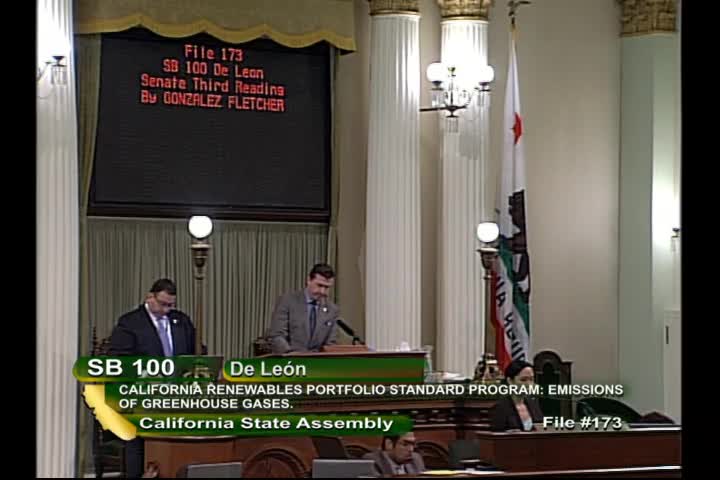 1H
Assembly Floor
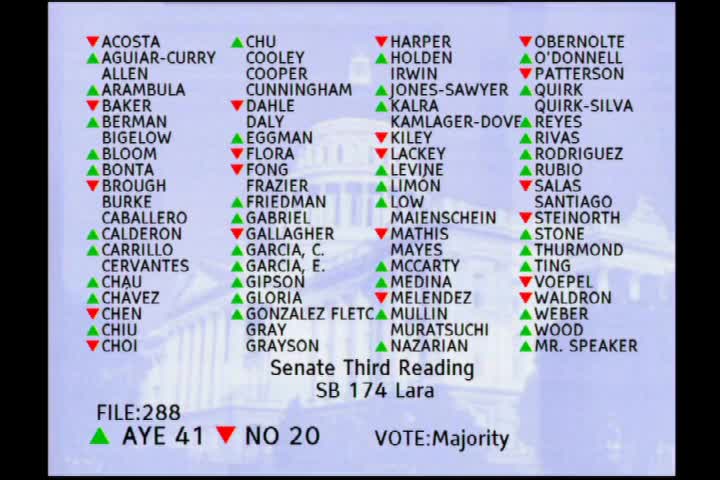 55SEC
Assembly Floor
 1H
Assembly Standing Committee on Utilities and Energy
 1H
Assembly Standing Committee on Appropriations
 38MIN
Assembly Standing Committee on Natural Resources
 1H
Assembly Standing Committee on Utilities and Energy
 11MIN
Senate Floor
Bill Author

Bill Co-Author(s):





























