SB 1007: Sales and use taxes: exemption: military and veteran medical facilities.
- Session Year: 2017-2018
- House: Senate
- Latest Version Date: 2018-09-26
Existing state sales and use tax laws impose a tax on retailers measured by the gross receipts from the sale of tangible personal property sold at retail in this state, or on the storage, use, or other consumption in this state of tangible personal property purchased from a retailer for storage, use, or other consumption in this state. The Sales and Use Tax Law provides various exemptions from those taxes, including an exemption for the sale of, or the storage, use, or other consumption of, meals and food products that are furnished or served by any nonprofit veterans organization for purposes of fundraising, as specified.
This bill, on and after January 1, 2019, and before January 1, 2025, would exempt from these taxes the gross receipts from the sale of, and the storage, use, or other consumption in this state of, building materials and supplies purchased by a qualified person for use by that qualified person in the construction of specified military and veteran medical facilities.
The Bradley-Burns Uniform Local Sales and Use Tax Law authorizes cities and counties to impose local sales and use taxes in conformity with the Sales and Use Tax Law, and existing laws authorize districts, as specified, to impose transactions and use taxes in accordance with the Transactions and Use Tax Law, which generally conforms to the Sales and Use Tax Law. Amendments to the Sales and Use Tax Law are automatically incorporated into the local tax laws.
Existing law requires the state to reimburse cities and counties for revenue losses caused by the enactment of sales and use tax exemptions.
This bill would provide that, notwithstanding these provisions, no appropriation is made and the state shall not reimburse cities and counties for sales and use tax revenues lost by them pursuant to this bill.
This bill would take effect immediately as a tax levy.
Existing state sales and use tax laws impose a tax on retailers measured by the gross receipts from the sale of tangible personal property sold at retail in this state, or on the storage, use, or other consumption in this state of tangible personal property purchased from a retailer for storage, use, or other consumption in this state. The Sales and Use Tax Law provides various exemptions from those taxes, including an exemption for the sale of, or the storage, use, or other consumption of, meals and food products that are furnished or served by any nonprofit veterans organization for purposes of fundraising, as specified.
This bill, on and after January 1, 2019, and before January 1, 2025, would exempt from these taxes the gross receipts from the sale of, and the storage, use, or other consumption in this state of, building materials and supplies purchased by a qualified person for use by that qualified person in the construction of specified military and veteran medical facilities.
The Bradley-Burns Uniform Local Sales and Use Tax Law authorizes cities and counties to impose local sales and use taxes in conformity with the Sales and Use Tax Law, and existing laws authorize districts, as specified, to impose transactions and use taxes in accordance with the Transactions and Use Tax Law, which generally conforms to the Sales and Use Tax Law. Amendments to the Sales and Use Tax Law are automatically incorporated into the local tax laws.
Existing law requires the state to reimburse cities and counties for revenue losses caused by the enactment of sales and use tax exemptions.
This bill would provide that, notwithstanding these provisions, no appropriation is made and the state shall not reimburse cities and counties for sales and use tax revenues lost by them pursuant to this bill.
This bill would take effect immediately as a tax levy.
Existing state sales and use tax laws impose a tax on retailers measured by the gross receipts from the sale of tangible personal property sold at retail in this state, or on the storage, use, or other consumption in this state of tangible personal property purchased from a retailer for storage, use, or other consumption in this state. The Sales and Use Tax Law provides various exemptions from those taxes, including an exemption for the sale of, or the storage, use, or other consumption of, meals and food products that are furnished or served by any nonprofit veterans organization for purposes of fundraising, as specified.
This bill, on and after January 1, 2019, and before January 1, 2025, would exempt from these taxes the gross receipts from the sale of, and the storage, use, or other consumption in this state of, building materials and supplies purchased by a qualified person for use by that qualified person in the construction of specified military and veteran medical facilities.
The Bradley-Burns Uniform Local Sales and Use Tax Law authorizes cities and counties to impose local sales and use taxes in conformity with the Sales and Use Tax Law, and existing laws authorize districts, as specified, to impose transactions and use taxes in accordance with the Transactions and Use Tax Law, which generally conforms to the Sales and Use Tax Law. Amendments to the Sales and Use Tax Law are automatically incorporated into the local tax laws.
Existing law requires the state to reimburse cities and counties for revenue losses caused by the enactment of sales and use tax exemptions.
This bill would provide that, notwithstanding these provisions, no appropriation is made and the state shall not reimburse cities and counties for sales and use tax revenues lost by them pursuant to this bill.
This bill would take effect immediately as a tax levy.
Existing state sales and use tax laws impose a tax on retailers measured by the gross receipts from the sale of tangible personal property sold at retail in this state, or on the storage, use, or other consumption in this state of tangible personal property purchased from a retailer for storage, use, or other consumption in this state. The Sales and Use Tax Law provides various exemptions from those taxes, including an exemption for the sale of, or the storage, use, or other consumption of, meals and food products that are furnished or served by any nonprofit veterans organization for purposes of fundraising, as specified.
This bill, on and after April 1, 2017, January 1, 2019, and before January 1, 2025, would exempt from these taxes the gross receipts from the sale of, and the storage, use, or other consumption in this state of, building materials and supplies purchased by a qualified person for use by that qualified person in the construction of specified military and veteran medical facilities. The bill would make a legislative finding and declaration that the retroactive application of the bill serves a public purpose and does not constitute a gift of public funds.
The Bradley-Burns Uniform Local Sales and Use Tax Law authorizes cities and counties to impose local sales and use taxes in conformity with the Sales and Use Tax Law, and existing laws authorize districts, as specified, to impose transactions and use taxes in accordance with the Transactions and Use Tax Law, which generally conforms to the Sales and Use Tax Law. Amendments to the Sales and Use Tax Law are automatically incorporated into the local tax laws.
Existing law requires the state to reimburse cities and counties for revenue losses caused by the enactment of sales and use tax exemptions.
This bill would provide that, notwithstanding these provisions, no appropriation is made and the state shall not reimburse cities and counties for sales and use tax revenues lost by them pursuant to this bill.
This bill would take effect immediately as a tax levy.
Existing state sales and use tax laws impose a tax on retailers measured by the gross receipts from the sale of tangible personal property sold at retail in this state, or on the storage, use, or other consumption in this state of tangible personal property purchased from a retailer for storage, use, or other consumption in this state. The Sales and Use Tax Law provides various exemptions from those taxes, including an exemption for the sale of, or the storage, use, or other consumption of, meals and food products that are furnished or served by any nonprofit veterans organization for purposes of fundraising, as specified.
This bill, on and after April 1, 2017, and before January 1, 2025, would exempt from these taxes the gross receipts from the sale of, and the storage, use, or other consumption in this state of, building materials and supplies purchased by a qualified person for use by that qualified person in the construction of specified military and veteran medical facilities. The bill would make a legislative finding and declaration that the retroactive application of the bill serves a public purpose and does not constitute a gift of public funds.
The Bradley-Burns Uniform Local Sales and Use Tax Law authorizes cities and counties to impose local sales and use taxes in conformity with the Sales and Use Tax Law, and existing laws authorize districts, as specified, to impose transactions and use taxes in accordance with the Transactions and Use Tax Law, which generally conforms to the Sales and Use Tax Law. Amendments to the Sales and Use Tax Law are automatically incorporated into the local tax laws.
Existing law requires the state to reimburse cities and counties for revenue losses caused by the enactment of sales and use tax exemptions.
This bill would provide that, notwithstanding these provisions, no appropriation is made and the state shall not reimburse cities and counties for sales and use tax revenues lost by them pursuant to this bill.
The Banking Law and the California Credit Union Law provide for the regulation of banks and credit unions by the Commissioner of Business Oversight. This bill would state the Legislatures intent to enact legislation that would enable individuals who are unbanked or underbanked to gain better access to banking and related financial services.The Banking Law and the California Credit Union Law provide for the regulation of banks and credit unions by the Commissioner of Business Oversight.
This bill would state the Legislatures intent to enact legislation that would enable individuals who are unbanked or underbanked to gain better access to banking and related financial services.
(a)On and after January 1, 2019, and before January 1, 2025, there are exempted from the taxes imposed by this part the gross receipts from the sale of, and the storage, use, or other consumption in this state of, building materials and supplies purchased by a qualified person for use by that qualified person in the construction of a qualified facility.
(b)For the purposes of this section, the following definitions shall apply:
(1)(A)Building materials and supplies includes any machinery, equipment, materials, accessories, appliances, contrivances, furniture, fixtures, and all technical equipment or other tangible personal property of any other nature or description that meet all of the following:
(i)Are necessary to construct and equip a qualified facility.
(ii)Become part of the completed facility.
(iii)Are transferred to the United States Department of Defense or the United States Department of Veterans Affairs as a gift described in paragraph (3).
(B)Building materials and supplies shall not include any tools or construction equipment other than those specified in subparagraph (A) that a qualified person uses in construction activities, specifically including construction of a qualified facility.
(2)Qualified facility means either of the following:
(A)A medical facility, or a temporary residential facility for families of patients receiving care, including either or both inpatient and outpatient care, at a medical facility, located on a United States military base located in California.
(B)A United States Department of Veterans Affairs medical center, or a temporary residential facility for families of patients receiving care at or as part of a United States Department of Veterans Affairs medical center, located in California.
(3)Qualified nonprofit organization means an organization exempt from taxation pursuant to Section 501(c)(3) of the Internal Revenue Code that constructs a qualified facility as a gift to the United States Department of Defense pursuant to Section 2601 of Title 10 of the United States Code or the United States Department of Veterans Affairs pursuant to Section 8301 of Title 38 of the United States Code.
(4)Qualified person means either or both of the following:
(A)A qualified nonprofit organization.
(B)A contractor, subcontractor, or builder working under contract with a qualified nonprofit organization to construct a qualified facility.
(c)The exemption provided by this section shall only apply to sales and purchases that occur after the date the United States Department of Defense or the United States Department of Veterans Affairs accepts the offer of the qualified nonprofit organization to construct the qualified facility and on or before the date the United States Department of Defense or the United States Department of Veterans Affairs accepts the qualified facility.
(d)(1)An exemption shall not be allowed under this section with respect to sales by, or purchases from, a retailer engaged in business in this state or from a retailer that is authorized by the California Department of Tax and Fee Administration, under the rules and regulations as it may prescribe, to collect the tax and that is, for the purposes of this part relating to the use tax, regarded as a retailer engaged in business in this state, unless the purchaser furnishes the retailer with an exemption certificate completed in accordance with any instructions or regulations as the California Department of Tax and Fee Administration may prescribe and the retailer retains a copy of the exemption certificate in its records and furnishes the copy of the exemption certificate to the California Department of Tax and Fee Administration upon request.
(2)If a purchaser furnishes the retailer with a copy of an exemption certificate pursuant to paragraph (1), but uses materials or fixtures purchased with the exemption certificate in a manner not qualifying for the exemption, the purchaser shall be liable for payment of sales tax, with applicable interest, as if the purchaser were a retailer making a retail sale of the materials or fixtures at the time the property is so used, and the cost of the materials or fixtures to the purchaser shall be deemed the gross receipts from that retail sale.
SEC. 2.Notwithstanding Section 2230 of the Revenue and Taxation Code, no appropriation is made by this act and the state shall not reimburse cities and counties for any sales and use tax revenues lost by them under this act.
SEC. 3.This act provides for a tax levy within the meaning of Article IV of the California Constitution and shall go into immediate effect.
(a)On and after January 1, 2019, and before January 1, 2025, there are exempted from the taxes imposed by this part the gross receipts from the sale of, and the storage, use, or other consumption in this state of, building materials and supplies purchased by a qualified person for use by that qualified person in the construction of a qualified facility.
(b)For the purposes of this section, the following definitions shall apply:
(1)(A)Building materials and supplies includes any machinery, equipment, materials, accessories, appliances, contrivances, furniture, fixtures, and all technical equipment or other tangible personal property of any other nature or description that meet all of the following:
(i)Are necessary to construct and equip a qualified facility.
(ii)Become part of the completed facility.
(iii)Are transferred to the United States Department of Defense or the United States Department of Veterans Affairs as a gift described in paragraph (3).
(B)Building materials and supplies shall not include any tools or construction equipment other than those specified in subparagraph (A) that a qualified person uses in construction activities, specifically including construction of a qualified facility.
(2)Qualified facility means either of the following:
(A)A medical facility, or a temporary residential facility for families of patients receiving care, including either or both inpatient and outpatient care, at a medical facility, located on a United States military base located in California.
(B)A United States Department of Veterans Affairs medical center, or a temporary residential facility for families of patients receiving care at or as part of a United States Department of Veterans Affairs medical center, located in California.
(3)Qualified nonprofit organization means an organization exempt from taxation pursuant to Section 501(c)(3) of the Internal Revenue Code that constructs a qualified facility as a gift to the United States Department of Defense pursuant to Section 2601 of Title 10 of the United States Code or the United States Department of Veterans Affairs pursuant to Section 8301 of Title 38 of the United States Code.
(4)Qualified person means either or both of the following:
(A)A qualified nonprofit organization.
(B)A contractor, subcontractor, or builder working under contract with a qualified nonprofit organization to construct a qualified facility.
(c)The exemption provided by this section shall only apply to sales and purchases that occur after the date the United States Department of Defense or the United States Department of Veterans Affairs accepts the offer of the qualified nonprofit organization to construct the qualified facility and on or before the date the United States Department of Defense or the United States Department of Veterans Affairs accepts the qualified facility.
(d)(1)An exemption shall not be allowed under this section with respect to sales by, or purchases from, a retailer engaged in business in this state or from a retailer that is authorized by the California Department of Tax and Fee Administration, under the rules and regulations as it may prescribe, to collect the tax and that is, for the purposes of this part relating to the use tax, regarded as a retailer engaged in business in this state, unless the purchaser furnishes the retailer with an exemption certificate completed in accordance with any instructions or regulations as the California Department of Tax and Fee Administration may prescribe and the retailer retains a copy of the exemption certificate in its records and furnishes the copy of the exemption certificate to the California Department of Tax and Fee Administration upon request.
(2)If a purchaser furnishes the retailer with a copy of an exemption certificate pursuant to paragraph (1), but uses materials or fixtures purchased with the exemption certificate in a manner not qualifying for the exemption, the purchaser shall be liable for payment of sales tax, with applicable interest, as if the purchaser were a retailer making a retail sale of the materials or fixtures at the time the property is so used, and the cost of the materials or fixtures to the purchaser shall be deemed the gross receipts from that retail sale.
SEC. 2.Notwithstanding Section 2230 of the Revenue and Taxation Code, no appropriation is made by this act and the state shall not reimburse cities and counties for any sales and use tax revenues lost by them under this act.
SEC. 3.This act provides for a tax levy within the meaning of Article IV of the California Constitution and shall go into immediate effect.
(a)On and after January 1, 2019, and before January 1, 2025, there are exempted from the taxes imposed by this part the gross receipts from the sale of, and the storage, use, or other consumption in this state of, building materials and supplies purchased by a qualified person for use by that qualified person in the construction of a qualified facility.
(b)For the purposes of this section, the following definitions shall apply:
(1)(A)Building materials and supplies includes, but is not limited to, includes any machinery, equipment, materials, accessories, appliances, contrivances, furniture, fixtures, and all technical equipment or other tangible personal property of any other nature or description, and the building materials and supplies description that meet all of the following:
(i)Are necessary to construct and equip a qualified facility.
(ii)Become part of the completed facility.
(iii)Are transferred to the United States Department of Defense or the United States Department of Veterans Affairs as a gift described in paragraph (3).
(B)Building materials and supplies shall not include any tools or construction equipment other than those specified in subparagraph (A) that a qualified person uses in construction activities, specifically including construction of a qualified facility.
(2)Qualified facility means either of the following:
(A)A medical facility, or a temporary residential facility for families of patients receiving care, including either or both inpatient and outpatient care, at a medical facility, located on a United States military base located in California.
(B)A United States Department of Veterans Affairs medical center, or a temporary residential facility for families of patients receiving care at or as part of a United States Department of Veterans Affairs medical center, located in California.
(3)Qualified nonprofit organization means an organization exempt from taxation pursuant to Section 501(c)(3) of the Internal Revenue Code that constructs a qualified facility as a gift to the United States Department of Defense pursuant to Section 2601 of Title 10 of the United States Code or the United States Department of Veterans Affairs pursuant to Section 8301 of Title 38 of the United States Code.
(4)Qualified person means either or both of the following:
(A)A qualified nonprofit organization.
(B)A contractor, subcontractor, or builder working under contract with a qualified nonprofit organization to construct a qualified facility.
(c)The exemption provided by this section shall only apply to sales and purchases that occur after the date the United States Department of Defense or the United States Department of Veterans Affairs accepts the offer of the qualified nonprofit organization to construct the qualified facility and on or before the date the United States Department of Defense or the United States Department of Veterans Affairs accepts the qualified facility.
(d)(1)An exemption shall not be allowed under this section with respect to sales by, or purchases from, a retailer engaged in business in this state or from a retailer that is authorized by the California Department of Tax and Fee Administration, under the rules and regulations as it may prescribe, to collect the tax and that is, for the purposes of this part relating to the use tax, regarded as a retailer engaged in business in this state, unless the purchaser furnishes the retailer with an exemption certificate completed in accordance with any instructions or regulations as the California Department of Tax and Fee Administration may prescribe and the retailer retains a copy of the exemption certificate in its records and furnishes the copy of the exemption certificate to the California Department of Tax and Fee Administration upon request.
(2)If a purchaser furnishes the retailer with a copy of an exemption certificate pursuant to paragraph (1), but uses materials or fixtures purchased with the exemption certificate in a manner not qualifying for the exemption, the purchaser shall be liable for payment of sales tax, with applicable interest, as if the purchaser were a retailer making a retail sale of the materials or fixtures at the time the property is so used, and the cost of the materials or fixtures to the purchaser shall be deemed the gross receipts from that retail sale.
SEC. 2.Notwithstanding Section 2230 of the Revenue and Taxation Code, no appropriation is made by this act and the state shall not reimburse cities and counties for any sales and use tax revenues lost by them under this act.
SEC. 3.This act provides for a tax levy within the meaning of Article IV of the California Constitution and shall go into immediate effect.
(a)On and after April 1, 2017, January 1, 2019, and before January 1, 2025, there are exempted from the taxes imposed by this part the gross receipts from the sale of, and the storage, use, or other consumption in this state of, building materials and supplies purchased by a qualified person for use by that qualified person in the construction of a qualified facility.
(b)For the purposes of this section, the following definitions shall apply:
(1)(A)Building materials and supplies includes, but is not limited to, machinery, equipment, materials, accessories, appliances, contrivances, furniture, fixtures, and all technical equipment or other tangible personal property of any other nature or description, and the building materials and supplies that meet all of the following:
(i)Are necessary to construct and equip a qualified facility.
(ii)Become part of the completed facility.
(iii)Are transferred to the United States Department of Defense or the United States Department of Veterans Affairs as a gift described in paragraph (3).
(B)Building materials and supplies shall not include any tools or construction equipment other than those specified in subparagraph (A) that a qualified person uses in construction activities, specifically including construction of a qualified facility.
(2)Qualified facility means either of the following:
(A)A medical facility, or a temporary residential facility for families of patients receiving care, including either or both inpatient and outpatient care, at a medical facility, located on a United States military base located in California.
(B)A United States Department of Veterans Affairs medical center, or a temporary residential facility for families of patients receiving care at or as part of a United States Department of Veterans Affairs medical center, located in California.
(3)Qualified nonprofit organization means an organization exempt from taxation pursuant to Section 501(c)(3) of the Internal Revenue Code that constructs a qualified facility as a gift to the United States Department of Defense pursuant to Section 2601 of Title 10 of the United States Code or the United States Department of Veterans Affairs pursuant to Section 8301 of Title 38 of the United States Code.
(4)Qualified person means either or both of the following:
(A)A qualified nonprofit organization.
(B)A contractor, subcontractor, or builder working under contract with a qualified nonprofit organization to construct a qualified facility.
(c)The exemption provided by this section shall only apply to sales and purchases that occur after the date the United States Department of Defense or the United States Department of Veterans Affairs accepts the offer of the qualified nonprofit organization to construct the qualified facility and on or before the date the United States Department of Defense or the United States Department of Veterans Affairs accepts the qualified facility.
(d)(1)An exemption shall not be allowed under this section with respect to sales by, or purchases from, a retailer engaged in business in this state or from a retailer that is authorized by the California Department of Tax and Fee Administration, under the rules and regulations as it may prescribe, to collect the tax and that is, for the purposes of this part relating to the use tax, regarded as a retailer engaged in business in this state, unless the purchaser furnishes the retailer with an exemption certificate completed in accordance with any instructions or regulations as the California Department of Tax and Fee Administration may prescribe and the retailer retains a copy of the exemption certificate in its records and furnishes the copy of the exemption certificate to the California Department of Tax and Fee Administration upon request.
(2)If a purchaser furnishes the retailer with a copy of an exemption certificate pursuant to paragraph (1), but uses materials or fixtures purchased with the exemption certificate in a manner not qualifying for the exemption, the purchaser shall be liable for payment of sales tax, with applicable interest, as if the purchaser were a retailer making a retail sale of the materials or fixtures at the time the property is so used, and the cost of the materials or fixtures to the purchaser shall be deemed the gross receipts from that retail sale.
SEC. 2.Notwithstanding Section 2230 of the Revenue and Taxation Code, no appropriation is made by this act and the state shall not reimburse cities and counties for any sales and use tax revenues lost by them under this act.
SEC. 3.The Legislature finds and declares that this act, and its retroactive application, serves a public purpose and does not constitute a gift of public funds within the meaning of Section 6 of Article XVI of the California Constitution.SEC. 3.This act provides for a tax levy within the meaning of Article IV of the California Constitution and shall go into immediate effect.
CORRECTIONS: HeadingLine 1.(a)On and after April 1, 2017, and before January 1, 2025, there are exempted from the taxes imposed by this part the gross receipts from the sale of, and the storage, use, or other consumption in this state of, building materials and supplies purchased by a qualified person for use by that qualified person in the construction of a qualified facility.
(b)For the purposes of this section, the following definitions shall apply:
(1)(A)Building materials and supplies includes, but is not limited to, machinery, equipment, materials, accessories, appliances, contrivances, furniture, fixtures, and all technical equipment or other tangible personal property of any other nature or description, and the building materials and supplies that meet all of the following:
(i)Are necessary to construct and equip a qualified facility.
(ii)Become part of the completed facility.
(iii)Are transferred to the United States Department of Defense or the United States Department of Veterans Affairs as a gift described in paragraph (3).
(B)Building materials and supplies shall not include any tools or construction equipment other than those specified in subparagraph (A) that a qualified person uses in construction activities, specifically including construction of a qualified facility.
(2)Qualified facility means either of the following:
(A)A medical facility, or a temporary residential facility for families of patients receiving care, including either or both inpatient and outpatient care, at a medical facility, located on a United States military base located in California.
(B)A United States Department of Veterans Affairs medical center, or a temporary residential facility for families of patients receiving care at or as part of a United States Department of Veterans Affairs medical center, located in California.
(3)Qualified nonprofit organization means an organization exempt from taxation pursuant to Section 501(c)(3) of the Internal Revenue Code that constructs a qualified facility as a gift to the United States Department of Defense pursuant to Section 2601 of Title 10 of the United States Code or the United States Department of Veterans Affairs pursuant to Section 8301 of Title 38 of the United States Code.
(4)Qualified person means either or both of the following:
(A)A qualified nonprofit organization.
(B)A contractor, subcontractor, or builder working under contract with a qualified nonprofit organization to construct a qualified facility.
(c)The exemption provided by this section shall only apply to sales and purchases that occur after the date the United States Department of Defense or the United States Department of Veterans Affairs accepts the offer of the qualified nonprofit organization to construct the qualified facility and on or before the date the United States Department of Defense or the United States Department of Veterans Affairs accepts the qualified facility.
(d)(1)An exemption shall not be allowed under this section with respect to sales by, or purchases from, a retailer engaged in business in this state or from a retailer that is authorized by the California Department of Tax and Fee Administration, under the rules and regulations as it may prescribe, to collect the tax and that is, for the purposes of this part relating to the use tax, regarded as a retailer engaged in business in this state, unless the purchaser furnishes the retailer with an exemption certificate completed in accordance with any instructions or regulations as the California Department of Tax and Fee Administration may prescribe and the retailer retains a copy of the exemption certificate in its records and furnishes the copy of the exemption certificate to the California Department of Tax and Fee Administration upon request.
(2)If a purchaser furnishes the retailer with a copy of an exemption certificate pursuant to paragraph (1), but uses materials or fixtures purchased with the exemption certificate in a manner not qualifying for the exemption, the purchaser shall be liable for payment of sales tax, with applicable interest, as if the purchaser were a retailer making a retail sale of the materials or fixtures at the time the property is so used, and the cost of the materials or fixtures to the purchaser shall be deemed the gross receipts from that retail sale.
SEC. 2.Notwithstanding Section 2230 of the Revenue and Taxation Code, no appropriation is made by this act and the state shall not reimburse cities and counties for any sales and use tax revenues lost by them under this act.
SEC. 3.The Legislature finds and declares that this act, and its retroactive application, serves a public purpose and does not constitute a gift of public funds within the meaning of Section 6 of Article XVI of the California Constitution.
SECTION 1.It is the intent of the Legislature to enact legislation that would enable individuals who are unbanked or underbanked to gain better access to banking and related financial services.It is the intent of the Legislature to enact legislation that would enable individuals who are unbanked or underbanked to gain better access to banking and related financial services.
|
Date
|
Status
|
|---|---|
| Sep 26, 2018 | Chaptered by Secretary of State. Chapter 785, Statutes of 2018. |
| Sep 26, 2018 | Approved by the Governor. |
| Sep 12, 2018 | Enrolled and presented to the Governor at 5 p.m. |
| Aug 31, 2018 | Assembly amendments concurred in. (Ayes 38. Noes 0.) Ordered to engrossing and enrolling. |
| Aug 31, 2018 | Ordered to special consent calendar. |
| Aug 31, 2018 | In Senate. Concurrence in Assembly amendments pending. |
| Aug 31, 2018 | Read third time. Passed. Ordered to the Senate. |
| Aug 13, 2018 | Read second time. Ordered to third reading. |
| Aug 9, 2018 | Read second time and amended. Ordered to second reading. |
| Aug 8, 2018 | From committee: Do pass as amended. (Ayes 17. Noes 0.) (August 8). |
| Jun 25, 2018 | Read second time and amended. Re-referred to Com. on APPR. |
| Jun 21, 2018 | From committee: Do pass as amended and re-refer to Com. on APPR. (Ayes 9. Noes 0.) (June 18). |
| Jun 4, 2018 | Referred to Com. on REV. & TAX. |
| May 29, 2018 | In Assembly. Read first time. Held at Desk. |
| May 29, 2018 | Read third time. Passed. (Ayes 37. Noes 0.) Ordered to the Assembly. |
| May 25, 2018 | From committee: Do pass. (Ayes 7. Noes 0.) (May 25). |
| May 18, 2018 | Set for hearing May 25. |
| May 7, 2018 | May 7 hearing: Placed on APPR. suspense file. |
| Apr 27, 2018 | Set for hearing May 7. |
| Apr 25, 2018 | From committee: Do pass and re-refer to Com. on APPR. (Ayes 7. Noes 0.) (April 25). Re-referred to Com. on APPR. |
| Apr 10, 2018 | Set for hearing April 25. |
| Apr 4, 2018 | Re-referred to Com. on GOV. & F. |
| Mar 21, 2018 | From committee with author's amendments. Read second time and amended. Re-referred to Com. on RLS. |
| Feb 14, 2018 | Referred to Com. on RLS. |
| Feb 7, 2018 | From printer. May be acted upon on or after March 9. |
| Feb 6, 2018 | Introduced. Read first time. To Com. on RLS. for assignment. To print. |
|
Date
|
Description
|
Location
|
Votes
|
|
|---|---|---|---|---|
| Aug 31, 2018 | Unfinished Business SB1007 Hertzberg et al. Concurrence | Senate Floor |
Passed |
|
| Aug 31, 2018 | SB 1007 Hertzberg Senate Third Reading By MURATSUCHI | Assembly Floor |
Passed |
|
| Aug 8, 2018 | Do pass as amended. | Assembly Standing Committee on Appropriations |
Passed |
|
| Jun 18, 2018 | Do pass as amended and be re-referred to the Committee on [Appropriations] | Assembly Standing Committee on Revenue and Taxation |
Passed |
|
| May 29, 2018 | Senate 3rd Reading SB1007 Hertzberg et al. | Senate Floor |
Passed |
|
| May 25, 2018 | Do pass | Senate Standing Committee on Appropriations |
Passed |
|
| May 7, 2018 | Placed on suspense file | Senate Standing Committee on Appropriations |
Passed |
|
| Apr 25, 2018 | Do pass, but first be re-referred to the Committee on [Appropriations] | Senate Standing Committee on Governance and Finance |
Passed |
This list shows positions taken on this bill by organizations on the date displayed, which is linked to the original source.
Positions by individuals are not included.
Office of Senate Floor Analyses (916) 651-1520 Fax: (916) 327-4478 | SB |
UNFINISHED BUSINESS
Bill No: SB 1007
:
SENATE GOVERNANCE & FIN. COMMITTEE: 7-0, 4/25/18
AYES: McGuire, Nguyen, Beall, Hernandez, Hertzberg, Lara, Moorlach
SENATE APPROPRIATIONS COMMITTEE: 7-0, 5/25/18
AYES: Lara, Bates, Beall, Bradford, Hill, Nielsen, Wiener
SENATE FLOOR: 37-0, 5/29/18
AYES: Allen, Anderson, Atkins, Bates, Beall, Bradford, Cannella, De León, Dodd, Fuller, Gaines, Galgiani, Glazer, Hernandez, Hertzberg, Hill, Hueso, Jackson, Lara, Leyva, McGuire, Mitchell, Monning, Moorlach, Morrell, Newman, Nguyen, Pan, Portantino, Roth, Skinner, Stern, Stone, Vidak, Wieckowski, Wiener, Wilk
NO VOTE RECORDED: Berryhill, Nielsen
ASSEMBLY FLOOR: Not available
DIGEST:
This bill exempts from the state and local sales and use tax specified building materials and supplies used by a qualified nonprofit organization to construct a facility used to care for military veterans.
Assembly Amendments
delete its retroactive application, instead specifying an effective date of January 1, 2019, and make a technical change.
Existing law:
- Imposes the sales tax on every retailer engaged in business in this state that sells tangible personal property, and requires them to collect the appropriate tax from the purchase and remit the amount to the California Department of Tax and Fee Administration.
- Applies a state sales and use tax rate of 7.25%, and additionally allows cities and counties to increase the sales and use tax rate up to 2% for either specific or general purposes pursuant to the California Constitution’s vote requirements.
- Exempts from the state and local sales and use tax some items, such as prescription drugs and cold food, while exempting other from the state sales tax, but not the local share, such as farm equipment and machinery, and diesel fuel used for farming and food processing.
- Considers, generally, construction contractors as consumers of materials, such as electrical wiring, concrete, and other items, for sales tax purposes. As such, the contractor pays tax when purchasing materials used to construct the contracted project, and incorporates the tax into the “lump sum” charged to his or her customer.
- Provides construction contractors can be treated as retailers, in which case the construction contractor does not pay sales tax on their materials when they purchase them, and instead collect the tax from his or her customer and remit it to the Board of Equalization (BOE) in three specific cases:
- If the construction contract explicitly provides for the transfer of title to the materials prior to the time the materials are installed, and separately states the sales price of the materials, exclusive of the charge for installation.
- If the construction contract is a “time and materials” contract, where the contractor agrees to furnish and install materials or fixtures, or both, and separately states a charge for the materials or fixtures and a charge for their installation or fabrication.
- When installing fixtures, which are accessories to a structure such as solar panels, that do not lose their identity when installer, based on the price he or she charges for the fixture.
- Provides that the United States government is exempt from paying the sales and use tax, and therefore always treats a construction contractor as a consumer of materials and fixtures furnished and installed in the performance of construction contracts with the United States government.
- Does not provide nonprofit organizations with a blanket exemption from the sales and use tax, but does contain exemptions and other provisions for specific groups. Some organizations may not owe tax on any of their sales, whereas some organizations may owe tax on some but not all sales. Others are responsible for tax just like other California sellers.
This bill:
- Exempts from the state and local sales and use tax building materials and supplies, not including tools, used to construct qualified facilities, defined as a:
- Medical facility, or a temporary residential facility for families of patients receiving care at a medical facility, including either inpatient or outpatient care, located on a United States military base located in California, or
- A United States Department of Veterans Affairs (USDVA) medical center, or a temporary residential facility for families of patients receiving care at or as a part of a USDVA medical center, located in California.
- Applies only to charities qualified under Section 501(c)(3) of the Internal Revenue Code or its contractors or subcontractors, that constructs a qualified facilities as a gift to the United States Department of Defense (DOD) or USDVA.
- Provides that the exemption is only effective after the date the DOD or USDVA accepts the offer to construct the qualified facility, and on or before the date the DOD or USDVA accepts the facility.
- States that the exemption does not apply to contractors considered retailers, unless the purchaser furnishes the retailer with an exemption certificate, and the retailer retains the exemption certificate in its records and furnishes the exemption certificate to BOE upon request. If a purchaser furnishes the retailer with an exemption certificate, but uses materials or fixtures purchased with the exemption certificate in a manner not qualifying for the exemption, the purchaser shall be liable for payment of sales tax, with applicable interest.
- Applies beginning on January, 2019, and ends on January 1, 2025.
- Provides that the state will not reimburse local agencies for any revenue losses resulting from the bill.
Background
The Intrepid Fallen Heroes Fund (Fund) is a 501(c) (3) charitable organization that provides services to support severely injured military personnel. In 2007, the Fund completed construction of the Center for the Intrepid in San Antonio, Texas, to serve military personnel catastrophically disabled in operations in Iraq and Afghanistan, and veterans severely injured in other operations. The Fund also constructed the National Intrepid Center of Excellence for the research, diagnosis and treatment of military personnel and veterans suffering from traumatic brain injury on the Navy campus at Bethesda, Maryland. In 2010, the Intrepid Fallen Heroes Fund launched its current effort to “Intrepid Spirit” centers to serve as satellites to the San Antonio facility. Each facility is approximately 25,000 square feet and costs approximately $11 million to build and equip. The Fund constructs centers with donated funds, and then gifts the facility to the United States government.
Centers are currently operational in Fort Belvoir, VA; Camp Lejeune, NC; Fort Campbell, KY; Fort Bragg, NC; Fort Hood, TX; and Joint Base Lewis-McChord, WA. The Fund generally constructs facilities using donated funds, and then gifts the facility to the United States government. The Fund broke ground on its Camp Pendleton Intrepid Center in San Diego County in May 2017, and opened its doors on April 4, 2018.
FISCAL EFFECT: Appropriation: Fiscal Com.: Local:
According to the Assembly Appropriations Committee, potential General Fund revenue loss in the range of $100,000 as a result of the exemption being used on a future facility.
American GI Forum of California
American Legion-Department of California
Board of Equalization Member George Runner
California Association of County Veterans Service Officers
California State Commanders Veterans Council
Paralyzed Veterans of America, San Diego Chapter
San Diego Regional Chamber of Commerce
OPPOSITION: (Verified 8/31/18)
California State Association of Counties
ARGUMENTS IN SUPPORT: According to the author, “When our military veterans return from service, they often suffer from a variety of illnesses that require serious medical attention, such as posttraumatic stress disorder, or traumatic brain injury. Though the federal government is responsible for caring for service members and veterans, there remains a need for additional medical facilities to address the specific health needs of veterans. California can help by providing a tax exemption for charitable organizations that build these particular types of medical facilities and turn them over to the United States Department of Defense. This is the same benefit afforded to the federal government when it builds these facilities.”
ARGUMENTS IN OPPOSITION: According to the California State Association of Counties, “we request that only the state share is provided for the exemption and that critical funds for locally administered sales tax programs – such as those under realignment – as well as county-based programs are not impacted. Over the last thirty years of changes to sales and use tax allocations, counties now receive almost half of sales and use tax revenues. Two-thirds of that revenue is constitutionally dedicated to providing local public safety services and federal and state programs, including social services, incarceration, and rehabilitation. In addition, many jurisdictions have passed voter-approved, locally-imposed transactions and use taxes to fund a variety of essential, quality of life services as well as infrastructure needs. Therefore, we respectfully request that the local sales and use taxes be untouched and by SB 1007 and vital dollars continue to flow to critical service needs. We have no concerns with the state’s portion being used for this proposal in an effort to further state policy goals.”
8/31/18 13:40:50
**** END ****
SENATE THIRD READING
STR Bill Id:SB 1007
Author:(Hertzberg, et al.)
As Amended Ver:August 9, 2018
Majority vote. Tax Levy
SENATE VOTE: 37-0
Committee | Votes | Ayes | Noes |
Revenue & Taxation | 9-0 | Burke, Brough, Chu, Gray, Melendez, Mullin, Quirk, Rivas, Voepel | |
Appropriations | 17-0 | Gonzalez Fletcher, Bigelow, Bloom, Bonta, Brough, Calderon, Carrillo, Chau, Eggman, Fong, Friedman, Gallagher, Eduardo Garcia, Nazarian, Obernolte, Quirk, Reyes |
SUMMARY: Provides a sales and use tax (SUT) exemption for "building materials and supplies" purchased by a "qualified person" for use in the construction of a "qualified facility". Specifically, this bill:
- Provides the SUT exemption on and after January 1, 2019, and before January 1, 2025.
- Defines "building materials and supplies" to include any machinery, equipment, materials, accessories, appliances, contrivances, furniture, fixtures, and all technical equipment or other tangible personal property (TPP) of any other nature or description that meet all of the following:
- Are necessary to construct and equip a "qualified facility";
- Become part of the completed facility; and,
- Are transferred to the United States Department of Defense or the United States Department of Veterans Affairs as a gift, as specified.
- Specifies that "building materials and supplies" shall not include any tools or construction equipment other than those specified above that a "qualified person" uses in construction activities, specifically including construction of a "qualified facility".
- Defines a "qualified person" as either or both of the following:
- A "qualified nonprofit organization"; and,
- A contractor, subcontractor, or builder working under contract with a "qualified nonprofit organization" to construct a "qualified facility".
- Defines a "qualified facility" as either of the following:
- A medical facility, or a temporary residential facility for families of patients receiving care, including either or both inpatient and outpatient care, at a medical facility, located on a United States military base located in California; or,
- A United States Department of Veterans Affairs medical center, or a temporary residential facility for families of patients receiving care at or as part of a United States Department of Veterans Affairs medical center, located in California.
- Defines a "qualified nonprofit organization" as an organization exempt from taxation pursuant to Internal Revenue Code Section 501(c)(3) that constructs a qualified facility as a gift to the United States Department of Defense pursuant to Section 2601 of Title 10 of the United States Code or the United States Department of Veterans Affairs pursuant Title 38 of the United States Code, Section 8301.
- Specifies that the exemption shall only apply to sales and purchases that occur after the date the United States Department of Defense or the United States Department of Veterans Affairs accepts the offer of the qualified nonprofit organization to construct the qualified facility and on or before the date the United States Department of Defense or the United States Department of Veterans Affairs accepts the qualified facility.
- Provides that an exemption shall not be allowed unless the purchaser furnishes the retailer with an exemption certificate completed in accordance with any instructions or regulations as the California Department of Tax and Fee Administration (CDTFA) may prescribe and the retailer retains a copy of the exemption certificate in its records and furnishes a copy of the exemption certificate to the CDTFA upon request.
- Contains a standard recapture provision for materials used in a manner not qualifying for the exemption.
- Provides that notwithstanding Revenue and Taxation Code Section 2230, no appropriation is made by this bill and the state shall not reimburse cities and counties for lost SUT revenues.
- Takes immediate effect as a tax levy.
EXISTING LAW:
- Imposes a sales tax on retailers for the privilege of selling TPP, absent a specific exemption. The tax is based upon the retailer's gross receipts from TPP sales in this state.
- Imposes a complimentary use tax on the storage, use, or other consumption of TPP purchased out-of-state and brought into California. The use tax is imposed on the purchaser; and unless the purchaser pays the use tax to an out-of-state retailer registered to collect California's use tax, the purchaser remains liable for the tax. The use tax is set at the same rate as the state's sales tax and must generally be remitted to the CDTFA.
- Provides no general SUT exemption merely because the retailer or purchaser is engaged in charitable activities, is a nonprofit organization, or enjoys certain privileges under applicable property or income tax laws.
- Requires retailers generally to file returns and remit taxes due on a quarterly basis.
FISCAL EFFECT: According to the Assembly Appropriations Committee, potential General Fund revenue loss in the range of $100,000 as a result of the exemption being used on a future facility.
COMMENTS:
- Author’s Statement: The author has provided the following statement in support of this bill:
A number of our military service members return from combat with various health challenges. Sometimes our federal government needs help to build medical facilities to help rehabilitate our military service members. Fortunately, non-profit organizations are stepping up to help meet that demand by constructing and donating facilities to the federal government. However, unlike the federal government, these non-profit organizations currently have to pay Sales and Use taxes on construction materials. SB 1007 encourages organizations to build medical facilities for military [service] members by waiving sales and use taxes.
- Committee Staff Comments: This bill has its origins in the work of the Intrepid Fallen Heroes Fund (Fund). The Fund builds centers for treating United States military personnel suffering the effects of traumatic brain injury and post-traumatic stress disorder. Specifically, the Fund is building a series of 10 specially-designed treatment facilities, called Intrepid Spirit Centers, on military bases throughout the nation. Seven Intrepid Spirit Centers are currently open and serving America's men and women in uniform, including the one at Camp Pendleton. [1] Ground was broken for the Intrepid Spirit Center at Camp Pendleton in May 2017, and the center was officially dedicated on April 4th of this year. Three additional centers remain to be built in Colorado, Texas, and Florida. The Fund reports that each center is approximately 25,000 square feet and costs roughly $14 million to build and equip
Analysis Prepared by: M. David Ruff / REV. & TAX. / (916) 319-2098 FN: 0003939
Intrepid Spirit Centers are currently operational at Fort Belvoir, Virginia; Camp Lejeune, North Carolina; Fort Campbell, Kentucky; Fort Bragg, North Carolina; Fort Hood, Texas; Joint Base Lewis-McChord, Washington; and Camp Pendleton, California. ↑
Date of Hearing: August 8, 2018
ASSEMBLY COMMITTEE ON APPROPRIATIONS
Lorena Gonzalez Fletcher, Chair
SBPCA Bill Id:SB 1007
Author:(Hertzberg) – As Amended Ver:June 25, 2018
Policy Committee: | Revenue and Taxation | Vote: | 9 - 0 |
|
|
Urgency: No State Mandated Local Program: No Reimbursable: No
SUMMARY:
This bill establishes a sales and use tax (SUT) exemption for building materials and supplies purchased by a qualified nonprofit, or a contractor or subcontractor working with a qualified nonprofit, for use in the construction of a United States Department of Veterans Affair medical facility or a medical facility located on a United States military base. This exemption applies to purchases made between January 1, 2019 and January 1, 2025.
FISCAL EFFECT:
Potential GF revenue loss in the range of $100,000 as a result of the exemption being used on a future facility.
COMMENTS:
- Background. The Intrepid Fallen Heroes Fund (Fund) provides financial support to severely wounded military personnel and veterans and their families. Since its inception, it has provided nearly $200 million in support, and the Fund is supported entirely with donations from the public. The Fund has also launched a campaign to build up to nine medical centers at military bases around the country to provide care to service members suffering from traumatic brain injury and psychological health conditions. A new 25,000 square foot facility located at Camp Pendleton was completed in Spring 2018.
- Purpose. According to the author, SB 1007 encourages organizations to build medical facilities for military members by waiving sales and use taxes. The author notes that unlike the federal government, nonprofit organizations building medical facilities to help rehabilitate military service members have to pay sales and use taxes on construction materials.
- Recent Amendments. Recent amendments to SB 1007 address policy and implementation concerns about the bill’s retroactive provisions. Prior versions of the bill provided a SUT exclusion beginning on April 1, 2017, meaning that refunds would have been provided for activity already completed. This retroactivity was problematic for a number of reasons. First, it would have been difficult for the state to administer the exemption and likely would have caused significant confusion for taxpayers. Second, as the Assembly Committee on Revenue and Taxation notes in its analysis of SB 1007, retroactivity runs counter to well established principles of sound tax policy. Generally, tax expenditures such as an SUT exemption are enacted to encourage a future taxpayer to act in some way, and retroactivity undermines that goal.
- Recent legislation. SB 197 (Bates) contained provisions substantially similar to this bill. However, those provisions were also retroactive and would have applied to a facility located on Camp Pendleton, which was already close to completion. SB 197 was held on this committee’s Suspense File.
Analysis Prepared by: Luke Reidenbach / APPR. / (916) 319-2081
Date of Hearing: June 18, 2018
ASSEMBLY COMMITTEE ON REVENUE AND TAXATION
Autumn R. Burke, Chairwoman
SBPCA Bill Id:SB 1007
Author:(Hertzberg) – As Amended Ver:March 21, 2018
Majority vote. Fiscal committee.
SENATE VOTE: 37-0
SUBJECT: Sales and use taxes: exemption: military and veteran medical facilities
SUMMARY: Provides a sales and use tax (SUT) exemption for "building materials and supplies" purchased by a "qualified person" for use in the construction of a "qualified facility". Specifically, this bill:
- Provides the SUT exemption on and after April 1, 2017, and before January 1, 2025.
- Defines "building materials and supplies" to include, without limitation, machinery, equipment, materials, accessories, appliances, contrivances, furniture, fixtures, and all technical equipment or other tangible personal property (TPP) of any other nature or description, and the building materials and supplies that meet all of the following:
- Are necessary to construct and equip a "qualified facility";
- Become part of the completed facility; and,
- Are transferred to the United States Department of Defense or the United States Department of Veterans Affairs as a gift, as specified.
- Specifies that "building materials and supplies" shall not include any tools or construction equipment other than those specified above that a "qualified person" uses in construction activities, specifically including construction of a "qualified facility".
- Defines a "qualified person" as either or both of the following:
- A "qualified nonprofit organization"; and,
- A contractor, subcontractor, or builder working under contract with a "qualified nonprofit organization" to construct a "qualified facility".
- Defines a "qualified facility" as either of the following:
- A medical facility, or a temporary residential facility for families of patients receiving care, including either or both inpatient and outpatient care, at a medical facility, located on a United States military base located in California; or,
- A United States Department of Veterans Affairs medical center, or a temporary residential facility for families of patients receiving care at or as part of a United States Department of Veterans Affairs medical center, located in California.
- Defines a "qualified nonprofit organization" as an organization exempt from taxation pursuant to Internal Revenue Code Section 501(c)(3) that constructs a qualified facility as a gift to the United States Department of Defense pursuant to Section 2601 of Title 10 of the United States Code or the United States Department of Veterans Affairs pursuant to Section 8301 of Title 38 of the United States Code.
- Specifies that the exemption shall only apply to sales and purchases that occur after the date the United States Department of Defense or the United States Department of Veterans Affairs accepts the offer of the qualified nonprofit organization to construct the qualified facility and on or before the date the United States Department of Defense or the United States Department of Veterans Affairs accepts the qualified facility.
- Provides that an exemption shall not be allowed unless the purchaser furnishes the retailer with an exemption certificate completed in accordance with any instructions or regulations as the California Department of Tax and Fee Administration (CDTFA) may prescribe and the retailer retains a copy of the exemption certificate in its records and furnishes a copy of the exemption certificate to the CDTFA upon request.
- Contains a standard recapture provision for materials used in a manner not qualifying for the exemption.
- Provides that notwithstanding Revenue and Taxation Code Section 2230, no appropriation is made by this bill and the state shall not reimburse cities and counties for lost SUT revenues.
- Contains legislative findings that this bill, and its retroactive application, serves a public purpose and does not constitute a gift of public funds within the meaning of Section 6 of Article XVI of the California Constitution.
EXISTING LAW:
- Imposes a sales tax on retailers for the privilege of selling TPP, absent a specific exemption. The tax is based upon the retailer's gross receipts from TPP sales in this state.
- Imposes a complimentary use tax on the storage, use, or other consumption of TPP purchased out-of-state and brought into California. The use tax is imposed on the purchaser; and unless the purchaser pays the use tax to an out-of-state retailer registered to collect California's use tax, the purchaser remains liable for the tax. The use tax is set at the same rate as the state's sales tax and must generally be remitted to the CDTFA.
- Provides no general SUT exemption merely because the retailer or purchaser is engaged in charitable activities, is a nonprofit organization, or enjoys certain privileges under applicable property or income tax laws.
- Requires retailers generally to file returns and remit taxes due on a quarterly basis.
FISCAL EFFECT: Unknown
COMMENTS:
- The author has provided the following statement in support of this bill:
A number of our military service members return from combat with various health challenges. Sometimes our federal government needs help to build medical facilities to help rehabilitate our military service members. Fortunately, non-profit organizations are stepping up to help meet that demand by constructing and donating facilities to the federal government. However, unlike the federal government, these non-profit organizations currently have to pay Sales and Use taxes on construction materials. SB 1007 encourages organizations to build medical facilities for military [service] members by waiving sales and use taxes.
- This bill is supported by the American GI Forum of California, which notes the following:
By providing this tax exemption for these charitable organizations, it will expedite the constructions of these needed facilities. With a growing number of veterans who have returned home from service suffering from posttraumatic stress disorder and/or other traumatic brain injuries, this stimulus is needed more than ever.
- This bill is opposed by the California State Association of Counties, which notes the following:
We recognize the intent of the measure but have ongoing concerns with proposals such as these that erode the sales tax base for cities and counties. As such, we request that only the state portion of the sales tax is provided for the exemption and critical funds for locally administered state programs – such as those under Realignment – as well as county-based services and programs are not impacted.
- Committee Staff Comments:
- What is a "tax expenditure"? Existing law provides various credits, deductions, exclusions, and exemptions for particular taxpayer groups. In the late 1960s, U.S. Treasury officials began arguing that these features of the tax law should be referred to as "expenditures" since they are generally enacted to accomplish some governmental purpose and there is a determinable cost associated with each (in the form of foregone revenues).
- What is a "tax expenditure"? Existing law provides various credits, deductions, exclusions, and exemptions for particular taxpayer groups. In the late 1960s, U.S. Treasury officials began arguing that these features of the tax law should be referred to as "expenditures" since they are generally enacted to accomplish some governmental purpose and there is a determinable cost associated with each (in the form of foregone revenues).
As the Department of Finance notes in its annual Tax Expenditure Report, there are several key differences between tax expenditures and direct expenditures. First, tax expenditures are reviewed less frequently than direct expenditures. Second, there is generally no control over the amount of revenue losses associated with any given tax expenditure. Finally, it should also be noted that, once enacted, it takes a two-thirds vote to rescind an existing tax expenditure absent a sunset date. This effectively results in a "one-way ratchet" whereby tax expenditures can be conferred by majority vote, but cannot be rescinded, irrespective of their efficacy or cost, without a supermajority vote.
- An overview of the SUT Law: The SUT represents the state's second largest source of General Fund (GF) revenues. Nevertheless, the past 60 years have seen a dramatic reduction in the state's reliance on the SUT and a corresponding increase in its reliance on personal income tax revenues. In fiscal year (FY) 2016-17, SUT revenues were estimated to comprise roughly 20% of the state's GF revenues, down from nearly 60% in FY 1950-51.
The SUT Law was enacted in a very different era. In the 1930s, California's economy was largely dominated by manufacturing, and residents mostly bought and sold tangible goods. Thus, in establishing the base for a new consumption tax, it made sense to impose the tax on sales of TPP, defined as personal property that may be "seen, weighed, measured, felt, or touched." Over the past 80 years, however, California's economy has seen dramatic growth in the service and information sectors, resulting in a significant erosion of the SUT base. For example, the Commission on the 21st Century Economy noted that spending on taxable goods represented 34.6% of personal income in 2008, down from 55.4% in 1980. As a result, tax experts and economists from across the political spectrum argue that California should expand its SUT base.
It could be argued that, while well-intentioned, additional SUT exemptions further erode an already shrinking SUT base. This, in turn, increases fiscal pressures to maintain or even increase California's relatively high SUT rate. High rates arguably promote non-compliance and encourage out-of-state purchases, placing California retailers at a competitive disadvantage. High rates also risk impacting consumer decision-making, which runs counter to widely accepted principles of sound tax policy.
- What would this bill do? This bill would establish a complete SUT exemption for "building materials and supplies" used in the construction of a qualified medical facility. Committee staff understands that this exemption was originally advanced to exempt construction materials used to build a now-completed medical facility at Camp Pendleton.
- Applying the SUT Law to construction contracts: Specific rules govern the furnishing and installing of TPP under a construction contract. As a general matter, a contractor making improvements to real property is considered the consumer of materials like electrical wiring and concrete furnished and installed as part of a construction contract. As such, SUT generally applies to the contractor's purchases of such building materials. In the case of fixtures, however, a different rule applies. Specifically, a contractor is generally regarded as the retailer of fixtures, which are items of TPP that do not lose their identity when installed (e.g., lighting fixtures, air conditioning units, etc.). Thus, tax generally applies to the contractor's fixture sales.
- Background: This bill has its origins in the work of the Intrepid Fallen Heroes Fund (Fund). The Fund builds centers for treating United States military personnel suffering the effects of traumatic brain injury and post-traumatic stress disorder. Specifically, the Fund is building a series of 10 specially-designed treatment facilities, called Intrepid Spirit Centers, on military bases throughout the nation. Seven Intrepid Spirit Centers are currently open and serving America's men and women in uniform, including the one at Camp Pendleton. [1] Ground was broken for the Intrepid Spirit Center at Camp Pendleton in May 2017, and the center was officially dedicated on April 4th of this year. Three additional centers remain to be built in Colorado, Texas, and Florida. The Fund reports that each center is approximately 25,000 square feet and costs roughly $14 million to build and equip.
- Scope of the exemption: In one sense, the proposed SUT exemption would only apply in a very narrow set of circumstances. Specifically, the building materials would have to be purchased by or for a qualified nonprofit organization for use in a qualified facility. Moreover, the facility would have to be constructed as a gift to either the United States Department of Defense or the United States Department of Veterans Affairs.
In another sense, however, the scope of materials actually covered by the exemption is potentially very broad. This is a function of this bill's somewhat ambiguous definition for building materials and supplies. This bill begins by defining "building materials and supplies" to include, without limitation, machinery, equipment, materials and other TPP of any other nature or description. The term also includes building materials and supplies that are necessary to construct and equip the facility and that become part of the completed facility. It is not readily apparent to Committee staff, however, whether these conditions also apply to the first category of building materials, which appears far more expansive in scope. To prevent confusion, and place appropriate limitations on the scope of exempt TPP, Committee staff recommends amending this bill to make clear that, in order to qualify for the exemption, the TPP must comply with the listed conditions (e.g., the TPP must become part of the facility).
- Would the Fund actually benefit from this bill's retroactive provisions? The author's office contends that since the Camp Pendleton facility has already been completed, this bill's retroactive application would enable the Fund to receive the full benefit of the proposed SUT exemption. However, for the Fund to receive the exemption's benefit, three events would first need to occur:
- First, the builders, contractors, and subcontractors (i.e., purchasers) who previously paid sales tax reimbursement on their qualifying purchases would have to ask their suppliers to file refund claims with the CDTFA on their behalf. Current law only authorizes the CDTFA to issue a sales tax refund to the party that remitted the tax to the CDTFA;
- Second, the supplier would then have to file a claim for refund and pass the refund on to the purchaser. The CDTFA may only issue a refund of an overpayment upon sufficient evidence that the retailer will pass the refund on to the purchaser from whom the tax was collected;
- Third, the purchaser (e.g., contractor) would then have to forward the tax refund on to the Fund. However, once the purchaser receives the refund, the purchaser has no obligation under the SUT Law to forward this refund to the Fund. Since contractors generally do not separately state the sales tax paid to their suppliers in their bid for a project, it is unclear if the purchaser would be obligated to forward the refund to the Fund as a matter of contract law either.
- Would the Fund actually benefit from this bill's retroactive provisions? The author's office contends that since the Camp Pendleton facility has already been completed, this bill's retroactive application would enable the Fund to receive the full benefit of the proposed SUT exemption. However, for the Fund to receive the exemption's benefit, three events would first need to occur:
Thus, it is unclear to Committee staff how much benefit the Fund would actually derive from a retroactive application of the SUT exemption. Moreover, any such benefit must be weighed against the administrative burden placed on both retailers and the CDTFA, which would be tasked with submitting and reviewing potentially numerous refund claims.
- Policy and precedent: No one questions the good work of the Fund. That said, providing a retroactive SUT exemption for one entity raises a number of policy concerns. Tax expenditures are typically enacted as a matter of legislative grace to encourage taxpayers to engage in socially beneficially behavior. When a tax expenditure is provided retroactively, for behavior that has already occurred, there is no incentive to be provided. Rather, the state is arguably conferring a windfall, which runs counter to well-established principles of sound tax policy. This problem is only exacerbated when the windfall is intentionally conferred on a single entity rather than a broad class of taxpayers. Such action also establishes a questionable precedent for future retroactive benefits. For these reasons, the Committee may wish to amend this bill to remove the retroactive provisions and apply the SUT exemption prospectively.
- Related legislation: SB 197 (Bates) contained provisions substantially similar to this bill. SB 197 was held on the Assembly Committee on Appropriation's Suspense File.
- Prior legislation: AB 2518 (Gomez), of the 2015-16 Legislative Session, would have established a partial SUT exemption for building and construction supplies purchased for use by specified nonprofit corporations to build low-income housing. AB 2518 was held on the Assembly Committee on Appropriation's Suspense File.
REGISTERED SUPPORT / OPPOSITION:
Support
American GI Forum of California
American Legion-Department of California
California Association of County Veterans Service Officers
California State Commanders Veterans Council
Paralyzed Veterans of America, Cal-Diego Chapter
Opposition
California State Association of Counties
Analysis Prepared by: M. David Ruff / REV. & TAX. / (916) 319-2098
Intrepid Spirit Centers are currently operational at Fort Belvoir, Virginia; Camp Lejeune, North Carolina; Fort Campbell, Kentucky; Fort Bragg, North Carolina; Fort Hood, Texas; Joint Base Lewis-McChord, Washington; and Camp Pendleton, California. ↑
Office of Senate Floor Analyses (916) 651-1520 Fax: (916) 327-4478 | SB |
THIRD READING
Bill No: SB 1007
:
SENATE GOVERNANCE & FIN. COMMITTEE: 7-0, 4/25/18
AYES: McGuire, Nguyen, Beall, Hernandez, Hertzberg, Lara, Moorlach
SENATE APPROPRIATIONS COMMITTEE: 7-0, 5/25/18
AYES: Lara, Bates, Beall, Bradford, Hill, Nielsen, Wiener
DIGEST:
This bill exempts from the state and local sales and use tax specified building materials and supplies used by a qualified nonprofit organization to construct a facility used to care for military veterans, retroactive to April 1, 2017.
Existing law:
- Imposes the sales tax on every retailer engaged in business in this state that sells tangible personal property, and requires them to collect the appropriate tax from the purchase and remit the amount to the California Department of Tax and Fee Administration (CDTFA).
- Applies a state sales and use tax rate of 7.25%, and additionally allows cities and counties to increase the sales and use tax rate up to 2% for either specific or general purposes pursuant to the California Constitution’s vote requirements.
- Exempts from the state and local sales and use tax some items, such as prescription drugs and cold food, while exempting other from the state sales tax, but not the local share, such as farm equipment and machinery, and diesel fuel used for farming and food processing.
- Considers, generally, construction contractors as consumers of materials, such as electrical wiring, concrete, and other items, for sales tax purposes. As such, the contractor pays tax when purchasing materials used to construct the contracted project, and incorporates the tax into the “lump sum” charged to his or her customer.
- Provides construction contractors can be treated as retailers, in which case the construction contractor does not pay sales tax on their materials when they purchase them, and instead collect the tax from his or her customer and remit it to the Board of Equalization (BOE) in three specific cases:
- If the construction contract explicitly provides for the transfer of title to the materials prior to the time the materials are installed, and separately states the sales price of the materials, exclusive of the charge for installation.
- If the construction contract is a “time and materials” contract, where the contractor agrees to furnish and install materials or fixtures, or both, and separately states a charge for the materials or fixtures and a charge for their installation or fabrication.
- When installing fixtures, which are accessories to a structure such as solar panels, that do not lose their identity when installer, based on the price he or she charges for the fixture.
- Provides that the United States government is exempt from paying the sales and use tax, and therefore always treats a construction contractor as a consumer of materials and fixtures furnished and installed in the performance of construction contracts with the United States government.
- Does not provide nonprofit organizations with a blanket exemption from the sales and use tax, but does contain exemptions and other provisions for specific groups. Some organizations may not owe tax on any of their sales, whereas some organizations may owe tax on some but not all sales. Others are responsible for tax just like other California sellers.
This bill:
- Exempts from the state and local sales and use tax building materials and supplies, not including tools, used to construct qualified facilities, defined as a:
- Medical facility, or a temporary residential facility for families of patients receiving care at a medical facility, including either inpatient or outpatient care, located on a United States military base located in California, or
- A United States Department of Veterans Affairs (USDVA) medical center, or a temporary residential facility for families of patients receiving care at or as a part of a USDVA medical center, located in California.
- Applies only to charities qualified under Section 501(c)(3) of the Internal Revenue Code or its contractors or subcontractors, that constructs a qualified facilities as a gift to the United States Department of Defense (DOD) or USDVA.
- Provides that the exemption is only effective after the date the DOD or USDVA accepts the offer to construct the qualified facility, and on or before the date the DOD or USDVA accepts the facility.
- States that the exemption does not apply to contractors considered retailers, unless the purchaser furnishes the retailer with an exemption certificate, and the retailer retains the exemption certificate in its records and furnishes the exemption certificate to BOE upon request. If a purchaser furnishes the retailer with an exemption certificate, but uses materials or fixtures purchased with the exemption certificate in a manner not qualifying for the exemption, the purchaser shall be liable for payment of sales tax, with applicable interest.
- Applies retroactively to April 1, 2017, and ends on January 1, 2025.
- Provides that the state will not reimburse local agencies for any revenue losses resulting from the bill.
- Contains findings and declarations stating that it serves a public purpose and is therefore not a gift of public funds.
Background
The Intrepid Fallen Heroes Fund (Fund) is a 501(c) (3) charitable organization that provides services to support severely injured military personnel. In 2007, the Fund completed construction of the Center for the Intrepid in San Antonio, Texas, to serve military personnel catastrophically disabled in operations in Iraq and Afghanistan, and veterans severely injured in other operations. The Fund also constructed the National Intrepid Center of Excellence for the research, diagnosis and treatment of military personnel and veterans suffering from traumatic brain injury on the Navy campus at Bethesda, Maryland. In 2010, the Intrepid Fallen Heroes Fund launched its current effort to “Intrepid Spirit” centers to serve as satellites to the San Antonio facility. Each facility is approximately 25,000 square feet and costs approximately $11 million to build and equip. The Fund constructs centers with donated funds, and then gifts the facility to the United States government.
Centers are currently operational in Fort Belvoir, VA; Camp Lejeune, NC; Fort Campbell, KY; Fort Bragg, NC; Fort Hood, TX; and Joint Base Lewis-McChord, WA. The Fund generally constructs facilities using donated funds, and then gifts the facility to the United States government. The Fund broke ground on its Camp Pendleton Intrepid Center in San Diego County in May 2017, and opened its doors on April 4, 2018.
Related/Prior Legislation
Last year, the Senate approved SB 197 (Bates), which is very similar to this bill. When the Senate approved the bill, it did not apply retroactively; instead, it took effect immediately as tax levy. The author amended SB 197 to insert the retroactivity on July 10, 2017, and the measure was subsequently held on the Assembly Appropriations Committee’s suspense file.
FISCAL EFFECT: Appropriation: Fiscal Com.: Local:
According to the Senate Appropriations Committee, CDTFA indicates that, based on current information, this bill will result in a one-time state and local revenue loss of $211,000, $106,000 of which would be from the General Fund. The revenue loss would be higher should additional qualifying construction projects occur before the bill’s sunset date. CDTFA would incur absorbable administrative costs to notify potential suppliers, process refund claims and respond to inquiries.
None received
OPPOSITION: (Verified 5/25/18)
None received
ARGUMENTS IN SUPPORT: According to the author, “When our military veterans return from service, they often suffer from a variety of illnesses that require serious medical attention, such as posttraumatic stress disorder, or traumatic brain injury. Though the federal government is responsible for caring for service members and veterans, there remains a need for additional medical facilities to address the specific health needs of veterans. California can help by providing a tax exemption for charitable organizations that build these particular types of medical facilities and turn them over to the United States Department of Defense. This is the same benefit afforded to the federal government when it builds these facilities.”
5/26/18 15:20:28
**** END ****
SENATE COMMITTEE ON
Senator Ricardo Lara, Chair
2017 - 2018 Regular Session
SB 1007 (Hertzberg) - Sales and use taxes: exemption: military and veteran medical facilities
Version: | Policy Vote: |
Urgency: | Mandate: |
Hearing Date: | Consultant: |
This bill meets the criteria for referral to the Suspense File.
Bill Summary:
SB 1007 would exempt from the sales and use tax (SUT) a qualified person’s building material and supply purchases for use in specified military and veteran facility construction.
Fiscal Impact:
The California Department of Tax and Fee Administration (CDTFA) indicates that, based on current information, this bill would result in a one-time state and local revenue loss of $211,000, $106,000 of which would be from the General Fund. The revenue loss would be higher should additional qualifying construction projects occur before the bill’s sunset date. CDTFA would incur absorbable administrative costs to notify potential suppliers, process refund claims and respond to inquiries.
Background:
Except where a specific exemption or exclusion is provided, current law imposes SUT on all retailers for the privilege of selling tangible personal property (TPP) at retail in California, or on the storage, use, or other consumption in this state of TPP purchased from a retailer.
After CDTFA collects SUT revenue ($54 billion in 2015-16), it allocates the money to various state and local funds. Roughly half—collected from an approximately 3.9 percent rate—goes to the General Fund and can be spent on any state program, such as education, health care, and criminal justice. Another 1.25 percent, known as the Bradley-Burns rate, goes to cities and counties for general purposes. Three sales tax funds have uniform state rates and support specified programs—an approximately 1.1 percent rate for 2011 realignment (county-administered criminal justice, mental health, and social service programs); a 0.5 percent rate for 1991 realignment (county-administered health and social services programs); and a 0.5 percent rate for city and county public safety programs pursuant to Proposition 172 (1993). Additionally, some local governments levy optional local rates—known as Transactions and Use Taxes (TUTs)—and a small portion of these funds are used for general purposes. As of January 1, 2017, the average statewide SUT rate was 8.21 percent.
State law fully exempts many items from SUT (such as prescription drugs, food, electricity, and poultry litter), while other items are exempted from the state sales tax, but not the local share, such as farm equipment and machinery, diesel fuel used for farming and food processing, teleproduction and postproduction equipment, timber harvesting equipment and machinery, and racehorse breeding stock. Partial SUT exemptions are difficult for both retailers and the CDTFA, and complicate return preparation and processing. Moreover, errors attributable to these partial exemptions occur frequently, resulting in additional return processing workload for CDTFA.
When construction contractors purchase products, such as electrical wiring and concrete to improve real property, state law generally considers them to be the consumers of the materials. Consequently, the contractor pays SUT when purchasing these materials, and incorporates the tax into the “lump sum” charged to the customer. However, state law may treat construction contractors as retailers. In this instance, contractors do not pay SUT on materials when they purchase them, and instead collect the tax from their customers and remit it to CDTFA. Retailer treatment ensures that the value of any markup on the materials is included in the SUT base, and applies in three specific cases:
- If the construction contract explicitly provides for the transfer of title to the materials prior to the time the materials are installed, and separately states the sales price of the materials, exclusive of the charge for installation.
- If the construction contract is a “time and materials” contract, where the contractor agrees to furnish and install materials or fixtures, or both, and separately states a charge for the materials or fixtures and a charge for their installation or fabrication.
- When installing fixtures, which are accessories to a structure such as solar panels, that do not lose their identity when installer, based on the price he or she charges for the fixture.
The federal government is exempt from paying SUT. Consequently, a construction contractor is always a consumer of materials and fixtures furnished and installed with respect to construction contracts with the United States Government.
In contrast, nonprofit organizations do not have a blanket exemption from SUT. However, current law does contain exemptions and other provisions for specified groups. Some organizations may not owe tax on any of their sales, whereas some organizations may owe tax on some but not all sales. Others are responsible for tax just like other California sellers. CDTFA Publication 18 details the specific tax treatment for nonprofit organizations.
The Intrepid Fallen Heroes Fund is a 501(c) (3) charitable organization that provides services to support severely injured military personnel. In 2007, the Fund completed construction of the Center for the Intrepid in San Antonio, Texas, to serve military personnel catastrophically disabled in operations in Iraq and Afghanistan, and veterans severely injured in other operations. The Fund also constructed a facility on the Navy campus at Bethesda, Maryland for the treatment of traumatic brain injuries. In 2010, the Intrepid Fallen Heroes Fund launched its current effort to “Intrepid Spirit” centers to serve as satellites to the San Antonio facility. Each facility is approximately 25,000 square feet and costs approximately $11 million to build and equip. Centers are currently operational in Fort Belvoir, VA; Camp Lejeune, NC; Fort Campbell, KY; Fort Bragg, NC; Fort Hood, TX; and Joint Base Lewis-McChord, WA. The Fund generally constructs facilities using donated funds, and then gifts the facility to the United States Government. The Fund broke ground on its Camp Pendleton Intrepid Center in San Diego County in May, 2017, and opened its doors on April 4th, 2018.
Proposed Law:
This bill would exempt from SUT specified building materials and supplies, not including tools, used to construct qualified facilities, defined as (1) a medical facility, or a temporary residential facility for families of patients receiving care at a medical facility, including either inpatient or outpatient care, located on a United States military base located in California, or (2) a United States Department of Veterans Affairs (USDVA) medical center, or a temporary residential facility for families of patients receiving care at or as a part of a USDVA medical center, located in California.
The measure applies only to nonprofit 501(c) (3) charities, or its contractor or subcontractor, that constructs a qualified facility as a gift to the United States Department of Defense (DOD) or USDVA, as specified. The bill’s exemption is only effective after the date the DOD or USDVA accepts the offer to construct the qualified facility, and on or before the date the DOD or USDVA accepts the facility.
The exemption does not apply to contractors considered retailers, unless (1) the purchaser furnishes the retailer with an exemption certificate, and (2) the retailer retains the exemption certificate in its records and furnishes the exemption certificate to CDTFA upon request. If a purchaser furnishes the retailer with an exemption certificate, but uses materials or fixtures purchased with the exemption certificate in a manner not qualifying for the exemption, the purchaser shall be liable for payment of sales tax, with applicable interest.
The measure would apply retroactively to April 1, 2017, and sunset on January 1, 2025. The measure provides that the state would not reimburse local agencies for lost SUT revenues.
Staff Comments:
CDTFA’s revenue loss is built on the one known project that would qualify under the provisions of the bill, the aforementioned Camp Pendleton Intrepid Center. Specifically, CDTFA research staff assumes total construction and equipment costs of $9 million for the project, 30 percent (or $2.7 million) of which would be materials. This implies a revenue loss of $211,000, $106,000 of which would be General Fund. To the extent that additional, similar facilities are constructed in the State in the out years, the revenue loss from this measure would increase.
In recent years, most new SUT exemptions have included only the state share, such as equipment used in research and manufacturing, and equipment and fuel used in agriculture. SB 1007’s exemption applies to both the state and local shares of the SUT. Because the measure precludes the state from reimbursing local agencies revenue losses from the measure, the bill would not only affect the state budget, but any local agency that would have otherwise received SUT revenue as well. Specifically, CDTFA estimates that the bill would reduce local revenues by $105,000.
-- END --
SENATE COMMITTEE ON GOVERNANCE AND FINANCE
Senator Mike McGuire, Chair
2017 - 2018 Regular
Bill No: | SB 1007 | Hearing Date: | 4/25/18 |
Author: | Hertzberg | Tax Levy: | No |
Version: | 3/21/18 | Fiscal: | Yes |
Consultant: | Grinnell | ||
Sales and use taxes: exemption: military and veteran medical facilities
Exempts from the state and local sales and use tax specified building materials and supplies used by a qualified nonprofit organization to construct a facility used to care for military veterans, retroactive to April 1, 2017.
Background
State law imposes the sales tax on every retailer engaged in business in this state that sells tangible personal property, and requires them to collect the appropriate tax from the purchase and remit the amount to the California Department of Tax and Fee Administration (CDTFA). Sales tax applies whenever a retail sale is made, which is basically any sale other than one for resale in the regular course of business. Unless the person pays the sales tax to the retailer, he or she is liable for the use tax, which is imposed on any person consuming tangible personal property in the state. The use tax rate is the same rate as the sales tax rate, and must be remitted on or before the last day of the month following the quarterly period in which the person made the purchase. The current rate is 7.25% in the table below. Additionally, cities and counties may increase the sales and use tax rate up to 2% for either specific or general purposes pursuant to the California Constitution’s vote requirements.
Rate | Jurisdiction | Purpose/Authority | |
|---|---|---|---|
3.9375% | State (General Fund) | State general purposes | |
1.0625% |
| Realignment of local public safety services | |
0.50% | State (Local Revenue Fund) | Local governments to fund health and welfare programs | |
0.50% | State (Local Public Safety Fund) | Local governments to fund public safety services | |
1.25% | Local (City/County) 1.00% City and County | City and county general operations. Dedicated to county transportation purposes | |
7.25% | Total Statewide Rate |
Many items are fully exempted from the sales and use tax in this state (prescription drugs, food, poultry litter), while others are exempted from the state sales tax, but not the local share, such as farm equipment and machinery, diesel fuel used for farming and food processing, teleproduction and postproduction equipment, timber harvesting equipment and machinery, and racehorse breeding stock.
When construction contractors purchase products to improve real property, state law generally considers them the consumers of materials, such as electrical wiring, concrete, and other items, for sales tax purposes. As such, the contractor pays tax when purchasing materials used to construct the contracted project, and incorporates the tax into the “lump sum” charged to his or her customer. However, state law may treat construction contractors as retailers, in which case the construction contractor does not pay sales tax on their materials when they purchase them, and instead collect the tax from his or her customer and remit it to CDTFA. Retailer treatment ensures that the value of any markup on the materials is included in the sales tax base, and applies in three specific cases:
- If the construction contract explicitly provides for the transfer of title to the materials prior to the time the materials are installed, and separately states the sales price of the materials, exclusive of the charge for installation.
- If the construction contract is a “time and materials” contract, where the contractor agrees to furnish and install materials or fixtures, or both, and separately states a charge for the materials or fixtures and a charge for their installation or fabrication.
- When installing fixtures, which are accessories to a structure such as solar panels, that do not lose their identity when installed, based on the price he or she charges for the fixture.
The United States government is exempt from paying the sales and use tax. As such, a construction contractor is always a consumer of materials and fixtures furnished and installed in the performance of construction contracts with the United States Government.
State law does not provide nonprofit organizations with a blanket exemption from the sales and use tax, but does contain exemptions and other provisions for specific groups. Some organizations may not owe tax on any of their sales, whereas some organizations may owe tax on some but not all sales. Others are responsible for tax just like other California sellers.
The Intrepid Fallen Heroes Fund (Fund) is a 501(c)(3) charitable organization that provides services to support severely injured military personnel. In 2007, the Fund completed construction of the Center for the Intrepid in San Antonio, Texas, to serve military personnel catastrophically disabled in operations in Iraq and Afghanistan, and veterans severely injured in other operations. The Fund also constructed the National Intrepid Center of Excellence for the research, diagnosis and treatment of military personnel and veterans suffering from traumatic brain injury on the Navy campus at Bethesda, Maryland. In 2010, the Intrepid Fallen Heroes Fund launched its current effort to “Intrepid Spirit” centers to serve as satellites to the San Antonio facility. Each facility is approximately 25,000 square feet and costs approximately $11 million to build and equip. Centers are currently operational in Fort Belvoir, VA; Camp Lejeune, NC; Fort Campbell, KY; Fort Bragg, NC; Fort Hood, TX; and Joint Base Lewis-McChord, WA. The Fund generally constructs facilities using donated funds, and then gifts the facility to the United States Government.
The Fund broke ground on its Camp Pendleton Intrepid Center in San Diego County in May, 2017, and opened its doors on April 4th, 2018. The author wants to exempt from the sales and use tax building materials and supplies used to construct facilities like the one the Fund plans to build, retroactive to April 1, 2017.
Proposed Law
Senate Bill 1007 exempts from the state and local sales and use tax building materials and supplies, not including tools, used to construct qualified facilities, defined as a:
- Medical facility, or a temporary residential facility for families of patients receiving care at a medical facility, including either inpatient or outpatient care, located on a United States military base in California, or
- A United States Department of Veterans Affairs (USDVA) medical center, or a temporary residential facility for families of patients receiving care at or as a part of a USDVA medical center, located in California.
The measure applies only to nonprofit 501(c)(3) charities, or its contractor or subcontractor, that constructs a qualified facility as a gift to the United States Department of Defense (DOD) or USDVA, as specified.
The bill’s exemption is only effective after the date the DOD or USDVA accepts the offer to construct the qualified facility, and on or before the date the DOD or USDVA accepts the facility. The exemption does not apply to contractors considered retailers, unless the purchaser furnishes the retailer with an exemption certificate, and the retailer retains the exemption certificate in its records and furnishes the exemption certificate to CDTFA upon request. If a purchaser furnishes the retailer with an exemption certificate, but uses materials or fixtures purchased with the exemption certificate in a manner not qualifying for the exemption, the purchaser shall be liable for payment of sales tax, with applicable interest.
The measure applies retroactively to April 1, 2017, and ends on January 1, 2025. The measure provides that the state will not reimburse local agencies for lost sales and use tax revenues.
The measure contains findings and declarations stating that it serves a public purpose and is therefore not a gift of public funds.
State Revenue Impact
Pending.
Comments
1. Purpose of the bill. According to the author, “When our military veterans return from service, they often suffer from a variety of illnesses that require serious medical attention, such as posttraumatic stress disorder, or traumatic brain injury. Though the federal government is responsible for caring for service members and veterans, there remains a need for additional medical facilities to address the specific health needs of veterans. California can help by providing a tax exemption for charitable organizations that build these particular types of medical facilities and turn them over to the United States Department of Defense. This is the same benefit afforded to the federal government when it builds these facilities.”
2. New tax expenditure. California law allows various income tax credits, deductions, and sales and use tax exemptions for taxpayers that incur certain expenses, such as child adoption, or to influence behavior, including business practices and decisions. The Legislature typically enacts such tax incentives to encourage taxpayers to do something that but for the tax credit, they would otherwise not do. The Department of Finance is required to annually publish a list of tax expenditures, currently totaling around $613 billion per year. SB 1007 adds a new tax expenditure by enacting a sales and use tax exemption on building supplies used to construct a qualified facility. While the project and charity receiving the tax benefit are truly worthy by all accounts, the bill would confer a tax benefit for activity that will likely occur regardless of whether the bill is enacted. Additionally, the state and affected local agencies must either reduce spending or increase taxes to match the amount of foregone revenue, all else equal. However, SB 1007 would result in refunds of previous taxes paid that would help the Fund stretch its donations further. However, the Committee may wish to consider whether the bill’s benefits are worth its tradeoff.
3. Retroactive. As mentioned below, the Legislature typically enacts tax incentives to encourage taxpayers to do something that but for the tax credit, they would otherwise not do. In this case, the Camp Pendleton Intrepid Center is already built and operational, and by granting a retroactive sales tax exemption, thereby compelling refunds of previous taxes paid, SB 1007 would be diverting revenues from other state and local purposes to compensate the Fund for something it has already done. While tax expenditures can financially reward taxpayers, such as those caring for a dependent or being blind, the Legislature generally does not apply them retroactively; however, the Legislature made an exception recently when retroactively conforming to federal law exempting from income restitution payments made to wrongfully incarcerated individuals, thereby compelling refunds (AB 454, Ridley-Thomas, 2017). While SB 1007 tax exemption goes to an excellent cause, and advances the state’s general policy of not applying sales tax on contractors working on U.S. government projects, the Committee may wish to consider whether taking funds from other purposes to pay a refund on taxes already paid, collected, and spent is merited in this case.
4. State and local. In recent years, most new sales and use tax exemptions have included only the state share of the sales tax, such as equipment used in research and manufacturing, and equipment and fuel used in agriculture. SB 1007’s exemption applies to both the state and local shares of the sales tax. Because the measure precludes the state from reimbursing local agencies revenue losses from the measure, the bill would not only affect the state budget, but any local agency that would have otherwise received sales and use tax revenue as well. To implement the measure’s retroactive provisions, CDTFA would deduct refund amounts from future allocations to local agencies where the equipment was purchased.
5. Do it again. Last year, the Committee unanimously approved SB 197 (Bates), which is very similar to this bill. When the Committee approved the bill, it did not apply retroactively; instead, it took effect immediately as tax levy. The author amended SB 197 to insert the retroactivity on July 10, 2017, and the measure was subsequently held on the Assembly Appropriations Committee’s suspense file.
Support and Opposition
(4/20/18)
Support: Unknown.
Opposition: Unknown.
-- END --
Discussed in Hearing
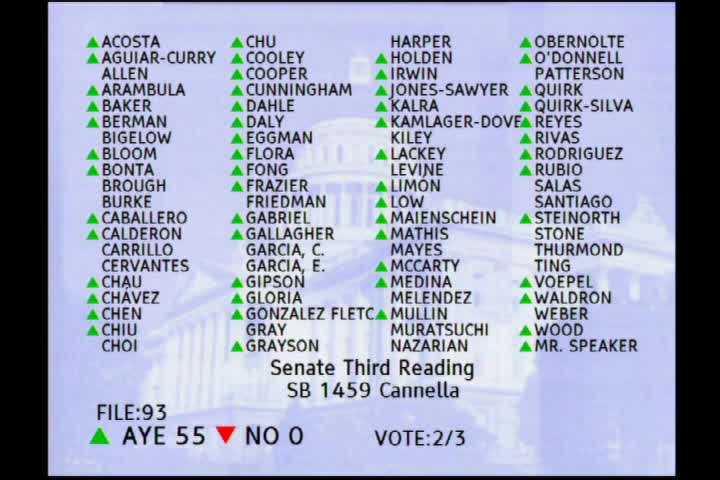 2MIN
Assembly Floor
 41SEC
Assembly Standing Committee on Appropriations
 6MIN
Assembly Standing Committee on Revenue and Taxation
 5MIN
Senate Floor
 7MIN