SB 1008: Health insurance: dental services: reporting and disclosures.
- Session Year: 2017-2018
- House: Senate
- Latest Version Date: 2018-09-29
Existing law, the Knox-Keene Health Care Service Plan Act of 1975, provides for the licensure and regulation of health care service plans by the Department of Managed Health Care and makes a willful violation of the act a crime. Existing law provides for the regulation of health insurers by the Department of Insurance.
The federal Patient Protection and Affordable Care Act requires a health insurance issuer issuing health insurance coverage to comply with minimum medical loss ratios and to provide an annual rebate to each insured if the medical loss ratio of the amount of the revenue expended by the issuer on costs to the total amount of premium revenue is less than a certain percentage, as specified.
Existing law requires a health care service plan or health insurer to provide certain disclosures of the benefits, services, and terms of a contract or policy.
This bill would require a health care service plan or a health insurer that issues, sells, renews, or offers a health care service plan contract or insurance policy that covers dental services in California, in addition to any other applicable disclosure requirements, to utilize a uniform benefits and coverage disclosure matrix, with specified contents. The bill would require the Department of Managed Health Care and the Department of Insurance to develop the uniform benefits and disclosure matrix in consultation with stakeholders. The bill would require the Department of Managed Health Care and the Department of Insurance to implement the bills provisions relating to the benefits and coverage disclosure matrix through emergency regulations, as specified. The benefits and coverage disclosure matrix requirements would take effect for plan or policy years on and after January 1, 2021, or 12 months after adoption of the emergency regulations, whichever occurs later.
Existing law requires a health care service plan or health insurer that issues, sells, renews, or offers a specialized health care service plan contract or health insurance policy covering dental services, no later than September 30, 2015, and each year thereafter, to file a report known as the Medical Loss Ratio (MLR) annual report, with the Department of Managed Health Care or the Department of Insurance, respectively, that is organized by market and product type.
This bill would require the MLR annual report to be filed with the Department of Managed Health Care or the Department of Insurance by July 31 of each year. The bill would require the respective department to post a health care service plans or health insurers MLR annual report on its Internet Web site within 45 days after receiving the report. The bill would authorize the respective departments to issue guidance to specialized health care service plans and health insurers regarding compliance with these provisions until regulations are adopted.
Because a willful violation of these requirements with respect to health care service plans would be a crime, the bill would impose a state-mandated local program.
The California Constitution requires the state to reimburse local agencies and school districts for certain costs mandated by the state. Statutory provisions establish procedures for making that reimbursement.
This bill would provide that no reimbursement is required by this act for a specified reason.
Existing law, the Knox-Keene Health Care Service Plan Act of 1975, provides for the licensure and regulation of health care service plans by the Department of Managed Health Care and makes a willful violation of the act a crime. Existing law provides for the regulation of health insurers by the Department of Insurance.
The federal Patient Protection and Affordable Care Act requires a health insurance issuer issuing health insurance coverage to comply with minimum medical loss ratios and to provide an annual rebate to each insured if the medical loss ratio of the amount of the revenue expended by the issuer on costs to the total amount of premium revenue is less than a certain percentage, as specified.
Existing law requires a health care service plan or health insurer to provide certain disclosures of the benefits, services, and terms of a contract or policy.
This bill would require a health care service plan or a health insurer that issues, sells, renews, or offers a health care service plan contract or insurance policy that covers dental services in California, in addition to any other applicable disclosure requirements, to utilize a uniform benefits and coverage disclosure matrix, with specified contents. The bill would require the Department of Managed Health Care and the Department of Insurance to develop the uniform benefits and disclosure matrix in consultation with stakeholders. The bill would require the Department of Managed Health Care and the Department of Insurance to implement the bills provisions relating to the benefits and coverage disclosure matrix through emergency regulations, as specified. The benefits and coverage disclosure matrix requirements would take effect for plan or policy years on and after January 1, 2021, or 12 months after adoption of the emergency regulations, whichever occurs later.
Existing law requires a health care service plan or health insurer that issues, sells, renews, or offers a specialized health care service plan contract or health insurance policy covering dental services, no later than September 30, 2015, and each year thereafter, to file a report known as the Medical Loss Ratio (MLR) annual report, with the Department of Managed Health Care or the Department of Insurance, respectively, that is organized by market and product type.
This bill would require the MLR annual report to be filed with the Department of Managed Health Care or the Department of Insurance by July 31 of each year. The bill would require the respective department to post a health care service plans or health insurers MLR annual report on its Internet Web site within 45 days after receiving the report. The bill would authorize the respective departments to issue guidance to specialized health care service plans and health insurers regarding compliance with these provisions until regulations are adopted.
Because a willful violation of these requirements with respect to health care service plans would be a crime, the bill would impose a state-mandated local program.
The California Constitution requires the state to reimburse local agencies and school districts for certain costs mandated by the state. Statutory provisions establish procedures for making that reimbursement.
This bill would provide that no reimbursement is required by this act for a specified reason.
Existing law, the Knox-Keene Health Care Service Plan Act of 1975, provides for the licensure and regulation of health care service plans by the Department of Managed Health Care and makes a willful violation of the act a crime. Existing law provides for the regulation of health insurers by the Department of Insurance.
The federal Patient Protection and Affordable Care Act requires a health insurance issuer issuing health insurance coverage to comply with minimum medical loss ratios and to provide an annual rebate to each insured if the medical loss ratio of the amount of the revenue expended by the issuer on costs to the total amount of premium revenue is less than a certain percentage, as specified.
Existing law requires a health care service plan or health insurer to provide certain disclosures of the benefits, services, and terms of a contract or policy.
This bill would require a health care service plan or a health insurer that issues, sells, renews, or offers a specialized health care service plan contract or insurance policy that covers dental services in California, in addition to any other applicable disclosure requirements, to utilize a uniform benefits and coverage disclosure matrix, with specified contents. The bill would require the Department of Managed Health Care and the Department of Insurance to develop the uniform benefits and disclosure matrix in consultation with stakeholders. The bill would require the Department of Managed Health Care and the Department of Insurance to implement the bills provisions relating to the benefits and coverage disclosure matrix through emergency regulations, as specified. The benefits and coverage disclosure matrix requirements would take effect for plan or policy years on and after January 1, 2021, or 12 months after adoption of the emergency regulations, whichever occurs later.
This bill would also require a health care service plan or health insurer that issues, sells, renews, or offers a specialized health care service plan or specialized health insurance policy that provides out-of-network dental services as a covered benefit, for plan years on and after July 1, 2020, to make available to a billing and treating provider, on behalf of the enrollee or insured, as applicable, specified information regarding the enrollees or insureds benefits.Existing law requires a health care service plan or health insurer that issues, sells, renews, or offers a specialized health care service plan contract or health insurance policy covering dental services, no later than September 30, 2015, and each year thereafter, to file a report known as the Medical Loss Ratio (MLR) annual report, with the Department of Managed Health Care or the Department of Insurance, respectively, that is organized by market and product type.
This bill would require the MLR annual report to be filed with the Department of Managed Health Care or the Department of Insurance by July 1 31 of each year. The bill would require the respective department to post a health care service plans or health insurers MLR annual report on its Internet Web site within 45 days after receiving the report. The bill would authorize the respective departments to issue guidance to specialized health care service plans and health insurers regarding compliance with these provisions until regulations are adopted.
Because a willful violation of these requirements with respect to health care service plans would be a crime, the bill would impose a state-mandated local program.
The California Constitution requires the state to reimburse local agencies and school districts for certain costs mandated by the state. Statutory provisions establish procedures for making that reimbursement.
This bill would provide that no reimbursement is required by this act for a specified reason.
Existing law, the Knox-Keene Health Care Service Plan Act of 1975, provides for the licensure and regulation of health care service plans by the Department of Managed Health Care and makes a willful violation of the act a crime. Existing law provides for the regulation of health insurers by the Department of Insurance.
The federal Patient Protection and Affordable Care Act requires a health insurance issuer issuing health insurance coverage to comply with minimum medical loss ratios and to provide an annual rebate to each insured if the medical loss ratio of the amount of the revenue expended by the issuer on costs to the total amount of premium revenue is less than a certain percentage, as specified.
Existing law requires a health care service plan or health insurer to provide certain disclosures of the benefits, services, and terms of a contract or policy.
This bill would require a health care service plan or a health insurer that issues, sells, renews, or offers a specialized health care service plan contract or insurance policy that covers dental services in California, in addition to any other applicable disclosure requirements, to utilize a uniform benefits and coverage disclosure matrix, with specified contents. The bill would require the Department of Managed Health Care and the Department of Insurance to develop the uniform benefits and disclosure matrix in consultation with stakeholders. The bill would require the Department of Managed Health Care and the Department of Insurance to implement the bills provisions relating to the benefits and coverage disclosure matrix through emergency regulations, as specified. The benefits and coverage disclosure matrix requirements would take effect for plan or policy years on and after January 1, 2021, or 12 months after adoption of the emergency regulations, whichever occurs later.
This bill would also require a health care service plan or health insurer that issues, sells, renews, or offers a specialized health care service plan or specialized health insurance policy that provides out-of-network dental services as a covered benefit, for plan years on and after July 1, 2020, to provide make available to a billing and treating provider, on behalf of the enrollee or insured, as applicable, specified information regarding the enrollees or insureds benefits.
Existing law requires a health care service plan or health insurer that issues, sells, renews, or offers a specialized health care service plan contract or health insurance policy covering dental services, no later than September 30, 2015, and each year thereafter, to file a report known as the Medical Loss Ratio (MLR) annual report, with the Department of Managed Health Care or the Department of Insurance, respectively, that is organized by market and product type.
This bill would require the MLR annual report to be filed with the Department of Managed Health Care or the Department of Insurance by July 1 of each year. The bill would require the respective department to post a health care service plans or health insurers MLR annual report on its Internet Web site within 45 days after receiving the report.
Because a willful violation of these requirements with respect to health care service plans would be a crime, the bill would impose a state-mandated local program.
The California Constitution requires the state to reimburse local agencies and school districts for certain costs mandated by the state. Statutory provisions establish procedures for making that reimbursement.
This bill would provide that no reimbursement is required by this act for a specified reason.
Existing law, the Knox-Keene Health Care Service Plan Act of 1975, provides for the licensure and regulation of health care service plans by the Department of Managed Health Care and makes a willful violation of the act a crime. Existing law provides for the regulation of health insurers by the Department of Insurance.
The federal Patient Protection and Affordable Care Act requires a health insurance issuer issuing health insurance coverage to comply with minimum medical loss ratios and to provide an annual rebate to each insured if the medical loss ratio of the amount of the revenue expended by the issuer on costs to the total amount of premium revenue is less than a certain percentage, as specified.
Existing law requires a health care service plan or health insurer to provide certain disclosures of the benefits, services, and terms of a contract or policy.
This bill would require a health care service plan or a health insurer that issues, sells, renews, or offers a specialized health care service plan contract or insurance policy that covers dental services in California, in addition to any other applicable disclosure requirements, to utilize a uniform benefit disclosure form, benefits and coverage disclosure matrix, with specified contents. The bill would require the Department of Managed Health Care and the Department of Insurance to develop the uniform benefit disclosure form, benefits and disclosure matrix in consultation with stakeholders. The bill would require the Department of Managed Health Care and the Department of Insurance to implement the bills provisions relating to the disclosure form benefits and coverage disclosure matrix through emergency regulations, as specified. The disclosure form benefits and coverage disclosure matrix requirements would take effect for plan or policy years on and after January 1, 2021, or 12 months after adoption of the emergency regulations, whichever occurs later.
This bill would also require a health care service plan or health insurer that issues, sells, renews, or offers a specialized health care service plan or specialized health insurance policy that provides out-of-network dental services as a covered benefit, for plan years on and after July 1, 2019, 2020, to provide to a billing and treating provider, on behalf of the enrollee or insured, as applicable, specified information regarding the enrollees or insureds benefits.
Existing law requires a health care service plan or health insurer that issues, sells, renews, or offers a specialized health care service plan contract or health insurance policy covering dental services, no later than September 30, 2015, and each year thereafter, to file a report known as the MLR (Medical Loss Ratio) Medical Loss Ratio (MLR) annual report, with the Department of Managed Health Care or the Department of Insurance, respectively, that is organized by market and product type.
This bill would require the MLR annual report to be filed with the Department of Managed Health Care or the Department of Insurance by July 1 of each year. The bill would require the respective department to post a health care service plans or health insurers MLR annual report on its Internet Web site within 45 days after receiving the report.
Because a willful violation of these requirements with respect to health care service plans would be a crime, the bill would impose a state-mandated local program.
The California Constitution requires the state to reimburse local agencies and school districts for certain costs mandated by the state. Statutory provisions establish procedures for making that reimbursement.
This bill would provide that no reimbursement is required by this act for a specified reason.
Existing law, the Knox-Keene Health Care Service Plan Act of 1975, provides for the licensure and regulation of health care service plans by the Department of Managed Health Care and makes a willful violation of the act a crime. Existing law provides for the regulation of health insurers by the Department of Insurance.
The federal Patient Protection and Affordable Care Act requires a health insurance issuer issuing health insurance coverage to comply with minimum medical loss ratios and to provide an annual rebate to each insured if the medical loss ratio of the amount of the revenue expended by the issuer on costs to the total amount of premium revenue is less than a certain percentage, as specified.
Existing law requires a health care service plan or health insurer to provide certain disclosures of the benefits, services, and terms of a contract or policy.
This bill would require a health care service plan or a health insurer that issues, sells, renews, or offers a specialized health care service plan contract or insurance policy that covers dental services in California, in addition to any other applicable disclosure requirements, to utilize a uniform benefit disclosure form, with specified contents. The bill also would require a health care service plan that issues, sells, renews, or offers a specialized health care service plan contract or insurance policy that covers dental services, and that offers a dental discount product, to fully disclose the type of discount product that the purchaser will receive on the plans Internet Web site and on the unified benefit disclosure form. The bill would require the Department of Managed Health Care and the Department of Insurance to develop the uniform benefit disclosure form, in consultation with stakeholders. The bill would require the Department of Managed Health Care and the Department of Insurance to implement the bills provisions relating to the disclosure form through emergency regulations, as specified. The disclosure form requirements would take effect for plan or policy years on and after January 1, 2021, or 12 months after adoption of the emergency regulations, whichever occurs later.
This bill would also require a health care service plan or health insurer that issues, sells, renews, or offers a specialized health care service plan or specialized health insurance policy that provides out-of-network dental services as a covered benefit, for plan years on and after July 1, 2019, to provide to a billing and treating provider, on behalf of the enrollee or insured, as applicable, specified information regarding the enrollees or insureds benefits.
Existing law requires a health care service plan or health insurer that issues, sells, renews, or offers a specialized health care service plan contract or health insurance policy covering dental services, no later than September 30, 2015, and each year thereafter, to file a report known as the MLR (Medical Loss Ratio) annual report, with the Department of Managed Health Care or the Department of Insurance, respectively, that is organized by market and product type.
This bill would require the MLR annual report to be filed with the Department of Managed Health Care or the Department of Insurance by July 1 of each year. The bill would require the respective department to post the information submitted by the health care service plans and health insurers on their a health care service plans or health insurers MLR annual report on its Internet Web sites site within 45 days after receiving all MLR annual reports. the report.
Because a willful violation of these requirements with respect to health care service plans would be a crime, the bill would impose a state-mandated local program.
The California Constitution requires the state to reimburse local agencies and school districts for certain costs mandated by the state. Statutory provisions establish procedures for making that reimbursement.
This bill would provide that no reimbursement is required by this act for a specified reason.
Existing law, the Knox-Keene Health Care Service Plan Act of 1975, provides for the licensure and regulation of health care service plans by the Department of Managed Health Care and makes a willful violation of the act a crime. Existing law provides for the regulation of health insurers by the Department of Insurance.
The federal Patient Protection and Affordable Care Act requires a health insurance issuer issuing health insurance coverage to comply with minimum medical loss ratios and to provide an annual rebate to each insured if the medical loss ratio of the amount of the revenue expended by the issuer on costs to the total amount of premium revenue is less than a certain percentage, as specified.
Existing law requires a health care service plan or health insurer to provide certain disclosures of the benefits, services, and terms of a contract or policy.
This bill would require a health care service plan or a health insurer that issues, sells, renews, or offers a specialized health care service plan contract or insurance policy that covers dental services in California, in addition to any other applicable disclosure requirements, to utilize a uniform benefit disclosure form, with specified contents. The bill also would require a health care service plan that issues, sells, renews, or offers a specialized health care service plan contract or insurance policy that covers dental services, and that offers a dental discount product, to fully disclose the type of discount product that the purchaser will receive on the plans Internet Web site and on the unified benefit disclosure form. The bill would require the Department of Managed Health Care and the Department of Insurance to implement the bills provisions relating to the disclosure form through emergency regulations, as specified. The disclosure form requirements would take effect for plan or policy years on and after January 1, 2021, or 12 months after adoption of the emergency regulations, whichever occurs later.
Existing law requires a health care service plan or health insurer that issues, sells, renews, or offers health care service plan contracts or health insurance policies, as applicable, for health care coverage in this state, to provide an annual rebate to each enrollee or insured, as applicable, under that coverage, on a pro rata basis, if the ratio of the amount of premium revenue expended by the health care service plan or health insurer on the costs for reimbursement for clinical services provided to enrollees or insureds under that coverage and for activities that improve health care quality to the total amount of premium revenue, as specified, is less than 85% with respect to a plan or insurer in the large group market or less than 80% with respect to a plan or insurer in the small group or individual market. Existing law governs the calculation of the total amount of the annual rebate based in part on these ratios. Existing law also requires a health care service plan and a health insurer that issues, sells, renews, or offers health care service plan contracts or health insurance policies for health care coverage in this state to comply with specified minimum medical loss ratios. Existing law specifically exempts a specialized health care service plan contract or specialized health insurance policy from the requirement to provide an annual rebate.This bill would enact similar provisions that would require, for specialized health care service plans and specialized health insurance policies that cover dental services, an annual rebate amount that would be calculated based on a specified ratio, and to comply with specified minimum medical loss ratios that would differ from the minimum medical loss ratios applicable to other health care service plans and health insurers. The bill would also revise related annual reporting requirements. The bill would express the intent of the Legislature to enact legislation, by 2024, to incrementally increase these minimum medical loss ratios until these ratios are equal to the minimum medical loss ratios that are applicable to other health care service plans and health insurers. TheThis bill would also require a health care service plan or health insurer that issues, sells, renews, or offers a specialized health care service plan or specialized health insurance policy that provides out-of-network dental services as a covered benefit benefit, for plan years on and after July 1, 2019, to provide to a billing and treating provider, on behalf of the enrollee or insured, as applicable, specified information regarding the enrollees or insureds benefits.
Existing law requires a health care service plan or health insurer that issues, sells, renews, or offers a specialized health care service plan contract or health insurance policy covering dental services, no later than September 30, 2015, and each year thereafter, to file a report known as the MLR (Medical Loss Ratio) annual report, with the Department of Managed Health Care or the Department of Insurance, respectively, that is organized by market and product type.
This bill would require the MLR annual report to be filed with the Department of Managed Health Care or the Department of Insurance by July 1 of each year. The bill would require the respective department to post the information submitted by the health care service plans and health insurers on their Internet Web sites within 45 days after receiving all MLR annual reports.
Because a willful violation of these requirements with respect to health care service plans would be a crime, the bill would impose a state-mandated local program.
The California Constitution requires the state to reimburse local agencies and school districts for certain costs mandated by the state. Statutory provisions establish procedures for making that reimbursement.
This bill would provide that no reimbursement is required by this act for a specified reason.
Existing law, the Knox-Keene Health Care Service Plan Act of 1975, provides for the licensure and regulation of health care service plans by the Department of Managed Health Care and makes a willful violation of the act a crime. Existing law provides for the regulation of health insurers by the Department of Insurance.
The federal Patient Protection and Affordable Care Act requires a health insurance issuer issuing health insurance coverage to comply with minimum medical loss ratios and to provide an annual rebate to each insured if the medical loss ratio of the amount of the revenue expended by the issuer on costs to the total amount of premium revenue is less than a certain percentage, as specified.
Existing law requires a health care service plan that issues, sells, renews, or offers a specialized health care service plan, and a health insurer that issues, sells, renews, or offers a specialized health insurance policy, covering dental services, to annually file a report that is organized by market and product type and contains the same information required in a specified federal medical loss ratio annual reporting form. Existing law expresses the intent of the Legislature that the data reported be considered by the Legislature in adopting a medical loss ratio standard for health care service plans and specialized health insurance policies that cover dental services that was to take effect no later than January 1, 2018.Existing law requires a health care service plan or health insurer to provide certain disclosures of the benefits, services, and terms of a contract or policy.
This bill would require a health care service plan or a health insurer that issues, sells, renews, or offers a specialized health care service plan contract or insurance policy that covers dental services in California, in addition to any other applicable disclosure requirements, to utilize a uniform benefit disclosure form, with specified contents. The bill also would require a health care service plan that issues, sells, renews, or offers a specialized health care service plan contract or insurance policy that covers dental services, and that offers a dental discount product, to fully disclose the type of discount product that the purchaser will receive on the plans Internet Web site and on the unified benefit disclosure form. The bill would require the Department of Managed Health Care and the Department of Insurance to implement the bills provisions relating to disclosure through emergency regulations, as specified.
Existing law requires a health care service plan or health insurer that issues, sells, renews, or offers health care service plan contracts or health insurance policies, as applicable, for health care coverage in this state, to provide an annual rebate to each enrollee or insured, as applicable, under that coverage, on a pro rata basis, if the ratio of the amount of premium revenue expended by the health care service plan or health insurer on the costs for reimbursement for clinical services provided to enrollees or insureds under that coverage and for activities that improve health care quality to the total amount of premium revenue, as specified, is less than 85% with respect to a plan or insurer in the large group market or less than 80% with respect to a plan or insurer in the small group or individual market. Existing law governs the calculation of the total amount of the annual rebate based in part on these ratios. Existing law also requires a health care service plan and a health insurer that issues, sells, renews, or offers health care service plan contracts or health insurance policies for health care coverage in this state to comply with specified minimum medical loss ratios. Existing law specifically exempts a specialized health care service plan contract or specialized health insurance policy from the requirement to provide an annual rebate.
This bill would instead express the intent of the Legislature to enact a medical loss ratio standard enact similar provisions that would require, for specialized health care service plans and specialized health insurance policies policies that cover dental services no later than January 1, 2019. The bill would also make technical changes. services, an annual rebate amount that would be calculated based on a specified ratio, and to comply with specified minimum medical loss ratios that would differ from the minimum medical loss ratios applicable to other health care service plans and health insurers. The bill would also revise related annual reporting requirements. The bill would express the intent of the Legislature to enact legislation, by 2024, to incrementally increase these minimum medical loss ratios until these ratios are equal to the minimum medical loss ratios that are applicable to other health care service plans and health insurers. The bill would also require a health care service plan or health insurer that issues, sells, renews, or offers a specialized health care service plan or specialized health insurance policy that provides out-of-network dental services as a covered benefit to provide to a billing and treating provider, on behalf of the enrollee or insured, as applicable, specified information regarding the enrollees or insureds benefits.
Because a willful violation of these requirements with respect to health care service plans would be a crime, the bill would impose a state-mandated local program.
The California Constitution requires the state to reimburse local agencies and school districts for certain costs mandated by the state. Statutory provisions establish procedures for making that reimbursement.
This bill would provide that no reimbursement is required by this act for a specified reason.
Existing law, the Knox-Keene Health Care Service Plan Act of 1975, provides for the licensure and regulation of health care service plans by the Department of Managed Health Care and makes a willful violation of the act a crime. Existing law provides for the regulation of health insurers by the Department of Insurance.
The federal Patient Protection and Affordable Care Act requires a health insurance issuer issuing health insurance coverage to comply with minimum medical loss ratios and to provide an annual rebate to each insured if the medical loss ratio of the amount of the revenue expended by the issuer on costs to the total amount of premium revenue is less than a certain percentage, as specified.
Existing law requires a health care service plan that issues, sells, renews, or offers a specialized health care service plan, and a health insurer that issues, sells, renews, or offers a specialized health insurance policy, covering dental services, to annually file a report that is organized by market and product type and contains the same information required in a specified federal medical loss ratio annual reporting form. Existing law expresses the intent of the Legislature that the data reported be considered by the Legislature in adopting a medical loss ratio standard for health care service plans and specialized health insurance policies that cover dental services that was to take effect no later than January 1, 2018.
This bill would instead express the intent of the Legislature to enact a medical loss ratio standard for specialized health care service plans and specialized health insurance policies that cover dental services no later than January 1, 2019. The bill would also make technical changes.
(a)The director shall require the use by each plan of disclosure forms or materials containing information regarding the benefits, services, and terms of the plan contract as the director may require, so as to afford the public, subscribers, and enrollees with a full and fair disclosure of the provisions of the plan in readily understood language and in a clearly organized manner. The director may require that the materials be presented in a reasonably uniform manner so as to facilitate comparisons between plan contracts of the same or other types of plans. Nothing contained in this chapter shall preclude the director from permitting the disclosure form to be included with the evidence of coverage or plan contract.
The disclosure form shall provide for at least the following information, in concise and specific terms, relative to the plan, together with additional information as may be required by the director, in connection with the plan or plan contract:
(1)The principal benefits and coverage of the plan, including coverage for acute care and subacute care.
(2)The exceptions, reductions, and limitations that apply to the plan.
(3)The full premium cost of the plan.
(4)Any copayment, coinsurance, or deductible requirements that may be incurred by the member or the members family in obtaining coverage under the plan.
(5)The terms under which the plan may be renewed by the plan member, including any reservation by the plan of any right to change premiums.
(6)A statement that the disclosure form is a summary only, and that the plan contract itself should be consulted to determine governing contractual provisions. The first page of the disclosure form shall contain a notice that conforms with all of the following conditions:
(A)(i)States that the evidence of coverage discloses the terms and conditions of coverage.
(ii)States, with respect to individual plan contracts, small group plan contracts, and any other group plan contracts for which health care services are not negotiated, that the applicant has a right to view the evidence of coverage prior to enrollment, and, if the evidence of coverage is not combined with the disclosure form, the notice shall specify where the evidence of coverage can be obtained prior to enrollment.
(B)Includes a statement that the disclosure and the evidence of coverage should be read completely and carefully and that individuals with special health care needs should read carefully those sections that apply to them.
(C)Includes the plans telephone number or numbers that may be used by an applicant to receive additional information about the benefits of the plan or a statement where the telephone number or numbers are located in the disclosure form.
(D)For individual contracts, and small group plan contracts as defined in Article 3.1 (commencing with Section 1357), the disclosure form shall state where the health plan benefits and coverage matrix is located.
(E)Is printed in type no smaller than that used for the remainder of the disclosure form and is displayed prominently on the page.
(7)A statement as to when benefits shall cease in the event of nonpayment of the prepaid or periodic charge and the effect of nonpayment upon an enrollee who is hospitalized or undergoing treatment for an ongoing condition.
(8)To the extent that the plan permits a free choice of provider to its subscribers and enrollees, the statement shall disclose the nature and extent of choice permitted and the financial liability that is, or may be, incurred by the subscriber, enrollee, or a third party by reason of the exercise of that choice.
(9)A summary of the provisions required by subdivision (g) of Section 1373, if applicable.
(10)If the plan utilizes arbitration to settle disputes, a statement of that fact.
(11)A summary of, and a notice of the availability of, the process the plan uses to authorize, modify, or deny health care services under the benefits provided by the plan, pursuant to Sections 1363.5 and 1367.01.
(12)A description of any limitations on the patients choice of primary care physician, specialty care physician, or nonphysician health care practitioner, based on service area and limitations on the patients choice of acute care hospital care, subacute or transitional inpatient care, or skilled nursing facility.
(13)General authorization requirements for referral by a primary care physician to a specialty care physician or a nonphysician health care practitioner.
(14)Conditions and procedures for disenrollment.
(15)A description as to how an enrollee may request continuity of care as required by Section 1373.96 and request a second opinion pursuant to Section 1383.15.
(16)Information concerning the right of an enrollee to request an independent review in accordance with Article 5.55 (commencing with Section 1374.30).
(17)A notice as required by Section 1364.5.
(b)(1)As of July 1, 1999, the director shall require each plan offering a contract to an individual or small group to provide with the disclosure form for individual and small group plan contracts a uniform health plan benefits and coverage matrix containing the plans major provisions in order to facilitate comparisons between plan contracts. The uniform matrix shall include the following category descriptions together with the corresponding copayments and limitations in the following sequence:
(A)Deductibles.
(B)Lifetime maximums.
(C)Professional services.
(D)Outpatient services.
(E)Hospitalization services.
(F)Emergency health coverage.
(G)Ambulance services.
(H)Prescription drug coverage.
(I)Durable medical equipment.
(J)Mental health services.
(K)Chemical dependency services.
(L)Home health services.
(M)Other.
(2)The following statement shall be placed at the top of the matrix in all capital letters in at least 10-point boldface type:
THIS MATRIX IS INTENDED TO BE USED TO HELP YOU COMPARE COVERAGE BENEFITS AND IS A SUMMARY ONLY. THE EVIDENCE OF COVERAGE AND PLAN CONTRACT SHOULD BE CONSULTED FOR A DETAILED DESCRIPTION OF COVERAGE BENEFITS AND LIMITATIONS.
(3)(A)A health care service plan contract subject to Section 2715 of the federal Public Health Service Act (42 U.S.C. Sec. 300gg-15), shall satisfy the requirements of this subdivision by providing the uniform summary of benefits and coverage required under Section 2715 of the federal Public Health Service Act (42 U.S.C. Sec. 300gg-15) and any rules or regulations issued thereunder. A health care service plan that issues the uniform summary of benefits referenced in this paragraph shall do both of the following:
(i)Ensure that all applicable benefit disclosure requirements specified in this chapter and in Title 28 of the California Code of Regulations are met in other health plan documents provided to enrollees under the provisions of this chapter.
(ii)Consistent with applicable law, advise applicants and enrollees, in a prominent place in the plan documents referenced in subdivision (a), that enrollees are not financially responsible in payment of emergency care services, in any amount that the health care service plan is obligated to pay, beyond the enrollees copayments, coinsurance, and deductibles as provided in the enrollees health care service plan contract.
(B)Commencing October 1, 2016, the uniform summary of benefits and coverage referenced in this paragraph shall constitute a vital document for the purposes of Section 1367.04. Not later than July 1, 2016, the department shall develop written translations of the template uniform summary of benefits and coverage for all language groups identified by the State Department of Health Care Services in all plan letters as of August 27, 2014, for translation services pursuant to Section 14029.91 of the Welfare and Institutions Code, except for any language group for which the United States Department of Labor has already prepared a written translation. Not later than July 1, 2016, the department shall make available on its Internet Web site written translations of the template uniform summary of benefits and coverage developed by the department, and written translations prepared by the United States Department of Labor, if available, for any language group to which this subparagraph applies.
(C)Subdivision (c) shall not apply to a health care service plan contract subject to subparagraph (A).
(4)A health care service plan may satisfy the requirements of this subdivision for the dental services offered under a contract subject to Section 1363.04 by providing the uniform benefit disclosure benefits and coverage disclosure matrix consistent with the requirements of that section.
(c)Nothing in this section shall prevent a plan from using appropriate footnotes or disclaimers to reasonably and fairly describe coverage arrangements in order to clarify any part of the matrix that may be unclear.
(d)All plans, solicitors, and representatives of a plan shall, when presenting any plan contract for examination or sale to an individual prospective plan member, provide the individual with a properly completed disclosure form, as prescribed by the director pursuant to this section for each plan so examined or sold.
(e)In the case of group contracts, the completed disclosure form and evidence of coverage shall be presented to the contractholder upon delivery of the completed health care service plan agreement.
(f)Group contractholders shall disseminate copies of the completed disclosure form to all persons eligible to be a subscriber under the group contract at the time those persons are offered the plan. If the individual group members are offered a choice of plans, separate disclosure forms shall be supplied for each plan available. Each group contractholder shall also disseminate or cause to be disseminated copies of the evidence of coverage to all applicants, upon request, prior to enrollment and to all subscribers enrolled under the group contract.
(g)In the case of conflicts between the group contract and the evidence of coverage, the provisions of the evidence of coverage shall be binding upon the plan notwithstanding any provisions in the group contract that may be less favorable to subscribers or enrollees.
(h)In addition to the other disclosures required by this section, every health care service plan and any agent or employee of the plan shall, when presenting a plan for examination or sale to any individual purchaser or the representative of a group consisting of 25 or fewer individuals, disclose in writing the ratio of premium costs to health services paid for plan contracts with individuals and with groups of the same or similar size for the plans preceding fiscal year. A plan may report that information by geographic area, provided the plan identifies the geographic area and reports information applicable to that geographic area.
(i)Subdivision (b) shall not apply to any coverage provided by a plan for the Medi-Cal program or the Medicare Program pursuant to Title XVIII and Title XIX of the federal Social Security Act.
SEC. 2.Section 1363.04 is added to the Health and Safety Code, to read:1363.04.(a)For plan years on and after January 1, 2021, or 12 months after regulations are adopted under subdivision (f), whichever occurs later, a health care service plan that issues, sells, renews, or offers a contract that covers dental services in this state, in addition to any other applicable disclosure requirements, shall utilize a uniform benefits and coverage disclosure matrix, which shall be developed by the department, in conjunction with the Department of Insurance, and in consultation with stakeholders. At a minimum, the benefits and coverage disclosure matrix shall require the health care service plan to make available all of the following information relating to covered dental services, together with the corresponding copayments or coinsurance and limitations:
(1)The annual overall plan deductible.
(2)The annual benefit limit.
(3)Coverage for the following categories:
(A)Preventive and diagnostic services.
(B)Basic services.
(C)Major services.
(D)Orthodontia services.
(4)Dental plan reimbursement levels and estimated enrollee cost share for services.
(5)Waiting periods.
(6)Examples to illustrate coverage and estimated enrollee costs of commonly used benefits. The examples shall include at least one service from each of the following categories listed in paragraph (3):
(A)Preventive and diagnostic services.
(B)Basic services.
(C)Major services.
(b)All plans, solicitors, and representatives of a plan that issue, sell, renew, or offer a health care plan contract that covers dental services shall, when presenting any plan contract for examination or sale to an individual prospective plan member, make available to the individual a properly completed benefits and coverage disclosure matrix, as prescribed by the director pursuant to this section for each dental plan examined or sold.
(c)In the case of group contracts for dental services, the completed benefits and coverage disclosure matrix and evidence of coverage shall be made available to the contractholder upon delivery of the completed health care service plan agreement.
(d)Group contractholders shall make available the completed benefits and coverage disclosure matrix to all persons eligible to be a subscriber under the group contract at the time those persons are offered the dental plan. If the individual group members are offered a choice of dental plans, separate matrices shall be made available for each dental plan offered. Each group contractholder shall also make available copies of the evidence of coverage to all applicants, upon request, prior to enrollment and to all subscribers enrolled under the group contract.
(e)The health care service plan offering a dental product in the individual, small, or large group market shall make available the benefits and coverage disclosure matrix to all individuals newly enrolling for coverage, experiencing a special enrollment event, and renewing coverage, and shall make available the benefits and coverage disclosure matrix to all other enrollees upon request.
(f)(1)The department shall adopt emergency regulations pursuant to Chapter 3.5 (commencing with Section 11340) of Part 1 of Division 3 of Title 2 of the Government Code to implement this section. The department shall consult with the Department of Insurance in adopting the emergency regulations, as appropriate. The adoption of regulations pursuant to this section shall be deemed to be an emergency and necessary for the immediate preservation of the public peace, health, or safety.
(2)Notwithstanding Chapter 3.5 (commencing with Section 11340) of Part 1 of Division 3 of Title 2 of the Government Code, emergency regulations adopted pursuant to this section shall not be subject to the review and approval of the Office of Administrative Law. The regulations shall become effective immediately upon filing with the Secretary of State. The regulations shall not remain in effect more than 120 days unless the adopting agency complies with all of the provisions of Chapter 3.5 (commencing with Section 11340) as required by subdivision (c) of Section 11346.1 of the Government Code.
(g)This section does not apply to Medi-Cal dental managed care contracts authorized under Chapter 7 (commencing with Section 14000) and Chapter 8 (commencing with Section 14200) of Part 3 of Division 9 of the Welfare and Institutions Code.
SEC. 3.Section 1367.004 of the Health and Safety Code is amended to read:1367.004.(a)A health care service plan that issues, sells, renews, or offers a contract covering dental services shall file a report with the department by July 31 of each year, which shall be known as the MLR annual report. The MLR annual report shall be organized by market and product type and shall contain the same information required in the 2013 federal Medical Loss Ratio (MLR) Annual Reporting Form (CMS-10418). The department shall post a health care service plans MLR annual report on its Internet Web site within 45 days after receiving the report.
(b)The MLR reporting year shall be for the calendar year during which dental coverage is provided by the plan. As applicable, all terms used in the MLR annual report shall have the same meaning as used in the federal Public Health Service Act (42 U.S.C. Sec. 300gg-18), Part 158 (commencing with Section 158.101) of Title 45 of the Code of Federal Regulations, and Section 1367.003.
(c)If the director decides to conduct a financial examination, as described in Section 1382, because the director finds it necessary to verify the health care service plans representations in the MLR annual report, the department shall provide the health care service plan with a notification 30 days before the commencement of the financial examination.
(d)The health care service plan shall have 30 days from the date of notification to electronically submit to the department all requested records, books, and papers specified in subdivision (a) of Section 1381. The director may extend the time for a health care service plan to comply with this subdivision upon a finding of good cause.
(e)The department shall make available to the public all of the data provided to the department pursuant to this section.
(f)This section does not apply to a health care service plan contract issued, sold, renewed, or offered for health care services or coverage provided in the Medi-Cal program (Chapter 7 (commencing with Section 14000) and Chapter 8 (commencing with Section 14200) of Part 3 of Division 9 of the Welfare and Institutions Code), the Medi-Cal Access Program (Chapter 2 (commencing with Section 15810) of Part 3.3 of Division 9 of the Welfare and Institutions Code), or the California Major Risk Medical Insurance Program (Chapter 4 (commencing with Section 15870) of Part 3.3 of Division 9 of the Welfare and Institutions Code), to the extent consistent with the federal Patient Protection and Affordable Care Act (Public Law 111-148).
(g)The department may issue guidance to specialized health care service plans subject to this section regarding compliance with this section. The guidance shall not be subject to the rulemaking provisions of the Administrative Procedure Act (Chapter 3.5 (commencing with Section 11340) of Part 1 of Division 3 of Title 2 of the Government Code), and shall be effective only until the department adopts regulations pursuant to that act. The department shall consult with the Department of Insurance in issuing the guidance specified in this section.
SEC. 4.Section 10112.26 of the Insurance Code is amended to read:10112.26.(a)A health insurer that issues, sells, renews, or offers a policy covering dental services shall file a report with the department, by July 31 of each year, which shall be known as the MLR annual report. The MLR annual report shall be organized by market and product type and contains the same information required in the 2013 federal Medical Loss Ratio (MLR) Annual Reporting Form (CMS-10418). The department shall post a health insurers MLR annual report on its Internet Web site within 45 days after receiving the report.
(b)The MLR reporting year shall be for the calendar year during which dental coverage is provided by the plan. As applicable, all terms used in the MLR annual report shall have the same meaning as used in the federal Public Health Service Act (42 U.S.C. Sec. 300gg-18) and Part 158 (commencing with Section 158.101) of Title 45 of the Code of Federal Regulations.
(c)If the commissioner decides to conduct an examination, as described in Section 730, because the commissioner finds it necessary to verify the health insurers representations in the MLR annual report, the department shall provide the health insurer with a notification 30 days before the commencement of the examination.
(d)The health insurer shall have 30 days from the date of notification to electronically submit to the department all requested records, books, and papers specified in subdivision (a) of Section 733. The commissioner may extend the time for a health insurer to comply with this subdivision upon a finding of good cause.
(e)The department shall make available to the public all of the data provided to the department pursuant to this section.
(f)This section does not apply to an insurance policy issued, sold, renewed, or offered for health care services or coverage provided in the Medi-Cal program (Chapter 7 (commencing with Section 14000) and Chapter 8 (commencing with Section 14200) of Part 3 of Division 9 of the Welfare and Institutions Code), the Medi-Cal Access Program (Chapter 2 (commencing with Section 15810) of Part 3.3 of Division 9 of the Welfare and Institutions Code), or the California Major Risk Medical Insurance Program (Chapter 4 (commencing with Section 15870) of Part 3.3 of Division 9 of the Welfare and Institutions Code), to the extent consistent with the federal Patient Protection and Affordable Care Act (Public Law 111-148).
(g)This section does not apply to disability insurance for covered benefits in the single specialized area of dental-only health care that pays benefits on a fixed benefit, cash payment only basis.
(h)The department may issue guidance to health insurers of specialized health insurance policies subject to this section regarding compliance with this section. The guidance shall not be subject to the rulemaking provisions of the Administrative Procedure Act (Chapter 3.5 (commencing with Section 11340) of Part 1 of Division 3 of Title 2 of the Government Code), and shall be effective only until the department adopts regulations pursuant to that act. The department shall consult with the Department of Managed Health Care in issuing the guidance specified in this section.
SEC. 5.Section 10603.04 is added to the Insurance Code, to read:10603.04.(a)For policy years on and after January 1, 2021, or 12 months after regulations are adopted under subdivision (f), whichever occurs later, a health insurer that issues, sells, renews, or offers a policy that covers dental services in this state, in addition to any other applicable disclosure requirements, shall use a uniform benefits and coverage disclosure matrix, which shall be developed by the department, in conjunction with the Department of Managed Health Care, and in consultation with stakeholders. At a minimum, the benefits and coverage disclosure matrix shall require the health insurer to make available all of the following relating to covered dental services, together with the corresponding copayments or coinsurance and limitations:
(1)The annual overall policy deductible.
(2)The annual benefit limit.
(3)Coverage for the following categories:
(A)Preventive and diagnostic services.
(B)Basic services.
(C)Major services.
(D)Orthodontia services.
(4)Dental policy reimbursement levels and estimated insured cost share for service.
(5)Waiting periods.
(6)Examples to illustrate coverage and estimated insured costs of commonly used benefits. The examples shall include at least one service from each of the following categories listed in paragraph (3):
(A)Preventive and diagnostic services.
(B)Basic services.
(C)Major services.
(b)All health insurers, solicitors, and representatives of a health insurer that issue, sell, renew, or offer a policy that covers dental services shall, when presenting any policy for examination or sale to an individual prospective insured, make available to the individual a properly completed benefits and coverage disclosure matrix, as prescribed by the commissioner pursuant to this section for each dental policy examined or sold.
(c)In the case of group policies for dental services, the completed disclosures and coverage matrix and evidence of coverage shall be made available to the policyholder upon delivery of the completed policy for dental insurance.
(d)Group policyholders shall make available the completed benefits and coverage disclosure matrix to all persons eligible to be a policyholder under the group policy at the time those persons are offered the dental insurance. If the individual group members are offered a choice of dental policies, separate benefits and coverage disclosure matrices shall be made available for each dental policy offered. Each group policyholder shall also make available copies of the evidence of coverage to all applicants, upon request, prior to enrollment and to all policyholders insured under the group policy.
(e)The health insurer offering a policy that covers dental services in the individual, small, or large group market shall make available the benefits and coverage disclosure matrix to all individuals newly enrolling for coverage, experiencing a special enrollment event, and renewing coverage, and shall make available the benefits and coverage disclosure matrix to all other insureds upon request.
(f)(1)The department shall adopt emergency regulations pursuant to Chapter 3.5 (commencing with Section 11340) of Part 1 of Division 3 of Title 2 of the Government Code to implement this section. The department shall consult with the Department of Managed Health Care in adopting the emergency regulations, as appropriate. The adoption of regulations pursuant to this section shall be deemed to be an emergency and necessary for the immediate preservation of the public peace, health, or safety.
(2)Notwithstanding Chapter 3.5 (commencing with Section 11340) of Part 1 of Division 3 of Title 2 of the Government Code, emergency regulations adopted pursuant to this section shall not be subject to the review and approval of the Office of Administrative Law. The regulations shall become effective immediately upon filing with the Secretary of State. The regulations shall not remain in effect more than 120 days unless the adopting agency complies with all of the provisions of Chapter 3.5 (commencing with Section 11340) as required by subdivision (c) of Section 11346.1 of the Government Code.
(g)This section does not apply to Medi-Cal dental managed care contracts authorized under Chapter 7 (commencing with Section 14000) and Chapter 8 (commencing with Section 14200) of Part 3 of Division 9 of the Welfare and Institutions Code.
SEC. 6.No reimbursement is required by this act pursuant to Section 6 of Article XIIIB of the California Constitution because the only costs that may be incurred by a local agency or school district will be incurred because this act creates a new crime or infraction, eliminates a crime or infraction, or changes the penalty for a crime or infraction, within the meaning of Section 17556 of the Government Code, or changes the definition of a crime within the meaning of Section 6 of Article XIIIB of the California Constitution.
(a)The director shall require the use by each plan of disclosure forms or materials containing information regarding the benefits, services, and terms of the plan contract as the director may require, so as to afford the public, subscribers, and enrollees with a full and fair disclosure of the provisions of the plan in readily understood language and in a clearly organized manner. The director may require that the materials be presented in a reasonably uniform manner so as to facilitate comparisons between plan contracts of the same or other types of plans. Nothing contained in this chapter shall preclude the director from permitting the disclosure form to be included with the evidence of coverage or plan contract.
The disclosure form shall provide for at least the following information, in concise and specific terms, relative to the plan, together with additional information as may be required by the director, in connection with the plan or plan contract:
(1)The principal benefits and coverage of the plan, including coverage for acute care and subacute care.
(2)The exceptions, reductions, and limitations that apply to the plan.
(3)The full premium cost of the plan.
(4)Any copayment, coinsurance, or deductible requirements that may be incurred by the member or the members family in obtaining coverage under the plan.
(5)The terms under which the plan may be renewed by the plan member, including any reservation by the plan of any right to change premiums.
(6)A statement that the disclosure form is a summary only, and that the plan contract itself should be consulted to determine governing contractual provisions. The first page of the disclosure form shall contain a notice that conforms with all of the following conditions:
(A)(i)States that the evidence of coverage discloses the terms and conditions of coverage.
(ii)States, with respect to individual plan contracts, small group plan contracts, and any other group plan contracts for which health care services are not negotiated, that the applicant has a right to view the evidence of coverage prior to enrollment, and, if the evidence of coverage is not combined with the disclosure form, the notice shall specify where the evidence of coverage can be obtained prior to enrollment.
(B)Includes a statement that the disclosure and the evidence of coverage should be read completely and carefully and that individuals with special health care needs should read carefully those sections that apply to them.
(C)Includes the plans telephone number or numbers that may be used by an applicant to receive additional information about the benefits of the plan or a statement where the telephone number or numbers are located in the disclosure form.
(D)For individual contracts, and small group plan contracts as defined in Article 3.1 (commencing with Section 1357), the disclosure form shall state where the health plan benefits and coverage matrix is located.
(E)Is printed in type no smaller than that used for the remainder of the disclosure form and is displayed prominently on the page.
(7)A statement as to when benefits shall cease in the event of nonpayment of the prepaid or periodic charge and the effect of nonpayment upon an enrollee who is hospitalized or undergoing treatment for an ongoing condition.
(8)To the extent that the plan permits a free choice of provider to its subscribers and enrollees, the statement shall disclose the nature and extent of choice permitted and the financial liability that is, or may be, incurred by the subscriber, enrollee, or a third party by reason of the exercise of that choice.
(9)A summary of the provisions required by subdivision (g) of Section 1373, if applicable.
(10)If the plan utilizes arbitration to settle disputes, a statement of that fact.
(11)A summary of, and a notice of the availability of, the process the plan uses to authorize, modify, or deny health care services under the benefits provided by the plan, pursuant to Sections 1363.5 and 1367.01.
(12)A description of any limitations on the patients choice of primary care physician, specialty care physician, or nonphysician health care practitioner, based on service area and limitations on the patients choice of acute care hospital care, subacute or transitional inpatient care, or skilled nursing facility.
(13)General authorization requirements for referral by a primary care physician to a specialty care physician or a nonphysician health care practitioner.
(14)Conditions and procedures for disenrollment.
(15)A description as to how an enrollee may request continuity of care as required by Section 1373.96 and request a second opinion pursuant to Section 1383.15.
(16)Information concerning the right of an enrollee to request an independent review in accordance with Article 5.55 (commencing with Section 1374.30).
(17)A notice as required by Section 1364.5.
(b)(1)As of July 1, 1999, the director shall require each plan offering a contract to an individual or small group to provide with the disclosure form for individual and small group plan contracts a uniform health plan benefits and coverage matrix containing the plans major provisions in order to facilitate comparisons between plan contracts. The uniform matrix shall include the following category descriptions together with the corresponding copayments and limitations in the following sequence:
(A)Deductibles.
(B)Lifetime maximums.
(C)Professional services.
(D)Outpatient services.
(E)Hospitalization services.
(F)Emergency health coverage.
(G)Ambulance services.
(H)Prescription drug coverage.
(I)Durable medical equipment.
(J)Mental health services.
(K)Chemical dependency services.
(L)Home health services.
(M)Other.
(2)The following statement shall be placed at the top of the matrix in all capital letters in at least 10-point boldface type:
THIS MATRIX IS INTENDED TO BE USED TO HELP YOU COMPARE COVERAGE BENEFITS AND IS A SUMMARY ONLY. THE EVIDENCE OF COVERAGE AND PLAN CONTRACT SHOULD BE CONSULTED FOR A DETAILED DESCRIPTION OF COVERAGE BENEFITS AND LIMITATIONS.
(3)(A)A health care service plan contract subject to Section 2715 of the federal Public Health Service Act (42 U.S.C. Sec. 300gg-15), shall satisfy the requirements of this subdivision by providing the uniform summary of benefits and coverage required under Section 2715 of the federal Public Health Service Act (42 U.S.C. Sec. 300gg-15) and any rules or regulations issued thereunder. A health care service plan that issues the uniform summary of benefits referenced in this paragraph shall do both of the following:
(i)Ensure that all applicable benefit disclosure requirements specified in this chapter and in Title 28 of the California Code of Regulations are met in other health plan documents provided to enrollees under the provisions of this chapter.
(ii)Consistent with applicable law, advise applicants and enrollees, in a prominent place in the plan documents referenced in subdivision (a), that enrollees are not financially responsible in payment of emergency care services, in any amount that the health care service plan is obligated to pay, beyond the enrollees copayments, coinsurance, and deductibles as provided in the enrollees health care service plan contract.
(B)Commencing October 1, 2016, the uniform summary of benefits and coverage referenced in this paragraph shall constitute a vital document for the purposes of Section 1367.04. Not later than July 1, 2016, the department shall develop written translations of the template uniform summary of benefits and coverage for all language groups identified by the State Department of Health Care Services in all plan letters as of August 27, 2014, for translation services pursuant to Section 14029.91 of the Welfare and Institutions Code, except for any language group for which the United States Department of Labor has already prepared a written translation. Not later than July 1, 2016, the department shall make available on its Internet Web site written translations of the template uniform summary of benefits and coverage developed by the department, and written translations prepared by the United States Department of Labor, if available, for any language group to which this subparagraph applies.
(C)Subdivision (c) shall not apply to a health care service plan contract subject to subparagraph (A).
(4)A health care service plan may satisfy the requirements of this subdivision for the dental services offered under a contract subject to Section 1363.04 by providing the uniform benefit disclosure benefits and coverage disclosure matrix consistent with the requirements of that section.
(c)Nothing in this section shall prevent a plan from using appropriate footnotes or disclaimers to reasonably and fairly describe coverage arrangements in order to clarify any part of the matrix that may be unclear.
(d)All plans, solicitors, and representatives of a plan shall, when presenting any plan contract for examination or sale to an individual prospective plan member, provide the individual with a properly completed disclosure form, as prescribed by the director pursuant to this section for each plan so examined or sold.
(e)In the case of group contracts, the completed disclosure form and evidence of coverage shall be presented to the contractholder upon delivery of the completed health care service plan agreement.
(f)Group contractholders shall disseminate copies of the completed disclosure form to all persons eligible to be a subscriber under the group contract at the time those persons are offered the plan. If the individual group members are offered a choice of plans, separate disclosure forms shall be supplied for each plan available. Each group contractholder shall also disseminate or cause to be disseminated copies of the evidence of coverage to all applicants, upon request, prior to enrollment and to all subscribers enrolled under the group contract.
(g)In the case of conflicts between the group contract and the evidence of coverage, the provisions of the evidence of coverage shall be binding upon the plan notwithstanding any provisions in the group contract that may be less favorable to subscribers or enrollees.
(h)In addition to the other disclosures required by this section, every health care service plan and any agent or employee of the plan shall, when presenting a plan for examination or sale to any individual purchaser or the representative of a group consisting of 25 or fewer individuals, disclose in writing the ratio of premium costs to health services paid for plan contracts with individuals and with groups of the same or similar size for the plans preceding fiscal year. A plan may report that information by geographic area, provided the plan identifies the geographic area and reports information applicable to that geographic area.
(i)Subdivision (b) shall not apply to any coverage provided by a plan for the Medi-Cal program or the Medicare Program pursuant to Title XVIII and Title XIX of the federal Social Security Act.
SEC. 2.Section 1363.04 is added to the Health and Safety Code, to read:1363.04.(a)For plan years on and after January 1, 2021, or 12 months after regulations are adopted under subdivision (f), whichever occurs later, a health care service plan that issues, sells, renews, or offers a contract that covers dental services in this state, in addition to any other applicable disclosure requirements, shall utilize a uniform benefits and coverage disclosure matrix, which shall be developed by the department, in conjunction with the Department of Insurance, and in consultation with stakeholders. At a minimum, the benefits and coverage disclosure matrix shall require the health care service plan to make available all of the following information relating to covered dental services, together with the corresponding copayments or coinsurance and limitations:
(1)The annual overall plan deductible.
(2)The annual benefit limit.
(3)Coverage for the following categories:
(A)Preventive and diagnostic services.
(B)Basic services.
(C)Major services.
(D)Orthodontia services.
(4)Dental plan reimbursement levels and estimated enrollee cost share for services.
(5)Waiting periods.
(6)Examples to illustrate coverage and estimated enrollee costs of commonly used benefits. The examples shall include at least one service from each of the following categories listed in paragraph (3):
(A)Preventive and diagnostic services.
(B)Basic services.
(C)Major services.
(b)All plans, solicitors, and representatives of a plan that issue, sell, renew, or offer a health care plan contract that covers dental services shall, when presenting any plan contract for examination or sale to an individual prospective plan member, make available to the individual a properly completed benefits and coverage disclosure matrix, as prescribed by the director pursuant to this section for each dental plan examined or sold.
(c)In the case of group contracts for dental services, the completed benefits and coverage disclosure matrix and evidence of coverage shall be made available to the contractholder upon delivery of the completed health care service plan agreement.
(d)Group contractholders shall make available the completed benefits and coverage disclosure matrix to all persons eligible to be a subscriber under the group contract at the time those persons are offered the dental plan. If the individual group members are offered a choice of dental plans, separate matrices shall be made available for each dental plan offered. Each group contractholder shall also make available copies of the evidence of coverage to all applicants, upon request, prior to enrollment and to all subscribers enrolled under the group contract.
(e)The health care service plan offering a dental product in the individual, small, or large group market shall make available the benefits and coverage disclosure matrix to all individuals newly enrolling for coverage, experiencing a special enrollment event, and renewing coverage, and shall make available the benefits and coverage disclosure matrix to all other enrollees upon request.
(f)(1)The department shall adopt emergency regulations pursuant to Chapter 3.5 (commencing with Section 11340) of Part 1 of Division 3 of Title 2 of the Government Code to implement this section. The department shall consult with the Department of Insurance in adopting the emergency regulations, as appropriate. The adoption of regulations pursuant to this section shall be deemed to be an emergency and necessary for the immediate preservation of the public peace, health, or safety.
(2)Notwithstanding Chapter 3.5 (commencing with Section 11340) of Part 1 of Division 3 of Title 2 of the Government Code, emergency regulations adopted pursuant to this section shall not be subject to the review and approval of the Office of Administrative Law. The regulations shall become effective immediately upon filing with the Secretary of State. The regulations shall not remain in effect more than 120 days unless the adopting agency complies with all of the provisions of Chapter 3.5 (commencing with Section 11340) as required by subdivision (c) of Section 11346.1 of the Government Code.
(g)This section does not apply to Medi-Cal dental managed care contracts authorized under Chapter 7 (commencing with Section 14000) and Chapter 8 (commencing with Section 14200) of Part 3 of Division 9 of the Welfare and Institutions Code.
SEC. 3.Section 1367.004 of the Health and Safety Code is amended to read:1367.004.(a)A health care service plan that issues, sells, renews, or offers a contract covering dental services shall file a report with the department by July 31 of each year, which shall be known as the MLR annual report. The MLR annual report shall be organized by market and product type and shall contain the same information required in the 2013 federal Medical Loss Ratio (MLR) Annual Reporting Form (CMS-10418). The department shall post a health care service plans MLR annual report on its Internet Web site within 45 days after receiving the report.
(b)The MLR reporting year shall be for the calendar year during which dental coverage is provided by the plan. As applicable, all terms used in the MLR annual report shall have the same meaning as used in the federal Public Health Service Act (42 U.S.C. Sec. 300gg-18), Part 158 (commencing with Section 158.101) of Title 45 of the Code of Federal Regulations, and Section 1367.003.
(c)If the director decides to conduct a financial examination, as described in Section 1382, because the director finds it necessary to verify the health care service plans representations in the MLR annual report, the department shall provide the health care service plan with a notification 30 days before the commencement of the financial examination.
(d)The health care service plan shall have 30 days from the date of notification to electronically submit to the department all requested records, books, and papers specified in subdivision (a) of Section 1381. The director may extend the time for a health care service plan to comply with this subdivision upon a finding of good cause.
(e)The department shall make available to the public all of the data provided to the department pursuant to this section.
(f)This section does not apply to a health care service plan contract issued, sold, renewed, or offered for health care services or coverage provided in the Medi-Cal program (Chapter 7 (commencing with Section 14000) and Chapter 8 (commencing with Section 14200) of Part 3 of Division 9 of the Welfare and Institutions Code), the Medi-Cal Access Program (Chapter 2 (commencing with Section 15810) of Part 3.3 of Division 9 of the Welfare and Institutions Code), or the California Major Risk Medical Insurance Program (Chapter 4 (commencing with Section 15870) of Part 3.3 of Division 9 of the Welfare and Institutions Code), to the extent consistent with the federal Patient Protection and Affordable Care Act (Public Law 111-148).
(g)The department may issue guidance to specialized health care service plans subject to this section regarding compliance with this section. The guidance shall not be subject to the rulemaking provisions of the Administrative Procedure Act (Chapter 3.5 (commencing with Section 11340) of Part 1 of Division 3 of Title 2 of the Government Code), and shall be effective only until the department adopts regulations pursuant to that act. The department shall consult with the Department of Insurance in issuing the guidance specified in this section.
SEC. 4.Section 10112.26 of the Insurance Code is amended to read:10112.26.(a)A health insurer that issues, sells, renews, or offers a policy covering dental services shall file a report with the department, by July 31 of each year, which shall be known as the MLR annual report. The MLR annual report shall be organized by market and product type and contains the same information required in the 2013 federal Medical Loss Ratio (MLR) Annual Reporting Form (CMS-10418). The department shall post a health insurers MLR annual report on its Internet Web site within 45 days after receiving the report.
(b)The MLR reporting year shall be for the calendar year during which dental coverage is provided by the plan. As applicable, all terms used in the MLR annual report shall have the same meaning as used in the federal Public Health Service Act (42 U.S.C. Sec. 300gg-18) and Part 158 (commencing with Section 158.101) of Title 45 of the Code of Federal Regulations.
(c)If the commissioner decides to conduct an examination, as described in Section 730, because the commissioner finds it necessary to verify the health insurers representations in the MLR annual report, the department shall provide the health insurer with a notification 30 days before the commencement of the examination.
(d)The health insurer shall have 30 days from the date of notification to electronically submit to the department all requested records, books, and papers specified in subdivision (a) of Section 733. The commissioner may extend the time for a health insurer to comply with this subdivision upon a finding of good cause.
(e)The department shall make available to the public all of the data provided to the department pursuant to this section.
(f)This section does not apply to an insurance policy issued, sold, renewed, or offered for health care services or coverage provided in the Medi-Cal program (Chapter 7 (commencing with Section 14000) and Chapter 8 (commencing with Section 14200) of Part 3 of Division 9 of the Welfare and Institutions Code), the Medi-Cal Access Program (Chapter 2 (commencing with Section 15810) of Part 3.3 of Division 9 of the Welfare and Institutions Code), or the California Major Risk Medical Insurance Program (Chapter 4 (commencing with Section 15870) of Part 3.3 of Division 9 of the Welfare and Institutions Code), to the extent consistent with the federal Patient Protection and Affordable Care Act (Public Law 111-148).
(g)This section does not apply to disability insurance for covered benefits in the single specialized area of dental-only health care that pays benefits on a fixed benefit, cash payment only basis.
(h)The department may issue guidance to health insurers of specialized health insurance policies subject to this section regarding compliance with this section. The guidance shall not be subject to the rulemaking provisions of the Administrative Procedure Act (Chapter 3.5 (commencing with Section 11340) of Part 1 of Division 3 of Title 2 of the Government Code), and shall be effective only until the department adopts regulations pursuant to that act. The department shall consult with the Department of Managed Health Care in issuing the guidance specified in this section.
SEC. 5.Section 10603.04 is added to the Insurance Code, to read:10603.04.(a)For policy years on and after January 1, 2021, or 12 months after regulations are adopted under subdivision (f), whichever occurs later, a health insurer that issues, sells, renews, or offers a policy that covers dental services in this state, in addition to any other applicable disclosure requirements, shall use a uniform benefits and coverage disclosure matrix, which shall be developed by the department, in conjunction with the Department of Managed Health Care, and in consultation with stakeholders. At a minimum, the benefits and coverage disclosure matrix shall require the health insurer to make available all of the following relating to covered dental services, together with the corresponding copayments or coinsurance and limitations:
(1)The annual overall policy deductible.
(2)The annual benefit limit.
(3)Coverage for the following categories:
(A)Preventive and diagnostic services.
(B)Basic services.
(C)Major services.
(D)Orthodontia services.
(4)Dental policy reimbursement levels and estimated insured cost share for service.
(5)Waiting periods.
(6)Examples to illustrate coverage and estimated insured costs of commonly used benefits. The examples shall include at least one service from each of the following categories listed in paragraph (3):
(A)Preventive and diagnostic services.
(B)Basic services.
(C)Major services.
(b)All health insurers, solicitors, and representatives of a health insurer that issue, sell, renew, or offer a policy that covers dental services shall, when presenting any policy for examination or sale to an individual prospective insured, make available to the individual a properly completed benefits and coverage disclosure matrix, as prescribed by the commissioner pursuant to this section for each dental policy examined or sold.
(c)In the case of group policies for dental services, the completed disclosures and coverage matrix and evidence of coverage shall be made available to the policyholder upon delivery of the completed policy for dental insurance.
(d)Group policyholders shall make available the completed benefits and coverage disclosure matrix to all persons eligible to be a policyholder under the group policy at the time those persons are offered the dental insurance. If the individual group members are offered a choice of dental policies, separate benefits and coverage disclosure matrices shall be made available for each dental policy offered. Each group policyholder shall also make available copies of the evidence of coverage to all applicants, upon request, prior to enrollment and to all policyholders insured under the group policy.
(e)The health insurer offering a policy that covers dental services in the individual, small, or large group market shall make available the benefits and coverage disclosure matrix to all individuals newly enrolling for coverage, experiencing a special enrollment event, and renewing coverage, and shall make available the benefits and coverage disclosure matrix to all other insureds upon request.
(f)(1)The department shall adopt emergency regulations pursuant to Chapter 3.5 (commencing with Section 11340) of Part 1 of Division 3 of Title 2 of the Government Code to implement this section. The department shall consult with the Department of Managed Health Care in adopting the emergency regulations, as appropriate. The adoption of regulations pursuant to this section shall be deemed to be an emergency and necessary for the immediate preservation of the public peace, health, or safety.
(2)Notwithstanding Chapter 3.5 (commencing with Section 11340) of Part 1 of Division 3 of Title 2 of the Government Code, emergency regulations adopted pursuant to this section shall not be subject to the review and approval of the Office of Administrative Law. The regulations shall become effective immediately upon filing with the Secretary of State. The regulations shall not remain in effect more than 120 days unless the adopting agency complies with all of the provisions of Chapter 3.5 (commencing with Section 11340) as required by subdivision (c) of Section 11346.1 of the Government Code.
(g)This section does not apply to Medi-Cal dental managed care contracts authorized under Chapter 7 (commencing with Section 14000) and Chapter 8 (commencing with Section 14200) of Part 3 of Division 9 of the Welfare and Institutions Code.
SEC. 6.No reimbursement is required by this act pursuant to Section 6 of Article XIIIB of the California Constitution because the only costs that may be incurred by a local agency or school district will be incurred because this act creates a new crime or infraction, eliminates a crime or infraction, or changes the penalty for a crime or infraction, within the meaning of Section 17556 of the Government Code, or changes the definition of a crime within the meaning of Section 6 of Article XIIIB of the California Constitution.
(a)The director shall require the use by each plan of disclosure forms or materials containing information regarding the benefits, services, and terms of the plan contract as the director may require, so as to afford the public, subscribers, and enrollees with a full and fair disclosure of the provisions of the plan in readily understood language and in a clearly organized manner. The director may require that the materials be presented in a reasonably uniform manner so as to facilitate comparisons between plan contracts of the same or other types of plans. Nothing contained in this chapter shall preclude the director from permitting the disclosure form to be included with the evidence of coverage or plan contract.
The disclosure form shall provide for at least the following information, in concise and specific terms, relative to the plan, together with additional information as may be required by the director, in connection with the plan or plan contract:
(1)The principal benefits and coverage of the plan, including coverage for acute care and subacute care.
(2)The exceptions, reductions, and limitations that apply to the plan.
(3)The full premium cost of the plan.
(4)Any copayment, coinsurance, or deductible requirements that may be incurred by the member or the members family in obtaining coverage under the plan.
(5)The terms under which the plan may be renewed by the plan member, including any reservation by the plan of any right to change premiums.
(6)A statement that the disclosure form is a summary only, and that the plan contract itself should be consulted to determine governing contractual provisions. The first page of the disclosure form shall contain a notice that conforms with all of the following conditions:
(A)(i)States that the evidence of coverage discloses the terms and conditions of coverage.
(ii)States, with respect to individual plan contracts, small group plan contracts, and any other group plan contracts for which health care services are not negotiated, that the applicant has a right to view the evidence of coverage prior to enrollment, and, if the evidence of coverage is not combined with the disclosure form, the notice shall specify where the evidence of coverage can be obtained prior to enrollment.
(B)Includes a statement that the disclosure and the evidence of coverage should be read completely and carefully and that individuals with special health care needs should read carefully those sections that apply to them.
(C)Includes the plans telephone number or numbers that may be used by an applicant to receive additional information about the benefits of the plan or a statement where the telephone number or numbers are located in the disclosure form.
(D)For individual contracts, and small group plan contracts as defined in Article 3.1 (commencing with Section 1357), the disclosure form shall state where the health plan benefits and coverage matrix is located.
(E)Is printed in type no smaller than that used for the remainder of the disclosure form and is displayed prominently on the page.
(7)A statement as to when benefits shall cease in the event of nonpayment of the prepaid or periodic charge and the effect of nonpayment upon an enrollee who is hospitalized or undergoing treatment for an ongoing condition.
(8)To the extent that the plan permits a free choice of provider to its subscribers and enrollees, the statement shall disclose the nature and extent of choice permitted and the financial liability that is, or may be, incurred by the subscriber, enrollee, or a third party by reason of the exercise of that choice.
(9)A summary of the provisions required by subdivision (g) of Section 1373, if applicable.
(10)If the plan utilizes arbitration to settle disputes, a statement of that fact.
(11)A summary of, and a notice of the availability of, the process the plan uses to authorize, modify, or deny health care services under the benefits provided by the plan, pursuant to Sections 1363.5 and 1367.01.
(12)A description of any limitations on the patients choice of primary care physician, specialty care physician, or nonphysician health care practitioner, based on service area and limitations on the patients choice of acute care hospital care, subacute or transitional inpatient care, or skilled nursing facility.
(13)General authorization requirements for referral by a primary care physician to a specialty care physician or a nonphysician health care practitioner.
(14)Conditions and procedures for disenrollment.
(15)A description as to how an enrollee may request continuity of care as required by Section 1373.96 and request a second opinion pursuant to Section 1383.15.
(16)Information concerning the right of an enrollee to request an independent review in accordance with Article 5.55 (commencing with Section 1374.30).
(17)A notice as required by Section 1364.5.
(b)(1)As of July 1, 1999, the director shall require each plan offering a contract to an individual or small group to provide with the disclosure form for individual and small group plan contracts a uniform health plan benefits and coverage matrix containing the plans major provisions in order to facilitate comparisons between plan contracts. The uniform matrix shall include the following category descriptions together with the corresponding copayments and limitations in the following sequence:
(A)Deductibles.
(B)Lifetime maximums.
(C)Professional services.
(D)Outpatient services.
(E)Hospitalization services.
(F)Emergency health coverage.
(G)Ambulance services.
(H)Prescription drug coverage.
(I)Durable medical equipment.
(J)Mental health services.
(K)Chemical dependency services.
(L)Home health services.
(M)Other.
(2)The following statement shall be placed at the top of the matrix in all capital letters in at least 10-point boldface type:
THIS MATRIX IS INTENDED TO BE USED TO HELP YOU COMPARE COVERAGE BENEFITS AND IS A SUMMARY ONLY. THE EVIDENCE OF COVERAGE AND PLAN CONTRACT SHOULD BE CONSULTED FOR A DETAILED DESCRIPTION OF COVERAGE BENEFITS AND LIMITATIONS.
(3)(A)A health care service plan contract subject to Section 2715 of the federal Public Health Service Act (42 U.S.C. Sec. 300gg-15), shall satisfy the requirements of this subdivision by providing the uniform summary of benefits and coverage required under Section 2715 of the federal Public Health Service Act (42 U.S.C. Sec. 300gg-15) and any rules or regulations issued thereunder. A health care service plan that issues the uniform summary of benefits referenced in this paragraph shall do both of the following:
(i)Ensure that all applicable benefit disclosure requirements specified in this chapter and in Title 28 of the California Code of Regulations are met in other health plan documents provided to enrollees under the provisions of this chapter.
(ii)Consistent with applicable law, advise applicants and enrollees, in a prominent place in the plan documents referenced in subdivision (a), that enrollees are not financially responsible in payment of emergency care services, in any amount that the health care service plan is obligated to pay, beyond the enrollees copayments, coinsurance, and deductibles as provided in the enrollees health care service plan contract.
(B)Commencing October 1, 2016, the uniform summary of benefits and coverage referenced in this paragraph shall constitute a vital document for the purposes of Section 1367.04. Not later than July 1, 2016, the department shall develop written translations of the template uniform summary of benefits and coverage for all language groups identified by the State Department of Health Care Services in all plan letters as of August 27, 2014, for translation services pursuant to Section 14029.91 of the Welfare and Institutions Code, except for any language group for which the United States Department of Labor has already prepared a written translation. Not later than July 1, 2016, the department shall make available on its Internet Web site written translations of the template uniform summary of benefits and coverage developed by the department, and written translations prepared by the United States Department of Labor, if available, for any language group to which this subparagraph applies.
(C)Subdivision (c) shall not apply to a health care service plan contract subject to subparagraph (A).
(4)A health care service plan may satisfy the requirements of this subdivision for the dental services offered under a contract subject to Section 1363.04 by providing the uniform benefit disclosure benefits and coverage disclosure matrix consistent with the requirements of that section.
(c)Nothing in this section shall prevent a plan from using appropriate footnotes or disclaimers to reasonably and fairly describe coverage arrangements in order to clarify any part of the matrix that may be unclear.
(d)All plans, solicitors, and representatives of a plan shall, when presenting any plan contract for examination or sale to an individual prospective plan member, provide the individual with a properly completed disclosure form, as prescribed by the director pursuant to this section for each plan so examined or sold.
(e)In the case of group contracts, the completed disclosure form and evidence of coverage shall be presented to the contractholder upon delivery of the completed health care service plan agreement.
(f)Group contractholders shall disseminate copies of the completed disclosure form to all persons eligible to be a subscriber under the group contract at the time those persons are offered the plan. If the individual group members are offered a choice of plans, separate disclosure forms shall be supplied for each plan available. Each group contractholder shall also disseminate or cause to be disseminated copies of the evidence of coverage to all applicants, upon request, prior to enrollment and to all subscribers enrolled under the group contract.
(g)In the case of conflicts between the group contract and the evidence of coverage, the provisions of the evidence of coverage shall be binding upon the plan notwithstanding any provisions in the group contract that may be less favorable to subscribers or enrollees.
(h)In addition to the other disclosures required by this section, every health care service plan and any agent or employee of the plan shall, when presenting a plan for examination or sale to any individual purchaser or the representative of a group consisting of 25 or fewer individuals, disclose in writing the ratio of premium costs to health services paid for plan contracts with individuals and with groups of the same or similar size for the plans preceding fiscal year. A plan may report that information by geographic area, provided the plan identifies the geographic area and reports information applicable to that geographic area.
(i)Subdivision (b) shall not apply to any coverage provided by a plan for the Medi-Cal program or the Medicare Program pursuant to Title XVIII and Title XIX of the federal Social Security Act.
SECTION 1.SEC. 2.Section 1363.04 is added to the Health and Safety Code, to read:1363.04.(a)For plan years on and after January 1, 2021, or 12 months after regulations are adopted under subdivision (f), whichever occurs later, a health care service plan that issues, sells, renews, or offers a specialized health care service plan contract that covers dental services in this state, in addition to any other applicable disclosure requirements, shall utilize a uniform benefits and coverage disclosure matrix, which shall be developed by the department, in conjunction with the Department of Insurance, and in consultation with stakeholders. At a minimum, the benefits and coverage disclosure matrix shall require the health care service plan to make available all of the following information, information relating to covered dental services, together with the corresponding copayments and limitations: or coinsurance and limitations:
(1)The annual overall plan deductible.
(2)The annual benefit limit.
(3)Coverage for the following categories:
(A)Preventive and diagnostic services.
(B)Basic services.
(C)Major services.
(D)Orthodontia services.
(4)Dental plan reimbursement levels, including levels and estimated enrollee cost share. share for services.
(5)Waiting periods.
(6)Examples to illustrate coverage and estimated enrollee costs of commonly used benefits. The examples shall include at least one service from each of the following categories listed in paragraph (3):
(A)Preventive and diagnostic services.
(B)Basic services.
(C)Major services.
(b)All plans, solicitors, and representatives of a plan that issue, sell, renew, or offer a specialized health care plan contract that covers dental services shall, when presenting any plan contract for examination or sale to an individual prospective plan member, make available to the individual a properly completed benefits and coverage disclosure matrix, as prescribed by the director pursuant to this section for each dental plan examined or sold.
(c)In the case of group contracts for dental services, the completed benefits and coverage disclosure matrix and evidence of coverage shall be made available to the contractholder upon delivery of the completed health care service plan agreement.
(d)Group contractholders shall make available the completed benefits and coverage disclosure matrix to all persons eligible to be a subscriber under the group contract at the time those persons are offered the dental plan. If the individual group members are offered a choice of dental plans, separate matrices shall be made available for each dental plan offered. Each group contractholder shall also make available copies of the evidence of coverage to all applicants, upon request, prior to enrollment and to all subscribers enrolled under the group contract.
(e)The specialized health care service plan offering a dental product in the individual, small, or large group market, for insured accounts and insured group dental plans, market shall make available the benefits and coverage disclosure matrix to all individuals newly enrolling for coverage, experiencing a special enrollment event, and renewing coverage, and shall make available the benefits and coverage disclosure matrix to all other enrollees upon request.
(f)(1)The department shall adopt emergency regulations pursuant to Chapter 3.5 (commencing with Section 11340) of Part 1 of Division 3 of Title 2 of the Government Code to implement this section. The department shall consult with the Department of Insurance in adopting the emergency regulations, as appropriate. The adoption of regulations pursuant to this section shall be deemed to be an emergency and necessary for the immediate preservation of the public peace, health, or safety.
(2)Notwithstanding Chapter 3.5 (commencing with Section 11340) of Part 1 of Division 3 of Title 2 of the Government Code, emergency regulations adopted pursuant to this section shall not be subject to the review and approval of the Office of Administrative Law. The regulations shall become effective immediately upon filing with the Secretary of State. The regulations shall not remain in effect more than 120 days unless the adopting agency complies with all of the provisions of Chapter 3.5 (commencing with Section 11340) as required by subdivision (c) of Section 11346.1 of the Government Code.
(g)This section shall not apply to a plan qualified under the federal Employee Retirement Income Security Act of 1974 (29 U.S.C. Sec. 1001 et seq.).(g)This section does not apply to Medi-Cal dental managed care contracts authorized under Chapter 7 (commencing with Section 14000) and Chapter 8 (commencing with Section 14200) of Part 3 of Division 9 of the Welfare and Institutions Code.
SEC. 2.SEC. 3.Section 1367.004 of the Health and Safety Code is amended to read:1367.004.(a)A health care service plan that issues, sells, renews, or offers a specialized health care service plan contract covering dental services shall file a report with the department by July 1 31 of each year, which shall be known as the MLR annual report. The MLR annual report shall be organized by market and product type and shall contain the same information required in the 2013 federal Medical Loss Ratio (MLR) Annual Reporting Form (CMS-10418). The department shall post a health care service plans MLR annual report on its Internet Web site within 45 days after receiving the report.
(b)The MLR reporting year shall be for the calendar year during which dental coverage is provided by the plan. All As applicable, all terms used in the MLR annual report shall have the same meaning as used in the federal Public Health Service Act (42 U.S.C. Sec. 300gg-18), Part 158 (commencing with Section 158.101) of Title 45 of the Code of Federal Regulations, and Section 1367.003.
(c)If the director decides to conduct a financial examination, as described in Section 1382, because the director finds it necessary to verify the health care service plans representations in the MLR annual report, the department shall provide the health care service plan with a notification 30 days before the commencement of the financial examination.
(d)The health care service plan shall have 30 days from the date of notification to electronically submit to the department all requested records, books, and papers specified in subdivision (a) of Section 1381. The director may extend the time for a health care service plan to comply with this subdivision upon a finding of good cause.
(e)The department shall make available to the public all of the data provided to the department pursuant to this section.
(f)This section does not apply to a health care service plan contract issued, sold, renewed, or offered for health care services or coverage provided in the Medi-Cal program (Chapter 7 (commencing with Section 14000) and Chapter 8 (commencing with Section 14200) of Part 3 of Division 9 of the Welfare and Institutions Code), the Healthy Families Program (Part 6.2 (commencing with Section 12693) of Division 2 of the Insurance Code), the Medi-Cal Access Program (Chapter 2 (commencing with Section 15810) of Part 3.3 of Division 9 of the Welfare and Institutions Code), or the California Major Risk Medical Insurance Program (Chapter 4 (commencing with Section 15870) of Part 3.3 of Division 9 of the Welfare and Institutions Code), or the Federal Temporary High Risk Insurance Pool (Part 6.6 (commencing with Section 12739.5) of Division 2 of the Insurance Code), to the extent consistent with the federal Patient Protection and Affordable Care Act (Public Law 111-148).
(g)The department may issue guidance to specialized health care service plans subject to this section regarding compliance with this section. The guidance shall not be subject to the rulemaking provisions of the Administrative Procedure Act (Chapter 3.5 (commencing with Section 11340) of Part 1 of Division 3 of Title 2 of the Government Code), and shall be effective only until the department adopts regulations pursuant to that act. The department shall consult with the Department of Insurance in issuing the guidance specified in this section.
SEC. 3.Section 1367.013 is added to the Health and Safety Code, to read:1367.013.(a)For plan years on and after July 1, 2020, a health care service plan that issues, sells, renews, or offers a specialized health care service plan contract that covers dental services and provides out-of-network dental services as a covered benefit shall make available to a billing and treating provider, on behalf of a specific enrollee, via the health care service plans Internet Web site, or in real time upon request, all of the following information regarding the enrollees benefits:(1)The health care service plans criteria and procedures for deciding whether to provide or deny payment for or coverage of dental procedures or treatment.(2)The dental treatment and procedures covered.(3)The actual percentages or amounts payable as a benefit toward dental care or treatment. In the case of a percentage, the plan shall disclose whether the reimbursable percentage is based upon the providers submitted fee, regional fees, a maximum plan allowance, or another specified amount or calculation.(b)A health care service plan that issues, sells, or renews, or offers a specialized health care service plan contract that covers dental services and provides out-of-network dental services as a covered benefit shall make available an explanation of benefits or explanation of payments to the billing provider for any amounts issued by the plan on behalf of the enrollee for dental treatment rendered by the billing provider. (c)This section does not apply to Medi-Cal dental managed care plan contracts authorized under Chapter 7 (commencing with Section 14000) and Chapter 8 (commencing with Section 14200) of Part 3 of Division 9 of the Welfare and Institutions Code.SEC. 4.Section 10112.255 is added to the Insurance Code, to read:10112.255.(a)For plan years on and after July 1, 2020, a health insurer that issues, sells, renews, or offers a specialized health insurance policy that covers dental services and provides out-of-network dental services as a covered benefit shall make available to a billing and treating provider, on behalf of a specific insured, via the health insurers Internet Web site, or in real time upon request, all of the following information regarding the insureds benefits:(1)The insurers criteria and procedure for deciding whether to provide or deny payment for or coverage of dental procedures or treatment.(2)The dental treatment and procedures covered.(3)The actual percentages or amounts payable as a benefit toward dental care or treatment. In the case of a percentage, the insurer shall disclose whether the reimbursable percentage is based upon the providers submitted fee, regional fees, a maximum plan allowance, or another specified amount or calculation.(b)A health insurer that issues, sells, renews, or offers a specialized health insurance policy that covers dental services and provides out-of-network dental services as a covered benefit shall provide an explanation of benefits or explanation of payments to the billing provider for any amounts issued by the policy on behalf of the insured for dental treatment rendered by the billing provider. (c)This section does not apply to Medi-Cal dental managed care plan contracts authorized under Chapter 7 (commencing with Section 14000) and Chapter 8 (commencing with Section 14200) of Part 3 of Division 9 of the Welfare and Institutions Code.SEC. 5.SEC. 4.Section 10112.26 of the Insurance Code is amended to read:10112.26.(a)A health insurer that issues, sells, renews, or offers a specialized health insurance policy covering dental services shall file a report with the department, by July 1 31 of each year, which shall be known as the MLR annual report. The MLR annual report shall be organized by market and product type and contains the same information required in the 2013 federal Medical Loss Ratio (MLR) Annual Reporting Form (CMS-10418). The department shall post a health insurers MLR annual report on its Internet Web site within 45 days after receiving the report.
(b)The MLR reporting year shall be for the calendar year during which dental coverage is provided by the plan. All As applicable, all terms used in the MLR annual report shall have the same meaning as used in the federal Public Health Service Act (42 U.S.C. Sec. 300gg-18) and Part 158 (commencing with Section 158.101) of Title 45 of the Code of Federal Regulations.
(c)If the commissioner decides to conduct an examination, as described in Section 730, because the commissioner finds it necessary to verify the health insurers representations in the MLR annual report, the department shall provide the health insurer with a notification 30 days before the commencement of the examination.
(d)The health insurer shall have 30 days from the date of notification to electronically submit to the department all requested records, books, and papers specified in subdivision (a) of Section 733. The commissioner may extend the time for a health insurer to comply with this subdivision upon a finding of good cause.
(e)The department shall make available to the public all of the data provided to the department pursuant to this section.
(f)This section does not apply to an insurance policy issued, sold, renewed, or offered for health care services or coverage provided in the Medi-Cal program (Chapter 7 (commencing with Section 14000) and Chapter 8 (commencing with Section 14200) of Part 3 of Division 9 of the Welfare and Institutions Code), the Healthy Families Program (Part 6.2 (commencing with Section 12693) of Division 2 of the Insurance Code), the Medi-Cal Access Program (Chapter 2 (commencing with Section 15810) of Part 3.3 of Division 9 of the Welfare and Institutions Code), or the California Major Risk Medical Insurance Program (Chapter 4 (commencing with Section 15870) of Part 3.3 of Division 9 of the Welfare and Institutions Code), or the Federal Temporary High Risk Insurance Pool (Part 6.6 (commencing with Section 12739.5) of Division 2 of the Insurance Code), to the extent consistent with the federal Patient Protection and Affordable Care Act (Public Law 111-148).
(g)This section does not apply to disability insurance for covered benefits in the single specialized area of dental-only health care that pays benefits on a fixed benefit, cash payment only basis.
(h)The department may issue guidance to health insurers of specialized health insurance policies subject to this section regarding compliance with this section. The guidance shall not be subject to the rulemaking provisions of the Administrative Procedure Act (Chapter 3.5 (commencing with Section 11340) of Part 1 of Division 3 of Title 2 of the Government Code), and shall be effective only until the department adopts regulations pursuant to that act. The department shall consult with the Department of Managed Health Care in issuing the guidance specified in this section.
SEC. 6.SEC. 5.Section 10603.04 is added to the Insurance Code, to read:10603.04.(a)For policy years on and after January 1, 2021, or 12 months after regulations are adopted under subdivision (f), whichever occurs later, a health insurer that issues, sells, renews, or offers a policy that covers dental services in this state, in addition to any other applicable disclosure requirements, shall use a uniform benefits and coverage disclosure matrix, which shall be developed by the department, in conjunction with the Department of Managed Health Care, and in consultation with stakeholders. At a minimum, the benefits and coverage disclosure matrix shall require the health insurer to make available all of the following information, relating to covered dental services, together with the corresponding copayments and limitations: or coinsurance and limitations:
(1)The annual overall policy deductible.
(2)The annual benefit limit.
(3)Coverage for the following categories:
(A)Preventive and diagnostic services.
(B)Basic services.
(C)Major services.
(D)Orthodontia services.
(4)Dental policy reimbursement levels, including levels and estimated insured cost share. share for service.
(5)Waiting periods.
(6)Examples to illustrate coverage and estimated insured costs of commonly used benefits. The examples shall include at least one service from each of the following categories listed in paragraph (3):
(A)Preventive and diagnostic services.
(B)Basic services.
(C)Major services.
(b)All health insurers, solicitors, and representatives of a health insurer that issue, sell, renew, or offer a policy that covers dental services shall, when presenting any policy for examination or sale to an individual prospective insured, make available to the individual a properly completed benefits and coverage disclosure matrix, as prescribed by the commissioner pursuant to this section for each dental policy examined or sold.
(c)In the case of group policies for dental services, the completed disclosures and coverage matrix and evidence of coverage shall be made available to the policyholder upon delivery of the completed policy for dental insurance.
(d)Group policyholders shall make available the completed benefits and coverage disclosure matrix to all persons eligible to be a policyholder under the group policy at the time those persons are offered the dental insurance. If the individual group members are offered a choice of dental policies, separate benefits and coverage disclosure matrices shall be made available for each dental policy offered. Each group policyholder shall also make available copies of the evidence of coverage to all applicants, upon request, prior to enrollment and to all policyholders insured under the group policy.
(e)The health insurer offering a policy that covers dental services in the individual, small, or large group market, for insured accounts and insured group dental policies, market shall make available the benefits and coverage disclosure matrix to all individuals newly enrolling for coverage, experiencing a special enrollment event, and renewing coverage, and shall make available the benefits and coverage disclosure matrix to all other insureds upon request.
(f)(1)The department shall adopt emergency regulations pursuant to Chapter 3.5 (commencing with Section 11340) of Part 1 of Division 3 of Title 2 of the Government Code to implement this section. The department shall consult with the Department of Managed Health Care in adopting the emergency regulations, as appropriate. The adoption of regulations pursuant to this section shall be deemed to be an emergency and necessary for the immediate preservation of the public peace, health, or safety.
(2)Notwithstanding Chapter 3.5 (commencing with Section 11340) of Part 1 of Division 3 of Title 2 of the Government Code, emergency regulations adopted pursuant to this section shall not be subject to the review and approval of the Office of Administrative Law. The regulations shall become effective immediately upon filing with the Secretary of State. The regulations shall not remain in effect more than 120 days unless the adopting agency complies with all of the provisions of Chapter 3.5 (commencing with Section 11340) as required by subdivision (c) of Section 11346.1 of the Government Code.
(g)This section shall not apply to a policy qualified under the Employee Retirement Income Security Act of 1974 (29 U.S.C. Sec. 1001 et seq.).(g)This section does not apply to Medi-Cal dental managed care contracts authorized under Chapter 7 (commencing with Section 14000) and Chapter 8 (commencing with Section 14200) of Part 3 of Division 9 of the Welfare and Institutions Code.
SEC. 7.SEC. 6.No reimbursement is required by this act pursuant to Section 6 of Article XIIIB of the California Constitution because the only costs that may be incurred by a local agency or school district will be incurred because this act creates a new crime or infraction, eliminates a crime or infraction, or changes the penalty for a crime or infraction, within the meaning of Section 17556 of the Government Code, or changes the definition of a crime within the meaning of Section 6 of Article XIIIB of the California Constitution.
(a)For plan years on and after January 1, 2021, or 12 months after regulations are adopted under subdivision (f), whichever occurs later, a health care service plan that issues, sells, renews, or offers a specialized health care service plan contract that covers dental services in this state, in addition to any other applicable disclosure requirements, shall utilize a uniform benefits and coverage disclosure matrix, which shall be developed by the department, in conjunction with the Department of Insurance, and in consultation with stakeholders. At a minimum, the benefits and coverage disclosure matrix shall require the health care service plan to make available all of the following information, together with the corresponding copayments and limitations:
(1)The annual overall plan deductible.
(2)The annual benefit limit.
(3)Coverage for the following categories:
(A)Preventive and diagnostic services.
(B)Basic services.
(C)Major services.
(D)Orthodontia services.
(4)Dental plan reimbursement levels, including estimated enrollee cost share.
(5)Waiting periods.
(b)All plans, solicitors, and representatives of a plan that issue, sell, renew, or offer a specialized health care plan contract that covers dental services shall, when presenting any plan contract for examination or sale to an individual prospective plan member, provide make available to the individual with a properly completed benefits and coverage disclosure matrix, as prescribed by the director pursuant to this section for each dental plan examined or sold.
(c)In the case of group contracts for dental services, the completed benefits and coverage disclosure matrix and evidence of coverage shall be presented made available to the contractholder upon delivery of the completed health care service plan agreement.
(d)Group contractholders shall disseminate copies of make available the completed benefits and coverage disclosure matrix to all persons eligible to be a subscriber under the group contract at the time those persons are offered the dental plan. If the individual group members are offered a choice of dental plans, separate matrices shall be supplied made available for each dental plan available. offered. Each group contractholder shall also disseminate or cause to be disseminated make available copies of the evidence of coverage to all applicants, upon request, prior to enrollment and to all subscribers enrolled under the group contract.
(e)The specialized health care service plan offering a dental product in the individual, small, or large group market, for insured accounts and self-insured insured group dental plans, shall provide make available the benefits and coverage disclosure matrix to all individuals newly enrolling for coverage, experiencing a special enrollment event, and renewing coverage, and shall provide make available the benefits and coverage disclosure matrix to all other enrollees upon request.
(f)(1)The department shall adopt emergency regulations pursuant to Chapter 3.5 (commencing with Section 11340) of Part 1 of Division 3 of Title 2 of the Government Code to implement this section. The department shall consult with the Department of Insurance in adopting the emergency regulations, as appropriate. The adoption of regulations pursuant to this section shall be deemed to be an emergency and necessary for the immediate preservation of the public peace, health, or safety.
(2)Notwithstanding Chapter 3.5 (commencing with Section 11340) of Part 1 of Division 3 of Title 2 of the Government Code, emergency regulations adopted pursuant to this section shall not be subject to the review and approval of the Office of Administrative Law. The regulations shall become effective immediately upon filing with the Secretary of State. The regulations shall not remain in effect more than 120 days unless the adopting agency complies with all of the provisions of Chapter 3.5 (commencing with Section 11340) as required by subdivision (c) of Section 11346.1 of the Government Code.
(g)This section shall not apply to a plan qualified under the federal Employee Retirement Income Security Act of 1974 (29 U.S.C. Sec. 1001 et seq.).
SEC. 2.Section 1367.004 of the Health and Safety Code is amended to read:1367.004.(a)A health care service plan that issues, sells, renews, or offers a specialized health care service plan contract covering dental services shall file a report with the department by July 1 of each year, which shall be known as the MLR annual report. The MLR annual report shall be organized by market and product type and shall contain the same information required in the 2013 federal Medical Loss Ratio (MLR) Annual Reporting Form (CMS-10418). The department shall post a health care service plans MLR annual report on its Internet Web site within 45 days after receiving the report.
(b)The MLR reporting year shall be for the calendar year during which dental coverage is provided by the plan. All terms used in the MLR annual report shall have the same meaning as used in the federal Public Health Service Act (42 U.S.C. Sec. 300gg-18), Part 158 (commencing with Section 158.101) of Title 45 of the Code of Federal Regulations, and Section 1367.003.
(c)If the director decides to conduct a financial examination, as described in Section 1382, because the director finds it necessary to verify the health care service plans representations in the MLR annual report, the department shall provide the health care service plan with a notification 30 days before the commencement of the financial examination.
(d)The health care service plan shall have 30 days from the date of notification to electronically submit to the department all requested records, books, and papers specified in subdivision (a) of Section 1381. The director may extend the time for a health care service plan to comply with this subdivision upon a finding of good cause.
(e)The department shall make available to the public all of the data provided to the department pursuant to this section.
(f)This section does not apply to a health care service plan contract issued, sold, renewed, or offered for health care services or coverage provided in the Medi-Cal program (Chapter 7 (commencing with Section 14000) and Chapter 8 (commencing with Section 14200) of Part 3 of Division 9 of the Welfare and Institutions Code), the Healthy Families Program (Part 6.2 (commencing with Section 12693) of Division 2 of the Insurance Code), the Medi-Cal Access Program (Chapter 2 (commencing with Section 15810) of Part 3.3 of Division 9 of the Welfare and Institutions Code), the California Major Risk Medical Insurance Program (Chapter 4 (commencing with Section 15870) of Part 3.3 of Division 9 of the Welfare and Institutions Code), or the Federal Temporary High Risk Insurance Pool (Part 6.6 (commencing with Section 12739.5) of Division 2 of the Insurance Code), to the extent consistent with the federal Patient Protection and Affordable Care Act (Public Law 111-148).
(g)It is the intent of the Legislature that the data reported pursuant to this section be considered by the Legislature in adopting a medical loss ratio standard for health care service plans that cover dental services that would take effect no later than January 1, 2018.(h)Until January 1, 2018, the director may issue guidance to health care service plans subject to this section regarding compliance with this section. This guidance shall not be subject to the Administrative Procedure Act (Chapter 3.5 (commencing with Section 11340) of Part 1 of Division 3 of Title 2 of the Government Code). Any guidance issued pursuant to this subdivision shall be effective only until the director adopts regulations pursuant to the Administrative Procedure Act. The department shall consult with the Department of Insurance in issuing guidance pursuant to this subdivision.SEC. 3.Section 1367.013 is added to the Health and Safety Code, to read:1367.013.(a)For plan years on and after July 1, 2020, a health care service plan that issues, sells, renews, or offers a specialized health care service plan contract that covers dental services and provides out-of-network dental services as a covered benefit shall make available to a billing and treating provider, on behalf of a specific enrollee, via the health care service plans Internet Web site, or in real time upon request, all of the following information regarding the enrollees benefits:
(1)The health care service plans criteria and procedures for deciding whether to provide or deny payment for or coverage of dental procedures or treatment.
(2)The dental treatment and procedures covered.
(3)The actual percentages or amounts payable as a benefit toward dental care or treatment. In the case of a percentage, the plan shall disclose whether the reimbursable percentage is based upon the providers submitted fee, regional fees, a maximum plan allowance, or another specified amount or calculation.
(b)A health care service plan that issues, sells, or renews, or offers a specialized health care service plan contract that covers dental services and provides out-of-network dental services as a covered benefit shall provide make available an explanation of benefits or explanation of payments to the billing provider for any amounts issued by the plan on behalf of the enrollee for dental treatment rendered by the billing provider.
(c)This section does not apply to Medi-Cal dental managed care plan contracts. contracts authorized under Chapter 7 (commencing with Section 14000) and Chapter 8 (commencing with Section 14200) of Part 3 of Division 9 of the Welfare and Institutions Code.
SEC. 4.Section 10112.255 is added to the Insurance Code, to read:10112.255.(a)For plan years on and after July 1, 2020, a health insurer that issues, sells, renews, or offers a specialized health insurance policy that covers dental services and provides out-of-network dental services as a covered benefit shall make available to a billing and treating provider, on behalf of a specific insured, via the health insurers Internet Web site, or in real time upon request, all of the following information regarding the insureds benefits:
(1)The insurers criteria and procedure for deciding whether to provide or deny payment for or coverage of dental procedures or treatment.
(2)The dental treatment and procedures covered.
(3)The actual percentages and or amounts payable as a benefit toward dental care or treatment. In the case of a percentage, the insurer shall disclose whether the reimbursable percentage is based upon the providers submitted fee, regional fees, a maximum policy plan allowance, or another specified amount or calculation.
(b)A health insurer that issues, sells, renews, or offers a specialized health insurance policy that covers dental services and provides out-of-network dental services as a covered benefit shall provide an explanation of benefits or explanation of payments to the billing provider for any amounts issued by the policy on behalf of the insured for dental treatment rendered by the billing provider.
(c)This section does not apply to Medi-Cal dental managed care plan contracts. contracts authorized under Chapter 7 (commencing with Section 14000) and Chapter 8 (commencing with Section 14200) of Part 3 of Division 9 of the Welfare and Institutions Code.
SEC. 5.Section 10112.26 of the Insurance Code is amended to read:10112.26.(a)A health insurer that issues, sells, renews, or offers a specialized health insurance policy covering dental services shall file a report with the department, by July 1 of each year, which shall be known as the MLR annual report. The MLR annual report shall be organized by market and product type and contains the same information required in the 2013 federal Medical Loss Ratio (MLR) Annual Reporting Form (CMS-10418). The department shall post a health insurers MLR annual report on its Internet Web site within 45 days after receiving the report.
(b)The MLR reporting year shall be for the calendar year during which dental coverage is provided by the plan. All terms used in the MLR annual report shall have the same meaning as used in the federal Public Health Service Act (42 U.S.C. Sec. 300gg-18) and Part 158 (commencing with Section 158.101) of Title 45 of the Code of Federal Regulations.
(c)If the commissioner decides to conduct an examination, as described in Section 730, because the commissioner finds it necessary to verify the health insurers representations in the MLR annual report, the department shall provide the health insurer with a notification 30 days before the commencement of the examination.
(d)The health insurer shall have 30 days from the date of notification to electronically submit to the department all requested records, books, and papers specified in subdivision (a) of Section 733. The commissioner may extend the time for a health insurer to comply with this subdivision upon a finding of good cause.
(e)The department shall make available to the public all of the data provided to the department pursuant to this section.
(f)This section does not apply to an insurance policy issued, sold, renewed, or offered for health care services or coverage provided in the Medi-Cal program (Chapter 7 (commencing with Section 14000) and Chapter 8 (commencing with Section 14200) of Part 3 of Division 9 of the Welfare and Institutions Code), the Healthy Families Program (Part 6.2 (commencing with Section 12693) of Division 2 of the Insurance Code), the Medi-Cal Access Program (Chapter 2 (commencing with Section 15810) of Part 3.3 of Division 9 of the Welfare and Institutions Code), the California Major Risk Medical Insurance Program (Chapter 4 (commencing with Section 15870) of Part 3.3 of Division 9 of the Welfare and Institutions Code), or the Federal Temporary High Risk Insurance Pool (Part 6.6 (commencing with Section 12739.5) of Division 2 of the Insurance Code), to the extent consistent with the federal Patient Protection and Affordable Care Act (Public Law 111-148).
(g)This section does not apply to disability insurance for covered benefits in the single specialized area of dental-only health care that pays benefits on a fixed benefit, cash payment only basis.
(h)It is the intent of the Legislature that the data reported pursuant to this section be considered by the Legislature in adopting a medical loss ratio standard for specialized health insurance policies that cover dental services that would take effect no later than January 1, 2018.
(i)Until January 1, 2018, the department may issue guidance to health insurers of specialized health insurance policies subject to this section regarding compliance with this section. This guidance shall not be subject to the Administrative Procedure Act (Chapter 3.5 (commencing with Section 11340) of Part 1 of Division 3 of Title 2 of the Government Code). Guidance issued pursuant to this subdivision is effective only until the department adopts regulations pursuant to the Administrative Procedure Act. The department shall consult with the Department of Managed Health Care in issuing guidance pursuant to this subdivision.
SEC. 6.Section 10603.04 is added to the Insurance Code, to read:10603.04.(a)For policy years on and after January 1, 2021, or 12 months after regulations are adopted under subdivision (f), whichever occurs later, a health insurer that issues, sells, renews, or offers a policy that covers dental services in this state, in addition to any other applicable disclosure requirements, shall use a uniform benefits and coverage disclosure matrix, which shall be developed by the department, in conjunction with the Department of Managed Health Care, and in consultation with stakeholders. At a minimum, the benefits and coverage disclosure matrix shall require the health insurer to make available all of the following information, together with the corresponding copayments and limitations:
(1)The annual overall policy deductible.
(2)The annual benefit limit.
(3)Coverage for the following categories:
(A)Preventive and diagnostic services.
(B)Basic services.
(C)Major services.
(D)Orthodontia services.
(4)Dental policy reimbursement levels, including estimated insured cost share.
(5)Waiting periods.
(b)All health insurers, solicitors, and representatives of a health insurer that issue, sell, renew, or offer a policy that covers dental services shall, when presenting any policy for examination or sale to an individual prospective insured, provide make available to the individual with a properly completed benefits and coverage disclosure matrix, as prescribed by the commissioner pursuant to this section for each dental policy examined or sold.
(c)In the case of group policies for dental services, the completed disclosures and coverage matrix and evidence of coverage shall be presented made available to the policyholder upon delivery of the completed policy for dental insurance.
(d)Group policyholders shall disseminate copies of make available the completed benefits and coverage disclosure matrix to all persons eligible to be a policyholder under the group policy at the time those persons are offered the dental insurance. If the individual group members are offered a choice of dental policies, separate benefits and coverage disclosure matrices shall be supplied made available for each dental policy available. offered. Each group policyholder shall also disseminate or cause to be disseminated make available copies of the evidence of coverage to all applicants, upon request, prior to enrollment and to all policyholders insured under the group policy.
(e)The health insurer offering a policy that covers dental services in the individual, small, or large group market, for insured accounts and self-insured insured group dental policies, shall provide make available the benefits and coverage disclosure matrix to all individuals newly enrolling for coverage, experiencing a special enrollment event, and renewing coverage, and shall provide make available the benefits and coverage disclosure matrix to all other insureds upon request.
(f)(1)The department shall adopt emergency regulations pursuant to Chapter 3.5 (commencing with Section 11340) of Part 1 of Division 3 of Title 2 of the Government Code to implement this section. The department shall consult with the Department of Managed Health Care in adopting the emergency regulations, as appropriate. The adoption of regulations pursuant to this section shall be deemed to be an emergency and necessary for the immediate preservation of the public peace, health, or safety.
(2)Notwithstanding Chapter 3.5 (commencing with Section 11340) of Part 1 of Division 3 of Title 2 of the Government Code, emergency regulations adopted pursuant to this section shall not be subject to the review and approval of the Office of Administrative Law. The regulations shall become effective immediately upon filing with the Secretary of State. The regulations shall not remain in effect more than 120 days unless the adopting agency complies with all of the provisions of Chapter 3.5 (commencing with Section 11340) as required by subdivision (c) of Section 11346.1 of the Government Code.
(g)This section shall not apply to a policy qualified under the Employee Retirement Income Security Act of 1974 (29 U.S.C. Sec. 1001 et seq.).
SEC. 7.No reimbursement is required by this act pursuant to Section 6 of Article XIIIB of the California Constitution because the only costs that may be incurred by a local agency or school district will be incurred because this act creates a new crime or infraction, eliminates a crime or infraction, or changes the penalty for a crime or infraction, within the meaning of Section 17556 of the Government Code, or changes the definition of a crime within the meaning of Section 6 of Article XIIIB of the California Constitution.
(a)For plan years on and after January 1, 2021, or 12 months after regulations are adopted under subdivision (b), (f), whichever occurs later, a health care service plan that issues, sells, renews, or offers a specialized health care service plan contract that covers dental services in this state, in addition to any other applicable disclosure requirements, shall utilize a uniform benefit disclosure form, benefits and coverage disclosure matrix, which shall be developed by the department, in conjunction with the Department of Insurance, and in consultation with stakeholders. At a minimum, the benefit disclosure form benefits and coverage disclosure matrix shall require the health care service plan to provide make available all of the following information: information, together with the corresponding copayments and limitations:
(1)The annual overall plan deductible.
(2)The annual benefit limit.
(3)Coverage for the following categories:
(A)Preventive and diagnostic services.
(B)Basic services.
(C)Major services.
(D)Orthodontia services.
(4)Dental plan reimbursement levels, including estimated enrollee cost share.
(5)The applicable medical loss ratio of the product for the prior year, as described in Section 1367.004.(6)Limitations, exceptions, and waiting periods.(5)Waiting periods.
(b)All plans, solicitors, and representatives of a plan that issue, sell, renew, or offer a specialized health care plan contract that covers dental services shall, when presenting any plan contract for examination or sale to an individual prospective plan member, provide the individual with a properly completed benefits and coverage disclosure matrix, as prescribed by the director pursuant to this section for each dental plan examined or sold.
(c)In the case of group contracts for dental services, the completed benefits and coverage disclosure matrix and evidence of coverage shall be presented to the contractholder upon delivery of the completed health care service plan agreement.
(d)Group contractholders shall disseminate copies of the completed benefits and coverage disclosure matrix to all persons eligible to be a subscriber under the group contract at the time those persons are offered the dental plan. If the individual group members are offered a choice of dental plans, separate matrices shall be supplied for each dental plan available. Each group contractholder shall also disseminate or cause to be disseminated copies of the evidence of coverage to all applicants, upon request, prior to enrollment and to all subscribers enrolled under the group contract.
(e)The specialized health care service plan offering a dental product in the individual, small, or large group market, for insured accounts and self-insured group dental plans, shall provide the benefits and coverage disclosure matrix to all individuals newly enrolling for coverage, experiencing a special enrollment event, and renewing coverage, and shall provide the benefits and coverage disclosure matrix to all other enrollees upon request.
(b)(f)(1)The department shall adopt emergency regulations pursuant to Chapter 3.5 (commencing with Section 11340) of Part 1 of Division 3 of Title 2 of the Government Code to implement this section. The department shall consult with the Department of Insurance in adopting the emergency regulations, as appropriate. The adoption of regulations pursuant to this section shall be deemed to be an emergency and necessary for the immediate preservation of the public peace, health, or safety.
(2)Notwithstanding Chapter 3.5 (commencing with Section 11340) of Part 1 of Division 3 of Title 2 of the Government Code, emergency regulations adopted pursuant to this section shall not be subject to the review and approval of the Office of Administrative Law. The regulations shall become effective immediately upon filing with the Secretary of State. The regulations shall not remain in effect more than 120 days unless the adopting agency complies with all of the provisions of Chapter 3.5 (commencing with Section 11340) as required by subdivision (c) of Section 11346.1 of the Government Code.
(g)This section shall not apply to a plan qualified under the Employee Retirement Income Security Act of 1974 (29 U.S.C. Sec. 1001 et seq.).
SEC. 2.Section 1367.004 of the Health and Safety Code is amended to read:1367.004.(a)A health care service plan that issues, sells, renews, or offers a specialized health care service plan contract covering dental services shall file a report with the department by July 1 of each year, which shall be known as the MLR annual report. The MLR annual report shall be organized by market and product type and shall contain the same information required in the 2013 federal Medical Loss Ratio (MLR) Annual Reporting Form (CMS-10418). The department shall post a health care service plans MLR annual report on its Internet Web site within 45 days after receiving the report.
(b)The MLR reporting year shall be for the calendar year during which dental coverage is provided by the plan. All terms used in the MLR annual report shall have the same meaning as used in the federal Public Health Service Act (42 U.S.C. Sec. 300gg-18), Part 158 (commencing with Section 158.101) of Title 45 of the Code of Federal Regulations, and Section 1367.003.
(c)If the director decides to conduct a financial examination, as described in Section 1382, because the director finds it necessary to verify the health care service plans representations in the MLR annual report, the department shall provide the health care service plan with a notification 30 days before the commencement of the financial examination.
(d)The health care service plan shall have 30 days from the date of notification to electronically submit to the department all requested records, books, and papers specified in subdivision (a) of Section 1381. The director may extend the time for a health care service plan to comply with this subdivision upon a finding of good cause.
(e)The department shall make available to the public all of the data provided to the department pursuant to this section.
(f)This section does not apply to a health care service plan contract issued, sold, renewed, or offered for health care services or coverage provided in the Medi-Cal program (Chapter 7 (commencing with Section 14000) of Part 3 of Division 9 of the Welfare and Institutions Code), the Healthy Families Program (Part 6.2 (commencing with Section 12693) of Division 2 of the Insurance Code), the Access for Infants and Mothers Program (Part 6.3 (commencing with Section 12695) of Division 2 of the Insurance Code), the California Major Risk Medical Insurance Program (Part 6.5 (commencing with Section 12700) of Division 2 of the Insurance Code), (Chapter 4 (commencing with Section 15870) of Part 3.3 of Division 9 of the Welfare and Institutions Code), or the Federal Temporary High Risk Insurance Pool (Part 6.6 (commencing with Section 12739.5) of Division 2 of the Insurance Code), to the extent consistent with the federal Patient Protection and Affordable Care Act (Public Law 111-148).
(g)It is the intent of the Legislature that the data reported pursuant to this section be considered by the Legislature in adopting a medical loss ratio standard for health care service plans that cover dental services that would take effect no later than January 1, 2018.
(h)Until January 1, 2018, the director may issue guidance to health care service plans subject to this section regarding compliance with this section. This guidance shall not be subject to the Administrative Procedure Act (Chapter 3.5 (commencing with Section 11340) of Part 1 of Division 3 of Title 2 of the Government Code). Any guidance issued pursuant to this subdivision shall be effective only until the director adopts regulations pursuant to the Administrative Procedure Act. The department shall consult with the Department of Insurance in issuing guidance pursuant to this subdivision.
SEC. 3.Section 1367.013 is added to the Health and Safety Code, to read:1367.013.(a)For plan years on and after July 1, 2019, 2020, a health care service plan that issues, sells, renews, or offers a specialized health care service plan contract that covers dental services and provides out-of-network dental services as a covered benefit shall provide make available to a billing and treating provider, on behalf of the enrollee, a specific enrollee, via the health care service plans Internet Web site, or in real time upon request, all of the following information regarding the enrollees benefits:
(a)(1)The health care service plans criteria and procedures for deciding whether to provide or deny payment for or coverage of dental procedures or treatment.
(b)(2)The dental treatment and procedures covered.
(c)(3)The actual percentages or amounts payable as a benefit toward dental care or treatment. In the case of a percentage, the plan shall disclose whether the reimbursable percentage is based upon the providers submitted fee, regional fees, a maximum plan allowance, or another specified amount. amount or calculation.
(d)Notification of payment issued by the plan on behalf of the enrollee for dental treatment rendered by the billing provider.(b)A health care service plan that issues, sells, or renews, or offers a specialized health care service plan contract that covers dental services and provides out-of-network dental services as a covered benefit shall provide an explanation of benefits or explanation of payments to the billing provider for any amounts issued by the plan on behalf of the enrollee for dental treatment rendered by the billing provider.
(e)(c)This section does not apply to Medi-Cal dental managed care plan contracts.
SEC. 4.Section 10112.255 is added to the Insurance Code, to read:10112.255.(a)For plan years on and after July 1, 2019, 2020, a health insurer that issues, sells, renews, or offers a specialized health insurance policy that covers dental services and provides out-of-network dental services as a covered benefit shall provide make available to a billing and treating provider, on behalf of the insured, a specific insured, via the health insurers Internet Web site, or in real time upon request, all of the following information regarding the insureds benefits:
(a)(1)The insurers criteria and procedure for deciding whether to provide or deny payment for or coverage of dental procedures or treatment.
(b)(2)The dental treatment and procedures covered.
(c)(3)The actual percentages and amounts payable as a benefit toward dental care or treatment. In the case of a percentage, the insurer shall disclose whether the reimbursable percentage is based upon the providers submitted fee, regional fees, a maximum policy allowance, or another specified amount. amount or calculation.
(d)Notification of payment issued by the insurer on behalf of the insured for dental treatment rendered by the billing provider.(b)A health insurer that issues, sells, renews, or offers a specialized health insurance policy that covers dental services and provides out-of-network dental services as a covered benefit shall provide an explanation of benefits or explanation of payments to the billing provider for any amounts issued by the policy on behalf of the insured for dental treatment rendered by the billing provider.
(e)(c)This section does not apply to Medi-Cal dental managed care plan contracts.
SEC. 5.Section 10112.26 of the Insurance Code is amended to read:10112.26.(a)A health insurer that issues, sells, renews, or offers a specialized health insurance policy covering dental services shall file a report with the department, by July 1 of each year, which shall be known as the MLR annual report. The MLR annual report shall be organized by market and product type and contains the same information required in the 2013 federal Medical Loss Ratio (MLR) Annual Reporting Form (CMS-10418). The department shall post a health insurers MLR annual report on its Internet Web site within 45 days after receiving the report.
(b)The MLR reporting year shall be for the calendar year during which dental coverage is provided by the plan. All terms used in the MLR annual report shall have the same meaning as used in the federal Public Health Service Act (42 U.S.C. Sec. 300gg-18) and Part 158 (commencing with Section 158.101) of Title 45 of the Code of Federal Regulations.
(c)If the commissioner decides to conduct an examination, as described in Section 730, because the commissioner finds it necessary to verify the health insurers representations in the MLR annual report, the department shall provide the health insurer with a notification 30 days before the commencement of the examination.
(d)The health insurer shall have 30 days from the date of notification to electronically submit to the department all requested records, books, and papers specified in subdivision (a) of Section 733. The commissioner may extend the time for a health insurer to comply with this subdivision upon a finding of good cause.
(e)The department shall make available to the public all of the data provided to the department pursuant to this section.
(f)This section does not apply to an insurance policy issued, sold, renewed, or offered for health care services or coverage provided in the Medi-Cal program (Chapter 7 (commencing with Section 14000) of Part 3 of Division 9 of the Welfare and Institutions Code), the Healthy Families Program (Part 6.2 (commencing with Section 12693) of Division 2 of the Insurance Code), the Access for Infants and Mothers Program (Part 6.3 (commencing with Section 12695) of Division 2 of the Insurance Code), the California Major Risk Medical Insurance Program (Part 6.5 (commencing with Section 12700) of Division 2 of the Insurance Code), (Chapter 4 (commencing with Section 15870) of Part 3.3 of Division 9 of the Welfare and Institutions Code), or the Federal Temporary High Risk Insurance Pool (Part 6.6 (commencing with Section 12739.5) of Division 2 of the Insurance Code), to the extent consistent with the federal Patient Protection and Affordable Care Act (Public Law 111-148).
(g)This section does not apply to disability insurance for covered benefits in the single specialized area of dental-only health care that pays benefits on a fixed benefit, cash payment only basis.
(h)It is the intent of the Legislature that the data reported pursuant to this section be considered by the Legislature in adopting a medical loss ratio standard for specialized health insurance policies that cover dental services that would take effect no later than January 1, 2018.
(i)Until January 1, 2018, the department may issue guidance to health insurers of specialized health insurance policies subject to this section regarding compliance with this section. This guidance shall not be subject to the Administrative Procedure Act (Chapter 3.5 (commencing with Section 11340) of Part 1 of Division 3 of Title 2 of the Government Code). Guidance issued pursuant to this subdivision is effective only until the department adopts regulations pursuant to the Administrative Procedure Act. The department shall consult with the Department of Managed Health Care in issuing guidance pursuant to this subdivision.
SEC. 6.Section 10603.04 is added to the Insurance Code, to read:10603.04.(a)For policy years on and after January 1, 2021, or 12 months after regulations are adopted under subdivision (b), (f), whichever occurs later, a health insurer that issues, sells, renews, or offers a policy that covers dental services in this state, in addition to any other applicable disclosure requirements, shall use a uniform benefit disclosure form, benefits and coverage disclosure matrix, which shall be developed by the department, in conjunction with the Department of Managed Health Care, and in consultation with stakeholders. At a minimum, the benefit disclosure form benefits and coverage disclosure matrix shall require the health insurer to provide make available all of the following information: information, together with the corresponding copayments and limitations:
(1)The annual overall policy deductible.
(2)The annual benefit limit.
(3)Coverage for the following categories:
(A)Preventive and diagnostic services.
(B)Basic services.
(C)Major services.
(D)Orthodontia services.
(4)Dental policy reimbursement levels, including estimated insured cost share.
(5)The applicable medical loss ratio of the product for the prior year, as described in Section 10112.26.(6)Limitations, exceptions, and waiting periods.(5)Waiting periods.
(b)All health insurers, solicitors, and representatives of a health insurer that issue, sell, renew, or offer a policy that covers dental services shall, when presenting any policy for examination or sale to an individual prospective insured, provide the individual with a properly completed benefits and coverage disclosure matrix, as prescribed by the commissioner pursuant to this section for each dental policy examined or sold.
(c)In the case of group policies for dental services, the completed disclosures and coverage matrix and evidence of coverage shall be presented to the policyholder upon delivery of the completed policy for dental insurance.
(d)Group policyholders shall disseminate copies of the completed benefits and coverage disclosure matrix to all persons eligible to be a policyholder under the group policy at the time those persons are offered the dental insurance. If the individual group members are offered a choice of dental policies, separate benefits and coverage disclosure matrices shall be supplied for each dental policy available. Each group policyholder shall also disseminate or cause to be disseminated copies of the evidence of coverage to all applicants, upon request, prior to enrollment and to all policyholders insured under the group policy.
(e)The health insurer offering a policy that covers dental services in the individual, small, or large group market, for insured accounts and self-insured group dental policies, shall provide the benefits and coverage disclosure matrix to all individuals newly enrolling for coverage, experiencing a special enrollment event, and renewing coverage, and shall provide the benefits and coverage disclosure matrix to all other insureds upon request.
(b)(f)(1)The department shall adopt emergency regulations pursuant to Chapter 3.5 (commencing with Section 11340) of Part 1 of Division 3 of Title 2 of the Government Code to implement this section. The department shall consult with the Department of Managed Health Care in adopting the emergency regulations, as appropriate. The adoption of regulations pursuant to this section shall be deemed to be an emergency and necessary for the immediate preservation of the public peace, health, or safety.
(2)Notwithstanding Chapter 3.5 (commencing with Section 11340) of Part 1 of Division 3 of Title 2 of the Government Code, emergency regulations adopted pursuant to this section shall not be subject to the review and approval of the Office of Administrative Law. The regulations shall become effective immediately upon filing with the Secretary of State. The regulations shall not remain in effect more than 120 days unless the adopting agency complies with all of the provisions of Chapter 3.5 (commencing with Section 11340) as required by subdivision (c) of Section 11346.1 of the Government Code.
(g)This section shall not apply to a policy qualified under the Employee Retirement Income Security Act of 1974 (29 U.S.C. Sec. 1001 et seq.).
SEC. 7.No reimbursement is required by this act pursuant to Section 6 of Article XIIIB of the California Constitution because the only costs that may be incurred by a local agency or school district will be incurred because this act creates a new crime or infraction, eliminates a crime or infraction, or changes the penalty for a crime or infraction, within the meaning of Section 17556 of the Government Code, or changes the definition of a crime within the meaning of Section 6 of Article XIIIB of the California Constitution.
(a)For plan years on and after January 1, 2021, or 12 months after regulations are adopted under subdivision (c), (b), whichever occurs later, a health care service plan that issues, sells, renews, or offers a specialized health care service plan contract that covers dental services in this state, in addition to any other applicable disclosure requirements, shall utilize a uniform benefit disclosure form, which shall be developed by the department. department, in conjunction with the Department of Insurance, and in consultation with stakeholders. At a minimum, the benefit disclosure form shall require the health care service plan to provide all of the following information:
(1)The annual overall plan deductible.
(2)The annual benefit limit.
(3)Coverage for the following categories:
(A)Preventive and diagnostic services.
(B)Basic services.
(C)Major services.
(D)Orthodontia services.
(4)Dental plan reimbursement levels, including estimated enrollee cost share.
(5)Estimated annual out-of-pocket expenses.(6)When the disclosure form is updated, the(5)The applicable medical loss ratio for the prior year. of the product for the prior year, as described in Section 1367.004.
(7)(6)Limitations, exceptions, and waiting periods.
(b)A health care service plan that issues, sells, renews, or offers a specialized health care service plan contract that covers dental services in this state and that offers a dental discount product, in addition to any other applicable disclosure requirements, shall fully disclose on the plans Internet Web site and on the disclosure form required by subdivision (a), the type of discount product that the purchaser will receive. The department shall consult with stakeholders to determine the specific disclosure language.(c)(b)(1)The department shall adopt emergency regulations pursuant to Chapter 3.5 (commencing with Section 11340) of Part 1 of Division 3 of Title 2 of the Government Code to implement this section. The department shall consult with the Department of Insurance in adopting the emergency regulations, as appropriate. The adoption of regulations pursuant to this section shall be deemed to be an emergency and necessary for the immediate preservation of the public peace, health, or safety.
(2)Notwithstanding Chapter 3.5 (commencing with Section 11340) of Part 1 of Division 3 of Title 2 of the Government Code, emergency regulations adopted pursuant to this section shall not be subject to the review and approval of the Office of Administrative Law. The regulations shall become effective immediately upon filing with the Secretary of State. The regulations shall not remain in effect more than 120 days unless the adopting agency complies with all of the provisions of Chapter 3.5 (commencing with Section 11340) as required by subdivision (c) of Section 11346.1 of the Government Code.
SEC. 2.Section 1367.004 of the Health and Safety Code is amended to read:1367.004.(a)A health care service plan that issues, sells, renews, or offers a specialized health care service plan contract covering dental services shall file a report with the department by July 1 of each year, which shall be known as the MLR annual report. The MLR annual report shall be organized by market and product type and shall contain the same information required in the 2013 federal Medical Loss Ratio (MLR) Annual Reporting Form (CMS-10418). The department shall post the information submitted by the health care service plans a health care service plans MLR annual report on its Internet Web site within 45 days after receiving all MLR annual reports. the report.
(b)The MLR reporting year shall be for the calendar year during which dental coverage is provided by the plan. All terms used in the MLR annual report shall have the same meaning as used in the federal Public Health Service Act (42 U.S.C. Sec. 300gg-18), Part 158 (commencing with Section 158.101) of Title 45 of the Code of Federal Regulations, and Section 1367.003.
(c)If the director decides to conduct a financial examination, as described in Section 1382, because the director finds it necessary to verify the health care service plans representations in the MLR annual report, the department shall provide the health care service plan with a notification 30 days before the commencement of the financial examination.
(d)The health care service plan shall have 30 days from the date of notification to electronically submit to the department all requested records, books, and papers specified in subdivision (a) of Section 1381. The director may extend the time for a health care service plan to comply with this subdivision upon a finding of good cause.
(e)The department shall make available to the public all of the data provided to the department pursuant to this section.
(f)This section does not apply to a health care service plan contract issued, sold, renewed, or offered for health care services or coverage provided in the Medi-Cal program (Chapter 7 (commencing with Section 14000) of Part 3 of Division 9 of the Welfare and Institutions Code), the Healthy Families Program (Part 6.2 (commencing with Section 12693) of Division 2 of the Insurance Code), the Access for Infants and Mothers Program (Part 6.3 (commencing with Section 12695) of Division 2 of the Insurance Code), the California Major Risk Medical Insurance Program (Part 6.5 (commencing with Section 12700) of Division 2 of the Insurance Code), or the Federal Temporary High Risk Insurance Pool (Part 6.6 (commencing with Section 12739.5) of Division 2 of the Insurance Code), to the extent consistent with the federal Patient Protection and Affordable Care Act (Public Law 111-148).
(g)It is the intent of the Legislature that the data reported pursuant to this section be considered by the Legislature in adopting a medical loss ratio standard for health care service plans that cover dental services that would take effect no later than January 1, 2018.
(h)Until January 1, 2018, the director may issue guidance to health care service plans subject to this section regarding compliance with this section. This guidance shall not be subject to the Administrative Procedure Act (Chapter 3.5 (commencing with Section 11340) of Part 1 of Division 3 of Title 2 of the Government Code). Any guidance issued pursuant to this subdivision shall be effective only until the director adopts regulations pursuant to the Administrative Procedure Act. The department shall consult with the Department of Insurance in issuing guidance pursuant to this subdivision.
SEC. 3.Section 1367.013 is added to the Health and Safety Code, to read:1367.013.For plan years on and after July 1, 2019, a health care service plan that issues, sells, renews, or offers a specialized health plan that covers dental services and provides out-of-network dental services as a covered benefit shall provide to a billing and treating provider, on behalf of the enrollee, all of the following information regarding the enrollees benefits:
(a)The health care service plans criteria and procedures for deciding whether to provide or deny payment for or coverage of dental procedures or treatment.
(b)The dental treatment and procedures covered.
(c)The actual percentages or amounts payable as a benefit toward dental care or treatment, including an explanation of benefits or other notification of payment issued by the plan on behalf of the enrollee for dental treatment rendered by the billing provider. treatment. In the case of a percentage, the plan shall disclose whether the reimbursable percentage is based upon the providers submitted fee, regional fees, a maximum plan allowance, or another specified amount.
(d)Notification of payment issued by the plan on behalf of the enrollee for dental treatment rendered by the billing provider.
(d)(e)This section does not apply to Medi-Cal dental managed care plan contracts.
SEC. 4.Section 10112.255 is added to the Insurance Code, to read:10112.255.For plan years on and after July 1, 2019, a health insurer that issues, sells, renews, or offers a specialized health insurance policy that covers dental services and provides out-of-network dental services as a covered benefit shall provide to a billing and treating provider, on behalf of the insured, all of the following information regarding the insureds benefits:
(a)The insurers criteria and procedure for deciding whether to provide or deny payment for or coverage of dental procedures or treatment.
(b)The dental treatment and procedures covered.
(c)The actual percentages and amounts payable as a benefit toward dental care or treatment, including an explanation of benefits or other notification of payment issued by the insurer on behalf of the insured for dental treatment rendered by the billing provider. treatment. In the case of a percentage, the insurer shall disclose whether the reimbursable percentage is based upon the providers submitted fee, regional fees, a maximum policy allowance, or another specified amount.
(d)Notification of payment issued by the insurer on behalf of the insured for dental treatment rendered by the billing provider.
(d)(e)This section does not apply to Medi-Cal dental managed care plan contracts.
SEC. 5.Section 10112.26 of the Insurance Code is amended to read:10112.26.(a)A health insurer that issues, sells, renews, or offers a specialized health insurance policy covering dental services shall file a report with the department, by July 1 of each year, which shall be known as the MLR annual report. The MLR annual report shall be organized by market and product type and contains the same information required in the 2013 federal Medical Loss Ratio (MLR) Annual Reporting Form (CMS-10418). The department shall post the information submitted by the health insurers a health insurers MLR annual report on its Internet Web site within 45 days after receiving all MLR annual reports. the report.
(b)The MLR reporting year shall be for the calendar year during which dental coverage is provided by the plan. All terms used in the MLR annual report shall have the same meaning as used in the federal Public Health Service Act (42 U.S.C. Sec. 300gg-18) and Part 158 (commencing with Section 158.101) of Title 45 of the Code of Federal Regulations.
(c)If the commissioner decides to conduct an examination, as described in Section 730, because the commissioner finds it necessary to verify the health insurers representations in the MLR annual report, the department shall provide the health insurer with a notification 30 days before the commencement of the examination.
(d)The health insurer shall have 30 days from the date of notification to electronically submit to the department all requested records, books, and papers specified in subdivision (a) of Section 733. The commissioner may extend the time for a health insurer to comply with this subdivision upon a finding of good cause.
(e)The department shall make available to the public all of the data provided to the department pursuant to this section.
(f)This section does not apply to an insurance policy issued, sold, renewed, or offered for health care services or coverage provided in the Medi-Cal program (Chapter 7 (commencing with Section 14000) of Part 3 of Division 9 of the Welfare and Institutions Code), the Healthy Families Program (Part 6.2 (commencing with Section 12693) of Division 2 of the Insurance Code), the Access for Infants and Mothers Program (Part 6.3 (commencing with Section 12695) of Division 2 of the Insurance Code), the California Major Risk Medical Insurance Program (Part 6.5 (commencing with Section 12700) of Division 2 of the Insurance Code), or the Federal Temporary High Risk Insurance Pool (Part 6.6 (commencing with Section 12739.5) of Division 2 of the Insurance Code), to the extent consistent with the federal Patient Protection and Affordable Care Act (Public Law 111-148).
(g)This section does not apply to disability insurance for covered benefits in the single specialized area of dental-only health care that pays benefits on a fixed benefit, cash payment only basis.
(h)It is the intent of the Legislature that the data reported pursuant to this section be considered by the Legislature in adopting a medical loss ratio standard for specialized health insurance policies that cover dental services that would take effect no later than January 1, 2018.
(i)Until January 1, 2018, the department may issue guidance to health insurers of specialized health insurance policies subject to this section regarding compliance with this section. This guidance shall not be subject to the Administrative Procedure Act (Chapter 3.5 (commencing with Section 11340) of Part 1 of Division 3 of Title 2 of the Government Code). Guidance issued pursuant to this subdivision is effective only until the department adopts regulations pursuant to the Administrative Procedure Act. The department shall consult with the Department of Managed Health Care in issuing guidance pursuant to this subdivision.
SEC. 6.Section 10603.04 is added to the Insurance Code, to read:10603.04.(a)For policy years on and after January 1, 2021, or 12 months after regulations are adopted under subdivision (b), whichever occurs later, a health insurer that issues, sells, renews, or offers a policy that covers dental services in this state, in addition to any other applicable disclosure requirements, shall use a uniform benefit disclosure form, which shall be developed by the department. department, in conjunction with the Department of Managed Health Care, and in consultation with stakeholders. At a minimum, the benefit disclosure form shall require the health insurer to provide all of the following information:
(1)The annual overall policy deductible.
(2)The annual benefit limit.
(3)Coverage for the following categories:
(A)Preventive and diagnostic services.
(B)Basic services.
(C)Major services.
(D)Orthodontia services.
(4)Dental policy reimbursement levels, including estimated insured cost share.
(5)Estimated annual out-of-pocket expenses.(6)When the disclosure form is updated, the(5)The applicable medical loss ratio for the prior year. of the product for the prior year, as described in Section 10112.26.
(7)(6)Limitations, exceptions, and waiting periods.
(b)(1)The department shall adopt emergency regulations pursuant to Chapter 3.5 (commencing with Section 11340) of Part 1 of Division 3 of Title 2 of the Government Code to implement this section. The department shall consult with the Department of Managed Health Care in adopting the emergency regulations, as appropriate. The adoption of regulations pursuant to this section shall be deemed to be an emergency and necessary for the immediate preservation of the public peace, health, or safety.
(2)Notwithstanding Chapter 3.5 (commencing with Section 11340) of Part 1 of Division 3 of Title 2 of the Government Code, emergency regulations adopted pursuant to this section shall not be subject to the review and approval of the Office of Administrative Law. The regulations shall become effective immediately upon filing with the Secretary of State. The regulations shall not remain in effect more than 120 days unless the adopting agency complies with all of the provisions of Chapter 3.5 (commencing with Section 11340) as required by subdivision (c) of Section 11346.1 of the Government Code.
SEC. 7.No reimbursement is required by this act pursuant to Section 6 of Article XIIIB of the California Constitution because the only costs that may be incurred by a local agency or school district will be incurred because this act creates a new crime or infraction, eliminates a crime or infraction, or changes the penalty for a crime or infraction, within the meaning of Section 17556 of the Government Code, or changes the definition of a crime within the meaning of Section 6 of Article XIIIB of the California Constitution.
(a)A For plan years on and after January 1, 2021, or 12 months after regulations are adopted under subdivision (c), whichever occurs later, a health care service plan that issues, sells, renews, or offers a specialized health care service plan contract that covers dental services in this state, in addition to any other applicable disclosure requirements, shall utilize a uniform benefit disclosure form, which shall be developed by the department. At a minimum, the benefit disclosure form shall require the health care service plan to provide all of the following information:
(1)The annual overall plan deductible.
(2)The annual benefit limit.
(3)Coverage for the following categories:
(A)Preventive and diagnostic services.
(B)Basic services.
(C)Major services.
(D)Orthodontia services.
(4)Dental plan reimbursement levels, including estimated enrollee cost share.
(5)Estimated annual out-of-pocket expenses.
(6)When the disclosure form is updated, the applicable medical loss ratio for the prior year.
(7)Limitations, exceptions, and waiting periods.
(b)A health care service plan that issues, sells, renews, or offers a specialized health care service plan contract that covers dental services in this state and that offers a dental discount product, in addition to any other applicable disclosure requirements, shall fully disclose on the plans Internet Web site and on the disclosure form required by subdivision (a), the type of discount product that the purchaser will receive. The department shall consult with stakeholders to determine the specific disclosure language.
(c)(1)The department shall adopt emergency regulations pursuant to Chapter 3.5 (commencing with Section 11340) of Part 1 of Division 3 of Title 2 of the Government Code to implement this section. The department shall consult with the Department of Insurance in adopting the emergency regulations, as appropriate. The adoption of regulations pursuant to this section shall be deemed to be an emergency and necessary for the immediate preservation of the public peace, health, or safety.
(2)Notwithstanding Chapter 3.5 (commencing with Section 11340) of Part 1 of Division 3 of Title 2 of the Government Code, emergency regulations adopted pursuant to this section shall not be subject to the review and approval of the Office of Administrative Law. The regulations shall become effective immediately upon filing with the Secretary of State. The regulations shall not remain in effect more than 120 days unless the adopting agency complies with all of the provisions of Chapter 3.5 (commencing with Section 11340) as required by subdivision (c) of Section 11346.1 of the Government Code.
SEC. 2.Section 1367.003 of the Health and Safety Code is amended to read:1367.003.(a) A health care service plan that issues, sells, renews, or offers health care service plan contracts for health care coverage in this state, including a grandfathered health plan, but not including specialized health care service plan contracts, shall provide an annual rebate to each enrollee under that coverage, on a pro rata basis, if the ratio of the amount of premium revenue expended by the health care service plan on the costs for reimbursement for clinical services provided to enrollees under that coverage and for activities that improve health care quality to the total amount of premium revenue, excluding federal and state taxes and licensing or regulatory fees and after accounting for payments or receipts for risk adjustment, risk corridors, and reinsurance, is less than the following:(1)With respect to a health care service plan offering coverage in the large group market, 85 percent.(2)With respect to a health care service plan offering coverage in the small group market or in the individual market, 80 percent.(b) A health care service plan that issues, sells, renews, or offers health care service plan contracts for health care coverage in this state, including a grandfathered health plan, shall comply with the following minimum medical loss ratios:(1)With respect to a health care service plan offering coverage in the large group market, 85 percent.(2)With respect to a health care service plan offering coverage in the small group market or in the individual market, 80 percent.(c)A health care service plan that issues, sells, renews, or offers a specialized health care service plan contract that covers dental services in this state, including a grandfathered health care service plan, but not including a dental discount plan or dental discount product, shall provide an annual rebate to each enrollee under that coverage, on a pro rata basis, if the ratio of the amount of premium revenue expended by the health care service plan on the costs for reimbursement for clinical services provided to enrollees under that coverage and for activities that improve health care quality to the total amount of premium revenue, excluding federal and state taxes and licensing or regulatory fees and after accounting for payments or receipts for risk adjustment, risk corridors, and reinsurance, is less than the following:(1)With respect to a health care service plan offering coverage in the large group market, 75 percent.(2)With respect to a health care service plan offering coverage in the small group market or in the individual market, 70 percent.(d)A health care service plan that issues, sells, renews, or offers a specialized health care service plan contract that covers dental services in this state, including a grandfathered health care service plan, but not including dental discount plans or dental discount products, shall comply with the following minimum medical loss ratios:(1)With respect to a health care service plan offering coverage in the large group market, 75 percent.(2)With respect to a health care service plan offering coverage in the small group market or in the individual market, 70 percent.(e)The following definitions shall apply for purposes of this section:(1)Dental discount plan means a membership-based discount plan for dental maintenance and intervention, licensed by the Department of Managed Health Care, in which the referring company does not assume financial risk and the patient pays the entire cost of a rate negotiated between the dentist and the referring company.(2)Dental discount product means a discount dental services product offered under a specialized health care service plan contract that covers dental services.(f)(1)The total amount of an annual rebate required under this section shall be calculated in an amount equal to the product of the following:(A)The amount by which the percentage described in paragraph (1) or (2) of subdivision (a) or paragraph (1) or (2) of subdivision (c), as applicable, exceeds the ratio described in paragraph (1) or (2) of subdivision (a) or paragraph (1) or (2) of subdivision (c), as applicable.(B)The total amount of premium revenue, excluding federal and state taxes and licensing or regulatory fees and after accounting for payments or receipts for risk adjustment, risk corridors, and reinsurance.(2)A health care service plan shall provide any rebate owing to an enrollee no later than August 1 of the calendar year following the year for which the ratio described in subdivision (a) or (c) was calculated.(g)(1)The director may adopt regulations in accordance with the Administrative Procedure Act (Chapter 3.5 (commencing with Section 11340) of Part 1 of Division 3 of Title 2 of the Government Code) that are necessary to implement the medical loss ratio as described under Section 2718 of the federal Public Health Service Act (42 U.S.C. Sec. 300gg-18), and any federal rules or regulations issued under that section.(2)The director may also adopt emergency regulations in accordance with the Administrative Procedure Act (Chapter 3.5 (commencing with Section 11340) of Part 1 of Division 3 of Title 2 of the Government Code) when it is necessary to implement the applicable provisions of this section and to address specific conflicts between state and federal law that prevent implementation of federal law and guidance pursuant to Section 2718 of the federal Public Health Service Act (42 U.S.C. Sec. 300gg-18). The initial adoption of the emergency regulations shall be deemed to be an emergency and necessary for the immediate preservation of the public peace, health, safety, or general welfare.(h)The department shall consult with the Department of Insurance in adopting necessary regulations, and in taking any other action for the purpose of implementing this section.(i)This section shall be implemented to the extent required by federal law and shall comply with, and not exceed, the scope of Section 2791 of the federal Public Health Service Act (42 U.S.C. Sec. 300gg-91) and the requirements of Section 2718 of the federal Public Health Service Act (42 U.S.C. Sec. 300gg-18) and any rules or regulations issued under those sections.(j)This section does not apply to provisions of this chapter pertaining to financial statements, assets, liabilities, and other accounting items to which subdivision (s) of Section 1345 applies.(k)This section does not apply to a health care service plan contract or insurance policy issued, sold, renewed, or offered for health care services or coverage provided in the Medi-Cal program (Chapter 7 (commencing with Section 14000) of Part 3 of Division 9 of the Welfare and Institutions Code), the Healthy Families Program (Part 6.2 (commencing with Section 12693) of Division 2 of the Insurance Code), the Medi-Cal Access Program (Chapter 2 (commencing with Section 15810) of Part 3.3 of Division 9 of the Welfare and Institutions Code), or the Federal Temporary High Risk Insurance Pool (Part 6.6 (commencing with Section 12739.5) of Division 2 of the Insurance Code), to the extent consistent with the federal Patient Protection and Affordable Care Act (Public Law 111-148).SEC. 3.SEC. 2.Section 1367.004 of the Health and Safety Code is amended to read:1367.004.(a)A health care service plan that issues, sells, renews, or offers a specialized health care service plan contract covering dental services shall file a report with the department by July 1 of each year, which shall be known as the MLR annual report. The MLR annual report shall be organized by market and product type and shall contain the same information required in the 2013 federal Medical Loss Ratio (MLR) Annual Reporting Form (CMS-10418). The department shall post the information submitted by the health care service plans on its Internet Web site within 45 days after receiving all MLR annual reports.
(b)The MLR reporting year shall be for the calendar year during which dental coverage is provided by the plan. All terms used in the MLR annual report shall have the same meaning as used in the federal Public Health Service Act (42 U.S.C. Sec. 300gg-18), Part 158 (commencing with Section 158.101) of Title 45 of the Code of Federal Regulations, and Section 1367.003.
(c)If the director decides to conduct a financial examination, as described in Section 1382, because the director finds it necessary to verify the health care service plans representations in the MLR annual report, the department shall provide the health care service plan with a notification 30 days before the commencement of the financial examination.
(d)The health care service plan shall have 30 days from the date of notification to electronically submit to the department all requested records, books, and papers specified in subdivision (a) of Section 1381. The director may extend the time for a health care service plan to comply with this subdivision upon a finding of good cause.
(e)The department shall make available to the public all of the data provided to the department pursuant to this section.
(f)This section does not apply to a health care service plan contract issued, sold, renewed, or offered for health care services or coverage provided in the Medi-Cal program (Chapter 7 (commencing with Section 14000) of Part 3 of Division 9 of the Welfare and Institutions Code), the Healthy Families Program (Part 6.2 (commencing with Section 12693) of Division 2 of the Insurance Code), the Access for Infants and Mothers Program (Part 6.3 (commencing with Section 12695) of Division 2 of the Insurance Code), the California Major Risk Medical Insurance Program (Part 6.5 (commencing with Section 12700) of Division 2 of the Insurance Code), or the Federal Temporary High Risk Insurance Pool (Part 6.6 (commencing with Section 12739.5) of Division 2 of the Insurance Code), to the extent consistent with the federal Patient Protection and Affordable Care Act (Public Law 111-148).
(g)It is the intent of the Legislature that the data reported pursuant to this section be considered by the Legislature in adopting a medical loss ratio standard for health care service plans that cover dental services that would take effect no later than January 1, 2018.
(h)Until January 1, 2018, the director may issue guidance to health care service plans subject to this section regarding compliance with this section. This guidance shall not be subject to the Administrative Procedure Act (Chapter 3.5 (commencing with Section 11340) of Part 1 of Division 3 of Title 2 of the Government Code). Any guidance issued pursuant to this subdivision shall be effective only until the director adopts regulations pursuant to the Administrative Procedure Act. The department shall consult with the Department of Insurance in issuing guidance pursuant to this subdivision.
SEC. 4.SEC. 3.Section 1367.013 is added to the Health and Safety Code, to read:1367.013.A For plan years on and after July 1, 2019, a health care service plan that issues, sells, renews, or offers a specialized health plan that covers dental services and provides out-of-network dental services as a covered benefit shall provide to a billing and treating provider, on behalf of the enrollee, all of the following information regarding the enrollees benefits:
(a)The health care service plans criteria and procedures for deciding whether to provide or deny payment for or coverage of dental procedures or treatment.
(b)The dental treatment and procedures covered.
(c)The actual percentages or amounts payable as a benefit toward dental care or treatment, including an explanation of benefits or other notification of payment issued by the plan on behalf of the enrollee for dental treatment rendered by the billing provider.
(d)This section does not apply to Medi-Cal dental managed care plan contracts.
SEC. 5.Section 10112.25 of the Insurance Code is amended to read:10112.25.(a) A health insurer that issues, sells, renews, or offers health insurance policies for health care coverage in this state, including a grandfathered health plan, but not including specialized health insurance policies, shall provide an annual rebate to each insured under that coverage, on a pro rata basis, if the ratio of the amount of premium revenue expended by the health insurer on the costs for reimbursement for clinical services provided to insureds under that coverage and for activities that improve health care quality to the total amount of premium revenue, excluding federal and state taxes and licensing or regulatory fees and after accounting for payments or receipts for risk adjustment, risk corridors, and reinsurance, is less than the following:(1)With respect to a health insurer offering coverage in the large group market, 85 percent.(2)With respect to a health insurer offering coverage in the small group market or in the individual market, 80 percent.(b)A health insurer that issues, sells, renews, or offers health insurance policies for health care coverage in this state, including a grandfathered health plan, shall comply with the following minimum medical loss ratios:(1)With respect to a health insurer offering coverage in the large group market, 85 percent.(2)With respect to a health insurer offering coverage in the small group market or in the individual market, 80 percent.(c)A health insurer that issues, sells, renews, or offers a specialized health insurance policy that covers dental services in this state, including a grandfathered health insurance policy, shall provide an annual rebate to each insured under that coverage, on a pro rata basis, if the ratio of the amount of premium revenue expended by the health insurer on the costs for reimbursement for clinical services provided to insureds under that coverage and for activities that improve health care quality to the total amount of premium revenue, excluding federal and state taxes and licensing or regulatory fees and after accounting for payments or receipts for risk adjustment, risk corridors, and reinsurance, is less than the following:(1)With respect to a health insurer offering coverage in the large group market, 75 percent.(2)With respect to a health insurer offering coverage in the small group market or in the individual market, 70 percent.(d)A health insurer that issues, sells, renews, or offers a specialized health insurance policy that covers dental services in this state, including a grandfathered health insurance policy, shall comply with the following minimum medical loss ratios:(1)With respect to a health insurer offering coverage in the large group market, 75 percent.(2)With respect to a health insurer offering coverage in the small group market or in the individual market, 70 percent.(e)(1)The total amount of an annual rebate required under this section shall be calculated in an amount equal to the product of the following:(A)The amount by which the percentage described in paragraph (1) or (2) of subdivision (a) or paragraph (1) or (2) of (c), as applicable, exceeds the ratio described in paragraph (1) or (2) of subdivision (a) or paragraph (1) or (2) of (c), as applicable.(B)The total amount of premium revenue, excluding federal and state taxes and licensing or regulatory fees and after accounting for payments or receipts for risk adjustment, risk corridors, and reinsurance.(2)A health insurer shall provide any rebate owing to an insured no later than August 1 of the calendar year following the year for which the ratio described in subdivision (a) or (c) was calculated.(f)The commissioner may adopt regulations in accordance with the Administrative Procedure Act (Chapter 3.5 (commencing with Section 11340) of Part 1 of Division 3 of Title 2 of the Government Code) that are necessary to implement the medical loss ratio as described under Section 2718 of the federal Public Health Service Act (42 U.S.C. Sec. 300gg-18), and any federal rules or regulations issued under that section.(g)The commissioner may also adopt emergency regulations in accordance with the Administrative Procedure Act (Chapter 3.5 (commencing with Section 11340) of Part 1 of Division 3 of Title 2 of the Government Code) when it is necessary to implement the applicable provisions of this section and to address specific conflicts between state and federal law that prevent implementation of federal law and guidance pursuant to Section 2718 of the federal Public Health Service Act (42 U.S.C. Sec. 300gg-18). The initial adoption of the emergency regulations shall be deemed to be an emergency and necessary for the immediate preservation of the public peace, health, safety, or general welfare.(h)The department shall consult with the Department of Managed Health Care in adopting necessary regulations, and in taking any other action for the purpose of implementing this section.(i)This section shall be implemented to the extent required by federal law and shall comply with, and not exceed, the scope of Section 2791 of the federal Public Health Service Act (42 U.S.C. Sec. 300gg-91) and the requirements of Section 2718 of the federal Public Health Service Act (42 U.S.C. Sec. 300gg-18) and any rules or regulations issued under those sections.(j)This section does not apply to a health care service plan contract or insurance policy issued, sold, renewed, or offered for health care services or coverage provided in the Medi-Cal program (Chapter 7 (commencing with Section 14000) of Part 3 of Division 9 of the Welfare and Institutions Code), the Healthy Families Program (Part 6.2 (commencing with Section 12693)), the Medi-Cal Access Program (Chapter 2 (commencing with Section 15810) of Part 3.3 of Division 9 of the Welfare and Institutions Code), or the Federal Temporary High Risk Insurance Pool (Part 6.6 (commencing with Section 12739.5)), to the extent consistent with the federal Patient Protection and Affordable Care Act (Public Law 111-148).SEC. 6.SEC. 4.Section 10112.255 is added to the Insurance Code, to read:10112.255.A For plan years on and after July 1, 2019, a health insurer that issues, sells, renews, or offers a specialized health insurance policy that covers dental services and provides out-of-network dental services as a covered benefit shall provide to a billing and treating provider, on behalf of the insured, all of the following information regarding the insureds benefits:
(a)The insurers criteria and procedure for deciding whether to provide or deny payment for or coverage of dental procedures or treatment.
(b)The dental treatment and procedures covered.
(c)The actual percentages and amounts payable toward dental care or treatment, including an explanation of benefits or other notification of payment issued by the insurer on behalf of the insured for dental treatment rendered by the billing provider.
(d)This section does not apply to Medi-Cal dental managed care plan contracts.
SEC. 7.SEC. 5.Section 10112.26 of the Insurance Code is amended to read:10112.26.(a)A health insurer that issues, sells, renews, or offers a specialized health insurance policy covering dental services shall file a report with the department, by July 1 of each year, which shall be known as the MLR annual report. The MLR annual report shall be organized by market and product type and contains the same information required in the 2013 federal Medical Loss Ratio (MLR) Annual Reporting Form (CMS-10418). The department shall post the information submitted by the health insurers on its Internet Web site within 45 days after receiving all MLR annual reports.
(b)The MLR reporting year shall be for the calendar year during which dental coverage is provided by the plan. All terms used in the MLR annual report shall have the same meaning as used in the federal Public Health Service Act (42 U.S.C. Sec. 300gg-18) and Part 158 (commencing with Section 158.101) of Title 45 of the Code of Federal Regulations.
(c)If the commissioner decides to conduct an examination, as described in Section 730, because the commissioner finds it necessary to verify the health insurers representations in the MLR annual report, the department shall provide the health insurer with a notification 30 days before the commencement of the examination.
(d)The health insurer shall have 30 days from the date of notification to electronically submit to the department all requested records, books, and papers specified in subdivision (a) of Section 733. The commissioner may extend the time for a health insurer to comply with this subdivision upon a finding of good cause.
(e)The department shall make available to the public all of the data provided to the department pursuant to this section.
(f)This section does not apply to an insurance policy issued, sold, renewed, or offered for health care services or coverage provided in the Medi-Cal program (Chapter 7 (commencing with Section 14000) of Part 3 of Division 9 of the Welfare and Institutions Code), the Healthy Families Program (Part 6.2 (commencing with Section 12693) of Division 2 of the Insurance Code), the Access for Infants and Mothers Program (Part 6.3 (commencing with Section 12695) of Division 2 of the Insurance Code), the California Major Risk Medical Insurance Program (Part 6.5 (commencing with Section 12700) of Division 2 of the Insurance Code), or the Federal Temporary High Risk Insurance Pool (Part 6.6 (commencing with Section 12739.5) of Division 2 of the Insurance Code), to the extent consistent with the federal Patient Protection and Affordable Care Act (Public Law 111-148).
(g)This section does not apply to disability insurance for covered benefits in the single specialized area of dental-only health care that pays benefits on a fixed benefit, cash payment only basis.
(h)It is the intent of the Legislature that the data reported pursuant to this section be considered by the Legislature in adopting a medical loss ratio standard for specialized health insurance policies that cover dental services that would take effect no later than January 1, 2018.
(i)Until January 1, 2018, the department may issue guidance to health insurers of specialized health insurance policies subject to this section regarding compliance with this section. This guidance shall not be subject to the Administrative Procedure Act (Chapter 3.5 (commencing with Section 11340) of Part 1 of Division 3 of Title 2 of the Government Code). Guidance issued pursuant to this subdivision is effective only until the department adopts regulations pursuant to the Administrative Procedure Act. The department shall consult with the Department of Managed Health Care in issuing guidance pursuant to this subdivision.
SEC. 8.SEC. 6.Section 10603.04 is added to the Insurance Code, to read:10603.04.(a)A For policy years on and after January 1, 2021, or 12 months after regulations are adopted under subdivision (b), whichever occurs later, a health insurer that issues, sells, renews, or offers a policy that covers dental services in this state, in addition to any other applicable disclosure requirements, shall use a uniform benefit disclosure form, which shall be developed by the department. At a minimum, the benefit disclosure form shall require the health insurer to provide all of the following information:
(1)The annual overall policy deductible.
(2)The annual benefit limit.
(3)Coverage for the following categories:
(A)Preventive and diagnostic services.
(B)Basic services.
(C)Major services.
(D)Orthodontia services.
(4)Dental policy reimbursement levels, including estimated insured cost share.
(5)Estimated annual out-of-pocket expenses.
(6)When the disclosure form is updated, the applicable medical loss ratio for the prior year.
(7)Limitations, exceptions, and waiting periods.
(b)(1)The department shall adopt emergency regulations pursuant to Chapter 3.5 (commencing with Section 11340) of Part 1 of Division 3 of Title 2 of the Government Code to implement this section. The department shall consult with the Department of Managed Health Care in adopting the emergency regulations, as appropriate. The adoption of regulations pursuant to this section shall be deemed to be an emergency and necessary for the immediate preservation of the public peace, health, or safety.
(2)Notwithstanding Chapter 3.5 (commencing with Section 11340) of Part 1 of Division 3 of Title 2 of the Government Code, emergency regulations adopted pursuant to this section shall not be subject to the review and approval of the Office of Administrative Law. The regulations shall become effective immediately upon filing with the Secretary of State. The regulations shall not remain in effect more than 120 days unless the adopting agency complies with all of the provisions of Chapter 3.5 (commencing with Section 11340) as required by subdivision (c) of Section 11346.1 of the Government Code.
SEC. 9.It is the intent of the Legislature to enact legislation, by 2024, to incrementally increase the minimum medical loss ratios applicable to specialized health care service plans and specialized health insurance policies that cover dental services, as established by the amendments to Section 1367.003 of the Health and Safety Code and Section 10112.25 of the Insurance Code made by this act, until these ratios are equal to the minimum medical loss ratios that are applicable to other health care service plans and health insurers.SEC. 10.SEC. 7.No reimbursement is required by this act pursuant to Section 6 of Article XIIIB of the California Constitution because the only costs that may be incurred by a local agency or school district will be incurred because this act creates a new crime or infraction, eliminates a crime or infraction, or changes the penalty for a crime or infraction, within the meaning of Section 17556 of the Government Code, or changes the definition of a crime within the meaning of Section 6 of Article XIIIB of the California Constitution.
(a)A health care service plan that issues, sells, renews, or offers a specialized health care service plan contract that covers dental services in this state, in addition to any other applicable disclosure requirements, shall utilize a uniform benefit disclosure form, which shall be developed by the department. At a minimum, the benefit disclosure form shall require the health care service plan to provide all of the following information:
(1)The annual overall plan deductible.
(2)The annual benefit limit.
(3)Coverage for the following categories:
(A)Preventive and diagnostic services.
(B)Basic services.
(C)Major services.
(D)Orthodontia services.
(4)Dental plan reimbursement levels, including estimated enrollee cost share.
(5)Estimated annual out-of-pocket expenses.
(6)When the disclosure form is updated, the applicable medical loss ratio for the prior year.
(7)Limitations, exceptions, and waiting periods.
(b)A health care service plan that issues, sells, renews, or offers a specialized health care service plan contract that covers dental services in this state and that offers a dental discount product, in addition to any other applicable disclosure requirements, shall fully disclose on the plans Internet Web site and on the disclosure form required by subdivision (a), the type of discount product that the purchaser will receive. The department shall consult with stakeholders to determine the specific disclosure language.
(c)(1) The department shall adopt emergency regulations pursuant to Chapter 3.5 (commencing with Section 11340) of Part 1 of Division 3 of Title 2 of the Government Code to implement this section. The department shall consult with the Department of Insurance in adopting the emergency regulations, as appropriate. The adoption of regulations pursuant to this section shall be deemed to be an emergency and necessary for the immediate preservation of the public peace, health, or safety.
(2)Notwithstanding Chapter 3.5 (commencing with Section 11340) of Part 1 of Division 3 of Title 2 of the Government Code, emergency regulations adopted pursuant to this section shall not be subject to the review and approval of the Office of Administrative Law. The regulations shall become effective immediately upon filing with the Secretary of State. The regulations shall not remain in effect more than 120 days unless the adopting agency complies with all of the provisions of Chapter 3.5 (commencing with Section 11340) as required by subdivision (c) of Section 11346.1 of the Government Code.
SEC. 2.Section 1367.003 of the Health and Safety Code is amended to read:1367.003.(a)Every A health care service plan that issues, sells, renews, or offers health care service plan contracts for health care coverage in this state, including a grandfathered health plan, but not including specialized health care service plan contracts, shall provide an annual rebate to each enrollee under such that coverage, on a pro rata basis, if the ratio of the amount of premium revenue expended by the health care service plan on the costs for reimbursement for clinical services provided to enrollees under such that coverage and for activities that improve health care quality to the total amount of premium revenue, excluding federal and state taxes and licensing or regulatory fees and after accounting for payments or receipts for risk adjustment, risk corridors, and reinsurance, is less than the following:
(1)With respect to a health care service plan offering coverage in the large group market, 85 percent.
(2)With respect to a health care service plan offering coverage in the small group market or in the individual market, 80 percent.
(b)Every A health care service plan that issues, sells, renews, or offers health care service plan contracts for health care coverage in this state, including a grandfathered health plan, shall comply with the following minimum medical loss ratios:
(1)With respect to a health care service plan offering coverage in the large group market, 85 percent.
(2)With respect to a health care service plan offering coverage in the small group market or in the individual market, 80 percent.
(c)A health care service plan that issues, sells, renews, or offers a specialized health care service plan contract that covers dental services in this state, including a grandfathered health care service plan, but not including a dental discount plan or dental discount product, shall provide an annual rebate to each enrollee under that coverage, on a pro rata basis, if the ratio of the amount of premium revenue expended by the health care service plan on the costs for reimbursement for clinical services provided to enrollees under that coverage and for activities that improve health care quality to the total amount of premium revenue, excluding federal and state taxes and licensing or regulatory fees and after accounting for payments or receipts for risk adjustment, risk corridors, and reinsurance, is less than the following:
(1)With respect to a health care service plan offering coverage in the large group market, 75 percent.
(2)With respect to a health care service plan offering coverage in the small group market or in the individual market, 70 percent.
(d)A health care service plan that issues, sells, renews, or offers a specialized health care service plan contract that covers dental services in this state, including a grandfathered health care service plan, but not including dental discount plans or dental discount products, shall comply with the following minimum medical loss ratios:
(1)With respect to a health care service plan offering coverage in the large group market, 75 percent.
(2)With respect to a health care service plan offering coverage in the small group market or in the individual market, 70 percent.
(e)The following definitions shall apply for purposes of this section:
(1)Dental discount plan means a membership-based discount plan for dental maintenance and intervention, licensed by the Department of Managed Health Care, in which the referring company does not assume financial risk and the patient pays the entire cost of a rate negotiated between the dentist and the referring company.
(2)Dental discount product means a discount dental services product offered under a specialized health care service plan contract that covers dental services.
(c)(f)(1)The total amount of an annual rebate required under this section shall be calculated in an amount equal to the product of the following:
(A)The amount by which the percentage described in paragraph (1) or (2) of subdivision (a) or paragraph (1) or (2) of subdivision (c), as applicable, exceeds the ratio described in paragraph (1) or (2) of subdivision (a). (a) or paragraph (1) or (2) of subdivision (c), as applicable.
(B)The total amount of premium revenue, excluding federal and state taxes and licensing or regulatory fees and after accounting for payments or receipts for risk adjustment, risk corridors, and reinsurance.
(2)A health care service plan shall provide any rebate owing to an enrollee no later than August 1 of the calendar year following the year for which the ratio described in subdivision (a) or (c) was calculated.
(d)(g)(1)The director may adopt regulations in accordance with the Administrative Procedure Act (Chapter 3.5 (commencing with Section 11340) of Part 1 of Division 3 of Title 2 of the Government Code) that are necessary to implement the medical loss ratio as described under Section 2718 of the federal Public Health Service Act (42 U.S.C. Sec. 300gg-18), and any federal rules or regulations issued under that section.
(2)The director may also adopt emergency regulations in accordance with the Administrative Procedure Act (Chapter 3.5 (commencing with Section 11340) of Part 1 of Division 3 of Title 2 of the Government Code) when it is necessary to implement the applicable provisions of this section and to address specific conflicts between state and federal law that prevent implementation of federal law and guidance pursuant to Section 2718 of the federal Public Health Service Act (42 U.S.C. Sec. 300gg-18). The initial adoption of the emergency regulations shall be deemed to be an emergency and necessary for the immediate preservation of the public peace, health, safety, or general welfare.
(e)(h)The department shall consult with the Department of Insurance in adopting necessary regulations, and in taking any other action for the purpose of implementing this section.
(f)(i)This section shall be implemented to the extent required by federal law and shall comply with, and not exceed, the scope of Section 2791 of the federal Public Health Service Act (42 U.S.C. Sec. 300gg-91) and the requirements of Section 2718 of the federal Public Health Service Act (42 U.S.C. Sec. 300gg-18) and any rules or regulations issued under those sections.
(g)Nothing in this section shall be construed to(j)This section does not apply to provisions of this chapter pertaining to financial statements, assets, liabilities, and other accounting items to which subdivision (s) of Section 1345 applies.
(h)Nothing in this section shall be construed to(k)This section does not apply to a health care service plan contract or insurance policy issued, sold, renewed, or offered for health care services or coverage provided in the Medi-Cal program (Chapter 7 (commencing with Section 14000) of Part 3 of Division 9 of the Welfare and Institutions Code), the Healthy Families Program (Part 6.2 (commencing with Section 12693) of Division 2 of the Insurance Code), the Access for Infants and Mothers Program (Part 6.3 (commencing with Section 12695) of Division 2 of the Insurance Code), the California Major Risk Medical Insurance Program (Part 6.5 (commencing with Section 12700) of Division 2 of the Insurance Code), Medi-Cal Access Program (Chapter 2 (commencing with Section 15810) of Part 3.3 of Division 9 of the Welfare and Institutions Code), or the Federal Temporary High Risk Insurance Pool (Part 6.6 (commencing with Section 12739.5) of Division 2 of the Insurance Code), to the extent consistent with the federal Patient Protection and Affordable Care Act (Public Law 111-148).
SEC. 3.Section 1367.004 of the Health and Safety Code is amended to read:1367.004.(a)A health care service plan that issues, sells, renews, or offers a specialized health care service plan contract covering dental services shall, no later than September 30, 2015, and each year thereafter, file a report, shall file a report with the department by July 1 of each year, which shall be known as the MLR annual report, with the department that is report. The MLR annual report shall be organized by market and product type and contains shall contain the same information required in the 2013 federal Medical Loss Ratio (MLR) Annual Reporting Form (CMS-10418). The department shall post the information submitted by the health care service plans on its Internet Web site within 45 days after receiving all MLR annual reports.
(b)The MLR reporting year shall be for the calendar year during which dental coverage is provided by the plan. All terms used in the MLR annual report shall have the same meaning as used in the federal Public Health Service Act (42 U.S.C. Sec. 300gg-18), Part 158 (commencing with Section 158.101) of Title 45 of the Code of Federal Regulations, and Section 1367.003.
(c)If the director decides to conduct a financial examination, as described in Section 1382, because the director finds it necessary to verify the health care service plans representations in the MLR annual report, the department shall provide the health care service plan with a notification 30 days before the commencement of the financial examination.
(d)The health care service plan shall have 30 days from the date of notification to electronically submit to the department all requested records, books, and papers specified in subdivision (a) of Section 1381. The director may extend the time for a health care service plan to comply with this subdivision upon a finding of good cause.
(e)The department shall make available to the public all of the data provided to the department pursuant to this section.
(f)This section does not apply to a health care service plan contract issued, sold, renewed, or offered for health care services or coverage provided in the Medi-Cal program (Chapter 7 (commencing with Section 14000) of Part 3 of Division 9 of the Welfare and Institutions Code), the Healthy Families Program (Part 6.2 (commencing with Section 12693) of Division 2 of the Insurance Code), the Access for Infants and Mothers Program (Part 6.3 (commencing with Section 12695) of Division 2 of the Insurance Code), the California Major Risk Medical Insurance Program (Part 6.5 (commencing with Section 12700) of Division 2 of the Insurance Code), or the Federal Temporary High Risk Insurance Pool (Part 6.6 (commencing with Section 12739.5) of Division 2 of the Insurance Code), to the extent consistent with the federal Patient Protection and Affordable Care Act (Public Law 111-148).
(g)It is the intent of the Legislature that the data reported pursuant to this section be considered by the Legislature in adopting a medical loss ratio standard for health care service plans that cover dental services that would take effect no later than January 1, 2018.
(h)Until January 1, 2018, the director may issue guidance to health care service plans subject to this section regarding compliance with this section. This guidance shall not be subject to the Administrative Procedure Act (Chapter 3.5 (commencing with Section 11340) of Part 1 of Division 3 of Title 2 of the Government Code). Any guidance issued pursuant to this subdivision shall be effective only until the director adopts regulations pursuant to the Administrative Procedure Act. The department shall consult with the Department of Insurance in issuing guidance pursuant to this subdivision.
SEC. 4.Section 1367.013 is added to the Health and Safety Code, to read:1367.013.A health care service plan that issues, sells, renews, or offers a specialized health plan that covers dental services and provides out-of-network dental services as a covered benefit shall provide to a billing and treating provider, on behalf of the enrollee, all of the following information regarding the enrollees benefits:
(a)The health care service plans criteria and procedures for deciding whether to provide or deny payment for or coverage of dental procedures or treatment.
(b)The dental treatment and procedures covered.
(c)The actual percentages or amounts payable as a benefit toward dental care or treatment, including an explanation of benefits or other notification of payment issued by the plan on behalf of the enrollee for dental treatment rendered by the billing provider.
(d)This section does not apply to Medi-Cal dental managed care plan contracts.
SEC. 5.Section 10112.25 of the Insurance Code is amended to read:10112.25.(a)Every A health insurer that issues, sells, renews, or offers health insurance policies for health care coverage in this state, including a grandfathered health plan, but not including specialized health insurance policies, shall provide an annual rebate to each insured under such that coverage, on a pro rata basis, if the ratio of the amount of premium revenue expended by the health insurer on the costs for reimbursement for clinical services provided to insureds under such that coverage and for activities that improve health care quality to the total amount of premium revenue, excluding federal and state taxes and licensing or regulatory fees and after accounting for payments or receipts for risk adjustment, risk corridors, and reinsurance, is less than the following:
(1)With respect to a health insurer offering coverage in the large group market, 85 percent.
(2)With respect to a health insurer offering coverage in the small group market or in the individual market, 80 percent.
(b)Every A health insurer that issues, sells, renews, or offers health insurance policies for health care coverage in this state, including a grandfathered health plan, shall comply with the following minimum medical loss ratios:
(1)With respect to a health insurer offering coverage in the large group market, 85 percent.
(2)With respect to a health insurer offering coverage in the small group market or in the individual market, 80 percent.
(c)A health insurer that issues, sells, renews, or offers a specialized health insurance policy that covers dental services in this state, including a grandfathered health insurance policy, shall provide an annual rebate to each insured under that coverage, on a pro rata basis, if the ratio of the amount of premium revenue expended by the health insurer on the costs for reimbursement for clinical services provided to insureds under that coverage and for activities that improve health care quality to the total amount of premium revenue, excluding federal and state taxes and licensing or regulatory fees and after accounting for payments or receipts for risk adjustment, risk corridors, and reinsurance, is less than the following:
(1)With respect to a health insurer offering coverage in the large group market, 75 percent.
(2)With respect to a health insurer offering coverage in the small group market or in the individual market, 70 percent.
(d)A health insurer that issues, sells, renews, or offers a specialized health insurance policy that covers dental services in this state, including a grandfathered health insurance policy, shall comply with the following minimum medical loss ratios:
(1)With respect to a health insurer offering coverage in the large group market, 75 percent.
(2)With respect to a health insurer offering coverage in the small group market or in the individual market, 70 percent.
(c)(e)(1)The total amount of an annual rebate required under this section shall be calculated in an amount equal to the product of the following:
(A)The amount by which the percentage described in paragraph (1) or (2) of subdivision (a) or paragraph (1) or (2) of (c), as applicable, exceeds the ratio described in paragraph (1) or (2) of subdivision (a). (a) or paragraph (1) or (2) of (c), as applicable.
(B)The total amount of premium revenue, excluding federal and state taxes and licensing or regulatory fees and after accounting for payments or receipts for risk adjustment, risk corridors, and reinsurance.
(2)A health insurer shall provide any rebate owing to an insured no later than August 1 of the calendar year following the year for which the ratio described in subdivision (a) or (c) was calculated.
(d)(f)(1)The commissioner may adopt regulations in accordance with the Administrative Procedure Act (Chapter 3.5 (commencing with Section 11340) of Part 1 of Division 3 of Title 2 of the Government Code) that are necessary to implement the medical loss ratio as described under Section 2718 of the federal Public Health Service Act (42 U.S.C. Sec. 300gg-18), and any federal rules or regulations issued under that section.
(2)(g)The commissioner may also adopt emergency regulations in accordance with the Administrative Procedure Act (Chapter 3.5 (commencing with Section 11340) of Part 1 of Division 3 of Title 2 of the Government Code) when it is necessary to implement the applicable provisions of this section and to address specific conflicts between state and federal law that prevent implementation of federal law and guidance pursuant to Section 2718 of the federal Public Health Service Act (42 U.S.C. Sec. 300gg-18). The initial adoption of the emergency regulations shall be deemed to be an emergency and necessary for the immediate preservation of the public peace, health, safety, or general welfare.
(e)(h)The department shall consult with the Department of Managed Health Care in adopting necessary regulations, and in taking any other action for the purpose of implementing this section.
(f)(i)This section shall be implemented to the extent required by federal law and shall comply with, and not exceed, the scope of Section 2791 of the federal Public Health Service Act (42 U.S.C. Sec. 300gg-91) and the requirements of Section 2718 of the federal Public Health Service Act (42 U.S.C. Sec. 300gg-18) and any rules or regulations issued under those sections.
(g)Nothing in this section shall be construed to(j)This section does not apply to a health care service plan contract or insurance policy issued, sold, renewed, or offered for health care services or coverage provided in the Medi-Cal program (Chapter 7 (commencing with Section 14000) of Part 3 of Division 9 of the Welfare and Institutions Code), the Healthy Families Program (Part 6.2 (commencing with Section 12693)), the Access for Infants and Mothers Program (Part 6.3 (commencing with Section 12695)), the California Major Risk Medical Insurance Program (Part 6.5 (commencing with Section 12700)), Medi-Cal Access Program (Chapter 2 (commencing with Section 15810) of Part 3.3 of Division 9 of the Welfare and Institutions Code), or the Federal Temporary High Risk Insurance Pool (Part 6.6 (commencing with Section 12739.5)), to the extent consistent with the federal Patient Protection and Affordable Care Act (Public Law 111-148).
SEC. 6.Section 10112.255 is added to the Insurance Code, to read:10112.255.A health insurer that issues, sells, renews, or offers a specialized health insurance policy that covers dental services and provides out-of-network dental services as a covered benefit shall provide to a billing and treating provider, on behalf of the insured, all of the following information regarding the insureds benefits:
(a)The insurers criteria and procedure for deciding whether to provide or deny payment for or coverage of dental procedures or treatment.
(b)The dental treatment and procedures covered.
(c)The actual percentages and amounts payable toward dental care or treatment, including an explanation of benefits or other notification of payment issued by the insurer on behalf of the insured for dental treatment rendered by the billing provider.
(d)This section does not apply to Medi-Cal dental managed care plan contracts.
SEC. 7.Section 10112.26 of the Insurance Code is amended to read:10112.26.(a)A health insurer that issues, sells, renews, or offers a specialized health insurance policy covering dental services shall, no later than September 30, 2015, and each year thereafter, file a report, shall file a report with the department, by July 1 of each year, which shall be known as the MLR annual report, with the department that is report. The MLR annual report shall be organized by market and product type and contains the same information required in the 2013 federal Medical Loss Ratio (MLR) Annual Reporting Form (CMS-10418). The department shall post the information submitted by the health insurers on its Internet Web site within 45 days after receiving all MLR annual reports.
(b)The MLR reporting year shall be for the calendar year during which dental coverage is provided by the plan. All terms used in the MLR annual report shall have the same meaning as used in the federal Public Health Service Act (42 U.S.C. Sec. 300gg-18) and Part 158 (commencing with Section 158.101) of Title 45 of the Code of Federal Regulations.
(c)If the commissioner decides to conduct an examination, as described in Section 730, because the commissioner finds it necessary to verify the health insurers representations in the MLR annual report, the department shall provide the health insurer with a notification 30 days before the commencement of the examination.
(d)The health insurer shall have 30 days from the date of notification to electronically submit to the department all requested records, books, and papers specified in subdivision (a) of Section 733. The commissioner may extend the time for a health insurer to comply with this subdivision upon a finding of good cause.
(e)The department shall make available to the public all of the data provided to the department pursuant to this section.
(f)This section does not apply to an insurance policy issued, sold, renewed, or offered for health care services or coverage provided in the Medi-Cal program (Chapter 7 (commencing with Section 14000) of Part 3 of Division 9 of the Welfare and Institutions Code), the Healthy Families Program (Part 6.2 (commencing with Section 12693) of Division 2 of the Insurance Code), the Access for Infants and Mothers Program (Part 6.3 (commencing with Section 12695) of Division 2 of the Insurance Code), the California Major Risk Medical Insurance Program (Part 6.5 (commencing with Section 12700) of Division 2 of the Insurance Code), or the Federal Temporary High Risk Insurance Pool (Part 6.6 (commencing with Section 12739.5) of Division 2 of the Insurance Code), to the extent consistent with the federal Patient Protection and Affordable Care Act (Public Law 111-148).
(g)This section does not apply to disability insurance for covered benefits in the single specialized area of dental-only health care that pays benefits on a fixed benefit, cash payment only basis.
(h)It is the intent of the Legislature that the data reported pursuant to this section be considered by the Legislature in adopting a medical loss ratio standard for specialized health insurance policies that cover dental services that would take effect no later than January 1, 2018.
(i)Until January 1, 2018, the department may issue guidance to health insurers of specialized health insurance policies subject to this section regarding compliance with this section. This guidance shall not be subject to the Administrative Procedure Act (Chapter 3.5 (commencing with Section 11340) of Part 1 of Division 3 of Title 2 of the Government Code). Guidance issued pursuant to this subdivision is effective only until the department adopts regulations pursuant to the Administrative Procedure Act. The department shall consult with the Department of Managed Health Care in issuing guidance pursuant to this subdivision.
SEC. 8.Section 10603.04 is added to the Insurance Code, to read:10603.04.(a)A health insurer that issues, sells, renews, or offers a policy that covers dental services in this state, in addition to any other applicable disclosure requirements, shall use a uniform benefit disclosure form, which shall be developed by the department. At a minimum, the benefit disclosure form shall require the health insurer to provide all of the following information:
(1)The annual overall policy deductible.
(2)The annual benefit limit.
(3)Coverage for the following categories:
(A)Preventive and diagnostic services.
(B)Basic services.
(C)Major services.
(D)Orthodontia services.
(4)Dental policy reimbursement levels, including estimated insured cost share.
(5)Estimated annual out-of-pocket expenses.
(6)When the disclosure form is updated, the applicable medical loss ratio for the prior year.
(7)Limitations, exceptions, and waiting periods.
(b)(1)The department shall adopt emergency regulations pursuant to Chapter 3.5 (commencing with Section 11340) of Part 1 of Division 3 of Title 2 of the Government Code to implement this section. The department shall consult with the Department of Managed Health Care in adopting the emergency regulations, as appropriate. The adoption of regulations pursuant to this section shall be deemed to be an emergency and necessary for the immediate preservation of the public peace, health, or safety.
(2)Notwithstanding Chapter 3.5 (commencing with Section 11340) of Part 1 of Division 3 of Title 2 of the Government Code, emergency regulations adopted pursuant to this section shall not be subject to the review and approval of the Office of Administrative Law. The regulations shall become effective immediately upon filing with the Secretary of State. The regulations shall not remain in effect more than 120 days unless the adopting agency complies with all of the provisions of Chapter 3.5 (commencing with Section 11340) as required by subdivision (c) of Section 11346.1 of the Government Code.
SEC. 9.It is the intent of the Legislature to enact legislation, by 2024, to incrementally increase the minimum medical loss ratios applicable to specialized health care service plans and specialized health insurance policies that cover dental services, as established by the amendments to Section 1367.003 of the Health and Safety Code and Section 10112.25 of the Insurance Code made by this act, until these ratios are equal to the minimum medical loss ratios that are applicable to other health care service plans and health insurers.
SEC. 10.No reimbursement is required by this act pursuant to Section 6 of Article XIIIB of the California Constitution because the only costs that may be incurred by a local agency or school district will be incurred because this act creates a new crime or infraction, eliminates a crime or infraction, or changes the penalty for a crime or infraction, within the meaning of Section 17556 of the Government Code, or changes the definition of a crime within the meaning of Section 6 of Article XIIIB of the California Constitution.
SECTION 1.Section 1367.004 of the Health and Safety Code is amended to read:1367.004.(a)A health care service plan that issues, sells, renews, or offers a specialized health care service plan contract covering dental services shall, no later than September 30, 2015, and each year thereafter, file a report, which shall be known as the MLR annual report, with the department that is organized by market and product type and contains the same information required in the 2013 federal Medical Loss Ratio (MLR) Annual Reporting Form (CMS-10418).(b)The MLR reporting year shall be for the calendar year during which dental coverage is provided by the plan. All terms used in the MLR annual report shall have the same meaning as used in the federal Public Health Service Act (42 U.S.C. Sec. 300gg-18), Part 158 (commencing with Section 158.101) of Title 45 of the Code of Federal Regulations, and Section 1367.003.(c)If the director decides to conduct a financial examination, as described in Section 1382, because the director finds it necessary to verify the health care service plans representations in the MLR annual report, the department shall provide the health care service plan with a notification 30 days before the commencement of the financial examination.(d)The health care service plan shall have 30 days from the date of notification to electronically submit to the department all requested records, books, and papers specified in subdivision (a) of Section 1381. The director may extend the time for a health care service plan to comply with this subdivision upon a finding of good cause.(e)The department shall make available to the public all of the data provided to the department pursuant to this section.(f)This section does not apply to a health care service plan contract issued, sold, renewed, or offered for health care services or coverage provided in the Medi-Cal program (Chapter 7 (commencing with Section 14000) of Part 3 of Division 9 of the Welfare and Institutions Code), the Healthy Families Program (Part 6.2 (commencing with Section 12693) of Division 2 of the Insurance Code), the Medi-Cal Access Program (Chapter 2 (commencing with Section 15810) of Part 3.3 of Division 9 of the Welfare and Institutions Code), or the Federal Temporary High Risk Insurance Pool (Part 6.6 (commencing with Section 12739.5) of Division 2 of the Insurance Code), to the extent consistent with the federal Patient Protection and Affordable Care Act (Public Law 111-148).(g)It is the intent of the Legislature to enact a medical loss ratio standard for specialized health care service plans that cover dental services no later than January 1, 2019.SEC. 2.Section 10112.26 of the Insurance Code is amended to read:10112.26.(a)A health insurer that issues, sells, renews, or offers a specialized health insurance policy covering dental services shall, no later than September 30, 2015, and each year thereafter, file a report, which shall be known as the MLR annual report, with the department that is organized by market and product type and contains the same information required in the 2013 federal Medical Loss Ratio (MLR) Annual Reporting Form (CMS-10418).(b)The MLR reporting year shall be for the calendar year during which dental coverage is provided by the plan. All terms used in the MLR annual report shall have the same meaning as used in the federal Public Health Service Act (42 U.S.C. Sec. 300gg-18) and Part 158 (commencing with Section 158.101) of Title 45 of the Code of Federal Regulations.(c)If the commissioner decides to conduct an examination, as described in Section 730, because the commissioner finds it necessary to verify the health insurers representations in the MLR annual report, the department shall provide the health insurer with a notification 30 days before the commencement of the examination.(d)The health insurer shall have 30 days from the date of notification to electronically submit to the department all requested records, books, and papers specified in subdivision (a) of Section 733. The commissioner may extend the time for a health insurer to comply with this subdivision upon a finding of good cause.(e)The department shall make available to the public all of the data provided to the department pursuant to this section.(f)This section does not apply to an insurance policy issued, sold, renewed, or offered for health care services or coverage provided in the Medi-Cal program (Chapter 7 (commencing with Section 14000) of Part 3 of Division 9 of the Welfare and Institutions Code), the Healthy Families Program (Part 6.2 (commencing with Section 12693) of Division 2 of the Insurance Code), the Medi-Cal Access Program (Chapter 2 (commencing with Section 15810) of Part 3.3 of Division 9 of the Welfare and Institutions Code), or the Federal Temporary High Risk Insurance Pool (Part 6.6 (commencing with Section 12739.5) of Division 2 of the Insurance Code), to the extent consistent with the federal Patient Protection and Affordable Care Act (Public Law 111-148).(g)This section does not apply to disability insurance for covered benefits in the single specialized area of dental-only health care that pays benefits on a fixed benefit, cash payment only basis.(h)It is the intent of the Legislature to enact a medical loss ratio standard for specialized health insurance policies that cover dental services no later than January 1, 2019.(a)A health care service plan that issues, sells, renews, or offers a specialized health care service plan contract covering dental services shall, no later than September 30, 2015, and each year thereafter, file a report, which shall be known as the MLR annual report, with the department that is organized by market and product type and contains the same information required in the 2013 federal Medical Loss Ratio (MLR) Annual Reporting Form (CMS-10418).
(b)The MLR reporting year shall be for the calendar year during which dental coverage is provided by the plan. All terms used in the MLR annual report shall have the same meaning as used in the federal Public Health Service Act (42 U.S.C. Sec. 300gg-18), Part 158 (commencing with Section 158.101) of Title 45 of the Code of Federal Regulations, and Section 1367.003.
(c)If the director decides to conduct a financial examination, as described in Section 1382, because the director finds it necessary to verify the health care service plans representations in the MLR annual report, the department shall provide the health care service plan with a notification 30 days before the commencement of the financial examination.
(d)The health care service plan shall have 30 days from the date of notification to electronically submit to the department all requested records, books, and papers specified in subdivision (a) of Section 1381. The director may extend the time for a health care service plan to comply with this subdivision upon a finding of good cause.
(e)The department shall make available to the public all of the data provided to the department pursuant to this section.
(f)This section does not apply to a health care service plan contract issued, sold, renewed, or offered for health care services or coverage provided in the Medi-Cal program (Chapter 7 (commencing with Section 14000) of Part 3 of Division 9 of the Welfare and Institutions Code), the Healthy Families Program (Part 6.2 (commencing with Section 12693) of Division 2 of the Insurance Code), the Access for Infants and Mothers Program (Part 6.3 (commencing with Section 12695) of Division 2 of the Insurance Code), the California Major Risk Medical Insurance Program (Part 6.5 (commencing with Section 12700) of Division 2 of the Insurance Code), the Medi-Cal Access Program (Chapter 2 (commencing with Section 15810) of Part 3.3 of Division 9 of the Welfare and Institutions Code), or the Federal Temporary High Risk Insurance Pool (Part 6.6 (commencing with Section 12739.5) of Division 2 of the Insurance Code), to the extent consistent with the federal Patient Protection and Affordable Care Act (Public Law 111-148).
(g)It is the intent of the Legislature that the data reported pursuant to this section be considered by the Legislature in adopting to enact a medical loss ratio standard for specialized health care service plans that cover dental services that would take effect no later than January 1, 2018. 2019.
(h)Until January 1, 2018, the director may issue guidance to health care service plans subject to this section regarding compliance with this section. This guidance shall not be subject to the Administrative Procedure Act (Chapter 3.5 (commencing with Section 11340) of Part 1 of Division 3 of Title 2 of the Government Code). Any guidance issued pursuant to this subdivision shall be effective only until the director adopts regulations pursuant to the Administrative Procedure Act. The department shall consult with the Department of Insurance in issuing guidance pursuant to this subdivision.SEC. 2.Section 10112.26 of the Insurance Code is amended to read:10112.26.(a)A health insurer that issues, sells, renews, or offers a specialized health insurance policy covering dental services shall, no later than September 30, 2015, and each year thereafter, file a report, which shall be known as the MLR annual report, with the department that is organized by market and product type and contains the same information required in the 2013 federal Medical Loss Ratio (MLR) Annual Reporting Form (CMS-10418).
(b)The MLR reporting year shall be for the calendar year during which dental coverage is provided by the plan. All terms used in the MLR annual report shall have the same meaning as used in the federal Public Health Service Act (42 U.S.C. Sec. 300gg-18) and Part 158 (commencing with Section 158.101) of Title 45 of the Code of Federal Regulations.
(c)If the commissioner decides to conduct an examination, as described in Section 730, because the commissioner finds it necessary to verify the health insurers representations in the MLR annual report, the department shall provide the health insurer with a notification 30 days before the commencement of the examination.
(d)The health insurer shall have 30 days from the date of notification to electronically submit to the department all requested records, books, and papers specified in subdivision (a) of Section 733. The commissioner may extend the time for a health insurer to comply with this subdivision upon a finding of good cause.
(e)The department shall make available to the public all of the data provided to the department pursuant to this section.
(f)This section does not apply to an insurance policy issued, sold, renewed, or offered for health care services or coverage provided in the Medi-Cal program (Chapter 7 (commencing with Section 14000) of Part 3 of Division 9 of the Welfare and Institutions Code), the Healthy Families Program (Part 6.2 (commencing with Section 12693) of Division 2 of the Insurance Code), the Access for Infants and Mothers Program (Part 6.3 (commencing with Section 12695) of Division 2 of the Insurance Code), the California Major Risk Medical Insurance Program (Part 6.5 (commencing with Section 12700) of Division 2 of the Insurance Code), the Medi-Cal Access Program (Chapter 2 (commencing with Section 15810) of Part 3.3 of Division 9 of the Welfare and Institutions Code), or the Federal Temporary High Risk Insurance Pool (Part 6.6 (commencing with Section 12739.5) of Division 2 of the Insurance Code), to the extent consistent with the federal Patient Protection and Affordable Care Act (Public Law 111-148).
(g)This section does not apply to disability insurance for covered benefits in the single specialized area of dental-only health care that pays benefits on a fixed benefit, cash payment only basis.
(h)It is the intent of the Legislature that the data reported pursuant to this section be considered by the Legislature in adopting to enact a medical loss ratio standard for specialized health insurance policies that cover dental services that would take effect no later than January 1, 2018. 2019.
(i)Until January 1, 2018, the department may issue guidance to health insurers of specialized health insurance policies subject to this section regarding compliance with this section. This guidance shall not be subject to the Administrative Procedure Act (Chapter 3.5 (commencing with Section 11340) of Part 1 of Division 3 of Title 2 of the Government Code). Guidance issued pursuant to this subdivision is effective only until the department adopts regulations pursuant to the Administrative Procedure Act. The department shall consult with the Department of Managed Health Care in issuing guidance pursuant to this subdivision.|
Date
|
Status
|
|---|---|
| Sep 29, 2018 | Chaptered by Secretary of State. Chapter 933, Statutes of 2018. |
| Sep 29, 2018 | Approved by the Governor. |
| Sep 11, 2018 | Enrolled and presented to the Governor at 4 p.m. |
| Aug 31, 2018 | Assembly amendments concurred in. (Ayes 35. Noes 2.) Ordered to engrossing and enrolling. |
| Aug 30, 2018 | In Senate. Concurrence in Assembly amendments pending. |
| Aug 30, 2018 | Read third time. Passed. Ordered to the Senate. |
| Aug 23, 2018 | Read third time and amended. |
| Aug 20, 2018 | Read second time. Ordered to third reading. |
| Aug 16, 2018 | From committee: Do pass. (Ayes 17. Noes 0.) (August 16). |
| Aug 8, 2018 | August 8 set for first hearing. Placed on suspense file. |
| Aug 6, 2018 | From committee with author's amendments. Read second time and amended. Re-referred to Com. on APPR. |
| Jul 3, 2018 | Read second time and amended. Re-referred to Com. on APPR. |
| Jul 2, 2018 | From committee: Do pass as amended and re-refer to Com. on APPR. (Ayes 15. Noes 0.) (June 26). |
| Jun 7, 2018 | Referred to Com. on HEALTH. |
| May 31, 2018 | In Assembly. Read first time. Held at Desk. |
| May 30, 2018 | Read third time. Passed. (Ayes 31. Noes 6.) Ordered to the Assembly. |
| May 29, 2018 | Read second time. Ordered to third reading. |
| May 25, 2018 | From committee: Do pass as amended. (Ayes 5. Noes 2.) (May 25). |
| May 18, 2018 | Set for hearing May 25. |
| May 14, 2018 | May 14 hearing: Placed on APPR. suspense file. |
| May 9, 2018 | Set for hearing May 14. |
| May 1, 2018 | Read second time and amended. Re-referred to Com. on APPR. |
| Apr 30, 2018 | From committee: Do pass as amended and re-refer to Com. on APPR. (Ayes 7. Noes 1.) (April 25). |
| Apr 20, 2018 | Set for hearing April 25. |
| Apr 19, 2018 | Re-referred to Com. on HEALTH. |
| Apr 10, 2018 | From committee with author's amendments. Read second time and amended. Re-referred to Com. on RLS. |
| Feb 14, 2018 | Referred to Com. on RLS. |
| Feb 7, 2018 | From printer. May be acted upon on or after March 9. |
| Feb 6, 2018 | Introduced. Read first time. To Com. on RLS. for assignment. To print. |
|
Date
|
Description
|
Location
|
Votes
|
|
|---|---|---|---|---|
| Aug 31, 2018 | Unfinished Business SB1008 Skinner Concurrence | Senate Floor |
Passed |
|
| Aug 30, 2018 | SB 1008 Skinner Senate Third Reading By WOOD | Assembly Floor |
Passed |
|
| Aug 16, 2018 | Do pass. | Assembly Standing Committee on Appropriations |
Passed |
|
| Jun 26, 2018 | Do pass as amended and be re-referred to the Committee on [Appropriations] | Assembly Standing Committee on Health |
Passed |
|
| May 30, 2018 | Senate 3rd Reading SB1008 Skinner | Senate Floor |
Passed |
|
| May 25, 2018 | Do pass as amended | Senate Standing Committee on Appropriations |
Passed |
|
| May 14, 2018 | Placed on suspense file | Senate Standing Committee on Appropriations |
Passed |
|
| Apr 25, 2018 | Do pass as amended, but first amend, and re-refer to the Committee on [Appropriations] | Senate Standing Committee on Health |
Passed |
This list shows positions taken on this bill by organizations on the date displayed, which is linked to the original source.
Positions by individuals are not included.
Office of Senate Floor Analyses (916) 651-1520 Fax: (916) 327-4478 | SB |
UNFINISHED BUSINESS
Bill No: SB 1008
:
SENATE HEALTH COMMITTEE: 7-1, 4/25/18
AYES: Hernandez, Nguyen, Leyva, Mitchell, Monning, Pan, Roth
NOES: Nielsen
NO VOTE RECORDED: Newman
SENATE APPROPRIATIONS COMMITTEE: 5-2, 5/25/18
AYES: Lara, Beall, Bradford, Hill, Wiener
NOES: Bates, Nielsen
SENATE FLOOR: 31-6, 5/30/18
AYES: Allen, Anderson, Atkins, Beall, Berryhill, Bradford, Cannella, Dodd, Galgiani, Glazer, Hernandez, Hertzberg, Hill, Hueso, Jackson, Lara, Leyva, McGuire, Mitchell, Monning, Newman, Nguyen, Pan, Portantino, Roth, Skinner, Stern, Stone, Wieckowski, Wiener, Wilk
NOES: Bates, Fuller, Gaines, Morrell, Nielsen, Vidak
NO VOTE RECORDED: De León, Moorlach
ASSEMBLY FLOOR: 80-0, 8/30/18 - See last page for vote
SUBJECT: Health insurance: dental services: reporting and disclosures
SOURCE: California Dental Association
DIGEST:
This bill requires health plans and health insurance policies that cover dental services to utilize a uniform health plan benefits and coverage matrix, as specified.
Assembly Amendments
- delete the disclosure requirements on health plans and insurers that cover out-of-network dental service providers; delete a requirement to report the prior year Medical Loss Ratio (MLR) on the uniform benefit disclosure form, revise the name of the form to uniform benefits and coverage matrix (UBC), add a requirement to include in the UBC examples to illustrate coverage and estimated enrollee or insured costs of commonly used benefits from preventive and diagnostic services, basic services, and, major services categories; require UBCs to be made available to an individual prospective plan member and in the case of group contracts for dental services, to the group contractholder and all eligible subscribers including during a special enrollment event; delay the effective date until the later of 12 months after regulations are adopted by the Department of Managed Health Care (DMHC) and the Department of Insurance (CDI) or January 1, 2021; exempt Medi-Cal dental managed care plans; revise the MLR filing date from July 1 to July 31; permit DMHC and CDI to issue guidance to specialized health plans and health insurance policies regarding compliance with the MLR filing requirements; prohibit the guidance from being subject to the Administrative Procedure Act, as specified; require DMHC and CDI to consult with each other on this guidance; and, delete legislative intent that an MLR take effect no later than 2018.
Existing law:
- Establishes DMHC to regulate health plans and CDI to regulate health insurance. [HSC §1340, et seq. and INS §106, et seq.]
- Requires every health plan and health insurer that issues, sells, renews, or offers health plan contracts or insurance policies for health care coverage, including a grandfathered health plan or insurer, but not including specialized health plan contracts or insurance policies, to provide an annual rebate to each enrollee under such coverage if the ratio of the amount of premium revenue expended by the health plan or insurer on the costs for reimbursement of clinical services provided to enrollees or insureds, as specified, to the total amount of premium revenue less certain taxes and fees is less than the following:
- 85% for a health plan or health insurer in the large group market; or,
- 80% for a health plan or health insurer in the small group or individual market. [HSC §1367.003 and INS §10112.25]
- Requires DMHC and CDI to require health plans and health insurers to disclose specified information to the public, subscribers, and enrollees with a full and fair disclosure of plan or policy information in readily understood language in a clearly organized manner. [HSC §1363 and INS §10603]
- Requires a uniform matrix for small and individual market products to include specified category descriptions together with corresponding copayments and limitation in a sequence that includes such categories as deductibles, lifetime maximums, professional services, outpatient services, hospitalizations, and others, along with a statement that the matrix is intended to help compare coverage benefits and is only a summary, as specified. [HSC §1363 and INS §10603]
- Permits a health plan contract or insurance policy subject to the Affordable Care Act (ACA), as specified, to satisfy the requirements of 4) above by providing the UBC required under the ACA, and applicable benefit disclosure requirements and other notices required in state law and regulation. [HSC §1363 and INS §10603]
This bill:
- Requires for plan and policy years on and after January 1, 2021, or 12 months after regulations are adopted, whichever occurs later, a health plan or health insurer that issues, sells, renews, or offers a health plan contract or health insurance policy that covers dental services in California, in addition to other applicable disclosure requirements, to utilize a UBC, developed by DMHC or CDI. Requires at a minimum, the UBC to provide the following information relating to covered dental services, together with corresponding copayments or coinsurance and limitations:
- The annual overall plan or policy deductible;
- The annual benefit limit;
- Coverage for preventive and diagnostic services, basic services, major services, and, orthodontia services;
- Dental plan or policy reimbursement levels, and estimated enrollee or insured cost share for services;
- Waiting periods; and,
- Examples to illustrate coverage and estimated enrollee or insured costs of commonly used benefits. Requires examples to include at least one services from each of the following categories:
- Preventive and diagnostic services;
- Basic services; and,
- Major services.
- Requires UBCs to be made available to an individual prospective plan member and in the case of group contracts for dental services, to the group contractholder and all eligible subscribers including during a special enrollment event.
- Permits a health plan or insurer to satisfy the existing law requirements for the dental services offered under a contract subject to 1) above by providing the UBC consistent with those requirements.
- Requires DMHC and CDI to adopt emergency regulations to implement 1) above, as specified, and requires DMHC and CDI to consult with each other, as appropriate. Exempts the regulations from being subject to review and approval from the Office of Administrative Law, as specified.
- Exempts Medi-Cal dental managed care contracts, as specified.
- Amends existing law that requires an annual MLR report on health plans or health insurers that issue, sell, renew, or offer a specialized health plan contract or health insurance policy covering dental services to be filed with DMHC or CDI by September 30 each year to instead be filed by July 31 of each year, and requires DMHC or CDI to post plan’s or insurer’s MLR annual report on their Internet Web sites within 45 days after receiving the report.
- Permits DMHC and CDI to issue guidance to specialized health plans and health insurance policies regarding compliance with the MLR filing requirements. Prohibits the guidance from being subject to the Administrative Procedure Act, as specified. Requires DMHC and CDI to consult with each other on this guidance.
Comments
- Author’s statement. This bill improves transparency and assures value for consumers by holding dental plans accountable to comparable standards as medical plans. This bill provides greater transparency to help consumers make informed decisions about their dental insurance. Currently, there is no standardized benefit reporting form, like that which exists for medical insurance. Benefit information may be spread through long documents that make it difficult for consumers to compare plans. This bill requires disclosures and standardized benefit reporting to help consumers understand what they are purchasing.
- ACA MLR. The ACA requires states to establish an MLR for health plans serving commercial populations. Dental plans are exempt from the ACA-required MLR. The California Dental Association (CDA), the sponsor of this bill, compiled DLR data self-reported by dental insurers and health plans required by AB 1962 (Skinner, Chapter 567, Statutes of 2014). DMHC released a consolidated overview of 19 dental plans reporting under AB 1962 for 2016, with Average HMO MLRs by market for 2016 are: individual 43%; small group 55%; and large group 63%. Average PPO MLRs are: individual 66%; small group 61%; and large group 87%. A Milliman report of available data states that minimum dental MLRs can have significantly different effects by size and product segments; and significant changes would be required for individual HMO products, currently averaging a 60.6% dental MLR, to meet a 70% minimum dental MLR, compared to large group PPO products, currently averaging 86.1%. The Milliman report indicates that to the extent carriers target an average profit margin across several lines of business or case size segments, a minimum dental MLR which forces the margins to decrease in one segment may cause carriers to raise margins in another segment not constrained by the minimum dental MLR. Carriers with blocks of business with higher volatility (e.g., highly concentrated in the individual market) may begin to make product or financing changes at a higher profit than five percent, while others may be able to live with profit lower than five percent before resorting to such changes.
FISCAL EFFECT: Appropriation: No Fiscal Com.: Yes Local: Yes
According to the Assembly Appropriations Committee:
- $200,000 per year for the first year and a half, and $100,000 ongoing, for CDI to develop regulations, review filings, and monitor compliance (Insurance Fund).
- $200,000 to $250,000 per year in staff costs for the first two-and-a-half years, and about $80,000 ongoing for similar activities as described in 1) above (Managed Care Fund).
California Dental Association (source)
Alameda Health Consortium
California Medical Association
California Pan Ethnic Health Network
Health Access California
National Health Law Program
San Diego Regional Chamber of Commerce
Western Center on Law and Poverty
OPPOSITION: (Verified 8/30/18)
Aetna
American Council of Life Insurers
America's Health Insurance Plans
Anthem
Association of California Life and Health Insurance Companies
California Association of Health Underwriters
National Association of Dental Plans
Reliance Standard Life Insurance Company
San Francisco Chamber of Commerce
United Concordia Dental
ARGUMENTS IN SUPPORT: CDA writes that three years of dental plan reporting demonstrated a wide variation in dental MLRs by product type and market, with plans falling as low as four percent spent on patient care, raising significant questions about the consistency and value of plans. The plan-reported data validates that too much of dental plan premiums are spent on administrative overhead costs and not enough is spent on patient care. CDA writes that having dental coverage helps consumers defray the cost of dental treatment, and dental premium dollar expenditure disclosure and access to clearly defined benefit, limitations and exclusions, deductibles, co-payments and coinsurance are all factors that influence patient choice in their selection of a dental benefit plan. Californians deserve adequate value from their dental benefit coverage and the same protections currently applicable to their medical plans. The Western Center on Law and Poverty writes that there is no standard for assuring value in commercial dental benefit plans, leaving purchasers with little information on how their dental premium dollars are spent. This bill holds dental plans accountable and helps consumers make informed decisions.
The California Medical Association writes that this bill adds important consumer protections to dental insurance by providing consumers with straightforward information about the benefits offered by a dental plan.
ARGUMENTS IN OPPOSITION: Aetna writes that this bill lacks any real problem to solve. Dental premiums in California are among the lowest in the nation. United Concordia Dental writes that dental HMO benefits provide significant value for Californians. Anthem writes that UBCs increase administrative costs with no meaningful benefit to consumers. Instead, Anthem suggests requiring the posting of charges per American Dental Association procedure code in each dental office; have dental practices place a listing of all dental networks and insurance accepted by the dental practice in a prominent place in 14 point font; and, require dentists to post consumer complaint procedures.
ASSEMBLY FLOOR: 80-0, 8/30/18
AYES: Acosta, Aguiar-Curry, Travis Allen, Arambula, Baker, Berman, Bigelow, Bloom, Bonta, Brough, Burke, Caballero, Calderon, Carrillo, Cervantes, Chau, Chávez, Chen, Chiu, Choi, Chu, Cooley, Cooper, Cunningham, Dahle, Daly, Eggman, Flora, Fong, Frazier, Friedman, Gabriel, Gallagher, Cristina Garcia, Eduardo Garcia, Gipson, Gloria, Gonzalez Fletcher, Gray, Grayson, Harper, Holden, Irwin, Jones-Sawyer, Kalra, Kamlager-Dove, Kiley, Lackey, Levine, Limón, Low, Maienschein, Mathis, Mayes, McCarty, Medina, Melendez, Mullin, Muratsuchi, Nazarian, Obernolte, O'Donnell, Patterson, Quirk, Quirk-Silva, Reyes, Rivas, Rodriguez, Rubio, Salas, Santiago, Steinorth, Mark Stone, Thurmond, Ting, Voepel, Waldron, Weber, Wood, Rendon
8/30/18 20:45:49
**** END ****
SENATE THIRD READING
STR Bill Id:SB 1008
Author:(Skinner)
As Amended Ver:August 23, 2018
Majority vote
SENATE VOTE: 31-6
Committee | Votes | Ayes | Noes |
Health | 15-0 | Wood, Mayes, Aguiar-Curry, Bigelow, Bonta, Burke, Carrillo, Flora, Limón, McCarty, Nazarian, Rodriguez, Santiago, Thurmond, Waldron |
|
Appropriations | 17-0 | Gonzalez Fletcher, Bigelow, Bloom, Bonta, Brough, Calderon, Carrillo, Chau, Eggman, Fong, Friedman, Gallagher, Eduardo Garcia, Nazarian, Obernolte, Quirk, Reyes |
|
SUMMARY: Requires a health care service plan (health plan) or health insurance policy that issues, sells, renews, or offers a contract or insurance policy that covers dental services. Specifically, this bill:
- Requires for plan and policy years on and after January 1, 2021, or 12 months after regulations are adopted under 2), below, a health plan or health insurer that issues, sells, renews, or offers a contract or health insurance policy that covers dental services in California, in addition to other applicable disclosure requirements, to utilize a uniform benefits and coverage disclosure matrix, developed by the Department of Managed Health Care (DMHC) or the California Department of Insurance (CDI), and in consultation with stakeholders, as specified.
- Requires DMHC and CDI to adopt emergency regulations to implement 1) above, as specified, and requires DMHC and CDI to consult with each other, as appropriate. Exempts the regulations from being subject to review and approval from the Office of Administrative Law, as specified.
- Changes the annual medical loss ratio (MLR) report filing requirement on specialized dental plans or insurers to be filed with DMHC or CDI from September 30 each year to July 31 of each year, and requires DMHC or CDI to post plan's or insurer's MLR annual report on their Internet Websites within 45 days after receiving the report.
- Exempts Medi-Cal dental managed care plan contracts from the provisions of this bill.
FISCAL EFFECT: According to the Assembly Appropriations Committee:
- $200,000 per year for the first year and a half, and $100,000 ongoing, for CDI to develop regulations, review filings, and monitor compliance (Insurance Fund).
- $200,000 to $250,000 per year in staff costs for the first two and a half years, and about $80,000 ongoing for similar activities as described in 1), above (Managed Care Fund).
COMMENTS: According to the author, information about dental insurance, such as what a plan covers and what consumers can expect to pay for treatment, can be difficult for consumers to understand. This bill establishes consumer protections for dental insurance so patients easily understand the services covered by a dental plan.
The author states that to protect consumers, the federal Patient Protection and Affordable Care Act (ACA) requires medical insurance companies to utilize a uniform "summary of benefits and coverage" template, which describes benefits in plain language and allows consumers to easily compare different plans. However, this protection does not apply to dental insurance. Instead, benefit information for dental plans may be spread through documents as long as 80 pages.
In addition, dental insurance companies do not always provide out-of-network providers with the information needed to help patients accurately estimate costs when deciding treatment. As a result, patients have a hard time understanding their options and may make uninformed decisions about their dental treatment.
According to the author, this bill addresses these problems by providing greater transparency for dental insurance, ensuring that patients understand the benefits offered by a dental plan.
Summary of Benefits and Coverage. Under the ACA, health insurers and group health plans are required to provide individuals with private insurance clear, consistent and comparable information about their health plan benefits and coverage. Under the ACA, insurance companies and group health plans provide consumers with a concise document detailing, in plain language, simple and consistent information about health plan benefits and coverage. This summary of benefits and coverage document helps consumers better understand the coverage they have and, allow them to easily compare different coverage options. It summarizes the key features of the plan or coverage, such as the covered benefits, cost-sharing provisions, and coverage limitations and exceptions. People receive the summary when shopping for coverage, enrolling in coverage, at each new plan year, and within seven business days of requesting a copy from their health insurance issuer or group health plan. The benefits and coverage information is specific to health benefits and coverage, and does not include dental benefits and coverage information.
California Dental Association, sponsor of this bill, states it will support patient choice of provider and increase dental plan accountability and help level the playing field for consumers and providers by holding dental plans accountable to comparable standards to medical plans. Opposition was expressed to a prior version of this bill by dental plans and health underwriters but significant amendments have been taken since that time. Current opposition is unknown.
Analysis Prepared by: Judith Babcock / HEALTH / (916) 319-2097 FN: 0004646
SENATE THIRD READING
STR Bill Id:SB 1008
Author:(Skinner)
As Amended Ver:August 6, 2018
Majority vote
SENATE VOTE: 31-6
Committee | Votes | Ayes | Noes |
Health | 15-0 | Wood, Mayes, Aguiar-Curry, Bigelow, Bonta, Burke, Carrillo, Flora, Limón, McCarty, Nazarian, Rodriguez, Santiago, Thurmond, Waldron | |
Appropriations | 17-0 | Gonzalez Fletcher, Bigelow, Bloom, Bonta, Brough, Calderon, Carrillo, Chau, Eggman, Fong, Friedman, Gallagher, Eduardo Garcia, Nazarian, Obernolte, Quirk, Reyes |
|
SUMMARY: Requires a health care service plan (health plan) or health insurance policy that issues, sells, renews, or offers a specialized health plan contract or insurance policy that covers dental services (specialized dental plans/insurers) to utilize a uniform benefit disclosure form, as specified; and, requires health plans and health insurance policies that cover dental services and provide out-of-network dental services as a covered benefit to provide specified information on behalf of the enrollee or insured to a billing and treating provider. Specifically, this bill:
- Requires for plan and policy years on and after January 1, 2021, or 12 months after regulations are adopted under 2), below, a health plan or health insurer that issues, sells, renews, or offers a specialized health plan contract or health insurance policy that covers dental services in California, in addition to other applicable disclosure requirements, to utilize a uniform benefits and coverage disclosure matrix, developed by the Department of Managed Health Care (DMHC) or the California Department of Insurance (CDI), and in consultation with stakeholders, as specified.
- Requires DMHC and CDI to adopt emergency regulations to implement 1) above, as specified, and requires DMHC and CDI to consult with each other, as appropriate. Exempts the regulations from being subject to review and approval from the Office of Administrative Law, as specified.
- Changes the annual medical loss ratio (MLR) report filing requirement on specialized dental plans or insurers to be filed with DMHC or CDI from September 30 each year to July 1 of each year, and requires DMHC or CDI to post plan's or insurer's MLR annual report on their Internet Websites within 45 days after receiving the report.
- Requires for plan and policy years on and after July 1, 2020, a specialized dental plans or insurers that covers dental services and provides out-of-network dental services as a covered benefit to make available to a billing and treating provider, on behalf of a specified enrollee or insured, specified information.
- Exempts Medi-Cal dental managed care plan contracts from 4), above.
FISCAL EFFECT: According to the Assembly Appropriations Committee:
- $200,000 per year for the first year and a half, and $100,000 ongoing, for CDI to develop regulations, review filings, and monitor compliance (Insurance Fund).
- $200,000 to $250,000 per year in staff costs for the first two and a half years, and about $80,000 ongoing for similar activities as described in 1), above (Managed Care Fund).
COMMENTS: According to the author, information about dental insurance, such as what a plan covers and what consumers can expect to pay for treatment, can be difficult for consumers to understand. This bill establishes consumer protections for dental insurance so patients easily understand the services covered by a dental plan.
The author states that to protect consumers, the federal Patient Protection and Affordable Care Act (ACA) requires medical insurance companies to utilize a uniform "summary of benefits and coverage" template, which describes benefits in plain language and allows consumers to easily compare different plans. However, this protection does not apply to dental insurance. Instead, benefit information for dental plans may be spread through documents as long as 80 pages.
In addition, dental insurance companies do not always provide out-of-network providers with the information needed to help patients accurately estimate costs when deciding treatment. As a result, patients have a hard time understanding their options and may make uninformed decisions about their dental treatment.
According to the author, this bill addresses these problems by providing greater transparency for dental insurance, ensuring that patients understand the benefits offered by a dental plan.
Summary of Benefits and Coverage. Under the ACA, health insurers and group health plans are required to provide individuals with private insurance clear, consistent and comparable information about their health plan benefits and coverage. Under the ACA, insurance companies and group health plans provide consumers with a concise document detailing, in plain language, simple and consistent information about health plan benefits and coverage. This summary of benefits and coverage document helps consumers better understand the coverage they have and, allow them to easily compare different coverage options. It summarizes the key features of the plan or coverage, such as the covered benefits, cost-sharing provisions, and coverage limitations and exceptions. People receive the summary when shopping for coverage, enrolling in coverage, at each new plan year, and within seven business days of requesting a copy from their health insurance issuer or group health plan. The benefits and coverage information is specific to health benefits and coverage, and does not include dental benefits and coverage information.
California Dental Association, sponsor of this bill, states it will support patient choice of provider and increase dental plan accountability and help level the playing field for consumers and providers by holding dental plans accountable to comparable standards to medical plans. Opposition was expressed to a prior version of this bill by dental plans and health underwriters but significant amendments have been taken since that time. Current opposition is unknown.
Analysis Prepared by: Kristene Mapile and Judy Babcock / HEALTH / (916) 319-2097 FN: 0004185
Date of Hearing: August 8, 2018
ASSEMBLY COMMITTEE ON APPROPRIATIONS
Lorena Gonzalez Fletcher, Chair
SBPCA Bill Id:SB 1008
Author:(Skinner) – As Amended Ver:August 6, 2018
Policy Committee: | Health | Vote: | 15 - 0 |
Urgency: No State Mandated Local Program: Yes Reimbursable: No
SUMMARY:
This bill establishes a number of transparency and disclosure requirements for dental insurance plans. Specifically, this bill:
- Requires dental plans and insurers to use a uniform benefits and coverage disclosure matrix, as specified.
- Requires Department of Managed Health Care (DMHC) or the California Department of Insurance (CDI) to adopt emergency regulations to implement 1) above, as specified, and requires DMHC and CDI to consult with each other as appropriate. Exempts the regulations from being subject to review and approval from the Office of Administrative Law, as specified.
- Changes the annual "dental loss ratio" report filing requirement on dental plans and insurers, and requires DMHC or CDI to post plan’s or insurer’s annual report on their internet websites within 45 days of receipt.
- Requires, on and after July 1, 2019, plans that cover dental benefits benefit to provide a billing and treating provider, on behalf of the enrollee or insured, specified information.
FISCAL EFFECT:
- $200,000 per year for the first year and a half, and $100,000 ongoing, for CDI to develop regulations, review filings, and monitor compliance (Insurance Fund).
- $200,000 to $250,000 per year in staff costs for the first two-and-a-half years, and about $80,000 ongoing for similar activities as described in 1), above (Managed Care Fund).
COMMENTS:
- Purpose. According to the author, information about dental insurance can be difficult for consumers to understand, and out-of-network providers are sometimes not provided the information needed to help patients accurately estimate costs when deciding treatment. This bill addresses these problems by providing greater transparency for dental insurance, ensuring patients understand the benefits offered by a dental plan.
- Background. Under the 2014 federal Affordable Care Act, health insurers and group health plans are required to provide individuals with private insurance clear, consistent and comparable information about their health plan benefits and coverage. This federal requirement does not apply to dental plans. This bill would establish a similar state requirement for dental plans.
The ACA also required health plans to meet certain medical loss ratios (MLRs), or minimum percentages of premium dollars that must be spent on medical care. This federal requirement also excludes dental plans. AB 1962 (Skinner), Chapter 567, Statutes of 2014, required state-licensed dental plans to report dental loss ratios, or how much of premium dollars are spent on dental care.
- Support and Opposition. California Dental Association, this bill's sponsor, states it will support patient choice of provider and increase dental plan accountability and help level the playing field for consumers and providers by holding dental plans accountable to comparable standards to medical plans. Opposition was expressed to a prior version of this bill by dental plans and health underwriters but significant amendments have been taken since that time. Current opposition is unknown.
Analysis Prepared by: Lisa Murawski / APPR. / (916) 319-2081
Date of Hearing: June 26, 2018
ASSEMBLY COMMITTEE ON HEALTH
Jim Wood, Chair
SBPCA Bill Id:SB 1008
Author:(Skinner) – As Amended Ver:May 25, 2018
SENATE VOTE: 31-6
SUBJECT: Health insurance: dental services: reporting and disclosures.
SUMMARY: Requires a health care service plan (health plan) or health insurance policy that issues, sells, renews, or offers a specialized health plan contract or insurance policy that covers dental services (specialized dental plans/insurers) to utilize a uniform benefit disclosure form, as specified; and, requires health plans and health insurance policies that cover dental services and provide out-of-network dental services as a covered benefit to provide specified information on behalf of the enrollee or insured to a billing and treating provider. Specifically, this bill:
- Requires for plan and policy years on and after January 1, 2021, or 12 months after regulations are adopted under 2) below, a health plan or health insurer that issues, sells, renews, or offers a specialized health plan contract or health insurance policy that covers dental services in California, in addition to other applicable disclosure requirements, to utilize a uniform benefit disclosure form, developed by the Department of Managed Health Care (DMHC) or the California Department of Insurance (CDI), and in consultation with stakeholders. Requires, at a minimum, the form to provide all of the following:
- The annual overall plan or policy deductible;
- The annual benefit limit;
- Coverage for preventive and diagnostic services, basic services, major services, and, orthodontia services;
- Dental plan or policy reimbursement levels, including estimated enrollee or insured cost share;
- The applicable medical loss ratio (MLR) of the product for the prior year, as described; and,
- Limitations, exceptions, and waiting periods.
- Requires DMHC and CDI to adopt emergency regulations to implement 1) above, as specified, and requires DMHC and CDI to consult with each other, as appropriate. Exempts the regulations from being subject to review and approval from the Office of Administrative Law, as specified.
- Changes the annual MLR report filing requirement on specialized dental plans or insurers to be filed with DMHC or CDI from September 30 each year to July 1 of each year, and requires DMHC or CDI to post plan’s or insurer’s MLR annual report on their Internet Websites within 45 days after receiving the report.
- Requires for plan and policy years on and after July 1, 2019, a specialized dental plans or insurers that covers dental services and provides out-of-network dental services as a covered benefit to provide a billing and treating provider, on behalf of the enrollee or insured, all of the following:
- The health plan’s or insurer’s criteria and procedures for deciding whether to provide or deny payment for or coverage of dental procedures or treatment;
- The dental treatment and procedures covered;
- The actual percentages or amounts payable as a benefit toward dental care or treatment. Requires, in the case of a percentage, the plan or insurer to disclose whether the reimbursable percentage is based upon the provider’s submitted fee, regional fees, a maximum plan allowance, or another specified amount; and,
- Notification of payment issued by the plan on behalf of the enrollee for dental treatment rendered by the billing provider.
- Exempts Medi-Cal dental managed care plan contracts from 4) above.
EXISTING LAW:
- Establishes the federal Patient Protection and Affordable Care Act (ACA), which enacts various health care coverage market reforms.
- Establishes the DMHC to regulate health plans and CDI to regulate health insurance.
- Requires every health plan and health insurer that issues, sells, renews, or offers health plan contracts or insurance policies for health care coverage, including a grandfathered health plan or insurer, but not including specialized health plan contracts or insurance policies, to provide an annual rebate to each enrollee under such coverage if the ratio of the amount of premium revenue expended by the health plan or insurer on the costs for reimbursement of clinical services provided to enrollees or insureds, as specified, to the total amount of premium revenue less certain taxes and fees is less than the following:
- Eighty five percent for a health plan or health insurer in the large group market; or,
- Eighty percent for a health plan or health insurer in the small group or individual market.
- Requires DMHC and CDI to require health plans and health insurers to disclose specified information to the public, subscribers, and enrollees with a full and fair disclosure of plan or policy information in readily understood language in a clearly organized manner.
- Requires a uniform matrix for small and individual market products to include specified category descriptions with corresponding copayments and limitations in a sequence that includes such categories as deductibles, lifetime maximums, professional services, outpatient services, hospitalizations, and others, along with a statement that the matrix is intended to help compare coverage benefits and is only a summary, as specified.
- Permits a health plan contract or insurance policy subject to the ACA, as specified, to satisfy the requirements of 4) above by providing the uniform summary of benefits and coverage required under the ACA, and applicable benefit disclosure requirements and other notices required in state law and regulation.
- Defines specialized health care service plan contract as a contract for health services in a single specialized area of health care, including dental care, for subscribers or enrollees, or which pays for or which reimburses any part of the cost for those services, in return for a prepaid or periodic charge paid by or on behalf of the subscribers or enrollees.
FISCAL EFFECT: According to the Senate Appropriations Committee, estimated fiscal costs (approximately $642,000 special funds) for DMHC and CDI to develop the uniform disclosure form, to develop and promulgate regulations, and for ongoing enforcement costs to ensure that health plans and health insurers provide required reporting elements.
- The CDI notes ongoing personnel costs of $130,000 in fiscal year (FY) 2018-19; $183,000 in FY 2019-20 and $102,000 in ongoing costs.
- The DMHC estimates the total costs of this bill to be approximately $256,000 Managed Care Fund (MCF) and 1.3 personnel years (PY) in FY 2019-20, and $73,000 MCF and 0.4 PY in FYs 2020-21 and 2021-22. This bill would impact the DMHC’s Office of Legal Services and Office of Plan Licensing and would incur costs to the Managed Care Fund, to be covered through fees assessed on health plans.
COMMENTS:
- PURPOSE OF THIS BILL. According to the author, information about dental insurance, such as what a plan covers and what consumers can expect to pay for treatment, can be difficult for consumers to understand. This bill establishes consumer protections for dental insurance so patients easily understand the services covered by a dental plan.
The author states that to protect consumers, the ACA requires medical insurance companies to utilize a uniform “summary of benefits and coverage” template, which describes benefits in plain language and allows consumers to easily compare different plans. However, this protection does not apply to dental insurance. Instead, benefit information for dental plans may be spread through documents as long as 80 pages.
In addition, dental insurance companies do not always provide out-of-network providers with the information needed to help patients accurately estimate costs when deciding treatment. As a result, patients have a hard time understanding their options and may make uninformed decisions about their dental treatment.
According to the author, this bill addresses these problems by providing greater transparency for dental insurance, ensuring that patients understand the benefits offered by a dental plan.
- BACKGROUND.
- Summary of Benefits and Coverage. Under the ACA, health insurers and group health plans are required to provide individuals with private insurance clear, consistent and comparable information about their health plan benefits and coverage. Under the ACA, insurance companies and group health plans provide consumers with a concise document detailing, in plain language, simple and consistent information about health plan benefits and coverage. This summary of benefits and coverage document helps consumers better understand the coverage they have and, allow them to easily compare different coverage options. It summarizes the key features of the plan or coverage, such as the covered benefits, cost-sharing provisions, and coverage limitations and exceptions. People receive the summary when shopping for coverage, enrolling in coverage, at each new plan year, and within seven business days of requesting a copy from their health insurance issuer or group health plan. The benefits and coverage information is specific to health benefits and coverage, and does not include dental benefits and coverage information.
- ACA MLR. To ensure that enrollees receive value for their premiums, the ACA established minimum MLR standards, which took effect in 2011. The MLR is the percentage of the premium dollar that health plans and insurers spend on medical care and quality improvement activities as opposed to overhead costs, such as administrative costs, sales expenses, and profits. The MLR minimum standard for spending on medical care and quality improvement activities is 80% for insurers in the individual and small group markets and 85% for insurers in the large group market. Dental plans are exempt from the ACA-required MLR. If a plan fails to meet the federal MLR requirements, rebates are required to be issued to the plans’ customers.
- Dental Loss Ratio (DLR) Reports. According to the author, a key component of the uniform benefit disclosure form is the disclosure of the plan’s DLR, a basic financial measurement which describes what percentage of consumer premium dollars pays for dental services, rather than administrative overhead and profit. The California Dental Association (CDA), the sponsor of this bill, compiled DLR data self-reported by dental insurers and health plans required by AB 1962 (Skinner), Chapter 567, Statutes of 2014. DMHC released a consolidated overview of 19 dental plans reporting under AB 1962 for 2016, with average HMO MLRs by market for 2016 are: individual 43%; small group 55%; and, large group 63%. Average PPO MLRs are: individual 66%; small group 61%; and, large group 87%. A Milliman report of available data states that minimum dental MLRs can have significantly different effects by size and product segments; and significant changes would be required for individual HMO products, currently averaging a 60.6% dental MLR, to meet a 70% minimum dental MLR, compared to large group PPO products, currently averaging 86.1%. The Milliman report indicates that to the extent carriers target an average profit margin across several lines of business or case size segments, a minimum dental MLR which forces the margins to decrease in one segment may cause carriers to raise margins in another segment not constrained by the minimum dental MLR. Carriers with blocks of business with higher volatility (e.g., highly concentrated in the individual market) may begin to make product or financing changes at a higher profit than 5%, while others may be able to live with profit lower than 5% before resorting to such changes.
- SUPPORT. CDA, the sponsor of this bill, states that this bill will support patient choice of provider and increase dental plan accountability and help the playing field for consumers and providers by holding dental plans accountable to comparable standards to medical plans.
- OPPOSE UNLESS AMENDED. Delta Dental of California is oppose unless amended, and seeks amendments to remove the DLR disclosure; limit the uniform benefit disclosure form to the individual market; and, remove provisions that unnecessarily duplicate existing transparency mechanisms for out of network providers.
- OPPOSITION. The California Association of Dental Plans (CADP) states that the uniform benefits disclosure form further increases administrative costs to plans as this information is already available to members within an evidence of coverage or summary plan description. Additionally, CADP contends that the DLR provides no value.
- RELATED LEGISLATION. AB 2499 (Arambula) deletes requirements in existing law that health insurance MLRs be implemented to the extent required by, in compliance with and not to exceed federal law, and instead, requires MLRs to be consistent with federal law and any rules or regulations issued as in effect on January 1, 2017. AB 2499 is currently pending in Senate Appropriations Committee.
- PREVIOUS LEGISLATION.
- SB 171 (Hernandez), Chapter 768, Statutes of 2017, among other provisions requires, commencing July 1, 2019, a Medi-Cal managed care plan to comply with a minimum 85% MLR consistent with federal regulations. Applies the remittance requirement to Medi-Cal managed care plans but not dental plans. Requires, effective for contract rating periods commencing on or after July 1, 2023, a MCMC plan to provide a remittance for an MLR reporting year if the ratio for that MLR reporting year does not meet the minimum MLR standard of 85%. Requires the Department of Health Care Services to determine the remittance amount on a plan-specific basis for each rating region of the plan and to calculate the federal and nonfederal share amounts associated with each remittance.
- AB 1962, requires a health plan or insurer that issues, sells, renews, or offers specialized dental plans or policies to file an annual report with appropriate state regulators that are organized by group and product type and contain the same MLR information required to be reported by health plans and insurers under the federal ACA.
- SB 51 (Alquist), Chapter 641, Statutes of 2011, establishes enforcement authority in California law to implement provisions of the federal ACA related to MLR requirements on health plans and health insurers and prohibitions on annual and lifetime benefits.
- AB 2855 (Parra) of 2006 would have made it unlawful for a person to engage in business as a discount health plan, as defined, unless the person was licensed by DMHC. AB 2855 would have required DMHC to adopt regulations, on or before July 1, 2007, to license and regulate discount health plans, and would have required DMHC to report to the Legislature on certain matters on or before January 1, 2009. AB 2855 never received a hearing in the Assembly Health Committee.
- AB 562 (Levine) of 2005 would have required DMHC to develop a registration process for discount health programs, as defined and establishes requirements for the operation of these programs, subject to DMHC enforcement. AB 562 was held in the Assembly Appropriations Committee.
- AB 1091 (Parra) of 2005 would have established requirements for discount health care programs (discount programs) including provisions related to contracts with providers, marketing, requiring a toll-free telephone number and registering with DMHC. AB 1091 was held in the Assembly Appropriations Committee.
- AUTHOR’S AMENDMENTS. The author proposes several amendments, including the following:
- Make changes to language for consistency with the disclosure form for medical plans, for example, technical changes to indicate matrix rather than form; and, to specify that in the employer market, the plan must give the matrix to the employer who is responsible for providing or making available the matrix to the employee who is an enrollee or potential enrollee;
- Delay implementation date of the requirement that plans share additional information with out of network providers to accommodate smaller plans who may not have existing administrative capacity, specifically to change implementation date from January 2019 to January 2020; and,
- Add language to help clarify that a provider must be requesting specified information for a specific patient.
REGISTERED SUPPORT / OPPOSITION:
Support
California Dental Association (sponsor)
Alameda Health Consortium
California Medical Association
California Pan-Ethnic Health Network
Health Access California
National Health Law Program
SEIU California
Western Center on Law and Poverty
Young Invincibles
Opposition
California Association of Dental Plans
California Association of Health Underwriters
Analysis Prepared by: Kristene Mapile / HEALTH / (916) 319-2097
Office of Senate Floor Analyses (916) 651-1520 Fax: (916) 327-4478 | SB 1008 |
THIRD READING
Bill No: SB 1008
Amended: 5/25/18
SENATE HEALTH COMMITTEE: 7-1, 4/25/18
AYES: Hernandez, Nguyen, Leyva, Mitchell, Monning, Pan, Roth
NOES: Nielsen
NO VOTE RECORDED: Newman
SENATE APPROPRIATIONS COMMITTEE: 5-2, 5/25/18
AYES: Lara, Beall, Bradford, Hill, Wiener
NOES: Bates, Nielsen
SUBJECT: Health insurance: dental services: medical loss ratios: out-of-network coverage information: disclosures
SOURCE: California Dental Association
DIGEST:
This bill requires dental health plans and health insurance policies to utilize a uniform benefit disclosure form, as specified; and, requires dental health plans and health insurance policies that cover out-of-network dental services to provide specified information on behalf of the enrollee or insured related to covered services, criteria and procedures for treatment and payment decisions, as specified.
Existing law:
- Establishes the Department of Managed Health Care (DMHC) to regulate health plans and the California Department of Insurance (CDI) to regulate health insurance. [HSC §1340, et seq. and INS §106, et seq.]
- Requires every health plan and health insurer that issues, sells, renews, or offers health plan contracts or insurance policies for health care coverage, including a grandfathered health plan or insurer, but not including specialized health plan contracts or insurance policies, to provide an annual rebate to each enrollee under such coverage if the ratio of the amount of premium revenue expended by the health plan or insurer on the costs for reimbursement of clinical services provided to enrollees or insureds, as specified, to the total amount of premium revenue less certain taxes and fees is less than the following:
- 85% for a health plan or health insurer in the large group market; or,
- 80% for a health plan or health insurer in the small group or individual market. [HSC §1367.003 and INS §10112.25]
- Requires DMHC and CDI to require health plans and health insurers to disclose specified information to the public, subscribers, and enrollees with a full and fair disclosure of plan or policy information in readily understood language in a clearly organized manner. [HSC §1363 and INS §10603]
- Requires a uniform matrix for small and individual market products to include specified category descriptions together with corresponding copayments and limitation in a sequence that includes such categories as deductibles, lifetime maximums, professional services, outpatient services, hospitalizations, and others, along with a statement that the matrix is intended to help compare coverage benefits and is only a summary, as specified. [HSC §1363 and INS §10603]
- Permits a health plan contract or insurance policy subject to the Affordable Care Act (ACA), as specified, to satisfy the requirements of 4) above by providing the uniform summary of benefits and coverage required under the ACA, and applicable benefit disclosure requirements and other notices required in state law and regulation. [HSC §1363 and INS §10603]
This bill:
- Requires for plan and policy years on and after January 1, 2021, a health plan or health insurer that issues, sells, renews, or offers a specialized health plan contract or health insurance policy that covers dental services in California, in addition to other applicable disclosure requirements, to utilize a uniform benefit disclosure form, developed by DMHC or CDI. Requires at a minimum, the form to provide the following:
- The annual overall plan or policy deductible;
- The annual benefit limit;
- Coverage for preventive and diagnostic services, basic services, major services, and, orthodontia services;
- Dental plan or policy reimbursement levels, including estimated enrollee or insured cost share;
- The applicable medical loss ratio (MLR) of the product for the prior year, as described; and,
- Limitations, exceptions, and waiting periods.
- Requires DMHC and CDI to adopt emergency regulations to implement 1) above, as specified, and requires DMHC and CDI to consult with each other, as appropriate. Exempts the regulations from being subject to review and approval from the Office of Administrative Law, as specified.
- Amends existing law that requires an annual MLR report on health plans or health insurers that issue, sell, renew, or offer a specialized health plan contract or health insurance policy covering dental services to be filed with DMHC or CDI by September 30 each year to instead be filed by July 1 of each year, and requires DMHC or CDI to post plan’s or insurer’s MLR annual report on their Internet Web sites within 45 days after receiving the report.
- Requires for plan and policy years on and after July 1, 2019, a health plan or health insurer that issues, sells, renews, or offers a specialized health plan or health insurance policy that covers dental services and provides out-of-network dental services as a covered benefit to provide a billing and treating provider, on behalf of the enrollee or insured, all of the following:
- The health plan’s or insurer’s criteria and procedures for deciding whether to provide or deny payment for or coverage of dental procedures or treatment;
- The dental treatment and procedures covered;
- The actual percentages or amounts payable as a benefit toward dental care or treatment. Requires in the case of a percentage, the plan or insurer to disclose whether the reimbursable percentage is based upon the provider’s submitted fee, regional fees, a maximum plan allowance, or another specified amount; and,
- Notification of payment issued by the plan on behalf of the enrollee for dental treatment rendered by the billing provider.
- Exempts Medi-Cal dental managed care plan contracts from 4) above.
Comments
- Author’s statement. This bill improves transparency and assures value for consumers by holding dental plans accountable to comparable standards as medical plans. This bill provides greater transparency to help consumers make informed decisions about their dental insurance. Currently, there is no standardized benefit reporting form, like that which exists for medical insurance. Benefit information may be spread through long documents that make it difficult for consumers to compare plans. This bill requires disclosures and standardized benefit reporting to help consumers understand what they are purchasing.
- ACA MLR. The ACA requires states to establish an MLR for health plans serving commercial populations. Dental plans are exempt from the ACA-required MLR. For plans in the large group market, the ACA-required MLR is 85% or a higher percentage determined by the state through regulation. For individual and small group plans, the MLR is 80% or a higher percentage determined by the state through regulation. The federal Department of Health and Human Services (DHHS) Secretary can adjust small group and individual market MLR if he or she determines that the 80% requirement may destabilize the individual market in a state. If a plan fails to meet the federal MLR requirements, rebates are required to be issued to the plans’ customers. Rebates from the ACA-required commercial MLR (reported to DMHC), indicates, from reporting year 2011 through 2015, ten plans have issued rebates in the following dollar amounts: individual market: $64 million; small group market: $138.2 million; and, large group market: $3.3 million. A recent CMS final rule for 2019 allows states to request reasonable adjustments to the MLR standard for the individual market if the state shows a lower MLR standard could help stabilize its individual insurance market.
- DLR Reports. The California Dental Association (CDA), the sponsor of this bill, compiled DLR data self-reported by dental insurers and health plans required by AB 1962 (Skinner, Chapter 567, Statutes of 2014). DMHC released a consolidated overview of 19 dental plans reporting under AB 1962 for 2016, with Average HMO MLRs by market for 2016 are: individual 43%; small group 55%; and large group 63%. Average PPO MLRs are: individual 66%; small group 61%; and large group 87%. A Milliman report of available data states that minimum dental MLRs can have significantly different effects by size and product segments; and significant changes would be required for individual HMO products, currently averaging a 60.6% dental MLR, to meet a 70% minimum dental MLR, compared to large group PPO products, currently averaging 86.1%. The Milliman report indicates that to the extent carriers target an average profit margin across several lines of business or case size segments, a minimum dental MLR which forces the margins to decrease in one segment may cause carriers to raise margins in another segment not constrained by the minimum dental MLR. Carriers with blocks of business with higher volatility (e.g., highly concentrated in the individual market) may begin to make product or financing changes at a higher profit than five percent, while others may be able to live with profit lower than five percent before resorting to such changes.
- Summary of Benefits and Coverage. Under the ACA, health insurers and group health plans are required to provide individuals with private insurance clear, consistent and comparable information about their health plan benefits and coverage. Under the law, insurance companies and group health plans provide consumers with a concise document detailing, in plain language, simple and consistent information about health plan benefits and coverage. This summary of benefits and coverage document helps consumers better understand the coverage they have and, allow them to easily compare different coverage options. It summarizes the key features of the plan or coverage, such as the covered benefits, cost-sharing provisions, and coverage limitations and exceptions. People receive the summary when shopping for coverage, enrolling in coverage, at each new plan year, and within seven business days of requesting a copy from their health insurance issuer or group health plan. The benefits and coverage information is specific to health benefits and coverage, and does not include dental benefits and coverage information.
FISCAL EFFECT: Appropriation: No Fiscal Com.: Yes Local: Yes
According to the Senate Committee on Appropriations:
Estimated fiscal costs (approximately $642,000 special funds) for DMHC and CDI to develop the uniform disclosure form, to develop and promulgate regulations, and for ongoing enforcement costs to ensure that health plans and health insurers provide required reporting elements. The departments provided the following fiscal estimates.
Department of Insurance. The CDI notes ongoing personnel costs of $130,000 in FY 2018-19; $183,000 in FY 2019-20 and $102,000 in ongoing costs.
Department of Managed Health Care. The DMHC estimates the total costs of this bill to be approximately $256,000 MCF and 1.3 PYs in FY 2019-20, and $73,000 MCF and 0.4 PY in FYs 2020-21 and 2021-22. The bill would impact the department’s Office of Legal Services and Office of Plan Licensing and would incur costs to the Managed Care Fund (MCF), to be covered through fees assessed on health plans.
California Dental Association (source)
Alameda Health Consortium
California Medical Association
California Pan Ethnic Health Network
Health Access California
National Health Law Program
San Diego Regional Chamber of Commerce
Western Center on Law and Poverty
OPPOSITION: (Verified 5/24/18)
Aetna
American Council of Life Insurers
America's Health Insurance Plans
Ameritas Life Insurance Corp.
Anthem
Association of California Life and Health Insurance Companies
Bay Area Council
California Association of Dental Plans
California Association of Health Plans
California Association of Health Underwriters
California Dental Network
Consumer Health Alliance
Delta Dental of California
Dental Health Services
Guardian Life Insurance Company of America
Liberty Dental
Metropolitan Life Insurance Company
National Association of Dental Plans
Principle Financial Group
Reliance Standard Life Insurance Company
San Francisco Chamber of Commerce
Sun Life Financial
United Concordia Companies, Inc
ARGUMENTS IN SUPPORT: CDA writes that three years of dental plan reporting demonstrated a wide variation in DLRs by product type and market, with plans falling as low as four percent spent on patient care, raising significant questions about the consistency and value of plans. The average DLR in 2014-15 in California was 61%, considerably lower than the 76% reported nationwide. The average DLRs range from 52% for individual plans, 60% for small group plans and 72% for large group plans. The plan-reported data validates that too much of dental plan premiums are spent on administrative overhead costs and not enough is spent on patient care. CDA writes that having dental coverage helps consumers defray the cost of dental treatment, and dental premium dollar expenditure disclosure and access to clearly defined benefit, limitations and exclusions, deductibles, co-payments and coinsurance are all factors that influence patient choice in their selection of a dental benefit plan. Californians deserve adequate value from their dental benefit coverage and the same protections currently applicable to their medical plans. The Western Center on Law and Poverty writes that there is no standard for assuring value in commercial dental benefit plans, leaving purchasers with little information on how their dental premium dollars are spent. This bill holds dental plans accountable and helps consumers make informed decisions.
Health Access California writes that since 2014, dental plans have been required to report their DLR to DMHC. For annual reporting year 2016, the data shows the 19 different health plans licensed by DMHC had a great variance in the DLR from four percent to 87%. The California Medical Association writes that this bill would add important consumer protections to dental insurance by providing consumers with straightforward information about the benefits offered by a dental plan.
ARGUMENTS IN OPPOSITION: The California Association of Dental Plans (CADP) writes that requiring plans to use a uniform benefits disclosure form further increases administrative costs to plans. With regard to the out-of-network disclosure requirements, CADP indicates it is information that is already available to providers and consumers and will add additional administrative costs to plans in legislation that seeks to increase dental MLRs. Delta Dental states that existing summary of benefit forms sent by dental carriers to all enrollees already describe dental policies in great detail. Additionally, with every covered dental service, patients and their dentists receive a detailed explanation of benefits detailing how the services was adjudicated, what the patient owes, what the plan paid and why the claim was adjudicated as it was. Carrier web sites and call centers provide additional detail regarding how coverage was applied, and all providers, in network or out, share an equal degree of access to this information.
Aetna writes that this bill lacks any real problem to solve. Dental premiums in California are among the lowest in the nation. United Concordia Dental writes that dental HMO benefits provide significant value for Californians. Anthem writes that the uniform benefit disclosure forms increase administrative costs with no meaningful benefit to consumers. Instead, Anthem suggests requiring the posting of charges per American Dental Association procedure code in each dental office; have dental practices place a listing of all dental networks and insurance accepted by the dental practice in a prominent place in 14 point font; and, require dentists to post consumer complaint procedures.
Prepared by: Teri Boughton / HEALTH / (916) 651-4111
5/28/18 9:49:12
**** END ****
SENATE COMMITTEE ON
Senator Ricardo Lara, Chair
2017 - 2018 Regular Session
SB 1008 (Skinner) - Health insurance: dental services: reporting and disclosures
Version: | Policy Vote: |
Urgency: | Mandate: |
Hearing Date: | Consultant: |
Bill Summary:
Senate Bill 1008 requires, for years on and after January 1, 2021, or 12 months after specified regulations are adopted, whichever is later, a health plan or health insurer that issues, sells, renews, or offers a specialized health care service plan contract that covers dental services in the state, in addition to any other disclosure requirements, to utilize a uniform benefit disclosure form. In addition, the bill requires dental health plans and health insurance policies that cover out-of-network dental services to provide specified information on behalf of the enrollee or insured related to covered services, criteria, and procedures for treatment and payment decisions.
*********** ANALYSIS ADDENDUM – SUSPENSE FILE ***********
The following information is revised to reflect amendments
adopted by the committee on May 25, 2018
Fiscal Impact:
Estimated fiscal costs (approximately $642,000 special funds) for the Department of Managed Health Care (DMHC) and Department of Insurance (CDI) to develop the uniform disclosure form, to develop and promulgate regulations, and for ongoing enforcement costs to ensure that health plans and health insurers provide required reporting elements. The departments provided the following fiscal estimates.
Department of Insurance. The CDI notes ongoing personnel costs of $130,000 in FY 2018-19; $183,000 in FY 2019-20 and $102,000 in ongoing costs.
Department of Managed Health Care. The DMHC estimates the total costs of this bill to be approximately $256,000 MCF and 1.3 PYs in FY 2019-20, and $73,000 MCF and 0.4 PY in FYs 2020-21 and 2021-22. The bill would impact the department’s Office of Legal Services and Office of Plan Licensing and would incur costs to the Managed Care Fund (MCF), to be covered through fees assessed on health plans.
Author Amendments:
The amendments:
- Remove a health care service plan that issues, sells, renews, or offers a specialized health care service plan contract that offers a discount dental product from the proposed disclosure forms.
- Make technical and conforming changes to clarify in case of a percentage payable as a benefit toward dental care, the plan or insurer must disclose whether the reimbursable percentage is based on the submitted fee, regional fee, a maximum plan or policy allowance, or another specified amount.
-- END --
SENATE COMMITTEE ON APPROPRIATIONS
Senator Ricardo Lara, Chair
2017 - 2018 Regular Session
SB 1008 (Skinner) - Health insurance: dental services: reporting and disclosures
Version: May 1, 2018 | Policy Vote: HEALTH 7 - 1 |
Urgency: No | Mandate: Yes |
Hearing Date: May 14, 2018 | Consultant: Samantha Lui |
This bill meets the criteria for referral to the Suspense File.
Bill Summary:
Senate Bill 1008 requires, for years on and after January 1, 2021, or 12 months after specified regulations are adopted, whichever is later, a health plan or health insurer that issues, sells, renews, or offers a specialized health care service plan contract that covers dental services in the state, in addition to any other disclosure requirements, to utilize a uniform benefit disclosure form, as specified. In addition, the bill requires dental health plans and health insurance policies that cover out-of-network dental services to provide specified information on behalf of the enrollee or insured related to covered services, criteria and procedures for treatment and payment decisions, as specified.
Fiscal Impact:
Estimated fiscal costs (approximately $642,000 special fund) for the Department of Managed Health Care and Department of Insurance (CDI) to develop the uniform disclosure form, to develop and promulgate regulations, and for ongoing enforcement costs to ensure that health plans and health insurers, as specified, provide the required reporting elements. The departments provided the following fiscal estimates.
Department of Insurance. The Department of Insurance notes ongoing personnel costs of $130,000 in FY 2018-19; $183,000 in FY 2019-20 and $102,000 in ongoing costs.
Department of Managed Health Care. The bill’s costs would be incurred by different units within the DMHC as described below. All costs would be incurred by the Managed Care Fund (MCF) and covered through fees assessed on health plans.
- The DMHC’s Office of Legal Services (OLS) anticipates short-term workload to promulgate a regulation to provide additional clarity and guidance to assist health plans with completing the disclosure form. Additionally, OLS anticipates drafting legal memoranda each year for three years beginning in FY 2019-20. The DMHC estimates costs for OLS to be approximately $145,000 and 0.8 PY in FY 2019-20, and $73,000 and 0.4 PY in FYs 2020-21 and 2021-22.
- The DMHC’s Office of Plan Licensing (OPL) anticipates short-term workload to assist OLS with developing the disclosure form and preparing the corresponding review guidelines for OPL staff. The DMHC estimates costs for OPL to be approximately $111,000 and 0.5 PY in FY 2019-20 only. This amount includes $9,000 for consultant funding to assist with the development of the disclosure form.
- The DMHC estimates the total costs of this bill to be approximately $256,000 MCF and 1.3 PYs in FY 2019-20, and $73,000 MCF and 0.4 PY in FYs 2020-21 and 2021-22.
Background:
Existing state law, which establishes both the Department of Managed Health Care (DMHC) and Department of Insurance (CDI) to regulate health plans and health insurance, respectively, authorizes a health plan contract or insurance policy, under the Patient Protection and Affordable Care Act (ACA), to provide a uniform summary of benefits and coverage required under the ACA. In addition, current law provides that the DMHC and CDI must require health plans and health insurers disclose specified information to the public, subscribers, and enrollees in a fair and readily understood manner.
Proposed Law: The bill provides for the following:
Uniform Benefit Disclosure Form. In addition to any other applicable disclosure requirements, health insurers and health plans, on and after January 1, 2021 or 12 months after regulations are adopted (whichever occurs later), must use a uniform benefit disclosure form, which shall be developed by the department. At a minimum, the benefit disclosure form shall require the health insurer to provide all of the following information:
- The annual overall policy deductible.
- The annual benefit limit.
- Coverage for the following categories:
- Preventive and diagnostic services.
- Basic services.
- Major services.
- Orthodontia services.
- Dental policy reimbursement levels, including estimated insured cost share.
- Estimated annual out-of-pocket expenses.
- When the disclosure form is updated, the applicable medical loss ratio for the prior year.
For the Department of Managed Healthcare and Department of Insurance, the bill requires that for plan years on and after July 1, 2019, a health care service plan that issues, sells, renews, or offers a specialized health plan that covers dental services and provides out-of-network dental services as a covered benefit shall provide to a billing and treating provider, on behalf of the enrollee, all of the following information regarding the enrollee’s,.or insured’s, benefits:
- The health care service plan’s or insurer’s criteria and procedures for deciding whether to provide or deny payment for or coverage of dental procedures or treatment.
- The dental treatment and procedures covered.
- The actual percentages or amounts payable as a benefit toward dental care or treatment, including an explanation of benefits or other notification of payment issued by the plan on behalf of the enrollee for dental treatment rendered by the billing provider.
- This section does not apply to Medi-Cal dental managed care plan contracts.
Discount dental products. The bill requires a health plan that issues, sells, renews, or offers a specialized health plan contract that covers dental services in this state and that offers a dental discount product, in addition to any other applicable disclosure requirements to fully disclose on the plan’s Website and on the specified disclosure form, the type of discount product that the purchaser will receive. Requires DMHC to consult with stakeholders to determine the specific disclosure language.
Medical Loss Ratio Report. The bill amends the deadline, from September 30 to July 1, annually, for which health plans or health insurers that issue, sell, renew, or offer a specialized health plan contract or health insurance covering dental services, must file the the Medical Loss Ratio report, with DMHC or CDI. The bill requires both departments to post the information submitted by the health insurers on its Internet Web site within 45 days after receiving all MLR annual reports.
Emergency Regulations. The bill requires the Department of Insurance to adopt emergency regulations and to consult with the Department of Managed Health Care in adopting the emergency regulations, as appropriate. In addition, the bill exempts the regulations from the Office of the Administrative Law review and approval.
-- END --
SENATE COMMITTEE ON HEALTH
Senator Ed Hernandez, O.D., Chair
BILL NO: SB 1008
AUTHOR: | Skinner | ||
VERSION: | April 10, 2018 | ||
HEARING DATE: | April 25, 2018 | ||
CONSULTANT: | Teri Boughton | ||
SUBJECT: Health insurance: dental services: medical loss ratios: out-of-network coverage information: disclosures.
SUMMARY:
Establishes medical loss ratios for dental health plans and health insurance policies of 75% for large group products and 70% for small and individual market products; requires dental health plans and health insurance policies to utilize a uniform benefit disclosure form, as specified; and, requires dental health plans and health insurance policies that cover out-of-network dental services to provide specified information on behalf of the enrollee or insured related to covered services, criteria and procedures for treatment and payment decisions, as specified.
Existing law:
- Establishes the Department of Managed Health Care (DMHC) to regulate health plans and the California Department of Insurance (CDI) to regulate health insurance. [HSC §1340 et seq. and IC §106 et seq.]
- Requires every health plan and health insurer that issues, sells, renews, or offers health plan contracts or insurance policies for health care coverage, including a grandfathered health plan or insurer, but not including specialized health plan contracts or insurance policies, to provide an annual rebate to each enrollee under such coverage if the ratio of the amount of premium revenue expended by the health plan or insurer on the costs for reimbursement of clinical services provided to enrollees or insureds, as specified, to the total amount of premium revenue less certain taxes and fees is less than the following:
- 85% for a health plan or health insurer in the large group market; or,
- 80% for a health plan or health insurer in the small group or individual market. [HSC §1367.003 and IC §10112.25]
- Requires DMHC and CDI to require health plans and health insurers to disclose specified information to the public, subscribers, and enrollees with a full and fair disclosure of plan or policy information in readily understood language in a clearly organized manner. [HSC §1363 and IC §10603]
- Requires a uniform matrix for small and individual market products to include specified category descriptions together with corresponding copayments and limitation in a sequence that includes such categories as deductibles, lifetime maximums, professional services, outpatient services, hospitalizations, and others, along with a statement that the matrix is intended to help compare coverage benefits and is only a summary, as specified. [HSC §1363 and IC §10603]
- Permits a health plan contract or insurance policy subject to the Affordable Care Act (ACA), as specified, to satisfy the requirements of 4) above by providing the uniform summary of benefits and coverage required under the ACA, and applicable benefit disclosure requirements and other notices required in state law and regulation. [HSC §1363 and IC §10603]
- Requires, commencing July 1, 2019, a Medi-Cal managed care plan to comply with a minimum 85% medical loss ratio (MLR) or pay a remittance consistent with federal regulations. Applies the remittance requirement to Medi-Cal managed care plans but not primary care case management plans (PCCMs), dental plans, county mental health plans or Drug Medi-Cal Organized Delivery Systems. [WIC §14197.1 and §14197.2]
This bill:
- Requires a health plan or health insurer that issues, sells, renews, or offers a specialized health plan contract or health insurance policy that covers dental services in California, in addition to other applicable disclosure requirements, to utilize a uniform benefit disclosure form, developed by DMHC or CDI. Requires at a minimum, the form to provide the following:
- The annual overall plan or policy deductible;
- The annual benefit limit;
- Coverage for preventive and diagnostic services, basic services, major services, and, orthodontia services;
- Dental plan or policy reimbursement levels, including estimated enrollee or insured cost share;
- Estimated annual out-of-pocket expenses;
- When the disclosure form is updated, the applicable MLR for the prior year; and,
- Limitations, exceptions, and waiting periods.
- Requires a health plan that issues, sells, renews, or offers a specialized health plan contract that covers dental services in this state and that offers a dental discount product, in addition to any other applicable disclosure requirements to fully disclose on the plan’s Website and on the disclosure form required by 1) above, the type of discount product that the purchaser will receive. Requires DMHC to consult with stakeholders to determine the specific disclosure language.
- Requires DMHC and CDI to adopt emergency regulations to implement 1) above, as specified, and requires DMHC and CDI to consult with each other, as appropriate. Exempts the regulations from being subject to review and approval from the Office of Administrative Law, as specified.
- Requires a health plan or health insurer that issues, sells, renews, or offers a specialized health plan contract or health insurance policy that covers dental services, including a grandfathered health plan or health insurance policy, but not including a dental discount plan or dental discount product, to provide an annual rebate to each enrollee or insured under that coverage, on a pro rata basis, if the ratio of the amount of premium revenue expended by the health plan or insurer on the costs for reimbursement for clinical services provided to enrollees or insureds under that coverage and for activities that improve health care quality to the total amount of premium revenue, excluding federal and state taxes and licensing or regulatory fees and after accounting for payments or receipts for risk adjustment, risk corridors, and reinsurance, is less than the following:
- 75% with respect to a health plan offering coverage in the large group market; and,
- 70% with respect to a health plan offering coverage in the small group and individual market.
- Permits DMHC and CDI to adopt emergency regulations according to the Administrative Procedure Act to implement the MLR requirements in 4) above.
- Defines dental discount plan as a membership-based discount plan for dental maintenance and intervention, licensed by DMHC, in which the referring company does not assume financial risk and the patient pays the entire cost of a rate negotiated between the dentist and the referring company.
- Defines dental discount product as a discount dental services product offered under a specialized health care service plan contract that covers dental services.
- Amends existing law that requires an annual MLR report on health plans or health insurers that issue, sell, renew, or offer a specialized health plan contract or health insurance policy covering dental services to be filed with DMHC or CDI by September 30 each year to instead be filed by July 1 of each year, and requires DMHC or CDI to post the information on their Internet Websites within 45 days after receiving all MLR annual reports.
- Requires a health plan or health insurer that issues, sells, renews, or offers a specialized health plan or health insurance policy that covers dental services and provides out-of-network dental services as a covered benefit to provide a billing and treating provider, on behalf of the enrollee or insured, all of the following:
- The health plan’s or insurer’s criteria and procedures for deciding whether to provide or deny payment for or coverage of dental procedures or treatment;
- The dental treatment and procedures covered; and,
- The actual percentages or amounts payable as a benefit toward dental care or treatment, including an explanation of benefits or other notification of payment issued by the plan or insurer on behalf of the enrollee or insured for dental treatment rendered by the billing provider.
- Exempts Medi-Cal dental managed care plan contracts from 9) above.
- States legislative intent to enact legislation, by 2024, to incrementally increase the minimum MLR applicable to specialized health plans and health insurance policies that cover dental services, as specified, until these ratios are equal to the minimum MLR that are applicable to other health plans and health insurers.
FISCAL EFFECT:
This bill has not been analyzed by a fiscal committee.
COMMENTS:
- Author’s statement. This bill improves transparency and assures value for consumers by holding dental plans accountable to comparable standards as medical plans. The ACA requires medical insurance plans to adhere to a “MLR” standard that ensures they spend no less than 80% of premium dollars on patient health care, rather than on administrative overhead and profits. While this consumer protection exists for medical plans, there is no standard for assuring value in dental insurance. Plan-reported data shows wide variation in “dental loss ratios” (DLR) across plans, with some plans spending as low as four percent on patient care. Establishing a DLR standard is a logical step to ensure better value in dental insurance. Furthermore, this bill provides greater transparency to help consumers make informed decisions about their dental insurance. Currently, there is no standardized benefit reporting form, like that which exists for medical insurance. Benefit information may be spread through long documents that make it difficult for consumers to compare plans. Additionally, consumers often have difficulty discerning the difference between dental insurance plans and dental discount plans, which do not offer insurance. This bill requires disclosures and standardized benefit reporting to help consumers understand what they are purchasing.
- Medi-Cal MLR. The Medicaid managed care rules issued by the federal Centers for Medicare and Medicaid Services (CMS) in 2016 and early 2017 permits states to require Medi-Cal managed care plans to meet a minimum MLR, provided the minimum MLR is equal to or higher than 85% (the standard used for projecting soundness). In addition, the rule gives states the option of requiring a remittance if plans do not meet the MLR, which SB 171 (Hernandez, Chapter 768, Statutes of 2017) implements (except for dental managed care plans and PCCMs). Dental managed care plans were exempt from the remittance because of a concern that the standard could not be met by many plans. Prior to the federal rule, California did not impose a MLR on full-service Medi-Cal managed care plans, except for a federally required MLR for the Medicaid optional expansion population. California had also previously contractually required dental “minimum” loss ratio for dental managed care plans of 70%.
- ACA MLR. The ACA requires states to establish an MLR for health plans serving commercial populations. Dental plans are exempt from the ACA-required MLR. For plans in the large group market, the ACA-required MLR is 85% or a higher percentage determined by the state through regulation. For individual and small group plans, the MLR is 80% or a higher percentage determined by the state through regulation. The federal Department of Health and Human Services (DHHS) Secretary can adjust small group and individual market MLR if he or she determines that the 80% requirement may destabilize the individual market in a state. If a plan fails to meet the federal MLR requirements, rebates are required to be issued to the plans’ customers. Rebates from the ACA-required commercial MLR (reported to DMHC), indicates, from reporting year 2011 through 2015, ten plans have issued rebates in the following dollar amounts: individual market: $64 million; small group market: $138.2 million; and, large group market: $3.3 million. A recent CMS final rule for 2019 allows states to request reasonable adjustments to the MLR standard for the individual market if the state shows a lower MLR standard could help stabilize its individual insurance market.
- DLR Reports. The California Dental Association (CDA), the sponsor of this bill, compiled DLR data self-reported by dental insurers and health plans required by AB 1962 (Skinner, Chapter 567, Statutes of 2014). The chart shows the range of data in CDA’s document.
Individual HMO | Individual PPO | Small HMO | Small PPO | Large HMO | Large PPO | |
2014, 2015, 2016 | -9.24 to 91.32% | 12.90 to 126.14% | 3.72 to 157.81% | 21.59 to 111.85% | 41.80 to 85.70% | 27.91 to 129.23% |
DMHC released a consolidated overview of 19 dental plans reporting under AB 1962 for 2016, with Average HMO MLRs by market for 2016 are: individual 43%; small group 55%; and large group 63%. Average PPO MLRs are: individual 66%; small group 61%; and large group 87%. Additional data in DMHC’s consolidated overview are in the chart below.
Covered lives | % of Overall Dental Plan Enrollment | MLR | Administrative Cost Ratio (range) | Profit Margin (range) |
4,378,714 | 73.6% | 70-87% | 11-41% | -1-10% |
1,033,718 | 17.4 % | 61-67% | 23-61% | -19-26% |
503,267 | 8.5% | 50-58% | 31-102% | -57-15% |
29,597 | .5% | 4-40% | 24-49% | 7-49% |
Average | 58% | 41% | 6% |
A Milliman report of available data states that minimum dental MLRs can have significantly different effects by size and product segments; and significant changes would be required for individual HMO products, currently averaging a 60.6% dental MLR, to meet a 70% minimum dental MLR, compared to large group PPO products, currently averaging 86.1%. The Milliman report indicates that to the extent carriers target an average profit margin across several lines of business or case size segments, a minimum dental MLR which forces the margins to decrease in one segment may cause carriers to raise margins in another segment not constrained by the minimum dental MLR. Carriers with blocks of business with higher volatility (e.g., highly concentrated in the individual market) may begin to make product or financing changes at a higher profit than five percent, while others may be able to live with profit lower than five percent before resorting to such changes.
- Summary of Benefits and Coverage. Under the ACA, health insurers and group health plans are required to provide individuals with private insurance clear, consistent and comparable information about their health plan benefits and coverage. Under the law, insurance companies and group health plans provide consumers with a concise document detailing, in plain language, simple and consistent information about health plan benefits and coverage. This summary of benefits and coverage document helps consumers better understand the coverage they have and, allow them to easily compare different coverage options. It summarizes the key features of the plan or coverage, such as the covered benefits, cost-sharing provisions, and coverage limitations and exceptions. People receive the summary when shopping for coverage, enrolling in coverage, at each new plan year, and within seven business days of requesting a copy from their health insurance issuer or group health plan. The benefits and coverage information is specific to health benefits and coverage, and does not include dental benefits and coverage information.
- Discount health plans. According to an undated DMHC fact sheet, beginning in 2004, DMHC began to crack down on discount health entities, issuing a Consumer Alert in both English and Spanish on the DMHC Web site, taking enforcement actions and publicizing the issue through the media. DMHC ordered 17 fraudulent discount health card companies to cease operations or become licensed. One full-service medical plan and two dental plans became licensed. DMHC was poised to become one of the first states in the nation to introduce regulations to license discount health entities. In 2006, an administrative law judge ruled that the DMHC had jurisdiction over discount card companies because they are arranging for the provision of health care services in exchange for a periodic payment. This precedential decision confirmed that these companies are acting as health plans and therefore, must be licensed by the DMHC. DMHC’s regulations were to have full consumer protections such as strict advertising restrictions, measurable discounts, verifiable provider contracts and uniform cancellation policies. A preliminary draft of DMHC’s regulations defined discount health plans as a “a person that, in exchange for a prepaid or periodic charge, paid by or on behalf of subscribers and enrollees, arranges for the provisions of access to health care services and products at rates that are discounted from the usual prices charged by health providers, and for which the subscriber or enrollee retains the financial responsibility to pay the provider for the discounted services rendered.” These regulations were never finalized.
- Related legislation. AB 2499 (Arambula) increases the minimum MLR percentages applicable to health plans and health insurers by five percent, as specified. AB 2499 passed out of the Assembly Health Committee on April 10, 2017 by a vote of 10-4.
- Prior legislation. AB 1962 requires a health plan or insurer that issues, sells, renews, or offers specialized dental plans or policies to file an annual report with appropriate state regulators that are organized by group and product type and contain the same MLR information required to be reported by health plans and insurers under the federal ACA.
SB 171 among other requirements requires, commencing July 1, 2019, a Medi-Cal managed care plan to comply with a minimum 85% MLR consistent with federal regulations. Applies the remittance requirement to Medi-Cal managed care plans but not PCCMs, dental plans, county mental health plans or Drug Medi-Cal Organized Delivery Systems. Requires, effective for contract rating periods commencing on or after July 1, 2023, a Medi-Cal managed care plan to provide a remittance for an MLR reporting year if the ratio for that MLR reporting year does not meet the minimum MLR standard of 85%. Requires DHCS to determine the remittance amount on a plan-specific basis for each rating region of the plan and to calculate the federal and nonfederal share amounts associated with each remittance.
SB 51 (Alquist, Chapter 641, Statutes of 2011) establishes enforcement authority in California law to implement provisions of the federal ACA related to MLR requirements on health plans and health insurers and prohibitions on annual and lifetime benefits.
AB 2855 (Parra of 2006) would have made it unlawful for a person to engage in business as a discount health plan, as defined, unless the person was licensed by DMHC. The bill would have required DMHC to adopt regulations, on or before July 1, 2007, to license and regulate discount health plans, and would have required DMHC to report to the Legislature on certain matters on or before January 1, 2009. AB 2855 never had a hearing in the Assembly Health Committee.
AB 562 (Levine of 2005) would have required DMHC to develop a registration process for discount health programs, as defined and establishes requirements for the operation of these programs, subject to DMHC enforcement. AB 562 was held in the Assembly Appropriations Committee.
AB 1091 (Parra of 2005) would have established requirements for discount health care programs (discount programs) including provisions related to contracts with providers, marketing, requiring a toll-free telephone number and registering with DMHC. AB 1091 was held in the Assembly Appropriations Committee.
- Support. CDA writes that three years of dental plan reporting demonstrated a wide variation in DLRs by product type and market, with plans falling as low as four percent spent on patient care, raising significant questions about the consistency and value of plans. The average DLR in 2014-15 in California was 61%, considerably lower than the 76% reported nationwide. The average DLRs range from 52% for individual plans, 60% for small group plans and 72% for large group plans. The plan-reported data validates that too much of dental plan premiums are spent on administrative overhead costs and not enough is spent on patient care. CDA writes that this bill seeks to level the playing field for consumers and providers by holding dental plans accountable to comparable standards as medical plans. This bill preserves the integrity of the provider-patient relationship and patient freedom of choice, while allowing for effective and efficient oral health care. Having dental coverage helps consumers defray the cost of dental treatment, and dental premium dollar expenditure disclosure and access to clearly defined benefit, limitations and exclusions, deductibles, co-payments and coinsurance are all factors that influence patient choice in their selection of a dental benefit plan. Californians deserve adequate value from their dental benefit coverage and the same protections currently applicable to their medical plans. The Western Center on Law and Poverty writes that there is no standard for assuring value in commercial dental benefit plans, leaving purchasers with little information on how their dental premium dollars are spent. A DLR helps ensure a minimum value for consumers and holds insurance companies accountable for how they are spending patients’ premium dollars. Seniors and other individuals purchasing dental plans on Covered California have reported purchasing these dental policies and receiving no benefit from them. This bill holds dental plans accountable and helps consumers make informed decisions.
Health Access California writes that since 2014, dental plans have been required to report their DLR to DMHC. For annual reporting year 2016, the data shows the 19 different health plans licensed by DMHC had a great variance in the DLR from four percent to 87%. The lack of a DLR standard has led to significant variation amongst the dental plans, raising concerns that consumers are paying too much for a dental plan that does not cover what they need. Health Access has long supported establishing a DLR to assure that dental plans offer coverage of value, and coverage for adult dental benefits is different than medical coverage in that it is not required to cover medically necessary dental care and can include annual dollar limits on benefits covered ($1,000 or $2,000 per year). This bill would establish a DLR that appropriately considers how dental coverage differs from medical plans, which have a higher MLR standard. The proposed standard in this bill ensures most of the premium dollar goes towards actual care rather than overhead costs or profits of the dental plans. - Opposition. The California Association of Dental Plans (CADP) writes this bill would dramatically disrupt the dental insurance market in California, leading to substantially higher premiums and loss of coverage under the guise of a loss ratio standard. This bill actually just increases plan payments to dentists. CADP believes that the combination of an inappropriate dental MLR and the imposition of new regulatory requirements will drive plans out of the California market resulting in less consumer choice and force premium increases for the remaining plans in the market. CADP indicates that specific to dental MLR, 30% to 40% increases could be required in dental HMO premiums to reach the proposed dental MLR. CADP also writes that requiring plans to use a uniform benefits disclosure form further increases administrative costs to plans and the dental discount definitions are unclear and require greater analysis. With regard to the out-of-network disclosure requirements, it is information that is already available to providers and consumers and will add additional administrative costs to plans in legislation that seeks to increase dental MLRs. Delta Dental writes that dental plan loss ratios are not a useful or meaningful measure of a dental plan’s value to consumers. Dental carriers face the same regulatory requirements and operational challenges as health plans despite having just 3% to 12% of the cost of health plans. It is counterproductive that this bill would on the one hand punish dental plans for spending too high a percentage of premiums on administration, and on the other hand, impose new requirements that would increase administrative costs without solving any problems in the marketplace. Delta Dental states that existing summary of benefit forms sent by dental carriers to all enrollees already describe dental policies in great detail. Additionally, with every covered dental service, patients and their dentists receive a detailed explanation of benefits detailing how the services was adjudicated, what the patient owes, what the plan paid and why the claim was adjudicated as it was. Carrier websites and call centers provide additional detail regarding how coverage was applied, and all providers, in network or out, share an equal degree of access to this information.
Aetna writes that this bill lacks any real problem to solve. Dental premiums in California are among the lowest in the nation. United Concordia Dental writes that in order to achieve the loss ratios proposed by this bill, dental plans would have to enhance benefit designs or increase reimbursement to dentists. Dental HMO benefits provide significant value for Californians. The average premium is $13.04 and average administrative expense is 10% to 30%, this leaves $1.30 to $3.90 to pay claims, administer enrollment changes, collect premium, manage appeals, maintain websites and provider directories, maintain a distribution panel of producers, and recruit, credential and retain dentists. Anthem writes that the uniform benefit disclosure forms increase administrative costs with no meaningful benefit to consumers. Instead, Anthem suggests requiring the posting of charges per American Dental Association procedure code in each dental office; have dental practices place a listing of all dental networks and insurance accepted by the dental practice in a prominent place in 14 point font; and, require dentists to post consumer complaint procedures.
The Consumer Health Alliance has two major concerns. First, the definitions of discount dental product and dental discount plan create confusion and an indirect approach to exempting discount programs from the DLR requirements. Second, there is only one type of discount product – a non-insurance program that provides access to discounted services. DMHC possesses ongoing authority to change or modify any current disclosure requirements for any of their licensed entities as such the bill’s disclosure requirements duplicate existing law and is unnecessary. The National Association of Dental Plans (NADP) writes that most consumers will see no benefit from premium increases when coverage of current benefits is increased or when new covered procedures are added, resulting in as many as two million dropping coverage. Decreases in dental coverage will result in lower use of dental services and increases in medical costs as well as use of emergency rooms for dental treatment. More Californians will move to self-insured dental coverage outside the reach of statute and regulation and market consolidation will result. NADP also states that the dental discount plan and product definitions are not needed and none of the uniform benefit disclosure form would apply to a discount product, so the form for a discount dental product would be filled in with “not applicable” except for indicating that the product provides for discounts. These new definitions are the first introduction of specific discount terminology into the Health and Safety Code and bear closer scrutiny for their impact. - Policy comments. Purchasing dental services can be confusing. Dental is considered an “excepted benefit” which means many of the ACA requirements, such as guaranteed issue, no annual and lifetime limits, out-of-pocket maximums, MLR, and other ACA requirements do not apply, with some exceptions associated with pediatric dental benefits that are mandated as one of the ten essential health benefits permitted to be sold by health plans and insurers and standalone dental plans. There are also discount cards for dental services that are sold by licensed health plans and insurers, and other entities not licensed by CDI or DMHC. Consumers seeking to purchase dental services, particular as individual purchasers, should have a clear understanding of the cost and benefits of a product being considered and the extent to which there is benefit over paying a dentist directly for services.
- Amendments.
- The author requests the Committee approve amendments to delete Sections 2 and 5 of this bill related to MLR requirements. If the MLR provisions were to remain, amendments to those sections would be needed to reflect that there are not grandfathered plans; that risk adjustment, reinsurance, and risk corridors are not applicable; and to exempt Medi-Cal dental plans.
- Should the MLR provisions be deleted additional amendments should also be considered, such as:
- Section 1 and 8, delete (a)(6) When the disclosure form is updated, the applicable medical loss ratio for the prior year.
- Delete Section 9. It is the intent of the Legislature to enact legislation by 2024 to incrementally increase the minimum medical loss ratios applicable to specialized health care service plans and specialized health insurance policies that cover dental services, as established by the amendments to Section 1367.003 of the Health and Safety Code and Section 10112.25 of the Insurance Code made by this act, until these ratios are equal to the minimum medical loss ratios that are applicable to other health care service plans and health insurers.
- The Committee may wish to request that sections 1, 4, 6 and 8 be amended to establish a reasonable date by which plans would be required to comply with these provisions, in particular for the provisions that require the development of forms. Sections 1 and 8 also cannot be implemented until after emergency regulations are promulgated.
SUPPORT AND OPPOSITION:
Support: California Dental Association
Health Access California
Western Center on Law and Poverty
Oppose: Aetna
American Council of Life Insurers
Ameritas Life Insurance Corp.
Anthem
California Association of Dental Plans
California Association of Health Plans
California Association of Health Underwriters
California Dental Network
Consumer Health Alliance
Delta Dental of California
Dental Health Services
Guardian Life Insurance Company of America
Liberty Dental
Metropolitan Life Insurance Company
National Association of Dental Plans
Principle Financial Group
San Francisco Chamber of Commerce
Sun Life Financial
United Concordia Companies, Inc
-- END --
Discussed in Hearing
 1MIN
Senate Floor
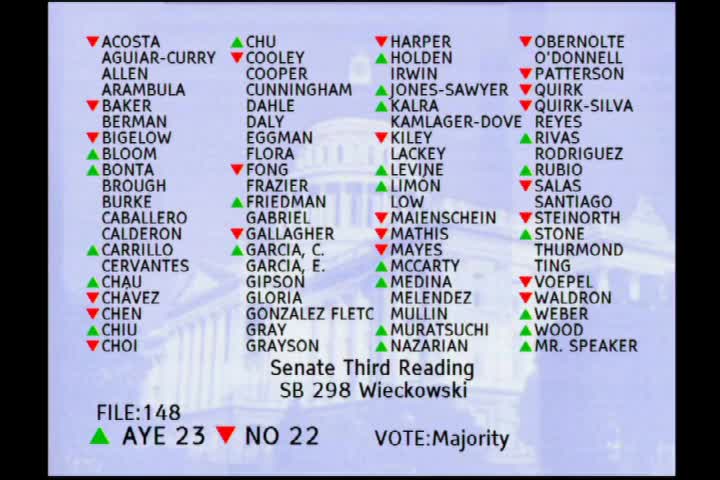 2MIN
Assembly Floor
 1H
Assembly Standing Committee on Appropriations
 6MIN
Assembly Standing Committee on Health
 3MIN
Senate Floor
 23MIN
Senate Standing Committee on Health
Bill Author

Bill Co-Author(s):