SB 1015: Natural Resources Climate Resiliency Program.
- Session Year: 2017-2018
- House: Senate
- Latest Version Date: 2018-08-06
Existing law establishes the Wildlife Conservation Board and prescribes the membership and functions and duties of the board with regard to the preservation and protection of natural lands and wildlife habitat. The California Global Warming Solutions Act of 2006 requires all moneys, except for fines and penalties, collected by the State Air Resources Board from the auction or sale of allowances as part of a market-based compliance mechanism to be deposited in the Greenhouse Gas Reduction Fund and be available, upon appropriation by the Legislature, for greenhouse gas emissions reduction activities.
This bill would establish the California Natural Resources Climate Resiliency Program to increase resiliency to climate change impacts in urban and rural communities throughout the state and to fund the planning and implementation of projects that improve and enhance the climate change resiliency of natural systems, natural and working lands, and developed areas. plan and implement projects that increase the resiliency of natural systems, natural and working lands, and wildlife habitat in rural and urban areas throughout the state in the face of climate change. The bill would require that the program be developed and implemented by the Wildlife Conservation Board, in coordination with any participating state conservancies, as defined. The bill would require that moneys from the Greenhouse Gas Reduction Fund, bonds, settlements with conditions consistent with the program, and other revenue sources, upon appropriation in the annual Budget Act, be transferred to the California Natural Resources Climate Change Resiliency Fund (fund), which the bill would create. The bill would require that the board and any participating state conservancies, by June 30, 2019, jointly develop a schedule for the allocation of moneys transferred to the fund pursuant to those provisions to the board and each participating conservancy, as provided. The bill would require that the schedule of allocation be determined based on the geographical scope and population of the jurisdictional area covered by the board and each participating conservancy, with consideration given to a regions vulnerability to climate change impacts, and be jointly updated by the board and participating conservancies, not less than once every 5 years, as prescribed. The bill would require that any allocations of moneys from the fund that are included in the schedule of allocation be based on the geographical scope and population of the jurisdictional area covered by the board and each participating conservancy with consideration given to visitor population of the jurisdictional area and the population served by a jurisdictional area even if all or a portion of the population served by the jurisdictional area resides outside of the jurisdictional area. The bill would require that the board and any participating state conservancies expend moneys from the fund for purposes of the program, as prescribed. The bill would also require the board to expend a portion of those moneys to fund projects located in disadvantaged communities, as described, and low-income communities, as defined.
The bill would require the board, in collaboration with state conservancies that are considering participating in the program, no later than January 1, 2020, after a public hearing or other public process, to develop criteria and guidelines for the implementation of the program, as provided. The bill would authorize the board and each participating conservancy to develop a climate resiliency program pursuant to the bill that prioritizes projects that include specified cobenefits. The bill would require the board and a participating conservancy, after a participating conservancy notifies the board in writing of its interest in the program and completes the above-described criteria and guidelines, to adopt its own climate resiliency plan or climate resiliency program covering its jurisdiction that is consistent with specified objectives and priorities as geographically appropriate, as specified. The bill would authorize the board and any participating state conservancies to award grants to specified public entities and nongovernmental organizations for projects that are consistent with the program. The bill would require the board and any participating state conservancies to each prepare an annual public report on projects undertaken pursuant to the program during the year prior to preparation of the report, as prescribed.
Existing law establishes the Wildlife Conservation Board and prescribes the membership and functions and duties of the board with regard to the preservation and protection of natural lands and wildlife habitat. The California Global Warming Solutions Act of 2006 requires all moneys, except for fines and penalties, collected by the State Air Resources Board from the auction or sale of allowances as part of a market-based compliance mechanism to be deposited in the Greenhouse Gas Reduction Fund and be available, upon appropriation by the Legislature, for greenhouse gas emissions reduction activities.
This bill would establish the California Climate Resiliency Program to increase resiliency to climate change impacts in urban and rural communities throughout the state and to fund the planning and implementation of projects that improve and enhance the climate change resiliency of natural systems, natural and working lands, and developed areas. The bill would require that the program be developed and implemented by the Wildlife Conservation Board, in coordination with any participating state conservancies, as defined. The bill would require that moneys from the Greenhouse Gas Reduction Fund, bonds, settlements, settlements with conditions consistent with the program, and other revenue sources, upon appropriation in the annual Budget Act, be transferred to the California Climate Change Resiliency Fund (fund), which the bill would create. The bill would require that the board and any participating state conservancies, by June 30, 2019, jointly develop a schedule for the allocation of moneys transferred to the fund pursuant to those provisions. provisions to the board and each participating conservancy, as provided. The bill would require that the schedule of allocation be determined based on the geographical scope and population of the jurisdictional area, as prescribed, area covered by the board and each participating conservancy, and be jointly updated by the board and participating conservancies, not less than once every 5 years, as prescribed. The bill would require that any allocations of moneys from the fund that are included in the schedule of allocation be based on the geographical scope and population of an the jurisdictional area covered by a climate resiliency program the board and each participating conservancy with consideration given to visitor population of the jurisdictional area and the population served by a jurisdictional area even if all or a portion of the population served by the jurisdictional area resides outside of the jurisdictional area. The bill would require that the board and any participating state conservancies expend moneys from the fund for purposes of the program, as prescribed. The bill would also require the board to expend a portion of those moneys to fund projects located in disadvantaged communities, as described, and low-income communities, as defined.
The bill would require the board, in collaboration with state conservancies that are considering participating in the program, no later than January 1, 2020, after a public hearing or other public process, to develop criteria and guidelines for the implementation of the program. program, as provided. The bill would require that, to be eligible to receive moneys transferred to the fund pursuant to the bill, the board and any participating state agency adopt authorize the board and each participating conservancy to develop a climate resiliency program pursuant to the bill that prioritizes projects that include specified cobenefits. The bill would require the board and a participating conservancy, after a participating conservancy notifies the board in writing of its interest in the program and completes the above-described criteria and guidelines, to adopt its own climate resiliency plan or climate resiliency program covering its jurisdiction that is consistent with specified objectives and priorities as geographically appropriate, as specified. The bill would authorize the board and any participating state conservancies to award grants to specified public entities and nongovernmental organizations for projects that are consistent with the program. The bill would require the board and any participating state conservancies to each prepare an annual public report on projects undertaken pursuant to the program during the year prior to preparation of the report, as prescribed.
Existing law establishes the Wildlife Conservation Board and prescribes the membership and functions and duties of the board with regard to the preservation and protection of natural lands and wildlife habitat. The California Global Warming Solutions Act of 2006 requires all moneys, except for fines and penalties, collected by the State Air Resources Board from the auction or sale of allowances as part of a market-based compliance mechanism to be deposited in the Greenhouse Gas Reduction Fund and be available, upon appropriation by the Legislature, for greenhouse gas emissions reduction activities.
This bill would establish the California Climate Resiliency Program to increase resiliency to climate change impacts in urban and rural communities throughout the state and to fund the planning and implementation of projects that improve and enhance the climate change resiliency of natural systems, natural and working lands, and developed areas. The bill would require that the program be developed and implemented by the Wildlife Conservation Board, in coordination with any participating state conservancies, as defined. The bill would require that moneys from the Greenhouse Gas Reduction Fund, bonds, settlements, and other revenue sources, upon appropriation in the annual Budget Act, be transferred to the California Climate Change Resiliency Fund (fund), which the bill would create. The bill would require that the board and any participating state conservancies, by June 30, 2019, jointly develop a schedule for the allocation of moneys transferred to the fund pursuant to those provisions. The bill would require that the schedule be determined based on the geographical scope and population of a the jurisdictional area, as prescribed, and be updated not less than once every 5 years, as prescribed. The bill would require that any allocations of moneys from the fund that are included in the schedule be based on the geographical scope and population of an area covered by a climate resiliency program with consideration given to visitor population of the jurisdictional area and the population served by a jurisdictional area even if all or a portion of the population served by the jurisdictional area resides outside of the jurisdictional area. The bill would require that the board and any participating state conservancies expend moneys from the fund for purposes of the program, as prescribed. The bill would also require the board to expend a portion of those moneys to fund projects located in disadvantaged communities, as described, and low-income communities, as defined.
The bill would require the board, in collaboration with state conservancies that are considering participating in the program, no later than January 1, 2020, after a public hearing or other public process, to develop criteria and guidelines for the implementation of the program. The bill would require that, to be eligible to receive moneys transferred to the fund pursuant to the bill, the board and any participating state agency adopt a climate resiliency program covering its jurisdiction that is consistent with specified objectives and priorities and as geographically appropriate features, appropriate, as specified. The bill would authorize the board and any participating state conservancies to award grants to specified public entities and nongovernmental organizations for projects that are consistent with the program. The bill would require the board and any participating state conservancies to each prepare an annual public report on projects undertaken pursuant to the program during the year prior to preparation of the report, as prescribed.
Existing law establishes the Wildlife Conservation Board and prescribes the membership and functions and duties of the board with regard to the preservation and protection of natural lands and wildlife habitat. The California Global Warming Solutions Act of 2006 requires all moneys, except for fines and penalties, collected by the State Air Resources Board from the auction or sale of allowances as part of a market-based compliance mechanism to be deposited in the Greenhouse Gas Reduction Fund and be available, upon appropriation by the Legislature, for greenhouse gas emissions reduction activities.
This bill would establish the California Climate Resiliency Program to increase resiliency to climate change impacts in urban and rural communities throughout the state and to fund the planning and implementation of projects that improve and enhance the climate change resiliency of natural systems, natural and working lands, and developed areas. The bill would require that the program be developed and implemented by the Wildlife Conservation Board, in coordination with any participating state conservancies, as defined. The bill would require that moneys from the Greenhouse Gas Reduction Fund, bonds, settlements, and other revenue sources, upon appropriation in the annual Budget Act, be transferred to the California Climate Change Resiliency Fund (fund), which the bill would create. The bill would require that the board and any participating state conservancies, by June 30, 2019, jointly develop a schedule for the allocation of moneys transferred to the fund pursuant to those provisions. The bill would require that the schedule be determined based on the geographical scope and population of a jurisdictional area, as prescribed, and be updated not less than once every 5 years or, as deemed necessary by the board and any participating state conservancies, to include additional participating state conservancies that elect to participate in the program. years, as prescribed. The bill would require that any allocations of moneys from the fund that are included in the schedule be based on the geographical scope and population of an area covered by a climate resiliency program implemented by the board or a participating state conservancy for that area. with consideration given to the population served by a jurisdictional area even if all or a portion of the population served by the jurisdictional area resides outside of the jurisdictional area. The bill would require that the board and any participating state conservancies expend moneys from the fund for purposes of the program, as prescribed. The bill would also require the board to expend a portion of those moneys to fund projects located in disadvantaged communities, as described, and low-income communities, as defined.
The bill would require the board, in collaboration with any participating state conservancies, state conservancies that are considering participating in the program, no later than January 1, 2020, after a public hearing or other public process, to develop criteria and guidelines for the implementation of the program. The bill would require that, to be eligible to receive moneys transferred to the fund pursuant to the bill, a the board and any participating state agency adopt a climate change resilience resiliency program covering its jurisdiction that is geographically appropriate and consistent with specified objectives and priorities. priorities and geographically appropriate features, as specified. The bill would authorize the board and any participating state conservancies to award grants to specified public entities and nonprofit organizations nongovernmental organizations for projects that are consistent with the program. The bill would require the board and any participating state conservancies to each prepare an annual public report on projects undertaken pursuant to the program during the year prior to preparation of the report, as prescribed.
Existing law establishes the Wildlife Conservation Board and prescribes the membership and functions and duties of the board with regard to the preservation and protection of natural lands and wildlife habitat. The California Global Warming Solutions Act of 2006 requires all moneys, except for fines and penalties, collected by the State Air Resources Board from the auction or sale of allowances as part of a market-based compliance mechanism to be deposited in the Greenhouse Gas Reduction Fund and be available, upon appropriation by the Legislature, for greenhouse gas emissions reduction activities.
This bill would establish the California Climate Resiliency Program to increase resiliency to climate change impacts in urban and rural communities throughout the state and to fund the planning and implementation of projects that improve and enhance the climate change resiliency of natural systems, natural and working lands, and developed areas. The bill would require that the program be developed and implemented by the Wildlife Conservation Board. Board, in coordination with any participating state conservancies, as defined. The bill would require that moneys from the Greenhouse Gas Reduction Fund, bonds, settlements, and other revenue sources sources, upon appropriation in the annual Budget Act, be transferred to the California Climate Change Resiliency Fund, Fund (fund), which the bill would create. The bill would authorize require that the board to and any participating state conservancies, by June 30, 2019, jointly develop a schedule for the allocation of moneys transferred to the fund pursuant to those provisions. The bill would require that the schedule be updated not less than once every 5 years or, as deemed necessary by the board and any participating state conservancies, to include additional participating state conservancies that elect to participate in the program. The bill would require that any allocations of moneys from the fund that are included in the schedule be based on the geographical scope and population of an area covered by a climate resiliency program implemented by the board or a participating state conservancy for that area. The bill would require that the board and any participating state conservancies expend moneys from the California Climate Change Resiliency Fund fund for purposes of the program. program, as prescribed. The bill would also require the board to expend a portion of those moneys to fund projects located in disadvantaged communities, as described, and low-income communities, as defined.
The bill would require the board, in collaboration with any participating state conservancies, no later than January 1, 2020, after a public hearing or other public process, to develop criteria and guidelines for the implementation of the program. The bill would require that, to be eligible to receive moneys transferred to the fund pursuant to the bill, a participating state agency adopt a climate change resilience program covering its jurisdiction that is geographically appropriate and consistent with specified objectives and priorities. The bill would authorize the board and any participating state conservancies to award grants to specified public entities and nonprofit organizations for projects that are consistent with the program. The bill would require the board and any participating state conservancies to each prepare an annual public report on projects undertaken pursuant to the program during the year prior to preparation of the report, as prescribed.
Existing law establishes the Wildlife Conservation Board and prescribes the membership and functions and duties of the board with regard to the preservation and protection of natural lands and wildlife habitat. The California Global Warming Solutions Act of 2006 requires all moneys, except for fines and penalties, collected by the State Air Resources Board from the auction or sale of allowances as part of a market-based compliance mechanism to be deposited in the Greenhouse Gas Reduction Fund and be available, upon appropriation by the Legislature, for greenhouse gas emissions reduction activities.
This bill would establish the California Climate Resiliency Program to increase resiliency to climate change impacts in urban and rural communities throughout the state and to fund the planning and implementation of projects that improve and enhance the climate change resiliency of natural systems, natural and working lands, and developed areas. The bill would require that the program be developed and implemented by the Wildlife Conservation Board. The bill would require that moneys from the Greenhouse Gas Reduction Fund, bonds, settlements, and other revenue sources upon appropriation in the annual Budget Act, be transferred to the California Climate Change Resiliency Fund, which the bill would create. The bill would authorize the board to expend moneys from the California Climate Change Resiliency Fund for purposes of the program. The bill would also require the board to expend a portion of those moneys to fund projects located in disadvantaged communities, as described, and low-income communities, as defined.
The Legislature finds and declares all of the following:
(a)California is experiencing documented adverse impacts as a result of climate change and it is predicted that these impacts will accelerate.
(b)Californias devastating fire season is getting longer and more intense, as evidenced by destructive October fires in northern California and December fires in southern California.
(c)This decade produced the worst drought in Californias history, which ended with the second wettest rain and snow season on record.
(d)Climate change is driving longer and hotter heat waves, along with increasingly higher average temperatures, which exacerbate the urban heat island effect.
(e)All of these climate-change-driven impacts are having detrimental effects on Californias people, communities, and natural resources.
(f)California needs to strategically invest in regional projects that enhance the states resiliency to climate change, reduce greenhouse gas emissions, and protect and restore Californias natural resources and systems.
SEC. 2.Division 46 (commencing with Section 80200) is added to the Public Resources Code, to read:46.California Natural Resources Climate Resiliency Program80200.(a)The California Natural Resources Climate Resiliency Program is hereby created to increase resiliency to climate change impacts in urban and rural communities throughout the state and to fund the planning and implementation of projects that reduce emissions of greenhouse gases and improve and enhance the climate change resiliency of natural systems, natural and working lands, and developed areas. plan and implement projects that increase the resiliency of natural systems, natural and working lands, and wildlife habitat in rural and urban areas throughout the state in the face of climate change. The program shall be developed and implemented by the Wildlife Conservation Board, in coordination with any participating state conservancies.
(b)(1)Moneys from the Greenhouse Gas Reduction Fund, created pursuant to Section 16428.8 of the Government Code, bonds, settlements with conditions consistent with this division, and other revenue sources, upon appropriation in the annual Budget Act, shall be transferred to the California Natural Resources Climate Change Resiliency Fund, which is hereby created in the State Treasury.
(2)The board and any participating state conservancies shall, by June 30, 2019, jointly develop a schedule for the allocation of moneys transferred to the fund pursuant to paragraph (1) to the board and each participating conservancy, which shall include amounts and a timeline for the distribution of moneys transferred to the fund pursuant to that paragraph. The schedule of allocation shall be determined based on the geographical scope and population of the jurisdictional area covered by the board and each participating state conservancy with consideration given to visitor population of the jurisdictional area and the population served by a jurisdictional area even if all or a portion of the population of that area resides outside of the jurisdictional area. Consideration shall also be given to a regions vulnerability to climate change impacts. The schedule of allocation shall be jointly updated by the board and any participating state conservancies not less than once every five years and prior to any annual budget allocations. Each update shall include any additional conservancy that has notified the board in writing that it has elected to participate in the program. A copy of the schedule of allocation shall be provided to the respective budget committees in the Assembly and the Senate and to the appropriate policy committees in each house with relevant jurisdiction.
(3)The board and any participating state conservancies shall expend moneys in the fund for the purposes of the program. A portion of any moneys appropriated pursuant to paragraph (1) shall be used to fund projects located in disadvantaged communities identified pursuant to Section 39711 of the Health and Safety Code and in low-income communities, as defined in Section 39713 of the Health and Safety Code, in order to ensure that the state achieves its goals under Section 39713 of the Health and Safety Code.
(c)(1)No later than January 1, 2020, the board, in collaboration with any state conservancies that are considering participating in the program, shall, after a public hearing or other public process, develop criteria and guidelines for the implementation of the program created by this division. The criteria shall include, but not be limited to, standardized measurement and reporting requirements of adaptation benefits and greenhouse gas emissions reductions. In developing those criteria and guidelines, the board and any participating state conservancies shall also consult with the Office of Planning and Research regarding the implementation of the Integrated Climate Adaptation and Resiliency Program established pursuant to Part 4.5 (commencing with Section 71350) of Division 34 and any other state entities, as appropriate, that are responsible for the implementation of programs to address the effects of climate change.
(2)The board and each participating state conservancy may develop a climate resiliency program under this division. Any such climate resiliency program adopted or updated by the board or by a participating state conservancy shall also prioritize projects that include the following cobenefits:
(A)Job creation and training with a preference for at-risk youth employment.
(B)Recreational opportunities.
(C)Public health improvement.
(D)Local community engagement through outreach, education, and interpretation as it relates to long-term stewardship and climate change awareness.
(E)Improved social equity in vulnerable communities.
(F)Protection of natural resources that have cultural or tribal significance.
(3)The board shall prioritize funding projects in areas outside the jurisdictional boundaries of participating state conservancies.
(d)(1)After a state conservancy notifies the board in writing of its interest in the program created by this division and the criteria and guidelines have been completed pursuant to subdivision (c), the board and each participating state conservancy shall adopt its own climate resiliency plan or climate resiliency program that is consistent with the mission of the board or the participating state conservancy, and covers climate adaptation and resiliency in its jurisdiction.
(2)The climate resiliency plan or climate resiliency program required pursuant to paragraph (1) shall outline the boards or the participating state conservancys activities implementing the program including, but not limited to, the expenditure of their allocation from the fund. Eligible activities for a climate resiliency plan or climate resiliency program may include any of the following objectives and priorities as geographically appropriate:
(A)Acquisition, preservation, and restoration of the wildland urban interface that buffers communities from wildfire, flood, and other natural disasters.(B)Acquisition, protection, and restoration of wildlife corridors and habitats, other habitats, or ecosystems at risk due to urban sprawl or climate change.(C)Improvement in fish and wildlife habitats on public and private lands for migratory, anadromous, and other climate-vulnerable species using adaptive conservation strategies, including provision of seasonal and temporary habitats, to buffer the impacts of climate change. Investments in conservation actions on private lands shall be in accordance with subdivision (c).(D)Improvement of coastal resources to address sea level rise, storm surge, beach and bluff erosion, salt water intrusion, flooding, and to preserve and enhance coastal wetlands and natural lands, and to conserve biodiversity.(E)Acquisition, preservation, and restoration of agricultural and open space to improve soil health and carbon soil sequestration, erosion control, water quality, and water retention, and to provide flood control and create habitat.(F)Improvement of forest and watershed health through hazardous fuels reduction, postfire watershed rehabilitation, prescribed or managed burns, invasive species, pest, and disease identification and eradication, acquisition of forest conservation easements or fee interests, and other fire prevention methods.(G)Development, restoration, and maintenance of urban forests, river parkways, greenways, creeks and streams, trails, and parks that reduce heat island effect, capture stormwater runoff, help control or eradicate invasive species, disease, and pests, and provide active transportation and recreational opportunities.(H)Restoration of watershed health, creation and restoration of wetland habitat, provision of benefits to salmon, steelhead, and other fisheries, enhancement of stream flows, restoration of mountain meadows, reconnection of historical flood plains, provision of fish passages, restoration of river channels, control of invasive plants, and restoration or enhancement of riparian, aquatic, and terrestrial habitat.(I)Conservation of water resources through the use of drought-efficient landscaping, stormwater capture and filtration, impervious surfaces, green roofs, and other forms of water capture and storage.(A)Projects on natural lands and working lands to protect communities from wildfire, flood, drought, and other natural disasters; improve forest and watershed health; control or eradicate invasive species, disease, and pests; preserve and restore agricultural lands and open space; and improve water quality, water retention, erosion control, and carbon soil sequestration.
(B)Projects that protect, restore, or enhance fish and wildlife corridors and habitats and other habitats or ecosystems, including seasonal and temporary habitats on public or private lands to buffer the impacts of climate change on vulnerable species. Investments in conservation actions on private lands shall be in accordance with subdivision (c) of Section 80002.
(C)Projects to address sea level rise, storm surge, beach and bluff erosion, saltwater intrusion, and flooding, to preserve and enhance coastal wetlands and natural lands, and to conserve biodiversity.
(D)Projects that reduce heat island effect, conserve water resources, capture stormwater runoff, restore and maintain river parkways, greenways, creeks and streams, trails, and parks, and provide active transportation and recreational opportunities.
(3)To satisfy the requirements of paragraphs (1) and (2), the board and any state conservancy may update an existing plan or program to meet the requirements for a climate resiliency plan or climate resiliency program developed pursuant to paragraphs (1) and (2). The State Coastal Conservancys Climate Ready Program developed pursuant to the requirements of Section 31113 is an existing climate resiliency program for purposes of this division.
(4)Projects eligible under this program shall, to the extent applicable and appropriate, have enduring benefits, include a monitoring program, and incorporate adaptive management strategies and best practices.
(5)Projects designed for the benefit of fish and wildlife shall be consistent with the most recent State Wildlife Action Plan.
(e)(1)The board and any participating state conservancies may award grants to entities, including, but not limited to, public agencies, nongovernmental organizations, park and open-space districts and authorities, resource conservation districts, joint powers authorities, federally recognized Native American tribes and nonfederally recognized Native American tribes listed on the California Tribal Consultation List maintained by the Native American Heritage Commission, entities responsible for implementing natural community conservation plans or regional habitat conservation plans, and regional collaboratives for climate adaptation, for projects and programs that are consistent with this division.
(2)The board may award grants for ecosystem restoration projects, as set forth in Chapters 611, 612, 613, and 614 of the Statutes of 2003, as well as other existing programs that are consistent with this division.
(3)The San Gabriel and Lower Los Angeles Rivers and Mountains Conservancy may directly implement or award grants to fund projects consistent with this division that are part of the Lower Los Angeles River Revitalization Plan. The Santa Monica Mountains Conservancy may directly implement or award grants to fund projects consistent with this division that are a part of the revitalization plan developed by the Upper Los Angeles River and Tributaries Working Group pursuant to Section 33220.
(f)The board and any participating state conservancies shall each prepare an annual public report on projects undertaken pursuant to this program during the year prior to preparation of the report. This report may be incorporated, as applicable, into an existing reporting requirement. requirement and shall be submitted to the Office of Planning and Researchs Integrated Climate Adaptation and Resiliency Program, to be added to the State Adaptation Clearinghouse.
(g)Nothing in this division is intended to supplant any existing program or the existing authority of any state entity.
80201.For purposes of this division, the following terms have the following meanings:
(a)Fund means the California Natural Resources Climate Change Resiliency Fund created in Section 80200.
(b)Participating state conservancy means a state conservancy that has notified the board in writing that it has elected to participate in the program established pursuant to this division.
The Legislature finds and declares all of the following:
(a)California is experiencing documented adverse impacts as a result of climate change and it is predicted that these impacts will accelerate.
(b)Californias devastating fire season is getting longer and more intense, as evidenced by destructive October fires in northern California and December fires in southern California.
(c)This decade produced the worst drought in Californias history, which ended with the second wettest rain and snow season on record.
(d)Climate change is driving longer and hotter heat waves, along with increasingly higher average temperatures, which exacerbate the urban heat island effect.
(e)All of these climate-change-driven impacts are having detrimental effects on Californias people, communities, and natural resources.
(f)California needs to strategically invest in regional projects that enhance the states resiliency to climate change, reduce greenhouse gas emissions, and protect and restore Californias natural resources and systems.
SEC. 2.Division 46 (commencing with Section 80200) is added to the Public Resources Code, to read:46.California Climate Resiliency Program80200.(a)The California Climate Resiliency Program is hereby created to increase resiliency to climate change impacts in urban and rural communities throughout the state and to fund the planning and implementation of projects that reduce emissions of greenhouse gases and improve and enhance the climate change resiliency of natural systems, natural and working lands, and developed areas. The program shall be developed and implemented by the Wildlife Conservation Board, in coordination with any participating state conservancies.
(b)(1)Moneys from the Greenhouse Gas Reduction Fund, created pursuant to Section 16428.8 of the Government Code, bonds, settlements, settlements with conditions consistent with this division, and other revenue sources, upon appropriation in the annual Budget Act, shall be transferred to the California Climate Change Resiliency Fund, which is hereby created in the State Treasury.
(2)The board and any participating state conservancies shall, by June 30, 2019, jointly develop a schedule for the allocation of moneys transferred to the fund pursuant to paragraph (1). (1) to the board and each participating conservancy, which shall include amounts and a timeline for the distribution of moneys transferred to the fund pursuant to that paragraph. The schedule of allocation shall be determined based on the geographical scope and population of the jurisdictional area covered by a climate resiliency program the board and each participating state conservancy with consideration given to visitor population of the jurisdictional area and the population served by a jurisdictional area even if all or a portion of the population of that area resides outside of the jurisdictional area. The schedule of allocation shall be jointly updated by the board and any participating state conservancies not less than once every five years and prior to any annual budget allocations to be made in the fiscal year immediately following the adoption of a climate resiliency program by a state conservancy that had not previously participated in the program created by this division. allocations. Each update shall include any additional conservancy that has notified the board in writing that it has elected to participate in the program. A copy of the schedule of allocation shall be provided to the respective budget committees in the Assembly and the Senate and to the appropriate policy committees in each house with relevant jurisdiction.
(3)The board and any participating state conservancies shall expend moneys in the fund for the purposes of the program. A portion of any moneys appropriated pursuant to paragraph (1) shall be used to fund projects located in disadvantaged communities identified pursuant to Section 39711 of the Health and Safety Code and in low-income communities, as defined in Section 39713 of the Health and Safety Code, in order to ensure that the state achieves its goals under Section 39713 of the Health and Safety Code.
(c)(1)No later than January 1, 2020, the board, in collaboration with any state conservancies that are considering participating in the program, shall, after a public hearing or other public process, develop criteria and guidelines for the implementation of the program created by this division. The criteria shall include, but not be limited to, standardized measurement and reporting requirements of adaptation benefits and greenhouse gas emissions reductions. In developing those criteria and guidelines, the board, in collaboration with any of those stateconservancies that are considering participating in the program board and any participating state conservancies shall also consult with the Office of Planning and Research regarding the implementation of the Integrated Climate Adaptation and Resiliency Program established pursuant to Part 4.5 (commencing with Section 71350) of Division 34 and any other state entities, as appropriate, that are responsible for the implementation of programs to address the effects of climate change.
(2)The board and each participating state conservancy may develop a climate resiliency program under this division. Any such climate resiliency program adopted by a participating state conservancy shall also prioritize projects that include the following cobenefits:
(A)Job creation and training with a preference for at-risk youth employment.
(B)Recreational opportunities.
(C)Public health improvement.
(D)Local community engagement through outreach, education, and interpretation as it relates to long-term stewardship and climate change awareness.
(d)(1)After a state conservancy notifies the board in writing of its interest in the program created by this division and the criteria and guidelines have been completed pursuant to subdivision (c), the board and each participating state conservancy shall adopt its own climate resiliency plan or climate resiliency program that is consistent with the mission of the board or the participating state conservancy, and covers climate adaptation and resiliency in its jurisdiction.
(2)The climate resiliency plan or climate resiliency program required pursuant to paragraph (1) shall outline the boards or the participating state conservancys activities implementing the program including, but not limited to, the expenditure of their allocation from the fund. Eligible activities for a climate resiliency plan or climate resiliency program may include any of the following objectives and priorities as geographically appropriate:
(d)(1)To be eligible to receive moneys transferred to the fund pursuant to subdivision (b), the board and any participating state conservancy shall adopt a climate resiliency program covering its jurisdiction that is consistent with the following objectives and priorities as geographically appropriate:(A)Acquisition, preservation, and restoration of the wildland urban interface that buffers communities from wildfire, flood, and other natural disasters.
(B)Acquisition, protection, and restoration of wildlife corridors and habitats, other habitats, or ecosystems at risk due to urban sprawl or climate change.
(C)Improvement in fish and wildlife habitats on public and private lands for migratory, anadromous, and other climate-vulnerable species using adaptive conservation strategies, including provision of seasonal and temporary habitats, to buffer the impacts of climate change. Investments in conservation actions on private lands shall be in accordance with subdivision (c).
(D)Improvement of coastal resources to address sea level rise, storm surge, beach and bluff erosion, salt water intrusion, flooding, and to preserve and enhance coastal wetlands and natural lands, and to conserve biodiversity.
(E)Acquisition, preservation, and restoration of agricultural and open space to improve soil health and carbon soil sequestration, erosion control, water quality, and water retention, and to provide flood control and create habitat.
(F)Improvement of forest and watershed health through hazardous fuels reduction, postfire watershed rehabilitation, prescribed or managed burns, invasive species, pest, and disease identification and eradication, acquisition of forest conservation easements or fee interests, and other fire prevention methods.
(G)Development, restoration, and maintenance of urban forests, river parkways, greenways, creeks and streams, trails, and parks that reduce heat island effect, capture stormwater runoff, help control or eradicate invasive species, disease, and pests, and provide active transportation and recreational opportunities.
(H)Restoration of watershed health, creation and restoration of wetland habitat, provision of benefits to salmon, steelhead, and other fisheries, enhancement of stream flows, restoration of mountain meadows, reconnection of historical flood plains, provision of fish passages, restoration of river channels, control of invasive plants, and restoration or enhancement of riparian, aquatic, and terrestrial habitat.
(I)Conservation of water resources through the use of drought-efficient landscaping, stormwater capture and filtration, impervious surfaces, green roofs, and other forms of water capture and storage.
(2)Any climate resiliency programs adopted by a participating state conservancy shall also prioritize projects that include the following cobenefits:(A)Job creation and training with a preference for at-risk youth employment.(B)Recreation.(C)Public health improvement.(D)Local community engagement through outreach, education, and interpretation as it relates to long-term stewardship and climate change awareness.(3)To satisfy the requirements of paragraphs (1) and (2), paragraphs (1) and (2), the board and any state conservancy may update an existing plan or program to meet the criteria and guidelines requirements for a climate resiliency plan or climate resiliency program developed pursuant to subdivision (c). paragraphs (1) and (2). The State Coastal Conservancys Climate Ready Program developed pursuant to the requirements of Section 31113 is an existing climate resiliency program for purposes of this division.(4)Projects eligible under this program shall, to the extent applicable and appropriate, have enduring benefits, include a monitoring program, and incorporate adaptive management strategies and best practices.(e)(1)The board and any participating state conservancies may award grants to entities, including, but not limited to, public agencies, nongovernmental organizations, park and open-space districts and authorities, resource conservation districts, joint powers authorities, federally recognized Native American tribes and nonfederally recognized Native American tribes listed on the California Tribal Consultation List maintained by the Native American Heritage Commission, entities responsible for implementing natural community conservation plans or regional habitat conservation plans, and regional collaboratives for climate adaptation, for projects and programs that are consistent with this division.
(2)The board may award grants for ecosystem restoration projects, as set forth in Chapters 611, 612, 613, and 614 of the Statutes of 2003, as well as other existing programs that are consistent with this division.
(3)The San Gabriel and Lower Los Angeles Rivers and Mountains Conservancy may directly implement or award grants to fund projects consistent with this division that are part of the Lower Los Angeles River Revitalization Plan. The Santa Monica Mountains Conservancy may directly implement or award grants to fund projects consistent with this division that are a part of the revitalization plan developed by the Upper Los Angeles River and Tributaries Working Group pursuant to Section 33220.
(f)The board and any participating state conservancies shall each prepare an annual public report on projects undertaken pursuant to this program during the year prior to preparation of the report. This report may be incorporated, as applicable, into an existing reporting requirement.
80201.For purposes of this division, the following terms have the following meanings:
(a)Fund means the California Climate Change Resiliency Fund created in Section 80200.
(b)Participating state conservancy means a state conservancy that has adopted a climate resiliency program covering its jurisdiction and notified the board in writing that it has elected to participate in the program established pursuant to this division.
The Legislature finds and declares all of the following:
(a)California is experiencing documented adverse impacts as a result of climate change and it is predicted that these impacts will accelerate.
(b)Californias devastating fire season is getting longer and more intense, as evidenced by destructive October fires in northern California and December fires in southern California.
(c)This decade produced the worst drought in Californias history, which ended with the second wettest rain and snow season on record.
(d)Climate change is driving longer and hotter heat waves, along with increasingly higher average temperatures, which exacerbate the urban heat island effect.
(e)All of these climate-change-driven impacts are having detrimental effects on Californias people, communities, and natural resources.
(f)California needs to strategically invest in regional projects that enhance the states resiliency to climate change, reduce greenhouse gas emissions, and protect and restore Californias natural resources and systems.
SEC. 2.Division 46 (commencing with Section 80200) is added to the Public Resources Code, to read:46.California Climate Resiliency Program80200.(a)The California Climate Resiliency Program is hereby created to increase resiliency to climate change impacts in urban and rural communities throughout the state and to fund the planning and implementation of projects that reduce emissions of greenhouse gases and improve and enhance the climate change resiliency of natural systems, natural and working lands, and developed areas. The program shall be developed and implemented by the Wildlife Conservation Board, in coordination with any participating state conservancies.
(b)(1)Moneys from the Greenhouse Gas Reduction Fund, created pursuant to Section 16428.8 of the Government Code, bonds, settlements, and other revenue sources, upon appropriation in the annual Budget Act, shall be transferred to the California Climate Change Resiliency Fund, which is hereby created in the State Treasury.
(2)The board and any participating state conservancies shall, by June 30, 2019, jointly develop a schedule for the allocation of moneys transferred to the fund pursuant to paragraph (1). The schedule shall be determined based on the geographical scope and population of a the jurisdictional area covered by a climate resiliency program with consideration given to visitor population of the jurisdictional area and the population served by a jurisdictional area even if all or a portion of the population of that area resides outside of the jurisdictional area. The schedule shall be updated not less than once every five years and prior to any annual budget allocations to be made in the fiscal year immediately following the adoption of a climate resiliency program by a state conservancy that had not previously participated in the program created by this division. A copy of the schedule shall be provided to the respective budget committees in the Assembly and the Senate and to the appropriate policy committees in each house with relevant jurisdiction.
(3)The board and any participating state conservancies shall expend moneys in the fund for the purposes of the program. A portion of any moneys appropriated pursuant to paragraph (1) shall be used to fund projects located in disadvantaged communities identified pursuant to Section 39711 of the Health and Safety Code and in low-income communities, as defined in Section 39713 of the Health and Safety Code, in order to ensure that the state achieves its goals under Section 39713 of the Health and Safety Code.
(c)No later than January 1, 2020, the board, in collaboration with any state conservancies that are considering participating in the program, shall, after a public hearing or other public process, develop criteria and guidelines for the implementation of the program created by this division. In developing those criteria and guidelines, the board, in collaboration with any of those state conservancies that are considering participating in the program shall also consult with the Office of Planning and Research regarding the implementation of the Integrated Climate Adaptation and Resiliency Program established pursuant to Part 4.5 (commencing with Section 71350) of Division 34 and any other state entities, as appropriate, that are responsible for the implementation of programs to address the effects of climate change.
(d)(1)To be eligible to receive moneys transferred to the fund pursuant to subdivision (b), the board and any participating state conservancy shall adopt a climate resiliency program covering its jurisdiction that is consistent with the following objectives and priorities and as geographically appropriate features: appropriate:
(A)Acquisition, preservation, and restoration of the wildland urban interface that buffers communities from wildfire, flood, and other natural disasters.
(B)Acquisition, protection, and restoration of wildlife corridors and habitats, other habitats, or ecosystems at risk due to urban sprawl or climate change.
(C)Improvement in fish and wildlife habitats on public and private lands for migratory, anadromous, and other climate-vulnerable species using adaptive conservation strategies, including provision of seasonal and temporary habitats, to buffer the impacts of climate change. Investments in conservation actions on private lands shall be in accordance with subdivision (c).
(C)(D)Improvement of coastal resources to address sea level rise, storm surge, beach and bluff erosion, salt water intrusion, flooding, and to preserve and enhance coastal wetlands and natural lands, and to conserve biodiversity.
(D)(E)Acquisition, preservation, and restoration of agricultural and open space to improve soil health and carbon soil sequestration, erosion control, water quality, and water retention, and to provide flood control and create habitat.
(E)(F)Improvement of forest and watershed health through hazardous fuels reduction, postfire watershed rehabilitation, prescribed or managed burns, invasive species, pest, and disease identification and eradication, acquisition of forest conservation easements or fee interests, and other fire prevention methods.
(F)(G)Development, restoration, and maintenance of urban forests, river parkways, greenways, creeks and streams, trails, and parks that reduce heat island effect, capture stormwater runoff, help control or eradicate invasive species, disease, and pests, and provide active transportation. transportation and recreational opportunities.
(G)(H)Restoration of watershed health, creation and restoration of wetland habitat, provision of benefits to salmon, steelhead, and other fisheries, enhancement of stream flows, restoration of mountain meadows, reconnection of historical flood plains, provision of fish passages, restoration of river channels, control of invasive plants, and restoration or enhancement of riparian, aquatic, and terrestrial habitat.
(H)(I)Conservation of water resources through the use of drought-efficient landscaping, stormwater capture and filtration, impervious surfaces, green roofs, and other forms of water capture and storage.
(2)Any climate resiliency programs adopted by a participating state conservancy shall also prioritize projects that include the following cobenefits:
(A)Job creation and training with a preference for at-risk youth employment.
(B)Recreation.
(C)Public health improvement.
(D)Local community engagement through outreach, education, and interpretation as it relates to long-term stewardship and climate change awareness.
(3)The board and any participating state conservancies, as applicable, may use existing climate resiliency programs to satisfy the requirements of paragraphs (1) and (2) if any such existing programs satisfy, or are updated to satisfy, the criteria and guidelines developed pursuant to subdivision (c). To satisfy the requirements of paragraphs (1) and (2), the board and any state conservancy may update an existing program to meet the criteria and guidelines developed pursuant to subdivision (c). The State Coastal Conservancys Climate Ready Program developed pursuant to the requirements of Section 31113 is an existing climate resiliency program for purposes of this division.
(4)Projects eligible for under this program shall, to the extent applicable and appropriate, have enduring benefits, include a monitoring program, and incorporate adaptive management strategies and best practices.
(e)(1)The board and any participating state conservancies may award grants to entities, including, but not limited to, public agencies, nongovernmental organizations, park and open-space districts and authorities, resource conservation districts, joint powers authorities, federally recognized Native American tribes and nonfederally recognized Native American tribes listed on the California Tribal Consultation List maintained by the Native American Heritage Commission, entities responsible for implementing natural community conservation plans or regional habitat conservation plans, and regional collaboratives for climate adaptation, for projects and programs that are consistent with this division.
(2)The board may award grants for ecosystem restoration projects, as set forth in Chapters 611, 612, 613, and 614 of the Statutes of 2003, as well as other existing programs that are consistent with this division.
(3)The San Gabriel and Lower Los Angeles Rivers and Mountains Conservancy may directly implement or award grants to fund projects consistent with this division that are part of the Lower Los Angeles River Revitalization Plan. The Santa Monica Mountains Conservancy may directly implement or award grants to fund projects consistent with this division that are a part of the revitalization plan developed by the Upper Los Angeles River and Tributaries Working Group pursuant to Section 33220.
(f)The board and any participating state conservancies shall each prepare an annual public report on projects undertaken pursuant to this program during the year prior to preparation of the report. This report may be incorporated, as applicable, into an existing reporting requirement.
80201.For purposes of this division, the following terms have the following meanings:
(a)Fund means the California Climate Change Resiliency Fund created in Section 80200.
(b)Participating state conservancy means a state conservancy that has adopted a climate resiliency program covering its jurisdiction and that has elected to participate in the program established pursuant to this division.
The Legislature finds and declares all of the following:
(a)California is experiencing documented adverse impacts as a result of climate change and it is predicted that these impacts will accelerate.
(b)Californias devastating fire season is getting longer and more intense, as evidenced by destructive October fires in northern California and December fires in southern California.
(c)This decade produced the worst drought in Californias history, which ended with the second wettest rain and snow season on record.
(d)Climate change is driving longer and hotter heat waves, along with increasingly higher average temperatures, which exacerbate the urban heat island effect.
(e)All of these climate-change-driven impacts are having detrimental effects on Californias people, communities, and natural resources.
(f)California needs to strategically invest in regional projects that enhance the states resiliency to climate change, reduce greenhouse gas emissions, and protect and restore Californias natural resources and systems.
SEC. 2.Division 46 (commencing with Section 80200) is added to the Public Resources Code, to read:46.California Climate Resiliency Program80200.(a)The California Climate Resiliency Program is hereby created to increase resiliency to climate change impacts in urban and rural communities throughout the state and to fund the planning and implementation of projects that reduce emissions of greenhouse gases and improve and enhance the climate change resiliency of natural systems, natural and working lands, and developed areas. The program shall be developed and implemented by the Wildlife Conservation Board, in coordination with any participating state conservancies.
(b)(1)Moneys from the Greenhouse Gas Reduction Fund, created pursuant to Section 16428.8, 16428.8 of the Government Code, bonds, settlements, and other revenue sources sources, upon appropriation in the annual Budget Act, shall be transferred to the California Climate Change Resiliency Fund, which is hereby created in the State Treasury.
(2)The board and any participating state conservancies shall, by June 30, 2019, jointly develop a schedule for the allocation of moneys transferred to the fund pursuant to paragraph (1). The schedule shall be updated not less than once every five years or, as deemed necessary by the board and any participating state conservancies, to include additional state conservancies that elect to participate in the program created by this division. Any allocations of money from the fund that are included in the schedule shall be based on the geographical scope and population of an area covered by a climate resiliency program implemented by the board or a participating state conservancy for that area. The schedule shall be determined based on the geographical scope and population of a jurisdictional area covered by a climate resiliency program with consideration given to the population served by a jurisdictional area even if all or a portion of the population of that area resides outside of the jurisdictional area. The schedule shall be updated not less than once every five years and prior to any annual budget allocations to be made in the fiscal year immediately following the adoption of a climate resiliency program by a state conservancy that had not previously participated in the program created by this division.
(3)The board and any participating state conservancies shall expend moneys in the fund for the purposes of the program. A portion of any moneys appropriated pursuant to paragraph (1) shall be used to fund projects located in disadvantaged communities identified pursuant to Section 39711 of the Health and Safety Code and in low-income communities, as defined in Section 39713 of the Health and Safety Code, in order to ensure that the state achieves its goals under Section 39713 of the Health and Safety Code.
(c)No later than January 1, 2020, the board, in collaboration with any participating state conservancies, state conservancies that are considering participating in the program, shall, after a public hearing or other public process, develop criteria and guidelines for the implementation of the program created by this division. In developing those criteria and guidelines, the board and any participating board, in collaboration with any of those state conservancies shall that are considering participating in the program shall also consult with the Office of Planning and Research regarding the implementation of the Integrated Climate Adaptation and Resiliency Program established pursuant to Part 4.5 (commencing with Section 71350) of Division 34 and any other state entities, as appropriate, that are responsible for the implementation of programs to address the effects of climate change.
(d)(1)To be eligible to receive moneys transferred to the fund pursuant to subdivision (b), a the board and any participating state conservancy shall adopt a climate resilience resiliency program covering its jurisdiction that is geographically appropriate and consistent with all of the following objectives and priorities: priorities and geographically appropriate features:
(A)Acquisition, preservation, and restoration of the wildland urban interface that buffers communities from wildfire, flood, and other natural disasters.
(B)Acquisition, protection, and restoration of wildlife corridors and wildlife habitat habitats, other habitats, or ecosystems at risk due to urban sprawl. sprawl or climate change.
(C)Improvement of coastal resources to address sea level rise, storm surge, beach and bluff erosion, salt water intrusion, flooding, and to preserve and enhance coastal wetlands and natural lands, and to conserve biodiversity.
(D)Acquisition, preservation, and restoration of agricultural and open space to improve soil health and carbon soil sequestration, erosion control, water quality, and water retention, and to provide flood control and create habitat.
(E)Improvement of forest and watershed health through hazardous fuels reduction, postfire watershed rehabilitation, prescribed or managed burns, invasive species, pest, and disease identification and eradication, acquisition of forest conservation easements or fee interests, and other fire prevention methods.
(F)Development, restoration, and maintenance of urban forests, greenways, streams, trails, and parks that reduce heat island effect, capture stormwater runoff, help control or eradicate invasive species, disease, and pests, and provide active transportation.
(G)Restoration of watershed health, creation and restoration of wetland habitat, provision of benefits to salmon, steelhead, and other fisheries, enhancement of stream flows to restore flows, restoration of mountain meadows, reconnection of historical flood plains, provision of fish passages, restoration of river channels, control of invasive plants, and restoration and or enhancement of riparian, aquatic, and terrestrial habitat.
(H)Conservation of water resources through the use of drought-efficient landscaping, stormwater capture and filtration, impervious surfaces, green roofs, and other forms of water capture and storage.
(2)Any climate resilience resiliency programs adopted by a participating state conservancy shall also prioritize projects that include the following cobenefits:
(A)Job creation and training with a preference for at-risk youth employment.
(B)Recreation.
(C)Public health improvement.
(D)Local community engagement through outreach, education, and interpretation as it relates to long-term stewardship and climate change awareness.
(3)The board and any participating state conservancies, as applicable, may use existing climate resiliency programs to satisfy the requirements of paragraphs (1) and (2) if any such existing programs satisfy, or are updated to satisfy, the criteria and guidelines developed pursuant to subdivision (c). The State Coastal Conservancys Climate Ready Program developed pursuant to the requirements of Section 31113 is an existing climate resiliency program for purposes of this division.
(3)(4)Projects eligible for under this program shall, to the extent applicable and appropriate, have enduring benefits, include a monitoring program, and incorporate adaptive management strategies and best practices.
(e)The board and any participating state conservancies may award grants to nonprofit organizations or public entities, including, but not limited to, entities, including, but not limited to, public agencies, nongovernmental organizations, park and open-space districts and authorities, resource conservation districts, joint powers authorities, entities responsible for implementing natural community conservation plans or regional habitat conservation plans, and regional collaboratives for climate adaptation adaptation, for projects and programs that are consistent with this division.
(f)The board and any participating state conservancies shall each prepare an annual public report on projects undertaken pursuant to this program during the year prior to preparation of the report. This report may be incorporated, as applicable, into an existing reporting requirement.
80201.For purposes of this division, the following terms have the following meanings:
(a)Fund means the California Climate change Change Resiliency Fund created in Section 80200.
(b)Participating state conservancy means a state conservancy that has adopted a climate resiliency program covering its jurisdiction and that has elected to participate in the program established pursuant to this division.
The Legislature finds and declares all of the following:
(a)California is experiencing documented adverse impacts as a result of climate change and it is predicted that these impacts will accelerate.
(b)Californias devastating fire season is getting longer and more intense, as evidenced by destructive October fires in northern California and December fires in southern California.
(c)This decade produced the worst drought in Californias history, which ended with the second wettest rain and snow season on record.
(d)Climate change is driving longer and hotter heat waves, along with increasingly higher average temperatures, which exacerbate the urban heat island effect.
(e)All of these climate-change-driven impacts are having detrimental effects on Californias people, communities, and natural resources.
(f)California needs to strategically invest in regional projects that enhance the states resiliency to climate change, reduce greenhouse gas emissions, and protect and restore Californias natural resources and systems.
SEC. 2.Division 46 (commencing with Section 80200) is added to the Public Resources Code, to read:46.California Climate Resiliency Program80200.(a)The California Climate Resiliency Program is hereby created to increase resiliency to climate change impacts in urban and rural communities throughout the state and to fund the planning and implementation of projects that reduce emissions of greenhouse gasses gases and improve and enhance the climate change resiliency of natural systems, natural and working lands, and developed areas. The program shall be developed and implemented by the Wildlife Conservation Board. Board, in coordination with any participating state conservancies.
(b)(1)Moneys from the Greenhouse Gas Reduction Fund, created pursuant to Section 16428.8, bonds, settlements, and other revenue sources upon appropriation in the annual Budget Act, shall be transferred to the California Climate Change Resiliency Fund, which is hereby created in the State Treasury.
(2)Moneys The board and any participating state conservancies shall, by June 30, 2019, jointly develop a schedule for the allocation of moneys transferred to the fund pursuant to paragraph (1). The schedule shall be updated not less than once every five years or, as deemed necessary by the board and any participating state conservancies, to include additional state conservancies that elect to participate in the program created by this division. Any allocations of money from the fund that are included in the schedule shall be based on the geographical scope and population of an area covered by a climate resiliency program implemented by the board or a participating state conservancy for that area.
(3)The board and any participating state conservancies shall expend moneys in the fund may be expended by the board for the purposes of the program. The board shall also expend a A portion of any moneys appropriated pursuant to paragraph (1) shall be used to fund projects located in disadvantaged communities identified pursuant to Section 39711 of the Health and Safety Code and in low-income communities, as defined in Section 39713 of the Health and Safety Code. Code, in order to ensure that the state achieves its goals under Section 39713 of the Health and Safety Code.
(c)No later than January 1, 2020, the board, in collaboration with any participating state conservancies, shall, after a public hearing or other public process, develop criteria and guidelines for the implementation of the program created by this division. In developing those criteria and guidelines, the board and any participating state conservancies shall consult with the Office of Planning and Research regarding the implementation of the Integrated Climate Adaptation and Resiliency Program established pursuant to Part 4.5 (commencing with Section 71350) of Division 34 and any other state entities, as appropriate, that are responsible for the implementation of programs to address the effects of climate change.
(d)(1)To be eligible to receive moneys transferred to the fund pursuant to subdivision (b), a participating state conservancy shall adopt a climate resilience program covering its jurisdiction that is geographically appropriate and consistent with all of the following objectives and priorities:
(A)Acquisition, preservation, and restoration of the wildland urban interface that buffers communities from wildfire, flood, and other natural disasters.
(B)Acquisition, protection, and restoration of wildlife corridors and wildlife habitat at risk due to urban sprawl.
(C)Improvement of coastal resources to address sea level rise, storm surge, beach and bluff erosion, salt water intrusion, flooding, and to preserve and enhance coastal wetlands and natural lands, and to conserve biodiversity.
(D)Acquisition, preservation, and restoration of agricultural and open space to improve soil health and carbon soil sequestration, erosion control, water quality, and water retention, and to provide flood control and create habitat.
(E)Improvement of forest and watershed health through hazardous fuels reduction, postfire watershed rehabilitation, prescribed or managed burns, invasive species, pest, and disease identification and eradication, acquisition of forest conservation easements or fee interests, and other fire prevention methods.
(F)Development, restoration, and maintenance of urban forests, greenways, streams, trails, and parks that reduce heat island effect, capture stormwater runoff, help control or eradicate invasive species, disease, and pests, and provide active transportation.
(G)Restoration of watershed health, creation and restoration of wetland habitat, provision of benefits to salmon, steelhead, and other fisheries, enhancement of stream flows to restore mountain meadows, reconnection of historical flood plains, provision of fish passages, restoration of river channels, control of invasive plants, and restoration and enhancement of riparian, aquatic, and terrestrial habitat.
(H)Conservation of water resources through the use of drought-efficient landscaping, stormwater capture and filtration, impervious surfaces, green roofs, and other forms of water capture and storage.
(2)Any climate resilience programs adopted by a participating state conservancy shall also prioritize projects that include the following cobenefits:
(A)Job creation and training with a preference for at-risk youth employment.
(B)Recreation.
(C)Public health improvement.
(D)Local community engagement through outreach, education, and interpretation as it relates to long-term stewardship and climate change awareness.
(3)Projects eligible for under this program shall, to the extent applicable and appropriate, have enduring benefits, include a monitoring program, and incorporate adaptive management strategies and best practices.
(e)The board and any participating state conservancies may award grants to nonprofit organizations or public entities, including, but not limited to, park and open-space districts and authorities, resource conservation districts, joint powers authorities, and regional collaboratives for climate adaptation for projects and programs that are consistent with this division.
(f)The board and any participating state conservancies shall each prepare an annual public report on projects undertaken pursuant to this program during the year prior to preparation of the report. This report may be incorporated, as applicable, into an existing reporting requirement.
80201.For purposes of this division, the following terms have the following meanings:
(a)Fund means the California Climate change Resiliency Fund created in Section 80200.
(b)Participating state conservancy means a state conservancy that has adopted a climate resiliency program covering its jurisdiction and that has elected to participate in the program established pursuant to this division.
The Legislature finds and declares all of the following:
(a)California is experiencing documented adverse impacts as a result of climate change and it is predicted that these impacts will accelerate.
(b)Californias devastating fire season is getting longer and more intense, as evidenced by destructive October fires in northern California and December fires in southern California.
(c)This decade produced the worst drought in Californias history, which ended with the second wettest rain and snow season on record.
(d)Climate change is driving longer and hotter heat waves, along with increasingly higher average temperatures, which exacerbate the urban heat island effect.
(e)All of these climate-change-driven impacts are having detrimental effects on Californias people, communities, and natural resources.
(f)California needs to strategically invest in regional projects that enhance the states resiliency to climate change, reduce greenhouse gas emissions, and protect and restore Californias natural resources and systems.
SEC. 2.Division 46 (commencing with Section 80200) is added to the Public Resources Code, to read:46.California Climate Resiliency Program80200.(a)The California Climate Resiliency Program is hereby created to increase resiliency to climate change impacts in urban and rural communities throughout the state and to fund the planning and implementation of projects that reduce emissions of greenhouse gasses and improve and enhance the climate change resiliency of natural systems, natural and working lands, and developed areas. The program shall be developed and implemented by the Wildlife Conservation Board.
(b)(1)Moneys from the Greenhouse Gas Reduction Fund, created pursuant to Section 16428.8, bonds, settlements, and other revenue sources upon appropriation in the annual Budget Act, shall be transferred to the California Climate Change Resiliency Fund, which is hereby created in the State Treasury.
(2)Moneys in the fund may be expended by the board for the purposes of the program. The board shall also expend a portion of any moneys appropriated pursuant to paragraph (1) to fund projects located in disadvantaged communities identified pursuant to Section 39711 of the Health and Safety Code and in low-income communities, as defined in Section 39713 of the Health and Safety Code.
|
Date
|
Status
|
|---|---|
| Aug 16, 2018 | August 16 hearing: Held in committee and under submission. |
| Aug 16, 2018 | Joint Rule 62(a) suspended. |
| Aug 15, 2018 | August 15 set for first hearing. Placed on suspense file. |
| Aug 8, 2018 | August 8 hearing postponed by committee. |
| Aug 6, 2018 | From committee with author's amendments. Read second time and amended. Re-referred to Com. on APPR. |
| Jun 26, 2018 | From committee: Do pass and re-refer to Com. on APPR. (Ayes 9. Noes 6.) (June 26). Re-referred to Com. on APPR. |
| Jun 21, 2018 | Read second time and amended. Re-referred to Com. on W.,P., & W. |
| Jun 20, 2018 | From committee: Do pass as amended and re-refer to Com. on W.,P., & W. (Ayes 8. Noes 1.) (June 18). |
| Jun 12, 2018 | From committee with author's amendments. Read second time and amended. Re-referred to Com. on NAT. RES. |
| Jun 11, 2018 | Referred to Coms. on NAT. RES. and W.,P., & W. |
| May 29, 2018 | In Assembly. Read first time. Held at Desk. |
| May 29, 2018 | Read third time. Passed. (Ayes 27. Noes 9.) Ordered to the Assembly. |
| May 25, 2018 | From committee: Do pass. (Ayes 5. Noes 2.) (May 25). |
| May 23, 2018 | Set for hearing May 25. |
| May 22, 2018 | May 22 hearing: Placed on APPR. suspense file. |
| May 14, 2018 | Set for hearing May 22. |
| May 10, 2018 | From committee with author's amendments. Read second time and amended. Re-referred to Com. on APPR. |
| May 10, 2018 | May 14 hearing postponed by committee. |
| May 4, 2018 | Set for hearing May 14. |
| Apr 26, 2018 | April 30 set for first hearing canceled at the request of author. |
| Apr 20, 2018 | Set for hearing April 30. |
| Apr 18, 2018 | From committee: Do pass and re-refer to Com. on APPR. (Ayes 4. Noes 2.) (April 18). Re-referred to Com. on APPR. |
| Apr 5, 2018 | From committee with author's amendments. Read second time and amended. Re-referred to Com. on EQ. |
| Mar 29, 2018 | Set for hearing April 18. |
| Mar 13, 2018 | From committee: Do pass and re-refer to Com. on EQ. (Ayes 6. Noes 2.) (March 13). Re-referred to Com. on EQ. |
| Feb 23, 2018 | Set for hearing March 13. |
| Feb 14, 2018 | Referred to Coms. on N.R. & W. and EQ. |
| Feb 8, 2018 | From printer. May be acted upon on or after March 10. |
| Feb 7, 2018 | Introduced. Read first time. To Com. on RLS. for assignment. To print. |
|
Date
|
Description
|
Location
|
Votes
|
|
|---|---|---|---|---|
| Jun 26, 2018 | Do pass and be re-referred to the Committee on [Appropriations] | Assembly Standing Committee on Water, Parks, and Wildlife |
Passed |
|
| Jun 18, 2018 | Do pass as amended and be re-referred to the Committee on [Water, Parks, and Wildlife] | Assembly Standing Committee on Natural Resources |
Passed |
|
| May 29, 2018 | Senate 3rd Reading SB1015 Allen et al. | Senate Floor |
Passed |
|
| May 25, 2018 | Do pass | Senate Standing Committee on Appropriations |
Passed |
|
| May 22, 2018 | Placed on suspense file | Senate Standing Committee on Appropriations |
Passed |
|
| Apr 18, 2018 | Do pass, but first be re-referred to the Committee on [Appropriations] | Senate Standing Committee on Environmental Quality |
Passed |
|
| Mar 13, 2018 | Do pass, but first be re-referred to the Committee on [Environmental Quality] | Senate Standing Committee on Natural Resources and Water |
Passed |
This list shows positions taken on this bill by organizations on the date displayed, which is linked to the original source.
Positions by individuals are not included.
Date of Hearing: August 15, 2018
ASSEMBLY COMMITTEE ON APPROPRIATIONS
Lorena Gonzalez Fletcher, Chair
SBPCA Bill Id:SB 1015
Author:(Allen) – As Amended Ver:August 6, 2018
Policy Committee: | Natural Resources | Vote: | 8 - 1 |
Water, Parks and Wildlife | 9 - 6 | ||
|
|
Urgency: No State Mandated Local Program: No Reimbursable: No
SUMMARY:
This bill creates the Natural Resources Climate Resiliency Program (Program) and fund of the same name (Fund)at the Wildlife Conservation Board (WCB) in collaboration and participation with state conservancies. Specifically, this bill:
- Creates the Program to plan and implement projects that increase the resiliency of natural systems, natural and working lands, and wildlife habitat in rural and urban areas.
- Creates the Fund to provide the Program with moneys from the Greenhouse Gas Emission Reduction Fund (GGRF), bonds, and settlements, upon appropriation for purposes of this program.
- Requires the WCB and participating conservancies, by June 30, 2019, to jointly develop a schedule for the allocation of monies transferred to the Fund to include amounts and timelines to be determined based on the geographical scope and population of the conservancy’s jurisdiction and its vulnerability to climate change impacts. Requires the schedule to be updated every five years and provided to the Legislature, as specified.
- Specifies a portion of the funds be spent in disadvantaged communities, as defined.
- Requires the WCB, no later than January 1, 2020, and after a public hearing or other public process, to develop criteria and guidelines for the implementation of the Program, in collaboration with the conservancies and in consultation with the Governor’s Office of Planning and Research with regard to the Integrated Climate Adaptation and Resiliency Program, as specified.
- Specifies what eligible activities the Program may fund, as geographically appropriate.
- Requires projects to prioritize job creation and training with a preference for at-risk youth employment; recreation; public health improvement; local community engagement through outreach, education, and interpretation as it relates to long-term stewardship and climate change awareness; improved social equity in vulnerable communities; and protection of natural resources that have cultural or tribal significance.
- Requires WCB to prioritize funding projects in areas outside the jurisdictional boundaries of participating state conservancies.
- Specifies the State Coastal Conservancy’s Climate Ready Program is an existing program for the purposes of the Program.
- Authorizes the Santa Monica Mountains Conservancy and the San Gabriel and Lower Los Angeles Rivers and Mountains Conservancy to directly implement or award grants consistent with the bill, as specified.
- Requires WCB and participating conservancies to prepare annual public reports and submit them to OPR’s Integrated Climate Adaptation and Resiliency Program, to be added to the State Adaptation Clearinghouse.
- States this bill is not intended to supplant any existing state program or authority.
FISCAL EFFECT:
- Unknown cost pressures, likely in the tens of millions of dollars annually from the Greenhouse Gas Reduction Fund (GGRF) and other sources to pay for the new program.
- Increased annual Department of Fish and Wildlife costs of approximately $365,000 per year to administer the program at the WCB.
- Increased annual Air Resources Board costs of approximately $370,000 and an additional $100,000 in contract funds for tracking, reporting, and quantifying emissions reductions.
COMMENTS:
- Purpose. According to the author:
SB 1015 will help California reach its climate goals while at the same time assisting local communities and our state adapt to and withstand the impacts that climate change will have on public health and the environment. The bill establishes the California Climate Resiliency Program at the Wildlife Conservation Board and the state’s ten conservancies to fund projects at the local level that both help our state become more resilient to climate change and reduced greenhouse gas emissions.
- Background. The WCB was created by legislation in 1947 to administer a capital outlay program for wildlife conservation and related public recreation. While part of the Department of Fish and Wildlife (DFW), the WCB is an independent board with authority and funding to carry out an acquisition and development program. The WCB consists of the President of the Fish and Game Commission, the Director of DFW and the Director of the Department of Finance. The legislation that created the WCB also established a legislative advisory committee consisting of three members of the Senate and three members of the Assembly, which meet with the WCB and provide legislative oversight.
AB 109 (the Budget Act of 2017) created the Climate Adaptation and Resiliency Program (CARP), and provided $20 million GGRF funding to the WCB. These funds are available for encumbrance or expenditure through June 30, 2022. The WCB released its first request for proposals earlier this year, with a due date of May 18, 2018, and received applications for projects totaling over $100 million.
The CARP guidelines specify that at least 60% of funds shall be spent on projects that benefit climate adaptation and resilience through the acquisition of perpetual conservation easements and agreements that conserve natural and working lands for at least 50 years. The remaining 40% is authorized to be spent to develop and implement natural and working lands adaptation and resiliency planning that prioritizes the conservation and management of natural and working lands, provides technical assistance for natural and working land managers, and supports efforts that improve rural-urban coordination on climate change adaptation.
It is unclear if this bill provides any authority the WCB does not already have or why this bill establishes a program for participating conservancies, yet prioritizes the funding of projects in areas outside the conservancies’ jurisdictions.
Analysis Prepared by: Jennifer Galehouse / APPR. / (916) 319-2081
Date of Hearing: June 26, 2018
ASSEMBLY COMMITTEE ON WATER, PARKS, AND WILDLIFE
Eduardo Garcia, Chair
SBPCA Bill Id:SB 1015
Author:(Allen) – As Amended Ver:June 21, 2018
SENATE VOTE: 27-9
SUBJECT: California Climate Resiliency Program
SUMMARY: Creates the California Climate Resiliency Program (Climate Resiliency Program) and the California Climate Change Resiliency Fund (Climate Resiliency Fund) in the Wildlife Conservation Board (WCB), to be administered by the WCB in collaboration with participating state conservancies. Specifically, this bill:
- Creates the Climate Resiliency Program to increase resiliency to climate change impacts in urban and rural communities.
- Creates the Climate Resiliency Fund to fund the Climate Resiliency Program with moneys from the Greenhouse Gas Emission Reduction Fund (GGRF), bonds, and settlements, upon appropriation for purposes of this program.
- Specifies that the Climate Resiliency Program will be made available to state conservancies, and requires participating conservancies and the WCB develop their own plan or climate resiliency program that is consistent with a number of objectives as geographically appropriate, including, but not limited to: acquisition, preservation and restoration of land in the wildland urban interface, wildlife corridors and habitats at risk due to climate change, and agricultural and open space; improvement of temporary and seasonal habitats at risk from climate change, and coastal resources to address sea level rise, forest and watershed health; development, restoration, and maintenance urban environments; watershed and wetland restoration; and, conservation of water resources.
- Projects must also prioritize job creation and training with a preference for at-risk youth employment; recreation; public health improvement; and, local community engagement through outreach, education and interpretation as it relates to long-term stewardship and climate change awareness.
- Requires the WCB, in collaboration with state conservancies participating in the Climate Resiliency Program, to accomplish the following:
- Jointly develop a schedule for the allocation of moneys in the Climate Resiliency Fund. The schedule of allocation shall be determined based on the geographic scope and population of the jurisdictional area covered by each participating conservancy and the WCB.
- Update the allocation schedule not less than once every five years and prior to any annual budget allocations. Each update shall include any conservancies that have notified the board of their election into the program.
- No later than January 1, 2020, and after a public hearing or other public process, develop criteria and guidelines for the implementation of the Climate Resiliency Program, in consultation with the Governor’s Office of Planning and Research with regard to the Integrated Climate Adaptation and Resiliency Program.
- Specifies that, pursuant to existing requirements for GGRF funding, a portion of the funds be spent in disadvantaged communities, as defined.
EXISTING LAW:
- Establishes the WCB as an independent board within the Department of Fish and Wildlife (DFW) to administer a capital outlay program for wildlife conservation and related public recreation.
- Requires the Air Resources Board (ARB), pursuant to California Global Warming Solutions Act of 2006 [AB 32 (Nuñez), Chapter 488, Statutes of 2006], to adopt a statewide greenhouse gas (GHG) emissions limit equivalent to 1990 levels by 2020 and adopt regulations to achieve maximum technologically feasible and cost-effective GHG emission reductions. AB 32 authorizes the ARB to permit the use of market-based compliance mechanisms to comply with GHG reduction regulations once specified conditions are met.
- Establishes the GGRF and requires all moneys, except for fines and penalties, collected by the ARB from the auction or sale of allowances pursuant to a market-based compliance mechanism (i.e., the cap-and-trade program adopted by the ARB under AB 32) to be deposited in the GGRF and available for appropriation by the Legislature.
- Establishes the GGRF Investment Plan and Communities Revitalization Act (Act) to set procedures for the investment of GHG allowance auction revenues. Authorizes a range of GHG reduction investments and establishes specified policy objectives.
- Specifies that moneys appropriated from the GGRF through investments may include funding to reduce GHG emissions for a variety of energy, water, transportation, waste and sustainable development projects and programs.
- Requires the investment plan to allocate certain funds to benefit low-income and disadvantaged communities, as specified.
- Declares it is the policy of the state that the protection and management of natural and working lands is an important strategy in meeting the state’s GHG emissions reduction goals. Requires all state agencies, including the Natural Resources Agency, the Department of Food and Agriculture, and the California Environmental Protection Agency, and their respective departments, boards, and commissions to consider the policy.
FISCAL EFFECT: According to the Senate Appropriations Committee, the bill has one-time costs of $205,000 and ongoing costs of $366,000 annually to the DFW for staff necessary to implement the bill, and cost pressures, potentially in the millions of dollars.
COMMENTS: This bill creates the Climate Resiliency Program to be administered by the WCB in collaboration with participating state conservancies, in order to focus climate resiliency and adaptation funding to local and regional projects.
Author’s Statement:
SB 1015 will help California reach its climate goals while at the same time assisting local communities and our state adapt to and withstand the impacts that climate change will have on public health and the environment. The bill establishes the California Climate Resiliency Program at the Wildlife Conservation Board and the state’s ten conservancies to fund projects at the local level that both help our state become more resilient to climate change and reduced greenhouse gas emissions.
Background and Purpose: According to the author’s office, in the last few years, the state has been bombarded with overwhelming natural disasters, from a prolonged drought to flooding, wildfires and ensuing mudslides, an increase in average temperatures and more extreme heat days, and these impacts are expected to increase in intensity and frequency. The impact of climate change on California’s forests is evidenced by the magnitude and multitude of recent destructive wildfires, the worst drought in California’s history, and invasive species such as bark beetles, that have led to a stunning 100 million dead and dying trees. These conditions not only increase the risks of catastrophic wildfires, leading to increased GHG emissions, but also decrease the ability of forests to provide quality wildlife habitat and recreation opportunities, and capture and filter water in our source watershed. In addition to areas of high fire risk, communities and agricultural activities in natural areas and wetlands, such as the Delta, have reduced California’s capacity to withstand flooding while simultaneously increasing climate impacts by diminishing the ability of these natural lands to sequester carbon. As more extreme flooding becomes the norm, further developing wild landscapes will exacerbate both problems.
The author contends that sea-level rise already is affecting California’s coastline, causing more extensive coastal flooding during storms, periodic tidal flooding and increased coastal erosion. According to the Ocean Protection Council, the rate of ice loss from Greenland and Antarctica is increasing and will soon become the primary contributor to global sea-level rise, overtaking ocean expansion from warming waters and the melting of mountain glaciers and ice caps. This increase will have a disproportionate effect on California, which is already struggling to cope with the current projections of levels increasing 10 to 20 centimeters by 2050. Sea level rise is causing more than double the frequency of serious flooding events in many parts of the globe, including along the California coastline. California’s urban communities are particularly vulnerable to impacts of climate change but as they are responsible for around 70 percent of global GHG emissions, they can also play a key role in fighting climate change. Urban concrete surfaces and steel buildings absorb and radiate heat, causing late-afternoon temperatures to soar as much as seven degrees Fahrenheit higher than surfaces covered in greenery and more than 20 degrees higher at night. Studies predict a tenfold increase in heat-related deaths by the middle of the century which will disproportionately impact vulnerable populations such as the elderly and lower-income households without air-conditioning. Paved-over landscapes also exacerbate flooding in storms.
Wildlife Conservation Board. The WCB was created by legislation in 1947 to administer a capital outlay program for wildlife conservation and related public recreation. While part of the DFW, the WCB is an independent Board with authority and funding to carry out an acquisition and development program for wildlife conservation. The WCB consists of the President of the Fish and Game Commission, the Director of the DFW and the Director of the Department of Finance. Legislation that created the WCB also established a Legislative Advisory Committee consisting of three members of the Senate and three members of the Assembly, which meet with the WCB, and provide legislative oversight.
Strategic Planning for Statewide Action, Re-Focusing on Public Access. The primary responsibilities of the WCB are to select, authorize and allocate funds for the purchase of land and waters suitable for recreation purposes and the preservation, protection and restoration of wildlife habitat. The WCB's three main functions are land acquisition, habitat restoration, and development of wildlife-oriented public access facilities, which are carried out through its programs. Recently, with the support of public and legislative members, the WCB has completed work on a strategic plan to not only coordinate statewide investments but also to consider times in which public access can be made. Public and legislative advisory committee members provided input into the program which has resulted in further investment with public access, including in urban areas.
AB 109 Climate Program at WCB. In 2017, AB 109 (the Budget Act of 2017) created the Climate Adaptation and Resiliency Program (CARP), and provided $20 million (one-time) within the budget of GGRF funding to the WCB. These funds are available for encumbrance or expenditure through June 30, 2022. The WCB released its first request for proposals earlier this year, with a due date of May 18, 2018, and received applications for projects totaling over $100 million. The CARP guidelines specify that at least 60 percent of the funds shall be spent on projects that benefit climate adaptation and resilience through the acquisition of perpetual conservation easements and agreements that conserve natural and working lands for at least 50 years. The remaining 40 percent is authorized to be spent to develop and implement natural and working lands adaptation and resiliency planning that prioritizes the conservation and management of natural and working lands, provides technical assistance for natural and working land managers, and supports efforts that improve rural-urban coordination on climate change adaptation.
The WCB has developed guidelines for the program that are available on their webpage. Issue and area specific criteria that would make projects eligible for CARP program funding are not included, but examples of project types that would be eligible for solicitations are listed. These include:
- Acquisition of conservation easements to protect habitats on working or natural lands that provide direct adaptation or resilience to climate change for wildlife, or provide connectivity to allow plants and animals to move in response to climate change.
- Restoration or enhancement of ecosystems that directly and measurably enhance adaptation or resilience to climate change for wildlife, or enhance connectivity to allow plants and animals to move in response to climate change.
- Plans to identify climate risks to wildlife (e.g., species vulnerability, habitat exposure, barriers to migration or movement, changes to stream flows, sea level rise, wildfire or flood susceptibility, and invasive species) and methods to minimize or mitigate those risks.
- Development of tools that can be provided to natural and working land managers to improve long-term management of ecosystems to provide adaptation or resilience, and how to implement these tools in measurable and meaningful ways.
- Development of statewide or regional models that identify areas of greatest risk and greatest adaptation or resilience to climate change to be used to prioritize future climate adaptation and resilience projects.
- Acquisition of conservation easements to protect habitats on working or natural lands that provide direct adaptation or resilience to climate change for wildlife, or provide connectivity to allow plants and animals to move in response to climate change.
Would this Bill Support or Supplant Existing WCB Programs? The Assembly Natural Resources Committee raised the following issue in their analysis of SB 1015. “Given the existence of the CARP, a new and developing program administered by WCB tasked with allocating GGRF funding for adaptation projects, questions remain about how the proposed Climate Resiliency Program would interact with the CARP. Further, the list above appears sufficiently specific to constrain the types of projects eligible for the program. In its current form, the bill includes a detailed list of different types of activities that eligible conservancies are authorized to receive moneys for as part of the Climate Resiliency Program. However, there are examples of programs in place that allocate GGRF for the activities listed, including the Healthy Forests Program, administered by CalFIRE; the Healthy Soils Program, administered by the Department of Food and Agriculture; and, the Wetland Restoration Program, administered by the Department of Fish and Wildlife. Since state conservancies have defined, often regional, geographic scopes and mission statements that direct their work, there may be conflicts between the activities listed in the bill, the mission of the conservancy, and other ongoing efforts at the state level.”
This discussion is very relevant to the nature of the year-to-year budget negotiations—wherein funding is allocated on one-time bases, regardless of long-term priorities of the state. Other one-time funds, such as bond funds, are often seen as a way to supplant ongoing GGRF funds though the purposes may differ. In order for the Legislature to weigh in on long-term programs, consideration of policy bills such as this is critical. Amendments taken in the Assembly Natural Resources Committee focus the program and clarify the rolls between conservancies and non-conservancy lands served by the WCB.
Why WCB? Effective Program Delivery, Public Input, and Legislative Oversight. Over the years, the Legislature and public initiatives have introduced many diverse programs at the WCB. These include habitat enhancement, protection and restoration of oak woodlands, rangeland conservation, forestry, public access and climate adaptation. Most of the programs focus on state investments, including both easements and fee title acquisitions—with more recent acquisitions focusing on public access and interpretation. Most projects are acquired with local sponsors, nonprofit agencies, or other public agencies. Depending on the program established, matching funds may be required for projects. All projects are brought before the board in a public forum on which sits the legislative advisory committee. Because this bill focuses on the conservancies with the WCB, the author may wish to include intent language to ensure that areas of the state not covered by participating conservancies receive equal consideration for funding under the bill.
Concerns Raised—Should we Implement Long-Term Programs or Continue Budget to Budget? As discussed above, those active in the allocation of GGRF funds for natural resources programs raise concerns that this program will supplant existing programs including the California Department of Food and Agriculture Healthy Soils Program, CalFIRE Urban Forestry Program, and others. Nothing in this bill either actively supports or denies this claim. However, the nature of historical GGRF funding negotiations—with programs implemented in one budget year only to be removed the next may support this concern. These negotiations may not prioritize a statewide program, and often find program participants confused about the process. The author may wish to consider language regarding the intent not to supplant existing programs as this bill moves forward.
Prior and Related Legislation.
- AB 2785 (Ruskin), Chapter 333, Statutes of 2008, requires the Wildlife Conservation Board to take wildlife corridors and habitat linkages into consideration, as specified.
- SB 1686 (Kuehl), Chapter 469, Statutes of 2006, requires the Wildlife Conservation Board, as specified, to take into consideration the potential for the acquisition to reduce or sequester greenhouse gas emissions.
- AB 262 (Wieckowski), of this session, would create the California Council for Adaptation and Resiliency in the Governor’s Office of Planning and Research to oversee the Integrated Climate Adaptation and Resiliency Program. This bill is currently in Assembly Appropriations Committee.
- AB 2377 (Irwin) would require California Department of Food and Agriculture to establish a technical assistance grant program to provide funds to technical assistance providers to work with applicants for the Healthy Soils Program, alternative manure management program, and the State Water Efficiency and Enhancement Program. This bill is currently in Senate Appropriations Committee.
Arguments in Support: Supporters argue that the author’s approach, by supporting local and regional programs, is the best method to reaching our climate goals while assisting local communities and our natural environment in adapting to and withstanding the impacts of climate change. They argue that the WCB has a proven track record of working with regional approaches to complex issues—both within conservancy boundaries and without. Further, this program would provide the WCB and state conservancies with the tools necessary to prepare California’s forests and watershed for climate change by investing in forest health, watershed protection and restoration, and habitat protection projects.
Arguments in Opposition: Those in opposition to the bill argue that it duplicates the state’s efforts to improve climate resiliency for natural and working lands, and shifts GGRF funds away from those programs to the new untested Climate Resiliency Program. They argue that existing programs do not adequately support farms and ranchers in planning for a changed climate, and that rather than create a new program, a better option is to make technical assistance for farmers and ranchers available to develop business and land management plans that address climate change adaptation needs and technical support to implement those plans through the California Department of Food and Agriculture and Secretary for Natural Resources.
REGISTERED SUPPORT / OPPOSITION:
Support
Bear Yuba Land Trust
Big Sur Land Trust
Bolsa Chica Land Trust
California Association of Resource Conservation Districts
California Habitat Conservation Planning Coalition
California Invasive Plant Council
California Special Districts Association
California State PTA
City of Santa Cruz
County of Santa Cruz
East Bay Regional Park District
Eastern Sierra Land Trust
Endangered Habitats League
Environment California
Environmental Defense Fund
League to Save Lake Tahoe, The
Midpeninsula Regional Open Space District
Mojave Desert Land Trust
Mountains Recreation & Conservation Authority
Nature Conservancy, The
Pacific Forest Trust
Peninsula Open Space Authority
Placer Land Trust
San Lorenzo Valley Water District
Santa Clara Valley Open Space Authority
Save the Redwoods League
Sierra Foothill Conservancy
Sierra Nevada Alliance
Sonoma County Agricultural Preservation and Open Space Authority
Sonoma Land Trust
Trout Unlimited
Truckee Donner Land Trust
Trust for Public Land, The
Wildlands Conservancy, The
Opposition
California Climate and Agriculture Network
Analysis Prepared by: Catherine Freeman / W., P., & W. / (916) 319-2096
Date of Hearing: June 18, 2018
ASSEMBLY COMMITTEE ON NATURAL RESOURCES
Al Muratsuchi, Acting Chair
SBPCA Bill Id:SB 1015
Author:(Allen) – As Amended Ver:June 12, 2018
SENATE VOTE: 27-9
SUBJECT: California Climate Resiliency Program
SUMMARY: Creates the California Climate Resiliency Program (CCRP) and the California Climate Change Resiliency Fund (CCCRF) in the Wildlife Conservation Board (WCB), to be administered by WCB in collaboration with participating state conservancies.
EXISTING LAW:
- Establishes the WCB as an independent board within the Department of Fish and Wildlife (DFW) to administer a capital outlay program for wildlife conservation and related public recreation.
- Requires the Air Resources Board (ARB), pursuant to California Global Warming Solutions Act of 2006 [AB 32 (Nuñez), Chapter 488, Statutes of 2006], to adopt a statewide greenhouse gas (GHG) emissions limit equivalent to 1990 levels by 2020 and adopt regulations to achieve maximum technologically feasible and cost-effective GHG emission reductions. AB 32 authorizes ARB to permit the use of market-based compliance mechanisms to comply with GHG reduction regulations once specified conditions are met.
- Establishes the greenhouse gas reduction fund (GGRF) and requires all moneys, except for fines and penalties, collected by ARB from the auction or sale of allowances pursuant to a market-based compliance mechanism (i.e., the cap-and-trade program adopted by ARB under AB 32) to be deposited in the GGRF and available for appropriation by the Legislature.
- Establishes the GGRF Investment Plan and Communities Revitalization Act (Act) to set procedures for the investment of GHG allowance auction revenues. Authorizes a range of GHG reduction investments and establishes several policy objectives:
- Maximize economic, environmental, and public health benefits;
- Foster job creation;
- Complement efforts to improve air quality;
- Direct investment toward the most disadvantaged communities and households in the state;
- Provide opportunities for businesses, public agencies, nonprofits, and other community institutions to participate in and benefit from statewide efforts to reduce GHG emissions; and,
- Lessen the impacts and effects of climate change on the state's communities, economy, and environment.
- Maximize economic, environmental, and public health benefits;
- Specifies that moneys appropriated from the GGRF through investments may include funding to reduce GHG emissions as follows:
- Energy efficiency, clean and renewable energy generation, distributed renewable energy generation, transmission and storage, and other related actions;
- The development of state-of-the-art systems to move goods and freight, advanced technology vehicles and vehicle infrastructure, advanced biofuels, and low-carbon and efficient public transportation;
- Water use and water supply, land and natural resource conservation and management, forestry, and sustainable agriculture projects;
- Strategic planning and development of sustainable infrastructure projects;
- In-state diversion of municipal solid waste from disposal through waste reduction, diversion, and reuse;
- Investments in programs implemented by local and regional agencies, local and regional collaboratives, and nonprofit organizations coordinating with local governments; and,
- Funding research, development, and deployment of innovative technologies, measures, and practices related to programs and projects funded pursuant to the Act.
- Energy efficiency, clean and renewable energy generation, distributed renewable energy generation, transmission and storage, and other related actions;
- Requires the investment plan to allocate:
- A minimum of 25% of the available moneys in the GGRF to projects located within, and that provide benefits to individuals living in, disadvantaged communities;
- A minimum of 5% of the available moneys in the GGRF to projects that benefit low-income households or to projects located within, and benefiting individuals living in, low-income communities; and,
- A minimum of 5% of the available moneys in the GGRF to projects that benefit low-income households that are outside of, but within ½ mile of, disadvantaged communities, or to projects located within the boundaries of, and benefiting individuals living in, low-income communities that are outside of, but within ½ mile of, disadvantaged communities.
- A minimum of 25% of the available moneys in the GGRF to projects located within, and that provide benefits to individuals living in, disadvantaged communities;
- Declares it is the policy of the state that the protection and management of natural and working lands is an important strategy in meeting the state’s GHG emissions reduction goals. Requires all state agencies, including, the Natural Resources Agency, the Department of Food and Agriculture, and the California Environmental Protection Agency, and their respective departments, boards, and commissions to consider the policy.
THIS BILL:
- Creates the CCRP to increase resiliency to climate change impacts in urban and rural communities.
- Creates the CCCRF to fund the CCRP with moneys from the GGRF, bonds, and settlements, upon appropriation.
- Specifies that the CCRP will be made available to state conservancies, and requires participating conservancies to have a resiliency program as a condition of participation that is consistent with a number of objectives as geographically appropriate, including, but not limited to: acquisition, preservation and restoration of land in the wildland urban interface, wildlife corridors and habitats at risk due to climate change, and agricultural and open space; improvement of temporary and seasonal habitats at risk from climate change, and coastal resources to address sea level rise, forest and watershed health; development, restoration, and maintenance urban environments; watershed and wetland restoration; and, conservation of water resources.
- Specifies that climate resiliency programs adopted by conservancies must also prioritize co-benefits for GGRF projects specified by ARB.
- Requires WCB, in collaboration with state conservancies participating in the CCRP, to accomplish the following:
- Jointly develop a schedule for the allocation of moneys in the CCCRF based on the geographical scope and population of the area covered by a climate resiliency program.
- Update the allocation schedule not less than once every five years and prior to any annual budget allocations to be made in the fiscal year immediately following the adoption of a simulate resiliency program by a state conservancy that had not preciously participated in the CCRP.
- No later than January 1, 2020, and after a public hearing or other public process, develop criteria and guidelines for the implementation of the CCRP, in consultation with the Governor’s Office of Planning and Research (OPR) with regards to the Integrated Climate Adaptation and Resiliency Program (ICARP).
- Specifies that, pursuant to existing requirements for GGRF funding, a portion of the funds be spent in disadvantaged communities, as defined.
FISCAL EFFECT: According to the Senate Appropriations Committee, the bill has one-time costs of $205,000 and ongoing costs of $366,000 annually to DFW for staff necessary to implement the bill, and cost pressures, potentially in the millions of dollars.
COMMENTS:
- Author’s Statement:
California is already feeling the devastating effects of climate change on public health, community infrastructure, the economy and natural resources. In the last few years, the state has been bombarded with overwhelming natural disasters, from a prolonged drought to flooding, wildfires and ensuing mudslides, an increase in average temperature and more extreme heat days, and these impacts are expected to increase in intensity and frequency. Local communities and the state need to adapt to and withstand the impacts that climate change will have on public health and the environment. This bill establishes the CCRP at the WCB and the state’s ten conservancies to fund projects at the local level that both help California become more resilient and reduce greenhouse gas emissions. While the state has several programs designed to fund natural resources projects that reduce emissions with a side benefit of increasing resiliency, the state lacks a comprehensive program to address natural resources adaption.
- Climate Change and Adaptation. The 5th assessment report from the Intergovernmental Panel on Climate Change (IPCC) notes that atmospheric concentrations of global warming pollutants have risen to levels unseen in the past 800,000 years. Carbon dioxide concentrations have increased by 40% since pre-industrial times. There is broad scientific consensus that these global GHG emission increases are leading to higher air and water temperatures as well as rising sea levels. To synthesize the latest research around climate change in California, state agencies produce a range of products including the Indicators of Climate Change in California (ICCC) report (released in 2009 with updates in 2013 and 2018), and the Cal-Adapt online data visualization tool (released in 2011 and updated in 2017).
The 2018 update to the ICCC investigates 36 indicators grouped into the following categories: human influenced drivers of climate change; changes in the state’s climate impacts of climate change on physical systems; and, impacts of climate change on biological systems. The report shows that global concentrations of CO2, the biggest contributor to climate change, continue to increase in both the atmosphere and the world’s oceans. Average temperatures have increased since 1895, with the fastest relative increase beginning in the 1980’s. 2014 was the warmest year on record, followed by 2015, 2017, and 2016. Increased temperatures affect human health, species’ habitat, freshwater supplies, and increase the risk of sea level rise, wildfire and severe weather events.
In 2009, NRA described adaptation as a relatively new concept in California policy and stated the term means, “efforts that respond to the impacts of climate change – adjustments in natural or human systems to actual or expected climate changes to minimize harm or take advantage of beneficial opportunities.” California’s adaptation efforts can be traced back to 2008, when Governor Schwarzenegger ordered the NRA, through the CAT, to coordinate with local, regional, state, federal, public, and private entities to develop the state’s Strategy. Governor Schwarzenegger’s Executive Order required the Strategy to summarize the best known science on climate change impacts for California, assess California's vulnerability to the identified impacts, and outline solutions that can be implemented within and across state agencies to promote resiliency. As a result, NRA drafted The 2009 California Climate Adaptation Strategy. The state’s Strategy represents the work of seven sector-specific working groups led by twelve state agencies, boards, commissions, and numerous stakeholders. The Strategy proposes a comprehensive set of recommendations designed to inform and guide California’s decision makers as they begin to develop policies that will protect the state, its residents, and its resources from a range of climate change impacts. In July of 2014, NRA released an update to the 2009 Strategy, Safeguarding California: Reducing Climate Risk. In May of 2017, as required by AB 1482 (Gordon) Chapter 603, Statutes of 2016, the SGC submitted a subsequent update to the Plan, the first in a series of updates required every three years.
- WCB. The WCB was created by legislation in 1947 to administer a capital outlay program for wildlife conservation and related public recreation. While part of DFW, WCB is an independent board with authority and funding to carry out an acquisition and development program for wildlife conservation. WCB consists of the President of the Fish and Game Commission, the Director of the DFW and the Director of the Department of Finance. Legislation that created WCB also established a Legislative Advisory Committee consisting of three members of the Senate and three members of the Assembly, which meet with WCB and provide legislative oversight.
The primary responsibilities of WCB are to select, authorize, and allocate funds for the purchase of land and waters suitable for recreation purposes and the preservation, protection and restoration of wildlife habitat. WCB's three main functions are land acquisition, habitat restoration, and development of wildlife-oriented public access facilities, which are carried out through its programs. WCB approves and funds projects that set aside lands within the state for such purposes, through acquisition or other means, to meet these objectives. WCB can also authorize the construction of facilities for recreational purposes on property in which it has a proprietary interest.
In 2017, AB 109 (the Budget Act of 2017) created the Climate Adaptation and Resiliency Program (CARP), and provided $20M of GGRF funding to WCB. These funds will be available for encumbrance or expenditure through June 30, 2022, for support, local assistance, or capital outlay, with a specification that no more than 5% of the appropriated amount may be used for administration. WCB released its first request for proposals earlier this year, with a due date of May 18, 2018, and received applications for projects totaling over $100M. The CARP guidelines specify that at least 60% of the funds shall be spent on projects that benefit climate adaptation and resilience through the acquisition of perpetual conservation easements and agreements that conserve natural and working lands for at least 50 years. The remaining 40% is authorized to be spent to develop and implement natural and working lands adaptation and resiliency planning that prioritizes the conservation and management of natural and working lands, provides technical assistance for natural and working land managers, and supports efforts that improve rural-urban coordination on climate change adaptation.
The WCB has developed guidelines for the program that are available on their webpage. Issue and area specific criteria that would make projects eligible for CARP program funding are not included, but examples of project types that would be eligible for solicitations are listed. These include:
- Acquisition of conservation easements to protect habitats on working or natural lands that provide direct adaptation or resilience to climate change for wildlife, or provide connectivity to allow plants and animals to move in response to climate change.
- Restoration or enhancement of ecosystems that directly and measurably enhance adaptation or resilience to climate change for wildlife, or enhance connectivity to allow plants and animals to move in response to climate change.
- Plans to identify climate risks to wildlife (e.g., species vulnerability, habitat exposure, barriers to migration or movement, changes to stream flows, sea level rise, wildfire or flood susceptibility, invasive species) and methods to minimize or mitigate those risks.
- Development of tools that can be provided to natural and working land managers to improve long-term management of ecosystems to provide adaptation or resilience, and how to implement these tools in measurable and meaningful ways.
- Development of state-wide or regional models that identify areas of greatest risk and greatest adaptation or resilience to climate change to be used to prioritize future climate adaptation and resilience projects.
- Acquisition of conservation easements to protect habitats on working or natural lands that provide direct adaptation or resilience to climate change for wildlife, or provide connectivity to allow plants and animals to move in response to climate change.
Given the existence of the CARP, a new and developing program administered by WCB tasked with allocating GGRF funding for adaptation projects, questions remain about how the proposed CCRP would interact with the CARP. Further, the list above appears sufficiently specific to constrain the types of projects eligible for the program. In its current form, the bill includes a detailed list of different types of activities that eligible conservancies are authorized to receive moneys for as part of the CCRP program. However, there are examples of programs in place that allocate GGRF for the activities listed, including the Healthy Forests Program, administered by the Department of Forestry and Fire Protection; the Healthy Soils Program, administered by the Department of Food and Agriculture; and, the Wetland Restoration Program, administered by the Department of Fish and Wildlife. Since state conservancies have defined, often regional, geographic scopes and mission statements that direct their work, there may be conflicts between the activities listed in the bill, the mission of the conservancy, and other ongoing efforts at the state level. To clarify this, the committee may wish to adopt amendments specifying that activities funded through the program be consistent with the mission of each conservancy.
- Ongoing questions: In its current form, the bill requires clarification on a number of points to achieve its goals.
In the current language, the CCCRF is authorized to accept moneys from bonds, settlements, and other revenue sources in addition to GGRF moneys, upon appropriation. Since GGRF funds are required to meet a variety of criteria specified above, the committee may wish to adopt an amendment specifying that any non-GGRF funding incorporated into the fund be consistent with the requirements of the division to prevent overly constraining the use of non-GGRF funds.
The process by which conservancies identify themselves for the CCRP is not clear in the current language, and requires conservancies to develop an undefined “resiliency program” to be eligible for CCRP funding. Instead of requiring conservancies to have a resiliency program, the committee may wish to adopt amendments that require conservancies, on or before a specified date, to notify the WCB in writing if they wish to participate in the program, and authorize non-participating conservancies to notify the WCB in writing if they wish to participate when the funding allocation is updated. Further, the committee may wish to adopt amendments that allow conservancies to develop or augment a climate resiliency program in collaboration with the WCB to meet the objectives of the bill after notifying WCB of the conservancy’s interest in being a CCRP participant. Further, since the scope and scale of the work performed by conservancies can differ substantially, the committee may wish to adopt an amendment to authorize the WCB to work with each conservancy to develop its own guidelines for adaptation project selection that is consistent with their mission, jurisdiction, and needs.
The intent of the bill is to have the WCB and participating conservancies jointly develop how much funding is allocated to each participating conservancy subject to the criteria in the bill, and the committee may wish to adopt amendments that clarify this intent. Further, to ensure that WCB and participating conservancies are able to arrive at criteria for ranking projects and reporting outcomes, the committee may wish to adopt an amendment to require WCB and participating conservancies to jointly develop guidelines for the program including a criteria for measuring and reporting adaptation benefits and greenhouse gases reductions.
This bill is double referred to the Assembly Water, Parks, and Wildlife Committee.
- Related Legislation
SB 246 (Wieckowski) Chapter 606, Statutes of 2015, established ICARP in OPR to coordinate state efforts related to adaptation.
AB 1608 (Kalra) would have required the Department of Conservation to develop the Vibrant Landscape Program to assist eligible applicants in the development and implementation of county and regional plans to, among other things, integrate the conservation and management of natural and working lands with other sectors to reduce GHG emissions and achieve other public and environmental benefits. The bill was held in the Assembly Appropriations Committee and died pursuant to Joint Rule 56 on February 1, 2018.
REGISTERED SUPPORT / OPPOSITION:
Support
American Planning Association – California Chapter
Bear Yuba Land Trust
Big Sur Land Trust
Bolsa Chica Land Trust
California Association of Professional Scientists
California Association of Resource Conservation Districts
California Council of Land Trusts
California Habitat Conservation Planning Coalition
California Invasive Plant Council
California PTA
California Special Districts Association
City of Santa Cruz
Coastal Watershed Council
County of Santa Cruz
East Bay Regional Park District
Eastern Sierra Land Trust
Endangered Habitats League
Environment California
Environmental Defense Fund
Midpeninsula Regional Open Space District
Mojave Desert Land Trust
Mountains Recreation & Conservation Authority
Pacific Forest Trust
Peninsula Open Space Trust
Placer Land Trust
San Lorenzo Valley Water District
Santa Clara Valley Open Space Authority
Save the Redwoods League
Sierra Business Council
Sierra Foothill Conservancy
Sierra Nevada Alliance
Sonoma County Agricultural Preservation and Open Space District
Sonoma Land Trust
Tahoe Fund
The League to Save Lake Tahoe
The Nature Conservancy
The Trust for Public Land
Trout Unlimited
Truckee Donner Land Trust
Wildlands Conservancy
Opposition
None on file
Analysis Prepared by: Dylan Chapple / NAT. RES. /
Office of Senate Floor Analyses (916) 651-1520 Fax: (916) 327-4478 | SB |
THIRD READING
Bill No: SB 1015
Amended: 5/10/18
SENATE NATURAL RES. & WATER COMMITTEE: 6-2, 3/13/18
AYES: Hertzberg, Allen, Jackson, McGuire, Monning, Stern
NOES: Stone, Vidak
NO VOTE RECORDED: Hueso
SENATE ENVIRONMENTAL QUALITY COMMITTEE: 4-2, 4/18/18
AYES: Stone, Hill, Lara, Stern
NOES: Wieckowski, Gaines
NO VOTE RECORDED: Skinner
SENATE APPROPRIATIONS COMMITTEE: 5-2, 5/25/18
AYES: Lara, Beall, Bradford, Hill, Wiener
NOES: Bates, Nielsen
DIGEST:
This bill establishes the California Climate Resiliency Program, as specified, to be developed and implemented by the Wildlife Conservation Board and any participating state conservancies, and specifies that Greenhouse Gas Reduction Fund moneys, bonds and other funds will be used to implement the program upon appropriation in the annual Budget Act.
Existing law:
- Establishes the Wildlife Conservation Board (WCB) in the California Department of Fish and Wildlife.
- Prescribes the membership and functions and duties of the WCB with regard to the preservation and protection of natural lands and wildlife habitat.
- Establishes 10 state conservancies with jurisdiction over various lands distributed across the state.
- The state conservancies are located in the California Natural Resources Agency.
- Requires all moneys except for fines and penalties, collected by the State Air Resources Board from the auction or sale of allowances as part of a market-based compliance mechanism to be deposited in the Greenhouse Gas Reduction Fund (GGRF) and be available, upon appropriation by the Legislature, for greenhouse gas (GHG) emissions reduction activities.
This bill establishes the California Climate Resiliency Program (Program) at the WCB. Specifically, this bill:
- Establishes the Program to increase resiliency to climate change impacts in urban and rural communities statewide and fund the planning and implementation of projects that reduce GHG emissions and improve and enhance the climate change resiliency of natural systems, natural and working lands, and developed areas.
- Directs the WCB in coordination with any participating state conservancies, as defined, to develop and implement the Program.
- Establishes the California Climate Change Resiliency Fund (fund) and authorizes moneys from the GGRF or other revenue sources to be placed there upon appropriation through the annual Budget Act.
- Requires the WCB and any participating state conservancies by June 30, 2019, to jointly develop a schedule for the allocation of moneys in the fund.
- The schedule shall be updated at least once every five years, or as necessary, as specified.
- Allocations of funds in the schedule shall be based upon the geographical scope and population of an area with consideration for the total population served by a climate resiliency Program.
- Requires the WCB and any participating state conservancy to expend fund moneys for the purposes of the Program.
- Requires that some moneys in the fund shall be used for projects in disadvantaged communities, as defined, in order to ensure the state achieves its goals, as specified.
- Requires by January 1, 2020, that the WCB, in collaboration with any state conservancy that is considering participating in the Program, shall develop criteria and guidelines for the implementation of the Program with public participation, as specified.
- The Office of Planning and Research shall be consulted regarding the implementation of the Integrated Climate Adaptation and Resiliency Program and any other state entities, as appropriate, that are responsible for the implementation of the Program to address the effects of climate change.
- Requires, in order for the WCB or a state conservancy to participate in the Program, the adoption of a climate resilience program, as specified, with certain objectives and priorities. These include, for example, the acquisition, preservation, and restoration of the wildland urban interface, among others.
- Any climate resiliency program adopted by a participating state conservancy shall also prioritize projects that include certain cobenefits, as specified, including recreation, public health improvement, and job creation and training for at-risk youth, and local community engagement.
- The WCB and any participating state conservancy, as applicable, may use existing climate resiliency programs if they satisfy or are updated to satisfy applicable requirements.
- The State Coastal Conservancy’s Climate Ready Program is an existing climate resiliency program.
- Requires eligible projects under this program to have enduring benefits, include a monitoring program, and incorporate adaptive management strategies and best practices.
- Authorizes the WCB and participating state conservancies to award grants to various entities, as specified, for activities consistent with the program.
- Requires the WCB and participating state conservancies to prepare an annual public report on program projects, as specified.
- Makes appropriate and relevant legislative findings.
Background
Scientists report that the effects of global climate change induced by human activity are already being observed in California. While the state has made considerable progress in seeking to reduce its emissions of greenhouse gases through various programs, adaptation to the changing climate will be required. In January 2018, the California Natural Resources Agency released its updated guide to climate adaptation in the state – “Safeguarding California.” This guide describes programs underway across state government to respond to climate change and includes numerous examples of relevant projects – including, for example, salt marsh restoration projects in the San Francisco Bay that the WCB participated in.
According to the WCB, its primary responsibilities are to “select, authorize and allocate funds for the purchase of land and waters suitable for recreation purposes and the preservation, protection and restoration of wildlife habitat.”
The WCB’s guiding principles include anticipating “changing conditions and circumstances and plan[ning] for the long-term needs of wildlife communities and future generations of Californians.” The WCB’s aims include lasting results.
Current WCB programs include acquisition (generally fee title or conservation easements in perpetuity), oak woodlands, forest, rangelands, agriculture, stream flow, public access, habitat enhancement restoration, and riparian, among others.
During project selection, the WCB utilizes many different statewide and regional plans – many aligned with and including “Safeguarding California” – such as the state’s Wildlife Action Plan.
In addition, the WCB in 2014 completed its Strategic Vision that identified five overarching goals including Environmental Protection and Conservation, Environmental Restoration and Enhancement, and Public Use and Recreation, among others. Incorporating future climate impacts on the state and enhancing climate resiliency across its programs were explicit components of the Strategic Vision. In addition, under “Public Access” the explicit goal of reaching the underserved, including urban and disadvantaged communities, was specifically addressed. Every WCB project, regardless of funding source, identifies how it will meet the goals of the Strategic Vision.
Last year, $20 million from the GGRF was provided to the WCB to be “used for climate adaptation projects that will result in enduring benefits” (AB 109, Ting, Chapter 249, Statutes of 2017). Budget control language specified eligible entities and projects, project prioritization, and directed funds to natural and working lands for acquisition (e.g. conservation easements), and adaptation and resiliency planning, among other things. Efforts to improve rural-urban coordination on climate change adaptation are also eligible for funding.
FISCAL EFFECT: Appropriation: Fiscal Com.: Local:
According to the Senate Appropriations Committee:
- One-time costs of $205,000 (Climate Change Resiliency Fund (CCRF)) and ongoing costs of $366,000 annually (CCRF) to the Department of Fish and wildlife for staff necessary to implement the bill.
- Cost pressures, potentially in the millions of dollars.
American Planning Association – California Chapter
Bear Yuba Land Trust
Big Sur Land Trust
Bolsa Chica Land Trust
California Association of Resource Conservation Districts
California Council of Land Trusts
California Habitat Conservation Planning Coalition
California Invasive Plant Council
California Special Districts Association
City of Santa Cruz
Coastal Watershed Council
County of Santa Cruz
Eastern Sierra Land Trust
Endangered Habitats League
Environment California
Environmental Defense Fund
Mojave Desert Land Trust
Mountains Recreation & Conservation Authority
Pacific Forest Trust
Peninsula Open Space Trust
Placer Land Trust
San Lorenzo Valley Water District
Santa Clara Valley Open Space Authority
Save the Redwoods League
Sierra Business Council
Sierra Foothill Conservancy
Sierra Nevada Alliance
Sonoma County Agricultural Preservation and Open Space District
Sonoma Land Trust
Tahoe Fund
The League to Save Lake Tahoe
The Nature Conservancy
The Trust for Public Land
Trout Unlimited
Truckee Donner Land Trust
Wildlands Conservancy
OPPOSITION: (Verified 5/25/18)
None received
ARGUMENTS IN SUPPORT: According to the author, “While California is committed to reducing greenhouse gas emissions to slow down climate change, we are already feeling its devastating impacts on public health, community infrastructure, the economy and natural resources. In the last few years, the state has been bombarded with overwhelming natural disasters, from a prolonged drought to flooding, wildfires and ensuing mudslides, an increase in average temperature and more extreme heat days, and these impacts are expected to increase in intensity and frequency. SB 1015 will help California reach its climate goals while at the same time assisting local communities and the natural environment adapt to and withstand the impacts a changing climate will have on public health and the environment. This measure establishes the California Climate Resiliency Program within the Wildlife Conservation Board and seeks to focus a portion of California’s Greenhouse Gas Reduction Fund on projects that provide the dual benefit of promoting resiliency and increasing the state’s ability to mitigate and adapt to the impacts of climate change while simultaneously reducing harmful greenhouse gas emissions. This bill also calls for a portion of the funding to be directed to low-income and disadvantaged communities.”
5/26/18 15:20:29
**** END ****
SENATE COMMITTEE ON APPROPRIATIONS
Senator Ricardo Lara, Chair
2017 - 2018 Regular Session
SB 1015 (Allen) - California Climate Resiliency Program
Version: May 10, 2018 | Policy Vote: N.R. & W. 6 - 2, E.Q. 4 - 2 |
Urgency: No | Mandate: No |
Hearing Date: May 22, 2018 | Consultant: Narisha Bonakdar |
This bill meets the criteria for referral to the Suspense File.
Bill Summary:
SB stablishes the California Climate Resiliency Program (CCRP) to be developed and implemented by Wildlife Conservation Board (CB) and any participating state conservancies, and specifies that GGRF moneys, bonds, settlements, and other revenue sources will be used to implement the program upon appropriation in the annual Budget Act.
Fiscal Impact:
- One-time costs of $205,000 (Climate Change Resiliency Fund (CCRF)) and ongoing costs of $366,000 annually (CCRF) to the Department of Fish and wildlife for staff necessary to implement the bill.
- Cost pressures, potentially in the millions of dollars.
Background:
Wildlife Conservation Board. Existing law establishes the Wildlife Conservation Board (WCB) in the California Department of Fish and to preserve and protect natural lands and wildlife habitat. According to the WCB, its primary responsibilities are to “select, authorize and allocate funds for the purchase of land and waters suitable for recreation purposes and the preservation, protection and restoration of wildlife habitat.” The WCB’s guiding principles include anticipating “changing conditions and circumstances and plan[ning] for the long-term needs of wildlife communities and future generations of Californians.”
Scientists report that the effects of global climate change induced by human activity are already being observed in California. While the state has made considerable progress in seeking to reduce its emissions of greenhouse gases through various programs, adaptation to the changing climate will be required. In January 2018, the California Natural Resources Agency released its updated guide to climate adaptation in the state – “Safeguarding California.” This guide describes programs underway across state government to respond to climate change and includes numerous examples of relevant projects – including, for example, salt marsh restoration projects in the San Francisco Bay that the WCB participated in.
Current WCB programs include acquisition (generally fee title or conservation easements in perpetuity), oak woodlands, forest, rangelands, agriculture, stream flow, public access, habitat enhancement restoration, and riparian, among others. During project selection, the WCB utilizes many different statewide and regional plans – many aligned with and including “Safeguarding California” – such as the state’s Wildlife Action Plan.
In addition, the WCB in 2014 completed its Strategic Vision that identified five overarching goals including Environmental Protection and Conservation, Environmental Restoration and Enhancement, and Public Use and Recreation, among others. Incorporating future climate impacts on the state and enhancing climate resiliency across its programs were explicit components of the Strategic Vision. In addition, under “Public Access” the explicit goal of reaching the underserved, including urban and disadvantaged communities, was specifically addressed. Every WCB project, regardless of funding source, identifies how it will meet the goals of the Strategic Vision.
The California Global Warming Solutions Act of 2006 requires all moneys, except for fines and penalties, collected by the State Air Resources Board from the auction of sale of allowances as part of a market-based compliance mechanism to be deposited in the Greenhouse Gas Reduction Fund (GGRF) and be available, upon appropriation, by the Legislature, for greenhouse gas emissions reduction activities.
Last year, $20 million from the GGRF was provided to the WCB to be “used for climate adaptation projects that will result in enduring benefits” (AB 109, Ting, Chapter 249, Statutes of 2017). Budget control language specified eligible entities and projects, project prioritization, and directed funds to natural and working lands for acquisition (e.g. conservation easements), and adaptation and resiliency planning, among other things. Efforts to improve rural-urban coordination on climate change adaptation are also eligible for funding.
Proposed Law:
This bill:
- Establishes the California Climate Resiliency Program (CCRP) to be developed and implemented by WCB and any participating state conservancies, as specified.
- Creates the California Climate Change Resiliency Fund (CCCRF) in the State Treasury.
- Specifies that GGRF moneys, bonds, settlements, and other revenue sources will be used to implement the program upon appropriation in the annual Budget Act.
- Authorizes WCB and any participating state conservancies to expend moneys in CCCRF for the purposes of CCRP.
- Specifies that WCB and any participating state conservancies will jointly develop a schedule by June 30, 2019 for the allocation of moneys transferred to CCCRF.
- Requires the schedule to be updated not less than once every five years and places requirements on funding allocations, as specified.
- Requires the schedule to be updated not less than once every five years and places requirements on funding allocations, as specified.
- Requires a portion of the moneys from CCCRF to be expended for projects located in disadvantaged communities pursuant to HSC §39711 and low-income communities pursuant to HSC §39713.
- Requires, no later than January 1, 2020, WCB and any participating state conservancies will develop criteria and guidelines for the implementation of CCRP, as specified.
- Requires projects funded by CCRP must have enduring benefits, include a monitoring program, and incorporate adaptive management strategies and best practices.
- Specifies objectives and priorities that climate resilience programs developed by the conservancies must meet to be eligible for moneys from CCCRF.
- Specifies that the board and any participating state conservancies may award grants to non-profit organizations and public entities.
- Specifies that the board and any participating state conservancies will prepare an annual public report on projects undertaken by CCRP.
Staff Comments:
CDFW indicates that implementation of this bill would require three additional new staff positions for equaling $205,321 in FY 2018-19 and $365,639 ongoing from the California Climate Change Resiliency Fund.
The bill would need annual appropriations to provide the benefits envisioned by the Legislature, and would require additional funding for projects. These funds must come from sources not currently assigned to the Board. The Board estimates to run the new Program and fund projects, it would need three positions, one as a project lead, and two for project delivery.
-- END --
SENATE COMMITTEE ON ENVIRONMENTAL QUALITY
Senator Wieckowski, Chair
2017 - 2018 Regular
Bill No: SB 1015
Author: | Allen | ||
Version: | 4/5/2018 | Hearing Date: | 4/18/2018 |
Urgency: | No | Fiscal: | Yes |
Consultant: | Magdalena Gutowska | ||
SUBJECT: California Climate Resiliency Program
ANALYSIS:
Existing law:
- Requires, under the California Global Warming Solutions Act of 2006 (also known as AB 32), ARB to (1) determine the 1990 statewide greenhouse gas (GHG) emissions level and approve a statewide GHG emissions limit that is equivalent to that level to be achieved by 2020; (2) ensure that statewide GHG emissions are reduced to at least 40% below the 1990 level by December 31, 2030 (i.e., SB 32); and (3) adopt regulations, until December 31, 2030, that utilize market-based compliance mechanisms to reduce GHG emissions (i.e., the cap-and-trade program). (Health and Safety Code (HSC) §38500 et seq.)
- Establishes the Greenhouse Gas Reduction Fund (GGRF) in the State Treasury, requires all moneys, except for fines and penalties, collected pursuant to a market-based mechanism be deposited in the fund. (Government Code (GOV) §16428.8)
- Prohibits the state from approving allocations for a measure or program using GGRF moneys except after determining that the use of those moneys furthers the regulatory purposes of AB 32, and requires moneys from the GGRF be used to facilitate the achievement of reductions of GHG emissions in California. (HSC §39712)
- Establishes the Strategic Growth Council (SGC). (Public Resources Code (PRC) §75121)
- Establishes, by Memorandum of Understanding in 1991 and a Final Organizational Charter in 2017, the California Biodiversity Council (CBC) to improve coordination and cooperation between the various resource management and environmental protection organizations at federal, state, and local levels.
- Establishes, as adopted by resolution of the SGC, the Integrated Regional Conservation and Development Program (IRCAD) as a multi‐agency effort to develop and implement sustainable strategies that balance development and conservation at a regional scale.
- Further, as adopted by resolution of the SGC, establishes Regional Conservation Assessments (RCAs) as the primary way IRCAD identifies strategies for regional conservation and protection.
- Requires, as adopted by resolution of the CBC, that the RCA strategy of IRCAD program advances across their member agencies.
- Establishes the Regional Conservation Investment Strategy Pilot Program and requires that existing RCAs inform Regional Conservation Investment Strategies (RCISs). (Fish and Game Code (FGC) §1850 et seq.)
- Establishes the Wildlife Conservation Board (WCB) in the Department of Fish and Wildlife to administer a capital outlay program for wildlife conservation and related public recreation, as specified. (FGC §1300 et seq.)
- Authorizes the State Coastal Conservancy (CC) to address the impacts of climate change on resources within its jurisdiction, giving priority to projects that maximize public benefits. (PRC §31113)
- Establishes a process for reports from state and local agencies to be submitted to the Legislature. (GOV §9795)
This bill:
- Establishes the California Climate Resiliency Program (CCRP) to be developed and implemented by WCB and any participating state conservancies, as specified.
- Creates the California Climate Change Resiliency Fund (CCCRF) in the State Treasury.
- Specifies that GGRF moneys, bonds, settlements, and other revenue sources will be used to implement the program upon appropriation in the annual Budget Act.
- Authorizes WCB and any participating state conservancies to expend moneys in CCCRF for the purposes of CCRP.
- Specifies that WCB and any participating state conservancies will jointly develop a schedule by June 30, 2019 for the allocation of moneys transferred to CCCRF.
- Requires the schedule to be updated not less than once every five years and places requirements on funding allocations, as specified.
- Requires the schedule to be updated not less than once every five years and places requirements on funding allocations, as specified.
- Requires a portion of the moneys from CCCRF to be expended for projects located in disadvantaged communities pursuant to HSC §39711 and low-income communities pursuant to HSC §39713.
- Requires, no later than January 1, 2020, WCB and any participating state conservancies will develop criteria and guidelines for the implementation of CCRP, as specified.
- Requires projects funded by CCRP must have enduring benefits, include a monitoring program, and incorporate adaptive management strategies and best practices.
- Specifies objectives and priorities that climate resilience programs developed by the conservancies must meet to be eligible for moneys from CCCRF.
- Specifies that the board and any participating state conservancies may award grants to non-profit organizations and public entities.
- Specifies that the board and any participating state conservancies will prepare an annual public report on projects undertaken by CCRP.
Background
- The California Natural Resources Agency (CNRA). A large number of separate organizational entities implement regional conservation projects and sustainable resource management within the CNRA:
- Six departments: CAL-FIRE, California Conservation Corps, Conservation, Fish and Wildlife, Parks and Recreation, Water Resources.
- Five boards: Forestry and Fire Protection, Central Valley Flood Protection, Colorado River, Mining and Geology, Wildlife Conservation.
- Nine commissions: Coastal, Energy, State Lands, Water, Delta Protection, Fish and Game, Native American Heritage, Parks and Recreation, San Francisco Bay Conservation and Development.
- Ten conservancies: Baldwin Hills, California Tahoe, Coachella Valley Mountains, Sacramento-San Joaquin Delta Conservancy, San Diego River, San Gabriel & Lower Los Angeles Rivers & Mountains, San Joaquin River, Santa Monica Mountains, Sierra Nevada, State Coastal.
- Three councils: Biodiversity, Delta Stewardship, Ocean Protection.
- Six departments: CAL-FIRE, California Conservation Corps, Conservation, Fish and Wildlife, Parks and Recreation, Water Resources.
- Strengthening agency alignment for natural resource conservation. The California Council on Biodiversity (CBC) was formed in 1991 to improve coordination and cooperation between the various resource management and environmental protection organizations at federal, state, and local levels. Strengthening ties between local communities and governments has been a focus of CBC by way of promoting strong local leadership and encouraging comprehensive solutions to regional issues.
The Council was not created to independently establish new projects nor to become another bureaucracy. Rather, its purpose is to discuss, coordinate, and assist in developing strategies and complementary policies for conservation.
The Council has 42 members, including 20 state agencies, 12 federal agencies, and 10 local governments. It is chaired by the CNRA Secretary and the Bureau of Land Management California State Director.
An Interagency Alignment Team (IAT) was established in 2013 as part of the Strengthening Agency Alignment for Natural Resource Conservation resolution committed to by the Council. The purpose of the IAT is to coordinate alignment activities, evaluate risks and opportunities and maintain an inventory/description of communication, planning processes and tools. - Integrated Regional Conservation and Development Program (IRCAD). The IRCAD program is a multi‐agency effort to develop and implement sustainable strategies that balance development and conservation at a regional scale. The primary way IRCAD identifies strategies is through the completion of Regional Conservation Assessments (RCAs), which provide regional conservation and protection information.
The IRCAD program is a statewide advancement of the Regional Advance Mitigation Planning (RAMP) framework. In 2008 the original RAMP working group that formed was a coalition of infrastructure and natural resource agencies, non-governmental organizations and academic researchers. In 2013 SGC and the High-Speed Rail Authority created a partnership that advanced the RAMP framework as the standard approach for regional planning across California.
In October of 2014 SGC passed a resolution that endorsed the IRCAD program to advance across all state agencies. The same month the CBC passed a partner resolution to align their member agencies in completing the RCA component of the IRCAD program. - Statewide Implementation of the IRCAD Program. SGC is working with State and Federal regulatory agencies, non‐governmental organizations, universities, as well as infrastructure and other development interests to develop and implement the IRCAD statewide framework. Collaboration in the initiative includes a close partnership with the California Biodiversity Council, which includes representatives from 42 state, federal and local agencies.
An interagency Working Group has met regularly over the past 2 years to refine the vision and implementation processes; this group has representation from state entities including the Department of Conservation, the Department of Fish and Wildlife, Caltrans, the California Energy Commission, and the Department of Water Resources; as well as the Wildlife Conservation Board, US Fish and Wildlife Service, The Nature Conservancy, and UC Davis.
SGC has a structured relationship with the Department of Fish and Wildlife (CDFW) to develop information and tools to inform regional development, conservation planning processes, and conservation investments. This work includes the development of RCA standards and methods as well as conservation value maps. This work also informs and complements CDFW’s work on RCA guideline development to meet the requirements of the Regional Conservation Investment Strategies Program established by AB 2087 (Levine, Chapter 455, Statutes of 2016).
In 2014, in their Strategic Plan, WCB identified the importance of a “State Conservation Vision” to guide the fulfillment of WCB’s mission and the need for a new, multi‐agency initiative to inform these priorities in the future. WCB awarded a grant to SGC in February of 2017 to support the implementation of the IRCAD program RCA strategy to address this recognized need. This grant specifically funds SGC, in coordination with CDFW, in developing information and tools to inform WCB conservation planning processes and conservation investments. - Wildlife Conservation Board (WCB). The WCB was created by legislation in 1947 to administer a capital outlay program for wildlife conservation and related public recreation. Originally created within the California Department of Natural Resources, and later placed with the California Department of Fish and Wildlife, WCB is a separate and independent Board with authority and funding to carry out an acquisition and development program for wildlife conservation.
WCB's seven-member Board consists of the President of the Fish and Game Commission, the Director of the California Department of Fish and Wildlife, the Director of the Department of Finance, and four public members, two appointed by the legislature and two by the Governor. Legislation that created WCB also established a Legislative Advisory Committee consisting of three members of the Senate and three members of the Assembly that provide legislative oversight.
The primary responsibilities of WCB are to select, authorize and allocate funds for the purchase of land and waters suitable for recreation purposes and the preservation, protection and restoration of wildlife habitat. WCB approves and funds projects that set aside lands within the State for such purposes, through acquisition or other means, to meet these objectives. WCB can also authorize the construction of facilities for recreational purposes on property in which it has a proprietary interest. WCB's three main functions are land acquisition, habitat restoration and development of wildlife oriented public access facilities, which are carried out through its programs. - WCB’s California Climate Resiliency Program (CCRP).The CCRP program was created by Assembly Bill 109 (the Budget Act of 2017) to provide $20M to WCB. The CCRP program is funded by GGRF moneys and is part of the California Climate Investments initiative.
Per AB 109, CCRP program funding is prescribed for climate adaptation projects that will result in enduring benefits and meet the following objectives:
“At least 60 percent of the funds appropriated in this item shall be made available for grants for the acquisition of perpetual conservation easements and long-term conservation agreements that conserve natural and working lands for at least 50 years for the benefit of climate adaptation and resilience.
“The remainder of the funds may also be used to develop and implement natural and working lands adaptation and resiliency planning that prioritizes the conservation and management of natural and working lands, provides technical assistance for natural and working land managers, and supports efforts that improve rural-urban coordination on climate change adaptation.”
The WBC has developed more detailed guidelines for the program that are available on their webpage. In the guidelines document the program is named the Climate Adaptation and Resiliency Program. Specific criteria that would make projects eligible for CCRP program funding are not included, but examples of project types that would be eligible for solicitations are listed. These include:- Acquisition of conservation easements to protect habitats on working or natural lands that provide direct adaptation or resilience to climate change for wildlife, or provide connectivity to allow plants and animals to move in response to climate change.
- Restoration or enhancement of ecosystems that directly and measurably enhance adaptation or resilience to climate change for wildlife, or enhance connectivity to allow plants and animals to move in response to climate change.
- Plans to identify climate risks to wildlife (e.g., species vulnerability, habitat exposure, barriers to migration or movement, changes to stream flows, sea level rise, wildfire or flood susceptibility, invasive species) and methods to minimize or mitigate those risks.
- Development of tools that can be provided to natural and working land managers to improve long-term management of ecosystems to provide adaptation or resilience, and how to implement these tools in measurable and meaningful ways.
- Development of state-wide or regional models that identify areas of greatest risk and greatest adaptation or resilience to climate change to be used to prioritize future climate adaptation and resilience projects.
- Efforts to integrate natural and working lands adaptation and resilience into local and regional climate action and adaptation planning.
- Acquisition of conservation easements to protect habitats on working or natural lands that provide direct adaptation or resilience to climate change for wildlife, or provide connectivity to allow plants and animals to move in response to climate change.
The IRCAD program RCA strategy is not included in the process, procedures or general requirements described in the guidelines of the CCRP program. This is despite the intent of the CCRP program to undertake statewide conservation planning and make statewide conservation investments as a Climate Investments initiative with mitigation goals.
- Coastal Conservancy Climate Ready Program. The Coastal Conservancy (CC), uniquely to the nine other state conservancies, has more than a decade long history of addressing climate change in its work. In 2007, the CC incorporated specific measures to address climate change in its strategic planning. In 2009, the CC adopted a Climate Change Policy to ensure that all CC projects are designed with climate change in mind. This policy describes the strategies and actions that the CC will use to address climate change and states the CC’s intention to collaborate with other agencies and entities to develop, support, and implement climate change adaptation plans, strategies, and projects.
Pursuant to SB 1066 (Lieu, Chapter 611, Statutes of 2012) the CC has been authorized to address the impacts of climate change on resources within its jurisdiction, giving priority to projects that maximize public benefits. This legislation supported the development of CC’s Climate Ready program. The CC’s Climate Ready program provides leadership and fiscal and technical support to local agencies, nonprofits, and other partners to: better understand vulnerabilities to sea level rise and other climate change impacts; plan multi-objective adaptation strategies along the coast; and implement projects that use natural infrastructure as an adaptation strategy to protect natural resources and public access into the future.
In urban areas, the CC continues to support multi-benefit projects that use nature to reduce stormwater runoff, mitigate flooding, improve water quality, recharge groundwater, reduce urban heat island impacts and create neighborhood open space. The projects the CC supports are intended to serve as models for coastal communities throughout California. - The State Conservancies, WCB, and efficiency of regional conservation. In order to promote land conservation the state has created ten state conservancies that acquire and protect lands in specific regions of the state. The jurisdictions of the conservancies vary greatly, from 1,100 miles of coast for the Coastal Conservancy, to a 22 county and 25 million acre region for the Sierra Nevada Conservancy. However, the jurisdictions of eight out of the ten conservancies cover much smaller land holdings, ranging from 0.001-1.25 million acres.
The role of the conservancies in land conservation was assessed by the Legislative Analyst’s Office (LAO) in 2001. They concluded in their findings that, “the state’s conservancies have assisted in conserving valuable land resources in various regions of the state. However, because the state lacks a comprehensive land conservation plan, it is difficult to assess the effectiveness of these activities in promoting statewide interests.
“Conservancies are just one relatively small segment of the state’s overall approach to land conservation. As noted above, other state agencies are directly involved in land acquisition and protection. For the longer term, we recommend that the Legislature review and evaluate the state’s overall land conservation programs. This review should examine how the various departments and programs relate to one another, and should in particular identify opportunities to increase efficiency, improve coordination, and ensure the promotion of statewide priorities.”
“We believe a comprehensive evaluation of California's land conservation programs could present opportunities to significantly improve the effectiveness of the state's land acquisition and conservation efforts.”
According to a 2011assessment of state infrastructure spending by the LAO, the state invested $2.8 billion for land acquisitions in the previous decade (2000-2010). WCB, The Department of Park and Recreation, and the State Coastal Conservancy being the departments with the largest total land acquisitions. Updated State investments for the current decade are not available at this time, however CNRA has invested $3.8 billion in land acquisitions from 2010-2015.
In 2018, nearly two decades since the LAO’s assessment of the state land conservation efforts, SGC and CBC are promoting the IRCAD program as a statewide framework for improving the efficiency of regional conservation actions, reaching mitigation goals through conservation and optimizing the sustainability of development. - Progress of RCA development across the state. As described above, a standard methodology to do RCAs has been developed through the work of an interagency team consisting of state and federal agencies, universities and NGOs. WBC has supported the implementation of these RCA methods for two demonstration ecoregions, along with the development of an RCA technology platform that makes this information available and useful for planning applications.
The RCA technology platform will be an expanded version of the interactive mapping tool titled “Review of California Conservation Lands” that is available in the resource tab of SGC’s webpage. The current version of the application already gathers 121 regional conservation projects into a common data platform and establishes a framework for future RCA’s. The expanded and updated version is expected to be released in 2018.
The grant awarded to the SGC by WCB for the implementation of RCA methods in two demonstration ecoregions will fund work in the Modoc Plateau and Mojave Desert. These two initial pilot regions were chosen as ecologically contrasting areas, the first being a data rich region for an RCA, while the second is data poor. Data generation in RCA’s for California’s remaining ecoregions are expected to fall within the scope of these two pilot regions.
RCA’s will generate the following data to inform conservation, ecosystem mitigation benefits, and development:- List of priority conservation species and ecosystems, with baseline information regarding conservation status and goals for each target.
- Identification of areas across an ecoregion that are most important to address regional conservation goals, and those areas that are more appropriate for different types of development activities.
- Integration of information outlining opportunities (ownership, corridors, intact landscapes, connectivity) and threats (development projections, invasive species, climate change) to define a regional conservation and development strategy.
- Integration of information outlining ecosystem service co-benefits (Carbon, water and prime agriculture).
- Development of an on-line technology platform in Data Basin that provides the data and associated planning tools for different users and stakeholders to apply this information to address their objectives across the ecoregion.
- List of priority conservation species and ecosystems, with baseline information regarding conservation status and goals for each target.
Comments
- Purpose of Bill. According to the author, “while California is committed to reducing greenhouse gas emissions to slow down climate change, we are already feeling its devastating impacts on public health, community infrastructure, the economy and natural resources. In the last few years, the state has been bombarded with overwhelming natural disasters, from a prolonged drought to flooding, wildfires and ensuing mudslides, an increase in average temperature and more extreme heat days, and these impacts are expected to increase in intensity and frequency. SB 1015 will help California reach its climate goals while at the same time assisting local communities and the natural environment adapt to and withstand the impacts a changing climate will have on public health and the environment. This measure establishes the California Climate Resiliency Program within the Wildlife Conservation Board (WCB) and asks the WCB to work with the state’s ten conservancies to establish regionally appropriate programs to advance climate resiliency and adaption. Funding would go to the conservancies and to the WCB to fund or implement projects that provide the duel benefit of promoting resiliency and increasing the state’s ability to mitigate and adapt to the impacts of climate change while simultaneously reducing harmful GHG emissions.”
- Necessity of a statewide conservation framework to meet climate goals. Conservation, ecosystem mitigation benefits and development planning have historically been carried out as separate activities across the state of California. Conservation planning and action has most commonly occurred in response to, and as a result of, development on public and private lands. Permitting and mitigation policies and processes associated with these development activities have not had the benefit of regional conservation assessments to provide guidance for avoidance, minimization and mitigation solutions. The current impact assessment and mitigation practices focus on a subset of legally protected species and ecosystems that rarely represent the comprehensive conservation values and opportunities. This results in conservation outcomes with limited benefits and durability and hinders the implementation of sustainable development projects.
Indeed, as noted in the background, the LAO recommended the “Legislature review and evaluate the state’s overall land conservation programs, [including] how the various departments and programs relate to one another, and should in particular identify opportunities to increase efficiency, improve coordination, and ensure the promotion of statewide priorities.”
To that point, between the years 2000-2010, the state spent approximately $2.8 billion on land acquisitions for conversation. Between the years 2010-2015, CNRA spent another $3.8 billion in land acquisitions for conservation. A question arises as to how California has spent more than $6.6 billion without requiring coordination of the funding agencies, boards, commissions, etc..
Unfortunately, SB 1015 contains nothing to address those concerns. Even though WCB shares jurisdiction over natural and working lands, SB 1015 does not create a framework to coordinate conservation efforts with the other state actors working on conservation. In fact, not only does the program being proposed in SB 1015 not coordinate all state activities relating to conservation, it also does not include any provisions requiring mandatory collaboration or consultation with the state actors that specifically have expertise in climate adaption and resiliency work, as the name of the program might lead one to believe it should.
Therefore, a question arises as to how an existing board (1) provided with little to no Legislative direction and oversight, (2) that is utilizing the same flawed approach, and (3) with no expertise in climate adaption, will help the state achieve its conservation goals, let alone its climate adaption and resiliency goals. - IRCAD. WCB has identified the importance of a “State Conservation Vision” to guide the fulfillment of their mission, and the need for a new, multi‐agency initiative to inform these priorities in the future. In addressing this recognized need, WCB awarded a grant to SGC in February of 2017 to support the implementation of the IRCAD program RCA strategy. This grant specifically funds the implementation of RCA methods for two demonstration ecoregions, along with the development of an RCA technology platform that makes conservation information available and useful for planning applications.
The current program that WCB that was funded in last year’s budget utilizes GGRF moneys and is a California Climate Investments initiative. As such, all funded projects within the program must meet the Funding Guidelines prepared by ARB. Additionally, WBC states in guidelines that the intent of the program is to achieve benefits beyond the primary objective of climate adaptation and resilience for wildlife. Co-benefits with assessment methodologies are available from ARB. It is important to note, however, that a co-benefit quantification methodology for species habitat conservation is currently unavailable and is being developed by ARB.
In light of the fact that the RCA work in not yet complete and ARB is still working on a quantification methodology, SB 1015 is premature.
Given that SB 1015 does not coordinate state conservation efforts, WCB is not the appropriate entity to oversee statewide climate adaption and resiliency efforts, and this bill prematurely gets in front of the completion of the Regional Conservation Assessments and ARB’s quantification methodology, the committee should hold this bill.
Related/Prior Legislation
AB 1433 (Wood, 2017) would have required SGC to establish and convene a task force of applicable state agencies involved in natural and working lands to develop a common application form and process. The bill is on the Senate Inactive file.
SB 92 (Committee on Budget and Fiscal Review, Chapter 26, Statues of 2017) establishes the Agricultural Protection Planning Grant Program within the Department of Conservation to conserve working lands, advance climate change goals through carbon sequestration, maintain local food supplies, and requires that the department develop program guidelines in consultation with the CC and the WCB, among others.
AB 1608 (Kalra, 2017) would require the development of the Vibrant Landscape Program for natural and working lands to reduce emissions of greenhouse gases and achieve other benefits, among other things. This bill was held in the Assembly Appropriations Committee.
SB 1089 (Pavley, Chapter 481, Statutes of 2016) added public board members to WCB.
AB 1716 (McCarty, Chapter 375, Statutes of 2016) establishes the Lower American River Conservancy Program at WCB to provide coordination among governmental agencies in the protection and management of natural land, water, native wildlife, and vegetation of the American River Parkway.
SB 246 (Wieckowski, Chapter 606, Statutes of 2015) established the Integrated Climate Adaptation and Resiliency Program administered by the Office of Planning and Research to coordinate regional and local efforts for state climate adaption strategies, as specified, among other things.
AB 1482 (Gordon, Chapter 603, Statutes of 2015) requires the Strategic Growth Council to identify and review the activities and programs of all state agencies to coordinate state objectives, including meeting the goals of the state’s climate adaptation strategy.
AB 2348 (M. Stone, 2014) would have created the Natural Resources Climate Improvement Program at the Natural Resources Agency, including participation of WCB, to reduce GHG emissions and increase carbon sequestration. This bill was held in the Assembly Appropriations Committee.
AB 2785 (Ruskin, Chapter 333, Statutes of 2008) requires WCB to take wildlife corridors and habitat linkages into consideration, as specified.
SB 1686 (Kuehl, Chapter 469, Statutes of 2006) requires WCB, as specified, to take into consideration the potential for the acquisition to reduced or sequester greenhouse gas emissions.
DOUBLE REFERRAL:
The bill was heard in the Natural Resources and Water Committee on March 13, 2018 and passed out of committee with a vote of 6-2.
SOURCE:
Author
SUPPORT:
Big Sur Land Trust
Bolsa Chica Land Trust
California Association of Resource Conservation Districts
California Council of Land Trusts
California Habitat Conservation Planning Coalition
California Invasive Plant Council
Coastal Watershed Council
Endangered Habitats League
Environment California
Environmental Defense Fund
The League to Save Lake Tahoe
Mojave Desert Land Trust
Mountains Recreation & Conservation Authority
The Nature Conservancy
Pacific Forest Trust
Peninsula Open Space Trust
San Lorenzo Valley Water District
Santa Clara Valley Open Space Authority
Save the Redwoods League
Sierra Business Council
Sonoma Land Trust
Trout Unlimited
The City of Santa Cruz
The County of Santa Cruz
Save the Redwoods League
Sonoma County Agricultural Preservation and Open Space District
Tahoe Fund
The Trust for Public Land
Wildlands Conservancy
OPPOSITION:
None on file
-- END --
SENATE COMMITTEE ON NATURAL RESOURCES AND WATER
Senator Robert Hertzberg, Chair
2017 - 2018 Regular
Bill No: SB 1015 Hearing Date: March 13, 2018
Author: | |||
Version: |
| ||
Urgency: | Fiscal: | ||
Consultant: | |||
Subject: California Climate Resiliency Program
BACKGROUND AND EXISTING LAW
- Existing law establishes the Wildlife Conservation Board (WCB) in the California Department of Fish and Wildlife.
- Existing law prescribes the membership and functions and duties of the WCB with regard to the preservation and protection of natural lands and wildlife habitat.
- According to the WCB, its primary responsibilities are to “select, authorize and allocate funds for the purchase of land and waters suitable for recreation purposes and the preservation, protection and restoration of wildlife habitat.”
- The WCB’s guiding principles include anticipating “changing conditions and circumstances and plan[ning] for the long-term needs of wildlife communities and future generations of Californians.” The WCB’s aims include lasting results.
- Scientists report that the effects of global climate change induced by human activity are already being observed in California. While the state has made considerable progress in seeking to reduce its emissions of greenhouse gases through various programs, adaptation to the changing climate will be required. In January 2018, the California Natural Resources Agency released its updated guide to climate adaptation in the state – “Safeguarding California.” This guide describes programs underway across state government to respond to climate change and includes numerous examples of relevant projects – including, for example, salt marsh restoration projects in the San Francisco Bay that the WCB participated in.
- Current WCB programs include acquisition (generally fee title or conservation easements in perpetuity), oak woodlands, forest, rangelands, agriculture, stream flow, public access, habitat enhancement restoration, and riparian, among others.
- During project selection, the WCB utilizes many different statewide and regional plans – many aligned with and including “Safeguarding California” – such as the state’s Wildlife Action Plan.
- In addition, the WCB in 2014 completed its Strategic Vision that identified five overarching goals including Environmental Protection and Conservation, Environmental Restoration and Enhancement, and Public Use and Recreation, among others. Incorporating future climate impacts on the state and enhancing climate resiliency across its programs were explicit components of the Strategic Vision. In addition, under “Public Access” the explicit goal of reaching the underserved, including urban and disadvantaged communities, was specifically addressed. Every WCB project, regardless of funding source, identifies how it will meet the goals of the Strategic Vision.
- Existing law – the California Global Warming Solutions Act of 2006 – requires all moneys, except for fines and penalties, collected by the State Air Resources Board from the auction of sale of allowances as part of a market-based compliance mechanism to be deposited in the Greenhouse Gas Reduction Fund (GGRF) and be available, upon appropriation, by the Legislature, for greenhouse gas emissions reduction activities.
- Last year, $20 million from the GGRF was provided to the WCB to be “used for climate adaptation projects that will result in enduring benefits” (AB 109, Ting, Chapter 249, Statutes of 2017). Budget control language specified eligible entities and projects, project prioritization, and directed funds to natural and working lands for acquisition (e.g. conservation easements), and adaptation and resiliency planning, among other things. Efforts to improve rural-urban coordination on climate change adaptation are also eligible for funding.
PROPOSED LAW
This bill would establish the California Climate Resiliency Program (CCRP) at the WCB. Specifically, this bill would:
- Establish the CCRP in order to increase resiliency to climate change impacts in urban and rural communities throughout the state and to fund the planning and implementation of projects that reduce emissions of greenhouse gases and improve and enhance the climate change resiliency of natural systems, natural and working lands, and developed areas.
- Direct the WCB to develop and implement the CCRP.
- Create the California Climate Change Resiliency Fund (fund) in the State Treasury, and authorize the transfer of revenues from bonds, the GGRF, settlements and other sources via appropriation in budget.
- Authorize the WCB to spend moneys in the fund for the purposes of the CCRP.
- A portion of the moneys appropriated shall be used to fund projects in disadvantaged and low-income communities, as specified.
- Make appropriate and relevant legislative findings.
ARGUMENTS IN SUPPORT
According to the author, “While California is committed to reducing greenhouse gas emissions to slow down climate change, we are already feeling its devastating impacts on public health, community infrastructure, the economy and natural resources. In the last few years, the state has been bombarded with overwhelming natural disasters, from a prolonged drought to flooding, wildfires and ensuing mudslides, an increase in average temperature and more extreme heat days, and these impacts are expected to increase in intensity and frequency. SB 1015 will help California reach its climate goals while at the same time assisting local communities and the natural environment adapt to and withstand the impacts a changing climate will have on public health and the environment. This measure establishes the California Climate Resiliency Program within the Wildlife Conservation Board and seeks to focus a portion of California’s Greenhouse Gas Reduction Fund on projects that provide the dual benefit of promoting resiliency and increasing the state’s ability to mitigate and adapt to the impacts of climate change while simultaneously reducing harmful greenhouse gas emissions. This bill also calls for a portion of the funding to be directed to low-income and disadvantaged communities.”
ARGUMENTS IN OPPOSITION
None received
COMMENTS
This bill is double-referred. The Senate Natural Resources and Water Committee shares jurisdiction over the content in this bill with the Senate Environmental Quality Committee. Should the bill pass this Committee, elements of the bill under that Committee’s jurisdiction will be discussed there, and are provided here for completeness and context only.
The WCB is an appropriate home for the proposed CCRP. The WCB has a proven track record of partnering with a variety of stakeholders state-wide to fund projects to meet the goals of its existing programs and funding sources. As noted above, these existing programs have climate adaptation and resiliency already baked into them through the WCB’s Strategic Vision, the WCB’s utilization of existing planning aligned with “Safeguarding California” such as, for example, the Department of Fish and Wildlife’s Wildlife Action Plan and its complementary efforts to identify locations to provide robust and resilient habitat connectivity. Further, the proposed CCRP appears to share several elements with the AB 109 program currently under development by the WCB. Draft AB 109 program guidelines were released at the most recent WCB hearing. The final guidelines will likely be proposed for approval at the WCB’s next hearing after public comments are received and processed.
Work in progress. This bill is a work in progress. While the author’s intent is clear, providing additional direction regarding the CCRP’s scope and implementation would help to ensure the CCRP meets it. Should the bill pass the Committee, the author may wish to consider addressing with more specificity at least the following:
- Eligibility and scope
- Outreach to stakeholders and potential stakeholders
- Public participation in the development of CCRP grant guidelines
- Quantitative guidance on the amount of moneys to be allocated for individual programs
- Appropriate grant structure (i.e. a formal competitive grant process?)
- Allowable grant uses.
With respect to the scope of the CCRP, the WCB shares jurisdiction over natural and working lands, for example, with other state agencies. Among various approaches, it may be appropriate to reflect this by explicitly recognizing the collaboration necessary, and/or fixing the CCRP within the WCB’s existing authority (or not). The state conservancies, including, for example, the Sierra Nevada Conservancy, the Santa Monica Mountains Conservancy and the State Coastal Conservancy, have funded and/or undertaken numerous projects addressing climate adaptation and resiliency with more projects in the planning process. These include, for example, efforts to address sea level rise. The State Coastal Conservancy has recently facilitated the Cardiff Beach Living Shorelines and Marin Bay Waterfront Adaptation Vulnerability Evaluation projects. The State Coastal Conservancy, the California Coastal Commission and the Bay Conservation and Development Commission all received GGRF monies for projects through AB 109 as well. The WCB has, to Committee staff’s knowledge, participated in projects with these entities where programs and jurisdiction overlap. The CCRP may be an appropriate program to take advantage of the existing expertise of all of these entities, while providing further legislative direction to the executive branch on elements to be included in climate adaptation and resiliency efforts.
The Committee may wish to direct Committee staff to assist the author in the further development of this bill.
The Wildlife Conservation Board funds many projects in urban areas. As many recent news stories attest – the state’s wildlife and its habitat are not limited to rural or remote locations. The WCB has funded many projects in urban locations in addition to in rural areas. At the most recent WCB hearing, for example, two projects each were funded in Contra Costa and Los Angeles Counties. Within its jurisdiction, the WCB is already an important resource for the climate adaptation and resiliency of the state’s urban areas.
Recent related legislation
AB 107 (Ting, Chapter 249, Statutes of 2017) amended the Budget Act of 2017 to appropriate GGRF moneys to various agencies and programs, among other things.
AB 1433 (Wood, 2017) would require the Strategic Growth Council to establish and convene a task force of applicable state agencies involved in natural and working lands to develop a common application form and process. The bill is on the Senate Inactive bill file.
AB 1608 (Kalra, 2017) would require the development of the Vibrant Landscape Program for natural and working lands to reduce emissions of greenhouse gases and achieve other benefits, among other things. This bill was held on the Suspense file of the Assembly Appropriations Committee.
SB 1089 (Pavley, Chapter 481, Statutes of 2016) added public board members to the Wildlife Conservation Board.
AB 1716 (McCarty, Chapter 375, Statutes of 2016) established the Lower American River Conservancy Program at the WCB to provide coordination among governmental agencies in the protection and management of natural land, water, native wildlife, and vegetation of the American River Parkway.
SB 246 (Wieckowski, Chapter 606, Statutes of 2015) established the Integrated Climate Adaptation and Resiliency Program administered by the Office of Planning and Research to coordinate regional and local efforts for state climate adaption strategies, as specified, among other things.
AB 1482 (Gordon, Chapter 603, Statutes of 2015) requires the Strategic Growth Council to identify and review the activities and programs of all state agencies to coordinate state objectives, including meeting the goals of the state’s climate adaptation strategy.
AB 2348 (M. Stone, 2014) would have created the Natural Resources Climate Improvement Program at the Natural Resources Agency, including participation of the Wildlife Conservation Board, to reduce greenhouse gas emissions and sequestration. This bill was held on the Suspense file of the Assembly Appropriations Committee.
AB 2785 (Ruskin, Chapter 333, Statutes of 2008) requires the Wildlife Conservation Board to take wildlife corridors and habitat linkages into consideration, as specified.
SB 1686 (Kuehl, Chapter 469, Statutes of 2006) requires the Wildlife Conservation Board, as specified, to take into consideration the potential for the acquisition to reduced or sequester greenhouse gas emissions.
SUPPORT
Big Sur Land Trust
Bolsa Chica Land Trust
California Association of Resource Conservation Districts
California Council of Land Trusts
California Habitat Conservation Planning Coalition
California Invasive Plant Council
Coastal Watershed Council
Endangered Habitats League
Environment California
Environmental Defense Fund
The League to Save Lake Tahoe
Mojave Desert Land Trust
Mountains Recreation & Conservation Authority
The Nature Conservancy
Pacific Forest Trust
Peninsula Open Space Trust
San Lorenzo Valley Water District
Santa Clara Valley Open Space Authority
Save the Redwoods League
Sonoma Land Trust
Trout Unlimited
The City of Santa Cruz
The County of Santa Cruz
Save the Redwoods League
Sonoma County Agricultural Preservation and Open Space District
Tahoe Fund
The Trust for Public Land
Wildlands Conservancy
OPPOSITION: None Received
Discussed in Hearing
 1H
Assembly Standing Committee on Appropriations
 14MIN
Assembly Standing Committee on Natural Resources
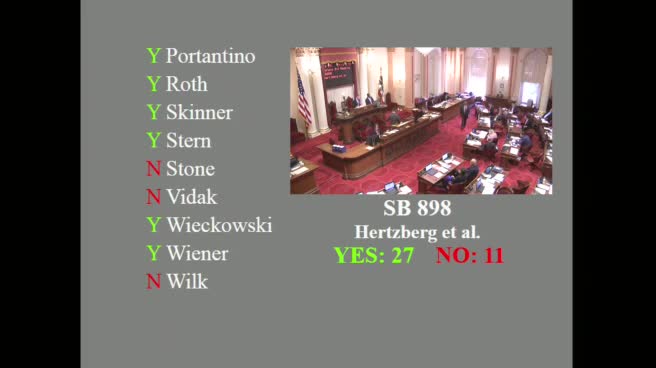 4MIN
Senate Floor
 18MIN
Senate Standing Committee on Environmental Quality
 21MIN
Senate Standing Committee on Natural Resources and Water
Bill Author




