SB 1056: Property taxes: welfare exemption: community land trust.
- Session Year: 2017-2018
- House: Senate
- Latest Version Date: 2018-08-07
Existing property tax law, in accordance with the California Constitution, provides for a welfare exemption for property used exclusively for religious, hospital, scientific, or charitable purposes and that is owned or operated by certain types of nonprofit entities, if certain qualifying criteria are met.
This bill, for lien dates occurring on and after January 1, 2019, would provide that property is within the welfare exemption if that property is owned by a community land trust, as defined, otherwise qualifying for the welfare exemption, and specified conditions are met, including that the property is being or will be developed or rehabilitated as housing, as specified. The bill would prohibit this exemption from being denied on the basis that the subject property does not currently contain specified property that is in the course of construction. However, the bill would make the community land trust The bill would require the community land trust to be liable for property tax for the years for which the property was exempt under these provisions if the property was not developed or rehabilitated for housing, or if the development or rehabilitation is not in the course of construction, within 5 years of the lien date following the acquisition of the property. The bill, in the case where property that is owned by a community land trust becomes subject to taxation as so described, would require any assessment made, as provided, to be made within 5 years of the lien date following the date on which the property becomes subject to taxation.
By imposing new duties upon local government officials with respect to the exemption provided by this bill, this bill would impose a state-mandated local program.
The California Constitution requires the state to reimburse local agencies and school districts for certain costs mandated by the state. Statutory provisions establish procedures for making that reimbursement.
This bill would provide that, if the Commission on State Mandates determines that the bill contains costs mandated by the state, reimbursement for those costs shall be made pursuant to the statutory provisions noted above.
Existing law requires the state to reimburse local agencies annually for certain property tax revenues lost as a result of any exemption or classification of property for purposes of ad valorem property taxation.
This bill would provide that, notwithstanding those provisions, no appropriation is made and the state shall not reimburse local agencies for property tax revenues lost by them pursuant to the bill.
This bill would take effect immediately as a tax levy.
Existing property tax law, in accordance with the California Constitution, provides for a welfare exemption for property used exclusively for religious, hospital, scientific, or charitable purposes and that is owned or operated by certain types of nonprofit entities, if certain qualifying criteria are met.
This bill, for lien dates occurring on and after January 1, 2019, would provide that property is within the welfare exemption if that property is owned by a community land trust, as defined, otherwise qualifying for the welfare exemption, and specified conditions are met. met, including that the property is being or will be developed or rehabilitated as housing, as specified. The bill would prohibit this exemption from being denied on the basis that the subject property does not currently contain specified property that is in the course of construction. However, the bill would make the community land trust liable for property tax for the years for which the property was exempt under these provisions if the property was not developed or rehabilitated for housing, or if the development or rehabilitation is in the course of construction, within 5 years of the lien date following the acquisition of the property.
By imposing new duties upon local government officials with respect to the exemption provided by this bill, this bill would impose a state-mandated local program.
The California Constitution requires the state to reimburse local agencies and school districts for certain costs mandated by the state. Statutory provisions establish procedures for making that reimbursement.
This bill would provide that, if the Commission on State Mandates determines that the bill contains costs mandated by the state, reimbursement for those costs shall be made pursuant to the statutory provisions noted above.
Existing law requires the state to reimburse local agencies annually for certain property tax revenues lost as a result of any exemption or classification of property for purposes of ad valorem property taxation.
This bill would provide that, notwithstanding those provisions, no appropriation is made and the state shall not reimburse local agencies for property tax revenues lost by them pursuant to the bill.
This bill would take effect immediately as a tax levy.
Existing property tax law, in accordance with the California Constitution, provides for a welfare exemption for property used exclusively for religious, hospital, scientific, or charitable purposes and that is owned or operated by certain types of nonprofit entities, if certain qualifying criteria are met.
This bill, for lien dates occurring on and after January 1, 2019, would provide that property is within the welfare exemption if that property is owned by a community land trust, as defined, otherwise qualifying for the welfare exemption, and specified conditions are met. The bill would prohibit this exemption from being denied on the basis that the subject property does not currently contain specified property that is in the course of construction.
By imposing new duties upon local government officials with respect to the exemption provided by this bill, this bill would impose a state-mandated local program.
The California Constitution requires the state to reimburse local agencies and school districts for certain costs mandated by the state. Statutory provisions establish procedures for making that reimbursement.
This bill would provide that, if the Commission on State Mandates determines that the bill contains costs mandated by the state, reimbursement for those costs shall be made pursuant to the statutory provisions noted above.
Existing law requires the state to reimburse local agencies annually for certain property tax revenues lost as a result of any exemption or classification of property for purposes of ad valorem property taxation.
This bill would provide that, notwithstanding those provisions, no appropriation is made and the state shall not reimburse local agencies for property tax revenues lost by them pursuant to the bill.
This bill would take effect immediately as a tax levy.
Existing property tax law, in accordance with the California Constitution, provides for a welfare exemption for property used exclusively for religious, hospital, scientific, or charitable purposes and that is owned or operated by certain types of nonprofit entities, if certain qualifying criteria are met.
This bill, for lien dates occurring on and after January 1, 2019, would provide that property is within the welfare exemption if that property is owned by a community land trust, as defined, otherwise qualifying for the welfare exemption, and specified conditions are met. The bill would prohibit this exemption from being denied on the basis that the subject property does not currently contain specified property that is in the course of construction.
By imposing new duties upon local government officials with respect to the exemption provided by this bill, this bill would impose a state-mandated local program.
The California Constitution requires the state to reimburse local agencies and school districts for certain costs mandated by the state. Statutory provisions establish procedures for making that reimbursement.
This bill would provide that, if the Commission on State Mandates determines that the bill contains costs mandated by the state, reimbursement for those costs shall be made pursuant to the statutory provisions noted above.
Existing law requires the state to reimburse local agencies annually for certain property tax revenues lost as a result of any exemption or classification of property for purposes of ad valorem property taxation.
This bill would provide that, notwithstanding those provisions, no appropriation is made and the state shall not reimburse local agencies for property tax revenues lost by them pursuant to the bill.
This bill would take effect immediately as a tax levy.
The Legislature finds and declares all of the following:
(a)The availability of housing is of vital statewide importance, and the development of decent and secure housing for every Californian is a priority of the highest order.
(b)There is currently a severe housing crisis in California, especially impacting the ability of persons and families of low and moderate income to purchase and own or rent a home or unit.
(c)Community land trusts and limited equity housing cooperatives acquire, develop, rehabilitate, and own single-family dwelling units and multifamily housing unit projects for the specific purpose of providing, among other affordable housing options, limited equity home ownership and affordable rental housing to persons and families of low and moderate income.
(d)To facilitate the acquisition, development, rehabilitation, financing, ownership, and financing of ownership and rental of housing for persons and families of low and moderate income, community land trusts and limited equity housing cooperatives must have certainty and uniformity across the state when valuation of property is conducted by county assessors so that, cooperatives, when acquiring, developing, or rehabilitating property for persons and families of low and moderate income, the value of the property is must be exempt from property taxation prior to the occupancy or ownership of that housing upon acquisition to facilitate development and rehabilitation of restricted affordable dwellings and units. With regard to this exemption, the exempt activities of community land trusts and limited equity housing cooperatives that are working with community land trusts qualitatively differ from the exempt activities of other nonprofit entities that provide housing, in that the land is held in perpetuity for persons and families of low and moderate income. The holding of real property by community land trusts and limited equity housing cooperatives is central to those entities exempt purposes and activities. Thus, owning property constitutes the exclusive use of that property for a charitable purpose, within the meaning of subdivision (b) of Section 4 of Article XIII of the California Constitution. Moreover, in the case of homes sold to persons and families of low and moderate income, the underlying land will become taxable once the home is sold.
SEC. 2.Section 214.18 is added to the Revenue and Taxation Code, to read:214.18.(a)Property is within the exemption provided by Sections 4 and 5 of Article XIII of the California Constitution if the property is owned by a community land trust, otherwise qualifying for exemption under Section 214, and all of the following conditions are met:
(1)The property is being or will be developed or rehabilitated as any of the following:
(A)An owner-occupied single-family dwelling.
(B)As an owner-occupied unit in a multifamily dwelling.
(C)As a member occupied unit in a limited equity housing cooperative.
(D)As a rental housing development.
(2)Improvements on the property are or will be available for use and ownership or for rent by qualified persons.
(3)(A)A deed restriction or other instrument, requiring a contract or contracts serving as an enforceable restriction on the value of owner-occupied units or on the affordability of rental units is recorded on or before the lien date following the acquisition of the property by the community land trust.
(B)For purposes of this section, a contract or contracts serving as an enforceable restriction on the value of owner-occupied units or on the affordability of rental units means a contract described in paragraph (11) of subdivision (a) of Section 402.1.
(C)A copy of the deed restriction or other instrument shall be provided to the assessor.
(b)Subject to subdivision (d), in the case of property not previously designated as an open space, the exemption provided by subdivision (a) shall not be denied to a property on the basis that the property does not currently contain a single-family dwelling, a unit in a multifamily dwelling, a unit in a limited equity housing cooperative, or a rental housing development that is in the course of construction.
(c)For purposes of this section, all of the following definitions shall apply:
(1)Community land trust has the same meaning as that term is defined in clause (ii) of subparagraph (B) paragraph (11) of subdivision (a) of Section 402.1.
(2)Course of construction has the same meaning as the term facilities in the course of construction, as used and defined in Sections 214.1 and 214.2.
(2)(3)Limited equity housing cooperative has the same meaning as that term is defined in Section 817 of the Civil Code.
(4)Persons and families of low income has the same meaning as the term lower income households, as defined in Section 50079.5 of the Health and Safety Code.
(3)(5)Persons and families of low or moderate income has the same meaning as that term is defined in Section 50093 of the Health and Safety Code.
(4)(6)Qualified persons means persons the following:
(A)In the case of property developed for owner-occupied housing, as described in subparagraphs (A), (B), and (C) of paragraph (1) of subdivision (a), persons and families of low or moderate income, including persons and families of low or moderate income that own a dwelling or unit collectively as member occupants or resident shareholders of a limited equity housing cooperative.
(B)In the case of property developed for rental housing, as described in subparagraph (D) of paragraph (1) of subdivision (a), persons and families of low income.
(5)(7)Rental housing development means a rental housing development in which all of the residential units in the development, other than units provided to property managers, are required to be rented to, and occupied by, persons and families of low or moderate income, at rents that do not exceed an affordable rent as described in Section 50053 of the Health and Safety Code.
(d)Notwithstanding any other law, the community land trust shall be liable for property tax for the years for which the property was exempt from taxation pursuant to this section if the property was not developed or rehabilitated, or if the development or rehabilitation is not in the course of construction, in accordance with paragraph (1) of subdivision (a) within five years of the lien date following the acquisition of the property by the community land trust.
(e)This section shall apply to lien dates occurring on and after January 1, 2019.
SEC. 3.Section 532 of the Revenue and Taxation Code is amended to read:532.(a)Except as provided in subdivision (b), any assessment made pursuant to either Article 3 (commencing with Section 501) or this article shall be made within four years after July 1 of the assessment year in which the property escaped taxation or was underassessed.
(b)(1)Any assessment to which the penalty provided for in Section 504 must be added shall be made within eight years after July 1 of the assessment year in which the property escaped taxation or was underassessed.
(2)Any assessment resulting from an unrecorded change in ownership for which either a change in ownership statement, as required by Section 480 or a preliminary change in ownership report, as required by Section 480.3, is not timely filed with respect to the event giving rise to the escape assessment or underassessment shall be made within eight years after July 1 of the assessment year in which the property escaped taxation or was underassessed. For purposes of this paragraph, an unrecorded change in ownership means a deed or other document evidencing a change in ownership that was not filed with the county recorders office at the time the event took place.
(3)Notwithstanding paragraphs (1) and (2), in the case where property has escaped taxation, in whole or in part, or has been underassessed, following a change in ownership or change in control and either the penalty provided for in Section 503 must be added or a change in ownership statement, as required by Section 480.1 or 480.2 was not filed with respect to the event giving rise to the escape assessment or underassessment, an escape assessment shall be made for each year in which the property escaped taxation or was underassessed.
(4)Notwithstanding any other law, in the case where property that is owned by a community land trust and was previously exempt pursuant to Section 214.18 becomes subject to taxation pursuant to subdivision (d) of that section, any assessment made in the amount of an exemption, or that portion of the exemption, previously allowed pursuant to Section 214.18 shall be made within five years of the lien date following the date on which the property becomes subject to taxation.
(c)For purposes of this section, assessment year means the period defined in Section 118.
SEC. 3.SEC. 4.If the Commission on State Mandates determines that this act contains costs mandated by the state, reimbursement to local agencies and school districts for those costs shall be made pursuant to Part 7 (commencing with Section 17500) of Division 4 of Title 2 of the Government Code.
SEC. 4.SEC. 5.Notwithstanding Section 2229 of the Revenue and Taxation Code, no appropriation is made by this act and the state shall not reimburse any local agency for any property tax revenues lost by it pursuant to this act.
SEC. 5.SEC. 6.This act provides for a tax levy within the meaning of Article IV of the California Constitution and shall go into immediate effect.
The Legislature finds and declares all of the following:
(a)The availability of housing is of vital statewide importance, and the development of decent and secure housing for every Californian is a priority of the highest order.
(b)There is currently a severe housing crisis in California, especially impacting the ability of persons and families of low and moderate income to purchase and own or rent a home or unit.
(c)Community land trusts and limited equity housing cooperatives acquire, develop, rehabilitate, and own single-family dwelling units and multifamily housing unit projects for the specific purpose of providing, among other affordable housing options, limited equity home ownership and affordable rental housing to persons and families of low and moderate income.
(d)To facilitate the acquisition, development, rehabilitation, financing, ownership, and rental of housing for persons and families of low and moderate income, community land trusts and limited equity housing cooperatives must have certainty and uniformity across the state when valuation of property is conducted by county assessors so that, when acquiring, developing, or rehabilitating property for persons and families of low and moderate income, the value of the property is exempt from property taxation prior to the occupancy or ownership of that housing to facilitate development and rehabilitation of restricted affordable dwellings and units.
SEC. 2.Section 214.18 is added to the Revenue and Taxation Code, to read:214.18.(a)Property is within the exemption provided by Sections 4 and 5 of Article XIII of the California Constitution if the property is owned by a community land trust, otherwise qualifying for exemption under Section 214, and all of the following conditions are met:
(1)The property is being or will be developed or rehabilitated as any of the following:
(A)An owner-occupied single-family dwelling.
(B)As an owner-occupied unit in a multifamily dwelling.
(C)As a member occupied unit in a limited equity housing cooperative.
(D)As a rental housing development.
(2)Improvements on the property are or will be available for use and ownership or for rent by qualified persons.
(3)(A)A deed restriction or other instrument, requiring a contract or contracts serving as an enforceable restriction on the value of owner-occupied units or on the affordability of rental units is recorded on or before the lien date following the acquisition of the property by the community land trust. A
(B)For purposes of ths section, a contract or contracts serving as an enforceable restriction on the value of owner-occupied units or on the affordability of rental units means a contract described in paragraph (11) of subdivision (a) of Section 402.1.
(C)A copy of the deed restriction or other instrument shall be provided to the assessor.
(b)In Subject to subdivision (d), in the case of property not previously designated as an open space, the exemption provided by subdivision (a) shall not be denied to a property on the basis that the property does not currently contain a single-family dwelling, a unit in a multifamily dwelling, a unit in a limited equity housing cooperative, or a rental housing development that is in the course of construction.
(c)For purposes of this section, all of the following definitions shall apply:
(1)Community land trust has the same meaning as that term is defined in clause (ii) of subparagraph (B) paragraph (11) of subdivision (a) of Section 402.1.
(2)Limited equity housing cooperative has the same meaning as that term is defined in Section 817 of the Civil Code.
(3)Persons and families of low or moderate income has the same meaning as that term is defined in Section 50093 of the Health and Safety Code.
(4)Qualified persons means persons and families of low or moderate income, including persons and families of low or moderate income that own a dwelling or unit collectively as member occupants or resident shareholders of a limited equity housing cooperative.
(5)Rental housing development means a rental housing development in which all of the residential units in the development, other than units provided to property managers, are required to be rented to, and occupied by, persons and families of low or moderate income, at rents that do not exceed an affordable rent as described in Section 50053 of the Health and Safety Code.
(d)Notwithstanding any other law, the community land trust shall be liable for property tax for the years for which the property was exempt from taxation pursuant to this section if the property was not developed or rehabilitated, or if the development or rehabilitation is in the course of construction, in accordance with paragraph (1) of subdivision (a) within five years of the lien date following the acquisition of the property by the community land trust.
(d)(e)This section shall apply to lien dates occurring on and after January 1, 2019.
SEC. 3.If the Commission on State Mandates determines that this act contains costs mandated by the state, reimbursement to local agencies and school districts for those costs shall be made pursuant to Part 7 (commencing with Section 17500) of Division 4 of Title 2 of the Government Code.
SEC. 4.Notwithstanding Section 2229 of the Revenue and Taxation Code, no appropriation is made by this act and the state shall not reimburse any local agency for any property tax revenues lost by it pursuant to this act.
SEC. 5.This act provides for a tax levy within the meaning of Article IV of the California Constitution and shall go into immediate effect.
The Legislature finds and declares all of the following:
(a)The availability of housing is of vital statewide importance, and the development of decent and secure housing for every Californian is a priority of the highest order.
(b)There is currently a severe housing crisis in California, especially impacting the ability of persons and families of low and moderate income to purchase and own or rent a home or unit.
(c)Community land trusts and limited equity housing cooperatives acquire, develop, rehabilitate, and own single-family dwelling units and multifamily housing unit projects for the specific purpose of providing, among other affordable housing options, limited equity home ownership and affordable rental housing to persons and families of low and moderate income.
(d)To facilitate the acquisition, development, rehabilitation, financing, and ownership ownership, and rental of housing for persons and families of low and moderate income, community land trusts and limited equity housing cooperatives must have certainty and uniformity across the state when valuation of property is conducted by county assessors so that, when acquiring, developing, or rehabilitating property for persons and families of low and moderate income, the value of the property is exempt from property taxation prior to the occupancy or ownership of that housing to facilitate development and rehabilitation of restricted affordable dwellings and units.
SEC. 2.Section 214.18 is added to the Revenue and Taxation Code, to read:214.18.(a)Property is within the exemption provided by Sections 4 and 5 of Article XIII of the California Constitution if the property is owned by a community land trust, otherwise qualifying for exemption under Section 214, and all of the following conditions are met:
(1)The property is being or will be developed or rehabilitated as an owner occupied any of the following:
(A)An owner-occupied single-family dwelling, as dwelling.
(B)As an owner-occupied unit in a multifamily dwelling, or as dwelling.
(C)As a member occupied unit in a limited equity housing cooperative.
(D)As a rental housing development.
(2)Improvements on the property are or will be available for use and ownership by a qualified owner. or for rent by qualified persons.
(3)A deed restriction or other instrument, requiring a contract or contracts serving as an enforceable restriction on the value of owner-occupied units or on the affordability of rental units is recorded on or before the lien date following the acquisition of the property by the community land trust. A copy of the deed restriction or other instrument shall be provided to the assessor.
(3)A deed restriction or other instrument, requiring a contract or contracts serving as an enforceable restriction on the value of the land pursuant to paragraph (11) of subdivision (a) of Section 402.1 no later than the sale or transfer of improvements on the property, is recorded on or before the lien date following the acquisition of the property by the community land trust.(b)In the case of property not previously designated as an open space, the exemption provided by subdivision (a) shall not be denied to a property on the basis that the property does not currently contain a single-family dwelling, a unit in a multifamily dwelling, or a unit in a limited equity housing cooperative, or a rental housing development that is in the course of construction.
(c)For purposes of this section, all of the following definitions shall apply:
(1)Community land trust has the same meaning as that term is defined in clause (ii) of subparagraph (B) paragraph (11) of subdivision (a) of Section 402.1.
(2)Limited equity housing cooperative has the same meaning as that term is defined in Section 817 of the Civil Code.
(3)Persons and families of low or moderate income has the same meaning as that term is defined in Section 50093 of the Health and Safety Code.
(4)Qualified owner persons means persons and families of low or moderate income, including persons and families of low or moderate income that own a dwelling or unit collectively as member occupants or resident shareholders of a limited equity housing cooperative.
(5)Rental housing development means a rental housing development in which all of the residential units in the development, other than units provided to property managers, are required to be rented to, and occupied by, persons and families of low or moderate income, at rents that do not exceed an affordable rent as described in Section 50053 of the Health and Safety Code.
(d)This section shall apply to lien dates occurring on and after January 1, 2019.
SEC. 3.If the Commission on State Mandates determines that this act contains costs mandated by the state, reimbursement to local agencies and school districts for those costs shall be made pursuant to Part 7 (commencing with Section 17500) of Division 4 of Title 2 of the Government Code.
SEC. 4.Notwithstanding Section 2229 of the Revenue and Taxation Code, no appropriation is made by this act and the state shall not reimburse any local agency for any property tax revenues lost by it pursuant to this act.
SEC. 5.This act provides for a tax levy within the meaning of Article IV of the California Constitution and shall go into immediate effect.
The Legislature finds and declares all of the following:
(a)The availability of housing is of vital statewide importance, and the development of decent and secure housing for every Californian is a priority of the highest order.
(b)There is currently a severe housing crisis in California, especially impacting the ability of persons and families of low and moderate income to purchase and own a home or unit.
(c)Community land trusts and limited equity housing cooperatives acquire, develop, rehabilitate, and own single-family dwelling units and multifamily housing unit projects for the specific purpose of providing, among other affordable housing options, limited equity home ownership to persons and families of low and moderate income.
(d)To facilitate the acquisition, development, rehabilitation, financing, and ownership of housing for persons and families of low and moderate income, community land trusts and limited equity housing cooperatives must have certainty and uniformity across the state when valuation of property is conducted by county assessors so that, when acquiring, developing, or rehabilitating property for persons and families of low and moderate income, the value of the property is exempt from property taxation prior to the occupancy or ownership of that housing to facilitate development and rehabilitation of restricted affordable dwellings and units.
SEC. 2.Section 214.18 is added to the Revenue and Taxation Code, to read:214.18.(a)Property is within the exemption provided by Sections 4 and 5 of Article XIII of the California Constitution if the property is owned by a community land trust, otherwise qualifying for exemption under Section 214, and all of the following conditions are met:
(1)The property is being or will be developed or rehabilitated as an owner occupied single-family dwelling, as an owner-occupied unit in a multifamily dwelling, or as a member occupied unit in a limited equity housing cooperative.
(2)Improvements on the property are or will be available for use and ownership by a qualified owner.
(3)A deed restriction or other instrument, requiring a contract or contracts serving as an enforceable restriction on the value of the land pursuant to paragraph (11) of subdivision (a) of Section 402.1 no later than the sale or transfer of improvements on the property, is recorded on or before the lien date following the acquisition of the property by the community land trust.
(b)In the case of property not previously designated as an open space, the exemption provided by subdivision (a) shall not be denied to a property on the basis that the property does not currently contain a single-family dwelling, a unit in a multifamily dwelling, or a unit in a limited equity housing cooperative, that is in the course of construction.
(c)For purposes of this section, all of the following definitions shall apply:
(1)Community land trust has the same meaning as that term is defined in clause (ii) of subparagraph (B) paragraph (11) of subdivision (a) of Section 402.1.
(2)Limited equity housing cooperative has the same meaning as that term is defined in Section 817 of the Civil Code.
(3)Persons and families of low or moderate income has the same meaning as that term is defined in Section 50093 of the Health and Safety Code.
(4)Qualified owner means persons and families of low or moderate income, including persons and families of low or moderate income that own a dwelling or unit collectively as member occupants or resident shareholders of a limited equity housing cooperative.
(d)This section shall apply to lien dates occurring on and after January 1, 2019.
SEC. 3.If the Commission on State Mandates determines that this act contains costs mandated by the state, reimbursement to local agencies and school districts for those costs shall be made pursuant to Part 7 (commencing with Section 17500) of Division 4 of Title 2 of the Government Code.
SEC. 4.Notwithstanding Section 2229 of the Revenue and Taxation Code, no appropriation is made by this act and the state shall not reimburse any local agency for any property tax revenues lost by it pursuant to this act.
SEC. 5.This act provides for a tax levy within the meaning of Article IV of the California Constitution and shall go into immediate effect.
|
Date
|
Status
|
|---|---|
| Aug 16, 2018 | August 16 hearing: Held in committee and under submission. |
| Aug 16, 2018 | Joint Rule 62(a) suspended. |
| Aug 15, 2018 | August 15 set for first hearing. Placed on suspense file. |
| Aug 7, 2018 | Read second time and amended. Re-referred to Com. on APPR. |
| Aug 6, 2018 | From committee: Do pass as amended and re-refer to Com. on APPR. (Ayes 9. Noes 0.) (July 2). |
| Jun 11, 2018 | Referred to Com. on REV. & TAX. |
| May 29, 2018 | In Assembly. Read first time. Held at Desk. |
| May 29, 2018 | Read third time. Passed. (Ayes 36. Noes 2.) Ordered to the Assembly. |
| May 25, 2018 | From committee: Do pass. (Ayes 7. Noes 0.) (May 25). |
| May 23, 2018 | Set for hearing May 25. |
| May 22, 2018 | May 22 hearing: Placed on APPR. suspense file. |
| May 14, 2018 | Set for hearing May 22. |
| May 9, 2018 | Read second time and amended. Re-referred to Com. on APPR. |
| May 8, 2018 | From committee: Do pass as amended and re-refer to Com. on APPR. (Ayes 7. Noes 0.) (May 2). |
| Apr 25, 2018 | From committee with author's amendments. Read second time and amended. Re-referred to Com. on GOV. & F. |
| Apr 17, 2018 | Set for hearing May 2. |
| Feb 22, 2018 | Referred to Com. on GOV. & F. |
| Feb 13, 2018 | From printer. May be acted upon on or after March 15. |
| Feb 12, 2018 | Introduced. Read first time. To Com. on RLS. for assignment. To print. |
|
Date
|
Description
|
Location
|
Votes
|
|
|---|---|---|---|---|
| Jul 2, 2018 | Do pass as amended and be re-referred to the Committee on [Appropriations] | Assembly Standing Committee on Revenue and Taxation |
Passed |
|
| May 29, 2018 | Senate 3rd Reading SB1056 Beall et al. | Senate Floor |
Passed |
|
| May 25, 2018 | Do pass | Senate Standing Committee on Appropriations |
Passed |
|
| May 22, 2018 | Placed on suspense file | Senate Standing Committee on Appropriations |
Passed |
|
| May 2, 2018 | Do pass as amended, but first amend, and re-refer to the Committee on [Appropriations] | Senate Standing Committee on Governance and Finance |
Passed |
This list shows positions taken on this bill by organizations on the date displayed, which is linked to the original source.
Positions by individuals are not included.
Date of Hearing: August 15, 2018
ASSEMBLY COMMITTEE ON APPROPRIATIONS
Lorena Gonzalez Fletcher, Chair
SBPCA Bill Id:SB 1056
Author:(Beall) – As Amended Ver:August 7, 2018
Policy Committee: | Revenue and Taxation | Vote: | 9 - 0 |
|
| ||
|
|
Urgency: No State Mandated Local Program: Yes Reimbursable: Yes
SUMMARY:
This bill creates a new property tax exemption for certain undeveloped land owned by a community land trust (CLT). Specifically, this bill:
- Allows for a welfare exemption for CLT-owned property that will be developed or rehabilitated as owner-occupied housing available to low- or moderate-income households.
- Allows for a welfare exemption for CLT-owned property that will be developed or rehabilitated as rental housing development for low-income households.
- Makes CLT liable for property tax for the years for which the property was exempt from taxation if within five years of the lien date the property is not developed or rehabilitated or not in the course of construction.
FISCAL EFFECT:
- An unknown reduction in local property tax revenues as a result of additional properties qualifying for the welfare exemption, resulting in increased General Fund Proposition 98 spending by up to roughly half of those revenue losses.
- Unknown, and potentially reimbursable, costs to local assessors for making changes on how property is valued for property tax purposes.
COMMENTS:
- Background. A CLT is a nonprofit corporation that owns and develops land for housing or other community uses. When a CLT offers for-sale affordable housing, it generally retains ownership of the underlying land and leases it to the homeowner for a nominal fee, and the homeowner purchases only the building. When the homeowner sells the property, they are eligible for a smaller share of the home’s appreciated value. Additionally, a CLT may also have rental portfolios restricted for low and moderate-income households.
- CLT property taxes and undeveloped property. Under current law, the property acquired by a CLT is subject to property taxes unless it qualifies for the welfare exemption available to certain nonprofit-owned affordable rental housing. However, the property is only eligible for that welfare exemption when construction begins on that project. Thus, the CLT pays property taxes on the land in the period between when the land is purchased and when construction begins.
- The Habitat for Humanity model. There is one exception to the general rule around the availability of the welfare exemption for undeveloped property. The welfare exemption is available for undeveloped land acquired under the “Habitat for Humanity model,” which is when a nonprofit organized for certain defined purposes builds and sells housing at cost to low-income families with zero percent financing. This provision of law was enacted after a chapter of Habitat for Humanity had to decline subdivision lot donations because of its inability to carry the associated property tax liability.
- Purpose. According to the author, CLTs can be part of the solution to California’s housing crisis and SB 1056 will help CLTs complete their affordable housing developments. The bill does this by expanding the property tax welfare exemption for certain undeveloped CLT-owned properties that are intended to be developed into either for-sale affordable housing for low-and moderate-income households or affordable rental housing for low-income households.
Analysis Prepared by: Luke Reidenbach / APPR. / (916) 319-2081
Date of Hearing: July 2, 2018
ASSEMBLY COMMITTEE ON REVENUE AND TAXATION
Autumn R. Burke, Chairwoman
SBPCA Bill Id:SB 1056
Author:(Beall) – As Amended Ver:May 9, 2018
Majority vote. Tax levy. Fiscal committee.
SENATE VOTE: 36-2
SUBJECT: Property taxes: welfare exemption: community land trust
SUMMARY: Creates a new property tax exemption under the welfare exemption for community land trust owned property that will be developed into (1) rental housing for low or moderate income households, and (2) for-sale homes to low or moderate income households. Specifically, this bill:
- Specifies that property is within the exemption provided by Section 4 (welfare exemption) and 5 (welfare-exemption-eligible facilities in the course of construction) of Article XIII of the California Constitution if the property is owned by a "community land trust" (CLT), otherwise qualifying for exemption under Revenue and Taxation Code (R&TC) Section 214, and both of the following conditions are met:
- The property will be (or is being) developed or rehabilitated as any of the following:
- An owner-occupied single-family dwelling;
- An owner-occupied unit in a multifamily dwelling;
- A member occupied unit in a "limited equity housing cooperative"; or,
- A rental housing development; and
- Improvements on the property will be (or are) available for either:
- Ownership by "qualified persons"; or,
- Rental by qualified persons.
- The property will be (or is being) developed or rehabilitated as any of the following:
- Requires a deed restriction or other instrument to be recorded on or before the lien date (January 1) following the CLT's acquisition of the property that requires either:
- A contract or contracts serving as an enforceable restriction on the value of owner-occupied units; or,
- A contract or contracts serving as an enforceable restriction on the affordability of rental units.
- Defines "a contract or contracts serving as an enforceable restriction on the value of owner-occupied units or on the affordability of rental units" as a contract described in R&TC Section 402.1(a)(11).
- Requires the CLT to provide to the assessor a copy of the deed restriction or other instrument.
- Specifies that the exemption so created is not to be denied to a property because no qualified property is in the course of construction (vacant land).
- Defines "community land trust" by cross-reference to its definition in R&TC Section 402.1(a)(11)(B)(ii).
- Defines "limited equity housing cooperative" by cross-reference to its definition in Civil Code (CC) Section 817.
- Defines "qualified persons" as persons and families of low or moderate income.
- Defines "persons and families of low or moderate income" by cross-reference to the definition in Health and Safety Code (H&SC) Section 50093.
- Includes as "qualified persons" persons and families of low or moderate income that own a dwelling or unit collectively as member occupants or resident shareholders of a limited equity housing cooperative.
- Defines "rental housing development" as a development in which all of the residential units, other than units provided to property managers, are required to be rented to, and occupied by, persons and families of low or moderate income, at rents that do not exceed an affordable rent as described in H&SC Section 50053.
- Makes the CLT liable for property tax for the years for which the property was exempt from taxation, if within five years of the lien date following the CLT's acquisition of the property either:
- The property was not developed or rehabilitated; or,
- The development or rehabilitation is [not] in the course of construction.
- Makes findings and declarations related to the housing crisis, CLTs, and limited equity housing cooperatives' efforts to provide an affordable housing option for low and moderate income households and the need for tax certainty.
- Provides that reimbursement to local agencies shall be made for costs, if the Commission on State mandates determines this bill contains state-mandated costs.
- Provides that the state will not reimburse any local agency for any resulting property tax revenues loss from the exemption.
- Takes immediate effect, but applies beginning with lien dates (January 1) occurring on and after January 1, 2019.
EXISTING LAW:
- Provides that all property is taxable, unless otherwise provided by the California Constitution or federal laws.
- Authorizes the Legislature to exempt from taxation, in whole or in part, property used exclusively for religious, hospital, or charitable purposes, as specified. (California Constitution Article XIII, Section 4(b).) The Legislature has implemented this "welfare exemption" in R&TC Section 214.
- Disallows the welfare exemption to nonprofit-owned property not being used for religious, hospital, or charitable purposes, such as undeveloped land.
- Allows the welfare exemption if the intended use would qualify once construction starts, as specified. (Article XIII, Section 5.) The Legislature has implemented the constitutional authorization to exempt "facilities in the course of construction" in R&TC Sections 214.1 and 214.2.
- Includes within the "course of construction" definition the following:
- Building demolition or razing with the intent to replace; or,
- Definite onsite physical activity connected with constructing or rehabilitation of a new or existing building that results in changes visible to any person inspecting the site.
- Exempts low-income rental housing owned and operated by nonprofit organizations, including limited partnerships in which the managing general partner is an eligible nonprofit corporation, as specified. (R&TC Section 214(g).)
- Defines "low-income" by cross-reference to H&SC Section 50079.5, which defines low income as households at 80% of area median income (AMI) adjusted for family size. (R&TC Section 214(g)(2)(C)(i).)
- Exempts moderate-income rental housing owned and operated by nonprofit organizations, under the welfare exemption, only in the case of housing for elderly or disabled persons. (R&TC Section 214(f).)
- Defines "low and moderate income" for purposes of elderly and disabled persons rental housing by cross reference to H&SC Section 50093, which defines the term "persons and families of low or moderate income" as up to 120% of AMI, as specified.
- Provides that property owned and operated by a nonprofit organization that is organized and operated for the specific and primary purpose of building housing for sale at cost to low-income families with financing in the form of a zero interest rate loan and without regard to religion, race, national origin, or sex of the head of household is within the welfare exemption (Habitat for Humanity model).
- Declares that the above nonprofit's activities qualitatively differ from the exempt activities of other nonprofit entities that provide housing in that Habitat for Humanity's exempt purpose is not to own and operate a housing project on an ongoing basis.
- Finds that holding real property for future construction of for-sale homes to low income persons is central to that nonprofit's exempt purposes and activities and constitutes the exclusive use of that property for a charitable purpose within Article XIII, Section 4(b).
- Defines "community land trust" as a nonprofit corporation organized pursuant to Section 501(c)(3) of the Internal Revenue Code that satisfies all of the following:
- Has as its primary purposes the creation and maintenance of permanently affordable single-family or multifamily residences;
- All dwellings and units located on the land owned by the nonprofit corporation are sold to a qualified owner to be occupied as the qualified owner's primary residence or rented to persons and families of low or moderate income; and,
- The land owned by the nonprofit corporation, on which a dwelling or unit sold to a qualified owner is situated, is leased by the nonprofit corporation to the qualified owner for the convenient occupation and use of that dwelling or unit for a renewable term of 99 years.
- Limits the assessor from issuing escape assessments for previously escaped or underassessed property to the last four tax years, as specified.
FISCAL EFFECT: According to the State Board of Equalization, the property tax revenue loss is indeterminable.
COMMENTS:
- The author has provided the following statement in support of this bill:
Addressing California's housing crisis will require increasing access to affordable housing. Community land trusts (CLT) can be part of the solution and provide permanently affordable housing and home ownership opportunities for low income and moderate income families. SB 1056 will grant CLTs the welfare tax exemption, which is currently granted to similar non-profit housing organizations, from the point of acquisition of property to the point of sale of affordable homes. This exemption will help CLTs complete their developments and impact more disadvantaged families.
- The Irvine Community Land Trust, in support of this bill, states the following:
This legislation is critical in our efforts to increase California's affordable home ownership opportunities for low- and moderate-income people.
The job of community land trusts of creating and stewarding permanently affordable housing is already very difficult in this climate, so keeping the costs of ownership low for homebuyers in our program is crucial to ensuring permanent affordability. As a community land trust, we create affordable housing for homeowners and steward this same housing for future generations keeping a valuable resource preserved for the State of California.
- The Bolinas Community Land Trust explains in support of this bill:
[This] bill would make a tremendous difference in our ability to create and sustain affordable housing….We have many hurdles to jump over, after acquiring property, before we are able to build. This process [can] take time and meanwhile, we are forced to pay property taxes that drive up the costs overall. While we are often able to get grants and funding for the actual construction of the affordable housing we build, soft carrying costs such as taxes often come out of our very limited non-profit budgets, impacting our bottom line and our ability to take on further projects. The passage of this bill would allow us to keep these funds in our operating budgets and would prevent us from needing to pass them on either to our funders or our future low-income owners or tenants.
- Committee Staff Comments:
- What does this bill do? This bill has several components:
- First, this bill allows CLTs to obtain a property tax exemption on their undeveloped land if the intended use is for-sale housing to low or moderate income persons. Additionally, this bill extends the exemption through the construction phase until the homes are sold. Existing law disallows any exemption.
- Second, this bill allows CLTs to obtain a property tax exemption on their undeveloped land if the intended use is rental housing for low- or moderate-income[1] persons. Existing law limits the exemption to low-income rental housing and only after construction begins on the site.
- Third, if the above uses do not occur within five years of the CLT's property acquisition, this bill requires the recapture (clawback) of the foregone property tax revenue.
- Community Land Trust for-sale housing programs: CLTs provide an affordable housing model to help low- and moderate-income households that may not otherwise be able to purchase homes. The CLT acquires and develops properties for sale to income-qualified households, but retains ownership of the underlying land and leases the land to the homeowner for a nominal fee through a long-term ground lease (usually a 99-year term). The home is, therefore, more affordable because the homeowner is only buying the building and leasing the land underneath. If the homeowner decides to sell the property, the home must be resold to another income-qualified household, and the original owner will only be eligible for a smaller share of its appreciated value. Since the CLT is the owner of the land, it will be a party to all future sales and enforce resale restrictions.
- What does this bill do? This bill has several components:
A CLT is generally formed as a membership-based, non-profit organization with a professional staff, led by a member-elected board of directors and funded by land rent fees. Members include CLT homeowners, neighbors, and other local residents, providing community buy-in over local development. Many CLTs also provide homeowners with homebuyer education and financial literacy courses. While a subsidy is often needed to start a CLT, outside funding is no longer necessary once homes are occupied, which provides fee revenues, and when homes are resold, which recycles the original subsidy thereby allowing homes to remain permanently affordable.
Community Land Trust rental housing programs: CLTs in California also have rental portfolios restricted for low and moderate income households.
- Nonprofits and undeveloped properties – constitutional provisions: Nonprofit organizations seeking legislation to exempt their undeveloped properties from property tax is well-trodden territory before the Legislature.[2] Many nonprofit organizations own and pay taxes on such land (churches, hospitals, private universities). The courts have taken the view that constitutional provisions granting exemptions are to be construed strictly, but reasonably. The constitution explicitly states in Article XIII, Section 5 that the welfare exemption applies in the case of "intended use" of otherwise welfare-exemption-eligible property only after the buildings are "under construction".
Generally, undeveloped property is not considered to be used for a charitable purpose by the non-profit that otherwise qualifies for the welfare exemption, although the exemption would become effective as soon as construction or other activity begins onsite. However, existing law does provide that nonprofits with an affordable housing model for low-income persons similar to that utilized by Habitat for Humanity may qualify for the welfare exemption as soon as the property is acquired and prior to commencement of construction. This provision of law was enacted after a chapter of Habitat for Humanity had to decline subdivision lot donations because of its inability to carry the associated property tax liability. In providing special treatment for this affordable housing model for low-income persons, the Legislature issued findings proclaiming that its exempt activities are distinct from other affordable housing providers because its exempt purpose is not to own and operate a housing project on an ongoing basis, but to make housing and the land reasonably necessary for the use of that housing available for prompt sale to low-income residents. In other words, the Legislature found that acquiring real property for the future construction of housing on that property is central to the affordable housing model's exempt purposes and activities, and therefore constitutes "use."
- Sets precedent – Undeveloped land for affordable rental housing: Nonprofits building affordable rental housing do not receive a pre-development exemption. The exemption starts once construction starts. Setting this precedent may prompt other affordable housing developers to seek similar property tax relief. The Committee may wish to consider the consequences of setting this precedent.
- Sets precedent – for-sale housing to moderate income persons: As noted above, the existing for-sale housing exemption applies to affordable housing sold to low-income persons (80% of AMI). This bill creates an exemption that would apply to affordable housing for moderate-income persons.
- What role should the welfare exemption have in private homeownership? This bill raises the policy question of broadening the charitable aspect of the welfare exemption to benefit private homeownership. Generally, facilitating housing for a finite number of people in their own private homes, albeit for low or moderate income households, does not constitute a charitable purpose. The welfare exemption is intended for property used for the benefit of the community as a whole or to an unascertainable and indefinite portion thereof (low-income rental housing available to the public, theaters for performances that any interested person can attend, outdoor recreational camps that anyone can visit) rather than a finite number of persons for their own permanent use. The state's housing and homelessness crisis is well documented. Affordability for persons seeking to become homebuyers is a challenge for persons at most income levels. Moreover, finding affordable rental housing for those persons without the means to purchase is also a challenge. Courts have noted, with respect to the rental housing exemption provided to the elderly and the disabled that have moderate incomes, that "[s]ince the enactment of the Statute of Charitable Uses [1601] during the reign of Elizabeth, aid to the aged and infirm has been recognized as charitable." Of course, the housing landscape for all Californians has changed since the welfare exemption was first created. The Committee may wish to weigh whether or not providing home buying opportunities to moderate-income households, without special needs, who are selected by a nonprofit entity to buy a private home at an affordable cost through the laudable efforts of CLTs is within the "charitable" aspect of the welfare exemption.
- Narrowing of the property tax base: Residential housing is a core component of the property tax base. Property tax revenues of $60 billion per year are a primary source of local government funding. The tax revenue loss associated with the welfare exemption is $3 billion per year. A sound property tax structure ensures that the tax base is broad and that the property owners within a community contribute to funding vital government services since, in turn, every person benefits from those government services. In recent years, to address the housing affordability crisis, legislation has been enacted to limit, exempt, and prohibit certain affordable housing related-revenue. For instance:
- In 2014, the Legislature prohibited payment in lieu of taxes (PILOT) agreements, which are agreements between a local government and a property owner of a low-income housing project that require the owner to pay a charge to compensate for lost revenue. (SB 1203 (Jackson), Chapter 693, Statutes of 2014; and AB 1760 (Chau and Bocanegra), Chapter 671, Statutes of 2014.)
- In 2015, the Legislature permitted buyers of certain affordable housing programs to receive reduced property tax assessments by allowing the non-profit imposed restrictions to be recognized and silent second mortgages disregarded when setting assessed values. (AB 668 (Gomez), Chapter 698, Statutes of 2015.)
- In 2016, the Legislature permitted buyers of CLT homes to receive reduced property tax assessments by allowing CLT-imposed restrictions to be recognized when setting the value of these homes. (AB 2818 (Chui), Chapter 701, Statutes of 2016.)
- In 2017, the Legislature permitted the low-income exemption to remain on units occupied by "over income" tenants (up to 140% of AMI) so long as they were initially qualified (80%) when they moved in. (AB 1193 (Gloria), Chapter 756, Statutes of 2017.)
The multi-prong impact of more people and property requiring government services, combined with reduced revenues, puts financial pressure on local governments to reduce or cut services or enact parcel taxes, other special taxes, or property-related charges and fees to fund necessary local government services. Additionally, the homelessness crisis is placing additional financial burdens and costs on governments including public health threats.
- When would the new exemption take effect? This bill takes effect with the January 1, 2019 lien date. Thus, property currently owned by CLTs would become exempt for the 2019-20 fiscal year. Whereas, property first acquired on or after January 1, 2019, would become exempt as of the date of acquisition through the mechanism of supplemental assessments. This is because the "lien date" for the supplemental roll is not fixed; instead the lien date is the date of purchase.
- Committee suggested amendments: Committee staff recommends the following amendments:
- Modify legislative findings and declarations to distinguish CLTs from other nonprofit entities that provide affordable housing;
- Delete an unnecessary limitation that creates confusion between CLTs (that build affordable housing) and other Land Trusts (that preserve open space land in its natural state and provide recreational opportunities);
- Define "course of construction" by using the term "facilities in the course of construction" and adding a cross reference to the pre-existing definitions in R&TC Sections 214.1 and 214.2; and,
- Correct a technical error in the clawback provision to add a "not" consistent with this bill's intent.
- Amendment to limit to rental low-income housing. To address concerns raised by opponents to this bill, the author has agreed to limit the rental housing exemption provisions to low-income households by amending the definition of "qualified persons".
- Related legislation:
- AB 3152 (Chui) would create a new property tax exemption under the welfare exemption for rental housing occupied by moderate-income households in high-cost counties if rents charged are 10% less than fair market rent for that county. AB 3152 was held on the Assembly Committee on Appropriations' Suspense file.
- SB 2 (Atkins), Chapter 364, Statutes of 2017, in part, created a funding stream for affordable housing that included a component for moderate-income housing through additional fees charged when certain documents are recorded.
- Previous legislation:
- AB 2818 (Chui), Chapter 701, Statutes of 2016, would have exempted CLT-owned land under the welfare exemption similar to this bill. Those provisions were amended out of AB 2818 on May 31, 2016 in the Assembly Appropriations Committee.
- AB 1559 (Wiggins), Chapter 927, Statutes of 1999, created the property tax exemption for land for future construction of homes to be sold to low-income persons at cost, and at 0% interest (Habitat exemption).
REGISTERED SUPPORT / OPPOSITION:
Support
Bay Area Community Land Trust
Bolinas Community Land Trust
California Community Land Trust Network
California Housing Partnership
California Reinvestment Coalition
Habitat for Humanity California
Haight Ashbury Neighborhood Council
Humboldt Community Development Land Trust
Housing Land Trust of Sonoma County
Irvine Community Land Trust
Northern California Land Trust
Oakland Community Land Trust
San Francisco Community Land Trust
Opposition
None on file
Analysis Prepared by: Rose Marie Kinnee / REV. & TAX. / (916) 319-2098
Office of Senate Floor Analyses (916) 651-1520 Fax: (916) 327-4478 | SB |
THIRD READING
Bill No: SB 1056
:
SENATE GOVERNANCE & FIN. COMMITTEE: 7-0, 5/2/18
AYES: McGuire, Nguyen, Beall, Hernandez, Hertzberg, Lara, Moorlach
SENATE APPROPRIATIONS COMMITTEE: 7-0, 5/25/18
AYES: Lara, Bates, Beall, Bradford, Hill, Nielsen, Wiener
DIGEST:
This bill enacts a new welfare exemption from property tax for property owned by a community land trust (CLT).
Existing law:
- Provides that all property is taxable unless explicitly exempted by the Constitution or federal law (California Constitution, Article XIII).
- Allows the Legislature to exempt property used for charitable purposes, and owned by non-profit entities organized and operated for charitable purposes, such as universities, hospitals, and libraries (California Constitution, Article XIII, Sections Four and Five). The Legislature enacted this exemption, commonly known as the “welfare exemption.”
- Limits the maximum amount of any ad valorem tax on real property at 1% of full cash value, and directs assessors to only reappraise property when newly constructed, or when ownership changes (Proposition 13, 1978).
- Allows the welfare exemption for rental housing when the housing is financed by tax-exempt mortgage revenue bonds; general obligation bonds; federal, state, or local grants; or federal low-income housing tax credits, pursuant to specific requirements. Non-publicly financed affordable housing, up to $10 million in value statewide, can be exempt if:
- The property is managed solely by a non-profit organization, specifically excluding limited partnerships, and
- 90% of occupants are of low- or very-low income.
- The property is enforceably restricted for low-income housing, and rents do not exceed those prescribed in deed restrictions, and
- The property owner certifies that funds that would have been used to pay property taxes are used to maintain the affordability of the units or reduce rents.
- Provides that the welfare exemption applies to facilities in the course of construction together with the land on which the facilities are located as may be required for their convenient use and occupation.
- Allows the “Habitat for Humanity” welfare exemption, which allows the exemption to be applied to property (AB 1559, Wiggins, Chapter 927, Statutes of 1999):
- owned and operated by a nonprofit corporation, which is organized and operated for the specific and primary purpose of building and rehabilitating single or multifamily residences for sale at cost to low-income families, and
- the sale is financed by a zero interest rate loan and without regard to religion, race, national origin, or the sex of the head of household.
- Provides that the Habitat for Humanity exemption applies during the period of time after the qualifying nonprofit acquires the property and before constructing and selling it to a qualifying family, at which time it becomes taxable again.
This bill:
- Enacts a new welfare exemption from property tax for property owned by a CLT that otherwise qualifies as a nonprofit for purposes of the welfare exemption. Property is eligible for the exemption if:
- The property is being or will be developed or rehabilitated as an owner-occupied single-family dwelling, unit in a multifamily dwelling, member-occupied unit in a limited equity housing cooperative, or as a rental housing development,
- Improvements on the property will be available for use and ownership or for rent by persons and families of low or moderate income, and
- A deed restriction, or other instrument serving as an enforceable restriction, on the value of the owner-occupied units or on the affordability of rental units is recorded on or before the lien date following the acquisition of the property by the CLT. The contract must be provided to the assessor.
- Provides that the exemption shall not be denied to a property because it currently does not contain an owner-occupied single-family dwelling, unit in a multifamily dwelling, a member-occupied unit in a limited equity housing cooperative, or rental housing development that is in the course of construction.
- States that the CLT is liable for property tax for the years for which the property was exempt from tax if the property was not developed or rehabilitated, or if the development or rehabilitation is in the course of construction, within five years of the lien date following the acquisition of the property by the CLT.
- Applies to lien dates occurring on or after January 1, 2019.
- Makes legislative findings and declarations supporting its purposes.
- Defines several terms.
- Makes technical and conforming changes.
Background
Formed by local agencies, employers, nonprofits, or grassroots organizations, CLTs are typically non-profit organizations that seek to promote affordable housing by acquiring and retaining ownership of real property in a specific geographic area using capital or land from private donations or public sources. While the first CLTs were formed in rural areas in the 1970s, nearly 200 exist nationwide today, with approximately 20 in California. CLTs mostly operate in higher-income urban and suburban areas, and under federal law, must:
- Not be sponsored by a for-profit organization;
- Be established to acquire parcels of land, held in perpetuity, primarily for conveyance under long-term ground leases; transfer ownership of any structural improvements located on such leased parcels to the lessees; and retain a preemptive option to purchase any such structural improvement at a price determined by formula that is designed to ensure that the improvement remains affordable to low- and moderate-income families in perpetuity; and
- Have corporate membership that is open to any adult resident of a particular geographic area specified in the bylaws of the organization; and whose board of directors must be equally comprised of leaseholders, community representatives, and other individuals representing the public interest.
In addition to operating rental units, CLTs use a creative ownership model to fund affordable housing sales. First, the CLT divides the underlying land, which it owns in perpetuity, from the home, which is sold to the qualifying resident. The CLT leases the land to the resident via a 99-year ground lease. Only residents considered low- to moderate-income in that area can buy the home, which is subject to resale price restrictions contained in the ground lease that stipulate the resale price formula that provides for a fair, but below-market, return on the resident’s investment. Additionally, restrictions only allow sales to other low-to-moderate income individuals. The CLT maintains the option to repurchase any structure on its land. When the CLT owns the land, it pays property taxes, but residents are assessed after purchasing the property from the CLT.
FISCAL EFFECT: Appropriation: Fiscal Com.: Local:
According to the Senate Appropriations Committee, “By expanding the welfare exemption, this bill would result in a property tax revenue loss, as currently taxable land would be exempt in the future. Reductions in local property tax revenues, in turn, increase General Fund Proposition 98 spending by up to roughly 50 percent (the exact amount depends on the specific amount of the annual Proposition 98 guarantee, which in turns depends upon a variety of economic, demographic and budgetary factors). However, a portion of the projects would be developed on tax-exempt land owned by public agencies. In these instances, property ultimately would be converted from untaxed to taxed, resulting in increased property tax revenues relative to current law. In these instances, the Proposition 98 impact would be the opposite of that described above. The Board of Equalization (BOE) indicates that the net impact of the bill to revenues would be indeterminable. Additionally, BOE would incur absorbable costs to inform local county assessors, the public, and staff of the law change. Additionally, by requiring county assessors to make specified changes to how real property is valued for property tax purposes, this bill would create a state-mandated local program. To the extent the Commission on State Mandates determines that the provisions of this bill create a new program or impose a higher level of service on local agencies, local agencies could claim reimbursement of those costs (General Fund).”
Bay Area Community Land Trust
California Community Land Trust Network
California Reinvestment Coalition
Habitat for Humanity California
Haight Ashbury Neighborhood Council
Housing Humboldt
Housing Land Trust of Sonoma County
Northern California Land Trust
Oakland Community Land Trust
San Diego Community Land Trust
OPPOSITION: (Verified 5/25/18)
California Assessors’ Association
ARGUMENTS IN SUPPORT: According to the author, “According to the author, “Addressing California’s housing crisis will require increasing access to affordable housing. Community land trusts (CLT) can be part of the solution and provide permanently affordable housing and home ownership opportunities for low income and moderate-income families. SB 1056 will grant CLTs the welfare tax exemption, which is currently granted to similar non-profit housing organizations, from the point of acquisition of property to the point of sale of affordable homes. This exemption will help CLTs complete their developments and support more disadvantaged families.”
ARGUMENTS IN OPPOSITION: According to the California Assessors’ Association, “The California Constitution and numerous subsequent court decisions, have made clear that the objective of the Welfare Exemption is to offer a monetary incentive to qualifying non-profit organizations to relieve the government of providing a particular public service. In exchange for this monetary benefit, a qualifying non-profit is required to provide a tangible community benefit. The Constitution requires the assessor to determine whether or not a local use meets this test. Last year, Los Angeles County exempted $50 billion from the assessment roll for property held by qualified non-profit organizations. Santa Clara County reduced the assessment roll by $26 billion due to exemptions. Many non-profits also hold property, usually vacant land, which do not meet the community benefit use test, and are assessed and taxed. These organizations include valuable, contributing members of our communities and range from Catholic Charities to private universities, such as Stanford. SB 1056 violates the underlying principle of the Constitution that there must be a relationship between the use of the property and the monetary benefit provided to the non-profit. The CAA objects to any legislation that undermines the fundamental constitutional principles for receiving a property tax exemption. Moreover, SB 1056 would be an invitation for other worthy non-profit organizations to hold land for extended periods without putting the property to an exemptible use.”
5/26/18 16:56:07
**** END ****
SENATE COMMITTEE ON APPROPRIATIONS
Senator Ricardo Lara, Chair
2017 - 2018 Regular Session
SB 1056 (Beall) - Property taxes: welfare exemption: community land trust
Version: May 9, 2018 | Policy Vote: GOV. & F. 7 - 0 |
Urgency: No | Mandate: Yes |
Hearing Date: May 22, 2018 | Consultant: Robert Ingenito |
This bill meets the criteria for referral to the Suspense File.
Bill Summary:
SB 1056 would enact a new welfare exemption from property tax for property owned by a community land trust.
Fiscal Impact:
By expanding the welfare exemption, this bill would result in a property tax revenue loss, as currently taxable land would be exempt in the future. Reductions in local property tax revenues, in turn, increase General Fund Proposition 98 spending by up to roughly 50 percent (the exact amount depends on the specific amount of the annual Proposition 98 guarantee, which in turns depends upon a variety of economic, demographic and budgetary factors).
However, a portion of the projects would be developed on tax-exempt land owned by public agencies. In these instances, property ultimately would be converted from untaxed to taxed, resulting in increased property tax revenues relative to current law. In these instances, the Proposition 98 impact would be the opposite of that described above.
The Board of Equalization (BOE) indicates that the net impact of the bill to revenues would be indeterminable. Additionally, BOE would incur absorbable costs to inform local county assessors, the public, and staff of the law change.
Additionally, by requiring county assessors to make specified changes to how real property is valued for property tax purposes, this bill would create a state-mandated local program. To the extent the Commission on State Mandates determines that the provisions of this bill create a new program or impose a higher level of service on local agencies, local agencies could claim reimbursement of those costs (General Fund).
Background:
The California Constitution provides that all property is taxable unless explicitly exempted by the Constitution or federal law. The Constitution (1) limits the maximum amount of any ad valorem tax on real property at 1 percent of full cash value, plus any locally-authorized bonded indebtedness, and (2) provides that assessors can only reappraise property whenever it is purchased, newly constructed, or when ownership changes (Proposition 13, 1978). Proposition 13 also limits on the inflationary growth of real property value to 2 percent per year.
Community Land Trusts (CLTs) are generally non-profit organizations that seek to promote affordable housing by acquiring and retaining ownership of real property in a specific geographic area using capital or land from private donations or public sources. They can be formed by local agencies, employers, nonprofits, or grassroots organizations. Nearly 200 exist nationwide today; roughly 20 of those are in California. CLTs mostly operate in higher-income urban and suburban areas, and under federal law, must meet specified criteria.
In addition to operating rental units, CLTs use a creative ownership model to fund affordable housing sales. First, the CLT bifurcates the underlying land, which it owns in perpetuity, from the home, which is sold to the qualifying resident. The CLT leases the land to the resident via a 99-year ground lease. Only residents considered low- to moderate-income in that area can buy the home, which is subject to resale price restrictions contained in the ground lease that stipulate the resale price formula that provides for a fair, but below-market, return on the resident’s investment. Additionally, restrictions only allow sales to other low-to-moderate income individuals. The CLT maintains the option to repurchase any structure on its land. When the CLT owns the land, it pays property taxes, but residents are assessed after purchasing the property from the CLT.
The California Constitution allows the Legislature to exempt property used for charitable purposes, and owned by non-profit entities organized and operated for charitable purposes, such as universities, hospitals, and libraries. This is commonly known as the “welfare exemption,” and it has a similar policy origin as non-profit status for charitable groups: revenues paid in tax to the government divert needed resources away from the organization’s good works. Local agencies statewide forego $3 billion annually in property tax revenues from welfare exempt properties.
The welfare exemption includes property used exclusively for rental housing, if:
- The housing is financed by tax-exempt mortgage revenue bonds; general obligation bonds; federal, state, or local grants; or federal low-income housing tax credits. Non-publicly financed affordable housing, up to $10 million in value statewide, can be exempt in certain instances.
- The property is enforceably restricted for low-income housing, and rents do not exceed those prescribed in deed restrictions.
- The property owner certifies that funds that would have been used to pay property taxes are used to maintain the affordability of the units or reduce rents.
State law also provides that the welfare exemption applies to facilities in the course of construction together with the land on which the facilities are located as may be required for their convenient use and occupation. Additionally, the Legislature enacted the “Habitat for Humanity” exemption to allow the welfare exemption to also apply to property (1) owned and operated by a nonprofit corporation, which is organized and operated for the specific and primary purpose of building and rehabilitating single or multifamily residences for sale at cost to low-income families, and (2) the sale is financed by a zero interest rate loan and without regard to religion, race, national origin, or the sex of the head of household.
Thus, qualifying organizations receive an exemption from property tax for the period of time after acquiring a property and before constructing and selling it to a qualifying family, at which time it becomes taxable again.
Proposed Law:
This bill would, for lien dates beginning January 1, 2019, enact a new welfare exemption from property tax for property owned by a CLT that otherwise qualifies as a nonprofit for purposes of the welfare exemption. Property is eligible for the exemption if (1) it is being or will be developed or rehabilitated as an owner-occupied single-family dwelling, unit in a multifamily dwelling, member-occupied unit in a limited equity housing cooperative, or as a rental housing development, (2) improvements on the property will be available for use and ownership or for rent by qualified persons, and (3) a deed restriction, or other instrument serving as an enforceable restriction, on the value of the owner-occupied units or on the affordability of rental units is recorded on or before the lien date following the acquisition of the property by the community land trust.
However, the bill would make the CLT liable for property tax for the years for which the property was exempt under these provisions if the property was not developed or rehabilitated for housing, or if the development or rehabilitation is in the course of construction, within 5 years of the lien date following the acquisition of the property.
Related Legislation:
SB 1115 (Hill) would eliminate the current exemption cap applicable to non-publicly financed affordable housing. The bill is currently pending on the Suspense File of this Committee.
Staff Comments:
According to BOE, CLTs anticipate developing and selling 1,600 to 2,500 homes in the State. The resulting revenue impact of this bill would depend on (1) the number of properties owned by CLTs now and in the future, and (2) the differential, if any, between the restricted price and the assessor-determined fair market value after considering the use and resale restrictions and the limited applicability of comparable market sales. BOE concludes that, based on these unknown factors, the cumulative revenue impact is indeterminable.
-- END --
SENATE COMMITTEE ON GOVERNANCE AND FINANCE
Senator Mike McGuire, Chair
2017 - 2018 Regular
Bill No: | SB 1056 | Hearing Date: | 5/2/18 |
Author: | Beall | Tax Levy: | Yes |
Version: | 4/25/18 Amended | Fiscal: | Yes |
Consultant: | Grinnell | ||
Property taxes: welfare exemption: community land trust
Enacts a new welfare exemption from property tax for property owned by a community land trust.
Background
Article XIII of the California Constitution provides that all property is taxable unless explicitly exempted by the Constitution or federal law. The Constitution limits the maximum amount of any ad valorem tax on real property at 1% of full cash value, and directs assessors to only reappraise property when newly constructed, or when ownership changes (Proposition 13, 1978).
Community Land Trusts. Formed by local agencies, employers, nonprofits, or grassroots organizations, Community Land Trusts (CLTs) are typically non-profit organizations that seek to promote affordable housing by acquiring and retaining ownership of real property in a specific geographic area using capital or land from private donations or public sources. While the first CLTs were formed in rural areas in the 1970s, nearly 200 exist nationwide today, with approximately 20 in California. CLTs mostly operate in higher-income urban and suburban areas, and under federal law, must:
- Not be sponsored by a for-profit organization;
- Be established to acquire parcels of land, held in perpetuity, primarily for conveyance under long-term ground leases; transfer ownership of any structural improvements located on such leased parcels to the lessees; and retain a preemptive option to purchase any such structural improvement at a price determined by formula that is designed to ensure that the improvement remains affordable to low- and moderate-income families in perpetuity; and
- Have corporate membership that is open to any adult resident of a particular geographic area specified in the bylaws of the organization; and whose board of directors must be equally comprised of leaseholders, community representatives, and other individuals representing the public interest.
In addition to operating rental units, CLTs use a creative ownership model to fund affordable housing sales. First, the CLT divides the underlying land, which it owns in perpetuity, from the home, which is sold to the qualifying resident. The CLT leases the land to the resident via a 99-year ground lease. Only residents considered low- to moderate-income in that area can buy the home, which is subject to resale price restrictions contained in the ground lease that stipulate the resale price formula that provides for a fair, but below-market, return on the resident’s investment. Additionally, restrictions only allow sales to other low-to-moderate income individuals. The CLT maintains the option to repurchase any structure on its land. When the CLT owns the land, it pays property taxes, but residents are assessed after purchasing the property from the CLT.
Welfare exemption. The California Constitution provides that all property is taxable unless explicitly exempted by the Constitution or federal law, but also allows the Legislature to exempt property used for charitable purposes, and owned by non-profit entities organized and operated for charitable purposes, such as universities, hospitals, and libraries. The Legislature enacted this exemption, commonly known as the “welfare exemption.” The welfare exemption has a similar policy genesis as non-profit status for charitable groups: revenues paid in tax to the government divert needed resources away from the organization’s good works. According to the Legislative Analyst’s Office, local agencies statewide forego $3 billion annually in property tax revenues from welfare exempt properties.
The welfare exemption includes property used exclusively for rental housing, if:
- The housing is financed by tax-exempt mortgage revenue bonds; general obligation bonds; federal, state, or local grants; or federal low-income housing tax credits. Non-publicly financed affordable housing, up to $10 million in value statewide, can be exempt if:
- The property is managed solely by a non-profit organization, specifically excluding limited partnerships, and
- 90% of occupants are of low- or very-low income.
- The property is enforceably restricted for low-income housing, and rents do not exceed those prescribed in deed restrictions, and
- The property owner certifies that funds that would have been used to pay property taxes are used to maintain the affordability of the units or reduce rents.
State law also provides that the welfare exemption applies to facilities in the course of construction together with the land on which the facilities are located as may be required for their convenient use and occupation. Additionally, the Legislature enacted the “Habitat for Humanity” exemption to allow the welfare exemption to also apply to property (AB 1559, Wiggins, 1999):
- Owned and operated by a nonprofit corporation, which is organized and operated for the specific and primary purpose of building and rehabilitating single or multifamily residences for sale at cost to low-income families, and
- The sale is financed by a zero interest rate loan and without regard to religion, race, national origin, or the sex of the head of household.
This exemption allowed qualifying organizations an exemption from property tax for the period of time after acquiring a property and before constructing and selling it to a qualifying family, at which time it becomes taxable again. CLTs want the Legislature to add a similar exemption for property that they acquire upon which they subsequently construct housing.
Proposed Law
Senate Bill 1056 enacts a new welfare exemption from property tax for property owned by a CLT that otherwise qualifies as a nonprofit for purposes of the welfare exemption. Property is eligible for the exemption if:
- The property is being or will be developed or rehabilitated as an owner-occupied single-family dwelling, unit in a multifamily dwelling, member-occupied unit in a limited equity housing cooperative, or as a rental housing development,
- Improvements on the property will be available for use and ownership or for rent by qualified persons, and
- A deed restriction, or other instrument serving as an enforceable restriction, on the value of the owner-occupied units or on the affordability of rental units is recorded on or before the lien date following the acquisition of the property by the community land trust. The contract must be provided to the assessor.
The bill provides that the exemption shall not be denied to a property because it currently does not contain an owner-occupied single-family dwelling, unit in a multifamily dwelling, a member-occupied unit in a limited equity housing cooperative, or rental housing development that is in the course of construction.
SB 1056 would apply to lien dates occurring on or after January 1, 2019. The measure defines several of its terms, and makes legislative findings and declarations supporting its purposes.
State Revenue Impact
Pending.
Comments
1. Purpose of the bill. According to the author, “Addressing California’s housing crisis will require increasing access to affordable housing. Community land trusts (CLT) can be part of the solution and provide permanently affordable housing and home ownership opportunities for low income and moderate-income families. SB 1056 will grant CLTs the welfare tax exemption, which is currently granted to similar non-profit housing organizations, from the point of acquisition of property to the point of sale of affordable homes. This exemption will help CLTs complete their developments and support more disadvantaged families.”
2. Revenue loss. SB 1056 expands the current welfare exemption, resulting in property tax revenue losses as currently taxable lands would be exempt in the future. As a result, the state and local agencies will have to reduce spending or increase taxes to match the foregone revenue. The Committee may wish to consider whether the bill is worth the tradeoff of spending cuts or raising taxes, or both.
3. Community benefit? The Constitution’s requirements for the welfare exemption are simple: the property must be owned by a nonprofit entity organized and operated for a charitable purpose, none of whose net earnings inure to the benefit of any private shareholder or individual, and that the property must be exclusively used for the charitable purpose. The Legislature has applied this exemption in statute in several ways, including to affordable housing under specified circumstances, and to unimproved land owned by nonprofit organizations who then build housing that is subsequently sold to income-eligible individuals. Case law generally requires that welfare exempt property must provide a community benefit, meaning that the facts and circumstances demonstrate that the charitable activities performed by the nonprofit organization confer some meaningful, important, or significant benefit to persons within the geographic boundaries of the State of California. Opponents argue that vacant land does not provide a community benefit, especially when many nonprofit agencies pay tax on their vacant land holdings. However, constructing affordable housing isn’t simple, especially for nonprofit organizations, who must marshal capital to purchase land, obtain entitlements and land use approvals, and hire contractors to construct the project. As such, property tax savings may make the difference for a project being successfully completed. The Committee may wish to consider whether SB 1056’s welfare exemption provides a community benefit.
4. Compliance. Welfare exemptions are valuable. Even at a 1% tax rate, a full exemption on a property with an assessed value of $1 million is $10,000 in tax savings, with an equal amount of foregone revenue. As a result, it’s necessary to ensure that welfare exemptions are narrowly tailored and available only for truly charitable purposes. To ensure that SB 1056’s exemption accomplishes its goal without allowing land banking or subsequent use for non-charitable purposes, the Committee may wish to consider amendments to:
- Specify that the community land trust is liable for taxes not imposed during the exempt period if the property was not developed or rehabilitated in accordance with the bill within a specified period of time, and
- Importing requirements for community land trust enforceable restrictions to apply (as discussed below) to only those deed restrictions or other instruments evidenced by contracts when specified public agencies or officials make a finding that the affordability restrictions in the contract serve the public interest to create and preserve the affordability of residential housing for persons and families of low or moderate-income.
5. Enforceable restrictions. To determine value for property tax purposes, the law effectively presumes that a property’s purchase price in the transaction is its full cash or fair market value. The law further defines the purchase price to include the total consideration provided by the purchaser, or on the purchaser’s behalf, valued in money, paid in money or otherwise. However, assessors must consider enforceable restrictions, such as zoning and environmental restrictions, as well as recorded contracts with government entities when valuing land. In 2016, the Legislature added to the list of enforceable restrictions that the assessor must consider recorded instruments where the following apply (AB 2818, Chiu):
- The contract is a renewable 99-year ground lease between a CLT and the qualified owner of an owner-occupied single-family dwelling or an owner-occupied unit in a multifamily dwelling.
- The contract subjects a single-family dwelling or unit in a multifamily dwelling, and the land on which the dwelling or unit is situated that is leased to the qualified owner by a community land trust for the convenient occupation and use of that dwelling or unit, to affordability restrictions.
- The county counsel, the director of a county housing department, the city attorney, the director of a city housing department, makes a finding that the affordability restriction in the contract serves the public interest to create and preserve the affordability of residential housing.
- The recorded instrument is provided to the assessor.
The measure defines several terms, including “affordability restrictions” to mean that all of the following must be met:
- The property can only be sold or resold to qualified owners, defined as persons and families of low- to moderate-income, to be occupied as a principal place of residence,
- The sale or resale price of the property is determined by a formula that ensures that its purchase price is affordable to qualified owners,
- The community land trust has a purchase option on the property intended to preserve the dwelling or unit as affordable to qualified owners, and
- The property remains affordable to persons and families of low or moderate-income by recorded deed, deed restriction, ground lease, covenant, memorandum, or other recorded instrument.
If the Legislature enacts SB 1056, then the land the CLT purchases for development into housing would be exempt during its holding period, and when sold, assessed to its purchaser at less than fair market value to reflect its enforceable restrictions.
6. Moderate too. For the most part, the state’s efforts to directly finance or encourage housing are directed towards persons of low and very-low income. Most notably, the current welfare exemption from property tax only applies to units restricted to low and very-low income persons, as well as low-income housing tax credits. SB 1056 would allow the welfare exemption for property developed into housing for moderate-income persons as well. While consistent with the standards the Legislature set for enforceable restrictions, the Committee may wish to consider whether the bill’s welfare exemption would be better targeted if it only applied to land developed into housing for low or very-low income persons.
7. Mandate. The California Constitution requires the state to reimburse local governments for the costs of new or expanded state mandated local programs. Because SB 1056 changes the manner in which assessors value real property, Legislative Counsel says that it imposes a new state mandate. The measure states that should the Commission on State Mandates determine that the bill imposes a reimbursable mandate, reimbursement must be made pursuant to existing statutory provisions. Additionally, the bill provides that the state shall not reimburse local agencies for any property tax revenue losses resulting from its expanded welfare exemption
Support and Opposition
(4/27/18)
Support: Bay Area Community Land Trust, California Community Land Trust Network, California Reinvestment Coalition, Habitat for Humanity California, Haight Ashbury Neighborhood Council, Housing Land Trust of Sonoma County, Northern California Land Trust, Oakland Community Land Trust, San Diego Community Land Trust.
Opposition: California Assessors’ Association.
-- END --
Discussed in Hearing
 1H
Assembly Standing Committee on Appropriations
 6MIN
Assembly Standing Committee on Revenue and Taxation
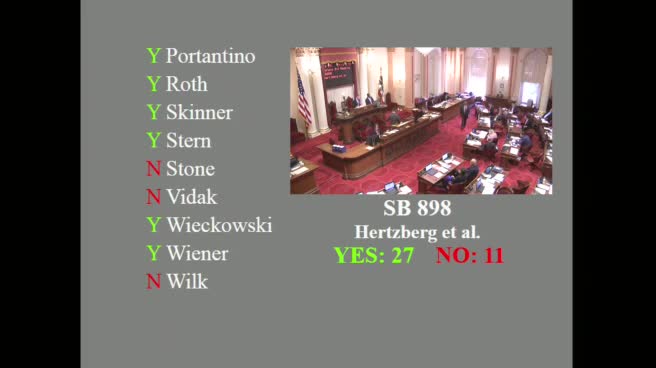 2MIN
Senate Floor
 10MIN
Senate Standing Committee on Governance and Finance
Bill Author