SB 1097: Lead poisoning.
- Session Year: 2017-2018
- House: Senate
- Latest Version Date: 2018-09-22
Existing law requires the State Department of Public Health to collect and analyze all information necessary to effectively monitor appropriate case management efforts related to lead poisoning in children. Existing law authorizes the department to contract with a public or private entity, including local agencies, to conduct case management. Existing law requires the department to prepare a biennial report describing the effectiveness of appropriate case management efforts, and to make that report available to local health departments and the general public.
This bill would require the report to contain specified information for each county, including the number of children tested for lead poisoning. The bill would require the department to post the report on the departments Internet Web site. The bill would additionally require the department to provide the collected data to its Healthy Communities Data and Indicators Project, as specified.
This bill would incorporate additional changes to Section 105295 of the Health and Safety Code proposed by SB 1041 to be operative only if this bill and SB 1041 are enacted and this bill is enacted last.
Existing law requires the State Department of Public Health to collect and analyze all information necessary to effectively monitor appropriate case management efforts related to lead poisoning in children. Existing law authorizes the department to contract with a public or private entity, including local agencies, to conduct case management. Existing law requires the department to prepare a biennial report describing the effectiveness of appropriate case management efforts, and to make that report available to local health departments and the general public.
This bill would require the report to contain specified information for each county, including the number of children screened for risk of tested for lead poisoning. The bill would require the department to post the report on the departments Internet Web site. The bill would additionally require the department to incorporate provide the collected data into to its Healthy Communities Data and Indicators Project, as specified.
Existing law requires the State Department of Public Health to collect and analyze all information necessary to effectively monitor appropriate case management efforts related to lead poisoning in children. Existing law authorizes the department to contract with a public or private entity, including local agencies, to conduct case management. Existing law requires the department to prepare a biennial report describing the effectiveness of appropriate case management efforts, and to make that report available to local health departments and the general public.
This bill would require the report to contain specified information for each county, including the number of children screened for risk of lead poisoning. The bill would require the department to post the report on the departments Internet Web site. The bill would additionally require the department to incorporate the collected data into its Healthy Communities Data and Indicators Project, as specified.
Existing law requires the State Department of Public Health to collect and analyze all information necessary to effectively monitor appropriate case management efforts related to lead poisoning in children. Existing law authorizes the department to contract with a public or private entity, including local agencies, to conduct case management. Existing law requires the department to prepare a biennial report describing the effectiveness of appropriate case management efforts, and to make that report available to local health departments and the general public.
This bill would require the report to contain specified information for each county, including the number of children screened for risk of lead poisoning. The bill would additionally require the department to post the report on the departments Internet Web site. The bill would additionally require the department to incorporate the collected data into its Healthy Communities Data and Indicators Project, as specified.
Existing law requires the State Department of Public Health to collect and analyze all information necessary to effectively monitor appropriate case management efforts related to lead poisoning in children. Existing law authorizes the department to contract with a public or private entity, including local agencies, to conduct case management. Existing law requires the department to prepare a biennial report describing the effectiveness of appropriate case management efforts, and to make that report available to local health departments and the general public.
This bill would require the department, in that report, to aggregate the data provided to the department. report to contain specified information for each county, including the number of children screened for risk of lead poisoning. The bill would additionally require the department to post the report on the departments Internet Web site.
Existing law requires the State Department of Public Health to collect and analyze all information necessary to effectively monitor appropriate case management efforts related to lead poisoning in children. Existing law authorizes the department to contract with a public or private entity, including local agencies, to conduct case management. Existing law requires the department to prepare a biennial report describing the effectiveness of appropriate case management efforts, and to make that report available to local health departments and the general public.
This bill would require the department, in that report, to aggregate the data provided to the department. The bill would additionally require the department to post the report on the departments Internet Web site.
(a)The department shall collect and analyze all information necessary to effectively monitor appropriate case management efforts. The department shall prepare a biennial report describing the effectiveness of appropriate case management efforts. This report shall be made available to local health departments and the general public.
(b)The report prepared pursuant to subdivision (a) shall include all of the following information listed for each county:
(1)The total number of children tested for lead poisoning.
(2)The results of blood lead testing by ranges of lead levels.
(3)The number of children, by blood lead level range, who were referred for case management and environmental services and who received the following services:
(A)Home visit.
(B)Environmental investigation.
(C)Family education and provision of educational materials, nutrition assessment, and nutrition education.
(4)(A)The identified sources of lead exposure for those children having lead poisoning.
(B)The report shall indicate whether the sources of lead exposure identified in, on, or around a residence or location associated with a child with lead poisoning have been removed, remediated, or abated.
(c)When preparing the report required by subdivision (a), the department may use the information that the department receives through its existing case management efforts, including, but not limited to, the data in biennial reports provided to the department from local health departments.
(d)The department shall post the report prepared pursuant to subdivision (a) on the departments Internet Web site.
(e)The department shall provide the data collected and the report prepared pursuant to this section to the Healthy Communities Data and Indicators Project (HCI) standardized set of statistical measures for use in any tools developed by HCI that are used for planning healthy communities and evaluating the impact of plans, projects, policies, and environmental changes on community health.
(f)All uses and disclosure of data made pursuant to this section shall comply with all applicable state and federal laws for the protection of the privacy and security of data, including, but not limited to, subdivision (g) of Section 124130 and the Information Practices Act of 1977 (Chapter 1 (commencing with Section 1798) of Title 1.8 of Part 4 of Division 3 of the Civil Code).
SEC. 1.5.Section 105295 of the Health and Safety Code is amended to read:105295.(a)(1)The department shall collect and analyze all information necessary to effectively monitor appropriate case management efforts. The department shall prepare a biennial report describing the effectiveness of appropriate case management efforts. This report shall be made available to local health departments and the general public.
(2)The department shall prominently post the report prepared pursuant to this subdivision on the departments Internet Web site consistent with the requirements of subdivision (c) of Section 124125.
(b)The report prepared pursuant to subdivision (a) shall include all of the following information listed for each county:
(1)The total number of children tested for lead poisoning.
(2)The results of blood lead testing by ranges of lead levels.
(3)The number of children, by blood lead level range, who were referred for case management and environmental services and who received the following services:
(A)Home visit.
(B)Environmental investigation.
(C)Family education and provision of educational materials, nutrition assessment, and nutrition education.
(4)(A) The identified sources of lead exposure for those children having lead poisoning.
(B)The report shall indicate whether the sources of lead exposure identified in, on, or around a residence or location associated with a child with lead poisoning have been removed, remediated, or abated.
(c)The report shall also include, but not be limited to, all of the following:
(1)The number of enrolled children in Medi-Cal, identified by county and year of age, who received blood lead screening tests and who have not received these tests.
(2)The number of children not enrolled in Medi-Cal, identified by county, and year of age, who have received blood lead screening tests.
(3)Publicly releasable data and information that the department compiles, identifies, and analyzes in accordance with subdivision (b) of Section 124125.
(d)The department shall collaborate with the State Department of Health Care Services to collect and analyze information identified under subdivision (c) that pertains to children enrolled in Medi-Cal.
(e)When preparing the report required by subdivision (b), the department may use the information that the department receives through its existing case management efforts, including, but not limited to, the data in biennial reports provided to the department from local health departments.
(f)The department shall provide the data collected and the report prepared pursuant to this section to the Healthy Communities Data and Indicators Project (HCI) standardized set of statistical measures for use in any tools developed by HCI that are used for planning healthy communities and evaluating the impact of plans, projects, policies, and environmental changes on community health.
(g)All uses and disclosure of data made pursuant to this section shall comply with all applicable state and federal laws for the protection of the privacy and security of data, including, but not limited to, subdivision (g) of Section 124130 and the Information Practices Act of 1977 (Chapter 1 (commencing with Section 1798) of Title 1.8 of Part 4 of Division 3 of the Civil Code).
SEC. 2.Section 1.5 of this bill incorporates amendments to Section 105295 of the Health and Safety Code proposed by both this bill and Senate Bill 1041. That section of this bill shall only become operative if (1) both bills are enacted and become effective on or before January 1, 2019, (2) each bill amends Section 105295 of the Health and Safety Code, and (3) this bill is enacted after Senate Bill 1041, in which case Section 1 of this bill shall not become operative.
(a)The department shall collect and analyze all information necessary to effectively monitor appropriate case management efforts. The department shall prepare a biennial report describing the effectiveness of appropriate case management efforts. This report shall be made available to local health departments and the general public.
(b)The report prepared pursuant to subdivision (a) shall include all of the following information listed for each county:
(1)The total number of children screened for risk of tested for lead poisoning.
(2)A list of the three most predominant risk factors for childhood lead poisoning identified by county and the number of children in the county identified as having those risk factors.(3)The number of children identified as being at risk who received blood testing. (4)(2)The results of blood lead testing by ranges of lead levels.
(5)(3)The number of children, by blood lead level, level range, who were referred to for case management and environmental services and who received the following services:
(A)Health care referral.(A)Home visit.
(B)Environmental assessments. investigation.
(C)Educational screens, nutrition education, or other resources.(6)The number of children, by blood level, identified as having lead poisoning who received health treatment for that lead poisoning.(C)Family education and provision of educational materials, nutrition assessment, and nutrition education.
(7)(4)(A)The identified sources of lead exposure for those children having lead poisoning.
(B)The data required by this paragraph shall include both the number of associated lead poisoning incidents and the associated blood lead levels for each identified source and shall be quantifiably presented in a manner that allows the public to understand what lead hazards in each county are contributing toward, and how often the sources are contributing toward, childhood lead exposure and lead poisoning in each county.(C)(B)The report shall indicate whether the sources of lead poisoning described in this paragraph exposure identified in, on, or around a residence or location associated with a child with lead poisoning have been removed removed, remediated, or abated.
(c)When preparing the report required by subdivision (a), the department may use the information that the department receives through its existing case management efforts, including, but not limited to, the data in biennial reports provided to the department from local health departments.
(d)The department shall post the report prepared pursuant to subdivision (a) on the departments Internet Web site.
(e)The department shall incorporate provide the data collected and the report prepared pursuant to this section into to the Healthy Communities Data and Indicators Project (HCI) standardized set of statistical measures and into for use in any tools developed by HCI that are used for planning healthy communities and evaluating the impact of plans, projects, policies, and environmental changes on community health.
(f)All uses and disclosure of data made pursuant to this section shall comply with all applicable state and federal laws for the protection of the privacy and security of data, including, but not limited to, subdivision (g) of Section 124130 and the Information Practices Act of 1977 (Chapter 1 (commencing with Section 1798) of Title 1.8 of Part 4 of Division 3 of the Civil Code).
(a)The department shall collect and analyze all information necessary to effectively monitor appropriate case management efforts. The department shall prepare a biennial report describing the effectiveness of appropriate case management efforts. This report shall be made available to local health departments and the general public.
(b)The report prepared pursuant to subdivision (a) shall include all of the following information listed for each county:
(1)The number of children screened for risk of lead poisoning.
(2)A list of the three most predominant risk factors for childhood lead poisoning identified by county and the number of children in the county identified as having those risk factors.
(3)The number of children identified as being at risk who received blood testing.
(4)The results of blood lead testing by ranges of lead levels.
(5)The number of children, by blood lead level, who were referred to case management and who received the following services:
(A)Health care referral.
(B)Environmental assessments.
(C)Educational screens, nutrition education, or other resources.
(6)The number of children, by blood level, identified as having lead poisoning who received health treatment for that lead poisoning.
(7)(A)The identified sources of lead exposure for those children having lead poisoning.
(B)The data required by this paragraph shall include both the number of associated lead poisoning incidents and the associated blood lead levels for each identified source and shall be quantifiably presented in a manner that allows the public to understand what lead hazards in each county are contributing toward, and how often the sources are contributing toward, childhood lead exposure and lead poisoning in each county.
(C)The report shall indicate whether the sources of lead poisoning described in this paragraph have been removed or abated.
(c)When preparing the report required by subdivision (a), the department may use the information that the department receives through its existing case management efforts, including, but not limited to, the data in biennial reports provided to the department from local health departments.
(c)(d)The department shall post the report prepared pursuant to subdivision (a) on the departments Internet Web site.
(d)(e)The department shall incorporate the data collected and the report prepared pursuant to this section into the Healthy Communities Data and Indicators Project (HCI) standardized set of statistical measures and into any tools developed by HCI that are used for planning healthy communities and evaluating the impact of plans, projects, policies, and environmental changes on community health.
(a)The department shall collect and analyze all information necessary to effectively monitor appropriate case management efforts. The department shall prepare a biennial report describing the effectiveness of appropriate case management efforts. This report shall be made available to local health departments and the general public.
(b)The report prepared pursuant to subdivision (a) shall include all of the following information listed for each county:
(1)The number of children screened for risk of lead poisoning.
(2)A list of the three most predominant risk factors for childhood lead poisoning identified by county and the number of children in the county identified as having those risk factors.
(3)The number of children identified as being at risk who received blood testing.
(4)The results of blood lead testing by ranges of lead levels.
(5)The number of children, by blood lead level, who were referred to case management and who received the following services:
(A)Health care referral.
(B)Environmental assessments.
(C)Educational screens, nutrition education, or other resources.
(6)The number of children, by blood level, identified as having lead poisoning who received health treatment for that lead poisoning.
(7)(A)The identified sources of lead exposure for those children having lead poisoning.
(B)The data required by this paragraph shall include both the number of associated lead poisoning incidents and the associated blood lead levels for each identified source and shall be quantifiably presented in a manner that allows the public to understand what lead hazards in each county are contributing toward, and how often the sources are contributing toward, childhood lead exposure and lead poisoning in each county.
(C)The report shall indicate whether the sources of lead poisoning described in this paragraph have been removed or abated.
(c)The department shall post the report prepared pursuant to subdivision (a) on the departments Internet Web site.
(d)The department shall incorporate the data collected and the report prepared pursuant to this section into the Healthy Communities Data and Indicators Project (HCI) standardized set of statistical measures and into any tools developed by HCI that are used for planning healthy communities and evaluating the impact of plans, projects, policies, and environmental changes on community health.
(a)The department shall collect and analyze all information necessary to effectively monitor appropriate case management efforts. The department shall prepare a biennial report describing the effectiveness of appropriate case management efforts. This report shall be made available to local health departments and the general public.
(b)In the The report prepared pursuant to subdivision (a), the department shall aggregate the data provided to the department pursuant to subdivision (a). (a) shall include all of the following information listed for each county:
(1)The number of children screened for risk of lead poisoning.
(2)A list of the three most predominant risk factors for childhood lead poisoning identified by county and the number of children in the county identified as having those risk factors.
(3)The number of children identified as being at risk who received blood testing.
(4)The results of blood lead testing by ranges of lead levels.
(5)The number of children, by blood lead level, who were referred to case management and who received the following services:
(A)Health care referral.
(B)Environmental assessments.
(C)Educational screens, nutrition education, or other resources.
(6)The number of children, by blood level, identified as having lead poisoning who received health treatment for that lead poisoning.
(7)(A)The identified sources of lead exposure for those children having lead poisoning.
(B)The data required by this paragraph shall include both the number of associated lead poisoning incidents and the associated blood lead levels for each identified source and shall be quantifiably presented in a manner that allows the public to understand what lead hazards in each county are contributing toward, and how often the sources are contributing toward, childhood lead exposure and lead poisoning in each county.
(C)The report shall indicate whether the sources of lead poisoning described in this paragraph have been removed or abated.
(c)The department shall post the report prepared pursuant to subdivision (a) on the departments Internet Web site.
(a)The department shall collect and analyze all information necessary to effectively monitor appropriate case management efforts. The department shall prepare a biennial report describing the effectiveness of appropriate case management efforts. This report shall be made available to local health departments and the general public.
(b)In the report prepared pursuant to subdivision (a), the department shall aggregate the data provided to the department pursuant to subdivision (a).
(c)The department shall post the report prepared pursuant to subdivision (a) on the departments Internet Web site.
|
Date
|
Status
|
|---|---|
| Sep 22, 2018 | Chaptered by Secretary of State. Chapter 691, Statutes of 2018. |
| Sep 22, 2018 | Approved by the Governor. |
| Sep 10, 2018 | Enrolled and presented to the Governor at 4 p.m. |
| Aug 30, 2018 | Assembly amendments concurred in. (Ayes 39. Noes 0.) Ordered to engrossing and enrolling. |
| Aug 30, 2018 | Ordered to special consent calendar. |
| Aug 29, 2018 | In Senate. Concurrence in Assembly amendments pending. |
| Aug 29, 2018 | Read third time. Passed. Ordered to the Senate. |
| Aug 23, 2018 | Read third time and amended. |
| Aug 21, 2018 | Read second time. Ordered to third reading. |
| Aug 20, 2018 | Read second time and amended. Ordered to second reading. |
| Aug 16, 2018 | From committee: Do pass as amended. (Ayes 12. Noes 0.) (August 16). |
| Jun 27, 2018 | June 27 set for first hearing. Placed on APPR. suspense file. |
| Jun 20, 2018 | From committee: Do pass and re-refer to Com. on APPR. with recommendation: To consent calendar. (Ayes 15. Noes 0.) (June 19). Re-referred to Com. on APPR. |
| Jun 7, 2018 | Referred to Com. on HEALTH. |
| May 31, 2018 | In Assembly. Read first time. Held at Desk. |
| May 30, 2018 | Read third time. Passed. (Ayes 32. Noes 0.) Ordered to the Assembly. |
| May 29, 2018 | Read second time. Ordered to third reading. |
| May 25, 2018 | From committee: Do pass as amended. (Ayes 7. Noes 0.) (May 25). |
| May 23, 2018 | Set for hearing May 25. |
| May 22, 2018 | May 22 hearing: Placed on APPR. suspense file. |
| May 14, 2018 | Set for hearing May 22. |
| May 10, 2018 | May 14 hearing postponed by committee. |
| May 9, 2018 | Set for hearing May 14. |
| Apr 26, 2018 | From committee: Do pass and re-refer to Com. on APPR. with recommendation: To consent calendar. (Ayes 9. Noes 0.) (April 25). Re-referred to Com. on APPR. |
| Apr 13, 2018 | Set for hearing April 25. |
| Apr 12, 2018 | Re-referred to Com. on HEALTH. |
| Apr 3, 2018 | From committee with author's amendments. Read second time and amended. Re-referred to Com. on RLS. |
| Apr 2, 2018 | From committee with author's amendments. Read second time and amended. Re-referred to Com. on RLS. |
| Feb 22, 2018 | Referred to Com. on RLS. |
| Feb 14, 2018 | From printer. May be acted upon on or after March 16. |
| Feb 13, 2018 | Introduced. Read first time. To Com. on RLS. for assignment. To print. |
|
Date
|
Description
|
Location
|
Votes
|
|
|---|---|---|---|---|
| Aug 30, 2018 | Unfinished Business SB1097 Hueso et al. Concurrence | Senate Floor |
Passed |
|
| Aug 29, 2018 | SB 1097 Hueso Senate Third Reading By REYES | Assembly Floor |
Passed |
|
| Aug 16, 2018 | Do pass as amended. | Assembly Standing Committee on Appropriations |
Passed |
|
| Jun 19, 2018 | Do pass and be re-referred to the Committee on [Appropriations] with recommendation: To Consent Calendar | Assembly Standing Committee on Health |
Passed |
|
| May 30, 2018 | Senate 3rd Reading SB1097 Hueso et al. | Senate Floor |
Passed |
|
| May 25, 2018 | Do pass as amended | Senate Standing Committee on Appropriations |
Passed |
|
| May 22, 2018 | Placed on suspense file | Senate Standing Committee on Appropriations |
Passed |
|
| Apr 25, 2018 | Do pass, but first be re-referred to the Committee on [Appropriations] with the recommendation: To Consent Calendar | Senate Standing Committee on Health |
Passed |
This list shows positions taken on this bill by organizations on the date displayed, which is linked to the original source.
Positions by individuals are not included.
Office of Senate Floor Analyses (916) 651-1520 Fax: (916) 327-4478 | SB |
UNFINISHED BUSINESS
Bill No: SB 1097
:
SENATE HEALTH COMMITTEE: 9-0, 4/25/18
AYES: Hernandez, Nguyen, Leyva, Mitchell, Monning, Newman, Nielsen, Pan, Roth
SENATE APPROPRIATIONS COMMITTEE: 7-0, 5/25/18
AYES: Lara, Bates, Beall, Bradford, Hill, Nielsen, Wiener
SENATE FLOOR: 37-0, 5/30/18
AYES: Allen, Anderson, Atkins, Bates, Beall, Berryhill, Bradford, Dodd, Fuller, Gaines, Galgiani, Glazer, Hernandez, Hertzberg, Hill, Hueso, Jackson, Lara, Leyva, McGuire, Mitchell, Monning, Moorlach, Morrell, Newman, Nguyen, Nielsen, Pan, Portantino, Roth, Skinner, Stern, Stone, Vidak, Wieckowski, Wiener, Wilk
NO VOTE RECORDED: Cannella, De León
ASSEMBLY FLOOR: 80-0, 8/29/18 - See last page for vote
SOURCE: Environmental Working Group
DIGEST:
- This bill requires the Department of Public Health’s (DPH) report regarding the effectiveness of appropriate lead poisoning case management efforts to include additional data and information, as specified.
Assembly Amendments (1) make changes to the data that is required to be included in the report and require uses and disclosure of data to comply with all applicable state and federal laws for the protection of the privacy and security of data, as specified; (2) incorporate changes made by SB 1041 (Leyva) to avoid chaptering out conflicts in the event both bills are signed into law; and (3) make technical, clarifying changes.
ANALYSIS: Existing law requires DPH to collect and analyze all information necessary to effectively monitor appropriate case management efforts and prepare a biennial report to local health officers and the public describing the effectiveness of these efforts. [HSC §105295]
This bill:
- Requires DPH’s report regarding the effectiveness of appropriate lead poisoning case management efforts to include, for each county:
- The total number of children tested for risk of lead poisoning;
- The results of blood lead testing by ranges of lead levels;
- The number of children, by blood lead level (BLL) range, who were referred for case management and environmental services and who received a home visit and environmental investigation;
- Family education and provision of educational materials, nutrition assessment, and nutrition education; and,
- The identified sources of lead exposure for those children having lead poisoning.
- Requires the report to indicate whether the sources of lead exposure identified in, on, or around a residence or location associated with a child with lead poisoning have been removed, remediated, or abated.
- Permits DPH, when preparing the report, to use information that it receives through its existing case management efforts, including, but not limited to, the data in biennial reports provided by local health departments (LHDs).
- Requires DPH to post the report its Web site.
- Requires DPH to provide the data collected and the report to the Healthy Communities Data and Indicators Project (HCI project) standardized set of statistical measures and for use in any tools developed by HCI that are used for planning healthy communities and evaluating the impact of plans, projects, policies, and environmental changes on community health.
- Requires uses and disclosure of data under this bill to comply with all applicable state and federal laws for the protection of the privacy and security of data, as specified.
Background
According to the Centers for Disease Control and Prevention (CDC), at least four million households include children that are being exposed to high levels of lead. Children are exposed to lead from different sources (such as paint, gasoline, solder, and consumer products like candy, artificial turf, and toys) and through different pathways (such as air, food, water, dust, and soil). Although there are several exposure sources, lead-based paint is the most widespread and dangerous high-dose source of lead exposure for young children. There are approximately half a million U.S. children ages one to five years with BLLs above five micrograms per deciliter (µg/dL), a level at which CDC recommends public health actions be initiated. No safe BLL in children has been identified, and exposure can affect nearly every system in the body. Because lead exposure often occurs with no obvious symptoms, it frequently goes unrecognized. Children at higher risk for lead exposure are poor, are members of racial-ethnic minority groups, are recent immigrants, live in older, poorly maintained rental properties, or have parents who are exposed to lead at work.
Reporting. Results of all blood lead tests are sent to DPH by the analyzing laboratory. These test results are shared immediately with LHDs, which also receive immediate alerts about very high BLLs, reports every two weeks on children with increased BLLs, and data disks with all blood lead information for their jurisdictions, which are issued quarterly and annually. DPH receives about 700,000 blood lead tests a year. The information that accompanies the test results (such as address or ZIP code) may be incomplete or wrong. Sometimes the test result is sent twice. As its first priority, DPH spends considerable time finding the correct information for children with increased BLLs, matching the information if the child has been tested before, and providing this to the local jurisdictions. This is crucial to assure that additional lead exposure is prevented in these children and public health services are given. Blood lead test results also are sent by laboratories directly to the child’s health care provider. DPH then manually cleans the hundreds of thousands of test results and assign them to the child’s location.
DPH data. According to DPH, 2014 is the most recent year for which blood lead testing results have been fully analyzed statewide, and appear below.
Age | BLL < 4.5 | % | BLL ≥ 4.5 to <9.5 | % | BLL ≥ 9.5 | % | Total |
Under 6 | 543,980 | 98.32% | 8,048 | 1.45% | 1,252 | .23% | 553,280 |
6 to 21 | 43,055 | 97.66% | 906 | 2.06% | 125 | .28% | 44,086 |
Total | 587,035 | 98.27% | 8,954 | 1.50% | 1,377 | .23% | 597,366 |
Reuters study. A March 22, 2017 article published by Reuters titled “Lead Poisoning Afflicts Neighborhoods Across California,” indicates that dozens of California communities have experienced recent rates of childhood lead poisoning that surpass those of Flint, MI, with one Fresno location showing rates nearly three times higher. Reuters found at least 29 California neighborhoods where children had elevated lead tests as high as in Flint. Other ZIP codes with rates equal to or greater than Flint were found in the Counties of Alameda (Oakland), Los Angeles, Monterey, and Humboldt. The data for the study was released by DPH in response to a records request by Reuters and a limited set of numbers previously disclosed by the state. The data is based on tests conducted during 2012.
HCI project. The HCI project was started in 2012 with seed money from the Strategic Growth Council, a state agency supporting efforts to promote sustainability in California. The project was authorized by SCR 47 (DeSaulnier, Chapter 56, Statutes of 2012) and by Executive Order S-04-10 under Governor Schwarzenneger. The goal of HCI is to provide a standardized set of indicators, data files, and tools for planning healthy communities and evaluating the impact of plans, projects, policy, and environmental changes on community health. The indicators were based on the Healthy Community Framework developed by the Strategic Growth Council’s Health in All Policies Task Force with input from community stakeholders and public health organizations. The Healthy Community Framework identifies 20 key attributes of a healthy community through all stages of life, clustered in five broad categories. In order to select indicators for HCI, DPH conducted bibliographic reviews of numerous city, county, state, and national indicator projects and applied criteria to select indicators. More than 200 possible indicators were first matched to the goals in the Healthy Community Framework. Indicators without detailed data at the level of census tract, town, or other small geography were filtered out. The remaining indicators were compared with those in various state agency strategic plans for consistency. DPH published a core list of 56 indicators in 2013, and includes 66 indicators as of November 2017.
Comments
Author’s statement. According to the author, SB 1097 will help ensure appropriate case management for children already exposed to dangerous levels of lead. This bill ensures that localities are providing continuous and adequate levels of case management in relation to the number of children tested for lead exposure, and the number of children found to have high levels of lead in their blood. SB 1097 additionally requires that the report include information about the identified sources of lead exposure for those children having lead poisoning. Further, SB 1097 requires DPH to incorporate the data into the HCI project for the purpose of planning healthy communities and evaluating impacts of plans, projects, policies, and environmental changes on community health.
FISCAL EFFECT: Appropriation: No Fiscal Com.: Yes Local: No
According to the Assembly Appropriations Committee, costs in the hundreds of thousands of dollars to DPH for additional staff to perform manual data processing and data entry; to review extract, and analyze data; and to write the report (Childhood Lead Poisoning Prevention Fund).
Environmental Working Group (source)
Alameda County
American Academy of Pediatrics, California
California Coalition of Welfare Rights Organization
California State PTA
CALPIRG
Children Now
Children’s Advocacy Institute
Children’s Defense Fund
Clean Water Action
Consumer Attorneys of California
Empower Family California
Friends Committee on Legislation of California
Healthy Black Families, Inc.
National Health Law Program
San Francisco Bay Area Physicians for Social Responsibility
Sierra Club California
SmartOakland.org
The Environmental Justice Coalition for Water
Trust for Public Land
Western Center on Law and Poverty
OPPOSITION: (Verified 8/29/18)
None received
ARGUMENTS IN SUPPORT: Supporters write that since the 1970s, federal and state policies banning the use of lead in gasoline and paint have resulted in drastic reductions in childhood lead exposure. However, legacy lead (lead remaining in paint, plumbing, contaminated soil, and faucets) continues to endanger children who encounter this known neurotoxin in their homes and other environments. As housing and other types of building infrastructure ages, childhood lead exposure risks may increase. Paint peels, lead leeches into soil, and leaded pipes decay and contaminate otherwise potable water sources. Supporters state that new sources of lead have been identified, and local officials report that children are exposed to potentially dangerous levels of lead by consuming certain imported spices and home remedies, playing with imported toys, or using foreign manufactured cosmetics or ritual items.
Supporters further contend that while many of California’s youngest children are still exposed to lead, most children who are at the highest risk of lead poisoning are not tested for lead exposure as required by law. A recent analysis of state billing data found that, between 2012 and 2016, approximately three-quarters of the state’s 12- and 24-month old children who are most at risk of lead poisoning did not receive blood lead screenings each year in accordance with federal and state regulations. Supporters assert that California must and should identify as many children as the law requires. The state should also do all it can to prevent lead exposure in the first place, and remove children from lead when it is found. However, not enough public data is available to guide communities on how to best protect kids from the neurotoxin. Public data regarding local childhood lead testing and exposure is limited, and little documentation is publicly available about causes of lead poisoning at the local level or how those lead sources are addressed. County childhood lead poisoning prevention programs provide biennial reports to the state about lead poisoning cases, but that information is not publicly available, and does not fully describe the county’s child lead testing compliance or efforts to address the sources of lead poisoning. DPH is also required to prepare a biennial report about the effectiveness of lead poisoning case management efforts, but it does not prepare such a report and only posts minimal information about childhood
lead exposure rates on its Web site.
ASSEMBLY FLOOR: 80-0, 8/29/18
AYES: Acosta, Aguiar-Curry, Travis Allen, Arambula, Baker, Berman, Bigelow, Bloom, Bonta, Brough, Burke, Caballero, Calderon, Carrillo, Cervantes, Chau, Chávez, Chen, Chiu, Choi, Chu, Cooley, Cooper, Cunningham, Dahle, Daly, Eggman, Flora, Fong, Frazier, Friedman, Gabriel, Gallagher, Cristina Garcia, Eduardo Garcia, Gipson, Gloria, Gonzalez Fletcher, Gray, Grayson, Harper, Holden, Irwin, Jones-Sawyer, Kalra, Kamlager-Dove, Kiley, Lackey, Levine, Limón, Low, Maienschein, Mathis, Mayes, McCarty, Medina, Melendez, Mullin, Muratsuchi, Nazarian, Obernolte, O'Donnell, Patterson, Quirk, Quirk-Silva, Reyes, Rivas, Rodriguez, Rubio, Salas, Santiago, Steinorth, Mark Stone, Thurmond, Ting, Voepel, Waldron, Weber, Wood, Rendon
8/30/18 9:32:09
SENATE THIRD READING
STR Bill Id:SB 1097
Author:(Hueso)
As Amended Ver:August 23, 2018
Majority vote
SENATE VOTE: 37-0
Committee | Votes | Ayes | Noes |
Health | 15-0 | Wood, Mayes, Aguiar-Curry, Bigelow, Bonta, Burke, Carrillo, Flora, Limón, McCarty, Nazarian, Rodriguez, Santiago, Thurmond, Waldron |
|
Appropriations | 12-0 | Gonzalez Fletcher, Bloom, Bonta, Calderon, Carrillo, Chau, Eggman, Friedman, Eduardo Garcia, Nazarian, Quirk, Reyes |
|
SUMMARY: Revises the requirements of the biennial report required to be published by Department of Public Health (DPH) regarding the effectiveness of appropriate case management efforts for lead poisoning management. Specifically, this bill:
- Requires the report to include all of the following information listed for each county:
- The total number of children tested for lead poisoning;
- The results of blood lead testing by ranges of lead levels;
- The number of children, by blood lead level range, who were referred for case management and environmental services who received the following services:
- Home visit;
- Environmental investigation; and,
- Family education and provision of educational materials, nutrition assessment, and nutrition education.
- The identified sources of lead exposure for those children having lead poisoning.
- Requires the report to indicate whether the sources of lead exposure identified in, on, or around a residence or location associated with a child with lead poisoning have been removed, remediated, or abated.
- Permits DPH, when preparing the report, to use the information that it receives through its existing case management efforts, including, but not limited to, the data in biennial reports provided to DPH from local health departments.
- Requires DPH to post the report on its Internet Web site.
- Requires DPH to provide the data collected and the report into the Healthy Communities Data and Indicators Project (HCI) standardized set of statistical measures for use in any tools developed by HCI that are used for planning healthy communities and evaluating the impact of plans, projects, policies, and environmental changes on community health.
- Requires that all uses and disclosure of data as a result of this bill be in compliance with all applicable state and federal laws for the protection of the privacy and security of data, as specified.
- Ensures that this bill and SB 1041 avoid chaptering out the other, should both bills be enacted.
FISCAL EFFECT: According to the Assembly Appropriations Committee, costs in the hundreds of thousands of dollars to DPH for additional staff to perform manual data processing and data entry, review of data, data extraction and analysis, and to write the report (Childhood Lead Poisoning Prevention Fund).
COMMENTS: According to the author, this bill will help ensure appropriate case management for children already exposed to dangerous levels of lead by ensuring that localities are providing continuous and adequate levels of case management in relation to the number of children tested for lead exposure, and the number of children found to have high levels of lead in their blood. This bill will additionally require that the report include information about the identified sources of lead exposure for those children having lead poisoning. The author states that having the DPH produce this report will help prevent childhood lead exposure, and will make clear where the lead hazards are, what the hazards look like, and how the lead is affecting kids near it. This bill will help California better understand childhood lead levels, lead hazards, and the effectiveness of lead abatement.
Lead is a naturally occurring metal that has been used in many products and is harmful to the human body. There is no known safe level of lead. Small amounts of lead can build up in the body and cause lifelong learning and behavior problems. Lead Poisoning is the most common environmental illness in California children and it is preventable. According to the federal Centers for Disease Control and Prevent (CDC), at least four million households today have children that are being exposed to high levels of lead. There are approximately half a million United States children ages one to five with blood lead levels (BLL) above five micrograms per deciliter (µg/dL), the reference level at which CDC recommends public health actions be initiated. No safe blood lead level in children has been identified. Lead exposure can affect nearly every system in the body. Because lead exposure often occurs with no obvious symptoms, it frequently goes unrecognized. All children who are receiving publicly funded programs for low-income children, as well as children living or spending a lot of time in a place built before 1978 with deteriorated paint or recent renovation are deemed to be at high risk of lead poisoning, and under California regulations, must be blood lead tested at one and two years of age. CDC also points out that refugees and other children who have lived or spent time in another county may also be at increased risk.
Children under six years old and fetuses are at greatest risk of harmful health effects from lead poisoning as their brains and nervous systems are still forming. Children frequently crawl on floors or furniture contaminated with lead dust and put their hands or other objects in their mouths. Lead can be measured in their blood and remains in their bodies for long periods of time. Children may eat paint chips or chew on the surfaces of cribs, highchairs, windows, woodwork, walls, doors, or railings that contain lead. Lead may be in the soil where children play, especially near busy roadways or factories. The lead from gasoline used for many years has settled into soil and is difficult to remove. This soil may also be tracked inside on shoes and clothing. Some countries other than the United States still allow lead solder in food cans. Imported home remedies, cosmetics, pottery, candies or foods (especially from Mexico, containing chili or tamarind) and tableware may contain lead. Lead has also been found in inexpensive children's jewelry sold in vending machines across the country.
Results of all blood lead tests are sent to DPH by the analyzing laboratory. These test results are shared immediately, over the web, with local health jurisdictions. The local jurisdictions also receive immediate alerts about very high BLLs, reports every two weeks on children with increased BLLs, and data disks with all blood lead information for their jurisdictions, which are issued quarterly and annually. DPH receives about 700,000 blood lead tests a year. The information that accompanies the test results (such as address or ZIP code) may be incomplete or wrong. Sometimes the test result is sent twice. As its first priority, DPH spends considerable time finding the correct information for children with increased BLLs, matching the information if the child has been tested before, and providing this to the local jurisdictions. This is crucial to assure that additional lead exposure is prevented in these children and public health services are given. Blood lead test results also are sent by laboratories directly to the health care provider of the child. DPH then manually cleans the hundreds of thousands of test results and assign them to the child's location. These are not automated functions.
On February 13, 2018, the Assembly Committee on Environmental Safety and Toxic Materials held an informational hearing entitled: Status of Lead Testing Low-Income Children for Lead Exposure. According to the Committee's background paper, there is data to suggest that only about 28% of children on Medi-Cal have been tested annually for the past five years for lead exposure.
Analysis Prepared by: Paula Villescaz / HEALTH / (916) 319-2097 FN: 0004643
SENATE THIRD READING
STR Bill Id:SB 1097
Author:(Hueso)
As Amended Ver:August 20, 2018
Majority vote
SENATE VOTE: 37-0
Committee | Votes | Ayes | Noes |
Health | 15-0 | Wood, Mayes, Aguiar-Curry, Bigelow, Bonta, Burke, Carrillo, Flora, Limón, McCarty, Nazarian, Rodriguez, Santiago, Thurmond, Waldron | |
Appropriations | 12-0 | Gonzalez Fletcher, Bloom, Bonta, Calderon, Carrillo, Chau, Eggman, Friedman, Eduardo Garcia, Nazarian, Quirk, Reyes |
|
SUMMARY: Revises the requirements of the biennial report required to be published by Department of Public Health (DPH) regarding the effectiveness of appropriate case management efforts for lead poisoning management. Specifically, this bill:
- Requires the report to include all of the following information listed for each county:
- The total number of children tested for lead poisoning;
- The results of blood lead testing by ranges of lead levels;
- The number of children, by blood lead level range, who were referred for case management and environmental services who received the following services:
- Home visit;
- Environmental investigation; and,
- Family education and provision of educational materials, nutrition assessment, and nutrition education.
- The identified sources of lead exposure for those children having lead poisoning.
- Requires the report to indicate whether the sources of lead exposure identified in, on, or around a residence or location associated with a child with lead poisoning have been removed, remediated, or abated.
- Permits DPH, when preparing the report, to use the information that it receives through its existing case management efforts, including, but not limited to, the data in biennial reports provided to DPH from local health departments.
- Requires DPH to post the report on its Internet Web site.
- Requires DPH to provide the data collected and the report into the Healthy Communities Data and Indicators Project (HCI) standardized set of statistical measures for use in any tools developed by HCI that are used for planning healthy communities and evaluating the impact of plans, projects, policies, and environmental changes on community health.
- Requires that all uses and disclosure of data as a result of this bill be in compliance with all applicable state and federal laws for the protection of the privacy and security of data, as specified.
FISCAL EFFECT: According to the Assembly Appropriations Committee, costs in the hundreds of thousands of dollars to DPH for additional staff to perform manual data processing and data entry, review of data, data extraction and analysis, and to write the report (Childhood Lead Poisoning Prevention Fund).
COMMENTS: According to the author, this bill will help ensure appropriate case management for children already exposed to dangerous levels of lead by ensuring that localities are providing continuous and adequate levels of case management in relation to the number of children tested for lead exposure, and the number of children found to have high levels of lead in their blood. This bill will additionally require that the report include information about the identified sources of lead exposure for those children having lead poisoning. The author states that having the DPH produce this report will help prevent childhood lead exposure, and will make clear where the lead hazards are, what the hazards look like, and how the lead is affecting kids near it. This bill will help California better understand childhood lead levels, lead hazards, and the effectiveness of lead abatement.
Lead is a naturally occurring metal that has been used in many products and is harmful to the human body. There is no known safe level of lead. Small amounts of lead can build up in the body and cause lifelong learning and behavior problems. Lead Poisoning is the most common environmental illness in California children and it is preventable. According to the federal Centers for Disease Control and Prevent (CDC), at least four million households today have children that are being exposed to high levels of lead. There are approximately half a million United States children ages one to five with blood lead levels (BLL) above five micrograms per deciliter (µg/dL), the reference level at which CDC recommends public health actions be initiated. No safe blood lead level in children has been identified. Lead exposure can affect nearly every system in the body. Because lead exposure often occurs with no obvious symptoms, it frequently goes unrecognized. All children who are receiving publicly funded programs for low-income children, as well as children living or spending a lot of time in a place built before 1978 with deteriorated paint or recent renovation are deemed to be at high risk of lead poisoning, and under California regulations, must be blood lead tested at one and two years of age. CDC also points out that refugees and other children who have lived or spent time in another county may also be at increased risk.
Children under six years old and fetuses are at greatest risk of harmful health effects from lead poisoning as their brains and nervous systems are still forming. Children frequently crawl on floors or furniture contaminated with lead dust and put their hands or other objects in their mouths. Lead can be measured in their blood and remains in their bodies for long periods of time. Children may eat paint chips or chew on the surfaces of cribs, highchairs, windows, woodwork, walls, doors, or railings that contain lead. Lead may be in the soil where children play, especially near busy roadways or factories. The lead from gasoline used for many years has settled into soil and is difficult to remove. This soil may also be tracked inside on shoes and clothing. Some countries other than the United States still allow lead solder in food cans. Imported home remedies, cosmetics, pottery, candies or foods (especially from Mexico, containing chili or tamarind) and tableware may contain lead. Lead has also been found in inexpensive children's jewelry sold in vending machines across the country.
Results of all blood lead tests are sent to DPH by the analyzing laboratory. These test results are shared immediately, over the web, with local health jurisdictions. The local jurisdictions also receive immediate alerts about very high BLLs, reports every two weeks on children with increased BLLs, and data disks with all blood lead information for their jurisdictions, which are issued quarterly and annually. DPH receives about 700,000 blood lead tests a year. The information that accompanies the test results (such as address or ZIP code) may be incomplete or wrong. Sometimes the test result is sent twice. As its first priority, DPH spends considerable time finding the correct information for children with increased BLLs, matching the information if the child has been tested before, and providing this to the local jurisdictions. This is crucial to assure that additional lead exposure is prevented in these children and public health services are given. Blood lead test results also are sent by laboratories directly to the health care provider of the child. DPH then manually cleans the hundreds of thousands of test results and assign them to the child's location. These are not automated functions.
On February 13, 2018, the Assembly Committee on Environmental Safety and Toxic Materials held an informational hearing entitled: Status of Lead Testing Low-Income Children for Lead Exposure. According to the Committee's background paper, there is data to suggest that only about 28% of children on Medi-Cal have been tested annually for the past five years for lead exposure.
Analysis Prepared by: Paula Villescaz / HEALTH / (916) 319-2097 FN: 0004261
Date of Hearing: June 27, 2018
ASSEMBLY COMMITTEE ON APPROPRIATIONS
Lorena Gonzalez Fletcher, Chair
SBPCA Bill Id:SB 1097
Author:(Hueso) – As Amended Ver:May 25, 2018
Policy Committee: | Health | Vote: | 15 - 0 |
Urgency: No State Mandated Local Program: No Reimbursable: No
SUMMARY:
This bill modifies and expands the topics of an existing periodic report prepared by the California Department of Public Health (CDPH) on childhood lead poisoning case management efforts.
FISCAL EFFECT:
Costs in the hundreds of thousands of dollars to CDPH for additional staff to perform manual data processing and data entry; to review extract, and analyze data; and to write the report (Childhood Lead Poisoning Prevention Fund).
COMMENTS:
- Purpose. The author states that having CDPH report on additional items will help prevent childhood lead exposure and make clear where the lead hazards are, what the hazards look like, and how the lead is affecting children in the area. This bill will help California better understand childhood lead levels, lead hazards, and the effectiveness of lead abatement.
- Background. Lead is a neurotoxin and exposure to it can damage brain development irreversibly. No level of lead in the blood is safe. Children are most likely to be affected by lead poisoning; exposure sources include lead-based paint or lead-contaminated soil, cosmetics, food, imported pottery, and jewelry. Existing law requires all laboratories to report blood lead test results to CDPH and local health jurisdictions. Local health jurisdictions are mandated to provide outreach, case management, and other services for children identified with high blood lead levels. This bill requires county-specific reporting on sources of exposure, numbers of children screened and numbers with risk factors, and information on removal or abatement of exposure sources.
- Recent developments. The Assembly Environmental Safety & Toxic Materials Committee held an oversight hearing on February 13, 2018, to better understand the compliance rate for testing children on state assistance programs for lead exposure. The Department of Health Care Services was not able to show the majority of Medi-Cal enrolled children had a blood lead test, as required.
In 2017, a California Court of Appeals decision held three paint companies liable for remediation of lead-based paint. A pending initiative would authorize the state to sell $2 billion in general obligation bonds to fund the remediation of environmental and structural hazards.
- Related Legislation. AB 2122 (Reyes), pending in the Senate Health Committee, requires DHCS to undertake a number of activities to ensure children receive blood lead tests.
AB 2976 (Quirk), pending in the Senate Health Committee, requires CDPH to coordinate with DHCS to gather data to determine whether low-income children are being screened for lead poisoning pursuant to current regulations.
SB 1041 (Leyva), pending in the Assembly Health Committee, requires CDPH to annually notify providers and providers to notify parents of lead testing requirements.
Analysis Prepared by: Lisa Murawski / APPR. / (916) 319-2081
Date of Hearing: June 19, 2018
ASSEMBLY COMMITTEE ON HEALTH
Jim Wood, Chair
SBPCA Bill Id:SB 1097
Author:(Hueso) – As Amended Ver:May 25, 2018
SENATE VOTE: 37-0
SUBJECT: Lead poisoning.
SUMMARY: Revises the requirements of the biennial report required to be published by Department of Public Health (DPH) regarding the effectiveness of appropriate case management efforts for lead poisoning management. Specifically, this bill:
- Requires the report to include all of the following information listed for each county:
- The number of children screened for risk of lead poisoning;
- A list of the three most predominant risk factors for childhood lead poisoning identified by county and the number of children in the county identified as having those risk factors;
- The number of children identified as being at risk who received blood testing;
- The results of blood lead testing by ranges of lead levels;
- The number of children, by blood lead level, who were referred to case management and who received the following services:
- Health care referral;
- Environmental assessments; and,
- Educational screens, nutrition education, or other resources.
- The number of children, by blood level, identified as having lead poisoning who received health treatment for that lead poisoning; and,
- The identified sources of lead exposure for those children having lead poisoning.
- Requires data in the report to include both the number of associated lead poisoning incidents and the associated blood lead levels for each identified source and for that data to be quantifiably presented in a manner that allows the public to understand what lead hazards in each county are contributing toward, and how often the sources are contributing toward, childhood lead exposure and lead poisoning in each county.
- Requires the report to indicate whether the sources of lead poisoning identified have been removed or abated.
- Permits DPH, when preparing the report, to use the information that it receives through its existing case management efforts, including, but not limited to, the data in biennial reports provided to DPH from local health departments.
- Requires DPH to post the report on its Internet Website.
- Requires DPH to incorporate the data collected and the report into the Healthy Communities Data and Indicators Project (HCI) standardized set of statistical measures and into any tools developed by HCI that are used for planning healthy communities and evaluating the impact of plans, projects, policies, and environmental changes on community health.
EXISTING LAW:
- Requires DPH to collect and analyze all information necessary to effectively monitor appropriate case management efforts and requires DPH to prepare a biennial report describing the effectiveness of appropriate case management efforts that must be made available to local health departments and the general public.
- Defines case management efforts as health care referrals, environmental assessments, and educational activities, performed by the appropriate person, professional, or entity, necessary to reduce a child’s exposure to lead and the consequences of the exposure, as determined by the United States Centers for Disease Control and Prevention (CDC).
- Requires DPH, under the Childhood Lead Poisoning Act of 1991, to establish a childhood lead poisoning prevention program to increase awareness regarding the hazards of lead exposure, reduce lead exposure, increase the number of children assessed and their blood tested for lead poisoning, and identify and conduct medical follow-up of high-risk children.
- Establishes the Childhood Lead Prevention Fund to support lead poisoning prevention programs for children.
- Requires DPH to revise its regulations for the Childhood Lead Poisoning Prevention Program (CLPPP) to redefine the assessment of risks for the purposes of evaluating a child's risk for lead exposure.
- Requires DPH to consider the most significant risk factors for childhood lead exposure, including, but not limited to, a child's time spent in a home, school, or building built before 1978, a child's proximity to a former lead or steel smelter or an industrial facility that historically emitted or currently emits lead, a child's proximity to a freeway or heavily travelled roadway, potential risk factors for lead exposure, and known sources of lead contamination.
- Requires DPH to prepare and prominently post on its Internet Website information about DPH's progress in meeting the CLPPP goals, including an annually updated analysis of the data and information identified and compiled related to prevalence, causes, occurrences, and significant target areas related to lead exposure rates.
FISCAL EFFECT: According to the Senate Appropriations Committee, DPH notes a fiscal year 18-19 cost and ongoing of $570,200 (Childhood Lead Poisoning Prevention Fund) for 2.0 Program Technicians, 2.0 Associate Governmental Program Analysts, and a 1.0 Research Scientist III for manual data processing and manual data entry, review of data, data extraction, and data and epidemiological analysis.
COMMENTS:
- PURPOSE OF THIS BILL. According to the author, this bill will help ensure appropriate case management for children already exposed to dangerous levels of lead by ensuring that localities are providing continuous and adequate levels of case management in relation to the number of children tested for lead exposure, and the number of children found to have high levels of lead in their blood. This bill will additionally require that the report include information about the identified sources of lead exposure for those children having lead poisoning. The author states that having the DPH produce this report will help prevent childhood lead exposure, and will make clear where the lead hazards are, what the hazards look like, and how the lead is affecting kids near it. This bill will help California better understand childhood lead levels, lead hazards, and the effectiveness of lead abatement.
- BACKGROUND. Lead is a naturally occurring metal that has been used in many products and is harmful to the human body. There is no known safe level of lead. Small amounts of lead can build up in the body and cause lifelong learning and behavior problems. Lead Poisoning is the most common environmental illness in California children and it is preventable. According to the CDC, at least 4 million households today have children that are being exposed to high levels of lead. There are approximately half a million U.S. children ages one to five with blood lead levels (BLL) above 5 micrograms per deciliter (µg/dL), the reference level at which CDC recommends public health actions be initiated. No safe blood lead level in children has been identified. Lead exposure can affect nearly every system in the body. Because lead exposure often occurs with no obvious symptoms, it frequently goes unrecognized. All children who are receiving publicly funded programs for low-income children, as well as children living or spending a lot of time in a place built before 1978 with deteriorated paint or recent renovation are deemed to be at high risk of lead poisoning, and under California regulations, must be blood lead tested at one and two years of age. CDC also points out that refugees and other children who have lived or spent time in another county may also be at increased risk.
Children under six years old and fetuses are at greatest risk of harmful health effects from lead poisoning as their brains and nervous systems are still forming. Children frequently crawl on floors or furniture contaminated with lead dust and put their hands or other objects in their mouths. Lead can be measured in their blood and remains in their bodies for long periods of time. Children may eat paint chips or chew on the surfaces of cribs, highchairs, windows, woodwork, walls, doors, or railings that contain lead. Lead may be in the soil where children play, especially near busy roadways or factories. The lead from gasoline used for many years has settled into soil and is difficult to remove. This soil may also be tracked inside on shoes and clothing. Some countries other than the United States still allow lead solder in food cans. Imported home remedies, cosmetics, pottery, candies or foods (especially from Mexico, containing chili or tamarind) and tableware may contain lead. Lead has also been found in inexpensive children’s jewelry sold in vending machines across the country.- Sources of Lead. According to DPH, the common sources of lead include:
- Lead-based paint (pre-1978) in homes and on furniture, including paint chips;
- Lead contaminated soil;
- Dust contaminated with lead from paint or soil;
- Imported cosmetics;
- Imported pottery and dishware with leaded glaze;
- Some imported foods; and,
- Metal jewelry.
- Childhood Lead Poisoning Prevention Act (CLPPA). The CLPPA requires DPH to adopt regulations establishing a standard of care, at least as stringent as the most recent CDC screening guidelines, whereby all children are evaluated for risk of lead poisoning by health care providers during each child’s periodic health assessment. The CLPPA provides services to the community for the purpose of increasing awareness regarding the hazards of lead exposure, reducing lead exposure, and increasing the number of children assessed and appropriately blood tested for lead poisoning. The CLPPA program offers home visitation, environmental home inspections, and nutritional assessments to families of children found to be severely lead poisoned. The CLPPA provides telephone contacts and educational materials to families of lead-poisoned and lead-exposed children. The CLPPP provides information and education to the general public, medical providers, and community-based organizations.
- Reporting. Results of all blood lead tests are sent to DPH by the analyzing laboratory. These test results are shared immediately, over the web, with local health jurisdictions. The local jurisdictions also receive immediate alerts about very high BLLs, reports every two weeks on children with increased BLLs, and data disks with all blood lead information for their jurisdictions, which are issued quarterly and annually. DPH receives about 700,000 blood lead tests a year. The information that accompanies the test results (such as address or ZIP code) may be incomplete or wrong. Sometimes the test result is sent twice. As its first priority, DPH spends considerable time finding the correct information for children with increased BLLs, matching the information if the child has been tested before, and providing this to the local jurisdictions. This is crucial to assure that additional lead exposure is prevented in these children and public health services are given. Blood lead test results also are sent by laboratories directly to the health care provider of the child. DPH then manually cleans the hundreds of thousands of test results and assign them to the child’s location. These are not automated functions.
- Informational Hearing. On February 13, 2018, the Assembly Committee on Environmental Safety and Toxic Materials held an informational hearing entitled: Status of Lead Testing Low-Income Children for Lead Exposure. According to the Committee’s background paper, there is data to suggest that only about 28% of children on Medi-Cal have been tested annually for the past five years for lead exposure.
- Lead Lawsuit and Pending Initiative. In 2017, the California Court of Appeals
held that three defendant companies (Sherwin-Williams Company, NL Industries, and ConAgra Grocery Products), created a public nuisance in 10 plaintiff jurisdictions by promoting the use of lead-based paint in the interior of residences built before 1951 even though they had actual knowledge of the harm the paint would pose to children. The California Supreme Court refused to hear the case on appeal. The Court of Appeals’ decision requires remediation of the lead-based paint, but not its complete removal, in the 10 California jurisdictions that were plaintiffs in the case. The jurisdictions include: seven counties: Santa Clara; Alameda; Los Angeles; Monterey; San Mateo; Solano; and, Ventura; two cities, Oakland and San Diego; and, the city and county of San Francisco. Under this ruling, funding from paint manufacturers for local lead abatement programs likely will total several hundred million dollars.
Currently, there is an initiative pending that would authorize the state to sell $2 billion in general obligation bonds to fund the remediation of environmental and structural hazards (such as mold, asbestos, radon, water, pests, ventilation and lead hazards in homes, schools and senior facilities). Of this total, $1.5 billion would be given as grants to owners of housing, with $1.2 billion set aside for single family and small multifamily homes. In addition, $400 million would be given to schools and $100 million to senior housing and assisted living facilities.
- Sources of Lead. According to DPH, the common sources of lead include:
- SUPPORT. Supporters, including the Environmental Working Group, Children Now, and others, write that since the 1970s, federal and state policies banning the use of lead in gasoline and paint have resulted in drastic reductions in childhood lead exposure. However, legacy lead (lead remaining in paint, plumbing, contaminated soil, and faucets) continues to endanger children who encounter this known neurotoxin in their homes and other environments. As housing and other types of building infrastructure ages, childhood lead exposure risks may increase. Paint peels, lead leeches into soil, and leaded pipes decay and contaminate otherwise potable water sources. Supporters state that new sources of lead have been identified, and local officials report that children are exposed to potentially dangerous levels of lead by consuming certain imported spices and home remedies, playing with imported toys, or using foreign manufactured cosmetics or ritual items.
- RELATED LEGISLATION.
- AB 2122 (Reyes) would require a contract between the Department of Health Care Services (DHCS) and a Medi-Cal managed care (MCMC) plan to ensure that a MCMC plan meets the standard of care for lead testing. Requires DHCS to ensure that children in specified age groups receive blood lead screening tests. AB 2122 is pending in the Senate Rules Committee.
- AB 247 (Garcia) of 2017 would have required the Office of Environmental Health Hazard Assessment to convene a Lead Advisory Taskforce to review and advise on policies and procedures to reduce childhood lead poisoning in the state. The bill was vetoed by the Governor stating: "This bill creates a twenty-one member Lead Advisory Task Force to review and advise on state policies and procedures to reduce childhood lead poisoning and to suggest a regulatory agenda that would identify sources of lead and ensure standards are protective of public health.
The responsibilities of this task force would be duplicative of ongoing work by the Office of Environmental Health Hazard Assessment, the Department of Public Health, the State Water Resources Control Board, and the Department of Toxic Substances Control. Coordination and evaluation of procedures to reduce childhood lead poisoning is being accomplished administratively amongst these agencies so there is no reason to divert resources to a task force."
- AB 2976 (Quirk) requires DPH to coordinate with state entities, including DHCS, that are responsible for administering publicly funded programs for low-income children to gather data to determine whether children are being screened for lead poisoning. AB 2976 is pending in the Senate Rules Committee.
- SB 1041 (Leyva) requires DPH to annually notify providers and providers to notify parents of lead testing requirements. SB 1041 is pending in the Assembly Health Committee.
- PREVIOUS LEGISLATION.
- AB 1316 (Quirk), Chapter 507, Statutes of 2017, requires DPH to revise its regulations for the CLPPP to redefine the assessment of risks for the purposes of evaluating a child's risk for lead exposure.
- SB 775 (Ridley-Thomas) of 2007 would have, among other provisions, required DPH to make available on its Internet Website the most current information on lead, as specified, and would have required providers primarily responsible for providing prenatal care to explain to pregnant women that lead poisoning prevention information is available on the Internet Website or provide other information about lead poisoning prevention. SB 775 was vetoed by the Governor who indicated: “While I support programs to reduce lead exposure for children, this bill is duplicative of existing state requirements and may jeopardize overall funding for lead poisoning prevention. Many of the bill's provisions are unnecessary and are already being accomplished administratively.”
REGISTERED SUPPORT / OPPOSITION:
Support
Environmental Working Group (sponsor)
Association of California Healthcare Districts
California Coalition of Welfare Rights Organizations
California State PTA
California Teachers Association
Children Now
Children’s Advocacy Institute
Children’s Defense Fund
Clean Water Action
Consumer Attorneys of California
Empower Family California
Environmental Working Group
Friends Committee on Legislation of California
Healthy Black Families, Inc.
National Health Law Program
San Francisco Bay Area Physicians for Social Responsibility
SmartOakland.org
The Environmental Justice Coalition for Water
Trust for Public Land
Western Center on Law and Poverty
One individual
Opposition
None on file.
Analysis Prepared by: Paula Villescaz / HEALTH / (916) 319-2097
Office of Senate Floor Analyses (916) 651-1520 Fax: (916) 327-4478 | SB 1097 |
THIRD READING
Bill No: SB 1097
Amended: 5/25/18
SENATE HEALTH COMMITTEE: 9-0, 4/25/18
AYES: Hernandez, Nguyen, Leyva, Mitchell, Monning, Newman, Nielsen, Pan, Roth
SENATE APPROPRIATIONS COMMITTEE: 7-0, 5/25/18
AYES: Lara, Bates, Beall, Bradford, Hill, Nielsen, Wiener
SOURCE: Environmental Working Group
DIGEST:
- This bill requires the Department of Public Health’s (DPH) report regarding the effectiveness of appropriate lead poisoning case management efforts to include additional data and information, as specified. This bill requires DPH to post the report its Web site. This bill requires DPH to incorporate the additional data and the report into the Healthy Communities Data and Indicators Project, as specified.
Existing law:
- Establishes the Childhood Lead Poisoning Prevention Act (CLPPA) of 1991, which requires DPH to adopt regulations that establish a standard of care at least as stringent as the most recent Centers for Disease Control and Prevention (CDC) screening guidelines, whereby all children are evaluated for risk of lead poisoning by health care providers during each child’s periodic health assessment. Requires the CLPPA regulations to include a risk assessment for determining whether a child is “at risk.” [HSC §105275 et seq. and 105285]
- Requires DPH to collect and analyze all information necessary to effectively monitor appropriate case management efforts and prepare a biennial report to local health officers and the public describing the effectiveness of these efforts. [HSC §105295]
- Provides DPH with broad authority to fully implement and effectuate the CLPPA, including but not limited to, developing screening protocols; designating laboratories qualified to analyze whole blood specimens for lead concentration; establishing lower lead concentrations in whole blood than that of the CDC; establishing lower acceptable levels of lead concentration in whole blood than that of the CDC; and notifying a child’s parent or guardian of the results of blood lead testing and environmental assessment. [HSC §105300]
- Requires DPH to establish a Childhood Lead Prevention Program (CLPP) that accomplishes goals related to the compilation of information concerning prevalence, causes, and geographic occurrence of high childhood blood lead levels (BLLs); identification and target areas where childhood lead exposure is significant; and, the analysis of information collected, and the design and implementation of a program, as specified, that will reduce the incidence of excessive childhood lead exposure in the state. [HSC §124125]
- Requires, by March 1, 2019, and by March 1 annually thereafter, DPH to prepare and post on its Web site, information that includes to the greatest extent possible a list of census tracts in which children test positive at a higher rate than the national average for blood lead in excess of the CDC’s reference level for elevated blood lead, as specified. [HSC §124125]
This bill:
- Requires DPH’s report regarding the effectiveness of appropriate lead poisoning case management efforts to include, for each county:
- The number of children screened for risk of lead poisoning;
- A list of the three most predominant risk factors for childhood lead poisoning identified by county and the number of children in the county identified as having those risk factors;
- The number of children identified as being at risk who received blood testing;
- The results of blood lead testing by ranges of lead levels;
- The number of children, by BLL, who were referred to case management and who received a health care referral; environmental assessments; and, educational screens, nutrition education, or other resource;
- The number of children, by blood level, identified as having lead poisoning who received health treatment for that lead poisoning; and,
- The identified sources of lead exposure for those children having lead poisoning.
- Requires the data in 1) above to include both the number of associated lead poisoning incidents and the associated BLLs for each identified source and to be quantifiably presented in a manner that allows the public to understand what lead hazards in each county are contributing toward, and how often the sources are contributing toward, childhood lead exposure and lead poisoning in each county.
- Requires the report to indicate whether the sources of lead poisoning described under this bill have been removed or abated.
- Permits DPH, when preparing the report, to use information that it receives through its existing case management efforts, including, but not limited to, the data in biennial reports provided by local health departments (LHDs).
- Requires DPH to post the report its Web site.
- Requires DPH to incorporate the data collected and the report into the Healthy Communities Data and Indicators Project (HCI project) standardized set of statistical measures and into any tools developed by HCI that are used for planning healthy communities and evaluating the impact of plans, projects, policies, and environmental changes on community health.
Background
According to the CDC, at least four million households include children that are being exposed to high levels of lead. Children are exposed to lead from different sources (such as paint, gasoline, solder, and consumer products like candy, artificial turf, and toys) and through different pathways (such as air, food, water, dust, and soil). Although there are several exposure sources, lead-based paint is the most widespread and dangerous high-dose source of lead exposure for young children. There are approximately half a million U.S. children ages one to five years with BLLs above five micrograms per deciliter (µg/dL), a level at which CDC recommends public health actions be initiated. No safe BLL in children has been identified, and exposure can affect nearly every system in the body. Because lead exposure often occurs with no obvious symptoms, it frequently goes unrecognized. Children at higher risk for lead exposure are poor, are members of racial-ethnic minority groups, are recent immigrants, live in older, poorly maintained rental properties, or have parents who are exposed to lead at work.
Reporting. Results of all blood lead tests are sent to DPH by the analyzing laboratory. These test results are shared immediately with LHDs, which also receive immediate alerts about very high BLLs, reports every two weeks on children with increased BLLs, and data disks with all blood lead information for their jurisdictions, which are issued quarterly and annually. DPH receives about 700,000 blood lead tests a year. The information that accompanies the test results (such as address or ZIP code) may be incomplete or wrong. Sometimes the test result is sent twice. As its first priority, DPH spends considerable time finding the correct information for children with increased BLLs, matching the information if the child has been tested before, and providing this to the local jurisdictions. This is crucial to assure that additional lead exposure is prevented in these children and public health services are given. Blood lead test results also are sent by laboratories directly to the child’s health care provider. DPH then manually cleans the hundreds of thousands of test results and assign them to the child’s location.
DPH data. According to DPH, 2014 is the most recent year for which blood lead testing results have been fully analyzed statewide, and appear below.
Age | BLL < 4.5 | % | BLL ≥ 4.5 to <9.5 | % | BLL ≥ 9.5 | % | Total |
Under 6 | 543,980 | 98.32% | 8,048 | 1.45% | 1,252 | .23% | 553,280 |
6 to 21 | 43,055 | 97.66% | 906 | 2.06% | 125 | .28% | 44,086 |
Total | 587,035 | 98.27% | 8,954 | 1.50% | 1,377 | .23% | 597,366 |
Reuters study. A March 22, 2017 article published by Reuters titled “Lead Poisoning Afflicts Neighborhoods Across California,” indicates that dozens of California communities have experienced recent rates of childhood lead poisoning that surpass those of Flint, MI, with one Fresno location showing rates nearly three times higher. Reuters found at least 29 California neighborhoods where children had elevated lead tests as high as in Flint. Other ZIP codes with rates equal to or greater than Flint were found in the Counties of Alameda (Oakland), Los Angeles, Monterey, and Humboldt. The data for the study was released by DPH in response to a records request by Reuters and a limited set of numbers previously disclosed by the state. The data is based on tests conducted during 2012.
HCI project. The HCI project was started in 2012 with seed money from the Strategic Growth Council, a state agency supporting efforts to promote sustainability in California. The project was authorized by SCR 47 (DeSaulnier, Chapter 56, Statutes of 2012) and by Executive Order S-04-10 under Governor Schwarzenneger. The goal of HCI is to provide a standardized set of indicators, data files, and tools for planning healthy communities and evaluating the impact of plans, projects, policy, and environmental changes on community health. The indicators were based on the Healthy Community Framework developed by the Strategic Growth Council’s Health in All Policies Task Force with input from community stakeholders and public health organizations. The Healthy Community Framework identifies 20 key attributes of a healthy community through all stages of life, clustered in five broad categories. In order to select indicators for HCI, DPH conducted bibliographic reviews of numerous city, county, state, and national indicator projects and applied criteria to select indicators. More than 200 possible indicators were first matched to the goals in the Healthy Community Framework. Indicators without detailed data at the level of census tract, town, or other small geography were filtered out. The remaining indicators were compared with those in various state agency strategic plans for consistency. DPH published a core list of 56 indicators in 2013, and includes 66 indicators as of November 2017.
Comments
Author’s statement. According to the author, SB 1097 will help ensure appropriate case management for children already exposed to dangerous levels of lead. This bill ensures that localities are providing continuous and adequate levels of case management in relation to the number of children tested for lead exposure, and the number of children found to have high levels of lead in their blood. SB 1097 additionally requires that the report include information about the identified sources of lead exposure for those children having lead poisoning. Further, SB 1097 requires DPH to incorporate the data into the HCI Project for the purpose of planning healthy communities and evaluating impacts of plans, projects, policies, and environmental changes on community health.
FISCAL EFFECT: Appropriation: No Fiscal Com.: Yes Local: No
According to the Senate Appropriations Committee:
- DPH notes a FY 18-19 cost and ongoing of $570,200 (Childhood Lead Poisoning Prevention Fund) for 2.0 Program Technicians, 2.0 Associate Governmental Program Analysts, and a 1.0 Research Scientist III for manual data processing and manual data entry, review of data, data extraction, and data and epidemiological analysis.
- The amendments would authorize DPH to use existing information, submitted by LHDs departments, to compile the specified report for each county. As such, DPH data processing and manual entry would still need to occur to the extent data from LHDs/jurisdictions’ may not be in the same format used by DPH, and if data from locals is not provided to DPH at all. In addition, DPH may need to provide guidance, through notices, to counties specifying its reporting process.
- Senate Appropriations staff notes the amendments potentially reduce costs, if DPH and locals use similar reporting fields, though the actual amount of reduction is unknown at this time.
Environmental Working Group (source)
Alameda County
California Coalition of Welfare Rights Organization
California State PTA
Children Now
Children’s Advocacy Institute
Children’s Defense Fund
Clean Water Action
Consumer Attorneys of California
Empower Family California
Friends Committee on Legislation of California
Healthy Black Families, Inc.
National Health Law Program
San Francisco Bay Area Physicians for Social Responsibility
SmartOakland.org
The Environmental Justice Coalition for Water
Trust for Public Land
Western Center on Law and Poverty
OPPOSITION: (Verified 5/23/18)
None received
ARGUMENTS IN SUPPORT: Supporters write that since the 1970s, federal and state policies banning the use of lead in gasoline and paint have resulted in drastic reductions in childhood lead exposure. However, legacy lead (lead remaining in paint, plumbing, contaminated soil, and faucets) continues to endanger children who encounter this known neurotoxin in their homes and other environments. As housing and other types of building infrastructure ages, childhood lead exposure risks may increase. Paint peels, lead leeches into soil, and leaded pipes decay and contaminate otherwise potable water sources. Supporters state that new sources of lead have been identified, and local officials report that children are exposed to potentially dangerous levels of lead by consuming certain imported spices and home remedies, playing with imported toys, or using foreign manufactured cosmetics or ritual items.
Supporters further contend that while many of California’s youngest children are still exposed to lead, most children who are at the highest risk of lead poisoning are not tested for lead exposure as required by law. A recent analysis of state billing data found that, between 2012 and 2016, approximately three-quarters of the state’s 12- and 24-month old children who are most at risk of lead poisoning did not receive blood lead screenings each year in accordance with federal and state regulations. Supporters assert that California must and should identify as many children as the law requires. The state should also do all it can to prevent lead exposure in the first place, and remove children from lead when it is found. However, not enough public data is available to guide communities on how to best protect kids from the neurotoxin. Public data regarding local childhood lead testing and exposure is limited, and little documentation is publicly available about causes of lead poisoning at the local level or how those lead sources are addressed. County childhood lead poisoning prevention programs provide biennial reports to the state about lead poisoning cases, but that information is not publicly available, and does not fully describe the county’s child lead testing compliance or efforts to address the sources of lead poisoning. DPH is also required to prepare a biennial report about the effectiveness of lead poisoning case management efforts, but it does not prepare such a report and only posts minimal information about childhood lead exposure rates on its Web site.
Prepared by: Melanie Moreno / HEALTH / (916) 651-4111
5/29/18 8:45:48
**** END ****
SENATE COMMITTEE ON APPROPRIATIONS
Senator Ricardo Lara, Chair
2017 - 2018 Regular Session
SB 1097 (Hueso) - Lead poisoning
Version: April 3, 2018 | Policy Vote: HEALTH 9 - 0 |
Urgency: No | Mandate: No |
Hearing Date: May 25, 2018 | Consultant: Samantha Lui |
Bill Summary:
Senate Bill 1097 requires the Department of Public Health (CDPH) to include additional specified data elements regarding lead poisoning case management for children. The department must post the report, for each county, to its website and incorporate the date into the Health Communities Data and Indicators Project, as specified.
*********** ANALYSIS ADDENDUM – SUSPENSE FILE ***********
The following information is revised to reflect amendments
adopted by the committee on May 25, 2018
Fiscal Impact:
The Department of Public Health (CDPH) notes a FY 18-19 cost and ongoing of $570,200 (Childhood Lead Poisoning Prevention Fund) for 2.0 Program Technicians, 2.0 Associate Governmental Program Analysts, and a 1.0 Research Scientist III for manual data processing and manual data entry, review of data, data extraction, and data and epidemiological analysis.
The amendments would authorize the department to use existing information, submitted by local health departments, to compile the specified report for each county. As such, CDPH data processing and manual entry would still need to occur to the extent data from local health departments/jurisdictions’ may not be in the same format used by CDPH, and if data from locals is not provided to CDPH at all. In addition, CDPH may need to provide guidance, through notices, to counties specifying its reporting process.
Staff notes the amendments potentially reduce costs, if CDPH and locals use similar reporting fields, though the actual amount of reduction is unknown at this time.
Author Amendments:
The amendments provide that CDPH may use information from existing case management efforts, including data in biennial reports provided to the department from local health departments, when preparing the specified report.
-- END --
SENATE COMMITTEE ON APPROPRIATIONS
Senator Ricardo Lara, Chair
2017 - 2018 Regular Session
SB 1097 (Hueso) - Lead poisoning
Version: April 3, 2018 | Policy Vote: HEALTH 9 - 0 |
Urgency: No | Mandate: No |
Hearing Date: May 22, 2018 | Consultant: Samantha Lui |
This bill meets the criteria for referral to the Suspense File.
Bill Summary:
Senate Bill 1097 requires the Department of Public Health (CDPH) to report data elements regarding lead poisoning case management. The department must post the report to its website and incorporate the date into the Health Communities Data and Indicators Project, as specified.
Fiscal Impact:
The Department of Public Health (CDPH) notes a FY 18-19 cost and ongoing of $570,200 (Childhood Lead Poisoning Prevention Fund) for additional staff including: 2.0 Program Technicians, 2.0 Associate Governmental Program Analysts, and a 1.0 Research Scientist III for manual data processing and manual data entry, review of data, data extraction, and data and epidemiological analysis. This additional workload cannot be absorbed by existing staff. For additional information, please see staff notes.
Background:
- Establishes the Childhood Lead Poisoning Prevention Act (CLPPA) of 1991, which requires DPH to adopt regulations that establish a standard of care at least as stringent as the most recent Centers for Disease Control and Prevention (CDC) screening guidelines, whereby all children are evaluated for risk of lead poisoning by health care providers during each child’s periodic health assessment. Requires the CLPPA regulations to include a risk assessment for determining whether a child is “at risk.” DPH to establish a Childhood Lead Prevention Program (CLPP) that accomplishes goals related to the compilation of information concerning prevalence, causes, and geographic occurrence of high childhood blood lead levels (BLLs); identification and target areas where childhood lead exposure is significant; and the analysis of information collected, and the design and implementation of a program, as specified, that will reduce the incidence of excessive childhood lead exposure in the state. Requires, by March 1, 2019, and by March 1 annually thereafter, DPH to prepare and post on its Internet Web site, information that includes to the greatest extent possible a list of census tracts in which children test positive at a higher rate than the national average for blood lead in excess of the CDC’s reference level for elevated blood lead, as specified.
Results of all blood lead tests are sent to DPH by the analyzing laboratory. These test results are shared immediately, over the web, with local health jurisdictions. The local jurisdictions also receive immediate alerts about very high BLLs, reports every two weeks on children with increased BLLs, and data disks with all blood lead information for their jurisdictions, which are issued quarterly and annually. DPH receives about 700,000 blood lead tests a year. The information that accompanies the test results (such as address or ZIP code) may be incomplete or wrong. Sometimes the test result is sent twice. As its first priority, DPH spends considerable time finding the correct information for children with increased BLLs, matching the information if the child has been tested before, and providing this to the local jurisdictions. This is crucial to assure that additional lead exposure is prevented in these children and public health services are given. Blood lead test results also are sent by laboratories directly to the health care provider of the child. DPH then manually cleans the hundreds of thousands of test results and assign them to the child’s location. These are not automated functions.
According to DPH, 2014 is the most recent year for which blood lead testing results have been fully analyzed statewide. The California totals for 2014 are as follows:
Age Group | BLL < 4.5 | % | BLL ≥ 4.5 to <9.5 | % | BLL ≥ 9.5 | % | Totals |
<6 | 543,980 | 98.32% | 8,048 | 1.45% | 1,252 | .23% | 553,280 |
6 to 21 | 43,055 | 97.66% | 906 | 2.06% | 125 | .28% | 44,086 |
Total | 587,035 | 98.27% | 8,954 | 1.50% | 1,377 | .23% | 597,366 |
The HCI project was started in 2012 with seed money from the Strategic Growth Council, a state agency supporting efforts to promote sustainability in California. The project was authorized by SCR 47 (DeSaulnier, Chapter 56, Statutes of 2012) and by Executive Order S-04-10 under Governor Schwarzenneger. The goal of HCI is to provide a standardized set of indicators, data files, and tools for planning healthy communities and evaluating the impact of plans, projects, policy, and environmental changes on community health.
Proposed Law:
The bill requires CDPH to prepare a biennial report for each county:
- The number of children screened for risk of lead poisoning;
- A list of the three most predominant risk factors for childhood lead poisoning identified by county and the number of children in the county identified as having those risk factors;
- The number of children identified as being at risk who received blood testing;
- The results of blood lead testing by ranges of lead levels;
- The number of children, by blood lead level, who were referred to case management and who received the following services:
- Health care referral.
- Environmental assessments.
- Educational screens, nutrition education, or other resources.
- The number of children, by blood level, identified as having lead poisoning who received health treatment for that lead poisoning; and,
- The identified sources of lead exposure for those children having lead poisoning.
- The data required by this paragraph shall include both the number of associated lead poisoning incidents and the associated blood lead levels for each identified source and shall be quantifiably presented in a manner that allows the public to understand what lead hazards in each county are contributing toward, and how often the sources are contributing toward, childhood lead exposure and lead poisoning in each county.
In addition, the bill requires the report to indicate whether the sources of lead poisoning described in this paragraph have been removed or abated, and have the report posted on the CDPH website.
The department must incorporate the data collected and the report prepared pursuant to this section into the Healthy Communities Data and Indicators Project (HCI) standardized set of statistical measures and into any tools developed by HCI that are used for planning healthy communities and evaluating the impact of plans, projects, policies, and environmental changes on community health.
Related Legislation:
- AB 11 (McCarty) requires that screening services available under the Early and Periodic Screening, Diagnostic and Treatment Program specifically include screening services for individuals zero to three years of age, inclusive, in compliance with the periodicity schedule and the standardized and validated screening tool that are established by the Bright Futures/American Academy of Pediatrics Recommendations for Preventive Pediatric Health Care and by any future updates to those recommendations.
- AB 2122 (Reyes) requires the Department of Health Care Services (DHCS) to ensure that a child enrolled in Medi-Cal receives blood lead screening tests at 12 and 24 months of age, and that a child two to six years of age receives a blood lead screening test if there is no record of a previous test for that child. Requires DHCS to report its progress toward blood lead screening tests for all enrolled children, as specified, establish a case management monitoring system, and require health care providers to test enrolled children, as specified, and to notify a child’s parent/guardian and health care provider with specified information, including when a child has missed a required blood lead screening test, as specified.
- AB 2275 (Arambula) requires DHCS to establish a quality assessment and performance improvement program for all Medi-Cal managed care plans, through which the plans would be required to meet annual improvements in quality measures and reduction of health disparities, as specified. Requires DHCS to require the plans to track and trend quality measures by specified demographic categories, and establish quality improvement performance targets, commencing July 1, 2019, and to develop a financial incentive program to reward high-performing plans and progress towards meeting annual targets, as specified.
AB 2976 (Quirk) requires CDPH to coordinate with state agencies, including DHCS, that are responsible for administering publicly funded programs for low-income children to gather data to determine whether children are being screened for lead poisoning as required by regulations.
Staff Comments:
The CDPH provides the following additional detail on the bill:
| |||
First Year Costs | |||
First Year Costs (5 PYs) | $ 570,200 | ||
Total Costs | $ 570,200 | ||
2.0 Program Technician II ($165,900)
Tasks would include:
Data entry of information from home investigations, environmental investigations and source testing into the RASSCLE II data system.
Data cleaning.
Data verification.
2.0 Associate Governmental Program Analysts ($245,900)
Tasks would include:
Data processing, data entry and data analysis of information from home investigations, environmental investigations and source testing into the RASSCLE II data system.
Support CLPPB environmental professionals and clinical staff in reviewing and obtaining required information.
Follow-up with nurses, environmental investigators and labs to obtain additional information needed.
1.0 Research Scientist III (E/B) ($158,400)
Perform data extraction from RASSCLE II data system.
Perform data and epidemiological analysis.
Produce reports.
-- END --
SENATE COMMITTEE ON HEALTH
Senator Ed Hernandez, O.D., Chair
BILL NO: SB 1097
AUTHOR: | Hueso | ||
VERSION: | April 3, 2018 | ||
HEARING DATE: | April 25, 2018 | ||
CONSULTANT: | Melanie Moreno | ||
SUBJECT: Lead poisoning
SUMMARY:
- Requires the Department of Public Health’s (DPH) report regarding the
effectiveness of appropriate lead poisoning case management efforts to include additional data, as specified. Requires the report to indicate whether the sources of lead poisoning described under this bill have been removed or abated. Requires DPH to post the report its Web site. Requires DPH to incorporate the data collected and the report into the Healthy Communities Data and Indicators Project, as specified.
Existing law:
- Establishes the Childhood Lead Poisoning Prevention Act (CLPPA) of 1991, which requires DPH to adopt regulations that establish a standard of care at least as stringent as the most recent Centers for Disease Control and Prevention (CDC) screening guidelines, whereby all children are evaluated for risk of lead poisoning by health care providers during each child’s periodic health assessment. Requires the CLPPA regulations to include a risk assessment for determining whether a child is “at risk.” [HSC §105275 et seq., and 105285]
2) Requires DPH to collect and analyze all information necessary to effectively monitor appropriate case management efforts and prepare a biennial report to local health officers and the public describing the effectiveness of these efforts. [HSC §105295]
- Provides DPH with broad authority to fully implement and effectuate the CLPPA, including but not limited to, developing screening protocols; designating laboratories qualified to analyze whole blood specimens for lead concentration; establishing lower lead concentrations in whole blood than that of the CDC; establishing lower acceptable levels of lead concentration in whole blood than that of the CDC; and notifying a child’s parent or guardian of the results of blood lead testing and environmental assessment. [HSC §105300]
- Requires, pursuant to the CLPPA, DPH to establish a Childhood Lead Prevention Program (CLPP) that accomplishes goals related to the compilation of information concerning prevalence, causes, and geographic occurrence of high childhood blood lead levels (BLLs); identification and target areas where childhood lead exposure is significant; and the analysis of information collected, and the design and implementation of a program, as specified, that will reduce the incidence of excessive childhood lead exposure in the state. [HSC §124125]
- Requires, by March 1, 2019, and by March 1 annually thereafter, DPH to prepare and post on its Internet Web site, information that includes to the greatest extent possible a list of census tracts in which children test positive at a higher rate than the national average for blood lead in excess of the CDC’s reference level for elevated blood lead, as specified. [HSC §124125]
This bill:
- Requires DPH’s report regarding the effectiveness of appropriate case management efforts to include, for each county:
- The number of children screened for risk of lead poisoning;
- A list of the three most predominant risk factors for childhood lead poisoning identified by county and the number of children in the county identified as having those risk factors;
- The number of children identified as being at risk who received blood testing;
- The results of blood lead testing by ranges of lead levels;
- The number of children, by BLL, who were referred to case management and who received a health care referral; environmental assessments; and, educational screens, nutrition education, or other resource;
- The number of children, by blood level, identified as having lead poisoning who received health treatment for that lead poisoning; and,
- The identified sources of lead exposure for those children having lead poisoning.
- Requires the data in 1) above to include both the number of associated lead poisoning incidents and the associated BLLs for each identified source and to be quantifiably presented in a manner that allows the public to understand what lead hazards in each county are contributing toward, and how often the sources are contributing toward, childhood lead exposure and lead poisoning in each county.
- Requires the report to indicate whether the sources of lead poisoning described under this bill have been removed or abated.
- Requires DPH to post the report its Web site.
- Requires DPH to incorporate the data collected and the report into the Healthy Communities Data and Indicators Project (HCI project) standardized set of statistical measures and into any tools developed by HCI that are used for planning healthy communities and evaluating the impact of plans, projects, policies, and environmental changes on community health.
FISCAL EFFECT:
This bill has not been analyzed by a fiscal committee.
COMMENTS:
- Author’s statement. According to the author, SB 1097 will help ensure appropriate case management for children already exposed to dangerous levels of lead. The bill would ensure that localities are providing continuous and adequate levels of case management in relation to the number of children tested for lead exposure, and the number of children found to have high levels of lead in their blood. SB 1097 will additionally require that the report include information about the identified sources of lead exposure for those children having lead poisoning. Further, SB 1097 will require the department to incorporate the data into the Healthy Communities Data and Indicators Project for the purpose of planning healthy communities and evaluating impacts of plans, projects, policies, and environmental changes on community health.
- Background. According to the CDC, at least four million households include children that are being exposed to high levels of lead. Children are exposed to lead from different sources (such as paint, gasoline, solder, and consumer products like candy, artificial turf, and toys) and through different pathways (such as air, food, water, dust, and soil). Although there are several exposure sources, lead-based paint is the most widespread and dangerous high-dose source of lead exposure for young children. There are approximately half a million U.S. children ages one to five years with BLLs above five micrograms per deciliter (µg/dL), a level at which CDC recommends public health actions be initiated. No safe BLL in children has been identified, and exposure can affect nearly every system in the body. Because lead exposure often occurs with no obvious symptoms, it frequently goes unrecognized. Children at higher risk for lead exposure are poor, are members of racial-ethnic minority groups, are recent immigrants, live in older, poorly maintained rental properties, or have parents who are exposed to lead at work.
- Reporting. Results of all blood lead tests are sent to DPH by the analyzing laboratory. These test results are shared immediately, over the web, with local health jurisdictions. The local jurisdictions also receive immediate alerts about very high BLLs, reports every two weeks on children with increased BLLs, and data disks with all blood lead information for their jurisdictions, which are issued quarterly and annually. DPH receives about 700,000 blood lead tests a year. The information that accompanies the test results (such as address or ZIP code) may be incomplete or wrong. Sometimes the test result is sent twice. As its first priority, DPH spends considerable time finding the correct information for children with increased BLLs, matching the information if the child has been tested before, and providing this to the local jurisdictions. This is crucial to assure that additional lead exposure is prevented in these children and public health services are given. Blood lead test results also are sent by laboratories directly to the health care provider of the child. DPH then manually cleans the hundreds of thousands of test results and assign them to the child’s location. These are not automated functions.
- DPH data. According to DPH, 2014 is the most recent year for which blood lead testing results have been fully analyzed statewide. The California totals for 2014 are as follows:
Age Group | BLL < 4.5 | % | BLL ≥ 4.5 to <9.5 | % | BLL ≥ 9.5 | % | Totals |
<6 | 543,980 | 98.32% | 8,048 | 1.45% | 1,252 | .23% | 553,280 |
6 to 21 | 43,055 | 97.66% | 906 | 2.06% | 125 | .28% | 44,086 |
Total | 587,035 | 98.27% | 8,954 | 1.50% | 1,377 | .23% | 597,366 |
- Reuters study. A March 22, 2017 article published by Reuters titled “Lead Poisoning Afflicts Neighborhoods Across California,” indicates that dozens of California communities have experienced recent rates of childhood lead poisoning that surpass those of Flint, MI, with one Fresno location showing rates nearly three times higher. Reuters found at least 29 California neighborhoods where children had elevated lead tests as high as in Flint. Other ZIP codes with rates equal to or greater than Flint were found in the counties of Alameda (Oakland), Los Angeles, Monterey, and Humboldt. The data for the study was released by DPH in response to a records request by Reuters and a limited set of numbers previously disclosed by the state. The data is based on tests conducted during 2012.
- HCI project. The HCI project was started in 2012 with seed money from the Strategic Growth Council, a state agency supporting efforts to promote sustainability in California. The project was authorized by SCR 47 (DeSaulnier, Chapter 56, Statutes of 2012) and by Executive Order S-04-10 under Governor Schwarzenneger. The goal of HCI is to provide a standardized set of indicators, data files, and tools for planning healthy communities and evaluating the impact of plans, projects, policy, and environmental changes on community health. The indicators were based on the Healthy Community Framework developed by the Strategic Growth Council’s Health in All Policies (HiAP) Task Force with input from community stakeholders and public health organizations. The Healthy Community Framework identifies 20 key attributes of a healthy community through all stages of life, clustered in five broad categories. In order to select indicators for HCI, DPH conducted bibliographic reviews of numerous city, county, state, and national indicator projects and applied criteria to select indicators. More than 200 possible indicators were first matched to the goals in the Healthy Community Framework. Indicators without detailed data at the level of census tract, town, or other small geography were filtered out. The remaining indicators were compared with those in various state agency strategic plans for consistency. DPH published a core list of 56 indicators in 2013. This list has been updated to 66 indicators as of November 2017.
- Related legislation. AB 11 (McCarty) requires that screening services available under the Early and Periodic Screening, Diagnostic and Treatment Program specifically include screening services for individuals zero to three years of age, inclusive, in compliance with the periodicity schedule and the standardized and validated screening tool that are established by the Bright Futures/American Academy of Pediatrics Recommendations for Preventive Pediatric Health Care and by any future updates to those recommendations. AB 11 is pending in the Senate Health Committee.
AB 2122 (Reyes) requires the Department of Health Care Services (DHCS) to ensure that a child enrolled in Medi-Cal receives blood lead screening tests at 12 and 24 months of age, and that a child two to six years of age receives a blood lead screening test if there is no record of a previous test for that child. Requires DHCS to report its progress toward blood lead screening tests for all enrolled children, as specified, establish a case management monitoring system, and require health care providers to test enrolled children, as specified, and to notify a child’s parent/guardian and health care provider with specified information, including when a child has missed a required blood lead screening test, as specified.
AB 2122 passed Assembly Health Committee by a vote of 15-0 on April 17, 2018.
AB 2275 (Arambula) requires DHCS to establish a quality assessment and performance improvement program for all Medi-Cal managed care plans, through which the plans would be required to meet annual improvements in quality measures and reduction of health disparities, as specified. Requires DHCS to require the plans to track and trend quality measures by specified demographic categories, and establish quality improvement performance targets, commencing July 1, 2019, and to develop a financial incentive program to reward high-performing plans and progress towards meeting annual targets, as specified. AB 2275 passed Assembly Health Committee by a vote of 12-3 on April 17, 2018.
AB 2976 (Quirk) requires DPH to coordinate with state agencies, including DHCS, that are responsible for administering publicly funded programs for low-income children to gather data to determine whether children are being screened for lead poisoning as required by regulations. AB 2976 passed Assembly Health Committee by a vote of 15-0 on April 17, 2018.
- Prior legislation. AB 1316 (Quirk, Chapter 507, Statutes of 2017) requires DPH to revise its regulations for the CLPP to redefine the assessment of risks for the purposes of evaluating a child's risk for lead exposure. Requires DPH to consider the most significant risk factors for childhood lead exposure, as specified. Makes several technical and clarifying changes to the CLPP statute and the mandate on health care service plans that offer preventive services for children.
AB 247 (Garcia of 2017) would have established a Statewide Lead Advisory Taskforce to review and provide recommendations regarding policies and procedures to reduce lead poisoning in the state. AB 247 was vetoed by the Governor who indicated: “The responsibilities of this task force would be duplicative of ongoing work by the Office of Environmental Health Hazard Assessment, DPH, the State Water Resources Control Board, and the Department of Toxic Substances Control. Coordination and evaluation of procedures to reduce childhood lead poisoning is being accomplished administratively amongst these agencies so there is no reason to divert resources to a task force.”
SB 775 (Ridley-Thomas of 2007) would have, among other provisions, required DPH to make available on its Web site the most current information on lead, as specified, and would have required providers primarily responsible for providing prenatal care to explain to pregnant women that lead poisoning prevention information is available on the Web site or provide other information about lead poisoning prevention. SB 775 was vetoed by the Governor who indicated: “While I support programs to reduce lead exposure for children, this bill is duplicative of existing state requirements and may jeopardize overall funding for lead poisoning prevention. Many of the bill's provisions are unnecessary and are already being accomplished administratively.”
- Support. Supporters write that since the 1970s, federal and state policies banning the use of lead in gasoline and paint have resulted in drastic reductions in childhood lead exposure. However, legacy lead (lead remaining in paint, plumbing, contaminated soil, and faucets) continues to endanger children who encounter this known neurotoxin in their homes and other environments. As housing and other types of building infrastructure ages, childhood lead exposure risks may increase. Paint peels, lead leeches into soil, and leaded pipes decay and contaminate otherwise potable water sources. Supporters state that new sources of lead have been identified, and local officials report that children are exposed to potentially dangerous levels of lead by consuming certain imported spices and home remedies, playing with imported toys, or using foreign manufactured cosmetics or ritual items.
Supporters further contend that while many of California’s youngest children are still exposed to lead, most children who are at the highest risk of lead poisoning are not tested for lead exposure as required by law. A recent analysis of state billing data found that, between 2012 and 2016, approximately three-quarters of the state’s 12- and 24-month old children who are most at risk of lead poisoning did not receive blood lead screenings each year in accordance with federal and state regulations. Supporters assert that California must and should identify as many children as the law requires. The state should also do all it can to prevent lead exposure in the first place, and remove children from lead when it is found. However, not enough public data is available to guide communities on how to best protect kids from the neurotoxin. Public data regarding local childhood lead testing and exposure is limited, and little documentation is publicly available about causes of lead poisoning at the local level or how those lead sources are addressed. County childhood lead poisoning prevention programs provide biennial reports to the state about lead poisoning cases, but that information is not publicly available, and does not fully describe the county’s child lead testing compliance or efforts to address the sources of lead poisoning. DPH is also required to prepare a biennial report about the effectiveness of lead poisoning case management efforts, but it does not prepare such a report and only posts minimal information about childhood lead exposure rates on its Web site.
SUPPORT AND OPPOSITION:
Support: Environmental Working Group (sponsor)
Alameda County
California Coalition of Welfare Rights Organization
Children Now
Children’s Advocacy Institute
Children’s Defense Fund
Clean Water Action
Consumer Attorneys of California
Empower Family California
Friends Committee on Legislation of California
Healthy Black Families, Inc.
National Health Law Program
San Francisco Bay Area Physicians for Social Responsibility
SmartOakland.org
The Environmental Justice Coalition for Water
Trust for Public Land
Western Center on Law and Poverty
Oppose: None received
-- END --
Discussed in Hearing
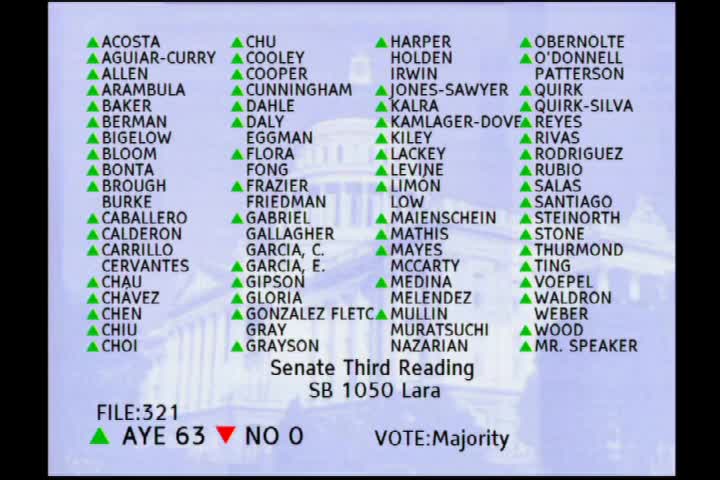 1MIN
Assembly Floor
 1H
Assembly Standing Committee on Appropriations
 1MIN
Senate Floor
Bill Author