SB 1172: High-Speed Rail Authority: property acquisition: capital outlays: public contracts: county assessor’s records.
- Session Year: 2017-2018
- House: Senate
- Latest Version Date: 2018-09-26
(1)Existing law creates the High-Speed Rail Authority with specified powers and duties relative to the development and implementation of a high-speed train system, including the acquisition of rights-of-way through purchase and eminent domain. Existing law, pursuant to the Safe, Reliable High-Speed Passenger Train Bond Act for the 21st Century, approved by the voters at the November 4, 2008, general election, provides for the issuance of $9.95 billion in bonds for high-speed rail train capital projects and other associated purposes.
The California Constitution permits the taking of private property for public use only when just compensation is paid. The Eminent Domain Law prescribes the procedures for the exercise of that constitutionally authorized power. Under that law, a public entity may not commence an eminent domain proceeding until its governing body has adopted a resolution of necessity that meets specified requirements. Existing law defines governing body for these purposes with respect to various state and local public entities.
This bill would specify that the State Public Works Board is the governing body for these purposes for a taking by the High-Speed Rail Authority.
(2)Existing law generally requires the approval of the Director of Finance before the state may accept a gift or dedication of personal or real property and the approval of the Director of General Services before a state agency may acquire, hire, dispose, or let real property in fee or in a lesser interest. Existing law specifies that those provisions do not apply in certain circumstances, including the acquisition or hiring of real property by the Department of Transportation.
This bill would enact similar exceptions relative to property obtained for high-speed rail purposes by the High-Speed Rail Authority. The bill would make various additional conforming changes.
(3)Existing law, except as specified, prohibits the expenditure of funds for capital outlay by any state agency until the Department of Finance and the State Public Works Board have approved preliminary plans for the project to be funded from a capital outlay appropriation. Existing law authorizes the State Public Works Board to augment a major project of up to 20% of the total capital outlay appropriations for the project, as provided, but also authorizes the Department of Finance to change the administratively or legislatively approved scope for major capital outlay projects. Under existing law, these provisions do not limit or control the Department of Transportation or the California Exposition and State Fair in the expenditure of all funds appropriated to those entities for capital outlay purposes.
This bill would additionally state that these provisions do not limit or control the High-Speed Rail Authority in the expenditure of all funds appropriated to the authority for capital outlay purposes.
(4)Existing law requires that any acquisition of land or other real property authorized in any appropriation be subject to the Property Acquisition Law, except for an appropriation from the California Water Fund or an appropriation to the Department of Transportation for capital outlay purposes.
This bill would additionally exempt from this requirement an appropriation to the High-Speed Rail Authority for capital outlay purposes.
(5)The Property Acquisition Law requires that all land and other real property to be acquired by or for any state agency, with specified exceptions, be acquired by the State Public Works Board in accordance with that law, except for land and other real property to be acquired by or for specified agencies. That law specifies that, with certain exceptions, the State Public Works Board is the only state agency that may exercise the power of eminent domain to acquire property needed by any state agency for any state purpose or function.
This bill would exempt land and other real property acquired by or for, and the exercise of the power of eminent domain by, the High-Speed Rail Authority from these provisions.
(6)Under the State Contract Act, projects that are not under the jurisdiction of specified departments are under the charge and control of the Department of General Services.
This bill would add the High-Speed Rail Authority as an agency whose projects are not under the charge and control of the Department of General Services.
(7)Existing property tax law requires a county assessor to disclose information, furnish abstracts, or permit access to all records in his or her office to specified state and local public entities. Whenever the assessor discloses information, furnishes abstracts, or permits access to records in his or her office to staff appraisers of specified state agencies, existing property tax law requires those agencies to reimburse the assessor for any cost incurred.
This bill would additionally require the county assessor to disclose information, furnish abstracts, or permit access to records in his or her office to the High-Speed Rail Authority and require the authority to reimburse the assessor for costs.
By adding to the duties of county assessors, this bill would impose a state-mandated local program.
(8)This bill would require the High-Speed Rail Authority to submit a report to specified committees of the Legislature on or before January 1, 2020, detailing how the provisions of this bill have affected the authoritys property acquisition process.
(9)This bill would incorporate additional changes to Section 408 of the Revenue and Taxation Code proposed by AB 2425 to be operative only if this bill and AB 2425 are enacted and this bill is enacted last.
(10)The California Constitution requires the state to reimburse local agencies and school districts for certain costs mandated by the state. Statutory provisions establish procedures for making that reimbursement.
This bill would provide that, if the Commission on State Mandates determines that the bill contains costs mandated by the state, reimbursement for those costs shall be made pursuant to the statutory provisions noted above.
(1)Existing law creates the High-Speed Rail Authority with specified powers and duties relative to the development and implementation of a high-speed train system, including the acquisition of rights-of-way through purchase and eminent domain. Existing law, pursuant to the Safe, Reliable High-Speed Passenger Train Bond Act for the 21st Century, approved by the voters at the November 4, 2008, general election, provides for the issuance of $9.95 billion in bonds for high-speed rail train capital projects and other associated purposes.
The California Constitution permits the taking of private property for public use only when just compensation is paid. The Eminent Domain Law prescribes the procedures for the exercise of that constitutionally authorized power. Under that law, a public entity may not commence an eminent domain proceeding until its governing body has adopted a resolution of necessity that meets specified requirements. Existing law defines governing body for these purposes with respect to various state and local public entities.
This bill would specify that the State Public Works Board is the governing body for these purposes for a taking by the High-Speed Rail Authority.
(2)Existing law generally requires the approval of the Director of Finance before the state may accept a gift or dedication of personal or real property and the approval of the Director of General Services before a state agency may acquire, hire, dispose, or let real property in fee or in a lesser interest. Existing law specifies that those provisions do not apply in certain circumstances, including the acquisition or hiring of real property by the Department of Transportation.
This bill would enact similar exceptions relative to property obtained for high-speed rail purposes by the High-Speed Rail Authority. The bill would make various additional conforming changes.
(3)Existing law, except as specified, prohibits the expenditure of funds for capital outlay by any state agency until the Department of Finance and the State Public Works Board have approved preliminary plans for the project to be funded from a capital outlay appropriation. Existing law authorizes the State Public Works Board to augment a major project of up to 20% of the total capital outlay appropriations for the project, as provided, but also authorizes the Department of Finance to change the administratively or legislatively approved scope for major capital outlay projects. Under existing law, these provisions do not limit or control the Department of Transportation or the California Exposition and State Fair in the expenditure of all funds appropriated to those entities for capital outlay purposes.
This bill would additionally state that these provisions do not limit or control the High-Speed Rail Authority in the expenditure of all funds appropriated to the authority for capital outlay purposes.
(4)Existing law requires that any acquisition of land or other real property authorized in any appropriation be subject to the Property Acquisition Law, except for an appropriation from the California Water Fund or an appropriation to the Department of Transportation for capital outlay purposes.
This bill would additionally exempt from this requirement an appropriation to the High-Speed Rail Authority for capital outlay purposes.
(5)The Property Acquisition Law requires that all land and other real property to be acquired by or for any state agency, with specified exceptions, be acquired by the State Public Works Board in accordance with that law, except for land and other real property to be acquired by or for specified agencies. That law specifies that, with certain exceptions, the State Public Works Board is the only state agency that may exercise the power of eminent domain to acquire property needed by any state agency for any state purpose or function.
This bill would exempt land and other real property acquired by or for, and the exercise of the power of eminent domain by, the High-Speed Rail Authority from these provisions.
(6)Under the State Contract Act, projects that are not under the jurisdiction of specified departments are under the charge and control of the Department of General Services.
This bill would add the High-Speed Rail Authority as an agency whose projects are not under the charge and control of the Department of General Services.
(7)Existing property tax law requires a county assessor to disclose information, furnish abstracts, or permit access to all records in his or her office to specified state and local public entities. Whenever the assessor discloses information, furnishes abstracts, or permits access to records in his or her office to staff appraisers of specified state agencies, existing property tax law requires those agencies to reimburse the assessor for any cost incurred.
This bill would additionally require the county assessor to disclose information, furnish abstracts, or permit access to records in his or her office to the High-Speed Rail Authority and require the authority to reimburse the assessor for costs.
By adding to the duties of county assessors, this bill would impose a state-mandated local program.
(8)This bill would require the High-Speed Rail Authority to submit a report to specified committees of the Legislature on or before January 1, 2020, detailing how the provisions of this bill have affected the authoritys property acquisition process.
(9)This bill would incorporate additional changes to Section 408 of the Revenue and Taxation Code proposed by AB 2425 to be operative only if this bill and AB 2425 are enacted and this bill is enacted last.
(9)(10)The California Constitution requires the state to reimburse local agencies and school districts for certain costs mandated by the state. Statutory provisions establish procedures for making that reimbursement.
This bill would provide that, if the Commission on State Mandates determines that the bill contains costs mandated by the state, reimbursement for those costs shall be made pursuant to the statutory provisions noted above.
(1)Existing law creates the High-Speed Rail Authority with specified powers and duties relative to the development and implementation of a high-speed train system, including the acquisition of rights-of-way through purchase and eminent domain. Existing law, pursuant to the Safe, Reliable High-Speed Passenger Train Bond Act for the 21st Century, approved by the voters at the November 4, 2008, general election, provides for the issuance of $9.95 billion in bonds for high-speed rail train capital projects and other associated purposes.
The California Constitution permits the taking of private property for public use only when just compensation is paid. The Eminent Domain Law prescribes the procedures for the exercise of that constitutionally authorized power. Under that law, a public entity may not commence an eminent domain proceeding until its governing body has adopted a resolution of necessity that meets specified requirements. Existing law defines governing body for these purposes with respect to various state and local public entities.
This bill would specify that the State Public Works Board is the governing body for these purposes for a taking by the High-Speed Rail Authority.
(2)Existing law generally requires the approval of the Director of Finance before the state may accept a gift or dedication of personal or real property and the approval of the Director of General Services before a state agency may acquire, hire, dispose, or let real property in fee or in a lesser interest. Existing law specifies that those provisions do not apply in certain circumstances, including the acquisition or hiring of real property by the Department of Transportation. Existing law requires the Department of General Services to inventory state-owned property other than property owned by the Department of Transportation, among other agencies.
This bill would enact similar exceptions relative to property obtained for high-speed rail purposes by the High-Speed Rail Authority. The bill would make various additional conforming changes.
(3)Existing law, except as specified, prohibits the expenditure of funds for capital outlay by any state agency until the Department of Finance and the State Public Works Board have approved preliminary plans for the project to be funded from a capital outlay appropriation. Existing law authorizes the State Public Works Board to augment a major project of up to 20% of the total capital outlay appropriations for the project, as provided, but also authorizes the Department of Finance to change the administratively or legislatively approved scope for major capital outlay projects. Under existing law, these provisions do not limit or control the Department of Transportation or the California Exposition and State Fair in the expenditure of all funds appropriated to those entities for capital outlay purposes.
This bill would additionally state that these provisions do not limit or control the High-Speed Rail Authority in the expenditure of all funds appropriated to the authority for capital outlay purposes.
(4)Existing law requires that any acquisition of land or other real property authorized in any appropriation be subject to the Property Acquisition Law, except for an appropriation from the California Water Fund or an appropriation to the Department of Transportation for capital outlay purposes.
This bill would additionally exempt from this requirement an appropriation to the High-Speed Rail Authority for capital outlay purposes.
(5)The Property Acquisition Law requires that all land and other real property to be acquired by or for any state agency, with specified exceptions, be acquired by the State Public Works Board in accordance with that law, except for land and other real property to be acquired by or for specified agencies. That law specifies that, with certain exceptions, the State Public Works Board is the only state agency that may exercise the power of eminent domain to acquire property needed by any state agency for any state purpose or function.
This bill would exempt land and other real property acquired by or for, and the exercise of the power of eminent domain by, the High-Speed Rail Authority from these provisions.
(6)Under the State Contract Act, projects that are not under the jurisdiction of specified departments are under the charge and control of the Department of General Services.
This bill would add the High-Speed Rail Authority as an agency whose projects are not under the charge and control of the Department of General Services.
(7)Existing property tax law requires a county assessor to disclose information, furnish abstracts, or permit access to all records in his or her office to specified state and local public entities. Whenever the assessor discloses information, furnishes abstracts, or permits access to records in his or her office to staff appraisers of specified state agencies, existing property tax law requires those agencies to reimburse the assessor for any cost incurred.
This bill would additionally require the county assessor to disclose information, furnish abstracts, or permit access to records in his or her office to the High-Speed Rail Authority and require the authority to reimburse the assessor for costs.
By adding to the duties of county assessors, this bill would impose a state-mandated local program.
(8)This bill would require the High-Speed Rail Authority to submit a report to specified committees of the Legislature on or before January 1, 2020, detailing how the provisions of this bill have affected the authoritys property acquisition process.
(9)The California Constitution requires the state to reimburse local agencies and school districts for certain costs mandated by the state. Statutory provisions establish procedures for making that reimbursement.
This bill would provide that, if the Commission on State Mandates determines that the bill contains costs mandated by the state, reimbursement for those costs shall be made pursuant to the statutory provisions noted above.
Existing law, the California High-Speed Rail Act, creates the High-Speed Rail Authority to develop and implement a high-speed train system in the state, with specified powers and duties. Existing law authorizes the authority, among other things, to keep the public informed of its activities.This bill would revise that provision to instead authorize the authority to keep the public informed through activities, including, but not limited to, community outreach events, public information workshops, and newsletters posted on the authoritys Internet Web site.Existing law, the California High-Speed Rail Act, creates the High-Speed Rail Authority to develop and implement a high-speed train system in the state, with specified powers and duties. Existing law authorizes the authority, among other things, to keep the public informed of its activities.
This bill would revise that provision to instead authorize the authority to keep the public informed through activities, including, but not limited to, community outreach events, public information workshops, and newsletters posted on the authoritys Internet Web site.
As used in this article, governing body means:
(a)In the case of a taking by a local public entity, the legislative body of the local public entity.
(b)In the case of a taking by the Sacramento and San Joaquin Drainage District, the Central Valley Flood Protection Board.
(c)In the case of a taking by the State Public Works Board pursuant to the Property Acquisition Law (Part 11 (commencing with Section 15850) of Division 3 of Title 2 of the Government Code), the State Public Works Board.
(d)In the case of a taking by the Department of Fish and Wildlife pursuant to Section 1348 of the Fish and Game Code, the Wildlife Conservation Board.
(e)In the case of a taking by the Department of Transportation (other than a taking pursuant to Section 21633 of the Public Utilities Code or Section 30100 of the Streets and Highways Code), the California Transportation Commission.
(f)In the case of a taking by the Department of Transportation pursuant to Section 21633 of the Public Utilities Code, the California Transportation Commission.
(g)In the case of a taking by the Department of Transportation pursuant to Section 30100 of the Streets and Highways Code, the California Transportation Commission.
(h)In the case of a taking by the Department of Water Resources, the California Water Commission.
(i)In the case of a taking by the University of California, the Regents of the University of California.
(j)In the case of a taking by the State Lands Commission, the State Lands Commission.
(k)In the case of a taking by Hastings College of Law, the board of directors of that college.
(l)In the case of a taking by the High-Speed Rail Authority, the State Public Works Board.
SEC. 2.Section 11005 of the Government Code is amended to read:11005.(a)Unless the Legislature specifically provides that approval is not required, every gift or dedication to the state of personal property, or every gift to the state of real property in fee or in any lesser estate or interest, shall be approved by the Director of Finance, and every contract for the acquisition or hiring of real property in fee or in any lesser estate or interest, entered into by or on behalf of the state, shall be approved by the Director of General Services. Any contract entered into in violation of this section is void. This section applies to any state agency that, by general or specific statute, is expressly or impliedly authorized to enter into transactions referred to in this section.
(b)This section does not apply to any of the following:
(1)Unconditional gifts of money.
(2)The acquisition or hiring by the Department of Transportation of real property in fee or in any lesser estate or interest for highway purposes, but this section does apply to the hiring by that department of office space in any office building.
(3)Contracts entered into under the authority of Chapter 4 (commencing with Section 11770) of Part 3 of Division 2 of the Insurance Code.
(4)The receipt of donated, unencumbered personal property from private sources received in conjunction with the administration of the Federal Surplus Personal Property Program by the Department of General Services.
(5)The receipt of gifts of personal property in the form of interpretive or historical objects, each valued at fifteen thousand dollars ($15,000) or less, by the Department of Parks and Recreation.
(6)The acceptance by the State Coastal Conservancy of offers to dedicate public accessways made pursuant to Division 20 (commencing with Section 30000) of the Public Resources Code.
(7)The acquisition or hiring by the High-Speed Rail Authority of real property in fee or in any lesser estate or interest for high-speed rail purposes, but this section does apply to the hiring by that authority of office space in any office building.
SEC. 3.Section 11005.2 of the Government Code is amended to read:11005.2.(a)Unless the Legislature specifically provides that approval by the Director of General Services is not required, every conveyance, contract, or agreement whereby an interest of the state in any real property is conveyed, demised, or let to any person, shall, before the conveyance, contract, or agreement is executed or entered into, be approved by the Director of General Services. Any conveyance, contract, or agreement executed or entered into in violation of this section is void. This section shall apply to any state agency which, by general or specific statute, is expressly or impliedly authorized to enter into transactions referred to in this section.
(b)This does not apply to real property acquired by the Department of Transportation for highway purposes, real property acquired by the High-Speed Rail Authority for high-speed rail purposes, or real property administered by the State Lands Commission, the Controller, or the State Compensation Insurance Fund.
SEC. 4.Section 13332.11 of the Government Code is amended to read:13332.11.(a)(1)Except as otherwise specified in paragraph (2), funds appropriated for capital outlay shall not be expended by any state agency, including, but not limited to, the University of California, the California State University, the California Community Colleges, and the Judicial Council, until the Department of Finance and the State Public Works Board have approved preliminary plans for the project to be funded from a capital outlay appropriation.
(2)Paragraph (1) shall not apply to any of the following:
(A)Amounts for acquisition of real property in fee, or any other lesser interest.
(B)Amounts for equipment or minor capital outlay projects.
(C)Amounts appropriated for preliminary plans, surveys, and studies.
(b)Notwithstanding subdivision (a), approvals by the State Public Works Board and the Department of Finance for the University of California and the California Community Colleges shall apply only to the allocation of state capital outlay funds appropriated by the Legislature, including land acquisition and equipment funds.
(c)Any appropriated amounts for working drawings or construction where the working drawings or construction have been started by any state agency prior to approval of the preliminary plans by the State Public Works Board shall be reverted to the fund from which the appropriation was made, as approved by the Department of Finance. A major project for which a capital outlay appropriation is made shall not be put out to bid until the working drawings have been approved by the Department of Finance. A substantial change shall not be made to the approved preliminary plans or approved working drawings without written approval by the Department of Finance. The Department of Finance shall approve any proposed construction bid alternates.
(d)The Department of Finance shall approve the use of funds from a capital outlay appropriation for the purchase of any significant unit of equipment.
(e)The State Public Works Board may augment a major project in an amount of up to 20 percent of the total of the capital outlay appropriations for the project, irrespective of whether any such appropriation has reverted. For projects authorized through multiple fund sources, including, but not limited to, general obligation bonds and lease-revenue bonds, to the extent otherwise permissible, the Department of Finance shall have full authority to determine which of the fund sources will bear all or part of an augmentation. The board shall defer all augmentations in excess of 20 percent of the amount appropriated for each capital outlay project until the Legislature makes additional funds available for the specific project.
(f)In addition to the powers provided by Section 15849.6, the State Public Works Board may further increase the additional amount in Section 15849.6 to include a reasonable construction reserve within the construction fund for any capital outlay project without augmenting the project. The amount of the construction reserve shall be within the 20 percent augmentation limitation. The board may use this amount to augment the project, when and if necessary, after the lease-revenue bonds are sold to ensure completion of the project.
(g)Augmentations in excess of 10 percent of the amount appropriated for each capital outlay project shall be reported to the Chairperson of the Joint Legislative Budget Committee, or his or her designee, 20 days prior to board approval, or not sooner than whatever lesser time the chairperson, or his or her designee, may in each instance determine.
(h)(1)The Department of Finance may change the administratively or legislatively approved scope for major capital outlay projects.
(2)If the Department of Finance changes the approved scope pursuant to paragraph (1), the department shall report the changes and associated cost implications to the Chairperson of the Joint Legislative Budget Committee, the chairpersons of the respective fiscal committees, and the legislative advisers of the State Public Works Board 20 days prior to the proposed board action to recognize the scope change.
(i)The State Public Works Board shall defer action with respect to approval of an acquisition project, when it is determined that the estimated cost of the total acquisition project, as approved by the Legislature is in excess of 20 percent of the amount appropriated, unless it is determined that a lesser portion of the property is sufficient to meet the objectives of the project approved by the Legislature, and the Chairperson of the Joint Legislative Budget Committee, or his or her designee, is provided a 20-day prior notification of the proposed reductions in the acquisition project, or whatever lesser period the chairperson, or his or her designee, may in each instance determine.
(j)The Department of Finance shall report to the Chairperson of the Joint Legislative Budget Committee, the chairpersons of the respective fiscal committees, and legislative advisers of the State Public Works Board 20 days prior to the proposed board approval of preliminary plans when it is determined that the estimated cost of the total capital outlay construction project is in excess of 20 percent of the amount recognized by the Legislature.
(k)Nothing in this section shall be construed to limit or control the Department of Transportation, the High-Speed Rail Authority, or the California Exposition and State Fair in the expenditure of all funds appropriated to those entities for capital outlay purposes.
SEC. 5.Section 13332.12 of the Government Code is amended to read:13332.12.(a)Any acquisition of land or other real property authorized in any appropriation, except an appropriation from the California Water Fund or an appropriation to the Department of Transportation or the High-Speed Rail Authority for capital outlay purposes, shall be subject to the provisions of the Property Acquisition Law (Part 11 (commencing with Section 15850)). Nothing in this section shall be construed as exempting the California Coastal Commission from this section.
(b)All property acquisitions, including those exempted pursuant to subdivision (a), shall be reported to the State Public Works Board.
SEC. 6.Section 15853 of the Government Code is amended to read:15853.(a)The board may select and acquire, in the name of and on behalf of the state, with the consent of the state agency concerned, the fee or any lesser right or interest in any real property necessary for any state purpose or function.
(b)If moneys are appropriated by the Budget Act for any fiscal year or by any other act for the acquisition of land or other real property, either (1) subject to this part or (2) for any state agency for whom property is acquired by the board, the moneys and acquisitions are subject to this part and the moneys shall be expended in accordance with this part, notwithstanding any other law.
(c)Notwithstanding any other law, all land and other real property to be acquired by or for any state agency, other than the Department of Transportation, the High-Speed Rail Authority, the Department of Water Resources, the Central Valley Flood Protection Board, the Department of Fish and Wildlife, the Wildlife Conservation Board, the Public Employees Retirement System, the State Teachers Retirement System, the Department of Housing and Community Development, the State Lands Commission, except for property to be acquired for the State Lands Commission pursuant to an appropriation from the General Fund, and the State Coastal Conservancy with respect to acceptance of offers to dedicate public accessways made pursuant to the California Coastal Act (Division 20 (commencing with Section 30000)) of, and for the purposes of Chapter 10 (commencing with Section 31411) of Division 21 of, the Public Resources Code, shall be acquired by the State Public Works Board in accordance with this part.
(d)(1)Notwithstanding subdivision (a), the board shall acquire, on behalf of and for the Department of Parks and Recreation, in accordance with this part, any interests in real property, including options to purchase, which have been appraised, selected, and settled through purchase negotiations by the Department of Parks and Recreation pursuant to subdivision (b) of Section 5006 of the Public Resources Code. Out of moneys appropriated for the acquisition of options to purchase, no more than ten thousand dollars ($10,000) may be expended for the acquisition of any single option unless otherwise provided by the Legislature.
(2)Notwithstanding Section 15854, purchase negotiations for interests in real property for the state park system pursuant to subdivision (d) of Section 5006 of the Public Resources Code shall be initiated within six months of the effective date of the act that appropriates funds for the acquisition. Purchase negotiations on all projects not proposed pursuant to subdivision (d) of Section 5006 of the Public Resources Code shall be initiated within 12 months of the effective date of the act appropriating funds for the acquisition. Either title shall be conveyed or a written agreement to transfer title shall be executed within the appropriate authorization period unless the Department of Parks and Recreation formally abandons the acquisition prior to the conclusion of the appropriate authorization period. For the purposes of this section, in order for the Department of Parks and Recreation to formally abandon an acquisition, it shall transmit written notification to the board of its intent not to proceed with the acquisition.
(3)The board, at any time during the periods specified in paragraph (2), may commence condemnation proceedings if it finds it to be appropriate. However, if during the appropriate authorization period title is not conveyed or a written agreement to transfer title is not signed, the acquisition has not been formally abandoned, or condemnation proceedings have not been commenced, the Department of Parks and Recreation shall notify, by letter, the chair of the committee in each house of the Legislature that considers appropriations, the Chair of the Joint Legislative Budget Committee, and the Members of the Legislature within whose district any part of the land or other real property is located of the status of the acquisition. For the purpose of this paragraph, condemnation proceedings shall be deemed to be commenced as of the date the board authorizes acquisition by condemnation.
(4)The board may schedule special meetings as are necessary to expedite the acquisition of options to purchase real property for the state park system.
(e)The board may acquire furnishings that the owner thereof agrees to sell and that are contained within improvements acquired by the board. The cost of acquisition of furnishings shall be charged to the appropriation available for acquisition of the real property.
(f)This section shall not apply to the acquisition of conservation easements made pursuant to the California Forest Legacy Program Act of 2007 (Division 10.5 (commencing with Section 12200) of the Public Resources Code).
SEC. 7.Section 15855 of the Government Code is amended to read:15855.(a)Notwithstanding any other law, except as provided in subdivision (b), the State Public Works Board is the only state agency that may exercise the power of eminent domain to acquire property needed by any state agency for any state purpose or function.
(b)Subdivision (a) does not affect or limit the right of the Department of Transportation, High-Speed Rail Authority, Department of Water Resources, State Lands Commission, Central Valley Flood Protection Board, Hastings College of the Law, or the Regents of the University of California to exercise the power of eminent domain. Subdivision (a) does not affect or limit the exercise of the power of eminent domain by the Department of Fish and Wildlife pursuant to Section 1348 of the Fish and Game Code.
(c)(1)Any eminent domain proceeding commenced by the State Public Works Board for an acquisition for high-speed train system purposes prior to, and pending after, January 1, 2019, shall be deemed to have been commenced by the High-Speed Rail Authority, and the High-Speed Rail Authority shall be automatically substituted for the State Public Works Board as a party in any such action. All subsequent proceedings shall be in the name of the High-Speed Rail Authority. However, any misnomer not affecting the parties substantial rights shall be disregarded. The court may order substitution at any time, but the absence of such an order does not affect the substitution.
(2)The State Public Works Board shall file with the court and serve on all parties to an action described in paragraph (1) a notice that the High-Speed Rail Authority is automatically substituted in place of the State Public Works Board and is the agency exercising the power of eminent domain on behalf of the state in the action.
SEC. 8.Section 10106 of the Public Contract Code is amended to read:10106.For purposes of this chapter:
(a)Department means any of the following:
(1)The Department of Water Resources as to any project under the jurisdiction of that department.
(2)The Department of Transportation as to any project under the jurisdiction of that department.
(3)The Department of Parks and Recreation as to any project under the jurisdiction of that department.
(4)The Department of Corrections and Rehabilitation with respect to any project under its jurisdiction pursuant to Chapter 11 (commencing with Section 7000) of Title 7 of Part 3 of the Penal Code.
(5)The Military Department as to any project under the jurisdiction of that department.
(6)The High-Speed Rail Authority as to any project under the jurisdiction of that authority.
(7)The Department of General Services as to all other projects.
(b)Director means the director of each department as defined in this section respectively or the executive director, also known as the chief executive officer, in the case of the High-Speed Rail Authority.
SEC. 9.Section 10107 of the Public Contract Code is amended to read:10107.Whenever provision is made by law for any project that is not under the jurisdiction of the Department of Water Resources, the Department of Parks and Recreation, the Department of Corrections and Rehabilitation pursuant to Chapter 11 (commencing with Section 7000) of Title 7 of Part 3 of the Penal Code, the Department of Transportation, the High-Speed Rail Authority, or the Military Department, the project shall be under the sole charge and direct control of the Department of General Services.
SEC. 10.Section 408 of the Revenue and Taxation Code is amended to read:408.(a)Except as otherwise provided in subdivisions (b), (c), (d), (e), and (g), any information and records in the assessors office that are not required by law to be kept or prepared by the assessor, disabled veterans exemption claims, and homeowners exemption claims are not public documents and shall not be open to public inspection. Property receiving the homeowners exemption shall be clearly identified on the assessment roll. The assessor shall maintain records that shall be open to public inspection to identify those claimants who have been granted the homeowners exemption.
(b)(1)The assessor may provide any appraisal data in his or her possession to the assessor of any county.
(2)The assessor shall disclose information, furnish abstracts, or permit access to all records in his or her office to law enforcement agencies, the county grand jury, the board of supervisors or their duly authorized agents, employees, or representatives when conducting an investigation of the assessors office pursuant to Section 25303 of the Government Code, the county recorder when conducting an investigation to determine whether a documentary transfer tax is imposed, the Controller, employees of the Controller for property tax postponement purposes, probate referees, employees of the Franchise Tax Board for tax administration purposes only, staff appraisers of the Division of Financial Institutions, the Department of Transportation, the Department of General Services, the High-Speed Rail Authority, the State Board of Equalization, the State Lands Commission, the State Department of Social Services, the Department of Child Support Services, the Department of Water Resources, and other duly authorized legislative or administrative bodies of the state pursuant to their authorization to examine the records. Whenever the assessor discloses information, furnishes abstracts, or permits access to records in his or her office to staff appraisers of the Department of Business Oversight, the Department of Transportation, the Department of General Services, the High-Speed Rail Authority, the State Lands Commission, or the Department of Water Resources pursuant to this section, the department, commission, or authority shall reimburse the assessor for any costs incurred as a result.
(c)Upon the request of the tax collector, the assessor shall disclose and provide to the tax collector information used in the preparation of that portion of the unsecured roll for which the taxes thereon are delinquent. The tax collector shall certify to the assessor that he or she needs the information requested for the enforcement of the tax lien in collecting those delinquent taxes. Information requested by the tax collector may include social security numbers, and the assessor shall recover from the tax collector his or her actual and reasonable costs for providing the information. The tax collector shall add the costs described in the preceding sentence to the assessees delinquent tax lien and collect those costs subject to subdivision (e) of Section 2922.
(d)The assessor shall, upon the request of an assessee or his or her designated representative, permit the assessee or representative to inspect or copy any market data in the assessors possession. For purposes of this subdivision, market data means any information in the assessors possession, whether or not required to be prepared or kept by him or her, relating to the sale of any property comparable to the property of the assessee, if the assessor bases his or her assessment of the assessees property, in whole or in part, on that comparable sale or sales. The assessor shall provide the names of the seller and buyer of each property on which the comparison is based, the location of that property, the date of the sale, and the consideration paid for the property, whether paid in money or otherwise. However, for purposes of providing market data, the assessor shall not display any document relating to the business affairs or property of another.
(e)(1)With respect to information, documents, and records, other than market data as defined in subdivision (d), the assessor shall, upon request of an assessee of property or his or her designated representative, permit the assessee or representative to inspect or copy all information, documents, and records, including auditors narrations and workpapers, whether or not required to be kept or prepared by the assessor, relating to the appraisal and the assessment of the assessees property, and any penalties and interest.
(2)After enrolling an assessment, the assessor shall respond to a written request for information supporting the assessment, including, but not limited to, any appraisal and other data requested by the assessee.
(3)Except as provided in Section 408.1, an assessee or his or her designated representative shall not be permitted to inspect or copy information and records that also relate to the property or business affairs of another, unless that disclosure is ordered by a competent court in a proceeding initiated by a taxpayer seeking to challenge the legality of the assessment of his or her property.
(f)(1)Permission for the inspection or copying requested pursuant to subdivision (d) or (e) shall be granted as soon as reasonably possible to the assessee or his or her designated representative.
(2)If the assessee or his or her designated representative requests the assessor to make copies of any of the requested records, the assessee shall reimburse the assessor for the reasonable costs incurred in reproducing and providing the copies.
(3)If the assessor fails to permit the inspection or copying of materials or information as requested pursuant to subdivision (d) or (e) and the assessor introduces any requested materials or information at any assessment appeals board hearing, the assessee or his or her representative may request and shall be granted a continuance for a reasonable period of time. The continuance shall extend the two-year period specified in subdivision (c) of Section 1604 for a period of time equal to the period of continuance.
(g)Upon the written request of the tax collector, the assessor shall provide to the tax collector information for the preparation and enforcement of Part 6 (commencing with Section 3351). The tax collector shall certify to the assessor that he or she needs the contact information to assist with the preparation and enforcement of Part 6 (commencing with Section 3351). The assessor shall provide the information, which may not include social security numbers. Any information provided to the tax collector pursuant to this subdivision shall not become a public record and shall not be open to public inspection. The tax collector shall reimburse the assessor for the actual and reasonable costs incurred by the assessor for providing the information to administer this subdivision. The tax collector shall add the costs described in the preceding sentence to the assessees delinquent taxes and include the costs incurred subject to Sections 4112 and 4672.2. The tax collector or his or her designated employee shall, under penalty of perjury, certify to the assessor that he or she needs the information to assist with the preparation and enforcement of Part 6 (commencing with Section 3351), and that the information provided pursuant to this subdivision that is not a public record and that is not open to public inspection shall not become a public record and shall not be open to public inspection.
SEC. 10.5.Section 408 of the Revenue and Taxation Code is amended to read:408.(a)Except as otherwise provided in subdivisions (b), (c), (d), (e), and (g), any information and records in the assessors office that are not required by law to be kept or prepared by the assessor, disabled veterans exemption claims, and homeowners exemption claims are not public documents and shall not be open to public inspection. Property receiving the homeowners exemption shall be clearly identified on the assessment roll. The assessor shall maintain records that shall be open to public inspection to identify those claimants who have been granted the homeowners exemption.
(b)(1)The assessor may provide any appraisal data in his or her possession to the assessor of any county.
(2)The assessor shall disclose information, furnish abstracts, or permit access to all records in his or her office to law enforcement agencies, the county grand jury, the board of supervisors or their duly authorized agents, employees, or representatives when conducting an investigation of the assessors office pursuant to Section 25303 of the Government Code, the county recorder when conducting an investigation to determine whether a documentary transfer tax is imposed, the Controller, employees of the Controller for property tax postponement purposes, probate referees, employees of the Franchise Tax Board for tax administration purposes only, staff appraisers of the Division of Financial Institutions, the Department of Transportation, the Department of General Services, the High-Speed Rail Authority, the State Board of Equalization, the State Lands Commission, the State Department of Social Services, the Department of Child Support Services, the Department of Water Resources, and other duly authorized legislative or administrative bodies of the state pursuant to their authorization to examine the records. Whenever the assessor discloses information, furnishes abstracts, or permits access to records in his or her office to staff appraisers of the Department of Business Oversight, the Department of Transportation, the Department of General Services, the High-Speed Rail Authority, the State Lands Commission, or the Department of Water Resources pursuant to this section, the department, commission, or authority shall reimburse the assessor for any costs incurred as a result.
(c)Upon the request of the tax collector, the assessor shall disclose and provide to the tax collector information used in the preparation of that portion of the unsecured roll for which the taxes thereon are delinquent. The tax collector shall certify to the assessor that he or she needs the information requested for the enforcement of the tax lien in collecting those delinquent taxes. Information requested by the tax collector may include social security numbers, and the assessor shall recover from the tax collector his or her actual and reasonable costs for providing the information. The tax collector shall add the costs described in the preceding sentence to the assessees delinquent tax lien and collect those costs subject to subdivision (e) of Section 2922.
(d)The assessor shall, upon the request of an assessee or his or her designated representative, permit the assessee or representative to inspect or copy any market data in the assessors possession. For purposes of this subdivision, market data means any information in the assessors possession, whether or not required to be prepared or kept by him or her, relating to the sale of any property comparable to the property of the assessee, if the assessor bases his or her assessment of the assessees property, in whole or in part, on that comparable sale or sales. The assessor shall provide the names of the seller and buyer of each property on which the comparison is based, the location of that property, the date of the sale, and the consideration paid for the property, whether paid in money or otherwise. However, for purposes of providing market data, the assessor shall not display any document relating to the business affairs or property of another.
(e)(1)With respect to information, documents, and records, other than market data as defined in subdivision (d), the assessor shall, upon request of an assessee of property or his or her designated representative, permit the assessee or representative to inspect or copy all information, documents, and records, including auditors narrations and workpapers, whether or not required to be kept or prepared by the assessor, relating to the appraisal and the assessment of the assessees property, and any penalties and interest.
(A)Upon written request of an assessee or the assessees designated representative, the assessor shall transmit the information, documents, or records described in paragraph (1) by mail, or in electronic format if the information, documents, or records are available in electronic format or have been previously digitized. This subparagraph shall not be construed or interpreted to limit the authority of the assessee or the assessees designated representative to also inspect or copy information, documents, or records described in paragraph (1).
(B)Information, documents, and records requested by an assessee, or the assessees representative, shall be transmitted pursuant to subparagraph (A) within a reasonable time period.
(C)The costs enumerated in subdivision (a) of Section 409 shall not apply to information, documents, or records requested by the assessee or the assessees designated representative if that information is transmitted in electronic format, except that any developmental or indirect costs to provide that information, such as costs to acquire or compile data that is not required to be kept or prepared by the assessor, may be recovered pursuant to Section 409.
(2)After enrolling an assessment, the assessor shall respond to a written request for information supporting the assessment, including, but not limited to, any appraisal and other data requested by the assessee.
(3)Except as provided in Section 408.1, an assessee or his or her designated representative shall not be permitted to inspect or copy information and records that also relate to the property or business affairs of another, unless that disclosure is ordered by a competent court in a proceeding initiated by a taxpayer seeking to challenge the legality of the assessment of his or her property.
(f)(1)Permission for the inspection or copying requested pursuant to subdivision (d) or (e) shall be granted as soon as reasonably possible to the assessee or his or her designated representative.
(2)If the assessee or his or her designated representative requests the assessor to make copies of any of the requested records, the assessee shall reimburse the assessor for the reasonable costs incurred in reproducing and providing the copies.
(3)If the assessor fails to permit the inspection or copying of materials or information as requested pursuant to subdivision (d) or (e) and the assessor introduces any requested materials or information at any assessment appeals board hearing, the assessee or his or her representative may request and shall be granted a continuance for a reasonable period of time. The continuance shall extend the two-year period specified in subdivision (c) of Section 1604 for a period of time equal to the period of continuance.
(g)Upon the written request of the tax collector, the assessor shall provide to the tax collector information for the preparation and enforcement of Part 6 (commencing with Section 3351). The tax collector shall certify to the assessor that he or she needs the contact information to assist with the preparation and enforcement of Part 6 (commencing with Section 3351). The assessor shall provide the information, which may not include social security numbers. Any information provided to the tax collector pursuant to this subdivision shall not become a public record and shall not be open to public inspection. The tax collector shall reimburse the assessor for the actual and reasonable costs incurred by the assessor for providing the information to administer this subdivision. The tax collector shall add the costs described in the preceding sentence to the assessees delinquent taxes and include the costs incurred subject to Sections 4112 and 4672.2. The tax collector or his or her designated employee shall, under penalty of perjury, certify to the assessor that he or she needs the information to assist with the preparation and enforcement of Part 6 (commencing with Section 3351), and that the information provided pursuant to this subdivision that is not a public record and that is not open to public inspection shall not become a public record and shall not be open to public inspection.
SEC. 11.(a)The High-Speed Rail Authority shall submit a report to the transportation committees and the budget committees of both houses of the Legislature on or before January 1, 2020, detailing how the provisions of this act have affected the authoritys property acquisition process including, but not limited to, changes in time frames, costs, and staffing. The authority shall also post this report on its Internet Web site.
(b)Pursuant to Section 10231.5 of the Government Code, this section is repealed on January 1, 2024.
SEC. 12.Section 10.5 of this bill incorporates amendments to Section 408 of the Revenue and Taxation Code proposed by both this bill and Assembly Bill 2425. That section of this bill shall only become operative if (1) both bills are enacted and become effective on or before January 1, 2019, (2) each bill amends Section 408 of the Revenue and Taxation Code, and (3) this bill is enacted after Assembly Bill 2425, in which case Section 10 of this bill shall not become operative.
SEC. 13.If the Commission on State Mandates determines that this act contains costs mandated by the state, reimbursement to local agencies and school districts for those costs shall be made pursuant to Part 7 (commencing with Section 17500) of Division 4 of Title 2 of the Government Code.
As used in this article, governing body means:
(a)In the case of a taking by a local public entity, the legislative body of the local public entity.
(b)In the case of a taking by the Sacramento and San Joaquin Drainage District, the Central Valley Flood Protection Board.
(c)In the case of a taking by the State Public Works Board pursuant to the Property Acquisition Law (Part 11 (commencing with Section 15850) of Division 3 of Title 2 of the Government Code), the State Public Works Board.
(d)In the case of a taking by the Department of Fish and Wildlife pursuant to Section 1348 of the Fish and Game Code, the Wildlife Conservation Board.
(e)In the case of a taking by the Department of Transportation (other than a taking pursuant to Section 21633 of the Public Utilities Code or Section 30100 of the Streets and Highways Code), the California Transportation Commission.
(f)In the case of a taking by the Department of Transportation pursuant to Section 21633 of the Public Utilities Code, the California Transportation Commission.
(g)In the case of a taking by the Department of Transportation pursuant to Section 30100 of the Streets and Highways Code, the California Transportation Commission.
(h)In the case of a taking by the Department of Water Resources, the California Water Commission.
(i)In the case of a taking by the University of California, the Regents of the University of California.
(j)In the case of a taking by the State Lands Commission, the State Lands Commission.
(k)In the case of a taking by Hastings College of Law, the board of directors of that college.
(l)In the case of a taking by the High-Speed Rail Authority, the State Public Works Board.
SEC. 2.Section 11005 of the Government Code is amended to read:11005.(a)Unless the Legislature specifically provides that approval is not required, every gift or dedication to the state of personal property, or every gift to the state of real property in fee or in any lesser estate or interest, shall be approved by the Director of Finance, and every contract for the acquisition or hiring of real property in fee or in any lesser estate or interest, entered into by or on behalf of the state, shall be approved by the Director of General Services. Any contract entered into in violation of this section is void. This section applies to any state agency that, by general or specific statute, is expressly or impliedly authorized to enter into transactions referred to in this section.
(b)This section does not apply to any of the following:
(1)Unconditional gifts of money.
(2)The acquisition or hiring by the Department of Transportation of real property in fee or in any lesser estate or interest for highway purposes, but this section does apply to the hiring by that department of office space in any office building.
(3)Contracts entered into under the authority of Chapter 4 (commencing with Section 11770) of Part 3 of Division 2 of the Insurance Code.
(4)The receipt of donated, unencumbered personal property from private sources received in conjunction with the administration of the Federal Surplus Personal Property Program by the Department of General Services.
(5)The receipt of gifts of personal property in the form of interpretive or historical objects, each valued at fifteen thousand dollars ($15,000) or less, by the Department of Parks and Recreation.
(6)The acceptance by the State Coastal Conservancy of offers to dedicate public accessways made pursuant to Division 20 (commencing with Section 30000) of the Public Resources Code.
(7)The acquisition or hiring by the High-Speed Rail Authority of real property in fee or in any lesser estate or interest for high-speed rail purposes, but this section does apply to the hiring by that authority of office space in any office building.
SEC. 3.Section 11005.2 of the Government Code is amended to read:11005.2.(a)Unless the Legislature specifically provides that approval by the Director of General Services is not required, every conveyance, contract, or agreement whereby an interest of the state in any real property is conveyed, demised, or let to any person, shall, before the conveyance, contract, or agreement is executed or entered into, be approved by the Director of General Services. Any conveyance, contract, or agreement executed or entered into in violation of this section is void. This section shall apply to any state agency which, by general or specific statute, is expressly or impliedly authorized to enter into transactions referred to in this section.
(b)This does not apply to real property acquired by the Department of Transportation for highway purposes, real property acquired by the High-Speed Rail Authority for high-speed rail purposes, or real property administered by the State Lands Commission, the Controller, or the State Compensation Insurance Fund.
SEC. 4.Section 13332.11 of the Government Code is amended to read:13332.11.(a)(1)Except as otherwise specified in paragraph (2), funds appropriated for capital outlay shall not be expended by any state agency, including, but not limited to, the University of California, the California State University, the California Community Colleges, and the Judicial Council, until the Department of Finance and the State Public Works Board have approved preliminary plans for the project to be funded from a capital outlay appropriation.
(2)Paragraph (1) shall not apply to any of the following:
(A)Amounts for acquisition of real property in fee, or any other lesser interest.
(B)Amounts for equipment or minor capital outlay projects.
(C)Amounts appropriated for preliminary plans, surveys, and studies.
(b)Notwithstanding subdivision (a), approvals by the State Public Works Board and the Department of Finance for the University of California and the California Community Colleges shall apply only to the allocation of state capital outlay funds appropriated by the Legislature, including land acquisition and equipment funds.
(c)Any appropriated amounts for working drawings or construction where the working drawings or construction have been started by any state agency prior to approval of the preliminary plans by the State Public Works Board shall be reverted to the fund from which the appropriation was made, as approved by the Department of Finance. A major project for which a capital outlay appropriation is made shall not be put out to bid until the working drawings have been approved by the Department of Finance. A substantial change shall not be made to the approved preliminary plans or approved working drawings without written approval by the Department of Finance. The Department of Finance shall approve any proposed construction bid alternates.
(d)The Department of Finance shall approve the use of funds from a capital outlay appropriation for the purchase of any significant unit of equipment.
(e)The State Public Works Board may augment a major project in an amount of up to 20 percent of the total of the capital outlay appropriations for the project, irrespective of whether any such appropriation has reverted. For projects authorized through multiple fund sources, including, but not limited to, general obligation bonds and lease-revenue bonds, to the extent otherwise permissible, the Department of Finance shall have full authority to determine which of the fund sources will bear all or part of an augmentation. The board shall defer all augmentations in excess of 20 percent of the amount appropriated for each capital outlay project until the Legislature makes additional funds available for the specific project.
(f)In addition to the powers provided by Section 15849.6, the State Public Works Board may further increase the additional amount in Section 15849.6 to include a reasonable construction reserve within the construction fund for any capital outlay project without augmenting the project. The amount of the construction reserve shall be within the 20 percent augmentation limitation. The board may use this amount to augment the project, when and if necessary, after the lease-revenue bonds are sold to ensure completion of the project.
(g)Augmentations in excess of 10 percent of the amount appropriated for each capital outlay project shall be reported to the Chairperson of the Joint Legislative Budget Committee, or his or her designee, 20 days prior to board approval, or not sooner than whatever lesser time the chairperson, or his or her designee, may in each instance determine.
(h)(1)The Department of Finance may change the administratively or legislatively approved scope for major capital outlay projects.
(2)If the Department of Finance changes the approved scope pursuant to paragraph (1), the department shall report the changes and associated cost implications to the Chairperson of the Joint Legislative Budget Committee, the chairpersons of the respective fiscal committees, and the legislative advisers of the State Public Works Board 20 days prior to the proposed board action to recognize the scope change.
(i)The State Public Works Board shall defer action with respect to approval of an acquisition project, when it is determined that the estimated cost of the total acquisition project, as approved by the Legislature is in excess of 20 percent of the amount appropriated, unless it is determined that a lesser portion of the property is sufficient to meet the objectives of the project approved by the Legislature, and the Chairperson of the Joint Legislative Budget Committee, or his or her designee, is provided a 20-day prior notification of the proposed reductions in the acquisition project, or whatever lesser period the chairperson, or his or her designee, may in each instance determine.
(j)The Department of Finance shall report to the Chairperson of the Joint Legislative Budget Committee, the chairpersons of the respective fiscal committees, and legislative advisers of the State Public Works Board 20 days prior to the proposed board approval of preliminary plans when it is determined that the estimated cost of the total capital outlay construction project is in excess of 20 percent of the amount recognized by the Legislature.
(k)Nothing in this section shall be construed to limit or control the Department of Transportation, the High-Speed Rail Authority, or the California Exposition and State Fair in the expenditure of all funds appropriated to those entities for capital outlay purposes.
SEC. 5.Section 13332.12 of the Government Code is amended to read:13332.12.(a)Any acquisition of land or other real property authorized in any appropriation, except an appropriation from the California Water Fund or an appropriation to the Department of Transportation or the High-Speed Rail Authority for capital outlay purposes, shall be subject to the provisions of the Property Acquisition Law (Part 11 (commencing with Section 15850)). Nothing in this section shall be construed as exempting the California Coastal Commission from this section.
(b)All property acquisitions, including those exempted pursuant to subdivision (a), shall be reported to the State Public Works Board.
SEC. 6.Section 15853 of the Government Code is amended to read:15853.(a)The board may select and acquire, in the name of and on behalf of the state, with the consent of the state agency concerned, the fee or any lesser right or interest in any real property necessary for any state purpose or function.
(b)If moneys are appropriated by the Budget Act for any fiscal year or by any other act for the acquisition of land or other real property, either (1) subject to this part or (2) for any state agency for whom property is acquired by the board, the moneys and acquisitions are subject to this part and the moneys shall be expended in accordance with this part, notwithstanding any other law.
(c)Notwithstanding any other law, all land and other real property to be acquired by or for any state agency, other than the Department of Transportation, the High-Speed Rail Authority, the Department of Water Resources, the Central Valley Flood Protection Board, the Department of Fish and Wildlife, the Wildlife Conservation Board, the Public Employees Retirement System, the State Teachers Retirement System, the Department of Housing and Community Development, the State Lands Commission, except for property to be acquired for the State Lands Commission pursuant to an appropriation from the General Fund, and the State Coastal Conservancy with respect to acceptance of offers to dedicate public accessways made pursuant to the California Coastal Act (Division 20 (commencing with Section 30000)) of, and for the purposes of Chapter 10 (commencing with Section 31411) of Division 21 of, the Public Resources Code, shall be acquired by the State Public Works Board in accordance with this part.
(d)(1)Notwithstanding subdivision (a), the board shall acquire, on behalf of and for the Department of Parks and Recreation, in accordance with this part, any interests in real property, including options to purchase, which have been appraised, selected, and settled through purchase negotiations by the Department of Parks and Recreation pursuant to subdivision (b) of Section 5006 of the Public Resources Code. Out of moneys appropriated for the acquisition of options to purchase, no more than ten thousand dollars ($10,000) may be expended for the acquisition of any single option unless otherwise provided by the Legislature.
(2)Notwithstanding Section 15854, purchase negotiations for interests in real property for the state park system pursuant to subdivision (d) of Section 5006 of the Public Resources Code shall be initiated within six months of the effective date of the act that appropriates funds for the acquisition. Purchase negotiations on all projects not proposed pursuant to subdivision (d) of Section 5006 of the Public Resources Code shall be initiated within 12 months of the effective date of the act appropriating funds for the acquisition. Either title shall be conveyed or a written agreement to transfer title shall be executed within the appropriate authorization period unless the Department of Parks and Recreation formally abandons the acquisition prior to the conclusion of the appropriate authorization period. For the purposes of this section, in order for the Department of Parks and Recreation to formally abandon an acquisition, it shall transmit written notification to the board of its intent not to proceed with the acquisition.
(3)The board, at any time during the periods specified in paragraph (2), may commence condemnation proceedings if it finds it to be appropriate. However, if during the appropriate authorization period title is not conveyed or a written agreement to transfer title is not signed, the acquisition has not been formally abandoned, or condemnation proceedings have not been commenced, the Department of Parks and Recreation shall notify, by letter, the chair of the committee in each house of the Legislature that considers appropriations, the Chair of the Joint Legislative Budget Committee, and the Members of the Legislature within whose district any part of the land or other real property is located of the status of the acquisition. For the purpose of this paragraph, condemnation proceedings shall be deemed to be commenced as of the date the board authorizes acquisition by condemnation.
(4)The board may schedule special meetings as are necessary to expedite the acquisition of options to purchase real property for the state park system.
(e)The board may acquire furnishings that the owner thereof agrees to sell and that are contained within improvements acquired by the board. The cost of acquisition of furnishings shall be charged to the appropriation available for acquisition of the real property.
(f)This section shall not apply to the acquisition of conservation easements made pursuant to the California Forest Legacy Program Act of 2007 (Division 10.5 (commencing with Section 12200) of the Public Resources Code).
SEC. 7.Section 15855 of the Government Code is amended to read:15855.(a)Notwithstanding any other law, except as provided in subdivision (b), the State Public Works Board is the only state agency that may exercise the power of eminent domain to acquire property needed by any state agency for any state purpose or function.
(b)Subdivision (a) does not affect or limit the right of the Department of Transportation, High-Speed Rail Authority, Department of Water Resources, State Lands Commission, Central Valley Flood Protection Board, Hastings College of the Law, or the Regents of the University of California to exercise the power of eminent domain. Subdivision (a) does not affect or limit the exercise of the power of eminent domain by the Department of Fish and Wildlife pursuant to Section 1348 of the Fish and Game Code.
(c)(1)Any eminent domain proceeding commenced by the State Public Works Board for an acquisition for high-speed train system purposes prior to, and pending after, January 1, 2019, shall be deemed to have been commenced by the High-Speed Rail Authority, and the High-Speed Rail Authority shall be automatically substituted for the State Public Works Board as a party in any such action. All subsequent proceedings shall be in the name of the High-Speed Rail Authority. However, any misnomer not affecting the parties substantial rights shall be disregarded. The court may order substitution at any time, but the absence of such an order does not affect the substitution.
(2)The State Public Works Board shall file with the court and serve on all parties to an action described in paragraph (1) a notice that the High-Speed Rail Authority is automatically substituted in place of the State Public Works Board and is the agency exercising the power of eminent domain on behalf of the state in the action.
SEC. 8.Section 10106 of the Public Contract Code is amended to read:10106.For purposes of this chapter:
(a)Department means any of the following:
(1)The Department of Water Resources as to any project under the jurisdiction of that department.
(2)The Department of Transportation as to any project under the jurisdiction of that department.
(3)The Department of Parks and Recreation as to any project under the jurisdiction of that department.
(4)The Department of Corrections and Rehabilitation with respect to any project under its jurisdiction pursuant to Chapter 11 (commencing with Section 7000) of Title 7 of Part 3 of the Penal Code.
(5)The Military Department as to any project under the jurisdiction of that department.
(6)The High-Speed Rail Authority as to any project under the jurisdiction of that authority.
(7)The Department of General Services as to all other projects.
(b)Director means the director of each department as defined in this section respectively or the executive director, also known as the chief executive officer, in the case of the High-Speed Rail Authority.
SEC. 9.Section 10107 of the Public Contract Code is amended to read:10107.Whenever provision is made by law for any project that is not under the jurisdiction of the Department of Water Resources, the Department of Parks and Recreation, the Department of Corrections and Rehabilitation pursuant to Chapter 11 (commencing with Section 7000) of Title 7 of Part 3 of the Penal Code, the Department of Transportation, the High-Speed Rail Authority, or the Military Department, the project shall be under the sole charge and direct control of the Department of General Services.
SEC. 10.Section 408 of the Revenue and Taxation Code is amended to read:408.(a)Except as otherwise provided in subdivisions (b), (c), (d), (e), and (g), any information and records in the assessors office that are not required by law to be kept or prepared by the assessor, disabled veterans exemption claims, and homeowners exemption claims are not public documents and shall not be open to public inspection. Property receiving the homeowners exemption shall be clearly identified on the assessment roll. The assessor shall maintain records that shall be open to public inspection to identify those claimants who have been granted the homeowners exemption.
(b)(1)The assessor may provide any appraisal data in his or her possession to the assessor of any county.
(2)The assessor shall disclose information, furnish abstracts, or permit access to all records in his or her office to law enforcement agencies, the county grand jury, the board of supervisors or their duly authorized agents, employees, or representatives when conducting an investigation of the assessors office pursuant to Section 25303 of the Government Code, the county recorder when conducting an investigation to determine whether a documentary transfer tax is imposed, the Controller, employees of the Controller for property tax postponement purposes, probate referees, employees of the Franchise Tax Board for tax administration purposes only, staff appraisers of the Division of Financial Institutions, the Department of Transportation, the Department of General Services, the High-Speed Rail Authority, the State Board of Equalization, the State Lands Commission, the State Department of Social Services, the Department of Child Support Services, the Department of Water Resources, and other duly authorized legislative or administrative bodies of the state pursuant to their authorization to examine the records. Whenever the assessor discloses information, furnishes abstracts, or permits access to records in his or her office to staff appraisers of the Department of Business Oversight, the Department of Transportation, the Department of General Services, the High-Speed Rail Authority, the State Lands Commission, or the Department of Water Resources pursuant to this section, the department, commission, or authority shall reimburse the assessor for any costs incurred as a result.
(c)Upon the request of the tax collector, the assessor shall disclose and provide to the tax collector information used in the preparation of that portion of the unsecured roll for which the taxes thereon are delinquent. The tax collector shall certify to the assessor that he or she needs the information requested for the enforcement of the tax lien in collecting those delinquent taxes. Information requested by the tax collector may include social security numbers, and the assessor shall recover from the tax collector his or her actual and reasonable costs for providing the information. The tax collector shall add the costs described in the preceding sentence to the assessees delinquent tax lien and collect those costs subject to subdivision (e) of Section 2922.
(d)The assessor shall, upon the request of an assessee or his or her designated representative, permit the assessee or representative to inspect or copy any market data in the assessors possession. For purposes of this subdivision, market data means any information in the assessors possession, whether or not required to be prepared or kept by him or her, relating to the sale of any property comparable to the property of the assessee, if the assessor bases his or her assessment of the assessees property, in whole or in part, on that comparable sale or sales. The assessor shall provide the names of the seller and buyer of each property on which the comparison is based, the location of that property, the date of the sale, and the consideration paid for the property, whether paid in money or otherwise. However, for purposes of providing market data, the assessor shall not display any document relating to the business affairs or property of another.
(e)(1)With respect to information, documents, and records, other than market data as defined in subdivision (d), the assessor shall, upon request of an assessee of property or his or her designated representative, permit the assessee or representative to inspect or copy all information, documents, and records, including auditors narrations and workpapers, whether or not required to be kept or prepared by the assessor, relating to the appraisal and the assessment of the assessees property, and any penalties and interest.
(2)After enrolling an assessment, the assessor shall respond to a written request for information supporting the assessment, including, but not limited to, any appraisal and other data requested by the assessee.
(3)Except as provided in Section 408.1, an assessee or his or her designated representative shall not be permitted to inspect or copy information and records that also relate to the property or business affairs of another, unless that disclosure is ordered by a competent court in a proceeding initiated by a taxpayer seeking to challenge the legality of the assessment of his or her property.
(f)(1)Permission for the inspection or copying requested pursuant to subdivision (d) or (e) shall be granted as soon as reasonably possible to the assessee or his or her designated representative.
(2)If the assessee or his or her designated representative requests the assessor to make copies of any of the requested records, the assessee shall reimburse the assessor for the reasonable costs incurred in reproducing and providing the copies.
(3)If the assessor fails to permit the inspection or copying of materials or information as requested pursuant to subdivision (d) or (e) and the assessor introduces any requested materials or information at any assessment appeals board hearing, the assessee or his or her representative may request and shall be granted a continuance for a reasonable period of time. The continuance shall extend the two-year period specified in subdivision (c) of Section 1604 for a period of time equal to the period of continuance.
(g)Upon the written request of the tax collector, the assessor shall provide to the tax collector information for the preparation and enforcement of Part 6 (commencing with Section 3351). The tax collector shall certify to the assessor that he or she needs the contact information to assist with the preparation and enforcement of Part 6 (commencing with Section 3351). The assessor shall provide the information, which may not include social security numbers. Any information provided to the tax collector pursuant to this subdivision shall not become a public record and shall not be open to public inspection. The tax collector shall reimburse the assessor for the actual and reasonable costs incurred by the assessor for providing the information to administer this subdivision. The tax collector shall add the costs described in the preceding sentence to the assessees delinquent taxes and include the costs incurred subject to Sections 4112 and 4672.2. The tax collector or his or her designated employee shall, under penalty of perjury, certify to the assessor that he or she needs the information to assist with the preparation and enforcement of Part 6 (commencing with Section 3351), and that the information provided pursuant to this subdivision that is not a public record and that is not open to public inspection shall not become a public record and shall not be open to public inspection.
SEC. 10.5.Section 408 of the Revenue and Taxation Code is amended to read:408.(a)Except as otherwise provided in subdivisions (b), (c), (d), (e), and (g), any information and records in the assessors office that are not required by law to be kept or prepared by the assessor, disabled veterans exemption claims, and homeowners exemption claims, claims are not public documents and shall not be open to public inspection. Property receiving the homeowners exemption shall be clearly identified on the assessment roll. The assessor shall maintain records which that shall be open to public inspection to identify those claimants who have been granted the homeowners exemption.
(b)(1)The assessor may provide any appraisal data in his or her possession to the assessor of any county.
The(2)The assessor shall disclose information, furnish abstracts, or permit access to all records in his or her office to law enforcement agencies, the county grand jury, the board of supervisors or their duly authorized agents, employees, or representatives when conducting an investigation of the assessors office pursuant to Section 25303 of the Government Code, the county recorder when conducting an investigation to determine whether a documentary transfer tax is imposed, the Controller, employees of the Controller for property tax postponement purposes, probate referees, employees of the Franchise Tax Board for tax administration purposes only, staff appraisers of the Division of Financial Institutions, the Department of Transportation, the Department of General Services, the High-Speed Rail Authority, the State Board of Equalization, the State Lands Commission, the State Department of Social Services, the Department of Child Support Services, the Department of Water Resources, and other duly authorized legislative or administrative bodies of the state pursuant to their authorization to examine the records. Whenever the assessor discloses information, furnishes abstracts, or permits access to records in his or her office to staff appraisers of the Department of Business Oversight, the Department of Transportation, the Department of General Services, the High-Speed Rail Authority, the State Lands Commission, or the Department of Water Resources pursuant to this section, the department department, commission, or authority shall reimburse the assessor for any costs incurred as a result thereof. result.
(c)Upon the request of the tax collector, the assessor shall disclose and provide to the tax collector information used in the preparation of that portion of the unsecured roll for which the taxes thereon are delinquent. The tax collector shall certify to the assessor that he or she needs the information requested for the enforcement of the tax lien in collecting those delinquent taxes. Information requested by the tax collector may include social security numbers, and the assessor shall recover from the tax collector his or her actual and reasonable costs for providing the information. The tax collector shall add the costs described in the preceding sentence to the assessees delinquent tax lien and collect those costs subject to subdivision (e) of Section 2922.
(d)The assessor shall, upon the request of an assessee or his or her designated representative, permit the assessee or representative to inspect or copy any market data in the assessors possession. For purposes of this subdivision, market data means any information in the assessors possession, whether or not required to be prepared or kept by him or her, relating to the sale of any property comparable to the property of the assessee, if the assessor bases his or her assessment of the assessees property, in whole or in part, on that comparable sale or sales. The assessor shall provide the names of the seller and buyer of each property on which the comparison is based, the location of that property, the date of the sale, and the consideration paid for the property, whether paid in money or otherwise. However, for purposes of providing market data, the assessor may shall not display any document relating to the business affairs or property of another.
(e)(1)With respect to information, documents, and records, other than market data as defined in subdivision (d), the assessor shall, upon request of an assessee of property, property or his or her designated representative, permit the assessee or representative to inspect or copy all information, documents, and records, including auditors narrations and workpapers, whether or not required to be kept or prepared by the assessor, relating to the appraisal and the assessment of the assessees property, and any penalties and interest thereon. interest.
(A)Upon written request of an assessee or the assessees designated representative, the assessor shall transmit the information, documents, or records described in paragraph (1) by mail, or in electronic format if the information, documents, or records are available in electronic format or have been previously digitized. This subparagraph shall not be construed or interpreted to limit the authority of the assessee or the assessees designated representative to also inspect or copy information, documents, or records described in paragraph (1).
(B)Information, documents, and records requested by an assessee, or the assessees representative, shall be transmitted pursuant to subparagraph (A) within a reasonable time period.
(C)The costs enumerated in subdivision (a) of Section 409 shall not apply to information, documents, or records requested by the assessee or the assessees designated representative if that information is transmitted in electronic format, except that any developmental or indirect costs to provide that information, such as costs to acquire or compile data that is not required to be kept or prepared by the assessor, may be recovered pursuant to Section 409.
(2)After enrolling an assessment, the assessor shall respond to a written request for information supporting the assessment, including, but not limited to, any appraisal and other data requested by the assessee.
(3)Except as provided in Section 408.1, an assessee, assessee or his or her designated representative, may representative shall not be permitted to inspect or copy information and records that also relate to the property or business affairs of another, unless that disclosure is ordered by a competent court in a proceeding initiated by a taxpayer seeking to challenge the legality of the assessment of his or her property.
(f)(1)Permission for the inspection or copying requested pursuant to subdivision (d) or (e) shall be granted as soon as reasonably possible to the assessee or his or her designated representative.
(2)If the assessee, assessee or his or her designated representative, representative requests the assessor to make copies of any of the requested records, the assessee shall reimburse the assessor for the reasonable costs incurred in reproducing and providing the copies.
(3)If the assessor fails to permit the inspection or copying of materials or information as requested pursuant to subdivision (d) or (e) and the assessor introduces any requested materials or information at any assessment appeals board hearing, the assessee or his or her representative may request and shall be granted a continuance for a reasonable period of time. The continuance shall extend the two-year period specified in subdivision (c) of Section 1604 for a period of time equal to the period of continuance.
(g)Upon the written request of the tax collector, the assessor shall provide to the tax collector information for the preparation and enforcement of Part 6 (commencing with Section 3351). The tax collector shall certify to the assessor that he or she needs the contact information to assist with the preparation and enforcement of Part 6 (commencing with Section 3351). The assessor shall provide the information, which may not include social security numbers. Any information provided to the tax collector pursuant to this subdivision shall not become a public record and shall not be open to public inspection. The tax collector shall reimburse the assessor for the actual and reasonable costs incurred by the assessor for providing the information to administer this subdivision. The tax collector shall add the costs described in the preceding sentence to the assessees delinquent taxes and include the costs incurred subject to Sections 4112 and 4672.2. The tax collector or his or her designated employee shall, under penalty of perjury, certify to the assessor that he or she needs the information to assist with the preparation and enforcement of Part 6 (commencing with Section 3351), and that the information provided pursuant to this subdivision that is not a public record and that is not open to public inspection shall not become a public record and shall not be open to public inspection.
SEC. 11.(a)The High-Speed Rail Authority shall submit a report to the transportation committees and the budget committees of both houses of the Legislature on or before January 1, 2020, detailing how the provisions of this act have affected the authoritys property acquisition process including, but not limited to, changes in time frames, costs, and staffing. The authority shall also post this report on its Internet Web site.
(b)Pursuant to Section 10231.5 of the Government Code, this section is repealed on January 1, 2024.
SEC. 12.Section 10.5 of this bill incorporates amendments to Section 408 of the Revenue and Taxation Code proposed by both this bill and Assembly Bill 2425. That section of this bill shall only become operative if (1) both bills are enacted and become effective on or before January 1, 2019, (2) each bill amends Section 408 of the Revenue and Taxation Code, and (3) this bill is enacted after Assembly Bill 2425, in which case Section 10 of this bill shall not become operative.
SEC. 12.SEC. 13.If the Commission on State Mandates determines that this act contains costs mandated by the state, reimbursement to local agencies and school districts for those costs shall be made pursuant to Part 7 (commencing with Section 17500) of Division 4 of Title 2 of the Government Code.
As used in this article, governing body means:
(a)In the case of a taking by a local public entity, the legislative body of the local public entity.
(b)In the case of a taking by the Sacramento and San Joaquin Drainage District, the Central Valley Flood Protection Board.
(c)In the case of a taking by the State Public Works Board pursuant to the Property Acquisition Law (Part 11 (commencing with Section 15850) of Division 3 of Title 2 of the Government Code), the State Public Works Board.
(d)In the case of a taking by the Department of Fish and Wildlife pursuant to Section 1348 of the Fish and Game Code, the Wildlife Conservation Board.
(e)In the case of a taking by the Department of Transportation (other than a taking pursuant to Section 21633 of the Public Utilities Code or Section 30100 of the Streets and Highways Code), the California Transportation Commission.
(f)In the case of a taking by the Department of Transportation pursuant to Section 21633 of the Public Utilities Code, the California Transportation Commission.
(g)In the case of a taking by the Department of Transportation pursuant to Section 30100 of the Streets and Highways Code, the California Transportation Commission.
(h)In the case of a taking by the Department of Water Resources, the California Water Commission.
(i)In the case of a taking by the University of California, the Regents of the University of California.
(j)In the case of a taking by the State Lands Commission, the State Lands Commission.
(k)In the case of a taking by Hastings College of Law, the board of directors of that college.
(l)In the case of a taking by the High-Speed Rail Authority, the State Public Works Board.
SEC. 2.Section 11005 of the Government Code is amended to read:11005.(a)Unless the Legislature specifically provides that approval is not required, every gift or dedication to the state of personal property, or every gift to the state of real property in fee or in any lesser estate or interest, shall be approved by the Director of Finance, and every contract for the acquisition or hiring of real property in fee or in any lesser estate or interest, entered into by or on behalf of the state, shall be approved by the Director of General Services. Any contract entered into in violation of this section is void. This section applies to any state agency that, by general or specific statute, is expressly or impliedly authorized to enter into transactions referred to in this section.
(b)This section does not apply to any of the following:
(1)Unconditional gifts of money.
(2)The acquisition or hiring by the Department of Transportation of real property in fee or in any lesser estate or interest for highway purposes, but this section does apply to the hiring by that department of office space in any office building.
(3)Contracts entered into under the authority of Chapter 4 (commencing with Section 11770) of Part 3 of Division 2 of the Insurance Code.
(4)The receipt of donated, unencumbered personal property from private sources received in conjunction with the administration of the Federal Surplus Personal Property Program by the Department of General Services.
(5)The receipt of gifts of personal property in the form of interpretive or historical objects, each valued at fifteen thousand dollars ($15,000) or less, by the Department of Parks and Recreation.
(6)The acceptance by the State Coastal Conservancy of offers to dedicate public accessways made pursuant to Division 20 (commencing with Section 30000) of the Public Resources Code.
(7)The acquisition or hiring by the High-Speed Rail Authority of real property in fee or in any lesser estate or interest for high-speed rail purposes, but this section does apply to the hiring by that authority of office space in any office building.
SEC. 3.Section 11005.2 of the Government Code is amended to read:11005.2.(a)Unless the Legislature specifically provides that approval by the Director of General Services is not required, every conveyance, contract, or agreement whereby an interest of the state in any real property is conveyed, demised, or let to any person, shall, before the conveyance, contract, or agreement is executed or entered into, be approved by the Director of General Services. Any conveyance, contract, or agreement executed or entered into in violation of this section is void. This section shall apply to any state agency which, by general or specific statute, is expressly or impliedly authorized to enter into transactions referred to in this section.
(b)This does not apply to real property acquired by the Department of Transportation for highway purposes, real property acquired by the High-Speed Rail Authority for high-speed rail purposes, or real property administered by the State Lands Commission, the Controller, or the State Compensation Insurance Fund.
SEC. 4.Section 11011.13 of the Government Code is amended to read:11011.13.For purposes of Section 11011.15, the following definitions shall apply:(a)Agency means a state agency, department, division, bureau, board, commission, district agricultural association, and the California State University. Agency does not mean the Legislature, the University of California, the State Lands Commission, the Department of Transportation, or the High-Speed Rail Authority.(b)Fully utilized means that 100 percent of the property is being appropriately utilized by a program of an agency every business day of the year.(c)Partially utilized means one or more of the following:(1)Less than 100 percent of the property is appropriately utilized by a program of an agency.(2)The property is not used every business day of the year by an agency.(3)The property is used by other nonstate governmental entities or private parties.(d)Excess land means property that is no longer needed for either an existing or ongoing state program or a function of an agency.SEC. 5.SEC. 4.Section 13332.11 of the Government Code is amended to read:13332.11.(a)(1)Except as otherwise specified in paragraph (2), funds appropriated for capital outlay shall not be expended by any state agency, including, but not limited to, the University of California, the California State University, the California Community Colleges, and the Judicial Council, until the Department of Finance and the State Public Works Board have approved preliminary plans for the project to be funded from a capital outlay appropriation.
(2)Paragraph (1) shall not apply to any of the following:
(A)Amounts for acquisition of real property in fee, or any other lesser interest.
(B)Amounts for equipment or minor capital outlay projects.
(C)Amounts appropriated for preliminary plans, surveys, and studies.
(b)Notwithstanding subdivision (a), approvals by the State Public Works Board and the Department of Finance for the University of California and the California Community Colleges shall apply only to the allocation of state capital outlay funds appropriated by the Legislature, including land acquisition and equipment funds.
(c)Any appropriated amounts for working drawings or construction where the working drawings or construction have been started by any state agency prior to approval of the preliminary plans by the State Public Works Board shall be reverted to the fund from which the appropriation was made, as approved by the Department of Finance. A major project for which a capital outlay appropriation is made shall not be put out to bid until the working drawings have been approved by the Department of Finance. A substantial change shall not be made to the approved preliminary plans or approved working drawings without written approval by the Department of Finance. The Department of Finance shall approve any proposed construction bid alternates.
(d)The Department of Finance shall approve the use of funds from a capital outlay appropriation for the purchase of any significant unit of equipment.
(e)The State Public Works Board may augment a major project in an amount of up to 20 percent of the total of the capital outlay appropriations for the project, irrespective of whether any such appropriation has reverted. For projects authorized through multiple fund sources, including, but not limited to, general obligation bonds and lease-revenue bonds, to the extent otherwise permissible, the Department of Finance shall have full authority to determine which of the fund sources will bear all or part of an augmentation. The board shall defer all augmentations in excess of 20 percent of the amount appropriated for each capital outlay project until the Legislature makes additional funds available for the specific project.
(f)In addition to the powers provided by Section 15849.6, the State Public Works Board may further increase the additional amount in Section 15849.6 to include a reasonable construction reserve within the construction fund for any capital outlay project without augmenting the project. The amount of the construction reserve shall be within the 20 percent augmentation limitation. The board may use this amount to augment the project, when and if necessary, after the lease-revenue bonds are sold to ensure completion of the project.
(g)Augmentations in excess of 10 percent of the amount appropriated for each capital outlay project shall be reported to the Chairperson of the Joint Legislative Budget Committee, or his or her designee, 20 days prior to board approval, or not sooner than whatever lesser time the chairperson, or his or her designee, may in each instance determine.
(h)(1)The Department of Finance may change the administratively or legislatively approved scope for major capital outlay projects.
(2)If the Department of Finance changes the approved scope pursuant to paragraph (1), the department shall report the changes and associated cost implications to the Chairperson of the Joint Legislative Budget Committee, the chairpersons of the respective fiscal committees, and the legislative advisers of the State Public Works Board 20 days prior to the proposed board action to recognize the scope change.
(i)The State Public Works Board shall defer action with respect to approval of an acquisition project, when it is determined that the estimated cost of the total acquisition project, as approved by the Legislature is in excess of 20 percent of the amount appropriated, unless it is determined that a lesser portion of the property is sufficient to meet the objectives of the project approved by the Legislature, and the Chairperson of the Joint Legislative Budget Committee, or his or her designee, is provided a 20-day prior notification of the proposed reductions in the acquisition project, or whatever lesser period the chairperson, or his or her designee, may in each instance determine.
(j)The Department of Finance shall report to the Chairperson of the Joint Legislative Budget Committee, the chairpersons of the respective fiscal committees, and legislative advisers of the State Public Works Board 20 days prior to the proposed board approval of preliminary plans when it is determined that the estimated cost of the total capital outlay construction project is in excess of 20 percent of the amount recognized by the Legislature.
(k)Nothing in this section shall be construed to limit or control the Department of Transportation, the High-Speed Rail Authority, or the California Exposition and State Fair in the expenditure of all funds appropriated to those entities for capital outlay purposes.
SEC. 6.SEC. 5.Section 13332.12 of the Government Code is amended to read:13332.12.(a)Any acquisition of land or other real property authorized in any appropriation, except an appropriation from the California Water Fund or an appropriation to the Department of Transportation or the High-Speed Rail Authority for capital outlay purposes, shall be subject to the provisions of the Property Acquisition Law (Part 11 (commencing with Section 15850)). Nothing in this section shall be construed as exempting the California Coastal Commission from this section.
(b)All property acquisitions, including those exempted pursuant to subdivision (a), shall be reported to the State Public Works Board.
SEC. 7.SEC. 6.Section 15853 of the Government Code is amended to read:15853.(a)The board may select and acquire, in the name of and on behalf of the state, with the consent of the state agency concerned, the fee or any lesser right or interest in any real property necessary for any state purpose or function.
(b)If moneys are appropriated by the Budget Act for any fiscal year or by any other act for the acquisition of land or other real property, either (1) subject to this part or (2) for any state agency for whom property is acquired by the board, the moneys and acquisitions are subject to this part and the moneys shall be expended in accordance with this part, notwithstanding any other law.
(c)Notwithstanding any other law, all land and other real property to be acquired by or for any state agency, other than the Department of Transportation, the High-Speed Rail Authority, the Department of Water Resources, the Central Valley Flood Protection Board, the Department of Fish and Wildlife, the Wildlife Conservation Board, the Public Employees Retirement System, the State Teachers Retirement System, the Department of Housing and Community Development, the State Lands Commission, except for property to be acquired for the State Lands Commission pursuant to an appropriation from the General Fund, and the State Coastal Conservancy with respect to acceptance of offers to dedicate public accessways made pursuant to the California Coastal Act (Division 20 (commencing with Section 30000)) of, and for the purposes of Chapter 10 (commencing with Section 31411) of Division 21 of, the Public Resources Code, shall be acquired by the State Public Works Board in accordance with this part.
(d)(1)Notwithstanding subdivision (a), the board shall acquire, on behalf of and for the Department of Parks and Recreation, in accordance with this part, any interests in real property, including options to purchase, which have been appraised, selected, and settled through purchase negotiations by the Department of Parks and Recreation pursuant to subdivision (b) of Section 5006 of the Public Resources Code. Out of moneys appropriated for the acquisition of options to purchase, no more than ten thousand dollars ($10,000) may be expended for the acquisition of any single option unless otherwise provided by the Legislature.
(2)Notwithstanding Section 15854, purchase negotiations for interests in real property for the state park system pursuant to subdivision (d) of Section 5006 of the Public Resources Code shall be initiated within six months of the effective date of the act that appropriates funds for the acquisition. Purchase negotiations on all projects not proposed pursuant to subdivision (d) of Section 5006 of the Public Resources Code shall be initiated within 12 months of the effective date of the act appropriating funds for the acquisition. Either title shall be conveyed or a written agreement to transfer title shall be executed within the appropriate authorization period unless the Department of Parks and Recreation formally abandons the acquisition prior to the conclusion of the appropriate authorization period. For the purposes of this section, in order for the Department of Parks and Recreation to formally abandon an acquisition, it shall transmit written notification to the board of its intent not to proceed with the acquisition.
(3)The board, at any time during the periods specified in paragraph (2), may commence condemnation proceedings if it finds it to be appropriate. However, if during the appropriate authorization period title is not conveyed or a written agreement to transfer title is not signed, the acquisition has not been formally abandoned, or condemnation proceedings have not been commenced, the Department of Parks and Recreation shall notify, by letter, the chair of the committee in each house of the Legislature that considers appropriations, the Chair of the Joint Legislative Budget Committee, and the Members of the Legislature within whose district any part of the land or other real property is located of the status of the acquisition. For the purpose of this paragraph, condemnation proceedings shall be deemed to be commenced as of the date the board authorizes acquisition by condemnation.
(4)The board may schedule special meetings as are necessary to expedite the acquisition of options to purchase real property for the state park system.
(e)The board may acquire furnishings that the owner thereof agrees to sell and that are contained within improvements acquired by the board. The cost of acquisition of furnishings shall be charged to the appropriation available for acquisition of the real property.
(f)This section shall not apply to the acquisition of conservation easements made pursuant to the California Forest Legacy Program Act of 2007 (Division 10.5 (commencing with Section 12200) of the Public Resources Code).
SEC. 8.SEC. 7.Section 15855 of the Government Code is amended to read:15855.(a)Notwithstanding any other law, except as provided in subdivision (b), the State Public Works Board is the only state agency that may exercise the power of eminent domain to acquire property needed by any state agency for any state purpose or function.
(b)Subdivision (a) does not affect or limit the right of the Department of Transportation, High-Speed Rail Authority, Department of Water Resources, State Lands Commission, Central Valley Flood Protection Board, Hastings College of the Law, or the Regents of the University of California to exercise the power of eminent domain. Subdivision (a) does not affect or limit the exercise of the power of eminent domain by the Department of Fish and Wildlife pursuant to Section 1348 of the Fish and Game Code.
(c)(1)Any eminent domain proceeding commenced by the State Public Works Board for an acquisition for high-speed train system purposes prior to, and pending after, January 1, 2019, shall be deemed to have been commenced by the High-Speed Rail Authority, and the High-Speed Rail Authority shall be automatically substituted for the State Public Works Board as a party in any such action. All subsequent proceedings shall be in the name of the High-Speed Rail Authority. However, any misnomer not affecting the parties substantial rights shall be disregarded. The court may order substitution at any time, but the absence of such an order does not affect the substitution.
(2)The State Public Works Board shall file with the court and serve on all parties to an action described in paragraph (1) a notice that the High-Speed Rail Authority is automatically substituted in place of the State Public Works Board and is the agency exercising the power of eminent domain on behalf of the state in the action.
SEC. 9.SEC. 8.Section 10106 of the Public Contract Code is amended to read:10106.For purposes of this chapter:
(a)Department means any of the following:
(1)The Department of Water Resources as to any project under the jurisdiction of that department.
(2)The Department of Transportation as to any project under the jurisdiction of that department.
(3)The Department of Parks and Recreation as to any project under the jurisdiction of that department.
(4)The Department of Corrections and Rehabilitation with respect to any project under its jurisdiction pursuant to Chapter 11 (commencing with Section 7000) of Title 7 of Part 3 of the Penal Code.
(5)The Military Department as to any project under the jurisdiction of that department.
(6)The High-Speed Rail Authority as to any project under the jurisdiction of that authority.
(7)The Department of General Services as to all other projects.
(b)Director means the director of each department as defined in this section respectively or the executive director, also known as the chief executive officer, in the case of the High-Speed Rail Authority.
SEC. 10.SEC. 9.Section 10107 of the Public Contract Code is amended to read:10107.Whenever provision is made by law for any project that is not under the jurisdiction of the Department of Water Resources, the Department of Parks and Recreation, the Department of Corrections and Rehabilitation pursuant to Chapter 11 (commencing with Section 7000) of Title 7 of Part 3 of the Penal Code, the Department of Transportation, the High-Speed Rail Authority, or the Military Department, the project shall be under the sole charge and direct control of the Department of General Services.
SEC. 11.SEC. 10.Section 408 of the Revenue and Taxation Code is amended to read:408.(a)Except as otherwise provided in subdivisions (b), (c), (d), (e), and (g), any information and records in the assessors office that are not required by law to be kept or prepared by the assessor, disabled veterans exemption claims, and homeowners exemption claims are not public documents and shall not be open to public inspection. Property receiving the homeowners exemption shall be clearly identified on the assessment roll. The assessor shall maintain records that shall be open to public inspection to identify those claimants who have been granted the homeowners exemption.
(b)(1)The assessor may provide any appraisal data in his or her possession to the assessor of any county.
(2)The assessor shall disclose information, furnish abstracts, or permit access to all records in his or her office to law enforcement agencies, the county grand jury, the board of supervisors or their duly authorized agents, employees, or representatives when conducting an investigation of the assessors office pursuant to Section 25303 of the Government Code, the county recorder when conducting an investigation to determine whether a documentary transfer tax is imposed, the Controller, employees of the Controller for property tax postponement purposes, probate referees, employees of the Franchise Tax Board for tax administration purposes only, staff appraisers of the Division of Financial Institutions, the Department of Transportation, the Department of General Services, the High-Speed Rail Authority, the State Board of Equalization, the State Lands Commission, the State Department of Social Services, the Department of Child Support Services, the Department of Water Resources, and other duly authorized legislative or administrative bodies of the state pursuant to their authorization to examine the records. Whenever the assessor discloses information, furnishes abstracts, or permits access to records in his or her office to staff appraisers of the Department of Business Oversight, the Department of Transportation, the Department of General Services, the High-Speed Rail Authority, the State Lands Commission, or the Department of Water Resources pursuant to this section, the department, commission, or authority shall reimburse the assessor for any costs incurred as a result.
(c)Upon the request of the tax collector, the assessor shall disclose and provide to the tax collector information used in the preparation of that portion of the unsecured roll for which the taxes thereon are delinquent. The tax collector shall certify to the assessor that he or she needs the information requested for the enforcement of the tax lien in collecting those delinquent taxes. Information requested by the tax collector may include social security numbers, and the assessor shall recover from the tax collector his or her actual and reasonable costs for providing the information. The tax collector shall add the costs described in the preceding sentence to the assessees delinquent tax lien and collect those costs subject to subdivision (e) of Section 2922.
(d)The assessor shall, upon the request of an assessee or his or her designated representative, permit the assessee or representative to inspect or copy any market data in the assessors possession. For purposes of this subdivision, market data means any information in the assessors possession, whether or not required to be prepared or kept by him or her, relating to the sale of any property comparable to the property of the assessee, if the assessor bases his or her assessment of the assessees property, in whole or in part, on that comparable sale or sales. The assessor shall provide the names of the seller and buyer of each property on which the comparison is based, the location of that property, the date of the sale, and the consideration paid for the property, whether paid in money or otherwise. However, for purposes of providing market data, the assessor shall not display any document relating to the business affairs or property of another.
(e)(1)With respect to information, documents, and records, other than market data as defined in subdivision (d), the assessor shall, upon request of an assessee of property or his or her designated representative, permit the assessee or representative to inspect or copy all information, documents, and records, including auditors narrations and workpapers, whether or not required to be kept or prepared by the assessor, relating to the appraisal and the assessment of the assessees property, and any penalties and interest.
(2)After enrolling an assessment, the assessor shall respond to a written request for information supporting the assessment, including, but not limited to, any appraisal and other data requested by the assessee.
(3)Except as provided in Section 408.1, an assessee or his or her designated representative shall not be permitted to inspect or copy information and records that also relate to the property or business affairs of another, unless that disclosure is ordered by a competent court in a proceeding initiated by a taxpayer seeking to challenge the legality of the assessment of his or her property.
(f)(1)Permission for the inspection or copying requested pursuant to subdivision (d) or (e) shall be granted as soon as reasonably possible to the assessee or his or her designated representative.
(2)If the assessee or his or her designated representative requests the assessor to make copies of any of the requested records, the assessee shall reimburse the assessor for the reasonable costs incurred in reproducing and providing the copies.
(3)If the assessor fails to permit the inspection or copying of materials or information as requested pursuant to subdivision (d) or (e) and the assessor introduces any requested materials or information at any assessment appeals board hearing, the assessee or his or her representative may request and shall be granted a continuance for a reasonable period of time. The continuance shall extend the two-year period specified in subdivision (c) of Section 1604 for a period of time equal to the period of continuance.
(g)Upon the written request of the tax collector, the assessor shall provide to the tax collector information for the preparation and enforcement of Part 6 (commencing with Section 3351). The tax collector shall certify to the assessor that he or she needs the contact information to assist with the preparation and enforcement of Part 6 (commencing with Section 3351). The assessor shall provide the information, which may not include social security numbers. Any information provided to the tax collector pursuant to this subdivision shall not become a public record and shall not be open to public inspection. The tax collector shall reimburse the assessor for the actual and reasonable costs incurred by the assessor for providing the information to administer this subdivision. The tax collector shall add the costs described in the preceding sentence to the assessees delinquent taxes and include the costs incurred subject to Sections 4112 and 4672.2. The tax collector or his or her designated employee shall, under penalty of perjury, certify to the assessor that he or she needs the information to assist with the preparation and enforcement of Part 6 (commencing with Section 3351), and that the information provided pursuant to this subdivision that is not a public record and that is not open to public inspection shall not become a public record and shall not be open to public inspection.
SEC. 12.SEC. 11.(a)The High-Speed Rail Authority shall submit a report to the transportation committees and the budget committees of both houses of the Legislature on or before January 1, 2020, detailing how the provisions of this act have affected the authoritys property acquisition process including, but not limited to, changes in time frames, costs, and staffing. The authority shall also post this report on its Internet Web site.
(b)Pursuant to Section 10231.5 of the Government Code, this section is repealed on January 1, 2024.
SEC. 13.SEC. 12.If the Commission on State Mandates determines that this act contains costs mandated by the state, reimbursement to local agencies and school districts for those costs shall be made pursuant to Part 7 (commencing with Section 17500) of Division 4 of Title 2 of the Government Code.
As used in this article, governing body means:
(a)In the case of a taking by a local public entity, the legislative body of the local public entity.
(b)In the case of a taking by the Sacramento and San Joaquin Drainage District, the State Reclamation Central Valley Flood Protection Board.
(c)In the case of a taking by the State Public Works Board pursuant to the Property Acquisition Law (Part 11 (commencing with Section 15850) of Division 3 of Title 2 of the Government Code), the State Public Works Board.
(d)In the case of a taking by the Department of Fish and Game Wildlife pursuant to Section 1348 of the Fish and Game Code, the Wildlife Conservation Board.
(e)In the case of a taking by the Department of Transportation (other than a taking pursuant to Section 21633 of the Public Utilities Code or Section 30100 of the Streets and Highways Code), the California Transportation Commission.
(f)In the case of a taking by the Department of Transportation pursuant to Section 21633 of the Public Utilities Code, the California Transportation Commission.
(g)In the case of a taking by the Department of Transportation pursuant to Section 30100 of the Streets and Highways Code, the California Transportation Commission.
(h)In the case of a taking by the Department of Water Resources, the California Water Commission.
(i)In the case of a taking by the University of California, the Regents of the University of California.
(j)In the case of a taking by the State Lands Commission, the State Lands Commission.
(k)In the case of a taking by Hastings College of Law, the board of directors of that college.
(l)In the case of a taking by the High-Speed Rail Authority, the State Public Works Board.
SEC. 2.Section 11005 of the Government Code is amended to read:11005.(a)Unless the Legislature specifically provides that approval is not required, every gift or dedication to the state of personal property, or every gift to the state of real property in fee or in any lesser estate or interest, shall be approved by the Director of Finance, and every contract for the acquisition or hiring of real property in fee or in any lesser estate or interest, entered into by or on behalf of the state, shall be approved by the Director of General Services. Any contract entered into in violation of this section is void. This section applies to any state agency that, by general or specific statute, is expressly or impliedly authorized to enter into transactions referred to in this section.
(b)This section does not apply to any of the following:
(1)Unconditional gifts of money.
(b)This section does not apply (1) to unconditional gifts of money, (2) to the(2)The acquisition or hiring by the Department of Transportation of real property in fee or in any lesser estate or interest for highway purposes, but this section does apply to the hiring by that department of office space in any office building, (3) to contracts entered into under the authority of Chapter 4 (commencing with Section 11770) of Part 3 of Division 2 of the Insurance Code, (4) to the receipt of donated, unencumbered personal property from private sources received in conjunction with the administration of the Federal Surplus Personal Property Program by the Department of General Services, (5) to the receipt of gifts of personal property in the form of interpretive or historical objects, each valued at fifteen thousand dollars ($15,000) or less, by the Department of Parks and Recreation, or (6) the acceptance by the State Coastal Conservancy of offers to dedicate public accessways made pursuant to Division 20 (commencing with Section 30000) of the Public Resources Code. building.
(3)Contracts entered into under the authority of Chapter 4 (commencing with Section 11770) of Part 3 of Division 2 of the Insurance Code.
(4)The receipt of donated, unencumbered personal property from private sources received in conjunction with the administration of the Federal Surplus Personal Property Program by the Department of General Services.
(5)The receipt of gifts of personal property in the form of interpretive or historical objects, each valued at fifteen thousand dollars ($15,000) or less, by the Department of Parks and Recreation.
(6)The acceptance by the State Coastal Conservancy of offers to dedicate public accessways made pursuant to Division 20 (commencing with Section 30000) of the Public Resources Code.
(7)The acquisition or hiring by the High-Speed Rail Authority of real property in fee or in any lesser estate or interest for high-speed rail purposes, but this section does apply to the hiring by that authority of office space in any office building.
SEC. 3.Section 11005.2 of the Government Code is amended to read:11005.2.(a)Unless the Legislature specifically provides that approval by the Director of General Services is not required, every conveyance, contract, or agreement whereby an interest of the state in any real property is conveyed, demised, or let to any person, shall, before the conveyance, contract, or agreement is executed or entered into, be approved by the Director of General Services. Any conveyance, contract, or agreement executed or entered into in violation of this section is void. This section shall apply to any state agency which, by general or specific statute, is expressly or impliedly authorized to enter into transactions referred to in this section.
This(b)This does not apply to real property acquired by the Department of Transportation for highway purposes purposes, real property acquired by the High-Speed Rail Authority for high-speed rail purposes, or real property administered by the State Lands Commission, the Controller, or the State Compensation Insurance Fund.
SEC. 4.Section 11011.13 of the Government Code is amended to read:11011.13.For purposes of Section 11011.15, the following definitions shall apply:
(a)Agency means a state agency, department, division, bureau, board, commission, district agricultural association, and the California State University. Agency does not mean the Legislature, the University of California, the State Lands Commission, or the Department of Transportation. Transportation, or the High-Speed Rail Authority.
(b)Fully utilized means that 100 percent of the property is being appropriately utilized by a program of an agency every business day of the year.
(c)Partially utilized means one or more of the following:
(1)Less than 100 percent of the property is appropriately utilized by a program of an agency.
(2)The property is not used every business day of the year by an agency.
(3)The property is used by other nonstate governmental entities or private parties.
(d)Excess land means property that is no longer needed for either an existing or ongoing state program or a function of an agency.
SEC. 5.Section 13332.11 of the Government Code is amended to read:13332.11.(a)(1)Except as otherwise specified in paragraph (2), funds appropriated for capital outlay shall not be expended by any state agency, including, but not limited to, the University of California, the California State University, the California Community Colleges, and the Judicial Council, until the Department of Finance and the State Public Works Board have approved preliminary plans for the project to be funded from a capital outlay appropriation.
(2)Paragraph (1) shall not apply to any of the following:
(A)Amounts for acquisition of real property in fee, or any other lesser interest.
(B)Amounts for equipment or minor capital outlay projects.
(C)Amounts appropriated for preliminary plans, surveys, and studies.
(b)Notwithstanding subdivision (a), approvals by the State Public Works Board and the Department of Finance for the University of California and the California Community Colleges shall apply only to the allocation of state capital outlay funds appropriated by the Legislature, including land acquisition and equipment funds.
(c)Any appropriated amounts for working drawings or construction where the working drawings or construction have been started by any state agency prior to approval of the preliminary plans by the State Public Works Board shall be reverted to the fund from which the appropriation was made, as approved by the Department of Finance. A major project for which a capital outlay appropriation is made shall not be put out to bid until the working drawings have been approved by the Department of Finance. A substantial change shall not be made to the approved preliminary plans or approved working drawings without written approval by the Department of Finance. The Department of Finance shall approve any proposed construction bid alternates.
(d)The Department of Finance shall approve the use of funds from a capital outlay appropriation for the purchase of any significant unit of equipment.
(e)The State Public Works Board may augment a major project in an amount of up to 20 percent of the total of the capital outlay appropriations for the project, irrespective of whether any such appropriation has reverted. For projects authorized through multiple fund sources, including, but not limited to, general obligation bonds and lease-revenue bonds, to the extent otherwise permissible, the Department of Finance shall have full authority to determine which of the fund sources will bear all or part of an augmentation. The board shall defer all augmentations in excess of 20 percent of the amount appropriated for each capital outlay project until the Legislature makes additional funds available for the specific project.
(f)In addition to the powers provided by Section 15849.6, the State Public Works Board may further increase the additional amount in Section 15849.6 to include a reasonable construction reserve within the construction fund for any capital outlay project without augmenting the project. The amount of the construction reserve shall be within the 20 percent augmentation limitation. The board may use this amount to augment the project, when and if necessary, after the lease-revenue bonds are sold to ensure completion of the project.
(g)Augmentations in excess of 10 percent of the amount appropriated for each capital outlay project shall be reported to the Chairperson of the Joint Legislative Budget Committee, or his or her designee, 20 days prior to board approval, or not sooner than whatever lesser time the chairperson, or his or her designee, may in each instance determine.
(h)(1)The Department of Finance may change the administratively or legislatively approved scope for major capital outlay projects.
(2)If the Department of Finance changes the approved scope pursuant to paragraph (1), the department shall report the changes and associated cost implications to the Chairperson of the Joint Legislative Budget Committee, the chairpersons of the respective fiscal committees, and the legislative advisers of the State Public Works Board 20 days prior to the proposed board action to recognize the scope change.
(i)The State Public Works Board shall defer action with respect to approval of an acquisition project, when it is determined that the estimated cost of the total acquisition project, as approved by the Legislature is in excess of 20 percent of the amount appropriated, unless it is determined that a lesser portion of the property is sufficient to meet the objectives of the project approved by the Legislature, and the Chairperson of the Joint Legislative Budget Committee, or his or her designee, is provided a 20-day prior notification of the proposed reductions in the acquisition project, or whatever lesser period the chairperson, or his or her designee, may in each instance determine.
(j)The Department of Finance shall report to the Chairperson of the Joint Legislative Budget Committee, the chairpersons of the respective fiscal committees, and legislative advisers of the State Public Works Board 20 days prior to the proposed board approval of preliminary plans when it is determined that the estimated cost of the total capital outlay construction project is in excess of 20 percent of the amount recognized by the Legislature.
(k)Nothing in this section shall be construed to limit or control the Department of Transportation Transportation, the High-Speed Rail Authority, or the California Exposition and State Fair in the expenditure of all funds appropriated to the department those entities for capital outlay purposes.
SEC. 6.Section 13332.12 of the Government Code is amended to read:13332.12.(a)Any acquisition of land or other real property authorized in any appropriation, except an appropriation from the California Water Fund and or an appropriation to the Department of Transportation or the High-Speed Rail Authority for capital outlay purposes, shall be subject to the provisions of the Property Acquisition Law. Law (Part 11 (commencing with Section 15850)). Nothing in this section shall be construed as exempting the California Coastal Commission from this section.
(b)All property acquisitions, including those exempted pursuant to subdivision (a), shall be reported to the State Public Works Board.
SEC. 7.Section 15853 of the Government Code is amended to read:15853.(a)The board may select and acquire, in the name of and on behalf of the state, with the consent of the state agency concerned, the fee or any lesser right or interest in any real property necessary for any state purpose or function.
(b)If moneys are appropriated by the Budget Act for any fiscal year or by any other act for the acquisition of land or other real property, either (1) subject to this part or (2) for any state agency for whom property is acquired by the board, the moneys and acquisitions are subject to this part and the moneys shall be expended in accordance with this part, notwithstanding any other law.
(c)Notwithstanding any other law, all land and other real property to be acquired by or for any state agency, other than the Department of Transportation, the High-Speed Rail Authority, the Department of Water Resources, the State Reclamation Central Valley Flood Protection Board, the Department of Fish and Game, Wildlife, the Wildlife Conservation Board, the Public Employees Retirement System, the State Teachers Retirement System, the Department of Housing and Community Development, the State Lands Commission, except for property to be acquired for the State Lands Commission pursuant to an appropriation from the General Fund, and the State Coastal Conservancy with respect to acceptance of offers to dedicate public accessways made pursuant to Division the California Coastal Act (Division 20 (commencing with Section 30000), 30000)) of, and for the purposes of Chapter 10 (commencing with Section 31411) of Division 21 of, the Public Resources Code, shall be acquired by the State Public Works Board in accordance with this part.
(d)(1)Notwithstanding subdivision (a), the board shall acquire, on behalf of and for the Department of Parks and Recreation, in accordance with this part, any interests in real property, including options to purchase, which have been appraised, selected, and settled through purchase negotiations by the Department of Parks and Recreation pursuant to subdivision (b) of Section 5006 of the Public Resources Code. Out of moneys appropriated for the acquisition of options to purchase, no more than ten thousand dollars ($10,000) may be expended for the acquisition of any single option unless otherwise provided by the Legislature.
(2)Notwithstanding Section 15854, purchase negotiations for interests in real property for the state park system pursuant to subdivision (d) of Section 5006 of the Public Resources Code shall be initiated within six months of the effective date of the act that appropriates funds for the acquisition. Purchase negotiations on all projects not proposed pursuant to subdivision (d) of Section 5006 of the Public Resources Code shall be initiated within 12 months of the effective date of the act appropriating funds for the acquisition. Either title shall be conveyed or a written agreement to transfer title shall be executed within the appropriate authorization period unless the Department of Parks and Recreation formally abandons the acquisition prior to the conclusion of the appropriate authorization period. For the purposes of this section, in order for the Department of Parks and Recreation to formally abandon an acquisition, it shall transmit written notification to the board of its intent not to proceed with the acquisition.
(3)The board, at any time during the periods specified in paragraph (2), may commence condemnation proceedings if it finds it to be appropriate. However, if, if during the appropriate authorization period, period title is not conveyed or a written agreement to transfer title is not signed, the acquisition has not been formally abandoned, or condemnation proceedings have not been commenced, the Department of Parks and Recreation shall notify, by letter, the chair of the committee in each house of the Legislature that considers appropriations, the Chair of the Joint Legislative Budget Committee, and the Members of the Legislature within whose district any part of the land or other real property is located of the status of the acquisition. For the purpose of this paragraph, condemnation proceedings shall be deemed to be commenced as of the date the board authorizes acquisition by condemnation.
(4)The board may schedule special meetings as are necessary to expedite the acquisition of options to purchase real property for the state park system.
(e)The board may acquire furnishings that the owner thereof agrees to sell and that are contained within improvements acquired by the board. Cost The cost of acquisition of furnishings shall be charged to the appropriation available for acquisition of the real property.
(f)This section shall not apply to the acquisition of conservation easements made pursuant to the California Forest Legacy Program Act of 2007 (Division 10.5 (commencing with Section 12200) of the Public Resources Code).
SEC. 8.Section 15855 of the Government Code is amended to read:15855.(a)Notwithstanding any other provision of law, except as provided in subdivision (b), the State Public Works Board is the only state agency that may exercise the power of eminent domain to acquire property needed by any state agency for any state purpose or function.
(b)Subdivision (a) does not affect or limit the right of the Department of Transportation, High-Speed Rail Authority, Department of Water Resources, State Lands Commission, State Reclamation Central Valley Flood Protection Board, Hastings College of the Law, or the Regents of the University of California to exercise the power of eminent domain. Subdivision (a) does not affect or limit the exercise of the power of eminent domain by the Department of Fish and Game Wildlife pursuant to Section 1348 of the Fish and Game Code.
SEC. 9.Section 10106 of the Public Contract Code is amended to read:10106.For purposes of this chapter:
(a)Department means any of the following:
(1)The Department of Water Resources as to any project under the jurisdiction of that department.
(2)The Department of Transportation as to any project under the jurisdiction of that department.
(3)The Department of Parks and Recreation as to any project under the jurisdiction of that department.
(4)The Department of Corrections and Rehabilitation with respect to any project under its jurisdiction pursuant to Chapter 11 (commencing with Section 7000) of Title 7 of Part 3 of the Penal Code.
(5)The Military Department as to any project under the jurisdiction of that department.
(6)The High-Speed Rail Authority as to any project under the jurisdiction of that authority.
(6)(7)The Department of General Services as to all other projects.
(b)Director means the director of each department as defined herein respectively. in this section respectively or the executive director, also known as the chief executive officer, in the case of the High-Speed Rail Authority.
SEC. 10.Section 10107 of the Public Contract Code is amended to read:10107.Whenever provision is made by law for any project that is not under the jurisdiction of the Department of Water Resources, the Department of Parks and Recreation, the Department of Corrections and Rehabilitation pursuant to Chapter 11 (commencing with Section 7000) of Title 7 of Part 3 of the Penal Code, the Department of Transportation, the High-Speed Rail Authority, or the Military Department, the project shall be under the sole charge and direct control of the Department of General Services.
SEC. 11.Section 408 of the Revenue and Taxation Code is amended to read:408.(a)Except as otherwise provided in subdivisions (b), (c), (d), (e), and (g), any information and records in the assessors office that are not required by law to be kept or prepared by the assessor, disabled veterans exemption claims, and homeowners exemption claims, claims are not public documents and shall not be open to public inspection. Property receiving the homeowners exemption shall be clearly identified on the assessment roll. The assessor shall maintain records which that shall be open to public inspection to identify those claimants who have been granted the homeowners exemption.
(b)(1)The assessor may provide any appraisal data in his or her possession to the assessor of any county.
The(2)The assessor shall disclose information, furnish abstracts, or permit access to all records in his or her office to law enforcement agencies, the county grand jury, the board of supervisors or their duly authorized agents, employees, or representatives when conducting an investigation of the assessors office pursuant to Section 25303 of the Government Code, the county recorder when conducting an investigation to determine whether a documentary transfer tax is imposed, the Controller, employees of the Controller for property tax postponement purposes, probate referees, employees of the Franchise Tax Board for tax administration purposes only, staff appraisers of the Division of Financial Institutions, the Department of Transportation, the Department of General Services, the High-Speed Rail Authority, the State Board of Equalization, the State Lands Commission, the State Department of Social Services, the Department of Child Support Services, the Department of Water Resources, and other duly authorized legislative or administrative bodies of the state pursuant to their authorization to examine the records. Whenever the assessor discloses information, furnishes abstracts, or permits access to records in his or her office to staff appraisers of the Department of Business Oversight, the Department of Transportation, the Department of General Services, the High-Speed Rail Authority, the State Lands Commission, or the Department of Water Resources pursuant to this section, the department department, commission, or authority shall reimburse the assessor for any costs incurred as a result thereof. result.
(c)Upon the request of the tax collector, the assessor shall disclose and provide to the tax collector information used in the preparation of that portion of the unsecured roll for which the taxes thereon are delinquent. The tax collector shall certify to the assessor that he or she needs the information requested for the enforcement of the tax lien in collecting those delinquent taxes. Information requested by the tax collector may include social security numbers, and the assessor shall recover from the tax collector his or her actual and reasonable costs for providing the information. The tax collector shall add the costs described in the preceding sentence to the assessees delinquent tax lien and collect those costs subject to subdivision (e) of Section 2922.
(d)The assessor shall, upon the request of an assessee or his or her designated representative, permit the assessee or representative to inspect or copy any market data in the assessors possession. For purposes of this subdivision, market data means any information in the assessors possession, whether or not required to be prepared or kept by him or her, relating to the sale of any property comparable to the property of the assessee, if the assessor bases his or her assessment of the assessees property, in whole or in part, on that comparable sale or sales. The assessor shall provide the names of the seller and buyer of each property on which the comparison is based, the location of that property, the date of the sale, and the consideration paid for the property, whether paid in money or otherwise. However, for purposes of providing market data, the assessor may shall not display any document relating to the business affairs or property of another.
(e)(1)With respect to information, documents, and records, other than market data as defined in subdivision (d), the assessor shall, upon request of an assessee of property, property or his or her designated representative, permit the assessee or representative to inspect or copy all information, documents, and records, including auditors narrations and workpapers, whether or not required to be kept or prepared by the assessor, relating to the appraisal and the assessment of the assessees property, and any penalties and interest thereon. interest.
(2)After enrolling an assessment, the assessor shall respond to a written request for information supporting the assessment, including, but not limited to, any appraisal and other data requested by the assessee.
(3)Except as provided in Section 408.1, an assessee, assessee or his or her designated representative, may representative shall not be permitted to inspect or copy information and records that also relate to the property or business affairs of another, unless that disclosure is ordered by a competent court in a proceeding initiated by a taxpayer seeking to challenge the legality of the assessment of his or her property.
(f)(1)Permission for the inspection or copying requested pursuant to subdivision (d) or (e) shall be granted as soon as reasonably possible to the assessee or his or her designated representative.
(2)If the assessee, assessee or his or her designated representative, representative requests the assessor to make copies of any of the requested records, the assessee shall reimburse the assessor for the reasonable costs incurred in reproducing and providing the copies.
(3)If the assessor fails to permit the inspection or copying of materials or information as requested pursuant to subdivision (d) or (e) and the assessor introduces any requested materials or information at any assessment appeals board hearing, the assessee or his or her representative may request and shall be granted a continuance for a reasonable period of time. The continuance shall extend the two-year period specified in subdivision (c) of Section 1604 for a period of time equal to the period of continuance.
(g)Upon the written request of the tax collector, the assessor shall provide to the tax collector information for the preparation and enforcement of Part 6 (commencing with Section 3351). The tax collector shall certify to the assessor that he or she needs the contact information to assist with the preparation and enforcement of Part 6 (commencing with Section 3351). The assessor shall provide the information, which may not include social security numbers. Any information provided to the tax collector pursuant to this subdivision shall not become a public record and shall not be open to public inspection. The tax collector shall reimburse the assessor for the actual and reasonable costs incurred by the assessor for providing the information to administer this subdivision. The tax collector shall add the costs described in the preceding sentence to the assessees delinquent taxes and include the costs incurred subject to Sections 4112 and 4672.2. The tax collector or his or her designated employee shall, under penalty of perjury, certify to the assessor that he or she needs the information to assist with the preparation and enforcement of Part 6 (commencing with Section 3351), and that the information provided pursuant to this subdivision that is not a public record and that is not open to public inspection shall not become a public record and shall not be open to public inspection.
SEC. 12.(a)The High-Speed Rail Authority shall submit a report to the transportation committees and the budget committees of both houses of the Legislature on or before January 1, 2020, detailing how the provisions of this act have affected the authoritys property acquisition process including, but not limited to, changes in time frames, costs, and staffing. The authority shall also post this report on its Internet Web site.
(b)Pursuant to Section 10231.5 of the Government Code, this section is repealed on January 1, 2024.
SEC. 13.If the Commission on State Mandates determines that this act contains costs mandated by the state, reimbursement to local agencies and school districts for those costs shall be made pursuant to Part 7 (commencing with Section 17500) of Division 4 of Title 2 of the Government Code.
SECTION 1.Section 185034 of the Public Utilities Code is amended to read:185034.The authority may do any of the following:(1)Conduct engineering and other studies related to the selection and acquisition of rights-of-way and the selection of a franchisee, including, but not limited to, environmental impact studies, socioeconomic impact studies, and financial feasibility studies.(2)Evaluate alternative high-speed rail technologies, systems and operators, and select an appropriate high-speed rail system.(3)Establish criteria for the award of a franchise.(4)Accept grants, fees, and allocations from the state, from political subdivisions of the state or from the federal government, foreign governments, and private sources.(5)Select a proposed franchisee, a proposed route, and proposed terminal sites.(6)Enter into contracts with public and private entities for the preparation of the plan.(7)Prepare a detailed financing plan, including any necessary taxes, fees, or bonds to pay for the construction of the high-speed train network.(8)Develop a proposed high-speed rail financial plan, including necessary taxes, bonds, or both, or other indebtedness, and submit the plan to the Legislature and to the Governor.(9)Keep the public informed through activities, including, but not limited to, community outreach events, public information workshops, and newsletters posted on the authoritys Internet Web site.The authority may do any of the following:
(1)Conduct engineering and other studies related to the selection and acquisition of rights-of-way and the selection of a franchisee, including, but not limited to, environmental impact studies, socioeconomic impact studies, and financial feasibility studies.
(2)Evaluate alternative high-speed rail technologies, systems and operators, and select an appropriate high-speed rail system.
(3)Establish criteria for the award of a franchise.
(4)Accept grants, fees, and allocations from the state, from political subdivisions of the state or from the federal government, foreign governments, and private sources.
(5)Select a proposed franchisee, a proposed route, and proposed terminal sites.
(6)Enter into contracts with public and private entities for the preparation of the plan.
(7)Prepare a detailed financing plan, including any necessary taxes, fees, or bonds to pay for the construction of the high-speed train network.
(8)Develop a proposed high-speed rail financial plan, including necessary taxes, bonds, or both, or other indebtedness, and submit the plan to the Legislature and to the Governor.
(9)Keep the public informed of its activities. through activities, including, but not limited to, community outreach events, public information workshops, and newsletters posted on the authoritys Internet Web site.
|
Date
|
Status
|
|---|---|
| Sep 26, 2018 | Chaptered by Secretary of State. Chapter 790, Statutes of 2018. |
| Sep 26, 2018 | Approved by the Governor. |
| Sep 12, 2018 | Enrolled and presented to the Governor at 5 p.m. |
| Aug 31, 2018 | Assembly amendments concurred in. (Ayes 25. Noes 13.) Ordered to engrossing and enrolling. |
| Aug 30, 2018 | In Senate. Concurrence in Assembly amendments pending. |
| Aug 30, 2018 | Read third time. Passed. Ordered to the Senate. |
| Aug 23, 2018 | Read third time and amended. |
| Aug 20, 2018 | Read second time. Ordered to third reading. |
| Aug 16, 2018 | From committee: Do pass. (Ayes 12. Noes 5.) (August 16). |
| Aug 8, 2018 | August 8 set for first hearing. Placed on suspense file. |
| Aug 6, 2018 | From committee with author's amendments. Read second time and amended. Re-referred to Com. on APPR. |
| Jun 26, 2018 | From committee: Do pass and re-refer to Com. on APPR. (Ayes 8. Noes 4.) (June 25). Re-referred to Com. on APPR. |
| Jun 18, 2018 | From committee with author's amendments. Read second time and amended. Re-referred to Com. on TRANS. |
| Apr 23, 2018 | Referred to Com. on TRANS. |
| Apr 12, 2018 | In Assembly. Read first time. Held at Desk. |
| Apr 12, 2018 | Read third time. Passed. (Ayes 37. Noes 0.) Ordered to the Assembly. |
| Mar 22, 2018 | From consent calendar on motion of Senator Beall. |
| Mar 21, 2018 | Read second time. Ordered to consent calendar. |
| Mar 20, 2018 | From committee: Do pass. Ordered to consent calendar. (Ayes 11. Noes 0.) (March 20). |
| Mar 13, 2018 | Set for hearing March 20. |
| Feb 22, 2018 | Referred to Com. on T. & H. |
| Feb 15, 2018 | From printer. May be acted upon on or after March 17. |
| Feb 14, 2018 | Introduced. Read first time. To Com. on RLS. for assignment. To print. |
|
Date
|
Description
|
Location
|
Votes
|
|
|---|---|---|---|---|
| Aug 31, 2018 | Unfinished Business SB1172 Beall et al. Concurrence | Senate Floor |
Passed |
|
| Aug 30, 2018 | SB 1172 Beall Senate Third Reading By ARAMBULA | Assembly Floor |
Passed |
|
| Aug 16, 2018 | Do pass. | Assembly Standing Committee on Appropriations |
Passed |
|
| Jun 25, 2018 | Do pass and be re-referred to the Committee on [Appropriations] | Assembly Standing Committee on Transportation |
Passed |
|
| Apr 12, 2018 | Senate 3rd Reading SB1172 Beall | Senate Floor |
Passed |
|
| Mar 20, 2018 | Do pass and be ordered to the Consent Calendar | Senate Standing Committee on Transportation and Housing |
Passed |
This list shows positions taken on this bill by organizations on the date displayed, which is linked to the original source.
Positions by individuals are not included.
Office of Senate Floor Analyses (916) 651-1520 Fax: (916) 327-4478 | SB |
UNFINISHED BUSINESS
Bill No: SB 1172
:
PRIOR VOTES NOT RELEVANT
ASSEMBLY FLOOR: 46-29, 8/30/18 - See last page for vote
SUBJECT: High-Speed Rail Authority: property acquisition: capital outlays: public contracts: county assessor’s records
DIGEST:
This bill permits the High-Speed Rail Authority (HSRA) to carry out a variety of procedures related to property acquisition.
Assembly Amendments delete provisions related to HSRA public outreach procedures and include provisions relative to HSRA’s right-of-way property acquisition process.
Existing law:
- Establishes the HSRA and vests with it the responsibility to develop and implement a high-speed rail system in California.
- Authorizes the sale of $9 billion in general obligation bonds to partially fund the development and construction of California's high-speed rail system.
- Provides HSRA with the powers and duties related to acquisition of right-of-way (ROW) through purchase and eminent domain.
- Requires various procedures relating to eminent domain, acquisition of personal or real property, and state contracting to be reviewed and/or approved by the State Public Works Board (SPWB), Department of Finance (DOF), or the Department of General Services (DGS), as specified.
- Provides that specific departments such as, the State Department of Transportation (Caltrans), Department of Water Resources (DWR), and University of California System are exempt from receiving approval from the abovementioned State Departments for purposes of personal or real property acquisition or state contracts.
- Requires DGS to develop an inventory of state property. Excludes from that inventory the Legislature, the University of California, the State Lands Commission, and Caltrans. Requires these entities, with the exception of the Legislature, to provide a separate submittal to DGS.
- Requires state agencies to get approvals of DOF or SPWB when expending funds appropriated for capital outlay purposes, with the exceptions for Caltrans and the California Exposition and State Fair.
- Requires any acquisition of land or other real property authorized in any appropriation, except an appropriation from the California Water Fund or to Caltrans, to be subject to the provisions of the Property Acquisition Law.
This bill:
- Restates that the governing body, for the purposes of adopting a resolution of necessity for all eminent domain proceedings for the HSRA, remains the SPWB.
- Exempts the HSRA from requirements that every contract for the purchase or lease of real property by the state be approved by the DGS, similar to the current exemption for the Caltrans, if the property is used for high-speed rail purposes.
- Exempts the HSRA from requirements that every contract for the sale or lease of state-owned property be approved by DGS, similar to the current exemption for Caltrans, the State Lands Commission, the State Controller, and the State Compensation Insurance Fund.
- Exempts the HSRA, similar to the exemption for Caltrans and the California Exposition and State Fair, from requiring DGS and DOF approval of preliminary plans or plan changes prior to expenditure of any funds for capital outlay.
- Exempts the HSRA, similar to the exemption for Caltrans and any appropriation from the California Water Fund, from Property Acquisition Law for any funds appropriated for capital outlay purposes.
- Authorizes the HSRA to acquire land and real property directly without the SPWB, similar to authority given to Caltrans, DWR, the Department of Housing and Community Development, and numerous other state agencies.
- Restates the HSRA's existing authority to exercise the power of eminent domain to acquire property, similar to authority granted to Caltrans, DWR, the State Lands Commission, and numerous other state agencies.
- Replaces the SPWB with the HSRA for all eminent domain proceedings commenced by SPWB prior to and pending after January 1, 2019, and all future proceedings shall be in the name of the HSRA. Requires SPWB to file a notice with the court and all parties of the actions taken in regard to this bill.
- Adds the HSRA and the Chief Executive Officer of the HSRA to the definition of department for the purposes for the State Contract Act, thereby exempting the HSRA from the requirement that all projects are under the sole charge and direct control of DGS. Similar exemptions are made for Caltrans, DWR, Department of Parks and Recreation, and numerous other states agencies.
- Expands existing authority to the HSRA to allow a County Assessor to disclose property information, furnish abstracts, or permit access to records upon request by the HSRA and requires the HSRA to reimburse the Assessor for any costs associated with the request.
- Requires the HSRA to submit a report to the transportation policy and budget committees of the Legislature, by January 1, 2020, detailing how the provisions of this bill have affected the Authority's property acquisition process, including but not limited to, changes in time frames, costs and staffing. Requires the HSRA to post the report on their Internet Web site.
Comments
- Purpose. According to the author, “Having a completed high-speed rail system brings so many benefits for the people of California and will strengthen the state’s efforts to reduce greenhouse gas emissions. Currently, discrepancies exist between the High-Speed Rail Authority (HSRA) and other state entities that construct major infrastructure projects such as the UC system and Caltrans; these agencies have a more streamlined property acquisition process. Unlike these other state agencies, HSRA is required to follow a multi-step process for acquiring property that can, at times, cause months of delays just for purchasing one property. Without a legislative solution, it is likely that the HSRA will continue to experience mounting delays in property acquisition, which will in turn continue to incur significant costs in both time and state resources. There should be parity in the process equitable to other state agencies that carry out large multi-parcel projects in the state. The HSRA has done a lot of work to try to address some of these issues through administrative processes; however, this change is long overdue, makes sense, and will help create a more efficient pathway forward.”
- Right-of-way delays. The existing ROW acquisition process can be, many times, a duplicative process that HSRA cannot control. For example, when determining a just compensation for real property, HSRA must receive approval from DGS prior to providing an offer to a property owner. HSRA must further receive DGS approval on the final agreement prior to the agreement being executed between HSRA and the property owner. This process has caused unnecessary delays in many circumstances. Examples provided by HSRA show ROW delays ranging from 82 days to 122 days for simple and standard acquisitions due to the existing approval requirements.
- Second time around. In 2011, AB 615 (Lowenthal) as introduced was a very similar measure that essentially transferred personal and real property acquisition authority to HSRA. The bill was ultimately substantially amended to address another issue, however, at that time, HSRA wrote the following in support of AB 615, “the current process in place is arduous and, if unchanged by legislation, could seriously jeopardize the project’s schedule and cost. In order to remain on track and fulfill the promise of high-speed rail to the people of California, it is essential that the process by which the Authority obtains right-of-way be appropriate and in line with the needs of successful project delivery. Treating the Authority similarly to the state Department of Transportation regarding the process of property acquisition is appropriate." Now, seven years later, and with no changes to HSRA’s acquisition policies within that period, as reflected in the Draft 2018 Business Plan and also widely reported, ROW acquisition has been one of the root causes of the project cost increases and schedule delays. As the ROW issue continues to plague HSRA, with a megaproject of this magnitude now underway, it seems reasonable to provide HSRA with the same acquisition authority provided to other state entities that construct major infrastructure projects.
Additionally, earlier this legislative session, SB 1307 (Galgiani) was heard and passed out of the Senate Transportation and Housing Committee. Nearly identical to this bill, SB 1307 was ultimately placed on the Senate Inactive File.
Related/Prior Legislation
SB 1307 (Galgiani, 2018), nearly identical to this bill, would have authorized HSRA to carry out a variety of procedures related to property acquisition. SB 1307 was placed on the Inactive File at the request of the author.
FISCAL EFFECT: Appropriation: Fiscal Com.: Local:
According to the Assembly Appropriations Committee:
- Unknown significant costs, likely in the hundreds to thousands of dollars to millions of dollars annually, for HSRA to handle property acquisition responsibilities. These costs will be offset at least to some degree by reduced payments to DGS as a result of transferring responsibilities. The net change in costs or savings is unknown.
- Revenue loss of $735,000 to the DGS for cost recovery for work that will no longer be performed by DGS. It is anticipated that DGS will recover a similar amount of revenues on other new projects it will newly have the capacity to handle.
- Potential right-of-way capital savings for HSRA to the extent that the process established in this bill streamlines the acquisition process.
California Association for High Speed Trains
State Building Trades Council
OPPOSITION: (Verified 8/23/18)
None received
ASSEMBLY FLOOR: 46-29, 8/30/18
AYES: Aguiar-Curry, Arambula, Bloom, Bonta, Burke, Caballero, Calderon, Carrillo, Chau, Chiu, Chu, Cooper, Daly, Eggman, Frazier, Friedman, Cristina Garcia, Eduardo Garcia, Gipson, Gloria, Gonzalez Fletcher, Gray, Grayson, Holden, Jones-Sawyer, Kalra, Kamlager-Dove, Levine, Limón, Low, McCarty, Medina, Mullin, Nazarian, O'Donnell, Quirk, Reyes, Rodriguez, Rubio, Santiago, Mark Stone, Thurmond, Ting, Weber, Wood, Rendon
NOES: Acosta, Travis Allen, Baker, Bigelow, Brough, Cervantes, Chávez, Chen, Choi, Cooley, Cunningham, Dahle, Flora, Fong, Gallagher, Harper, Kiley, Lackey, Maienschein, Mathis, Mayes, Melendez, Obernolte, Patterson, Quirk-Silva, Salas, Steinorth, Voepel, Waldron
NO VOTE RECORDED: Berman, Gabriel, Irwin, Muratsuchi, Rivas
8/30/18 21:00:56
**** END ****
SENATE THIRD READING
STR Bill Id:SB 1172
Author:(Beall)
As Amended Ver:August 23, 2018
Majority vote
SENATE VOTE: 38-0
Committee | Votes | Ayes | Noes |
Transportation | 8-4 | Frazier, Aguiar-Curry, Chu, Daly, Friedman, Gipson, Medina, O'Donnell | Fong, Baker, Harper, Mathis |
Appropriations | 12-5 | Gonzalez Fletcher, Bloom, Bonta, Calderon, Carrillo, Chau, Eggman, Friedman, Eduardo Garcia, Nazarian, Quirk, Reyes | Bigelow, Brough, Fong, Gallagher, Obernolte |
SUMMARY: Authorizes the California High-Speed Rail Authority (Authority) to carry out a variety of procedures related to property acquisition. Specifically, this bill:
- Restates that the governing body, for the purposes of adopting a resolution of necessity (RON) for all eminent domain proceedings for the Authority, remains the State Public Works Board (SPWB).
- Exempts the Authority from requirements that every contract for the purchase or lease of real property by the state be approved by the Department of General Services (DGS), similar to the current exemption for the California Department of Transportation (Caltrans), if the property is used for high-speed rail purposes.
- Exempts the Authority from requirements that every contract for the sale or lease of state-owned property be approved by DGS, similar to the current exemption for Caltrans, the State Lands Commission, the Controller, and the State Compensation Insurance Fund.
- Exempts the Authority, similar to the exemption for Caltrans and the California Exposition and State Fair, from requiring DGS and Department of Finance (DOF) approval of preliminary plans or plan changes prior to expenditure of any funds for capital outlay.
- Exempts the Authority, similar to the exemption for Caltrans and any appropriation from the California Water Fund, from Property Acquisition Law for any funds appropriated for capital outlay purposes.
- Authorizes the Authority to acquire land and real property directly without the SPWB, similar to authority given to Caltrans, Department of Water Resources (DWR), the Department of Housing and Community Development, and numerous other state agencies.
- Restates the Authority's existing authority to exercise the power of eminent domain to acquire property, similar to authority granted to Caltrans, DWR, the State Lands Commission, and numerous other state agencies.
- Replaces the SPWB with the Authority for all eminent domain proceedings commenced by SPWB prior to and pending after January 1, 2019, and all future proceedings shall be in the name of the Authority. Requires SPWB to file a notice with the court and all parties of the actions taken in regard to this section.
- Adds the Authority and the Chief Executive Officer (CEO) of the Authority to the definition of department for the purposes for the State Contract Act, thereby exempting the Authority from the requirement that all projects are under the sole charge and direct control of DGS. Similar exemptions are made for Caltrans, DWR, Department of Parks and Recreation, and numerous other states agencies.
- Expands existing authority to the Authority to allow a County Assessor to disclose property information, furnish abstracts, or permit access to records upon request by the Authority and requires the Authority to reimburse the Assessor for any costs associated with the request.
- Requires the Authority to submit a report to the transportation policy and budget committees of the Legislature, by January 1, 2020, detailing how the provisions of this act have affected the Authority's property acquisition process, including but not limited to, changes in time frames, costs and staffing. Requires the Authority to post the report on their Internet web site.
- Adds provisions from AB 2425 (Berman) of the current legislative session to avoid chaptering out conflicts.
FISCAL EFFECT: According to the Assembly Appropriations Committee:
- Unknown significant costs, likely in the hundreds to thousands of dollars to millions of dollars annually, for HSRA to handle property acquisition responsibilities. These costs will be offset at least to some degree by reduced payments to DGS as a result of transferring responsibilities. The net change in costs or savings is unknown.
- Revenue loss of $735,000 to the Department of General Services (DGS) for cost recovery for work that will no longer be performed by DGS. It is anticipated that DGS will recover a similar amount of revenues on other new projects it will newly have the capacity to handle.
- Potential right-of-way capital savings for HSRA to the extent that the process established in this bill streamlines the acquisition process.
COMMENTS: In 2008, voters approved Proposition 1A, the Safe, Reliable, High-Speed Passenger Train Bond Act, a $9.95 billion general obligation bond to fund the proposed California high-speed rail project and related improvements. As envisioned at the time of the ballot measure, the project was to consist of an 800-mile dedicated high-speed passenger rail system capable of speeds up to 220 miles per hour, initially serving the major metropolitan market of San Francisco through the Central Valley into Los Angeles and Anaheim (Phase 1), with service eventually extending to Sacramento, the Inland Empire, and San Diego (Phase II).
The Authority's most recent estimate for Phase 1 is $77.3 billion using the blended approach of relying in part on existing tracks in the Bay Area and parts of Los Angeles.
In 2012, the Legislature passed and Governor Brown signed into law SB 1029 (Budget and Fiscal Review Committee), Chapter 152, Statutes of 2012, to appropriate $8 billion to the Authority ($4.7 billion in Proposition 1A state bond funds and $3.3 billion in federal funds) to initiate construction of the high-speed rail project. This amount included $1.1 billion of Proposition 1A bond funding for the bookend projects in the San Francisco Peninsula and the Los Angeles region. Additionally, the 2014-15 state budget, SB 862 (Budget and Fiscal Review Committee), Chapter 36, Statutes of 2014, continuously appropriated 25% of the revenues derived from the state's cap and trade program to the project.
The acquisition of land and property by the Authority has been a long standing problem and increasing risk for the project. Specifically, the rising costs of construction and the slip of schedule in the Central Valley can be partly attributable to the right-of-way (ROW) process and the Authority's management of it. The Authority's cost review of the Central Valley construction noted that $725 million of $2.8 billion cost increase was due to "ROW acquisition and ROW delay impact." To mitigate some of these risks, the Authority indicates that in the future they will complete more right-of-way acquisition before awarding contracts, review design changes for right-of way requirements, and work with contractors to identify parcels needed to begin construction of critical structures.
The current state process the Authority must go through for property acquisition is quite cumbersome. Unlike Caltrans, the Authority must have DGS and DOF approval for nearly every step of the acquisition process no matter how small the parcel or the cost. For example, when determining a just compensation for real property, the Authority must receive approval from DGS prior to providing an offer to a property owner. The Authority must further receive DGS approval on the final agreement prior to the agreement being executed between the Authority and the property owner. This process has caused unnecessary delays in many circumstances. Examples provided by the Authority show ROW delays ranging from 82 days to 122 days for simple and standard acquisitions due to the existing approval requirements.
This bill would bring the Authority in line with Caltrans and other select state agencies for property acquisition. Specifically, it would streamline the Authority's process by allowing them to administer and carry out a variety of functions pertaining to the acquisition of personal and real property. However, the eminent domain process and proceedings would stay with the SPWB as it is now.
Committee Comments: As mentioned, the acquisition of property has been a top risk for the project since the beginning and the Authority has struggled to manage the risk and control costs and schedule delays. The revelation of $2.8 billion in cost overruns in the Central Valley remain troubling and ROW delays are a major part. The concerns about the existing state ROW process for the Authority have long been known and identified as a major concern. It is unclear why the Authority did not pursue contracting with Caltrans for all ROW services in the beginning, with their existing knowledge and experience; or why previous legislation attempting to streamline the ROW process was not ultimately approved. As a funding partner to the project, the Legislature should work to help the Authority be a successful project manager, coupled with strong and consistent participation and oversight. Bringing the Authority in line with Caltrans and other state agencies for the ROW process should assist the Authority in meeting future project schedules and costs. This bill requires a report to the transportation policy and budget committees by January 1, 2020, detailing how the provisions of this bill have affected the Authority's process, including changes in time frames, costs and staffing.
Please see the policy committee analysis for full discussion of this bill.
Analysis Prepared by: Melissa White / TRANS. / (916) 319-2093 FN: 0004516
SENATE THIRD READING
STR Bill Id:SB 1172
Author:(Beall and Galgiani)
As Amended Ver:August 6, 2018
Majority vote
SENATE VOTE: 38-0
Committee | Votes | Ayes | Noes |
Transportation | 8-4 | Frazier, Aguiar-Curry, Chu, Daly, Friedman, Gipson, Medina, O'Donnell | Fong, Baker, Harper, Mathis |
Appropriations | 12-5 | Gonzalez Fletcher, Bloom, Bonta, Calderon, Carrillo, Chau, Eggman, Friedman, Eduardo Garcia, Nazarian, Quirk, Reyes | Bigelow, Brough, Fong, Gallagher, Obernolte |
SUMMARY: Authorizes the California High-Speed Rail Authority (Authority) to carry out a variety of procedures related to property acquisition. Specifically, this bill:
- Restates that the governing body, for the purposes of adopting a resolution of necessity (RON) for all eminent domain proceedings for the Authority, remains the State Public Works Board (SPWB).
- Exempts the Authority from requirements that every contract for the purchase or lease of real property by the state be approved by the Department of General Services (DGS), similar to the current exemption for the California Department of Transportation (Caltrans), if the property is used for high-speed rail purposes.
- Exempts the Authority from requirements that every contract for the sale or lease of state-owned property be approved by DGS, similar to the current exemption for Caltrans, the State Lands Commission, the Controller, and the State Compensation Insurance Fund.
- Exempts the Authority, similar to the exemption for Caltrans and the California Exposition and State Fair, from requiring DGS and Department of Finance (DOF) approval of preliminary plans or plan changes prior to expenditure of any funds for capital outlay.
- Exempts the Authority, similar to the exemption for Caltrans and any appropriation from the California Water Fund, from Property Acquisition Law for any funds appropriated for capital outlay purposes.
- Authorizes the Authority to acquire land and real property directly without the SPWB, similar to authority given to Caltrans, Department of Water Resources (DWR), the Department of Housing and Community Development, and numerous other state agencies.
- Restates the Authority's existing authority to exercise the power of eminent domain to acquire property, similar to authority granted to Caltrans, DWR, the State Lands Commission, and numerous other state agencies.
- Replaces the SPWB with the Authority for all eminent domain proceedings commenced by SPWB prior to and pending after January 1, 2019, and all future proceedings shall be in the name of the Authority. Requires SPWB to file a notice with the court and all parties of the actions taken in regard to this section.
- Adds the Authority and the Chief Executive Officer (CEO) of the Authority to the definition of department for the purposes for the State Contract Act, thereby exempting the Authority from the requirement that all projects are under the sole charge and direct control of DGS. Similar exemptions are made for Caltrans, DWR, Department of Parks and Recreation, and numerous other states agencies.
- Expands existing authority to the Authority to allow a County Assessor to disclose property information, furnish abstracts, or permit access to records upon request by the Authority and requires the Authority to reimburse the Assessor for any costs associated with the request.
- Requires the Authority to submit a report to the transportation policy and budget committees of the Legislature, by January 1, 2020, detailing how the provisions of this act have affected the Authority's property acquisition process, including but not limited to, changes in time frames, costs and staffing. Requires the Authority to post the report on their Internet web site.
FISCAL EFFECT: According to the Assembly Appropriations Committee:
- Unknown significant costs, likely in the hundreds to thousands of dollars to millions of dollars annually, for HSRA to handle property acquisition responsibilities. These costs will be offset at least to some degree by reduced payments to DGS as a result of transferring responsibilities. The net change in costs or savings is unknown.
- Revenue loss of $735,000 to the Department of General Services (DGS) for cost recovery for work that will no longer be performed by DGS. It is anticipated that DGS will recover a similar amount of revenues on other new projects it will newly have the capacity to handle.
- Potential right-of-way capital savings for HSRA to the extent that the process established in this bill streamlines the acquisition process.
COMMENTS: In 2008, voters approved Proposition 1A, the Safe, Reliable, High-Speed Passenger Train Bond Act, a $9.95 billion general obligation bond to fund the proposed California high-speed rail project and related improvements. As envisioned at the time of the ballot measure, the project was to consist of an 800-mile dedicated high-speed passenger rail system capable of speeds up to 220 miles per hour, initially serving the major metropolitan market of San Francisco through the Central Valley into Los Angeles and Anaheim (Phase 1), with service eventually extending to Sacramento, the Inland Empire, and San Diego (Phase II).
The Authority's most recent estimate for Phase 1 is $77.3 billion using the blended approach of relying in part on existing tracks in the Bay Area and parts of Los Angeles.
In 2012, the Legislature passed and Governor Brown signed into law SB 1029 (Budget and Fiscal Review Committee), Chapter 152, Statutes of 2012, to appropriate $8 billion to the Authority ($4.7 billion in Proposition 1A state bond funds and $3.3 billion in federal funds) to initiate construction of the high-speed rail project. This amount included $1.1 billion of Proposition 1A bond funding for the bookend projects in the San Francisco Peninsula and the Los Angeles region. Additionally, the 2014-15 state budget, SB 862 (Budget and Fiscal Review Committee), Chapter 36, Statutes of 2014, continuously appropriated 25% of the revenues derived from the state's cap and trade program to the project.
The acquisition of land and property by the Authority has been a long standing problem and increasing risk for the project. Specifically, the rising costs of construction and the slip of schedule in the Central Valley can be partly attributable to the ROW process and the Authority's management of it. The Authority's cost review of the Central Valley construction noted that $725 million of $2.8 billion cost increase was due to "ROW acquisition and ROW delay impact." To mitigate some of these risks, the Authority indicates that in the future they will complete more right-of-way acquisition before awarding contracts, review design changes for right-of way requirements, and work with contractors to identify parcels needed to begin construction of critical structures.
The current state process the Authority must go through for property acquisition is quite cumbersome. Unlike Caltrans, the Authority must have DGS and DOF approval for nearly every step of the acquisition process no matter how small the parcel or the cost. For example, when determining a just compensation for real property, the Authority must receive approval from DGS prior to providing an offer to a property owner. The Authority must further receive DGS approval on the final agreement prior to the agreement being executed between the Authority and the property owner. This process has caused unnecessary delays in many circumstances. Examples provided by the Authority show ROW delays ranging from 82 days to 122 days for simple and standard acquisitions due to the existing approval requirements.
This bill would bring the Authority in line with Caltrans and other select state agencies for property acquisition. Specifically, it would streamline the Authority's process by allowing them to administer and carry out a variety of functions pertaining to the acquisition of personal and real property. However, the eminent domain process and proceedings would stay with the SPWB as it is now.
Committee Comments: As mentioned, the acquisition of property has been a top risk for the project since the beginning and the Authority has struggled to manage the risk and control costs and schedule delays. The revelation of $2.8 billion in cost overruns in the Central Valley remain troubling and ROW delays are a major part. The concerns about the existing state ROW process for the Authority have long been known and identified as a major concern. It is unclear why the Authority did not pursue contracting with Caltrans for all ROW services in the beginning, with their existing knowledge and experience; or why previous legislation attempting to streamline the ROW process was not ultimately approved. As a funding partner to the project, the Legislature should work to help the Authority be a successful project manager, coupled with strong and consistent participation and oversight. Bringing the Authority in line with Caltrans and other state agencies for the ROW process should assist the Authority in meeting future project schedules and costs. This bill requires a report to the transportation policy and budget committees by January 1, 2020, detailing how the provisions of this bill have affected the Authority's process, including changes in time frames, costs and staffing.
Please see the policy committee analysis for full discussion of this bill.
Analysis Prepared by: Melissa White / TRANS. / (916) 319-2093 FN: 0004134
Date of Hearing: August 8, 2018
ASSEMBLY COMMITTEE ON APPROPRIATIONS
Lorena Gonzalez Fletcher, Chair
SBPCA Bill Id:SB 1172
Author:(Beall) – As Amended Ver:August 6, 2018
Policy Committee: | Transportation | Vote: | 8 - 4 |
|
| ||
|
|
Urgency: No State Mandated Local Program: Yes Reimbursable: No
SUMMARY:
This bill authorizes the High-Speed Rail Authority (HSRA) to carry out a variety of procedures related to property acquisition. In general, this bill gives HSRA more authority over property acquisition and removes the Department of General Services (DGS) from certain aspects of acquiring property for HSRA.
FISCAL EFFECT:
- Unknown significant costs, likely in the hundreds to thousands of dollars to millions of dollars annually, for HSRA to handle property acquisition responsibilities. These costs will be offset at least to some degree by reduced payments to DGS as a result of transferring responsibilities. The net change in costs or savings is unknown.
- Revenue loss of $735,000 to the Department of General Services (DGS) for cost recovery for work that will no longer be performed by DGS. It is anticipated that DGS will recover a similar amount of revenues on other new projects it will newly have the capacity to handle.
- Potential right-of-way capital savings for HSRA to the extent that the process established in this bill streamlines the acquisition process.
COMMENTS:
Background and purpose. Since the start of construction, HSRA has been required to use a right-of-way acquisition process that involves approval from the public works board. This process is established to handle the acquisition of parcels for the construction of buildings, not for acquiring numerous parcels of a long, linear right-of-way as is needed for the high-speed rail project. The Department of Transportation (Caltrans), which also acquires parcels of long, linear right-of-way for highway projects, does not utilize the public works board process. Several years ago the Legislative Analyst’s Office recommended that the Legislature consider transferring responsibility for the high-speed rail project to Caltrans for a number of reasons, including the ability to use Caltrans’ capital outlay and property acquisition processes, rather than requiring approval through the public works board. This bill will create a new process that gives HSRA more authority and reduces the public works board’s role in HSRA properties.
Analysis Prepared by: Jessica Peters / APPR. / (916) 319-2081
Date of Hearing: June 25, 2018
ASSEMBLY COMMITTEE ON TRANSPORTATION
Jim Frazier, Chair
SBPCA Bill Id:SB 1172
Author:(Beall) – As Amended Ver:June 18, 2018
SENATE VOTE: Vote not relevant
SUBJECT: High-Speed Rail Authority: property acquisition: capital outlays: public contracts: county assessor’s records
SUMMARY: Authorizes the California High-Speed Rail Authority (Authority) to carry out a variety of procedures related to property acquisition. Specifically, this bill:
- Restates that the governing body, for the purposes of adopting a resolution of necessity (RON) for all eminent domain proceedings for the Authority, remains the State Public Works Board (SPWB).
- Exempts the Authority from requirements that every contract for the purchase or lease of real property by the state be approved by the Department of General Services (DGS), similar to the current exemption for the California Department of Transportation (Caltrans), if the property is used for high-speed rail purposes.
- Exempts the Authority from requirements that every contract for the sale or lease of state-owned property be approved by DGS, similar to the current exemption for Caltrans, the State Lands Commission, the Controller, and the State Compensation Insurance Fund.
- Exempts the Authority, similar to the exemption for Caltrans, the University of California (UC), the State Lands Commission, and the Legislature, from the property inventory reporting to DGS.
- Exempts the Authority, similar to the exemption for Caltrans and the California Exposition and State Fair, from requiring DGS and Department of Finance (DOF) approval of preliminary plans or plan changes prior to expenditure of any funds for capital outlay.
- Exempts the Authority, similar to the exemption for Caltrans and any appropriation from the California Water Fund, from Property Acquisition Law for any funds appropriated for capital outlay purposes.
- Authorizes the Authority to acquire land and real property directly without the SPWB, similar to authority given to Caltrans, Department of Water Resources (DWR), the Department of Housing and Community Development, and numerous other state agencies.
- Restates the Authority’s existing authority to exercise the power of eminent domain to acquire property, similar to authority granted to Caltrans, DWR, the State Lands Commission, and numerous other state agencies.
- Adds the Authority and the Chief Executive Officer (CEO) of the Authority to the definition of department for the purposes for the State Contract Act, thereby exempting the Authority from the requirement that all projects are under the sole charge and direct control of DGS. Similar exemptions are made for Caltrans, DWR, Department of Parks and Recreation, and numerous other states agencies.
- Expands existing authority to the Authority to allow a County Assessor to disclose property information, furnish abstracts, or permit access to records upon request by the Authority and requires the Authority to reimburse the Assessor for any costs associated with the request.
- Requires the Authority to submit a report to the transportation policy and budget committees of the Legislature, by January 1, 2020, detailing how the provisions of this act have affected the Authority’s property acquisition process, including but not limited to, changes in time frames, costs and staffing. Requires the Authority to post the report on their Internet web site.
EXISTING LAW:
- Establishes the Authority and vests with it the responsibility to develop and implement a high-speed rail system in California.
- Authorizes the sale of $9 billion in general obligation bonds to partially fund the development and construction of California's high-speed rail system.
- Provides the Authority with the powers and duties related to acquisition of rights-of-way (ROW) through purchase and eminent domain.
- Requires various procedures relating to eminent domain, acquisition of personal or real property, and state contracting to be reviewed and/or approved by the SPWB, DOF, or DGS, as specified.
- Provides that specific departments such as, Caltrans, DWR, the UC system, and others are exempt from receiving approval from the abovementioned state departments for purposes of personal or real property acquisition or state contracts.
- Requires DGS to develop an inventory of state property. Excludes from that inventory the Legislature, the UC, the State Lands Commission, and Caltrans. Requires these entities, with the exception of the Legislature, to provide a separate submittal to DGS.
- Requires state agencies to get approvals of DOF or SPWB when expending funds appropriated for capital outlay purposes, with the exceptions for Caltrans and the California Exposition and State Fair.
- Requires any acquisition of land or other real property authorized in any appropriation, except an appropriation from the California Water Fund or to Caltrans, to be subject to the provisions of the Property Acquisition Law.
FISCAL EFFECT: Unknown
COMMENTS: In 2008, voters approved Proposition 1A, the Safe, Reliable, High-Speed Passenger Train Bond Act, a $9.95 billion general obligation bond to fund the proposed California high-speed rail project and related improvements. As envisioned at the time of the ballot measure, the project was to consist of an 800-mile dedicated high-speed passenger rail system capable of speeds up to 220 miles per hour, initially serving the major metropolitan market of San Francisco through the Central Valley into Los Angeles and Anaheim (Phase 1), with service eventually extending to Sacramento, the Inland Empire, and San Diego (Phase II).
When the bonds were approved in 2008, costs for the entire project were estimated to be
$45 billion, to be paid by a mix of state bonds, federal grants, and private investments. Since then, estimated costs for the project have risen markedly. The Authority's most recent estimate for Phase 1 is $77.3 billion using the blended approach of relying in part on existing tracks in the Bay Area and parts of Los Angeles. Furthermore, federal contributions to date are limited to $3.3 billion and there have been no private investments.
In 2012, the Legislature passed and Governor Brown signed into law SB 1029 (Committee on Budget and Fiscal Review), Chapter 152, Statutes of 2012, to appropriate $8 billion to the Authority ($4.7 billion in Proposition 1A state bond funds and $3.3 billion in federal funds) to initiate construction of the high-speed rail project. This amount included $1.1 billion of Proposition 1A bond funding for the bookend projects in the San Francisco Peninsula and the Los Angeles region. Additionally, the 2014-15 state budget, SB 862 (Committee on Budget and Fiscal Review), Chapter 36, Statutes of 2014, continuously appropriated 25% of the revenues derived from the state’s cap and trade program to the project.
In early 2015, construction on the high-speed rail project commenced in the Central Valley. The 119 mile Central Valley segment is broken down into four design-build construction packages (CP 1, 2-3, 4, and 5). Since 2015, construction has started on three of the construction packages with Fresno County experiencing the most construction activity to date.
On March 9, 2018, the Authority released the 2018 Draft Business Plan which continues the commitment to a northern oriented and expanded Initial Operating Segment (IOS) from the Silicon Valley to the Central Valley, the so-called “Valley to Valley” line. Additionally, the draft plan reflects work directed by the Authority’s Board of Directors in 2017 for a comprehensive review of the current Central Valley construction contracts and cost estimates for the Valley to Valley Line and full Phase I of the system. This new cost review was first unveiled in November 2017, when the Authority revealed that costs for the Central Valley segment had risen over $2.8 billion from previous estimates, due primarily to right-of way acquisition delays and so-called third party agreements with freight railroads and utilities. The new cost estimates are reflected in the draft plan. As mentioned, the updated cost for full Phase I of the system is $77.3 billion. The final 2018 Business Plan was adopted by the Authority Board of Directors in May 2018.
The acquisition of land and property by the Authority has been a long standing problem and increasing risk for the project. Specifically, the rising costs of construction and the slip of schedule in the Central Valley can be partly attributable to the ROW process and the Authority’s management of it. The Authority’s cost review of the Central Valley construction noted that $725 million of $2.8 billion cost increase was due to “ROW acquisition and ROW delay impact.”
The Authority has identified ROW acquisition as a risk to the program all along. In fact, in their March 2017 Project Update Report to the Legislature they highlight the issue and outline actions taken. “The Authority is mitigating and managing the risk associated with right of way in a variety of ways, including development of a highly detailed acquisition plan, vetting the acquisition plan with contractors and prioritizing acquisition to meet initial contractor work-zone requirements and securing technical expertise and additional capacity. The Authority is also working to streamline administration of the right-of-way process in order to mitigate for schedule challenges that gave a late start to property acquisition. In anticipation of the Silicon Valley to Central Valley Line, the Authority is proceeding to procure additional right-of-way support services to survey and map parcels that may be needed for that line in order to be positioned to begin securing those parcels once environmental clearance is complete.”
Additionally, after the realization of the Central Valley cost overruns, the Authority notes a few “lessons learned” in the 2018 Business Plan including the decision to award design-build contracts before acquiring right-of-way. “The Authority lacked the resources to meet the land-acquisition schedule of a magnitude that was greater than had ever been experienced in the state.” Moving forward, the Authority state that, “The Authority has reorganized its acquisition process and is in the process of updating staffing and aggressive management and mitigation strategies.” The Authority continues, “The number of parcels needed for construction was 50% higher than the budget due to changes in design and delays in completing right-of-way acquisition caused construction schedule delays which have increased costs and risks.”
Again, to mitigate some of these risks, the Authority indicates that in the future they will complete more right-of-way acquisition before awarding contracts, review design changes for right-of way requirements, and work with contractors to identify parcels needed to begin construction of critical structures.
Since the 2012 appropriation for construction to begin on the system, the Authority has heavily relied on contractors for the acquisition process. This is different from Caltrans who has full time ROW staff at both headquarters and all of their districts around the state. For comparison, Caltrans has roughly 550 ROW employees and in 2015-16 they acquired approximately 925 parcels for projects. The Authority has 77 ROW employees, including state employees and employees of the contract Rail Delivery Partner, and for the Central Valley segment, 1,906 parcels will be acquired. The Authority contracts with private companies for on-the-ground work with property owners including, mapping, surveying, appraisals, and purchase offers. Since 2012, the Authority has spent over $1 billion on ROW contracts. The Authority also works with and reimburses Caltrans for legal services for such things like eminent domain proceedings.
Although not specifically identified as an issue relating to ROW in the reports discussed, the current state process the Authority must go through for property acquisition is quite cumbersome. Unlike Caltrans, the Authority must have DGS and DOF approval for nearly every step of the acquisition process no matter how small the parcel or the cost. For example, when determining a just compensation for real property, the Authority must receive approval from DGS prior to providing an offer to a property owner. The Authority must further receive DGS approval on the final agreement prior to the agreement being executed between the Authority and the property owner. This process has caused unnecessary delays in many circumstances. Examples provided by the Authority show ROW delays ranging from 82 days to 122 days for simple and standard acquisitions due to the existing approval requirements.
This bill would bring the Authority in line with Caltrans and other select state agencies for property acquisition. Specifically, it would streamline the Authority’s process by allowing them to administer and carry out a variety of functions pertaining to the acquisition of personal and real property. However, the eminent domain process and proceedings would stay with the SPWB as it is now.
According to the author, “Having a completed high-speed rail system brings so many benefits for the people of California and will strengthen the state’s efforts to reduce greenhouse gas emissions. Currently, discrepancies exist between the High-Speed Rail Authority (HSRA) and other state entities that construct major infrastructure projects such as the UC system and Caltrans; these agencies have a more streamlined property acquisition process. Unlike these other state agencies, HSRA is required to follow a multi-step process for acquiring property that can, at times, cause months of delays just for purchasing one property. Without a legislative solution, it is likely that the HSRA will continue to experience mounting delays in property acquisition, which will in turn continue to incur significant costs in both time and state resources. There should be parity in the process equitable to other state agencies that carry out large multi-parcel projects in the state. The HSRA has done a lot of work to try to address some of these issues through administrative processes; however, this change is long overdue, makes sense, and will help create a more efficient pathway forward.”
Committee Comments: As mentioned, the acquisition of property has been a top risk for the project since the beginning and the Authority has struggled to manage the risk and control costs and schedule delays. The revelation of $2.8 billion in cost overruns in the Central Valley remain troubling and ROW delays are a major part. The concerns about the existing state ROW process for the Authority have long been known and identified as a major concern. It is unclear why the Authority did not pursue contracting with Caltrans for all ROW services in the beginning, with their existing knowledge and experience; or why previous legislation attempting to streamline the ROW process was not ultimately approved. As a funding partner to the project, the Legislature should work to help the Authority be a successful project manager, coupled with strong and consistent participation and oversight. Bringing the Authority in line with Caltrans and other state agencies for the ROW process should assist the Authority in meeting future project schedules and costs. This bill requires a report to the transportation policy and budget committees by January 1, 2020, one year after enactment, detailing how the provisions of this bill have affected the Authority’s process, including changes in time frames, costs and staffing. The report will afford the Legislature with an opportunity to review this issue in the future.
Related Legislation: SB 1307 (Galgiani) of 2018, contains the same provisions as this bill. SB 1307 is currently on the Senate Inactive file.
Previous Legislation: AB 481 (Lowenthal), Chapter 481, Statutes of 2013, exempted the Authority from certain requirements of property and ROW management, similar to Caltrans.
AB 615 (Lowenthal), Chapter 530, Statutes of 2011, originally would have transferred additional personal and real property acquisition authority to the Authority. AB 615 was amended into a bill to appropriate $4 million from the High-Speed Passenger Train Bond Fund to the Authority for the Los Angeles to San Diego segment.
REGISTERED SUPPORT / OPPOSITION:
Support
California Association for High Speed Trains
Opposition
None on file
Analysis Prepared by: Melissa White / TRANS. / (916) 319-2093
Office of Senate Floor Analyses (916) 651-1520 Fax: (916) 327-4478 | SB |
THIRD READING
Bill No: SB 1172
:
SENATE TRANS. & HOUSING COMMITTEE: 11-0, 3/20/2018
AYES: Beall, Cannella, Allen, Dodd, Galgiani, McGuire, Morrell, Roth, Skinner, Wieckowski, Wiener
NO VOTE RECORDED: Gaines, Vidak
DIGEST:
This bill provides clarification to the High-Speed Rail Authority’s (HSRA) public outreach requirements.
Existing law:
- Establishes the HSRA and directs it to develop and implement a high-speed rail system in the state.
- Provides that the HSRA carry out a number of functions including, but not limited to, keeping the public informed of its activities.
This bill makes clarifications to existing law allowing HSRA to use community outreach events, public information workshops and newsletters posted on its Web site to keep the public informed of its activities.
Comments
- Purpose. The author states that “this bill simply updates existing statute to reflect HSRA’s current outreach practices. Presently, HSRA carries out a number of public outreach efforts throughout the Central Valley such as coordinating community outreach events, presenting at community service group meetings, and facilitating town hall meetings. However, existing law merely states that HSRA is to notify the public about its activities but does not specify how to carry out public outreach. As a result, HSRA could easily do the very minimum, a notice on its internet website for example, and meet statutory requirements. As opponents assert that HSRA needs to be more transparent, this bill provides the necessary clarification to ensure transparency remains at the forefront and HSRA is sufficiently reaching out to the public as the project moves forward.”
- Background on HSRA. The HSRA was established by legislation in 1996 (SB 1420, Kopp, Chapter 796) to direct the development of intercity high-speed rail service. In 2008, California voters approved Proposition 1A, which authorized $9 billion in general obligation bonds for the high-speed rail project. HSRA is now a major department overseeing the construction of this megaproject, with 119 miles currently under construction or project development. While HSRA has grown and evolved, the statutes have not been updated to reflect its current operations. This bill will provide clear direction to HSRA to ensure that the public stays adequately informed about its activities.
- HSRA’s public outreach efforts. HSRA currently uses a variety of methods to notify the public of its project development and construction activities. Several of these methods include open house meetings, construction updates through e-mail blasts, and providing project update presentations to community and service groups. For example, on March 12th, the HSRA sent out a public notice related to an open house to be held on March 21st at a local elementary school that will provide updates on Construction Package 1 in Fresno and Madera Counties. Additionally, past newsletters and press releases can be viewed on the HSRA Web site. As a result, the clarifications provided in this bill will bring existing law into alignment with HSRA’s current public outreach activities.
FISCAL EFFECT: Appropriation: Fiscal Com.: Local:
None received
OPPOSITION: (Verified 3/21/18)
None received
3/28/18 15:17:02
**** END ****
SENATE COMMITTEE ON TRANSPORTATION AND HOUSING
Senator Jim Beall, Chair
2017 - 2018 Regular
Bill No: SB 1172 Hearing Date: 3/20/2018
Author: | Beall | ||
Version: | 2/14/2018 | ||
Urgency: | No | Fiscal: | No |
Consultant: | Jeffery Song | ||
SUBJECT: High-Speed Rail Authority
DIGEST: This bill provides clarification to the High-Speed Rail Authority’s (HSRA) public outreach requirements.
ANALYSIS:
Existing law:
- Establishes the HSRA and directs it to develop and implement a high speed rail system in the state.
- Provides that the HSRA carry out a number of functions including, but not limited to, keeping the public informed of its activities.
This bill makes clarifications to existing law allowing HSRA to use community outreach events, public information workshops and newsletters posted on its website to keep the public informed of its activities.
COMMENTS
- Purpose. The author states that “this bill simply updates existing statute to reflect HSRA’s current outreach practices. Presently, HSRA carries out a number of public outreach efforts throughout the Central Valley such as coordinating community outreach events, presenting at community service group meetings, and facilitating town hall meetings. However, existing law merely states that HSRA is to notify the public about its activities but does not specify how to carry out public outreach. As a result, HSRA could easily do the very minimum, a notice on its internet website for example, and meet statutory requirements. As opponents assert that HSRA needs to be more transparent, this bill provides the necessary clarification to ensure transparency remains at the forefront and HSRA is sufficiently reaching out to the public as the project moves forward.”
- Background. The HSRA was established by legislation in 1996 (SB 1420, Kopp, Chapter 796) to direct the development of intercity high-speed rail service. In 2008, California voters approved Proposition 1A, which authorized $9 billion in general obligation bonds for the high-speed rail project. HSRA is now a major department overseeing the construction of this megaproject, with 119 miles currently under construction or project development. While HSRA has grown and evolved, the statutes have not been updated to reflect its current operations. This bill will provide clear direction to HSRA to ensure that the public stays adequately informed about its activities.
- HSRA’s Public Outreach Efforts. HSRA currently uses a variety of methods to notify the public of its project development and construction activities. Several of these methods include open house meetings, construction updates through e-mail blasts, and providing project update presentations to community and service groups. For example, on March 12th, the HSRA sent out a public notice related to an open house to be held on March 21st at a local elementary school that will provide updates on Construction Package 1 in Fresno and Madera Counties. Additionally, past newsletters and press releases can be viewed on the HSRA website. As a result, the clarifications provided in this bill will bring existing law into alignment with HSRA’s current public outreach activities.
Related Legislation:
SB 1420 (Kopp, Chapter 796, Statutes of 1996) — established the High Speed Rail Authority and directed it to develop and implement a high speed train system in the state
FISCAL EFFECT: Appropriation: Fiscal Com.: Local:
POSITIONS: (Communicated to the committee before noon on Wednesday,
March 14, 2018.)
SUPPORT:
None received.
OPPOSITION:
None received.
-- END --
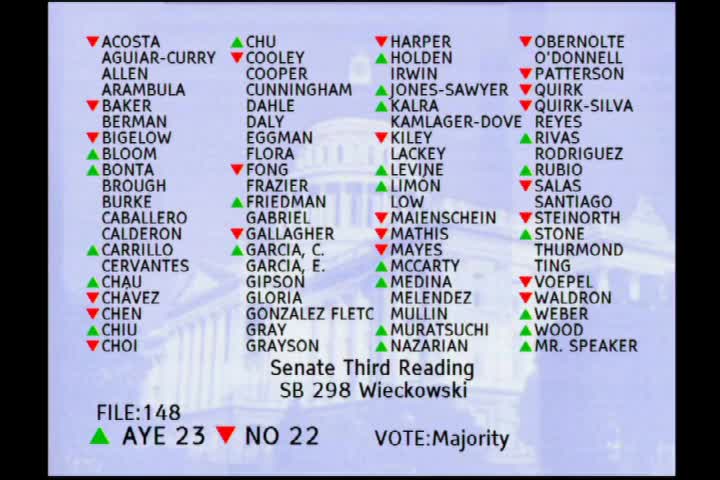



Bill Co-Author(s):