SB 13: Sales and use taxes: exemption: manufacturing and research.
- Session Year: 2017-2018
- House: Senate
- Latest Version Date: 2017-05-03
Existing sales and use tax laws impose taxes on retailers measured by the gross receipts from the sale of tangible personal property sold at retail in this state, or on the storage, use, or other consumption in this state of tangible personal property purchased from a retailer for storage, use, or other consumption in this state. Those laws partially exempt from those taxes, for a specified period, the gross receipts from the sale of, and the storage, use, or other consumption of, specified tangible personal property purchased for use by a qualified person, as defined, to be used primarily in manufacturing or other processes, and in research and development. Consumables On and after July 1, 2014, tangible personal property with a useful life of less than one year do not qualify for exemption, and useful life is one or more years, as defined by reference to state income or franchise taxes. taxes, is deemed to have a useful life of one or more years for purposes of the exemption. Existing law exempts from the definition of qualified person a trade or business that is required to apportion its business income under a specified section of law, which includes, among others, a trade or business that derives more than 50% of its gross business receipts, as defined, from conducting agricultural business activities.
This bill, on and after January 1, 2018, would expand the definition of a qualified person to include software publishers, as specified, and otherwise qualified persons that conduct a person that conducts a trade or business that is required to apportion its business income because it derives 50% of more of its gross business receipts, as defined, from conducting agricultural business activities, as specified, thereby expanding the exemption. specified. The bill, on and after January 1, 2018, additionally would deem tangible personal property as having a useful life of one or more years for state income or franchise tax purposes if the property includes a warranty for a period of one or more years, thereby expanding the exemption. would define useful life to also include tangible personal property that is expensed for state income or franchise tax purposes and that has a physical useful life of one or more years.
Under existing law, this exemption does not apply to any tangible personal property purchased during any calendar year that exceeds $200,000,000 of purchases of qualified tangible personal property for which the exemption is claimed by a qualified person. This bill, on and after January 1, 2018, would expand that $200,000,000 limitation amount to $500,000,000.This bill would take effect immediately as a tax levy.
Existing sales and use tax laws impose taxes on retailers measured by the gross receipts from the sale of tangible personal property sold at retail in this state, or on the storage, use, or other consumption in this state of tangible personal property purchased from a retailer for storage, use, or other consumption in this state. Those laws partially exempt from those taxes, for a specified period, the gross receipts from the sale of, and the storage, use, or other consumption of, specified tangible personal property purchased for use by a qualified person, as defined, to be used primarily in manufacturing or other processes, and in research and development. Consumables with a useful life of less than one year do not qualify for exemption, and useful life is defined by reference to state income or franchise taxes.
This bill, on and after January 1, 2018, would expand the definition of a qualified person to include software publishers, as specified, and otherwise qualified persons that conduct agricultural business activities, as specified, thereby expanding the exemption. The bill, on and after January 1, 2018, additionally would deem tangible personal property as having a useful life of one or more years for state income or franchise tax purposes if the property includes a warranty for a period of one or more years, thereby expanding the exemption.
Under existing law, this exemption does not apply to any tangible personal property purchased during any calendar year that exceeds $200,000,000 of purchases of qualified tangible personal property for which the exemption is claimed by a qualified person.
This bill, on and after January 1, 2018, would expand that $200,000,000 limitation amount to $500,000,000.
This bill would take effect immediately as a tax levy.
(a)Except as provided in subdivision (e), on or after July 1, 2014, and before July 1, 2022, there are exempted from the taxes imposed by this part the gross receipts from the sale of, and the storage, use, or other consumption in this state of, any of the following:
(1)Qualified tangible personal property purchased for use by a qualified person to be used primarily in any stage of the manufacturing, processing, refining, fabricating, or recycling of tangible personal property, beginning at the point any raw materials are received by the qualified person and introduced into the process and ending at the point at which the manufacturing, processing, refining, fabricating, or recycling has altered tangible personal property to its completed form, including packaging, if required.
(2)Qualified tangible personal property purchased for use by a qualified person to be used primarily in research and development.
(3)Qualified tangible personal property purchased for use by a qualified person to be used primarily to maintain, repair, measure, or test any qualified tangible personal property described in paragraph (1) or (2).
(4)Qualified tangible personal property purchased for use by a contractor purchasing that property for use in the performance of a construction contract for the qualified person, that will use that property as an integral part of the manufacturing, processing, refining, fabricating, or recycling process, or as a research or storage facility for use in connection with those processes.
(b)For purposes of this section:
(1)Fabricating means to make, build, create, produce, or assemble components or tangible personal property to work in a new or different manner.
(2)Manufacturing means the activity of converting or conditioning tangible personal property by changing the form, composition, quality, or character of the property for ultimate sale at retail or use in the manufacturing of a product to be ultimately sold at retail. Manufacturing includes any improvements to tangible personal property that result in a greater service life or greater functionality than that of the original property.
(3)Primarily means 50 percent or more of the time.
(4)Process means the period beginning at the point at which any raw materials are received by the qualified person and introduced into the manufacturing, processing, refining, fabricating, or recycling activity of the qualified person and ending at the point at which the manufacturing, processing, refining, fabricating, or recycling activity of the qualified person has altered tangible personal property to its completed form, including packaging, if required. Raw materials shall be considered to have been introduced into the process when the raw materials are stored on the same premises where the qualified persons manufacturing, processing, refining, fabricating, or recycling activity is conducted. Raw materials that are stored on premises other than where the qualified persons manufacturing, processing, refining, fabricating, or recycling activity is conducted shall not be considered to have been introduced into the manufacturing, processing, refining, fabricating, or recycling process.
(5)Processing means the physical application of the materials and labor necessary to modify or change the characteristics of tangible personal property.
(6)(A)Qualified person means a person that is primarily engaged in those lines of business described in Codes 3111 to 3399, inclusive, 541711, or 541712 of the North American Industry Classification System (NAICS) published by the United States Office of Management and Budget (OMB), 2012 edition.
(B)Notwithstanding subparagraph (A), qualified person shall not include either of the following:
(i)An apportioning trade or business that is required to apportion its business income pursuant to subdivision (b) of Section 25128.
(ii)A trade or business conducted wholly within this state that would be required to apportion its business income pursuant to subdivision (b) of Section 25128 if it were subject to apportionment pursuant to Section 25101.
(7)(A)Qualified tangible personal property includes, but is not limited to, all of the following:
(i)Machinery and equipment, including component parts and contrivances such as belts, shafts, moving parts, and operating structures.
(ii)Equipment or devices used or required to operate, control, regulate, or maintain the machinery, including, but not limited to, computers, data-processing equipment, and computer software, together with all repair and replacement parts with a useful life of one or more years therefor, whether purchased separately or in conjunction with a complete machine and regardless of whether the machine or component parts are assembled by the qualified person or another party.
(iii)Tangible personal property used in pollution control that meets standards established by this state or any local or regional governmental agency within this state.
(iv)Special purpose buildings and foundations used as an integral part of the manufacturing, processing, refining, fabricating, or recycling process, or that constitute a research or storage facility used during those processes. Buildings used solely for warehousing purposes after completion of those processes are not included.
(B)Qualified tangible personal property shall not include any of the following:
(i)Consumables with a useful life of less than one year.
(ii)Furniture, inventory, and equipment used in the extraction process, or equipment used to store finished products that have completed the manufacturing, processing, refining, fabricating, or recycling process.
(iii)Tangible personal property used primarily in administration, general management, or marketing.
(8)Refining means the process of converting a natural resource to an intermediate or finished product.
(9)Research and development means those activities that are described in Section 174 of the Internal Revenue Code or in any regulations thereunder.
(10)Useful life for tangible personal property that is treated as having a useful life of one or more years for state income or franchise tax purposes shall be deemed to have a useful life of one or more years for purposes of this section. Useful life for tangible personal property that is treated as having a useful life of less than one year for state income or franchise tax purposes shall be deemed to have a useful life of less than one year for purposes of this section.
(c)An exemption shall not be allowed under this section unless the purchaser furnishes the retailer with an exemption certificate, completed in accordance with any instructions or regulations as the board may prescribe, and the retailer retains the exemption certificate in its records and furnishes it to the board upon request.
(d)(1) Notwithstanding the Bradley-Burns Uniform Local Sales and Use Tax Law (Part 1.5 (commencing with Section 7200)) and the Transactions and Use Tax Law (Part 1.6 (commencing with Section 7251)), the exemption established by this section shall not apply with respect to any tax levied by a county, city, or district pursuant to, or in accordance with, either of those laws.
(2)Notwithstanding subdivision (a), the exemption established by this section shall not apply with respect to any tax levied pursuant to Section 6051.2, 6051.5, 6201.2, or 6201.5, pursuant to Section 35 of Article XIII of the California Constitution, or any tax levied pursuant to Section 6051 or 6201 that is deposited in the State Treasury to the credit of the Local Revenue Fund 2011 pursuant to Section 6051.15 or 6201.15.
(e)(1)The exemption provided by this section shall not apply to either of the following:
(A)Any tangible personal property purchased during any calendar year that exceeds two hundred million dollars ($200,000,000) of purchases of qualified tangible personal property for which an exemption is claimed by a qualified person under this section. For purposes of this subparagraph, in the case of a qualified person that is required to be included in a combined report under Section 25101 or authorized to be included in a combined report under Section 25101.15, the aggregate of all purchases of qualified personal property for which an exemption is claimed pursuant to this section by all persons that are required or authorized to be included in a combined report shall not exceed two hundred million dollars ($200,000,000) in any calendar year.
(B)The sale or storage, use, or other consumption of property that, within one year from the date of purchase, is removed from California, converted from an exempt use under subdivision (a) to some other use not qualifying for exemption, or used in a manner not qualifying for exemption.
(2)If a purchaser certifies in writing to the seller that the tangible personal property purchased without payment of the tax will be used in a manner entitling the seller to regard the gross receipts from the sale as exempt from the sales tax, and the purchase exceeds the two-hundred-million-dollar ($200,000,000) limitation described in subparagraph (A) of paragraph (1), or within one year from the date of purchase, the purchaser removes that property from California, converts that property for use in a manner not qualifying for the exemption, or uses that property in a manner not qualifying for the exemption, the purchaser shall be liable for payment of sales tax, with applicable interest, as if the purchaser were a retailer making a retail sale of the tangible personal property at the time the tangible personal property is so purchased, removed, converted, or used, and the cost of the tangible personal property to the purchaser shall be deemed the gross receipts from that retail sale.
(f)This section shall apply to leases of qualified tangible personal property classified as continuing sales and continuing purchases in accordance with Sections 6006.1 and 6010.1. The exemption established by this section shall apply to the rentals payable pursuant to the lease, provided the lessee is a qualified person and the tangible personal property is used in an activity described in subdivision (a).
(g)(1)Upon the effective date of this section, the Department of Finance shall estimate the total dollar amount of exemptions that will be taken for each calendar year, or any portion thereof, for which this section provides an exemption.
(2)No later than each March 1 next following a calendar year for which this section provides an exemption, the board shall provide to the Joint Legislative Budget Committee a report of the total dollar amount of exemptions taken under this section for the immediately preceding calendar year. The report shall compare the total dollar amount of exemptions taken under this section for that calendar year with the departments estimate for that same calendar year. If that total dollar amount taken is less than the estimate for that calendar year, the report shall identify options for increasing exemptions taken so as to meet estimated amounts.
(h)This section is repealed on January 1, 2018.
SEC. 2.Section 6377.1 is added to the Revenue and Taxation Code, to read:6377.1.(a)Except as provided in subdivision (e), on or after January 1, 2018, and before July 1, 2022, there are exempted from the taxes imposed by this part the gross receipts from the sale of, and the storage, use, or other consumption in this state of, any of the following:
(1)Qualified tangible personal property purchased for use by a qualified person to be used primarily in any stage of the manufacturing, processing, refining, fabricating, or recycling of tangible personal property, beginning at the point any raw materials are received by the qualified person and introduced into the process and ending at the point at which the manufacturing, processing, refining, fabricating, or recycling has altered tangible personal property to its completed form, including packaging, if required.
(2)Qualified tangible personal property purchased for use by a qualified person to be used primarily in research and development.
(3)Qualified tangible personal property purchased for use by a qualified person to be used primarily to maintain, repair, measure, or test any qualified tangible personal property described in paragraph (1) or (2).
(4)Qualified tangible personal property purchased for use by a contractor purchasing that property for use in the performance of a construction contract for the qualified person, that will use that property as an integral part of the manufacturing, processing, refining, fabricating, or recycling process, or as a research or storage facility for use in connection with those processes.
(b)For purposes of this section:
(1)Fabricating means to make, build, create, produce, or assemble components or tangible personal property to work in a new or different manner.
(2)Manufacturing means the activity of converting or conditioning tangible personal property by changing the form, composition, quality, or character of the property for ultimate sale at retail or use in the manufacturing of a product to be ultimately sold at retail. Manufacturing includes any improvements to tangible personal property that result in a greater service life or greater functionality than that of the original property.
(3)Primarily means 50 percent or more of the time.
(4)Process means the period beginning at the point at which any raw materials are received by the qualified person and introduced into the manufacturing, processing, refining, fabricating, or recycling activity of the qualified person and ending at the point at which the manufacturing, processing, refining, fabricating, or recycling activity of the qualified person has altered tangible personal property to its completed form, including packaging, if required. Raw materials shall be considered to have been introduced into the process when the raw materials are stored on the same premises where the qualified persons manufacturing, processing, refining, fabricating, or recycling activity is conducted. Raw materials that are stored on premises other than where the qualified persons manufacturing, processing, refining, fabricating, or recycling activity is conducted shall not be considered to have been introduced into the manufacturing, processing, refining, fabricating, or recycling process.
(5)Processing means the physical application of the materials and labor necessary to modify or change the characteristics of tangible personal property.
(6)(A)Qualified person means a person that is primarily engaged in those lines of business described in Codes 3111 to 3399, inclusive, 511210, 541711, 541711 or 541712 of the North American Industry Classification System (NAICS) published by the United States Office of Management and Budget (OMB), 2012 edition.
(B)(i)Notwithstanding subparagraph (A), qualified person shall not include either of the following:
(I)(i)An apportioning trade or business business, other than a trade or business described in paragraph (1) of subdivision (c) of Section 25128, that is required to apportion its business income pursuant to subdivision (b) of Section 25128.
(II)(ii)A trade or business business, other than a trade or business described in paragraph (1) of subdivision (c) of Section 25128, conducted wholly within this state that would be required to apportion its business income pursuant to subdivision (b) of Section 25128 if it were subject to apportionment pursuant to Section 25101.
(ii)This subparagraph shall not apply to a qualified person described in subparagraph (A) that is also engaged in an agricultural business activity described in paragraph (2) of subdivision (d) of Section 25128.(7)(A)Qualified tangible personal property includes, but is not limited to, all of the following:
(i)Machinery and equipment, including component parts and contrivances such as belts, shafts, moving parts, and operating structures.
(ii)Equipment or devices used or required to operate, control, regulate, or maintain the machinery, including, but not limited to, computers, data-processing equipment, and computer software, together with all repair and replacement parts with a useful life of one or more years therefor, whether purchased separately or in conjunction with a complete machine and regardless of whether the machine or component parts are assembled by the qualified person or another party.
(iii)Tangible personal property used in pollution control that meets standards established by this state or any local or regional governmental agency within this state.
(iv)Special purpose buildings and foundations used as an integral part of the manufacturing, processing, refining, fabricating, or recycling process, or that constitute a research or storage facility used during those processes. Buildings used solely for warehousing purposes after completion of those processes are not included.
(B)Qualified tangible personal property shall not include any of the following:
(i)Consumables with a useful life of less than one year.
(ii)Furniture, inventory, and equipment used in the extraction process, or equipment used to store finished products that have completed the manufacturing, processing, refining, fabricating, or recycling process.
(iii)Tangible personal property used primarily in administration, general management, or marketing.
(8)Refining means the process of converting a natural resource to an intermediate or finished product.
(9)Research and development means those activities that are described in Section 174 of the Internal Revenue Code or in any regulations thereunder.
(10)(A) Useful life for tangible personal property that is treated as having a useful life of one or more years for state income or franchise tax purposes shall be deemed to have a useful life of one or more years for purposes of this section. Useful life for tangible personal property that is treated as having a useful life of less than one year for state income or franchise tax purposes shall be deemed to have a useful life of less than one year for purposes of this section.
(B)For purposes of subparagraph (A), tangible personal property shall be deemed as having a useful life of one or more years for state income or franchise tax purposes if the property includes a warranty for a period of one or more years.(B)Useful life for tangible personal property that is expensed for state income or franchise tax purposes and that has a physical useful life of one or more years shall be deemed to have a useful life of one or more years for purposes of this section.
(c)An exemption shall not be allowed under this section unless the purchaser furnishes the retailer with an exemption certificate, completed in accordance with any instructions or regulations as the board may prescribe, and the retailer retains the exemption certificate in its records and furnishes it to the board upon request.
(d)(1) Notwithstanding the Bradley-Burns Uniform Local Sales and Use Tax Law (Part 1.5 (commencing with Section 7200)) and the Transactions and Use Tax Law (Part 1.6 (commencing with Section 7251)), the exemption established by this section shall not apply with respect to any tax levied by a county, city, or district pursuant to, or in accordance with, either of those laws.
(2)Notwithstanding subdivision (a), the exemption established by this section shall not apply with respect to any tax levied pursuant to Section 6051.2 or 6201.2, pursuant to Section 35 of Article XIII of the California Constitution, or any tax levied pursuant to Section 6051 or 6201 that is deposited in the State Treasury to the credit of the Local Revenue Fund 2011 pursuant to Section 6051.15 or 6201.15.
(e)(1)The exemption provided by this section shall not apply to either of the following:
(A)Any tangible personal property purchased during any calendar year that exceeds five two hundred million dollars ($500,000,000) ($200,000,000) of purchases of qualified tangible personal property for which an exemption is claimed by a qualified person under this section. For purposes of this subparagraph, in the case of a qualified person that is required to be included in a combined report under Section 25101 or authorized to be included in a combined report under Section 25101.15, the aggregate of all purchases of qualified personal property for which an exemption is claimed pursuant to this section by all persons that are required or authorized to be included in a combined report shall not exceed five two hundred million dollars ($500,000,000) ($200,000,000) in any calendar year.
(B)The sale or storage, use, or other consumption of property that, within one year from the date of purchase, is removed from California, converted from an exempt use under subdivision (a) to some other use not qualifying for exemption, or used in a manner not qualifying for exemption.
(2)If a purchaser certifies in writing to the seller that the tangible personal property purchased without payment of the tax will be used in a manner entitling the seller to regard the gross receipts from the sale as exempt from the sales tax, and the purchase exceeds the five-hundred-million-dollar ($500,000,000) two-hundred-million-dollar ($200,000,000) limitation described in subparagraph (A) of paragraph (1), or within one year from the date of purchase, the purchaser removes that property from California, converts that property for use in a manner not qualifying for the exemption, or uses that property in a manner not qualifying for the exemption, the purchaser shall be liable for payment of sales tax, with applicable interest, as if the purchaser were a retailer making a retail sale of the tangible personal property at the time the tangible personal property is so purchased, removed, converted, or used, and the cost of the tangible personal property to the purchaser shall be deemed the gross receipts from that retail sale.
(f)This section shall apply to leases of qualified tangible personal property classified as continuing sales and continuing purchases in accordance with Sections 6006.1 and 6010.1. The exemption established by this section shall apply to the rentals payable pursuant to the lease, provided the lessee is a qualified person and the tangible personal property is used in an activity described in subdivision (a).
(g)(1)Upon the effective date of this section, the Department of Finance shall estimate the total dollar amount of exemptions that will be taken for each calendar year, or any portion thereof, for which this section provides an exemption.
(2)No later than each March 1 next following a calendar year for which this section provides an exemption, the board shall provide to the Joint Legislative Budget Committee a report of the total dollar amount of exemptions taken under this section for the immediately preceding calendar year. The report shall compare the total dollar amount of exemptions taken under this section for that calendar year with the departments estimate for that same calendar year. If that total dollar amount taken is less than the estimate for that calendar year, the report shall identify options for increasing exemptions taken so as to meet estimated amounts.
(h)This section shall become operative on January 1, 2018, and shall become inoperative on January 1, 2023, and is repealed as of that date. January 1, 2023.
SEC. 3.This act provides for a tax levy within the meaning of Article IV of the California Constitution and shall go into immediate effect.
(a)Except as provided in subdivision (e), on or after July 1, 2014, and before July 1, 2022, there are exempted from the taxes imposed by this part the gross receipts from the sale of, and the storage, use, or other consumption in this state of, any of the following:
(1)Qualified tangible personal property purchased for use by a qualified person to be used primarily in any stage of the manufacturing, processing, refining, fabricating, or recycling of tangible personal property, beginning at the point any raw materials are received by the qualified person and introduced into the process and ending at the point at which the manufacturing, processing, refining, fabricating, or recycling has altered tangible personal property to its completed form, including packaging, if required.
(2)Qualified tangible personal property purchased for use by a qualified person to be used primarily in research and development.
(3)Qualified tangible personal property purchased for use by a qualified person to be used primarily to maintain, repair, measure, or test any qualified tangible personal property described in paragraph (1) or (2).
(4)Qualified tangible personal property purchased for use by a contractor purchasing that property for use in the performance of a construction contract for the qualified person, that will use that property as an integral part of the manufacturing, processing, refining, fabricating, or recycling process, or as a research or storage facility for use in connection with those processes.
(b)For purposes of this section:
(1)Fabricating means to make, build, create, produce, or assemble components or tangible personal property to work in a new or different manner.
(2)Manufacturing means the activity of converting or conditioning tangible personal property by changing the form, composition, quality, or character of the property for ultimate sale at retail or use in the manufacturing of a product to be ultimately sold at retail. Manufacturing includes any improvements to tangible personal property that result in a greater service life or greater functionality than that of the original property.
(3)Primarily means 50 percent or more of the time.
(4)Process means the period beginning at the point at which any raw materials are received by the qualified person and introduced into the manufacturing, processing, refining, fabricating, or recycling activity of the qualified person and ending at the point at which the manufacturing, processing, refining, fabricating, or recycling activity of the qualified person has altered tangible personal property to its completed form, including packaging, if required. Raw materials shall be considered to have been introduced into the process when the raw materials are stored on the same premises where the qualified persons manufacturing, processing, refining, fabricating, or recycling activity is conducted. Raw materials that are stored on premises other than where the qualified persons manufacturing, processing, refining, fabricating, or recycling activity is conducted shall not be considered to have been introduced into the manufacturing, processing, refining, fabricating, or recycling process.
(5)Processing means the physical application of the materials and labor necessary to modify or change the characteristics of tangible personal property.
(6)(A)Qualified person means a person that is primarily engaged in those lines of business described in Codes 3111 to 3399, inclusive, 541711, or 541712 of the North American Industry Classification System (NAICS) published by the United States Office of Management and Budget (OMB), 2012 edition.
(B)Notwithstanding subparagraph (A), qualified person shall not include either of the following:
(i)An apportioning trade or business that is required to apportion its business income pursuant to subdivision (b) of Section 25128.
(ii)A trade or business conducted wholly within this state that would be required to apportion its business income pursuant to subdivision (b) of Section 25128 if it were subject to apportionment pursuant to Section 25101.
(7)(A)Qualified tangible personal property includes, but is not limited to, all of the following:
(i)Machinery and equipment, including component parts and contrivances such as belts, shafts, moving parts, and operating structures.
(ii)Equipment or devices used or required to operate, control, regulate, or maintain the machinery, including, but not limited to, computers, data-processing equipment, and computer software, together with all repair and replacement parts with a useful life of one or more years therefor, whether purchased separately or in conjunction with a complete machine and regardless of whether the machine or component parts are assembled by the qualified person or another party.
(iii)Tangible personal property used in pollution control that meets standards established by this state or any local or regional governmental agency within this state.
(iv)Special purpose buildings and foundations used as an integral part of the manufacturing, processing, refining, fabricating, or recycling process, or that constitute a research or storage facility used during those processes. Buildings used solely for warehousing purposes after completion of those processes are not included.
(B)Qualified tangible personal property shall not include any of the following:
(i)Consumables with a useful life of less than one year.
(ii)Furniture, inventory, and equipment used in the extraction process, or equipment used to store finished products that have completed the manufacturing, processing, refining, fabricating, or recycling process.
(iii)Tangible personal property used primarily in administration, general management, or marketing.
(8)Refining means the process of converting a natural resource to an intermediate or finished product.
(9)Research and development means those activities that are described in Section 174 of the Internal Revenue Code or in any regulations thereunder.
(10)Useful life for tangible personal property that is treated as having a useful life of one or more years for state income or franchise tax purposes shall be deemed to have a useful life of one or more years for purposes of this section. Useful life for tangible personal property that is treated as having a useful life of less than one year for state income or franchise tax purposes shall be deemed to have a useful life of less than one year for purposes of this section.
(c)An exemption shall not be allowed under this section unless the purchaser furnishes the retailer with an exemption certificate, completed in accordance with any instructions or regulations as the board may prescribe, and the retailer retains the exemption certificate in its records and furnishes it to the board upon request.
(d)(1) Notwithstanding the Bradley-Burns Uniform Local Sales and Use Tax Law (Part 1.5 (commencing with Section 7200)) and the Transactions and Use Tax Law (Part 1.6 (commencing with Section 7251)), the exemption established by this section shall not apply with respect to any tax levied by a county, city, or district pursuant to, or in accordance with, either of those laws.
(2)Notwithstanding subdivision (a), the exemption established by this section shall not apply with respect to any tax levied pursuant to Section 6051.2, 6051.5, 6201.2, or 6201.5, pursuant to Section 35 of Article XIII of the California Constitution, or any tax levied pursuant to Section 6051 or 6201 that is deposited in the State Treasury to the credit of the Local Revenue Fund 2011 pursuant to Section 6051.15 or 6201.15.
(e)(1)The exemption provided by this section shall not apply to either of the following:
(A)Any tangible personal property purchased during any calendar year that exceeds two hundred million dollars ($200,000,000) of purchases of qualified tangible personal property for which an exemption is claimed by a qualified person under this section. For purposes of this subparagraph, in the case of a qualified person that is required to be included in a combined report under Section 25101 or authorized to be included in a combined report under Section 25101.15, the aggregate of all purchases of qualified personal property for which an exemption is claimed pursuant to this section by all persons that are required or authorized to be included in a combined report shall not exceed two hundred million dollars ($200,000,000) in any calendar year.
(B)The sale or storage, use, or other consumption of property that, within one year from the date of purchase, is removed from California, converted from an exempt use under subdivision (a) to some other use not qualifying for exemption, or used in a manner not qualifying for exemption.
(2)If a purchaser certifies in writing to the seller that the tangible personal property purchased without payment of the tax will be used in a manner entitling the seller to regard the gross receipts from the sale as exempt from the sales tax, and the purchase exceeds the two-hundred-million-dollar ($200,000,000) limitation described in subparagraph (A) of paragraph (1), or within one year from the date of purchase, the purchaser removes that property from California, converts that property for use in a manner not qualifying for the exemption, or uses that property in a manner not qualifying for the exemption, the purchaser shall be liable for payment of sales tax, with applicable interest, as if the purchaser were a retailer making a retail sale of the tangible personal property at the time the tangible personal property is so purchased, removed, converted, or used, and the cost of the tangible personal property to the purchaser shall be deemed the gross receipts from that retail sale.
(f)This section shall apply to leases of qualified tangible personal property classified as continuing sales and continuing purchases in accordance with Sections 6006.1 and 6010.1. The exemption established by this section shall apply to the rentals payable pursuant to the lease, provided the lessee is a qualified person and the tangible personal property is used in an activity described in subdivision (a).
(g)(1)Upon the effective date of this section, the Department of Finance shall estimate the total dollar amount of exemptions that will be taken for each calendar year, or any portion thereof, for which this section provides an exemption.
(2)No later than each March 1 next following a calendar year for which this section provides an exemption, the board shall provide to the Joint Legislative Budget Committee a report of the total dollar amount of exemptions taken under this section for the immediately preceding calendar year. The report shall compare the total dollar amount of exemptions taken under this section for that calendar year with the departments estimate for that same calendar year. If that total dollar amount taken is less than the estimate for that calendar year, the report shall identify options for increasing exemptions taken so as to meet estimated amounts.
(h)This section is repealed on January 1, 2023. January 1, 2018.
SEC. 2.Section 6377.1 is added to the Revenue and Taxation Code, to read:6377.1.(a)Except as provided in subdivision (e), before July 1, 2022, there are exempted from the taxes imposed by this part the gross receipts from the sale of, and the storage, use, or other consumption in this state of, any of the following:
(1)Qualified tangible personal property purchased for use by a qualified person to be used primarily in any stage of the manufacturing, processing, refining, fabricating, or recycling of tangible personal property, beginning at the point any raw materials are received by the qualified person and introduced into the process and ending at the point at which the manufacturing, processing, refining, fabricating, or recycling has altered tangible personal property to its completed form, including packaging, if required.
(2)Qualified tangible personal property purchased for use by a qualified person to be used primarily in research and development.
(3)Qualified tangible personal property purchased for use by a qualified person to be used primarily to maintain, repair, measure, or test any qualified tangible personal property described in paragraph (1) or (2).
(4)Qualified tangible personal property purchased for use by a contractor purchasing that property for use in the performance of a construction contract for the qualified person, that will use that property as an integral part of the manufacturing, processing, refining, fabricating, or recycling process, or as a research or storage facility for use in connection with those processes.
(b)For purposes of this section:
(1)Fabricating means to make, build, create, produce, or assemble components or tangible personal property to work in a new or different manner.
(2)Manufacturing means the activity of converting or conditioning tangible personal property by changing the form, composition, quality, or character of the property for ultimate sale at retail or use in the manufacturing of a product to be ultimately sold at retail. Manufacturing includes any improvements to tangible personal property that result in a greater service life or greater functionality than that of the original property.
(3)Primarily means 50 percent or more of the time.
(4)Process means the period beginning at the point at which any raw materials are received by the qualified person and introduced into the manufacturing, processing, refining, fabricating, or recycling activity of the qualified person and ending at the point at which the manufacturing, processing, refining, fabricating, or recycling activity of the qualified person has altered tangible personal property to its completed form, including packaging, if required. Raw materials shall be considered to have been introduced into the process when the raw materials are stored on the same premises where the qualified persons manufacturing, processing, refining, fabricating, or recycling activity is conducted. Raw materials that are stored on premises other than where the qualified persons manufacturing, processing, refining, fabricating, or recycling activity is conducted shall not be considered to have been introduced into the manufacturing, processing, refining, fabricating, or recycling process.
(5)Processing means the physical application of the materials and labor necessary to modify or change the characteristics of tangible personal property.
(6)(A)Qualified person means a person that is primarily engaged in those lines of business described in Codes 3111 to 3399, inclusive, 511210, 541711, or 541712 of the North American Industry Classification System (NAICS) published by the United States Office of Management and Budget (OMB), 2012 edition.
(B)(i)Notwithstanding subparagraph (A), qualified person shall not include either of the following:
(I)An apportioning trade or business that is required to apportion its business income pursuant to subdivision (b) of Section 25128.
(II)A trade or business conducted wholly within this state that would be required to apportion its business income pursuant to subdivision (b) of Section 25128 if it were subject to apportionment pursuant to Section 25101.
(ii)This subparagraph shall not apply to a qualified person described in subparagraph (A) that is also engaged in an agricultural business activity described in paragraph (2) of subdivision (d) of Section 25128.
(7)(A)Qualified tangible personal property includes, but is not limited to, all of the following:
(i)Machinery and equipment, including component parts and contrivances such as belts, shafts, moving parts, and operating structures.
(ii)Equipment or devices used or required to operate, control, regulate, or maintain the machinery, including, but not limited to, computers, data-processing equipment, and computer software, together with all repair and replacement parts with a useful life of one or more years therefor, whether purchased separately or in conjunction with a complete machine and regardless of whether the machine or component parts are assembled by the qualified person or another party.
(iii)Tangible personal property used in pollution control that meets standards established by this state or any local or regional governmental agency within this state.
(iv)Special purpose buildings and foundations used as an integral part of the manufacturing, processing, refining, fabricating, or recycling process, or that constitute a research or storage facility used during those processes. Buildings used solely for warehousing purposes after completion of those processes are not included.
(B)Qualified tangible personal property shall not include any of the following:
(i)Consumables with a useful life of less than one year.
(ii)Furniture, inventory, and equipment used in the extraction process, or equipment used to store finished products that have completed the manufacturing, processing, refining, fabricating, or recycling process.
(iii)Tangible personal property used primarily in administration, general management, or marketing.
(8)Refining means the process of converting a natural resource to an intermediate or finished product.
(9)Research and development means those activities that are described in Section 174 of the Internal Revenue Code or in any regulations thereunder.
(10)(A) Useful life for tangible personal property that is treated as having a useful life of one or more years for state income or franchise tax purposes shall be deemed to have a useful life of one or more years for purposes of this section. Useful life for tangible personal property that is treated as having a useful life of less than one year for state income or franchise tax purposes shall be deemed to have a useful life of less than one year for purposes of this section.
(B)For purposes of subparagraph (A), tangible personal property shall be deemed as having a useful life of one or more years for state income or franchise tax purposes if the property includes a warranty for a period of one or more years.
(c)An exemption shall not be allowed under this section unless the purchaser furnishes the retailer with an exemption certificate, completed in accordance with any instructions or regulations as the board may prescribe, and the retailer retains the exemption certificate in its records and furnishes it to the board upon request.
(d)(1) Notwithstanding the Bradley-Burns Uniform Local Sales and Use Tax Law (Part 1.5 (commencing with Section 7200)) and the Transactions and Use Tax Law (Part 1.6 (commencing with Section 7251)), the exemption established by this section shall not apply with respect to any tax levied by a county, city, or district pursuant to, or in accordance with, either of those laws.
(2)Notwithstanding subdivision (a), the exemption established by this section shall not apply with respect to any tax levied pursuant to Section 6051.2 or 6201.2, pursuant to Section 35 of Article XIII of the California Constitution, or any tax levied pursuant to Section 6051 or 6201 that is deposited in the State Treasury to the credit of the Local Revenue Fund 2011 pursuant to Section 6051.15 or 6201.15.
(e)(1)The exemption provided by this section shall not apply to either of the following:
(A)Any tangible personal property purchased during any calendar year that exceeds five hundred million dollars ($500,000,000) of purchases of qualified tangible personal property for which an exemption is claimed by a qualified person under this section. For purposes of this subparagraph, in the case of a qualified person that is required to be included in a combined report under Section 25101 or authorized to be included in a combined report under Section 25101.15, the aggregate of all purchases of qualified personal property for which an exemption is claimed pursuant to this section by all persons that are required or authorized to be included in a combined report shall not exceed five hundred million dollars ($500,000,000) in any calendar year.
(B)The sale or storage, use, or other consumption of property that, within one year from the date of purchase, is removed from California, converted from an exempt use under subdivision (a) to some other use not qualifying for exemption, or used in a manner not qualifying for exemption.
(2)If a purchaser certifies in writing to the seller that the tangible personal property purchased without payment of the tax will be used in a manner entitling the seller to regard the gross receipts from the sale as exempt from the sales tax, and the purchase exceeds the five-hundred-million-dollar ($500,000,000) limitation described in subparagraph (A) of paragraph (1), or within one year from the date of purchase, the purchaser removes that property from California, converts that property for use in a manner not qualifying for the exemption, or uses that property in a manner not qualifying for the exemption, the purchaser shall be liable for payment of sales tax, with applicable interest, as if the purchaser were a retailer making a retail sale of the tangible personal property at the time the tangible personal property is so purchased, removed, converted, or used, and the cost of the tangible personal property to the purchaser shall be deemed the gross receipts from that retail sale.
(f)This section shall apply to leases of qualified tangible personal property classified as continuing sales and continuing purchases in accordance with Sections 6006.1 and 6010.1. The exemption established by this section shall apply to the rentals payable pursuant to the lease, provided the lessee is a qualified person and the tangible personal property is used in an activity described in subdivision (a).
(g)(1)Upon the effective date of this section, the Department of Finance shall estimate the total dollar amount of exemptions that will be taken for each calendar year, or any portion thereof, for which this section provides an exemption.
(2)No later than each March 1 next following a calendar year for which this section provides an exemption, the board shall provide to the Joint Legislative Budget Committee a report of the total dollar amount of exemptions taken under this section for the immediately preceding calendar year. The report shall compare the total dollar amount of exemptions taken under this section for that calendar year with the departments estimate for that same calendar year. If that total dollar amount taken is less than the estimate for that calendar year, the report shall identify options for increasing exemptions taken so as to meet estimated amounts.
(h)This section shall become operative on January 1, 2018, and shall become inoperative on January 1, 2023, and is repealed as of that date.
SEC. 3.This act provides for a tax levy within the meaning of Article IV of the California Constitution and shall go into immediate effect.
|
Date
|
Status
|
|---|---|
| Feb 1, 2018 | Returned to Secretary of Senate pursuant to Joint Rule 56. |
| May 25, 2017 | May 25 hearing: Held in committee and under submission. |
| May 19, 2017 | Set for hearing May 25. |
| May 15, 2017 | May 15 hearing: Placed on APPR. suspense file. |
| May 5, 2017 | Set for hearing May 15. |
| May 3, 2017 | Read second time and amended. Re-referred to Com. on APPR. |
| May 2, 2017 | From committee: Do pass as amended and re-refer to Com. on APPR. (Ayes 7. Noes 0. Page 883.) (April 26). |
| Apr 21, 2017 | Set for hearing April 26. |
| Apr 18, 2017 | April 19 hearing postponed by committee. |
| Mar 21, 2017 | Set for hearing April 19. |
| Jan 12, 2017 | Referred to Com. on GOV. & F. |
| Dec 6, 2016 | From printer. May be acted upon on or after January 5. |
| Dec 5, 2016 | Introduced. Read first time. To Com. on RLS. for assignment. To print. |
|
Date
|
Description
|
Location
|
Votes
|
|
|---|---|---|---|---|
| May 15, 2017 | Placed on suspense file | Senate Standing Committee on Appropriations |
Passed |
|
| Apr 26, 2017 | Do pass as amended, but first amend, and re-refer to the Committee on [Appropriations] | Senate Standing Committee on Governance and Finance |
Passed |
This list shows positions taken on this bill by organizations on the date displayed, which is linked to the original source.
Positions by individuals are not included.
SENATE COMMITTEE ON APPROPRIATIONS
Senator Ricardo Lara, Chair
2017 - 2018 Regular Session
SB 13 (Gaines) - Sales and use taxes: exemption: manufacturing and research
Version: May 3, 2017 | Policy Vote: GOV. & F. 7 - 0 |
Urgency: No | Mandate: No |
Hearing Date: May 15, 2017 | Consultant: Robert Ingenito |
This bill meets the criteria for referral to the Suspense File.
Bill Summary:
SB 13 would expand the partial sales and use tax (SUT) exemption on manufacturing equipment, as specified.
Fiscal Impact:
The Board of Equalization (BOE) estimates that this bill’s provisions related to agricultural businesses would result in an annual General Fund revenue loss of about $4 million; the revenue impact related to expanding the definition of “useful life” cannot be determined. BOE’s costs to implement the bill have yet to be determined, but would likely be, at a minimum, in the hundreds of thousands of dollars annually (General Fund).
Background:
Except where a specific exemption or exclusion is provided, current law imposes the SUT on all retailers for the privilege of selling tangible personal property (TPP) at retail in California, or on the storage, use, or other consumption in this state of TPP purchased from a retailer.
After BOE collects SUT revenue ($51 billion in 2014-15), it allocates the money to various state and local funds. Roughly half—collected from an approximately 3.9 percent rate—goes to the General Fund and can be spent on any state program, such as education, health care, and criminal justice. Another 1.25 percent, known as the Bradley-Burns rate, goes to cities and counties for general purposes. Three sales tax funds have uniform state rates and support specified programs—an approximately 1.1 percent rate for 2011 realignment (county-administered criminal justice, mental health, and social service programs); a 0.5 percent rate for 1991 realignment (county-administered health and social services programs); and a 0.5 percent rate for city and county public safety programs pursuant to Proposition 172 (1993). Additionally, some local governments levy optional local rates—known as Transactions and Use Taxes (TUTs)—and a small portion of these funds are used for general purposes. As of January 1, 2017, the average statewide SUT rate was 8.21 percent.
State law fully exempts many items from SUT (such as prescription drugs, food, electricity, and poultry litter), while other items are exempted from the state sales tax, but not the local share, such as farm equipment and machinery, diesel fuel used for farming and food processing, teleproduction and postproduction equipment, timber harvesting equipment and machinery, and racehorse breeding stock. Partial SUT exemptions are difficult for both retailers and the BOE, and complicate return preparation and processing. Moreover, errors attributable to these partial exemptions occur frequently, resulting in additional return processing workload for BOE.
In 2013, the Legislature reformed California’s economic development policies; specifically, it eliminated enterprise zones and other geographically-targeted economic development areas, and instead allowed three new tax benefits:
- Tax credits for wages paid by taxpayers to qualified employees within former enterprise zones, and other areas that suffer from high levels of poverty and unemployment. The credit sunsets in 2019.
- The California Competes Tax Credit, an income tax credit available to businesses who want to come, stay, or grow in the State. Tax credit agreements up to an annually capped amount are (1) negotiated by the Governor’s Office of Business and Economic Development (GO-Biz), and (2) approved by a statutorily created “California Competes Tax Credit Committee,” consisting of the State Treasurer, the Director of the Department of Finance (DOF), the Director of GO-Biz, and one appointee each by the Senate Committee on Rules and the Speaker of the Assembly.
- A partial (the 3.9375 rate that flows to the General Fund) SUT exemption on purchases of manufacturing equipment made by taxpayers within specific North American Industrial Classification System (NAICS) codes, capped at $200 million annually per taxpayer, effective July 1, 2014, and ending July 1, 2022. This SUT exemption largely superseded existing programs, as they applied to almost all the same taxpayers. Thus, instead of applying to the California Alternative Energy and Advanced Transportation Financing Authority (CAEATFA), taxpayers simply print a resale certificate from BOE’s internet site, and present it to the retailer to purchase the property sales-tax free.
DOF is empowered to reduce the amount of credits the California Competes Tax Credit Committee can allocate to ensure that the above three new tax benefits do not result in a revenue loss that exceeds $750 million in a given fiscal year, which was the estimated revenue gain from eliminating tax benefits from enterprise zones and similar areas. Thus, the goal of eliminating enterprise zones and replacing them with the three new tax benefits described above was to ensure revenue neutrality. However, if the amount of foregone revenue from the three new tax benefits falls below $750 million, current law neither enacts a new tax expenditure nor requires expansion of the existing ones; instead, BOE must identify options for increasing SUT exemptions to meet estimated amounts as part of existing reporting requirements to the Joint Legislative Budget Committee. FTB must do the same as part of its annual report regarding the wage credit. DOF has not reported that an adjustment is necessary, as the estimated fiscal loss of the new employee hiring credit ($3.9 million in 2014; $1.7 million in 2015), the SUT exemption ($165 million in 2016), and California Competes Tax Credits added up to significantly less than $750 million in both fiscal years. Consequently, BOE has identified several options to increase the utilization of the SUT exemption, including (1) expanding the definition of equipment’s “useful life,” (2) increasing the $200 million cap, and (3) making eligible for the exemption other taxpayers not currently included within the NAICS codes in current law.
Proposed Law:
This bill would, beginning with purchases made on January 1, 2018, expand the SUT exemption on manufacturing equipment as follows: (1) make taxpayers engaged in an agricultural business activity eligible for the exemption who are currently precluded from doing so, and (2) expand the “useful life” definition to additionally include within the partial SUT exemption qualifying property that has been expensed for state income or franchise tax purposes that has a physical useful life of one or more years.
Related Legislation:
SB 13 is one of three bills that would expand the tax benefits that replaced the former enterprise zone program. SB 600 (Galgiani) contains similar language to change the definition of “useful life” for purposes of the exemption, among other changes, and is also set to be heard by this Committee on May 15th. Additionally, SB 661 (Fuller) would expand the wage credit, and is set to be heard by the Senate Governance and Finance Committee on May 10th.
Staff Comments:
This bill is intended to implement certain BOE recommendations to move the partial SUT exemption towards the revenue-neutrality intended when the enterprise zone program was eliminated.
BOE research indicates that based on the 2012 NAICS code 31-33 (manufacturing) census data for California, capital expenditures for food manufacturers that derive more than 50 percent of their “gross business receipts” from “agricultural business activities” (e.g., poultry processing and fluid milk manufacturing) are estimated to be $99 million in 2017-18 and $105 million in 2018-19. At the 3.9375 percent rate, the annual General Fund revenue loss would be about $4 million annually.
This estimate assumes that all qualified TPP purchased by qualified persons will be claimed as exempt. To the extent amounts are not claimed, the BOE estimate may be overstated. Also, information disclosing consumables with a physical useful life of one or more years that are expensed is unavailable. Consequently, the BOE revenue estimate is understated to that extent.
-- END --
SENATE COMMITTEE ON GOVERNANCE AND FINANCE
Senator Mike McGuire, Chair
2017 - 2018 Regular
Bill No: | SB 13 | Hearing Date: | 4/26/17 |
Author: | Gaines | Tax Levy: | Yes |
Version: | 12/5/16 | Fiscal: | Yes |
Consultant: | Grinnell | ||
Sales and use taxes: exemption: manufacturing and research
Expands the sales and use tax exemption on manufacturing equipment in four ways.
Background
State law imposes the sales tax on every retailer engaged in business in this state that sells tangible personal property, and requires them to collect the appropriate tax from the purchase and remit the amount to the Board of Equalization (BOE). Sales tax applies whenever a retail sale is made, which is basically any sale other than one for resale in the regular course of business. Unless the person pays the sales tax to the retailer, he or she is liable for the use tax, which is imposed on any person consuming tangible personal property in the state. The use tax rate is the same rate as the sales tax rate, and must be remitted on or before the last day of the month following the quarterly period in which the person made the purchase. The current rate is 7.25% as shown in the table below. Additionally, cities and counties may increase the sales and use tax rate up to 2% for either specific or general purposes pursuant to the California Constitution’s vote requirements.
Rate | Jurisdiction | Purpose/Authority | |
|---|---|---|---|
3.9375% | State (General Fund) | State general purposes | |
1.0625% |
| Realignment of local public safety services | |
0.50% | State (Local Revenue Fund) | Local governments to fund health and welfare programs | |
0.50% | State (Local Public Safety Fund) | Local governments to fund public safety services | |
1.25% | Local (City/County) 1.00% City and County | City and county general operations. Dedicated to county transportation purposes | |
7.25% | Total Statewide Rate |
Many items are fully exempted from the sales and use tax in this state, such as prescription drugs, food, communion wafers, and poultry litter, while others are exempted from the state sales tax, but not the local share, such as farm equipment and machinery, diesel fuel used for farming and food processing, teleproduction and postproduction equipment, timber harvesting equipment and machinery, and racehorse breeding stock.
In 2013, the Legislature enacted AB 93 (Committee on Budget) and SB 90 (Committee on Budget and Fiscal Review), which reformed California’s economic development policies by eliminating enterprise zones and other geographically-targeted economic development areas, instead allowing three new tax benefits:
- Tax credits for wages paid by taxpayers to qualified employees within former enterprise zones, and other areas that suffer from high levels of poverty and unemployment. The credit lasts from the 2014 taxable year until the 2019 taxable year.
- An exemption from the state share of the sales and use tax on purchases of manufacturing equipment with useful life exceeding one year for federal and state income tax purposes made by taxpayers within specific North American Industrial Classification System codes, capped at $200 million annually per taxpayer, effective July 1, 2014, and ending July 1, 2022.
- The California Competes Tax Credit, where taxpayers apply to the California Competes Tax Credit Committee, who can then award various tax credits up to an annually capped amount. The Committee can grant $30 million in tax credits in 2013-14, $150 million in 2014-15, and $200 million for the 2015-16, 2016-17, and 2017-18 fiscal years, plus unallocated or recaptured credits from previous years.
AB 93 and SB 90 require the Department of Finance (DOF) to reduce the amount of credits the Committee can allocate to ensure that its combined provisions don’t result in a revenue loss of more than $750 million, which was the estimated revenue gain from eliminating tax benefits from enterprise zones and similar areas. If the amount of foregone revenue from AB 93 and SB 90’s provisions fall below $750 million, neither bill enacts a new tax expenditure or requires expansion of an existing one; instead, BOE must identify options for increasing exemptions to meet estimated amounts as part of its report to the Joint Legislative Budget Committee regarding the total dollar amount of exemptions for the immediately preceding calendar year. FTB must do the same as part of its annual report regarding the wage credit. DOF has not reported that an adjustment is necessary, as the estimated fiscal loss of the new employee hiring credit ($3.9 million in 2014; $1.7 million in 2015), the sales and use tax exemption ($164.5 million in 2016), and California Competes added up to significantly less than $750 million in both fiscal years. As a result, BOE identified the option of expanding the definition of equipment’s “useful life,” increasing the $200 million cap, and making eligible for the exemption other taxpayers not currently included within the NAICS codes in current law. BOE Member George Runner wants to implement these options to make equitable use of the partial exemption and move the partial exemption towards the revenue-neutrality intended when the Enterprise Zone program was eliminated.
Proposed Law
Senate Bill 13 expands the sales and use tax exemption on manufacturing equipment in four ways:
- Adds software publishing to the list of NAICS codes, thereby making any taxpayer primarily engaged in that industry eligible for the exemption,
- Makes taxpayers engaged in an agricultural business activity eligible for the exemption, who are currently precluded from doing so by reference to the Corporation Tax’s requirement that taxpayers engaged in specified industries apportion income using the property, payroll, and sales factors,
- Expands the definition of useful life to include property with a warranty for a period of more than one year, and
- Lifts the cap on purchases of qualified equipment from $200 million per year to $500 million per year.
The measure applies its changes on purchases made on or after January 1, 2018.
State Revenue Impact
According to BOE, SB 13 results in revenue losses of $21 million in 2017-18, and $43 million in 2018-19.
Comments
1. Purpose of the bill. According to the author, “Senate Bill 13 simply brings into statute the recommendations of BOE to bring usage of the partial exemption up to the acceptable and intended usage. Use of the partial manufacturing and research and development exemption is an incentive for companies to remain in business in California. SB 13 gives businesses a reason to expand in California. SB 13 provides the increased utilization of the partial exemption and moves the mark closer to the revenue neutral intention when the Enterprise Zone program was eliminated.”
2. Tax expenditures. California law allows various income tax credits, deductions, and sales and use tax exemptions for taxpayers that incur certain expenses, such as child adoption, or to influence behavior, including business practices and decisions. When the Legislature enacts a tax benefit, it doesn’t put money into an account. Instead, the Legislature either enacts uncapped tax expenditures by defining the qualified taxpayers and costs eligible for the tax benefit, or capped and allocated ones, where it sets the maximum amount of tax credits, designates an administrative agency to allocate them, and then designs an allocation process. In either case, the DOF subtracts the estimated revenue losses from tax benefits from future revenue estimates. In this case, the revenue estimates for AB 93 and SB 90 assumed that more taxpayers would claim those bills’ tax benefits than actually have, especially for the sales and use tax exemption, which was scored as a $486 million revenue loss. As such, taxpayers not claiming the sales and use tax exemption in amounts that meet or exceed initial estimates does not mean that unspent money is sitting in an account; instead, underclaimed tax benefits provide the Legislature additional funds to spend on public services in the annual Budget Act. As a result, SB 13’s expansion of the sales and use tax exemption will result in the state having to reduce spending or increase taxes to match the amount of foregone revenue resulting from the measure. The Committee may wish to consider whether underclaimed tax benefits necessitate expanding their scope at the cost of funding for other services.
3. Effective? The Legislature typically enacts such tax incentives to encourage taxpayers to do something that but for the tax incentive, they would otherwise not do. DOF must annually publish a list of tax expenditures, currently totaling around $57 billion in 2016-17. Tax benefits directed at specific industries, such as manufacturing, do two things: First, they reward behavior that would have occurred without the subsidy, providing a windfall benefit for software publishers, agricultural enterprises, or other manufacturers who would’ve purchased the property without SB 13’s expanded benefit. In these instances, the state receives no marginal benefit, and transfers wealth from purposes it would otherwise spend money on for government purposes to the firm. Second, the bill may lead to more purchases of manufacturing equipment in California that wouldn’t have occurred without the exemption, drawing additional investment and productivity gains to the state. A successful tax benefit’s gains exceed its losses, but no tax expenditure has yet conclusively demonstrated that its benefits outweigh its costs. SB 13 expands the sales and use tax exemption on manufacturing equipment to include software publishers, equipment with a useful life of less than one year but sold with a multi-year warranty, and annual purchases of more than $200 million but less than $500 million. The Committee may wish to consider SB 13’s effect on decision making in the manufacturing sector.
4. Useful life. AB 93/SB 90 allowed the sales tax exemption for equipment with a useful life of one year or more, but excluded consumables with a useful life of less than one year, with useful life determined by reference to state income or franchise tax purposes. The American Appraisal Associates establishes the "useful life" of property and equipment categories as of September 30, 1999, which the Internal Revenue Service (IRS) then uses as a baseline. IRS periodically reviews these "useful life" periods for each category of equipment to verify that they are reasonable, and makes changes when appropriate, which then apply for state and federal purposes. Useful life generally refers to the normal operating life in terms of utility to the owner, and is set independently of the taxpayer’s decision whether to depreciate the equipment over the course of its useful life, or claim the cost of the equipment as a business expense in one taxable year, which is possible in some circumstances. SB 13 redefines “useful life” to include equipment with a warranty of more than one year, which appears to expand the scope of the sales tax exemption to include property where IRS has determined the useful life is less than one year. If the intent is to clarify, and not expand the scope of the exemption, the Committee may wish to consider deleting the bill’s current change, and instead clarifying that the determination of useful life be made regardless of the taxpayer’s decision to depreciate or expense the equipment.
5. Software. California’s software publishing industry is one of its largest, employing nearly one million Californians, at an average salary of $206,000 per year, according to the Software Alliance. SB 13 would expand the AB 93/SB 90 sales and use tax exemption to include the appropriate NAICS codes for software publishers. However, software publishers don’t manufacture much tangible property that is subsequently taxed at sale; instead, most sales are intangible, so not subject to the Sales and Use Tax, or specifically exempt as custom software. For many years, tax experts urged the Legislature to exempt manufacturing inputs from the sales tax to prevent inefficiency and double-taxation, which responded with AB 93 and SB 90. However, why should the exemption be applied to an industry that doesn’t manufacture many tangible products, and isn’t subject to much double taxation? The Committee may wish to consider whether expanding the exemption to include software publishers is merited.
6. The bigger, the better. Like many other kinds of business, manufacturers can be both large and small. However, California appears to be manufacturing relatively less than in the past regardless of firm size: the California Manufacturers and Technology Association states that although California is responsible for about 11% of the nation's manufacturing production, the state has accounted for only 1.8% of investment in new or expanded manufacturing across the country since 2001, compared to 6% in the 1980s. The Association adds that in 2013, only 46 manufacturing operations started or expanded in California, compared with 253 in Texas. The AB 93/SB 90 exemption is limited to the first $200 million in purchases, so larger manufacturers with more significant investments may not be able to fully use the exemption, rendering California less attractive when compared to other states with full exemptions. SB 13 would expand this limit to $500 million to allow the tax benefit for larger manufacturers; however, allowing tax benefits at the cost of funding public services to firms with the available capital necessary to make investments above the current limit may not be desirable. The Committee may wish to consider whether increasing the limit is necessary.
7. Automation. Considerable political and academic debate exists regarding the causes of employment losses in the U.S. manufacturing sector, which has dropped 30% since 2000 despite overall growth in national manufacturing output. Some economists attribute this difference to expanded global trade, where firms can reduce labor as well as labor and environmental compliance costs by shifting production from the U.S. to foreign countries, while others assert that the process of automation, where machines replace human workers, is the more significant cause. Economists say that effect of automation or globalization differs across types of manufacturers; however, they agree that automation will increasingly displace human workers in many industries in the future: for example, the Boston Consulting Group states that “growth in the global installed base of advanced robotics will accelerate from around 2% to 3% annually today to around 10% annually during the next decade.” While this debate is ongoing, SB 13 lowers the cost of manufacturing equipment, thereby increasing the incentive for manufacturers to replace employees with machinery.
8. Second try. Last year, at the request of the California Taxpayers Association, BOE adopted regulations to define the useful life of equipment for purposes of the exemption in a manner similar to SB 13. The proposed regulations deemed that equipment met the useful life definition in statute necessary to claim the exemption if it was included under a warranty or maintenance contract that lasts more than one year, or which is normally replaced at intervals of more than one year as established by industry or business practices or based on the actual experience of the person claiming the exemption. However, the Office of Administrative Law disapproved the regulations as inconsistent with the statute, and cited BOE’s failure to follow required procedures in the Administrative Procedures Act.
9. Related Legislation. SB 13 is one of three bills that seeks to expand the tax benefits that replaced the former enterprise zone program. SB 600 (Galgiani) contains similar language to change the definition of “useful life” for purposes of the exemption, and also expands it to include equipment used in electricity generation. That bill is currently set for the Committee’s April 26th hearing. Additionally, SB 661 (Fuller) seeks to expand the wage credit, and is set for the Committee’s May 10th hearing.
10. Technicals. Committee Staff recommends the following technical amendment:
- On Page 8, strike lines 37 through 39, and insert “required as an agricultural business activity to apportion income pursuant to subdivision (b) of Section 25128.”
Support and Opposition
(4/21/17)
Support: BOE Member George Runner, State Board of Equalization, California Taxpayers Association.
Opposition: California Tax Reform Association.
-- END --
SENATE COMMITTEE ON GOVERNANCE AND FINANCE
Senator Mike McGuire, Chair
2017 - 2018 Regular
Bill No: | SB 13 | Hearing Date: | 4/19/17 |
Author: | Gaines | Tax Levy: | Yes |
Version: | 12/5/16 | Fiscal: | Yes |
Consultant: | Grinnell | ||
Sales and use taxes: exemption: manufacturing and research
Expands the sales and use tax exemption on manufacturing equipment in four ways.
Background
State law imposes the sales tax on every retailer engaged in business in this state that sells tangible personal property, and requires them to collect the appropriate tax from the purchase and remit the amount to the Board of Equalization (BOE). Sales tax applies whenever a retail sale is made, which is basically any sale other than one for resale in the regular course of business. Unless the person pays the sales tax to the retailer, he or she is liable for the use tax, which is imposed on any person consuming tangible personal property in the state. The use tax rate is the same rate as the sales tax rate, and must be remitted on or before the last day of the month following the quarterly period in which the person made the purchase. The current rate is 7.25% as shown in the table below. Additionally, cities and counties may increase the sales and use tax rate up to 2% for either specific or general purposes pursuant to the California Constitution’s vote requirements.
Rate | Jurisdiction | Purpose/Authority | |
|---|---|---|---|
3.9375% | State (General Fund) | State general purposes | |
1.0625% |
| Realignment of local public safety services | |
0.50% | State (Local Revenue Fund) | Local governments to fund health and welfare programs | |
0.50% | State (Local Public Safety Fund) | Local governments to fund public safety services | |
1.25% | Local (City/County) 1.00% City and County | City and county general operations. Dedicated to county transportation purposes | |
7.25% | Total Statewide Rate |
Many items are fully exempted from the sales and use tax in this state, such as prescription drugs, food, communion wafers, and poultry litter, while others are exempted from the state sales tax, but not the local share, such as farm equipment and machinery, diesel fuel used for farming and food processing, teleproduction and postproduction equipment, timber harvesting equipment and machinery, and racehorse breeding stock.
In 2013, the Legislature enacted AB 93 (Committee on Budget) and SB 90 (Committee on Budget and Fiscal Review), which reformed California’s economic development policies by eliminating enterprise zones and other geographically-targeted economic development areas, instead allowing three new tax benefits:
- Tax credits for wages paid by taxpayers to qualified employees within former enterprise zones, and other areas that suffer from high levels of poverty and unemployment. The credit lasts from the 2014 taxable year until the 2019 taxable year.
- An exemption from the state share of the sales and use tax on purchases of manufacturing equipment with useful life exceeding one year for federal and state income tax purposes made by taxpayers within specific North American Industrial Classification System codes, capped at $200 million annually per taxpayer, effective July 1, 2014, and ending July 1, 2022.
- The California Competes Tax Credit, where taxpayers apply to the California Competes Tax Credit Committee, who can then award various tax credits up to an annually capped amount. The Committee can grant $30 million in tax credits in 2013-14, $150 million in 2014-15, and $200 million for the 2015-16, 2016-17, and 2017-18 fiscal years, plus unallocated or recaptured credits from previous years.
AB 93 and SB 90 require the Department of Finance (DOF) to reduce the amount of credits the Committee can allocate to ensure that its combined provisions don’t result in a revenue loss of more than $750 million, which was the estimated revenue gain from eliminating tax benefits from enterprise zones and similar areas. If the amount of foregone revenue from AB 93 and SB 90’s provisions fall below $750 million, neither bill enacts a new tax expenditure or requires expansion of an existing one; instead, BOE must identify options for increasing exemptions to meet estimated amounts as part of its report to the Joint Legislative Budget Committee regarding the total dollar amount of exemptions for the immediately preceding calendar year. FTB must do the same as part of its annual report regarding the wage credit. DOF has not reported that an adjustment is necessary, as the estimated fiscal loss of the new employee hiring credit ($3.9 million in 2014; $1.7 million in 2015), the sales and use tax exemption ($164.5 million in 2016), and California Competes added up to significantly less than $750 million in both fiscal years. As a result, BOE identified the option of expanding the definition of equipment’s “useful life,” increasing the $200 million cap, and making eligible for the exemption other taxpayers not currently included within the NAICS codes in current law. BOE Member George Runner wants to implement these options to make equitable use of the partial exemption and move the partial exemption towards the revenue-neutrality intended when the Enterprise Zone program was eliminated.
Proposed Law
Senate Bill 13 expands the sales and use tax exemption on manufacturing equipment in four ways:
- Adds software publishing to the list of NAICS codes, thereby making any taxpayer primarily engaged in that industry eligible for the exemption,
- Makes taxpayers engaged in an agricultural business activity eligible for the exemption, who are currently precluded from doing so by reference to the Corporation Tax’s requirement that taxpayers engaged in specified industries apportion income using the property, payroll, and sales factors,
- Expands the definition of useful life to include property with a warranty for a period of more than one year, and
- Lifts the cap on purchases of qualified equipment from $200 million per year to $500 million per year.
The measure applies its changes on purchases made on or after January 1, 2018.
State Revenue Impact
According to BOE, SB 13 results in revenue losses of $21 million in 2017-18, and $43 million in 2018-19.
Comments
1. Purpose of the bill. According to the author, “Senate Bill 13 simply brings into statute the recommendations of BOE to bring usage of the partial exemption up to the acceptable and intended usage. Use of the partial manufacturing and research and development exemption is an incentive for companies to remain in business in California. SB 13 gives businesses a reason to expand in California. SB 13 provides the increased utilization of the partial exemption and moves the mark closer to the revenue neutral intention when the Enterprise Zone program was eliminated.”
2. Tax expenditures. California law allows various income tax credits, deductions, and sales and use tax exemptions for taxpayers that incur certain expenses, such as child adoption, or to influence behavior, including business practices and decisions. When the Legislature enacts a tax benefit, it doesn’t put money into an account. Instead, the Legislature either enacts uncapped tax expenditures by defining the qualified taxpayers and costs eligible for the tax benefit, or capped and allocated ones, where it sets the maximum amount of tax credits, designates an administrative agency to allocate them, and then designs an allocation process. In either case, the DOF subtracts the estimated revenue losses from tax benefits from future revenue estimates. In this case, the revenue estimates for AB 93 and SB 90 assumed that more taxpayers would claim those bills’ tax benefits than actually have, especially for the sales and use tax exemption, which was scored as a $486 million revenue loss. As such, taxpayers not claiming the sales and use tax exemption in amounts that meet or exceed initial estimates does not mean that unspent money is sitting in an account; instead, underclaimed tax benefits provide the Legislature additional funds to spend on public services in the annual Budget Act. As a result, SB 13’s expansion of the sales and use tax exemption will result in the state having to reduce spending or increase taxes to match the amount of foregone revenue resulting from the measure. The Committee may wish to consider whether underclaimed tax benefits necessitate expanding their scope at the cost of funding for other services.
3. Effective? The Legislature typically enacts such tax incentives to encourage taxpayers to do something that but for the tax incentive, they would otherwise not do. DOF must annually publish a list of tax expenditures, currently totaling around $57 billion in 2016-17. Tax benefits directed at specific industries, such as manufacturing, do two things: First, they reward behavior that would have occurred without the subsidy, providing a windfall benefit for software publishers, agricultural enterprises, or other manufacturers who would’ve purchased the property without SB 13’s expanded benefit. In these instances, the state receives no marginal benefit, and transfers wealth from purposes it would otherwise spend money on for government purposes to the firm. Second, the bill may lead to more purchases of manufacturing equipment in California that wouldn’t have occurred without the exemption, drawing additional investment and productivity gains to the state. A successful tax benefit’s gains exceed its losses, but no tax expenditure has yet conclusively demonstrated that its benefits outweigh its costs. SB 13 expands the sales and use tax exemption on manufacturing equipment to include software publishers, equipment with a useful life of less than one year but sold with a multi-year warranty, and annual purchases of more than $200 million but less than $500 million. The Committee may wish to consider SB 13’s effect on decision making in the manufacturing sector.
4. Useful life. AB 93/SB 90 allowed the sales tax exemption for equipment with a useful life of one year or more, but excluded consumables with a useful life of less than one year, with useful life determined by reference to state income or franchise tax purposes. The American Appraisal Associates establishes the "useful life" of property and equipment categories as of September 30, 1999, which the Internal Revenue Service (IRS) then uses as a baseline. IRS periodically reviews these "useful life" periods for each category of equipment to verify that they are reasonable, and makes changes when appropriate, which then apply for state and federal purposes. Useful life generally refers to the normal operating life in terms of utility to the owner, and is set independently of the taxpayer’s decision whether to depreciate the equipment over the course of its useful life, or claim the cost of the equipment as a business expense in one taxable year, which is possible in some circumstances. SB 13 redefines “useful life” to include equipment with a warranty of more than one year, which appears to expand the scope of the sales tax exemption to include property where IRS has determined the useful life is less than one year. If the intent is to clarify, and not expand the scope of the exemption, the Committee may wish to consider deleting the bill’s current change, and instead clarifying that the determination of useful life be made regardless of the taxpayer’s decision to depreciate or expense the equipment.
5. Software. California’s software publishing industry is one of its largest, employing nearly one million Californians, at an average salary of $206,000 per year, according to the Software Alliance. SB 13 would expand the AB 93/SB 90 sales and use tax exemption to include the appropriate NAICS codes for software publishers. However, software publishers don’t manufacture much tangible property that is subsequently taxed at sale; instead, most sales are intangible, so not subject to the Sales and Use Tax, or specifically exempt as custom software. For many years, tax experts urged the Legislature to exempt manufacturing inputs from the sales tax to prevent inefficiency and double-taxation, which responded with AB 93 and SB 90. However, why should the exemption be applied to an industry that doesn’t manufacture many tangible products, and isn’t subject to much double taxation? The Committee may wish to consider whether expanding the exemption to include software publishers is merited.
6. The bigger, the better. Like many other kinds of business, manufacturers can be both large and small. However, California appears to be manufacturing relatively less than in the past regardless of firm size: the California Manufacturers and Technology Association states that although California is responsible for about 11% of the nation's manufacturing production, the state has accounted for only 1.8% of investment in new or expanded manufacturing across the country since 2001, compared to 6% in the 1980s. The Association adds that in 2013, only 46 manufacturing operations started or expanded in California, compared with 253 in Texas. The AB 93/SB 90 exemption is limited to the first $200 million in purchases, so larger manufacturers with more significant investments may not be able to fully use the exemption, rendering California less attractive when compared to other states with full exemptions. SB 13 would expand this limit to $500 million to allow the tax benefit for larger manufacturers; however, allowing tax benefits at the cost of funding public services to firms with the available capital necessary to make investments above the current limit may not be desirable. The Committee may wish to consider whether increasing the limit is necessary.
7. Automation. Considerable political and academic debate exists regarding the causes of employment losses in the U.S. manufacturing sector, which has dropped 30% since 2000 despite overall growth in national manufacturing output. Some economists attribute this difference to expanded global trade, where firms can reduce labor as well as labor and environmental compliance costs by shifting production from the U.S. to foreign countries, while others assert that the process of automation, where machines replace human workers, is the more significant cause. Economists say that effect of automation or globalization differs across types of manufacturers; however, they agree that automation will increasingly displace human workers in many industries in the future: for example, the Boston Consulting Group states that “growth in the global installed base of advanced robotics will accelerate from around 2% to 3% annually today to around 10% annually during the next decade.” While this debate is ongoing, SB 13 lowers the cost of manufacturing equipment, thereby increasing the incentive for manufacturers to replace employees with machinery.
8. Second try. Last year, at the request of the California Taxpayers Association, BOE adopted regulations to define the useful life of equipment for purposes of the exemption in a manner similar to SB 13. The proposed regulations deemed that equipment met the useful life definition in statute necessary to claim the exemption if it was included under a warranty or maintenance contract that lasts more than one year, or which is normally replaced at intervals of more than one year as established by industry or business practices or based on the actual experience of the person claiming the exemption. However, the Office of Administrative Law disapproved the regulations as inconsistent with the statute, and cited BOE’s failure to follow required procedures in the Administrative Procedures Act.
9. Related Legislation. SB 13 is one of three bills that seeks to expand the tax benefits that replaced the former enterprise zone program. SB 600 (Galgiani) contains similar language to change the definition of “useful life” for purposes of the exemption, and also expands it to include equipment used in electricity generation. That bill is currently set for the Committee’s April 26th hearing. Additionally, SB 661 (Fuller) seeks to expand the wage credit, and is set for the Committee’s May 10th hearing.
10. Technicals. Committee Staff recommends the following technical amendments:
- On page 4, line 28, and on page 5, lines 5-6 and line 7, “less than one year” should be replaced with “one year or less.”
- On page 5, line 2 and lines 3-4, “one or more years” should be replaced with “more than one year.”
- On Page 8, strike lines 37 through 39, and insert “required as an agricultural business activity to apportion income pursuant to subdivision (b) of Section 25128.”
Support and Opposition
(4/17/17)
Support: BOE Member George Runner, State Board of Equalization, California Taxpayers Association.
Opposition: California Tax Reform Association.
-- END --
Discussed in Hearing
 48MIN
Senate Standing Committee on Appropriations
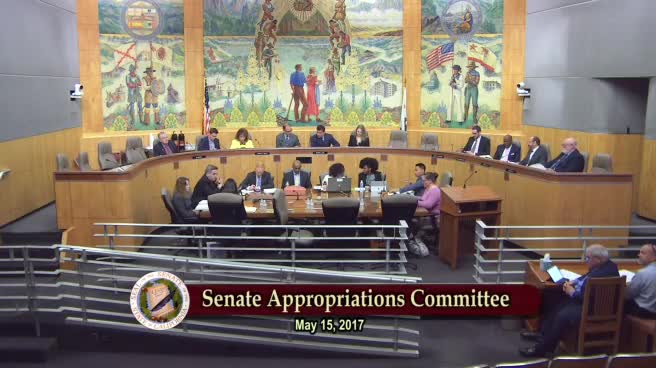 56SEC
Senate Standing Committee on Appropriations
 9MIN
Senate Standing Committee on Governance and Finance
Bill Author
Bill Co-Author(s):