SB 1339: Electricity: microgrids: tariffs.
- Session Year: 2017-2018
- House: Senate
- Latest Version Date: 2018-09-19
(1)Under existing law, the Public Utilities Commission (PUC) has regulatory authority over public utilities, including electrical corporations, while local publicly owned electric utilities, as defined, are under the direction of their governing boards. Existing law authorizes the commission to fix the rates and charges for every public utility and requires that those rates and charges be just and reasonable.
This bill would require the PUC, in consultation with the State Energy Resources Conservation and Development Commission and the Independent System Operator, to take specified actions by December 1, 2020, to facilitate the commercialization of microgrids for distribution customers of large electrical corporations. The bill would require the governing board of a local publicly owned electric utility to develop and make available a standardized process for the interconnection of a customer-supported microgrid, including separate electrical rates and tariffs, as necessary.
Under existing law, a violation of any order, decision, rule, direction, demand, or requirement of the commission is a crime.
Because the provisions of this bill would require an order or other action of the commission to implement, and a violation of that order or action would be a crime, the bill would impose a state-mandated local program.
In addition, by placing requirements upon local publicly owned electric utilities, the bill would impose a state-mandated local program.
(2)The California Constitution requires the state to reimburse local agencies and school districts for certain costs mandated by the state. Statutory provisions establish procedures for making that reimbursement.
This bill would provide that no reimbursement is required by this act for specified reasons.
(1)Under existing law, the Public Utilities Commission (PUC) has regulatory authority over public utilities, including electrical corporations, while local publicly owned electric utilities, as defined, are under the direction of their governing boards. Existing law authorizes the commission to fix the rates and charges for every public utility and requires that those rates and charges be just and reasonable.
This bill would require the PUC, in consultation with the State Energy Resources Conservation and Development Commission and the Independent System Operator, to take specified actions by January December 1, 2020, to facilitate the commercialization of microgrids for distribution customers of large electrical corporations. The bill would require the governing board of a local publicly owned electric utility to develop and make available a standardized process for the interconnection of a customer-supported microgrid, including separate electrical rates and tariffs as necessary, as specified. The bill would prohibit an electrical corporation and local publicly owned electric utility from prohibiting or otherwise preventing the installation or operation of a microgrid, or component thereof. tariffs, as necessary.
Under existing law, a violation of any order, decision, rule, direction, demand, or requirement of the commission is a crime.
Because the provisions of this bill would require an order or other action of the commission to implement, and a violation of that order or action would be a crime, the bill would impose a state-mandated local program.
In addition, by placing requirements upon local publicly owned electric utilities, the bill would impose a state-mandated local program.
(2)The California Constitution requires the state to reimburse local agencies and school districts for certain costs mandated by the state. Statutory provisions establish procedures for making that reimbursement.
This bill would provide that no reimbursement is required by this act for specified reasons.
(1)Under existing law, the Public Utilities Commission (PUC) has regulatory authority over public utilities, including electrical corporations, while local publicly owned electric utilities, as defined, are under the direction of their governing boards. Existing law authorizes the commission to fix the rates and charges for every public utility and requires that those rates and charges be just and reasonable.
This bill would require the PUC, in consultation with the State Energy Resources Conservation and Development Commission and the Independent System Operator, to take specified actions by January 1, 2020, to facilitate the commercialization of microgrids for distribution customers of electrical corporations. The bill would prohibit the PUC from permitting a microgrid that uses diesel backup or gas-combustion generation. The bill would require a local publicly owned electric utility that serves more than 700,000 customers to develop a process for interconnection of customer-supported microgrids and to make this process available by January 1, 2020. The bill would prohibit these local publicly owned electric utilities from permitting a microgrid that uses diesel backup or gas-combustion generation. require the governing board of a local publicly owned electric utility to develop and make available a standardized process for the interconnection of a customer-supported microgrid, including separate electrical rates and tariffs as necessary, as specified. The bill would prohibit an electrical corporation and local publicly owned electric utility from prohibiting or otherwise preventing the installation or operation of a microgrid, or component thereof.
Under existing law, a violation of any order, decision, rule, direction, demand, or requirement of the commission is a crime.
Because the provisions of this bill would require an order or other action of the commission to implement, and a violation of that order or action would be a crime, the bill would impose a state-mandated local program.
In addition, by placing requirements upon local publicly owned electric utilities, the bill would impose a state-mandated local program.
(2)The California Constitution requires the state to reimburse local agencies and school districts for certain costs mandated by the state. Statutory provisions establish procedures for making that reimbursement.
This bill would provide that no reimbursement is required by this act for specified reasons.
(1)Under existing law, the Public Utilities Commission (PUC) has regulatory authority over public utilities, including electrical corporations, while local publicly owned electric utilities, as defined, are under the direction of their governing boards. Existing law authorizes the commission to fix the rates and charges for every public utility and requires that those rates and charges be just and reasonable.
This bill would require the commission, as part of a specified rulemaking, to consider the role of microgrids in providing grid resiliency and to establish a tariff for each electrical corporation for the use of microgrids to provide electrical grid resiliency. The bill would require the commission (1) to direct each electrical corporation to file an advice letter implementing the tariff, (2) to approve an advice letter only if it minimizes costs and maximizes benefits to all ratepayers and meets the requirements of the rulemaking, and (3) to approve, reject, or modify each advice letter before January 1, 2020. PUC, in consultation with the State Energy Resources Conservation and Development Commission and the Independent System Operator, to take specified actions by January 1, 2020, to facilitate the commercialization of microgrids for distribution customers of electrical corporations. The bill would prohibit the PUC from permitting a microgrid that uses diesel backup or gas-combustion generation. The bill would require a local publicly owned electric utility that serves more than 700,000 customers to develop a process for interconnection of customer-supported microgrids and to make this process available by January 1, 2020. The bill would prohibit these local publicly owned electric utilities from permitting a microgrid that uses diesel backup or gas-combustion generation.
This bill would require each local publicly owned electric utility to establish a tariff, to be available for service before January 1, 2020, for the use of microgrids to provide electrical grid resiliency.This bill would require each state agency to consider integrating microgrids into its infrastructure.Under existing law, a violation of any order, decision, rule, direction, demand, or requirement of the commission is a crime.
Because the provisions of this bill would require an order or other action of the commission to implement, and a violation of that order or action would be a crime, the bill would impose a state-mandated local program.
In addition, by placing requirements upon local publicly owned electric utilities, the bill would impose a state-mandated local program.
(2)The California Constitution requires the state to reimburse local agencies and school districts for certain costs mandated by the state. Statutory provisions establish procedures for making that reimbursement.
This bill would provide that no reimbursement is required by this act for specified reasons.
(1)Under existing law, the Public Utilities Commission has regulatory authority over public utilities, including electrical corporations, while local publicly owned electric utilities, as defined, are under the direction of their governing boards. Existing law authorizes the commission to fix the rates and charges for every public utility and requires that those rates and charges be just and reasonable.
This bill would require each electrical corporation and local publicly owned electric utility, before an unspecified date, to develop and submit an electrical grid resiliency deployment plan to the commission or, for each local publicly owned electric utility, to its governing board. The bill would require the commission or governing board, in consultation with certain entities, to review the plan. The bill would require the plan to identify the investments necessary to increase the resiliency of the electrical grid and to reduce the risk of electrical outages affecting emergency services, critical circuits, and critical infrastructure, and to explain how execution of the plan would increase resiliency in a manner that maximizes the benefits, and minimizes the costs, to ratepayers.This bill would require the commission, before July 1, 2019, to complete a proceeding as part of a specified rulemaking, to consider the role of microgrids in providing grid resiliency and would require specified issues to be addressed in the proceeding. to establish a tariff for each electrical corporation for the use of microgrids to provide electrical grid resiliency. The bill would require the commission (1) to direct each electrical corporation to file an application with the commission to establish a tariff for the use of microgrids to provide electrical grid resiliency, and advice letter implementing the tariff, (2) to approve only those applications that minimize an advice letter only if it minimizes costs and maximize maximizes benefits to all ratepayers and that meet meets the requirements of the commissions completed proceeding. rulemaking, and (3) to approve, reject, or modify each advice letter before January 1, 2020.
This bill would require each local publicly owned electric utility to establish a tariff, to be available for service before January 1, 2020, for the use of microgrids to provide electrical grid resiliency.
This bill would require each state agency to consider integrating microgrids into its infrastructure.
Under existing law, a violation of any order, decision, rule, direction, demand, or requirement of the commission is a crime.
Because the provisions of this bill would require an order or other action of the commission to implement, and a violation of that order or action would be a crime, the bill would impose a state-mandated local program.
In addition, by placing requirements upon local publicly owned electric utilities, the bill would impose a state-mandated local program.
(2)The California Constitution requires the state to reimburse local agencies and school districts for certain costs mandated by the state. Statutory provisions establish procedures for making that reimbursement.
This bill would provide that no reimbursement is required by this act for specified reasons.
(1)Under existing law, the Public Utilities Commission has regulatory authority over public utilities, including electrical corporations, while local publicly owned electric utilities, as defined, are under the direction of their governing boards. Existing law authorizes the commission to fix the rates and charges for every public utility and requires that those rates and charges be just and reasonable.
This bill would require each electrical corporation and local publicly owned electric utility, before an unspecified date, to develop and submit an electrical grid resiliency deployment plan to the commission and to establish a tariff or rate schedule for 3rd-party electrical grid resiliency investments. commission or, for each local publicly owned electric utility, to its governing board. The bill would require the commission or governing board, in consultation with certain entities, to approve plans that review the plan. The bill would require the plan to identify the investments necessary to increase the resiliency of the electrical grid and to reduce the risk of electrical outages affecting emergency services, critical circuits, and critical infrastructure, and that to explain how execution of the plan would increase resiliency in a manner that maximizes the benefits, and minimizes the costs, to ratepayers. The bill would, to the extent the commission determines that the installation and operation of a microgrid by a load-serving entity is in the public interest, authorize the recovery of those costs in rates.
This bill would require each electrical corporation and local publicly owned electric utility, the commission, before July 1, 2019, to establish a tariff or rate schedule by which a microgrid that can demonstrate grid islanding capacity, as defined, may expeditiously interconnect to, and nondiscriminatorily access, the electrical distribution grid. complete a proceeding to consider the role of microgrids in providing grid resiliency and would require specified issues to be addressed in the proceeding. The bill would require the commission to direct each electrical corporation to file an application with the commission to establish a tariff for the use of microgrids to provide electrical grid resiliency, and to approve only those applications that minimize costs and maximize benefits to all ratepayers and that meet the requirements of the commissions completed proceeding.
This bill would require each state agency to consider integrating microgrids into its infrastructure.
Under existing law, a violation of any order, decision, rule, direction, demand, or requirement of the commission is a crime.
Because the provisions of this bill would require an order or other action of the commission to implement, and a violation of that order or action would be a crime, the bill would impose a state-mandated local program.
In addition, by placing requirements upon local publicly owned electric utilities, the bill would impose a state-mandated local program.
(2)The California Global Warming Solutions Act of 2006 establishes the State Air Resources Board as the state agency responsible for monitoring and regulating sources emitting greenhouse gases. Existing law requires the state board, on or before January 1, 2003, to adopt a certification program and uniform emission standards for electrical generation technologies that are exempt from district permitting requirements, as specified.This bill would require the state board, before June 1, 2020, to update those standards to include a standard for oxides of sulfur and to update the standards for oxides of nitrogen and particulate matter.(3)(2)The California Constitution requires the state to reimburse local agencies and school districts for certain costs mandated by the state. Statutory provisions establish procedures for making that reimbursement.
This bill would provide that no reimbursement is required by this act for specified reasons.
(1)Under existing law, the Public Utilities Commission has regulatory authority over public utilities, including electrical corporations, while local publicly owned electric utilities, as defined, are under the direction of their governing boards. Existing law authorizes the commission to fix the rates and charges for every public utility and requires that those rates and charges be just and reasonable.
This bill would require each electrical corporation and local publicly owned electric utility, before an unspecified date, to develop and submit an electrical grid resiliency deployment plan to the commission and to establish a tariff or rate schedule for 3rd-party electrical grid resiliency investments. The bill would require the commission to approve plans that identify the investments necessary to increase the resiliency of the electrical grid and to reduce the risk of electrical outages affecting emergency services, critical circuits, and critical infrastructure, and that would increase resiliency in a manner that maximizes the benefits, and minimizes the costs, to ratepayers. The bill would, to the extent the commission determines that the installation and operation of a microgrid by a load-serving entity is in the public interest, authorize the recovery of those costs in rates.
This bill would require each electrical corporation and local publicly owned electric utility, before July 1, 2019, to establish a tariff or rate schedule by which a microgrid that can demonstrate grid islanding capacity, as defined, may expeditiously interconnect to, and nondiscriminatorily access, the electrical distribution grid.
This bill would require each state agency to consider integrating microgrids into its infrastructure.
Under existing law, a violation of any order, decision, rule, direction, demand, or requirement of the commission is a crime.
Because the provisions of this bill would require an order or other action of the commission to implement, and a violation of that order or action would be a crime, the bill would impose a state-mandated local program.
In addition, by placing requirements upon local publicly owned electric utilities, the bill would impose a state-mandated local program.
(2)The California Global Warming Solutions Act of 2006 establishes the State Air Resources Board as the state agency responsible for monitoring and regulating sources emitting greenhouse gases. Existing law requires the state board, on or before January 1, 2003, to adopt a certification program and uniform emission standards for electrical generation technologies that are exempt from district permitting requirements, as specified.
This bill would require the state board, before June 1, 2020, to update those standards to include a standard for oxides of sulfur and to update the standards for oxides of nitrogen and particulate matter.
(3)The California Constitution requires the state to reimburse local agencies and school districts for certain costs mandated by the state. Statutory provisions establish procedures for making that reimbursement.
This bill would provide that no reimbursement is required by this act for specified reasons.
Existing law requires each electrical corporation to submit to the Public Utilities Commission a distribution resources plan proposal to identify optimal locations for the deployment of distributed resources. Existing law requires the plan, among other things, to evaluate the locational benefits and costs of distributed resources located on the distributed system, based on various factors.This bill would add to these factors, requiring the plan to base the evaluation additionally on the capacity for distributed resources to enhance the resiliency of the electrical grid.Under existing law, a violation of the Public Utilities Act or any order, decision, rule, direction, demand, or requirement of the commission is a crime. Because the above requirement is codified in the Public Utilities Act, a violation of which would be a crime, this bill would impose a state-mandated local program.The California Constitution requires the state to reimburse local agencies and school districts for certain costs mandated by the state. Statutory provisions establish procedures for making that reimbursement.This bill would provide that no reimbursement is required by this act for a specified reason.Existing law requires each electrical corporation to submit to the Public Utilities Commission a distribution resources plan proposal to identify optimal locations for the deployment of distributed resources. Existing law requires the plan, among other things, to evaluate the locational benefits and costs of distributed resources located on the distributed system, based on various factors.
This bill would add to these factors, requiring the plan to base the evaluation additionally on the capacity for distributed resources to enhance the resiliency of the electrical grid.
Under existing law, a violation of the Public Utilities Act or any order, decision, rule, direction, demand, or requirement of the commission is a crime.
Because the above requirement is codified in the Public Utilities Act, a violation of which would be a crime, this bill would impose a state-mandated local program.
The California Constitution requires the state to reimburse local agencies and school districts for certain costs mandated by the state. Statutory provisions establish procedures for making that reimbursement.
This bill would provide that no reimbursement is required by this act for a specified reason.
The Legislature finds and declares all of the following:
(a)Many electricity customers are seeing the potential benefits of investing in their own distributed energy resources as part of microgrids, both to ensure their own level of reliability and to better manage their own usage.
(b)Allowing the electricity customer to manage itself according to its needs, and then to act as an aggregated single entity to the distribution system operator, allows for a number of innovations and custom operations.
(c)Electrical corporations and local publicly owned electric utilities are also seeing and exploring the potential benefits of investments in microgrids.
(d)Key issues facing commercializing microgrids that must be addressed include all the following:
(1)How microgrids operate and their value.
(2)Improving the electrical grid with microgrids.
(3)How microgrids can play a role in implementing policy goals.
(4)How microgrids can support Californias policies to integrate a high concentration of distributed energy resources on the electrical grid.
(5)How microgrids operate in the current California regulatory framework.
(6)Microgrid technical challenges.
(e)The Public Utilities Commission, Independent System Operator, and State Energy Resources Conservation and Development Commission must take action to help transition the microgrid from its current status as a promising emerging technology solution to a successful, cost-effective, safe, and reliable commercial product that helps California meet its future energy goals and provides end-use electricity customers new ways to manage their individual energy needs.
SEC. 2.Chapter 4.5 (commencing with Section 8370) is added to Division 4.1 of the Public Utilities Code, to read:4.5.Microgrids8370.For purposes of this chapter, the following definitions shall apply:
(a)Customer means a customer of a local publicly owned electric utility or of a large electrical corporation. A person or entity is a customer of a large electrical corporation if the customer is physically located within the service territory of the large electrical corporation and receives bundled service, distribution service, or transmission service from the large electrical corporation.
(b)Distributed energy resource means an electric generation or storage technology that complies with the emissions standards adopted by the State Air Resources Board pursuant to the distributed generation certification program requirements of Section 94203 of Title 17 of the California Code of Regulations, or any successor regulation.
(c)Large electrical corporation means an electrical corporation with more than 100,000 service connections in California.
(d)Microgrid means an interconnected system of loads and energy resources, including, but not limited to, distributed energy resources, energy storage, demand response tools, or other management, forecasting, and analytical tools, appropriately sized to meet customer needs, within a clearly defined electrical boundary that can act as a single, controllable entity, and can connect to, disconnect from, or run in parallel with, larger portions of the electrical grid, or can be managed and isolated to withstand larger disturbances and maintain electrical supply to connected critical infrastructure.
8371.The commission, in consultation with the Energy Commission and the Independent System Operator, shall take all of the following actions by December 1, 2020, to facilitate the commercialization of microgrids for distribution customers of large electrical corporations:
(a)Develop microgrid service standards necessary to meet state and local permitting requirements.
(b)Without shifting costs between ratepayers, develop methods to reduce barriers for microgrid deployment.
(c)Develop guidelines that determine what impact studies are required for microgrids to connect to the electrical corporation grid.
(d)Without shifting costs between ratepayers, develop separate large electrical corporation rates and tariffs, as necessary, to support microgrids, while ensuring that system, public, and worker safety are given the highest priority. The separate rates and tariffs shall not compensate a customer for the use of diesel backup or natural gas generation, except as either of those sources is used pursuant to Section 41514.1 of the Health and Safety Code, or except for natural gas generation that is a distributed energy resource.
(e)Form a working group to codify standards and protocols needed to meet California electrical corporation and Independent System Operator microgrid requirements.
(f)Develop a standard for direct current metering in Electric Rule 21 to streamline the interconnection process and lower interconnection costs for direct current microgrid applications.
8371.5.Nothing in this chapter shall discourage or prohibit the development or ownership of a microgrid by an electrical corporation.
8372.(a)Within 180 days of the first request from a customer or developer to establish a microgrid, the governing board of a local publicly owned electric utility shall develop and make available a standardized process for the interconnection of a customer-supported microgrid, including separate electrical rates and tariffs, as necessary. The separate rates and tariffs shall not compensate a customer for the use of diesel backup or natural gas generation, except as either of those sources is used pursuant to Section 41514.1 of the Health and Safety Code, or except for natural gas generation that is a distributed energy resource.
(b)The governing board shall ensure the microgrid rates and charges do not shift costs to, or from, a microgrid customer or nonmicrogrid customer, and shall ensure each microgrid and its components comply with the local publicly owned electric utilitys applicable regulatory requirements.
SEC. 3.No reimbursement is required by this act pursuant to Section 6 of Article XIIIB of the California Constitution because a local agency or school district has the authority to levy service charges, fees, or assessments sufficient to pay for the program or level of service mandated by this act or because costs that may be incurred by a local agency or school district will be incurred because this act creates a new crime or infraction, eliminates a crime or infraction, or changes the penalty for a crime or infraction, within the meaning of Section 17556 of the Government Code, or changes the definition of a crime within the meaning of Section 6 of Article XIIIB of the California Constitution.
The Legislature finds and declares all of the following:
(a)Many electricity customers are seeing the potential benefits of investing in their own distributed energy resources as part of microgrids, both to ensure their own level of reliability and to better manage their own usage.
(b)Allowing the electricity customer to manage itself according to its needs, and then to act as an aggregated single entity to the distribution system operator, allows for a number of innovations and custom operations.
(c)Electrical corporations and local publicly owned electric utilities are also seeing and exploring the potential benefits of investments in microgrids.
(d)Key issues facing commercializing microgrids that must be addressed include all the following:
(1)How microgrids operate and their value.
(2)Improving the electrical grid with microgrids.
(3)How microgrids can play a role in implementing policy goals.
(4)How microgrids can support Californias policies to integrate a high concentration of distributed energy resources on the electrical grid.
(5)How microgrids operate in the current California regulatory framework.
(6)Microgrid technical challenges.
(e)The Public Utilities Commission, Independent System Operator, and State Energy Resources Conservation and Development Commission must take action to help transition the microgrid from its current status as a promising emerging technology solution to a successful, cost-effective, safe, and reliable commercial product that helps California meet its future energy goals and provides end-use electricity customers new ways to manage their individual energy needs.
SEC. 2.Chapter 4.5 (commencing with Section 8370) is added to Division 4.1 of the Public Utilities Code, to read:4.5.Microgrids8370.For purposes of this chapter, the following definitions shall apply:
(a)Customer means a customer of a local publicly owned electric utility or of a large electrical corporation. A person or entity is a customer of a large electrical corporation if the customer is physically located within the service territory of the large electrical corporation and receives bundled service, distribution service, or transmission service from the large electrical corporation.
(b)Distributed energy resource means an electric generation or storage technology that complies with the emissions standards adopted by the State Air Resources Board pursuant to the distributed generation certification program requirements of Section 94203 of Title 17 of the California Code of Regulations, or any successor regulation.
(c)Large electrical corporation means an electrical corporation with more than 100,000 service connections in California.
(d)Microgrid means an interconnected system of loads and energy resources, including, but not limited to, distributed energy resources, energy storage, demand response tools, or other management, forecasting, and analytical tools, appropriately sized to meet customer needs, within a clearly defined electrical boundary that can act as a single, controllable entity, and can connect to, disconnect from, or run in parallel with, larger portions of the electrical grid, or can be managed and isolated to withstand larger disturbances and maintain electrical supply to connected critical infrastructure.
8371.The commission, in consultation with the Energy Commission and the Independent System Operator, shall take all of the following actions by December 1, 2020, to facilitate the commercialization of microgrids for distribution customers of large electrical corporations:
(a)Develop microgrid service standards necessary to meet state and local permitting requirements.
(b)Without shifting costs between ratepayers, develop methods to reduce barriers for microgrid deployment.
(c)Develop guidelines that determine what impact studies are required for microgrids to connect to the electrical corporation grid.
(d)Without shifting costs between ratepayers, develop separate large electrical corporation rates and tariffs, as necessary, to support microgrids, while ensuring that system, public, and worker safety are given the highest priority. The separate rates and tariffs shall not compensate a customer for the use of diesel backup or natural gas generation, except as either of those sources is used pursuant to Section 41514.1 of the Health and Safety Code, or except for natural gas generation that is a distributed energy resource.
(e)Form a working group to codify standards and protocols needed to meet California electrical corporation and Independent System Operator microgrid requirements.
(f)Develop a standard for direct current metering in Electric Rule 21 to streamline the interconnection process and lower interconnection costs for direct current microgrid applications.
8371.5.Nothing in this chapter shall discourage or prohibit the development or ownership of a microgrid by an electrical corporation.
8372.(a)Within 180 days of the first request from a customer or developer to establish a microgrid, the governing board of a local publicly owned electric utility shall develop and make available a standardized process for the interconnection of a customer-supported microgrid, including separate electrical rates and tariffs, as necessary. The separate rates and tariffs shall not compensate a customer for the use of diesel backup or natural gas generation, except as either of those sources is used pursuant to Section 41514.1 of the Health and Safety Code, or except for natural gas generation that is a distributed energy resource.
(b)The governing board shall ensure the microgrid rates and charges do not shift costs to, or from, a microgrid customer or nonmicrogrid customer, and shall ensure each microgrid and its components comply with the local publicly owned electric utilitys prevailing interconnection requirements to meet applicable safety and operational codes and standards. applicable regulatory requirements.
SEC. 3.No reimbursement is required by this act pursuant to Section 6 of Article XIIIB of the California Constitution because a local agency or school district has the authority to levy service charges, fees, or assessments sufficient to pay for the program or level of service mandated by this act or because costs that may be incurred by a local agency or school district will be incurred because this act creates a new crime or infraction, eliminates a crime or infraction, or changes the penalty for a crime or infraction, within the meaning of Section 17556 of the Government Code, or changes the definition of a crime within the meaning of Section 6 of Article XIIIB of the California Constitution.
The Legislature finds and declares all of the following:
(a)Many electricity customers are seeing the potential benefits of investing in their own distributed energy resources as part of microgrids, both to ensure their own level of reliability and to better manage their own usage.
(b)Allowing the electricity customer to manage itself according to its needs, and then to act as an aggregated single entity to the distribution system operator, allows for a number of innovations and custom operations.
(c)Electrical corporations and local publicly owned electric utilities are also seeing and exploring the potential benefits of investments in microgrids.
(c)(d)Key issues facing commercializing microgrids that must be addressed include all the following:
(1)How microgrids operate and their value.
(2)Improving the electrical grid with microgrids.
(3)How microgrids can play a role in implementing policy goals.
(4)How microgrids can support Californias policies to integrate a high concentration of distributed energy resources on the electrical grid.
(5)How microgrids operate in the current California regulatory framework.
(6)Microgrid technical challenges.
(d)(e)The Public Utilities Commission, Independent System Operator, and State Energy Resources Conservation and Development Commission must take action to help transition the microgrid from its current status as a promising emerging technology solution to a successful successful, cost-effective, safe, and reliable commercial product that helps California meet its future energy goals and provides end-use electricity customers new ways to manage their individual energy needs.
SEC. 2.Chapter 4.5 (commencing with Section 8370) is added to Division 4.1 of the Public Utilities Code, to read:4.5.Microgrids8370.For purposes of this chapter, the following definitions shall apply:
(a)Customer means a customer of a local publicly owned electric utility or an of a large electrical corporation. A person or entity is a customer of an a large electrical corporation if the customer is physically located within the service territory of the large electrical corporation and receives bundled service, distribution service, or transmission service from the large electrical corporation.
(b)Distributed energy resource means an electric generation or storage technology that complies with the emissions standards adopted by the State Air Resources Board pursuant to the distributed generation certification program requirements of Section 94203 of Title 17 of the California Code of Regulations, or any successor regulation.
(c)Grid islanding capacity means the capability of a microgrid to continue to provide electricity within its electrical boundary when the electrical grid is not providing the microgrid with electricity.(c)Large electrical corporation means an electrical corporation with more than 100,000 service connections in California.
(d)Microgrid means an interconnected system of loads and energy resources, including, but not limited to, distributed energy resources, energy storage, demand response tools, or other management, forecasting, and analytical tools, appropriately sized to meet customer needs, within a clearly defined electrical boundary that can act as a single, controllable entity, and can connect to, disconnect from, or run in parallel with, larger portions of the electrical grid, or can be managed and isolated to withstand larger disturbances and maintain electrical supply to connected critical infrastructure.
8371.The commission, in consultation with the Energy Commission and the Independent System Operator, shall take all of the following actions by January December 1, 2020, to facilitate the commercialization of microgrids for distribution customers of large electrical corporations:
(a)Develop microgrid service standards necessary to meet state and local permitting requirements.
(b)Without shifting costs to between ratepayers, develop methods to reduce cost barriers for microgrid interconnection requirements. deployment.
(c)Develop guidelines that determine what impact studies are required for microgrids to connect to the electrical corporation grid.
(d)Develop Without shifting costs between ratepayers, develop separate large electrical corporation rates and tariffs, as necessary, to support microgrids. microgrids, while ensuring that system, public, and worker safety are given the highest priority. The separate rates and tariffs shall not compensate a customer for the use of diesel backup or gas-combustion generation. natural gas generation, except as either of those sources is used pursuant to Section 41514.1 of the Health and Safety Code, or except for natural gas generation that is a distributed energy resource.
(e)Form a working group to codify standards and protocols needed to meet California electrical corporation and Independent System Operator microgrid requirements.
(f)Develop a standard for direct current metering in Electric Rule 21 to streamline the interconnection process and lower interconnection costs for direct current microgrid applications.
8371.5.Nothing in this chapter shall discourage or prohibit the development or ownership of a microgrid by an electrical corporation.
8372.(a)Within 180 days of the first request from a customer or developer to establish a microgrid, the governing board of a local publicly owned electric utility shall develop and make available a standardized process for the interconnection of a customer-supported microgrid, including separate electrical rates and tariffs tariffs, as necessary. The separate rates and tariffs shall not compensate a customer for the use of diesel backup or gas-combustion generation. natural gas generation, except as either of those sources is used pursuant to Section 41514.1 of the Health and Safety Code, or except for natural gas generation that is a distributed energy resource.
(b)In establishing a tariff pursuant to subdivision (a), the governing board shall ensure the rates and charges paid by a microgrid customer are reasonable and do not shift costs to, or from, a microgrid customer or nonmicrogrid customer, and shall ensure that system, public, and worker safety are of the highest priority.(b)The governing board shall ensure the microgrid rates and charges do not shift costs to, or from, a microgrid customer or nonmicrogrid customer, and shall ensure each microgrid and its components comply with the local publicly owned electric utilitys prevailing interconnection requirements to meet applicable safety and operational codes and standards.
8373.An electrical corporation or local publicly owned electric utility shall not prohibit or otherwise prevent the installation or operation of a microgrid, or component thereof.SEC. 3.No reimbursement is required by this act pursuant to Section 6 of Article XIIIB of the California Constitution because a local agency or school district has the authority to levy service charges, fees, or assessments sufficient to pay for the program or level of service mandated by this act or because costs that may be incurred by a local agency or school district will be incurred because this act creates a new crime or infraction, eliminates a crime or infraction, or changes the penalty for a crime or infraction, within the meaning of Section 17556 of the Government Code, or changes the definition of a crime within the meaning of Section 6 of Article XIIIB of the California Constitution.
The Legislature finds and declares all of the following:
(a)Many electricity customers are seeing the potential benefits of investing in their own distributed energy resources as part of microgrids, both to ensure their own level of reliability and to better manage their own usage.
(b)Allowing the electricity customer to manage itself according to its needs, and then to act as an aggregated single entity to the distribution system operator, allows for a number of innovations and custom operations.
(c)Key issues facing commercializing microgrids that must be addressed include all the following:
(1)How microgrids operate and their value.
(2)Improving the electrical grid with microgrids.
(3)How microgrids can play a role in implementing policy goals.
(4)How microgrids can support Californias policies to integrate a high concentration of distributed energy resources on the electrical grid.
(5)How microgrids operate in the current California regulatory framework.
(6)Microgrid technical challenges.
(d)The Public Utilities Commission, Independent System Operator, and State Energy Resources Conservation and Development Commission must take action to help transition the microgrid from its current status as a promising emerging technology solution to a successful commercial product that helps California meet its future energy goals and provides end-use electricity customers new ways to manage their individual energy needs.
SEC. 2.Chapter 4.5 (commencing with Section 8370) is added to Division 4.1 of the Public Utilities Code, to read:4.5.Microgrids8370.For purposes of this chapter, the following definitions shall apply:
(a)Customer means a customer of a local publicly owned electric utility or an electrical corporation. A person or entity is a customer of an electrical corporation if the customer is physically located within the service territory of the electrical corporation and receives bundled service, distribution service, or transmission service from the electrical corporation.
(b)Distributed energy resource means an electric generation or storage technology that complies with the emissions standards adopted by the State Air Resources Board pursuant to the distributed generation certification program requirements of Section 94203 of Title 17 of the California Code of Regulations, or any successor regulation.
(c)Grid islanding capacity means the capability of a microgrid to continue to provide electricity within its electrical boundary when the electrical grid is not providing the microgrid with electricity.
(d)Large local publicly owned electric utility means a local publicly owned electric utility as defined in Section 224.3 that serves more than 700,000 customers.(e)(d)Microgrid means an interconnected system of loads and energy resources, including, but not limited to, distributed energy resources, energy storage, demand response tools, and or other management, forecasting, and analytical tools, appropriately sized to meet customer needs, within a clearly defined electrical boundary that can act as a single, controllable entity, and can connect to, disconnect from, or run in parallel with, larger portions of the electrical grid, or can be managed and isolated to withstand larger disturbances and maintain electrical supply to connected critical infrastructure.
8371.(a)The commission, in consultation with the Energy Commission and the Independent System Operator, shall take all of the following actions by January 1, 2020, to facilitate the commercialization of microgrids for distribution customers of electrical corporations:
(1)(a)Develop microgrid service standards necessary to meet state and local permitting requirements.
(2)(b)Without shifting costs to ratepayers, develop methods to reduce cost barriers for microgrid interconnection requirements.
(3)(c)Develop guidelines that determine what impact studies are required for microgrids to connect to the electrical corporation grid.
(4)(d)Develop separate electrical corporation rates and tariffs, as necessary, to support microgrids. The separate rates and tariffs shall not compensate a customer for the use of diesel backup or gas-combustion generation.
(5)(e)Form a working group to codify standards and protocols needed to meet California electrical corporation and Independent System Operator microgrid requirements.
(6)(f)Develop a standard for direct current metering in Electric Rule 21 to streamline the interconnection process and lower interconnection costs for direct current microgrid applications.
(b)The commission shall not permit a microgrid that uses diesel backup or gas-combustion generation.8372.(a)Each large local publicly owned electric utility shall develop a process for interconnection of customer-supported microgrids. The process for interconnection shall be made available by January 1, 2020.(b)A large local publicly owned electric utility shall not permit a microgrid that uses diesel backup or gas-combustion generation.8372.(a)Within 180 days of the first request from a customer or developer to establish a microgrid, the governing board of a local publicly owned electric utility shall develop and make available a standardized process for the interconnection of a customer-supported microgrid, including separate electrical rates and tariffs as necessary. The separate rates and tariffs shall not compensate a customer for the use of diesel backup or gas-combustion generation.
(b)In establishing a tariff pursuant to subdivision (a), the governing board shall ensure the rates and charges paid by a microgrid customer are reasonable and do not shift costs to, or from, a microgrid customer or nonmicrogrid customer, and shall ensure that system, public, and worker safety are of the highest priority.
8373.An electrical corporation or local publicly owned electric utility shall not prohibit or otherwise prevent the installation or operation of a microgrid, or component thereof.
SEC. 3.No reimbursement is required by this act pursuant to Section 6 of Article XIIIB of the California Constitution because a local agency or school district has the authority to levy service charges, fees, or assessments sufficient to pay for the program or level of service mandated by this act or because costs that may be incurred by a local agency or school district will be incurred because this act creates a new crime or infraction, eliminates a crime or infraction, or changes the penalty for a crime or infraction, within the meaning of Section 17556 of the Government Code, or changes the definition of a crime within the meaning of Section 6 of Article XIIIB of the California Constitution.
The Legislature finds and declares all of the following:
(a)Many electricity customers are seeing the potential benefits of investing in their own distributed energy resources as part of microgrids, both to ensure their own level of reliability and to better manage their own usage.
(b)Allowing the electricity customer to manage itself according to its needs, and then to act as an aggregated single entity to the distribution system operator, allows for a number of innovations and custom operations.
(c)Key issues facing commercializing microgrids that must be addressed include all the following:
(1)How microgrids operate and their value.
(2)Improving the electrical grid with microgrids.
(3)How microgrids can play a role in implementing policy goals.
(4)How microgrids can support Californias policies to integrate a high concentration of distributed energy resources on the electrical grid.
(5)How microgrids operate in the current California regulatory framework.
(6)Microgrid technical challenges.
(d)The Public Utilities Commission, Independent System Operator, and State Energy Resources Conservation and Development Commission must take action to help transition the microgrid from its current status as a promising emerging technology solution to a successful commercial product that helps California meet its future energy goals and provides end-use electricity customers new ways to manage their individual energy needs.
SEC. 2.Chapter 4.5 (commencing with Section 8370) is added to Division 4.1 of the Public Utilities Code, to read:4.5.Microgrids8370.For purposes of this chapter, the following definitions shall apply:
(a)Customer means a customer of a local publicly owned electric utility or an electrical corporation. A person or entity is a customer of an electrical corporation if the customer is physically located within the service territory of the electrical corporation and receives bundled service, distribution service, or transmission service from the electrical corporation.
(b)Distributed energy resource means an electric generation or storage technology that complies with the emissions standards adopted by the State Air Resources Board pursuant to the distributed generation certification program requirements of Section 94203 of Title 17 of the California Code of Regulations, or any successor regulation.
(c)Grid islanding capacity means the capability of a microgrid to continue to provide electricity within its electrical boundary when the electrical grid is not providing the microgrid with electricity.
(d)Large local publicly owned electric utility means a local publicly owned electric utility as defined in Section 224.3 that serves more than 700,000 customers.
(d)(1)(e)Microgrid means an interconnected system of loads and energy resources, including, but not limited to, distributed energy resources, energy storage, demand response tools, and other management, forecasting, and analytical tools, appropriately sized to meet customer needs, within a clearly defined electrical boundary that can act as a single, controllable entity, and can connect to, disconnect from, or run in parallel with, larger portions of the electrical grid, or can be managed and isolated to withstand larger disturbances and maintain electrical supply to connected critical infrastructure.
(2)A microgrid may be owned by a large electrical corporation, as defined in Section 2827, local publicly owned electric utility, community choice aggregator, third party, or customer.(e)Resiliency, as it relates to the electrical grid, for purposes of a local publicly owned electric utility, means the ability of the electrical grid to adapt to changing weather or other conditions, and to withstand and rapidly recover from disruptions caused by an emergency, natural disaster, or other disturbance.8371.(a)The commission, as part of commission Rulemaking 14-07-002 (July 10, 2014), Order Instituting Rulemaking to Develop a Successor to Existing Net Energy Metering Tariffs Pursuant to Public Utilities Code Section 2827.1, and to Address Other Issues Related to Net Energy Metering, and in consultation with the Energy Commission, shall consider the role of microgrids in providing grid resiliency, and shall establish a tariff for each electrical corporation for the use of microgrids to provide electrical grid resiliency, as grid resiliency is defined by the commission. The commission shall not permit a microgrid that uses diesel backup or gas-combustion generation.(b)As part of the rulemaking described in subdivision (a), the commission shall consider all of the following:(1)The size limitations of microgrids, including megawatts, customers served, and other criteria. (2)The criteria for establishing a tariff or rate schedule by which a microgrid that can demonstrate grid islanding capacity may expeditiously interconnect to, and nondiscriminatorily access, an electrical corporations electrical distribution grid.(3)The criteria to account for the operational and societal benefits of microgrids generally and ratepayer benefits specifically.(4)The terms of the microgrid tariffs with respect to rate structure, retail rate components, and monthly charges, and the potential to conform some portion of those terms with the corresponding terms in the contract or tariff to which a customer would be assigned if the customer was not an eligible microgrid resource. (5)The use of a demand charge, standby charge, customer charge, minimum monthly charge, interconnection charge, or other charge that would increase a microgrids costs.(6)The conditions under which a microgrid customer shall receive the net energy metering benefits established pursuant to Section 2827.1 for any excess generation the customer exports to the electrical grid.(c)The commission shall direct each electrical corporation to file an advice letter to implement the tariff described in subdivision (a). The commission shall approve, reject, or modify each advice letter before January 1, 2020. The commission shall approve an advice letter only if it minimizes costs and maximizes benefits to all ratepayers and meets the requirements of the rulemaking described in subdivision (a).8371.(a)The commission, in consultation with the Energy Commission and the Independent System Operator, shall take all the following actions by January 1, 2020, to facilitate the commercialization of microgrids for distribution customers of electrical corporations:
(1)Develop microgrid service standards necessary to meet state and local permitting requirements.
(2)Without shifting costs to ratepayers, develop methods to reduce cost barriers for microgrid interconnection requirements.
(3)Develop guidelines that determine what impact studies are required for microgrids to connect to the electrical corporation grid.
(4)Develop separate electrical corporation rates and tariffs, as necessary, to support microgrids.
(5)Form a working group to codify standards and protocols needed to meet California electrical corporation and Independent System Operator microgrid requirements.
(6)Develop a standard for direct current metering in Electric Rule 21 to streamline the interconnection process and lower interconnection costs for direct current microgrid applications.
(b)The commission shall not permit a microgrid that uses diesel backup or gas-combustion generation.
8372.(a)Each large local publicly owned electric utility shall establish a tariff for the use of microgrids to provide electrical grid resiliency and shall not permit a microgrid that uses diesel backup or gas-combustion generation. A tariff established pursuant to this section shall be available for service before develop a process for interconnection of customer-supported microgrids. The process for interconnection shall be made available by January 1, 2020.
(b)A large local publicly owned electric utility shall not permit a microgrid that uses diesel backup or gas-combustion generation.
(b)In establishing a tariff pursuant to subdivision (a), the governing board of a local publicly owned electric utility shall consider all the following:(1)The size limitations of microgrids, including megawatts, customers served, and other criteria.(2)The criteria by which a microgrid that can demonstrate grid islanding capacity may expeditiously interconnect to, and nondiscriminatorily access, the local publicly owned electric utilitys electrical distribution grid.(3)The criteria to account for the operational and societal benefits of microgrids generally and ratepayer benefits specifically.(4)The terms of the microgrid tariff with respect to rate structure, retail rate components, and monthly charges, and the potential to conform some portion of those terms with the corresponding terms in the contract or tariff to which a customer would be assigned if the customer was not an eligible microgrid resource.(5)The use of a demand charge, standby charge, customer charge, minimum monthly charge, interconnection charge, or other charge that would increase a microgrids costs.(6)The conditions under which a microgrid customer shall receive the net energy metering benefits established pursuant to Section 2827 for any excess generation the customer exports to the electrical grid.8373.Each state agency shall consider integrating microgrids into its infrastructure.SEC. 3.No reimbursement is required by this act pursuant to Section 6 of Article XIIIB of the California Constitution because a local agency or school district has the authority to levy service charges, fees, or assessments sufficient to pay for the program or level of service mandated by this act or because costs that may be incurred by a local agency or school district will be incurred because this act creates a new crime or infraction, eliminates a crime or infraction, or changes the penalty for a crime or infraction, within the meaning of Section 17556 of the Government Code, or changes the definition of a crime within the meaning of Section 6 of Article XIIIB of the California Constitution.
The Legislature finds and declares all of the following:
(a)Climate change impacts Californias economy and residents in many ways, including by threatening critical infrastructure, increasing the frequency and severity of climate-related natural disasters, and interrupting critical services, such as the delivery of water, goods, and electricity.
(b)Critical infrastructure, including, but not limited to, hospitals, health centers, data centers, and telecommunications, energy, financial service, water, and transportation infrastructure, comprises physical and virtual systems and assets so vital to California, especially in situations requiring a rapid emergency response or asset deployment, that the incapacity or destruction of them would have a debilitating impact on national and local security, public health and safety, and economic security.
(c)The Office of Emergency Services State of California Threat and Hazard Identification and Risk Assessment outlined capability targets for infrastructure systems, including to stabilize critical infrastructure functions, such as energy, transportation, telecommunications, water and wastewater services, and public health and medical systems, within the first 72 hours after an incident.
(d)A resilient energy system that is built with the capacity to withstand and rapidly recover from a service disruption, including, but not limited to, a deliberate attack, or an accident, fire, flood, mudslide, or other natural disaster, is necessary to preserve the economic vitality, public health and safety, and well-being of Californias citizenry in the face of natural threats to, or other interruptions of, Californias electrical supply.
(e)Microgrids, and other distributed energy resources and transmission improvements, can make the electrical grid more resilient during and after disruptive events, as a potential source of backup generation and durable supply, to support and aid in the recovery of critical infrastructure functions in emergencies or during disruptions to the electrical supply. Generally, microgrids can enhance system reliability, provide economic benefits, and help the state meet its clean energy and greenhouse gas emissions reduction goals.
(f)Microgrids can also reduce Californias reliance on diesel-fired backup generation resources and thereby help to achieve the states aggressive air quality goals, which were furthered by the enactment of Chapters 135 and 136 of the Statutes of 2017, and to ensure all communities achieve high air quality levels. The effects noted in subdivision (e) and this subdivision motivate the adoption of technology solutions with minimal negative impacts to local air pollution, like microgrids.
(g)Each utility should work to incorporate an electrical grid resiliency plan into its overall distribution grid planning process. The plan should identify the investments necessary to increase the resiliency of the electrical grid and reduce the risk of electrical outages affecting emergency services, critical circuits, and critical infrastructure, and should explain how the plans execution would increase grid resiliency in a manner that both maximizes the benefits and minimizes the costs to ratepayers.
(h)Additionally, the appropriate state energy agencies, including the Public Utilities Commission and the State Energy Resources Conservation and Development Commission, should, based on the best available data, in consultation with other agencies or entities as appropriate, including, but not limited to, the Office of Emergency Services, the Independent System Operator, and the United States Department of Homeland Security, review the electrical grid resiliency plans and associated investment strategies.
(g)(i)California could benefit from the implementation of microgrids at state-owned facilities and other critical infrastructure sites.
SEC. 2.Chapter 4.5 (commencing with Section 8370) is added to Division 4.1 of the Public Utilities Code, to read:4.5.Microgrids8370.For purposes of this chapter, the following definitions shall apply:
(a)Customer means a customer of a local publicly owned electric utility or an electrical corporation. A person or entity is a customer of an electrical corporation if the customer is physically located within the service territory of the electrical corporation and receives bundled service, distribution service, or transmission service from the electrical corporation.
(b)Distributed energy resource means an electric generation or storage technology that complies with the emissions standards adopted by the State Air Resources Board pursuant to the distributed generation certification program requirements of Section 94203 of Title 17 of the California Code of Regulations, or any successor regulation.
(c)Grid islanding capacity means the capability of a microgrid to continue to provide electricity within its electrical boundary when the electrical grid is not providing the microgrid with electricity.
(d)(1)Microgrid means an interconnected system of loads and energy resources, including, but not limited to, distributed energy resources, energy storage, demand response tools, and other management, forecasting, and analytical tools, within a clearly defined electrical boundary that can act as a single, controllable, controllable entity, and grid-independent entity, can connect to, disconnect from, or run in parallel with, larger portions of the electrical grid, or can be managed and isolated to withstand larger disturbances and maintain electrical supply to connected critical infrastructure.
(2)A microgrid may be owned by an a large electrical corporation, as defined in Section 2827, local publicly owned electric utility, community choice aggregator, third party, or customer.
(e)Resiliency, as it relates to the electrical grid, for purposes of a local publicly owned electric utility, means the ability of the electrical grid to adapt to changing weather or other conditions, and to withstand and rapidly recover from disruptions caused by an emergency, natural disaster, or other disturbance.
8371.(a)Before ____, each electrical corporation shall develop and submit an electrical grid resiliency deployment plan to the commission, which the commission shall approve or reject within 18 months of its submission.(b)The commission shall, based on the best available data, in consultation with other agencies or entities as appropriate, including, but not limited to, the Office of Emergency Services, Energy Commission, Independent System Operator, and United States Department of Homeland Security, review the electrical corporations electrical grid resiliency deployment plan.(c)The electrical grid resiliency deployment plan shall identify the investments necessary to increase the resiliency of the electrical grid and to reduce the risk of electrical outages affecting emergency services, critical circuits, and critical infrastructure, and shall explain how execution of the plan would increase resiliency in a manner that both maximizes the benefits and minimizes the costs to ratepayers.(d)(1)Before July 1, 2019, the commission shall complete a proceeding to consider the role of microgrids in providing grid resiliency. The commission shall not permit microgrids that use diesel backup or gas-combustion generation.(2)The issues to be addressed in the proceeding shall include, but shall not be limited to, all of the following:8371.(a)The commission, as part of commission Rulemaking 14-07-002 (July 10, 2014), Order Instituting Rulemaking to Develop a Successor to Existing Net Energy Metering Tariffs Pursuant to Public Utilities Code Section 2827.1, and to Address Other Issues Related to Net Energy Metering, and in consultation with the Energy Commission, shall consider the role of microgrids in providing grid resiliency, and shall establish a tariff for each electrical corporation for the use of microgrids to provide electrical grid resiliency, as grid resiliency is defined by the commission. The commission shall not permit a microgrid that uses diesel backup or gas-combustion generation.
(b)As part of the rulemaking described in subdivision (a), the commission shall consider all of the following:
(A)(1)The size limitations of microgrids, including megawatts, customers served, and other criteria.
(B)(2)The criteria for establishing a tariff or rate schedule by which a microgrid that can demonstrate grid islanding capacity may expeditiously interconnect to, and nondiscriminatorily access, an electrical corporations electrical distribution grid.
(C)(3)The criteria to inform the establishment of a tariff or rate schedule that accounts account for the operational and societal benefits of microgrids generally and ratepayer benefits specifically.
(D)(4)The potential terms of the microgrid contracts or tariffs with respect to rate structure, retail rate components, and monthly charges, and the potential to conform some portion of those terms with the corresponding terms in the contract or tariff to which a customer would be assigned if the customer was not an eligible microgrid resource.
(E)(5)The use of a demand charge, standby charge, customer charge, minimum monthly charge, interconnection charge, or other charge that would increase a microgrids costs.
(F)(6)The conditions under which a microgrid customer shall receive the net energy metering benefits established pursuant to Section 2827.1 for any excess generation the customer exports to the electrical grid.
(e)The commission, in consultation with the Energy Commission, shall direct each electrical corporation to file an application with the commission to establish a tariff for the use of microgrids to provide electrical grid resiliency, as defined by the commission. The commission shall approve only those applications that minimize costs and maximize benefits to all ratepayers and that meet the requirements of the proceeding described in subdivision (d). For an application filed by an electrical corporation pursuant to this section by July 31, 2019, the commission shall approve, reject, or modify and approve the application before January 1, 2020.(c)The commission shall direct each electrical corporation to file an advice letter to implement the tariff described in subdivision (a). The commission shall approve, reject, or modify each advice letter before January 1, 2020. The commission shall approve an advice letter only if it minimizes costs and maximizes benefits to all ratepayers and meets the requirements of the rulemaking described in subdivision (a).
8372.(a)Before ____, each local publicly owned electric utility shall develop and submit an electrical grid resiliency deployment plan to its governing board.(b)The governing board shall, based on the best available data, in consultation with other agencies or entities as appropriate, including, but not limited to, the Office of Emergency Services, Energy Commission, Independent System Operator, and United States Department of Homeland Security, review the local publicly owned electric utilitys electrical grid resiliency deployment plan.(c)The electrical grid resiliency deployment plan shall identify the investments necessary to increase the resiliency of the electrical grid and to reduce the risk of electrical outages affecting emergency services, critical circuits, and critical infrastructure, and shall explain how execution of the plan would increase resiliency in a manner that both maximizes the benefits and minimizes the costs to ratepayers.8372.(a)Each local publicly owned electric utility shall establish a tariff for the use of microgrids to provide electrical grid resiliency and shall not permit a microgrid that uses diesel backup or gas-combustion generation. A tariff established pursuant to this section shall be available for service before January 1, 2020.
(b)In establishing a tariff pursuant to subdivision (a), the governing board of a local publicly owned electric utility shall consider all the following:
(1)The size limitations of microgrids, including megawatts, customers served, and other criteria.
(2)The criteria by which a microgrid that can demonstrate grid islanding capacity may expeditiously interconnect to, and nondiscriminatorily access, the local publicly owned electric utilitys electrical distribution grid.
(3)The criteria to account for the operational and societal benefits of microgrids generally and ratepayer benefits specifically.
(4)The terms of the microgrid tariff with respect to rate structure, retail rate components, and monthly charges, and the potential to conform some portion of those terms with the corresponding terms in the contract or tariff to which a customer would be assigned if the customer was not an eligible microgrid resource.
(5)The use of a demand charge, standby charge, customer charge, minimum monthly charge, interconnection charge, or other charge that would increase a microgrids costs.
(6)The conditions under which a microgrid customer shall receive the net energy metering benefits established pursuant to Section 2827 for any excess generation the customer exports to the electrical grid.
8373.Each state agency shall consider integrating microgrids into its infrastructure.
SEC. 3.No reimbursement is required by this act pursuant to Section 6 of Article XIIIB of the California Constitution because a local agency or school district has the authority to levy service charges, fees, or assessments sufficient to pay for the program or level of service mandated by this act or because costs that may be incurred by a local agency or school district will be incurred because this act creates a new crime or infraction, eliminates a crime or infraction, or changes the penalty for a crime or infraction, within the meaning of Section 17556 of the Government Code, or changes the definition of a crime within the meaning of Section 6 of Article XIIIB of the California Constitution.
The Legislature finds and declares all of the following:
(a)Climate change impacts Californias economy and residents in many ways, including by threatening critical infrastructure, increasing the frequency and severity of climate-related natural disasters, and interrupting critical services, such as the delivery of water, goods, and electricity.
(b)Critical infrastructure, including, but not limited to, hospitals, health centers, data centers, and telecommunications, energy, financial service, water, and transportation infrastructure, comprises physical and virtual systems and assets so vital to California, especially in situations requiring a rapid emergency response or asset deployment, that the incapacity or destruction of them would have a debilitating impact on national and local security, public health and safety, and economic security.
(c)The Office of Emergency Services State of California Threat and Hazard Identification and Risk Assessment outlined capability targets for infrastructure systems, including to stabilize critical infrastructure functions, such as energy, transportation, telecommunications, water and wastewater services, and public health and medical systems, within the first 72 hours after an incident.
(d)A resilient energy system that is built with the capacity to withstand and rapidly recover from a service disruption, including, but not limited to, a deliberate attack, or an accident, fire, flood, mudslide, or other natural disaster, is necessary to preserve the economic vitality, public health and safety, and well-being of Californias citizenry in the face of natural threats to, or other interruptions of, Californias electrical supply.
(e)Microgrids, and other distributed energy resources and transmission improvements, can make the electrical grid more resilient during and after disruptive events, as a potential source of backup generation and durable supply, to support and aid in the recovery of critical infrastructure functions in emergencies or during disruptions to the electrical supply. Generally, microgrids can enhance system reliability, provide economic benefits, and help the state meet its clean energy and greenhouse gas emissions reduction goals.
(f)Microgrids can also reduce Californias reliance on diesel-fired backup generation resources and thereby help to achieve the states aggressive air quality goals, which were furthered by the enactment of Chapters 135 and 136 of the Statutes of 2017, and to ensure all communities achieve high air quality levels. The effects noted in subdivision (e) and this subdivision motivate the adoption of technology solutions with minimal negative impacts to local air pollution, like microgrids.
(g)California could benefit from the implementation of microgrids at state-owned facilities and other critical infrastructure sites.
SEC. 2.Chapter 4.5 (commencing with Section 8370) is added to Division 4.1 of the Public Utilities Code, to read:4.5.Microgrids8370.For purposes of this chapter, the following definitions shall apply:
(a)Customer means a customer of a local publicly owned electric utility or an electrical corporation. A person or entity is a customer of an electrical corporation if the customer is physically located within the service territory of the electrical corporation and receives bundled service, distribution service, or transmission service from the electrical corporation.
(b)Distributed energy resource means an electric generation or storage technology that complies with the emissions standards adopted by the State Air Resources Board pursuant to the distributed generation certification program requirements of Section 94203 of Title 17 of the California Code of Regulations, or any successor regulation.
(c)Grid islanding capacity means the capability of a microgrid to continue to provide electricity within its electrical boundary when the electrical grid is not providing the microgrid with electricity.
(d)Load-serving entity means an electrical corporation or local publicly owned electric utility.(e)(d)(1)Microgrid means an interconnected system of loads and energy resources, including, but not limited to, distributed energy resources, energy storage, demand response tools, and other management, forecasting, and analytical tools, within a clearly defined electrical boundary that can act as a single, controllable, and grid-independent entity, can connect to, disconnect from, or run in parallel with, larger portions of the electrical grid, or can be managed and isolated to withstand larger disturbances and maintain electrical supply to connected critical infrastructure.
(2)A microgrid may be owned by a load-serving entity an electrical corporation, local publicly owned electric utility, or customer.
(f)(e)Resiliency, as it relates to the electrical grid, means the ability of the electrical grid to adapt to changing weather or other conditions, and to withstand and rapidly recover from disruptions caused by an emergency, natural disaster, or other disturbance.
8371.(a)Before ____, each load-serving entity electrical corporation shall develop and submit an electrical grid resiliency deployment plan, including proposals to build, own, operate, and maintain resiliency investments, plan to the commission, which the commission shall approve or reject within 18 months of its submission, and shall establish a tariff or rate schedule for third-party resiliency investments. submission.
(b)The commission shall, based on the best available data, in consultation with other agencies or entities as appropriate, including, but not limited to, the Office of Emergency Services, Energy Commission, Independent System Operator, and United States Department of Homeland Security, approve a load-serving entitys review the electrical corporations electrical grid resiliency deployment plan that identifies plan.
(c)The electrical grid resiliency deployment plan shall identify the investments necessary to increase the resiliency of the electrical grid and to reduce the risk of electrical outages effecting affecting emergency services, critical circuits, and critical infrastructure, and that shall explain how execution of the plan would increase resiliency in a manner that both maximizes the benefits and minimizes the costs to ratepayers.
(c)To the extent the commission determines that the installation and operation of a microgrid by a load-serving entity is in the public interest, the commission may authorize the recovery of those costs in rates.(d)(1)Before July 1, 2019, each load-serving entity shall establish the commission shall complete a proceeding to consider the role of microgrids in providing grid resiliency. The commission shall not permit microgrids that use diesel backup or gas-combustion generation.
(2)The issues to be addressed in the proceeding shall include, but shall not be limited to, all of the following:
(A)The size limitations of microgrids, including megawatts, customers served, and other criteria.
(B)The criteria for establishing a tariff or rate schedule by which a microgrid that can demonstrate grid islanding capacity may expeditiously interconnect to, and nondiscriminatorily access, the load-serving entitys an electrical corporations electrical distribution grid. The
(C)The criteria to inform the establishment of a tariff or rate schedule shall be fair and reasonable, accounting that accounts for the operational and societal benefits of microgrids generally. generally and ratepayer benefits specifically.
(e)Each(D)The potential terms of microgrid contract contracts or tariff shall be identical, tariffs with respect to rate structure, retail rate components, and monthly charges, to and the potential to conform some portion of those terms with the corresponding terms in the contract or tariff to which the a customer would be assigned if the customer was not an eligible microgrid resource. The commission shall not, as part of a microgrid contract or tariff, approve any new or additional
(E)The use of a demand charge, standby charge, customer charge, minimum monthly charge, interconnection charge, or other charge that would increase a microgrids costs beyond the rate class to which the eligible customer-generator would otherwise be assigned. costs.
(f)A(F)The conditions under which a microgrid customer shall receive the net energy metering benefits established pursuant to Section 2827 2827.1 for any excess generation the customer exports to the electrical grid.
(g)Each state agency shall consider integrating microgrids into its infrastructure.(e)The commission, in consultation with the Energy Commission, shall direct each electrical corporation to file an application with the commission to establish a tariff for the use of microgrids to provide electrical grid resiliency, as defined by the commission. The commission shall approve only those applications that minimize costs and maximize benefits to all ratepayers and that meet the requirements of the proceeding described in subdivision (d). For an application filed by an electrical corporation pursuant to this section by July 31, 2019, the commission shall approve, reject, or modify and approve the application before January 1, 2020.
8372.(a)Before ____, each local publicly owned electric utility shall develop and submit an electrical grid resiliency deployment plan to its governing board.
(b)The governing board shall, based on the best available data, in consultation with other agencies or entities as appropriate, including, but not limited to, the Office of Emergency Services, Energy Commission, Independent System Operator, and United States Department of Homeland Security, review the local publicly owned electric utilitys electrical grid resiliency deployment plan.
(c)The electrical grid resiliency deployment plan shall identify the investments necessary to increase the resiliency of the electrical grid and to reduce the risk of electrical outages affecting emergency services, critical circuits, and critical infrastructure, and shall explain how execution of the plan would increase resiliency in a manner that both maximizes the benefits and minimizes the costs to ratepayers.
8373.Each state agency shall consider integrating microgrids into its infrastructure.
SEC. 3.Before June 1, 2020, the State Air Resources Board shall update the uniform emission standards for electrical generation technologies adopted pursuant to subdivision (a) of Section 41514.9 of the Health and Safety Code to include a standard for oxides of sulfur and to update the standards for oxides of nitrogen and particulate matter.SEC. 4.SEC. 3.No reimbursement is required by this act pursuant to Section 6 of Article XIIIB of the California Constitution because a local agency or school district has the authority to levy service charges, fees, or assessments sufficient to pay for the program or level of service mandated by this act or because costs that may be incurred by a local agency or school district will be incurred because this act creates a new crime or infraction, eliminates a crime or infraction, or changes the penalty for a crime or infraction, within the meaning of Section 17556 of the Government Code, or changes the definition of a crime within the meaning of Section 6 of Article XIIIB of the California Constitution.
The Legislature finds and declares all of the following:
(a)Climate change impacts Californias economy and residents in many ways, including by threatening critical infrastructure, increasing the frequency and severity of climate-related natural disasters, and interrupting critical services, such as the delivery of water, goods, and electricity.
(b)Critical infrastructure, including, but not limited to, hospitals, health centers, data centers, and telecommunications, energy, financial service, water, and transportation infrastructure, comprises physical and virtual systems and assets so vital to California, especially in situations requiring a rapid emergency response or asset deployment, that the incapacity or destruction of them would have a debilitating impact on national and local security, public health and safety, and economic security.
(c)The Office of Emergency Services State of California Threat and Hazard Identification and Risk Assessment outlined capability targets for infrastructure systems, including to stabilize critical infrastructure functions, such as energy, transportation, telecommunications, water and wastewater services, and public health and medical systems, within the first 72 hours after an incident.
(d)A resilient energy system that is built with the capacity to withstand and rapidly recover from a service disruption, including, but not limited to, a deliberate attack, or an accident, fire, flood, mudslide, or other natural disaster, is necessary to preserve the economic vitality, public health and safety, and well-being of Californias citizenry in the face of natural threats to, or other interruptions of, Californias electrical supply.
(e)Microgrids, and other distributed energy resources and transmission improvements, can make the electrical grid more resilient during and after disruptive events, as a potential source of backup generation and durable supply, to support and aid in the recovery of critical infrastructure functions in emergencies or during disruptions to the electrical supply. Generally, microgrids can enhance system reliability, provide economic benefits, and help the state meet its clean energy and greenhouse gas emissions reduction goals.
(f)Microgrids can also reduce Californias reliance on diesel-fired backup generation resources and thereby help to achieve the states aggressive air quality goals, which were furthered by the enactment of Chapters 135 and 136 of the Statutes of 2017, and to ensure all communities achieve high air quality levels. The effects noted in subdivision (e) and this subdivision motivate the adoption of technology solutions with minimal negative impacts to local air pollution, like microgrids.
(g)California could benefit from the implementation of microgrids at state-owned facilities and other critical infrastructure sites.
SEC. 2.Chapter 4.5 (commencing with Section 8370) is added to Division 4.1 of the Public Utilities Code, to read:4.5.Microgrids8370.For purposes of this chapter, the following definitions shall apply:
(a)Customer means a customer of a local publicly owned electric utility or an electrical corporation. A person or entity is a customer of an electrical corporation if the customer is physically located within the service territory of the electrical corporation and receives bundled service, distribution service, or transmission service from the electrical corporation.
(b)Distributed energy resource means an electric generation or storage technology that complies with the emissions standards adopted by the State Air Resources Board pursuant to the distributed generation certification program requirements of Section 94203 of Title 17 of the California Code of Regulations, or any successor regulation.
(c)Grid islanding capacity means the capability of a microgrid to continue to provide electricity within its electrical boundary when the electrical grid is not providing the microgrid with electricity.
(d)Load-serving entity means an electrical corporation or local publicly owned electric utility.
(e)(1)Microgrid means an interconnected system of loads and energy resources, including, but not limited to, distributed energy resources, energy storage, demand response tools, and other management, forecasting, and analytical tools, within a clearly defined electrical boundary that can act as a single, controllable, and grid-independent entity, can connect to, disconnect from, or run in parallel with, larger portions of the electrical grid, or can be managed and isolated to withstand larger disturbances and maintain electrical supply to connected critical infrastructure.
(2)A microgrid may be owned by a load-serving entity or customer.
(f)Resiliency, as it relates to the electrical grid, means the ability of the electrical grid to adapt to changing weather or other conditions, and to withstand and rapidly recover from disruptions caused by an emergency, natural disaster, or other disturbance.
8371.(a)Before ____, each load-serving entity shall develop and submit an electrical grid resiliency deployment plan, including proposals to build, own, operate, and maintain resiliency investments, to the commission, which the commission shall approve or reject within 18 months of its submission, and shall establish a tariff or rate schedule for third-party resiliency investments.
(b)The commission shall, based on the best available data, in consultation with other agencies or entities as appropriate, including, but not limited to, the Office of Emergency Services, Energy Commission, Independent System Operator, and United States Department of Homeland Security, approve a load-serving entitys electrical grid resiliency deployment plan that identifies the investments necessary to increase the resiliency of the electrical grid and to reduce the risk of electrical outages effecting emergency services, critical circuits, and critical infrastructure, and that would increase resiliency in a manner that both maximizes the benefits and minimizes the costs to ratepayers.
(c)To the extent the commission determines that the installation and operation of a microgrid by a load-serving entity is in the public interest, the commission may authorize the recovery of those costs in rates.
(d)Before July 1, 2019, each load-serving entity shall establish a tariff or rate schedule by which a microgrid that can demonstrate grid islanding capacity may expeditiously interconnect to, and nondiscriminatorily access, the load-serving entitys electrical distribution grid. The tariff or rate schedule shall be fair and reasonable, accounting for the operational and societal benefits of microgrids generally.
(e)Each microgrid contract or tariff shall be identical, with respect to rate structure, retail rate components, and monthly charges, to the contract or tariff to which the customer would be assigned if the customer was not an eligible microgrid resource. The commission shall not, as part of a microgrid contract or tariff, approve any new or additional demand charge, standby charge, customer charge, minimum monthly charge, interconnection charge, or other charge that would increase a microgrids costs beyond the rate class to which the eligible customer-generator would otherwise be assigned.
(f)A microgrid customer shall receive the net energy metering benefits established pursuant to Section 2827 for any excess generation the customer exports to the electrical grid.
(g)Each state agency shall consider integrating microgrids into its infrastructure.
SEC. 3.Before June 1, 2020, the State Air Resources Board shall update the uniform emission standards for electrical generation technologies adopted pursuant to subdivision (a) of Section 41514.9 of the Health and Safety Code to include a standard for oxides of sulfur and to update the standards for oxides of nitrogen and particulate matter.
SEC. 4.No reimbursement is required by this act pursuant to Section 6 of Article XIIIB of the California Constitution because a local agency or school district has the authority to levy service charges, fees, or assessments sufficient to pay for the program or level of service mandated by this act or because costs that may be incurred by a local agency or school district will be incurred because this act creates a new crime or infraction, eliminates a crime or infraction, or changes the penalty for a crime or infraction, within the meaning of Section 17556 of the Government Code, or changes the definition of a crime within the meaning of Section 6 of Article XIIIB of the California Constitution.
SECTION 1.Section 769 of the Public Utilities Code is amended to read:769.(a)For purposes of this section, distributed resources means distributed renewable generation resources, energy efficiency, energy storage, electric vehicles, and demand response technologies.(b)Each electrical corporation shall submit to the commission a distribution resources plan proposal to identify optimal locations for the deployment of distributed resources. Each proposal shall do all of the following:(1)Evaluate locational benefits and costs of distributed resources located on the distribution system. This evaluation shall be based on reductions or increases in local generation capacity needs, avoided or increased investments in distribution infrastructure, safety benefits, reliability benefits, the capacity for distributed resources to enhance the resiliency of the electrical grid, and any other savings the distributed resources provide to the electrical grid or costs to ratepayers of the electrical corporation.(2)Propose or identify standard tariffs, contracts, or other mechanisms for the deployment of cost-effective distributed resources that satisfy distribution planning objectives.(3)Propose cost-effective methods of effectively coordinating existing commission-approved programs, incentives, and tariffs to maximize the locational benefits and minimize the incremental costs of distributed resources.(4)Identify any additional utility spending necessary to integrate cost-effective distributed resources into distribution planning consistent with the goal of yielding net benefits to ratepayers.(5)Identify barriers to the deployment of distributed resources, including, but not limited to, safety standards related to technology or operation of the distribution circuit in a manner that ensures reliable service.(c)The commission shall review each distribution resources plan proposal submitted by an electrical corporation and approve, or modify and approve, a distribution resources plan for the corporation. The commission may modify any plan as appropriate to minimize overall system costs and maximize ratepayer benefit from investments in distributed resources.(d)Any electrical corporation spending on distribution infrastructure necessary to accomplish the distribution resources plan shall be proposed and considered as part of the next general rate case for the corporation. The commission may approve proposed spending if it concludes that ratepayers would realize net benefits and the associated costs are just and reasonable. The commission may also adopt criteria, benchmarks, and accountability mechanisms to evaluate the success of any investment authorized pursuant to a distribution resources plan.SEC. 2.No reimbursement is required by this act pursuant to Section 6 of Article XIIIB of the California Constitution because the only costs that may be incurred by a local agency or school district will be incurred because this act creates a new crime or infraction, eliminates a crime or infraction, or changes the penalty for a crime or infraction, within the meaning of Section 17556 of the Government Code, or changes the definition of a crime within the meaning of Section 6 of Article XIIIB of the California Constitution.(a)For purposes of this section, distributed resources means distributed renewable generation resources, energy efficiency, energy storage, electric vehicles, and demand response technologies.
(b)Not later than July 1, 2015, each Each electrical corporation shall submit to the commission a distribution resources plan proposal to identify optimal locations for the deployment of distributed resources. Each proposal shall do all of the following:
(1)Evaluate locational benefits and costs of distributed resources located on the distribution system. This evaluation shall be based on reductions or increases in local generation capacity needs, avoided or increased investments in distribution infrastructure, safety benefits, reliability benefits, the capacity for distributed resources to enhance the resiliency of the electrical grid, and any other savings the distributed resources provide to the electrical grid or costs to ratepayers of the electrical corporation.
(2)Propose or identify standard tariffs, contracts, or other mechanisms for the deployment of cost-effective distributed resources that satisfy distribution planning objectives.
(3)Propose cost-effective methods of effectively coordinating existing commission-approved programs, incentives, and tariffs to maximize the locational benefits and minimize the incremental costs of distributed resources.
(4)Identify any additional utility spending necessary to integrate cost-effective distributed resources into distribution planning consistent with the goal of yielding net benefits to ratepayers.
(5)Identify barriers to the deployment of distributed resources, including, but not limited to, safety standards related to technology or operation of the distribution circuit in a manner that ensures reliable service.
(c)The commission shall review each distribution resources plan proposal submitted by an electrical corporation and approve, or modify and approve, a distribution resources plan for the corporation. The commission may modify any plan as appropriate to minimize overall system costs and maximize ratepayer benefit from investments in distributed resources.
(d)Any electrical corporation spending on distribution infrastructure necessary to accomplish the distribution resources plan shall be proposed and considered as part of the next general rate case for the corporation. The commission may approve proposed spending if it concludes that ratepayers would realize net benefits and the associated costs are just and reasonable. The commission may also adopt criteria, benchmarks, and accountability mechanisms to evaluate the success of any investment authorized pursuant to a distribution resources plan.
SEC. 2.No reimbursement is required by this act pursuant to Section 6 of Article XIIIB of the California Constitution because the only costs that may be incurred by a local agency or school district will be incurred because this act creates a new crime or infraction, eliminates a crime or infraction, or changes the penalty for a crime or infraction, within the meaning of Section 17556 of the Government Code, or changes the definition of a crime within the meaning of Section 6 of Article XIIIB of the California Constitution.
|
Date
|
Status
|
|---|---|
| Sep 19, 2018 | Chaptered by Secretary of State. Chapter 566, Statutes of 2018. |
| Sep 19, 2018 | Approved by the Governor. |
| Sep 12, 2018 | Enrolled and presented to the Governor at 5 p.m. |
| Aug 31, 2018 | Assembly amendments concurred in. (Ayes 29. Noes 9.) Ordered to engrossing and enrolling. |
| Aug 31, 2018 | In Senate. Concurrence in Assembly amendments pending. |
| Aug 31, 2018 | Read third time. Passed. Ordered to the Senate. |
| Aug 29, 2018 | Read second time. Ordered to third reading. |
| Aug 28, 2018 | Assembly Rule 96 suspended. |
| Aug 28, 2018 | From committee with author's amendments. Read second time and amended. Re-referred to Com. on U. & E. |
| Aug 27, 2018 | Re-referred to Com. on U. & E. pursuant to Assembly Rule 77.2. |
| Aug 24, 2018 | Read third time and amended. |
| Aug 20, 2018 | Read second time. Ordered to third reading. |
| Aug 16, 2018 | From committee: Do pass. (Ayes 12. Noes 0.) (August 16). |
| Aug 8, 2018 | August 8 set for first hearing. Placed on suspense file. |
| Aug 6, 2018 | From committee with author's amendments. Read second time and amended. Re-referred to Com. on APPR. |
| Jul 5, 2018 | Read second time and amended. Re-referred to Com. on APPR. |
| Jul 3, 2018 | From committee: Do pass as amended and re-refer to Com. on APPR. (Ayes 12. Noes 2.) (June 27). |
| Jun 11, 2018 | From committee with author's amendments. Read second time and amended. Re-referred to Com. on U. & E. |
| Jun 4, 2018 | Referred to Com. on U. & E. |
| May 29, 2018 | In Assembly. Read first time. Held at Desk. |
| May 29, 2018 | Read third time. Passed. (Ayes 29. Noes 8.) Ordered to the Assembly. |
| May 25, 2018 | From committee: Do pass. (Ayes 5. Noes 2.) (May 25). |
| May 23, 2018 | Set for hearing May 25. |
| May 22, 2018 | May 22 hearing: Placed on APPR. suspense file. |
| May 15, 2018 | Set for hearing May 22. |
| May 14, 2018 | May 14 hearing postponed by committee. |
| May 4, 2018 | Set for hearing May 14. |
| Apr 26, 2018 | Withdrawn from committee. |
| Apr 26, 2018 | Read second time and amended. Re-referred to Com. on RLS. |
| Apr 25, 2018 | From committee: Do pass as amended and re-refer to Com. on RLS. (Ayes 7. Noes 2.) (April 17). |
| Apr 10, 2018 | From committee with author's amendments. Read second time and amended. Re-referred to Com. on E., U. & C. |
| Mar 29, 2018 | Set for hearing April 17. |
| Mar 1, 2018 | Referred to Com. on E., U. & C. |
| Feb 20, 2018 | From printer. May be acted upon on or after March 22. |
| Feb 16, 2018 | Introduced. Read first time. To Com. on RLS. for assignment. To print. |
|
Date
|
Description
|
Location
|
Votes
|
|
|---|---|---|---|---|
| Aug 31, 2018 | Unfinished Business SB1339 Stern Concurrence | Senate Floor |
Passed |
|
| Aug 31, 2018 | SB 1339 Stern Senate Third Reading By GARCIA, E. | Assembly Floor |
Passed |
|
| Aug 16, 2018 | Do pass. | Assembly Standing Committee on Appropriations |
Passed |
|
| Jun 27, 2018 | Do pass as amended and be re-referred to the Committee on [Appropriations] | Assembly Standing Committee on Utilities and Energy |
Passed |
|
| May 29, 2018 | Senate 3rd Reading SB1339 Stern | Senate Floor |
Passed |
|
| May 25, 2018 | Do pass | Senate Standing Committee on Appropriations |
Passed |
|
| May 22, 2018 | Placed on suspense file | Senate Standing Committee on Appropriations |
Passed |
|
| Apr 17, 2018 | Do pass as amended, but first amend, and re-refer to the Committee on [Rules] | Senate Standing Committee on Energy, Utilities and Communications |
Passed |
This list shows positions taken on this bill by organizations on the date displayed, which is linked to the original source.
Positions by individuals are not included.
Office of Senate Floor Analyses (916) 651-1520 Fax: (916) 327-4478 | SB |
UNFINISHED BUSINESS
Bill No: SB 1339
:
SENATE ENERGY, U. & C. COMMITTEE: 7-2, 4/17/18
AYES: Hueso, Bradford, Cannella, Hertzberg, McGuire, Skinner, Stern
NOES: Morrell, Vidak
NO VOTE RECORDED: Hill, Wiener
SENATE APPROPRIATIONS COMMITTEE: 5-2, 5/25/18
AYES: Lara, Beall, Bradford, Hill, Wiener
NOES: Bates, Nielsen
SENATE FLOOR: 29-8, 5/29/18
AYES: Allen, Atkins, Beall, Bradford, Cannella, De León, Dodd, Galgiani, Glazer, Hernandez, Hertzberg, Hill, Hueso, Jackson, Lara, Leyva, McGuire, Mitchell, Monning, Moorlach, Newman, Pan, Portantino, Roth, Skinner, Stern, Wieckowski, Wiener, Wilk
NOES: Anderson, Bates, Fuller, Gaines, Morrell, Nguyen, Stone, Vidak
NO VOTE RECORDED: Berryhill, Nielsen
ASSEMBLY FLOOR: Not available
SUBJECT: Electricity: microgrids: tariffs
DIGEST:
This bill requires the California Public Utilities Commission (CPUC), in consultation with the California Energy Commission (CEC), and the Independent System Operator (CAISO), to take specified actions by December 1, 2020, to facilitate the commercialization of microgrids for distribution customers of large electrical corporations. This bill requires the governing board of a local publicly owned electric utility (POU) to develop and make available a standardized process for the interconnection of a customer-supported microgrid, including separate electrical rates and tariffs, as necessary.
Assembly Amendments
delete (1) the provisions of this bill that (a) required each load-serving entity and each POU to develop a grid resiliency plan, and (b) required the state to consider integrating microgrids into its infrastructure; and (2) the findings and declarations. Additional, the amendments recast the language pertaining to the efforts to deploy, commercialize, and establish tariffs for microgrids, and include requirements on POUs to develop tariffs for microgrids.
Existing law:
- Authorizes the CPUC to fix rates, establish rules, examine records, issue subpoenas, administer oaths, take testimony, punish for contempt, and prescribe a uniform system of accounts for all public utilities, including electrical and gas corporations, subject to its jurisdiction. (Article 12 of the California Constitution)
- Requires that all charges demanded or received by any public utility for any product, commodity or service be just and reasonable, and that every unjust or unreasonable charge is unlawful. (Public Utilities Code §451)
- Provides the CPUC with general, broad authority to regulate every public utility in the state. (Public Utilities Code §701)
- Authorizes the CPUC to require a public utility to correct any rates, practices, equipment or behavior that is unjust, unreasonable, unsafe, improper, inadequate, or insufficient. (Public Utilities Code §761)
- Prohibits microgrid projects that use diesel power generators from receiving Electric Program Investment Charge (EPIC) funding. (Public Resources Code §25711.8)
- Requires the California Air Resource Board (ARB), on or before January 1, 2003, to adopt a certification program and uniform emission standards for electrical generation technologies that are exempt from district permitting requirements, as specified. (Health and Safety Code §41514.9)
This bill:
- Requires the CPUC by December 1, 2020, in consultation with the CEC, and the CAISO, to:
- Develop separate rates and tariffs, as necessary, to support microgrids;
- Generally take a number of actions in support of microgrid deployment including development of interconnection standards to streamline microgrid interconnection, service standards to meet local permitting requirements, methods to reduce cost barriers to microgrid interconnection, and guidelines to determine the studies needed for microgrids to connect to the investor-owned utility (IOU) electric grid; and
- Form a working group to codify standards and protocols to meet utility and CAISO microgrid requirements.
- Requires a POU, within 180 days of the first request from a customer or developer to establish a microgrid, to make available a process for interconnection, including separate rates and tariffs, if necessary.
- Requires that development of microgrids ensure system, public and worker safety.
- Prohibits compensation for backup generation, if separate rates and tariffs are necessary, unless the generation is used as back-up generation for a healthcare facility.
- Specifies that the requirements of this bill not discourage or prohibit the development or ownership of a microgrid by an IOU.
- Requires that POUs and IOUs ensure that the development of microgrids not shift costs to or from a microgrid or non-microgrid customer.
- Requires that POUs ensure that microgrids comply with interconnection requirements that meet applicable regulatory requirements.
- Defines a large electrical IOU as one with more than 100,000 service connections.
Background
Microgrids. Generally, a microgrid is understood to be a self-contained, small, electricity system with the ability to manage critical customer resources, disconnect from the electric grid when the need arises, and provide the customer with different levels of critical support. A microgrid can be as simple as a diesel-fuel generator located near a building, such as a hospital, that is able to provide needed power during an electric power outage. A microgrid can be an entire neighborhood that is outfitted with solar and other technologies. Customers tend to seek reliability and resiliency services from microgrids. In particular, customers may value the desire for sufficient resources both at the utility scale, but also at the local level in order to better manage challenges, such as power outages due to wildfire, flooding, etc. Although each microgrid can vary in component configuration, size, and applications, generally, microgrids are made of a combination of distributed energy resources (DER), storage, and demand response capabilities. While there are several definitions for microgrids, including a working definition that is still under development by the CPUC and CEC, this bill largely aligns with the definition by the U.S. Department of Energy which defines a microgrid as:
A group of interconnected loads and DER with clearly defined electrical boundaries that acts as a single controllable entity with respect to the grid and can connect and disconnect rom the grid to enable it to operate in both grid connected or island mode.
Resiliency benefits of microgrids. The recent emergency and natural disasters incidents, particularly the increased risks of more disasters due to climate change, have spurred the interest to develop “resilient” electric and gas utilities and service. From wildfires, to flooding, to extreme weather events, microgrids may help provide additional reliability and resiliency to allow a community to withstand the event while maintaining their electric power for critical services. In addition to the increased reliability, microgrids with properly configured controllers have the potential to provide lower electricity bills for the customer and cleaner air by displacing the need for energy generating resources with higher emissions. Specifically, microgrids can control the rate and schedule of distributed energy generation resources, coordinate the use of energy storage, and implement demand response.
State efforts to commercialize microgrids. CEC, CPUC, and CAISO are working with stakeholders to develop a road map for actions needed to commercialize microgrids in California. The roadmap is expected to be released sometime this year. Additionally, the CEC is funding research through the EPIC program for projects that use microgrids to support high penetrations of renewables and the operations of critical facilities, including hospitals, fire stations, and regional command centers. These projects are used to collect data to demonstrate how they are working to reduce greenhouse gas emissions, improve reliability, and increase resiliency and flexibility to critical services in emergencies. The demonstrations are helping to increase the knowledge regarding the operations of microgrids. In 2017, the CEC issued an EPIC funding solicitation to promote research of commercialization of microgrids. The solicitation is intended to inform opportunities where microgrids can be developed into standardized configurations that are easily repeatable to provide benefits to the grid and customers. Additionally, the CPUC has active proceedings that are relevant to the deployment of microgrids, including a specific proceeding on DERs (R. 14-08-013) and another on smart grids (R. 08-12-009). Nonetheless, microgrid development is largely considered to be at a somewhat nascent stage.
Ratepayer impacts. Customers and manufacturers of DERs report great interest in the development of microgrids but also great frustration. The DERs are ready but the protocols and standards for interconnection are not. Some customers have been successful in navigating the challenges but many are just lined up and the door waiting for the energy regulators to clear the path. The CPUC has implemented rules concerning interconnections, but challenges continue. Interconnections with the electric grid for microgrids, particularly when the microgrids are not standardized themselves, often requires additional studies, potential upgrades to the distribution system to connect and communicate with the microgrid, and costs associated with standby power and others. Per the principle of cost-causation, these costs should not be shouldered by ratepayers who do not benefit from the microgrid project. This bill requires the CPUC and POUs to establish tariffs for microgrids, but appropriately prohibits costs shifts to non-microgrid customers.
Related/Prior Legislation
SB 1088 (Dodd, 2018), among the provisions of the bill, also calls for the development of resiliency plans and microgrid deployment. The bill is pending in the Assembly Committee on Rules.
FISCAL EFFECT: Appropriation: Fiscal Com.: Local:
According to the Assembly Appropriations Committee, this bill will result in substantial new work for the CPUC, likely costing, at least, several hundreds of thousands of dollars annually (special fund) for the next few years. For its part, the CPUC estimates the cost of this bill at $2.7 million (special fund) annually to fund 11 new positions and $750,000 in outside contracting.
In addition, the CEC will experience minor workload, and therefore minor costs, to consult with the CPUC. The CAISO will experience similarly minor workload and costs, though its costs are covered by non-state funds.
Advanced Energy Economy
Advanced Microgrid Solutions
Advanced Power and Energy Program
American Lung Association
California Solar & Storage Association
Capstone Turbine Corporation
Center for Sustainable Energy
Coalition for Clean Air
Enel x
EnerNOC, Inc.
Engie
EtaGen
Recurrent Energy
Rhombus
Solar Energy Industries Association
Sun Power
Sunrun
TechNet
OPPOSITION: (Verified 8/30/18)
Pacific Gas and Electric Company
San Diego Gas and Electric Company
Southern California Gas Company
ARGUMENTS IN SUPPORT: According to the author, “In the wake of the devastation caused by the historic wildfires in 2017, California needs to chart a path to a more resilient, reliable energy grid. When natural disasters strike, critical services such as the delivery of water, goods, and electricity, can be disrupted, threatening the health and safety of residents in affected areas. Microgrids, with their ability to operate independently, can provide necessary power during grid disruptions. For example, if a fire hits a community, causing the electrical grid to shut down, microgrids can operate independently, supporting community centers to keep residents sheltered and cool, a grocery store to provide food, and a wastewater treatment facility to keep the water safe to drink. Furthermore, microgrids have benefits beyond providing resiliency in the face of natural disasters. They also can improve integration of renewable resources, reduce greenhouse gas emissions, and increase the use of energy storage, electric vehicles, and distributed energy resources. With all these benefits, the state needs policies to make it easier to establish microgrids. This bill does just that by simply streamlining the process for integrating microgrids into our electrical grid.”
ARGUMENTS IN OPPOSITION: In opposition to this bill, San Diego Gas and Electric Company (SDG&E) states this bill not necessary and duplicative of existing processes. Moreover, SDG&E suggests this bill could result in low-income and middle-income customers subsidizing microgrid deployments for customers who benefit from the reliability services of the microgrid.
8/31/18 22:03:05
**** END ****
SENATE THIRD READING
STR Bill Id:SB 1339
Author:(Stern)
As Amended Ver:August 28, 2018
Majority vote
SENATE VOTE: 29-8
Committee | Votes | Ayes | Noes |
Utilities | 12-2 | Holden, Burke, Chen, Eggman, Eduardo Garcia, Mayes, Muratsuchi, Quirk, Reyes, Santiago, Ting, Friedman | Patterson, Gallagher |
Appropriations | 12-0 | Gonzalez Fletcher, Bloom, Bonta, Calderon, Carrillo, Chau, Eggman, Friedman, Eduardo Garcia, Obernolte, Quirk, Reyes |
SUMMARY:
This bill requires the California Public Utilities Commission (CPUC), for large investor-owned electrical utilities (IOUs), and local publicly-owned utilities (POUs) to facilitate the wider commercialization of microgrids. Specifically, this bill:
- Requires the CPUC by December 1, 2020, in consultation with the California Energy Commission (CEC) and the California Integrated Service Operator (CAISO), to:
- Develop separate rates and tariffs, as necessary, to support microgrids;
- Generally take a number of actions in support of microgrid deployment including development of interconnection standards to streamline microgrid interconnection, service standards to meet local permitting requirements, methods to reduce cost barriers to microgrid interconnection, and guidelines to determine the studies needed for microgrids to connect to the IOU electric grid; and
- Form a working group to codify standards and protocols to meet utility and CAISO microgrid requirements.
- Requires a POU, within 180 days of the first request from a customer or developer to establish a microgrid, to make available a process for interconnection, including separate rates and tariffs, if necessary.
- Requires that development of microgrids ensure system, public and worker safety.
- Prohibits compensation for backup generation, if separate rates and tariffs are necessary, unless the generation is used as back-up generation for a healthcare facility.
- Specifies that the requirements of the bill not discourage or prohibit the development or ownership of a microgrid by an IOU.
- Requires that POUs and IOUs ensure that the development of microgrids not shift costs to or from a microgrid or non-microgrid customer.
- Requires that POUs ensure that microgrids comply with interconnection requirements that meet applicable regulatory requirements.
- Defines a large electrical IOU as one with more than 100,000 service connections.
FISCAL EFFECT:
According to the Assembly Appropriations Committee, this bill will result in substantial new work for the CPUC, likely costing, at least, several hundreds of thousands of dollars annually (special fund) for the next few years. For its part, the CPUC estimates the cost of this bill at $2.7 million (special fund) annually to fund 11 new positions and $750,000 in outside contracting.
In addition, the CEC will experience minor workload, and therefore minor costs, to consult with the CPUC. The California Integrated Service Operator (CAISO) will experience similarly minor workload and costs, though its costs are covered by non-state funds.
COMMENT:
Microgrids – Generally, a microgrid is understood to be a self-contained, small, electricity system with the ability to manage critical customer resources, disconnect from the electric grid when the need arises, and provide the customer with different levels of critical support. A microgrid can be as simple as a diesel-fuel generator located near a building, such as a hospital, that is able to provide needed power during an electric power outage. A microgrid can be an entire neighborhood that is outfitted with solar and other technologies. Customers tend to seek reliability and resiliency services from microgrids. In particular, customers may value the desire for sufficient resources both at the utility scale, but also at the local level in order to better manage challenges, such as power outages due to wildfire, flooding, etc. Although each microgrid can vary in component configuration, size, and applications, generally, microgrids are made of a combination of distributed energy resources (DER), storage, and demand response capabilities. While there are several definitions for microgrids, including a working definition that is still under development by the CPUC and CEC, this bill largely aligns with the definition by the United States Department of Energy which defines a microgrid as:
A group of interconnected loads and DER with clearly defined electrical boundaries that acts as a single controllable entity with respect to the grid and can connect and disconnect rom the grid to enable it to operate in both grid connected or island mode.
State Efforts to Commercialize Microgrids – The CEC, CPUC, and CAISO are working with stakeholders to develop a road map for actions needed to commercialize microgrids in California. The roadmap is expected to be released sometime this year. Additionally, the CEC is funding research through the Electric Power Investment Charge (EPIC) program for projects that use microgrids to support high penetrations of renewables and the operations of critical facilities, including hospitals, fire stations, and regional command centers. These projects are used to collect data to demonstrate how they are working to reduce GHG emissions, improve reliability, and increase resiliency and flexibility to critical services in emergencies. The demonstrations are helping to increase the knowledge regarding the operations of microgrids. In 2017, the CEC issued an EPIC funding solicitation to promote research of commercialization of microgrids. The solicitation is intended to inform opportunities where microgrids can be developed into standardized configurations that are easily repeatable to provide benefits to the grid and customers. Additionally, the CPUC has active proceedings that are relevant to the deployment of microgrids, including a specific proceeding on DER (R. 14-08-013) and another on smart grids (R. 08-12-009). Nonetheless, microgrid development is largely considered to be at a somewhat nascent stage.
Resiliency benefits of microgrids. The recent emergency and natural disasters incidents, particularly the increased risks of more disasters due to climate change, have spurred the interest to develop "resilient" electric and gas utilities and service. From wildfires, to flooding, to extreme weather events, microgrids may help provide additional reliability and resiliency to allow a customer to withstand the event while maintaining their electric power for critical services. In addition to the increased reliability, microgrids with properly configured controllers have the potential to provide lower electricity bills for the customer and cleaner air by displacing the need for energy generating resources with higher emissions. Specifically, microgrids can control the rate and schedule of distributed energy generation resources, coordinate the use of energy storage, and implement demand response.
Lined Up at the Door. Customers and manufacturers of distributed energy resources report great interest in the development of microgrids but also great frustration. The DERs are ready but the protocols and standards for interconnection are not. Some customers have been successful in navigating the challenges but many are just lined up and the door waiting for the energy regulators to clear the path.
In September 2017 a draft "Roadmap for Commercializing Microgrids in California" was released by the CEC which has been working with the CPUC and ISO on its development. A quick review reveals a level of complexity unlike other programs which support customer resources.
There are no specific California regulatory directives requiring microgrids to be used by the California utilities or the California ISO. Additionally, there are no California laws or Governor's Executive Orders directing specific actions for microgrid use. This bill could be the spur needed to elevate the work of the CEC and others.
Analysis Prepared by: Kellie Smith / U. & E. / (916) 319-2083 FN: 0005137
SENATE THIRD READING
STR Bill Id:SB 1339
Author:(Stern)
As Amended Ver:August 24, 2018
Majority vote
SENATE VOTE: 29-8
Committee | Votes | Ayes | Noes |
Utilities | 12-2 | Holden, Burke, Chen, Eggman, Eduardo Garcia, Mayes, Muratsuchi, Quirk, Reyes, Santiago, Ting, Friedman | Patterson, Gallagher |
Appropriations | 12-0 | Gonzalez Fletcher, Bloom, Bonta, Calderon, Carrillo, Chau, Eggman, Friedman, Eduardo Garcia, Obernolte, Quirk, Reyes |
SUMMARY: This bill requires the California Public Utilities Commission (CPUC), for large investor-owned electrical utilities (IOUs), and local publicly-owned utilities (POUs) to facilitate the wider commercialization of microgrids. Specifically, this bill:
- Requires the CPUC by December 1, 2020, in consultation with the California Energy Commission (CEC) and the California Integrated Service Operator (CAISO), to
- Develop separate rates and tariffs, as necessary, to support microgrids;
- Generally take a number of actions in support of microgrid deployment including development of interconnection standards to streamline microgrid interconnection, service standards to meet local permitting requirements, methods to reduce cost barriers to microgrid interconnection, and guidelines to determine the studies needed for microgrids to connect to the IOU electric grid; and
- Form a working group to codify standards and protocols to meet utility and CAISO microgrid requirements.
- Requires a POU, within 180 days of the first request from a customer or developer to establish a microgrid, to make available a process for interconnection, including separate rates and tariffs, if necessary.
- Requires that development of microgrids ensure system, public and worker safety.
- Prohibits compensation for backup generation, if separate rates and tariffs are necessary, unless the generation is used as back-up generation for a healthcare facility.
- Specifies that the requirements of the bill not discourage or prohibit the development or ownership of a microgrid by an IOU.
- Requires that POUs and IOUs ensure that the development of microgrids not shift costs to or from a microgrid or non-microgrid customer.
- Requires that POUs ensure that microgrids comply with interconnection requirements that meet safety and operational codes and standards
- Defines a large electrical IOU as one with more than 100,000 service connections.
FISCAL EFFECT:
According to the Assembly Appropriations Committee, this bill will result in substantial new work for the CPUC, likely costing, at least, several hundreds of thousands of dollars annually (special fund) for the next few years. For its part, the CPUC estimates the cost of this bill at $2.7 million (special fund) annually to fund 11 new positions and $750,000 in outside contracting.
In addition, the CEC will experience minor workload, and therefore minor costs, to consult with the CPUC. The California Integrated Service Operator (CAISO) will experience similarly minor workload and costs, though its costs are covered by non-state funds.
COMMENT:
Microgrids – Generally, a microgrid is understood to be a self-contained, small, electricity system with the ability to manage critical customer resources, disconnect from the electric grid when the need arises, and provide the customer with different levels of critical support. A microgrid can be as simple as a diesel-fuel generator located near a building, such as a hospital, that is able to provide needed power during an electric power outage. A microgrid can be an entire neighborhood that is outfitted with solar and other technologies. Customers tend to seek reliability and resiliency services from microgrids. In particular, customers may value the desire for sufficient resources both at the utility scale, but also at the local level in order to better manage challenges, such as power outages due to wildfire, flooding, etc. Although each microgrid can vary in component configuration, size, and applications, generally, microgrids are made of a combination of distributed energy resources (DER), storage, and demand response capabilities. While there are several definitions for microgrids, including a working definition that is still under development by the CPUC and CEC, this bill largely aligns with the definition by the United States Department of Energy which defines a microgrid as:
A group of interconnected loads and DER with clearly defined electrical boundaries that acts as a single controllable entity with respect to the grid and can connect and disconnect rom the grid to enable it to operate in both grid connected or island mode.
State Efforts to Commercialize Microgrids – The CEC, CPUC, and CAISO are working with stakeholders to develop a road map for actions needed to commercialize microgrids in California. The roadmap is expected to be released sometime this year. Additionally, the CEC is funding research through the Electric Power Investment Charge (EPIC) program for projects that use microgrids to support high penetrations of renewables and the operations of critical facilities, including hospitals, fire stations, and regional command centers. These projects are used to collect data to demonstrate how they are working to reduce GHG emissions, improve reliability, and increase resiliency and flexibility to critical services in emergencies. The demonstrations are helping to increase the knowledge regarding the operations of microgrids. In 2017, the CEC issued an EPIC funding solicitation to promote research of commercialization of microgrids. The solicitation is intended to inform opportunities where microgrids can be developed into standardized configurations that are easily repeatable to provide benefits to the grid and customers. Additionally, the CPUC has active proceedings that are relevant to the deployment of microgrids, including a specific proceeding on DER (R. 14-08-013) and another on smart grids (R. 08-12-009). Nonetheless, microgrid development is largely considered to be at a somewhat nascent stage.
Resiliency benefits of microgrids. The recent emergency and natural disasters incidents, particularly the increased risks of more disasters due to climate change, have spurred the interest to develop "resilient" electric and gas utilities and service. From wildfires, to flooding, to extreme weather events, microgrids may help provide additional reliability and resiliency to allow a customer to withstand the event while maintaining their electric power for critical services. In addition to the increased reliability, microgrids with properly configured controllers have the potential to provide lower electricity bills for the customer and cleaner air by displacing the need for energy generating resources with higher emissions. Specifically, microgrids can control the rate and schedule of distributed energy generation resources, coordinate the use of energy storage, and implement demand response.
Lined Up at the Door. Customers and manufacturers of distributed energy resources report great interest in the development of microgrids but also great frustration. The DERs are ready but the protocols and standards for interconnection are not. Some customers have been successful in navigating the challenges but many are just lined up and the door waiting for the energy regulators to clear the path.
In September 2017 a draft "Roadmap for Commercializing Microgrids in California" was released by the CEC which has been working with the CPUC and ISO on its development. A quick review reveals a level of complexity unlike other programs which support customer resources.
There are no specific California regulatory directives requiring microgrids to be used by the California utilities or the California ISO. Additionally, there are no California laws or Governor's Executive Orders directing specific actions for microgrid use. This bill could be the spur needed to elevate the work of the CEC and others.
Analysis Prepared by: Kellie Smith / U. & E. / (916) 319-2083 FN: 0004909
SENATE THIRD READING
STR Bill Id:SB 1339
Author:(Stern)
As Amended Ver:August 6, 2018
Majority vote
SENATE VOTE: 29-8
Committee | Votes | Ayes | Noes |
Utilities | 12-2 | Holden, Burke, Chen, Eggman, Eduardo Garcia, Mayes, Muratsuchi, Quirk, Reyes, Santiago, Ting, Friedman | Patterson, Gallagher |
Appropriations | 12-0 | Gonzalez Fletcher, Bloom, Bonta, Calderon, Carrillo, Chau, Eggman, Friedman, Eduardo Garcia, Obernolte, Quirk, Reyes |
SUMMARY: This bill requires the California Public Utilities Commission (CPUC), for investor-owned electrical utilities, and local publicly-owned utilities (POUs) to facilitate the wider commercialization of microgrids. Specifically, this bill:
- Requires the CPUC by January 1, 2020, in consultation with the California Energy Commission (CEC) and the California Integrated Service Operator (CAISO), to
- Develop separate rates and tariffs, as necessary, to support microgrids;
- Generally take a number of actions in support of microgrid interconnection including development of interconnection standards to streamline microgrid interconnection, service standards to meet local permitting requirements, methods to reduce cost barriers to microgrid interconnection, and guidelines to determine the studies needed for microgrids to connect to the large electric grid; and
- Form a working group to codify standards and protocols to meet utility and CAISO microgrid requirements.
- Requires a POU, within 180 days of the first request from a customer or developer to establish a microgrid, to make available a process for interconnection, including separate rates and tariffs, if necessary.
- Prohibits IOUs or POUs from preventing prohibiting the installation and operation of a microgrid.
FISCAL EFFECT:
This bill will result in substantial new work for the CPUC, likely costing, at least, several hundreds of thousands of dollars annually (special fund) for the next few years. For its part, the CPUC estimates the cost of this bill at $2.7 million (special fund) annually to fund 11 new positions and $750,000 in outside contracting.
In addition, the CEC will experience minor workload, and therefore minor costs, to consult with the CPUC. The CAISO will experience similarly minor workload and costs, though its costs are covered by non-state funds.
COMMENT:
Microgrids – Generally, a microgrid is understood to be a self-contained, small, electricity system with the ability to manage critical customer resources, disconnect from the electric grid when the need arises, and provide the customer with different levels of critical support. A microgrid can be as simple as a diesel-fuel generator located near a building, such as a hospital, that is able to provide needed power during an electric power outage. A microgrid can be an entire neighborhood that is outfitted with solar and other technologies. Customers tend to seek reliability and resiliency services from microgrids. In particular, customers may value the desire for sufficient resources both at the utility scale, but also at the local level in order to better manage challenges, such as power outages due to wildfire, flooding, etc. Although each microgrid can vary in component configuration, size, and applications, generally, microgrids are made of a combination of distributed energy resources (DER), storage, and demand response capabilities. While there are several definitions for microgrids, including a working definition that is still under development by the CPUC and CEC, this bill largely aligns with the definition by the United States Department of Energy which defines a microgrid as:
A group of interconnected loads and DER with clearly defined electrical boundaries that acts as a single controllable entity with respect to the grid and can connect and disconnect rom the grid to enable it to operate in both grid connected or island mode.
State Efforts to Commercialize Microgrids – The CEC, CPUC, and CAISO are working with stakeholders to develop a road map for actions needed to commercialize microgrids in California. The roadmap is expected to be released sometime this year. Additionally, the CEC is funding research through the Electric Power Investment Charge (EPIC) program for projects that use microgrids to support high penetrations of renewables and the operations of critical facilities, including hospitals, fire stations, and regional command centers. These projects are used to collect data to demonstrate how they are working to reduce GHG emissions, improve reliability, and increase resiliency and flexibility to critical services in emergencies. The demonstrations are helping to increase the knowledge regarding the operations of microgrids. In 2017, the CEC issued an EPIC funding solicitation to promote research of commercialization of microgrids. The solicitation is intended to inform opportunities where microgrids can be developed into standardized configurations that are easily repeatable to provide benefits to the grid and customers. Additionally, the CPUC has active proceedings that are relevant to the deployment of microgrids, including a specific proceeding on DER (R. 14-08-013) and another on smart grids (R. 08-12-009). Nonetheless, microgrid development is largely considered to be at a somewhat nascent stage.
Resiliency benefits of microgrids. The recent emergency and natural disasters incidents, particularly the increased risks of more disasters due to climate change, have spurred the interest to develop "resilient" electric and gas utilities and service. From wildfires, to flooding, to extreme weather events, microgrids may help provide additional reliability and resiliency to allow a customer to withstand the event while maintaining their electric power for critical services. In addition to the increased reliability, microgrids with properly configured controllers have the potential to provide lower electricity bills for the customer and cleaner air by displacing the need for energy generating resources with higher emissions. Specifically, microgrids can control the rate and schedule of distributed energy generation resources, coordinate the use of energy storage, and implement demand response.
Lined Up at the Door. Customers and manufacturers of distributed energy resources report great interest in the development of microgrids but also great frustration. The DERs are ready but the protocols and standards for interconnection are not. Some customers have been successful in navigating the challenges but many are just lined up and the door waiting for the energy regulators to clear the path.
In September 2017 a draft "Roadmap for Commercializing Microgrids in California" was released by the CEC which has been working with the CPUC and ISO on its development. A quick review reveals a level of complexity unlike other programs which support customer resources.
There are no specific California regulatory directives requiring microgrids to be used by the California utilities or the California ISO. Additionally, there are no California laws or Governor's Executive Orders directing specific actions for microgrid use. This bill could be the spur needed to elevate the work of the CEC and others.
Analysis Prepared by: Kellie Smith / U. & E. / (916) 319-2083 FN: 0004273
Date of Hearing: August 8, 2018
ASSEMBLY COMMITTEE ON APPROPRIATIONS
Lorena Gonzalez Fletcher, Chair
SBPCA Bill Id:SB 1339
Author:(Stern) – As Amended Ver:August 6, 2018
Policy Committee: | Utilities and Energy | Vote: | 12 - 2 |
Urgency: No State Mandated Local Program: Yes Reimbursable: No
SUMMARY:
This bill makes several requirements of state energy agencies and public utilities to facilitate the wider commercialization of microgrids. Specifically, this bill:
- Requires the California Public Utilities Commission (CPUC), in consultation with the California Energy Commission (CEC) and the California Integrated Service Operator (CAISO), to (a) develop separate rates and tariffs, as necessary, to support microgrids, and (b) generally take a number of actions in support of microgrid interconnection, including development of interconnection standards to streamline microgrid interconnection, of service standards to meet local permitting requirements, of methods to reduce cost barriers to microgrid interconnection, and of guidelines to determine what studies are needed for microgrids are needed to connect to the large electric grid, and (c) to form a working group to codify standards and protocols to meet utility and CAISO microgrid requirements.
- Requires a publicly owned utility (POU), within 180 days of the first request from a customer or developer to establish a microgrid, to make available a process for interconnection, including the separate rates and tariffs.
- Prohibits an investor-owned utilities (IOUs) or POU from preventing installation and operation of a microgrid.
FISCAL EFFECT:
This bill will result in substantial new work for the CPUC, likely costing, at least, several hundreds of thousands of dollars annually (special fund) for the next few years. For its part, the CPUC estimates the cost of this bill at $2.7 million (special fund) annually to fund 11 new positions and $750,000 in outside contracting.
In addition, the CEC will experience minor workload, and therefore minor costs, to consult with the CPUC. The CAISO will experience similarly minor workload and costs, though its costs are covered by non-state funds.
COMMENTS:
- Purpose. The findings and declarations section of the bill states:
The Public Utilities Commission, Independent System Operator, and State Energy Resources Conservation and Development Commission must take action to help transition the microgrid from its current status as a promising emerging technology solution to a successful commercial product that helps California meet its future energy goals and provides end-use electricity customers new ways to manage their individual energy needs.
In materials supporting this bill, the author contends microgrids provide, or have the potential to provide, numerous benefits to safety and the environment and describes this bill as creating “a process that will streamline the integration of microgrids into our electrical grid.”
- Background. As described well in prior analyses of this bill, the CPUC, CEC, and CAISO are already working with stakeholder to facilitate deployment of microgrids and to determine their value as a resource to the larger energy system and as a tool to help achieve the state’s policy goals relative to environmental quality and safety. It is unclear how much of the work required by this bill duplicates, or would supplant, that existing work.
Analysis Prepared by: Jay Dickenson / APPR. / (916) 319-2081
Date of Hearing: June 27, 2018
ASSEMBLY COMMITTEE ON UTILITIES AND ENERGY
Chris Holden, Chair
SBPCA Bill Id:SB 1339
Author:(Stern) – As Amended Ver:June 11, 2018
SENATE VOTE: 29-8
SUBJECT: Electricity: microgrids: tariffs
SUMMARY: This bill requires the California Public Utilities Commission (CPUC), before July 1, 2019, to complete a proceeding to consider the role of microgrids in providing grid resiliency and for the CPUC and local publicly owned utilities (POUs) to establish a tariff for the use of microgrids. Specifically, this bill:
- Requires the CPUC, before July 1, 2019, to consider the role of microgrids in providing grid resiliency, and to establish a tariff for each IOU for the use of microgrids to provide electrical grid resiliency. Requires the CPUC to not permit microgrids that use diesel backup or gas-combustion generation.
- Permits a microgrid to be owned by an IOU, POU, community choice aggregator (CCA), third party, or customer.
- Requires specified issues to be addressed in the proceeding, including: the size limitations of microgrids, criteria to inform the establishment of a tariff or rate schedule, and others.
- Requires each electrical corporation to file an advice letter to implemtnt the tariff which the CPUC must approve by January 1, 2020 if it minimizes costs and maximized benefits to all ratepayers.
- Requires POUs to establish a tariff, to meet specified criteria, with a specified rate structure, for the use of microgrids to provide electrical grid resiliency before January 1, 2020 and prohibit the use of diesel backup or gas-combustion generation.
- Requires each state agency to consider integrating microgrids into its infrastructure.
EXISTING LAW:
- Generally, requires every electric utility to offer a net-energy metering (NEM) tariff to a customer-generator using an onsite renewable energy generation facility of no greater than one megawatt (MW) until the total generating capacity used by eligible customer-generators exceeds five percent of the electric utility’s aggregate customer peak demand or until July 1, 2017, whichever is earlier. This is known as the NEM-Renewables program. (Public Utilities Code § 2827)
- Requires the CPUC, by December 31, 2015, to develop a successor program to the NEM-Renewables program, which the IOUs must offer to customer-generators using an onsite renewable energy generation facility. (Public Utilities Code § 2827.1)
- Authorizes the CPUC to require the IOUs to collect funds from ratepayers, through December 31, 2019, to be used to provide incentives through January 1, 2021, under SGIP, for distributed energy resources and energy storage systems, the CPUC, in consultation with ARB, determines will achieve reductions in emissions of GHGs. (Public Utilities Code § 379.6)
- Defines “distributed resources” as distributed renewable generation resources, energy efficiency, energy storage, electric vehicles, and demand response technologies and requires IOUs to develop distribution resources plans to identify optimal locations for the deployment of distributed resources. (Public Utilities Code § 769)
- Authorizes the creation of an expedited dispute resolution process for distributed generation energy resources attempting to establish a connection to an investor-owned utility’s (IOU’s) electricity transmission and distribution network. (Public Utilities Code § 769.5)
- Prohibits microgrid projects that use diesel power generators from receiving EPIC funding. (Public Resources Code § 25711.8)
- Requires the California Air Resources Board (CARB) to adopt a certification program and uniform emission standards for electrical generation technologies that are exempt from district permitting requirements, as specified. (Health and Safety Code § 41514.9)
- Current law and decisions of the California Public Utilities Commission (CPUC) establish the conditions under which any IOU customer may interconnect generation renewable or fossil-fueled to an IOU’s distribution system, to offset their electrical load. (Electric Rule 21)
FISCAL EFFECT: According to the Senate Appropriations Committee:
- The CPUC indicates this bill would result in about $2.4 million in ratepayer funds. Of these costs, $1.7 million would be used on an ongoing basis to fund 10 new positions to coordinate at least seven new proceedings, explore the topic of microgrids, review and evaluate the new required grid resiliency plans, and evaluate applications submitted by the major utilities on tariffs for the use of microgrids. The remaining cost of $750,000 would be for a two-year contract each year for technical assistance and analysis of microgrids and their deployment.
- Any costs to the ARB are expected to be minor and absorbable within existing resources.
BACKGROUND:
Microgrids – Generally, a microgrid is understood to be a self-contained, small, electricity system with the ability to manage critical customer resources, disconnect from the electric grid when the need arises, and provide the customer with different levels of critical support. A microgrid can be as simple as a diesel-fuel generator located near a building, such as a hospital, that is able to provide needed power during an electric power outage. A microgrid can be an entire neighborhood that is outfitted with solar and other technologies. Customers tend to seek reliability and resiliency services from microgrids. In particular, customers may value the desire for sufficient resources both at the utility scale, but also at the local level in order to better manage challenges, such as power outages due to wildfire, flooding, etc. Although each microgrid can vary in component configuration, size, and applications, generally, microgrids are made of a combination of distributed energy resources (DER), storage, and demand response capabilities. While there are several definitions for microgrids, including a working definition that is still under development by the CPUC and CEC, this bill largely aligns with the definition by the U.S. Department of Energy which defines a microgrid as:
A group of interconnected loads and DER with clearly defined electrical boundaries that acts as a single controllable entity with respect to the grid and can connect and disconnect rom the grid to enable it to operate in both grid connected or island mode.
State Efforts to Commercialize Microgrids – The CEC, CPUC, and CAISO are working with stakeholders to develop a road map for actions needed to commercialize microgrids in California. The roadmap is expected to be released sometime this year. Additionally, the CEC is funding research through the Electric Power Investment Charge (EPIC) program for projects that use microgrids to support high penetrations of renewables and the operations of critical facilities, including hospitals, fire stations, and regional command centers. These projects are used to collect data to demonstrate how they are working to reduce GHG emissions, improve reliability, and increase resiliency and flexibility to critical services in emergencies. The demonstrations are helping to increase the knowledge regarding the operations of microgrids. In 2017, the CEC issued an EPIC funding solicitation to promote research of commercialization of microgrids. The solicitation is intended to inform opportunities where microgrids can be developed into standardized configurations that are easily repeatable to provide benefits to the grid and customers. Additionally, the CPUC has active proceedings that are relevant to the deployment of microgrids, including a specific proceeding on DER (R. 14-08-013) and another on smart grids (R. 08-12-009). Nonetheless, microgrid development is largely considered to be at a somewhat nascent stage.
Resiliency benefits of microgrids. The recent emergency and natural disasters incidents, particularly the increased risks of more disasters due to climate change, have spurred the interest to develop “resilient” electric and gas utilities and service. From wildfires, to flooding, to extreme weather events, microgrids may help provide additional reliability and resiliency to allow a customer to withstand the event while maintaining their electric power for critical services. In addition to the increased reliability, microgrids with properly configured controllers have the potential to provide lower electricity bills for the customer and cleaner air by displacing the need for energy generating resources with higher emissions. Specifically, microgrids can control the rate and schedule of distributed energy generation resources, coordinate the use of energy storage, and implement demand response.
Rule 21 – Rule 21 is a tariff that describes the interconnection, operating and metering requirements for certain generating and storage facilities seeking to connect to the electric distribution system. The tariff provides customers wishing to install generating or storage facilities on their premises with access to the electric grid while protecting the safety and reliability of the distribution and transmission systems at the local and system levels.
Rule 21 governs CPUC-jurisdictional interconnections, which include the interconnection of all net energy metering (NEM) facilities, ”Non-Export” facilities, and qualifying facilities intending to sell power at avoided cost to the host utility.
Ratepayer Impacts. Cost has been a concern, as microgrids may have the potential for ratepayer benefits broadly, however, the complications of attaining the best value configuration for ratepayers and the end users benefiting from the microgrid is a challenge. Interconnections for microgrids, particularly when the microgrids are not standardized themselves, often requires additional studies, potential upgrades to the distribution system to connect and communicate with the microgrid, and costs associated with standby power and others. Per the principle of cost-causation, these costs should not be shouldered by ratepayers who do not benefit from the microgrid project.
COMMENTS:
- Author’s Statement. In the wake of the devastating wildfires in 2017, California needs to chart a path to a more resilient, reliable energy grid. When natural disasters strike, critical services such as the delivery of water, goods, and electricity, can be disrupted, threatening the health and safety of residents in affected areas. Microgrids, with their ability to operate independently, can provide necessary power during grid disruptions. For example, if a fire hits a community, causing the electrical grid to shut down, microgrids can operate independently, supporting community centers to keep residents sheltered and cool, a grocery store to provide food, and a wastewater treatment facility to keep the water safe to drink. Furthermore, microgrids have benefits beyond providing resiliency in the face of natural disasters. They also can improve integration of renewable resources, reduce greenhouse gas emissions, and increase the use of energy storage, electric vehicles, and distributed energy resources. With all these benefits, the state needs policies to make it easier to establish microgrids. SB 1339 creates a process that will streamline the integration of microgrids into our electrical grid.
- Safety v Customer Need/Desire. This bill conflates two distinct principles for the development of microgrids which, for purposes of ratemaking and IOU responsibility, can result in two different standards and funding bases.
- Safety. The bill intends that each utility:
- should work to incorporate an electrical grid resiliency plan into its overall distribution grid planning process. The plan should identify the investments necessary to increase the resiliency of the electrical grid and reduce the risk of electrical outages affecting emergency services, critical circuits, and critical infrastructure, and should explain how the plan’s execution would increase grid resiliency in a manner that both maximizes the benefits and minimizes the costs to ratepayers.
The need to use microgrids for resiliency and safety purposes is being considered in other legislation as well as a roadmap for microgrids under consideration by the CPUC, CEC and ISO. The obligation of a utility is to ensure reliability applies across the grid. It is not clear at this juncture the degree to which the utility is responsible for individual customer reliability. Even current and proposed deenergizing policies only require the IOUs to notify customers of possible outages but place no requirement on the IOU to provide back-up generation or microgrids. The reliability and resilience demands are determined by the individual customer sites such as hospitals, police/fire, water/wastewater systems, and emergency facilities. The committee may wish consider eliminating the charge for microgrid development for safety and resiliency as a responsibility of the utility.
- Customer Need/Desire. Large customers, especially those where electricity is a critical need in day-to-day operations, are increasingly interested in the development of microgrids to support their endeavors. They identify the desire for increased reliability, efforts to reduce energy costs and to expand renewable energy. operation of the microgrid is normally determined by the needs of the primary customer or end-user. There is clearly an added cost to design, install and operate a microgrid. The end-user who makes this decision normally has a history of energy issues or specific energy needs that justifies the cost and effort to install and operate a microgrid.
- Lined Up at the Door. Customers and manufacturers of distributed energy resources report great interest in the development of microgrids but also great frustration. The DERs are ready but the protocols and standards for interconnection are not. Some customers have been successful in navigating the challenges but many are just lined up and the door waiting for the energy regulators to clear the path.
In September 2017 a draft “Roadmap for Commercializing Microgrids in California” was released by the CEC which has been working with the CPUC and ISO on its development. A quick review reveals a level of complexity unlike other programs which support customer resources.
There are no specific California regulatory directives requiring microgrids to be used by the California utilities or the California ISO. Additionally, there are no California laws or Governor’s Executive Orders directing specific actions for microgrid use. This bill could be the spur needed to elevate the work of the CEC and others.
- Not Quite Ready for Prime Time. This bill calls for an interconnection process and tariff for microgrids. These were the two primary elements which made rooftop solar such a success in the state. However, each microgrid will be unique and off-the-shelf solutions such as those created for rooftop solar will not work. The agencies must continue and complete the work required to provide customers with access to these beasts. To ensure that the agencies elevate the work on their roadmap and subsequent regulatory development, the committee may wish to limit the terms of this bill and instead focus this bill on requiring the CPUC, in consultation with the CEC and ISO to take the following actions by January 1, 2020 in support of providing access to IOU customers to microgrids. It is also recommended that the mandates on the POUs be limited to apply to POUs with greater than 700,000 customer connections and to develop processes for interconnection of customer-supported microgrids:
- Develop microgrid service standards necessary to meet state and local permitting requirements;
- Develop methods to reduce cost barriers for, without shifting costs to ratepayers, for microgrid interconnection requirements;
- Develop guidelines that determine what impact studies are required for microgrids to connect to the utility grid;
- Determine if separate utility rates and tariffs are necessary to support microgrids;
- Form a working group to codify standards and protocols needed to meet California utility and California ISO microgrid requirements; and
- Develop a standard for DC metering under in Rule 21 to streamline the interconnection process and lower interconnection costs for DC microgrid applications.
- Ratepayer Impact. This bill requires the CPUC to establish a tariff for microgrids. While this bill authorizes the CPUC to determine the tariff, it appropriately provides the CPUC with the discretion to consider a number of factors in developing the tariff, such as: the use of charges including demand charges, standby charges, interconnection charges and others, costs shift impacts to other ratepayers not benefiting from the microgrid, potential impacts to the distribution system, and the interaction with the net energy metering incentive policies, and others.
- Impact of CCA Growth. Curious dynamic in that the IOU must facilitate the interconnection of a customer’s chosen distributed resources. However, the tariff or rate structure to accommodate those resources is the responsibility of the provider of electricity. Increasingly customers are being defaulted into CCAs as a result of city and county decisions. Consequently, particularly in the Bay Area, these customers are not served by the IOU but the CCA. The mandate for a tariff in this bill only applies to the IOU. The equity of this arrangement is unclear. But the result of the mandate, and others that are pending such as specialized EV charging rates for transit and other commercial fleets, is that the IOU will be the provider of specialized services and the CCAs can pick and choose what needs are served.
As the IOU customer base shrinks therefore, it will be more critical to ensure that these specialized services do not result in a cost shift to the fewer and fewer remaining customers which are supplied electric service by an IOU.
- Related Legislation.
SB 1088 (Dodd, 2018), among the provisions of the bill, also calls for the development of resiliency plans and microgrid deployment. Status: Set for hearing in the Assembly Governmental Organization Committee, June 28th.
REGISTERED SUPPORT / OPPOSITION:
Support
Advanced Energy Economy
Advanced Microgrid Solutions
Advanced Power And Energy Program
American Lung Association In California
California Energy Storage Alliance
California Solar And Storage Association
Center For Sustainable Energy
Coalition For Clean Air
Consumer Watchdog
Engie Services U.S. Inc.
Rhombus Energy Solutions
Securing America's Future Energy
Solar Energy Industry Association
Sunrun
Technet-technology Network
Support If Amended
Enernoc, Inc.
Silicon Valley Leadership Group
Opposition
California Municipal Utilities Association
Independent Energy Producers Association
Pacific Gas And Electric Company
San Diego Gas And Electric Company
Southern California Gas Company
Southern California Public Power Authority (SCPPA)
The Utility Reform Network
Oppose As Amended
California State Association of Electrical Workers
Coalition of California Utility Employees
Oppose Unless Amended
SMUD
Analysis Prepared by: Kellie Smith / U. & E. /
Office of Senate Floor Analyses (916) 651-1520 Fax: (916) 327-4478 | SB |
THIRD READING
Bill No: SB 1339
:
SENATE ENERGY, U. & C. COMMITTEE: 7-2, 4/17/18
AYES: Hueso, Bradford, Cannella, Hertzberg, McGuire, Skinner, Stern
NOES: Morrell, Vidak
NO VOTE RECORDED: Hill, Wiener
SENATE APPROPRIATIONS COMMITTEE: 5-2, 5/25/18
AYES: Lara, Beall, Bradford, Hill, Wiener
NOES: Bates, Nielsen
DIGEST:
This bill requires each electrical corporation and local publicly owned electric utility to develop and submit an electrical grid resiliency deployment plan, with specified requirements, to the California Public Utilities Commission (CPUC) or for each local publicly owned electric utility to its governing board. This bill also requires the CPUC, before July 1, 2019, to complete a proceeding to consider the role of microgrids in providing grid resiliency and to direct each electrical corporation to file an application with the CPUC to establish a tariff for the use of microgrids.
Existing law:
- Authorizes the CPUC to fix rates, establish rules, examine records, issue subpoenas, administer oaths, take testimony, punish for contempt, and prescribe a uniform system of accounts for all public utilities, including electrical and gas corporations, subject to its jurisdiction. (Article 12 of the California Constitution)
- Requires that all charges demanded or received by any public utility for any product, commodity or service be just and reasonable, and that every unjust or unreasonable charge is unlawful. (Public Utilities Code §451)
- Provides the CPUC with general, broad authority to regulate every public utility in the state. (Public Utilities Code §701)
- Authorizes the CPUC to require a public utility to correct any rates, practices, equipment or behavior that is unjust, unreasonable, unsafe, improper, inadequate, or insufficient. (Public Utilities Code §761)
- Prohibits microgrid projects that use diesel power generators from receiving EPIC funding. (Public Resources Code §25711.8)
- Requires the California Air Resources Board (ARB) to ensure that statewide greenhouse gas (GHG) emissions are reduced to at least 40 percent below the 1990 level by 2030. (Health and Safety Code §38566)
- Requires the state board, on or before January 1, 2003, to adopt a certification program and uniform emission standards for electrical generation technologies that are exempt from district permitting requirements, as specified. (Health and Safety Code §41514.9)
This bill:
- Requires, before an unspecified date, each load-serving entity to develop and submit an electrical grid resiliency deployment plan, including proposals to build, own, operate, and maintain resiliency investments, to the CPUC and requires the CPUC to approve or reject within 18 months of its submission.
- Requires the CPUC, in consultation with other agencies or entities, including the Office of Emergency Services, Energy Commission (CEC), Independent System Operator (CAISO), and the United States Department of Homeland Security, to review a electrical corporation’s electrical grid resiliency deployment plan that identifies the investment necessary to increase the resiliency of the electrical grid and to reduce the risk of electrical outages effecting emergency services, critical circuits, and critical infrastructure, and that would increase resiliency in a manner that both maximizes the benefits and minimizes the costs to ratepayers.
- Requires the CPUC, before July 1, 2019, to complete a proceeding to consider the role of microgrids in providing grid resiliency. Requires the CPUC to not permit microgrids that use diesel backup or gas-combustion generation.
- Requires specified issues to be addressed in the proceeding, including: the size limitations of microgrids, criteria to inform the establishment of a tariff or rate schedule, and others.
- Requires the CPUC, in consultation with the CEC, to direct each electrical corporation to file an application with the CPUC to establish a tariff for the use of microgrids to provide electrical grid resiliency. Requires the CPUC to only approve those applications that minimize costs and maximize benefits to all ratepayers and that meet the requirements of the proceeding described above. Requires the CPUC to approve, reject or modify an application by January 1, 2020, that has been filed by July 31, 2019.
- Requires, before an unspecified date, each local publicly owned electric utility to develop and submit an electrical grid resiliency deployment plan to its governing board and requires the governing board to review the plan.
- Requires each state agency to consider integrating microgrids into its infrastructure.
Background
Microgrids. Generally, a microgrid is understood to be a self-contained, small, electricity system with the ability to manage critical customer resources, disconnect from the electric grid when the need arises, and provide the customer with different levels of critical support. A microgrid can be as simple as a diesel-fuel generator located near a building, such as a hospital, that is able to provide needed power during an electric power outage. A microgrid can be an entire neighborhood that is outfitted with solar and other technologies. Customers tend to seek reliability and resiliency services from microgrids. In particular, customers may value the desire for sufficient resources both at the utility scale, but also at the local level in order to better manage challenges, such as power outages due to wildfire, flooding, etc. Although each microgrid can vary in component configuration, size, and applications, generally, microgrids are made of a combination of distributed energy resources (DER), storage, and demand response capabilities. While there are several definitions for microgrids, including a working definition that is still under development by the CPUC and CEC, this bill largely aligns with the definition by the U.S. Department of Energy which defines a microgrid as:
A group of interconnected loads and DER with clearly defined electrical boundaries that acts as a single controllable entity with respect to the grid and can connect and disconnect rom the grid to enable it to operate in both grid connected or island mode.
Resiliency benefits of microgrids. The recent emergency and natural disasters incidents, particularly the increased risks of more disasters due to climate change, have spurred the interest to develop “resilient” electric and gas utilities and service. From wildfires, to flooding, to extreme weather events, microgrids may help provide additional reliability and resiliency to allow a community to withstand the event while maintaining their electric power for critical services. In addition to the increased reliability, microgrids with properly configured controllers have the potential to provide lower electricity bills for the customer and cleaner air by displacing the need for energy generating resources with higher emissions. Specifically, microgrids can control the rate and schedule of distributed energy generation resources, coordinate the use of energy storage, and implement demand response.
State efforts to commercialize microgrids. CEC, CPUC, and CAISO are working with stakeholders to develop a road map for actions needed to commercialize microgrids in California. The roadmap is expected to be released sometime this year. Additionally, the CEC is funding research through the Electric Power Investment Charge (EPIC) program for projects that use microgrids to support high penetrations of renewables and the operations of critical facilities, including hospitals, fire stations, and regional command centers. These projects are used to collect data to demonstrate how they are working to reduce GHG emissions, improve reliability, and increase resiliency and flexibility to critical services in emergencies. The demonstrations are helping to increase the knowledge regarding the operations of microgrids. In 2017, the CEC issued an EPIC funding solicitation to promote research of commercialization of microgrids. The solicitation is intended to inform opportunities where microgrids can be developed into standardized configurations that are easily repeatable to provide benefits to the grid and customers. Additionally, the CPUC has active proceedings that are relevant to the deployment of microgrids, including a specific proceeding on DER (R. 14-08-013) and another on smart grids (R. 08-12-009). Nonetheless, microgrid development is largely considered to be at a somewhat nascent stage.
Ratepayer impacts. Cost has been a concern, as microgrids have the potential for ratepayer benefits broadly, however, the complications of attaining the best value configuration for ratepayers and the end users benefiting from the microgrid is a challenge. Interconnections for microgrids, particularly when the microgrids are not standardized themselves, often requires additional studies, potential upgrades to the distribution system to connect and communicate with the microgrid, and costs associated with standby power and others. Per the principle of cost-causation, these costs should not be shouldered by ratepayers who do not benefit from the microgrid project This bill requires the CPUC to establish a tariff for microgrids. While this bill authorizes the CPUC to determine the tariff, it appropriately provides the CPUC with the discretion to consider an number of factors in developing the tariff, such as: the use of charges including demand charges, standby charges, interconnection charges and others, costs shift impacts to other ratepayers not benefiting from the microgrid, potential impacts to the distribution system, and the interaction with the net energy metering incentive policies, and others.
Comments
Timeline too aggressive? The author has communicated his desire to deploy microgrids quickly. Unfortunately, partly due to the nascent commercialization stage of microgrids, the lack of standardization of each project, the unique effects on the electric grid, and the current stage of key proceedings and state efforts, the proposed timeline in this bill may be difficult for the CPUC to achieve. However, as the bill moves forward the author may wish to assess how existing proceedings at the CPUC may help lay some of the necessary groundwork to inform the development of a microgrid tariff. Additionally, the resiliency plans required by this bill would be developed and implemented after the deployment of the microgrid tariff. Therefore, it is unclear if the resiliency plan is necessary to inform the deployment of the microgrids, but if it is, as this bill seems to partially acknowledge, then the cart may have been placed ahead of the horse. The author may wish to further consider to what extent a resiliency plan is necessary to inform microgrid deployment in the short and longterm.
Related/Prior Legislation
SB 1088 (Dodd, 2018), among the provisions of the bill, also calls for the development of resiliency plans and microgrid deployment. The bill is scheduled to be heard on the Senate Floor.
FISCAL EFFECT: Appropriation: Fiscal Com.: Local:
According to the Senate Appropriations Committee:
- The CPUC indicates this bill would result in about $2.4 million in ratepayer funds. Of these costs, $1.7 million would be used on an ongoing basis to fund 10 new positions to coordinate at least seven new proceedings, explore the topic of microgrids, review and evaluate the new required grid resiliency plans, and evaluate applications submitted by the major utilities on tariffs for the use of microgrids. The remaining cost of $750,000 would be for a two-year contract each year for technical assistance and analysis of microgrids and their deployment.
- Any costs to the ARB are expected to be minor and absorbable within existing resources.
Advanced Power and Energy Program
EnerNOC, Inc.
TechNet
OPPOSITION: (Verified 5/25/18)
California Municipal Utility District
Southern California Public Power Authority
The Utility Reform Network
ARGUMENTS IN SUPPORT: According to the author, “In the wake of the devastation caused by the historic wildfires in 2017, California needs to chart a path to a more resilient, reliable energy grid. When natural disasters strike, critical services such as the delivery of water, goods, and electricity, can be disrupted, threatening the health and safety of residents in affected areas. Microgrids, with their ability to operate independently, can provide necessary power during grid disruptions. For example, if a fire hits a community, causing the electrical grid to shut down, microgrids can operate independently, supporting community centers to keep residents sheltered and cool, a grocery store to provide food, and a wastewater treatment facility to keep the water safe to drink. Furthermore, microgrids have benefits beyond providing resiliency in the face of natural disasters. They also can improve integration of renewable resources, reduce greenhouse gas emissions, and increase the use of energy storage, electric vehicles, and distributed energy resources. With all these benefits, the state needs policies to make it easier to establish microgrids. This bill does just that by simply streamlining the process for integrating microgrids into our electrical grid.”
ARGUMENTS IN OPPOSITION: In opposition to this bill, The Utility Reform Network cites the need to consider microgrid investments in a holistic fashion within existing rate cases and the various existing proceedings at the CPUC addressing DER. California Municipal Utility District states its opposition largely based on language that was previously in the bill, and generally expresses a sentiment to allow each individual publicly owned utility to make determinations about the use of microgrids.
5/26/18 16:40:21
**** END ****
SENATE COMMITTEE ON
Senator Ricardo Lara, Chair
2017 - 2018 Regular Session
SB 1339 (Stern) - Electricity: electrical grid resiliency deployment plans: microgrids
Version: | Policy Vote: |
Urgency: | Mandate: |
Hearing Date: | Consultant: |
This bill meets the criteria for referral to the Suspense File.
Bill Summary:
This bill would require each electrical corporation to develop and submit an electrical grid resiliency deployment plan to the California Public Utilities Commission (CPUC) and to file an application to establish a tariff for third-party electrical grid resiliency investments. This bill also requires a local publicly owned electric utility to develop and submit an electrical grid resiliency deployment plan to its governing board.
Fiscal Impact:
- The CPUC indicates this bill would result in about $2.4 million in ratepayer funds. Of these costs, $1.7 million would be used on an ongoing basis to fund 10 new positions to coordinate at least seven new proceedings, explore the topic of microgrids, review and evaluate the new required grid resiliency plans, and evaluate applications submitted by the major utilities on tariffs for the use of microgrids. The remaining cost of $750,000 would be for a two-year contract each year for technical assistance and analysis of microgrids and their deployment.
- Any costs to the California Air Resources Board (ARB) are expected to be minor and absorbable within existing resources.
Background:
Existing law authorizes the CPUC to fix rates, establish rules, examine records, issue subpoenas, administer oaths, take testimony, punish for contempt, and prescribe a uniform system of accounts for all public utilities, including electrical and gas corporations, subject to its jurisdiction.
Existing law requires that all charges demanded or received by any public utility for any product, commodity or service be just and reasonable, and that every unjust or unreasonable charge is unlawful.
Existing law provides the CPUC with general, broad authority to regulate every public utility in the state, and authorizes them to require a public utility to correct any rates, practices, equipment or behavior that is unjust, unreasonable, unsafe, improper, inadequate, or insufficient.
Existing law prohibits microgrid projects that use diesel power generators from receiving EPIC funding. A microgrid can be as simple as a diesel-fuel generator located near a building, such as a hospital, that is able to provide needed power during an electric power outage. A microgrid can be an entire neighborhood that is outfitted with solar and other technologies. Customers tend to seek reliability and resiliency services from microgrids. In particular, customers may value the desire for sufficient resources both at the utility scale, but also at the local level in order to better manage challenges, such as power outages due to wildfire, flooding, etc. There are several definitions for microgrids, including a working definition that is still under development by the CPUC and the California Energy Commission (CEC).
Existing law requires the ARB to ensure that statewide greenhouse gas (GHG) emissions are reduced to at least 40 percent below the 1990 level by 2030, and also requires them, on or before January 1, 2003, to adopt a certification program and uniform emission standards for electrical generation technologies that are exempt from district permitting requirements, as specified.
Proposed Law:
This bill requires, before an unspecified date, each electrical corporation to develop and submit an electrical grid resiliency deployment plan to the CPUC which shall approve or reject within 18 months of its submission.
This bill requires the CPUC, in consultation with other agencies or entities, including the Office of Emergency Services, Energy Commission, Independent System Operator, and the United States Department of Homeland Security, to review the entity’s electrical grid resiliency deployment plan that identifies the investments necessary to increase the resiliency of the electrical grid and to reduce the risk of electrical outages affecting emergency services, critical circuits, and critical infrastructure, and shall explain how execution of the plan would increase resiliency in a manner that both maximizes the benefits and minimizes the costs to ratepayers.
This bill requires the CPUC, before July 1, 2019, to complete a proceeding to consider the role of microgrids in providing grid resiliency and prohibits them from permitting microgrids that use diesel backup or gas-combustion generation. The issues to be addressed in the proceeding shall include the criteria for establishing a tariff or rate schedule by which a microgrid that can demonstrate grid islanding capacity may expeditiously interconnect to, and nondiscriminatorily access an electrical corporation’s entity’s electrical distribution grid, and other criteria and terms, as specified.
This bill requires the CPUC, in consultation with the CEC, to direct each electrical corporation to file an application to establish a tariff for the use of microgrids to provide electrical grid resiliency, as defined by the CPUC. The CPUC shall approve only those applications that minimize costs and maximize benefits to all ratepayers and that meet the requirements of the proceedings, as specified. For applications filed by July 31, 2019, the CPUC shall approve, reject, or modify and approve them before January 1, 2020.
This bill also requires, before an unspecified date, each publicly owned electric utility to develop and submit an electrical grid resiliency deployment plan to its governing board in consultation with other agencies or entities, including the Office of Emergency Services, Energy Commission, Independent System Operator, and the United States Department of Homeland Security, to review the entity’s electrical grid resiliency deployment plan that identifies the investments necessary to increase the resiliency of the electrical grid and to reduce the risk of electrical outages affecting emergency services, critical circuits, and critical infrastructure, and shall explain how execution of the plan would increase resiliency in a manner that both maximizes the benefits and minimizes the costs to ratepayers.
The bill requires each state agency to consider integrating microgrids into its infrastructure.
Related Legislation:
SB 1088 (Dodd) would require each electrical corporation or gas corporation to submit a safety, reliability and resiliency plan to the CPUC every two years and authorize recovery of the costs of implementing the plan through rates. The bill is scheduled to be heard by this Committee on May 22, 2018.
-- END --
SENATE COMMITTEE ON ENERGY, UTILITIES AND COMMUNICATIONS
Senator Ben Hueso, Chair
2017 - 2018 Regular
Bill No: SB 1339 Hearing Date: 4/17/2018
Author: | Stern | ||
Version: | 4/10/2018 Amended | ||
Urgency: | No | Fiscal: | Yes |
Consultant: | Nidia Bautista | ||
SUBJECT: Electricity: electrical grid resiliency deployment plans: microgrids.
DIGEST: This bill would require each electrical corporation and local publicly owned electric utility to develop and submit an electrical grid resiliency deployment plan to the CPUC and to establish a tariff or rate schedule for third-party electrical grid resiliency investments. This bill would require the CPUC to approve plans that identify the investments necessary to increase the resiliency of the electrical grid and to reduce the risk of electrical outages affecting emergency services, critical circuits, and critical infrastructure, and that would increase resiliency in a manner that maximizes the benefits, and minimizes the costs, to ratepayers. This bill would authorize the recovery of those costs in rates.
This bill would require each electrical corporation and local publicly owned electric utility, before July 1, 2019, to establish a tariff or rate schedule by which a microgrid that can demonstrate grid islanding capacity, as defined, may expeditiously interconnect to, and nondiscriminatorily access, the electrical distribution grid. This bill would require each state agency to consider integrating microgrids into its infrastructure. This bill would require the state board, before June 1, 2020, to update those standards to include a standard for oxides of sulfur and to update the standards for oxides of nitrogen and particulate matter.
ANALYSIS:
Existing law:
- Authorizes the California Public Utilities Commission (CPUC) to fix rates, establish rules, examine records, issue subpoenas, administer oaths, take testimony, punish for contempt, and prescribe a uniform system of accounts for all public utilities, including electrical and gas corporations, subject to its jurisdiction. (Article 12 of the California Constitution)
- Requires that all charges demanded or received by any public utility for any product, commodity or service be just and reasonable, and that every unjust or unreasonable charge is unlawful. (Public Utilities Code §451)
- Provides the CPUC with general, broad authority to regulate every public utility in the state. (Public Utilities Code §701)
- Authorizes the CPUC to require a public utility to correct any rates, practices, equipment or behavior that is unjust, unreasonable, unsafe, improper, inadequate, or insufficient. (Public Utilities Code §761)
- Prohibits microgrid projects that use diesel power generators from receiving EPIC funding. (Public Resources Code §25711.8)
- Requires the California Air Resources Board (ARB) to ensure that statewide greenhouse gas (GHG) emissions are reduced to at least 40 percent below the 1990 level by 2030. (Health and Safety Code §38566)
- Requires the state board, on or before January 1, 2003, to adopt a certification program and uniform emission standards for electrical generation technologies that are exempt from district permitting requirements, as specified. (Health and Safety Code §41514.9)
This bill:
- Requires, before an unspecified date, each load-serving entity to develop and submit an electrical grid resiliency deployment plan, including proposals to build, own, operate, and maintain resiliency investments, to the CPUC and requires the CPUC to approve or reject within 18 months of its submission, and establish a tariff or rate schedule for third-party resiliency investments.
- Requires the CPUC, in consultation with other agencies or entities, including the Office of Emergency Services, Energy Commission, Independent System Operator, and the United States Department of Homeland Security, to approve a load-serving entity’s electrical grid resiliency deployment plan that identifies the investment necessary to increase the resiliency of the electrical grid and to reduce the risk of electrical outages effecting emergency services, critical circuits, and critical infrastructure, and that would increase resiliency in a manner that both maximizes the benefits and minimizes the costs to ratepayers.
- To the extent the CPUC determines that the installation and operation of a microgrid by a load-serving entity is in the public interest, the CPUC may authorize the recovery of those costs in rates.
- Requires each load-serving entity, before July 1, 2019, to establish a tariff or rate schedule by which a microgrid that can demonstrate grid islanding capacity may expeditiously interconnect to, and nondiscriminatorily access, the load serving entity’s electrical distribution grid. Requires the tariff or rate schedule to be fair and reasonable, accounting for the operational and societal benefits of microgrids generally.
- Requires each microgrid contract or tariff to be identical with respect to rate structure, retail rate components, and monthly charges, to the contract or tariff to which the customer would be assigned if the customer was not an eligible microgrid resources.
- Prohibits the CPUC, as part of a microgrid contract or tariff, from approving any new or additional demand charge, standby charge, customer charge, minimum monthly charge, interconnection charge, or other charge that would increase a microgrid’s costs beyond the rate class to which the eligible customer-generator would otherwise be assigned.
- Prohibits a microgrid customer from receiving the net energy benefits established by Section 2827 for any excess generation the customer exports to the electrical grid.
- Requires each state agency to consider integrating microgrids into its infrastructure.
- Requires the ARB to update the uniform emission standards for electrical generation technologies adopted pursuant to subdivision (a) of Section 41514.9 of the Health and Safety Code to include a standard for oxides of sulfur and to update the standards for oxides of nitrogen and particulate matter.
Background
Microgrids. A microgrid can be as simple as a diesel-fuel generator located near a building, such as a hospital, that is able to provide needed power during an electric power outage. A microgrid can be an entire neighborhood that is outfitted with solar and other technologies. Customers tend to seek reliability and resiliency services from microgrids. In particular, customers may value the desire for sufficient resources both at the utility scale, but also at the local level in order to better manage challenges, such as power outages due to wildfire, flooding, etc. While there are several definitions for microgrids, including a working definition that is still under development by the CPUC and CEC, this bill largely aligns with the definition by the U.S. Department of Energy (DOE) which defines a microgrid as:
“A group of interconnected loads and distributed energy resources (DER) with clearly defined electrical boundaries that acts as a single controllable entity with respect to the grid and can connect and disconnect rom the grid to enable it to operate in both grid connected or island mode.”
Benefits. The recent emergency and natural disasters incidents, particularly the increased risks of more disasters due to climate change, have spurred the interest to develop a “resilient” electric and gas utilities. From wildfires, to flooding, to extreme weather events, microgrids may help provide additional reliability and resiliency to allow a community to withstand the event while maintaining their electric power for critical services. In addition to the increased reliability, microgrids with properly configured controllers can provide lower electricity bills for the customer and cleaner air. It can control the rate and schedule of distributed energy generation resources, coordinate the use of energy storage, and implement demand response.
State efforts to commercialize microgrids. The California Energy Commission (CEC), CPUC, and California Independent System Operator (CAISO) are working with stakeholders to develop a road map for actions needed to commercialize microgrids in California. The roadmap is expected to be released sometime this year. Additionally, the CEC is funding research through the Electric Power Investment Charge (EPIC) program for projects that use microgrids to support high penetrations of renewables and the operations of critical facilities, including hospitals, fire stations, and regional command centers. These demonstration projects are used to collect data to demonstrate how they are working to reduce GHG emissions, improve reliability, and increase resiliency and flexibility to critical services in emergencies. The demonstrations are helping to increase the knowledge regarding the operations of microgrids. In 2017, the CEC issued EPIC funding solicitation to promote research of commercialization of microgrids. The solicitation is intended to inform opportunities where microgrids can be developed into standardized configurations that are easily repeatable to provide benefits to the grid and customers.
Ratepayer impacts. Cost has been a concern, as microgrids have the potential for ratepayer benefits broadly, however, the complications of attaining the best value configuration for ratepayers and the end users benefiting from the microgrid is a challenge. This bill requires the CPUC to establish a tariff for microgrids. While this bill authorizes the CPUC to determine the tariff, it also prohibits the CPUC from instituting a number of charges including demand charges, standby charges, interconnection charges and others. Exempting these charges would likely result in costs shifts to other ratepayers not benefiting from the microgrid. Interconnections for microgrids, particularly when the microgrids are not standardized themselves, often requires additional studies, potential upgrades to the distribution system to connect and communicate with the microgrid, and costs associated with standby power and others. Per the principle of cost-causation, these costs should not be shouldered by ratepayers who do not benefit from the microgrid project. This bill requires the CPUC to approve rate recovery for a microgrid that provides societal benefits, but this bill should also require ratepayer benefits for non-participating ratepayers. Therefore, the author and committee may wish to amend this bill to defer to the CPUC to determine the tariff and charges that should or should not apply to microgrids to ensure they are just and reasonable, the size and overall megawatt limitations that may be necessary at this relatively nascent stage of microgrid deployment, and a requirement that ensures ratepayer benefits (in addition to societal benefits) of microgrid projects. This bill also provides microgrids with Net Energy Metering (NEM) 1.0 tariffs which have already sunset. The author and committee may wish to amend this bill to reference the successor tariffs for NEM in Public Utilities Code §2827.1. Additionally, this bill requires resiliency plans from load serving entities to be approved by the CPUC in a stand-alone proceeding. However, the CPUC is already incorporating risk analysis and safety within the general rate case (GRC). Resiliency plans would also benefit from the cost review and analysis afforded in a GRC. The author may wish to incorporate the resiliency plan within the GRC.
Additional amendments needed. This bill requires publicly owned utilities (POUs), which are governed by their local governing board, and which sometimes need to file reports the CEC, to instead submit an electrical grid resiliency deployment plan to the CPUC for approval. The author and committee may wish to remove the reference to the local publicly owned electric utility to submit plans to the CPUC. Instead, the author may wish to require POUs to develop plans that would be adopted by their governing board and filed with the CEC. This bill also does not speak to the fuel source of the microgrid. Consistent with existing statute, the author and committee may wish to prohibit the use of diesel-fueled back up generation and may also wish to prohibit gas-fired generation within the microgrid.
Double referral. Should this bill be approved by this committee, it will be re-referred to the Senate Committee on Rules.
Prior/Related Legislation
SB 1088 (Dodd, 2018) among the provisions of the bill also calls for the development of resiliency plans and microgrid deployment. The bill is scheduled to be heard by this committee.
FISCAL EFFECT: Appropriation: No Fiscal Com.: Yes Local: Yes
SUPPORT:
TechNet
OPPOSITION:
None received
ARGUMENTS IN SUPPORT: According to the author:
“In the wake of the devastation caused by the historic wildfires in 2017, California needs to chart a path to a more resilient, reliable energy grid. When natural disasters strike, critical services such as the delivery of water, goods, and electricity, can be disrupted, threatening the health and safety of residents in affected areas. Microgrids, with their ability to operate independently, can provide necessary power during grid disruptions. For example, if a fire hits a community, causing the electrical grid to shut down, microgrids can operate independently, supporting community centers to keep residents sheltered and cool, a grocery store to provide food, and a wastewater treatment facility to keep the water safe to drink. Furthermore, microgrids have benefits beyond providing resiliency in the face of natural disasters. They also can improve integration of renewable resources, reduce greenhouse gas emissions, and increase the use of energy storage, electric vehicles, and distributed energy resources. With all these benefits, the state needs policies to make it easier to establish microgrids. This bill does just that by simply streamlining the process for integrating microgrids into our electrical grid.”
ARGUMENTS IN OPPOSITION: In opposition to this bill, TURN cites the need to consider microgrid investments in a holistic fashion within existing rate cases and the various existing proceedings at the CPUC addressing distributed energy resources. TURN states a number of concerns with the bill, including: failure to constrain the size limitation of a microgrid, guarantee of NEM treatment to all customers within the microgrid identical to NEM 1.0, allowing gas-fired generation to qualify as a “distributed energy resource” with unlimited capacity, cost shifts to non-participating ratepayers, and others.
-- END --
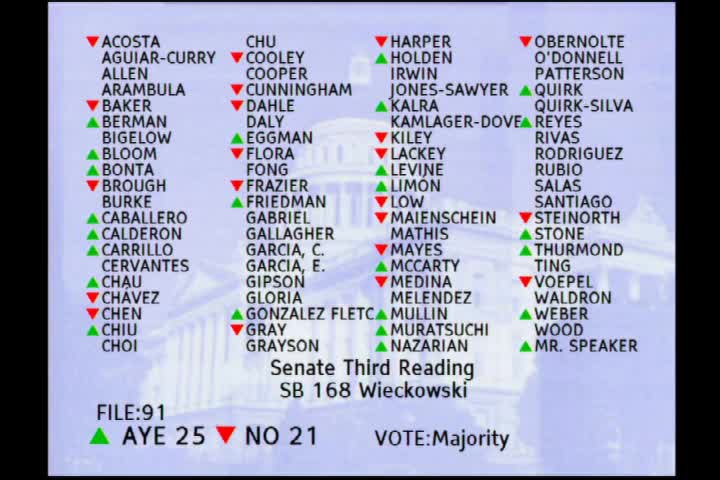

Bill Author

Bill Co-Author(s):