SB 1436: Natural parent and child relationship: establishment.
- Session Year: 2017-2018
- House: Senate
- Latest Version Date: 2018-07-16
Existing law requires the property of a decedents estate not disposed of by will to be passed to the decedents heirs through intestate succession and provides for the intestate rights between a natural parent and child. Existing law establishes a natural parent and child relationship, for the purposes of intestate succession, based on provisions of the Uniform Parentage Act, except as the provisions of that act are specifically excluded. Existing law authorizes a provision of the Uniform Parentage Act to be used to establish a natural parent and child relationship if it was impossible for the father to hold out the child as his own and paternity is established by clear and convincing evidence.
This bill would specify that clear and convincing evidence of parentage, for the purposes of utilizing this provision of the Uniform Parentage Act to establish a natural parent and child relationship, may include genetic DNA evidence acquired during the parents lifetime.
Existing law requires the property of a decedents estate not disposed of by will to be passed to the decedents heirs through intestate succession and provides for the intestate rights between a natural parent and child. Existing law establishes a natural parent and child relationship, for the purposes of intestate succession, based on provisions of the Uniform Parentage Act, except as the provisions of that act are specifically excluded. Existing law authorizes a provision of the Uniform Parentage Act to be used to establish a natural parent and child relationship if it was impossible for the father to hold out the child as his own and paternity is established by clear and convincing evidence.
This bill would specify that clear and convincing evidence of paternity, parentage, for the purposes of utilizing this provision of the Uniform Parentage Act to establish a natural parent and child relationship, may include genetic DNA evidence acquired during the fathers parents lifetime.
Existing law requires the property of a decedents estate not disposed of by will to be passed to the decedents heirs through intestate succession and provides for the intestate rights between a natural parent and child. Existing law establishes a natural parent and child relationship, for the purposes of intestate succession, based on provisions of the Uniform Parentage Act, except as the provisions of that act are specifically excluded. A natural parent and child relationship includes, among others, a person and the child he or she adopts, and a person and the child to whom the person gives birth. Existing law authorizes a provision of the Uniform Parentage Act to be used to establish a natural parent and child relationship if it was impossible for the father to hold out the child as his own and paternity is established by clear and convincing evidence.
This bill would expand those conditions that allow a natural parent and child relationship to be determined under the act to include when paternity is established by clear and convincing genetic DNA evidence.This bill would specify that clear and convincing evidence of paternity, for the purposes of utilizing this provision of the Uniform Parentage Act to establish a natural parent and child relationship, may include genetic DNA evidence acquired during the fathers lifetime.
Existing law requires the property of a decedents estate not disposed of by will to be passed to the decedents heirs through intestate succession and provides for the intestate rights between a natural parent and child. Existing law establishes a natural parent and child relationship, for the purposes of intestate succession, based on provisions of the Uniform Parentage Act, except as the provisions of that act are specifically excluded. A natural parent and child relationship includes, among others, a person and the child he or she adopts, and a person and the child to whom the person gives birth.
This bill would expand those conditions that allow a natural parent and child relationship to be determined under the act to include when paternity is established by clear and convincing genetic DNA evidence.
Existing law establishes various programs, including, among others, the Emergency Housing and Assistance Program, to provide assistance to homeless persons. Existing law also establishes the Homeless Coordinating and Financing Council to, among other things, create a statewide data system or warehouse that collects local data through homeless management information systems, with the ultimate goal of matching data on homelessness programs to programs impacting homeless recipients of state programs, as specified.This bill would express the intent of the Legislature to enact legislation relating to homeless encampments in California.Existing law establishes various programs, including, among others, the Emergency Housing and Assistance Program, to provide assistance to homeless persons. Existing law also establishes the Homeless Coordinating and Financing Council to, among other things, create a statewide data system or warehouse that collects local data through homeless management information systems, with the ultimate goal of matching data on homelessness programs to programs impacting homeless recipients of state programs, as specified.
This bill would express the intent of the Legislature to enact legislation relating to homeless encampments in California.
For the purpose of determining whether a person is a natural parent as that term is used in this chapter:
(a)A natural parent and child relationship is established where that relationship is presumed and not rebutted pursuant to the Uniform Parentage Act (Part 3 (commencing with Section 7600) of Division 12 of the Family Code).
(b)A natural parent and child relationship may be established pursuant to any other provisions of the Uniform Parentage Act, except that the relationship may not be established by an action under subdivision (c) of Section 7630 of the Family Code unless any of the following conditions exist:
(1)A court order was entered during the parents lifetime declaring parentage.
(2)Parentage is established by clear and convincing evidence that the parent has openly held out the child as that parents own.
(3)It was impossible for the parent to hold out the child as that parents own and parentage is established by clear and convincing evidence, which may include genetic DNA evidence acquired during the parents lifetime.
(c)A natural parent and child relationship may be established pursuant to Section 249.5.
For the purpose of determining whether a person is a natural parent as that term is used in this chapter:
(a)A natural parent and child relationship is established where that relationship is presumed and not rebutted pursuant to the Uniform Parentage Act (Part 3 (commencing with Section 7600) of Division 12 of the Family Code).
(b)A natural parent and child relationship may be established pursuant to any other provisions of the Uniform Parentage Act, except that the relationship may not be established by an action under subdivision (c) of Section 7630 of the Family Code unless any of the following conditions exist:
(1)A court order was entered during the fathers parents lifetime declaring paternity. parentage.
(2)Paternity Parentage is established by clear and convincing evidence that the father parent has openly held out the child as his that parents own.
(3)It was impossible for the father parent to hold out the child as his that parents own and paternity parentage is established by clear and convincing evidence, which may include genetic DNA evidence acquired during the fathers parents lifetime.
(c)A natural parent and child relationship may be established pursuant to Section 249.5.
For the purpose of determining whether a person is a natural parent as that term is used in this chapter:
(a)A natural parent and child relationship is established where that relationship is presumed and not rebutted pursuant to the Uniform Parentage Act (Part 3 (commencing with Section 7600) of Division 12 of the Family Code).
(b)A natural parent and child relationship may be established pursuant to any other provisions of the Uniform Parentage Act, except that the relationship may not be established by an action under subdivision (c) of Section 7630 of the Family Code unless any of the following conditions exist:
(1)A court order was entered during the fathers lifetime declaring paternity.
(2)Paternity is established by clear and convincing evidence that the father has openly held out the child as his own.
(3)It was impossible for the father to hold out the child as his own and paternity is established by clear and convincing evidence. evidence, which may include genetic DNA evidence acquired during the fathers lifetime.
(4)Paternity is established by clear and convincing genetic DNA evidence.(c)A natural parent and child relationship may be established pursuant to Section 249.5.
For the purpose of determining whether a person is a natural parent as that term is used in this chapter:
(a)A natural parent and child relationship is established where that relationship is presumed and not rebutted pursuant to the Uniform Parentage Act (Part 3 (commencing with Section 7600) of Division 12 of the Family Code).
(b)A natural parent and child relationship may be established pursuant to any other provisions of the Uniform Parentage Act, except that the relationship may not be established by an action under subdivision (c) of Section 7630 of the Family Code unless any of the following conditions exist:
(1)A court order was entered during the fathers lifetime declaring paternity.
(2)Paternity is established by clear and convincing evidence that the father has openly held out the child as his own.
(3)It was impossible for the father to hold out the child as his own and paternity is established by clear and convincing evidence.
(4)Paternity is established by clear and convincing genetic DNA evidence.
(c)A natural parent and child relationship may be established pursuant to Section 249.5.
SECTION 1.It is the intent of the Legislature to enact legislation relating to homeless encampments in California.It is the intent of the Legislature to enact legislation relating to homeless encampments in California.
|
Date
|
Status
|
|---|---|
| Jul 16, 2018 | Chaptered by Secretary of State. Chapter 116, Statutes of 2018. |
| Jul 16, 2018 | Approved by the Governor. |
| Jul 10, 2018 | Enrolled and presented to the Governor at 3:30 p.m. |
| Jul 2, 2018 | Assembly amendments concurred in. (Ayes 37. Noes 0.) Ordered to engrossing and enrolling. |
| Jun 19, 2018 | In Senate. Concurrence in Assembly amendments pending. |
| Jun 18, 2018 | Read third time. Passed. Ordered to the Senate. |
| Jun 13, 2018 | Read second time. Ordered to consent calendar. |
| Jun 12, 2018 | From committee: Do pass. Ordered to consent calendar. (Ayes 9. Noes 0.) (June 12). |
| Jun 7, 2018 | From committee with author's amendments. Read second time and amended. Re-referred to Com. on JUD. |
| May 25, 2018 | Referred to Com. on JUD. |
| May 17, 2018 | In Assembly. Read first time. Held at Desk. |
| May 17, 2018 | Read third time. Passed. (Ayes 37. Noes 0.) Ordered to the Assembly. |
| May 10, 2018 | Read second time. Ordered to consent calendar. |
| May 9, 2018 | From committee: Do pass. Ordered to consent calendar. (Ayes 7. Noes 0.) (May 8). |
| May 1, 2018 | Set for hearing May 8. |
| Apr 30, 2018 | May 1 hearing postponed by committee. |
| Apr 30, 2018 | From committee with author's amendments. Read second time and amended. Re-referred to Com. on JUD. |
| Apr 24, 2018 | Set for hearing May 1. |
| Apr 23, 2018 | May 8 set for first hearing canceled at the request of author. |
| Apr 18, 2018 | Set for hearing May 8. |
| Apr 4, 2018 | Re-referred to Com. on JUD. |
| Mar 22, 2018 | From committee with author's amendments. Read second time and amended. Re-referred to Com. on RLS. |
| Mar 8, 2018 | Referred to Com. on RLS. |
| Feb 20, 2018 | From printer. May be acted upon on or after March 22. |
| Feb 16, 2018 | Introduced. Read first time. To Com. on RLS. for assignment. To print. |
|
Date
|
Description
|
Location
|
Votes
|
|
|---|---|---|---|---|
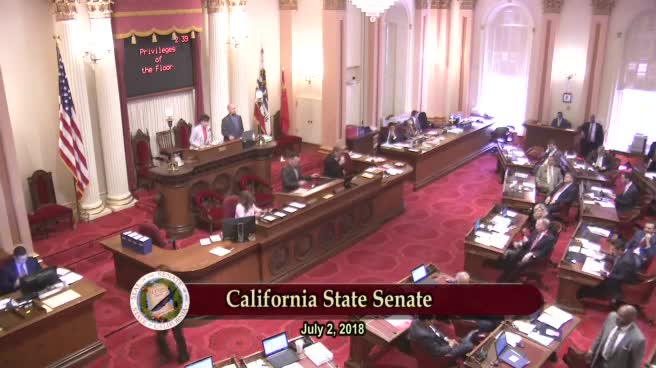
| Jul 2, 2018 | Unfinished Business SB1436 Portantino Concurrence | Senate Floor |
Passed |
|
| Jun 18, 2018 | SB 1436 Portantino Consent Calendar Second Day Regular Session | Assembly Floor |
Passed |
|
| Jun 12, 2018 | Do pass. To Consent Calendar. | Assembly Standing Committee on Judiciary |
Passed |
|
| May 17, 2018 | Consent Calendar SB1436 | Senate Floor |
Passed |
|
| May 8, 2018 | Do pass and be ordered to the Consent Calendar | Senate Standing Committee on Judiciary |
Passed |
This list shows positions taken on this bill by organizations on the date displayed, which is linked to the original source.
Positions by individuals are not included.
Office of Senate Floor Analyses (916) 651-1520 Fax: (916) 327-4478 | SB 1436 |
UNFINISHED BUSINESS
Bill No: SB 1436
Amended: 6/7/18
SENATE JUDICIARY COMMITTEE: 7-0, 5/8/18
AYES: Jackson, Moorlach, Anderson, Hertzberg, Monning, Stern, Wieckowski
SENATE FLOOR: 38-0, 5/17/18 (Consent)
AYES: Allen, Anderson, Atkins, Bates, Beall, Bradford, Cannella, De León, Dodd, Fuller, Gaines, Galgiani, Glazer, Hernandez, Hertzberg, Hill, Hueso, Jackson, Lara, Leyva, McGuire, Mitchell, Monning, Moorlach, Morrell, Newman, Nguyen, Nielsen, Pan, Portantino, Roth, Skinner, Stern, Stone, Vidak, Wieckowski, Wiener, Wilk
NO VOTE RECORDED: Berryhill
ASSEMBLY FLOOR: 80-0, 6/18/18 (Consent) - See last page for vote
SUBJECT: Natural parent and child relationship: establishment
DIGEST:
This bill clarifies the limited use of genetic DNA evidence as evidence for establishing parentage for purposes of determining intestate succession and makes that provision gender neutral.
Assembly Amendments
make gender neutral the determination of parentage for purposes of intestate succession.
Existing law:
- Establishes the California Uniform Parentage Act (UPA). Defines a parent and child relationship as the legal relationship existing between a child and the child’s natural or adoptive parents incident to which the law confers or imposes rights, privileges, duties and obligations. (Family Code Section 7600 et seq.)
- Sets forth various presumptions for establishing parentage, including being married to the child’s natural mother, signing a voluntary declaration of paternity, and openly holding out the child as that person's own child. (Family Code Sections 7540, 7570 et seq., and 7611.)
- Requires the property of a decedent’s estate not disposed of by will to be passed to the decedent’s heirs through intestate succession. Sets forth the intestate succession rights of the decedent’s issue, which is defined as the decedent’s lineal descendants of all generations, with the relationship of parent and child at each generation, as specified. In particular, provides that the part of an estate that does not pass to the surviving spouse or registered domestic partner or, the entire estate, if there is no surviving spouse or registered domestic partner, passes:
- To the decedent's issue, as provided;
- If no surviving issue, to the decedent's parents equally;
- If no surviving issue or parent, to the parents’ issue, as provided;
- If no surviving issue, or parent or issue of the parents, to the grandparents or their issue, as provided;
- If no surviving issue, parent or parents’ issue, or grandparent or grandparents’ issue, to the issue of a predeceased spouse or registered domestic partner, as provided; and
- If no surviving issue, parent or parents’ issue, grandparent or grandparents’ issue, or issue of a predeceased spouse or registered domestic partner, to the next of kin, as provided. (Probate Code Sections 50, 6400, and 6402.)
- Specifies that a relationship of parent and child exists for the purpose of intestate succession if the relationship of parent and child exists between a person and the person’s natural parents, regardless of the marital status of the natural parents; or the relationship of parent and child exists between an adopted person and the person’s adopting parents. (Probate Code Section 6450.)
- Provides that a person is a natural parent for purposes of intestate succession if the relationship is presumed and not rebutted by the UPA. A parent-child relationship may be established under the UPA, except an action cannot be brought to establish one (outside of the marriage presumption under Family Code Section 7540), unless one of the following applies:
- A court order was entered during the father’s lifetime declaring paternity;
- Paternity is established by clear and convincing evidence that the father has openly held out the child as his own; or
- It was impossible for the father to hold out the child as his own and paternity is established by clear and convincing evidence. (Probate Code Section 6453.)
This bill:
- Clarifies that, for purposes of establishing parentage for determining intestate succession where it was impossible for a parent to hold a child out as that parent's own, evidence of parentage may include genetic DNA evidence acquired during the parent's lifetime.
- Makes gender neutral the determination of parentage for purposes of intestate succession.
FISCAL EFFECT: Appropriation: No Fiscal Com.: No Local: No
Consumer Attorneys of California
OPPOSITION: (Verified 6/19/18)
None received
ASSEMBLY FLOOR: 80-0, 6/18/18
AYES: Acosta, Aguiar-Curry, Travis Allen, Arambula, Baker, Berman, Bigelow, Bloom, Bonta, Brough, Burke, Caballero, Calderon, Carrillo, Cervantes, Chau, Chávez, Chen, Chiu, Choi, Chu, Cooley, Cooper, Cunningham, Dahle, Daly, Eggman, Flora, Fong, Frazier, Friedman, Gabriel, Gallagher, Cristina Garcia, Eduardo Garcia, Gipson, Gloria, Gonzalez Fletcher, Gray, Grayson, Harper, Holden, Irwin, Jones-Sawyer, Kalra, Kamlager-Dove, Kiley, Lackey, Levine, Limón, Low, Maienschein, Mathis, Mayes, McCarty, Medina, Melendez, Mullin, Muratsuchi, Nazarian, Obernolte, O'Donnell, Patterson, Quirk, Quirk-Silva, Reyes, Rivas, Rodriguez, Rubio, Salas, Santiago, Steinorth, Mark Stone, Thurmond, Ting, Voepel, Waldron, Weber, Wood, Rendon
Prepared by: Josh Tosney / JUD. / (916) 651-4113
6/20/18 15:06:05
**** END ****
Date of Hearing: June 12, 2018
ASSEMBLY COMMITTEE ON JUDICIARY
Mark Stone, Chair
SBPCA Bill Id:SB 1436
Author:(Portantino) – As Amended Ver:June 7, 2018
PROPOSED CONSENT
SENATE VOTE: 38-0
SUBJECT: INTESTATE SUCCESSIOn: ESTABLISHING PARENTAGE
KEY ISSUE: SHOULD THE DETERMINATION OF PARENTAGE FOR PURPOSES OF INTESTATE SUCCESSION BE GENDER NEUTRAL, JUST AS THE UNIFORM PARENTAGE ACT IS TODAY, AND SHOULD THE LAW BE CLARIFIED TO PERMIT USE OF DNA EVIDENCE, ACQUIRED DURING A PARENT'S LIFETIME, as evidence of PARENTAGE FOR PURPOSES OF INTESTATE SUCCESSION?
SYNOPSIS
When a person dies with a will, his or her assets pass as directed in the will. The decedent's wishes are known and followed. However, if the person does not leave a will, he or she dies intestate and the estate passes based on the state's intestacy statutes. The rules set out in statute are generally the Legislature's best guess as to what the decedent would have wanted. The probate court does not look at the nature and quality of the relationship between the decedent and the heirs, or any other equitable issue. Rather, the court simply follows statutory directive.
This bill seeks to clarify that DNA can be used as evidence to establish parentage for purposes of intestate succession, if the DNA sample is acquired during the parent's lifetime. The bill also makes gender neutral the intestacy statute regarding inheritance by a person's decedents, to ensure that children are treated the same way for intestate succession, regardless of whether they are born to same-sex or opposite-sex couples. This bill is supported by the Consumer Attorneys of California and has no known opposition.
SUMMARY: Clarifies the limited use of genetic DNA evidence as evidence for establishing parentage for purposes of determining intestate succession and makes that provision gender neutral. Specifically, this bill
- Clarifies that, for purposes of establishing parentage for determining intestate succession where it was impossible for a parent to hold a child out as that parent's own, evidence of parentage may include genetic DNA evidence acquired during the parent's lifetime.
- Makes gender neutral the determination of parentage for purposes of intestate succession.
EXISTING LAW:
- Establishes the California Uniform Parentage Act (UPA). Defines a parent and child relationship as the legal relationship existing between a child and the child’s natural or adoptive parents incident to which the law confers or imposes rights, privileges, duties and obligations. (Family Code Section 7600 et seq.)
- Sets forth various presumptions for establishing parentage, including being married to the child’s natural mother, signing a voluntary declaration of paternity, and openly holding out the child as that person's own child. (Family Code Sections 7540, 7570 et seq., and 7611.)
- Requires the property of a decedent’s estate not disposed of by will to be passed to the decedent’s heirs through intestate succession. Sets forth the intestate succession rights of the decedent’s issue, which is defined as the decedent’s lineal descendants of all generations, with the relationship of parent and child at each generation, as specified. In particular, provides that the part of an estate that does not pass to the surviving spouse or registered domestic partner or, the entire estate, if there is no surviving spouse or registered domestic partner, passes:
- To the decedent's issue, as provided;
- If no surviving issue, to the decedent's parents equally;
- If no surviving issue or parent, to the parents’ issue, as provided;
- If no surviving issue, or parent or issue of the parents, to the grandparents or their issue, as provided;
- If no surviving issue, parent or parents’ issue, or grandparent or grandparents’ issue, to the issue of a predeceased spouse or registered domestic partner, as provided; and
- If no surviving issue, parent or parents’ issue, grandparent or grandparents’ issue, or issue of a predeceased spouse or registered domestic partner, to the next of kin, as provided. (Probate Code Sections 50, 6400, and 6402.)
- Specifies that a relationship of parent and child exists for the purpose of intestate succession if the relationship of parent and child exists between a person and the person’s natural parents, regardless of the marital status of the natural parents; or the relationship of parent and child exists between an adopted person and the person’s adopting parents. (Probate Code Section 6450.)
- Provides that a person is a natural parent for purposes of intestate succession if the relationship is presumed and not rebutted by the UPA. A parent-child relationship may be established under the UPA, except an action cannot be brought to establish one (outside of the marriage presumption under Family Code Section 7540), unless one of the following applies:
- A court order was entered during the father’s lifetime declaring paternity;
- Paternity is established by clear and convincing evidence that the father has openly held out the child as his own; or
- It was impossible for the father to hold out the child as his own and paternity is established by clear and convincing evidence. (Probate Code Section 6453.)
FISCAL EFFECT: As currently in print this bill is keyed non-fiscal.
COMMENTS: When a person dies with a will, his or her assets pass as directed in the will. The decedent's wishes are known and followed. However, if the person does not leave a will, he or she dies intestate and the estate passes based on the state's intestacy statutes. The rules set out in statute are generally the Legislature's best guess as to what the decedent would have wanted. The probate court does not look at the nature and quality of the relationship between the decedent and the heirs, or any other equitable issue. Rather, the court simply follows statutory directive. As the California Supreme Court has stated: "Intestate succession is wholly statutory. Any inequity which results . . . has been engendered by the Legislature itself" (Estate of McDill (1975) 14 Cal.3d 831, 840) and "the right to succession is not an inherent or natural right, but purely a creature of statute." (Estate of Leslie (1984) 37 Cal.3d 186, 199 [citations omitted].)
This bill seeks to clarify that DNA may be used as evidence, in limited circumstances, to establish parentage for purposes of intestate succession and makes gender neutral the intestacy statute regarding inheritance by a person's decedents.
What does it mean to have a parent-child relationship? This bill clarifies that evidence of parentage, for purposes of intestate succession, may include DNA evidence acquired during a parent's lifetime. It does not allow DNA evidence collected after death, when no other relationship exists between the parties, to prove parentage.
Intestacy laws also seek to carry out the decedent’s probable intent efficiently and expeditiously. (Estate of Joseph (1998) 17 Cal.4th 203, 212.) However, as a general matter, genetic evidence of paternity is neither sufficient nor necessary to establish a parent-child relationship for purposes of intestate succession. The theory underlying this policy choice is that the rules of intestacy should reflect what the decedent would have wanted. “[I]t makes sense that a decedent would intend his estate to pass to a child he actively raised and nurtured within his family. On the other hand, it is less logical to presume that a decedent would intend to pass his estate to a child he may not even have known, simply on account of a biological connection or legal presumption.” (Note, Intestate Inheritance Claims: Determining a Child's Right to Inherit When Biological and Presumptive Paternity Overlap (2008) 29 Cardozo L.Rev. 2823, 2826-27.) Existing probate laws embody this policy and reflect longstanding trends in public policy and the nature of family relationships.
In some circumstances, genetic evidence plays a crucial role in the determination of paternity for purposes of intestate succession. For instance, Probate Code Section 6453 (b)(1) provides that a father is a natural parent if a court order was entered during the father’s lifetime declaring paternity—an order for which genetic evidence would likely be admissible. And a natural parent and child relationship may be established between a parent and a posthumously conceived child under Probate Code Section 249.5; parentage would be difficult to establish in that case without genetic evidence. Finally, in instances in which it was impossible for the father to hold the child out as his own, parentage under Probate Code Section 6453 (b)(3) may be established by clear and convincing evidence, which may include genetic DNA evidence acquired during the father’s lifetime. This bill clarifies that last use of genetic evidence.
Uniform Parentage Act updated in 2013 to make it gender neutral. The UPA was passed in 1975 to extend the parent and child relationship equally to every child and to every parent, regardless of the marital status of the parents. The UPA defines "parent and child relationship" as "the legal relationship existing between a child and the child's natural or adoptive parents incident to which the law confers or imposes rights, privileges, duties, and obligations." Legal parenthood can be established in a number of different ways. Under the Family Code, a person is conclusively presumed to be the parent of a child if that person was married to and cohabitating with the child’s mother, except as specified. (Family Code Section 7540.) A person who receives a child into that person's home and holds the child out as that person's own is also presumed a parent of the child. (Family Code Section 7611.) In 2005, the California Supreme Court required that the paternity presumptions be applied gender neutrally. (Elisa B. v. Superior Court (2005) 37 Cal.4th 108.)
This Committee's AB 1403, Chap. 510, Stats. 2013, updated the UPA, in conformity with Elisa B. to make it gender neutral. In particular, that bill changed the following terms:
- The term "presumed father" was changed to "presumed parent," since that term is gender neutral and both a mother and a father can be a presumed parent.
- The terms "father" and "mother" were replaced, when appropriate, with "parent."
- The term "paternity" was replaced, when appropriate, with the term "parentage."
Earlier this year, this Committee sought to further increase the gender neutrality in parentage determinations by passing AB 2864 (Bloom), which seeks to ensure that parents and children are treated the same, regardless of whether the children are born into same-sex or opposite-sex couples and updating how genetic testing is performed and used to establish and challenge parentage. This includes making the voluntary declaration of parentage available to all parents, not just to fathers. That bill is now before the Senate Judiciary Committee.
However, the parentage provisions of the Probate Code regarding intestate succession have not been updated and still use the terms "father" and "paternity." This bill rightly updates those terms to ensure that children are treated the same way for intestate succession, regardless of whether they are born to same-sex or opposite-sex couples.
REGISTERED SUPPORT / OPPOSITION:
Support
Consumer Attorneys of California
Opposition
None on file
Analysis Prepared by: Leora Gershenzon / JUD. / (916) 319-2334
Office of Senate Floor Analyses (916) 651-1520 Fax: (916) 327-4478 | SB |
CONSENT
Bill No: SB 1436
:
SENATE JUDICIARY COMMITTEE: 7-0, 5/8/18
AYES: Jackson, Moorlach, Anderson, Hertzberg, Monning, Stern, Wieckowski
DIGEST:
This bill clarifies that, in instances where it was impossible for a father of a child born out of wedlock to hold the child out as his own, evidence of a father’s paternity for purposes of intestate succession may include DNA evidence acquired during the father’s lifetime.
Existing law:
- Requires the property of a decedent’s estate not disposed of by will to be passed to the decedent’s heirs through intestate succession (Prob. Code Sec. 6400), and provides for the intestate rights of the decedent’s “issue” (Prob. Code Sec. 6402), a term defined as the decedent’s lineal descendants of all generations, with the relationship of parent and child at each generation, as specified. (Prob. Code Sec. 50).
- Specifies that a relationship of parent and child exists for the purpose of determining intestate succession if: the relationship of parent and child exists between a person and the person’s natural parents, regardless of the marital status of the natural parents; or the relationship of parent and child exists between an adopted person and the person’s adopting parent or parents. (Prob. Code Sec. 6450.)
- Provides that a person is a “natural parent” for purposes of intestate succession based on the provisions of the Uniform Parentage Act (UPA) (Fam. Code Sec. 7600 et seq.), with specified exceptions. (Prob. Code Sec. 6453.) The UPA establishes various presumptions for situations in which a father is a natural parent of a child, including when the father is married to the child’s natural mother, is listed on the child’s birth certificate, or receives the child into his home and openly holds out the child as his or her natural child. (Fam. Code Sec. 7611(a), (c).)
- Authorizes a child or the child’s representative to bring an action to establish that a person is the child’s natural father. (Fam. Code Sec. 7630(c).) However, in the context of intestate succession where no presumption establishing the relationship applies, the child or guardian must show one of the following under Probate Code Section 6453(b):
- a court order was entered during the father’s lifetime declaring paternity;
- paternity is established by clear and convincing evidence that the father has openly held out the child as his own; or
- it was impossible for the father to hold out the child as his own and paternity is established by clear and convincing evidence.
This bill clarifies that, for purposes of establishing paternity where it was impossible for the father to hold out the child as his own, evidence of paternity may include genetic DNA evidence acquired during the father’s lifetime.
Background
When a person dies without a will, existing law provides a set of default rules, known as intestate succession, for distributing the decedent’s assets to their family. Under existing intestacy statutes, a parent-child relationship must be shown for a child to inherit from a decedent parent. While this relationship is generally established by several rebuttable presumptions, unique rules apply to the relationship of a father and a child born out of wedlock that he did not raise. Specifically, the child must show one of the following:
- a court order was entered during the father’s lifetime declaring paternity;
- paternity is established by clear and convincing evidence that the father has openly held out the child as his own; or
- it was impossible for the father to hold out the child as his own and paternity is established by clear and convincing evidence.
This bill clarifies that, for purposes of the third category above, evidence of paternity may include DNA evidence acquired during the father’s lifetime.
Comments
According to the author:
Currently, there is a missing piece in California probate statute that needs to be amended in order to protect children of deceased fathers. This statute must be updated to include the missing piece of clear and convincing DNA genetic evidence to prove paternity in intestate circumstances. DNA testing is now proven scientifically reliable and is admissible in California criminal law, family law, and civil law cases. […] While California has a strong history of progressive laws protective of children, our state lags behind many other states that have updated their intestacy-related statutes to provide for DNA evidence of paternity. Additionally, one consequence is that California children are denied federal benefits, such as Social Security survivor benefits, when similarly-situated children in other states, will receive those same federal benefits. Colleagues, DNA evidence is widely accepted as reliable in the scientific community and is admissible in California criminal, family and civil law courts. It is time to bring California statute into compliance with other state statutes as well as federal law.
FISCAL EFFECT: Appropriation: Fiscal Com.: Local:
None received
OPPOSITION: (Verified 5/10/18)
None received
Prepared by: Josh Tosney / JUD. / (916) 651-4113
5/11/18 9:31:42
**** END ****
Senator Hannah-Beth Jackson, Chair
2017-2018 Regular Session
Bill No: SB 1436 (Author:Portantino)
Version: April 30, 2018
Hearing Date: May 8, 2018
Fiscal: No
Urgency: No
Consultant: JDT
SUBJECT
Natural parent and child relationship: establishment
DESCRIPTION
This bill would clarify that, in instances where it was impossible for a father of a child born out of wedlock to hold the child out as his own, evidence of a father’s paternity for purposes of intestate succession may include DNA evidence acquired during the father’s lifetime.
BACKGROUND
When a person dies without a will, existing law provides a set of default rules, known as intestate succession, for distributing the decedent’s assets to their family. Under existing intestacy statutes, a parent-child relationship must be shown for a child to inherit from a decedent parent. While this relationship is generally established by several rebuttable presumptions, unique rules apply to the relationship of a father and a child born out of wedlock that he did not raise. Specifically the child must show one of the following:
- a court order was entered during the father’s lifetime declaring paternity;
- paternity is established by clear and convincing evidence that the father has openly held out the child as his own; or
- it was impossible for the father to hold out the child as his own and paternity is established by clear and convincing evidence.
This bill would clarify that, for purposes of the third category above, evidence of paternity may include DNA evidence acquired during the father’s lifetime.
CHANGES TO EXISTING LAW
Existing law requires the property of a decedent’s estate not disposed of by will to be passed to the decedent’s heirs through intestate succession (Prob. Code Sec. 6400), and provides for the intestate rights of the decedent’s “issue” (Prob. Code Sec. 6402), a term defined as the decedent’s lineal descendants of all generations, with the relationship of parent and child at each generation, as specified (Prob. Code Sec. 50).
Existing law specifies that a relationship of parent and child exists for the purpose of determining intestate succession if: the relationship of parent and child exists between a person and the person’s natural parents, regardless of the marital status of the natural parents; or the relationship of parent and child exists between an adopted person and the person’s adopting parent or parents. (Prob. Code Sec. 6450.)
Existing law provides that a person is a “natural parent” for purposes of intestate succession based on the provisions of the Uniform Parentage Act (Fam. Code Sec. 7600 et seq.) (UPA), with specified exceptions. (Prob. Code Sec. 6453.) The UPA establishes various presumptions for situations in which a father is a natural parent of a child, including when the father is married to the child’s natural mother, is listed on the child’s birth certificate, or receives the child into his home and openly holds out the child as his or her natural child. (Fam. Code Sec. 7611(a), (c).)
Existing law authorizes a child or the child’s representative to bring an action to establish that a person is the child’s natural father. (Fam. Code Sec. 7630(c).) However, in the context of intestate succession where no presumption establishing the relationship applies, the child or guardian must show one of the following under Probate Code Section 6453(b):
- a court order was entered during the father’s lifetime declaring paternity;
- paternity is established by clear and convincing evidence that the father has openly held out the child as his own; or
- it was impossible for the father to hold out the child as his own and paternity is established by clear and convincing evidence.
This bill would clarify that, for purposes of establishing paternity where it was impossible for the father to hold out the child as his own, evidence of paternity may include genetic DNA evidence acquired during the father’s lifetime.
COMMENT
- Stated need for the bill:
According to the author:
Currently, there is a missing piece in California probate statute that needs to be amended in order to protect children of deceased fathers. This statute must be updated to include the missing piece of clear and convincing DNA genetic evidence to prove paternity in intestate circumstances. DNA testing is now proven scientifically reliable and is admissible in California criminal law, family law, and civil law cases. […] While California has a strong history of progressive laws protective of children, our state lags behind many other states that have updated their intestacy-related statutes to provide for DNA evidence of paternity. Additionally, one consequence is that California children are denied federal benefits, such as Social Security survivor benefits, when similarly-situated children in other states, will receive those same federal benefits. Colleagues, DNA evidence is widely accepted as reliable in the scientific community and is admissible in California criminal, family and civil law courts. It is time to bring California statute into compliance with other state statutes as well as federal law.
- Genetic versus functional relationship
As a general matter, genetic evidence of paternity is neither sufficient nor necessary to establish a parent-child relationship for purposes of intestate succession. The theory underlying this policy choice is that the rules of intestacy should reflect what the decedent would have wanted. “[I]t makes sense that a decedent would intend his estate to pass to a child he actively raised and nurtured within his family. On the other hand, it is less logical to presume that a decedent would intend to pass his estate to a child he may not even have known, simply on account of a biological connection or legal presumption.” (Note, Intestate Inheritance Claims: Determining a Child's Right to Inherit When Biological and Presumptive Paternity Overlap (2008) 29 Cardozo L.Rev. 2823, 2826.) Existing probate laws embody this policy and reflect longstanding trends in public policy and the nature of family relationships that have increasingly deemphasized genetic and biological ties in favor of functional and emotional relationships.
Another goal of intestacy law is to carry out the decedent’s probable intent efficiently and expeditiously. (Estate of Joseph (1998) 17 Cal.4th 203, 212.) If a parent-child relationship can be established by genetic evidence alone, an heir could appear to challenge a probate proceeding at any point. This could introduce considerable uncertainty and delay in such proceedings, as it would be impossible to conclusively determine that all potential heirs had been provided sufficient notice. If courts and administrators are forced to engage in costly and burdensome searches for unknown heirs, distributions would be delayed, closure deferred, and limited judicial resources stressed. Moreover, it could call completed administrations of estates into question.
Intestate statutes differ from statutes governing child support, where genetic proof of paternity is generally sufficient to require a person to provide support. A reason for this difference appears to be that, while the person is still alive, the person, when compelled to provide for a child, typically continues to have earning power and the ability to acquire more resources to provide for the child. But when the person dies, the assets in the person’s estate are fixed, and any framework for allocating those assets must reckon with zero-sum tradeoffs. Allowing unknown offspring to inherit a share of an intestate estate benefits them at the expense of those the decedent actually recognized as family. Intestate rules thus privilege functional over biological relationships.
Nevertheless, in some circumstances genetic evidence plays a crucial role in the determination of paternity for purposes of intestate succession. For instance, Probate Code Section 6453(b)(1) provides that a father is a natural parent if a court order was entered during the father’s lifetime declaring paternity—an order for which genetic evidence would likely be admissible. And a natural parent and child relationship may be established between a parent and a posthumously conceived child under Probate Code Section 249.5; parentage would appear to be difficult to establish without genetic evidence. Finally, in instances in which it was impossible for the father to hold the child out as his own, paternity Probate Code Section under 6453(b)(3) may be established by clear and convincing evidence, which would include genetic DNA evidence acquired during the father’s lifetime—the very point that this bill would make express.
Support: None known
Opposition: None known
HISTORY
Source: Author
Related Pending Legislation: None known
Prior Legislation:
AB 1910 (Harman, Ch. 755, Stats. 2004), among other things, provided that a natural parent and child relationship may be established between a deceased father and a posthumously conceived child under specified conditions.
AB 1137 (Knight, Ch. 529, Stats. 1993) established the existence of a parent-child relationship for the purpose of determining intestate succession in a probate action by clear and convincing evidence, reorganized intestate succession statutes, and clarified the law regarding the intestate inheritance rights of adoptees and their whole blood siblings.
**************
Bill Author

Bill Co-Author(s):