SB 1440: Energy: biomethane: biomethane procurement.
- Session Year: 2017-2018
- House: Senate
- Latest Version Date: 2018-09-23
Existing law requires state agencies to consider and, as appropriate, adopt policies and incentives to significantly increase the sustainable production and use of renewable gas. Existing law requires the Public Utilities Commission (PUC), in consultation with the State Energy Resources Conservation and Development Commission and the State Air Resources Board, to consider additional policies to support the development and use in the state of renewable gas that reduce short-lived climate pollutants in the state.
This bill would require the PUC, in consultation with the State Air Resources Board, to consider adopting specific biomethane procurement targets or goals for each gas corporation, as specified. The bill would require the PUC, if the PUC adopts those targets or goals, to take certain actions in regards to the development of the targets or goals and the procurement of the biomethane to meet those targets or goals.
Under existing law, a violation of the Public Utilities Act or any order, decision, rule, direction, demand, or requirement of the commission is a crime.
Because the provisions of this bill would be a part of the act and because a violation of an order or decision of the commission implementing its requirements would be a crime, the bill would impose a state-mandated local program by expanding the operation of a crime.
The California Constitution requires the state to reimburse local agencies and school districts for certain costs mandated by the state. Statutory provisions establish procedures for making that reimbursement.
This bill would provide that no reimbursement is required by this act for a specified reason.
Existing law requires state agencies to consider and, as appropriate, adopt policies and incentives to significantly increase the sustainable production and use of renewable gas. Existing law requires the PUC, Public Utilities Commission (PUC), in consultation with the State Energy Resources Conservation and Development Commission and the state board, State Air Resources Board, to consider additional policies to support the development and use in the state of renewable gas that reduce short-lived climate pollutants in the state.
This bill would require the state board, require the PUC, in consultation with the PUC, State Air Resources Board, to adopt a regulation to establish a requirement that all consider adopting specific biomethane procurement targets or goals for each gas corporations with over 100,000 customers procure biomethane consistent with specified conservation requirements and policies in current law and other requirements, including a requirement that these gas corporations collectively procure 32 billion cubic feet of biomethane annually by January 1, 2030. This bill would require the state board, in consultation with the PUC, to review this biomethane procurement regulation, and report to the Legislature on the progress toward meeting those requirements, on or before January 1, 2025. corporation, as specified. The bill would require the PUC, if the PUC adopts those targets or goals, to take certain actions in regards to the development of the targets or goals and the procurement of the biomethane to meet those targets or goals.
This bill would allocate to a gas corporations customers the costs incurred by the gas corporation to comply with the biomethane procurement programs requirements, as specified.Because certain provisions of this bill require commission enforcement and a violation of the commissions orders would be a crime, this bill would impose a state-mandated local program by creating a new crime.Under existing law, a violation of the Public Utilities Act or any order, decision, rule, direction, demand, or requirement of the commission is a crime.
Because the provisions of this bill would be a part of the act and because a violation of an order or decision of the commission implementing its requirements would be a crime, the bill would impose a state-mandated local program by expanding the operation of a crime.
The California Constitution requires the state to reimburse local agencies and school districts for certain costs mandated by the state. Statutory provisions establish procedures for making that reimbursement.
This bill would provide that no reimbursement is required by this act for a specified reason.
Under existing law, the Public Utilities Commission (PUC) has regulatory authority over public utilities, including electrical corporations and gas corporations. Existing law requires the commission to authorize the construction of an interconnection with existing transmission facilities for gas or electricity by a private energy producer upon application of the private energy producer if the commission makes specified findings. Existing law requires the private energy producer to provide and to pay the total cost of the interconnection as well as other specified costs. Under existing law, a violation of the Public Utilities Act or any order, decision, rule, direction, demand, or requirement of the commission is a crime.
This bill would amend the act to require a gas corporation that offers natural gas service and accepts an interconnection application from a private energy producer to provide the private energy producer with a sourced line-item justification, as defined, for the overall estimated cost of the interconnection. Because a violation of this requirement would be a crime, the bill would impose a state-mandated local program by creating a new crime.
Existing law requires state agencies to consider and, as appropriate, adopt policies and incentives to significantly increase the sustainable production and use of renewable gas. Existing law requires the PUC, in consultation with the State Energy Resources Conservation and Development Commission and the state board, to consider additional policies to support the development and use in the state of renewable gas that reduce short-lived climate pollutants in the state.
This bill would require the state board, in consultation with the PUC, to adopt a regulation to establish a requirement that all gas corporations with over 100,000 customers procure biomethane consistent with specified conservation requirements and policies in current law and other requirements, including a requirement that these gas corporations collectively procure 32 billion cubic feet of biomethane annually by January 1, 2030. This bill would require the state board, in consultation with the PUC, to review this biomethane procurement regulation, and report to the Legislature on the progress toward meeting those requirements, on or before January 1, 2025.
This bill would allocate to a gas corporations customers the costs incurred by the gas corporation to comply with the biomethane procurement programs requirements, as specified.
Because certain provisions of this bill require commission enforcement and a violation of the commissions orders would be a crime, this bill would impose a state-mandated local program by creating a new crime.
The California Constitution requires the state to reimburse local agencies and school districts for certain costs mandated by the state. Statutory provisions establish procedures for making that reimbursement.
This bill would provide that no reimbursement is required by this act for a specified reason.
Under existing law, the Public Utilities Commission (PUC) has regulatory authority over public utilities, including electrical corporations and gas corporations. Existing law requires the commission to authorize the construction of an interconnection with existing transmission facilities for gas or electricity by a private energy producer upon application of the private energy producer if the commission makes specified findings. Existing law requires the private energy producer to provide and to pay the total cost of the interconnection as well as other specified costs. Under existing law, a violation of the Public Utilities Act or any order, decision, rule, direction, demand, or requirement of the commission is a crime.
This bill would amend the act to require a gas corporation that offers electrical or natural gas service and accepts an interconnection application from a private energy producer to provide the private energy producer with a sourced line-item justification, as defined, for the overall estimated cost of the interconnection. By placing additional requirements upon local publicly owned utilities, this bill would impose a state-mandated local program. Because a violation of this requirement would be a crime, the bill would impose a state-mandated local program by creating a new crime.
Existing law requires state agencies to consider and, as appropriate, adopt policies and incentives to significantly increase the sustainable production and use of renewable gas. Existing law requires the PUC, in consultation with the State Energy Resources Conservation and Development Commission and the state board, to consider additional policies to support the development and use in the state of renewable gas that reduce short-lived climate pollutants in the state.
This bill would require the state board, in consultation with the PUC, to adopt a regulation to establish a requirement that all gas corporations with over 100,000 customers, except publicly owned gas utilities, customers procure biomethane consistent with specified conservation requirements and policies in current law and other requirements. requirements, including a requirement that these gas corporations collectively procure 32 billion cubic feet of biomethane annually by January 1, 2030. This bill would require the state board, in consultation with the PUC, to update the biomethane procurement programs requirements, review this biomethane procurement regulation, and report to the Legislature on the progress toward meeting those requirements, every 5 years. This bill would require the commission to allow recovery in the rate base of the just and reasonable investment required to interconnect biomethane production to the existing pipeline system, as specified. on or before January 1, 2025.
The California Constitution requires the state to reimburse local agencies and school districts for certain costs mandated by the state. Statutory provisions establish procedures for making that reimbursement.
This bill would provide that no reimbursement is required by this act for a specified reason.
Existing law requires the Office of Environmental Health Hazard Assessment, in consultation with the State Air Resources Board (state board), the Department of Toxic Substances Control, the Department of Resources Recycling and Recovery, and the California Environmental Protection Agency, to compile a list of constituents of concern that could pose risks to human health and that are found in biogas, as defined, at concentrations that significantly exceed the concentrations of those constituents in natural gas. Existing law defines biomass conversion for the purposes of the California Integrated Waste Management Act of 1989, which requires each city, county, and regional agency, if any, to develop a source reduction and recycling element of an integrated waste management plan.
This bill would revise the definitions of biogas and biomass conversion for these purposes.
Under existing law, the Public Utilities Commission (PUC) has regulatory authority over public utilities, including electrical corporations and gas corporations. Existing law requires the commission to authorize the construction of an interconnection with existing transmission facilities for gas or electricity by a private energy producer upon application of the private energy producer if the commission makes specified findings. Existing law requires the private energy producer to provide and to pay the total cost of the interconnection as well as other specified costs.
This bill would require a gas corporation that offers electrical or natural gas service and accepts an interconnection application from a private energy producer to provide the private energy producer with a sourced line-item justification, as defined, for the overall estimated cost of the interconnection. By placing additional requirements upon local publicly owned utilities, this bill would impose a state-mandated local program.
Existing law requires state agencies to consider and, as appropriate, adopt policies and incentives to significantly increase the sustainable production and use of renewable gas. Existing law requires the PUC, in consultation with the State Energy Resources Conservation and Development Commission and the state board, to consider additional policies to support the development and use in the state of renewable gas that reduce short-lived climate pollutants in the state.
This bill would require the state board, in consultation with the PUC, to establish a requirement that all gas corporations with over 100,000 customers, except publicly owned gas utilities, procure biomethane consistent with specified conservation requirements and policies in current law and other requirements. This bill would require the state board, in consultation with the PUC, to update the biomethane procurement programs requirements, and report to the Legislature on the progress toward meeting those requirements, every 5 years. This bill would require the commission to allow recovery in rates of the costs of investments for this program when specified conditions are met, subject to the commissions authority to determine just and reasonable expenditures. the rate base of the just and reasonable investment required to interconnect biomethane production to the existing pipeline system, as specified.
The California Constitution requires the state to reimburse local agencies and school districts for certain costs mandated by the state. Statutory provisions establish procedures for making that reimbursement.
This bill would provide that no reimbursement is required by this act for a specified reason.
Existing law requires the Office of Environmental Health Hazard Assessment, in consultation with the State Air Resources Board (state board), the Department of Toxic Substances Control, the Department of Resources Recycling and Recovery, and the California Environmental Protection Agency, to compile a list of constituents of concern that could pose risks to human health and that are found in biogas, as defined, at concentrations that significantly exceed the concentrations of those constituents in natural gas. Existing law defines biomass conversion for the purposes of the California Integrated Waste Management Act of 1989, which requires each city, county, and regional agency, if any, to develop a source reduction and recycling element of an integrated waste management plan.
This bill would revise the definitions of biogas and biomass conversion for these purposes.
Under existing law, the Public Utilities Commission (PUC) has regulatory authority over public utilities, including electrical corporations and gas corporations. Existing law requires the commission to authorize the construction of an interconnection with existing transmission facilities for gas or electricity by a private energy producer upon application of the private energy producer if the commission makes specified findings. Existing law requires the private energy producer to provide and to pay the total cost of the interconnection as well as other specified costs.
This bill would require an electrical corporation, gas corporation, local publicly owned gas or electric utility, electrical cooperative, or any other entity, except an electric service provider, a gas corporation that offers electrical or natural gas service and accepts an interconnection application from a private energy producer to provide the private energy producer with a sourced line-item justification, as defined, for the overall estimated cost of the interconnection. By placing additional requirements upon local publicly owned utilities, this bill would impose a state-mandated local program. The bill would also authorize the private energy producer to dispute the reasonableness of the overall estimated cost of the interconnection through an appeal process to be determined by the commission.
Existing law requires state agencies to consider and, as appropriate, adopt policies and incentives to significantly increase the sustainable production and use of renewable gas. Existing law requires the PUC, in consultation with the State Energy Resources Conservation and Development Commission and the state board, to consider additional policies to support the development and use in the state of renewable gas that reduce short-lived climate pollutants in the state.
This bill would require the state board, in consultation with the PUC, to establish a requirement that all gas corporations with over 100,000 customers and other purchasers of biogas, customers, except publicly owned gas utilities, procure biogas and biomethane consistent with specified conservation requirements and policies in current law. law and other requirements. This bill would require the state board, in consultation with the PUC, to update the biogas and biomethane procurement programs requirements requirements, and report to the Legislature on the progress toward meeting those requirements, every 5 years. This bill would require the commission to allow recovery in rates of the costs of investments for this program, program when specified conditions are met. met, subject to the commissions authority to determine just and reasonable expenditures.
The California Constitution requires the state to reimburse local agencies and school districts for certain costs mandated by the state. Statutory provisions establish procedures for making that reimbursement.
This bill would provide that no reimbursement is required by this act for a specified reason.
Existing law requires the Office of Environmental Health Hazard Assessment, in consultation with the State Air Resources Board (state board), the Department of Toxic Substances Control, the Department of Resources Recycling and Recovery, and the California Environmental Protection Agency, to compile a list of constituents of concern that could pose risks to human health and that are found in biogas, as defined, at concentrations that significantly exceed the concentrations of those constituents in natural gas. Existing law defines biomass conversion for the purposes of the California Integrated Waste Management Act of 1989, which requires each city, county, and regional agency, if any, to develop a source reduction and recycling element of an integrated waste management plan.
This bill would revise the definitions of biogas and biomass conversion for these purposes.
Under existing law, the Public Utilities Commission (PUC) has regulatory authority over public utilities, including electrical corporations and gas corporations. Existing law requires the commission to authorize the construction of an interconnection with existing transmission facilities for gas or electricity by a private energy producer upon application of the private energy producer if the commission makes specified findings. Existing law requires the private energy producer to provide and to pay the total cost of the interconnection as well as other specified costs.
This bill would require an electrical corporation, gas corporation, local publicly owned gas or electric utility, electrical cooperative, or any other entity, except an electric service provider, that offers electrical or natural gas service and accepts an interconnection application from a private energy producer to provide the private energy producer with a sourced line-item justification, as defined, for the overall estimated cost of the interconnection. By placing additional requirements upon local publicly owned utilities, this bill would impose a state-mandated local program. The bill would also authorize the private energy producer to dispute the reasonableness of the overall estimated cost of the interconnection through an appeal process to be determined by the commission.
Existing law requires state agencies to consider and, as appropriate, adopt policies and incentives to significantly increase the sustainable production and use of renewable gas. Existing law requires the PUC, in consultation with the State Energy Resources Conservation and Development Commission and the state board, to consider additional policies to support the development and use in the state of renewable gas that reduce short-lived climate pollutants in the state.
This bill would require the state board, in consultation with the PUC, to establish a requirement that all gas corporations with over 100,000 customers and other purchasers of biogas, except publicly owned gas utilities, procure biogas and biomethane consistent with specified conservation requirements and policies in current law. This bill would require the state board, in consultation with the PUC, to update the biogas and biomethane procurement programs requirements every 5 years. This bill would require the commission to allow recovery in rates of the costs of investments for this program, when specified conditions are met.
The California Constitution requires the state to reimburse local agencies and school districts for certain costs mandated by the state. Statutory provisions establish procedures for making that reimbursement.
This bill would provide that no reimbursement is required by this act for a specified reason.
Existing law requires state agencies to consider and, as appropriate, adopt policies and incentives to significantly increase the sustainable production and use of renewable gas. Under existing law, the Public Utilities Commission (PUC) has regulatory authority over public utilities, including gas corporations. Existing law requires the PUC to adopt policies and programs that promote the in-state production and distribution of biomethane, as defined, and that facilitate the development of a variety of sources of in-state biomethane. Existing law requires the PUC, in consultation with the State Energy Resources Conservation and Development Commission (Energy Commission) and the State Air Resources Board (state board), to consider additional policies to support the development and use in the state of renewable gas that reduce short-lived climate pollutants in the state.This bill would require the PUC, in consultation with the state board, before July 1, 2019, to establish a biomethane procurement program with goals for gas corporations to collectively procure, on an annual basis, their proportionate share of a statewide total of 32 billion cubic feet of biomethane from sources that have a first point of interconnection with the pipeline system in California. The bill would also set goals for the procurement of biomethane produced from identified source materials. The bill would require the PUC to approve, or modify and approve, a gas corporations application to recover in the rate base the investments in infrastructure necessary to deliver biomethane from a biomethane producer to the pipeline system with full cost recovery from the gas corporations customers. The bill would require certain other costs incurred by a gas corporation to comply with the programs requirements to be allocated as a fully nonbypassable fixed charge or a nonbypassable demand differentiated fixed charge to the gas corporations customers. The bill would authorize the PUC to relieve a gas corporation from meeting the programs goals if the compliance costs are above a specified amount. This bill would require the PUC to require up to 15% of annual revenues received by a gas corporation as a result of the allocation of greenhouse gas allowances to natural gas suppliers to be used for reducing the cost or impact of biomethane used in stationary sources to support certain existing greenhouse gas reduction goals.Under the Public Utilities Act a violation of any order, decision, rule, direction, demand, or requirement of the commission is a crime.Because the violation of an order of the commission implementing the bills provisions would be a crime, this bill would impose a state-mandated local program.The California Constitution requires the state to reimburse local agencies and school districts for certain costs mandated by the state. Statutory provisions establish procedures for making that reimbursement.This bill would provide that no reimbursement is required by this act for a specified reason.Existing law requires state agencies to consider and, as appropriate, adopt policies and incentives to significantly increase the sustainable production and use of renewable gas. Under existing law, the Public Utilities Commission (PUC) has regulatory authority over public utilities, including gas corporations. Existing law requires the PUC to adopt policies and programs that promote the in-state production and distribution of biomethane, as defined, and that facilitate the development of a variety of sources of in-state biomethane. Existing law requires the PUC, in consultation with the State Energy Resources Conservation and Development Commission (Energy Commission) and the State Air Resources Board (state board), to consider additional policies to support the development and use in the state of renewable gas that reduce short-lived climate pollutants in the state.
This bill would require the PUC, in consultation with the state board, before July 1, 2019, to establish a biomethane procurement program that requires certain gas corporations, until January 1, 2030, to annually procure their proportionate share of a total of 32 billion cubic feet of biomethane statewide, from sources that reduce the emissions of greenhouse gases and in furtherance of the statewide greenhouse gas emissions limit. The bill would require the program, to the extent consistent with federal and state law, to prioritize the procurement of biomethane from certain biomethane producers and to require the procurement of minimum volumes of biomethane produced in-state from eligible feedstocks sufficient to support the achievement of certain methane reduction goals. with goals for gas corporations to collectively procure, on an annual basis, their proportionate share of a statewide total of 32 billion cubic feet of biomethane from sources that have a first point of interconnection with the pipeline system in California. The bill would also set goals for the procurement of biomethane produced from identified source materials. The bill would require the PUC to approve, or modify and approve, a gas corporations application to recover in the rate base the investments in infrastructure necessary to deliver biomethane from a biomethane producer to the pipeline system with full cost recovery from the gas corporations customers. The bill would require certain other costs incurred by a gas corporation to comply with the programs requirements to be allocated as a fully nonbypassable fixed charge or a nonbypassable demand differentiated fixed charge to the gas corporations customers. The bill would authorize the PUC to relieve a gas corporation from meeting the programs requirements goals if the compliance costs are above a specified amount. This bill would require the PUC to require up to 15% of annual revenues received by a gas corporation as a result of the allocation of greenhouse gas allowances to natural gas suppliers to be used for reducing the cost or impact of biomethane used in stationary sources to support certain existing greenhouse gas reduction goals.
Under the Public Utilities Act a violation of any order, decision, rule, direction, demand, or requirement of the commission is a crime.
Because the violation of an order of the commission implementing the bills provisions would be a crime, this bill would impose a state-mandated local program.
The California Constitution requires the state to reimburse local agencies and school districts for certain costs mandated by the state. Statutory provisions establish procedures for making that reimbursement.
This bill would provide that no reimbursement is required by this act for a specified reason.
Existing law requires state agencies to consider and, as appropriate, adopt policies and incentives to significantly increase the sustainable production and use of renewable gas. Under existing law, the Public Utilities Commission (PUC) has regulatory authority over public utilities, including gas corporations. Existing law requires the PUC to adopt policies and programs that promote the in-state production and distribution of biomethane, as defined, and that facilitate the development of a variety of sources of in-state biomethane. Existing law requires the Public Utilities Commission, PUC, in consultation with the State Energy Resources Conservation and Development Commission (Energy Commission) and the State Air Resources Board, Board (state board), to consider additional policies to support the development and use in the state of renewable gas that reduce short-lived climate pollutants in the state.
This bill would state the intent of the Legislature to enact legislation to establish biomethane procurement goals. require the PUC, in consultation with the state board, before July 1, 2019, to establish a biomethane procurement program that requires certain gas corporations, until January 1, 2030, to annually procure their proportionate share of a total of 32 billion cubic feet of biomethane statewide, from sources that reduce the emissions of greenhouse gases and in furtherance of the statewide greenhouse gas emissions limit. The bill would require the program, to the extent consistent with federal and state law, to prioritize the procurement of biomethane from certain biomethane producers and to require the procurement of minimum volumes of biomethane produced in-state from eligible feedstocks sufficient to support the achievement of certain methane reduction goals. The bill would require the PUC to approve, or modify and approve, a gas corporations application to recover in the rate base the investments in infrastructure necessary to deliver biomethane from a biomethane producer to the pipeline system with full cost recovery from the gas corporations customers. The bill would require certain other costs incurred by a gas corporation to comply with the programs requirements to be allocated as a fully nonbypassable fixed charge or a nonbypassable demand differentiated fixed charge to the gas corporations customers. The bill would authorize the PUC to relieve a gas corporation from the programs requirements if the compliance costs are above a specified amount.
Under the Public Utilities Act a violation of any order, decision, rule, direction, demand, or requirement of the commission is a crime.
Because the violation of an order of the commission implementing the bills provisions would be a crime, this bill would impose a state-mandated local program.
The California Constitution requires the state to reimburse local agencies and school districts for certain costs mandated by the state. Statutory provisions establish procedures for making that reimbursement.
This bill would provide that no reimbursement is required by this act for a specified reason.
Existing law requires state agencies to consider and, as appropriate, adopt policies and incentives to significantly increase the sustainable production and use of renewable gas. Existing law requires the Public Utilities Commission, in consultation with the State Energy Resources Conservation and Development Commission and the State Air Resources Board, to consider additional policies to support the development and use in the state of renewable gas that reduce short-lived climate pollutants in the state.
This bill would state the intent of the Legislature to enact legislation to establish biomethane procurement goals.
For purposes of this article, biomethane means a biogas that meets the standards adopted pursuant to subdivisions (c) and (d) of Section 25421 of the Health and Safety Code for injection into a common carrier pipeline.
651.(a)The commission, in consultation with the State Air Resources Board, shall consider adopting specific biomethane procurement targets or goals for each gas corporation so that each gas corporation procures a proportionate share, as determined by the commission, of biomethane annually. Prior to establishing biomethane procurement targets or goals, the commission shall make both of the following findings:
(1)The targets or goals are cost-effective means of achieving the forecast reduction in the emissions of short-lived climate pollutants pursuant to Section 39730.5 of the Health and Safety Code and other greenhouse gases pursuant to Division 25.5 (commencing with Section 38500) of the Health and Safety Code.
(2)The targets or goals comply with all applicable state and federal laws.
(b)If the commission adopts specific biomethane procurement targets or goals for each gas corporation pursuant to subdivision (a), the commission shall do all of the following:
(1)Consider the recommendations developed pursuant to Section 39730.8 of the Health and Safety Code.
(2)Ensure the targets or goals are consistent with the organic waste disposal reduction targets specified in Section 39730.6 of the Health and Safety Code and the regulations adopted pursuant to Section 42652.5 of the Public Resources Code to achieve those targets.
(3)Ensure that biomethane eligible for any procurement program meets one of the following conditions:
(A)The biomethane is delivered to California through a dedicated pipeline.
(B)The biomethane is delivered to California through a common carrier pipeline and meets both of the following requirements:
(i)The source of biomethane injects the biomethane into a common carrier pipeline that physically flows within California, or toward the end user in California for which the biomethane was produced.
(ii)The seller or purchaser of the biomethane demonstrates that the capture or production of biomethane directly results in at least one of the following environmental benefits to California:
(I)The reduction or avoidance of the emission of any criteria air pollutant, toxic air contaminant, or greenhouse gas in California.
(II)The reduction or avoidance of pollutants that could have an adverse impact on waters of the state.
(III)The alleviation of a local nuisance within California that is associated with the emission of odors.
SEC. 2.No reimbursement is required by this act pursuant to Section 6 of Article XIIIB of the California Constitution because the only costs that may be incurred by a local agency or school district will be incurred because this act creates a new crime or infraction, eliminates a crime or infraction, or changes the penalty for a crime or infraction, within the meaning of Section 17556 of the Government Code, or changes the definition of a crime within the meaning of Section 6 of Article XIIIB of the California Constitution.
SECTION 1.Section 39730.9 is added to the Health and Safety Code, to read:39730.9.(a)For purposes of this section:(1)Biomethane means methane produced from an organic waste feedstock that meets the standards adopted pursuant to subdivisions (c) and (d) of Section 25421 for injection into a common carrier pipeline that is either: (A)Produced from the anaerobic decomposition of organic material, including codigestion, or(B)Produced from the noncombustion thermal conversion of the following materials, when separated from other waste.(i)Agricultural crop residues.(ii)Bark, lawn, yard, and garden clippings.(iii)Leaves, silvicultural residue, and tree and brush pruning.(iv)Wood, wood chips, and wood waste.(v)Nonrecyclable pulp or nonrecyclable paper materials.(vi)Livestock excreta.(vii)Municipal sewage sludge or biosolids.(2)Codigestion means the anaerobic digestion of multiple biodegradable substrates or feedstocks.(b)In furtherance of achieving the emission reductions required by this chapter, on or before January 1, 2021, the state board shall adopt a regulation requiring the procurement of biomethane.(c)The state board shall consult with the Public Utilities Commission to develop specific procurement targets for each gas corporation, as defined in Section 222 of the Public Utilities Code, with over 100,000 customers, so that each of these gas corporations procures a proportionate share of a total of 32 billion cubic feet of biomethane annually by January 1, 2030.(d)In addition to the procurement targets adopted pursuant to subdivision (c), the state board may adopt procurement requirements for precommercial biomethane technologies of up to two billion cubic feet annually by January 1, 2030. The state board and the Public Utilities Commission shall limit the cost impacts of this subdivision to the maximum extent possible while also encouraging the development of new technologies to generate biomethane and reduce methane emissions.(e)In adopting a biomethane procurement regulation pursuant to subdivision (b), the state board, in consultation with the Department of Resources Recycling and Recovery, shall: (1)Consider the recommendations developed pursuant to Section 39730.8.(2)Ensure the regulation is consistent with the organic waste disposal reduction requirements of Section 39730.6 and the regulations adopted pursuant to Section 42652.5 of the Public Resources Code to achieve those targets.(3)Ensure that biomethane eligible for this procurement program satisfies all applicable requirements established by the state board and that the biomethane meets one of the following conditions:(A)The biomethane is delivered to California through a dedicated pipeline.(B)The biomethane is delivered to California through a common carrier pipeline and meets both of the following requirements:(i)The source of biomethane injects the biomethane into a common carrier pipeline that physically flows within California, or toward the end user in California for which the biomethane was produced.(ii)The seller or purchaser of the biomethane demonstrates that the capture or production of biomethane directly results in at least one of the following environmental benefits to California:(I)The reduction or avoidance of the emission of any criteria air pollutant, toxic air contaminant, or greenhouse gas in California.(II)The reduction or avoidance of pollutants that could have an adverse impact on waters of the state.(III)The alleviation of a local nuisance within California that is associated with the emission of odors.(4)(A)Adopt targets for specific sectors, including, but not limited to, landfill gas, livestock waste, diverted organic waste, wastewater treatment, and food processing waste.(B)In adopting the targets pursuant to this paragraph, the state board shall do both of the following:(i)Adopt a declining target for biomethane from landfill gas in accordance with achieving the goals outlined in Section 39730.6.(ii)Prioritize feedstocks with the highest reductions in methane emissions, while ensuring a balanced and diverse overall portfolio of resources and an increase in the beneficial use of methane from organic sources.(5)Ensure the regulation achieves emissions reductions that are cost effective compared to other methane emissions reduction strategies.(f)(1)The state board may count volumes procured by nonutility enterprises towards the 32 billion cubic foot requirement if the gas procured meets the requirements of Section 399.12.6 of the Public Utilities Code and is injected into the common carrier pipeline network.(2)Biomethane producers may choose to have multiple offtake agreements with the utilities and nonutility enterprises.(3)Gas corporations shall have adequate time to correct for any gas not supplied as required pursuant to a procurement contract of a nonutility enterprise that has been counted towards the 32 billion cubic foot requirement by January 1, 2030.(g)The state board, in consultation with the Public Utilities Commission, shall ensure all of the following:(1)Consistency, to the extent possible, with the recommendations of the California Council on Science and Technology pursuant to Section 784.1 of the Public Utilities Code.(2)That each gas corporation meets its biomethane procurement requirements through contracts with terms of no less than 10 years duration, formed pursuant to a competitive solicitation process or a bilateral agreement reviewed and approved by the Public Utilities Commission.(3)That gas corporations do not unfairly compete with nonutility enterprises.(h)The state board, in consultation with the Public Utilities Commission, shall review the biomethane procurement regulation adopted pursuant to subdivision (b), and report to the Legislature, pursuant to Section 9795 of the Government Code, on the progress toward meeting the regulations requirements on or before January 1, 2026.SEC. 2.Section 748.3 is added to the Public Utilities Code, to read:748.3.(a)For the purposes of this section, biomethane procurement program refers to the program adopted by the State Air Resources Board in consultation with the commission, pursuant to Section 39730.9 of the Health and Safety Code.(b)Any costs incurred by a gas corporation to comply with the biomethane procurement programs requirements that are in excess of the resale value of the biomethane it procured shall be allocated as a fully nonbypassable fixed charge or a nonbypassable demand differentiated fixed charge to the gas corporations customers, including both core and noncore customers, subject to the commissions authority to determine just and reasonable expenditures pursuant to Article 1 (commencing with Section 451) of Chapter 3 and this article. The value of any environmental credits the utility may receive for the biomethane procured under the biomethane procurement program in excess of the cost the utility incurred to purchase the biomethane shall be credited to both core and noncore customers on the same basis that the commission allocates the costs incurred pursuant to this subdivision.(c)The commission may require up to 15 percent of the revenues received annually by a gas corporation as a result of the direct allocation of greenhouse gas allowances to natural gas suppliers, pursuant to subdivision (f) of Section 95890 of Title 17 of the California Code of Regulations, to be used to offset the costs of procuring biomethane to meet the requirements of this chapter.(d)A gas corporation shall only sell biomethane pursuant to a commission-approved tariff.(e)Notwithstanding any other provision of this section, both of the following shall apply:(1)If, after taking into account the value received by a gas corporation upon any resale of biomethane, including any environmental credits that the biomethane producer chooses to include with the sale of the biomethane, the cost to the gas corporation of the biomethane purchased to comply with the biomethane procurement program exceeds an average cost of fifteen dollars ($15) per million British thermal units above the average S&P GSCI Natural Gas Index price, the gas corporation shall no longer be required to procure gas above that cost to comply with the biomethane procurement program.(2)If, after taking into account the value received by a gas corporation upon any resale of biomethane, including any environmental credits that the biomethane producer chooses to include with the sale of the biomethane, the gas corporations total annual cost to comply with the biomethane program exceeds 5 percent of its revenue requirement for that year, the gas corporation shall no longer be required to procure additional gas to comply with the program for that year.(f)The commission shall adopt an appropriate reservation system to identify annual funding demand under this section and provide preconstruction confirmation of funding availability for eligible projects.SEC. 3.Section 2814 is added to the Public Utilities Code, to read:2814.(a)A gas corporation that offers natural gas service and accepts an interconnection application from a private energy producer shall provide the private energy producer with a sourced line-item justification for the overall estimated cost of the interconnection.(b)For the purposes of this section, sourced line-item justification means a document that, on separate lines, breaks down the estimated cost of the interconnection, including, but not limited to, the price of labor, materials, and third-party charges.SEC. 4.No reimbursement is required by this act pursuant to Section 6 of Article XIIIB of the California Constitution because the only costs that may be incurred by a local agency or school district will be incurred because this act creates a new crime or infraction, eliminates a crime or infraction, or changes the penalty for a crime or infraction, within the meaning of Section 17556 of the Government Code, or changes the definition of a crime within the meaning of Section 6 of Article XIIIB of the California Constitution.(a)For purposes of this section:
(1)Biomethane means methane produced from an organic waste feedstock that meets the standards adopted pursuant to subdivisions (c) and (d) of Section 25421 for injection into a common carrier pipeline that is either:
(A)Produced from the anaerobic decomposition of organic material, including codigestion, or
(B)Produced from the noncombustion thermal conversion of the following materials, when separated from other waste.
(i)Agricultural crop residues.
(ii)Bark, lawn, yard, and garden clippings.
(iii)Leaves, silvicultural residue, and tree and brush pruning.
(iv)Wood, wood chips, and wood waste.
(v)Nonrecyclable pulp or nonrecyclable paper materials.
(vi)Livestock waste. excreta.
(vii)Municipal sewage sludge or biosolids.
(viii)Diverted organic waste.(ix)Organic industrial food processing residues.(2)Codigestion means the anaerobic digestion of multiple biodegradable substrates or feedstocks.
(b)In furtherance of achieving the emission reductions required by this chapter, on or before January 1, 2021, the state board shall adopt a regulation requiring the procurement of biomethane.
(c)The state board shall consult with the Public Utilities Commission to develop specific procurement targets for each gas corporation, as defined in Section 222 of the Public Utilities Code, with over 100,000 customers, so that each of these gas corporations procures a proportionate share of a total of 32 billion cubic feet of biomethane annually by January 1, 2030.
(d)In addition to the procurement targets adopted pursuant to subdivision (c), the state board may adopt procurement requirements for precommercial biomethane technologies of up to two billion cubic feet annually by January 1, 2030. The state board and the Public Utilities Commission shall limit the cost impacts of this subdivision to the maximum extent possible while also encouraging the development of new technologies to generate biomethane and reduce methane emissions.
(e)In adopting a biomethane procurement regulation pursuant to subdivision (b), the state board board, in consultation with the Department of Resources Recycling and Recovery, shall:
(1)Consider the recommendations developed pursuant to Section 39730.8.
(2)Ensure the regulation is consistent with both of the following:
(A)The the organic waste diversion disposal reduction requirements of Section 39730.6 and the regulations adopted pursuant to Section 42652.5 of the Public Resources Code to achieve those targets.
(B)The requirements of the California Renewables Portfolio Standard Program (Article 16 (commencing with Section 399.11) of Chapter 2.3 of Part 1 of the Public Utilities Code), including the requirements of Section 399.12.6, regardless of the end use of the biomethane.(3)Ensure that biomethane eligible for this procurement program satisfies all applicable requirements established by the state board and that the biomethane meets one of the following conditions:
(A)The biomethane is delivered to California through a dedicated pipeline.
(B)The biomethane is delivered to California through a common carrier pipeline and meets both of the following requirements:
(i)The source of biomethane injects the biomethane into a common carrier pipeline that physically flows within California, or toward the end user in California for which the biomethane was produced.
(ii)The seller or purchaser of the biomethane demonstrates that the capture or production of biomethane directly results in at least one of the following environmental benefits to California:
(I)The reduction or avoidance of the emission of any criteria air pollutant, toxic air contaminant, or greenhouse gas in California.
(II)The reduction or avoidance of pollutants that could have an adverse impact on waters of the state.
(III)The alleviation of a local nuisance within California that is associated with the emission of odors.
(3)(4)(A)Adopt targets for specific sectors, including, but not limited to, landfill gas, livestock waste, diverted organic waste, wastewater treatment, and organic industrial food processing. food processing waste.
(B)In adopting the targets pursuant to this paragraph, the state board shall do both of the following:
(i)Adopt a declining target for biomethane from landfill gas in accordance with achieving the goals outlined in Section 39730.6 39730.6.
(ii)Prioritize feedstocks with the highest reductions in methane emissions, while ensuring a balanced and diverse overall portfolio of resources and an increase in the beneficial use of methane from organic sources.
(4)(5)Ensure the regulation achieves emissions reductions that are cost effective compared to other methane emissions reduction strategies.
(f)(1)The state board may count volumes procured by nonutility enterprises towards the 32 billion cubic foot requirement if the gas procured meets the requirements of Section 399.12.6 of the Public Utilities Code and is injected into the common carrier pipeline network.
(2)Biomethane producers may choose to have multiple offtake agreements with the utilities and nonutility enterprises.
(3)Gas corporations shall have adequate time to correct for any gas not supplied as required pursuant to a procurement contract of a nonutility enterprise that has been counted towards the 32 billion cubic foot requirement by January 1, 2030.
(f)(g)The state board, in consultation with the Public Utilities Commission, shall ensure all of the following:
(1)Consistency Consistency, to the extent possible, with the recommendations of the California Council on Science and Technology pursuant to Section 784.1 of the Public Utilities Code.
(2)That each gas corporation meets its biomethane procurement requirements through contracts with terms of no less than 10 years duration, formed pursuant to a competitive solicitation process or a bilateral agreement reviewed and approved by the Public Utilities Commission.
(3)That gas corporations do not unfairly compete with nonutility enterprises.
(g)(h)The state board, in consultation with the Public Utilities Commission, shall review the biomethane procurement regulation adopted pursuant to subdivision (b), and report to the Legislature, pursuant to Section 9795 of the Government Code, on the progress toward meeting the regulations requirements on or before January 1, 2025. 2026.
SEC. 2.Section 748.3 is added to the Public Utilities Code, to read:748.3.(a)For the purposes of this section, biomethane procurement program refers to the program adopted by the State Air Resources Board in consultation with the commission, pursuant to Section 39730.9 of the Health and Safety Code.
(b)Any costs incurred by a gas corporation to comply with the biomethane procurement programs requirements that are in excess of the resale value of the biomethane it procured shall be allocated as a fully nonbypassable fixed charge or a nonbypassable demand differentiated fixed charge to the gas corporations customers, including both core and noncore customers, subject to the commissions authority to determine just and reasonable expenditures pursuant to Article 1 (commencing with Section 451) of Chapter 3 and this article. The value of any environmental credits the utility may receive for the biomethane procured under the biomethane procurement program in excess of the cost the utility incurred to purchase the biomethane shall be credited to both core and noncore customers on the same basis that the commission allocates the costs incurred pursuant to this subdivision.
(c)The commission may require up to 15 percent of the revenues received annually by a gas corporation as a result of the direct allocation of greenhouse gas allowances to natural gas suppliers, pursuant to subdivision (f) of Section 95890 of Title 17 of the California Code of Regulations, to be used to offset the costs of procuring biomethane to meet the requirements of this chapter.
(d)A gas corporation shall only sell biomethane pursuant to a commission-approved tariff.
(e)Notwithstanding any other provision of this section, both of the following shall apply:
(1)If, after taking into account the value received by a gas corporation upon any resale of biomethane, including any environmental credits that the biomethane producer chooses to include with the sale of the biomethane, the cost to the gas corporation of the biomethane purchased to comply with the biomethane procurement program exceeds an average cost of fifteen dollars ($15) per million British thermal units above the average S&P GSCI Natural Gas Index price, the gas corporation shall no longer be required to procure gas above that cost to comply with the biomethane procurement program.
(2)If, after taking into account the value received by a gas corporation upon any resale of biomethane, including any environmental credits that the biomethane producer chooses to include with the sale of the biomethane, the gas corporations total annual cost to comply with the biomethane program exceeds 5 percent of its revenue requirement for that year, the gas corporation shall no longer be required to procure additional gas to comply with the program for that year.
(f)The commission shall adopt an appropriate reservation system to identify annual funding demand under this section and provide preconstruction confirmation of funding availability for eligible projects.
SEC. 2.SEC. 3.Section 2814 is added to the Public Utilities Code, to read:2814.(a)A gas corporation that offers natural gas service and accepts an interconnection application from a private energy producer shall provide the private energy producer with a sourced line-item justification for the overall estimated cost of the interconnection.
(b)For the purposes of this section, sourced line-item justification means a document that, on separate lines, breaks down the estimated cost of the interconnection, including, but not limited to, the price of labor, materials, and third-party charges.
SEC. 3.SEC. 4.No reimbursement is required by this act pursuant to Section 6 of Article XIIIB of the California Constitution because the only costs that may be incurred by a local agency or school district will be incurred because this act creates a new crime or infraction, eliminates a crime or infraction, or changes the penalty for a crime or infraction, within the meaning of Section 17556 of the Government Code, or changes the definition of a crime within the meaning of Section 6 of Article XIIIB of the California Constitution.
(a)For purposes of this section:
(1)Biomethane means methane produced from an organic waste feedstock that meets the standards adopted pursuant to subdivisions (c) and (d) of Section 25421 for injection into a common carrier pipeline that is either:
(A)Produced from the anaerobic decomposition of organic material, including codigestion, or
(B)Produced from the noncombustion thermal conversion of the following materials, when separated from other waste.
(i)Agricultural crop residues.
(ii)Bark, lawn, yard, and garden clippings.
(iii)Leaves, silvicultural residue, and tree and brush pruning.
(iv)Wood, wood chips, and wood waste.
(v)Nonrecyclable pulp or nonrecyclable paper materials.
(vi)Livestock waste.
(vii)Municipal sewage sludge or biosolids.
(viii)Diverted organic waste.
(ix)Organic industrial food processing residues.
(2)Codigestion means the anaerobic digestion of multiple biodegradable substrates or feedstocks.
(b)In furtherance of achieving the emission reductions required by this chapter, on or before January 1, 2021, the state board shall adopt a regulation requiring the procurement of biomethane.
(c)The state board shall consult with the Public Utilities Commission to develop specific procurement targets for each gas corporation, as defined in Section 222 of the Public Utilities Code, with over 100,000 customers, so that each of these gas corporations procures a proportionate share of a total of 32 billion cubic feet of biomethane annually by January 1, 2030.
(d)In addition to the procurement targets adopted pursuant to subdivision (c), the state board may adopt procurement requirements for precommercial biomethane technologies of up to two billion cubic feet annually by January 1, 2030. The state board and the Public Utilities Commission shall limit the cost impacts of this subdivision to the maximum extent possible while also encouraging the development of new technologies to generate biomethane and reduce methane emissions.
(e)In adopting a biomethane procurement regulation pursuant to subdivision (b), the state board shall:
(1)Consider the recommendations developed pursuant to Section 39730.8.
(2)Ensure the regulation is consistent with both of the following:
(A)The organic waste diversion requirements of Section 39730.6
(B)The requirements of the California Renewables Portfolio Standard Program (Article 16 (commencing with Section 399.11) of Chapter 2.3 of Part 1 of the Public Utilities Code), including the requirements of Section 399.12.6, regardless of the end use of the biomethane.
(3)(A)Adopt targets for specific sectors, including, but not limited to, landfill gas, livestock waste, diverted organic waste, wastewater treatment, and organic industrial food processing.
(B)In adopting the targets pursuant to this paragraph, the state board shall do both of the following:
(i)Adopt a declining target for biomethane from landfill gas in accordance with achieving the goals outlined in Section 39730.6
(ii)Prioritize feedstocks with the highest reductions in methane emissions, while ensuring a balanced and diverse overall portfolio of resources and an increase in the beneficial use of methane from organic sources.
(4)Ensure the regulation achieves emissions reductions that are cost effective compared to other emissions reduction strategies.
(f)The state board, in consultation with the Public Utilities Commission, shall ensure all of the following:
(1)Consistency with the recommendations of the California Council on Science and Technology pursuant to Section 784.1 of the Public Utilities Code.
(2)That each gas corporation meets its biomethane procurement requirements through contracts with terms of no less than 10 years duration, formed pursuant to a competitive solicitation process or a bilateral agreement reviewed and approved by the Public Utilities Commission.
(3)That gas corporations do not unfairly compete with nonutility enterprises.
(g)The state board, in consultation with the Public Utilities Commission, shall review the biomethane procurement regulation adopted pursuant to subdivision (b), and report to the Legislature, pursuant to Section 9795 of the Government Code, on the progress toward meeting the regulations requirements on or before January 1, 2025.
SEC. 3.SEC. 2.Section 2814 is added to the Public Utilities Code, to read:2814.(a)A gas corporation that offers natural gas service and accepts an interconnection application from a private energy producer shall provide the private energy producer with a sourced line-item justification for the overall estimated cost of the interconnection.
(b)For the purposes of this section, sourced line-item justification means a document that, on separate lines, breaks down the estimated cost of the interconnection, including, but not limited to, the price of labor, materials, and third-party charges.
SEC. 4.Chapter 11 (commencing with Section 2898) is added to Part 2 of Division 1 of the Public Utilities Code, to read:11.Biomethane Procurement Program2898.For the purposes of this chapter:(a)Biogas has the same definition as in Section 25420 of the Health and Safety Code.(b)Biomethane means biogas that meets the standards adopted pursuant to subdivisions (c) and (d) of Section 25421 of the Health and Safety Code for injection into a common carrier pipeline.(c)Codigestion means the anaerobic digestion of multiple biodegradable substrates or feedstocks.2898.1.(a)On or before January 1, 2020, the State Air Resources Board, in consultation with the commission, shall adopt a biomethane procurement requirement for each gas corporation with over 100,000 customers, to annually procure its proportionate share of a total of 32 billion cubic feet of biomethane statewide until January 1, 2030. The program shall be known and may be cited as the Biomethane Procurement Program. The Biomethane Procurement Program requirements shall be consistent with all of the following:(1)The organic waste diversion requirement of Section 39730.6 of the Health and Safety Code.(2)The requirements of the California Renewables Portfolio Standard Program (Article 16 (commencing with Section 399.11) of Chapter 2.3 of Part 1).(3)The requirements of Section 399.12.6.(b)In adopting the biomethane procurement requirements, the State Air Resources Board and the commission shall ensure all of the following:(1)Appropriate allocations to meet the requirements of Section 39730 of the Health and Safety Code and state policies to reduce greenhouse gases.(2)Consistency with the recommendations of the California Council on Science and Technology pursuant to Section 784.1.(3)A gas corporation shall meet the biomethane procurement programs requirements through contracts with terms of no fewer than 10 years, formed pursuant to a competitive solicitation process or a bilateral agreement.(4)(A)Adoption of targets for specific sectors, including, but not limited to, landfill gas, livestock waste, diverted organic waste, wastewater treatment, and organic industrial food processing.(B)In adopting the targets pursuant to this paragraph, the State Air Resources Board shall:(i)Adopt a declining target for landfill gas in accordance with achieving the goals outlined in Section 39730.6 of the Health and Safety Code.(ii)Prioritize feedstocks with the highest reductions in methane emissions, while ensuring a balanced and diverse overall portfolio of resources and an increase in the beneficial use of methane from organic sources.(C)The State Air Resources Board shall allow the use of codigestion to meet the targets for specific sectors adopted pursuant to this paragraph.(5)Additions to the environmental benefits of existing state biogas or biomethane programs, rules, or regulations, including, but not limited to, furthering the purposes of methane reductions required in Section 39730.5 of the Health and Safety Code.(6)That utilities do not unfairly compete with nonutility enterprises.(c)(1)The overall procurement mandate for biomethane across all commercially available sectors shall be determined by the State Air Resources Board, in consultation with the commission, and initially be set to 32 billion cubic feet.(2)The overall procurement mandate for biomethane generated using nascent technologies and other technologies not included in paragraph (1), including those using forest and agricultural biomass as a fuel source consistent with Section 40106 of the Public Resources Code, shall initially be set to up to two billion cubic feet. The State Air Resources Board and the commission shall limit the cost impacts of this paragraph to the maximum extent possible while also encouraging the development of new technologies to generate biomethane.(d)The State Air Resources Board, in consultation with the commission, shall review and, if necessary, update the biomethane procurement program requirements, and report to the Legislature, pursuant to Section 9795 of the Government Code, on the progress toward meeting the program requirements, at least once every five years, with the first review concluding before January 1, 2025.2898.2.(a)The commission shall approve, or modify and approve, a gas corporations application to recover in the rate base the just and reasonable investment required to interconnect biomethane production to the existing pipeline system, including the just and reasonable investment for the point of receipt and any downstream facilities required to facilitate the receipt of biomethane, with full cost recovery from the gas corporations customers, including both core and noncore customers.(b)Any costs incurred by a gas corporation to comply with the biomethane procurement programs requirements that are in excess of the resale value of the biomethane it procured shall be allocated as a fully nonbypassable fixed charge or a nonbypassable demand differentiated fixed charge to the gas corporations customers, including both core and noncore customers, subject to the commissions authority to determine just and reasonable expenditures pursuant to Article 1 (commencing with Section 451) of the Public Utilities Code.(c)Consistent with this section, the investments shall be recoverable in rates and considered a public good to all classes of ratepayers and in the interests of all classes of ratepayers.(d)In order to prevent unfair competition by the utility against nonutility enterprises, the commission shall consider modifying and extending the monetary incentive program for biomethane projects adopted in Decision 15-06-029 (June 11, 2015), Decision Regarding the Costs of Compliance with Decision 14-01-034 and Adoption of Biomethane Promotion Policies and Program, to provide equal benefits to projects under that program and this section.(e)The commission shall require 15 percent of revenues received annually by a gas corporation as a result of the direct allocation of greenhouse gas allowances to natural gas suppliers, pursuant to subdivision (f) of Section 95890 of Title 17 of the California Code of Regulations, to be used to offset the costs of procuring biomethane to meet the requirements of this chapter.(f)Notwithstanding any other provision of this chapter, both of the following shall apply:(1)If, after taking into account the value received by a gas corporation upon any resale of biomethane, including any environmental credits associated with that biomethane, the cost to the gas corporation of the biomethane purchased to comply with the biomethane procurement program exceeds an average cost of fifteen dollars ($15) per million British thermal units above the average National Gas Index price, then the gas corporation shall no longer be required to procure gas above that cost to comply with this program.(2)If, after taking into account the value received by a gas corporation upon any resale of biomethane, including any environmental credits associated with that biomethane, the gas corporations total annual costs to comply with the biomethane program exceeds 5 percent of its revenue requirement for that year, then the gas corporation shall no longer be required to procure additional gas to comply with the program for that year.SEC. 5.No reimbursement is required by this act pursuant to Section 6 of Article XIIIB of the California Constitution because a local agency or school district has the authority to levy service charges, fees, or assessments sufficient to pay for the program or level of service mandated by this act, within the meaning of Section 17556 of the Government Code.SEC. 3.No reimbursement is required by this act pursuant to Section 6 of Article XIIIB of the California Constitution because the only costs that may be incurred by a local agency or school district will be incurred because this act creates a new crime or infraction, eliminates a crime or infraction, or changes the penalty for a crime or infraction, within the meaning of Section 17556 of the Government Code, or changes the definition of a crime within the meaning of Section 6 of Article XIIIB of the California Constitution.
For purposes of this chapter, the following definitions apply:
(a)Biogas means gas that is produced from the anaerobic decomposition of organic material or the noncombustion thermal conversion of eligible biomass feedstock consistent with Section 40106 of the Public Resources Code.
(b)Biomethane means biogas that meets the standards adopted pursuant to subdivisions (c) and (d) of Section 25421 for injection into a common carrier pipeline.
(c)Board means the State Air Resources Board.
(d)CalRecycle means the Department of Resources Recycling and Recovery.
(e)Commission means the Public Utilities Commission.
(f)Common carrier pipeline means a gas conveyance pipeline, located in California, that is owned or operated by a utility or gas corporation, excluding a dedicated pipeline.
(g)Dedicated pipeline means a conveyance of biogas or biomethane that is not part of a common carrier pipeline system, and which conveys biogas from a biogas producer to a conditioning facility or an electrical generation facility.
(h)Department means the Department of Toxic Substances Control.
(i)Gas corporation has the same meaning as defined in Section 222 of the Public Utilities Code and is subject to rate regulation by the commission.
(j)Hazardous waste landfill means a landfill that is a hazardous waste facility, as defined in Section 25117.1.
(k)Office means the Office of Environmental Health Hazard Assessment.
(l)Person means an individual, trust, firm, joint stock company, partnership, association, business concern, limited liability company, or corporation. Person also includes any city, county, district, and the state or any department or agency thereof, or the federal government or any department or agency thereof to the extent permitted by law.
SEC. 2.Section 40106 of the Public Resources Code is amended to read:40106.(a)Biomass conversion means the production of heat, fuels, or electricity by the controlled combustion of, or the use of other noncombustion thermal conversion technologies on, the following materials, when separated from other solid waste:
(1)Agricultural crop residues.
(2)Bark, lawn, yard, and garden clippings.
(3)Leaves, silvicultural residue, and tree and brush pruning.
(4)Wood, wood chips, and wood waste.
(5)Nonrecyclable pulp or nonrecyclable paper materials.
(6)Livestock waste.
(7)Municipal sewage sludge or biosolids.
(8)Diverted organic waste.
(9)Organic industrial food processing residues.
(b)Biomass conversion does not include the controlled combustion of recyclable pulp or recyclable paper materials, or materials that contain industrial sludge, medical waste, hazardous waste, or either high-level or low-level radioactive waste.
(c)For purposes of this section, nonrecyclable pulp or nonrecyclable paper materials means either of the following, as determined by the department:
(1)Paper products or fibrous materials that cannot be technically, feasibly, or legally recycled because of the manner in which the product or material has been manufactured, treated, coated, or constructed.
(2)Paper products or fibrous materials that have become soiled or contaminated and as a result cannot be technically, feasibly, or legally recycled.
SEC. 3.Section 2814 is added to the Public Utilities Code, to read:2814.(a)A gas corporation that offers natural gas service and accepts an interconnection application from a private energy producer shall provide the private energy producer with a sourced line-item justification for the overall estimated cost of the interconnection.
(b)For the purposes of this section, sourced line-item justification means a document that, on separate lines, breaks down the estimated cost of the interconnection, including, but not limited to, the price of labor, materials, and third-party charges.
SEC. 4.Chapter 11 (commencing with Section 2898) is added to Part 2 of Division 1 of the Public Utilities Code, to read:11.Biomethane Procurement Program2898.For the purposes of this chapter:
(a)Biogas has the same definition as in Section 25420 of the Health and Safety Code.
(b)Biomethane means biogas that meets the standards adopted pursuant to subdivisions (c) and (d) of Section 25421 of the Health and Safety Code for injection into a common carrier pipeline.
(c)Codigestion means the anaerobic digestion of multiple biodegradable substrates or feedstocks.
2898.1.(a)On or before January 1, 2020, the State Air Resources Board, in consultation with the commission, shall adopt a biomethane procurement requirement for gas corporations each gas corporation with over 100,000 customers, except local publicly owned gas utilities. to annually procure its proportionate share of a total of 32 billion cubic feet of biomethane statewide until January 1, 2030. The program shall be known and may be cited as the Biomethane Procurement Program. The Biomethane Procurement Program requirements shall be consistent with all of the following:
(1)The organic waste diversion requirement of Section 39730.6 of the Health and Safety Code.
(2)The requirements of the California Renewables Portfolio Standard Program (Article 16 (commencing with Section 399.11) of Chapter 2.3 of Part 1).
(3)The requirements of Section 399.12.6.
(b)In adopting the biomethane procurement requirements, the State Air Resources Board and the commission shall ensure all of the following:
(1)Appropriate allocations by the organic waste sector to meet the requirements of Section 39730 of the Health and Safety Code and state policies to reduce greenhouse gases.
(2)Consistency with the recommendations of the California Council on Science and Technology pursuant to Section 784.1.
(3)A gas corporation shall meet the biomethane procurement programs requirements through contracts with terms of no fewer than 10 years, formed pursuant to a competitive solicitation process or a bilateral agreement.
(4)(A)Adoption of targets for specific sectors, including, but not limited to, landfill gas, livestock waste, diverted organic waste, and wastewater treatment. treatment, and organic industrial food processing.
(5)(B)In adopting the targets in paragraph (4), pursuant to this paragraph, the State Air Resources Board shall adopt shall:
(i)Adopt a declining target for landfill gas in accordance with achieving the goals outlined in Section 39730.6 of the Health and Safety Code.
(ii)Prioritize feedstocks with the highest reductions in methane emissions, while ensuring a balanced and diverse overall portfolio of resources and an increase in the beneficial use of methane from organic sources.
(C)The State Air Resources Board shall allow the use of codigestion to meet the targets for specific sectors adopted pursuant to this paragraph.
(6)(5)Additions to the environmental benefits of existing state biogas or biomethane programs, rules, or regulations, including, but not limited to, furthering the purposes of methane reductions required in Section 39730.5 of the Health and Safety Code.
(7)(6)That utilities do not unfairly compete with nonutility enterprises.
(c)(1)The overall procurement mandate for biomethane across all commercially available sectors shall be determined by the State Air Resources Board, in consultation with the commission, and initially be set to 32 billion cubic feet.
(2)The overall procurement mandate for biomethane generated using nascent technologies or and other technologies not included in paragraph (1), including those using forest and agricultural biomass as a fuel source or others consistent with Section 40106 of the Public Resources Code, shall initially be set to up to two billion cubic feet. The State Air Resources Board and the commission shall limit the cost impacts of this paragraph to the maximum extent possible while also encouraging the development of new technologies to generate biomethane.
(d)The State Air Resources Board, in consultation with the commission, shall review and, if necessary, update the biomethane procurement program requirements, and report to the Legislature, pursuant to Section 9795 of the Government Code, on the progress toward meeting the program requirements, at least once every five years, with the first review concluding before January 1, 2025.
(e)(1)The commission shall allow recovery in rates of the costs of utility investments pursuant to this chapter for prudent and reasonable investments for infrastructure that provide direct benefits, such as safety, reliability, affordability, or greenhouse gas reduction, to all classes of ratepayers, and that are in the interests of all classes of ratepayers.(2)The following investments shall be eligible for recovery:(A)Fifty percent of the direct investment in infrastructure necessary to achieve interconnection from the natural gas transmission and distribution pipeline network up to and including the point of receipt. The point of receipt is limited to equipment that monitors gas quality, prevents noncompliant gas from entering the common carrier system, and meters and odorizes gas.(B)Other investments the commission determines support the purposes of this chapter.(3)Utility investment shall be limited to three million dollars ($3,000,000) per project.(f)Any costs incurred by a gas corporation to comply with the biomethane procurement programs requirements that are in excess of the resale value of the biomethane it procures shall be allocated as a fully nonbypassable charge to the gas corporations customers, including both core and noncore customers, subject to the commissions authority to determine just and reasonable expenditures pursuant to Article 1 (commencing with Section 451) of the Public Utilities Code.(g)The commission shall require 15 percent of revenues received annually by a gas corporation as a result of the direct allocation of greenhouse gas allowances to natural gas suppliers, pursuant to subdivision (f) of Section 95890 of Title 17 of the California Code of Regulations, to be used to offset the costs of procuring biomethane to meet the requirements of this chapter.(h)Notwithstanding any other provision of this chapter, if the cost of the commodity purchased to comply with the biomethane procurement program exceeds an average cost of fifteen dollars ($15) per million British thermal units above the average National Gas Index price, a gas corporation shall no longer be required to procure gas above that cost to comply with this program.(i)It is not the intent of the Legislature in enacting this chapter to supplant any existing state biogas or biomethane programs, rules, or regulations.2898.2.(a)The commission shall approve, or modify and approve, a gas corporations application to recover in the rate base the just and reasonable investment required to interconnect biomethane production to the existing pipeline system, including the just and reasonable investment for the point of receipt and any downstream facilities required to facilitate the receipt of biomethane, with full cost recovery from the gas corporations customers, including both core and noncore customers.
(b)Any costs incurred by a gas corporation to comply with the biomethane procurement programs requirements that are in excess of the resale value of the biomethane it procured shall be allocated as a fully nonbypassable fixed charge or a nonbypassable demand differentiated fixed charge to the gas corporations customers, including both core and noncore customers, subject to the commissions authority to determine just and reasonable expenditures pursuant to Article 1 (commencing with Section 451) of the Public Utilities Code.
(c)Consistent with this section, the investments shall be recoverable in rates and considered a public good to all classes of ratepayers and in the interests of all classes of ratepayers.
(d)In order to prevent unfair competition by the utility against nonutility enterprises, the commission shall consider modifying and extending the monetary incentive program for biomethane projects adopted in Decision 15-06-029 (June 11, 2015), Decision Regarding the Costs of Compliance with Decision 14-01-034 and Adoption of Biomethane Promotion Policies and Program, to provide equal benefits to projects under that program and this section.
(e)The commission shall require 15 percent of revenues received annually by a gas corporation as a result of the direct allocation of greenhouse gas allowances to natural gas suppliers, pursuant to subdivision (f) of Section 95890 of Title 17 of the California Code of Regulations, to be used to offset the costs of procuring biomethane to meet the requirements of this chapter.
(f)Notwithstanding any other provision of this chapter, both of the following shall apply:
(1)If, after taking into account the value received by a gas corporation upon any resale of biomethane, including any environmental credits associated with that biomethane, the cost to the gas corporation of the biomethane purchased to comply with the biomethane procurement program exceeds an average cost of fifteen dollars ($15) per million British thermal units above the average National Gas Index price, then the gas corporation shall no longer be required to procure gas above that cost to comply with this program.
(2)If, after taking into account the value received by a gas corporation upon any resale of biomethane, including any environmental credits associated with that biomethane, the gas corporations total annual costs to comply with the biomethane program exceeds 5 percent of its revenue requirement for that year, then the gas corporation shall no longer be required to procure additional gas to comply with the program for that year.
SEC. 5.No reimbursement is required by this act pursuant to Section 6 of Article XIIIB of the California Constitution because a local agency or school district has the authority to levy service charges, fees, or assessments sufficient to pay for the program or level of service mandated by this act, within the meaning of Section 17556 of the Government Code.
For purposes of this chapter, the following definitions apply:
(a)Biogas means gas that is produced from the anaerobic decomposition of organic material or the noncombustion thermal conversion of eligible biomass feedstock consistent with Section 40106 of the Public Resources Code.
(b)Biomethane means biogas that meets the standards adopted pursuant to subdivisions (c) and (d) of Section 25421 for injection into a common carrier pipeline.
(c)Board means the State Air Resources Board.
(d)CalRecycle means the Department of Resources Recycling and Recovery.
(e)Commission means the Public Utilities Commission.
(f)Common carrier pipeline means a gas conveyance pipeline, located in California, that is owned or operated by a utility or gas corporation, excluding a dedicated pipeline.
(g)Dedicated pipeline means a conveyance of biogas or biomethane that is not part of a common carrier pipeline system, and which conveys biogas from a biogas producer to a conditioning facility or an electrical generation facility.
(h)Department means the Department of Toxic Substances Control.
(i)Gas corporation has the same meaning as defined in Section 222 of the Public Utilities Code and is subject to rate regulation by the commission.
(j)Hazardous waste landfill means a landfill that is a hazardous waste facility, as defined in Section 25117.1.
(k)Office means the Office of Environmental Health Hazard Assessment.
(l)Person means an individual, trust, firm, joint stock company, partnership, association, business concern, limited liability company, or corporation. Person also includes any city, county, district, and the state or any department or agency thereof, or the federal government or any department or agency thereof to the extent permitted by law.
SEC. 2.Section 40106 of the Public Resources Code is amended to read:40106.(a)Biomass conversion means the production of heat, fuels, or electricity by the controlled combustion of, or the use of other noncombustion thermal conversion technologies on, the following materials, when separated from other solid waste:
(1)Agricultural crop residues.
(2)Bark, lawn, yard, and garden clippings.
(3)Leaves, silvicultural residue, and tree and brush pruning.
(4)Wood, wood chips, and wood waste.
(5)Nonrecyclable pulp or nonrecyclable paper materials.
(6)Livestock waste.
(7)Municipal sewage sludge. sludge or biosolids.
(8)Landfill waste.(9)(8)Diverted organic waste.
(b)Biomass conversion does not include the controlled combustion of recyclable pulp or recyclable paper materials, or materials that contain industrial sludge, medical waste, hazardous waste, or either high-level or low-level radioactive waste.
(c)For purposes of this section, nonrecyclable pulp or nonrecyclable paper materials means either of the following, as determined by the department:
(1)Paper products or fibrous materials that cannot be technically, feasibly, or legally recycled because of the manner in which the product or material has been manufactured, treated, coated, or constructed.
(2)Paper products or fibrous materials that have become soiled or contaminated and as a result cannot be technically, feasibly, or legally recycled.
SEC. 3.Section 2814 is added to the Public Utilities Code, to read:2814.(a)An electrical corporation, gas corporation, local publicly owned electric or gas utility, electrical cooperative, or any other entity, except an electric service provider, that offers electrical or natural A gas corporation that offers natural gas service and accepts an interconnection application from a private energy producer shall provide the private energy producer with a sourced line-item justification for the overall estimated cost of the interconnection.
(b)The private energy producer may dispute the reasonableness of the overall estimated cost of the interconnection through an appeal process, as determined by the commission.(c)(b)For the purposes of this section, sourced line-item justification means a document that, on separate lines, breaks down the estimated cost of the interconnection into the smallest and most irreducible categories of expenses necessary to complete the interconnection. The price and necessity of each expense shall be justified with documentation, interconnection, including, but not limited to, the price of labor, parts, equipment, and maintenance. materials, and third-party charges.
SEC. 4.Chapter 11 (commencing with Section 2898) is added to Part 2 of Division 1 of the Public Utilities Code, to read:11.Biogas and Biomethane Procurement Program2898.For the purposes of this chapter:
(a)Biogas has the same definition as in Section 25420 of the Health and Safety Code.
(b)Biomethane means biogas that meets the standards adopted pursuant to subdivisions (c) and (d) of Section 25421 of the Health and Safety Code for injection into a common carrier pipeline.
2898.1.(a)On or before July 1, 2019, January 1, 2020, the State Air Resources Board, in consultation with the commission, shall adopt a biogas and biomethane procurement requirement for gas corporations with over 100,000 customers and other purchasers of biogas, customers, except local publicly owned gas utilities. The program shall be known and may be cited as the Biogas and Biomethane Procurement Program. The Biogas and Biomethane Procurement Program requirements shall be consistent with all of the following:
(1)The organic waste diversion requirement of Section 39730.6 of the Health and Safety Code.
(2)The requirements of the California Renewables Portfolio Standard Program (Article 16 (commencing with Section 399.11) of Chapter 2.3 of Part 1).
(3)The requirements of Section 399.12.6.
(b)In adopting the biogas and biomethane procurement requirements, the State Air Resources Board and the commission shall ensure all of the following:
(1)Appropriate allocations by the organic waste sector to meet the requirements of Section 39730 of the Health and Safety Code and state policies to reduce greenhouse gases.
(2)Consistency with the recommendations of the California Council on Science and Technology pursuant to Section 784.1.
(3)Adoption of a long-term contract requirement that provides sufficient certainty and duration to secure the investment needed for new and upgraded biogas and biomethane production facilities.(3)A gas corporation shall meet the biomethane procurement programs requirements through contracts with terms of no fewer than 10 years, formed pursuant to a competitive solicitation process or a bilateral agreement.
(4)Adoption of targets for specific sectors sectors, including, but not limited to, landfill waste, municipal sewage sludge, gas, livestock waste, diverted organic waste, and wastewater. wastewater treatment.
(5)In adopting the targets in paragraph (4), the State Air Resources Board shall adopt a declining target for landfill gas in accordance with achieving the goals outlined in Section 39730.6 of the Health and Safety Code.
(6)Additions to the environmental benefits of existing state biogas or biomethane programs, rules, or regulations, including, but not limited to, furthering the purposes of methane reductions required in Section 39730.5 of the Health and Safety Code.
(7)That utilities do not unfairly compete with nonutility enterprises.
(c)(1)The overall procurement mandate for biogas across all sectors shall be determined by the State Air Resources Board, in consultation with the commission, through the regulatory process.(2)(c)(1)The overall procurement mandate for biomethane across all commercially available sectors shall initially be determined by the State Air Resources Board, in consultation with the commission, and initially be set to 32 billion cubic feet.
(2)The overall procurement mandate for biomethane generated using nascent technologies or other technologies not included in paragraph (1), including those using forest and agricultural biomass as a fuel source or others consistent with Section 40106 of the Public Resources Code, shall initially be set to up to two billion cubic feet. The State Air Resources Board and the commission shall limit the cost impacts of this paragraph to the maximum extent possible while also encouraging the development of new technologies to generate biomethane.
(d)The State Air Resources Board, in consultation with the commission, shall review and, if necessary, update the biogas and biomethane procurement program requirements requirements, and report to the Legislature, pursuant to Section 9795 of the Government Code, on the progress toward meeting the program requirements, at least once every five years, with the first review concluding before January 1, 2025.
(e)(1)The commission shall allow recovery in rates, or other alternatives as appropriate, of rates of the costs of utility investments pursuant to this chapter for prudent and reasonable investments for infrastructure that provide direct benefits, such as safety, reliability, affordability, or greenhouse gas reduction, to all classes of ratepayers, and that are in the interests of all classes of ratepayers.
(2)The following investments shall be eligible for recovery:
(A)Direct investments in the procurement and installation of infrastructure Fifty percent of the direct investment in infrastructure necessary to achieve interconnection between from the natural gas transmission and distribution pipeline network and biomethane generation and collection equipment, including, but not limited to, gathering lines for dairy cluster biomethane projects. up to and including the point of receipt. The point of receipt is limited to equipment that monitors gas quality, prevents noncompliant gas from entering the common carrier system, and meters and odorizes gas.
(B)Installation of utility infrastructure to achieve interconnection with facilities that generate biomethane.(C)(B)Other investments the commission determines support the purposes of this chapter.
(3)Utility investment shall be limited to three million dollars ($3,000,000) per project.
(f)Any costs incurred by a gas corporation to comply with the biomethane procurement programs requirements that are in excess of the resale value of the biomethane it procures shall be allocated as a fully nonbypassable charge to the gas corporations customers, including both core and noncore customers, subject to the commissions authority to determine just and reasonable expenditures pursuant to Article 1 (commencing with Section 451) of the Public Utilities Code.
(g)The commission shall require 15 percent of revenues received annually by a gas corporation as a result of the direct allocation of greenhouse gas allowances to natural gas suppliers, pursuant to subdivision (f) of Section 95890 of Title 17 of the California Code of Regulations, to be used to offset the costs of procuring biomethane to meet the requirements of this chapter.
(h)Notwithstanding any other provision of this chapter, if the cost of the commodity purchased to comply with the biomethane procurement program exceeds an average cost of fifteen dollars ($15) per million British thermal units above the average National Gas Index price, a gas corporation shall no longer be required to procure gas above that cost to comply with this program.
(f)(i)It is not the intent of the Legislature in enacting this chapter to supplant any existing state biogas or biomethane programs, rules, or regulations.
SEC. 5.No reimbursement is required by this act pursuant to Section 6 of Article XIIIB of the California Constitution because a local agency or school district has the authority to levy service charges, fees, or assessments sufficient to pay for the program or level of service mandated by this act, within the meaning of Section 17556 of the Government Code.
For purposes of this chapter, the following definitions apply:
(a)Biogas means gas that is produced from the anaerobic decomposition of organic material. material or the noncombustion thermal conversion of eligible biomass feedstock consistent with Section 40106 of the Public Resources Code.
(b)Biomethane means biogas that meets the standards adopted pursuant to subdivisions (c) and (d) of Section 25421 for injection into a common carrier pipeline.
(c)Board means the State Air Resources Board.
(d)CalRecycle means the Department of Resources Recycling and Recovery.
(e)Commission means the Public Utilities Commission.
(f)Common carrier pipeline means a gas conveyance pipeline, located in California, that is owned or operated by a utility or gas corporation, excluding a dedicated pipeline.
(g)Dedicated pipeline means a conveyance of biogas or biomethane that is not part of a common carrier pipeline system, and which conveys biogas from a biogas producer to a conditioning facility or an electrical generation facility.
(h)Department means the Department of Toxic Substances Control.
(i)Gas corporation has the same meaning as defined in Section 222 of the Public Utilities Code and is subject to rate regulation by the commission.
(j)Hazardous waste landfill means a landfill that is a hazardous waste facility, as defined in Section 25117.1.
(k)Office means the Office of Environmental Health Hazard Assessment.
(l)Person means an individual, trust, firm, joint stock company, partnership, association, business concern, limited liability company, or corporation. Person also includes any city, county, district, and the state or any department or agency thereof, or the federal government or any department or agency thereof to the extent permitted by law.
SEC. 2.Section 40106 of the Public Resources Code is amended to read:40106.(a)Biomass conversion means the production of heat, fuels, or electricity by the controlled combustion of, or the use of other noncombustion thermal conversion technologies on, the following materials, when separated from other solid waste:
(1)Agricultural crop residues.
(2)Bark, lawn, yard, and garden clippings.
(3)Leaves, silvicultural residue, and tree and brush pruning.
(4)Wood, wood chips, and wood waste.
(5)Nonrecyclable pulp or nonrecyclable paper materials.
(6)Livestock waste.
(7)Municipal sewage sludge.
(8)Landfill waste.
(9)Diverted organic waste.
(b)Biomass conversion does not include the controlled combustion of recyclable pulp or recyclable paper materials, or materials that contain sewage sludge, industrial sludge, medical waste, hazardous waste, or either high-level or low-level radioactive waste.
(c)For purposes of this section, nonrecyclable pulp or nonrecyclable paper materials means either of the following, as determined by the department:
(1)Paper products or fibrous materials that cannot be technically, feasibly, or legally recycled because of the manner in which the product or material has been manufactured, treated, coated, or constructed.
(2)Paper products or fibrous materials that have become soiled or contaminated and as a result cannot be technically, feasibly, or legally recycled.
SEC. 3.Section 2814 is added to the Public Utilities Code, to read:2814.(a)An electrical corporation, gas corporation, local publicly owned electric or gas utility, electrical cooperative, or any other entity, except an electric service provider, that offers electrical or natural gas service and accepts an interconnection application from a private energy producer shall provide the private energy producer with a sourced line-item justification for the overall estimated cost of the interconnection.
(b)The private energy producer may dispute the reasonableness of the overall estimated cost of the interconnection through an appeal process, as determined by the commission.
(c)For the purposes of this section, sourced line-item justification means a document that, on separate lines, breaks down the estimated cost of the interconnection into the smallest and most irreducible categories of expenses necessary to complete the interconnection. The price and necessity of each expense shall be justified with documentation, including, but not limited to, the price of labor, parts, equipment, and maintenance.
SEC. 4.Chapter 11 (commencing with Section 2898) is added to Part 2 of Division 1 of the Public Utilities Code, to read:11.Biogas and Biomethane Procurement Program2898.For the purposes of this chapter:
(a)Biogas has the same definition as in Section 25420 of the Health and Safety Code.
(b)Biomethane means biogas that meets the standards adopted pursuant to subdivisions (c) and (d) of Section 25421 of the Health and Safety Code for injection into a common carrier pipeline.
2898.1.(a)On or before July 1, 2019, the State Air Resources Board, in consultation with the commission, shall adopt a biogas and biomethane procurement requirement for gas corporations with over 100,000 customers and other purchasers of biogas, except local publicly owned gas utilities. The program shall be known and may be cited as the Biogas and Biomethane Procurement Program. The Biogas and Biomethane Procurement Program requirements shall be consistent with all of the following:
(1)The organic waste diversion requirement of Section 39730.6 of the Health and Safety Code.
(2)The requirements of the California Renewables Portfolio Standard Program (Article 16 (commencing with Section 399.11) of Chapter 2.3 of Part 1).
(3)The requirements of Section 399.12.6.
(b)In adopting the biogas and biomethane procurement requirements, the State Air Resources Board and the commission shall ensure all of the following:
(1)Appropriate allocations by the organic waste sector to meet the requirements of Section 39730 of the Health and Safety Code and state policies to reduce greenhouse gases.
(2)Consistency with the recommendations of the California Council on Science and Technology pursuant to Section 784.1.
(3)Adoption of a long-term contract requirement that provides sufficient certainty and duration to secure the investment needed for new and upgraded biogas and biomethane production facilities.
(4)Adoption of targets for specific sectors including, but not limited to, landfill waste, municipal sewage sludge, livestock waste, diverted organic waste, and wastewater.
(c)(1)The overall procurement mandate for biogas across all sectors shall be determined by the State Air Resources Board, in consultation with the commission, through the regulatory process.
(2)The overall procurement mandate for biomethane across all sectors shall initially be set to 32 billion cubic feet.
(d)The State Air Resources Board, in consultation with the commission, shall review and, if necessary, update the biogas and biomethane procurement program requirements at least once every five years, with the first review concluding before January 1, 2025.
(e)(1)The commission shall allow recovery in rates, or other alternatives as appropriate, of the costs of investments pursuant to this chapter for prudent and reasonable investments for infrastructure that provide direct benefits, such as safety, reliability, affordability, or greenhouse gas reduction, to all classes of ratepayers, and that are in the interests of all classes of ratepayers.
(2)The following investments shall be eligible for recovery:
(A)Direct investments in the procurement and installation of infrastructure necessary to achieve interconnection between the natural gas transmission and distribution pipeline network and biomethane generation and collection equipment, including, but not limited to, gathering lines for dairy cluster biomethane projects.
(B)Installation of utility infrastructure to achieve interconnection with facilities that generate biomethane.
(C)Other investments the commission determines support the purposes of this chapter.
(f)It is not the intent of the Legislature in enacting this chapter to supplant any existing state biogas or biomethane programs, rules, or regulations.
SEC. 5.No reimbursement is required by this act pursuant to Section 6 of Article XIIIB of the California Constitution because a local agency or school district has the authority to levy service charges, fees, or assessments sufficient to pay for the program or level of service mandated by this act, within the meaning of Section 17556 of the Government Code.
SECTION 1.Chapter 11 (commencing with Section 2898) is added to Part 2 of Division 1 of the Public Utilities Code, to read:11.Biomethane Procurement Program2898.(a)This chapter shall be known, and may be cited, as the Biomethane Procurement Program.(b)For purposes of this chapter, biomethane is gas generated from organic waste through anaerobic digestion, gasification, pyrolysis, or other conversion technology that converts organic matter to gas. Biomethane may be produced from multiple sources, including agricultural waste, forest waste, landfills, wastewater treatment byproducts, livestock waste, and diverted organic waste.2898.1.(a)(1)Before July 1, 2019, the commission, in consultation with the State Air Resources Board, shall establish biomethane procurement goals for gas corporations to collectively procure 32 billion cubic feet of biomethane from sources that have a first point of interconnection with the pipeline system in California. Procurement counting toward this goal shall reduce the emissions of greenhouse gases, including short-lived climate pollutants, and further the achievement of the statewide greenhouse gas emissions limit established pursuant to the California Global Warming Solutions Act of 2006 (Division 25.5 (commencing with Section 38500) of the Health and Safety Code).(2)Commencing January 1, 2020, and every two years thereafter, each gas corporation shall report to the State Air Resources Board the gas corporations progress in achieving the goal set forth in paragraph (1) of subdivision (a) including the costs associated with that progress.(3)The commission shall allocate to each gas corporation a proportionate share of the goal set forth in paragraph (1) of subdivision (a) based on the following categories:(A)Dairysix billion cubic feet.(B)Diverted organic waste12 billion cubic feet.(C)Food processing wasteup to two billion cubic feet.(D)Landfillsix billion cubic feet.(E)Any feedstock sourced from Californiasix billion cubic feet.(b)(1)The commission shall approve, or modify and approve, a gas corporations application to recover in the rate base the just and reasonable investment required to interconnect biomethane production to the existing pipeline system, including the just and reasonable investment for the point of receipt and any downstream facilities required to facilitate the receipt of biomethane, with full cost recovery from the gas corporations customers, including both core and noncore customers.(2)Any costs incurred by a gas corporation to comply with the biomethane procurement programs goals that are in excess of the resale value of the biomethane it procured shall be allocated as a fully nonbypassable fixed charge or a nonbypassable demand differentiated fixed charge to the gas corporations customers, including both core and noncore customers.(c)A gas corporation may achieve the biomethane procurement programs goals through contracts formed pursuant to a competitive solicitation process or a bilateral agreement, and may enter into procurement contracts with up to a 15-year term.(d)Notwithstanding any other provision of this chapter, if the costs to achieve the biomethane procurement program goals exceed an average cost of fifteen dollars ($15) per million British thermal units above the average Natural Gas Index price, a gas corporation may ask the commission for relief from meeting the biomethane procurement program goals.(e)A gas corporation shall manage the costs associated with transactions made pursuant to this chapter, including any renewable energy credits the gas corporation obtains, outside of its core portfolio. (f)Notwithstanding any other provision of this chapter, a gas corporation shall enter into procurement contracts for biomethane, subject to market availability, to be delivered into the natural gas system.2898.7.This chapter applies only to a gas corporation that, as of January 1, 2018, had 100,000 or more core customer accounts in California.2898.8.The commission, in consultation with the State Air Resources Board, shall direct gas corporations to implement not less than three agricultural and forest waste pilot projects to demonstrate interconnection to the common carrier pipeline system and to demonstrate additional in-state short-lived climate pollutants reductions. A gas corporation may recover in the rate base the investment required for these pilot projects, including the investment for infrastructure required to interconnect with the natural gas system.2898.9.The commission shall require up to 15 percent of revenues received annually by a gas corporation as a result of the direct allocation of greenhouse gas allowances to natural gas suppliers pursuant to subdivision (f) of Section 95890 of Title 17 of the California Code of Regulations to be used for reducing the cost or impact of biomethane used in stationary sources to support the goals specified in Chapter 249 of the Statutes of 2016.SEC. 2.No reimbursement is required by this act pursuant to Section 6 of Article XIIIB of the California Constitution because the only costs that may be incurred by a local agency or school district will be incurred because this act creates a new crime or infraction, eliminates a crime or infraction, or changes the penalty for a crime or infraction, within the meaning of Section 17556 of the Government Code, or changes the definition of a crime within the meaning of Section 6 of Article XIIIB of the California Constitution.For (a)This chapter shall be known, and may be cited, as the Biomethane Procurement Program.
(b)For purposes of this chapter, biomethane shall include gas that is produced through gasification. biomethane is gas generated from organic waste through anaerobic digestion, gasification, pyrolysis, or other conversion technology that converts organic matter to gas. Biomethane may be produced from multiple sources, including agricultural waste, forest waste, landfills, wastewater treatment byproducts, livestock waste, and diverted organic waste.
2898.1.(a)(1)Before July 1, 2019, the commission, in consultation with the State Air Resources Board, shall establish a biomethane procurement program that requires each gas corporation, until January 1, 2030, to annually procure its proportionate share of a total of 32 billion cubic feet of biomethane statewide, from sources that biomethane procurement goals for gas corporations to collectively procure 32 billion cubic feet of biomethane from sources that have a first point of interconnection with the pipeline system in California. Procurement counting toward this goal shall reduce the emissions of greenhouse gases, including short-lived climate pollutants, and in furtherance further the achievement of the statewide greenhouse gas emissions limit established pursuant to the California Global Warming Solutions Act of 2006 (Division 25.5 (commencing with Section 38500) of the Health and Safety Code). The proportionate share of each gas corporation shall be calculated based on the ratio of the gas corporations core volume of natural gas sold in California in 2018 compared to the total statewide core volume of natural gas sold in California in 2018.
(2)The commission, in consultation with the State Air Resources Board, shall review and, if necessary, update the biomethane procurement programs requirements at least once every five years, with the first review concluding before January 1, 2025.(3)To the extent consistent with federal and state law, the biomethane procurement program shall prioritize the procurement of biomethane from a biomethane producer that has a first point of interconnection with the pipeline system in California.(4)To the extent consistent with federal and state law, the biomethane procurement program shall require the procurement of minimum volumes of biomethane produced in-state from eligible feedstocks sufficient to support the achievement of the methane reduction goals established in Chapter 395 of the Statutes of 2016. Biomethane procured in addition to these minimum volume requirements may be procured from any market-competitive supplies, including out-of-state resources.(2)Commencing January 1, 2020, and every two years thereafter, each gas corporation shall report to the State Air Resources Board the gas corporations progress in achieving the goal set forth in paragraph (1) of subdivision (a) including the costs associated with that progress.
(3)The commission shall allocate to each gas corporation a proportionate share of the goal set forth in paragraph (1) of subdivision (a) based on the following categories:
(A)Dairysix billion cubic feet.
(B)Diverted organic waste12 billion cubic feet.
(C)Food processing wasteup to two billion cubic feet.
(D)Landfillsix billion cubic feet.
(E)Any feedstock sourced from Californiasix billion cubic feet.
(b)(1)The commission shall approve, or modify and approve, a gas corporations application to recover in the rate base the investments in infrastructure necessary to deliver biomethane from a biomethane producer to the pipeline system, including the point of receipt downstream, just and reasonable investment required to interconnect biomethane production to the existing pipeline system, including the just and reasonable investment for the point of receipt and any downstream facilities required to facilitate the receipt of biomethane, with full cost recovery from the gas corporations customers, including both core and noncore customers.
(2)Any costs incurred by a gas corporation to comply with the biomethane procurement programs requirements goals that are in excess of the resale value of the biomethane it procured shall be allocated as a fully nonbypassable fixed charge or a nonbypassable demand differentiated fixed charge to the gas corporations customers, including both core and noncore customers.
(c)A gas corporation may meet achieve the biomethane procurement programs requirements goals through contracts formed pursuant to a competitive solicitation process or a bilateral agreement, and may enter into procurement contracts with up to a 15-year term.
(d)Notwithstanding any other provision of this chapter, if the costs to comply with achieve the biomethane procurement program goals exceed an average cost of fifteen dollars ($15) per million British thermal units above the average Natural Gas Index price, a gas corporation may apply to ask the commission for relief from meeting subsequent the biomethane procurement program requirements. goals.
(e)To the extent consistent with federal and state law, the commission shall authorize a gas corporation to trade, buy, and sell any renewable energy credit associated with biomethane production and use.(f)(e)A gas corporation shall manage the costs associated with transactions made pursuant to this chapter, including any renewable energy credits the gas corporation obtains, outside of its core portfolio.
(f)Notwithstanding any other provision of this chapter, a gas corporation shall enter into procurement contracts for biomethane, subject to market availability, to be delivered into the natural gas system.
2898.8.The requirements of this chapter shall only apply 2898.7.This chapter applies only to a gas corporation that, as of January 1, 2018, had 100,000 or more core customer accounts in California.
2898.9.This chapter shall remain in effect only until January 1, 2030, and as of that date is repealed.2898.8.The commission, in consultation with the State Air Resources Board, shall direct gas corporations to implement not less than three agricultural and forest waste pilot projects to demonstrate interconnection to the common carrier pipeline system and to demonstrate additional in-state short-lived climate pollutants reductions. A gas corporation may recover in the rate base the investment required for these pilot projects, including the investment for infrastructure required to interconnect with the natural gas system.
2898.9.The commission shall require up to 15 percent of revenues received annually by a gas corporation as a result of the direct allocation of greenhouse gas allowances to natural gas suppliers pursuant to subdivision (f) of Section 95890 of Title 17 of the California Code of Regulations to be used for reducing the cost or impact of biomethane used in stationary sources to support the goals specified in Chapter 249 of the Statutes of 2016.
SEC. 2.No reimbursement is required by this act pursuant to Section 6 of Article XIIIB of the California Constitution because the only costs that may be incurred by a local agency or school district will be incurred because this act creates a new crime or infraction, eliminates a crime or infraction, or changes the penalty for a crime or infraction, within the meaning of Section 17556 of the Government Code, or changes the definition of a crime within the meaning of Section 6 of Article XIIIB of the California Constitution.
For purposes of this chapter, biomethane shall include gas that is produced through gasification.
2898.1.(a)(1)Before July 1, 2019, the commission, in consultation with the State Air Resources Board, shall establish a biomethane procurement program that requires each gas corporation, until January 1, 2030, to annually procure its proportionate share of a total of 32 billion cubic feet of biomethane statewide, from sources that reduce the emissions of greenhouse gases, including short-lived climate pollutants, and in furtherance of the statewide greenhouse gas emissions limit established pursuant to the California Global Warming Solutions Act of 2006 (Division 25.5 (commencing with Section 38500) of the Health and Safety Code). The proportionate share of each gas corporation shall be calculated based on the ratio of the gas corporations core volume of natural gas sold in California in 2018 compared to the total statewide core volume of natural gas sold in California in 2018.
(2)The commission, in consultation with the State Air Resources Board, shall review and, if necessary, update the biomethane procurement programs requirements at least once every five years, with the first review concluding before January 1, 2025.
(3)To the extent consistent with federal and state law, the biomethane procurement program shall prioritize the procurement of biomethane from a biomethane producer that has a first point of interconnection with the pipeline system in California.
(4)To the extent consistent with federal and state law, the biomethane procurement program shall require the procurement of minimum volumes of biomethane produced in-state from eligible feedstocks sufficient to support the achievement of the methane reduction goals established in Chapter 395 of the Statutes of 2016. Biomethane procured in addition to these minimum volume requirements may be procured from any market-competitive supplies, including out-of-state resources.
(b)(1)The commission shall approve, or modify and approve, a gas corporations application to recover in the rate base the investments in infrastructure necessary to deliver biomethane from a biomethane producer to the pipeline system, including the point of receipt downstream, with full cost recovery from the gas corporations customers, including both core and noncore customers.
(2)Any costs incurred by a gas corporation to comply with the biomethane procurement programs requirements that are in excess of the resale value of the biomethane it procured shall be allocated as a fully nonbypassable fixed charge or a nonbypassable demand differentiated fixed charge to the gas corporations customers, including both core and noncore customers.
(c)A gas corporation may meet the biomethane procurement programs requirements through contracts formed pursuant to a competitive solicitation process or a bilateral agreement, and may enter into procurement contracts with up to a 15-year term.
(d)Notwithstanding any other provision of this chapter, if the costs to comply with the biomethane procurement program exceed an average cost of fifteen dollars ($15) per million British thermal units above the average Natural Gas Index price, a gas corporation may apply to the commission for relief from meeting subsequent biomethane procurement program requirements.
(e)To the extent consistent with federal and state law, the commission shall authorize a gas corporation to trade, buy, and sell any renewable energy credit associated with biomethane production and use.
(f)A gas corporation shall manage the costs associated with transactions made pursuant to this chapter, including any renewable energy credits the gas corporation obtains, outside of its core portfolio.
2898.8.The requirements of this chapter shall only apply to a gas corporation that, as of January 1, 2018, had 100,000 or more core customer accounts in California.
2898.9.This chapter shall remain in effect only until January 1, 2030, and as of that date is repealed.
SEC. 2.No reimbursement is required by this act pursuant to Section 6 of Article XIIIB of the California Constitution because the only costs that may be incurred by a local agency or school district will be incurred because this act creates a new crime or infraction, eliminates a crime or infraction, or changes the penalty for a crime or infraction, within the meaning of Section 17556 of the Government Code, or changes the definition of a crime within the meaning of Section 6 of Article XIIIB of the California Constitution.
SECTION 1.It is the intent of the Legislature to enact legislation to establish biomethane procurement goals.It is the intent of the Legislature to enact legislation to establish biomethane procurement goals.
|
Date
|
Status
|
|---|---|
| Sep 23, 2018 | Chaptered by Secretary of State. Chapter 739, Statutes of 2018. |
| Sep 23, 2018 | Approved by the Governor. |
| Sep 10, 2018 | Enrolled and presented to the Governor at 4 p.m. |
| Aug 31, 2018 | Assembly amendments concurred in. (Ayes 29. Noes 10.) Ordered to engrossing and enrolling. |
| Aug 29, 2018 | In Senate. Concurrence in Assembly amendments pending. |
| Aug 29, 2018 | Read third time. Passed. Ordered to the Senate. |
| Aug 21, 2018 | Read second time. Ordered to third reading. |
| Aug 20, 2018 | Read second time and amended. Ordered to second reading. |
| Aug 16, 2018 | From committee: Do pass as amended. (Ayes 10. Noes 0.) (August 16). |
| Aug 8, 2018 | August 8 set for first hearing. Placed on suspense file. |
| Aug 6, 2018 | From committee with author's amendments. Read second time and amended. Re-referred to Com. on APPR. |
| Jul 3, 2018 | Read second time and amended. Re-referred to Com. on APPR. |
| Jul 2, 2018 | From committee: Do pass as amended and re-refer to Com. on APPR. (Ayes 6. Noes 1.) (June 25). |
| Jun 21, 2018 | From committee: Do pass and re-refer to Com. on NAT. RES. (Ayes 9. Noes 1.) (June 20). Re-referred to Com. on NAT. RES. |
| Jun 14, 2018 | From committee with author's amendments. Read second time and amended. Re-referred to Com. on U. & E. |
| Jun 11, 2018 | Referred to Coms. on U. & E. and NAT. RES. |
| May 31, 2018 | In Assembly. Read first time. Held at Desk. |
| May 30, 2018 | Read third time. Passed. (Ayes 27. Noes 9.) Ordered to the Assembly. |
| May 29, 2018 | Read second time. Ordered to third reading. |
| May 25, 2018 | From committee: Do pass as amended. (Ayes 6. Noes 1.) (May 25). |
| May 18, 2018 | Set for hearing May 25. |
| May 14, 2018 | May 14 hearing: Placed on APPR. suspense file. |
| May 4, 2018 | Set for hearing May 14. |
| Apr 30, 2018 | Read second time and amended. Re-referred to Com. on APPR. |
| Apr 26, 2018 | From committee: Do pass as amended and re-refer to Com. on APPR. (Ayes 5. Noes 2.) (April 18). |
| Apr 18, 2018 | From committee: Do pass and re-refer to Com. on EQ. (Ayes 8. Noes 1.) (April 17). Re-referred to Com. on EQ. |
| Apr 9, 2018 | From committee with author's amendments. Read second time and amended. Re-referred to Com. on E., U. & C. |
| Apr 6, 2018 | Set for hearing April 18 in EQ. pending receipt. |
| Apr 6, 2018 | Set for hearing April 17. |
| Apr 4, 2018 | Re-referred to Coms. on E., U. & C. and EQ. |
| Mar 22, 2018 | From committee with author's amendments. Read second time and amended. Re-referred to Com. on RLS. |
| Mar 8, 2018 | Referred to Com. on RLS. |
| Feb 20, 2018 | From printer. May be acted upon on or after March 22. |
| Feb 16, 2018 | Introduced. Read first time. To Com. on RLS. for assignment. To print. |
|
Date
|
Description
|
Location
|
Votes
|
|
|---|---|---|---|---|
| Aug 31, 2018 | Unfinished Business SB1440 Hueso et al. Concurrence | Senate Floor |
Passed |
|
| Aug 29, 2018 | SB 1440 Hueso Senate Third Reading By GRAYSON | Assembly Floor |
Passed |
|
| Aug 16, 2018 | Do pass as amended. | Assembly Standing Committee on Appropriations |
Passed |
|
| Jun 25, 2018 | Do pass as amended and be re-referred to the Committee on [Appropriations] | Assembly Standing Committee on Natural Resources |
Passed |
|
| Jun 20, 2018 | Do pass and be re-referred to the Committee on [Natural Resources] | Assembly Standing Committee on Utilities and Energy |
Passed |
|
| May 30, 2018 | Senate 3rd Reading SB1440 Hueso et al. | Senate Floor |
Passed |
|
| May 25, 2018 | Do pass as amended | Senate Standing Committee on Appropriations |
Passed |
|
| May 14, 2018 | Placed on suspense file | Senate Standing Committee on Appropriations |
Passed |
|
| Apr 18, 2018 | Do pass as amended, but first amend, and re-refer to the Committee on [Appropriations] | Senate Standing Committee on Environmental Quality |
Passed |
|
| Apr 17, 2018 | Do pass, but first be re-referred to the Committee on [Environmental Quality] | Senate Standing Committee on Energy, Utilities and Communications |
Passed |
This list shows positions taken on this bill by organizations on the date displayed, which is linked to the original source.
Positions by individuals are not included.
Office of Senate Floor Analyses (916) 651-1520 Fax: (916) 327-4478 | SB |
UNFINISHED BUSINESS
Bill No: SB 1440
:
SENATE ENERGY, U. & C. COMMITTEE: 8-1, 4/17/18
AYES: Hueso, Bradford, Cannella, Hertzberg, Hill, McGuire, Skinner, Stern
NOES: Morrell
NO VOTE RECORDED: Vidak, Wiener
SENATE ENVIRONMENTAL QUALITY COMMITTEE: 5-2, 4/18/18
AYES: Wieckowski, Hill, Lara, Skinner, Stern
NOES: Stone, Gaines
SENATE APPROPRIATIONS COMMITTEE: 6-1, 5/25/18
AYES: Lara, Beall, Bradford, Hill, Nielsen, Wiener
NOES: Bates
SENATE FLOOR: 27-9, 5/30/18
AYES: Allen, Atkins, Beall, Bradford, Dodd, Galgiani, Glazer, Hernandez, Hertzberg, Hill, Hueso, Jackson, Lara, Leyva, McGuire, Mitchell, Monning, Moorlach, Newman, Pan, Portantino, Roth, Skinner, Stern, Vidak, Wieckowski, Wiener
NOES: Anderson, Bates, Berryhill, Gaines, Morrell, Nguyen, Nielsen, Stone, Wilk
NO VOTE RECORDED: Cannella, De León, Fuller
ASSEMBLY FLOOR: 52-17, 8/29/18 - See last page for vote
SUBJECT: Energy: biomethane: biomethane procurement
SOURCE: Coalition for Renewable Natural Gas
DIGEST:
This bill requires the California Public Utilities Commission (CPUC), in consultation with the California Air Resources Board (ARB) consider adopting specific biomethane procurement targets or goals for each corporation, as specified. This bill requires the CPUC, if the CPUC adopts those targets or goals, to take certain actions in regards to the development of the targets or goals and the procurement of the biomethane to meet those targets or goals.
Assembly Amendments
strike the contents of this bill and instead require the CPUC, in consultation with the ARB, to consider adopting biomethane procurement targets or goals divided proportionately between the gas corporations if the CPUC makes specified findings.
Existing law:
- Directs the ARB to ensure that statewide greenhouse gas (GHG) emissions are reduced to 40 percent below the 1990 level by 2030. (Health and Safety Code §38566)
- Requires the ARB to implement a strategy to reduce emissions of short-lived climate pollutants to achieve a reduction in methane by 40 percent, hydrofluorocarbon gases by 40 percent, and anthropogenic black carbon by 50 percent below 2013 levels by 2030. (Health and Safety Code §39730.5)
- Directs the ARB to adopt regulations to reduce methane emissions from livestock and dairy manure by up to 40 percent below 2013 levels by 2030 granted the regulations are economically feasible and a market exists for the products generated by these projects. (Health and Safety Code §39730.7
- Requires the CPUC to adopt standards for biomethane that specify the concentrations of constituents of concerns that are reasonably necessary to protect public health and ensure pipeline integrity and safety and to adopt monitoring, testing, reporting and recordkeeping protocols. (Health and Safety Code §25421)
- Requires the CPUC to hold public hearings to identify impediments that limit procurement of biomethane in California, including impediments to interconnection, and to offer solutions. (Health and Safety Code §25326)
- Requires the CPUC to adopt pipeline access rules that ensure that each gas corporation provides nondiscriminatory access to the gas pipeline system to any party for the purposes of physically interconnecting with the gas pipeline system and effectuating the delivery of gas. (Public Utilities Code §784)
- Requires the CPUC to adopt policies and programs that promote the in-state production and distribution of biomethane and requires that those policies and programs facilitate the development of a variety of sources of in-state biomethane. (Public Utilities Code §399.24)
This bill:
- Requires the CPUC, in consultation with the ARB, to consider adopting biomethane procurement targets or goals divided proportionately between the IOUs if the CPUC finds:
- That the targets or goals are a cost-effective means of achieving reductions in short-lived climate pollutants and other GHG emissions reductions according to developed ARB strategies.
- The targets or goals are in compliance with all state and federal laws.
- Provides that if targets or goals are adopted, the CPUC must:
- Consider the recommendations of the California Energy Commission (CEC) for the development and use of renewable gas;
- Ensure the goals or targets are consistent with organic waste disposal reduction targets developed by the ARB to reduce the landfill disposal of organics and organic waste reduction goals developed by the Department of Resources Recycling and Recovery; and
- Ensure that biomethane meets specified delivery conditions and directly results in environmental benefits to the state.
- Defines biomethane as a biogas that meets safety standards adopted by the CPUC for injection into pipelines and meets specified monitoring, testing, reporting, and recordkeeping requirements.
Background
What is biomethane? Biomethane is a type of bioenergy which is a renewable energy made available from materials derived from biological sources. These sources include biomass waste including forest and other wood waste, agriculture and food processing waste, organic urban waste, waste and emissions from wastewater treatment facilities, landfill gas and other organic wastes sources. This type of waste can be used for a variety of things, including renewable energy generation and for liquid fuels, as the breakdown of carbon-based material results in a gaseous mixture of carbon dioxide (CO2) and methane. Although this process occurs naturally, resulting in significant GHG emissions, the gas can be captured and utilized through anaerobic digesters that speed up the process. In addition, the natural decomposition of organic materials in municipal solid waste landfills provides an opportunity to capture landfill gas. This captured gas, or “biogas”, contains methane and CO2, along with other gasses. Biogas can then be used directly to generate electricity or it can be processed further to remove CO2 and other impurities and be converted to “pipeline” quality methane or “biomethane”.
Biomethane considered renewable energy. Biomethane is biogas that has been cleaned and processed to remove impurities. Although the combustion of biogas releases CO2, it also destroys methane, which is a more potent GHG than CO2 because of its global warming potential. Biomethane is considered carbon neutral because CO2 that would be released into the atmosphere is utilized and thereby removed from the atmosphere. The usage of biomethane can also displace energy consumption from fossil fuels, thereby decreasing carbon intensity.
Complex policy mix. It is important to consider the intent of this bill, in regards to biomethane production, within the context of the state’s clean energy and climate change goals. SB 350 (De León, Chapter 547, Statutes of 2015) required that 50 percent of electricity generated comes from renewable energy sources by December 31, 2030. SB 32 (Pavley, Chapter 249, Statutes of 2016) required the ARB to ensure that statewide GHG emissions are reduced to at least 40 percent below the 1990 levels by 2030. SB 1383 (Lara, Chapter 395, Statutes of 2016) required a 40 percent reduction of methane emissions below 2013 levels by 2030 and requires the ARB to adopt regulations to reduce methane emissions from dairy and livestock by 40 percent if the regulations are economically feasible and a market exists for biomethane. The statutes also require a 50 percent reduction in the level of statewide disposal of organic waste from the 2014 levels by 2020 and a 75 percent reduction from 2014 statewide disposal rates of organic waste by 2025. In addition, the state has addressed concerns regarding pipeline safety and human health. In 2012, the Legislature enacted AB 1900 (Gatto, Chapter 602, Statutes of 2012) to address concerns regarding the introduction of contaminants that may jeopardize the pipeline or jeopardize human health. AB 1900 directed the CPUC to identify all constituents of concern and to adopt health and safety standards for biomethane, as well as to adopt rules allowing non-discriminatory pipeline injection of biomethane. In 2012, the Legislature enacted legislation, SB 2196 (Chesbro, Chapter 605, Statutes of 2012) to clarify the definition of biomethane and ensure that it qualifies for RPS credit, provided that the source and delivery of the fuel can be verified by the CPUC.
Status? California has complex clean energy and climate change policy goals that have increased the utilization of biogas, biomethane and renewable gas. Currently, statutes require that the state receive at least 50 percent of its electricity from renewable sources by 2050. Under the RPS, utilities are authorized to meet the requirements through the use of biogas from eligible renewable sources through the state’s Bioenergy Market Adjusting Tariff (BioMAT) program (SB 1122, Rubio, Chapter 612, Statutes of 2012). Under this program, utilities are required to collectively procure at least 250 megawatts from eligible bioenergy projects. The state has also adopted a Low Carbon Fuel Standard (LCFS) which requires a 10 percent reduction in the carbon intensity of transportation fuels by 2020.
Related/Prior Legislation
SB 360 (Cannella, 2015) would have authorize the CPUC to consider providing the option to all gas corporations to engage in competitive bidding and direct investment in ratepayer financed biomethane collection equipment in California. The bill died in the Senate Committee on Energy, Utilities and Communications.
SB 687 (Allen, 2015) would have established a renewable gas standard in California. The bill died in the Senate Committee on Appropriations.
SB 1383 (Lara, Chapter 395, Statutes of 2016) required state agencies to consider and, as appropriate, adopt policies and incentives to significantly increase the sustainable production and use of renewable gas, including biomethane to meet the state’s climate change, renewable energy, low-carbon fuel, and short-lived climate pollutants goals, including black carbon, landfill diversion, and dairy methane targets.
SB 840 (Committee on Budget and Fiscal Review, Chapter 341, Statutes of 2016) required the CPUC to reevaluate its requirements and standards for biomethane to be injected into common carrier pipelines.
AB 1900 (Gatto, Chapter 602, Statutes of 2012) directed the CPUC to identify landfill gas constituents, develop testing protocols for landfill gas injected into common carrier pipelines, adopt standards for biomethane to ensure pipeline safety and integrity, and adopt rules to ensure open access to the gas pipeline system.
AB 2196 (Chesbro, Chapter 605, Statutes of 2012) ensured that biogas qualifies for RPS credit, provided its production, delivery and use meet certain conditions.
SB 1122 (Rubio, Chapter 612, Statutes of 2012) required IOUs to collectively procure at least 250 MW of generation eligible for the RPS from bioenergy generation project, including biogas projects.
FISCAL EFFECT: Appropriation: Fiscal Com.: Local:
According to the Assembly Appropriations Committee:
- Ongoing annual costs (special fund) of approximately $1.5 million in staffing and $400,000 in contracting to ARB to develop and implement regulations that achieve this bill’s goals.
- Ongoing annual costs (special fund) in the hundreds of thousands of dollars to the CPUC to conduct a proceeding and consult with the ARB.
- Annual ratepayer costs of an unknown amount, but potentially nearing or exceeding half-a-billion dollars, based on this bill limiting procurement costs to no more than five percent of the annual revenue requirement of an IOU subject to the procurement mandate.
(These cost estimates are based on information provided by the implementing agencies – ARB and CPUC – that responded to the bill as it was in print on July 3, 2018. The author very recently amended this bill and the implementing agencies have not provided updated cost estimates that reflect changes made by the amendments. However, the amendments do not change the responsibility of each agency dramatically; therefore, costs for the current version of this bill should be generally in line with costs described above.)
Coalition for Renewable Natural Gas (source)
African American Farmers of California
Agricultural Council of California
Agricultural Energy Consumers Association
Ameresco
American Biogas Council
American Pistachio Growers
Amp Americas
Aria Energy
Athens Services
BerQ RNG
Blue Sphere
California Association of Sanitation Agencies
California Association of Winegrape Growers
California Citrus Mutual
California Cotton Ginners and Growers Association
California Dairies Inc.
California Farm Bureau Federation
California Food Producers
California Poultry Federation
California Refuse and Recycling Council
California Sanitation Districts of Los Angeles County
California State Council of Laborers
California State Pipe Trades Council
California Tomato Growers Association
California-Nevada Conference of Operating Engineers
Cambrian Energy
County Sanitation Districts of Los Angeles
DMT Clear Gas Solutions
DVO
EcoEngineers
Eisenmann
Element Markets
Enerdyne Power Systems
Energy Vision
Evensol
Far West Equipment Dealers Association
Generate Capital
Guild Associates
Iogen
Leyline Renewable Energy
Live Oak Bank
Loci Controls
Los Angeles County Business Federation
Montauk Energy
Morrow Renewables
New Phase Energy
Nisei Farmers League
Orange County Sanitation District
Piper Jaffray & Co
Renewable Energy, LLC
Renewable Natural Gas Company
Republic Services, Inc.
Roeslein Alternative Energy
Rogue Waste
Scholl Canyon Organics Recovery to Energy
SCS Energy
SeaHold
SoCalGas
Solid Waste Association of North America
Southwest Gas Corporation
Tetra Tech (Bio-CNG)
The Climate Trust
Toro Energy
Trillium
TruStar Energy
University of California, Office of the President
Vilter Manufacturing
Waste Connections
Waste Management
Western Agricultural Processors Association
Westhoff, Cone & Holmstedt
OPPOSITION: (Verified 8/31/18)
California Municipal Utilities District
Northern California Power Agency
Southern California Public Power Agency
ARGUMENTS IN SUPPORT: Proponents contend that this bill will potentially establish a narrowly constructed biomethane procurement program that will help the state meet the state achieve its Short-Lived Climate Pollutant (SLCP) goals. They argue a limited biomethane procurement program will help the state reduce methane and will ensure that California’s climate policies are met.
ARGUMENTS IN OPPOSITION: Opponents contend that this bill will result in cost increases for natural gas customers. NCPA members are not regulated by the CPUC and, therefore, not subject to any of the the biomethane procurement that might be required by this bill. However, NCPA is concerned about the potential for cost increases that could affect their use of natural gas power plants.
ASSEMBLY FLOOR: 52-17, 8/29/18
AYES: Acosta, Aguiar-Curry, Arambula, Baker, Bloom, Bonta, Burke, Caballero, Calderon, Carrillo, Cervantes, Chau, Chu, Cooper, Dahle, Flora, Frazier, Friedman, Gabriel, Gallagher, Eduardo Garcia, Gipson, Gloria, Gonzalez Fletcher, Gray, Grayson, Holden, Irwin, Jones-Sawyer, Levine, Limón, Low, Maienschein, McCarty, Medina, Mullin, Muratsuchi, Nazarian, O'Donnell, Quirk, Quirk-Silva, Reyes, Rivas, Rodriguez, Rubio, Salas, Santiago, Thurmond, Ting, Weber, Wood, Rendon
NOES: Travis Allen, Bigelow, Brough, Chávez, Choi, Cooley, Cunningham, Cristina Garcia, Harper, Kiley, Lackey, Melendez, Obernolte, Steinorth, Mark Stone, Voepel, Waldron
NO VOTE RECORDED: Berman, Chen, Chiu, Daly, Eggman, Fong, Kalra, Kamlager-Dove, Mathis, Mayes, Patterson
8/31/18 9:14:54
**** END ****
SENATE THIRD READING
STR Bill Id:
Author:()
As Amended Ver:
Majority vote
SENATE VOTE: 27-9
Committee | Votes | Ayes | Noes |
Utilities | 9-1 | Holden, Burke, Gallagher, Eduardo Garcia, Muratsuchi, Quirk, Reyes, Santiago, Friedman | Chen |
Natural Resources | 6-1 | Muratsuchi, Acosta, Chau, Eggman, Flora, McCarty | Mark Stone |
Appropriations | 10-0 | Gonzalez Fletcher, Bloom, Calderon, Carrillo, Chau, Eggman, Gallagher, Eduardo Garcia, Nazarian, Quirk |
SUMMARY: Requires the California Public Utilities Commission (CPUC) to consider adopting biomethane procurement targets or goals for gas corporations (IOUs). Specifically, this bill:
- Requires the CPUC, in consultation with the State Air Resources Board (ARB), to consider adopting biomethane procurement targets or goals divided proportionately between the IOUs if the CPUC finds:
- That the gargets or goals are a cost-effective means of achieving reductions in short-lived climate pollutants and other greenhouse gas (GHG) emissions reductions according to developed ARB strategies.
- The targets or goals are in compliance all state and federal laws.
- If targets or goals are adopted, the CPUC must:
- Consider the recommendations of the California Energy Commission for the development and use of renewable gas;
- Ensure the goals or targets are consistent with organic waste disposal reduction targets developed by the ARB to reduce the landfill disposal of organics and organic waste reduction goals developed by the Department of Resources Recycling and Recovery; and
- Ensure that biomethane meets specified delivery conditions and directly results in environmental benefits to the State.
- Defines biomethane as a biogas that meets safety standards adopted by the CPUC for injection into pipelines and meets specified monitoring, testing, reporting, and recordkeeping requirements.
FISCAL EFFECT:
According to the Assembly Appropriations Committee, one-time costs to the CPUC of an unknown amount, but likely in the range of several hundreds of thousands of dollars over several years, to consider adopting biomethane goals or targets, consistent with the requirements of the bill. Costs to ARB, likely no more than the low hundreds of thousands of dollars over several years, to consult with the CPUC.
COMMENT:
Bioenergy & Program Mandates. Bioenergy is renewable energy produced from biomass wastes including forest and other wood waste, agriculture and food processing wastes, organic urban waste, waste and emissions from water treatment facilities, landfill gas, and other organic waste sources. Biomass waste can be used to generate renewable electricity, liquid fuels, and biogas.
From an environmental perspective, biogas has several advantages over conventional natural gas. Combustion of natural gas, including biogas, releases carbon dioxide (CO2) into the atmosphere. However, the combustion of natural gas destroys methane, a gas that is a much more potent GHG than is CO2. In addition to destroying methane, the combustion of biogas, for CO2 accounting purposes, is considered carbon neutral. This is because the carbon in biogas, unlike the carbon in conventional natural gas, was so recently present in the atmosphere. In addition, biogas can be used to displace the use of fossil fuels, such as conventional natural gas, thereby further decreasing its carbon intensity.
Biogas can be converted to biomethane by removing carbon dioxide and other impurities. Current law defines "biomethane" as biogas that meets the standards, adopted by the CPUC in keeping with statute, for injection into a common carrier pipeline. Biomethane can replace fossil sources of natural gas in homes and factories and compressed or liquefied as natural gas used in vehicles. Biomethane can also be used to produce renewable hydrogen in fuel cells.
The state has numerous programs to promote or financially incentivize the production and use of biomethane, as summarized here:
- Renewable Portfolio Standard (RPS) – Counts electricity produced by bioenergy-related electric generation facilities (including those that utility biomethane) towards RPS procurement targets.
- Dairy Digester Research and Development Program – Administered by the California Department of Food and Agriculture and funded by the GGRF, provides direct incentives for development of dairy digester projects.
- Energy Research & Development Programs – Administered by the California Energy Commission (CEC) and funded by IOU ratepayers, these programs have and continue to provide grants to bioenergy projects.
- Greenhouse Gas Reduction Revolving Loan Program – Administered by CalRecycle and funded by the GGRF, provides grants to organic waste digester biomethane projects.
- Alternative and Renewable Fuel and Vehicle Transportation Program – Administered by CEC and funded by vehicle licensing fees, has and continues to provide grants to organic waste digester biomethane projects for transportation fuel.
- Bioenergy Market Adjustment Tariff – Administered by the electric IOUs and overseen by the CPUC, provides a standard contract with a fixed price for small-scale electric generators that utilize biomass and/or biomethane from landfills, wastewater treatment facilities, and dairy digesters.
- Dairy Digester Pilot Programs – Will fund no less than five dairy digester projects that interconnect to the natural gas IOU common carrier pipeline.
- Renewable Natural Gas Incentive Program – Administered by the IOUs and overseen by the CPUC, this program provides 50% of costs and up to $3 million, for biomethane production interconnection projects, and $5 million for dairy digester biomethane production interconnection projects, with $40 million currently available.
This bill proposes another, more-direct inducement for biomethane production and consumption—a biomethane procurement mandate on IOUs.
Where Are We Going? The gas pipeline system must have sufficient end-use to keep the gas (whether natural or renewable gas) moving through the system to serve that demand. Current natural gas use in California is approximately 2.4 trillion cubic feet per year. But pressures continue to eliminate the use of natural gas in California to achieve greater carbon reduction. Notable efforts to reduce gas use:
- Aliso Canyon Natural Storage Facility – the use of this storage facility has been severely curtailed and state leaders have called for closing the facility within ten years;
- AB 3232 (Friedman) of the current legislative session – Requires the CEC to assess the potential for the state to achieve the goal of reducing the GHG emissions by the state's residential and commercial building stock by at least 40% below the 1990 levels by January 1, 2030;
- SB 64 (Wieckowski) of the current legislative session – Among other provisions, requires a study with recommendations on how to reduce electrical generation from, and prioritize the retirement of, such natural gas power plants;
- SB 100 (De León) of the current legislative session – proposes to achieve 60% RPS and 40% carbon-free electricity procurement by 2045; and
- SB 1477 (Stern) of the current legislative session – creates an incentive program to fund near-zero GHG emission technology for new residential and commercial buildings.
If California intends to continue these efforts, then the volume of gas in the pipelines will be severely curtailed as the end-uses are reduced or eliminated. According to the Union of Concerned Scientists, there is a limited amount of biomethane from waste compared to existing energy and fuel use in California. Biomethane from waste in California could meet just three percent of the state's demand for natural gas. This small amount of renewable gas may not be able to move through a pipeline system which currently delivers approximately 2.4 trillion billion cubic feet (BCF) annually as natural gas use declines. The Legislature should consider a long-term gas use policy and its impacts on the ability to deliver gas to end-use customers including gas plants. Injection of the renewable gas into the pipeline system when that pipeline system may not be viable in the coming years to move such a small supply may not be a prudent investment. The trickle of gas in that pipeline won't move by itself and there does not appear to be sufficient renewable gas supply to supplant 2.4 trillion BCF of gas that runs through the system today.
Analysis Prepared by: Kellie Smith / U. & E. / (916) 319-2083 FN: 0004379
Date of Hearing: August 8, 2018
ASSEMBLY COMMITTEE ON APPROPRIATIONS
Lorena Gonzalez Fletcher, Chair
SBPCA Bill Id:SB 1440
Author:(Hueso) – As Amended Ver:July 3, 2018
Policy Committee: | Utilities and Energy | Vote: | 9 - 1 |
Natural Resources | 6 - 1 | ||
|
|
Urgency: No State Mandated Local Program: Yes Reimbursable: No
SUMMARY:
This bill requires the procurement of biomethane. Specifically, this bill:
- Requires the Air Resources Board (ARB), by January 1, 2021, and in consultation with the California Public Utilities Commission (CPUC), to develop biomethane procurement targets for each of the state’s gas corporations (also known as “investor-owned utilities” or “IOUs”) with more than 100,000 customers, so that each IOU procures its proportionate share of 32 billion cubic feet of biomethane annually by January 1, 2030, through the use of long-term contracts.
- Authorizes ARB to adopt procurement requirements for precommercial biomethane technologies of up to two billion cubic feet annually by January 1, 2030. The bill does not explicitly identify the entities upon which ARB may impose this additional procurement mandate.
- Authorizes an IOU to recover from ratepayers the cost to comply with the procurement mandate in excess of the resale value of the biomethane the IOU procured.
- Authorizes the CPUC to require up to 15% of an IOU’s greenhouse gas auction allowance revenue to offset the costs of the procurement mandate.
- Excuses an IOU from the requirement to procure biomethane if (a) the cost exceeds an average cost of $15 per million British thermal units or (b) annual procurement cost exceeds 5% of the IOU’s annual revenue requirement.
- Subjects ARB’s procurement mandate to numerous requirements, including that ARB (a) adopt a declining target for landfill gas; (b) prioritize feedstocks with the highest reduction in methane emissions while ensuring a balanced and diverse portfolio; and (c) ensure the procurement mandate achieves emissions that are cost-effective compared to other methane emissions reduction strategies.
- Allows ARB to count biomethane procured by entities other than IOUs towards the procurement mandate’s 32 billion cubic feet.
FISCAL EFFECT:
- Ongoing annual costs (special fund) of approximately $1.5 million in staffing and $400,000 in contracting to ARB to develop and implement regulations that achieve the bill’s goals.
- Ongoing annual costs (special fund) in the hundreds of thousands of dollars to the CPUC to conduct a proceeding and consult with the ARB.
- Annual ratepayer costs of an unknown amount, but potentially nearing or exceeding half-a-billion dollars, based on the bill limiting procurement costs to no more than 5% of the annual revenue requirement of an IOU subject to the procurement mandate.
(These cost estimates are based on information provided by the implementing agencies—ARB and CPUC—that responded to the bill as it was in print on July 3, 2018. The author very recently amended this bill and the implementing agencies have not provided updated cost estimates that reflect changes made by the amendments. However, the amendments do not change the responsibility of each agency dramatically; therefore, costs for the current version of the bill should be generally in line with costs described above.)
COMMENTS:
- Purpose. According to the author:
Since 2002, California has worked intentionally on decarbonizing the electric sector through the Renewables Portfolio Standard (RPS). It is time for California to begin work on decarbonizing the gas sector. Biomethane can also help to decarbonize households and commercial buildings, while maintaining reliability, affordability and customer choice. Nearly 90% of homes in the state of California rely on natural gas appliances – that is roughly 13 million homes and buildings that depend on natural gas for heating, drying and cooking. Utilizing biomethane can be especially beneficial in curbing emissions from these sectors in a sustainable manner that supports the state’s climate goals. By creating a procurement program for biomethane, we can support California’s organic waste diversion and methane reduction goals by developing a market for the products of the diverted organic waste and captured methane. By utilizing renewable resources that would otherwise emit GHG’s we can begin to decarbonize the residential and commercial sectors of our economy.
At the same time, addressing the state’s short-lived climate pollutant goals is of utmost importance. In 2015, methane contributed to about 9% of California’s GHG emissions. A majority of these emissions come from renewable resources such as diverted organic waste, livestock manure, and wastewater. With SB 1440, we have the opportunity to further advance the State’s methane emissions’ reduction goal, while incentivizing a large number of new biomethane production projects statewide, which would draw billions of dollars in investment to our State, and create tens of thousands of direct and indirect quality jobs.
- Background. Bioenergy is renewable energy produced from biomass wastes including forest and other wood waste, agriculture and food processing wastes, organic urban waste, waste and emissions from water treatment facilities, landfill gas, and other organic waste sources. Biomass waste can be used to generate renewable electricity, liquid fuels, and biogas.
From an environmental perspective, biogas has several advantages over conventional natural gas. Combustion of natural gas, including biogas, releases carbon dioxide (CO2) into the atmosphere. However, the combustion of natural gas destroys methane, a gas that is a much more potent GHG than is CO2. In addition to destroying methane, the combustion of biogas, for CO2 accounting purposes, is considered carbon neutral. This is because the carbon in biogas, unlike the carbon in conventional natural gas, was so recently present in the atmosphere. In addition, biogas can be used to displace the use of fossil fuels, such as conventional natural gas, thereby further decreasing its carbon intensity.
Biogas can be converted to biomethane by removing carbon dioxide and other impurities. Current law defines “biomethane” as biogas that meets the standards, adopted by the CPUC in keeping with statute, for injection into a common carrier pipeline. Biomethane can replace fossil sources of natural gas in homes and factories and compressed or liquefied as natural gas used in vehicles. Biomethane can also be used to produce renewable hydrogen in fuel cells.
The state has numerous programs to promote or financially incentivize the production and use of biomethane, as summarized here:
- Renewable Portfolio Standard – Counts electricity produced by bioenergy-related electric generation facilities (including those that utility biomethane) towards RPS procurement targets.
- Dairy Digester Research and Development Program – Administered by the California Department of Food and Agriculture and funded by the GGRF, provides direct incentives for development of dairy digester projects.
- Energy Research & Development Programs – Administered by the California Energy Commission (CEC) and funded by IOU ratepayers, these programs have and continue to provide grants to bioenergy projects.
- Greenhouse Gas Reduction Revolving Loan Program – Administered by CalRecycle and funded by the GGRF, provides grants to organic waste digester biomethane projects.
- Alternative and Renewable Fuel and Vehicle Transportation Program – Administered by CEC and funded by vehicle licensing fees, has and continues to provide grants to organic waste digester biomethane projects for transportation fuel.
- Bioenergy Market Adjustment Tariff – Administered by the electric IOUs and overseen by the CPUC, provides a standard contract with a fixed price for small-scale electric generators that utilize biomass and/or biomethane from landfills, wastewater treatment facilities, and dairy digesters.
- Dairy Digester Pilot Programs – Will fund no less than five dairy digester projects that interconnect to the natural gas IOU common carrier pipeline.
- Renewable Natural Gas Incentive Program – Administered by the IOUs and overseen by the CPUC, this program provides 50% of costs and up to $3 million, for biomethane production interconnection projects, and $5 million for dairy digester biomethane production interconnection projects, with $40 million currently available.
This bill proposes another, more-direct inducement to in-state biomethane production and consumption—a biomethane procurement mandate.
- Who Pays and How Much? The CEC, as required by statute, has identified cost-effective strategies for the development and use of renewable gas. The CEC found “renewable gas produced from anaerobic digestion used as a transportation fuel in near-zero emission, heavy-duty vehicles is the most likely near-term solution.” In addition, the CEC recommended the state implement policies to build commercial markets for renewable gas. A renewable gas procurement mandate is one such policy. However, the CEC did not recommend a renewable gas procurement mandate. Rather CEC recommended the CPUC:
Continue its efforts to implement dairy renewable gas pilot projects to demonstrate interconnection to the common carrier pipeline system… Following completion of dairy pilot projects, the CPUC should continue to evaluate methods to promote increased use of renewable gas [and] evaluate the current monetary incentive programs for renewable gas production and pipeline interconnection and consider whether it is prudent reasonable to continue those incentives, which are funded through utility rates.
One of the main reasons more renewable gas is not produced or procured in California is the cost to produce and inject it into common carrier pipelines. The bill includes two cost-containment provisions that attempt to limit the cost of the procurement mandate on ratepayers. Specifically, the bill excuses an IOU from its annual procurement requirement if (a) the cost exceeds an average cost of $15 per million British thermal units or (b) annual procurement cost exceed 5% of the IOU’s annual revenue requirement. For perspective on these costs, the average cost of conventional natural gas is roughly $3 per million British thermal units, while 5% of the collective annual revenue requirement of the state’s largest IOU’s is roughly $500 million.
The bill state’s that any costs to an IOU to comply with the procurement mandate, in excess of the resale value of the biomethane, shall be allocated to ratepayers. This provision was added by the most-recent amendments to the bill. Proponents contend this provision does not contradict a condition asserted by the chair of the Assembly Committee on Utilities and Energy in order to gain the chair’s support for the bill moving out of that committee. According the committee’s staff, the chair does not agree with the proponents’ assessment.
- Opposition. This bill is opposed by a number of environmental and environmental justice organizations, among others, who contend the bill does not consider the effect of the mandate on local pollution, including air pollution, may increase greenhouse gas emissions, and, in any case, is premature.
Analysis Prepared by: Jay Dickenson / APPR. / (916) 319-2081
Date of Hearing: June 25, 2018
ASSEMBLY COMMITTEE ON NATURAL RESOURCES
Al Muratsuchi, Acting Chair
SBPCA Bill Id:SB 1440
Author:(Hueso) – As Amended Ver:June 14, 2018
SENATE VOTE: 27-9
SUBJECT: Energy: biomethane: biomethane procurement program
SUMMARY: Requires the Air Resources Board (ARB), in consultation with the Public Utilities Commission (PUC), before January 1, 2020, to establish a biomethane procurement requirement for large investor-owned gas utilities of a total of 32 billion cubic feet (BCF).
EXISTING LAW:
- Requires ARB to approve and implement a comprehensive short-lived climate pollutant (SLCP) strategy to achieve, from 2013 levels, a 40% reduction in methane, a 40% reduction in hydrofluorocarbon gases (HFCs), and a 50% reduction in anthropogenic black carbon, by 2030.
- Requires the California Energy Commission (CEC), ARB and PUC to develop recommendations for development and use of renewable gas, then consider and adopt policies and incentives to increase production and use of renewable gas, including biomethane and biogas, that reduces SLCPs in the state. Requires prioritization of fuels with the greatest GHG benefits, including consideration of carbon intensity and reduction in SLCPs.
- Requires ARB and PUC to establish energy infrastructure development and procurement policies for dairy biomethane projects, including directing gas utilities to implement at least five dairy biomethane pilot projects.
- Requires the PUC to adopt policies and programs that promote the in-state production and distribution of biomethane and requires that those policies and programs facilitate the development of a variety of sources of in-state biomethane.
- Requires the PUC to consider options, including whether to allow recovery in rates, to facilitate the procurement and installation of utility infrastructure necessary to achieve interconnection between the natural gas transmission and distribution pipeline network and biomethane generation and collection equipment, and of gathering lines for a dairy cluster biomethane project and to achieve interconnection with facilities that generate biomethane.
- Requires the PUC to adopt pipeline access rules that ensure that each gas corporation provides nondiscriminatory access to the gas pipeline system to any party for the purposes of physically interconnecting with the gas pipeline system and effectuating the delivery of gas.
- Requires the PUC to adopt standards for biomethane that are reasonably necessary to protect public health, ensure pipeline integrity and safety, and to adopt monitoring, testing, reporting and recordkeeping protocols.
- Requires the CEC to hold public hearings to identify impediments that limit procurement of biomethane in California, including impediments to interconnection, and to offer solutions.
- Requests the California Council on Science and Technology (CCST) to undertake and complete a study analyzing issues relating to minimum heating value and maximum siloxane specifications adopted by the PUC for biomethane before it can be injected into common carrier gas pipelines.
THIS BILL:
- Requires ARB, in consultation with the PUC, before January 1, 2020 and until January 1, 2030, to adopt a biomethane procurement requirement for gas utilities which serve more than 100,000 customers which must include:
- A minimum of 32 BCF;
- Targets for specific sectors including allocations for biomethane from livestock waste, diverted organic waste and wastewater treatment, a declining allocation for gas from landfills, prioritization of feedstocks with the highest reductions in methane emissions, while also ensuring a balanced and diverse overall portfolio of resources and an increase in the beneficial use of methane from organic sources, and use codigestion to meet targets for specific sectors;
- Procurement contracts of no less than ten years; and
- Restricting gas utilities from unfairly competing with nonutility enterprises.
- Requires ARB and the PUC to limit the costs impacts of this requirement while encouraging the development of new technologies to generate biomethane.
- Requires ARB, in consultation with the PUC, to update the biomethane procurement program requirements, and report to the Legislature, on the progress toward meeting the program requirements, at least once every five years, with the first review concluding before January 1, 2025.
- Requires a gas utility that receives an interconnection application from a private energy producer to provide a sourced line-item justification for the overall estimated cost of the interconnection, with the estimated cost of the interconnection, including the price of labor, materials, and third-party charges.
- Expands the definition of “biogas”, currently limited to gas that is produced from the anaerobic decomposition of organic material, to also include noncombustion thermal conversion of biomass feedstocks, including livestock waste, municipal sewage sludge or biosolids, diverted organic waste, and organic industrial food processing residues.
Note: Proposed amendments strike out Section 2898.2, from page 8, line 18 through page 9, line 29.
FISCAL EFFECT: According to the Senate Appropriations Committee:
- Unknown one-time costs, likely in the hundreds of thousands of dollars to low millions of dollars, to the ARB (Cost of Implementation Account (COI)) to conduct research, draft requirements, and undergo required public comment process.
- Unknown ongoing costs, likely in the low to mid hundreds of thousands of dollars, every five years to perform tasks associated with updating the requirement (COI).
- Approximately $560,000 (Utilities Reimbursement Account) to the PUC to open, staff, and manage a new proceeding, and to coordinate the ARB and stakeholders.
COMMENTS:
- Background. Current law directs the PUC to adopt policies and programs that promote the in-state production and distribution of biomethane. In 2014, the PUC adopted health and safety standards that limit the amounts of certain constituents determined to be harmful to either human health or pipeline integrity in pipeline injected biomethane. The standards were to address the reluctance of gas utilities to inject biomethane into natural gas pipelines.
The PUC acknowledged that its biomethane standards would increase the costs of a biomethane producer who seeks to inject biomethane into the pipeline system. In response to these concerns and legislative mandates, the PUC adopted a $40 million ratepayer-funded program to offset a portion of gas producer costs of connecting to utility pipelines. As modified by 2016 legislation, program funding will pay up to 50 percent of a biomethane project’s interconnection cost, up to $3 million per project. The PUC noted that the capped subsidy would “limit the financial exposure of utility ratepayers.” To date, the PUC has not received any applications for the biomethane subsidy program. However, one landfill gas project is reported to be preparing to apply and five dairy biomethane projects are also possibilities.
In 2016 the Legislature passed SB 1383 (Lara), which requires ARB to develop a comprehensive strategy to reduce SLCPs in the state to achieve, from 2013 levels, a 40% reduction in methane, a 40% reduction in HFCs, and a 50% reduction in anthropogenic black carbon, by 2030.
SB 1383 also directed the CEC to develop recommendations for the development and use of renewable gas, including biomethane and biogas, as part of its 2017 Integrated Energy Policy Report. Those recommendations were released in April and the CEC identified cost-effective strategies and considers priority end uses of renewable gas in relation to existing state policies and climate goals. The primary recommendation of the CEC was to:
Focus on cost-effective strategies to develop markets for renewable gas produced from anaerobic digestion used as a transportation fuel in near-zero emission, heavy-duty vehicles is the most likely near-term solution.
Relative to SB 1440, the CEC recommended:
Implement policies to build commercial markets for renewable gas. The PUC should continue its efforts to implement dairy renewable gas pilot projects to demonstrate interconnection to the common carrier pipeline system, as outlined in the Order Instituting Rulemaking 17-06-015. Following completion of dairy pilot projects, the PUC should continue to evaluate methods to promote increased use of renewable gas. Under Assembly Bill 2313 [2016] the PUC should evaluate the current monetary incentive programs for renewable gas production and pipeline interconnection and consider whether it is prudent and reasonable to continue those incentives, which are funded through utility rates. Pursuant to SB 1383, ARB should consider additional infrastructure development and procurement policies to encourage dairy renewable gas projects, and state agencies should consider and, as appropriate, adopt policies and incentives to significantly increase the sustainable production and use of renewable gas.
SB 1383 also required the PUC to direct gas utilities to implement no less than five dairy biomethane pilot projects to demonstrate interconnection to the common carrier pipeline system. The pipeline infrastructure costs for these pilot projects may be rate-based pursuant to SB 1383. The pilot program rules ensure that the projects will not result in an increase of criteria pollutants or toxic air contaminant emissions in the air basins where the projects are located.
- Author's statement:
Since 2002, California has worked intentionally on decarbonizing the electric sector through the (RPS). It is time for California to begin work on decarbonizing the gas sector. Biomethane can also help to decarbonize households and commercial buildings, while maintaining reliability, affordability and customer choice. Nearly 90% of homes in the state of California rely on natural gas appliances – that is roughly 13 million homes and buildings that depend on natural gas for heating, drying and cooking. Utilizing biomethane can be especially beneficial in curbing emissions from these sectors in a sustainable manner that supports the state’s climate goals. By creating a procurement program for biomethane, we can support California’s organic waste diversion and methane reduction goals by developing a market for the products of the diverted organic waste and captured methane. By utilizing renewable resources that would otherwise emit GHGs we can begin to decarbonize the residential and commercial sectors of our economy.
At the same time, addressing the state’s (SLCP) goals is of utmost importance. In 2015, methane contributed to about 9 percent of California’s GHG emissions. A majority of these emissions come from renewable resources such as diverted organic waste, livestock manure, and wastewater. With SB 1440, we have the opportunity to further advance the state’s methane emissions reduction goal, while incentivizing a large number of new biomethane production projects statewide, which would draw billions of dollars in investment to our state, and create tens of thousands of direct and indirect quality jobs.
- Bill's requirements are not really tied to its stated purpose. This bill suggests an environmental benefit from delivering biomethane through gas pipelines, but the essential requirement to procure biomethane stands alone and is not contingent on any particular environmental benefit. The actual methane reduction and other environmental impacts of a biomethane project may vary widely depending on the feedstock and production method. In addition, the value of injecting biomethane into pipelines should be weighed against other strategies to reduce methane emissions as part of implementation of a biomethane procurement requirement. The author and the committee may wish to consider amendments to tie the procurement requirement directly to achieving the state's methane reduction targets and requiring it to be cost-effective compared to other methane reduction strategies.
- Suggested amendments. The bill has several confusing drafting issues which the author and the committee may wish to consider correcting:
- The bill expands the definitions of "biogas" and "biomass conversion" in other, unrelated sections of the Health and Safety and Public Resources Codes, creating implications for a variety of other laws. To the extent new definitions of these terms are necessary, the bill should establish them for the limited purposes of this bill.
- The bill directs ARB to adopt procurement requirements for PUC-regulated gas utilities, while all other aspects of gas utility procurement are regulated by the PUC. This requirement is added to the Public Utilities Code, rather than the Health and Safety Code. The purpose of placing the requirement in the Public Utilities Code is unclear, but it raises questions about ARB's authority to adopt and enforce a regulation pursuant to the bill. If ARB is charged with adopting the biomethane procurement requirements as a regulation, that requirement should be drafted within Part 2 of Division 26 of the Health and Safety Code.
- The bill requires both ARB and the PUC to "ensure" a series of conditions (paragraphs 1-6 on page 6). Some of these conditions relate to ARB and some relate to the PUC. It's not clear why both agencies should be required to ensure each of them. The bill should instead divide duties between ARB and PUC according to each agency's expertise and jurisdiction.
- Double referral. This bill was approved by the Utilities and Energy Committee on June 20, 2018 by a vote of 9-1, with agreement to adopt amendments in this committee to strike out Section 2898.2 (page 8, line 18 through page 9, line 29).
REGISTERED SUPPORT / OPPOSITION:
Support
Coalition for Renewable Natural Gas (sponsor)
Ameresco
BioCNG
Blue Sphere
California Association of Sanitation Agencies
California Refuse Recycling Council
California-Nevada Conference of Operating Engineers
Cambrian Energy
DVO
Energy Vision
Evensol
Generate Capital
Guild Associates
Leyline Renewable Energy
Live Oak Bank
Montauk Energy
Morrow Renewables
Rogue Waste
Sanitation Districts of Los Angeles County
Scholl Canyon Organics Recovery to Energy
SeaHold
The Climate Trust
Toro Energy
Vilter Manufacturing
Westhoff, Cone & Holmstedt
Opposition
California Environmental Justice Alliance
California Municipal Utilities Association
Center for Biological Diversity
Center for Food Safety
Center on Race, Poverty & the Environment
Earthjustice
Food & Water Watch
In Defense of Animals
Leadership Council for Justice and Accountability
Natural Resources Defense Council
Republic Services (unless amended)
Sierra Club California
SMUD (unless amended)
U.S. Biogas
Analysis Prepared by: Lawrence Lingbloom / NAT. RES. /
Date of Hearing: June 20, 2018
ASSEMBLY COMMITTEE ON UTILITIES AND ENERGY
Chris Holden, Chair
SBPCA Bill Id:SB 1440
Author:(Hueso) – As Amended Ver:June 14, 2018
SENATE VOTE: 27-9
SUBJECT: Energy: biomethane: biomethane procurement program
SUMMARY: This bill requires the California Air Resources Board (CARB), in consultation with the California Public Utilities Commission (CPUC), before January 1, 2020, to establish a biomethane procurement requirement for gas corporations (IOUs), initially, at 32 billion cubic feet (BCF). Specifically, this bill:
- Requires the CARB, in consultation with the CPUC, before January 1, 2020 and until January 1, 2030, to adopt a biomethane procurement requirement for IOUs which serve more than 100,000 customers which must include:
- A minimum of 32 BCF;
- Targets for specific sectors including allocations for biomethane from livestock waste, diverted organic waste and wastewater treatment, a declining allocation for gas from landfills, prioritization of feedstocks with the highest reductions in methane emissions, while also ensuring a balanced and diverse overall portfolio of resources and an increase in the beneficial use of methane from organic sources, and use codigestion to meet targets for specific sectors;
- Procurement contracts of no less than ten years; and
- Restricting the IOU from unfairly competing with nonutility enterprises.
- Requires the CARB and the CPUC to limit the costs impacts of this requirement while encouraging the development of new technologies to generate biomethane.
- Requires the CARB, in consultation with the CPUC, to update the biomethane procurement program requirements, and report to the Legislature, on the progress toward meeting the program requirements, at least once every five years, with the first review concluding before January 1, 2025.
- Requires that any costs incurred by the IOU in excess of the resale value of the biomethane procured, to be recovered through nonbypassable, fixed, customer charges and requires all costs to be recoverable in rates and considered a public good to all classes of ratepayers and in the interests of all classes of ratepayers.
- Requires the CPUC to provide rate recovery for the IOU for the just and reasonable costs required to interconnect biomethane production to the existing pipeline system, including the costs for the point of receipt and any downstream facilities required to facilitate the receipt of biomethane, with full cost recovery from IOU customers, including both core and noncore customers.
- Requires an IOU to provide a private energy producer with detailed cost-breakdown of the costs to interconnect to the IOU gas pipelines including labor, materials, and third-party charges.
- Requires 15 percent of the IOU greenhouse gas (GHG) revenue received by the IOU as a result of direct allocations to be used to offset program costs.
- Suspends the biomethane procurement mandate if the IOU costs exceed $15 per million British thermal units above the average National Gas Index price, after credits for biomethane gas revenues and other environmental program credits.
- Terminates the biomethane procurement mandate if costs exceed 5 percent of an IOU’s revenue requirement after credits for biomethane gas revenues and other environmental program are taken into account.
- Defines biomethane as gas generated from organic waste through anaerobic digestion, gasification, pyrolysis, or other conversion technology that converts organic matter to gas. Adds biosolids and removes landfill waste as potential feedstock sources for biomass conversion.
EXISTING LAW:
- Establishes a $5 million interconnection project cap for dairy cluster biomethane projects, and a $3 million project cap for other biomethane projects, funded by a 2015 CPUC decision through January 1, 2022. (Public Utilities Code § 399.19)
- Requires the CPUC to adopt policies and programs that promote the in-state production and distribution of biomethane and requires that those policies and programs facilitate the development of a variety of sources of in-state biomethane. (Public Utilities Code § 399.24)
- Requires the CPUC to consider options, including whether to allow recovery in rates, to facilitate the procurement and installation of utility infrastructure necessary to achieve interconnection between the natural gas transmission and distribution pipeline network and biomethane generation and collection equipment, and of gathering lines for a dairy cluster biomethane project and to achieve interconnection with facilities that generate biomethane. (Public Utilities Code § 784.2)
- Requires the CPUC to adopt pipeline access rules that ensure that each gas corporation provides nondiscriminatory access to the gas pipeline system to any party for the purposes of physically interconnecting with the gas pipeline system and effectuating the delivery of gas. (Public Utilities Code § 784)
- Requires the CARB to implement a strategy to reduce emissions of short-lived climate pollutants to achieve a reduction in methane by 40 percent, hydrofluorocarbon gases by 40 percent, and anthropogenic black carbon by 50 percent below 2013 levels by 2030. (Health and Safety Code § 39730.5)
- Directs CARB to adopt regulations to reduce methane emissions from livestock and dairy manure by up to 40 percent below 2013 levels by 2030 granted the regulations are economically feasible and a market exists for the products generated by these projects. (Health and Safety Code § 39730.7)
- Requires the CPUC to adopt standards for biomethane that specify the concentrations of constituents of concerns that are reasonably necessary to protect public health, ensure pipeline integrity and safety, and to adopt monitoring, testing, reporting and recordkeeping protocols. (Health and Safety Code § 25421)
- Requires the California Energy Commission (CEC) to hold public hearings to identify impediments that limit procurement of biomethane in California, including impediments to interconnection, and to offer solutions. (Public Resources Code § 25326)
- Requests the California Council on Science and Technology (CCST) to undertake and complete a study analyzing the regional and gas corporation specific issues relating to minimum heating value and maximum siloxane specifications adopted by the CPUC for biomethane before it can be injected into common carrier gas pipelines. (Public Utilities Code § 784.1)
FISCAL EFFECT: According to the Senate Appropriations Committee:
- Unknown one-time costs, likely in the hundreds of thousands of dollars to low millions of dollars, to the ARB (Cost of Implementation Account (COI)) to conduct research, draft requirements, and undergo required public comment process.
- Unknown ongoing costs, likely in the low to mid hundreds of thousands of dollars, every five years to perform tasks associated with updating the requirement (COI).
- Approximately $560,000 (Utilities Reimbursement Account) to the CPUC to open, staff, and manage a new proceeding, and to coordinate the ARB and stakeholders.
BACKGROUND:
Biogas and Biomethane – Natural gas by other names. Bioenergy is renewable energy produced from biomass wastes including forest and other wood waste, agriculture and food processing wastes, organic urban waste, waste and emissions from water treatment facilities, landfill gas and other organic waste sources. Biomass waste can be used to generate renewable electricity, liquid fuels and biogas. Current law defines “biogas” as a gas produced from the anaerobic decomposition of organic material. The result is a gaseous mixture composed primarily of carbon dioxide and methane. Depending on where it is produced, biogas can be categorized as landfill gas or digester gas. Landfill gas is produced by decomposition of organic waste in a municipal solid waste landfill. Digester gas is typically produced from livestock manure, sewage treatment or food waste.
From an environmental perspective, biogas has several advantages over conventional natural gas. Combustion of natural gas, including biogas, releases carbon dioxide (CO2) into the atmosphere. However, the combustion of natural gas destroys methane, a gas that is a much more potent GHG than is CO2. In addition to destroying methane, the combustion of biogas, for CO2 accounting purposes, is considered carbon neutral. This is because the carbon in biogas, unlike the carbon in conventional natural gas, was so recently present in the atmosphere. In addition, biogas can be used to displace the use of fossil fuels, such as conventional natural gas, thereby further decreasing its carbon intensity.
Biogas can be used directly to produce electricity or can be converted to biomethane by removing carbon dioxide and other impurities. Current law defines “biomethane” as biogas that meets the standards, adopted by the CPUC in keeping with statute, for injection into a common carrier pipeline. Biomethane can replace fossil sources of natural gas in homes and factories and compressed or liquefied as natural gas used in vehicles. Biomethane can also be used to produce renewable hydrogen in fuel cells.
CPUC Biomethane Standards and Subsidies – Current law directs the CPUC to adopt policies and programs that promote the in-state production and distribution of biomethane. In response to statutory mandate, the CPUC, in 2014, adopted health and safety standards that limit the amounts of certain constituents determined to be harmful to either human health or pipeline integrity in pipeline injected biomethane. The standards were to address the reluctance of gas corporations to inject biomethane into natural gas pipelines.
The CPUC acknowledged that its biomethane standards would increase the costs of a biomethane producer who seeks to inject biomethane into pipeline system. In response to these concerns and legislative mandates, the CPUC adopted a $40 million ratepayer-funded program to offset a portion of gas producer costs of connecting to utility pipelines. As modified by 2016 legislation, program funding will pay up to 50 percent of a biomethane project’s interconnection cost, up to $3 million per project. The CPUC noted that the capped subsidy would “limit the financial exposure of utility ratepayers.” To date, the CPUC has not received any applications for the biomethane subsidy program. However, one landfill gas project is reported to be preparing to apply and five daily biomethane projects are also possibilities.
Legislative Action on Short-Lived Climate Pollutants (SLCPs) – In 2016 the Legislature adopted landmark legislation to develop a comprehensive strategy to reduce SLCPs in the state to achieve, from 2013 levels, a 40% reduction in methane, a 40% reduction in hydrofluorocarbon gases, and a 50% reduction in anthropogenic black carbon, by 2030.
The CEC and CPUC were each mandated to take specific actions and have made progress as follows:
The CEC was directed to develop recommendations for the development and use of renewable gas, including biomethane and biogas, as part of its 2017 Integrated Energy Policy Report. Those recommendations were released in April and the CEC identified cost-effective strategies and considers priority end uses of renewable gas in relation to existing state policies and climate goals. The primary recommendation of the CEC was to:
Focus on cost-effective strategies to develop markets for renewable gas produced from anaerobic digestion used as a transportation fuel in near-zero emission, heavy-duty vehicles is the most likely near-term solution.
Relative to SB 1440, the CEC recommended:
Implement policies to build commercial markets for renewable gas. The CPUC should continue its efforts to implement dairy renewable gas pilot projects to demonstrate interconnection to the common carrier pipeline system, as outlined in the Order Instituting Rulemaking 17-06-015.630 Following completion of dairy pilot projects, the CPUC should continue to evaluate methods to promote increased use of renewable gas. Under Assembly Bill 2313 [2016] the CPUC should evaluate the current monetary incentive programs for renewable gas production and pipeline interconnection and consider whether it is prudent reasonable to continue those incentives, which are funded through utility rates. Pursuant to SB 1383, CARB should consider additional infrastructure development and procurement policies to encourage dairy renewable gas projects, and state agencies should consider and, as appropriate, adopt policies and incentives to significantly increase the sustainable production and use of renewable gas.
Relative to SB 1440, the CPUC was required by SB 1383 to:
Direct gas corporations to implement no less than five dairy biomethane pilot projects to demonstrate interconnection to the common carrier pipeline system. The pipeline infrastructure costs for these pilot projects may be rate-based pursuant to SB 1383. CARB, along with CDFA, is consulting with CPUC on the development of CPUC’s rulemaking for the selection and implementation of these pilot projects. CPUC adopted a decision in its rulemaking on December 14, 2017, and the solicitation for applications is expected to be released in early spring 2018, with applications due in the summer 2018. The pilot program rules ensure that the projects will not result in an increase of criteria pollutants or toxic air contaminant emissions in the air basins where the projects are located. An interagency selection committee consisting of CARB, CDFA, and CPUC staff will choose the pilot projects. The program’s data reporting requirements will generate information that allows the agencies to evaluate these projects.
Under SB 1383 CARB was required to approve and begin implementing a comprehensive strategy to reduce emissions of SLCPs by January 1, 2018. In December the CARB released its “Policies to Encourage Dairy Biomethane Projects and Other Projects to Reduce Methane Emissions” as required by SB 1383. The report is available at https://arb.ca.gov/cc/shortlived/dairy-biomethane-policies.pdf
COMMENTS:
- Author’s Statement. Since 2002, California has worked intentionally on decarbonizing the electric sector through the Renewables Portfolio Standard (RPS). It is time for California to begin work on decarbonizing the gas sector. Biomethane can also help to decarbonize households and commercial buildings, while maintaining reliability, affordability and customer choice. Nearly 90% of homes in the state of California rely on natural gas appliances – that is roughly 13 million homes and buildings that depend on natural gas for heating, drying and cooking. Utilizing biomethane can be especially beneficial in curbing emissions from these sectors in a sustainable manner that supports the state’s climate goals. By creating a procurement program for biomethane, we can support California’s organic waste diversion and methane reduction goals by developing a market for the products of the diverted organic waste and captured methane. By utilizing renewable resources that would otherwise emit GHG’s we can begin to decarbonize the residential and commercial sectors of our economy.
At the same time, addressing the state’s short-lived climate pollutant goals is of utmost importance. In 2015, methane contributed to about 9 percent of California’s GHG emissions. A majority of these emissions come from renewable resources such as diverted organic waste, livestock manure, and wastewater. With SB 1440, we have the opportunity to further advance the State’s methane emissions’ reduction goal, while incentivizing a large number of new biomethane production projects statewide, which would draw billions of dollars in investment to our State, and create tens of thousands of direct and indirect quality jobs.
- Cart Before the Horse. The Legislature has made biomethane market development a priority. But they also called for the strategies to be cost effective. Significantly, 2016 legislation required the CPUC to pilot “not less than five dairy biomethane pilot projects to demonstrate interconnection to the common carrier pipeline system” to demonstrate a cost-effective avenue for biomethane gas development. The significance of the pilots is that the costs of connecting a dairy project to the IOU gas pipelines is very expensive making the use of the gas through this means questionable. SB 1383 specifically provided that strategies to reduce SLCPs be cost-effective.
Those dairy pilots were authorized in December and have barely begun. It seems premature to launch a statewide procurement mandate before the pilot projects have been concluded and analyzed. The CEC made a similar report in April as part of the IEPR which noted:
The CPUC should evaluate the current monetary incentive programs for renewable gas production and pipeline interconnection and consider whether it is prudent reasonable to continue those incentives, which are funded through utility rates.
The significance of the pilots is the tremendous expense of pipeline interconnection to move the gas. The California Council on Science and Technology recently encouraged the State to consider under what conditions biogas should be upgraded to biomethane and biomethane transported on common-carrier pipelines due to the expense. An alternative is to use upgraded biogas (not meeting pipeline standards) or biomethane on-site, typically for generating electricity or transported for vehicle use.
- Cost-Effective Requirement. SB 1383 specifically provided that strategies to reduce SLCPs be cost-effective. Transport of biomethane via pipelines has yet to be proven cost-effective. This is because biogas must be upgraded to biomethane to be transported in pipelines and with significant infrastructure upgrades and additions to interconnect to the utility pipelines.
Implicit in this bill is the acknowledgement that this pathway is not yet cost-effective. The bill allows the cost paid for the biomethane to go as high as $15/MMBTU. This is five times the market price for natural gas which, according to the author, is at $3/MMBTU. The bill also allows establishes a cost cap of 5% of the IOU’s annual revenue requirement. Gas revenues have no relationship to the costs of the program.
Gas revenues were $9.4 billion in 2017 which would fund the program at approximately $470 million a year. This is to fund the procurement of 32 BCF of biomethane in a state that uses 2.4 trillion BCF of natural gas a year. - Where Are We Going? The gas pipeline system must have sufficient end-use to keep the gas (whether natural or renewable gas) moving through the system to serve that demand. Current natural gas use in California is approximately 2.4 trillion cubic feet per year. But pressures continue to eliminate the use of natural gas in California to achieve greater carbon reduction. Notable efforts to reduce gas use:
- Aliso Canyon Natural Storage Facility – the use of this storage facility has been severely curtailed and state leaders have called for closing the facility within ten years;
- AB 3232 (Friedman) – Requires the CEC to develop a plan to ensure that all new residential and nonresidential buildings be zero-emission buildings and a strategy to achieve a 50% reduction in GHG emissions generated by the state's residential and nonresidential building stock by 2030;
- SB 64 (Wieckowski) – Among other provisions, requires a study with recommendations on how to reduce electrical generation from, and prioritize the retirement of, such facilities;
- SB 100 (deLeon) – proposes to achieve 60% RPS and 40% carbon-free electricity procurement by 2045; and
- SB 1477 (Stern) – requires the CEC to develop a statewide market transformation initiative to transform the state’s market for low-emission space and water heating equipment for new and existing residential and nonresidential buildings and to develop an incentive program to fund near-zero emission technology for new residential and commercial buildings.
If California intends to continue these efforts, then the volume of gas in the pipelines will be severely curtailed as the end-uses are reduced or eliminated. According to the Union of Concerned Scientists, there is a limited amount of biomethane from waste compared to existing energy and fuel use in California. Biomethane from waste in California could meet just 3 percent of the state’s demand for natural gas. This small amount of renewable gas may not be able to move through a pipeline system which currently delivers approximately 2.4 trillion BCF annually as natural gas use declines. The Legislature should consider a long-term gas use policy and its impacts on the ability to deliver gas to end-use customers including gas plants. Injection of the renewable gas into the pipeline system when that pipeline system may not be viable in the coming years to move such a small supply may not be a prudent investment. The trickle of gas in that pipeline won’t move by itself and there does not appear to be sufficient renewable gas supply to supplant 2.4 trillion BCF of gas that runs through the system today.
- Mandated Cost Recovery & Allocation. The treatment of cost recovery and allocation in this bill is not consistent. Although the bill states that costs should be recoverable if they are just and reasonable, the bill also provides that costs “shall be recoverable in rates and considered a public good to all classes of ratepayers and in the interests of all classes of ratepayers.” There are some limits on costs but those limits far exceed other gas costs on the market.
Of concern is also the open-ended mandate for the IOU to cover, and rate-base all costs:
to interconnect biomethane production to the existing pipeline system, including the just and reasonable investment for the point of receipt and any downstream facilities required to facilitate the receipt of biomethane, with full cost recovery from the gas corporation’s customers, including both core and noncore customers.
The evaluation of costs of interconnection are part of the five dairy pilots underway and are one of the primary challenges of making these projects cost-effective as required by SB 1383. This bill jumps ahead of the pilots and requires all interconnection with no limits. The requirement that costs be just and reasonable appears to be upended by the later statement that all costs are in the interest of ratepayers and recoverable in rates.
- Re-Referral. Should this bill be adopted by the committee, it should be re-referred to the Assembly Natural Resources Committee.
- Related Legislation. AB 3187 (Grayson). Requires the CPUC, no later than July 1, 2019, to open a proceeding to consider options to promote the in-state production and distribution of biomethane. Status: Senate Energy, Utilities & Communications Committee.
- Prior Legislation.
AB 1900 (Gatto) directed the CPUC to identify landfill gas constituents, develop testing protocols for landfill gas injected into common carrier pipelines, adopt standards for biomethane to ensure pipeline safety and integrity, and adopt rules to ensure open access to the gas pipeline system. (Chapter 602, Statutes of 2012)
AB 2196 (Chesbro) ensured that biogas qualifies for RPS credit, provided its production, delivery and use meet certain conditions. (Chapter 605, Statutes of 2012)
AB 2313 (Williams) Increased the monetary incentive amounts available to biomethane projects and directed the CPUC to consider whether to allow recovery in utility rates the costs of utility infrastructure for biomethane interconnection with the natural gas pipeline network. (Chapter 571, Statutes of 2016)
SB 360 (Cannella, 2015) would have authorize the CPUC to consider providing the option to all gas corporations to engage in competitive bidding and direct investment in ratepayer financed biomethane collection equipment in California. The bill died in this committee.
SB 687 (Allen, 2015) would have established a renewable gas standard in California. The bill died in the Senate Committee on Appropriations.
SB 1383 (Lara) required state agencies to consider and, as appropriate, adopt policies and incentives to significantly increase the sustainable production and use of renewable gas, including biomethane to meet the state’s climate change, renewable energy, low-carbon fuel, and short-lived climate pollutants goals, including black carbon, landfill diversion, and dairy methane targets. (Chapter 395, Statutes of 2016)
SB 840 (Committee on Budget and Fiscal Review, required the CPUC to reevaluate its requirements and standards for biomethane to be injected into common carrier pipelines. (Chapter 341, Statutes of 2016)
SB 1122 (Rubio, Chapter 612, Statutes of 2012) required IOUs to collectively procure at least 250 MW of generation eligible for the RPS from bioenergy generation project, including biogas projects.
REGISTERED SUPPORT / OPPOSITION:
Support
Coalition For Renewable Natural Gas (Sponsor)
Ameresco
BioCNG
BizFed, Los Angeles County Business Federation
California Association Of Sanitation Agencies
California Nevada Conference Of Operation Engineers
California Refuse Recycling Council
California State Council Of Laborers
Cambrian Energy
County Sanitation Districts Of Los Angeles County
DVO Inc.
Energy Vision
Evensol LLC
Generate Capital
Guild Associates Inc.
Leyline Renewable Energy LLC
Live Oak Banking Company
Montauk Energy
Morrow Renewables
Rogue Waste, Inc.
Scholl Canyon Organics Recovery To Energy
Seahold
Southern California Gas Company
The Climate Trust
Toro Energy
Vilter Manufacturing LLC
Westhoff, Cone & Holmstedt
Support If Amended
African American Farmers Of California
Agricultural Council Of California
Agricultural Energy Consumers Association
American Pistachio Growers
Bioenergy Association Of California
California Citrus Mutual
California Cotton Ginners & Growers Association
California Dairies, Inc.
California Farm Bureau Federation
California League Of Food Producers
California Poultry Federation
California Tomato Growers Association
Far West Equipment Dealers Association
Nisei Farmers League Inc.
Western Agricultural Processors Association
Opposition
California Environmental Justice Alliance
California Municipal Utilities Association
Center for Biological Diversity
Center for Food Safety; The
Center for Race, Poverty & the Environment
Clean Energy
Earthjustice
Food & Water Watch
In Defense of Animals
Leadership Council For Justice And Accountability
Natural Resources Defense Council
Physicians for Social Responsibility, Los Angeles
Sierra Club California
Southern California Public Power Authority (SCPPA)
U.S. Biogas
Oppose Unless Amended
California Hydrogen Business Council
Analysis Prepared by: Kellie Smith / U. & E. /
Office of Senate Floor Analyses (916) 651-1520 Fax: (916) 327-4478 | SB |
THIRD READING
Bill No: SB 1440
Amended: 5/25/18
SENATE ENERGY, U. & C. COMMITTEE: 8-1, 4/17/18
AYES: Hueso, Bradford, Cannella, Hertzberg, Hill, McGuire, Skinner, Stern
NOES: Morrell
NO VOTE RECORDED: Vidak, Wiener
SENATE ENVIRONMENTAL QUALITY COMMITTEE: 5-2, 4/18/18
AYES: Wieckowski, Hill, Lara, Skinner, Stern
NOES: Stone, Gaines
SENATE APPROPRIATIONS COMMITTEE: 6-1, 5/25/18
AYES: Lara, Beall, Bradford, Hill, Nielsen, Wiener
NOES: Bates
SUBJECT: Energy: biomethane: biomethane procurement program
SOURCE: Coalition for Renewable Natural Gas
DIGEST:
This bill requires the California Air Resources Board (ARB), in consultation with the California Public Utilities Commission (CPUC), before January 1, 2020, to adopt a biomethane procurement requirement for gas corporations with over 100,000 customers in furtherance of conservation requirements, policies in current law and other requirements. Specifically, this bill requires the overall procurement mandate to be initially set at 32 billion cubic feet (bcf).
Existing law:
- Directs the ARB to ensure that statewide greenhouse gas (GHG) emissions are reduced to 40 percent below the 1990 level by 2030. (Health and Safety Code §38566)
- Requires the ARB to implement a strategy to reduce emissions of short-lived climate pollutants to achieve a reduction in methane by 40 percent, hydrofluorocarbon gases by 40 percent, and anthropogenic black carbon by 50 percent below 2013 levels by 2030. (Health and Safety Code §39730.5)
- Directs the ARB to adopt regulations to reduce methane emissions from livestock and dairy manure by up to 40 percent below 2013 levels by 2030 granted the regulations are economically feasible and a market exists for the products generated by these projects. (Health and Safety Code §39730.7)
- Requires investor-owned utilities (IOUs), community choice aggregators, and electric service providers (referred to as retail sellers) and publicly owned utilities (POUs) to procure 50 percent of their electric from eligible renewable energy resources by December 31, 2030. This is known as the Renewables Portfolio Standard (RPS). (Clean Energy and Pollution Reduction Act of 2015 – Public Utilities Code §399.15)
- Defines a renewable electrical generation facility and includes in that definition a facility that uses digester gas and/or landfill gas that is delivered to the facility through a common carrier pipeline and if the source and delivery satisfies requirements set forth by the CPUC. (Public Utilities Code §399.12.6)
- Requires the CPUC to adopt standards for biomethane that specify the concentrations of constituents of concerns that are reasonably necessary to protect public health and ensure pipeline integrity and safety and to adopt monitoring, testing, reporting and recordkeeping protocols. (Health and Safety Code §25421)
- Requires the CPUC to hold public hearings to identify impediments that limit procurement of biomethane in California, including impediments to interconnection, and to offer solutions. (Health and Safety Code §25326)
- Requires the CPUC to adopt pipeline access rules that ensure that each gas corporation provides nondiscriminatory access to the gas pipeline system to any party for the purposes of physically interconnecting with the gas pipeline system and effectuating the delivery of gas. (Public Utilities Code §784)
- Defines “Biomass conversion” as the production of heat, fuels, or electricity by the controlled combustion of, or the use of other noncombustion thermal conversion technologies on, the following materials, when separated from other solid waste: a) agricultural crop residues, b) bark, lawn, yard, and garden clippings, c) leaves, silvicultural residue, and tree and brush pruning, d) wood, wood chips, and wood waste, e) nonrecyclable pulp or nonrecyclable paper materials.
- Requires the CPUC to adopt policies and programs that promote the in-state production and distribution of biomethane and requires that those policies and programs facilitate the development of a variety of sources of in-state biomethane. (Public Utilities Code §399.24)
This bill:
- Applies to gas corporations that, as of January 1, 2018, had 100,000 or more core customer accounts in California.
- Defines biomethane as gas generated from organic waste through anaerobic digestion, gasification, pyrolysis, or other conversion technology that converts organic matter to gas. Adds biosolids and removes landfill waste as potential feedstock sources for biomass conversion.
- Requires a gas corporation accepting an interconnection application from a private energy producer to provide a line item justification that separates the estimated cost of interconnection between labor, materials, and third-party charges.
- Requires the ARB, in consultation with the CPUC, before January 1, 2020, to adopt a biomethane procurement requirement for gas corporations consistent with the state’s organic waste diversion requirements and the RPS program.
- Requires the ARB and the CPUC to ensure: a) appropriate allocations for the organic waste sector, b) consistency with the recommendation of the California Council on Science and Technology, c) the program’s requirements are met through contracts with terms no fewer than 10 years, d) adoption of targets for specific sectors such as landfill gas, livestock waste, diverted organic waste, and wastewater treatment, e) declining targets for landfill gas consistent with the state’s diverted organics goal, and f) that utilities do not unfairly compete with nonutility enterprises.
- Requires the overall procurement mandate for biomethane across all commercially available sectors to be determined by the ARB, in consultation with the CPUC, and initially be set to 32 bcf.
- Allows for the overall procurement mandate for biomethane generated using nascent technologies, including those using forest and agricultural biomass as a fuel sources or others consistent with Section 40106 of the Public Resources Code and be initially set to up to two bcf. Requires the ARB and the CPUC to limit the costs impacts of this requirement while encouraging the development of new technologies to generate biomethane.
- Requires the ARB, in consultation with the CPUC, to update the biomethane procurement program requirements, and report to the Legislature, on the progress toward meeting the program requirements, at least once every five years, with the first review concluding before January 1, 2025.
- Requires the CPUC to allow recovery in rates of the cost of utility investment for prudent and reasonable investments for infrastructure that provide direct benefits to the ratepayers. Allows for the following investments to be eligible for recovery: 50 percent of the direct investment in infrastructure necessary to achieve interconnection from the natural gas pipeline up to and including the point of receipt, other investments the CPUC determines support the purposes of the program. Limits utility investments to $3 million per project.
- Requires that any costs incurred by a gas corporation to comply with the program’s requirements that are in excess of the resale value of the biomethane procured to be allocated as a fully nonbypassable fixed charge to the gas corporation’s customers, including both core and noncore customers.
- Requires the CPUC to require up to 15 percent of revenues received annually by a gas corporation as a result of the direct allocation of GHG allowances to natural gas suppliers to be used for reducing the cost or impact of biomethane used in stationary sources.
Background
What is biomethane? Bioenergy is renewable energy made available from materials derived from biological sources. These sources include biomass waste including forest and other wood waste, agriculture and food processing waste, organic urban waste, waste and emissions from wastewater treatment facilities, landfill gas and other organic wastes sources. This type of waste can be used for a variety of things, including renewable energy generation and for liquid fuels, as the breakdown of carbon-based material results in a gaseous mixture of carbon dioxide (CO2) and methane. Although this process occurs naturally, resulting in significant GHG emissions, the gas can be captured and utilized through anaerobic digesters that speed up the process. In addition, the natural decomposition of organic materials in municipal solid waste landfills provides an opportunity to capture landfill gas. This captured gas, or “biogas”, contains methane and CO2, along with other gasses. Biogas can then be used directly to generate electricity or it can be processed further to remove CO2 and other impurities and be converted to “pipeline” quality methane or “biomethane”.
Biomethane considered renewable energy. Biomethane is biogas that has been cleaned and processed to remove impurities. Although the combustion of biogas releases CO2, it also destroys methane, which is a more potent GHG than CO2 because of its global warming potential. Biomethane is considered carbon neutral because CO2 that would be released into the atmosphere is utilized and thereby removed from the atmosphere. The usage of biomethane can also displace energy consumption from fossil fuels, thereby decreasing its carbon intensity.
Complex policy mix. It is important to consider the intent of this bill, in regards to biomethane production, within the context of the state’s clean energy and climate change goals. SB 350 (De Leon, Chapter 547, Statutes of 2015) required that 50 percent of electricity generated comes from renewable energy sources by December 31, 2030. SB 32 (Pavley, Chapter 249, Statutes of 2016) required the ARB to ensure that statewide GHG emissions are reduced to at least 40 percent below the 1990 levels by 2030. SB 1383 (Lara, Chapter 395, Statutes of 2016) required a 40 percent reduction of methane emissions below 2013 levels by 2030 and requires the ARB to adopt regulations to reduce methane emissions from dairy and livestock by 40 percent if the regulations are economically feasible and a market exists for biomethane. The statutes also require a 50 percent reduction in the level of statewide disposal of organic waste from the 2014 levels by 2020 and a 75 percent reduction from 2014 statewide disposal rates of organic waste by 2025. In addition, the state has addressed concerns regarding pipeline safety and human health. In 2012, the Legislature enacted AB 1900 (Gatto, Chapter 602, Statutes of 2012) to address concerns regarding the introduction of contaminants that may jeopardize the pipeline or jeopardize human health. AB 1900 directed the CPUC to identify all constituents of concern and to adopt health and safety standards for biomethane, as well as to adopt rules allowing non-discriminatory pipeline injection of biomethane. In 2012, the Legislature enacted legislation, SB 2196 (Chesbro, Chapter 605, Statutes of 2012) to clarify the definition of biomethane and ensure that it qualifies for RPS credit, provided that the source and delivery of the fuel can be verified by the CPUC.
What markets? What certainty? It is important to note that California already has complex clean energy and climate change policy goals that have increased the utilization of biogas, biomethane and renewable gas. Currently, statutes require that the state receive at least 50 percent of its electricity from renewable sources by 2050. Under the RPS, utilities are authorized to meet the requirements through the use of biogas from eligible renewable sources through the state’s Bioenergy Market Adjusting Tariff (BioMAT) program (SB 1122, Rubio, Chapter 612, Statutes of 2012). Under this program, utilities are required to collectively procure at least 250 megawatts from eligible bioenergy projects. The state has also adopted a Low Carbon Fuel Standard (LCFS) which requires a 10 percent reduction in the carbon intensity of transportation fuels by 2020.
This bill’s proponents contend that creating a biomethane procurement program would create a new market for biomethane because it would center the requirements of this bill on the injection of gas into the pipeline, which will be necessary to achieve the state’s clean energy and climate change goals. Proponents contend that the BioMAT Program and the LCFS have created markets in the transportation and electric generation sectors but the market and certainty necessary to decarbonize natural gas end-uses in California is still lacking. They point to the state’s continued dependence on natural gas as evidence of the need to implement this bill. Proponents also contend that one of the impediments in achieving our methane reduction goals is the difficulty in attracting investment needed for the development of these projects, due to market uncertainty. They point to the lack of long-term agreements for end products as reasoning for this uncertainty. The author believes this bill will provide the necessary market certainty to create a stable and competitive market and attract investments to meet our climate change goals. Finally, SB 1383 requires that a market exists for the products generated by dairy and livestock manure management projects in order for the regulations to be implemented.
100 percent carbon neutral already in California? In 2016, the City of Palo Alto adopted a plan to reduce their carbon emissions associated with natural gas.
Starting in 2017, the City of Palo Alto began to deploy a mix of strategies to ensure that their natural gas consumption was carbon neutral. These strategies include purchasing carbon offsets, maximizing efficiency, and “fuel switching” which is a term used to describe the replacement of natural gas with cleaner alternatives, such as biomethane and other alternatives.
Consistency with state law. In 2014, Clean Energy Fuels Corp. filed for write of review to challenge the CPUC’s decision approving Southern California Gas Company’s (SoCalGas) application for a “Compression Services Tariff” (Clean Energy Fuels Corporation v. California Public Utilities Commission Docket G048820). Clean Energy argued that the decision afforded SoCal Gas with competitive advantages that allow it to unfairly compete with nonutility enterprises in the unregulated natural gas market. In their decision, the Fourth District Court of Appeal upheld the CPUC’s decision arguing that the CPUC acknowledged SoCalGas’ monopoly status and imposed several requirements to prevent it from unfairly competing.
Similar concerns were raised during deliberations for SB 350 on behalf of the electrical vehicle charging station industry regarding utilities and their ability to unfairly compete in the market for charging infrastructure. As such, this bill directs the CPUC to ensure that utility enterprises do not unfairly compete with nonutility enterprises, as consistent with state law.
Ratepayer impacts. This bill limits the direct investments in infrastructure necessary to achieve interconnection to 50 percent and to $3 million per project. This bill also proposes to direct 15 percent of a gas corporation’s GHG allowance value towards renewable natural gas projects. The allowance value for gas corporations currently results in roughly $250 million annually. These revenues are scheduled to be returned to residential gas customers in the form of a climate credit in order to mitigate the impact of GHG policy on ratepayers. With this bill directing 15 percent of the revenues, roughly $40 million would be diverted for renewable natural gas projects as specified in this bill.
Related/Prior Legislation
SB 360 (Cannella, 2015) would have authorize the CPUC to consider providing the option to all gas corporations to engage in competitive bidding and direct investment in ratepayer financed biomethane collection equipment in California. The bill died in the Senate Committee on Energy, Utilities and Communications.
SB 687 (Allen, 2015) would have established a renewable gas standard in California. The bill died in the Senate Committee on Appropriations.
SB 1383 (Lara, Chapter 395, Statutes of 2016) required state agencies to consider and, as appropriate, adopt policies and incentives to significantly increase the sustainable production and use of renewable gas, including biomethane to meet the state’s climate change, renewable energy, low-carbon fuel, and short-lived climate pollutants goals, including black carbon, landfill diversion, and dairy methane targets.
SB 840 (Committee on Budget and Fiscal Review, Chapter 341, Statutes of 2016) required the CPUC to reevaluate its requirements and standards for biomethane to be injected into common carrier pipelines.
AB 1900 (Gatto, Chapter 602, Statutes of 2012) directed the CPUC to identify landfill gas constituents, develop testing protocols for landfill gas injected into common carrier pipelines, adopt standards for biomethane to ensure pipeline safety and integrity, and adopt rules to ensure open access to the gas pipeline system.
AB 2196 (Chesbro, Chapter 605, Statutes of 2012) ensured that biogas qualifies for RPS credit, provided its production, delivery and use meet certain conditions.
SB 1122 (Rubio, Chapter 612, Statutes of 2012) required IOUs to collectively procure at least 250 MW of generation eligible for the RPS from bioenergy generation project, including biogas projects.
FISCAL EFFECT: Appropriation: Fiscal Com.: Local:
According to the Senate Appropriations Committee:
- Unknown one-time costs, likely in the hundreds of thousands of dollars to low millions of dollars, to the ARB (Cost of Implementation Account (COI)) to conduct research, draft requirements, and undergo required public comment process.
- Unknown ongoing costs, likely in the low to mid hundreds of thousands of dollars, every five years to perform tasks associated with updating the requirement (COI).
- Approximately $560,000 (Utilities Reimbursement Account) to the CPUC to open, staff, and manage a new proceeding, and to coordinate the ARB and stakeholders.
Coalition for Renewable Natural Gas (source)
Agricultural Energy Consumers Association
Ameresco
American Biogas Council
Amp Americas
Aria Energy
BerQ RNG
BioCNG, A Tetra Tech Company
Biogas Energy
Blue Sphere Corporation
California Hydrogen Business Council
California State Council of Laborers
California-Nevada Conference of Operating Engineers
Cambrian Energy
DMT Clear Gas Solutions
DVO, Inc.
EcoEngineers
Eisenmann
Element Markets, LLC
Enerdyne Power Systems Inc.
Energy Vision
EVENSOL, LLC
Guild Associates, Inc.
Iogen
Leyline Renewable Energy, LLC
Live Oak Bank
Loci Controls Montauk Energy
Montauk Energy
Morrow Renewables, LLC
New Phase Energy
Piper Jaffray & Co
Renewable Natural Gas Company, LLC
Republic Services, Inc.
Roeslein Alternative Energy
Scholl Canyon Organics Recovery to Energy, LLC
SCS Energy
Southern California Gas Company
Southwest Gas Corporation
Swinerton Builders
Team Biogas
The Climate Trust
Trillium CNG
TruStar Energy
Vanguard Renewables
Waste Management
Westhoff, Cone & Holmstedt
OPPOSITION: (Verified 5/25/18)
California Municipal Utilities District
Clean Energy
Southern California Public Power Agency
The Utility Reform Network
ARGUMENTS IN SUPPORT: Proponents contend that this bill is necessary “to promote the level of in-state production and distribution of methane needed to meet California’s methane emission reduction and organic waste diversion goals”. Proponents note that SB 1383 (Lara) intended for these requirements to be met through an increase in the sustainable production and use of biomethane. As a result, they believe that this bill is necessary for the state to achieve its methane emission reduction goals.
ARGUMENTS IN OPPOSITION: Opponents contend that this bill combines various different complex areas, such as a procurement program and gas pipeline extensions, and should be limited to one issue. Opponents are also concerned that this bill will lead to an increased cost for natural gas since gas corporations are mandated to comply with this program. As a result, opponents believe that this bill will result in higher costs for POUs and other natural gas purchasers, and ultimately impact ratepayers.
5/29/18 11:40:46
**** END ****
SENATE COMMITTEE ON
Senator Ricardo Lara, Chair
2017 - 2018 Regular Session
SB 1440 (Hueso) - Energy: biomethane: biogas and biomethane procurement program
Version: | Policy Vote: |
Urgency: | Mandate: |
Hearing Date: | Consultant: |
Bill Summary:
SB 1440 requires, on or before July 1, 2020, the State Air Resources Board (ARB), in consultation with the California Public Utilities Commission (CPUC), create the Biomethane Procurement Program that outlines the adopted biogas and biomethane procurement requirement for gas corporations with more than 100,000 customers and other purchasers of biogas. Local publicly owned gas utilities are not subject to the program requirements.
*********** ANALYSIS ADDENDUM – SUSPENSE FILE ***********
The following information is revised to reflect amendments
adopted by the committee on May 25, 2018
Fiscal Impact:
- Unknown one-time costs, likely in the hundreds of thousands of dollars to low millions of dollars, to the ARB (Cost of Implementation Account (COI)) to conduct research, draft requirements, and undergo required public comment process. (See staff comments)
- Unknown ongoing costs, likely in the low hundreds of thousands of dollars, every five years to perform tasks associated with updating the requirement (COI).
- Approximately $560,000 (Utilities Reimbursement Account) to the CPUC to open, staff, and manage a new proceeding, and to coordinate the ARB and stakeholders.
Author Amendments:
Amendments restrict the scope of the procurement program to biomethane, rather than biomethane and biogas, and clarify the requirements for environmental benefits.
Committee Amendments:
Amendments clarify that interconnection costs can only be passed on to ratepayers if the CPUC finds those costs to be just and reasonable.
-- END --
SENATE COMMITTEE ON APPROPRIATIONS
Senator Ricardo Lara, Chair
2017 - 2018 Regular Session
SB 1440 (Hueso) - Energy: biomethane: biogas and biomethane procurement program
Version: April 30, 2018 | Policy Vote: E., U., & C. 8 - 1, E.Q. 5 - 2 |
Urgency: No | Mandate: Yes |
Hearing Date: May 14, 2018 | Consultant: Narisha Bonakdar |
This bill meets the criteria for referral to the Suspense File.
Bill Summary:
SB 1440 requires, on or before July 1, 2019, the State Air Resources Board (ARB), in consultation with the California Public Utilities Commission (CPUC), create the Biogas and Biomethane Procurement Program (program) that outlines the adopted biogas and biomethane procurement requirement for gas corporations with more than 100,000 customers and other purchasers of biogas. Local publicly owned gas utilities are not subject to the program requirements.
Fiscal Impact:
- Unknown one-time costs, likely in the hundreds of thousands of dollars to low millions of dollars, to the ARB (Cost of Implementation Account (COI)) to conduct research, draft requirements, and undergo required public comment process. (See staff comments)
- Unknown ongoing costs, likely in the low to mid hundreds of thousands of dollars, every five years to perform tasks associated with updating the requirement (COI).
- Approximately $560,000 (Utilities Reimbursement Account) to the CPUC to open, staff, and manage a new proceeding, and to coordinate the ARB and stakeholders.
Background:
What is biomethane? Bioenergy is renewable energy made available from materials derived from biological sources. These sources include biomass waste including forest and other wood waste, agriculture and food processing wastes, organic urban waste, waste and emissions from wastewater treatment facilities, landfill gas, and other organic wastes sources. The gaseous mixture of carbon dioxide and methane created by the breakdown of carbon-based materials in this type of waste has a variety of end uses, including renewable energy generation and for liquid fuels. Although this process occurs naturally, resulting in significant greenhouse gas (GHG) emissions, the gas can be captured and utilized through anaerobic digesters that speed up the process.
In addition, the natural decomposition of organic materials in municipal solid waste landfills provides an opportunity to capture landfill gas. This captured gas, or “biogas”, contains methane and carbon dioxide (CO2), along with other gasses. Biogas can then be used directly to generate electricity or it can be processed further to remove CO2 and other impurities and be converted to “pipeline” quality methane or “biomethane”. This bill defines biomethane as gas generated from organic waste through anaerobic digestion, gasification, pyrolysis, or other conversion technology that converts organic matter to gas. Biomethane may be produced from multiple sources, including agricultural waste, forest waste, landfills, wastewater treatment byproducts, livestock waste, and diverted organic waste.
Biomethane considered renewable energy. Biomethane is biogas that has been cleaned and processed to remove impurities. Although the combustion of biogas releases CO2, it also destroys methane, which is a more potent GHG than CO2 because of its global warming potential. Biomethane is considered carbon neutral because CO2 that would be released into the atmosphere is utilized and thereby removed from the atmosphere. The usage of biomethane can also displace energy consumption from fossil fuels, thereby decreasing its carbon intensity.
Statutory definitions changed by the bill. Existing law includes the following definitions:
- “Biogas” is defined as “gas that is produced from the anaerobic decomposition of organic material”.
- “Biomass conversion” is defined as “the production of heat, fuels, or electricity by the controlled combustion of, or the use of other noncombustion thermal conversion technologies on, the following materials, when separated from other solid waste”
Proposed Law:
This bill:
- Adds to the current definition of “biogas”, “the noncombustion thermal conversion of eligible biomass feedstock consistent with Section 40106 of the Public Resources Code.”
- Adds the following to the definition of “biomass conversion”: livestock waste, municipal sewage sludge, landfill waste, and diverted organic waste.
- Removes “sewage sludge” from the list of source materials that are not included in the definition of biomass conversion”.
- For the purposes of the program created by the bill, references the definitions of “biogas” and “biomethane” with those found in Section 25420 of the Health and Safety Code and subdivisions (c) and (d) of Section 25421 of the Health and Safety Code for injection into a common carrier pipeline. As indicated in items (1) - (2) in the Proposed Law section of this analysis, the bill also changes these definitions.
- Requires ARB, on or before July 1, 2019, and in consultation with the CPUC, to adopt a biogas and biomethane procurement requirement for gas corporations with more than 100,000 customers and other purchasers of biogas. The bill specifically excludes local publicly owned gas utilities.
- Requires the program to be consistent with all of the following:
- The organic waste diversion requirement of Section 39730.6 of the Health and Safety Code.
- The requirements of the California Renewables Portfolio Standard Program (Article 16 (commencing with Section 399.11) of Chapter 2.3 of Part 1).
- The requirements of Section 399.12.6.
- Requires ARB and CPUC, in adopting the biogas and biomethane procurement requirements, to ensure all of the following:
- Appropriate allocations by the organic waste sector to meet the requirements of Section 39730 of the Health and Safety Code and state policies to reduce greenhouse gases.
- Consistency with the recommendations of the California Council on Science and Technology pursuant to Section 784.1.
- Adoption of a long-term contract requirement that provides sufficient certainty and duration to secure the investment needed for new and upgraded biogas and biomethane production facilities.
- Adoption of targets for specific sectors including, but not limited to, landfill waste, municipal sewage sludge, livestock waste, diverted organic waste, and wastewater.
- Requires that ARB and CPUC determine the overall procurement mandate for biogas across all sectors through the regulatory process.
- Sets the initial overall procurement mandate for biomethane across all sectors to 32 billion cubic feet.
- Requires the ARB, in consultation with the CPUC, to review and, if necessary, update the biogas and biomethane procurement program requirements at least once every five years, with the first review concluding before January 1, 2025.
- Requires the CPUC to allow utilities to recover from ratepayers, or from other alternatives as appropriate, the costs “for prudent and reasonable investments for infrastructure that provide direct benefits, such as safety, reliability, affordability, or GHG reduction, to all classes of ratepayers, and that are in the interests of all classes of ratepayers.” The specifies the following investments as “eligible for recovery”:
- Direct investments in the procurement and installation of infrastructure necessary to achieve interconnection between the natural gas transmission and distribution pipeline network and biomethane generation and collection equipment, including, but not limited to, gathering lines for dairy cluster biomethane projects.
- Installation of utility infrastructure to achieve interconnection with facilities that generate biomethane.
- Other investments the commission determines support the purposes of this chapter.
- States that the bill is not intended to supplant any existing state biogas or biomethane programs, rules, or regulations.
- States that the state is not required to reimburse for any state mandate created by the bill.
Related Legislation:
SB 1383 (Lara, Chapter 395, Statutes of 2016 ) required state agencies to consider and, as appropriate, adopt policies and incentives to significantly increase the sustainable production and use of renewable gas, including biomethane to meet the state’s climate change, renewable energy, low-carbon fuel, and short-lived climate pollutants goals, including black carbon, landfill diversion, and dairy methane targets.
SB 840 (Committee on Budget and Fiscal Review, Chapter 341, Statutes of 2016) required the CPUC to reevaluate its requirements and standards for biomethane to be injected into common carrier pipelines.
SB 687 (Allen, 2015) would have established a renewable gas standard in California. The bill died in the Senate Committee on Appropriations.
Staff Comments:
Vague, duplicative, or conflicting terms with current law:
Terms or phrases that are vague, duplicative of, or in conflict with current law create costly implementation and enforcement challenges, and often lead to judicial interpretations inconsistent with the Legislature’s intent in addition to reducing readability and impeding civic engagement. Most notably for this committee, the proliferation of unclear or conflicting statute costs the state millions of dollars each year in litigation, increased communications with the public and the regulated community, duplicative work, and to fund the little-known of Law Review Commission which conduct “substantive review of California statutory and decisional law…to discover defects and anachronisms and recommends legislation to make needed reforms.”
Staff recommends that subsection (e)(1) is amended to clarify intent.
Subsection 2898.1(e) (1) states,
(e) (1) The commission shall allow recovery in rates, or other alternatives as appropriate, of the costs of investments pursuant to this chapter for prudent and reasonable investments for infrastructure that provide direct benefits, such as safety, reliability, affordability, or greenhouse gas reduction, to all classes of ratepayers, and that are in the interests of all classes of ratepayers.
(2) The following investments shall be eligible for recovery:
(A) Direct investments in the procurement and installation of infrastructure necessary to achieve interconnection between the natural gas transmission and distribution pipeline network and biomethane generation and collection equipment, including, but not limited to, gathering lines for dairy cluster biomethane projects.
(B) Installation of utility infrastructure to achieve interconnection with facilities that generate biomethane.
(C) Other investments the commission determines support the purposes of this chapter.
The intent of this section is unclear. Under existing law, a utility cannot recover any expenditure from ratepayers unless it is deemed a just and reasonable expense by the CPUC. If the intent of this section is to make clear that the CPUC should consider allowing utilities to recover implementation costs it deems just and reasonable, staff recommends that this section be stricken because it is duplicative of current law.
If this section intends to force the CPUC to allow the utilities to recover any just and reasonable expenditure incurred for some or all implementation activities, then staff recommends that the bill is amended to clearly state which activities or types of activities require recovery from ratepayers. If this is the case, the committee may wish to consider whether it is appropriate or prudent for the Legislature to effectively conduct rate-setting without benefit of all the information covered in the general rate case (the process through which the allowable rate of return for shareholders and rates for ratepayers is decided). It may further wish to consider the impact the decision to mandate rate-recovery in statute will have on the interpretation of current and future statutory mandates on utilities. For example, a reader may assume that cost-recovery from ratepayers is only intended by the Legislature when specified in statute and should not occur if this language is not included?
Impact on the State as a ratepayer. If enacted, this bill will require significant investment in infrastructure which, per the bill and general practice, will ultimately be borne by ratepayers. Amendments were taken to help ensure any investments are to ratepayer benefits. However, the bill will still likely result in significant ratepayer cost. The state represents approximately one to two percent of the state’s energy use. As such, the state will incur costs to the extent that this bill increases utility rates.
-- END --
SENATE COMMITTEE ON ENERGY, UTILITIES AND COMMUNICATIONS
Senator Ben Hueso, Chair
2017 - 2018 Regular
Bill No: SB 1440 Hearing Date: 4/17/2018
Author: | Hueso | ||
Version: | 4/9/2018 As Amended | ||
Urgency: | No | Fiscal: | Yes |
Consultant: | Alexis Castro, Nidia Bautista | ||
SUBJECT: Energy: biomethane procurement goals
DIGEST: This bill would require the CPUC, before July 1, 2019, to establish a biomethane procurement program. Specifically, this bill establishes goals for gas corporations to collectively procure, on an annual basis, their proportionate share of a statewide total of 32 billion cubic feet of biomethane from sources that have a first point of interconnection with the pipeline system. This bill also sets goals for the procurement of biomethane produced from other specified sources.
ANALYSIS:
Existing law:
- Directs the California Air Resources Board (ARB) to ensure that statewide greenhouse gas (GHG) emissions are reduced to 40 percent below the 1990 level by 2030. (Health and Safety Code §38566)
- Requires the ARB to implement a strategy to reduce emissions of short-lived climate pollutants to achieve a reduction in methane by 40 percent, hydrofluorocarbon gases by 40 percent, and anthropogenic black carbon by 50 percent below 2013 levels by 2030. (Health and Safety Code §39730.5)
- Directs the ARB to adopt regulations to reduce methane emissions from livestock and dairy manure by up to 40 percent below 2013 levels by 2030 granted the regulations are economically feasible and a market exists for the products generated by these projects. (Health and Safety Code §39730.7)
- Requires investor-owned utilities (IOUs), community choice aggregators (CCAs), and electric service providers (ESPs) (referred to as retail sellers) and publicly owned utilities (POUs) to procure 50 percent of their electric from eligible renewable energy resources by December 31, 2030. This is known as the Renewables Portfolio Standard (RPS). (Clean Energy and Pollution Reduction Act of 2015 – Public Utilities Code §399.15)
- Defines a renewable electrical generation facility and includes in that definition a facility that uses digester gas and/or landfill gas that is delivered to the facility through a common carrier pipeline and if the source and delivery satisfies requirements set forth by the CPUC. (Public Utilities Code §399.12.6)
- Requires the CPUC to adopt standards for biomethane that specify the concentrations of constituents of concerns that are reasonably necessary to protect public health and ensure pipeline integrity and safety and to adopt monitoring, testing, reporting and recordkeeping protocols. (Health and Safety Code §25421)
- Requires the California Energy Commission (CEC) to hold public hearings to identify impediments that limit procurement of biomethane in California, including impediments to interconnection, and to offer solutions. (Health and Safety Code §25326)
- Requires the CEC to adopt pipeline access rules that ensure that each gas corporation provides nondiscriminatory access to the gas pipeline system to any party for the purposes of physically interconnecting with the gas pipeline system and effectuating the delivery of gas. (Public Utilities Code §784)
- Requires the CPUC to adopt policies and programs that promote the in-state production and distribution of biomethane and requires that those policies and programs facilitate the development of a variety of sources of in-state biomethane. (Public Utilities Code §399.24)
This bill:
- Applies to gas corporations that, as of January 1, 2018, had 1000,000 or more core customer accounts in California.
- Defines biomethane as gas generated from organic waste through anaerobic digestion, gasification, pyrolysis, or other conversion technology that converts organic matter to gas. States that Biomethane may be procured from multiple sources, including agricultural waste, forest waste, landfills, wastewater treatment byproducts, livestock waste, and diverted organic waste.
- Requires the CPUC, in consultation with the ARB, before July 1, 2019, to establish biomethane procurement goals for gas corporations to collectively procure 32 billion cubic feet (bcf) of biomethane from sources that have a first point of interconnection with the pipeline system in California and in furtherance of emissions reductions of GHG and short-lived climate pollutants.
- Requires on January 1, 2020, and every two years thereafter, each gas corporation to report to the ARB the gas corporation’s progress in achieving the goals of the program.
- Requires the CPUC to allocate to each gas corporation a proportionate share of the program’s goal based on the following categories:
- Dairy – six bcf
- Diverted organic waste – 12 bcf
- Food processing waste – up to two bcf
- Landfill – six bcf
- Any feedstock sources from California – six bcf
- Requires the CPUC to approve, or modify and approve, a gas corporation’s application to recover in the rate base the just and reasonable investment required to interconnect biomethane production to the existing pipeline system, including just and reasonable investment for the point of receipt and any downstream facilities required to facilitate the receipt of biomethane, with a full cost recovery from the gas corporation’s customers, including both core and noncore customers.
- Requires that any costs incurred by a gas corporation to comply with the program’s goals in excess of the resale value of the biomethane procured to be allocated as a fully nonbypassable fixed charge or a nonbypassable demand differentiated fixed charge to the gas corporation’s customers, including both core and noncore customers.
- Allows a gas corporation to enter into procurement contracts through a competitive solicitation process or a bilateral agreement and up to 15-year terms.
- Requires a gas corporation to enter into procurement contracts for biomethane, subject to market availability, to be delivered into the natural gas system.
- Establishes that if costs to achieve the biomethane procurement program goals exceed an average cost of fifteen dollars ($15) per million British thermal units above the average Natural Gas Index price, a gas corporation may ask the CPUC for relief from meeting the biomethane procurement program goals.
- Requires that a gas corporation manage the costs associated with transactions made pursuant to the goals of this program, including any renewable energy credits the gas corporation obtains, outside of its core portfolio.
- Requires the CPUC, in consultation with ARB, to direct gas corporations to implement not less than three agricultural and forest waste pilot projects to demonstrate interconnection to the common carrier pipeline system and to demonstrate additional in-state short-lived climate pollutant reductions.
- Allows a gas corporation to recover in the rate base investments required for to implement the pilot projects, including the investment for infrastructure required to interconnect with the natural gas system.
- Requires the CPUC to require up to 15 percent of revenues received annually by a gas corporation as a result of the direct allocation of GHG allowances to natural gas supplied to be used for reducing the cost or impact of biomethane used in stationary sources.
Background
What is biomethane? Bioenergy is renewable energy made available from materials derived from biological sources. These sources include biomass waste including forest and other wood waste, agriculture and food processing wastes, organic urban waste, waste and emissions from wastewater treatment facilities, landfill gas and other organic wastes sources. This type of waste can be used for a variety of things, including renewable energy generation and for liquid fuels, as the breakdown of carbon-based material results in a gaseous mixture of carbon dioxide and methane. Although this process occurs naturally, resulting in significant GHG emissions, the gas can be captured and utilized through anaerobic digesters that speed up the process. In addition, the natural decomposition of organic materials in municipal solid waste landfills provides an opportunity to capture landfill gas. This captured gas, or “biogas”, contains methane and carbon dioxide (CO2), along with other gasses. Biogas can then be used directly to generate electricity or it can be processed further to remove CO2 and other impurities and be converted to “pipeline” quality methane or “biomethane”. This bill defines biomethane as gas generated from organic waste through anaerobic digestion, gasification, pyrolysis, or other conversion technology that converts organic matter to gas. Biomethane may be produced from multiple sources, including agricultural waste, forest waste, landfills, wastewater treatment byproducts, livestock waste, and diverted organic waste.
Biomethane considered renewable energy. Biomethane is biogas that has been cleaned and processed to remove impurities. Although the combustion of biogas releases CO2, it also destroys methane, which is a more potent GHG than CO2 because of its global warming potential. Biomethane is considered carbon neutral because CO2 that would be released into the atmosphere is utilized and thereby removed from the atmosphere. The usage of biomethane can also displace energy consumption from fossil fuels, thereby decreasing its carbon intensity.
Complex policy mix. It is important to consider the intent of this bill, in regards to biomethane production, within the context of the state’s clean energy and climate change goals. SB 350 (De Leon, Chapter 547, Statutes of 2015) requires that 50 percent of electricity generated comes from renewable energy sources by December 31, 2030. SB 32 (Pavley, Chapter 249, Statutes of 2016) requires the ARB to ensure that statewide GHG emissions are reduced to at least 40 percent below the 1990 levels by 2030. SB 1383 (Lara, Chapter 395, Statutes of 2016) requires a 40 percent reduction of methane emissions below 2013 levels by 2030 and to reduce methane emissions from dairy and livestock. To achieve the methane reduction goal, the bill requires a 50 percent reduction in the level of statewide disposal of organic waste from the 2014 levels by 2020 and a 75 percent reduction from 2014 statewide disposal rates of organic waste by 2025. In addition, the state has addressed concerns regarding pipeline safety and human health. In 2012, the Legislature enacted AB 1900 (Gatto, Chapter 602, Statutes of 2012) to address concerns regarding the introduction of contaminants that may jeopardize the pipeline or jeopardize human health. AB 1900 directs the CPUC to identify all constituents of concern and to adopt health and safety standards for biomethane, as well as to adopt rules allowing non-discriminatory pipeline injection of biomethane. In 2012, the Legislature enacted legislation, SB 2196 (Chesbro, Chapter 605, Statutes of 2012 ) to clarify the definition of biomethane and ensure that it qualifies for RPS credit, provided that the source and delivery of the fuel can be verified by the CEC.
What markets? What certainty? This bill intends to decarbonize the state’s natural gas infrastructure and further our climate change goals by establishing goals for gas corporations to procure biomethane with “a first point of interconnection with the pipeline system in California”.
It is important to note that California already has complex clean energy and climate change policy goals that have increased the utilization of biogas, biomethane and renewable gas. Currently, statutes require that the state receive at least 50 percent of its electricity from renewable sources by 2050. Under the RPS, utilities are authorized to meet the requirements through the use of biogas from eligible renewable sources through the state’s Bioenergy Market Adjusting Tariff (BioMAT) program (SB 1122, Rubio, 2012). Under this program, utilities are required to collectively procure at least 250 megawatts from eligible bioenergy projects. The state has also adopted a Low Carbon Fuel Standard (LCFS) which requires a 10 percent reduction in the carbon intensity of transportation fuels by 2020.
This bill’s proponents contend that creating a biomethane procurement program would create a new market for biomethane because it would center the requirements of this bill on the injection of gas into the pipeline, which will be necessary to achieve the state’s clean energy and climate change goals. Proponents contend that the BioMAT Program and the LCFS have created markets in the transportation and electric generation sectors but the market and certainty necessary to decarbonize natural gas end-uses in California is still lacking. They point to the state’s continued dependence on natural gas as evidence of the need to implement this bill. Proponents also contend that one of the impediments in achieving our methane reduction goals is the difficulty in attracting investment needed for the development of these projects, due to market uncertainty. They point to the lack of long-term agreements for end products as reasoning for this uncertainty. The author believes that requiring utilities to enter into contracts to meet the goals of this bill will provide the necessary market certainty necessary to create a stable and competitive market and attract investments to meet our climate change goals. Finally, SB 1383 requires that a market exists for the products generated by dairy and livestock manure management projects in order for the regulations to be implemented.
100 percent carbon neutral already in California? In 2016, the City of Palo Alto adopted a plan to reduce their carbon emissions associated with natural gas.
Starting in 2017, the City of Palo Alto began to deploy a mix of strategies to ensure that their natural gas consumption was carbon neutral. These strategies include purchasing carbon offsets, maximizing efficiency, and “fuel switching” which is a term used to describe the replacement of natural gas with cleaner alternatives, such as biomethane and other alternatives.
Consistency throughout this bill. Section 2898.1(a) of this bill makes references to require that the biomethane procurement goals for gas corporations come from sources that “have a first point of interconnection with the pipeline system in California”. Unfortunately, this is not referenced in §2898.1(f), which requires that the utilities enter into biomethane procurement contracts. As such, in order to remain consistent, the author and committee may wish to amend this bill to ensure consistency in these code sections.
Consistency with state law. Some industry representatives, while expressing support for decarbonizing the pipeline, expressed concern to this committee regarding competitive advantage for utilities. The concern is that the utilities, as regulated monopolies, may compete in the transportation sector while being afforded protections not afforded to other competitors.
This concern is not new. In 2014, Clean Energy Fuels Corp. filed for write of review to challenge the CPUC’s decision approving Southern California Gas Company’s (SoCalGas) application for a “Compression Services Tariff” (Clean Energy Fuels Corporation v. California Public Utilities Commission Docket G048820). Clean Energy argued that the decision afforded SoCalGas with competitive advantages that allow it to unfairly compete with nonutility enterprises in the unregulated natural gas market. In their decision, the Fourth District Court of Appeal upheld the CPUC’s decision arguing that the CPUC acknowledged SoCalGas’ monopoly status and imposed several requirements to prevent it from unfairly competing.
Similar concerns were raised during deliberations for SB 350 on behalf of the electrical vehicle charging station industry regarding utilities and their ability to unfairly compete in the market for charging infrastructure. Ultimately, this issue was addressed by including language that ensured utilities do not unfairly compete with nonutility enterprises. As such, the author and committee may wish to amend this bill to ensure that utility enterprises do not unfairly compete with nonutility enterprises, as consistent with state law.
How many projects? This bill directs the CPUC, in consultation with the ARB, to direct gas corporations to implement not less than thee agricultural and forest waste pilot projects to demonstrate interconnection to the pipeline. It is not clear to this committee whether this bill requires three projects per gas corporation or three projects across all gas corporations. As such, the author and committee may wish to amend the bill to provide clarification to the CPUC as the how many projects are required by this measure.
Too soon? This bill directs the CPUC to establish a biomethane procurement program by July 1, 2019. Given the legislative process, if this bill makes it out of the Legislature, this bill would provide the CPUC with six months to establish the program. The author and committee may wish to amend this bill to provide the CPUC with more time to comply with the implementation schedule proposed by this bill.
Ratepayer impacts. This bill would require infrastructure investments from the renewable gas generation sites to the pipeline by for by ratepayers. These costs can be substantial. As this bill moves forward the author should consider mitigating and minimizing these costs on ratepayers and ensure any investments are to ratepayer benefits.
Greenhouse gas allowance value. This bill proposes to direct 15 percent of gas corporation’s GHG allowance value towards renewable natural gas projects. The allowance value for gas corporations currently results in roughly 250 million dollars annually. These revenues are returned to residential gas customers in the form of a climate credit in order to mitigate the impact of GHG policy on ratepayers. With this bill directing 15 percent of the revenues, roughly 40 million dollars would be diverted for renewable natural gas projects as specified in this bill.
Double referral. Should this bill be approved by this committee, it will be referred to the Senate Committee on Environmental Quality for their consideration.
Prior/Related Legislation
SB 360 (Cannella, 2015) would have authorize the CPUC to consider providing the option to all gas corporations to engage in competitive bidding and direct investment in ratepayer financed biomethane collection equipment in California. The bill died in this committee.
SB 687 (Allen, 2015) would have established a renewable gas standard in California. The bill died in the Senate Committee on Appropriations.
SB 1383 (Lara, Chapter 395, Statutes of 2016 ) required state agencies to consider and, as appropriate, adopt policies and incentives to significantly increase the sustainable production and use of renewable gas, including biomethane to meet the state’s climate change, renewable energy, low-carbon fuel, and short-lived climate pollutants goals, including black carbon, landfill diversion, and dairy methane targets.
SB 840 (Committee on Budget and Fiscal Review, Chapter 341, Statutes of 2016) required the CPUC to reevaluate its requirements and standards for biomethane to be injected into common carrier pipelines.
AB 1900 (Gatto, Chapter 602, Statutes of 2012) directed the CPUC to identify landfill gas constituents, develop testing protocols for landfill gas injected into common carrier pipelines, adopt standards for biomethane to ensure pipeline safety and integrity, and adopt rules to ensure open access to the gas pipeline system.
AB 2196 (Chesbro, Chapter 605, Statutes of 2012) ensured that biogas qualifies for RPS credit, provided its production, delivery and use meet certain conditions.
SB 1122 (Rubio, Chapter 612, Statutes of 2012) required IOUs to collectively procure at least 250 MW of generation eligible for the RPS from bioenergy generation project, including biogas projects.
FISCAL EFFECT: Appropriation: No Fiscal Com.: Yes Local: Yes
SUPPORT:
Coalition for Renewable Natural Gas (Source) Agricultural Energy Consumers Association Ameresco American Biogas Council Amp Americas Aria Energy BerQ RNG BioCNG, A Tetra Tech Company Blue Sphere Corporation California State Council of Laborers California-Nevada Conference of Operating Engineers Cambrian Energy DMT Clear Gas Solutions DVO Inc. EcoEngineers Eisenmann Element Markets, LLC Enerdyne Power Systems Inc. Energy Vision EVENSOL, LLC Guild Associates, Inc. | Iogen Leyline Renewable Energy, LLC Live Oak Bank Loci Controls Montauk Energy Morrow Renewables, LLC New Phase Energy Piper Jaffray & Co Renewable Natural Gas Company, LLC Republic Services, Inc. Roeslein Alternative Energy Scholl Canyon Organics Recovery to Energy, LLC SCS Energy Southern California Gas Company Southwest Gas Corporation Swinerton Builders Team Biogas The Climate Trust Trillium CNG TruStar Energy Vanguard Renewables Westhoff, Cone & Holmstedt |
OPPOSITION:
Clean Energy
ARGUMENTS IN SUPPORT: Proponents contend that this bill is necessary “to promote the level of in-state production and distribution of methane needed to meet California’s methane emission reduction and organic waste diversion goals”. Proponents note that SB 1383 (Lara) intended for these requirements to be met through an increase in the sustainable production and use of biomethane. One of the impediments to achieve the sustainable production and usage of biomethane is the lack of market certainty necessary to attract investments needed for the development of in-state biomethane projects. Proponents also argue that this program can reduce the state’s dependence on natural gas while ensuring grid integration and reliability. Proponents contend that the state is dependent on gas-fired electricity to back up intermittent renewable energy and ensure grid reliability and this bill can help circumvent this problem while helping to curb short-lived climate pollutant emissions. Ultimately, proponents argue that the biomethane procurement program will spur innovation in the energy sector, ensure grid reliability, improve public health though cleaner air, reduce the state’s dependence on fossil fuels all while furthering the state’s climate change goals.
ARGUMENTS IN OPPOSITION: Opponents contend that this bill combines various different complex areas, such as a procurement program and gas pipeline extensions, and should be limited to one issue. They argue that this bill should only focus on rate basing pipeline extension as this will facilitate broad and rapid development of in-state biomethane. Opponents also contend that this bill would provide regulated utilities with unfair benefits resulting in competitive advantages in the market. Opponents oppose decarbonizing the gas utility pipeline and creating a RPS through the biomethane procurement program as they believe it will drive demand away from the transportation fuel market, where they argue biomethane has a bigger economic and environmental impact. This is because they believe that 32 bcf is a substantial amount of fuel supply that can destabilize the market by creating utility marketplace demand with short-term supply. Concerns expressed to this committee also include the need for a mandate versus a voluntary program and the need for a bigger target than 32 bcf.
-- END --
SENATE COMMITTEE ON ENVIRONMENTAL QUALITY
Senator Wieckowski, Chair
2017 - 2018 Regular
Bill No: SB 1440
Author: | Hueso | ||
Version: | 4/9/2018 | Hearing Date: | 4/18/2018 |
Urgency: | No | Fiscal: | Yes |
Consultant: | David Ernest García | ||
SUBJECT: Energy: biomethane procurement goals.
ANALYSIS:
Existing law:
- Establishes the California Public Utilities Commission (CPUC) to, among other things, have regulatory authority over public utilities. (California Constitution, Article XII, §1 et seq.)
- Requires the CPUC to adopt standards that specify the concentrations of constituents of concern that are found in biomethane, and to adopt monitoring, testing, reporting, and recordkeeping protocols, to ensure the protection of human health and the integrity and safety of pipelines and pipeline facilities. (Health & Safety Code §25421 et seq.)
- Requires CPUC to adopt policies and programs that promote the in-state production and distribution of biomethane. (Public Utilities Code (PUC) §399.24)
- Requires the CPUC to adopt pipeline access rules that ensure that each gas corporation provides nondiscriminatory open access to its gas pipeline system to any party for the purposes of physically interconnecting with the gas pipeline system and effectuating the delivery of gas. (PUC §784)
- Establishes the Air Resources Board (ARB) as the air pollution control agency in California and requires ARB, among other things, to control emissions from a wide array of mobile sources and coordinate, encourage, and review the efforts of all levels of government as they affect air quality. (HSC §39500 et seq.)
- Requires, under the California Global Warming Solutions Act of 2006 (also known as AB 32), ARB to (1) determine the 1990 statewide greenhouse gas (GHG) emissions level and approve a statewide GHG emissions limit that is equivalent to that level to be achieved by 2020; and (2) ensure that statewide GHG emissions are reduced to at least 40% below the 1990 level by December 31, 2030 (i.e., SB 32). (HSC §38500 et seq.)
- Requires ARB to develop and implement a strategy to reduce Short Lived Climate Pollutants (SLCPs), as specified. (HSC § 39730 et seq.)
- Requires the California Energy Commission (CEC) to hold public hearings to identify in its Integrated Energy Policy Report impediments that limit procurement of biomethane in California, including, but not limited to, impediments to interconnection, and to offer solutions. (Public Resources Code (PRC) §25326)
This bill:
- Defines biomethane as a gas generated from a variety of organic sources and processes, as specified.
- Requires CPUC, in consultation with ARB, before July 1, 2019, to establish a biomethane procurement goal of 32 billion cubic feet (bcf) for gas corporations with 100,000 or more core customers that have a first point of interconnection with California pipelines, as specified.
- Requires gas corporations to report their progress toward achieving the biomethane procurement mandate to ARB by January 1, 2020 and every two years thereafter.
- Requires CPUC to establish the following sector specific biomethane procurement targets:
- Dairy: 6 bcf.
- Diverted organic waste: 12 bcf
- Food processing waste: up to 2 bcf
- Landfill: 6 bcf
- Any feedstock sourced to California: 6 bcf
- Requires the CPUC to approve a gas corporation’s application to recover the costs of interconnections necessitated by the bill from both the gas corporation’s core and noncore customers, as specified.
- Requires costs incurred by a gas corporation to comply with the biomethane procurement mandate that are in excess of the targets to be passed on to both core and noncore customers, as specified.
- Allows a gas corporation to comply with the biomethane procurement mandate through long-term contracts of up to 15 years, and requires procurement contracts, as specified.
- Allows a gas corporation to ask the CPUC for relief from the biomethane procurement mandate if costs exceed $15 per million British thermal units above the average natural gas index price, and places requirements on cost management, as specified.
- Requires CPUC, in consultation with ARB, to implement at least three agricultural and forest waste interconnection pilot projects, as specified, and allows for gas corporations to recover costs associated with the pilot projects from their customers.
- Requires the CPUC to require up to 15% of specified revenues received annually by a gas corporation to be used to reduce the costs or impacts of biomethane used in stationary sources, as specified.
Background
- Low Carbon Fuel Standard (LCFS). The LCFS is designed to encourage the use and production of cleaner low-carbon fuels in California in order to reduce GHG emissions. The LCFS standards are expressed in terms of the Carbon Intensity (CI) of gasoline and diesel fuel, as well as their alternatives. The LCFS is performance-based and fuel-neutral, allowing the market to determine how the CI of California’s transportation fuels will be reduced. This program is based on the principle that each fuel has lifecycle GHG emissions associated with using that fuel. Subjecting this lifecycle GHG rating to a declining cap for transportation fuels in California will result in a decrease in the total lifecycle GHG emissions from fuels used in the state.
- Biogas and biomethane. Biogas consists primarily of methane and carbon dioxide, and usually contains small amounts of water vapor, hydrogen sulfide, siloxanes, hydrocarbons, ammonia, oxygen, carbon monoxide and nitrogen. Biogas can come from a variety of sources, including, but not limited to, landfills, dairies, sewage, and food waste.
In order to purify biogas into biomethane, the trace impurities must be removed and the remaining methane must be sufficiently upgraded so that the “minimum heating value” (HV) of the purified biomethane is sufficient so that it can be injected into pipelines alongside fossil natural gas without negative impacts.
From an environmental perspective, biogas has several advantages over conventional natural gas. Combustion of natural gas, including biogas, releases carbon dioxide into the atmosphere. However, the combustion of natural gas destroys methane, a gas that is a much more potent GHG than carbon dioxide. In addition to destroying methane, the combustion of biogas, for GHG accounting purposes, is considered carbon neutral because the carbon in biogas, unlike the carbon in conventional natural gas, was recently present in the atmosphere. In addition, biogas can be used to displace the use of fossil fuels, such as conventional natural gas, thereby further decreasing its CI. As such, biogas generates credits under the LCFS. - Interconnection and ratepayers. In order for biomethane to be delivered into public gas pipelines, an interconnection is required. Recently, the CPUC determined that interconnection costs must be borne by the producers of biogas. Several efforts in the Legislature, however, have sought to allow utility companies to pass the cost of interconnection onto their ratepayers (i.e., their customers via their utility bills).
Interconnection costs in California greatly exceed those in other states, often by millions of dollars. This has led to the accusation that utility companies are inflating the cost of interconnection in order to avoid the reduction in use of fossil natural gas due to biomethane injection, which would reduce the profits of utility companies. - California Council on Science and Technology (CCST). CCST is a nonpartisan, nonprofit organization established via the California State Legislature in 1988. CCST responds to the Governor, the Legislature, and other state entities who request independent assessment of public policy issues relating to science and technology that affect the State of California. In the Capitol community, CCST is also known for its fellowship program that places ten Ph.D.-level scientists in the legislature for one year to work on public policy.
- CCST report on biomethane. Pursuant to AB 1900 (Gatto, Chapter 602, Statutes of 2012), the CPUC was required to adopt common carrier pipeline access rules to “ensure that each gas corporation provides nondiscriminatory open access to its gas pipeline system to any party for the purposes of physically interconnecting with the gas pipeline system and effectuating the delivery of gas.” The purpose of the law was to increase California's use of biomethane, thereby decreasing California’s GHG emissions.
The CPUC made a series of decisions on how to implement AB 1900’s directive to allow delivery of biomethane to the pipeline. The first was to keep the HV for gas entering the pipelines of San Diego Gas and and Southern California Gas Company (SoCalGas) at 990 British thermal units per standard cubic foot (BTU/scf). The second was to permit biomethane generators to blend biomethane with gases possessing a higher heating value before gas enters the pipeline, but to prohibit downstream blending.
The CPUC decision noted a number of items where there was insufficient evidence presented to justify altering their HV standard (e.g. they note a lack of scientific evidence that lowering the heating value will not cause end use equipment problems, and that the policies of other states is not in itself evidence that such a change would not cause problems).
Seeking to obtain a more thorough review of the scientific information available, the CPUC requested CCST to undertake a study in accordance with SB 840 (the Budget Bill for 2016). The CCST report will be an independent, scientific assessment of the minimum HV and maximum siloxane specification for the delivery of biomethane to public gas pipelines. The purpose of the study is to examine the impacts to cost, volume of biomethane sold, equipment operation, and safety. The assessment will include an evaluation of other states' standards, the source of biomethane, the dilution of biomethane after it is injected into the pipeline, and the equipment and technology upgrades required to meet the specifications.
This report is expected to be published in June of 2018. Within six months of its completion, the CPUC is required to reevaluate its requirements and standards for biomethane to be injected into common carrier pipelines and, if appropriate, change those requirements and standards or adopt new requirements and standards, giving due deference to the conclusions and recommendations made in the CCST study. - Short Lived Climate Pollutants (SLCPs). GHGs such as carbon dioxide work to warm the earth by trapping solar radiation in the earth’s atmosphere. Depending on the molecule, these pollutants can vary greatly in their ability to trap heat, which is termed their global warming potential, and the length of time they remain in the atmosphere. Carbon dioxide remains in the atmosphere for centuries, which makes it the most critical GHGs to reduce in order to limit long-term climate change. However, climate pollutants including methane, tropospheric ozone, hydrofluorocarbons (HFCs), and soot (black carbon), are relatively short-lived (anywhere from a few days to a few decades), but when measured in terms of how they heat the atmosphere (global warming potential, or GWP), can be tens, hundreds, or even thousands of times greater than that of carbon dioxide. These are SLCPs.
Because SLCPs remain in the atmosphere for a relatively short period of time, but have a much higher GWP potential than carbon dioxide, efforts aimed at reducing their emissions in their near term would result in more immediate climate, air quality, and public health benefits, than a strategy focused solely on carbon dioxide. According to ARB, “while the climate impacts of CO2 reductions take decades or more to materialize, cutting emissions of SLCPs can immediately slow global warming and reduce the impacts of climate change.” Recent research estimates that SLCPs are responsible for about 40% of global warming to date and that actions to reduce SLCP emissions could cut the amount of warming that would occur over the next few decades by half.
According to ARB, the three short-lived climate pollutants with the greatest implications for California are the following:- Black carbon. Black carbon, a component of soot, also known as PM 2.5, comes from diesel engines and incomplete burning of carbon sources. Wildfires contribute two-thirds of the total black carbon emissions in the state. In addition to being a powerful global warming pollutant, black carbon is associated with numerous negative health impacts and is designated as a potential human carcinogen. Black carbon has a global warming potential 3200 times that of carbon dioxide on a 20-year time scale.
- Methane: Methane is the principal component of natural gas, and purified biomethane, and is also produced biologically under anaerobic conditions in ruminants, landfills, and waste handling. Atmospheric methane concentrations have been increasing as a result of human activities related to agriculture, fossil fuel extraction and distribution, and waste generation and processing. Methane is about 80 times more powerful as a GHG than carbon dioxide on a 20-year time scale.
- Hydrofluorocarbons (HFC). HFCs are synthetic gases used in refrigeration, air conditioning, insulation foams, solvents, aerosol products, and fire protection. They are primarily produced for use as substitutes for ozone-depleting substances which are being phased out globally. HFCs, on average, have a global warming potential 1600 times that of carbon dioxide on a 20-year time scale.
- Black carbon. Black carbon, a component of soot, also known as PM 2.5, comes from diesel engines and incomplete burning of carbon sources. Wildfires contribute two-thirds of the total black carbon emissions in the state. In addition to being a powerful global warming pollutant, black carbon is associated with numerous negative health impacts and is designated as a potential human carcinogen. Black carbon has a global warming potential 3200 times that of carbon dioxide on a 20-year time scale.
- SLCP Strategy. SB 605 (Lara and Pavley, Chapter 523, Statutes of 2014) directs ARB to develop a comprehensive short-lived climate pollutant strategy by January 1, 2016. In developing the strategy, ARB is required to complete an inventory of sources and emissions of SLCPs in the state based on available data, identify research needs to address data gaps and existing and potential new control measures to reduce emissions.
ARB approved the SLCP strategy in March 2017, which set statewide 2030 emission reduction targets for methane, HFCs, and anthropogenic black carbon.
Comments
- Purpose of Bill. According to the author, “addressing the state’s short-lived climate pollutant goals is of utmost importance. In 2015, methane contributed to about 9 percent of California’s GHG emissions. A majority of these emissions come from renewable resources such as landfilled organic waste, livestock manure, and wastewater. Currently, a significant share of California’s energy portfolio is natural gas. Although our climate change goals may be able to reduce the need for natural gas in some sectors, increasing our renewable energy portfolio while cutting GHG emissions raises significant questions about how the state will accomplish energy system integration and reliability. California’s high dependence on solar can create a need for gas-fired electricity to back up intermittent renewable energy and ensure grid reliability. This dependence can likely increase as we move forward with more stringent climate change goals. Replacing natural gas with biomethane in power plants can provide low or zero carbon flexible generation necessary to support increasing amounts of wind and solar.
“Along with providing low- or zero-carbon electricity generation, biomethane can help decarbonize households and commercial buildings, while maintaining reliability, affordability and customer choice. Nearly 90% of homes in the state of California rely on natural gas appliances – that is roughly 13 million homes and buildings that depend on natural gas for heating, drying and cooking. Utilizing biomethane can be especially beneficial in curbing emissions from these sectors in a sustainable manner that supports the state’s climate goals. By creating a procurement program for biomethane, we can support California’s organic waste diversion and methane reduction goals by developing a market for the products of the diverted organic waste and captured methane. By utilizing renewable resources that would otherwise emit GHG’s we can ensure grid reliability, renewables integration and decarbonize the residential and commercial sectors of our economy.” - Amendments. Biomethane is already defined in statute for the purposes the author intends to address. As such, an amendment is needed use the existing definition of biomethane by reference in SB 1440.
As noted in the background, biogas is environmentally preferable to natural gas. Unfortunately, SB 1440 targets only purified biogas (i.e., biomethane). This has a very limited effect in helping the state achieve our climate goals, including, but not limited to, those described in AB 32 and SB 32, as well as the state’s SLCP goals.
What complicates this matter is that ARB is the appropriate regulatory body for some biogas purposes and the CPUC is only the appropriate regulatory body for biomethane that is injected into common carrier pipelines.
Further complicating the issue is that biogas is currently defined in statute such that gasification of biomass is excluded.
Therefore, amendments are needed to (1) update the definition of biogas in statute to include gasification, (2) expand the scope of the bill to include the entire biogas industry, (3) require ARB to be the lead agency over the biogas procurement mandate, with the CPUC taking a consulting role, and (4) strike language made unnecessary by ARB taking the leading role in the biogas procurement mandate, as well as language relating to the formulation of the procurement mandate, which will be determined by the ARB through regulations.
Given the scientific complexity of the issues raised in the bill, it is also unclear whether the 32 billion cubic foot procurement mandate is appropriate, as well as the sector targets identified in the bill.
Amendments are needed to remove the overall and sector specific procurement mandates. Instead, the ARB, in consultation with the CPUC, should determine, through a public process, the appropriate overall procurement mandate for biogas, including biomethane, as well as sector specific targets.
As noted in the background, there exists a perception that interconnection costs are inflated in California. As such, it would not be appropriate to force ratepayers to cover the costs of interconnection without increased transparency and accountability regarding the costs of interconnection. Without such transparency, public faith in California’s environmental goals could be undermined.
Furthermore, the CPUC should retain its authority to ultimately determine whether interconnection costs should be recovered from ratepayers, and only in such cases where those costs further the state’s environmental goals, including the construction of necessary infrastructure.
Therefore, amendments are needed to (1) strike the language relating to ratepayer cost recovery, (2) require line-item justifications from utilities for the purposes of interconnection costs and make those line-item justifications disputable through a process to be determined by the CPUC, and (3) place requirements on CPUC relating to the appropriate circumstances under which ratepayer cost recovery is appropriate and should be approved.
Related/Prior Legislation
SB 32 (Pavley, Chapter 249, Statutes of 2016) requires ARB to ensure that statewide GHG emissions are reduced to at least 40% below the 1990 level by December 31, 2030.
AB 2313 (Williams, Chapter 571, Statutes of 2016) increases the monetary incentive amounts available to biomethane projects and directs the CPUC to consider whether to allow recovery in utility rates the costs of utility infrastructure for biomethane interconnection with the natural gas pipeline network.
SB 605 (Lara, Chapter 523, Statutes of 2014) requires ARB to complete a comprehensive strategy to reduce emissions of SLCPs, as specified.
AB 1900 (Gatto, Chapter 602, Statutes of 2012) requires the CPUC to adopt new health and safety standards for landfill gas, to hold public hearings to identify impediments to in-state biomethane use, and develop policies and programs to increase the in-state use of biomethane.
AB 2196 (Chesbro, Chapter 605, Statutes of 2012) clarifies the definition of an eligible renewable electrical generation facility to include a facility that generates electricity utilizing biomethane delivered through a common carrier pipeline if the source and delivery of the fuel can be verified by the CEC.
AB 32 (Núñez, Pavley, Chapter 488, Statutes of 2006) establishes the California Global Warming Solutions Act of 2006, which requires ARB to monitor and regulate sources of GHG emissions that cause global warming in order to reduce emissions of GHG, as specified.
DOUBLE REFERRAL:
This measure is set to be heard in Senate Energy, Utilities and Communications Committee on April 17, 2018.
SOURCE:
The Coalition for Renewable Natural Gas
SUPPORT:
Cambrian Energy Management LLC.
OPPOSITION:
Clean Energy
ARGUMENTS IN SUPPORT: According to the Coalition for Renewable Natural Gas:
One of the impediments to achieving our methane reduction goal is that while biomethane projects provide significant environmental benefits to utility ratepayers and the State, these investments historically have had difficulty attracting the upfront investment needed for their capital-intensive development due to market uncertainty. This market uncertainty is caused by the lack of long-term off-take agreements for end products and uncertainty about markets for environmental attributes. Further limiting the state’s ability to meet the goal is explicit language in SB 1383 preventing the Air Resources Board from implementing the 2024 regulations on dairy manure unless markets exist for the products generated by dairy manure methane emissions reduction projects, including biomethane projects.
SB 1440(Hueso) would create this needed market certainty by establishing biomethane procurement program. The bill would require the CPUC to set goals for gas corporations to procure 32 billion cubic feet of biomethane by 2030 through long-term off-take agreements. Creating a stable market for biomethane will also help to develop [to develop sic] a competitive market over time. The bill also creates the market for dairy biomethane necessary to fully implement the dairy methane reductions target in SB 1383.
The increased utilization of RNG as a drop-in replacement for conventional natural gas in the common-carrier pipeline in California provides an excellent opportunity to further decarbonize energy in California. The utilization of RNG as a decarbonization strategy has added benefits in terms of helping California meet additional policy goals by capturing and converting for productive end-use methane that would otherwise be flared (combusted and wasted) or worse, escape fugitively into the atmosphere as a highly potent short-lived climate pollutant from dairies, wastewater treatment and anaerobic digestion facilities, and landfills. The development of RNG production facilities foster improved management of waste streams, reduce soil and water impacts and stimulate California’s clean energy economy.
ARGUMENTS IN OPPOSITION: According to Clean Energy:
We appreciate the intention for the bill, but it has entered a policy area steeped in complexity, many years of policy and regulatory rulemaking, and many vested stakeholders. We believe it needs much more development before it can be considered. The bill reflects too many priorities at once without sufficient clarity, and we feel is a rush to a policy when the market participants need to thoroughly study the competitive ramifications.
There should be a clear separation of two separate and distinct PUC programs: 1) providing for the extension of the pipeline and, 2) the mandate to buy 32 BCF. The bill would be less complex and provide much needed direction if it only addresses and guides the California Public Utilities Commission (PUC) to authorize full rate basing for gas utilities to provide no-cost pipeline extensions to connect new California biomethane projects to the distribution system thereby encouraging new production …
We strongly believe the bill should be amended to start with just one issue – rate basing pipeline extensions to facilitate broad and rapid development of California-based biomethane projects. These connections to the infrastructure are currently a critical hurdle limiting the development of many types of renewable natural gas projects, and gas utilities need PUC direction in order to facilitate a solution that currently is impeding the market expansion and achieving statewide objectives. The utilities should be incentivized for pipeline extension projects, and we would even support a longer extended interconnect requirement than the current Rule 39 allows. Our goal is to encourage an interconnect incentive program beyond 2021 and increase the pool of funds over $40 million. Ideally, whereas Rule 39 requires prepayment by the producer of funds we would encourage the utilities to have rate base coverage and extensions to streamline and encourage project development.
-- END --
Discussed in Hearing
 5MIN
Senate Floor
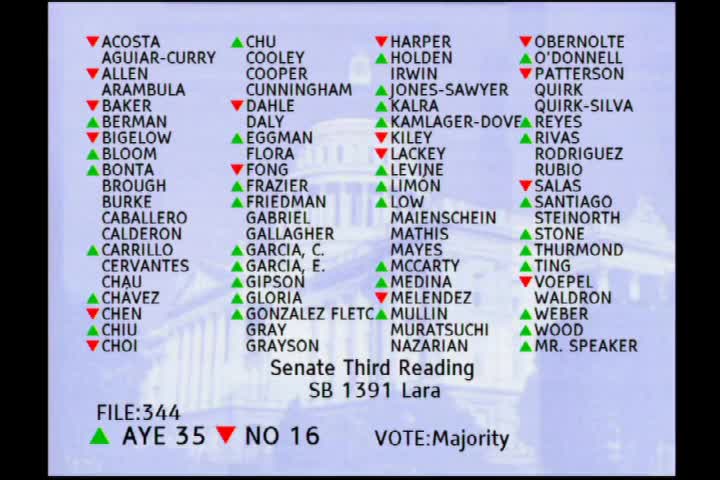 2MIN
Assembly Floor
 33SEC
Assembly Floor
 1H
Assembly Standing Committee on Appropriations
 28MIN
Assembly Standing Committee on Natural Resources
 37MIN
Assembly Standing Committee on Utilities and Energy
 3MIN
Senate Floor
 36MIN
Senate Standing Committee on Environmental Quality
Bill Author



