SB 1480: Professions and vocations.
- Session Year: 2017-2018
- House: Senate
- Latest Version Date: 2018-09-19
(1)Existing law establishes the Department of Consumer Affairs, specifies the various boards that comprise the department, and requires the boards to meet at least 3 times a year.
This bill would instead require the boards to meet at least 2 times a year.
(2)Existing law requires the Director of Consumer Affairs to implement complaint prioritization guidelines for boards to use in prioritizing their respective complaint and investigative workloads.
This bill would require the director to amend those guidelines to include the category of allegations of serious harm to a minor, as specified.
(3)Existing law, the Medical Practice Act, establishes the Medical Board of California for the licensure and regulation of physicians and surgeons. Existing law prohibits a postgraduate trainee, intern, resident, postdoctoral fellow, or instructor from engaging in the practice of medicine unless he or she holds a valid, unrevoked, and unsuspended physicians and surgeons certificate issued by the board. Existing law provides an exemption to this provision and authorizes a graduate of an approved medical school to engage in the practice of medicine as a part of a postgraduate training program, as specified. Existing law, on and after January 1, 2020, limits to 12 months the practice of medicine, and receipt of compensation for that practice, by a medical school graduate as a part of an approved first-year postgraduate training program. Existing law, on and after January 1, 2020, limits to 27 months the practice of medicine, and receipt of compensation for that practice, by a medical school graduate as a part of an approved residency or fellowship. Existing law, on and after January 1, 2020, requires all privileges and exemptions under these provisions to cease automatically if the resident or fellow fails to receive a license to practice medicine within 27 months from the commencement of the residency or fellowship or if the board denies his or her application for licensure. Existing law, on and after January 1, 2020, requires all approved postgraduate training that the medical school graduate has successfully completed in the United States or Canada to count toward the aggregate 39-month license exemption. Existing law, on and after January 1, 2020, requires a medical school graduate to successfully complete a minimum of 36 months of approved postgraduate training with at least 24 consecutive months in the same program to be eligible for a California physicians and surgeons certificate.
This bill would, on and after January 1, 2020, delete the 12-month and 27-month limitations on the license exemptions for medical school graduates in first-year postgraduate training programs and residencies and fellowships, respectively. The bill would, on and after January 1, 2020, authorize the board, upon review of supporting documentation, to grant an extension beyond the 39-month license exemption to a postgraduate training licensee to successfully complete the 36 months of required approved postgraduate training. The bill would, on and after January 1, 2020, require an applicant who has successfully completed 36 months of approved postgraduate training in another state or in Canada and who is accepted into an approved postgraduate training program in California to obtain his or her license within 90 days after beginning the program. The bill would, on and after January 1, 2020, replace the requirement that the 24 months in the postgraduate training program be consecutive with a requirement that there be successful progression through the 24 months.
The bill would, on and after January 1, 2020, require the program director for a postgraduate training program in California to report to the board, on a form approved by the board, and provide any supporting documents as required by the board, specified events regarding a postgraduate trainees status in the postgraduate program within 30 days of the event.
Existing law requires the board to issue a physicians and surgeons certificate to an applicant who holds a specified license from another state or a Canadian province or Canadian provinces and who, in addition to meeting other requirements, has satisfactorily completed at least 2 years of approved postgraduate training or has satisfactorily completed at least one year of approved postgraduate training and takes and passes the clinical competency written examination. Existing law, on and after January 1, 2020, revises this provision to, among other things, exclude the applicant from licensure.
This bill instead would continue to include such an applicant who meets the other requirements as revised on and after January 1, 2020.
Existing law authorizes a person who voluntarily cancels his or her license or fails to renew his or her license within 5 years after its expiration under the Medical Practice Act to apply for and obtain a new license upon satisfaction of specified requirements, including satisfactory completing 2 years of approved postgraduate training.
This bill would instead require the person to satisfactorily complete 3 years of approved postgraduate training.
Existing law establishes various fees in connection with the issuance of licenses under the Medical Practice Act, and requires those fees to be paid into the State Treasury and credited to the Contingent Fund of the Medical Board of California, available to the board for specified purposes upon appropriation by the Legislature. Existing law requires that an applicant for a physicians and surgeons postgraduate training license be required to pay only 50% of the initial license fee. Existing law requires the applicant to, among other things, pay the reduced licensing fee to be considered for a postgraduate training license.
This bill would instead require the applicant to pay a nonrefundable application and processing fee.
(4)Existing law regulates the practice of podiatric medicine by the California Board of Podiatric Medicine and prescribes various fees relating to, among others, an application, licensure, and renewal. All revenue received by the board is required to be deposited into the Board of Podiatric Medicine Fund, which is available to the board upon appropriation by the Legislature.
This bill would revise those fee provisions by, among other things, deleting the oral examination fee and increasing, until January 1, 2021, the amount of the biennial renewal fee.
(5)Existing law, the Nursing Practice Act, regulates the practice of nursing by the Board of Registered Nursing and authorizes the board to appoint an executive officer.
This bill would authorize the executive officer to adopt a decision entered by default and a stipulation for surrender of a license.
Existing law establishes various fees in connection with the issuance of licenses under the act, and requires those fees to be deposited in the Board of Registered Nursing Fund, available to the board upon appropriation by the Legislature. Existing law establishes that the fee paid by a registered nurse for an evaluation of his or her qualifications to use the title public health nurse shall be not less than $500 or more than $1,500.
This bill would instead establish a fee for that purpose of not less than $300 or more than $1,000, would establish a penalty for failure to renew a certificate to practice as a public health nurse within the prescribed time, and would require the Board of Registered Nursing to reimburse any registered nurse who paid more than $300 for an evaluation between April 5, 2018, and December 31, 2018.
(6)Existing law, the Vocational Nursing Practice Act, provides for the regulation of vocational nurses by the Board of Vocational Nursing and Psychiatric Technicians of the State of California, establishes the Vocational Nursing and Psychiatric Technician Fund, and makes those funds available to the board upon appropriation by the Legislature. Existing law prescribes various fees in connection with the issuance of licenses under the act and requires the board to collect a biennial fee not to exceed $200 from a continuing education course provider.
This bill would instead require the board to collect an initial approval and a biennial renewal fee of $150 unless a higher fee, not to exceed $250, is established by the board. The bill would also require the board to collect an initial approval and a biennial renewal fee of $150, unless a higher fee, not to exceed $250, is established by the board, from any provider of a course in intravenous therapy, blood withdrawal, or intravenous therapy with blood withdrawal. The bill would revise the fees and fee amounts to be assessed under the act, including, but not limited to, application, examination, and renewal fees.
(7)Existing law, the Optometry Practice Act, provides for the licensure and regulation of the practice of optometry by the State Board of Optometry. Existing law authorizes a person to renew an expired optometrist license by paying specified fees and filing a form prescribed by the board. Existing law, commencing July 1, 2018, requires the board to charge an applicant for licensure a fee of $2, and an applicant for renewal a fee of $4, for purposes of developing an interface with the National Practitioner Data Bank.
This bill would also authorize the renewal of expired statements of licensure, branch office licenses, and fictitious name permits by filing an application for renewal and paying renewal and delinquency fees prescribed by the board, and would make the National Practitioner Data Bank fee $4 for both licensure and renewal applicants.
(8)Existing law, the Naturopathic Doctors Act, provides for the regulation of the practice of naturopathic medicine by the Naturopathic Medicine Committee within the Osteopathic Medical Board of California. Existing law establishes various fees in connection with the issuance of a license to practice naturopathic medicine, which are deposited in the Naturopathic Doctors Fund and are available to the committee upon appropriation by the Legislature.
This bill would revise those provisions by, among other things, increasing the application, initial licensing, and renewal fees, and establishing a fee for a certified license verification.
(9)Existing law makes it unprofessional conduct for certain unlicensed persons who have completed clinical training in psychoanalysis and are registered to engage in psychoanalysis to use controlled substances, dangerous drugs, or alcoholic beverages under prescribed circumstances, including if the use impairs the ability of the registrant to practice safely. Existing law requires an unlicensed person registered to engage in psychoanalysis pursuant to those provisions to pay a sum not in excess of $100 and a renewal fee not in excess of $50 to the Contingent Fund of the Medical Board of California. Existing law requires the board to revoke the exemption from licensure of any person who has been required to register as a sex offender, as specified. Existing law makes all of the these provisions inoperative on and after January 1, 2019.
This bill would delete the repeal of the above-specified provisions. By extending the term for an existing appropriation, the bill would make an appropriation.
(10)Existing law provides for the licensure and regulation of psychiatric technicians by the Board of Vocational Nursing and Psychiatric Technicians of the State of California, and authorizes the board, if it adopts a continuing education program, to collect a fee from continuing education course providers. Existing law also prescribes various fees in connection with the issuance of a psychiatric technician license.
This bill would instead require the board, if it adopts a continuing education or blood withdrawal program, to collect an initial approval and a biennial renewal fee from a provider of a course in continuing education or blood withdrawal, as specified. The bill would also revise the fees and fee amounts required for licensure as a psychiatric technician.
(11)Existing law, the Massage Therapy Act, provides for the certification and regulation of massage therapists by the California Massage Therapy Council and requires an applicant for certification as a massage therapist to pass a massage and bodywork competency assessment examination.
This bill would make that examination requirement inoperative from January 1, 2019, until January 1, 2021.
(12)The Veterinary Medicine Practice Act regulates the practice of veterinary medicine by the Veterinary Medical Board and makes a violation of its provisions a crime. Existing law separately provides immunity from liability to a veterinarian or registered veterinary technician who renders services during certain states of emergency.
This bill would authorize a California-licensed veterinarian at a registered premises located within a 25-mile radius of any declared condition of emergency to, in good faith, provide veterinary services without establishing a veterinarian-client-patient relationship and dispense or prescribe a dangerous drug or device where failure to provide services or medications may result in loss of life or intense suffering. The bill would provide immunity from liability for a veterinarian providing those services.
Existing law excludes specified persons from the provisions regulating the practice of veterinary medicine, including veterinary medicine students in 2 specified schools of veterinary medicine who participate in diagnosis and treatment, as specified.
This bill would instead exclude students from any veterinary medical program accredited by the American Veterinary Medical Association Council on Education who participate in diagnosis or treatment with direct supervision, or surgery with immediate supervision, subject to specified conditions.
Existing law provides for a veterinary assistant controlled substance permit issued by the Veterinary Medical Board to qualified applicants and authorizes the board to deny, revoke, or suspend a veterinary assistant controlled substance permit for specified reasons.
This bill would add to the list of reasons the conviction of a crime substantially related to the qualifications, functions, or duties of veterinary medicine, veterinary surgery, or veterinary dentistry. The bill would also authorize the board, in addition to denial, revocation, or suspension, to issue a probationary veterinary assistant controlled substance permit.
The bill would prohibit a graduate of a veterinary college from performing animal health care tasks otherwise performed by a registered veterinary technician, except as specified, and would require a veterinarian to offer a consultation to the client each time he or she initially prescribes, dispenses, or furnishes a dangerous drug, as defined, to an animal patient in an outpatient setting. Because a violation of that provision would be a crime, the bill would impose a state-mandated local program.
Existing law requires the Veterinary Medical Board to establish a regular inspection program, and provides that the board is required to make every effort to inspect at least 20% of veterinary premises annually.
This bill would instead require the board to inspect at least 20% of veterinary premises annually.
(13)Existing law requires a person to meet specified requirements in order to use the title certified common interest development manager, and requires a certified common interest development manager to make specified disclosures to the board of directors of a common interest development before providing services to the common interest development. Existing law repeals those provisions governing certified common interest development managers on January 1, 2019.
This bill would delete the repeal provision, thereby extending those provisions indefinitely.
(14)Existing law, the Chiropractic Act, enacted by initiative, provides for the licensure and regulation of chiropractors by the State Board of Chiropractic Examiners, which is composed of 7 members appointed by the Governor, and establishes an application fee of not more than $100 and, on and after January 1, 2019, a renewal fee of $250. Existing law authorizes the Legislature to fix the amounts of the fees payable by applicants and licensees, and directs the deposit of these fees into the State Board of Chiropractic Examiners Fund, a continuously appropriated fund.
This bill would delete the provisions providing for the application and renewal fees and would instead establish a schedule of regulatory fees necessary to carry out the responsibilities required by the Chiropractic Initiative Act, including, among others, application and renewal fees for licensure, fees to apply for approval for a continuing education course, and satellite office certificate fees. By increasing specified fees and establishing new fees for deposit into a continuously appropriated fund, the bill would make an appropriation.
(15)The bill would make technical changes to various provisions of the Business and Professions Code. The bill would also make technical changes to various provisions of the Health and Safety Code by eliminating cross-references to obsolete provisions governing cemeteries.
(16)The California Constitution requires the state to reimburse local agencies and school districts for certain costs mandated by the state. Statutory provisions establish procedures for making that reimbursement.
This bill would provide that no reimbursement is required by this act for a specified reason.
(1)Existing law establishes the Department of Consumer Affairs, specifies the various boards that comprise the department, and requires the boards to meet at least 3 times a year.
This bill would instead require the boards to meet at least 2 times a year.
(2)Existing law requires the Director of Consumer Affairs to implement complaint prioritization guidelines for boards to use in prioritizing their respective complaint and investigative workloads.
This bill would require the director to amend those guidelines to include the category of allegations of serious harm to a minor, as specified.
(3)Existing law, the Medical Practice Act, establishes the Medical Board of California for the licensure and regulation of physicians and surgeons. Existing law prohibits a postgraduate trainee, intern, resident, postdoctoral fellow, or instructor from engaging in the practice of medicine unless he or she holds a valid, unrevoked, and unsuspended physicians and surgeons certificate issued by the board. Existing law provides an exemption to this provision and authorizes a graduate of an approved medical school to engage in the practice of medicine as a part of a postgraduate training program, as specified. Existing law, on and after January 1, 2020, limits to 12 months the practice of medicine, and receipt of compensation for that practice, by a medical school graduate as a part of an approved first-year postgraduate training program. Existing law, on and after January 1, 2020, limits to 27 months the practice of medicine, and receipt of compensation for that practice, by a medical school graduate as a part of an approved residency or fellowship. Existing law, on and after January 1, 2020, requires all privileges and exemptions under these provisions to cease automatically if the resident or fellow fails to receive a license to practice medicine within 27 months from the commencement of the residency or fellowship or if the board denies his or her application for licensure. Existing law, on and after January 1, 2020, requires all approved postgraduate training that the medical school graduate has successfully completed in the United States or Canada to count toward the aggregate 39-month license exemption. Existing law, on and after January 1, 2020, requires a medical school graduate to successfully complete a minimum of 36 months of approved postgraduate training with at least 24 consecutive months in the same program to be eligible for a California physicians and surgeons certificate.
This bill would, on and after January 1, 2020, delete the 12-month and 27-month limitations on the license exemptions for medical school graduates in first-year postgraduate training programs and residencies and fellowships, respectively. The bill would, on and after January 1, 2020, authorize the board, upon review of supporting documentation, to grant an extension beyond the 39-month license exemption to a postgraduate training licensee to successfully complete the 36 months of required approved postgraduate training. The bill would, on and after January 1, 2020, require an applicant who has successfully completed 36 months of approved postgraduate training in another state or in Canada and who is accepted into an approved postgraduate training program in California to obtain his or her license within 90 days after beginning the program. The bill would, on and after January 1, 2020, replace the requirement that the 24 months in the postgraduate training program be consecutive with a requirement that there be successful progression through the 24 months.
The bill would, on and after January 1, 2020, require the program director for a postgraduate training program in California to report to the board, on a form approved by the board, and provide any supporting documents as required by the board, specified events regarding a postgraduate trainees status in the postgraduate program within 30 days of the event.
Existing law requires the board to issue a physicians and surgeons certificate to an applicant who holds a specified license from another state or a Canadian province or Canadian provinces and who, in addition to meeting other requirements, has satisfactorily completed at least 2 years of approved postgraduate training or has satisfactorily completed at least one year of approved postgraduate training and takes and passes the clinical competency written examination. Existing law, on and after January 1, 2020, revises this provision to, among other things, exclude the applicant from licensure.
This bill instead would continue to include such an applicant who meets the other requirements as revised on and after January 1, 2020.
Existing law authorizes a person who voluntarily cancels his or her license or fails to renew his or her license within 5 years after its expiration under the Medical Practice Act to apply for and obtain a new license upon satisfaction of specified requirements, including satisfactory completing 2 years of approved postgraduate training.
This bill would instead require the person to satisfactorily complete 3 years of approved postgraduate training.
Existing law establishes various fees in connection with the issuance of licenses under the Medical Practice Act, and requires those fees to be paid into the State Treasury and credited to the Contingent Fund of the Medical Board of California, available to the board for specified purposes upon appropriation by the Legislature. Existing law requires that an applicant for a physicians and surgeons postgraduate training license be required to pay only 50% of the initial license fee. Existing law requires the applicant to, among other things, pay the reduced licensing fee to be considered for a postgraduate training license.
This bill would instead require the applicant to pay a nonrefundable application and processing fee.
(4)Existing law regulates the practice of podiatric medicine by the California Board of Podiatric Medicine and prescribes various fees relating to, among others, an application, licensure, and renewal. All revenue received by the board is required to be deposited into the Board of Podiatric Medicine Fund, which is available to the board upon appropriation by the Legislature.
This bill would revise those fee provisions by, among other things, deleting the oral examination fee and increasing, until January 1, 2021, the amount of the biennial renewal fee.
(5)Existing law, the Nursing Practice Act, regulates the practice of nursing by the Board of Registered Nursing, Nursing and authorizes the board to appoint an executive officer and employ personnel, including legal counsel. officer.
This bill would authorize the executive officer to adopt a decision entered by default and a stipulation for surrender of a license. The bill would require the board to directly employ legal counsel to work exclusively for and report directly to the board if the board makes a specified finding.
Existing law establishes various fees in connection with the issuance of licenses under the act, and requires those fees to be deposited in the Board of Registered Nursing Fund, available to the board upon appropriation by the Legislature. Existing law establishes that the fee paid by a registered nurse for an evaluation of his or her qualifications to use the title public health nurse shall be not less than $500 or more than $1,500.
This bill would instead establish a fee for that purpose of not less than $300 or more than $1,000, would establish a penalty for failure to renew a certificate to practice as a public health nurse within the prescribed time, and would require the Board of Registered Nursing to reimburse any registered nurse who paid more than $300 for an evaluation between April 5, 2018, and December 31, 2018.
(6)Existing law, the Vocational Nursing Practice Act, provides for the regulation of vocational nurses by the Board of Vocational Nursing and Psychiatric Technicians of the State of California, establishes the Vocational Nursing and Psychiatric Technician Fund, and makes those funds available to the board upon appropriation by the Legislature. Existing law prescribes various fees in connection with the issuance of licenses under the act and requires the board to collect a biennial fee not to exceed $200 from a continuing education course provider.
This bill would instead require the board to collect an initial approval and a biennial renewal fee of $150 unless a higher fee, not to exceed $250, is established by the board. The bill would also require the board to collect an initial approval and a biennial renewal fee of $150, unless a higher fee, not to exceed $250, is established by the board, from any provider of a course in intravenous therapy, blood withdrawal, or intravenous therapy with blood withdrawal. The bill would revise the fees and fee amounts to be assessed under the act, including, but not limited to, application, examination, and renewal fees.
(7)Existing law, the Optometry Practice Act, provides for the licensure and regulation of the practice of optometry by the State Board of Optometry. Existing law authorizes a person to renew an expired optometrist license by paying specified fees and filing a form prescribed by the board. Existing law, commencing July 1, 2018, requires the board to charge an applicant for licensure a fee of $2, and an applicant for renewal a fee of $4, for purposes of developing an interface with the National Practitioner Data Bank.
This bill would also authorize the renewal of expired statements of licensure, branch office licenses, and fictitious name permits by filing an application for renewal and paying renewal and delinquency fees prescribed by the board, and would make the National Practitioner Data Bank fee $4 for both licensure and renewal applicants.
(8)Existing law, the Naturopathic Doctors Act, provides for the regulation of the practice of naturopathic medicine by the Naturopathic Medicine Committee within the Osteopathic Medical Board of California. Existing law establishes various fees in connection with the issuance of a license to practice naturopathic medicine, which are deposited in the Naturopathic Doctors Fund and are available to the committee upon appropriation by the Legislature.
This bill would revise those provisions by, among other things, increasing the application, initial licensing, and renewal fees, and establishing a fee for a certified license verification.
(9)Existing law provides for the licensure and regulation of pharmacists by the California State Board of Pharmacy and authorizes the board to employ legal counsel.This bill would require the California State Board of Pharmacy to directly employ legal counsel who works exclusively for, and directly reports to, the board, as specified. (10)(9)Existing law relating to research psychoanalysts authorizes certain students and graduates in psychoanalysis to engage in psychoanalysis under prescribed circumstances if they register with the Medical Board of California and present evidence of their student or graduate status. law makes it unprofessional conduct for certain unlicensed persons who have completed clinical training in psychoanalysis and are registered to engage in psychoanalysis to use of controlled substances, dangerous drugs, or alcoholic beverages under prescribed circumstances, including if the use impairs the ability of the registrant to practice safely. Existing law requires an unlicensed person registered to engage in psychoanalysis pursuant to those provisions to pay a sum not in excess of $100 and a renewal fee not in excess of $50 to the Contingent Fund of the Medical Board of California. Existing law requires the board to revoke the exemption from licensure of any person who has been required to register as a sex offender, as specified. Existing law makes this provision all of the these provisions inoperative on and after January 1, 2019.
This bill would instead make that provision inoperative on and after January 1, 2022. delete the repeal of the above-specified provisions. By extending the term for an existing appropriation, the bill would make an appropriation.
(11)(10)Existing law provides for the licensure and regulation of psychiatric technicians by the Board of Vocational Nursing and Psychiatric Technicians of the State of California, and authorizes the board, if it adopts a continuing education program, to collect a fee from continuing education course providers. Existing law also prescribes various fees in connection with the issuance of a psychiatric technician license.
This bill would instead require the board, if it adopts a continuing education or blood withdrawal program, to collect an initial approval and a biennial renewal fee from a provider of a course in continuing education or blood withdrawal, as specified. The bill would also revise the fees and fee amounts required for licensure as a psychiatric technician.
(12)(11)Existing law, the Massage Therapy Act, provides for the certification and regulation of massage therapists by the California Massage Therapy Council and requires an applicant for certification as a massage therapist to pass a massage and bodywork competency assessment examination.
This bill would make that examination requirement inoperative from January 1, 2019, until January 1, 2021.
(13)(12)The Veterinary Medicine Practice Act regulates the practice of veterinary medicine by the Veterinary Medical Board and makes a violation of its provisions a crime. Existing law separately provides immunity from liability to a veterinarian or registered veterinary technician who renders services during certain states of emergency.
This bill would authorize a California-licensed veterinarian at a registered premises located within a 25-mile radius of any declared condition of emergency to, in good faith, provide veterinary services without establishing a veterinarian-client-patient relationship and dispense or prescribe a dangerous drug or device where failure to provide services or medications may result in loss of life or intense suffering. The bill would provide immunity from liability for a veterinarian providing those services.
Existing law excludes specified persons from the provisions regulating the practice of veterinary medicine, including veterinary medicine students in 2 specified schools of veterinary medicine who participate in diagnosis and treatment, as specified.
This bill would instead exclude students from any veterinary medical program accredited by the American Veterinary Medical Association Council on Education who participate in diagnosis or treatment with direct supervision, or surgery with immediate supervision, subject to specified conditions.
Existing law provides for a veterinary assistant controlled substance permit issued by the Veterinary Medical Board to qualified applicants and authorizes the board to deny, revoke, or suspend a veterinary assistant controlled substance permit for specified reasons.
This bill would add to the list of reasons the conviction of a crime substantially related to the qualifications, functions, or duties of veterinary medicine, veterinary surgery, or veterinary dentistry. The bill would also authorize the board, in addition to denial, revocation, or suspension, to issue a probationary veterinary assistant controlled substance permit.
The bill would prohibit a graduate of a veterinary college from performing animal health care tasks otherwise performed by a registered veterinary technician, except as specified, and would require a veterinarian to offer a consultation to the client each time he or she initially prescribes, dispenses, or furnishes a dangerous drug, as defined, to an animal patient in an outpatient setting. Because a violation of that provision would be a crime, the bill would impose a state-mandated local program.
Existing law requires the Veterinary Medical Board to establish a regular inspection program, and provides that the board is required to make every effort to inspect at least 20% of veterinary premises annually.
This bill would instead require the board to inspect at least 20% of veterinary premises annually.
(14)(13)Existing law requires a person to meet specified requirements in order to use the title certified common interest development manager, and requires a certified common interest development manager to make specified disclosures to the board of directors of a common interest development before providing services to the common interest development. Existing law repeals those provisions governing certified common interest development managers on January 1, 2019.
This bill would delete the repeal provision, thereby extending those provisions indefinitely.
(15)(14)Existing law, the Chiropractic Act, enacted by initiative, provides for the licensure and regulation of chiropractors by the State Board of Chiropractic Examiners, which is composed of 7 members appointed by the Governor, and establishes an application fee of not more than $100 and, on and after January 1, 2019, a renewal fee of $250. Existing law authorizes the Legislature to fix the amounts of the fees payable by applicants and licensees, and directs the deposit of these fees into the State Board of Chiropractic Examiners Fund, a continuously appropriated fund.
This bill would delete the provisions providing for the application and renewal fees and would instead establish a schedule of regulatory fees necessary to carry out the responsibilities required by the Chiropractic Initiative Act, including, among others, application and renewal fees for licensure, fees to apply for approval for a continuing education course, and satellite office certificate fees. By increasing specified fees and establishing new fees for deposit into a continuously appropriated fund, the bill would make an appropriation.
(16)(15)The bill would make technical changes to various provisions of the Business and Professions Code. The bill would also make technical changes to various provisions of the Health and Safety Code by eliminating cross-references to obsolete provisions governing cemeteries.
(17)(16)The California Constitution requires the state to reimburse local agencies and school districts for certain costs mandated by the state. Statutory provisions establish procedures for making that reimbursement.
This bill would provide that no reimbursement is required by this act for a specified reason.
(1)Existing law establishes the Department of Consumer Affairs, specifies the various boards that comprise the department, and requires the boards to meet at least 3 times a year.
This bill would instead require the boards to meet at least 2 times a year. The bill would require each of the boards comprising the department to present and vote on any documents planned for submission to the department for a change in spending authority.
(2)Existing law requires the Director of Consumer Affairs to implement complaint prioritization guidelines for boards to use in prioritizing their respective complaint and investigative workloads.
This bill would require the director to amend those guidelines to include the category of allegations of serious harm to a minor, as specified.
(3)Existing law, the Medical Practice Act, establishes the Medical Board of California for the licensure and regulation of physicians and surgeons. Existing law prohibits a postgraduate trainee, intern, resident, postdoctoral fellow, or instructor from engaging in the practice of medicine unless he or she holds a valid, unrevoked, and unsuspended physicians and surgeons certificate issued by the board. Existing law provides an exemption to this provision and authorizes a graduate of an approved medical school to engage in the practice of medicine as a part of a postgraduate training program, as specified. Existing law, on and after January 1, 2020, limits to 12 months the practice of medicine, and receipt of compensation for that practice, by a medical school graduate as a part of an approved first-year postgraduate training program. Existing law, on and after January 1, 2020, limits to 27 months the practice of medicine, and receipt of compensation for that practice, by a medical school graduate as a part of an approved residency or fellowship. Existing law, on and after January 1, 2020, requires all privileges and exemptions under these provisions to cease automatically if the resident or fellow fails to receive a license to practice medicine within 27 months from the commencement of the residency or fellowship or if the board denies his or her application for licensure. Existing law, on and after January 1, 2020, requires all approved postgraduate training that the medical school graduate has successfully completed in the United States or Canada to count toward the aggregate 39-month license exemption. Existing law, on and after January 1, 2020, requires a medical school graduate to successfully complete a minimum of 36 months of approved postgraduate training with at least 24 consecutive months in the same program to be eligible for a California physicians and surgeons certificate.
This bill would, on and after January 1, 2020, delete the 12-month and 27-month limitations on the license exemptions for medical school graduates in first-year postgraduate training programs and residencies and fellowships, respectively. The bill would, on and after January 1, 2020, authorize the board, upon review of supporting documentation, to grant an extension beyond the 39-month license exemption to a postgraduate training licensee to successfully complete the 36 months of required approved postgraduate training. The bill would, on and after January 1, 2020, require an applicant who has successfully completed 36 months of approved postgraduate training in another state or in Canada and who is accepted into an approved postgraduate training program in California to obtain his or her license within 90 days after beginning the program. The bill would, on and after January 1, 2020, replace the requirement that the 24 months in the postgraduate training program be consecutive with a requirement that there be successful progression through the 24 months.
The bill would, on and after January 1, 2020, require the program director for a postgraduate training program in California to report to the board, on a form approved by the board, and provide any supporting documents as required by the board, specified events regarding a postgraduate trainees status in the postgraduate program within 30 days of the event.
Existing law requires the board to issue a physicians and surgeons certificate to an applicant who holds a specified license from another state or a Canadian province or Canadian provinces and who, in addition to meeting other requirements, has satisfactorily completed at least 2 years of approved postgraduate training or has satisfactorily completed at least one year of approved postgraduate training and takes and passes the clinical competency written examination. Existing law, on and after January 1, 2020, revises this provision to, among other things, exclude the applicant from licensure.
This bill instead would continue to include such an applicant who meets the other requirements as revised on and after January 1, 2020.
Existing law establishes various fees in connection with the issuance of licenses under the Medical Practice Act, and requires those fees to be paid into the State Treasury and credited to the Contingent Fund of the Medical Board of California, available to the board for specified purposes upon appropriation by the Legislature. Existing law requires that an applicant for a physicians and surgeons postgraduate training license be required to pay only 50% of the initial license fee. Existing law requires the applicant to, among other things, pay the reduced licensing fee to be considered for a postgraduate training license.
This bill would instead require the applicant to pay a nonrefundable application and processing fee.
(4)Existing law regulates the practice of podiatric medicine by the California Board of Podiatric Medicine and prescribes various fees relating to, among others, an application, licensure, and renewal. All revenue received by the board is required to be deposited into the Board of Podiatric Medicine Fund, which is available to the board upon appropriation by the Legislature.
This bill would revise those fee provisions by, among other things, deleting the oral examination fee and increasing, until January 1, 2021, the amount of the biennial renewal fee.
(5)Existing law, the Nursing Practice Act, regulates the practice of nursing by the Board of Registered Nursing, and authorizes the board to appoint an executive officer and employ personnel, including legal counsel.
This bill would authorize the executive officer to adopt a decision entered by default and a stipulation for surrender of a license. The bill would require the board to directly employ legal counsel to work exclusively for and report directly to the board if the board makes a specified finding.
Existing law establishes various fees in connection with the issuance of licenses under the act, and requires those fees to be deposited in the Board of Registered Nursing Fund, available to the board upon appropriation by the Legislature. Existing law establishes that the fee paid by a registered nurse for an evaluation of his or her qualifications to use the title public health nurse shall be not less than $500 or more than $1,500.
This bill would instead establish a fee for that purpose of not less than $300 or more than $1,000, would establish a penalty for failure to renew a certificate to practice as a public health nurse within the prescribed time, and would require the Board of Registered Nursing to reimburse any registered nurse who paid more than $300 for an evaluation between April 5, 2018, and December 31, 2018.
(6)Existing law, the Vocational Nursing Practice Act, provides for the regulation of vocational nurses by the Board of Vocational Nursing and Psychiatric Technicians of the State of California, establishes the Vocational Nursing and Psychiatric Technician Fund, and makes those funds available to the board upon appropriation by the Legislature. Existing law prescribes various fees in connection with the issuance of licenses under the act and requires the board to collect a biennial fee not to exceed $200 from a continuing education course provider.
This bill would instead require the board to collect an initial approval and a biennial renewal fee of $150 unless a higher fee, not to exceed $250, is established by the board. The bill would also require the board to collect an initial approval and a biennial renewal fee of $150, unless a higher fee, not to exceed $250, is established by the board, from any provider of a course in intravenous therapy, blood withdrawal, or intravenous therapy with blood withdrawal. The bill would revise the fees and fee amounts to be assessed under the act, including, but not limited to, application, examination, and renewal fees.
(7)Existing law, the Optometry Practice Act, provides for the licensure and regulation of the practice of optometry by the State Board of Optometry. Existing law authorizes a person to renew an expired optometrist license by paying specified fees and filing a form prescribed by the board. Existing law, commencing July 1, 2018, requires the board to charge an applicant for licensure a fee of $2, and an applicant for renewal a fee of $4, for purposes of developing an interface with the National Practitioner Data Bank.
This bill would also authorize the renewal of expired statements of licensure, branch office licenses, and fictitious name permits by filing an application for renewal and paying renewal and delinquency fees prescribed by the board, and would make the National Practitioner Data Bank fee $4 for both licensure and renewal applicants.
(8)Existing law, the Naturopathic Doctors Act, provides for the regulation of the practice of naturopathic medicine by the Naturopathic Medicine Committee within the Osteopathic Medical Board of California. Existing law establishes various fees in connection with the issuance of a license to practice naturopathic medicine, which are deposited in the Naturopathic Doctors Fund and are available to the committee upon appropriation by the Legislature.
This bill would revise those provisions by, among other things, increasing the application, initial licensing, and renewal fees, and establishing a fee for a certified license verification.
(9)Existing law provides for the licensure and regulation of pharmacists by the California State Board of Pharmacy and authorizes the board to employ legal counsel.
This bill would require the California State Board of Pharmacy to directly employ legal counsel who works exclusively for, and directly reports to, the board, as specified.
(10)Existing law relating to research psychoanalysts authorizes certain students and graduates in psychoanalysis to engage in psychoanalysis under prescribed circumstances if they register with the Medical Board of California and present evidence of their student or graduate status. Existing law requires the board to revoke the exemption from licensure of any person who has been required to register as a sex offender, as specified. Existing law makes this provision inoperative on and after January 1, 2019.
This bill would instead make that provision inoperative on and after January 1, 2022.
(11)Existing law provides for the licensure and regulation of psychiatric technicians by the Board of Vocational Nursing and Psychiatric Technicians of the State of California, and authorizes the board, if it adopts a continuing education program, to collect a fee from continuing education course providers. Existing law also prescribes various fees in connection with the issuance of a psychiatric technician license.
This bill would instead require the board, if it adopts a continuing education or blood withdrawal program, to collect an initial approval and a biennial renewal fee from a provider of a course in continuing education or blood withdrawal, as specified. The bill would also revise the fees and fee amounts required for licensure as a psychiatric technician.
(12)Existing law, the Massage Therapy Act, provides for the certification and regulation of massage therapists by the California Massage Therapy Council and requires an applicant for certification as a massage therapist to pass a massage and bodywork competency assessment examination.
This bill would make that examination requirement inoperative from January 1, 2019, until January 1, 2021.
(13)The Veterinary Medicine Practice Act regulates the practice of veterinary medicine by the Veterinary Medical Board and makes a violation of its provisions a crime. Existing law separately provides immunity from liability to a veterinarian or registered veterinary technician who renders services during certain states of emergency.
This bill would authorize a California-licensed veterinarian at a registered premises located within a 25-mile radius of any declared condition of emergency to, in good faith, provide veterinary services without establishing a veterinarian-client-patient relationship and dispense or prescribe a dangerous drug or device where failure to provide services or medications may result in loss of life or intense suffering. The bill would provide immunity from liability for a veterinarian providing those services.
Existing law excludes specified persons from the provisions regulating the practice of veterinary medicine, including veterinary medicine students in 2 specified schools of veterinary medicine who participate in diagnosis and treatment, as specified.
This bill would instead exclude students from any veterinary medical program accredited by the American Veterinary Medical Association Council on Education who participate in diagnosis or treatment with direct supervision, or surgery with immediate supervision, subject to specified conditions.
Existing law provides for a veterinary assistant controlled substance permit issued by the Veterinary Medical Board to qualified applicants and authorizes the board to deny, revoke, or suspend a veterinary assistant controlled substance permit for specified reasons.
This bill would add to the list of reasons the conviction of a crime substantially related to the qualifications, functions, or duties of veterinary medicine, veterinary surgery, or veterinary dentistry. The bill would also authorize the board, in addition to denial, revocation, or suspension, to issue a probationary veterinary assistant controlled substance permit.
The bill would prohibit a graduate of a veterinary college from performing animal health care tasks otherwise performed by a registered veterinary technician, except as specified, and would require a veterinarian to offer a consultation to the client each time he or she initially prescribes, dispenses, or furnishes a dangerous drug, as defined, to an animal patient in an outpatient setting. Because a violation of that provision would be a crime, the bill would impose a state-mandated local program.
Existing law requires the Veterinary Medical Board to establish a regular inspection program, and provides that the board is required to make every effort to inspect at least 20% of veterinary premises annually.
This bill would instead require the board to inspect at least 20% of veterinary premises annually.
(14)Existing law requires a person to meet specified requirements in order to use the title certified common interest development manager, and requires a certified common interest development manager to make specified disclosures to the board of directors of a common interest development before providing services to the common interest development. Existing law repeals those provisions governing certified common interest development managers on January 1, 2019.
This bill would delete the repeal provision, thereby extending those provisions indefinitely.
(15)Existing law, the Chiropractic Act, enacted by initiative, provides for the licensure and regulation of chiropractors by the State Board of Chiropractic Examiners, which is composed of 7 members appointed by the Governor, and establishes an application fee of not more than $100 and, on and after January 1, 2019, a renewal fee of $250. Existing law authorizes the Legislature to fix the amounts of the fees payable by applicants and licensees, and directs the deposit of these fees into the State Board of Chiropractic Examiners Fund, a continuously appropriated fund.
This bill would delete the provisions providing for the application and renewal fees and would instead establish a schedule of regulatory fees necessary to carry out the responsibilities required by the Chiropractic Initiative Act, including, among others, application and renewal fees for licensure, fees to apply for approval for a continuing education course, and satellite office certificate fees. By increasing specified fees and establishing new fees for deposit into a continuously appropriated fund, the bill would make an appropriation.
(16)The bill would make technical changes to various provisions of the Business and Professions Code. The bill would also make technical changes to various provisions of the Health and Safety Code by eliminating cross-references to obsolete provisions governing cemeteries.
(17)The California Constitution requires the state to reimburse local agencies and school districts for certain costs mandated by the state. Statutory provisions establish procedures for making that reimbursement.
This bill would provide that no reimbursement is required by this act for a specified reason.
(1)Existing law establishes the Department of Consumer Affairs, specifies the various boards that comprise the department, and requires the boards to meet at least 3 times a year.
This bill would instead require the boards to meet at least 2 times a year. The bill would require each of the boards comprising the department to present and vote on any documents planned for submission to the department for a change in spending authority.
(2)Existing law requires the Director of Consumer Affairs to implement complaint prioritization guidelines for boards to use in prioritizing their respective complaint and investigative workloads.
This bill would require the director to amend those guidelines to include the category of allegations of serious harm to a minor, minor, as specified. specified.
(3)Existing law, the Medical Practice Act, establishes the Medical Board of California for the licensure and regulation of physicians and surgeons. Existing law prohibits a postgraduate trainee, intern, resident, postdoctoral fellow, or instructor from engaging in the practice of medicine unless he or she holds a valid, unrevoked, and unsuspended physicians and surgeons certificate issued by the board. Existing law provides an exemption to this provision and authorizes a graduate of an approved medical school to engage in the practice of medicine as a part of a postgraduate training program, as specified. Existing law, on and after January 1, 2020, limits to 12 months the practice of medicine, and receipt of compensation for that practice, by a medical school graduate as a part of an approved first-year postgraduate training program. Existing law, on and after January 1, 2020, limits to 27 months the practice of medicine, and receipt of compensation for that practice, by a medical school graduate as a part of an approved residency or fellowship. Existing law, on and after January 1, 2020, requires all privileges and exemptions under these provisions to cease automatically if the resident or fellow fails to receive a license to practice medicine within 27 months from the commencement of the residency or fellowship or if the board denies his or application for licensure. Existing law, on and after January 1, 2020, requires all approved postgraduate training that the medical school graduate has successfully completed in the United States or Canada to count toward the aggregate 39-month license exemption. Existing law, on and after January 1, 2020, requires a medical school graduate to successfully complete a minimum of 36 months of approved postgraduate training with at least 24 consecutive months in the same program to be eligible for a California physicians and surgeons certificate.
This bill would, on and after January 1, 2020, delete the 12-month and 27-month limitations on the license exemptions for medical school graduates in first-year postgraduate training programs and residencies and fellowships, respectively. The bill would, on and after January 1, 2020, authorize the board, upon review of supporting documentation, to grant an extension beyond the 39-month license exemption to a postgraduate training licensee to successfully complete the 36 months of required approved postgraduate training. The bill would, on and after January 1, 2020, require an applicant who has successfully completed 36 months of approved postgraduate training in another state or in Canada and who is accepted into an approved postgraduate training program in California to obtain his or her license within 90 days after beginning the program. The bill would, on and after January 1, 2020, replace the requirement that the 24 months in the postgraduate training program be consecutive with a requirement that there be successful progression through the 24 months.
The bill would, on and after January 1, 2020, require the program director for a postgraduate training program in California to report to the board, on a form approved by the board, and provide any supporting documents as required by the board, specified events regarding a postgraduate trainees status in the postgraduate program within 30 days of the event.
Existing law requires the board to issue a physicians and surgeons certificate to an applicant who holds a specified license from another state or a Canadian province or Canadian provinces and who, in addition to meeting other requirements, has satisfactorily completed at least 2 years of approved postgraduate training or has satisfactorily completed at least one year of approved postgraduate training and takes and passes the clinical competency written examination. Existing law, on and after January 1, 2020, revises this provision to, among other things, exclude the applicant from licensure.
This bill instead would continue to include such an applicant who meets the other requirements as revised on and after January 1, 2020.
Existing law establishes various fees in connection with the issuance of licenses under the Medical Practice Act, and requires those fees to be paid into the State Treasury and credited to the Contingent Fund of the Medical Board of California, available to the board for specified purposes upon appropriation by the Legislature. Existing law requires that an applicant for a physicians and surgeons postgraduate training license be required to pay only 50% of the initial license fee. Existing law requires the applicant to, among other things, pay the reduced licensing fee to be considered for a postgraduate training license.
This bill would instead require the applicant to pay a nonrefundable application and processing fee.
(3)(4)Existing law regulates the practice of podiatric medicine by the California Board of Podiatric Medicine and prescribes various fees relating to, among others, an application, licensure, and renewal. All revenue received by the board is required to be deposited into the Board of Podiatric Medicine Fund, which is available to the board upon appropriation by the Legislature.
This bill would revise those fee provisions by, among other things, deleting the oral examination fee and increasing, until January 1, 2021, the amount of the biennial renewal fee.
(4)(5)Existing law, the Nursing Practice Act, regulates the practice of nursing by the Board of Registered Nursing, and authorizes the board to appoint an executive officer and employ personnel, including legal counsel.
This bill would authorize the executive officer to adopt a decision entered by default and a stipulation for surrender of a license. The bill would require the board to directly employ legal counsel to work exclusively for and report directly to the board if the board makes a specified finding.
Existing law establishes various fees in connection with the issuance of licenses under the act, and requires those fees to be deposited in the Board of Registered Nursing Fund, available to the board upon appropriation by the Legislature. Existing law establishes that the fee paid by a registered nurse for an evaluation of his or her qualifications to use the title public health nurse shall be not less than $500 or more than $1,500.
This bill would instead establish a fee for that purpose of not less than $300 or more than $1,000, would establish a penalty for failure to renew a certificate to practice as a public health nurse within the prescribed time, and would require the Board of Registered Nursing to reimburse any registered nurse who paid more than $300 for an evaluation between April 5, 2018, and December 31, 2018.
(5)(6)Existing law, the Vocational Nursing Practice Act, provides for the regulation of vocational nurses by the Board of Vocational Nursing and Psychiatric Technicians of the State of California, establishes the Vocational Nursing and Psychiatric Technician Fund, and makes those funds available to the board upon appropriation by the Legislature. Existing law prescribes various fees in connection with the issuance of licenses under the act and requires the board to collect a biennial fee not to exceed $200 from a continuing education course provider.
This bill would instead require the board to collect an initial approval and a biennial renewal fee of $150 unless a higher fee, not to exceed $250, is established by the board. The bill would also require the board to collect an initial approval and a biennial renewal fee of $150, unless a higher fee, not to exceed $250, is established by the board, from any provider of a course in intravenous therapy, blood withdrawal, or intravenous therapy with blood withdrawal. The bill would revise the fees and fee amounts to be assessed under the act, including, but not limited to, application, examination, and renewal fees.
(6)(7)Existing law, the Optometry Practice Act, provides for the licensure and regulation of the practice of optometry by the State Board of Optometry. Existing law authorizes a person to renew an expired optometrist license by paying specified fees and filing a form prescribed by the board. Existing law, commencing July 1, 2018, requires the board to charge an applicant for licensure a fee of $2, and an applicant for renewal a fee of $4, for purposes of developing an interface with the National Practitioner Data Bank.
This bill would also authorize the renewal of expired statements of licensure, branch office licenses, and fictitious name permits by filing an application for renewal and paying renewal and delinquency fees prescribed by the board, and would make the Nurse National Practitioner Data Bank fee $4 for both licensure and renewal applicants.
(7)(8)Existing law, the Naturopathic Doctors Act, provides for the regulation of the practice of naturopathic medicine by the Naturopathic Medicine Committee within the Osteopathic Medical Board of California. Existing law establishes various fees in connection with the issuance of a license to practice naturopathic medicine, which are deposited in the Naturopathic Doctors Fund and are available to the committee upon appropriation by the Legislature.
This bill would revise those provisions by, among other things, increasing the application, initial licensing, and renewal fees, and establishing a fee for a certified license verification.
(8)(9)Existing law provides for the licensure and regulation of pharmacists by the California State Board of Pharmacy and authorizes the board to employ legal counsel. Existing law establishes the Board of Behavioral Sciences to license and regulate certain healing arts practitioners and authorizes the board to employ personnel as it deems necessary.
This bill would require the California State Board of Pharmacy and the Board of Behavioral Sciences to directly employ legal counsel who works exclusively for, and directly reports to, those boards, the board, as specified.
(10)Existing law relating to research psychoanalysts authorizes certain students and graduates in psychoanalysis to engage in psychoanalysis under prescribed circumstances if they register with the Medical Board of California and present evidence of their student or graduate status. Existing law requires the board to revoke the exemption from licensure of any person who has been required to register as a sex offender, as specified. Existing law makes this provision inoperative on and after January 1, 2019.
This bill would instead make that provision inoperative on and after January 1, 2022.
(9)(11)Existing law provides for the licensure and regulation of psychiatric technicians by the Board of Vocational Nursing and Psychiatric Technicians of the State of California, and authorizes the board, if it adopts a continuing education program, to collect a fee from continuing education course providers. Existing law also prescribes various fees in connection with the issuance of a psychiatric technician license.
This bill would instead require the board, if it adopts a continuing education or blood withdrawal program, to collect an initial approval and a biennial renewal fee from a provider of a course in continuing education or blood withdrawal, as specified. The bill would also revise the fees and fee amounts required for licensure as a psychiatric technician.
(10)(12)Existing law, the Massage Therapy Act, provides for the certification and regulation of massage therapists by the California Massage Therapy Council and requires an applicant for certification as a massage therapist to pass a massage and bodywork competency assessment examination.
This bill would make that examination requirement inoperative from January 1, 2019, until January 1, 2021.
(11)(13)The Veterinary Medicine Practice Act regulates the practice of veterinary medicine by the Veterinary Medical Board and makes a violation of its provisions a crime. Existing law separately provides immunity from liability to a veterinarian or registered veterinary technician who renders services during certain states of emergency.
This bill would authorize a California-licensed veterinarian at a registered premises located within a 25-mile radius of any declared condition of emergency to, in good faith, provide veterinary services without establishing a veterinarian-client-patient relationship and dispense or prescribe a dangerous drug or device where failure to provide services or medications may result in loss of life or intense suffering. The bill would provide immunity from liability for a veterinarian providing those services.
Existing law excludes specified persons from the provisions regulating the practice of veterinary medicine, including veterinary medicine students in 2 specified schools of veterinary medicine who participate in diagnosis and treatment, as specified.
This bill would instead exclude students from any veterinary medical program accredited by the American Veterinary Medical Association Council on Education who participate in diagnosis or treatment with direct supervision, or surgery with immediate supervision, subject to specified conditions.
Existing law provides for a veterinary assistant controlled substance permit issued by the Veterinary Medical Board to qualified applicants and authorizes the board to deny, revoke, or suspend a veterinary assistant controlled substance permit for specified reasons.
This bill would add to those the list of reasons the conviction of a crime substantially related to the qualifications, functions, or duties of veterinary medicine, veterinary surgery, or veterinary dentistry. The bill would also authorize the board, in addition to denial, revocation, or suspension, to issue a probationary veterinary assistant controlled substance permit.
The bill would prohibit a graduate of a veterinary college from performing animal health care tasks otherwise performed by a registered veterinary technician, except as specified, and would require a veterinarian to offer a consultation to the client each time he or she initially prescribes, dispenses, or furnishes a dangerous drug, as defined, to an animal patient in an outpatient setting. Because a violation of that provision would be a crime, the bill would impose a state-mandated local program.
Existing law requires the Veterinary Medical Board to establish a regular inspection program, and provides that the board is required to make every effort to inspect at least 20% of veterinary premises annually.
This bill would instead require the board to inspect at least 20% of veterinary premises annually.
(12)(14)Existing law requires a person to meet specified requirements in order to use the title certified common interest development manager, and requires a certified common interest development manager to make specified disclosures to the board of directors of a common interest development before providing services to the common interest development. Existing law repeals those provisions governing certified common interest development managers on January 1, 2019.
This bill would delete the repeal provision, thereby extending those provisions indefinitely.
(13)(15)Existing law, the Chiropractic Act, enacted by initiative, provides for the licensure and regulation of chiropractors by the State Board of Chiropractic Examiners, which is composed of 7 members appointed by the Governor, and establishes an application fee of not more than $100 and, on and after January 1, 2019, a renewal fee of $250. Existing law authorizes the Legislature to fix the amounts of the fees payable by applicants and licensees, and directs the deposit of these fees into the State Board of Chiropractic Examiners Fund, a continuously appropriated fund.
This bill would delete the provisions providing for the application and renewal fees and would instead establish a schedule of regulatory fees necessary to carry out the responsibilities required by the Chiropractic Initiative Act, including, among others, application and renewal fees for licensure, fees to apply for approval for a continuing education course, and satellite office certificate fees. By increasing specified fees and establishing new fees for deposit into a continuously appropriated fund, the bill would make an appropriation.
(14)(16)The bill would make technical changes to various provisions of the Business and Professions Code. The bill would also make technical changes to various provisions of the Health and Safety Code by eliminating cross-references to obsolete provisions governing cemeteries.
(15)The(17)The California Constitution requires the state to reimburse local agencies and school districts for certain costs mandated by the state. Statutory provisions establish procedures for making that reimbursement.
This bill would provide that no reimbursement is required by this act for a specified reason.
(1)Existing law establishes the Department of Consumer Affairs, specifies the various boards that comprise the department, and requires the boards to meet at least 3 times a year.
This bill would instead require the boards to meet at least 2 times a year. The bill would require each of the boards comprising the department to present and vote on any documents planned for submission to the department for a change in spending authority.
(2)Existing law requires the Director of Consumer Affairs to implement complaint prioritization guidelines for boards to use in prioritizing their respective complaint and investigative workloads.
This bill would require the director to amend those guidelines to include the category of allegations of serious harm to a minor, as specified.
(3)Existing law regulates the practice of podiatric medicine by the California Board of Podiatric Medicine and prescribes various fees relating to, among others, an application, licensure, and renewal. All revenue received by the board is required to be deposited into the Board of Podiatric Medicine Fund, which is available to the board upon appropriation by the Legislature.
This bill would revise those fee provisions by, among other things, deleting the oral examination fee and increasing, until January 1, 2021, the amount of the biennial renewal fee.
(4)Existing law, the Nursing Practice Act, regulates the practice of nursing by the Board of Registered Nursing, and authorizes the board to appoint an executive officer and employ personnel, including legal counsel. Existing law authorizes the board to remove a nursing school from a list of approved nursing schools if, after being notified of defects in standards, the school does not correct the defects within a reasonable time.
This bill would authorize the executive officer to adopt a decision entered by default and a stipulation for surrender of a license. The bill would require the board to directly employ legal counsel to work exclusively for and report directly to the board if the board makes a specified finding. The bill would authorize the board to remove a nursing school from the list of approved nursing schools if a school does not correct the defects within 120 days.
Existing law establishes various fees in connection with the issuance of licenses under the act, and requires those fees to be deposited in the Board of Registered Nursing Fund, available to the board upon appropriation by the Legislature. Existing law establishes that the fee paid by a registered nurse for an evaluation of his or her qualifications to use the title public health nurse shall be not less than $500 or more than $1,500.
This bill would instead establish a fee for that purpose of not less than $300 or more than $1,000, would establish a penalty for failure to renew a certificate to practice as a public health nurse within the prescribed time, and would require the Board of Registered Nursing to reimburse any registered nurse who paid more than $300 for an evaluation between April 5, 2018, and December 31, 2018.
(5)Existing law, the Vocational Nursing Practice Act, provides for the regulation of vocational nurses by the Board of Vocational Nursing and Psychiatric Technicians of the State of California, establishes the Vocational Nursing and Psychiatric Technician Fund, and makes those funds available to the board upon appropriation by the Legislature. Existing law prescribes various fees in connection with the issuance of licenses under the act and requires the board to collect a biennial fee not to exceed $200 from a continuing education course provider.
This bill would instead require the board to collect an initial approval and a biennial renewal fee of $150 unless a higher fee, not to exceed $250, is established by the board. The bill would also require the board to collect an initial approval and a biennial renewal fee of $150, unless a higher fee, not to exceed $250, is established by the board, from any provider of a course in intravenous therapy, blood withdrawal, or intravenous therapy with blood withdrawal. The bill would revise the fees and fee amounts to be assessed under the act, including, but not limited to, application, examination, and renewal fees.
(6)Existing law, the Optometry Practice Act, provides for the licensure and regulation of the practice of optometry by the State Board of Optometry. Existing law authorizes a person to renew an expired optometrist license by paying specified fees and filing a form prescribed by the board. Existing law, commencing July 1, 2018, requires the board to charge an applicant for licensure a fee of $2, and an applicant for renewal a fee of $4, for purposes of developing an interface with the National Practitioner Data Bank.
This bill would also authorize the renewal of expired statements of licensure, branch office licenses, and fictitious name permits by filing an application for renewal and paying renewal and delinquency fees prescribed by the board, and would make the Nurse Practitioner Data Bank fee $4 for both licensure and renewal applicants.
(7)Existing law, the Naturopathic Doctors Act, provides for the regulation of the practice of naturopathic medicine by the Naturopathic Medicine Committee within the Osteopathic Medical Board of California. Existing law establishes various fees in connection with the issuance of a license to practice naturopathic medicine, which are deposited in the Naturopathic Doctors Fund and are available to the committee upon appropriation by the Legislature.
This bill would revise those provisions by, among other things, increasing the application, initial licensing, and renewal fees, and establishing a fee for a certified license verification.
(8)Existing law provides for the licensure and regulation of pharmacists by the California State Board of Pharmacy and authorizes the board to employ legal counsel. Existing law establishes the Board of Behavioral Sciences to license and regulate certain healing arts practitioners and authorizes the board to employ personnel as it deems necessary.
This bill would require the California State Board of Pharmacy and the Board of Behavioral Sciences to directly employ legal counsel who works exclusively for, and directly reports to, those boards, as specified.
(9)Existing law provides for the licensure and regulation of psychiatric technicians by the Board of Vocational Nursing and Psychiatric Technicians of the State of California, and authorizes the board, if it adopts a continuing education program, to collect a fee from continuing education course providers. Existing law also prescribes various fees in connection with the issuance of a psychiatric technician license.
This bill would instead require the board, if it adopts a continuing education or blood withdrawal program, to collect an initial approval and a biennial renewal fee from a provider of a course in continuing education or blood withdrawal, as specified. The bill would also revise the fees and fee amounts required for licensure as a psychiatric technician.
(10)Existing law, the Massage Therapy Act, provides for the certification and regulation of massage therapists by the California Massage Therapy Council and requires an applicant for certification as a massage therapist to pass a massage and bodywork competency assessment examination.
This bill would delete make that examination requirement. requirement inoperative from January 1, 2019, until January 1, 2021.
(11)The Veterinary Medicine Practice Act regulates the practice of veterinary medicine by the Veterinary Medical Board and makes a violation of its provisions a crime. Existing law separately provides immunity from liability to a veterinarian or registered veterinary technician who renders services during certain states of emergency.
This bill would authorize a California-licensed veterinarian at a registered premises located within a 25-mile radius of any declared condition of emergency to, in good faith, provide veterinary services without establishing a veterinarian-client-patient relationship and dispense or prescribe a dangerous drug or device where failure to provide services or medications may result in loss of life or intense suffering. The bill would provide immunity from liability for a veterinarian providing those services.
Existing law excludes specified persons from the provisions regulating the practice of veterinary medicine, including veterinary medicine students in 2 specified schools of veterinary medicine who participate in diagnosis and treatment, as specified.
This bill would instead exclude students from any veterinary medical program accredited by the American Veterinary Medical Association Council on Education who participate in diagnosis or treatment with direct supervision, or surgery with immediate supervision, subject to specified conditions.
Existing law provides for a veterinary assistant controlled substance permit issued by the Veterinary Medical Board to qualified applicants and authorizes the board to deny, revoke, or suspend a veterinary assistant controlled substance permit for specified reasons.
This bill would add to those list of reasons the conviction of a crime substantially related to the qualifications, functions, or duties of veterinary medicine, veterinary surgery, or veterinary dentistry. The bill would also authorize the board, in addition to denial, revocation, or suspension, to issue a probationary veterinary assistant controlled substance permit.
The bill would prohibit a graduate of a veterinary college from performing animal health care tasks otherwise performed by a registered veterinary technician, except as specified, and would require a veterinarian to offer a consultation to the client each time he or she initially prescribes, dispenses, or furnishes a dangerous drug, as defined, to an animal patient in an outpatient setting. Because a violation of that provision would be a crime, the bill would impose a state-mandated local program.
Existing law requires the Veterinary Medical Board to establish a regular inspection program, and provides that the board is required to make every effort to inspect at least 20% of veterinary premises annually.
This bill would instead require the board to inspect at least 20% of veterinary premises annually.
(12)Existing law requires a person to meet specified requirements in order to use the title certified common interest development manager, and requires a certified common interest development manager to make specified disclosures to the board of directors of a common interest development before providing services to the common interest development. Existing law repeals those provisions governing certified common interest development managers on January 1, 2019.
This bill would delete the repeal provision, thereby extending those provisions indefinitely.
(13)Existing law, the Chiropractic Act, enacted by initiative, provides for the licensure and regulation of chiropractors by the State Board of Chiropractic Examiners, which is composed of 7 members appointed by the Governor, and establishes an application fee of not more than $100 and, on and after January 1, 2019, a renewal fee of $250. Existing law authorizes the Legislature to fix the amounts of the fees payable by applicants and licensees, and directs the deposit of these fees into the State Board of Chiropractic Examiners Fund, a continuously appropriated fund.
This bill would delete the provisions providing for the application and renewal fees and would instead establish a schedule of regulatory fees necessary to carry out the responsibilities required by the Chiropractic Initiative Act, including, among others, application and renewal fees for licensure, fees to apply for approval for a continuing education course, and satellite office certificate fees. By increasing specified fees and establishing new fees for deposit into a continuously appropriated fund, the bill would make an appropriation.
(14)The bill would make technical changes to various provisions of the Business and Professions Code. The bill would also make technical changes to various provisions of the Health and Safety Code by eliminating cross-references to obsolete provisions governing cemeteries.
(15)The California Constitution requires the state to reimburse local agencies and school districts for certain costs mandated by the state. Statutory provisions establish procedures for making that reimbursement.
This bill would provide that no reimbursement is required by this act for a specified reason.
(1)Existing law establishes the Department of Consumer Affairs, and specifies the various boards that comprise the department. department, and requires the boards to meet at least 3 times a year.
This bill would make technical changes to that provision. instead require the boards to meet at least 2 times a year. The bill would require each of the boards comprising the department to present and vote on any documents planned for submission to the department for a change in spending authority.
(2)Existing law requires the Director of Consumer Affairs to implement complaint prioritization guidelines for boards to use in prioritizing their respective complaint and investigative workloads.
This bill would require the director to amend those guidelines to include the category of allegations of serious harm to a minor, as specified.
(3)Existing law regulates the practice of podiatric medicine by the California Board of Podiatric Medicine and prescribes various fees relating to, among others, an application, licensure, and renewal. All revenue received by the board is required to be deposited into the Board of Podiatric Medicine Fund, which is available to the board upon appropriation by the Legislature.
This bill would revise those fee provisions by, among other things, deleting the oral examination fee and increasing, until January 1, 2021, the amount of the biennial renewal fee.
(4)Existing law, the Nursing Practice Act, establishes regulates the practice of nursing by the Board of Registered Nursing, and authorizes the board to appoint an executive officer and employ personnel, including legal counsel. Existing law authorizes the board to remove a nursing school from a list of approved nursing schools if, after being notified of defects in standards, the school does not correct the defects within a reasonable time.
This bill would authorize the executive officer to adopt a decision entered by default and a stipulation for surrender of a license. The bill would require the board to directly employ legal counsel to work exclusively for and report directly to the board if the board makes a specified finding. The bill would authorize the board to remove a nursing school from the list of approved nursing schools if a school does not correct the defects within 120 days.
Existing law establishes various fees in connection with the issuance of licenses under the act, and requires those fees to be deposited in the Board of Registered Nursing Fund, available to the Board of Registered Nursing board upon appropriation by the Legislature. Existing law establishes that the fee paid by a registered nurse for an evaluation of his or her qualifications to use the title public health nurse shall be not less than $500 or more than $1,500.
This bill would instead establish a fee for that purpose of not less than $300 or more than $1,000, would establish a penalty for failure to renew a certificate to practice as a public health nurse within the prescribed time, and would require the Board of Registered Nursing to reimburse any registered nurse who paid more than $300 for an evaluation between April 5, 2018, and December 31, 2018.
(5)Existing law, the Vocational Nursing Practice Act, provides for the regulation of vocational nurses by the Board of Vocational Nursing and Psychiatric Technicians of the State of California, establishes the Vocational Nursing and Psychiatric Technician Fund, and makes those funds available to the board upon appropriation by the Legislature. Existing law prescribes various fees in connection with the issuance of licenses under the act and requires the board to collect a biennial fee not to exceed $200 from a continuing education course provider.
This bill would instead require the board to collect an initial approval and a biennial renewal fee of $150 unless a higher fee, not to exceed $250, is established by the board. The bill would also require the board to collect an initial approval and a biennial renewal fee of $150, unless a higher fee, not to exceed $250, is established by the board, from any provider of a course in intravenous therapy, blood withdrawal, or intravenous therapy with blood withdrawal. The bill would revise the fees and fee amounts to be assessed under the act, including, but not limited to, application, examination, and renewal fees.
(6)Existing law, the Optometry Practice Act, provides for the licensure and regulation of the practice of optometry by the State Board of Optometry. Existing law authorizes a person to renew an expired optometrist license by paying specified fees and filing a form prescribed by the board. Existing law, commencing July 1, 2018, requires the board to charge an applicant for licensure a fee of $2, and an applicant for renewal a fee of $4, for purposes of developing an interface with the National Practitioner Data Bank.
This bill would also authorize the renewal of expired statements of licensure, branch office licenses, and fictitious name permits by filing an application for renewal and paying renewal and delinquency fees prescribed by the board. board, and would make the Nurse Practitioner Data Bank fee $4 for both licensure and renewal applicants.
(7)Existing law, the Naturopathic Doctors Act, provides for the regulation of the practice of naturopathic medicine by the Naturopathic Medicine Committee within the Osteopathic Medical Board of California. Existing law establishes various fees in connection with the issuance of a license to practice naturopathic medicine, which are deposited in the Naturopathic Doctors Fund and are available to the committee upon appropriation by the Legislature.
This bill would revise those provisions by, among other things, increasing the application, initial licensing, and renewal fees, and establishing a fee for a certified license verification.
(8)Existing law provides for the licensure and regulation of pharmacists by the California State Board of Pharmacy and authorizes the board to employ legal counsel. Existing law establishes the Board of Behavioral Sciences to license and regulate certain healing arts practitioners and authorizes the board to employ personnel as it deems necessary.
This bill would require the California State Board of Pharmacy and the Board of Behavioral Sciences to directly employ legal counsel who works exclusively for, and directly reports to, those boards, as specified.
(8)(9)Existing law provides for the licensure and regulation of psychiatric technicians by the Board of Vocational Nursing and Psychiatric Technicians of the State of California, and authorizes the board, if it adopts a continuing education program, to collect a fee from continuing education course providers. Existing law also prescribes various fees in connection with the issuance of a psychiatric technician license.
This bill would instead require the board, if it adopts a continuing education or blood withdrawal program, to collect an initial approval and a biennial renewal fee from a provider of a course in continuing education or blood withdrawal, as specified. The bill would also revise the fees and fee amounts required for licensure as a psychiatric technician.
(10)Existing law, the Massage Therapy Act, provides for the certification and regulation of massage therapists by the California Massage Therapy Council and requires an applicant for certification as a massage therapist to pass a massage and bodywork competency assessment examination.
This bill would delete that examination requirement.
(9)(11)The Veterinary Medicine Practice Act regulates the practice of veterinary medicine by the Veterinary Medical Board and makes a violation of its provisions a crime. Existing law separately provides immunity from liability to a veterinarian or registered veterinary technician who renders services during certain states of emergency.
This bill would authorize a California-licensed veterinarian at a registered premises located within a 25-mile radius of any declared condition of emergency to, in good faith, provide veterinary services without establishing a veterinarian-client-patient relationship and dispense or prescribe a dangerous drug or device where failure to provide services or medications may result in loss of life or intense suffering. The bill would provide immunity from liability for a veterinarian providing those services.
Existing law excludes specified persons from the provisions regulating the practice of veterinary medicine, including veterinary medicine students in 2 specified schools of veterinary medicine who participate in diagnosis and treatment, as specified.
This bill would instead exclude students from any veterinary medical program accredited by the American Veterinary Medical Association Council on Education who participate in diagnosis or treatment with direct supervision, or surgery with immediate supervision, subject to specified conditions.
Existing law provides for a veterinary assistant controlled substance permit issued by the Veterinary Medical Board to qualified applicants and authorizes the board to deny, revoke, or suspend a veterinary assistant controlled substance permit for specified reasons.
This bill would add to those list of reasons the conviction of a crime substantially related to the qualifications, functions, or duties of veterinary medicine, veterinary surgery, or veterinary dentistry. The bill would also authorize the board, in addition to denial, revocation, or suspension, to issue a probationary veterinary assistant controlled substance permit.
The bill would prohibit a graduate of a veterinary college from performing animal health care tasks otherwise performed by a registered veterinary technician, except as specified, and would require a veterinarian to offer a consultation to the client each time he or she initially prescribes, dispenses, or furnishes a dangerous drug, as defined, to an animal patient in an outpatient setting. Because a violation of that provision would be a crime, the bill would impose a state-mandated local program.
Existing law requires the Veterinary Medical Board to establish a regular inspection program, and provides that the board is required to make every effort to inspect at least 20% of veterinary premises annually.
This bill would instead require the board to inspect at least 20% of veterinary premises annually.
(10)(12)Existing law requires a person to meet specified requirements in order to use the title certified common interest development manager, and requires a certified common interest development manager to make specified disclosures to the board of directors of a common interest development before providing services to the common interest development. Existing law repeals those provisions governing certified common interest development managers on January 1, 2019.
This bill would delete the repeal provision, thereby extending those provisions indefinitely.
(11)(13)Existing law, the Chiropractic Act, enacted by initiative, provides for the licensure and regulation of chiropractors by the State Board of Chiropractic Examiners, which is composed of 7 members appointed by the Governor, and establishes an application fee of not more than $100 and, on and after January 1, 2019, a renewal fee of $250. Existing law authorizes the Legislature to fix the amounts of the fees payable by applicants and licensees, and directs the deposit of these fees into the State Board of Chiropractic Examiners Fund, a continuously appropriated fund.
This bill would delete the provisions providing for the application and renewal fees and would instead establish a schedule of regulatory fees necessary to carry out the responsibilities required by the Chiropractic Initiative Act, including, among others, application and renewal fees for licensure, fees to apply for approval for a continuing education course, and satellite office certificate fees. By increasing specified fees and establishing new fees for deposit into a continuously appropriated fund, the bill would make an appropriation.
(12)(14)The bill would make technical changes to various provisions of the Business and Professions Code. The bill would also make technical changes to various provisions of the Health and Safety Code by eliminating cross-references to obsolete provisions governing cemeteries.
(13)(15)The California Constitution requires the state to reimburse local agencies and school districts for certain costs mandated by the state. Statutory provisions establish procedures for making that reimbursement.
This bill would provide that no reimbursement is required by this act for a specified reason.
(1)Existing law establishes the Department of Consumer Affairs, and specifies the various boards and bureaus that comprise the department.
This bill would make technical changes to that provision.
Existing(2)Existing law requires the Director of Consumer Affairs to implement complaint prioritization guidelines for boards to use in prioritizing their respective complaint and investigative workloads.
This bill would require the director to amend those guidelines to include the category of allegations of serious harm to a minor, as specified.
(3)Existing law regulates the practice of podiatric medicine by the California Board of Podiatric Medicine and prescribes various fees relating to, among others, an application, licensure, and renewal. All revenue received by the board is required to be deposited into the Board of Podiatric Medicine Fund, which is available to the board upon appropriation by the Legislature.
This bill would revise those fee provisions by, among other things, deleting the oral examination fee and increasing, until January 1, 2021, the amount of the biennial renewal fee.
(4)Existing law, the Nursing Practice Act, establishes various fees in connection with the issuance of licenses under the act, and requires those fees to be deposited in the Board of Registered Nursing Fund, available to the Board of Registered Nursing upon appropriation by the Legislature. Existing law establishes that the fee paid by a registered nurse for an evaluation of his or her qualifications to use the title public health nurse shall be not less than $500 or more than $1,500.
This bill would instead establish a fee for that purpose of not less than $300 or more than $1,000, would establish a penalty for failure to renew a certificate to practice as a public health nurse within the prescribed time, and would require the Board of Registered Nursing to reimburse any registered nurse who paid more than $300 for an evaluation between April 5, 2018, and December 31, 2018.
(5)Existing law, the Vocational Nursing Practice Act, provides for the regulation of vocational nurses by the Board of Vocational Nursing and Psychiatric Technicians of the State of California, establishes the Vocational Nursing and Psychiatric Technician Fund, and makes those funds available to the board upon appropriation by the Legislature. Existing law prescribes various fees in connection with the issuance of licenses under the act and requires the board to collect a biennial fee not to exceed $200 from a continuing education course provider.
This bill would instead require the board to collect an initial approval and a biennial renewal fee of $150 unless a higher fee, not to exceed $250, is established by the board. The bill would also require the board to collect an initial approval and a biennial renewal fee of $150, unless a higher fee, not to exceed $250, is established by the board, from any provider of a course in intravenous therapy, blood withdrawal, or intravenous therapy with blood withdrawal. The bill would revise the fees and fee amounts to be assessed under the act, including, but not limited to, application, examination, and renewal fees.
Existing(6)Existing law, the Optometry Practice Act, provides for the licensure and regulation of the practice of optometry by the State Board of Optometry. Existing law authorizes a person to renew an expired optometrist license by paying specified fees and filing a form prescribed by the board.
This bill would also authorize the renewal of expired statements of licensure, branch office licenses, and fictitious name permits by filing an application for renewal and paying renewal and delinquency fees prescribed by the board.
(7)Existing law, the Naturopathic Doctors Act, provides for the regulation of the practice of naturopathic medicine by the Naturopathic Medicine Committee within the Osteopathic Medical Board of California. Existing law establishes various fees in connection with the issuance of a license to practice naturopathic medicine, which are deposited in the Naturopathic Doctors Fund and are available to the committee upon appropriation by the Legislature.
This bill would revise those provisions by, among other things, increasing the application, initial licensing, and renewal fees, and establishing a fee for a certified license verification.
(8)Existing law provides for the licensure and regulation of psychiatric technicians by the Board of Vocational Nursing and Psychiatric Technicians of the State of California, and authorizes the board, if it adopts a continuing education program, to collect a fee from continuing education course providers. Existing law also prescribes various fees in connection with the issuance of a psychiatric technician license.
This bill would instead require the board, if it adopts a continuing education or blood withdrawal program, to collect an initial approval and a biennial renewal fee from a provider of a course in continuing education or blood withdrawal, as specified. The bill would also revise the fees and fee amounts required for licensure as a psychiatric technician.
The(9)The Veterinary Medicine Practice Act regulates the practice of veterinary medicine by the Veterinary Medical Board and makes a violation of its provisions a crime. Existing law separately provides immunity from liability to a veterinarian or registered veterinary technician who renders services during certain states of emergency.
This bill would authorize a California-licensed veterinarian at a registered premises located within a 25-mile radius of any declared condition of emergency to, in good faith, provide veterinary services without establishing a veterinarian-client-patient relationship and dispense or prescribe a dangerous drug or device where failure to provide services or medications may result in loss of life or intense suffering. The bill would provide immunity from liability for a veterinarian providing those services.
Existing law excludes specified persons from the provisions regulating the practice of veterinary medicine, including veterinary medicine students in 2 specified schools of veterinary medicine who participate in diagnosis and treatment, as specified.
This bill would instead exclude students from any veterinary medical program accredited by the American Veterinary Medical Association Council on Education who participate in diagnosis or treatment with direct supervision, or surgery with immediate supervision, subject to specified conditions.
Existing law provides for a veterinary assistant controlled substance permit issued by the Veterinary Medical Board to qualified applicants and authorizes the board to deny, revoke, or suspend a veterinary assistant controlled substance permit for specified reasons.
This bill would add to those list of reasons the conviction of a crime substantially related to the qualifications, functions, or duties of veterinary medicine, veterinary surgery, or veterinary dentistry. The bill would also authorize the board, in addition to denial, revocation, or suspension, to issue a probationary veterinary assistant controlled substance permit.
The bill would prohibit a graduate of a veterinary college from performing animal health care tasks otherwise performed by a registered veterinary technician, except as specified, and would require a veterinarian to offer a consultation to the client each time he or she initially prescribes, dispenses, or furnishes a dangerous drug, as defined, to an animal patient in an outpatient setting. Because a violation of that provision would be a crime, the bill would impose a state-mandated local program.
Existing law requires the Veterinary Medical Board to establish a regular inspection program, and provides that the board is required to make every effort to inspect at least 20% of veterinary premises annually.
This bill would instead require the board to inspect at least 20% of veterinary premises annually.
(10)Existing law requires a person to meet specified requirements in order to use the title certified common interest development manager, and requires a certified common interest development manager to make specified disclosures to the board of directors of a common interest development before providing services to the common interest development. Existing law repeals those provisions governing certified common interest development managers on January 1, 2019.
This bill would delete the repeal provision, thereby extending those provisions indefinitely.
(11)Existing law, the Chiropractic Act, enacted by initiative, provides for the licensure and regulation of chiropractors by the State Board of Chiropractic Examiners, which is composed of 7 members appointed by the Governor, and establishes an application fee of not more than $100 and, on and after January 1, 2019, a renewal fee of $250. Existing law authorizes the Legislature to fix the amounts of the fees payable by applicants and licensees, and directs the deposit of these fees into the State Board of Chiropractic Examiners Fund, a continuously appropriated fund.
This bill would delete the provisions providing for the application and renewal fees and would instead establish a schedule of regulatory fees necessary to carry out the responsibilities required by the Chiropractic Initiative Act, including, among others, application and renewal fees for licensure, fees to apply for approval for a continuing education course, and satellite office certificate fees. By increasing specified fees and establishing new fees for deposit into a continuously appropriated fund, the bill would make an appropriation.
The(12)The bill would also make technical changes to various provisions of the Health and Safety Code by eliminating cross-references to obsolete provisions governing cemeteries.
The(13)The California Constitution requires the state to reimburse local agencies and school districts for certain costs mandated by the state. Statutory provisions establish procedures for making that reimbursement.
This bill would provide that no reimbursement is required by this act for a specified reason.
Existing law establishes the Department of Consumer Affairs, and specifies the various boards and bureaus that comprise the department.
This bill would make technical changes to that provision.
Existing law requires the Director of Consumer Affairs to implement complaint prioritization guidelines for boards to use in prioritizing their respective complaint and investigative workloads.
This bill would require the director to amend those guidelines to include the category of allegations of serious harm to a minor, as specified.
Existing law, the Optometry Practice Act, provides for the licensure and regulation of the practice of optometry by the State Board of Optometry. Existing law authorizes a person to renew an expired optometrist license by paying specified fees and filing a form prescribed by the board.
This bill would also authorize the renewal of expired statements of licensure, branch office licenses, and fictitious name permits by filing an application for renewal and paying renewal and delinquency fees prescribed by the board.
The Veterinary Medicine Practice Act regulates the practice of veterinary medicine by the Veterinary Medical Board and makes a violation of its provisions a crime. Existing law separately provides immunity from liability to a veterinarian or registered veterinary technician who renders services during certain states of emergency.
This bill would authorize a California-licensed veterinarian at a registered premises located within a 25-mile radius of any declared condition of emergency to, in good faith, provide veterinary services without establishing a veterinarian-client-patient relationship and dispense or prescribe a dangerous drug or device where failure to provide services or medications may result in loss of life or intense suffering. The bill would provide immunity from liability for a veterinarian providing those services.
Existing law excludes specified persons from the provisions regulating the practice of veterinary medicine, including veterinary medicine students in 2 specified schools of veterinary medicine who participate in diagnosis and treatment, as specified.
This bill would instead exclude students from any veterinary medical program accredited by the American Veterinary Medical Association Council on Education who participate in diagnosis or treatment with direct supervision, or surgery with immediate supervision, subject to specified conditions.
Existing law provides for a veterinary assistant controlled substance permit issued by the Veterinary Medical Board to qualified applicants and authorizes the board to deny, revoke, or suspend a veterinary assistant controlled substance permit for specified reasons.
This bill would add to those list of reasons the conviction of a crime substantially related to the qualifications, functions, or duties of veterinary medicine, veterinary surgery, or veterinary dentistry. The bill would also authorize the board, in addition to denial, revocation, or suspension, to issue a probationary veterinary assistant controlled substance permit.
The bill would prohibit a graduate of a veterinary college from performing animal health care tasks otherwise performed by a registered veterinary technician, except as specified, and would require a veterinarian to offer a consultation to the client each time he or she initially prescribes, dispenses, or furnishes a dangerous drug, as defined, to an animal patient in an outpatient setting. Because a violation of that provision would be a crime, the bill would impose a state-mandated local program.
The bill would also make technical changes to various provisions of the Health and Safety Code by eliminating cross-references to obsolete provisions governing cemeteries.
The California Constitution requires the state to reimburse local agencies and school districts for certain costs mandated by the state. Statutory provisions establish procedures for making that reimbursement.
This bill would provide that no reimbursement is required by this act for a specified reason.
Existing law provides for the licensure and regulation of accountants by the California Board of Accountancy, which is within the Department of Consumer Affairs. Existing law requires the board to designate the location of its principal office and authorizes it to establish branch offices in other locations.This bill would require the board to post on its Internet Web site the location and telephone number of its principal office and any branch offices.Existing law provides for the licensure and regulation of accountants by the California Board of Accountancy, which is within the Department of Consumer Affairs. Existing law requires the board to designate the location of its principal office and authorizes it to establish branch offices in other locations.
This bill would require the board to post on its Internet Web site the location and telephone number of its principal office and any branch offices.
(a)Notwithstanding any other provision of law, boards shall meet at least two times each calendar year. Boards shall meet at least once each calendar year in northern California and once each calendar year in southern California in order to facilitate participation by the public and its licensees.
(b)The director at his or her discretion may exempt any board from the requirement in subdivision (a) upon a showing of good cause that the board is not able to meet at least two times in a calendar year.
(c)The director may call for a special meeting of the board when a board is not fulfilling its duties.
(d)An agency within the department that is required to provide a written notice pursuant to subdivision (a) of Section 11125 of the Government Code, may provide that notice by regular mail, email, or by both regular mail and email. An agency shall give a person who requests a notice the option of receiving the notice by regular mail, email, or by both regular mail and email. The agency shall comply with the requesters chosen form or forms of notice.
(e)An agency that plans to Web cast a meeting shall include in the meeting notice required pursuant to subdivision (a) of Section 11125 of the Government Code a statement of the boards intent to Web cast the meeting. An agency may Web cast a meeting even if the agency fails to include that statement of intent in the notice.
SEC. 2.Section 328 of the Business and Professions Code is amended to read:328.(a)In order to implement the Consumer Protection Enforcement Initiative of 2010, the director, through the Division of Investigation, shall implement Complaint Prioritization Guidelines for boards to utilize in prioritizing their respective complaint and investigative workloads. The guidelines shall be used to determine the referral of complaints to the division and those that are retained by the health care boards for investigation.
(b)Neither the Medical Board of California nor the California Board of Podiatric Medicine shall be required to utilize the guidelines implemented pursuant to subdivision (a).
(c)On or before July 1, 2019, the director shall amend the guidelines implemented pursuant to subdivision (a) to include the category of allegations of serious harm to a minor under the urgent or highest priority level.
SEC. 3.Section 1006.5 is added to the Business and Professions Code, to read:1006.5.Notwithstanding any other law, the amount of regulatory fees necessary to carry out the responsibilities required by the Chiropractic Initiative Act and this chapter are fixed in the following schedule:
(a)Fee to apply for a license to practice chiropractic: three hundred seventy-one dollars ($371).
(b)Fee for initial license to practice chiropractic: one hundred eighty-six dollars ($186).
(c)Fee to renew an active or inactive license to practice chiropractic: three hundred thirteen dollars ($313).
(d)Fee to apply for approval as a continuing education provider: eighty-four dollars ($84).
(e)Biennial continuing education provider renewal fee: fifty-six dollars ($56).
(f)Fee to apply for approval of a continuing education course: fifty-six dollars ($56) per course.
(g)Fee to apply for a satellite office certificate: sixty-two dollars ($62).
(h)Fee to renew a satellite office certificate: thirty-one dollars ($31).
(i)Fee to apply for a license to practice chiropractic pursuant to Section 9 of the Chiropractic Initiative Act: three hundred seventy-one dollars ($371).
(j)Fee to apply for a certificate of registration of a chiropractic corporation: one hundred eighty-six dollars ($186).
(k)Fee to renew a certificate of registration of a chiropractic corporation: thirty-one dollars ($31).
(l)Fee to file a chiropractic corporation special report: thirty-one dollars ($31).
(m)Fee to apply for approval as a referral service: five hundred fifty-seven dollars ($557).
(n)Fee for an endorsed verification of licensure: one hundred twenty-four dollars ($124).
(o)Fee for replacement of a lost or destroyed license: fifty dollars ($50).
(p)Fee for replacement of a satellite office certificate: fifty dollars ($50).
(q)Fee for replacement of a certificate of registration of a chiropractic corporation: fifty dollars ($50).
(r)Fee to restore a forfeited or canceled license to practice chiropractic: double the annual renewal fee specified in subdivision (c).
(s)Fee to apply for approval to serve as a preceptor: thirty-one dollars ($31).
(t)Fee to petition for reinstatement of a revoked license: three hundred seventy-one dollars ($371).
(u)Fee to petition for early termination of probation: three hundred seventy-one dollars ($371).
(v)Fee to petition for reduction of penalty: three hundred seventy-one dollars ($371).
SEC. 4.Section 2064.5 of the Business and Professions Code is amended to read:2064.5.(a)Within 180 days after enrollment in a board-approved postgraduate training program pursuant to Section 2065, medical school graduates shall obtain a physicians and surgeons postgraduate training license. To be considered for a postgraduate training license, the applicant shall submit the application forms and primary source documents required by the board, shall successfully pass all required licensing examinations, shall pay a nonrefundable application and processing fee, and shall not have committed any act that would be grounds for denial.
(1)Each application submitted pursuant to this section shall be made upon a form provided by the board, and each application form shall contain a legal verification to be signed by the applicant verifying under penalty of perjury that the information provided by the applicant is true and correct and that any information in supporting documents provided by the applicant is true and correct.
(2)Each application shall include the following:
(A)A diploma issued by a board-approved medical school. The requirements of the school shall not have been less than those required under this chapter at the time the diploma was granted or by any preceding medical practice act at the time that the diploma was granted. In lieu of a diploma, the applicant may submit evidence satisfactory to the board of having possessed the same.
(B)An official transcript or other official evidence satisfactory to the board showing each approved medical school in which a resident course of professional instruction was pursued covering the minimum requirements for certification as a physician and surgeon, and that a diploma and degree were granted by the school.
(C)Other information concerning the professional instruction and preliminary education of the applicant as the board may require.
(D)An affidavit showing to the satisfaction of the board that the applicant is the person named in each diploma and transcript that he or she submits, that he or she is the lawful holder thereof, and that the diploma or transcript was procured in the regular course of professional instruction and examination without fraud or misrepresentation.
(E)Either fingerprint cards or a copy of a completed Live Scan form from the applicant in order to establish the identity of the applicant and in order to determine whether the applicant has a record of any criminal convictions in this state or in any other jurisdiction, including foreign countries. The information obtained as a result of the fingerprinting of the applicant shall be used in accordance with Section 11105 of the Penal Code, and to determine whether the applicant is subject to denial of licensure under the provisions of Division 1.5 (commencing with Section 475) and Section 2221 of this code.
(F)If the medical school graduate graduated from a foreign medical school approved by the board pursuant to Section 2084, an official Educational Commission for Foreign Medical Graduates (ECFMG) Certification Status Report confirming the graduate is ECFMG certified.
(b)The physicians and surgeons postgraduate training license shall be valid until 90 days after the holder has successfully completed 36 months of board-approved postgraduate training. The physicians and surgeons postgraduate training licensee may engage in the practice of medicine only in connection with his or her duties as an intern or resident physician in a board-approved program, including its affiliated sites, or under those conditions as are approved in writing and maintained in the postgraduate training licensees file by the director of his or her program.
(c)The postgraduate training licensee may engage in the practice of medicine in locations authorized by subdivision (b), and as permitted by the Medical Practice Act and other applicable statutes and regulations, including, but not limited to, the following:
(1)Diagnose and treat patients.
(2)Prescribe medications without a cosigner, including prescriptions for controlled substances, if the training licensee has the appropriate Drug Enforcement Agency registration or permit and is registered with the Department of Justice CURES program.
(3)Sign birth certificates without a cosigner.
(4)Sign death certificates without a cosigner.
(d)The postgraduate training licensee may be disciplined by the board at any time for any of the grounds that would subject the holder of a physicians and surgeons certificate to discipline.
(e)If the medical school graduate fails to obtain a postgraduate training license within 180 days after enrollment in a board-approved postgraduate training program or if the board denies his or her application for a postgraduate training license, all privileges and exemptions under this section shall automatically cease.
(f)Each medical school graduate enrolled in a board-approved postgraduate training program on January 1, 2020, shall apply for and obtain a postgraduate training license by June 30, 2020, in order to continue in postgraduate training pursuant to Section 2065.
(g)Each medical school graduate who was issued a postgraduate training authorization letter by the board prior to January 1, 2020, and is enrolled in a board-approved postgraduate training program by April 30, 2025, will be issued a postgraduate training license automatically by June 30, 2020, or by June 30 of the year following initial enrollment into a board-approved postgraduate training program, whichever is earlier, upon proof of enrollment in the postgraduate training program.
(h)The board shall confidentially destroy the file of each medical school graduate who was issued a postgraduate training authorization letter by the board prior to January 1, 2020, who did not enroll in a postgraduate training program by April 30, 2025.
(i)This section shall become operative on January 1, 2020.
SEC. 5.Section 2065 of the Business and Professions Code, as added by Section 29 of Chapter 775 of the Statutes of 2017, is amended to read:2065.(a)Unless otherwise provided by law, no postgraduate trainee, intern, resident, postdoctoral fellow, or instructor may engage in the practice of medicine, or receive compensation therefor, or offer to engage in the practice of medicine unless he or she holds a valid, unrevoked, and unsuspended physicians and surgeons certificate issued by the board. However, a graduate of an approved medical school may engage in the practice of medicine whenever and wherever required as a part of a postgraduate training program under the following conditions:
(1)The medical school graduate has taken and passed the board-approved medical licensing examinations required to qualify the applicant to participate in an approved postgraduate training program.
(2)If the medical school graduate graduated from a foreign medical school approved by the board pursuant to Section 2084, the Educational Commission for Foreign Medical Graduates (ECFMG) has submitted an official ECFMG Certification Status Report directly to the board confirming the graduate is ECFMG certified.
(3)The medical school graduate is enrolled in a postgraduate training program approved by the board.
(4)The board-approved postgraduate training program has submitted the required board-approved form to the board documenting the medical school graduate is enrolled in an approved postgraduate training program.
(5)The medical school graduate obtains a physicians and surgeons postgraduate training license in accordance with Section 2064.5.
(b)A medical school graduate enrolled in an approved first-year postgraduate training program in accordance with this section may engage in the practice of medicine whenever and wherever required as a part of the training program, and may receive compensation for that practice.
(c)A graduate who has completed the first year of postgraduate training may, in an approved residency or fellowship, engage in the practice of medicine whenever and wherever required as part of that residency or fellowship, and may receive compensation for that practice. The resident or fellow shall qualify for, take, and pass the next succeeding written examination for licensure. If the resident or fellow fails to receive a license to practice medicine under this chapter within 27 months from the commencement of the residency or fellowship, except as otherwise allowed under subdivision (g) or (h), or if the board denies his or her application for licensure, all privileges and exemptions under this section shall automatically cease.
(d)All approved postgraduate training the medical school graduate has successfully completed in the United States or Canada shall count toward the 39-month license exemption, except as otherwise allowed under subdivision (h).
(e)A medical school graduate from a medical school approved by the board shall have successfully completed a minimum of 36 months of approved postgraduate training, which includes successful progression through 24 months in the same program, to be eligible for a California physicians and surgeons certificate.
(f)The program director for an approved postgraduate training program in California shall report to the board, on a form approved by the board, and provide any supporting documents as required by the board, the following actions within 30 days of the action:
(1)A postgraduate trainee is notified that he or she has received partial or no credit for a period of postgraduate training, and his or her postgraduate training period is extended.
(2)A postgraduate trainee takes a leave of absence or any break from his or her postgraduate training, and he or she is notified that his or her postgraduate training period is extended.
(3)A postgraduate trainee is terminated from the postgraduate training program.
(4)A postgraduate trainee resigns, dies, or otherwise leaves the postgraduate training program.
(5)A postgraduate trainee has completed a one-year contract approved by the postgraduate training program.
(g)Upon review of supporting documentation, the board, in its discretion, may grant an extension beyond 39 months to a postgraduate training licensee to successfully complete the 36 months of required approved postgraduate training.
(h)An applicant for a physicians and surgeons license who has successfully completed 36 months of approved postgraduate training in another state or in Canada and who is accepted into an approved postgraduate training in another state or in Canada and who is accepted into an approved postgraduate training program in California shall obtain his or her physicians and surgeons license within 90 days after beginning that postgraduate training program or all privileges and exemptions under this section shall automatically cease.
(i)This section shall become operative on January 1, 2020.
SEC. 6.Section 2135 of the Business and Professions Code, as added by Section 64 of Chapter 775 of the Statutes of 2017, is amended to read:2135.The board shall issue a physicians and surgeons certificate to an applicant who meets all of the following requirements:
(a)The applicant holds an unlimited license as a physician and surgeon in another state or states, or in a Canadian province or Canadian provinces, which was issued upon:
(1)Successful completion of a resident course of professional instruction leading to a degree of medical doctor from a board-approved medical school pursuant to Section 2084.
(2)Taking and passing a written examination that is recognized by the board to be equivalent in content to that administered in California.
(b)The applicant has held an unrestricted license to practice medicine, in a state or states, in a Canadian province or Canadian provinces, or as a member of the active military, United States Public Health Services, or other federal program, for a period of at least four years. Any time spent by the applicant in an approved postgraduate training program or clinical fellowship acceptable to the board shall not be included in the calculation of this four-year period.
(c)The board determines that no disciplinary action has been taken against the applicant by any medical licensing authority and that the applicant has not been the subject of adverse judgments or settlements resulting from the practice of medicine that the board determines constitutes evidence of a pattern of negligence or incompetence.
(d)The applicant (1) has satisfactorily completed at least one year of approved postgraduate training and is certified by a specialty board approved by the American Board of Medical Specialties or approved by the board pursuant to subdivision (h) of Section 651, (2) has satisfactorily completed at least two years of approved postgraduate training, or (3) has satisfactorily completed at least one year of approved postgraduate training and takes and passes the clinical competency written examination.
(e)The applicant has not committed any acts or crimes constituting grounds for denial of a certificate under Division 1.5 (commencing with Section 475) or Article 12 (commencing with Section 2220).
(f)Any application received from an applicant who has held an unrestricted license to practice medicine, in a state or states, or Canadian province or Canadian provinces, or as a member of the active military, United States Public Health Services, or other federal program for four or more years shall be reviewed and processed pursuant to this section. Any time spent by the applicant in an approved postgraduate training program or clinical fellowship acceptable to the board shall not be included in the calculation of this four-year period. This subdivision does not apply to applications that may be reviewed and processed pursuant to Section 2151.
(g)This section shall become operative on January 1, 2020.
SEC. 7.Section 2428 of the Business and Professions Code is amended to read:2428.(a)A person who voluntarily cancels his or her license or who fails to renew his or her license within five years after its expiration shall not renew it, but that person may apply for and obtain a new license if he or she:
(1)Has not committed any acts or crimes constituting grounds for denial of licensure under Division 1.5 (commencing with Section 475).
(2)Takes and passes the examination, if any, which would be required of him or her if application for licensure was being made for the first time, or otherwise establishes to the satisfaction of the licensing authority that passes on the qualifications of applicants for the license that, with due regard for the public interest, he or she is qualified to practice the profession or activity for which the applicant was originally licensed.
(3)Pays all of the fees that would be required if application for licensure was being made for the first time.
The licensing authority may provide for the waiver or refund of all or any part of an examination fee in those cases in which a license is issued without an examination pursuant to this section.
Nothing in this section shall be construed to authorize the issuance of a license for a professional activity or system or mode of healing for which licenses are no longer required.
(b)In addition to the requirements set forth in subdivision (a), an applicant shall establish that he or she meets one of the following requirements: (1) satisfactory completion of at least three years of approved postgraduate training; (2) certification by a specialty board approved by the American Board of Medical Specialties or approved by the board pursuant to subdivision (h) of Section 651; or (3) passing of the clinical competency written examination.
(c)Subdivision (a) shall apply to persons who held licenses to practice podiatric medicine except that those persons who failed to renew their licenses within three years after its expiration may not renew it, and it may not be reissued, reinstated, or restored, except in accordance with subdivision (a).
SEC. 8.Section 2499.5 of the Business and Professions Code is amended to read:2499.5.The following fees apply to certificates to practice podiatric medicine.The amount of fees prescribed for doctors of podiatric medicine shall be determined by the board and shall be as described below. Fees collected pursuant to this section shall be fixed by the board in amounts not to exceed the actual costs of providing the service for which the fee is collected.
(a)Each applicant for a certificate to practice podiatric medicine shall pay an application fee of one hundred dollars ($100) at the time the application is filed. If the applicant qualifies for a certificate, he or she shall pay a fee of one hundred dollars ($100).
(b)Each applicant who qualifies for a certificate, as a condition precedent to its issuance, in addition to other fees required by this section, shall pay an initial license fee. The initial license fee shall be eight hundred dollars ($800). The initial license shall expire the second year after its issuance on the last day of the month of birth of the licensee. The board may reduce the initial license fee by up to 50 percent of the amount of the fee for any applicant who is enrolled in a postgraduate training program approved by the board or who has completed a postgraduate training program approved by the board within six months prior to the payment of the initial license fee.
(c)Before January 1, 2021, the biennial renewal fee shall be one thousand one hundred dollars ($1,100). Any licensee enrolled in an approved residency program shall be required to pay only 50 percent of the biennial renewal fee at the time of his or her first renewal.
(d)On and after January 1, 2021, the biennial renewal fee shall be nine hundred dollars ($900). Any licensee enrolled in an approved residency program shall be required to pay only 50 percent of the biennial renewal fee at the time of his or her first renewal.
(e)The delinquency fee shall be one hundred fifty dollars ($150).
(f)The duplicate wall certificate fee shall be one hundred dollars ($100).
(g)The duplicate renewal receipt fee shall be fifty dollars ($50).
(h)The endorsement fee shall be thirty dollars ($30).
(i)The letter of good standing fee or for loan deferment shall be one hundred dollars ($100).
(j)There shall be a fee of one hundred dollars ($100) for the issuance of a residents license under Section 2475.
(k)The fee for approval of a continuing education course or program shall be two hundred fifty dollars ($250).
SEC. 9.Section 2529.1 of the Business and Professions Code is amended to read:2529.1.(a)The use of any controlled substance or the use of any of the dangerous drugs specified in Section 4022, or of alcoholic beverages, to the extent, or in such a manner as to be dangerous or injurious to the registrant, or to any other person or to the public, or to the extent that this use impairs the ability of the registrant to practice safely or more than one misdemeanor or any felony conviction involving the use, consumption, or self-administration of any of the substances referred to in this section, or any combination thereof, constitutes unprofessional conduct. The record of the conviction is conclusive evidence of this unprofessional conduct.
(b)A plea or verdict of guilty or a conviction following a plea of nolo contendere is deemed to be a conviction within the meaning of this section. The board may order discipline of the registrant in accordance with Section 2227 or may order the denial of the registration when the time for appeal has elapsed or the judgment of conviction has been affirmed on appeal or when an order granting probation is made suspending imposition of sentence, irrespective of a subsequent order under the provisions of Section 1203.4 of the Penal Code allowing this person to withdraw his or her plea of guilty and to enter a plea of not guilty, or setting aside the verdict of guilty, or dismissing the accusation, complaint, information, or indictment.
SEC. 10.Section 2529.5 of the Business and Professions Code is amended to read:2529.5.(a)Each person to whom registration is granted under the provisions of this chapter shall pay into the Contingent Fund of the Medical Board of California a fee to be fixed by the Medical Board of California at a sum not in excess of one hundred dollars ($100).
(b)The registration shall expire after two years. The registration may be renewed biennially at a fee to be fixed by the board at a sum not in excess of fifty dollars ($50). Students seeking to renew their registration shall present to the board evidence of their continuing student status.
(c)The money in the Contingent Fund of the Medical Board of California shall be used for the administration of this chapter.
SEC. 11.Section 2529.6 of the Business and Professions Code is amended to read:2529.6.(a)Except as provided in subdivisions (b) and (c), the board shall revoke the registration of any person who has been required to register as a sex offender pursuant to Section 290 of the Penal Code for conduct that occurred on or after January 1, 2017.
(b)This section shall not apply to a person who is required to register as a sex offender pursuant to Section 290 of the Penal Code solely because of a misdemeanor conviction under Section 314 of the Penal Code.
(c)This section shall not apply to a person who has been relieved under Section 290.5 of the Penal Code of his or her duty to register as a sex offender, or whose duty to register has otherwise been formally terminated under California law.
(d)A proceeding to revoke a registration pursuant to this section shall be conducted in accordance with Chapter 5 (commencing with Section 11500) of Part 1 of Division 3 of Title 2 of the Government Code.
SEC. 12.Section 2708 of the Business and Professions Code is amended to read:2708.(a)The board shall appoint an executive officer who shall perform the duties delegated by the board and who shall be responsible to it for the accomplishment of those duties.
(b)The executive officer shall be a nurse currently licensed under this chapter and shall possess other qualifications as determined by the board.
(c)The executive officer shall not be a member of the board.
(d)The executive officer is authorized to adopt a decision entered by default and a stipulation for surrender of a license.
(e)This section shall remain in effect only until January 1, 2022, and as of that date is repealed, unless a later enacted statute, that is enacted before January 1, 2022, deletes or extends that date.
SEC. 13.Section 2816 of the Business and Professions Code is amended to read:2816.The nonrefundable fee to be paid by a registered nurse for an evaluation of his or her qualifications to use the title public health nurse shall not be less than three hundred dollars ($300) or more than one thousand dollars ($1,000). The fee to be paid upon the application for renewal of the certificate to practice as a public health nurse shall not be less than one hundred twenty-five dollars ($125) and not more than five hundred dollars ($500). The penalty fee for failure to renew a certificate to practice as a public health nurse within the prescribed time shall be 50 percent of the renewal fee in effect on the date of renewal of the certificate, but not less than sixty-two dollars and fifty cents ($62.50), and not more than two hundred fifty dollars ($250). All fees payable under this section shall be collected by and paid to the Board of Registered Nursing Fund. It is the intention of the Legislature that the costs of carrying out the purposes of this article shall be covered by the revenue collected pursuant to this section. The board shall refund any registered nurse who paid more than three hundred dollars ($300) for an evaluation of his or her qualifications to use the title public health nurse between April 5, 2018, and December 31, 2018.
SEC. 14.Section 2892.6 of the Business and Professions Code is amended to read:2892.6.The board shall collect an initial approval fee and a biennial renewal fee of one hundred fifty dollars ($150) unless a higher fee, not to exceed two hundred fifty dollars ($250), is established by the board, from any provider of a course in continuing education who requests approval by the board of such course for purposes of continuing education requirements under this chapter. That fee, however, shall in no event exceed that cost required for the board to administer the approval of continuing education courses by continuing education providers.
SEC. 15.Section 2892.7 is added to the Business and Professions Code, to read:2892.7.The board shall collect an initial approval and a biennial renewal fee in the amount of one hundred fifty dollars ($150) unless a higher fee, not to exceed two hundred fifty dollars ($250), is established by the board, from any provider of a course in intravenous therapy, blood withdrawal, or intravenous therapy with blood withdrawal, who requests approval by the board of such a course for purposes of intravenous therapy, blood withdrawal, or intravenous therapy with blood withdrawal requirements under this chapter. That fee, however, shall not exceed the regulatory cost required for the board to administer the approval of intravenous therapy, blood withdrawal, or intravenous therapy with blood withdrawal courses by intravenous therapy, blood withdrawal, or intravenous therapy with blood withdrawal providers.
SEC. 16.Section 2895 of the Business and Professions Code is amended to read:2895.The amount of the fees prescribed by this chapter in connection with the issuance of licenses under its provisions shall be according to the following schedule:
(a)The fee to be paid upon the filing of an application for licensure by examination by applicants who have successfully completed a prescribed course of study in a California-approved vocational nursing program shall be two hundred twenty dollars ($220) unless a higher fee, not to exceed three hundred dollars ($300), is established by the board.
(b)The fee to be paid upon the filing of an application for licensure by examination by applicants who are qualified to take the examination by methods other than as specified in subdivision (a) shall be two hundred fifty dollars ($250) unless a higher fee, not to exceed three hundred thirty dollars ($330), is established by the board.
(c)The fee to be paid upon the filing of an application for licensure by endorsement shall be two hundred twenty dollars ($220) unless a higher fee, not to exceed three hundred dollars ($300), is established by the board.
(d)The fee to be paid for taking each examination for licensure shall be the actual cost to purchase the examination from a vendor approved by the board.
(e)The fee to be paid for any examination for licensure after the first shall be two hundred twenty dollars ($220) unless a higher fee, not to exceed three hundred dollars ($300), is established by the board.
(f)The biennial renewal fee to be paid upon the filing of an application for renewal shall be two hundred twenty dollars ($220) unless a higher fee, not to exceed three hundred dollars ($300), is established by the board. In addition, an assessment of five dollars ($5) shall be collected and credited to the Vocational Nurse Education Fund, pursuant to Section 2895.5.
(g)Notwithstanding Section 163.5, the delinquency fee for failure to pay the biennial renewal fee within the prescribed time shall be one hundred ten dollars ($110) unless a higher fee, not to exceed 50 percent of the regular renewal fee and in no case no more than one hundred fifty dollars ($150), is established by the board.
(h)The initial license fee is an amount equal to the biennial renewal fee in effect on the date the application for the license is filed.
(i)The fee to be paid for an interim permit shall be twenty dollars ($20) unless a higher fee, not to exceed fifty dollars ($50), is established by the board.
(j)The fee to be paid for a duplicate license or wall certificate shall be in an amount not less than twenty-five dollars ($25) and may be fixed by the board at an amount no more than fifty dollars ($50).
(k)The fee to be paid for verification of licensure papers to other states shall be one hundred dollars ($100) unless a higher fee, not to exceed one hundred fifty dollars ($150), is established by the board.
(l)The fee to be paid for postlicensure certification in intravenous therapy, blood withdrawal, or intravenous therapy with blood withdrawal shall be twenty dollars ($20) unless a higher fee, not to exceed fifty dollars ($50), is established by the board.
No further fee shall be required for a license or a renewal thereof other than as prescribed by this chapter.
SEC. 17.Section 3047 of the Business and Professions Code is amended to read:3047.(a)The board shall develop an interface with the National Practitioner Data Bank for the purpose of conducting inquiries on applicants for licensure, applicants for renewal of licensure, and current licensees.
(b)The board shall limit its inquiries to both of the following:
(1)Whether an applicant or current licensee has been subject to discipline.
(2)Whether an applicant or current licensee has been the subject of an action required to be reported to the National Practitioner Data Bank by federal law.
(c)On and after July 1, 2018, the board shall charge, in addition to the fees in Section 3152, an applicant for licensure and an applicant for renewal of licensure four dollars ($4) for the purposes of this section.
SEC. 18.Section 3147 of the Business and Professions Code is amended to read:3147.(a)Except as otherwise provided by Section 114, an expired optometrist license may be renewed at any time within three years after its expiration, and a retired license issued for less than three years may be reactivated to active status, by filing an application for renewal or reactivation on a form prescribed by the board, paying all accrued and unpaid renewal fees or reactivation fees determined by the board, paying any delinquency fees prescribed by the board, and submitting proof of completion of the required number of hours of continuing education for the last two years, as prescribed by the board pursuant to Section 3059. Renewal or reactivation to active status under this section shall be effective on the date on which all of those requirements are satisfied. If so renewed or reactivated to active status, the license shall continue as provided in Sections 3146 and 3147.5.
(b)Expired statements of licensure, branch office licenses, and fictitious name permits issued pursuant to Sections 3070, 3077, and 3078, respectively, may be renewed at any time by filing an application for renewal, paying all accrued and unpaid renewal fees, and paying any delinquency fees prescribed by the board.
SEC. 19.Section 3680 of the Business and Professions Code is amended to read:3680.(a)The application fee for a doctor of naturopathic medicine shall be no more than five hundred dollars ($500) and may be increased to not more than six hundred dollars ($600).
(b)The initial license fee shall be one thousand dollars ($1,000) and may be increased to not more than one thousand two hundred dollars ($1,200).
(c)The renewal fee for a license shall be one thousand dollars ($1,000) and may be increased to not more than one thousand two hundred dollars ($1,200).
(d)The late renewal fee for a license shall be two hundred twenty-five dollars ($225).
(e)The fee for processing fingerprint cards shall be the current fee charged by the Department of Justice.
(f)The fee for a duplicate or replacement license shall be thirty-eight dollars ($38).
(g)The fee for a certified license verification shall be thirty dollars ($30).
SEC. 20.Section 4518 of the Business and Professions Code is amended to read:4518.In the event the board adopts a continuing education or blood withdrawal program, the board shall collect an initial approval and a biennial renewal fee as prescribed under Sections 4548 and 4518.1 from any provider of a course in continuing education or blood withdrawal who requests approval by the board of the course for purposes of continuing education or blood withdrawal requirements adopted by the board. The fee, however, shall in no event exceed the cost required for the board to administer the approval of continuing education or blood withdrawal courses by continuing education or blood withdrawal providers.
SEC. 21.Section 4518.1 is added to the Business and Professions Code, to read:4518.1.The board shall collect an initial approval and a biennial renewal fee in the amount of one hundred fifty dollars ($150) unless a higher fee, not to exceed two hundred fifty dollars ($250), is established by the board, from any provider of continuing education or a course to meet the certification requirements for blood withdrawal who requests approval by the board of the course for purposes of continuing education or blood withdrawal requirements under this chapter. That fee, however, shall not exceed the regulatory cost required for the board to administer the approval of continuing education or blood withdrawal by continuing education or blood withdrawal providers.
SEC. 22.Section 4548 of the Business and Professions Code is amended to read:4548.The amount of the fees prescribed by this chapter in connection with the issuance of licenses under its provisions shall be according to the following schedule:
(a)The fee to be paid upon the filing of an application for licensure by examination by applicants who have successfully completed a prescribed course of study in a California-approved school for preparation of psychiatric technicians shall be two hundred sixty-five dollars ($265) unless a higher fee, not to exceed three hundred forty-five dollars ($345), is established by the board.
(b)The fee to be paid upon the filing of an application for licensure by examination by applicants who are qualified to take the examination by methods other than as described in subdivision (a) shall be two hundred ninety-five dollars ($295) unless a higher fee, not to exceed three hundred seventy-five dollars ($375), is established by the board.
(c)The fee to be paid upon the filing of an application for licensure by endorsement shall be two hundred twenty dollars ($220) unless a higher fee, not to exceed three hundred dollars ($300), is established by the board.
(d)The fee to be paid for taking each examination for licensure shall be the actual cost to purchase an examination from a vendor approved by the board.
(e)The fee to be paid for any examination for licensure after the first shall be two hundred sixty-five dollars ($265) unless a higher fee, not to exceed three hundred forty-five dollars ($345), is established by the board.
(f)The biennial renewal fee to be paid upon the filing of an application for renewal shall be two hundred twenty dollars ($220) unless a higher fee, not to exceed three hundred dollars ($300), is established by the board.
(g)Notwithstanding Section 163.5, the delinquency fee for failure to pay the biennial renewal fee within the prescribed time shall be one hundred ten dollars ($110) unless a higher fee, not to exceed 50 percent of the regular renewal fee and in no case more than one hundred fifty dollars ($150), is established by the board.
(h)The initial license fee is an amount equal to the biennial renewal fee in effect on the date the application for the license is filed.
(i)The fee to be paid for an interim permit shall be twenty dollars ($20) unless a higher fee, not to exceed fifty dollars ($50), is established by the board.
(j)The fee to be paid for a duplicate license or wall certificate shall be in an amount not less than twenty-five dollars ($25) and may be fixed by the board at an amount no more than fifty dollars ($50).
(k)The fee to be paid for processing verification of licensure papers to other states shall be twenty dollars ($20) unless a higher fee, not to exceed fifty dollars ($50), is established by the board.
(l)The fee to be paid for postlicensure certification in blood withdrawal shall be twenty dollars ($20) unless a higher fee, not to exceed fifty dollars ($50), is established by the board.
SEC. 23.Section 4604 of the Business and Professions Code is amended to read:4604.(a)In order to obtain certification as a massage therapist, an applicant shall submit a written application and provide the council with satisfactory evidence that he or she meets all of the following requirements:
(1)The applicant is 18 years of age or older.
(2)The applicant has successfully completed the curricula in massage and related subjects totaling a minimum of 500 hours, or the credit unit equivalent, that incorporates appropriate school assessment of student knowledge and skills.
(A)Of the 500 hours, a minimum of 100 hours of instruction shall address anatomy and physiology, contraindications, health and hygiene, and business and ethics.
(B)All of the 500 hours shall be from approved schools. The council shall accept the 500 hours if, at the time all of the hours were completed, the school or schools were approved. The 500 hours may be completed at more than one approved school. Notwithstanding any other law, pursuant to its policies and procedures for approval of schools, the council shall accept hours earned by an applicant for certification as a massage therapist if those hours were completed before July 1, 2016, and were earned from a school providing education in this state that was unapproved by the council after July 1, 2016, based solely on the fact that the National Certification Board for Therapeutic Massage and Bodywork took denial or disciplinary action against the school. For purposes of this section, unapproved means that the council determined that it will not accept hours from a school toward certification.
(3)The applicant has passed a massage and bodywork competency assessment examination that meets generally recognized psychometric principles and standards and that is approved by the council. The successful completion of this examination may have been accomplished before the date the council is authorized by this chapter to begin issuing certificates. This paragraph shall be inoperative commencing on January 1, 2019, and shall become operative on January 1, 2021.
(4)The applicant has successfully passed a background investigation pursuant to Section 4606, and has not violated any of the provisions of this chapter.
(5)All fees required by the council have been paid.
(6)The council may issue a certificate to an applicant who meets the qualifications of this chapter if he or she holds a current and valid registration, certification, or license from any other state whose licensure requirements meet or exceed those defined within this chapter. If an applicant has received education at a school that is not approved by the council, the council shall have the discretion to give credit for comparable academic work completed by an applicant in a program outside of California.
(b)A certificate issued pursuant to this chapter and any identification card issued by the council shall be surrendered to the council by any certificate holder whose certificate is suspended or revoked.
SEC. 24.Section 4809.7 of the Business and Professions Code is amended to read:4809.7.The board shall establish a regular inspection program that will provide for random, unannounced inspections and the board shall inspect at least 20 percent of veterinary premises on an annual basis.
SEC. 25.Section 4826.4 is added to the Business and Professions Code, to read:4826.4.(a)A California-licensed veterinarian at premises registered in accordance with Section 4853 that is located within a 25-mile radius of any condition of emergency specified in Section 8558 of the Government Code may, in good faith, do both of the following in addition to any other acts authorized by law:
(1)Render necessary and prompt care and treatment to an animal patient without establishing a veterinarian-client-patient relationship if conditions are such that one cannot be established in a timely manner.
(2)Dispense or prescribe a dangerous drug or device, as defined in Section 4022, in reasonable quantities where failure to provide services or medications, including controlled substances, may result in loss of life or intense suffering of the animal patient. Prior to refilling a prescription pursuant to this paragraph, the veterinarian shall make a reasonable effort to contact the originally prescribing veterinarian.
(b)A veterinarian acting under this section shall make an appropriate record that includes the basis for proceeding under this section.
(c)A veterinarian who performs services pursuant to this section shall have immunity from liability pursuant to subdivision (b) of Section 8659 of the Government Code.
SEC. 26.Section 4829.5 is added to the Business and Professions Code, to read:4829.5.(a)Each time a veterinarian initially prescribes, dispenses, or furnishes a dangerous drug, as defined in Section 4022, to an animal patient in an outpatient setting, the veterinarian shall offer to provide, in person or through electronic means, to the client responsible for the animal, or his or her agent, a consultation that includes the following information:
(1)The name and description of the dangerous drug.
(2)Route of administration, dosage form, dosage, duration of drug therapy, the duration of the effects of the drug, and the common severe adverse effects associated with the use of a short-acting or long-acting drug.
(3)Any special directions for proper use and storage.
(4)Actions to be taken in the event of a missed dose.
(5)If available, precautions and relevant warnings provided by the drugs manufacturer, including common severe adverse effects of the drug.
(b)If requested, a veterinarian shall provide drug documentation, if available.
(c)A veterinarian may delegate to a registered veterinary technician or veterinary assistant the task of providing the consultation and drug documentation required by this section.
(d)It shall be noted in the medical record of the animal patient if the consultation described in this section is provided or declined by the client or his or her agent.
SEC. 27.Section 4830 of the Business and Professions Code is amended to read:4830.(a)This chapter does not apply to:
(1)Veterinarians while serving in any armed branch of the military service of the United States or the United States Department of Agriculture while actually engaged and employed in their official capacity.
(2)Veterinarians holding a current, valid license in good standing in another state or country who provide assistance to a California-licensed veterinarian and attend on a specific case. The California-licensed veterinarian shall maintain a valid veterinarian-client-patient relationship. The veterinarian providing the assistance shall not establish a veterinarian-client-patient relationship with the client by attending the case or at a future time and shall not practice veterinary medicine, open an office, appoint a place to meet patients, communicate with clients who reside within the limits of this state, give orders, or have ultimate authority over the care or primary diagnosis of a patient that is located within this state.
(3)Veterinarians called into the state by a law enforcement agency or animal control agency pursuant to subdivision (b).
(4)A student of a veterinary medical program accredited by the American Veterinary Medical Association Council on Education who participates as part of his or her formal curriculum in the diagnosis and treatment with direct supervision, or in surgery with immediate supervision, provided all of the following requirements are met:
(A)The clinical training site has been approved by the university where the student is enrolled.
(B)The student has prior training in diagnosis, treatment, and surgery as part of the formal curriculum.
(C)The student is being supervised by a California-licensed veterinarian in good standing, as that term is defined in paragraph (1) of subdivision (b) of Section 4848.
(5)A veterinarian who is employed by the Meat and Poultry Inspection Branch of the California Department of Food and Agriculture while actually engaged and employed in his or her official capacity. A person exempt under this paragraph shall not otherwise engage in the practice of veterinary medicine unless he or she is issued a license by the board.
(6)Unlicensed personnel employed by the Department of Food and Agriculture or the United States Department of Agriculture when in the course of their duties they are directed by a veterinarian supervisor to conduct an examination, obtain biological specimens, apply biological tests, or administer medications or biological products as part of government disease or condition monitoring, investigation, control, or eradication activities.
(b)(1)For purposes of paragraph (3) of subdivision (a), a regularly licensed veterinarian in good standing who is called from another state by a law enforcement agency or animal control agency, as defined in Section 31606 of the Food and Agricultural Code, to attend to cases that are a part of an investigation of an alleged violation of federal or state animal fighting or animal cruelty laws within a single geographic location shall be exempt from the licensing requirements of this chapter if the law enforcement agency or animal control agency determines that it is necessary to call the veterinarian in order for the agency or officer to conduct the investigation in a timely, efficient, and effective manner. In determining whether it is necessary to call a veterinarian from another state, consideration shall be given to the availability of veterinarians in this state to attend to these cases. An agency, department, or officer that calls a veterinarian pursuant to this subdivision shall notify the board of the investigation.
(2)Notwithstanding any other provision of this chapter, a regularly licensed veterinarian in good standing who is called from another state to attend to cases that are a part of an investigation described in paragraph (1) may provide veterinary medical care for animals that are affected by the investigation with a temporary shelter facility, and the temporary shelter facility shall be exempt from the registration requirement of Section 4853 if all of the following conditions are met:
(A)The temporary shelter facility is established only for the purpose of the investigation.
(B)The temporary shelter facility provides veterinary medical care, shelter, food, and water only to animals that are affected by the investigation.
(C)The temporary shelter facility complies with Section 4854.
(D)The temporary shelter facility exists for not more than 60 days, unless the law enforcement agency or animal control agency determines that a longer period of time is necessary to complete the investigation.
(E)Within 30 calendar days upon completion of the provision of veterinary health care services at a temporary shelter facility established pursuant to this section, the veterinarian called from another state by a law enforcement agency or animal control agency to attend to a case shall file a report with the board. The report shall contain the date, place, type, and general description of the care provided, along with a listing of the veterinary health care practitioners who participated in providing that care.
(c)For purposes of paragraph (3) of subdivision (a), the board may inspect temporary facilities established pursuant to this section.
SEC. 28.Section 4836.2 of the Business and Professions Code is amended to read:4836.2.(a)Applications for a veterinary assistant controlled substance permit shall be upon a form furnished by the board.
(b)The fee for filing an application for a veterinary assistant controlled substance permit shall be set by the board in an amount the board determines is reasonably necessary to provide sufficient funds to carry out the purposes of this section, not to exceed one hundred dollars ($100).
(c)The board may suspend or revoke the controlled substance permit of a veterinary assistant after notice and hearing for any cause provided in this subdivision. The proceedings under this section shall be conducted in accordance with the provisions for administrative adjudication in Chapter 5 (commencing with Section 11500) of Part 1 of Division 3 of Title 2 of the Government Code, and the board shall have all the powers granted therein. The board may deny, revoke, or suspend a veterinary assistant controlled substance permit, or, subject to terms and conditions deemed appropriate by the board, issue a probationary veterinary assistant controlled substance permit, for any of the following reasons:
(1)The employment of fraud, misrepresentation, or deception in obtaining a veterinary assistant controlled substance permit.
(2)Chronic inebriety or habitual use of controlled substances.
(3)The applicant or permitholder has been convicted of a state or federal felony controlled substance violation.
(4)Violating or attempts to violate, directly or indirectly, or assisting in or abetting the violation of, or conspiring to violate, any provision of this chapter, or of the regulations adopted under this chapter.
(5)Conviction of a crime substantially related to the qualifications, functions, or duties of veterinary medicine, veterinary surgery, or veterinary dentistry, in which case the record of the conviction shall be conclusive evidence.
(d)The board shall not issue a veterinary assistant controlled substance permit to any applicant with a state or federal felony controlled substance conviction.
(e)(1)As part of the application for a veterinary assistant controlled substance permit, the applicant shall submit to the Department of Justice fingerprint images and related information, as required by the Department of Justice for all veterinary assistant applicants, for the purposes of obtaining information as to the existence and content of a record of state or federal convictions and state or federal arrests and information as to the existence and content of a record of state or federal arrests for which the Department of Justice establishes that the person is free on bail or on his or her own recognizance pending trial or appeal.
(2)When received, the Department of Justice shall forward to the Federal Bureau of Investigation requests for federal summary criminal history information that it receives pursuant to this section. The Department of Justice shall review any information returned to it from the Federal Bureau of Investigation and compile and disseminate a response to the board summarizing that information.
(3)The Department of Justice shall provide a state or federal level response to the board pursuant to paragraph (1) of subdivision (p) of Section 11105 of the Penal Code.
(4)The Department of Justice shall charge a reasonable fee sufficient to cover the cost of processing the request described in this subdivision.
(f)The board shall request from the Department of Justice subsequent notification service, as provided pursuant to Section 11105.2 of the Penal Code, for persons described in paragraph (1) of subdivision (e).
(g)This section shall become operative on July 1, 2015.
SEC. 29.Section 4841.2 is added to the Business and Professions Code, to read:4841.2.(a)Except as provided in subdivision (b), a graduate of a recognized veterinary college shall not perform animal health care tasks otherwise performed by a registered veterinary technician unless the graduate has obtained licensure or registration as otherwise required under this chapter.
(b)If, on or before January 1, 2020, a graduate of a recognized veterinary college has performed animal health care tasks otherwise performed by a registered veterinary technician, the graduate shall discontinue performing such duties on or after January 1, 2020, unless the graduate is issued a license or registration as otherwise required under this chapter.
SEC. 30.Section 11506 of the Business and Professions Code is amended to read:11506.This part shall be subject to review by the appropriate policy committees of the Legislature.
SEC. 31.Section 7000 of the Health and Safety Code is amended to read:7000.The definitions in this chapter apply to this division, Division 8 (commencing with Section 8100) and Division 102 (commencing with Section 102100) of this code and Chapter 12 (commencing with Section 7600) of Division 3 of the Business and Professions Code.
SEC. 32.Section 7103 of the Health and Safety Code is amended to read:7103.(a)Every person, upon whom the duty of interment is imposed by law, who omits to perform that duty within a reasonable time is guilty of a misdemeanor.
(b)Every licensee or registrant pursuant to Chapter 12 (commencing with Section 7600) of Division 3 of the Business and Professions Code, and the agents and employees of the licensee or registrant, or any unlicensed person acting in a capacity in which a license from the Cemetery and Funeral Bureau is required, upon whom the duty of interment is imposed by law, who omits to perform that duty within a reasonable time is guilty of a misdemeanor that shall be punishable by imprisonment in a county jail not exceeding one year, by a fine not exceeding ten thousand dollars ($10,000), or both that imprisonment and fine.
(c)In addition, any person, registrant, or licensee described in subdivision (a) or (b) is liable to pay the person performing the duty in his or her stead treble the expenses incurred by the latter in making the interment, to be recovered in a civil action.
SEC. 33.Section 8731 of the Health and Safety Code is amended to read:8731.(a)The cemetery authority may appoint a board of trustees of not less than three in number as trustees of its endowment care fund. The members of the board of trustees shall hold office subject to the direction of the cemetery authority.
(b)If within 30 days after notice of nonreceipt by the Cemetery and Funeral Bureau or other agency with regulatory authority over cemetery authorities, the cemetery authority fails to file the report required by Section 7612.6 of the Business and Professions Code, or if the report is materially not in compliance with law or the endowment care fund is materially not in compliance with law, the cemetery authority may be required to appoint as sole trustee of its endowment care fund under Section 8733.5, any bank or trust company qualified under the provisions of the Banking Law (Division 1 (commencing with Section 99) of the Financial Code) to engage in the trust business. That requirement may be imposed by the Cemetery and Funeral Bureau or other agency with regulatory authority over cemetery authorities, provided that the cemetery authority has received written notice of the alleged violation and has been given the opportunity to correct the alleged violation, and there has been a finding of a material violation in an administrative hearing.
(c)(1)Each member of the board of trustees shall provide signatory acknowledgment of understanding of the role of a trustee in managing trust funds in the following areas:
(A)Trustee duties, powers, and liabilities as contained in Part 4 (commencing with Section 16000) of Division 9 of the Probate Code.
(B)Reporting and regulatory requirements contained in Article 1.5 (commencing with Section 7611) of Chapter 12 of Division 3 of the Business and Professions Code.
(C)Provisions related to the care of active cemeteries contained in Chapter 5 (commencing with Section 8700) of Part 3 of Division 8.
(2)The signatory acknowledgment shall be retained by the cemetery authority during the duration of the trustees term of office.
SEC. 34.Section 8778.5 of the Health and Safety Code is amended to read:8778.5.Each special care trust fund established pursuant to this article shall be administered in compliance with the following requirements:
(a)(1)The board of trustees shall honor a written request of revocation by the trustor within 30 days upon receipt of the written request.
(2)Except as provided in paragraph (3), the board of trustees upon revocation of a special care trust may assess a revocation fee on the earned income of the trust only, the amount of which shall not exceed 10 percent of the trust corpus, as set forth in subdivision (c) of Section 2370 of Title 16 of the California Code of Regulations.
(3)If, prior to or upon the death of the beneficiary of a revocable special care trust, the cemetery authority is unable to perform the services of the special care trust fund agreement, the board of trustees shall pay the entire trust corpus and all earned income to the beneficiary or trustor, or the legal representative of either the beneficiary or trustor, without the imposition of a revocation fee.
(b)Notwithstanding subdivision (d) of Section 2370 of Title 16 of the California Code of Regulations, the board of trustees may charge an annual fee for administering a revocable special care trust fund, which may be recovered by administrative withdrawals from current trust income, but the total administrative withdrawals in any year shall not exceed 4 percent of the trust balance.
(c)Notwithstanding Section 8785, any person, partnership, or corporation who violates this section shall be subject to disciplinary action as provided in Article 6 (commencing with Section 7686) of Chapter 12 of Division 3 of the Business and Professions Code, or by a civil fine not exceeding five hundred dollars ($500), or by both, as determined by the Cemetery and Funeral Bureau and shall not be guilty of a crime.
SEC. 35.Section 8785 of the Health and Safety Code is amended to read:8785.Any person, partnership, or corporation administering, managing, or having responsibility for endowment care or special care funds who violates the provisions of this chapter relating to the collection, investment, or use of those funds shall be punished either by imprisonment in a county jail for a period not exceeding six months or by fine not exceeding five hundred dollars ($500), or by both such imprisonment and fine, or by imprisonment pursuant to subdivision (h) of Section 1170 of the Penal Code for 16 months, or two or three years. If the violator is a cemetery licensee or the holder of a certificate of authority, he, she, or it shall be subject to disciplinary action as provided in Article 6 (commencing with Section 7686) of Chapter 12 of Division 3 of the Business and Professions Code.
SEC. 36.Section 103775 of the Health and Safety Code is amended to read:103775.(a)Every person, except a parent informant for a certificate of live birth and as provided in subdivision (b), who is responsible for supplying information who refuses or fails to furnish correctly any information in his or her possession that is required by this part, or furnishes false information affecting any certificate or record required by this part, is guilty of a misdemeanor.
(b)Every licensee or registrant pursuant to Chapter 12 (commencing with Section 7600) of Division 3 of the Business and Professions Code, and the agents and employees of the licensee, or any unlicensed person acting in a capacity in which a license from the Cemetery and Funeral Bureau is required, who is responsible for supplying information and who refuses or fails to furnish correctly any information in his or her possession that is required by this part, or furnishes false information with intent to defraud affecting a death certificate or record required by this part, is guilty of a misdemeanor that shall be punishable by imprisonment in a county jail not exceeding one year, by a fine not exceeding ten thousand dollars ($10,000), or by both that imprisonment and fine.
SEC. 37.Section 103780 of the Health and Safety Code is amended to read:103780.(a)Every person, except as provided in subdivision (b), who willfully alters or knowingly possesses more than one altered document, other than as permitted by this part, or falsifies any certificate of birth, fetal death, or death, or marriage license, or any record established by this part is guilty of a misdemeanor.
(b)Every licensee or registrant pursuant to Chapter 12 (commencing with Section 7600) of Division 3 of the Business and Professions Code, and the agents and employees of the licensee, or any unlicensed person acting in a capacity in which a license from the Cemetery and Funeral Bureau is required, who willfully alters or knowingly possesses more than one altered document, other than as permitted by this part, or falsifies any certificate of death, is guilty of a misdemeanor that shall be punishable by imprisonment in a county jail not exceeding one year, by a fine not exceeding ten thousand dollars ($10,000), or by both that imprisonment and fine.
SEC. 38.Section 5 of the Chiropractic Act, as amended by Section 1 of Chapter 533 of the Statutes of 1983, is amended to read:Sec.5.(a)It shall be unlawful for any person to practice chiropractic in this state without a license so to do.
(b)Any person wishing to practice chiropractic in this state shall make application to the board 45 days prior to any meeting thereof, upon such form and in such manner as may be provided by the board.
(c)Proof of graduation from an approved chiropractic school or college, as defined in Section 4, must reach the board 15 days prior to any meeting thereof.
(d)On and after January 1, 2019, each application must be accompanied by the fee specified in subdivision (a) of Section 1006.5 of the Business and Professions Code.
(e)Except in the cases herein otherwise prescribed, each applicant shall present to the board at the time of making such application a diploma from a high school and a transcript of 60 prechiropractic college credits satisfactory to the board, or proof, satisfactory to the board, of education equivalent in training power to such high school and college courses.
(f)The schedule of minimum educational requirements to enable any person to practice chiropractic in this state is as follows, except as herein otherwise provided:
Group 1
Anatomy, including embryology and histology14%
Group 2
Physiology6%
Group 3
Biochemistry and clinical nutrition6%
Group 4
Pathology and bacteriology10%
Group 5
Public health, hygiene and sanitation3%
Group 6
Diagnosis, dermatology, syphilology and geriatrics, and radiological technology, safety, and interpretation18%
Group 7
Obstetrics and gynecology and pediatrics3%
Group 8
Principles and practice of chiropractic, physical therapy, psychiatry, and office procedure25%
Total85%
Electives15%
(g)Any applicant who had matriculated at a chiropractic college prior to the effective date of the amendments to this section submitted to the electors by the 197778 Regular Session of the Legislature shall meet all requirements that existed immediately prior to the effective date of those amendments but need not meet the change in requirements made by said amendments.
SEC. 39.Section 12 of the Chiropractic Act, as amended by Section 78 of Chapter 429 of the Statutes of 2017, is amended to read:Sec. 12.(a)Licenses issued under the provisions of this section expire at 12 midnight on the last day of the month of birth of licentiates of the board.
(b)The board shall establish regulations for the administration of a birth month renewal program.
(c)A person practicing chiropractic within this state shall, on or before the last day of the persons month of birth of each year, after a license is issued to the person under this act, pay to the Board of Chiropractic Examiners the renewal fee specified under subdivision (d).
(d)On and after January 1, 2019, the renewal fee shall be the amount specified in subdivision (c) of Section 1006.5 of the Business and Professions Code.
(e)The secretary shall mail to a licensed chiropractor in this state, on or before 60 days prior to the last day of the month of the licensees birth each year, a notice that the renewal fee will be due on or before the last day of the next month following the licensees birth. Nothing in this act shall be construed to require the receipts to be recorded in like manner as original licenses.
(f)The failure, neglect or refusal of a person holding a license or certificate to practice under this act in the State of California to pay the annual fee during the time the license remains in force shall, after a period of 60 days from the last day of the month of the licensees birth, automatically work a forfeiture of the license or certificate, and it shall not be restored except upon the written application therefor and the payment to the board of a fee of twice the annual amount of the renewal fee in effect at the time the restoration application is filed except that a licensee who fails, refuses, or neglects to pay the annual tax within a period of 60 days after the last day of the month of the licensees birth of each year shall not be required to submit to an examination for the reissuance of the certificate.
SEC. 40.No reimbursement is required by this act pursuant to Section 6 of Article XIIIB of the California Constitution because the only costs that may be incurred by a local agency or school district will be incurred because this act creates a new crime or infraction, eliminates a crime or infraction, or changes the penalty for a crime or infraction, within the meaning of Section 17556 of the Government Code, or changes the definition of a crime within the meaning of Section 6 of Article XIIIB of the California Constitution.
(a)Notwithstanding any other provision of law, boards shall meet at least two times each calendar year. Boards shall meet at least once each calendar year in northern California and once each calendar year in southern California in order to facilitate participation by the public and its licensees.
(b)The director at his or her discretion may exempt any board from the requirement in subdivision (a) upon a showing of good cause that the board is not able to meet at least two times in a calendar year.
(c)The director may call for a special meeting of the board when a board is not fulfilling its duties.
(d)An agency within the department that is required to provide a written notice pursuant to subdivision (a) of Section 11125 of the Government Code, may provide that notice by regular mail, email, or by both regular mail and email. An agency shall give a person who requests a notice the option of receiving the notice by regular mail, email, or by both regular mail and email. The agency shall comply with the requesters chosen form or forms of notice.
(e)An agency that plans to Web cast a meeting shall include in the meeting notice required pursuant to subdivision (a) of Section 11125 of the Government Code a statement of the boards intent to Web cast the meeting. An agency may Web cast a meeting even if the agency fails to include that statement of intent in the notice.
SEC. 3.SEC. 2.Section 328 of the Business and Professions Code is amended to read:328.(a)In order to implement the Consumer Protection Enforcement Initiative of 2010, the director, through the Division of Investigation, shall implement Complaint Prioritization Guidelines for boards to utilize in prioritizing their respective complaint and investigative workloads. The guidelines shall be used to determine the referral of complaints to the division and those that are retained by the health care boards for investigation.
(b)Neither the Medical Board of California nor the California Board of Podiatric Medicine shall be required to utilize the guidelines implemented pursuant to subdivision (a).
(c)On or before July 1, 2019, the director shall amend the guidelines implemented pursuant to subdivision (a) to include the category of allegations of serious harm to a minor under the urgent or highest priority level.
SEC. 4.SEC. 3.Section 1006.5 is added to the Business and Professions Code, to read:1006.5.Notwithstanding any other law, the amount of regulatory fees necessary to carry out the responsibilities required by the Chiropractic Initiative Act and this chapter are fixed in the following schedule:
(a)Fee to apply for a license to practice chiropractic: three hundred seventy-one dollars ($371).
(b)Fee for initial license to practice chiropractic: one hundred eighty-six dollars ($186).
(c)Fee to renew an active or inactive license to practice chiropractic: three hundred thirteen dollars ($313).
(d)Fee to apply for approval as a continuing education provider: eighty-four dollars ($84).
(e)Biennial continuing education provider renewal fee: fifty-six dollars ($56).
(f)Fee to apply for approval of a continuing education course: fifty-six dollars ($56) per course.
(g)Fee to apply for a satellite office certificate: sixty-two dollars ($62).
(h)Fee to renew a satellite office certificate: thirty-one dollars ($31).
(i)Fee to apply for a license to practice chiropractic pursuant to Section 9 of the Chiropractic Initiative Act: three hundred seventy-one dollars ($371).
(j)Fee to apply for a certificate of registration of a chiropractic corporation: one hundred eighty-six dollars ($186).
(k)Fee to renew a certificate of registration of a chiropractic corporation: thirty-one dollars ($31).
(l)Fee to file a chiropractic corporation special report: thirty-one dollars ($31).
(m)Fee to apply for approval as a referral service: five hundred fifty-seven dollars ($557).
(n)Fee for an endorsed verification of licensure: one hundred twenty-four dollars ($124).
(o)Fee for replacement of a lost or destroyed license: fifty dollars ($50).
(p)Fee for replacement of a satellite office certificate: fifty dollars ($50).
(q)Fee for replacement of a certificate of registration of a chiropractic corporation: fifty dollars ($50).
(r)Fee to restore a forfeited or canceled license to practice chiropractic: double the annual renewal fee specified in subdivision (c).
(s)Fee to apply for approval to serve as a preceptor: thirty-one dollars ($31).
(t)Fee to petition for reinstatement of a revoked license: three hundred seventy-one dollars ($371).
(u)Fee to petition for early termination of probation: three hundred seventy-one dollars ($371).
(v)Fee to petition for reduction of penalty: three hundred seventy-one dollars ($371).
SEC. 5.SEC. 4.Section 2064.5 of the Business and Professions Code is amended to read:2064.5.(a)Within 180 days after enrollment in a board-approved postgraduate training program pursuant to Section 2065, medical school graduates shall obtain a physicians and surgeons postgraduate training license. To be considered for a postgraduate training license, the applicant shall submit the application forms and primary source documents required by the board, shall successfully pass all required licensing examinations, shall pay a nonrefundable application and processing fee, and shall not have committed any act that would be grounds for denial.
(1)Each application submitted pursuant to this section shall be made upon a form provided by the board, and each application form shall contain a legal verification to be signed by the applicant verifying under penalty of perjury that the information provided by the applicant is true and correct and that any information in supporting documents provided by the applicant is true and correct.
(2)Each application shall include the following:
(A)A diploma issued by a board-approved medical school. The requirements of the school shall not have been less than those required under this chapter at the time the diploma was granted or by any preceding medical practice act at the time that the diploma was granted. In lieu of a diploma, the applicant may submit evidence satisfactory to the board of having possessed the same.
(B)An official transcript or other official evidence satisfactory to the board showing each approved medical school in which a resident course of professional instruction was pursued covering the minimum requirements for certification as a physician and surgeon, and that a diploma and degree were granted by the school.
(C)Other information concerning the professional instruction and preliminary education of the applicant as the board may require.
(D)An affidavit showing to the satisfaction of the board that the applicant is the person named in each diploma and transcript that he or she submits, that he or she is the lawful holder thereof, and that the diploma or transcript was procured in the regular course of professional instruction and examination without fraud or misrepresentation.
(E)Either fingerprint cards or a copy of a completed Live Scan form from the applicant in order to establish the identity of the applicant and in order to determine whether the applicant has a record of any criminal convictions in this state or in any other jurisdiction, including foreign countries. The information obtained as a result of the fingerprinting of the applicant shall be used in accordance with Section 11105 of the Penal Code, and to determine whether the applicant is subject to denial of licensure under the provisions of Division 1.5 (commencing with Section 475) and Section 2221 of this code.
(F)If the medical school graduate graduated from a foreign medical school approved by the board pursuant to Section 2084, an official Educational Commission for Foreign Medical Graduates (ECFMG) Certification Status Report confirming the graduate is ECFMG certified.
(b)The physicians and surgeons postgraduate training license shall be valid until 90 days after the holder has successfully completed 36 months of board-approved postgraduate training. The physicians and surgeons postgraduate training licensee may engage in the practice of medicine only in connection with his or her duties as an intern or resident physician in a board-approved program, including its affiliated sites, or under those conditions as are approved in writing and maintained in the postgraduate training licensees file by the director of his or her program.
(c)The postgraduate training licensee may engage in the practice of medicine in locations authorized by subdivision (b), and as permitted by the Medical Practice Act and other applicable statutes and regulations, including, but not limited to, the following:
(1)Diagnose and treat patients.
(2)Prescribe medications without a cosigner, including prescriptions for controlled substances, if the training licensee has the appropriate Drug Enforcement Agency registration or permit and is registered with the Department of Justice CURES program.
(3)Sign birth certificates without a cosigner.
(4)Sign death certificates without a cosigner.
(d)The postgraduate training licensee may be disciplined by the board at any time for any of the grounds that would subject the holder of a physicians and surgeons certificate to discipline.
(e)If the medical school graduate fails to obtain a postgraduate training license within 180 days after enrollment in a board-approved postgraduate training program or if the board denies his or her application for a postgraduate training license, all privileges and exemptions under this section shall automatically cease.
(f)Each medical school graduate enrolled in a board-approved postgraduate training program on January 1, 2020, shall apply for and obtain a postgraduate training license by June 30, 2020, in order to continue in postgraduate training pursuant to Section 2065.
(g)Each medical school graduate who was issued a postgraduate training authorization letter by the board prior to January 1, 2020, and is enrolled in a board-approved postgraduate training program by April 30, 2025, will be issued a postgraduate training license automatically by June 30, 2020, or by June 30 of the year following initial enrollment into a board-approved postgraduate training program, whichever is earlier, upon proof of enrollment in the postgraduate training program.
(h)The board shall confidentially destroy the file of each medical school graduate who was issued a postgraduate training authorization letter by the board prior to January 1, 2020, who did not enroll in a postgraduate training program by April 30, 2025.
(i)This section shall become operative on January 1, 2020.
SEC. 6.SEC. 5.Section 2065 of the Business and Professions Code, as added by Section 29 of Chapter 775 of the Statutes of 2017, is amended to read:2065.(a)Unless otherwise provided by law, no postgraduate trainee, intern, resident, postdoctoral fellow, or instructor may engage in the practice of medicine, or receive compensation therefor, or offer to engage in the practice of medicine unless he or she holds a valid, unrevoked, and unsuspended physicians and surgeons certificate issued by the board. However, a graduate of an approved medical school may engage in the practice of medicine whenever and wherever required as a part of a postgraduate training program under the following conditions:
(1)The medical school graduate has taken and passed the board-approved medical licensing examinations required to qualify the applicant to participate in an approved postgraduate training program.
(2)If the medical school graduate graduated from a foreign medical school approved by the board pursuant to Section 2084, the Educational Commission for Foreign Medical Graduates (ECFMG) has submitted an official ECFMG Certification Status Report directly to the board confirming the graduate is ECFMG certified.
(3)The medical school graduate is enrolled in a postgraduate training program approved by the board.
(4)The board-approved postgraduate training program has submitted the required board-approved form to the board documenting the medical school graduate is enrolled in an approved postgraduate training program.
(5)The medical school graduate obtains a physicians and surgeons postgraduate training license in accordance with Section 2064.5.
(b)A medical school graduate enrolled in an approved first-year postgraduate training program in accordance with this section may engage in the practice of medicine whenever and wherever required as a part of the training program, and may receive compensation for that practice.
(c)A graduate who has completed the first year of postgraduate training may, in an approved residency or fellowship, engage in the practice of medicine whenever and wherever required as part of that residency or fellowship, and may receive compensation for that practice. The resident or fellow shall qualify for, take, and pass the next succeeding written examination for licensure. If the resident or fellow fails to receive a license to practice medicine under this chapter within 27 months from the commencement of the residency or fellowship, except as otherwise allowed under subdivision (g) or (h), or if the board denies his or her application for licensure, all privileges and exemptions under this section shall automatically cease.
(d)All approved postgraduate training the medical school graduate has successfully completed in the United States or Canada shall count toward the 39-month license exemption, except as otherwise allowed under subdivision (h).
(e)A medical school graduate from a medical school approved by the board shall have successfully completed a minimum of 36 months of approved postgraduate training, which includes successful progression through 24 months in the same program, to be eligible for a California physicians and surgeons certificate.
(f)The program director for an approved postgraduate training program in California shall report to the board, on a form approved by the board, and provide any supporting documents as required by the board, the following actions within 30 days of the action:
(1)A postgraduate trainee is notified that he or she has received partial or no credit for a period of postgraduate training, and his or her postgraduate training period is extended.
(2)A postgraduate trainee takes a leave of absence or any break from his or her postgraduate training, and he or she is notified that his or her postgraduate training period is extended.
(3)A postgraduate trainee is terminated from the postgraduate training program.
(4)A postgraduate trainee resigns, dies, or otherwise leaves the postgraduate training program.
(5)A postgraduate trainee has completed a one-year contract approved by the postgraduate training program.
(g)Upon review of supporting documentation, the board, in its discretion, may grant an extension beyond 39 months to a postgraduate training licensee to successfully complete the 36 months of required approved postgraduate training.
(h)An applicant for a physicians and surgeons license who has successfully completed 36 months of approved postgraduate training in another state or in Canada and who is accepted into an approved postgraduate training in another state or in Canada and who is accepted into an approved postgraduate training program in California shall obtain his or her physicians and surgeons license within 90 days after beginning that postgraduate training program or all privileges and exemptions under this section shall automatically cease.
(i)This section shall become operative on January 1, 2020.
SEC. 7.SEC. 6.Section 2135 of the Business and Professions Code, as added by Section 64 of Chapter 775 of the Statutes of 2017, is amended to read:2135.The board shall issue a physicians and surgeons certificate to an applicant who meets all of the following requirements:
(a)The applicant holds an unlimited license as a physician and surgeon in another state or states, or in a Canadian province or Canadian provinces, which was issued upon:
(1)Successful completion of a resident course of professional instruction leading to a degree of medical doctor from a board-approved medical school pursuant to Section 2084.
(2)Taking and passing a written examination that is recognized by the board to be equivalent in content to that administered in California.
(b)The applicant has held an unrestricted license to practice medicine, in a state or states, in a Canadian province or Canadian provinces, or as a member of the active military, United States Public Health Services, or other federal program, for a period of at least four years. Any time spent by the applicant in an approved postgraduate training program or clinical fellowship acceptable to the board shall not be included in the calculation of this four-year period.
(c)The board determines that no disciplinary action has been taken against the applicant by any medical licensing authority and that the applicant has not been the subject of adverse judgments or settlements resulting from the practice of medicine that the board determines constitutes evidence of a pattern of negligence or incompetence.
(d)The applicant (1) has satisfactorily completed at least one year of approved postgraduate training and is certified by a specialty board approved by the American Board of Medical Specialties or approved by the board pursuant to subdivision (h) of Section 651, (2) has satisfactorily completed at least two years of approved postgraduate training, or (3) has satisfactorily completed at least one year of approved postgraduate training and takes and passes the clinical competency written examination.
(e)The applicant has not committed any acts or crimes constituting grounds for denial of a certificate under Division 1.5 (commencing with Section 475) or Article 12 (commencing with Section 2220).
(f)Any application received from an applicant who has held an unrestricted license to practice medicine, in a state or states, or Canadian province or Canadian provinces, or as a member of the active military, United States Public Health Services, or other federal program for four or more years shall be reviewed and processed pursuant to this section. Any time spent by the applicant in an approved postgraduate training program or clinical fellowship acceptable to the board shall not be included in the calculation of this four-year period. This subdivision does not apply to applications that may be reviewed and processed pursuant to Section 2151.
(g)This section shall become operative on January 1, 2020.
SEC. 7.Section 2428 of the Business and Professions Code is amended to read:2428.(a)A person who voluntarily cancels his or her license or who fails to renew his or her license within five years after its expiration shall not renew it, but that person may apply for and obtain a new license if he or she:
(1)Has not committed any acts or crimes constituting grounds for denial of licensure under Division 1.5 (commencing with Section 475).
(2)Takes and passes the examination, if any, which would be required of him or her if application for licensure was being made for the first time, or otherwise establishes to the satisfaction of the licensing authority that passes on the qualifications of applicants for the license that, with due regard for the public interest, he or she is qualified to practice the profession or activity for which the applicant was originally licensed.
(3)Pays all of the fees that would be required if application for licensure was being made for the first time.
The licensing authority may provide for the waiver or refund of all or any part of an examination fee in those cases in which a license is issued without an examination pursuant to this section.
Nothing in this section shall be construed to authorize the issuance of a license for a professional activity or system or mode of healing for which licenses are no longer required.
(b)In addition to the requirements set forth in subdivision (a), an applicant shall establish that he or she meets one of the following requirements: (1) satisfactory completion of at least two three years of approved postgraduate training; (2) certification by a specialty board approved by the American Board of Medical Specialties or approved by the board pursuant to subdivision (h) of Section 651; or (3) passing of the clinical competency written examination.
(c)Subdivision (a) shall apply to persons who held licenses to practice podiatric medicine except that those persons who failed to renew their licenses within three years after its expiration may not renew it, and it may not be reissued, reinstated, or restored, except in accordance with subdivision (a).
SEC. 8.Section 2499.5 of the Business and Professions Code is amended to read:2499.5.The following fees apply to certificates to practice podiatric medicine.The amount of fees prescribed for doctors of podiatric medicine shall be determined by the board and shall be as described below. Fees collected pursuant to this section shall be fixed by the board in amounts not to exceed the actual costs of providing the service for which the fee is collected.
(a)Each applicant for a certificate to practice podiatric medicine shall pay an application fee of one hundred dollars ($100) at the time the application is filed. If the applicant qualifies for a certificate, he or she shall pay a fee of one hundred dollars ($100).
(b)Each applicant who qualifies for a certificate, as a condition precedent to its issuance, in addition to other fees required by this section, shall pay an initial license fee. The initial license fee shall be eight hundred dollars ($800). The initial license shall expire the second year after its issuance on the last day of the month of birth of the licensee. The board may reduce the initial license fee by up to 50 percent of the amount of the fee for any applicant who is enrolled in a postgraduate training program approved by the board or who has completed a postgraduate training program approved by the board within six months prior to the payment of the initial license fee.
(c)Before January 1, 2021, the biennial renewal fee shall be one thousand one hundred dollars ($1,100). Any licensee enrolled in an approved residency program shall be required to pay only 50 percent of the biennial renewal fee at the time of his or her first renewal.
(d)On and after January 1, 2021, the biennial renewal fee shall be nine hundred dollars ($900). Any licensee enrolled in an approved residency program shall be required to pay only 50 percent of the biennial renewal fee at the time of his or her first renewal.
(e)The delinquency fee shall be one hundred fifty dollars ($150).
(f)The duplicate wall certificate fee shall be one hundred dollars ($100).
(g)The duplicate renewal receipt fee shall be fifty dollars ($50).
(h)The endorsement fee shall be thirty dollars ($30).
(i)The letter of good standing fee or for loan deferment shall be one hundred dollars ($100).
(j)There shall be a fee of one hundred dollars ($100) for the issuance of a residents license under Section 2475.
(k)The fee for approval of a continuing education course or program shall be two hundred fifty dollars ($250).
SEC. 9.Section 2529.1 of the Business and Professions Code is amended to read:2529.1.(a)The use of any controlled substance or the use of any of the dangerous drugs specified in Section 4022, or of alcoholic beverages, to the extent, or in such a manner as to be dangerous or injurious to the registrant, or to any other person or to the public, or to the extent that this use impairs the ability of the registrant to practice safely or more than one misdemeanor or any felony conviction involving the use, consumption, or self-administration of any of the substances referred to in this section, or any combination thereof, constitutes unprofessional conduct. The record of the conviction is conclusive evidence of this unprofessional conduct.
(b)A plea or verdict of guilty or a conviction following a plea of nolo contendere is deemed to be a conviction within the meaning of this section. The board may order discipline of the registrant in accordance with Section 2227 or may order the denial of the registration when the time for appeal has elapsed or the judgment of conviction has been affirmed on appeal or when an order granting probation is made suspending imposition of sentence, irrespective of a subsequent order under the provisions of Section 1203.4 of the Penal Code allowing this person to withdraw his or her plea of guilty and to enter a plea of not guilty, or setting aside the verdict of guilty, or dismissing the accusation, complaint, information, or indictment.
(c)This section shall become inoperative on January 1, 2019, and shall be repealed as of that date.SEC. 10.Section 2529.5 of the Business and Professions Code is amended to read:2529.5.(a)Each person to whom registration is granted under the provisions of this chapter shall pay into the Contingent Fund of the Medical Board of California a fee to be fixed by the Medical Board of California at a sum not in excess of one hundred dollars ($100).
(b)The registration shall expire after two years. The registration may be renewed biennially at a fee to be fixed by the board at a sum not in excess of fifty dollars ($50). Students seeking to renew their registration shall present to the board evidence of their continuing student status.
(c)The money in the Contingent Fund of the Medical Board of California shall be used for the administration of this chapter.
(d)This section shall become inoperative on January 1, 2019, and shall be repealed as of that date.SEC. 9.SEC. 11.Section 2529.6 of the Business and Professions Code is amended to read:2529.6.(a)Except as provided in subdivisions (b) and (c), the board shall revoke the registration of any person who has been required to register as a sex offender pursuant to Section 290 of the Penal Code for conduct that occurred on or after January 1, 2017.
(b)This section shall not apply to a person who is required to register as a sex offender pursuant to Section 290 of the Penal Code solely because of a misdemeanor conviction under Section 314 of the Penal Code.
(c)This section shall not apply to a person who has been relieved under Section 290.5 of the Penal Code of his or her duty to register as a sex offender, or whose duty to register has otherwise been formally terminated under California law.
(d)A proceeding to revoke a registration pursuant to this section shall be conducted in accordance with Chapter 5 (commencing with Section 11500) of Part 1 of Division 3 of Title 2 of the Government Code.
(e)This section shall become inoperative on January 1, 2022, and shall be repealed as of that date.SEC. 10.SEC. 12.Section 2708 of the Business and Professions Code is amended to read:2708.(a)The board shall appoint an executive officer who shall perform the duties delegated by the board and who shall be responsible to it for the accomplishment of those duties.
(b)The executive officer shall be a nurse currently licensed under this chapter and shall possess other qualifications as determined by the board.
(c)The executive officer shall not be a member of the board.
(d)The executive officer is authorized to adopt a decision entered by default and a stipulation for surrender of a license.
(e)This section shall remain in effect only until January 1, 2022, and as of that date is repealed, unless a later enacted statute, that is enacted before January 1, 2022, deletes or extends that date.
SEC. 11.Section 2715 of the Business and Professions Code is amended to read:2715.(a)The board shall prosecute all persons guilty of violating this chapter.(b)Except as provided by Section 159.5, the board, in accordance with the Civil Service Law, may employ personnel as it deems necessary to carry into effect this chapter. The board shall directly employ legal counsel, who shall work exclusively for, and report directly to, the board upon a finding by the board that directly employing legal counsel will further the boards mission.(c)The board shall have and use a seal bearing the name Board of Registered Nursing. The board may adopt, amend, or repeal, in accordance with the Administrative Procedure Act (Chapter 3.5 (commencing with Section 11340) of Part 1 of Division 3 of Title 2 of the Government Code), the rules and regulations that may be reasonably necessary to enable it to carry into effect this chapter.SEC. 12.SEC. 13.Section 2816 of the Business and Professions Code is amended to read:2816.The nonrefundable fee to be paid by a registered nurse for an evaluation of his or her qualifications to use the title public health nurse shall not be less than three hundred dollars ($300) or more than one thousand dollars ($1,000). The fee to be paid upon the application for renewal of the certificate to practice as a public health nurse shall not be less than one hundred twenty-five dollars ($125) and not more than five hundred dollars ($500). The penalty fee for failure to renew a certificate to practice as a public health nurse within the prescribed time shall be 50 percent of the renewal fee in effect on the date of renewal of the certificate, but not less than sixty-two dollars and fifty cents ($62.50), and not more than two hundred fifty dollars ($250). All fees payable under this section shall be collected by and paid to the Board of Registered Nursing Fund. It is the intention of the Legislature that the costs of carrying out the purposes of this article shall be covered by the revenue collected pursuant to this section. The board shall refund any registered nurse who paid more than three hundred dollars ($300) for an evaluation of his or her qualifications to use the title public health nurse between April 5, 2018, and December 31, 2018.
SEC. 13.SEC. 14.Section 2892.6 of the Business and Professions Code is amended to read:2892.6.The board shall collect an initial approval fee and a biennial renewal fee of one hundred fifty dollars ($150) unless a higher fee, not to exceed two hundred fifty dollars ($250), is established by the board, from any provider of a course in continuing education who requests approval by the board of such course for purposes of continuing education requirements under this chapter. That fee, however, shall in no event exceed that cost required for the board to administer the approval of continuing education courses by continuing education providers.
SEC. 14.SEC. 15.Section 2892.7 is added to the Business and Professions Code, to read:2892.7.The board shall collect an initial approval and a biennial renewal fee in the amount of one hundred fifty dollars ($150) unless a higher fee, not to exceed two hundred fifty dollars ($250), is established by the board, from any provider of a course in intravenous therapy, blood withdrawal, or intravenous therapy with blood withdrawal, who requests approval by the board of such a course for purposes of intravenous therapy, blood withdrawal, or intravenous therapy with blood withdrawal requirements under this chapter. That fee, however, shall not exceed the regulatory cost required for the board to administer the approval of intravenous therapy, blood withdrawal, or intravenous therapy with blood withdrawal courses by intravenous therapy, blood withdrawal, or intravenous therapy with blood withdrawal providers.
SEC. 15.SEC. 16.Section 2895 of the Business and Professions Code is amended to read:2895.The amount of the fees prescribed by this chapter in connection with the issuance of licenses under its provisions shall be according to the following schedule:
(a)The fee to be paid upon the filing of an application for licensure by examination by applicants who have successfully completed a prescribed course of study in a California-approved vocational nursing program shall be two hundred twenty dollars ($220) unless a higher fee, not to exceed three hundred dollars ($300), is established by the board.
(b)The fee to be paid upon the filing of an application for licensure by examination by applicants who are qualified to take the examination by methods other than as specified in subdivision (a) shall be two hundred fifty dollars ($250) unless a higher fee, not to exceed three hundred thirty dollars ($330), is established by the board.
(c)The fee to be paid upon the filing of an application for licensure by endorsement shall be two hundred twenty dollars ($220) unless a higher fee, not to exceed three hundred dollars ($300), is established by the board.
(d)The fee to be paid for taking each examination for licensure shall be the actual cost to purchase the examination from a vendor approved by the board.
(e)The fee to be paid for any examination for licensure after the first shall be two hundred twenty dollars ($220) unless a higher fee, not to exceed three hundred dollars ($300), is established by the board.
(f)The biennial renewal fee to be paid upon the filing of an application for renewal shall be two hundred twenty dollars ($220) unless a higher fee, not to exceed three hundred dollars ($300), is established by the board. In addition, an assessment of five dollars ($5) shall be collected and credited to the Vocational Nurse Education Fund, pursuant to Section 2895.5.
(g)Notwithstanding Section 163.5, the delinquency fee for failure to pay the biennial renewal fee within the prescribed time shall be one hundred ten dollars ($110) unless a higher fee, not to exceed 50 percent of the regular renewal fee and in no case no more than one hundred fifty dollars ($150), is established by the board.
(h)The initial license fee is an amount equal to the biennial renewal fee in effect on the date the application for the license is filed.
(i)The fee to be paid for an interim permit shall be twenty dollars ($20) unless a higher fee, not to exceed fifty dollars ($50), is established by the board.
(j)The fee to be paid for a duplicate license or wall certificate shall be in an amount not less than twenty-five dollars ($25) and may be fixed by the board at an amount no more than fifty dollars ($50).
(k)The fee to be paid for verification of licensure papers to other states shall be one hundred dollars ($100) unless a higher fee, not to exceed one hundred fifty dollars ($150), is established by the board.
(l)The fee to be paid for postlicensure certification in intravenous therapy, blood withdrawal, or intravenous therapy with blood withdrawal shall be twenty dollars ($20) unless a higher fee, not to exceed fifty dollars ($50), is established by the board.
No further fee shall be required for a license or a renewal thereof other than as prescribed by this chapter.
SEC. 16.SEC. 17.Section 3047 of the Business and Professions Code is amended to read:3047.(a)The board shall develop an interface with the National Practitioner Data Bank for the purpose of conducting inquiries on applicants for licensure, applicants for renewal of licensure, and current licensees.
(b)The board shall limit its inquiries to both of the following:
(1)Whether an applicant or current licensee has been subject to discipline.
(2)Whether an applicant or current licensee has been the subject of an action required to be reported to the National Practitioner Data Bank by federal law.
(c)On and after July 1, 2018, the board shall charge, in addition to the fees in Section 3152, an applicant for licensure and an applicant for renewal of licensure four dollars ($4) for the purposes of this section.
SEC. 17.SEC. 18.Section 3147 of the Business and Professions Code is amended to read:3147.(a)Except as otherwise provided by Section 114, an expired optometrist license may be renewed at any time within three years after its expiration, and a retired license issued for less than three years may be reactivated to active status, by filing an application for renewal or reactivation on a form prescribed by the board, paying all accrued and unpaid renewal fees or reactivation fees determined by the board, paying any delinquency fees prescribed by the board, and submitting proof of completion of the required number of hours of continuing education for the last two years, as prescribed by the board pursuant to Section 3059. Renewal or reactivation to active status under this section shall be effective on the date on which all of those requirements are satisfied. If so renewed or reactivated to active status, the license shall continue as provided in Sections 3146 and 3147.5.
(b)Expired statements of licensure, branch office licenses, and fictitious name permits issued pursuant to Sections 3070, 3077, and 3078, respectively, may be renewed at any time by filing an application for renewal, paying all accrued and unpaid renewal fees, and paying any delinquency fees prescribed by the board.
SEC. 18.SEC. 19.Section 3680 of the Business and Professions Code is amended to read:3680.(a)The application fee for a doctor of naturopathic medicine shall be no more than five hundred dollars ($500) and may be increased to not more than six hundred dollars ($600).
(b)The initial license fee shall be one thousand dollars ($1,000) and may be increased to not more than one thousand two hundred dollars ($1,200).
(c)The renewal fee for a license shall be one thousand dollars ($1,000) and may be increased to not more than one thousand two hundred dollars ($1,200).
(d)The late renewal fee for a license shall be two hundred twenty-five dollars ($225).
(e)The fee for processing fingerprint cards shall be the current fee charged by the Department of Justice.
(f)The fee for a duplicate or replacement license shall be thirty-eight dollars ($38).
(g)The fee for a certified license verification shall be thirty dollars ($30).
SEC. 19.Section 4008 of the Business and Professions Code is amended to read:4008.(a)(1)Except as provided by Section 159.5, the board may employ inspectors of pharmacy. The inspectors, whether the inspectors are employed by the board or the departments Division of Investigation, may inspect during business hours all pharmacies, wholesalers, dispensaries, stores, or places where drugs or devices are compounded, prepared, furnished, dispensed, or stored.(2)The board shall directly employ legal counsel, who shall work exclusively for, and report directly to, the board, upon a finding by the board that directly employing legal counsel will further the boards mission.(b)Notwithstanding subdivision (a), a pharmacy inspector may inspect or examine a physicians office or clinic that does not have a permit under Section 4180 or 4190 only to the extent necessary to determine compliance with and to enforce either Section 4080 or 4081.(c)(1)(A)A pharmacy inspector employed by the board or in the departments Division of Investigation shall have the authority, as a public officer, to arrest, without warrant, any person whenever the officer has reasonable cause to believe that the person to be arrested has, in his or her presence, violated a provision of this chapter or of Division 10 (commencing with Section 11000) of the Health and Safety Code.(B)If the violation is a felony, or if the arresting officer has reasonable cause to believe that the person to be arrested has violated any provision that is declared to be a felony, although no felony has in fact been committed, he or she may make an arrest although the violation or suspected violation did not occur in his or her presence.(2)In any case in which an arrest authorized by this subdivision is made for an offense declared to be a misdemeanor, and the person arrested does not demand to be taken before a magistrate, the arresting inspector may, instead of taking the person before a magistrate, follow the procedure prescribed by Chapter 5C (commencing with Section 853.5) of Title 3 of Part 2 of the Penal Code. That chapter shall thereafter apply with reference to any proceeding based upon the issuance of a citation pursuant to this authority.(d)There shall be no civil liability on the part of, and no cause of action shall arise against, a person, acting pursuant to subdivision (a) within the scope of his or her authority, for false arrest or false imprisonment arising out of an arrest that is lawful, or that the arresting officer, at the time of the arrest, had reasonable cause to believe was lawful. An inspector shall not be deemed an aggressor or lose his or her right to self-defense by the use of reasonable force to effect the arrest, to prevent escape, or to overcome resistance.(e)Any inspector may serve all processes and notices throughout the state.(f)A pharmacy inspector employed by the board may enter a facility licensed pursuant to subdivision (c) or (d) of Section 1250 of the Health and Safety Code to inspect an automated drug delivery system operated pursuant to Section 4119 or 4119.1.SEC. 20.Section 4518 of the Business and Professions Code is amended to read:4518.In the event the board adopts a continuing education or blood withdrawal program, the board shall collect an initial approval and a biennial renewal fee as prescribed under Sections 4548 and 4518.1 from any provider of a course in continuing education or blood withdrawal who requests approval by the board of the course for purposes of continuing education or blood withdrawal requirements adopted by the board. The fee, however, shall in no event exceed the cost required for the board to administer the approval of continuing education or blood withdrawal courses by continuing education or blood withdrawal providers.
SEC. 21.Section 4518.1 is added to the Business and Professions Code, to read:4518.1.The board shall collect an initial approval and a biennial renewal fee in the amount of one hundred fifty dollars ($150) unless a higher fee, not to exceed two hundred fifty dollars ($250), is established by the board, from any provider of continuing education or a course to meet the certification requirements for blood withdrawal who requests approval by the board of the course for purposes of continuing education or blood withdrawal requirements under this chapter. That fee, however, shall not exceed the regulatory cost required for the board to administer the approval of continuing education or blood withdrawal by continuing education or blood withdrawal providers.
SEC. 22.Section 4548 of the Business and Professions Code is amended to read:4548.The amount of the fees prescribed by this chapter in connection with the issuance of licenses under its provisions shall be according to the following schedule:
(a)The fee to be paid upon the filing of an application for licensure by examination by applicants who have successfully completed a prescribed course of study in a California-approved school for preparation of psychiatric technicians shall be two hundred sixty-five dollars ($265) unless a higher fee, not to exceed three hundred forty-five dollars ($345), is established by the board.
(b)The fee to be paid upon the filing of an application for licensure by examination by applicants who are qualified to take the examination by methods other than as described in subdivision (a) shall be two hundred ninety-five dollars ($295) unless a higher fee, not to exceed three hundred seventy-five dollars ($375), is established by the board.
(c)The fee to be paid upon the filing of an application for licensure by endorsement shall be two hundred twenty dollars ($220) unless a higher fee, not to exceed three hundred dollars ($300), is established by the board.
(d)The fee to be paid for taking each examination for licensure shall be the actual cost to purchase an examination from a vendor approved by the board.
(e)The fee to be paid for any examination for licensure after the first shall be two hundred sixty-five dollars ($265) unless a higher fee, not to exceed three hundred forty-five dollars ($345), is established by the board.
(f)The biennial renewal fee to be paid upon the filing of an application for renewal shall be two hundred twenty dollars ($220) unless a higher fee, not to exceed three hundred dollars ($300), is established by the board.
(g)Notwithstanding Section 163.5, the delinquency fee for failure to pay the biennial renewal fee within the prescribed time shall be one hundred ten dollars ($110) unless a higher fee, not to exceed 50 percent of the regular renewal fee and in no case more than one hundred fifty dollars ($150), is established by the board.
(h)The initial license fee is an amount equal to the biennial renewal fee in effect on the date the application for the license is filed.
(i)The fee to be paid for an interim permit shall be twenty dollars ($20) unless a higher fee, not to exceed fifty dollars ($50), is established by the board.
(j)The fee to be paid for a duplicate license or wall certificate shall be in an amount not less than twenty-five dollars ($25) and may be fixed by the board at an amount no more than fifty dollars ($50).
(k)The fee to be paid for processing verification of licensure papers to other states shall be twenty dollars ($20) unless a higher fee, not to exceed fifty dollars ($50), is established by the board.
(l)The fee to be paid for postlicensure certification in blood withdrawal shall be twenty dollars ($20) unless a higher fee, not to exceed fifty dollars ($50), is established by the board.
SEC. 23.Section 4604 of the Business and Professions Code is amended to read:4604.(a)In order to obtain certification as a massage therapist, an applicant shall submit a written application and provide the council with satisfactory evidence that he or she meets all of the following requirements:
(1)The applicant is 18 years of age or older.
(2)The applicant has successfully completed the curricula in massage and related subjects totaling a minimum of 500 hours, or the credit unit equivalent, that incorporates appropriate school assessment of student knowledge and skills.
(A)Of the 500 hours, a minimum of 100 hours of instruction shall address anatomy and physiology, contraindications, health and hygiene, and business and ethics.
(B)All of the 500 hours shall be from approved schools. The council shall accept the 500 hours if, at the time all of the hours were completed, the school or schools were approved. The 500 hours may be completed at more than one approved school. Notwithstanding any other law, pursuant to its policies and procedures for approval of schools, the council shall accept hours earned by an applicant for certification as a massage therapist if those hours were completed before July 1, 2016, and were earned from a school providing education in this state that was unapproved by the council after July 1, 2016, based solely on the fact that the National Certification Board for Therapeutic Massage and Bodywork took denial or disciplinary action against the school. For purposes of this section, unapproved means that the council determined that it will not accept hours from a school toward certification.
(3)The applicant has passed a massage and bodywork competency assessment examination that meets generally recognized psychometric principles and standards and that is approved by the council. The successful completion of this examination may have been accomplished before the date the council is authorized by this chapter to begin issuing certificates. This paragraph shall be inoperative commencing on January 1, 2019, and shall become operative on January 1, 2021.
(4)The applicant has successfully passed a background investigation pursuant to Section 4606, and has not violated any of the provisions of this chapter.
(5)All fees required by the council have been paid.
(6)The council may issue a certificate to an applicant who meets the qualifications of this chapter if he or she holds a current and valid registration, certification, or license from any other state whose licensure requirements meet or exceed those defined within this chapter. If an applicant has received education at a school that is not approved by the council, the council shall have the discretion to give credit for comparable academic work completed by an applicant in a program outside of California.
(b)A certificate issued pursuant to this chapter and any identification card issued by the council shall be surrendered to the council by any certificate holder whose certificate is suspended or revoked.
SEC. 24.Section 4809.7 of the Business and Professions Code is amended to read:4809.7.The board shall establish a regular inspection program that will provide for random, unannounced inspections and the board shall inspect at least 20 percent of veterinary premises on an annual basis.
SEC. 25.Section 4826.4 is added to the Business and Professions Code, to read:4826.4.(a)A California-licensed veterinarian at premises registered in accordance with Section 4853 that is located within a 25-mile radius of any condition of emergency specified in Section 8558 of the Government Code may, in good faith, do both of the following in addition to any other acts authorized by law:
(1)Render necessary and prompt care and treatment to an animal patient without establishing a veterinarian-client-patient relationship if conditions are such that one cannot be established in a timely manner.
(2)Dispense or prescribe a dangerous drug or device, as defined in Section 4022, in reasonable quantities where failure to provide services or medications, including controlled substances, may result in loss of life or intense suffering of the animal patient. Prior to refilling a prescription pursuant to this paragraph, the veterinarian shall make a reasonable effort to contact the originally prescribing veterinarian.
(b)A veterinarian acting under this section shall make an appropriate record that includes the basis for proceeding under this section.
(c)A veterinarian who performs services pursuant to this section shall have immunity from liability pursuant to subdivision (b) of Section 8659 of the Government Code.
SEC. 26.Section 4829.5 is added to the Business and Professions Code, to read:4829.5.(a)Each time a veterinarian initially prescribes, dispenses, or furnishes a dangerous drug, as defined in Section 4022, to an animal patient in an outpatient setting, the veterinarian shall offer to provide, in person or through electronic means, to the client responsible for the animal, or his or her agent, a consultation that includes the following information:
(1)The name and description of the dangerous drug.
(2)Route of administration, dosage form, dosage, duration of drug therapy, the duration of the effects of the drug, and the common severe adverse effects associated with the use of a short-acting or long-acting drug.
(3)Any special directions for proper use and storage.
(4)Actions to be taken in the event of a missed dose.
(5)If available, precautions and relevant warnings provided by the drugs manufacturer, including common severe adverse effects of the drug.
(b)If requested, a veterinarian shall provide drug documentation, if available.
(c)A veterinarian may delegate to a registered veterinary technician or veterinary assistant the task of providing the consultation and drug documentation required by this section.
(d)It shall be noted in the medical record of the animal patient if the consultation described in this section is provided or declined by the client or his or her agent.
SEC. 27.Section 4830 of the Business and Professions Code is amended to read:4830.(a)This chapter does not apply to:
(1)Veterinarians while serving in any armed branch of the military service of the United States or the United States Department of Agriculture while actually engaged and employed in their official capacity.
(2)Veterinarians holding a current, valid license in good standing in another state or country who provide assistance to a California-licensed veterinarian and attend on a specific case. The California-licensed veterinarian shall maintain a valid veterinarian-client-patient relationship. The veterinarian providing the assistance shall not establish a veterinarian-client-patient relationship with the client by attending the case or at a future time and shall not practice veterinary medicine, open an office, appoint a place to meet patients, communicate with clients who reside within the limits of this state, give orders, or have ultimate authority over the care or primary diagnosis of a patient that is located within this state.
(3)Veterinarians called into the state by a law enforcement agency or animal control agency pursuant to subdivision (b).
(4)A student of a veterinary medical program accredited by the American Veterinary Medical Association Council on Education who participates as part of his or her formal curriculum in the diagnosis and treatment with direct supervision, or in surgery with immediate supervision, provided all of the following requirements are met:
(A)The clinical training site has been approved by the university where the student is enrolled.
(B)The student has prior training in diagnosis, treatment, and surgery as part of the formal curriculum.
(C)The student is being supervised by a California-licensed veterinarian in good standing, as that term is defined in paragraph (1) of subdivision (b) of Section 4848.
(5)A veterinarian who is employed by the Meat and Poultry Inspection Branch of the California Department of Food and Agriculture while actually engaged and employed in his or her official capacity. A person exempt under this paragraph shall not otherwise engage in the practice of veterinary medicine unless he or she is issued a license by the board.
(6)Unlicensed personnel employed by the Department of Food and Agriculture or the United States Department of Agriculture when in the course of their duties they are directed by a veterinarian supervisor to conduct an examination, obtain biological specimens, apply biological tests, or administer medications or biological products as part of government disease or condition monitoring, investigation, control, or eradication activities.
(b)(1)For purposes of paragraph (3) of subdivision (a), a regularly licensed veterinarian in good standing who is called from another state by a law enforcement agency or animal control agency, as defined in Section 31606 of the Food and Agricultural Code, to attend to cases that are a part of an investigation of an alleged violation of federal or state animal fighting or animal cruelty laws within a single geographic location shall be exempt from the licensing requirements of this chapter if the law enforcement agency or animal control agency determines that it is necessary to call the veterinarian in order for the agency or officer to conduct the investigation in a timely, efficient, and effective manner. In determining whether it is necessary to call a veterinarian from another state, consideration shall be given to the availability of veterinarians in this state to attend to these cases. An agency, department, or officer that calls a veterinarian pursuant to this subdivision shall notify the board of the investigation.
(2)Notwithstanding any other provision of this chapter, a regularly licensed veterinarian in good standing who is called from another state to attend to cases that are a part of an investigation described in paragraph (1) may provide veterinary medical care for animals that are affected by the investigation with a temporary shelter facility, and the temporary shelter facility shall be exempt from the registration requirement of Section 4853 if all of the following conditions are met:
(A)The temporary shelter facility is established only for the purpose of the investigation.
(B)The temporary shelter facility provides veterinary medical care, shelter, food, and water only to animals that are affected by the investigation.
(C)The temporary shelter facility complies with Section 4854.
(D)The temporary shelter facility exists for not more than 60 days, unless the law enforcement agency or animal control agency determines that a longer period of time is necessary to complete the investigation.
(E)Within 30 calendar days upon completion of the provision of veterinary health care services at a temporary shelter facility established pursuant to this section, the veterinarian called from another state by a law enforcement agency or animal control agency to attend to a case shall file a report with the board. The report shall contain the date, place, type, and general description of the care provided, along with a listing of the veterinary health care practitioners who participated in providing that care.
(c)For purposes of paragraph (3) of subdivision (a), the board may inspect temporary facilities established pursuant to this section.
SEC. 28.Section 4836.2 of the Business and Professions Code is amended to read:4836.2.(a)Applications for a veterinary assistant controlled substance permit shall be upon a form furnished by the board.
(b)The fee for filing an application for a veterinary assistant controlled substance permit shall be set by the board in an amount the board determines is reasonably necessary to provide sufficient funds to carry out the purposes of this section, not to exceed one hundred dollars ($100).
(c)The board may suspend or revoke the controlled substance permit of a veterinary assistant after notice and hearing for any cause provided in this subdivision. The proceedings under this section shall be conducted in accordance with the provisions for administrative adjudication in Chapter 5 (commencing with Section 11500) of Part 1 of Division 3 of Title 2 of the Government Code, and the board shall have all the powers granted therein. The board may deny, revoke, or suspend a veterinary assistant controlled substance permit, or, subject to terms and conditions deemed appropriate by the board, issue a probationary veterinary assistant controlled substance permit, for any of the following reasons:
(1)The employment of fraud, misrepresentation, or deception in obtaining a veterinary assistant controlled substance permit.
(2)Chronic inebriety or habitual use of controlled substances.
(3)The applicant or permitholder has been convicted of a state or federal felony controlled substance violation.
(4)Violating or attempts to violate, directly or indirectly, or assisting in or abetting the violation of, or conspiring to violate, any provision of this chapter, or of the regulations adopted under this chapter.
(5)Conviction of a crime substantially related to the qualifications, functions, or duties of veterinary medicine, veterinary surgery, or veterinary dentistry, in which case the record of the conviction shall be conclusive evidence.
(d)The board shall not issue a veterinary assistant controlled substance permit to any applicant with a state or federal felony controlled substance conviction.
(e)(1)As part of the application for a veterinary assistant controlled substance permit, the applicant shall submit to the Department of Justice fingerprint images and related information, as required by the Department of Justice for all veterinary assistant applicants, for the purposes of obtaining information as to the existence and content of a record of state or federal convictions and state or federal arrests and information as to the existence and content of a record of state or federal arrests for which the Department of Justice establishes that the person is free on bail or on his or her own recognizance pending trial or appeal.
(2)When received, the Department of Justice shall forward to the Federal Bureau of Investigation requests for federal summary criminal history information that it receives pursuant to this section. The Department of Justice shall review any information returned to it from the Federal Bureau of Investigation and compile and disseminate a response to the board summarizing that information.
(3)The Department of Justice shall provide a state or federal level response to the board pursuant to paragraph (1) of subdivision (p) of Section 11105 of the Penal Code.
(4)The Department of Justice shall charge a reasonable fee sufficient to cover the cost of processing the request described in this subdivision.
(f)The board shall request from the Department of Justice subsequent notification service, as provided pursuant to Section 11105.2 of the Penal Code, for persons described in paragraph (1) of subdivision (e).
(g)This section shall become operative on July 1, 2015.
SEC. 29.Section 4841.2 is added to the Business and Professions Code, to read:4841.2.(a)Except as provided in subdivision (b), a graduate of a recognized veterinary college shall not perform animal health care tasks otherwise performed by a registered veterinary technician unless the graduate has obtained licensure or registration as otherwise required under this chapter.
(b)If, on or before January 1, 2020, a graduate of a recognized veterinary college has performed animal health care tasks otherwise performed by a registered veterinary technician, the graduate shall discontinue performing such duties on or after January 1, 2020, unless the graduate is issued a license or registration as otherwise required under this chapter.
SEC. 30.Section 11506 of the Business and Professions Code is amended to read:11506.This part shall be subject to review by the appropriate policy committees of the Legislature.
SEC. 31.Section 7000 of the Health and Safety Code is amended to read:7000.The definitions in this chapter apply to this division, Division 8 (commencing with Section 8100) and Division 102 (commencing with Section 102100) of this code and Chapter 12 (commencing with Section 7600) of Division 3 of the Business and Professions Code.
SEC. 32.Section 7103 of the Health and Safety Code is amended to read:7103.(a)Every person, upon whom the duty of interment is imposed by law, who omits to perform that duty within a reasonable time is guilty of a misdemeanor.
(b)Every licensee or registrant pursuant to Chapter 12 (commencing with Section 7600) of Division 3 of the Business and Professions Code, and the agents and employees of the licensee or registrant, or any unlicensed person acting in a capacity in which a license from the Cemetery and Funeral Bureau is required, upon whom the duty of interment is imposed by law, who omits to perform that duty within a reasonable time is guilty of a misdemeanor that shall be punishable by imprisonment in a county jail not exceeding one year, by a fine not exceeding ten thousand dollars ($10,000), or both that imprisonment and fine.
(c)In addition, any person, registrant, or licensee described in subdivision (a) or (b) is liable to pay the person performing the duty in his or her stead treble the expenses incurred by the latter in making the interment, to be recovered in a civil action.
SEC. 33.Section 8731 of the Health and Safety Code is amended to read:8731.(a)The cemetery authority may appoint a board of trustees of not less than three in number as trustees of its endowment care fund. The members of the board of trustees shall hold office subject to the direction of the cemetery authority.
(b)If within 30 days after notice of nonreceipt by the Cemetery and Funeral Bureau or other agency with regulatory authority over cemetery authorities, the cemetery authority fails to file the report required by Section 7612.6 of the Business and Professions Code, or if the report is materially not in compliance with law or the endowment care fund is materially not in compliance with law, the cemetery authority may be required to appoint as sole trustee of its endowment care fund under Section 8733.5, any bank or trust company qualified under the provisions of the Banking Law (Division 1 (commencing with Section 99) of the Financial Code) to engage in the trust business. That requirement may be imposed by the Cemetery and Funeral Bureau or other agency with regulatory authority over cemetery authorities, provided that the cemetery authority has received written notice of the alleged violation and has been given the opportunity to correct the alleged violation, and there has been a finding of a material violation in an administrative hearing.
(c)(1)Each member of the board of trustees shall provide signatory acknowledgment of understanding of the role of a trustee in managing trust funds in the following areas:
(A)Trustee duties, powers, and liabilities as contained in Part 4 (commencing with Section 16000) of Division 9 of the Probate Code.
(B)Reporting and regulatory requirements contained in Article 1.5 (commencing with Section 7611) of Chapter 12 of Division 3 of the Business and Professions Code.
(C)Provisions related to the care of active cemeteries contained in Chapter 5 (commencing with Section 8700) of Part 3 of Division 8.
(2)The signatory acknowledgment shall be retained by the cemetery authority during the duration of the trustees term of office.
SEC. 34.Section 8778.5 of the Health and Safety Code is amended to read:8778.5.Each special care trust fund established pursuant to this article shall be administered in compliance with the following requirements:
(a)(1)The board of trustees shall honor a written request of revocation by the trustor within 30 days upon receipt of the written request.
(2)Except as provided in paragraph (3), the board of trustees upon revocation of a special care trust may assess a revocation fee on the earned income of the trust only, the amount of which shall not exceed 10 percent of the trust corpus, as set forth in subdivision (c) of Section 2370 of Title 16 of the California Code of Regulations.
(3)If, prior to or upon the death of the beneficiary of a revocable special care trust, the cemetery authority is unable to perform the services of the special care trust fund agreement, the board of trustees shall pay the entire trust corpus and all earned income to the beneficiary or trustor, or the legal representative of either the beneficiary or trustor, without the imposition of a revocation fee.
(b)Notwithstanding subdivision (d) of Section 2370 of Title 16 of the California Code of Regulations, the board of trustees may charge an annual fee for administering a revocable special care trust fund, which may be recovered by administrative withdrawals from current trust income, but the total administrative withdrawals in any year shall not exceed 4 percent of the trust balance.
(c)Notwithstanding Section 8785, any person, partnership, or corporation who violates this section shall be subject to disciplinary action as provided in Article 6 (commencing with Section 7686) of Chapter 12 of Division 3 of the Business and Professions Code, or by a civil fine not exceeding five hundred dollars ($500), or by both, as determined by the Cemetery and Funeral Bureau and shall not be guilty of a crime.
SEC. 35.Section 8785 of the Health and Safety Code is amended to read:8785.Any person, partnership, or corporation administering, managing, or having responsibility for endowment care or special care funds who violates the provisions of this chapter relating to the collection, investment, or use of those funds shall be punished either by imprisonment in a county jail for a period not exceeding six months or by fine not exceeding five hundred dollars ($500), or by both such imprisonment and fine, or by imprisonment pursuant to subdivision (h) of Section 1170 of the Penal Code for 16 months, or two or three years. If the violator is a cemetery licensee or the holder of a certificate of authority, he, she, or it shall be subject to disciplinary action as provided in Article 6 (commencing with Section 7686) of Chapter 12 of Division 3 of the Business and Professions Code.
SEC. 36.Section 103775 of the Health and Safety Code is amended to read:103775.(a)Every person, except a parent informant for a certificate of live birth and as provided in subdivision (b), who is responsible for supplying information who refuses or fails to furnish correctly any information in his or her possession that is required by this part, or furnishes false information affecting any certificate or record required by this part, is guilty of a misdemeanor.
(b)Every licensee or registrant pursuant to Chapter 12 (commencing with Section 7600) of Division 3 of the Business and Professions Code, and the agents and employees of the licensee, or any unlicensed person acting in a capacity in which a license from the Cemetery and Funeral Bureau is required, who is responsible for supplying information and who refuses or fails to furnish correctly any information in his or her possession that is required by this part, or furnishes false information with intent to defraud affecting a death certificate or record required by this part, is guilty of a misdemeanor that shall be punishable by imprisonment in a county jail not exceeding one year, by a fine not exceeding ten thousand dollars ($10,000), or by both that imprisonment and fine.
SEC. 37.Section 103780 of the Health and Safety Code is amended to read:103780.(a)Every person, except as provided in subdivision (b), who willfully alters or knowingly possesses more than one altered document, other than as permitted by this part, or falsifies any certificate of birth, fetal death, or death, or marriage license, or any record established by this part is guilty of a misdemeanor.
(b)Every licensee or registrant pursuant to Chapter 12 (commencing with Section 7600) of Division 3 of the Business and Professions Code, and the agents and employees of the licensee, or any unlicensed person acting in a capacity in which a license from the Cemetery and Funeral Bureau is required, who willfully alters or knowingly possesses more than one altered document, other than as permitted by this part, or falsifies any certificate of death, is guilty of a misdemeanor that shall be punishable by imprisonment in a county jail not exceeding one year, by a fine not exceeding ten thousand dollars ($10,000), or by both that imprisonment and fine.
SEC. 38.Section 5 of the Chiropractic Act, as amended by Section 1 of Chapter 533 of the Statutes of 1983, is amended to read:Sec.5.Sec. 5.(a)It shall be unlawful for any person to practice chiropractic in this state without a license so to do.
(b)Any person wishing to practice chiropractic in this state shall make application to the board 45 days prior to any meeting thereof, upon such form and in such manner as may be provided by the board.
(c)Proof of graduation from an approved chiropractic school or college, as defined in Section 4, must reach the board 15 days prior to any meeting thereof.
(d)On and after January 1, 2019, each application must be accompanied by the fee specified in subdivision (a) of Section 1007 1006.5 of the Business and Professions Code.
(e)Except in the cases herein otherwise prescribed, each applicant shall present to the board at the time of making such application a diploma from a high school and a transcript of 60 prechiropractic college credits satisfactory to the board, or proof, satisfactory to the board, of education equivalent in training power to such high school and college courses.
(f)The schedule of minimum educational requirements to enable any person to practice chiropractic in this state is as follows, except as herein otherwise provided:
Group 1
Anatomy, including embryology and histology14%
Group 2
Physiology6%
Group 3
Biochemistry and clinical nutrition6%
Group 4
Pathology and bacteriology10%
Group 5
Public health, hygiene and sanitation3%
Group 6
Diagnosis, dermatology, syphilology and geriatrics, and radiological technology, safety, and interpretation18%
Group 7
Obstetrics and gynecology and pediatrics3%
Group 8
Principles and practice of chiropractic, physical therapy, psychiatry, and office procedure25%
Total85%
Electives15%
(g)Any applicant who had matriculated at a chiropractic college prior to the effective date of the amendments to this section submitted to the electors by the 197778 Regular Session of the Legislature shall meet all requirements that existed immediately prior to the effective date of those amendments but need not meet the change in requirements made by said amendments.
SEC. 39.Section 12 of the Chiropractic Act, as amended by Section 78 of Chapter 429 of the Statutes of 2017, is amended to read:Sec. 12.(a)Licenses issued under the provisions of this section expire at 12 midnight on the last day of the month of birth of licentiates of the board.
(b)The board shall establish regulations for the administration of a birth month renewal program.
(c)A person practicing chiropractic within this state shall, on or before the last day of the persons month of birth of each year, after a license is issued to the person under this act, pay to the Board of Chiropractic Examiners the renewal fee specified under subdivision (d).
(d)On and after January 1, 2019, the renewal fee shall be the amount specified in subdivision (c) of Section 1007 1006.5 of the Business and Professions Code.
(e)The secretary shall mail to a licensed chiropractor in this state, on or before 60 days prior to the last day of the month of the licensees birth each year, a notice that the renewal fee will be due on or before the last day of the next month following the licensees birth. Nothing in this act shall be construed to require the receipts to be recorded in like manner as original licenses.
(f)The failure, neglect or refusal of a person holding a license or certificate to practice under this act in the State of California to pay the annual fee during the time the license remains in force shall, after a period of 60 days from the last day of the month of the licensees birth, automatically work a forfeiture of the license or certificate, and it shall not be restored except upon the written application therefor and the payment to the board of a fee of twice the annual amount of the renewal fee in effect at the time the restoration application is filed except that a licensee who fails, refuses, or neglects to pay the annual tax within a period of 60 days after the last day of the month of the licensees birth of each year shall not be required to submit to an examination for the reissuance of the certificate.
SEC. 40.No reimbursement is required by this act pursuant to Section 6 of Article XIIIB of the California Constitution because the only costs that may be incurred by a local agency or school district will be incurred because this act creates a new crime or infraction, eliminates a crime or infraction, or changes the penalty for a crime or infraction, within the meaning of Section 17556 of the Government Code, or changes the definition of a crime within the meaning of Section 6 of Article XIIIB of the California Constitution.
The department is comprised of the following:
(a)The Dental Board of California.
(b)The Medical Board of California.
(c)The State Board of Optometry.
(d)The California State Board of Pharmacy.
(e)The Veterinary Medical Board.
(f)The California Board of Accountancy.
(g)The California Architects Board.
(h)The State Board of Barbering and Cosmetology.
(i)The Board for Professional Engineers, Land Surveyors, and Geologists.
(j)The Contractors State License Board.
(k)The Bureau for Private Postsecondary Education.
(l)The Bureau of Electronic and Appliance Repair, Home Furnishings, and Thermal Insulation.
(m)The Board of Registered Nursing.
(n)The Board of Behavioral Sciences.
(o)The State Athletic Commission.
(p)The Cemetery and Funeral Bureau.
(q)The Bureau of Security and Investigative Services.
(r)The Court Reporters Board of California.
(s)The Board of Vocational Nursing and Psychiatric Technicians.
(t)The Landscape Architects Technical Committee.
(u)The Division of Investigation.
(v)The Bureau of Automotive Repair.
(w)The Respiratory Care Board of California.
(x)The Acupuncture Board.
(y)The Board of Psychology.
(z)The California Board of Podiatric Medicine.
(aa)The Physical Therapy Board of California.
(ab)The Arbitration Review Program.
(ac)The Physician Assistant Committee.
(ad)The Speech-Language Pathology and Audiology and Hearing Aid Dispensers Board.
(ae)The California Board of Occupational Therapy.
(af)The Osteopathic Medical Board of California.
(ag)The Naturopathic Medicine Committee.
(ah)The Dental Hygiene Committee of California.
(ai)The Professional Fiduciaries Bureau.
(aj)The State Board of Chiropractic Examiners.
(ak)The Bureau of Real Estate Appraisers.
(al)The Structural Pest Control Board.
(am)The Bureau of Cannabis Control.
(an)Any other boards, offices, or officers subject to its jurisdiction by law.
(ao)This section shall become operative on July 1, 2018.
SEC. 2.Section 101.7 of the Business and Professions Code is amended to read:101.7.(a)Notwithstanding any other provision of law, boards shall meet at least two times each calendar year. Boards shall meet at least once each calendar year in northern California and once each calendar year in southern California in order to facilitate participation by the public and its licensees.
(b)The director at his or her discretion may exempt any board from the requirement in subdivision (a) upon a showing of good cause that the board is not able to meet at least two times in a calendar year.
(c)The director may call for a special meeting of the board when a board is not fulfilling its duties.
(d)An agency within the department that is required to provide a written notice pursuant to subdivision (a) of Section 11125 of the Government Code, may provide that notice by regular mail, email, or by both regular mail and email. An agency shall give a person who requests a notice the option of receiving the notice by regular mail, email, or by both regular mail and email. The agency shall comply with the requesters chosen form or forms of notice.
(e)An agency that plans to Web cast a meeting shall include in the meeting notice required pursuant to subdivision (a) of Section 11125 of the Government Code a statement of the boards intent to Web cast the meeting. An agency may Web cast a meeting even if the agency fails to include that statement of intent in the notice.
SEC. 3.Section 109.5 is added to the Business and Professions Code, to read:109.5.Each board comprising the department shall present and vote on, in a public meeting, any concept papers, budget change proposals, or any other documents planned for submission to the department for a change in spending authority.SEC. 4.SEC. 3.Section 328 of the Business and Professions Code is amended to read:328.(a)In order to implement the Consumer Protection Enforcement Initiative of 2010, the director, through the Division of Investigation, shall implement Complaint Prioritization Guidelines for boards to utilize in prioritizing their respective complaint and investigative workloads. The guidelines shall be used to determine the referral of complaints to the division and those that are retained by the health care boards for investigation.
(b)Neither the Medical Board of California nor the California Board of Podiatric Medicine shall be required to utilize the guidelines implemented pursuant to subdivision (a).
(c)On or before July 1, 2019, the director shall amend the guidelines implemented pursuant to subdivision (a) to include the category of allegations of serious harm to a minor under the urgent or highest priority level.
SEC. 5.Section 1007 is added to the Business and Professions Code, to read:1007.SEC. 4.Section 1006.5 is added to the Business and Professions Code, to read:1006.5.Notwithstanding any other law, the amount of regulatory fees necessary to carry out the responsibilities required by the Chiropractic Initiative Act and this chapter are fixed in the following schedule:
(a)Fee to apply for a license to practice chiropractic: three hundred seventy-one dollars ($371).
(b)Fee for initial license to practice chiropractic: one hundred eighty-six dollars ($186).
(c)Fee to renew an active or inactive license to practice chiropractic: three hundred thirteen dollars ($313).
(d)Fee to apply for approval as a continuing education provider: eighty-four dollars ($84).
(e)Biennial continuing education provider renewal fee: fifty-six dollars ($56).
(f)Fee to apply for approval of a continuing education course: fifty-six dollars ($56) per course.
(g)Fee to apply for a satellite office certificate: sixty-two dollars ($62).
(h)Fee to renew a satellite office certificate: thirty-one dollars ($31).
(i)Fee to apply for a license to practice chiropractic pursuant to Section 9 of the Chiropractic Initiative Act: three hundred seventy-one dollars ($371).
(j)Fee to apply for a certificate of registration of a chiropractic corporation: one hundred eighty-six dollars ($186).
(k)Fee to renew a certificate of registration of a chiropractic corporation: thirty-one dollars ($31).
(l)Fee to file a chiropractic corporation special report: thirty-one dollars ($31).
(m)Fee to apply for approval as a referral service: five hundred fifty-seven dollars ($557).
(n)Fee for an endorsed verification of licensure: one hundred twenty-four dollars ($124).
(o)Fee for replacement of a lost or destroyed license: fifty dollars ($50).
(p)Fee for replacement of a satellite office certificate: fifty dollars ($50).
(q)Fee for replacement of a certificate of registration of a chiropractic corporation: fifty dollars ($50).
(r)Fee to restore a forfeited or canceled license to practice chiropractic: double the annual renewal fee specified in subdivision (c).
(s)Fee to apply for approval to serve as a preceptor: thirty-one dollars ($31).
(t)Fee to petition for reinstatement of a revoked license: three hundred seventy-one dollars ($371).
(u)Fee to petition for early termination of probation: three hundred seventy-one dollars ($371).
(v)Fee to petition for reduction of penalty: three hundred seventy-one dollars ($371).
SEC. 6.SEC. 5.Section 2064.5 of the Business and Professions Code is amended to read:2064.5.(a)Within 180 days after enrollment in a board-approved postgraduate training program pursuant to Section 2065, medical school graduates shall obtain a physicians and surgeons postgraduate training license. To be considered for a postgraduate training license, the applicant shall submit the application forms and primary source documents required by the board, shall successfully pass all required licensing examinations, shall pay a nonrefundable application and processing fee, and shall not have committed any act that would be grounds for denial.
(1)Each application submitted pursuant to this section shall be made upon a form provided by the board, and each application form shall contain a legal verification to be signed by the applicant verifying under penalty of perjury that the information provided by the applicant is true and correct and that any information in supporting documents provided by the applicant is true and correct.
(2)Each application shall include the following:
(A)A diploma issued by a board-approved medical school. The requirements of the school shall not have been less than those required under this chapter at the time the diploma was granted or by any preceding medical practice act at the time that the diploma was granted. In lieu of a diploma, the applicant may submit evidence satisfactory to the board of having possessed the same.
(B)An official transcript or other official evidence satisfactory to the board showing each approved medical school in which a resident course of professional instruction was pursued covering the minimum requirements for certification as a physician and surgeon, and that a diploma and degree were granted by the school.
(C)Other information concerning the professional instruction and preliminary education of the applicant as the board may require.
(D)An affidavit showing to the satisfaction of the board that the applicant is the person named in each diploma and transcript that he or she submits, that he or she is the lawful holder thereof, and that the diploma or transcript was procured in the regular course of professional instruction and examination without fraud or misrepresentation.
(E)Either fingerprint cards or a copy of a completed Live Scan form from the applicant in order to establish the identity of the applicant and in order to determine whether the applicant has a record of any criminal convictions in this state or in any other jurisdiction, including foreign countries. The information obtained as a result of the fingerprinting of the applicant shall be used in accordance with Section 11105 of the Penal Code, and to determine whether the applicant is subject to denial of licensure under the provisions of Division 1.5 (commencing with Section 475) and Section 2221 of this code.
(F)If the medical school graduate graduated from a foreign medical school approved by the board pursuant to Section 2084, an official Educational Commission for Foreign Medical Graduates (ECFMG) Certification Status Report confirming the graduate is ECFMG certified.
(b)The physicians and surgeons postgraduate training license shall be valid until 90 days after the holder has successfully completed 36 months of board-approved postgraduate training. The physicians and surgeons postgraduate training licensee may engage in the practice of medicine only in connection with his or her duties as an intern or resident physician in a board-approved program, including its affiliated sites, or under those conditions as are approved in writing and maintained in the postgraduate training licensees file by the director of his or her program.
(c)The postgraduate training licensee may engage in the practice of medicine in locations authorized by subdivision (b), and as permitted by the Medical Practice Act and other applicable statutes and regulations, including, but not limited to, the following:
(1)Diagnose and treat patients.
(2)Prescribe medications without a cosigner, including prescriptions for controlled substances, if the training licensee has the appropriate Drug Enforcement Agency registration/permit registration or permit and is registered with the Department of Justice CURES program.
(3)Sign birth certificates without a cosigner.
(4)Sign death certificates without a cosigner.
(d)The postgraduate training licensee may be disciplined by the board at any time for any of the grounds that would subject the holder of a physicians and surgeons certificate to discipline.
(e)If the medical school graduate fails to obtain a postgraduate training license within 180 days after enrollment in a board-approved postgraduate training program or if the board denies his or her application for a postgraduate training license, all privileges and exemptions under this section shall automatically cease.
(f)Each medical school graduate enrolled in a board-approved postgraduate training program on January 1, 2020, shall apply for and obtain a postgraduate training license by June 30, 2020, in order to continue in postgraduate training pursuant to Section 2065.
(g)Each medical school graduate who was issued a postgraduate training authorization letter by the board prior to January 1, 2020, and is enrolled in a board-approved postgraduate training program by April 30, 2025, will be issued a postgraduate training license automatically by June 30, 2020, or by June 30 of the year following initial enrollment into a board-approved postgraduate training program, whichever is earlier, upon proof of enrollment in the postgraduate training program.
(h)The board shall confidentially destroy the file of each medical school graduate who was issued a postgraduate training authorization letter by the board prior to January 1, 2020, who did not enroll in a postgraduate training program by April 30, 2025.
(i)This section shall become operative on January 1, 2020.
SEC. 7.SEC. 6.Section 2065 of the Business and Professions Code, as added by Section 29 of Chapter 775 of the Statutes of 2017, is amended to read:2065.(a)Unless otherwise provided by law, no postgraduate trainee, intern, resident, postdoctoral fellow, or instructor may engage in the practice of medicine, or receive compensation therefor, or offer to engage in the practice of medicine unless he or she holds a valid, unrevoked, and unsuspended physicians and surgeons certificate issued by the board. However, a graduate of an approved medical school may engage in the practice of medicine whenever and wherever required as a part of a postgraduate training program under the following conditions:
(1)The medical school graduate has taken and passed the board-approved medical licensing examinations required to qualify the applicant to participate in an approved postgraduate training program.
(2)If the medical school graduate graduated from a foreign medical school approved by the board pursuant to Section 2084, the Educational Commission for Foreign Medical Graduates (ECFMG) has submitted an official ECFMG Certification Status Report directly to the board confirming the graduate is ECFMG certified.
(3)The medical school graduate is enrolled in a postgraduate training program approved by the board.
(4)The board-approved postgraduate training program has submitted the required board-approved form to the board documenting the medical school graduate is enrolled in an approved postgraduate training program.
(5)The medical school graduate obtains a physicians and surgeons postgraduate training license in accordance with Section 2064.5.
(b)A medical school graduate enrolled in an approved first-year postgraduate training program in accordance with this section may engage in the practice of medicine whenever and wherever required as a part of the training program, and may receive compensation for that practice.
(c)A graduate who has completed the first year of postgraduate training may, in an approved residency or fellowship, engage in the practice of medicine whenever and wherever required as part of that residency or fellowship, and may receive compensation for that practice. The resident or fellow shall qualify for, take, and pass the next succeeding written examination for licensure. If the resident or fellow fails to receive a license to practice medicine under this chapter within 27 months from the commencement of the residency or fellowship, except as otherwise allowed under subdivisions subdivision (g) or (h), or if the board denies his or her application for licensure, all privileges and exemptions under this section shall automatically cease.
(d)All approved postgraduate training the medical school graduate has successfully completed in the United States or Canada shall count toward the 39-month license exemption, except as otherwise allowed under subdivision (h).
(e)A medical school graduate from a medical school approved by the board shall have successfully completed a minimum of 36 months of approved postgraduate training, which includes successful progression through 24 months in the same program, to be eligible for a California physicians and surgeons certificate.
(f)The program director for an approved postgraduate training program in California shall report to the board, on a form approved by the board, and provide any supporting documents as required by the board, the following actions within 30 days of the action:
(1)A postgraduate trainee is notified that he or she has received partial or no credit for a period of postgraduate training, and his or her postgraduate training period is extended.
(2)A postgraduate trainee takes a leave of absence or any break from his or her postgraduate training, and he or she is notified that his or her postgraduate training period is extended.
(3)A postgraduate trainee is terminated from the postgraduate training program.
(4)A postgraduate trainee resigns, dies, or otherwise leaves the postgraduate training program.
(5)A postgraduate trainee has completed a one-year contract approved by the postgraduate training program.
(g)Upon review of supporting documentation, the board, in its discretion, may grant an extension beyond 39 months to a postgraduate training licensee to successfully complete the 36 months of required approved postgraduate training.
(h)An applicant for a physicians and surgeons license who has successfully completed 36 months of approved postgraduate training in another state or in Canada and who is accepted into an approved postgraduate training in another state or in Canada and who is accepted into an approved postgraduate training program in California shall obtain his or her physicians and surgeons license within 90 days after beginning that postgraduate training program or all privileges and exemptions under this section shall automatically cease.
(i)This section shall become operative on January 1, 2020.
SEC. 8.SEC. 7.Section 2135 of the Business and Professions Code, as added by Section 64 of Chapter 775 of the Statutes of 2017, is amended to read:2135.The board shall issue a physician physicians and surgeons certificate to an applicant who meets all of the following requirements:
(a)The applicant holds an unlimited license as a physician and surgeon in another state or states, or in a Canadian province or Canadian provinces, which was issued upon:
(1)Successful completion of a resident course of professional instruction leading to a degree of medical doctor from a board-approved medical school pursuant to Section 2084.
(2)Taking and passing a written examination that is recognized by the board to be equivalent in content to that administered in California.
(b)The applicant has held an unrestricted license to practice medicine, in a state or states, in a Canadian province or Canadian provinces, or as a member of the active military, United States Public Health Services, or other federal program, for a period of at least four years. Any time spent by the applicant in an approved postgraduate training program or clinical fellowship acceptable to the board shall not be included in the calculation of this four-year period.
(c)The board determines that no disciplinary action has been taken against the applicant by any medical licensing authority and that the applicant has not been the subject of adverse judgments or settlements resulting from the practice of medicine that the board determines constitutes evidence of a pattern of negligence or incompetence.
(d)The applicant (1) has satisfactorily completed at least one year of approved postgraduate training and is certified by a specialty board approved by the American Board of Medical Specialties or approved by the board pursuant to subdivision (h) of Section 651, (2) has satisfactorily completed at least two years of approved postgraduate training, or (3) has satisfactorily completed at least one year of approved postgraduate training and takes and passes the clinical competency written examination.
(e)The applicant has not committed any acts or crimes constituting grounds for denial of a certificate under Division 1.5 (commencing with Section 475) or Article 12 (commencing with Section 2220).
(f)Any application received from an applicant who has held an unrestricted license to practice medicine, in a state or states, or Canadian province or Canadian provinces, or as a member of the active military, United States Public Health Services, or other federal program for four or more years shall be reviewed and processed pursuant to this section. Any time spent by the applicant in an approved postgraduate training program or clinical fellowship acceptable to the board shall not be included in the calculation of this four-year period. This subdivision does not apply to applications that may be reviewed and processed pursuant to Section 2151.
(g)This section shall become operative on January 1, 2020.
SEC. 9.SEC. 8.Section 2499.5 of the Business and Professions Code is amended to read:2499.5.The following fees apply to certificates to practice podiatric medicine.The amount of fees prescribed for doctors of podiatric medicine shall be determined by the board and shall be as described below. Fees collected pursuant to this section shall be fixed by the board in amounts not to exceed the actual costs of providing the service for which the fee is collected.
(a)Each applicant for a certificate to practice podiatric medicine shall pay an application fee of one hundred dollars ($100) at the time the application is filed. If the applicant qualifies for a certificate, he or she shall pay a fee of one hundred dollars ($100).
(b)Each applicant who qualifies for a certificate, as a condition precedent to its issuance, in addition to other fees required by this section, shall pay an initial license fee. The initial license fee shall be eight hundred dollars ($800). The initial license shall expire the second year after its issuance on the last day of the month of birth of the licensee. The board may reduce the initial license fee by up to 50 percent of the amount of the fee for any applicant who is enrolled in a postgraduate training program approved by the board or who has completed a postgraduate training program approved by the board within six months prior to the payment of the initial license fee.
(c)Before January 1, 2021, the biennial renewal fee shall be one thousand one hundred dollars ($1,100). Any licensee enrolled in an approved residency program shall be required to pay only 50 percent of the biennial renewal fee at the time of his or her first renewal.
(d)On and after January 1, 2021, the biennial renewal fee shall be nine hundred dollars ($900). Any licensee enrolled in an approved residency program shall be required to pay only 50 percent of the biennial renewal fee at the time of his or her first renewal.
(e)The delinquency fee shall be one hundred fifty dollars ($150).
(f)The duplicate wall certificate fee shall be one hundred dollars ($100).
(g)The duplicate renewal receipt fee shall be fifty dollars ($50).
(h)The endorsement fee shall be thirty dollars ($30).
(i)The letter of good standing fee or for loan deferment shall be one hundred dollars ($100).
(j)There shall be a fee of one hundred dollars ($100) for the issuance of a residents license under Section 2475.
(k)The fee for approval of a continuing education course or program shall be two hundred fifty dollars ($250).
SEC. 10.SEC. 9.Section 2529.6 of the Business and Professions Code is amended to read:2529.6.(a)Except as provided in subdivisions (b) and (c), the board shall revoke the registration of any person who has been required to register as a sex offender pursuant to Section 290 of the Penal Code for conduct that occurred on or after January 1, 2017.
(b)This section shall not apply to a person who is required to register as a sex offender pursuant to Section 290 of the Penal Code solely because of a misdemeanor conviction under Section 314 of the Penal Code.
(c)This section shall not apply to a person who has been relieved under Section 290.5 of the Penal Code of his or her duty to register as a sex offender, or whose duty to register has otherwise been formally terminated under California law.
(d)A proceeding to revoke a registration pursuant to this section shall be conducted in accordance with Chapter 5 (commencing with Section 11500) of Part 1 of Division 3 of Title 2 of the Government Code.
(e)This section shall become inoperative on January 1, 2022, and shall be repealed as of that date.
SEC. 11.SEC. 10.Section 2708 of the Business and Professions Code is amended to read:2708.(a)The board shall appoint an executive officer who shall perform the duties delegated by the board and who shall be responsible to it for the accomplishment of those duties.
(b)The executive officer shall be a nurse currently licensed under this chapter and shall possess other qualifications as determined by the board.
(c)The executive officer shall not be a member of the board.
(d)The executive officer is authorized to adopt a decision entered by default and a stipulation for surrender of a license.
(e)This section shall remain in effect only until January 1, 2022, and as of that date is repealed, unless a later enacted statute, that is enacted before January 1, 2022, deletes or extends that date.
SEC. 12.SEC. 11.Section 2715 of the Business and Professions Code is amended to read:2715.(a)The board shall prosecute all persons guilty of violating this chapter.
(b)Except as provided by Section 159.5, the board, in accordance with the Civil Service Law, may employ personnel as it deems necessary to carry into effect this chapter. The board shall directly employ legal counsel, who shall work exclusively for, and report directly to, the board upon a finding by the board that directly employing legal counsel will further the boards mission.
(c)The board shall have and use a seal bearing the name Board of Registered Nursing. The board may adopt, amend, or repeal, in accordance with the Administrative Procedure Act (Chapter 3.5 (commencing with Section 11340) of Part 1 of Division 3 of Title 2 of the Government Code), the rules and regulations that may be reasonably necessary to enable it to carry into effect this chapter.
SEC. 13.SEC. 12.Section 2816 of the Business and Professions Code is amended to read:2816.The nonrefundable fee to be paid by a registered nurse for an evaluation of his or her qualifications to use the title public health nurse shall not be less than three hundred dollars ($300) or more than one thousand dollars ($1,000). The fee to be paid upon the application for renewal of the certificate to practice as a public health nurse shall not be less than one hundred twenty-five dollars ($125) and not more than five hundred dollars ($500). The penalty fee for failure to renew a certificate to practice as a public health nurse within the prescribed time shall be 50 percent of the renewal fee in effect on the date of renewal of the certificate, but not less than sixty-two dollars and fifty cents ($62.50), and not more than two hundred fifty dollars ($250). All fees payable under this section shall be collected by and paid to the Board of Registered Nursing Fund. It is the intention of the Legislature that the costs of carrying out the purposes of this article shall be covered by the revenue collected pursuant to this section. The board shall refund any registered nurse who paid more than three hundred dollars ($300) for an evaluation of his or her qualifications to use the title public health nurse between April 5, 2018, and December 31, 2018.
SEC. 14.SEC. 13.Section 2892.6 of the Business and Professions Code is amended to read:2892.6.The board shall collect an initial approval fee and a biennial renewal fee of one hundred fifty dollars ($150) unless a higher fee, not to exceed two hundred fifty dollars ($250), is established by the board, from any provider of a course in continuing education who requests approval by the board of such course for purposes of continuing education requirements under this chapter. That fee, however, shall in no event exceed that cost required for the board to administer the approval of continuing education courses by continuing education providers.
SEC. 15.SEC. 14.Section 2892.7 is added to the Business and Professions Code, to read:2892.7.The board shall collect an initial approval and a biennial renewal fee in the amount of one hundred fifty dollars ($150) unless a higher fee, not to exceed two hundred fifty dollars ($250), is established by the board, from any provider of a course in intravenous therapy, blood withdrawal, or intravenous therapy with blood withdrawal, who requests approval by the board of such a course for purposes of intravenous therapy, blood withdrawal, or intravenous therapy with blood withdrawal requirements under this chapter. That fee, however, shall not exceed the regulatory cost required for the board to administer the approval of intravenous therapy, blood withdrawal, or intravenous therapy with blood withdrawal courses by intravenous therapy, blood withdrawal, or intravenous therapy with blood withdrawal providers.
SEC. 16.SEC. 15.Section 2895 of the Business and Professions Code is amended to read:2895.The amount of the fees prescribed by this chapter in connection with the issuance of licenses under its provisions shall be according to the following schedule:
(a)The fee to be paid upon the filing of an application for licensure by examination by applicants who have successfully completed a prescribed course of study in a California-approved vocational nursing program shall be two hundred twenty dollars ($220) unless a higher fee, not to exceed three hundred dollars ($300), is established by the board.
(b)The fee to be paid upon the filing of an application for licensure by examination by applicants who are qualified to take the examination by methods other than as specified in subdivision (a) shall be two hundred fifty dollars ($250) unless a higher fee, not to exceed three hundred thirty dollars ($330), is established by the board.
(c)The fee to be paid upon the filing of an application for licensure by endorsement shall be two hundred twenty dollars ($220) unless a higher fee, not to exceed three hundred dollars ($300), is established by the board.
(d)The fee to be paid for taking each examination for licensure shall be the actual cost to purchase the examination from a vendor approved by the board.
(e)The fee to be paid for any examination for licensure after the first shall be two hundred twenty dollars ($220) unless a higher fee, not to exceed three hundred dollars ($300), is established by the board.
(f)The biennial renewal fee to be paid upon the filing of an application for renewal shall be two hundred twenty dollars ($220) unless a higher fee, not to exceed three hundred dollars ($300), is established by the board. In addition, an assessment of five dollars ($5) shall be collected and credited to the Vocational Nurse Education Fund, pursuant to Section 2895.5.
(g)Notwithstanding Section 163.5, the delinquency fee for failure to pay the biennial renewal fee within the prescribed time shall be one hundred ten dollars ($110) unless a higher fee, not to exceed 50 percent of the regular renewal fee and in no case no more than one hundred fifty dollars ($150), is established by the board.
(h)The initial license fee is an amount equal to the biennial renewal fee in effect on the date the application for the license is filed.
(i)The fee to be paid for an interim permit shall be twenty dollars ($20) unless a higher fee, not to exceed fifty dollars ($50), is established by the board.
(j)The fee to be paid for a duplicate license or wall certificate shall be in an amount not less than twenty-five dollars ($25) and may be fixed by the board at an amount no more than fifty dollars ($50).
(k)The fee to be paid for verification of licensure papers to other states shall be one hundred dollars ($100) unless a higher fee, not to exceed one hundred fifty dollars ($150), is established by the board.
(l)The fee to be paid for postlicensure certification in intravenous therapy, blood withdrawal, or intravenous therapy with blood withdrawal shall be twenty dollars ($20) unless a higher fee, not to exceed fifty dollars ($50), is established by the board.
No further fee shall be required for a license or a renewal thereof other than as prescribed by this chapter.
SEC. 17.SEC. 16.Section 3047 of the Business and Professions Code is amended to read:3047.(a)The board shall develop an interface with the National Practitioner Data Bank for the purpose of conducting inquiries on applicants for licensure, applicants for renewal of licensure, and current licensees.
(b)The board shall limit its inquiries to both of the following:
(1)Whether an applicant or current licensee has been subject to discipline.
(2)Whether an applicant or current licensee has been the subject of an action required to be reported to the National Practitioner Data Bank by federal law.
(c)On and after July 1, 2018, the board shall charge, in addition to the fees in Section 3152, an applicant for licensure and an applicant for renewal of licensure four dollars ($4) for the purposes of this section.
SEC. 18.SEC. 17.Section 3147 of the Business and Professions Code is amended to read:3147.(a)Except as otherwise provided by Section 114, an expired optometrist license may be renewed at any time within three years after its expiration, and a retired license issued for less than three years may be reactivated to active status, by filing an application for renewal or reactivation on a form prescribed by the board, paying all accrued and unpaid renewal fees or reactivation fees determined by the board, paying any delinquency fees prescribed by the board, and submitting proof of completion of the required number of hours of continuing education for the last two years, as prescribed by the board pursuant to Section 3059. Renewal or reactivation to active status under this section shall be effective on the date on which all of those requirements are satisfied. If so renewed or reactivated to active status, the license shall continue as provided in Sections 3146 and 3147.5.
(b)Expired statements of licensure, branch office licenses, and fictitious name permits issued pursuant to Sections 3070, 3077, and 3078, respectively, may be renewed at any time by filing an application for renewal, paying all accrued and unpaid renewal fees, and paying any delinquency fees prescribed by the board.
SEC. 19.SEC. 18.Section 3680 of the Business and Professions Code is amended to read:3680.(a)The application fee for a doctor of naturopathic medicine shall be no more than five hundred dollars ($500) and may be increased to not more than six hundred dollars ($600).
(b)The initial license fee shall be one thousand dollars ($1,000) and may be increased to not more than one thousand two hundred dollars ($1,200).
(c)The renewal fee for a license shall be one thousand dollars ($1,000) and may be increased to not more than one thousand two hundred dollars ($1,200).
(d)The late renewal fee for a license shall be two hundred twenty-five dollars ($225).
(e)The fee for processing fingerprint cards shall be the current fee charged by the Department of Justice.
(f)The fee for a duplicate or replacement license shall be thirty-eight dollars ($38).
(g)The fee for a certified license verification shall be thirty dollars ($30).
SEC. 20.SEC. 19.Section 4008 of the Business and Professions Code is amended to read:4008.(a)(1)Except as provided by Section 159.5, the board may employ inspectors of pharmacy. The inspectors, whether the inspectors are employed by the board or the departments Division of Investigation, may inspect during business hours all pharmacies, wholesalers, dispensaries, stores, or places where drugs or devices are compounded, prepared, furnished, dispensed, or stored.
(2)The board shall directly employ legal counsel, who shall work exclusively for, and report directly to, the board, upon a finding by the board that directly employing legal counsel will further the boards mission.
(b)Notwithstanding subdivision (a), a pharmacy inspector may inspect or examine a physicians office or clinic that does not have a permit under Section 4180 or 4190 only to the extent necessary to determine compliance with and to enforce either Section 4080 or 4081.
(c)(1)(A)A pharmacy inspector employed by the board or in the departments Division of Investigation shall have the authority, as a public officer, to arrest, without warrant, any person whenever the officer has reasonable cause to believe that the person to be arrested has, in his or her presence, violated a provision of this chapter or of Division 10 (commencing with Section 11000) of the Health and Safety Code.
(B)If the violation is a felony, or if the arresting officer has reasonable cause to believe that the person to be arrested has violated any provision that is declared to be a felony, although no felony has in fact been committed, he or she may make an arrest although the violation or suspected violation did not occur in his or her presence.
(2)In any case in which an arrest authorized by this subdivision is made for an offense declared to be a misdemeanor, and the person arrested does not demand to be taken before a magistrate, the arresting inspector may, instead of taking the person before a magistrate, follow the procedure prescribed by Chapter 5C (commencing with Section 853.5) of Title 3 of Part 2 of the Penal Code. That chapter shall thereafter apply with reference to any proceeding based upon the issuance of a citation pursuant to this authority.
(d)There shall be no civil liability on the part of, and no cause of action shall arise against, a person, acting pursuant to subdivision (a) within the scope of his or her authority, for false arrest or false imprisonment arising out of an arrest that is lawful, or that the arresting officer, at the time of the arrest, had reasonable cause to believe was lawful. An inspector shall not be deemed an aggressor or lose his or her right to self-defense by the use of reasonable force to effect the arrest, to prevent escape, or to overcome resistance.
(e)Any inspector may serve all processes and notices throughout the state.
(f)A pharmacy inspector employed by the board may enter a facility licensed pursuant to subdivision (c) or (d) of Section 1250 of the Health and Safety Code to inspect an automated drug delivery system operated pursuant to Section 4119 or 4119.1.
SEC. 21.SEC. 20.Section 4518 of the Business and Professions Code is amended to read:4518.In the event the board adopts a continuing education or blood withdrawal program, the board shall collect an initial approval and a biennial renewal fee as prescribed under Sections 4548 and 4518.1 from any provider of a course in continuing education or blood withdrawal who requests approval by the board of the course for purposes of continuing education or blood withdrawal requirements adopted by the board. The fee, however, shall in no event exceed the cost required for the board to administer the approval of continuing education or blood withdrawal courses by continuing education or blood withdrawal providers.
SEC. 22.SEC. 21.Section 4518.1 is added to the Business and Professions Code, to read:4518.1.The board shall collect an initial approval and a biennial renewal fee in the amount of one hundred fifty dollars ($150) unless a higher fee, not to exceed two hundred fifty dollars ($250), is established by the board, from any provider of continuing education or a course to meet the certification requirements for blood withdrawal who requests approval by the board of the course for purposes of continuing education or blood withdrawal requirements under this chapter. That fee, however, shall not exceed the regulatory cost required for the board to administer the approval of continuing education or blood withdrawal by continuing education or blood withdrawal providers.
SEC. 23.SEC. 22.Section 4548 of the Business and Professions Code is amended to read:4548.The amount of the fees prescribed by this chapter in connection with the issuance of licenses under its provisions shall be according to the following schedule:
(a)The fee to be paid upon the filing of an application for licensure by examination by applicants who have successfully completed a prescribed course of study in a California-approved school for preparation of psychiatric technicians shall be two hundred sixty-five dollars ($265) unless a higher fee, not to exceed three hundred forty-five dollars ($345), is established by the board.
(b)The fee to be paid upon the filing of an application for licensure by examination by applicants who are qualified to take the examination by methods other than as described in subdivision (a) shall be two hundred ninety-five dollars ($295) unless a higher fee, not to exceed three hundred seventy-five dollars ($375), is established by the board.
(c)The fee to be paid upon the filing of an application for licensure by endorsement shall be two hundred twenty dollars ($220) unless a higher fee, not to exceed three hundred dollars ($300), is established by the board.
(d)The fee to be paid for taking each examination for licensure shall be the actual cost to purchase an examination from a vendor approved by the board.
(e)The fee to be paid for any examination for licensure after the first shall be two hundred sixty-five dollars ($265) unless a higher fee, not to exceed three hundred forty-five dollars ($345), is established by the board.
(f)The biennial renewal fee to be paid upon the filing of an application for renewal shall be two hundred twenty dollars ($220) unless a higher fee, not to exceed three hundred dollars ($300), is established by the board.
(g)Notwithstanding Section 163.5, the delinquency fee for failure to pay the biennial renewal fee within the prescribed time shall be one hundred ten dollars ($110) unless a higher fee, not to exceed 50 percent of the regular renewal fee and in no case more than one hundred fifty dollars ($150), is established by the board.
(h)The initial license fee is an amount equal to the biennial renewal fee in effect on the date the application for the license is filed.
(i)The fee to be paid for an interim permit shall be twenty dollars ($20) unless a higher fee, not to exceed fifty dollars ($50), is established by the board.
(j)The fee to be paid for a duplicate license or wall certificate shall be in an amount not less than twenty-five dollars ($25) and may be fixed by the board at an amount no more than fifty dollars ($50).
(k)The fee to be paid for processing verification of licensure papers to other states shall be twenty dollars ($20) unless a higher fee, not to exceed fifty dollars ($50), is established by the board.
(l)The fee to be paid for postlicensure certification in blood withdrawal shall be twenty dollars ($20) unless a higher fee, not to exceed fifty dollars ($50), is established by the board.
SEC. 24.SEC. 23.Section 4604 of the Business and Professions Code is amended to read:4604.(a)In order to obtain certification as a massage therapist, an applicant shall submit a written application and provide the council with satisfactory evidence that he or she meets all of the following requirements:
(1)The applicant is 18 years of age or older.
(2)The applicant has successfully completed the curricula in massage and related subjects totaling a minimum of 500 hours, or the credit unit equivalent, that incorporates appropriate school assessment of student knowledge and skills.
(A)Of the 500 hours, a minimum of 100 hours of instruction shall address anatomy and physiology, contraindications, health and hygiene, and business and ethics.
(B)All of the 500 hours shall be from approved schools. The council shall accept the 500 hours if, at the time all of the hours were completed, the school or schools were approved. The 500 hours may be completed at more than one approved school. Notwithstanding any other law, pursuant to its policies and procedures for approval of schools, the council shall accept hours earned by an applicant for certification as a massage therapist if those hours were completed before July 1, 2016, and were earned from a school providing education in this state that was unapproved by the council after July 1, 2016, based solely on the fact that the National Certification Board for Therapeutic Massage and Bodywork took denial or disciplinary action against the school. For purposes of this section, unapproved means that the council determined that it will not accept hours from a school toward certification.
(3)The applicant has passed a massage and bodywork competency assessment examination that meets generally recognized psychometric principles and standards and that is approved by the council. The successful completion of this examination may have been accomplished before the date the council is authorized by this chapter to begin issuing certificates. This paragraph shall be inoperative commencing on January 1, 2019, and shall become operative on January 1, 2021.
(4)The applicant has successfully passed a background investigation pursuant to Section 4606, and has not violated any of the provisions of this chapter.
(5)All fees required by the council have been paid.
(6)The council may issue a certificate to an applicant who meets the qualifications of this chapter if he or she holds a current and valid registration, certification, or license from any other state whose licensure requirements meet or exceed those defined within this chapter. If an applicant has received education at a school that is not approved by the council, the council shall have the discretion to give credit for comparable academic work completed by an applicant in a program outside of California.
(b)A certificate issued pursuant to this chapter and any identification card issued by the council shall be surrendered to the council by any certificate holder whose certificate is suspended or revoked.
SEC. 25.SEC. 24.Section 4809.7 of the Business and Professions Code is amended to read:4809.7.The board shall establish a regular inspection program that will provide for random, unannounced inspections and the board shall inspect at least 20 percent of veterinary premises on an annual basis.
SEC. 26.SEC. 25.Section 4826.4 is added to the Business and Professions Code, to read:4826.4.(a)A California-licensed veterinarian at premises registered in accordance with Section 4853 that is located within a 25-mile radius of any condition of emergency specified in Section 8558 of the Government Code may, in good faith, do both of the following in addition to any other acts authorized by law:
(1)Render necessary and prompt care and treatment to an animal patient without establishing a veterinarian-client-patient relationship if conditions are such that one cannot be established in a timely manner.
(2)Dispense or prescribe a dangerous drug or device, as defined in Section 4022, in reasonable quantities where failure to provide services or medications, including controlled substances, may result in loss of life or intense suffering of the animal patient. Prior to refilling a prescription pursuant to this paragraph, the veterinarian shall make a reasonable effort to contact the originally prescribing veterinarian.
(b)A veterinarian acting under this section shall make an appropriate record that includes the basis for proceeding under this section.
(c)A veterinarian who performs services pursuant to this section shall have immunity from liability pursuant to subdivision (b) of Section 8659 of the Government Code.
SEC. 27.SEC. 26.Section 4829.5 is added to the Business and Professions Code, to read:4829.5.(a)Each time a veterinarian initially prescribes, dispenses, or furnishes a dangerous drug, as defined in Section 4022, to an animal patient in an outpatient setting, the veterinarian shall offer to provide, in person or through electronic means, to the client responsible for the animal, or his or her agent, a consultation that includes the following information:
(1)The name and description of the dangerous drug.
(2)Route of administration, dosage form, dosage, duration of drug therapy, the duration of the effect effects of the drug, and the common severe adverse effects associated with the use of a short-acting or long-acting drug.
(3)Any special directions for proper use and storage.
(4)Actions to be taken in the event of a missed dose.
(5)If available, precautions and relevant warnings provided by the drugs manufacturer, including common severe adverse effects of the drug.
(b)If requested, a veterinarian shall provide drug documentation, if available.
(c)A veterinarian may delegate to a registered veterinary technician or veterinary assistant the task of providing the consultation and drug documentation required by this section.
(d)It shall be noted in the medical record of the animal patient if the consultation described in this section is provided or declined by the client or his or her agent.
SEC. 28.SEC. 27.Section 4830 of the Business and Professions Code is amended to read:4830.(a)This chapter does not apply to:
(1)Veterinarians while serving in any armed branch of the military service of the United States or the United States Department of Agriculture while actually engaged and employed in their official capacity.
(2)Veterinarians holding a current, valid license in good standing in another state or country who provide assistance to a California-licensed veterinarian and attend on a specific case. The California-licensed veterinarian shall maintain a valid veterinarian-client-patient relationship. The veterinarian providing the assistance shall not establish a veterinarian-client-patient relationship with the client by attending the case or at a future time and shall not practice veterinary medicine, open an office, appoint a place to meet patients, communicate with clients who reside within the limits of this state, give orders, or have ultimate authority over the care or primary diagnosis of a patient that is located within this state.
(3)Veterinarians called into the state by a law enforcement agency or animal control agency pursuant to subdivision (b).
(4)A student of a veterinary medical program accredited by the American Veterinary Medical Association Council on Education who participates as part of his or her formal curriculum in the diagnosis and treatment with direct supervision, or in surgery with immediate supervision, provided all of the following requirements are met:
(A)The clinical training site has been approved by the university where the student is enrolled.
(B)The student has prior training in diagnosis, treatment, and surgery as part of the formal curriculum.
(C)The student is being supervised by a California-licensed veterinarian in good standing, as that term is defined in paragraph (1) of subdivision (b) of Section 4848.
(5)A veterinarian who is employed by the Meat and Poultry Inspection Branch of the California Department of Food and Agriculture while actually engaged and employed in his or her official capacity. A person exempt under this paragraph shall not otherwise engage in the practice of veterinary medicine unless he or she is issued a license by the board.
(6)Unlicensed personnel employed by the Department of Food and Agriculture or the United States Department of Agriculture when in the course of their duties they are directed by a veterinarian supervisor to conduct an examination, obtain biological specimens, apply biological tests, or administer medications or biological products as part of government disease or condition monitoring, investigation, control, or eradication activities.
(b)(1)For purposes of paragraph (3) of subdivision (a), a regularly licensed veterinarian in good standing who is called from another state by a law enforcement agency or animal control agency, as defined in Section 31606 of the Food and Agricultural Code, to attend to cases that are a part of an investigation of an alleged violation of federal or state animal fighting or animal cruelty laws within a single geographic location shall be exempt from the licensing requirements of this chapter if the law enforcement agency or animal control agency determines that it is necessary to call the veterinarian in order for the agency or officer to conduct the investigation in a timely, efficient, and effective manner. In determining whether it is necessary to call a veterinarian from another state, consideration shall be given to the availability of veterinarians in this state to attend to these cases. An agency, department, or officer that calls a veterinarian pursuant to this subdivision shall notify the board of the investigation.
(2)Notwithstanding any other provision of this chapter, a regularly licensed veterinarian in good standing who is called from another state to attend to cases that are a part of an investigation described in paragraph (1) may provide veterinary medical care for animals that are affected by the investigation with a temporary shelter facility, and the temporary shelter facility shall be exempt from the registration requirement of Section 4853 if all of the following conditions are met:
(A)The temporary shelter facility is established only for the purpose of the investigation.
(B)The temporary shelter facility provides veterinary medical care, shelter, food, and water only to animals that are affected by the investigation.
(C)The temporary shelter facility complies with Section 4854.
(D)The temporary shelter facility exists for not more than 60 days, unless the law enforcement agency or animal control agency determines that a longer period of time is necessary to complete the investigation.
(E)Within 30 calendar days upon completion of the provision of veterinary health care services at a temporary shelter facility established pursuant to this section, the veterinarian called from another state by a law enforcement agency or animal control agency to attend to a case shall file a report with the board. The report shall contain the date, place, type, and general description of the care provided, along with a listing of the veterinary health care practitioners who participated in providing that care.
(c)For purposes of paragraph (3) of subdivision (a), the board may inspect temporary facilities established pursuant to this section.
SEC. 29.SEC. 28.Section 4836.2 of the Business and Professions Code is amended to read:4836.2.(a)Applications for a veterinary assistant controlled substance permit shall be upon a form furnished by the board.
(b)The fee for filing an application for a veterinary assistant controlled substance permit shall be set by the board in an amount the board determines is reasonably necessary to provide sufficient funds to carry out the purposes of this section, not to exceed one hundred dollars ($100).
(c)The board may suspend or revoke the controlled substance permit of a veterinary assistant after notice and hearing for any cause provided in this subdivision. The proceedings under this section shall be conducted in accordance with the provisions for administrative adjudication in Chapter 5 (commencing with Section 11500) of Part 1 of Division 3 of Title 2 of the Government Code, and the board shall have all the powers granted therein. The board may deny, revoke, or suspend a veterinary assistant controlled substance permit, or, subject to terms and conditions deemed appropriate by the board, issue a probationary veterinary assistant controlled substance permit, for any of the following reasons:
(1)The employment of fraud, misrepresentation, or deception in obtaining a veterinary assistant controlled substance permit.
(2)Chronic inebriety or habitual use of controlled substances.
(3)The applicant or permitholder has been convicted of a state or federal felony controlled substance violation.
(4)Violating or attempts to violate, directly or indirectly, or assisting in or abetting the violation of, or conspiring to violate, any provision of this chapter, or of the regulations adopted under this chapter.
(5)Conviction of a crime substantially related to the qualifications, functions, or duties of veterinary medicine, veterinary surgery, or veterinary dentistry, in which case the record of the conviction shall be conclusive evidence.
(d)The board shall not issue a veterinary assistant controlled substance permit to any applicant with a state or federal felony controlled substance conviction.
(e)(1)As part of the application for a veterinary assistant controlled substance permit, the applicant shall submit to the Department of Justice fingerprint images and related information, as required by the Department of Justice for all veterinary assistant applicants, for the purposes of obtaining information as to the existence and content of a record of state or federal convictions and state or federal arrests and information as to the existence and content of a record of state or federal arrests for which the Department of Justice establishes that the person is free on bail or on his or her own recognizance pending trial or appeal.
(2)When received, the Department of Justice shall forward to the Federal Bureau of Investigation requests for federal summary criminal history information that it receives pursuant to this section. The Department of Justice shall review any information returned to it from the Federal Bureau of Investigation and compile and disseminate a response to the board summarizing that information.
(3)The Department of Justice shall provide a state or federal level response to the board pursuant to paragraph (1) of subdivision (p) of Section 11105 of the Penal Code.
(4)The Department of Justice shall charge a reasonable fee sufficient to cover the cost of processing the request described in this subdivision.
(f)The board shall request from the Department of Justice subsequent notification service, as provided pursuant to Section 11105.2 of the Penal Code, for persons described in paragraph (1) of subdivision (e).
(g)This section shall become operative on July 1, 2015.
SEC. 30.SEC. 29.Section 4841.2 is added to the Business and Professions Code, to read:4841.2.(a)Except as provided in subdivision (b), a graduate of a recognized veterinary college shall not perform animal health care tasks otherwise performed by a registered veterinary technician unless the graduate has obtained licensure or registration as otherwise required under this chapter.
(b)If, on or before January 1, 2020, a graduate of a recognized veterinary college has performed animal health care tasks otherwise performed by a registered veterinary technician, the graduate shall discontinue performing such duties on or after January 1, 2020, unless the graduate is issued a license or registration as otherwise required under this chapter.
SEC. 31.SEC. 30.Section 11506 of the Business and Professions Code is amended to read:11506.This part shall be subject to review by the appropriate policy committees of the Legislature.
SEC. 32.SEC. 31.Section 7000 of the Health and Safety Code is amended to read:7000.The definitions in this chapter apply to this division, Division 8 (commencing with Section 8100) and Division 102 (commencing with Section 102100) of this code and Chapter 12 (commencing with Section 7600) of Division 3 of the Business and Professions Code.
SEC. 33.SEC. 32.Section 7103 of the Health and Safety Code is amended to read:7103.(a)Every person, upon whom the duty of interment is imposed by law, who omits to perform that duty within a reasonable time is guilty of a misdemeanor.
(b)Every licensee or registrant pursuant to Chapter 12 (commencing with Section 7600) of Division 3 of the Business and Professions Code, and the agents and employees of the licensee or registrant, or any unlicensed person acting in a capacity in which a license from the Cemetery and Funeral Bureau is required, upon whom the duty of interment is imposed by law, who omits to perform that duty within a reasonable time is guilty of a misdemeanor that shall be punishable by imprisonment in a county jail not exceeding one year, by a fine not exceeding ten thousand dollars ($10,000), or both that imprisonment and fine.
(c)In addition, any person, registrant, or licensee described in subdivision (a) or (b) is liable to pay the person performing the duty in his or her stead treble the expenses incurred by the latter in making the interment, to be recovered in a civil action.
SEC. 34.SEC. 33.Section 8731 of the Health and Safety Code is amended to read:8731.(a)The cemetery authority may appoint a board of trustees of not less than three in number as trustees of its endowment care fund. The members of the board of trustees shall hold office subject to the direction of the cemetery authority.
(b)If within 30 days after notice of nonreceipt by the Cemetery and Funeral Bureau or other agency with regulatory authority over cemetery authorities, the cemetery authority fails to file the report required by Section 7612.6 of the Business and Professions Code, or if the report is materially not in compliance with law or the endowment care fund is materially not in compliance with law, the cemetery authority may be required to appoint as sole trustee of its endowment care fund under Section 8733.5, any bank or trust company qualified under the provisions of the Banking Law (Division 1 (commencing with Section 99) of the Financial Code) to engage in the trust business. That requirement may be imposed by the Cemetery and Funeral Bureau or other agency with regulatory authority over cemetery authorities, provided that the cemetery authority has received written notice of the alleged violation and has been given the opportunity to correct the alleged violation, and there has been a finding of a material violation in an administrative hearing.
(c)(1)Each member of the board of trustees shall provide signatory acknowledgment of understanding of the role of a trustee in managing trust funds in the following areas:
(A)Trustee duties, powers, and liabilities as contained in Part 4 (commencing with Section 16000) of Division 9 of the Probate Code.
(B)Reporting and regulatory requirements contained in Article 1.5 (commencing with Section 7611) of Chapter 12 of Division 3 of the Business and Professions Code.
(C)Provisions related to the care of active cemeteries contained in Chapter 5 (commencing with Section 8700) of Part 3 of Division 8.
(2)The signatory acknowledgment shall be retained by the cemetery authority during the duration of the trustees term of office.
SEC. 35.SEC. 34.Section 8778.5 of the Health and Safety Code is amended to read:8778.5.Each special care trust fund established pursuant to this article shall be administered in compliance with the following requirements:
(a)(1)The board of trustees shall honor a written request of revocation by the trustor within 30 days upon receipt of the written request.
(2)Except as provided in paragraph (3), the board of trustees upon revocation of a special care trust may assess a revocation fee on the earned income of the trust only, the amount of which shall not exceed 10 percent of the trust corpus, as set forth in subdivision (c) of Section 2370 of Title 16 of the California Code of Regulations.
(3)If, prior to or upon the death of the beneficiary of a revocable special care trust, the cemetery authority is unable to perform the services of the special care trust fund agreement, the board of trustees shall pay the entire trust corpus and all earned income to the beneficiary or trustor, or the legal representative of either the beneficiary or trustor, without the imposition of a revocation fee.
(b)Notwithstanding subdivision (d) of Section 2370 of Title 16 of the California Code of Regulations, the board of trustees may charge an annual fee for administering a revocable special care trust fund, which may be recovered by administrative withdrawals from current trust income, but the total administrative withdrawals in any year shall not exceed 4 percent of the trust balance.
(c)Notwithstanding Section 8785, any person, partnership, or corporation who violates this section shall be subject to disciplinary action as provided in Article 6 (commencing with Section 7686) of Chapter 12 of Division 3 of the Business and Professions Code, or by a civil fine not exceeding five hundred dollars ($500), or by both, as determined by the Cemetery and Funeral Bureau and shall not be guilty of a crime.
SEC. 36.SEC. 35.Section 8785 of the Health and Safety Code is amended to read:8785.Any person, partnership, or corporation administering, managing, or having responsibility for endowment care or special care funds who violates the provisions of this chapter relating to the collection, investment, or use of those funds shall be punished either by imprisonment in a county jail for a period not exceeding six months or by fine not exceeding five hundred dollars ($500), or by both such imprisonment and fine, or by imprisonment pursuant to subdivision (h) of Section 1170 of the Penal Code for 16 months, or two or three years. If the violator is a cemetery licensee or the holder of a certificate of authority, he, she, or it shall be subject to disciplinary action as provided in Article 6 (commencing with Section 7686) of Chapter 12 of Division 3 of the Business and Professions Code.
SEC. 37.SEC. 36.Section 103775 of the Health and Safety Code is amended to read:103775.(a)Every person, except a parent informant for a certificate of live birth and as provided in subdivision (b), who is responsible for supplying information who refuses or fails to furnish correctly any information in his or her possession that is required by this part, or furnishes false information affecting any certificate or record required by this part, is guilty of a misdemeanor.
(b)Every licensee or registrant pursuant to Chapter 12 (commencing with Section 7600) of Division 3 of the Business and Professions Code, and the agents and employees of the licensee, or any unlicensed person acting in a capacity in which a license from the Cemetery and Funeral Bureau is required, who is responsible for supplying information and who refuses or fails to furnish correctly any information in his or her possession that is required by this part, or furnishes false information with intent to defraud affecting a death certificate or record required by this part, is guilty of a misdemeanor that shall be punishable by imprisonment in a county jail not exceeding one year, by a fine not exceeding ten thousand dollars ($10,000), or by both that imprisonment and fine.
SEC. 38.SEC. 37.Section 103780 of the Health and Safety Code is amended to read:103780.(a)Every person, except as provided in subdivision (b), who willfully alters or knowingly possesses more than one altered document, other than as permitted by this part, or falsifies any certificate of birth, fetal death, or death, or marriage license, or any record established by this part is guilty of a misdemeanor.
(b)Every licensee or registrant pursuant to Chapter 12 (commencing with Section 7600) of Division 3 of the Business and Professions Code, and the agents and employees of the licensee, or any unlicensed person acting in a capacity in which a license from the Cemetery and Funeral Bureau is required, who willfully alters or knowingly possesses more than one altered document, other than as permitted by this part, or falsifies any certificate of death, is guilty of a misdemeanor that shall be punishable by imprisonment in a county jail not exceeding one year, by a fine not exceeding ten thousand dollars ($10,000), or by both that imprisonment and fine.
SEC. 39.SEC. 38.Section 5 of the Chiropractic Act, as amended by Section 1 of Chapter 533 of the Statutes of 1983, is amended to read:Sec.5.Sec. 5.(a)It shall be unlawful for any person to practice chiropractic in this state without a license so to do.
(b)Any person wishing to practice chiropractic in this state shall make application to the board 45 days prior to any meeting thereof, upon such form and in such manner as may be provided by the board.
(c)Proof of graduation from an approved chiropractic school or college, as defined in Section 4, must reach the board 15 days prior to any meeting thereof.
(d)On and after January 1, 2019, each application must be accompanied by the fee specified in subdivision (a) of Section 1007 of the Business and Professions Code.
(e)Except in the cases herein otherwise prescribed, each applicant shall present to the board at the time of making such application a diploma from a high school and a transcript of 60 prechiropractic college credits satisfactory to the board, or proof, satisfactory to the board, of education equivalent in training power to such high school and college courses.
(f)The schedule of minimum educational requirements to enable any person to practice chiropractic in this state is as follows, except as herein otherwise provided:
Group 1
Anatomy, including embryology and histology14%
Group 2
Physiology6%
Group 3
Biochemistry and clinical nutrition6%
Group 4
Pathology and bacteriology10%
Group 5
Public health, hygiene and sanitation3%
Group 6
Diagnosis, dermatology, syphilology and geriatrics, and radiological technology, safety, and interpretation18%
Group 7
Obstetrics and gynecology and pediatrics3%
Group 8
Principles and practice of chiropractic, physical therapy, psychiatry, and office procedure25%
Total85%
Electives15%
(g)Any applicant who had matriculated at a chiropractic college prior to the effective date of the amendments to this section submitted to the electors by the 197778 Regular Session of the Legislature shall meet all requirements that existed immediately prior to the effective date of those amendments but need not meet the change in requirements made by said amendments.
SEC. 40.SEC. 39.Section 12 of the Chiropractic Act, as amended by Section 78 of Chapter 429 of the Statutes of 2017, is amended to read:Sec. 12.(a)Licenses issued under the provisions of this section expire at 12 midnight on the last day of the month of birth of licentiates of the board.
(b)The board shall establish regulations for the administration of a birth month renewal program.
(c)A person practicing chiropractic within this state shall, on or before the last day of the persons month of birth of each year, after a license is issued to the person under this act, pay to the Board of Chiropractic Examiners the renewal fee specified under subdivision (d).
(d)On and after January 1, 2019, the renewal fee shall be the amount specified in subdivision (c) of Section 1007 of the Business and Professions Code.
(e)The secretary shall mail to a licensed chiropractor in this state, on or before 60 days prior to the last day of the month of the licensees birth each year, a notice that the renewal fee will be due on or before the last day of the next month following the licensees birth. Nothing in this act shall be construed to require the receipts to be recorded in like manner as original licenses.
(f)The failure, neglect or refusal of a person holding a license or certificate to practice under this act in the State of California to pay the annual fee during the time the license remains in force shall, after a period of 60 days from the last day of the month of the licensees birth, automatically work a forfeiture of the license or certificate, and it shall not be restored except upon the written application therefor and the payment to the board of a fee of twice the annual amount of the renewal fee in effect at the time the restoration application is filed except that a licensee who fails, refuses, or neglects to pay the annual tax within a period of 60 days after the last day of the month of the licensees birth of each year shall not be required to submit to an examination for the reissuance of the certificate.
SEC. 41.SEC. 40.No reimbursement is required by this act pursuant to Section 6 of Article XIIIB of the California Constitution because the only costs that may be incurred by a local agency or school district will be incurred because this act creates a new crime or infraction, eliminates a crime or infraction, or changes the penalty for a crime or infraction, within the meaning of Section 17556 of the Government Code, or changes the definition of a crime within the meaning of Section 6 of Article XIIIB of the California Constitution.
The department is comprised of the following:
(a)The Dental Board of California.
(b)The Medical Board of California.
(c)The State Board of Optometry.
(d)The California State Board of Pharmacy.
(e)The Veterinary Medical Board.
(f)The California Board of Accountancy.
(g)The California Architects Board.
(h)The State Board of Barbering and Cosmetology.
(i)The Board for Professional Engineers, Land Surveyors, and Geologists.
(j)The Contractors State License Board.
(k)The Bureau for Private Postsecondary Education.
(l)The Bureau of Electronic and Appliance Repair, Home Furnishings, and Thermal Insulation.
(m)The Board of Registered Nursing.
(n)The Board of Behavioral Sciences.
(o)The State Athletic Commission.
(p)The Cemetery and Funeral Bureau.
(q)The Bureau of Security and Investigative Services.
(r)The Court Reporters Board of California.
(s)The Board of Vocational Nursing and Psychiatric Technicians.
(t)The Landscape Architects Technical Committee.
(u)The Division of Investigation.
(v)The Bureau of Automotive Repair.
(w)The Respiratory Care Board of California.
(x)The Acupuncture Board.
(y)The Board of Psychology.
(z)The California Board of Podiatric Medicine.
(aa)The Physical Therapy Board of California.
(ab)The Arbitration Review Program.
(ac)The Physician Assistant Committee.
(ad)The Speech-Language Pathology and Audiology and Hearing Aid Dispensers Board.
(ae)The California Board of Occupational Therapy.
(af)The Osteopathic Medical Board of California.
(ag)The Naturopathic Medicine Committee.
(ah)The Dental Hygiene Committee of California.
(ai)The Professional Fiduciaries Bureau.
(aj)The State Board of Chiropractic Examiners.
(ak)The Bureau of Real Estate Appraisers.
(al)The Structural Pest Control Board.
(am)The Bureau of Cannabis Control.
(an)Any other boards, offices, or officers subject to its jurisdiction by law.
(ao)This section shall become operative on July 1, 2018.
SEC. 2.Section 101.7 of the Business and Professions Code is amended to read:101.7.(a)Notwithstanding any other provision of law, boards shall meet at least two times each calendar year. Boards shall meet at least once each calendar year in northern California and once each calendar year in southern California in order to facilitate participation by the public and its licensees.
(b)The director at his or her discretion may exempt any board from the requirement in subdivision (a) upon a showing of good cause that the board is not able to meet at least two times in a calendar year.
(c)The director may call for a special meeting of the board when a board is not fulfilling its duties.
(d)An agency within the department that is required to provide a written notice pursuant to subdivision (a) of Section 11125 of the Government Code, may provide that notice by regular mail, email, or by both regular mail and email. An agency shall give a person who requests a notice the option of receiving the notice by regular mail, email, or by both regular mail and email. The agency shall comply with the requesters chosen form or forms of notice.
(e)An agency that plans to Web cast a meeting shall include in the meeting notice required pursuant to subdivision (a) of Section 11125 of the Government Code a statement of the boards intent to Web cast the meeting. An agency may Web cast a meeting even if the agency fails to include that statement of intent in the notice.
SEC. 3.Section 109.5 is added to the Business and Professions Code, to read:109.5.Each board comprising the department shall present and vote on, in a public meeting, any concept papers, budget change proposals, or any other documents planned for submission to the department for a change in spending authority.
SEC. 4.Section 328 of the Business and Professions Code is amended to read:328.(a)In order to implement the Consumer Protection Enforcement Initiative of 2010, the director, through the Division of Investigation, shall implement Complaint Prioritization Guidelines for boards to utilize in prioritizing their respective complaint and investigative workloads. The guidelines shall be used to determine the referral of complaints to the division and those that are retained by the health care boards for investigation.
(b)Neither the Medical Board of California nor the California Board of Podiatric Medicine shall be required to utilize the guidelines implemented pursuant to subdivision (a).
(c)On or before July 1, 2019, the director shall amend the guidelines implemented pursuant to subdivision (a) to include the category of allegations of serious harm to a minor under the urgent or highest priority level.
SEC. 5.Section 1007 is added to the Business and Professions Code, to read:1007.Notwithstanding any other law, the amount of regulatory fees necessary to carry out the responsibilities required by the Chiropractic Initiative Act and this chapter are fixed in the following schedule:
(a)Fee to apply for a license to practice chiropractic: three hundred seventy-one dollars ($371).
(b)Fee for initial license to practice chiropractic: one hundred eighty-six dollars ($186).
(c)Fee to renew an active or inactive license to practice chiropractic: three hundred thirteen dollars ($313).
(d)Fee to apply for approval as a continuing education provider: eighty-four dollars ($84).
(e)Biennial continuing education provider renewal fee: fifty-six dollars ($56).
(f)Fee to apply for approval of a continuing education course: fifty-six dollars ($56) per course.
(g)Fee to apply for a satellite office certificate: sixty-two dollars ($62).
(h)Fee to renew a satellite office certificate: thirty-one dollars ($31).
(i)Fee to apply for a license to practice chiropractic pursuant to Section 9 of the Chiropractic Initiative Act: three hundred seventy-one dollars ($371).
(j)Fee to apply for a certificate of registration of a chiropractic corporation: one hundred eighty-six dollars ($186).
(k)Fee to renew a certificate of registration of a chiropractic corporation: thirty-one dollars ($31).
(l)Fee to file a chiropractic corporation special report: thirty-one dollars ($31).
(m)Fee to apply for approval as a referral service: five hundred fifty-seven dollars ($557).
(n)Fee for an endorsed verification of licensure: one hundred twenty-four dollars ($124).
(o)Fee for replacement of a lost or destroyed license: fifty dollars ($50).
(p)Fee for replacement of a satellite office certificate: fifty dollars ($50).
(q)Fee for replacement of a certificate of registration of a chiropractic corporation: fifty dollars ($50).
(r)Fee to restore a forfeited or canceled license to practice chiropractic: double the annual renewal fee specified in subdivision (c).
(s)Fee to apply for approval to serve as a preceptor: thirty-one dollars ($31).
(t)Fee to petition for reinstatement of a revoked license: three hundred seventy-one dollars ($371).
(u)Fee to petition for early termination of probation: three hundred seventy-one dollars ($371).
(v)Fee to petition for reduction of penalty: three hundred seventy-one dollars ($371).
SEC. 6.Section 2064.5 of the Business and Professions Code is amended to read:2064.5.(a)Within 180 days after enrollment in a board-approved postgraduate training program pursuant to Section 2065, medical school graduates shall obtain a physicians and surgeons postgraduate training license. To be considered for a postgraduate training license, the applicant shall submit the application forms and primary source documents required by the board, shall successfully pass all required licensing examinations, shall pay the reduced licensing fee, shall pay a nonrefundable application and processing fee, and shall not have committed any act that would be grounds for denial.
(1)Each application submitted pursuant to this section shall be made upon a form provided by the board, and each application form shall contain a legal verification to be signed by the applicant verifying under penalty of perjury that the information provided by the applicant is true and correct and that any information in supporting documents provided by the applicant is true and correct.
(2)Each application shall include the following:
(A)A diploma issued by a board-approved medical school. The requirements of the school shall not have been less than those required under this chapter at the time the diploma was granted or by any preceding medical practice act at the time that the diploma was granted. In lieu of a diploma, the applicant may submit evidence satisfactory to the board of having possessed the same.
(B)An official transcript or other official evidence satisfactory to the board showing each approved medical school in which a resident course of professional instruction was pursued covering the minimum requirements for certification as a physician and surgeon, and that a diploma and degree were granted by the school.
(C)Other information concerning the professional instruction and preliminary education of the applicant as the board may require.
(D)An affidavit showing to the satisfaction of the board that the applicant is the person named in each diploma and transcript that he or she submits, that he or she is the lawful holder thereof, and that the diploma or transcript was procured in the regular course of professional instruction and examination without fraud or misrepresentation.
(E)Either fingerprint cards or a copy of a completed Live Scan form from the applicant in order to establish the identity of the applicant and in order to determine whether the applicant has a record of any criminal convictions in this state or in any other jurisdiction, including foreign countries. The information obtained as a result of the fingerprinting of the applicant shall be used in accordance with Section 11105 of the Penal Code, and to determine whether the applicant is subject to denial of licensure under the provisions of Division 1.5 (commencing with Section 475) and Section 2221 of this code.
(F)If the medical school graduate graduated from a foreign medical school approved by the board pursuant to Section 2084, an official Educational Commission for Foreign Medical Graduates (ECFMG) Certification Status Report confirming the graduate is ECFMG certified.
(b)The physicians and surgeons postgraduate training license shall be valid until 90 days after the holder has successfully completed 36 months of board-approved postgraduate training. The physicians and surgeons postgraduate training licensee may engage in the practice of medicine only in connection with his or her duties as an intern or resident physician in a board-approved program, including its affiliated sites, or under those conditions as are approved in writing and maintained in the postgraduate training licensees file by the director of his or her program.
(c)The postgraduate training licensee may engage in the practice of medicine in locations authorized by subdivision (b), and as permitted by the Medical Practice Act and other applicable statutes and regulations, including, but not limited to, the following:
(1)Diagnose and treat patients.
(2)Prescribe medications without a cosigner, including prescriptions for controlled substances, if the training licensee has the appropriate Drug Enforcement Agency registration/permit and is registered with the Department of Justice CURES program.
(3)Sign birth certificates without a cosigner.
(4)Sign death certificates without a cosigner.
(d)The postgraduate training licensee may be disciplined by the board at any time for any of the grounds that would subject the holder of a physicians and surgeons certificate to discipline.
(e)If the medical school graduate fails to obtain a postgraduate training license within 180 days after enrollment in a board-approved postgraduate training program or if the board denies his or her application for a postgraduate training license, all privileges and exemptions under this section shall automatically cease.
(f)Each medical school graduate enrolled in a board-approved postgraduate training program on January 1, 2020, shall apply for and obtain a postgraduate training license by June 30, 2020, in order to continue in postgraduate training pursuant to Section 2065.
(g)Each medical school graduate who was issued a postgraduate training authorization letter by the board prior to January 1, 2020, and is enrolled in a board-approved postgraduate training program by April 30, 2025, will be issued a postgraduate training license automatically by June 30, 2020, or by June 30 of the year following initial enrollment into a board-approved postgraduate training program, whichever is earlier, upon proof of enrollment in the postgraduate training program.
(h)The board shall confidentially destroy the file of each medical school graduate who was issued a postgraduate training authorization letter by the board prior to January 1, 2020, who did not enroll in a postgraduate training program by April 30, 2025.
(i)This section shall become operative on January 1, 2020.
SEC. 7.Section 2065 of the Business and Professions Code, as added by Section 29 of Chapter 775 of the Statutes of 2017, is amended to read:2065.(a)Unless otherwise provided by law, no postgraduate trainee, intern, resident, postdoctoral fellow, or instructor may engage in the practice of medicine, or receive compensation therefor, or offer to engage in the practice of medicine unless he or she holds a valid, unrevoked, and unsuspended physicians and surgeons certificate issued by the board. However, a graduate of an approved medical school may engage in the practice of medicine whenever and wherever required as a part of a postgraduate training program under the following conditions:
(1)The medical school graduate has taken and passed the board-approved medical licensing examinations required to qualify the applicant to participate in an approved postgraduate training program.
(2)If the medical school graduate graduated from a foreign medical school approved by the board pursuant to Section 2084, the Educational Commission for Foreign Medical Graduates (ECFMG) has submitted an official ECFMG Certification Status Report directly to the board confirming the graduate is ECFMG certified.
(3)The medical school graduate is enrolled in a postgraduate training program approved by the board.
(4)The board-approved postgraduate training program has submitted the required board-approved form to the board documenting the medical school graduate is enrolled in an approved postgraduate training program.
(5)The medical school graduate obtains a physicians and surgeons postgraduate training license in accordance with Section 2064.5.
(b)A medical school graduate enrolled in an approved first-year postgraduate training program in accordance with this section may engage in the practice of medicine whenever and wherever required as a part of the training program, and may receive compensation for that practice not to exceed 12 months. practice.
(c)A graduate who has completed the first year of postgraduate training may, in an approved residency or fellowship, engage in the practice of medicine whenever and wherever required as part of that residency or fellowship, and may receive compensation for that practice not to exceed 27 months. practice. The resident or fellow shall qualify for, take, and pass the next succeeding written examination for licensure. If the resident or fellow fails to receive a license to practice medicine under this chapter within 27 months from the commencement of the residency or fellowship fellowship, except as otherwise allowed under subdivisions (g) or (h), or if the board denies his or her application for licensure, all privileges and exemptions under this section shall automatically cease.
(d)All approved postgraduate training the medical school graduate has successfully completed in the United States or Canada shall count toward the 39-month license exemption. exemption, except as otherwise allowed under subdivision (h).
(e)A medical school graduate from a medical school approved by the board shall have successfully completed a minimum of 36 months of approved postgraduate training with at least 24 consecutive training, which includes successful progression through 24 months in the same program, to be eligible for a California physicians and surgeons certificate.
(f)The program director for an approved postgraduate training program in California shall report to the board, on a form approved by the board, and provide any supporting documents as required by the board, the following actions within 30 days of the action:
(1)A postgraduate trainee is notified that he or she has received partial or no credit for a period of postgraduate training, and his or her postgraduate training period is extended.
(2)A postgraduate trainee takes a leave of absence or any break from his or her postgraduate training, and he or she is notified that his or her postgraduate training period is extended.
(3)A postgraduate trainee is terminated from the postgraduate training program.
(4)A postgraduate trainee resigns, dies, or otherwise leaves the postgraduate training program.
(5)A postgraduate trainee has completed a one-year contract approved by the postgraduate training program.
(g)Upon review of supporting documentation, the board, in its discretion, may grant an extension beyond 39 months to a postgraduate training licensee to successfully complete the 36 months of required approved postgraduate training.
(h)An applicant for a physicians and surgeons license who has successfully completed 36 months of approved postgraduate training in another state or in Canada and who is accepted into an approved postgraduate training in another state or in Canada and who is accepted into an approved postgraduate training program in California shall obtain his or her physicians and surgeons license within 90 days after beginning that postgraduate training program or all privileges and exemptions under this section shall automatically cease.
(f)(i)This section shall become operative on January 1, 2020.
SEC. 8.Section 2135 of the Business and Professions Code, as added by Section 64 of Chapter 775 of the Statutes of 2017, is amended to read:2135.The board shall issue a physician and surgeons certificate to an applicant who meets all of the following requirements:
(a)The applicant holds an unlimited license as a physician and surgeon in another state or states, or in a Canadian province or Canadian provinces, which was issued upon:
(1)Successful completion of a resident course of professional instruction leading to a degree of medical doctor from a board-approved medical school pursuant to Section 2084.
(2)Taking and passing a written examination that is recognized by the board to be equivalent in content to that administered in California.
(b)The applicant has held an unrestricted license to practice medicine, in a state or states, in a Canadian province or Canadian provinces, or as a member of the active military, United States Public Health Services, or other federal program, for a period of at least four years. Any time spent by the applicant in an approved postgraduate training program or clinical fellowship acceptable to the board shall not be included in the calculation of this four-year period.
(c)The board determines that no disciplinary action has been taken against the applicant by any medical licensing authority and that the applicant has not been the subject of adverse judgments or settlements resulting from the practice of medicine that the board determines constitutes evidence of a pattern of negligence or incompetence.
(d)The applicant (1) has satisfactorily completed at least one year of approved postgraduate training and is certified by a specialty board approved by the American Board of Medical Specialties or approved by the board pursuant to subdivision (h) of Section 651. 651, (2) has satisfactorily completed at least two years of approved postgraduate training, or (3) has satisfactorily completed at least one year of approved postgraduate training and takes and passes the clinical competency written examination.
(e)The applicant has not committed any acts or crimes constituting grounds for denial of a certificate under Division 1.5 (commencing with Section 475) or Article 12 (commencing with Section 2220).
(f)Any application received from an applicant who has held an unrestricted license to practice medicine, in a state or states, or Canadian province or Canadian provinces, or as a member of the active military, United States Public Health Services, or other federal program for four or more years shall be reviewed and processed pursuant to this section. Any time spent by the applicant in an approved postgraduate training program or clinical fellowship acceptable to the board shall not be included in the calculation of this four-year period. This subdivision does not apply to applications that may be reviewed and processed pursuant to Section 2151.
(g)This section shall become operative on January 1, 2020.
SEC. 6.SEC. 9.Section 2499.5 of the Business and Professions Code is amended to read:2499.5.The following fees apply to certificates to practice podiatric medicine.The amount of fees prescribed for doctors of podiatric medicine shall be determined by the board and shall be as described below. Fees collected pursuant to this section shall be fixed by the board in amounts not to exceed the actual costs of providing the service for which the fee is collected.
(a)Each applicant for a certificate to practice podiatric medicine shall pay an application fee of one hundred dollars ($100) at the time the application is filed. If the applicant qualifies for a certificate, he or she shall pay a fee of one hundred dollars ($100).
(b)Each applicant who qualifies for a certificate, as a condition precedent to its issuance, in addition to other fees required by this section, shall pay an initial license fee. The initial license fee shall be eight hundred dollars ($800). The initial license shall expire the second year after its issuance on the last day of the month of birth of the licensee. The board may reduce the initial license fee by up to 50 percent of the amount of the fee for any applicant who is enrolled in a postgraduate training program approved by the board or who has completed a postgraduate training program approved by the board within six months prior to the payment of the initial license fee.
(c)Before January 1, 2021, the biennial renewal fee shall be one thousand one hundred dollars ($1,100). Any licensee enrolled in an approved residency program shall be required to pay only 50 percent of the biennial renewal fee at the time of his or her first renewal.
(d)On and after January 1, 2021, the biennial renewal fee shall be nine hundred dollars ($900). Any licensee enrolled in an approved residency program shall be required to pay only 50 percent of the biennial renewal fee at the time of his or her first renewal.
(e)The delinquency fee shall be one hundred fifty dollars ($150).
(f)The duplicate wall certificate fee shall be one hundred dollars ($100).
(g)The duplicate renewal receipt fee shall be fifty dollars ($50).
(h)The endorsement fee shall be thirty dollars ($30).
(i)The letter of good standing fee or for loan deferment shall be one hundred dollars ($100).
(j)There shall be a fee of one hundred dollars ($100) for the issuance of a residents license under Section 2475.
(k)The fee for approval of a continuing education course or program shall be two hundred fifty dollars ($250).
SEC. 10.Section 2529.6 of the Business and Professions Code is amended to read:2529.6.(a)Except as provided in subdivisions (b) and (c), the board shall revoke the registration of any person who has been required to register as a sex offender pursuant to Section 290 of the Penal Code for conduct that occurred on or after January 1, 2017.
(b)This section shall not apply to a person who is required to register as a sex offender pursuant to Section 290 of the Penal Code solely because of a misdemeanor conviction under Section 314 of the Penal Code.
(c)This section shall not apply to a person who has been relieved under Section 290.5 of the Penal Code of his or her duty to register as a sex offender, or whose duty to register has otherwise been formally terminated under California law.
(d)A proceeding to revoke a registration pursuant to this section shall be conducted in accordance with Chapter 5 (commencing with Section 11500) of Part 1 of Division 3 of Title 2 of the Government Code.
(e)This section shall become inoperative on January 1, 2019, 2022, and shall be repealed as of that date.
SEC. 7.SEC. 11.Section 2708 of the Business and Professions Code is amended to read:2708.(a)The board shall appoint an executive officer who shall perform the duties delegated by the board and who shall be responsible to it for the accomplishment of those duties.
(b)The executive officer shall be a nurse currently licensed under this chapter and shall possess other qualifications as determined by the board.
(c)The executive officer shall not be a member of the board.
(d)The executive director officer is authorized to adopt a decision entered by default and a stipulation for surrender of a license.
(e)This section shall remain in effect only until January 1, 2022, and as of that date is repealed, unless a later enacted statute, that is enacted before January 1, 2022, deletes or extends that date.
SEC. 8.SEC. 12.Section 2715 of the Business and Professions Code is amended to read:2715.(a)The board shall prosecute all persons guilty of violating this chapter.
(b)Except as provided by Section 159.5, the board, in accordance with the Civil Service Law, may employ personnel as it deems necessary to carry into effect this chapter. The board shall directly employ legal counsel, who shall work exclusively for, and report directly to, the board upon a finding by the board that directly employing legal counsel will further the boards mission.
(c)The board shall have and use a seal bearing the name Board of Registered Nursing. The board may adopt, amend, or repeal, in accordance with the Administrative Procedure Act (Chapter 3.5 (commencing with Section 11340) of Part 1 of Division 3 of Title 2 of the Government Code), the rules and regulations that may be reasonably necessary to enable it to carry into effect this chapter.
SEC. 9.SEC. 13.Section 2816 of the Business and Professions Code is amended to read:2816.The nonrefundable fee to be paid by a registered nurse for an evaluation of his or her qualifications to use the title public health nurse shall not be less than three hundred dollars ($300) or more than one thousand dollars ($1,000). The fee to be paid upon the application for renewal of the certificate to practice as a public health nurse shall not be less than one hundred twenty-five dollars ($125) and not more than five hundred dollars ($500). The penalty fee for failure to renew a certificate to practice as a public health nurse within the prescribed time shall be 50 percent of the renewal fee in effect on the date of renewal of the certificate, but not less than sixty-two dollars and fifty cents ($62.50), and not more than two hundred fifty dollars ($250). All fees payable under this section shall be collected by and paid to the Board of Registered Nursing Fund. It is the intention of the Legislature that the costs of carrying out the purposes of this article shall be covered by the revenue collected pursuant to this section. The board shall refund any registered nurse who paid more than three hundred dollars ($300) for an evaluation of his or her qualifications to use the title public health nurse between April 5, 2018, and December 31, 2018.
SEC. 10.SEC. 14.Section 2892.6 of the Business and Professions Code is amended to read:2892.6.The board shall collect an initial approval fee and a biennial renewal fee of one hundred fifty dollars ($150) unless a higher fee, not to exceed two hundred fifty dollars ($250), is established by the board, from any provider of a course in continuing education who requests approval by the board of such course for purposes of continuing education requirements under this chapter. That fee, however, shall in no event exceed that cost required for the board to administer the approval of continuing education courses by continuing education providers.
SEC. 11.SEC. 15.Section 2892.7 is added to the Business and Professions Code, to read:2892.7.The board shall collect an initial approval and a biennial renewal fee in the amount of one hundred fifty dollars ($150) unless a higher fee, not to exceed two hundred fifty dollars ($250), is established by the board, from any provider of a course in intravenous therapy, blood withdrawal, or intravenous therapy with blood withdrawal, who requests approval by the board of such a course for purposes of intravenous therapy, blood withdrawal, or intravenous therapy with blood withdrawal requirements under this chapter. That fee, however, shall not exceed the regulatory cost required for the board to administer the approval of intravenous therapy, blood withdrawal, or intravenous therapy with blood withdrawal courses by intravenous therapy, blood withdrawal, or intravenous therapy with blood withdrawal providers.
SEC. 12.SEC. 16.Section 2895 of the Business and Professions Code is amended to read:2895.The amount of the fees prescribed by this chapter in connection with the issuance of licenses under its provisions shall be according to the following schedule:
(a)The fee to be paid upon the filing of an application for licensure by examination by applicants who have successfully completed a prescribed course of study in a California-approved vocational nursing program shall be two hundred twenty dollars ($220) unless a higher fee, not to exceed three hundred dollars ($300), is established by the board.
(b)The fee to be paid upon the filing of an application for licensure by examination by applicants who are qualified to take the examination by methods other than as specified in subdivision (a) shall be two hundred fifty dollars ($250) unless a higher fee, not to exceed three hundred thirty dollars ($330), is established by the board.
(c)The fee to be paid upon the filing of an application for licensure by endorsement shall be two hundred twenty dollars ($220) unless a higher fee, not to exceed three hundred dollars ($300), is established by the board.
(d)The fee to be paid for taking each examination for licensure shall be the actual cost to purchase the examination from a vendor approved by the board.
(e)The fee to be paid for any examination for licensure after the first shall be two hundred twenty dollars ($220) unless a higher fee, not to exceed three hundred dollars ($300), is established by the board.
(f)The biennial renewal fee to be paid upon the filing of an application for renewal shall be two hundred twenty dollars ($220) unless a higher fee, not to exceed three hundred dollars ($300), is established by the board. In addition, an assessment of five dollars ($5) shall be collected and credited to the Vocational Nurse Education Fund, pursuant to Section 2895.5.
(g)Notwithstanding Section 163.5, the delinquency fee for failure to pay the biennial renewal fee within the prescribed time shall be one hundred ten dollars ($110) unless a higher fee, not to exceed 50 percent of the regular renewal fee and in no case no more than one hundred fifty dollars ($150), is established by the board.
(h)The initial license fee is an amount equal to the biennial renewal fee in effect on the date the application for the license is filed.
(i)The fee to be paid for an interim permit shall be twenty dollars ($20) unless a higher fee, not to exceed fifty dollars ($50), is established by the board.
(j)The fee to be paid for a duplicate license or wall certificate shall be in an amount not less than twenty-five dollars ($25) and may be fixed by the board at an amount no more than fifty dollars ($50).
(j)(k)The fee to be paid for verification of licensure papers to other states shall be one hundred dollars ($100) unless a higher fee, not to exceed one hundred fifty dollars ($150), is established by the board.
(k)(l)The fee to be paid for postlicensure certification in intravenous therapy, blood withdrawal, or intravenous therapy with blood withdrawal shall be twenty dollars ($20) unless a higher fee, not to exceed fifty dollars ($50), is established by the board.
No further fee shall be required for a license or a renewal thereof other than as prescribed by this chapter.
SEC. 13.SEC. 17.Section 3047 of the Business and Professions Code is amended to read:3047.(a)The board shall develop an interface with the National Practitioner Data Bank for the purpose of conducting inquiries on applicants for licensure, applicants for renewal of licensure, and current licensees.
(b)The board shall limit its inquiries to both of the following:
(1)Whether an applicant or current licensee has been subject to discipline.
(2)Whether an applicant or current licensee has been the subject of an action required to be reported to the National Practitioner Data Bank by federal law.
(c)On and after July 1, 2018, the board shall charge, in addition to the fees in Section 3152, an applicant for licensure and an applicant for renewal of licensure four dollars ($4) for the purposes of this section.
SEC. 14.SEC. 18.Section 3147 of the Business and Professions Code is amended to read:3147.(a)Except as otherwise provided by Section 114, an expired optometrist license may be renewed at any time within three years after its expiration, and a retired license issued for less than three years may be reactivated to active status, by filing an application for renewal or reactivation on a form prescribed by the board, paying all accrued and unpaid renewal fees or reactivation fees determined by the board, paying any delinquency fees prescribed by the board, and submitting proof of completion of the required number of hours of continuing education for the last two years, as prescribed by the board pursuant to Section 3059. Renewal or reactivation to active status under this section shall be effective on the date on which all of those requirements are satisfied. If so renewed or reactivated to active status, the license shall continue as provided in Sections 3146 and 3147.5.
(b)Expired statements of licensure, branch office licenses, and fictitious name permits issued pursuant to Sections 3070, 3077, and 3078, respectively, may be renewed at any time by filing an application for renewal, paying all accrued and unpaid renewal fees, and paying any delinquency fees prescribed by the board.
SEC. 15.SEC. 19.Section 3680 of the Business and Professions Code is amended to read:3680.(a)The application fee for a doctor of naturopathic medicine shall be no more than five hundred dollars ($500) and may be increased to not more than six hundred dollars ($600).
(b)The initial license fee shall be one thousand dollars ($1,000) and may be increased to not more than one thousand two hundred dollars ($1,200).
(c)The renewal fee for a license shall be one thousand dollars ($1,000) and may be increased to not more than one thousand two hundred dollars ($1,200).
(d)The late renewal fee for a license shall be two hundred twenty-five dollars ($225).
(e)The fee for processing fingerprint cards shall be the current fee charged by the Department of Justice.
(f)The fee for a duplicate or replacement license shall be thirty-eight dollars ($38).
(g)The fee for a certified license verification shall be thirty dollars ($30).
SEC. 16.SEC. 20.Section 4008 of the Business and Professions Code is amended to read:4008.(a)(1)Except as provided by Section 159.5, the board may employ inspectors of pharmacy. The inspectors, whether the inspectors are employed by the board or the departments Division of Investigation, may inspect during business hours all pharmacies, wholesalers, dispensaries, stores, or places where drugs or devices are compounded, prepared, furnished, dispensed, or stored.
(2)The board shall directly employ legal counsel, who shall work exclusively for, and report directly to, the board, upon a finding by the board that directly employing legal counsel will further the boards mission.
(b)Notwithstanding subdivision (a), a pharmacy inspector may inspect or examine a physicians office or clinic that does not have a permit under Section 4180 or 4190 only to the extent necessary to determine compliance with and to enforce either Section 4080 or 4081.
(c)(1)(A)A pharmacy inspector employed by the board or in the departments Division of Investigation shall have the authority, as a public officer, to arrest, without warrant, any person whenever the officer has reasonable cause to believe that the person to be arrested has, in his or her presence, violated a provision of this chapter or of Division 10 (commencing with Section 11000) of the Health and Safety Code.
(B)If the violation is a felony, or if the arresting officer has reasonable cause to believe that the person to be arrested has violated any provision that is declared to be a felony, although no felony has in fact been committed, he or she may make an arrest although the violation or suspected violation did not occur in his or her presence.
(2)In any case in which an arrest authorized by this subdivision is made for an offense declared to be a misdemeanor, and the person arrested does not demand to be taken before a magistrate, the arresting inspector may, instead of taking the person before a magistrate, follow the procedure prescribed by Chapter 5C (commencing with Section 853.5) of Title 3 of Part 2 of the Penal Code. That chapter shall thereafter apply with reference to any proceeding based upon the issuance of a citation pursuant to this authority.
(d)There shall be no civil liability on the part of, and no cause of action shall arise against, a person, acting pursuant to subdivision (a) within the scope of his or her authority, for false arrest or false imprisonment arising out of an arrest that is lawful, or that the arresting officer, at the time of the arrest, had reasonable cause to believe was lawful. An inspector shall not be deemed an aggressor or lose his or her right to self-defense by the use of reasonable force to effect the arrest, to prevent escape, or to overcome resistance.
(e)Any inspector may serve all processes and notices throughout the state.
(f)A pharmacy inspector employed by the board may enter a facility licensed pursuant to subdivision (c) or (d) of Section 1250 of the Health and Safety Code to inspect an automated drug delivery system operated pursuant to Section 4119 or 4119.1.
SEC. 17.SEC. 21.Section 4518 of the Business and Professions Code is amended to read:4518.In the event the board adopts a continuing education or blood withdrawal program, the board shall collect an initial approval and a biennial renewal fee as prescribed under Sections 4548 and 4518.1 from any provider of a course in continuing education or blood withdrawal who requests approval by the board of the course for purposes of continuing education or blood withdrawal requirements adopted by the board. The fee, however, shall in no event exceed the cost required for the board to administer the approval of continuing education or blood withdrawal courses by continuing education or blood withdrawal providers.
SEC. 18.SEC. 22.Section 4518.1 is added to the Business and Professions Code, to read:4518.1.The board shall collect an initial approval and a biennial renewal fee in the amount of one hundred fifty dollars ($150) unless a higher fee, not to exceed two hundred fifty dollars ($250), is established by the board, from any provider of continuing education or a course to meet the certification requirements for blood withdrawal who requests approval by the board of the course for purposes of continuing education or blood withdrawal requirements under this chapter. That fee, however, shall not exceed the regulatory cost required for the board to administer the approval of continuing education or blood withdrawal by continuing education or blood withdrawal providers.
SEC. 19.SEC. 23.Section 4548 of the Business and Professions Code is amended to read:4548.The amount of the fees prescribed by this chapter in connection with the issuance of licenses under its provisions shall be according to the following schedule:
(a)The fee to be paid upon the filing of an application for licensure by examination by applicants who have successfully completed a prescribed course of study in a California-approved school for preparation of psychiatric technicians shall be two hundred sixty-five dollars ($265) unless a higher fee, not to exceed three hundred forty-five dollars ($345), is established by the board.
(b)The fee to be paid upon the filing of an application for licensure by examination by applicants who are qualified to take the examination by methods other than as described in subdivision (a) shall be two hundred ninety-five dollars ($295) unless a higher fee, not to exceed three hundred seventy-five dollars ($375), is established by the board.
(c)The fee to be paid upon the filing of an application for licensure by endorsement shall be two hundred twenty dollars ($220) unless a higher fee, not to exceed three hundred dollars ($300), is established by the board.
(d)The fee to be paid for taking each examination for licensure shall be the actual cost to purchase an examination from a vendor approved by the board.
(e)The fee to be paid for any examination for licensure after the first shall be two hundred sixty-five dollars ($265) unless a higher fee, not to exceed three hundred forty-five dollars ($345), is established by the board.
(f)The biennial renewal fee to be paid upon the filing of an application for renewal shall be two hundred twenty dollars ($220) unless a higher fee, not to exceed three hundred dollars ($300), is established by the board.
(g)Notwithstanding Section 163.5, the delinquency fee for failure to pay the biennial renewal fee within the prescribed time shall be one hundred ten dollars ($110) unless a higher fee, not to exceed 50 percent of the regular renewal fee and in no case more than one hundred fifty dollars ($150), is established by the board.
(h)The initial license fee is an amount equal to the biennial renewal fee in effect on the date the application for the license is filed.
(i)The fee to be paid for an interim permit shall be twenty dollars ($20) unless a higher fee, not to exceed fifty dollars ($50), is established by the board.
(j)The fee to be paid for a duplicate license or wall certificate shall be in an amount not less than twenty-five dollars ($25) and may be fixed by the board at an amount no more than fifty dollars ($50).
(j)(k)The fee to be paid for processing verification of licensure papers to other states shall be twenty dollars ($20) unless a higher fee, not to exceed fifty dollars ($50), is established by the board.
(k)(l)The fee to be paid for postlicensure certification in blood withdrawal shall be twenty dollars ($20) unless a higher fee, not to exceed fifty dollars ($50), is established by the board.
SEC. 20.SEC. 24.Section 4604 of the Business and Professions Code is amended to read:4604.(a)In order to obtain certification as a massage therapist, an applicant shall submit a written application and provide the council with satisfactory evidence that he or she meets all of the following requirements:
(1)The applicant is 18 years of age or older.
(2)The applicant has successfully completed the curricula in massage and related subjects totaling a minimum of 500 hours, or the credit unit equivalent, that incorporates appropriate school assessment of student knowledge and skills.
(A)Of the 500 hours, a minimum of 100 hours of instruction shall address anatomy and physiology, contraindications, health and hygiene, and business and ethics.
(B)All of the 500 hours shall be from approved schools. The council shall accept the 500 hours if, at the time all of the hours were completed, the school or schools were approved. The 500 hours may be completed at more than one approved school. Notwithstanding any other law, pursuant to its policies and procedures for approval of schools, the council shall accept hours earned by an applicant for certification as a massage therapist if those hours were completed before July 1, 2016, and were earned from a school providing education in this state that was unapproved by the council after July 1, 2016, based solely on the fact that the National Certification Board for Therapeutic Massage and Bodywork took denial or disciplinary action against the school. For purposes of this section, unapproved means that the council determined that it will not accept hours from a school toward certification.
(3)The applicant has passed a massage and bodywork competency assessment examination that meets generally recognized psychometric principles and standards and that is approved by the council. The successful completion of this examination may have been accomplished before the date the council is authorized by this chapter to begin issuing certificates. This paragraph shall be inoperative commencing on January 1, 2019, and shall become operative on January 1, 2021.
(4)The applicant has successfully passed a background investigation pursuant to Section 4606, and has not violated any of the provisions of this chapter.
(5)All fees required by the council have been paid.
(6)The council may issue a certificate to an applicant who meets the qualifications of this chapter if he or she holds a current and valid registration, certification, or license from any other state whose licensure requirements meet or exceed those defined within this chapter. If an applicant has received education at a school that is not approved by the council, the council shall have the discretion to give credit for comparable academic work completed by an applicant in a program outside of California.
(b)A certificate issued pursuant to this chapter and any identification card issued by the council shall be surrendered to the council by any certificate holder whose certificate is suspended or revoked.
SEC. 21.SEC. 25.Section 4809.7 of the Business and Professions Code is amended to read:4809.7.The board shall establish a regular inspection program that will provide for random, unannounced inspections and the board shall inspect at least 20 percent of veterinary premises on an annual basis.
SEC. 22.SEC. 26.Section 4826.4 is added to the Business and Professions Code, to read:4826.4.(a)A California-licensed veterinarian at premises registered in accordance with Section 4853 that is located within a 25-mile radius of any condition of emergency specified in Section 8558 of the Government Code may, in good faith, do both of the following in addition to any other acts authorized by law:
(1)Render necessary and prompt care and treatment to an animal patient without establishing a veterinarian-client-patient relationship if conditions are such that one cannot be established in a timely manner.
(2)Dispense or prescribe a dangerous drug or device, as defined in Section 4022, in reasonable quantities where failure to provide services or medications, including controlled substances, may result in loss of life or intense suffering of the animal patient. Prior to refilling a prescription pursuant to this paragraph, the veterinarian shall make a reasonable effort to contact the originally prescribing veterinarian.
(b)A veterinarian acting under this section shall make an appropriate record that includes the basis for proceeding under this section.
(c)A veterinarian who performs services pursuant to this section shall have immunity from liability pursuant to subdivision (b) of Section 8659 of the Government Code.
SEC. 23.SEC. 27.Section 4829.5 is added to the Business and Professions Code, to read:4829.5.(a)Each time a veterinarian initially prescribes, dispenses, or furnishes a dangerous drug, as defined in Section 4022, to an animal patient in an outpatient setting, the veterinarian shall offer to provide, in person or through electronic means, to the client responsible for the animal, or his or her agent, a consultation that includes the following information:
(1)The name and description of the dangerous drug.
(2)Route of administration, dosage form, dosage, duration of drug therapy, the duration of the effect of the drug, and the common severe adverse effects associated with the use of a short-acting or long-acting drug.
(3)Any special directions for proper use and storage.
(4)Actions to be taken in the event of a missed dose.
(5)If available, precautions and relevant warnings provided by the drugs manufacturer, including common severe adverse effects of the drug.
(b)If requested, a veterinarian shall provide drug documentation, if available.
(c)A veterinarian may delegate to a registered veterinary technician or veterinary assistant the task of providing the consultation and drug documentation required by this section.
(d)It shall be noted in the medical record of the animal patient if the consultation described in this section is provided or declined by the client or his or her agent.
SEC. 24.SEC. 28.Section 4830 of the Business and Professions Code is amended to read:4830.(a)This chapter does not apply to:
(1)Veterinarians while serving in any armed branch of the military service of the United States or the United States Department of Agriculture while actually engaged and employed in their official capacity.
(2)Veterinarians holding a current, valid license in good standing in another state or country who provide assistance to a California-licensed veterinarian and attend on a specific case. The California-licensed veterinarian shall maintain a valid veterinarian-client-patient relationship. The veterinarian providing the assistance shall not establish a veterinarian-client-patient relationship with the client by attending the case or at a future time and shall not practice veterinary medicine, open an office, appoint a place to meet patients, communicate with clients who reside within the limits of this state, give orders, or have ultimate authority over the care or primary diagnosis of a patient that is located within this state.
(3)Veterinarians called into the state by a law enforcement agency or animal control agency pursuant to subdivision (b).
(4)A student of a veterinary medical program accredited by the American Veterinary Medical Association Council on Education who participates as part of his or her formal curriculum in the diagnosis and treatment with direct supervision, or in surgery with immediate supervision, provided all of the following requirements are met:
(A)The clinical training site has been approved by the university where the student is enrolled.
(B)The student has prior training in diagnosis, treatment, and surgery as part of the formal curriculum.
(C)The student is being supervised by a California-licensed veterinarian in good standing, as that term is defined in paragraph (1) of subdivision (b) of Section 4848.
(5)A veterinarian who is employed by the Meat and Poultry Inspection Branch of the California Department of Food and Agriculture while actually engaged and employed in his or her official capacity. A person exempt under this paragraph shall not otherwise engage in the practice of veterinary medicine unless he or she is issued a license by the board.
(6)Unlicensed personnel employed by the Department of Food and Agriculture or the United States Department of Agriculture when in the course of their duties they are directed by a veterinarian supervisor to conduct an examination, obtain biological specimens, apply biological tests, or administer medications or biological products as part of government disease or condition monitoring, investigation, control, or eradication activities.
(b)(1)For purposes of paragraph (3) of subdivision (a), a regularly licensed veterinarian in good standing who is called from another state by a law enforcement agency or animal control agency, as defined in Section 31606 of the Food and Agricultural Code, to attend to cases that are a part of an investigation of an alleged violation of federal or state animal fighting or animal cruelty laws within a single geographic location shall be exempt from the licensing requirements of this chapter if the law enforcement agency or animal control agency determines that it is necessary to call the veterinarian in order for the agency or officer to conduct the investigation in a timely, efficient, and effective manner. In determining whether it is necessary to call a veterinarian from another state, consideration shall be given to the availability of veterinarians in this state to attend to these cases. An agency, department, or officer that calls a veterinarian pursuant to this subdivision shall notify the board of the investigation.
(2)Notwithstanding any other provision of this chapter, a regularly licensed veterinarian in good standing who is called from another state to attend to cases that are a part of an investigation described in paragraph (1) may provide veterinary medical care for animals that are affected by the investigation with a temporary shelter facility, and the temporary shelter facility shall be exempt from the registration requirement of Section 4853 if all of the following conditions are met:
(A)The temporary shelter facility is established only for the purpose of the investigation.
(B)The temporary shelter facility provides veterinary medical care, shelter, food, and water only to animals that are affected by the investigation.
(C)The temporary shelter facility complies with Section 4854.
(D)The temporary shelter facility exists for not more than 60 days, unless the law enforcement agency or animal control agency determines that a longer period of time is necessary to complete the investigation.
(E)Within 30 calendar days upon completion of the provision of veterinary health care services at a temporary shelter facility established pursuant to this section, the veterinarian called from another state by a law enforcement agency or animal control agency to attend to a case shall file a report with the board. The report shall contain the date, place, type, and general description of the care provided, along with a listing of the veterinary health care practitioners who participated in providing that care.
(c)For purposes of paragraph (3) of subdivision (a), the board may inspect temporary facilities established pursuant to this section.
SEC. 25.SEC. 29.Section 4836.2 of the Business and Professions Code is amended to read:4836.2.(a)Applications for a veterinary assistant controlled substance permit shall be upon a form furnished by the board.
(b)The fee for filing an application for a veterinary assistant controlled substance permit shall be set by the board in an amount the board determines is reasonably necessary to provide sufficient funds to carry out the purposes of this section, not to exceed one hundred dollars ($100).
(c)The board may suspend or revoke the controlled substance permit of a veterinary assistant after notice and hearing for any cause provided in this subdivision. The proceedings under this section shall be conducted in accordance with the provisions for administrative adjudication in Chapter 5 (commencing with Section 11500) of Part 1 of Division 3 of Title 2 of the Government Code, and the board shall have all the powers granted therein. The board may deny, revoke, or suspend a veterinary assistant controlled substance permit, or, subject to terms and conditions deemed appropriate by the board, issue a probationary veterinary assistant controlled substance permit, for any of the following reasons:
(1)The employment of fraud, misrepresentation, or deception in obtaining a veterinary assistant controlled substance permit.
(2)Chronic inebriety or habitual use of controlled substances.
(3)The applicant or permitholder has been convicted of a state or federal felony controlled substance violation.
(4)Violating or attempts to violate, directly or indirectly, or assisting in or abetting the violation of, or conspiring to violate, any provision of this chapter, or of the regulations adopted under this chapter.
(5)Conviction of a crime substantially related to the qualifications, functions, or duties of veterinary medicine, veterinary surgery, or veterinary dentistry, in which case the record of the conviction shall be conclusive evidence.
(d)The board shall not issue a veterinary assistant controlled substance permit to any applicant with a state or federal felony controlled substance conviction.
(e)(1)As part of the application for a veterinary assistant controlled substance permit, the applicant shall submit to the Department of Justice fingerprint images and related information, as required by the Department of Justice for all veterinary assistant applicants, for the purposes of obtaining information as to the existence and content of a record of state or federal convictions and state or federal arrests and information as to the existence and content of a record of state or federal arrests for which the Department of Justice establishes that the person is free on bail or on his or her own recognizance pending trial or appeal.
(2)When received, the Department of Justice shall forward to the Federal Bureau of Investigation requests for federal summary criminal history information that it receives pursuant to this section. The Department of Justice shall review any information returned to it from the Federal Bureau of Investigation and compile and disseminate a response to the board summarizing that information.
(3)The Department of Justice shall provide a state or federal level response to the board pursuant to paragraph (1) of subdivision (p) of Section 11105 of the Penal Code.
(4)The Department of Justice shall charge a reasonable fee sufficient to cover the cost of processing the request described in this subdivision.
(f)The board shall request from the Department of Justice subsequent notification service, as provided pursuant to Section 11105.2 of the Penal Code, for persons described in paragraph (1) of subdivision (e).
(g)This section shall become operative on July 1, 2015.
SEC. 26.SEC. 30.Section 4841.2 is added to the Business and Professions Code, to read:4841.2.(a)Except as provided in subdivision (b), a graduate of a recognized veterinary college shall not perform animal health care tasks otherwise performed by a registered veterinary technician unless the graduate has obtained licensure or registration as otherwise required under this chapter.
(b)If, on or before January 1, 2020, a graduate of a recognized veterinary college has performed animal health care tasks otherwise performed by a registered veterinary technician, the graduate shall discontinue performing such duties on or after January 1, 2020, unless the graduate is issued a license or registration as otherwise required under this chapter.
SEC. 27.Section 4990.06 of the Business and Professions Code is amended to read:4990.06.Subject to the State Civil Service Act (Part 2 (commencing with Section 18500) of Division 5 of Title 2 of the Government Code) and except as provided by Sections 155, 156, and 159.5, the board may employ any clerical, technical, and other personnel as it deems necessary to carry out the provisions of this chapter and the other chapters it administers and enforces, within budget limitations. The board shall directly employ legal counsel, who shall work exclusively for, and report directly to, the board, upon a finding by the board that directly employing legal counsel will further the boards mission.SEC. 28.SEC. 31.Section 11506 of the Business and Professions Code is amended to read:11506.This part shall be subject to review by the appropriate policy committees of the Legislature.
SEC. 29.SEC. 32.Section 7000 of the Health and Safety Code is amended to read:7000.The definitions in this chapter apply to this division, Division 8 (commencing with Section 8100) and Division 102 (commencing with Section 102100) of this code and Chapter 12 (commencing with Section 7600) of Division 3 of the Business and Professions Code.
SEC. 30.SEC. 33.Section 7103 of the Health and Safety Code is amended to read:7103.(a)Every person, upon whom the duty of interment is imposed by law, who omits to perform that duty within a reasonable time is guilty of a misdemeanor.
(b)Every licensee or registrant pursuant to Chapter 12 (commencing with Section 7600) of Division 3 of the Business and Professions Code, and the agents and employees of the licensee or registrant, or any unlicensed person acting in a capacity in which a license from the Cemetery and Funeral Bureau is required, upon whom the duty of interment is imposed by law, who omits to perform that duty within a reasonable time is guilty of a misdemeanor that shall be punishable by imprisonment in a county jail not exceeding one year, by a fine not exceeding ten thousand dollars ($10,000), or both that imprisonment and fine.
(c)In addition, any person, registrant, or licensee described in subdivision (a) or (b) is liable to pay the person performing the duty in his or her stead treble the expenses incurred by the latter in making the interment, to be recovered in a civil action.
SEC. 31.SEC. 34.Section 8731 of the Health and Safety Code is amended to read:8731.(a)The cemetery authority may appoint a board of trustees of not less than three in number as trustees of its endowment care fund. The members of the board of trustees shall hold office subject to the direction of the cemetery authority.
(b)If within 30 days after notice of nonreceipt by the Cemetery and Funeral Bureau or other agency with regulatory authority over cemetery authorities, the cemetery authority fails to file the report required by Section 7612.6 of the Business and Professions Code, or if the report is materially not in compliance with law or the endowment care fund is materially not in compliance with law, the cemetery authority may be required to appoint as sole trustee of its endowment care fund under Section 8733.5, any bank or trust company qualified under the provisions of the Banking Law (Division 1 (commencing with Section 99) of the Financial Code) to engage in the trust business. That requirement may be imposed by the Cemetery and Funeral Bureau or other agency with regulatory authority over cemetery authorities, provided that the cemetery authority has received written notice of the alleged violation and has been given the opportunity to correct the alleged violation, and there has been a finding of a material violation in an administrative hearing.
(c)(1)Each member of the board of trustees shall provide signatory acknowledgment of understanding of the role of a trustee in managing trust funds in the following areas:
(A)Trustee duties, powers, and liabilities as contained in Part 4 (commencing with Section 16000) of Division 9 of the Probate Code.
(B)Reporting and regulatory requirements contained in Article 1.5 (commencing with Section 7611) of Chapter 12 of Division 3 of the Business and Professions Code.
(C)Provisions related to the care of active cemeteries contained in Chapter 5 (commencing with Section 8700) of Part 3 of Division 8.
(2)The signatory acknowledgment shall be retained by the cemetery authority during the duration of the trustees term of office.
SEC. 32.SEC. 35.Section 8778.5 of the Health and Safety Code is amended to read:8778.5.Each special care trust fund established pursuant to this article shall be administered in compliance with the following requirements:
(a)(1)The board of trustees shall honor a written request of revocation by the trustor within 30 days upon receipt of the written request.
(2)Except as provided in paragraph (3), the board of trustees upon revocation of a special care trust may assess a revocation fee on the earned income of the trust only, the amount of which shall not exceed 10 percent of the trust corpus, as set forth in subdivision (c) of Section 2370 of Title 16 of the California Code of Regulations.
(3)If, prior to or upon the death of the beneficiary of a revocable special care trust, the cemetery authority is unable to perform the services of the special care trust fund agreement, the board of trustees shall pay the entire trust corpus and all earned income to the beneficiary or trustor, or the legal representative of either the beneficiary or trustor, without the imposition of a revocation fee.
(b)Notwithstanding subdivision (d) of Section 2370 of Title 16 of the California Code of Regulations, the board of trustees may charge an annual fee for administering a revocable special care trust fund, which may be recovered by administrative withdrawals from current trust income, but the total administrative withdrawals in any year shall not exceed 4 percent of the trust balance.
(c)Notwithstanding Section 8785, any person, partnership, or corporation who violates this section shall be subject to disciplinary action as provided in Article 6 (commencing with Section 7686) of Chapter 12 of Division 3 of the Business and Professions Code, or by a civil fine not exceeding five hundred dollars ($500), or by both, as determined by the Cemetery and Funeral Bureau and shall not be guilty of a crime.
SEC. 33.SEC. 36.Section 8785 of the Health and Safety Code is amended to read:8785.Any person, partnership, or corporation administering, managing, or having responsibility for endowment care or special care funds who violates the provisions of this chapter relating to the collection, investment, or use of those funds shall be punished either by imprisonment in a county jail for a period not exceeding six months or by fine not exceeding five hundred dollars ($500), or by both such imprisonment and fine, or by imprisonment pursuant to subdivision (h) of Section 1170 of the Penal Code for 16 months, or two or three years. If the violator is a cemetery licensee or the holder of a certificate of authority, he, she, or it shall be subject to disciplinary action as provided in Article 6 (commencing with Section 7686) of Chapter 12 of Division 3 of the Business and Professions Code.
SEC. 34.SEC. 37.Section 103775 of the Health and Safety Code is amended to read:103775.(a)Every person, except a parent informant for a certificate of live birth and as provided in subdivision (b), who is responsible for supplying information who refuses or fails to furnish correctly any information in his or her possession that is required by this part, or furnishes false information affecting any certificate or record required by this part, is guilty of a misdemeanor.
(b)Every licensee or registrant pursuant to Chapter 12 (commencing with Section 7600) of Division 3 of the Business and Professions Code, and the agents and employees of the licensee, or any unlicensed person acting in a capacity in which a license from the Cemetery and Funeral Bureau is required, who is responsible for supplying information and who refuses or fails to furnish correctly any information in his or her possession that is required by this part, or furnishes false information with intent to defraud affecting a death certificate or record required by this part, is guilty of a misdemeanor that shall be punishable by imprisonment in a county jail not exceeding one year, by a fine not exceeding ten thousand dollars ($10,000), or by both that imprisonment and fine.
SEC. 35.SEC. 38.Section 103780 of the Health and Safety Code is amended to read:103780.(a)Every person, except as provided in subdivision (b), who willfully alters or knowingly possesses more than one altered document, other than as permitted by this part, or falsifies any certificate of birth, fetal death, or death, or marriage license, or any record established by this part is guilty of a misdemeanor.
(b)Every licensee or registrant pursuant to Chapter 12 (commencing with Section 7600) of Division 3 of the Business and Professions Code, and the agents and employees of the licensee, or any unlicensed person acting in a capacity in which a license from the Cemetery and Funeral Bureau is required, who willfully alters or knowingly possesses more than one altered document, other than as permitted by this part, or falsifies any certificate of death, is guilty of a misdemeanor that shall be punishable by imprisonment in a county jail not exceeding one year, by a fine not exceeding ten thousand dollars ($10,000), or by both that imprisonment and fine.
SEC. 36.SEC. 39.Section 5 of the Chiropractic Act, as amended by Section 1 of Chapter 533 of the Statutes of 1983, is amended to read:Sec.5.Sec. 5.(a)It shall be unlawful for any person to practice chiropractic in this state without a license so to do.
(b)Any person wishing to practice chiropractic in this state shall make application to the board 45 days prior to any meeting thereof, upon such form and in such manner as may be provided by the board.
(c)Proof of graduation from an approved chiropractic school or college, as defined in Section 4, must reach the board 15 days prior to any meeting thereof.
(d)On and after January 1, 2019, each application must be accompanied by the fee specified in subdivision (a) of Section 1007 of the Business and Professions Code.
(e)Except in the cases herein otherwise prescribed, each applicant shall present to the board at the time of making such application a diploma from a high school and a transcript of 60 prechiropractic college credits satisfactory to the board, or proof, satisfactory to the board, of education equivalent in training power to such high school and college courses.
(f)The schedule of minimum educational requirements to enable any person to practice chiropractic in this state is as follows, except as herein otherwise provided:
Group 1
Anatomy, including embryology and histology14%
Group 2
Physiology6%
Group 3
Biochemistry and clinical nutrition6%
Group 4
Pathology and bacteriology10%
Group 5
Public health, hygiene and sanitation3%
Group 6
Diagnosis, dermatology, syphilology and geriatrics, and radiological technology, safety, and interpretation18%
Group 7
Obstetrics and gynecology and pediatrics3%
Group 8
Principles and practice of chiropractic, physical therapy, psychiatry, and office procedure25%
Total85%
Electives15%
(g)Any applicant who had matriculated at a chiropractic college prior to the effective date of the amendments to this section submitted to the electors by the 197778 Regular Session of the Legislature shall meet all requirements that existed immediately prior to the effective date of those amendments but need not meet the change in requirements made by said amendments.
SEC. 37.SEC. 40.Section 12 of the Chiropractic Act, as amended by Section 78 of Chapter 429 of the Statutes of 2017, is amended to read:Sec. 12.(a)Licenses issued under the provisions of this section expire at 12 midnight on the last day of the month of birth of licentiates of the board.
(b)The board shall establish regulations for the administration of a birth month renewal program.
(c)A person practicing chiropractic within this state shall, on or before the last day of the persons month of birth of each year, after a license is issued to the person under this act, pay to the Board of Chiropractic Examiners the renewal fee specified under subdivision (d).
(d)On and after January 1, 2019, the renewal fee shall be the amount specified in subdivision (c) of Section 1007 of the Business and Professions Code.
(e)The secretary shall mail to a licensed chiropractor in this state, on or before 60 days prior to the last day of the month of the licensees birth each year, a notice that the renewal fee will be due on or before the last day of the next month following the licensees birth. Nothing in this act shall be construed to require the receipts to be recorded in like manner as original licenses.
(f)The failure, neglect or refusal of a person holding a license or certificate to practice under this act in the State of California to pay the annual fee during the time the license remains in force shall, after a period of 60 days from the last day of the month of the licensees birth, automatically work a forfeiture of the license or certificate, and it shall not be restored except upon the written application therefor and the payment to the board of a fee of twice the annual amount of the renewal fee in effect at the time the restoration application is filed except that a licensee who fails, refuses, or neglects to pay the annual tax within a period of 60 days after the last day of the month of the licensees birth of each year shall not be required to submit to an examination for the reissuance of the certificate.
SEC. 38.SEC. 41.No reimbursement is required by this act pursuant to Section 6 of Article XIIIB of the California Constitution because the only costs that may be incurred by a local agency or school district will be incurred because this act creates a new crime or infraction, eliminates a crime or infraction, or changes the penalty for a crime or infraction, within the meaning of Section 17556 of the Government Code, or changes the definition of a crime within the meaning of Section 6 of Article XIIIB of the California Constitution.
The department is comprised of the following:
(a)The Dental Board of California.
(b)The Medical Board of California.
(c)The State Board of Optometry.
(d)The California State Board of Pharmacy.
(e)The Veterinary Medical Board.
(f)The California Board of Accountancy.
(g)The California Architects Board.
(h)The State Board of Barbering and Cosmetology.
(i)The Board for Professional Engineers, Land Surveyors, and Geologists.
(j)The Contractors State License Board.
(k)The Bureau for Private Postsecondary Education.
(l)The Bureau of Electronic and Appliance Repair, Home Furnishings, and Thermal Insulation.
(m)The Board of Registered Nursing.
(n)The Board of Behavioral Sciences.
(o)The State Athletic Commission.
(p)The Cemetery and Funeral Bureau.
(q)The Bureau of Security and Investigative Services.
(r)The Court Reporters Board of California.
(s)The Board of Vocational Nursing and Psychiatric Technicians.
(t)The Landscape Architects Technical Committee.
(u)The Division of Investigation.
(v)The Bureau of Automotive Repair.
(w)The Respiratory Care Board of California.
(x)The Acupuncture Board.
(y)The Board of Psychology.
(z)The California Board of Podiatric Medicine.
(aa)The Physical Therapy Board of California.
(ab)The Arbitration Review Program.
(ac)The Physician Assistant Committee.
(ad)The Speech-Language Pathology and Audiology and Hearing Aid Dispensers Board.
(ae)The California Board of Occupational Therapy.
(af)The Osteopathic Medical Board of California.
(ag)The Naturopathic Medicine Committee.
(ah)The Dental Hygiene Committee of California.
(ai)The Professional Fiduciaries Bureau.
(aj)The State Board of Chiropractic Examiners.
(ak)The Bureau of Real Estate Appraisers.
(al)The Structural Pest Control Board.
(am)The Bureau of Cannabis Control.
(an)Any other boards, offices, or officers subject to its jurisdiction by law.
(ao)This section shall become operative on July 1, 2018.
SEC. 2.Section 101.7 of the Business and Professions Code is amended to read:101.7.(a)Notwithstanding any other provision of law, boards shall meet at least two times each calendar year. Boards shall meet at least once each calendar year in northern California and once each calendar year in southern California in order to facilitate participation by the public and its licensees.
(b)The director at his or her discretion may exempt any board from the requirement in subdivision (a) upon a showing of good cause that the board is not able to meet at least two times in a calendar year.
(c)The director may call for a special meeting of the board when a board is not fulfilling its duties.
(d)An agency within the department that is required to provide a written notice pursuant to subdivision (a) of Section 11125 of the Government Code, may provide that notice by regular mail, email, or by both regular mail and email. An agency shall give a person who requests a notice the option of receiving the notice by regular mail, email, or by both regular mail and email. The agency shall comply with the requesters chosen form or forms of notice.
(e)An agency that plans to Web cast a meeting shall include in the meeting notice required pursuant to subdivision (a) of Section 11125 of the Government Code a statement of the boards intent to Web cast the meeting. An agency may Web cast a meeting even if the agency fails to include that statement of intent in the notice.
SEC. 3.Section 109.5 is added to the Business and Professions Code, to read:109.5.Each board comprising the department shall present and vote on, in a public meeting, any concept papers, budget change proposals, or any other documents planned for submission to the department for a change in spending authority.
SEC. 4.Section 328 of the Business and Professions Code is amended to read:328.(a)In order to implement the Consumer Protection Enforcement Initiative of 2010, the director, through the Division of Investigation, shall implement Complaint Prioritization Guidelines for boards to utilize in prioritizing their respective complaint and investigative workloads. The guidelines shall be used to determine the referral of complaints to the division and those that are retained by the health care boards for investigation.
(b)Neither the Medical Board of California nor the California Board of Podiatric Medicine shall be required to utilize the guidelines implemented pursuant to subdivision (a).
(c)On or before July 1, 2019, the director shall amend the guidelines implemented pursuant to subdivision (a) to include the category of allegations of serious harm to a minor under the urgent or highest priority level.
SEC. 5.Section 1007 is added to the Business and Professions Code, to read:1007.Notwithstanding any other law, the amount of regulatory fees necessary to carry out the responsibilities required by the Chiropractic Initiative Act and this chapter are fixed in the following schedule:
(a)Fee to apply for a license to practice chiropractic: three hundred seventy-one dollars ($371).
(b)Fee for initial license to practice chiropractic: one hundred eighty-six dollars ($186).
(c)Fee to renew an active or inactive license to practice chiropractic: three hundred thirteen dollars ($313).
(d)Fee to apply for approval as a continuing education provider: eighty-four dollars ($84).
(e)Biennial continuing education provider renewal fee: fifty-six dollars ($56).
(f)Fee to apply for approval of a continuing education course: fifty-six dollars ($56) per course.
(g)Fee to apply for a satellite office certificate: sixty-two dollars ($62).
(h)Fee to renew a satellite office certificate: thirty-one dollars ($31).
(i)Fee to apply for a license to practice chiropractic pursuant to Section 9 of the Chiropractic Initiative Act: three hundred seventy-one dollars ($371).
(j)Fee to apply for a certificate of registration of a chiropractic corporation: one hundred eighty-six dollars ($186).
(k)Fee to renew a certificate of registration of a chiropractic corporation: thirty-one dollars ($31).
(l)Fee to file a chiropractic corporation special report: thirty-one dollars ($31).
(m)Fee to apply for approval as a referral service: five hundred fifty-seven dollars ($557).
(n)Fee for an endorsed verification of licensure: one hundred twenty-four dollars ($124).
(o)Fee for replacement of a lost or destroyed license: fifty dollars ($50).
(p)Fee for replacement of a satellite office certificate: fifty dollars ($50).
(q)Fee for replacement of a certificate of registration of a chiropractic corporation: fifty dollars ($50).
(r)Fee to restore a forfeited or canceled license to practice chiropractic: double the annual renewal fee specified in subdivision (c).
(s)Fee to apply for approval to serve as a preceptor: thirty-one dollars ($31).
(t)Fee to petition for reinstatement of a revoked license: three hundred seventy-one dollars ($371).
(u)Fee to petition for early termination of probation: three hundred seventy-one dollars ($371).
(v)Fee to petition for reduction of penalty: three hundred seventy-one dollars ($371).
SEC. 6.Section 2499.5 of the Business and Professions Code is amended to read:2499.5.The following fees apply to certificates to practice podiatric medicine.The amount of fees prescribed for doctors of podiatric medicine shall be determined by the board and shall be as described below. Fees collected pursuant to this section shall be fixed by the board in amounts not to exceed the actual costs of providing the service for which the fee is collected.
(a)Each applicant for a certificate to practice podiatric medicine shall pay an application fee of one hundred dollars ($100) at the time the application is filed. If the applicant qualifies for a certificate, he or she shall pay a fee of one hundred dollars ($100).
(b)Each applicant who qualifies for a certificate, as a condition precedent to its issuance, in addition to other fees required by this section, shall pay an initial license fee. The initial license fee shall be eight hundred dollars ($800). The initial license shall expire the second year after its issuance on the last day of the month of birth of the licensee. The board may reduce the initial license fee by up to 50 percent of the amount of the fee for any applicant who is enrolled in a postgraduate training program approved by the board or who has completed a postgraduate training program approved by the board within six months prior to the payment of the initial license fee.
(c)Before January 1, 2021, the biennial renewal fee shall be one thousand one hundred dollars ($1,100). Any licensee enrolled in an approved residency program shall be required to pay only 50 percent of the biennial renewal fee at the time of his or her first renewal.
(d)On and after January 1, 2021, the biennial renewal fee shall be nine hundred dollars ($900). Any licensee enrolled in an approved residency program shall be required to pay only 50 percent of the biennial renewal fee at the time of his or her first renewal.
(e)The delinquency fee shall be one hundred fifty dollars ($150).
(f)The duplicate wall certificate fee shall be one hundred dollars ($100).
(g)The duplicate renewal receipt fee shall be fifty dollars ($50).
(h)The endorsement fee shall be thirty dollars ($30).
(i)The letter of good standing fee or for loan deferment shall be one hundred dollars ($100).
(j)There shall be a fee of one hundred dollars ($100) for the issuance of a residents license under Section 2475.
(k)The fee for approval of a continuing education course or program shall be two hundred fifty dollars ($250).
SEC. 7.Section 2708 of the Business and Professions Code is amended to read:2708.(a)The board shall appoint an executive officer who shall perform the duties delegated by the board and who shall be responsible to it for the accomplishment of those duties.
(b)The executive officer shall be a nurse currently licensed under this chapter and shall possess other qualifications as determined by the board.
(c)The executive officer shall not be a member of the board.
(d)The executive director is authorized to adopt a decision entered by default and a stipulation for surrender of a license.
(e)This section shall remain in effect only until January 1, 2022, and as of that date is repealed, unless a later enacted statute, that is enacted before January 1, 2022, deletes or extends that date.
SEC. 8.Section 2715 of the Business and Professions Code is amended to read:2715.(a)The board shall prosecute all persons guilty of violating this chapter.
(b)Except as provided by Section 159.5, the board, in accordance with the Civil Service Law, may employ personnel as it deems necessary to carry into effect this chapter. The board shall directly employ legal counsel, who shall work exclusively for, and report directly to, the board upon a finding by the board that directly employing legal counsel will further the boards mission.
(c)The board shall have and use a seal bearing the name Board of Registered Nursing. The board may adopt, amend, or repeal, in accordance with the Administrative Procedure Act (Chapter 3.5 (commencing with Section 11340) of Part 1 of Division 3 of Title 2 of the Government Code), the rules and regulations that may be reasonably necessary to enable it to carry into effect this chapter.
SEC. 9.Section 2788 of the Business and Professions Code is amended to read:2788.It shall be the duty of the board, through its executive officer, to inspect all schools of nursing in this state at such times as the board shall deem necessary. Written reports of the executive officers visits shall be made to the board, which shall thereupon approve those schools of nursing that meet the requirements provided by the board.Upon receiving the report of the executive officer, if the board determines that any approved school of nursing is not maintaining the standard required by the board, notice thereof in writing specifying the defect or defects shall be immediately given to the school. If the defects are not corrected within 120 days, the school of nursing may be removed from the approved list and notice provided to the school.SEC. 10.SEC. 9.Section 2816 of the Business and Professions Code is amended to read:2816.The nonrefundable fee to be paid by a registered nurse for an evaluation of his or her qualifications to use the title public health nurse shall not be less than three hundred dollars ($300) or more than one thousand dollars ($1,000). The fee to be paid upon the application for renewal of the certificate to practice as a public health nurse shall not be less than one hundred twenty-five dollars ($125) and not more than five hundred dollars ($500). The penalty fee for failure to renew a certificate to practice as a public health nurse within the prescribed time shall be 50 percent of the renewal fee in effect on the date of renewal of the certificate, but not less than sixty-two dollars and fifty cents ($62.50), and not more than two hundred fifty dollars ($250). All fees payable under this section shall be collected by and paid to the Board of Registered Nursing Fund. It is the intention of the Legislature that the costs of carrying out the purposes of this article shall be covered by the revenue collected pursuant to this section. The board shall refund any registered nurse who paid more than three hundred dollars ($300) for an evaluation of his or her qualifications to use the title public health nurse between April 5, 2018, and December 31, 2018.
SEC. 11.SEC. 10.Section 2892.6 of the Business and Professions Code is amended to read:2892.6.The board shall collect an initial approval fee and a biennial renewal fee of one hundred fifty dollars ($150) unless a higher fee, not to exceed two hundred fifty dollars ($250), is established by the board, from any provider of a course in continuing education who requests approval by the board of such course for purposes of continuing education requirements under this chapter. That fee, however, shall in no event exceed that cost required for the board to administer the approval of continuing education courses by continuing education providers.
SEC. 12.SEC. 11.Section 2892.7 is added to the Business and Professions Code, to read:2892.7.The board shall collect an initial approval and a biennial renewal fee in the amount of one hundred fifty dollars ($150) unless a higher fee, not to exceed two hundred fifty dollars ($250), is established by the board, from any provider of a course in intravenous therapy, blood withdrawal, or intravenous therapy with blood withdrawal, who requests approval by the board of such a course for purposes of intravenous therapy, blood withdrawal, or intravenous therapy with blood withdrawal requirements under this chapter. That fee, however, shall not exceed the regulatory cost required for the board to administer the approval of intravenous therapy, blood withdrawal, or intravenous therapy with blood withdrawal courses by intravenous therapy, blood withdrawal, or intravenous therapy with blood withdrawal providers.
SEC. 13.SEC. 12.Section 2895 of the Business and Professions Code is amended to read:2895.The amount of the fees prescribed by this chapter in connection with the issuance of licenses under its provisions shall be according to the following schedule:
(a)The fee to be paid upon the filing of an application for licensure by examination by applicants who have successfully completed a prescribed course of study in a California-approved vocational nursing program shall be two hundred twenty dollars ($220) unless a higher fee, not to exceed three hundred dollars ($300), is established by the board.
(b)The fee to be paid upon the filing of an application for licensure by examination by applicants who are qualified to take the examination by methods other than as specified in subdivision (a) shall be two hundred fifty dollars ($250) unless a higher fee, not to exceed three hundred thirty dollars ($330), is established by the board.
(c)The fee to be paid upon the filing of an application for licensure by endorsement shall be two hundred twenty dollars ($220) unless a higher fee, not to exceed three hundred dollars ($300), is established by the board.
(d)The fee to be paid for taking each examination for licensure shall be the actual cost to purchase the examination from a vendor approved by the board.
(e)The fee to be paid for any examination for licensure after the first shall be two hundred twenty dollars ($220) unless a higher fee, not to exceed three hundred dollars ($300), is established by the board.
(f)The biennial renewal fee to be paid upon the filing of an application for renewal shall be two hundred twenty dollars ($220) unless a higher fee, not to exceed three hundred dollars ($300), is established by the board. In addition, an assessment of five dollars ($5) shall be collected and credited to the Vocational Nurse Education Fund, pursuant to Section 2895.5.
(g)Notwithstanding Section 163.5, the delinquency fee for failure to pay the biennial renewal fee within the prescribed time shall be one hundred ten dollars ($110) unless a higher fee, not to exceed 50 percent of the regular renewal fee and in no case no more than one hundred fifty dollars ($150), is established by the board.
(h)The initial license fee is an amount equal to the biennial renewal fee in effect on the date the application for the license is filed.
(i)The fee to be paid for an interim permit shall be twenty dollars ($20) unless a higher fee, not to exceed fifty dollars ($50), is established by the board.
(j)The fee to be paid for verification of licensure papers to other states shall be one hundred dollars ($100) unless a higher fee, not to exceed one hundred fifty dollars ($150), is established by the board.
(k)The fee to be paid for postlicensure certification in intravenous therapy, blood withdrawal, or intravenous therapy with blood withdrawal shall be twenty dollars ($20) unless a higher fee, not to exceed fifty dollars ($50), is established by the board.
No further fee shall be required for a license or a renewal thereof other than as prescribed by this chapter.
SEC. 14.SEC. 13.Section 3047 of the Business and Professions Code is amended to read:3047.(a)The board shall develop an interface with the National Practitioner Data Bank for the purpose of conducting inquiries on applicants for licensure, applicants for renewal of licensure, and current licensees.
(b)The board shall limit its inquiries to both of the following:
(1)Whether an applicant or current licensee has been subject to discipline.
(2)Whether an applicant or current licensee has been the subject of an action required to be reported to the National Practitioner Data Bank by federal law.
(c)On and after July 1, 2018, the board shall charge, in addition to the fees in Section 3152, an applicant for licensure and an applicant for renewal of licensure four dollars ($4) for the purposes of this section.
SEC. 15.SEC. 14.Section 3147 of the Business and Professions Code is amended to read:3147.(a)Except as otherwise provided by Section 114, an expired optometrist license may be renewed at any time within three years after its expiration, and a retired license issued for less than three years may be reactivated to active status, by filing an application for renewal or reactivation on a form prescribed by the board, paying all accrued and unpaid renewal fees or reactivation fees determined by the board, paying any delinquency fees prescribed by the board, and submitting proof of completion of the required number of hours of continuing education for the last two years, as prescribed by the board pursuant to Section 3059. Renewal or reactivation to active status under this section shall be effective on the date on which all of those requirements are satisfied. If so renewed or reactivated to active status, the license shall continue as provided in Sections 3146 and 3147.5.
(b)Expired statements of licensure, branch office licenses, and fictitious name permits issued pursuant to Sections 3070, 3077, and 3078, respectively, may be renewed at any time by filing an application for renewal, paying all accrued and unpaid renewal fees, and paying any delinquency fees prescribed by the board.
SEC. 16.SEC. 15.Section 3680 of the Business and Professions Code is amended to read:3680.(a)The application fee for a doctor of naturopathic medicine shall be no more than five hundred dollars ($500) and may be increased to not more than six hundred dollars ($600).
(b)The initial license fee shall be one thousand dollars ($1,000) and may be increased to not more than one thousand two hundred dollars ($1,200).
(c)The renewal fee for a license shall be one thousand dollars ($1,000) and may be increased to not more than one thousand two hundred dollars ($1,200).
(d)The late renewal fee for a license shall be two hundred twenty-five dollars ($225).
(e)The fee for processing fingerprint cards shall be the current fee charged by the Department of Justice.
(f)The fee for a duplicate or replacement license shall be thirty-eight dollars ($38).
(g)The fee for a certified license verification shall be thirty dollars ($30).
SEC. 17.SEC. 16.Section 4008 of the Business and Professions Code is amended to read:4008.(a)(1)Except as provided by Section 159.5, the board may employ inspectors of pharmacy. The inspectors, whether the inspectors are employed by the board or the departments Division of Investigation, may inspect during business hours all pharmacies, wholesalers, dispensaries, stores, or places where drugs or devices are compounded, prepared, furnished, dispensed, or stored.
(2)The board shall directly employ legal counsel, who shall work exclusively for, and report directly to, the board, upon a finding by the board that directly employing legal counsel will further the boards mission.
(b)Notwithstanding subdivision (a), a pharmacy inspector may inspect or examine a physicians office or clinic that does not have a permit under Section 4180 or 4190 only to the extent necessary to determine compliance with and to enforce either Section 4080 or 4081.
(c)(1)(A)A pharmacy inspector employed by the board or in the departments Division of Investigation shall have the authority, as a public officer, to arrest, without warrant, any person whenever the officer has reasonable cause to believe that the person to be arrested has, in his or her presence, violated a provision of this chapter or of Division 10 (commencing with Section 11000) of the Health and Safety Code.
(B)If the violation is a felony, or if the arresting officer has reasonable cause to believe that the person to be arrested has violated any provision that is declared to be a felony, although no felony has in fact been committed, he or she may make an arrest although the violation or suspected violation did not occur in his or her presence.
(2)In any case in which an arrest authorized by this subdivision is made for an offense declared to be a misdemeanor, and the person arrested does not demand to be taken before a magistrate, the arresting inspector may, instead of taking the person before a magistrate, follow the procedure prescribed by Chapter 5C (commencing with Section 853.5) of Title 3 of Part 2 of the Penal Code. That chapter shall thereafter apply with reference to any proceeding based upon the issuance of a citation pursuant to this authority.
(d)There shall be no civil liability on the part of, and no cause of action shall arise against, a person, acting pursuant to subdivision (a) within the scope of his or her authority, for false arrest or false imprisonment arising out of an arrest that is lawful, or that the arresting officer, at the time of the arrest, had reasonable cause to believe was lawful. An inspector shall not be deemed an aggressor or lose his or her right to self-defense by the use of reasonable force to effect the arrest, to prevent escape, or to overcome resistance.
(e)Any inspector may serve all processes and notices throughout the state.
(f)A pharmacy inspector employed by the board may enter a facility licensed pursuant to subdivision (c) or (d) of Section 1250 of the Health and Safety Code to inspect an automated drug delivery system operated pursuant to Section 4119 or 4119.1.
SEC. 18.SEC. 17.Section 4518 of the Business and Professions Code is amended to read:4518.In the event the board adopts a continuing education or blood withdrawal program, the board shall collect an initial approval and a biennial renewal fee as prescribed under Sections 4548 and 4518.1 from any provider of a course in continuing education or blood withdrawal who requests approval by the board of the course for purposes of continuing education or blood withdrawal requirements adopted by the board. The fee, however, shall in no event exceed the cost required for the board to administer the approval of continuing education or blood withdrawal courses by continuing education or blood withdrawal providers.
SEC. 19.SEC. 18.Section 4518.1 is added to the Business and Professions Code, to read:4518.1.The board shall collect an initial approval and a biennial renewal fee in the amount of one hundred fifty dollars ($150) unless a higher fee, not to exceed two hundred fifty dollars ($250), is established by the board, from any provider of continuing education or a course to meet the certification requirements for blood withdrawal who requests approval by the board of the course for purposes of continuing education or blood withdrawal requirements under this chapter. That fee, however, shall not exceed the regulatory cost required for the board to administer the approval of continuing education or blood withdrawal by continuing education or blood withdrawal providers.
SEC. 20.SEC. 19.Section 4548 of the Business and Professions Code is amended to read:4548.The amount of the fees prescribed by this chapter in connection with the issuance of licenses under its provisions shall be according to the following schedule:
(a)The fee to be paid upon the filing of an application for licensure by examination by applicants who have successfully completed a prescribed course of study in a California-approved school for preparation of psychiatric technicians shall be two hundred sixty-five dollars ($265) unless a higher fee, not to exceed three hundred forty-five dollars ($345), is established by the board.
(b)The fee to be paid upon the filing of an application for licensure by examination by applicants who are qualified to take the examination by methods other than as described in subdivision (a) shall be two hundred ninety-five dollars ($295) unless a higher fee, not to exceed three hundred seventy-five dollars ($375), is established by the board.
(c)The fee to be paid upon the filing of an application for licensure by endorsement shall be two hundred twenty dollars ($220) unless a higher fee, not to exceed three hundred dollars ($300), is established by the board.
(d)The fee to be paid for taking each examination for licensure shall be the actual cost to purchase an examination from a vendor approved by the board.
(e)The fee to be paid for any examination for licensure after the first shall be two hundred sixty-five dollars ($265) unless a higher fee, not to exceed three hundred forty-five dollars ($345), is established by the board.
(f)The biennial renewal fee to be paid upon the filing of an application for renewal shall be two hundred twenty dollars ($220) unless a higher fee, not to exceed three hundred dollars ($300), is established by the board.
(g)Notwithstanding Section 163.5, the delinquency fee for failure to pay the biennial renewal fee within the prescribed time shall be one hundred ten dollars ($110) unless a higher fee, not to exceed 50 percent of the regular renewal fee and in no case more than one hundred fifty dollars ($150), is established by the board.
(h)The initial license fee is an amount equal to the biennial renewal fee in effect on the date the application for the license is filed.
(i)The fee to be paid for an interim permit shall be twenty dollars ($20) unless a higher fee, not to exceed fifty dollars ($50), is established by the board.
(j)The fee to be paid for processing verification of licensure papers to other states shall be twenty dollars ($20) unless a higher fee, not to exceed fifty dollars ($50), is established by the board.
(k)The fee to be paid for postlicensure certification in blood withdrawal shall be twenty dollars ($20) unless a higher fee, not to exceed fifty dollars ($50), is established by the board.
SEC. 21.SEC. 20.Section 4604 of the Business and Professions Code is amended to read:4604.(a)In order to obtain certification as a massage therapist, an applicant shall submit a written application and provide the council with satisfactory evidence that he or she meets all of the following requirements:
(1)The applicant is 18 years of age or older.
(2)The applicant has successfully completed the curricula in massage and related subjects totaling a minimum of 500 hours, or the credit unit equivalent, that incorporates appropriate school assessment of student knowledge and skills.
(A)Of the 500 hours, a minimum of 100 hours of instruction shall address anatomy and physiology, contraindications, health and hygiene, and business and ethics.
(B)All of the 500 hours shall be from approved schools. The council shall accept the 500 hours if, at the time all of the hours were completed, the school or schools were approved. The 500 hours may be completed at more than one approved school. Notwithstanding any other law, pursuant to its policies and procedures for approval of schools, the council shall accept hours earned by an applicant for certification as a massage therapist if those hours were completed before July 1, 2016, and were earned from a school providing education in this state that was unapproved by the council after July 1, 2016, based solely on the fact that the National Certification Board for Therapeutic Massage and Bodywork took denial or disciplinary action against the school. For purposes of this section, unapproved means that the council determined that it will not accept hours from a school toward certification.
(3)The applicant has passed a massage and bodywork competency assessment examination that meets generally recognized psychometric principles and standards and that is approved by the council. The successful completion of this examination may have been accomplished before the date the council is authorized by this chapter to begin issuing certificates. This paragraph shall be inoperative commencing on January 1, 2019, and shall become operative on January 1, 2021.
(3)(4)The applicant has successfully passed a background investigation pursuant to Section 4606, and has not violated any of the provisions of this chapter.
(4)(5)All fees required by the council have been paid.
(5)(6)The council may issue a certificate to an applicant who meets the qualifications of this chapter if he or she holds a current and valid registration, certification, or license from any other state whose licensure requirements meet or exceed those defined within this chapter. If an applicant has received education at a school that is not approved by the council, the council shall have the discretion to give credit for comparable academic work completed by an applicant in a program outside of California.
(b)A certificate issued pursuant to this chapter and any identification card issued by the council shall be surrendered to the council by any certificate holder whose certificate is suspended or revoked.
SEC. 22.SEC. 21.Section 4809.7 of the Business and Professions Code is amended to read:4809.7.The board shall establish a regular inspection program that will provide for random, unannounced inspections and the board shall inspect at least 20 percent of veterinary premises on an annual basis.
SEC. 23.SEC. 22.Section 4826.4 is added to the Business and Professions Code, to read:4826.4.(a)A California-licensed veterinarian at premises registered in accordance with Section 4853 that is located within a 25-mile radius of any condition of emergency specified in Section 8558 of the Government Code may, in good faith, do both of the following in addition to any other acts authorized by law:
(1)Render necessary and prompt care and treatment to an animal patient without establishing a veterinarian-client-patient relationship if conditions are such that one cannot be established in a timely manner.
(2)Dispense or prescribe a dangerous drug or device, as defined in Section 4022, in reasonable quantities where failure to provide services or medications, including controlled substances, may result in loss of life or intense suffering of the animal patient. Prior to refilling a prescription pursuant to this paragraph, the veterinarian shall make a reasonable effort to contact the originally prescribing veterinarian.
(b)A veterinarian acting under this section shall make an appropriate record that includes the basis for proceeding under this section.
(c)A veterinarian who performs services pursuant to this section shall have immunity from liability pursuant to subdivision (b) of Section 8659 of the Government Code.
SEC. 24.SEC. 23.Section 4829.5 is added to the Business and Professions Code, to read:4829.5.(a)Each time a veterinarian initially prescribes, dispenses, or furnishes a dangerous drug, as defined in Section 4022, to an animal patient in an outpatient setting, the veterinarian shall offer to provide, in person or through electronic means, to the client responsible for the animal, or his or her agent, a consultation that includes the following information:
(1)The name and description of the dangerous drug.
(2)Route of administration, dosage form, dosage, duration of drug therapy, the duration of the effect of the drug, and the common severe adverse effects associated with the use of a short-acting or long-acting drug.
(3)Any special directions for proper use and storage.
(4)Actions to be taken in the event of a missed dose.
(5)If available, precautions and relevant warnings provided by the drugs manufacturer, including common severe adverse effects of the drug.
(b)If requested, a veterinarian shall provide drug documentation, if available.
(c)A veterinarian may delegate to a registered veterinary technician or veterinary assistant the task of providing the consultation and drug documentation required by this section.
(d)It shall be noted in the medical record of the animal patient if the consultation described in this section is provided or declined by the client or his or her agent.
SEC. 25.SEC. 24.Section 4830 of the Business and Professions Code is amended to read:4830.(a)This chapter does not apply to:
(1)Veterinarians while serving in any armed branch of the military service of the United States or the United States Department of Agriculture while actually engaged and employed in their official capacity.
(2)Veterinarians holding a current, valid license in good standing in another state or country who provide assistance to a California licensed California-licensed veterinarian and attend on a specific case. The California licensed California-licensed veterinarian shall maintain a valid veterinarian-client-patient relationship. The veterinarian providing the assistance shall not establish a veterinarian-client-patient relationship with the client by attending the case or at a future time and shall not practice veterinary medicine, open an office, appoint a place to meet patients, communicate with clients who reside within the limits of this state, give orders, or have ultimate authority over the care or primary diagnosis of a patient that is located within this state.
(3)Veterinarians called into the state by a law enforcement agency or animal control agency pursuant to subdivision (b).
(4)A student of a veterinary medical program accredited by the American Veterinary Medical Association Council on Education who participates as part of his or her formal curriculum in the diagnosis and treatment with direct supervision, or in surgery with immediate supervision, provided all of the following requirements are met:
(A)The clinical training site has been approved by the university where the student is enrolled.
(B)The student has prior training in diagnosis, treatment, and surgery as part of the formal curriculum.
(C)The student is being supervised by a California-licensed veterinarian in good standing, as that term is defined in paragraph (1) of subdivision (b) of Section 4848.
(5)A veterinarian who is employed by the Meat and Poultry Inspection Branch of the California Department of Food and Agriculture while actually engaged and employed in his or her official capacity. A person exempt under this paragraph shall not otherwise engage in the practice of veterinary medicine unless he or she is issued a license by the board.
(6)Unlicensed personnel employed by the Department of Food and Agriculture or the United States Department of Agriculture when in the course of their duties they are directed by a veterinarian supervisor to conduct an examination, obtain biological specimens, apply biological tests, or administer medications or biological products as part of government disease or condition monitoring, investigation, control, or eradication activities.
(b)(1)For purposes of paragraph (3) of subdivision (a), a regularly licensed veterinarian in good standing who is called from another state by a law enforcement agency or animal control agency, as defined in Section 31606 of the Food and Agricultural Code, to attend to cases that are a part of an investigation of an alleged violation of federal or state animal fighting or animal cruelty laws within a single geographic location shall be exempt from the licensing requirements of this chapter if the law enforcement agency or animal control agency determines that it is necessary to call the veterinarian in order for the agency or officer to conduct the investigation in a timely, efficient, and effective manner. In determining whether it is necessary to call a veterinarian from another state, consideration shall be given to the availability of veterinarians in this state to attend to these cases. An agency, department, or officer that calls a veterinarian pursuant to this subdivision shall notify the board of the investigation.
(2)Notwithstanding any other provision of this chapter, a regularly licensed veterinarian in good standing who is called from another state to attend to cases that are a part of an investigation described in paragraph (1) may provide veterinary medical care for animals that are affected by the investigation with a temporary shelter facility, and the temporary shelter facility shall be exempt from the registration requirement of Section 4853 if all of the following conditions are met:
(A)The temporary shelter facility is established only for the purpose of the investigation.
(B)The temporary shelter facility provides veterinary medical care, shelter, food, and water only to animals that are affected by the investigation.
(C)The temporary shelter facility complies with Section 4854.
(D)The temporary shelter facility exists for not more than 60 days, unless the law enforcement agency or animal control agency determines that a longer period of time is necessary to complete the investigation.
(E)Within 30 calendar days upon completion of the provision of veterinary health care services at a temporary shelter facility established pursuant to this section, the veterinarian called from another state by a law enforcement agency or animal control agency to attend to a case shall file a report with the board. The report shall contain the date, place, type, and general description of the care provided, along with a listing of the veterinary health care practitioners who participated in providing that care.
(c)For purposes of paragraph (3) of subdivision (a), the board may inspect temporary facilities established pursuant to this section.
SEC. 26.SEC. 25.Section 4836.2 of the Business and Professions Code is amended to read:4836.2.(a)Applications for a veterinary assistant controlled substance permit shall be upon a form furnished by the board.
(b)The fee for filing an application for a veterinary assistant controlled substance permit shall be set by the board in an amount the board determines is reasonably necessary to provide sufficient funds to carry out the purposes of this section, not to exceed one hundred dollars ($100).
(c)The board may suspend or revoke the controlled substance permit of a veterinary assistant after notice and hearing for any cause provided in this subdivision. The proceedings under this section shall be conducted in accordance with the provisions for administrative adjudication in Chapter 5 (commencing with Section 11500) of Part 1 of Division 3 of Title 2 of the Government Code, and the board shall have all the powers granted therein. The board may deny, revoke, or suspend a veterinary assistant controlled substance permit, or, subject to terms and conditions deemed appropriate by the board, issue a probationary veterinary assistant controlled substance permit, for any of the following reasons:
(1)The employment of fraud, misrepresentation, or deception in obtaining a veterinary assistant controlled substance permit.
(2)Chronic inebriety or habitual use of controlled substances.
(3)The applicant or permit holder permitholder has been convicted of a state or federal felony controlled substance violation.
(4)Violating or attempts to violate, directly or indirectly, or assisting in or abetting the violation of, or conspiring to violate, any provision of this chapter, or of the regulations adopted under this chapter.
(5)Conviction of a crime substantially related to the qualifications, functions, or duties of veterinary medicine, veterinary surgery, or veterinary dentistry, in which case the record of the conviction shall be conclusive evidence.
(d)The board shall not issue a veterinary assistant controlled substance permit to any applicant with a state or federal felony controlled substance conviction.
(e)(1)As part of the application for a veterinary assistant controlled substance permit, the applicant shall submit to the Department of Justice fingerprint images and related information, as required by the Department of Justice for all veterinary assistant applicants, for the purposes of obtaining information as to the existence and content of a record of state or federal convictions and state or federal arrests and information as to the existence and content of a record of state or federal arrests for which the Department of Justice establishes that the person is free on bail or on his or her own recognizance pending trial or appeal.
(2)When received, the Department of Justice shall forward to the Federal Bureau of Investigation requests for federal summary criminal history information that it receives pursuant to this section. The Department of Justice shall review any information returned to it from the Federal Bureau of Investigation and compile and disseminate a response to the board summarizing that information.
(3)The Department of Justice shall provide a state or federal level response to the board pursuant to paragraph (1) of subdivision (p) of Section 11105 of the Penal Code.
(4)The Department of Justice shall charge a reasonable fee sufficient to cover the cost of processing the request described in this subdivision.
(f)The board shall request from the Department of Justice subsequent notification service, as provided pursuant to Section 11105.2 of the Penal Code, for persons described in paragraph (1) of subdivision (e).
(g)This section shall become operative on July 1, 2015.
SEC. 27.SEC. 26.Section 4841.2 is added to the Business and Professions Code, to read:4841.2.(a)Except as provided in subdivision (b), a graduate of a recognized veterinary college shall not perform animal health care tasks otherwise performed by a registered veterinary technician unless the graduate has obtained licensure or registration as otherwise required under this chapter.
(b)If, on or before January 1, 2020, a graduate of a recognized veterinary college has performed animal health care tasks otherwise performed by a registered veterinary technician, the graduate shall discontinue performing such duties on or after January 1, 2020, unless the graduate is issued a license or registration as otherwise required under this chapter.
SEC. 28.SEC. 27.Section 4990.06 of the Business and Professions Code is amended to read:4990.06.Subject to the State Civil Service Act (Part 2 (commencing with Section 18500) of Division 5 of Title 2 of the Government Code) and except as provided by Sections 155, 156, and 159.5, the board may employ any clerical, technical, and other personnel as it deems necessary to carry out the provisions of this chapter and the other chapters it administers and enforces, within budget limitations. The board shall directly employ legal counsel, who shall work exclusively for, and report directly to, the board, upon a finding by the board that directly employing legal counsel will further the boards mission.
SEC. 29.SEC. 28.Section 11506 of the Business and Professions Code is amended to read:11506.This part shall be subject to review by the appropriate policy committees of the Legislature.
SEC. 30.SEC. 29.Section 7000 of the Health and Safety Code is amended to read:7000.The definitions in this chapter apply to this division, Division 8 (commencing with Section 8100) and Division 102 (commencing with Section 102100) of this code and Chapter 12 (commencing with Section 7600) of Division 3 of the Business and Professions Code.
SEC. 31.SEC. 30.Section 7103 of the Health and Safety Code is amended to read:7103.(a)Every person, upon whom the duty of interment is imposed by law, who omits to perform that duty within a reasonable time is guilty of a misdemeanor.
(b)Every licensee or registrant pursuant to Chapter 12 (commencing with Section 7600) of Division 3 of the Business and Professions Code, and the agents and employees of the licensee or registrant, or any unlicensed person acting in a capacity in which a license from the Cemetery and Funeral Bureau is required, upon whom the duty of interment is imposed by law, who omits to perform that duty within a reasonable time is guilty of a misdemeanor that shall be punishable by imprisonment in a county jail not exceeding one year, by a fine not exceeding ten thousand dollars ($10,000), or both that imprisonment and fine.
(c)In addition, any person, registrant, or licensee described in subdivision (a) or (b) is liable to pay the person performing the duty in his or her stead treble the expenses incurred by the latter in making the interment, to be recovered in a civil action.
SEC. 32.SEC. 31.Section 8731 of the Health and Safety Code is amended to read:8731.(a)The cemetery authority may appoint a board of trustees of not less than three in number as trustees of its endowment care fund. The members of the board of trustees shall hold office subject to the direction of the cemetery authority.
(b)If within 30 days after notice of nonreceipt by the Cemetery and Funeral Bureau or other agency with regulatory authority over cemetery authorities, the cemetery authority fails to file the report required by Section 7612.6 of the Business and Professions Code, or if the report is materially not in compliance with law or the endowment care fund is materially not in compliance with law, the cemetery authority may be required to appoint as sole trustee of its endowment care fund under Section 8733.5, any bank or trust company qualified under the provisions of the Banking Law (Division 1 (commencing with Section 99) of the Financial Code) to engage in the trust business. That requirement may be imposed by the Cemetery and Funeral Bureau or other agency with regulatory authority over cemetery authorities, provided that the cemetery authority has received written notice of the alleged violation and has been given the opportunity to correct the alleged violation, and there has been a finding of a material violation in an administrative hearing.
(c)(1)Each member of the board of trustees shall provide signatory acknowledgment of understanding of the role of a trustee in managing trust funds in the following areas:
(A)Trustee duties, powers, and liabilities as contained in Part 4 (commencing with Section 16000) of Division 9 of the Probate Code.
(B)Reporting and regulatory requirements contained in Article 1.5 (commencing with Section 7611) of Chapter 12 of Division 3 of the Business and Professions Code.
(C)Provisions related to the care of active cemeteries contained in Chapter 5 (commencing with Section 8700) of Part 3 of Division 8.
(2)The signatory acknowledgment shall be retained by the cemetery authority during the duration of the trustees term of office.
SEC. 33.SEC. 32.Section 8778.5 of the Health and Safety Code is amended to read:8778.5.Each special care trust fund established pursuant to this article shall be administered in compliance with the following requirements:
(a)(1)The board of trustees shall honor a written request of revocation by the trustor within 30 days upon receipt of the written request.
(2)Except as provided in paragraph (3), the board of trustees upon revocation of a special care trust may assess a revocation fee on the earned income of the trust only, the amount of which shall not exceed 10 percent of the trust corpus, as set forth in subdivision (c) of Section 2370 of Title 16 of the California Code of Regulations.
(3)If, prior to or upon the death of the beneficiary of a revocable special care trust, the cemetery authority is unable to perform the services of the special care trust fund agreement, the board of trustees shall pay the entire trust corpus and all earned income to the beneficiary or trustor, or the legal representative of either the beneficiary or trustor, without the imposition of a revocation fee.
(b)Notwithstanding subdivision (d) of Section 2370 of Title 16 of the California Code of Regulations, the board of trustees may charge an annual fee for administering a revocable special care trust fund, which may be recovered by administrative withdrawals from current trust income, but the total administrative withdrawals in any year shall not exceed 4 percent of the trust balance.
(c)Notwithstanding Section 8785, any person, partnership, or corporation who violates this section shall be subject to disciplinary action as provided in Article 6 (commencing with Section 7686) of Chapter 12 of Division 3 of the Business and Professions Code, or by a civil fine not exceeding five hundred dollars ($500), or by both, as determined by the Cemetery and Funeral Bureau and shall not be guilty of a crime.
SEC. 34.SEC. 33.Section 8785 of the Health and Safety Code is amended to read:8785.Any person, partnership, or corporation administering, managing, or having responsibility for endowment care or special care funds who violates the provisions of this chapter relating to the collection, investment, or use of those funds shall be punished either by imprisonment in a county jail for a period not exceeding six months or by fine not exceeding five hundred dollars ($500), or by both such imprisonment and fine, or by imprisonment pursuant to subdivision (h) of Section 1170 of the Penal Code for 16 months, or two or three years. If the violator is a cemetery licensee or the holder of a certificate of authority, he, she, or it shall be subject to disciplinary action as provided in Article 6 (commencing with Section 7686) of Chapter 12 of Division 3 of the Business and Professions Code.
SEC. 35.SEC. 34.Section 103775 of the Health and Safety Code is amended to read:103775.(a)Every person, except a parent informant for a certificate of live birth and as provided in subdivision (b), who is responsible for supplying information who refuses or fails to furnish correctly any information in his or her possession that is required by this part, or furnishes false information affecting any certificate or record required by this part, is guilty of a misdemeanor.
(b)Every licensee or registrant pursuant to Chapter 12 (commencing with Section 7600) of Division 3 of the Business and Professions Code, and the agents and employees of the licensee, or any unlicensed person acting in a capacity in which a license from the Cemetery and Funeral Bureau is required, who is responsible for supplying information and who refuses or fails to furnish correctly any information in his or her possession that is required by this part, or furnishes false information with intent to defraud affecting a death certificate or record required by this part, is guilty of a misdemeanor that shall be punishable by imprisonment in a county jail not exceeding one year, by a fine not exceeding ten thousand dollars ($10,000), or by both that imprisonment and fine.
SEC. 36.SEC. 35.Section 103780 of the Health and Safety Code is amended to read:103780.(a)Every person, except as provided in subdivision (b), who willfully alters or knowingly possesses more than one altered document, other than as permitted by this part, or falsifies any certificate of birth, fetal death, or death, or marriage license, or any record established by this part is guilty of a misdemeanor.
(b)Every licensee or registrant pursuant to Chapter 12 (commencing with Section 7600) of Division 3 of the Business and Professions Code, and the agents and employees of the licensee, or any unlicensed person acting in a capacity in which a license from the Cemetery and Funeral Bureau is required, who willfully alters or knowingly possesses more than one altered document, other than as permitted by this part, or falsifies any certificate of death, is guilty of a misdemeanor that shall be punishable by imprisonment in a county jail not exceeding one year, by a fine not exceeding ten thousand dollars ($10,000), or by both that imprisonment and fine.
SEC. 37.SEC. 36.Section 5 of the Chiropractic Act, as amended by Section 1 of Chapter 533 of the Statutes of 1983, is amended to read:Sec.5.(a)It shall be unlawful for any person to practice chiropractic in this state without a license so to do.
(b)Any person wishing to practice chiropractic in this state shall make application to the board 45 days prior to any meeting thereof, upon such form and in such manner as may be provided by the board.
(c)Proof of graduation from an approved chiropractic school or college, as defined in Section 4, must reach the board 15 days prior to any meeting thereof.
(d)On and after January 1, 2019, each application must be accompanied by the fee specified in subdivision (a) of Section 1007 of the Business and Professions Code.
(e)Except in the cases herein otherwise prescribed, each applicant shall present to the board at the time of making such application a diploma from a high school and a transcript of 60 prechiropractic college credits satisfactory to the board, or proof, satisfactory to the board, of education equivalent in training power to such high school and college courses.
(f)The schedule of minimum educational requirements to enable any person to practice chiropractic in this state is as follows, except as herein otherwise provided:
Group 1
Anatomy, including embryology and histology14%
Group 2
Physiology6%
Group 3
Biochemistry and clinical nutrition6%
Group 4
Pathology and bacteriology10%
Group 5
Public health, hygiene and sanitation3%
Group 6
Diagnosis, dermatology, syphilology and geriatrics, and radiological technology, safety, and interpretation18%
Group 7
Obstetrics and gynecology and pediatrics3%
Group 8
Principles and practice of chiropractic, physical therapy, psychiatry, and office procedure25%
Total85%
Electives15%
(g)Any applicant who had matriculated at a chiropractic college prior to the effective date of the amendments to this section submitted to the electors by the 197778 Regular Session of the Legislature shall meet all requirements that existed immediately prior to the effective date of those amendments but need not meet the change in requirements made by said amendments.
SEC. 38.SEC. 37.Section 12 of the Chiropractic Act, as amended by Section 78 of Chapter 429 of the Statutes of 2017, is amended to read:Sec. 12.(a)Licenses issued under the provisions of this section expire at 12 midnight on the last day of the month of birth of licentiates of the board.
(b)The board shall establish regulations for the administration of a birth month renewal program.
(c)A person practicing chiropractic within this state shall, on or before the last day of the persons month of birth of each year, after a license is issued to the person under this act, pay to the Board of Chiropractic Examiners the renewal fee specified under subdivision (d).
(d)On and after January 1, 2019, the renewal fee shall be the amount specified in subdivision (c) of Section 1007 of the Business and Professions Code.
(e)The secretary shall mail to a licensed chiropractor in this state, on or before 60 days prior to the last day of the month of the licensees birth each year, a notice that the renewal fee will be due on or before the last day of the next month following the licensees birth. Nothing in this act shall be construed to require the receipts to be recorded in like manner as original licenses.
(f)The failure, neglect or refusal of a person holding a license or certificate to practice under this act in the State of California to pay the annual fee during the time the license remains in force shall, after a period of 60 days from the last day of the month of the licensees birth, automatically work a forfeiture of the license or certificate, and it shall not be restored except upon the written application therefor and the payment to the board of a fee of twice the annual amount of the renewal fee in effect at the time the restoration application is filed except that a licensee who fails, refuses, or neglects to pay the annual tax within a period of 60 days after the last day of the month of the licensees birth of each year shall not be required to submit to an examination for the reissuance of the certificate.
SEC. 39.SEC. 38.No reimbursement is required by this act pursuant to Section 6 of Article XIIIB of the California Constitution because the only costs that may be incurred by a local agency or school district will be incurred because this act creates a new crime or infraction, eliminates a crime or infraction, or changes the penalty for a crime or infraction, within the meaning of Section 17556 of the Government Code, or changes the definition of a crime within the meaning of Section 6 of Article XIIIB of the California Constitution.
The department is comprised of the following:
(a)The Dental Board of California.
(b)The Medical Board of California.
(c)The State Board of Optometry.
(d)The California State Board of Pharmacy.
(e)The Veterinary Medical Board.
(f)The California Board of Accountancy.
(g)The California Architects Board.
(h)The State Board of Barbering and Cosmetology.
(i)The Board for Professional Engineers, Land Surveyors, and Geologists.
(j)The Contractors State License Board.
(k)The Bureau for Private Postsecondary Education.
(l)The Bureau of Electronic and Appliance Repair, Home Furnishings, and Thermal Insulation.
(m)The Board of Registered Nursing.
(n)The Board of Behavioral Sciences.
(o)The State Athletic Commission.
(p)The Cemetery and Funeral Bureau.
(q)The Bureau of Security and Investigative Services.
(r)The Court Reporters Board of California.
(s)The Board of Vocational Nursing and Psychiatric Technicians.
(t)The Landscape Architects Technical Committee.
(u)The Division of Investigation.
(v)The Bureau of Automotive Repair.
(w)The Respiratory Care Board of California.
(x)The Acupuncture Board.
(y)The Board of Psychology.
(z)The California Board of Podiatric Medicine.
(aa)The Physical Therapy Board of California.
(ab)The Arbitration Review Program.
(ac)The Physician Assistant Committee.
(ad)The Speech-Language Pathology and Audiology and Hearing Aid Dispensers Board.
(ae)The California Board of Occupational Therapy.
(af)The Osteopathic Medical Board of California.
(ag)The Naturopathic Medicine Committee.
(ah)The Dental Hygiene Committee of California.
(ai)The Professional Fiduciaries Bureau.
(aj)The State Board of Chiropractic Examiners.
(ak)The Bureau of Real Estate Appraisers.
(al)The Structural Pest Control Board.
(am)The Bureau of Cannabis Control.
(an)Any other boards, offices, or officers subject to its jurisdiction by law.
(ao)This section shall become operative on July 1, 2018.
SEC. 2.Section 101.7 of the Business and Professions Code is amended to read:101.7.(a)Notwithstanding any other provision of law, boards shall meet at least three two times each calendar year. Boards shall meet at least once each calendar year in northern California and once each calendar year in southern California in order to facilitate participation by the public and its licensees.
(b)The director at his or her discretion may exempt any board from the requirement in subdivision (a) upon a showing of good cause that the board is not able to meet at least three two times in a calendar year.
(c)The director may call for a special meeting of the board when a board is not fulfilling its duties.
(d)An agency within the department that is required to provide a written notice pursuant to subdivision (a) of Section 11125 of the Government Code, may provide that notice by regular mail, email, or by both regular mail and email. An agency shall give a person who requests a notice the option of receiving the notice by regular mail, email, or by both regular mail and email. The agency shall comply with the requesters chosen form or forms of notice.
(e)An agency that plans to Web cast a meeting shall include in the meeting notice required pursuant to subdivision (a) of Section 11125 of the Government Code a statement of the boards intent to Web cast the meeting. An agency may Web cast a meeting even if the agency fails to include that statement of intent in the notice.
SEC. 3.Section 109.5 is added to the Business and Professions Code, to read:109.5.Each board comprising the department shall present and vote on, in a public meeting, any concept papers, budget change proposals, or any other documents planned for submission to the department for a change in spending authority.
SEC. 2.SEC. 4.Section 328 of the Business and Professions Code is amended to read:328.(a)In order to implement the Consumer Protection Enforcement Initiative of 2010, the director, through the Division of Investigation, shall implement Complaint Prioritization Guidelines for boards to utilize in prioritizing their respective complaint and investigative workloads. The guidelines shall be used to determine the referral of complaints to the division and those that are retained by the health care boards for investigation.
(b)Neither the Medical Board of California nor the California Board of Podiatric Medicine shall be required to utilize the guidelines implemented pursuant to subdivision (a).
(c)On or before July 1, 2019, the director shall amend the guidelines implemented pursuant to subdivision (a) to include the category of allegations of serious harm to a minor under the urgent or highest priority level.
SEC. 3.SEC. 5.Section 1007 is added to the Business and Professions Code, to read:1007.Notwithstanding any other law, the amount of regulatory fees necessary to carry out the responsibilities required by the Chiropractic Initiative Act and this chapter are fixed in the following schedule:
(a)Fee to apply for a license to practice chiropractic: three hundred seventy-one dollars ($371).
(b)Fee for initial license to practice chiropractic: one hundred eighty-six dollars ($186).
(c)Fee to renew an active or inactive license to practice chiropractic: three hundred thirteen dollars ($313).
(d)Fee to apply for approval as a continuing education provider: eighty-four dollars ($84).
(e)Biennial continuing education provider renewal fee: fifty-six dollars ($56).
(f)Fee to apply for approval of a continuing education course: fifty-six dollars ($56) per course.
(g)Fee to apply for a satellite office certificate: sixty-two dollars ($62).
(h)Fee to renew a satellite office certificate: thirty-one dollars ($31).
(i)Fee to apply for a license to practice chiropractic pursuant to Section 9 of the Chiropractic Initiative Act: three hundred seventy-one dollars ($371).
(j)Fee to apply for a certificate of registration of a chiropractic corporation: one hundred eighty-six dollars ($186).
(k)Fee to renew a certificate of registration of a chiropractic corporation: thirty-one dollars ($31).
(l)Fee to file a chiropractic corporation special report: thirty-one dollars ($31).
(m)Fee to apply for approval as a referral service: five hundred fifty-seven dollars ($557).
(n)Fee for an endorsed verification of licensure: one hundred twenty-four dollars ($124).
(o)Fee for replacement of a lost or destroyed license: fifty dollars ($50).
(p)Fee for replacement of a satellite office certificate: fifty dollars ($50).
(q)Fee for replacement of a certificate of registration of a chiropractic corporation: fifty dollars ($50).
(r)Fee to restore a forfeited or canceled license to practice chiropractic: double the annual renewal fee specified in subdivision (c).
(s)Fee to apply for approval to serve as a preceptor: thirty-one dollars ($31).
(t)Fee to petition for reinstatement of a revoked license: three hundred seventy-one dollars ($371).
(u)Fee to petition for early termination of probation: three hundred seventy-one dollars ($371).
(v)Fee to petition for reduction of penalty: three hundred seventy-one dollars ($371).
SEC. 4.SEC. 6.Section 2499.5 of the Business and Professions Code is amended to read:2499.5.The following fees apply to certificates to practice podiatric medicine.The amount of fees prescribed for doctors of podiatric medicine shall be determined by the board and shall be as described below. Fees collected pursuant to this section shall be fixed by the board in amounts not to exceed the actual costs of providing the service for which the fee is collected.
(a)Each applicant for a certificate to practice podiatric medicine shall pay an application fee of one hundred dollars ($100) at the time the application is filed. If the applicant qualifies for a certificate, he or she shall pay a fee of one hundred dollars ($100).
(b)Each applicant who qualifies for a certificate, as a condition precedent to its issuance, in addition to other fees required by this section, shall pay an initial license fee. The initial license fee shall be eight hundred dollars ($800). The initial license shall expire the second year after its issuance on the last day of the month of birth of the licensee. The board may reduce the initial license fee by up to 50 percent of the amount of the fee for any applicant who is enrolled in a postgraduate training program approved by the board or who has completed a postgraduate training program approved by the board within six months prior to the payment of the initial license fee.
(c)Before January 1, 2021, the biennial renewal fee shall be one thousand one hundred dollars ($1,100). Any licensee enrolled in an approved residency program shall be required to pay only 50 percent of the biennial renewal fee at the time of his or her first renewal.
(d)On and after January 1, 2021, the biennial renewal fee shall be nine hundred dollars ($900). Any licensee enrolled in an approved residency program shall be required to pay only 50 percent of the biennial renewal fee at the time of his or her first renewal.
(e)The delinquency fee shall be one hundred fifty dollars ($150).
(f)The duplicate wall certificate fee shall be one hundred dollars ($100).
(g)The duplicate renewal receipt fee shall be fifty dollars ($50).
(h)The endorsement fee shall be thirty dollars ($30).
(i)The letter of good standing fee or for loan deferment shall be one hundred dollars ($100).
(j)There shall be a fee of one hundred dollars ($100) for the issuance of a residents license under Section 2475.
(k)The fee for approval of a continuing education course or program shall be two hundred fifty dollars ($250).
SEC. 7.Section 2708 of the Business and Professions Code is amended to read:2708.(a)The board shall appoint an executive officer who shall perform the duties delegated by the board and who shall be responsible to it for the accomplishment of those duties.
(b)The executive officer shall be a nurse currently licensed under this chapter and shall possess other qualifications as determined by the board.
(c)The executive officer shall not be a member of the board.
(d)The executive director is authorized to adopt a decision entered by default and a stipulation for surrender of a license.
(d)(e)This section shall remain in effect only until January 1, 2022, and as of that date is repealed, unless a later enacted statute, that is enacted before January 1, 2022, deletes or extends that date.
SEC. 8.Section 2715 of the Business and Professions Code is amended to read:2715.(a)The board shall prosecute all persons guilty of violating this chapter.
(b)Except as provided by Section 159.5, the board, in accordance with the Civil Service Law, may employ personnel, including legal counsel, personnel as it deems necessary to carry into effect this chapter. The board shall directly employ legal counsel, who shall work exclusively for, and report directly to, the board upon a finding by the board that directly employing legal counsel will further the boards mission.
(c)The board shall have and use a seal bearing the name Board of Registered Nursing. The board may adopt, amend, or repeal, in accordance with the Administrative Procedure Act (Chapter 3.5 (commencing with Section 11340) of Part 1 of Division 3 of Title 2 of the Government Code), the rules and regulations that may be reasonably necessary to enable it to carry into effect this chapter.
SEC. 9.Section 2788 of the Business and Professions Code is amended to read:2788.It shall be the duty of the board, through its executive officer, to inspect all schools of nursing in this state at such times as the board shall deem necessary. Written reports of the executive officers visits shall be made to the board, which shall thereupon approve those schools of nursing that meet the requirements provided by the board.
Upon receiving the report of the executive officer, if the board determines that any approved school of nursing is not maintaining the standard required by the board, notice thereof in writing specifying the defect or defects shall be immediately given to the school. If the defects are not corrected within a reasonable time, 120 days, the school of nursing may be removed from the approved list and notice thereof in writing given to it. provided to the school.
SEC. 5.SEC. 10.Section 2816 of the Business and Professions Code is amended to read:2816.The nonrefundable fee to be paid by a registered nurse for an evaluation of his or her qualifications to use the title public health nurse shall not be less than three hundred dollars ($300) or more than one thousand dollars ($1,000). The fee to be paid upon the application for renewal of the certificate to practice as a public health nurse shall not be less than one hundred twenty-five dollars ($125) and not more than five hundred dollars ($500). The penalty fee for failure to renew a certificate to practice as a public health nurse within the prescribed time shall be 50 percent of the renewal fee in effect on the date of renewal of the certificate, but not less than sixty-two dollars and fifty cents ($62.50), and not more than two hundred fifty dollars ($250). All fees payable under this section shall be collected by and paid to the Board of Registered Nursing Fund. It is the intention of the Legislature that the costs of carrying out the purposes of this article shall be covered by the revenue collected pursuant to this section. The board shall refund any registered nurse who paid more than three hundred dollars ($300) for an evaluation of his or her qualifications to use the title public health nurse between April 5, 2018, and December 31, 2018.
SEC. 6.SEC. 11.Section 2892.6 of the Business and Professions Code is amended to read:2892.6.The board shall collect an initial approval fee and a biennial renewal fee of one hundred fifty dollars ($150) unless a higher fee, not to exceed two hundred fifty dollars ($250), is established by the board, from any provider of a course in continuing education who requests approval by the board of such course for purposes of continuing education requirements under this chapter. That fee, however, shall in no event exceed that cost required for the board to administer the approval of continuing education courses by continuing education providers.
SEC. 7.SEC. 12.Section 2892.7 is added to the Business and Professions Code, to read:2892.7.The board shall collect an initial approval and a biennial renewal fee in the amount of one hundred fifty dollars ($150) unless a higher fee, not to exceed two hundred fifty dollars ($250), is established by the board, from any provider of a course in intravenous therapy, blood withdrawal, or intravenous therapy with blood withdrawal, who requests approval by the board of such a course for purposes of intravenous therapy, blood withdrawal, or intravenous therapy with blood withdrawal requirements under this chapter. That fee, however, shall not exceed the regulatory cost required for the board to administer the approval of intravenous therapy, blood withdrawal, or intravenous therapy with blood withdrawal courses by intravenous therapy, blood withdrawal, or intravenous therapy with blood withdrawal providers.
SEC. 8.SEC. 13.Section 2895 of the Business and Professions Code is amended to read:2895.The amount of the fees prescribed by this chapter in connection with the issuance of licenses under its provisions shall be according to the following schedule:
(a)The fee to be paid upon the filing of an application for licensure by examination by applicants who have successfully completed a prescribed course of study in a California-approved vocational nursing program shall be two hundred twenty dollars ($220) unless a higher fee, not to exceed three hundred dollars ($300), is established by the board.
(b)The fee to be paid upon the filing of an application for licensure by examination by applicants who are qualified to take the examination by methods other than as specified in subdivision (a) shall be two hundred fifty dollars ($250) unless a higher fee, not to exceed three hundred thirty dollars ($330), is established by the board.
(c)The fee to be paid upon the filing of an application for licensure by endorsement shall be two hundred twenty dollars ($220) unless a higher fee, not to exceed three hundred dollars ($300), is established by the board.
(d)The fee to be paid for taking each examination for licensure shall be the actual cost to purchase the examination from a vendor approved by the board.
(e)The fee to be paid for any examination for licensure after the first shall be two hundred twenty dollars ($220) unless a higher fee, not to exceed three hundred dollars ($300), is established by the board.
(f)The biennial renewal fee to be paid upon the filing of an application for renewal shall be two hundred twenty dollars ($220) unless a higher fee, not to exceed three hundred dollars ($300), is established by the board. In addition, an assessment of five dollars ($5) shall be collected and credited to the Vocational Nurse Education Fund, pursuant to Section 2895.5.
(g)Notwithstanding Section 163.5, the delinquency fee for failure to pay the biennial renewal fee within the prescribed time shall be one hundred ten dollars ($110) unless a higher fee, not to exceed 50 percent of the regular renewal fee and in no case no more than one hundred fifty dollars ($150), is established by the board.
(h)The initial license fee is an amount equal to the biennial renewal fee in effect on the date the application for the license is filed.
(i)The fee to be paid for an interim permit shall be twenty dollars ($20) unless a higher fee, not to exceed fifty dollars ($50), is established by the board.
(j)The fee to be paid for verification of licensure papers to other states shall be one hundred dollars ($100) unless a higher fee, not to exceed one hundred fifty dollars ($150), is established by the board.
(k)The fee to be paid for postlicensure certification in intravenous therapy, blood withdrawal, or intravenous therapy with blood withdrawal shall be twenty dollars ($20) unless a higher fee, not to exceed fifty dollars ($50), is established by the board.
No further fee shall be required for a license or a renewal thereof other than as prescribed by this chapter.
SEC. 14.Section 3047 of the Business and Professions Code is amended to read:3047.(a)The board shall develop an interface with the National Practitioner Data Bank for the purpose of conducting inquiries on applicants for licensure, applicants for renewal of licensure, and current licensees.
(b)The board shall limit its inquiries to both of the following:
(1)Whether an applicant or current licensee has been subject to discipline.
(2)Whether an applicant or current licensee has been the subject of an action required to be reported to the National Practitioner Data Bank by federal law.
(c)On and after July 1, 2018, the board shall charge, in addition to the fees in Section 3152, an applicant for licensure two dollars ($2) and an applicant for renewal of licensure four dollars ($4) for the purposes of this section.
SEC. 9.SEC. 15.Section 3147 of the Business and Professions Code is amended to read:3147.(a)Except as otherwise provided by Section 114, an expired optometrist license may be renewed at any time within three years after its expiration, and a retired license issued for less than three years may be reactivated to active status, by filing an application for renewal or reactivation on a form prescribed by the board, paying all accrued and unpaid renewal fees or reactivation fees determined by the board, paying any delinquency fees prescribed by the board, and submitting proof of completion of the required number of hours of continuing education for the last two years, as prescribed by the board pursuant to Section 3059. Renewal or reactivation to active status under this section shall be effective on the date on which all of those requirements are satisfied. If so renewed or reactivated to active status, the license shall continue as provided in Sections 3146 and 3147.5.
(b)Expired statements of licensure, branch office licenses, and fictitious name permits issued pursuant to Sections 3070, 3077, and 3078, respectively, may be renewed at any time by filing an application for renewal, paying all accrued and unpaid renewal fees, and paying any delinquency fees prescribed by the board.
SEC. 10.SEC. 16.Section 3680 of the Business and Professions Code is amended to read:3680.(a)The application fee for a doctor of naturopathic medicine shall be no more than five hundred dollars ($500) and may be increased to not more than six hundred dollars ($600).
(b)The initial license fee shall be one thousand dollars ($1,000) and may be increased to not more than one thousand two hundred dollars ($1,200).
(c)The renewal fee for a license shall be one thousand dollars ($1,000) and may be increased to not more than one thousand two hundred dollars ($1,200).
(d)The late renewal fee for a license shall be two hundred twenty-five dollars ($225).
(e)The fee for processing fingerprint cards shall be the current fee charged by the Department of Justice.
(f)The fee for a duplicate or replacement license shall be thirty-eight dollars ($38).
(g)The fee for a certified license verification shall be thirty dollars ($30).
SEC. 17.Section 4008 of the Business and Professions Code is amended to read:4008.(a)(1)Except as provided by Section 159.5, the board may employ legal counsel and inspectors of pharmacy. The inspectors, whether the inspectors are employed by the board or the departments Division of Investigation, may inspect during business hours all pharmacies, wholesalers, dispensaries, stores, or places where drugs or devices are compounded, prepared, furnished, dispensed, or stored.
(2)The board shall directly employ legal counsel, who shall work exclusively for, and report directly to, the board, upon a finding by the board that directly employing legal counsel will further the boards mission.
(b)Notwithstanding subdivision (a), a pharmacy inspector may inspect or examine a physicians office or clinic that does not have a permit under Section 4180 or 4190 only to the extent necessary to determine compliance with and to enforce either Section 4080 or 4081.
(c)(1)(A)A pharmacy inspector employed by the board or in the departments Division of Investigation shall have the authority, as a public officer, to arrest, without warrant, any person whenever the officer has reasonable cause to believe that the person to be arrested has, in his or her presence, violated a provision of this chapter or of Division 10 (commencing with Section 11000) of the Health and Safety Code.
(B)If the violation is a felony, or if the arresting officer has reasonable cause to believe that the person to be arrested has violated any provision that is declared to be a felony, although no felony has in fact been committed, he or she may make an arrest although the violation or suspected violation did not occur in his or her presence.
(2)In any case in which an arrest authorized by this subdivision is made for an offense declared to be a misdemeanor, and the person arrested does not demand to be taken before a magistrate, the arresting inspector may, instead of taking the person before a magistrate, follow the procedure prescribed by Chapter 5C (commencing with Section 853.5) of Title 3 of Part 2 of the Penal Code. That chapter shall thereafter apply with reference to any proceeding based upon the issuance of a citation pursuant to this authority.
(d)There shall be no civil liability on the part of, and no cause of action shall arise against, a person, acting pursuant to subdivision (a) within the scope of his or her authority, for false arrest or false imprisonment arising out of an arrest that is lawful, or that the arresting officer, at the time of the arrest, had reasonable cause to believe was lawful. An inspector shall not be deemed an aggressor or lose his or her right to self-defense by the use of reasonable force to effect the arrest, to prevent escape, or to overcome resistance.
(e)Any inspector may serve all processes and notices throughout the state.
(f)A pharmacy inspector employed by the board may enter a facility licensed pursuant to subdivision (c) or (d) of Section 1250 of the Health and Safety Code to inspect an automated drug delivery system operated pursuant to Section 4119 or 4119.1.
SEC. 11.SEC. 18.Section 4518 of the Business and Professions Code is amended to read:4518.In the event the board adopts a continuing education or blood withdrawal program, the board shall collect an initial approval and a biennial renewal fee as prescribed under Sections 4548 and 4518.1 from any provider of a course in continuing education or blood withdrawal who requests approval by the board of the course for purposes of continuing education or blood withdrawal requirements adopted by the board. The fee, however, shall in no event exceed the cost required for the board to administer the approval of continuing education or blood withdrawal courses by continuing education or blood withdrawal providers.
SEC. 12.SEC. 19.Section 4518.1 is added to the Business and Professions Code, to read:4518.1.The board shall collect an initial approval and a biennial renewal fee in the amount of one hundred fifty dollars ($150) unless a higher fee, not to exceed two hundred fifty dollars ($250), is established by the board, from any provider of continuing education or a course to meet the certification requirements for blood withdrawal who requests approval by the board of the course for purposes of continuing education or blood withdrawal requirements under this chapter. That fee, however, shall not exceed the regulatory cost required for the board to administer the approval of continuing education or blood withdrawal by continuing education or blood withdrawal providers.
SEC. 13.SEC. 20.Section 4548 of the Business and Professions Code is amended to read:4548.The amount of the fees prescribed by this chapter in connection with the issuance of licenses under its provisions shall be according to the following schedule:
(a)The fee to be paid upon the filing of an application for licensure by examination by applicants who have successfully completed a prescribed course of study in a California-approved school for preparation of psychiatric technicians shall be two hundred sixty-five dollars ($265) unless a higher fee, not to exceed three hundred forty-five dollars ($345), is established by the board.
(b)The fee to be paid upon the filing of an application for licensure by examination by applicants who are qualified to take the examination by methods other than as described in subdivision (a) shall be two hundred ninety-five dollars ($295) unless a higher fee, not to exceed three hundred seventy-five dollars ($375), is established by the board.
(c)The fee to be paid upon the filing of an application for licensure by endorsement shall be two hundred twenty dollars ($220) unless a higher fee, not to exceed three hundred dollars ($300), is established by the board.
(d)The fee to be paid for taking each examination for licensure shall be the actual cost to purchase an examination from a vendor approved by the board.
(e)The fee to be paid for any examination for licensure after the first shall be two hundred sixty-five dollars ($265) unless a higher fee, not to exceed three hundred forty-five dollars ($345), is established by the board.
(f)The biennial renewal fee to be paid upon the filing of an application for renewal shall be two hundred twenty dollars ($220) unless a higher fee, not to exceed three hundred dollars ($300), is established by the board.
(g)Notwithstanding Section 163.5, the delinquency fee for failure to pay the biennial renewal fee within the prescribed time shall be one hundred ten dollars ($110) unless a higher fee, not to exceed 50 percent of the regular renewal fee and in no case more than one hundred fifty dollars ($150), is established by the board.
(h)The initial license fee is an amount equal to the biennial renewal fee in effect on the date the application for the license is filed.
(i)The fee to be paid for an interim permit shall be twenty dollars ($20) unless a higher fee, not to exceed fifty dollars ($50), is established by the board.
(j)The fee to be paid for processing verification of licensure papers to other states shall be twenty dollars ($20) unless a higher fee, not to exceed fifty dollars ($50), is established by the board.
(k)The fee to be paid for postlicensure certification in blood withdrawal shall be twenty dollars ($20) unless a higher fee, not to exceed fifty dollars ($50), is established by the board.
SEC. 21.Section 4604 of the Business and Professions Code is amended to read:4604.(a)In order to obtain certification as a massage therapist, an applicant shall submit a written application and provide the council with satisfactory evidence that he or she meets all of the following requirements:
(1)The applicant is 18 years of age or older.
(2)The applicant has successfully completed the curricula in massage and related subjects totaling a minimum of 500 hours, or the credit unit equivalent, that incorporates appropriate school assessment of student knowledge and skills.
(A)Of the 500 hours, a minimum of 100 hours of instruction shall address anatomy and physiology, contraindications, health and hygiene, and business and ethics.
(B)All of the 500 hours shall be from approved schools. Notwithstanding any other law, pursuant to its policies and procedures for approval of schools, the council shall accept hours earned by an applicant for certification as a massage therapist if those hours were completed before July 1, 2016, and were earned from a school providing education in this state that was unapproved by the council after July 1, 2016, based solely on the fact that the National Certification Board for Therapeutic Massage and Bodywork took denial or disciplinary action against the school. For purposes of this section, unapproved means that the council determined that it will not accept hours from a school toward certification.
(3)The applicant has passed a massage and bodywork competency assessment examination that meets generally recognized psychometric principles and standards and that is approved by the council. The successful completion of this examination may have been accomplished before the date the council is authorized by this chapter to begin issuing certificates.(4)(3)The applicant has successfully passed a background investigation pursuant to Section 4606, and has not violated any of the provisions of this chapter.
(5)(4)All fees required by the council have been paid.
(6)(5)The council may issue a certificate to an applicant who meets the qualifications of this chapter if he or she holds a current and valid registration, certification, or license from any other state whose licensure requirements meet or exceed those defined within this chapter. If an applicant has received education at a school that is not approved by the council, the council shall have the discretion to give credit for comparable academic work completed by an applicant in a program outside of California.
(b)A certificate issued pursuant to this chapter and any identification card issued by the council shall be surrendered to the council by any certificate holder whose certificate is suspended or revoked.
SEC. 14.SEC. 22.Section 4809.7 of the Business and Professions Code is amended to read:4809.7.The board shall establish a regular inspection program that will provide for random, unannounced inspections and the board shall inspect at least 20 percent of veterinary premises on an annual basis.
SEC. 15.SEC. 23.Section 4826.4 is added to the Business and Professions Code, to read:4826.4.(a)A California-licensed veterinarian at premises registered in accordance with Section 4853 that is located within a 25-mile radius of any condition of emergency specified in Section 8558 of the Government Code may, in good faith, do both of the following in addition to any other acts authorized by law:
(1)Render necessary and prompt care and treatment to an animal patient without establishing a veterinarian-client-patient relationship if conditions are such that one cannot be established in a timely manner.
(2)Dispense or prescribe a dangerous drug or device, as defined in Section 4022, in reasonable quantities where failure to provide services or medications, including controlled substances, may result in loss of life or intense suffering of the animal patient. Prior to refilling a prescription pursuant to this paragraph, the veterinarian shall make a reasonable effort to contact the originally prescribing veterinarian.
(b)A veterinarian acting under this section shall make an appropriate record that includes the basis for proceeding under this section.
(c)A veterinarian who performs services pursuant to this section shall have immunity from liability pursuant to subdivision (b) of Section 8659 of the Government Code.
SEC. 16.SEC. 24.Section 4829.5 is added to the Business and Professions Code, to read:4829.5.(a)Each time a veterinarian initially prescribes, dispenses, or furnishes a dangerous drug, as defined in Section 4022, to an animal patient in an outpatient setting, the veterinarian shall offer to provide, in person or through electronic means, to the client responsible for the animal, or his or her agent, a consultation that includes the following information:
(1)The name and description of the dangerous drug.
(2)Route of administration, dosage form, dosage, duration of drug therapy, the duration of the effect of the drug, and the common severe adverse effects associated with the use of a short-acting or long-acting drug.
(3)Any special directions for proper use and storage.
(4)Actions to be taken in the event of a missed dose.
(5)If available, precautions and relevant warnings provided by the drugs manufacturer, including common severe adverse effects of the drug.
(b)If requested, a veterinarian shall provide drug documentation, if available.
(c)A veterinarian may delegate to a registered veterinary technician or veterinary assistant the task of providing the consultation and drug documentation required by this section.
(d)It shall be noted in the medical record of the animal patient if the consultation described in this section is provided or declined by the client or his or her agent.
SEC. 17.SEC. 25.Section 4830 of the Business and Professions Code is amended to read:4830.(a)This chapter does not apply to:
(1)Veterinarians while serving in any armed branch of the military service of the United States or the United States Department of Agriculture while actually engaged and employed in their official capacity.
(2)Veterinarians holding a current, valid license in good standing in another state or country who provide assistance to a California licensed veterinarian and attend on a specific case. The California licensed veterinarian shall maintain a valid veterinarian-client-patient relationship. The veterinarian providing the assistance shall not establish a veterinarian-client-patient relationship with the client by attending the case or at a future time and shall not practice veterinary medicine, open an office, appoint a place to meet patients, communicate with clients who reside within the limits of this state, give orders, or have ultimate authority over the care or primary diagnosis of a patient that is located within this state.
(3)Veterinarians called into the state by a law enforcement agency or animal control agency pursuant to subdivision (b).
(4)A student of a veterinary medical program accredited by the American Veterinary Medical Association Council on Education who participates as part of his or her formal curriculum in the diagnosis and treatment with direct supervision, or in surgery with immediate supervision, provided all of the following requirements are met:
(A)The clinical training site has been approved by the university where the student is enrolled.
(B)The student has prior training in diagnosis, treatment, and surgery as part of the formal curriculum.
(C)The student is being supervised by a California-licensed veterinarian in good standing, as that term is defined in paragraph (1) of subdivision (b) of Section 4848.
(5)A veterinarian who is employed by the Meat and Poultry Inspection Branch of the California Department of Food and Agriculture while actually engaged and employed in his or her official capacity. A person exempt under this paragraph shall not otherwise engage in the practice of veterinary medicine unless he or she is issued a license by the board.
(6)Unlicensed personnel employed by the Department of Food and Agriculture or the United States Department of Agriculture when in the course of their duties they are directed by a veterinarian supervisor to conduct an examination, obtain biological specimens, apply biological tests, or administer medications or biological products as part of government disease or condition monitoring, investigation, control, or eradication activities.
(b)(1)For purposes of paragraph (3) of subdivision (a), a regularly licensed veterinarian in good standing who is called from another state by a law enforcement agency or animal control agency, as defined in Section 31606 of the Food and Agricultural Code, to attend to cases that are a part of an investigation of an alleged violation of federal or state animal fighting or animal cruelty laws within a single geographic location shall be exempt from the licensing requirements of this chapter if the law enforcement agency or animal control agency determines that it is necessary to call the veterinarian in order for the agency or officer to conduct the investigation in a timely, efficient, and effective manner. In determining whether it is necessary to call a veterinarian from another state, consideration shall be given to the availability of veterinarians in this state to attend to these cases. An agency, department, or officer that calls a veterinarian pursuant to this subdivision shall notify the board of the investigation.
(2)Notwithstanding any other provision of this chapter, a regularly licensed veterinarian in good standing who is called from another state to attend to cases that are a part of an investigation described in paragraph (1) may provide veterinary medical care for animals that are affected by the investigation with a temporary shelter facility, and the temporary shelter facility shall be exempt from the registration requirement of Section 4853 if all of the following conditions are met:
(A)The temporary shelter facility is established only for the purpose of the investigation.
(B)The temporary shelter facility provides veterinary medical care, shelter, food, and water only to animals that are affected by the investigation.
(C)The temporary shelter facility complies with Section 4854.
(D)The temporary shelter facility exists for not more than 60 days, unless the law enforcement agency or animal control agency determines that a longer period of time is necessary to complete the investigation.
(E)Within 30 calendar days upon completion of the provision of veterinary health care services at a temporary shelter facility established pursuant to this section, the veterinarian called from another state by a law enforcement agency or animal control agency to attend to a case shall file a report with the board. The report shall contain the date, place, type, and general description of the care provided, along with a listing of the veterinary health care practitioners who participated in providing that care.
(c)For purposes of paragraph (3) of subdivision (a), the board may inspect temporary facilities established pursuant to this section.
SEC. 18.SEC. 26.Section 4836.2 of the Business and Professions Code is amended to read:4836.2.(a)Applications for a veterinary assistant controlled substance permit shall be upon a form furnished by the board.
(b)The fee for filing an application for a veterinary assistant controlled substance permit shall be set by the board in an amount the board determines is reasonably necessary to provide sufficient funds to carry out the purposes of this section, not to exceed one hundred dollars ($100).
(c)The board may suspend or revoke the controlled substance permit of a veterinary assistant after notice and hearing for any cause provided in this subdivision. The proceedings under this section shall be conducted in accordance with the provisions for administrative adjudication in Chapter 5 (commencing with Section 11500) of Part 1 of Division 3 of Title 2 of the Government Code, and the board shall have all the powers granted therein. The board may deny, revoke, or suspend a veterinary assistant controlled substance permit, or, subject to terms and conditions deemed appropriate by the board, issue a probationary veterinary assistant controlled substance permit, for any of the following reasons:
(1)The employment of fraud, misrepresentation, or deception in obtaining a veterinary assistant controlled substance permit.
(2)Chronic inebriety or habitual use of controlled substances.
(3)The applicant or permit holder has been convicted of a state or federal felony controlled substance violation.
(4)Violating or attempts to violate, directly or indirectly, or assisting in or abetting the violation of, or conspiring to violate, any provision of this chapter, or of the regulations adopted under this chapter.
(5)Conviction of a crime substantially related to the qualifications, functions, or duties of veterinary medicine, veterinary surgery, or veterinary dentistry, in which case the record of the conviction shall be conclusive evidence.
(d)The board shall not issue a veterinary assistant controlled substance permit to any applicant with a state or federal felony controlled substance conviction.
(e)(1)As part of the application for a veterinary assistant controlled substance permit, the applicant shall submit to the Department of Justice fingerprint images and related information, as required by the Department of Justice for all veterinary assistant applicants, for the purposes of obtaining information as to the existence and content of a record of state or federal convictions and state or federal arrests and information as to the existence and content of a record of state or federal arrests for which the Department of Justice establishes that the person is free on bail or on his or her own recognizance pending trial or appeal.
(2)When received, the Department of Justice shall forward to the Federal Bureau of Investigation requests for federal summary criminal history information that it receives pursuant to this section. The Department of Justice shall review any information returned to it from the Federal Bureau of Investigation and compile and disseminate a response to the board summarizing that information.
(3)The Department of Justice shall provide a state or federal level response to the board pursuant to paragraph (1) of subdivision (p) of Section 11105 of the Penal Code.
(4)The Department of Justice shall charge a reasonable fee sufficient to cover the cost of processing the request described in this subdivision.
(f)The board shall request from the Department of Justice subsequent notification service, as provided pursuant to Section 11105.2 of the Penal Code, for persons described in paragraph (1) of subdivision (e).
(g)This section shall become operative on July 1, 2015.
SEC. 19.SEC. 27.Section 4841.2 is added to the Business and Professions Code, to read:4841.2.(a)Except as provided in subdivision (b), a graduate of a recognized veterinary college shall not perform animal health care tasks otherwise performed by a registered veterinary technician unless the graduate has obtained licensure or registration as otherwise required under this chapter.
(b)If, on or before January 1, 2020, a graduate of a recognized veterinary college has performed animal health care tasks otherwise performed by a registered veterinary technician, the graduate shall discontinue performing such duties on or after January 1, 2020, unless the graduate is issued a license or registration as otherwise required under this chapter.
SEC. 28.Section 4990.06 of the Business and Professions Code is amended to read:4990.06.Subject to the State Civil Service Act (Part 2 (commencing with Section 18500) of Division 5 of Title 2 of the Government Code) and except as provided by Sections 155, 156, and 159.5, the board may employ any clerical, technical, and other personnel as it deems necessary to carry out the provisions of this chapter and the other chapters it administers and enforces, within budget limitations. The board shall directly employ legal counsel, who shall work exclusively for, and report directly to, the board, upon a finding by the board that directly employing legal counsel will further the boards mission.
SEC. 20.SEC. 29.Section 11506 of the Business and Professions Code is amended to read:11506.This part shall be subject to review by the appropriate policy committees of the Legislature.
SEC. 21.SEC. 30.Section 7000 of the Health and Safety Code is amended to read:7000.The definitions in this chapter apply to this division, Division 8 (commencing with Section 8100) and Division 102 (commencing with Section 102100) of this code and Chapter 12 (commencing with Section 7600) of Division 3 of the Business and Professions Code.
SEC. 22.SEC. 31.Section 7103 of the Health and Safety Code is amended to read:7103.(a)Every person, upon whom the duty of interment is imposed by law, who omits to perform that duty within a reasonable time is guilty of a misdemeanor.
(b)Every licensee or registrant pursuant to Chapter 12 (commencing with Section 7600) of Division 3 of the Business and Professions Code, and the agents and employees of the licensee or registrant, or any unlicensed person acting in a capacity in which a license from the Cemetery and Funeral Bureau is required, upon whom the duty of interment is imposed by law, who omits to perform that duty within a reasonable time is guilty of a misdemeanor that shall be punishable by imprisonment in a county jail not exceeding one year, by a fine not exceeding ten thousand dollars ($10,000), or both that imprisonment and fine.
(c)In addition, any person, registrant, or licensee described in subdivision (a) or (b) is liable to pay the person performing the duty in his or her stead treble the expenses incurred by the latter in making the interment, to be recovered in a civil action.
SEC. 23.SEC. 32.Section 8731 of the Health and Safety Code is amended to read:8731.(a)The cemetery authority may appoint a board of trustees of not less than three in number as trustees of its endowment care fund. The members of the board of trustees shall hold office subject to the direction of the cemetery authority.
(b)If within 30 days after notice of nonreceipt by the Cemetery and Funeral Bureau or other agency with regulatory authority over cemetery authorities, the cemetery authority fails to file the report required by Section 7612.6 of the Business and Professions Code, or if the report is materially not in compliance with law or the endowment care fund is materially not in compliance with law, the cemetery authority may be required to appoint as sole trustee of its endowment care fund under Section 8733.5, any bank or trust company qualified under the provisions of the Banking Law (Division 1 (commencing with Section 99) of the Financial Code) to engage in the trust business. That requirement may be imposed by the Cemetery and Funeral Bureau or other agency with regulatory authority over cemetery authorities, provided that the cemetery authority has received written notice of the alleged violation and has been given the opportunity to correct the alleged violation, and there has been a finding of a material violation in an administrative hearing.
(c)(1)Each member of the board of trustees shall provide signatory acknowledgment of understanding of the role of a trustee in managing trust funds in the following areas:
(A)Trustee duties, powers, and liabilities as contained in Part 4 (commencing with Section 16000) of Division 9 of the Probate Code.
(B)Reporting and regulatory requirements contained in Article 1.5 (commencing with Section 7611) of Chapter 12 of Division 3 of the Business and Professions Code.
(C)Provisions related to the care of active cemeteries contained in Chapter 5 (commencing with Section 8700) of Part 3 of Division 8.
(2)The signatory acknowledgment shall be retained by the cemetery authority during the duration of the trustees term of office.
SEC. 24.SEC. 33.Section 8778.5 of the Health and Safety Code is amended to read:8778.5.Each special care trust fund established pursuant to this article shall be administered in compliance with the following requirements:
(a)(1)The board of trustees shall honor a written request of revocation by the trustor within 30 days upon receipt of the written request.
(2)Except as provided in paragraph (3), the board of trustees upon revocation of a special care trust may assess a revocation fee on the earned income of the trust only, the amount of which shall not exceed 10 percent of the trust corpus, as set forth in subdivision (c) of Section 2370 of Title 16 of the California Code of Regulations.
(3)If, prior to or upon the death of the beneficiary of a revocable special care trust, the cemetery authority is unable to perform the services of the special care trust fund agreement, the board of trustees shall pay the entire trust corpus and all earned income to the beneficiary or trustor, or the legal representative of either the beneficiary or trustor, without the imposition of a revocation fee.
(b)Notwithstanding subdivision (d) of Section 2370 of Title 16 of the California Code of Regulations, the board of trustees may charge an annual fee for administering a revocable special care trust fund, which may be recovered by administrative withdrawals from current trust income, but the total administrative withdrawals in any year shall not exceed 4 percent of the trust balance.
(c)Notwithstanding Section 8785, any person, partnership, or corporation who violates this section shall be subject to disciplinary action as provided in Article 6 (commencing with Section 7686) of Chapter 12 of Division 3 of the Business and Professions Code, or by a civil fine not exceeding five hundred dollars ($500), or by both, as determined by the Cemetery and Funeral Bureau and shall not be guilty of a crime.
SEC. 25.SEC. 34.Section 8785 of the Health and Safety Code is amended to read:8785.Any person, partnership, or corporation administering, managing, or having responsibility for endowment care or special care funds who violates the provisions of this chapter relating to the collection, investment, or use of those funds shall be punished either by imprisonment in a county jail for a period not exceeding six months or by fine not exceeding five hundred dollars ($500), or by both such imprisonment and fine, or by imprisonment pursuant to subdivision (h) of Section 1170 of the Penal Code for 16 months, or two or three years. If the violator is a cemetery licensee or the holder of a certificate of authority, he, she, or it shall be subject to disciplinary action as provided in Article 6 (commencing with Section 7686) of Chapter 12 of Division 3 of the Business and Professions Code.
SEC. 26.SEC. 35.Section 103775 of the Health and Safety Code is amended to read:103775.(a)Every person, except a parent informant for a certificate of live birth and as provided in subdivision (b), who is responsible for supplying information who refuses or fails to furnish correctly any information in his or her possession that is required by this part, or furnishes false information affecting any certificate or record required by this part, is guilty of a misdemeanor.
(b)Every licensee or registrant pursuant to Chapter 12 (commencing with Section 7600) of Division 3 of the Business and Professions Code, and the agents and employees of the licensee, or any unlicensed person acting in a capacity in which a license from the Cemetery and Funeral Bureau is required, who is responsible for supplying information and who refuses or fails to furnish correctly any information in his or her possession that is required by this part, or furnishes false information with intent to defraud affecting a death certificate or record required by this part, is guilty of a misdemeanor that shall be punishable by imprisonment in a county jail not exceeding one year, by a fine not exceeding ten thousand dollars ($10,000), or by both that imprisonment and fine.
SEC. 27.SEC. 36.Section 103780 of the Health and Safety Code is amended to read:103780.(a)Every person, except as provided in subdivision (b), who willfully alters or knowingly possesses more than one altered document, other than as permitted by this part, or falsifies any certificate of birth, fetal death, or death, or marriage license, or any record established by this part is guilty of a misdemeanor.
(b)Every licensee or registrant pursuant to Chapter 12 (commencing with Section 7600) of Division 3 of the Business and Professions Code, and the agents and employees of the licensee, or any unlicensed person acting in a capacity in which a license from the Cemetery and Funeral Bureau is required, who willfully alters or knowingly possesses more than one altered document, other than as permitted by this part, or falsifies any certificate of death, is guilty of a misdemeanor that shall be punishable by imprisonment in a county jail not exceeding one year, by a fine not exceeding ten thousand dollars ($10,000), or by both that imprisonment and fine.
SEC. 28.SEC. 37.Section 5 of the Chiropractic Act, as amended by Section 1 of Chapter 533 of the Statutes of 1983, is amended to read:Sec. 5.(a)It shall be unlawful for any person to practice chiropractic in this state without a license so to do.
(b)Any person wishing to practice chiropractic in this state shall make application to the board 45 days prior to any meeting thereof, upon such form and in such manner as may be provided by the board.
(c)Proof of graduation from an approved chiropractic school or college, as defined in Section 4, must reach the board 15 days prior to any meeting thereof.
(d)On and after January 1, 2019, each application must be accompanied by the fee specified in subdivision (a) of Section 1007 of the Business and Professions Code.
(e)Except in the cases herein otherwise prescribed, each applicant shall present to the board at the time of making such application a diploma from a high school and a transcript of 60 prechiropractic college credits satisfactory to the board, or proof, satisfactory to the board, of education equivalent in training power to such high school and college courses.
(f)The schedule of minimum educational requirements to enable any person to practice chiropractic in this state is as follows, except as herein otherwise provided:
Group 1
Anatomy, including embryology and histology14%
Group 2
Physiology6%
Group 3
Biochemistry and clinical nutrition6%
Group 4
Pathology and bacteriology10%
Group 5
Public health, hygiene and sanitation3%
Group 6
Diagnosis, dermatology, syphilology and geriatrics, and radiological technology, safety, and interpretation18%
Group 7
Obstetrics and gynecology and pediatrics3%
Group 8
Principles and practice of chiropractic, physical therapy, psychiatry, and office procedure25%
Total85%
Electives15%
(g)Any applicant who had matriculated at a chiropractic college prior to the effective date of the amendments to this section submitted to the electors by the 197778 Regular Session of the Legislature shall meet all requirements that existed immediately prior to the effective date of those amendments but need not meet the change in requirements made by said amendments.
SEC. 29.SEC. 38.Section 12 of the Chiropractic Act, as amended by Section 78 of Chapter 429 of the Statutes of 2017, is amended to read:Sec. 12.(a)Licenses issued under the provisions of this section expire at 12 midnight on the last day of the month of birth of licentiates of the board.
(b)The board shall establish regulations for the administration of a birth month renewal program.
(c)A person practicing chiropractic within this state shall, on or before the last day of the persons month of birth of each year, after a license is issued to the person under this act, pay to the Board of Chiropractic Examiners the renewal fee specified under subdivision (d).
(d)On and after January 1, 2019, the renewal fee shall be the amount specified in subdivision (c) of Section 1007 of the Business and Professions Code.
(e)The secretary shall mail to a licensed chiropractor in this state, on or before 60 days prior to the last day of the month of the licensees birth each year, a notice that the renewal fee will be due on or before the last day of the next month following the licensees birth. Nothing in this act shall be construed to require the receipts to be recorded in like manner as original licenses.
(f)The failure, neglect or refusal of a person holding a license or certificate to practice under this act in the State of California to pay the annual fee during the time the license remains in force shall, after a period of 60 days from the last day of the month of the licensees birth, automatically work a forfeiture of the license or certificate, and it shall not be restored except upon the written application therefor and the payment to the board of a fee of twice the annual amount of the renewal fee in effect at the time the restoration application is filed except that a licensee who fails, refuses, or neglects to pay the annual tax within a period of 60 days after the last day of the month of the licensees birth of each year shall not be required to submit to an examination for the reissuance of the certificate.
SEC. 30.SEC. 39.No reimbursement is required by this act pursuant to Section 6 of Article XIIIB of the California Constitution because the only costs that may be incurred by a local agency or school district will be incurred because this act creates a new crime or infraction, eliminates a crime or infraction, or changes the penalty for a crime or infraction, within the meaning of Section 17556 of the Government Code, or changes the definition of a crime within the meaning of Section 6 of Article XIIIB of the California Constitution.
The department is comprised of the following:
(a)The Dental Board of California.
(b)The Medical Board of California.
(c)The State Board of Optometry.
(d)The California State Board of Pharmacy.
(e)The Veterinary Medical Board.
(f)The California Board of Accountancy.
(g)The California Architects Board.
(h)The Bureau State Board of Barbering and Cosmetology.
(i)The Board for Professional Engineers, Land Surveyors, and Geologists.
(j)The Contractors State License Board.
(k)The Bureau for Private Postsecondary Education.
(l)The Bureau of Electronic and Appliance Repair, Home Furnishings, and Thermal Insulation.
(m)The Board of Registered Nursing.
(n)The Board of Behavioral Sciences.
(o)The State Athletic Commission.
(p)The Cemetery and Funeral Bureau.
(q)The Bureau of Security and Investigative Services.
(r)The Court Reporters Board of California.
(s)The Board of Vocational Nursing and Psychiatric Technicians.
(t)The Landscape Architects Technical Committee.
(u)The Division of Investigation.
(v)The Bureau of Automotive Repair.
(w)The Respiratory Care Board of California.
(x)The Acupuncture Board.
(y)The Board of Psychology.
(z)The California Board of Podiatric Medicine.
(aa)The Physical Therapy Board of California.
(ab)The Arbitration Review Program.
(ac)The Physician Assistant Committee.
(ad)The Speech-Language Pathology and Audiology and Hearing Aid Dispensers Board.
(ae)The California Board of Occupational Therapy.
(af)The Osteopathic Medical Board of California.
(ag)The Naturopathic Medicine Committee.
(ah)The Dental Hygiene Committee of California.
(ai)The Professional Fiduciaries Bureau.
(aj)The State Board of Chiropractic Examiners.
(ak)The Bureau of Real Estate Appraisers.
(al)The Structural Pest Control Board.
(am)The Bureau of Cannabis Control.
(an)Any other boards, offices, or officers subject to its jurisdiction by law.
(ao)This section shall become operative on July 1, 2018.
SEC. 2.Section 328 of the Business and Professions Code is amended to read:328.(a)In order to implement the Consumer Protection Enforcement Initiative of 2010, the director, through the Division of Investigation, shall implement Complaint Prioritization Guidelines for boards to utilize in prioritizing their respective complaint and investigative workloads. The guidelines shall be used to determine the referral of complaints to the division and those that are retained by the health care boards for investigation.
(b)Neither the Medical Board of California nor the California Board of Podiatric Medicine shall be required to utilize the guidelines implemented pursuant to subdivision (a).
(c)On or before July 1, 2019, the director shall amend the guidelines implemented pursuant to subdivision (a) to include the category of allegations of serious harm to a minor under the urgent or highest priority level.
SEC. 3.Section 1007 is added to the Business and Professions Code, to read:1007.Notwithstanding any other law, the amount of regulatory fees necessary to carry out the responsibilities required by the Chiropractic Initiative Act and this chapter are fixed in the following schedule:
(a)Fee to apply for a license to practice chiropractic: three hundred seventy-one dollars ($371).
(b)Fee for initial license to practice chiropractic: one hundred eighty-six dollars ($186).
(c)Fee to renew an active or inactive license to practice chiropractic: three hundred thirteen dollars ($313).
(d)Fee to apply for approval as a continuing education provider: eighty-four dollars ($84).
(e)Biennial continuing education provider renewal fee: fifty-six dollars ($56).
(f)Fee to apply for approval of a continuing education course: fifty-six dollars ($56) per course.
(g)Fee to apply for a satellite office certificate: sixty-two dollars ($62).
(h)Fee to renew a satellite office certificate: thirty-one dollars ($31).
(i)Fee to apply for a license to practice chiropractic pursuant to Section 9 of the Chiropractic Initiative Act: three hundred seventy-one dollars ($371).
(j)Fee to apply for a certificate of registration of a chiropractic corporation: one hundred eighty-six dollars ($186).
(k)Fee to renew a certificate of registration of a chiropractic corporation: thirty-one dollars ($31).
(l)Fee to file a chiropractic corporation special report: thirty-one dollars ($31).
(m)Fee to apply for approval as a referral service: five hundred fifty-seven dollars ($557).
(n)Fee for an endorsed verification of licensure: one hundred twenty-four dollars ($124).
(o)Fee for replacement of a lost or destroyed license: fifty dollars ($50).
(p)Fee for replacement of a satellite office certificate: fifty dollars ($50).
(q)Fee for replacement of a certificate of registration of a chiropractic corporation: fifty dollars ($50).
(r)Fee to restore a forfeited or canceled license to practice chiropractic: double the annual renewal fee specified in subdivision (c).
(s)Fee to apply for approval to serve as a preceptor: thirty-one dollars ($31).
(t)Fee to petition for reinstatement of a revoked license: three hundred seventy-one dollars ($371).
(u)Fee to petition for early termination of probation: three hundred seventy-one dollars ($371).
(v)Fee to petition for reduction of penalty: three hundred seventy-one dollars ($371).
SEC. 4.Section 2499.5 of the Business and Professions Code is amended to read:2499.5.The following fees apply to certificates to practice podiatric medicine.The amount of fees prescribed for doctors of podiatric medicine shall be determined by the board and shall be as described below. Fees collected pursuant to this section shall be fixed by the board in amounts not to exceed the actual costs of providing the service for which the fee is collected.
(a)Each applicant for a certificate to practice podiatric medicine shall pay an application fee of no more than one hundred dollars ($100) at the time the application is filed. If the applicant qualifies for a certificate, he or she shall pay a fee not to exceed of one hundred dollars ($100) nor less than five dollars ($5) for the issuance of the certificate. ($100).
(b)The oral examination fee shall be seven hundred dollars ($700), or the actual cost, whichever is lower, and shall be paid by each applicant. If the applicants credentials are insufficient or if the applicant does not desire to take the examination, and has so notified the board 30 days prior to the examination date, only the examination fee is returnable to the applicant. The board may charge an examination fee for any subsequent reexamination of the applicant.(c)(b)Each applicant who qualifies for a certificate, as a condition precedent to its issuance, in addition to other fees required by this section, shall pay an initial license fee. The initial license fee shall be eight hundred dollars ($800). The initial license shall expire the second year after its issuance on the last day of the month of birth of the licensee. The board may reduce the initial license fee by up to 50 percent of the amount of the fee for any applicant who is enrolled in a postgraduate training program approved by the board or who has completed a postgraduate training program approved by the board within six months prior to the payment of the initial license fee.
(c)Before January 1, 2021, the biennial renewal fee shall be one thousand one hundred dollars ($1,100). Any licensee enrolled in an approved residency program shall be required to pay only 50 percent of the biennial renewal fee at the time of his or her first renewal.
(d)The On and after January 1, 2021, the biennial renewal fee shall be nine hundred dollars ($900). Any licensee enrolled in an approved residency program shall be required to pay only 50 percent of the biennial renewal fee at the time of his or her first renewal.
(e)The delinquency fee shall be one hundred fifty dollars ($150).
(f)The duplicate wall certificate fee shall be no more than one hundred dollars ($100).
(g)The duplicate renewal receipt fee shall be no more than fifty dollars ($50).
(h)The endorsement fee shall be thirty dollars ($30).
(i)The letter of good standing fee or for loan deferment shall be no more than one hundred dollars ($100).
(j)There shall be a fee of no more than one hundred dollars ($100) for the issuance of a residents license under Section 2475.
(k)The filing fee to appeal the failure of an oral examination shall be no more than one hundred dollars ($100).(l)(k)The fee for approval of a continuing education course or program shall be no more than two hundred fifty dollars ($250).
SEC. 5.Section 2816 of the Business and Professions Code is amended to read:2816.The nonrefundable fee to be paid by a registered nurse for an evaluation of his or her qualifications to use the title public health nurse shall be equal to the fees set out in subdivision (o) of Section 2815. not be less than three hundred dollars ($300) or more than one thousand dollars ($1,000). The fee to be paid upon the application for renewal of the certificate to practice as a public health nurse shall be fixed by the board at not not be less than one hundred twenty-five dollars ($125) and not more than five hundred dollars ($500). The penalty fee for failure to renew a certificate to practice as a public health nurse within the prescribed time shall be 50 percent of the renewal fee in effect on the date of renewal of the certificate, but not less than sixty-two dollars and fifty cents ($62.50), and not more than two hundred fifty dollars ($250). All fees payable under this section shall be collected by and paid to the Board of Registered Nursing Fund. It is the intention of the Legislature that the costs of carrying out the purposes of this article shall be covered by the revenue collected pursuant to this section. The board shall refund any registered nurse who paid more than three hundred dollars ($300) for an evaluation of his or her qualifications to use the title public health nurse between April 5, 2018, and December 31, 2018.
SEC. 6.Section 2892.6 of the Business and Professions Code is amended to read:2892.6.The board shall collect an initial approval fee and a biennial fee, not to exceed two hundred dollars ($200), renewal fee of one hundred fifty dollars ($150) unless a higher fee, not to exceed two hundred fifty dollars ($250), is established by the board, from any provider of a course in continuing education who requests approval by the board of such course for purposes of continuing education requirements under this chapter. That fee, however, shall in no event exceed that cost required for the board to administer the approval of continuing education courses by continuing education providers.
SEC. 7.Section 2892.7 is added to the Business and Professions Code, to read:2892.7.The board shall collect an initial approval and a biennial renewal fee in the amount of one hundred fifty dollars ($150) unless a higher fee, not to exceed two hundred fifty dollars ($250), is established by the board, from any provider of a course in intravenous therapy, blood withdrawal, or intravenous therapy with blood withdrawal, who requests approval by the board of such a course for purposes of intravenous therapy, blood withdrawal, or intravenous therapy with blood withdrawal requirements under this chapter. That fee, however, shall not exceed the regulatory cost required for the board to administer the approval of intravenous therapy, blood withdrawal, or intravenous therapy with blood withdrawal courses by intravenous therapy, blood withdrawal, or intravenous therapy with blood withdrawal providers.
SEC. 8.Section 2895 of the Business and Professions Code is amended to read:2895.The amount of the fees prescribed by this chapter in connection with the issuance of licenses under its provisions is that fixed by the shall be according to the following schedule:
(a)The fee to be paid upon the filing of an application shall be in an amount not less than seventy-five dollars ($75) and may be fixed by the board at an amount no more than one hundred fifty dollars ($150). for licensure by examination by applicants who have successfully completed a prescribed course of study in a California-approved vocational nursing program shall be two hundred twenty dollars ($220) unless a higher fee, not to exceed three hundred dollars ($300), is established by the board.
(b)The fee to be paid upon the filing of an application for licensure by examination by applicants who are qualified to take the examination by methods other than as specified in subdivision (a) shall be two hundred fifty dollars ($250) unless a higher fee, not to exceed three hundred thirty dollars ($330), is established by the board.
(c)The fee to be paid upon the filing of an application for licensure by endorsement shall be two hundred twenty dollars ($220) unless a higher fee, not to exceed three hundred dollars ($300), is established by the board.
(b)(d)The fee to be paid for taking each examination for licensure shall be the actual cost to purchase the examination from a vendor approved by the board.
(c)(e)The fee to be paid for any examination for licensure after the first shall be in an amount not less than seventy-five dollars ($75) and may be fixed by the board at an amount no more than one hundred fifty dollars ($150). two hundred twenty dollars ($220) unless a higher fee, not to exceed three hundred dollars ($300), is established by the board.
(d)(f)The biennial renewal fee to be paid upon the filing of an application for renewal shall be in an amount not less than one hundred dollars ($100) and may be fixed by the board at an amount no more than one hundred fifty dollars ($150). two hundred twenty dollars ($220) unless a higher fee, not to exceed three hundred dollars ($300), is established by the board. In addition, an assessment of five dollars ($5) shall be collected and credited to the Vocational Nurse Education Fund, pursuant to Section 2895.5.
(e)(g)Notwithstanding Section 163.5, the delinquency fee for failure to pay the biennial renewal fee within the prescribed time shall be in an amount not less than fifty dollars ($50) and may be fixed by the board at not more than 50 percent of the regular renewal fee and in no case more than seventy-five dollars ($75). one hundred ten dollars ($110) unless a higher fee, not to exceed 50 percent of the regular renewal fee and in no case no more than one hundred fifty dollars ($150), is established by the board.
(f)(h)The initial license fee is an amount equal to the biennial renewal fee in effect on the date the application for the license is filed.
(g)(i)The fee to be paid for an interim permit shall be in an amount not less than forty dollars ($40) and may be fixed by the board at an amount no more than fifty dollars ($50). twenty dollars ($20) unless a higher fee, not to exceed fifty dollars ($50), is established by the board.
(h)The fee to be paid for a duplicate license shall be in an amount not less than twenty-five dollars ($25) and may be fixed by the board at an amount no more than fifty dollars ($50). (i)(j)The fee to be paid for processing endorsement papers to other states shall be in an amount not less than seventy-five dollars ($75) and may be fixed by the board at an amount no more than one hundred dollars ($100). verification of licensure papers to other states shall be one hundred dollars ($100) unless a higher fee, not to exceed one hundred fifty dollars ($150), is established by the board.
(k)The fee to be paid for postlicensure certification in intravenous therapy, blood withdrawal, or intravenous therapy with blood withdrawal shall be twenty dollars ($20) unless a higher fee, not to exceed fifty dollars ($50), is established by the board.
No further fee shall be required for a license or a renewal thereof other than as prescribed by this chapter.
SEC. 3.SEC. 9.Section 3147 of the Business and Professions Code is amended to read:3147.(a)Except as otherwise provided by Section 114, an expired optometrist license may be renewed at any time within three years after its expiration, and a retired license issued for less than three years may be reactivated to active status, by filing an application for renewal or reactivation on a form prescribed by the board, paying all accrued and unpaid renewal fees or reactivation fees determined by the board, paying any delinquency fees prescribed by the board, and submitting proof of completion of the required number of hours of continuing education for the last two years, as prescribed by the board pursuant to Section 3059. Renewal or reactivation to active status under this section shall be effective on the date on which all of those requirements are satisfied. If so renewed or reactivated to active status, the license shall continue as provided in Sections 3146 and 3147.5.
(b)Expired statements of licensure, branch office licenses, and fictitious name permits issued pursuant to Sections 3070, 3077, and 3078, respectively, may be renewed at any time by filing an application for renewal, paying all accrued and unpaid renewal fees, and paying any delinquency fees prescribed by the board.
SEC. 10.Section 3680 of the Business and Professions Code is amended to read:3680.(a)The application fee for a doctor of naturopathic medicine shall be no more than four hundred dollars ($400). five hundred dollars ($500) and may be increased to not more than six hundred dollars ($600).
(b)The initial license fee shall be no more than eight hundred dollars ($800). one thousand dollars ($1,000) and may be increased to not more than one thousand two hundred dollars ($1,200).
(c)The renewal fee for a license shall be no more than eight hundred dollars ($800). one thousand dollars ($1,000) and may be increased to not more than one thousand two hundred dollars ($1,200).
(d)The late renewal fee for a license shall be no more than one hundred fifty dollars ($150). two hundred twenty-five dollars ($225).
(e)The fee for processing fingerprint cards shall be the current fee charged by the Department of Justice.
(f)The fee for a duplicate or replacement license shall be no more than twenty-five dollars ($25). thirty-eight dollars ($38).
(g)The fee for a certified license verification shall be thirty dollars ($30).
SEC. 11.Section 4518 of the Business and Professions Code is amended to read:4518.In the event the board adopts a continuing education or blood withdrawal program, the board may shall collect an initial approval and a biennial renewal fee as prescribed under Section Sections 4548 and 4518.1 from any provider of a course in continuing education or blood withdrawal who requests approval by the board of the course for purposes of continuing education or blood withdrawal requirements adopted by the board. The fee, however, shall in no event exceed the cost required for the board to administer the approval of continuing education or blood withdrawal courses by continuing education or blood withdrawal providers.
SEC. 12.Section 4518.1 is added to the Business and Professions Code, to read:4518.1.The board shall collect an initial approval and a biennial renewal fee in the amount of one hundred fifty dollars ($150) unless a higher fee, not to exceed two hundred fifty dollars ($250), is established by the board, from any provider of continuing education or a course to meet the certification requirements for blood withdrawal who requests approval by the board of the course for purposes of continuing education or blood withdrawal requirements under this chapter. That fee, however, shall not exceed the regulatory cost required for the board to administer the approval of continuing education or blood withdrawal by continuing education or blood withdrawal providers.
SEC. 13.Section 4548 of the Business and Professions Code is amended to read:4548.The amount of the fees prescribed by this chapter in connection with the issuance of licenses under its provisions shall be according to the following schedule:
(a)The fee to be paid upon the filing of an application shall be in an amount not less than one hundred dollars ($100), and may be fixed by the board at an amount no more than one hundred fifty dollars ($150). for licensure by examination by applicants who have successfully completed a prescribed course of study in a California-approved school for preparation of psychiatric technicians shall be two hundred sixty-five dollars ($265) unless a higher fee, not to exceed three hundred forty-five dollars ($345), is established by the board.
(b)The fee to be paid upon the filing of an application for licensure by examination by applicants who are qualified to take the examination by methods other than as described in subdivision (a) shall be two hundred ninety-five dollars ($295) unless a higher fee, not to exceed three hundred seventy-five dollars ($375), is established by the board.
(c)The fee to be paid upon the filing of an application for licensure by endorsement shall be two hundred twenty dollars ($220) unless a higher fee, not to exceed three hundred dollars ($300), is established by the board.
(b)(d)The fee to be paid for taking each examination for licensure shall be the actual cost to purchase an examination from a vendor approved by the board.
(c)(e)The fee to be paid for any examination for licensure after the first shall be in an amount of not less than one hundred dollars ($100), and may be fixed by the board at an amount no more than one hundred fifty dollars ($150). two hundred sixty-five dollars ($265) unless a higher fee, not to exceed three hundred forty-five dollars ($345), is established by the board.
(d)(f)The biennial renewal fee to be paid upon the filing of an application for renewal shall be in an amount not less than two hundred dollars ($200), and may be fixed by the board at an amount no more than three hundred dollars ($300). two hundred twenty dollars ($220) unless a higher fee, not to exceed three hundred dollars ($300), is established by the board.
(e)(g)Notwithstanding Section 163.5, the delinquency fee for failure to pay the biennial renewal fee within the prescribed time shall be in an amount not less than one hundred dollars ($100) and may be fixed by the board at not more than 50 percent of the regular renewal fee and in no case more than one hundred fifty dollars ($150). one hundred ten dollars ($110) unless a higher fee, not to exceed 50 percent of the regular renewal fee and in no case more than one hundred fifty dollars ($150), is established by the board.
(f)(h)The initial license fee is an amount equal to the biennial renewal fee in effect on the date the application for the license is filed.
(g)(i)The fee to be paid for an interim permit shall be in an amount no less than twenty dollars ($20) and may be fixed by the board at an amount no more than fifty dollars ($50). unless a higher fee, not to exceed fifty dollars ($50), is established by the board.
(h)The fee to be paid for a duplicate license shall be in an amount not less than twenty dollars ($20) and may be fixed by the board at an amount no more than fifty dollars ($50). (i)(j)The fee to be paid for processing endorsement papers to other states shall be in an amount not less than twenty dollars ($20) and may be fixed by the board at an amount no more than fifty dollars ($50). verification of licensure papers to other states shall be twenty dollars ($20) unless a higher fee, not to exceed fifty dollars ($50), is established by the board.
(j)(k)The fee to be paid for postlicensure certification in blood withdrawal shall be in an amount not less than twenty dollars ($20) and may be fixed by the board at an amount no more than fifty dollars ($50). ($20) unless a higher fee, not to exceed fifty dollars ($50), is established by the board.
(k)The biennial fee to be paid upon the filing of an application for renewal for a provider of an approved continuing education course or a course to meet the certification requirements for blood withdrawal shall be in an amount not less than one hundred fifty dollars ($150), and may be fixed by the board at an amount no more than two hundred dollars ($200).SEC. 14.Section 4809.7 of the Business and Professions Code is amended to read:4809.7.The board shall establish a regular inspection program that will provide for random, unannounced inspections. The inspections and the board shall make every effort to inspect at least 20 percent of veterinary premises on an annual basis.
SEC. 4.SEC. 15.Section 4826.4 is added to the Business and Professions Code, to read:4826.4.(a)A California-licensed veterinarian at premises registered in accordance with Section 4853 that is located within a 25-mile radius of any condition of emergency specified in Section 8558 of the Government Code may, in good faith, do both of the following in addition to any other acts authorized by law:
(1)Render necessary and prompt care and treatment to an animal patient without establishing a veterinarian-client-patient relationship if conditions are such that one cannot be established in a timely manner.
(2)Dispense or prescribe a dangerous drug or device, as defined in Section 4022, in reasonable quantities where failure to provide services or medications, including controlled substances, may result in loss of life or intense suffering of the animal patient. Prior to refilling a prescription pursuant to this paragraph, the veterinarian shall make a reasonable effort to contact the originally prescribing veterinarian.
(b)A veterinarian acting under this section shall make an appropriate record that includes the basis for proceeding under this section.
(c)A veterinarian who performs services pursuant to this section shall have immunity from liability pursuant to subdivision (b) of Section 8659 of the Government Code.
SEC. 5.SEC. 16.Section 4829.5 is added to the Business and Professions Code, to read:4829.5.(a)Each time a veterinarian initially prescribes, dispenses, or furnishes a dangerous drug, as defined in Section 4022, to an animal patient in an outpatient setting, the veterinarian shall offer to provide, in person or through electronic means, to the client responsible for the animal, or his or her agent, a consultation that includes the following information:
(1)The name and description of the dangerous drug.
(2)Route of administration, dosage form, dosage, duration of drug therapy, the duration of the effect of the drug, and the common severe adverse effects associated with the use of a short-acting or long-acting drug.
(3)Any special directions for proper use and storage.
(4)Actions to be taken in the event of a missed dose.
(5)If available, precautions and relevant warnings provided by the drugs manufacturer, including common severe adverse effects of the drug.
(b)If requested, a veterinarian shall provide drug documentation, if available.
(c)A veterinarian may delegate to a registered veterinary technician or veterinary assistant the task of providing the consultation and drug documentation required by this section.
(d)It shall be noted in the medical record of the animal patient if the consultation described in this section is provided or declined by the client or his or her agent.
SEC. 6.SEC. 17.Section 4830 of the Business and Professions Code is amended to read:4830.(a)This chapter does not apply to:
(1)Veterinarians while serving in any armed branch of the military service of the United States or the United States Department of Agriculture while actually engaged and employed in their official capacity.
(2)Veterinarians holding a current, valid license in good standing in another state or country who provide assistance to a California licensed veterinarian and attend on a specific case. The California licensed veterinarian shall maintain a valid veterinarian-client-patient relationship. The veterinarian providing the assistance shall not establish a veterinarian-client-patient relationship with the client by attending the case or at a future time and shall not practice veterinary medicine, open an office, appoint a place to meet patients, communicate with clients who reside within the limits of this state, give orders, or have ultimate authority over the care or primary diagnosis of a patient that is located within this state.
(3)Veterinarians called into the state by a law enforcement agency or animal control agency pursuant to subdivision (b).
(4)A student of a veterinary medical program accredited by the American Veterinary Medical Association Council on Education who participates as part of his or her formal curriculum in the diagnosis and treatment with direct supervision, or in surgery with immediate supervision, provided all of the following requirements are met:
(A)The clinical training site has been approved by the university where the student is enrolled.
(B)The student has prior training in diagnosis, treatment, and surgery as part of the formal curriculum.
(C)The student is being supervised by a California-licensed veterinarian in good standing, as that term is defined in paragraph (1) of subdivision (b) of Section 4848.
(5)A veterinarian who is employed by the Meat and Poultry Inspection Branch of the California Department of Food and Agriculture while actually engaged and employed in his or her official capacity. A person exempt under this paragraph shall not otherwise engage in the practice of veterinary medicine unless he or she is issued a license by the board.
(6)Unlicensed personnel employed by the Department of Food and Agriculture or the United States Department of Agriculture when in the course of their duties they are directed by a veterinarian supervisor to conduct an examination, obtain biological specimens, apply biological tests, or administer medications or biological products as part of government disease or condition monitoring, investigation, control, or eradication activities.
(b)(1)For purposes of paragraph (3) of subdivision (a), a regularly licensed veterinarian in good standing who is called from another state by a law enforcement agency or animal control agency, as defined in Section 31606 of the Food and Agricultural Code, to attend to cases that are a part of an investigation of an alleged violation of federal or state animal fighting or animal cruelty laws within a single geographic location shall be exempt from the licensing requirements of this chapter if the law enforcement agency or animal control agency determines that it is necessary to call the veterinarian in order for the agency or officer to conduct the investigation in a timely, efficient, and effective manner. In determining whether it is necessary to call a veterinarian from another state, consideration shall be given to the availability of veterinarians in this state to attend to these cases. An agency, department, or officer that calls a veterinarian pursuant to this subdivision shall notify the board of the investigation.
(2)Notwithstanding any other provision of this chapter, a regularly licensed veterinarian in good standing who is called from another state to attend to cases that are a part of an investigation described in paragraph (1) may provide veterinary medical care for animals that are affected by the investigation with a temporary shelter facility, and the temporary shelter facility shall be exempt from the registration requirement of Section 4853 if all of the following conditions are met:
(A)The temporary shelter facility is established only for the purpose of the investigation.
(B)The temporary shelter facility provides veterinary medical care, shelter, food, and water only to animals that are affected by the investigation.
(C)The temporary shelter facility complies with Section 4854.
(D)The temporary shelter facility exists for not more than 60 days, unless the law enforcement agency or animal control agency determines that a longer period of time is necessary to complete the investigation.
(E)Within 30 calendar days upon completion of the provision of veterinary health care services at a temporary shelter facility established pursuant to this section, the veterinarian called from another state by a law enforcement agency or animal control agency to attend to a case shall file a report with the board. The report shall contain the date, place, type, and general description of the care provided, along with a listing of the veterinary health care practitioners who participated in providing that care.
(c)For purposes of paragraph (3) of subdivision (a), the board may inspect temporary facilities established pursuant to this section.
SEC. 7.SEC. 18.Section 4836.2 of the Business and Professions Code is amended to read:4836.2.(a)Applications for a veterinary assistant controlled substance permit shall be upon a form furnished by the board.
(b)The fee for filing an application for a veterinary assistant controlled substance permit shall be set by the board in an amount the board determines is reasonably necessary to provide sufficient funds to carry out the purposes of this section, not to exceed one hundred dollars ($100).
(c)The board may suspend or revoke the controlled substance permit of a veterinary assistant after notice and hearing for any cause provided in this subdivision. The proceedings under this section shall be conducted in accordance with the provisions for administrative adjudication in Chapter 5 (commencing with Section 11500) of Part 1 of Division 3 of Title 2 of the Government Code, and the board shall have all the powers granted therein. The board may deny, revoke, or suspend a veterinary assistant controlled substance permit, or, subject to terms and conditions deemed appropriate by the board, issue a probationary veterinary assistant controlled substance permit, for any of the following reasons:
(1)The employment of fraud, misrepresentation, or deception in obtaining a veterinary assistant controlled substance permit.
(2)Chronic inebriety or habitual use of controlled substances.
(3)The applicant or permit holder has been convicted of a state or federal felony controlled substance violation.
(4)Violating or attempts to violate, directly or indirectly, or assisting in or abetting the violation of, or conspiring to violate, any provision of this chapter, or of the regulations adopted under this chapter.
(5)Conviction of a crime substantially related to the qualifications, functions, or duties of veterinary medicine, veterinary surgery, or veterinary dentistry, in which case the record of the conviction shall be conclusive evidence.
(d)The board shall not issue a veterinary assistant controlled substance permit to any applicant with a state or federal felony controlled substance conviction.
(e)(1)As part of the application for a veterinary assistant controlled substance permit, the applicant shall submit to the Department of Justice fingerprint images and related information, as required by the Department of Justice for all veterinary assistant applicants, for the purposes of obtaining information as to the existence and content of a record of state or federal convictions and state or federal arrests and information as to the existence and content of a record of state or federal arrests for which the Department of Justice establishes that the person is free on bail or on his or her own recognizance pending trial or appeal.
(2)When received, the Department of Justice shall forward to the Federal Bureau of Investigation requests for federal summary criminal history information that it receives pursuant to this section. The Department of Justice shall review any information returned to it from the Federal Bureau of Investigation and compile and disseminate a response to the board summarizing that information.
(3)The Department of Justice shall provide a state or federal level response to the board pursuant to paragraph (1) of subdivision (p) of Section 11105 of the Penal Code.
(4)The Department of Justice shall charge a reasonable fee sufficient to cover the cost of processing the request described in this subdivision.
(f)The board shall request from the Department of Justice subsequent notification service, as provided pursuant to Section 11105.2 of the Penal Code, for persons described in paragraph (1) of subdivision (e).
(g)This section shall become operative on July 1, 2015.
SEC. 8.SEC. 19.Section 4841.2 is added to the Business and Professions Code, to read:4841.2.(a)Except as provided in subdivision (b), a graduate of a recognized veterinary college shall not perform animal health care tasks otherwise performed by a registered veterinary technician unless the graduate has obtained licensure or registration as otherwise required under this chapter.
(b)If, on or before January 1, 2020, a graduate of a recognized veterinary college has performed animal health care tasks otherwise performed by a registered veterinary technician, the graduate shall discontinue performing such duties on or after January 1, 2020, unless the graduate is issued a license or registration as otherwise required under this chapter.
SEC. 20.Section 11506 of the Business and Professions Code is amended to read:11506.This part shall be subject to review by the appropriate policy committees of the Legislature. This part shall remain in effect only until January 1, 2019, and as of that date is repealed, unless a later enacted statute, that is enacted before January 1, 2019, deletes or extends that date.
SEC. 9.SEC. 21.Section 7000 of the Health and Safety Code is amended to read:7000.The definitions in this chapter apply to this division, Division 8 (commencing with Section 8100) and Division 102 (commencing with Section 102100) of this code and Chapter 12 (commencing with Section 7600) of Division 3 of the Business and Professions Code.
SEC. 10.SEC. 22.Section 7103 of the Health and Safety Code is amended to read:7103.(a)Every person, upon whom the duty of interment is imposed by law, who omits to perform that duty within a reasonable time is guilty of a misdemeanor.
(b)Every licensee or registrant pursuant to Chapter 12 (commencing with Section 7600) of Division 3 of the Business and Professions Code, and the agents and employees of the licensee or registrant, or any unlicensed person acting in a capacity in which a license from the Cemetery and Funeral Bureau is required, upon whom the duty of interment is imposed by law, who omits to perform that duty within a reasonable time is guilty of a misdemeanor that shall be punishable by imprisonment in a county jail not exceeding one year, by a fine not exceeding ten thousand dollars ($10,000), or both that imprisonment and fine.
(c)In addition, any person, registrant, or licensee described in subdivision (a) or (b) is liable to pay the person performing the duty in his or her stead treble the expenses incurred by the latter in making the interment, to be recovered in a civil action.
SEC. 11.SEC. 23.Section 8731 of the Health and Safety Code is amended to read:8731.(a)The cemetery authority may appoint a board of trustees of not less than three in number as trustees of its endowment care fund. The members of the board of trustees shall hold office subject to the direction of the cemetery authority.
(b)If within 30 days after notice of nonreceipt by the Cemetery and Funeral Bureau or other agency with regulatory authority over cemetery authorities, the cemetery authority fails to file the report required by Section 7612.6 of the Business and Professions Code, or if the report is materially not in compliance with law or the endowment care fund is materially not in compliance with law, the cemetery authority may be required to appoint as sole trustee of its endowment care fund under Section 8733.5, any bank or trust company qualified under the provisions of the Banking Law (Division 1 (commencing with Section 99) of the Financial Code) to engage in the trust business. That requirement may be imposed by the Cemetery and Funeral Bureau or other agency with regulatory authority over cemetery authorities, provided that the cemetery authority has received written notice of the alleged violation and has been given the opportunity to correct the alleged violation, and there has been a finding of a material violation in an administrative hearing.
(c)(1)Each member of the board of trustees shall provide signatory acknowledgment of understanding of the role of a trustee in managing trust funds in the following areas:
(A)Trustee duties, powers, and liabilities as contained in Part 4 (commencing with Section 16000) of Division 9 of the Probate Code.
(B)Reporting and regulatory requirements contained in Article 1.5 (commencing with Section 7611) of Chapter 12 of Division 3 of the Business and Professions Code.
(C)Provisions related to the care of active cemeteries contained in Chapter 5 (commencing with Section 8700) of Part 3 of Division 8.
(2)The signatory acknowledgment shall be retained by the cemetery authority during the duration of the trustees term of office.
SEC. 12.SEC. 24.Section 8778.5 of the Health and Safety Code is amended to read:8778.5.Each special care trust fund established pursuant to this article shall be administered in compliance with the following requirements:
(a)(1)The board of trustees shall honor a written request of revocation by the trustor within 30 days upon receipt of the written request.
(2)Except as provided in paragraph (3), the board of trustees upon revocation of a special care trust may assess a revocation fee on the earned income of the trust only, the amount of which shall not exceed 10 percent of the trust corpus, as set forth in subdivision (c) of Section 2370 of Title 16 of the California Code of Regulations.
(3)If, prior to or upon the death of the beneficiary of a revocable special care trust, the cemetery authority is unable to perform the services of the special care trust fund agreement, the board of trustees shall pay the entire trust corpus and all earned income to the beneficiary or trustor, or the legal representative of either the beneficiary or trustor, without the imposition of a revocation fee.
(b)Notwithstanding subdivision (d) of Section 2370 of Title 16 of the California Code of Regulations, the board of trustees may charge an annual fee for administering a revocable special care trust fund, which may be recovered by administrative withdrawals from current trust income, but the total administrative withdrawals in any year shall not exceed 4 percent of the trust balance.
(c)Notwithstanding Section 8785, any person, partnership, or corporation who violates this section shall be subject to disciplinary action as provided in Article 6 (commencing with Section 7686) of Chapter 12 of Division 3 of the Business and Professions Code, or by a civil fine not exceeding five hundred dollars ($500), or by both, as determined by the Cemetery and Funeral Bureau and shall not be guilty of a crime.
SEC. 13.SEC. 25.Section 8785 of the Health and Safety Code is amended to read:8785.Any person, partnership, or corporation administering, managing, or having responsibility for endowment care or special care funds who violates the provisions of this chapter relating to the collection, investment, or use of those funds shall be punished either by imprisonment in a county jail for a period not exceeding six months or by fine not exceeding five hundred dollars ($500), or by both such imprisonment and fine, or by imprisonment pursuant to subdivision (h) of Section 1170 of the Penal Code for 16 months, or two or three years. If the violator is a cemetery licensee or the holder of a certificate of authority, he, she, or it shall be subject to disciplinary action as provided in Article 6 (commencing with Section 7686) of Chapter 12 of Division 3 of the Business and Professions Code.
SEC. 14.SEC. 26.Section 103775 of the Health and Safety Code is amended to read:103775.(a)Every person, except a parent informant for a certificate of live birth and as provided in subdivision (b), who is responsible for supplying information who refuses or fails to furnish correctly any information in his or her possession that is required by this part, or furnishes false information affecting any certificate or record required by this part, is guilty of a misdemeanor.
(b)Every licensee or registrant pursuant to Chapter 12 (commencing with Section 7600) of Division 3 of the Business and Professions Code, and the agents and employees of the licensee, or any unlicensed person acting in a capacity in which a license from the Cemetery and Funeral Bureau is required, who is responsible for supplying information and who refuses or fails to furnish correctly any information in his or her possession that is required by this part, or furnishes false information with intent to defraud affecting a death certificate or record required by this part, is guilty of a misdemeanor that shall be punishable by imprisonment in a county jail not exceeding one year, by a fine not exceeding ten thousand dollars ($10,000), or by both that imprisonment and fine.
SEC. 15.SEC. 27.Section 103780 of the Health and Safety Code is amended to read:103780.(a)Every person, except as provided in subdivision (b), who willfully alters or knowingly possesses more than one altered document, other than as permitted by this part, or falsifies any certificate of birth, fetal death, or death, or marriage license, or any record established by this part is guilty of a misdemeanor.
(b)Every licensee or registrant pursuant to Chapter 12 (commencing with Section 7600) of Division 3 of the Business and Professions Code, and the agents and employees of the licensee, or any unlicensed person acting in a capacity in which a license from the Cemetery and Funeral Bureau is required, who willfully alters or knowingly possesses more than one altered document, other than as permitted by this part, or falsifies any certificate of death, is guilty of a misdemeanor that shall be punishable by imprisonment in a county jail not exceeding one year, by a fine not exceeding ten thousand dollars ($10,000), or by both that imprisonment and fine.
SEC. 28.Section 5 of the Chiropractic Act, as amended by Section 1 of Chapter 533 of the Statutes of 1983, is amended to read:Sec. 5.(a)It shall be unlawful for any person to practice chiropractic in this state without a license so to do. Any
(b)Any person wishing to practice chiropractic in this state shall make application to the board 45 days prior to any meeting thereof, upon such form and in such manner as may be provided by the board. Proof
(c)Proof of graduation from an approved chiropractic school or college, as defined in Section 4, must reach the board 15 days prior to any meeting thereof. Each
(d)On and after January 1, 2019, each application must be accompanied by a licensee fee of not more than one hundred dollars ($100), as determined by the board. Except the fee specified in subdivision (a) of Section 1007 of the Business and Professions Code.
(e)Except in the cases herein otherwise prescribed, each applicant shall present to the board at the time of making such application a diploma from a high school and a transcript of 60 prechiropractic college credits satisfactory to the board, or proof, satisfactory to the board, of education equivalent in training power to such high school and college courses.
The(f)The schedule of minimum educational requirements to enable any person to practice chiropractic in this state is as follows, except as herein otherwise provided:
Group 1
Anatomy, including embryology and histology14%
Group 2
Physiology6%
Group 3
Biochemistry and clinical nutrition6%
Group 4
Pathology and bacteriology10%
Group 5
Public health, hygiene and sanitation3%
Group 6
Diagnosis, dermatology, syphilology and geriatrics, and radiological technology, safety, and interpretation18%
Group 7
Obstetrics and gynecology and pediatrics3%
Group 8
Principles and practice of chiropractic, physical therapy, psychiatry, and office procedure25%
Total85%
Electives15%
Any
(g)Any applicant who had matriculated at a chiropractic college prior to the effective date of the amendments to this section submitted to the electors by the 1977-1978 197778 Regular Session of the Legislature shall meet all requirements that existed immediately prior to the effective date of those amendments but need not meet the change in requirements made by said amendments.
SEC. 29.Section 12 of the Chiropractic Act, as amended by Section 78 of Chapter 429 of the Statutes of 2017, is amended to read:Sec. 12.(a)Licenses issued under the provisions of this section expire at 12 midnight on the last day of the month of birth of licentiates of the board.
(b)The board shall establish regulations for the administration of a birth month renewal program.
(c)A person practicing chiropractic within this state shall, on or before the last day of the persons month of birth of each year, after a license is issued to the person under this act, pay to the Board of Chiropractic Examiners the renewal fee specified under subdivision (d).
(d)(1)Until January 1, 2019, the renewal fee shall be three hundred dollars ($300).(2)(d)On and after January 1, 2019, the renewal fee shall be two hundred fifty dollars ($250). the amount specified in subdivision (c) of Section 1007 of the Business and Professions Code.
(e)The secretary shall mail to a licensed chiropractor in this state, on or before 60 days prior to the last day of the month of the licensees birth each year, a notice that the renewal fee will be due on or before the last day of the next month following the licensees birth. Nothing in this act shall be construed to require the receipts to be recorded in like manner as original licenses.
(f)The failure, neglect or refusal of a person holding a license or certificate to practice under this act in the State of California to pay the annual fee during the time the license remains in force shall, after a period of 60 days from the last day of the month of the licensees birth, automatically work a forfeiture of the license or certificate, and it shall not be restored except upon the written application therefor and the payment to the board of a fee of twice the annual amount of the renewal fee in effect at the time the restoration application is filed except that a licensee who fails, refuses, or neglects to pay the annual tax within a period of 60 days after the last day of the month of the licensees birth of each year shall not be required to submit to an examination for the reissuance of the certificate.
SEC. 16.SEC. 30.No reimbursement is required by this act pursuant to Section 6 of Article XIIIB of the California Constitution because the only costs that may be incurred by a local agency or school district will be incurred because this act creates a new crime or infraction, eliminates a crime or infraction, or changes the penalty for a crime or infraction, within the meaning of Section 17556 of the Government Code, or changes the definition of a crime within the meaning of Section 6 of Article XIIIB of the California Constitution.
The department is comprised of the following:
(a)The Dental Board of California.
(b)The Medical Board of California.
(c)The State Board of Optometry.
(d)The California State Board of Pharmacy.
(e)The Veterinary Medical Board.
(f)The California Board of Accountancy.
(g)The California Architects Board.
(h)The Bureau of Barbering and Cosmetology.
(i)The Board for Professional Engineers, Land Surveyors, and Geologists.
(j)The Contractors State License Board.
(k)The Bureau for Private Postsecondary Education.
(l)The Bureau of Electronic and Appliance Repair, Home Furnishings, and Thermal Insulation.
(m)The Board of Registered Nursing.
(n)The Board of Behavioral Sciences.
(o)The State Athletic Commission.
(p)The Cemetery and Funeral Bureau.
(q)The State Board of Guide Dogs for the Blind.(r)(q)The Bureau of Security and Investigative Services.
(s)(r)The Court Reporters Board of California.
(t)(s)The Board of Vocational Nursing and Psychiatric Technicians.
(u)(t)The Landscape Architects Technical Committee.
(v)(u)The Division of Investigation.
(w)(v)The Bureau of Automotive Repair.
(x)(w)The Respiratory Care Board of California.
(y)(x)The Acupuncture Board.
(z)(y)The Board of Psychology.
(aa)(z)The California Board of Podiatric Medicine.
(ab)(aa)The Physical Therapy Board of California.
(ac)(ab)The Arbitration Review Program.
(ad)(ac)The Physician Assistant Committee.
(ae)(ad)The Speech-Language Pathology and Audiology and Hearing Aid Dispensers Board.
(af)(ae)The California Board of Occupational Therapy.
(ag)(af)The Osteopathic Medical Board of California.
(ah)(ag)The Naturopathic Medicine Committee.
(ai)(ah)The Dental Hygiene Committee of California.
(aj)(ai)The Professional Fiduciaries Bureau.
(ak)(aj)The State Board of Chiropractic Examiners.
(al)(ak)The Bureau of Real Estate Appraisers.
(am)(al)The Structural Pest Control Board.
(an)(am)The Bureau of Medical Cannabis Regulation. Control.
(ao)(an)Any other boards, offices, or officers subject to its jurisdiction by law.
(ap)(ao)This section shall become operative on July 1, 2018.
SEC. 2.Section 328 of the Business and Professions Code is amended to read:328.(a)In order to implement the Consumer Protection Enforcement Initiative of 2010, the director, through the Division of Investigation, shall implement Complaint Prioritization Guidelines for boards to utilize in prioritizing their respective complaint and investigative workloads. The guidelines shall be used to determine the referral of complaints to the division and those that are retained by the health care boards for investigation.
(b)Neither the Medical Board of California nor the California Board of Podiatric Medicine shall be required to utilize the guidelines implemented pursuant to subdivision (a).
(c)On or before July 1, 2019, the director shall amend the guidelines implemented pursuant to subdivision (a) to include the category of allegations of serious harm to a minor under the urgent or highest priority level.
SEC. 3.Section 3147 of the Business and Professions Code is amended to read:3147.(a)Except as otherwise provided by Section 114, an expired optometrist license may be renewed at any time within three years after its expiration, and a retired license issued for less than three years may be reactivated to active status, by filing an application for renewal or reactivation on a form prescribed by the board, paying all accrued and unpaid renewal fees or reactivation fees determined by the board, paying any delinquency fees prescribed by the board, and submitting proof of completion of the required number of hours of continuing education for the last two years, as prescribed by the board pursuant to Section 3059. Renewal or reactivation to active status under this section shall be effective on the date on which all of those requirements are satisfied. If so renewed or reactivated to active status, the license shall continue as provided in Sections 3146 and 3147.5.
(b)Expired statements of licensure, branch office licenses, and fictitious name permits issued pursuant to Sections 3070, 3077, and 3078, respectively, may be renewed at any time by filing an application for renewal, paying all accrued and unpaid renewal fees, and paying any delinquency fees prescribed by the board.
SEC. 4.Section 4826.4 is added to the Business and Professions Code, to read:4826.4.(a)A California-licensed veterinarian at premises registered in accordance with Section 4853 that is located within a 25-mile radius of any condition of emergency specified in Section 8558 of the Government Code may, in good faith, do both of the following in addition to any other acts authorized by law:
(1)Render necessary and prompt care and treatment to an animal patient without establishing a veterinarian-client-patient relationship if conditions are such that one cannot be established in a timely manner.
(2)Dispense or prescribe a dangerous drug or device, as defined in Section 4022, in reasonable quantities where failure to provide services or medications, including controlled substances, may result in loss of life or intense suffering of the animal patient. Prior to refilling a prescription pursuant to this paragraph, the veterinarian shall make a reasonable effort to contact the originally prescribing veterinarian.
(b)A veterinarian acting under this section shall make an appropriate record that includes the basis for proceeding under this section.
(c)A veterinarian who performs services pursuant to this section shall have immunity from liability pursuant to subdivision (b) of Section 8659 of the Government Code.
SEC. 5.Section 4829.5 is added to the Business and Professions Code, to read:4829.5.(a)Each time a veterinarian initially prescribes, dispenses, or furnishes a dangerous drug, as defined in Section 4022, to an animal patient in an outpatient setting, the veterinarian shall offer to provide, in person or through electronic means, to the client responsible for the animal, or his or her agent, a consultation that includes the following information:
(1)The name and description of the dangerous drug.
(2)Route of administration, dosage form, dosage, duration of drug therapy, the duration of the effect of the drug, and the common severe adverse effects associated with the use of a short-acting or long-acting drug.
(3)Any special directions for proper use and storage.
(4)Actions to be taken in the event of a missed dose.
(5)If available, precautions and relevant warnings provided by the drugs manufacturer, including common severe adverse effects of the drug.
(b)If requested, a veterinarian shall provide drug documentation, if available.
(c)A veterinarian may delegate to a registered veterinary technician or veterinary assistant the task of providing the consultation and drug documentation required by this section.
(d)It shall be noted in the medical record of the animal patient if the consultation described in this section is provided or declined by the client or his or her agent.
SEC. 6.Section 4830 of the Business and Professions Code is amended to read:4830.(a)This chapter does not apply to:
(1)Veterinarians while serving in any armed branch of the military service of the United States or the United States Department of Agriculture while actually engaged and employed in their official capacity.
(2)Veterinarians holding a current, valid license in good standing in another state or country who provide assistance to a California licensed veterinarian and attend on a specific case. The California licensed veterinarian shall maintain a valid veterinarian-client-patient relationship. The veterinarian providing the assistance shall not establish a veterinarian-client-patient relationship with the client by attending the case or at a future time and shall not practice veterinary medicine, open an office, appoint a place to meet patients, communicate with clients who reside within the limits of this state, give orders, or have ultimate authority over the care or primary diagnosis of a patient that is located within this state.
(3)Veterinarians called into the state by a law enforcement agency or animal control agency pursuant to subdivision (b).
(4)Students in the School of Veterinary Medicine of the University of California or the College of Veterinary Medicine of the Western University of Health Sciences who participate in diagnosis and treatment as part of their educational experience, including those in off-campus educational programs under the direct supervision of a licensed veterinarian in good standing, as defined in paragraph (1) of subdivision (b) of Section 4848, appointed by the University of California, Davis, or the Western University of Health Sciences.(4)A student of a veterinary medical program accredited by the American Veterinary Medical Association Council on Education who participates as part of his or her formal curriculum in the diagnosis and treatment with direct supervision, or in surgery with immediate supervision, provided all of the following requirements are met:
(A)The clinical training site has been approved by the university where the student is enrolled.
(B)The student has prior training in diagnosis, treatment, and surgery as part of the formal curriculum.
(C)The student is being supervised by a California-licensed veterinarian in good standing, as that term is defined in paragraph (1) of subdivision (b) of Section 4848.
(5)A veterinarian who is employed by the Meat and Poultry Inspection Branch of the California Department of Food and Agriculture while actually engaged and employed in his or her official capacity. A person exempt under this paragraph shall not otherwise engage in the practice of veterinary medicine unless he or she is issued a license by the board.
(6)Unlicensed personnel employed by the Department of Food and Agriculture or the United States Department of Agriculture when in the course of their duties they are directed by a veterinarian supervisor to conduct an examination, obtain biological specimens, apply biological tests, or administer medications or biological products as part of government disease or condition monitoring, investigation, control, or eradication activities.
(b)(1)For purposes of paragraph (3) of subdivision (a), a regularly licensed veterinarian in good standing who is called from another state by a law enforcement agency or animal control agency, as defined in Section 31606 of the Food and Agricultural Code, to attend to cases that are a part of an investigation of an alleged violation of federal or state animal fighting or animal cruelty laws within a single geographic location shall be exempt from the licensing requirements of this chapter if the law enforcement agency or animal control agency determines that it is necessary to call the veterinarian in order for the agency or officer to conduct the investigation in a timely, efficient, and effective manner. In determining whether it is necessary to call a veterinarian from another state, consideration shall be given to the availability of veterinarians in this state to attend to these cases. An agency, department, or officer that calls a veterinarian pursuant to this subdivision shall notify the board of the investigation.
(2)Notwithstanding any other provision of this chapter, a regularly licensed veterinarian in good standing who is called from another state to attend to cases that are a part of an investigation described in paragraph (1) may provide veterinary medical care for animals that are affected by the investigation with a temporary shelter facility, and the temporary shelter facility shall be exempt from the registration requirement of Section 4853 if all of the following conditions are met:
(A)The temporary shelter facility is established only for the purpose of the investigation.
(B)The temporary shelter facility provides veterinary medical care, shelter, food, and water only to animals that are affected by the investigation.
(C)The temporary shelter facility complies with Section 4854.
(D)The temporary shelter facility exists for not more than 60 days, unless the law enforcement agency or animal control agency determines that a longer period of time is necessary to complete the investigation.
(E)Within 30 calendar days upon completion of the provision of veterinary health care services at a temporary shelter facility established pursuant to this section, the veterinarian called from another state by a law enforcement agency or animal control agency to attend to a case shall file a report with the board. The report shall contain the date, place, type, and general description of the care provided, along with a listing of the veterinary health care practitioners who participated in providing that care.
(c)For purposes of paragraph (3) of subdivision (a), the board may inspect temporary facilities established pursuant to this section.
SEC. 7.Section 4836.2 of the Business and Professions Code is amended to read:4836.2.(a)Applications for a veterinary assistant controlled substance permit shall be upon a form furnished by the board.
(b)The fee for filing an application for a veterinary assistant controlled substance permit shall be set by the board in an amount the board determines is reasonably necessary to provide sufficient funds to carry out the purposes of this section, not to exceed one hundred dollars ($100).
(c)The board may suspend or revoke the controlled substance permit of a veterinary assistant after notice and hearing for any cause provided in this subdivision. The proceedings under this section shall be conducted in accordance with the provisions for administrative adjudication in Chapter 5 (commencing with Section 11500) of Part 1 of Division 3 of Title 2 of the Government Code, and the board shall have all the powers granted therein. The board may deny, revoke, or suspend a veterinary assistant controlled substance permit permit, or, subject to terms and conditions deemed appropriate by the board, issue a probationary veterinary assistant controlled substance permit, for any of the following reasons:
(1)The employment of fraud, misrepresentation, or deception in obtaining a veterinary assistant controlled substance permit.
(2)Chronic inebriety or habitual use of controlled substances.
(3)The veterinary assistant to whom the permit is issued applicant or permit holder has been convicted of a state or federal felony controlled substance violation.
(4)Violating or attempts to violate, directly or indirectly, or assisting in or abetting the violation of, or conspiring to violate, any provision of this chapter, or of the regulations adopted under this chapter.
(5)Conviction of a crime substantially related to the qualifications, functions, or duties of veterinary medicine, veterinary surgery, or veterinary dentistry, in which case the record of the conviction shall be conclusive evidence.
(d)The board shall not issue a veterinary assistant controlled substance permit to any applicant with a state or federal felony controlled substance conviction.
(e)(1)As part of the application for a veterinary assistant controlled substance permit, the applicant shall submit to the Department of Justice fingerprint images and related information, as required by the Department of Justice for all veterinary assistant applicants, for the purposes of obtaining information as to the existence and content of a record of state or federal convictions and state or federal arrests and information as to the existence and content of a record of state or federal arrests for which the Department of Justice establishes that the person is free on bail or on his or her own recognizance pending trial or appeal.
(2)When received, the Department of Justice shall forward to the Federal Bureau of Investigation requests for federal summary criminal history information that it receives pursuant to this section. The Department of Justice shall review any information returned to it from the Federal Bureau of Investigation and compile and disseminate a response to the board summarizing that information.
(3)The Department of Justice shall provide a state or federal level response to the board pursuant to paragraph (1) of subdivision (p) of Section 11105 of the Penal Code.
(4)The Department of Justice shall charge a reasonable fee sufficient to cover the cost of processing the request described in this subdivision.
(f)The board shall request from the Department of Justice subsequent notification service, as provided pursuant to Section 11105.2 of the Penal Code, for persons described in paragraph (1) of subdivision (e).
(g)This section shall become operative on July 1, 2015.
SEC. 8.Section 4841.2 is added to the Business and Professions Code, to read:4841.2.(a)Except as provided in subdivision (b), a graduate of a recognized veterinary college shall not perform animal health care tasks otherwise performed by a registered veterinary technician unless the graduate has obtained licensure or registration as otherwise required under this chapter.
(b)If, on or before January 1, 2020, a graduate of a recognized veterinary college has performed animal health care tasks otherwise performed by a registered veterinary technician, the graduate shall discontinue performing such duties on or after January 1, 2020, unless the graduate is issued a license or registration as otherwise required under this chapter.
SEC. 9.Section 7000 of the Health and Safety Code is amended to read:7000.The definitions in this chapter apply to this division, Division 8 (commencing with Section 8100) and Division 102 (commencing with Section 102100) of this code, code and Chapter 12 (commencing with Section 7600) of Division 3 of the Business and Professions Code, and Chapter 19 (commencing with Section 9600) of Division 3 of the Business and Professions Code.
SEC. 10.Section 7103 of the Health and Safety Code is amended to read:7103.(a)Every person, upon whom the duty of interment is imposed by law, who omits to perform that duty within a reasonable time is guilty of a misdemeanor.
(b)Every licensee or registrant pursuant to Chapter 12 (commencing with Section 7600) or Chapter 19 (commencing with Section 9600) of Division 3 of the Business and Professions Code, and the agents and employees of the licensee or registrant, or any unlicensed person acting in a capacity in which a license from the Cemetery and Funeral Bureau is required, upon whom the duty of interment is imposed by law, who omits to perform that duty within a reasonable time is guilty of a misdemeanor that shall be punishable by imprisonment in a county jail not exceeding one year, by a fine not exceeding ten thousand dollars ($10,000), or both that imprisonment and fine.
(c)In addition, any person, registrant, or licensee described in subdivision (a) or (b) is liable to pay the person performing the duty in his or her stead treble the expenses incurred by the latter in making the interment, to be recovered in a civil action.
SEC. 11.Section 8731 of the Health and Safety Code is amended to read:8731.(a)The cemetery authority may appoint a board of trustees of not less than three in number as trustees of its endowment care fund. The members of the board of trustees shall hold office subject to the direction of the cemetery authority.
(b)If within 30 days after notice of nonreceipt by the Cemetery and Funeral Bureau or other agency with regulatory authority over cemetery authorities, the cemetery authority fails to file the report required by Section 9650 7612.6 of the Business and Professions Code, or if the report is materially not in compliance with law or the endowment care fund is materially not in compliance with law, the cemetery authority may be required to appoint as sole trustee of its endowment care fund under Section 8733.5, any bank or trust company qualified under the provisions of the Banking Law (Division 1 (commencing with Section 99) of the Financial Code) to engage in the trust business. That requirement may be imposed by the Cemetery and Funeral Bureau or other agency with regulatory authority over cemetery authorities, provided that the cemetery authority has received written notice of the alleged violation and has been given the opportunity to correct the alleged violation, and there has been a finding of a material violation in an administrative hearing.
(c)(1)Each member of the board of trustees shall provide signatory acknowledgment of understanding of the role of a trustee in managing trust funds in the following areas:
(A)Trustee duties, powers, and liabilities as contained in Part 4 (commencing with Section 16000) of Division 9 of the Probate Code.
(B)Reporting and regulatory requirements contained in Article 3 1.5 (commencing with Section 9650) 7611) of Chapter 19 12 of Division 3 of the Business and Professions Code.
(C)Provisions related to the care of active cemeteries contained in Chapter 5 (commencing with Section 8700) of Part 3 of Division 8.
(2)The signatory acknowledgment shall be retained by the cemetery authority during the duration of the trustees term of office.
SEC. 12.Section 8778.5 of the Health and Safety Code is amended to read:8778.5.Each special care trust fund established pursuant to this article shall be administered in compliance with the following requirements:
(a)(1)The board of trustees shall honor a written request of revocation by the trustor within 30 days upon receipt of the written request.
(2)Except as provided in paragraph (3), the board of trustees upon revocation of a special care trust may assess a revocation fee on the earned income of the trust only, the amount of which shall not exceed 10 percent of the trust corpus, as set forth in subdivision (c) of Section 2370 of Title 16 of the California Code of Regulations.
(3)If, prior to or upon the death of the beneficiary of a revocable special care trust, the cemetery authority is unable to perform the services of the special care trust fund agreement, the board of trustees shall pay the entire trust corpus and all earned income to the beneficiary or trustor, or the legal representative of either the beneficiary or trustor, without the imposition of a revocation fee.
(b)Notwithstanding subdivision (d) of Section 2370 of Title 16 of the California Code of Regulations, the board of trustees may charge an annual fee for administering a revocable special care trust fund, which may be recovered by administrative withdrawals from current trust income, but the total administrative withdrawals in any year shall not exceed 4 percent of the trust balance.
(c)Notwithstanding Section 8785, any person, partnership, or corporation who violates this section shall be subject to disciplinary action as provided in Article 6 (commencing with Section 9725) 7686) of Chapter 19 12 of Division 3 of the Business and Professions Code, or by a civil fine not exceeding five hundred dollars ($500), or by both, as determined by the Cemetery and Funeral Bureau and shall not be guilty of a crime.
SEC. 13.Section 8785 of the Health and Safety Code is amended to read:8785.Any person, partnership, or corporation administering, managing, or having responsibility for endowment care or special care funds who violates the provisions of this chapter relating to the collection, investment, or use of those funds shall be punished either by imprisonment in a county jail for a period not exceeding six months or by fine not exceeding five hundred dollars ($500), or by both such imprisonment and fine, or by imprisonment pursuant to subdivision (h) of Section 1170 of the Penal Code for 16 months, or two or three years. If the violator is a cemetery licensee or the holder of a certificate of authority, he, she, or it shall be subject to disciplinary action as provided in Article 6 (commencing with Section 9725) 7686) of Chapter 19 12 of Division 3 of the Business and Professions Code.
SEC. 14.Section 103775 of the Health and Safety Code is amended to read:103775.(a)Every person, except a parent informant for a certificate of live birth and as provided in subdivision (b), who is responsible for supplying information who refuses or fails to furnish correctly any information in his or her possession that is required by this part, or furnishes false information affecting any certificate or record required by this part, is guilty of a misdemeanor.
(b)Every licensee or registrant pursuant to Chapter 12 (commencing with Section 7600) or Chapter 19 (commencing with Section 9600) of Division 3 of the Business and Professions Code, and the agents and employees of the licensee, or any unlicensed person acting in a capacity in which a license from the Cemetery and Funeral Bureau is required, who is responsible for supplying information and who refuses or fails to furnish correctly any information in his or her possession that is required by this part, or furnishes false information with intent to defraud affecting a death certificate or record required by this part, is guilty of a misdemeanor that shall be punishable by imprisonment in a county jail not exceeding one year, by a fine not exceeding ten thousand dollars ($10,000), or by both that imprisonment and fine.
SEC. 15.Section 103780 of the Health and Safety Code is amended to read:103780.(a)Every person, except as provided in subdivision (b), who willfully alters or knowingly possesses more than one altered document, other than as permitted by this part, or falsifies any certificate of birth, fetal death, or death, or marriage license, or any record established by this part is guilty of a misdemeanor.
(b)Every licensee or registrant pursuant to Chapter 12 (commencing with Section 7600) or Chapter 19 (commencing with Section 9600) of Division 3 of the Business and Professions Code, and the agents and employees of the licensee, or any unlicensed person acting in a capacity in which a license from the Cemetery and Funeral Bureau is required, who willfully alters or knowingly possesses more than one altered document, other than as permitted by this part, or falsifies any certificate of death, is guilty of a misdemeanor that shall be punishable by imprisonment in a county jail not exceeding one year, by a fine not exceeding ten thousand dollars ($10,000), or by both that imprisonment and fine.
SEC. 16.No reimbursement is required by this act pursuant to Section 6 of Article XIIIB of the California Constitution because the only costs that may be incurred by a local agency or school district will be incurred because this act creates a new crime or infraction, eliminates a crime or infraction, or changes the penalty for a crime or infraction, within the meaning of Section 17556 of the Government Code, or changes the definition of a crime within the meaning of Section 6 of Article XIIIB of the California Constitution.
SECTION 1.Section 5011 of the Business and Professions Code is amended to read:5011.The board shall designate the location of its principal office and may establish branch offices in other locations. The board shall post on its Internet Web site the location and telephone number of its principal office and any branch offices.The board shall designate the location of its principal office and may establish branch offices in other locations. The board shall post on its Internet Web site the location and telephone number of its principal office and any branch offices.
|
Date
|
Status
|
|---|---|
| Sep 19, 2018 | Chaptered by Secretary of State. Chapter 571, Statutes of 2018. |
| Sep 19, 2018 | Approved by the Governor. |
| Sep 12, 2018 | Enrolled and presented to the Governor at 5 p.m. |
| Aug 31, 2018 | Assembly amendments concurred in. (Ayes 30. Noes 6.) Ordered to engrossing and enrolling. |
| Aug 30, 2018 | In Senate. Concurrence in Assembly amendments pending. |
| Aug 30, 2018 | Read third time. Passed. Ordered to the Senate. |
| Aug 24, 2018 | Read third time and amended. |
| Aug 21, 2018 | Read second time. Ordered to third reading. |
| Aug 20, 2018 | Read second time and amended. Ordered to second reading. |
| Aug 16, 2018 | From committee: Do pass as amended. (Ayes 12. Noes 0.) (August 16). |
| Aug 16, 2018 | Joint Rule 62(a) suspended. |
| Aug 15, 2018 | August 15 set for first hearing. Placed on suspense file. |
| Aug 8, 2018 | August 8 hearing postponed by committee. |
| Aug 6, 2018 | From committee with author's amendments. Read second time and amended. Re-referred to Com. on APPR. |
| Jun 21, 2018 | Read second time and amended. Re-referred to Com. on APPR. |
| Jun 20, 2018 | From committee: Do pass as amended and re-refer to Com. on APPR. (Ayes 12. Noes 1.) (June 19). |
| Jun 12, 2018 | From committee with author's amendments. Read second time and amended. Re-referred to Com. on B. & P. |
| Jun 4, 2018 | Referred to Com. on B. & P. |
| May 29, 2018 | In Assembly. Read first time. Held at Desk. |
| May 29, 2018 | Read third time. Passed. (Ayes 34. Noes 4.) Ordered to the Assembly. |
| May 25, 2018 | From committee: Do pass. (Ayes 5. Noes 1.) (May 25). |
| May 23, 2018 | Set for hearing May 25. |
| May 22, 2018 | May 22 hearing: Placed on APPR. suspense file. |
| May 14, 2018 | Set for hearing May 22. |
| May 10, 2018 | From committee with author's amendments. Read second time and amended. Re-referred to Com. on APPR. |
| Apr 24, 2018 | From committee: Do pass and re-refer to Com. on APPR. (Ayes 9. Noes 0.) (April 23). Re-referred to Com. on APPR. |
| Apr 17, 2018 | From committee with author's amendments. Read second time and amended. Re-referred to Com. on B., P. & E.D. |
| Mar 20, 2018 | Set for hearing April 23. |
| Mar 8, 2018 | Referred to Com. on B., P. & E.D. |
| Feb 20, 2018 | From printer. May be acted upon on or after March 22. |
| Feb 16, 2018 | Introduced. Read first time. To Com. on RLS. for assignment. To print. |
|
Date
|
Description
|
Location
|
Votes
|
|
|---|---|---|---|---|
| Aug 31, 2018 | Unfinished Business SB1480 Hill et al. Concurrence | Senate Floor |
Passed |
|
| Aug 30, 2018 | SB 1480 Hill Senate Third Reading By LOW | Assembly Floor |
Passed |
|
| Aug 16, 2018 | Do pass as amended. | Assembly Standing Committee on Appropriations |
Passed |
|
| Jun 19, 2018 | Do pass as amended and be re-referred to the Committee on [Appropriations] | Assembly Standing Committee on Business and Professions |
Passed |
|
| May 29, 2018 | Senate 3rd Reading SB1480 Hill | Senate Floor |
Passed |
|
| May 25, 2018 | Do pass | Senate Standing Committee on Appropriations |
Passed |
|
| May 22, 2018 | Placed on suspense file | Senate Standing Committee on Appropriations |
Passed |
|
| Apr 23, 2018 | Do pass, but first be re-referred to the Committee on [Appropriations] | Senate Standing Committee on Business, Professions and Economic Development |
Passed |
This list shows positions taken on this bill by organizations on the date displayed, which is linked to the original source.
Positions by individuals are not included.
Office of Senate Floor Analyses (916) 651-1520 Fax: (916) 327-4478 | SB |
UNFINISHED BUSINESS
Bill No: SB 1480
:
SENATE BUS., PROF. & ECON. DEV. COMMITTEE: 9-0, 4/23/18
AYES: Hill, Fuller, Dodd, Galgiani, Glazer, Hernandez, Newman, Pan, Wilk
SENATE APPROPRIATIONS COMMITTEE: 5-1, 5/25/18
AYES: Lara, Beall, Bradford, Hill, Wiener
NOES: Nielsen
NO VOTE RECORDED: Bates
SENATE FLOOR: 34-4, 5/29/18
AYES: Allen, Anderson, Atkins, Bates, Beall, Bradford, Cannella, De León, Dodd, Fuller, Galgiani, Glazer, Hernandez, Hertzberg, Hill, Hueso, Jackson, Lara, Leyva, McGuire, Mitchell, Monning, Moorlach, Newman, Pan, Portantino, Roth, Skinner, Stern, Stone, Vidak, Wieckowski, Wiener, Wilk
NOES: Gaines, Morrell, Nguyen, Nielsen
NO VOTE RECORDED: Berryhill
ASSEMBLY FLOOR: 61-15, 8/30/18 - See last page for vote
DIGEST:
This bill makes a number of substantive changes to various boards and bureaus within the Department of Consumer Affair (DCA), including several types of licensing fees imposed by the Board of Chiropractic Examiners (BCE), the Board of Podiatric Medicine (BPM), the Board of Vocational Nursing and Psychiatric Technicians (BVNPT), and the Naturopathic Medicine Committee (NMC); modifies the requirements for certification by the California Massage Therapy Council (CAMTC); and, authorizes veterinarians to provide specified veterinary care during emergencies.
Assembly Amendments
add fee language for the BVNPT, NMC, and the BPM; modify the certification requirements for the CAMTC until January 1, 2021; make various technical and clarifying changes relating to postgraduate training for physicians; delete the requirement for the Board of Pharmacy and the Board of Registered Nursing to directly employ legal counsel; and delete the requirement for boards to vote on budget change proposals.
This bill:
- Requires the Director of the DCA to amend Consumer Protection Enforcement Initiative guidelines to include the category of “allegations of serious harm to a minor” under the “urgent” or “highest priority level”.
- Clarifies the renewal process for an expired optometrist license.
- Authorizes a California licensed veterinarian, at a licensed premises located within a 25-mile radius of any state of emergency, as specified in the Government Code (GOV) Section 8558 to, in good faith, do both of the following:
- Render necessary and prompt care and treatment to an animal patient without establishing a veterinarian-client-patient relationship if conditions are such that one cannot be established in a timely manner; and,
- Dispense or prescribe a dangerous drug or device, as defined, in reasonable quantities where failure to provide services or medication, including controlled substances, may result in loss of life or intense suffering of the animal patient. Prior to refilling a prescription, the veterinarian must make a reasonable effort to contact the originally prescribing veterinarian.
- Requires a veterinarian to make an appropriate record that includes the basis for proceeding in 3) above, and exempts a veterinarian from liability, as currently provided in GOV § 8659 related to emergencies.
- Requires a veterinarian, the first time he or she prescribes, dispenses, or furnishes a dangerous drug to an animal patient in an outpatient setting, to provide a consultation that includes specified information and requires a veterinarian to provide drug documentation if available. Authorizes a veterinarian to delegate to a registered veterinary technician or veterinary assistant the task of providing the consultation and drug documentation. Requires a note to be made in the animal patient’s medical record if the consultation was accepted or declined.
- Revises the current authorization for veterinary medical students to obtain clinical training, as specified. Prohibits a graduate of a recognized veterinary college from performing the animal health care tasks and duties a registered veterinary technician provides unless the graduate has obtained licensure or registration from the Veterinary Medical Board (VMB).
- Revises and recasts the regulatory fees necessary to carry out the responsibilities of the Chiropractic Initiative Act, as specified.
- Makes various technical and clarifying changes relating to requirements for physician and surgeon postgraduate training.
- Revises the fees established under the BPM.
- Provides fee increases and establishes new fees under the BVNPT, as specified.
- Provides fee increases under the NMC, as specified.
- Pauses the requirements than an applicant for certification under the CAMTC take and pass a CAMTC-approved examination until January 1, 2021.
- Makes numerous other technical, clarifying, and conforming changes.
Background
Veterinary Medical Board. As a result of prior sunset reviews and past proposed legislative changes related to veterinary medical care, this bill proposes a number of changes to the Veterinary Medicine Practice Act, including: establishing a pathway for a probationary status for applicants for a veterinary assistant controlled substance permits (VACSP); allowing students from schools which are accredited by the American Veterinary Medical Association Council of Education to obtain clinical experience as long as the clinical experience is a part of the formal education and the student meets specified criteria including having formal training in diagnosis, treatment, and surgery prior to working on an animal; authorizing a veterinarian to provide prompt care and treatment or dispense or prescribe a dangerous drug or device if they are located within a 25-mile radius a declared emergency; requiring, beginning January 2020, persons providing registered veterinary technician duties as a veterinary medical school graduate, without either a veterinary license or registered veterinary technician license to cease that practice until such time they are licensed by the VMB as either a veterinarian or a registered veterinary technician; requiring patient consultation when dispensing medication to become effective on January 1, 2019; and mandating that the VMB inspect at least 20% of veterinary premises on an annual basis.
Board of Optometry (BO). The BO oversees the licensure and regulation of optometrists and registered dispensing opticians. BPC Sections 3147, 3147.6 specifies the pathway for expired licenses to be renewed or restored. Because the statutes are not explicit as to the optometrist license type, the BO has relied upon portions from those statutes to guide expired license/permits and restorations for its other license/permits. However, the BO notes this has led to inconsistent legal interpretations, implementation issues, and confusion as to how these expired licenses and permits can be renewed. This bill proposes to amend BPC Section 3147 to provide clarity for licenses and permits to be renewed or restored after they expire.
Board of Chiropractic Examiners (BCE). As a result of the BCE’s 2017 sunset review, the issue of the BCE’s fiscal condition was raised. In the Committee staff’s background paper, it was noted that “although the BCE reports that it has maintained a minimum six-month reserve since Fiscal Year (FY) 2012/13, it is concerning that the reserves are declining.” As a result, SB 547 (Hill, Chapter 429, Statutes of 2017) temporarily increased the renewal fee for a chiropractor license from $250 to $300 and required the BCE to report back on a thorough analysis of its fees. As a result, the BCE conducted a fee audit, and this bill implements many of the recommendations in that audit.
Board of Podiatric Medicine (BPM). The BPM’s current fee schedule (excluding initial and renewal fees) has not been increased in over 25 years. As a result, the BPM projected a deficit in FY 2017-2018. This bill will update the BPM’s unscheduled fees to address the deficit and bring the fees in-line with the current regulatory costs to the BPM.
Naturopathic Medicine Committee (NMC). During the NMC’s 2017 sunset review, the issue of the NMC’s fund status was raised. As reported in the Senate Business, Professions and Economic Committee staff background paper in 2017, “due to the addition of personnel, significant pro rata increases, and greater enforcement costs, expenses are outpacing revenue and NMC’s reserve is projected to decrease to 10.6 months in FY 2017/18. The Committee is aware of this situation and plans to pursue additional fees and other initiatives in order to secure its budget future.” This bill revises the fees for NMC to ensure regulatory costs are appropriate.
Board of Vocational Nursing and Psychiatric Technicians (BVNPT). As a result of issues identified during the BVNPT’s two recent sunset reviews, including financial needs, fee structure, budget, and expenditures the BVNPT conducted multiple fee audits to identify if any changes to the fees assessed to licensees for regulatory oversight were necessary. The results of those audits made recommendations to revise the BVNPT’s fee structure. The fee changes which are proposed are based on those audits.
Board of Registered Nursing (BRN). SB 1039 (Hill, Chapter 799, Statutes of 2015) revised the regulatory fees for the BRN. At that time, the BRN conducted a fee audit of all fees and found that the BRN had not been charging enough regulatory or enforcement fees. As a result, the fee for evaluation of credentials for a public health nurse was increased as well. Upon further consideration by the BRN, this bill will reduce the fees for credential verification for a public health nurses and provide a refund for those who had their qualifications evaluated between April 5, 2018, and December 31, 2018.
Cemetery and Funeral Bureau (CFB). In 2015, as a part of the CFB’s sunset review, AB 181 (Bonilla, Chapter 395, Statutes of 2015) merged the Funeral Directors and Embalmers Law and the Cemetery Act into one Cemetery and Funeral Act. As a result of the merger, references to a now repealed section of the BPC are still present in the HSC. This bill removes those outdated references to BPC Section 9600.
California Massage Therapy Council. In 2014, AB 1147 (Bonilla, Chapter 406, Statutes of 2014) established new requirements for certification that all applicants complete a minimum of 500 hours of education from an approved school and pass a massage and bodywork competency assessment examination that is approved by the CAMTC.
The following exams have been approved by the CAMTC: the Massage and Bodywork Licensing Examination ("MBlex"); the National Certification Examination for Therapeutic Massage and Bodywork and the National Certification Examination for Therapeutic Massage if taken prior to February of 2015; and the Board Certification Examination for Therapeutic Massage and Bodywork.
Currently in order to take the MBlex, an individual is required to complete 500 hours of education, which is the certification requirement in California. The New York State Massage Therapy Examination is only available if an individual meets specified educational requirements from New York. The Board Certification Exam in Therapeutic Massage and Bodywork requires 750 hours. The National Certification Exam for Therapeutic Massage and Bodywork (NCETMB) must have been taken on or before February 2015. Therefore, for applicants for certification who have studied in California, under the state's education requirements, the MBlex is the only exam that can be taken to achieve certification.
In order to take the MBlex exam, a candidate must have attended a massage therapy school approved or recognized by the state board or agency authorized to regulate massage therapy. In California, the CAMTC is the body recognized by the Federation of State Massage Therapy Board (the provider of the MBlex). The CAMTC began approving schools in 2016, and is currently in the process of the school approval process.
This bill will suspend the requirement that applicants for certification pass an examination until January 1, 2021. This bill does change the definition of an approved school for purposes of certification.
FISCAL EFFECT: Appropriation: Fiscal Com.: Local:
According to the Assembly Appropriations Committee, this bill will result in ongoing estimated costs of approximately $300,000 per year for the VMB to increase its inspections to meet the 20% requirement in this bill, staff costs, inspector training, and travel costs and ongoing revenue increases for the various boards receiving fee increases.
Board of Chiropractic Examiners
Board of Vocational Nursing and Psychiatric Technicians
California Association of Psychiatric Technicians
Five Branches University
Massage California
Naturopathic Medicine Committee
Nuad Thai and Spa Association
Royal Thai Consulate General
Veterinary Medical Board
OPPOSITION: (Verified 8/28/18)
American Massage Therapy Association
American Massage Therapy Association-California Chapter
City and County of San Francisco
ARGUMENTS IN SUPPORT: Supporters believe that fee structures in this bill are necessary and believe that the VMB will be able to continue its mandate of consumer protection as a result of this bill.
Related to provisions for CAMTC examination, supporters state that the bill will support students who have studied at and graduated from a CAMTC approved school to move forward with their chosen career without unnecessary and unfair impediments from CAMTC. According to supporters, the MBLEx or NCBTMB exams are valuable in determining the education of a massage therapist whose education came from a school other than those approved by CAMTC, but not as an additional requirement.
ARGUMENTS IN OPPOSITION: The City and County of San Francisco state that San Francisco’s Public Health Department regulatory construct over massage practitioners in part relies on the state requirement to take and pass an exam. They add that the Department of Public Health “is currently introducing legislation to their local law to exempt [CAMTC-certified] practitioners from needing to get a local permit. This legislation will then create new hurdles for San Francisco to regulate massage practitioners.”
The American Massage Therapy Association and the American Massage Therapy Association-California Chapter write that they “do not want to see a reduction in standards as it would reduce the perception of our profession in the healthcare industry…”
ASSEMBLY FLOOR: 61-15, 8/30/18
AYES: Acosta, Aguiar-Curry, Arambula, Baker, Berman, Bloom, Bonta, Burke, Caballero, Calderon, Carrillo, Cervantes, Chau, Chiu, Chu, Cooley, Cooper, Cunningham, Daly, Eggman, Frazier, Friedman, Gabriel, Gallagher, Cristina Garcia, Eduardo Garcia, Gipson, Gloria, Gonzalez Fletcher, Gray, Grayson, Holden, Irwin, Jones-Sawyer, Kalra, Kamlager-Dove, Lackey, Levine, Limón, Low, Maienschein, McCarty, Medina, Mullin, Muratsuchi, Nazarian, Obernolte, O'Donnell, Quirk, Quirk-Silva, Reyes, Rivas, Rodriguez, Rubio, Salas, Santiago, Mark Stone, Thurmond, Weber, Wood, Rendon
NOES: Travis Allen, Bigelow, Brough, Chávez, Choi, Dahle, Flora, Harper, Kiley, Mathis, Melendez, Patterson, Steinorth, Voepel, Waldron
NO VOTE RECORDED: Chen, Fong, Mayes, Ting
8/30/18 20:45:48
**** END ****
SENATE THIRD READING
STR Bill Id:SB 1480
Author:(Hill)
As Amended Ver:August 24, 2018
Majority vote
SENATE VOTE: 34-4
Committee | Votes | Ayes | Noes |
Business & Professions | 12-1 | Low, Bloom, Chiu, Eggman, Gipson, Grayson, Irwin, McCarty, Medina, Mullin, Obernolte, Ting | Brough |
Appropriations | 12-0 | Gonzalez Fletcher, Bloom, Bonta, Calderon, Carrillo, Chau, Eggman, Friedman, Eduardo Garcia, Nazarian, Quirk, Reyes |
SUMMARY: Makes a number of substantive changes to various boards and bureaus within the Department of Consumer Affairs. Raises several types of licensing fees imposed by the Board of Chiropractic Examiners, the Board of Podiatric Medicine, the Board of Vocational Nursing and Psychiatric Technicians, and the Naturopathic Medicine Committee. Modifies the requirements for certification by the California Massage Therapy Council. Authorizes veterinarians to provide specified veterinary care during emergencies.
THIS BILL:
- With respect to the Department of Consumer Affairs:
- Requires the Director of the Department to amend the Consumer Protection Enforcement Initiative guidelines to include the category of "allegations of serious harm to a minor" under the "urgent" or "highest priority level".
- Reduces the requirement that boards within the Department meet three times per year to two times per year.
- Establishes the following regulatory fees necessary to carry out the responsibilities required by the Chiropractic Initiative Act:
- To apply for a license to practice chiropractic: $371.
- For the initial license to practice chiropractic: $186.
- To renew an active or inactive license to practice chiropractic: $313.
- To apply for approval as a continuing education provider: $84.
- Biennial continuing education provider renewal fee: $56.
- To apply for approval of a continuing education course: $56 per course.
- To apply for a satellite office certificate: $62.
- To renew a satellite office certificate: $31.
- To apply for a license to practice chiropractic pursuant to Section 9 of the Chiropractic Initiative Act: $371.
- To apply for a certificate of registration of a chiropractic corporation: $186.
- To renew a certificate of registration of a chiropractic corporation: $31.
- To file a chiropractic corporation special report: $31.
- To apply for approval as a referral service: $557.
- Fee for an endorsed verification of licensure: $124.
- For replacement of a lost or destroyed license: $50.
- For replacement of a satellite office certificate: $50.
- For replacement of a certificate of registration of a chiropractic corporation: $50.
- To restore a forfeited or canceled license to practice chiropractic: double the annual renewal fee.
- To apply for approval to serve as a preceptor: $31.
- To petition for reinstatement of a revoked license: $371.
- To petition for early termination of probation: $371.
- To petition for reduction of penalty: $371.
- With regard to the Medical Board of California:
- Requires applicants for licensure to pay an application and processing fee.
- Makes various technical and clarifying changes relating to post-graduate medical training.
- Requires a physician who voluntarily cancels his or her license or fails to renew a license to complete three years of postgraduate training before obtaining a new license
- Deletes the statutory sunset on provisions of current law that i) require certain unlicensed persons to register with the Medical Board to perform psychoanalysis and ii) make it unprofessional conduct for a registrant to use controlled substances, certain dangerous drugs, or alcoholic beverages, in a manner that is dangerous for the registrant or to the public.
- Regarding the Board of Podiatric Medicine:
- Establishes the fee for applying for a certificate to be $100.
- Establishes the fee for a certificate to be $100.
- Deletes the fee for an oral examination.
- Until January 1, 2021, establishes the biennial renewal fee to be $1,100 and establishes that any licensee enrolled in an approved residency program shall be required to pay 50% of the biennial renewal fee.
- After January 1, 2021, reverts the biennial renewal fee to the current amount of $900.
- Requires several other licensing fees to be set at their current statutory maximums.
- With respect to the Board of Registered Nursing:
- Authorizes the executive director to adopt a decision entered by default and a stipulation for surrender of a license.
- When a school of nursing has been found by the Board to have not maintain the standard required by the Board, gives the school 120 days to correct any defects before the school is removed from the approved list.
- Requires the fee to be paid by a registered nurse for an evaluation of his or her qualifications to us the title "public health nurse" to be between $300 and $1,000.
- Establishes the penalty fee for failure to renew a certificate to practice as a public health nurse to be 50% of the renewal fee in effect at the time, not less than $62.50 and not more than $250.
- Requires the Board to refund any registered nurse who paid more than $300 for an evaluation of his or her qualifications to us the title "public health nurse" between April 1, 2018 and December 31, 2018.
- With respect to vocational nurses under the Board of Vocational Nursing and Psychiatric Technicians, establishes the following license fees (to be determined by the Board within the required parameters):
- The application fee for licensure by examination for applicants who have completed a California-approved vocational nursing program shall be $220 to $300.
- The application fee for licensure by examination for other applicants shall be $250 to $330.
- The fee to be paid upon filing an application for licensure by endorsement shall be $220 to $300.
- The fee for examination for licensure, after the first examination, shall be $220 to $300.
- The biennial renewal fee shall be $220 to $300 (with an additional $5 assessment for educational programs).
- The delinquency fee shall be $110 to $150.
- The fee for an interim permit shall be $20 to $50.
- The fee for a duplicate license is deleted.
- The fee for verification of licensure papers shall be $100 to $150.
- The fee for specified post-licensure certifications shall be $20 to $50.
- With respect to the Board of Optometry, clarifies the renewal process for an expired optometrist license, and further specifies that expired statements of licensure, branch office licenses, and fictitious name permits, may be renewed at any time by filing an application for renewal, paying all accrued and unpaid renewal fees, and paying any delinquency fees determined by the Board.
- With respect to the Naturopathic Medicine Committee:
- The application fee shall be $500 to $600.
- The initial license fee shall be $1,000 to $1,200.
- The renewal fee shall be $1,000 to $1,200.
- The late renewal fee shall be $225.
- The fee for a duplicate license shall be $38.
- The fee for certified license verification shall be $30.
- With respect to psychiatric technicians under the Board of Vocational Nursing and Psychiatric Technicians, establishes the following license fees (to be determined by the Board within the required parameters):
- The initial approval and biennial renewal fee for any provider of continuing education or to meet the certification requirements for blood withdrawal shall be $150 to $250.
- The application fee for licensure by examination for applicants who have completed a California-approved psychiatric technician program shall be $265 to $345.
- The application fee for licensure by examination for other applicants shall be $295 to $375.
- The fee to be paid upon filing an application for licensure by endorsement shall be $220 to $300.
- The fee for examination for licensure, after the first examination, shall be $265 to $345.
- The biennial renewal fee shall be $220 to $300.
- The delinquency fee shall be $110 to $150.
- The fee for an interim permit shall be $20 to $50.
- The fee for a duplicate license is deleted.
- The fee for verification of licensure papers shall be $20 to $50.
- The fee for specified post-licensure certifications shall be $20 to $50.
- With respect to the California Massage Therapy Council:
- Provides that an applicant for certification as a massage therapist is eligible, if the applicant completed the required 500 hours of education at a school or school that was approved by the Council, at the time the student's hours were completed.
- Suspense the requirement that an applicant for certification as a massage therapist has passed an examination from January 1, 2019 to January 1, 2021.
- With respect to the Board of Veterinary Medicine:
- Require the Board to inspect 20% of veterinary premises on an annual basis.
- Authorizes a California licensed veterinarian, at a licensed premises that is located within a 25-mile radius of any state of emergency, as specified in Government Code Section 8558 to, in good faith, do both of the following:
- Render necessary and prompt care and treatment to an animal patient without establishing a veterinarian-client-patient relationship if conditions are such that one cannot be established in a timely manner; and,
- Dispense or prescribe a dangerous drug or device, as defined, in reasonable quantities where failure to provide services or medication, including controlled substances, may result in loss of life or intense suffering of the animal patient. Prior to refilling a prescription, the veterinarian must make a reasonable effort to contact the originally prescribing veterinarian.
- Requires a veterinarian to make an appropriate record that includes the basis for proceeding in Item b) above, and exempts a veterinarian from liability, as currently provided in Government Code Section 8659 related to emergencies.
- Requires the first time a veterinarian prescribes, dispenses, or furnishes a dangerous drug, as defined, to an animal patient in an outpatient setting, to provide in person or through electronic means to the client responsible for the animal, a consultation that includes information about:
- The route of administration, dosage form, dosage, duration or drug therapy, the duration of the effect of the drug, and the common severe adverse effects associated with the use of a short-acting or long-acting drug;
- Any special directions for proper use and storage; and,
- If available, precautions and relevant warnings provided by the drug's manufacturer including common severe adverse effects of the drug.
- Requires a veterinarian to provide drug documentation if available.
- Authorizes a veterinarian to delegate to a registered veterinary technician or veterinary assistant the task of providing the consultation and drug documentation.
- Requires a note to be made in the animal patient's medical record if the consultation was accepted or declined.
- Revises the current authorization for veterinary medical students to obtain clinical training, as specified.
- Authorizes the Board to issue a probationary veterinary assistant controlled substance permit, as specified.
- Prohibits a graduate of a recognized veterinary college from performing the animal health care tasks and duties a registered veterinary technician provides unless the graduate has obtained licensure or registration from the Board.
- Requires a graduate of a recognized veterinary college who has performed animal health care tasks otherwise performed by a registered veterinary technician, to discontinue performing those duties effective January 1, 2020, unless they have registered or obtained licensure from the Board.
- Deletes the statutory sunset on the body of law governing common interest development managers, making that body of law permanent.
- Makes other technical and clarifying amendments.
FISCAL EFFECT: According to the Assembly Appropriations Committee:
- Veterinary Medical Board: Ongoing estimated costs of approximately $300,000 per year for the Veterinary Medical Board to increase its inspections to meet the 20% requirement in the bill, staff costs, inspector training, and travel costs. There will also be additional unknown enforcement-related costs as a result of the increased inspections. (Veterinary Medical Board Contingent Fund).
- Podiatric Board: Ongoing fee revenue increases of approximately $190,000 annually until January 1, 2021 (Board of Podiatric Medicine Fund).
- Board of Registered Nursing: One-time costs of approximately $350,000 for reimbursements of fees paid by registered nurses who paid more than $300 for an application fee through the end of 2018. Provisions that revise the range of fees that Board may charge for an evaluation of qualifications are not expected to result in a revenue impact (Board of Registered Nursing Fund).
- Board of Vocational Nursing and Psychiatric Technicians (BVNPT): Ongoing fee revenue increases of approximately $4.8 million annually (Vocational Nursing and Psychiatric Technicians Fund).
- Board of Optometry: Minimal revenue impacts (State Optometry Fund).
- Naturopathic Medicine Committee within the Osteopathic Medical Board: Ongoing fee revenue increases of approximately $90,000 annually (Naturopathic Doctors Fund).
- State Board of Chiropractic Examiners: Ongoing fee revenue increases of approximately $1.2 million annually (State Board of Chiropractic Examiners Fund).
- Uncertain costs for the Pharmacy Board and the Board of Registered Nursing to employ their own legal counsel. It is unclear whether the cost of doing so will be in addition to current costs. If it is additional, each board will incur costs in excess of $100,000 annually (special funds).
Background.
Consumer Protection Enforcement Initiative. The DCA created the Consumer Protection Enforcement Initiative (CPEI) in 2010. The goal of this initiative was to reduce the average enforcement completion timeline from 36 months to between 12 and 18 months. Key components of CPEI include administrative changes, ensuring the boards' enforcement programs are sufficiently staffed and have adequate technology to conduct their regulatory functions, and establishing and publishing precise performance targets. This bill aims to strengthen the current program to include "allegations of serious harm to a minor" as a high or urgent priority by July 1, 2019. This should help healthcare boards treat these allegations as a high priority in the investigation process.
California Massage Therapy Council. In 2014, AB 1147 (Bonilla, Chapter 406, Statutes of 2014) eliminated the two-tier system of certification in favor of a single pathway towards certification as a California massage therapist to raise professional standards in California. In order to further standardize the practice of massage therapy, AB 1147 also established new requirements for certification that all applicants complete a minimum of 500 hours of education from an approved school, 100 of which must address anatomy and physiology, contraindications, health and hygiene, and business and ethics and pass a massage and bodywork competency assessment examination that is approved by the California Massage Therapy Council.
The following exams have been approved by the California Massage Therapy Council: the Massage and Bodywork Licensing Examination ("MBlex"); the National Certification Examination for Therapeutic Massage and Bodywork and the National Certification Examination for Therapeutic Massage if taken prior to February of 2015; and the Board Certification Examination for Therapeutic Massage and Bodywork. The Council is not now, and has never been, involved in the development, scoring, analysis, or administration of any of these exams.
Currently in order to take the MBlex, an individual is required to complete 500 hours of education, which is the certification requirement in California. The New York State Massage Therapy Examination is only available if an individual meets specified educational requirements from New York. The Board Certification Exam in Therapeutic Massage and Bodywork requires 750 hours. The National Certification Exam for Therapeutic Massage and Bodywork (NCETMB) must have been taken on or before February 2015. Therefore, for applicants for certification who have studied in California, under the state's education requirements, the MBlex is the only exam that can be taken to achieve certification.
In order to take the MBlex exam, a candidate must have attended a massage therapy school approved or recognized by the state board or agency authorized to regulate massage therapy. In California, the California Massage Therapy Council is the body recognized by the Federation of State Massage Therapy Board (the provider of the MBlex).
In recent years, there have been issues raised about the Council's oversight of massage therapy schools. There have been several instances in which students completed their studies while a school was approved by the Council, only to be rejected either by MBlex or the Council because the school was subsequently closed, not approved, or placed under investigation.
In order to ensure that students who completed their studies while a school was approved and in good standing with the Council, this bill deletes the requirement that applicants for certification have passed a massage and body work competency assessment.
Veterinary Medical Board. The Board was established in 1893 and currently licenses and regulates veterinarians, registered veterinary technicians, schools and programs, issues controlled substance use permits and regulates veterinary premises and hospitals through enforcement of the Act. Veterinary medical professionals provide health care to livestock, poultry, and pets from birds, fish, rabbits, hamsters, and snakes to dogs, cats, goats, pigs, horses, and llamas. Currently there are 36 recognized specialties in veterinary medicine, such as surgery, internal medicine, pathology, and ophthalmology. In some cases, drugs and procedures are identical between human and animal medicine.
As a result of prior sunset reviews and past proposed legislative changes related to veterinary medical care, this bill proposes a number of changes to the Act, including: adding a probationary license pathway for the controlled substance use permit; requiring students currently receiving veterinary medical education to have specified training prior to working on animals as part of the education process; requiring a graduate of a veterinary medical program to obtain licensure or become registered with the VMB within a specified amount of time upon graduating; requiring a veterinarian to provide specified information to a client upon initial prescribing, dispensing or furnishing of a dangerous drug; and authorizing a veterinarian to provide specified care to an animal without a veterinarian-client patient relationship during an emergency as defined.
Veterinary Assistant Controlled Substance Permit-Probationary License. During the Board's 2013 sunset review process, it was recommended that the Board establish a permitting process for veterinary assistants that have access to controlled substances, both under direct and indirect supervision of a veterinarian, so that the Board can require a fingerprint check and obtain criminal history information from the Department of Justice for those assistants. As a result, SB 304 (Lieu, Chapter 515, Statutes of 2013) established the veterinary assistant controlled substance permit and the appropriate fingerprinting and background checks necessary for the permitting of veterinary assistants in order to ensure the safety of animals receiving medical care, and protect the public from any inappropriate dispensing of controlled substances. However, when the permitting process was established it did not authorized the Board to issue a probationary permit. The Board currently has authority to issue a probationary license to a veterinarian and a registered veterinarian technician. According to information from the Board, it is accruing additional expenses due to the number of veterinary assistant controlled substance permit-applicants being denied based on a prior conviction. When a denial occurs, these applicants are permitted to appeal that denial with the Board, which is both time consuming and costly, especially as the offenses may not pose a substantial risk to the public health. The appeals process requires assistance from the Office of the Attorney General and Office of Administrative Hearings. The Board contends that offering a probationary pathway will enable these individuals to work, while being monitored by the Board to ensure the probationary terms are being addressed. This bill establishes the pathway for a probationary status for applicants for a veterinary assistant controlled substance permit.
Veterinary Student Exemption. Under current law, (Business and Professions Code Section 4830(a)(4)) veterinary students at the School of Veterinary Medicine of the University of California or the College of Veterinary Medicine of the Western University of Health Sciences who participate in diagnosis or and treatment as part of their educational experience, under direct supervision of a licensed veterinarian are exempt from the Act. Under current law, only students at those specified schools are authorized to practice and obtain the necessary clinical hours required. Current law prohibits out of state students who attend accredited veterinary medical schools from obtaining the same clinical experience. This bill would allow students from schools which are accredited by the American Veterinary Medical Association Council of Education to obtain clinical experience as long as the clinical experience is a part of the formal education and the student meets specified criteria including having formal training in diagnosis, treatment, and surgery prior to working on an animal.
Emergency Veterinarian Services. The Governor has the authority to issue emergency declarations for state of emergencies and state of war emergencies. Under current law, emergencies may be declared for multiple reasons, including fires, floods, earthquakes, and storms or riots, among others. Under existing law (Government Code Section 8659), a veterinarian or registered veterinary technician who provides services during any state of war emergency, a state of emergency, or a local emergency at the express or implied request of any responsible state or local official or agency shall have no liability for any injury sustained by any animal by reason of those services, regardless of how or under what circumstances or by what cause those injuries are sustained. Recent emergencies in California highlighted the need for veterinarians to be able to treat an animal patient during an emergency (like the recent wildfires of fall 2017) where persons may have had to evacuate quickly without the ability to take essentials including animal medication. This bill would authorize a veterinarian to provide prompt care and treatment or dispense or prescribe a dangerous drug or device, as defined, if they are located within a 25-mile radius a declared emergency. Veterinarians who act under this authorization are required to maintain a record of treatment and attempt to contact the originally prescribing veterinarian.
Veterinary Education. California Code of Regulations, Title 16, Section 2027 provides that a junior or senior student at an accredited veterinary medical school or a graduate of a recognized veterinary college may provide only the identical job tasks with the identical degree of supervision as specified for a Registered Veterinary Technician. According to the Board, this authorization allows a person with a veterinary medical degree to practice the same duties a registered veterinary technician without a license or registration from the Board, and no timeframe for a person functioning in that capacity to become a licensed veterinarian or register with the Board. The Board contends this authorization is not provided for under Business and Professions Code Section 4830 witch specifies the exemptions for licensure. This bill proposes to eliminate that authorization on January 1, 2020, by requiring persons providing registered veterinary technician duties as a veterinary medical school graduate, without either a Veterinary or registered veterinary technician license to cease that practice until such time they are licensed by the Board as either a veterinarian or a registered veterinary technician.
Animal Patient/Client Drug Notification. During the Board's October 2017 full board meeting, the Board proposed to include, via the regulatory process, that a patient have the option to request a consultation that includes specified information about the medication being prescribed by a veterinarian when furnishing a dangerous drug to a client, or his or her representative. The information provided by the patient-veterinarian consultation includes: name and description of the drug, information about dosage, potential adverse effects of long or short term drugs, dosage forms, directions for use and storage, actions to take if a dose is missed, precautions and information from the drug manufacturer, if available, and any documentation. In addition, the veterinarian is authorized to delegate this authority to a registered veterinary technician or a veterinary assistant, but the information must be noted in the medical record. The Board voted to support this regulatory proposal; but given that the regulatory process can take 18 months or longer, this bill will require patient consultation to become effective on January 1, 2019. A similar proposal to this language was included in SB 546 (Hill) of 2017. That bill was held in the Senate Committee on Appropriations.
Board of Optometry. The Board oversees the licensure and regulation of optometrists and registered dispensing opticians. As of June 30, 2016, the end of FY 2016, the Board's regulatory population included over 13,000 active licensees throughout the state including: 1) 6,936 optometrists; 2) 1,011 statement of licensures; 3) 353 branch offices; 4) 1,449 fictitious name permits; 5) 1,017 registered dispensing opticians; 6) 970 contact lenses dispensers; 7) 2,261 spectacle lens dispensers; and 8) eight non-resident contact lens dispensers. Each licensing category has its own entry-level requirements. In addition, the Board is also responsible for issuing optometry certifications for Diagnostic Pharmaceutical Agents, Therapeutic Pharmaceutical Agents, Lacrimal Irrigation and Dilation, and Glaucoma. Business and Professions Code Sections 3147 and 3147.6 specify the pathway for expired licenses to be renewed or restored after specific periods. Because the statutes are not explicit as to the optometrist license type, the Board has relied upon portions from those statutes to guide expired license/permits and restorations for its other license/permits. However, the Board notes this has led to inconsistent legal interpretations, implementation issues, and confusion as to how these expired licenses and permits can be renewed. This bill proposes to amend Business and Professions Code Section 3147 to include a clear way for the Board's other licenses and permits to be renewed or restored after they expire.
Cemetery and Funeral Bureau. The Cemetery and Funeral Bureau licenses and regulates more than 11,000 licensees in 13 different licensing categories. The Bureau's licensing population includes cemetery brokers, cemetery managers, cemeteries, funeral directors, funeral establishments, embalmers and apprentice embalmers, crematory managers, crematories, and cremated remains disposers. The Bureau has the oversight responsibility for both fiduciary and operational activities of its licensing population and has the statutory authority to enforce the licensing and practice acts in the Bureau along with jurisdiction over specified provisions of the Health and Safety Code dealing specifically with human remains, cemetery, and crematory provisions. In 2015, as a part of the Bureau's sunset review, AB 181 (Bonilla, Chapter 395, Statutes of 2015), merged the Funeral Directors and Embalmers Law and the Cemetery Act into one Cemetery and Funeral Act. Prior to regulation as a Bureau, cemetery and funeral issues were handled by two separate entities, the California State Board of Funeral Directors and Embalmers and the California State Cemetery Board, which were created in 1939 and 1949, respectively. The merger resulted in repealing the Cemetery Act and moving the provisions to Business and Professions Code Section 7600 et seq., the new Cemetery and Funeral Act. As a result of the merger, references to a now repealed section of the Business and Professions Code are still present in the Health and Safety Code. This bill removes those outdated references to Business and Professions Code Section 9600.
Analysis Prepared by: Brendan McCarthy / B. & P. / (916) 319-3301 FN: 0004836
SENATE THIRD READING
STR Bill Id:SB 1480
Author:(Hill)
As Amended Ver:August 20, 2018
Majority vote
SENATE VOTE: 34-4
Committee | Votes | Ayes | Noes |
Business & Professions | 12-1 | Low, Bloom, Chiu, Eggman, Gipson, Grayson, Irwin, McCarty, Medina, Mullin, Obernolte, Ting | Brough |
Appropriations | 12-0 | Gonzalez Fletcher, Bloom, Bonta, Calderon, Carrillo, Chau, Eggman, Friedman, Eduardo Garcia, Nazarian, Quirk, Reyes |
SUMMARY: Makes a number of substantive changes to various boards and bureaus within the Department of Consumer Affairs. Raises several types of licensing fees imposed by the Board of Chiropractic Examiners, the Board of Podiatric Medicine, the Board of Vocational Nursing and Psychiatric Technicians, and the Naturopathic Medicine Committee. Modifies the requirements for certification by the California Massage Therapy Council. Authorizes veterinarians to provide specified veterinary care during emergencies.
THIS BILL:
- With respect to the Department of Consumer Affairs:
- Requires the Director of the Department to amend the Consumer Protection Enforcement Initiative guidelines to include the category of "allegations of serious harm to a minor" under the "urgent" or "highest priority level".
- Reduces the requirement that boards within the Department meet three times per year to two times per year.
- Establishes the following regulatory fees necessary to carry out the responsibilities required by the Chiropractic Initiative Act:
- To apply for a license to practice chiropractic: $371.
- For the initial license to practice chiropractic $186.
- To renew an active or inactive license to practice chiropractic: $313.
- To apply for approval as a continuing education provider: $84.
- Biennial continuing education provider renewal fee: $56.
- To apply for approval of a continuing education course: $56 per course.
- To apply for a satellite office certificate $62.
- To renew a satellite office certificate: $31.
- To apply for a license to practice chiropractic pursuant to Section 9 of the Chiropractic Initiative Act: $371.
- To apply for a certificate of registration of a chiropractic corporation: $186.
- To renew a certificate of registration of a chiropractic corporation: $31.
- To file a chiropractic corporation special report: $31.
- To apply for approval as a referral service: $557.
- Fee for an endorsed verification of licensure: $124.
- For replacement of a lost or destroyed license: $50.
- For replacement of a satellite office certificate: $50.
- For replacement of a certificate of registration of a chiropractic corporation $50.
- To restore a forfeited or canceled license to practice chiropractic: double the annual renewal fee.
- To apply for approval to serve as a preceptor $31.
- To petition for reinstatement of a revoked license: $371.
- To petition for early termination of probation $371.
- To petition for reduction of penalty $371.
- With regard to the Medical Board of California:
- Requires applicants for licensure to pay an application and processing fee.
- Makes various technical and clarifying changes relating to post-graduate medical training.
- Extends the authority of the Board to register research psychoanalysts to 2020.
- Regarding the Board of Podiatric Medicine:
- Establishes the fee for applying for a certificate to be $100.
- Establishes the fee for a certificate to be $100.
- Deletes the fee for an oral examination.
- Until January 1, 2021, establishes the biennial renewal fee to be $1,100 and establishes that any licensee enrolled in an approved residency program shall be required to pay 50% of the biennial renewal fee.
- After January 1, 2021, reverts the biennial renewal fee to the current amount of $900.
- Requires several other licensing fees to be set at their current statutory maximums.
- With respect to the Board of Registered Nursing:
- Authorizes the executive director to adopt a decision entered by default and a stipulation for surrender of a license.
- Requires the Board to directly employ legal counsel, if the Board finds that doing so will further the Board's mission.
- When a school of nursing has been found by the Board to have not maintain the standard required by the Board, gives the school 120 days to correct any defects before the school is removed from the approved list.
- Requires the fee to be paid by a registered nurse for an evaluation of his or her qualifications to us the title "public health nurse" to be between $300 and $1,000.
- Establishes the penalty fee for failure to renew a certificate to practice as a public health nurse to be 50% of the renewal fee in effect at the time, not less than $62.50 and not more than $250.
- Requires the Board to refund any registered nurse who paid more than $300 for an evaluation of his or her qualifications to us the title "public health nurse" between April 1, 2018 and December 31, 2018.
- With respect to vocational nurses under the Board of Vocational Nursing and Psychiatric Technicians, establishes the following license fees (to be determined by the Board within the required parameters):
- The application fee for licensure by examination for applicants who have completed a California-approved vocational nursing program shall be $220 to $300.
- The application fee for licensure by examination for other applicants shall be $250 to $330.
- The fee to be paid upon filing an application for licensure by endorsement shall be $220 to $300.
- The fee for examination for licensure, after the first examination, shall be $220 to $300.
- The biennial renewal fee shall be $220 to $300 (with an additional $5 assessment for educational programs).
- The delinquency fee shall be $110 to $150.
- The fee for an interim permit shall be $20 to $50.
- The fee for a duplicate license is deleted.
- The fee for verification of licensure papers shall be $100 to $150.
- The fee for specified post-licensure certifications shall be $20 to $50.
- With respect to the Board of Optometry, clarifies the renewal process for an expired optometrist license, and further specifies that expired statements of licensure, branch office licenses, and fictitious name permits, may be renewed at any time by filing an application for renewal, paying all accrued and unpaid renewal fees, and paying any delinquency fees determined by the Board.
- With respect to the Naturopathic Medicine Committee:
- The application fee shall be $500 to $600.
- The initial license fee shall be $1,000 to $1,200.
- The renewal fee shall be $1,000 to $1,200.
- The late renewal fee shall be $225.
- The fee for a duplicate license shall be $38.
- The fee for certified license verification shall be $30.
- Requires the Board of Pharmacy to directly employ legal counsel, upon a finding by the Board that directly employing legal counsel will further the Board's mission.
- With respect to psychiatric technicians under the Board of Vocational Nursing and Psychiatric Technicians, establishes the following license fees (to be determined by the Board within the required parameters):
- The initial approval and biennial renewal fee for any provider of continuing education or to meet the certification requirements for blood withdrawal shall be $150 to $250.
- The application fee for licensure by examination for applicants who have completed a California-approved psychiatric technician program shall be $265 to $345.
- The application fee for licensure by examination for other applicants shall be $295 to $375.
- The fee to be paid upon filing an application for licensure by endorsement shall be $220 to $300.
- The fee for examination for licensure, after the first examination, shall be $265 to $345.
- The biennial renewal fee shall be $220 to $300.
- The delinquency fee shall be $110 to $150.
- The fee for an interim permit shall be $20 to $50.
- The fee for a duplicate license is deleted.
- The fee for verification of licensure papers shall be $20 to $50.
- The fee for specified post-licensure certifications shall be $20 to $50.
- With respect to the California Massage Therapy Council:
- Provides that an applicant for certification as a massage therapist is eligible, if the applicant completed the required 500 hours of education at a school or school that was approved by the Council, at the time the student's hours were completed.
- Suspense the requirement that an applicant for certification as a massage therapist has passed an examination from January 1, 2019, to January 1, 2021.
- With respect to the Board of Veterinary Medicine:
- Require the Board to inspect 20% of veterinary premises on an annual basis.
- Authorizes a California licensed veterinarian, at a licensed premises that is located within a 25-mile radius of any state of emergency, as specified in Government Code Section 8558 to, in good faith, do both of the following:
- Render necessary and prompt care and treatment to an animal patient without establishing a veterinarian-client-patient relationship if conditions are such that one cannot be established in a timely manner; and,
- Dispense or prescribe a dangerous drug or device, as defined, in reasonable quantities where failure to provide services or medication, including controlled substances, may result in loss of life or intense suffering of the animal patient. Prior to refilling a prescription, the veterinarian must make a reasonable effort to contact the originally prescribing veterinarian.
- Requires a veterinarian to make an appropriate record that includes the basis for proceeding in Item b), above, and exempts a veterinarian from liability, as currently provided in Government Code Section 8659 related to emergencies.
- Requires the first time a veterinarian prescribes, dispenses, or furnishes a dangerous drug, as defined, to an animal patient in an outpatient setting, to provide in person or through electronic means to the client responsible for the animal, a consultation that includes information about:
- The route of administration, dosage form, dosage, duration or drug therapy, the duration of the effect of the drug, and the common severe adverse effects associated with the use of a short-acting or long-acting drug;
- Any special directions for proper use and storage; and,
- If available, precautions and relevant warnings provided by the drug's manufacturer including common severe adverse effects of the drug.
- Requires a veterinarian to provide drug documentation if available.
- Authorizes a veterinarian to delegate to a registered veterinary technician or veterinary assistant the task of providing the consultation and drug documentation.
- Requires a note to be made in the animal patient's medical record if the consultation was accepted or declined.
- Revises the current authorization for veterinary medical students to obtain clinical training, as specified.
- Authorizes the Board to issue a probationary veterinary assistant controlled substance permit, as specified.
- Prohibits a graduate of a recognized veterinary college from performing the animal health care tasks and duties a registered veterinary technician provides unless the graduate has obtained licensure or registration from the Board.
- Requires a graduate of a recognized veterinary college who has performed animal health care tasks otherwise performed by a registered veterinary technician, to discontinue performing those duties effective January 1, 2020, unless they have registered or obtained licensure from the Board.
- Deletes the statutory sunset on the body of law governing common interest development managers, making that body of law permanent.
- Makes other technical and clarifying amendments.
FISCAL EFFECT: According to the Assembly Appropriations Committee:
- Veterinary Medical Board: Ongoing estimated costs of approximately $300,000 per year for the Veterinary Medical Board to increase its inspections to meet the 20% requirement in the bill, staff costs, inspector training, and travel costs. There will also be additional unknown enforcement-related costs as a result of the increased inspections. (Veterinary Medical Board Contingent Fund).
- Podiatric Board: Ongoing fee revenue increases of approximately $190,000 annually until January 1, 2021 (Board of Podiatric Medicine Fund).
- Board of Registered Nursing: One-time costs of approximately $350,000 for reimbursements of fees paid by registered nurses who paid more than $300 for an application fee through the end of 2018. Provisions that revise the range of fees that Board may charge for an evaluation of qualifications are not expected to result in a revenue impact (Board of Registered Nursing Fund).
- Board of Vocational Nursing and Psychiatric Technicians (BVNPT): Ongoing fee revenue increases of approximately $4.8 million annually (Vocational Nursing and Psychiatric Technicians Fund).
- Board of Optometry: Minimal revenue impacts (State Optometry Fund).
- Naturopathic Medicine Committee within the Osteopathic Medical Board: Ongoing fee revenue increases of approximately $90,000 annually (Naturopathic Doctors Fund).
- State Board of Chiropractic Examiners: Ongoing fee revenue increases of approximately $1.2 million annually (State Board of Chiropractic Examiners Fund).
- Uncertain costs for the Pharmacy Board and the Board of Registered Nursing to employ their own legal counsel. It is unclear whether the cost of doing so will be in addition to current costs. If it is additional, each board will incur costs in excess of $100,000 annually (special funds).
Background.
Consumer Protection Enforcement Initiative. The DCA created the Consumer Protection Enforcement Initiative (CPEI) in 2010. The goal of this initiative was to reduce the average enforcement completion timeline from 36 months to between 12 and 18 months. Key components of CPEI include administrative changes, ensuring the boards' enforcement programs are sufficiently staffed and have adequate technology to conduct their regulatory functions, and establishing and publishing precise performance targets. This bill aims to strengthen the current program to include "allegations of serious harm to a minor" as a high or urgent priority by July 1, 2019. This should help healthcare boards treat these allegations as a high priority in the investigation process.
California Massage Therapy Council. In 2014, AB 1147 (Bonilla), Chapter 406, Statutes of 2014, eliminated the two-tier system of certification in favor of a single pathway towards certification as a California massage therapist to raise professional standards in California. In order to further standardize the practice of massage therapy, AB 1147 also established new requirements for certification that all applicants complete a minimum of 500 hours of education from an approved school, 100 of which must address anatomy and physiology, contraindications, health and hygiene, and business and ethics and pass a massage and bodywork competency assessment examination that is approved by the California Massage Therapy Council.
The following exams have been approved by the California Massage Therapy Council: the Massage and Bodywork Licensing Examination ("MBlex"); the National Certification Examination for Therapeutic Massage and Bodywork and the National Certification Examination for Therapeutic Massage if taken prior to February of 2015; and the Board Certification Examination for Therapeutic Massage and Bodywork. The Council is not now, and has never been, involved in the development, scoring, analysis, or administration of any of these exams.
Currently in order to take the MBlex, an individual is required to complete 500 hours of education, which is the certification requirement in California. The New York State Massage Therapy Examination is only available if an individual meets specified educational requirements from New York. The Board Certification Exam in Therapeutic Massage and Bodywork requires 750 hours. The National Certification Exam for Therapeutic Massage and Bodywork (NCETMB) must have been taken on or before February 2015. Therefore, for applicants for certification who have studied in California, under the state's education requirements, the MBlex is the only exam that can be taken to achieve certification.
In order to take the MBlex exam, a candidate must have attended a massage therapy school approved or recognized by the state board or agency authorized to regulate massage therapy. In California, the California Massage Therapy Council is the body recognized by the Federation of State Massage Therapy Board (the provider of the MBlex).
In recent years, there have been issues raised about the Council's oversight of massage therapy schools. There have been several instances in which students completed their studies while a school was approved by the Council, only to be rejected either by MBlex or the Council because the school was subsequently closed, not approved, or placed under investigation.
In order to ensure that students who completed their studies while a school was approved and in good standing with the Council, this bill deletes the requirement that applicants for certification have passed a massage and body work competency assessment.
Veterinary Medical Board. The Board was established in 1893 and currently licenses and regulates veterinarians, registered veterinary technicians, schools and programs, issues controlled substance use permits and regulates veterinary premises and hospitals through enforcement of the Act. Veterinary medical professionals provide health care to livestock, poultry, and pets from birds, fish, rabbits, hamsters, and snakes to dogs, cats, goats, pigs, horses, and llamas. Currently there are 36 recognized specialties in veterinary medicine, such as surgery, internal medicine, pathology, and ophthalmology. In some cases, drugs and procedures are identical between human and animal medicine.
As a result of prior sunset reviews and past proposed legislative changes related to veterinary medical care, this bill proposes a number of changes to the Act, including: adding a probationary license pathway for the controlled substance use permit; requiring students currently receiving veterinary medical education to have specified training prior to working on animals as part of the education process; requiring a graduate of a veterinary medical program to obtain licensure or become registered with the VMB within a specified amount of time upon graduating; requiring a veterinarian to provide specified information to a client upon initial prescribing, dispensing or furnishing of a dangerous drug; and authorizing a veterinarian to provide specified care to an animal without a veterinarian-client patient relationship during an emergency as defined.
Veterinary Assistant Controlled Substance Permit-Probationary License. During the Board's 2013 sunset review process, it was recommended that the Board establish a permitting process for veterinary assistants that have access to controlled substances, both under direct and indirect supervision of a veterinarian, so that the Board can require a fingerprint check and obtain criminal history information from the Department of Justice for those assistants. As a result, SB 304 (Lieu), Chapter 515, Statutes of 2013, established the veterinary assistant controlled substance permit and the appropriate fingerprinting and background checks necessary for the permitting of veterinary assistants in order to ensure the safety of animals receiving medical care, and protect the public from any inappropriate dispensing of controlled substances. However, when the permitting process was established it did not authorized the Board to issue a probationary permit. The Board currently has authority to issue a probationary license to a veterinarian and a registered veterinarian technician. According to information from the Board, it is accruing additional expenses due to the number of veterinary assistant controlled substance permit-applicants being denied based on a prior conviction. When a denial occurs, these applicants are permitted to appeal that denial with the Board, which is both time consuming and costly, especially as the offenses may not pose a substantial risk to the public health. The appeals process requires assistance from the Office of the Attorney General and Office of Administrative Hearings. The Board contends that offering a probationary pathway will enable these individuals to work, while being monitored by the Board to ensure the probationary terms are being addressed. This bill establishes the pathway for a probationary status for applicants for a veterinary assistant controlled substance permit.
Veterinary Student Exemption. Under current law, (Business and Professions Code Section 4830(a)(4)) veterinary students at the School of Veterinary Medicine of the University of California or the College of Veterinary Medicine of the Western University of Health Sciences who participate in diagnosis or and treatment as part of their educational experience, under direct supervision of a licensed veterinarian are exempt from the Act. Under current law, only students at those specified schools are authorized to practice and obtain the necessary clinical hours required. Current law prohibits out of state students who attend accredited veterinary medical schools from obtaining the same clinical experience. This bill would allow students from schools which are accredited by the American Veterinary Medical Association Council of Education to obtain clinical experience as long as the clinical experience is a part of the formal education and the student meets specified criteria including having formal training in diagnosis, treatment, and surgery prior to working on an animal.
Emergency Veterinarian Services. The Governor has the authority to issue emergency declarations for state of emergencies and state of war emergencies. Under current law, emergencies may be declared for multiple reasons, including fires, floods, earthquakes, and storms or riots, among others. Under existing law (Government Code Section 8659), a veterinarian or registered veterinary technician who provides services during any state of war emergency, a state of emergency, or a local emergency at the express or implied request of any responsible state or local official or agency shall have no liability for any injury sustained by any animal by reason of those services, regardless of how or under what circumstances or by what cause those injuries are sustained. Recent emergencies in California highlighted the need for veterinarians to be able to treat an animal patient during an emergency (like the recent wildfires of fall 2017) where persons may have had to evacuate quickly without the ability to take essentials including animal medication. This bill would authorize a veterinarian to provide prompt care and treatment or dispense or prescribe a dangerous drug or device, as defined, if they are located within a 25-mile radius a declared emergency. Veterinarians who act under this authorization are required to maintain a record of treatment and attempt to contact the originally prescribing veterinarian.
Veterinary Education. California Code of Regulations Title 16 Section 2027 provides that a junior or senior student at an accredited veterinary medical school or a graduate of a recognized veterinary college may provide only the identical job tasks with the identical degree of supervision as specified for a Registered Veterinary Technician. According to the Board, this authorization allows a person with a veterinary medical degree to practice the same duties a registered veterinary technician without a license or registration from the Board, and no timeframe for a person functioning in that capacity to become a licensed veterinarian or register with the Board. The Board contends this authorization is not provided for under Business and Professions Code Section 4830 witch specifies the exemptions for licensure. This bill proposes to eliminate that authorization on January 1, 2020, by requiring persons providing registered veterinary technician duties as a veterinary medical school graduate, without either a Veterinary or registered veterinary technician license to cease that practice until such time they are licensed by the Board as either a veterinarian or a registered veterinary technician.
Animal Patient/Client Drug Notification. During the Board's October 2017 full board meeting, the Board proposed to include, via the regulatory process, that a patient have the option to request a consultation that includes specified information about the medication being prescribed by a veterinarian when furnishing a dangerous drug to a client, or his or her representative. The information provided by the patient-veterinarian consultation includes: name and description of the drug, information about dosage, potential adverse effects of long or short term drugs, dosage forms, directions for use and storage, actions to take if a dose is missed, precautions and information from the drug manufacturer, if available, and any documentation. In addition, the veterinarian is authorized to delegate this authority to a registered veterinary technician or a veterinary assistant, but the information must be noted in the medical record. The Board voted to support this regulatory proposal; but given that the regulatory process can take 18 months or longer, this bill will require patient consultation to become effective on January 1, 2019. A similar proposal to this language was included in SB 546 (Hill) of 2017. That bill was held in the Senate Committee on Appropriations.
Board of Optometry. The Board oversees the licensure and regulation of optometrists and registered dispensing opticians. As of June 30, 2016, the end of Fiscal Year 2016, the Board's regulatory population included over 13,000 active licensees throughout the state including: 1) 6,936 optometrists; 2) 1,011 statement of licensures; 3) 353 branch offices; 4) 1,449 fictitious name permits; 5) 1,017 registered dispensing opticians; 6) 970 contact lenses dispensers; 7) 2,261 spectacle lens dispensers; and 8) eight non-resident contact lens dispensers. Each licensing category has its own entry-level requirements. In addition, the Board is also responsible for issuing optometry certifications for Diagnostic Pharmaceutical Agents, Therapeutic Pharmaceutical Agents, Lacrimal Irrigation and Dilation, and Glaucoma. Business and Professions Code Sections 3147 and 3147.6 specify the pathway for expired licenses to be renewed or restored after specific periods. Because the statutes are not explicit as to the optometrist license type, the Board has relied upon portions from those statutes to guide expired license/permits and restorations for its other license/permits. However, the Board notes this has led to inconsistent legal interpretations, implementation issues, and confusion as to how these expired licenses and permits can be renewed. This bill proposes to amend Business and Professions Code Section 3147 to include a clear way for the Board's other licenses and permits to be renewed or restored after they expire.
Cemetery and Funeral Bureau. The Cemetery and Funeral Bureau licenses and regulates more than 11,000 licensees in 13 different licensing categories. The Bureau's licensing population includes cemetery brokers, cemetery managers, cemeteries, funeral directors, funeral establishments, embalmers and apprentice embalmers, crematory managers, crematories, and cremated remains disposers. The Bureau has the oversight responsibility for both fiduciary and operational activities of its licensing population and has the statutory authority to enforce the licensing and practice acts in the Bureau along with jurisdiction over specified provisions of the Health and Safety Code dealing specifically with human remains, cemetery, and crematory provisions. In 2015, as a part of the Bureau's sunset review, AB 181 (Bonilla), Chapter 430, Statutes of 2015, merged the Funeral Directors and Embalmers Law and the Cemetery Act into one Cemetery and Funeral Act. Prior to regulation as a Bureau, cemetery and funeral issues were handled by two separate entities, the California State Board of Funeral Directors and Embalmers and the California State Cemetery Board, which were created in 1939 and 1949, respectively. The merger resulted in repealing the Cemetery Act and moving the provisions to Business and Professions Code Section 7600 et seq., the new Cemetery and Funeral Act. As a result of the merger, references to a now repealed section of the Business and Professions Code are still present in the Health and Safety Code. This bill removes those outdated references to Business and Professions Code Section 9600.
Analysis Prepared by: Brendan McCarthy / B. & P. / (916) 319-3301 FN: 0004332
Date of Hearing: August 15, 2018
ASSEMBLY COMMITTEE ON APPROPRIATIONS
Lorena Gonzalez Fletcher, Chair
SBPCA Bill Id:SB 1480
Author:(Hill) – As Amended Ver:August 6, 2018
Policy Committee: | Business and Professions | Vote: | 12 - 1 |
Urgency: No State Mandated Local Program: Yes Reimbursable: No
SUMMARY:
This Business and Professions omnibus bill raises fees and makes changes to statute governing several regulatory boards within the Department of Consumer Affairs (DCA) and the California Massage Therapy Council, as well as DCA. Specifically, this bill:
- Requires the department to amend department-wide enforcement guidelines to include the category of “allegations of serious harm to a minor” under the “urgent” or “highest priority level.”
- Reduces, from three times per year to two times per year, the frequency with which the boards within the department meet.
- Requires each board within the department to present and vote on, in a public meeting, any concept papers, budget change proposals, or any other documents planned for submission to the department for a change in spending authority.
- Makes several substantive policy changes to Veterinary Medical Board (VMB) oversight, including requiring the board to inspect 20% of premises annually.
- Adjusts fee levels for Board of Vocational Nursing and Psychiatric Technicians, State Board of Chiropractic Examiners, Board of Podiatric Medicine, Board of Registered Nursing, Naturopathic Medicine Committee, and the Board of Vocational Nursing and Psychiatric Technicians.
- Clarifies an applicant for a physician’s and surgeon’s postgraduate training license must pay a nonrefundable application and processing fee, as specified.
- Temporarily suspends the requirement for an applicant for certification as a massage therapist to pass a massage and bodywork competency assessment examination.
- Requires the Pharmacy Board and the Board of Registered Nursing to employ a legal counsel, as specified.
- Extends the sunset on authority for MBC to administer of research psychoanalyst registration.
- Modifies the timeline under which a postgraduate medical resident may practice without a physician's and surgeon's certificate during training.
- Modifies numerous provisions related to the Board of Optometry and the Board of Registered Nursing, Board of Pharmacy, and makes other minor and technical amendments.
FISCAL EFFECT:
- Veterinary Medical Board: Ongoing estimated costs of approximately $300,000 per year for the Veterinary Medical Board to increase its inspections to meet the 20% requirement in the bill, staff costs, inspector training, and travel costs. There will also be additional unknown enforcement-related costs as a result of the increased inspections. (Veterinary Medical Board Contingent Fund).
- Podiatric Board: Ongoing fee revenue increases of approximately $190,000 annually until January 1, 2021 (Board of Podiatric Medicine Fund).
- Board of Registered Nursing: One-time costs of approximately $350,000 for reimbursements of fees paid by registered nurses who paid more than $300 for an application fee through the end of 2018. Provisions that revise the range of fees that Board may charge for an evaluation of qualifications are not expected to result in a revenue impact (Board of Registered Nursing Fund).
- Board of Vocational Nursing and Psychiatric Technicians (BVNPT): Ongoing fee revenue increases of approximately $4.8 million annually (Vocational Nursing and Psychiatric Technicians Fund).
- Board of Optometry: Minimal revenue impacts (State Optometry Fund).
- Naturopathic Medicine Committee within the Osteopathic Medical Board: Ongoing fee revenue increases of approximately $90,000 annually (Naturopathic Doctors Fund).
- State Board of Chiropractic Examiners: Ongoing fee revenue increases of approximately $1.2 million annually (State Board of Chiropractic Examiners Fund).
- Uncertain costs for the Pharmacy Board and the Board of Registered Nursing to employ their own legal counsel. It is unclear whether the cost of doing so will be in addition to current costs. If it is additional, each board will incur costs in excess of $100,000 annually (special funds).
COMMENTS:
- Purpose. This bill implements a number of changes identified by Senate Business, Professions, and Economic Development Committee.
- Massage Therapy. The most controversial change in this bill relates to massage therapy. In order to take the required exam, a candidate must have attended a massage therapy school approved or recognized by the state board or agency authorized to regulate massage therapy. In California, the California Massage Therapy Council is the body recognized by the Federation of State Massage Therapy Board (the provider of the exam).
In recent years, there have been issues raised about the council’s oversight of massage therapy schools. There have been several instances in which students completed their studies while a school was approved by the council, only to be rejected either by the federation or the council because the school was subsequently closed, not approved, or placed under investigation.
In order to ensure that students who completed their studies while a school was approved and in good standing with the council are not penalized, this bill temporarily suspends the requirement that applicants for certification have passed a massage and body work competency assessment.
- Recent Amendments. Existing law prohibits a postgraduate trainee, intern, resident, postdoctoral fellow, or instructor from engaging in the practice of medicine unless they hold a valid physician’s and surgeon’s certificate issued by the board, with certain exemptions for persons undergoing postgraduate training. Recent amendments to this bill provide for greater flexibility and board discretion to extend beyond current timeframes. These amendments are designed to better capture the way residents move through residency programs and to eliminate concerns that requirements for “consecutive” training does not account for hardship, relocation, maternity leave or other reasons an individual may have a break in their program. They also offer greater flexibility to accommodate residents beyond 36 months and to accommodate out-of-state licensees to practice in California by maintaining status quo on such reciprocity.
- Support and Opposition. Several affected regulatory boards within DCA support this bill. The City and County of San Francisco writes in opposition to provisions related to massage therapy, noting suspending the exam will make it more difficult to regulate massage practitioners.
Analysis Prepared by: Lisa Murawski / APPR. / (916) 319-2081
Date of Hearing: June 19, 2018
ASSEMBLY COMMITTEE ON BUSINESS AND PROFESSIONS
Evan Low, Chair
SBPCA Bill Id:SB 1480
Author:(Hill) – As Amended Ver:June 12, 2018
SENATE VOTE: 34-4
SUBJECT: Professions and vocations
SUMMARY: Makes a number of substantive changes to various boards and bureaus within the Department of Consumer Affairs. Raises several types of licensing fees imposed by the Board of Chiropractic Examiners, the Board of Podiatric Medicine, the Board of Vocational Nursing and Psychiatric Technicians, and the Naturopathic Medicine Committee. Modifies the requirements for certification by the California Massage Therapy Council. Authorizes veterinarians to provide specified veterinary care during emergencies.
EXISTING LAW:
- Contains the following provisions relating to the Department of Consumer Affairs:
- Requires the Director of the Department, through the Division of Investigation (DOI), to implement “Complaint Prioritization Guidelines” for boards to utilize in prioritizing their respective complaint and investigation workloads and specifies that the guidelines should be used to determine the referral of complaints to the DOI and those that are retained by the health care boards for investigation, and exempts the Medical Board of California and the Board of Podiatric Medicine from utilizing the guidelines. (Business and Professions Code Section 328)
- Lists the entities that the DCA is comprised of, including, the State Board of Guide Dogs for the Blind. (Business and Professions Code Section 101)
- Requires boards within the Department to meet at least three times per year, except that the Director of the Department may exempt a board from that requirement. (Business and Professions Code Section 101.7)
- Contains the following provisions relating to the State Board of Chiropractic Examiners:
- Authorizes the Legislature to fix the amounts of fees payable by applicants and licensees and the amount of the per diem compensation payable to the members of the Board. (Chiropractic Initiative Act, Section 12.5)
- Contains the following provisions relating to the Board of Podiatric Medicine:
- Establishes the California Board of Podiatric Medicine. (Business and Professions Code Section 2460)
- Establishes specified licensing fees to support the Board, including:
- A fee of not more than $100 to apply for a certificate to practice podiatric medicine.
- A fee of not more than $100 for the issuance of a certificate.
- An oral examination fee of $700 or the actual cost, whichever is lower.
- An initial license fee of $800.
- A biennial renewal fee of $900. (Business and Professions Code Section 2499.5)
- Contains the following provision relating to the Board of Registered Nursing:
- Requires the Board to inspect all schools of nursing in the state, at such times as the board deems necessary. If the Board determines that any approved school of nursing is not maintaining the standard required by the Board, and the school does not correct the defects within a reasonable time, the school may be removed from the approved list. (Business and Professions Code Section 2788)
- Requires a nonrefundable fee to be paid by a registered nurse for an evaluation of his or her qualifications to use the title “public health nurse” of between $500 and $1,500. (Business and Professions Code Section 2816)
- Contains the following provision relating to vocational nurses, under the Board of Vocational Nursing and Psychiatric Technicians:
- Requires the Board to collect a biennial fee, not to exceed $200, from any provider of a course in continuing education. (Business and Professions Code Section 2982.6)
- Establishes the following license fees (to be determined by the Board within the required parameters):
- Application filing fee of $75 to $150.
- The fee for taking each examination shall be the actual cost to purchase the examination from a Board-approved vendor.
- The fee for any examination after the first shall be $75 to $150.
- The biennial renewal fee shall be $100 to $150 (with an additional $5 assessment for educational programs).
- The delinquency fee for failure to pay the biennial renewal fee shall be $50 to $75.
- The initial license fee is equal to the biennial renewal fee.
- The fee for an interim permit shall be $40 to $50.
- The fee for a duplicate license shall be $25 to $50.
- The fee for processing endorsement papers shall be $75 to $100. (Business and Professions Code Section 2895)
- Contains the following provisions with respect to the Naturopathic Medicine Committee:
- Establishes the application fee at no more than $400.
- Establishes the initial license fee at no more than $800.
- Establishes the renewal fee at no more than $800.
- Establishes the late renewal fee at no more than $150.
- Establishes the fee for a duplicate license at no more than $25. (Business and Professions Code Section 3680)
- Authorizes the Board of Pharmacy to employ legal counsel and inspectors of pharmacy. (Business and Professions Code Section 4008)
- Contains the following provision relating to psychiatric technicians, under the Board of Vocational Nursing and Psychiatric Technicians:
- Authorizes the Board to adopt a continuing education program and assess fees on providers. (Business and Professions Code Section 4518)
- Establishes the following license fees (to be determined by the Board within the required parameters):
- Application filing fee of $100 to $150.
- The fee for taking each examination shall be the actual cost to purchase the examination from a Board-approved vendor.
- The fee for any examination after the first shall be $100 to $150.
- The biennial renewal fee shall be $200 to $300.
- The delinquency fee for failure to pay the biennial renewal fee shall be $100 to $150.
- The initial license fee is equal to the biennial renewal fee.
- The fee for an interim permit shall be $20 to $50.
- The fee for a duplicate license shall be $20 to $50.
- The fee for processing endorsement papers shall be $20 to $50.
- The fee for post-licensure certification in blood withdrawal shall be $20 to $50.
- The biennial renewal fee for a provider of an approved continuing education course relating to blood withdrawal shall be $150 to $200. (Business and Professions Code Section 4548)
- Requires, in order to obtain certification as a massage therapist, an application to provide satisfactory evidence to the California Massage Therapy Council that the applicant:
- Is 18 years of age or older.
- Has successfully completed 500 hours of curricula in massage and related subjects.
- Has passed a massage and bodywork competency assessment examination that is approved by the Council.
- Has passed a criminal background investigation.
- Has paid all required fees. (Business and Professions Code Section 4604)
- Contains the following provisions relating to the Veterinary Medical Board:
- Requires the Board to establish a regular inspection program to provide random, unannounced inspections and make every effort to inspect at least 20% of veterinary premises on an annual basis. (Business and Professions Code Section 4809.7)
- Establishes the Veterinary Medical Board under the jurisdiction of the Department of Consumer Affairs to license and regulate veterinarians, registered veterinary technicians and veterinary assistants and authorizes the Board to issue veterinary assistant controlled substance permits. (Business and Professions Code Section 4800 et seq., 4836.1)
- Authorizes the Board to deny, suspend or revoke a veterinary assistant controlled substance permit for any of the following reasons:
- Fraud, misrepresentation, or deception in obtaining a veterinary assistant controlled substance permit;
- Chronic inebriety or habitual use of controlled substance;
- The veterinary assistant permit holder has been convicted of a state or federal felony controlled substance violation; or
- Violating or attempting to violate and provisions of the Veterinary Practice Act. (Business and Professions Code Section 4836.2(c))
- Exempts students in the School of Veterinary Medicine of the University of California or the College of Veterinary Medicine of the Western University of Health Sciences who participate in diagnosis or and treatment as part of their educational experience, under direct supervision of a licensed veterinarian from the Veterinary Medical Practice Act. (Business and Professions Code Section 4830)
- Requires all premises where veterinary medicine is being practiced to register with the Board, as specified. (Business and Professions Code Section 4853)
- Provides immunity for any veterinarian or registered veterinary technician who renders services during any state of war emergency, a state of emergency, or a local emergency at the express or implied request of any responsible state or local official or agency, however, specifies that the immunity granted will not apply in the event of a willful act or omission. (Government Section Code 8659(b))
- Specifies that the practice of veterinary medicine includes the diagnosis or the prescribing of a drug, medicine, appliance, application, or treatment of whatever nature for the prevention, cure or relief of a wound, fracture, bodily injury or disease of animals. (Business and Professions Code Section 4826(b))
- Contains the following provisions relating to the Board of Optometry:
- Authorizes an expired license to be renewed at any time within three years after its expiration, and authorizes a retired license issued within the preceding three years to be reactivated to active status by filing an application for renewal or reactivation, paying all required fees (accrued and unpaid renewal fees and delinquency fees) and submitting proof of completion of continuing education hours, as specified. (Business and Professions Code Section 3147(a))
- Establishes the laws governing common interest development managers and provides for a statutory sunset of that body of law on January 1, 2019. (Business and Professions Code Section 11500 et seq.)
- Contains the following provisions relating to the Cemetery and Funeral Bureau:
- Provides for the regulation of the disposition of human remains, including cremation, hydrolyzed human remains, and internment, as specified, and the regulation of dead bodies. (Health and Safety Code Section 7000 et seq.)
THIS BILL:
- With respect to the Department of Consumer Affairs:
- Requires the Director of the Department to amend the Consumer Protection Enforcement Initiative guidelines to include the category of “allegations of serious harm to a minor” under the “urgent” or “highest priority level”.
- Reduces the requirement that boards within the Department meet three times per year to two times per year.
- Requires each board within the Department to present and vote on, in a public meeting, any concept papers, budget change proposals, or any other documents planned for submission to the Department for a change in spending authority.
- Establishes the following regulatory fees necessary to carry out the responsibilities required by the Chiropractic Initiative Act:
- To apply for a license to practice chiropractic: $371.
- For the initial license to practice chiropractic $186.
- To renew an active or inactive license to practice chiropractic: $313.
- To apply for approval as a continuing education provider: $84.
- Biennial continuing education provider renewal fee: $56.
- To apply for approval of a continuing education course: $56 per course.
- To apply for a satellite office certificate $62.
- To renew a satellite office certificate: $31.
- To apply for a license to practice chiropractic pursuant to Section 9 of the Chiropractic Initiative Act: $371.
- To apply for a certificate of registration of a chiropractic corporation: $186.
- To renew a certificate of registration of a chiropractic corporation: $31.
- To file a chiropractic corporation special report: $31.
- To apply for approval as a referral service: $557.
- Fee for an endorsed verification of licensure: $124.
- For replacement of a lost or destroyed license: $50.
- For replacement of a satellite office certificate: $50.
- For replacement of a certificate of registration of a chiropractic corporation $50.
- To restore a forfeited or canceled license to practice chiropractic: double the annual renewal fee.
- To apply for approval to serve as a preceptor $31.
- To petition for reinstatement of a revoked license: $371.
- To petition for early termination of probation $371.
- To petition for reduction of penalty $371.
- Regarding the Board of Podiatric Medicine:
- Establishes the fee for applying for a certificate to be $100.
- Establishes the fee for a certificate to be $100.
- Deletes the fee for an oral examination.
- Until January 1, 2021, establishes the biennial renewal fee to be $1,100 and establishes that any licensee enrolled in an approved residency program shall be required to pay 50% of the biennial renewal fee.
- After January 1, 2021, reverts the biennial renewal fee to the current amount of $900.
- Requires several other licensing fees to be set at their current statutory maximums.
- With respect to the Board of Registered Nursing:
- Authorizes the executive director to adopt a decision entered by default and a stipulation for surrender of a license.
- Requires the Board to directly employ legal counsel, if the Board finds that doing so will further the Board’s mission.
- When a school of nursing has been found by the Board to have not maintain the standard required by the Board, gives the school 120 days to correct any defects before the school is removed from the approved list.
- Requires the fee to be paid by a registered nurse for an evaluation of his or her qualifications to us the title “public health nurse” to be between $300 and $1,000.
- Establishes the penalty fee for failure to renew a certificate to practice as a public health nurse to be 50% of the renewal fee in effect at the time, not less than $62.50 and not more than $250.
- Requires the Board to refund any registered nurse who paid more than $300 for an evaluation of his or her qualifications to us the title “public health nurse” between April 1, 2018 and December 31, 2018.
- With respect to vocational nurses under the Board of Vocational Nursing and Psychiatric Technicians, establishes the following license fees (to be determined by the Board within the required parameters):
- The application fee for licensure by examination for applicants who have completed a California-approved vocational nursing program shall be $220 to $300.
- The application fee for licensure by examination for other applicants shall be $250 to $330.
- The fee to be paid upon filing an application for licensure by endorsement shall be $220 to $300.
- The fee for examination for licensure, after the first examination, shall be $220 to $300.
- The biennial renewal fee shall be $220 to $300 (with an additional $5 assessment for educational programs).
- The delinquency fee shall be $110 to $150.
- The fee for an interim permit shall be $20 to $50.
- The fee for a duplicate license is deleted.
- The fee for verification of licensure papers shall be $100 to $150.
- The fee for specified post-licensure certifications shall be $20 to $50.
- With respect to the Board of Optometry, clarifies the renewal process for an expired optometrist license, and further specifies that expired statements of licensure, branch office licenses, and fictitious name permits, may be renewed at any time by filing an application for renewal, paying all accrued and unpaid renewal fees, and paying any delinquency fees determined by the Board.
- With respect to the Naturopathic Medicine Committee:
- The application fee shall be $500 to $600.
- The initial license fee shall be $1,000 to $1,200.
- The renewal fee shall be $1,000 to $1,200.
- The late renewal fee shall be $225.
- The fee for a duplicate license shall be $38.
- The fee for certified license verification shall be $30.
- Requires the Board of Pharmacy to directly employ legal counsel, upon a finding by the Board that directly employing legal counsel will further the Board’s mission.
- With respect to psychiatric technicians under the Board of Vocational Nursing and Psychiatric Technicians, establishes the following license fees (to be determined by the Board within the required parameters):
- The initial approval and biennial renewal fee for any provider of continuing education or to meet the certification requirements for blood withdrawal shall be $150 to $250.
- The application fee for licensure by examination for applicants who have completed a California-approved psychiatric technician program shall be $265 to $345.
- The application fee for licensure by examination for other applicants shall be $295 to $375.
- The fee to be paid upon filing an application for licensure by endorsement shall be $220 to $300.
- The fee for examination for licensure, after the first examination, shall be $265 to $345.
- The biennial renewal fee shall be $220 to $300.
- The delinquency fee shall be $110 to $150.
- The fee for an interim permit shall be $20 to $50.
- The fee for a duplicate license is deleted.
- The fee for verification of licensure papers shall be $20 to $50.
- The fee for specified post-licensure certifications shall be $20 to $50.
- With respect to the California Massage Therapy Council, deletes the requirement that an applicant for certification as a massage therapist has passed a competency assessment examination.
- With respect to the Board of Veterinary Medicine:
- Require the Board to inspect 20% of veterinary premises on an annual basis.
- Authorizes a California licensed veterinarian, at a licensed premises that is located within a 25-mile radius of any state of emergency, as specified in Government Code Section 8558 to, in good faith, do both of the following:
- Render necessary and prompt care and treatment to an animal patient without establishing a veterinarian-client-patient relationship if conditions are such that one cannot be established in a timely manner; and,
- Dispense or prescribe a dangerous drug or device, as defined, in reasonable quantities where failure to provide services or medication, including controlled substances, may result in loss of life or intense suffering of the animal patient. Prior to refilling a prescription, the veterinarian must make a reasonable effort to contact the originally prescribing veterinarian.
- Requires a veterinarian to make an appropriate record that includes the basis for proceeding in Item b) above, and exempts a veterinarian from liability, as currently provided in Government Code Section 8659 related to emergencies.
- Requires the first time a veterinarian prescribes, dispenses, or furnishes a dangerous drug, as defined, to an animal patient in an outpatient setting, to provide in person or through electronic means to the client responsible for the animal, a consultation that includes information about:
- The route of administration, dosage form, dosage, duration or drug therapy, the duration of the effect of the drug, and the common severe adverse effects associated with the use of a short-acting or long-acting drug;
- Any special directions for proper use and storage; and,
- If available, precautions and relevant warnings provided by the drug’s manufacturer including common severe adverse effects of the drug.
- Requires a veterinarian to provide drug documentation if available.
- Authorizes a veterinarian to delegate to a registered veterinary technician or veterinary assistant the task of providing the consultation and drug documentation.
- Requires a note to be made in the animal patient’s medical record if the consultation was accepted or declined.
- Revises the current authorization for veterinary medical students to obtain clinical training, as specified.
- Authorizes the Board to issue a probationary veterinary assistant controlled substance permit, as specified.
- Prohibits a graduate of a recognized veterinary college from performing the animal health care tasks and duties a registered veterinary technician provides unless the graduate has obtained licensure or registration from the Board.
- Requires a graduate of a recognized veterinary college who has performed animal health care tasks otherwise performed by a registered veterinary technician, to discontinue performing those duties effective January 1, 2020, unless they have registered or obtained licensure from the Board.
- Requires the Board of Behavioral Sciences to directly employ legal counsel, upon a finding that doing so will further the Board’s mission.
- Deletes the statutory sunset on the body of law governing common interest development managers, making that body of law permanent.
- Makes other technical and clarifying amendments.
FISCAL EFFECT: According to the Senate Appropriations Committee, the fiscal effect of the bill is as follows:
- Veterinary Medical Board: Ongoing estimated costs of approximately $300,000 per year for the Veterinary Medical Board to increase its inspections to meet the 20% requirement in the bill, including 3 PY of new staff, inspector training, and travel costs. There will also be additional unknown enforcement-related costs as a result of the increased inspections. (Veterinary Medical Board Contingent Fund).
- Podiatric Board: Ongoing fee revenue increases of approximately $189,000 annually until January 1, 2021. (Board of Podiatric Medicine Fund)
- Board of Registered Nursing: One-time costs of approximately $350,000 for reimbursements of fees paid by registered nurses who paid more than $300 for an application fee through the end of 2018. Provisions that revise the range of fees that Board may charge for an evaluation of qualifications are not expected to result in a revenue impact. (Board of Registered Nursing Fund)
- Board of Vocational Nursing and Psychiatric Technicians: Ongoing fee revenue increases of approximately $4.8 million annually. (Vocational Nursing and Psychiatric Technicians Fund)
- Board of Optometry: Minimal revenue impacts. (State Optometry Fund)
- Naturopathic Medicine Committee within the Osteopathic Medical Board: Ongoing fee revenue increases of approximately $92,000 annually. (Naturopathic Doctors Fund)
- State Board of Chiropractic Examiners: Ongoing fee revenue increases of approximately $1.2 million annually. (State Board of Chiropractic Examiners Fund)
COMMENTS:
Purpose. This bill is sponsored by the author. According to the author:
This bill is a “substantive and technical, clean-up” bill intended to address issues raised during past sunset review oversight hearings and expressed in sunset reports of the boards, bureaus, commissions, and committees under the jurisdiction of the DCA. Currently, this measure makes technical, substantive and programmatic changes, many of which were requested by the boards, bureaus, and regulatory entities to strengthen consumer protection, clean-up code sections, among other requested changes. This bill includes regulatory, fiscal and programmatic changes for: the VMB, the BO, the CPEI, the BBS, the BVNPT, the BCE, the NMC, the BPM and the BRN, along with outdated references in the HSC related to a non-existent chapter in the BPC, among other changes.
Background.
Department of Consumer Affairs. Business and Professions Code Section 101 identifies the list of entities that are regulated under the jurisdiction of the DCA. Currently, there are 40 entities listed under the DCA’s jurisdiction including the State Board of Guide Dogs for the Blind. However, AB 1705 (Low, Chapter 669, Statutes of 2017), eliminated the State Board of Guide Dogs for the Blind effective January 1, 2018. As a result, that board is no longer under the DCA’s jurisdiction. This bill strikes the Board of Guide Dogs for the Blind under BPC § 101.
Consumer Protection Enforcement Initiative. The DCA created the Consumer Protection Enforcement Initiative (CPEI) in 2010. The goal of this initiative was to reduce the average enforcement completion timeline from 36 months to between 12 and 18 months. Key components of CPEI include administrative changes, ensuring the boards’ enforcement programs are sufficiently staffed and have adequate technology to conduct their regulatory functions, and establishing and publishing precise performance targets. This bill aims to strengthen the current program to include “allegations of serious harm to a minor” as a high or urgent priority by July 1, 2019. This should help healthcare boards treat these allegations as a high priority in the investigation process.
California Massage Therapy Council. In 2014, AB 1147 (Bonilla, Chapter 406, Statutes of 2014) eliminated the two-tier system of certification in favor of a single pathway towards certification as a California massage therapist to raise professional standards in California. In order to further standardize the practice of massage therapy, AB 1147 also established new requirements for certification that all applicants complete a minimum of 500 hours of education from an approved school, 100 of which must address anatomy and physiology, contraindications, health and hygiene, and business and ethics and pass a massage and bodywork competency assessment examination that is approved by the California Massage Therapy Council.
The following exams have been approved by the California Massage Therapy Council: the Massage and Bodywork Licensing Examination (“MBlex”); the National Certification Examination for Therapeutic Massage and Bodywork and the National Certification Examination for Therapeutic Massage if taken prior to February of 2015; and the Board Certification Examination for Therapeutic Massage and Bodywork. The Council is not now, and has never been, involved in the development, scoring, analysis, or administration of any of these exams.
Currently in order to take the MBlex, an individual is required to complete 500 hours of education, which is the certification requirement in California. The New York State Massage Therapy Examination is only available if an individual meets specified educational requirements from New York. The Board Certification Exam in Therapeutic Massage and Bodywork requires 750 hours. The National Certification Exam for Therapeutic Massage and Bodywork (NCETMB) must have been taken on or before February 2015. Therefore, for applicants for certification who have studied in California, under the state’s education requirements, the MBlex is the only exam that can be taken to achieve certification.
In order to take the MBlex exam, a candidate must have attended a massage therapy school approved or recognized by the state board or agency authorized to regulate massage therapy. In California, the California Massage Therapy Council is the body recognized by the Federation of State Massage Therapy Board (the provider of the MBlex).
In recent years, there have been issues raised about the Council’s oversight of massage therapy schools. There have been several instances in which students completed their studies while a school was approved by the Council, only to be rejected either by MBlex or the Council because the school was subsequently closed, not approved, or placed under investigation.
In order to ensure that students who completed their studies while a school was approved and in good standing with the Council, this bill deletes the requirement that applicants for certification have passed a massage and body work competency assessment.
Veterinary Medical Board. The Board was established in 1893 and currently licenses and regulates veterinarians, registered veterinary technicians, schools and programs, issues controlled substance use permits and regulates veterinary premises and hospitals through enforcement of the Act. Veterinary medical professionals provide health care to livestock, poultry, and pets from birds, fish, rabbits, hamsters, and snakes to dogs, cats, goats, pigs, horses, and llamas. Currently there are 36 recognized specialties in veterinary medicine, such as surgery, internal medicine, pathology, and ophthalmology. In some cases, drugs and procedures are identical between human and animal medicine.
As a result of prior sunset reviews and past proposed legislative changes related to veterinary medical care, this bill proposes a number of changes to the Act, including: adding a probationary license pathway for the controlled substance use permit; requiring students currently receiving veterinary medical education to have specified training prior to working on animals as part of the education process; requiring a graduate of a veterinary medical program to obtain licensure or become registered with the VMB within a specified amount of time upon graduating; requiring a veterinarian to provide specified information to a client upon initial prescribing, dispensing or furnishing of a dangerous drug; and authorizing a veterinarian to provide specified care to an animal without a veterinarian-client patient relationship during an emergency as defined.
Veterinary Assistant Controlled Substance Permit-Probationary License. During the Board’s 2013 sunset review process, it was recommended that the Board establish a permitting process for veterinary assistants that have access to controlled substances, both under direct and indirect supervision of a veterinarian, so that the Board can require a fingerprint check and obtain criminal history information from the Department of Justice for those assistants. As a result, SB 304 (Lieu, Chapter 515, Statutes of 2013) established the veterinary assistant controlled substance permit and the appropriate fingerprinting and background checks necessary for the permitting of veterinary assistants in order to ensure the safety of animals receiving medical care, and protect the public from any inappropriate dispensing of controlled substances. However, when the permitting process was established it did not authorized the Board to issue a probationary permit. The Board currently has authority to issue a probationary license to a veterinarian and a registered veterinarian technician. According to information from the Board, it is accruing additional expenses due to the number of veterinary assistant controlled substance permit-applicants being denied based on a prior conviction. When a denial occurs, these applicants are permitted to appeal that denial with the Board, which is both time consuming and costly, especially as the offenses may not pose a substantial risk to the public health. The appeals process requires assistance from the Office of the Attorney General and Office of Administrative Hearings. The Board contends that offering a probationary pathway will enable these individuals to work, while being monitored by the Board to ensure the probationary terms are being addressed. This bill establishes the pathway for a probationary status for applicants for a veterinary assistant controlled substance permit.
Veterinary Student Exemption. Under current law, (Business and Professions Code Section 4830(a)(4)) veterinary students at the School of Veterinary Medicine of the University of California or the College of Veterinary Medicine of the Western University of Health Sciences who participate in diagnosis or and treatment as part of their educational experience, under direct supervision of a licensed veterinarian are exempt from the Act. Under current law, only students at those specified schools are authorized to practice and obtain the necessary clinical hours required. Current law prohibits out of state students who attend accredited veterinary medical schools from obtaining the same clinical experience. This bill would allow students from schools which are accredited by the American Veterinary Medical Association Council of Education to obtain clinical experience as long as the clinical experience is a part of the formal education and the student meets specified criteria including having formal training in diagnosis, treatment, and surgery prior to working on an animal.
Emergency Veterinarian Services. The Governor has the authority to issue emergency declarations for state of emergencies and state of war emergencies. Under current law, emergencies may be declared for multiple reasons, including fires, floods, earthquakes, and storms or riots, among others. Under existing law (Government Code Section 8659), a veterinarian or registered veterinary technician who provides services during any state of war emergency, a state of emergency, or a local emergency at the express or implied request of any responsible state or local official or agency shall have no liability for any injury sustained by any animal by reason of those services, regardless of how or under what circumstances or by what cause those injuries are sustained. Recent emergencies in California highlighted the need for veterinarians to be able to treat an animal patient during an emergency (like the recent wildfires of fall 2017) where persons may have had to evacuate quickly without the ability to take essentials including animal medication. This bill would authorize a veterinarian to provide prompt care and treatment or dispense or prescribe a dangerous drug or device, as defined, if they are located within a 25-mile radius a declared emergency. Veterinarians who act under this authorization are required to maintain a record of treatment and attempt to contact the originally prescribing veterinarian.
Veterinary Education. California Code of Regulations Title 16 Section 2027 provides that a junior or senior student at an accredited veterinary medical school or a graduate of a recognized veterinary college may provide only the identical job tasks with the identical degree of supervision as specified for a Registered Veterinary Technician. According to the Board, this authorization allows a person with a veterinary medical degree to practice the same duties a registered veterinary technician without a license or registration from the Board, and no timeframe for a person functioning in that capacity to become a licensed veterinarian or register with the Board. The Board contends this authorization is not provided for under Business and Professions Code Section 4830 witch specifies the exemptions for licensure. This bill proposes to eliminate that authorization on January 1, 2020, by requiring persons providing registered veterinary technician duties as a veterinary medical school graduate, without either a Veterinary or registered veterinary technician license to cease that practice until such time they are licensed by the Board as either a veterinarian or a registered veterinary technician.
Animal Patient/Client Drug Notification. During the Board’s October 2017 full board meeting, the Board proposed to include, via the regulatory process, that a patient have the option to request a consultation that includes specified information about the medication being prescribed by a veterinarian when furnishing a dangerous drug to a client, or his or her representative. The information provided by the patient-veterinarian consultation includes: name and description of the drug, information about dosage, potential adverse effects of long or short term drugs, dosage forms, directions for use and storage, actions to take if a dose is missed, precautions and information from the drug manufacturer, if available, and any documentation. In addition, the veterinarian is authorized to delegate this authority to a registered veterinary technician or a veterinary assistant, but the information must be noted in the medical record. The Board voted to support this regulatory proposal; but given that the regulatory process can take 18 months or longer, this bill will require patient consultation to become effective on January 1, 2019. A similar proposal to this language was included in SB 546 (Hill) of 2017. That bill was held in the Senate Committee on Appropriations.
Board of Optometry. The Board oversees the licensure and regulation of optometrists and registered dispensing opticians. As of June 30, 2016, the end of FY 2016, the Board's regulatory population included over 13,000 active licensees throughout the state including: 1) 6,936 optometrists; 2) 1,011 statement of licensures; 3) 353 branch offices; 4) 1,449 fictitious name permits; 5) 1,017 registered dispensing opticians; 6) 970 contact lenses dispensers; 7) 2,261 spectacle lens dispensers; and 8) eight non-resident contact lens dispensers. Each licensing category has its own entry-level requirements. In addition, the Board is also responsible for issuing optometry certifications for Diagnostic Pharmaceutical Agents, Therapeutic Pharmaceutical Agents, Lacrimal Irrigation and Dilation, and Glaucoma. Business and Professions Code Sections 3147 and 3147.6 specify the pathway for expired licenses to be renewed or restored after specific periods. Because the statutes are not explicit as to the optometrist license type, the Board has relied upon portions from those statutes to guide expired license/permits and restorations for its other license/permits. However, the Board notes this has led to inconsistent legal interpretations, implementation issues, and confusion as to how these expired licenses and permits can be renewed. This bill proposes to amend Business and Professions Code Section 3147 to include a clear way for the Board’s other licenses and permits to be renewed or restored after they expire.
Cemetery and Funeral Bureau. The Cemetery and Funeral Bureau licenses and regulates more than 11,000 licensees in 13 different licensing categories. The Bureau’s licensing population includes cemetery brokers, cemetery managers, cemeteries, funeral directors, funeral establishments, embalmers and apprentice embalmers, crematory managers, crematories, and cremated remains disposers. The Bureau has the oversight responsibility for both fiduciary and operational activities of its licensing population and has the statutory authority to enforce the licensing and practice acts in the Bureau along with jurisdiction over specified provisions of the Health and Safety Code dealing specifically with human remains, cemetery, and crematory provisions. In 2015, as a part of the Bureau’s sunset review, AB 181 (Bonilla, Chapter 395, Statutes of 2015), merged the Funeral Directors and Embalmers Law and the Cemetery Act into one Cemetery and Funeral Act. Prior to regulation as a Bureau, cemetery and funeral issues were handled by two separate entities, the California State Board of Funeral Directors and Embalmers and the California State Cemetery Board, which were created in 1939 and 1949, respectively. The merger resulted in repealing the Cemetery Act and moving the provisions to Business and Professions Code Section 7600 et seq., the new Cemetery and Funeral Act. As a result of the merger, references to a now repealed section of the Business and Professions Code are still present in the Health and Safety Code. This bill removes those outdated references to BPC § 9600.
Prior Related Legislation.
SB 546 (Hill, of 2017) would have made several changes to the practice of veterinary medicine and the operations of the Veterinary Medical Board. In particular, the bill would have required the Board to inspect 20 percent of veterinary premises each year and would require veterinarians to offer to provide a consultation when prescribing a dangerous drug or prescription medication. That bill was held in the Senate Committee on Appropriations.
AB 1705 (Low, Chapter 669, Statutes of 2017) sunset the Board of Guide Dogs for the Blind and enacted other consumer protection measures, effective January 1, 2018.
AB 180 (Bonilla, Chapter, 395, Statutes of 2015) merged the Funeral Directors and Embalmers Law and the Cemetery Act into one Cemetery and Funeral Act and merged the State Funeral Directors and Embalmers Fund and the Cemetery Fund into the combined Cemetery and Funeral Fund, and required the Bureau to report to the appropriate policy committees of the Legislature, before January 1, 2020, and conduct a review of endowment care fund requirements, as specified, by January 1, 2018.
ARGUMENTS IN SUPPORT:
The Board of Chiropractic Examiners writes in support that the bill “would realign fees consistent with the actual cost to provide services as determined by a comprehensive fee audit…most importantly, the bill would set the license renewal fee at $313. The renewal fee is the Board’s main source of revenue and setting the fee at the recommended amount would address the structural imbalances between revenue and expenditures.”
The California Veterinary Medical Association writes in support of the provisions of the bill pertaining to veterinary medicine, “particularly the language that would add Section 4826.4 to the Veterinary Medicine Practice Act to allow for a very limited exemption for veterinarians attending to animals during a declared emergency”.
The Naturopathic Medicine Committee writes in support that “the Committee believes that including the category of “allegations of serious harm to a minor” under the “urgent” or “highest priority level” of the Consumer Protection Enforcement Initiative is essential in keeping minors safe from harm…we believe the revised fee structures provided by SB 1480 are necessary to assist the programs in fulfilling their primary mandate of public protection”.
The Board of Vocational Nursing and Psychiatric Technicians writes in support “the fees assessed to LVNs and PTs have not increased in over a decade, while budgeted expenses have steadily increased. As the Board is entirely funded by applicant and licensee fees, this has created a growing fund imbalance…For that reason, the Board has submitted a proposal to amend and update its entire fee structure, which is now contained in SB 1480. This restructure will stabilize the Board’s overall operational health by providing a reliable and sustainable revenue flow.”
ARGUMENTS IN OPPOSITION:
None on file.
AMENDMENTS:
The bill currently reduces the timeframe that a school of nursing would have to correct defects found by the Board of Registered Nursing. In some instances, that may not be sufficient time for a school to make the required changes.
Therefore, to allow schools sufficient time to remediate any defects found, the changes made in Section 9 to Business and Professions Code Section 2788 should be deleted from the bill.
In order to ensure that applicants for certification from the California Massage Therapy Council who completed their education at a school that was approved by the Council at the time of their training are able to become certified, the following amendments should be made. In addition, the bill should be amended to “suspend” the examination requirement until the Council’s next sunset review, to allow the Legislature to review the appropriateness of the examination requirement of both the Council and the national body that sponsors the currently used examination.
Amend Business and Professions Code Section 4604 as follows:
4604. (a) In order to obtain certification as a massage therapist, an applicant shall submit a written application and provide the council with satisfactory evidence that he or she meets all of the following requirements:
(1) The applicant is 18 years of age or older.
(2) The applicant has successfully completed the curricula in massage and related subjects totaling a minimum of 500 hours, or the credit unit equivalent, that incorporates appropriate school assessment of student knowledge and skills.
(A) Of the 500 hours, a minimum of 100 hours of instruction shall address anatomy and physiology, contraindications, health and hygiene, and business and ethics.
(B) All of the 500 hours shall be from approved schools. The council shall accept the 500 hours, if at the time all of the 500 hours were completed, the school or schools were approved schools. The 500 hours may be completed at more than one approved school. Notwithstanding any other law, pursuant to its policies and procedures for approval of schools, the council shall accept hours earned by an applicant for certification as a massage therapist if those hours were completed before July 1, 2016, and were earned from a school providing education in this state that was unapproved by the council after July 1, 2016, based solely on the fact that the National Certification Board for Therapeutic Massage and Bodywork took denial or disciplinary action against the school. For purposes of this section, “unapproved” means that the council determined that it will not accept hours from a school toward certification.
(3) The applicant has passed a massage and bodywork competency assessment examination that meets generally recognized psychometric principles and standards and that is approved by the council. The successful completion of this examination may have been accomplished before the date the council is authorized by this chapter to begin issuing certificates.
[The above paragraph shall be inoperative effective January 1, 2019 and become operative again on January 1, 2021.]
(3) The applicant has successfully passed a background investigation pursuant to Section 4606, and has not violated any of the provisions of this chapter.
(4) All fees required by the council have been paid.
(5) The council may issue a certificate to an applicant who meets the qualifications of this chapter if he or she holds a current and valid registration, certification, or license from any other state whose licensure requirements meet or exceed those defined within this chapter. If an applicant has received education at a school that is not approved by the council, the council shall have the discretion to give credit for comparable academic work completed by an applicant in a program outside of California.
(b) A certificate issued pursuant to this chapter and any identification card issued by the council shall be surrendered to the council by any certificate holder whose certificate is suspended or revoked.
REGISTERED SUPPORT:
The Board of Chiropractic Examiners
The Board of Vocational Nursing and Psychiatric Technicians
The California Veterinary Medical Association
The Naturopathic Medicine Committee
REGISTERED OPPOSITION:
None on file
Analysis Prepared by: Brendan McCarthy / B. & P. / (916) 319-3301
Office of Senate Floor Analyses (916) 651-1520 Fax: (916) 327-4478 | SB |
THIRD READING
Bill No: SB 1480
:
SENATE BUS., PROF. & ECON. DEV. COMMITTEE: 9-0, 4/23/18
AYES: Hill, Fuller, Dodd, Galgiani, Glazer, Hernandez, Newman, Pan, Wilk
SENATE APPROPRIATIONS COMMITTEE: 5-1, 5/25/18
AYES: Lara, Beall, Bradford, Hill, Wiener
NOES: Nielsen
NO VOTE RECORDED: Bates
DIGEST:
This bill makes various changes to licensing boards under the Department of Consumer Affairs (DCA) intended to enhance operational efficiencies and makes other technical and clarifying changes.
ANALYSIS: Existing law establishes various licensing and regulatory entities within the DCA.
This bill:
- Requires the Director of the DCA to amend the Consumer Protection Enforcement Initiative (CPEI) guidelines to include the category of “allegations of serious harm to a minor” under the “urgent” or “highest priority level”.
- Clarifies the renewal process for an expired optometrist license, and further specifies that expired statements of licensure, branch office licenses, and fictitious name permits, may be renewed at any time by filing an application for renewal, paying all accrued and unpaid renewal fees, and paying any delinquency fees determined by the Board of Optometry (BO).
- Authorizes a California licensed veterinarian that is located within a 25-mile radius of any state of emergency to render treatment to an animal patient without establishing a veterinarian-client-patient relationship if specific conditions arise and dispense or prescribe a dangerous drug or device, as defined, as specified.
- Requires a veterinarian to make an appropriate record that includes the basis for proceeding in 3) above, and exempts a veterinarian from liability, as currently provided in Government Code (GOV) Section 8659 related to emergencies.
- Requires the first time a veterinarian prescribes, dispenses, or furnishes a dangerous drug to an animal patient to provide a consultation, as specified, that includes information about the route of administration, dosage, duration or drug therapy, the duration of the effect of the drug, and the common severe adverse effects associated with the use of a short-acting or long-acting drug; any special directions for proper use and storage; and, if available, precautions and relevant warnings provided by the drug’s manufacturer including common severe adverse effects of the drug.
- Revises the current authorization for veterinary medical students to obtain clinical training, as specified.
- Authorizes the Veterinary Medical Board (VMB) to issue a probationary Veterinary Assistant Controlled Substance Permit (VACSP), as specified.
- Prohibits a graduate of a recognized veterinary college from performing the animal health care tasks and duties a registered veterinary technician provides unless the graduate has obtained licensure or registration from the VMB.
- Requires a graduate of a recognized veterinary college who has performed animal health care tasks otherwise performed by a registered veterinary technician, to discontinue performing those duties effective January 1, 2020, unless they have registered or obtained licensure from the VMB.
- Requires the VMB to inspect 20 percent of veterinary premises on an annual basis.
- Establishes the regulatory fees necessary to carry out the responsibilities required by the Chiropractic Initiative Act in the Business and Professions Code (BPC), as specified.
- Revises the fees required for applications and renewals for licensure for doctors of podiatric medicine and deletes the current oral examination fee, as specified.
- Revises the fee to be paid by a registered nurse for the Board of Registered Nursing (BRN) to evaluate his or her qualifications to use the title “public health nurse” to be not less than $300 and not more than $1,000; prescribes the penalty for failure to renew a “public health nurse” certificate within a prescribed period of time; and requires the BRN to refund any registered nurse who paid more than $300 for an evaluation of his or her qualifications to use the title “public health nurse” between April 5, 2018, and December 31, 2018.
- Revises the fees required for licensure as a doctor of naturopathic medicine, as specified, and adds a $30 fee for a certified license verification.
- Revises and recasts multiple fee categories for the licensure and regulation of licensed vocational nurses and psychiatric technicians, as specified.
- Deletes the January 1, 2019 sunset date for the provisions of law governing certified common interest development managers, thereby extending those provisions indefinitely.
- Makes numerous other technical and clarifying amendments.
Background
Veterinary Medical Board. As a result of prior sunset reviews and past proposed legislative changes related to veterinary medical care, this bill proposes a number of changes to the Veterinary Medicine Practice Act (Act).
- Veterinary Assistant Controlled Substance Permit-Probationary License. SB 304 (Lieu, Chapter 515, Statutes of 2013) established the VACSP and the appropriate fingerprinting and background checks necessary for the permitting of veterinary assistants in order to ensure the safety of animals receiving medical care, and protect the public from any inappropriate dispensing of controlled substances. However, when the permitting process was established it did not authorized the VMB to issue a probationary permit. This bill establishes the pathway for a probationary status for applicants for a VACSP.
- Veterinary student exemption. Under current law, (BPC 4830(a)(4)) veterinary students at the School of Veterinary Medicine of the University of California or the College of Veterinary Medicine of the Western University of Health Sciences who participate in diagnosis or and treatment as part of their educational experience, under direct supervision of a licensed veterinarian are exempt from the Act. Under current law, only students at those specified schools are authorized to practice and obtain the necessary clinical hours required. Current law prohibits out of state students who attend accredited veterinary medical schools from obtaining the same clinical experience. This bill allows students from schools which are accredited by the American Veterinary Medical Association Council of Education to obtain clinical experience as long as the clinical experience is a part of the formal education and the student meets specified criteria including having formal training in diagnosis, treatment, and surgery prior to working on an animal.
- Emergency veterinarian services. Under existing law (GOV Section 8659), a veterinarian or registered veterinary technician who provides services during any state of war emergency, a state of emergency, or a local emergency at the express or implied request of any responsible state or local official or agency shall have no liability for any injury sustained by any animal by reason of those services, regardless of how or under what circumstances or by what cause those injuries are sustained. This bill authorizes a veterinarian to provide prompt care and treatment or dispense or prescribe a dangerous drug or device, as defined, if they are located within a 25-mile radius a declared emergency. Veterinarians who act under this authorization are required to maintain a record of treatment and attempt to contact the originally prescribing veterinarian.
- Veterinary education. California Code of Regulations (CCR) Title 16 Section 2027 provides that a junior or senior student at an accredited veterinary medical school or a graduate of a recognized veterinary college may provide only the identical job tasks with the identical degree of supervision as specified for a Registered Veterinary Technician. According to the VMB, this authorization allows a person with a veterinary medical degree to practice the same duties a registered veterinary technician without a license or registration from the VMB, and no timeframe for a person functioning in that capacity to become a licensed veterinarian or register with the VMB. This bill proposes to eliminate that authorization on January 1, 2020, by requiring persons providing registered veterinary technician duties as a veterinary medical school graduate, without either a veterinary license or registered veterinary technician license to cease that practice until such time they are licensed by the VMB as either a veterinarian or a registered veterinary technician.
- Animal patient/client drug notification. During the VMB’s October 2017 full board meeting, the VMB proposed to include, via the regulatory process, that a patient have the option to request a consultation that includes specified information about the medication being prescribed by a veterinarian when furnishing a dangerous drug to a client, or his or her representative. The VMB voted to support this regulatory proposal; but given that the regulatory process can take 18 months or longer, this bill will require patient consultation to become effective on January 1, 2019. A similar proposal to this language was included in SB 546 (Hill, 2017). That bill was held in the Senate Committee on Appropriations due to issues unrelated to this requirement.
- Inspections. SB 304 (Lieu, Chapter 515, Statutes of 2013) required the VMB to make every effort to inspect at least 20% of veterinary premises on an annual basis. While the VMB attempted to meet this requirement, it was not always able to fulfill its inspection goal. This bill will mandate that the VMB meet this requirement, instead of providing the VMB with flexibility.
Board of Optometry (BO). The BO oversees the licensure and regulation of optometrists and registered dispensing opticians. In addition, the BO issues optometry certifications for Diagnostic Pharmaceutical Agents, Therapeutic Pharmaceutical Agents, Lacrimal Irrigation and Dilation, and Glaucoma. BPC Sections 3147, 3147.6 specifies the pathway for expired licenses to be renewed or restored. Because the statutes are not explicit as to the optometrist license type, the BO has relied upon portions from those statutes to guide expired license/permits and restorations for its other license/permits. However, the BO notes this has led to inconsistent legal interpretations, implementation issues, and confusion as to how these expired licenses and permits can be renewed. This bill proposes to amend BPC Section 3147 to provide clarity for licenses and permits to be renewed or restored after they expire.
Board of Chiropractic Examiners (BCE). As a result of the BCE’s 2017 sunset review, the issue of the BCE’s fiscal condition was raised. In the Committee staff’s background paper, it was noted that “although the BCE reports that it has maintained a minimum six-month reserve since Fiscal Year (FY) 2012/13, it is concerning that the reserves are declining.” As a result, SB 547 (Hill, Chapter 429, Statutes of 2017) temporarily increased the renewal fee for a chiropractor license from $250 to $300 and required the BCE to report back on a thorough analysis of its fees. As a result, the BCE conducted a fee audit, and this bill implements many of the recommendations in that audit.
Board of Podiatric Medicine (BPM). The BPM’s current fee schedule (excluding initial and renewal fees) has not been increased in over 25 years. As a result, the BPM projected a deficit in FY 2017-2018. As a result of the projected deficit and a fee audit, this bill will update the BPM’s unscheduled fees to address the deficit and bring the fees in-line with the current regulatory costs to the BPM.
Naturopathic Medicine Committee (NMC). During the NMC’s 2017 sunset review, the issue of the NMC’s fund status was raised. As reported in the Senate Business, Professions and Economic Committee staff background paper in 2017, “due to the addition of personnel, significant pro rata increases, and greater enforcement costs, expenses are outpacing revenue and NMC’s reserve is projected to decrease to 10.6 months in FY 2017/18. The Committee is aware of this situation and plans to pursue additional fees and other initiatives in order to secure its budget future.” This bill revises the fees for NMC to ensure regulatory costs are appropriate.
Board of Vocational Nursing and Psychiatric Technicians (BVNPT). As a result of issues identified during the BVNPT’s two recent sunset reviews, including financial needs, fee structure, budget, and expenditures the BVNPT conducted multiple fee audits to identify if any changes to the fees assessed to licensees for regulatory oversight were necessary. The results of those audits made recommendations to revise the BVNPT’s fee structure. The fee changes which are proposed are based on those audits.
Board of Registered Nursing (BRN). SB 1039 (Hill, Chapter 799, Statutes of 2015) revised the regulatory fees for the BRN. At that time, the BRN conducted a fee audit of all fees and found that the BRN had not been charging enough regulatory or enforcement fees. As a result, the fee for evaluation of credentials for a public health nurse was increased as well. Upon further consideration by the BRN, this bill will reduce the fees for credential verification for a public health nurses and provide a refund for those who had their qualifications evaluated between April 5, 2018, and December 31, 2018.
Cemetery and Funeral Bureau (CFB). In 2015, as a part of the CFB’s sunset review, AB 181 (Bonilla, Chapter 395, Statutes of 2015) merged the Funeral Directors and Embalmers Law and the Cemetery Act into one Cemetery and Funeral Act. The merger resulted in repealing the Cemetery Act (BPC § 9600 § et seq.) and moving the provisions to BPC § 7600 et seq., the new Cemetery and Funeral Act. As a result of the merger, references to a now repealed section of the BPC are still present in the HSC. This bill removes those outdated references to BPC Section 9600.
Department of Consumer Affairs (DCA). AB 1705 (Low, Chapter 669, Statutes of 2017) eliminated the State Board of Guide Dogs for the Blind effective January 1, 2018. As a result, that board is no longer under the DCA’s jurisdiction. This bill strikes the Board of Guide Dogs for the Blind under BPC Section 101.
Consumer Protection Enforcement Initiative (CPEI). The DCA created the CPEI in 2010. The goal of this initiative was to reduce the average enforcement completion timeline from 36 months to between 12 and 18 months. This bill aims to strengthen the current program to include “allegations of serious harm to a minor” as a high or urgent priority by July 1, 2019.
FISCAL EFFECT: Appropriation: Yes Fiscal Com.: Local:
According to the Senate Appropriations Committee:
- Veterinary Medical Board: Ongoing estimated costs of approximately $300,000 per year for VMB to increase its inspections to meet the 20% requirement in the bill, including three PY of new staff, inspector training, and travel costs. There will also be additional unknown enforcement-related costs as a result of the increased inspections. (Veterinary Medical Board Contingent Fund).
- Podiatric Board: Ongoing fee revenue increases of approximately $189,000 annually until January 1, 2021. (Board of Podiatric Medicine Fund)
- Board of Registered Nursing: One-time costs of approximately $350,000 for reimbursements of fees paid by registered nurses who paid more than $300 for an application fee through the end of 2018. Provisions that revise the range of fees that BRN may charge for an evaluation of qualifications are not expected to result in a revenue impact. (Board of Registered Nursing Fund)
- Board of Vocational Nursing and Psychiatric Technicians: Ongoing fee revenue increases of approximately $4.8 million annually. (Vocational Nursing and Psychiatric Technicians Fund)
- Board of Optometry: Minimal revenue impacts. (State Optometry Fund)
- Naturopathic Medicine Committee within the Osteopathic Medical Board: Ongoing fee revenue increases of approximately $92,000 annually. (Naturopathic Doctors Fund)
- State Board of Chiropractic Examiners: Ongoing fee revenue increases of approximately $1.2 million annually. (State Board of Chiropractic Examiners Fund)
California Association of Psychiatric Technicians
OPPOSITION: (Verified 5/23/18)
None received
ARGUMENTS IN SUPPORT: The California Association of Psychiatric Technicians writes in support, “We believe the revised fee structure provided in [this bill] is long overdue and support the move to setting a fee that addresses only the actual cost of processing the renewal of a license.”
5/26/18 15:14:45
**** END ****
SENATE COMMITTEE ON
Senator Ricardo Lara, Chair
2017 - 2018 Regular Session
SB 1480 (Hill) - Professions and vocations
Version: | Policy Vote: |
Urgency: | Mandate: |
Hearing Date: | Consultant: |
This bill meets the criteria for referral to the Suspense File.
Bill Summary:
SB 1480 would adjust specified fees administered by the Board of Podiatric Medicine (Podiatric Board), the Board of Registered Nursing (BRN), the Board of Vocational Nursing and Psychiatric Technicians (BVNPT), the Board of Optometry, the Naturopathic Medicine Committee within the Osteopathic Medical Board, and the State Board of Chiropractic Examiners (Chiropractic Board).
The bill would also make several changes to the practice of veterinary medicine and the operations of the Veterinary Medical Board (VMB), including a requirement that the VMB inspect 20% of veterinary premises each year.
Fiscal Impact:
- Veterinary Medical Board: Ongoing estimated costs of approximately $300,000 per year for the Veterinary Medical Board to increase its inspections to meet the 20% requirement in the bill, including 3 PY of new staff, inspector training, and travel costs. There will also be additional unknown enforcement-related costs as a result of the increased inspections. (Veterinary Medical Board Contingent Fund).
- Podiatric Board: Ongoing fee revenue increases of approximately $189,000 annually until January 1, 2021. (Board of Podiatric Medicine Fund)
- Board of Registered Nursing: One-time costs of approximately $350,000 for reimbursements of fees paid by registered nurses who paid more than $300 for an application fee through the end of 2018. Provisions that revise the range of fees that BRN may charge for an evaluation of qualifications are not expected to result in a revenue impact. (Board of Registered Nursing Fund)
- Board of Vocational Nursing and Psychiatric Technicians: Ongoing fee revenue increases of approximately $4.8 million annually. (Vocational Nursing and Psychiatric Technicians Fund)
- Board of Optometry: Minimal revenue impacts. (State Optometry Fund)
- Naturopathic Medicine Committee within the Osteopathic Medical Board: Ongoing fee revenue increases of approximately $92,000 annually. (Naturopathic Doctors Fund)
- State Board of Chiropractic Examiners: Ongoing fee revenue increases of approximately $1.2 million annually. (State Board of Chiropractic Examiners Fund)
Background:
Existing law establishes the Department of Consumer Affairs (DCA), comprised of 25 boards, two committees, one commission, nine bureaus, and one certification program. The Boards and Bureaus are broadly responsible for providing examinations, licensing, enforcement, complaint resolution, and consumer education.
Proposed Law:
SB 1480 would make a number of minor changes to specified regulatory boards under DCA, enact fee increases and adjustments to seven specified boards, and make substantive changes to the practice of veterinary medicine, as specified. The bill’s revisions to statute are summarized below:
Department of Consumer Affairs (DCA)
- Removes a reference to the State Board of Guide Dogs for the Blind as that Board is no longer operational.
- Requires the Director of the DCA to amend the "Complaint Prioritization Guidelines" to include the category of "allegations of serious harm to a minor" under the "urgent" or "highest priority" level.
- Corrects a reference to update the name of the "State Board of Barbering and Cosmetology.”
Board of Chiropractic Examiners
- Increases the chiropractic application fee from $100 to $371.
- Sets the fee for an initial license at $186.
- Increases the fee to renew a license from $300 to $313.
- Creates a new fee of $31 to apply for approval to serve as a preceptor.
- Places numerous fees related to continuing education providers, satellite offices, chiropractic corporations, among other miscellaneous license-related fees in statute.
Board of Naturopathic Medicine
- Increases the application fee from $400 to $500 with a cap of $600.
- Increases the initial license fee from $800 to $1,000 with a cap of $1,200.
- Increases the license renewal fee from $800 to $1,000 with a cap of $1,200.
- Increases the late renewal fee from $150 to $225.
- Increases the duplicate or replacement license fee from $25 to $38.
- Creates a new certified license verification fee of $30.
Board of Optometry
Permits expired statements of licensure, branch office licenses, and fictitious name permits issued by the Board of Optometry to be renewed at any time by filing an application for renewal, paying all accrued and unpaid renewal fees, and paying any delinquency fees prescribed by the Board.
Board of Podiatric Medicine
- Sets the application fee for a certificate to practice podiatric medicine at $100, instead of "no more than" $100.
- Removes the $700 fee for the oral examination.
- Increases temporarily the biennial renewal fee from $900 to $1,100. Reverts the renewal fee back to $900 on or after January 1, 2021.
- Sets the duplicate wall certificate fee at $100, instead of "no more than" $100.
- Sets the duplicate renewal receipt fee at $50, instead of "no more than" $50.
- Sets the fee for letter of good standing or for loan deferment at $100, instead of "no more than" $100.
- Sets the fee for the issuance of a resident's license at $100, instead of "no more than" $100.
- Sets the fee for approval of a continuing education course or program at $250, instead of "no more than" $250.
Board of Registered Nursing (BRN)
- Reduces the fee range for a public health nurse from $500 to no more than $1,500 to $300 to no more than $1,000.
- Establishes a penalty fee for failure to renew a certificate to practice as a public health nurse within the prescribed time at 50 percent of the renewal fee in effect on the date of the certificate renewal. Specifies the fee shall be no less than $62.50 and no more than $250.
- Authorizes the BRN to refund any registered nurse who paid more than $300 for an evaluation of his or her qualifications to use the title "public health nurse" between April 5, 2018, and December 31, 2018.
Board of Vocational Nursing and Psychiatric Technicians (BVNPT)
- Removes the $200 fee cap on continuing education providers for the approval of a continuing education course, and instead sets the initial and biennial renewal fee at $150 unless a higher fee, not to exceed $250, is established by the BVNPT.
- Requires the BVNPT to collect an initial approval and biennial renewal fee of $150 unless a higher fee, not to exceed $250, is established by the BVNPT from any provider of a course in intravenous therapy, blood withdrawal, or intravenous therapy with blood withdrawal requirements. Specifies that the fee shall not exceed the regulatory cost required for the BVNPT to approve a provider.
- Increases the current license application from $75-$150 for vocational nurses and $100-$150 for psychiatric technicians to the following:
- Sets the fee for application for licensure by examination for applicants who completed a course of study in a California-approved program to $220-$300 for vocational nurses and $265-$345 for psychiatric technicians.
- Sets the fee for application for licensure by examination for applicants who are qualified to take the examination by other methods at $250-$330 for vocational nurses and $295-$375 for psychiatric technicians.
- Sets the fee for application by endorsement at $220-$300 for vocational nurses and psychiatric technicians.
- Increases the biennial renewal fee from $100-$150 to $220-$300.
- Increases the delinquency fee from $50-$75 to $110-$150.
- Reduces the interim permit minimum fee from $40 to $20 for vocational nurses and increases the maximum fee cap to $50 for psychiatric technicians for consistency between the two license categories.
- Removes the duplicate license fee.
- Increases the fee for verification of license papers to other states from $75-$100 to $100-$150 for vocational nurses.
- Establishes a post-licensure certification in intravenous therapy, blood withdrawal, or intravenous therapy with blood withdrawal at $20 and no more than $50.
Veterinary Medical Board (VMB)
- Authorizes a California-licensed veterinarian at registered premises located within a 25-mile radius of any condition of emergency, as specified, to do both of the following in good faith:
- Render necessary and prompt care and treatment to an animal patient without establishing a veterinarian-client-patient relationship if conditions are such that one cannot be established in a timely manner.
- Dispense or prescribe a dangerous drug or device in reasonable quantities where failure to provide services or medications, including controlled substances, may result in loss of life or intense suffering of the animal patient. Prior to refilling a prescription, the veterinarian shall make a reasonable effort to contact the originally prescribing veterinarian.
- Requires a veterinarian acting under the above provision to make an appropriate record that includes the basis for proceeding under this provision.
- Grants immunity from liability to a veterinarian who performs services pursuant to the provisions above.
- Requires a veterinarian each time he or she initially prescribes, dispenses, or furnishes a dangerous drug to an animal patient in an outpatient setting to offer to provide a consultation, in person or through electronic means, to the client responsible for the animal, or his or her agent, that includes the following information:
- The name and description of the dangerous drug.
- Route of administration, dosage form, dosage, duration of drug therapy, the duration of the effect of the drug, and the common severe adverse effects associated with the use of a short-acting or long-acting drug.
- Any special directions for proper use and storage.
- Actions to be taken in the event of a missed dose.
- If available, precautions and relevant warnings provided by the drug's manufacturer, including common severe adverse effects of the drug.
- Directs a veterinarian to provide drug documentation upon request if it is available.
- Allows a veterinarian to delegate to a registered veterinary technician or veterinary assistant the task of providing the consultation and drug documentation.
- Requires a notation to be included in the medical record of the animal patient stating whether the consultation was provided or declined by the client or his or her agent.
- Revises the licensure exemption for veterinary students. Applies the exemption to a student of a veterinary medical program accredited by the American Veterinary Medical Association Council on Education who participates as part of his or her formal curriculum in the diagnosis and treatment with direct supervision, or in surgery with immediate supervision if all of the following requirements are met:
- The clinical training site has been approved by the university where the student is enrolled.
- The student has prior training in diagnosis, treatment, and surgery as part of the formal curriculum.
- The student is being supervised by a California-licensed veterinarian in good standing.
- Authorizes the VMB to issue a probationary veterinary assistant controlled substance permit.
- Adds conviction of a crime substantially related to the qualifications, functions or duties of veterinary medicine to the list of reasons the VMB may deny, revoke, suspend, or place on probation a veterinary assistant controlled substance permit.
- Prohibits a graduate of a recognized veterinary college from performing animal health care tasks otherwise performed by a registered veterinary technician unless the graduate has obtained licensure or registration.
- States that if, on or before January 1, 2020, a graduate of a recognized veterinary college has performed animal health care tasks otherwise performed by a registered veterinary technician, the graduate shall discontinue performing such duties on or after January 1, 2020, unless the graduate is issued a license or registration.
- Mandates the VMB to inspect at least 20 percent of veterinary premises on an annual basis, instead of directing the VMB to “make every effort" to inspect.
Cemetery and Funeral Bureau
Removes references to code sections that have been repealed and corrects outdated code section references.
The bill would also delete the January 1, 2019 sunset on provisions governing certified common interest development managers.
Related Legislation:
SB 546 (Hill), which was held on this Committee’s Suspense File in 2017, would have required VMB to inspect 20% of veterinary premises each year and inspect all new hospitals within a period of one year, and would have also required veterinarians to offer to provide a consultation when prescribing a dangerous drug or prescription medication, as specified.
Staff Comments:
In recent years, the VMB’s operating fund has been in structural imbalance, resulting in mid-year suspensions of its hospital inspection program in both 2016-17 and 2017-18. However, the VMB voted in July 2017 to increase license fees and eliminate the structural imbalance; the fee increases went into effect on January 1, 2018. The Veterinary Medical Board Contingent Fund is projected to have a 4.7 month reserve at the end of the 2018-19 budget year.
-- END --
SENATE COMMITTEE ON
BUSINESS, PROFESSIONS AND ECONOMIC DEVELOPMENT
Senator Jerry Hill, Chair
2017 - 2018 Regular
Bill No: Hearing Date: April 23, 2018
Author: | |||
Version: | April 17, 2018 | ||
Urgency: | No | Fiscal: | Yes |
Consultant: | Elissa Silva | ||
Subject: Professions and Vocations
SUMMARY:
Requires the Director of the Department of Consumer Affairs (DCA) to amend the Consumer Protection Enforcement Initiative (CPEI) guidelines; clarifies the pathway for licensure renewal for licenses under the Board of Optometry (BO); authorizes a licensed veterinarian to provide prescriptions in an emergency, as defined; requires a licensed veterinarian to offer a patient consultation upon initial prescribing of a dangerous drug; revises experience requirements for veterinary medical students; authorizes the Veterinary Medical Board (VMB) to issue a probationary Veterinary Assistant Controlled Substance Permit; and, makes other technical and clarifying changes.
Existing law:
Veterinary Medical Board
- Establishes the VMB under the jurisdiction of the DCA to license and regulate veterinarians, registered veterinary technicians and veterinary assistants and authorizes the VMB to issue veterinary assistant controlled substance permits (VACSPs). (Business and Professions Code (BPC) §§ 4800 et seq., 4836.1)
- Authorizes the VMB to deny, suspend or revoke a VACSP for any of the following reasons:
- Fraud, misrepresentation, or deception in obtaining a VACSP;
- Chronic inebriety or habitual use of controlled substance;
- The veterinary assistant permit holder has been convicted of a state or federal felony controlled substance violation; or
- Violating or attempting to violate and provisions of the Veterinary Practice Act. (BPC § 4836.2(c))
- Exempts students in the School of Veterinary Medicine of the University of California or the College of Veterinary Medicine of the Western University of Health Sciences who participate in diagnosis or and treatment as part of their educational experience, under direct supervision of a licensed veterinarian from the Veterinary Medical Practice Act (Act). (BPC § 4830)
- Requires all premises where veterinary medicine is being practiced to register with the VMB, as specified. (BPC § 4853)
- Provides immunity for any veterinarian or registered veterinary technician who renders services during any state of war emergency, a state of emergency, or a local emergency at the express or implied request of any responsible state or local official or agency, however, specifies that the immunity granted will not apply in the event of a willful act or omission. (Government Code 8659(b))
- Specifies that the practice of veterinary medicine includes the diagnosis or the prescribing of a drug, medicine, appliance, application, or treatment of whatever nature for the prevention, cure or relief of a wound, fracture, bodily injury or disease of animals. (BPC § 4826(b))
Board of Optometry
- Authorizes an expired license to be renewed at any time within three years after its expiration, and authorizes a retired license issued within the preceding three years to be reactivated to active status by filing an application for renewal or reactivation, paying all required fees (accrued and unpaid renewal fees and delinquency fees) and submitting proof of completion of continuing education hours, as specified. (BPC § 3147(a)
Department of Consumer Affairs
- Requires the Director of the DCA, through the Division of Investigation (DOI), to implement “Complaint Prioritization Guidelines” for boards to utilize in prioritizing their respective complaint and investigation workloads and specifies that the guidelines should be used to determine the referral of complaints to the DOI and those that are retained by the health care boards for investigation, and exempts the Medical Board of California and the Board of Podiatric Medicine from utilizing the guidelines. (BPC § 328)
- Lists the entities that the DCA is comprised of, including, the State Board of Guide Dogs for the Blind. (BPC § 101)
Cemetery and Funeral Bureau
- Provides for the regulation of the disposition of human remains, including cremation, hydrolyzed human remains, and internment, as specified, and the regulation of dead bodies. (Health and Safety Code (HSC) § 7000 et seq.)
This bill:
- Requires the Director of the DCA to amend the CPEI guidelines to include the category of “allegations of serious harm to a minor” under the “urgent” or “highest priority level”.
- Clarifies the renewal process for an expired optometrist license, and further specifies that expired statements of licensure, branch office licenses, and fictitious name permits, may be renewed at any time by filing an application for renewal, paying all accrued and unpaid renewal fees, and paying any delinquency fees determined by the BO.
- Authorizes a California licensed veterinarian, at a licensed premises, that is located within a 25-mile radius of any state of emergency, as specified in GOV § 8558) to, in good faith, do both of the following:
- Render necessary and prompt care and treatment to an animal patient without establishing a veterinarian-client-patient relationship if conditions are such that one cannot be established in a timely manner; and,
- Dispense or prescribe a dangerous drug or device, as defined, in reasonable quantities where failure to provide services or medication, including controlled substances, may result in loss of life or intense suffering of the animal patient. Prior to refilling a prescription, the veterinarian must make a reasonable effort to contact the originally prescribing veterinarian.
- Requires a veterinarian to make an appropriate record that includes the basis for proceeding in Item # 3) above, and exempts a veterinarian from liability, as currently provided in GOV § 8659 related to emergencies.
- Requires the first time a veterinarian prescribes, dispenses, or furnishes a dangerous drug, as defined, to an animal patient in an outpatient setting, to provide in person or through electronic means to the client responsible for the animal, a consultation that includes information about:
- The route of administration, dosage form, dosage, duration or drug therapy, the duration of the effect of the drug, and the common severe adverse effects associated with the use of a short-acting or long-acting drug;
- Any special directions for proper use and storage; and,
- If available, precautions and relevant warnings provided by the drug’s manufacturer including common severe adverse effects of the drug.
- Requires a veterinarian to provide drug documentation if available.
- Authorizes a veterinarian to delegate to a registered veterinary technician or veterinary assistant the task of providing the consultation and drug documentation.
- Requires a note to be made in the animal patient’s medical record if the consultation was accepted or declined.
- Revises the current authorization for veterinary medical students to obtain clinical training, as specified.
- Authorizes the VMB to issue a probationary VACSP, as specified.
- Prohibits a graduate of a recognized veterinary college from performing the animal health care tasks and duties a registered veterinary technician provides unless the graduate has obtained licensure or registration from the VMB.
- Requires a graduate of a recognized veterinary college who has performed animal health care tasks otherwise performed by a registered veterinary technician, to discontinue performing those duties effective January 1, 2020, unless they have registered or obtained licensure from the VMB.
- Makes other technical and clarifying amendments.
FISCAL EFFECT:
Unknown. This bill is keyed “fiscal” by the Legislative Counsel.
COMMENTS:
- Purpose. This bill is sponsored by the Author. According to the Author, “This bill is a “substantive and technical, clean-up” bill intended to address issues raised during past sunset review oversight hearings and expressed in sunset reports of the boards, bureaus, commissions, and committees under the jurisdiction of the DCA. Currently, this measure makes technical, substantive and programmatic changes, many of which were requested by the boards, bureaus, and regulatory entities to strengthen consumer protection, clean-up code sections, among other requested changes.” This bill includes regulatory and programmatic changes to: the VMB, the, BO, the CPEI, along with outdated references in the HSC related to a non-existent chapter in the BPC, among others.
- Background.
Veterinary Medical Board. The VMB was established in 1893 and currently licenses and regulates veterinarians, registered veterinary technicians, schools and programs, issues controlled substance use permits and regulates veterinary premises and hospitals through enforcement of the Act. Veterinary medical professionals provide health care to livestock, poultry, and pets from birds, fish, rabbits, hamsters, and snakes to dogs, cats, goats, pigs, horses, and llamas. Currently there are 36 recognized specialties in veterinary medicine, such as surgery, internal medicine, pathology, and ophthalmology. In some cases, drugs and procedures are identical between human and animal medicine.
As a result of prior sunset reviews and past proposed legislative changes related to veterinary medical care, this bill proposes a number of changes to the Act, including: adding a probationary license pathway for the controlled substance use permit; requiring students currently receiving veterinary medical education to have specified training prior to working on animals as part of the education process; requiring a graduate of a veterinary medical program to obtain licensure or become registered with the VMB within a specified amount of time upon graduating; requiring a veterinarian to provide specified information to a client upon initial prescribing, dispensing or furnishing of a dangerous drug; and authorizing a veterinarian to provide specified care to an animal without a veterinarian-client patient relationship during an emergency as defined.
- Veterinary Assistant Controlled Substance Permit-Probationary License. During the VMB’s 2013 sunset review process, it was recommended that the VMB establish a permitting process for veterinary assistants that have access to controlled substances, both under direct and indirect supervision of a veterinarian, so that the VMB can require a fingerprint check and obtain criminal history information from the DOJ for those assistants. As a result, SB 304 (Lieu, Chapter 515, Statutes of 2013) established the VACSP and the appropriate fingerprinting and background checks necessary for the permitting of veterinary assistants in order to ensure the safety of animals receiving medical care, and protect the public from any inappropriate dispensing of controlled substances. However, when the permitting process was established it did not authorized the VMB to issue a probationary permit. The VMB currently has authority to issue a probationary license to a veterinarian and a registered veterinarian technician. According to information from the VMB, the VMB is accruing additional expenses due to the number of VACSP-applicants being denied based on a prior conviction. When a denial occurs, these applicants are permitted to appeal that denial with the VMB, which is both time consuming and costly, especially as the offenses may not pose a substantial risk to the public health. The appeals process requires assistance from the Office of the Attorney General and Office of Administrative Hearings. The VMB contends that offering a probationary pathway will enable these individuals to work, while being monitored by the VMB to ensure the probationary terms are being addressed. This bill establishes the pathway for a probationary status for applicants for a VACSP.
- Veterinary Student Exemption. Under current law, (BPC 4830(a)(4)) veterinary students at the School of Veterinary Medicine of the University of California or the College of Veterinary Medicine of the Western University of Health Sciences who participate in diagnosis or and treatment as part of their educational experience, under direct supervision of a licensed veterinarian are exempt from the Act. Under current law, only students at those specified schools are authorized to practice and obtain the necessary clinical hours required. Current law prohibits out of state students who attend accredited veterinary medical schools from obtaining the same clinical experience. This bill would allow students from schools which are accredited by the American Veterinary Medical Association Council of Education to obtain clinical experience as long as the clinical experience is a part of the formal education and the student meets specified criteria including having formal training in diagnosis, treatment, and surgery prior to working on an animal.
- Emergency Veterinarian Services. The Governor has the authority to issue emergency declarations for state of emergencies and state of war emergencies. Under current law, emergencies may be declared for multiple reasons, including fires, floods, earthquakes, and storms or riots, among others. Under existing law (GC 8659), a veterinarian or registered veterinary technician who provides services during any state of war emergency, a state of emergency, or a local emergency at the express or implied request of any responsible state or local official or agency shall have no liability for any injury sustained by any animal by reason of those services, regardless of how or under what circumstances or by what cause those injuries are sustained. Recent emergencies in California highlighted the need for veterinarians to be able to treat an animal patient during an emergency (like the recent wildfires of fall 2017) where persons may have had to evacuate quickly without the ability to take essentials including animal medication. This bill would authorize a veterinarian to provide prompt care and treatment or dispense or prescribe a dangerous drug or device, as defined, if they are located within a 25-mile radius a declared emergency. Veterinarians who act under this authorization are required to maintain a record of treatment and attempt to contact the originally prescribing veterinarian.
- Veterinary Education. California Code of Regulations (CCR) Title 16 § 2027 provides that a junior or senior student at an accredited veterinary medical school or a graduate of a recognized veterinary college may provide only the identical job tasks with the identical degree of supervision as specified for a Registered Veterinary Technician. According to the VMB, this authorization allows a person with a veterinary medical degree to practice the same duties a registered veterinary technician without a license or registration from the VMB, and no timeframe for a person functioning in that capacity to become a licensed veterinarian or register with the VMB. The VMB contends this authorization is not provided for under BPC § 4830 witch specifies the exemptions for licensure. This bill proposes to eliminate that authorization on January 1, 2020, by requiring persons providing registered veterinary technician duties as a veterinary medical school graduate, without either a Veterinary or registered veterinary technician license to cease that practice until such time they are licensed by the VMB as either a veterinarian or a registered veterinary technician.
- Animal Patient/Client Drug Notification. During the VMB’s October 2017 full board meeting, the VMB proposed to include, via the regulatory process, that a patient have the option to request a consultation that includes specified information about the medication being prescribed by a veterinarian when furnishing a dangerous drug to a client, or his or her representative. The information provided by the patient-veterinarian consultation includes: name and description of the drug, information about dosage, potential adverse effects of long or short term drugs, dosage forms, directions for use and storage, actions to take if a dose is missed, precautions and information from the drug manufacturer, if available, and any documentation. In addition, the veterinarian is authorized to delegate this authority to a registered veterinary technician or a veterinary assistant, but the information must be noted in the medical record. The VMB voted to support this regulatory proposal; but given that the regulatory process can take 18 months or longer, this bill will require patient consultation to become effective on January 1, 2019. A similar proposal to this language was included in SB 546 (Hill) of 2017. That bill was held in the Senate Committee on Appropriations due to issues unrelated to this requirement.
Board of Optometry. The BO oversees the licensure and regulation of optometrists and registered dispensing opticians. As of June 30, 2016, the end of FY 2016, the Board's regulatory population included over 13,000 active licensees throughout the state including: 1) 6,936 optometrists; 2) 1,011 statement of licensures;
3) 353 branch offices; 4) 1,449 fictitious name permits; 5) 1,017 registered dispensing opticians (RDO); 6) 970 contact lenses dispensers; 7) 2,261 spectacle lens dispensers; and 8) eight non-resident contact lens dispensers. Each licensing category has its own entry-level requirements. In addition, the BO is also responsible for issuing optometry certifications for Diagnostic Pharmaceutical Agents, Therapeutic Pharmaceutical Agents, Lacrimal Irrigation and Dilation, and Glaucoma. BPC §§ 3147, 3147.6 specifies the pathway for expired licenses to be renewed or restored after specific periods. Because the statutes are not explicit as to the optometrist license type, the BO has relied upon portions from those statutes to guide expired license/permits and restorations for its other license/permits. However, the BO notes this has led to inconsistent legal interpretations, implementation issues, and confusion as to how these expired licenses and permits can be renewed. This bill proposes to amend BPC § 3147 to include a clear way for the BO’s other licenses and permits to be renewed or restored after they expire.
Cemetery and Funeral Bureau. The CFB licenses and regulates more than 11,000 licensees in 13 different licensing categories. The CFB’s licensing population includes cemetery brokers, cemetery managers, cemeteries, funeral directors, funeral establishments, embalmers and apprentice embalmers, crematory managers, crematories, and cremated remains disposers. The CFB has the oversight responsibility for both fiduciary and operational activities of its licensing population and has the statutory authority to enforce the licensing and practice acts in the BPC along with jurisdiction over specified provisions of the HSC dealing specifically with human remains, cemetery, and crematory provisions. In 2015, as a part of the CFB’s sunset review, AB 181 (Bonilla, Chapter 395, Statutes of 2015), merged the Funeral Directors and Embalmers Law and the Cemetery Act into one Cemetery and Funeral Act. Prior to regulation as a Bureau, cemetery and funeral issues were handled by two separate entities, the California State Board of Funeral Directors and Embalmers and the California State Cemetery Board, which were created in 1939 and 1949, respectively. The merger resulted in repealing the Cemetery Act (9600 § et seq.) and moving the provisions to BPC § 7600 et seq., the new Cemetery and Funeral Act. As a result of the merger, references to a now repealed section of the BPC are still present in the HSC. This bill removes those outdated references to BPC § 9600.
Department of Consumer Affairs. BPC § 101 identifies the list of entities that are regulated under the jurisdiction of the DCA. Currently, there are 40 entities listed under the DCA’s jurisdiction including the State Board of Guide Dogs for the Blind. However, AB 1705 (Low, Chapter 669, Statutes of 2017), eliminated the State Board of Guide Dogs for the Blind effective January 1, 2018. As a result, that board is no longer under the DCA’s jurisdiction. This bill strikes the Board of Guide Dogs for the Blind under BPC § 101.
Consumer Protection Enforcement Initiative. The DCA created the Consumer Protection Enforcement Initiative (CPEI) in 2010. The goal of this initiative was to reduce the average enforcement completion timeline from 36 months to between 12 and 18 months. Key components of CPEI include administrative changes, ensuring the boards’ enforcement programs are sufficiently staffed and have adequate technology to conduct their regulatory functions, and establishing and publishing precise performance targets. This bill aims to strengthen the current program to include “allegations of serious harm to a minor” as a high or urgent priority by July 1, 2019. This should help healthcare boards treat these allegations as a high priority in the investigation process.
- Prior Related Legislation. AB 1708 (Low, Chapter 564 Statutes of 2017) extended the sunsets for the BO and its authority to appoint an executive officer from January 1, 2018 to January 1, 2022; redefined the term "advertise" to include the Internet for purposes of the Optometry Practice Act; and made various changes to statute to improve the state's oversight of the optometry profession and related eye health professions.
SB 546 (Hill, of 2017) would have made several changes to the practice of veterinary medicine and the operations of the Veterinary Medical Board. In particular, the bill would require the Board to inspect 20 percent of veterinary premises each year and would require veterinarians to offer to provide a consultation when prescribing a dangerous drug or prescription medication. (Status: That bill was held in the Senate Committee on Appropriations)
AB 1705 (Low, Chapter 669, Statutes of 2017) sunset the Board of Guide Dogs for the Blind and enacted other consumer protection measures, effective January 1, 2018.
AB 180 (Bonilla, Chapter, 395, Statutes of 2015) merged the Funeral Directors and Embalmers Law and the Cemetery Act into one Cemetery and Funeral Act and merged the State Funeral Directors and Embalmers Fund and the Cemetery Fund into the combined Cemetery and Funeral Fund, and required the CFB to report to the appropriate policy committees of the Legislature, before January 1, 2020, and conduct a review of endowment care fund requirements, as specified, by January 1, 2018.
SB 1111 (Negrete McLeod) of 2010 would have enacted the Consumer Health Protection Enforcement Act that included various provisions affecting the investigation and enforcement of disciplinary actions against licensees of healing arts boards. (Status: That bill failed passage in the Senate Committee on Business, Professions and Economic Development)
SB 304 (Lieu, Chapter 515, Statutes of 2013), made various revisions developed as a result of the joint Sunset Review process, including amended the Medical Practice Act to transfer inspectors from the Medical Board of California (MBC) to the DOI within the DCA and extended the sunset date of the MBC by four years; established the VASCP program under the VMB; and, amended the Veterinary Practice Act to extend its sunset date by two years.
SUPPORT AND OPPOSITION:
Support:
None on file as of April 17, 2018
Opposition:
None on file as of April 17, 2018
-- END --
Discussed in Hearing
 2MIN
Senate Floor
 49SEC
Assembly Floor
 1H
Assembly Standing Committee on Appropriations
 9MIN
Assembly Standing Committee on Business and Professions
 2MIN
Senate Floor
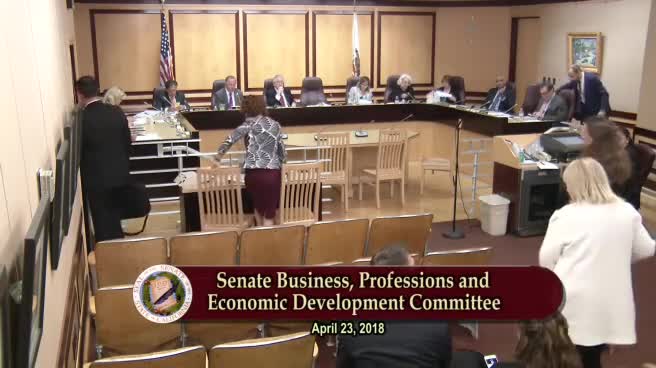 3MIN
Senate Standing Committee on Business, Professions and Economic Development
Bill Author

Bill Co-Author(s):
