SB 1486: Governor’s Office of Business and Economic Development: small business: income tax credit: outreach program.
- Session Year: 2017-2018
- House: Senate
- Latest Version Date: 2018-04-25
Existing law allows a credit against the taxes imposed under the Personal Income Tax Law and the Corporation Tax Law for each taxable year beginning on or after January 1, 2014, and before January 1, 2025, in an amount as provided in a written agreement between the Governors Office of Business and Economic Development and the taxpayer, agreed upon by the California Competes Tax Credit Committee, and based on specified factors, including the number of jobs the taxpayer will create or retain in the state and the amount of investment in the state by the taxpayer. Existing law provides for the allocation of credit amounts only through the 201718 fiscal year and limits the aggregate amount of credit that may be allocated in a fiscal year. Existing law requires 25% of the aggregate amount of the credit to be reserved for small businesses, as defined.
This bill would require the California Competes Tax Credit Committee Governors Office of Business and Economic Development to conduct an outreach program for small businesses eligible for the above-described credits if, among other things, the Governors Office of Business and Economic Development is authorized to allocate those credits for at least 2 consecutive fiscal years, in the 201819 and 201920 fiscal years, a reservation for small businesses of the aggregate amount of those credits that may be allocated is in effect, and that reservation amount is not allocated by the Governors Office of Business and Economic Development during the first 201819 fiscal year.
Existing law allows a credit against the taxes imposed under the Personal Income Tax Law and the Corporation Tax Law for each taxable year beginning on or after January 1, 2014, and before January 1, 2025, in an amount as provided in a written agreement between the Governors Office of Business and Economic Development and the taxpayer, agreed upon by the California Competes Tax Credit Committee, and based on specified factors, including the number of jobs the taxpayer will create or retain in the state and the amount of investment in the state by the taxpayer. Existing law provides for the allocation of credit amounts only through the 201718 fiscal year and limits the aggregate amount of credit that may be allocated in a fiscal year. Existing law requires 25% of the aggregate amount of the credit to be reserved for small businesses, as defined.
This bill would require the California Competes Tax Credit Committee to conduct an outreach program for small businesses eligible for the above-described credits if, among other things, the Governors Office of Business and Economic Development is authorized to allocate credits for at least 2 consecutive fiscal years, a reservation for small businesses of the aggregate amount of those credits that may be allocated is in effect, and that reservation amount is not allocated by the Governors Office of Business and Economic Development during the first fiscal year.
(a)The California Competes Tax Credit Committee is hereby established. The committee shall consist of the Treasurer, the Director of Finance, and the Director of the Governors Office of Business and Economic Development, who shall serve as chair of the committee, or their designated representatives, and one appointee each by the Speaker of the Assembly and the Senate Committee on Rules. A Member of the Legislature shall not be appointed.
(b)For purposes of Sections 17059.2 and 23689, the California Competes Tax Credit Committee shall do all of the following:
(1)Approve or reject any written agreement for a tax credit allocation by resolution at a duly noticed public meeting held in accordance with the Bagley-Keene Open Meeting Act (Article 9 (commencing with Section 11120) of Chapter 1 of Part 1 of Division 3 of Title 2 of the Government Code), but only after receipt of the fully executed written agreement between the taxpayer and the Governors Office of Business and Economic Development.
(2)Approve or reject any recommendation to recapture, in whole or in part, a tax credit allocation by resolution at a duly noticed public meeting held in accordance with the Bagley-Keene Open Meeting Act (Article 9 (commencing with Section 11120) of Chapter 1 of Part 1 of Division 3 of Title 2 of the Government Code), but only after receipt of the recommendation from the Governors Office of Business and Economic Development pursuant to the terms of the fully executed written agreement.
(c)The California Competes Tax Credit Committee (1)The Governors Office of Business and Economic Development shall conduct an outreach program for small businesses eligible for a credit allocation pursuant to Section 17059.2 or 23689 if all of the following occur:
(1)(A)The Governors Office of Business and Economic Development is authorized to allocate credits pursuant to Sections 17059.2 and 23689 for at least two consecutive fiscal years beginning on or after the 201819 year in the 201819 and 201920 fiscal years and a reservation for small businesses of the aggregate amount of credit that may be allocated pursuant to those sections is in effect.
(2)In the first fiscal year in which the Governors Office of Business and Economic Development is authorized to allocate tax credits pursuant to Sections 17059.2 and 23689, it does not allocate to small businesses the full amount of the reservation of credits for small businesses.(3)On or before ____ months after the close of first fiscal year, the Governors Office of Business and Economic Development shall report to the Legislature the amount of unallocated credits reserved for small businesses. The report shall be submitted in compliance with Section 9795 of the Government Code. This paragraph shall become inoperative on January 1, 2023, pursuant to Section 102315 of the Government Code.(B)In the 201819 fiscal year, the Governors Office of Business and Economic Development does not allocate to small businesses the full amount of the reservation of credits for small businesses.
(4)(C)The Legislature, in the Budget Act or another bill, appropriates an amount equal to the unallocated credit amount from the General Fund to the California Competes Tax Credit Committee Governors Office of Business and Economic Development to conduct an outreach program for small businesses eligible for a credit allocation pursuant to Section 17059.2 or 23689.
(2)On or before ____ months after the close of first fiscal year, the Governors Office of Business and Economic Development shall report to the Legislature the amount of unallocated credits reserved for small businesses. The report shall be submitted in compliance with Section 9795 of the Government Code. This paragraph shall become inoperative on January 1, 2023, pursuant to Section 10231.5 of the Government Code.
(a)The California Competes Tax Credit Committee is hereby established. The committee shall consist of the Treasurer, the Director of Finance, and the Director of the Governors Office of Business and Economic Development, who shall serve as chair of the committee, or their designated representatives, and one appointee each by the Speaker of the Assembly and the Senate Committee on Rules. A Member of the Legislature shall not be appointed.
(b)For purposes of Sections 17059.2 and 23689, the California Competes Tax Credit Committee shall do all of the following:
(1)Approve or reject any written agreement for a tax credit allocation by resolution at a duly noticed public meeting held in accordance with the Bagley-Keene Open Meeting Act (Article 9 (commencing with Section 11120) of Chapter 1 of Part 1 of Division 3 of Title 2 of the Government Code), but only after receipt of the fully executed written agreement between the taxpayer and the Governors Office of Business and Economic Development.
(2)Approve or reject any recommendation to recapture, in whole or in part, a tax credit allocation by resolution at a duly noticed public meeting held in accordance with the Bagley-Keene Open Meeting Act (Article 9 (commencing with Section 11120) of Chapter 1 of Part 1 of Division 3 of Title 2 of the Government Code), but only after receipt of the recommendation from the Governors Office of Business and Economic Development pursuant to the terms of the fully executed written agreement.
(c)The California Competes Tax Credit Committee shall conduct an outreach program for small businesses eligible for a credit allocation pursuant to Section 17059.2 or 23689 if all of the following occur:
(1)The Governors Office of Business and Economic Development is authorized to allocate credits pursuant to Sections 17059.2 and 23689 for at least two consecutive fiscal years beginning on or after the 201819 year and a reservation for small businesses of the aggregate amount of credit that may be allocated pursuant to those sections is in effect.
(2)In the first fiscal year in which the Governors Office of Business and Economic Development is authorized to allocate tax credits pursuant to Sections 17059.2 and 23689, it does not allocate to small businesses the full amount of the reservation of credits for small businesses.
(3)On or before ____ months after the close of first fiscal year, the Governors Office of Business and Economic Development shall report to the Legislature the amount of unallocated credits reserved for small businesses. The report shall be submitted in compliance with Section 9795 of the Government Code. This paragraph shall become inoperative on January 1, 2023, pursuant to Section 102315 of the Government Code.
(4)The Legislature, in the Budget Act or another bill, appropriates an amount equal to the unallocated credit amount from the General Fund to the California Competes Tax Credit Committee to conduct an outreach program for small businesses eligible for a credit allocation pursuant to Section 17059.2 or 23689.
|
Date
|
Status
|
|---|---|
| May 25, 2018 | May 25 hearing: Held in committee and under submission. |
| May 18, 2018 | Set for hearing May 25. |
| May 7, 2018 | May 7 hearing: Placed on APPR. suspense file. |
| Apr 27, 2018 | Set for hearing May 7. |
| Apr 25, 2018 | Read second time and amended. Re-referred to Com. on APPR. |
| Apr 24, 2018 | From committee: Do pass as amended and re-refer to Com. on APPR. (Ayes 6. Noes 1. Page 4722.) (April 18). |
| Apr 23, 2018 | From committee: Do pass as amended and re-refer to Com. on APPR. (Ayes 6. Noes 1.) (April 18). |
| Apr 6, 2018 | Set for hearing April 18. |
| Mar 8, 2018 | Referred to Com. on GOV. & F. |
| Feb 20, 2018 | From printer. May be acted upon on or after March 22. |
| Feb 16, 2018 | Introduced. Read first time. To Com. on RLS. for assignment. To print. |
|
Date
|
Description
|
Location
|
Votes
|
|
|---|---|---|---|---|
| May 7, 2018 | Placed on suspense file | Senate Standing Committee on Appropriations |
Passed |
|
| Apr 18, 2018 | Do pass as amended, but first amend, and re-refer to the Committee on [Appropriations] | Senate Standing Committee on Governance and Finance |
Passed |
This list shows positions taken on this bill by organizations on the date displayed, which is linked to the original source.
Positions by individuals are not included.
SENATE COMMITTEE ON APPROPRIATIONS
Senator Ricardo Lara, Chair
2017 - 2018 Regular Session
SB 1486 (Hernandez) - Governor’s Office of Business and Economic Development: small business: income tax credit: outreach program
Version: April 25, 2018 | Policy Vote: GOV. & F. 6 - 1 |
Urgency: No | Mandate: No |
Hearing Date: May 7, 2018 | Consultant: Robert Ingenito |
This bill meets the criteria for referral to the Suspense File.
Bill Summary:
SB 1486 would direct the California Competes Tax Credit Committee to conduct an outreach program for small businesses.
Fiscal Impact:
The Governor’s Office of Business and Economic Development (GO-Biz) indicates that, if the bill’s conditions were satisfied, it would incur annual costs of at least $145,000 (General Fund) to implement its provisions. The GO-Biz estimate includes one staff position to develop and execute the outreach program. To the extent the outreach program utilized a larger number of staff or included a digital/print marketing campaign, annual costs would be considerably higher.
Background:
Tax expenditure programs (TEPs) are special tax provisions that reduce the amount of revenues the “basic” tax system would otherwise generate in order to provide (1) benefits to certain groups of taxpayers, and/or (2) incentives to encourage certain types of behavior and activities, such as charitable giving. Specifically, current law provides for, among other things, various income and corporation tax credits and deductions, as well as exemptions from the sales and use tax. The Department of Finance is required to publish a list of TEPs (currently totaling several hundred), currently valued $61 billion annually.
In 2013, the Legislature reformed California’s economic development policies; specifically, it eliminated enterprise zones and other geographically-targeted economic development areas, and instead allowed three new tax benefits:
- Tax credits for wages paid by taxpayers to qualified employees within former enterprise zones, and other areas that suffer from high levels of poverty and unemployment. The credit sunsets in 2019.
- A partial (the 3.9375 rate that flows to the General Fund) SUT exemption on purchases of manufacturing equipment made by taxpayers within specific North American Industrial Classification System (NAICS) codes, capped at $200 million annually per taxpayer, effective July 1, 2014, and ending July 1, 2022. The Legislature recently expanded and extended the exemption until January 1, 2030. This SUT exemption largely superseded existing programs, as they applied to almost all the same taxpayers.
- The California Competes Tax Credit, an income tax credit available to businesses who want to come, stay, or grow in the State. Tax credits up to a capped amount are determined by an application process by the California Competes Tax Credit Committee within GO-Biz. The Committee could authorize up to $30 million in tax credits in 2013-14, $150 million in 2014-15, and $200 million for 2015-16 through 2017-18, in addition to unallocated or recaptured credits from previous years.
The California Competes Tax Credit authorizes non-taxing state agencies to grant tax benefits in specified amounts after a competitive application process. This model is in contrast to the typical tax credit where any taxpayer who engages in a specifically defined activity during the taxable year for which the credit is authorized may claim the benefit, such as incurring expenses for research and development or paying mortgage interest. The Film and TV Tax Credit administered by the California Film Commission, the sales and use tax exclusion for renewable energy technology and advanced manufacturing administered by the California Alternative Energy and Advanced Transportation Financing Authority, and the Low-Income Housing Tax Credit administered by the California Tax Credit Allocation Committee are other examples.
Under California Competes, firms apply to the Committee, which reviews applications in two phases. In Phase One, applicants calculate the aggregate employee compensation they will pay and investment they will make if the Committee grants the credit, and then request a credit amount. Applicants are then ranked according to a cost-benefit ratio that measures the compensation and investments amounts versus the amount of credit requested. Applicants with the best ratios move to Phase Two. GO-Biz then negotiates tax credit agreements with the highest scoring businesses on a case-by-case basis. However, firms that would expand in a high-unemployment or high-poverty city or county automatically move on to Phase Two. Additionally, state law sets aside 25 percent of the California Competes for small businesses, defined as firms with less than $2 million in annual revenues. Throughout the process, GO-Biz evaluates these small business applications separately from the rest. However, current law does not require an outreach program to small businesses.
In recent years, the Committee has not received sufficient demand from qualified small businesses to fully allocate the 25 percent of tax credits. Last October, the Legislative Analyst’s Office (LAO) found that “California Competes reserves one quarter of the tax credits for businesses with gross annual revenues below $2 million. As of June 2017, GO‑Biz has awarded 293 tax credit agreements—amounting to $99 million in total—to small businesses. This amount is about 19 percent of the total $528 million awarded and less than 17 percent of the $590 million that was available. While GO‑Biz sets aside 25 percent of the available tax credits for small businesses, as required, too few qualified businesses have applied to California Competes to utilize all of those credits. In 2016‑17, GO‑Biz awarded $30 million in tax credits to small businesses—or 49 percent of the amount reserved for them. GO‑Biz has sought to increase the number of small business applicants by increasing their outreach efforts and translating reference material into languages other than English.”
As part of the 2018-19 budget, the Governor proposes to (1) extend the credit for five years through 2022-23, but at a reduced authorization amount of $180 million, and (2) eliminate the small business set-aside, but instead provide $20 million in direct assistance to small businesses.
Proposed Law:
This bill would direct the California Competes Tax Credit Committee to conduct an outreach program for small businesses that would be eligible for the credit, if (1) the Legislature authorizes the Credit in 2018–19 and 2019–20 and a reservation for small businesses is in effect, (2) in 2018-19, GO-Biz does not allocate to small businesses the full amount of the reservation of credits for small businesses, and (3) the Legislature appropriates an amount from the General Fund to GO-Biz to conduct an outreach program for small businesses, as specified. Additionally, the bill contains specified reporting requirements to the Legislature regarding the amount of unallocated credits reserved for small businesses.
Staff Comments:
Though current law does not require GO-Biz to conduct an outreach program, it regularly holds workshops around the state to increase awareness of California Competes and the state’s other economic development activities. The LAO has noted that GO-Biz has held workshops in more than 100 different California cities over the past three years, hosted online workshops, and marketed the program during some out‑of‑state trade missions.
As stated above, the bill would create an outreach program within GO-Biz directed at small businesses eligible for a credit allocation. The bill currently does not discuss any components of the outreach program, nor whether the outreach activities are those that GO-Biz already implements as part of its normal course of business. Because the bill does not specify the components of an outreach program, the GO-Biz estimate does not include any of the costs necessary to produce print or digital marketing, such as radio, web advertising, or video. Instead, GO-Biz assumes that the outreach program would require an additional full time employee at an estimated annual cost of approximately $145,000 for salary/benefits, travel expenses, and operating expenses and equipment. The bill would also result in a cost pressure to extend the credit beyond 2017-18 with the small-business set-aside included.
-- END --
SENATE COMMITTEE ON GOVERNANCE AND FINANCE
Senator Mike McGuire, Chair
2017 - 2018 Regular
Bill No: | SB 1486 | Hearing Date: | 4/18/18 |
Author: | Hernandez | Tax Levy: | No |
Version: | 2/16/18 | Fiscal: | Yes |
Consultant: | Grinnell | ||
California Competes Tax Credit Committee: outreach program
Directs the California Competes Tax Credit Committee to conduct an outreach program for small businesses.
Background
California law allows various income tax credits and deductions, as well as sales and use tax exemptions. The Legislature enacts such tax incentives to either compensate taxpayers for incurring certain expenses, such as child adoption, or to influence certain behavior, such as charitable giving. The Legislature uses tax incentives to encourage taxpayers to do something that but for the tax credit, they would otherwise not do. The Department of Finance is required to annually publish a list of tax expenditures, currently totaling around $61.3 billion per year.
In 2013, the Legislature enacted AB 93 (Committee on Budget) and SB 90 (Committee on Budget and Fiscal Review), which reformed California’s economic development policies by eliminating enterprise zones and other geographically-targeted economic development areas, instead allowing three new tax benefits:
- Tax credits for wages paid by taxpayers to qualified employees within former enterprise zones, and other areas that suffer from high levels of poverty and unemployment. The credit lasts from the 2014 taxable year until the 2019 taxable year.
- An exemption from the state share of the sales and use tax on purchases of manufacturing equipment with useful life exceeding one year for federal and state income tax purposes made by taxpayers within specific North American Industrial Classification System codes, capped at $200 million annually per taxpayer, effective July 1, 2014, and ending July 1, 2022. The Legislature recently expanded and extended the exemption until January 1, 2030 (AB 398, E. Garcia, 2017).
- The California Competes Tax Credit, where taxpayers apply to the California Competes Tax Credit Committee housed in the Governor’s Office of Business and Economic Development (GO-Biz), who can then award various tax credits up to an annually capped amount. The Committee could authorize up to $30 million in tax credits in 2013-14, $150 million in 2014-15, and $200 million for the 2015-16, 2016-17, and 2017-18 fiscal years, plus unallocated or recaptured credits from previous years.
The California Competes Tax Credit authorizes non-taxing state agencies to grant tax benefits in specified amounts after a competitive application process. This model is different than the typical tax credit where any taxpayer who engages in a specifically defined activity during the taxable year for which the credit is authorized may claim the benefit, such as incurring expenses for research and development or paying mortgage interest. The Film and TV Tax Credit administered by the California Film Commission, the sales and use tax exclusion for renewable energy technology and advanced manufacturing administered by the California Alternative Energy and Advanced Transportation Financing Authority, and the Low-Income Housing Tax Credit administered by the California Tax Credit Allocation Committee are other examples.
Under California Competes, firms apply to the Committee, which reviews applications in two phases. In Phase One, applicants calculate the aggregate employee compensation they will pay and investment they will make if the Committee grants the credit, and then request a credit amount. Applicants are then ranked according to a cost-benefit ratio that measures the compensation and investments amounts versus the amount of credit requested. Applicants with the best ratios move to Phase Two. GO-Biz then negotiates tax credit agreements with the highest scoring businesses on a case-by-case basis. However, firms that would expand in a high-unemployment or high-poverty city or county automatically move on to Phase Two. Additionally, state law sets aside 25% of the California Competes for small businesses, defined as firms with less than $2 million in annual revenues. Throughout the process, GO-Biz evaluates these small business applications separately from the rest.
In recent years, the Committee has not received sufficient demand from qualified small businesses to fully allocate the 25% of tax credits. Last October, the Legislative Analyst’s Office (LAO) published “A Review of the California Competes Tax Credit,” in which it states:
“California Competes reserves one quarter of the tax credits for businesses with gross annual revenues below $2 million. As of June 2017, GO‑Biz has awarded 293 tax credit agreements—amounting to $99 million in total—to small businesses. This amount is about 19 percent of the total $528 million awarded and less than 17 percent of the $590 million that was available. While GO‑Biz sets aside 25 percent of the available tax credits for small businesses, as required, too few qualified businesses have applied to California Competes to utilize all of those credits. In 2016‑17, GO‑Biz awarded $30 million in tax credits to small businesses—or 49 percent of the amount reserved for them. GO‑Biz has sought to increase the number of small business applicants by increasing their outreach efforts and translating reference material into languages other than English.”
AB 93 and SB 90 allow GO-Biz to allocate credits until the 2017-18 fiscal year. As part of his 2018-19 Budget, Governor Brown proposes to:
- Extend the credit for five years through the 2022-23, but at a reduced authorization amount of $180 million
- Eliminate the small business set-aside, but instead provide $20 million in direct assistance to small businesses.
Seeking to increase GO-Biz’s outreach efforts to small businesses, the author wants to require the Committee to conduct an outreach program for small businesses if the Legislature extends the program.
Proposed Law
Senate Bill 1486 directs the California Competes Tax Credit Committee to conduct an outreach program for small businesses that would be eligible for the credit, if:
- The Legislature authorizes the Credit for at least two consecutive fiscal years beginning on or after the 2018-19 fiscal year,
- The authorization continues a set-aside for small businesses,
- The Committee does not fully allocate the small business set-aside,
- GO-Biz reports to the Legislature regarding the amount of unallocated credits reserved for small businesses within an unspecified number of months from the close of the first fiscal year, and
- The Legislature appropriates an amount equal to the unallocated credit amount from the General Fund to the Committee to conduct an outreach program for small businesses.
State Revenue Impact
No estimate.
Comments
1. Purpose of the bill. According to the author, “The California Competes Tax Credit Program is an essential tool to incentivizing business investment within our state. Currently, too few small businesses, which are the backbone of our economy, are taking advantage of the available tax credits. This bill will increase outreach so that the program can be utilized to its full capacity, as it was intended, and grow the California economy.”
2. Necessary? While state law does not currently require an outreach program as required by SB 1486, GO‑Biz regularly holds workshops around the state to increase awareness of California Competes and the state’s other economic development activities. The Legislative Analyst’s Office’s October, 2017, report “Review of the California Competes Tax Credit” states that GO-Biz has held workshops in more than 100 different California cities over the past three years, hosted online workshops, and marketed the program during some out‑of‑state trade missions. SB 1486 provides specific direction to GO-Biz to conduct outreach to small businesses, but the Committee may wish to consider whether the measure is necessary given GO-Biz’s current efforts.
3. Are tax credits the best option? California’s experience attempting to spur employment gains for small businesses is mixed. In 2009, the Legislature enacted the New Jobs Tax Credit, equal to $3,000 per full time employee hired for an employer that employs fewer than 20 employees, and authorized $400 million in credits (AB 3x 15, Krekorian, and SB 3x 15, Calderon, 2009). However, taxpayers only claimed around $50 or $60 million in credits before the Legislature repealed it in 2013. Experts also say that state economic development efforts should pursue efforts other than tax credits. In “What Works in State Economic Development” Timothy Bartik of the W.E. Upjohn Institute states that a dual focus on labor demand and labor supply is necessary to raise per capita earnings. As part of this approach, he writes that “small and medium-sized businesses benefit from assistance with planning, marketing, technology, and government regulations.” In its report, LAO also suggested using alternatives other than tax benefits, and recommended eliminating the small business set-aside. California’s experience and the advice of experts indicate that other policies may be more effective in assisting small businesses increase employment and wages. Additionally, the Governor has proposed eliminating the small business set aside, and instead providing direct technical assistance to small businesses.
4. Technicals. SB 1486’s requires the California Competes Tax Credit Committee to conduct an outreach program for small businesses, but only if five conditions are met. To increase the likelihood that the bills’ requirement is triggered, and to ensure additional clarity, Committee staff recommends the following technical amendments.
- Use “for the 2018-19 and 2019-20 fiscal years” instead of “for at least two consecutive fiscal years beginning on or after the 2018-19 fiscal year” on P.3, L.3.
- Delete “of the aggregate amount of credit that may be allocated pursuant to those sections,” on P.3, L. 5-6.
- Use “in the 2018-19 fiscal year” instead of “in the first fiscal year in which the Governor’s Office of Business and Economic Development is authorized to allocate tax credits pursuant to Sections 17059.2 and 23689.”
- Move reporting requirement to its own paragraph, and reletter as appropriate.
- Alter appropriation requirement to delete the amount.
- Substitute “Governor’s Office of Business and Economic Development” for” California Competes Tax Credit Committee,” on P. 2. L. 29, and P. 3, L. 21.as the Budget Act appropriates funds to GO-Biz, while the Committee only considers tax credit applications.
Support and Opposition
(4/13/18)
Support: Unknown.
Opposition: Unknown.
-- END --
Discussed in Hearing
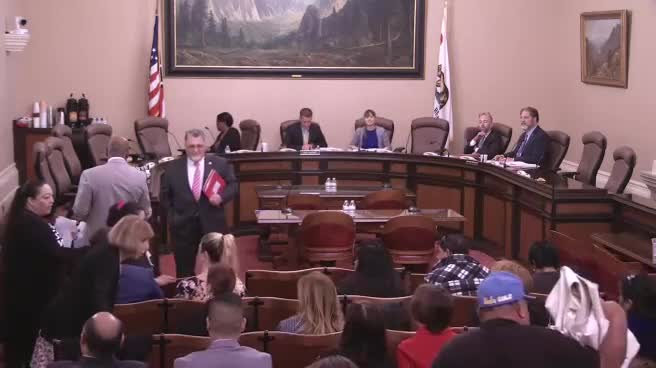 2MIN
Senate Standing Committee on Governance and Finance
Bill Author

Bill Co-Author(s):