SB 166: Residential density and affordability.
- Session Year: 2017-2018
- House: Senate
- Latest Version Date: 2017-09-29
The Planning and Zoning Law requires a city, county, or city and county to ensure that its housing element inventory, as described, can accommodate its share of the regional housing need throughout the planning period. The law also prohibits a city, county, or city and county from reducing, requiring, or permitting the reduction of the residential density to a lower residential density that is below the density that was utilized by the Department of Housing and Community Development in determining compliance with housing element law, unless the city, county, or city and county makes written findings supported by substantial evidence that the reduction is consistent with the adopted general plan, including the housing element, and that the remaining sites identified in the housing element are adequate to accommodate the jurisdictions share of the regional housing need. The city, county, or city and county may reduce the residential density for a parcel if it identifies sufficient sites, as prescribed, so that there is no net loss of residential unit capacity.
This bill, among other things, would prohibit a city, county, or city and county from permitting or causing its inventory of sites identified in the housing element to be insufficient to meet its remaining unmet share of the regional housing need for lower and moderate-income households. The bill also would expand the definition of lower residential density if the local jurisdiction has not adopted a housing element for the current planning period or the adopted housing element is not in substantial compliance, as specified. The bill would additionally require a city, county, or city and county to make specified written findings if the city, county, or city and county allows development of any parcel with fewer units by income category than identified in the housing element for that parcel. Where the approval of a development project results in fewer units by income category than identified in the housing element for that parcel and the remaining sites in the housing element are not adequate to accommodate the jurisdictions share of the regional housing need by income level, the bill would require the jurisdiction within 180 days to identify and make available additional adequate sites. The bill would provide that an action that creates an obligation to identify or make available additional adequate sites and the action to identify or make available those sites would not create an obligation under the California Environmental Quality Act to identify, analyze, or mitigate the environmental impacts of that subsequent action, as specified. By increasing the duties of local agencies, this bill would create a state-mandated local program.
The California Constitution requires the state to reimburse local agencies and school districts for certain costs mandated by the state. Statutory provisions establish procedures for making that reimbursement.
This bill would provide that no reimbursement is required by this act for a specified reason.
The Planning and Zoning Law requires a city, county, or city and county to ensure that its housing element inventory, as described, can accommodate its share of the regional housing need throughout the planning period. The law also prohibits a city, county, or city and county from reducing, requiring, or permitting the reduction of the residential density to a lower residential density that is below the density that was utilized by the Department of Housing and Community Development in determining compliance with housing element law, unless the city, county, or city and county makes written findings supported by substantial evidence that the reduction is consistent with the adopted general plan, including the housing element, and that the remaining sites identified in the housing element are adequate to accommodate the jurisdictions share of the regional housing need. The city, county, or city and county may reduce the residential density for a parcel if it identifies sufficient sites, as prescribed, so that there is no net loss of residential unit capacity.
This bill, among other things, would prohibit a city, county, or city and county from permitting or causing its inventory of sites identified in the housing element to be insufficient to meet its remaining unmet share of the regional housing need for lower and moderate-income households. The bill also would expand the definition of lower residential density if the local jurisdiction has not adopted a housing element for the current planning period or the adopted housing element is not in substantial compliance, as specified. The bill would additionally apply the requirement require a city, county, or city and county to make specified written findings to a if the city, county, or city and county that allows development of any parcel with fewer units by income category than identified in the housing element for that parcel, and would add elements to the required findings. parcel. Where the approval of a development project results in fewer units by income category than identified in the housing element for that parcel and the remaining sites in the housing element are not adequate to accommodate the jurisdictions share of the regional housing need by income level, the bill would require the jurisdiction within 180 days to identify and make available additional adequate sites. The bill would provide that an action taken by a jurisdiction that creates an obligation to identify or make available additional adequate sites and the action to identify or make available those sites do not constitute the same project for purposes of the would not create an obligation under the California Environmental Quality Act, Act to identify, analyze, or mitigate the environmental impacts of that subsequent action, as specified. By increasing the duties of local agencies, this bill would create a state-mandated local program.
The California Constitution requires the state to reimburse local agencies and school districts for certain costs mandated by the state. Statutory provisions establish procedures for making that reimbursement.
This bill would provide that no reimbursement is required by this act for a specified reason.
The Planning and Zoning Law requires a city, county, or city and county to ensure that its housing element inventory, as described, can accommodate its share of the regional housing need throughout the planning period. The law also prohibits a city, county, or city and county from reducing, requiring, or permitting the reduction of the residential density to a lower residential density that is below the density that was utilized by the Department of Housing and Community Development in determining compliance with housing element law, unless the city, county, or city and county makes written findings supported by substantial evidence that the reduction is consistent with the adopted general plan, including the housing element, and that the remaining sites identified in the housing element are adequate to accommodate the jurisdictions share of the regional housing need. The city, county, or city and county may reduce the residential density for a parcel if it identifies sufficient sites, as prescribed, so that there is no net loss of residential unit capacity.
This bill, among other things, would prohibit a city, county, or city and county from permitting or causing its inventory of sites identified in the housing element to be insufficient to meet its remaining unmet share of the regional housing need for lower and moderate-income households. The bill also would expand the definition of lower residential density if the local jurisdiction has not adopted a housing element for the current planning period or the adopted housing element is not in substantial compliance, as specified. The bill would additionally apply the requirement to make written findings to a reduction in residential density that results in city, county, or city and county that allows development of any parcel with fewer units by income category than as identified in the housing element for a that parcel, and would add elements to the required findings. Where the approval of a development project results in fewer units by income category than identified in the housing element for that parcel and the remaining sites in the housing element are not adequate to accommodate the jurisdictions share of the regional housing need by income level, the bill would require the jurisdiction within 180 days to identify and make available additional adequate sites. The bill would provide that an action taken by a jurisdiction that creates an obligation to identify or make available additional adequate sites and the action to identify or make available those sites do not constitute the same project for purposes of the California Environmental Quality Act, as specified. By increasing the duties of local agencies, this bill would create a state-mandated local program.
The California Constitution requires the state to reimburse local agencies and school districts for certain costs mandated by the state. Statutory provisions establish procedures for making that reimbursement.
This bill would provide that no reimbursement is required by this act for a specified reason.
The Planning and Zoning Law requires a city, county, or city and county to ensure that its housing element inventory, as described, can accommodate its share of the regional housing need throughout the planning period. The law also prohibits a city, county, or city and county from reducing, requiring, or permitting the reduction of the residential density to a lower residential density that is below the density that was utilized by the Department of Housing and Community Development in determining compliance with housing element law, unless the city, county, or city and county makes written findings supported by substantial evidence that the reduction is consistent with the adopted general plan, including the housing element, and that the remaining sites identified in the housing element are adequate to accommodate the jurisdictions share of the regional housing need. The city, county, or city and county may reduce the residential density for a parcel if it identifies sufficient sites, as prescribed, so that there is no net loss of residential unit capacity.
This bill, among other things, would prohibit a city, county, or city and county from permitting or causing its inventory of sites identified in the housing element to be insufficient to meet its remaining unmet share of the regional housing need for lower and moderate-income households. The bill also would expand the definition of lower residential density if the local jurisdiction has not adopted a housing element for the current planning period or the adopted housing element is not in substantial compliance, as specified. This bill would also condition the approval or development containing fewer housing units at each income level than its identified capacity upon identifying sufficient sites or rezones, as prescribed, to ensure no net loss of residential unit capacity. The bill would additionally apply the requirement to make written findings to a reduction in residential density that results in fewer units by income category than as identified in the housing element for a parcel, and would add elements to the required findings. Where the approval of a development project results in fewer units by income category than identified in the housing element for that parcel and the remaining sites in the housing element are not adequate to accommodate the jurisdictions share of the regional housing need by income level, the bill would require the jurisdiction within 180 days to identify and make available additional adequate sites. The bill would provide that an action taken by a jurisdiction that creates an obligation to identify additional adequate sites and the action to identify those sites do not constitute the same project for purposes of the California Environmental Quality Act, as specified. By increasing the duties of local agencies, this bill would create a state-mandated local program.
The California Constitution requires the state to reimburse local agencies and school districts for certain costs mandated by the state. Statutory provisions establish procedures for making that reimbursement.
This bill would provide that no reimbursement is required by this act for a specified reason.
The Planning and Zoning Law requires a city, county, or city and county to ensure that its housing element inventory, as described, can accommodate its share of the regional housing need throughout the planning period. The law also prohibits a city, county, or city and county from reducing, requiring, or permitting the reduction of the residential density to a lower residential density that is below the density that was utilized by the Department of Housing and Community Development in determining compliance with housing element law, unless the city, county, or city and county makes written findings supported by substantial evidence that the reduction is consistent with the adopted general plan, including the housing element, and that the remaining sites identified in the housing element are adequate to accommodate the jurisdictions share of the regional housing need. The city, county, or city and county may reduce the residential density for a parcel if it identifies sufficient sites, as prescribed, so that there is no net loss of residential unit capacity.
This bill, among other things, would prohibit a city, county, or city and county from permitting or causing its inventory of sites identified in the housing element to be insufficient to meet its remaining unmet share of the regional housing need for lower and moderate-income households. The bill also would expand the definition of lower residential density if the local jurisdiction has not adopted a housing element for the current planning period or the adopted housing element is not in substantial compliance, as specified. This bill would also condition the approval or development containing fewer housing units at each income level than its identified capacity upon identifying sufficient sites or rezones, as prescribed, to ensure no net loss of residential unit capacity. By increasing the duties of local agencies, this bill would create a state-mandated local program.
The California Constitution requires the state to reimburse local agencies and school districts for certain costs mandated by the state. Statutory provisions establish procedures for making that reimbursement.
This bill would provide that no reimbursement is required by this act for a specified reason.
Existing law imposes a general obligation on both parents of a minor child to support their child in the manner suitable to the childs circumstances. Existing law establishes the statewide uniform guidelines for calculating court-ordered child support, based on the income of both parents and the time each parent spends with the child. Existing law establishes a rebuttable presumption that an obligor with a net disposable income, as defined, of a specified amount per month is entitled to a low-income adjustment to his or her child support obligation. The net disposable income threshold, until January 1, 2018, is $1,500 per month, adjusted annually for cost-of-living increases. Existing law requires the Judicial Council to determine the adjustment amount based on the change in the annual California Consumer Price Index, as specified. The net disposable income threshold, commencing January 1, 2018, is $1,000 per month without an annual adjustment for cost-of-living increases.This bill would delete the January 1, 2018, sunset date, thereby maintaining the net disposable income threshold at $1,500 per month, adjusted annually for cost-of-living increases, indefinitely, and would repeal the provision that becomes operative on January 1, 2018.Existing law imposes a general obligation on both parents of a minor child to support their child in the manner suitable to the childs circumstances. Existing law establishes the statewide uniform guidelines for calculating court-ordered child support, based on the income of both parents and the time each parent spends with the child. Existing law establishes a rebuttable presumption that an obligor with a net disposable income, as defined, of a specified amount per month is entitled to a low-income adjustment to his or her child support obligation. The net disposable income threshold, until January 1, 2018, is $1,500 per month, adjusted annually for cost-of-living increases. Existing law requires the Judicial Council to determine the adjustment amount based on the change in the annual California Consumer Price Index, as specified. The net disposable income threshold, commencing January 1, 2018, is $1,000 per month without an annual adjustment for cost-of-living increases.
This bill would delete the January 1, 2018, sunset date, thereby maintaining the net disposable income threshold at $1,500 per month, adjusted annually for cost-of-living increases, indefinitely, and would repeal the provision that becomes operative on January 1, 2018.
(a)Each city, county, or city and county shall ensure that its housing element inventory described in paragraph (3) of subdivision (a) of Section 65583 or its housing element program to make sites available pursuant to paragraph (1) of subdivision (c) of Section 65583 can accommodate, at all times throughout the planning period, its remaining unmet share of the regional housing need allocated pursuant to Section 65584, except as provided in paragraph (2) of subdivision (c). At no time, except as provided in paragraph (2) of subdivision (c), shall a city, county, or city and county by administrative, quasi-judicial, legislative, or other action permit or cause its inventory of sites identified in the housing element to be insufficient to meet its remaining unmet share of the regional housing need for lower and moderate-income households.
(b)(1)No city, county, or city and county shall, by administrative, quasi-judicial, legislative, or other action, reduce, or require or permit the reduction of, the residential density for any parcel to, or allow development of any parcel at, a lower residential density, as defined in paragraphs (1) and (2) of subdivision (g), unless the city, county, or city and county makes written findings supported by substantial evidence of both of the following:
(A)The reduction is consistent with the adopted general plan, including the housing element.
(B)The remaining sites identified in the housing element are adequate to meet the requirements of Section 65583.2 and to accommodate the jurisdictions share of the regional housing need pursuant to Section 65584. The finding shall include a quantification of the remaining unmet need for the jurisdictions share of the regional housing need at each income level and the remaining capacity of sites identified in the housing element to accommodate that need by income level.
(2)If a city, county, or city and county, by administrative, quasi-judicial, legislative, or other action, allows development of any parcel with fewer units by income category than identified in the jurisdictions housing element for that parcel, the city, county, or city and county shall make a written finding supported by substantial evidence as to whether or not remaining sites identified in the housing element are adequate to meet the requirements of Section 65583.2 and to accommodate the jurisdictions share of the regional housing need pursuant to Section 65584. The finding shall include a quantification of the remaining unmet need for the jurisdictions share of the regional housing need at each income level and the remaining capacity of sites identified in the housing element to accommodate that need by income level.
(c)(1)If a reduction in residential density for any parcel would result in the remaining sites in the housing element not being adequate to meet the requirements of Section 65583.2 and to accommodate the jurisdictions share of the regional housing need pursuant to Section 65584, the jurisdiction may reduce the density on that parcel if it identifies sufficient additional, adequate, and available sites with an equal or greater residential density in the jurisdiction so that there is no net loss of residential unit capacity.
(2)If the approval of a development project results in fewer units by income category than identified in the jurisdictions housing element for that parcel and the jurisdiction does not find that the remaining sites in the housing element are adequate to accommodate the jurisdictions share of the regional housing need by income level, the jurisdiction shall within 180 days identify and make available additional adequate sites to accommodate the jurisdictions share of the regional housing need by income level. Nothing in this section shall authorize a city, county, or city and county to disapprove a housing development project on the basis that approval of the housing project would require compliance with this paragraph.
(d)The requirements of this section shall be in addition to any other law that may restrict or limit the reduction of residential density.
(e)This section requires that a city, county, or city and county be solely responsible for compliance with this section, unless a project applicant requests in his or her initial application, as submitted, a density that would result in the remaining sites in the housing element not being adequate to accommodate the jurisdictions share of the regional housing need pursuant to Section 65584. In that case, the city, county, or city and county may require the project applicant to comply with this section. The submission of an application for purposes of this subdivision does not depend on the application being deemed complete or being accepted by the city, county, or city and county.
(f)This section shall not be construed to apply to parcels that, prior to January 1, 2003, were either (1) subject to a development agreement, or (2) parcels for which an application for a subdivision map had been submitted.
(g)(1)If the local jurisdiction has adopted a housing element for the current planning period that is in substantial compliance with Article 10.6 (commencing with Section 65580) of Chapter 3, for purposes of this section, lower residential density means the following:
(A)For sites on which the zoning designation permits residential use and that are identified in the local jurisdictions housing element inventory described in paragraph (3) of subdivision (a) of Section 65583, fewer units on the site than were projected by the jurisdiction to be accommodated on the site pursuant to subdivision (c) of Section 65583.2.
(B)For sites that have been or will be rezoned pursuant to the local jurisdictions housing element program described in paragraph (1) of subdivision (c) of Section 65583, fewer units for the site than were projected to be developed on the site in the housing element program.
(2)(A)If the local jurisdiction has not adopted a housing element for the current planning period within 90 days of the deadline established by Section 65588 or the adopted housing element is not in substantial compliance with Article 10.6 (commencing with Section 65580) of Chapter 3 within 180 days of the deadline established by Section 65588, lower residential density means any of the following:
(i)For residentially zoned sites, a density that is lower than 80 percent of the maximum allowable residential density for that parcel or 80 percent of the maximum density required by paragraph (3) of subdivision (c) of Section 65583.2, whichever is greater.(ii)For sites on which residential and nonresidential uses are permitted, a use that would result in the development of fewer than 80 percent of the number of residential units that would be allowed under the maximum residential density for the site parcel or 80 percent of the maximum density required by paragraph (3) of subdivision (c) of Section 65583.2, whichever is greater.
(B)If the council of governments fails to complete a final housing need allocation pursuant to the deadlines established by Section 65584.05, then for purposes of this paragraph, the deadline pursuant to Section 65588 shall be extended by a time period equal to the number of days of delay incurred by the council of governments in completing the final housing need allocation.
(h)An action that obligates a jurisdiction to identify and make available additional adequate sites for residential development pursuant to this section creates no obligation under the California Environmental Quality Act (Division 13 (commencing with Section 21000) of the Public Resources Code) to identify, analyze, or mitigate the environmental impacts of that subsequent action to identify and make available additional adequate sites as a reasonably foreseeable consequence of that action. Nothing in this subdivision shall be construed as a determination as to whether or not the subsequent action by a city, county, or city and county to identify and make available additional adequate sites is a project for purposes of the California Environmental Quality Act (Division 13 (commencing with Section 21000) of the Public Resources Code).
SEC. 2.No reimbursement is required by this act pursuant to Section 6 of Article XIIIB of the California Constitution because a local agency or school district has the authority to levy service charges, fees, or assessments sufficient to pay for the program or level of service mandated by this act, within the meaning of Section 17556 of the Government Code.
(a)Each city, county, or city and county shall ensure that its housing element inventory described in paragraph (3) of subdivision (a) of Section 65583 or its housing element program to make sites available pursuant to paragraph (1) of subdivision (c) of Section 65583 can accommodate, at all times throughout the planning period, its remaining unmet share of the regional housing need allocated pursuant to Section 65584, except as provided in paragraph (2) of subdivision (c). At no time, except as provided in paragraph (2) of subdivision (c), shall a city, county, or city and county by administrative, quasi-judicial, legislative, or other action permit or cause its inventory of sites identified in the housing element to be insufficient to meet its remaining unmet share of the regional housing need for lower and moderate-income households.
(b)(1)No city, county, or city and county shall, by administrative, quasi-judicial, legislative, or other action, reduce, or require or permit the reduction of, the residential density for any parcel to, or allow development of any parcel at, a lower residential density, as defined in paragraphs (1) and (2) of subdivision (g), unless the city, county, or city and county makes written findings supported by substantial evidence of both of the following:
(A)The reduction is consistent with the adopted general plan, including the housing element.
(B)The remaining sites identified in the housing element are adequate to meet the requirements of Section 65583.2 and to accommodate the jurisdictions share of the regional housing need pursuant to Section 65584. The finding shall include a quantification of the remaining unmet need for the jurisdictions share of the regional housing need at each income level and the remaining capacity of sites identified in the housing element to accommodate that need by income level.
(2)No city, county, or city and county shall, by administrative, quasi-judicial, legislative, or other action, allow development of any parcel with fewer units by income category than identified in the jurisdictions housing element for that parcel, unless the city, county, or city and county makes a written finding supported by substantial evidence that remaining sites identified in the housing element are adequate to meet the requirements of Section 65583.2 and to accommodate the jurisdictions share of the regional housing need pursuant to Section 65584. The finding shall include a quantification of the remaining unmet need for the jurisdictions share of the regional housing need at each income level and the remaining capacity of sites identified in the housing element to accommodate that need by income level.(2)If a city, county, or city and county, by administrative, quasi-judicial, legislative, or other action, allows development of any parcel with fewer units by income category than identified in the jurisdictions housing element for that parcel, the city, county, or city and county shall make a written finding supported by substantial evidence as to whether or not remaining sites identified in the housing element are adequate to meet the requirements of Section 65583.2 and to accommodate the jurisdictions share of the regional housing need pursuant to Section 65584. The finding shall include a quantification of the remaining unmet need for the jurisdictions share of the regional housing need at each income level and the remaining capacity of sites identified in the housing element to accommodate that need by income level.
(c)(1)If a reduction in residential density for any parcel would result in the remaining sites in the housing element not being adequate to meet the requirements of Section 65583.2 and to accommodate the jurisdictions share of the regional housing need pursuant to Section 65584, the jurisdiction may reduce the density on that parcel if it identifies sufficient additional, adequate, and available sites with an equal or greater residential density in the jurisdiction so that there is no net loss of residential unit capacity.
(2)If the approval of a development project results in fewer units by income category than identified in the jurisdictions housing element for that parcel and the jurisdiction does not find that the remaining sites in the housing element are adequate to accommodate the jurisdictions share of the regional housing need by income level, the jurisdiction shall within 180 days identify and make available additional adequate sites to accommodate the jurisdictions share of the regional housing need by income level. Nothing in this section shall authorize a city, county, or city and county to disapprove a housing development project on the basis that approval of the housing project would require compliance with this paragraph.
(d)The requirements of this section shall be in addition to any other law that may restrict or limit the reduction of residential density.
(e)This section requires that a city, county, or city and county be solely responsible for compliance with this section, unless a project applicant requests in his or her initial application, as submitted, a density that would result in the remaining sites in the housing element not being adequate to accommodate the jurisdictions share of the regional housing need pursuant to Section 65584. In that case, the city, county, or city and county may require the project applicant to comply with this section. The submission of an application for purposes of this subdivision does not depend on the application being deemed complete or being accepted by the city, county, or city and county.
(f)This section shall not be construed to apply to parcels that, prior to January 1, 2003, were either (1) subject to a development agreement, or (2) parcels for which an application for a subdivision map had been submitted.
(g)(1)If the local jurisdiction has adopted a housing element for the current planning period that is in substantial compliance with Article 10.6 (commencing with Section 65580) of Chapter 3, for purposes of this section, lower residential density means the following:
(A)For sites on which the zoning designation permits residential use and that are identified in the local jurisdictions housing element inventory described in paragraph (3) of subdivision (a) of Section 65583, fewer units on the site than were projected by the jurisdiction to be accommodated on the site pursuant to subdivision (c) of Section 65583.2.
(B)For sites that have been or will be rezoned pursuant to the local jurisdictions housing element program described in paragraph (1) of subdivision (c) of Section 65583, fewer units for the site than were projected to be developed on the site in the housing element program.
(2)(A)If the local jurisdiction has not adopted a housing element for the current planning period within 90 days of the deadline established by Section 65588 or the adopted housing element is not in substantial compliance with Article 10.6 (commencing with Section 65580) of Chapter 3 within 180 days of the deadline established by Section 65588, lower residential density means any of the following:
(i)For residentially zoned sites, a density that is lower than 80 percent of the maximum allowable residential density for that parcel or 80 percent of the maximum density required by paragraph (3) of subdivision (c) of Section 65583.2, whichever is greater.(ii)For sites on which residential and nonresidential uses are permitted, a use that would result in the development of fewer than 80 percent of the number of residential units that would be allowed under the maximum residential density for the site parcel or 80 percent of the maximum density required by paragraph (3) of subdivision (c) of Section 65583.2, whichever is greater.
(B)If the council of governments fails to complete a final housing need allocation pursuant to the deadlines established by Section 65584.05, then for purposes of this paragraph, the deadline pursuant to Section 65588 shall be extended by a time period equal to the number of days of delay incurred by the council of governments in completing the final housing need allocation.
(h)An action taken by a jurisdiction that creates an obligation to identify or make available additional adequate sites pursuant to this section and the action taken by the jurisdiction to identify or make available the additional adequate sites shall not constitute the same project for the purposes of the California Environmental Quality Act (Division 13 (commencing with Section 21000) of the Public Resources Code).(h)An action that obligates a jurisdiction to identify and make available additional adequate sites for residential development pursuant to this section creates no obligation under the California Environmental Quality Act (Division 13 (commencing with Section 21000) of the Public Resources Code) to identify, analyze, or mitigate the environmental impacts of that subsequent action to identify and make available additional adequate sites as a reasonably foreseeable consequence of that action. Nothing in this subdivision shall be construed as a determination as to whether or not the subsequent action by a city, county, or city and county to identify and make available additional adequate sites is a project for purposes of the California Environmental Quality Act (Division 13 (commencing with Section 21000) of the Public Resources Code).
SEC. 2.No reimbursement is required by this act pursuant to Section 6 of Article XIIIB of the California Constitution because a local agency or school district has the authority to levy service charges, fees, or assessments sufficient to pay for the program or level of service mandated by this act, within the meaning of Section 17556 of the Government Code.
REVISIONS: HeadingLine 2.(a)Each city, county, or city and county shall ensure that its housing element inventory described in paragraph (3) of subdivision (a) of Section 65583 or its housing element program to make sites available pursuant to paragraph (1) of subdivision (c) of Section 65583 can accommodate, at all times throughout the planning period, its remaining unmet share of the regional housing need allocated pursuant to Section 65584. 65584, except as provided in paragraph (2) of subdivision (c). At no time time, except as provided in paragraph (2) of subdivision (c), shall a city, county, or city and county by administrative, quasi-judicial, legislative, or other action permit or cause its inventory of sites identified in the housing element to be insufficient to meet its remaining unmet share of the regional housing need for lower and moderate-income households.
(b)(1)No city, county, or city and county shall, by administrative, quasi-judicial, legislative, or other action, reduce, or require or permit the reduction of, the residential density for any parcel to, or allow development of any parcel at, a lower residential density, as defined in paragraphs (1) and (2) of subdivision (g), or with fewer units by income category than identified in the jurisdictions housing element for that parcel, unless the city, county, or city and county makes written findings supported by substantial evidence of both of the following:
(1)(A)The reduction is consistent with the adopted general plan, including the housing element.
(2)(B)The remaining sites identified in the housing element are adequate to meet the requirements of Section 65583.2 and to accommodate the jurisdictions share of the regional housing need pursuant to Section 65584. The finding shall include a quantification of the remaining unmet need for the jurisdictions share of the regional housing need at each income level and the remaining capacity of sites identified in the housing element to accommodate that need by income level.
(2)No city, county, or city and county shall, by administrative, quasi-judicial, legislative, or other action, allow development of any parcel with fewer units by income category than identified in the jurisdictions housing element for that parcel, unless the city, county, or city and county makes a written finding supported by substantial evidence that remaining sites identified in the housing element are adequate to meet the requirements of Section 65583.2 and to accommodate the jurisdictions share of the regional housing need pursuant to Section 65584. The finding shall include a quantification of the remaining unmet need for the jurisdictions share of the regional housing need at each income level and the remaining capacity of sites identified in the housing element to accommodate that need by income level.
(c)(1)If a reduction in residential density for any parcel would result in the remaining sites in the housing element not being adequate to meet the requirements of Section 65583.2 and to accommodate the jurisdictions share of the regional housing need pursuant to Section 65584, the jurisdiction may reduce the density on that parcel if it identifies sufficient additional, adequate, and available sites with an equal or greater residential density in the jurisdiction so that there is no net loss of residential unit capacity.
(2)If the approval of a development project results in fewer units by income category than identified in the jurisdictions housing element for that parcel and the jurisdiction finds does not find that the remaining sites in the housing element are not adequate to accommodate the jurisdictions share of the regional housing need by income level, the jurisdiction shall within 180 days identify and make available additional adequate sites to accommodate the jurisdictions share of the regional housing need by income level.
(d)The requirements of this section shall be in addition to any other law that may restrict or limit the reduction of residential density.
(e)This section requires that a city, county, or city and county be solely responsible for compliance with this section, unless a project applicant requests in his or her initial application, as submitted, a density that would result in the remaining sites in the housing element not being adequate to accommodate the jurisdictions share of the regional housing need pursuant to Section 65584. In that case, the city, county, or city and county may require the project applicant to comply with this section. The submission of an application for purposes of this subdivision does not depend on the application being deemed complete or being accepted by the city, county, or city and county.
(f)This section shall not be construed to apply to parcels that, prior to January 1, 2003, were either (1) subject to a development agreement, or (2) parcels for which an application for a subdivision map had been submitted.
(g)(1)If the local jurisdiction has adopted a housing element for the current planning period that is in substantial compliance with Article 10.6 (commencing with Section 65580) of Chapter 3, for purposes of this section, lower residential density means the following:
(A)For sites on which the zoning designation permits residential use and that are identified in the local jurisdictions housing element inventory described in paragraph (3) of subdivision (a) of Section 65583, fewer units on the site than were projected by the jurisdiction to be accommodated on the site pursuant to subdivision (c) of Section 65583.2.
(B)For sites that have been or will be rezoned pursuant to the local jurisdictions housing element program described in paragraph (1) of subdivision (c) of Section 65583, fewer units for the site than were projected to be developed on the site in the housing element program.
(2)(A)If the local jurisdiction has not adopted a housing element for the current planning period within 90 days of the deadline established by Section 65588 or the adopted housing element is not in substantial compliance with Article 10.6 (commencing with Section 65580) of Chapter 3 within 180 days of the deadline established by Section 65588, lower residential density means any of the following:
(i)For residentially zoned sites, a density that is lower than 80 percent of the maximum allowable residential density for that parcel or 80 percent of the maximum density required by paragraph (3) of subdivision (c) of Section 65583.2, whichever is greater.
(ii)For sites on which residential and nonresidential uses are permitted, a use that would result in the development of fewer than 80 percent of the number of residential units that would be allowed under the maximum residential density for the site parcel or 80 percent of the maximum density required by paragraph (3) of subdivision (c) of Section 65583.2, whichever is greater.
(B)If the council of governments fails to complete a final housing need allocation pursuant to the deadlines established by Section 65584.05, then for purposes of this paragraph, the deadline pursuant to Section 65588 shall be extended by a time period equal to the number of days of delay incurred by the council of governments in completing the final housing need allocation.
(h)An action taken by a jurisdiction that creates an obligation to identify or make available additional adequate sites pursuant to this section and the action taken by the jurisdiction to identify or make available the additional adequate sites shall not constitute the same project for the purposes of the California Environmental Quality Act (Division 13 (commencing with Section 21000) of the Public Resources Code).
SEC. 2.No reimbursement is required by this act pursuant to Section 6 of Article XIIIB of the California Constitution because a local agency or school district has the authority to levy service charges, fees, or assessments sufficient to pay for the program or level of service mandated by this act, within the meaning of Section 17556 of the Government Code.
(a)Each city, county, or city and county shall ensure that its housing element inventory described in paragraph (3) of subdivision (a) of Section 65583 or its housing element program to make sites available pursuant to paragraph (1) of subdivision (c) of Section 65583 can accommodate, at all times throughout the planning period, its remaining unmet share of the regional housing need allocated pursuant to Section 65584. At no time shall a city, county, or city and county by administrative, quasi-judicial, legislative, or other action permit or cause its inventory of sites identified in the housing element to be insufficient to meet its remaining unmet share of the regional housing need for lower and moderate-income households.
(b)No city, county, or city and county shall, by administrative, quasi-judicial, legislative, or other action, reduce, or require or permit the reduction of, the residential density for any parcel to, or allow development of any parcel at, a lower residential density, as defined in paragraphs (1) and (2) of subdivision (g), or with fewer units by income category than identified in the jurisdictions housing element for that parcel, unless the city, county, or city and county makes written findings supported by substantial evidence of both of the following:
(1)The reduction is consistent with the adopted general plan, including the housing element.
(2)The remaining sites identified in the housing element are adequate to meet the requirements of Section 65583.2 and to accommodate the jurisdictions share of the regional housing need pursuant to Section 65584. The finding shall include a quantification of the remaining unmet need for the jurisdictions share of the regional housing need at each income level and the remaining capacity of sites identified in the housing element to accommodate that need by income level.
(c)(1)If a reduction in residential density for any parcel or approval of a development containing fewer than the number of units at each income level identified in the housing element as the realistic capacity of the site would result in the remaining sites in the housing element not being adequate to meet the requirements of Section 65583.2 and to accommodate the jurisdictions share of the regional housing need at each income level pursuant to Section 65584, the jurisdiction may reduce the density on that parcel or approve a development proposal only if it identifies, and rezones if necessary to render the site adequate, if it identifies sufficient additional, adequate, and available sites with an equal or greater residential density in the jurisdiction so that there is no net loss of residential unit capacity at each income level. Any rezoning of an additional site required by this subdivision shall be completed prior to, or contemporaneous with, the reduction of density of the parcel or approval of the development. capacity.
(2)If the approval of a development project results in fewer units by income category than identified in the jurisdictions housing element for that parcel and the jurisdiction finds that the remaining sites in the housing element are not adequate to accommodate the jurisdictions share of the regional housing need by income level, the jurisdiction shall within 180 days identify and make available additional adequate sites to accommodate the jurisdictions share of the regional housing need by income level.
(d)The requirements of this section shall be in addition to any other law that may restrict or limit the reduction of residential density.
(e)This section requires that a city, county, or city and county be solely responsible for compliance with this section, unless a project applicant requests in his or her initial application, as submitted, a density that would result in the remaining sites in the housing element not being adequate to accommodate the jurisdictions share of the regional housing need pursuant to Section 65584. In that case, the city, county, or city and county may require the project applicant to comply with this section. The submission of an application for purposes of this subdivision does not depend on the application being deemed complete or being accepted by the city, county, or city and county.
(f)This section shall not be construed to apply to parcels that, prior to January 1, 2003, were either (1) subject to a development agreement, or (2) parcels for which an application for a subdivision map had been submitted.
(g)(1)If the local jurisdiction has adopted a housing element for the current planning period that is in substantial compliance with Article 10.6 (commencing with Section 65580) of Chapter 3, for purposes of this section, lower residential density means the following:
(A)For sites on which the zoning designation permits residential use and that are identified in the local jurisdictions housing element inventory described in paragraph (3) of subdivision (a) of Section 65583, fewer units on the site than were projected by the jurisdiction to be accommodated on the site pursuant to subdivision (c) of Section 65583.2.
(B)For sites that have been or will be rezoned pursuant to the local jurisdictions housing element program described in paragraph (1) of subdivision (c) of Section 65583, fewer units for the site than were projected to be developed on the site in the housing element program.
(2)(A)If the local jurisdiction has not adopted a housing element for the current planning period within 90 days of the deadline established by Section 65588 or the adopted housing element is not in substantial compliance with Article 10.6 (commencing with Section 65580) of Chapter 3 within 180 days of the deadline established by Section 65588, lower residential density means any of the following:
(i)For residentially zoned sites, a density that is lower than 80 percent of the maximum allowable residential density for that parcel or 80 percent of the maximum density required by paragraph (3) of subdivision (c) of Section 65583.2, whichever is greater.(ii)For sites on which residential and nonresidential uses are permitted, a use that would result in the development of fewer than 80 percent of the number of residential units that would be allowed under the maximum residential density for the site parcel or 80 percent of the maximum density required by paragraph (3) of subdivision (c) of Section 65583.2, whichever is greater.
(B)If the council of governments fails to complete a final housing need allocation pursuant to the deadlines established by Section 65584.05, then for purposes of this paragraph, the deadline pursuant to Section 65588 shall be extended by a time period equal to the number of days of delay incurred by the council of governments in completing the final housing need allocation.
(h)An action taken by a jurisdiction that creates an obligation to identify additional adequate sites pursuant to this section and the action taken by the jurisdiction to identify the additional adequate sites shall not constitute the same project for the purposes of the California Environmental Quality Act (Division 13 (commencing with Section 21000) of the Public Resources Code).
SEC. 2.No reimbursement is required by this act pursuant to Section 6 of Article XIIIB of the California Constitution because a local agency or school district has the authority to levy service charges, fees, or assessments sufficient to pay for the program or level of service mandated by this act, within the meaning of Section 17556 of the Government Code.
(a)Each city, county, or city and county shall ensure that its housing element inventory described in paragraph (3) of subdivision (a) of Section 65583 or its housing element program to make sites available pursuant to paragraph (1) of subdivision (c) of Section 65583 can accommodate accommodate, at all times throughout the planning period, its remaining unmet share of the regional housing need allocated pursuant to Section 65584, throughout 65584. At no time shall a city, county, or city and county by administrative, quasi-judicial, legislative, or other action permit or cause its inventory of sites identified in the planning period. housing element to be insufficient to meet its remaining unmet share of the regional housing need for lower and moderate-income households.
(b)No city, county, or city and county shall, by administrative, quasi-judicial, legislative, or other action, reduce, or require or permit the reduction of, the residential density for any parcel to, or allow development of any parcel at, a lower residential density, as defined in paragraphs (1) and (2) of subdivision (g), unless the city, county, or city and county makes written findings supported by substantial evidence of both of the following:
(1)The reduction is consistent with the adopted general plan, including the housing element.
(2)The remaining sites identified in the housing element are adequate to accommodate the jurisdictions share of the regional housing need pursuant to Section 65584.
(c)If a reduction in residential density for any parcel or approval of a development containing fewer than the number of units at each income level identified in the housing element as the realistic capacity of the site would result in the remaining sites in the housing element not being adequate to accommodate the jurisdictions share of the regional housing need at each income level pursuant to Section 65584, the jurisdiction may reduce the density on that parcel or approve a development proposal only if it identifies identifies, and rezones if necessary to render the site adequate, sufficient additional, adequate, and available sites with an equal or greater residential density in the jurisdiction so that there is no net loss of residential unit capacity. capacity at each income level. Any rezoning of an additional site required by this subdivision shall be completed prior to, or contemporaneous with, the reduction of density of the parcel or approval of the development.
(d)The requirements of this section shall be in addition to any other law that may restrict or limit the reduction of residential density.
(e)This section requires that a city, county, or city and county be solely responsible for compliance with this section, unless a project applicant requests in his or her initial application, as submitted, a density that would result in the remaining sites in the housing element not being adequate to accommodate the jurisdictions share of the regional housing need pursuant to Section 65584. In that case, the city, county, or city and county may require the project applicant to comply with this section. The submission of an application for purposes of this subdivision does not depend on the application being deemed complete or being accepted by the city, county, or city and county.
(f)This section shall not be construed to apply to parcels that, prior to January 1, 2003, were either (1) subject to a development agreement, or (2) parcels for which an application for a subdivision map had been submitted.
(g)(1)If the local jurisdiction has adopted a housing element for the current planning period that is in substantial compliance with Article 10.6 (commencing with Section 65580) of Chapter 3, for purposes of this section, lower residential density means the following:
(A)For sites on which the zoning designation permits residential use and that are identified in the local jurisdictions housing element inventory described in paragraph (3) of subdivision (a) of Section 65583, fewer units on the site than were projected by the jurisdiction to be accommodated on the site pursuant to subdivision (c) of Section 65583.2.
(B)For sites that have been or will be rezoned pursuant to the local jurisdictions housing element program described in paragraph (1) of subdivision (c) of Section 65583, fewer units for the site than were projected to be developed on the site in the housing element program.
(2)(A)If the local jurisdiction has not adopted a housing element for the current planning period within 90 days of the deadline established by Section 65588 or the adopted housing element is not in substantial compliance with Article 10.6 (commencing with Section 65580) of Chapter 3 within 180 days of the deadline established by Section 65588, lower residential density means any of the following:
(i)For residentially zoned sites, a density that is lower than 80 percent of the maximum allowable residential density for that parcel. parcel or 80 percent of the maximum density required by paragraph (3) of subdivision (c) of Section 65583.2, whichever is greater.
(ii)For sites on which residential and nonresidential uses are permitted, a use that would result in the development of fewer than 80 percent of the number of residential units that would be allowed under the maximum residential density for the site. site parcel or 80 percent of the maximum density required by paragraph (3) of subdivision (c) of Section 65583.2, whichever is greater.
(B)If the council of governments fails to complete a final housing need allocation pursuant to the deadlines established by Section 65584.05, then for purposes of this paragraph, the deadline pursuant to Section 65588 shall be extended by a time period equal to the number of days of delay incurred by the council of governments in completing the final housing need allocation.
SEC. 2.No reimbursement is required by this act pursuant to Section 6 of Article XIIIB of the California Constitution because a local agency or school district has the authority to levy service charges, fees, or assessments sufficient to pay for the program or level of service mandated by this act, within the meaning of Section 17556 of the Government Code.
SECTION 1.Section 4055 of the Family Code, as amended by Section 61 of Chapter 76 of the Statutes of 2013, is amended to read:4055.(a)The statewide uniform guideline for determining child support orders is as follows: CS = K[HN - (H%)(TN)].(b)(1)The components of the formula are as follows:(A)CS = child support amount.(B)K = amount of both parents income to be allocated for child support as set forth in paragraph (3).(C)HN = high earners net monthly disposable income.(D)H% = approximate percentage of time that the high earner has or will have primary physical responsibility for the children compared to the other parent. In cases in which parents have different time-sharing arrangements for different children, H% equals the average of the approximate percentages of time the high earner parent spends with each child.(E)TN = total net monthly disposable income of both parties.(2)To compute net disposable income, see Section 4059.(3)K (amount of both parents income allocated for child support) equals one plus H% (if H% is less than or equal to 50 percent) or two minus H% (if H% is greater than 50 percent) times the following fraction:Total Net Disposable Income Per MonthK$08000.20 + TN/16,000$8016,6660.25$6,66710,0000.10 + 1,000/TNOver $10,0000.12 + 800/TNFor example, if H% equals 20 percent and the total monthly net disposable income of the parents is $1,000, K = (1 + 0.20) 0.25, or 0.30. If H% equals 80 percent and the total monthly net disposable income of the parents is $1,000, K = (2 - 0.80) 0.25, or 0.30.(4)For more than one child, multiply CS by:2 children1.63 children24 children2.35 children2.56 children2.6257 children2.758 children2.8139 children2.84410 children2.86(5)If the amount calculated under the formula results in a positive number, the higher earner shall pay that amount to the lower earner. If the amount calculated under the formula results in a negative number, the lower earner shall pay the absolute value of that amount to the higher earner.(6)In any default proceeding where proof is by affidavit pursuant to Section 2336, or in any proceeding for child support in which a party fails to appear after being duly noticed, H% shall be set at zero in the formula if the noncustodial parent is the higher earner or at 100 if the custodial parent is the higher earner, where there is no evidence presented demonstrating the percentage of time that the noncustodial parent has primary physical responsibility for the children. H% shall not be set as described above if the moving party in a default proceeding is the noncustodial parent or if the party who fails to appear after being duly noticed is the custodial parent. A statement by the party who is not in default as to the percentage of time that the noncustodial parent has primary physical responsibility for the children shall be deemed sufficient evidence.(7)In all cases in which the net disposable income per month of the obligor is less than one thousand five hundred dollars ($1,500), adjusted annually for cost-of-living increases, there shall be a rebuttable presumption that the obligor is entitled to a low-income adjustment. On March 1, 2013, and annually thereafter, the Judicial Council shall determine the amount of the net disposable income adjustment based on the change in the annual California Consumer Price Index for All Urban Consumers, published by the California Department of Industrial Relations, Division of Labor Statistics and Research. The presumption may be rebutted by evidence showing that the application of the low-income adjustment would be unjust and inappropriate in the particular case. In determining whether the presumption is rebutted, the court shall consider the principles provided in Section 4053, and the impact of the contemplated adjustment on the respective net incomes of the obligor and the obligee. The low-income adjustment shall reduce the child support amount otherwise determined under this section by an amount that is no greater than the amount calculated by multiplying the child support amount otherwise determined under this section by a fraction, the numerator of which is 1,500 minus the obligors net disposable income per month, and the denominator of which is 1,500.(8)Unless the court orders otherwise, the order for child support shall allocate the support amount so that the amount of support for the youngest child is the amount of support for one child, and the amount for the next youngest child is the difference between that amount and the amount for two children, with similar allocations for additional children. However, this paragraph does not apply to cases in which there are different time-sharing arrangements for different children or where the court determines that the allocation would be inappropriate in the particular case.(c)If a court uses a computer to calculate the child support order, the computer program shall not automatically default affirmatively or negatively on whether a low-income adjustment is to be applied. If the low-income adjustment is applied, the computer program shall not provide the amount of the low-income adjustment. Instead, the computer program shall ask the user whether or not to apply the low-income adjustment, and if answered affirmatively, the computer program shall provide the range of the adjustment permitted by paragraph (7) of subdivision (b).SEC. 2.Section 4055 of the Family Code, as amended by Section 62 of Chapter 76 of the Statutes of 2013, is repealed.(a)The statewide uniform guideline for determining child support orders is as follows: CS = K[HN - (H%)(TN)].
(b)(1)The components of the formula are as follows:
(A)CS = child support amount.
(B)K = amount of both parents income to be allocated for child support as set forth in paragraph (3).
(C)HN = high earners net monthly disposable income.
(D)H% = approximate percentage of time that the high earner has or will have primary physical responsibility for the children compared to the other parent. In cases in which parents have different time-sharing arrangements for different children, H% equals the average of the approximate percentages of time the high earner parent spends with each child.
(E)TN = total net monthly disposable income of both parties.
(2)To compute net disposable income, see Section 4059.
(3)K (amount of both parents income allocated for child support) equals one plus H% (if H% is less than or equal to 50 percent) or two minus H% (if H% is greater than 50 percent) times the following fraction:
Total Net Disposable | K |
$0800 | 0.20 + TN/16,000 |
$8016,666 | 0.25 |
$6,66710,000 | 0.10 + 1,000/TN |
Over $10,000 | 0.12 + 800/TN |
For example, if H% equals 20 percent and the total monthly net disposable income of the parents is $1,000, K = (1 + 0.20) 0.25, or 0.30. If H% equals 80 percent and the total monthly net disposable income of the parents is $1,000, K = (2 - 0.80) 0.25, or 0.30.
(4)For more than one child, multiply CS by:
2 children | 1.6 |
3 children | 2 |
4 children | 2.3 |
5 children | 2.5 |
6 children | 2.625 |
7 children | 2.75 |
8 children | 2.813 |
9 children | 2.844 |
10 children | 2.86 |
(5)If the amount calculated under the formula results in a positive number, the higher earner shall pay that amount to the lower earner. If the amount calculated under the formula results in a negative number, the lower earner shall pay the absolute value of that amount to the higher earner.
(6)In any default proceeding where proof is by affidavit pursuant to Section 2336, or in any proceeding for child support in which a party fails to appear after being duly noticed, H% shall be set at zero in the formula if the noncustodial parent is the higher earner or at 100 if the custodial parent is the higher earner, where there is no evidence presented demonstrating the percentage of time that the noncustodial parent has primary physical responsibility for the children. H% shall not be set as described above if the moving party in a default proceeding is the noncustodial parent or if the party who fails to appear after being duly noticed is the custodial parent. A statement by the party who is not in default as to the percentage of time that the noncustodial parent has primary physical responsibility for the children shall be deemed sufficient evidence.
(7)In all cases in which the net disposable income per month of the obligor is less than one thousand five hundred dollars ($1,500), adjusted annually for cost-of-living increases, there shall be a rebuttable presumption that the obligor is entitled to a low-income adjustment. On March 1, 2013, and annually thereafter, the Judicial Council shall determine the amount of the net disposable income adjustment based on the change in the annual California Consumer Price Index for All Urban Consumers, published by the California Department of Industrial Relations, Division of Labor Statistics and Research. The presumption may be rebutted by evidence showing that the application of the low-income adjustment would be unjust and inappropriate in the particular case. In determining whether the presumption is rebutted, the court shall consider the principles provided in Section 4053, and the impact of the contemplated adjustment on the respective net incomes of the obligor and the obligee. The low-income adjustment shall reduce the child support amount otherwise determined under this section by an amount that is no greater than the amount calculated by multiplying the child support amount otherwise determined under this section by a fraction, the numerator of which is 1,500 minus the obligors net disposable income per month, and the denominator of which is 1,500.
(8)Unless the court orders otherwise, the order for child support shall allocate the support amount so that the amount of support for the youngest child is the amount of support for one child, and the amount for the next youngest child is the difference between that amount and the amount for two children, with similar allocations for additional children. However, this paragraph does not apply to cases in which there are different time-sharing arrangements for different children or where the court determines that the allocation would be inappropriate in the particular case.
(c)If a court uses a computer to calculate the child support order, the computer program shall not automatically default affirmatively or negatively on whether a low-income adjustment is to be applied. If the low-income adjustment is applied, the computer program shall not provide the amount of the low-income adjustment. Instead, the computer program shall ask the user whether or not to apply the low-income adjustment, and if answered affirmatively, the computer program shall provide the range of the adjustment permitted by paragraph (7) of subdivision (b).
(d)This section shall remain in effect only until January 1, 2018, and as of that date is repealed, unless a later enacted statute, that is enacted before January 1, 2018, deletes or extends that date.SEC. 2.Section 4055 of the Family Code, as amended by Section 62 of Chapter 76 of the Statutes of 2013, is repealed.4055.(a)The statewide uniform guideline for determining child support orders is as follows: CS = K[HN - (H%)(TN)].(b)(1)The components of the formula are as follows:(A)CS = child support amount.(B)K = amount of both parents income to be allocated for child support as set forth in paragraph (3).(C)HN = high earners net monthly disposable income.(D)H% = approximate percentage of time that the high earner has or will have primary physical responsibility for the children compared to the other parent. In cases in which parents have different time-sharing arrangements for different children, H% equals the average of the approximate percentages of time the high earner parent spends with each child.(E)TN = total net monthly disposable income of both parties.(2)To compute net disposable income, see Section 4059.(3)K (amount of both parents income allocated for child support) equals one plus H% (if H% is less than or equal to 50 percent) or two minus H% (if H% is greater than 50 percent) times the following fraction:Total Net Disposable Income Per MonthK$08000.20 + TN/16,000$8016,6660.25$6,66710,0000.10 + 1,000/TNOver $10,0000.12 + 800/TNFor example, if H% equals 20 percent and the total monthly net disposable income of the parents is $1,000, K = (1 + 0.20) 0.25, or 0.30. If H% equals 80 percent and the total monthly net disposable income of the parents is $1,000, K = (2 - 0.80) 0.25, or 0.30.(4)For more than one child, multiply CS by:2 children1.63 children24 children2.35 children2.56 children2.6257 children2.758 children2.8139 children2.84410 children2.86(5)If the amount calculated under the formula results in a positive number, the higher earner shall pay that amount to the lower earner. If the amount calculated under the formula results in a negative number, the lower earner shall pay the absolute value of that amount to the higher earner.(6)In any default proceeding where proof is by affidavit pursuant to Section 2336, or in any proceeding for child support in which a party fails to appear after being duly noticed, H% shall be set at zero in the formula if the noncustodial parent is the higher earner or at 100 if the custodial parent is the higher earner, where there is no evidence presented demonstrating the percentage of time that the noncustodial parent has primary physical responsibility for the children. H% shall not be set as described above if the moving party in a default proceeding is the noncustodial parent or if the party who fails to appear after being duly noticed is the custodial parent. A statement by the party who is not in default as to the percentage of time that the noncustodial parent has primary physical responsibility for the children shall be deemed sufficient evidence.(7)In all cases in which the net disposable income per month of the obligor is less than one thousand dollars ($1,000), there shall be a rebuttable presumption that the obligor is entitled to a low-income adjustment. The presumption may be rebutted by evidence showing that the application of the low-income adjustment would be unjust and inappropriate in the particular case. In determining whether the presumption is rebutted, the court shall consider the principles provided in Section 4053, and the impact of the contemplated adjustment on the respective net incomes of the obligor and the obligee. The low-income adjustment shall reduce the child support amount otherwise determined under this section by an amount that is no greater than the amount calculated by multiplying the child support amount otherwise determined under this section by a fraction, the numerator of which is 1,000 minus the obligors net disposable income per month, and the denominator of which is 1,000.(8)Unless the court orders otherwise, the order for child support shall allocate the support amount so that the amount of support for the youngest child is the amount of support for one child, and the amount for the next youngest child is the difference between that amount and the amount for two children, with similar allocations for additional children. However, this paragraph does not apply to cases in which there are different time-sharing arrangements for different children or where the court determines that the allocation would be inappropriate in the particular case.(c)If a court uses a computer to calculate the child support order, the computer program shall not automatically default affirmatively or negatively on whether a low-income adjustment is to be applied. If the low-income adjustment is applied, the computer program shall not provide the amount of the low-income adjustment. Instead, the computer program shall ask the user whether or not to apply the low-income adjustment, and if answered affirmatively, the computer program shall provide the range of the adjustment permitted by paragraph (7) of subdivision (b).(d)This section shall become operative on January 1, 2018.|
Date
|
Status
|
|---|---|
| Sep 29, 2017 | Chaptered by Secretary of State. Chapter 367, Statutes of 2017. |
| Sep 29, 2017 | Approved by the Governor. |
| Sep 22, 2017 | Enrolled and presented to the Governor at 3 p.m. |
| Sep 15, 2017 | Assembly amendments concurred in. (Ayes 24. Noes 11.) Ordered to engrossing and enrolling. |
| Sep 15, 2017 | In Senate. Concurrence in Assembly amendments pending. |
| Sep 14, 2017 | Read third time. Passed. Ordered to the Senate. |
| Aug 31, 2017 | Assembly Rule 96 suspended. |
| Jul 12, 2017 | From committee: Do pass and re-refer to Com. on RLS. (Ayes 5. Noes 2.) (July 12). Re-referred to Com. on RLS. |
| Jul 3, 2017 | From committee with author's amendments. Read second time and amended. Re-referred to Com. on H. & C.D. |
| Jun 29, 2017 | From committee: Do pass and re-refer to Com. on H. & C.D. (Ayes 6. Noes 2.) (June 28). Re-referred to Com. on H. & C.D. |
| Jun 15, 2017 | Referred to Coms. on L. GOV. and H. & C.D. |
| Jun 1, 2017 | In Assembly. Read first time. Held at Desk. |
| Jun 1, 2017 | Read third time. Passed. (Ayes 28. Noes 12. Page 1384.) Ordered to the Assembly. |
| May 16, 2017 | Read second time. Ordered to third reading. |
| May 15, 2017 | From committee: Be ordered to second reading pursuant to Senate Rule 28.8. |
| May 4, 2017 | Set for hearing May 15. |
| May 2, 2017 | Read second time and amended. Re-referred to Com. on APPR. |
| May 1, 2017 | From committee: Do pass as amended and re-refer to Com. on APPR. (Ayes 5. Noes 1. Page 884.) (April 26). |
| Apr 19, 2017 | From committee with author's amendments. Read second time and amended. Re-referred to Com. on GOV. & F. |
| Apr 7, 2017 | Set for hearing April 26. |
| Mar 8, 2017 | From committee: Do pass and re-refer to Com. on GOV. & F. (Ayes 9. Noes 1. Page 327.) (March 7). Re-referred to Com. on GOV. & F. |
| Mar 3, 2017 | Set for hearing March 7. |
| Mar 2, 2017 | Re-referred to Coms. on T. & H. and GOV. & F. |
| Mar 2, 2017 | Withdrawn from committee. |
| Mar 1, 2017 | From committee with author's amendments. Read second time and amended. Re-referred to Com. on JUD. |
| Feb 2, 2017 | Referred to Com. on JUD. |
| Jan 24, 2017 | From printer. May be acted upon on or after February 23. |
| Jan 23, 2017 | Introduced. Read first time. To Com. on RLS. for assignment. To print. |
|
Date
|
Description
|
Location
|
Votes
|
|
|---|---|---|---|---|
| Sep 15, 2017 | Unfinished Business SB166 Skinner et al. Concurrence | Senate Floor |
Passed |
|
| Sep 14, 2017 | SB 166 Skinner Senate Third Reading By BLOOM | Assembly Floor |
Passed |
|
| Jul 12, 2017 | Do pass and be re-referred to the Committee on [Rules] | Assembly Standing Committee on Housing and Community Development |
Passed |
|
| Jun 28, 2017 | Do pass and be re-referred to the Committee on [Housing and Community Development] | Assembly Standing Committee on Local Government |
Passed |
|
| Jun 1, 2017 | Senate 3rd Reading SB166 Skinner | Senate Floor |
Passed |
|
| Apr 26, 2017 | Do pass as amended, but first amend, and re-refer to the Committee on [Appropriations] | Senate Standing Committee on Governance and Finance |
Passed |
|
| Mar 7, 2017 | Do pass, but first be re-referred to the Committee on [Governance and Finance] | Senate Standing Committee on Transportation and Housing |
Passed |
This list shows positions taken on this bill by organizations on the date displayed, which is linked to the original source.
Positions by individuals are not included.
Office of Senate Floor Analyses (916) 651-1520 Fax: (916) 327-4478 | SB |
UNFINISHED BUSINESS
Bill No: SB 166
:
SENATE TRANS. & HOUSING COMMITTEE: 9-1, 3/7/17
AYES: Beall, Cannella, Allen, Atkins, Mendoza, Roth, Skinner, Wieckowski, Wiener
NOES: Gaines
NO VOTE RECORDED: Bates, McGuire, Morrell
SENATE GOVERNANCE & FIN. COMMITTEE: 5-1, 4/26/17
AYES: McGuire, Beall, Hernandez, Hertzberg, Lara
NOES: Moorlach
NO VOTE RECORDED: Nguyen
SENATE APPROPRIATIONS COMMITTEE: Senate Rule 28.8
SENATE FLOOR: 28-12, 6/1/17
AYES: Allen, Atkins, Beall, Bradford, Cannella, De León, Dodd, Galgiani, Glazer, Hernandez, Hertzberg, Hill, Hueso, Jackson, Lara, Leyva, McGuire, Mendoza, Mitchell, Monning, Newman, Pan, Portantino, Roth, Skinner, Stern, Wieckowski, Wiener
NOES: Anderson, Bates, Berryhill, Fuller, Gaines, Moorlach, Morrell, Nguyen, Nielsen, Stone, Vidak, Wilk
ASSEMBLY FLOOR: 54-24, 9/14/17 - See last page for vote
SOURCE: California Rural Legal Assistance Foundation
Public Advocates
Western Center on Law and Poverty
DIGEST:
This bill requires that a local jurisdiction accommodate its remaining unmet need at all times throughout the housing element planning period.
Assembly Amendments
require that if a locality permits a development with fewer units by income category that identified in the locality’s housing element, the locality shall make written findings supported by substantial evidence as to whether or not remaining sites identified in the housing element are adequate to meet the requirements Housing Element Law.
Existing law:
- Requires cities and counties, to prepare and adopt a general plan, including a housing element, to guide the future growth of a community. The housing element shall consist of an identification and analysis of existing and projected housing needs and a statement of goals, policy objectives, financial resources, and scheduled programs for the preservation, improvement, and development of housing.
- Requires the housing element to identify adequate sites for housing, including rental housing, factory-built housing, mobile homes, and emergency shelters and to make adequate provision for the existing and projected needs of all economic segments of the community.
- Requires cities and counties within the territory of a metropolitan planning organization (MPO) to revise their housing elements every eight years following the adoption of every other regional transportation plan. Cities and counties in rural non-MPO regions must revise their housing elements every five years.
- Requires each local jurisdiction to ensure its housing element site inventory or its housing element program to make sites available to accommodate its share of the regional housing need assessment (RHNA).
- Prohibits a local jurisdiction from reducing or permitting the reduction of the residential density or allow development at a lower residential density for any parcel unless the local jurisdiction makes written findings supported by substantial evidence that both:
- The reduction is consistent with the adopted general plan, including the housing element, and
- The remaining sites identified in the housing element are adequate to accommodate the jurisdictions share of the regional housing need.
- Permits a local jurisdiction to reduce the density on a parcel if it identifies sufficient additional, adequate, and available sites with an equal or greater residential density in the jurisdiction so that there is no net loss of residential unit capacity, if a reduction in residential density for any parcel would result in the remaining sites in the housing element not being adequate to accommodate the jurisdictions share of the regional housing need.
- Provides that if a local jurisdiction has not adopted a housing element for the current planning period within 90 days of the deadline or the adopted housing element is not in substantial compliance within 180 days of the deadline, “lower residential density” means any of the following:
- For residentially zoned sites, a density that is lower than 80% of the maximum allowable residential density for that parcel.
- For sites on which non-residential uses are permitted, a use that would result in the development of few than 80% of the number of residential units that would be allowed under the maximum residential density for the site.
This bill:
- Modifies the No Net Loss Zoning law to require local governments to maintain adequate housing sites at all times throughout the planning period for all levels of income, as follows:
- Requires local governments to ensure that its housing element inventory or its housing element program to make sites available can accommodate, at all times throughout the planning period, its remaining unmet share of the regional housing need allocated pursuant to existing law, except as provided in e), below.
- Provides, with the exception of e), below, that at no time shall a local government, by administrative, quasi-judicial, legislative, or other action, permit or cause its inventory of sites identified in the housing element to be insufficient to meet its remaining unmet share of the regional housing need for lower- and moderate-income households.
- Requires, when a local government makes findings for the reduction of residential density that specify that the remaining sites identified in the housing element are adequate to meet the requirements of existing housing law, that the findings also include a quantification of the remaining unmet need for the local government's share of the regional housing need at each income level and the remaining capacity of sites identified in the housing element to accommodate that need by income level.
- Provides that if a local government, by administrative, quasi-judicial, legislative, or other action, allows development of any parcel with fewer units by income category than identified in the jurisdiction’s housing element for that parcel, the local government shall make a written finding supported by substantial evidence as to whether or not remaining sites identified in the housing element are adequate to meet the requirements of existing law and to accommodate the jurisdiction’s share of the regional housing need. The finding shall include a quantification of the remaining unmet need for the local government's share of the regional housing need at each income level and the remaining capacity of sites identified in the housing element to accommodate that need by income level.
- Requires, if the approval of a development project results in fewer units by income category than identified in the jurisdiction’s housing element for that parcel and the local government does not find that the remaining sites in the housing element are adequate to accommodate the local government's share of the regional housing need by income level, the local government to, within 180 days, identify and make available additional adequate sites to accommodate its share of the regional housing need by income level. Provides that nothing in this section shall authorize a local government to disapprove a housing development project on the basis that approval of the housing project would require compliance with this requirement.
- Provides that if the local government has not adopted a housing element for the current planning period within 90 days of the deadline, or the adopted housing element is not in substantial compliance with state law within 180 days of the deadline, “lower residential density” means any of the following:
- For residentially zoned sites, a density that is lower than 80% of the maximum allowable residential density for that parcel or 80% of the maximum density required in housing element law, whichever is greater; or,
- For sites on which residential and nonresidential uses are permitted, a use that would result in the development of fewer than 80% of the number of residential units that would be allowed under the maximum residential density for the site parcel or 80% of the maximum density required by existing housing element law, whichever is greater.
- Provides that an action that obligates a local government to identify and make available additional adequate sites for residential development pursuant to this section creates no obligation under the California Environmental Quality Act (CEQA) to identify, analyze, or mitigate the environmental impacts of that subsequent action to identify and make available additional adequate sites as a reasonably foreseeable consequence of that action. Nothing in this subdivision shall be construed as a determination as to whether or not the subsequent action by a local government to identify and make available additional adequate sites is a “project” for purposes of CEQA.
- States that no reimbursement is necessary because a local agency has the authority to levy service charges, fees, or assessments sufficient to pay for the program or level of service mandated by the bill’s provisions.
Comments
- Purpose. According to the author, this bill seeks to expand the supply of housing — including affordable housing — by ensuring that localities maintain an ongoing supply of land to meet the locality’s unmet housing needs. Existing law requires that each local government identify adequate sites in its housing element to meet its share of the RHNA. This important planning obligation ensures that each local government has enough residentially zoned land to accommodate new housing construction for all income levels, including housing affordable to lower-income households.
Existing law does not adequately ensure that after the housing element is adopted, the jurisdiction continues to maintain a supply of available land to accommodate the remaining unmet housing need throughout the 8-year period covered by most housing elements. Existing No Net Loss Zoning Law (Gov’t Code Section 65863) ensures that local governments do not approve new housing at significantly lower densities than projected in the Housing Element without identifying other sites that could accommodate the lost units. However, the law does not adequately address other ways in which development approvals can leave a city without sufficient land to accommodate its housing need. For example, a site identified to accommodate a portion of a local government’s need for lower-income households might later be developed with high-end market-rate housing, or the site might be developed for a different use, such as commercial, that is also permitted by the zoning, eliminating a potential site for new housing development. Rather quickly, a city or county’s supply of land for housing — especially higher density land suitable for affordable development — can disappear even though the locality has seen little or no development of housing for low- and moderate-income households. This bill addresses this by ensuring that as development occurs, local governments assess their ability to accommodate new housing on the remaining sites in their inventory and make adjustments to their zoning if needed.
- Housing elements. Every city and county in California is required to develop a general plan that outlines the community’s vision of future development through a series of policy statements and goals. A community’s general plan lays the foundation for all future land use decisions, as these decisions must be consistent with the plan. General plans are comprised of several elements that address various land use topics. Seven elements are mandated by state law: land use, circulation, housing, conservation, open-space, noise, and safety. The land use element sets a community’s goals on the most fundamental planning issues — such as the distribution of uses throughout a community, as well as population and building densities — while other elements address more specific topics. Communities also may include elements addressing other topics—such as economic development, public facilities, and parks — at their discretion.
Each community’s general plan must include a housing element, which outlines a long-term plan for meeting the community’s existing and projected housing needs. The housing element demonstrates how the community plans to accommodate its “fair share” of its region’s housing needs. To do so, each community establishes an inventory of sites designated for new housing that is sufficient to accommodate its fair share. Communities also identify regulatory barriers to housing development and propose strategies to address those barriers. State law requires cities and counties to update their housing elements every eight years.
Each community’s fair share of housing is determined through the RHNA process, which has three main steps: a) Department of Finance and Department of Housing and Community Development develop regional housing needs estimates; b) regional councils of governments allocate housing within each region; and c) cities and counties incorporate their allocations into their housing elements. Cities and counties enact zoning ordinances to implement their general plans. Zoning determines the type of housing that can be built.
- Inadequate sites for multifamily housing. At an Assembly Housing and Community Development Committee hearing on February 22, 2017, the Executive Director of Mutual Housing California testified that there are two main barriers for affordable housing developers to build affordable housing. The first is that there are inadequate sites to build housing (i.e. areas zoned for multifamily over single family). The second is the lack of funding for building affordable housing. Even if financial resources become available to produce housing affordable to all in need, the non-profit sector could not build for that need without adequate planning by local communities.
This bill focuses on the lack of appropriately zoned land for the construction of new housing in many localities. When some localities fail to make sufficient and appropriately zoned land available for housing, the result is a jurisdiction that is, in effect, off-limits to new housing. This constrains the supply of housing and makes it more difficult for affordable developers to identify housing where it is needed most. It also increases pressure on neighboring cities and counties that do their share to accommodate new housing.
This bill will ensure that as development occurs on sites identified for housing, the jurisdiction continues to maintain an ongoing supply of sites available to meet the unmet need for housing for all income levels. Specifically, this bill requires a locality to make sites available at all times that meet its remaining unmet housing needs. It also requires a local government, in approving a development on a site identified for housing that result in a development with fewer units than projected in the housing element, to identify additional sites that could accommodate the need not met by the approved development. If the local government does not have enough residentially zoned sites available to accommodate the unmet need, this bill requires the local government to take action to designate a new site or sites that could accommodate that need.
FISCAL EFFECT: Appropriation: Fiscal Com.: Local:
California Rural Legal Assistance Foundation (co-source)
Public Advocates (co-source)
Western Center on Law and Poverty (co-source)
California Apartment Association
California Community Builders
California Housing Consortium
California State Association of Electrical Workers
LeadingAge California
Planning and Conservation League
San Francisco Bay Area Rapid Transit District
SEIU California
The Voice of Affordable Housing
OPPOSITION: (Verified 9/15/17)
ASSEMBLY FLOOR: 54-24, 9/14/17
AYES: Aguiar-Curry, Arambula, Berman, Bloom, Bocanegra, Bonta, Burke, Caballero, Calderon, Cervantes, Chau, Chiu, Chu, Cooley, Cooper, Dababneh, Daly, Eggman, Frazier, Friedman, Cristina Garcia, Eduardo Garcia, Gipson, Gloria, Gonzalez Fletcher, Gray, Grayson, Holden, Irwin, Jones-Sawyer, Kalra, Levine, Limón, Low, Maienschein, McCarty, Medina, Mullin, Nazarian, O'Donnell, Quirk, Quirk-Silva, Reyes, Ridley-Thomas, Rodriguez, Rubio, Salas, Santiago, Mark Stone, Thurmond, Ting, Weber, Wood, Rendon
NOES: Acosta, Travis Allen, Baker, Bigelow, Brough, Chávez, Chen, Choi, Cunningham, Dahle, Flora, Fong, Gallagher, Harper, Kiley, Lackey, Mathis, Mayes, Melendez, Obernolte, Patterson, Steinorth, Voepel, Waldron
NO VOTE RECORDED: Muratsuchi
City of San Marcos
Orange County Board of Supervisors
9/15/17 9:34:12
**** END ****
SENATE THIRD READING
STR Bill Id:SB 166
Author:(Skinner)
As Amended Ver:July 3, 2017
Majority vote
SENATE VOTE: 28-12
Committee | Votes | Ayes | Noes |
Local Government | 6-2 | Aguiar-Curry, Bloom, Caballero, Gonzalez Fletcher, Grayson, Ridley-Thomas | Lackey, Voepel |
Housing | 5-2 | Chiu, Bocanegra, Chau, Kalra, Limón | Choi, Lackey |
SUMMARY: Requires a local government to accommodate its remaining unmet housing need at all times throughout the housing element planning period. Specifically, this bill:
- Modifies the No Net Loss Zoning law to require local governments to maintain adequate housing sites at all times throughout the planning period for all levels of income, as follows:
- Requires local governments to ensure that its housing element inventory or its housing element program to make sites available can accommodate, at all times throughout the planning period, its remaining unmet share of the regional housing need allocated pursuant to existing law, except as provided in e), below.
- Provides, with the exception of e), below, that at no time shall a local government, by administrative, quasi-judicial, legislative, or other action, permit or cause its inventory of sites identified in the housing element to be insufficient to meet its remaining unmet share of the regional housing need for lower- and moderate-income households.
- Requires, when a local government makes findings for the reduction of residential density that specify that the remaining sites identified in the housing element are adequate to meet the requirements of existing housing law, that the findings also include a quantification of the remaining unmet need for the local government's share of the regional housing need at each income level and the remaining capacity of sites identified in the housing element to accommodate that need by income level.
- Provides that if a local government, by administrative, quasi-judicial, legislative, or other action, allows development of any parcel with fewer units by income category than identified in the jurisdiction's housing element for that parcel, the local government shall make a written finding supported by substantial evidence as to whether or not remaining sites identified in the housing element are adequate to meet the requirements of existing law and to accommodate the jurisdiction's share of the regional housing need. The finding shall include a quantification of the remaining unmet need for the local government's share of the regional housing need at each income level and the remaining capacity of sites identified in the housing element to accommodate that need by income level.
- Requires, if the approval of a development project results in fewer units by income category than identified in the jurisdiction's housing element for that parcel and the local government does not find that the remaining sites in the housing element are adequate to accommodate the local government's share of the regional housing need by income level, the local government to, within 180 days, identify and make available additional adequate sites to accommodate its share of the regional housing need by income level. Provides that nothing in this section shall authorize a local government to disapprove a housing development project on the basis that approval of the housing project would require compliance with this requirement.
- Provides that if the local government has not adopted a housing element for the current planning period within 90 days of the deadline, or the adopted housing element is not in substantial compliance with state law within 180 days of the deadline, "lower residential density" means any of the following:
- For residentially zoned sites, a density that is lower than 80% of the maximum allowable residential density for that parcel or 80% of the maximum density required in housing element law, whichever is greater; or,
- For sites on which residential and nonresidential uses are permitted, a use that would result in the development of fewer than 80% of the number of residential units that would be allowed under the maximum residential density for the site parcel or 80% of the maximum density required by existing housing element law, whichever is greater.
- Provides that an action that obligates a local government to identify and make available additional adequate sites for residential development pursuant to this section creates no obligation under the California Environmental Quality Act (CEQA) to identify, analyze, or mitigate the environmental impacts of that subsequent action to identify and make available additional adequate sites as a reasonably foreseeable consequence of that action. Nothing in this subdivision shall be construed as a determination as to whether or not the subsequent action by a local government to identify and make available additional adequate sites is a "project" for purposes of CEQA.
- States that no reimbursement is necessary because a local agency has the authority to levy service charges, fees, or assessments sufficient to pay for the program or level of service mandated by the bill's provisions.
FISCAL EFFECT: Unknown.
COMMENTS:
Background: Every local government is required to prepare a housing element as part of its general plan. The housing element process starts when the Department of Housing and Community Development (HCD) determines the number of new housing units a region is projected to need at all income levels (very low-, low-, moderate-, and above-moderate income) over the course of the next housing element planning period to accommodate population growth and overcome existing deficiencies in the housing supply. This number is known as the regional housing needs assessment (RHNA). The COG for the region, or HCD for areas with no COG, then assigns a share of the RHNA number to every city and county in the region based on a variety of factors.
In preparing its housing element, a local government must show how it plans to accommodate its share of the RHNA. The housing element must include an inventory of sites already zoned for housing. If a community does not have enough sites within its existing inventory of residentially zoned land to accommodate its entire RHNA, then the community must adopt a program to rezone land within the first three years of the planning period.
Local governments are required to demonstrate that sites are adequate to accommodate housing for each income group based on the zoning after taking into consideration individual site factors such as property size, existing uses, environmental constraints, and economic constraints. With respect to the zoning, density can be used as a proxy for affordability. Jurisdictions may establish the adequacy of a site for very low- or low-income housing by showing that it is zoned at the "default" density (also referred to as the Mullin density). These densities range from 10 to 30 units per acre depending on the type of jurisdiction. Jurisdictions may also include sites zoned at lower densities by providing an analysis of how the lower density can accommodate the need for affordable housing.
No Net Loss Zoning law: Current law, known as "No Net Loss" Zoning law also prohibits a local government from reducing or permitting the reduction of the residential density or allowing development at a lower residential density for any parcel, unless the local government makes written findings supported by substantial evidence that both:
- The reduction is consistent with the adopted general plan, including the housing element; and,
- The remaining sites identified in the housing element are adequate to accommodate the local government's share of the regional housing need.
A local government can also reduce the density on a parcel if it identifies sufficient additional, adequate, and available sites with an equal or greater residential density in the local government so that there is no net loss of residential unit capacity.
If the local government has a housing element in compliance with state law, "lower residential density" means the density set out in required identification of available sites. If a local government has not adopted a housing element for the current planning period or the adopted housing element is not in substantial compliance with state law, "lower residential density" means the following:
- For residentially zoned sites, a density that is lower than 80% of the maximum allowable residential density for that parcel; or,
- For sites on which non-residential uses are permitted, a use that would result in the development of fewer than 80% of the number of residential units that would be allowed under the maximum residential density for the site.
Need for this bill: Existing No Net Loss Zoning law ensures that local governments do not approve new housing at significantly lower densities than projected in the housing element without identifying other sites that could accommodate the lost units. However, according to the author, the law does not adequately address other ways in which development approvals can leave a city without sufficient land to accommodate its housing need. For example, "a site identified to accommodate a portion of a local government's need for lower-income households might later be developed with high-end market-rate housing, or the site might be developed for a different use, such as commercial, that is also permitted by the zoning, eliminating a potential site for new housing development. Rather quickly, a city or county's supply of land for housing – especially higher density land suitable for affordable development – can disappear even though the locality has seen little or no development of housing for low- and moderate-income households. SB 166 addresses this by ensuring that as development occurs, local governments assess their ability to accommodate new housing on the remaining sites in their inventory and make adjustments to their zoning if needed."
This bill makes a number of changes to No Net Loss Zoning law, with the goal of ensuring that as development occurs on sites identified for housing, the local government continues to maintain an ongoing supply of sites available to meet the unmet need for housing for all income levels. Specifically this bill:
- Requires each local government to ensure that at all times it maintains an adequate supply of sites to meet the unmet portion of its RHNA.
- Requires a local government, in approving a development on a site identified for housing that results in a development with fewer units than projected in the housing element, to identify additional sites that could accommodate the need not met by the approved development. This could include the following scenarios:
- A housing development with fewer units than projected in the housing element;
- A housing development in which the units are affordable to a higher-income group than projected in the housing element;
- A non-residential development on a site identified for housing; or
- A rezoning to non-residential use of a site identified for housing.
- If the local government does not have enough residentially zoned sites available to accommodate the unmet need, requires the local government to take action to designate a new site or sites that could accommodate that need in conjunction with the action that triggers the unmet need.
- Provides that an action that obligates a local government to identify and make available additional adequate sites creates no obligation under CEQA to identify, analyze, or mitigate the environmental impacts of that subsequent action to identify and make available additional adequate sites as a reasonably foreseeable consequence of that action. Provides that nothing in this subdivision shall be construed as a determination as to whether or not the subsequent action by a local government to identify and make available additional adequate sites is a "project" for purposes of CEQA.
Arguments in support: Supporters contend that this bill ensures that as development occurs, local governments assess their ability to accommodate new housing on the remaining sites in their inventory and make adjustments to their zoning if needed. By maintaining an adequate supply of land for affordable housing, local governments are keeping their doors open to people who live and work in their communities but cannot afford market-rate housing.
Arguments in opposition: Opponents contend that implementing a rolling adequate sites and rezoning process would be costly and difficult, and may not result in additional affordable housing being built. In opponents' view, the bill could result in the denial of a much-needed housing project because other sites could not be found to accommodate the lost number of units.
Related legislation:
AB 1397 (Low) of the current legislative session: Makes a number of changes to housing element law by revising what may be included in a locality's inventory of land suitable for residential development. This bill is pending on the Senate Floor.
Analysis Prepared by: Rebecca Rabovsky / H. & C.D. / (916) 319-2085 FN: 0001575
Date of Hearing: July 12, 2017
ASSEMBLY COMMITTEE ON HOUSING AND COMMUNITY DEVELOPMENT
David Chiu, Chair
SBPCA Bill Id:SB 166
Author:(Skinner) – As Amended Ver:July 3, 2017
SENATE VOTE: 28-12
SUBJECT: Residential density and affordability
SUMMARY: Requires a local government to accommodate its remaining unmet housing need at all times throughout the housing element planning period. Specifically, this bill:
- Modifies the No Net Loss Zoning law to require local governments to maintain adequate housing sites at all times throughout the planning period for all levels of income, as follows:
- Requires local governments to ensure that its housing element inventory or its housing element program to make sites available can accommodate, at all times throughout the planning period, its remaining unmet share of the regional housing need allocated pursuant to existing law, except as provided in e), below.
- Provides, with the exception of e), below, that at no time shall a local government, by administrative, quasi-judicial, legislative, or other action, permit or cause its inventory of sites identified in the housing element to be insufficient to meet its remaining unmet share of the regional housing need for lower- and moderate-income households.
- Requires, when a local government makes findings for the reduction of residential density that specify that the remaining sites identified in the housing element are adequate to meet the requirements of existing housing law, that the findings also include a quantification of the remaining unmet need for the local government's share of the regional housing need at each income level and the remaining capacity of sites identified in the housing element to accommodate that need by income level.
- Provides that if a local government, by administrative, quasi-judicial, legislative, or other action, allows development of any parcel with fewer units by income category than identified in the jurisdiction’s housing element for that parcel, the local government shall make a written finding supported by substantial evidence as to whether or not remaining sites identified in the housing element are adequate to meet the requirements of existing law and to accommodate the jurisdiction’s share of the regional housing need. The finding shall include a quantification of the remaining unmet need for the local government's share of the regional housing need at each income level and the remaining capacity of sites identified in the housing element to accommodate that need by income level.
- Requires, if the approval of a development project results in fewer units by income category than identified in the jurisdiction’s housing element for that parcel and the local government does not find that the remaining sites in the housing element are adequate to accommodate the local government's share of the regional housing need by income level, the local government to, within 180 days, identify and make available additional adequate sites to accommodate its share of the regional housing need by income level. Provides that nothing in this section shall authorize a local government to disapprove a housing development project on the basis that approval of the housing project would require compliance with this requirement.
- Provides that if the local government has not adopted a housing element for the current planning period within 90 days of the deadline, or the adopted housing element is not in substantial compliance with state law within 180 days of the deadline, “lower residential density” means any of the following:
- For residentially zoned sites, a density that is lower than 80% of the maximum allowable residential density for that parcel or 80% of the maximum density required in housing element law, whichever is greater; or,
- For sites on which residential and nonresidential uses are permitted, a use that would result in the development of fewer than 80% of the number of residential units that would be allowed under the maximum residential density for the site parcel or 80% of the maximum density required by existing housing element law, whichever is greater.
- Provides that an action that obligates a local government to identify and make available additional adequate sites for residential development pursuant to this section creates no obligation under the California Environmental Quality Act (CEQA) to identify, analyze, or mitigate the environmental impacts of that subsequent action to identify and make available additional adequate sites as a reasonably foreseeable consequence of that action. Nothing in this subdivision shall be construed as a determination as to whether or not the subsequent action by a local government to identify and make available additional adequate sites is a “project” for purposes of CEQA.
- States that no reimbursement is necessary because a local agency has the authority to levy service charges, fees, or assessments sufficient to pay for the program or level of service mandated by the bill’s provisions.
EXISTING LAW:
- Requires every city and county to prepare and adopt a general plan containing seven mandatory elements, including a housing element.
- Requires a local government's housing element to identify and analyze existing and projected housing needs, identify adequate sites with appropriate zoning to meet the housing needs of all income segments of the community, and ensure that regulatory systems provide opportunities for, and do not unduly constrain, housing development.
- Requires, prior to each housing element revision, that each council of governments (COG), in conjunction with the Department of Housing and Community Development (HCD), prepare a regional housing needs assessment (RHNA) and allocate to each jurisdiction in the region its fair share of the housing need for all income categories. Where a COG does not exist, HCD determines the local share of the region's housing need.
- Divides the RHNA into the following income categories:
- Very low-income (50% or lower of area median income), including extremely low-income (30% or lower of area median income);
- Low-income (80% or lower of area median income);
- Moderate-income (between 80% and 120% of area median income); and,
- Above moderate-income (exceeding 120% area median income).
- Requires a local government to inventory land suitable for residential development to identify sites that can be developed to meet the locality's RHNA for all income levels. Provides that "land suitable for residential development" includes all of the following:
- Vacant sites zoned for residential use;
- Vacant sites zoned for nonresidential use that allow residential development;
- Residentially zoned sites that are capable of being developed at higher density, including the airspace above sites owned or leased by a city, county, or city and county; and,
- Sites zoned for nonresidential use that can be redeveloped for and as necessary, rezoned for, residential use, including above sites owned or leased by a city, county, or city and county.
- Provides that the inventory of land suitable for residential development shall include all of the following:
- A listing of properties by parcel number or other unique reference;
- The size of each property, and the general plan designation and zoning of each property;
- For nonvacant sites, a description of the existing use of each property;
- A general description of any environmental constraints to the development of housing within the jurisdiction, the documentation for which has been made available to the jurisdiction. This information need not be identified on a site-specific basis;
- A general description of existing or planned water, sewer, and other dry utilities supply, including the availability and access to distribution facilities. This information need not be identified on a site-specific basis;
- Sites identified as available for housing for above-moderate income households in areas not served by public sewer systems. This information need not be identified on a site-specific basis; and,
- A map that shows the location of the sites included in the inventory, such as the land use map from the jurisdiction’s general plan, for reference purposes only.
- A listing of properties by parcel number or other unique reference;
- Requires, pursuant to the No Net Loss Zoning law, the following:
- Requires each local government to ensure that its housing element inventory or its housing element program to make sites available, as specified, accommodate its share of the regional housing need throughout the planning period.
- Prohibits a local government, by administrative, quasi-judicial, legislative, or other action, from reducing, or requiring or permitting the reduction of, the residential density for any parcel, or allowing development of any parcel at a lower residential density, as defined in f) below, unless the local government makes written findings supported by substantial evidence of both of the following:
- The reduction is consistent with the adopted general plan, including the housing element; and,
- The remaining sites identified in the housing element are adequate to accommodate the local government's share of the regional housing need, as specified.
- The reduction is consistent with the adopted general plan, including the housing element; and,
- Provides that if a reduction in residential density for any parcel would result in the remaining sites in the housing element not being adequate to accommodate the local government's share of the regional housing need, as specified, the local government may reduce the density on that parcel if it identifies sufficient additional, adequate, and available sites with an equal or greater residential density in the local government so that there is no net loss of residential unit capacity.
- Specifies that this section of law that requires a local government be solely responsible for compliance with this section, unless a project applicant requests in his or her initial application, as submitted, a density that would result in the remaining sites in the housing element not being adequate to accommodate the jurisdiction’s share of the regional housing need, as specified. Allows, in that case, the local government to require the project applicant to comply with this section. Specifies that the submission of an application does not depend on the application being deemed complete or being accepted by the local government.
- Provides that this section shall not be construed to apply to parcels that, prior to January 1, 2003, were either (1) subject to a development agreement, or (2) parcels for which an application for a subdivision map had been submitted.
- Provides that if the local government has adopted a housing element for the current planning period that is in substantial compliance with state law, that “lower residential density” means the following:
- For sites on which the zoning designation permits residential use and that are identified in the local government’s housing element inventory, as specified, fewer units on the site than were projected by the local government to be accommodated on the site pursuant to the housing element; or,
- For sites that have been or will be rezoned pursuant to the local government’s housing element program, fewer units for the site than were projected to be developed on the site in the housing element program.
- Provides that if the local government has not adopted a housing element for the current planning period within 90 days of the deadline, or the adopted housing element is not in substantial compliance with state law within 180 days of the deadline, “lower residential density” means any of the following:
- For residentially zoned sites, a density that is lower than 80% of the maximum allowable residential density for that parcel; or,
- For sites on which residential and nonresidential uses are permitted, a use that would result in the development of fewer than 80% of the number of residential units that would be allowed under the maximum residential density for the site.
- Provides that if the COG fails to complete a final housing need allocation pursuant to the deadlines established in existing law, then for purposes of the No Net Loss Zoning law, the deadline shall be extended by a time period equal to the number of days of delay incurred by the COG in completing the final housing need allocation.
- Requires each local government to ensure that its housing element inventory or its housing element program to make sites available, as specified, accommodate its share of the regional housing need throughout the planning period.
FISCAL EFFECT: Unknown.
COMMENTS:
Background: Every local government is required to prepare a housing element as part of its general plan. The housing element process starts when HCD determines the number of new housing units a region is projected to need at all income levels (very low-, low-, moderate-, and above-moderate income) over the course of the next housing element planning period to accommodate population growth and overcome existing deficiencies in the housing supply. This number is known as the RHNA. The COG for the region, or HCD for areas with no COG, then assigns a share of the RHNA number to every city and county in the region based on a variety of factors.
In preparing its housing element, a local government must show how it plans to accommodate its share of the RHNA. The housing element must include an inventory of sites already zoned for housing. If a community does not have enough sites within its existing inventory of residentially zoned land to accommodate its entire RHNA, then the community must adopt a program to rezone land within the first three years of the planning period.
Local governments are required to demonstrate that sites are adequate to accommodate housing for each income group based on the zoning after taking into consideration individual site factors such as property size, existing uses, environmental constraints, and economic constraints. With respect to the zoning, density can be used as a proxy for affordability. Jurisdictions may establish the adequacy of a site for very low- or low-income housing by showing that it is zoned at the “default” density (also referred to as the Mullin density). These densities range from 10 to 30 units per acre depending on the type of jurisdiction. Jurisdictions may also include sites zoned at lower densities by providing an analysis of how the lower density can accommodate the need for affordable housing.
No Net Loss Zoning law: Current law, known as “No Net Loss” Zoning law also prohibits a local government from reducing or permitting the reduction of the residential density or allowing development at a lower residential density for any parcel, unless the local government makes written findings supported by substantial evidence that both:
- The reduction is consistent with the adopted general plan, including the housing element; and,
- The remaining sites identified in the housing element are adequate to accommodate the local government's share of the regional housing need.
A local government can also reduce the density on a parcel if it identifies sufficient additional, adequate, and available sites with an equal or greater residential density in the local government so that there is no net loss of residential unit capacity.
If the local government has a housing element in compliance with state law, “lower residential density” means the density set out in required identification of available sites. If a local government has not adopted a housing element for the current planning period or the adopted housing element is not in substantial compliance with state law, “lower residential density” means the following:
- For residentially zoned sites, a density that is lower than 80% of the maximum allowable residential density for that parcel; or,
- For sites on which non-residential uses are permitted, a use that would result in the development of fewer than 80% of the number of residential units that would be allowed under the maximum residential density for the site.
Need for this bill: Existing No Net Loss Zoning law ensures that local governments do not approve new housing at significantly lower densities than projected in the housing element without identifying other sites that could accommodate the lost units. However, according to the author, the law does not adequately address other ways in which development approvals can leave a city without sufficient land to accommodate its housing need. For example, "a site identified to accommodate a portion of a local government’s need for lower-income households might later be developed with high-end market-rate housing, or the site might be developed for a different use, such as commercial, that is also permitted by the zoning, eliminating a potential site for new housing development. Rather quickly, a city or county’s supply of land for housing—especially higher density land suitable for affordable development—can disappear even though the locality has seen little or no development of housing for low- and moderate-income households. SB 166 addresses this by ensuring that as development occurs, local governments assess their ability to accommodate new housing on the remaining sites in their inventory and make adjustments to their zoning if needed."
This bill makes a number of changes to No Net Loss Zoning law, with the goal of ensuring that as development occurs on sites identified for housing, the local government continues to maintain an ongoing supply of sites available to meet the unmet need for housing for all income levels. Specifically this bill:
- Requires each local government to ensure that at all times it maintains an adequate supply of sites to meet the unmet portion of its RHNA.
- Requires a local government, in approving a development on a site identified for housing that results in a development with fewer units than projected in the housing element, to identify additional sites that could accommodate the need not met by the approved development. This could include the following scenarios:
- A housing development with fewer units than projected in the housing element;
- A housing development in which the units are affordable to a higher-income group than projected in the housing element;
- A non-residential development on a site identified for housing; or
- A rezoning to non-residential use of a site identified for housing.
- If the local government does not have enough residentially zoned sites available to accommodate the unmet need, requires the local government to take action to designate a new site or sites that could accommodate that need in conjunction with the action that triggers the unmet need.
- Provides that an action that obligates a local government to identify and make available additional adequate sites creates no obligation under CEQA to identify, analyze, or mitigate the environmental impacts of that subsequent action to identify and make available additional adequate sites as a reasonably foreseeable consequence of that action. Provides that nothing in this subdivision shall be construed as a determination as to whether or not the subsequent action by a local government to identify and make available additional adequate sites is a “project” for purposes of CEQA.
Arguments in support: Supporters contend that this bill ensures that as development occurs, local governments assess their ability to accommodate new housing on the remaining sites in their inventory and make adjustments to their zoning if needed. By maintaining an adequate supply of land for affordable housing, local governments are keeping their doors open to people who live and work in their communities but cannot afford market-rate housing.
Arguments in opposition: Opponents contend that implementing a rolling adequate sites and rezoning process would be costly and difficult, and may not result in additional affordable housing being built. In opponents' view, the bill could result in the denial of a much-needed housing project because other sites could not be found to accommodate the lost number of units.
Related legislation:
AB 1397 (Low, 2017): Makes a number of changes to housing element law by revising what may be included in a locality's inventory of land suitable for residential development. This bill is pending in the Senate Transportation and Housing Committee.
Double-referral: SB 166 is double-referred. It was heard in the Assembly Committee on Local Government and passed out on a vote of 6-2 on June 28, 2017.
REGISTERED SUPPORT / OPPOSITION:
Support
California Rural Legal Assistance Foundation (Co-Sponsor)
Public Advocates (Co-Sponsor)
Western Center on Law and Poverty (Co-Sponsor)
American Planning Association, California Chapter (if amended)
California Apartment Association
California State Association of Electrical Workers
California State Pipe Trades Council
LeadingAge California
Non-Profit Housing Association of Northern California
Planning and Conservation League
San Francisco Bay Area Rapid Transit District
Service Employees International Union
Western States Council of Sheet Metal Workers
Opposition
California State Association of Counties
Orange County Board of Supervisors
Analysis Prepared by: Rebecca Rabovsky / H. & C.D. / (916) 319-2085
Date of Hearing: June 28, 2017
ASSEMBLY COMMITTEE ON LOCAL GOVERNMENT
Cecilia Aguiar-Curry, Chair
SBPCA Bill Id:SB 166
Author:(Skinner) – As Amended Ver:May 2, 2017
SENATE VOTE: 28-12
SUBJECT: Residential density and affordability.
SUMMARY: Requires a city or county to accommodate its remaining unmet housing need at all times through the housing element planning period. Specifically, this bill:
- Modifies the No Net Loss Zoning law to require local governments to maintain adequate housing sites at all times through the planning period for all levels of income, as follows:
- Requires each city, county, or city and county (hereafter referred to as “city or county”) to ensure that its housing element inventory or its housing element program to make sites available can accommodate, at all times throughout the planning period, its remaining unmet share of the regional housing need allocated pursuant to existing law, except as provided in e), below.
- Provides, with the exception of e), below, that at no time shall a city or county, by administrative, quasi-judicial, legislative, or other action, permit or cause its inventory of sites identified in the housing element to be insufficient to meet its remaining unmet share of the regional housing need for lower- and moderate-income households.
- Requires, when a city or county makes findings for the reduction of residential density that specify that the remaining sites identified in the housing element are adequate to meet the requirements of existing housing law requiring an inventory of sites, that the findings also include a quantification of the remaining unmet need for the jurisdiction’s share of the regional housing need at each income level and the remaining capacity of sites identified in the housing element to accommodate that need by income level.
- Provides that no city or county shall, by administrative, quasi-judicial, legislative, or other action, allow development of any parcel with fewer units by income category than identified in the jurisdiction’s housing element for that parcel, unless the city or county makes a written finding supported by substantial evidence that remaining sites identified in the housing element are adequate to meet the requirements of existing law and to accommodate the jurisdiction’s share of the regional housing need. Requires the finding to include a quantification of the remaining unmet need for the jurisdiction’s share of the regional housing need at each income level and the remaining capacity of sites identified in the housing element to accommodate that need by income level.
- Requires, if the approval of a development project results in fewer units by income category than identified in the jurisdiction’s housing element for that parcel and the jurisdiction does not find that the remaining sites in the housing element are adequate to accommodate the jurisdiction’s share of the regional housing need by income level, the jurisdiction to, within 180 days, to identify and make available additional adequate sites to accommodate the jurisdiction’s share of the regional housing need by income level.
- Clarifies that the definition of “lower residential density,” means either of the following:
- For residentially zoned sites, a density that is lower than 80% of the maximum allowable residential density for that parcel or 80% of the maximum density required in housing element law, whichever is greater; or,
- For sites on which residential and nonresidential uses are permitted, a use that would result in the development of fewer than 80% of the number of residential units that would be allowed under the maximum residential density for the site parcel or 80% of the maximum density required by existing housing element law, whichever is greater.
- Provides that an action taken by a jurisdiction that creates an obligation to identify or make available additional adequate sites and the action taken by the jurisdiction to identify or make available the additional adequate sites shall not constitute the same project for the purposes of the California Environmental Quality Act (CEQA).
- States that no reimbursement is necessary because a local agency has the authority to levy service charges, fees, or assessment sufficient to pay for the program or level of service mandated by the bill’s provisions.
EXISTING LAW:
- Requires every city and county to prepare and adopt a general plan containing seven mandatory elements, including a housing element.
- Requires a locality's housing element to identify and analyze existing and projected housing needs, identify adequate sites with appropriate zoning to meet the housing needs of all income segments of the community, and ensure that regulatory systems provide opportunities for, and do not unduly constrain, housing development.
- Requires, prior to each housing element revision, that each council of governments (COG), in conjunction with the Department of Housing and Community Development (HCD), prepare a regional housing needs assessment (RHNA) and allocate to each jurisdiction in the region its fair share of the housing need for all income categories. Where a COG does not exist, HCD determines the local share of the region's housing need.
- Divides the RHNA into the following income categories:
- Very low-income (50% or lower of area median income), including extremely low-income (30% or lower of area median income);
- Low-income (80% or lower of area median income);
- Moderate-income (between 80% and 120% of area median income); and,
- Above moderate-income (exceeding 120% area median income).
- Requires a locality to inventory land suitable for residential development to identify sites that can be developed to meet the locality's RHNA for all income levels. Provides that "land suitable for residential development" includes all of the following:
- Vacant sites zoned for residential use;
- Vacant sites zoned for nonresidential use that allows residential development;
- Residentially zoned sites that are capable of being developed at higher density, including the airspace above sites owned or leased by a city, county, or city and county; and,
- Sites zoned for nonresidential use that can be redeveloped for and as necessary, rezoned for, residential use, including above sites owned or leased by a city, county, or city and county.
- Provides that the inventory of land suitable for residential development shall include all of the following:
- A listing of properties by parcel number or other unique reference;
- The size of each property, and the general plan designation and zoning of each property;
- For nonvacant sites, a description of the existing use of each property;
- A general description of any environmental constraints to the development of housing within the jurisdiction, the documentation for which has been made available to the jurisdiction. This information need not be identified on a site-specific basis;
- A general description of existing or planned water, sewer, and other dry utilities supply, including the availability and access to distribution facilities. This information need not be identified on a site-specific basis;
- Sites identified as available for housing for above-moderate income households in areas not served by public sewer systems. This information need not be identified on a site-specific basis; and,
- A map that shows the location of the sites included in the inventory, such as the land use map from the jurisdiction’s general plan, for reference purposes only.
- A listing of properties by parcel number or other unique reference;
- Requires, pursuant to the No Net Loss Zoning law, the following:
- Requires each city, county, or city and county to ensure that its housing element inventory or its housing element program to make sites available, as specified, to accommodate its share of the regional housing need throughout the planning period.
- Prohibits a city, county, or city and county from, by administrative, quasi-judicial,
- Requires each city, county, or city and county to ensure that its housing element inventory or its housing element program to make sites available, as specified, to accommodate its share of the regional housing need throughout the planning period.
legislative, or other action, from reducing, or requiring or permitting the reduction of, the residential density for any parcel to, or allowing development of any parcel at, a lower residential density, as defined in g) below, unless the city, county, or city and county makes written findings supported by substantial evidence of both of the following:
- The reduction is consistent with the adopted general plan, including the housing element; and,
- The remaining sites identified in the housing element are adequate to accommodate the jurisdiction’s share of the regional housing need, as specified.
- The reduction is consistent with the adopted general plan, including the housing element; and,
- Provides that if a reduction in residential density for any parcel would result in the remaining sites in the housing element not being adequate to accommodate the jurisdiction’s share of the regional housing need, as specified, the jurisdiction may reduce the density on that parcel if it identifies sufficient additional, adequate, and available sites with an equal or greater residential density in the jurisdiction so that there is no net loss of residential unit capacity.
- Provides that the requirements above in 7a) – c), inclusive, shall be in addition to any other law that may restrict or limit the reduction of residential density.
- Specifies that this section of law that requires a city, county, or city and county be solely responsible for compliance with this section, unless a project applicant requests in his or her initial application, as submitted, a density that would result in the remaining sites in the housing element not being adequate to accommodate the jurisdiction’s share of the regional housing need, as specified. Allows, in that case, the city, county, or city and county to require the project applicant to comply with this section. Specifies that the submission of an application does not depend on the application being deemed complete or being accepted by the city, county, or city and county.
- Provides that this section shall not be construed to apply to parcels that, prior to January 1, 2003, were either (1) subject to a development agreement, or (2) parcels for which an application for a subdivision map had been submitted.
- Provides that if the local jurisdiction has adopted a housing element for the current planning period that is in substantial compliance with Article 10.6 of Chapter 3, that “lower residential density” means the following:
- For sites on which the zoning designation permits residential use and that are identified in the local jurisdiction’s housing element inventory, as specified, fewer units on the site than were projected by the jurisdiction to be accommodated on the site pursuant to subdivision (c) of Section 65583.2; or,
- For sites that have been or will be rezoned pursuant to the local jurisdiction’s housing element program described in c) above, fewer units for the site than were projected to be developed on the site in the housing element program.
- Provides that if the local jurisdiction has not adopted a housing element for the current planning period within 90 days of the deadline established in existing law or the adopted housing element is not in substantial compliance, as specified, within 180 days of the deadline established in existing law, “lower residential density” means any of the following:
- For residentially zoned sites, a density that is lower than 80% of the maximum allowable residential density for that parcel; or,
- For sites on which residential and nonresidential uses are permitted, a use that would result in the development of fewer than 80% of the number of residential units that would be allowed under the maximum residential density for the site.
- Provides that if the COG fails to complete a final housing need allocation pursuant to the deadlines established in existing law, then for purposes of the No Net Loss Zoning law, the deadline shall be extended by a time period equal to the number of days of delay incurred by the COG in completing the final housing need allocation.
FISCAL EFFECT: According to the Senate Appropriations Committee, pursuant to Senate Rule 28.8, negligible state costs.
COMMENTS:
- Background. Every local government is required to prepare a housing element as part of its general plan. The housing element process starts when HCD determines the number of new housing units a region is projected to need at all income levels (very low-, low-, moderate-, and above-moderate income) over the course of the next housing element planning period to accommodate population growth and overcome existing deficiencies in the housing supply. This number is known as the RHNA. The COG for the region, or HCD for areas with no COG, then assigns a share of the RHNA number to every city and county in the region based on a variety of factors.
In preparing its housing element, a local government must show how it plans to accommodate its share of the RHNA. The housing element must include an inventory of sites already zoned for housing. If a community does not have enough sites within its existing inventory of residentially zoned land to accommodate its entire RHNA, then the community must adopt a program to rezone land within the first three years of the planning period.
Local governments are required to demonstrate that sites are adequate to accommodate housing for each income group based on the zoning after taking into consideration individual site factors such as property size, existing uses, environmental constraints, and economic constraints. With respect to the zoning, density can be used as a proxy for affordability. Jurisdictions may establish the adequacy of a site for very low- or low-income housing by showing that it is zoned at the “default” density (also referred to as the Mullin density). These densities range from 10 to 30 units per acre depending on the type of jurisdiction. Jurisdictions may also include sites zoned at lower densities by providing an analysis of how the lower density can accommodate the need for affordable housing.
Current law, known as “No Net Loss” Zoning law also prohibits a local jurisdiction from reducing or permitting the reduction of the residential density or allowing development at a lower residential density for any parcel, unless the local jurisdiction makes written findings supported by substantial evidence that both:
- The reduction is consistent with the adopted general plan, including the housing element; and,
- The remaining sites identified in the housing element are adequate to accommodate the jurisdictions share of the regional housing need.
A local jurisdiction can also reduce the density on a parcel if it identifies sufficient additional, adequate, and available sites with an equal or greater residential density in the jurisdiction so that there is no net loss of residential unit capacity.
If the local government has a housing element in compliance with state law, “lower residential density” means the density set out in required identification of available sites. If a local jurisdiction has not adopted a housing element for the current planning period or the adopted housing element is not in substantial compliance, “lower residential density” means any of the following:
- For residentially zoned sites, a density that is lower than 80% of the maximum allowable residential density for that parcel; or,
- For sites on which non-residential uses are permitted, a use that would result in the development of fewer than 80% of the number of residential units that would be allowed under the maximum residential density for the site.
- Bill Summary. This bill makes a number of changes to the No Net Loss Zoning law. First, the bill requires a city or county to make sites available at all times during its planning period to meet its remaining unmet housing needs for all levels of income. Additionally, the bill requires a city or county, in approving a development on a site identified for housing that results in a development with fewer units than projected in the housing element, to identify additional sites that could accommodate the need not met by the approved development. If the local government does not have enough residentially zoned sites available to accommodate the unmet need, this bill requires the local government to take action to designate a new site or sites that could accommodate that need. The bill states that an action taken by a city or county that creates an obligation to identify or make available additional adequate sites and the action taken by the jurisdiction to identify or make available the additional adequate sites does not constitute the same project for purposes of CEQA.
This bill is co-sponsored by the California Rural Legal Assistance Foundation, Western Center on Law and Poverty, and Public Advocates.
- Author’s Statement. According to the author, “As California faces a growing housing affordability crisis, increasing the supply of housing for all income groups has become an important policy objective. This bill focuses on one of the biggest barriers to increasing that supply: a lack of appropriately zoned land for the construction of new housing in many localities. When some localities fail to make sufficient and appropriately zoned land available for housing, the result is a jurisdiction that is effectively off limits to new housing. This constrains the supply of housing and makes it more difficult for affordable developers to site housing where it is needed most. It also increases pressure on cities and counties who are already doing a lot to help produce new housing.”
- Policy Considerations. The Committee may wish to consider the following:
- Implementation Issues? The American Planning Association, California Chapter, writes that the solution in the bill has the potential to backfire, “making it easy for jurisdictions that don’t want housing to avoid housing development….and for those that want housing, it makes them go through difficult rezonings, and face the loss of market rate housing that is also needed.” They note that “the continuous requirement to rezone sites so that 100% of the sites are always available will be very expensive and difficult to implement by cities and counties, and may lead to fewer units, particularly multifamily units, being produced.”
- Arguments in Support. Supporters argue that this bill ensures that as development occurs, that local governments assess their ability to accommodate new housing on the remaining sites in their inventory and make adjustments to their zoning if needed.
- Arguments in Opposition. Opposition argues that this bill will impose additional costs and burdensome regulatory requirements while restricting local control from local governments who are trying to address their affordable housing needs.
- Double-referral. This bill is double-referred to the Housing and Community Development Committee.
REGISTERED SUPPORT / OPPOSITION:
Support
California Rural Legal Assistance Foundation [CO-SPONSOR]
Public Advocates [CO-SPONSOR]
Western Center on Law and Poverty [CO-SPONSOR]
American Planning Association, California Chapter (if amended)
California Community Builders
California State Association of Electrical Workers
California State Pipe Trades Council
Non-Profit Housing Association of Northern California
Service Employees International Union
Western States Council of Sheet Metal Workers
Opposition
Orange County Board of Supervisors
Analysis Prepared by: Debbie Michel / L. GOV. / (916) 319-3958
Office of Senate Floor Analyses (916) 651-1520 Fax: (916) 327-4478 | SB |
THIRD READING
Bill No: SB 166
:
SENATE TRANS. & HOUSING COMMITTEE: 9-1, 3/7/17
AYES: Beall, Cannella, Allen, Atkins, Mendoza, Roth, Skinner, Wieckowski, Wiener
NOES: Gaines
NO VOTE RECORDED: Bates, McGuire, Morrell
SENATE GOVERNANCE & FIN. COMMITTEE: 5-1, 4/26/17
AYES: McGuire, Beall, Hernandez, Hertzberg, Lara
NOES: Moorlach
NO VOTE RECORDED: Nguyen
SENATE APPROPRIATIONS COMMITTEE: Senate Rule 28.8
SOURCE: California Rural Legal Assistance Foundation
Public Advocates
Western Center on Law and Poverty
DIGEST:
This bill requires that a local jurisdiction accommodate its remaining unmet need at all times throughout the housing element planning period.
Existing law:
- Requires cities and counties, to prepare and adopt a general plan, including a housing element, to guide the future growth of a community. The housing element shall consist of an identification and analysis of existing and projected housing needs and a statement of goals, policy objectives, financial resources, and scheduled programs for the preservation, improvement, and development of housing.
- Requires the housing element to identify adequate sites for housing, including rental housing, factory-built housing, mobile homes, and emergency shelters and to make adequate provision for the existing and projected needs of all economic segments of the community.
- Requires cities and counties within the territory of a metropolitan planning organization (MPO) to revise their housing elements every eight years following the adoption of every other regional transportation plan. Cities and counties in rural non-MPO regions must revise their housing elements every five years.
- Requires each local jurisdiction to ensure its housing element site inventory or its housing element program to make sites available to accommodate its share of the regional housing need assessment (RHNA).
- Prohibits a local jurisdiction from reducing or permitting the reduction of the residential density or allow development at a lower residential density for any parcel unless the local jurisdiction makes written findings supported by substantial evidence that both:
- The reduction is consistent with the adopted general plan, including the housing element, and
- The remaining sites identified in the housing element are adequate to accommodate the jurisdictions share of the regional housing need.
- Permits a local jurisdiction to reduce the density on a parcel if it identifies sufficient additional, adequate, and available sites with an equal or greater residential density in the jurisdiction so that there is no net loss of residential unit capacity, if a reduction in residential density for any parcel would result in the remaining sites in the housing element not being adequate to accommodate the jurisdictions share of the regional housing need.
- Provides that if a local jurisdiction has not adopted a housing element for the current planning period within 90 days of the deadline or the adopted housing element is not in substantial compliance within 180 days of the deadline, “lower residential density” means any of the following:
- For residentially zoned sites, a density that is lower than 80% of the maximum allowable residential density for that parcel.
- For sites on which non-residential uses are permitted, a use that would result in the development of few than 80% of the number of residential units that would be allowed under the maximum residential density for the site.
This bill:
- Requires that a local jurisdiction accommodate its remaining unmet need at all times throughout the planning period. At no time shall a local jurisdiction permit or cause its inventory of sites identified in the housing element to be insufficient to meet the remaining unmet share of the regional housing need for lower and moderate-income households.
- Requires, when a local jurisdiction makes findings for the reduction of residential density, that the findings include a quantification of the remaining unmet need for the jurisdiction’s share of the RHNA at each income level and that the remaining capacity of sites accommodate that need by income level.
- Adds that if the approval of a development containing fewer than the number of units at each income level identified in the housing element would result in the remaining sites not being adequate to accommodate the jurisdictions share of the regional housing need at each income level, the jurisdiction shall, within 180 days identify and make available additional adequate sites to accommodate the jurisdiction’s share of the RHNA by income level.
- Declares that an action taken by a jurisdiction that creates an obligation to identify or make available additional adequate sites and the action taken by the jurisdiction to identify or make available the additional adequate sites shall not constitute the same project for purposes of the California Environmental Quality Act.
- Declares that no reimbursement is needed because a local agency has the authority to levy service charges, fees, or assessments sufficient to pay for the program or level of service.
Comments
- Purpose. According to the author, this bill seeks to expand the supply of housing — including affordable housing — by ensuring that localities maintain an ongoing supply of land to meet the locality’s unmet housing needs. Existing law requires that each local government identify adequate sites in its housing element to meet its share of the RHNA. This important planning obligation ensures that each local government has enough residentially zoned land to accommodate new housing construction for all income levels, including housing affordable to lower-income households.
Existing law does not adequately ensure that after the housing element is adopted, the jurisdiction continues to maintain a supply of available land to accommodate the remaining unmet housing need throughout the 8-year period covered by most housing elements. Existing No Net Loss Zoning Law (Gov’t Code Section 65863) ensures that local governments do not approve new housing at significantly lower densities than projected in the Housing Element without identifying other sites that could accommodate the lost units. However, the law does not adequately address other ways in which development approvals can leave a city without sufficient land to accommodate its housing need. For example, a site identified to accommodate a portion of a local government’s need for lower-income households might later be developed with high-end market-rate housing, or the site might be developed for a different use, such as commercial, that is also permitted by the zoning, eliminating a potential site for new housing development. Rather quickly, a city or county’s supply of land for housing — especially higher density land suitable for affordable development — can disappear even though the locality has seen little or no development of housing for low- and moderate-income households. This bill addresses this by ensuring that as development occurs, local governments assess their ability to accommodate new housing on the remaining sites in their inventory and make adjustments to their zoning if needed.
- Housing elements. Every city and county in California is required to develop a general plan that outlines the community’s vision of future development through a series of policy statements and goals. A community’s general plan lays the foundation for all future land use decisions, as these decisions must be consistent with the plan. General plans are comprised of several elements that address various land use topics. Seven elements are mandated by state law: land use, circulation, housing, conservation, open-space, noise, and safety. The land use element sets a community’s goals on the most fundamental planning issues — such as the distribution of uses throughout a community, as well as population and building densities — while other elements address more specific topics. Communities also may include elements addressing other topics—such as economic development, public facilities, and parks — at their discretion.
Each community’s general plan must include a housing element, which outlines a long-term plan for meeting the community’s existing and projected housing needs. The housing element demonstrates how the community plans to accommodate its “fair share” of its region’s housing needs. To do so, each community establishes an inventory of sites designated for new housing that is sufficient to accommodate its fair share. Communities also identify regulatory barriers to housing development and propose strategies to address those barriers. State law requires cities and counties to update their housing elements every eight years.
Each community’s fair share of housing is determined through the RHNA process, which has three main steps: a) Department of Finance and Department of Housing and Community Development develop regional housing needs estimates; b) regional councils of governments allocate housing within each region; and c) cities and counties incorporate their allocations into their housing elements. Cities and counties enact zoning ordinances to implement their general plans. Zoning determines the type of housing that can be built.
- Inadequate sites for multifamily housing. At an Assembly Housing and Community Development Committee hearing on February 22, 2017, the Executive Director of Mutual Housing California testified that there are two main barriers for affordable housing developers to build affordable housing. The first is that there are inadequate sites to build housing (i.e. areas zoned for multifamily over single family). The second is the lack of funding for building affordable housing. Even if financial resources become available to produce housing affordable to all in need, the non-profit sector could not build for that need without adequate planning by local communities.
This bill focuses on the lack of appropriately zoned land for the construction of new housing in many localities. When some localities fail to make sufficient and appropriately zoned land available for housing, the result is a jurisdiction that is, in effect, off-limits to new housing. This constrains the supply of housing and makes it more difficult for affordable developers to identify housing where it is needed most. It also increases pressure on neighboring cities and counties that do their share to accommodate new housing.
This bill will ensure that as development occurs on sites identified for housing, the jurisdiction continues to maintain an ongoing supply of sites available to meet the unmet need for housing for all income levels. Specifically, this bill requires a locality to make sites available at all times that meet its remaining unmet housing needs. It also requires a local government, in approving a development on a site identified for housing that result in a development with fewer units than projected in the housing element, to identify additional sites that could accommodate the need not met by the approved development. If the local government does not have enough residentially zoned sites available to accommodate the unmet need, this bill requires the local government to take action to designate a new site or sites that could accommodate that need.
FISCAL EFFECT: Appropriation: Fiscal Com.: Local:
California Rural Legal Assistance Foundation (co-source)
Public Advocates (co-source)
Western Center on Law and Poverty (co-source)
California Housing Consortium
California State Association of Electrical Workers
California State Pipe Trades Council
LeadingAge California
San Francisco Bay Area Rapid Transit District
SEIU California
Western States Counsel of Sheet Metal Workers
OPPOSITION: (Verified 5/15/17)
None received
5/16/17 16:45:18
**** END ****
SENATE COMMITTEE ON GOVERNANCE AND FINANCE
Senator Mike McGuire, Chair
2017 - 2018 Regular
Bill No: | SB 166 | Hearing Date: | 4/26/17 |
Author: | Skinner | Tax Levy: | No |
Version: | 4/19/17 | Fiscal: | Yes |
Consultant: | Favorini-Csorba | ||
Residential density and affordability
Requires local governments to maintain adequate housing sites at all times throughout its planning period, for all levels of income.
Background
Land use planning and permitting. The California Constitution allows a city to "make and enforce within its limits, all local, police, sanitary and other ordinances and regulations not in conflict with general laws." It is from this fundamental power (commonly called the police power) that local governments derive their authority to regulate behavior to preserve the health, safety, and welfare of the public—including land use authority. Local governments use their police power to enact zoning ordinances that shape development, including setting maximum densities for housing units, minimum numbers of required parking spaces, and setbacks to preserve privacy. These ordinances can also include conditions on development to address aesthetics, community impacts, or other particular site-specific considerations.
Some local ordinances provide “ministerial” processes for approving projects that are permitted “by right”—the zoning ordinance clearly states that a particular use is allowable, and local government does not have any discretion regarding approval of the permit if the application is complete. Local governments have two options for providing landowners with relief from zoning ordinances that might otherwise prohibit or restrict a particular land use: variances and conditional use permits. A variance may be granted to alleviate a unique hardship on a property owner because of the way a generally-applicable zoning ordinance affects a particular parcel, and a conditional use permit allows a land use that is not authorized by right in a zoning ordinance, but may be authorized if the property owner takes certain steps, such as to mitigate the potential impacts of the land use. Both of these processes require hearings by the local zoning board and public notice.
The Planning and Zoning Law requires every county and city to adopt a general plan that sets out planned uses for all of the area covered by the plan. A general plan must include seven mandatory elements, including a housing element that establishes the locations and densities of housing, among other requirements. Cities’ and counties’ major land use decisions—including most zoning ordinances and other aspects of development permitting—must be consistent with their general plans. In this way, the general plan is a blueprint for future development. The Planning and Zoning Law also establishes a planning agency in each city and county, which may be a separate planning commission, administrative body, or the legislative body of the city or county itself.
The Planning and Zoning Law also requires public notice to be given at least 10 days in advance of hearings where most permitting decisions will be made. It also allows residents to appeal permitting decisions and other actions to either a board of appeals or the legislative body of the city or county. Cities and counties may adopt ordinances governing the appeals process, which can entail appeals of decisions by planning officials to the planning commission and the city council or county board of supervisors.
Housing Law. A city or county’s housing element must identify adequate sites for housing at all income levels—very low, low, moderate, and above moderate income—and include rental housing, factory-built housing, mobile homes, and emergency shelters. Each local jurisdiction must also ensure that its housing element makes enough sites available to accommodate its share of the regional housing need assessment (RHNA), which is an estimate for various regions in the state that is developed by the Department of Finance and the Department of Housing and Community Development (HCD) and further allocated amongst individual local jurisdictions. The housing element of a general plan must generally be updated every eight years, and the local government must identify an adequate number of sites throughout its entire planning period.
Current law, known as “No Net Loss,” also prohibits a local jurisdiction from reducing or permitting the reduction of the residential density or allowing development at a lower residential density for any parcel unless the local jurisdiction makes written findings supported by substantial evidence that both:
- The reduction is consistent with the adopted general plan, including the housing element, and
- The remaining sites identified in the housing element are adequate to accommodate the jurisdictions share of the regional housing need.
A local jurisdiction can also reduce the density on a parcel if it identifies sufficient additional, adequate, and available sites with an equal or greater residential density in the jurisdiction so that there is no net loss of residential unit capacity.
If the local government has a housing element in compliance with state law, “lower residential density” means the density set out in required identification of available sites. If a local jurisdiction has not adopted a housing element for the current planning period or the adopted housing element is not in substantial compliance, “lower residential density” means any of the following:
- For residentially zoned sites, a density that is lower than 80% of the maximum allowable residential density for that parcel.
- For sites on which non-residential uses are permitted, a use that would result in the development of fewer than 80% of the number of residential units that would be allowed under the maximum residential density for the site.
Other housing laws aim to require local governments to approve some new housing. Specifically, the Housing Accountability Act limits the ability of local governments to reject or render infeasible housing developments based on their density without a thorough analysis of the economic, social, and environmental effects of the action. When a proposed development complies with objective general plan and zoning standards, including design review standards, a local agency that intends to disapprove the project, or approve it on the condition that it be developed at a lower density, must make written findings based on substantial evidence that the project would have a specific, adverse impact on the public health or safety and that there are no feasible methods to mitigate or avoid those impacts other than disapproval of the project.
California’s Housing Challenges. California faces a severe housing shortage. In its most recent statewide housing assessment, HCD estimated that California needs to build an additional 100,000 units per year over recent averages of 80,000 units per year to meet the projected need for housing in the state. A variety of causes have contributed to the lack of housing production. Recent reports by the Legislative Analyst’s Office (LAO) and others point to local approval processes as a major factor. They argue that local governments control most of the decisions about where, when, and how to build new housing, and those governments are quick to respond to vocal community members that may not want new neighbors. The building industry points to California Environmental Quality Act (CEQA) review, and housing advocates note a lack of a dedicated source of funds for affordable housing.
Although state laws such as No Net Loss have tried to address some barriers local governments have put up to constructing new housing, delays and costly conditions remain. Responding to these concerns, some housing advocates want to strengthen those laws to ensure that sites are available for new housing for all income levels.
Proposed Law
Senate Bill 166 modifies the No Net Loss law to require local governments to maintain adequate housing sites at all times throughout its planning period, for all levels of income. Specifically, SB 166 prohibits a city or county from permitting or causing its inventory of sites identified in the housing element to be insufficient to meet its remaining unmet share of the regional housing need for lower and moderate-income households.
The bill also prohibits a city or county from allowing development of any parcel with fewer units by income category than identified in its housing element unless the city or county makes the findings required under current law to permit development at a lower density. A city or county that wants to permit a development at a lower density must also make an additional finding that the sites in the housing element are adequate to meet the requirements of the housing site inventory developed under existing law and must include a quantification of: (1) the remaining unmet need for the jurisdiction’s share of the regional housing need at each income level, and (2) the remaining capacity of sites identified in the housing element to accommodate that need by income level.
If approval of a development results in fewer units by income category than identified in the jurisdiction’s housing element for that parcel, and the jurisidiction finds that the remaining sites are not adequate to accommodate its share of regional housing needs by income level, SB 166 requires the city or county to identify and make available enough sites to ensure that the jurisdiction can meet its unmet need at each income level.
SB 166 also states that an action taken by a city or county to identify the additional sites in conjunction with a development project shall not constitute the same project for the purposes of CEQA as the original development. SB 166 also makes additional technical changes.
State Revenue Impact
No estimate.
Comments
1. Purpose of the bill. Ensuring access to affordable housing is one of the foremost challenges facing California. The existing No Net Loss laws aim to push local governments to make available enough sites for housing in their jurisdictions when they update their housing elements, but they often begin to deviate from those plans shortly after they are approved by authorizing developments at lower density or for different income levels than was projected on that site. The result is that many local governments have built more than their fair share of market rate development, while the number of sites available for housing that is affordable to people of lower incomes dwindles. Rather quickly, a city or county’s supply of land for housing — especially higher density land suitable for affordable development — can disappear even though the locality has seen little or no development of housing for low- and moderate-income households. SB 166 remedies this issue by requiring local governments to take necessary steps to ensure that there are available housing sites for all income levels and at all times if they want to permit a development at a reduced density. So a city or county that wants to build market rate housing on a site designated for very low income housing units will have to identify replacement sites. In this way, SB 166 assures the supply of land needed to build affordable housing in California.
2. Sure, but will it work? California residents who are opposed to growth often take matters into their own hands by passing ballot measures that restrict development. For example, according to the LAO, on average, coastal communities as a whole approved five measures per year that limited housing between 1995-2011. These ballot measures often prohibit certain zoning changes or general plan updates that might make it easier to build new development. SB 166 requires local governments to make available—and potentially rezone—additional sites if they want to approve projects at a lower density than specified in their housing element. If the local government doesn’t make available additional sites, that project can’t move forward at that density. This requirement may have the unintended effect of hindering new growth instead of promoting it by adding yet another opportunity for local residents to block actions needed to approve development. Residents who are opposed to a development may use the ballot box to stop the necessary changes on other sites that a local government needs to meet the requirements of SB 166. It is unclear whether any approval requirements under the Housing Accountability Act or a lawsuit aiming to compel compliance with this bill would win out over the obstacles that local residents themselves put up. If the solution to California’s housing shortage is to build more homes, will SB 166 just contribute to the problem?
3. Let’s be clear. The Committee may wish to consider the following clarifying amendments to further the intent of the bill:
- Add a provision that says “except as provided in subdivision (c)(2)” to both sentences in Section 65863(a) of the bill. That section, which says “at no time,” is inconsistent with the 180 day time period for identifying and making available additional sites. The bill allows local governments 180 days to make sites available, during which time they would technically not have sufficient housing sites available to accommodate its unmet share of RHNA, even though they are otherwise in compliance.
- Clarify the application of the changes to Section 65863(b) to ensure that it applies to parcels within the jurisdiction. The section as proposed in the bill is currently unclear due to a misplaced comma.
- Clarify that a local jurisdiction must identify and make available sites if it does not find that remaining sites are adequate. Section 65863(c)(2) as currently written requires those actions if a local government to find that sites are not adequate, but this is inconsistent with Section 65863(b)(2), which only permits development at a lower density if the local government finds remaining housing is adequate.
- Provide that actions taken to make available additional sites also constitute a different project under CEQA. Currently SB 166 only provides that actions taken to identify new sites constitutes a different project.
4. Mandate. The California Constitution generally requires the state to reimburse local agencies for their costs when the state imposes new programs or additional duties on them. According to the Legislative Counsel’s Office, SB 166 creates a new state-mandated local program because it requires local governments to make available additional sites. SB 166 disclaims this mandate by saying that no reimbursement is required by this act because local agencies can levy fees to pay for the program.
5. Incoming! The Senate Transportation and Housing Committee passed SB 166 by a vote of nine to one on March 7th, 2017.
Support and Opposition
(4/21/17)
Support: California Rural Legal Assistance Foundation (co-sponsor); Public Advocates (co-sponsor); Western Center on Law and Poverty (co-sponsor); California Housing Consortium; California State Association of Electrical Workers; California State Pipe Trades Council; Western States Council of Sheet Metal Workers.
Opposition: None received.
-- END --
SENATE COMMITTEE ON TRANSPORTATION AND HOUSING
Senator Jim Beall, Chair
2017 - 2018 Regular
Bill No: Hearing Date: 3/7/2017
Author: | Skinner | ||
Version: | 3/1/2017 Amended | ||
Urgency: | No | Fiscal: | Yes |
Consultant: | Alison Hughes | ||
SUBJECT: Residential density and affordability
DIGEST: This bill requires that a local jurisdiction accommodate its remaining unmet need at all times throughout the housing element planning period.
ANALYSIS:
Existing law:
- Requires cities and counties, to prepare and adopt a general plan, including a housing element, to guide the future growth of a community. The housing element shall consist of an identification and analysis of existing and projected housing needs and a statement of goals, policy objectives, financial resources, and scheduled programs for the preservation, improvement, and development of housing.
- Requires the housing element to identify adequate sites for housing, including rental housing, factory-built housing, mobile homes, and emergency shelters and to make adequate provision for the existing and projected needs of all economic segments of the community.
- Requires cities and counties within the territory of a metropolitan planning organization (MPO) to revise their housing elements every eight years following the adoption of every other regional transportation plan. Cities and counties in rural non-MPO regions must revise their housing elements every five years.
- Requires each local jurisdiction to ensure its housing element site inventory or its housing element program to make sites available to accommodate its share of the regional housing need assessment (RHNA).
- Prohibits a local jurisdiction from reducing or permitting the reduction of the residential density or allow development at a lower residential density for any parcel unless the local jurisdiction makes written findings supported by substantial evidence that both:
- The reduction is consistent with the adopted general plan, including the housing element, and
- The remaining sites identified in the housing element are adequate to accommodate the jurisdictions share of the regional housing need.
- Permits a local jurisdiction to reduce the density on a parcel if it identifies sufficient additional, adequate, and available sites with an equal or greater residential density in the jurisdiction so that there is no net loss of residential unit capacity, if a reduction in residential density for any parcel would result in the remaining sites in the housing element not being adequate to accommodate the jurisdictions share of the regional housing need.
- If a local jurisdiction has not adopted a housing element for the current planning period within 90 days of the deadline or the adopted housing element is not in substantial compliance within 180 days of the deadline, “lower residential density” means any of the following:
- For residentially zoned sites, a density that is lower than 80% of the maximum allowable residential density for that parcel.
- For sites on which non-residential uses are permitted, a use that would result in the development of few than 80% of the number of residential units that would be allowed under the maximum residential density for the site.
This bill:
- Requires that a local jurisdiction accommodate its remaining unmet need at all times throughout the planning period. At no time shall a local jurisdiction permit or cause its inventory of sites identified in the housing element to be insufficient to meet the remaining unmet share of the regional housing need for lower and moderate-income households.
- Adds that if the approval of a development containing fewer than the number of units at each income level identified in the housing element would result in the remaining sites not being adequate to accommodate the jurisdictions share of the regional housing need at each income level, the local jurisdiction may approve a development proposal only if it identifies and rezones, if necessary, to render the site adequate so that there is no net loss of residential unit capacity.
- Requires any rezoning of an additional site to be completed prior to, or contemporaneous with, the reduction of density of the parcel or approval of the development.
- Declares that no reimbursement is needed because a local agency has the authority to levy service charges, fees, or assessments sufficient to pay for the program or level of service.
COMMENTS:
- Purpose. According to the author, this bill seeks to expand the supply of housing — including affordable housing — by ensuring that localities maintain an ongoing supply of land to meet the locality’s unmet housing needs. Existing law requires that each local government identify adequate sites in its housing element to meet its share of the RHNA. This important planning obligation ensures that each local government has enough residentially zoned land to accommodate new housing construction for all income levels, including housing affordable to lower-income households.
However, existing law does not adequately ensure that after the housing element is adopted, the jurisdiction continues to maintain a supply of available land to accommodate the remaining unmet housing need throughout the 8-year period covered by most housing elements. Existing No Net Loss Zoning Law (Gov’t Code Section 65863) ensures that local governments do not approve new housing at significantly lower densities than projected in the Housing Element without identifying other sites that could accommodate the lost units. However, the law does not adequately address other ways in which development approvals can leave a city without sufficient land to accommodate its housing need. For example, a site identified to accommodate a portion of a local government’s need for lower-income households might later be developed with high-end market-rate housing, or the site might be developed for a different use, such as commercial, that is also permitted by the zoning, eliminating a potential site for new housing development. Rather quickly, a city or county’s supply of land for housing — especially higher density land suitable for affordable development — can disappear even though the locality has seen little or no development of housing for low- and moderate-income households. This bill addresses this by ensuring that as development occurs, local governments assess their ability to accommodate new housing on the remaining sites in their inventory and make adjustments to their zoning if needed.
- Background of Housing Elements. Every city and county in California is required to develop a general plan that outlines the community’s vision of future development through a series of policy statements and goals. A community’s general plan lays the foundation for all future land use decisions, as these decisions must be consistent with the plan. General plans are comprised of several elements that address various land use topics. Seven elements are mandated by state law: land use, circulation, housing, conservation, open-space, noise, and safety. The land use element sets a community’s goals on the most fundamental planning issues — such as the distribution of uses throughout a community, as well as population and building densities — while other elements address more specific topics. Communities also may include elements addressing other topics—such as economic development, public facilities, and parks — at their discretion.
Each community’s general plan must include a housing element, which outlines a long-term plan for meeting the community’s existing and projected housing needs. The housing element demonstrates how the community plans to accommodate its “fair share” of its region’s housing needs. To do so, each community establishes an inventory of sites designated for new housing that is sufficient to accommodate its fair share. Communities also identify regulatory barriers to housing development and propose strategies to address those barriers. State law requires cities and counties to update their housing elements every eight years.
Each community’s fair share of housing is determined through the RHNA process, which has three main steps: 1) Department of Finance and HCD develop regional housing needs estimates; 2) regional councils of governments allocate housing within each region; and 3) cities and counties incorporate their allocations into their housing elements. Cities and counties enact zoning ordinances to implement their general plans. Zoning determines the type of housing that can be built.
- Inadequate sites for multifamily housing. At an Assembly Housing and Community Development Committee hearing on February 22, 2017, the Executive Director of Mutual Housing California testified that there are two main barriers for affordable housing developers to build affordable housing. The first is that there are inadequate sites to build housing (i.e. areas zoned for multifamily over single family). The second is the lack of funding for building affordable housing. Even if financial resources become available to produce housing affordable to all in need, the non-profit sector could not build for that need without adequate planning by local communities.
This bill focuses on the lack of appropriately zoned land for the construction of new housing in many localities. When some localities fail to make sufficient and appropriately zoned land available for housing, the result is a jurisdiction that is, in effect, off-limits to new housing. This constrains the supply of housing and makes it more difficult for affordable developers to identify housing where it is needed most. It also increases pressure on neighboring cities and counties that do their share to accommodate new housing.
This bill would ensure that as development occurs on sites identified for housing, the jurisdiction continues to maintain an ongoing supply of sites available to meet the unmet need for housing for all income levels. Specifically, this bill requires a locality to make sites available at all times that meet its remaining unmet housing needs. It also requires a local government, in approving a development on a site identified for housing that result in a development with fewer units than projected in the housing element, to identify additional sites that could accommodate the need not met by the approved development. If the local government does not have enough residentially zoned sites available to accommodate the unmet need, this bill requires the local government to take action to designate a new site or sites that could accommodate that need in conjunction with the action that triggers the unmet need.
- Double-referral. This bill is double-referred to the Senate Governance and Finance Committee.
FISCAL EFFECT: Appropriation: No Fiscal Com.: Yes Local: No
POSITIONS: (Communicated to the committee before noon on Wednesday,
March 1, 2017.)
SUPPORT:
California Rural Legal Assistance Foundation (co-sponsor)
Public Advocates (co-sponsor)
Western Center on Law and Poverty (co-sponsor)
OPPOSITION:
None received.
-- END --
Discussed in Hearing
 2MIN
Senate Floor
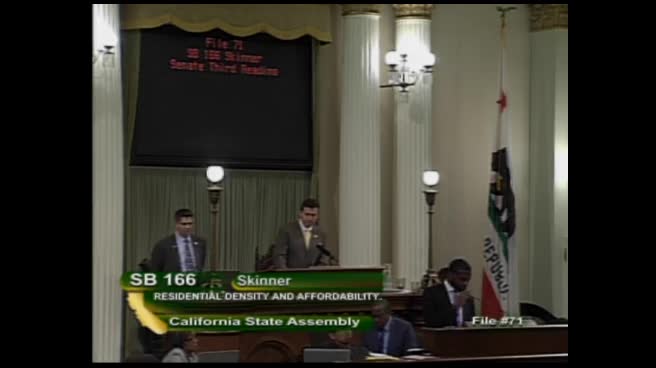 2MIN
Assembly Floor
 10MIN
Assembly Standing Committee on Housing and Community Development
 7MIN
Assembly Standing Committee on Local Government
 2MIN
Senate Floor
 9MIN
Senate Standing Committee on Governance and Finance
 8MIN
Senate Standing Committee on Transportation and Housing
Bill Author

Bill Co-Author(s):
