SB 167: Housing Accountability Act.
- Session Year: 2017-2018
- House: Senate
- Latest Version Date: 2017-09-29
(1)The Housing Accountability Act, among other things, prohibits a local agency from disapproving, or conditioning approval in a manner than renders infeasible, a housing development project for very low, low-, or moderate-income households or an emergency shelter unless the local agency makes specified written findings based upon substantial evidence in the record.
This bill would require the findings of the local agency to instead be based on a preponderance of the evidence in the record.
(2)The act authorizes a local agency to disapprove or condition approval of a housing development or emergency shelter, as described above, if, among other reasons, the housing development project or emergency shelter is inconsistent with both the jurisdictions zoning ordinance and general plan land use designation as specified in any element of the general plan as it existed on the date the application was deemed complete, and the jurisdiction has adopted a revised housing element in accordance with specified law.
This bill would specify that a change to the zoning ordinance or general plan land use designation subsequent to the date the application was deemed complete does not constitute a valid basis to disapprove or condition approval of the housing development project or emergency shelter.
(3)The act defines various terms for purposes of its provisions, including the term housing development project, which is defined as a project consisting either of residential units only, mixed-use developments consisting of residential and nonresidential units, or transitional housing or supportive housing. For a mixed-use development for these purposes, the act requires that nonresidential uses be limited to neighborhood commercial uses, as defined, and to the first floor of buildings that are 2 or more stories.
This bill would instead require, with respect to mixed-use developments, that 2/3 of the square footage be designated for residential use.
(4)If a local agency proposes to disapprove a housing development project that complies with applicable, objective general plan and zoning standards and criteria, or to approve it on the condition that it be developed at a lower density, the act requires that the local agency base its decision upon written findings supported by substantial evidence on the record that specified conditions exist.
This bill would specify that a housing development project or emergency shelter is deemed consistent, compliant, and in conformity with an applicable plan, program, policy, ordinance, standard, requirement, or other similar provision for purposes of the above-described provisions if there is substantial evidence that would allow a reasonable person to conclude that the housing development project or emergency shelter is consistent, compliant, or in conformity. The bill, if the local agency considers the housing development project to be inconsistent, not in compliance, or not in conformity, would require the local agency to provide the applicant with written documentation identifying the provision or provisions, and an explanation of the reason or reasons it considers the housing development to be inconsistent, not in compliance, or not in conformity within specified time periods. If the local agency fails to provide this documentation, the bill would provide that the housing development project would be deemed consistent, compliant, and in conformity with the applicable plan, program, policy, ordinance, standard, requirement, or other similar provision. By requiring local agencies to provide documentation related to disapprovals of housing development projects, this bill would impose a state-mandated local program.
(5)The act authorizes the project applicant, a person who would be eligible to apply for residency in the development or emergency shelter, or a housing organization, as defined, to bring an action to enforce its provisions.
This bill would entitle a housing organization to reasonable attorneys fees and costs if it is the prevailing party in an action to enforce the act.
(6)If a court finds that the local agency disapproved, or conditioned approval in a manner that renders infeasible the project or emergency shelter or housing for very low, low-, or moderate-income households without making the required findings or without making sufficient findings, the act requires the court to issue an order or judgment compelling compliance with its provisions within 60 days, including an order that the local agency take action on the development project or emergency shelter and awarding attorneys fees and costs.
This bill would additionally require the court to issue an order compelling compliance with the act, as described above, if it finds that either the local agency, in violation of a specified provision of the act, disapproved or conditioned approval of a housing development project in a manner rendering it infeasible for the development of an emergency shelter or certain housing without making the required findings or without making findings supported by a preponderance of the evidence, or, the local agency, in violation of another specified provision of the act, disapproved a housing development project complying with specified standards and criteria or imposed a condition that the project be developed at a lower density, without making the required findings or without making findings supported by a preponderance of the evidence. The bill would authorize the court to issue an order or judgment directing the local agency to approve the housing development project or emergency shelter if the court finds that the local agency acted in bad faith when it disapproved or conditionally approved the housing development project or emergency shelter in violation of the act.
(7)The act authorizes the court to impose fines if it finds that a local agency acted in bad faith when it disapproved or conditionally approved the housing development or emergency shelter and failed to carry out the courts order or judgment compelling compliance within 60 days of the courts judgment. The act requires that the fines be deposited into a housing trust fund and committed for the sole purpose of financing newly constructed housing units affordable to extremely low, very low, or low-income households.
This bill, upon a determination that the local agency has failed to comply with the order or judgment compelling compliance with these provisions within 60 days, would instead require the court to impose fines, as described above, in every instance in which the court determines that the local agency disapproved, or conditioned approval in a manner that renders infeasible, the housing development project or emergency shelter without making the required findings or without making sufficient findings. The bill would require that the fine be in a minimum amount of $10,000 per housing unit in the housing development project on the date the application was deemed complete. In determining the amount of fine to impose, the bill would require the court to consider the local agencys progress in attaining its target allocation of the regional housing need and any prior violations of the act. The bill would authorize the local agency to instead deposit the fine into a specified state fund, and would also provide that any funds in a local housing trust fund not expended after 5 years would revert to the state and be deposited in that fund, to be used upon appropriation by the Legislature for financing newly constructed housing units affordable to extremely low, very low, or low-income households. If the local agency has acted in bad faith and failed to carry out the courts order, as described above, the bill would require the court to multiply the fine by a factor of 5.
This bill would also require that a petition to enforce the act be filed and served no later than 90 days from the later of (a) the effective date of a decision of the local agency imposing conditions on, disapproving, or taking any other final action on a housing development project or (b) the expiration of certain time periods specified in the Permit Streamlining Act.
(8)In order to obtain appellate review of a trial courts order, the act requires a party to file a petition within 20 days after service upon it of a written notice of the entry of the order, or within such further time not exceeding an additional 20 days as the trial court may for good cause allow.
This bill would allow a party to instead appeal a trial courts order or judgment to the court of appeal pursuant to specified law.
(9)This bill would make various technical and conforming changes to the Housing Accountability Act.
(10)This bill would incorporate additional changes to Section 65589.5 of the Government Code proposed by AB 1515 to be operative only if this bill and AB 1515 are enacted and this bill is enacted last.
(11)The California Constitution requires the state to reimburse local agencies and school districts for certain costs mandated by the state. Statutory provisions establish procedures for making that reimbursement.
This bill would provide that no reimbursement is required by this act for a specified reason.
(1)The Housing Accountability Act, among other things, prohibits a local agency from disapproving, or conditioning approval in a manner than renders infeasible, a housing development project for very low, low-, or moderate-income households or an emergency shelter unless the local agency makes specified written findings based upon substantial evidence in the record.
This bill would require the findings of the local agency to instead be based on a preponderance of the evidence in the record.
(2)The act authorizes a local agency to disapprove or condition approval of a housing development or emergency shelter, as described above, if, among other reasons, the housing development project or emergency shelter is inconsistent with both the jurisdictions zoning ordinance and general plan land use designation as specified in any element of the general plan as it existed on the date the application was deemed complete, and the jurisdiction has adopted a revised housing element in accordance with specified law.
This bill would specify that a change to the zoning ordinance or general plan land use designation subsequent to the date the application was deemed complete does not constitute a valid basis to disapprove or condition approval of the housing development project or emergency shelter.
(3)The act defines various terms for purposes of its provisions, including the term housing development project, which is defined as a project consisting either of residential units only, mixed-use developments consisting of residential and nonresidential units, or transitional housing or supportive housing. For a mixed-use development for these purposes, the act requires that nonresidential uses be limited to neighborhood commercial uses, as defined, and to the first floor of buildings that are 2 or more stories.
This bill would instead require, with respect to mixed-use developments, that 2/3 of the square footage be designated for residential use.
(4)If a local agency proposes to disapprove a housing development project that complies with applicable, objective general plan and zoning standards and criteria, or to approve it on the condition that it be developed at a lower density, the act requires that the local agency base its decision upon written findings supported by substantial evidence on the record that specified conditions exist.
This bill would specify that a housing development project or emergency shelter is deemed consistent, compliant, and in conformity with an applicable plan, program, policy, ordinance, standard, requirement, or other similar provision for purposes of the above-described provisions if there is substantial evidence that would allow a reasonable person to conclude that the housing development project or emergency shelter is consistent, compliant, or in conformity. The bill, if the local agency considers the housing development project to be inconsistent, not in compliance, or not in conformity, would require the local agency to provide the applicant with written documentation identifying the provision or provisions, and an explanation of the reason or reasons it considers the housing development to be inconsistent, not in compliance, or not in conformity within specified time periods. If the local agency fails to provide this documentation, the bill would provide that the housing development project would be deemed consistent, compliant, and in conformity with the applicable plan, program, policy, ordinance, standard, requirement, or other similar provision. By requiring local agencies to provide documentation related to disapprovals of housing development projects, this bill would impose a state-mandated local program.
(3)(5)The act authorizes the project applicant, a person who would be eligible to apply for residency in the development or emergency shelter, or a housing organization, as defined, to bring an action to enforce its provisions.
This bill would entitle a housing organization to reasonable attorneys fees and costs if it is the prevailing party in an action to enforce the act.
(4)(6)If a court finds that the local agency disapproved, or conditioned approval in a manner that renders infeasible the project or emergency shelter or housing for very low, low-, or moderate-income households without making the required findings or without making sufficient findings, the act requires the court to issue an order or judgment compelling compliance with its provisions within 60 days, including an order that the local agency take action on the development project or emergency shelter. shelter and awarding attorneys fees and costs.
This bill would instead additionally require the court to issue an order or judgment as described above, including an order that the local agency approve the housing development project or emergency shelter, if a court compelling compliance with the act, as described above, if it finds that either the local agency, in violation of a specified provision of the act, disapproved or conditioned approval of a housing development project in a manner rendering it infeasible for the development of an emergency shelter or certain housing without making the required findings or without making findings supported by a preponderance of the evidence, or, the local agency, in violation of another specified provision of the act, disapproved a housing development project complying with specified standards and criteria or imposed a condition that the project be developed at a lower density, without making the required findings or without making findings supported by a preponderance of the evidence. The bill would require authorize the court to issue an order or judgment directing the local agency to approve the housing development project or emergency shelter if the court finds that the local agency acted in bad faith when it disapproved or conditionally approved the housing development project or emergency shelter. shelter in violation of the act.
(5)(7)The act authorizes the court to impose fines if it finds that a local agency acted in bad faith when it disapproved or conditionally approved the housing development or emergency shelter and failed to carry out the courts order or judgment compelling compliance within 60 days of the courts judgment. The act requires that the fines be deposited into a housing trust fund and committed for the sole purpose of financing newly constructed housing units affordable to extremely low, very low, or low-income households.
This bill bill, upon a determination that the local agency has failed to comply with the order or judgment compelling compliance with these provisions within 60 days, would instead require the court to impose fines, in a specified amount, on a local agency that has violated the act if as described above, in every instance in which the court determines that its order or judgment has not been carried out within 60 days. The bill would require the local agency to deposit any fines levied into a housing trust fund. the local agency disapproved, or conditioned approval in a manner that renders infeasible, the housing development project or emergency shelter without making the required findings or without making sufficient findings. The bill would require that the fine be in a minimum amount of $10,000 per housing unit in the housing development project on the date the application was deemed complete. In determining the amount of fine to impose, the bill would require the court to consider the local agencys progress in attaining its target allocation of the regional housing need, need and any prior violations of the act, the budget of the local jurisdiction, whether the jurisdiction has complied with a specified analysis requirement, which this bill would impose, and the ratio of median home price to median household income in the jurisdiction, as provided. act. The bill would authorize the local agency to instead deposit the fine into a specified state fund, and would also provide that any funds in a local housing trust fund not expended after 5 years would revert to the state and be deposited in that fund, to be used upon appropriation by the Legislature for financing newly constructed housing units affordable to extremely low, very low, or low-income households. If the local agency has acted in bad faith and failed to carry out the courts order, as described above, the bill would require the court to multiply the fine by a factor of 5.
This bill would also require that a petition to enforce the act be filed and served no later than 90 days from the later of (a) the effective date of a decision of the local agency imposing conditions on, disapproving, or taking any other final action on a housing development project or (b) the expiration of certain time periods specified in the Permit Streamlining Act.
(8)In order to obtain appellate review of a trial courts order, the act requires a party to file a petition within 20 days after service upon it of a written notice of the entry of the order, or within such further time not exceeding an additional 20 days as the trial court may for good cause allow.
This bill would allow a party to instead appeal a trial courts order or judgment to the court of appeal pursuant to specified law.
(6)(9)This bill would make various technical and conforming changes to the Housing Accountability Act.
(10)This bill would incorporate additional changes to Section 65589.5 of the Government Code proposed by AB 1515 to be operative only if this bill and AB 1515 are enacted and this bill is enacted last.
(11)The California Constitution requires the state to reimburse local agencies and school districts for certain costs mandated by the state. Statutory provisions establish procedures for making that reimbursement.
This bill would provide that no reimbursement is required by this act for a specified reason.
(1)The Housing Accountability Act, among other things, prohibits a local agency from disapproving, or conditioning approval in a manner than renders infeasible, a housing development project for very low, low-, or moderate-income households or an emergency shelter unless the local agency makes specified written findings based upon substantial evidence in the record.
This bill would require the findings of the local agency to instead be based on a preponderance of the evidence in the record.
(2)The act authorizes a local agency to disapprove or condition approval of a housing development or emergency shelter, as described above, if, among other reasons, the housing development project or emergency shelter is inconsistent with both the jurisdictions zoning ordinance and general plan land use designation as specified in any element of the general plan as it existed on the date the application was deemed complete, and the jurisdiction has adopted a revised housing element in accordance with specified law.
This bill would specify that a change to the zoning ordinance or general plan land use designation subsequent to the date the application was deemed complete does not constitute a valid basis to disapprove or condition approval of the housing development project or emergency shelter.
(3)The act authorizes the project applicant, a person who would be eligible to apply for residency in the development or emergency shelter, or a housing organization, as defined, to bring an action to enforce its provisions.
This bill would entitle a housing organization to reasonable attorneys fees and costs if it is the prevailing party in an action to enforce the act.
(4)If a court finds that the local agency disapproved, or conditioned approval in a manner that renders infeasible the project or emergency shelter without making the required findings or without making sufficient findings, the act requires the court to issue an order or judgment compelling compliance with its provisions within 60 days, including an order that the local agency take action on the development project or emergency shelter.
This bill would instead require the court to issue an order or judgment as described above, including an order that the local agency approve the housing development project or emergency shelter, if a court finds that either the local agency, in violation of a specified provision of the act, disapproved or conditioned approval of a housing development project in a manner rendering it infeasible for the development of an emergency shelter or certain housing without making the required findings or without making findings supported by a preponderance of the evidence, or, the local agency, in violation of another specified provision of the act, disapproved a housing development project complying with specified standards and criteria or imposed a condition that the project be developed at a lower density, without making the required findings or without making findings supported by a preponderance of the evidence. The bill would require the court to issue an order or judgment directing the local agency to approve the housing development or emergency shelter if the court finds that the local agency acted in bad faith when it disapproved or conditionally approved the housing development or emergency shelter.
This bill would recast this requirement to specify that the court may order the local agency to approve the housing development project or emergency shelter.(5)The act authorizes the court to impose fines if it finds that a local agency acted in bad faith when it disapproved or conditionally approved the housing development or emergency shelter and failed to carry out the courts order or judgment within 60 days of the courts judgment. The act requires that the fines be deposited into a housing trust fund and committed for the sole purpose of financing newly constructed housing units affordable to extremely low, very low, or low-income households.
This bill would instead require the court to impose fines, as described above, in every instance in which the court determines that the local agency disapproved, or conditioned approval in a manner than renders infeasible, the project or emergency shelter without making the required findings or without making sufficient findings. The bill would require that the fine be in a minimum amount of $1,000 per housing unit in the housing development project on the date the application was deemed complete. in a specified amount, on a local agency that has violated the act if the court determines that its order or judgment has not been carried out within 60 days. The bill would require the local agency to deposit any fines levied into a housing trust fund. In determining the amount of fine to impose, the bill would require the court to consider the local agencys progress in attaining its target allocation of the regional housing need, any prior violations of the act, the budget of the local jurisdiction, whether the jurisdiction has complied with a specified analysis requirement, which this bill would impose, and the ratio of median home price to median household income in the jurisdiction, as provided. If the local agency has acted in bad faith and failed to carry out the courts order, as described above, the bill would require the court to multiply the fine by a factor of 10. 5.
This bill would require that a petition to enforce the act be filed and served no later than 90 days from the later of (a) the withdrawal of the application by the applicant or the effective date of a decision of the local agency imposing conditions on, disapproving, or taking any other final action on a housing development project or (b) the expiration of certain time periods specified in the Permit Streamlining Act.
(6)This bill would make various technical and conforming changes to the Housing Accountability Act.
(1)The Housing Accountability Act, among other things, prohibits a local agency from disapproving, or conditioning approval in a manner than renders infeasible, a housing development project for very low, low-, or moderate-income households or an emergency shelter unless the local agency makes specified written findings based upon substantial evidence in the record.
This bill would require the findings of the local agency to instead be based on a preponderance of the evidence in the record.
(2)The act authorizes a local agency to disapprove or condition approval of a housing development or emergency shelter, as described above, if, among other reasons, the housing development project or emergency shelter is inconsistent with both the jurisdictions zoning ordinance and general plan land use designation as specified in any element of the general plan as it existed on the date the application was deemed complete, and the jurisdiction has adopted a revised housing element in accordance with specified law.
This bill would specify that a change to the zoning ordinance or general plan land use designation subsequent to the date the application was deemed complete does not constitute a valid basis to disapprove or condition approval of the housing development project or emergency shelter.
(3)The act authorizes the project applicant, a person who would be eligible to apply for residency in the development or emergency shelter, or a housing organization, as defined, to bring an action to enforce its provisions.
This bill would entitle a housing organization to reasonable attorneys fees and costs if it is the prevailing party in an action to enforce the act.
(4)If a court finds that the local agency disapproved, or conditioned approval in a manner that renders infeasible the project or emergency shelter without making the required findings or without making sufficient findings, the act requires the court to issue an order or judgment compelling compliance with its provisions within 60 days, including an order that the local agency take action on the development project or emergency shelter.
This bill would recast this requirement to specify that the court may order the local agency to approve the housing development project or emergency shelter.
(5)The act authorizes the court to impose fines if it finds that a local agency acted in bad faith when it disapproved or conditionally approved the housing development or emergency shelter and failed to carry out the courts order or judgment within 60 days of the courts judgment. The act requires that the fines be deposited into a housing trust fund and committed for the sole purpose of financing newly constructed housing units affordable to extremely low, very low, or low-income households.
This bill would instead require the court to impose fines, as described above, in every instance in which the court determines that the local agency disapproved, or conditioned approval in a manner than renders infeasible, the project or emergency shelter without making the required findings or without making sufficient findings. The bill would require that the fine be in a minimum amount of $1,000 per housing unit in the housing development project on the date the application was deemed complete. In determining the amount of fine to impose, the bill would require the court to consider the local agencys progress in attaining its target allocation of the regional housing need, any prior violations of the act, the budget of the local jurisdiction, whether the jurisdiction has complied with a specified analysis requirement, which this bill would impose, and the ratio of median home price to median household income in the jurisdiction, as provided. If the local agency has acted in bad faith and failed to carry out the courts order, as described above, the bill would require the court to multiply the fine by a factor of 10.
This bill would require that a petition to enforce the act be filed and served no later than 90 days from the later of (a) the withdrawal of the application by the applicant or the effective date of a decision of the local agency imposing conditions on, disapproving, or taking any other final action on a housing development project or (b) the expiration of certain time periods specified in the Permit Streamlining Act.
(6)This bill would make various technical and conforming changes to the Housing Accountability Act.
(1)The Housing Accountability Act, among other things, prohibits a local agency from disapproving, or conditioning approval in a manner than renders infeasible, a housing development project for very low, low-, or moderate-income households or an emergency shelter unless the local agency makes specified written findings based upon substantial evidence in the record.
This bill would require the findings of the local agency to instead be based on clear and convincing a preponderance of the evidence in the record.
(2)The act authorizes a local agency to disapprove or condition approval of a housing development or emergency shelter, as described above, if, among other reasons, the housing development project or emergency shelter is inconsistent with both the jurisdictions zoning ordinance and general plan land use designation as specified in any element of the general plan as it existed on the date the application was deemed complete, and the jurisdiction has adopted a revised housing element in accordance with specified law.
This bill would specify that a change to the zoning ordinance or general plan land use designation subsequent to the date the application was deemed complete does not constitute a valid basis to disapprove or condition approval of the housing development project or emergency shelter.
(3)The act authorizes the project applicant, a person who would be eligible to apply for residency in the development or emergency shelter, or a housing organization, as defined, to bring an action to enforce its provisions.
TheThis bill would entitle a housing organization to reasonable attorneys fees and costs if it is the prevailing party in an action to enforce the act.
(4)If a court finds that the local agency disapproved, or conditioned approval in a manner that renders infeasible the project or emergency shelter without making the required findings or without making sufficient findings, the act requires the court to issue an order or judgment compelling compliance with its provisions within 60 days, including an order that the local agency take action on the development project or emergency shelter.
This bill would recast this requirement to specify that the court may order the local agency to approve the housing development project or emergency shelter.
(5)The act authorizes the court to impose fines if it finds that a local agency acted in bad faith when it disapproved or conditionally approved the housing development or emergency shelter and failed to carry out the courts order or judgment within 60 days of the courts judgment. The act requires that the fines be deposited into a housing trust fund and committed for the sole purpose of financing newly constructed housing units affordable to extremely low, very low, or low-income households.
This bill would instead require the court to impose fines, as described above, in every instance in which the court determines that the local agency disapproved, or conditioned approval in a manner than renders infeasible, the project or emergency shelter without making the required findings or without making sufficient findings. The bill would require that the fine be in a minimum amount of $100,000 $1,000 per housing unit in the housing development project on the date the application was deemed complete. In determining the amount of fine to impose, the bill would require the court to consider the local agencys progress in attaining its target allocation of the regional housing need and need, any prior violations of the act. act, the budget of the local jurisdiction, whether the jurisdiction has complied with a specified analysis requirement, which this bill would impose, and the ratio of median home price to median household income in the jurisdiction, as provided. If the local agency has acted in bad faith and failed to carry out the courts order, as described above, the bill would authorize require the court to award punitive damages. multiply the fine by a factor of 10.
This bill would also require the local agency to publish an analysis of the requirements of the act as part of its review of each application for a housing development project and specify that failure to do so constitutes bad faith for purposes of a punitive damages award.This bill would require that a petition to enforce the act section be filed and served no later than 90 days from the later of (A) (a) the withdrawal of the application by the applicant or the effective date of a decision of the local agency imposing conditions on, disapproving, or taking any other final action on a housing development project or (B) (b) the expiration of certain time periods specified in the Permit Streamlining Act.(6)This bill would make various technical and conforming changes to the Housing Accountability Act.
(1)The Housing Accountability Act, among other things, prohibits a local agency from disapproving, or conditioning approval in a manner than renders infeasible, a housing development project for very low, low-, or moderate-income households or an emergency shelter unless the local agency makes specified written findings based upon substantial evidence in the record.
This bill would require the findings of the local agency to instead be based on clear and convincing evidence in the record.
(2)The act authorizes a local agency to disapprove or condition approval of a housing development or emergency shelter, as described above, if, among other reasons, the housing development project or emergency shelter is inconsistent with both the jurisdictions zoning ordinance and general plan land use designation as specified in any element of the general plan as it existed on the date the application was deemed complete, and the jurisdiction has adopted a revised housing element in accordance with specified law.
This bill would specify that a change to the zoning ordinance or general plan land use designation subsequent to the date the application was deemed complete does not constitute a valid basis to disapprove or condition approval of the housing development project or emergency shelter.
(3)The act authorizes the project applicant, a person who would be eligible to apply for residency in the development or emergency shelter, or a housing organization, as defined, to bring an action to enforce its provisions.
The bill would entitle a housing organization to reasonable attorneys fees and costs if it is the prevailing party in an action to enforce the act.
(4)If a court finds that the local agency disapproved, or conditioned approval in a manner that renders infeasible the project or emergency shelter without making the required findings or without making sufficient findings, the act requires the court to issue an order or judgment compelling compliance with its provisions within 60 days, including an order that the local agency take action on the development project or emergency shelter.
This bill would recast this requirement to specify that the court may order the local agency to approve the housing development project or emergency shelter.
(5)The act authorizes the court to impose fines if it finds that a local agency acted in bad faith when it disapproved or conditionally approved the housing development or emergency shelter and failed to carry out the courts order or judgment within 60 days of the courts judgment. The act requires that the fines be deposited into a housing trust fund and committed for the sole purpose of financing newly constructed housing units affordable to extremely low, very low, or low-income households.
This bill would instead require the court to impose fines, as described above, in every instance in which the court determines that the local agency disapproved, or conditioned approval in a manner than renders infeasible, the project or emergency shelter without making the required findings or without making sufficient findings. The bill would require that the fine be in a minimum amount of $100,000 per housing unit in the housing development project on the date the application was deemed complete. In determining the amount of fine to impose, the bill would require the court to consider the local agencys progress in attaining its target allocation of the regional housing need and any prior violations of the act. If the local agency has acted in bad faith and failed to carry out the courts order, as described above, the bill would authorize the court to award punitive damages.
This bill would also require the local agency to publish an analysis of the requirements of the act as part of its review of each application for a housing development project and specify that failure to do so constitutes bad faith for purposes of a punitive damages award.
This bill would require that a petition to enforce the act section be filed and served no later than 90 days from the later of (A) the withdrawal of the application by the applicant or the effective date of a decision of the local agency imposing conditions on, disapproving, or taking any other final action on a housing development project or (B) the expiration of certain time periods specified in the Permit Streamlining Act.
(6)This bill would make various technical and conforming changes to the Housing Accountability Act.
(1)The Housing Accountability Act, among other things, prohibits a local agency from disapproving, or conditioning approval in a manner than renders infeasible, a housing development project for very low, low-, or moderate-income households or an emergency shelter unless the local agency makes specified written findings based upon substantial evidence in the record.
This bill would extend the provisions of the Housing Accountability Act to apply to housing development projects for above moderate-income households. The bill would also require the findings of the local agency to instead be based on clear and convincing evidence in the record.
(2)The act authorizes a local agency to disapprove or condition approval of a housing development or emergency shelter, as described above, if, among other reasons, the housing development project or emergency shelter is inconsistent with both the jurisdictions zoning ordinance and general plan land use designation as specified in any element of the general plan as it existed on the date the application was deemed complete, and the jurisdiction has adopted a revised housing element in accordance with specified law.
This bill would specify that a change to the zoning ordinance or general plan land use designation subsequent to the date the application was deemed complete does not constitute a valid basis to disapprove or condition approval of the housing development project or emergency shelter.
(3)The act defines various terms for purposes of its provisions. The act specifies that feasible means capable of being accomplished in a successful manner within a reasonable period of time, taking into account economic, environmental, social, and technological factors. The act also specifies that disapproval of a housing development project includes any instance in which the local agency either votes to disapprove the project or shelter or fails to act within certain time periods specified in the Permit Streamlining Act.This bill would specify that a housing development project is rendered infeasible if, among other things, the applicants ability to earn an economic rate of return comparable to that of other projects that are similar to the proposed housing development project is diminished. The bill would also provide that a disapproval of a housing development project or emergency shelter includes any instance in which the local agency approves another project that is proposed for the same land as the housing development project and the other project contains fewer residential units for very low, low-, moderate-, or above moderate-income households.This bill would also specify that imposes conditions includes any instance in which a local agency requires conditions, either with or without legislative action, or in which an applicant proposes conditions in response to pressure or opposition from a local agency. The bill would specify that substantial adverse effect on the viability or affordability of a housing development project includes the diminished ability of an applicant to earn an economic rate of return comparable to that of other projects that are similar to the proposed housing development project.(4)
(3)The act authorizes the project applicant, a person who would be eligible to apply for residency in the development or emergency shelter, or a housing organization, as defined, to bring an action to enforce its provisions. The act limits actions by a housing organization to challenges to the disapproval of a housing development.
This bill would additionally authorize a housing organization to bring an action challenging the reduction of allowable densities or percentage of lot that may be occupied by a building or structure under the applicable general plan and zoning ordinances in effect on the date the application was deemed complete, or the imposition of conditions. The bill would entitle a housing organization to reasonable attorneys fees and costs if it is the prevailing party in an action to enforce the act.
(5)
(4)If a court finds that the local agency disapproved, or conditioned approval in a manner that renders infeasible the project or emergency shelter without making the required findings or without making sufficient findings, the act requires the court to issue an order or judgment compelling compliance with its provisions within 60 days, including an order that the local agency take action on the development project or emergency shelter.
This bill would recast this requirement to specify that the court may order the local agency to approve the housing development project or emergency shelter.
(6)
(5)The act authorizes the court to impose fines if it finds that a local agency acted in bad faith when it disapproved or conditionally approved the housing development or emergency shelter and failed to carry out the courts order or judgment within 60 days of the courts judgment. The act requires that the fines be deposited into a housing trust fund and committed for the sole purpose of financing newly constructed housing units affordable to extremely low, very low, or low-income households.
This bill would instead require the court to impose fines, as described above, in every instance in which the court determines that the local agency disapproved, or conditioned approval in a manner than renders infeasible, the project or emergency shelter without making the required findings or without making sufficient findings. The bill would require that the fine be in a minimum amount of $100,000 per housing unit in the housing development project on the date the application was deemed complete. In determining the amount of fine to impose, the bill would require the court to consider the local agencys progress in attaining its target allocation of the regional housing need and any prior violations of the act. If the local agency has acted in bad faith and failed to carry out the courts order, as described above, the bill would authorize the court to award punitive damages.
This bill would also require the local agency to publish an analysis of the requirements of the act as part of its review of each application for a housing development project and specify that failure to do so constitutes bad faith for purposes of a punitive damages award.
(7)The act requires that an action to enforce its provisions be brought as a petition for a writ of administrative mandate in accordance with specified law.This bill would require that a petition to enforce the act section be filed and served no later than 90 days from the later of (A) the withdrawal of the application by the applicant or the effective date of a decision of the local agency imposing conditions on, disapproving, or taking any other final action on a housing development project or (B) the expiration of certain time periods specified in the Permit Streamlining Act. The bill would require the trial court to exercise its independent judgment when deciding the case.(8)(6)This bill would make various technical and conforming changes to the Housing Accountability Act.
(1)The Housing Accountability Act, among other things, prohibits a local agency from disapproving, or conditioning approval in a manner than renders infeasible, a housing development project for very low, low-, or moderate-income households or an emergency shelter unless the local agency makes specified written findings based upon substantial evidence in the record.
This bill would extend the provisions of the Housing Accountability Act to apply to housing development projects for above moderate-income households. The bill would also require the findings of the local agency to instead be based on clear and convincing evidence in the record.
(2)The act authorizes a local agency to disapprove or condition approval of a housing development or emergency shelter, as described above, if, among other reasons, the housing development project or emergency shelter is inconsistent with both the jurisdictions zoning ordinance and general plan land use designation as specified in any element of the general plan as it existed on the date the application was deemed complete, and the jurisdiction has adopted a revised housing element in accordance with specified law.
This bill would specify that a change to the zoning ordinance or general plan land use designation subsequent to the date the application was deemed complete does not constitute a valid basis to disapprove or condition approval of the housing development project or emergency shelter.
(3)The act defines various terms for purposes of its provisions. The act specifies that feasible means capable of being accomplished in a successful manner within a reasonable period of time, taking into account economic, environmental, social, and technological factors. The act also specifies that disapproval of a housing development project includes any instance in which the local agency either votes to disapprove the project or shelter or fails to act within certain time periods specified in the Permit Streamlining Act.
This bill would specify that a housing development project is rendered infeasible if, among other things, the applicants ability to earn an economic rate of return comparable to that of other projects that are similar to the proposed housing development project is diminished. The bill would also provide that a disapproval of a housing development project or emergency shelter includes any instance in which the local agency approves another project that is proposed for the same land as the housing development project and the other project contains fewer residential units for very low, low-, moderate-, or above moderate-income households.
This bill would also specify that imposes conditions includes any instance in which a local agency requires conditions, either with or without legislative action, or in which an applicant proposes conditions in response to pressure or opposition from a local agency. The bill would specify that substantial adverse effect on the viability or affordability of a housing development project includes the diminished ability of an applicant to earn an economic rate of return comparable to that of other projects that are similar to the proposed housing development project.
(4)The act authorizes the project applicant, a person who would be eligible to apply for residency in the development or emergency shelter, or a housing organization, as defined, to bring an action to enforce its provisions. The act limits actions by a housing organization to challenges to the disapproval of a housing development.
This bill would additionally authorize a housing organization to bring an action challenging the reduction of allowable densities or percentage of lot that may be occupied by a building or structure under the applicable general plan and zoning ordinances in effect on the date the application was deemed complete, or the imposition of conditions. The bill would entitle a housing organization to reasonable attorneys fees and costs if it is the prevailing party in an action to enforce the act.
(5)If a court finds that the local agency disapproved, or conditioned approval in a manner that renders infeasible the project or emergency shelter without making the required findings or without making sufficient findings, the act requires the court to issue an order or judgment compelling compliance with its provisions within 60 days, including an order that the local agency take action on the development project or emergency shelter.
This bill would recast this requirement to specify that the court may order the local agency to approve the housing development project or emergency shelter.
(6)The act authorizes the court to impose fines if it finds that a local agency acted in bad faith when it disapproved or conditionally approved the housing development or emergency shelter and failed to carry out the courts order or judgment within 60 days of the courts judgment. The act requires that the fines be deposited into a housing trust fund and committed for the sole purpose of financing newly constructed housing units affordable to extremely low, very low, or low-income households.
This bill would instead require the court to impose fines, as described above, in every instance in which the court determines that the local agency disapproved, or conditioned approval in a manner than renders infeasible, the project or emergency shelter without making the required findings or without making sufficient findings. The bill would require that the fine be in a minimum amount of $100,000 per housing unit in the housing development project on the date the application was deemed complete. In determining the amount of fine to impose, the bill would require the court to consider the local agencys progress in attaining its target allocation of the regional housing need and any prior violations of the act. If the local agency has acted in bad faith and failed to carry out the courts order, as described above, the bill would authorize the court to award punitive damages.
This bill would also require the local agency to publish an analysis of the requirements of the act as part of its review of each application for a housing development project and specify that failure to do so constitutes bad faith for purposes of a punitive damages award.
(7)The act requires that an action to enforce its provisions be brought as a petition for a writ of administrative mandate in accordance with specified law.
This bill would require that a petition to enforce the act section be filed and served no later than 90 days from the later of (A) the withdrawal of the application by the applicant or the effective date of a decision of the local agency imposing conditions on, disapproving, or taking any other final action on a housing development project or (B) the expiration of certain time periods specified in the Permit Streamlining Act. The bill would require the trial court to exercise its independent judgment when deciding the case.
(8)This bill would make various technical and conforming changes to the Housing Accountability Act.
Existing federal law establishes various disability benefits programs, including the Supplemental Security Income (SSI) program, under which cash assistance is provided to qualified low-income aged, blind, and disabled persons. Existing federal law requires the federal Commissioner of Social Security to develop a system under which an individual can apply for SSI benefits prior to the discharge or release of the individual from a public institution.This bill would require the Secretary of the Department of Corrections and Rehabilitation to establish memoranda of understanding with the federal Social Security Administration to allow a person incarcerated in a correctional institution to apply for and receive a replacement social security card and to allow the administration to process SSI claims under the prerelease program.Existing federal law provides for the federal Supplemental Nutrition Assistance Program (SNAP), known in California as CalFresh, formerly the Food Stamp Program, under which supplemental nutrition assistance benefits allocated to the state by the federal government are distributed to eligible individuals by each county. Existing federal law generally prohibits a resident of an institution from receiving supplemental nutrition assistance benefits.This bill would require the State Department of Social Services, on or before March 31, 2018, to request a waiver to allow for the preenrollment of otherwise eligible applicants to the CalFresh program up to one month prior to the applicants reentry into the community from county jail or state prison.Existing federal law establishes various disability benefits programs, including the Supplemental Security Income (SSI) program, under which cash assistance is provided to qualified low-income aged, blind, and disabled persons. Existing federal law requires the federal Commissioner of Social Security to develop a system under which an individual can apply for SSI benefits prior to the discharge or release of the individual from a public institution.
This bill would require the Secretary of the Department of Corrections and Rehabilitation to establish memoranda of understanding with the federal Social Security Administration to allow a person incarcerated in a correctional institution to apply for and receive a replacement social security card and to allow the administration to process SSI claims under the prerelease program.
Existing federal law provides for the federal Supplemental Nutrition Assistance Program (SNAP), known in California as CalFresh, formerly the Food Stamp Program, under which supplemental nutrition assistance benefits allocated to the state by the federal government are distributed to eligible individuals by each county. Existing federal law generally prohibits a resident of an institution from receiving supplemental nutrition assistance benefits.
This bill would require the State Department of Social Services, on or before March 31, 2018, to request a waiver to allow for the preenrollment of otherwise eligible applicants to the CalFresh program up to one month prior to the applicants reentry into the community from county jail or state prison.
(a)The Legislature finds and declares all of the following:
(1)The lack of housing, including emergency shelters, is a critical problem that threatens the economic, environmental, and social quality of life in California.
(2)California housing has become the most expensive in the nation. The excessive cost of the states housing supply is partially caused by activities and policies of many local governments that limit the approval of housing, increase the cost of land for housing, and require that high fees and exactions be paid by producers of housing.
(3)Among the consequences of those actions are discrimination against low-income and minority households, lack of housing to support employment growth, imbalance in jobs and housing, reduced mobility, urban sprawl, excessive commuting, and air quality deterioration.
(4)Many local governments do not give adequate attention to the economic, environmental, and social costs of decisions that result in disapproval of housing development projects, reduction in density of housing projects, and excessive standards for housing development projects.
(b)It is the policy of the state that a local government not reject or make infeasible housing development projects, including emergency shelters, that contribute to meeting the need determined pursuant to this article without a thorough analysis of the economic, social, and environmental effects of the action and without complying with subdivision (d).
(c)The Legislature also recognizes that premature and unnecessary development of agricultural lands for urban uses continues to have adverse effects on the availability of those lands for food and fiber production and on the economy of the state. Furthermore, it is the policy of the state that development should be guided away from prime agricultural lands; therefore, in implementing this section, local jurisdictions should encourage, to the maximum extent practicable, in filling existing urban areas.
(d)A local agency shall not disapprove a housing development project, including farmworker housing as defined in subdivision (h) of Section 50199.7 of the Health and Safety Code, for very low, low-, or moderate-income households, or an emergency shelter, or condition approval in a manner that renders the housing development project infeasible for development for the use of very low, low-, or moderate-income households, or an emergency shelter, including through the use of design review standards, unless it makes written findings, based upon a preponderance of the evidence in the record, as to one of the following:
(1)The jurisdiction has adopted a housing element pursuant to this article that has been revised in accordance with Section 65588, is in substantial compliance with this article, and the jurisdiction has met or exceeded its share of the regional housing need allocation pursuant to Section 65584 for the planning period for the income category proposed for the housing development project, provided that any disapproval or conditional approval shall not be based on any of the reasons prohibited by Section 65008. If the housing development project includes a mix of income categories, and the jurisdiction has not met or exceeded its share of the regional housing need for one or more of those categories, then this paragraph shall not be used to disapprove or conditionally approve the housing development project. The share of the regional housing need met by the jurisdiction shall be calculated consistently with the forms and definitions that may be adopted by the Department of Housing and Community Development pursuant to Section 65400. In the case of an emergency shelter, the jurisdiction shall have met or exceeded the need for emergency shelter, as identified pursuant to paragraph (7) of subdivision (a) of Section 65583. Any disapproval or conditional approval pursuant to this paragraph shall be in accordance with applicable law, rule, or standards.
(2)The housing development project or emergency shelter as proposed would have a specific, adverse impact upon the public health or safety, and there is no feasible method to satisfactorily mitigate or avoid the specific adverse impact without rendering the development unaffordable to low- and moderate-income households or rendering the development of the emergency shelter financially infeasible. As used in this paragraph, a specific, adverse impact means a significant, quantifiable, direct, and unavoidable impact, based on objective, identified written public health or safety standards, policies, or conditions as they existed on the date the application was deemed complete. Inconsistency with the zoning ordinance or general plan land use designation shall not constitute a specific, adverse impact upon the public health or safety.
(3)The denial of the housing development project or imposition of conditions is required in order to comply with specific state or federal law, and there is no feasible method to comply without rendering the development unaffordable to low- and moderate-income households or rendering the development of the emergency shelter financially infeasible.
(4)The housing development project or emergency shelter is proposed on land zoned for agriculture or resource preservation that is surrounded on at least two sides by land being used for agricultural or resource preservation purposes, or which does not have adequate water or wastewater facilities to serve the project.
(5)The housing development project or emergency shelter is inconsistent with both the jurisdictions zoning ordinance and general plan land use designation as specified in any element of the general plan as it existed on the date the application was deemed complete, and the jurisdiction has adopted a revised housing element in accordance with Section 65588 that is in substantial compliance with this article. For purposes of this section, a change to the zoning ordinance or general plan land use designation subsequent to the date the application was deemed complete shall not constitute a valid basis to disapprove or condition approval of the housing development project or emergency shelter.
(A)This paragraph cannot be utilized to disapprove or conditionally approve a housing development project if the housing development project is proposed on a site that is identified as suitable or available for very low, low-, or moderate-income households in the jurisdictions housing element, and consistent with the density specified in the housing element, even though it is inconsistent with both the jurisdictions zoning ordinance and general plan land use designation.
(B)If the local agency has failed to identify in the inventory of land in its housing element sites that can be developed for housing within the planning period and are sufficient to provide for the jurisdictions share of the regional housing need for all income levels pursuant to Section 65584, then this paragraph shall not be utilized to disapprove or conditionally approve a housing development project proposed for a site designated in any element of the general plan for residential uses or designated in any element of the general plan for commercial uses if residential uses are permitted or conditionally permitted within commercial designations. In any action in court, the burden of proof shall be on the local agency to show that its housing element does identify adequate sites with appropriate zoning and development standards and with services and facilities to accommodate the local agencys share of the regional housing need for the very low, low-, and moderate-income categories.
(C)If the local agency has failed to identify a zone or zones where emergency shelters are allowed as a permitted use without a conditional use or other discretionary permit, has failed to demonstrate that the identified zone or zones include sufficient capacity to accommodate the need for emergency shelter identified in paragraph (7) of subdivision (a) of Section 65583, or has failed to demonstrate that the identified zone or zones can accommodate at least one emergency shelter, as required by paragraph (4) of subdivision (a) of Section 65583, then this paragraph shall not be utilized to disapprove or conditionally approve an emergency shelter proposed for a site designated in any element of the general plan for industrial, commercial, or multifamily residential uses. In any action in court, the burden of proof shall be on the local agency to show that its housing element does satisfy the requirements of paragraph (4) of subdivision (a) of Section 65583.
(e)Nothing in this section shall be construed to relieve the local agency from complying with the congestion management program required by Chapter 2.6 (commencing with Section 65088) of Division 1 of Title 7 or the California Coastal Act of 1976 (Division 20 (commencing with Section 30000) of the Public Resources Code). Neither shall anything in this section be construed to relieve the local agency from making one or more of the findings required pursuant to Section 21081 of the Public Resources Code or otherwise complying with the California Environmental Quality Act (Division 13 (commencing with Section 21000) of the Public Resources Code).
(f)(1)Nothing in this section shall be construed to prohibit a local agency from requiring the housing development project to comply with objective, quantifiable, written development standards, conditions, and policies appropriate to, and consistent with, meeting the jurisdictions share of the regional housing need pursuant to Section 65584. However, the development standards, conditions, and policies shall be applied to facilitate and accommodate development at the density permitted on the site and proposed by the development.
(2)Nothing in this section shall be construed to prohibit a local agency from requiring an emergency shelter project to comply with objective, quantifiable, written development standards, conditions, and policies that are consistent with paragraph (4) of subdivision (a) of Section 65583 and appropriate to, and consistent with, meeting the jurisdictions need for emergency shelter, as identified pursuant to paragraph (7) of subdivision (a) of Section 65583. However, the development standards, conditions, and policies shall be applied by the local agency to facilitate and accommodate the development of the emergency shelter project.
(3)This section does not prohibit a local agency from imposing fees and other exactions otherwise authorized by law that are essential to provide necessary public services and facilities to the housing development project or emergency shelter.
(g)This section shall be applicable to charter cities because the Legislature finds that the lack of housing, including emergency shelter, is a critical statewide problem.
(h)The following definitions apply for the purposes of this section:
(1)Feasible means capable of being accomplished in a successful manner within a reasonable period of time, taking into account economic, environmental, social, and technological factors.
(2)Housing development project means a use consisting of any of the following:
(A)Residential units only.
(B)Mixed-use developments consisting of residential and nonresidential uses with at least two-thirds of the square footage designated for residential use.
(C)Transitional housing or supportive housing.
(3)Housing for very low, low-, or moderate-income households means that either (A) at least 20 percent of the total units shall be sold or rented to lower income households, as defined in Section 50079.5 of the Health and Safety Code, or (B) 100 percent of the units shall be sold or rented to persons and families of moderate income as defined in Section 50093 of the Health and Safety Code, or persons and families of middle income, as defined in Section 65008 of this code. Housing units targeted for lower income households shall be made available at a monthly housing cost that does not exceed 30 percent of 60 percent of area median income with adjustments for household size made in accordance with the adjustment factors on which the lower income eligibility limits are based. Housing units targeted for persons and families of moderate income shall be made available at a monthly housing cost that does not exceed 30 percent of 100 percent of area median income with adjustments for household size made in accordance with the adjustment factors on which the moderate-income eligibility limits are based.
(4)Area median income means area median income as periodically established by the Department of Housing and Community Development pursuant to Section 50093 of the Health and Safety Code. The developer shall provide sufficient legal commitments to ensure continued availability of units for very low or low-income households in accordance with the provisions of this subdivision for 30 years.
(5)Disapprove the housing development project includes any instance in which a local agency does either of the following:
(A)Votes on a proposed housing development project application and the application is disapproved, including any required land use approvals or entitlements necessary for the issuance of a building permit.
(B)Fails to comply with the time periods specified in subdivision (a) of Section 65950. An extension of time pursuant to Article 5 (commencing with Section 65950) shall be deemed to be an extension of time pursuant to this paragraph.
(i)If any city, county, or city and county denies approval or imposes conditions, including design changes, lower density, or a reduction of the percentage of a lot that may be occupied by a building or structure under the applicable planning and zoning in force at the time the application is deemed complete pursuant to Section 65943, that have a substantial adverse effect on the viability or affordability of a housing development for very low, low-, or moderate-income households, and the denial of the development or the imposition of conditions on the development is the subject of a court action which challenges the denial or the imposition of conditions, then the burden of proof shall be on the local legislative body to show that its decision is consistent with the findings as described in subdivision (d) and that the findings are supported by a preponderance of the evidence in the record. For purposes of this section, lower density includes any conditions that have the same effect or impact on the ability of the project to provide housing.
(j)(1)When a proposed housing development project complies with applicable, objective general plan, zoning, and subdivision standards and criteria, including design review standards, in effect at the time that the housing development projects application is determined to be complete, but the local agency proposes to disapprove the project or to impose a condition that the project be developed at a lower density, the local agency shall base its decision regarding the proposed housing development project upon written findings supported by a preponderance of the evidence on the record that both of the following conditions exist:
(A)The housing development project would have a specific, adverse impact upon the public health or safety unless the project is disapproved or approved upon the condition that the project be developed at a lower density. As used in this paragraph, a specific, adverse impact means a significant, quantifiable, direct, and unavoidable impact, based on objective, identified written public health or safety standards, policies, or conditions as they existed on the date the application was deemed complete.
(B)There is no feasible method to satisfactorily mitigate or avoid the adverse impact identified pursuant to paragraph (1), other than the disapproval of the housing development project or the approval of the project upon the condition that it be developed at a lower density.
(2)(A)If the local agency considers a proposed housing development project to be inconsistent, not in compliance, or not in conformity with an applicable plan, program, policy, ordinance, standard, requirement, or other similar provision as specified in this subdivision, it shall provide the applicant with written documentation identifying the provision or provisions, and an explanation of the reason or reasons it considers the housing development to be inconsistent, not in compliance, or not in conformity as follows:
(i)Within 30 days of the date that the application for the housing development project is determined to be complete, if the housing development project contains 150 or fewer housing units.
(ii)Within 60 days of the date that the application for the housing development project is determined to be complete, if the housing development project contains more than 150 units.
(B)If the local agency fails to provide the required documentation pursuant to subparagraph (A), the housing development project shall be deemed consistent, compliant, and in conformity with the applicable plan, program, policy, ordinance, standard, requirement, or other similar provision.
(3)For purposes of this section, the receipt of a density bonus pursuant to Section 65915 shall not constitute a valid basis on which to find a proposed housing development project is inconsistent, not in compliance, or not in conformity, with an applicable plan, program, policy, ordinance, standard, requirement, or other similar provision specified in this subdivision.
(4)For purposes of this section, lower density includes any conditions that have the same effect or impact on the ability of the project to provide housing.
(k)(1)(A)The applicant, a person who would be eligible to apply for residency in the development or emergency shelter, or a housing organization may bring an action to enforce this section. If, in any action brought to enforce this section, a court finds that either (i) the local agency, in violation of subdivision (d), disapproved a housing development project or conditioned its approval in a manner rendering it infeasible for the development of an emergency shelter, or housing for very low, low-, or moderate-income households, including farmworker housing, without making the findings required by this section or without making findings supported by a preponderance of the evidence, or (ii) the local agency, in violation of subdivision (j), disapproved a housing development project complying with applicable, objective general plan and zoning standards and criteria, or imposed a condition that the project be developed at a lower density, without making the findings required by this section or without making findings supported by a preponderance of the evidence, the court shall issue an order or judgment compelling compliance with this section within 60 days, including, but not limited to, an order that the local agency take action on the housing development project or emergency shelter. The court may issue an order or judgment directing the local agency to approve the housing development project or emergency shelter if the court finds that the local agency acted in bad faith when it disapproved or conditionally approved the housing development or emergency shelter in violation of this section. The court shall retain jurisdiction to ensure that its order or judgment is carried out and shall award reasonable attorneys fees and costs of suit to the plaintiff or petitioner, except under extraordinary circumstances in which the court finds that awarding fees would not further the purposes of this section. For purposes of this section, lower density includes conditions that have the same effect or impact on the ability of the project to provide housing.
(B)(i)Upon a determination that the local agency has failed to comply with the order or judgment compelling compliance with this section within 60 days issued pursuant to subparagraph (A), the court shall impose fines on a local agency that has violated this section and require the local agency to deposit any fine levied pursuant to this subdivision into a local housing trust fund. The local agency may elect to instead deposit the fine into the Building Homes and Jobs Fund, if Senate Bill 2 of the 201718 Regular Session is enacted, or otherwise in the Housing Rehabilitation Loan Fund. The fine shall be in a minimum amount of ten thousand dollars ($10,000) per housing unit in the housing development project on the date the application was deemed complete pursuant to Section 65943. In determining the amount of fine to impose, the court shall consider the local agencys progress in attaining its target allocation of the regional housing need pursuant to Section 65584 and any prior violations of this section. Fines shall not be paid out of funds already dedicated to affordable housing, including, but not limited to, Low and Moderate Income Housing Asset Funds, funds dedicated to housing for very low, low-, and moderate-income households, and federal HOME Investment Partnerships Program and Community Development Block Grant Program funds. The local agency shall commit and expend the money in the local housing trust fund within five years for the sole purpose of financing newly constructed housing units affordable to extremely low, very low, or low-income households. After five years, if the funds have not been expended, the money shall revert to the state and be deposited in the Building Homes and Jobs Fund, if Senate Bill 2 of the 201718 Regular Session is enacted, or otherwise in the Housing Rehabilitation Loan Fund, for the sole purpose of financing newly constructed housing units affordable to extremely low, very low, or low-income households.
(ii)If any money derived from a fine imposed pursuant to this subparagraph is deposited in the Housing Rehabilitation Loan Fund, then, notwithstanding Section 50661 of the Health and Safety Code, that money shall be available only upon appropriation by the Legislature.
(C)If the court determines that its order or judgment has not been carried out within 60 days, the court may issue further orders as provided by law to ensure that the purposes and policies of this section are fulfilled, including, but not limited to, an order to vacate the decision of the local agency and to approve the housing development project, in which case the application for the housing development project, as proposed by the applicant at the time the local agency took the initial action determined to be in violation of this section, along with any standard conditions determined by the court to be generally imposed by the local agency on similar projects, shall be deemed to be approved unless the applicant consents to a different decision or action by the local agency.
(2)For purposes of this subdivision, housing organization means a trade or industry group whose local members are primarily engaged in the construction or management of housing units or a nonprofit organization whose mission includes providing or advocating for increased access to housing for low-income households and have filed written or oral comments with the local agency prior to action on the housing development project. A housing organization may only file an action pursuant to this section to challenge the disapproval of a housing development by a local agency. A housing organization shall be entitled to reasonable attorneys fees and costs if it is the prevailing party in an action to enforce this section.
(l)If the court finds that the local agency (1) acted in bad faith when it disapproved or conditionally approved the housing development or emergency shelter in violation of this section and (2) failed to carry out the courts order or judgment within 60 days as described in subdivision (k), the court, in addition to any other remedies provided by this section, shall multiply the fine determined pursuant to subparagraph (B) of paragraph (1) of subdivision (k) by a factor of five. For purposes of this section, bad faith includes, but is not limited to, an action that is frivolous or otherwise entirely without merit.
(m)Any action brought to enforce the provisions of this section shall be brought pursuant to Section 1094.5 of the Code of Civil Procedure, and the local agency shall prepare and certify the record of proceedings in accordance with subdivision (c) of Section 1094.6 of the Code of Civil Procedure no later than 30 days after the petition is served, provided that the cost of preparation of the record shall be borne by the local agency, unless the petitioner elects to prepare the record as provided in subdivision (n) of this section. A petition to enforce the provisions of this section shall be filed and served no later than 90 days from the later of (1) the effective date of a decision of the local agency imposing conditions on, disapproving, or any other final action on a housing development project or (2) the expiration of the time periods specified in subparagraph (B) of paragraph (5) of subdivision (h). Upon entry of the trial courts order, a party may, in order to obtain appellate review of the order, file a petition within 20 days after service upon it of a written notice of the entry of the order, or within such further time not exceeding an additional 20 days as the trial court may for good cause allow, or may appeal the judgment or order of the trial court under Section 904.1 of the Code of Civil Procedure. If the local agency appeals the judgment of the trial court, the local agency shall post a bond, in an amount to be determined by the court, to the benefit of the plaintiff if the plaintiff is the project applicant.
(n)In any action, the record of the proceedings before the local agency shall be filed as expeditiously as possible and, notwithstanding Section 1094.6 of the Code of Civil Procedure or subdivision (m) of this section, all or part of the record may be prepared (1) by the petitioner with the petition or petitioners points and authorities, (2) by the respondent with respondents points and authorities, (3) after payment of costs by the petitioner, or (4) as otherwise directed by the court. If the expense of preparing the record has been borne by the petitioner and the petitioner is the prevailing party, the expense shall be taxable as costs.
(o)This section shall be known, and may be cited, as the Housing Accountability Act.
SEC. 1.5.Section 65589.5 of the Government Code is amended to read:65589.5.(a)(1)The Legislature finds and declares all of the following:
(A)The lack of housing, including emergency shelters, is a critical problem that threatens the economic, environmental, and social quality of life in California.
(B)California housing has become the most expensive in the nation. The excessive cost of the states housing supply is partially caused by activities and policies of many local governments that limit the approval of housing, increase the cost of land for housing, and require that high fees and exactions be paid by producers of housing.
(C)Among the consequences of those actions are discrimination against low-income and minority households, lack of housing to support employment growth, imbalance in jobs and housing, reduced mobility, urban sprawl, excessive commuting, and air quality deterioration.
(D)Many local governments do not give adequate attention to the economic, environmental, and social costs of decisions that result in disapproval of housing development projects, reduction in density of housing projects, and excessive standards for housing development projects.
(2)In enacting the amendments made to this section by the act adding this paragraph, the Legislature further finds and declares the following:
(A)California has a housing supply and affordability crisis of historic proportions. The consequences of failing to effectively and aggressively confront this crisis are hurting millions of Californians, robbing future generations of the chance to call California home, stifling economic opportunities for workers and businesses, worsening poverty and homelessness, and undermining the states environmental and climate objectives.
(B)While the causes of this crisis are multiple and complex, the absence of meaningful and effective policy reforms to significantly enhance the approval and supply of housing affordable to Californians of all income levels is a key factor.
(C)The crisis has grown so acute in California that supply, demand, and affordability fundamentals are characterized in the negative: underserved demands, constrained supply, and protracted unaffordability.
(D)According to reports and data, California has accumulated an unmet housing backlog of nearly 2,000,000 units and must provide for at least 180,000 new units annually to keep pace with growth through 2025.
(E)Californias overall homeownership rate is at its lowest level since the 1940s. The state ranks 49th out of the 50 states in homeownership rates as well as in the supply of housing per capita. Only half of Californias households are able to afford the cost of housing in their local regions.
(F)Lack of supply and rising costs are compounding inequality and limiting advancement opportunities for many Californians.
(G)The majority of California renters, more than 3,000,000 households, pay more than 30 percent of their income toward rent and nearly one-third, more than 1,500,000 households, pay more than 50 percent of their income toward rent.
(H)When Californians have access to safe and affordable housing, they have more money for food and health care; they are less likely to become homeless and in need of government-subsidized services; their children do better in school; and businesses have an easier time recruiting and retaining employees.
(I)An additional consequence of the states cumulative housing shortage is a significant increase in greenhouse gas emissions caused by the displacement and redirection of populations to states with greater housing opportunities, particularly working- and middle-class households. Californias cumulative housing shortfall therefore has not only national but international environmental consequences.
(J)Californias housing picture has reached a crisis of historic proportions despite the fact that, for decades, the Legislature has enacted numerous statutes intended to significantly increase the approval, development, and affordability of housing for all income levels, including this section.
(K)The Legislatures intent in enacting this section in 1982 and in expanding its provisions since then was to significantly increase the approval and construction of new housing for all economic segments of Californias communities by meaningfully and effectively curbing the capability of local governments to deny, reduce the density for, or render infeasible housing development projects and emergency shelters. That intent has not been fulfilled.
(L)It is the policy of the state that this section should be interpreted and implemented in a manner to afford the fullest possible weight to the interest of, and the approval and provision of, housing.
(b)It is the policy of the state that a local government not reject or make infeasible housing development projects, including emergency shelters, that contribute to meeting the need determined pursuant to this article without a thorough analysis of the economic, social, and environmental effects of the action and without complying with subdivision (d).
(c)The Legislature also recognizes that premature and unnecessary development of agricultural lands for urban uses continues to have adverse effects on the availability of those lands for food and fiber production and on the economy of the state. Furthermore, it is the policy of the state that development should be guided away from prime agricultural lands; therefore, in implementing this section, local jurisdictions should encourage, to the maximum extent practicable, in filling existing urban areas.
(d)A local agency shall not disapprove a housing development project, including farmworker housing as defined in subdivision (h) of Section 50199.7 of the Health and Safety Code, for very low, low-, or moderate-income households, or an emergency shelter, or condition approval in a manner that renders the housing development project infeasible for development for the use of very low, low-, or moderate-income households, or an emergency shelter, including through the use of design review standards, unless it makes written findings, based upon a preponderance of the evidence in the record, as to one of the following:
(1)The jurisdiction has adopted a housing element pursuant to this article that has been revised in accordance with Section 65588, is in substantial compliance with this article, and the jurisdiction has met or exceeded its share of the regional housing need allocation pursuant to Section 65584 for the planning period for the income category proposed for the housing development project, provided that any disapproval or conditional approval shall not be based on any of the reasons prohibited by Section 65008. If the housing development project includes a mix of income categories, and the jurisdiction has not met or exceeded its share of the regional housing need for one or more of those categories, then this paragraph shall not be used to disapprove or conditionally approve the housing development project. The share of the regional housing need met by the jurisdiction shall be calculated consistently with the forms and definitions that may be adopted by the Department of Housing and Community Development pursuant to Section 65400. In the case of an emergency shelter, the jurisdiction shall have met or exceeded the need for emergency shelter, as identified pursuant to paragraph (7) of subdivision (a) of Section 65583. Any disapproval or conditional approval pursuant to this paragraph shall be in accordance with applicable law, rule, or standards.
(2)The housing development project or emergency shelter as proposed would have a specific, adverse impact upon the public health or safety, and there is no feasible method to satisfactorily mitigate or avoid the specific adverse impact without rendering the development unaffordable to low- and moderate-income households or rendering the development of the emergency shelter financially infeasible. As used in this paragraph, a specific, adverse impact means a significant, quantifiable, direct, and unavoidable impact, based on objective, identified written public health or safety standards, policies, or conditions as they existed on the date the application was deemed complete. Inconsistency with the zoning ordinance or general plan land use designation shall not constitute a specific, adverse impact upon the public health or safety.
(3)The denial of the housing development project or imposition of conditions is required in order to comply with specific state or federal law, and there is no feasible method to comply without rendering the development unaffordable to low- and moderate-income households or rendering the development of the emergency shelter financially infeasible.
(4)The housing development project or emergency shelter is proposed on land zoned for agriculture or resource preservation that is surrounded on at least two sides by land being used for agricultural or resource preservation purposes, or which does not have adequate water or wastewater facilities to serve the project.
(5)The housing development project or emergency shelter is inconsistent with both the jurisdictions zoning ordinance and general plan land use designation as specified in any element of the general plan as it existed on the date the application was deemed complete, and the jurisdiction has adopted a revised housing element in accordance with Section 65588 that is in substantial compliance with this article. For purposes of this section, a change to the zoning ordinance or general plan land use designation subsequent to the date the application was deemed complete shall not constitute a valid basis to disapprove or condition approval of the housing development project or emergency shelter.
(A)This paragraph cannot be utilized to disapprove or conditionally approve a housing development project if the housing development project is proposed on a site that is identified as suitable or available for very low, low-, or moderate-income households in the jurisdictions housing element, and consistent with the density specified in the housing element, even though it is inconsistent with both the jurisdictions zoning ordinance and general plan land use designation.
(B)If the local agency has failed to identify in the inventory of land in its housing element sites that can be developed for housing within the planning period and are sufficient to provide for the jurisdictions share of the regional housing need for all income levels pursuant to Section 65584, then this paragraph shall not be utilized to disapprove or conditionally approve a housing development project proposed for a site designated in any element of the general plan for residential uses or designated in any element of the general plan for commercial uses if residential uses are permitted or conditionally permitted within commercial designations. In any action in court, the burden of proof shall be on the local agency to show that its housing element does identify adequate sites with appropriate zoning and development standards and with services and facilities to accommodate the local agencys share of the regional housing need for the very low, low-, and moderate-income categories.
(C)If the local agency has failed to identify a zone or zones where emergency shelters are allowed as a permitted use without a conditional use or other discretionary permit, has failed to demonstrate that the identified zone or zones include sufficient capacity to accommodate the need for emergency shelter identified in paragraph (7) of subdivision (a) of Section 65583, or has failed to demonstrate that the identified zone or zones can accommodate at least one emergency shelter, as required by paragraph (4) of subdivision (a) of Section 65583, then this paragraph shall not be utilized to disapprove or conditionally approve an emergency shelter proposed for a site designated in any element of the general plan for industrial, commercial, or multifamily residential uses. In any action in court, the burden of proof shall be on the local agency to show that its housing element does satisfy the requirements of paragraph (4) of subdivision (a) of Section 65583.
(e)Nothing in this section shall be construed to relieve the local agency from complying with the congestion management program required by Chapter 2.6 (commencing with Section 65088) of Division 1 of Title 7 or the California Coastal Act of 1976 (Division 20 (commencing with Section 30000) of the Public Resources Code). Neither shall anything in this section be construed to relieve the local agency from making one or more of the findings required pursuant to Section 21081 of the Public Resources Code or otherwise complying with the California Environmental Quality Act (Division 13 (commencing with Section 21000) of the Public Resources Code).
(f)(1)Nothing in this section shall be construed to prohibit a local agency from requiring the housing development project to comply with objective, quantifiable, written development standards, conditions, and policies appropriate to, and consistent with, meeting the jurisdictions share of the regional housing need pursuant to Section 65584. However, the development standards, conditions, and policies shall be applied to facilitate and accommodate development at the density permitted on the site and proposed by the development.
(2)Nothing in this section shall be construed to prohibit a local agency from requiring an emergency shelter project to comply with objective, quantifiable, written development standards, conditions, and policies that are consistent with paragraph (4) of subdivision (a) of Section 65583 and appropriate to, and consistent with, meeting the jurisdictions need for emergency shelter, as identified pursuant to paragraph (7) of subdivision (a) of Section 65583. However, the development standards, conditions, and policies shall be applied by the local agency to facilitate and accommodate the development of the emergency shelter project.
(3)This section does not prohibit a local agency from imposing fees and other exactions otherwise authorized by law that are essential to provide necessary public services and facilities to the housing development project or emergency shelter.
(4)For purposes of this section, a housing development project or emergency shelter shall be deemed consistent, compliant, and in conformity with an applicable plan, program, policy, ordinance, standard, requirement, or other similar provision if there is substantial evidence that would allow a reasonable person to conclude that the housing development project or emergency shelter is consistent, compliant, or in conformity.
(g)This section shall be applicable to charter cities because the Legislature finds that the lack of housing, including emergency shelter, is a critical statewide problem.
(h)The following definitions apply for the purposes of this section:
(1)Feasible means capable of being accomplished in a successful manner within a reasonable period of time, taking into account economic, environmental, social, and technological factors.
(2)Housing development project means a use consisting of any of the following:
(A)Residential units only.
(B)Mixed-use developments consisting of residential and nonresidential uses with at least two-thirds of the square footage designated for residential use.
(C)Transitional housing or supportive housing.
(3)Housing for very low, low-, or moderate-income households means that either (A) at least 20 percent of the total units shall be sold or rented to lower income households, as defined in Section 50079.5 of the Health and Safety Code, or (B) 100 percent of the units shall be sold or rented to persons and families of moderate income as defined in Section 50093 of the Health and Safety Code, or persons and families of middle income, as defined in Section 65008 of this code. Housing units targeted for lower income households shall be made available at a monthly housing cost that does not exceed 30 percent of 60 percent of area median income with adjustments for household size made in accordance with the adjustment factors on which the lower income eligibility limits are based. Housing units targeted for persons and families of moderate income shall be made available at a monthly housing cost that does not exceed 30 percent of 100 percent of area median income with adjustments for household size made in accordance with the adjustment factors on which the moderate-income eligibility limits are based.
(4)Area median income means area median income as periodically established by the Department of Housing and Community Development pursuant to Section 50093 of the Health and Safety Code. The developer shall provide sufficient legal commitments to ensure continued availability of units for very low or low-income households in accordance with the provisions of this subdivision for 30 years.
(5)Disapprove the housing development project includes any instance in which a local agency does either of the following:
(A)Votes on a proposed housing development project application and the application is disapproved, including any required land use approvals or entitlements necessary for the issuance of a building permit.
(B)Fails to comply with the time periods specified in subdivision (a) of Section 65950. An extension of time pursuant to Article 5 (commencing with Section 65950) shall be deemed to be an extension of time pursuant to this paragraph.
(i)If any city, county, or city and county denies approval or imposes conditions, including design changes, lower density, or a reduction of the percentage of a lot that may be occupied by a building or structure under the applicable planning and zoning in force at the time the application is deemed complete pursuant to Section 65943, that have a substantial adverse effect on the viability or affordability of a housing development for very low, low-, or moderate-income households, and the denial of the development or the imposition of conditions on the development is the subject of a court action which challenges the denial or the imposition of conditions, then the burden of proof shall be on the local legislative body to show that its decision is consistent with the findings as described in subdivision (d) and that the findings are supported by a preponderance of the evidence in the record. For purposes of this section, lower density includes any conditions that have the same effect or impact on the ability of the project to provide housing.
(j)(1)When a proposed housing development project complies with applicable, objective general plan, zoning, and subdivision standards and criteria, including design review standards, in effect at the time that the housing development projects application is determined to be complete, but the local agency proposes to disapprove the project or to impose a condition that the project be developed at a lower density, the local agency shall base its decision regarding the proposed housing development project upon written findings supported by a preponderance of the evidence on the record that both of the following conditions exist:
(A)The housing development project would have a specific, adverse impact upon the public health or safety unless the project is disapproved or approved upon the condition that the project be developed at a lower density. As used in this paragraph, a specific, adverse impact means a significant, quantifiable, direct, and unavoidable impact, based on objective, identified written public health or safety standards, policies, or conditions as they existed on the date the application was deemed complete.
(B)There is no feasible method to satisfactorily mitigate or avoid the adverse impact identified pursuant to paragraph (1), other than the disapproval of the housing development project or the approval of the project upon the condition that it be developed at a lower density.
(2)(A)If the local agency considers a proposed housing development project to be inconsistent, not in compliance, or not in conformity with an applicable plan, program, policy, ordinance, standard, requirement, or other similar provision as specified in this subdivision, it shall provide the applicant with written documentation identifying the provision or provisions, and an explanation of the reason or reasons it considers the housing development to be inconsistent, not in compliance, or not in conformity as follows:
(i)Within 30 days of the date that the application for the housing development project is determined to be complete, if the housing development project contains 150 or fewer housing units.
(ii)Within 60 days of the date that the application for the housing development project is determined to be complete, if the housing development project contains more than 150 units.
(B)If the local agency fails to provide the required documentation pursuant to subparagraph (A), the housing development project shall be deemed consistent, compliant, and in conformity with the applicable plan, program, policy, ordinance, standard, requirement, or other similar provision.
(3)For purposes of this section, the receipt of a density bonus pursuant to Section 65915 shall not constitute a valid basis on which to find a proposed housing development project is inconsistent, not in compliance, or not in conformity, with an applicable plan, program, policy, ordinance, standard, requirement, or other similar provision specified in this subdivision.
(4)For purposes of this section, lower density includes any conditions that have the same effect or impact on the ability of the project to provide housing.
(k)(1)(A)The applicant, a person who would be eligible to apply for residency in the development or emergency shelter, or a housing organization may bring an action to enforce this section. If, in any action brought to enforce this section, a court finds that either (i) the local agency, in violation of subdivision (d), disapproved a housing development project or conditioned its approval in a manner rendering it infeasible for the development of an emergency shelter, or housing for very low, low-, or moderate-income households, including farmworker housing, without making the findings required by this section or without making findings supported by a preponderance of the evidence, or (ii) the local agency, in violation of subdivision (j), disapproved a housing development project complying with applicable, objective general plan and zoning standards and criteria, or imposed a condition that the project be developed at a lower density, without making the findings required by this section or without making findings supported by a preponderance of the evidence, the court shall issue an order or judgment compelling compliance with this section within 60 days, including, but not limited to, an order that the local agency take action on the housing development project or emergency shelter. The court may issue an order or judgment directing the local agency to approve the housing development project or emergency shelter if the court finds that the local agency acted in bad faith when it disapproved or conditionally approved the housing development or emergency shelter in violation of this section. The court shall retain jurisdiction to ensure that its order or judgment is carried out and shall award reasonable attorneys fees and costs of suit to the plaintiff or petitioner, except under extraordinary circumstances in which the court finds that awarding fees would not further the purposes of this section. For purposes of this section, lower density includes conditions that have the same effect or impact on the ability of the project to provide housing.
(B)(i)Upon a determination that the local agency has failed to comply with the order or judgment compelling compliance with this section within 60 days issued pursuant to subparagraph (A), the court shall impose fines on a local agency that has violated this section and require the local agency to deposit any fine levied pursuant to this subdivision into a local housing trust fund. The local agency may elect to instead deposit the fine into the Building Homes and Jobs Fund, if Senate Bill 2 of the 201718 Regular Session is enacted, or otherwise in the Housing Rehabilitation Loan Fund. The fine shall be in a minimum amount of ten thousand dollars ($10,000) per housing unit in the housing development project on the date the application was deemed complete pursuant to Section 65943. In determining the amount of fine to impose, the court shall consider the local agencys progress in attaining its target allocation of the regional housing need pursuant to Section 65584 and any prior violations of this section. Fines shall not be paid out of funds already dedicated to affordable housing, including, but not limited to, Low and Moderate Income Housing Asset Funds, funds dedicated to housing for very low, low-, and moderate-income households, and federal HOME Investment Partnerships Program and Community Development Block Grant Program funds. The local agency shall commit and expend the money in the local housing trust fund within five years for the sole purpose of financing newly constructed housing units affordable to extremely low, very low, or low-income households. After five years, if the funds have not been expended, the money shall revert to the state and be deposited in the Building Homes and Jobs Fund, if Senate Bill 2 of the 201718 Regular Session is enacted, or otherwise in the Housing Rehabilitation Loan Fund, for the sole purpose of financing newly constructed housing units affordable to extremely low, very low, or low-income households.
(ii)If any money derived from a fine imposed pursuant to this subparagraph is deposited in the Housing Rehabilitation Loan Fund, then, notwithstanding Section 50661 of the Health and Safety Code, that money shall be available only upon appropriation by the Legislature.
(C)If the court determines that its order or judgment has not been carried out within 60 days, the court may issue further orders as provided by law to ensure that the purposes and policies of this section are fulfilled, including, but not limited to, an order to vacate the decision of the local agency and to approve the housing development project, in which case the application for the housing development project, as proposed by the applicant at the time the local agency took the initial action determined to be in violation of this section, along with any standard conditions determined by the court to be generally imposed by the local agency on similar projects, shall be deemed to be approved unless the applicant consents to a different decision or action by the local agency.
(2)For purposes of this subdivision, housing organization means a trade or industry group whose local members are primarily engaged in the construction or management of housing units or a nonprofit organization whose mission includes providing or advocating for increased access to housing for low-income households and have filed written or oral comments with the local agency prior to action on the housing development project. A housing organization may only file an action pursuant to this section to challenge the disapproval of a housing development by a local agency. A housing organization shall be entitled to reasonable attorneys fees and costs if it is the prevailing party in an action to enforce this section.
(l)If the court finds that the local agency (1) acted in bad faith when it disapproved or conditionally approved the housing development or emergency shelter in violation of this section and (2) failed to carry out the courts order or judgment within 60 days as described in subdivision (k), the court, in addition to any other remedies provided by this section, shall multiply the fine determined pursuant to subparagraph (B) of paragraph (1) of subdivision (k) by a factor of five. For purposes of this section, bad faith includes, but is not limited to, an action that is frivolous or otherwise entirely without merit.
(m)Any action brought to enforce the provisions of this section shall be brought pursuant to Section 1094.5 of the Code of Civil Procedure, and the local agency shall prepare and certify the record of proceedings in accordance with subdivision (c) of Section 1094.6 of the Code of Civil Procedure no later than 30 days after the petition is served, provided that the cost of preparation of the record shall be borne by the local agency, unless the petitioner elects to prepare the record as provided in subdivision (n) of this section. A petition to enforce the provisions of this section shall be filed and served no later than 90 days from the later of (1) the effective date of a decision of the local agency imposing conditions on, disapproving, or any other final action on a housing development project or (2) the expiration of the time periods specified in subparagraph (B) of paragraph (5) of subdivision (h). Upon entry of the trial courts order, a party may, in order to obtain appellate review of the order, file a petition within 20 days after service upon it of a written notice of the entry of the order, or within such further time not exceeding an additional 20 days as the trial court may for good cause allow, or may appeal the judgment or order of the trial court under Section 904.1 of the Code of Civil Procedure. If the local agency appeals the judgment of the trial court, the local agency shall post a bond, in an amount to be determined by the court, to the benefit of the plaintiff if the plaintiff is the project applicant.
(n)In any action, the record of the proceedings before the local agency shall be filed as expeditiously as possible and, notwithstanding Section 1094.6 of the Code of Civil Procedure or subdivision (m) of this section, all or part of the record may be prepared (1) by the petitioner with the petition or petitioners points and authorities, (2) by the respondent with respondents points and authorities, (3) after payment of costs by the petitioner, or (4) as otherwise directed by the court. If the expense of preparing the record has been borne by the petitioner and the petitioner is the prevailing party, the expense shall be taxable as costs.
(o)This section shall be known, and may be cited, as the Housing Accountability Act.
SEC. 2.Section 1.5 of this bill incorporates amendments to Section 65589.5 of the Government Code proposed by both this bill and Assembly Bill 1515. That section shall only become operative if (1) both bills are enacted and become effective on or before January 1, 2018, (2) each bill amends Section 65589.5 of the Government Code, and (3) this bill is enacted after Assembly Bill 1515, in which case Section 1 of this bill shall not become operative.
SEC. 3.No reimbursement is required by this act pursuant to Section 6 of Article XIIIB of the California Constitution because a local agency or school district has the authority to levy service charges, fees, or assessments sufficient to pay for the program or level of service mandated by this act, within the meaning of Section 17556 of the Government Code.
(a)The Legislature finds and declares all of the following:
(1)The lack of housing, including emergency shelters, is a critical problem that threatens the economic, environmental, and social quality of life in California.
(2)California housing has become the most expensive in the nation. The excessive cost of the states housing supply is partially caused by activities and policies of many local governments that limit the approval of housing, increase the cost of land for housing, and require that high fees and exactions be paid by producers of housing.
(3)Among the consequences of those actions are discrimination against low-income and minority households, lack of housing to support employment growth, imbalance in jobs and housing, reduced mobility, urban sprawl, excessive commuting, and air quality deterioration.
(4)Many local governments do not give adequate attention to the economic, environmental, and social costs of decisions that result in disapproval of housing development projects, reduction in density of housing projects, and excessive standards for housing development projects.
(b)It is the policy of the state that a local government not reject or make infeasible housing development projects, including emergency shelters, that contribute to meeting the need determined pursuant to this article without a thorough analysis of the economic, social, and environmental effects of the action and without complying with subdivision (d).
(c)The Legislature also recognizes that premature and unnecessary development of agricultural lands for urban uses continues to have adverse effects on the availability of those lands for food and fiber production and on the economy of the state. Furthermore, it is the policy of the state that development should be guided away from prime agricultural lands; therefore, in implementing this section, local jurisdictions should encourage, to the maximum extent practicable, in filling existing urban areas.
(d)A local agency shall not disapprove a housing development project, including farmworker housing as defined in subdivision (h) of Section 50199.7 of the Health and Safety Code, for very low, low-, or moderate-income households, or an emergency shelter, or condition approval in a manner that renders the housing development project infeasible for development for the use of very low, low-, or moderate-income households, or an emergency shelter, including through the use of design review standards, unless it makes written findings, based upon a preponderance of the evidence in the record, as to one of the following:
(1)The jurisdiction has adopted a housing element pursuant to this article that has been revised in accordance with Section 65588, is in substantial compliance with this article, and the jurisdiction has met or exceeded its share of the regional housing need allocation pursuant to Section 65584 for the planning period for the income category proposed for the housing development project, provided that any disapproval or conditional approval shall not be based on any of the reasons prohibited by Section 65008. If the housing development project includes a mix of income categories, and the jurisdiction has not met or exceeded its share of the regional housing need for one or more of those categories, then this paragraph shall not be used to disapprove or conditionally approve the housing development project. The share of the regional housing need met by the jurisdiction shall be calculated consistently with the forms and definitions that may be adopted by the Department of Housing and Community Development pursuant to Section 65400. In the case of an emergency shelter, the jurisdiction shall have met or exceeded the need for emergency shelter, as identified pursuant to paragraph (7) of subdivision (a) of Section 65583. Any disapproval or conditional approval pursuant to this paragraph shall be in accordance with applicable law, rule, or standards.
(2)The housing development project or emergency shelter as proposed would have a specific, adverse impact upon the public health or safety, and there is no feasible method to satisfactorily mitigate or avoid the specific adverse impact without rendering the development unaffordable to low- and moderate-income households or rendering the development of the emergency shelter financially infeasible. As used in this paragraph, a specific, adverse impact means a significant, quantifiable, direct, and unavoidable impact, based on objective, identified written public health or safety standards, policies, or conditions as they existed on the date the application was deemed complete. Inconsistency with the zoning ordinance or general plan land use designation shall not constitute a specific, adverse impact upon the public health or safety.
(3)The denial of the housing development project or imposition of conditions is required in order to comply with specific state or federal law, and there is no feasible method to comply without rendering the development unaffordable to low- and moderate-income households or rendering the development of the emergency shelter financially infeasible.
(4)The housing development project or emergency shelter is proposed on land zoned for agriculture or resource preservation that is surrounded on at least two sides by land being used for agricultural or resource preservation purposes, or which does not have adequate water or wastewater facilities to serve the project.
(5)The housing development project or emergency shelter is inconsistent with both the jurisdictions zoning ordinance and general plan land use designation as specified in any element of the general plan as it existed on the date the application was deemed complete, and the jurisdiction has adopted a revised housing element in accordance with Section 65588 that is in substantial compliance with this article. For purposes of this section, a change to the zoning ordinance or general plan land use designation subsequent to the date the application was deemed complete shall not constitute a valid basis to disapprove or condition approval of the housing development project or emergency shelter.
(A)This paragraph cannot be utilized to disapprove or conditionally approve a housing development project if the housing development project is proposed on a site that is identified as suitable or available for very low, low-, or moderate-income households in the jurisdictions housing element, and consistent with the density specified in the housing element, even though it is inconsistent with both the jurisdictions zoning ordinance and general plan land use designation.
(B)If the local agency has failed to identify in the inventory of land in its housing element sites that can be developed for housing within the planning period and are sufficient to provide for the jurisdictions share of the regional housing need for all income levels pursuant to Section 65584, then this paragraph shall not be utilized to disapprove or conditionally approve a housing development project proposed for a site designated in any element of the general plan for residential uses or designated in any element of the general plan for commercial uses if residential uses are permitted or conditionally permitted within commercial designations. In any action in court, the burden of proof shall be on the local agency to show that its housing element does identify adequate sites with appropriate zoning and development standards and with services and facilities to accommodate the local agencys share of the regional housing need for the very low, low-, and moderate-income categories.
(C)If the local agency has failed to identify a zone or zones where emergency shelters are allowed as a permitted use without a conditional use or other discretionary permit, has failed to demonstrate that the identified zone or zones include sufficient capacity to accommodate the need for emergency shelter identified in paragraph (7) of subdivision (a) of Section 65583, or has failed to demonstrate that the identified zone or zones can accommodate at least one emergency shelter, as required by paragraph (4) of subdivision (a) of Section 65583, then this paragraph shall not be utilized to disapprove or conditionally approve an emergency shelter proposed for a site designated in any element of the general plan for industrial, commercial, or multifamily residential uses. In any action in court, the burden of proof shall be on the local agency to show that its housing element does satisfy the requirements of paragraph (4) of subdivision (a) of Section 65583.
(e)Nothing in this section shall be construed to relieve the local agency from complying with the congestion management program required by Chapter 2.6 (commencing with Section 65088) of Division 1 of Title 7 or the California Coastal Act of 1976 (Division 20 (commencing with Section 30000) of the Public Resources Code). Neither shall anything in this section be construed to relieve the local agency from making one or more of the findings required pursuant to Section 21081 of the Public Resources Code or otherwise complying with the California Environmental Quality Act (Division 13 (commencing with Section 21000) of the Public Resources Code).
(f)(1)Nothing in this section shall be construed to prohibit a local agency from requiring the housing development project to comply with objective, quantifiable, written development standards, conditions, and policies appropriate to, and consistent with, meeting the jurisdictions share of the regional housing need pursuant to Section 65584. However, the development standards, conditions, and policies shall be applied to facilitate and accommodate development at the density permitted on the site and proposed by the development.
(2)Nothing in this section shall be construed to prohibit a local agency from requiring an emergency shelter project to comply with objective, quantifiable, written development standards, conditions, and policies that are consistent with paragraph (4) of subdivision (a) of Section 65583 and appropriate to, and consistent with, meeting the jurisdictions need for emergency shelter, as identified pursuant to paragraph (7) of subdivision (a) of Section 65583. However, the development standards, conditions, and policies shall be applied by the local agency to facilitate and accommodate the development of the emergency shelter project.
(3)This section does not prohibit a local agency from imposing fees and other exactions otherwise authorized by law that are essential to provide necessary public services and facilities to the housing development project or emergency shelter.
(g)This section shall be applicable to charter cities because the Legislature finds that the lack of housing, including emergency shelter, is a critical statewide problem.
(h)The following definitions apply for the purposes of this section:
(1)Feasible means capable of being accomplished in a successful manner within a reasonable period of time, taking into account economic, environmental, social, and technological factors.
(2)Housing development project means a use consisting of any of the following:
(A)Residential units only.
(B)Mixed-use developments consisting of residential and nonresidential uses in which nonresidential uses are limited to neighborhood commercial uses and to the first floor of buildings that are two or more stories. As used in this paragraph, neighborhood commercial means small-scale general or specialty stores that furnish goods and services primarily to residents of the neighborhood. with at least two-thirds of the square footage designated for residential use.
(C)Transitional housing or supportive housing.
(3)Housing for very low, low-, or moderate-income households means that either (A) at least 20 percent of the total units shall be sold or rented to lower income households, as defined in Section 50079.5 of the Health and Safety Code, or (B) 100 percent of the units shall be sold or rented to persons and families of moderate income as defined in Section 50093 of the Health and Safety Code, or persons and families of middle income, as defined in Section 65008 of this code. Housing units targeted for lower income households shall be made available at a monthly housing cost that does not exceed 30 percent of 60 percent of area median income with adjustments for household size made in accordance with the adjustment factors on which the lower income eligibility limits are based. Housing units targeted for persons and families of moderate income shall be made available at a monthly housing cost that does not exceed 30 percent of 100 percent of area median income with adjustments for household size made in accordance with the adjustment factors on which the moderate-income eligibility limits are based.
(4)Area median income means area median income as periodically established by the Department of Housing and Community Development pursuant to Section 50093 of the Health and Safety Code. The developer shall provide sufficient legal commitments to ensure continued availability of units for very low or low-income households in accordance with the provisions of this subdivision for 30 years.
(5)Disapprove the housing development project includes any instance in which a local agency does either of the following:
(A)Votes on a proposed housing development project application and the application is disapproved. disapproved, including any required land use approvals or entitlements necessary for the issuance of a building permit.
(B)Fails to comply with the time periods specified in subdivision (a) of Section 65950. An extension of time pursuant to Article 5 (commencing with Section 65950) shall be deemed to be an extension of time pursuant to this paragraph.
(i)If any city, county, or city and county denies approval or imposes conditions, including design changes, or lower density density, or a reduction of the percentage of a lot that may be occupied by a building or structure under the applicable planning and zoning in force at the time the application is deemed complete pursuant to Section 65943, that has have a substantial adverse effect on the viability or affordability of a housing development for very low, low-, or moderate-income households, and the denial of the development or the imposition of conditions on the development is the subject of a court action which challenges the denial or the imposition of conditions conditions, then the burden of proof shall be on the local legislative body to show that its decision is consistent with the findings as described in subdivision (d) and that the findings are supported by a preponderance of the evidence in the record. For purposes of this section, lower density includes any conditions that have the same effect or impact on the ability of the project to provide housing.
(j)(1)When a proposed housing development project complies with applicable, objective general plan and zoning plan, zoning, and subdivision standards and criteria, including design review standards, in effect at the time that the housing development projects application is determined to be complete, but the local agency proposes to disapprove the project or to impose a condition that the project be developed at a lower density, the local agency shall base its decision regarding the proposed housing development project upon written findings supported by a preponderance of the evidence on the record that both of the following conditions exist:
(1)(A)The housing development project would have a specific, adverse impact upon the public health or safety unless the project is disapproved or approved upon the condition that the project be developed at a lower density. As used in this paragraph, a specific, adverse impact means a significant, quantifiable, direct, and unavoidable impact, based on objective, identified written public health or safety standards, policies, or conditions as they existed on the date the application was deemed complete.
(2)(B)There is no feasible method to satisfactorily mitigate or avoid the adverse impact identified pursuant to paragraph (1), other than the disapproval of the housing development project or the approval of the project upon the condition that it be developed at a lower density.
(2)(A)If the local agency considers a proposed housing development project to be inconsistent, not in compliance, or not in conformity with an applicable plan, program, policy, ordinance, standard, requirement, or other similar provision as specified in this subdivision, it shall provide the applicant with written documentation identifying the provision or provisions, and an explanation of the reason or reasons it considers the housing development to be inconsistent, not in compliance, or not in conformity as follows:
(i)Within 30 days of the date that the application for the housing development project is determined to be complete, if the housing development project contains 150 or fewer housing units.
(ii)Within 60 days of the date that the application for the housing development project is determined to be complete, if the housing development project contains more than 150 units.
(B)If the local agency fails to provide the required documentation pursuant to subparagraph (A), the housing development project shall be deemed consistent, compliant, and in conformity with the applicable plan, program, policy, ordinance, standard, requirement, or other similar provision.
(3)For purposes of this section, the receipt of a density bonus pursuant to Section 65915 shall not constitute a valid basis on which to find a proposed housing development project is inconsistent, not in compliance, or not in conformity, with an applicable plan, program, policy, ordinance, standard, requirement, or other similar provision specified in this subdivision.
(4)For purposes of this section, lower density includes any conditions that have the same effect or impact on the ability of the project to provide housing.
(k)(1)(A)The applicant, a person who would be eligible to apply for residency in the development or emergency shelter, or a housing organization may bring an action to enforce this section. If, in any action brought to enforce this section, a court finds that either (i) the local agency, in violation of subdivision (d), disapproved a housing development project or conditioned its approval in a manner rendering it infeasible for the development of an emergency shelter, or housing for very low, low-, or moderate-income households, including farmworker housing, without making the findings required by this section or without making findings supported by a preponderance of the evidence, or (ii) the local agency, in violation of subdivision (j), disapproved a housing development project complying with applicable, objective general plan and zoning standards and criteria, or imposed a condition that the project be developed at a lower density, without making the findings required by this section or without making findings supported by a preponderance of the evidence, the court shall issue an order or judgment compelling compliance with this section within 60 days, including, but not limited to, an order that the local agency approve take action on the housing development project or emergency shelter. The court shall may issue an order or judgment directing the local agency to approve the housing development project or emergency shelter if the court finds that the local agency acted in bad faith when it disapproved or conditionally approved the housing development or emergency shelter in violation of this section. The court shall retain jurisdiction to ensure that its order or judgment is carried out and shall award reasonable attorneys fees and costs of suit to the plaintiff or petitioner, except under extraordinary circumstances in which the court finds that awarding fees would not further the purposes of this section. For purposes of this section, lower density includes conditions that have the same effect or impact on the ability of the project to provide housing.
(B)If the court determines that its (i)Upon a determination that the local agency has failed to comply with the order or judgment has not been carried out within 60 days, compelling compliance with this section within 60 days issued pursuant to subparagraph (A), the court shall impose fines on a local agency that has violated this section and require the local agency to deposit any fine levied pursuant to this subdivision into a local housing trust fund. The local agency may elect to instead deposit the fine into the Building Homes and Jobs Fund, if Senate Bill 2 of the 201718 Regular Session is enacted, or otherwise in the Housing Rehabilitation Loan Fund. The fine shall be in a minimum amount of ten thousand dollars ($10,000) per housing unit in the housing development project on the date the application was deemed complete pursuant to Section 65943. In determining the amount of fine to impose, the court shall consider the local agencys progress in attaining its target allocation of the regional housing need pursuant to Section 65584, 65584 and any prior violations of this section, the budget of the local jurisdiction, whether the jurisdiction complied fully with subdivision (o), and the ratio of median home price to median household income within the jurisdiction, with the aim of imposing a fine that has a deterrent effect without unreasonably impacting the local governments ability to provide basic services to its residents. section. Fines shall not be paid out of funds already dedicated to affordable housing, including, but not limited to, Low and Moderate Income Housing Asset Funds, funds dedicated to housing for very low, low-, and moderate-income households, and federal HOME Investment Partnerships Program and Community Development Block Grant Program funds. The local agency shall commit and expend the money in the local housing trust fund within five years for the sole purpose of financing newly constructed housing units affordable to extremely low, very low, or low-income households. After five years, if the funds have not been expended, the money shall revert to the state and be deposited in the Building Homes and Jobs Fund, if Senate Bill 2 of the 201718 Regular Session is enacted, or otherwise in the Housing Rehabilitation Loan Fund, for the sole purpose of financing newly constructed housing units affordable to extremely low, very low, or low-income households.
(ii)If any money derived from a fine imposed pursuant to this subparagraph is deposited in the Housing Rehabilitation Loan Fund, then, notwithstanding Section 50661 of the Health and Safety Code, that money shall be available only upon appropriation by the Legislature.
(C)The If the court determines that its order or judgment has not been carried out within 60 days, the court may issue further orders as provided by law to ensure that the purposes and policies of this section are fulfilled, including, but not limited to, an order to vacate the decision of the local agency and to approve the housing development project, in which case the application for the housing development project, as proposed by the applicant at the time the local agency took the initial action determined to be in violation of this section, along with any standard conditions determined by the court to be generally imposed by the local agency on similar projects, shall be deemed to be approved unless the applicant consents to a different decision or action by the local agency.
(2)For purposes of this subdivision, housing organization means a trade or industry group whose local members are primarily engaged in the construction or management of housing units or a nonprofit organization whose mission includes providing or advocating for increased access to housing for low-income households and have filed written or oral comments with the local agency prior to action on the housing development project. A housing organization may only file an action pursuant to this section to challenge the disapproval of a housing development by a local agency. A housing organization shall be entitled to reasonable attorneys fees and costs if it is the prevailing party in an action to enforce this section.
(l)If the court finds that the local agency (1) acted in bad faith when it disapproved or conditionally approved the housing development or emergency shelter in violation of this section and (2) failed to carry out the courts order or judgment within 60 days as described in subdivision (k), the court, in addition to any other remedies provided by this section, shall multiply the fine determined pursuant to subparagraph (B) of paragraph (1) of subdivision (k) by a factor of 5. The increased fine shall be paid, and the proceeds shall be committed, in the same manner as the base fine. five. For purposes of this section, bad faith includes, but is not limited to, an action that is frivolous or otherwise entirely without merit.
(m)Any action brought to enforce the provisions of this section shall be brought pursuant to Section 1094.5 of the Code of Civil Procedure, and the local agency shall prepare and certify the record of proceedings in accordance with subdivision (c) of Section 1094.6 of the Code of Civil Procedure no later than 30 days after the petition is served, provided that the cost of preparation of the record shall be borne by the local agency, unless the petitioner elects to prepare the record as provided in subdivision (n) of this section. A petition to enforce the provisions of this section shall be filed and served no later than 90 days from the later of (1) the effective date of a decision of the local agency imposing conditions on, disapproving, or any other final action on a housing development project or (2) the expiration of the time periods specified in subparagraph (B) of paragraph (5) of subdivision (h). Upon entry of the trial courts order, a party shall, may, in order to obtain appellate review of the order, file a petition within 20 days after service upon it of a written notice of the entry of the order, or within such further time not exceeding an additional 20 days as the trial court may for good cause allow, or may appeal the judgment or order of the trial court under Section 904.1 of the Code of Civil Procedure. If the local agency appeals the judgment of the trial court, the local agency shall post a bond, in an amount to be determined by the court, to the benefit of the plaintiff if the plaintiff is the project applicant.
(n)In any action, the record of the proceedings before the local agency shall be filed as expeditiously as possible and, notwithstanding Section 1094.6 of the Code of Civil Procedure or subdivision (m) of this section, all or part of the record may be prepared (1) by the petitioner with the petition or petitioners points and authorities, (2) by the respondent with respondents points and authorities, (3) after payment of costs by the petitioner, or (4) as otherwise directed by the court. If the expense of preparing the record has been borne by the petitioner and the petitioner is the prevailing party, the expense shall be taxable as costs.
(o)If a local agency proposes to deny or reduce the density of a housing development project or emergency shelter or impose restrictions or conditions, including design review standards, that render the housing development project infeasible for very low, low-, or moderate-income housing or for an emergency shelter, the local agency shall publish an analysis of the requirements of this section as part of its review of the application for the housing development project. The analysis shall include a finding whether this section does or does not apply to the project, and, if applicable, the local agency shall make the findings that apply to the project pursuant to subdivision (j) and, if it is a housing development project for very low, low-, or moderate-income households, subdivision (d).(p)(o)This section shall be known, and may be cited, as the Housing Accountability Act.
SEC. 1.5.Section 65589.5 of the Government Code is amended to read:65589.5.(a)(1)The Legislature finds and declares all of the following:
(1)(A)The lack of housing, including emergency shelters, is a critical problem that threatens the economic, environmental, and social quality of life in California.
(2)(B)California housing has become the most expensive in the nation. The excessive cost of the states housing supply is partially caused by activities and policies of many local governments that limit the approval of housing, increase the cost of land for housing, and require that high fees and exactions be paid by producers of housing.
(3)(C)Among the consequences of those actions are discrimination against low-income and minority households, lack of housing to support employment growth, imbalance in jobs and housing, reduced mobility, urban sprawl, excessive commuting, and air quality deterioration.
(4)(D)Many local governments do not give adequate attention to the economic, environmental, and social costs of decisions that result in disapproval of housing development projects, reduction in density of housing projects, and excessive standards for housing development projects.
(2)In enacting the amendments made to this section by the act adding this paragraph, the Legislature further finds and declares the following:
(A)California has a housing supply and affordability crisis of historic proportions. The consequences of failing to effectively and aggressively confront this crisis are hurting millions of Californians, robbing future generations of the chance to call California home, stifling economic opportunities for workers and businesses, worsening poverty and homelessness, and undermining the states environmental and climate objectives.
(B)While the causes of this crisis are multiple and complex, the absence of meaningful and effective policy reforms to significantly enhance the approval and supply of housing affordable to Californians of all income levels is a key factor.
(C)The crisis has grown so acute in California that supply, demand, and affordability fundamentals are characterized in the negative: underserved demands, constrained supply, and protracted unaffordability.
(D)According to reports and data, California has accumulated an unmet housing backlog of nearly 2,000,000 units and must provide for at least 180,000 new units annually to keep pace with growth through 2025.
(E)Californias overall homeownership rate is at its lowest level since the 1940s. The state ranks 49th out of the 50 states in homeownership rates as well as in the supply of housing per capita. Only half of Californias households are able to afford the cost of housing in their local regions.
(F)Lack of supply and rising costs are compounding inequality and limiting advancement opportunities for many Californians.
(G)The majority of California renters, more than 3,000,000 households, pay more than 30 percent of their income toward rent and nearly one-third, more than 1,500,000 households, pay more than 50 percent of their income toward rent.
(H)When Californians have access to safe and affordable housing, they have more money for food and health care; they are less likely to become homeless and in need of government-subsidized services; their children do better in school; and businesses have an easier time recruiting and retaining employees.
(I)An additional consequence of the states cumulative housing shortage is a significant increase in greenhouse gas emissions caused by the displacement and redirection of populations to states with greater housing opportunities, particularly working- and middle-class households. Californias cumulative housing shortfall therefore has not only national but international environmental consequences.
(J)Californias housing picture has reached a crisis of historic proportions despite the fact that, for decades, the Legislature has enacted numerous statutes intended to significantly increase the approval, development, and affordability of housing for all income levels, including this section.
(K)The Legislatures intent in enacting this section in 1982 and in expanding its provisions since then was to significantly increase the approval and construction of new housing for all economic segments of Californias communities by meaningfully and effectively curbing the capability of local governments to deny, reduce the density for, or render infeasible housing development projects and emergency shelters. That intent has not been fulfilled.
(L)It is the policy of the state that this section should be interpreted and implemented in a manner to afford the fullest possible weight to the interest of, and the approval and provision of, housing.
(b)It is the policy of the state that a local government not reject or make infeasible housing developments, development projects, including emergency shelters, that contribute to meeting the need determined pursuant to this article without a thorough analysis of the economic, social, and environmental effects of the action and without complying with subdivision (d).
(c)The Legislature also recognizes that premature and unnecessary development of agricultural lands for urban uses continues to have adverse effects on the availability of those lands for food and fiber production and on the economy of the state. Furthermore, it is the policy of the state that development should be guided away from prime agricultural lands; therefore, in implementing this section, local jurisdictions should encourage, to the maximum extent practicable, in filling existing urban areas.
(d)A local agency shall not disapprove a housing development project, including farmworker housing as defined in subdivision (h) of Section 50199.7 of the Health and Safety Code, for very low, low-, or moderate-income households, or an emergency shelter, or condition approval in a manner that renders the housing development project infeasible for development for the use of very low, low-, or moderate-income households, or an emergency shelter, including through the use of design review standards, unless it makes written findings, based upon substantial a preponderance of the evidence in the record, as to one of the following:
(1)The jurisdiction has adopted a housing element pursuant to this article that has been revised in accordance with Section 65588, is in substantial compliance with this article, and the jurisdiction has met or exceeded its share of the regional housing need allocation pursuant to Section 65584 for the planning period for the income category proposed for the housing development project, provided that any disapproval or conditional approval shall not be based on any of the reasons prohibited by Section 65008. If the housing development project includes a mix of income categories, and the jurisdiction has not met or exceeded its share of the regional housing need for one or more of those categories, then this paragraph shall not be used to disapprove or conditionally approve the housing development project. The share of the regional housing need met by the jurisdiction shall be calculated consistently with the forms and definitions that may be adopted by the Department of Housing and Community Development pursuant to Section 65400. In the case of an emergency shelter, the jurisdiction shall have met or exceeded the need for emergency shelter, as identified pursuant to paragraph (7) of subdivision (a) of Section 65583. Any disapproval or conditional approval pursuant to this paragraph shall be in accordance with applicable law, rule, or standards.
(2)The housing development project or emergency shelter as proposed would have a specific, adverse impact upon the public health or safety, and there is no feasible method to satisfactorily mitigate or avoid the specific adverse impact without rendering the development unaffordable to low- and moderate-income households or rendering the development of the emergency shelter financially infeasible. As used in this paragraph, a specific, adverse impact means a significant, quantifiable, direct, and unavoidable impact, based on objective, identified written public health or safety standards, policies, or conditions as they existed on the date the application was deemed complete. Inconsistency with the zoning ordinance or general plan land use designation shall not constitute a specific, adverse impact upon the public health or safety.
(3)The denial of the housing development project or imposition of conditions is required in order to comply with specific state or federal law, and there is no feasible method to comply without rendering the development unaffordable to low- and moderate-income households or rendering the development of the emergency shelter financially infeasible.
(4)The housing development project or emergency shelter is proposed on land zoned for agriculture or resource preservation that is surrounded on at least two sides by land being used for agricultural or resource preservation purposes, or which does not have adequate water or wastewater facilities to serve the project.
(5)The housing development project or emergency shelter is inconsistent with both the jurisdictions zoning ordinance and general plan land use designation as specified in any element of the general plan as it existed on the date the application was deemed complete, and the jurisdiction has adopted a revised housing element in accordance with Section 65588 that is in substantial compliance with this article. For purposes of this section, a change to the zoning ordinance or general plan land use designation subsequent to the date the application was deemed complete shall not constitute a valid basis to disapprove or condition approval of the housing development project or emergency shelter.
(A)This paragraph cannot be utilized to disapprove or conditionally approve a housing development project if the housing development project is proposed on a site that is identified as suitable or available for very low, low-, or moderate-income households in the jurisdictions housing element, and consistent with the density specified in the housing element, even though it is inconsistent with both the jurisdictions zoning ordinance and general plan land use designation.
(B)If the local agency has failed to identify in the inventory of land in its housing element sites that can be developed for housing within the planning period and are sufficient to provide for the jurisdictions share of the regional housing need for all income levels pursuant to Section 65584, then this paragraph shall not be utilized to disapprove or conditionally approve a housing development project proposed for a site designated in any element of the general plan for residential uses or designated in any element of the general plan for commercial uses if residential uses are permitted or conditionally permitted within commercial designations. In any action in court, the burden of proof shall be on the local agency to show that its housing element does identify adequate sites with appropriate zoning and development standards and with services and facilities to accommodate the local agencys share of the regional housing need for the very low and low-income low, low-, and moderate-income categories.
(C)If the local agency has failed to identify a zone or zones where emergency shelters are allowed as a permitted use without a conditional use or other discretionary permit, has failed to demonstrate that the identified zone or zones include sufficient capacity to accommodate the need for emergency shelter identified in paragraph (7) of subdivision (a) of Section 65583, or has failed to demonstrate that the identified zone or zones can accommodate at least one emergency shelter, as required by paragraph (4) of subdivision (a) of Section 65583, then this paragraph shall not be utilized to disapprove or conditionally approve an emergency shelter proposed for a site designated in any element of the general plan for industrial, commercial, or multifamily residential uses. In any action in court, the burden of proof shall be on the local agency to show that its housing element does satisfy the requirements of paragraph (4) of subdivision (a) of Section 65583.
(e)Nothing in this section shall be construed to relieve the local agency from complying with the congestion management program required by Chapter 2.6 (commencing with Section 65088) of Division 1 of Title 7 or the California Coastal Act of 1976 (Division 20 (commencing with Section 30000) of the Public Resources Code). Neither shall anything in this section be construed to relieve the local agency from making one or more of the findings required pursuant to Section 21081 of the Public Resources Code or otherwise complying with the California Environmental Quality Act (Division 13 (commencing with Section 21000) of the Public Resources Code).
(f)(1)Nothing in this section shall be construed to prohibit a local agency from requiring the housing development project to comply with objective, quantifiable, written development standards, conditions, and policies appropriate to, and consistent with, meeting the jurisdictions share of the regional housing need pursuant to Section 65584. However, the development standards, conditions, and policies shall be applied to facilitate and accommodate development at the density permitted on the site and proposed by the development.
(2)Nothing in this section shall be construed to prohibit a local agency from requiring an emergency shelter project to comply with objective, quantifiable, written development standards, conditions, and policies that are consistent with paragraph (4) of subdivision (a) of Section 65583 and appropriate to, and consistent with, meeting the jurisdictions need for emergency shelter, as identified pursuant to paragraph (7) of subdivision (a) of Section 65583. However, the development standards, conditions, and policies shall be applied by the local agency to facilitate and accommodate the development of the emergency shelter project.
(3)This section does not prohibit a local agency from imposing fees and other exactions otherwise authorized by law that are essential to provide necessary public services and facilities to the housing development project or emergency shelter.
(4)For purposes of this section, a housing development project or emergency shelter shall be deemed consistent, compliant, and in conformity with an applicable plan, program, policy, ordinance, standard, requirement, or other similar provision if there is substantial evidence that would allow a reasonable person to conclude that the housing development project or emergency shelter is consistent, compliant, or in conformity.
(g)This section shall be applicable to charter cities because the Legislature finds that the lack of housing, including emergency shelter, is a critical statewide problem.
(h)The following definitions apply for the purposes of this section:
(1)Feasible means capable of being accomplished in a successful manner within a reasonable period of time, taking into account economic, environmental, social, and technological factors.
(2)Housing development project means a use consisting of any of the following:
(A)Residential units only.
(B)Mixed-use developments consisting of residential and nonresidential uses in which nonresidential uses are limited to neighborhood commercial uses and to the first floor of buildings that are two or more stories. As used in this paragraph, neighborhood commercial means small-scale general or specialty stores that furnish goods and services primarily to residents of the neighborhood. with at least two-thirds of the square footage designated for residential use.
(C)Transitional housing or supportive housing.
(3)Housing for very low, low-, or moderate-income households means that either (A) at least 20 percent of the total units shall be sold or rented to lower income households, as defined in Section 50079.5 of the Health and Safety Code, or (B) 100 percent of the units shall be sold or rented to persons and families of moderate income as defined in Section 50093 of the Health and Safety Code, or persons and families of middle income, as defined in Section 65008 of this code. Housing units targeted for lower income households shall be made available at a monthly housing cost that does not exceed 30 percent of 60 percent of area median income with adjustments for household size made in accordance with the adjustment factors on which the lower income eligibility limits are based. Housing units targeted for persons and families of moderate income shall be made available at a monthly housing cost that does not exceed 30 percent of 100 percent of area median income with adjustments for household size made in accordance with the adjustment factors on which the moderate-income eligibility limits are based.
(4)Area median income means area median income as periodically established by the Department of Housing and Community Development pursuant to Section 50093 of the Health and Safety Code. The developer shall provide sufficient legal commitments to ensure continued availability of units for very low or low-income households in accordance with the provisions of this subdivision for 30 years.
(5)Disapprove the housing development project includes any instance in which a local agency does either of the following:
(A)Votes on a proposed housing development project application and the application is disapproved. disapproved, including any required land use approvals or entitlements necessary for the issuance of a building permit.
(B)Fails to comply with the time periods specified in subdivision (a) of Section 65950. An extension of time pursuant to Article 5 (commencing with Section 65950) shall be deemed to be an extension of time pursuant to this paragraph.
(i)If any city, county, or city and county denies approval or imposes restrictions, conditions, including design changes, a reduction of allowable densities or lower density, or a reduction of the percentage of a lot that may be occupied by a building or structure under the applicable planning and zoning in force at the time the application is deemed complete pursuant to Section 65943, that have a substantial adverse effect on the viability or affordability of a housing development for very low, low-, or moderate-income households, and the denial of the development or the imposition of restrictions conditions on the development is the subject of a court action which challenges the denial, denial or the imposition of conditions, then the burden of proof shall be on the local legislative body to show that its decision is consistent with the findings as described in subdivision (d) and that the findings are supported by substantial a preponderance of the evidence in the record. For purposes of this section, lower density includes any conditions that have the same effect or impact on the ability of the project to provide housing.
(j)(1)When a proposed housing development project complies with applicable, objective general plan and zoning plan, zoning, and subdivision standards and criteria, including design review standards, in effect at the time that the housing development projects application is determined to be complete, but the local agency proposes to disapprove the project or to approve it upon the impose a condition that the project be developed at a lower density, the local agency shall base its decision regarding the proposed housing development project upon written findings supported by substantial a preponderance of the evidence on the record that both of the following conditions exist:
(1)(A)The housing development project would have a specific, adverse impact upon the public health or safety unless the project is disapproved or approved upon the condition that the project be developed at a lower density. As used in this paragraph, a specific, adverse impact means a significant, quantifiable, direct, and unavoidable impact, based on objective, identified written public health or safety standards, policies, or conditions as they existed on the date the application was deemed complete.
(2)(B)There is no feasible method to satisfactorily mitigate or avoid the adverse impact identified pursuant to paragraph (1), other than the disapproval of the housing development project or the approval of the project upon the condition that it be developed at a lower density.
(2)(A)If the local agency considers a proposed housing development project to be inconsistent, not in compliance, or not in conformity with an applicable plan, program, policy, ordinance, standard, requirement, or other similar provision as specified in this subdivision, it shall provide the applicant with written documentation identifying the provision or provisions, and an explanation of the reason or reasons it considers the housing development to be inconsistent, not in compliance, or not in conformity as follows:
(i)Within 30 days of the date that the application for the housing development project is determined to be complete, if the housing development project contains 150 or fewer housing units.
(ii)Within 60 days of the date that the application for the housing development project is determined to be complete, if the housing development project contains more than 150 units.
(B)If the local agency fails to provide the required documentation pursuant to subparagraph (A), the housing development project shall be deemed consistent, compliant, and in conformity with the applicable plan, program, policy, ordinance, standard, requirement, or other similar provision.
(3)For purposes of this section, the receipt of a density bonus pursuant to Section 65915 shall not constitute a valid basis on which to find a proposed housing development project is inconsistent, not in compliance, or not in conformity, with an applicable plan, program, policy, ordinance, standard, requirement, or other similar provision specified in this subdivision.
(4)For purposes of this section, lower density includes any conditions that have the same effect or impact on the ability of the project to provide housing.
(k)(1)(A)The applicant, a person who would be eligible to apply for residency in the development or emergency shelter, or a housing organization may bring an action to enforce this section. If, in any action brought to enforce this section, a court finds that either (i) the local agency agency, in violation of subdivision (d), disapproved a housing development project or conditioned its approval in a manner rendering it infeasible for the development of an emergency shelter, or housing for very low, low-, or moderate-income households, including farmworker housing, without making the findings required by this section or without making sufficient findings supported by substantial a preponderance of the evidence, or (ii) the local agency, in violation of subdivision (j), disapproved a housing development project complying with applicable, objective general plan and zoning standards and criteria, or imposed a condition that the project be developed at a lower density, without making the findings required by this section or without making findings supported by a preponderance of the evidence, the court shall issue an order or judgment compelling compliance with this section within 60 days, including, but not limited to, an order that the local agency take action on the housing development project or emergency shelter. The court may issue an order or judgment directing the local agency to approve the housing development project or emergency shelter if the court finds that the local agency acted in bad faith when it disapproved or conditionally approved the housing development or emergency shelter in violation of this section. The court shall retain jurisdiction to ensure that its order or judgment is carried out and shall award reasonable attorneys fees and costs of suit to the plaintiff or petitioner who proposed the housing development or emergency shelter, petitioner, except under extraordinary circumstances in which the court finds that awarding fees would not further the purposes of this section. If the court determines that its order or judgment has not been carried out within 60 days, the For purposes of this section, lower density includes conditions that have the same effect or impact on the ability of the project to provide housing.
(B)(i)Upon a determination that the local agency has failed to comply with the order or judgment compelling compliance with this section within 60 days issued pursuant to subparagraph (A), the court shall impose fines on a local agency that has violated this section and require the local agency to deposit any fine levied pursuant to this subdivision into a local housing trust fund. The local agency may elect to instead deposit the fine into the Building Homes and Jobs Fund, if Senate Bill 2 of the 201718 Regular Session is enacted, or otherwise in the Housing Rehabilitation Loan Fund. The fine shall be in a minimum amount of ten thousand dollars ($10,000) per housing unit in the housing development project on the date the application was deemed complete pursuant to Section 65943. In determining the amount of fine to impose, the court shall consider the local agencys progress in attaining its target allocation of the regional housing need pursuant to Section 65584 and any prior violations of this section. Fines shall not be paid out of funds already dedicated to affordable housing, including, but not limited to, Low and Moderate Income Housing Asset Funds, funds dedicated to housing for very low, low-, and moderate-income households, and federal HOME Investment Partnerships Program and Community Development Block Grant Program funds. The local agency shall commit and expend the money in the local housing trust fund within five years for the sole purpose of financing newly constructed housing units affordable to extremely low, very low, or low-income households. After five years, if the funds have not been expended, the money shall revert to the state and be deposited in the Building Homes and Jobs Fund, if Senate Bill 2 of the 201718 Regular Session is enacted, or otherwise in the Housing Rehabilitation Loan Fund, for the sole purpose of financing newly constructed housing units affordable to extremely low, very low, or low-income households.
(ii)If any money derived from a fine imposed pursuant to this subparagraph is deposited in the Housing Rehabilitation Loan Fund, then, notwithstanding Section 50661 of the Health and Safety Code, that money shall be available only upon appropriation by the Legislature.
(C)If the court determines that its order or judgment has not been carried out within 60 days, the court may issue further orders as provided by law to ensure that the purposes and policies of this section are fulfilled, including, but not limited to, an order to vacate the decision of the local agency, agency and to approve the housing development project, in which case the application for the housing development project, as constituted proposed by the applicant at the time the local agency took the initial action determined to be in violation of this section, along with any standard conditions determined by the court to be generally imposed by the local agency on similar projects, shall be deemed to be approved unless the applicant consents to a different decision or action by the local agency.
(2)For purposes of this subdivision, housing organization means a trade or industry group whose local members are primarily engaged in the construction or management of housing units or a nonprofit organization whose mission includes providing or advocating for increased access to housing for low-income households and have filed written or oral comments with the local agency prior to action on the housing development project. A housing organization may only file an action pursuant to this section to challenge the disapproval of a housing development by a local agency. A housing organization shall be entitled to reasonable attorneys fees and costs if it is the prevailing party in an action to enforce this section.
(l)If the court finds that the local agency (1) acted in bad faith when it disapproved or conditionally approved the housing development or emergency shelter in violation of this section and (2) failed to carry out the courts order or judgment within 60 days as described in subdivision (k), the court, in addition to any other remedies provided by this section, may impose fines upon the local agency that the local agency shall be required to deposit into a housing trust fund. Fines shall not be paid from funds that are already dedicated for affordable housing, including, but not limited to, redevelopment or low- and moderate-income housing funds and federal HOME and CDBG funds. The local agency shall commit the money in the trust fund within five years for the sole purpose of financing newly constructed housing units affordable to extremely low, very low, or low-income households. shall multiply the fine determined pursuant to subparagraph (B) of paragraph (1) of subdivision (k) by a factor of five. For purposes of this section, bad faith shall mean includes, but is not limited to, an action that is frivolous or otherwise entirely without merit.
(m)Any action brought to enforce the provisions of this section shall be brought pursuant to Section 1094.5 of the Code of Civil Procedure, and the local agency shall prepare and certify the record of proceedings in accordance with subdivision (c) of Section 1094.6 of the Code of Civil Procedure no later than 30 days after the petition is served, provided that the cost of preparation of the record shall be borne by the local agency. agency, unless the petitioner elects to prepare the record as provided in subdivision (n) of this section. A petition to enforce the provisions of this section shall be filed and served no later than 90 days from the later of (1) the effective date of a decision of the local agency imposing conditions on, disapproving, or any other final action on a housing development project or (2) the expiration of the time periods specified in subparagraph (B) of paragraph (5) of subdivision (h). Upon entry of the trial courts order, a party shall, may, in order to obtain appellate review of the order, file a petition within 20 days after service upon it of a written notice of the entry of the order, or within such further time not exceeding an additional 20 days as the trial court may for good cause allow. allow, or may appeal the judgment or order of the trial court under Section 904.1 of the Code of Civil Procedure. If the local agency appeals the judgment of the trial court, the local agency shall post a bond, in an amount to be determined by the court, to the benefit of the plaintiff if the plaintiff is the project applicant.
(n)In any action, the record of the proceedings before the local agency shall be filed as expeditiously as possible and, notwithstanding Section 1094.6 of the Code of Civil Procedure or subdivision (m) of this section, all or part of the record may be prepared (1) by the petitioner with the petition or petitioners points and authorities, (2) by the respondent with respondents points and authorities, (3) after payment of costs by the petitioner, or (4) as otherwise directed by the court. If the expense of preparing the record has been borne by the petitioner and the petitioner is the prevailing party, the expense shall be taxable as costs.
(o)This section shall be known, and may be cited, as the Housing Accountability Act.
SEC. 2.Section 1.5 of this bill incorporates amendments to Section 65589.5 of the Government Code proposed by both this bill and Assembly Bill 1515. That section shall only become operative if (1) both bills are enacted and become effective on or before January 1, 2018, (2) each bill amends Section 65589.5 of the Government Code, and (3) this bill is enacted after Assembly Bill 1515, in which case Section 1 of this bill shall not become operative.
SEC. 3.No reimbursement is required by this act pursuant to Section 6 of Article XIIIB of the California Constitution because a local agency or school district has the authority to levy service charges, fees, or assessments sufficient to pay for the program or level of service mandated by this act, within the meaning of Section 17556 of the Government Code.
(a)The Legislature finds and declares all of the following:
(1)The lack of housing, including emergency shelters, is a critical problem that threatens the economic, environmental, and social quality of life in California.
(2)California housing has become the most expensive in the nation. The excessive cost of the states housing supply is partially caused by activities and policies of many local governments that limit the approval of housing, increase the cost of land for housing, and require that high fees and exactions be paid by producers of housing.
(3)Among the consequences of those actions are discrimination against low-income and minority households, lack of housing to support employment growth, imbalance in jobs and housing, reduced mobility, urban sprawl, excessive commuting, and air quality deterioration.
(4)Many local governments do not give adequate attention to the economic, environmental, and social costs of decisions that result in disapproval of housing development projects, reduction in density of housing projects, and excessive standards for housing development projects.
(b)It is the policy of the state that a local government not reject or make infeasible housing development projects, including emergency shelters, that contribute to meeting the need determined pursuant to this article without a thorough analysis of the economic, social, and environmental effects of the action and without complying with subdivision (d).
(c)The Legislature also recognizes that premature and unnecessary development of agricultural lands for urban uses continues to have adverse effects on the availability of those lands for food and fiber production and on the economy of the state. Furthermore, it is the policy of the state that development should be guided away from prime agricultural lands; therefore, in implementing this section, local jurisdictions should encourage, to the maximum extent practicable, in filling existing urban areas.
(d)A local agency shall not disapprove a housing development project, including farmworker housing as defined in subdivision (h) of Section 50199.7 of the Health and Safety Code, for very low, low-, or moderate-income households, or an emergency shelter, or condition approval in a manner that renders the housing development project infeasible for development for the use of very low, low-, or moderate-income households, or an emergency shelter, including through the use of design review standards, unless it makes written findings, based upon a preponderance of the evidence in the record, as to one of the following:
(1)The jurisdiction has adopted a housing element pursuant to this article that has been revised in accordance with Section 65588, is in substantial compliance with this article, and the jurisdiction has met or exceeded its share of the regional housing need allocation pursuant to Section 65584 for the planning period for the income category proposed for the housing development project, provided that any disapproval or conditional approval shall not be based on any of the reasons prohibited by Section 65008. If the housing development project includes a mix of income categories, and the jurisdiction has not met or exceeded its share of the regional housing need for one or more of those categories, then this paragraph shall not be used to disapprove or conditionally approve the housing development project. The share of the regional housing need met by the jurisdiction shall be calculated consistently with the forms and definitions that may be adopted by the Department of Housing and Community Development pursuant to Section 65400. In the case of an emergency shelter, the jurisdiction shall have met or exceeded the need for emergency shelter, as identified pursuant to paragraph (7) of subdivision (a) of Section 65583. Any disapproval or conditional approval pursuant to this paragraph shall be in accordance with applicable law, rule, or standards.
(2)The housing development project or emergency shelter as proposed would have a specific, adverse impact upon the public health or safety, and there is no feasible method to satisfactorily mitigate or avoid the specific adverse impact without rendering the development unaffordable to low- and moderate-income households or rendering the development of the emergency shelter financially infeasible. As used in this paragraph, a specific, adverse impact means a significant, quantifiable, direct, and unavoidable impact, based on objective, identified written public health or safety standards, policies, or conditions as they existed on the date the application was deemed complete. Inconsistency with the zoning ordinance or general plan land use designation shall not constitute a specific, adverse impact upon the public health or safety.
(3)The denial of the housing development project or imposition of conditions is required in order to comply with specific state or federal law, and there is no feasible method to comply without rendering the development unaffordable to low- and moderate-income households or rendering the development of the emergency shelter financially infeasible.
(4)The housing development project or emergency shelter is proposed on land zoned for agriculture or resource preservation that is surrounded on at least two sides by land being used for agricultural or resource preservation purposes, or which does not have adequate water or wastewater facilities to serve the project.
(5)The housing development project or emergency shelter is inconsistent with both the jurisdictions zoning ordinance and general plan land use designation as specified in any element of the general plan as it existed on the date the application was deemed complete, and the jurisdiction has adopted a revised housing element in accordance with Section 65588 that is in substantial compliance with this article. For purposes of this section, a change to the zoning ordinance or general plan land use designation subsequent to the date the application was deemed complete shall not constitute a valid basis to disapprove or condition approval of the housing development project or emergency shelter.
(A)This paragraph cannot be utilized to disapprove or conditionally approve a housing development project if the housing development project is proposed on a site that is identified as suitable or available for very low, low-, or moderate-income households in the jurisdictions housing element, and consistent with the density specified in the housing element, even though it is inconsistent with both the jurisdictions zoning ordinance and general plan land use designation.
(B)If the local agency has failed to identify in the inventory of land in its housing element sites that can be developed for housing within the planning period and are sufficient to provide for the jurisdictions share of the regional housing need for all income levels pursuant to Section 65584, then this paragraph shall not be utilized to disapprove or conditionally approve a housing development project proposed for a site designated in any element of the general plan for residential uses or designated in any element of the general plan for commercial uses if residential uses are permitted or conditionally permitted within commercial designations. In any action in court, the burden of proof shall be on the local agency to show that its housing element does identify adequate sites with appropriate zoning and development standards and with services and facilities to accommodate the local agencys share of the regional housing need for the very low, low-, and moderate-income categories.
(C)If the local agency has failed to identify a zone or zones where emergency shelters are allowed as a permitted use without a conditional use or other discretionary permit, has failed to demonstrate that the identified zone or zones include sufficient capacity to accommodate the need for emergency shelter identified in paragraph (7) of subdivision (a) of Section 65583, or has failed to demonstrate that the identified zone or zones can accommodate at least one emergency shelter, as required by paragraph (4) of subdivision (a) of Section 65583, then this paragraph shall not be utilized to disapprove or conditionally approve an emergency shelter proposed for a site designated in any element of the general plan for industrial, commercial, or multifamily residential uses. In any action in court, the burden of proof shall be on the local agency to show that its housing element does satisfy the requirements of paragraph (4) of subdivision (a) of Section 65583.
(e)Nothing in this section shall be construed to relieve the local agency from complying with the congestion management program required by Chapter 2.6 (commencing with Section 65088) of Division 1 of Title 7 or the California Coastal Act of 1976 (Division 20 (commencing with Section 30000) of the Public Resources Code). Neither shall anything in this section be construed to relieve the local agency from making one or more of the findings required pursuant to Section 21081 of the Public Resources Code or otherwise complying with the California Environmental Quality Act (Division 13 (commencing with Section 21000) of the Public Resources Code).
(f)(1)Nothing in this section shall be construed to prohibit a local agency from requiring the housing development project to comply with objective, quantifiable, written development standards, conditions, and policies appropriate to, and consistent with, meeting the jurisdictions share of the regional housing need pursuant to Section 65584. However, the development standards, conditions, and policies shall be applied to facilitate and accommodate development at the density permitted on the site and proposed by the development.
(2)Nothing in this section shall be construed to prohibit a local agency from requiring an emergency shelter project to comply with objective, quantifiable, written development standards, conditions, and policies that are consistent with paragraph (4) of subdivision (a) of Section 65583 and appropriate to, and consistent with, meeting the jurisdictions need for emergency shelter, as identified pursuant to paragraph (7) of subdivision (a) of Section 65583. However, the development standards, conditions, and policies shall be applied by the local agency to facilitate and accommodate the development of the emergency shelter project.
(3)This section does not prohibit a local agency from imposing fees and other exactions otherwise authorized by law that are essential to provide necessary public services and facilities to the housing development project or emergency shelter.
(g)This section shall be applicable to charter cities because the Legislature finds that the lack of housing, including emergency shelter, is a critical statewide problem.
(h)The following definitions apply for the purposes of this section:
(1)Feasible means capable of being accomplished in a successful manner within a reasonable period of time, taking into account economic, environmental, social, and technological factors.
(2)Housing development project means a use consisting of any of the following:
(A)Residential units only.
(B)Mixed-use developments consisting of residential and nonresidential uses in which nonresidential uses are limited to neighborhood commercial uses and to the first floor of buildings that are two or more stories. As used in this paragraph, neighborhood commercial means small-scale general or specialty stores that furnish goods and services primarily to residents of the neighborhood.
(C)Transitional housing or supportive housing.
(3)Housing for very low, low-, or moderate-income households means that either (A) at least 20 percent of the total units shall be sold or rented to lower income households, as defined in Section 50079.5 of the Health and Safety Code, or (B) 100 percent of the units shall be sold or rented to persons and families of moderate income as defined in Section 50093 of the Health and Safety Code, or persons and families of middle income, as defined in Section 65008 of this code. Housing units targeted for lower income households shall be made available at a monthly housing cost that does not exceed 30 percent of 60 percent of area median income with adjustments for household size made in accordance with the adjustment factors on which the lower income eligibility limits are based. Housing units targeted for persons and families of moderate income shall be made available at a monthly housing cost that does not exceed 30 percent of 100 percent of area median income with adjustments for household size made in accordance with the adjustment factors on which the moderate-income eligibility limits are based.
(4)Area median income means area median income as periodically established by the Department of Housing and Community Development pursuant to Section 50093 of the Health and Safety Code. The developer shall provide sufficient legal commitments to ensure continued availability of units for very low or low-income households in accordance with the provisions of this subdivision for 30 years.
(5)Disapprove the housing development project includes any instance in which a local agency does either of the following:
(A)Votes on a proposed housing development project application and the application is disapproved.
(B)Fails to comply with the time periods specified in subdivision (a) of Section 65950. An extension of time pursuant to Article 5 (commencing with Section 65950) shall be deemed to be an extension of time pursuant to this paragraph.
(i)If any city, county, or city and county denies approval or imposes restrictions, conditions, including design changes, or a reduction of allowable densities lower density or a reduction of the percentage of a lot that may be occupied by a building or structure under the applicable planning and zoning in force at the time the application is deemed complete pursuant to Section 65943, that has a substantial adverse effect on the viability or affordability of a housing development for very low, low-, or moderate-income households, and the denial of the development or the imposition of restrictions conditions on the development is the subject of a court action which challenges the denial, denial or the imposition of conditions then the burden of proof shall be on the local legislative body to show that its decision is consistent with the findings as described in subdivision (d) and that the findings are supported by a preponderance of the evidence in the record.
(j)When a proposed housing development project complies with applicable, objective general plan and zoning standards and criteria, including design review standards, in effect at the time that the housing development projects application is determined to be complete, but the local agency proposes to disapprove the project or to approve it upon the impose a condition that the project be developed at a lower density, the local agency shall base its decision regarding the proposed housing development project upon written findings supported by a preponderance of the evidence on the record that both of the following conditions exist:
(1)The housing development project would have a specific, adverse impact upon the public health or safety unless the project is disapproved or approved upon the condition that the project be developed at a lower density. As used in this paragraph, a specific, adverse impact means a significant, quantifiable, direct, and unavoidable impact, based on objective, identified written public health or safety standards, policies, or conditions as they existed on the date the application was deemed complete.
(2)There is no feasible method to satisfactorily mitigate or avoid the adverse impact identified pursuant to paragraph (1), other than the disapproval of the housing development project or the approval of the project upon the condition that it be developed at a lower density.
(k)(1)(A)The applicant, a person who would be eligible to apply for residency in the development or emergency shelter, or a housing organization may bring an action to enforce this section. If, in any action brought to enforce this section, a court finds that either (i) the local agency agency, in violation of subdivision (d), disapproved a housing development project or conditioned its approval in a manner rendering it infeasible for the development of an emergency shelter, or housing for very low, low-, or moderate-income households, including farmworker housing, without making the findings required by this section or without making sufficient findings supported by a preponderance of the evidence, or (ii) the local agency, in violation of subdivision (j), disapproved a housing development project complying with applicable, objective general plan and zoning standards and criteria, or imposed a condition that the project be developed at a lower density, without making the findings required by this section or without making findings supported by a preponderance of the evidence, the court shall issue an order or judgment compelling compliance with this section within 60 days, including, but not limited to, an order that the local agency approve the housing development project or emergency shelter. The court shall retain jurisdiction to ensure that its order or judgment is carried out and shall award reasonable attorneys fees and costs of suit to the plaintiff or petitioner, except under extraordinary circumstances in which the court finds that awarding fees would not further the purposes of this section. issue an order or judgment directing the local agency to approve the housing development project or emergency shelter if the court finds that the local agency acted in bad faith when it disapproved or conditionally approved the housing development or emergency shelter in violation of this section. The court shall retain jurisdiction to ensure that its order or judgment is carried out and shall award reasonable attorneys fees and costs of suit to the plaintiff or petitioner, except under extraordinary circumstances in which the court finds that awarding fees would not further the purposes of this section.
(B)The court shall also impose fines on a local agency that has violated this section and require the local agency to deposit any fine levied pursuant to this subdivision into a housing trust fund. The fine shall be in a minimum amount of one thousand dollars ($1,000) per housing unit in the housing development project on the date the application was deemed complete pursuant to Section 65943. If the court determines that its order or judgment has not been carried out within 60 days, the court shall impose fines on a local agency that has violated this section and require the local agency to deposit any fine levied pursuant to this subdivision into a housing trust fund. The fine shall be in a minimum amount of ten thousand dollars ($10,000) per housing unit in the housing development project on the date the application was deemed complete pursuant to Section 65943. In determining the amount of fine to impose, the court shall consider the local agencys progress in attaining its target allocation of the regional housing need pursuant to Section 65584, any prior violations of this section, the budget of the local jurisdiction, whether the jurisdiction complied fully with subdivision (o), and the ratio of median home price to median household income within the jurisdiction, with the aim of imposing a fine that has a deterrent effect without unreasonably impacting the local governments ability to provide basic services to its residents. Fines shall not be paid out of funds already dedicated to affordable housing, including, but not limited to, redevelopment, Low and Moderate Income Housing Asset Funds, funds dedicated to housing for very low, low-, and moderate-income households, and federal HOME Investment Partnerships Program and Community Development Block Grant Program funds. The local agency shall commit the money in the housing trust fund within five years for the sole purpose of financing newly constructed housing units affordable to extremely low, very low, or low-income households.
(C)If the court determines that its order or judgment has not been carried out within 60 days, the The court may issue further orders as provided by law to ensure that the purposes and policies of this section are fulfilled, including, but not limited to, an order to vacate the decision of the local agency and to approve the housing development project, in which case the application for the housing development project, as constituted proposed by the applicant at the time the local agency took the initial action determined to be in violation of this section, along with any standard conditions determined by the court to be generally imposed by the local agency on similar projects, shall be deemed to be approved unless the applicant consents to a different decision or action by the local agency.
(2)For purposes of this subdivision, housing organization means a trade or industry group whose local members are primarily engaged in the construction or management of housing units or a nonprofit organization whose mission includes providing or advocating for increased access to housing for low-income households and have filed written or oral comments with the local agency prior to action on the housing development project. A housing organization may only file an action pursuant to this section to challenge the disapproval of a housing development by a local agency. A housing organization shall be entitled to reasonable attorneys fees and costs if it is the prevailing party in an action to enforce this section.
(l)If the court finds that the local agency (1) acted in bad faith when it disapproved or conditionally approved the housing development or emergency shelter in violation of this section and (2) failed to carry out the courts order or judgment within 60 days as described in subdivision (k), the court, in addition to any other remedies provided by this section, shall multiply the fine determined pursuant to subparagraph (B) of paragraph (1) of subdivision (k) by a factor of 10. 5. The increased fine shall be paid, and the proceeds shall be committed, in the same manner as the base fine. For purposes of this section, bad faith includes, but is not limited to, an action that is frivolous or otherwise entirely without merit.
(m)Any action brought to enforce the provisions of this section shall be brought pursuant to Section 1094.5 of the Code of Civil Procedure, and the local agency shall prepare and certify the record of proceedings in accordance with subdivision (c) of Section 1094.6 of the Code of Civil Procedure no later than 30 days after the petition is served, provided that the cost of preparation of the record shall be borne by the local agency. agency, unless the petitioner elects to prepare the record as provided in subdivision (n) of this section. A petition to enforce the provisions of this section shall be filed and served no later than 90 days from the later of (1) the withdrawal of the application by the applicant or the effective date of a decision of the local agency imposing conditions on, disapproving, or any other final action on a housing development project or (2) the expiration of the time periods specified in subparagraph (B) of paragraph (5) of subdivision (h). Upon entry of the trial courts order, a party shall, in order to obtain appellate review of the order, file a petition within 20 days after service upon it of a written notice of the entry of the order, or within such further time not exceeding an additional 20 days as the trial court may for good cause allow. allow, or may appeal the judgment or order of the trial court under Section 904.1 of the Code of Civil Procedure. If the local agency appeals the judgment of the trial court, the local agency shall post a bond, in an amount to be determined by the court, to the benefit of the plaintiff if the plaintiff is the project applicant.
(n)In any action, the record of the proceedings before the local agency shall be filed as expeditiously as possible and, notwithstanding Section 1094.6 of the Code of Civil Procedure or subdivision (m) of this section, all or part of the record may be prepared (1) by the petitioner with the petition or petitioners points and authorities, (2) by the respondent with respondents points and authorities, (3) after payment of costs by the petitioner, or (4) as otherwise directed by the court. If the expense of preparing the record has been borne by the petitioner and the petitioner is the prevailing party, the expense shall be taxable as costs.
(o)Every If a local agency proposes to deny or reduce the density of a housing development project or emergency shelter or impose restrictions or conditions, including design review standards, that render the housing development project infeasible for very low, low-, or moderate-income housing or for an emergency shelter, the local agency shall publish an analysis of the requirements of this section as part of its review of each the application for a the housing development project. The analysis shall include a finding whether this section does or does not apply to the project, and, if applicable, the local agency shall make the findings that apply to the project pursuant to subdivision (j) and, if it is a housing development project for very low, low-, or moderate-income households, subdivision (d).
(p)This section shall be known, and may be cited, as the Housing Accountability Act.
(a)The Legislature finds and declares all of the following:
(1)The lack of housing, including emergency shelters, is a critical problem that threatens the economic, environmental, and social quality of life in California.
(2)California housing has become the most expensive in the nation. The excessive cost of the states housing supply is partially caused by activities and policies of many local governments that limit the approval of housing, increase the cost of land for housing, and require that high fees and exactions be paid by producers of housing.
(3)Among the consequences of those actions are discrimination against low-income and minority households, lack of housing to support employment growth, imbalance in jobs and housing, reduced mobility, urban sprawl, excessive commuting, and air quality deterioration.
(4)Many local governments do not give adequate attention to the economic, environmental, and social costs of decisions that result in disapproval of housing development projects, reduction in density of housing projects, and excessive standards for housing development projects.
(b)It is the policy of the state that a local government not reject or make infeasible housing development projects, including emergency shelters, that contribute to meeting the need determined pursuant to this article without a thorough analysis of the economic, social, and environmental effects of the action and without complying with subdivision (d).
(c)The Legislature also recognizes that premature and unnecessary development of agricultural lands for urban uses continues to have adverse effects on the availability of those lands for food and fiber production and on the economy of the state. Furthermore, it is the policy of the state that development should be guided away from prime agricultural lands; therefore, in implementing this section, local jurisdictions should encourage, to the maximum extent practicable, in filling existing urban areas.
(d)A local agency shall not disapprove a housing development project, including farmworker housing as defined in subdivision (h) of Section 50199.7 of the Health and Safety Code, for very low, low-, or moderate-income households, or an emergency shelter, or condition approval in a manner that renders the housing development project infeasible for development for the use of very low, low-, or moderate-income households, or an emergency shelter, including through the use of design review standards, unless it makes written findings, based upon a preponderance of the evidence in the record, as to one of the following:
(1)The jurisdiction has adopted a housing element pursuant to this article that has been revised in accordance with Section 65588, is in substantial compliance with this article, and the jurisdiction has met or exceeded its share of the regional housing need allocation pursuant to Section 65584 for the planning period for the income category proposed for the housing development project, provided that any disapproval or conditional approval shall not be based on any of the reasons prohibited by Section 65008. If the housing development project includes a mix of income categories, and the jurisdiction has not met or exceeded its share of the regional housing need for one or more of those categories, then this paragraph shall not be used to disapprove or conditionally approve the housing development project. The share of the regional housing need met by the jurisdiction shall be calculated consistently with the forms and definitions that may be adopted by the Department of Housing and Community Development pursuant to Section 65400. In the case of an emergency shelter, the jurisdiction shall have met or exceeded the need for emergency shelter, as identified pursuant to paragraph (7) of subdivision (a) of Section 65583. Any disapproval or conditional approval pursuant to this paragraph shall be in accordance with applicable law, rule, or standards.
(2)The housing development project or emergency shelter as proposed would have a specific, adverse impact upon the public health or safety, and there is no feasible method to satisfactorily mitigate or avoid the specific adverse impact without rendering the development unaffordable to low- and moderate-income households or rendering the development of the emergency shelter financially infeasible. As used in this paragraph, a specific, adverse impact means a significant, quantifiable, direct, and unavoidable impact, based on objective, identified written public health or safety standards, policies, or conditions as they existed on the date the application was deemed complete. Inconsistency with the zoning ordinance or general plan land use designation shall not constitute a specific, adverse impact upon the public health or safety.
(3)The denial of the project or imposition of conditions is required in order to comply with specific state or federal law, and there is no feasible method to comply without rendering the development unaffordable to low- and moderate-income households or rendering the development of the emergency shelter financially infeasible.
(4)The housing development project or emergency shelter is proposed on land zoned for agriculture or resource preservation that is surrounded on at least two sides by land being used for agricultural or resource preservation purposes, or which does not have adequate water or wastewater facilities to serve the project.
(5)The housing development project or emergency shelter is inconsistent with both the jurisdictions zoning ordinance and general plan land use designation as specified in any element of the general plan as it existed on the date the application was deemed complete, and the jurisdiction has adopted a revised housing element in accordance with Section 65588 that is in substantial compliance with this article. For purposes of this section, a change to the zoning ordinance or general plan land use designation subsequent to the date the application was deemed complete shall not constitute a valid basis to disapprove or condition approval of the housing development project or emergency shelter.
(A)This paragraph cannot be utilized to disapprove or conditionally approve a housing development project if the housing development project is proposed on a site that is identified as suitable or available for very low, low-, or moderate-income households in the jurisdictions housing element, and consistent with the density specified in the housing element, even though it is inconsistent with both the jurisdictions zoning ordinance and general plan land use designation.
(B)If the local agency has failed to identify in the inventory of land in its housing element sites that can be developed for housing within the planning period and are sufficient to provide for the jurisdictions share of the regional housing need for all income levels pursuant to Section 65584, then this paragraph shall not be utilized to disapprove or conditionally approve a housing development project proposed for a site designated in any element of the general plan for residential uses or designated in any element of the general plan for commercial uses if residential uses are permitted or conditionally permitted within commercial designations. In any action in court, the burden of proof shall be on the local agency to show that its housing element does identify adequate sites with appropriate zoning and development standards and with services and facilities to accommodate the local agencys share of the regional housing need for the very low, low-, and moderate-income categories.
(C)If the local agency has failed to identify a zone or zones where emergency shelters are allowed as a permitted use without a conditional use or other discretionary permit, has failed to demonstrate that the identified zone or zones include sufficient capacity to accommodate the need for emergency shelter identified in paragraph (7) of subdivision (a) of Section 65583, or has failed to demonstrate that the identified zone or zones can accommodate at least one emergency shelter, as required by paragraph (4) of subdivision (a) of Section 65583, then this paragraph shall not be utilized to disapprove or conditionally approve an emergency shelter proposed for a site designated in any element of the general plan for industrial, commercial, or multifamily residential uses. In any action in court, the burden of proof shall be on the local agency to show that its housing element does satisfy the requirements of paragraph (4) of subdivision (a) of Section 65583.
(e)Nothing in this section shall be construed to relieve the local agency from complying with the congestion management program required by Chapter 2.6 (commencing with Section 65088) of Division 1 of Title 7 or the California Coastal Act of 1976 (Division 20 (commencing with Section 30000) of the Public Resources Code). Neither shall anything in this section be construed to relieve the local agency from making one or more of the findings required pursuant to Section 21081 of the Public Resources Code or otherwise complying with the California Environmental Quality Act (Division 13 (commencing with Section 21000) of the Public Resources Code).
(f)(1)Nothing in this section shall be construed to prohibit a local agency from requiring the housing development project to comply with objective, quantifiable, written development standards, conditions, and policies appropriate to, and consistent with, meeting the jurisdictions share of the regional housing need pursuant to Section 65584. However, the development standards, conditions, and policies shall be applied to facilitate and accommodate development at the density permitted on the site and proposed by the development.
(2)Nothing in this section shall be construed to prohibit a local agency from requiring an emergency shelter project to comply with objective, quantifiable, written development standards, conditions, and policies that are consistent with paragraph (4) of subdivision (a) of Section 65583 and appropriate to, and consistent with, meeting the jurisdictions need for emergency shelter, as identified pursuant to paragraph (7) of subdivision (a) of Section 65583. However, the development standards, conditions, and policies shall be applied by the local agency to facilitate and accommodate the development of the emergency shelter project.
(3)This section does not prohibit a local agency from imposing fees and other exactions otherwise authorized by law that are essential to provide necessary public services and facilities to the housing development project or emergency shelter, provided the project remains feasible. shelter.
(g)This section shall be applicable to charter cities because the Legislature finds that the lack of housing, including emergency shelter, is a critical statewide problem.
(h)The following definitions apply for the purposes of this section:
(1)Feasible means capable of being accomplished in a successful manner within a reasonable period of time, taking into account economic, environmental, social, and technological factors.
(2)Housing development project means a use consisting of any of the following:
(A)Residential units only.
(B)Mixed-use developments consisting of residential and nonresidential uses in which nonresidential uses are limited to neighborhood commercial uses and to the first floor of buildings that are two or more stories. As used in this paragraph, neighborhood commercial means small-scale general or specialty stores that furnish goods and services primarily to residents of the neighborhood.
(C)Transitional housing or supportive housing.
(3)Housing for very low, low-, or moderate-income households means that either (A) at least 20 percent of the total units shall be sold or rented to lower income households, as defined in Section 50079.5 of the Health and Safety Code, or (B) 100 percent of the units shall be sold or rented to persons and families of moderate income as defined in Section 50093 of the Health and Safety Code, or persons and families of middle income, as defined in Section 65008 of this code. Housing units targeted for lower income households shall be made available at a monthly housing cost that does not exceed 30 percent of 60 percent of area median income with adjustments for household size made in accordance with the adjustment factors on which the lower income eligibility limits are based. Housing units targeted for persons and families of moderate income shall be made available at a monthly housing cost that does not exceed 30 percent of 100 percent of area median income with adjustments for household size made in accordance with the adjustment factors on which the moderate-income eligibility limits are based.
(4)Area median income means area median income as periodically established by the Department of Housing and Community Development pursuant to Section 50093 of the Health and Safety Code. The developer shall provide sufficient legal commitments to ensure continued availability of units for very low or low-income households in accordance with the provisions of this subdivision for 30 years.
(5)Disapprove the housing development project includes any instance in which a local agency does either of the following:
(A)Votes on a proposed housing development project application and the application is disapproved.
(B)Fails to comply with the time periods specified in subdivision (a) of Section 65950. An extension of time pursuant to Article 5 (commencing with Section 65950) shall be deemed to be an extension of time pursuant to this paragraph.
(i)If any city, county, or city and county denies approval or imposes restrictions, including design changes, or a reduction of allowable densities or the percentage of a lot that may be occupied by a building or structure under the applicable planning and zoning in force at the time the application is deemed complete pursuant to Section 65943, that has a substantial adverse effect on the viability or affordability of a housing development for very low, low-, or moderate-income households, and the denial of the development or the imposition of restrictions on the development is the subject of a court action which challenges the denial, then the burden of proof shall be on the local legislative body to show that its decision is consistent with the findings as described in subdivision (d) and that the findings are supported by a preponderance of the evidence in the record.
(j)When a proposed housing development project complies with applicable, objective general plan or and zoning standards and criteria, including design review standards, in effect at the time that the housing development projects application is determined to be complete, but the local agency proposes to disapprove the project or to approve it upon the condition that the project be developed at a lower density, the local agency shall base its decision regarding the proposed housing development project upon written findings supported by a preponderance of the evidence on the record that both of the following conditions exist:
(1)The housing development project would have a specific, adverse impact upon the public health or safety unless the project is disapproved or approved upon the condition that the project be developed at a lower density. As used in this paragraph, a specific, adverse impact means a significant, quantifiable, direct, and unavoidable impact, based on objective, identified written public health or safety standards, policies, or conditions as they existed on the date the application was deemed complete.
(2)There is no feasible method to satisfactorily mitigate or avoid the adverse impact identified pursuant to paragraph (1), other than the disapproval of the housing development project or the approval of the project upon the condition that it be developed at a lower density.
(k)(1)(A)The applicant, a person who would be eligible to apply for residency in the development or emergency shelter, or a housing organization may bring an action to enforce this section. If, in any action brought to enforce this section, a court finds that the local agency disapproved a housing development project or conditioned its approval in a manner rendering it infeasible for the development of an emergency shelter, or housing for very low, low-, or moderate-income households, including farmworker housing, without making the findings required by this section or without making sufficient findings supported by a preponderance of the evidence, the court shall issue an order or judgment compelling compliance with this section within 60 days, including, but not limited to, an order that the local agency approve the housing development project or emergency shelter. The court shall retain jurisdiction to ensure that its order or judgment is carried out and shall award reasonable attorneys fees and costs of suit to the plaintiff or petitioner, except under extraordinary circumstances in which the court finds that awarding fees would not further the purposes of this section.
(B)The court shall also impose fines on a local agency that has violated this section and require the local agency to deposit any fine levied pursuant to this subdivision into a housing trust fund. The fine shall be in a minimum amount of one thousand dollars ($1,000) per housing unit in the housing development project on the date the application was deemed complete pursuant to Section 65943. In determining the amount of fine to impose, the court shall consider the local agencys progress in attaining its target allocation of the regional housing need pursuant to Section 65584, any prior violations of this section, the budget of the local jurisdiction, whether the jurisdiction complied fully with subdivision (o), and the ratio of median home price to median household income within the jurisdiction, with the aim of imposing a fine that has a deterrent effect without unreasonably impacting the local governments ability to provide basic services to its residents. Fines shall not be paid out of funds already dedicated to affordable housing, including, but not limited to, redevelopment, funds dedicated to housing for very low, low-, and moderate-income households, and federal HOME Investment Partnerships Program and Community Development Block Grant Program funds. The local agency shall commit the money in the housing trust fund within five years for the sole purpose of financing newly constructed housing units affordable to extremely low, very low, or low-income households.
(C)If the court determines that its order or judgment has not been carried out within 60 days, the court may issue further orders as provided by law to ensure that the purposes and policies of this section are fulfilled, including, but not limited to, an order to vacate the decision of the local agency, in which case the application for the project, as constituted at the time the local agency took the initial action determined to be in violation of this section, along with any standard conditions determined by the court to be generally imposed by the local agency on similar projects, shall be deemed approved unless the applicant consents to a different decision or action by the local agency.
(2)For purposes of this subdivision, housing organization means a trade or industry group whose local members are primarily engaged in the construction or management of housing units or a nonprofit organization whose mission includes providing or advocating for increased access to housing for low-income households and have filed written or oral comments with the local agency prior to action on the housing development project. A housing organization may only file an action pursuant to this section to challenge the disapproval of a housing development by a local agency. A housing organization shall be entitled to reasonable attorneys fees and costs if it is the prevailing party in an action to enforce this section.
(l)If the court finds that the local agency (1) acted in bad faith when it disapproved or conditionally approved the housing development or emergency shelter in violation of this section and (2) failed to carry out the courts order or judgment within 60 days as described in subdivision (k), the court, in addition to any other remedies provided by this section, shall multiply the fine determined pursuant to subparagraph (B) of paragraph (1) of subdivision (k) by a factor of 10. The increased fine shall be paid, and the proceeds shall be committed, in the same manner as the base fine. For purposes of this section, bad faith includes, but is not limited to, an action that is frivolous or otherwise entirely without merit.
(m)Any action brought to enforce the provisions of this section shall be brought pursuant to Section 1094.5 of the Code of Civil Procedure, and the local agency shall prepare and certify the record of proceedings in accordance with subdivision (c) of Section 1094.6 of the Code of Civil Procedure no later than 30 days after the petition is served, provided that the cost of preparation of the record shall be borne by the local agency. A petition to enforce the provisions of this section shall be filed and served no later than 90 days from the later of (1) the withdrawal of the application by the applicant or the effective date of a decision of the local agency imposing conditions on, disapproving, or any other final action on a housing development project or (2) the expiration of the time periods specified in subparagraph (B) of paragraph (5) of subdivision (h). Upon entry of the trial courts order, a party shall, in order to obtain appellate review of the order, file a petition within 20 days after service upon it of a written notice of the entry of the order, or within such further time not exceeding an additional 20 days as the trial court may for good cause allow. If the local agency appeals the judgment of the trial court, the local agency shall post a bond, in an amount to be determined by the court, to the benefit of the plaintiff if the plaintiff is the project applicant.
(n)In any action, the record of the proceedings before the local agency shall be filed as expeditiously as possible and, notwithstanding Section 1094.6 of the Code of Civil Procedure or subdivision (m) of this section, all or part of the record may be prepared (1) by the petitioner with the petition or petitioners points and authorities, (2) by the respondent with respondents points and authorities, (3) after payment of costs by the petitioner, or (4) as otherwise directed by the court. If the expense of preparing the record has been borne by the petitioner and the petitioner is the prevailing party, the expense shall be taxable as costs.
(o)Every local agency shall publish an analysis of the requirements of this section as part of its review of each application for a housing development project.
(p)This section shall be known, and may be cited, as the Housing Accountability Act.
(a)The Legislature finds and declares all of the following:
(1)The lack of housing, including emergency shelters, is a critical problem that threatens the economic, environmental, and social quality of life in California.
(2)California housing has become the most expensive in the nation. The excessive cost of the states housing supply is partially caused by activities and policies of many local governments that limit the approval of housing, increase the cost of land for housing, and require that high fees and exactions be paid by producers of housing.
(3)Among the consequences of those actions are discrimination against low-income and minority households, lack of housing to support employment growth, imbalance in jobs and housing, reduced mobility, urban sprawl, excessive commuting, and air quality deterioration.
(4)Many local governments do not give adequate attention to the economic, environmental, and social costs of decisions that result in disapproval of housing development projects, reduction in density of housing projects, and excessive standards for housing development projects.
(b)It is the policy of the state that a local government not reject or make infeasible housing development projects, including emergency shelters, that contribute to meeting the need determined pursuant to this article without a thorough analysis of the economic, social, and environmental effects of the action and without complying with subdivision (d).
(c)The Legislature also recognizes that premature and unnecessary development of agricultural lands for urban uses continues to have adverse effects on the availability of those lands for food and fiber production and on the economy of the state. Furthermore, it is the policy of the state that development should be guided away from prime agricultural lands; therefore, in implementing this section, local jurisdictions should encourage, to the maximum extent practicable, in filling existing urban areas.
(d)A local agency shall not disapprove a housing development project, including farmworker housing as defined in subdivision (h) of Section 50199.7 of the Health and Safety Code, for very low, low-, or moderate-income households, or an emergency shelter, or condition approval in a manner that renders the housing development project infeasible for development for the use of very low, low-, or moderate-income households, or an emergency shelter, including through the use of design review standards, unless it makes written findings, based upon clear and convincing a preponderance of the evidence in the record, as to one of the following:
(1)The jurisdiction has adopted a housing element pursuant to this article that has been revised in accordance with Section 65588, is in substantial compliance with this article, and the jurisdiction has met or exceeded its share of the regional housing need allocation pursuant to Section 65584 for the planning period for the income category proposed for the housing development project, provided that any disapproval or conditional approval shall not be based on any of the reasons prohibited by Section 65008. If the housing development project includes a mix of income categories, and the jurisdiction has not met or exceeded its share of the regional housing need for one or more of those categories, then this paragraph shall not be used to disapprove or conditionally approve the housing development project. The share of the regional housing need met by the jurisdiction shall be calculated consistently with the forms and definitions that may be adopted by the Department of Housing and Community Development pursuant to Section 65400. In the case of an emergency shelter, the jurisdiction shall have met or exceeded the need for emergency shelter, as identified pursuant to paragraph (7) of subdivision (a) of Section 65583. Any disapproval or conditional approval pursuant to this paragraph shall be in accordance with applicable law, rule, or standards.
(2)The housing development project or emergency shelter as proposed would have a specific, adverse impact upon the public health or safety, and there is no feasible method to satisfactorily mitigate or avoid the specific adverse impact without rendering the development unaffordable to low- and moderate-income households or rendering the development of the emergency shelter financially infeasible. As used in this paragraph, a specific, adverse impact means a significant, quantifiable, direct, and unavoidable impact, based on objective, identified written public health or safety standards, policies, or conditions as they existed on the date the application was deemed complete. Inconsistency with the zoning ordinance or general plan land use designation shall not constitute a specific, adverse impact upon the public health or safety.
(3)The denial of the project or imposition of conditions is required in order to comply with specific state or federal law, and there is no feasible method to comply without rendering the development unaffordable to low- and moderate-income households or rendering the development of the emergency shelter financially infeasible.
(4)The housing development project or emergency shelter is proposed on land zoned for agriculture or resource preservation that is surrounded on at least two sides by land being used for agricultural or resource preservation purposes, or which does not have adequate water or wastewater facilities to serve the project.
(5)The housing development project or emergency shelter is inconsistent with both the jurisdictions zoning ordinance and general plan land use designation as specified in any element of the general plan as it existed on the date the application was deemed complete, and the jurisdiction has adopted a revised housing element in accordance with Section 65588 that is in substantial compliance with this article. For purposes of this section, a change to the zoning ordinance or general plan land use designation subsequent to the date the application was deemed complete shall not constitute a valid basis to disapprove or condition approval of the housing development project or emergency shelter.
(A)This paragraph cannot be utilized to disapprove or conditionally approve a housing development project if the housing development project is proposed on a site that is identified as suitable or available for very low, low-, or moderate-income households in the jurisdictions housing element, and consistent with the density specified in the housing element, even though it is inconsistent with both the jurisdictions zoning ordinance and general plan land use designation.
(B)If the local agency has failed to identify in the inventory of land in its housing element sites that can be developed for housing within the planning period and are sufficient to provide for the jurisdictions share of the regional housing need for all income levels pursuant to Section 65584, then this paragraph shall not be utilized to disapprove or conditionally approve a housing development project proposed for a site designated in any element of the general plan for residential uses or designated in any element of the general plan for commercial uses if residential uses are permitted or conditionally permitted within commercial designations. In any action in court, the burden of proof shall be on the local agency to show that its housing element does identify adequate sites with appropriate zoning and development standards and with services and facilities to accommodate the local agencys share of the regional housing need for the very low, low-, and moderate-income categories.
(C)If the local agency has failed to identify a zone or zones where emergency shelters are allowed as a permitted use without a conditional use or other discretionary permit, has failed to demonstrate that the identified zone or zones include sufficient capacity to accommodate the need for emergency shelter identified in paragraph (7) of subdivision (a) of Section 65583, or has failed to demonstrate that the identified zone or zones can accommodate at least one emergency shelter, as required by paragraph (4) of subdivision (a) of Section 65583, then this paragraph shall not be utilized to disapprove or conditionally approve an emergency shelter proposed for a site designated in any element of the general plan for industrial, commercial, or multifamily residential uses. In any action in court, the burden of proof shall be on the local agency to show that its housing element does satisfy the requirements of paragraph (4) of subdivision (a) of Section 65583.
(e)Nothing in this section shall be construed to relieve the local agency from complying with the congestion management program required by Chapter 2.6 (commencing with Section 65088) of Division 1 of Title 7 or the California Coastal Act of 1976 (Division 20 (commencing with Section 30000) of the Public Resources Code). Neither shall anything in this section be construed to relieve the local agency from making one or more of the findings required pursuant to Section 21081 of the Public Resources Code or otherwise complying with the California Environmental Quality Act (Division 13 (commencing with Section 21000) of the Public Resources Code).
(f)(1)Nothing in this section shall be construed to prohibit a local agency from requiring the housing development project to comply with objective, quantifiable, written development standards, conditions, and policies appropriate to, and consistent with, meeting the jurisdictions share of the regional housing need pursuant to Section 65584. However, the development standards, conditions, and policies shall be applied to facilitate and accommodate development at the density permitted on the site and proposed by the development.
(2)Nothing in this section shall be construed to prohibit a local agency from requiring an emergency shelter project to comply with objective, quantifiable, written development standards, conditions, and policies that are consistent with paragraph (4) of subdivision (a) of Section 65583 and appropriate to, and consistent with, meeting the jurisdictions need for emergency shelter, as identified pursuant to paragraph (7) of subdivision (a) of Section 65583. However, the development standards, conditions, and policies shall be applied by the local agency to facilitate and accommodate the development of the emergency shelter project.
(3)This section does not prohibit a local agency from imposing fees and other exactions otherwise authorized by law that are essential to provide necessary public services and facilities to the housing development project or emergency shelter, provided the project remains feasible.
(g)This section shall be applicable to charter cities because the Legislature finds that the lack of housing, including emergency shelter, is a critical statewide problem.
(h)The following definitions apply for the purposes of this section:
(1)Feasible means capable of being accomplished in a successful manner within a reasonable period of time, taking into account economic, environmental, social, and technological factors.
(2)Housing development project means a use consisting of any of the following:
(A)Residential units only.
(B)Mixed-use developments consisting of residential and nonresidential uses in which nonresidential uses are limited to neighborhood commercial uses and to the first floor of buildings that are two or more stories. As used in this paragraph, neighborhood commercial means small-scale general or specialty stores that furnish goods and services primarily to residents of the neighborhood.
(C)Transitional housing or supportive housing.
(3)Housing for very low, low-, or moderate-income households means that either (A) at least 20 percent of the total units shall be sold or rented to lower income households, as defined in Section 50079.5 of the Health and Safety Code, or (B) 100 percent of the units shall be sold or rented to persons and families of moderate income as defined in Section 50093 of the Health and Safety Code, or persons and families of middle income, as defined in Section 65008 of this code. Housing units targeted for lower income households shall be made available at a monthly housing cost that does not exceed 30 percent of 60 percent of area median income with adjustments for household size made in accordance with the adjustment factors on which the lower income eligibility limits are based. Housing units targeted for persons and families of moderate income shall be made available at a monthly housing cost that does not exceed 30 percent of 100 percent of area median income with adjustments for household size made in accordance with the adjustment factors on which the moderate-income eligibility limits are based.
(4)Area median income means area median income as periodically established by the Department of Housing and Community Development pursuant to Section 50093 of the Health and Safety Code. The developer shall provide sufficient legal commitments to ensure continued availability of units for very low or low-income households in accordance with the provisions of this subdivision for 30 years.
(5)Disapprove the housing development project includes any instance in which a local agency does either of the following:
(A)Votes on a proposed housing development project application and the application is disapproved.
(B)Fails to comply with the time periods specified in subdivision (a) of Section 65950. An extension of time pursuant to Article 5 (commencing with Section 65950) shall be deemed to be an extension of time pursuant to this paragraph.
(i)If any city, county, or city and county denies approval or imposes restrictions, including design changes, or a reduction of allowable densities or the percentage of a lot that may be occupied by a building or structure under the applicable planning and zoning in force at the time the application is deemed complete pursuant to Section 65943, that has a substantial adverse effect on the viability or affordability of a housing development for very low, low-, moderate-, or above moderate-income households, and the denial of the development or the imposition of restrictions on the development is the subject of a court action which challenges the denial, then the burden of proof shall be on the local legislative body to show that its decision is consistent with the findings as described in subdivision (d) and that the findings are supported by clear and convincing a preponderance of the evidence in the record.
(j)When a proposed housing development project complies with applicable, objective general plan or zoning standards and criteria, including design review standards, in effect at the time that the housing development projects application is determined to be complete, but the local agency proposes to disapprove the project or to approve it upon the condition that the project be developed at a lower density, the local agency shall base its decision regarding the proposed housing development project upon written findings supported by clear and convincing a preponderance of the evidence on the record that both of the following conditions exist:
(1)The housing development project would have a specific, adverse impact upon the public health or safety unless the project is disapproved or approved upon the condition that the project be developed at a lower density. As used in this paragraph, a specific, adverse impact means a significant, quantifiable, direct, and unavoidable impact, based on objective, identified written public health or safety standards, policies, or conditions as they existed on the date the application was deemed complete.
(2)There is no feasible method to satisfactorily mitigate or avoid the adverse impact identified pursuant to paragraph (1), other than the disapproval of the housing development project or the approval of the project upon the condition that it be developed at a lower density.
(k)(1)(A)The applicant, a person who would be eligible to apply for residency in the development or emergency shelter, or a housing organization may bring an action to enforce this section. If, in any action brought to enforce this section, a court finds that the local agency disapproved a housing development project or conditioned its approval in a manner rendering it infeasible for the development of an emergency shelter, or housing for very low, low-, moderate-, or above moderate-income households, including farmworker housing, without making the findings required by this section or without making sufficient findings supported by clear and convincing a preponderance of the evidence, the court shall issue an order or judgment compelling compliance with this section within 60 days, including, but not limited to, an order that the local agency approve the housing development project or emergency shelter. The court shall retain jurisdiction to ensure that its order or judgment is carried out and shall award reasonable attorneys fees and costs of suit to the plaintiff or petitioner, except under extraordinary circumstances in which the court finds that awarding fees would not further the purposes of this section.
(B)The court shall also impose fines on a local agency that has violated this section and require the local agency to deposit any fine levied pursuant to this subdivision into a housing trust fund. The fine shall be in a minimum amount of one hundred thousand dollars ($100,000) ($1,000) per housing unit in the housing development project on the date the application was deemed complete pursuant to Section 65943. In determining the amount of fine to impose, the court shall consider the local agencys progress in attaining its target allocation of the regional housing need pursuant to Section 65584 and 65584, any prior violations of this section. section, the budget of the local jurisdiction, whether the jurisdiction complied fully with subdivision (o), and the ratio of median home price to median household income within the jurisdiction, with the aim of imposing a fine that has a deterrent effect without unreasonably impacting the local governments ability to provide basic services to its residents. Fines shall not be paid out of funds already dedicated to affordable housing, including, but not limited to, redevelopment, funds dedicated to housing for very low, low-, and moderate-income households, and federal HOME Investment Partnerships Program and Community Development Block Grant Program funds. The local agency shall commit the money in the housing trust fund within five years for the sole purpose of financing newly constructed housing units affordable to extremely low, very low, or low-income households.
(C)If the court determines that its order or judgment has not been carried out within 60 days, the court may issue further orders as provided by law to ensure that the purposes and policies of this section are fulfilled, including, but not limited to, an order to vacate the decision of the local agency, in which case the application for the project, as constituted at the time the local agency took the initial action determined to be in violation of this section, along with any standard conditions determined by the court to be generally imposed by the local agency on similar projects, shall be deemed approved unless the applicant consents to a different decision or action by the local agency.
(2)For purposes of this subdivision, housing organization means a trade or industry group whose local members are primarily engaged in the construction or management of housing units or a nonprofit organization whose mission includes providing or advocating for increased access to housing for low-income households and have filed written or oral comments with the local agency prior to action on the housing development project. A housing organization may only file an action pursuant to this section to challenge the disapproval of a housing development by a local agency. A housing organization shall be entitled to reasonable attorneys fees and costs if it is the prevailing party in an action to enforce this section.
(l)If the court finds that the local agency (1) acted in bad faith when it disapproved or conditionally approved the housing development or emergency shelter in violation of this section and (2) failed to carry out the courts order or judgment within 60 days as described in subdivision (k), the court, in addition to any other remedies provided by this section, may award punitive damages to the petitioner. shall multiply the fine determined pursuant to subparagraph (B) of paragraph (1) of subdivision (k) by a factor of 10. The increased fine shall be paid, and the proceeds shall be committed, in the same manner as the base fine. For purposes of this section, bad faith includes, but is not limited to, the failure to comply with subdivision (o) or an action that is frivolous or otherwise entirely without merit.
(m)Any action brought to enforce the provisions of this section shall be brought pursuant to Section 1094.5 of the Code of Civil Procedure, and the local agency shall prepare and certify the record of proceedings in accordance with subdivision (c) of Section 1094.6 of the Code of Civil Procedure no later than 30 days after the petition is served, provided that the cost of preparation of the record shall be borne by the local agency. A petition to enforce the provisions of this section shall be filed and served no later than 90 days from the later of (1) the withdrawal of the application by the applicant or the effective date of a decision of the local agency imposing conditions on, disapproving, or any other final action on a housing development project or (2) the expiration of the time periods specified in subparagraph (B) of paragraph (5) of subdivision (h). Upon entry of the trial courts order, a party shall, in order to obtain appellate review of the order, file a petition within 20 days after service upon it of a written notice of the entry of the order, or within such further time not exceeding an additional 20 days as the trial court may for good cause allow. If the local agency appeals the judgment of the trial court, the local agency shall post a bond, in an amount to be determined by the court, to the benefit of the plaintiff if the plaintiff is the project applicant.
(n)In any action, the record of the proceedings before the local agency shall be filed as expeditiously as possible and, notwithstanding Section 1094.6 of the Code of Civil Procedure or subdivision (m) of this section, all or part of the record may be prepared (1) by the petitioner with the petition or petitioners points and authorities, (2) by the respondent with respondents points and authorities, (3) after payment of costs by the petitioner, or (4) as otherwise directed by the court. If the expense of preparing the record has been borne by the petitioner and the petitioner is the prevailing party, the expense shall be taxable as costs.
(o)Every local agency shall publish an analysis of the requirements of this section as part of its review of each application for a housing development project.
(p)This section shall be known, and may be cited, as the Housing Accountability Act.
(a)The Legislature finds and declares all of the following:
(1)The lack of housing, including emergency shelters, is a critical problem that threatens the economic, environmental, and social quality of life in California.
(2)California housing has become the most expensive in the nation. The excessive cost of the states housing supply is partially caused by activities and policies of many local governments that limit the approval of housing, increase the cost of land for housing, and require that high fees and exactions be paid by producers of housing.
(3)Among the consequences of those actions are discrimination against low-income and minority households, lack of housing to support employment growth, imbalance in jobs and housing, reduced mobility, urban sprawl, excessive commuting, and air quality deterioration.
(4)Many local governments do not give adequate attention to the economic, environmental, and social costs of decisions that result in disapproval of housing development projects, reduction in density of housing projects, and excessive standards for housing development projects.
(b)It is the policy of the state that a local government not reject or make infeasible housing development projects, including emergency shelters, that contribute to meeting the need determined pursuant to this article without a thorough analysis of the economic, social, and environmental effects of the action and without complying with subdivision (d).
(c)The Legislature also recognizes that premature and unnecessary development of agricultural lands for urban uses continues to have adverse effects on the availability of those lands for food and fiber production and on the economy of the state. Furthermore, it is the policy of the state that development should be guided away from prime agricultural lands; therefore, in implementing this section, local jurisdictions should encourage, to the maximum extent practicable, in filling existing urban areas.
(d)A local agency shall not disapprove a housing development project, including farmworker housing as defined in subdivision (h) of Section 50199.7 of the Health and Safety Code, for very low, low-, or moderate-income households, or an emergency shelter, or condition approval in a manner that renders the housing development project infeasible for development for the use of very low, low-, or moderate-income households, or an emergency shelter, including through the use of design review standards, unless it makes written findings, based upon clear and convincing evidence in the record, as to one of the following:
(1)The jurisdiction has adopted a housing element pursuant to this article that has been revised in accordance with Section 65588, is in substantial compliance with this article, and the jurisdiction has met or exceeded its share of the regional housing need allocation pursuant to Section 65584 for the planning period for the income category proposed for the housing development project, provided that any disapproval or conditional approval shall not be based on any of the reasons prohibited by Section 65008. If the housing development project includes a mix of income categories, and the jurisdiction has not met or exceeded its share of the regional housing need for one or more of those categories, then this paragraph shall not be used to disapprove or conditionally approve the housing development project. The share of the regional housing need met by the jurisdiction shall be calculated consistently with the forms and definitions that may be adopted by the Department of Housing and Community Development pursuant to Section 65400. In the case of an emergency shelter, the jurisdiction shall have met or exceeded the need for emergency shelter, as identified pursuant to paragraph (7) of subdivision (a) of Section 65583. Any disapproval or conditional approval pursuant to this paragraph shall be in accordance with applicable law, rule, or standards.
(2)The housing development project or emergency shelter as proposed would have a specific, adverse impact upon the public health or safety, and there is no feasible method to satisfactorily mitigate or avoid the specific adverse impact without rendering the development unaffordable to low- and moderate-income households or rendering the development of the emergency shelter financially infeasible. As used in this paragraph, a specific, adverse impact means a significant, quantifiable, direct, and unavoidable impact, based on objective, identified written public health or safety standards, policies, or conditions as they existed on the date the application was deemed complete. Inconsistency with the zoning ordinance or general plan land use designation shall not constitute a specific, adverse impact upon the public health or safety.
(3)The denial of the housing development project or imposition of conditions, including, for purposes of this section, restrictions, conditions is required in order to comply with specific state or federal law, and there is no feasible method to comply without rendering the development unaffordable to low- and moderate-income households or rendering the development of the emergency shelter financially infeasible.
(4)The housing development project or emergency shelter is proposed on land zoned for agriculture or resource preservation that is surrounded on at least two sides by land being used for agricultural or resource preservation purposes, or which does not have adequate water or wastewater facilities to serve the project.
(5)The housing development project or emergency shelter is inconsistent with both the jurisdictions zoning ordinance and general plan land use designation as specified in any element of the general plan as it existed on the date the application was deemed complete, and the jurisdiction has adopted a revised housing element in accordance with Section 65588 that is in substantial compliance with this article. For purposes of this section, a change to the zoning ordinance or general plan land use designation subsequent to the date the application was deemed complete shall not constitute a valid basis to disapprove or condition approval of the housing development project or emergency shelter.
(A)This paragraph cannot be utilized to disapprove or conditionally approve a housing development project if the housing development project is proposed on a site that is identified as suitable or available for very low, low-, or moderate-income households in the jurisdictions housing element, and consistent with the density specified in the housing element, even though it is inconsistent with both the jurisdictions zoning ordinance and general plan land use designation.
(B)If the local agency has failed to identify in the inventory of land in its housing element sites that can be developed for housing within the planning period and are sufficient to provide for the jurisdictions share of the regional housing need for all income levels pursuant to Section 65584, then this paragraph shall not be utilized to disapprove or conditionally approve a housing development project proposed for a site designated in any element of the general plan for residential uses or designated in any element of the general plan for commercial uses if residential uses are permitted or conditionally permitted within commercial designations. In any action in court, the burden of proof shall be on the local agency to show that its housing element does identify adequate sites with appropriate zoning and development standards and with services and facilities to accommodate the local agencys share of the regional housing need for the very low, low-, and moderate-income categories.
(C)If the local agency has failed to identify a zone or zones where emergency shelters are allowed as a permitted use without a conditional use or other discretionary permit, has failed to demonstrate that the identified zone or zones include sufficient capacity to accommodate the need for emergency shelter identified in paragraph (7) of subdivision (a) of Section 65583, or has failed to demonstrate that the identified zone or zones can accommodate at least one emergency shelter, as required by paragraph (4) of subdivision (a) of Section 65583, then this paragraph shall not be utilized to disapprove or conditionally approve an emergency shelter proposed for a site designated in any element of the general plan for industrial, commercial, or multifamily residential uses. In any action in court, the burden of proof shall be on the local agency to show that its housing element does satisfy the requirements of paragraph (4) of subdivision (a) of Section 65583.
(e)Nothing in this section shall be construed to relieve the local agency from complying with the congestion management program required by Chapter 2.6 (commencing with Section 65088) of Division 1 of Title 7 or the California Coastal Act of 1976 (Division 20 (commencing with Section 30000) of the Public Resources Code). Neither shall anything in this section be construed to relieve the local agency from making one or more of the findings required pursuant to Section 21081 of the Public Resources Code or otherwise complying with the California Environmental Quality Act (Division 13 (commencing with Section 21000) of the Public Resources Code).
(f)(1)Nothing in this section shall be construed to prohibit a local agency from requiring the housing development project to comply with objective, quantifiable, written development standards, conditions, and policies appropriate to, and consistent with, meeting the jurisdictions share of the regional housing need pursuant to Section 65584. However, the development standards, conditions, and policies shall be applied to facilitate and accommodate development at the density permitted on the site and proposed by the development.
(2)Nothing in this section shall be construed to prohibit a local agency from requiring an emergency shelter project to comply with objective, quantifiable, written development standards, conditions, and policies that are consistent with paragraph (4) of subdivision (a) of Section 65583 and appropriate to, and consistent with, meeting the jurisdictions need for emergency shelter, as identified pursuant to paragraph (7) of subdivision (a) of Section 65583. However, the development standards, conditions, and policies shall be applied by the local agency to facilitate and accommodate the development of the emergency shelter project.
(3)This section does not prohibit a local agency from imposing fees and other exactions otherwise authorized by law that are essential to provide necessary public services and facilities to the housing development project or emergency shelter, provided the project remains feasible.
(g)This section shall be applicable to charter cities because the Legislature finds that the lack of housing, including emergency shelter, is a critical statewide problem.
(h)The following definitions apply for the purposes of this section:
(1)Feasible means capable of being accomplished in a successful manner within a reasonable period of time, taking into account economic, environmental, social, and technological factors.
(2)Housing development project means a use consisting of any of the following:
(A)Residential units only.
(B)Mixed-use developments consisting of residential and nonresidential uses in which nonresidential uses are limited to neighborhood commercial uses and to the first floor of buildings that are two or more stories. As used in this paragraph, neighborhood commercial means small-scale general or specialty stores that furnish goods and services primarily to residents of the neighborhood.
(C)Transitional housing or supportive housing.
(3)Housing for very low, low-, or moderate-income households means that either (A) at least 20 percent of the total units shall be sold or rented to lower income households, as defined in Section 50079.5 of the Health and Safety Code, or (B) 100 percent of the units shall be sold or rented to persons and families of moderate income as defined in Section 50093 of the Health and Safety Code, or persons and families of middle income, as defined in Section 65008 of this code. Housing units targeted for lower income households shall be made available at a monthly housing cost that does not exceed 30 percent of 60 percent of area median income with adjustments for household size made in accordance with the adjustment factors on which the lower income eligibility limits are based. Housing units targeted for persons and families of moderate income shall be made available at a monthly housing cost that does not exceed 30 percent of 100 percent of area median income with adjustments for household size made in accordance with the adjustment factors on which the moderate-income eligibility limits are based.
(4)Area median income means area median income as periodically established by the Department of Housing and Community Development pursuant to Section 50093 of the Health and Safety Code. The developer shall provide sufficient legal commitments to ensure continued availability of units for very low or low-income households in accordance with the provisions of this subdivision for 30 years.
(5)Disapprove the housing development project includes any instance in which a local agency does either of the following:
(A)Votes on a proposed housing development project application and the application is disapproved.
(B)Fails to comply with the time periods specified in subdivision (a) of Section 65950. An extension of time pursuant to Article 5 (commencing with Section 65950) shall be deemed to be an extension of time pursuant to this paragraph.
(i)If any city, county, or city and county denies approval or imposes conditions or restrictions, including, but not limited to, fees, exactions, restrictions, including design changes, or a reduction of allowable densities or the percentage of a lot that may be occupied by a building or structure under the applicable planning and zoning in force at the time the application is deemed complete pursuant to Section 65943, project-specific conditions, or the enactment of a zoning ordinance, general plan amendment, or other code amendment, that have has a substantial adverse effect on the viability or affordability of a housing development for very low, low-, moderate-, or above moderate-income households, including purchasers or renters, and the denial of the development or the imposition of conditions restrictions on the development is the subject of a court action which challenges the denial or imposition of conditions, denial, then the burden of proof shall be on the local legislative body to show that its decision is consistent with the findings as described in subdivision (d) and that the findings are supported by clear and convincing evidence in the record.
(j)When a proposed housing development project complies with applicable, objective general plan or zoning standards and criteria, including design review standards, in effect at the time that the housing development projects application is determined to be complete, but the local agency proposes to disapprove the project or to approve it upon the condition that the project be developed at a lower density, the local agency shall base its decision regarding the proposed housing development project upon written findings supported by clear and convincing evidence on the record that both of the following conditions exist:
(1)The housing development project would have a specific, adverse impact upon the public health or safety unless the project is disapproved or approved upon the condition that the project be developed at a lower density. As used in this paragraph, a specific, adverse impact means a significant, quantifiable, direct, and unavoidable impact, based on objective, identified written public health or safety standards, policies, or conditions as they existed on the date the application was deemed complete.
(2)There is no feasible method to satisfactorily mitigate or avoid the adverse impact identified pursuant to paragraph (1), other than the disapproval of the housing development project or the approval of the project upon the condition that it be developed at a lower density.
(k)(1)(A)The applicant, a person who would be eligible to apply for residency in the development or emergency shelter, or a housing organization may bring an action to enforce this section. If, in any action brought to enforce this section, a court finds that the local agency disapproved a housing development project or conditioned its approval in a manner rendering it infeasible for the development of an emergency shelter, or housing for very low, low-, moderate-, or above moderate-income households, including farmworker housing, without making the findings required by this section or without making sufficient findings supported by clear and convincing evidence, the court shall issue an order or judgment compelling compliance with this section within 60 days, including, but not limited to, an order that the local agency approve the housing development project or emergency shelter. The court shall retain jurisdiction to ensure that its order or judgment is carried out and shall award reasonable attorneys fees and costs of suit to the plaintiff or petitioner, except under extraordinary circumstances in which the court finds that awarding fees would not further the purposes of this section.
(B)The court shall also impose fines on a local agency that has violated this section and require the local agency to deposit any fine levied pursuant to this subdivision into a housing trust fund. The fine shall be in a minimum amount of one hundred thousand dollars ($100,000) per housing unit in the housing development project on the date the application was deemed complete pursuant to Section 65943. In determining the amount of fine to impose, the court shall consider the local agencys progress in attaining its target allocation of the regional housing need pursuant to Section 65584 and any prior violations of this section. Fines shall not be paid out of funds already dedicated to affordable housing, including, but not limited to, redevelopment, funds dedicated to housing for very low, low-, and moderate-income households, and federal HOME Investment Partnerships Program and Community Development Block Grant Program funds. The local agency shall commit the money in the housing trust fund within five years for the sole purpose of financing newly constructed housing units affordable to extremely low, very low, or low-income households.
(C)If the court determines that its order or judgment has not been carried out within 60 days, the court may issue further orders as provided by law to ensure that the purposes and policies of this section are fulfilled, including, but not limited to, an order to vacate the decision of the local agency, in which case the application for the project, as constituted at the time the local agency took the initial action determined to be in violation of this section, along with any standard conditions determined by the court to be generally imposed by the local agency on similar projects, shall be deemed approved unless the applicant consents to a different decision or action by the local agency.
(2)For purposes of this subdivision, housing organization means a trade or industry group whose local members are primarily engaged in the construction or management of housing units or a nonprofit organization whose mission includes providing or advocating for increased access to housing for low income households and have filed written or oral comments with the local agency prior to action on the housing development project. A housing organization may only file an action pursuant to this section to challenge the disapproval of a housing development by a local agency. A housing organization shall be entitled to reasonable attorneys fees and costs if it is the prevailing party in an action to enforce this section.
(l)If the court finds that the local agency (1) acted in bad faith when it disapproved or conditionally approved the housing development or emergency shelter in violation of this section and (2) failed to carry out the courts order or judgment within 60 days as described in subdivision (k), the court, in addition to any other remedies provided by this section, may award punitive damages to the petitioner. For purposes of this section, bad faith includes, but is not limited to, the failure to comply with subdivision (o) or an action that is frivolous or otherwise entirely without merit.
(m)Any action brought to enforce the provisions of this section shall be brought pursuant to Section 1094.5 of the Code of Civil Procedure, and the local agency shall prepare and certify the record of proceedings in accordance with subdivision (c) of Section 1094.6 of the Code of Civil Procedure no later than 30 days after the petition is served, provided that the cost of preparation of the record shall be borne by the local agency. A petition to enforce the provisions of this section shall be filed and served no later than 90 days from the later of (1) the withdrawal of the application by the applicant or the effective date of a decision of the local agency imposing conditions on, disapproving, or any other final action on a housing development project or (2) the expiration of the time periods specified in subparagraph (B) of paragraph (5) of subdivision (h). Upon entry of the trial courts order, a party shall, in order to obtain appellate review of the order, file a petition within 20 days after service upon it of a written notice of the entry of the order, or within such further time not exceeding an additional 20 days as the trial court may for good cause allow. If the local agency appeals the judgment of the trial court, the local agency shall post a bond, in an amount to be determined by the court, to the benefit of the plaintiff if the plaintiff is the project applicant.
(n)In any action, the record of the proceedings before the local agency shall be filed as expeditiously as possible and, notwithstanding Section 1094.6 of the Code of Civil Procedure or subdivision (m) of this section, all or part of the record may be prepared (1) by the petitioner with the petition or petitioners points and authorities, (2) by the respondent with respondents points and authorities, (3) after payment of costs by the petitioner, or (4) as otherwise directed by the court. If the expense of preparing the record has been borne by the petitioner and the petitioner is the prevailing party, the expense shall be taxable as costs.
(o)Every local agency shall publish an analysis of the requirements of this section as part of its review of each application for a housing development project.
(p)This section shall be known, and may be cited, as the Housing Accountability Act.
(a)The Legislature finds and declares all of the following:
(1)The lack of housing, including emergency shelters, is a critical problem that threatens the economic, environmental, and social quality of life in California.
(2)California housing has become the most expensive in the nation. The excessive cost of the states housing supply is partially caused by activities and policies of many local governments that limit the approval of housing, increase the cost of land for housing, and require that high fees and exactions be paid by producers of housing.
(3)Among the consequences of those actions are discrimination against low-income and minority households, lack of housing to support employment growth, imbalance in jobs and housing, reduced mobility, urban sprawl, excessive commuting, and air quality deterioration.
(4)Many local governments do not give adequate attention to the economic, environmental, and social costs of decisions that result in disapproval of housing development projects, reduction in density of housing projects, and excessive standards for housing development projects.
(b)It is the policy of the state that a local government not reject or make infeasible housing development projects, including emergency shelters, that contribute to meeting the need determined pursuant to this article without a thorough analysis of the economic, social, and environmental effects of the action and without complying with subdivision (d).
(c)The Legislature also recognizes that premature and unnecessary development of agricultural lands for urban uses continues to have adverse effects on the availability of those lands for food and fiber production and on the economy of the state. Furthermore, it is the policy of the state that development should be guided away from prime agricultural lands; therefore, in implementing this section, local jurisdictions should encourage, to the maximum extent practicable, in filling existing urban areas.
(d)A local agency shall not disapprove a housing development project, including farmworker housing as defined in subdivision (h) of Section 50199.7 of the Health and Safety Code, for very low, low-, moderate-, or above moderate-income households, or an emergency shelter, or condition approval in a manner that renders the housing development project infeasible for development for the use of very low, low-, moderate-, or above moderate-income households, or an emergency shelter, including through the use of design review standards, unless it makes written findings, based upon clear and convincing evidence in the record, as to one of the following:
(1)The jurisdiction has adopted a housing element pursuant to this article that has been revised in accordance with Section 65588, is in substantial compliance with this article, and the jurisdiction has met or exceeded its share of the regional housing need allocation pursuant to Section 65584 for the planning period for the income category proposed for the housing development project, provided that any disapproval or conditional approval shall not be based on any of the reasons prohibited by Section 65008. If the housing development project includes a mix of income categories, and the jurisdiction has not met or exceeded its share of the regional housing need for one or more of those categories, then this paragraph shall not be used to disapprove or conditionally approve the housing development project. The share of the regional housing need met by the jurisdiction shall be calculated consistently with the forms and definitions that may be adopted by the Department of Housing and Community Development pursuant to Section 65400. In the case of an emergency shelter, the jurisdiction shall have met or exceeded the need for emergency shelter, as identified pursuant to paragraph (7) of subdivision (a) of Section 65583. Any disapproval or conditional approval pursuant to this paragraph shall be in accordance with applicable law, rule, or standards.
(2)The housing development project or emergency shelter as proposed would have a specific, adverse impact upon the public health or safety, and there is no feasible method to satisfactorily mitigate or avoid the specific adverse impact without rendering the development unaffordable to low-, moderate-, and above moderate-income low- and moderate-income households or rendering the development of the emergency shelter financially infeasible. As used in this paragraph, a specific, adverse impact means a significant, quantifiable, direct, and unavoidable impact, based on objective, identified written public health or safety standards, policies, or conditions as they existed on the date the application was deemed complete. Inconsistency with the zoning ordinance or general plan land use designation shall not constitute a specific, adverse impact upon the public health or safety.
(3)The denial of the housing development project or imposition of conditions, including, for purposes of this section, restrictions, is required in order to comply with specific state or federal law, and there is no feasible method to comply without rendering the development unaffordable to low-, moderate-, and above moderate-income low- and moderate-income households or rendering the development of the emergency shelter financially infeasible.
(4)The housing development project or emergency shelter is proposed on land zoned for agriculture or resource preservation that is surrounded on at least two sides by land being used for agricultural or resource preservation purposes, or which does not have adequate water or wastewater facilities to serve the project.
(5)The housing development project or emergency shelter is inconsistent with both the jurisdictions zoning ordinance and general plan land use designation as specified in any element of the general plan as it existed on the date the application was deemed complete, and the jurisdiction has adopted a revised housing element in accordance with Section 65588 that is in substantial compliance with this article. For purposes of this section, a change to the zoning ordinance or general plan land use designation subsequent to the date the application was deemed complete shall not constitute a valid basis to disapprove or condition approval of the housing development project or emergency shelter.
(A)This paragraph cannot be utilized to disapprove or conditionally approve a housing development project if the housing development project is proposed on a site that is identified as suitable or available for very low, low-, moderate-, or above or moderate-income households in the jurisdictions housing element, and consistent with the density specified in the housing element, even though it is inconsistent with both the jurisdictions zoning ordinance and general plan land use designation.
(B)If the local agency has failed to identify in the inventory of land in its housing element sites that can be developed for housing within the planning period and are sufficient to provide for the jurisdictions share of the regional housing need for all income levels pursuant to Section 65584, then this paragraph shall not be utilized to disapprove or conditionally approve a housing development project proposed for a site designated in any element of the general plan for residential uses or designated in any element of the general plan for commercial uses if residential uses are permitted or conditionally permitted within commercial designations. In any action in court, the burden of proof shall be on the local agency to show that its housing element does identify adequate sites with appropriate zoning and development standards and with services and facilities to accommodate the local agencys share of the regional housing need for the very low, low-, moderate-, and above and moderate-income categories.
(C)If the local agency has failed to identify a zone or zones where emergency shelters are allowed as a permitted use without a conditional use or other discretionary permit, has failed to demonstrate that the identified zone or zones include sufficient capacity to accommodate the need for emergency shelter identified in paragraph (7) of subdivision (a) of Section 65583, or has failed to demonstrate that the identified zone or zones can accommodate at least one emergency shelter, as required by paragraph (4) of subdivision (a) of Section 65583, then this paragraph shall not be utilized to disapprove or conditionally approve an emergency shelter proposed for a site designated in any element of the general plan for industrial, commercial, or multifamily residential uses. In any action in court, the burden of proof shall be on the local agency to show that its housing element does satisfy the requirements of paragraph (4) of subdivision (a) of Section 65583.
(e)Nothing in this section shall be construed to relieve the local agency from complying with the congestion management program required by Chapter 2.6 (commencing with Section 65088) of Division 1 of Title 7 or the California Coastal Act of 1976 (Division 20 (commencing with Section 30000) of the Public Resources Code). Neither shall anything in this section be construed to relieve the local agency from making one or more of the findings required pursuant to Section 21081 of the Public Resources Code or otherwise complying with the California Environmental Quality Act (Division 13 (commencing with Section 21000) of the Public Resources Code).
(f)(1)Nothing in this section shall be construed to prohibit a local agency from requiring the housing development project to comply with objective, quantifiable, written development standards, conditions, and policies appropriate to, and consistent with, meeting the jurisdictions share of the regional housing need pursuant to Section 65584. However, the development standards, conditions, and policies shall be applied to facilitate and accommodate development at the density permitted on the site and proposed by the development.
(2)Nothing in this section shall be construed to prohibit a local agency from requiring an emergency shelter project to comply with objective, quantifiable, written development standards, conditions, and policies that are consistent with paragraph (4) of subdivision (a) of Section 65583 and appropriate to, and consistent with, meeting the jurisdictions need for emergency shelter, as identified pursuant to paragraph (7) of subdivision (a) of Section 65583. However, the development standards, conditions, and policies shall be applied by the local agency to facilitate and accommodate the development of the emergency shelter project.
(3)This section does not prohibit a local agency from imposing fees and other exactions otherwise authorized by law that are essential to provide necessary public services and facilities to the housing development project or emergency shelter, provided that any fees or other exactions do not render the proposed housing development project or emergency shelter infeasible. the project remains feasible.
(g)This section shall be applicable to charter cities because the Legislature finds that the lack of housing, including emergency shelter, is a critical statewide problem.
(h)The following definitions apply for the purposes of this section:
(1)Feasible means capable of being accomplished in a successful manner within a reasonable period of time, taking into account economic, environmental, social, and technological factors. A housing development project is rendered infeasible if, among other things, the applicants ability to earn an economic rate of return comparable to that of other projects that are similar to the proposed housing development project is diminished.
(2)Housing development project means a use consisting of any of the following:
(A)Residential units only.
(B)Mixed-use developments consisting of residential and nonresidential uses in which nonresidential uses are limited to neighborhood commercial uses and to the first floor of buildings that are two or more stories. As used in this paragraph, neighborhood commercial means small-scale general or specialty stores that furnish goods and services primarily to residents of the neighborhood.
(C)Transitional housing or supportive housing.
(3)Housing for very low, low-, or moderate-income households means that either (A) at least 20 percent of the total units shall be sold or rented to lower income households, as defined in Section 50079.5 of the Health and Safety Code, or (B) 100 percent of the units shall be sold or rented to persons and families of moderate income as defined in Section 50093 of the Health and Safety Code, or persons and families of middle income, as defined in Section 65008 of this code. Housing units targeted for lower income households shall be made available at a monthly housing cost that does not exceed 30 percent of 60 percent of area median income with adjustments for household size made in accordance with the adjustment factors on which the lower income eligibility limits are based. Housing units targeted for persons and families of moderate income shall be made available at a monthly housing cost that does not exceed 30 percent of 100 percent of area median income with adjustments for household size made in accordance with the adjustment factors on which the moderate-income eligibility limits are based.
(4)Area median income means area median income as periodically established by the Department of Housing and Community Development pursuant to Section 50093 of the Health and Safety Code. The developer shall provide sufficient legal commitments to ensure continued availability of units for very low or low-income households in accordance with the provisions of this subdivision for 30 years.
(5)Disapprove the housing development project includes any instance in which a local agency does any either of the following:
(A)Votes on a proposed housing development project application and the application is disapproved.
(B)Fails to comply with the time periods specified in subdivision (a) of Section 65950. An extension of time pursuant to Article 5 (commencing with Section 65950) shall be deemed to be an extension of time pursuant to this paragraph.
(C)Approves another project that is proposed for the same land as a housing development project and the other project contains fewer residential units for very low, low-, moderate-, or above moderate-income households.(6)Substantial adverse effect on the viability or affordability of a housing development project includes, but is not limited to, the diminished ability of an applicant to earn an economic rate of return comparable to that of other projects that are similar to the proposed housing development project.(7)Impose conditions includes any instance in which a local agency requires conditions, either with or without legislative action, or in which an applicant proposes conditions in response to pressure or opposition from a local agency.(i)If any city, county, or city and county denies approval or imposes conditions, conditions or restrictions, including, but not limited to, fees, exactions, design changes, a reduction of allowable densities or the percentage of a lot that may be occupied by a building or structure under the applicable planning and zoning in force at the time the application is deemed complete pursuant to Section 65943, project-specific conditions, or the enactment of a zoning ordinance, general plan amendment, or other code amendment, that have a substantial adverse effect on the viability or affordability of a housing development for very low, low-, moderate-, or above moderate-income households, including purchasers or renters, and the denial of the development or the imposition of conditions on the development is the subject of a court action which challenges the denial or imposition of conditions, then the burden of proof shall be on the local legislative body to show that its decision is consistent with the findings as described in subdivision (d) and that the findings are supported by clear and convincing evidence in the record.
(j)When a proposed housing development project complies with applicable, objective general plan and or zoning standards and criteria, including design review standards, in effect at the time that the housing development projects application is determined to be complete, but the local agency proposes to disapprove the project or to approve it upon the condition that the project be developed at a lower density, the local agency shall base its decision regarding the proposed housing development project upon written findings supported by substantial clear and convincing evidence on the record that both of the following conditions exist:
(1)The housing development project would have a specific, adverse impact upon the public health or safety unless the project is disapproved or approved upon the condition that the project be developed at a lower density. As used in this paragraph, a specific, adverse impact means a significant, quantifiable, direct, and unavoidable impact, based on objective, identified written public health or safety standards, policies, or conditions as they existed on the date the application was deemed complete.
(2)There is no feasible method to satisfactorily mitigate or avoid the adverse impact identified pursuant to paragraph (1), other than the disapproval of the housing development project or the approval of the project upon the condition that it be developed at a lower density.
(k)(1)(A)The applicant, a person who would be eligible to apply for residency in the development or emergency shelter, or a housing organization may bring an action to enforce this section. If, in any action brought to enforce this section, a court finds that the local agency disapproved a housing development project or conditioned its approval in a manner rendering it infeasible for the development of an emergency shelter, or housing for very low, low-, moderate-, or above moderate-income households, including farmworker housing, without making the findings required by this section or without making sufficient findings supported by clear and convincing evidence, the court shall issue an order or judgment compelling compliance with this section within 60 days, including, but not limited to, an order that the local agency approve the housing development project or emergency shelter. The court shall retain jurisdiction to ensure that its order or judgment is carried out and shall award reasonable attorneys fees and costs of suit to the plaintiff or petitioner, except under extraordinary circumstances in which the court finds that awarding fees would not further the purposes of this section.
(B)The court shall also impose fines on a local agency that has violated this section and require the local agency to deposit any fine levied pursuant to this subdivision into a housing trust fund. The fine shall be in a minimum amount of one hundred thousand dollars ($100,000) per housing unit in the housing development project on the date the application was deemed complete pursuant to Section 65943. In determining the amount of fine to impose, the court shall consider the local agencys progress in attaining its target allocation of the regional housing need pursuant to Section 65584 and any prior violations of this section. Fines shall not be paid out of funds already dedicated to affordable housing, including, but not limited to, redevelopment, funds dedicated to housing for very low, low-, and moderate-income households, and federal HOME Investment Partnerships Program and Community Development Block Grant Program funds. The local agency shall commit the money in the housing trust fund within five years for the sole purpose of financing newly constructed housing units affordable to extremely low, very low, or low-income households.
(C)If the court determines that its order or judgment has not been carried out within 60 days, the court may issue further orders as provided by law to ensure that the purposes and policies of this section are fulfilled, including, but not limited to, an order to vacate the decision of the local agency, in which case the application for the project, as constituted at the time the local agency took the initial action determined to be in violation of this section, along with any standard conditions determined by the court to be generally imposed by the local agency on similar projects, shall be deemed approved unless the applicant consents to a different decision or action by the local agency.
(2)For purposes of this subdivision, housing organization means a trade or industry group whose local members are primarily engaged in the construction or management of housing units or a nonprofit organization whose mission includes providing or advocating for increased access to housing for low income households and have filed written or oral comments with the local agency prior to action on the housing development project. A housing organization may only file an action pursuant to this section to challenge the disapproval, reduction of allowable densities or percentage of lot that may be occupied by a building or structure under the applicable general plan and zoning ordinances in effect on the date the application was deemed complete pursuant to Section 65943, or the imposition of conditions, including, but not limited to, fees or exactions and design changes that have a substantial adverse effect on the viability or affordability of a housing development project for very low, low-, moderate-, or above moderate-income households, disapproval of a housing development by a local agency. A housing organization shall be entitled to reasonable attorneys fees and costs if it is the prevailing party in an action to enforce this section.
(l)If the court finds that the local agency (1) acted in bad faith when it disapproved or conditionally approved the housing development or emergency shelter in violation of this section and (2) failed to carry out the courts order or judgment within 60 days as described in subdivision (k), the court, in addition to any other remedies provided by this section, may award punitive damages to the petitioner. For purposes of this section, bad faith includes, but is not limited to, the failure to comply with subdivision (o) or an action that is frivolous or otherwise entirely without merit.
(m)Any action brought to enforce the provisions of this section shall be brought pursuant to Section 1094.5 of the Code of Civil Procedure, and the local agency shall prepare and certify the record of proceedings in accordance with subdivision (c) of Section 1094.6 of the Code of Civil Procedure no later than 30 days after the petition is served, provided that the cost of preparation of the record shall be borne by the local agency. A petition to enforce the provisions of this section shall be filed and served no later than 90 days from the later of (1) the withdrawal of the application by the applicant or the effective date of a decision of the local agency imposing conditions on, disapproving, or any other final action on a housing development project or (2) the expiration of the time periods specified in subparagraph (B) of paragraph (5) of subdivision (h). Notwithstanding the foregoing, a petition may be filed upon the earlier of the foregoing events. The trial court shall exercise its independent judgment when deciding the case. Upon entry of the trial courts order, a party shall, in order to obtain appellate review of the order, file a petition within 20 days after service upon it of a written notice of the entry of the order, or within such further time not exceeding an additional 20 days as the trial court may for good cause allow. If the local agency appeals the judgment of the trial court, the local agency shall post a bond, in an amount to be determined by the court, to the benefit of the plaintiff if the plaintiff is the project applicant.
(n)In any action, the record of the proceedings before the local agency shall be filed as expeditiously as possible and, notwithstanding Section 1094.6 of the Code of Civil Procedure or subdivision (m) of this section, all or part of the record may be prepared (1) by the petitioner with the petition or petitioners points and authorities, (2) by the respondent with respondents points and authorities, (3) after payment of costs by the petitioner, or (4) as otherwise directed by the court. If the expense of preparing the record has been borne by the petitioner and the petitioner is the prevailing party, the expense shall be taxable as costs.
(o)Every local agency shall publish an analysis of the requirements of this section as part of its review of each application for a housing development project.
(p)This section shall be known, and may be cited, as the Housing Accountability Act.
(a)The Legislature finds and declares all of the following:
(1)The lack of housing, including emergency shelters, is a critical problem that threatens the economic, environmental, and social quality of life in California.
(2)California housing has become the most expensive in the nation. The excessive cost of the states housing supply is partially caused by activities and policies of many local governments that limit the approval of housing, increase the cost of land for housing, and require that high fees and exactions be paid by producers of housing.
(3)Among the consequences of those actions are discrimination against low-income and minority households, lack of housing to support employment growth, imbalance in jobs and housing, reduced mobility, urban sprawl, excessive commuting, and air quality deterioration.
(4)Many local governments do not give adequate attention to the economic, environmental, and social costs of decisions that result in disapproval of housing development projects, reduction in density of housing projects, and excessive standards for housing development projects.
(b)It is the policy of the state that a local government not reject or make infeasible housing developments, development projects, including emergency shelters, that contribute to meeting the need determined pursuant to this article without a thorough analysis of the economic, social, and environmental effects of the action and without complying with subdivision (d).
(c)The Legislature also recognizes that premature and unnecessary development of agricultural lands for urban uses continues to have adverse effects on the availability of those lands for food and fiber production and on the economy of the state. Furthermore, it is the policy of the state that development should be guided away from prime agricultural lands; therefore, in implementing this section, local jurisdictions should encourage, to the maximum extent practicable, in filling existing urban areas.
(d)A local agency shall not disapprove a housing development project, including farmworker housing as defined in subdivision (h) of Section 50199.7 of the Health and Safety Code, for very low, low-, moderate-, or above moderate-income households, or an emergency shelter, or condition approval in a manner that renders the housing development project infeasible for development for the use of very low, low-, moderate-, or above moderate-income households, or an emergency shelter, including through the use of design review standards, unless it makes written findings, based upon substantial clear and convincing evidence in the record, as to one of the following:
(1)The jurisdiction has adopted a housing element pursuant to this article that has been revised in accordance with Section 65588, is in substantial compliance with this article, and the jurisdiction has met or exceeded its share of the regional housing need allocation pursuant to Section 65584 for the planning period for the income category proposed for the housing development project, provided that any disapproval or conditional approval shall not be based on any of the reasons prohibited by Section 65008. If the housing development project includes a mix of income categories, and the jurisdiction has not met or exceeded its share of the regional housing need for one or more of those categories, then this paragraph shall not be used to disapprove or conditionally approve the housing development project. The share of the regional housing need met by the jurisdiction shall be calculated consistently with the forms and definitions that may be adopted by the Department of Housing and Community Development pursuant to Section 65400. In the case of an emergency shelter, the jurisdiction shall have met or exceeded the need for emergency shelter, as identified pursuant to paragraph (7) of subdivision (a) of Section 65583. Any disapproval or conditional approval pursuant to this paragraph shall be in accordance with applicable law, rule, or standards.
(2)The housing development project or emergency shelter as proposed would have a specific, adverse impact upon the public health or safety, and there is no feasible method to satisfactorily mitigate or avoid the specific adverse impact without rendering the development unaffordable to low- and low-, moderate-, and above moderate-income households or rendering the development of the emergency shelter financially infeasible. As used in this paragraph, a specific, adverse impact means a significant, quantifiable, direct, and unavoidable impact, based on objective, identified written public health or safety standards, policies, or conditions as they existed on the date the application was deemed complete. Inconsistency with the zoning ordinance or general plan land use designation shall not constitute a specific, adverse impact upon the public health or safety.
(3)The denial of the housing development project or imposition of conditions conditions, including, for purposes of this section, restrictions, is required in order to comply with specific state or federal law, and there is no feasible method to comply without rendering the development unaffordable to low- and low-, moderate-, and above moderate-income households or rendering the development of the emergency shelter financially infeasible.
(4)The housing development project or emergency shelter is proposed on land zoned for agriculture or resource preservation that is surrounded on at least two sides by land being used for agricultural or resource preservation purposes, or which does not have adequate water or wastewater facilities to serve the project.
(5)The housing development project or emergency shelter is inconsistent with both the jurisdictions zoning ordinance and general plan land use designation as specified in any element of the general plan as it existed on the date the application was deemed complete, and the jurisdiction has adopted a revised housing element in accordance with Section 65588 that is in substantial compliance with this article. For purposes of this section, a change to the zoning ordinance or general plan land use designation subsequent to the date the application was deemed complete shall not constitute a valid basis to disapprove or condition approval of the housing development project or emergency shelter.
(A)This paragraph cannot be utilized to disapprove or conditionally approve a housing development project if the housing development project is proposed on a site that is identified as suitable or available for very low, low-, moderate-, or above moderate-income households in the jurisdictions housing element, and consistent with the density specified in the housing element, even though it is inconsistent with both the jurisdictions zoning ordinance and general plan land use designation.
(B)If the local agency has failed to identify in the inventory of land in its housing element sites that can be developed for housing within the planning period and are sufficient to provide for the jurisdictions share of the regional housing need for all income levels pursuant to Section 65584, then this paragraph shall not be utilized to disapprove or conditionally approve a housing development project proposed for a site designated in any element of the general plan for residential uses or designated in any element of the general plan for commercial uses if residential uses are permitted or conditionally permitted within commercial designations. In any action in court, the burden of proof shall be on the local agency to show that its housing element does identify adequate sites with appropriate zoning and development standards and with services and facilities to accommodate the local agencys share of the regional housing need for the very low and low-income low, low-, moderate-, and above moderate-income categories.
(C)If the local agency has failed to identify a zone or zones where emergency shelters are allowed as a permitted use without a conditional use or other discretionary permit, has failed to demonstrate that the identified zone or zones include sufficient capacity to accommodate the need for emergency shelter identified in paragraph (7) of subdivision (a) of Section 65583, or has failed to demonstrate that the identified zone or zones can accommodate at least one emergency shelter, as required by paragraph (4) of subdivision (a) of Section 65583, then this paragraph shall not be utilized to disapprove or conditionally approve an emergency shelter proposed for a site designated in any element of the general plan for industrial, commercial, or multifamily residential uses. In any action in court, the burden of proof shall be on the local agency to show that its housing element does satisfy the requirements of paragraph (4) of subdivision (a) of Section 65583.
(e)Nothing in this section shall be construed to relieve the local agency from complying with the congestion management program required by Chapter 2.6 (commencing with Section 65088) of Division 1 of Title 7 or the California Coastal Act of 1976 (Division 20 (commencing with Section 30000) of the Public Resources Code). Neither shall anything in this section be construed to relieve the local agency from making one or more of the findings required pursuant to Section 21081 of the Public Resources Code or otherwise complying with the California Environmental Quality Act (Division 13 (commencing with Section 21000) of the Public Resources Code).
(f)(1)Nothing in this section shall be construed to prohibit a local agency from requiring the housing development project to comply with objective, quantifiable, written development standards, conditions, and policies appropriate to, and consistent with, meeting the jurisdictions share of the regional housing need pursuant to Section 65584. However, the development standards, conditions, and policies shall be applied to facilitate and accommodate development at the density permitted on the site and proposed by the development.
(2)Nothing in this section shall be construed to prohibit a local agency from requiring an emergency shelter project to comply with objective, quantifiable, written development standards, conditions, and policies that are consistent with paragraph (4) of subdivision (a) of Section 65583 and appropriate to, and consistent with, meeting the jurisdictions need for emergency shelter, as identified pursuant to paragraph (7) of subdivision (a) of Section 65583. However, the development standards, conditions, and policies shall be applied by the local agency to facilitate and accommodate the development of the emergency shelter project.
(3)This section does not prohibit a local agency from imposing fees and other exactions otherwise authorized by law that are essential to provide necessary public services and facilities to the housing development project or emergency shelter. shelter, provided that any fees or other exactions do not render the proposed housing development project or emergency shelter infeasible.
(g)This section shall be applicable to charter cities because the Legislature finds that the lack of housing, including emergency shelter, is a critical statewide problem.
(h)The following definitions apply for the purposes of this section:
(1)Feasible means capable of being accomplished in a successful manner within a reasonable period of time, taking into account economic, environmental, social, and technological factors. A housing development project is rendered infeasible if, among other things, the applicants ability to earn an economic rate of return comparable to that of other projects that are similar to the proposed housing development project is diminished.
(2)Housing development project means a use consisting of any of the following:
(A)Residential units only.
(B)Mixed-use developments consisting of residential and nonresidential uses in which nonresidential uses are limited to neighborhood commercial uses and to the first floor of buildings that are two or more stories. As used in this paragraph, neighborhood commercial means small-scale general or specialty stores that furnish goods and services primarily to residents of the neighborhood.
(C)Transitional housing or supportive housing.
(3)Housing for very low, low-, or moderate-income households means that either (A) at least 20 percent of the total units shall be sold or rented to lower income households, as defined in Section 50079.5 of the Health and Safety Code, or (B) 100 percent of the units shall be sold or rented to persons and families of moderate income as defined in Section 50093 of the Health and Safety Code, or persons and families of middle income, as defined in Section 65008 of this code. Housing units targeted for lower income households shall be made available at a monthly housing cost that does not exceed 30 percent of 60 percent of area median income with adjustments for household size made in accordance with the adjustment factors on which the lower income eligibility limits are based. Housing units targeted for persons and families of moderate income shall be made available at a monthly housing cost that does not exceed 30 percent of 100 percent of area median income with adjustments for household size made in accordance with the adjustment factors on which the moderate-income eligibility limits are based.
(4)Area median income means area median income as periodically established by the Department of Housing and Community Development pursuant to Section 50093 of the Health and Safety Code. The developer shall provide sufficient legal commitments to ensure continued availability of units for very low or low-income households in accordance with the provisions of this subdivision for 30 years.
(5)Disapprove the housing development project includes any instance in which a local agency does either any of the following:
(A)Votes on a proposed housing development project application and the application is disapproved.
(B)Fails to comply with the time periods specified in subdivision (a) of Section 65950. An extension of time pursuant to Article 5 (commencing with Section 65950) shall be deemed to be an extension of time pursuant to this paragraph.
(C)Approves another project that is proposed for the same land as a housing development project and the other project contains fewer residential units for very low, low-, moderate-, or above moderate-income households.
(6)Substantial adverse effect on the viability or affordability of a housing development project includes, but is not limited to, the diminished ability of an applicant to earn an economic rate of return comparable to that of other projects that are similar to the proposed housing development project.
(7)Impose conditions includes any instance in which a local agency requires conditions, either with or without legislative action, or in which an applicant proposes conditions in response to pressure or opposition from a local agency.
(i)If any city, county, or city and county denies approval or imposes restrictions, including conditions, including, but not limited to, fees, exactions, design changes, a reduction of allowable densities or the percentage of a lot that may be occupied by a building or structure under the applicable planning and zoning in force at the time the application is deemed complete pursuant to Section 65943, project-specific conditions, or the enactment of a zoning ordinance, general plan amendment, or other code amendment, that have a substantial adverse effect on the viability or affordability of a housing development for very low, low-, moderate-, or above moderate-income households, including purchasers or renters, and the denial of the development or the imposition of restrictions conditions on the development is the subject of a court action which challenges the denial, denial or imposition of conditions, then the burden of proof shall be on the local legislative body to show that its decision is consistent with the findings as described in subdivision (d) and that the findings are supported by substantial clear and convincing evidence in the record.
(j)When a proposed housing development project complies with applicable, objective general plan and zoning standards and criteria, including design review standards, in effect at the time that the housing development projects application is determined to be complete, but the local agency proposes to disapprove the project or to approve it upon the condition that the project be developed at a lower density, the local agency shall base its decision regarding the proposed housing development project upon written findings supported by substantial evidence on the record that both of the following conditions exist:
(1)The housing development project would have a specific, adverse impact upon the public health or safety unless the project is disapproved or approved upon the condition that the project be developed at a lower density. As used in this paragraph, a specific, adverse impact means a significant, quantifiable, direct, and unavoidable impact, based on objective, identified written public health or safety standards, policies, or conditions as they existed on the date the application was deemed complete.
(2)There is no feasible method to satisfactorily mitigate or avoid the adverse impact identified pursuant to paragraph (1), other than the disapproval of the housing development project or the approval of the project upon the condition that it be developed at a lower density.
(k)(1)(A)The applicant, a person who would be eligible to apply for residency in the development or emergency shelter, or a housing organization may bring an action to enforce this section. If, in any action brought to enforce this section, a court finds that the local agency disapproved a housing development project or conditioned its approval in a manner rendering it infeasible for the development of an emergency shelter, or housing for very low, low-, moderate-, or above moderate-income households, including farmworker housing, without making the findings required by this section or without making sufficient findings supported by substantial clear and convincing evidence, the court shall issue an order or judgment compelling compliance with this section within 60 days, including, but not limited to, an order that the local agency take action on approve the housing development project or emergency shelter. The court shall retain jurisdiction to ensure that its order or judgment is carried out and shall award reasonable attorneys fees and costs of suit to the plaintiff or petitioner who proposed the housing development or emergency shelter, petitioner, except under extraordinary circumstances in which the court finds that awarding fees would not further the purposes of this section. If
(B)The court shall also impose fines on a local agency that has violated this section and require the local agency to deposit any fine levied pursuant to this subdivision into a housing trust fund. The fine shall be in a minimum amount of one hundred thousand dollars ($100,000) per housing unit in the housing development project on the date the application was deemed complete pursuant to Section 65943. In determining the amount of fine to impose, the court shall consider the local agencys progress in attaining its target allocation of the regional housing need pursuant to Section 65584 and any prior violations of this section. Fines shall not be paid out of funds already dedicated to affordable housing, including, but not limited to, redevelopment, funds dedicated to housing for very low, low-, and moderate-income households, and federal HOME Investment Partnerships Program and Community Development Block Grant Program funds. The local agency shall commit the money in the housing trust fund within five years for the sole purpose of financing newly constructed housing units affordable to extremely low, very low, or low-income households.
(C)If the court determines that its order or judgment has not been carried out within 60 days, the court may issue further orders as provided by law to ensure that the purposes and policies of this section are fulfilled, including, but not limited to, an order to vacate the decision of the local agency, in which case the application for the project, as constituted at the time the local agency took the initial action determined to be in violation of this section, along with any standard conditions determined by the court to be generally imposed by the local agency on similar projects, shall be deemed approved unless the applicant consents to a different decision or action by the local agency.
(2)For purposes of this subdivision, housing organization means a trade or industry group whose local members are primarily engaged in the construction or management of housing units or a nonprofit organization whose mission includes providing or advocating for increased access to housing for low-income households and have filed written or oral comments with the local agency prior to action on the housing development project. A housing organization may only file an action pursuant to this section to challenge the disapproval of a housing development disapproval, reduction of allowable densities or percentage of lot that may be occupied by a building or structure under the applicable general plan and zoning ordinances in effect on the date the application was deemed complete pursuant to Section 65943, or the imposition of conditions, including, but not limited to, fees or exactions and design changes that have a substantial adverse effect on the viability or affordability of a housing development project for very low, low-, moderate-, or above moderate-income households, by a local agency. A housing organization shall be entitled to reasonable attorneys fees and costs if it is the prevailing party in an action to enforce this section.
(l)If the court finds that the local agency (1) acted in bad faith when it disapproved or conditionally approved the housing development or emergency shelter in violation of this section and (2) failed to carry out the courts order or judgment within 60 days as described in subdivision (k), the court, in addition to any other remedies provided by this section, may impose fines upon the local agency that the local agency shall be required to deposit into a housing trust fund. Fines shall not be paid from funds that are already dedicated for affordable housing, including, but not limited to, redevelopment or low- and moderate-income housing funds and federal HOME and CDBG funds. The local agency shall commit the money in the trust fund within five years for the sole purpose of financing newly constructed housing units affordable to extremely low, very low, or low-income households. For purposes of this section, bad faith shall mean award punitive damages to the petitioner. For purposes of this section, bad faith includes, but is not limited to, the failure to comply with subdivision (o) or an action that is frivolous or otherwise entirely without merit.
(m)Any action brought to enforce the provisions of this section shall be brought pursuant to Section 1094.5 of the Code of Civil Procedure, and the local agency shall prepare and certify the record of proceedings in accordance with subdivision (c) of Section 1094.6 of the Code of Civil Procedure no later than 30 days after the petition is served, provided that the cost of preparation of the record shall be borne by the local agency. A petition to enforce the provisions of this section shall be filed and served no later than 90 days from the later of (1) the withdrawal of the application by the applicant or the effective date of a decision of the local agency imposing conditions on, disapproving, or any other final action on a housing development project or (2) the expiration of the time periods specified in subparagraph (B) of paragraph (5) of subdivision (h). Notwithstanding the foregoing, a petition may be filed upon the earlier of the foregoing events. The trial court shall exercise its independent judgment when deciding the case. Upon entry of the trial courts order, a party shall, in order to obtain appellate review of the order, file a petition within 20 days after service upon it of a written notice of the entry of the order, or within such further time not exceeding an additional 20 days as the trial court may for good cause allow. If the local agency appeals the judgment of the trial court, the local agency shall post a bond, in an amount to be determined by the court, to the benefit of the plaintiff if the plaintiff is the project applicant.
(n)In any action, the record of the proceedings before the local agency shall be filed as expeditiously as possible and, notwithstanding Section 1094.6 of the Code of Civil Procedure or subdivision (m) of this section, all or part of the record may be prepared (1) by the petitioner with the petition or petitioners points and authorities, (2) by the respondent with respondents points and authorities, (3) after payment of costs by the petitioner, or (4) as otherwise directed by the court. If the expense of preparing the record has been borne by the petitioner and the petitioner is the prevailing party, the expense shall be taxable as costs.
(o)Every local agency shall publish an analysis of the requirements of this section as part of its review of each application for a housing development project.
(o)(p)This section shall be known, and may be cited, as the Housing Accountability Act.
SECTION 1.It is the intent of the Legislature to improve the public health of communities receiving people reentering the community from jail or prison and to increase the likelihood of success of people reentering their communities.SEC. 2.Section 5067 is added to the Penal Code, to read:5067.(a)Unless the report required pursuant to Section 3016 recommends otherwise, the Secretary of the Department of Corrections and Rehabilitation shall establish both of the following memoranda of understanding with the federal Social Security Administration:(1)A memorandum of understanding that would allow a person incarcerated in a correctional facility subject to this code to apply for and receive a replacement social security card. The memorandum shall also be required to comply with the Privacy Act of 1974, as amended (5 U.S.C. Sec. 552a), Section 1106 of the Social Security Act (42 U.S.C. Sec. 1306), and the federal Social Security Administrations disclosure regulations and guidance promulgated thereunder.(2)A memorandum of understanding that would allow the federal Social Security Administration to process Supplemental Security Income claims under the prerelease program established by Section 1631(m) of the federal Social Security Act (42 U.S.C. Sec. 1383(m)) and the regulations promulgated thereunder.(b)A memorandum of understanding established pursuant to subdivision (a) shall not supplant any prior related agreement a correctional facility has entered into with the federal Social Security Administration.SEC. 3.Section 18901.35 is added to the Welfare and Institutions Code, to read:18901.35.The department shall submit to the United States Department of Agriculture, on or before March 31, 2018, a request to waive Section 273.1(b)(7)(vi) of Title 7 of the Code of Federal Regulations to allow for the preenrollment of otherwise eligible applicants to the CalFresh program up to one month prior to the applicants reentry into the community from county jail or state prison.It is the intent of the Legislature to improve the public health of communities receiving people reentering the community from jail or prison and to increase the likelihood of success of people reentering their communities.
SEC. 2.Section 5067 is added to the Penal Code, to read:5067.(a)Unless the report required pursuant to Section 3016 recommends otherwise, the Secretary of the Department of Corrections and Rehabilitation shall establish both of the following memoranda of understanding with the federal Social Security Administration:
(1)A memorandum of understanding that would allow a person incarcerated in a correctional facility subject to this code to apply for and receive a replacement social security card. The memorandum shall also be required to comply with the Privacy Act of 1974, as amended (5 U.S.C. Sec. 552a), Section 1106 of the Social Security Act (42 U.S.C. Sec. 1306), and the federal Social Security Administrations disclosure regulations and guidance promulgated thereunder.
(2)A memorandum of understanding that would allow the federal Social Security Administration to process Supplemental Security Income claims under the prerelease program established by Section 1631(m) of the federal Social Security Act (42 U.S.C. Sec. 1383(m)) and the regulations promulgated thereunder.
(b)A memorandum of understanding established pursuant to subdivision (a) shall not supplant any prior related agreement a correctional facility has entered into with the federal Social Security Administration.
SEC. 3.Section 18901.35 is added to the Welfare and Institutions Code, to read:18901.35.The department shall submit to the United States Department of Agriculture, on or before March 31, 2018, a request to waive Section 273.1(b)(7)(vi) of Title 7 of the Code of Federal Regulations to allow for the preenrollment of otherwise eligible applicants to the CalFresh program up to one month prior to the applicants reentry into the community from county jail or state prison.
|
Date
|
Status
|
|---|---|
| Sep 29, 2017 | Chaptered by Secretary of State. Chapter 368, Statutes of 2017. |
| Sep 29, 2017 | Approved by the Governor. |
| Sep 22, 2017 | Enrolled and presented to the Governor at 3 p.m. |
| Sep 15, 2017 | Assembly amendments concurred in. (Ayes 28. Noes 9.) Ordered to engrossing and enrolling. |
| Sep 15, 2017 | In Senate. Concurrence in Assembly amendments pending. |
| Sep 14, 2017 | Read third time. Passed. Ordered to the Senate. |
| Aug 31, 2017 | Assembly Rule 96 suspended. |
| Jul 13, 2017 | From committee with author's amendments. Read second time and amended. Re-referred to Com. on RLS. |
| Jul 12, 2017 | From committee: Do pass and re-refer to Com. on RLS. (Ayes 7. Noes 1.) (July 12). Re-referred to Com. on RLS. |
| Jul 3, 2017 | From committee with author's amendments. Read second time and amended. Re-referred to Com. on L. GOV. |
| Jun 28, 2017 | From committee: Do pass and re-refer to Com. on L. GOV. (Ayes 6. Noes 1.) (June 28). Re-referred to Com. on L. GOV. |
| Jun 15, 2017 | Referred to Coms. on H. & C.D. and L. GOV. |
| Jun 1, 2017 | In Assembly. Read first time. Held at Desk. |
| Jun 1, 2017 | Read third time. Passed. (Ayes 30. Noes 10. Page 1384.) Ordered to the Assembly. |
| May 24, 2017 | Read second time. Ordered to third reading. |
| May 23, 2017 | Read third time and amended. |
| May 22, 2017 | Read second time. Ordered to third reading. |
| May 18, 2017 | Withdrawn from committee. |
| May 16, 2017 | Set for hearing May 22. |
| May 10, 2017 | Re-referred to Com. on APPR. |
| May 9, 2017 | Read second time and amended. Ordered to third reading. |
| May 8, 2017 | From committee: Do pass as amended. (Ayes 6. Noes 0. Page 945.) (May 2). |
| Apr 21, 2017 | Set for hearing May 2. |
| Apr 20, 2017 | April 25 hearing postponed by committee. |
| Apr 20, 2017 | Set for hearing April 25. |
| Apr 19, 2017 | From committee: Do pass and re-refer to Com. on JUD. (Ayes 9. Noes 2. Page 750.) (April 18). Re-referred to Com. on JUD. |
| Apr 17, 2017 | From committee with author's amendments. Read second time and amended. Re-referred to Com. on T. & H. |
| Apr 4, 2017 | Set for hearing April 18. |
| Apr 3, 2017 | April 4 set for first hearing canceled at the request of author. |
| Mar 29, 2017 | From committee with author's amendments. Read second time and amended. Re-referred to Com. on T. & H. |
| Mar 28, 2017 | Set for hearing April 4. |
| Mar 23, 2017 | Re-referred to Coms. on T. & H., JUD., and APPR. |
| Mar 15, 2017 | Re-referred to Com. on RLS. |
| Mar 15, 2017 | Withdrawn from committee. |
| Mar 14, 2017 | From committee with author's amendments. Read second time and amended. Re-referred to Com. on HUMAN S. |
| Feb 28, 2017 | Set for hearing March 28. |
| Feb 2, 2017 | Referred to Coms. on HUMAN S. and PUB. S. |
| Jan 24, 2017 | From printer. May be acted upon on or after February 23. |
| Jan 23, 2017 | Introduced. Read first time. To Com. on RLS. for assignment. To print. |
|
Date
|
Description
|
Location
|
Votes
|
|
|---|---|---|---|---|
| Sep 15, 2017 | Unfinished Business SB167 Skinner et al. Concurrence | Senate Floor |
Passed |
|
| Sep 14, 2017 | SB 167 Skinner Senate Third Reading By BOCANEGRA | Assembly Floor |
Passed |
|
| Jul 12, 2017 | Do pass and be re-referred to the Committee on [Rules] | Assembly Standing Committee on Local Government |
Passed |
|
| Jun 28, 2017 | Do pass and be re-referred to the Committee on [Local Government] | Assembly Standing Committee on Housing and Community Development |
Passed |
|
| Jun 1, 2017 | Senate 3rd Reading SB167 Skinner et al. | Senate Floor |
Passed |
|
| May 2, 2017 | Do pass as amended | Senate Standing Committee on Judiciary |
Passed |
|
| Apr 18, 2017 | Do pass, but first be re-referred to the Committee on [Judiciary] | Senate Standing Committee on Transportation and Housing |
Passed |
This list shows positions taken on this bill by organizations on the date displayed, which is linked to the original source.
Positions by individuals are not included.
Office of Senate Floor Analyses (916) 651-1520 Fax: (916) 327-4478 | SB |
UNFINISHED BUSINESS
Bill No: SB 167
:
SENATE TRANS. & HOUSING COMMITTEE: 9-2, 4/18/17
AYES: Beall, Allen, Atkins, McGuire, Mendoza, Roth, Skinner, Wieckowski, Wiener
NOES: Cannella, Morrell
NO VOTE RECORDED: Bates, Gaines
SENATE JUDICIARY COMMITTEE: 6-0, 5/2/17
AYES: Jackson, Anderson, Hertzberg, Monning, Stern, Wieckowski
NO VOTE RECORDED: Moorlach
SENATE FLOOR: 30-10, 6/1/17
AYES: Allen, Anderson, Atkins, Beall, Bradford, De León, Dodd, Gaines, Galgiani, Hernandez, Hertzberg, Hill, Hueso, Jackson, Lara, Leyva, McGuire, Mendoza, Mitchell, Monning, Newman, Pan, Portantino, Roth, Skinner, Stern, Stone, Vidak, Wieckowski, Wiener
NOES: Bates, Berryhill, Cannella, Fuller, Glazer, Moorlach, Morrell, Nguyen, Nielsen, Wilk
ASSEMBLY FLOOR: 59-18, 9/14/17 - See last page for vote
DIGEST:
This bill makes several changes to the Housing Accountability Act (HAA).
Assembly Amendments
require a court, upon a determination that a locality failed to comply with a court order within 60 days, to impose a minimum fine of $10,000 per housing unit. This bill authorizes the local agency to instead deposit the fine into a specified state fund, and also provides that any funds in a local housing trust fund not expended after five years would revert to the state and be deposited in that fund, to be used upon appropriation by the Legislature for financing newly constructed housing units affordable to extremely low, very low, or low-income households.
Existing law, under the HAA:
- Requires cities and counties, under existing planning and zoning law, to prepare and adopt a general plan, including a housing element, to guide the future growth of a community. The housing element shall consist of an identification and analysis of existing and projected housing needs and a statement of goals, policies, objectives, financial resources and scheduled programs for the preservation, improvement, and development of housing.
- Requires the local jurisdiction, to the extent that it does not have adequate sites within its existing inventory of residentially zoned land, to adopt a program to rezone land at appropriate densities to accommodate the community’s housing need for all income groups.
- Prohibits a local agency from disapproving a housing project containing units affordable to very low-, low- or moderate income renters, or conditioning the approval in a manner that renders the housing project infeasible, unless it makes make one of the following findings, based upon substantial evidence in the record:
- The jurisdiction has adopted an updated housing element in substantial compliance with the law, and the jurisdiction met its share of the regional housing need for that income category.
- The project will have a specific, adverse impact on the public health or safety and there is no feasible method to mitigate or avoid the impact without rendering the housing development unaffordable to very low-, low- or moderate income renters.
- The denial or imposition of conditions is required to comply with state or federal law.
- The project is located on agricultural or resource preservation land that does not have adequate water or wastewater facilities.
- The jurisdiction has identified sufficient and adequate sites to accommodate its share of the regional housing need and the project is inconsistent with both the general plan land use designation and the zoning ordinance.
- Provides that if a locality denies approval or imposes restrictions, design changes, a reduction of allowable densities or the percentage of a lot that may be occupied by a building or structure under the applicable planning and zoning in force at the time the application is deemed complete, that have a substantial adverse effect on the viability or affordability of housing development for a very low-, low- or moderate-income households, and the denial of that development or the imposition of restrictions on the development is the subject of a court action which challenges the denial, then the burden of proof shall be on the locality to show that its decision is consistent with its findings disapproving the development.
- Provides that “disapprove the housing development project” includes any instance in which the local jurisdiction does either of the following:
- Votes on a proposed housing development project application and the application is disapproved.
- Fails to comply with time periods for approving or disapproving of projects under existing law.
- Defines “housing development project” as any of the following:
- Residential units only.
- Mixed-use developments consisting of residential and nonresidential uses in which nonresidential uses are limited to neighborhood commercial uses and to the first floor of the buildings that are two or more stories.
- Transitional or supportive housing.
- Provides that “housing for very low-, low-, or moderate-income households” means that either: (a) At least 20% of the total units shall be sold or rented to lower income households, or (b) 100% of the units shall be sold or rented to persons and families of moderate income or middle-income.
- Defines “very low-income” as persons and families whose income does not exceed 50% area median income (AMI).
- Defines “low-income” as persons and families whose income does not exceed 80% AMI.
- Defines “moderate-income” as persons and families whose income does not exceed 120% of AMI.
This bill:
- Increases the burden on local jurisdictions from “substantial evidence” to “a preponderance of the evidence” when making findings as to the disapproval of a housing development project.
- Provides that a change in a zoning ordinance or general plan land use designation subsequent to the date the application was deemed complete shall not constitute a valid basis to disapprove or condition approval of the housing development project or emergency shelter.
3) Provides that if the local agency considers a proposed housing development project to be inconsistent, not in compliance, or not in conformity with an applicable plan, program, policy, ordinance, standard, requirement, or other similar provision as specified in this subdivision, it shall provide the applicant with written documentation identifying the provision or provisions, and an explanation of the reason or reasons it considers the housing development to be inconsistent, not in compliance, or not in conformity, as specified. If the local agency fails to provide the required documentation, the housing development project shall be deemed consistent, compliant, and in conformity with the applicable plan, program, policy, ordinance, standard, requirement, or other similar provision.
- Requires a petition to enforce the HAA shall be filed and served no later than 90 days from the later of:
- The withdrawal of the application by the applicant or the effective date of a decision of the local agency, or
- The expiration of the time periods specified in the Permit Streamlining Act.
- Permits a court to issue an order or judgment compelling compliance within 60 days, including an order to take action on the development or emergency shelter, if the court finds that either:
- The locality disapproved a housing development project or conditioned its approval in a manner rendering it infeasible for the development of an emergency shelter, or housing for very low, low-, or moderate-income households, including farmworker housing, without making the findings required by this section or without making findings supported by a preponderance of the evidence, or
- The locality disapproved a housing development project complying with applicable, objective general plan and zoning standards and criteria, or imposed a condition that the project be developed at a lower density, without making the findings required by this section or without making findings supported by a preponderance of the evidence.
- Requires the court to retain jurisdiction to ensure that its order or judgment is carried out and shall award reasonable attorney’s fees and costs of suit to the plaintiff or petitioner, except under extraordinary circumstances in which the court finds that awarding fees would not further the purposes of this section.
- Permits a court, upon a determination that the locality has failed to comply with the order or judgment compelling compliance with the HAA within 60 days, to impose fines on a local agency that has violated the HAA and to deposit any fine into a local housing trust fund or elect to deposit the fine in a state account. The fine shall be a minimum of $10,000 per unit. In determining the amount of the fine, the court shall consider the localities progress in attaining its target allocation of the regional housing need and any prior violations of the HAA.
- Permits the court, if it determines that the order or judgment has not been carried out within 60 days, to issue further orders to ensure that the purposes of this section are fulfilled, including but not limited to an order to vacate the decision of the locality and to approve the housing development project, in which case the application for the project, proposed by the applicant at the time the agency took the initial action determined to be in violation with the HAA, along with any standard conditions determined by the court to be generally imposed by the locality on similar projects, shall be deemed to be approved unless the applicant consents to a different decision or action by the locality.
- Permits a housing organization to be entitled to reasonable attorney’s fees and costs if it is the prevailing party. The court may issue an order or judgment directing the local agency to approve the housing development project or emergency shelter if the court finds that the local agency acted in bad faith when it disapproved or conditionally approved the housing development or emergency shelter in violation of this section. If the court finds that the locality acted in bad faith, in addition to other remedies, the court shall multiply the fine determined in 7) above by a factor of five.
- Requires that a petition to enforce the HAA shall be filed and served no later than 90 days from the later of:
- The effective date of a decision of the local agency imposing conditions on, disapproving, or any other final action on a housing development project, or
- The expiration of specified time periods.
Comments
- Purpose of the bill. According to the author, this bill seeks to address the severity of California’s housing crisis by taking a critical look at cities approval processes for development. State courts are often too deferential to localities in accepting any justification declaring a development infeasible. Although there is an evident lack of funding, space, and construction, there are solutions the state can implement to ensure development is taking place in conjunction with a city’s general plan and zoning ordinance.
FISCAL EFFECT: Appropriation: Fiscal Com.: Local:
Unknown
Abundant Housing LA
Arc and United Cerebral Palsy California Collaboration
Bay Area Council
California Apartment Association
California Association of Realtors
California Business Properties Association
California Building Industry Association
California Chamber of Commerce
California Community Builders
California Council for Affordable Housing
California Renters Legal Advocacy and Education Fund
Center for Sustainable Neighborhoods
Council for Infill Builders
East Bay Forward
Hacienda
Non-Profit Housing Association of Northern California
North Bay Leadership Council
Oakland Chamber of Commerce
San Francisco Housing Action Coalition
SPUR
Terner Center for Housing Innovation
YIMBY Action
OPPOSITION: (Verified 9/15/17)
City of San Marcos
Homeowners of Encino
ASSEMBLY FLOOR: 59-18, 9/14/17
AYES: Aguiar-Curry, Arambula, Baker, Berman, Bloom, Bocanegra, Bonta, Burke, Caballero, Calderon, Cervantes, Chau, Chiu, Chu, Cooley, Cooper, Dababneh, Daly, Eggman, Flora, Frazier, Friedman, Gallagher, Cristina Garcia, Eduardo Garcia, Gipson, Gloria, Gonzalez Fletcher, Gray, Grayson, Holden, Irwin, Jones-Sawyer, Kalra, Lackey, Limón, Low, Maienschein, McCarty, Medina, Mullin, Nazarian, Obernolte, O'Donnell, Patterson, Quirk, Quirk-Silva, Reyes, Ridley-Thomas, Rodriguez, Rubio, Salas, Santiago, Mark Stone, Thurmond, Ting, Weber, Wood, Rendon
NOES: Travis Allen, Bigelow, Brough, Chávez, Chen, Choi, Cunningham, Dahle, Fong, Harper, Kiley, Levine, Mathis, Mayes, Melendez, Steinorth, Voepel, Waldron
NO VOTE RECORDED: Acosta, Muratsuchi
9/15/17 10:35:11
**** END ****
SENATE THIRD READING
STR Bill Id:SB 167
Author:(Skinner)
As Amended Ver:July 13, 2017
Majority vote
SENATE VOTE: 30-10
Committee | Votes | Ayes | Noes |
Housing | 6-1 | Chiu, Steinorth, Bocanegra, Chau, Kalra, Limón | Choi |
Local Government | 7-1 | Aguiar-Curry, Bloom, Caballero, Gonzalez Fletcher, Grayson, Lackey, Ridley-Thomas | Waldron |
SUMMARY: Makes a number of changes to the Housing Accountability Act (HAA). Specifically, this bill:
- Changes the evidentiary standard for a local agency to disapprove a housing development project from "substantial" evidence in the record to a "preponderance of the" evidence in the record, and changes other references in the HAA to this standard for consistency.
- Provides that a change in a zoning ordinance or general plan land use designation subsequent to the date the application was deemed complete shall not constitute a valid basis to disapprove or condition approval of the housing development project or emergency shelter.
- Provides that, to qualify for the protections of the HAA, in addition to complying with applicable objective general plan and zoning standards and criteria, a proposed housing development project must comply with applicable objective subdivision standards and criteria.
- Specifies that disapproving a housing development project includes disapproving any required land use approvals or entitlements necessary for the issuance of a building permit.
- Adds, to the section in the HAA about the burden of proof being on the local legislative body to show that its decision is consistent with the findings required in HAA, that this additionally includes the imposition of conditions or lowering density by the local agency, as specified.
- Specifies that, for purposes of the HAA, "lower density" includes any conditions that have the same effect or impact on the ability of the project to provide housing.
- Requires, if the local agency considers a proposed housing development project to be inconsistent, not in compliance, or not in conformity with an applicable plan, program, policy, ordinance, standard, requirement, or other similar provision as specified, it shall provide the applicant with written documentation identifying the provision or provisions, and an explanation of the reason or reasons it considers the housing development to be inconsistent, not in compliance, or not in conformity as follows:
- Within 30 days of the date that the application for the housing development project is determined to be complete, if the housing development project contains 150 or fewer housing units.
- Within 60 days of the date that the application for the housing development project is determined to be complete, if the housing development project contains more than 150 units.
- Provides that if the local agency fails to provide the documentation described above in 7), the housing development project shall be deemed consistent, compliant, and in conformity with the applicable plan, program, policy, ordinance, standard, requirement, or other similar provision.
- Provides that, for purposes of the HAA, the receipt of a density bonus shall not constitute a valid basis on which to find a proposed housing development project is inconsistent, not in compliance, or not in conformity, with an applicable plan, program, policy, ordinance, standard, requirement, or other similar provision, as specified.
- Clarifies that the court must issue an order of judgment compelling compliance with the HAA within 60 days, if it finds either of the following:
- The local agency, in violation of subdivision (d) of the HAA, disapproved a housing development project or conditioned its approval in a manner rendering it infeasible for the development of an emergency shelter, or housing for very low, low-, or moderate-income households, including farmworker housing, without making the findings required by the HAA or without making findings supported by a preponderance of the evidence; or
- The local agency, in violation of subdivision (j) of the HAA, disapproved a housing development project complying with applicable, objective general plan and zoning standards and criteria, or imposed a condition that the project be developed at a lower density, without making the findings required by the HAA or without making findings supported by a preponderance of the evidence.
- Authorizes the court to issue an order or judgment directing the local agency to approve the housing development project or emergency shelter if the court finds that the local agency acted in bad faith when it disapproved or conditionally approved the housing development or emergency shelter in violation of the HAA.
- Expands the HAA's attorney's fees provision by requiring the court to award attorney's fees and costs to a plaintiff or petitioner, regardless of whether the plaintiff or petitioner proposed the project, in HAA cases based on any project that qualifies for the protections of the HAA, except under extraordinary circumstances in which the court finds that awarding fees would not further the purposes of the HAA.
- Provides that a housing organization shall be entitled to reasonable attorney's fees and costs if it is the prevailing party in an action to enforce the HAA.
- Requires, if the court determines that the local agency has failed to comply with the order or judgment compelling compliance within 60 days, the court to impose fines on a local agency that has violated the HAA.
- Specifies that the fine shall be in a minimum amount of $10,000 per housing unit in the housing development project on the date the application was deemed complete, as specified.
- Requires the local agency to deposit any fine levied into a local housing trust fund. Provides that the local agency may elect to instead deposit the fine into the Building Homes and Jobs Fund, if SB 2 (Atkins) of the current legislative session, is enacted, or otherwise in the Housing Rehabilitation Local Fund.
- Requires the court, in determining the amount of fine to impose, to consider the local agency's progress in attaining its target allocation of the regional housing need, as specified, and any prior violations of the HAA.
- Prohibits fines from being paid out of funds already dedicated to affordable housing, as specified. Requires the local agency to commit and expend the money in the housing trust fund within five years for the sole purpose of financing newly constructed housing units affordable to extremely low-, very low-, or low-income households. After five years, if the funds have not been expended, the money shall revert to the state and be deposited into the Building Homes and Jobs Fund, if SB 2 is enacted, or otherwise in the Housing Rehabilitation Loan Fund, for the sole purpose of financing newly constructed housing units affordable to extremely low-, very low-, or low-income households.
- Provides that if any money derived from a fine imposed pursuant to 14) or 15), above, is deposited in the Housing Rehabilitation Loan Fund, then that money shall be available only upon appropriation by the Legislature.
- Requires, if the court finds that the local agency acted in bad faith when it disapproved or conditionally approved the housing development or emergency shelter, and failed to carry out the court's order or judgment within 60 days, as specified, the court to multiply the fine specified above by a factor of five. Specifies that "bad faith" includes, but is not limited to, an action that is frivolous or otherwise entirely without merit.
- Allows the petitioner to elect to prepare the record as provided in the HAA, as specified.
- Requires a petition to enforce the HAA to be filed and served no later than 90 days from the later of:
- The effective date of a decision of the local agency imposing conditions on, disapproving, or any other final action on a housing development project; or,
- The expiration of the time periods specified in the Permit Streamlining Act.
- Authorizes a party to appeal a trial court's judgment or order to the court of appeal pursuant to specified procedures.
- Defines "mixed-use developments," for the purpose of a housing development project under the HAA, as developments consisting of residential and nonresidential uses with at least two-thirds of the square footage designated for residential use.
- Makes other technical, clarifying changes.
- Provides that no reimbursement is required by this act pursuant to the California Constitution because a local agency or school district has the authority to levy service charges, fees, or assessments sufficient to pay for the program or level of service mandated by this act.
- Incorporates chaptering amendments with AB 1515 (Daly) of the current legislative session, to be operative only if this bill and AB 1515 are both enacted and this bill is enacted last.
FISCAL EFFECT: Unknown
COMMENTS:
The HAA: The purpose of the HAA, also known as the "Anti-NIMBY Act", is to limit the ability of local agencies to reject or make infeasible housing developments without a thorough analysis of the economic, social, and environmental effects of the action. The HAA provides for a judicial remedy that allows a court to issue an order to compel a city to take action on a development project. An applicant, a person who would be eligible to apply for residency in the development or emergency shelter, or a housing organization, may bring an action to enforce the HAA. Many provisions of the HAA are limited to lower-income housing developments. In 2011 the California Court of Appeal in Honchariw v. County of Stanislaus (200 Cal.App.4th 1066) held that specified provisions of the HAA apply to all housing projects, not just affordable projects.
Need for this bill: According to the author, the HAA has been a tool used to ensure local jurisdictions build the housing our state desperately needs. Strengthening the HAA will make it more difficult for local governments to disapprove, prolong, or reject proposed housing developments. This bill addresses the severity of California's housing crisis by taking a critical look at cities' approval process for development. State courts are often too deferential to localities in accepting any justification to deny a good housing project that otherwise meets all development requirements. Although there is an evident lack of funding, space, and construction, there are solutions the state can implement to ensure development is taking place in conjunction with a city's local laws.
This bill makes a number of changes to HAA law, including:
Burden of proof: Under the HAA, for affordable projects or emergency shelters, a local government may not disapprove the development or condition approval in a manner that renders the project infeasible unless it makes written findings, based upon substantial evidence in the record, as to at least one of five elements. For other types of housing projects, the local government may not deny the proposed housing development or condition its approval upon lower density unless it makes written findings, supported by substantial evidence on the record, that it is necessary to safeguard human health and safety. Substantial evidence, which is a relatively low threshold, is "such relevant evidence as a reasonable mind might accept as adequate to support a conclusion." (Richardson v. Perales (1971) 402 U.S. 389.) This bill would require a local government to make these findings by a "preponderance of the evidence" rather than "substantial" evidence. The preponderance of the evidence standard is higher than the substantial evidence standard, and the evidence provided has to convince the decision maker that it is "more likely than not." It is the standard employed in most civil legal cases and is sometimes expressed in statistical terms as 50% plus one. The purpose of this provision is to impose a higher standard on local governments that wish to deny or impose certain conditions on housing projects that qualify for the protections of the HAA.
Fines and punitive damages: Under existing law, a court may impose fines upon a local agency for acting in bad faith. This bill requires a court to impose a minimum fine of $10,000 per housing unit in the housing development project if the court finds a violation of the HAA. In determining the amount of fine to impose, the court must consider the local agency's progress in attaining its target allocation of the regional housing needs, and any prior violations of the HAA.
These fines cannot be paid out of funds already dedicated to affordable housing, and the local agency must commit and expend the money within five years for the sole purpose of financing newly constructed housing units affordable to extremely low-, very low-, or low-income households. After five years, if the funds have not been expended, the money shall revert to the state and be deposited into the Building Homes and Jobs Fund, if SB 2 is enacted, or otherwise in the Housing Rehabilitation Loan Fund, for the sole purpose of financing newly constructed housing units affordable to extremely low-, very low-, or low-income households. The bill also requires, if the court finds that the local agency acted in bad faith when it disapproved or conditionally approved the development, and failed to carry out the court's order or judgment within 60 days, the court to multiply the above fine by a factor of five.
Change in zoning or land use designation not valid for disapproval: This bill provides that a change in a zoning ordinance or general plan land use designation subsequent to the date the application was deemed complete does not constitute a valid basis to disapprove or condition approval of the housing development project or emergency shelter.
Consistency, compliance, and conformity with objective standards: Existing law provides that, to qualify for the protections of the HAA, a proposed housing development project must comply with applicable objective general plan and zoning standards and criteria in effect at the time that the housing development project's application is determined to be complete. This bill requires a proposed housing development project to also comply with applicable objective subdivision standards and criteria in order to qualify for the protections of the HAA. This provision clarifies that a local government's review of a project's compliance with subdivision standards, such as the Subdivision Map Act, must be based on objective, not subjective, standards and criteria.
This bill contains chaptering out amendments to resolve a conflict with AB 1515 (Daly), which is currently pending in the Senate. In land use cases, courts tend to give a great deal of deference to local governments when determining whether a project is consistent with general plan and zoning standards. A consistency determination is generally upheld unless the court determines the local government has acted arbitrarily, capriciously, or without evidentiary basis. AB 1515 would require courts to give less deference to a local government's consistency determination by providing that a housing development project shall be deemed consistent, compliant, and in conformity with an applicable plan, program, policy, ordinance, standard, requirement, or other similar provision if there is substantial evidence that would allow a reasonable person to conclude that the housing development project or emergency shelter is consistent, compliant, or in conformity.
In a provision that is related to AB 1515, as described above, this bill provides that if the local agency considers a proposed housing development project to be inconsistent, not in compliance, or not in conformity with an applicable plan, program, policy, ordinance, standard, requirement, or other similar provision as specified, it must provide the applicant with written documentation, by a specified deadline, identifying the provision or provisions, and an explanation of the reason or reasons it considers the housing development to be inconsistent, not in compliance, or not in conformity. If the local agency fails to provide these findings, the housing development project shall be deemed consistent, compliant, and in conformity with the applicable plan, program, policy, ordinance, standard, requirement, or other similar provision.
This bill also specifies that the receipt of a density bonus does not constitute a valid basis on which to find a proposed housing development project is inconsistent, not in compliance, or not in conformity, with an applicable plan, program, policy, ordinance, standard, requirement, or other similar provision. To help address California's affordable housing shortage, the Legislature enacted density bonus law to encourage the development of more affordable units. Under existing law, a city or county must grant a density bonus, concessions and incentives, prescribed parking requirements, as well as waivers of development standards upon a developer's request when the developer includes a certain percentage of affordable housing in a housing development project. This bill specifies that the receipt of a density bonus is not a basis to find a project is inconsistent, not in compliance, or not in conformity with the relevant standards.
Attorney's fees and costs: Existing law provides that a court may award attorney's fees and costs to a plaintiff or petitioner who proposed a housing development or emergency shelter, except under extraordinary circumstances in which the court finds that awarding fees would not further the purposes of the HAA. In an appeal based on the denial of a motion for attorney's fees, the court in Honchariw v. County of Stanislaus held that the attorney's fees provision in the HAA is limited to cases involving affordable housing and emergency shelters (Honchariw v. County of Stanislaus (218 Cal.App.4th 1019)). This bill would expand existing law by requiring the court to award attorney's fees and costs to a plaintiff or petitioner, regardless of whether the plaintiff or petitioner proposed the project, in HAA cases based on any project that qualifies for the protections of the HAA, except under extraordinary circumstances in which the court finds that awarding fees would not further the purposes of the HAA.
Petition to enforce: This bill requires a petition to enforce the HAA to be filed and served no later than 90 days from the later of 1) the effective date of a decision of the local agency; or 2) the expiration of the time periods specified in the Permit Streamlining Act.
Right to appeal: Under existing law, in order to obtain appellate review of a trial court's order, the HAA requires a party to file a petition within 20 days after service upon it of a written notice of the entry of the order, or within such further time not exceeding an additional 20 days as the trial court may for good cause allow. This bill would allow a party to instead appeal a trial court's order or judgment to the court of appeal pursuant to specified procedures.
This bill is identical to AB 678 (Bocanegra) of the current legislative session, which is currently pending in the Senate.
Related legislation:
AB 678 (Bocanegra) of the current legislative session: Makes several changes to the HAA. This bill is pending on the Senate Floor.
AB 1515 (Daly) of the current legislative session: Provides that, under the HAA, a housing development project or emergency shelter shall be deemed consistent, compliant, and in conformity with an applicable plan, program, policy, ordinance, standard, requirement, or other similar provision if there is substantial evidence that would allow a reasonable person to conclude that the housing development project or emergency shelter is consistent, compliant, or in conformity. This bill is pending on the Senate Floor.
AB 2584 (Daly), Chapter 420, Statutes of 2016: Authorized a "housing organization," as defined, to enforce specified provisions of the HAA.
Analysis Prepared by: Rebecca Rabovsky / H. & C.D. / (916) 319-2085 FN: 0001577
Date of Hearing: July 12, 2017
ASSEMBLY COMMITTEE ON LOCAL GOVERNMENT
Cecilia Aguiar-Curry, Chair
SBPCA Bill Id:SB 167
Author:(Skinner) – As Amended Ver:July 3, 2017
SENATE VOTE: 30-10
SUBJECT: Housing Accountability Act.
SUMMARY: Makes a number of changes to the Housing Accountability Act (HAA). Specifically, this bill:
- Makes a number of changes to the HAA, as follows:
- Changes the evidentiary standard for a local agency to disapprove a housing development project from “substantial” evidence in the record to a “preponderance of the” evidence in the record, as specified, and changes other references in the HAA to this standard for consistency.
- Provides that a change in a zoning ordinance or general plan land use designation subsequent to the date the application was deemed complete shall not constitute a valid basis to disapprove or condition approval of the housing development project or emergency shelter.
- Adds, to the section in HAA about the burden of proof being on the local legislative body to show that its decision is consistent with the findings required in HAA to disapprove the project, that this additionally includes the imposition of conditions or lowering density by the local agency, as specified.
- Requires, if a local agency proposes to deny or reduce the density of a housing development project or emergency shelter or impose restrictions or conditions, including design review standards, that render the housing development project infeasible for very low-, low-, or moderate-income housing or for an emergency shelter, the local agency to publish an analysis of the requirements as part of its review of the application for the housing development project. Requires the analysis to include a finding whether this section does or does not apply to the project, and, if applicable, requires the local agency to make the findings that apply to the project, as specified, if it is a housing development project for very low-, low-, or moderate-income households, as specified.
- Adds several additional situations after which the court shall issue an order of judgment compelling compliance, including the following:
- The local agency, in violation of a specified provision in the HAA, disapproved a housing development project complying with applicable, objective general plan and zoning standards and criteria; or,
- The local agency imposed a condition that the project be developed at a lower density without making the findings or without making findings supported by a preponderance of the evidence.
- Requires the court to issue an order or judgment directing the local agency to approve the housing development project or emergency shelter if the court finds that the local agency acted in bad faith when it disapproved or conditionally approved the housing development or emergency shelter in violation of the HAA.
- Provides that a housing organization shall be entitled to reasonable attorney’s fees and costs if it is the prevailing party in an action to enforce this section.
- Requires, if the court determines that its order or judgment has not been carried out within 60 days, the court to impose fines on a local agency that has violated the HAA. Requires the local agency to deposit any fine levied into a housing trust fund. Specifies that the fine shall be in a minimum amount of $10,000 per housing unit in the housing development project on the date the application was deemed complete, as specified. Requires the court, in determining the amount of fine to impose, to consider the local agency’s progress in attaining its target allocation of the regional housing need, as specified, any prior violations of the HAA, the budget of the local jurisdiction, whether the jurisdiction has complied fully with d),above, and the ratio of median home price to median household income within the jurisdiction, with the aim of imposing a fine that has a deterrent effect without unreasonably impacting the local government’s ability to provide basic services to its residents.
- Prohibits fines from being paid out of funds already dedicated to affordable housing, as specified. Requires the local agency to commit the money in the housing trust fund within five years for the sole purpose of financing newly constructed housing units affordable to extremely low-, very low-, or low-income households.
- Requires, if the court finds that the local agency acted in bad faith when it disapproved or conditionally approved the housing development or emergency shelter, and failed to carry out the court’s order or judgment within 60 days, as specified, the court to multiply the fine specified above by a factor of 5. Requires the increased fine to be paid, and the proceeds to be committed in the same manner as the base fine.
- Allows the petitioner to elect to prepare the record as provided in the HAA, as specified.
- Requires a petition to enforce the HAA to be filed and served no later than 90 days from the later of:
- The effective date of a decision of the local agency imposing conditions on, disapproving, or any other final action on a housing development project; or,
- The expiration of the time periods specified in the Permit Streamlining Act.
- Makes other technical, clarifying changes.
EXISTING LAW:
- Provides, pursuant to the HAA, the following:
- Defines “housing development project” to mean a use consisting of any of the following:
- Residential units only;
- Mixed-use developments consisting of residential and nonresidential uses as specified; and,
- Transitional housing or supportive housing.
- Defines “disapprove the development project” to include any instance in which a local agency either:
- Votes on a proposed housing development project and the application is disapproved; or,
- Fails to comply with the required time period for approval or disapproval required by law.
- Defines “housing for very low-, low-, or moderate-income households” as either:
- At least 20% of the total units shall be sold or rented to lower-income households; or,
- 100% of the units shall be sold or rented to persons and families of moderate-income or middle-income.
- Defines “very low-income” as persons and families whose income does not exceed 50% area median income (AMI).
- Defines “low-income” as persons and families whose income does not exceed 80% AMI.
- Defines “moderate-income” as persons and families whose income does not exceed 120% of AMI.
- Defines “above moderate-income” as persons and families whose income exceeds 120% of AMI.
- Prohibits a local agency from disapproving a proposed housing development project for very low-, low-, or moderate-income households or an emergency shelter, or conditioning approval in a manner that renders the project infeasible for development, unless it makes written findings based upon substantial evidence in the record, as to one of the following:
- The jurisdiction has adopted and revised its housing element as required by law and has met its share of the regional housing need allocation;
- The proposed development project would have a specific adverse impact upon public health or safety that cannot be mitigated without rendering the development unaffordable or shelter infeasible;
- The denial of the proposed development project is required to comply with specific state or federal law and there is no feasible method to comply without rendering the development unaffordable or shelter infeasible;
- The development project or emergency shelter is proposed on land that does not have adequate water or waste water facilities, or is zoned for agriculture or resource preservation, as specified; and,
- The proposed development project or emergency shelter is inconsistent with both the jurisdiction’s zoning ordinance and general plan land use designation, as specified, in any element of the general plan as it existed on the date the application was deemed complete.
- Provides that when a proposed housing development project complies with applicable, objective general plan and zoning standards and criteria, including design review standards, in effect at the time that the housing development project’s application is determined to be complete, but the local agency proposes to disapprove the project or to approve it upon the condition that the project be developed at a lower density, the local agency shall base its decision regarding the proposed housing development project upon written findings supported by substantial evidence on the record that both of the following conditions exist:
- The housing development project would have a specific, adverse impact upon the public health or safety, unless the project is disapproved or approved upon the condition that the project be developed at a lower density. As used in this paragraph, a “specific, adverse impact” means a significant, quantifiable, direct, and unavoidable impact, based on objective, identified written public health or safety standards, policies, or conditions as they existed on the date the application was deemed complete; and,
- There is no feasible method to satisfactorily mitigate or avoid the adverse impact identified, pursuant to a), above, other than the disapproval of the housing development project or the approval of the project upon the condition that it be developed at a lower density.
- Requires, if a jurisdiction denies approval or imposes restrictions that have a substantial adverse effect on the viability or affordability of a housing development for very low-, low-, or moderate-income households and is the subject of a court action which challenges the denial, the burden of proof to be on the local legislative body.
- Requires, in any action taken to challenge the validity of a decision by a jurisdiction to disapprove a project or approve a project upon the condition that it be developed at a lower density, the local government shall bear the burden of proof that its decision has conformed to all of the conditions specified in the HAA.
- Authorizes the applicant, any person who would be eligible to apply for residency in the proposed development or emergency shelter, or a housing organization to bring an action to enforce the HAA.
- Defines “housing development project” to mean a use consisting of any of the following:
FISCAL EFFECT: None
COMMENTS:
- Background on the HAA. The HAA, also known as the “Anti-Nimby” legislation, was enacted in 1982, and restricts a local agency’s ability to disapprove, or require density reductions in, certain types of residential projects. The purpose of the HAA is to help ensure that a city or county not reject or make infeasible housing developments, including emergency shelters, that contribute to meeting that housing need determined, pursuant to Housing Element Law, without a thorough analysis of the economic, social, and environmental effects of the action.
Under the HAA, a jurisdiction may not disapprove a housing development project, including farmworker housing, as specified, that is affordable to very low-, low-, or moderate-income households, or emergency shelters, or condition approval of such a project in a manner that makes the project infeasible, unless it finds, based on substantial evidence, one of the following:
- The jurisdiction has adopted a housing element that has been revised in accordance with Government Code section 65588, is in substantial compliance with the Housing Element law, and the city has met or exceeded its share of the regional housing need for the income category proposed for the housing development project;
- The project as proposed would have a specific adverse impact upon the public health and safety that cannot be satisfactorily mitigated without rendering the housing development project unaffordable, or development of the emergency shelter financially infeasible (inconsistency with the zoning ordinance or general plan land use designation shall not constitute a specific, adverse impact upon public health and safety);
- The denial of the project or imposition of conditions is required in order to comply with state or federal law, and there is no feasible method to comply without rendering the housing development project unaffordable or development of the emergency shelter financially infeasible;
- The project is proposed on land zoned for agriculture or resource preservation that is surrounded on at least two sides by land being used for agriculture or preservation purposes, or the site does not have an adequate water or wastewater facility to serve the project; or,
- The project is inconsistent with both the city’s zoning ordinance and general plan land use designation as specified in the general plan as it existed on the date the application was deemed complete and the city has adopted a revised housing element in accordance with section 65588 that is in substantial compliance with the Housing Element law.
To qualify for protections provided by the HAA, an affordable housing project must propose development of housing for very low-, low-, or moderate-income households which includes: (1) Projects in which at least 20% of the total units shall be sold or rented to lower-income households; (2) Projects in which 100% of the units shall be sold or rented to moderate-income households, or to middle-income households; and, (3) Supportive housing, transitional housing, and certain mixed use projects, as specified.
The HAA also specifies that there is no prohibition on local agencies imposing fees and other exactions otherwise authorized by law that are essential to provide necessary public services and facilities to the development project or emergency shelter. The HAA is applicable to all cities, including charter cities.
The applicant for the housing development project, any person eligible for residency in the development, or any housing organization can bring action to enforce the HAA. For such legal action, the burden of proof falls on the local agency to show that its decision is consistent with the findings and supported by substantial evidence. Should the local agency not meet this burden, then the court can issue an order compelling compliance within 60 days, including, without limitation, an order to take action on the proposed project. The court retains jurisdiction to ensure that its order or judgment is carried out, and awards reasonable attorneys’ fees and costs of the suit to the petitioner, except in specified circumstances. Should the court determine that its order has not been carried out within 60 days, the court may issue a further order to ensure that the law is upheld, which can include vacating the local agency’s decision, deeming the project approved, and imposing fines if the court finds that the city acted in bad faith.
- Bill Summary. This bill is sponsored by the California Renters Legal Advocacy and Education Fund and the California Apartment Association, and makes a number of changes to the HAA, as follows:
- Burden of Proof. The bill changes the evidentiary standard for a local agency to disapprove a housing development project from “substantial” evidence in the record to
“a preponderance of” evidence in the record, as specified, and changes other references
in the HAA to this standard for consistency. - Change in Zoning or Land Use Designation not Valid for Disapproval. The bill provides that a change in a zoning ordinance or general plan land use designation subsequent to the date the application was deemed complete shall not constitute a valid basis to disapprove or condition approval of the housing development project or emergency shelter.
- Additional Analysis Requirement. Provisions in the bill require, if a local agency proposes to deny or reduce the density of a housing development or emergency shelter or impose restrictions or conditions, including design review standards, that would render the development infeasible for very low-, low-, or moderate-income housing, the local agency to publish the analysis of the requirements of the HAA as part of its review of the application for the project.
- Attorney’s Fees. This bill expands the HAA's attorney's fees provision by providing that the court shall award reasonable attorney’s fees and costs of suit to the petitioner, except under extraordinary circumstances in which the court finds that awarding fees would not further the purposes of this section. Additionally, the bill provides that a housing organization shall be entitled to reasonable attorney’s fees and costs if it is the prevailing party in an action to enforce this section.
- Court Fines per Unit. The bill requires a court to impose a fine in a minimum amount of $10,000 per housing unit in the housing development project if a court finds a violation of the HAA. Fines shall not be paid out of funds already dedicated to affordable housing, and shall be committed to a housing trust fund within five years for the sole purpose of financing newly constructed housing units affordable to extremely low-, very low-, or low-income households. In determining the amount of fine to impose, the court shall consider the local agency’s progress in attaining its target allocation of the regional housing need, any prior violations of the HAA, the budget of the jurisdiction, whether the jurisdiction complied with other specified provisions of the HAA, and the ratio of median home price to median household income with the jurisdiction, with the aim of imposing a fine that has a deterrent effect without unreasonably impacting the local government’s ability to provide basic services. The bill also requires additional fines in certain instances, multiplied by a factor of 5, and paid, and proceeds committed, in the same manner as the base fine.
- Burden of Proof. The bill changes the evidentiary standard for a local agency to disapprove a housing development project from “substantial” evidence in the record to
- Author’s Statement. According to the author, “SB 167 seeks to address the severity of California’s housing crisis by taking a critical look at city’s approval process for development. State courts are often too deferential to localities in accepting any justification to deny a good housing project, that otherwise meets all development requirements. Although there is an evident lack of funding, space, and construction, there are solutions the state can implement to ensure development is taking place in conjunction with a city’s local laws.”
- Related Legislation. This bill is substantially similar to AB 678 (Bocanegra), which is currently pending in the Senate.
- Policy Considerations. The American Planning Association, California Chapter (APA), raises several outstanding issues in their “Oppose Unless Amended” letter, as follows:
- RHNA Target. The bill requires the court to determine the amount of the fine based on a number of considerations, including the local agency’s progress in attaining its target allocation of the RHNA. APA suggests alternative language that would allow the judge to compare the number of housing project applications submitted to a city or county, to the number of projects actually entitled and approved by the city and county.
- Compliance with CEQA. APA argues that more time is needed beyond the 60 days specified in the bill to comply with the judge’s order to approve a project that was the subject of a court challenge.
- Clarification regarding Subdivision Map Act. APA suggests that language in the bill should be clarified so that Subdivision Map Act findings, which may be subjective in nature, run contrary to the objective reasons required for denial in the HAA. This is because of the recent court case in Eden Housing v. the Town of Los Gatos.
- Arguments in Support. Supporters argue that this bill will strengthen the HAA and ensure that local agencies cannot disapprove housing projects without clear and convincing evidence proving that the project adversely impacts public health or safety.
- Arguments in Opposition. The City of San Marcos, in opposition, writes that “penalizing cities that have been trying hard to create affordable housing will not spur additional development.”
- Double-referral. This bill was heard in the Housing and Community Development Committee on June 28, 2017, where it passed with a 6-1 vote.
REGISTERED SUPPORT / OPPOSITION:
Support
California Renters Legal Advocacy and Education Fund [SPONSOR]
California Apartment Association [SPONSOR]
California Association of Realtors
California Council for Affordable Housing
SV@Home
Opposition
American Planning Association, California Chapter (unless amended)
City of San Marcos
Analysis Prepared by: Debbie Michel / L. GOV. / (916) 319-3958
Date of Hearing: June 28, 2017
ASSEMBLY COMMITTEE ON HOUSING AND COMMUNITY DEVELOPMENT
David Chiu, Chair
SBPCA Bill Id:SB 167
Author:(Skinner) – As Amended Ver:May 23, 2017
SENATE VOTE: 30-10
SUBJECT: Housing Accountability Act
SUMMARY: Makes a number of changes to the Housing Accountability Act (HAA). Specifically, this bill:
- Increases the burden on local agencies from “substantial evidence” to “a preponderance of the evidence” when making findings as to the disapproval of a housing development project.
- Provides that a change in a zoning ordinance or general plan land use designation subsequent to the date the application was deemed complete shall not constitute a valid basis to disapprove or condition approval of the housing development project or emergency shelter.
- Requires every local agency to publish an analysis of the requirements of the HAA as part of its review of each application for a housing development project.
- Imposes a minimum fine of $1,000 per housing unit in the housing development project if a court finds a violation of the HAA. In determining the amount, the court shall consider the local agency’s progress in attaining its target allocation of the regional housing needs, the budget of the local jurisdiction, whether the jurisdiction complied fully with requirements to publish an analysis of the requirements in the HAA, and the ratio of the median home price to median household income within the jurisdiction, with the aim of imposing a fine that has a deterrent effect without unreasonably impacting the local agency's ability to provide basic services to its residents.
- Provides that fines shall not be paid out of funds already dedicated to affordable housing, and shall be committed to a housing trust fund within five years for the sole purpose of financing newly constructed housing units affordable to extremely low-, very low-, or low-income households.
- Allows a court to impose punitive damages if it finds that the local agency acted in bad faith. If the court finds a local agency acted in bad faith, the court shall multiply the fine calculated in 4), above, by a factor of 10. Defines "bad faith" as including, but not limited to, an action that is frivolous or otherwise entirely without merit.
- Expands the HAA's attorney's fees provision by providing that the court shall award reasonable attorney's fees and costs of suit to the plaintiff or petitioner, regardless of whether that plaintiff or petitioner proposed the housing development project or emergency shelter at issue.
- Provides that a housing organization shall be entitled to reasonable attorney’s fees and costs if it is the prevailing party in an action to enforce this section.
- Requires a petition to enforce the HAA to be filed and served no later than 90 days from the later of:
- The withdrawal of the application by the applicant or the effective date of a decision of the local agency; or
- The expiration of the time periods specified in the Permit Streamlining Act.
- Makes technical, clarifying changes.
EXISTING LAW: Under the HAA:
- Defines “housing development project” to mean a use consisting of any of the following:
- Residential units only.
- Mixed-use developments consisting of residential and nonresidential uses as specified.
- Transitional housing or supportive housing.
- Defines “disapprove the development project” to include any instance in which a local agency either:
- Votes on a proposed housing development project and the application is disapproved; or
- Fails to comply with the required time period for approval or disapproval required by law.
- Defines “housing for very low-, low-, or moderate-income households” as either:
- At least 20% of the total units shall be sold or rented to lower-income households; or
- 100% of the units shall be sold or rented to persons and families of moderate-income or middle-income.
- Defines “very low-income” as persons and families whose income does not exceed 50% area median income (AMI).
- Defines “low-income” as persons and families whose income does not exceed 80% AMI.
- Defines “moderate-income” as persons and families whose income does not exceed 120% of AMI.
- Defines “above moderate-income” as persons and families whose income exceeds 120% of AMI.
- Defines “housing organization” as a trade or industry group whose local members are primarily engaged in the construction or management of housing units or a nonprofit organization whose mission includes providing or advocating for increased access to housing for low-income households and have filed written or oral comments with the local agency prior to action on the project. A housing organization may only file an action under the HAA to challenge the disapproval of a housing development by a local agency.
- Prohibits a local agency from disapproving a proposed housing development project for very low-, low-, or moderate-income households or an emergency shelter, or conditioning approval in a manner that renders the project infeasible for development, unless it makes written findings based upon substantial evidence in the record, as to one of the following:
- The jurisdiction has adopted and revised its housing element as required by law and has met its share of the regional housing need allocation.
- The proposed development project would have a specific adverse impact upon public health or safety that cannot be mitigated without rendering the development unaffordable or shelter infeasible.
- The denial of the proposed development project is required to comply with specific state or federal law and there is no feasible method to comply without rendering the development unaffordable or shelter infeasible.
- The development project or emergency shelter is proposed on land that does not have adequate water or waste water facilities, or is zoned for agriculture or resource preservation as specified.
- The proposed development project or emergency shelter is inconsistent with both the jurisdiction’s zoning ordinance and general plan land use designation as specified in any element of the general plan as it existed on the date the application was deemed complete.
- Provides that when a proposed housing development project complies with applicable, objective general plan and zoning standards and criteria, including design review standards, in effect at the time that the housing development project’s application is determined to be complete, but the local agency proposes to disapprove the project or to approve it upon the condition that the project be developed at a lower density, the local agency shall base its decision regarding the proposed housing development project upon written findings supported by substantial evidence on the record that both of the following conditions exist:
- The housing development project would have a specific, adverse impact upon the public health or safety unless the project is disapproved or approved upon the condition that the project be developed at a lower density. As used in this paragraph, a “specific, adverse impact” means a significant, quantifiable, direct, and unavoidable impact, based on objective, identified written public health or safety standards, policies, or conditions as they existed on the date the application was deemed complete; and
- There is no feasible method to satisfactorily mitigate or avoid the adverse impact identified pursuant to a), above, other than the disapproval of the housing development project or the approval of the project upon the condition that it be developed at a lower density.
- Authorizes the applicant, any person who would be eligible to apply for residency in the proposed development or emergency shelter, or a housing organization to bring an action to enforce the HAA.
- Requires, if a jurisdiction denies approval or imposes restrictions that have a substantial adverse effect on the viability or affordability of a housing development for very low-, low-, or moderate-income households and is the subject of a court action which challenges the denial, the burden of proof to be on the local legislative body.
- Requires, in any action taken to challenge the validity of a decision by a jurisdiction to disapprove a project or approve a project upon the condition that it be developed at a lower density, the local government shall bear the burden of proof that its decision has conformed to all of the conditions specified in the HAA.
- Requires the court, if it finds a violation of the HAA, to award reasonable attorney’s fees and costs of suit to the plaintiff or petitioner who proposed an affordable housing development or emergency shelter, except under extraordinary circumstances in which the court finds that awarding fees would not further the purposes of this section.
- Provides that if the court finds that the local agency (1) acted in bad faith when it disapproved or conditionally approved the housing development or emergency shelter in violation of the HAA and (2) failed to carry out the court’s order or judgment within 60 days the court, in addition to any other remedies provided by the HAA, may impose fines upon the local agency that the local agency shall be required to deposit into a housing trust fund.
- Fines shall not be paid from funds that are already dedicated for affordable housing, including, but not limited to, redevelopment or low- and moderate-income housing funds and federal HOME and CDBG funds.
- The local agency shall commit the money in the trust fund within five years for the sole purpose of financing newly constructed housing units affordable to extremely low, very low, or low-income households.
- For purposes of this section, “bad faith” shall mean an action that is frivolous or otherwise entirely without merit.
(Govt. Code Section 65589.5)
FISCAL EFFECT: None
COMMENTS:
The HAA: The purpose of the HAA, also known as the "Anti-NIMBY Act", is to limit the ability of local agencies to reject or make infeasible housing developments without a thorough analysis of the economic, social, and environmental effects of the action. The HAA provides for a judicial remedy that allows a court to issue an order to compel a city to take action on a development project. An applicant, a person who would be eligible to apply for residency in the development or emergency shelter, or a housing organization, may bring an action to enforce the HAA. Many provisions of the HAA are limited to lower-income housing developments. In 2011 the California Court of Appeal in Honchariw v. County of Stanislaus (200 Cal.App.4th 1066) held that specified provisions of the HAA apply to all housing projects, not just affordable projects.
Need for this bill: According to the author, the HAA has been a tool used to ensure local jurisdictions build the housing our state desperately needs. Strengthening the HAA will make it more difficult for local governments to disapprove, prolong, or reject proposed housing developments. This bill addresses the severity of California’s housing crisis by taking a critical look at cities' approval process for development. State courts are often too deferential to localities in accepting any justification to deny a good housing project that otherwise meets all development requirements. Although there is an evident lack of funding, space, and construction, there are solutions the state can implement to ensure development is taking place in conjunction with a city’s local laws.
Staff comment: This bill is similar to AB 678 (Bocanegra), which was heard in this committee earlier this year. That bill is currently pending in the Senate Judiciary Committee.
This bill makes a number of changes to HAA law, including:
Burden of proof: Under the HAA, for affordable projects or emergency shelters, a local government may not disapprove the development or condition approval in a manner that renders the project infeasible unless it makes written findings, based upon substantial evidence in the record, as to at least one of five elements. For other types of housing projects, the local government may not deny the proposed housing development or condition its approval upon lower density unless it makes written findings, supported by substantial evidence on the record, that it is necessary to safeguard human health and safety. Substantial evidence, which is a relatively low threshold, is "such relevant evidence as a reasonable mind might accept as adequate to support a conclusion." (Richardson v. Perales (1971) 402 U.S. 389.) This bill would require a local government to make these findings by a "preponderance of the evidence" rather than "substantial" evidence. The substantial evidence standard is lower that the "preponderance of the evidence" standard, in which the evidence provided has to convince the decision maker that it is "more likely than not." The preponderance of the evidence standard is the one employed in most civil legal cases and is sometimes expressed in statistical terms as 50% plus one.
Fines and punitive damages: Under existing law, a court may impose fines upon a local agency for acting in bad faith. This bill also requires a court to impose a minimum fine of $1,000 per housing unit in the housing development project if the court finds a violation of the HAA. In determining the amount of fine to impose, the court shall consider the local agency’s progress in attaining its target allocation of the regional housing needs, the budget of the local jurisdiction, whether the jurisdiction complied fully with requirements to publish an analysis of the requirements in the HAA, and the ratio of the median home price to median household income within the jurisdiction, with the aim of imposing a fine that has a deterrent effect without unreasonably impacting the local agency's ability to provide basic services to its residents. These fines cannot be paid out of funds already dedicated to affordable housing, and shall be committed to a housing trust fund within five years for the sole purpose of financing newly constructed housing units affordable to extremely low-, very low-, or low-income households. A court may also impose punitive damages if the court finds that the local jurisdiction acted in bad faith, and the fine shall be multiplied by a factor of 10.
Change in Zoning or Land Use Designation not Valid for Disapproval: The bill provides that a change in a zoning ordinance or general plan land use designation subsequent to the date the application was deemed complete shall not constitute a valid basis to disapprove or condition approval of the housing development project or emergency shelter.
Attorney's fees: Existing law provides that a court may award attorney's fees and costs to a petitioner who proposed a housing development or emergency shelter. This bill would authorize a court to award attorney's fees and costs to a petitioner, including a housing organization, regardless of whether the petitioner proposed the project.
HAA analysis: This bill would require every local agency to publish an analysis of the requirements of the HAA as part of its review of each application for a housing development project.
Petition to Enforce: Requires a petition to enforce the HAA to be filed and served no later than 90 days from the later of (1) The withdrawal of the application by the applicant or the effective date of a decision of the local agency; or (2) The expiration of the time periods specified in the Permit Streamlining Act.
Arguments in support: Supporters argue that the current enforcement mechanisms of the HAA are inadequate to achieve compliance from local governments. The housing shortage, while felt regionally and statewide, is often created by the individual decisions of local jurisdictions. It is critical to prevent localities from saying no to housing at the expense of California as a whole. According to supporters, this bill will make critically needed changes to the HAA to ensure local governments cannot forestall housing projects that deserve approval. By clarifying existing provisions of the HAA and imposing additional penalties on local governments that violate it without sufficient evidence, this bill will help prevent NIMBY groups from posing barriers to the housing development the state critically needs.
Arguments in opposition: Opponents cite several issues with the bill, including: (1) The bill requires local decisions to be supported by sufficient findings supported by a preponderance of the evidence. Sufficient should be deleted since the court should only be considering whether the agency’s decision is supported by a preponderance of the evidence, not reaching its own conclusion about whether the findings are sufficient; (2) This bill requires the court to consider the local agency’s process in attaining its target allocation of the regional housing need in determining the amount of fine to impose on a local agency that has violated the HAA. The regional housing need is a planning tool and was not designed to be used as a production goal or target. Fines should only be assessed based on existing requirements in housing element law that local agencies are already required to meet by law; (3) Local agencies should have an opportunity to cure a violation of the HAA before fines are imposed; and (4) The bill should provide more clarity as to what should be included in the new requirement for a local agency to publish an analysis of the HAA for a housing development project.
Related legislation:
AB 678 (Bocanegra, 2017): Makes several changes to the HAA. This bill is pending in the Senate Judiciary Committee.
AB 1515 (Daly, 2017): Provides that, under the HAA, a housing development project or emergency shelter shall be deemed consistent, compliant, and in conformity with an applicable plan, program, policy, ordinance, standard, requirement, or other similar provision if there is substantial evidence that would allow a reasonable person to conclude that the housing development project or emergency shelter is consistent, compliant, or in conformity. This bill is pending in the Senate Transportation and Housing Committee.
AB 2584 (Daly), Chapter 420, 2016: Authorized a "housing organization," as defined, to enforce specified provisions of the HAA.
Double referral: If SB 167 passes out of this committee, the bill will be referred to the Committee on Local Government.
REGISTERED SUPPORT / OPPOSITION:
Support
Abundant Housing LA
Bay Area Council
California Apartment Association
California Association of Realtors
California Building Industry Association
California Business Properties Association
California Chamber of Commerce
California Community Builders
California Council for Affordable Housing
California Renters Legal Advocacy and Education Fund
Council of Infill Builders
East Bay Forward
East Bay Leadership Council
Hacienda
NHA Advisors
Non-Profit Housing Association of Northern California
North Bay Leadership Council
Oakland Chamber of Commerce
San Francisco Bay Area Planning and Urban Research Association
San Francisco Housing Action Coalition
Terner Center for Housing Innovation
YIMBY Action
Opposition
American Planning Association, California Chapter
California State Association of Counties
City of San Marcos
Marin County Council of Mayors and Councilmembers
Orange County Board of Supervisors
Rural County Representatives of California
Urban Counties of California
Analysis Prepared by: Rebecca Rabovsky / H. & C.D. / (916) 319-2085
Office of Senate Floor Analyses (916) 651-1520 Fax: (916) 327-4478 | SB |
THIRD READING
Bill No: SB 167
:
SENATE TRANS. & HOUSING COMMITTEE: 9-2, 4/18/17
AYES: Beall, Allen, Atkins, McGuire, Mendoza, Roth, Skinner, Wieckowski, Wiener
NOES: Cannella, Morrell
NO VOTE RECORDED: Bates, Gaines
SENATE JUDICIARY COMMITTEE: 6-0, 5/2/17
AYES: Jackson, Anderson, Hertzberg, Monning, Stern, Wieckowski
NO VOTE RECORDED: Moorlach
DIGEST:
This bill makes several changes to the Housing Accountability Act (HAA).
Senate Floor Amendments of 5/23/17 return two provisions to existing law, which do not prohibit local jurisdictions from imposing fees or exactions that are essential to provide necessary public services and facilities to the housing development project or emergency.
Existing law, under the HAA:
- Requires cities and counties, under existing planning and zoning law, to prepare and adopt a general plan, including a housing element, to guide the future growth of a community. The housing element shall consist of an identification and analysis of existing and projected housing needs and a statement of goals, policies, objectives, financial resources and scheduled programs for the preservation, improvement, and development of housing.
- Requires the local jurisdiction, to the extent that it does not have adequate sites within its existing inventory of residentially zoned land, to adopt a program to rezone land at appropriate densities to accommodate the community’s housing need for all income groups.
- Prohibits a local agency from disapproving a housing project containing units affordable to very low-, low- or moderate income renters, or conditioning the approval in a manner that renders the housing project infeasible, unless it makes make one of the following findings, based upon substantial evidence in the record:
- The jurisdiction has adopted an updated housing element in substantial compliance with the law, and the jurisdiction met its share of the regional housing need for that income category.
- The project will have a specific, adverse impact on the public health or safety and there is no feasible method to mitigate or avoid the impact without rendering the housing development unaffordable to very low-, low- or moderate income renters.
- The denial or imposition of conditions is required to comply with state or federal law.
- The project is located on agricultural or resource preservation land that does not have adequate water or wastewater facilities.
- The jurisdiction has identified sufficient and adequate sites to accommodate its share of the regional housing need and the project is inconsistent with both the general plan land use designation and the zoning ordinance.
- Provides that if a locality denies approval or imposes restrictions, design changes, a reduction of allowable densities or the percentage of a lot that may be occupied by a building or structure under the applicable planning and zoning in force at the time the application is deemed complete, that have a substantial adverse effect on the viability or affordability of housing development for a very low-, low- or moderate-income households, and the denial of that development or the imposition of restrictions on the development is the subject of a court action which challenges the denial, then the burden of proof shall be on the locality to show that its decision is consistent with its findings disapproving the development.
- Provides “disapprove the housing development project” includes any instance in which the local jurisdiction does either of the following:
- Votes on a proposed housing development project application and the application is disapproved.
- Fails to comply with time periods for approving or disapproving of projects under existing law.
- Defines “housing development project” as any of the following:
- Residential units only.
- Mixed-use developments consisting of residential and nonresidential uses in which nonresidential uses are limited to neighborhood commercial uses and to the first floor of the buildings that are two or more stories.
- Transitional or supportive housing.
- Provides “housing for very low-, low-, or moderate-income households” means that either:
- At least 20% of the total units shall be sold or rented to lower income households, or
- 100% of the units shall be sold or rented to persons and families of moderate income or middle-income.
- Defines “very low-income” as persons and families whose income does not exceed 50% area median income (AMI).
- Defines “low-income” as persons and families whose income does not exceed 80% AMI.
- Defines “moderate-income” as persons and families whose income does not exceed 120% of AMI.
This bill:
- Increases the burden on local jurisdictions from “substantial evidence” to “a preponderance of the evidence” when making findings as to the disapproval of a housing development project.
- Provides that a change in a zoning ordinance or general plan land use designation subsequent to the date the application was deemed complete shall not constitute a valid basis to disapprove or condition approval of the housing development project or emergency shelter.
- Requires the local jurisdiction to publish an analysis of the requirements of the HAA as part of its review of each application for a housing development project.
- Imposes a minimum fine of $1,000 per housing unit in the housing development project if a court finds a violation of the HAA. In determining the amount, the court shall consider the local agency’s progress in attaining its target allocation of the regional housing needs, the budget of the local jurisdiction, whether the jurisdiction complied fully with existing requirements to publish an analysis of the requirements in the HAA, and the ratio of the median home price to median household income within the jurisdiction, with the aim of imposing a fine that has a deterrent effect without unreasonably impacting the local jurisdiction’s ability to provide basic services to its residents. Fines shall not be paid out of funds already dedicated to affordable housing, and shall be committed to a housing trust fund within five years for the sole purpose of financing newly constructed housing units affordable to extremely low-, very low-, or low-income households. A court may also impose punitive damages if the court finds that the local jurisdiction acted in bad faith. If the court finds a local agency acted in bad faith, the court shall multiply the fine by a factor of 10. If a housing organization is the prevailing party, it shall be entitled to reasonable attorney’s fees.
- Requires a petition to enforce the HAA shall be filed and served no later than 90 days from the later of:
- The withdrawal of the application by the applicant or the effective date of a decision of the local agency, or
- The expiration of the time periods specified in the Permit Streamlining Act.
Comments
- Purpose of the bill. According to the author, this bill seeks to address the severity of California’s housing crisis by taking a critical look at cities approval processes for development. State courts are often too deferential to localities in accepting any justification declaring a development infeasible. Although there is an evident lack of funding, space, and construction, there are solutions the state can implement to ensure development is taking place in conjunction with a city’s general plan and zoning ordinance.
- HAA Background. The purpose of the HAA is to limit the ability of local agencies to reject or make infeasible housing developments without a thorough analysis of the economic, social, and environmental effects of the action. A person who would be eligible to apply for residency in the development or emergency shelter, or a housing organization, may bring an action to enforce the HAA. Many provisions of the HAA are limited to lower-income housing developments.
- Higher standard of proof. This bill increases the burden on local jurisdictions from “substantial evidence” to “a preponderance of the evidence” when making findings as to the disapproval of a housing development project. According to the author, state courts are too deferential to local jurisdictions and accept “any justification” for failing to meet state housing goals.
- Fines, fees, and punitive damages. Under existing law, a court may compel compliance with the HAA, including an order that the locality approve the housing development or emergency shelter. Additionally, a court may impose fines upon a local agency for acting in bad faith. This bill imposes a minimum fine of $1,000 per housing unit in the housing development project if a court finds a violation of the HAA, and allows the court to evaluate a number of factors to impose a fine that has a deterrent effect without unreasonably impacting the local government’s ability to provide basic services to its residents. These fines cannot be paid out of funds already dedicated to affordable housing, and shall be committed to a housing trust fund within five years for the sole purpose of financing newly constructed housing units affordable to extremely low-, very low-, or low-income households. If a housing organization is the prevailing party, it shall be entitled to reasonable attorney’s fees. A court may also impose punitive damages if the court finds that the local jurisdiction acted in bad faith, and the fine shall be multiplied by a factor of 10.
According to the author, when other entities such as businesses or people break the law, they often must pay fines, lose licenses, or face imprisonment. When municipalities violate the HAA, there are no repercussions. Imposing specific fees may not only punish bad actors, but may also serve as a deterrent for violating the HAA. As noted by the opposition, these fines could result in financial hardship for localities depending on the size of the project.
FISCAL EFFECT: Appropriation: Fiscal Com.: Local:
Abundant Housing LA
Bay Area Council
California Apartment Association
California Building Industry Association
California Council for Affordable Housing
California Housing Consortium
California Renters Legal Advocacy and Education Fund
East Bay Forward
North Bay Leadership Council
San Francisco Housing Action Coalition
Terner Center for Housing Innovation
YIMBY Action
OPPOSITION: (Verified 5/23/17)
American Planning Association – California Chapter
California State Association of Counties
Rural County Representatives of California
Urban Counties of California
5/30/17 12:02:12
**** END ****
Senator Hannah-Beth Jackson, Chair
2017-2018 Regular Session
Bill No: SB 167 (Author:Skinner)
Version: April 17, 2017
Hearing Date: May 2, 2017
Fiscal: No
Urgency: No
Consultant: TSG
SUBJECT
Housing Accountability Act
DESCRIPTION
In its existing form, the Housing Accountability Act is designed to facilitate housing development, and the development of affordable housing projects in particular, by limiting the grounds upon which a local agency can refuse to approve such projects or render them infeasible through the imposition of burdensome conditions. It is sometimes referred to as the “Anti-NIMBY Act.” This bill would amend the Housing Accountability Act by: broadening its scope to include market rate housing projects in some instances not currently covered; subjecting the justifications used by a local agency to disapprove a housing development project to the possibility of heightened judicial scrutiny; and imposing additional financial consequences on local agencies found to have disapproved a housing project without adequate justification under the law.
BACKGROUND
California currently faces a severe housing shortage. (See Comment 2 for details on the scope of the crisis.) The problem is especially acute for low and moderate income Californians. One tool for addressing this crisis is the construction of more affordable housing.
New housing development projects must obtain local agency approval before building can begin. The approval process takes into consideration a broad variety of potential consequences that the proposed development may have, such as traffic congestion, environmental damage, and whether or not the proposed development fits into the community’s broader land use plans. While many of these considerations are valid, they can also be used as pretexts for deeper-seated fears or prejudices against the prospect that lower-income individuals and families will move into the neighborhood.
To combat this kind of pretext and put a thumb on the scales in favor of permitting more affordable housing, in 1982, the Legislature passed the Housing Accountability Act. The Act, in its current form, prohibits local agencies from disapproving affordable housing development projects, or placing such burdensome conditions on approval of an affordable housing project as to render it infeasible, unless the local agency makes specified written findings that are supported by substantial evidence in the record. From the author and supporters’ point of view, these provisions, while helpful, do not have sufficient teeth to solve the problem of local agency reluctance to approve affordable housing development projects.
This bill would broaden the Housing Accountability Act’s coverage to include market rate housing in some instances not currently covered, subject the permitting decisions of local agencies to even higher scrutiny, and impose penalties on local agencies that are unable to present sufficient justification for having disapproved an affordable housing development project. In so doing, the bill would restrict local control over decisions regarding affordable housing development projects and also make it more likely that such housing would get built.
CHANGES TO EXISTING LAW
- Existing law requires cities and counties to prepare and adopt a general plan, including a housing element, to guide the future growth of a community. (Gov. Code 65000 et seq.) The housing element must consist of an identification and analysis of existing and projected housing needs and a statement of goals, policies, objectives, financial resources and scheduled programs for the preservation, improvement, and development of housing. (Gov. Code Secs. 65580-65589.8.)
2. Existing law requires the local jurisdiction, to the extent that it does not have adequate sites within its existing inventory of residentially zoned land, to adopt a program to rezone land at appropriate densities to accommodate the community’s housing need for all income groups. (Gov. Code Sec. 65583 et seq.)
- Existing law makes a series of findings about the extent and causes of the affordable housing crisis in California, including that:
- the lack of housing, including emergency shelters, is a critical problem;
- the excessive cost of the state’s housing supply is partially caused by activities and policies of many local governments that limit the approval of housing, increase the cost of land for housing, and require that high fees and exactions be paid by producers of housing;
- among the consequences of those actions are discrimination against low-income and minority households, lack of housing to support employment growth, imbalance in jobs and housing, reduced mobility, urban sprawl, excessive commuting, and air quality deterioration;
- many local governments do not give adequate attention to the economic, environmental, and social costs of decisions that result in disapproval of housing projects, reducing the density of housing projects, and excessive standards for housing projects.
4. Existing law declares that it is the policy of California that local governments not reject or make infeasible housing projects, including emergency shelters, without a thorough analysis of the economic, social and environmental effects of the action. (Gov. Code Sec. 65589.5(b).)
5. Existing law states that California policy is to guide development away from prime agricultural lands, so local agencies should encourage, to the maximum extent practicable, in filling existing urban areas. (Gov. Code Sec. 65589.5(c).)
6. Existing law defines:
- “very low-income” as persons and families whose income does not exceed 50 percent of area median income (AMI). (Health & Saf. Code Sec. 50105.)
- “low-income” as persons and families whose income does not exceed 80 percent of AMI. (Health & Saf. Code Sec. 50079.5.)
- “moderate-income” as persons and families whose income does not exceed 120 percent of AMI. (Health & Saf. Code Sec. 50093.)
- above “moderate-income” as persons and families whose income exceeds 120 percent of AMI. (Health & Saf. Code Sec. 50093.)
7. Existing law prohibits local agencies from disapproving a housing project for very low, low, or moderate income households, or conditioning approval in a manner that renders the housing project infeasible, unless the local agency makes written findings, based upon substantial evidence as to one of the following:
a) the jurisdiction has adopted an updated housing element in substantial compliance with the law, and the jurisdiction met its share of the regional housing need for that income category;
b) the project will have a specific, adverse impact on the public health or safety and there is no feasible method to mitigate or avoid the impact without rendering the housing development unaffordable to very low-, low- or moderate income renters;
c) the denial or imposition of conditions is required to comply with state or federal law;
d) the project is located on agricultural or resource preservation land that does not have adequate water or wastewater facilities; or
e) the jurisdiction has identified sufficient and adequate sites to accommodate its share of the regional housing need and the project is inconsistent with both the general plan land use designation and the zoning ordinance. (Govt. Code 65589.5(a).)
This bill would increase the standard of proof by which local jurisdictions must be able to justify disapproving a housing development project from “substantial evidence” to “clear and convincing evidence.”
This bill would provide that a change in a zoning ordinance or general plan land use designation subsequent to the date the application was deemed complete shall not constitute a valid basis to disapprove or condition approval of a housing development project or emergency shelter.
8. Existing law provides that if a local agency denies approval to a project, or imposes restrictions, design changes, a reduction of allowable densities or the percentage of a lot that may be occupied by a building or structure under the applicable planning and zoning in force at the time the application is deemed complete, that have a substantial adverse effect on the viability or affordability of housing development for a very low-, low-, or moderate-income households, and the denial of that development or the imposition of restrictions on the development is the subject of a court action which challenges the denial, then the burden of proof shall be on the local agency to show, through the presentation of substantial evidence, that its decision is consistent with its findings disapproving the development. (Gov. Code Sec. 65589.5(i)
This bill would increase the evidentiary standard to clear and convincing in such lawsuits.
9. Existing law defines “feasible” as capable of being accomplished in a successful manner within a reasonable period of time, taking into account economic, environmental, social, and technological factors. (Gov. Code Sec. 65589.5(h)(1).)
This bill would declare that a housing development project is rendered infeasible if, among other things, the conditions imposed by a local agency diminish the ability of the developer to make as much money from the project as he or she could on similar projects.
10. Existing law defines “disapprove the housing development project” as any instance in which the local jurisdiction does either of the following:
- votes on a proposed housing development project application and the application is disapproved; or
- fails to comply with time periods for approving or disapproving of projects under existing law. (Gov. Code Sec. 65589.5(h)(5).)
11. Existing law defines a “housing development project” as any of the following:
- residential units only;
- mixed-use developments consisting of residential and nonresidential uses in which nonresidential uses are limited to neighborhood commercial uses and to the first floor of the buildings that are two or more stories; or
- transitional or supportive housing. (Gov. Code Sec. 65589.5(h)(2).)
12. Existing law defines “housing for very low-, low-, or moderate-income households” means housing in which either:
- at least 20 percent of the total units shall be sold or rented to lower income households; or
- all of the units shall be sold or rented to persons and families of moderate income or middle-income. (Gov. Code Sec. 65589.5(h)(3).)
13. This bill would add that a housing organization may file an action to challenge the disapproval, reduction of allowable densities or percentages of lot that may be occupied by a building or structure under the applicable general plan and zoning ordinances, or the imposition of conditions, including, but not limited to, fees or exactions and design changes that have a substantial adverse effect on the viability or affordability of a housing development project.
14. This bill would specify that if a locality adds conditions, such as fees, exactions, project-specific conditions, or enactment of a zoning ordinance, general plan amendment, or other amendments that have a substantial adverse effect on the viability or affordability of a housing development for lower income, moderate-income, and above-moderate income households, that the burden shall be on the locality to show that its decision is consistent with its factual findings.
15. This bill would require the local jurisdiction to publish an analysis of the requirements of the Housing Accountability Act as part of its review of each application for a housing development project.
16. This bill would impose a minimum fine of $100,000 per housing unit in the housing development project if a court finds a violation of the Housing Accountability Act. Fines shall not be paid out of funds already dedicated to affordable housing, and shall be committed to a housing trust fund within five years for the sole purpose of financing newly constructed housing units affordable to extremely low-, very low-, or low-income households.
17. This bill would also permit a court to impose punitive damages if the court finds that the local jurisdiction acted in bad faith when disapproving a housing development project. It would define bad faith to include failure to publish an analysis of the requirements of the Housing Accountability Act as part of its review of a housing development project.
18. This bill would require that a petition to enforce the Housing Accountability Act shall be filed and served no later than 90 days from the later of:
- the withdrawal of the application by the applicant or the effective date of a decision of the local agency; or
- the expiration of the time periods specified in the Permit Streamlining Act.
COMMENT
1. Stated need for the bill
According to the author:
The existing Housing Accountability Act (HAA) has been a tool used to ensure local jurisdictions build the housing our state desperately needs. This bill seeks to make amendments strengthening the existing HAA (Gov. Code 65589, 65589.5). Reinforcing the HAA would make it more difficult for local governments to disapprove, prolong, or reject proposed housing development.
As California faces a growing housing supply shortage, it is important that development is not rejected or denied by local governments. By making the existing HAA clear and convincing, we close the gap between the approval and development process. Proposed projects will have a greater probability of development that was originally specified by a jurisdiction’s General Plan, Housing Element, and Regional Housing Needs Assessment (RHNA).
In support, the California Apartment Association writes:
…California is in the midst of an unprecedented housing crisis caused by a severe lack of new housing construction at all levels of affordability. Passed in 1982, the HAA has served for more than 30 years as a tool to ensure that municipalities do not unfairly hinder the development of new housing projects, and to ensure new housing construction during crises like the one California faces today. Under the HAA, local governments must follow certain legal mandates before denying a housing development application that complies with their general plan and zoning rules... Unfortunately, the current enforcement mechanisms of the HAA are inadequate to achieve compliance in many cases.
One of the most significant barriers to the construction of new housing is unjustified local resistance from NIMBY (not in my backyard) groups. Using unreasonable arguments, “no growth advocates” and NIMBYs have significantly curtailed housing construction, which has worsened the jobs-housing imbalance in our communities. This imbalance causes hardship for many people, especially low-income families in need of housing close to their jobs.
In further support, the San Francisco Housing Action Coalition writes:
Originally passed in 1982, the Housing Accountability Act (HAA) has been a tool used to ensure local jurisdictions build the housing our state desperately needs. Unfortunately, the status quo for many California cities is to provide jobs with no housing, or simply to say “no” to all growth. Under the HAA, local jurisdictions must follow a clear set of mandates before denying housing development applications that are code compliant and we appreciate how your bill strengthens and clarifies those mandates.
Of all the provisions added in SB 167, the fine for noncompliance ($100,000 per unit) will directly benefit the production of subsidized affordable housing, an ever-growing need in our state. We would also like to call out the requirement for all jurisdictions to complete an HHA analysis with each development application so the jurisdictions know when they are out of compliance.
2. Gravity of the California affordable housing crisis
In its recently released draft report “California’s Housing Future: Challenges and Opportunities,” the Department of Housing and Community Development highlighted the following findings:
- production averaged less than 80,000 new homes annually over the last 10 years, and ongoing production continues to fall far below the projected need of 180,000 additional homes annually;
- lack of supply and rising costs are compounding growing inequality and limiting advancement opportunities for younger Californians. Without intervention much of the housing growth is expected to overlap significantly with disadvantaged communities and areas with less job availability;
- continued sprawl will decrease affordability and quality of life while increasing transportation costs;
- the majority of Californian renters — more than 3 million households — pay more than 30 percent of their income toward rent, and nearly one-third — more than 1.5 million households — pay more than 50 percent of their income toward rent;
- overall homeownership rates are at their lowest since the 1940s;
- California is home to 12 percent of the nation’s population, but a disproportionate 22 percent of the nation’s homeless population; and
- for California’s vulnerable populations, discrimination and inadequate accommodations for people with disabilities make the housing cost and affordability challenges even worse.[1]
3. Amendments accepted in the Senate Transportation and Housing Committee but not yet taken
During proceedings before the Senate Transportation and Housing Committee, the author agreed to take certain amendments in this Committee for ease of processing. Specifically, the amendments remove the above-moderate income application of subdivisions (i) and (k) per the agreements in the prior committee, with the result that those subdivision would apply to affordable housing projects only. The exact amendments are included in Comment 5, below.
4. Legal mechanisms utilized to discourage disapproval of housing development
This bill employs a number of legal mechanisms to achieve its aim of dissuading local government agencies from standing in the way of housing development projects. Taken together, these provisions result in a significant increase in the potential downside risk for a local agency if it disapproves a project. The mechanisms thus increase the likelihood that housing development projects will get built and make it riskier for local governments to try to exert control over such developments. Opponents of the bill argue that, as proposed, many of these mechanisms go too far, put local agencies in an impossible position, and impose fines that are so large they could cripple some local governments’ ability to provide basic services to their residents. For the reasons that follow, the Committee may wish to consider possible amendments to the bill that would at least partially address these concerns. The details of all suggested amendments can be found in Comment 5, below.
a. Heightened standard of proof requirement
This bill would increase the standard of proof required for a local agency to justify its denial of low-to-moderate-income housing development projects.
“Standard of proof” refers to how strong the evidence must be for a party to prevail in a legal case. (See generally McBaine, Burden of Proof: Degrees of Belief (1944) 32 Calif. L. Rev. 242.) The most famous standard of proof is that for criminal trials, where the prosecutor must present enough evidence to convince a judge or jury “beyond a reasonable doubt” that the defendant is guilty in order to convict him or her.
Under the version of the Housing Accountability Act currently in force, if a local agency disapproves an affordable housing development project and someone disputes that decision in court, the local agency bears the burden of convincing the judge that it had “substantial evidence” in the record to support its decision. Substantial evidence is a relatively low threshold. Substantial evidence is “such relevant evidence as a reasonable mind might accept as adequate to support a conclusion.” (Richardson v. Perales (1971) 402 U.S. 389.) The substantial evidence standard is lower that the “preponderance of the evidence” standard, in which the evidence provided has to convince the decision maker that it is “more likely than not.” The preponderance of the evidence standard is the one employed in most civil legal cases and is sometimes expressed in statistical terms as 50 percent plus one.
This bill would make local agencies work harder to justify disapproving a housing development project. They would have to have “clear and convincing evidence” supporting the basis for their decision. “Clear and convincing” means the evidence is highly and substantially more likely to be true than untrue; the trier of fact must have an abiding conviction that the truth of the factual contention is highly probable. (Colorado v. New Mexico (1984) 467 U.S. 310.) The clear and convincing standard is higher than the preponderance of the evidence standard. Expressed in mathematical terms, it means substantially more than 50 percent, perhaps something closer to 75 percent.
Opponents of the bill criticize its imposition of the “clear and convincing” standard. Some say it is “almost impossible for local governments to meet.” Several point out that presenting “clear and convincing” evidence is especially challenging in the context of development approvals, which require future projections about construction costs and sales prices, among other things.
In light of these concerns, while still reflecting the intention of the bill to increase the chances that housing development projects will be approved, the Committee may wish to consider lowering the standard of proof required by the bill to “preponderance of the evidence.” (See Comment 5, below, for details of all possible suggested amendments.)
Such an amendment would not address the League of Cities’ argument in opposition to the bill. According to the League, anything greater than a “substantial evidence” standard raises constitutional separation of powers concerns. Specifically:
[W]e are concerned that SB 167 would upend longstanding separation of power principles enshrined in the Constitution, rather than address any potential shortcomings in the Housing Accountability Act.
The Constitution separates the government into three branches and prohibits one branch from interfering with the powers granted to another. Pursuant to this constitutional separation of powers, judicial review of city council actions and decisions has traditionally been limited… Decisions on housing projects have long been considered “quasi-judicial” because they involve the application of the law to a set of facts. [Code of Civil Procedure] Section 1094.5 directs the trial court to determine whether the city council’s decision – i.e., how it decided to apply the law to the facts – is supported by substantial evidence. In other words, the trial court is not making a decision on the facts; instead, it is making a decision on whether substantial evidence supports the way in which the city council applied the law to those facts.
SB 167’s application of the clear and convincing evidence standard turns this entire system on its head by asking not whether the city council has an evidentiary basis for how it applied the law to the facts, but whether the facts are as the city council says they are…
Article III, Section 3 of the California Constitution addresses separation of powers in the state. It reads: “[t]he powers of state government are legislative, executive, and judicial. Persons charged with the exercise of one power may not exercise either of the others except as permitted by this Constitution.” The League of Cities’ argument seems to be that court review of a local government’s quasi-judicial function can never be undertaken on anything other than a substantial evidence standard of proof, or the court is intruding on core legislative functions. For this proposition, the League of Cities cites only to Code of Civil Procedure Section 1094.5, which relates to court review of administrative decisions pursuant to a petition for writ of mandate.
As a threshold matter, the Housing Accountability Act authorizes aggrieved parties to “bring an action to enforce this section.” (Gov. Code Sec. 65589.5(k)(1).) Nothing in the statute seems to require that such an action must take the form of a petition for writ of mandamus. Assuming, arguendo, however, that the action takes the form of a writ of mandamus or its functional equivalent for separation of powers analysis purposes, Code of Civil Procedure Section 1094.5 itself provides for statutory imposition of a standard other than “substantial evidence.” Section 1094.5 reads, in relevant part:
Where it is claimed that the findings are not supported by the evidence, in cases in which the court is authorized by law to exercise its independent judgment on the evidence, abuse of discretion is established if the court determines that the findings are not supported by the weight of the evidence. In all other cases, abuse of discretion is established if the court determines that the findings are not supported by substantial evidence in the light of the whole record. (Code Civ. Proc.1094.5(c). Emphasis added.)
Unless Section 1094.5 itself violates separation of powers doctrine, its very language strongly suggests that the Legislature is empowered to authorize courts to exercise independent judgment on the evidence. Indeed, Section 1094.5 sets the relevant burden of proof as the “weight of the evidence,” a functional equivalent to “preponderance of the evidence.” It is only if the Legislature has not spoken on the issue that Section 1094.5 requires the court to apply the substantial evidence standard.
b. Imposition of fines
Under the existing Housing Accountability Act, local jurisdictions do not incur fines for violations unless they are found to have acted in bad faith. In its current form, this bill changes that dynamic by imposing a very substantial fine on local agencies that are unable to justify their disapproval of a housing development project, regardless of whether or not the local agency acted in bad faith. The fine would be, at a minimum, $100,000 per housing unit in the complex and could go up from there, depending on a series of factors.
The risk of a fine is intended to dissuade and the higher the fine, the greater the disincentive will ordinarily be. In the case of this bill, the intention is to make local agencies think very carefully before they disapprove a housing development project. Arguably, however, beyond dissuading local agencies from disapproving housing development projects for pretextual reasons, the size of the proposed fine would be so high that it would intimidate local agencies into approving housing development projects even when they have perfectly valid reasons not to do so.
The proposed fines also do not take into account the size of the local agency making the decision. Even a small municipality is subject to at least $100,000 in fines, a sum which may represent a significant fraction of a small municipality’s budget.
Not surprisingly, critics of this bill are “strongly opposed to this section of the bill.” According to the League of Cities: “[t]his is an enormous fine that would be levied on a city that may have inadvertently violated the Housing Accountability Act (i.e., with no bad faith), which could have significant impacts on local government operations.” The American Planning Association’s California Chapter puts it more starkly: “This provision has the potential to bankrupt cities.”
This bill’s purpose is to add teeth to the Housing Accountability Act and the imposition of fines for violations arguably serves that ends. However, the bill can be criticized for the potentially enormous size of the fine and the fact that it is not calibrated to reflect the size of the local agency that made the decision nor how guilty the local agency is of violating the purpose behind the law: providing more affordable housing. With this in mind, this Committee may wish to consider amending this part of the bill to dramatically reduce the base fine and provide guidance to the courts on whether and how to augment the base fine so as to further the goals of the law without unreasonably preventing a local agency from continuing to service the basic needs of its residents. (See Comment 5, below, for the details of the suggested amendments.)
c. Additional fee-shifting provisions
Under the so-called “American Rule,” each party to a lawsuit must bear its own attorney’s fees, regardless of the outcome. (Code of Civil Procedure Section 1021; Musaelian v. Adams (2009) 45 Cal.4th 512.) However, the American Rule can be altered by contract or statute. Id. Such changes to the American Rule are known as “fee-shifting provisions.”
Fee-shifting provisions may be one-way or two-way. A two-way fee shifting provision entitles the winning party to have its attorney’s fees covered by the losing party. A one-way fee-shifting provision only allows one side in a case, usually the plaintiff, to recover attorney’s fees, if that side prevails. One-way fee shifting provisions are generally used to help litigants obtain counsel where they might not otherwise be able to afford one. (Flannery v. Prentice (2001) 26 Cal.4th 572.) One way fee shifting provisions can also be employed to encourage private enforcement of a public policy aim. (See Krent, Explaining One Way Fee Shifting (November 1993) 79 Va. L. Rev. 2039, 2044.)
The current version of the Housing Accountability Act contains a one-way fee shifting provision. An applicant seeking approval to build a housing development project, a person who would be eligible for residency in the project, or a housing organization, may sue as plaintiff to challenge the disapproval of a project. If the challenge succeeds, the plaintiff is entitled to attorney’s fees from the local agency that disapproved the project.
This bill would enable housing organizations to sue local agencies over other aspects of the housing design and land-use planning process. Specifically, a housing organization could challenge reductions in the allowable density or the percentage of the lot that may be occupied by a building or structure. A housing organization could also seek legal redress for the imposition of conditions on a project, such as fees, exactions, or design changes that have a substantial adverse impact on the viability or affordability of a project. If it prevailed in such a lawsuit, a housing organization could also recover attorney’s fees under a one-way fee-shifting provision for these lawsuits as well.
The opponents of the bill have not expressed significant concern about these potential additional avenues for the recovery of attorney’s fees. The ability to recover attorney’s also arguably furthers the purpose of the Housing Accountability Act. The prospect of paying attorney’s fees deters bad behavior while only incentivizing lawsuits with a strong likelihood of success (thus, not frivolous lawsuits). The prospect of having to pay attorney’s fees also spurs settlement and acts as a deterrent against defending weak cases unnecessarily. With this in mind, there are no suggested amendments relating to the bill’s attorney’s fees provisions.
d. Potential for punitive damages
The current version of the Housing Accountability Act permits a court to impose fines of an unspecified amount on local agencies if they act in bad faith when disapproving a housing development project. The court may also impose fines if the local agency fails to carry out any court order or judgment under the Housing Accountability Act within 60 days of that order or judgment. The fine cannot be paid out of funds already dedicated to the development of affordable housing and the proceeds of the fine must be dedicated to the creation of affordable housing.
This bill would convert those fines into punitive damages, which would be payable to the plaintiff in the case, such as a housing organization or the person who applied to construct the housing development project.
Opponents of the bill object less strenuously to the concept of punitive damages for bad faith, since local agencies are already subject to fine if they act in bad faith. Nonetheless, punitive damages, as opposed to fines diverted to the construction of low-income housing, would ultimately serve no other purpose than to hurt residents. The Committee may therefore wish to consider eliminating the punitive damages provision. Instead, consequences for bad faith on the part of the local agency could be wrapped into the fine structure in the form of a multiplier. If a court finds that a local agency has violated the Housing Accountability Act initially, a modest fine would result. If the court finds that the agency acted in bad faith in denying a housing project or failed to carry out the court’s order within 60 days, then the fines would be multiplied. (See Comment 5, below, for details of this suggested amendment.)
The opponents of the bill do take issue with a specific aspect of the bill associated with its punitive damages provision. Specifically, the bill’s punitive damages section defines bad faith as including failure to publish an analysis of the requirements of the Housing Accountability Act as part of each housing development application review. This would, they fear, subject local agencies to punitive damages or multiplied fines for what they term “paperwork violations.”
Seen from the other angle, much of the purpose of the Housing Accountability Act is to ensure that if a local agency is denying or overly conditioning the building of a housing development, it is for articulable reasons justified by existing land-use plans that conform to housing development goals and not merely some pretext. The act of publishing that reasoning increases accountability by facilitating transparency and ease of review.
With these factors in mind, the Committee may wish to consider removing failure to publish an analysis of the requirements of the Housing Accountability Act from the definition of bad faith, but including it among the factors a judge should consider in determining at what level to set the initial fine for a violation of the Housing Accountability Act. (See Comment 5, below, for specific language of the suggested amendment.)
5. Suggested Amendments
For the reasons set forth in the Comments above, the Committee recommends that the author accept the following amendments to the bill:
Amendment 1
On page 4, in line 26, strike “clear and convincing” and insert:
a preponderance of the
Amendment 2
On page 9, in line 23, after “low-” insert:
or
Amendment 3
On page 9, in line 23, after “moderate-“ strike:
, or above moderate-
Amendment 4
On page 9, in line 30, strike “clear and convincing” and insert:
a preponderance of the
Amendment 5
On page 9, in line 39, strike “clear and convincing” and insert:
a preponderance of the
Amendment 6
On page 10, in line 21, after “low-” insert:
or
Amendment 7
On page 10, in line 21, after “moderate-“ strike:
, or above moderate-
Amendment 8
On page 10, in lines 23 and 24, strike “clear and convincing” and insert:
a preponderance of the
Amendment 9
On page 10, in line 36, strike “hundred”
Amendment 10
On page 10, in line 37, strike “$100,000” and insert:
$1,000
Amendment 11
On page 11, in line 2, strike out “65584 and” and insert:
65584,
Amendment 12
On page 11, in line 2, strike out “section.” and insert:
section, the budget of the local jurisdiction, whether the jurisdiction complied fully with subdivision (o) of this section, and the ratio of median home price to median household income in the jurisdiction, with the aim of imposing a fine that has a deterrent effect without unreasonably impacting the local government’s ability to provide basic services to its residents.
Amendment 13
On page 11, in line 39, strike out “may award punitive damages” and insert:
shall multiply the fine determined pursuant to subdivision (k)(1)(B) of this section by a factor of ten. The increased fine shall be paid and the proceeds shall be committed in the same fashion as the base fine.
Amendment 14
On page 11, in line 40, strike out “to the petitioner.”
Amendment 15
On page 12, line 1, strike out “the failure to comply with subdivision (o) or”
Support: California Apartment Association; California Building Industry Association; California Chamber of Commerce; California Council for Affordable Housing; California Housing Consortium; East Bay Forward; Liveable Berkeley; San Francisco Housing Action Coalition; Southwest California Legislative Council
Opposition: American Planning Association – California Chapter; California League of Cities; California State Association of Counties; Rural County Representatives of California; Urban Counties of California
HISTORY
Source: The California Renters Legal Advocacy and Education Fund; California Apartment Association
Related Pending Legislation:
AB 678 (Bocanegra, 2017) was nearly identical to SB 167 (Skinner) as introduced. AB 678 passed out of the Assembly Housing and Community Development Committee 5-2 and is currently pending before the Assembly Local Government Committee.
Prior Legislation:
AB 2511 (Jones, Chapter 888, Statutes of 2006) added emergency housing shelters to the provisions of Government Code Section 65589.5 and named it the “Housing Accountability Act.”
AB 369 (Dutra, Chapter 237, Statutes of 2001) added the one-way attorney’s fee provision for plaintiffs that successfully challenge the disapproval of a housing development project.
SB 1098 (Alarcón, Chapter 939, Statutes of 2001) limited local housing development moratoriums to 45 days.
SB 948 (Alarcón, Chapter 968, Statutes of 1999) added the substantial evidence standard of judicial review to challenges of housing development project disapprovals.
SB 2011 (Greene, Chapter 1439, Statutes of 1990) added findings and restrictions on the ability of local agencies to deny affordable housing development projects. SB 2011 placed the terms of SB 2011 (1982) unchanged as subdivision (j) within the greatly expanded Section 65589.5.
SB 2011 (Greene, Chapter 1438, Statutes of 1982), which is now subdivision (j) of the Housing Accountability Act, created Government Code Section 65589.5, prohibiting a city or county from denying a proposed housing development that is consistent with general plan and zoning standards unless the project would jeopardize public health and safety.
Prior Vote: Senate Transportation and Housing Committee (Ayes 9, Noes 2)
**************
California’s Housing Future: Challenges and Opportunities (January 2017 draft) Department of Housing and Community Development, p. 1 <http://www.hcd.ca.gov/policy-research/plans-reports/docs/California's-Housing-Future-Full-Public-Draft.pdf> (as if Apr. 10, 2017). ↑
SENATE COMMITTEE ON TRANSPORTATION AND HOUSING
Senator Jim Beall, Chair
2017 - 2018 Regular
Bill No: Hearing Date: 4/18/2017
Author: | Skinner | ||
Version: | 4/17/2017 Amended | ||
Urgency: | No | Fiscal: | No |
Consultant: | Alison Hughes | ||
SUBJECT: .
DIGEST: This bill makes several changes to the Housing Accountability Act (HAA).
ANALYSIS:
Existing law, under the Housing Accountability Act (HAA):
- Requires cities and counties, under existing planning and zoning law, to prepare and adopt a general plan, including a housing element, to guide the future growth of a community. The housing element shall consist of an identification and analysis of existing and projected housing needs and a statement of goals, policies, objectives, financial resources and scheduled programs for the preservation, improvement, and development of housing.
- Requires the local jurisdiction, to the extent that it does not have adequate sites within its existing inventory of residentially zoned land, to adopt a program to rezone land at appropriate densities to accommodate the community’s housing need for all income groups.
- Prohibits a local agency from disapproving a housing project containing units affordable to very low-, low- or moderate income renters, or conditioning the approval in a manner that renders the housing project infeasible, unless it makes make one of the following findings, based upon substantial evidence in the record:
- The jurisdiction has adopted an updated housing element in substantial compliance with the law, and the jurisdiction met its share of the regional housing need for that income category.
- The project will have a specific, adverse impact on the public health or safety and there is no feasible method to mitigate or avoid the impact without rendering the housing development unaffordable to very low-, low- or moderate income renters.
- The denial or imposition of conditions is required to comply with state or federal law.
- The project is located on agricultural or resource preservation land that does not have adequate water or wastewater facilities.
- The jurisdiction has identified sufficient and adequate sites to accommodate its share of the regional housing need and the project is inconsistent with both the general plan land use designation and the zoning ordinance.
- Provides that if a locality denies approval or imposes restrictions, design changes, a reduction of allowable densities or the percentage of a lot that may be occupied by a building or structure under the applicable planning and zoning in force at the time the application is deemed complete, that have a substantial adverse effect on the viability or affordability of housing development for a very low-, low- or moderate-income households, and the denial of that development or the imposition of restrictions on the development is the subject of a court action which challenges the denial, then the burden of proof shall be on the locality to show that its decision is consistent with its findings disapproving the development.
- “Disapprove the housing development project” includes any instance in which the local jurisdiction does either of the following:
- Votes on a proposed housing development project application and the application is disapproved.
- Fails to comply with time periods for approving or disapproving of projects under existing law.
- Defines “housing development project” as any of the following:
- Residential units only.
- Mixed-use developments consisting of residential and nonresidential uses in which nonresidential uses are limited to neighborhood commercial uses and to the first floor of the buildings that are two or more stories.
- Transitional or supportive housing.
- “Housing for very low-, low-, or moderate-income households” means that either:
- At least 20% of the total units shall be sold or rented to lower income households, or
- 100% of the units shall be sold or rented to persons and families of moderate income or middle-income.
- Defines “very low-income” as persons and families whose income does not exceed 50% area median income (AMI).
- Defines “low-income” as persons and families whose income does not exceed 80% AMI.
- Defines “moderate-income” as persons and families whose income does not exceed 120% of AMI.
- Defines “above moderate-income” as persons and families whose income exceeds 120% of AMI.
This bill:
- Broadens the application of the HAA to also include housing development projects with units affordable to above-moderate income households in several provisions.
- Increases the burden on local jurisdictions from “substantial evidence” to “clear and convincing evidence” when making findings as to the disapproval of a housing development project.
- Provides that a change in a zoning ordinance or general plan land use designation subsequent to the date the application was deemed complete shall not constitute a valid basis to disapprove or condition approval of the housing development project or emergency shelter.
- Requires the local jurisdiction to publish an analysis of the requirements of the HAA as part of its review of each application for a housing development project.
- Imposes a minimum fine of $100,000 per housing unit in the housing development project if a court finds a violation of the HAA. Fines shall not be paid out of funds already dedicated to affordable housing, and shall be committed to a housing trust fund within five years for the sole purpose of financing newly constructed housing units affordable to extremely low-, very low-, or low-income households. A court may also impose punitive damages if the court finds that the local jurisdiction acted in bad faith. If a housing organization is the prevailing party, it shall be entitled to reasonable attorney’s fees.
- Requires a petition to enforce the HAA shall be filed and served no later than 90 days from the later of:
- The withdrawal of the application by the applicant or the effective date of a decision of the local agency, or
- The expiration of the time periods specified in the Permit Streamlining Act.
- Defines “very low-income” as persons and families whose income does not exceed 50% area median income (AMI).
- Defines “low-income” as persons and families whose income does not exceed 80% AMI.
- Defines “moderate-income” as persons and families whose income does not exceed 120% of AMI.
- Defines “above moderate-income” as persons and families whose income exceeds 120% of AMI.
COMMENTS:
- Purpose of the bill. According to the author, this bill seeks to address the severity of California’s housing crisis by taking a critical look at cities approval processes for development. State courts are often too deferential to localities in accepting any justification declaring a development infeasible. Although there is an evident lack of funding, space, and construction, there are solutions the state can implement to ensure development is taking place in conjunction with a city’s general plan and zoning ordinance.
- HAA Background. The purpose of the HAA is to limit the ability of local agencies to reject or make infeasible housing developments without a thorough analysis of the economic, social, and environmental effects of the action. A person who would be eligible to apply for residency in the development or emergency shelter, or a housing organization, may bring an action to enforce the HAA. Many provisions of the HAA are limited to lower-income housing developments.
- Broaden applicability of HAA to market rate housing. Most of the provisions in the HAA, under existing law, apply to housing projects containing units affordable to very low-, low- or moderate-income renters. According to the Department of Housing and Community Development, California presently has a surplus of 300,000 units affordable to above moderate-income earners, a 61,000 unit shortfall for moderate-income earners, a 1 million unit shortfall for low-income earners, a 1.5 million unit shortfall for very low-income earners, and a 1 million unit shortfall for extremely low-income earners. While the housing crisis is now felt among moderate income earners, the most severely impacted are lower-income earners (i.e. 3.5 million unit shortfall). The HAA incentivizes developers to include affordable housing in their housing developments by providing a remedy for the denial of a project.
This bill would broaden some provisions of the HAA to apply to market rate housing. The expansion of this law to include market-rate development would remove an incentive for a market rate developer to include affordable housing in a project where the crisis is most acutely felt. The author has agreed to remove the expansion of provisions of the HAA to above-moderate income renters.
- Higher standard of proof. This bill would increase the burden on local jurisdictions from “substantial evidence” to “clear and convincing evidence” when making findings as to the disapproval of a housing development project. “Clear and convincing” indicates that the thing to be proved is highly probably or reasonably certain. According to the author, state courts are too deferential to local jurisdictions and accept “any justification” for failing to meet state housing goals. By elevating the evidentiary standard to “clear and convincing,” localities will need to prove that denying proposed housing development projects or conditioning their approval upon lower density is necessary to safeguard human health and safety.
- Fines, fees, and punitive damages. Under existing law, a court may compel compliance with the HAA, including an order that the locality approve the housing development or emergency shelter. Additionally, a court may impose fines upon a local agency for acting in bad faith. This bill would impose a minimum fine of $100,000 per housing unit in the housing development project if a court finds a violation of the HAA. These fines cannot be paid out of funds already dedicated to affordable housing, and shall be committed to a housing trust fund within five years for the sole purpose of financing newly constructed housing units affordable to extremely low-, very low-, or low-income households. If a housing organization is the prevailing party, it shall be entitled to reasonable attorney’s fees. A court may also impose punitive damages if the court finds that the local jurisdiction acted in bad faith.
According to the author, when other entities such as businesses or people break the law, they often must pay fines, lose licenses, or face imprisonment. When municipalities violate the HAA, there are no repercussions. Imposing specific fees may not only punish bad actors, but may also serve as a deterrent for violating the HAA. As noted by the opposition, these fines could result in financial hardship for localities depending on the size of the project. The author has agreed that these fines may be too high, and will work on the appropriate fines in the Senate Judiciary Committee.
- Seeing double. This bill is exactly the same as a bill that was introduced in the Assembly (see related legislation section below). The author states the reason for moving two bills that are exactly the same in two houses is to provide “two vehicles” for the same legislation.
- Opposition. California State Association of Counties, Rural County Representatives of California, and the Urban Counties of California state that the court fines are too high and could bankrupt a city. These groups also contend that the higher standard of proof would be almost impossible for local governments to meet. The American Planning Association, California Chapter shares these concerns, and adds that expanding the HAA to include above moderate-income would remove any incentive to take advantage of the HAA by including affordable housing in a project.
- Double-referral. This bill was double-referred to the Senate Judiciary Committee.
Related Legislation:
AB 678 (Bocanegra, 2017) — would make several substantive changes to the HAA and is identical to this bill.
FISCAL EFFECT: Appropriation: No Fiscal Com.: No Local: No
POSITIONS: (Communicated to the committee before noon on Wednesday,
April 12, 2017.)
SUPPORT:
Abundant Housing LA
Bay Area Council
California Apartment Association
California Building Industry Association
California Renters Legal Advocacy and Education Fund
East Bay Forward
North Bay Leadership Council
San Francisco Housing Action Coalition
Terner Center for Housing Innovation
YIMBY Action
OPPOSITION:
American Planning Association – California Chapter
California State Association of Counties
Rural County Representatives of California
Urban Counties of California
-- END --
SENATE COMMITTEE ON TRANSPORTATION AND HOUSING
Senator Jim Beall, Chair
2017 - 2018 Regular
Bill No: SB 167 Hearing Date: 4/4/2017
Author: | Skinner | ||
Version: | 3/29/2017 Amended | ||
Urgency: | No | Fiscal: | No |
Consultant: | Alison Hughes | ||
SUBJECT: Housing Accountability Act
DIGEST: This bill makes several changes to the Housing Accountability Act (HAA).
ANALYSIS:
Existing law, under the Housing Accountability Act (HAA):
- Requires cities and counties, under existing planning and zoning law, to prepare and adopt a general plan, including a housing element, to guide the future growth of a community. The housing element shall consist of an identification and analysis of existing and projected housing needs and a statement of goals, policies, objectives, financial resources and scheduled programs for the preservation, improvement, and development of housing.
- Requires the local jurisdiction, to the extent that it does not have adequate sites within its existing inventory of residentially zoned land, to adopt a program to rezone land at appropriate densities to accommodate the community’s housing need for all income groups.
- Prohibits a local agency from disapproving a housing project containing units affordable to very low-, low- or moderate income renters, or conditioning the approval in a manner that renders the housing project infeasible, unless it makes make one of the following findings, based upon substantial evidence in the record:
- The jurisdiction has adopted an updated housing element in substantial compliance with the law, and the jurisdiction met its share of the regional housing need for that income category.
- The project will have a specific, adverse impact on the public health or safety and there is no feasible method to mitigate or avoid the impact without rendering the housing development unaffordable to very low-, low- or moderate income renters.
- The denial or imposition of conditions is required to comply with state or federal law.
- The project is located on agricultural or resource preservation land that does not have adequate water or wastewater facilities.
- The jurisdiction has identified sufficient and adequate sites to accommodate its share of the regional housing need and the project is inconsistent with both the general plan land use designation and the zoning ordinance.
- Provides that if a locality denies approval or imposes restrictions, design changes, a reduction of allowable densities or the percentage of a lot that may be occupied by a building or structure under the applicable planning and zoning in force at the time the application is deemed complete, that have a substantial adverse effect on the viability or affordability of housing development for a very low-, low- or moderate-income households, and the denial of that development or the imposition of restrictions on the development is the subject of a court action which challenges the denial, then the burden of proof shall be on the locality to show that its decision is consistent with its findings disapproving the development.
- “Disapprove the housing development project” includes any instance in which the local jurisdiction does either of the following:
- Votes on a proposed housing development project application and the application is disapproved.
- Fails to comply with time periods for approving or disapproving of projects under existing law.
- Defines “housing development project” as any of the following:
- Residential units only.
- Mixed-use developments consisting of residential and nonresidential uses in which nonresidential uses are limited to neighborhood commercial uses and to the first floor of the buildings that are two or more stories.
- Transitional or supportive housing.
- “Housing for very low-, low-, or moderate-income households” means that either:
- At least 20% of the total units shall be sold or rented to lower income households, or
- 100% of the units shall be sold or rented to persons and families of moderate income or middle-income.
- Defines “very low-income” as persons and families whose income does not exceed 50% area median income (AMI).
- Defines “low-income” as persons and families whose income does not exceed 80% AMI.
- Defines “moderate-income” as persons and families whose income does not exceed 120% of AMI.
- Defines “above moderate-income” as persons and families whose income exceeds 120% of AMI.
This bill:
- Broadens the application of the HAA to also include housing development projects with units affordable to above-moderate income households in several provisions.
- Increases the burden on local jurisdictions from “substantial evidence” to “clear and convincing evidence” when making findings as to the disapproval of a housing development project.
- Provides that a change in a zoning ordinance or general plan land use designation subsequent to the date the application was deemed complete shall not constitute a valid basis to disapprove or condition approval of the housing development project or emergency shelter.
- Adds that a housing organization may file an action to challenge the disapproval, reduction of allowable densities or percentages of lot that may be occupied by a building or structure under the applicable general plan and zoning ordinances, or the imposition of conditions, including, but not limited to, fees or exactions and design changes that have a substantial adverse effect on the viability or affordability of a housing development project.
- Adds that if a locality adds conditions, such as fees, exactions, project-specific conditions, or enactment of a zoning ordinance, general plan amendment, or other amendment that have a substantial adverse effect on the viability or affordability of a housing development for lower income, moderate-income, and above-moderate income households, that the burden shall be on the locality to show its decision is consistent with its findings.
- Requires the local jurisdiction to publish an analysis of the requirements of the HAA as part of its review of each application for a housing development project.
- Imposes a minimum fine of $100,000 per housing unit in the housing development project if a court finds a violation of the HAA. Fines shall not be paid out of funds already dedicated to affordable housing, and shall be committed to a housing trust fund within five years for the sole purpose of financing newly constructed housing units affordable to extremely low-, very low-, or low-income households. A court may also impose punitive damages if the court finds that the local jurisdiction acted in bad faith. If a housing organization is the prevailing party, it shall be entitled to reasonable attorney’s fees.
- Requires a petition to enforce the HAA shall be filed and served no later than 90 days from the later of:
- The withdrawal of the application by the applicant or the effective date of a decision of the local agency, or
- The expiration of the time periods specified in the Permit Streamlining Act.
- Defines “very low-income” as persons and families whose income does not exceed 50% area median income (AMI).
- Defines “low-income” as persons and families whose income does not exceed 80% AMI.
- Defines “moderate-income” as persons and families whose income does not exceed 120% of AMI.
- Defines “above moderate-income” as persons and families whose income exceeds 120% of AMI.
COMMENTS:
- Purpose of the bill. According to the author, this bill seeks to address the severity of California’s housing crisis by taking a critical look at cities approval processes for development. State courts are often too deferential to localities in accepting any justification declaring a development infeasible. Although there is an evident lack of funding, space, and construction, there are solutions the state can implement to ensure development is taking place in conjunction with a city’s general plan and zoning ordinance.
- HAA Background. The purpose of the HAA is to limit the ability of local agencies to reject or make infeasible housing developments without a thorough analysis of the economic, social, and environmental effects of the action. A person who would be eligible to apply for residency in the development or emergency shelter, or a housing organization, may bring an action to enforce the HAA. Many provisions of the HAA are limited to housing developments.
- Broaden applicability of HAA to market rate housing. Most of the provisions in the HAA, under existing law, apply to housing projects containing units affordable to very low-, low- or moderate-income renters. According to the Department of Housing and Community Development, California presently has a surplus of 300,000 units affordable to above moderate-income earners, a 61,000 unit shortfall for moderate-income earners, a 1 million unit shortfall for low-income earners, a 1.5 million unit shortfall for very low-income earners, and a 1 million unit shortfall for extremely low-income earners. While the housing crisis is now felt among moderate income earners, the most severely impacted are lower-income earners (i.e. 3.5 million unit shortfall). The HAA incentivizes developers to include affordable housing in their housing developments by providing a remedy for the denial of a project.
This bill would broaden some provisions of the HAA to apply to market rate housing. The expansion of this law to include market-rate development would remove any incentive to take advantage of the HAA by including affordable housing in a project, which includes the income levels where the crisis is most acutely felt. The committee may wish to consider removing the expansion of provisions of the HAA to above-moderate income renters.
- Rolling back settled law on developers fees. In nearly all aspects of land use approval, significant controversies arise over the amount and type of exactions that a locality may impose when approving a development. The developer, in return for receiving the city’s approval to develop the land and realize a profit, agrees to provide the city with a dedication of land (physical exaction) or an amount of money (fee) for certain services and amenities necessary to accommodate the influx of new residents or employees. Through the exercise of police power, courts have held that a locality may impose conditions on development so long as the conditions are reasonable and there exists a sufficient nexus between the conditions imposed and the projected burden on the proposed development.[1] There is no single precise rule as to when a locality may impose a condition, and depends on whether the locality imposes a physical exaction or a fee, and whether the local government applies it to an ad hoc manner (i.e. examining the facts of each case), specific to a certain project, or as part of a generally applicable legislative enactment.
Additionally, in California, a development fee will include conditions requiring the payment of mitigation fees, in-lieu fees, funding for public facilities, infrastructure, and other fees. In approving these conditions, a locality must comply with the terms of the Mitigation Fee Act, which requires a locality to identify a fee’s purpose and use, the reasonableness of the relationship between a fee and a given project, and the reasonableness of the relationship between the amount of the fee and the cost of the public facility attributable to the project. Courts will use an ad hoc analysis by reviewing the size of the development, demand for services, burden that will be created by the development, and the development’s overall effect on the city and surrounding community. A developer may use the Mitigation Fee Act to challenge the imposition of a fee.
Since the passage of Proposition 13 of 1978, which limits most property taxes to one percent of the property value, many cities have been hit hard by the resulting loss in revenues and had to cut services sharply. To make up for those losses, cities increasingly turned to benefit assessments, special taxes, development fees, and other new revenue sources. Developers argue that these extra expenses drive up the cost of development and result in higher costs for the home buyer.
In several provisions, this bill expands the ability for a developer to challenge the imposition of “conditions”, including “fees”, “exactions”, or “project-specific conditions.” This means that a developer could challenge any condition or fee as an unlawful exaction, in contradiction of existing settled federal and state law. Furthermore, these expansions could permit a developer to challenge inclusionary requirements imposed by the locality if these fees or exactions have a substantial adverse effect on the viability of a housing development. Additionally, given that this bill also expands the applicability of these provisions to developments with above moderate incomes, these expansions would create significantly more opportunities for legal challenges.
The committee may wish to consider removing these expansions to maintain existing law to avoid opening the door on settled federal and state law around local police powers.
- Higher standard of proof. This bill would increase the burden on local jurisdictions from “substantial evidence” to “clear and convincing evidence” when making findings as to the disapproval of a housing development project. “Clear and convincing” indicates that the thing to be proved is highly probably or reasonably certain. According to the author, state courts are too deferential to local jurisdictions and accept “any justification” for failing to meet state housing goals. By elevating the evidentiary standard to “clear and convincing,” localities will need to prove that denying proposed housing development projects or conditioning their approval upon lower density is necessary to safeguard human health and safety.
- Fines, fees, and punitive damages. Under existing law, a court may compel compliance with the HAA, including an order that the locality approve the housing development or emergency shelter. Additionally, a court may impose fines upon a local agency for acting in bad faith. This bill would impose a minimum fine of $100,000 per housing unit in the housing development project if a court finds a violation of the HAA. These fines cannot be paid out of funds already dedicated to affordable housing, and shall be committed to a housing trust fund within five years for the sole purpose of financing newly constructed housing units affordable to extremely low-, very low-, or low-income households. If a housing organization is the prevailing party, it shall be entitled to reasonable attorney’s fees. A court may also impose punitive damages if the court finds that the local jurisdiction acted in bad faith.
According to the author, when other entities such as businesses or people break the law, they often must pay fines, lose licenses, or face imprisonment. When municipalities violate the HAA, there are no repercussions. Imposing specific fees may not only punish bad actors, but may also serve as a deterrent for violating the HAA. As noted by the opposition, these fines could result in financial hardship for localities depending on the size of the project. The author has agreed that these fines may be too high, and will work on the appropriate fines in the Senate Judiciary Committee.
- Seeing double. This bill is exactly the same as a bill that was introduced in the Assembly (see related legislation section below). The author states the reason for moving two bills that are exactly the same in two houses is to provide “two vehicles” for the same legislation.
- Opposition. California State Association of Counties, Rural County Representatives of California, and the Urban Counties of California, writing in opposition, are primarily concerned that this bill would create a system in which not all projects would be treated equally with relation to fees. Some fees are necessary to provide essential services to a development, and some are imposed by special districts that are not under control by a city or county. The opposition also states that the court fines are too high and could bankrupt a city. Lastly, the opposition contends that the higher standard of proof is almost impossible for local governments to meet. The American Planning Association, California Chapter shares these concerns, and adds that expanding the HAA to include above moderate-income would remove any incentive to take advantage of the HAA by including affordable housing in a project.
- Double-referral. This bill was double-referred to the Senate Judiciary Committee.
Related Legislation:
AB 678 (Bocanegra, 2017) — would make several substantive changes to the HAA and is identical to this bill.
FISCAL EFFECT: Appropriation: Fiscal Com.: Local:
POSITIONS: (Communicated to the committee before noon on Wednesday,
March 29, 2017.)
SUPPORT:
California Apartment Association
San Francisco Housing Action Coalition
OPPOSITION:
American Planning Association – California Chapter
California State Association of Counties
Rural County Representatives of California
Urban Counties of California
-- END --
See generally Nollan v. California Coastal Commission 483 U.S. 825 (1987); Dolan v. City of Tigard 512 U.S. 374 (1994). ↑
Discussed in Hearing
 2MIN
Senate Floor
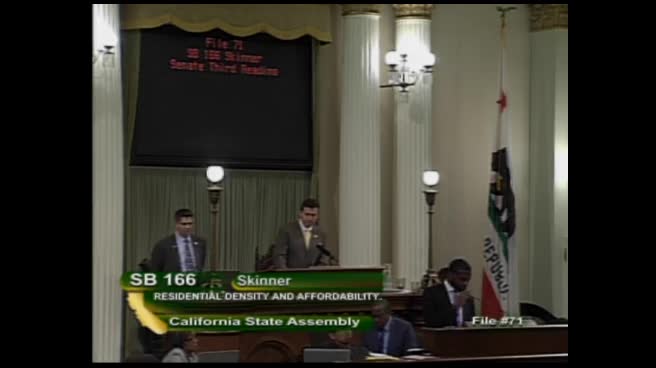 2MIN
Assembly Floor
 7MIN
Assembly Standing Committee on Local Government
 6MIN
Assembly Standing Committee on Housing and Community Development
 2MIN
Senate Floor
 20MIN
Senate Standing Committee on Judiciary
 18MIN
Senate Standing Committee on Transportation and Housing
Bill Author