SB 169: Education: sex equity.
- Session Year: 2017-2018
- House: Senate
- Latest Version Date: 2017-09-18
Existing federal law, known as Title IX, prohibits a person, on the basis of sex, from being excluded from participation in, being denied the benefits of, or being subject to discrimination, which includes sexual harassment, under any education program or activity receiving federal financial assistance. A portion of the Donahoe Higher Education Act, known as the Equity in Higher Education Act, and the Sex Equity in Education Act establish, among other things, that it is the policy of the State of California that all persons, regardless of their sex, should enjoy freedom from discrimination of any kind in the educational institutions of the state. Specified provisions of law relating to educational equity in schools, including the Equity in Education Act and the Equity in Higher Education Act, define, in the same way, sexual harassment for the purposes of their respective provisions.
Based on federal regulations, this bill would define sexual harassment to include sexual violence, as defined, for the purposes of those state laws. The bill would, among other things, require the appropriate governing board or body of each elementary and secondary school that receives state financial assistance, and the appropriate governing board or body of each higher education institution that receives state funds for student financial assistance, to, as a condition of receiving that financial assistance, comply with certain requirements, based on federal regulations. The bill would express the intent of the Legislature that each local educational agency, and would require the appropriate governing board or body of each higher education institution that receives state funds for student financial assistance to, designate at least one employee to act as a sex equity coordinator or officer, as applicable. The bill would require, on or before July 1, 2018, the appropriate governing board or body of each higher education institution that receives state funds for student financial assistance to, as a condition of receiving that financial assistance, adopt regulations to, among other things, ensure that implementation of the applicable provisions of the bill at the institution is, to the greatest extent possible, consistent with federal regulations. By imposing new duties on school districts, this bill would impose a state-mandated local program.
The California Constitution requires the state to reimburse local agencies and school districts for certain costs mandated by the state. Statutory provisions establish procedures for making that reimbursement.
This bill would provide that, if the Commission on State Mandates determines that the bill contains costs mandated by the state, reimbursement for those costs shall be made pursuant to the statutory provisions noted above.
Existing federal law, known as Title IX, prohibits a person, on the basis of sex, from being excluded from participation in, being denied the benefits of, or being subject to discrimination, which includes sexual harassment, under any education program or activity receiving federal financial assistance. Existing federal regulations issued by the United States Department of Educations Office of Civil Rights on April 4, 2011, explain that the requirements of Title IX pertaining to sexual harassment also cover sexual violence, and lays out the specific Title IX requirements applicable to sexual violence. A portion of the Donahoe Higher Education Act, known as the Equity in Higher Education Act, and the Sex Equity in Education Act establish, among other things, that it is the policy of the State of California that all persons, regardless of their sex, should enjoy freedom from discrimination of any kind in the educational institutions of the state. Specified provisions of law relating to educational equity in schools, including the Equity in Education Act and the Equity in Higher Education Act, define, in the same way, sexual harassment for the purposes of their respective provisions.
Based on the federal regulations, this bill would define sexual harassment to include sexual violence, as defined, for the purposes of those state laws. The bill would, among other things, require the appropriate governing board or body of each elementary and secondary school that receives state financial assistance, and the appropriate governing board or body of each higher education institution that receives state funds for student financial assistance, to, as a condition of receiving that financial assistance, comply with certain requirements, based on the federal regulations. The bill would express the intent of the Legislature that each local educational agency, and would require the appropriate governing board or body of each higher education institution that receives state funds for student financial assistance to, designate at least one employee to act as a sex equity coordinator or officer, as applicable. The bill would require, on or before July 1, 2018, the appropriate governing board or body of each higher education institution that receives state funds for student financial assistance to, as a condition of receiving that financial assistance, adopt regulations to, among other things, ensure that implementation of the applicable provisions of the bill at the institution is, to the greatest extent possible, consistent with the federal regulations. By imposing new duties on school districts, this bill would impose a state-mandated local program.
The California Constitution requires the state to reimburse local agencies and school districts for certain costs mandated by the state. Statutory provisions establish procedures for making that reimbursement.
This bill would provide that, if the Commission on State Mandates determines that the bill contains costs mandated by the state, reimbursement for those costs shall be made pursuant to the statutory provisions noted above.
Existing federal law, known as Title IX, prohibits a person, on the basis of sex, from being excluded from participation in, being denied the benefits of, or being subject to discrimination, which includes sexual harassment, under any education program or activity receiving federal financial assistance. Existing federal regulations issued by the United States Department of Educations Office of Civil Rights on April 4, 2011, explain that the requirements of Title IX pertaining to sexual harassment also cover sexual violence, and lays out the specific Title IX requirements applicable to sexual violence. A portion of the Donahoe Higher Education Act, known as the Equity in Higher Education Act, and the Sex Equity in Education Act establish, among other things, that it is the policy of the State of California that all persons, regardless of their sex, should enjoy freedom from discrimination of any kind in the educational institutions of the state. Specified provisions of law relating to educational equity in schools, including the Equity in Education Act and the Equity in Higher Education Act, define, in the same way, sexual harassment for the purposes of their respective provisions.
Based on the federal regulations, this bill would define sexual harassment to include sexual violence, as defined, for the purposes of those state laws. The bill would, among other things, require the appropriate governing board or body of each elementary and secondary school that receives state financial assistance, and the appropriate governing board or body of each higher education institution that receives state funds for student financial assistance, to, as a condition of receiving that financial assistance, comply with certain requirements, based on the federal regulations, including adopting and publishing on its Internet Web site grievance procedures for prompt and equitable resolution of student sexual harassment complaints at the school. regulations. The bill would require express the intent of the Legislature that each local educational agency and agency, and would require the appropriate governing board or body of each higher education institution that receives state funds for student financial assistance to to, designate at least one employee to act as a sex equity coordinator. The bill would require, on or before July 1, 2018, the State Department of Education to adopt regulations to, among other things, ensure that implementation of the applicable provisions of the bill at each elementary and secondary school that receives state financial assistance is, to the greatest extent possible, consistent with the federal regulations. coordinator or officer, as applicable. The bill would require, on or before July 1, 2018, the appropriate governing board or body of each higher education institution that receives state funds for student financial assistance to, as a condition of receiving that financial assistance, adopt regulations to, among other things, ensure that implementation of the applicable provisions of the bill at the institution is, to the greatest extent possible, consistent with the federal regulations. By imposing new duties on school districts, this bill would impose a state-mandated local program.
The California Constitution requires the state to reimburse local agencies and school districts for certain costs mandated by the state. Statutory provisions establish procedures for making that reimbursement.
This bill would provide that, if the Commission on State Mandates determines that the bill contains costs mandated by the state, reimbursement for those costs shall be made pursuant to the statutory provisions noted above.
Existing federal law, known as Title IX, prohibits a person, on the basis of sex, from being excluded from participation in, being denied the benefits of, or being subject to discrimination, which includes sexual harassment, under any education program or activity receiving federal financial assistance. Existing federal regulations issued by the United States Department of Educations Office of Civil Rights on April 4, 2011, explain that the requirements of Title IX pertaining to sexual harassment also cover sexual violence, and lays out the specific Title IX requirements applicable to sexual violence. A portion of the Donahoe Higher Education Act, known as the Equity in Higher Education Act, and the Sex Equity in Education Act establish, among other things, that it is the policy of the State of California that all persons, regardless of their sex, should enjoy freedom from discrimination of any kind in the educational institutions of the state. Specified provisions of law relating to educational equity in schools, including the Equity in Education Act and the Equity in Higher Education Act, define, in the same way, sexual harassment for the purposes of their respective provisions.
Based on the federal regulations, this bill would define sexual harassment to include sexual violence, as defined, for the purposes of those state laws. The bill would, among other things, require the appropriate governing board or body of each elementary and secondary school that receives state financial assistance, and the appropriate governing board or body of each higher education institution that receives state funds for student financial assistance, to, as a condition of receiving that financial assistance, comply with certain requirements, based on the federal regulations, including adopting and publishing on its Internet Web site grievance procedures for prompt and equitable resolution of student sexual harassment complaints at the school and designating at least one employee of the school to act as a sex equity coordinator. school. The bill would require each local educational agency and the appropriate governing board or body of each higher education institution that receives state funds for student financial assistance to designate at least one employee to act as a sex equity coordinator. The bill would require, on or before July 1, 2018, the State Department of Education to adopt regulations to, among other things, ensure that implementation of the applicable provisions of the bill at each elementary and secondary school that receives state financial assistance is, to the greatest extent possible, consistent with the federal regulations. The bill would require, on or before July 1, 2018, the appropriate governing board or body of each higher education institution that receives state funds for student financial assistance to, as a condition of receiving that financial assistance, adopt regulations to, among other things, ensure that implementation of the applicable provisions of the bill at the institution is, to the greatest extent possible, consistent with the federal regulations. By imposing new duties on school districts, this bill would impose a state-mandated local program.
The California Constitution requires the state to reimburse local agencies and school districts for certain costs mandated by the state. Statutory provisions establish procedures for making that reimbursement.
This bill would provide that, if the Commission on State Mandates determines that the bill contains costs mandated by the state, reimbursement for those costs shall be made pursuant to the statutory provisions noted above.
Existing federal law, known as Title IX, prohibits a person, on the basis of sex, from being excluded from participation in, being denied the benefits of, or being subject to discrimination, which includes sexual harassment, under any education program or activity receiving federal financial assistance. Existing federal regulations issued by the United States Department of Educations Office of Civil Rights on April 4, 2011, explain that the requirements of Title IX pertaining to sexual harassment also cover sexual violence, and lays out the specific Title IX requirements applicable to sexual violence. A portion of the Donahoe Higher Education Act, known as the Equity in Higher Education Act, and the Sex Equity in Education Act establish, among other things, that it is the policy of the State of California that all persons, regardless of their sex, should enjoy freedom from discrimination of any kind in the educational institutions of the state. Specified provisions of law relating to educational equity in schools, including the Equity in Education Act and the Equity in Higher Education Act, define, in the same way, sexual harassment for the purposes of their respective provisions.
Based on the federal regulations, this bill would define sexual harassment to include sexual violence, as defined, for the purposes of those state laws. The bill would, among other things, require the appropriate governing board or body of each elementary and secondary school that receives state financial assistance, and the appropriate governing board or body of each higher education institution that receives state funds for student financial assistance, to, as a condition of receiving that financial assistance, comply with certain requirements, based on the federal regulations, including adopting and publishing grievance procedures for prompt and equitable resolution of student sexual harassment complaints at the school and designating at least one employee of the school to act as a sex equity coordinator. The bill would require, on or before July 1, 2018, the State Department of Education to adopt regulations to, among other things, ensure that implementation of the applicable provisions of the bill at each elementary and secondary school that receives state financial assistance is, to the greatest extent possible, consistent with the federal regulations. The bill would require, on or before July 1, 2018, the appropriate governing board or body of each higher education institution that receives state funds for student financial assistance to, as a condition of receiving that financial assistance, adopt regulations to, among other things, ensure that implementation of the applicable provisions of the bill at the institution is, to the greatest extent possible, consistent with the federal regulations. By imposing new duties on school districts, this bill would impose a state-mandated local program.
The California Constitution requires the state to reimburse local agencies and school districts for certain costs mandated by the state. Statutory provisions establish procedures for making that reimbursement.
This bill would provide that, if the Commission on State Mandates determines that the bill contains costs mandated by the state, reimbursement for those costs shall be made pursuant to the statutory provisions noted above.
Existing federal law, known as Title IX, prohibits a person, on the basis of sex, from being excluded from participation in, being denied the benefits of, or being subject to discrimination under, any education program or activity receiving federal financial assistance. A portion of the Sex Equity in Education Act and the Donahoe Higher Education Act known as the Equity in Higher Education Act establish, among other things, that it is the policy of the State of California that all persons, regardless of their sex, should enjoy freedom from discrimination of any kind in the educational institutions of the state.This bill would require, on or before July 1, 2018, the State Department of Education to adopt regulations to implement at each school district, to the greatest extent possible, the federal regulations issued by the United States Department of Educations Office of Civil Rights on April 4, 2011. The bill would require the Board of Governors of the California Community Colleges, the Trustees of the California State University, the Regents of the University of California, and the governing boards or bodies of each independent institution of higher education and private postsecondary educational institution to adopt regulations to also implement at their respective higher education institutions, to the greatest extent possible, the federal regulations. To the extent that this bill imposes new duties on school districts, this bill would impose a state-mandated local program.The California Constitution requires the state to reimburse local agencies and school districts for certain costs mandated by the state. Statutory provisions establish procedures for making that reimbursement.This bill would provide that, if the Commission on State Mandates determines that the bill contains costs mandated by the state, reimbursement for those costs shall be made pursuant to the statutory provisions noted above.Existing federal law, known as Title IX, prohibits a person, on the basis of sex, from being excluded from participation in, being denied the benefits of, or being subject to discrimination under, any education program or activity receiving federal financial assistance. A portion of the Sex Equity in Education Act and the Donahoe Higher Education Act known as the Equity in Higher Education Act establish, among other things, that it is the policy of the State of California that all persons, regardless of their sex, should enjoy freedom from discrimination of any kind in the educational institutions of the state.
This bill would require, on or before July 1, 2018, the State Department of Education to adopt regulations to implement at each school district, to the greatest extent possible, the federal regulations issued by the United States Department of Educations Office of Civil Rights on April 4, 2011. The bill would require the Board of Governors of the California Community Colleges, the Trustees of the California State University, the Regents of the University of California, and the governing boards or bodies of each independent institution of higher education and private postsecondary educational institution to adopt regulations to also implement at their respective higher education institutions, to the greatest extent possible, the federal regulations. To the extent that this bill imposes new duties on school districts, this bill would impose a state-mandated local program.
The California Constitution requires the state to reimburse local agencies and school districts for certain costs mandated by the state. Statutory provisions establish procedures for making that reimbursement.
This bill would provide that, if the Commission on State Mandates determines that the bill contains costs mandated by the state, reimbursement for those costs shall be made pursuant to the statutory provisions noted above.
Existing state law, known as the Donahoe Higher Education Act, sets forth, among other things, the missions and functions of Californias public and independent segments of higher education and their respective institutions of higher education. Provisions of the act apply to the University of California only to the extent that the Regents of the University of California, by appropriate resolution, act to make a provision applicable.Existing federal law, known as Title IX, prohibits a person, on the basis of sex, from being excluded from participation in, being denied the benefits of, or being subject to discrimination under, any education program or activity receiving federal financial assistance. A portion of the Donahoe Higher Education Act known as the Equity in Higher Education Act declares, among other things, that it is the policy of the State of California that all persons, regardless of their sex, should enjoy freedom from discrimination of any kind in the postsecondary educational institutions of the state.This bill would express the intent of the Legislature to later enact legislation that would codify the protections and requirements enshrined in Title IX in order to ensure every student can pursue an education in a nonhostile, safe, and harmonious environment, and that would codify the clarifying guidance of the United States Department of Education Office for Civil Rights providing that all forms of student-on-student sexual violence, including rape, sexual assault, sexual battery, and sexual coercion, are sexual harassment subject to the requirements of Title IX and outlining the duties of educational institutions to respond to that harassment. The bill also would make findings and declarations regarding Title IX protections for students and requirements on educational institutions.Existing state law, known as the Donahoe Higher Education Act, sets forth, among other things, the missions and functions of Californias public and independent segments of higher education and their respective institutions of higher education. Provisions of the act apply to the University of California only to the extent that the Regents of the University of California, by appropriate resolution, act to make a provision applicable.
Existing federal law, known as Title IX, prohibits a person, on the basis of sex, from being excluded from participation in, being denied the benefits of, or being subject to discrimination under, any education program or activity receiving federal financial assistance. A portion of the Donahoe Higher Education Act known as the Equity in Higher Education Act declares, among other things, that it is the policy of the State of California that all persons, regardless of their sex, should enjoy freedom from discrimination of any kind in the postsecondary educational institutions of the state.
This bill would express the intent of the Legislature to later enact legislation that would codify the protections and requirements enshrined in Title IX in order to ensure every student can pursue an education in a nonhostile, safe, and harmonious environment, and that would codify the clarifying guidance of the United States Department of Education Office for Civil Rights providing that all forms of student-on-student sexual violence, including rape, sexual assault, sexual battery, and sexual coercion, are sexual harassment subject to the requirements of Title IX and outlining the duties of educational institutions to respond to that harassment. The bill also would make findings and declarations regarding Title IX protections for students and requirements on educational institutions.
The Legislature finds and declares all of the following:
(a)Education has long been recognized as the great equalizer in America.
(b)The Legislature believes that providing all students with an educational environment free from discrimination is extremely important. The sexual harassment of students, including sexual violence, interferes with the right of students to receive an education free from discrimination and, in the case of sexual violence, is a crime.
(c)When a student sexually harasses another student, the harassing conduct creates a hostile environment if the conduct is sufficiently serious that it interferes with or limits a students ability to participate in or benefit from the schools programs or activities. The more severe the conduct, the less need there is to show a repetitive series of incidents to prove a hostile environment, particularly if the harassment is physical. A single or isolated incident of sexual harassment, including sexual violence, may create a hostile environment if the incident is sufficiently severe.
(d)Every student has a right to be protected from sexual harassment, including sexual violence, in a schools educational programs and activities. Each school has a responsibility to make reasonable efforts to respond effectively when sexual harassment is reported or observed by school employees.
(e)Sexual harassment of students, including acts of sexual violence, is a form of sex discrimination prohibited by Title IX of the Education Amendments of 1972 (20 U.S.C. Sec. 1681 et seq.), and its implementing regulations, Part 106 of Chapter 1 of Subtitle B of Title 34 of the Code of Federal Regulations.
(f)The requirements of this act pertaining to sexual harassment also cover sexual violence.
(g)It is critical for California to implement legislation to ensure that protections are in place to properly prevent and resolve instances of sexual harassment, including sexual violence, at Californias elementary or secondary schools and higher education institutions.
(h)It is the intent of the Legislature that each local educational agency designate at least one local educational agency employee to act as a gender equity coordinator to coordinate its efforts to comply with and carry out its responsibilities under this act. The gender equity coordinator may be the same individual as the schools federal Title IX coordinator. It is the intent of the Legislature that the local educational agency post the identity of the gender equity coordinator in a prominent location on its, and each of its schools, Internet Web sites.
(i)It is the intent of the Legislature, based on the federal regulations described in subdivision (e), to define sexual harassment to include sexual violence, as defined in Section 212.7 of the Education Code, for the purposes of Chapter 2 (commencing with Section 200) of Part 1 of Division 1 of Title 1 of the Education Code and the Equity in Higher Education Act established in Chapter 4.5 (commencing with Section 66250) of Part 40 of Division 5 of Title 3 of the Education Code.
(j)It is the intent of the Legislature that each elementary and secondary school that receives state financial assistance, and each higher education institution that receives state funds for student financial assistance, and their respective governing boards or bodies, comply with the requirements of this act as a condition of receiving that financial assistance.
(k)It is the intent of the Legislature that the requirements of this act be interpreted, to the greatest extent possible, consistent with the federal guidelines issued by the United States Department of Educations Office for Civil Rights on April 4, 2011, as it read on January 1, 2017.
SEC. 2.Section 212.5 of the Education Code is amended to read:212.5.(a)Sexual harassment means unwelcome sexual advances, requests for sexual favors, and other verbal, visual, or physical conduct of a sexual nature, made by someone from or in the work or educational setting, under any of the following conditions:
(1)Submission to the conduct is explicitly or implicitly made a term or a condition of an individuals employment, academic status, or progress.
(2)Submission to, or rejection of, the conduct by the individual is used as the basis of employment or academic decisions affecting the individual.
(3)The conduct has the purpose or effect of having a negative impact upon the individuals work or academic performance, or of creating an intimidating, hostile, or offensive work or educational environment.
(4)Submission to, or rejection of, the conduct by the individual is used as the basis for any decision affecting the individual regarding benefits and services, honors, programs, or activities available at or through the educational institution.
(b)Sexual harassment also means sexual violence.
SEC. 3.Section 212.7 is added to the Education Code, to read:212.7.Sexual violence means physical sexual acts perpetrated against a person without the persons consent. An individual may be unable to give consent due to an intellectual or other disability. Physical sexual acts include, but are not limited to, either of the following:
(a)Rape as defined in Chapter 1 (commencing with Section 261) of Title 9 of Part 1 of the Penal Code.
(b)Sexual assault, defined as an act or attempt made punishable by Section 220, 261, 261.5, 262, 264.1, 266c, 269, 285, 286, 288, 288.5, 288a, 289, or 647.6 of the Penal Code, or sexual battery as defined in Chapter 9 (commencing with Section 240) of Title 8 of Part 1 of the Penal Code.
SEC. 4.Section 221.6 of the Education Code is amended to read:221.6.(a)On or before July 1, 2006, the department shall post on its Internet Web site, in both English and Spanish and at a reading level that may be comprehended by pupils in high school, the information set forth in the federal regulations implementing Title IX of the Education Amendments of 1972 (20 U.S.C. Sec. 1681 et seq.).
(b)On or before July 1, 2018, the department shall update the Internet Web site post described in subdivision (a) to include information on the provisions of the federal guidance letter issued by the United States Department of Educations Office for Civil Rights on April 4, 2011, as it read on January 1, 2017.
(c)The Superintendent of Public Instruction shall consider incorporating the provisions of the federal guidance letter issued by the United States Department of Educations Office for Civil Rights on April 4, 2011, as it read on January 1, 2017, into the next revision of the Uniform Complaint Procedures set forth in Chapter 5.1 (commencing with Section 4600) of Division 1 of Title 5 of the California Code of Regulations.
(d)It is the responsibility of the appropriate governing body for each local educational agency, as applicable, to ensure that the policies and procedures in place at the local educational agency comply with the requirements of this article.
SEC. 5.Section 221.8 of the Education Code is amended to read:221.8.The following list of rights, which are based on the relevant provisions of the federal regulations implementing Title IX of the Education Amendments of 1972 (20 U.S.C. Sec. 1681 et seq.), including the federal Title IX regulations concerning sexual harassment and sexual violence, may be used by the department for purposes of Section 221.6:
(a)You have the right to fair and equitable treatment and you shall not be discriminated against based on your sex.
(b)You have the right to be provided with an equitable opportunity to participate in all academic extracurricular activities, including athletics.
(c)You have the right to inquire of the athletic director of your school as to the athletic opportunities offered by the school.
(d)You have the right to apply for athletic scholarships.
(e)You have the right to receive equitable treatment and benefits in the provision of all of the following:
(1)Equipment and supplies.
(2)Scheduling of games and practices.
(3)Transportation and daily allowances.
(4)Access to tutoring.
(5)Coaching.
(6)Locker rooms.
(7)Practice and competitive facilities.
(8)Medical and training facilities and services.
(9)Publicity.
(f)You have the right to have access to a gender equity coordinator to answer questions regarding gender equity laws.
(g)You have the right to contact the State Department of Education and the California Interscholastic Federation to access information on gender equity laws.
(h)You have the right to file a confidential discrimination complaint with the United States Office of Civil Rights or the State Department of Education if you believe you have been discriminated against or if you believe you have received unequal treatment on the basis of your sex.
(i)You have the right to pursue civil remedies if you have been discriminated against.
(j)You have the right to be protected against retaliation if you file a discrimination complaint.
(k)You have the right to be free from sexual harassment, including sexual violence.
SEC. 6.Section 230 of the Education Code is amended to read:230.For purposes of this chapter, harassment and other discrimination on the basis of sex include, but are not limited to, sexual harassment, including sexual violence, and the following practices:
(a)On the basis of sex, exclusion of a person or persons from participation in, denial of the benefits of, or subjection to harassment or other discrimination in, any academic, extracurricular, research, occupational training, or other program or activity.
(b)On the basis of sex, provision of different amounts or types of student financial aid, limitation of eligibility for student financial aid, or the application of different criteria to applicants for student financial aid or for participation in the provision of student financial aid by others. Nothing in this subdivision shall be construed to prohibit an educational institution from administering, or assisting in the administration of, scholarships, fellowships, or other forms of student financial aid, established pursuant to domestic or foreign wills, bequests, trusts, or similar legal instruments or by acts of a foreign government, which require that awards be made to members of a particular sex; provided, that the overall effect of the award of these sex-restricted scholarships, fellowships, and other forms of student financial aid does not discriminate on the basis of sex.
(c)On the basis of sex, exclusion from participation in, or denial of equivalent opportunity in, athletic programs. For purposes of this subdivision, equivalent means equal or equal in effect.
(d)An educational institution may be found to have effectively accommodated the interests and abilities in athletics of both sexes within the meaning of Section 4922 of Title 5 of the California Code of Regulations as that section exists on January 1, 2003, using any one of the following tests:
(1)Whether interscholastic level participation opportunities for male and female pupils are provided in numbers substantially proportionate to their respective enrollments.
(2)Where the members of one sex have been and are underrepresented among interscholastic athletes, whether the school district can show a history and continuing practice of program expansion that is demonstrably responsive to the developing interest and abilities of the members of that sex.
(3)Where the members of one sex are underrepresented among interscholastic athletes, and the institution cannot show a history and continuing practice of program expansion as required in paragraph (2), whether the school district can demonstrate that the interest and abilities of the members of that sex have been fully and effectively accommodated by the present program.
(e)If an educational institution must cut its athletic budget, the educational institution shall do so consistently with its legal obligation to comply with both state and federal gender equity laws.
(f)It is the intent of the Legislature that the three-part test articulated in subdivision (d) be interpreted as it has been in the policies and regulations of the Office of Civil Rights in effect on January 1, 2003.
(g)On the basis of sex, harassment or other discrimination among persons, including, but not limited to, students and nonstudents, or academic and nonacademic personnel, in employment and the conditions thereof, except as it relates to a bona fide occupational qualification.
(h)On the basis of sex, the application of any rule concerning the actual or potential parental, family, or marital status of a person, or the exclusion of any person from any program or activity or employment because of pregnancy or related conditions.
SEC. 7.Section 231.5 of the Education Code is amended to read:231.5.(a)It is the policy of the State of California, pursuant to Section 200, that all persons, regardless of their sex, should enjoy freedom from discrimination of any kind in the educational institutions of the state. The purpose of this section is to provide notification of the prohibition against sexual harassment as a form of sexual discrimination and to provide notification of available remedies.
(b)Each educational institution in the State of California shall have a written policy on sexual harassment. The policy may include examples of the types of conduct prohibited. It is the intent of the Legislature that each educational institution in this state include this policy in its regular policy statement rather than distribute an additional written document.
(c)The educational institutions written policy on sexual harassment shall include information on where to obtain the specific rules and procedures for reporting charges of sexual harassment and for pursuing available remedies.
(d)A copy of the educational institutions written policy on sexual harassment shall be displayed in a prominent location in the main administrative building or other area of the campus or schoolsite. Prominent location means that location, or those locations, in the main administrative building or other area where notices regarding the institutions rules, regulations, procedures, and standards of conduct are posted.
(e)A copy of the educational institutions written policy on sexual harassment, as it pertains to students, shall be provided as part of any orientation program conducted for new students at the beginning of each quarter, semester, or summer session, as applicable.
(f)A copy of the educational institutions written policy on sexual harassment shall be provided for each faculty member, all members of the administrative staff, and all members of the support staff at the beginning of the first quarter or semester of the school year, or at the time that there is a new employee hired.
(g)A copy of the educational institutions written policy on sexual harassment shall appear in any publication of the institution that sets forth the comprehensive rules, regulations, procedures, and standards of conduct for the institution.
(h)Each elementary and secondary school that is subject to the requirements of this article shall use a preponderance of the evidence standard to decide whether an incident of sexual harassment or sexual violence occurred. The school shall make a determination regarding what, if any, disciplinary action or actions are appropriate, including suspension or expulsion pursuant to Article 1 (commencing with Section 48900) of Chapter 6 of Part 27 of Division 4 of Title 2.
SEC. 8.Section 260 of the Education Code is amended to read:260.The governing board of a school district shall have the primary responsibility for ensuring that school district programs and activities are free from discrimination based on age, the characteristics listed in Section 220, and sexual harassment, including sexual violence, and for monitoring compliance with any and all rules and regulations promulgated pursuant to Section 11138 of the Government Code.
SEC. 9.Section 66262.5 of the Education Code is amended to read:66262.5.(a)Except for the definition of sexual violence, which for the purposes of this chapter is defined in subdivision (b), and sexual exploitation, which for the purposes of this chapter is defined in paragraph (4) of subdivision (b), sexual harassment has the same meaning as defined in Section 212.5.
(b)For purposes of this chapter, sexual violence means physical sexual acts perpetrated against a person without the persons consent. An individual may be unable to give consent due to an intellectual or other disability. Physical sexual acts include all of the following:
(1)Rape as defined in Chapter 1 (commencing with Section 261) of Title 9 of Part 1 of the Penal Code.
(2)Sexual assault, defined as actual or attempted sexual contact with another person without that persons consent, regardless of the victims affiliation with the higher education institution, including, but not limited to, any of the following:
(A)Intentional touching of another persons intimate parts without that persons consent or other intentional sexual contact with another person without that persons consent.
(B)Using duress, forcing, or attempting to use duress or force a person to touch another persons intimate parts without that persons consent.
(3)Sexual battery as defined in Chapter 9 (commencing with Section 240) of Title 8 of Part 1 of the Penal Code.
(4)Sexual exploitation, defined as a person taking sexual advantage of another person for the benefit of anyone other than that person without that persons consent, regardless of the victims affiliation with the higher education institution, including any of the following:
(A)Prostituting another person.
(B)Recording images, including video or photograph, or audio of another persons sexual activity, intimate body parts, or nakedness without that persons consent.
(C)Distributing images, including video or photograph, or audio of another persons sexual activity, intimate body parts, or nakedness, if the individual distributing the images or audio knows or should have known that the person depicted in the images or audio did not consent to the disclosure and objected to the disclosure.
(D)Viewing another persons sexual activity, intimate body parts, or nakedness in a place where that person would have a reasonable expectation of privacy, without that persons consent, and for the purpose of arousing or gratifying sexual desire.
SEC. 10.Section 66281.8 is added to the Education Code, to read:66281.8.(a)For the purposes of this section, higher education institution means a campus of the University of California, the California State University, or the California Community Colleges, a private postsecondary educational institution, or an independent institution of higher education that receives state funds, including state funds for student financial assistance.
(b)The governing board of each community college district, the Trustees of the California State University, the Regents of the University of California, and the governing boards or bodies of each independent institution of higher education and each private postsecondary educational institution, in addition to the provisions set forth in Section 67386, shall comply with the requirements of this section to prevent and address sexual harassment involving a student, which could create a hostile environment on campus.
(c)The appropriate governing board or body of each higher education institution shall implement, and at all times comply with, all of the following requirements at the institution:
(1)Disseminate a notice of nondiscrimination to each higher education institution employee and volunteer, including any individual employed by contract to perform any service at the institution.
(2)Designate at least one employee of the institution to act as a gender equity officer to coordinate its efforts to comply with and carry out its responsibilities under this section. The gender equity officer may be the same individual as the institutions federal Title IX coordinator. The gender equity officer shall have adequate training on what constitutes sexual harassment and understand how the institutions grievance procedures operate.
(3)Adopt rules and procedures for the prevention of sexual harassment that include all of the following elements:
(A)When a student sexually harasses another student, the harassing conduct creates a hostile environment on campus for the purposes of this section if the conduct is sufficiently serious that it interferes with or limits a students ability to participate in or benefit from the institutions programs or activities. The more severe the conduct, the less need there is to show a repetitive series of incidents to prove a hostile environment on campus, particularly if the harassment is physical. A single or isolated incident of sexual harassment, including sexual violence, may create a hostile environment on campus if the incident is sufficiently severe.
(B)The institutions primary concern is student safety. The use of alcohol, or drugs, or both shall not constitute grounds for determining that a complainant is at fault for sexual harassment or sexual violence. All disciplinary measures imposed by the institution for violations of the institutions student conduct policy at or near the time of the incident shall be made pursuant to paragraph (10) of subdivision (b) of Section 67386.
(C)The institution shall take reasonable steps to ensure that students are protected in connection with all academic, educational, extracurricular, athletic, and other programs of the institution, whether those programs take place in the institutions facilities, on a schoolbus, at a class or training program sponsored by the institution at another location, or elsewhere.
(D)If a student files a complaint with the institution, regardless of where the conduct occurred, the institution shall process the complaint in accordance with this section. Because students often experience the continuing effects of off-campus sexual harassment in the educational setting, the institution shall consider the effects of the off-campus conduct when evaluating whether there is a hostile environment on campus. The institution may have an obligation to respond to student-on-student sexual harassment that initially occurred off campus grounds, outside of the institutions educational programs or activities.
(E)If the institution knows, or reasonably should know, about possible sexual harassment that could create a hostile environment on campus, the institution shall promptly determine whether to investigate. If the institution investigates and determines that sexual harassment creating a hostile environment on campus has more likely than not occurred, it must take immediate action to eliminate the hostile environment, prevent its recurrence, and address its affects, regardless of whether or not a complaint has been filed under the institutions grievance procedures.
(4)Adopt and publish on its Internet Web site grievance procedures that provide for prompt and equitable resolution of student sexual harassment complaints filed by a student against an employee, another student, or a third party. The grievance procedures shall contain all of the following elements:
(A)Provide notice to each individual described in paragraph (1) and each student of the grievance procedures, including where and how complaints may be filed.
(B)Apply the grievance procedures to each complaint alleging sexual harassment perpetrated by an employee described in paragraph (1), another student, or a third party.
(C)Ensure adequate, reliable, and impartial investigation of complaints, including the opportunity for both parties to present witnesses and other evidence.
(D)Designate reasonably prompt timeframes for the major stages of the complaint process.
(E)Provide notice to parties of the outcome of the complaint in writing. The written outcome shall explain to the parties the reason for the decision.
(F)Provide an assurance that the institution will take steps to prevent recurrence of any harassment and to correct its discriminatory effects on the complainant and others, if appropriate.
(G)Specify the timeframes for all of the major stages of the grievance procedures, including, but not necessarily limited to, the process for extending timelines. The grievance procedures shall provide both parties to a complaint periodic status updates and specify the timeframe within which all of the following will occur:
(i)The institution conducts an investigation appropriate to the complaint.
(ii)Both parties receive a response regarding the outcome of the complaint.
(iii)The parties may file an appeal, if the institutions grievance procedures include an appeals process.
(H)If both the complainant and respondent are students at the institution, provide information regarding the rights of a sexual harassment complainant and respondent. All of the following rights shall be afforded to student parties, both the complainant and the respondent, in the same manner and, except under extenuating circumstances, such as the unavailability of a party or if it would impede an investigation, at the same time:
(i)To receive notice that the institution is conducting an investigation. The notice shall include sufficient information to ensure that the parties understand the allegations and the alleged institutional policy violations under review.
(ii)To receive information on the institutions investigative process, decisionmaking procedures, and grievance procedures established pursuant to the requirements of this section. Each higher education institution may create reasonable procedures to clarify and manage the investigation process, including instituting reasonable and equitable evidentiary guidelines, deadlines, and page or word limitations on student party submissions. The institution shall include, but is not limited to including, a statement regarding the limitations on the use of past sexual history within the scope of a sexual harassment investigation.
(iii)To receive information about reasonably prompt timeframes for the major stages of the complaint process.
(iv)To have the investigation and decision of responsibility made by a neutral decisionmaker or decisionmaking body.
(v)To have the opportunity to give information, identify witnesses, and provide documentary information during the course of the investigation and the opportunity to respond to any evidence upon which any findings will be based.
(vi)To have a support person or adviser accompany the student during key stages of the investigation and hearing processes, if requested.
(vii)To receive a written outcome of the findings, including disciplinary outcomes.
(viii)If the institution has an appeals process, to have equal opportunity to appeal the outcome of the disciplinary proceedings.
(ix)To have appropriate disciplinary outcomes, remedial measures, and systemic remedies put in place following a final finding of responsibility.
(5)Adopt and publish investigation procedures on its Internet Web site providing for prompt and equitable resolution of student sexual harassment complaints filed by a student, or initiated by the higher education institution itself, against an institution employee, another student, or a third party. The procedures shall contain all of the following elements:
(A)Information describing the obligations of all staff designated by the institution to report concerns of sexual harassment to the gender equity officer designated pursuant to paragraph (2). An individual who has a confidential relationship with a student or students by law, or other relationship designated by the institution as confidential, is exempt from having to report sexual harassment concerns to the gender equity officer pertaining to the confidential relationship or relationships.
(B)A requirement that the gender equity officer designated pursuant to paragraph (2), or his or her designee, assess each report of sexual harassment and provide outreach, as appropriate, to each identifiable student who is alleged to be the victim of the reported conduct. The outreach shall include all of the following information:
(i)The institution has received a report that the student may have been a victim of sexual harassment.
(ii)The prohibition of retaliation.
(iii)Behavioral health services at the institution or in the community.
(iv)If there is the possibility of a criminal act, notice that the student has the right, but not the obligation, to report the matter to law enforcement.
(v)The institutions investigation procedures established pursuant to the requirements of this section.
(vi)Potential interim measures, such as no contact directives, housing changes, and academic schedule changes, where applicable.
(vii)The importance of preserving evidence.
(viii)A request for the student to meet with the gender equity officer, or his or her designee, to discuss options for responding to the report.
(ix)The manner in which the institution responds to reports of sexual harassment and a description of potential disciplinary consequences.
(d)This section does not require a school to provide separate grievance procedures for student sexual harassment complaints. The school may use student disciplinary procedures or other separate procedures to resolve sexual harassment complaints. Any procedures used to adjudicate complaints of sexual harassment, including disciplinary procedures, shall afford a complainant and a respondent a prompt and equitable resolution. If the school relies on disciplinary procedures for compliance with the requirements of this section, the gender equity officer designated pursuant to paragraph (2) of subdivision (c) shall review the schools disciplinary procedures to ensure that the procedures comply with the requirements of this section.
(e)To the extent that the student rights listed in this article do not otherwise exist by statute or agreement, nothing in this section requires schools to provide nonstudent parties with those rights.
(f)It is the responsibility of the appropriate governing board for each higher education institution to ensure that the policies and procedures in place at the institution comply with the requirements of this section, and to implement changes, as necessary, to ensure compliance with the requirements of this section.
(g)On or before July 1, 2018, the appropriate governing board or body of each school shall adopt regulations to ensure that implementation of this section at the school is, to the greatest extent possible, consistent with federal Title IX regulations.
(h)The requirements of this section shall be implemented at each higher education institution by no later than January 1, 2019.
SEC. 11.If the Commission on State Mandates determines that this act contains costs mandated by the state, reimbursement to local agencies and school districts for those costs shall be made pursuant to Part 7 (commencing with Section 17500) of Division 4 of Title 2 of the Government Code.
The Legislature finds and declares all of the following:
(a)Education has long been recognized as the great equalizer in America.
(b)The Legislature believes that providing all students with an educational environment free from discrimination is extremely important. The sexual harassment of students, including sexual violence, interferes with the right of students to receive an education free from discrimination and, in the case of sexual violence, is a crime.
(c)When a student sexually harasses another student, the harassing conduct creates a hostile environment if the conduct is sufficiently serious that it interferes with or limits a students ability to participate in or benefit from the schools programs or activities. The more severe the conduct, the less need there is to show a repetitive series of incidents to prove a hostile environment, particularly if the harassment is physical. A single or isolated incident of sexual harassment, including sexual violence, may create a hostile environment if the incident is sufficiently severe.
(d)Every student has a right to be protected from sexual harassment, including sexual violence, in a schools educational programs and activities. Each school has a responsibility to make reasonable efforts to respond effectively when sexual harassment is reported or observed by school employees.
(e)Sexual harassment of students, including acts of sexual violence, is a form of sex discrimination prohibited by Title IX of the Education Amendments of 1972 (20 U.S.C. Sec. 1681 et seq.), and its implementing regulations, Part 106 of Chapter 1 of Subtitle B of Title 34 of the Code of Federal Regulations.
(f)The requirements of this act pertaining to sexual harassment also cover sexual violence.
(g)It is critical for California to implement legislation to ensure that protections are in place to properly prevent and resolve instances of sexual harassment, including sexual violence, at Californias elementary or secondary schools and higher education institutions.
(h)It is the intent of the Legislature that each local educational agency designate at least one local educational agency employee to act as a gender equity coordinator to coordinate its efforts to comply with and carry out its responsibilities under this act. The gender equity coordinator may be the same individual as the schools federal Title IX coordinator. It is the intent of the Legislature that the local educational agency post the identity of the gender equity coordinator in a prominent location on its, and each of its schools, Internet Web sites.
(i)It is the intent of the Legislature, based on the federal regulations described in subdivision (e), to define sexual harassment to include sexual violence, as defined in Section 212.7 of the Education Code, for the purposes of Chapter 2 (commencing with Section 200) of Part 1 of Division 1 of Title 1 of the Education Code and the Equity in Higher Education Act established in Chapter 4.5 (commencing with Section 66250) of Part 40 of Division 5 of Title 3 of the Education Code.
(j)It is the intent of the Legislature that each elementary and secondary school that receives state financial assistance, and each higher education institution that receives state funds for student financial assistance, and their respective governing boards or bodies, comply with the requirements of this act as a condition of receiving that financial assistance.
(k)It is the intent of the Legislature that the requirements of this act be interpreted, to the greatest extent possible, consistent with the federal guidelines issued by the United States Department of Educations Office for Civil Rights on April 4, 2011, as it read on January 1, 2017.
SEC. 2.Section 212.5 of the Education Code is amended to read:212.5.(a)Sexual harassment means unwelcome sexual advances, requests for sexual favors, and other verbal, visual, or physical conduct of a sexual nature, made by someone from or in the work or educational setting, under any of the following conditions:
(1)Submission to the conduct is explicitly or implicitly made a term or a condition of an individuals employment, academic status, or progress.
(2)Submission to, or rejection of, the conduct by the individual is used as the basis of employment or academic decisions affecting the individual.
(3)The conduct has the purpose or effect of having a negative impact upon the individuals work or academic performance, or of creating an intimidating, hostile, or offensive work or educational environment.
(4)Submission to, or rejection of, the conduct by the individual is used as the basis for any decision affecting the individual regarding benefits and services, honors, programs, or activities available at or through the educational institution.
(b)Sexual harassment also means sexual violence.
SEC. 3.Section 212.7 is added to the Education Code, to read:212.7.Sexual violence means physical sexual acts perpetrated against a person without the persons consent. An individual may be unable to give consent due to an intellectual or other disability. Physical sexual acts include, but are not limited to, either of the following:
(a)Rape as defined in Chapter 1 (commencing with Section 261) of Title 9 of Part 1 of the Penal Code.
(b)Sexual assault, defined as an act or attempt made punishable by Section 220, 261, 261.5, 262, 264.1, 266c, 269, 285, 286, 288, 288.5, 288a, 289, or 647.6 of the Penal Code, or sexual battery as defined in Chapter 9 (commencing with Section 240) of Title 8 of Part 1 of the Penal Code.
SEC. 4.Section 221.6 of the Education Code is amended to read:221.6.(a)On or before July 1, 2006, the department shall post on its Internet Web site, in both English and Spanish and at a reading level that may be comprehended by pupils in high school, the information set forth in the federal regulations implementing Title IX of the Education Amendments of 1972 (20 U.S.C. Sec. 1681 et seq.).
(b)On or before July 1, 2018, the department shall update the Internet Web site post described in subdivision (a) to include information on the provisions of the federal guidance letter issued by the United States Department of Educations Office for Civil Rights on April 4, 2011, as it read on January 1, 2017.
(c)The Superintendent of Public Instruction shall consider incorporating the provisions of the federal guidance letter issued by the United States Department of Educations Office for Civil Rights on April 4, 2011, as it read on January 1, 2017, into the next revision of the Uniform Complaint Procedures set forth in Chapter 5.1 (commencing with Section 4600) of Division 1 of Title 5 of the California Code of Regulations.
(d)It is the responsibility of the appropriate governing body for each local educational agency, as applicable, to ensure that the policies and procedures in place at the local educational agency comply with the requirements of this article.
SEC. 5.Section 221.8 of the Education Code is amended to read:221.8.The following list of rights, which are based on the relevant provisions of the federal regulations implementing Title IX of the Education Amendments of 1972 (20 U.S.C. Sec. 1681 et seq.), including the federal Title IX regulations concerning sexual harassment and sexual violence, may be used by the department for purposes of Section 221.6:
(a)You have the right to fair and equitable treatment and you shall not be discriminated against based on your sex.
(b)You have the right to be provided with an equitable opportunity to participate in all academic extracurricular activities, including athletics.
(c)You have the right to inquire of the athletic director of your school as to the athletic opportunities offered by the school.
(d)You have the right to apply for athletic scholarships.
(e)You have the right to receive equitable treatment and benefits in the provision of all of the following:
(1)Equipment and supplies.
(2)Scheduling of games and practices.
(3)Transportation and daily allowances.
(4)Access to tutoring.
(5)Coaching.
(6)Locker rooms.
(7)Practice and competitive facilities.
(8)Medical and training facilities and services.
(9)Publicity.
(f)You have the right to have access to a gender equity coordinator to answer questions regarding gender equity laws.
(g)You have the right to contact the State Department of Education and the California Interscholastic Federation to access information on gender equity laws.
(h)You have the right to file a confidential discrimination complaint with the United States Office of Civil Rights or the State Department of Education if you believe you have been discriminated against or if you believe you have received unequal treatment on the basis of your sex.
(i)You have the right to pursue civil remedies if you have been discriminated against.
(j)You have the right to be protected against retaliation if you file a discrimination complaint.
(k)You have the right to be free from sexual harassment, including sexual violence.
SEC. 6.Section 230 of the Education Code is amended to read:230.For purposes of this chapter, harassment and other discrimination on the basis of sex include, but are not limited to, sexual harassment, including sexual violence, and the following practices:
(a)On the basis of sex, exclusion of a person or persons from participation in, denial of the benefits of, or subjection to harassment or other discrimination in, any academic, extracurricular, research, occupational training, or other program or activity.
(b)On the basis of sex, provision of different amounts or types of student financial aid, limitation of eligibility for student financial aid, or the application of different criteria to applicants for student financial aid or for participation in the provision of student financial aid by others. Nothing in this subdivision shall be construed to prohibit an educational institution from administering, or assisting in the administration of, scholarships, fellowships, or other forms of student financial aid, established pursuant to domestic or foreign wills, bequests, trusts, or similar legal instruments or by acts of a foreign government, which require that awards be made to members of a particular sex; provided, that the overall effect of the award of these sex-restricted scholarships, fellowships, and other forms of student financial aid does not discriminate on the basis of sex.
(c)On the basis of sex, exclusion from participation in, or denial of equivalent opportunity in, athletic programs. For purposes of this subdivision, equivalent means equal or equal in effect.
(d)An educational institution may be found to have effectively accommodated the interests and abilities in athletics of both sexes within the meaning of Section 4922 of Title 5 of the California Code of Regulations as that section exists on January 1, 2003, using any one of the following tests:
(1)Whether interscholastic level participation opportunities for male and female pupils are provided in numbers substantially proportionate to their respective enrollments.
(2)Where the members of one sex have been and are underrepresented among interscholastic athletes, whether the school district can show a history and continuing practice of program expansion that is demonstrably responsive to the developing interest and abilities of the members of that sex.
(3)Where the members of one sex are underrepresented among interscholastic athletes, and the institution cannot show a history and continuing practice of program expansion as required in paragraph (2), whether the school district can demonstrate that the interest and abilities of the members of that sex have been fully and effectively accommodated by the present program.
(e)If an educational institution must cut its athletic budget, the educational institution shall do so consistently with its legal obligation to comply with both state and federal gender equity laws.
(f)It is the intent of the Legislature that the three-part test articulated in subdivision (d) be interpreted as it has been in the policies and regulations of the Office of Civil Rights in effect on January 1, 2003.
(g)On the basis of sex, harassment or other discrimination among persons, including, but not limited to, students and nonstudents, or academic and nonacademic personnel, in employment and the conditions thereof, except as it relates to a bona fide occupational qualification.
(h)On the basis of sex, the application of any rule concerning the actual or potential parental, family, or marital status of a person, or the exclusion of any person from any program or activity or employment because of pregnancy or related conditions.
SEC. 7.Section 231.5 of the Education Code is amended to read:231.5.(a)It is the policy of the State of California, pursuant to Section 200, that all persons, regardless of their sex, should enjoy freedom from discrimination of any kind in the educational institutions of the state. The purpose of this section is to provide notification of the prohibition against sexual harassment as a form of sexual discrimination and to provide notification of available remedies.
(b)Each educational institution in the State of California shall have a written policy on sexual harassment. The policy may include examples of the types of conduct prohibited. It is the intent of the Legislature that each educational institution in this state include this policy in its regular policy statement rather than distribute an additional written document.
(c)The educational institutions written policy on sexual harassment shall include information on where to obtain the specific rules and procedures for reporting charges of sexual harassment and for pursuing available remedies.
(d)A copy of the educational institutions written policy on sexual harassment shall be displayed in a prominent location in the main administrative building or other area of the campus or schoolsite. Prominent location means that location, or those locations, in the main administrative building or other area where notices regarding the institutions rules, regulations, procedures, and standards of conduct are posted.
(e)A copy of the educational institutions written policy on sexual harassment, as it pertains to students, shall be provided as part of any orientation program conducted for new students at the beginning of each quarter, semester, or summer session, as applicable.
(f)A copy of the educational institutions written policy on sexual harassment shall be provided for each faculty member, all members of the administrative staff, and all members of the support staff at the beginning of the first quarter or semester of the school year, or at the time that there is a new employee hired.
(g)A copy of the educational institutions written policy on sexual harassment shall appear in any publication of the institution that sets forth the comprehensive rules, regulations, procedures, and standards of conduct for the institution.
(h)Each elementary and secondary school that is subject to the requirements of this article shall use a preponderance of the evidence standard to decide whether an incident of sexual harassment or sexual violence occurred. The school shall make a determination regarding what, if any, disciplinary action or actions are appropriate, including suspension or expulsion pursuant to Article 1 (commencing with Section 48900) of Chapter 6 of Part 27 of Division 4 of Title 2.
SEC. 8.Section 260 of the Education Code is amended to read:260.The governing board of a school district shall have the primary responsibility for ensuring that school district programs and activities are free from discrimination based on age, the characteristics listed in Section 220, and sexual harassment, including sexual violence, and for monitoring compliance with any and all rules and regulations promulgated pursuant to Section 11138 of the Government Code.
SEC. 9.Section 66262.5 of the Education Code is amended to read:66262.5.(a)Except for the definition of sexual violence, which for the purposes of this chapter is defined in subdivision (b), and sexual exploitation, which for the purposes of this chapter is defined in paragraph (4) of subdivision (b), sexual harassment has the same meaning as defined in Section 212.5.
(b)For purposes of this chapter, sexual violence means physical sexual acts perpetrated against a person without the persons consent. An individual may be unable to give consent due to an intellectual or other disability. Physical sexual acts include all of the following:
(1)Rape as defined in Chapter 1 (commencing with Section 261) of Title 9 of Part 1 of the Penal Code.
(2)Sexual assault, defined as actual or attempted sexual contact with another person without that persons consent, regardless of the victims affiliation with the higher education institution, including, but not limited to, any of the following:
(A)Intentional touching of another persons intimate parts without that persons consent or other intentional sexual contact with another person without that persons consent.
(B)Using duress, forcing, or attempting to use duress or force a person to touch another persons intimate parts without that persons consent.
(3)Sexual battery as defined in Chapter 9 (commencing with Section 240) of Title 8 of Part 1 of the Penal Code.
(4)Sexual exploitation, defined as a person taking sexual advantage of another person for the benefit of anyone other than that person without that persons consent, regardless of the victims affiliation with the higher education institution, including any of the following:
(A)Prostituting another person.
(B)Recording images, including video or photograph, or audio of another persons sexual activity, intimate body parts, or nakedness without that persons consent.
(C)Distributing images, including video or photograph, or audio of another persons sexual activity, intimate body parts, or nakedness, if the individual distributing the images or audio knows or should have known that the person depicted in the images or audio did not consent to the disclosure and objected to the disclosure.
(D)Viewing another persons sexual activity, intimate body parts, or nakedness in a place where that person would have a reasonable expectation of privacy, without that persons consent, and for the purpose of arousing or gratifying sexual desire.
SEC. 10.Section 66281.8 is added to the Education Code, to read:66281.8.(a)For the purposes of this section, higher education institution means a campus of the University of California, the California State University, or the California Community Colleges, a private postsecondary educational institution, or an independent institution of higher education that receives state funds, including state funds for student financial assistance.
(b)The governing board of each community college district, the Trustees of the California State University, the Regents of the University of California, and the governing boards or bodies of each independent institution of higher education and each private postsecondary educational institution, in addition to the provisions set forth in Section 67386, shall comply with the requirements of this section to prevent and address sexual harassment involving a student, which could create a hostile environment on campus.
(c)The appropriate governing board or body of each higher education institution shall implement, and at all times comply with, all of the following requirements at the institution:
(1)Disseminate a notice of nondiscrimination to each higher education institution employee and volunteer, including any individual employed by contract to perform any service at the institution.
(2)Designate at least one employee of the institution to act as a gender equity officer to coordinate its efforts to comply with and carry out its responsibilities under this section. The gender equity officer may be the same individual as the institutions federal Title IX coordinator. The gender equity officer shall have adequate training on what constitutes sexual harassment and understand how the institutions grievance procedures operate.
(3)Adopt rules and procedures for the prevention of sexual harassment that include all of the following elements:
(A)When a student sexually harasses another student, the harassing conduct creates a hostile environment on campus for the purposes of this section if the conduct is sufficiently serious that it interferes with or limits a students ability to participate in or benefit from the institutions programs or activities. The more severe the conduct, the less need there is to show a repetitive series of incidents to prove a hostile environment on campus, particularly if the harassment is physical. A single or isolated incident of sexual harassment, including sexual violence, may create a hostile environment on campus if the incident is sufficiently severe.
(B)The institutions primary concern is student safety. The use of alcohol, or drugs, or both shall not constitute grounds for determining that a complainant is at fault for sexual harassment or sexual violence. All disciplinary measures imposed by the institution for violations of the institutions student conduct policy at or near the time of the incident shall be made pursuant to paragraph (10) of subdivision (b) of Section 67386.
(C)The institution shall take reasonable steps to ensure that students are protected in connection with all academic, educational, extracurricular, athletic, and other programs of the institution, whether those programs take place in the institutions facilities, on a schoolbus, at a class or training program sponsored by the institution at another location, or elsewhere.
(D)If a student files a complaint with the institution, regardless of where the conduct occurred, the institution shall process the complaint in accordance with this section. Because students often experience the continuing effects of off-campus sexual harassment in the educational setting, the institution shall consider the effects of the off-campus conduct when evaluating whether there is a hostile environment on campus. The institution may have an obligation to respond to student-on-student sexual harassment that initially occurred off campus grounds, outside of the institutions educational programs or activities.
(E)If the institution knows, or reasonably should know, about possible sexual harassment that could create a hostile environment on campus, the institution shall promptly determine whether to investigate. If the institution investigates and determines that sexual harassment creating a hostile environment on campus has more likely than not occurred, it must take immediate action to eliminate the hostile environment, prevent its recurrence, and address its affects, regardless of whether or not a complaint has been filed under the institutions grievance procedures.
(4)Adopt and publish on its Internet Web site grievance procedures that provide for prompt and equitable resolution of student sexual harassment complaints filed by a student against an employee, another student, or a third party. The grievance procedures shall contain all of the following elements:
(A)Provide notice to each individual described in paragraph (1) and each student of the grievance procedures, including where and how complaints may be filed.
(B)Apply the grievance procedures to each complaint alleging sexual harassment perpetrated by an employee described in paragraph (1), another student, or a third party.
(C)Ensure adequate, reliable, and impartial investigation of complaints, including the opportunity for both parties to present witnesses and other evidence.
(D)Designate reasonably prompt timeframes for the major stages of the complaint process.
(E)Provide notice to parties of the outcome of the complaint in writing. The written outcome shall explain to the parties the reason for the decision.
(F)Provide an assurance that the institution will take steps to prevent recurrence of any harassment and to correct its discriminatory effects on the complainant and others, if appropriate.
(G)Specify the timeframes for all of the major stages of the grievance procedures, including, but not necessarily limited to, the process for extending timelines. The grievance procedures shall provide both parties to a complaint periodic status updates and specify the timeframe within which all of the following will occur:
(i)The institution conducts an investigation appropriate to the complaint.
(ii)Both parties receive a response regarding the outcome of the complaint.
(iii)The student parties may file an appeal, if the institutions grievance procedures include an appeals process.
(H)If both the complainant and respondent are students at the institution, provide information regarding the rights of a sexual harassment complainant and respondent. All of the following rights shall be afforded to student parties, both the complainant and the respondent, in the same manner and, except under extenuating circumstances, such as the unavailability of a party or if it would impede an investigation, at the same time:
(i)To receive notice that the institution is conducting an investigation. The notice shall include sufficient information to ensure that the parties understand the allegations and the alleged institutional policy violations under review.
(ii)To receive information on the institutions investigative process, decisionmaking procedures, and grievance procedures established pursuant to the requirements of this section. Each higher education institution may create reasonable procedures to clarify and manage the investigation process, including instituting reasonable and equitable evidentiary guidelines, deadlines, and page or word limitations on student party submissions. The institution shall include, but is not limited to including, a statement regarding the limitations on the use of past sexual history within the scope of a sexual harassment investigation.
(iii)To receive information about reasonably prompt timeframes for the major stages of the complaint process.
(iv)To have the investigation and decision of responsibility made by a neutral decisionmaker or decisionmaking body.
(v)To have the opportunity to give information, identify witnesses, and provide documentary information during the course of the investigation and the opportunity to respond to any evidence upon which any findings will be based.
(vi)To have a support person or adviser accompany the student during key stages of the investigation and hearing processes, if requested.
(vii)To receive a written outcome of the findings, including disciplinary outcomes.
(viii)If the institution has an appeals process, to have equal opportunity to appeal the outcome of the disciplinary proceedings, regardless of whether the student was the complainant or respondent. proceedings.
(ix)To have appropriate disciplinary outcomes, remedial measures, and systemic remedies put in place following a final finding of responsibility.
(5)Adopt and publish investigation procedures on its Internet Web site providing for prompt and equitable resolution of student sexual harassment complaints filed by a student, or initiated by the higher education institution itself, against an institution employee, another student, or a third party. The procedures shall contain all of the following elements:
(A)Information describing the obligations of all staff designated by the institution to report concerns of sexual harassment to the gender equity officer designated pursuant to paragraph (2). An individual who has a confidential relationship with a student or students by law, or other relationship designated by the institution as confidential, is exempt from having to report sexual harassment concerns to the gender equity officer pertaining to the confidential relationship or relationships.
(B)A requirement that the gender equity officer designated pursuant to paragraph (2), or his or her designee, assess each report of sexual harassment and provide outreach, as appropriate, to each identifiable student who is alleged to be the victim of the reported conduct. The outreach shall include all of the following information:
(i)The institution has received a report that the student may have been a victim of sexual harassment.
(ii)The prohibition of retaliation.
(iii)Behavioral health services at the institution or in the community.
(iv)If there is the possibility of a criminal act, notice that the student has the right, but not the obligation, to report the matter to law enforcement.
(v)The institutions investigation procedures established pursuant to the requirements of this section.
(vi)Potential interim measures, such as no contact directives, housing changes, and academic schedule changes, where applicable.
(vii)The importance of preserving evidence.
(viii)A request for the student to meet with the gender equity coordinator, officer, or his or her designee, to discuss options for responding to the report.
(ix)The manner in which the institution responds to reports of sexual harassment and a description of potential disciplinary consequences.
(d)This section does not require a school to provide separate grievance procedures for student sexual harassment complaints. The school may use student disciplinary procedures or other separate procedures to resolve sexual harassment complaints. Any procedures used to adjudicate complaints of sexual harassment, including disciplinary procedures, shall afford a complainant and a respondent a prompt and equitable resolution. If the school relies on disciplinary procedures for compliance with the requirements of this section, the gender equity officer designated pursuant to paragraph (2) of subdivision (c) shall review the schools disciplinary procedures to ensure that the procedures comply with the requirements of this section.
(e)To the extent that the student rights listed in this article do not otherwise exist by statute or agreement, nothing in this section requires schools to provide nonstudent parties with those rights.
(f)It is the responsibility of the appropriate governing board for each higher education institution to ensure that the policies and procedures in place at the institution comply with the requirements of this section, and to implement changes, as necessary, to ensure compliance with the requirements of this section.
(g)When the United States Department of Education, the United States Department of Justice, or the Department of Justice finds that a higher education institution has not taken prompt and effective steps to respond to sexual harassment, the Department of Justice should seek appropriate remedies for both the complainant and the broader student population. When conducting enforcement activities, the Department of Justice should seek to obtain voluntary compliance from institutions. When an institution does not come into compliance voluntarily, the Department of Justice may initiate proceedings against the institution. In cases investigated by the Department of Justice where the institution is found to be noncompliant, the Department of Justice shall notify the Student Aid Commission of the institutions noncompliance and that the institution is no longer eligible to receive state funding for student financial assistance beginning in the next academic year. If the Department of Justice determines that the institution has become compliant, the Department of Justice shall promptly notify the commission. This section shall not be interpreted to limit the authority of the Bureau for Private Postsecondary Education under the California Private Postsecondary Education Act of 2009 (Chapter 8 (commencing with Section 94800) of Part 59 of Division 10) to receive complaints from students and investigate private postsecondary educational institutions.(h)(g)On or before July 1, 2018, the appropriate governing board or body of each school shall adopt regulations to ensure that implementation of this section at the school is, to the greatest extent possible, consistent with federal Title IX regulations and implementing its guidance. regulations.
(i)(h)The requirements of this section shall be implemented at each higher education institution by no later than January 1, 2019.
SEC. 11.If the Commission on State Mandates determines that this act contains costs mandated by the state, reimbursement to local agencies and school districts for those costs shall be made pursuant to Part 7 (commencing with Section 17500) of Division 4 of Title 2 of the Government Code.
The Legislature finds and declares all of the following:
(a)Education has long been recognized as the great equalizer in America.
(b)The Legislature believes that providing all students with an educational environment free from discrimination is extremely important. The sexual harassment of students, including sexual violence, interferes with the right of students to receive an education free from discrimination and, in the case of sexual violence, is a crime.
(c)When a student sexually harasses another student, the harassing conduct creates a hostile environment if the conduct is sufficiently serious that it interferes with or limits a students ability to participate in or benefit from the schools programs or activities. The more severe the conduct, the less need there is to show a repetitive series of incidents to prove a hostile environment, particularly if the harassment is physical. A single or isolated incident of sexual harassment, including sexual violence, may create a hostile environment if the incident is sufficiently severe.
(d)Every student has a right to be protected from sexual harassment, including sexual violence, in a schools educational programs and activities. Each school has a responsibility to make reasonable efforts to respond effectively when sexual harassment is reported or observed by school employees.
(e)Sexual harassment of students, including acts of sexual violence, is a form of sex discrimination prohibited by Title IX of the Education Amendments of 1972 (20 U.S.C. Sec. 1681 et seq.), and its implementing regulations, Part 106 of Chapter 1 of Subtitle B of Title 34 of the Code of Federal Regulations.
(f)The requirements of this act pertaining to sexual harassment also cover sexual violence.
(g)It is critical for California to implement legislation to ensure that protections are in place to properly prevent and resolve instances of sexual harassment, including sexual violence, at Californias elementary or secondary schools and higher education institutions.
(h)It is the intent of the Legislature that each local educational agency designate at least one local educational agency employee to act as a gender equity coordinator to coordinate its efforts to comply with and carry out its responsibilities under this act. The gender equity coordinator may be the same individual as the schools federal Title IX coordinator. It is the intent of the Legislature that the local educational agency post the identity of the gender equity coordinator in a prominent location on its, and each of its schools, Internet Web sites.
(i)It is the intent of the Legislature, based on the federal regulations described in subdivision (e), to define sexual harassment to include sexual violence, as defined in Section 212.7 of the Education Code, for the purposes of Chapter 2 (commencing with Section 200) of Part 1 of Division 1 of Title 1 of the Education Code and the Equity in Higher Education Act established in Chapter 4.5 (commencing with Section 66250) of Part 40 of Division 5 of Title 3 of the Education Code.
(j)It is the intent of the Legislature that each elementary and secondary school that receives state financial assistance, and each higher education institution that receives state funds for student financial assistance, and their respective governing boards or bodies, comply with the requirements of this act as a condition of receiving that financial assistance.
(k)It is the intent of the Legislature that the requirements of this act be interpreted, to the greatest extent possible, consistent with the federal guidelines issued by the United States Department of Educations Office for Civil Rights on April 4, 2011, as it read on January 1, 2017.
SEC. 2.Section 212.5 of the Education Code is amended to read:212.5.(a)Sexual harassment means unwelcome sexual advances, requests for sexual favors, and other verbal, visual, or physical conduct of a sexual nature, made by someone from or in the work or educational setting, under any of the following conditions:
(1)Submission to the conduct is explicitly or implicitly made a term or a condition of an individuals employment, academic status, or progress.
(2)Submission to, or rejection of, the conduct by the individual is used as the basis of employment or academic decisions affecting the individual.
(3)The conduct has the purpose or effect of having a negative impact upon the individuals work or academic performance, or of creating an intimidating, hostile, or offensive work or educational environment.
(4)Submission to, or rejection of, the conduct by the individual is used as the basis for any decision affecting the individual regarding benefits and services, honors, programs, or activities available at or through the educational institution.
(b)Sexual harassment also means sexual violence.
SEC. 3.Section 212.7 is added to the Education Code, to read:212.7.Sexual violence means physical sexual acts perpetrated against a person without the persons consent. An individual may be unable to give consent due to an intellectual or other disability. Physical sexual acts include, but are not limited to, either of the following:
(a)Rape as defined in Chapter 1 (commencing with Section 261) of Title 9 of Part 1 of the Penal Code.
(b)Sexual assault, defined as an act or attempt made punishable by Section 220, 261, 261.5, 262, 264.1, 266c, 269, 285, 286, 288, 288.5, 288a, 289, or 647.6. 647.6 of the Penal Code, or sexual battery as defined in Chapter 9 (commencing with Section 240) of Title 8 of Part 1 of the Penal Code.
SEC. 4.Section 221.6 of the Education Code is amended to read:221.6.(a)On or before July 1, 2006, the department shall post on its Internet Web site, in both English and Spanish and at a reading level that may be comprehended by pupils in high school, the information set forth in the federal regulations implementing Title IX of the Education Amendments of 1972 (20 U.S.C. Sec. 1681 et seq.).
(b)On or before July 1, 2018, the department shall update the Internet Web site post described in subdivision (a) to include information on the provisions of the federal guidance letter issued by the United States Department of Educations Office for Civil Rights on April 4, 2011, as it read on January 1, 2017.
(c)The Superintendent of Public Instruction shall consider incorporating the provisions of the federal guidance letter issued by the United States Department of Educations Office for Civil Rights on April 4, 2011, as it read on January 1, 2017, into the next revision of the Uniform Complaint Procedures set forth in Chapter 5.1 (commencing with Section 4600) of Division 1 of Title 5 of the California Code of Regulations.
(b)(d)It is the responsibility of the appropriate governing body for each local educational agency, as applicable, to ensure that the policies and procedures in place at the local educational agency comply with the requirements of this article, implement changes as necessary to ensure compliance with the requirements of this article. article.
SEC. 5.Section 221.8 of the Education Code is amended to read:221.8.The following list of rights, which are based on the relevant provisions of the federal regulations implementing Title IX of the Education Amendments of 1972 (20 U.S.C. Sec. 1681 et seq.), including the federal Title IX regulations concerning sexual harassment and sexual violence, may be used by the department for purposes of Section 221.6:
(a)You have the right to fair and equitable treatment and you shall not be discriminated against based on your sex.
(b)You have the right to be provided with an equitable opportunity to participate in all academic extracurricular activities, including athletics.
(c)You have the right to inquire of the athletic director of your school as to the athletic opportunities offered by the school.
(d)You have the right to apply for athletic scholarships.
(e)You have the right to receive equitable treatment and benefits in the provision of all of the following:
(1)Equipment and supplies.
(2)Scheduling of games and practices.
(3)Transportation and daily allowances.
(4)Access to tutoring.
(5)Coaching.
(6)Locker rooms.
(7)Practice and competitive facilities.
(8)Medical and training facilities and services.
(9)Publicity.
(f)You have the right to have access to a gender equity coordinator to answer questions regarding gender equity laws.
(g)You have the right to contact the State Department of Education and the California Interscholastic Federation to access information on gender equity laws.
(h)You have the right to file a confidential discrimination complaint with the United States Office of Civil Rights or the State Department of Education if you believe you have been discriminated against or if you believe you have received unequal treatment on the basis of your sex.
(i)You have the right to pursue civil remedies if you have been discriminated against.
(j)You have the right to be protected against retaliation if you file a discrimination complaint.
(k)You have the right to be free from sexual harassment, including sexual violence.
SEC. 6.Section 230 of the Education Code is amended to read:230.For purposes of this chapter, harassment and other discrimination on the basis of sex include, but are not limited to, sexual harassment, including sexual violence, and the following practices:
(a)On the basis of sex, exclusion of a person or persons from participation in, denial of the benefits of, or subjection to harassment or other discrimination in, any academic, extracurricular, research, occupational training, or other program or activity.
(b)On the basis of sex, provision of different amounts or types of student financial aid, limitation of eligibility for student financial aid, or the application of different criteria to applicants for student financial aid or for participation in the provision of student financial aid by others. Nothing in this subdivision shall be construed to prohibit an educational institution from administering, or assisting in the administration of, scholarships, fellowships, or other forms of student financial aid, established pursuant to domestic or foreign wills, bequests, trusts, or similar legal instruments or by acts of a foreign government, which require that awards be made to members of a particular sex; provided, that the overall effect of the award of these sex-restricted scholarships, fellowships, and other forms of student financial aid does not discriminate on the basis of sex.
(c)On the basis of sex, exclusion from participation in, or denial of equivalent opportunity in, athletic programs. For purposes of this subdivision, equivalent means equal or equal in effect.
(d)An educational institution may be found to have effectively accommodated the interests and abilities in athletics of both sexes within the meaning of Section 4922 of Title 5 of the California Code of Regulations as that section exists on January 1, 2003, using any one of the following tests:
(1)Whether interscholastic level participation opportunities for male and female pupils are provided in numbers substantially proportionate to their respective enrollments.
(2)Where the members of one sex have been and are underrepresented among interscholastic athletes, whether the school district can show a history and continuing practice of program expansion that is demonstrably responsive to the developing interest and abilities of the members of that sex.
(3)Where the members of one sex are underrepresented among interscholastic athletes, and the institution cannot show a history and continuing practice of program expansion as required in paragraph (2), whether the school district can demonstrate that the interest and abilities of the members of that sex have been fully and effectively accommodated by the present program.
(e)If an educational institution must cut its athletic budget, the educational institution shall do so consistently with its legal obligation to comply with both state and federal gender equity laws.
(f)It is the intent of the Legislature that the three-part test articulated in subdivision (d) be interpreted as it has been in the policies and regulations of the Office of Civil Rights in effect on January 1, 2003.
(g)On the basis of sex, harassment or other discrimination among persons, including, but not limited to, students and nonstudents, or academic and nonacademic personnel, in employment and the conditions thereof, except as it relates to a bona fide occupational qualification.
(h)On the basis of sex, the application of any rule concerning the actual or potential parental, family, or marital status of a person, or the exclusion of any person from any program or activity or employment because of pregnancy or related conditions.
SEC. 7.Section 231.5 of the Education Code is amended to read:231.5.(a)It is the policy of the State of California, pursuant to Section 200, that all persons, regardless of their sex, should enjoy freedom from discrimination of any kind in the educational institutions of the state. The purpose of this section is to provide notification of the prohibition against sexual harassment as a form of sexual discrimination and to provide notification of available remedies.
(b)Each educational institution in the State of California shall have a written policy on sexual harassment. The policy may include examples of the types of conduct prohibited. It is the intent of the Legislature that each educational institution in this state include this policy in its regular policy statement rather than distribute an additional written document.
(c)The educational institutions written policy on sexual harassment shall include information on where to obtain the specific rules and procedures for reporting charges of sexual harassment and for pursuing available remedies.
(d)A copy of the educational institutions written policy on sexual harassment shall be displayed in a prominent location in the main administrative building or other area of the campus or schoolsite. Prominent location means that location, or those locations, in the main administrative building or other area where notices regarding the institutions rules, regulations, procedures, and standards of conduct are posted.
(e)A copy of the educational institutions written policy on sexual harassment, as it pertains to students, shall be provided as part of any orientation program conducted for new students at the beginning of each quarter, semester, or summer session, as applicable.
(f)A copy of the educational institutions written policy on sexual harassment shall be provided for each faculty member, all members of the administrative staff, and all members of the support staff at the beginning of the first quarter or semester of the school year, or at the time that there is a new employee hired.
(g)A copy of the educational institutions written policy on sexual harassment shall appear in any publication of the institution that sets forth the comprehensive rules, regulations, procedures, and standards of conduct for the institution.
(h)Each elementary and secondary school that is subject to the requirements of this article shall use a preponderance of the evidence standard to decide whether or not to take disciplinary action against a student who has been accused of sexual harassment, including sexual violence. an incident of sexual harassment or sexual violence occurred. The school shall make a determination regarding what, if any, disciplinary action or actions are appropriate, including suspension or expulsion pursuant to Article 1 (commencing with Section 48900) of Chapter 6 of Part 27 of Division 4 of Title 2.
SEC. 8.Section 260 of the Education Code is amended to read:260.The governing board of a school district shall have the primary responsibility for ensuring that school district programs and activities are free from discrimination based on age, the characteristics listed in Section 220, and sexual harassment, including sexual violence, and for monitoring compliance with any and all rules and regulations promulgated pursuant to Section 11138 of the Government Code.
SEC. 9.Section 66262.5 of the Education Code is amended to read:66262.5.(a)Except for the definition of sexual violence, which for the purposes of this chapter is defined in subdivision (b), and sexual exploitation, which for the purposes of this chapter is defined in paragraph (4) of subdivision (b), sexual harassment has the same meaning as defined in Section 212.5.
(b)For purposes of this chapter, sexual violence means physical sexual acts perpetrated against a person without the persons consent. An individual may be unable to give consent due to an intellectual or other disability. Physical sexual acts include, but are not limited to, include all of the following:
(1)Rape as defined in Chapter 1 (commencing with Section 261) of Title 9 of Part 1 of the Penal Code.
(2)Sexual assault, defined as actual or attempted sexual contact with another person without that persons consent, regardless of the victims affiliation with the higher education institution, including, but not limited to, any of the following:
(A)Intentional touching of another persons intimate parts without that persons consent or other intentional sexual contact with another person without that persons consent.
(B)Coercing, Using duress, forcing, or attempting to coerce use duress or force a person to touch another persons intimate parts without that persons consent.
(3)Sexual battery as defined in Chapter 9 (commencing with Section 240) of Title 8 of Part 1 of the Penal Code.
(4)Sexual exploitation, defined as a person taking sexual advantage of another person for the benefit of anyone other than that person without that persons consent, regardless of the victims affiliation with the higher education institution, including, but not limited to, including any of the following:
(A)Prostituting another person.
(B)Recording images, including video or photograph, or audio of another persons sexual activity, intimate body parts, or nakedness without that persons consent.
(C)Distributing images, including video or photograph, or audio of another persons sexual activity, intimate body parts, or nakedness, if the individual distributing the images or audio knows or should have known that the person depicted in the images or audio did not consent to the disclosure and objected to the disclosure.
(D)Viewing another persons sexual activity, intimate body parts, or nakedness in a place where that person would have a reasonable expectation of privacy, without that persons consent, and for the purpose of arousing or gratifying sexual desire.
SEC. 10.Section 66281.8 is added to the Education Code, to read:66281.8.(a)For the purposes of this section, higher education institution means a campus of the University of California, the California State University, or the California Community Colleges, a private postsecondary educational institution, or an independent institution of higher education that receives state funds, including state funds for student financial assistance.
(b)The governing board of each community college district, the Trustees of the California State University, the Regents of the University of California, and the governing boards or bodies of each independent institution of higher education and each private postsecondary educational institution, in addition to the provisions set forth in Section 67386, shall comply with the requirements of this section to prevent and address sexual harassment involving a student, which could create a hostile environment on campus.
(c)The appropriate governing board or body of each higher education institution shall implement, and at all times comply with, all of the following requirements at the institution:
(1)Disseminate a notice of nondiscrimination to each higher education institution employee and volunteer, including any individual employed by contract to perform any service at the institution.
(2)Designate at least one employee of the institution to act as a gender equity officer to coordinate its efforts to comply with and carry out its responsibilities under this section. The gender equity officer may be the same individual as the institutions federal Title IX coordinator. The gender equity officer shall have adequate training on what constitutes sexual harassment and understand how the institutions grievance procedures operate.
(3)Adopt rules and procedures for the prevention of sexual harassment that include all of the following elements:
(A)When a student sexually harasses another student, the harassing conduct creates a hostile environment on campus for the purposes of this section if the conduct is sufficiently serious that it interferes with or limits a students ability to participate in or benefit from the institutions programs or activities. The more severe the conduct, the less need there is to show a repetitive series of incidents to prove a hostile environment on campus, particularly if the harassment is physical. A single or isolated incident of sexual harassment, including sexual violence, may create a hostile environment on campus if the incident is sufficiently severe.
(B)The institutions primary concern is student safety. The use of alcohol, or drugs, or both shall not constitute grounds for determining that a complainant is at fault for sexual harassment or sexual violence. All disciplinary measures imposed by the institution for violations of the institutions student conduct policy at or near the time of the incident shall be made pursuant to paragraph (10) of subdivision (b) of Section 67386.
(C)The institution shall address sexual harassment allegations separately from all other campus violations. Use of alcohol or drugs shall never make a victim at fault for sexual harassment.(D)(C)The institution shall take reasonable steps to ensure that students are protected in connection with all academic, educational, extracurricular, athletic, and other programs of the institution, whether those programs take place in the institutions facilities, on a schoolbus, at a class or training program sponsored by the institution at another location, or elsewhere.
(E)(D)If a student files a complaint with the institution, regardless of where the conduct occurred, the institution shall process the complaint in accordance with this section. Because students often experience the continuing effects of off-campus sexual harassment in the educational setting, the institution shall consider the effects of the off-campus conduct when evaluating whether there is a hostile environment on campus. The institution may have an obligation to respond to student-on-student sexual harassment that initially occurred off campus grounds, outside of the institutions educational programs or activities.
(F)(E)If the institution knows, or reasonably should know, about possible sexual harassment that could create a hostile environment on campus, the institution shall promptly investigate to determine what occurred and then take appropriate steps to resolve the situation, regardless of whether or not a harassed student, his or her parents, or a third party files a complaint under the institutions grievance procedures established in accordance with this section, or otherwise requests action on the students behalf. determine whether to investigate. If the institution investigates and determines that sexual harassment creating a hostile environment on campus has more likely than not occurred, it must take immediate action to eliminate the hostile environment, prevent its recurrence, and address its affects, regardless of whether or not a complaint has been filed under the institutions grievance procedures.
(4)Adopt and publish on its Internet Web site grievance procedures that provide for prompt and equitable resolution of student sexual harassment complaints filed by a student against an employee, another student, or a third party. The grievance procedures shall contain all of the following elements:
(A)Provide notice to each individual described in paragraph (1) and each student of the grievance procedures, including where and how complaints may be filed.
(B)Apply the grievance procedures to each complaint alleging sexual harassment perpetrated by an employee described in paragraph (1), another student, or a third party.
(C)Ensure adequate, reliable, and impartial investigation of complaints, including the opportunity for both parties to present witnesses and other evidence.
(D)Designate reasonably prompt timeframes for the major stages of the complaint process.
(E)Provide notice to parties of the outcome of the complaint in writing. The written outcome shall explain to the parties the reason for the decision.
(F)Provide an assurance that the institution will take steps to prevent recurrence of any harassment and to correct its discriminatory effects on the complainant and others, if appropriate.
(G)Specify the timeframes for all of the major stages of the grievance procedures, including, but not necessarily limited to, the process for extending timelines. The grievance procedures shall provide both parties to a complaint periodic status updates and specify the timeframe within which all of the following will occur:
(i)The institution conducts a full an investigation of appropriate to the complaint.
(ii)Both parties receive a response regarding the outcome of the complaint.
(iii)The student parties may file an appeal. appeal, if the institutions grievance procedures include an appeals process.
(H)Provide If both the complainant and respondent are students at the institution, provide information regarding the rights of a sexual harassment complainant and respondent. All of the following rights shall be afforded to student parties, both the complainant and the respondent, in the same manner and, except under extenuating circumstances, such as the unavailability of a party, party or if it would impede an investigation, at the same time:
(i)To receive notice that the institution is conducting an investigation. The notice shall include sufficient information to ensure that the parties understand the allegations and the alleged institutional policy violations under review.
(ii)To receive information on the institutions investigative process, decisionmaking procedures, and grievance procedures established pursuant to the requirements of this section. Each higher education institution may create reasonable procedures to clarify and manage the investigation process, including instituting reasonable and equitable evidentiary guidelines, deadlines, and page or word limitations on student party submissions. The institution shall include, but is not limited to including, a statement regarding the limitations on the use of past sexual history within the scope of a sexual harassment investigation.
(iii)To receive information about reasonably prompt timeframes for the major stages of the complaint process.
(iv)To have the matter investigated by a neutral investigator and to have a decision of responsibility investigation and decision of responsibility made by a neutral decisionmaker or decisionmaking body.
(v)To have the opportunity to give testimony, information, identify witnesses, and provide documentary information during the course of the investigation and the opportunity to respond to any evidence upon which any findings will be based.
(vi)To have a support person or adviser accompany the student during key stages of the investigation and hearing processes. processes, if requested.
(vii)To receive a written outcome of the findings, including disciplinary outcomes.
(viii)To appeal the outcome to a neutral appeal officer or body.(viii)If the institution has an appeals process, to have equal opportunity to appeal the outcome of the disciplinary proceedings, regardless of whether the student was the complainant or respondent.
(ix)To have appropriate disciplinary outcomes, remedial measures, and systemic remedies put in place following a final finding of responsibility.
(5)Adopt and publish investigation procedures on its Internet Web site providing for prompt and equitable resolution of student sexual harassment complaints filed by a student, or initiated by the higher education institution itself, against an institution employee, another student, or a third party. The procedures shall contain all of the following elements:
(A)Information describing the obligations of all staff designated by the institution to report concerns of sexual harassment to the gender equity officer designated pursuant to paragraph (2). An individual who has a confidential relationship with a student or students by law, or other relationship designated by the institution as confidential, is exempt from having to report sexual harassments harassment concerns to the gender equity officer pertaining to the confidential relationship or relationships.
(B)A requirement that the gender equity officer designated pursuant to paragraph (2), or his or her designee, assess each report of sexual harassment and provide outreach, as appropriate, to each identifiable student who is alleged to be the victim of the reported conduct. The outreach shall include all of the following information:
(i)The institution has received a report that the student may have been a victim of sexual harassment.
(ii)The prohibition of retaliation.
(iii)Behavioral health services at the institution or in the community.
(iv)If there is the possibility of a criminal act, notice that the student has the right, but not the obligation, to report the matter to law enforcement.
(v)The institutions investigation procedures established pursuant to the requirements of this section.
(vi)Potential interim measures, such as no contact directives, housing changes, and academic schedule changes. changes, where applicable.
(vii)The importance of preserving evidence.
(viii)A request for the student to meet with the gender equity coordinator coordinator, or his or her designee, to discuss options for responding to the report.
(ix)The manner in which the institution responds to reports of sexual harassment and a description of potential disciplinary consequences.
(d)This section does not require a school to provide separate grievance procedures for student sexual harassment complaints. The school may use student disciplinary procedures or other separate procedures to resolve sexual harassment complaints. Any procedures used to adjudicate complaints of sexual harassment, including disciplinary procedures, shall afford a complainant and a respondent a prompt and equitable resolution. If the school relies on disciplinary procedures for compliance with the requirements of this section, the gender equity officer designated pursuant to paragraph (2) of subdivision (c) shall review the schools disciplinary procedures to ensure that the procedures comply with the requirements of this section.
(e)To the extent that the student rights listed in subparagraph (H) of paragraph (4) of subdivision (c) this article do not otherwise exist by statute or agreement, nothing in this section requires schools to provide nonstudent parties with those rights.
(f)It is the responsibility of the appropriate governing board for each higher education institution to ensure that the policies and procedures in place at the institution comply with the requirements of this section, and to implement changes, as necessary, to ensure compliance with the requirements of this section.
(g)When the United States Department of Education, the United States Department of Justice, or the Department of Justice finds that a higher education institution has not taken prompt and effective steps to respond to sexual harassment, the Department of Justice should seek appropriate remedies for both the complainant and the broader student population. When conducting enforcement activities, the Department of Justice should seek to obtain voluntary compliance from institutions. When an institution does not come into compliance voluntarily, the Department of Justice may initiate proceedings against the institution. The In cases investigated by the Department of Justice where the institution is found to be noncompliant, the Department of Justice may direct the Student Aid Commission to initiate proceedings to withdraw state funding for student financial assistance from the institution. shall notify the Student Aid Commission of the institutions noncompliance and that the institution is no longer eligible to receive state funding for student financial assistance beginning in the next academic year. If the Department of Justice determines that the institution has become compliant, the Department of Justice shall promptly notify the commission. This section shall not be interpreted to limit the authority of the Bureau for Private Postsecondary Education under the California Private Postsecondary Education Act of 2009 (Chapter 8 (commencing with Section 94800) of Part 59 of Division 10) to receive complaints from students and investigate private postsecondary educational institutions.
(h)On or before July 1, 2018, the appropriate governing board or body of each school shall adopt regulations to ensure that implementation of this section at the school is, to the greatest extent possible, consistent with federal Title IX regulations. regulations and implementing its guidance.
(i)The requirements of this section shall be implemented at each higher education institution by no later than January 1, 2019, or by another date determined by the Student Aid Commission. 2019.
SEC. 11.If the Commission on State Mandates determines that this act contains costs mandated by the state, reimbursement to local agencies and school districts for those costs shall be made pursuant to Part 7 (commencing with Section 17500) of Division 4 of Title 2 of the Government Code.
The Legislature finds and declares all of the following:
(a)Education has long been recognized as the great equalizer in America.
(b)The Legislature believes that providing all students with an educational environment free from discrimination is extremely important. The sexual harassment of students, including sexual violence, interferes with the right of students to receive an education free from discrimination and, in the case of sexual violence, is a crime.
(c)When a student sexually harasses another student, the harassing conduct creates a hostile environment if the conduct is sufficiently serious that it interferes with or limits a students ability to participate in or benefit from the schools programs or activities. The more severe the conduct, the less need there is to show a repetitive series of incidents to prove a hostile environment, particularly if the harassment is physical. A single or isolated incident of sexual harassment, including sexual violence, may create a hostile environment if the incident is sufficiently severe.
(d)Every student has a right to be protected from sexual harassment, including sexual violence, in a schools educational programs and activities. Each school has a responsibility to make reasonable efforts to respond effectively when sexual harassment is reported or observed by school employees.
(e)Sexual harassment of students, including acts of sexual violence, is a form of sex discrimination prohibited by Title IX of the Education Amendments of 1972 (20 U.S.C. Sec. 1681 et seq.), and its implementing regulations, Part 106 of Chapter 1 of Subtitle B of Title 34 of the Code of Federal Regulations.
(f)The requirements of this act pertaining to sexual harassment also cover sexual violence.
(g)It is critical for California to implement legislation to ensure that protections are in place to properly prevent and resolve instances of sexual harassment, including sexual violence, at Californias elementary or secondary schools and higher education institutions.
(h)It is the intent of the Legislature that each local educational agency designate at least one local educational agency employee to act as a gender equity coordinator to coordinate its efforts to comply with and carry out its responsibilities under this act. The gender equity coordinator may be the same individual as the schools federal Title IX coordinator. It is the intent of the Legislature that the local educational agency post the identity of the gender equity coordinator in a prominent location on its, and each of its schools, Internet Web sites.
(i)It is the intent of the Legislature, based on the federal regulations described in subdivision (f), (e), to define sexual harassment to include sexual violence, as defined in Section 212.7 of the Education Code, for the purposes of Chapter 2 (commencing with Section 200) of Part 1 of Division 1 of Title 1 of the Education Code and the Equity in Higher Education Act established in Chapter 4.5 (commencing with Section 66250) of Part 40 of Division 5 of Title 3 of the Education Code.
(j)It is the intent of the Legislature that each elementary and secondary school that receives state financial assistance, and each higher education institution that receives state funds for student financial assistance, and their respective governing boards or bodies, comply with the requirements of this act as a condition of receiving that financial assistance.
(k)It is the intent of the Legislature that the requirements of this act be interpreted, to the greatest extent possible, consistent with the federal guidelines issued by the United States Department of Educations Office for Civil Rights on April 4, 2011, as it read on January 1, 2017.
SEC. 2.Section 212.5 of the Education Code is amended to read:212.5.(a)Sexual harassment means unwelcome sexual advances, requests for sexual favors, and other verbal, visual, or physical conduct of a sexual nature, made by someone from or in the work or educational setting, under any of the following conditions:
(1)Submission to the conduct is explicitly or implicitly made a term or a condition of an individuals employment, academic status, or progress.
(2)Submission to, or rejection of, the conduct by the individual is used as the basis of employment or academic decisions affecting the individual.
(3)The conduct has the purpose or effect of having a negative impact upon the individuals work or academic performance, or of creating an intimidating, hostile, or offensive work or educational environment.
(4)Submission to, or rejection of, the conduct by the individual is used as the basis for any decision affecting the individual regarding benefits and services, honors, programs, or activities available at or through the educational institution.
(b)Sexual harassment also means sexual violence.
SEC. 3.Section 212.7 is added to the Education Code, to read:212.7.Sexual violence means physical sexual acts perpetrated against a person without the persons consent. An individual may be unable to give consent due to an intellectual or other disability. Physical sexual acts include, but are not limited to, both either of the following:
(a)Rape as defined in Chapter 1 (commencing with Section 261) of Title 9 of Part 1 of the Penal Code.
(b)Sexual assault, defined as an act or attempt made punishable by Section 220, 261, 261.5, 262, 264.1, 266c, 269, 285, 286, 288, 288.5, 288a, 289, or 647.6. of the Penal Code, or sexual battery as defined in Chapter 9 (commencing with Section 240) of Title 8 of Part 1 of the Penal Code.
SEC. 4.Section 221.6 of the Education Code is amended to read:221.6.(a)On or before July 1, 2006, the department shall post on its Internet Web site, in both English and Spanish and at a reading level that may be comprehended by pupils in high school, the information set forth in the federal regulations implementing Title IX of the Education Amendments of 1972 (20 U.S.C. Sec. 1681 et seq.).
(b)On or before July 1, 2017, the department shall review and update its regulations to ensure that the provisions of the federal Dear Colleague letter issued by the United States Department of Educations Office for Civil Rights on April 4, 2011, as it read on January 1, 2017, are included.(c)On or before July 1, 2018, the department shall update the Internet Web site post described in subdivision (a) to include information on the provisions of the federal Dear Colleague letter issued by the United States Department of Educations Office for Civil Rights on April 4, 2011, as it read on January 1, 2017.(d)(b)It is the responsibility of the appropriate governing body for each local educational agency, as applicable, to ensure that the policies and procedures in place at the local educational agency comply with the requirements of this article, implement changes as necessary to ensure compliance with the requirements of this article, and comply, to the greatest extent possible, with the federal Dear Colleague letter issued by the United States Department of Educations Office for Civil Rights on April 4, 2011, as it read on January 1, 2017. article.
SEC. 5.Section 221.8 of the Education Code is amended to read:221.8.The following list of rights, which are based on the relevant provisions of the federal regulations implementing Title IX of the Education Amendments of 1972 (20 U.S.C. Sec. 1681 et seq.), including the federal Title IX regulations concerning sexual harassment and sexual violence, may be used by the department for purposes of Section 221.6:
(a)You have the right to fair and equitable treatment and you shall not be discriminated against based on your sex.
(b)You have the right to be provided with an equitable opportunity to participate in all academic extracurricular activities, including athletics.
(c)You have the right to inquire of the athletic director of your school as to the athletic opportunities offered by the school.
(d)You have the right to apply for athletic scholarships.
(e)You have the right to receive equitable treatment and benefits in the provision of all of the following:
(1)Equipment and supplies.
(2)Scheduling of games and practices.
(3)Transportation and daily allowances.
(4)Access to tutoring.
(5)Coaching.
(6)Locker rooms.
(7)Practice and competitive facilities.
(8)Medical and training facilities and services.
(9)Publicity.
(f)You have the right to have access to a gender equity coordinator to answer questions regarding gender equity laws.
(g)You have the right to contact the State Department of Education and the California Interscholastic Federation to access information on gender equity laws.
(h)You have the right to file a confidential discrimination complaint with the United States Office of Civil Rights or the State Department of Education if you believe you have been discriminated against or if you believe you have received unequal treatment on the basis of your sex.
(i)You have the right to pursue civil remedies if you have been discriminated against.
(j)You have the right to be protected against retaliation if you file a discrimination complaint.
(k)You have the right to be free from sexual harassment, including sexual violence.
SEC. 6.Section 230 of the Education Code is amended to read:230.For purposes of this chapter, harassment and other discrimination on the basis of sex include, but are not limited to, sexual harassment, including sexual violence, and the following practices:
(a)On the basis of sex, exclusion of a person or persons from participation in, denial of the benefits of, or subjection to harassment or other discrimination in, any academic, extracurricular, research, occupational training, or other program or activity.
(b)On the basis of sex, provision of different amounts or types of student financial aid, limitation of eligibility for student financial aid, or the application of different criteria to applicants for student financial aid or for participation in the provision of student financial aid by others. Nothing in this subdivision shall be construed to prohibit an educational institution from administering, or assisting in the administration of, scholarships, fellowships, or other forms of student financial aid, established pursuant to domestic or foreign wills, bequests, trusts, or similar legal instruments or by acts of a foreign government, which require that awards be made to members of a particular sex; provided, that the overall effect of the award of these sex-restricted scholarships, fellowships, and other forms of student financial aid does not discriminate on the basis of sex.
(c)On the basis of sex, exclusion from participation in, or denial of equivalent opportunity in, athletic programs. For purposes of this subdivision, equivalent means equal or equal in effect.
(d)An educational institution may be found to have effectively accommodated the interests and abilities in athletics of both sexes within the meaning of Section 4922 of Title 5 of the California Code of Regulations as that section exists on January 1, 2003, using any one of the following tests:
(1)Whether interscholastic level participation opportunities for male and female pupils are provided in numbers substantially proportionate to their respective enrollments.
(2)Where the members of one sex have been and are underrepresented among interscholastic athletes, whether the school district can show a history and continuing practice of program expansion that is demonstrably responsive to the developing interest and abilities of the members of that sex.
(3)Where the members of one sex are underrepresented among interscholastic athletes, and the institution cannot show a history and continuing practice of program expansion as required in paragraph (2), whether the school district can demonstrate that the interest and abilities of the members of that sex have been fully and effectively accommodated by the present program.
(e)If an educational institution must cut its athletic budget, the educational institution shall do so consistently with its legal obligation to comply with both state and federal gender equity laws.
(f)It is the intent of the Legislature that the three-part test articulated in subdivision (d) be interpreted as it has been in the policies and regulations of the Office of Civil Rights in effect on January 1, 2003.
(g)On the basis of sex, harassment or other discrimination among persons, including, but not limited to, students and nonstudents, or academic and nonacademic personnel, in employment and the conditions thereof, except as it relates to a bona fide occupational qualification.
(h)On the basis of sex, the application of any rule concerning the actual or potential parental, family, or marital status of a person, or the exclusion of any person from any program or activity or employment because of pregnancy or related conditions.
SEC. 7.Section 231.5 of the Education Code is amended to read:231.5.(a)It is the policy of the State of California, pursuant to Section 200, that all persons, regardless of their sex, should enjoy freedom from discrimination of any kind in the educational institutions of the state. The purpose of this section is to provide notification of the prohibition against sexual harassment as a form of sexual discrimination and to provide notification of available remedies.
(b)Each educational institution in the State of California shall have a written policy on sexual harassment. The policy may include examples of the types of conduct prohibited. It is the intent of the Legislature that each educational institution in this state include this policy in its regular policy statement rather than distribute an additional written document.
(c)The educational institutions written policy on sexual harassment shall include information on where to obtain the specific rules and procedures for reporting charges of sexual harassment and for pursuing available remedies.
(d)A copy of the educational institutions written policy on sexual harassment shall be displayed in a prominent location in the main administrative building or other area of the campus or schoolsite. Prominent location means that location, or those locations, in the main administrative building or other area where notices regarding the institutions rules, regulations, procedures, and standards of conduct are posted.
(e)A copy of the educational institutions written policy on sexual harassment, as it pertains to students, shall be provided as part of any orientation program conducted for new students at the beginning of each quarter, semester, or summer session, as applicable.
(f)A copy of the educational institutions written policy on sexual harassment shall be provided for each faculty member, all members of the administrative staff, and all members of the support staff at the beginning of the first quarter or semester of the school year, or at the time that there is a new employee hired.
(g)A copy of the educational institutions written policy on sexual harassment shall appear in any publication of the institution that sets forth the comprehensive rules, regulations, procedures, and standards of conduct for the institution.
(h)Each elementary and secondary school that is subject to the requirements of this article shall use a preponderance of the evidence standard to decide whether or not to take disciplinary action against a student who has been accused of sexual harassment, including sexual violence.
SEC. 8.Section 260 of the Education Code is amended to read:260.The governing board of a school district shall have the primary responsibility for ensuring that school district programs and activities are free from discrimination based on age, the characteristics listed in Section 220, and sexual harassment, including sexual violence, and for monitoring compliance with any and all rules and regulations promulgated pursuant to Section 11138 of the Government Code.
SEC. 9.Section 66262.5 of the Education Code is amended to read:66262.5.(a)Except for the definition of sexual violence, which for the purposes of this chapter is defined in subdivision (b), sexual harassment has the same meaning as defined in Section 212.5.
(b)For purposes of this chapter, sexual violence means physical sexual acts perpetrated against a person without the persons consent. An individual may be unable to give consent due to an intellectual or other disability. Physical sexual acts include, but are not limited to, all of the following:
(1)Rape as defined in Chapter 1 (commencing with Section 261) of Title 9 of Part 1 of the Penal Code.
(2)Sexual assault, defined as actual or attempted sexual contact with another person without that persons consent, regardless of the victims affiliation with the higher education institution, including, but not limited to, any of the following:
(A)Intentional touching of another persons intimate parts without that persons consent or other intentional sexual contact with another person without that persons consent.
(B)Coercing, forcing, or attempting to coerce or force a person to touch another persons intimate parts without that persons consent.
(3)Sexual battery as defined in Chapter 9 (commencing with Section 240) of Title 8 of Part 1 of the Penal Code.
(4)Sexual exploitation, defined as a person taking sexual advantage of another person for the benefit of anyone other than that person without that persons consent, regardless of the victims affiliation with the higher education institution, including, but not limited to, any of the following:
(A)Prostituting another person.
(B)Recording images, including video or photograph, or audio of another persons sexual activity, intimate body parts, or nakedness without that persons consent.
(C)Distributing images, including video or photograph, or audio of another persons sexual activity, intimate body parts, or nakedness, if the individual distributing the images or audio knows or should have known that the person depicted in the images or audio did not consent to the disclosure and objected to the disclosure.
(D)Viewing another persons sexual activity, intimate body parts, or nakedness in a place where that person would have a reasonable expectation of privacy, without that persons consent, and for the purpose of arousing or gratifying sexual desire.
SEC. 10.Section 66281.8 is added to the Education Code, to read:66281.8.(a)For the purposes of this section, higher education institution means a campus of the University of California, the California State University, or the California Community Colleges, a private postsecondary educational institution, or an independent institution of higher education that receives state funds, including state funds for student financial assistance.
(b)The governing board of each community college district, the Trustees of the California State University, the Regents of the University of California, and the governing boards or bodies of each independent institution of higher education and each private postsecondary educational institution, in addition to the provisions set forth in Section 67386, shall comply with the requirements of this section to prevent and address sexual harassment involving a student, which could create a hostile environment on campus.
(c)The appropriate governing board or body of each higher education institution shall implement, and at all times comply with, all of the following requirements at the institution:
(1)Disseminate a notice of nondiscrimination to each higher education institution employee and volunteer, including any individual employed by contract to perform any service at the institution.
(2)Designate at least one employee of the institution to act as a gender equity officer to coordinate its efforts to comply with and carry out its responsibilities under this section. The gender equity officer may be the same individual as the institutions federal Title IX coordinator. The gender equity officer shall have adequate training on what constitutes sexual harassment and understand how the institutions grievance procedures operate.
(3)Adopt rules and procedures for the prevention of sexual harassment that include all of the following elements:
(A)When a student sexually harasses another student, the harassing conduct creates a hostile environment on campus for the purposes of this section if the conduct is sufficiently serious that it interferes with or limits a students ability to participate in or benefit from the institutions programs or activities. The more severe the conduct, the less need there is to show a repetitive series of incidents to prove a hostile environment on campus, particularly if the harassment is physical. A single or isolated incident of sexual harassment, including sexual violence, may create a hostile environment on campus if the incident is sufficiently severe.
(B)The institutions primary concern is student safety.
(C)The institution shall address sexual harassment allegations separately from all other campus violations. Use of alcohol or drugs shall never make a victim at fault for sexual harassment.
(D)The institution shall ensure that students are protected in connection with all academic, educational, extracurricular, athletic, and other programs of the institution, whether those programs take place in the institutions facilities, on a school bus, at a class or training program sponsored by the institution at another location, or elsewhere.
(E)If a student files a complaint with the institution, regardless of where the conduct occurred, the institution shall process the complaint in accordance with this section. Because students often experience the continuing effects of off-campus sexual harassment in the educational setting, the institution shall consider the effects of the off-campus conduct when evaluating whether there is a hostile environment on campus. The institution may have an obligation to respond to student-on-student sexual harassment that initially occurred off campus grounds, outside of the institutions educational programs or activities.
(F)If the institution knows, or reasonably should know, about possible sexual harassment that could create a hostile environment on campus, the institution shall promptly investigate to determine what occurred and then take appropriate steps to resolve the situation, regardless of whether or not a harassed student, his or her parents, or a third party files a complaint under the institutions grievance procedures established in accordance with this section, or otherwise requests action on the students behalf.
(4)Adopt and publish on its Internet Web site grievance procedures that provide for prompt and equitable resolution of student sexual harassment complaints filed by a student against an employee, another student, or a third party. The grievance procedures shall contain all of the following elements:
(A)Provide notice to each individual described in paragraph (1) and each student of the grievance procedures, including where and how complaints may be filed.
(B)Apply the grievance procedures to each complaint alleging sexual harassment perpetrated by an employee described in paragraph (1), another student, or a third party.
(C)Ensure adequate, reliable, and impartial investigation of complaints, including the opportunity for both parties to present witnesses and other evidence.
(D)Designate reasonably prompt timeframes for the major stages of the complaint process.
(E)Provide notice to parties of the outcome of the complaint in writing. The written outcome shall explain to the parties the reason for the decision.
(F)Provide an assurance that the institution will take steps to prevent recurrence of any harassment and to correct its discriminatory effects on the complainant and others, if appropriate.
(G)Specify the timeframes for all of the major stages of the grievance procedures, including, but not necessarily limited to, the process for extending timelines. The grievance procedures shall provide both parties to a complaint periodic status updates and specify the timeframe within which all of the following will occur:
(i)The institution conducts a full investigation of the complaint.
(ii)Both parties receive a response regarding the outcome of the complaint.
(iii)The parties may file an appeal.
(H)Provide information regarding the rights of a sexual harassment complainant and respondent. All of the following rights shall be afforded to student parties, both the complainant and the respondent, in the same manner and, except under extenuating circumstances, such as the unavailability of a party, at the same time:
(i)To receive notice that the institution is conducting an investigation. The notice shall include sufficient information to ensure that the parties understand the allegations and the alleged institutional policy violations under review.
(ii)To receive information on the institutions investigative process, decisionmaking procedures, and grievance procedures established pursuant to the requirements of this section. Each higher education institution may create reasonable procedures to clarify and manage the investigation process, including instituting reasonable and equitable evidentiary guidelines, deadlines, and page or word limitations on student party submissions. The institution shall include, but is not limited to including, a statement regarding the limitations on the use of past sexual history within the scope of a sexual harassment investigation.
(iii)To receive information about reasonably prompt timeframes for the major stages of the complaint process.
(iv)To have the matter investigated by a neutral investigator and to have a decision of responsibility made by a neutral decisionmaker or decisionmaking body.
(v)To have the opportunity to give testimony, identify witnesses, and provide documentary information during the course of the investigation and the opportunity to respond to any evidence upon which any findings will be based.
(vi)To have a support person accompany the student during key stages of the investigation and hearing processes.
(vii)To receive a written outcome of the findings, including disciplinary outcomes.
(viii)To appeal the outcome to a neutral appeal officer or body.
(ix)To have appropriate disciplinary outcomes, remedial measures, and systemic remedies put in place following a final finding of responsibility.
(5)Adopt and publish investigation procedures on its Internet Web site providing for prompt and equitable resolution of student sexual harassment complaints filed by a student, or initiated by the higher education institution itself, against an institution employee, another student, or a third party. The procedures shall contain all of the following elements:
(A)Information describing the obligations of staff designated by the institution to report concerns of sexual harassment to the gender equity officer designated pursuant to paragraph (2). An individual who has a confidential relationship with a student or students by law, or other relationship designated by the institution as confidential, is exempt from having to report sexual harassments concerns to the gender equity officer pertaining to the confidential relationship or relationships.
(B)A requirement that the gender equity officer designated pursuant to paragraph (2), or his or her designee, assess each report of sexual harassment and provide outreach, as appropriate, to each identifiable student who is alleged to be the victim of the reported conduct. The outreach shall include all of the following information:
(i)The institution has received a report that the student may have been a victim of sexual harassment.
(ii)The prohibition of retaliation.
(iii)Behavioral health services at the institution or in the community.
(iv)If there is the possibility of a criminal act, notice that the student has the right, but not the obligation, to report the matter to law enforcement.
(v)The institutions investigation procedures established pursuant to the requirements of this section.
(vi)Potential interim measures, such as no contact directives, housing changes, and academic schedule changes.
(vii)The importance of preserving evidence.
(viii)A request for the student to meet with the gender equity coordinator to discuss options for responding to the report.
(ix)The manner in which the institution responds to reports of sexual harassment and a description of potential disciplinary consequences.
(d)This section does not require a school to provide separate grievance procedures for student sexual harassment complaints. The school may use student disciplinary procedures or other separate procedures to resolve sexual harassment complaints. Any procedures used to adjudicate complaints of sexual harassment, including disciplinary procedures, shall afford a complainant and a respondent a prompt and equitable resolution. If the school relies on disciplinary procedures for compliance with the requirements of this section, the gender equity officer designated pursuant to paragraph (2) of subdivision (c) shall review the schools disciplinary procedures to ensure that the procedures comply with the requirements of this section.
(e)To the extent that the student rights listed in subparagraph (H) of paragraph (4) of subdivision (c) do not otherwise exist by statute or agreement, nothing in this section requires schools to provide nonstudent parties with those rights.
(f)It is the responsibility of the appropriate governing board for each higher education institution to ensure that the policies and procedures in place at the institution comply with the requirements of this section, and to implement changes, as necessary, to ensure compliance with the requirements of this section.
(g)When an appropriate state enforcement agency the Department of Justice finds that a higher education institution has not taken prompt and effective steps to respond to sexual harassment, the state enforcement agency Department of Justice should seek appropriate remedies for both the complainant and the broader student population. When conducting enforcement activities, the state enforcement agency Department of Justice should seek to obtain voluntary compliance from institutions. When an institution does not come into compliance voluntarily, the state enforcement agency Department of Justice may refer the case to the Department of Justice to initiate proceedings against the institution. The state enforcement agency may inform Department of Justice may direct the Student Aid Commission to initiate proceedings to withdraw state funding for student financial assistance from the institution.
(h)On or before July 1, 2018, the appropriate governing board or body of each school shall adopt regulations to ensure that implementation of this section at the school is, to the greatest extent possible, consistent with the federal regulations issued by the United States Department of Educations Office for Civil Rights on April 4, 2011, as it read on January 1, 2017. The appropriate governing board or body of the institution is strongly encouraged to include in the regulations, to the greatest extent possible, all provisions of these federal regulations that are not covered in this section. federal Title IX regulations.
(i)The requirements of this section shall be implemented at each higher education institution by no later than January 1, 2019, or by another date determined by the Student Aid Commission.
(j)It is the intent of the Legislature that the requirements of this section be interpreted, to the greatest extent possible, consistent with the federal regulations issued by the United States Department of Educations Office for Civil Rights on April 4, 2011, as it read on January 1, 2017.SEC. 11.If the Commission on State Mandates determines that this act contains costs mandated by the state, reimbursement to local agencies and school districts for those costs shall be made pursuant to Part 7 (commencing with Section 17500) of Division 4 of Title 2 of the Government Code.
The Legislature finds and declares all of the following:
(a)Education has long been recognized as the great equalizer in America.
(b)The United States Department of Education and its Office for Civil Rights believe Legislature believes that providing all students with an educational environment free from discrimination is extremely important. The sexual harassment of students, including sexual violence, interferes with the right of students to receive an education free from discrimination and, in the case of sexual violence, is a crime.
(c)When a student sexually harasses another student, the harassing conduct creates a hostile environment if the conduct is sufficiently serious that it interferes with or limits a students ability to participate in or benefit from the schools program. programs or activities. The more severe the conduct, the less need there is to show a repetitive series of incidents to prove a hostile environment, particularly if the harassment is physical. A single or isolated incident of sexual harassment harassment, including sexual violence, may create a hostile environment if the incident is sufficiently severe.
(d)Every student has a right to be protected from sexual harassment, including sexual violence, in a schools educational programs and activities, including all of the academic, educational, extracurricular, athletic, and other programs of the school, whether those programs take place in the schools facilities, on a school bus, at a class or training program sponsored by the school at another location, or elsewhere, both on and off campus. activities. Each school has a responsibility to make reasonable efforts to respond effectively when sexual harassment is reported or observed by school employees.
(e)Title IX of the Education Amendments of 1972 (20 U.S.C. Sec. 1681 et seq.), and its implementing regulations, Part 106 of Chapter 1 of Subtitle B of Title 34 of the Code of Federal Regulations, prohibit discrimination on the basis of sex in educational programs or activities operated by recipients of federal financial assistance. Sexual harassment of students, which includes students, including acts of sexual violence, is a form of sex discrimination prohibited by Title IX. IX of the Education Amendments of 1972 (20 U.S.C. Sec. 1681 et seq.), and its implementing regulations, Part 106 of Chapter 1 of Subtitle B of Title 34 of the Code of Federal Regulations.
(f)On April 4, 2011, in order to assist recipient schools of federal financial assistance, which include school districts, colleges, and universities in meeting Title IX obligations, the United States Department of Educations Office of Civil Rights issued federal regulations explaining that the The requirements of Title IX this act pertaining to sexual harassment also cover sexual violence. These federal regulations lay out the specific Title IX requirements applicable to sexual violence. Sexual violence, as that term is used in the regulations, refers to physical sexual acts perpetrated against a persons will or where a person is incapable of giving consent due to the victims use of drugs or alcohol. An individual also may be unable to give consent due to an intellectual or other disability. A number of different acts fall into the category of sexual violence, including rape.
(g)It is critical for California to implement the federal regulations issued by the United States Department of Educations Office of Civil Rights on April 4, 2011, legislation to ensure that protections are in place to properly prevent and resolve instances of sexual harassment, including sexual violence, at Californias elementary or secondary schools and higher education institutions.
(h)It is the intent of the Legislature that each local educational agency designate at least one local educational agency employee to act as a gender equity coordinator to coordinate its efforts to comply with and carry out its responsibilities under this act. The gender equity coordinator may be the same individual as the schools federal Title IX coordinator. It is the intent of the Legislature that the local educational agency post the identity of the gender equity coordinator in a prominent location on its, and each of its schools, Internet Web sites.
(h)(i)It is the intent of the Legislature, based on the federal regulations described in subdivision (f), to define sexual harassment to include sexual violence, as defined in Section 212.7 of the Education Code, for the purposes of Chapter 2 (commencing with Section 200) of Part 1 of Division 1 of Title 1 of the Education Code and the Equity in Higher Education Act established in Chapter 4.5 (commencing with Section 66250) of Part 40 of Division 5 of Title 3 of the Education Code.
(i)(j)It is the intent of the Legislature that each elementary and secondary school that receives state financial assistance, and each higher education institution that receives state funds for student financial assistance, and their respective governing boards or bodies, comply with the requirements of this section act as a condition of receiving that financial assistance.
SEC. 2.Section 212.5 of the Education Code is amended to read:212.5.(a) Sexual harassment means unwelcome sexual advances, requests for sexual favors, and other verbal, visual, or physical conduct of a sexual nature, made by someone from or in the work or educational setting, under any of the following conditions:
(1)Submission to the conduct is explicitly or implicitly made a term or a condition of an individuals employment, academic status, or progress.
(2)Submission to, or rejection of, the conduct by the individual is used as the basis of employment or academic decisions affecting the individual.
(3)The conduct has the purpose or effect of having a negative impact upon the individuals work or academic performance, or of creating an intimidating, hostile, or offensive work or educational environment.
(4)Submission to, or rejection of, the conduct by the individual is used as the basis for any decision affecting the individual regarding benefits and services, honors, programs, or activities available at or through the educational institution.
(b)Sexual harassment also means sexual violence.
SEC. 3.Section 212.7 is added to the Education Code, to read:212.7.Sexual violence means all of the following: physical sexual acts perpetrated against a person without the persons consent. An individual may be unable to give consent due to an intellectual or other disability. Physical sexual acts include, but are not limited to, both of the following:
(a)Physical sexual acts perpetrated against a persons will or where a person is incapable of giving consent due to the victims use of drugs or alcohol. An individual also may be unable to give consent due to an intellectual or other disability.(b)(a)Rape as defined in Chapter 1 (commencing with Section 261) of Title 9 of Part 1 of the Penal Code.
(c)(b)Sexual assault assault, defined as an act or attempt made punishable by Section 220, 261, 261.5, 262, 264.1, 266c, 269, 285, 286, 288, 288.5, 288a, 289, or 647.6. of the Penal Code, or sexual battery as defined in Chapter 9 (commencing with Section 240) of Title 8 of Part 1 of the Penal Code.
(d)Sexual coercion.SEC. 4.Section 212.81 is added to the Education Code, to read:212.81.(a)For the purposes of this section, a school is any elementary or secondary school that receives state financial assistance.(b)When an appropriate state enforcement agency finds that a school has not taken prompt and effective steps to respond to sexual harassment pursuant to the requirements of this section, the state enforcement agency shall seek appropriate remedies for both the complainant and the broader pupil population. When conducting enforcement activities, the state enforcement agency shall seek to obtain voluntary compliance from the school. When a school does not come into compliance voluntarily, the state enforcement agency may initiate proceedings with the department to withdraw state financial assistance from the school or refer the case to the Department of Justice.(c)(1)The appropriate governing board or body of each local educational agency shall do both of the following:(A)Disseminate a notice of nondiscrimination to each local educational agency employee, each pupil, and the parents or legal guardians of each pupil.(B)Designate at least one local educational agency employee to act as a sex equity coordinator to coordinate its efforts to comply with and carry out its responsibilities under this section. The sex equity coordinator may be the same individual as the schools federal Title IX coordinator, if one exists.(2)For the purposes of this section, local educational agency means a school district, county office of education, or charter school that receives state financial assistance.(3)The appropriate governing board or body of each school shall adopt and publish on its Internet Web site grievance procedures providing for prompt and equitable resolution of sexual harassment complaints filed by a pupil, or by his or her parents or legal guardians, against an employee, another pupil, or a third party. The grievance procedures shall contain all of the following elements:(A)Provide notice to each school employee, including any individual employed by contract to perform any service at the school, of the grievance procedures, including where complaints may be filed.(B)Apply the grievance procedures to each complaint alleging sexual harassment perpetrated by a school employee described in subparagraph (A), another pupil, or a third party.(C)Ensure adequate, reliable, and impartial investigation of complaints, including the opportunity for both parties to present witnesses and other evidence.(D)Designate reasonably prompt timeframes for the major stages of the complaint process.(E)Provide notice to parties of the outcome of the complaint.(F)Provide an assurance that the school will take steps to prevent recurrence of any harassment and to correct its discriminatory effects on the complainant and others, if appropriate.(G)Specify the timeframes for all of the major stages of the grievance procedures, including, but not necessarily limited to, the process for extending timelines. The grievance procedures shall provide both parties of a complaint periodic status updates and specify the timeframe within which all of the following will occur:(i)The school conducts a full investigation of the complaint.(ii)Both parties receive a response regarding the outcome of the complaint.(iii)The parties may file an appeal.(d)This section does not require a school to provide separate grievance procedures for pupil sexual harassment complaints. The school may use pupil disciplinary procedures or other separate procedures to resolve sexual harassment complaints. Any procedures used to adjudicate complaints of sexual harassment, including disciplinary procedures, shall afford a complainant a prompt and equitable resolution. If the school relies on disciplinary procedures for compliance with the requirements of this section, the appropriate sex equity coordinator designated pursuant to subparagraph (B) of paragraph (1) of subdivision (c) shall review the schools disciplinary procedures to ensure that the procedures comply with the requirements of this section.(e)The appropriate governing board or bodies for each school may examine the policies and procedures on sexual harassment in place at the school to determine whether those policies comply with the requirements of this section and implement changes as necessary to ensure compliance with the requirements of this section.(f)A school shall ensure that steps taken to accord due process rights to the alleged perpetrator do not restrict or unnecessarily delay the protections for the complainant.(g)Both parties shall be notified, in writing, about the outcome of both the complaint and any appeal. A school may provide the written determination of the final outcome to the complainant and the alleged perpetrator concurrently. This section does not require the school to notify the alleged perpetrator of the outcome before it notifies the complainant.(h)A school shall take proactive measures to prevent sexual harassment and correct its discriminatory effects on the complainant and others.(i)If a school determines that sexual harassment has created a hostile environment, it shall take immediate action to eliminate the hostile environment, prevent its recurrence, and address its effects. In addition to counseling or taking disciplinary action against the harasser, effective corrective action may require remedies for the complainant and changes to the schools overall services or policies.(j)A school shall take steps to protect the complainant as necessary, including taking interim steps before the final outcome of the investigation. The school shall undertake these steps promptly once it has notice of a sexual harassment allegation. The school shall notify the complainant of his or her options to avoid contact with the alleged perpetrator and allow pupils to change academic or living situations, as appropriate.(k)On or before July 1, 2018, the department shall adopt regulations to ensure that implementation of this section at each school is, to the greatest extent possible, consistent with the federal regulations issued by the United States Department of Educations Office of Civil Rights on April 4, 2011. The departments regulations shall include, to the greatest extent possible, all provisions of these federal regulations not covered in this section(l)The requirements of this section shall be implemented at each school by no later than January 1, 2019, or by another date determined by the department.(m)It is the intent of the Legislature that the requirements of this section be interpreted, to the greatest extent possible, consistent with the federal regulations issued by the United States Department of Educations Office of Civil Rights on April 4, 2011.SEC. 4.Section 221.6 of the Education Code is amended to read:221.6.(a)On or before July 1, 2006, the department shall post on its Internet Web site, in both English and Spanish and at a reading level that may be comprehended by pupils in high school, the information set forth in the federal regulations implementing Title IX of the Education Amendments of 1972 (20 U.S.C. Sec. 1681 et seq.).
(b)On or before July 1, 2017, the department shall review and update its regulations to ensure that the provisions of the federal Dear Colleague letter issued by the United States Department of Educations Office for Civil Rights on April 4, 2011, as it read on January 1, 2017, are included.
(c)On or before July 1, 2018, the department shall update the Internet Web site post described in subdivision (a) to include information on the provisions of the federal Dear Colleague letter issued by the United States Department of Educations Office for Civil Rights on April 4, 2011, as it read on January 1, 2017.
(d)It is the responsibility of the appropriate governing body for each local educational agency, as applicable, to ensure that the policies and procedures in place at the local educational agency comply with the requirements of this article, implement changes as necessary to ensure compliance with the requirements of this article, and comply, to the greatest extent possible, with the federal Dear Colleague letter issued by the United States Department of Educations Office for Civil Rights on April 4, 2011, as it read on January 1, 2017.
SEC. 5.Section 221.8 of the Education Code is amended to read:221.8.The following list of rights, which are based on the relevant provisions of the federal regulations implementing Title IX of the Education Amendments of 1972 (20 U.S.C. Sec. 1681 et seq.), including the federal Title IX regulations concerning sexual harassment and sexual violence, may be used by the department for purposes of Section 221.6:
(a)You have the right to fair and equitable treatment and you shall not be discriminated against based on your sex.
(b)You have the right to be provided with an equitable opportunity to participate in all academic extracurricular activities, including athletics.
(c)You have the right to inquire of the athletic director of your school as to the athletic opportunities offered by the school.
(d)You have the right to apply for athletic scholarships.
(e)You have the right to receive equitable treatment and benefits in the provision of all of the following:
(1)Equipment and supplies.
(2)Scheduling of games and practices.
(3)Transportation and daily allowances.
(4)Access to tutoring.
(5)Coaching.
(6)Locker rooms.
(7)Practice and competitive facilities.
(8)Medical and training facilities and services.
(9)Publicity.
(f)You have the right to have access to a gender equity coordinator to answer questions regarding gender equity laws.
(g)You have the right to contact the State Department of Education and the California Interscholastic Federation to access information on gender equity laws.
(h)You have the right to file a confidential discrimination complaint with the United States Office of Civil Rights or the State Department of Education if you believe you have been discriminated against or if you believe you have received unequal treatment on the basis of your sex.
(i)You have the right to pursue civil remedies if you have been discriminated against.
(j)You have the right to be protected against retaliation if you file a discrimination complaint.
(k)You have the right to be free from sexual harassment, including sexual violence.
SEC. 6.Section 230 of the Education Code is amended to read:230.For purposes of this chapter, harassment and other discrimination on the basis of sex include, but are not limited to, sexual harassment, including sexual violence, and the following practices:
(a)On the basis of sex, exclusion of a person or persons from participation in, denial of the benefits of, or subjection to harassment or other discrimination in, any academic, extracurricular, research, occupational training, or other program or activity.
(b)On the basis of sex, provision of different amounts or types of student financial aid, limitation of eligibility for student financial aid, or the application of different criteria to applicants for student financial aid or for participation in the provision of student financial aid by others. Nothing in this subdivision shall be construed to prohibit an educational institution from administering, or assisting in the administration of, scholarships, fellowships, or other forms of student financial aid, established pursuant to domestic or foreign wills, bequests, trusts, or similar legal instruments or by acts of a foreign government, which require that awards be made to members of a particular sex; provided, that the overall effect of the award of these sex-restricted scholarships, fellowships, and other forms of student financial aid does not discriminate on the basis of sex.
(c)On the basis of sex, exclusion from participation in, or denial of equivalent opportunity in, athletic programs. For purposes of this subdivision, equivalent means equal or equal in effect.
(d)An educational institution may be found to have effectively accommodated the interests and abilities in athletics of both sexes within the meaning of Section 4922 of Title 5 of the California Code of Regulations as that section exists on January 1, 2003, using any one of the following tests:
(1)Whether interscholastic level participation opportunities for male and female pupils are provided in numbers substantially proportionate to their respective enrollments.
(2)Where the members of one sex have been and are underrepresented among interscholastic athletes, whether the school district can show a history and continuing practice of program expansion that is demonstrably responsive to the developing interest and abilities of the members of that sex.
(3)Where the members of one sex are underrepresented among interscholastic athletes, and the institution cannot show a history and continuing practice of program expansion as required in paragraph (2), whether the school district can demonstrate that the interest and abilities of the members of that sex have been fully and effectively accommodated by the present program.
(e)If an educational institution must cut its athletic budget, the educational institution shall do so consistently with its legal obligation to comply with both state and federal gender equity laws.
(f)It is the intent of the Legislature that the three-part test articulated in subdivision (d) be interpreted as it has been in the policies and regulations of the Office of Civil Rights in effect on January 1, 2003.
(g)On the basis of sex, harassment or other discrimination among persons, including, but not limited to, students and nonstudents, or academic and nonacademic personnel, in employment and the conditions thereof, except as it relates to a bona fide occupational qualification.
(h)On the basis of sex, the application of any rule concerning the actual or potential parental, family, or marital status of a person, or the exclusion of any person from any program or activity or employment because of pregnancy or related conditions.
SEC. 5.SEC. 7.Section 231.5 of the Education Code is amended to read:231.5.(a)It is the policy of the State of California, pursuant to Section 200, that all persons, regardless of their sex, should enjoy freedom from discrimination of any kind in the educational institutions of the state. The purpose of this section is to provide notification of the prohibition against sexual harassment as a form of sexual discrimination and to provide notification of available remedies.
(b)Each educational institution in the State of California shall have a written policy on sexual harassment. The policy may include examples of the types of conduct prohibited. It is the intent of the Legislature that each educational institution in this state include this policy in its regular policy statement rather than distribute an additional written document.
(c)The educational institutions written policy on sexual harassment shall include information on where to obtain the specific rules and procedures for reporting charges of sexual harassment and for pursuing available remedies.
(d)A copy of the educational institutions written policy on sexual harassment shall be displayed in a prominent location in the main administrative building or other area of the campus or schoolsite. Prominent location means that location, or those locations, in the main administrative building or other area where notices regarding the institutions rules, regulations, procedures, and standards of conduct are posted.
(e)A copy of the educational institutions written policy on sexual harassment, as it pertains to students, shall be provided as part of any orientation program conducted for new students at the beginning of each quarter, semester, or summer session, as applicable.
(f)A copy of the educational institutions written policy on sexual harassment shall be provided for each faculty member, all members of the administrative staff, and all members of the support staff at the beginning of the first quarter or semester of the school year, or at the time that there is a new employee hired.
(g)A copy of the educational institutions written policy on sexual harassment shall appear in any publication of the institution that sets forth the comprehensive rules, regulations, procedures, and standards of conduct for the institution.
(h)Each elementary and secondary school that is subject to the requirements of this article shall use a preponderance of the evidence standard to decide whether or not to take disciplinary action against a student who has been accused of sexual harassment, including sexual violence.
SEC. 8.Section 260 of the Education Code is amended to read:260.The governing board of a school district shall have the primary responsibility for ensuring that school district programs and activities are free from discrimination based on age and age, the characteristics listed in Section 220 220, and sexual harassment, including sexual violence, and for monitoring compliance with any and all rules and regulations promulgated pursuant to Section 11138 of the Government Code.
SEC. 9.Section 66262.5 of the Education Code is amended to read:66262.5.Sexual (a)Except for the definition of sexual violence, which for the purposes of this chapter is defined in subdivision (b), sexual harassment has the same meaning as defined in Section 212.5.
(b)For purposes of this chapter, sexual violence means physical sexual acts perpetrated against a person without the persons consent. An individual may be unable to give consent due to an intellectual or other disability. Physical sexual acts include, but are not limited to, all of the following:
(1)Rape as defined in Chapter 1 (commencing with Section 261) of Title 9 of Part 1 of the Penal Code.
(2)Sexual assault, defined as actual or attempted sexual contact with another person without that persons consent, regardless of the victims affiliation with the higher education institution, including, but not limited to, any of the following:
(A)Intentional touching of another persons intimate parts without that persons consent or other intentional sexual contact with another person without that persons consent.
(B)Coercing, forcing, or attempting to coerce or force a person to touch another persons intimate parts without that persons consent.
(3)Sexual battery as defined in Chapter 9 (commencing with Section 240) of Title 8 of Part 1 of the Penal Code.
(4)Sexual exploitation, defined as a person taking sexual advantage of another person for the benefit of anyone other than that person without that persons consent, regardless of the victims affiliation with the higher education institution, including, but not limited to, any of the following:
(A)Prostituting another person.
(B)Recording images, including video or photograph, or audio of another persons sexual activity, intimate body parts, or nakedness without that persons consent.
(C)Distributing images, including video or photograph, or audio of another persons sexual activity, intimate body parts, or nakedness, if the individual distributing the images or audio knows or should have known that the person depicted in the images or audio did not consent to the disclosure and objected to the disclosure.
(D)Viewing another persons sexual activity, intimate body parts, or nakedness in a place where that person would have a reasonable expectation of privacy, without that persons consent, and for the purpose of arousing or gratifying sexual desire.
SEC. 6.SEC. 10.Section 66281.8 is added to the Education Code, to read:66281.8.(a)For the purposes of this section, school higher education institution means a campus of the University of California, the California State University, or the California Community Colleges, a private postsecondary educational institution, or an independent institution of higher education, education that receives state funds funds, including state funds for student financial assistance.
(b)The governing board of each community college district, the Trustees of the California State University, the Regents of the University of California, and the governing boards or bodies of each independent institution of higher education and each private postsecondary educational institution, in addition to the provisions set forth in Section 67386, shall comply with the requirements of this section to prevent and address sexual harassment, harassment involving a student, both on and off campus. student, which could create a hostile environment on campus.
(c)The appropriate governing board or body of each school higher education institution shall implement implement, and at all times comply with, all of the following requirements at the school: institution:
(1)Disseminate a notice of nondiscrimination to each school employee, including any individual employed by contract to perform any service at the school, each student, and the parents or legal guardians of each student if he or she is under 18 years of age.(1)Disseminate a notice of nondiscrimination to each higher education institution employee and volunteer, including any individual employed by contract to perform any service at the institution.
(2)Designate at least one school employee of the institution to act as a sex gender equity coordinator officer to coordinate its efforts to comply with and carry out its responsibilities under this section. The sex gender equity coordinator officer may be the same individual as the schools institutions federal Title IX coordinator, if one exists. coordinator. The gender equity officer shall have adequate training on what constitutes sexual harassment and understand how the institutions grievance procedures operate.
(3)Adopt rules and procedures for the prevention of sexual harassment that include all of the following elements:
(A)When a student sexually harasses another student, the harassing conduct creates a hostile environment on campus for the purposes of this section if the conduct is sufficiently serious that it interferes with or limits a students ability to participate in or benefit from the institutions programs or activities. The more severe the conduct, the less need there is to show a repetitive series of incidents to prove a hostile environment on campus, particularly if the harassment is physical. A single or isolated incident of sexual harassment, including sexual violence, may create a hostile environment on campus if the incident is sufficiently severe.
(B)The institutions primary concern is student safety.
(C)The institution shall address sexual harassment allegations separately from all other campus violations. Use of alcohol or drugs shall never make a victim at fault for sexual harassment.
(D)The institution shall ensure that students are protected in connection with all academic, educational, extracurricular, athletic, and other programs of the institution, whether those programs take place in the institutions facilities, on a school bus, at a class or training program sponsored by the institution at another location, or elsewhere.
(E)If a student files a complaint with the institution, regardless of where the conduct occurred, the institution shall process the complaint in accordance with this section. Because students often experience the continuing effects of off-campus sexual harassment in the educational setting, the institution shall consider the effects of the off-campus conduct when evaluating whether there is a hostile environment on campus. The institution may have an obligation to respond to student-on-student sexual harassment that initially occurred off campus grounds, outside of the institutions educational programs or activities.
(F)If the institution knows, or reasonably should know, about possible sexual harassment that could create a hostile environment on campus, the institution shall promptly investigate to determine what occurred and then take appropriate steps to resolve the situation, regardless of whether or not a harassed student, his or her parents, or a third party files a complaint under the institutions grievance procedures established in accordance with this section, or otherwise requests action on the students behalf.
(3)(4)Adopt and publish on its Internet Web site grievance procedures providing that provide for prompt and equitable resolution of student sexual harassment complaints filed by a student against a school an employee, another student, or a third party. The grievance procedures shall contain all of the following elements:
(A)Provide notice to each individual described in paragraph (1) and each student of the grievance procedures, including where and how complaints may be filed.
(B)Apply the grievance procedures to each complaint alleging sexual harassment perpetrated by a school an employee described in paragraph (1), another student, or a third party.
(C)Ensure adequate, reliable, and impartial investigation of complaints, including the opportunity for both parties to present witnesses and other evidence.
(D)Designate reasonably prompt timeframes for the major stages of the complaint process.
(E)Provide notice to parties of the outcome of the complaint. complaint in writing. The written outcome shall explain to the parties the reason for the decision.
(F)Provide an assurance that the school institution will take steps to prevent recurrence of any harassment and to correct its discriminatory effects on the complainant and others, if appropriate.
(G)Specify the timeframes for all of the major stages of the grievance procedures, including, but not necessarily limited to, the process for extending timelines. The grievance procedures shall provide both parties of to a complaint periodic status updates and specify the timeframe within which all of the following will occur:
(i)The school institution conducts a full investigation of the complaint.
(ii)Both parties receive a response regarding the outcome of the complaint.
(iii)The parties may file an appeal.
(H)Provide information regarding the rights of a sexual harassment complainant and respondent. All of the following rights shall be afforded to student parties, both the complainant and the respondent, in the same manner and, except under extenuating circumstances, such as the unavailability of a party, at the same time:
(i)To receive notice that the institution is conducting an investigation. The notice shall include sufficient information to ensure that the parties understand the allegations and the alleged institutional policy violations under review.
(ii)To receive information on the institutions investigative process, decisionmaking procedures, and grievance procedures established pursuant to the requirements of this section. Each higher education institution may create reasonable procedures to clarify and manage the investigation process, including instituting reasonable and equitable evidentiary guidelines, deadlines, and page or word limitations on student party submissions. The institution shall include, but is not limited to including, a statement regarding the limitations on the use of past sexual history within the scope of a sexual harassment investigation.
(iii)To receive information about reasonably prompt timeframes for the major stages of the complaint process.
(iv)To have the matter investigated by a neutral investigator and to have a decision of responsibility made by a neutral decisionmaker or decisionmaking body.
(v)To have the opportunity to give testimony, identify witnesses, and provide documentary information during the course of the investigation and the opportunity to respond to any evidence upon which any findings will be based.
(vi)To have a support person accompany the student during key stages of the investigation and hearing processes.
(vii)To receive a written outcome of the findings, including disciplinary outcomes.
(viii)To appeal the outcome to a neutral appeal officer or body.
(ix)To have appropriate disciplinary outcomes, remedial measures, and systemic remedies put in place following a final finding of responsibility.
(5)Adopt and publish investigation procedures on its Internet Web site providing for prompt and equitable resolution of student sexual harassment complaints filed by a student, or initiated by the higher education institution itself, against an institution employee, another student, or a third party. The procedures shall contain all of the following elements:
(A)Information describing the obligations of staff designated by the institution to report concerns of sexual harassment to the gender equity officer designated pursuant to paragraph (2). An individual who has a confidential relationship with a student or students by law, or other relationship designated by the institution as confidential, is exempt from having to report sexual harassments concerns to the gender equity officer pertaining to the confidential relationship or relationships.
(B)A requirement that the gender equity officer designated pursuant to paragraph (2), or his or her designee, assess each report of sexual harassment and provide outreach, as appropriate, to each identifiable student who is alleged to be the victim of the reported conduct. The outreach shall include all of the following information:
(i)The institution has received a report that the student may have been a victim of sexual harassment.
(ii)The prohibition of retaliation.
(iii)Behavioral health services at the institution or in the community.
(iv)If there is the possibility of a criminal act, notice that the student has the right, but not the obligation, to report the matter to law enforcement.
(v)The institutions investigation procedures established pursuant to the requirements of this section.
(vi)Potential interim measures, such as no contact directives, housing changes, and academic schedule changes.
(vii)The importance of preserving evidence.
(viii)A request for the student to meet with the gender equity coordinator to discuss options for responding to the report.
(ix)The manner in which the institution responds to reports of sexual harassment and a description of potential disciplinary consequences.
(d)This section does not require a school to provide separate grievance procedures for student sexual harassment complaints. The school may use student disciplinary procedures or other separate procedures to resolve sexual harassment complaints. Any procedures used to adjudicate complaints of sexual harassment, including disciplinary procedures, shall afford a complainant and a respondent a prompt and equitable resolution. If the school relies on disciplinary procedures for compliance with the requirements of this section, the sex gender equity coordinator officer designated pursuant to paragraph (2) of subdivision (c) shall review the schools disciplinary procedures to ensure that the procedures comply with the requirements of this section.
(e)The appropriate governing board or bodies of each school may examine the policies and procedures on sexual harassment and sexual violence in place at the school to determine whether those policies comply with the requirements of this section and implement changes as necessary to ensure compliance with the requirements of this section.(f)A school shall ensure that steps taken to accord due process rights to the alleged perpetrator do not restrict or unnecessarily delay the protections for the complainant.(g)Both parties shall be notified, in writing, about the outcome of both the complaint and any appeal. A school may provide the written determination of the final outcome to the complainant and the alleged perpetrator concurrently. This section does not require the school to notify the alleged perpetrator of the outcome before it notifies the complainant.(h)A school shall take proactive measures to prevent sexual harassment and violence and correct its discriminatory effects on the complainant and others.(i)If a school determines that sexual harassment has created a hostile environment, it shall take immediate action to eliminate the hostile environment, prevent its recurrence, and address its effects. In addition to counseling or taking disciplinary action against the harasser, effective corrective action may require remedies for the complainant and changes to the schools overall services or policies.(j)A school shall take steps to protect the complainant as necessary, including taking interim steps before the final outcome of the investigation. The school shall undertake these steps promptly once it has notice of a sexual harassment allegation. The school shall notify the complainant of his or her options to avoid contact with the alleged perpetrator and allow students to change academic or living situations, as appropriate.(e)To the extent that the student rights listed in subparagraph (H) of paragraph (4) of subdivision (c) do not otherwise exist by statute or agreement, nothing in this section requires schools to provide nonstudent parties with those rights.
(f)It is the responsibility of the appropriate governing board for each higher education institution to ensure that the policies and procedures in place at the institution comply with the requirements of this section, and to implement changes, as necessary, to ensure compliance with the requirements of this section.
(k)(g)When an appropriate state enforcement agency finds that a school higher education institution has not taken prompt and effective steps to respond to sexual harassment or violence, harassment, the state enforcement agency should seek appropriate remedies for both the complainant and the broader student population. When conducting enforcement activities, the state enforcement agency should seek to obtain voluntary compliance from institutions. When an institution does not come into compliance voluntarily, the state enforcement agency may refer the case to the Department of Justice to initiate proceedings for the Student Aid Commission to withdraw state funding for student financial assistance from the institution. against the institution. The state enforcement agency may inform the Student Aid Commission to initiate proceedings to withdraw state funding for student financial assistance from the institution.
(l)(h)On or before July 1, 2018, the appropriate governing board or body of each school shall adopt regulations to ensure that implementation of this section at the school is, to the greatest extent possible, consistent with the federal regulations issued by the United States Department of Educations Office of for Civil Rights on April 4, 2011. 2011, as it read on January 1, 2017. The regulations adopted by the appropriate governing board or body of the school shall include, institution is strongly encouraged to include in the regulations, to the greatest extent possible, all provisions of these federal regulations that are not covered in this section.
(m)(i)The requirements of this section shall be implemented at each school higher education institution by no later than January 1, 2019, or by another date determined by the Student Aid Commission.
(n)(j)It is the intent of the Legislature that the requirements of this section be interpreted, to the greatest extent possible, consistent with the federal regulations issued by the United States Department of Educations Office of for Civil Rights on April 4, 2011. 2011, as it read on January 1, 2017.
SEC. 7.SEC. 11.If the Commission on State Mandates determines that this act contains costs mandated by the state, reimbursement to local agencies and school districts for those costs shall be made pursuant to Part 7 (commencing with Section 17500) of Division 4 of Title 2 of the Government Code.
The Legislature finds and declares all of the following:
(a)Education has long been recognized as the great equalizer in America.
(b)The United States Department of Education and its Office for Civil Rights believe that providing all students with an educational environment free from discrimination is extremely important. The sexual harassment of students, including sexual violence, interferes with the right of students to receive an education free from discrimination and, in the case of sexual violence, is a crime.
(c)When a student sexually harasses another student, the harassing conduct creates a hostile environment if the conduct is sufficiently serious that it interferes with or limits a students ability to participate in or benefit from the schools program. The more severe the conduct, the less need there is to show a repetitive series of incidents to prove a hostile environment, particularly if the harassment is physical. A single or isolated incident of sexual harassment may create a hostile environment if the incident is sufficiently severe.
(d)Every student has a right to be protected from sexual harassment, including sexual violence, in a schools educational programs and activities, including all of the academic, educational, extracurricular, athletic, and other programs of the school, whether those programs take place in the schools facilities, on a school bus, at a class or training program sponsored by the school at another location, or elsewhere, both on and off campus.
(e)Title IX of the Education Amendments of 1972 (20 U.S.C. Sec. 1681 et seq.), and its implementing regulations, Part 106 of Chapter 1 of Subtitle B of Title 34 of the Code of Federal Regulations, prohibit discrimination on the basis of sex in educational programs or activities operated by recipients of federal financial assistance. Sexual harassment of students, which includes acts of sexual violence, is a form of sex discrimination prohibited by Title IX.
(f)On April 4, 2011, in order to assist recipient schools of federal financial assistance, which include school districts, colleges, and universities in meeting Title IX obligations, the United States Department of Educations Office of Civil Rights issued federal regulations explaining that the requirements of Title IX pertaining to sexual harassment also cover sexual violence. These federal regulations lay out the specific Title IX requirements applicable to sexual violence. Sexual violence, as that term is used in the regulations, refers to physical sexual acts perpetrated against a persons will or where a person is incapable of giving consent due to the victims use of drugs or alcohol. An individual also may be unable to give consent due to an intellectual or other disability. A number of different acts fall into the category of sexual violence, including rape.
(g)It is critical for California to implement the federal regulations issued by the United States Department of Educations Office of Civil Rights on April 4, 2011, to ensure that protections are in place to properly prevent and resolve instances of sexual harassment, including sexual violence, at Californias elementary or secondary schools and higher education institutions.
(h)It is the intent of the Legislature, based on the federal regulations described in subdivision (f), to define sexual harassment to include sexual violence, as defined in Section 212.7 of the Education Code, for the purposes of Chapter 2 (commencing with Section 200) of Part 1 of Division 1 of Title 1 of the Education Code and the Equity in Higher Education Act established in Chapter 4.5 (commencing with Section 66250) of Part 40 of Division 5 of Title 3 of the Education Code.
(i)It is the intent of the Legislature that each elementary and secondary school that receives state financial assistance, and each higher education institution that receives state funds for student financial assistance, and their respective governing boards or bodies, comply with the requirements of this section as a condition of receiving that financial assistance.
SEC. 2.Section 212.5 of the Education Code is amended to read:212.5.(a) Sexual harassment means unwelcome sexual advances, requests for sexual favors, and other verbal, visual, or physical conduct of a sexual nature, made by someone from or in the work or educational setting, under any of the following conditions:
(1)Submission to the conduct is explicitly or implicitly made a term or a condition of an individuals employment, academic status, or progress.
(2)Submission to, or rejection of, the conduct by the individual is used as the basis of employment or academic decisions affecting the individual.
(3)The conduct has the purpose or effect of having a negative impact upon the individuals work or academic performance, or of creating an intimidating, hostile, or offensive work or educational environment.
(4)Submission to, or rejection of, the conduct by the individual is used as the basis for any decision affecting the individual regarding benefits and services, honors, programs, or activities available at or through the educational institution.
(b)Sexual harassment also means sexual violence.
SEC. 3.Section 212.7 is added to the Education Code, to read:212.7.Sexual violence means all of the following:
(a)Physical sexual acts perpetrated against a persons will or where a person is incapable of giving consent due to the victims use of drugs or alcohol. An individual also may be unable to give consent due to an intellectual or other disability.
(b)Rape as defined in Chapter 1 (commencing with Section 261) of Title 9 of Part 1 of the Penal Code.
(c)Sexual assault or sexual battery as defined in Chapter 9 (commencing with Section 240) of Title 8 of Part 1 of the Penal Code.
(d)Sexual coercion.
SEC. 4.Section 212.81 is added to the Education Code, to read:212.81.(a)For the purposes of this section, a school is any elementary or secondary school that receives state financial assistance.
(b)When an appropriate state enforcement agency finds that a school has not taken prompt and effective steps to respond to sexual harassment pursuant to the requirements of this section, the state enforcement agency shall seek appropriate remedies for both the complainant and the broader pupil population. When conducting enforcement activities, the state enforcement agency shall seek to obtain voluntary compliance from the school. When a school does not come into compliance voluntarily, the state enforcement agency may initiate proceedings with the department to withdraw state financial assistance from the school or refer the case to the Department of Justice.
(c)(1)The appropriate governing board or body of each school local educational agency shall implement all of the following requirements at the school: do both of the following:
(1)(A)Disseminate a notice of nondiscrimination to each school employee, including any individual employed by contract to perform any service at the school, local educational agency employee, each pupil, and the parents or legal guardians of each pupil.
(2)(B)Designate at least one school local educational agency employee to act as a sex equity coordinator to coordinate its efforts to comply with and carry out its responsibilities under this section. The sex equity coordinator may be the same individual as the schools federal Title IX coordinator, if one exists.
(2)For the purposes of this section, local educational agency means a school district, county office of education, or charter school that receives state financial assistance.
(3)Adopt The appropriate governing board or body of each school shall adopt and publish on its Internet Web site grievance procedures providing for prompt and equitable resolution of sexual harassment complaints filed by a pupil, or by his or her parents or legal guardians, against an employee, another pupil, or a third party. The grievance procedures shall contain all of the following elements:
(A)Provide notice to each individual described in paragraph (1) school employee, including any individual employed by contract to perform any service at the school, of the grievance procedures, including where complaints may be filed.
(B)Apply the grievance procedures to each complaint alleging sexual harassment perpetrated by a school employee described in paragraph (1), subparagraph (A), another pupil, or a third party.
(C)Ensure adequate, reliable, and impartial investigation of complaints, including the opportunity for both parties to present witnesses and other evidence.
(D)Designate reasonably prompt timeframes for the major stages of the complaint process.
(E)Provide notice to parties of the outcome of the complaint.
(F)Provide an assurance that the school will take steps to prevent recurrence of any harassment and to correct its discriminatory effects on the complainant and others, if appropriate.
(G)Specify the timeframes for all of the major stages of the grievance procedures, including, but not necessarily limited to, the process for extending timelines. The grievance procedures shall provide both parties of a complaint periodic status updates and specify the timeframe within which all of the following will occur:
(i)The school conducts a full investigation of the complaint.
(ii)Both parties receive a response regarding the outcome of the complaint.
(iii)The parties may file an appeal.
(H)Publish the grievance procedures to provide for the prompt and equitable resolution of sexual harassment complaints.(d)This section does not require a school to provide separate grievance procedures for pupil sexual harassment complaints. The school may use pupil disciplinary procedures or other separate procedures to resolve sexual harassment complaints. Any procedures used to adjudicate complaints of sexual harassment, including disciplinary procedures, shall afford a complainant a prompt and equitable resolution. If the school relies on disciplinary procedures for compliance with the requirements of this section, the appropriate sex equity coordinator designated pursuant to paragraph (2) subparagraph (B) of paragraph (1) of subdivision (c) shall review the schools disciplinary procedures to ensure that the procedures comply with the requirements of this section.
(e)The appropriate governing board or bodies for each school may examine the policies and procedures on sexual harassment in place at the school to determine whether those policies comply with the requirements of this section and implement changes as necessary to ensure compliance with the requirements of this section.
(f)A school shall ensure that steps taken to accord due process rights to the alleged perpetrator do not restrict or unnecessarily delay the protections for the complainant.
(g)Both parties shall be notified, in writing, about the outcome of both the complaint and any appeal. A school may provide the written determination of the final outcome to the complainant and the alleged perpetrator concurrently. This section does not require the school to notify the alleged perpetrator of the outcome before it notifies the complainant.
(h)A school shall take proactive measures to prevent sexual harassment and correct its discriminatory effects on the complainant and others.
(i)If a school determines that sexual harassment has created a hostile environment, it shall take immediate action to eliminate the hostile environment, prevent its recurrence, and address its effects. In addition to counseling or taking disciplinary action against the harasser, effective corrective action may require remedies for the complainant and changes to the schools overall services or policies.
(j)A school shall take steps to protect the complainant as necessary, including taking interim steps before the final outcome of the investigation. The school shall undertake these steps promptly once it has notice of a sexual harassment allegation. The school shall notify the complainant of his or her options to avoid contact with the alleged perpetrator and allow pupils to change academic or living situations, as appropriate.
(k)On or before July 1, 2018, the department shall adopt regulations to ensure that implementation of this section at each school is, to the greatest extent possible, consistent with the federal regulations issued by the United States Department of Educations Office of Civil Rights on April 4, 2011. The departments regulations shall include, to the greatest extent possible, all provisions of these federal regulations not covered in this section
(l)The requirements of this section shall be implemented at each school by no later than January 1, 2019, or by another date determined by the department.
(m)It is the intent of the Legislature that the requirements of this section be interpreted, to the greatest extent possible, consistent with the federal regulations issued by the United States Department of Educations Office of Civil Rights on April 4, 2011.
SEC. 5.Section 231.5 of the Education Code is amended to read:231.5.(a)It is the policy of the State of California, pursuant to Section 200, that all persons, regardless of their sex, should enjoy freedom from discrimination of any kind in the educational institutions of the state. The purpose of this section is to provide notification of the prohibition against sexual harassment as a form of sexual discrimination and to provide notification of available remedies.
(b)Each educational institution in the State of California shall have a written policy on sexual harassment. The policy may include examples of the types of conduct prohibited. It is the intent of the Legislature that each educational institution in this state include this policy in its regular policy statement rather than distribute an additional written document.
(c)The educational institutions written policy on sexual harassment shall include information on where to obtain the specific rules and procedures for reporting charges of sexual harassment and for pursuing available remedies.
(d)A copy of the educational institutions written policy on sexual harassment shall be displayed in a prominent location in the main administrative building or other area of the campus or schoolsite. Prominent location means that location, or those locations, in the main administrative building or other area where notices regarding the institutions rules, regulations, procedures, and standards of conduct are posted.
(e)A copy of the educational institutions written policy on sexual harassment, as it pertains to students, shall be provided as part of any orientation program conducted for new students at the beginning of each quarter, semester, or summer session, as applicable.
(f)A copy of the educational institutions written policy on sexual harassment shall be provided for each faculty member, all members of the administrative staff, and all members of the support staff at the beginning of the first quarter or semester of the school year, or at the time that there is a new employee hired.
(g)A copy of the educational institutions written policy on sexual harassment shall appear in any publication of the institution that sets forth the comprehensive rules, regulations, procedures, and standards of conduct for the institution.
SEC. 6.Section 66281.8 is added to the Education Code, to read:66281.8.(a)For the purposes of this section, school means a campus of the University of California, the California State University, or the California Community Colleges, a private postsecondary educational institution, or an independent institution of higher education, that receives state funds for student financial assistance.
(b)The governing board of each community college district, the Trustees of the California State University, the Regents of the University of California, and the governing boards or bodies of each independent institution of higher education and each private postsecondary educational institution, in addition to the provisions set forth in Section 67386, shall comply with the requirements of this section to prevent and address sexual harassment, involving a student, both on and off campus.
(c)The appropriate governing board or body of each school shall implement all of the following requirements at the school:
(1)Disseminate a notice of nondiscrimination to each school employee, including any individual employed by contract to perform any service at the school, each student, and the parents or legal guardians of each student if he or she is under 18 years of age.
(2)Designate at least one school employee to act as a sex equity coordinator to coordinate its efforts to comply with and carry out its responsibilities under this section. The sex equity coordinator may be the same individual as the schools federal Title IX coordinator, if one exists.
(3)Adopt and publish on its Internet Web site grievance procedures providing for prompt and equitable resolution of student sexual harassment complaints filed by a student against a school employee, another student, or a third party. The grievance procedures shall contain all of the following elements:
(A)Provide notice to each individual described in paragraph (1) of the grievance procedures, including where complaints may be filed.
(B)Apply the grievance procedures to each complaint alleging sexual harassment perpetrated by a school employee described in paragraph (1), another student, or a third party.
(C)Ensure adequate, reliable, and impartial investigation of complaints, including the opportunity for both parties to present witnesses and other evidence.
(D)Designate reasonably prompt timeframes for the major stages of the complaint process.
(E)Provide notice to parties of the outcome of the complaint.
(F)Provide an assurance that the school will take steps to prevent recurrence of any harassment and to correct its discriminatory effects on the complainant and others, if appropriate.
(G)Specify the timeframes for all of the major stages of the grievance procedures, including, but not necessarily limited to, the process for extending timelines. The grievance procedures shall provide both parties of a complaint periodic status updates and specify the timeframe within which all of the following will occur:
(i)The school conducts a full investigation of the complaint.
(ii)Both parties receive a response regarding the outcome of the complaint.
(iii)The parties may file an appeal.
(H)Publish the grievance procedures to provide for the prompt and equitable resolution of sex discrimination complaints.(d)This section does not require a school to provide separate grievance procedures for student sexual harassment complaints. The school may use student disciplinary procedures or other separate procedures to resolve sexual harassment complaints. Any procedures used to adjudicate complaints of sexual harassment, including disciplinary procedures, shall afford a complainant a prompt and equitable resolution. If the school relies on disciplinary procedures for compliance with the requirements of this section, the sex equity coordinator designated pursuant to paragraph (2) of subdivision (c) shall review the schools disciplinary procedures to ensure that the procedures comply with the requirements of this section.
(e)The appropriate governing board or bodies of each school may examine the policies and procedures on sexual harassment and sexual violence in place at the school to determine whether those policies comply with the requirements of this section and implement changes as necessary to ensure compliance with the requirements of this section.
(f)A school shall ensure that steps taken to accord due process rights to the alleged perpetrator do not restrict or unnecessarily delay the protections for the complainant.
(g)Both parties shall be notified, in writing, about the outcome of both the complaint and any appeal. A school may provide the written determination of the final outcome to the complainant and the alleged perpetrator concurrently. This section does not require the school to notify the alleged perpetrator of the outcome before it notifies the complainant.
(h)A school shall take proactive measures to prevent sexual harassment and violence and correct its discriminatory effects on the complainant and others.
(i)If a school determines that sexual harassment has created a hostile environment, it shall take immediate action to eliminate the hostile environment, prevent its recurrence, and address its effects. In addition to counseling or taking disciplinary action against the harasser, effective corrective action may require remedies for the complainant and changes to the schools overall services or policies.
(j)A school shall take steps to protect the complainant as necessary, including taking interim steps before the final outcome of the investigation. The school shall undertake these steps promptly once it has notice of a sexual harassment allegation. The school shall notify the complainant of his or her options to avoid contact with the alleged perpetrator and allow students to change academic or living situations, as appropriate.
(k)When an appropriate state enforcement agency finds that a school has not taken prompt and effective steps to respond to sexual harassment or violence, the state enforcement agency should seek appropriate remedies for both the complainant and the broader student population. When conducting enforcement activities, the state enforcement agency should seek to obtain voluntary compliance from institutions. When an institution does not come into compliance voluntarily, the state enforcement agency may initiate proceedings for the Student Aid Commission to withdraw state funding for student financial assistance from the institution.
(l)On or before July 1, 2018, the appropriate governing board or body of each school shall adopt regulations to ensure that implementation of this section at the school is, to the greatest extent possible, consistent with the federal regulations issued by the United States Department of Educations Office of Civil Rights on April 4, 2011. The regulations adopted by the appropriate governing board or body of the school shall include, to the greatest extent possible, all provisions of these federal regulations that are not covered in this section.
(m)The requirements of this section shall be implemented at each school by no later than January 1, 2019, or by another date determined by the Student Aid Commission.
(n)It is the intent of the Legislature that the requirements of this section be interpreted, to the greatest extent possible, consistent with the federal regulations issued by the United States Department of Educations Office of Civil Rights on April 4, 2011.
SEC. 7.If the Commission on State Mandates determines that this act contains costs mandated by the state, reimbursement to local agencies and school districts for those costs shall be made pursuant to Part 7 (commencing with Section 17500) of Division 4 of Title 2 of the Government Code.
REVISIONS: HeadingLine 3.The Legislature finds and declares all of the following:
(a)Education has long been recognized as the great equalizer in America.
(b)The United States Department of Education and its Office for Civil Rights believe that providing all students with an educational environment free from discrimination is extremely important. The sexual harassment of students, including sexual violence, interferes with the right of students to receive an education free from discrimination and, in the case of sexual violence, is a crime.
(c)When a student sexually harasses another student, the harassing conduct creates a hostile environment if the conduct is sufficiently serious that it interferes with or limits a students ability to participate in or benefit from the schools program. The more severe the conduct, the less need there is to show a repetitive series of incidents to prove a hostile environment, particularly if the harassment is physical. A single or isolated incident of sexual harassment may create a hostile environment if the incident is sufficiently severe.
(d)Every student has a right to be protected from sexual harassment, including sexual violence, in a schools educational programs and activities, including all of the academic, educational, extracurricular, athletic, and other programs of the school, whether those programs take place in the schools facilities, on a school bus, at a class or training program sponsored by the school at another location, or elsewhere, both on and off campus.
(e)Title IX of the Education Amendments of 1972 (20 U.S.C. Sec. 1681 et seq.), and its implementing regulations, Part 106 of Chapter 1 of Subtitle B of Title 34 of the Code of Federal Regulations, prohibit discrimination on the basis of sex in educational programs or activities operated by recipients of federal financial assistance. Sexual harassment of students, which includes acts of sexual violence, is a form of sex discrimination prohibited by Title IX.
(f)On April 4, 2011, in order to assist recipient schools of federal financial assistance, which include school districts, colleges, and universities in meeting Title IX obligations, the United States Department of Educations Office of Civil Rights issued federal regulations explaining that the requirements of Title IX pertaining to sexual harassment also cover sexual violence. These federal regulations lay out the specific Title IX requirements applicable to sexual violence. Sexual violence, as that term is used in the regulations, refers to physical sexual acts perpetrated against a persons will or where a person is incapable of giving consent due to the victims use of drugs or alcohol. An individual also may be unable to give consent due to an intellectual or other disability. A number of different acts fall into the category of sexual violence, including rape.
(g)It is critical for California to implement the federal regulations issued by the United States Department of Educations Office of Civil Rights on April 4, 2011, to ensure that protections are in place to properly prevent and resolve instances of sexual harassment, including sexual violence, at Californias elementary or secondary schools and higher education institutions.
(h)It is the intent of the Legislature, based on the federal regulations described in subdivision (f), to define sexual harassment to include sexual violence, as defined in Section 212.7 of the Education Code, for the purposes of Chapter 2 (Commencing with Section 200) of Part 1 of Division 1 of Title 1 of the Education Code and the Equity in Higher Education Act established in Chapter 4.5 (commencing with Section 66250) of Part 40 of Division 5 of Title 3 of the Education Code.
(i)It is the intent of the Legislature that each elementary and secondary school that receives state financial assistance, and each higher education institution that receives state funds for student financial assistance, and their respective governing boards or bodies, comply with the requirements of this section as a condition of receiving that financial assistance.
SEC. 2.Section 212.5 of the Education Code is amended to read:212.5.(a) Sexual harassment means unwelcome sexual advances, requests for sexual favors, and other verbal, visual, or physical conduct of a sexual nature, made by someone from or in the work or educational setting, under any of the following conditions:
(a)(1)Submission to the conduct is explicitly or implicitly made a term or a condition of an individuals employment, academic status, or progress.
(b)(2)Submission to, or rejection of, the conduct by the individual is used as the basis of employment or academic decisions affecting the individual.
(c)(3)The conduct has the purpose or effect of having a negative impact upon the individuals work or academic performance, or of creating an intimidating, hostile, or offensive work or educational environment.
(d)(4)Submission to, or rejection of, the conduct by the individual is used as the basis for any decision affecting the individual regarding benefits and services, honors, programs, or activities available at or through the educational institution.
(b)Sexual harassment also means sexual violence.
SEC. 3.Section 212.7 is added to the Education Code, to read:212.7.Sexual violence means all of the following:
(a)Physical sexual acts perpetrated against a persons will or where a person is incapable of giving consent due to the victims use of drugs or alcohol. An individual also may be unable to give consent due to an intellectual or other disability.
(b)Rape as defined in Chapter 1 (commencing with Section 261) of Title 9 of Part 1 of the Penal Code.
(c)Sexual assault or sexual battery as defined in Chapter 9 (commencing with Section 240) of Title 8 of Part 1 of the Penal Code.
(d)Sexual coercion.
SEC. 4.Section 212.81 is added to the Education Code, to read:212.81.(a)For the purposes of this section, a school is any elementary or secondary school that receives state financial assistance.
(b)When an appropriate state enforcement agency finds that a school has not taken prompt and effective steps to respond to sexual harassment pursuant to the requirements of this section, the state enforcement agency shall seek appropriate remedies for both the complainant and the broader pupil population. When conducting enforcement activities, the state enforcement agency shall seek to obtain voluntary compliance from the school. When a school does not come into compliance voluntarily, the state enforcement agency may initiate proceedings with the department to withdraw state financial assistance from the school or refer the case to the Department of Justice.
(c)The appropriate governing board or body of each school shall implement all of the following requirements at the school:
(1)Disseminate a notice of nondiscrimination to each school employee, including any individual employed by contract to perform any service at the school, each pupil, and the parents or legal guardians of each pupil.
(2)Designate at least one school employee to act as a sex equity coordinator to coordinate its efforts to comply with and carry out its responsibilities under this section. The sex equity coordinator may be the same individual as the schools federal Title IX coordinator, if one exists.
(3)Adopt and publish grievance procedures providing for prompt and equitable resolution of sexual harassment complaints filed by a pupil, or by his or her parents or legal guardians, against an employee, another pupil, or a third party. The grievance procedures shall contain all of the following elements:
(A)Provide notice to each individual described in paragraph (1) of the grievance procedures, including where complaints may be filed.
(B)Apply the grievance procedures to each complaint alleging sexual harassment perpetrated by a school employee described in paragraph (1), another pupil, or a third party.
(C)Ensure adequate, reliable, and impartial investigation of complaints, including the opportunity for both parties to present witnesses and other evidence.
(D)Designate reasonably prompt timeframes for the major stages of the complaint process.
(E)Provide notice to parties of the outcome of the complaint.
(F)Provide an assurance that the school will take steps to prevent recurrence of any harassment and to correct its discriminatory effects on the complainant and others, if appropriate.
(G)Specify the timeframes for all of the major stages of the grievance procedures, including, but not necessarily limited to, the process for extending timelines. The grievance procedures shall provide both parties of a complaint periodic status updates and specify the timeframe within which all of the following will occur:
(i)The school conducts a full investigation of the complaint.
(ii)Both parties receive a response regarding the outcome of the complaint.
(iii)The parties may file an appeal.
(H)Publish the grievance procedures to provide for the prompt and equitable resolution of sexual harassment complaints.
(d)This section does not require a school to provide separate grievance procedures for pupil sexual harassment complaints. The school may use pupil disciplinary procedures or other separate procedures to resolve sexual harassment complaints. Any procedures used to adjudicate complaints of sexual harassment, including disciplinary procedures, shall afford a complainant a prompt and equitable resolution. If the school relies on disciplinary procedures for compliance with the requirements of this section, the sex equity coordinator designated pursuant to paragraph (2) of subdivision (c) shall review the schools disciplinary procedures to ensure that the procedures comply with the requirements of this section.
(e)The appropriate governing board or bodies for each school may examine the policies and procedures on sexual harassment in place at the school to determine whether those policies comply with the requirements of this section and implement changes as necessary to ensure compliance with the requirements of this section.
(f)A school shall ensure that steps taken to accord due process rights to the alleged perpetrator do not restrict or unnecessarily delay the protections for the complainant.
(g)Both parties shall be notified, in writing, about the outcome of both the complaint and any appeal. A school may provide the written determination of the final outcome to the complainant and the alleged perpetrator concurrently. This section does not require the school to notify the alleged perpetrator of the outcome before it notifies the complainant.
(h)A school shall take proactive measures to prevent sexual harassment and correct its discriminatory effects on the complainant and others.
(i)If a school determines that sexual harassment has created a hostile environment, it shall take immediate action to eliminate the hostile environment, prevent its recurrence, and address its effects. In addition to counseling or taking disciplinary action against the harasser, effective corrective action may require remedies for the complainant and changes to the schools overall services or policies.
(j)A school shall take steps to protect the complainant as necessary, including taking interim steps before the final outcome of the investigation. The school shall undertake these steps promptly once it has notice of a sexual harassment allegation. The school shall notify the complainant of his or her options to avoid contact with the alleged perpetrator and allow pupils to change academic or living situations, as appropriate.
(k)On or before July 1, 2018, the department shall adopt regulations to ensure that implementation of this section at each school is, to the greatest extent possible, consistent with the federal regulations issued by the United States Department of Educations Office of Civil Rights on April 4, 2011. The departments regulations shall include, to the greatest extent possible, all provisions of these federal regulations not covered in this section
(l)The requirements of this section shall be implemented at each school by no later than January 1, 2019, or by another date determined by the department.
(m)It is the intent of the Legislature that the requirements of this section be interpreted, to the greatest extent possible, consistent with the federal regulations issued by the United States Department of Educations Office of Civil Rights on April 4, 2011.
SEC. 5.Section 231.5 of the Education Code is amended to read:231.5.(a)It is the policy of the State of California, pursuant to Section 200, that all persons, regardless of their sex, should enjoy freedom from discrimination of any kind in the educational institutions of the state. The purpose of this section is to provide notification of the prohibition against sexual harassment as a form of sexual discrimination and to provide notification of available remedies.
(b)Each educational institution in the State of California shall have a written policy on sexual harassment. The policy may include examples of the types of conduct prohibited. It is the intent of the Legislature that each educational institution in this state include this policy in its regular policy statement rather than distribute an additional written document.
(c)The educational institutions written policy on sexual harassment shall include information on where to obtain the specific rules and procedures for reporting charges of sexual harassment and for pursuing available remedies.
(d)A copy of the educational institutions written policy on sexual harassment shall be displayed in a prominent location in the main administrative building or other area of the campus or schoolsite. Prominent location means that location, or those locations, in the main administrative building or other area where notices regarding the institutions rules, regulations, procedures, and standards of conduct are posted.
(e)A copy of the educational institutions written policy on sexual harassment, as it pertains to students, shall be provided as part of any orientation program conducted for new students at the beginning of each quarter, semester, or summer session, as applicable.
(f)A copy of the educational institutions written policy on sexual harassment shall be provided for each faculty member, all members of the administrative staff, and all members of the support staff at the beginning of the first quarter or semester of the school year, or at the time that there is a new employee hired.
(g)A copy of the educational institutions written policy on sexual harassment shall appear in any publication of the institution that sets forth the comprehensive rules, regulations, procedures, and standards of conduct for the institution.
SEC. 6.Section 66281.8 is added to the Education Code, to read:66281.8.(a)For the purposes of this section, school means a campus of the University of California, the California State University, or the California Community Colleges, a private postsecondary educational institution, or an independent institution of higher education, that receives state funds for student financial assistance.
(b)The governing board of each community college district, the Trustees of the California State University, the Regents of the University of California, and the governing boards or bodies of each independent institution of higher education and each private postsecondary educational institution, in addition to the provisions set forth in Section 67386, shall comply with the requirements of this section to prevent and address sexual harassment, involving a student, both on and off campus.
(c)The appropriate governing board or body of each school shall implement all of the following requirements at the school:
(1)Disseminate a notice of nondiscrimination to each school employee, including any individual employed by contract to perform any service at the school, each student, and the parents or legal guardians of each student if he or she is under 18 years of age.
(2)Designate at least one school employee to act as a sex equity coordinator to coordinate its efforts to comply with and carry out its responsibilities under this section. The sex equity coordinator may be the same individual as the schools federal Title IX coordinator, if one exists.
(3)Adopt and publish grievance procedures providing for prompt and equitable resolution of student sexual harassment complaints filed by a student against a school employee, another student, or a third party. The grievance procedures shall contain all of the following elements:
(A)Provide notice to each individual described in paragraph (1) of the grievance procedures, including where complaints may be filed.
(B)Apply the grievance procedures to each complaint alleging sexual harassment perpetrated by a school employee described in paragraph (1), another student, or a third party.
(C)Ensure adequate, reliable, and impartial investigation of complaints, including the opportunity for both parties to present witnesses and other evidence.
(D)Designate reasonably prompt timeframes for the major stages of the complaint process.
(E)Provide notice to parties of the outcome of the complaint.
(F)Provide an assurance that the school will take steps to prevent recurrence of any harassment and to correct its discriminatory effects on the complainant and others, if appropriate.
(G)Specify the timeframes for all of the major stages of the grievance procedures, including, but not necessarily limited to, the process for extending timelines. The grievance procedures shall provide both parties of a complaint periodic status updates and specify the timeframe within which all of the following will occur:
(i)The school conducts a full investigation of the complaint.
(ii)Both parties receive a response regarding the outcome of the complaint.
(iii)The parties may file an appeal.
(H)Publish the grievance procedures to provide for the prompt and equitable resolution of sex discrimination complaints.
(d)This section does not require a school to provide separate grievance procedures for student sexual harassment complaints. The school may use student disciplinary procedures or other separate procedures to resolve sexual harassment complaints. Any procedures used to adjudicate complaints of sexual harassment, including disciplinary procedures, shall afford a complainant a prompt and equitable resolution. If the school relies on disciplinary procedures for compliance with the requirements of this section, the sex equity coordinator designated pursuant to paragraph (2) of subdivision (c) shall review the schools disciplinary procedures to ensure that the procedures comply with the requirements of this section.
(e)The appropriate governing board or bodies of each school may examine the policies and procedures on sexual harassment and sexual violence in place at the school to determine whether those policies comply with the requirements of this section and implement changes as necessary to ensure compliance with the requirements of this section.
(f)A school shall ensure that steps taken to accord due process rights to the alleged perpetrator do not restrict or unnecessarily delay the protections for the complainant.
(g)Both parties shall be notified, in writing, about the outcome of both the complaint and any appeal. A school may provide the written determination of the final outcome to the complainant and the alleged perpetrator concurrently. This section does not require the school to notify the alleged perpetrator of the outcome before it notifies the complainant.
(h)A school shall take proactive measures to prevent sexual harassment and violence and correct its discriminatory effects on the complainant and others.
(i)If a school determines that sexual harassment has created a hostile environment, it shall take immediate action to eliminate the hostile environment, prevent its recurrence, and address its effects. In addition to counseling or taking disciplinary action against the harasser, effective corrective action may require remedies for the complainant and changes to the schools overall services or policies.
(j)A school shall take steps to protect the complainant as necessary, including taking interim steps before the final outcome of the investigation. The school shall undertake these steps promptly once it has notice of a sexual harassment allegation. The school shall notify the complainant of his or her options to avoid contact with the alleged perpetrator and allow students to change academic or living situations, as appropriate.
(k)When an appropriate state enforcement agency finds that a school has not taken prompt and effective steps to respond to sexual harassment or violence, the state enforcement agency should seek appropriate remedies for both the complainant and the broader student population. When conducting enforcement activities, the state enforcement agency should seek to obtain voluntary compliance from institutions. When an institution does not come into compliance voluntarily, the state enforcement agency may initiate proceedings for the Student Aid Commission to withdraw state funding for student financial assistance from the institution.
(l)On or before July 1, 2018, the appropriate governing board or body of each school shall adopt regulations to ensure that implementation of this section at the school is, to the greatest extent possible, consistent with the federal regulations issued by the United States Department of Educations Office of Civil Rights on April 4, 2011. The regulations adopted by the appropriate governing board or body of the school shall include, to the greatest extent possible, all provisions of these federal regulations that are not covered in this section.
(m)The requirements of this section shall be implemented at each school by no later than January 1, 2019, or by another date determined by the Student Aid Commission.
(n)It is the intent of the Legislature that the requirements of this section be interpreted, to the greatest extent possible, consistent with the federal regulations issued by the United States Department of Educations Office of Civil Rights on April 4, 2011.
SEC. 7.If the Commission on State Mandates determines that this act contains costs mandated by the state, reimbursement to local agencies and school districts for those costs shall be made pursuant to Part 7 (commencing with Section 17500) of Division 4 of Title 2 of the Government Code.
SECTION 1.Section 231.6 is added to the Education Code, to read:231.6.On or before July 1, 2018, the department shall adopt regulations to implement at each school district, to the greatest extent possible, the federal regulations issued by the United States Department of Educations Office of Civil Rights on April 4, 2011.SEC. 2.Section 66281.8 is added to the Education Code, to read:66281.8.On or before July 1, 2018, the Board of Governors of the California Community Colleges, the Trustees of the California State University, the Regents of the University of California, and the governing boards or bodies of each independent institution of higher education and each private postsecondary educational institution shall adopt regulations to implement at their respective higher education institutions, to the greatest extent possible, the federal regulations issued by the United States Department of Educations Office of Civil Rights on April 4, 2011.SEC. 3.If the Commission on State Mandates determines that this act contains costs mandated by the state, reimbursement to local agencies and school districts for those costs shall be made pursuant to Part 7 (commencing with Section 17500) of Division 4 of Title 2 of the Government Code.On or before July 1, 2018, the department shall adopt regulations to implement at each school district, to the greatest extent possible, the federal regulations issued by the United States Department of Educations Office of Civil Rights on April 4, 2011.
SEC. 2.Section 66281.8 is added to the Education Code, to read:66281.8.On or before July 1, 2018, the Board of Governors of the California Community Colleges, the Trustees of the California State University, the Regents of the University of California, and the governing boards or bodies of each independent institution of higher education and each private postsecondary educational institution shall adopt regulations to implement at their respective higher education institutions, to the greatest extent possible, the federal regulations issued by the United States Department of Educations Office of Civil Rights on April 4, 2011.
SEC. 3.If the Commission on State Mandates determines that this act contains costs mandated by the state, reimbursement to local agencies and school districts for those costs shall be made pursuant to Part 7 (commencing with Section 17500) of Division 4 of Title 2 of the Government Code.
SECTION 1.The Legislature finds and declares all of the following:(a)The goal of Title IX of the Education Amendments of 1972 (20 U.S.C. Sec. 1681 et seq.) is to provide greater levels of gender equity in schools. The results have been higher enrollment in colleges and universities, increased numbers of graduate degrees in science and mathematics, increased participation in athletics, and ensured fairer treatment in cases of sexual and gender harassment. These benefits not only lead to higher self-esteem and enhanced leadership skills, but also to higher rates of graduation and greater levels of career success. Title IX was approved in 1972, yet noncompliance with its requirements is still problematic.(b)While substantial progress has been made in recent years to ensure equal access to education through the enforcement of Title IX, changes in federal enforcement priorities may undermine the protections students have found essential to pursuing an education in a safe and nondiscriminatory environment. Title IX requires educational institutions to take immediate and effective steps to end discriminatory conduct, including harassment, to prevent its recurrence, and to address its effects.(c)The legal rights and protections enshrined in Title IX and its implementing regulations are an important tool for student victims and survivors in cases of student-on-student sexual harassment. Students have been empowered under the law to pursue and protect their rights to equity in education. The United States Department of Education Office for Civil Rights has made clear in recent years that the protections and requirements of Title IX pertaining to sexual harassment cover forms of sexual violence, including rape, sexual assault, sexual battery, and sexual coercion.SEC. 2.It is the intent of the Legislature to later enact legislation that would codify the protections and requirements enshrined in Title IX of the Education Amendments of 1972 (20 U.S.C. Sec. 1681 et seq.) in order to ensure every student can pursue an education in a nonhostile, safe, and harmonious environment. Furthermore, it is the intent of the Legislature to later enact legislation that would codify the clarifying guidance of the United States Department of Education Office for Civil Rights providing that all forms of student-on-student sexual violence, including rape, sexual assault, sexual battery, and sexual coercion, are sexual harassment subject to the requirements of Title IX and outlining the duties of educational institutions to respond to that harassment.The Legislature finds and declares all of the following:
(a)The goal of Title IX of the Education Amendments of 1972 (20 U.S.C. Sec. 1681 et seq.) is to provide greater levels of gender equity in schools. The results have been higher enrollment in colleges and universities, increased numbers of graduate degrees in science and mathematics, increased participation in athletics, and ensured fairer treatment in cases of sexual and gender harassment. These benefits not only lead to higher self-esteem and enhanced leadership skills, but also to higher rates of graduation and greater levels of career success. Title IX was approved in 1972, yet noncompliance with its requirements is still problematic.
(b)While substantial progress has been made in recent years to ensure equal access to education through the enforcement of Title IX, changes in federal enforcement priorities may undermine the protections students have found essential to pursuing an education in a safe and nondiscriminatory environment. Title IX requires educational institutions to take immediate and effective steps to end discriminatory conduct, including harassment, to prevent its recurrence, and to address its effects.
(c)The legal rights and protections enshrined in Title IX and its implementing regulations are an important tool for student victims and survivors in cases of student-on-student sexual harassment. Students have been empowered under the law to pursue and protect their rights to equity in education. The United States Department of Education Office for Civil Rights has made clear in recent years that the protections and requirements of Title IX pertaining to sexual harassment cover forms of sexual violence, including rape, sexual assault, sexual battery, and sexual coercion.
SEC. 2.It is the intent of the Legislature to later enact legislation that would codify the protections and requirements enshrined in Title IX of the Education Amendments of 1972 (20 U.S.C. Sec. 1681 et seq.) in order to ensure every student can pursue an education in a nonhostile, safe, and harmonious environment. Furthermore, it is the intent of the Legislature to later enact legislation that would codify the clarifying guidance of the United States Department of Education Office for Civil Rights providing that all forms of student-on-student sexual violence, including rape, sexual assault, sexual battery, and sexual coercion, are sexual harassment subject to the requirements of Title IX and outlining the duties of educational institutions to respond to that harassment.
|
Date
|
Status
|
|---|---|
| Mar 3, 2018 | Last day to consider Governor’s veto pursuant to Joint Rule 58.5. |
| Oct 15, 2017 | In Senate. Consideration of Governor's veto pending. |
| Oct 15, 2017 | Vetoed by the Governor. |
| Sep 20, 2017 | Enrolled and presented to the Governor at 4 p.m. |
| Sep 14, 2017 | Assembly amendments concurred in. (Ayes 28. Noes 10.) Ordered to engrossing and enrolling. |
| Sep 14, 2017 | In Senate. Concurrence in Assembly amendments pending. |
| Sep 13, 2017 | Read third time. Passed. Ordered to the Senate. |
| Sep 8, 2017 | Read third time and amended. |
| Sep 6, 2017 | Read second time. Ordered to third reading. |
| Sep 5, 2017 | Read second time and amended. Ordered to second reading. |
| Sep 1, 2017 | From committee: Do pass as amended. (Ayes 11. Noes 5.) (September 1). |
| Aug 23, 2017 | August 23 set for first hearing. Placed on suspense file. |
| Jul 12, 2017 | From committee: Do pass and re-refer to Com. on APPR. (Ayes 11. Noes 2.) (July 11). Re-referred to Com. on APPR. |
| Jul 6, 2017 | From committee with author's amendments. Read second time and amended. Re-referred to Com. on HIGHER ED. |
| Jul 3, 2017 | From committee with author's amendments. Read second time and amended. Re-referred to Com. on HIGHER ED. |
| Jun 28, 2017 | Coauthors revised. |
| Jun 19, 2017 | Re-referred to Coms. on JUD. and HIGHER ED. pursuant to Assembly Rule 96. |
| Jun 15, 2017 | Referred to Coms. on HIGHER ED. and JUD. |
| Jun 1, 2017 | In Assembly. Read first time. Held at Desk. |
| May 31, 2017 | Read third time. Passed. (Ayes 26. Noes 10. Page 1305.) Ordered to the Assembly. |
| May 26, 2017 | Read second time and amended. Ordered to third reading. |
| May 25, 2017 | From committee: Do pass as amended. (Ayes 5. Noes 2. Page 1178.) (May 25). |
| May 19, 2017 | Set for hearing May 25. |
| May 15, 2017 | May 15 hearing: Placed on APPR. suspense file. |
| May 4, 2017 | Set for hearing May 15. |
| May 3, 2017 | May 8 hearing postponed by committee. |
| May 1, 2017 | Set for hearing May 8. |
| Apr 26, 2017 | From committee: Do pass and re-refer to Com. on APPR. (Ayes 5. Noes 1. Page 851.) (April 25). Re-referred to Com. on APPR. |
| Apr 21, 2017 | Set for hearing April 25. |
| Apr 20, 2017 | From committee: Do pass and re-refer to Com. on JUD. (Ayes 5. Noes 1. Page 782.) (April 19). Re-referred to Com. on JUD. |
| Apr 4, 2017 | Set for hearing April 19. |
| Mar 30, 2017 | From committee with author's amendments. Read second time and amended. Re-referred to Com. on ED. |
| Mar 29, 2017 | Re-referred to Coms. on ED. and JUD. |
| Mar 20, 2017 | From committee with author's amendments. Read second time and amended. Re-referred to Com. on RLS. |
| Feb 2, 2017 | Referred to Com. on RLS. |
| Jan 24, 2017 | From printer. May be acted upon on or after February 23. |
| Jan 23, 2017 | Introduced. Read first time. To Com. on RLS. for assignment. To print. |
|
Date
|
Description
|
Location
|
Votes
|
|
|---|---|---|---|---|
| Sep 14, 2017 | Unfinished Business SB169 Jackson et al. Concurrence | Senate Floor |
Passed |
|
| Sep 13, 2017 | SB 169 Jackson Senate Third Reading By GONZALEZ FLETCHER | Assembly Floor |
Passed |
|
| Sep 1, 2017 | Do pass as amended. | Assembly Standing Committee on Appropriations |
Passed |
|
| Jul 11, 2017 | Do pass and be re-referred to the Committee on [Appropriations] | Assembly Standing Committee on Higher Education |
Passed |
|
| Jun 27, 2017 | Do pass and be re-referred to the Committee on [Higher Education] | Assembly Standing Committee on Judiciary |
Passed |
|
| May 31, 2017 | Senate 3rd Reading SB169 Jackson et al. | Senate Floor |
Passed |
|
| May 25, 2017 | Do pass as amended | Senate Standing Committee on Appropriations |
Passed |
|
| May 15, 2017 | Placed on suspense file | Senate Standing Committee on Appropriations |
Passed |
|
| Apr 25, 2017 | Do pass, but first be re-referred to the Committee on [Appropriations] | Senate Standing Committee on Judiciary |
Passed |
|
| Apr 19, 2017 | Do pass, but first be re-referred to the Committee on [Judiciary] | Senate Standing Committee on Education |
Passed |
This list shows positions taken on this bill by organizations on the date displayed, which is linked to the original source.
Positions by individuals are not included.
Office of Senate Floor Analyses (916) 651-1520 Fax: (916) 327-4478 | SB |
VETO
Bill No: SB 169
:
SENATE EDUCATION COMMITTEE: 5-1, 4/19/17
AYES: Allen, Galgiani, Leyva, Mendoza, Pan
NOES: Vidak
NO VOTE RECORDED: Wilk
SENATE JUDICIARY COMMITTEE: 5-1, 4/25/17
AYES: Jackson, Hertzberg, Monning, Stern, Wieckowski
NOES: Anderson
NO VOTE RECORDED: Moorlach
SENATE APPROPRIATIONS COMMITTEE: 5-2, 5/25/17
AYES: Lara, Beall, Bradford, Hill, Wiener
NOES: Bates, Nielsen
SENATE FLOOR: 26-10, 5/31/17
AYES: Allen, Atkins, Beall, Bradford, De León, Dodd, Galgiani, Glazer, Hernandez, Hertzberg, Hill, Hueso, Jackson, Lara, Leyva, McGuire, Mendoza, Mitchell, Monning, Newman, Pan, Roth, Skinner, Stern, Wieckowski, Wiener
NOES: Anderson, Bates, Fuller, Gaines, Moorlach, Morrell, Nguyen, Nielsen, Stone, Vidak
NO VOTE RECORDED: Berryhill, Cannella, Portantino, Wilk
SENATE FLOOR: 28-10, 9/14/17
AYES: Allen, Atkins, Beall, Bradford, De León, Dodd, Galgiani, Glazer, Hernandez, Hertzberg, Hill, Hueso, Jackson, Lara, Leyva, McGuire, Mendoza, Mitchell, Monning, Newman, Pan, Portantino, Roth, Skinner, Stern, Wieckowski, Wiener, Wilk
NOES: Anderson, Bates, Fuller, Gaines, Moorlach, Morrell, Nguyen, Nielsen, Stone, Vidak
NO VOTE RECORDED: Berryhill, Cannella
ASSEMBLY FLOOR: 61-12, 9/13/17 - See last page for vote
SOURCE: Equal Rights Advocates
DIGEST:
This bill requires K-12 schools to use a “preponderance of evidence” standard to decide whether an incident of sexual harassment or violence occurred; requires higher education institutions to, among other things, adopt rules and procedures for the prevention of sexual harassment, and adopt and post on their Web sites the grievance and investigation procedures to resolve complaints of sexual harassment.
Existing federal law:
- Provides that, in part, “no person in the United States shall, on the basis of sex, be excluded from participation in, be denied the benefits of, or be subjected to discrimination under any educational program of activity receiving Federal financial assistance.” Enforcement of compliance is initiated upon the filing of a complaint alleging a violation of Title IX.
- Requires each school district and county office of education, or a local public or private agency that receives funding from the state or federal government, to designate a person to serve as the Title IX compliance coordinator to enforce compliance at the local level, including coordinating any complaints of non-compliance. (Title IX of the Education Amendments of 1972 to the 1964 Civil Rights Act)
Existing state law:
- Requires each educational institution in California (K-12 and postsecondary education) to have a written policy on sexual harassment, and requires schools to display the policy in a prominent location in the main administrative building or other area of the campus or schoolsite, be provided as part of any orientation program for new students, provided to each faculty member, administrative staff and support staff, and appear in any publication of the school that sets forth the rules, regulations, procedures and standards of conduct. (Education Code § 231.5 and § 66281.5)
- Requires the governing board of each community college district (CCD), the Trustees of the California State University (CSU), the Regents of the University of California (UC), and the governing boards of independent postsecondary institutions to adopt policies concerning campus sexual violence, domestic violence, dating violence, and stalking that includes an affirmative consent standard, detailed and victim-centered policies and protocols, and the standard used in determining whether the elements of the complaint against the accused have been demonstrated is the preponderance of the evidence. (EC § 67386)
- Requires schools to post information on their Web sites relative to the designated Title IX coordinator, rights of students and responsibilities of schools, and a description of how to file a complaint. (EC § 221.61)
This bill:
K-12 Schools
- Provides that it is the responsibility of the appropriate governing body for each local educational agency (LEA) to ensure that the policies and procedures in place at the LEA comply with the requirements of this bill.
- Requires each elementary and secondary public school and private schools that receive federal funds to use a “preponderance of the evidence” standard to decide whether an incident of sexual harassment or sexual violence occurred. This bill requires a school to make a determination regarding what, if any, disciplinary action or actions are appropriate, including suspension or expulsion.
State
- Requires the California Department of Education (CDE), by July 1, 2018, to update the Web site post related to Title IX regulations to include information on the provisions of the federal guidance letter issued by the United States Department of Education’s Office for Civil Rights (OCR) on April 4, 2011, as it read on January 1, 2017.
- Requires the Superintendent of Public Instruction to consider incorporating the provisions of the federal guidance letter issued by the United States Department of Education’s OCR on April 4, 2011, as it read on January 1, 2017, into the next revision of the Uniform Complaint Procedures.
Higher Education Institutions
- Requires the governing board of each CCD, the Trustees of the CSU, the Regents of the UC, and the governing boards or bodies of each independent institution of higher education and each private postsecondary educational institution, to comply with the requirements of this bill to prevent and address sexual harassment involving a student, which could create a hostile environment on campus.
- Requires the governing board or body of each higher education institution to implement, and at all times comply with, all of the following requirements at the institution:
- Disseminate a notice of non-discrimination to each employee and volunteer, including any individual employed by contract to perform any service at the institution.
- Designate at least one employee to act as a gender equity officer to coordinate its efforts to comply with and carry out its responsibilities. This bill authorizes the gender equity officer to be the same individual as the institution’s federal Title IX coordinator. This bill requires the gender equity officer to have adequate training on what constitutes sexual harassment and understand how the institution’s grievance procedures operate.
- Adopt rules and procedures for the prevention of sexual harassment that include specified elements.
- Adopt and publish on its Web site grievance procedures that provide for prompt and equitable resolution of student sexual harassment complaints filed by a student against an employee, another student, or a third party. This bill requires the grievance procedures to contain specified elements.
- Adopt and publish investigation procedures on its Web site providing for prompt and equitable resolution of student sexual harassment complaints filed by a student, or initiated by the higher education institution itself, against an institution employee, another student, or a third party. This bill requires the procedures to contain specified elements.
- Provides that this bill does not require a school to provide separate grievance procedures for student sexual harassment complaints, and authorizes the school to use student disciplinary procedures or other separate procedures to resolve sexual harassment complaints. This bill requires any procedures used to adjudicate complaints of sexual harassment, including disciplinary procedures, to afford a complainant and a respondent a prompt and equitable resolution.
- Requires the gender equity officer, if the school relies on disciplinary procedures for compliance, to review the school’s disciplinary procedures to ensure that the procedures comply with the requirements of this bill.
- Requires this bill to be implemented at each higher education institution by January 1, 2019.
- Defines “higher education institution” as a campus of the UC, the CSU, or the California Community Colleges, a private postsecondary educational institution, or an independent institution of higher education that receives state funds for student financial assistance.
Miscellaneous
- Expands the list of students’ rights to specifically include the right to be free from sexual harassment, including sexual violence.
- Clarifies that harassment and other discrimination on the basis of sex includes sexual harassment which includes sexual violence.
- Authorizes the written policy on sexual harassment that each educational institution in California is currently required to have to include examples of the types of conduct prohibited.
- Expands the defining of “sexual harassment” to include sexual violence.
- Defines “sexual violence.”
- States legislative intent that each elementary and secondary school that receives state financial assistance, and each higher education institution that receives state funds for student financial assistance, and their respective governing boards or bodies, comply with the requirements of this bill as a condition of receiving financial assistance.
- States legislative intent that the requirements of this bill be interpreted, to the greatest extent possible, consistent with the federal regulations issued by the United States Department of Education on April 4, 2011.
Comments
- Guidance. The OCR issued a “Dear Colleague” letter on April 4, 2011, providing guidance on ensuring compliance with Title IX specific to sexual harassment. The letter details numerous requirements under Title IX related to sexual harassment, explains that sexual harassment includes sexual violence, and provides guidance relative to specific requirements pursuant to Title IX. The OCR states that its “letter does not add requirements to applicable law, but provides information and examples to inform recipients about how OCR evaluates whether covered entities are complying with their legal obligations.” (http://www2.ed.gov/about/offices/list/ocr/letters/colleague-201104.pdf)
- Preponderance of evidence standard. According to the “Dear Colleague” letter from the OCR, “the Supreme Court has applied a preponderance of the evidence standard in civil litigation involving discrimination under Title VII of the Civil Rights Act of 1964 … Like Title IX, Title VII prohibits discrimination on the basis of sex.” The letter also notes that the Title IX regulations adopt the procedural provisions applicable to Title VI of the Civil Rights Act. The letter states “Thus, in order for a school’s grievance procedures to be consistent with Title IX standards, the school must use a preponderance of evidence standard.”
Existing state law, pursuant to SB 967 (de León, Chapter 748, Statutes of 2014), requires California’s postsecondary institutions to adopt policies concerning campus sexual violence that includes an affirmative consent standard and the preponderance of evidence standard for determining whether the elements of the complaint against the accused have been demonstrated.
While the OCR letter indicates that the preponderance of evidence standard applies to Title IX grievance procedures at all schools and postsecondary institutions, nothing in state law or regulations explicitly requires K-12 schools to use the preponderance of evidence standard relative to Title IX complaints. This bill provides that specificity.
FISCAL EFFECT: Appropriation: Fiscal Com.: Local:
According to the Assembly Appropriations Committee:
- Cost pressures of approximately $1.1 million General Fund (GF) in year one and $1.9 million GF ongoing to the Department of Justice for increased workload to investigate and enforce actions against higher education institutions that have not taken prompt and effective steps to respond to sexual harassment.
- Approximately $195,000 GF ongoing to CDE for increased workload to the Office of Equal Opportunity. Additional costs may be incurred depending on the number of complaints and necessary travel to LEA's to conduct the reviews.
- Unknown state reimbursable mandated costs, potentially in the low millions of dollars in Proposition 98/GF, for CCD implementation activities. The Governor's 2017-18 Budget included $2.5 million one-time to CCD's to comply with state and federal provisions to prevent and address sexual violence and sexual harassment involving a student.
- Unknown costs to K-12 schools, but likely minor and absorbable.
- Minor and absorbable costs for the UC and the CSU campuses.
- Unknown costs, to private and independent postsecondary educational institutions, but likely minor and absorbable. Independent postsecondary educational institutions are currently required to abide by Title IX regulations.
Equal Rights Advocates (source)
American Academy of Pediatrics, California
American Association of University Women
Association for Los Angeles Deputy Sheriffs
Association of California Commissions for Women
Association of California School Administrators
Black Women for Wellness
California Association of Code Enforcement Officers
California Coalition Against Sexual Assault
California College and University Police Chiefs Association
California Commission on the Status of Women & Girls
California Latinas for Reproductive Justice
California Narcotic Officers Association
California School Boards Association
California State PTA
California Women’s Law Center
Child Care Law Center
City of Glendale
Equality California
Faculty Association of California’s Community Colleges
Feminist Majority
Legal Aid at Work
Los Angeles County Professional Peace Officers Association
Los Angeles Police Protective League
National Association of Social Workers, California Chapter
National Council of Jewish Women
Planned Parenthood Affiliates of California
Public Advocates
Riverside Sheriffs’ Association
San Francisco Unified School District
Santa Barbara Women’s Political Committee
Southwest Women’s Law Center
SurvJustice
Voices for Progress
YWCA San Francisco & Marin
OPPOSITION: (Verified 9/11/17)
Several individuals
GOVERNOR'S VETO MESSAGE:
I am returning Senate Bill 169 without my signature.
This bill would codify a combination of federal regulations and guidance on sexual harassment - some of which has been repealed, some of which is still in effect - as well as some language from model policies that have been developed by California universities.
This is not a simple issue. Sexual harassment and sexual violence are serious and complicated matters for colleges to resolve. On the one side are complainants who come forward to seek justice and protection; on the other side stand accused students, who, guilty or not, must be treated fairly and with the presumption of innocence until the facts speak otherwise. Then, as we know, there are victims who never come forward, and perpetrators who walk free. Justice does not come easily in this environment.
That is why in 2014 I signed into law the first affirmative consent standard in the country for colleges to adopt in their sexual assault policies, so that clear and basic parameters for responsible behavior could be established. Yes Means Yes, along with its attendant preponderance standard, is the law in California, which only the courts or a future legislature can change.
Since this law was enacted, however, thoughtful legal minds have increasingly questioned whether federal and state actions to prevent and redress sexual harassment and assault - well-intentioned as they are - have also unintentionally resulted in some colleges' failure to uphold due process for accused students. Depriving any student of higher education opportunities should not be done lightly, or out of fear of losing state or federal funding.
Given the strong state of our laws already, I am not prepared to codify additional requirements in reaction to a shifting federal landscape, when we haven't yet ascertained the full impact of what we recently enacted. We have no insight into how many formal investigations result in expulsion, what circumstances lead to expulsion, or whether there is disproportionate impact on race or ethnicity. We may need more statutory requirements than what this bill contemplates. We may need fewer. Or still yet, we may need simply to fine tune what we have.
It is time to pause and survey the land.
I strongly believe that additional reflection and investment of time in understanding what is happening on the ground will help us exercise due care in this complex arena. I intend to convene a group of knowledgeable persons who can help us chart the way forward.
ASSEMBLY FLOOR: 61-12, 9/13/17
AYES: Acosta, Aguiar-Curry, Arambula, Baker, Berman, Bloom, Bocanegra, Bonta, Burke, Caballero, Calderon, Cervantes, Chau, Chávez, Chiu, Chu, Cooley, Cooper, Cunningham, Dababneh, Daly, Eggman, Frazier, Friedman, Cristina Garcia, Eduardo Garcia, Gipson, Gloria, Gonzalez Fletcher, Gray, Grayson, Holden, Irwin, Jones-Sawyer, Kalra, Lackey, Levine, Limón, Low, Maienschein, McCarty, Medina, Mullin, Muratsuchi, Nazarian, O'Donnell, Quirk, Quirk-Silva, Reyes, Ridley-Thomas, Rodriguez, Rubio, Salas, Santiago, Mark Stone, Thurmond, Ting, Waldron, Weber, Wood, Rendon
NOES: Bigelow, Brough, Chen, Choi, Dahle, Fong, Harper, Kiley, Mathis, Melendez, Obernolte, Voepel
NO VOTE RECORDED: Travis Allen, Flora, Gallagher, Mayes, Patterson, Steinorth
1/2/18 9:56:13
**** END ****
Office of Senate Floor Analyses (916) 651-1520 Fax: (916) 327-4478 | SB |
UNFINISHED BUSINESS
Bill No: SB 169
:
SENATE EDUCATION COMMITTEE: 5-1, 4/19/17
AYES: Allen, Galgiani, Leyva, Mendoza, Pan
NOES: Vidak
NO VOTE RECORDED: Wilk
SENATE JUDICIARY COMMITTEE: 5-1, 4/25/17
AYES: Jackson, Hertzberg, Monning, Stern, Wieckowski
NOES: Anderson
NO VOTE RECORDED: Moorlach
SENATE APPROPRIATIONS COMMITTEE: 5-2, 5/25/17
AYES: Lara, Beall, Bradford, Hill, Wiener
NOES: Bates, Nielsen
SENATE FLOOR: 26-10, 5/31/17
AYES: Allen, Atkins, Beall, Bradford, De León, Dodd, Galgiani, Glazer, Hernandez, Hertzberg, Hill, Hueso, Jackson, Lara, Leyva, McGuire, Mendoza, Mitchell, Monning, Newman, Pan, Roth, Skinner, Stern, Wieckowski, Wiener
NOES: Anderson, Bates, Fuller, Gaines, Moorlach, Morrell, Nguyen, Nielsen, Stone, Vidak
NO VOTE RECORDED: Berryhill, Cannella, Portantino, Wilk
ASSEMBLY FLOOR: 61-12, 9/13/17 - See last page for vote
SOURCE: Equal Rights Advocates
DIGEST:
This bill requires K-12 schools to use a “preponderance of evidence” standard to decide whether an incident of sexual harassment or violence occurred; requires higher education institutions to, among other things, adopt rules and procedures for the prevention of sexual harassment, and adopt and post on their websites the grievance and investigation procedures to resolve complaints of sexual harassment.
Assembly Amendments
delete the requirement for K-12 schools and postsecondary educational institutions to comply with elements of specified federal guidance related to sexual harassment and sexual violence; require K-12 schools to use a “preponderance of evidence” standard to decide whether an incident of sexual harassment or violence occurred; require higher education institutions to, among other things, adopt rules and procedures for the prevention of sexual harassment, and adopt and post on their Web sites the grievance and investigation procedures to resolve complaints of sexual harassment; require the California Department of Education (CDE) to update its Web site post on Title IX to include provisions of specified federal guidance; and, require the Superintendent of Public Instruction (SPI) to consider incorporating provisions of specified federal guidance into the Uniform Complaint Procedures.
Existing federal law:
- Provides that, in part, “no person in the United States shall, on the basis of sex, be excluded from participation in, be denied the benefits of, or be subjected to discrimination under any educational program of activity receiving Federal financial assistance.” Enforcement of compliance is initiated upon the filing of a complaint alleging a violation of Title IX.
- Requires each school district and county office of education, or a local public or private agency that receives funding from the state or federal government, to designate a person to serve as the Title IX compliance coordinator to enforce compliance at the local level, including coordinating any complaints of non-compliance. (Title IX of the Education Amendments of 1972 to the 1964 Civil Rights Act)
Existing state law:
- Requires each educational institution in California (K-12 and postsecondary education) to have a written policy on sexual harassment, and requires schools to display the policy in a prominent location in the main administrative building or other area of the campus or schoolsite, be provided as part of any orientation program for new students, provided to each faculty member, administrative staff and support staff, and appear in any publication of the school that sets forth the rules, regulations, procedures and standards of conduct. (Education Code § 231.5 and § 66281.5)
- Requires the governing board of each community college district (CCD), the Trustees of the California State University (CSU), the Regents of the University of California (UC), and the governing boards of independent postsecondary institutions to adopt policies concerning campus sexual violence, domestic violence, dating violence, and stalking that includes an affirmative consent standard, detailed and victim-centered policies and protocols, and the standard used in determining whether the elements of the complaint against the accused have been demonstrated is the preponderance of the evidence. (EC § 67386)
- Requires schools to post information on their Web sites relative to the designated Title IX coordinator, rights of students and responsibilities of schools, and a description of how to file a complaint. (EC § 221.61)
This bill:
K-12 Schools
- Provides that it is the responsibility of the appropriate governing body for each local educational agency (LEA) to ensure that the policies and procedures in place at the LEA comply with the requirements of this bill.
- Requires each elementary and secondary public school and private schools that receive federal funds to use a “preponderance of the evidence” standard to decide whether an incident of sexual harassment or sexual violence occurred. This bill requires a school to make a determination regarding what, if any, disciplinary action or actions are appropriate, including suspension or expulsion.
State
- Requires the CDE, by July 1, 2018, to update the Web site post related to Title IX regulations to include information on the provisions of the federal guidance letter issued by the United States Department of Education’s Office for Civil Rights (OCR) on April 4, 2011, as it read on January 1, 2017.
- Requires the SPI to consider incorporating the provisions of the federal guidance letter issued by the United States Department of Education’s OCR on April 4, 2011, as it read on January 1, 2017, into the next revision of the Uniform Complaint Procedures.
Higher Education Institutions
- Requires the governing board of each CCD, the Trustees of the CSU, the Regents of the UC, and the governing boards or bodies of each independent institution of higher education and each private postsecondary educational institution, to comply with the requirements of this bill to prevent and address sexual harassment involving a student, which could create a hostile environment on campus.
- Requires the governing board or body of each higher education institution to implement, and at all times comply with, all of the following requirements at the institution:
- Disseminate a notice of non-discrimination to each employee and volunteer, including any individual employed by contract to perform any service at the institution.
- Designate at least one employee to act as a gender equity officer to coordinate its efforts to comply with and carry out its responsibilities. This bill authorizes the gender equity officer to be the same individual as the institution’s federal Title IX coordinator. This bill requires the gender equity officer to have adequate training on what constitutes sexual harassment and understand how the institution’s grievance procedures operate.
- Adopt rules and procedures for the prevention of sexual harassment that include specified elements.
- Adopt and publish on its Web site grievance procedures that provide for prompt and equitable resolution of student sexual harassment complaints filed by a student against an employee, another student, or a third party. This bill requires the grievance procedures to contain specified elements.
- Adopt and publish investigation procedures on its Web site providing for prompt and equitable resolution of student sexual harassment complaints filed by a student, or initiated by the higher education institution itself, against an institution employee, another student, or a third party. This bill requires the procedures to contain specified elements.
- Disseminate a notice of non-discrimination to each employee and volunteer, including any individual employed by contract to perform any service at the institution.
- Provides that this bill does not require a school to provide separate grievance procedures for student sexual harassment complaints, and authorizes the school to use student disciplinary procedures or other separate procedures to resolve sexual harassment complaints. This bill requires any procedures used to adjudicate complaints of sexual harassment, including disciplinary procedures, to afford a complainant and a respondent a prompt and equitable resolution.
- Requires the gender equity officer, if the school relies on disciplinary procedures for compliance, to review the school’s disciplinary procedures to ensure that the procedures comply with the requirements of this bill.
- Requires this bill to be implemented at each higher education institution by January 1, 2019.
- Defines “higher education institution” as a campus of the UC, the CSU, or the California Community Colleges, a private postsecondary educational institution, or an independent institution of higher education that receives state funds for student financial assistance.
Miscellaneous
- Expands the list of students’ rights to specifically include the right to be free from sexual harassment, including sexual violence.
- Clarifies that harassment and other discrimination on the basis of sex includes sexual harassment which includes sexual violence.
- Authorizes the written policy on sexual harassment that each educational institution in California is currently required to have to include examples of the types of conduct prohibited.
- Expands the defining of “sexual harassment” to include sexual violence.
- Defines “sexual violence.”
- States legislative intent that each elementary and secondary school that receives state financial assistance, and each higher education institution that receives state funds for student financial assistance, and their respective governing boards or bodies, comply with the requirements of this bill as a condition of receiving financial assistance.
- States legislative intent that the requirements of this bill be interpreted, to the greatest extent possible, consistent with the federal regulations issued by the United States Department of Education on April 4, 2011.
Comments
- Guidance. The OCR issued a “Dear Colleague” letter on April 4, 2011, providing guidance on ensuring compliance with Title IX specific to sexual harassment. The letter details numerous requirements under Title IX related to sexual harassment, explains that sexual harassment includes sexual violence, and provides guidance relative to specific requirements pursuant to Title IX. The OCR states that its “letter does not add requirements to applicable law, but provides information and examples to inform recipients about how OCR evaluates whether covered entities are complying with their legal obligations.” (http://www2.ed.gov/about/offices/list/ocr/letters/colleague-201104.pdf)
- Preponderance of evidence standard. According to the “Dear Colleague” letter from the OCR, “the Supreme Court has applied a preponderance of the evidence standard in civil litigation involving discrimination under Title VII of the Civil Rights Act of 1964 … Like Title IX, Title VII prohibits discrimination on the basis of sex.” The letter also notes that the Title IX regulations adopt the procedural provisions applicable to Title VI of the Civil Rights Act. The letter states “Thus, in order for a school’s grievance procedures to be consistent with Title IX standards, the school must use a preponderance of evidence standard.”
Existing state law, pursuant to SB 967 (de León, Chapter 748, Statutes of 2014), requires California’s postsecondary institutions to adopt policies concerning campus sexual violence that includes an affirmative consent standard and the preponderance of evidence standard for determining whether the elements of the complaint against the accused have been demonstrated.
While the OCR letter indicates that the preponderance of evidence standard applies to Title IX grievance procedures at all schools and postsecondary institutions, nothing in state law or regulations explicitly requires K-12 schools to use the preponderance of evidence standard relative to Title IX complaints. This bill provides that specificity.
FISCAL EFFECT: Appropriation: Fiscal Com.: Local:
According to the Assembly Appropriations Committee:
- Cost pressures of approximately $1.1 million General Fund (GF) in year one and $1.9 million GF ongoing to the Department of Justice for increased workload to investigate and enforce actions against higher education institutions that have not taken prompt and effective steps to respond to sexual harassment.
- Approximately $195,000 GF ongoing to CDE for increased workload to the Office of Equal Opportunity. Additional costs may be incurred depending on the number of complaints and necessary travel to LEA's to conduct the reviews.
- Unknown state reimbursable mandated costs, potentially in the low millions of dollars in Proposition 98/GF, for CCD implementation activities. The Governor's 2017-18 Budget included $2.5 million one-time to CCD's to comply with state and federal provisions to prevent and address sexual violence and sexual harassment involving a student.
- Unknown costs to K-12 schools, but likely minor and absorbable.
- Minor and absorbable costs for the UC and the CSU campuses.
- Unknown costs, to private and independent postsecondary educational institutions, but likely minor and absorbable. Independent postsecondary educational institutions are currently required to abide by Title IX regulations.
Equal Rights Advocates (source)
American Academy of Pediatrics, California
American Association of University Women
Association for Los Angeles Deputy Sheriffs
Association of California Commissions for Women
Association of California School Administrators
Black Women for Wellness
California Association of Code Enforcement Officers
California Coalition Against Sexual Assault
California College and University Police Chiefs Association
California Commission on the Status of Women & Girls
California Latinas for Reproductive Justice
California Narcotic Officers Association
California School Boards Association
California State PTA
California Women’s Law Center
Child Care Law Center
City of Glendale
Equality California
Faculty Association of California’s Community Colleges
Feminist Majority
Legal Aid at Work
Los Angeles County Professional Peace Officers Association
Los Angeles Police Protective League
National Association of Social Workers, California Chapter
National Council of Jewish Women
Planned Parenthood Affiliates of California
Public Advocates
Riverside Sheriffs’ Association
San Francisco Unified School District
Santa Barbara Women’s Political Committee
Southwest Women’s Law Center
SurvJustice
Voices for Progress
YWCA San Francisco & Marin
OPPOSITION: (Verified 9/11/17)
Several individuals
ASSEMBLY FLOOR: 61-12, 9/13/17
AYES: Acosta, Aguiar-Curry, Arambula, Baker, Berman, Bloom, Bocanegra, Bonta, Burke, Caballero, Calderon, Cervantes, Chau, Chávez, Chiu, Chu, Cooley, Cooper, Cunningham, Dababneh, Daly, Eggman, Frazier, Friedman, Cristina Garcia, Eduardo Garcia, Gipson, Gloria, Gonzalez Fletcher, Gray, Grayson, Holden, Irwin, Jones-Sawyer, Kalra, Lackey, Levine, Limón, Low, Maienschein, McCarty, Medina, Mullin, Muratsuchi, Nazarian, O'Donnell, Quirk, Quirk-Silva, Reyes, Ridley-Thomas, Rodriguez, Rubio, Salas, Santiago, Mark Stone, Thurmond, Ting, Waldron, Weber, Wood, Rendon
NOES: Bigelow, Brough, Chen, Choi, Dahle, Fong, Harper, Kiley, Mathis, Melendez, Obernolte, Voepel
NO VOTE RECORDED: Travis Allen, Flora, Gallagher, Mayes, Patterson, Steinorth
9/14/17 10:02:45
**** END ****
SENATE THIRD READING
STR Bill Id:SB 169
Author:(Jackson and De León)
As Amended Ver:September 8, 2017
Majority vote
SENATE VOTE: 26-10
Committee | Votes | Ayes | Noes |
Judiciary | 9-1 | Mark Stone, Chau, Chiu, Cristina Garcia, Holden, Kalra, Maienschein, Reyes, Ting | Kiley |
Higher Education | 11-2 | Medina, Baker, Arambula, Bloom, Chávez, Irwin, Levine, Low, Quirk-Silva, Santiago, Weber | Choi, Kiley |
Appropriations | 11-5 | Gonzalez Fletcher, Bloom, Bocanegra, Bonta, Calderon, Chau, Eggman, Friedman, Eduardo Garcia, Jones-Sawyer, Reyes | Bigelow, Brough, Fong, Gallagher, Obernolte |
SUMMARY: Requires schools, colleges, and universities to comply with specified federal guidelines and regulations and makes conforming changes to relevant provisions of the California Education Code. Specifically, this bill:
- Makes various findings and declarations relating to every student's right to be free from sexual harassment, including sexual violence, and notes that sexual harassment creates a hostile environment that significantly interferes with a student's ability to fully participate in, and benefit from, the programs and activities offered by the educational institution. Declares the Legislature's intent that all educational institutions in the state comply with Title IX regulations and guidelines issued by the United States (U.S.) Department of Education's Office of Civil Rights (OCR), in order to prevent sexual harassment, including sexual violence, at California's schools, colleges, and universities.
- Amends the definition of "sexual harassment" for purposes of the Education Code to include "sexual violence." Defines "sexual violence" to mean physical sexual acts perpetrated against a person's will or where a person is incapable of giving consent due to the victim's use of drugs or alcohol, or where the person is unable to give consent due to an intellectual or other disability. Defines "physical sexual acts" to include, but not limited to, rape and sexual assault or battery, as defined in the Penal Code.
- Requires the Department of Education, on or before July 1, 2018, to update its Internet Web site to include information on the provisions of federal guidance letters issued by the OCR on April 4, 2011, as specified. Requires the Superintendent of Education to consider incorporating provisions of the April 4, 2011, guidance letter in the next revision of the Uniform Complaint Procedures, as specified.
- Specifies that it is the responsibility of the appropriate governing body for each local educational agency, as applicable, to ensure that the policies and procedures in place at the local educational agency comply with the requirements of this article, implement changes as necessary to ensure compliance with specified requirements.
- Requires the governing board of each educational institution to do both of the following:
- Disseminate a notice of nondiscrimination to each employee, each pupil, and the parents or legal guardians of each pupil.
- Designate at least one employee to act as a gender equity officer to coordinate efforts to comply with the requirements of this bill. Specifies that the gender equity coordinator may be the same individual as the school's federal Title IX coordinator, if one exists.
- Requires the appropriate governing board of a school, college, or university to adopt and publish grievance procedures that provide prompt and equitable resolution of sexual harassment complaints, and requires the grievance procedures to contain specified elements that, among other things, provide notice to parties and establishes timelines for all major stages of the grievance procedures. Specifies that the school is not required to provide separate procedures for sexual harassment complaints, but may use existing procedures so long as they afford the complainant a prompt and equitable resolution and comply with the elements set forth by this bill.
- Requires any school subject to the requirements of this bill to use a "preponderance of evidence" standard to decide whether violence occurred and determine what if any disciplinary action to take.
EXISTING LAW:
- Provides, under Title IX of the federal Education Amendments of 1972, that no person shall, on the basis of sex, be excluded from participation in, be denied the benefits of, or be subjected to discrimination under any educational program or activity receiving federal financial assistance. (20 United States Code Section 1681 et seq.)
- Requires any school district, college, or university (recipients) that receive federal financial assistance to comply with procedural requirements outlined in Title IX implementing regulations. Specifically, for purpose of this bill, Title IX regulations require recipients to do the following:
- Disseminate a notice of nondiscrimination. Specifies that the notice of nondiscrimination must state that the recipient does not discriminate on the basis of sex in its educational programs and activities, and that Title IX prohibits the recipient from discriminating in such a manner. (34 Code of Federal Regulations (CFR) Section 106.9.)
- Designate at least one employer to coordinate its efforts to comply with and carry out its responsibilities under Title IX. (34 CFR Section 106.8(a).)
- Adopt and publish a grievance procedure providing for prompt and equitable resolution of student and employee sex discrimination complaints. (34 CFR Section 106.8(b).)
- Declares that it is the policy of this state to afford all persons in public schools, regardless of their disability, gender, gender identity, gender expression, nationality, race or ethnicity, religion, sexual orientation, or any other characteristic, equal rights and opportunities in the educational institutions of the state. Declares further that all students have the right to participate fully in the educational process, free from discrimination and harassment; that California's public schools have an affirmative obligation to combat racism, sexism, and other forms of bias, and a responsibility to provide equal educational opportunity; and that harassment on school grounds directed at an individual on the basis of personal characteristics or status creates a hostile environment and jeopardizes equal educational opportunity. (Education Code Sections 200 to 201.)
- Requires educational institutions in California to have a written policy on sexual harassment and to display that policy in a conspicuous place, and to distribute it, as specified, to students, faculty, and staff. (Education Code Sections 231.5.)
- Requires the governing board of each community college district, the Trustees of the California State University (CSU), the Regents of the University of California (UC), and the governing boards of independent postsecondary institutions to adopt policies concerning campus sexual violence, domestic violence, dating violence, and stalking that includes an affirmative consent standard, detailed and victim-centered policies and protocols, and to use the "preponderance of evidence" standard for determining whether the elements of the complaint against the accused have been demonstrated. (Education Code Section 67386.)
- Requires schools to post information on their Internet Web sites about the school's designated Title IX coordinator, the rights of students under Title IX, the responsibilities of schools in addressing sexual discrimination and harassment, and a description of how to file a complaint. (Education Code Section 221.61)
FISCAL EFFECT: According to the Assembly Appropriations Committee:
- Cost pressures of approximately $1.1 million General Fund (GF) in year one and $1.9 million GF ongoing to the Department of Justice for increased workload to investigate and enforce actions against higher education institutions that have not taken prompt and effective steps to respond to sexual harassment.
- Approximately $195,000 GF ongoing to the California Department of Education (CDE) for increased workload to the Office of Equal Opportunity. Additional costs may be incurred depending on the number of complaints and necessary travel to LEA's to conduct the reviews.
- Unknown state reimbursable mandated costs, potentially in the low millions of dollars in Proposition 98/GF, for community college districts' (CCD) implementation activities. The Governor's 2017-18 Budget included $2.5 million one-time to CCD's to comply with state and federal provisions to prevent and address sexual violence and sexual harassment involving a student.
- Unknown costs to K-12 schools, but likely minor and absorbable.
- Minor and absorbable costs for the University of California and the California State University campuses.
- Unknown costs, to private and independent postsecondary educational institutions, but likely minor and absorbable. Independent postsecondary educational institutions are currently required to abide by Title IX regulations.
COMMENTS: Title IX of the Education Amendments of 1972 bars sex discrimination in any "educational institution" that receives or benefits from federal aid. Title IX defines "educational institution" broadly to include local educational agencies, school districts, elementary schools, and secondary schools, as well as colleges and universities. While perhaps best known for its requirement that schools provide equal funding for athletic programs, Title IX covers several academic, extracurricular, and administrative matters related to discrimination on the basis of sex. It applies not only to admissions, but also to treatment of students once they are admitted, including discrimination in housing and facilities, courses, educational activities, counseling, student financial aid, student health and insurance benefits, marital or parental status, and athletics. Moreover, federal regulations and relevant case law generally define "sex discrimination" to include any form of "sexual harassment" of students by peers, employees, faculty, or third parties. Federal regulations also define "sexual harassment" to include any form of "sexual violence." To warrant disciplinary action, the harassment must be sufficiently serious to deny or limit a student's ability to fully participate in, or benefit from, a school's programs or activities.
In addition to Title IX and other federal laws, schools in California are also subject to various state laws and policies – for the most part modeled after Title IX – that prohibit sex discrimination, including sexual harassment, in the educational institutions of the state. (See e.g. Education Code Sections 200 et seq.) To further this policy, California law requires every school in the state to develop, publish, and disseminate a written policy on sexual harassment. The policy must include information on where to obtain the specific rules and procedures for reporting charges of sexual harassment and for pursuing available remedies. (Education Code Section 231.5.)
This bill seeks to ensure that existing policies and procedures in California are at least as robust as federal requirements, and that state law will remain robust even if federal laws and regulations are weakened in the future. For the most part, the bill adds new sections to the Education Code that mirror federal "guidelines" that were articulated in a 2011 guidance letter issued by the Department of Education's Office of Civil Rights (OCR), the agency that is primarily responsible for enforcing Title IX regulations. This bill seeks to insert elements of this letter in the California Education Code and, more generally, to direct the state's educational institutions to adopt policies and procedures that comply with the letter. Among the more specific changes to existing law, this bill would define "sexual harassment" for purposes of the Education Code to include "sexual violence," as defined, and it would require schools to designate an employee to act as "gender equity officer," who would be charged with ensuring compliance with the provisions of this bill. Because the author and sponsors feel that these guidelines represent particularly strong and comprehensive standards, they seek to codify these standards in state law. The sense of urgency to do so is based, in part, on the fear that the Trump Administration may seek to diminish Title IX standards and undermine student protections.
Analysis Prepared by: Thomas Clark / JUD. / (916) 319-2334 FN: 0002140
SENATE THIRD READING
STR Bill Id:
Author:(Jackson and De León)
As Amended Ver:September 5, 2017
Majority vote
SENATE VOTE: 26-10
Committee | Votes | Ayes | Noes |
Judiciary | 9-1 | Mark Stone, Chau, Chiu, Cristina Garcia, Holden, Kalra, Maienschein, Reyes, Ting | Kiley |
Higher Education | 11-2 | Medina, Baker, Arambula, Bloom, Chávez, Irwin, Levine, Low, Quirk-Silva, Santiago, Weber | Choi, Kiley |
Appropriations | 11-5 | Gonzalez Fletcher, Bloom, Bocanegra, Bonta, Calderon, Chau, Eggman, Friedman, Eduardo Garcia, Jones-Sawyer, Reyes | Bigelow, Brough, Fong, Gallagher, Obernolte |
SUMMARY: Requires schools, colleges, and universities to comply with specified federal guidelines and regulations and makes conforming changes to relevant provisions of the California Education Code. Specifically, this bill:
- Makes various findings and declarations relating to every student's right to be free from sexual harassment, including sexual violence, and notes that sexual harassment creates a hostile environment that significantly interferes with a student's ability to fully participate in, and benefit from, the programs and activities offered by the educational institution. Declares the Legislature's intent that all educational institutions in the state comply with Title IX regulations and guidelines issued by the United States (U.S.) Department of Education's Office of Civil Rights (OCR), in order to prevent sexual harassment, including sexual violence, at California's schools, colleges, and universities.
- Amends the definition of "sexual harassment" for purposes of the Education Code to include "sexual violence." Defines "sexual violence" to mean physical sexual acts perpetrated against a person's will or where a person is incapable of giving consent due to the victim's use of drugs or alcohol, or where the person is unable to give consent due to an intellectual or other disability. Defines "physical sexual acts" to include, but not limited to, rape and sexual assault or battery, as defined in the Penal Code.
- Requires the Department of Education, on or before July 1, 2018, to update its Internet Web site to include information on the provisions of federal guidance letters issued by the OCR on April 4, 2011, as specified. Requires the Superintendent of Education to consider incorporating provisions of the April 4, 2011, guidance letter in the next revision of the Uniform Complaint Procedures, as specified.
- Specifies that it is the responsibility of the appropriate governing body for each local educational agency, as applicable, to ensure that the policies and procedures in place at the local educational agency comply with the requirements of this article, implement changes as necessary to ensure compliance with specified requirements.
- Requires the governing board of each educational institution to do both of the following:
- Disseminate a notice of nondiscrimination to each employee, each pupil, and the parents or legal guardians of each pupil.
- Designate at least one employee to act as a sex equity coordinator to coordinate efforts to comply with the requirements of this bill. Specifies that the sex equity coordinator may be the same individual as the school's federal Title IX coordinator, if one exists.
- Requires the appropriate governing board of a school, college, or university to adopt and publish grievance procedures that provide prompt and equitable resolution of sexual harassment complaints, and it requires the grievance procedures to contain specified elements that, among other things, provide notice to parties and establishes timelines for all major stages of the grievance procedures. Specifies that the school is not required to provide separate procedures for sexual harassment complaints, but may use existing procedures so long as they afford the complainant a prompt and equitable resolution and comply with the elements set forth by this bill.
- Requires any school subject to the requirements of this bill to use a "preponderance of evidence" standard to decide whether violence occurred and determining what if any disciplinary action to take.
EXISTING LAW:
- Provides, under Title IX of the federal Education Amendments of 1972, that no person shall, on the basis of sex, be excluded from participation in, be denied the benefits of, or be subjected to discrimination under any educational program or activity receiving federal financial assistance. (20 United States Code Section 1681 et seq.)
- Requires any school district, college, or university (recipients) that receive federal financial assistance to comply with procedural requirements outlined in Title IX implementing regulations. Specifically, for purpose of this bill, Title IX regulations require recipients to do the following:
- Disseminate a notice of nondiscrimination. Specifies that the notice of nondiscrimination must state that the recipient does not discriminate on the basis of sex in its educational programs and activities, and that Title IX prohibits the recipient from discriminating in such a manner. (34 Code of Federal Regulations (CFR) Section 106.9.)
- Designate at least one employer to coordinate its efforts to comply with and carry out its responsibilities under Title IX. (34 CFR Section 106.8(a).)
- Adopt and publish a grievance procedure providing for prompt and equitable resolution of student and employee sex discrimination complaints. (34 CFR Section 106.8(b).)
- Declares that it is the policy of this state to afford all persons in public schools, regardless of their disability, gender, gender identity, gender expression, nationality, race or ethnicity, religion, sexual orientation, or any other characteristic, equal rights and opportunities in the educational institutions of the state. Declares further that all students have the right to participate fully in the educational process, free from discrimination and harassment; that California's public schools have an affirmative obligation to combat racism, sexism, and other forms of bias, and a responsibility to provide equal educational opportunity; and that harassment on school grounds directed at an individual on the basis of personal characteristics or status creates a hostile environment and jeopardizes equal educational opportunity. (Education Code Sections 200 to 201.)
- Requires educational institutions in California to have a written policy on sexual harassment and to display that policy in a conspicuous place, and to distribute it, as specified, to students, faculty, and staff. (Education Code Sections 231.5.)
- Requires the governing board of each community college district, the Trustees of the California State University (CSU), the Regents of the University of California (UC), and the governing boards of independent postsecondary institutions to adopt policies concerning campus sexual violence, domestic violence, dating violence, and stalking that includes an affirmative consent standard, detailed and victim-centered policies and protocols, and to use the "preponderance of evidence" standard for determining whether the elements of the complaint against the accused have been demonstrated. (Education Code Section 67386.)
- Requires schools to post information on their Internet Web sites about the school's designated Title IX coordinator, the rights of students under Title IX, the responsibilities of schools in addressing sexual discrimination and harassment, and a description of how to file a complaint. (Education Code Section 221.61)
FISCAL EFFECT: According to the Assembly Appropriations Committee:
- Cost pressures of approximately $1.1 million General Fund (GF) in year one and $1.9 million GF ongoing to the Department of Justice for increased workload to investigate and enforce actions against higher education institutions that have not taken prompt and effective steps to respond to sexual harassment.
- Approximately $195,000 GF ongoing to the California Department of Education (CDE) for increased workload to the Office of Equal Opportunity. Additional costs may be incurred depending on the number of complaints and necessary travel to LEA's to conduct the reviews.
- Unknown state reimbursable mandated costs, potentially in the low millions of dollars in Proposition 98/GF, for community college districts' (CCD) implementation activities. The Governor's 2017-18 Budget included $2.5 million one-time to CCD's to comply with state and federal provisions to prevent and address sexual violence and sexual harassment involving a student.
- Unknown costs to K-12 schools, but likely minor and absorbable.
- Minor and absorbable costs for the University of California and the California State University campuses.
- Unknown costs, to private and independent postsecondary educational institutions, but likely minor and absorbable. Independent postsecondary educational institutions are currently required to abide by Title IX regulations.
COMMENTS: Title IX of the Education Amendments of 1972 bars sex discrimination in any "educational institution" that receives or benefits from federal aid. Title IX defines "educational institution" broadly to include local educational agencies, school districts, elementary schools, and secondary schools, as well as colleges and universities. While perhaps best known for its requirement that schools provide equal funding for athletic programs, Title IX covers several academic, extracurricular, and administrative matters related to discrimination on the basis of sex. It applies not only to admissions, but also to treatment of students once they are admitted, including discrimination in housing and facilities, courses, educational activities, counseling, student financial aid, student health and insurance benefits, marital or parental status, and athletics. Moreover, federal regulations and relevant case law generally define "sex discrimination" to include any form of "sexual harassment" of students by peers, employees, faculty, or third parties. Federal regulations also define "sexual harassment" to include any form of "sexual violence." To warrant disciplinary action, the harassment must be sufficiently serious to deny or limit a student's ability to fully participate in, or benefit from, a school's programs or activities. (See U.S. Department of Education, Office for Civil Rights, Title IX Resource Guide, April 2015.) Title IX requirements also interact with two other federal laws: the Jeanne Cleary Act, which requires campuses to report crime statistics and investigate and act upon complaints; and the Violence Against Women Act (VAWA), which, among other things, requires colleges to notify victims of their right not to report the crime to law enforcement and ensures victim confidentiality in crime reporting.
In addition to Title IX and other federal laws, schools in California are also subject to various state laws and policies – for the most part modeled after Title IX – that prohibit sex discrimination, including sexual harassment, in the educational institutions of the state. (See e.g. Education Code Sections 200 et seq.) To further this policy, California law requires every school in the state to develop, publish, and disseminate a written policy on sexual harassment. The policy must include information on where to obtain the specific rules and procedures for reporting charges of sexual harassment and for pursuing available remedies. (Education Code Section 231.5.) In the last three years, the Legislature has enacted a number of other laws to address, in particular, the problem of sexual assault on campus. SB 967 (De León and Jackson), Chapter 748, Statutes of 2014, required California colleges to adopt the so-called "affirmative consent" standard (i.e. only "yes" means "yes"), to educate students about issues of "consent," sexual assault, and bystander intervention, and to review and improve their response and prevention protocols. SB 695 (De León), Chapter 424, Statutes of 2015, requires students, as a prerequisite for high school graduation, to take a course in health education that includes information on identifying, preventing, and reporting sexual assault and sexual harassment. AB 2654 (Bonilla) Chapter 107, Statutes of 2016, requires colleges to post written policies on sexual harassment on their Internet Web sites.
Despite federal and state requirements that schools develop policies designed to prevent sexual harassment and sexual violence – and to ensure fair and equitable remedies when such incidents occur – far too many studies suggest that sexual harassment and sexual violence remain a serious problem on schools and campuses. It is difficult to know for sure whether increased reporting of sexual violence on college campuses, in particular, reflects an increase in the incidence of sexual violence and assault or an increase in the reporting of sexual violence and assault. In either case, studies suggesting that one in five women experience some form of sexual harassment, sexual violence, or sexual assault remains unacceptably high.
This bill seeks to ensure that existing policies and procedures in California are at least as robust as federal requirements, and that state law will remain robust even if federal laws and regulations are weakened in the future. For the most part, the bill adds new sections to the Education Code that mirror federal "guidelines" that were articulated in a 2011 guidance letter issued by the Department of Education's Office of Civil Rights (OCR), the agency that is primarily responsible for enforcing Title IX regulations. This bill seeks to insert elements of this letter in the California Education Code and, more generally, to direct the state's educational institutions to adopt policies and procedures that comply with the letter. Among the more specific changes to existing law, this bill would define "sexual harassment" for purposes of the Education Code to include "sexual violence," as defined, and it would require schools to designate an employee to act as "sex equity coordinator," who would be charged with ensuring compliance with the provisions of this bill. Because the author and sponsors feel that these guidelines represent particularly strong and comprehensive standards, they seek to codify these standards in state law. The sense of urgency to do so is based, in part, on the fear that the Trump Administration may seek to diminish Title IX standards and undermine student protections.
Analysis Prepared by: Thomas Clark / JUD. / (916) 319-2334 0001681
Date of Hearing: August 23, 2017
ASSEMBLY COMMITTEE ON APPROPRIATIONS
Lorena Gonzalez Fletcher, Chair
SBPCA Bill Id:SB 169
Author:(Jackson) – As Amended Ver:July 6, 2017
Policy Committee: | Judiciary | Vote: | 9 - 1 |
Higher Education | 11 - 2 | ||
|
|
Urgency: No State Mandated Local Program: Yes Reimbursable: Yes
SUMMARY:
This bill requires the governing board of any elementary or secondary school and each public or private postsecondary educational institution that receives state financial assistance or state funds for student financial assistance to take specified actions related to federal guidance regarding protections from sexual harassment and sexual violence under Title IX. Specifically, this bill:
- Amends the definition of "sexual harassment" for purposes of the Education Code to include "sexual violence” and requires the appropriate governing body for each local educational agency (LEA) to adopt federal Title IX regulations by July 1, 2018.
- Requires each elementary and secondary school that is subject to the requirements of the Sex Equity in Education Act to use a “preponderance of the evidence” standard to decide whether or not to take disciplinary action against a student who has been accused of sexual harassment, including sexual violence.
- Requires higher education institutions to adopt federal Title IX regulations by no later than January 1, 2019, or by another date determined by the California Student Aid Commission (CSAC).
- Requires the California Department of Justice (DOJ), if it finds that a higher education institution has not taken prompt and effective steps to respond to a sexual harassment complaint, to seek appropriate remedies for both the complainant and the broader student population. The DOJ may direct the CSAC to initiate proceedings to withdraw state funding for student financial assistance from the institution.
FISCAL EFFECT:
- Approximately $1.1 million General Fund (GF) in year one and $1.9 million GF ongoing to the DOJ for increased workload to investigate and enforce actions against higher education institutions that have not taken prompt and effective steps to respond to sexual harassment. DOJ estimates a need for 3 new positions to the Civil Rights Enforcement Section, which would initiate proceedings against institutions and coordinate with the CSAC. Three additional divisions at DOJ will see increased workload, but DOJ estimates that the workload to these divisions can be completed within existing resources.
- Approximately $195,000 GF ongoing to the California Department of Education (CDE) for increased workload to the Office of Equal Opportunity. This new workload will necessitate two additional staff to review and verify the use of the preponderance of evidence in complaints involving sexual harassment and sexual violence. Additional costs may be incurred depending on the number of complaints and necessary travel to LEA’s to conduct the reviews.
- Unknown state reimbursable mandated costs, potentially in the low millions of dollars in Proposition 98/GF, for community college districts’ (CCD) implementation activities. It is unclear how many CCD’s are currently implementing the requirements specified in the bill. For example, if each CCD incurred costs of just $20,000 per, statewide costs would be $1.5 million Proposition 98/GF.
- Unknown costs to CSAC, due to the significant potential for litigation costs in the hundreds of thousands of dollars should a student or institution pursue a legal challenge upon losing Cal Grant eligibility. Additionally, to the extent that some institutions may no longer participate in the Cal Grant program or lose eligibility, the students that would otherwise be awarded Cal Grants could discontinue their education, remain at the institution and lose their award eligibility, or transfer and maintain their awards at another Cal Grant participating institution—either public or private.
- Unknown costs to LEA’s, but likely minor and absorbable. Some LEA’s note that they would have to update guidance and policies resulting in minor costs to comply with Title IX provisions.
- Minor and absorbable costs for the University of California and the California State University campuses. Both higher education systems have already adopted policies and practices consistent with this bill based on the federal guidance letter and other state requirements.
- Unknown costs, to private and independent postsecondary educational institutions to comply with the federal guidance letter and state requirements.
COMMENTS:
- Background. Existing federal law provides under Title IX of the Education Amendments of 1972 that no person should be excluded from participation in, denied benefits of, or be subjected to discrimination on the basis of sex under any educational program or activity receiving federal assistance. On April 4, 2011, the Office for Civil Rights (OCR) issued a letter providing guidance on ensuring compliance with Title IX specific to sexual harassment. The letter details numerous requirements under Title IX related to sexual harassment, clarifies that sexual harassment includes sexual violence, and provides guidance relative to specific requirements pursuant to Title IX. The OCR states that its “letter does not add requirements to applicable law, but provides information and examples to inform recipients about how OCR evaluates whether covered entities are complying with their legal obligations.” In addition, the letter clarifies that in order for a school’s grievance procedures to be consistent with Title IX standards, schools must use a preponderance of evidence standard when investigating complaints.
- Purpose. This bill seeks to ensure that existing policies and procedures in California are at least as robust as federal requirements, and that state law will be in effect even if federal laws and regulations are weakened in the future. The author notes that previous presidential administrations have supported strong and effective standards, specifically those "standards articulated in the April 4, 2011, OCR guidelines." Unfortunately, the author adds, "the current Administration has signaled the intent to redirect the priorities of OCR." In light of this, the author believes that it is "critically important for our state laws to reflect the strength of federal policies and for state-level enforcement to be as robust."
- Prior legislation. SB 1375 (Jackson), Chapter 655, Statutes of 2016, requires all schools receiving federal funding post the following information on their Web site: the name and contact information of their Title IX Coordinator; the rights of a pupil and the public, and the responsibilities of the school under Title IX; a description of how to file a complaint under Title IX. The State Superintendent of Public Instruction must also send an annual letter to all schools notifying them of this responsibility.
Analysis Prepared by: Daisy Gonzales / APPR. / (916) 319-2081
Date of Hearing: July 11, 2017
ASSEMBLY COMMITTEE ON HIGHER EDUCATION
Jose Medina, Chair
SBPCA Bill Id:SB 169
Author:(Jackson) – As Amended Ver:July 6, 2017
SENATE VOTE: 26-10
SUBJECT: Education: sex equity
SUMMARY: Requires the governing board or body of any elementary or secondary school and each public or private postsecondary educational institution that receives state financial assistance or state funds for student financial assistance to take specified actions related to federal guidance regarding protections from sexual harassment and sexual violence under Title IX. Specifically, this bill:
- Makes various Legislative findings and declarations, including:
- Statements relating to every student's right to be free from sexual harassment, including sexual violence, and notes that sexual harassment creates a hostile environment that significantly interferes with a student's ability to fully participate in, and benefit from, the programs and activities offered by the educational institution. Statements also note that each school has a responsibility to make reasonable efforts to respond effectively when sexual harassment is reported or observed by school employees.
- Declares that all educational institutions in the state comply with Title IX regulations, in order to prevent sexual harassment, including sexual violence, at California's schools, colleges, and universities.
- Declares that each local educational agency (LEA) designate at least one LEA employee to act as a gender equity coordinator to coordinate its efforts to comply with and carry out its responsibilities under the act. The gender equity coordinator may be the same individual as the school’s federal Title IX coordinator, and the LEA should post the identity of the gender equity coordinator in a prominent location on its, and each of its schools’, Internet Web sites.
- Declares that the requirements of this act be interpreted, to the greatest extent possible, consistent with the federal guidelines issued by the United States Department of Education’s Office for Civil Rights on April 4, 2011, as it read on January 1, 2017.
- Amends the definition of "sexual harassment" for purposes of the Education Code to include "sexual violence."
- Defines "sexual violence" to mean physical sexual acts perpetrated against a person without the person’s consent. An individual may be unable to give consent due to an intellectual or other disability. Physical sexual acts include, but are not limited to, both of the following:
- Rape, as defined in the Penal Code (PEN); and,
- Sexual assault or sexual battery, as defined in the PEN.
- Requires the appropriate governing body for each LEA to ensure that the policies and procedures in place at the LEA are properly posted on its Internet Web site, in both English and Spanish and at a reading level that may be comprehended by pupils in high school, the information set forth in the federal regulations implementing Title IX.
- Clarifies that, for the purposes of posting information regarding the federal regulations implementing Title IX, the right to be free from sexual harassment, including sexual violence, may be included.
- Clarifies that, for the purposes of the Sex Equity in Education Act (Education Code (EC) Sections 221.5 - 231.5), harassment and other discrimination on the basis of sex include, but are not limited to, sexual harassment, including sexual violence, among other definitions.
- Requires that each elementary and secondary school that is subject to the requirements of the Sex Equity in Education Act shall use a “preponderance of the evidence” standard to decide whether or not to take disciplinary action against a student who has been accused of sexual harassment, including sexual violence.
- Requires the governing board of a school district to have the primary responsibility for ensuring that school district programs and activities are free from discrimination based on age, disability, gender, gender identity, gender expression, nationality, race or ethnicity, religion, sexual orientation, or any other characteristic that is contained in the definition of hate crimes in the Penal Code, and sexual harassment, including sexual violence, and for monitoring compliance with any and all rules and regulations promulgated pursuant to Section 11138 of the Government Code (GOV).
- Clarifies that, for the purposes of the Equity in Higher Education Act (EC Sections 66250-66292.4) except for the definition of “sexual violence,” “sexual harassment” has the same meaning as defined as it pertains to provisions governing K-12.
- Defines “Sexual violence” to mean physical sexual acts perpetrated against a person without the person’s consent. An individual may be unable to give consent due to an intellectual or other disability. Physical sexual acts include, but are not limited to Rape as defined in the PEN;
- Defines “sexual assault” as actual or attempted sexual contact with another person without that person’s consent, regardless of the victim’s affiliation with the higher education institution, including, but not limited to, any of the following:
- Intentional touching of another person’s intimate parts without that person’s consent or other intentional sexual contact with another person without that person’s consent; and,
- Coercing, forcing, or attempting to coerce or force a person to touch another person’s intimate parts without that person’s consent.
- Aligns the definition of sexual battery to that in the PEN;
- Defines sexual exploitation as a person taking sexual advantage of another person for the benefit of anyone other than that person without that person’s consent, regardless of the victim’s affiliation with the higher education institution, including, but not limited to, any of the following:
- Prostituting another person;
- Recording images, including video or photograph, or audio of another person’s sexual activity, intimate body parts, or nakedness without that person’s consent;
- Distributing images, including video or photograph, or audio of another person’s sexual activity, intimate body parts, or nakedness, if the individual distributing the images or audio knows or should have known that the person depicted in the images or audio did not consent to the disclosure and objected to the disclosure; and,
- Viewing another person’s sexual activity, intimate body parts, or nakedness in a place where that person would have a reasonable expectation of privacy, without that person’s consent, and for the purpose of arousing or gratifying sexual desire.
- Requires higher education institutions receiving state funds, including state funds for student financial assistance, to comply with provisions that address sexual harassment, and harassment involving a student which could create a hostile environment on campus.
- Requires the governing board or body of each higher educational institution to implement, and at all times comply with, the following requirements:
- Disseminate a notice of nondiscrimination to each higher education institution employee and volunteer, including any individual employed by contract to perform any service at the institution, and provide notice to each individual described above and each student of the grievance procedures, including where and how complaints may be filed;
- Designate at least one employee of the institution to act as a gender equity officer to coordinate its efforts to comply with and carry out its responsibilities under this section. The gender equity officer may be the same individual as the institution’s federal Title IX coordinator. The gender equity officer shall have adequate training on what constitutes sexual harassment and understand how the institution’s grievance procedures operate;
- Adopt rules and procedures for the prevention of sexual harassment that include all of the following elements:
- When a student sexually harasses another student, the harassing conduct creates a hostile environment on campus for the purposes of this section if the conduct is sufficiently serious that it interferes with or limits a student’s ability to participate in or benefit from the institution’s programs or activities. The more severe the conduct, the less need there is to show a repetitive series of incidents to prove a hostile environment on campus, particularly if the harassment is physical. A single or isolated incident of sexual harassment, including sexual violence, may create a hostile environment on campus if the incident is sufficiently severe;
- The institution’s primary concern is student safety;
- The institution shall address sexual harassment allegations separately from all other campus violations. Use of alcohol or drugs shall never make a victim at fault for sexual harassment;
- The institution shall ensure that students are protected in connection with all academic, educational, extracurricular, athletic, and other programs of the institution, whether those programs take place in the institution’s facilities, on a school bus, at a class or training program sponsored by the institution at another location, or elsewhere;
- If a student files a complaint with the institution, regardless of where the conduct occurred, the institution shall process the complaint in accordance with this section. Because students often experience the continuing effects of off-campus sexual harassment in the educational setting, the institution shall consider the effects of the off-campus conduct when evaluating whether there is a hostile environment on campus. The institution may have an obligation to respond to student-on-student sexual harassment that initially occurred off campus grounds, outside of the institution’s educational programs or activities; and,
- If the institution knows, or reasonably should know, about possible sexual harassment that could create a hostile environment on campus, the institution shall promptly investigate to determine what occurred and then take appropriate steps to resolve the situation, regardless of whether or not a harassed student, his or her parents, or a third party files a complaint under the institution’s grievance procedures established in accordance with this section, or otherwise requests action on the student’s behalf.
- Provides that information regarding the rights of a sexual harassment complainant and respondent, shall be afforded to student parties, both the complainant and the respondent, in the same manner and, except under extenuating circumstances, such as the unavailability of a party, at the same time:
- Receive notice that the institution is conducting an investigation;
- Receive information on the institution’s investigative process, decisionmaking procedures, and grievance procedures established pursuant to the requirements of this section;
- Receive information about reasonably prompt timeframes for the major stages of the complaint process;
- Have the matter investigated by a neutral investigator and to have a decision of responsibility made by a neutral decisionmaker or decisionmaking body;
- Have the opportunity to give testimony, identify witnesses, and provide documentary information during the course of the investigation and the opportunity to respond to any evidence upon which any findings will be based;
- Have a support person accompany the student during key stages of the investigation and hearing processes;
- Receive a written outcome of the findings, including disciplinary outcomes;
- Appeal the outcome to a neutral appeal officer or body; and,
- Have appropriate disciplinary outcomes, remedial measures, and systemic remedies put in place following a final finding of responsibility.
- Requires higher education institutions to adopt and publish investigation procedures on its Internet Web site providing for prompt and equitable resolution of student sexual harassment complaints filed by a student, or initiated by the higher education institution itself, against an institution employee, another student, or a third party. The procedures shall contain all of the following elements:
- Information describing the obligations of staff designated by the institution to report concerns of sexual harassment to the designated gender equity officer. Clarifies that an individual who has a confidential relationship with a student or students by law, or other relationship designated by the institution as confidential, is exempt from having to report sexual harassments concerns to the gender equity officer pertaining to the confidential relationship or relationships; and,
- A requirement that the designated gender equity officer or his or her designee, assess each report of sexual harassment and provide specified outreach, as appropriate, to each identifiable student who is alleged to be the victim of the reported conduct.
- Clarifies that any procedures used to adjudicate complaints of sexual harassment, including disciplinary procedures, shall afford a complainant and a respondent a prompt and equitable resolution, and that to the extent that the student rights listed do not otherwise exist by statute or agreement, nothing in this section requires schools to provide nonstudent parties with those rights.
- Clarifies that it is the responsibility of the appropriate governing board for each higher education institution to ensure that the policies and procedures in place at the institution comply with specified requirements implement any changes necessary to ensure compliance.
- Requires the California Department of Justice (DOJ), if it finds that a higher education institution has not taken prompt and effective steps to respond to a sexual harassment complaint, to seek appropriate remedies for both the complainant and the broader student population. When conducting enforcement activities, the DOJ should seek to obtain voluntary compliance from institutions. When an institution does not come into compliance voluntarily, the DOJ may initiate proceedings against the institution. The DOJ may direct the California Student Aid Commission to initiate proceedings to withdraw state funding for student financial assistance from the institution.
- Requires that, on or before July 1, 2018, the appropriate governing board or body of each school shall adopt regulations to ensure that implementation of this section at the school is, to the greatest extent possible, consistent with federal Title IX regulations, and requires each higher education institution to implement provisions of the bill no later than January 1, 2019, or by another date determined by the Student Aid Commission.
EXISTING LAW:
- Provides, under Title IX of the federal Education Amendments of 1972, that no person shall, on the basis of sex, be excluded from participation in, be denied the benefits of, or be subjected to discrimination under any educational program or activity receiving federal financial assistance. (20 U.S.C. Section 1681 et seq.)
- Requires any school district, college, or university (recipients) that receive federal financial assistance to comply with procedural requirements outlined in Title IX implementing regulations. Specifically, for purpose of this bill, Title IX regulations require recipients to do the following:
- Disseminate a notice of nondiscrimination. Specifies that the notice of nondiscrimination must state that the recipient does not discriminate on the basis of sex in its educational programs and activities, and that Title IX prohibits the recipient from discriminating in such a manner. (34 CFR Section 106.9.)
- Designate at least one employer to coordinate its efforts to comply with and carry out its responsibilities under Title IX. (34 CFR Section 106.8 (a).)
- Adopt and publish a grievance procedure providing for prompt and equitable resolution of student and employee sex discrimination complaints. (34 CFR Section 106.8 (b).)
- Declares that it is the policy of this state to afford all persons in public schools, regardless of their disability, gender, gender identity, gender expression, nationality, race or ethnicity, religion, sexual orientation, or any other characteristic, equal rights and opportunities in the educational institutions of the state. Declares further that all students have the right to participate fully in the educational process, free from discrimination and harassment; that California’s public schools have an affirmative obligation to combat racism, sexism, and other forms of bias, and a responsibility to provide equal educational opportunity; and that harassment on school grounds directed at an individual on the basis of personal characteristics or status creates a hostile environment and jeopardizes equal educational opportunity. (Education Code (EC) Sections 200-201.)
4) Requires educational institutions in California to have a written policy on sexual harassment and to display that policy in a conspicuous place, and to distribute it, as specified, to students, faculty, and staff. (EC Sections 231.5.)
5) Requires the governing board of each community college district, the Trustees of the California State University (CSU), the Regents of the University of California (UC), and the governing boards of independent postsecondary institutions to adopt policies concerning campus sexual violence, domestic violence, dating violence, and stalking that includes an affirmative consent standard, detailed and victim-centered policies and protocols, and to use the "preponderance of evidence" standard for determining whether the elements of the complaint against the accused have been demonstrated. (EC Section 67386.)
6) Requires schools to post information on their Web sites about the school's designated Title IX coordinator, the rights of students under Title IX, the responsibilities of schools in addressing sexual discrimination and harassment, and a description of how to file a complaint. (EC Section 221.61)
FISCAL EFFECT: According to the Senate Appropriations Committee:
- Minor and absorbable costs for the UC and the CSU to comply with this bill’s requirements.
- Unknown state reimbursable mandated costs, potentially in the low millions of dollars in Proposition 98 General Fund, for community college districts’ implementation activities.
- Unknown General Fund costs to the various institutions and the Department of Justice for a potential increase in litigation. Related costs to the UC and CSU are expected to be absorbed within existing resources.
COMMENTS: Double-referral. SB 169 was double-referred to the Assembly Judiciary Committee, where it passed on June 27, 2017 with a 9-1-1 vote.
Need for the bill. According to the author, “Title IX protections apply to all schools, public and private, that receive federal funding. This federal civil rights law and its implementing regulations are enforced by the Office for Civil Rights (OCR) within the United States Department of Education. On April 4, 2011, OCR issued a detailed guidance document updating the interpretation of Title IX and explaining that sexual harassment covers all physical sexual acts perpetuated against a person’s will or where a person is incapable of giving consent, including forms of sexual violence such as rape, sexual assault, sexual battery, and sexual coercion. This guidance document reminds schools of their responsibilities to take affirmative steps to respond to sexual violence in accordance with Title IX. Educational institutions have an affirmative duty to take immediate and effective steps to end discriminatory conduct, to prevent it recurrence, and to address its effects.”
“Sexual harassment and sexual violence impedes a student’s right to pursue and receive an education in a safe, non-discriminatory environment. The civil rights and protections enshrined in Title IX and its implementing regulations have been an important tool for student victims, survivors, and advocates, helping to make California’s campuses a safe space for students. With the strong and focused support of the previous presidential administration student advocates have proactively asserted Title IX protections, specifically the standards articulated in the April 4, 2011 OCR guidelines. School administrators have implemented enhanced response policies, and education and other prevention initiatives. Changes in federal enforcement priorities may degrade Title IX standards and undermine the protections students have found essential to pursuing an education. In fact, the current administration has signaled the intent to redirect the priorities of OCR.”
“Considering the scope and scale of student sexual harassment, sexual assault and sexual violence, and the intersection of federal and state requirements, it is critically important for our state laws to reflect the strength of federal policies and for state-level enforcement to be as robust as federal oversight and enforcement. The standards codified in federal statute and regulations, or upheld in case law, are in some instances stronger than California’s standards. SB 169 is intended to codify the standards articulated in the 2011 OCR guidelines, and to ensure strong state-level enforcement—in the case of federal enforcement priorities or standards changing under the new administration.”
Guidance. The OCR issued a “Dear Colleague” letter on April 4, 2011, providing guidance on ensuring compliance with Title IX specific to sexual harassment. The letter details numerous requirements under Title IX related to sexual harassment, explains that sexual harassment includes sexual violence, and provides guidance relative to specific requirements pursuant to Title IX. The OCR states that its “letter does not add requirements to applicable law, but provides information and examples to inform recipients about how OCR evaluates whether covered entities are complying with their legal obligations.”
Deviates from the guidance. This bill essentially codifies the guidance provided by the OCR’s “Dear Colleague” letter. The OCR letter generally references existing law, yet also details actions schools should take to ensure procedures are consistent with Title IX standards. The OCR letter indicates that it looks to whether schools have taken those actions when evaluating complaints. The OCR letter provides, in part, that schools “should” take specified action as follows:
- The grievance procedures should provide both parties of a complaint periodic status updates and specify the timeframe within which specified actions will occur. This bill requires the grievance procedures for higher education institutions provide a timeframe for those specified actions.
- The sex equity coordinator, if the school relies on disciplinary procedures for compliance, should review the school’s disciplinary procedures. This bill requires the gender equity officer, if the higher education institution relies on disciplinary procedures for compliance, to review the school’s disciplinary procedures to ensure that the procedures comply with the requirements of this bill.
- A school should take proactive measures to prevent sexual harassment and sexual violence, and correct its discriminatory effects on the complainant and others. This bill requires a higher education institution to take proactive measures to prevent sexual harassment and sexual violence, and correct its discriminatory effects on the complainant and others.
- A school should notify the complainant of his or her options to avoid contact with the alleged perpetrator and allow student to changes academic or living situations. This bill requires the higher education institutions to notify the complainant of his or her options to avoid contact with the alleged perpetrator and allow students to change academic or living situations, as appropriate.
Preponderance of evidence standard. According to the “Dear Colleague” letter from the OCR, “the Supreme Court has applied a preponderance of the evidence standard in civil litigation involving discrimination under Title VII of the Civil Rights Act of 1964 … Like Title IX, Title VII prohibits discrimination on the basis of sex.” The letter also notes that the Title IX regulations adopt the procedural provisions applicable to Title VI of the Civil Rights Act. The letter states “Thus, in order for a school’s grievance procedures to be consistent with Title IX standards, the school must use a preponderance of evidence standard.”
Existing state law, pursuant to SB 967 (de León, Chapter 748, Statutes of 2014), requires California’s postsecondary institutions to adopt policies concerning campus sexual violence that includes an affirmative consent standard and the preponderance of evidence standard for determining whether the elements of the complaint against the accused have been demonstrated.
While the OCR letter indicates that the preponderance of evidence standard applies to Title IX grievance procedures at all schools and postsecondary institutions, nothing in state law or regulations explicitly requires K-12 schools to use the preponderance of evidence standard relative to Title IX complaints. This bill provides that specificity.
As noted in the Assembly Judiciary Committee analysis, “…code sections dealing with postsecondary institutions already expressly adopt the "preponderance of evidence" standard. While it may be a good idea to make the K-12 and postsecondary provisions consistent, the Committee notes that the "preponderance of evidence" standard is the appropriate standard, and presumably the one that K-12 schools already apply. This is the standard that is currently used by OCR in all Title IX and other cases. The higher "beyond a reasonable doubt" standard is used only for criminal cases, because the outcome of a criminal prosecution could be a loss of personal liberty. Although a disciplinary action against a student can be quite consequential – including expulsion – it cannot pose a threat to personal liberty. The premise underlying the differing standards of proof for criminal cases, on the one hand, and civil or administrative proceedings, on the other hand, is the conviction that the loss of physical freedom is a more serious outcome than the loss of money or benefits.”
Committee comments. Prior versions of this legislation included references to K-12 oversight and a uniform complaint and appeals process. According to the author, the California Department of Education’s Uniform Complaint Process includes a uniform complaint and appeals process that has been approved by the United States Department of Education Office for Civil Rights, and thus language in SB 169 was no longer necessary.
Committee Staff notes that the expanded language in SB 169 amending EC Section 66262.5 to define “sexual violence” for higher education institutions is consistent with an existing definition of sexual assault that currently applies to CCCs (EC Section 76033 (g)(h)).
Committee Staff notes several technical changes that may need to be made as SB 169 moves forward. Specifically, references to GOV 11138 may need to be updated to better reflect discrimination current sections of the GOV. Committee staff also notes several instances in language amending EC 66281.8 where “school” was not modified with “higher education institution.”
Prior legislation. SB 1375 (Jackson, Chapter 655, Statutes of 2016) required all schools receiving federal funding post the following information on their Web site: the name and contact information of their Title IX Coordinator; the rights of a pupil and the public, and the responsibilities of the school under Title IX; a description of how to file a complaint under Title IX. SB 1375 also required the State Superintendent of Public Instruction to electronically send an annual letter to all schools notifying them of this responsibility.
SB 1435 (Jackson, Chapter 633, Statutes of 2016) requests that the “Health Framework for California Public Schools” includes comprehensive information on the development of healthy relationships and be age and developmentally appropriate.
AB 2654 (Bonilla, Chapter 107, Statutes of 2016) required postsecondary educational institutions to post their written policy on sexual harassment on their Internet Web sites. AB 2654 also required the policy to include information on the complaint process and the timeline for the complaint process. The policy must include information on where to obtain the specific rules and procedures for pursuing available remedies and resources, both on and off campus.
AB 969 (Williams) of 2016, would have required annual reporting for sexual assault complaints received by CCC districts, CSU, the UC, and independent postsecondary educational institutions. AB 969 was vetoed by the Governor.
SB 186 (Jackson, Chapter 232, Statutes of 2015) enabled the governing board of a California community college district to exercise jurisdiction over student conduct that occurs off district property in cases of sexual assault and sexual exploitation, regardless of the victim’s affiliation with the college.
SB 665 (Block) of 2015, required the Attorney General to establish a statewide Title IX Oversight Office, required postsecondary educational institutions to report specific data to this office, required each student to complete training on rape and sexual assault awareness and prevention annually. SB 665 was held in the Senate Appropriations Committee.
SB 695 (DeLeón, Chapter 424, Statutes of 2015) required school districts that require completion of a course in health education as a condition of high school graduation to include instruction in sexual assault and violence.
SB 967 (DeLeón, Chapter 748, Statutes of 2014) required the governing boards of California community college districts, the Trustees of the California State University system, and the Regents of the University of California, as well as the governing boards of independent postsecondary institutions in California to adopt victim-centered sexual assault, domestic violence, dating violence, and stalking policies as a condition of receiving state funds for student financial assistance.
AB 1433 (Gatto, Chapter 798, Statutes of 2014) required all California campuses to have policies in place to ensure immediate reporting and disclosure to law enforcement.
AB 3133 (Roos, Chapter 1117, Statutes of 1982) enacted the Sex Equity in Education Act, which, similar to its federal Title IX counterpart, prohibits discrimination in California schools on the basis of sex.
REGISTERED SUPPORT / OPPOSITION:
Support
American Academy of Pediatrics
American Association of University Women of California
Association of the California Commissions for Women
Black Women for Wellness
California College and University Police Chiefs Association
California Commission on the Status of Women and Girls
California Latinas for Reproductive Justice
California School Boards Association
California State Parent Teacher Association
California Women’s Law Center
City of Glendale City Council
Equal Rights Advocates
Faculty Association of California Community Colleges
Feminist Majority
Glendale Commission on the Status of Women
Legal Aid at Work
National Association of Social Workers-California Chapter
Public Advocates
San Francisco Unified School District
Santa Barbara Women’s Political Committee
Santa Clara County Office of Education
YWCA San Francisco and Marin
Opposition
None on file
Analysis Prepared by: Kevin J. Powers / HIGHER ED. / (916) 319-3960
Date of Hearing:
ASSEMBLY COMMITTEE ON
, Chair
SBPCA Bill Id:
Author:( and De León) – As Ver:
SENATE VOTE:
SUBJECT:
KEY ISSUE: Should schools and colleges in California – in order to more effectively prevent, investigate, and address incidents of sexual harassment, including sexual violence – adopt policies and procedures recommended in a guidance letter issued by the Department of Education's Office of Civil RightS?
SYNOPSIS
This bill responds to the troubling scale and scope of sexual harassment and assault in California's schools, colleges, and universities; it also reflects concern that the current federal Administration might undermine long-standing federal protections against sexual discrimination and harassment that are enshrined in the regulations of Title IX of the Educational Amendment of 1972, as well as in the policies, procedures, and memoranda of the Department of Education's Office of Civil Rights (OCR), the agency charged with enforcing Title IX regulations. In April of 2011, the OCR issued a guidance letter to recipients of federal aid which addressed, in particular, regulations concerning sexual harassment as a form of prohibited sex discrimination. This bill effectively seeks to codify certain elements of this letter in the California Education Code. More generally, it would direct the state's educational institutions to adopt policies and procedures consistent with the OCR letter. Among the more specific changes to existing law, this bill would define "sexual harassment" for purposes of the Education Code to include "sexual violence," as defined. It would also require schools to designate an employee as a "sex equity coordinator;" this person would be charged with ensuring compliance with the provisions of this bill. The bill would also add several new sections to the Education Code that replicate recommendations set forth in the OCR letter. This bill is supported by women's groups, as well as medical and educational professionals. Although there is no registered opposition to this bill, a number of educational stakeholders – including representatives of K-12 educational institutions, and private and public colleges – have expressed concern about requiring schools to comply with a "guidance" letter when they are already required to comply with the regulations that the letter expounds upon. While these stakeholders are apparently strongly supportive of the intent of the bill, they raise a number of questions about translating a guidance letter into statutory language, especially where it more or less replicates existing requirements. As noted in the analysis, due to a late referral and scheduling complications, the author and stakeholder are still refining proposed amendments. Therefore, the analysis lists several proposed amendments that the author intends to take in the Assembly Committee on Higher Education, where it will be heard should it move out of this Committee. Although the Committee was informed that certain individuals oppose parts of this bill, no opposition letters have been submitted to the Committee.
SUMMARY: Requires schools, colleges, and universities to comply with specified federal guidelines and regulations and makes conforming changes to relevant provisions of the California Education Code. Specifically, this bill:
- Makes various findings and declarations relating to every student's right to be free from sexual harassment, including sexual violence, and notes that sexual harassment creates a hostile environment that significantly interferes with a student's ability to fully participate in, and benefit from, the programs and activities offered by the educational institution. Declares the Legislature's intent that all educational institutions in the state comply with Title IX regulations and guidelines issued by the U.S. Department of Education's Office of Civil Rights (OCR), in order to prevent sexual harassment, including sexual violence, at California's schools, colleges, and universities.
- Amends the definition of "sexual harassment" for purposes of the Education Code to include "sexual violence." Defines "sexual violence" to mean all of the following:
- Physical sexual acts perpetrated against a person's will or where a person is incapable of giving consent due to the victim's use of drugs or alcohol, or where the person is unable to give consent due to an intellectual or other disability.
- Rape, as defined in the Penal Code.
- Sexual assault or sexual battery, as defined in the Penal Code.
- Sexual coercion.
- Requires a state enforcement agency, if it finds that a school has not taken prompt and effective steps to respond to a sexual harassment complaint, to seek appropriate remedies for both the complainant and the broader student population. If a school fails to comply voluntarily, the enforcement agency may initiate proceedings to withdraw state financial assistance or refer the case to the Department of Justice.
- Requires the governing board of each educational institution to do both of the following:
- Disseminate a notice of nondiscrimination to each employee, each pupil, and the parents or legal guardians of each pupil.
- Designate at least one employee to act as a sex equity coordinator to coordinate efforts to comply with the requirements of this bill. Specifies that the sex equity coordinator may be the same individual as the school's federal Title IX coordinator, if one exists.
- Requires the appropriate governing board of a school, college, or university to adopt and publish grievance procedures that provide prompt and equitable resolution of sexual harassment complaints, and it requires the grievance procedures to contain specified elements that, among other things, provide notice to parties and establishes timelines for all major stages of the grievance procedures. Specifies that the school is not required to provide separate procedures for sexual harassment complaints, but may use existing procedures so long as they afford the complainant a prompt and equitable resolution and comply with the elements set forth by this bill.
- Requires, generally, that the school take all necessary steps to both protect students from sexual harassment, provide for timely resolution of complaints, and to provide appropriate notice and due process to the parties.
- Requires the Department of Education to adopt regulations to ensure that in implementing the provisions of this bill, each school, to the greatest extent possible, comply with federal regulations and guidance letters issued by the OCR, including in particular the "Dear Colleague" letter issued on April 4, 2011.
- Amends an existing law requiring each educational institution in the state to have a sexual harassment policy to include examples of types of conduct prohibited.
EXISTING LAW:
- Provides, under Title IX of the federal Education Amendments of 1972, that no person shall, on the basis of sex, be excluded from participation in, be denied the benefits of, or be subjected to discrimination under any educational program or activity receiving federal financial assistance. (20 U.S.C. Section 1681 et seq.)
- Requires any school district, college, or university (recipients) that receive federal financial assistance to comply with procedural requirements outlined in Title IX implementing regulations. Specifically, for purpose of this bill, Title IX regulations require recipients to do the following:
- Disseminate a notice of nondiscrimination. Specifies that the notice of nondiscrimination must state that the recipient does not discriminate on the basis of sex in its educational programs and activities, and that Title IX prohibits the recipient from discriminating in such a manner. (34 CFR Section 106.9.)
- Designate at least one employer to coordinate its efforts to comply with and carry out its responsibilities under Title IX. (34 CFR Section 106.8 (a).)
- Adopt and publish a grievance procedure providing for prompt and equitable resolution of student and employee sex discrimination complaints. (34 CFR Section 106.8 (b).)
- Declares that it is the policy of this state to afford all persons in public schools, regardless of their disability, gender, gender identity, gender expression, nationality, race or ethnicity, religion, sexual orientation, or any other characteristic, equal rights and opportunities in the educational institutions of the state. Declares further that all students have the right to participate fully in the educational process, free from discrimination and harassment; that California’s public schools have an affirmative obligation to combat racism, sexism, and other forms of bias, and a responsibility to provide equal educational opportunity; and that harassment on school grounds directed at an individual on the basis of personal characteristics or status creates a hostile environment and jeopardizes equal educational opportunity. (Education Code Sections 200-201.)
- Requires educational institutions in California to have a written policy on sexual harassment and to display that policy in a conspicuous place, and to distribute it, as specified, to students, faculty, and staff. (Education Code Sections 231.5.)
- Requires the governing board of each community college district, the Trustees of the California State University (CSU), the Regents of the University of California (UC), and the governing boards of independent postsecondary institutions to adopt policies concerning campus sexual violence, domestic violence, dating violence, and stalking that includes an affirmative consent standard, detailed and victim-centered policies and protocols, and to use the "preponderance of evidence" standard for determining whether the elements of the complaint against the accused have been demonstrated. (Education Code Section 67386.)
- Requires schools to post information on their Web sites about the school's designated Title IX coordinator, the rights of students under Title IX, the responsibilities of schools in addressing sexual discrimination and harassment, and a description of how to file a complaint. (Education Code Section 221.61)
FISCAL EFFECT: As currently in print this bill is keyed fiscal.
COMMENTS: Title IX of the Education Amendments of 1972 bars sex discrimination in any "educational institution" that receives or benefits from federal aid. Title IX defines "educational institution" broadly to include local educational agencies, school districts, elementary schools, and secondary schools, as well as colleges and universities. While perhaps best known for its requirement that schools provide equal funding for athletic programs, Title IX covers several academic, extracurricular, and administrative matters related to discrimination on the basis of sex. It applies not only to admissions, but also to treatment of students once they are admitted, including discrimination in housing and facilities, courses, educational activities, counseling, student financial aid, student health and insurance benefits, marital or parental status, and athletics. Moreover, federal regulations and relevant case law generally define "sex discrimination" to include any form of "sexual harassment" of students by peers, employees, faculty, or third parties. Federal regulations also define "sexual harassment" to include any form of "sexual violence." To warrant disciplinary action, the harassment must be sufficiently serious to deny or limit a student's ability to fully participate in, or benefit from, a school's programs or activities. (See U.S. Department of Education, Office for Civil Rights, Title IX Resource Guide, April 2015.) Title IX requirements also interact with two other federal laws: the Jeanne Cleary Act, which requires campuses to report crime statistics and investigate and act upon complaints; and the Violence Against Women Act (VAWA), which, among other things, requires colleges to notify victims of their right not to report the crime to law enforcement and ensures victim confidentiality in crime reporting.
In addition to Title IX and other federal laws, schools in California are also subject to various state laws and policies – for the most part modeled after Title IX – that prohibit sex discrimination, including sexual harassment, in the educational institutions of the state. (See e.g. Education Code Sections 200 et seq.) To further this policy, California law requires every school in the state to develop, publish, and disseminate a written policy on sexual harassment. The policy must include information on where to obtain the specific rules and procedures for reporting charges of sexual harassment and for pursuing available remedies. (Education Code Section 231.5.) In the last three years, the Legislature has enacted a number of other laws to address, in particular, the problem of sexual assault on campus. SB 967 (Chapter 748, Statutes of 2014) required California colleges to adopt the so-called "affirmative consent" standard (i.e. only "yes" means "yes"), to educate students about issues of "consent," sexual assault, and bystander intervention, and to review and improve their response and prevention protocols. SB 695 (Chapter 424, Statutes of 2015) requires students, as a prerequisite for high school graduation, to take a course in health education that includes information on identifying, preventing, and reporting sexual assault and sexual harassment. AB 2654 (Chapter 107, Statutes of 2016) requires colleges to post written policies on sexual harassment on their Internet websites.
Despite federal and state requirements that schools develop policies designed to prevent sexual harassment and sexual violence – and to ensure fair and equitable remedies when such incidents occur – far too many studies suggest that sexual harassment and sexual violence remain a serious problem on schools and campuses. It is difficult to know for sure whether increased reporting of sexual violence on college campuses, in particular, reflects an increase in the incidence of sexual violence and assault or an increase in the reporting of sexual violence and assault. In either case, studies suggesting that one in five women experience some form of sexual harassment, sexual violence, or sexual assault remains unacceptably high.
This bill seeks to ensure that existing policies and procedures in California are at least as robust as federal requirements, and that state law will remain robust even if federal laws and regulations are weakened in the future. For the most part, the bill adds new sections to the Education Code that mirrors federal "guidelines" that were articulated in a 2011 "Dear Colleague" letter issued by the Department of Education's Office of Civil Rights (OCR), the agency that is primarily responsible for enforcing Title IX regulations. This bill seeks to insert elements of this letter in the California Education Code and, more generally, to direct the state's educational institutions to adopt policies and procedures that comply with the letter. Among the more specific changes to existing law, this bill would define "sexual harassment" for purposes of the Education Code to include "sexual violence," as defined, and it would require schools to designate an employee to act as "sex equity coordinator," who would be charged with ensuring compliance with the provisions of this bill. Because the author and sponsors feel that these guidelines represent particularly strong and comprehensive standards, they seek to codify these standards in state law. The sense of urgency to do so is based, in part, on the fear that the Trump Administration may seek to diminish Title IX standards and undermine student protections.
While this bill is certainly well-intentioned, a number of groups representing schools, colleges, and universities have expressed to the Committee their "concerns" about the wisdom of translating a "guidance" letter into statutory language, especially where existing state and federal laws and regulations already set forth very similar and overlapping requirements. (It should be stressed that these groups do not oppose this bill, and indeed are strongly supportive of its overall intent.)
One of the issues identified by the stakeholders, and which is also of concern to the Committee, concerns referencing a guidance letter in the substantive provisions of the bill and requiring schools to develop policies that comply with its "regulations." As the guidance letter itself notes in a footnote, "[t]his letter does not add requirements to applicable law, but provides information and examples to inform recipients about how OCR evaluates whether covered entities are complying with their legal obligations." In short, the guidelines are not "regulations" (as the bill language erroneously states) but are rather suggestions about how schools might comply with existing regulations. Schools and colleges are already required to comply with all existing Title IX regulations and any related state and federal laws. Because the guidance letter does not, by its own reckoning, add to or detract from existing laws and regulations, codifying the guidelines will not in any way strengthen state law. It may be appropriate to extract specific parts of the letter that the author finds to be good policy and insert them into the relevant parts of our Education Code, as the bill does in amending our state law definition of "sexual harassment" to include "sexual violence," so as to conform to federal law. Similarly, it is appropriate to adopt the OCR recommendations to have schools designate a person to act as "sex equity coordinator," as this bill does. However, it could create confusion to direct schools to comply with a "guidance" letter, issued in 2011, that merely offers suggestions on how to comply with regulations. Schools, after all, must comply with the regulations, not with the guidance letter discussing those regulations.
Proposed amendments to be taken in the Assembly Higher Education Committee: Unfortunately a late referral and a scheduling conflict required reversing the order of referral so that this Committee would hear the bill before it is heard by the Assembly Higher Education Committee. Largely because of this, the Committee did not learn of proposed educational stakeholder amendments being considered by the author until late in the process. In fact, at the time of this writing, the author and stakeholders were still attempting to finalize those amendments. As such, the author will take amendments in Assembly Higher Education Committee, which is scheduled to hear the bill on July 11, 2017. While the precise amendments and language have not been finalized, the amendments nonetheless will do the following:
- Delete all references to the OCR guidance letter of April 4, 2011, in the substantive provisions of the bill. The reference will remain in the legislative findings and declarations because the intent of the law is to capture general aspirations of the letter.
- Delete Section 4 of the bill in print, from page 5, line 28, to page 8, line 34. This section, which would have applied to elementary and secondary schools, but the author and K-12 stakeholders concluded that, unlike the higher education institutions, K-12 already has an oversight body and a uniform complaint and appeals process, so it was not necessary to replicate those requirements.
- Identify the "appropriate state enforcement agency" that is charged with determining whether a school has taken prompt and effective steps to respond to sexual harassment and seeking appropriate remedies. (See e.g. p. 5, line 33 and p. 12, line 20.) According to the author's office, the appropriate agency will be either the California Department of Education or the California Department of Justice, depending upon whether it is a K-12 school or an institution of higher education.
- In the definition of "sexual violence," on page 5, line 17, "all" should likely be changed to "any." That is, any one of the listed offenses constitutes sexual violence.
- Clarify the definition of "sexual violence" to ensure that it is consistent with existing definitions of sexual violence in the Education Code.
- On page 11, lines 21-22, the bill states that any student disciplinary procedure shall "afford a complainant a prompt and equitable resolution." Because both parties should be afforded due process and an "equitable" resolution, change "a complainant" to "the complainant and respondent."
- Related to the above, the author may wish to reconsider the wording of subdivision (f) on page 11, line 34-36, which reads: "A school shall ensure that steps taken to accord due process rights to the alleged perpetrator do not restrict or unnecessarily delay the protections of the complainant." This language could be construed to diminish important due process rights, especially given that it is only an "alleged" perpetrator.
- The author and education stakeholders are still discussing whether to determine whether to expressly state in the code provisions relating to K-12 education that the appropriate standard of proof for disciplinary action is "preponderance of evidence." Code sections dealing with postsecondary institutions already expressly adopt the "preponderance of evidence" standard. While it may be a good idea to make the K-12 and postsecondary provisions consistent, the Committee notes that the "preponderance of evidence" standard is the appropriate standard, and presumably the one that K-12 schools already apply. This is the standard that is currently used by OCR in all Title IX and other cases. The higher "beyond a reasonable doubt" standard is used only for criminal cases, because the outcome of a criminal prosecution could be a loss of personal liberty. Although a disciplinary action against a student can be quite consequential – including expulsion – it cannot pose a threat to personal liberty. The premise underlying the differing standards of proof for criminal cases, on the one hand, and civil or administrative proceedings, on the other hand, is the conviction that the loss of physical freedom is a more serious outcome than the loss of money or benefits.
- Eliminate any references to the OCR letter as "regulations."
ARGUMENTS IN SUPPORT: According to the author, "in response to a nationwide sexual harassment and sexual violence crisis impacting students at all grade levels, recent state and federal legislation have mandated California's educational institutions to establish sexual harassment, sexual assault and sexual violence policies, in addition to other prevention and response efforts, including improved reporting on crime statistics." The author notes that the "civil rights and protections enshrined in Title IX . . . have been important tools for student victims, survivors, and advocates, helping to make California's campuses a safe space for students." The author notes that previous presidential administrations have supported strong and effective standards, specifically those "standards articulated in the April 4, 2011, OCR guidelines." Unfortunately, the author adds, "the current Administration has signaled the intent to redirect the priorities of OCR." In light of this, the author believes that it is "critically important for our state laws to reflect the strength of federal policies and for state-level enforcement to be as robust as federal oversight and enforcement." The author contends that SB 169 will ensure that state law remains strong, even if "federal enforcement priorities or standards [change] under the new administration."
Like many of the supporters of this bill, Equal Rights Advocates stresses that sexual harassment "impedes a student's right to pursue and receive an education in a safe environment free of discrimination." By ensuring that state law protections embody the best of current federal regulations and protections, even if those federal regulations should change, SB 169 will further "our mission to effectively address and root out discrimination, including sexual harassment and sexual violence."
Several other organizations, listed below, support this bill for substantially the same reasons as those articulated above.
REGISTERED SUPPORT / OPPOSITION:
Support
American Academy of Pediatrics
American Association of University Women
Association of California Commissions for Women
Black Women for Wellness
California College and University Police Chiefs Association
California Latinas for Reproductive Justice
California State PTA
California Women's Law Center
Equal Rights Advocates
Faculty Association of California Community Colleges
Feminist Majority
Glendale City Council
Glendale Commission on the Status of Women
Legal Aid at Work
National Association of Social Workers, California Chapter
Public Advocates
San Francisco Unified School District
Santa Barbara Women's Political Committee
YMCA San Francisco and Marin
Opposition
None on file
Analysis Prepared by:
Office of Senate Floor Analyses (916) 651-1520 Fax: (916) 327-4478 | SB |
THIRD READING
Bill No: SB 169
Amended: 5/26/17
SENATE EDUCATION COMMITTEE: 5-1, 4/19/17
AYES: Allen, Galgiani, Leyva, Mendoza, Pan
NOES: Vidak
NO VOTE RECORDED: Wilk
SENATE JUDICIARY COMMITTEE: 5-1, 4/25/17
AYES: Jackson, Hertzberg, Monning, Stern, Wieckowski
NOES: Anderson
NO VOTE RECORDED: Moorlach
SENATE APPROPRIATIONS COMMITTEE: 5-2, 5/25/17
AYES: Lara, Beall, Bradford, Hill, Wiener
NOES: Bates, Nielsen
DIGEST:
This bill requires the governing board or body of any elementary or secondary school and each public or private postsecondary educational institution that receives state financial assistance or state funds for student financial assistance to take specified actions related to federal guidance regarding protections from sexual harassment and sexual violence under Title IX.
Existing federal law:
- Provides that, in part, "no person in the United States shall, on the basis of sex, be excluded from participation in, be denied the benefits of, or be subjected to discrimination under any educational program of activity receiving Federal financial assistance." Enforcement of compliance is initiated upon the filing of a complaint alleging a violation of Title IX.
- Requires each school district and county office of education, or a local public or private agency that receives funding from the state or federal government, to designate a person to serve as the Title IX compliance coordinator to enforce compliance at the local level, including coordinating any complaints of non-compliance. (Title IX of the Education Amendments of 1972 to the 1964 Civil Rights Act)
Existing state law:
- Requires each educational institution in California (K-12 and postsecondary education) to have a written policy on sexual harassment, and requires schools to display the policy in a prominent location in the main administrative building or other area of the campus or schoolsite, be provided as part of any orientation program for new students, provided to each faculty member, administrative staff and support staff, and appear in any publication of the school that sets forth the rules, regulations, procedures and standards of conduct. (Education Code § 231.5 and § 66281.5)
- Requires the governing board of each community college district, the Trustees of the California State University (CSU), the Regents of the University of California (UC), and the governing boards of independent postsecondary institutions to adopt policies concerning campus sexual violence, domestic violence, dating violence, and stalking that includes an affirmative consent standard, detailed and victim-centered policies and protocols, and the standard used in determining whether the elements of the complaint against the accused have been demonstrated is the preponderance of the evidence. (EC § 67386)
- Requires schools to post information on their Web sites relative to the designated Title IX coordinator, rights of students and responsibilities of schools, and a description of how to file a complaint. (EC § 221.61)
This bill:
- Requires the governing board or body of each local educational agency or school, as defined, to do all of the following requirements by January 1, 2019.
- Disseminate a notice of non-discrimination to each employee, each student, and the parents or legal guardians of each student if the student is under 18 years of age.
- Designate at least one employee to act as a sex equity coordinator to coordinate its efforts to comply with and carry out its responsibilities pursuant to this bill. The sex equity coordinator may be the same individual as the school’s federal Title IX coordinator, if one exists.
- Adopt and publish on its website grievance procedures providing for prompt and equitable resolution of sexual harassment complaints filed by a student, or by his or her parents or legal guardians, against an employee, another student, or a third party. The grievance procedures must contain all of the following elements specified:
- The school conducts a full investigation of the complaint.
- Both parties receive a response regarding the outcome of the complaint.
- The parties may file an appeal.
- The school conducts a full investigation of the complaint.
- Disseminate a notice of non-discrimination to each employee, each student, and the parents or legal guardians of each student if the student is under 18 years of age.
- Requires the governing board of each community college district, the Trustees of the CSU, the Regents of the UC, and the governing boards or bodies of each independent institution of higher education and each private postsecondary educational institution to comply with the requirements of this bill to prevent and address sexual harassment, involving a student, both on and off campus.
- Provides that this bill does not require a school to provide separate grievance procedures for student sexual harassment complaints. This bill authorizes schools to use student disciplinary procedures or other separate procedures to resolve sexual harassment complaints. This bill requires any procedures used to adjudicate complaints of sexual harassment, including disciplinary procedures, to afford a complainant a prompt and equitable resolution. This bill requires the appropriate sex equity coordinator, if the school relies on disciplinary procedures for compliance, to review the school’s disciplinary procedures to ensure that the procedures comply with the requirements of this bill.
- Requires both parties to be notified, in writing, about the outcome of both the complaint and any appeal. This bill authorizes a school to provide the written determination of the final outcome to the complainant and the alleged perpetrator concurrently. This bill states that it does not require the school to notify the alleged perpetrator of the outcome before it notifies the complainant.
- Requires a school to ensure that steps taken to accord due process rights to the alleged perpetrator do not restrict or unnecessarily delay the protections for the complainant.
- Requires a school to take proactive measures to prevent sexual harassment and sexual violence, and correct its discriminatory effects on the complainant and others.
- Requires a school to take steps to protect the complainant as necessary, including taking interim steps before the final outcome of the investigation. This bill requires the school to undertake these steps promptly once it has notice of a sexual harassment allegation. This bill requires the school to notify the complainant of his or her options to avoid contact with the alleged perpetrator and allow students to change academic or living situations, as appropriate.
- Requires, if a school determines that sexual harassment has created a hostile environment, to take immediate action to eliminate the hostile environment, prevent its recurrence, and address its effects. This bill provides that, in addition to counseling or taking disciplinary action against the harasser, effective corrective action may require remedies for the complainant and changes to the school’s overall services or policies.
- Requires schools to implement the requirements of this bill by January 1, 2019, or by another date determined by the California Department of Education (CDE) or the California Student Aid Commission (CSAC).
- Requires an appropriate state enforcement agency, when it finds that a K-12 school has not taken prompt and effective steps to respond to sexual harassment, to seek appropriate remedies for both the complainant and the broader student population. This bill requires the state enforcement agency, when conducting enforcement activities, to seek to obtain voluntary compliance from the school. This bill authorizes the state enforcement agency, when a school does not come into compliance voluntarily, to initiate proceedings with the CDE to withdraw state financial assistance from the school or refer the case to the Department of Justice.
- Provides that an appropriate state enforcement agency, when it finds that a postsecondary educational institution has not taken prompt and effective steps to respond to sexual harassment or violence, should seek appropriate remedies for both the complainant and the broader student population. This bill provides that the state enforcement agency, when conducting enforcement activities, should seek to obtain voluntary compliance from the school. This bill authorizes the state enforcement agency, when a school does not come into compliance voluntarily, to initiate proceedings with the CSAC to withdraw state funding for student financial assistance from the institution.
- Authorizes the appropriate governing board or bodies for each school to examine the policies and procedures on sexual harassment in place at the school to determine whether those policies comply with the requirements of this bill and implement changes as necessary to ensure compliance with this bill.
- Requires the CDE, and the appropriate governing board or body of each postsecondary educational institution, by July 1, 2018, to adopt regulations to ensure that implementation of this bill at each school is, to the greatest extent possible, consistent with the federal regulations issued by the United States Department of Education’s Office of Civil Rights (OCR) on April 4, 2011. This bill requires the regulations to include, to the greatest extent possible, all provisions of the federal regulations not covered in this bill.
- Authorizes the written policy on sexual harassment that each educational institution in California is currently required to have to include examples of the types of conduct prohibited.
- Expands the defining of “sexual harassment” to include sexual violence.
- Defines “sexual violence.”
- Defines “school” as any elementary or secondary school that receives state financial assistance, and a campus of the UC, the CSU, or the California Community Colleges, a private postsecondary educational institution, or an independent institution of higher education, that receives state funds for student financial assistance.
- States legislative intent that each elementary and secondary school that receives state financial assistance, and each higher education institution that receives state funds for student financial assistance, and their respective governing boards or bodies, comply with the requirements of this bill as a condition of receiving financial assistance.
- States legislative intent that the requirements of this bill be interpreted, to the greatest extent possible, consistent with the federal regulations issued by the United States Department of Education on April 4, 2011.
Comments
Guidance. The OCR issued a “Dear Colleague” letter on April 4, 2011, providing guidance on ensuring compliance with Title IX specific to sexual harassment. The letter details numerous requirements under Title IX related to sexual harassment, explains that sexual harassment includes sexual violence, and provides guidance relative to specific requirements pursuant to Title IX. The OCR states that its “letter does not add requirements to applicable law, but provides information and examples to inform recipients about how OCR evaluates whether covered entities are complying with their legal obligations.” [http://www2.ed.gov/about/offices/list/ocr/letters/colleague-201104.pdf]
Deviates from the guidance. This bill essentially codifies the guidance provided by the OCR’s “Dear Colleague” letter. The OCR letter generally references existing law, yet also details actions schools should take to ensure procedures are consistent with Title IX standards. The OCR letter indicates that it looks to whether schools have taken those actions when evaluating complaints. The OCR letter provides, in part, that schools “should” take specified action as follows:
- The grievance procedures should provide both parties of a complaint periodic status updates and specify the timeframe within which specified actions will occur. This bill requires the grievance procedures to provide a timeframe for those specified actions.
- The sex equity coordinator, if the school relies on disciplinary procedures for compliance, should review the school’s disciplinary procedures. This bill requires the sex equity coordinator, if the school relies on disciplinary procedures for compliance, to review the school’s disciplinary procedures to ensure that the procedures comply with the requirements of this bill.
- A school should take proactive measures to prevent sexual harassment and sexual violence, and correct its discriminatory effects on the complainant and others. This bill requires a school to take proactive measures to prevent sexual harassment and sexual violence, and correct its discriminatory effects on the complainant and others.
- A school should notify the complainant of his or her options to avoid contact with the alleged perpetrator and allow students to changes academic or living situations. This bill requires the school to notify the complainant of his or her options to avoid contact with the alleged perpetrator and allow students to changes academic or living situations, as appropriate.
Preponderance of evidence standard. According to the “Dear Colleague” letter from the OCR, “the Supreme Court has applied a preponderance of the evidence standard in civil litigation involving discrimination under Title VII of the Civil Rights Act of 1964 … Like Title IX, Title VII prohibits discrimination on the basis of sex.” The letter also notes that the Title IX regulations adopt the procedural provisions applicable to Title VI of the Civil Rights Act. The letter states “Thus, in order for a school’s grievance procedures to be consistent with Title IX standards, the school must use a preponderance of evidence standard.”
Existing state law, pursuant to SB 967 (de León, Chapter 748, Statutes of 2014), requires California’s postsecondary institutions to adopt policies concerning campus sexual violence that includes an affirmative consent standard and the preponderance of evidence standard for determining whether the elements of the complaint against the accused have been demonstrated.
While the OCR letter indicates that the preponderance of evidence standard applies to Title IX grievance procedures at all schools and postsecondary institutions, nothing in state law or regulations explicitly requires K-12 schools to use the
preponderance of evidence standard relative to Title IX complaints. This bill provides that specificity.
FISCAL EFFECT: Appropriation: Fiscal Com.: Local:
According to the Senate Appropriations Committee:
- Minor and absorbable costs for the UC and the CSU to comply with this bill’s requirements.
- Unknown state reimbursable mandated costs, potentially in the low millions of dollars in Proposition 98 General Fund, for community college districts’ implementation activities.
- Unknown General Fund costs to the various institutions and the Department of Justice for a potential increase in litigation. Related costs to the UC and CSU are expected to be absorbed within existing resources.
American Academy of Pediatrics, California
American Association of University Women
Association for Los Angeles Deputy Sheriffs
Black Women for Wellness
California Association of Code Enforcement Officers
California College and University Police Chiefs Association
California Latinas for Reproductive Justice
California Narcotic Officers Association
Equal Rights Advocates
Faculty Association of California’s Community Colleges
Los Angeles County Professional Peace Officers Association
Los Angeles Police Protective League
National Association of Social Workers, California Chapter
Public Advocates
Riverside Sheriffs’ Association
San Francisco Unified School District
OPPOSITION: (Verified 5/25/17)
Several individuals
5/27/17 17:44:43
**** END ****
SENATE COMMITTEE ON
Senator Ricardo Lara, Chair
2017 - 2018 Regular Session
SB 169 (Jackson) - Education: sex equity
Version: | Policy Vote: |
Urgency: | Mandate: |
Hearing Date: | Consultant: |
*********** ANALYSIS ADDENDUM – SUSPENSE FILE ***********
The following information is revised to reflect amendments
adopted by the committee on May 25, 2017
Bill Summary:
This bill requires each public or private postsecondary educational institution that receives state financial assistance or state funds for student financial assistance to implement federal guidance regarding protections from sexual harassment and sexual violence under Title IX.
Fiscal Impact:
- Minor and absorbable costs for the University of California (UC) and the California State University (CSU) to comply with the bill’s requirements.
- Unknown state reimbursable mandated costs, potentially in the low millions of dollars in Proposition 98 General Fund, for community college districts’ implementation activities.
- Unknown General Fund costs to the various institutions and the Department of Justice for a potential increase in litigation. Related costs to the UC and CSU are expected to be absorbed within existing resources.
Author Amendments:
Make clarifying changes, including the replacement of the words “district(s)” and “school(s)” with “local educational agency” in order to provide that the bill does not require each K-12 school to designate a sex equity coordinator, nor require each school to create a sexual harassment/sexual violence policy and grievance procedures separate from the policy and procedures created at the district level. The amendments also clarify that educational institutions can publish their adopted grievance procedures online as opposed to disseminating paper copies.
-- END --
SENATE COMMITTEE ON APPROPRIATIONS
Senator Ricardo Lara, Chair
2017 - 2018 Regular Session
SB 169 (Jackson) - Education: sex equity
Version: March 30, 2017 | Policy Vote: ED. 5 - 1, JUD. 5 - 1 |
Urgency: No | Mandate: Yes |
Hearing Date: May 15, 2017 | Consultant: Lenin Del Castillo |
This bill meets the criteria for referral to the Suspense File.
Bill Summary:
This bill requires each public or private postsecondary educational institution that receives state financial assistance or state funds for student financial assistance to implement federal guidance regarding protections from sexual harassment and sexual violence under Title IX.
Fiscal Impact:
- Minor and absorbable costs for the University of California (UC) and the California State University (CSU) to comply with the bill’s requirements.
- State reimbursable mandated costs which are unknown but potentially in the low millions in Proposition 98 General Fund, for community college districts’ implementation costs related to the bill’s requirements.
- Unknown General Fund costs to the various institutions and the Department of Justice for a potential increase in litigation. Related costs to the UC and CSU are expected to be absorbed within existing resources.
Background:
Federal law provides that, in part, "no person in the United States shall, on the basis of sex, be excluded from participation in, be denied the benefits of, or be subjected to discrimination under any educational program of activity receiving Federal financial assistance." Enforcement of compliance is initiated upon the filing of a complaint alleging a violation of Title IX. Federal law also requires each school district and county office of education, or a local public or private agency that receives funding from the state or federal government, to designate a person to serve as the Title IX compliance coordinator to enforce compliance at the local level, including coordinating any complaints of non-compliance.
Existing state law requires each educational institution in California (K-12 and postsecondary education) to have a written policy on sexual harassment, and requires schools to display the policy in a prominent location in the main administrative building or other area of the campus or schoolsite, be provided as part of any orientation program for new students, provided to each faculty member, administrative staff and support staff, and appear in any publication of the school that sets forth the rules, regulations, procedures and standards of conduct. Further, the governing board of each community college district, the Trustees of the California State University, the Regents of the University of California, and the governing boards of independent postsecondary institutions are required to adopt policies concerning campus sexual violence, domestic violence, dating violence, and stalking that includes an affirmative consent standard, detailed and victim-centered policies and protocols, and the standard used in determining whether the elements of the complaint against the accused have been demonstrated is the preponderance of the evidence. State law also requires schools to post information on their Web sites relative to the designated Title IX coordinator, rights of students and responsibilities of schools, and a description of how to file a complaint.
Proposed Law:
This bill requires the governing board or body of each school, as defined, to implement all of the following requirements at the school by January 1, 2019.
- Disseminate a notice of non-discrimination to each school employee, including any individual employed by contract to perform any service at the school, each student, and the parents or legal guardians of each student if the student is under 18 years of age.
- Designate at least one school employee to act as a sex equity coordinator to coordinate its efforts to comply with and carry out its responsibilities pursuant to this bill. The sex equity coordinator may be the same individual as the school’s federal Title IX coordinator, if one exists.
- Adopt and publish grievance procedures providing for prompt and equitable resolution of sexual harassment complaints filed by a student, or by his or her parents or legal guardians, against an employee, another student, or a third party, as specified.
The bill requires the governing board of each community college district, the Trustees of the California State University, the Regents of the University of California, and the governing boards or bodies of each independent institution of higher education and each private postsecondary educational institution to comply with its provisions to prevent and address sexual harassment, involving a student, both on and off campus.
The bill provides that this bill does not require a school to provide separate grievance procedures for student sexual harassment complaints. This bill authorizes schools to use student disciplinary procedures or other separate procedures to resolve sexual harassment complaints. This bill requires any procedures used to adjudicate complaints of sexual harassment, including disciplinary procedures, to afford a complainant a prompt and equitable resolution. Further, the bill requires the sex equity coordinator, if the school relies on disciplinary procedures for compliance, to review the school’s disciplinary procedures to ensure that the procedures comply with the requirements of this bill.
The bill requires both parties to be notified, in writing, about the outcome of both the complaint and any appeal. The bill also authorizes a school to provide the written determination of the final outcome to the complainant and the alleged perpetrator concurrently. This bill states that it does not require the school to notify the alleged perpetrator of the outcome before it notifies the complainant.
The bill also:
- Requires a school to ensure that steps taken to accord due process rights to the alleged perpetrator do not restrict or unnecessarily delay the protections for the complainant.
- Requires a school to take proactive measures to prevent sexual harassment and sexual violence, and correct its discriminatory effects on the complainant and others.
- Requires a school to take steps to protect the complainant as necessary, including taking interim steps before the final outcome of the investigation. This bill requires the school to undertake these steps promptly once it has notice of a sexual harassment allegation. This bill requires the school to notify the complainant of his or her options to avoid contact with the alleged perpetrator and allow students to change academic or living situations, as appropriate.
- Requires, if a school determines that sexual harassment has created a hostile environment, to take immediate action to eliminate the hostile environment, prevent its recurrence, and address its effects. This bill provides that, in addition to counseling or taking disciplinary action against the harasser, effective corrective action may require remedies for the complainant and changes to the school’s overall services or policies.
- Requires schools to implement the requirements of this bill by January 1, 2019, or by another date determined by the California Department of Education or the California Student Aid Commission (CSAC).
- Requires an appropriate state enforcement agency, when it finds that a K-12 school has not taken prompt and effective steps to respond to sexual harassment, to seek appropriate remedies for both the complainant and the broader student population. This bill requires the state enforcement agency, when conducting enforcement activities, to seek to obtain voluntary compliance from the school. This bill authorizes the state enforcement agency, when a school does not come into compliance voluntarily, to initiate proceedings with the California Department of Education to withdraw state financial assistance from the school or refer the case to the Department of Justice.
- Provides that an appropriate state enforcement agency, when it finds that a postsecondary educational institution has not taken prompt and effective steps to respond to sexual harassment or violence, should seek appropriate remedies for both the complainant and the broader student population. This bill provides that the state enforcement agency, when conducting enforcement activities, should seek to obtain voluntary compliance from the school. This bill authorizes the state enforcement agency, when a school does not come into compliance voluntarily, to initiate proceedings with the CSAC to withdraw state funding for student financial assistance from the institution.
- Authorizes the appropriate governing board or bodies for each school to examine the policies and procedures on sexual harassment in place at the school to determine whether those policies comply with the requirements of this bill and implement changes as necessary to ensure compliance with this bill.
- Requires the California Department of Education, and the appropriate governing board or body of each postsecondary educational institution, by July 1, 2018, to adopt regulations to ensure that implementation of this bill at each school is, to the greatest extent possible, consistent with the federal regulations issued by the United States Department of Education’s Office of Civil Rights on April 4, 2011. This bill requires the regulations to include, to the greatest extent possible, all provisions of the federal regulations not covered in this bill.
- Authorizes the written policy on sexual harassment that each educational institution in California is currently required to have to include examples of the types of conduct prohibited.
- Expands the defining of “sexual harassment” to include sexual violence.
- Defines “sexual violence” to mean all of the following:
- Physical sexual acts perpetrated against a person’s will or where a person is incapable of giving consent due to the victim’s use of drugs or alcohol. An individual also may be unable to give consent due to an intellectual or other disability.
- Rape as defined by the Penal Code.
- Sexual assault or sexual battery as defined in the Penal Code.
- Sexual coercion.
- Physical sexual acts perpetrated against a person’s will or where a person is incapable of giving consent due to the victim’s use of drugs or alcohol. An individual also may be unable to give consent due to an intellectual or other disability.
- Defines “school” as any elementary or secondary school that receives state financial assistance, and a campus of the University of California, the California State University, or the California Community Colleges, a private postsecondary educational institution, or an independent institution of higher education, that receives state funds for student financial assistance.
- States legislative intent that each elementary and secondary school that receives state financial assistance, and each higher education institution that receives state funds for student financial assistance, and their respective governing boards or bodies, comply with the requirements of this bill as a condition of receiving financial assistance.
- States legislative intent that the requirements of this bill be interpreted, to the greatest extent possible, consistent with the federal regulations issued by the United States Department of Education on April 4, 2011.
Related Legislation:
SB 665 (Block, 2015) required the Attorney General to establish a statewide Title IX Oversight Office, required postsecondary educational institutions to report specific data to this office, required each student to complete training on rape and sexual assault awareness and prevention annually. SB 665 was held in the Senate Appropriations Committee.
SB 967 (De Leon, Chapter 748, Statutes of 2014) requires the governing board of each community college district, the Trustees of the CSU, the Regents of the UC, and the governing boards of independent postsecondary institutions, as specified, to adopt a policy concerning campus sexual violence, domestic violence, dating violence, and stalking that includes specified components and standards.
Staff Comments:
The United States Department of Education’s Office for Civil Rights (OCR) issued a “Dear Colleague” letter on April 4, 2011, providing guidance on ensuring compliance with Title IX specific to sexual harassment. The letter details numerous requirements under Title IX related to sexual harassment, explains that sexual harassment includes sexual violence, and provides guidance relative to specific requirements pursuant to Title IX. The OCR states that its “letter does not add requirements to applicable law, but provides information and examples to inform recipients about how OCR evaluates whether covered entities are complying with their legal obligations.” The OCR letter generally references existing law, yet also details actions schools should take to ensure procedures are consistent with Title IX standards.
The additional costs of this bill will depend on the respective higher education segments' current practices. CSU indicates that they are already following the “Dear Colleague” letter, and thus the bill would not have a significant new cost to the CSU to continue to operate in its existing manner. UC also believes it will be able to absorb any new cost as a result of the bill, if any.
It is unclear how many community college districts are currently implementing the requirements specified in the bill. Regardless, because the bill essentially codifies federal guidance in which many of the standards are advisory, rather than statute or regulation, the implementation activities are likely to be determined to be a reimbursable state mandate. The extent of these costs is unknown, but would likely be significant. At just $20,000 per district for implementation, statewide costs would be $1.5 million Proposition 98 General Fund.
Finally, this bill could expose the various segments and the state to litigation similar to that already filed in response to the Dear Colleague letter and litigation filed by accused persons who believe that their due process rights have been violated. These costs are unknown and would depend on the extent of any new litigation.
-- END --
Senator Hannah-Beth Jackson, Chair
2017-2018 Regular Session
Bill No: SB 169 (Author:Jackson)
Version: March 30, 2017
Hearing Date: April 25, 2017
Fiscal: Yes
Urgency: No
Consultant: TSG
SUBJECT
Education: sex equity
DESCRIPTION
This bill would add sexual violence to the definition of sexual harassment in the Education Code. Furthermore, this bill would direct all California K-12 and post-secondary educational institutions receiving financial assistance from the state to implement the standards for sexual harassment prevention issued by the U.S. Department of Education Office of Civil Rights in its Dear Colleague Letter of April 4, 2011. Specifically, the institutions would be required to, among other specified things: designate one employee as a sex equity coordinator; adopt and publish grievance procedures providing for prompt and equitable resolution of sexual harassment complaints; and take immediate action, when it finds that sexual harassment has created a hostile environment, to eliminate the hostile environment, prevent its recurrence, and address its effects on the complainant and the campus community. When an appropriate state enforcement agency finds that an educational institution has not taken prompt and effective steps to respond to sexual harassment, then, after giving the educational institution an opportunity to comply voluntarily, the enforcement agency may initiate proceedings to withdraw state financial assistance.
BACKGROUND
Research has documented a widespread epidemic of sexual harassment and sexual violence at educational institutions throughout the U.S. The research also demonstrates wide-ranging negative impacts resulting from this epidemic. Sexual harassment and sexual violence not only interfere with students’ ability to learn, it can also produce long-term social, psychological, and economic harm. Female students bear the overwhelming, though not exclusive, brunt of this problem. (See Comment 2, below, for details on this research.)
In an attempt to help address this epidemic, on April 4, 2011, the U.S. Department of Education’s Office of Civil Rights Enforcement (DOE OCR) issued a Dear Colleague Letter making it clear that the department considers sexual violence on campus a form of gender discrimination unlawful under Title IX. The new standards set forth instructions about what steps and procedures educational institutions must take to prevent and respond to incidents of sexual harassment and sexual violence in order to remain compliant with Title IX.
This bill would codify the content of the Dear Colleague Letter within California state law, thus ensuring that it will remain in force here even in the event that the federal law, guidance, or enforcement changes.
CHANGES TO EXISTING LAW
- Existing California law defines “sexual harassment” as unwelcome sexual advances, requests for sexual favors, and other verbal, visual, or physical conduct of a sexual nature, made by someone from or in the work or educational setting, under any of the following conditions:
- submission to the conduct is explicitly or implicitly made a term or a condition of an individual’s employment, academic status, or progress;
- submission to, or rejection of the conduct by the individual is used as the basis of employment or academic decisions affecting the individual;
- the conduct has the purpose or effect of having a negative impact upon the individual’s work or academic performance, or of creating an intimidating, hostile, or offensive work or educational environment;
- submission to, or rejection of the conduct by the individual is used as the basis for any decision affecting the individual regarding benefits and services, honors, programs, or activities available at or through the educational institution.
This bill would declare that “sexual harassment” also means sexual violence, defined as all of the following:
- physical sexual act perpetrated against a person’s will or where a person is incapable of giving consent due to the victim’s use of drugs or alcohol. An individual also may be unable to give consent due to an intellectual or other disability;
- rape;
- sexual assault or sexual battery; and
- sexual coercion.
2. Existing federal law states that no person in the U.S. shall, on the basis of sex, be excluded from participation in, be denied the benefits of, or be subjected to discrimination under any educational program or activity receiving federal financial assistance. (Title IX of the Education Amendments of 1972 to the Civil Rights Act of 1964; 20 U.S.C. Sec. 1681 et seq.)
Existing federal law mandates that recipients of federal financial assistance comply with the procedural requirements outlined in the Title IX implementing regulations. To do so, a recipient must: (1) disseminate a specified notice of nondiscrimination; (2) designate at least one employee to coordinate its efforts to comply with and carry out its responsibilities under Title IX; and (3) adopt and publish grievance procedures providing for prompt and equitable resolution of student and employee sex discrimination complaints. (See 34 C.F.R. Secs. 106.9, 106.8(a), 106.8(b).)
Existing California law sets forth this state’s policy to afford all persons in public schools equal rights and opportunities in the educational institutions of the state, regardless of the person’s disability, gender, gender identity, gender expression, nationality, race or ethnicity, religion, sexual orientation, or any other characteristic that is contained in the Penal Code’s definition of hate crimes. (Ed. Code Sec. 200.)
Existing California law provides that California’s public schools have an affirmative obligation to combat racism, sexism, and other forms of bias, and a responsibility to provide equal educational opportunity. (See Ed. Code Sec. 201(a).)
Existing California law prohibits discrimination in California schools on the basis of sex. (Ed. Code Sec. 221.5 et seq.)
This bill would require public K-12 and post-secondary educational institutions in California to implement the provision of the U.S Department of Education Office of Civil Rights Enforcement’s April 4, 2011, Dear Colleague Letter. Specifically, schools would have to:
- disseminate notice of non-discrimination to all school employees, pupils, and their parents or guardians;
- appoint a sex equity coordinator;
- adopt and publish grievance procedures providing for prompt and equitable resolution of sexual harassment complaints, which shall include elements to:
- provide notice to all school employees, pupils, and their parents or guardians describing the grievance procedure and where to file complaints;
- apply the grievance procedure to all complaints;
- ensure adequate, reliable, and impartial investigation of complaints, including the opportunity to present witnesses and other evidence;
- designate prompt timeframes for the major stages of the process, with updates to the parties;
- provide notice of the outcome of the complaint;
- provide an assurance that the school will take steps to prevent recurrence of any harassment and to correct its discriminatory effects on the complainant and others, if appropriate;
This bill would permit educational institutions in California to use existing disciplinary procedures to meet the requirements of this bill, so long as they are adjusted to meet the requirements of this bill.
This bill would require schools to make sure that due process rights afforded to alleged perpetrators do not restrict or unnecessarily delay the protections for the complainant.
This bill would require schools to notify both parties in writing of the outcome of the complaint and any appeal.
This bill would require schools to take proactive measures to prevent sexual harassment and to correct its discriminatory impact.
This bill would require a school, when it determines that sexual harassment has created a hostile environment, to take immediate action to eliminate that hostile environment, prevent its recurrence, and address its effects.
This bill would require schools to take steps to protect the complainant as necessary, including interim steps before the conclusion of the investigation. Schools would have to notify the complainant of his or her option to avoid contact with the alleged perpetrator and allow pupils to change academic or living situations, as appropriate.
This bill would provide that if an appropriate state enforcement agency finds that an educational institution has not taken prompt and effective steps to respond to sexual harassment, then, after giving the educational institution an opportunity to comply voluntarily, the enforcement agency may initiate proceedings to withdraw state financial assistance.
This bill would instruct the California Department of Education to adopt regulations to ensure implementation of this bill at each school, consistent to the greatest extent possible with the DOE OCR’s regulations issued April 4, 2011, including all provisions of those regulations not specifically listed in this bill. [Committee note: see Comment 4, below, for a summary of these provisions.]
This bill would declare the intent of the Legislature that the requirements of this bill are to be interpreted to the greatest extent possible, consistently with the DOE OCR’s regulations issued on April 4, 2011.
This bill would require implementation at each school by no later than January 1, 2019, unless another deadline is determined by the California Department of Education.
3. Existing California law requires each educational institution in California to have a written policy on sexual harassment. The policy must include information on where to obtain the specific rules and procedures for reporting charges of sexual harassment and pursuing remedies. The policy must be displayed in a prominent location, and copies must be distributed to all new students as well as all faculty, administrators, and support staff. The policy must appear in any publication that set forth the comprehensive rules, regulations, procedures, and standards of conduct for the institution.
This bill would permit the educational institution to include, in its written sexual harassment policy, examples of the types of conduct prohibited.
COMMENT
1. Stated need for the bill
According to the author:
In response to a country-wide sexual harassment and sexual violence crisis impacting students, recent state and federal legislation have mandated California’s educational institutions put in place comprehensive sexual harassment, sexual assault and sexual violence policies, in addition to other prevention and response efforts, including improved reporting on crime statistics.
Title IX protections apply to all schools, public and private, that receive federal funding. This federal civil rights law and its implementing regulations are enforced by the Office for Civil Rights (OCR) within the United States Department of Education. In 2011, OCR issued a detailed guidance document in the form of a “Dear Colleague” letter updating the interpretation of Title IX and explaining that sexual harassment covers all physical sexual acts perpetuated against a person’s will or where a person is incapable of giving consent, including forms of sexual violence such as rape, sexual assault, sexual battery, and sexual coercion. The guidance document reminds schools of their responsibilities to take affirmative steps to respond to sexual violence in accordance with Title IX. Educational institutions have an affirmative duty to take immediate and effective steps to end discriminatory conduct, to prevent its recurrence, and to address its effects.
Sexual harassment and sexual violence impedes a student’s right to pursue and receive an education in a safe, non-discriminatory environment. The civil rights and protections enshrined in Title IX and its implementing regulations have been an important tool for student victims, survivors, and advocates, helping to make California’s campuses a safe space for students. With the strong and focused support of the previous presidential administration student advocates have proactively asserted Title IX protections, especially the standards articulated in the 2011 OCR Dear Colleague letter. School administrators have implemented enhanced response policies, education and other prevention initiatives.
Changes in federal enforcement priorities may degrade Title IX standards and undermine the protections students have found essential to pursuing an education.
Considering the scope and scale of student sexual harassment, sexual assault and sexual violence, and the intersection of federal and state requirements, it is critically important that our state laws reflect the strength of federal policies and that state-level enforcement is as robust as federal oversight and enforcement.
The standards codified in federal statute and regulations, or upheld in case law, are in some instances stronger than California’s standards. SB 169 is intended to codify the standards articulated in the 2011 OCR Dear Colleague letter, and to ensure strong state-level enforcement—in the case of federal enforcement priorities or standards changing under the new administration.
In support, the American Association of University Women of California writes:
We need to ensure Title IX protections continue to exist, and we can do that in California by codifying the Title IX in California law. This is crucial given that the new presidential administration, including the Attorney General, has signaled challenges to this federal law and the protections it provides, as well as a hostility to understanding the underlying nature of gender-based violence and harassment that makes these protections necessary.
In further support, Equal Rights Advocates writes:
The Dear Colleague Letter has been a tremendously important tool for the enforcement of Title IX. Title IX’s implementing regulations have required schools to “adopt and publish a prompt and equitable grievance procedure for the resolution of student and employee complaints” of sex discrimination since 1976. Yet schools have failed to live up to their responsibilities – instead, we have frequently seen survivors re-traumatized in disciplinary proceedings, and institutions failing to impose appropriate sanctions for serious violations of the law. This guidance document informs schools of their obligation to take affirmative steps to respond to sexual violence in accordance with Title IX.
Sexual harassment impedes a student’s right to pursue and receive an education in a safe environment free of discrimination. The civil rights and protections enshrined in Title IX, along with its implementing regulations and OCR guidance, have been an important tool for student victims, survivors, and advocates, helping to make California’s campuses a safe space for students. With the more vigorous enforcement of the previous presidential administration and the support of state lawmakers, student advocates have proactively asserted Title IX protections and school administrators have implemented enhanced response policies, education and other prevention initiatives.
2. Data on the scope of the problem of sexual violence on campuses
- Impacts of College Sexual Violence on the Education of Women and Girls
A research report prepared for the National Institute of Justice, and submitted to the U.S. Department of Justice, provides a statistical picture of the impacts of campus sexual assault. The report, entitled The Campus Sexual Assault (CSA) Study collected data from two large public universities using web-based surveys collected from over 5,466 undergraduate women and 1,375 undergraduate men. The report finds “13.7% of undergraduate women had been survivors[1] of at least one completed sexual assault since entering college: 4.7% were survivors of physically forced sexual assault[2]; 7.8% of women were sexually assaulted when they were incapacitated after voluntarily consuming drugs and/or alcohol”[3] and an additional 0.6% were sexually assaulted when incapacitated after being involuntarily drugged. The report finds that 67.4% of the student survivors of forced sexual assault avoided or tried to avoid their assailant after the assault, 8.3% dropped a class, 1.2% changed a major, 3.1% changed universities, 11.5% moved residences, and 3.5% quit a job. The findings further indicate that of the survivors sexually assaulted while incapacitated, 61.9% avoided or tried to avoid their assailant, 1.8% dropped a class, 0.8% changed a major, 1.5% changed universities, 1.5% moved their residence, and 0.2% quit a job.
A 2011 scientific national survey of sexual harassment and sexual violence in United States schools revealed that nearly half of seventh through twelfth grade students reported some form of sexual harassment in school. In 2015, the U.S. Department of Education reported 38 cases sexual harassment/sexual violence cases under OCR investigation at 37 elementary and secondary institutions throughout the United States. In October 2016, investigations increased significantly, totaling 110 sexual harassment/sexual violence cases under investigation at 100 elementary and secondary institutions[4].
- Impact of College Sexual Violence on the Health and Safety of Women and Girls
The Campus Sexual Assault (CSA) Study reports findings on the impacts of college sexual assault on a survivor’s health and safety. The study finds that 22.1% of the survivors of forced sexual assault sought psychological counseling, 7.2% sought a restraining order, 1.6% filed civil charges, 5.8% pursued criminal charges, and 0.6% of these survivors filed a grievance or initiated other disciplinary action with university officials. Of the students who were survivors of sexual assault while incapacitated, 5.6% sought psychological counseling, 0.2% pursued criminal charges, and 0.2% filed a grievance or initiated other disciplinary action with university officials.
Research findings indicate that 90% of campus rapes are committed by repeat offenders. Those offenders only make up approximately 6% of men on campus[5]. The Campus Sexual Assault (CSA) Study finds that only 0.6% of assailants committing acts of forcible sexual assault received disciplinary action from their university, and 5.7% of assailants of forcible sexual assault were arrested, prosecuted, or convicted by the criminal justice system. Of the assailants committing an act of sexual assault on an incapacitated victim, 0.8% received disciplinary action from the university, and 0.4% were arrested, prosecuted, or convicted by the criminal justice system. A lack of enforcement of student code of conduct standards and state and federal law creates an unsafe environment for students on campus who could be potential victims of serial assailants. If a student commits sexual assault there is a high likelihood they are a risk to campus.
3. Provisions of the April 4, 2011, DOE OCR Dear Colleague Letter incorporated by reference
This bill directs the California Department of Education to adopt regulations for implementation that are consistent with the DOE OCR’s Dear Colleague Letter issued on April 4, 2011. The bill states that these regulations shall include, to the greatest extent possible, all provisions of the Dear Colleague Letter “not covered in this section.”
Those included, but unexpressed provisions are, in summary form, as follows:
- when a student sexually harasses another student, the harassing conduct creates a hostile environment if the conduct is sufficiently serious that it interferes with or limits a student’s ability to participate in or benefit from the school’s program. The more severe the conduct, the less need there is to show a repetitive series of incidents to prove a hostile environment, particularly if the harassment is physical. A single or isolated incident of sexual harassment may create a hostile environment if the incident is sufficiently severe;
- Title IX protects students in connection with all the academic, educational, extracurricular, athletic, and other programs of the school, whether those programs take place in a school’s facilities, on a school bus, at a class or training program sponsored by the school at another location, or elsewhere;
- schools need to ensure that their employees are trained so that they know to report harassment to appropriate school officials, and so that employees with the authority to address harassment know how to respond properly. Training for employees should include practical information about how to identify and report sexual harassment and violence. This training should be provided to any employees likely to witness or receive reports of sexual harassment and violence, including teachers, school law enforcement unit employees, school administrators, school counselors, general counsels, health personnel, and resident advisors;
- if a student files a complaint with the school, regardless of where the conduct occurred, the school must process the complaint in accordance with its established procedures. Because students often experience the continuing effects of off-campus sexual harassment in the educational setting, schools should consider the effects of the off-campus conduct when evaluating whether there is a hostile environment on campus. Schools may have an obligation to respond to student-on-student sexual harassment that initially occurred off school grounds, outside a school’s education program or activity;
- regardless of whether a harassed student, his or her parent, or a third party files a complaint under the school’s grievance procedures or otherwise requests action on the student’s behalf, a school that knows, or reasonably should know, about possible harassment must promptly investigate to determine what occurred and then take appropriate steps to resolve the situation;
- a law enforcement investigation does not relieve the school of its independent Title IX obligation to investigate the conduct;
- schools should inform and obtain consent from the complainant (or the complainant’s parents if the complainant is under 18 and does not attend a postsecondary institution) before beginning an investigation;
- if the complainant requests confidentiality or asks that the complaint not be pursued, the school should take all reasonable steps to investigate and respond to the complaint consistent with the request for confidentiality or request not to pursue an investigation;
- the school may weigh the request for confidentiality against the following factors: the seriousness of the alleged harassment; the complainant’s age; whether there have been other harassment complaints about the same individual; and the alleged harasser’s rights to receive information about the allegations if the information is maintained by the school as an “education record” under the Family Educational Rights and Privacy Act (FERPA). (20 U.S.C. Sec. 1232g; 34 C.F.R. Part 99.15.) The school should inform the complainant if it cannot ensure confidentiality. Even if the school cannot take disciplinary action against the alleged harasser because the complainant insists on confidentiality, it should pursue other steps to limit the effects of the alleged harassment and prevent its recurrence;
- schools must notify all students and employees of the name or title and contact information of the person designated to coordinate the recipient’s compliance with Title IX;
- schools must ensure that employees designated to serve as Title IX coordinators have adequate training on what constitutes sexual harassment, including sexual violence, and that they understand how the recipient’s grievance procedures operate;
- schools should instruct law enforcement unit employees both to notify complainants of their right to file a Title IX sex discrimination complaint with the school in addition to filing a criminal complaint, and to report incidents of sexual violence to the Title IX coordinator if the complainant consents;
- it is improper for a student who complains of harassment to be required to work out the problem directly with the alleged perpetrator, and certainly not without appropriate involvement by the school (e.g., participation by a trained counselor, a trained mediator, or, if appropriate, a teacher or administrator). In addition, the complainant must be notified of the right to end the informal process at any time and begin the formal stage of the complaint process. Moreover, in cases involving allegations of sexual assault, mediation is not appropriate even on a voluntary basis. Schools should clarify in their grievance procedures that mediation will not be used to resolve sexual assault complaints;
- conduct may constitute unlawful sexual harassment under Title IX even if the police do not have sufficient evidence of a criminal violation;
- a school should notify a complainant of the right to file a criminal complaint, and should not dissuade a victim from doing so either during or after the school’s internal Title IX investigation;
- schools should not wait for the conclusion of a criminal investigation or criminal proceeding to begin their own Title IX investigation and, if needed, must take immediate steps to protect the student in the educational setting;
- although a school may need to delay temporarily the fact-finding portion of a Title IX investigation while the police are gathering evidence, once notified that the police department has completed its gathering of evidence (not the ultimate outcome of the investigation or the filing of any charges), the school must promptly resume and complete its fact-finding for the Title IX investigation;
- a school’s MOU should include clear policies on when it will refer a matter to local law enforcement;
- a school’s grievance procedures must use a preponderance of the evidence standard (i.e., it is more likely than not that sexual harassment or violence occurred);
- the parties must have an equal opportunity to present relevant witnesses and other evidence;
- the complainant and the alleged perpetrator must be afforded similar and timely access to any information that will be used at the hearing;
- if a school chooses to allow the parties to have their lawyers participate in the proceedings, it must do so equally for both parties;
- any school-imposed restrictions on the ability of lawyers to speak or otherwise participate in the proceedings should apply equally;
- schools should not allow the parties personally to question or cross-examine each other during the hearing;
- schools should provide an appeals process. If a school provides for appeal of the findings or remedy, it must do so for both parties.
- schools must maintain documentation of all proceedings, which may include written findings of facts, transcripts, or audio recordings;
- all persons involved in implementing a recipient’s grievance procedures (e.g., Title IX coordinators, investigators, and adjudicators) must have training or experience in handling complaints of sexual harassment and sexual violence, and in the recipient’s grievance procedures. The training also should include applicable confidentiality requirements. In sexual violence cases, the fact-finder and decision-maker also should have adequate training or knowledge regarding sexual violence.
- schools must provide due process to the alleged perpetrator;
- to be timely, complaint resolutions should take 60 days under ordinary circumstances, but it will vary depending on the complexity of the investigation and the severity and extent of the harassment;
- schools may disclose to the harassed student information about the sanction imposed upon a student who was found to have engaged in harassment when the sanction directly relates to the harassed student. This includes an order that the harasser stay away from the harassed student, or that the harasser is prohibited from attending school for a period of time, or transferred to other classes or another residence hall.
- postsecondary institutions may not require a complainant to abide by a nondisclosure agreement, in writing or otherwise, that would prevent the redisclosure of this information;
- schools should inform students that the schools’ primary concern is student safety, that any other rules violations will be addressed separately from the sexual violence allegation, and that use of alcohol or drugs never makes the victim at fault for sexual violence;
- when taking steps to separate the complainant and alleged perpetrator, a school should minimize the burden on the complainant, and thus should not, as a matter of course, remove complainants from classes or housing while allowing alleged perpetrators to remain. In addition, schools should ensure that complainants are aware of their Title IX rights and any available resources, such as counseling, health, and mental health services, and their right to file a complaint with local law enforcement;
- schools must ensure that complainants and their parents, if appropriate, know how to report any subsequent problems, and should follow-up with complainants to determine whether any retaliation or new incidents of harassment have occurred.
4. Due process and the standard of proof in campus sexual violence proceedings
This bill would direct educational institutions in California to adhere to the terms of the Dear Colleague Letter issued by DOE OCR on April 4, 2011. The content of that letter provides requirements and guidance that educational institutions must follow to ensure that their sexual harassment and sexual violence prevention and response programs comply with the Title IX. Some of these standards relate to the due process rights of the parties and to the standard of proof that the educational institution should employ when investigating and ruling upon allegations of sexual harassment.
a. Due process
A student who is alleged to have committed sexual violence is subject to disciplinary action by the educational institution the student attends. Because the proceeding may deprive the student of a property interest, the student is constitutionally entitled to due process before he or she can be disciplined.
Some have criticized what they believe are “embarrassingly minimal” due process protections provided in many school disciplinary proceedings.[6] They point out that schools often do not allow legal counsel in the proceedings, do not apply the formal rules of evidence, and count upon panels of faculty or students to decide the cases.[7]
To those critics, the DOE OCR’s Dear Colleague Letter – and this bill by extension – move in the wrong direction. The Dear Colleague Letter makes it clear that the due process rights of the alleged perpetrator should not restrict or unnecessarily delay protections for the complainant. In addition, the Dear Colleague Letter specifically and “strongly” discourages schools from allowing the complainant and alleged perpetrator of sexual harassment or violence to question or cross-examine one another “personally.”
In response, the author of this bill emphasizes she is mindful and supportive of the need for due process in these proceedings. The author believes there is nothing inconsistent between codifying the Dear Colleague Letter and ensuring due process for all parties to the proceeding. In fact, the Dear Colleague Letter explicitly states that schools must provide the alleged perpetrator with due process. Moreover, quite apart from the Dear Colleague Letter, schools can be sued for failure to provide the alleged perpetrator with due process. That the due process in a school disciplinary hearing is not as extensive as the protections afforded to a criminal defendant does not render it unconstitutional. The U.S. Supreme Court has not given any hard and fast meaning to “due process of law.” According to the Court: “due process, unlike some legal rules, is not a technical conception with a fixed content unrelated to time, place, and circumstances. Due process is flexible and calls for such procedural protections as the particular situation demands.”[8]
Regarding school disciplinary hearings, the U.S. Supreme Court has emphasized that they are administrative in nature and therefore due process does not “require opportunit[ies] to secure counsel, to confront and cross-examine witnesses… or to call… witnesses to verify [the accused’s version of the incident.” (Goss v. Lopez (1975) 419 U.S. 565, 583.)
Supporters of the DOE OCR’s April 4, 2011 Dear Colleague Letter point out that in addition to meeting constitutional requirements, the provisions of the letter addressing due process and cross examination are in keeping with an overall policy of ensuring that survivors of sexual harassment or violence feel safe seeking redress and are not further harmed by the process of adjudicating the complaint.[9] As the regulations themselves state: “[a]llowing an alleged perpetrator to question an alleged victim directly may be traumatic or intimidating, thereby possibly escalating or perpetuating a hostile environment.”[10]
b. Standard of proof
The 2011 DOE OCR Dear Colleague Letter requires that educational institutions employ a “preponderance of the evidence” standard in deciding whether or not to take disciplinary action against a student who has been accused of sexual harassment or sexual violence. Prior to the letter, educational institutions were free, and sometimes did, require higher standards of proof before imposing discipline.
Preponderance of the evidence is the standard used in most civil lawsuits in the U.S. It is sometimes phrased as “more likely than not,” or “fifty percent plus.” In the context of an allegation of sexual harassment or sexual assault in the educational setting, use of the preponderance of the evidence standard means that in order to discipline the alleged perpetrator, the administrator or body charged with making that determination must conclude, based on the evidence presented, that it is more likely that the alleged perpetrator actually committed sexual harassment or sexual violence, than it is that he or she did not. In enacting this bill, California would be adopting this same standard of proof for educational institutions at all levels. Use of the preponderance of the evidence standard is already mandatory for California’s postsecondary institutions. (Ed. Code Sec. 67386(a)(3).)
Some have criticized the use of a preponderance of the evidence standard in this context. While acknowledging that a campus sexual harassment proceeding is a civil proceeding, not a criminal one, they nonetheless argue that a higher standard of proof is more appropriate for at least three reasons. First, they assert that the disciplinary and reputational consequences at stake are high, more akin to what is at stake in a criminal case than in ordinary civil litigation. Second, they point out that the due process protections in a campus disciplinary proceeding are much weaker than those in civil litigation, where evidentiary rules like the exclusion of hearsay and the right to cross-examine witnesses is standard. Finally, they note that whereas a defendant in a civil case can try to pay compensation to settle the case, school disciplinary proceedings do not allow for such a thing. In that sense too, critics of the preponderance standard say, school disciplinary proceedings are more like criminal matters than civil ones.[11]
Supporters of the preponderance of the evidence standard respond that many life and career altering legal decisions are decided by a preponderance of the evidence. Evictions, child custody, and billion dollar financial disputes, for instance, are all won or lost on the preponderance standard. So are almost all discrimination cases. Since sexual harassment is a form of gender discrimination, using a different standard of proof for sexual harassment cases would be anomalous. It would also be ironic, since courts considering claims against educational institutions for erroneously disciplining male students for sexual harassment employ the preponderance standard. (See, e.g., Doe v. Brown University (D.R.I. 2016) 2016 WL 715794; Xiaolu Peter Yu v. Vassar College (S.D.N.Y. 2015) 2015 WL 1499408.)
Finally and perhaps most emphatically, supporters of the preponderance standard point out that punishing the perpetrator is only part of the purpose behind campus sexual harassment proceedings. Another, if not the major purpose of campus sexual harassment proceedings is to combat the epidemic of sexual violence occurring on campuses and thereby create a safer, more welcoming, more equal learning environment for all campus community members. To that end, the preponderance of the evidence standard both encourages survivors to come forward, since their chances of getting results are higher, and deters sexual harassment by discouraging potential perpetrators from treading anywhere close to the line, knowing that mere preponderance of the evidence will be sufficient to result in punishment for the behavior. It might, for example, encourage the recipient of a message from an evidently intoxicated potential sexual partner to think “I had better tread especially carefully and responsibly here.” Arguably, this is just the type of shift in student mentality that is needed to put an end to the campus rape epidemic.
As a coalition of law professors wrote in support of the preponderance standard:
…[T]he goals behind student conduct policies and the differences between those goals and the purposes of the criminal system make thinking about student discipline system in terms of the criminal law inappropriate and counterproductive. The overriding goal of providing the best environment for students to live and learn means the student victims are just as important as the student who allegedly misbehaved, a principle that is critical to resolving cases of student-on-student violence.[12]
Support: American Academy of Pediatrics; American Association of University Women of California; The Association of California Commissions for Women; Black Women for Wellness; California Latinas for Reproductive Justice; California Women’s Law Center; Equal Rights Advocates; Faculty Association of California Community Colleges; Legal Aid at Work; National Association of Social Workers – California Chapter; Public Advocates; San Francisco Unified School District; Santa Barbara Women’s Political Committee; YWCA – San Francisco & Marin
Opposition: None known
HISTORY
Source: Author
Related Pending Legislation:
SB 295 (Monning 2017) would expand the sexual harassment prevention training requirements for farm labor contractors and authorize the Labor Commissioner to impose civil penalties for violations. SB 295 is pending before the Senate Appropriations Committee.
SCR 16 (Leyva, Resolutions Chapter 13, Statutes of 2017) recognizes February 2017 as Teen Dating Violence Awareness and Prevention Month.
Prior Legislation:
SB 1375 (Jackson, Chapter 655, Statutes of 2016) required all schools receiving federal funding post the following information on their Web site: the name and contact information of their Title IX Coordinator; the rights of a pupil and the public, and the responsibilities of the school under Title IX; a description of how to file a complaint under Title IX. SB 1375 also required the State Superintendent of Public Instruction to electronically send an annual letter to all schools notifying them of this responsibility.
SB 1435 (Jackson, Chapter 633, Statutes of 2016) requests that the “Health Framework for California Public Schools” includes comprehensive information on the development of healthy relationships and be age and developmentally appropriate.
AB 2654 (Bonilla, Chapter 107, Statutes of 2016) required postsecondary educational institutions to post their written policy on sexual harassment on their Internet Web sites. AB 2654 also required the policy to include information on the complaint process and the timeline for the complaint process. The policy must include information on where to obtain the specific rules and procedures for pursuing available remedies and resources, both on and off campus.
SB 186 (Jackson, Chapter 232, Statutes of 2015) enabled the governing board of a California community college district to exercise jurisdiction over student conduct that occurs off district property in cases of sexual assault and sexual exploitation, regardless of the victim’s affiliation with the college.
SB 695 (DeLeón, Chapter 424, Statutes of 2015) required school districts that require completion of a course in health education as a condition of high school graduation to include instruction in sexual assault and violence.
SB 967 (DeLeón, Chapter 748, Statutes of 2014) required the governing boards of California community college districts, the Trustees of the California State University system, and the Regents of the University of California, as well as the governing boards of independent postsecondary institutions in California to adopt victim-centered sexual assault, domestic violence, dating violence, and stalking policies as a condition of receiving state funds for student financial assistance.
AB 1433 (Gatto, Chapter 798, Statutes of 2014) required all California campuses to have policies in place to ensure immediate reporting and disclosure to law enforcement.
AB 3133 (Roos, Chapter 1117, Statutes of 1982) enacted the Sex Equity in Education Act, which, similar to its federal Title IX counterpart, prohibits discrimination in California schools on the basis of sex.
Prior Vote: Senate Education Committee (Ayes 5, Noes 1)
**************
Committee staff note: the term “survivor” is sometimes used in this analysis; the word “victim” is sometimes used elsewhere, including in the relevant law. Use of the word survivor here is not intended to imply any legal distinction between the two terms. ↑
Committee staff note: sexual assault is, by definition, forced in all cases. The research on sexual assault uses the words “forced,” and “forcible” as modifiers for one type of sexual assault so as to distinguish it from sexual assault in which the person assaulted is incapacitated at the time of the assault. For purposes of consistency with the research only, Committee staff will use the same terminology here. ↑
Krebs, C. P., Lindquist, C. H., Warner, T. D., Fisher, B. S., & Martin, S. L. (2007), The Campus Sexual Assault (CSA) Study: Final Report (Document 221153). Washington, DC: U.S. Department of Justice. ↑
Stein, Nan, Ed.D., Sexual Harassment and Sexual Violence in K-12 Schools. Wellesley Centers for Women, Research Action Report, Fall/Winter 16, Volume 38, No. 1 ↑
Lisak, D., & Miller, P. M. (2002). Repeat Rape and Multiple Offending Among Undetected Rapists. Violence and Victims, 17(1), 73–84. ↑
See, e.g. Cohn, Campus Is a Poor Court for Students Facing Sexual-Misconduct Charges (Oct. 1, 2012) Chronicle of Higher Education <http://www.chronicle.com/article/Campus-Is-a-Poor-Court-for/134770/> (as of Apr. 9, 2017). ↑
Id. ↑
Mathews v. Eldridge (1976) 424 U.S. 319, 334. ↑
See, e.g. Baker, Brake, and Cantalupo, Title IX and The Preponderance of the Evidence: A White Paper (Oct. 3, 2016) p. 8 <http://www.feministlawprofessors.com/wp-content/uploads/2016/08/Title-IX-Preponderance-White-Paper-signed-10.3.16.pdf> (as of Apr. 9, 2017). ↑
Dear Colleague Letter (Apr. 4, 2011) U.S. Department of Education Office for Civil Rights, p. 12 <http://www2.ed.gov/about/offices/list/ocr/letters/colleague-201104.pdf> (as of Apr. 9, 2017). ↑
See Cohn, Campus Is a Poor Court, supra. ↑
Baker, Brake, and Cantalupo, Title IX and The Preponderance of the Evidence: A White Paper (Oct. 3, 2016) p. 7 < http://www.feministlawprofessors.com/wp-content/uploads/2016/08/Title-IX-Preponderance-White-Paper-signed-10.3.16.pdf> (as of Apr. 9, 2017)(internal citations omitted). ↑
SENATE COMMITTEE ON EDUCATION
Senator Benjamin Allen, Chair
2017 - 2018 Regular
Bill No: SB 169 Hearing Date: April 19, 2017
Author: | & De León | ||
Version: | March 30, 2017 | ||
Urgency: | No | Fiscal: | Yes |
Consultant: | Lynn Lorber | ||
Subject: Education: sex equity
NOTE: This bill has been referred to the Committees on Education and Judiciary. A "do pass" motion should include referral to the Committee on Judiciary.
SUMMARY
This bill requires the governing board or body of any elementary or secondary school and each public or private postsecondary educational institution that receives state financial assistance or state funds for student financial assistance to implement federal guidance regarding protections from sexual harassment and sexual violence under Title IX.
BACKGROUND
Existing federal law:
- Provides that, in part, "no person in the United States shall, on the basis of sex, be excluded from participation in, be denied the benefits of, or be subjected to discrimination under any educational program of activity receiving Federal financial assistance." Enforcement of compliance is initiated upon the filing of a complaint alleging a violation of Title IX.
- Requires each school district and county office of education, or a local public or private agency that receives funding from the state or federal government, to designate a person to serve as the Title IX compliance coordinator to enforce compliance at the local level, including coordinating any complaints of non-compliance. (Title IX of the Education Amendments of 1972 to the 1964 Civil Rights Act)
Existing state law:
- Requires each educational institution in California (K-12 and postsecondary education) to have a written policy on sexual harassment, and requires schools to display the policy in a prominent location in the main administrative building or other area of the campus or schoolsite, be provided as part of any orientation program for new students, provided to each faculty member, administrative staff and support staff, and appear in any publication of the school that sets forth the rules, regulations, procedures and standards of conduct. (Education Code § 231.5 and § 66281.5)
- Requires the governing board of each community college district, the Trustees of the California State University, the Regents of the University of California, and the governing boards of independent postsecondary institutions to adopt policies concerning campus sexual violence, domestic violence, dating violence, and stalking that includes an affirmative consent standard, detailed and victim-centered policies and protocols, and the standard used in determining whether the elements of the complaint against the accused have been demonstrated is the preponderance of the evidence. (EC § 67386)
- Requires schools to post information on their Web sites relative to the designated Title IX coordinator, rights of students and responsibilities of schools, and a description of how to file a complaint. (EC § 221.61)
ANALYSIS
This bill requires the governing board or body of any elementary or secondary school and each public or private postsecondary educational institution that receives state financial assistance or state funds for student financial assistance to implement federal guidance regarding protections from sexual harassment and sexual violence under Title IX. Specifically, this bill:
- Requires the governing board or body of each school, as defined, to implement all of the following requirements at the school by January 1, 2019.
- Disseminate a notice of non-discrimination to each school employee, including any individual employed by contract to perform any service at the school, each student, and the parents or legal guardians of each student if the student is under 18 years of age.
- Designate at least one school employee to act as a sex equity coordinator to coordinate its efforts to comply with and carry out its responsibilities pursuant to this bill. The sex equity coordinator may be the same individual as the school’s federal Title IX coordinator, if one exists.
- Adopt and publish grievance procedures providing for prompt and equitable resolution of sexual harassment complaints filed by a student, or by his or her parents or legal guardians, against an employee, another student, or a third party. The grievance procedures must contain all of the following elements:
- Provide notice of the grievance procedures, including where complaints may be filed, to each school employee, including any individual employed by contract to perform any service at the school, each student, and the parents or legal guardians of each student if the student is under 18 years of age.
- Apply the grievance procedures to each complaint alleging sexual harassment perpetrated by a school employee, another student, or a third party.
- Ensure adequate, reliable, and impartial investigation of complaints, including the opportunity for both parties to present witnesses and other evidence.
- Designate reasonably prompt timeframes for the major stages of the complaint process.
- Provide notice to parties of the outcome of the complaint.
- Provide an assurance that the school will take steps to prevent recurrence of any harassment and to correct its discriminatory effects on the complainant and others, if appropriate.
- Specify the timeframes for all of the major stages of the grievance procedures, including but not limited to, the process for extending timelines. The grievance procedures must provide both parties of a complaint periodic status updates and specify the timeframe within which all of the following will occur:
- Provide notice of the grievance procedures, including where complaints may be filed, to each school employee, including any individual employed by contract to perform any service at the school, each student, and the parents or legal guardians of each student if the student is under 18 years of age.
- Disseminate a notice of non-discrimination to each school employee, including any individual employed by contract to perform any service at the school, each student, and the parents or legal guardians of each student if the student is under 18 years of age.
1) The school conducts a full investigation of the complaint.
2) Both parties receive a response regarding the outcome of the complaint.
3) The parties may file an appeal.
- Publish the grievance procedures to provide for the prompt and equitable resolution of sexual harassment complaints.
- Publish the grievance procedures to provide for the prompt and equitable resolution of sexual harassment complaints.
- Requires the governing board of each community college district, the Trustees of the California State University, the Regents of the University of California, and the governing boards or bodies of each independent institution of higher education and each private postsecondary educational institution to comply with the requirements of this section to prevent and address sexual harassment, involving a student, both on and off campus.
- Provides that this bill does not require a school to provide separate grievance procedures for student sexual harassment complaints. This bill authorizes schools to use student disciplinary procedures or other separate procedures to resolve sexual harassment complaints. This bill requires any procedures used to adjudicate complaints of sexual harassment, including disciplinary procedures, to afford a complainant a prompt and equitable resolution. This bill requires the sex equity coordinator, if the school relies on disciplinary procedures for compliance, to review the school’s disciplinary procedures to ensure that the procedures comply with the requirements of this bill.
- Requires both parties to be notified, in writing, about the outcome of both the complaint and any appeal. This bill authorizes a school to provide the written determination of the final outcome to the complainant and the alleged perpetrator concurrently. This bill states that it does not require the school to notify the alleged perpetrator of the outcome before it notifies the complainant.
- Requires a school to ensure that steps taken to accord due process rights to the alleged perpetrator do not restrict or unnecessarily delay the protections for the complainant.
- Requires a school to take proactive measures to prevent sexual harassment and sexual violence, and correct its discriminatory effects on the complainant and others.
- Requires a school to take steps to protect the complainant as necessary, including taking interim steps before the final outcome of the investigation. This bill requires the school to undertake these steps promptly once it has notice of a sexual harassment allegation. This bill requires the school to notify the complainant of his or her options to avoid contact with the alleged perpetrator and allow students to change academic or living situations, as appropriate.
- Requires, if a school determines that sexual harassment has created a hostile environment, to take immediate action to eliminate the hostile environment, prevent its recurrence, and address its effects. This bill provides that, in addition to counseling or taking disciplinary action against the harasser, effective corrective action may require remedies for the complainant and changes to the school’s overall services or policies.
- Requires schools to implement the requirements of this bill by January 1, 2019, or by another date determined by the California Department of Education or the California Student Aid Commission (CSAC).
- Requires an appropriate state enforcement agency, when it finds that a K-12 school has not taken prompt and effective steps to respond to sexual harassment, to seek appropriate remedies for both the complainant and the broader student population. This bill requires the state enforcement agency, when conducting enforcement activities, to seek to obtain voluntary compliance from the school. This bill authorizes the state enforcement agency, when a school does not come into compliance voluntarily, to initiate proceedings with the California Department of Education to withdraw state financial assistance from the school or refer the case to the Department of Justice.
- Provides that an appropriate state enforcement agency, when it finds that a postsecondary educational institution has not taken prompt and effective steps to respond to sexual harassment or violence, should seek appropriate remedies for both the complainant and the broader student population. This bill provides that the state enforcement agency, when conducting enforcement activities, should seek to obtain voluntary compliance from the school. This bill authorizes the state enforcement agency, when a school does not come into compliance voluntarily, to initiate proceedings with the CSAC to withdraw state funding for student financial assistance from the institution.
- Authorizes the appropriate governing board or bodies for each school to examine the policies and procedures on sexual harassment in place at the school to determine whether those policies comply with the requirements of this bill and implement changes as necessary to ensure compliance with this bill.
- Requires the California Department of Education, and the appropriate governing board or body of each postsecondary educational institution, by July 1, 2018, to adopt regulations to ensure that implementation of this bill at each school is, to the greatest extent possible, consistent with the federal regulations issued by the United States Department of Education’s Office of Civil Rights on April 4, 2011. This bill requires the regulations to include, to the greatest extent possible, all provisions of the federal regulations not covered in this bill.
- Authorizes the written policy on sexual harassment that each educational institution in California is currently required to have to include examples of the types of conduct prohibited.
- Expands the defining of “sexual harassment” to include sexual violence.
- Defines “sexual violence” to mean all of the following:
- Physical sexual acts perpetrated against a person’s will or where a person is incapable of giving consent due to the victim’s use of drugs or alcohol. An individual also may be unable to give consent due to an intellectual or other disability.
- Rape as defined by the Penal Code.
- Sexual assault or sexual battery as defined in the Penal Code.
- Sexual coercion.
- Physical sexual acts perpetrated against a person’s will or where a person is incapable of giving consent due to the victim’s use of drugs or alcohol. An individual also may be unable to give consent due to an intellectual or other disability.
- Defines “school” as any elementary or secondary school that receives state financial assistance, and a campus of the University of California, the California State University, or the California Community Colleges, a private postsecondary educational institution, or an independent institution of higher education, that receives state funds for student financial assistance.
- States legislative intent that each elementary and secondary school that receives state financial assistance, and each higher education institution that receives state funds for student financial assistance, and their respective governing boards or bodies, comply with the requirements of this bill as a condition of receiving financial assistance.
- States legislative intent that the requirements of this bill be interpreted, to the greatest extent possible, consistent with the federal regulations issued by the United States Department of Education on April 4, 2011.
- States legislative findings and declarations relative to Title IX prohibitions against discrimination on the basis of sex in educational programs or activities, covering sexual harassment which includes acts of sexual violence.
STAFF COMMENTS
- Need for the bill. According to the author, “Title IX protections apply to all schools, public and private, that receive federal funding. This federal civil rights law and its implementing regulations are enforced by the Office for Civil Rights (OCR) within the United States Department of Education. In 2011, OCR issued a detailed guidance document in the form of a “Dear Colleague” letter updating the interpretation of Title IX and explaining that sexual harassment covers all physical sexual acts perpetuated against a person’s will or where a person is incapable of giving consent, including forms of sexual violence such as rape, sexual assault, sexual battery, and sexual coercion. The guidance document reminds schools of their responsibilities to take affirmative steps to respond to sexual violence in accordance with Title IX. Sexual harassment and sexual violence impedes a student’s right to pursue and receive an education in a safe, non-discriminatory environment. The civil rights and protections enshrined in Title IX and its implementing regulations have been an important tool for student victims, survivors, and advocates, helping to make California’s campuses a safe space for students. Changes in federal enforcement priorities may degrade Title IX standards and undermine the protections students have found essential to pursuing an education. The standards codified in federal statute and regulations, or upheld in case law, are in some instances stronger than California’s standards. SB 169 is intended to codify the standards articulated in the 2011 OCR Dear Colleague letter, and to ensure strong state-level enforcement – in the case of federal enforcement priorities or standards changing under the new administration.”
- Guidance. The United States Department of Education’s Office for Civil Rights (OCR) issued a “Dear Colleague” letter on April 4, 2011, providing guidance on ensuring compliance with Title IX specific to sexual harassment. The letter details numerous requirements under Title IX related to sexual harassment, explains that sexual harassment includes sexual violence, and provides guidance relative to specific requirements pursuant to Title IX. The OCR states that its “letter does not add requirements to applicable law, but provides information and examples to inform recipients about how OCR evaluates whether covered entities are complying with their legal obligations.”
This guidance states, among other things, that:- Sexual harassment of students, which includes acts of sexual violence, is a form of sex discrimination prohibited by Title IX.
- Institutions must publish a notice of non-discrimination, as specified.
- Institutions must designate an employee as the Title IX coordinator and notify students and employees of the name and contact information for the Title IX coordinator.
- Institutions that know or reasonably should know about harassment that creates a hostile environment must take immediate action to eliminate the harassment, prevent its recurrence, and address its effects.
- Institutions must adopt and publish grievance procedures providing for the prompt and equitable resolution of sex discrimination complaints.
- Institutions’ grievance procedures should specify the timeframe within which the institution will conduct a full investigation, both parties receive a response regarding the outcome, and the parties may file an appeal.
- Institutions must use a preponderance of the evidence standard (it is more likely than not that sexual harassment or violence occurred) in order for the grievance procedures to be consistent with Title IX standards.
- Institutions are not relieved of their duty under Title IX to resolve complaints promptly and equitably whether or not a criminal investigation is underway.
- Institutions must notify both parties, in writing, about the outcome of the complaint and any appeal.
- Institutions need to ensure their employees are trained to know how to report harassment and how to respond properly.
http://www2.ed.gov/about/offices/list/ocr/letters/colleague-201104.pdf
- Sexual harassment of students, which includes acts of sexual violence, is a form of sex discrimination prohibited by Title IX.
This bill essentially codifies the guidance provided by the Office of Civil Rights (OCR)’s “Dear Colleague” letter. The OCR letter generally references existing law, yet also details actions schools should take to ensure procedures are consistent with Title IX standards. The OCR letter indicates that it looks to whether schools have taken those actions when evaluating complaints. The OCR letter provides, in part, that schools “should” take specified action as follows:
- The grievance procedures should provide both parties of a complaint periodic status updates and specify the timeframe within which specified actions will occur. This bill requires the grievance procedures to provide a timeframe for those specified actions.
- The sex equity coordinator, if the school relies on disciplinary procedures for compliance, should review the school’s disciplinary procedures. This bill requires the sex equity coordinator, if the school relies on disciplinary procedures for compliance, to review the school’s disciplinary procedures to ensure that the procedures comply with the requirements of this bill.
- A school should take proactive measures to prevent sexual harassment and sexual violence, and correct its discriminatory effects on the complainant and others. This bill requires a school to take proactive measures to prevent sexual harassment and sexual violence, and correct its discriminatory effects on the complainant and others.
- A school should notify the complainant of his or her options to avoid contact with the alleged perpetrator and allow students to changes academic or living situations. This bill requires the school to notify the complainant of his or her options to avoid contact with the alleged perpetrator and allow students to changes academic or living situations, as appropriate.
- Preponderance of evidence standard. According to the “Dear Colleague” letter from the Office of Civil Rights (OCR), “the Supreme Court has applied a preponderance of the evidence standard in civil litigation involving discrimination under Title VII of the Civil Rights Act of 1964 … Like Title IX, Title VII prohibits discrimination on the basis of sex.” The letter also notes that the Title IX regulations adopt the procedural provisions applicable to Title VI of the Civil Rights Act. The letter states “Thus, in order for a school’s grievance procedures to be consistent with Title IX standards, the school must use a preponderance of evidence standard.”
Existing state law, pursuant to SB 967 (de León, Chapter 748, 2014), requires California’s postsecondary institutions to adopt policies concerning campus sexual violence that includes an affirmative consent standard and the preponderance of evidence standard for determining whether the elements of the complaint against the accused have been demonstrated.
While the OCR letter indicates that the preponderance of evidence standard applies to Title IX grievance procedures at all schools and postsecondary institutions, nothing in state law or regulations explicitly requires K-12 schools to use the preponderance of evidence standard relative to Title IX complaints. This bill provides that specificity. - Prior legislation. SB 665 (Block, 2015) required the Attorney General to establish a statewide Title IX Oversight Office, required postsecondary educational institutions to report specific data to this office, required each student to complete training on rape and sexual assault awareness and prevention annually. SB 665 was held in the Senate Appropriations Committee.
SUPPORT
American Academy of Pediatrics, California
American Association of University Women
Black Women for Wellness
California Latinas for Reproductive Justice
Equal Rights Advocates
Faculty Association of California’s Community Colleges
National Association of Social Workers, California Chapter
Public Advocates
OPPOSITION
None received
-- END --
Discussed in Hearing
 5MIN
Senate Floor
 4MIN
Assembly Floor
 41SEC
Assembly Floor
 1H
Assembly Standing Committee on Appropriations
 7MIN
Assembly Standing Committee on Appropriations
 17MIN
Assembly Standing Committee on Higher Education
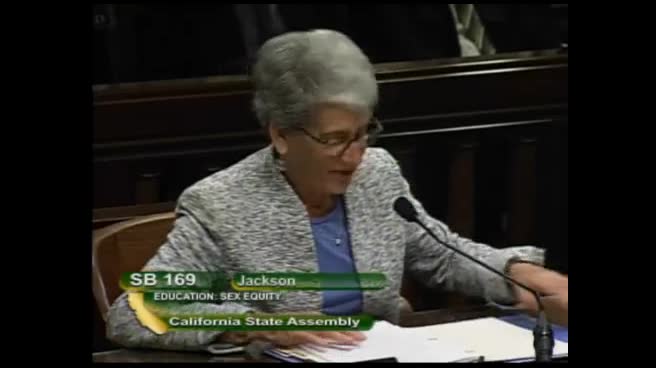 22MIN
Assembly Standing Committee on Judiciary
 6MIN