SB 174: Citizens of the state.
- Session Year: 2017-2018
- House: Senate
- Latest Version Date: 2018-08-28
Existing law provides that citizens of the state are all persons born in the state and residing in it, except the children of transient aliens and of alien public ministers and consuls, and all persons born out of the state who are citizens of the United States and residing within the state.
This bill would instead provide that citizens of the state are all persons born in the state and residing in it, except the children of alien public ministers and consuls, and all persons born out of the state who are citizens of the United States and residing within the state.
Existing law prohibits a person from holding a civil office if, at the time of election or appointment, the person is not 18 years of age and a citizen of the state, as defined.
This bill would instead provide that a person is eligible to hold an elective civil office if, at the time of election, the person is 18 years of age and a citizen of the state. The bill would also provide that a person, regardless of citizenship or immigration status, is eligible to hold an appointed civil office if the person is 18 years of age and a resident of the state. The bill would provide that a person appointed to civil office, regardless of citizenship or immigration status, may receive any form of compensation that the person is not otherwise prohibited from receiving pursuant to federal law, including, but not limited to, any stipend, grant, or reimbursement of personal expenses that is associated with carrying out the duties of that office.
Existing law provides that citizens of the state are all persons born in the state and residing in it, except the children of transient aliens and of alien public ministers and consuls, and all persons born out of the state who are citizens of the United States and residing within the state.
This bill would instead provide that citizens of the state are all persons born in the state and residing in it it, except the children of alien public ministers and consuls, and all persons born out of the state who are citizens of the United States and residing within the state.
Existing law prohibits a person from holding a civil office if, at the time of election or appointment, the person is not 18 years of age and a citizen of the state, as defined.
This bill would instead provide that a person is eligible to hold an elective civil office if, at the time of election, the person is 18 years of age and a citizen of the state. The bill would also provide that a person, regardless of citizenship or immigration status, is eligible to hold an appointed civil office if the person is 18 years of age and a resident of the state. The bill would provide that a person appointed to civil office, regardless of citizenship or immigration status, may receive any form of compensation that the person is not otherwise prohibited from receiving pursuant to federal law, including, but not limited to, any stipend, grant, or reimbursement of personal expenses that is associated with carrying out the duties of that office.
Existing law provides that citizens of the state are all persons born in the state and residing in it, except the children of transient aliens and of alien public ministers and consuls, and all persons born out of the state who are citizens of the United States and residing within the state.
This bill would instead provide that citizens of the state are all persons born in the state and residing in it and all persons born out of the state who are citizens of the United States and residing within the state.
Existing law prohibits a person from holding a civil office if, at the time of election or appointment, the person is not 18 years of age and a citizen of the state, as defined.
This bill would instead provide that a person is eligible to hold an elective civil office if, at the time of election, the person is 18 years of age and a citizen of the state. The bill would also provide that a person, regardless of citizenship or immigration status, is eligible to hold an appointed civil office if the person is 18 years of age and a resident of the state. The bill would provide that a person appointed to civil office, regardless of citizenship or immigration status, may receive any form of compensation that the person is not otherwise prohibited from receiving pursuant to federal law, including, but not limited to, any stipend, grant, or reimbursement of personal expenses that is associated with carrying out the duties of that office.
Existing law establishes the Public Utilities Commission and vests the commission with regulatory jurisdiction and authority over public utilities, including electrical corporations. Existing law places various responsibilities upon the commission to ensure that public utility services are provided in a manner that protects the public safety and the safety of utility employees.This bill would appropriate moneys resulting from a settlement agreement between Southern California Edison Company and the commission for power outages that occurred in the City of Long Beach in the summer of 2015 to the City of Long Beach for certain public infrastructure projects located in, or benefitting, areas affected by the outages.This bill would make legislative findings and declarations as to the necessity of a special statute for the City of Long Beach.This bill would declare that it is to take effect immediately as an urgency statute.Existing law establishes the Public Utilities Commission and vests the commission with regulatory jurisdiction and authority over public utilities, including electrical corporations. Existing law places various responsibilities upon the commission to ensure that public utility services are provided in a manner that protects the public safety and the safety of utility employees.
This bill would appropriate moneys resulting from a settlement agreement between Southern California Edison Company and the commission for power outages that occurred in the City of Long Beach in the summer of 2015 to the City of Long Beach for certain public infrastructure projects located in, or benefitting, areas affected by the outages.
This bill would make legislative findings and declarations as to the necessity of a special statute for the City of Long Beach.
This bill would declare that it is to take effect immediately as an urgency statute.
Existing law prohibits a person from driving, moving, or leaving standing upon a highway any motor vehicle, as defined, that has been registered in violation of provisions regulating vehicle emissions.This bill, effective January 1, 2020, would require the Department of Motor Vehicles to confirm, prior to the initial registration or the transfer of ownership and registration of a diesel-fueled vehicle with a gross vehicle weight rating of more than 14,000 pounds, that the vehicle is compliant with, or exempt from, applicable air pollution control technology requirements, pursuant to specified provisions. The bill would require the department to refuse registration, or renewal or transfer of registration, for certain diesel-fueled vehicles, based on weight and model year, that are subject to specified provisions relating to the reduction of emissions of diesel particulate matter, oxides of nitrogen, and other criteria pollutants from in-use diesel-fueled vehicles. The bill would authorize the department to allow registration, or renewal or transfer of registration, for any diesel-fueled vehicle that has been reported to the State Air Resources Board, and is using an approved exemption, or is compliant with applicable air pollution control technology requirements, pursuant to specified provisions.Existing law authorizes the department, in its discretion, to issue a temporary permit to operate a vehicle when a payment of fees has been accepted in an amount to be determined by the department and paid to the department by the owner or other person in lawful possession of the vehicle.This bill would additionally authorize the department to issue a temporary permit to operate a vehicle for which registration is otherwise required to be refused under the provisions of the bill, as prescribed. The bill would specify that only one temporary permit may be issued for a vehicle pursuant to these provisions unless the State Air Resources Board approves otherwise.Existing law prohibits a person from driving, moving, or leaving standing upon a highway any motor vehicle, as defined, that has been registered in violation of provisions regulating vehicle emissions.
This bill, effective January 1, 2020, would require the Department of Motor Vehicles to confirm, prior to the initial registration or the transfer of ownership and registration of a diesel-fueled vehicle with a gross vehicle weight rating of more than 14,000 pounds, that the vehicle is compliant with, or exempt from, applicable air pollution control technology requirements, pursuant to specified provisions. The bill would require the department to refuse registration, or renewal or transfer of registration, for certain diesel-fueled vehicles, based on weight and model year, that are subject to specified provisions relating to the reduction of emissions of diesel particulate matter, oxides of nitrogen, and other criteria pollutants from in-use diesel-fueled vehicles. The bill would authorize the department to allow registration, or renewal or transfer of registration, for any diesel-fueled vehicle that has been reported to the State Air Resources Board, and is using an approved exemption, or is compliant with applicable air pollution control technology requirements, pursuant to specified provisions.
Existing law authorizes the department, in its discretion, to issue a temporary permit to operate a vehicle when a payment of fees has been accepted in an amount to be determined by the department and paid to the department by the owner or other person in lawful possession of the vehicle.
This bill would additionally authorize the department to issue a temporary permit to operate a vehicle for which registration is otherwise required to be refused under the provisions of the bill, as prescribed. The bill would specify that only one temporary permit may be issued for a vehicle pursuant to these provisions unless the State Air Resources Board approves otherwise.
Existing law prohibits a person from driving, moving, or leaving standing upon a highway any motor vehicle, as defined, that has been registered in violation of provisions regulating vehicle emissions.
This bill, effective January 1, 2020, would require the Department of Motor Vehicles to confirm, prior to the initial registration or the transfer of ownership and registration of a diesel-fueled vehicle with a gross vehicle weight rating of more than 14,000 pounds, that the vehicle is compliant with, or exempt from, applicable air pollution control technology requirements, pursuant to specified provisions. The bill would require the department to refuse registration, or renewal or transfer of registration, for certain diesel-fueled vehicles, based on weight and model year, that are subject to specified provisions relating to the reduction of emissions of diesel particulate matter, oxides of nitrogen, and other criteria pollutants from in-use diesel-fueled vehicles. The bill would authorize the department to allow registration, or renewal or transfer of registration, for any diesel-fueled vehicle that has been reported to the State Air Resources Board, and is using an approved exemption, or is compliant with applicable air pollution control technology requirements, pursuant to specified provisions.
Existing law authorizes the department, in its discretion, to issue a temporary permit to operate a vehicle when a payment of fees has been accepted in an amount to be determined by the department and paid to the department by the owner or other person in lawful possession of the vehicle.
This bill would additionally authorize the department to issue a temporary permit to operate a vehicle for which registration is otherwise required be refused under the provisions of the bill, as prescribed.
The Legislature finds and declares all of the following:
(a)The State of California is the largest and most diverse state in the nation, with a total population of almost 40 million people, and a total immigrant population of about 10 million people from over 60 different countries.
(b)California prides itself on its great racial, ethnic, and cultural diversity, and acknowledges that diverse backgrounds benefit the state through providing a diversity of experiences and expertise, and this diversity is especially beneficial in creating public policy that supports and protects all people.
(c)California has made great strides in integrating our immigrant population in all aspects, including passing laws that authorize health care for all children, professional licenses, drivers licenses, college grants, loans, and in-state tuition for eligible residents, regardless of their immigration status.
(d)Californians are served by numerous local and state boards and commissions that, together, cover a broad range of issues and policy topics and oversee many of the programs and services provided by the state, and these boards and commissions are comprised of highly experienced, qualified individuals with a desire to uphold the values and advance the work of the institutions they serve.
(e)Californias democratic values of equal representation are upheld when our local and state government is diverse and representative of the people who reside in the state, and access to positions on governmental boards and commissions creates an avenue for people from multiple backgrounds and different experiences to serve the communities in which they live and beyond.
(f)It is the intent of the Legislature to remove barriers to service and authorize all California residents, including those without lawful immigration status, to serve on Californias diverse local and state boards and commissions so that their perspectives and voices are heard.
SEC. 2.Section 241 of the Government Code is amended to read:241.The citizens of the state are:
(a)All persons born in the state and residing within it, except the children of alien public ministers and consuls.
(b)All persons born out of the state who are citizens of the United States and residing within the state.
SEC. 3.Section 1020 of the Government Code is amended to read:1020.(a)A person is eligible to hold an elective civil office if, at the time of election, the person is 18 years of age and a citizen of the state.
(b)Notwithstanding any other law, a person, regardless of citizenship or immigration status, is eligible to hold an appointed civil office if the person is 18 years of age and a resident of the state.
(c)Notwithstanding any other law, a person appointed to civil office, regardless of citizenship or immigration status, may receive any form of compensation that the person is not otherwise prohibited from receiving pursuant to federal law, including, but not limited to, any stipend, grant, or reimbursement of personal expenses that is associated with carrying out the duties of that office.
The Legislature finds and declares all of the following:
(a)The State of California is the largest and most diverse state in the nation, with a total population of almost 40 million people, and a total immigrant population of about 10 million people from over 60 different countries.
(b)California prides itself on its great racial, ethnic, and cultural diversity, and acknowledges that diverse backgrounds benefit the state through providing a diversity of experiences and expertise, and this diversity is especially beneficial in creating public policy that supports and protects all people.
(c)California has made great strides in integrating our immigrant population in all aspects, including passing laws that authorize health care for all children, professional licenses, drivers licenses, college grants, loans, and in-state tuition for eligible residents, regardless of their immigration status.
(d)Californians are served by numerous local and state boards and commissions that, together, cover a broad range of issues and policy topics and oversee many of the programs and services provided by the state, and these boards and commissions are comprised of highly experienced, qualified individuals with a desire to uphold the values and advance the work of the institutions they serve.
(e)Californias democratic values of equal representation are upheld when our local and state government is diverse and representative of the people who reside in the state, and access to positions on governmental boards and commissions creates an avenue for people from multiple backgrounds and different experiences to serve the communities in which they live and beyond.
(f)It is the intent of the Legislature to remove barriers to service and authorize all California residents, including those without lawful immigration status, to serve on Californias diverse local and state boards and commissions so that their perspectives and voices are heard.
SEC. 2.Section 241 of the Government Code is amended to read:241.The citizens of the state are:
(a)All persons born in the state and residing within it. it, except the children of alien public ministers and consuls.
(b)All persons born out of the state who are citizens of the United States and residing within the state.
SEC. 3.Section 1020 of the Government Code is amended to read:1020.(a)A person is eligible to hold an elective civil office if, at the time of election, the person is 18 years of age and a citizen of the state.
(b)A Notwithstanding any other law, a person, regardless of citizenship or immigration status, is eligible to hold an appointed civil office if the person is 18 years of age and a resident of the state.
(c)A Notwithstanding any other law, a person appointed to civil office, regardless of citizenship or immigration status, may receive any form of compensation that the person is not otherwise prohibited from receiving pursuant to federal law, including, but not limited to, any stipend, grant, or reimbursement of personal expenses that is associated with carrying out the duties of that office.
The Legislature finds and declares all of the following:
(a)The State of California is the largest and most diverse state in the nation, with a total population of almost 40 million people, and a total immigrant population of about 10 million people from over 60 different countries.
(b)California prides itself on its great racial, ethnic, and cultural diversity, and acknowledges that diverse backgrounds benefit the state through providing a diversity of experiences and expertise, and this diversity is especially beneficial in creating public policy that supports and protects all people.
(c)California has made great strides in integrating our immigrant population in all aspects, including passing laws that authorize health care for all children, professional licenses, drivers licenses, college grants, loans, and in-state tuition for eligible residents, regardless of their immigration status.
(d)Californians are served by numerous local and state boards and commissions that, together, cover a broad range of issues and policy topics and oversee many of the programs and services provided by the state, and these boards and commissions are comprised of highly experienced, qualified individuals with a desire to uphold the values and advance the work of the institutions they serve.
(e)Californias democratic values of equal representation are upheld when our local and state government is diverse and representative of the people who reside in the state, and access to positions on governmental boards and commissions creates an avenue for people from multiple backgrounds and different experiences to serve the communities in which they live and beyond.
(f)It is the intent of the Legislature to remove barriers to service and authorize all California residents, including those without lawful immigration status, to serve on Californias diverse local and state boards and commissions so that their perspectives and voices are heard.
SEC. 2.Section 241 of the Government Code is amended to read:241.The citizens of the State state are:
(a)All persons born in the State state and residing within it, except the children of transient aliens and of alien public ministers and consuls. it.
(b)All persons born out of the State state who are citizens of the United States and residing within the State. state.
SEC. 3.Section 1020 of the Government Code is amended to read:1020.(a)A person is incapable of holding a eligible to hold an elective civil office if if, at the time of his election or appointment he is not election, the person is 18 years of age and age and a citizen of the state.
(b)A person, regardless of citizenship or immigration status, is eligible to hold an appointed civil office if the person is 18 years of age and a resident of the state.
(c)A person appointed to civil office, regardless of citizenship or immigration status, may receive any form of compensation that the person is not otherwise prohibited from receiving pursuant to federal law, including, but not limited to, any stipend, grant, or reimbursement of personal expenses that is associated with carrying out the duties of that office.
SECTION 1.Moneys received by the Public Utilities Commission pursuant to the Settlement Agreement Between Southern California Edison Company and the Safety and Enforcement Division of the California Public Utilities Commission Resolving Order Instituting Investigation I. 16-07-007 are hereby appropriated to the City of Long Beach to be expended for public infrastructure projects that reduce the emissions of greenhouse gases or promote energy efficiency and that are located in, or benefitting, the areas affected by Southern California Edison Companys power outages in the City of Long Beach on July 15 to July 20, 2015 and on July 20 to August 3, 2015.SEC. 2.The Legislature finds and declares that a special statute is necessary and that a general statute cannot be made applicable within the meaning of Section 16 of Article IV of the California Constitution because of the unique circumstances in the City of Long Beach and the effects of the power outages of the summer of 2015.SEC. 3.This act is an urgency statute necessary for the immediate preservation of the public peace, health, or safety within the meaning of Article IV of the California Constitution and shall go into immediate effect. The facts constituting the necessity are:To ensure proceedings from the settlement agreement between Southern California Edison Company and the Public Utilities Commission for the power outages occurring in the summer of 2015 are provided to the City of Long Beach for public infrastructure projects located in, or benefitting, areas affected by the outage in an expeditious manner, it is necessary for this measure to take effect immediately.Moneys received by the Public Utilities Commission pursuant to the Settlement Agreement Between Southern California Edison Company and the Safety and Enforcement Division of the California Public Utilities Commission Resolving Order Instituting Investigation I. 16-07-007 are hereby appropriated to the City of Long Beach to be expended for public infrastructure projects that reduce the emissions of greenhouse gases or promote energy efficiency and that are located in, or benefitting, the areas affected by Southern California Edison Companys power outages in the City of Long Beach on July 15 to July 20, 2015 and on July 20 to August 3, 2015.
SEC. 2.The Legislature finds and declares that a special statute is necessary and that a general statute cannot be made applicable within the meaning of Section 16 of Article IV of the California Constitution because of the unique circumstances in the City of Long Beach and the effects of the power outages of the summer of 2015.
SEC. 3.This act is an urgency statute necessary for the immediate preservation of the public peace, health, or safety within the meaning of Article IV of the California Constitution and shall go into immediate effect. The facts constituting the necessity are:
To ensure proceedings from the settlement agreement between Southern California Edison Company and the Public Utilities Commission for the power outages occurring in the summer of 2015 are provided to the City of Long Beach for public infrastructure projects located in, or benefitting, areas affected by the outage in an expeditious manner, it is necessary for this measure to take effect immediately.
SECTION 1.Section 4000.15 is added to the Vehicle Code, to read:4000.15.(a)Effective January 1, 2020, the department shall confirm, prior to the initial registration or the transfer of ownership and registration of a diesel-fueled vehicle with a gross vehicle weight rating of more than 14,000 pounds, that the vehicle is compliant with, or exempt from, applicable air pollution control technology requirements pursuant to Division 26 (commencing with Section 39000) of the Health and Safety Code and regulations of the State Air Resources Board adopted pursuant to that division.(b)Except as otherwise provided in subdivision (c), for diesel-fueled vehicles subject to Section 43018 of the Health and Safety Code, as applied to the reduction of emissions of diesel particulate matter, oxides of nitrogen, and other criteria pollutants from in-use diesel-fueled vehicles, and Section 2025 of Title 13 of the California Code of Regulations as of January 1, 2017, or as subsequently amended:(1)The department shall refuse registration, or renewal or transfer of registration, for a diesel-fueled vehicle with a gross vehicle weight rating of 14,001 pounds to 26,000 pounds for the following vehicle model years:(A) Effective January 1, 2020, vehicle model years 2004 and older.(B) Effective January 1, 2021, vehicle model years 2007 and older.(C) Effective January 1, 2023, vehicle model years 2010 and older.(2)The department shall refuse registration, or renewal or transfer of registration, for a diesel-fueled vehicle with a gross vehicle weight rating of more than 26,000 pounds for the following vehicle model years:(A) Effective January 1, 2020, vehicle model years 2000 and older.(B) Effective January 1, 2021, vehicle model years 2005 and older.(C) Effective January 1, 2022, vehicle model years 2007 and older.(D) Effective January 1, 2023, vehicle model years 2010 and older.(c)(1) As determined by the State Air Resources Board, notwithstanding effective dates and vehicle model years identified in subdivision (b), the department may allow registration, or renewal or transfer of registration, for a diesel-fueled vehicle that has been reported to the State Air Resources Board, and is using an approved exemption, or is compliant with applicable air pollution control technology requirements pursuant to Division 26 (commencing with Section 39000) of the Health and Safety Code and regulations of the State Air Resources Board adopted pursuant to that division, using an approved compliance option, such as being equipped with the required model year emissions equivalent engine.(2)The State Air Resources Board shall notify the department of the vehicles allowed to be registered pursuant to this subdivision. SEC. 2.Section 4156 of the Vehicle Code is amended to read:4156.(a)Notwithstanding any other provision of this code, and except as provided in subdivision (b), the department in its discretion may issue a temporary permit to operate a vehicle when a payment of fees has been accepted in an amount to be determined by, and paid to the department, by the owner or other person in lawful possession of the vehicle. The permit shall be subject to the terms and conditions, and shall be valid for the period of time, that the department shall deem appropriate under the circumstances.(b)(1)The department shall not issue a temporary permit pursuant to subdivision (a) to operate a vehicle for which a certificate of compliance is required pursuant to Section 4000.3, and for which that certificate of compliance has not been issued, unless the department is presented with sufficient evidence, as determined by the department, that the vehicle has failed its most recent smog check inspection.(2) Only one temporary permit may be issued pursuant to this subdivision to a vehicle owner in a two-year period.(3)A temporary permit issued pursuant to paragraph (1) is valid for either 60 days after the expiration of the registration of the vehicle or 60 days after the date that vehicle is removed from nonoperation, whichever is applicable at the time that the temporary permit is issued.(4)A temporary permit issued pursuant to paragraph (1) is subject to Section 9257.5.(c)(1) The department may issue a temporary permit pursuant to subdivision (a) to operate a vehicle for which registration may be refused pursuant to Section 4000.15.(2)Only one temporary permit may be issued pursuant to this subdivision for any vehicle, unless otherwise approved by the State Air Resources Board.(3)A temporary permit issued pursuant to paragraph (1) is valid for either 90 days after the expiration of the registration of the vehicle or 90 days after the date that vehicle is removed from nonoperation, whichever is applicable at the time the temporary permit is issued.(4)A temporary permit issued pursuant to paragraph (1) is subject to Section 9257.5.(a)Effective January 1, 2020, the department shall confirm, prior to the initial registration or the transfer of ownership and registration of a diesel-fueled vehicle with a gross vehicle weight rating of more than 14,000 pounds, that the vehicle is compliant with, or exempt from, applicable air pollution control technology requirements pursuant to Division 26 (commencing with Section 39000) of the Health and Safety Code and regulations of the State Air Resources Board adopted pursuant to that division.
(b)Except as otherwise provided in subdivision (c), for diesel-fueled vehicles subject to Section 43018 of the Health and Safety Code, as applied to the reduction of emissions of diesel particulate matter, oxides of nitrogen, and other criteria pollutants from in-use diesel-fueled vehicles, and Section 2025 of Title 13 of the California Code of Regulations as if of January 1, 2017, or as subsequently amended:
(1)The department shall refuse registration, or renewal or transfer of registration, for a diesel-fueled vehicle with a gross vehicle weight rating of 14,001 pounds to 26,000 pounds for the following vehicle model years:
(A) Effective January 1, 2020, vehicle model years 2004 and older.
(B) Effective January 1, 2021, vehicle model years 2007 and older.
(C) Effective January 1, 2023, vehicle model years 2010 and older.
(2)The department shall refuse registration, or renewal or transfer of registration, for a diesel-fueled vehicle with a gross vehicle weight rating of more than 26,000 pounds for the following vehicle model years:
(A) Effective January 1, 2020, vehicle model years 2000 and older.
(B) Effective January 1, 2021, vehicle model years 2005 and older.
(C) Effective January 1, 2022, vehicle model years 2007 and older.
(D) Effective January 1, 2023, vehicle model years 2010 and older.
(c)(1) As determined by the State Air Resources Board, notwithstanding effective dates and vehicle model years identified in subdivision (b), the department may allow registration, or renewal or transfer of registration, for a diesel-fueled vehicle that has been reported to the State Air Resources Board, and is using an approved exemption, or is compliant with applicable air pollution control technology requirements pursuant to Division 26 (commencing with Section 39000) of the Health and Safety Code and regulations of the State Air Resources Board adopted pursuant to that division, using an approved compliance option. option, such as being equipped with the required model year emissions equivalent engine.
(2)The State Air Resources Board shall notify the department of the vehicles allowed to be registered pursuant to this subdivision.
SEC. 2.Section 4156 of the Vehicle Code is amended to read:4156.(a)Notwithstanding any other provision of this code, and except as provided in subdivision (b), the department in its discretion may issue a temporary permit to operate a vehicle when a payment of fees has been accepted in an amount to be determined by, and paid to the department, by the owner or other person in lawful possession of the vehicle. The permit shall be subject to the terms and conditions, and shall be valid for the period of time, that the department shall deem appropriate under the circumstances.
(b)(1)The department shall not issue a temporary permit pursuant to subdivision (a) to operate a vehicle for which a certificate of compliance is required pursuant to Section 4000.3, and for which that certificate of compliance has not been issued, unless the department is presented with sufficient evidence, as determined by the department, that the vehicle has failed its most recent smog check inspection.
(2) Only one temporary permit may be issued pursuant to this subdivision to a vehicle owner in a two-year period.
(3)A temporary permit issued pursuant to paragraph (1) is valid for either 60 days after the expiration of the registration of the vehicle or 60 days after the date that vehicle is removed from nonoperation, whichever is applicable at the time that the temporary permit is issued.
(4)A temporary permit issued pursuant to paragraph (1) is subject to Section 9257.5.
(c)(1) The department may issue a temporary permit pursuant to subdivision (a) to operate a vehicle for which registration may be refused pursuant to Section 4000.15.
(2)Only one temporary permit may be issued pursuant to this subdivision for any vehicle. vehicle, unless otherwise approved by the State Air Resources Board.
(3)A temporary permit issued pursuant to paragraph (1) is valid for either 90 days after the expiration of the registration of the vehicle or 90 days after the date that vehicle is removed from nonoperation, whichever is applicable at the time the temporary permit is issued.
(4)A temporary permit issued pursuant to paragraph (1) is subject to Section 9257.5.
(a)Effective January 1, 2020, the department shall confirm, prior to the initial registration or the transfer of ownership and registration of a diesel-fueled vehicle with a gross vehicle weight rating of more than 14,000 pounds, that the vehicle is compliant with, or exempt from, applicable air pollution control technology requirements pursuant to Division 26 (commencing with Section 39000) of the Health and Safety Code and regulations of the State Air Resources Board adopted pursuant to that division.
(b)Except as otherwise provided in subdivision (c), for diesel-fueled vehicles subject to Section 43018 of the Health and Safety Code, as applied to the reduction of emissions of diesel particulate matter, oxides of nitrogen, and other criteria pollutants from in-use diesel-fueled vehicles, and Section 2025 of Title 13 of the California Code of Regulations as if January 1, 2017, or as subsequently amended:
(1)The department shall refuse registration, or renewal or transfer of registration, for a diesel-fueled vehicle with a gross vehicle weight rating of 14,001 pounds to 26,000 pounds for the following vehicle model years:
(A) Effective January 1, 2020, vehicle model years 2004 and older.
(B) Effective January 1, 2021, vehicle model years 2007 and older.
(C) Effective January 1, 2023, vehicle model years 2010 and older.
(2)The department shall refuse registration, or renewal or transfer of registration, for a diesel-fueled vehicle with a gross vehicle weight rating of more than 26,000 pounds for the following vehicle model years:
(A) Effective January 1, 2020, vehicle model years 2000 and older.
(B) Effective January 1, 2021, vehicle model years 2005 and older.
(C) Effective January 1, 2022, vehicle model years 2007 and older.
(D) Effective January 1, 2023, vehicle model years 2010 and older.
(c)(1) As determined by the State Air Resources Board, notwithstanding effective dates and vehicle model years identified in subdivision (b), the department may allow registration, or renewal or transfer of registration, for a diesel-fueled vehicle that has been reported to the State Air Resources Board, and is using an approved exemption, or is compliant with applicable air pollution control technology requirements pursuant to Division 26 (commencing with Section 39000) of the Health and Safety Code and regulations of the State Air Resources Board adopted pursuant to that division, using an approved compliance option.
(2)The State Air Resources Board shall notify the department of the vehicles allowed to be registered pursuant to this subdivision.
SEC. 2.Section 4156 of the Vehicle Code is amended to read:4156.(a)Notwithstanding any other provision of this code, and except as provided in subdivision (b), the department in its discretion may issue a temporary permit to operate a vehicle when a payment of fees has been accepted in an amount to be determined by, and paid to the department, by the owner or other person in lawful possession of the vehicle. The permit shall be subject to the terms and conditions, and shall be valid for the period of time, that the department shall deem appropriate under the circumstances.
(b)(1)The department shall not issue a temporary permit pursuant to subdivision (a) to operate a vehicle for which a certificate of compliance is required pursuant to Section 4000.3, and for which that certificate of compliance has not been issued, unless the department is presented with sufficient evidence, as determined by the department, that the vehicle has failed its most recent smog check inspection.
(2)Not more than Only one temporary permit may be issued pursuant to this subdivision to a vehicle owner in a two-year period.
(3)A temporary permit issued pursuant to paragraph (1) is valid for either 60 days after the expiration of the registration of the vehicle or 60 days after the date that vehicle is removed from nonoperation, whichever is applicable at the time that the temporary permit is issued.
(4)A temporary permit issued pursuant to paragraph (1) is subject to Section 9257.5.
(c)(1) The department may issue a temporary permit pursuant to subdivision (a) to operate a vehicle for which registration may be refused pursuant to Section 4000.15.
(2)Only one temporary permit may be issued pursuant to this subdivision for any vehicle.
(3)A temporary permit issued pursuant to paragraph (1) is valid for either 90 days after the expiration of the registration of the vehicle or 90 days after the date that vehicle is removed from nonoperation, whichever is applicable at the time the temporary permit is issued.
(4)A temporary permit issued pursuant to paragraph (1) is subject to Section 9257.5.
|
Date
|
Status
|
|---|---|
| Sep 27, 2018 | In Senate. Consideration of Governor's veto pending. |
| Sep 27, 2018 | Vetoed by the Governor. |
| Aug 30, 2018 | Enrolled and presented to the Governor at 5 p.m. |
| Aug 24, 2018 | Assembly amendments concurred in. (Ayes 26. Noes 11.) Ordered to engrossing and enrolling. |
| Aug 23, 2018 | From committee: That the Assembly amendments be concurred in. (Ayes 5. Noes 2.) |
| Aug 22, 2018 | Set for hearing August 23. |
| Aug 21, 2018 | From committee: Be re-referred to Com. on JUD. pursuant to Senate Rule 29.10(d). (Ayes 5. Noes 0.) Re-referred to Com. on JUD. |
| Aug 21, 2018 | Re-referred to Com. on RLS. pursuant to Senate Rule 29.10(d). |
| Aug 21, 2018 | In Senate. Concurrence in Assembly amendments pending. |
| Aug 20, 2018 | Read third time. Passed. Ordered to the Senate. |
| Aug 6, 2018 | Read second time. Ordered to third reading. |
| Jul 5, 2018 | Read second time and amended. Ordered to second reading. |
| Jul 3, 2018 | From committee: Do pass as amended. (Ayes 7. Noes 2.) (July 3). |
| Jun 14, 2018 | From committee: Be re-referred to Com. on JUD. (Ayes 7. Noes 0.) (June 14). Re-referred to Com. on JUD. |
| May 7, 2018 | Re-referred to Com. on RLS. pursuant to Assembly Rule 96. |
| Apr 30, 2018 | From committee with author's amendments. Read second time and amended. Re-referred to Com. on U. & E. |
| Aug 28, 2017 | Referred to Com. on U. & E. |
| Aug 24, 2017 | In Assembly. Read first time. Held at Desk. |
| Aug 24, 2017 | Read third time. Urgency clause adopted. Passed. (Ayes 36. Noes 0.) Ordered to the Assembly. |
| Aug 22, 2017 | Read second time. Ordered to third reading. |
| Aug 21, 2017 | From committee: Do pass. (Ayes 7. Noes 0.) (August 21). |
| Jul 20, 2017 | Set for hearing August 21. |
| Jul 18, 2017 | From committee: Do pass and re-refer to Com. on APPR. (Ayes 10. Noes 1.) (July 18). Re-referred to Com. on APPR. |
| Jul 12, 2017 | Set for hearing July 18 in E., U. & C. pending receipt. |
| Jul 11, 2017 | Withdrawn from committee. |
| Jul 10, 2017 | From committee with author's amendments. Read second time and amended. Re-referred to Com. on EQ. |
| Apr 13, 2017 | April 19 set for first hearing canceled at the request of author. |
| Mar 31, 2017 | Set for hearing April 19. |
| Mar 29, 2017 | Read second time and amended. Re-referred to Com. on EQ. |
| Mar 28, 2017 | From committee: Do pass as amended and re-refer to Com. on EQ. (Ayes 8. Noes 0.) (March 28). |
| Mar 14, 2017 | Set for hearing March 28. |
| Feb 2, 2017 | Referred to Coms. on T. & H. and EQ. |
| Jan 24, 2017 | From printer. May be acted upon on or after February 23. |
| Jan 23, 2017 | Introduced. Read first time. To Com. on RLS. for assignment. To print. |
|
Date
|
Description
|
Location
|
Votes
|
|
|---|---|---|---|---|
| Aug 24, 2018 | Unfinished Business SB174 Lara et al. Concurrence | Senate Floor |
Passed |
|
| Aug 23, 2018 | That the Assembly amendments be concurred in | Senate Standing Committee on Judiciary |
Passed |
|
| Aug 20, 2018 | SB 174 Lara Senate Third Reading By GONZALEZ FLETCHER | Assembly Floor |
Passed |
|
| Jul 3, 2018 | Do pass as amended. | Assembly Standing Committee on Judiciary |
Passed |
|
| Jun 14, 2018 | Be re-referred to the Committee on [Judiciary] | Assembly Standing Committee on Rules |
Passed |
|
| Aug 24, 2017 | Senate 3rd Reading SB174 Lara Urgency Clause | Senate Floor |
Passed |
|
| Aug 21, 2017 | Do pass | Senate Standing Committee on Appropriations |
Passed |
|
| Jul 18, 2017 | Do pass, but first be re-referred to the Committee on [Appropriations] | Senate Standing Committee on Energy, Utilities and Communications |
Passed |
|
| Mar 28, 2017 | Do pass as amended, but first amend, and re-refer to the Committee on [Environmental Quality] | Senate Standing Committee on Transportation and Housing |
Passed |
This list shows positions taken on this bill by organizations on the date displayed, which is linked to the original source.
Positions by individuals are not included.
Office of Senate Floor Analyses (916) 651-1520 Fax: (916) 327-4478 | SB 174 |
VETO
Bill No: SB 174
Amended: 7/5/18
PRIOR SENATE VOTES NOT RELEVANT
SENATE JUDICIARY COMMITTEE: 5-2, 8/23/18
AYES: Jackson, Hertzberg, Monning, Stern, Wieckowski
NOES: Moorlach, Anderson
SENATE FLOOR: 26-11, 8/24/18
AYES: Allen, Atkins, Beall, Bradford, De León, Delgado, Dodd, Galgiani, Glazer, Hernandez, Hertzberg, Hill, Hueso, Jackson, Lara, Leyva, McGuire, Mitchell, Monning, Pan, Portantino, Roth, Skinner, Stern, Wieckowski, Wiener
NOES: Anderson, Bates, Chang, Fuller, Gaines, Moorlach, Morrell, Nielsen, Stone, Vidak, Wilk
NO VOTE RECORDED: Berryhill, Cannella, Nguyen
ASSEMBLY FLOOR: 46-26, 8/20/18 - See last page for vote
SUBJECT: Citizens of the state
DIGEST:
This bill allows all California residents to serve on appointed government boards and commissions, regardless of immigration status. This bill, additionally, eliminates unconstitutional components of the existing statutory definition for California state citizenship.
Existing law:
- Defines the term “citizen” of California to mean:
- all persons born in the State and residing within it, except the children of transient aliens and of alien public ministers and consuls; and
- all persons born out of the State who are citizens of the United States and residing within the state. (Gov. Code Sec. 241.)
- Provides that persons in the state not its citizens are either citizens of other states or aliens. (Gov. Code Sec. 242.)
- Provides that a person is incapable of holding a civil office if at the time of his election or appointment he is not 18 years of age and a citizen of the state. (Gov. Code Sec. 1020.)
- States that California boards and commissions shall be broadly reflective of the general public including ethnic minorities and women. (Gov. Code Secs. 11140 and 11141.)
- Provides that all persons born or naturalized in the United States, and subject to the jurisdiction thereof, are citizens of the United States and of the state wherein they reside. (U.S. Const., Amend. XIV, Sec. 1.)
- Holds that both Congress and the states lack constitutional authority to infringe upon birthright citizenship. (U.S. vs. Wong Kim Ark (1898) 169 U.S. 649.)
This bill:
- Finds and declares, among other things, that:
- California’s democratic values of equal representation are upheld when our local and state government is diverse and representative of the people who reside in the state, and access to positions on governmental boards and commissions creates an avenue for people from multiple backgrounds and different experiences to serve the communities in which they live and beyond; and
- it is the intent of the Legislature to remove barriers to service and authorize all California residents, including those without lawful immigration status, to serve on California’s diverse local and state boards and commissions so that their perspectives and voices are heard.
- Provides that a person is eligible to hold an elective civil office if, at the time of election, the person is 18 years of age and a citizen of the state.
- Makes, notwithstanding any other law, a person eligible to hold an appointed civil office regardless of citizenship or immigration status, if the person is 18 years of age and a resident of the state.
- Authorizes, notwithstanding any other law, a person appointed to civil office, regardless of citizenship or immigration status, to receive any form of compensation that the person is not otherwise prohibited from receiving pursuant to federal law, including, but not limited to, any stipend, grant, or reimbursement of personal expenses that is associated with carrying out the duties of that office.
- Clarifies that the children of transient aliens (i.e. children born in the U.S. to non-citizen parents) are not excluded from the definition of “citizen” under California law, except for children of foreign public ministers and consuls.
Background
Immigrants, both documented and undocumented, constitute an important and integral part of the California community. According to the Public Policy Institute of California, about 10 million immigrants live in California, making up around 27 percent of the state’s total population in 2016. [1] One in four native born Californians is the child of at least one immigrant parent.[2] Immigrants constitute 34 percent of California’s labor force.[3] Businesses owned and operated by immigrants are also an important component of the California economy. According to a 2012 study by the Fiscal Policy Institute, 33 percent of small businesses in California are immigrant-owned, the highest such percentage in the nation.[4]
Recognizing the value of their contribution to our state’s families, community, and economy, the California Legislature has taken affirmative steps over the past decade to ensure that immigrants, whether documented or not, can fully participate in all aspects of California life. For example, because of those changes, Californians do not need a social security number in order to obtain a professional license to provide services as a dentist, contractor, accountant, or any other trade regulated by the California Department of Consumer Affairs. (SB 1159, Lara, Chapter 752, Statutes of 2014.) Similarly, people are free to obtain a license to practice law in California regardless of their immigration status. (AB 1024, Gonzalez, Chapter 573, Statutes of 2013.) Likewise, applicants for a California architect’s license can use an individual taxpayer identification number instead of a social security number. (AB 1822, Berryhill, Chapter 317, Statutes of 2012.)
As part of this trend, a handful of undocumented immigrants to California have recently been appointed to serve on public boards and commissions.[5] In this capacity, these individuals have contributed their talent, expertise, experience, and perspective to carrying out the various functions of these boards and commissions, which include offering specialized technical advice, carrying out the state’s professional licensing and discipline procedures, and providing regulatory oversight and guidance.
Doubt has hung over some of these appointments, however, and in some past instances, immigrants have been excluded from serving altogether.[6] That doubt and exclusion emanates from two aspects of existing California law. First, a number of the statutes establishing California boards and commissions make citizenship a prerequisite for appointment to serve on those boards and commissions.[7] Second, Government Code Section 1020(b) appears to preclude non-citizens from holding civil office in California. As it currently reads, that statute provides that: “[a] person is incapable of holding a civil office if at the time of his election or appointment he is not 18 years of age and a citizen of the state.”
As a legal matter, these laws may well be unconstitutional. (See Comment 3, below, for more detailed discussion.) As a policy matter, they deprive California of the talent, experience, knowledge, and perspective that immigrants could otherwise contribute through service on appointed boards and commissions, while rendering those boards and commissions less representative of the California public they are intended to serve.
This bill overrides all citizenship requirements for holding appointed civil office in California, thus allowing all California residents to serve appointments to public boards and commissions, regardless of citizenship status. Citizenship would still be required for a person to serve on an elected board or commission.
In addition, this bill eliminates a provision in existing law which precludes children born in California to “transient aliens” from state citizenship. Because the 14th Amendment to the United States’ Constitution explicitly confers state citizenship based on place of birth, the existing provision is likely unconstitutional in any event.
Comments
Existing preclusion of immigrants from appointment to civil office may be unconstitutional. Existing California law requires any “civil office” holder to be a “citizen of the state.” (Gov. Code Sec. 1020.) To be a citizen of the State of California, one must be a U.S. citizen. (Gov. Code Sec. 241 [citizens of the state are all those either born in the state and residing in California and all U.S. citizens born outside of California who now reside here]). Thus, in effect, to be appointed and serve as a member of a board or commission in California, one must be a U.S. citizen. In addition, a number of laws make citizenship a prerequisite for serving on certain boards and commissions, as previously noted. (See footnote 6, above.)
There are strong reasons to conclude that this blanket preclusion of non-citizens from serving in civil offices is unconstitutional. The Equal Protection clauses of both the U.S. and California constitutions extend to permanent resident aliens. (In Re Griffiths (1973) 413 U.S. 717, 721; Purdy and Fitzpatrick v. State of California (1969) 71 Cal.2d 566, 578-579.) In general, therefore, to justify a legal classification that discriminates between citizens and non-citizens, therefore, the government must establish that the classification relates to a compelling government interest and is narrowly tailored to accomplish it. In short, such a statute is ordinarily subject to strict judicial scrutiny. However, the U.S. Supreme Court has ruled that, under the federal Equal Protection Clause, citizenship requirements are subject to a lesser standard when they relate to government positions that “participate directly in the formulation, execution, or review of broad public policy.” (Sugarman v. Dougall (1972) 413 U.S. 634, 647.)[8]
Applying this standard to Government Code Section 1020, the California Attorney General has concluded that the statute is unconstitutionally overbroad, since it prohibits non-citizens from holding any civil office, regardless of the degree to which the position participates in the formulation, execution, or review of broad public policy. (61 Ops. Cal. Atty. Gen. 528.)
By authorizing all California residents to serve in appointed civil offices, regardless of citizenship or immigration status, this bill would remove the cloud of constitutional doubt from over Government Code Section 1020 and the many provisions in California law that currently restrict appointment to boards and commissions to citizens alone.
Considerations relating to compensation. Under federal law, it is unlawful for a person or entity to hire an undocumented immigrant for employment. (8 U.S.C. Sec. 1324(a).) In a handful of cases, the members of California boards or commissions are not only appointed to that position; they are also employed in that capacity.[9] Because state law cannot supersede federal law, while this bill authorizes undocumented immigrants to serve as appointed members of public boards and commissions, it could not authorize employment as an element of that appointment.
In most instances, however, board members and commissioners serve in a voluntary capacity and receive, at most, reimbursement for their associated travel costs and per diem. Federal law authorizes states to make undocumented immigrants eligible for any state or local public benefit to which they would otherwise be eligible, so long as state law affirmatively provides for such eligibility. (8 U.S.C. Sec. 1621(d).) So as to avoid any possible conflict with federal law while still facilitating the ability of undocumented individuals to participate on California boards and commission to the maximum extent possible, this bill clarifies that board members and commissioners may receive any form of compensation that federal law does not otherwise prohibit. Thus, undocumented appointees should be able to receive the full panoply of benefits associated with any given appointment, short of employment.
FISCAL EFFECT: Appropriation: No Fiscal Com.: No Local: No
American Civil Liberties Union of California
Asian Americans Advancing Justice
California Immigrant Policy Center
Centro Legal de la Raza
Independent California
Public Advocates
OPPOSITION: (Verified 10/8/18)
City of West Covina
We the People Rising
12 individuals
ARGUMENTS IN SUPPORT: According to the author:
California’s democratic values of equal representation are upheld when our local and state government is diverse and representative of the people who reside in the state, and access to boards and commissions creates an avenue for people from multiple backgrounds to serve the communities in which they live, and beyond.
SB 174 will ensure that the largest and most diverse state in the nation upholds the values of democracy and expands access to boards and commissions to all qualified Californians, including undocumented immigrants. This bill also removes a code section previously found unconstitutional that has no place in our law. We cannot continue to let these outdated, discriminatory laws dictate how we run our state, and who gets a say in the decisions that impact all Californians.
In support of the bill, the American Civil Liberties Union of California writes:
Californians are served by numerous local and state boards and commissions that, together, cover a broad range of issues and policy topics and oversee many of the programs and services provided by the state. Currently, only someone who is both 18 years old and a citizen of the state can serve in a civil office, including California’s numerous boards and commissions. However, the laws that currently decide who is eligible to serve on a state board or commission were created almost 150 years ago, during a time of exclusion and anti-immigrant sentiment. These laws were created to deny the children of Chinese immigrants their birthright citizenship, as well as keep only certain individuals from serving in state and local government. Revisiting and revising these code sections is long overdue.
ARGUMENTS IN OPPOSITION: In opposition to the bill, We the People Rising writes:
Those in positions of boards and commissions should be held to the highest standard of upholding the law. If a person is in the United States illegally, that person is breaking federal laws. SB 174 sends the message that breaking of federal law is not of consequence in the appointment of civil positions.
In further opposition to the bill, the City of West Covina writes:
The West Covina City Council does not support this change in legislation and prefers that the opportunity to serve on local and state boards and commissions to continue [sic] to be retained by voting citizens of the State of California.
GOVERNOR'S VETO MESSAGE:
I am returning Senate Bill 174 without my signature.
This bill would open up all boards and commissions to non-citizens. I believe existing law --which requires citizenship for these forms of public service--is the better path.
ASSEMBLY FLOOR: 46-26, 8/20/18
AYES: Aguiar-Curry, Arambula, Berman, Bloom, Bonta, Burke, Calderon, Carrillo, Chau, Chávez, Chiu, Chu, Cooper, Eggman, Friedman, Gabriel, Cristina Garcia, Eduardo Garcia, Gipson, Gloria, Gonzalez Fletcher, Holden, Irwin, Jones-Sawyer, Kalra, Kamlager-Dove, Levine, Limón, Low, McCarty, Medina, Mullin, Nazarian, O'Donnell, Quirk, Reyes, Rivas, Rodriguez, Rubio, Santiago, Mark Stone, Thurmond, Ting, Weber, Wood, Rendon
NOES: Acosta, Travis Allen, Baker, Bigelow, Brough, Chen, Choi, Cooley, Cunningham, Dahle, Flora, Fong, Gallagher, Gray, Harper, Kiley, Lackey, Maienschein, Mathis, Melendez, Obernolte, Patterson, Salas, Steinorth, Voepel, Waldron
NO VOTE RECORDED: Caballero, Cervantes, Daly, Frazier, Grayson, Mayes, Muratsuchi, Quirk-Silva
Prepared by: Timothy Griffiths / JUD. / (916) 651-4113
10/11/18 15:03:09
**** END ****
Johnson and Sanchez, Just the Fact: Immigrants in California (May 2018) Public Policy Institute of California <http://www.ppic.org/publication/immigrants-in-california/> (as of Aug. 21, 2018). ↑
Ibid. ↑
Fact Sheet: Immigrants in California (Oct. 14, 2017) American Immigration Council <https://www.americanimmigrationcouncil.org/research/immigrants-in-california> (as of Aug. 21, 2018). ↑
Immigrant Small Business Owners: A Significant and Growing Part of the Economy (June 2012) Fiscal Policy Institute <http://www.fiscalpolicy.org/immigrant-small-business-owners-FPI-20120614.pdf> (as of June 18, 2018) p. 34. ↑
See, Luna Undocumented Immigrants Get Posts in California as Trump Administration Cracks Down (Mar. 16, 2018) Sacramento Bee <https://www.sacbee.com/latest-news/article205312544.html> (as of Aug. 21, 2018). ↑
See 80 Ops. Cal. Atty. Gen. 331 (1997). ↑
See, e.g., Business and Professions Code Section 2007 (Medical Board of California); Education Code Section 71002(a) (California Community Colleges Board of Governors); Fish and Game Code Section 14100 (Pacific State Marine Fisheries Commission). ↑
The Attorney General stated no opinion as to whether or not California’s Equal Protection Clause might go further in invalidating Government Code Section 1020’s preclusion of non-citizen appointment to civil office: “it is not clear whether the strict scrutiny standard or some lesser standard is to be used in determining whether a classification affecting non-elective public offices denies to an alien the equal protection of the laws when considering article 1, section 7 of the California Constitution.” (61 Ops. Cal. Atty. Gen. 528, 531, fn. 3 (1978).) ↑
For example, members of the Workers' Compensation Appeals Board, the Board of Parole Hearings, the Agricultural Labor Relations Board, and the Public Employment Relations Board, all receive annual salaries. ↑
Office of Senate Floor Analyses (916) 651-1520 Fax: (916) 327-4478 | SB |
UNFINISHED BUSINESS
Bill No: SB 174
:
PRIOR VOTES NOT RELEVANT
SENATE JUDICIARY COMMITTEE: 5-2, 8/23/18 (Pursuant to Senate Rule 29.10)
AYES: Jackson, Hertzberg, Monning, Stern, Wieckowski
NOES: Moorlach, Anderson
ASSEMBLY FLOOR: 46-26, 8/20/18 - See last page for vote
DIGEST:
This bill allows all California residents to serve on appointed government boards and commissions, regardless of immigration status. This bill, additionally, eliminates unconstitutional components of the existing statutory definition for California state citizenship.
Assembly Amendments
delete the Senate version of the bill and insert the current version.
Existing law:
- Defines the term “citizen” of California to mean:
- all persons born in the State and residing within it, except the children of transient aliens and of alien public ministers and consuls; and
- all persons born out of the State who are citizens of the United States and residing within the state. (Gov. Code Sec. 241.)
- Provides that persons in the state not its citizens are either citizens of other states or aliens. (Gov. Code Sec. 242.)
- Provides that a person is incapable of holding a civil office if at the time of his election or appointment he is not 18 years of age and a citizen of the state. (Gov. Code Sec. 1020.)
- States that California boards and commissions shall be broadly reflective of the general public including ethnic minorities and women. (Gov. Code Secs. 11140 and 11141.)
- Provides that all persons born or naturalized in the United States, and subject to the jurisdiction thereof, are citizens of the United States and of the state wherein they reside. (U.S. Const., Amend. XIV, Sec. 1.)
- Holds that both Congress and the states lack constitutional authority to infringe upon birthright citizenship. (U.S. vs. Wong Kim Ark (1898) 169 U.S. 649.)
This bill:
- Finds and declares, among other things, that:
- California’s democratic values of equal representation are upheld when our local and state government is diverse and representative of the people who reside in the state, and access to positions on governmental boards and commissions creates an avenue for people from multiple backgrounds and different experiences to serve the communities in which they live and beyond; and
- it is the intent of the Legislature to remove barriers to service and authorize all California residents, including those without lawful immigration status, to serve on California’s diverse local and state boards and commissions so that their perspectives and voices are heard.
- Provides that a person is eligible to hold an elective civil office if, at the time of election, the person is 18 years of age and a citizen of the state.
- Makes, notwithstanding any other law, a person eligible to hold an appointed civil office regardless of citizenship or immigration status, if the person is 18 years of age and a resident of the state.
- Authorizes, notwithstanding any other law, a person appointed to civil office, regardless of citizenship or immigration status, to receive any form of compensation that the person is not otherwise prohibited from receiving pursuant to federal law, including, but not limited to, any stipend, grant, or reimbursement of personal expenses that is associated with carrying out the duties of that office.
- Clarifies that the children of transient aliens (i.e. children born in the U.S. to non-citizen parents) are not excluded from the definition of “citizen” under California law, except for children of foreign public ministers and consuls.
Background
Immigrants, both documented and undocumented, constitute an important and integral part of the California community. According to the Public Policy Institute of California, about 10 million immigrants live in California, making up around 27 percent of the state’s total population in 2016. [1] One in four native born Californians is the child of at least one immigrant parent.[2] Immigrants constitute 34 percent of California’s labor force.[3] Businesses owned and operated by immigrants are also an important component of the California economy. According to a 2012 study by the Fiscal Policy Institute, 33 percent of small businesses in California are immigrant-owned, the highest such percentage in the nation.[4]
Recognizing the value of their contribution to our state’s families, community, and economy, the California Legislature has taken affirmative steps over the past decade to ensure that immigrants, whether documented or not, can fully participate in all aspects of California life. For example, because of those changes, Californians do not need a social security number in order to obtain a professional license to provide services as a dentist, contractor, accountant, or any other trade regulated by the California Department of Consumer Affairs. (SB 1159, Lara, Chapter 752, Statutes of 2014.) Similarly, people are free to obtain a license to practice law in California regardless of their immigration status. (AB 1024, Gonzalez, Chapter 573, Statutes of 2013.) Likewise, applicants for a California architect’s license can use an individual taxpayer identification number instead of a social security number. (AB 1822, Berryhill, Chapter 317, Statutes of 2012.)
As part of this trend, a handful of undocumented immigrants to California have recently been appointed to serve on public boards and commissions.[5] In this capacity, these individuals have contributed their talent, expertise, experience, and perspective to carrying out the various functions of these boards and commissions, which include offering specialized technical advice, carrying out the state’s professional licensing and discipline procedures, and providing regulatory oversight and guidance.
Doubt has hung over some of these appointments, however, and in some past instances, immigrants have been excluded from serving altogether.[6] That doubt and exclusion emanates from two aspects of existing California law. First, a number of the statutes establishing California boards and commissions make citizenship a prerequisite for appointment to serve on those boards and commissions.[7] Second, Government Code Section 1020(b) appears to preclude non-citizens from holding civil office in California. As it currently reads, that statute provides that: “[a] person is incapable of holding a civil office if at the time of his election or appointment he is not 18 years of age and a citizen of the state.”
As a legal matter, these laws may well be unconstitutional. (See Comment 3, below, for more detailed discussion.) As a policy matter, they deprive California of the talent, experience, knowledge, and perspective that immigrants could otherwise contribute through service on appointed boards and commissions, while rendering those boards and commissions less representative of the California public they are intended to serve.
This bill overrides all citizenship requirements for holding appointed civil office in California, thus allowing all California residents to serve appointments to public boards and commissions, regardless of citizenship status. Citizenship would still be required for a person to serve on an elected board or commission.
In addition, this bill eliminates a provision in existing law which precludes children born in California to “transient aliens” from state citizenship. Because the 14th Amendment to the United States’ Constitution explicitly confers state citizenship based on place of birth, the existing provision is likely unconstitutional in any event.
Comments
Existing preclusion of immigrants from appointment to civil office may be unconstitutional. Existing California law requires any “civil office” holder to be a “citizen of the state.” (Gov. Code Sec. 1020.) To be a citizen of the State of California, one must be a U.S. citizen. (Gov. Code Sec. 241 [citizens of the state are all those either born in the state and residing in California and all U.S. citizens born outside of California who now reside here]). Thus, in effect, to be appointed and serve as a member of a board or commission in California, one must be a U.S. citizen. In addition, a number of laws make citizenship a prerequisite for serving on certain boards and commissions, as previously noted. (See footnote 6, above.)
There are strong reasons to conclude that this blanket preclusion of non-citizens from serving in civil offices is unconstitutional. The Equal Protection clauses of both the U.S. and California constitutions extend to permanent resident aliens. (In Re Griffiths (1973) 413 U.S. 717, 721; Purdy and Fitzpatrick v. State of California (1969) 71 Cal.2d 566, 578-579.) In general, therefore, to justify a legal classification that discriminates between citizens and non-citizens, therefore, the government must establish that the classification relates to a compelling government interest and is narrowly tailored to accomplish it. In short, such a statute is ordinarily subject to strict judicial scrutiny. However, the U.S. Supreme Court has ruled that, under the federal Equal Protection Clause, citizenship requirements are subject to a lesser standard when they relate to government positions that “participate directly in the formulation, execution, or review of broad public policy.” (Sugarman v. Dougall (1972) 413 U.S. 634, 647.)[8]
Applying this standard to Government Code Section 1020, the California Attorney General has concluded that the statute is unconstitutionally overbroad, since it prohibits non-citizens from holding any civil office, regardless of the degree to which the position participates in the formulation, execution, or review of broad public policy. (61 Ops. Cal. Atty. Gen. 528.)
By authorizing all California residents to serve in appointed civil offices, regardless of citizenship or immigration status, this bill would remove the cloud of constitutional doubt from over Government Code Section 1020 and the many provisions in California law that currently restrict appointment to boards and commissions to citizens alone.
Considerations relating to compensation. Under federal law, it is unlawful for a person or entity to hire an undocumented immigrant for employment. (8 U.S.C. Sec. 1324(a).) In a handful of cases, the members of California boards or commissions are not only appointed to that position; they are also employed in that capacity.[9] Because state law cannot supersede federal law, while this bill authorizes undocumented immigrants to serve as appointed members of public boards and commissions, it could not authorize employment as an element of that appointment.
In most instances, however, board members and commissioners serve in a voluntary capacity and receive, at most, reimbursement for their associated travel costs and per diem. Federal law authorizes states to make undocumented immigrants eligible for any state or local public benefit to which they would otherwise be eligible, so long as state law affirmatively provides for such eligibility. (8 U.S.C. Sec. 1621(d).) So as to avoid any possible conflict with federal law while still facilitating the ability of undocumented individuals to participate on California boards and commission to the maximum extent possible, this bill clarifies that board members and commissioners may receive any form of compensation that federal law does not otherwise prohibit. Thus, undocumented appointees should be able to receive the full panoply of benefits associated with any given appointment, short of employment.
FISCAL EFFECT: Appropriation: Fiscal Com.: Local:
American Civil Liberties Union of California
Asian Americans Advancing Justice
California Immigrant Policy Center
Centro Legal de la Raza
Independent California
Public Advocates
OPPOSITION: (Verified 8/23/18)
City of West Covina
We the People Rising
12 individuals
ARGUMENTS IN SUPPORT: According to the author:
California’s democratic values of equal representation are upheld when our local and state government is diverse and representative of the people who reside in the state, and access to boards and commissions creates an avenue for people from multiple backgrounds to serve the communities in which they live, and beyond.
SB 174 will ensure that the largest and most diverse state in the nation upholds the values of democracy and expands access to boards and commissions to all qualified Californians, including undocumented immigrants. This bill also removes a code section previously found unconstitutional that has no place in our law. We cannot continue to let these outdated, discriminatory laws dictate how we run our state, and who gets a say in the decisions that impact all Californians.
In support of the bill, the American Civil Liberties Union of California writes:
Californians are served by numerous local and state boards and commissions that, together, cover a broad range of issues and policy topics and oversee many of the programs and services provided by the state. Currently, only someone who is both 18 years old and a citizen of the state can serve in a civil office, including California’s numerous boards and commissions. However, the laws that currently decide who is eligible to serve on a state board or commission were created almost 150 years ago, during a time of exclusion and anti-immigrant sentiment. These laws were created to deny the children of Chinese immigrants their birthright citizenship, as well as keep only certain individuals from serving in state and local government. Revisiting and revising these code sections is long overdue.
ARGUMENTS IN OPPOSITION: In opposition to the bill, We the People Rising writes:
Those in positions of boards and commissions should be held to the highest standard of upholding the law. If a person is in the United States illegally, that person is breaking federal laws. SB 174 sends the message that breaking of federal law is not of consequence in the appointment of civil positions.
In further opposition to the bill, the City of West Covina writes:
The West Covina City Council does not support this change in legislation and prefers that the opportunity to serve on local and state boards and commissions to continue [sic] to be retained by voting citizens of the State of California.
ASSEMBLY FLOOR: 46-26, 8/20/18
AYES: Aguiar-Curry, Arambula, Berman, Bloom, Bonta, Burke, Calderon, Carrillo, Chau, Chávez, Chiu, Chu, Cooper, Eggman, Friedman, Gabriel, Cristina Garcia, Eduardo Garcia, Gipson, Gloria, Gonzalez Fletcher, Holden, Irwin, Jones-Sawyer, Kalra, Kamlager-Dove, Levine, Limón, Low, McCarty, Medina, Mullin, Nazarian, O'Donnell, Quirk, Reyes, Rivas, Rodriguez, Rubio, Santiago, Mark Stone, Thurmond, Ting, Weber, Wood, Rendon
NOES: Acosta, Travis Allen, Baker, Bigelow, Brough, Chen, Choi, Cooley, Cunningham, Dahle, Flora, Fong, Gallagher, Gray, Harper, Kiley, Lackey, Maienschein, Mathis, Melendez, Obernolte, Patterson, Salas, Steinorth, Voepel, Waldron
NO VOTE RECORDED: Caballero, Cervantes, Daly, Frazier, Grayson, Mayes, Muratsuchi, Quirk-Silva
8/23/18 16:14:26
Johnson and Sanchez, Just the Fact: Immigrants in California (May 2018) Public Policy Institute of California <http://www.ppic.org/publication/immigrants-in-california/> (as of Aug. 21, 2018). ↑
Ibid. ↑
Fact Sheet: Immigrants in California (Oct. 14, 2017) American Immigration Council <https://www.americanimmigrationcouncil.org/research/immigrants-in-california> (as of Aug. 21, 2018). ↑
Immigrant Small Business Owners: A Significant and Growing Part of the Economy (June 2012) Fiscal Policy Institute <http://www.fiscalpolicy.org/immigrant-small-business-owners-FPI-20120614.pdf> (as of June 18, 2018) p. 34. ↑
See, Luna Undocumented Immigrants Get Posts in California as Trump Administration Cracks Down (Mar. 16, 2018) Sacramento Bee <https://www.sacbee.com/latest-news/article205312544.html> (as of Aug. 21, 2018). ↑
See 80 Ops. Cal. Atty. Gen. 331 (1997). ↑
See, e.g., Business and Professions Code Section 2007 (Medical Board of California); Education Code Section 71002(a) (California Community Colleges Board of Governors); Fish and Game Code Section 14100 (Pacific State Marine Fisheries Commission). ↑
The Attorney General stated no opinion as to whether or not California’s Equal Protection Clause might go further in invalidating Government Code Section 1020’s preclusion of non-citizen appointment to civil office: “it is not clear whether the strict scrutiny standard or some lesser standard is to be used in determining whether a classification affecting non-elective public offices denies to an alien the equal protection of the laws when considering article 1, section 7 of the California Constitution.” (61 Ops. Cal. Atty. Gen. 528, 531, fn. 3 (1978).) ↑
For example, members of the Workers' Compensation Appeals Board, the Board of Parole Hearings, the Agricultural Labor Relations Board, and the Public Employment Relations Board, all receive annual salaries. ↑
Senator Hannah-Beth Jackson, Chair
2017-2018 Regular Session
Bill No: SB 174 (Author:Lara)
Version: July 5, 2018
Hearing Date: August 23, 2018
Fiscal: No
Urgency: No
Consultant: TSG
PURSUANT TO SENATE RULE 29.10
SUBJECT
Citizens of the state
DESCRIPTION
This bill would allow all California residents to serve on appointed government boards and commissions, regardless of immigration status. The bill would, additionally, eliminate unconstitutional components of the existing statutory definition for California state citizenship.
BACKGROUND
Immigrants, both documented and undocumented, constitute an important and integral part of the California community. According to the Public Policy Institute of California, about 10 million immigrants live in California, making up around 27 percent of the state’s total population in 2016. [1] One in four native born Californians is the child of at least one immigrant parent.[2] Immigrants constitute 34 percent of California’s labor force.[3] Businesses owned and operated by immigrants are also an important component of the California economy. According to a 2012 study by the Fiscal Policy Institute, 33 percent of small businesses in California are immigrant-owned, the highest such percentage in the nation.[4]
Recognizing the value of their contribution to our state’s families, community, and economy, the California Legislature has taken affirmative steps over the past decade to ensure that immigrants, whether documented or not, can fully participate in all aspects of California life. For example, because of those changes, Californians do not need a social security number in order to obtain a professional license to provide services as a dentist, contractor, accountant, or any other trade regulated by the California Department of Consumer Affairs. (SB 1159, Lara, Ch. 752, Stats. 2014.) Similarly, people are free to obtain a license to practice law in California regardless of their immigration status. (AB 1024, Gonzalez, Ch. 573, Stats. 2013.) Likewise, applicants for a California architect’s license can use an individual taxpayer identification number instead of a social security number. (AB 1822, Berryhill, Ch. 317, Stats. 2012.)
As part of this trend, a handful of undocumented immigrants to California have recently been appointed to serve on public boards and commissions.[5] In this capacity, these individuals have contributed their talent, expertise, experience, and perspective to carrying out the various functions of these boards and commissions, which include offering specialized technical advice, carrying out the state’s professional licensing and discipline procedures, and providing regulatory oversight and guidance.
Doubt has hung over some of these appointments, however, and in some past instances, immigrants have been excluded from serving altogether.[6] That doubt and exclusion emanates from two aspects of existing California law. First, a number of the statutes establishing California boards and commissions make citizenship a prerequisite for appointment to serve on those boards and commissions.[7] Second, Government Code Section 1020(b) appears to preclude non-citizens from holding civil office in California. As it currently reads, that statute provides that: “[a] person is incapable of holding a civil office if at the time of his election or appointment he is not 18 years of age and a citizen of the state.”
As a legal matter, these laws may well be unconstitutional. (See Comment 3, below, for more detailed discussion.) As a policy matter, they deprive California of the talent, experience, knowledge, and perspective that immigrants could otherwise contribute through service on appointed boards and commissions, while rendering those boards and commissions less representative of the California public they are intended to serve.
This bill would override all citizenship requirements for holding appointed civil office in California, thus allowing all California residents to serve appointments to public boards and commissions, regardless of citizenship status. Citizenship would still be required for a person to serve on an elected board or commission.
In addition, this bill would eliminate a provision in existing law which precludes children born in California to “transient aliens” from state citizenship. Because the 14th Amendment to the United States’ Constitution explicitly confers state citizenship based on place of birth, the existing provision is likely unconstitutional in any event.
CHANGES TO EXISTING LAW
Existing law defines the term “citizen” of California to mean:
- all persons born in the State and residing within it, except the children of transient aliens and of alien public ministers and consuls; and
- all persons born out of the State who are citizens of the United States and residing within the state. (Gov. Code Sec. 241.)
Existing law provides that persons in the state not its citizens are either citizens of other states or aliens. (Gov. Code Sec. 242.)
Existing law provides that a person is incapable of holding a civil office if at the time of his election or appointment he is not 18 years of age and a citizen of the state. (Gov. Code Sec. 1020.)
Existing law states that California boards and commissions shall be broadly reflective of the general public including ethnic minorities and women. (Gov. Code Secs. 11140 and 11141.)
Existing law provides that all persons born or naturalized in the United States, and subject to the jurisdiction thereof, are citizens of the United States and of the state wherein they reside. (U.S. Const., Amend. XIV, Sec. 1.)
Existing law holds that both Congress and the states lack constitutional authority to infringe upon birthright citizenship. (U.S. vs. Wong Kim Ark (1898) 169 U.S. 649.)
This bill would find and declare, among other things, that:
- California’s democratic values of equal representation are upheld when our local and state government is diverse and representative of the people who reside in the state, and access to positions on governmental boards and commissions creates an avenue for people from multiple backgrounds and different experiences to serve the communities in which they live and beyond; and
- it is the intent of the Legislature to remove barriers to service and authorize all California residents, including those without lawful immigration status, to serve on California’s diverse local and state boards and commissions so that their perspectives and voices are heard.
This bill would provide that a person is eligible to hold an elective civil office if, at the time of election, the person is 18 years of age and a citizen of the state.
This bill would, notwithstanding any other law, make a person eligible to hold an appointed civil office, regardless of citizenship or immigration status, if the person is 18 years of age and a resident of the state.
This bill would, notwithstanding any other law, authorize a person appointed to civil office, regardless of citizenship or immigration status, to receive any form of compensation that the person is not otherwise prohibited from receiving pursuant to federal law, including, but not limited to, any stipend, grant, or reimbursement of personal expenses that is associated with carrying out the duties of that office.
This bill would clarify that the children of transient aliens (i.e. children born in the U.S. to non-citizen parents) are not excluded from the definition of “citizen” under California law, except for children of foreign public ministers and consuls.
COMMENT
1. Stated need for the bill
According to the author:
SB 174 ensures that all qualified Californians, regardless of immigration status, may serve on California’s numerous state and local boards and commissions, and removes an obsolete code section written specifically to exclude Chinese Americans and immigrants from participation in civic life. […]
California’s democratic values of equal representation are upheld when our local and state government is diverse and representative of the people who reside in the state, and access to boards and commissions creates an avenue for people from multiple backgrounds to serve the communities in which they live, and beyond.
SB 174 will ensure that the largest and most diverse state in the nation upholds the values of democracy and expands access to boards and commissions to all qualified Californians, including undocumented immigrants. This bill also removes a code section previously found unconstitutional that has no place in our law. We cannot continue to let these outdated, discriminatory laws dictate how we run our state, and who gets a say in the decisions that impact all Californians.
In support of the bill, the American Civil Liberties Union of California writes:
Californians are served by numerous local and state boards and commissions that, together, cover a broad range of issues and policy topics and oversee many of the programs and services provided by the state. Currently, only someone who is both 18 years old and a citizen of the state can serve in a civil office, including California’s numerous boards and commissions. However, the laws that currently decide who is eligible to serve on a state board or commission were created almost 150 years ago, during a time of exclusion and anti-immigrant sentiment. These laws were created to deny the children of Chinese immigrants their birthright citizenship, as well as keep only certain individuals from serving in state and local government. Revisiting and revising these code sections is long overdue.
2. Concerns expressed about the bill
In opposition to the bill, We the People Rising writes:
Those in positions of boards and commissions should be held to the highest standard of upholding the law. If a person is in the United States illegally, that person is breaking federal laws. SB 174 sends the message that breaking of federal law is not of consequence in the appointment of civil positions.
In further opposition to the bill, the City of West Covina writes:
The West Covina City Council does not support this change in legislation and prefers that the opportunity to serve on local and state boards and commissions to continue [sic] to be retained by voting citizens of the State of California.
3. Existing preclusion of immigrants from appointment to civil office may be unconstitutional
Existing California law requires any “civil office” holder to be a “citizen of the state.” (Gov. Code Sec. 1020.) To be a citizen of the State of California, one must be a U.S. citizen. (Gov. Code Sec. 241 [citizens of the state are all those either born in the state and residing in California and all U.S. citizens born outside of California who now reside here]). Thus, in effect, to be appointed and serve as a member of a board or commission in California, one must be a U.S. citizen. In addition, a number of laws make citizenship a prerequisite for serving on certain boards and commissions, as previously noted. (See footnote 6, above.)
There are strong reasons to conclude that this blanket preclusion of non-citizens from serving in civil offices is unconstitutional. The Equal Protection clauses of both the U.S. and California constitutions extend to permanent resident aliens. (In Re Griffiths (1973) 413 U.S. 717, 721; Purdy and Fitzpatrick v. State of California (1969) 71 Cal.2d 566, 578-579.) In general, therefore, to justify a legal classification that discriminates between citizens and non-citizens, therefore, the government must establish that the classification relates to a compelling government interest and is narrowly tailored to accomplish it. In short, such a statute is ordinarily subject to strict judicial scrutiny. However, the U.S. Supreme Court has ruled that, under the federal Equal Protection Clause, citizenship requirements are subject to a lesser standard when they relate to government positions that “participate directly in the formulation, execution, or review of broad public policy.” (Sugarman v. Dougall (1972) 413 U.S. 634, 647.)[8]
Applying this standard to Government Code Section 1020, the California Attorney General has concluded that the statute is unconstitutionally overbroad, since it prohibits non-citizens from holding any civil office, regardless of the degree to which the position participates in the formulation, execution, or review of broad public policy. (61 Ops. Cal. Atty. Gen. 528.)
By authorizing all California residents to serve in appointed civil offices, regardless of citizenship or immigration status, this bill would remove the cloud of constitutional doubt from over Government Code Section 1020 and the many provisions in California law that currently restrict appointment to boards and commissions to citizens alone.
4. Considerations relating to compensation
Under federal law, it is unlawful for a person or entity to hire an undocumented immigrant for employment. (8 U.S.C. Sec. 1324(a).) In a handful of cases, the members of California boards or commissions are not only appointed to that position; they are also employed in that capacity.[9] Because state law cannot supersede federal law, while this bill would authorize undocumented immigrants to serve as appointed members of public boards and commissions, it could not authorize employment as an element of that appointment.
In most instances, however, board members and commissioners serve in a voluntary capacity and receive, at most, reimbursement for their associated travel costs and per diem. Federal law authorizes states to make undocumented immigrants eligible for any state or local public benefit to which they would otherwise be eligible, so long as state law affirmatively provides for such eligibility. (8 U.S.C. Sec. 1621(d).) So as to avoid any possible conflict with federal law while still facilitating the ability of undocumented individuals to participate on California boards and commission to the maximum extent possible, this bill clarifies that board members and commissioners may receive any form of compensation that federal law does not otherwise prohibit. Thus, undocumented appointees should be able to receive the full panoply of benefits associated with any given appointment, short of employment.
5. Removal of antiquated and likely unconstitutional language
In addition to ensuring that immigrants may serve on California boards and commissions, regardless of immigration status, this bill would also remove certain language from the existing definition of a “citizen of the state” of California. Specifically, Government Code Section 241 currently defines “citizen of the state” as: “[a]ll persons born in the State and residing within it, except the children of transient aliens and of alien public ministers and consuls.”
The exclusion of the “children of transient aliens” from California citizenship, even if those children were born here, stands in direct conflict with the dictates of the 14th Amendment to the U.S. Constitution. In pertinent part, that amendment states: “[a]ll persons born or naturalized in the United States and subject to the jurisdiction thereof, are citizens of the United States and of the State wherein they reside.” (Emphasis added.) By its plain language, therefore, the current language of Government Code Section 241 is almost certainly unconstitutional.
Longstanding U.S. Supreme Court jurisprudence affirms this conclusion. In U.S. v. Wong Kim Ark (1898) 169 U.S. 649, the high federal court considered the case of a man, Wong Kim Ark, born in the United States to two Chinese nationals who had emigrated here. At the time, the Chinese Exclusion Act prevented Wong’s parents from becoming U.S. citizens. Moreover, the Act purported to preclude the children of Chinese immigrants from obtaining citizenship even if they were born in the United States. On that basis, the U.S. government disputed Wong’s claim that he was a citizen.
The U.S. Supreme Court, affirming that birthright citizenship is constitutionally based, concluded that Wong was a U.S. citizen. It ruled:
The foregoing considerations and authorities irresistibly lead us to these conclusions: The Fourteenth Amendment affirms the ancient and fundamental rule of citizenship by birth within the territory, in the allegiance and under the protection of the country, including all children here born of resident aliens, with the exceptions or qualifications (as old as the rule itself) of children of foreign sovereigns or their ministers… (Wong Kim Ark, supra, 169 U.S. 649, 693.)
In accordance with the plain language of the 14th Amendment and constitutional precedent, this bill would strike the current language purporting to deny California citizenship to children born here of “transient alien” parents.
Support: American Civil Liberties Union of California; Asian Americans Advancing Justice; California Immigrant Policy Center; Centro Legal de la Raza; Public Advocates
Opposition: City of West Covina; We the People Rising; one individual
HISTORY
Source: Author
Related Pending Legislation: SB 984 (Skinner, 2018) requires the composition of each appointed state board and commission to have a specified minimum number of women board members or commissioners based on the total number of board members or commissioners on that board. This bill also requires the Office of the Governor to collect and release aggregated demographic data provided by state board and commission applicants, nominees, and appointees. SB 984 is currently on the suspense file in the Assembly Committee on Appropriations.
Prior Legislation: AB 844 (Lara, Ch. 619, Stats. 2011) allowed for any student, including a person without lawful immigration status or AB 540 students, to serve in any capacity in student government and to receive any grant, scholarship, fee waiver, or reimbursement for expenses at the California State University, the University of California and the California Community Colleges, consistent with federal law.
Prior Vote:
Assembly Judiciary Committee (Ayes 7, Noes 2)
**************
Johnson and Sanchez, Just the Fact: Immigrants in California (May 2018) Public Policy Institute of California <http://www.ppic.org/publication/immigrants-in-california/> (as of Aug. 21, 2018). ↑
Ibid. ↑
Fact Sheet: Immigrants in California (Oct. 14, 2017) American Immigration Council <https://www.americanimmigrationcouncil.org/research/immigrants-in-california> (as of Aug. 21, 2018). ↑
Immigrant Small Business Owners: A Significant and Growing Part of the Economy (June 2012) Fiscal Policy Institute <http://www.fiscalpolicy.org/immigrant-small-business-owners-FPI-20120614.pdf> (as of June 18, 2018) p. 34. ↑
See, Luna Undocumented Immigrants Get Posts in California as Trump Administration Cracks Down (Mar. 16, 2018) Sacramento Bee <https://www.sacbee.com/latest-news/article205312544.html> (as of Aug. 21, 2018). ↑
See 80 Ops. Cal. Atty. Gen. 331 (1997). ↑
See, e.g., Business and Professions Code Section 2007 (Medical Board of California); Education Code Section 71002(a) (California Community Colleges Board of Governors); Fish and Game Code Section 14100 (Pacific State Marine Fisheries Commission). ↑
The Attorney General stated no opinion as to whether or not California’s Equal Protection Clause might go further in invalidating Government Code Section 1020’s preclusion of non-citizen appointment to civil office: “it is not clear whether the strict scrutiny standard or some lesser standard is to be used in determining whether a classification affecting non-elective public offices denies to an alien the equal protection of the laws when considering article 1, section 7 of the California Constitution.” (61 Ops. Cal. Atty. Gen. 528, 531, fn. 3 (1978).) ↑
For example, members of the Workers' Compensation Appeals Board, the Board of Parole Hearings, the Agricultural Labor Relations Board, and the Public Employment Relations Board, all receive annual salaries. ↑
SENATE THIRD READING
STR Bill Id:SB 174
Author:(Lara)
As Amended Ver:July 5, 2018
Majority vote
SENATE VOTE: Vote Not Relevant
Committee | Votes | Ayes | Noes |
Rules | 7-0 | Cooley, Cunningham, Carrillo, Cervantes, Gallagher, Nazarian, Salas | |
Judiciary | 7-2 | Mark Stone, Chau, Chiu, Holden, Kalra, Reyes, Gonzalez Fletcher | Kiley, Maienschein |
SUMMARY: Provides that citizenship or immigration status may no longer be used to determine one's eligibility to serve on an appointed state board or commission. Specifically, this bill:
- Finds and declares, among other things, that:
- California's democratic values of equal representation are upheld when our local and state government is diverse and representative of the people who reside in the state, and access to positions on governmental boards and commissions creates an avenue for people from multiple backgrounds and different experiences to serve the communities in which they live and beyond.
- It is the intent of the Legislature to remove barriers to service and authorize all California residents, including those without lawful immigration status, to serve on California's diverse local and state boards and commissions so that their perspectives and voices are heard.
- Provides that a person is eligible to hold an elective civil office if, at the time of election, the person is 18 years of age and a citizen of the state.
- Notwithstanding any other law, makes a person eligible to hold an appointed civil office, regardless of citizenship or immigration status, if the person is 18 years of age and a resident of the state.
- Notwithstanding any other law, authorizes a person to be appointed to civil office, regardless of citizenship or immigration status, to receive any form of compensation that the person is not otherwise prohibited from receiving pursuant to federal law, including, but not limited to, any stipend, grant, or reimbursement of personal expenses that is associated with carrying out the duties of that office.
- Clarifies that the children of transient aliens (i.e. children born in the U.S. to non-citizen parents) are not excluded from the definition of "citizen" under California law.
FISCAL EFFECT: None
COMMENTS: Under current law, a person must be a citizen of this state in order to serve on any one of the state's many civil boards and commissions. According to the author, this blanket citizenship requirement dates back to a time over 150 years ago when the state was openly anti-immigrant and had laws seeking to target immigrants, particularly Chinese people, for exclusion from society. This bill seeks to repeal that requirement across state law and make all persons, regardless of citizenship or immigration status, eligible to hold appointed civil office in California, including serving on boards and commissions. This bill would also clarify that all individuals serving on these boards and commissions are permitted, to the extent otherwise required by federal law, to receive any form of compensation that may be offered for their service on the board. Finally, this bill seeks to update the definition of "citizen" in California state law, which is obsolete and needs to be updated to reflect longstanding case law invalidating some of the statute's current language.
Many California civil boards and commissions exclude non-citizens from serving in office. There are perhaps thousands of state and local boards and commissions that cover a broad range of policy topics and oversee many of our state and local programs and services. Some of these boards are created by statute and subject to appointment by the Governor and approval by the Legislature. Yet others have seats appointed by the Speaker of the Assembly and the Senate Pro Tempore without the need for confirmation. A review of the California Codes reveals the sheer breadth and variety of state boards and commissions that, by statute, require a member to be a citizen. Some of these include: 1) Medical Board of California: (Business and Professions Code Section (BPC) 2007); 2) Contractors State License Board: (BPC 7002(d)); and 3) State Board of Food and Agriculture: (Food and Agricultural Code Section 904), among others.
In order to serve on one of these many boards and commissions, a person must be a citizen of the state, defined in Government Code Section 241, as anyone born in the state, except the children of "transient aliens and of alien public ministers and consuls." This code section was enacted in 1872, shortly after the passage of the 14th Amendment but prior to case law that would stipulate that the children of immigrants (i.e. "children of transient aliens") are citizens simply because of being born in the United States. (U.S. vs. Wong Kim Ark (1898) 169 U.S. 649.)
Proponents advocate very strongly that immigration status should not disqualify persons from serving on these boards and commissions. They contend that this bill establishes more inclusive and modern criteria for serving on boards and commissions that align with bipartisan efforts to value the presence of the state's diverse immigrant communities. Consequently, this bill seeks to authorize all California residents, including those without lawful immigration status, to serve on local and state boards and commissions to ensure their perspectives and voices are heard.
In order to effectuate the intent of this bill and avoid enacting language that expressly conflicts with existing sections throughout the California Codes, recent amendments clarify that the changes made by this bill are to be given effect notwithstanding any other law—particularly many sections of California law that expressly require members of various boards to be citizens. (See for example, BPC 2007, requiring members of the Medical Board of California to be appointed "from persons who have been citizens of this state for at least five years preceding their appointment.")
Is existing law prohibiting non-citizens (aliens) from holding civil office in California unconstitutional? Existing law, Government Code Section (GOV) 1020, provides that a person is incapable of holding a civil office if at the time of his election or appointment he is not 18 years of age and a citizen of the state. This effectively excludes non-citizens and any other persons without lawful immigration status from civil office, including elective civil offices and appointed civil office positions, such as membership on state boards and commissions. GOV 1020 currently does not make any distinction between elective civil offices and appointed civil offices.
According to a California Attorney General's (AG) Opinion written in 1978 (61 Ops. Cal. Atty. Gen. 528), there is some question as to whether GOV Section 1020 is unconstitutionally overbroad in its classification of "civil office." Under existing case law, courts have held that citizenship can be a relevant qualification for fulfilling important nonelective executive, legislative, and judicial positions held by officers who participate directly in the formulation, execution or review of broad public policy. (Foley v. Connelie (1978) 435 U.S. 291, 296.) Sometimes this is simplified as saying "the right to govern is reserved to citizens." (Id. at 296-297.)
According to the AG opinion, the relevant constitutional test of Section 1020 is whether its classification based on "civil office" is narrowly and precisely drawn so as to avoid a classification that sweeps too broadly. (61 Ops. Cal. Atty. Gen. 528.) If the phrase "civil office" refers only to those positions whose incumbent members "participate directly in the formulation, execution or review of broad public policies having a substantial impact upon the public," then the statute likely passes muster. A review of the term "civil office" found that it was not so precisely drawn, but refers to each and all the public offices of the state whose incumbents exercise the sovereign power of the state. Because the statute impermissibly sweeps all public officers within the classification of "civil office", the AG's opinion concludes that GOV 1020 is unconstitutional. For that reason, unless another provision of law specifically requires citizenship to be a member of a specific board, the opinion suggests that a noncitizen may serve on a board despite GOV 1020.
This bill revises and recasts GOV 1020 accordingly. Recognizing the principle from Foley that "the right to govern may be reserved to citizens," the bill states that a person is eligible to hold an elective civil office if, at the time of election, the person is age 18 and a citizen of the state. Elective civil officers are more likely to be officers "who participate directly in the formulation, execution or review of broad public policy." This bill does not seek to change existing law to allow noncitizens or persons without legal immigration status to serve in elective civil office; instead it upholds that part of current GOV 1020. However, the bill does specifically make a person, regardless of citizenship or immigration status, eligible to hold an appointed civil office as long as the person is age 18 and a resident of the state. In short, this bill would allow an undocumented person to be appointed to civil office, such as membership on certain state boards or commissions.
Authority to receive compensation for civil office. Civil positions on state board and commissions do not necessarily come with substantial compensation, if any, but they may come with a stipend or grant, or pay a per diem reimbursement of personal or travel expenses incurred by the member for attending board meetings. Under this bill, a person without legal immigration status, for the first time, is expressly authorized to serve on a civil board or commission. Could such a person accept a stipend or other compensation for his service on the board without violating existing law?
Federal law (8 United States Code Section (U.S.C.) 13234) prohibits the employment of an undocumented individual. Federal law (8 U.S.C. 1621) provides that individuals without legal immigration status are ineligible for any state or local public benefit, with specified exemptions related to emergency and disaster situations. States are authorized to provide a benefit for which the individual would otherwise be ineligible through the enactment of a state law which affirmatively provides for such eligibility.
It is the author's intent that a person serving on the board should receive the same compensation as the other board members, regardless of their citizenship or immigration status. However, the author also recognizes that certain allowances must be made in deference to federal law, discussed above, that would interfere with the person's ability to receive the compensation. Accordingly, this bill authorizes a person appointed to civil office, regardless of citizenship or immigration status, to receive any form of compensation that the person is not otherwise prohibited from receiving pursuant to federal law. (Emphasis added.) This could include, for example, any stipend, grant, or reimbursement of personal expenses that is associated with carrying out the duties of that office.
Revising outdated definition of "citizen" in state law. Existing law, Government Code Section 241, provides that the citizens of the state are: 1) all persons born in the state and residing within it, except the children of transient aliens and of alien public ministers and consuls; and 2) all persons born out of the state who are citizens of the United States and residing within the state. Among other things,GOV 241 excludes from state citizenship "the children of transient aliens" who were born and who reside within the state. This particular exclusion violates the 14th Amendment, and thus makes GOV 241 unconstitutional in its current form.
Section 1 of the 14th Amendment states: "All persons born or naturalized in the United States, and subject to the jurisdiction thereof, are citizens of the United States and of the state wherein they reside." In other words, any person born in the U.S. and subject to its jurisdiction is a citizen of the state in which they reside by the express terms of the 14th Amendment.
Because GOV 241 of the Government Code purports to exclude from state citizenship the "children of transient aliens" who otherwise meet the criteria for citizens of this state under the 14th Amendment, it conflicts with the 14th Amendment and thus is preempted by federal law. The U.S. Supreme Court has held that neither Congress nor another state can make or enforce any law that denies citizenship to people who are born in the U.S. and subject to the jurisdiction thereof. (U.S. vs. Wong Kim Ark (1898) 169 U.S. 649). In other words, because birthright citizenship is grounded in the 14th Amendment, it cannot be subject to infringement by any state legislation.
This bill amends Government Code Section 241, to codify the fact that the words "except the children of transient aliens" should be stricken from the statute for violating the 14th Amendment. Recent amendments clarify that the existing exception for the children of alien public ministers and consuls, which was not considered by the Court in Wong Kim Ark, is retained in the statute.
Analysis Prepared by: Anthony Lew / JUD. / (916) 319-2334 FN: 0003752
Date of Hearing:
ASSEMBLY COMMITTEE ON
, Chair
SBPCA Bill Id:
Author:() – As Ver:April 30, 2018
As Proposed to Be Amended
SENATE VOTE: Not relevant
SUBJECT:
KEY ISSUES:
- should all persons who are at least 18 years old and residents of this state—without regard to citizenship or immigration status-- be eligible to hold an appointed civil office in this state, and be compensated for that office to the extent allowed by federal law?
- should the statutory definition of "citizen" under california law, Which currently is unconstitutional, be updated to codify long-standing constitutional law, reinforcing that all persons born in this country are automatically granted citizenship?
SYNOPSIS
Under current law, a person must be a citizen of this state in order to serve on any one of the state's many civil boards and commissions. According to the author, this blanket citizenship requirement dates back to a time over 150 years ago when the state was openly anti-immigrant and had laws seeking to target immigrants, particularly Chinese people, for exclusion from society. This bill seeks to repeal that requirement across state law and make all persons, regardless of citizenship or immigration status, eligible to hold appointed civil office in California, including serving on boards and commissions. Eligibility for elected civil office, being a different matter, would not be affected by this bill and would still include a citizenship requirement. The bill would also clarify that all individuals serving on these boards and commissions are permitted, to the extent otherwise required by federal law, to receive any form of compensation that may be offered for their service on the board. Finally, the bill seeks to update the state law definition of "citizen" in California—which has remained on the books for over 100 years allowing "the children of transient aliens" to be excluded from state citizenship even though that does not comport with longstanding constitutional law that since 1898 has interpreted the 14th Amendment to uphold birthright citizenship—meaning that a person who is born in the U.S. is automatically conferred citizenship at birth, regardless of whether the person’s parents have lawful immigration status or are so-called "transient aliens." This bill would merely strike the unconstitutional language from the statutory definition of citizen, but not affect any other aspect of that definition. Proposed amendments to the bill are technical in nature, and seek to avoid creating express conflict between this bill and many other code sections that specifically impose a citizenship requirement upon eligibility to serve on a board. This bill is supported by the ACLU and immigrant advocacy groups, while it is opposed by the City of West Covina and numerous individuals who support retaining the citizenship requirement for eligibility to serve on boards and commissions. These provisions were not previously heard in the Senate because they were amended into this bill after the bill reached the Assembly.
SUMMARY: Provides that citizenship or immigration status may no longer be used to determine one's eligibility to serve on an appointed state board or commission. Specifically, this bill:
- Finds and declares, among other things, that:
- California’s democratic values of equal representation are upheld when our local and state government is diverse and representative of the people who reside in the state, and access to positions on governmental boards and commissions creates an avenue for people from multiple backgrounds and different experiences to serve the communities in which they live and beyond.
- It is the intent of the Legislature to remove barriers to service and authorize all California residents, including those without lawful immigration status, to serve on California’s diverse local and state boards and commissions so that their perspectives and voices are heard.
- Provides that a person is eligible to hold an elective civil office if, at the time of election, the person is 18 years of age and a citizen of the state.
- Provides that a person, regardless of citizenship or immigration status, is eligible to hold an appointed civil office if the person is 18 years of age and a resident of the state.
- Authorizes a person to be appointed to civil office, regardless of citizenship or immigration status, to receive any form of compensation that the person is not otherwise prohibited from receiving pursuant to federal law, including, but not limited to, any stipend, grant, or reimbursement of personal expenses that is associated with carrying out the duties of that office.
- Clarifies that the children of alien public ministers and consuls are excluded, and the children of transient nationals are not excluded, from the definition of "citizen" under California law.
EXISTING LAW:
- Defines the term "citizen" of California to mean:
- All persons born in the State and residing within it, except the children of transient aliens and of alien public ministers and consuls.
- All persons born out of the State who are citizens of the United States and residing within the state. (Government Code Section 241. All further references are to this code unless otherwise stated.)
- Provides that persons in the state not its citizens are either citizens of other states or aliens. (Section 242.)
- Provides that a person is incapable of holding a civil office if at the time of his election or appointment he is not 18 years of age and a citizen of the state. (Section 1020.)
- Provides that all persons born or naturalized in the United States, and subject to the jurisdiction thereof, are citizens of the United States and of the state wherein they reside. (Amendment XIV (Sec. 1), United States Constitution.)
- Establishes birthright citizenship as being within the ambit of the 14th Amendment of the U.S. Constitution, and not subject to infringement by either Congressional or state legislation. (U.S. vs. Wong Kim Ark (1898) 169 U.S. 649.)
FISCAL EFFECT: As currently in print this bill is keyed non-fiscal.
COMMENTS: Under current law, a person must be a citizen of this state in order to serve on any one of the state's many civil boards and commissions. According to the author, this blanket citizenship requirement dates back to a time over 150 years ago when the state was openly anti-immigrant and had laws seeking to target immigrants, particularly Chinese people, for exclusion from society. This bill seeks to repeal that requirement across state law and make all persons, regardless of citizenship or immigration status, eligible to hold appointed civil office in California, including serving on boards and commissions. The bill would also clarify that all individuals serving on these boards and commissions are permitted, to the extent otherwise required by federal law, to receive any form of compensation that may be offered for their service on the board. Finally, the bill seeks to update the definition of "citizen" in California state law, which is obsolete and needs to be updated to reflect longstanding case law invalidating some of the statute's current language. According to the author:
Over the past 15 years, California has been a leader on immigrant integration that today includes laws that authorize health care for all children, professional licenses, driver’s licenses, college grants, loans, and in-state tuition for eligible residents regardless of their status. Through this progress, California continues to deny immigrants the opportunity to serve on local and state boards and commissions, greatly limiting their voices in crucial areas.
California is now the largest and most diverse state in the nation, with an immigrant population of over 10 million people, the most of any state. About 1 in 4 California residents are immigrants, and about half of all children in California have an immigrant parent. California immigrant communities represent the vast ethnic and cultural diversity of our state. However, immigrants continue to be excluded from these positions.
SB 174 ensures that our statutes more closely reflect California’s values of fairness and inclusion. This bill ensures that all qualified Californians, regardless of immigration status, may serve on state and local boards and commissions. The measure additionally amends related provisions of law proven obsolete and discriminatory.
SB 174 expands access to state and local boards and commissions to immigrants, regardless of immigration status, and updates an obsolete code section. Access to these appointed offices creates an avenue for people from diverse backgrounds and experiences to serve the communities in which they live, and beyond. By providing immigrants the opportunity to serve, California is paving the way on integrating our immigrant populations and ensuring that their unique voices and perspectives are heard in matters regarding their health, well-being and safety. It’s time to change the outdated, discriminatory laws that determine who has a voice in government and allow immigrants the opportunity to serve on boards and commissions.
Many California civil boards and commissions exclude non-citizens from serving in office. There are perhaps thousands of state and local boards and commissions that cover a broad range of policy topics and oversee many of our state and local programs and services. Some of these boards are created by statute and subject to appointment by the Governor and approval by the Legislature. Yet others have seats appointed by the Speaker of the Assembly and the Senate Pro Tempore (without the need for confirmation).
A review of the California Codes reveals the sheer breadth and variety of state boards and commissions that, by statute (indicated in parentheses), require a member to be a citizen. Some of these include:
- Medical Board of California: (B&P Code Section 2007)
- California Board of Accountancy: (B&P Code Section 5001)
- Board of Directors Agricultural Association District: (Food & Ag. Code Section 3956)
- Board of Governors, California Community Colleges: (Education Code Section71002(a))
- Contractors State License Board: (B&P Code Section 7002(d))
- Board of Professional Engineers, Land Surveyors, and Geologists: (B&P Code Section 6711.)
- Fair Political Practices Commission: (Gov Code Section 83105)
- State Board of Food and Agriculture: (Food & Ag. Code Section 904)
- California Gambling Control Commission: (B&P Code Section 19812 (a))
- Board of Registered Nursing: (B&P Code Section 2702(a))
- California Board of Podiatric Medicine: (B&P Code Section 2463 & 2464)
- Pacific State Marine Fisheries Commission: (Fish & Game Code Section 14100)
- Board of Pilot Commissioners for the Bays of San Francisco, San Pablo and Suisun: (Harb. & Nav. Code Section 1151)
- Respiratory Care Board of California: (B&P Code Section 3713)
- State Board of Chiropractic Examiners: (B&P Code Section 1000)
- Osteopathic Medical Board of California: (B&P Code Section 3600)
- Board of Directors California Science Center: (Food & Ag. Code Section 3956)
In order to serve on one of these many boards and commissions, a person must be a citizen of the state, defined in Government Code Section 241, as anyone born in the state, except the children of “transient aliens and of alien public ministers and consuls." This code section was enacted in 1872, shortly after the passage of the 14th Amendment but prior to case law that would stipulate that the children of immigrants (i.e. "children of transient aliens") are citizens simply because of being born in the United States. (U.S. vs. Wong Kim Ark (1898) 169 U.S. 649, discussed below.)
According to the author:
The laws that currently define eligibility to serve on a state or local board or commission were likewise created in 1872, shortly after California became a state. This was a time of exclusion and fear, as California openly embraced anti-immigrant, especially anti-Chinese sentiment. Prior to passage of the law, California had imposed heavy taxes that were predominantly levied against Chinese immigrants, and many cities saw acts of violence perpetrated against immigrants. This time of exclusion was ratified in statute in 1872 through the exclusion of non-citizens from serving in state and local boards and commission. This statute has only changed once, in 1971, to lower the age of eligibility from 21 to 18.
Proponents advocate very strongly that immigration status should not disqualify persons from serving on these boards and commissions. The ACLU writes: "This bill establishes more inclusive and modern criteria for serving on boards and commissions that align with California's bipartisan efforts over the past 15 years to celebrate and value the presence of the state's diverse immigrant communities."
Consequently, this bill very clearly seeks to authorize all California residents, including those without lawful immigration status, to serve on local and state boards and commissions so that their perspectives and voices are heard.
Proposed amendment to avoid express conflicts with existing code sections requiring citizenship for board membership. As currently in print, the bill provides that "a person, regardless of citizenship or immigration status, is eligible to hold an appointed civil office if the person is 18 years of age and a resident of the state." Because of the many boards that have a statutory citizenship requirement, there are many sections of California law that expressly conflict with this provision of the bill. (See for example, B&P Code Section 2007, requiring members of the Medical Board of California to be appointed "from persons who have been citizens of this state for at least five years preceding their appointment.")
In order to effectuate the intent of this bill and avoid enacting language that expressly conflicts with existing sections throughout the California Codes, the author proposes the following amendments:
On page 4, line 1, strike "A" and insert "Notwithstanding any other section of law, a"
On page 4, line 4, strike "A" and insert "Notwithstanding any other section of law, a"
Committee staff notes that, short of amending each of these individual code sections to remove the citizenship requirement, there remains the potential for confusion for observers and readers of the Codes that are not aware of the operative "notwithstanding" language reflected in Government Code Section 1020, as proposed to be amended.
Is existing law prohibiting non-citizens (aliens) from holding civil office in California unconstitutional? Existing law, Government Code Section 1020, provides that a person is incapable of holding a civil office if at the time of his election or appointment he is not 18 years of age and a citizen of the state. This effectively excludes non-citizens and any other persons without lawful immigration status from civil office, including elective civil offices and appointed civil office positions, such as membership on state boards and commissions. Section 1020 currently does not make any distinction between elective civil offices and appointed civil offices.
According to a California Attorney General's Opinion from 1978 (61 Ops. Cal. Atty. Gen. 528), there is some question as to whether Section 1020 is unconstitutionally overbroad in its classification of "civil office." Under existing case law, courts have held that citizenship can be a relevant qualification for fulfilling important nonelective executive, legislative, and judicial positions held by officers who participate directly in the formulation, execution or review of broad public policy. (Foley v. Connelie (1978) 435 U.S. 291, 296.) Sometimes this is simplified as saying "the right to govern is reserved to citizens." (Id. at 296-297.)
According to the AG opinion, the relevant constitutional test of Section 1020 is whether its classification based on "civil office" is narrowly and precisely drawn so as to avoid a classification that sweeps too broadly. (61 Ops. Cal. Atty. Gen. 528.) If the phrase "civil office" refers only to those positions whose incumbent members "participate directly in the formulation, execution or review of broad public policies having a substantial impact upon the public," then the statute likely passes muster. A review of the term "civil office" found that it was not so precisely drawn, but refers to each and all the public offices of the state whose incumbents exercise the sovereign power of the state. Because the statute impermissibly sweeps all public officers within the classification of "civil office", the AG's opinion concludes that Section 1020 is unconstitutional. For that reason, unless another provision of law specifically requires citizenship to be a member of a specific board, the opinion suggests that a noncitizen may serve on a board despite Section 1020.
This bill revises and recasts Section 1020 accordingly. Recognizing the principle from Foley that "the right to govern may be reserved to citizens," the bill states that a person is eligible to hold an elective civil office if, at the time of election, the person is age 18 and a citizen of the state. Elective civil officers are more likely to be officers "who participate directly in the formulation, execution or review of broad public policy." This bill does not seek to change existing law to allow noncitizens or persons without legal immigration status to serve in elective civil office; instead it upholds that part of current Section 1020.
However, the bill does specifically make a person, regardless of citizenship or immigration status, eligible to hold an appointed civil office as long as the person is age 18 and a resident of the state. In short, the bill would allow an undocumented person to be appointed to civil office, such as membership on certain state boards or commissions.
Authority to receive compensation for civil office. Civil positions on state board and commissions do not necessarily come with substantial compensation, if any, but they may come with a stipend or grant, or pay a per diem reimbursement of personal or travel expenses incurred by the member for attending board meetings. Under this bill, a person without legal immigration status, for the first time, is expressly authorized to serve on a civil board or commission. Could such a person accept a stipend or other compensation for his service on the board without violating existing law?
Federal law (8 United States Code (U.S.C.) §13234) prohibits the employment of an undocumented individual. Federal law (8 U.S.C. §1621) provides that individuals without legal immigration status are ineligible for any state or local public benefit, with specified exemptions related to emergency and disaster situations. States are authorized to provide a benefit for which the individual would otherwise be ineligible through the enactment of a state law which affirmatively provides for such eligibility.
It is the author's intent that a person serving on the board should receive the same compensation as the other board members, regardless of their citizenship or immigration status. However, the author also recognizes that certain allowances must be made in deference to federal law, discussed above, that would interfere with the person's ability to receive the compensation. Accordingly, this bill authorizes a person appointed to civil office, regardless of citizenship or immigration status, to receive any form of compensation that the person is not otherwise prohibited from receiving pursuant to federal law. (Emphasis added.) This could include, for example, any stipend, grant, or reimbursement of personal expenses that is associated with carrying out the duties of that office.
Revising outdated definition of "citizen" in state law. Existing law, Government Code Section 241, provides that the citizens of the state are: (1) all persons born in the state and residing within it, except the children of transient aliens and of alien public ministers and consuls; and (2) all persons born out of the state who are citizens of the United States and residing within the state. Among other things, Section 241 excludes from state citizenship "the children of transient aliens" who were born and who reside within the state. This particular exclusion violates the 14th Amendment, and thus makes Section 241 unconstitutional in its current form.
Section 1 of the 14th Amendment states: "All persons born or naturalized in the United States, and subject to the jurisdiction thereof, are citizens of the United States and of the state wherein they reside." In other words, any person born in the U.S. and subject to its jurisdiction is a citizen of the state in which they reside by the express terms of the 14th Amendment.
Birthright citizenship, as granted by the 14th Amendment, has been confirmed and reconfirmed in case law since at least 1898, in the famous case of U.S. vs. Wong Kim Ark (1898) 169 U.S. 649. In that case, the U.S. Supreme Court ruled that the plaintiff was a citizen of the United States, even though his parents were Chinese immigrants during a time when the Chinese Exclusion Act denied Chinese immigrants the ability to become citizens and attempted to deny birthright citizenship to the children of Chinese immigrants. In this case, Wong, the son of Chinese nationals (referred to at the time as “transient aliens”), was a U.S. citizen in accordance with the 14th Amendment because he was born in the United States. When Wong traveled to China and attempted to return to the U.S., immigration agents attempted to deny him entrance to return, on the basis he was not a citizen because of provisions of the Chinese Exclusion Act. He was, of course, ultimately found to be a U.S. citizen by birthright under the 14th Amendment. The Court also concluded that neither Congress nor another state could make or enforce any law that denies citizenship to people who are born in the United States and subject to the jurisdiction thereof.
Because birthright citizenship is grounded in the 14th Amendment, it cannot be subject to infringement by any state legislation. Because Section 241 of the Government Code purports to exclude from state citizenship the "children of transient aliens" who otherwise meet the criteria for citizens of this state under the 14th Amendment, it conflicts with the 14th Amendment and thus is preempted by federal law. This bill amends Government Code Section 241, to codify the fact that the words "except the children of transient aliens" should be stricken from the statute for violating the 14th Amendment. The current version of the bill, however, also repeals the existing exception for the children of alien public ministers and consuls, which was not considered by the Court in Wong Kim Ark. In order to correct this drafting error and avoid overreaching beyond the intent of the bill, the author proposes the following amendment:
On page 3, strike out line 32 and insert "it, except the children of alien public ministers and consuls."
ARGUMENTS IN SUPPORT: The bill is supported by a number of immigrant advocates, including Asian Americans Advancing Justice, who write:
Californians are served by numerous local and state boards and commissions that, together, cover a broad range of issues and policy topics and oversee many of the programs and services provided by the state. Currently, only someone who is both 18 years old and a citizen of the state can serve in a civil office, including California’s numerous boards and commissions.
However, the laws that currently decide who is eligible to serve on a state board or commission were created almost 150 years ago, during a time of exclusion and anti-immigrant sentiment. These laws were created to deny the children of Chinese immigrants their birthright citizenship, as well as keep only certain individuals from serving in state and local government. Revisiting and revising these code section is long overdue.
California’s democratic values of equal representation are upheld when our local and state government is diverse and representative of the people who reside in the state, and access to boards and commissions creates an avenue for people from multiple backgrounds to serve the communities in which they live, and beyond.
ARGUMENTS IN OPPOSITION: The bill is opposed by We The People Rising, who state:
The legislation would override current law that states only U.S. citizens can be appointed to civil appointments such as commission seats. SB 174 would present a disadvantage to American citizens who may lose a commission seat if a person illegally in the United States is appointed in their stead.
Those in positions of boards and commission should be held to the highest standard of upholding the law. If a person is in the United States illegally, that person is breaking federal laws. SB 174 sends the message that breaking federal law is not of consequence in the appointment of civil positions. . . This is an issue of providing opportunities to American citizens and of upholding the law to maintain the public trust.
REGISTERED SUPPORT / OPPOSITION:
Support
American Civil Liberties Union (ACLU)
Asian Americans Advancing Justice – California
California Immigrant Policy Center
Centro Legal de la Raza
Public Advocates
Opposition
City of West Covina
We The People Rising
Over 20 individual callers
Analysis Prepared by:
Office of Senate Floor Analyses (916) 651-1520 Fax: (916) 327-4478 | SB |
THIRD READING
Bill No: SB 174
:
SENATE TRANS. & HOUSING COMMITTEE: 8-0, 3/28/17
AYES: Beall, Allen, Atkins, McGuire, Mendoza, Roth, Skinner, Wiener
NO VOTE RECORDED: Cannella, Bates, Gaines, Morrell, Wieckowski
SENATE ENERGY, U. & C. COMMITTEE: 10-1, 7/18/17
AYES: Hueso, Bradford, Cannella, Hertzberg, Hill, McGuire, Skinner, Stern, Vidak, Wiener
NOES: Morrell
SENATE APPROPRIATIONS COMMITTEE: 7-0, 8/21/17
AYES: Lara, Bates, Beall, Bradford, Hill, Nielsen, Wiener
DIGEST:
This bill appropriates monies received by the California Public Utilities Commission (CPUC), pursuant to a settlement with Southern California Edison (SCE), to the City of Long Beach. This bill dedicates the monies for public infrastructure projects that reduce the emissions of greenhouse gases (GHG) or promote energy efficiency and that are located in, or benefitting, the areas affected by SCE Company’s power outages in 2015.
Existing law:
- Authorizes the (CPUC) to fix rates, establish rules, examine records, issue subpoenas, administer oaths, take testimony, punish for contempt, and prescribe a uniform system of accounts for all public utilities, including electrical and gas corporations, subject to its jurisdiction. (Article 12 of the California Constitution)
- Provides the CPUC with general, broad authority to regulate every public utility in the state. (Public Utilities Code §701)
- Authorizes the CPUC to require a public utility to correct any rates, practices, equipment or behavior that is unjust, unreasonable, unsafe, improper, inadequate, or insufficient. (Public Utilities Code §761)
- Requires that all charges demanded or received by any public utility for any product, commodity or service be just and reasonable, and that every unjust or unreasonable charge is unlawful. (Public Utilities Code §451)
- Prohibits a gas corporation from recovering any fine or penalty in any rate approved by the CPUC. (Public Utilities Code §959)
- Provides the CPUC authority to levy fines against regulated entities for violation of law.
Generally prevents the CPUC from distributing, expending, or encumbering any moneys received by the CPUC as a result of any commission proceeding or judicial action until the CPUC has notified the Director of Finance and the Director of Finance provides notice to the chairpersons of the appropriate legislative budget subcommittees, except where statute expressly provides how the monies are to be paid or used. Requires penalties to be deposited in the General Fund. (Public Utilities Code §2100 et seq.)
This bill appropriates monies received by the CPUC, pursuant to a settlement with SCE, to the City of Long Beach and dedicates the monies for public infrastructure projects that reduce the emissions of GHG or promote energy efficiency and that are located in, or benefitting, the areas affected by SCE Company’s power outages in 2015.
Background
Statute provides the CPUC with authority, both broad and specific, to regulate the state’s public utilities. During the summer of 2015, SCE’s system experienced numerous failures that interrupted power service to downtown Long Beach for prolonged periods. The CPUC describes the incidents as follows:
The Long Beach outages primarily affected 3,825 customers served by SCE’s Long Beach secondary network, but at times extended to 30,000 customers, including customers who received their power from radial circuits that also feed the network. Along with these outages, the failure of electric facilities caused fires in underground structures, resulting in explosions that blew manhole covers into the air. There were no injuries or fatalities resulting from these outages.
The CPUC’s Safety Enforcement Division (SED) investigated the outages. According the SED:
SCE violated G.O. 128…by failing to adequately design, install, maintain, and inspect its electrical distribution system, and by failing to maintain reasonably accessible working space in SCE’s underground vaults; (b) SCE violated P.U. Code §768.6 2 because SCE did not hold meetings with specific city and county representatives to improve SCE’s emergency and disaster preparedness plan; (c) SCE failed to comply with Decision (D.) 14-08-009 that required SCE to implement recommendations from the SED 2011 Windstorm Report, in particular that SCE provide accurate restoration time estimates to its customers; (d) SCE violated Public Utilities Code §451, which requires every public utility to reliably furnish and maintain its facilities to promote the safety of its employees, patrons, and the public; and (e) the aforementioned violations caused or contributed to the multiple and significant power outages that resulted in property damage, fires, explosions and other events that endangered the safety of the public in Long Beach in the months of July and August 2015.
Based these findings, in May of this year, the CPUC penalized SCE $4 million for the outages, which are to be deposited in the state’s General Fund. In addition, SCE agreed to spend $11 million in shareholder funds for system improvements that will “reduce the chance of injury to the public, the number of power outages, and the risk of fire if conductors fail or become overloaded” and provide other system benefits. These monies are in addition to $2.3 million SCE voluntarily issued, in the form of a $100 bill credit, to 2,495 customers who were without power for more than 24 total hours.
This bill appropriates the $4 million in penalty money to the City of Long Beach. This would prevent deposit of the $4 million in General Fund, where it would be available for any other legal use. This bill requires that the $4 million be used for public infrastructure projects that reduce the emissions of GHGs or promote energy efficiency and that are located in, or benefitting, the areas affected by SCE Company’s power outages in 2015.
The author contends it appropriate that the penalty monies collected in relation to the Long Beach power outages go to benefit the communities that were harmed by those outages. This is reasonable. And there is no practical need to ensure the penalty monies go to efforts that remedy the conditions that led to the outages. This is because the CPUC settlement already requires SCE to use an additional $11 million for such purposes.
There is not an obvious direct link between the harm suffered by communities in Long Beach and the reduction of emissions of GHGs or increased energy efficiency in those communities. Yet, there is no requirement that uses of the penalty monies have an obvious direct link to the conditions that led to the situation for which the CPUC levied the penalty. In fact, absent statutory direction otherwise, the penalty monies would be deposited in the state’s General Fund, from which the Legislature could appropriate it for any legal purpose, pursuant to the budget act.
However, the author provides a rationale for the uses of the penalty monies required by this bill. First, the author contends it is “imperative that penalty funds paid by SCE be returned to the affected area…to the benefit of the community.” Funding projects of nearly any type in the areas affected by the blackouts generally benefits the affected community and, therefore, fulfills one aspect of the author’s intent.
The author further asserts “reductions in energy consumption” support “the prevention of future power outages during peak hours and summer months.” GHG emissions themselves did not contribute the blackouts, so it is unlikely that reductions of GHG emissions in the affected areas will prevent or make less likely blackouts in the summer months. To better align this bill with the author’s stated intent, the author might want consider limiting or modifying uses of the penalty monies to projects that are likely to prevent or make less likely blackouts in the summer month.
Similarly, the author might want to consider broadening the uses of the penalty monies to closer align the uses with harms suffered by communities of Long Beach. The investigation mentions police response, use of cooling centers, and other emergency responses performed by local government. The author might want to allow the monies also to be used to fund such activities.
The City of Long Beach is the sponsor of this bill. Presumably, city representatives and the state senator elected by residents of Long Beach know best how to use the penalty monies to benefit the Long Beach communities affected by the power outages. This analysis does not recommend amendments to this bill. The suggestions above are just that—suggestions.
In any case, the principal question for the Legislature is whether funding GHG emissions reductions and energy efficiency improvements in Long Beach is the Legislature’s next highest priority use of what would be General Fund monies, absent this bill. (When this bill was heard by the Senate Committee on Energy, Utilities and Communications, the author indicated he would amend this bill to restrict expenditure of funds to energy efficiency projects that will reduce loading on the regional grid, thereby supporting the prevention of future power outages during peak hours and summer months. So far, the author has not amended this bill in this way, though he has indicated he still intends to do so.)
Related/Prior Legislation
AB 524 (Bigelow, 2017) appropriates to the Department of Forestry and Fire Protection (Calfire) monies from fines levied by the CPUC against Pacific Gas and Electric Company for safety violations associate with the 2015 Butte Fire. The bill dedicates the monies to the State Responsibility Area Fire Prevention Fund and Tree Mortality Grant Program. The bill passed the Senate Committee on Natural Resources and Water on a 7-0 vote and is currently pending referral to the Senate Committee on Energy, Utilities and Communications.
SB 888 (Allen, Chapter 536, Statutes of 2016) required that fines levied by the CPUC for the leak at the Aliso be used solely for direct emissions reductions in furtherance of the achievement of the GHG emissions limit established by the California Global Warming Solutions Act of 2006 and other specified purposes.
FISCAL EFFECT: Appropriation: Fiscal Com.: Local:
According to the Senate Committee on Appropriations:
- One-time redirection of $4 million in penalty revenue from the General Fund.
- Minor costs to the CPUC to transmit funds.
City of Long Beach (source)
OPPOSITION: (Verified 8/23/17)
None received
ARGUMENTS IN SUPPORT: According to the author:
In the summer of 2015, 30,000 households were negatively affected by two separate incidences of multiple-day power outages resulting from failures within Southern California Edison's electrical delivery system. Along with these outages, the failure of electric facilities caused fires in underground structures, resulting in explosions that blew manhole covers into the air. Downtown Long Beach is one of the oldest areas of the City, home to several senior housing facilities, and numerous multistory buildings. The power outages affected this community significantly during the hottest days of the year. In the first 8 hours of the initial power outage alone, the Fire Department received over 120 calls for service, and rescued 44 individuals from disabled elevators. Police crews deployed in the downtown area to be visible, accessible, and to provide extra help, and I am proud to say that thanks to the cooperation of the community, which has been built over the years by relationships facilitated by the City of Long Beach and the City's community partners, Long Beach did not see an increase in calls for service in the affected area. With the investigation into Southern California Edison's power outage coming to a close, it is imperative that penalty funds paid by Southern California Edison be returned to the affected area for energy efficiency or GHG reduction projects at publicly-owned facilities to the benefit of the community. Reductions in energy consumption at these public facilities will also reduce loading on the regional grid, especially during
peak hours; thereby supporting the prevention of future power outages during peak hours and summer months.
8/23/17 15:10:10
**** END ****
SENATE COMMITTEE ON APPROPRIATIONS
Senator Ricardo Lara, Chair
2017 - 2018 Regular Session
SB 174 (Lara) - Public utilities: settlement: 2015 power outages: City of Long Beach
Version: July 10, 2017 | Policy Vote: T. & H. 8 - 0, E., U., & C. 10 - 1 |
Urgency: Yes | Mandate: No |
Hearing Date: August 21, 2017 | Consultant: Narisha Bonakdar |
This bill meets the criteria for referral to the Suspense File.
Bill Summary:
SB 174 appropriates monies received by the California Public Utilities Commission (CPUC) pursuant to the “Settlement Agreement Between Southern California Edison Company and the Safety and Enforcement Division of the California Public Utilities Commission Resolving Order Instituting Investigation I. 16-07-007” (settlement) to the City of Long Beach (city) for expenditure on public infrastructure projects that reduce greenhouse gas (GHG) emissions or promote energy efficiency, and that are located in, or benefitting, the areas affected by the Southern California Edison Company’s (Edison) power outages July 15-July 20, 2015 and July 20-August 3, 2015 (power outages).
Fiscal Impact:
- One-time redirection of $4 million in penalty revenue from the General Fund.
- Minor costs to the CPUC to transmit funds.
Background:
Impetus for the bill: the Long Beach Power Outages. In July and August of 2015, a faulty cable splice caused a chain of underground vault explosions in downtown Long Beach that resulted in multiple power outages. Among the most notable were a four-day-long and a five-day-long outage. While the power outages primarily affected under 4,000 customers, at times up to 30,000 were affected.
City officials complained that Edison took too long to send a representative to aid in the city’s response, and that those that eventually arrived lacked the experience operating power systems necessary to explain the problem or potential fixes. According to Deputy Fire Chief, Rich Brandt, this prevented emergency services from managing traffic and providing security, and resulted in city officials giving superficial information to the public.
The CPUC immediately initiated an investigation into the incident. The resulting draft agreement between the CPUC and Edison required Edison to pay a $4 million penalty to the CPUC and invest $11 million into enhancements to its electrical systems.
The use of penalty revenue to benefit impacted communities. California Code governing the expenditures of penalty revenue collected for violations of state environmental and utilities laws vary significantly. Many sections of Public Utilities Code specifically require penalty revenues to be deposited into the General Fund. This differs from other state resources entities with similar authority to assess fines and penalties. The State Water Resources Control Board and the Department of Conservation’s Division of Oil Gas and Geothermal Resources can allocate up to 50 percent of penalty revenue for supplemental environmental projects that benefit impacted communities. Fish and Game Code designates penalty revenue from certain enforcement actions to specified funds or purposes (e.g., revenue from fishing license violations is deposited in the Fish and Game Preservation Fund and may only be used to fund the department’s secret witness program and fish passage violations allocate specified percentages of the total assessment to various state and local entities.
Proposed Law: This bill:
Appropriates moneys received by the CPUC pursuant to the agreement to the City of Long Beach for expenditure on public infrastructure projects that reduce GHG emissions or promote energy efficiency and that are located in, or benefitting, the areas affected by the power outages in the City of Long Beach on July 15 to July 20, 2015 and on July 20 to August 3, 2015.
Makes findings and declarations related to the need for special legislation.
Specifies that the urgency measure is necessary “to ensure proceedings from the settlement agreement between Southern California Edison Company and the Public Utilities Commission for the power outages occurring in the summer of 2015 are provided to the City of Long Beach for public infrastructure projects located in, or benefitting, areas affected by the outage in an expeditious manner…”
Staff Comments:
Significant redirection of funds from the General Fund. This bill directs approximately $4 million in one-time penalty revenue, which would otherwise be deposited into the General Fund, to certain environmental projects that benefit residents impacted by the Long Beach energy outages. While this is inconsistent with direction in Public Utilities Code, staff notes that funds would be used in furtherance of state climate change and energy policies, and that a precedent exists for the use of penalty revenue to benefit impacted communities.
No accountability or oversight after appropriation. This bill appropriates $4 million to the City of Long Beach for expenditure on public infrastructure projects that reduce GHG emissions or promote energy efficiency and that are located in, or benefitting, the areas affected by the Long Beach power outages. However, it does not require the city to secure approval for or report on projects funded using the money. The committee and author may wish to consider amending the bill to specify accountability requirements.
-- END --
SENATE COMMITTEE ON ENERGY, UTILITIES AND COMMUNICATIONS
Senator Ben Hueso, Chair
2017 - 2018 Regular
Bill No: SB 174 Hearing Date: 7/18/2017
Author: | Lara | ||
Version: | 7/10/2017 As Amended | ||
Urgency: | Yes | Fiscal: | Yes |
Consultant: | Jay Dickenson | ||
SUBJECT: Public utilities: settlement: 2015 power outages: City of Long Beach
DIGEST: This bill appropriates monies received by the CPUC, pursuant to a settlement with Southern California Edison (SCE), to the City of Long Beach. The bill dedicates the monies for public infrastructure projects that reduce the emissions of GHG or promote energy efficiency and that are located in, or benefitting, the areas affected by SCE Company’s power outages in 2015.
ANALYSIS:
Existing law:
- Authorizes the California Public Utilities Commission (CPUC) to fix rates, establish rules, examine records, issue subpoenas, administer oaths, take testimony, punish for contempt, and prescribe a uniform system of accounts for all public utilities, including electrical and gas corporations, subject to its jurisdiction. (Article 12 of the California Constitution)
- Provides the CPUC with general, broad authority to regulate every public utility in the state. (Public Utilities Code §701)
- Authorizes the CPUC to require a public utility to correct any rates, practices, equipment or behavior that is unjust, unreasonable, unsafe, improper, inadequate, or insufficient. (Public Utilities Code §761)
- Requires that all charges demanded or received by any public utility for any product, commodity or service be just and reasonable, and that every unjust or unreasonable charge is unlawful. (Public Utilities Code §451)
- Prohibits a gas corporation from recovering any fine or penalty in any rate approved by the CPUC. (Public Utilities Code §959)
- Provides the CPUC authority to levy fines against regulated entities for violation of law.
Generally prevents the CPUC from distributing, expending, or encumbering any moneys received by the CPUC as a result of any commission proceeding or judicial action until the CPUC has notified the Director of Finance and the Director of Finance provides notice to the chairpersons of the appropriate legislative budget subcommittees, except where statute expressly provides how the monies are to be paid or used. Requires penalties to be deposited in the General Fund. (Public Utilities Code §2100 et seq.)
This bill appropriates monies received by the CPUC, pursuant to a settlement with SCE, to the City of Long Beach and dedicates the monies for public infrastructure projects that reduce the emissions of greenhouse gases (GHG) or promote energy efficiency and that are located in, or benefitting, the areas affected by SCE Company’s power outages in 2015.
Background
Statute provides the CPUC with authority, both broad and specific, to regulate the state’s public utilities. During the summer of 2015, SCE’s system experienced numerous failures that interrupted power service to downtown Long Beach for prolonged periods. The CPUC describes the incidents as follows:
The Long Beach outages primarily affected 3,825 customers served by SCE’s Long Beach secondary network, but at times extended to 30,000 customers, including customers who received their power from radial circuits that also feed the network. Along with these outages, the failure of electric facilities caused fires in underground structures, resulting in explosions that blew manhole covers into the air. There were no injuries or fatalities resulting from these outages.
The CPUC’s Safety Enforcement Division (SED) investigated the outages. According the SED:
SCE violated G.O. 128…by failing to adequately design, install, maintain, and inspect its electrical distribution system, and by failing to maintain reasonably accessible working space in SCE’s underground vaults; (b) SCE violated P.U. Code §768.6 2 because SCE did not hold meetings with specific city and county representatives to improve SCE’s emergency and disaster preparedness plan; (c) SCE failed to comply with Decision (D.) 14-08-009 that required SCE to implement recommendations from the SED 2011 Windstorm Report, in particular that SCE provide accurate restoration time estimates to its customers; (d) SCE violated Public Utilities Code §451, which requires every public utility to reliably furnish and maintain its facilities to promote the safety of its employees, patrons, and the public; and (e) the aforementioned violations caused or contributed to the multiple and significant power outages that resulted in property damage, fires, explosions and other events that endangered the safety of the public in Long Beach in the months of July and August 2015.
Based these findings, in May of this year, the CPUC penalized SCE $4 million for the outages, which are to be deposited in the state’s General Fund. In addition, SCE agreed to spend $11 million in shareholder funds for system improvements that will “reduce the chance of injury to the public, the number of power outages, and the risk of fire if conductors fail or become overloaded” and provide other system benefits. These monies are in addition to $2.3 million SCE voluntarily issued, in the form of a $100 bill credit, to 2,495 customers who were without power for more than 24 total hours.
This bill appropriates the $4 million in penalty money to the City of Long Beach. This would prevent deposit of the $4 million in General Fund, where it would be available for any other legal use. This bill requires that the $4 million be used for public infrastructure projects that reduce the emissions of GHGs or promote energy efficiency and that are located in, or benefitting, the areas affected by SCE Company’s power outages in 2015.
The author contends it appropriate that the penalty monies collected in relation to the Long Beach power outages go to benefit the communities that were harmed by those outages. This is reasonable. And there is no practical need to ensure the penalty monies go to efforts that remedy the conditions that led to the outages. This is because the CPUC settlement already requires SCE to use an additional $11 million for such purposes.
There is not an obvious direct link between the harm suffered by communities in Long Beach and the reduction of emissions of GHGs or increased energy efficiency in those communities. Yet, there is no requirement that uses of the penalty monies have an obvious direct link to the conditions that led to the situation for which the CPUC levied the penalty. In fact, absent statutory direction otherwise, the penalty monies would be deposited in the state’s General Fund, from which the Legislature could appropriate it for any legal purpose, pursuant to the budget act.
However, the author provides a rationale for the uses of the penalty monies required by this bill. First, the author contends it is “imperative that penalty funds paid by Southern California Edison be returned to the affected area…to the benefit of the community.” Funding projects of nearly any type in the areas affected by the blackouts generally benefits the affected community and, therefore, fulfills one aspect of the author’s intent.
The author further asserts “reductions in energy consumption” support “the prevention of future power outages during peak hours and summer months.” GHG emissions themselves did not contribute the blackouts, so it is unlikely that reductions of GHG emissions in the affected areas will prevent or make less likely blackouts in the summer months. To better align this bill with the author’s stated intent, the author might want consider limiting or modifying uses of the penalty monies to projects that are likely to prevent or make less likely blackouts in the summer month.
Similarly, the author might want to consider broadening the uses of the penalty monies to closer align the uses with harms suffered by communities of Long Beach. The investigation mentions police response, use of cooling centers, and other emergency responses performed by local government. The author might want to allow the monies also to be used to fund such activities.
The City of Long Beach is the sponsor of this bill. Presumably, city representatives and the state senator elected by residents of Long Beach know best how to use the penalty monies to benefit the Long Beach communities affected by the power outages. This analysis does not recommend amendments to this bill. The suggestions above are just that—suggestions.
In any case, the principal question for the Legislature is whether funding GHG emissions reductions and energy efficiency improvements in Long Beach is the Legislature’s next highest priority use of what would be General Fund monies, absent this bill.
Prior/Related Legislation
SB 888 (Allen, Chapter 536, Statutes of 2016) required that fines levied by the CPUC for the leak at the Aliso be used solely for direct emissions reductions in furtherance of the achievement of the GHG emissions limit established by the California Global Warming Solutions Act of 2006 and other specified purposes.
AB 524 (Bigelow, 2017) appropriates to the Department of Forestry and Fire Protection (Calfire) monies from fines levied by the CPUC against Pacific Gas and Electric Company for safety violations associate with the 2015 Butte Fire. The bill dedicates the monies to the State Responsibility Area Fire Prevention Fund and Tree Mortality Grant Program. The bill is currently pending consideration by the Senate Committee on Natural Resources and Water.
FISCAL EFFECT: Appropriation: Yes Fiscal Com.: Yes Local: No
SUPPORT:
City of Long Beach (Source)
OPPOSITION:
None received
ARGUMENTS IN SUPPORT: According to the author:
In the summer of 2015, 30,000 households were negatively affected by two separate incidences of multiple-day power outages resulting from failures within Southern California Edison's electrical delivery system. Along with these outages, the failure of electric facilities caused fires in underground structures, resulting in explosions that blew manhole covers into the air. Downtown Long Beach is one of the oldest areas of the City, home to several senior housing facilities, and numerous multistory buildings. The power outages affected this community significantly during the hottest days of the year. In the first 8 hours of the initial power outage alone, the Fire Department received over 120 calls for service, and rescued 44 individuals from disabled elevators. Police crews deployed in the downtown area to be visible, accessible, and to provide extra help, and I am proud to say that thanks to the cooperation of the community, which has been built over the years by relationships facilitated by the City of Long Beach and the City's community partners, Long Beach did not see an increase in calls for service in the affected area. With the investigation into Southern California Edison's power outage coming to a close, it is imperative that penalty funds paid by Southern California Edison be returned to the affected area for energy efficiency or GHG reduction projects at publicly-owned facilities to the benefit of the community. Reductions in energy consumption at these public facilities will also reduce loading on the regional grid, especially during peak hours; thereby supporting the prevention of future power outages during peak hours and summer months.
-- END --
SENATE COMMITTEE ON TRANSPORTATION AND HOUSING
Senator Jim Beall, Chair
2017 - 2018 Regular
Bill No: SB 174 Hearing Date: 3/28/2017
Author: | Lara | ||
Version: | 1/23/2017 | ||
Urgency: | No | Fiscal: | Yes |
Consultant: | Erin Riches | ||
SUBJECT: Diesel-fueled vehicles: registration.
DIGEST: This bill requires DMV to confirm compliance with specified emissions rules prior to registering, renewing registration of, or transferring ownership of, heavy-duty diesel-fueled trucks.
ANALYSIS:
Existing law:
Requires the Air Resource Board (ARB) to adopt standards and regulations for all classes of motor vehicles to reduce motor vehicle exhaust and evaporative emissions. Although ARB requires engine manufacturers to meet strict pollution standards for newer engines, older engines are often high-polluting. Accordingly, in 2008, ARB adopted the On-Road Heavy-Duty Diesel Vehicles In-Use Regulation — commonly referred to as the truck and bus rule — which requires diesel trucks and buses that operate in California to be upgraded to reduce emissions. The truck and bus rule applies to nearly all privately and federally owned diesel-fueled trucks and buses, as well as privately and publicly owned school buses with a gross vehicle weight rating (GWVR) greater than 14,000 lbs. It does not apply to state and local government vehicles, solid waste collection trucks, drayage trucks that transport marine cargo, and public transit buses, all of which are covered under other regulations.
In order to comply with the truck and bus rule, fleet owners must either replace their older engines or trucks with newer ones, or install particulate matter (PM) filters. Because diesel trucks can operate for 20 years or more, many fleet owners have chosen at least initially to retrofit (e.g., install PM filters) rather than replace. The PM filter is an exhaust filtration system installed downstream of the engine to collect and remove PM from engine exhaust before it is emitted from the vehicle. According to ARB, a properly functioning PM filter virtually eliminates PM from truck exhaust. ARB evaluates and approves these devices to ensure they meet specified PM or nitrogen oxide (NOx) emission reductions.
The truck and bus rule required newer, heavier trucks and buses to meet PM filter requirements beginning January 1, 2012. It required lighter and older heavier trucks to be replaced beginning January 1, 2015. Beginning January 1, 2020, all trucks and buses will need to upgrade to 2010 model year engines based on a prescribed engine model year schedule. Fleet owners may also claim credits for downsizing compared to 2006, adding early PM filters, and adding cleaner vehicles. By January 1, 2023, nearly all trucks and buses will need to have 2010 model year engines or the equivalent.
The truck and bus rule provides a number of flexibility options for specific fleet types. For example:
- The Small Fleet Option allowed a fleet of one to three diesel trucks or buses with a GVWR greater than 26,000 lbs. to delay the PM filter requirement until January 1, 2014, and allows these fleets to delay vehicle replacements until January 1, 2020 or later.
- The Agricultural Vehicle Extension allows qualified fleet owners who applied by January 1, 2015, to delay compliance for agricultural vehicles that operate under specified annual mileage thresholds.
- The Low-Mileage Truck Option allows fleet owners that meet minimum PM filter requirements each year, from 2014-2018, to delay compliance for trucks that travel less than 20,000 miles per year.
This bill:
- Effective January 1, 2020, requires DMV to confirm, prior to initial registration or transfer of ownership and registration of a diesel-fueled vehicle with a GWVR of more than 14,000 lbs., that the vehicle is compliant with or exempt from the truck and bus rule as applicable.
- Prohibits DMV from registering, renewing, or transferring registration for a diesel-fueled vehicle with a GWVR of 14,001 lbs. to 26,000 lbs. for the following vehicle model years:
- Effective January 1, 2020: model years 2004 and older.
- Effective January 1, 2021: model years 2007 and older.
- Effective January 1, 2023: model years 2010 and older.
- Prohibits DMV from registering, renewing, or transferring registration for a diesel-fueled vehicle with a GWVR of more than 26,000 lbs. for the following vehicle model years:
- Effective January 1, 2020: model years 2000 and older.
- Effective January 1, 2021: model years 2005 and older.
- Effective January 1, 2022: model years 2007 and older.
- Effective January 1, 2023: model years 2010 and older.
- Allows DMV to register, renew, or transfer registration for a diesel-fueled vehicle that has been granted an exemption from the truck and bus rule by ARB, or is using a compliance option approved by ARB. Requires ARB to notify DMV of these vehicles.
- Authorizes DMV to issue a temporary permit for a vehicle for which it may refuse registration under the provisions cited above. The permit may be valid for either 90 days after the expiration of the vehicle’s registration, or for 90 days after the date the vehicle is removed from non-operation, whichever is applicable at the time the permit is issued. Only one temporary permit may be issued per vehicle. Authorizes DMV to charge a fee for a temporary permit.
COMMENTS:
- Purpose. The author states the truck and bus rule requires diesel trucks and buses that operate in California to upgrade their vehicles in order to significantly reduce PM, NOx, and other criteria pollutants. These short-lived climate pollutants not only accelerate climate change but also have a detrimental impact on human health by irritating the eyes, nose, throat, and lungs, and contribute to heart and lung diseases, asthma, cancer, and even premature death. It is estimated that the truck and bus rule will prevent an estimated 3,500 deaths in California between 2010 and 2025. Diesel pollution from trucks and buses that do not meet these standards disproportionately increase regional smog and impact local health, particularly in low-income communities of color.
The author states that most of the industry has made the necessary investments to comply with the truck and bus rule. Unfortunately, because of the sheer volume of equipment, enforcement of this regulation has been challenging; ARB estimates that as many as 30% of the trucks on the road today do not comply with the truck and bus rule. These trucks both pollute at a much higher rate and unfairly compete with compliant truckers, undercutting their investments in clean vehicles. This bill would require proof of compliance with the truck and bus rule as a condition of DMV registration, similar to smog certification requirements that apply to most light-duty vehicles on the roads today. This bill will help clean up polluted transportation corridors, improve public health in impacted communities, protect our changing climate from powerful super pollutants like black carbon, and create a level playing field for compliant truckers who have invested hundreds of millions of dollars to meet existing requirements. This bill is a win-win for industry and the environment.
- How does ARB currently enforce the truck and bus rule? Fleet owners are not required to report to ARB unless they are applying for one of the flexibility options. ARB’s guidance states that “While this document is intended to assist fleets with their compliance efforts, it is the sole responsibility of fleets to ensure compliance with the Truck and Bus Regulation.” ARB’s enforcement inspectors work with the California Highway Patrol to perform roadside inspections of vehicles to ensure compliance. Citations are issued for any non-compliant vehicle; according to ARB, 17,996 diesel truck inspections were conducted in 2015, resulting in 4,419 citations issued and $2.7 million in penalties assessed. ARB also conducts diesel investigations of fleets to ensure compliance with all applicable diesel regulations. In January 2016, ARB estimated that between 70-75% of all heavy-duty trucks exceeding 26,000 lbs. GWVR that operate in California, are compliant with the truck and bus rule.
- Clean Air Act. Under the federal Clean Air Act, the US Environmental Protection Agency (US EPA) establishes national air quality standards that every region in the country must attain. Regions failing to meet the standards are designated as “nonattainment areas.” The Clean Air Act sets deadlines for attainment and requires each state to develop a plan, known as a state implementation plan (SIP), to attain and maintain air quality standards for each region that is designated as a nonattainment area. US EPA is authorized to impose sanctions (such as withholding approval or funds for federal highway projects) on any state whose SIP does not include measures to enable each nonattainment area to achieve attainment. The truck and bus rule is one tool in California’s SIP. This regulation is particularly important in the San Joaquin and South Coast air districts, both of which are nonattainment areas, due to heavy truck traffic related to the movement of goods through the Central Valley and through the Ports of Los Angeles and Long Beach. This bill would help ensure that the truck and bus rule is fully implemented.
- PM filter safety. Associated California Loggers, writing in opposition to this bill, states that a lawsuit filed in California Superior Court in November 2016 alleges that the PM filters needed to comply with the truck and bus rule are unsafe and have been the source of multiple truck and other vehicle fires.
According to a May 2015 report by the ARB, in October 2013 the ARB board directed staff to conduct an investigation into stakeholder concerns relating to the cost, reliability, and fire safety of PM filters, as well as perceived adverse impacts of the filters on engine performance. The staff analysis found that PM filters do not increase the risk of truck fires; PM filters are manufactured in accordance with federal and state safety requirements; most fleets are not experiencing engine or filter problems; PM filters remove more than 98% of toxic diesel PM emissions; and that while some fleets are experiencing problems with their PM filters, engine durability issues and inadequate maintenance practices are the primary causes for those problems. Two filters were recalled in 2012, but the others appear to be operating appropriately.
- The California Farm Bureau Federation, writing in opposition to this bill, also asks for five amendments:
- Permanently establish the low-use mileage provision at 5,000 miles, which would effectively exempt seasonal agricultural trucks from the 2010 engine requirement.
- Allow eligible vehicles to enroll in the agricultural mileage program regardless of purchase date, to enable these truck owners to delay compliance until 2023.
- Require ARB to provide a response to a request relating to a temporary permit within 24 hours.
- Allow cab over trucks to continue operating in violation of the truck and bus rule, since no cab over trucks with a 2010 model year engine are currently made or sold in California.
- Clarify that a 2010 model year truck with a 2010 engine is compliant and can be registered beyond January 1, 2023.
Three of these provisions (a, b, and d) would require amending the truck and bus regulation. The author indicates that this bill is not intended to reopen the regulation, but rather to enforce it.
To help address some opposition concerns, however, the author is amending this bill to clarify that DMV may allow registration, renewal, or transfer of registration for vehicles equipped with the required model year emissions equivalent engine; and to allow DMV to issue more than one temporary permit per vehicle if approved by ARB.
- Double referral. This bill has also been referred to the Environmental Quality Committee.
Related Legislation:
SB 41 (Galgiani, 2017) — requires ARB to deem a fleet owner in compliance with the truck and bus rule if the equipment purchased by the party was deemed compliant at the time of purchase, but was subsequently proven by ARB to be inadequate. This bill is pending hearing in the Senate Environmental Quality Committee.
SB 621 (Gaines, 2013) — would have required ARB to amend the truck and bus rule to extend compliance dates by five years. This bill failed passage in the Senate Transportation and Housing Committee.
FISCAL EFFECT: Appropriation: Fiscal Com.: Local:
POSITIONS: (Communicated to the committee before noon on Wednesday,
March 22, 2017.)
SUPPORT:
California Trucking Association (sponsor)
American Lung Association in California
California Bicycle Coalition
California Bus Association
California Environmental Justice Alliance
California Tow Truck Association
Center for Community Action and Environmental Justice
Coalition for Clean Air
Comite Civico del Valle
Environment California
Natural Resources Defense Council
Pacoima Beautiful
Physicians for Social Responsibility, San Francisco Bay Area Chapter
Truck and Engine Manufacturers Association
Union of Concerned Scientists
OPPOSITION:
Associated California Loggers
California Farm Bureau Federation
-- END --
Discussed in Hearing
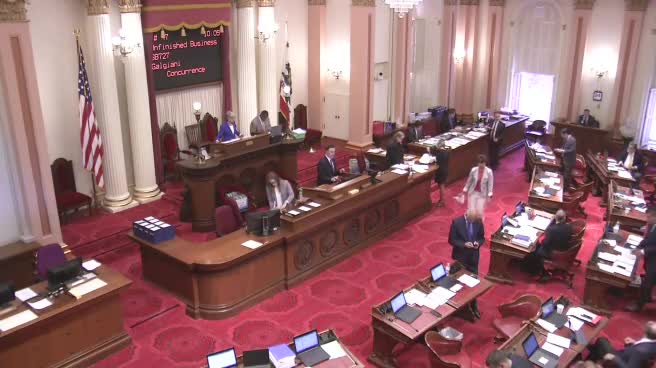 5MIN
Senate Floor
 24MIN
Senate Standing Committee on Judiciary
 6MIN
Assembly Floor
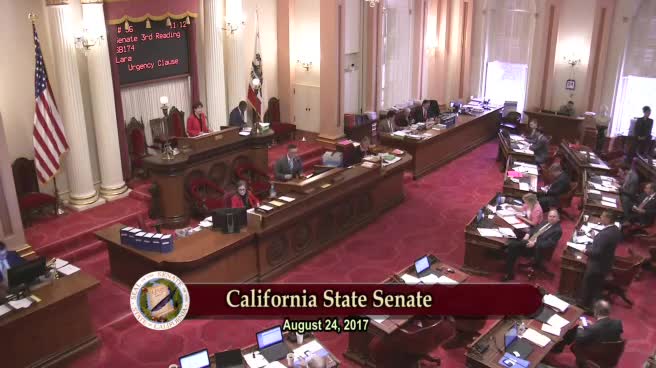 3MIN
Senate Floor
 5MIN
Senate Standing Committee on Appropriations
 13MIN
Senate Standing Committee on Energy, Utilities and Communications
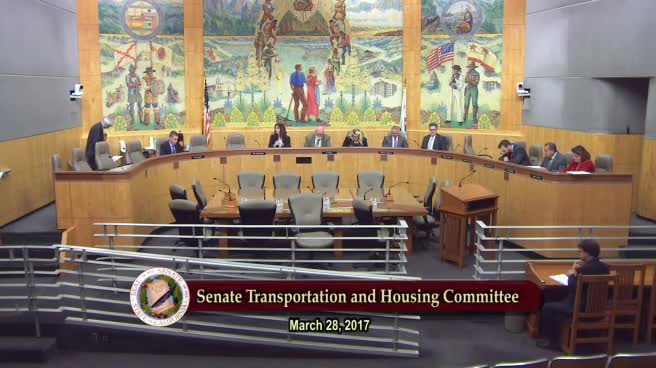 18MIN




