SB 182: Transportation network company: participating drivers: single business license.
- Session Year: 2017-2018
- House: Senate
- Latest Version Date: 2017-10-13
The Passenger Charter-party Carriers Act authorizes the Public Utilities Commission to regulate charter-party carriers in California, including transportation network companies that provide prearranged transportation services for compensation using an online-enabled application or platform to connect passengers with drivers.
Existing law authorizes the legislative body of an incorporated city and a county board of supervisors to license businesses carried on within their respective jurisdictions and to set licensing fees for those businesses.
This bill would prohibit any local jurisdiction, as defined, that requires a driver, as defined, to obtain a business license, as defined, to operate as a driver for a transportation network company, from requiring that driver to obtain more than a single business license, as specified, regardless of the number of local jurisdictions in which the driver operates. The bill would require the driver to obtain a business license in the local jurisdiction in which the driver is domiciled, except as specified. The bill would require each transportation network company to notify its drivers of the obligations set forth in these provisions. The bill would require that personally identifiable information, as defined, submitted to a local jurisdiction for purposes of complying with or enforcing these licensing provisions not be disclosed on a publicly accessible Internet Web site. The bill would declare that its provisions do not preclude the sharing of business license data among local jurisdictions and would make a finding that allowing the free operation of drivers for transportation network companies across local jurisdictions is a matter of statewide concern.
The Passenger Charter-party Carriers Act authorizes the Public Utilities Commission to regulate charter-party carriers in California, including transportation network companies that provide prearranged transportation services for compensation using an online-enabled application or platform to connect passengers with drivers.
Existing law authorizes the legislative body of an incorporated city and a county board of supervisors to license businesses carried on within their respective jurisdictions and to set licensing fees for those businesses.
This bill would prohibit any local jurisdiction, as defined, that requires a driver, as defined, to obtain a business license, as defined, to operate as a driver for a transportation network company, from requiring that driver to obtain more than a single business license, as specified, regardless of the number of local jurisdictions in which the driver operates. The bill would require the driver to obtain a business license in the local jurisdiction in which the driver is domiciled, except as specified. The bill would require each transportation network company to notify its drivers of the obligations set forth in these provisions. The bill would require that personal information personally identifiable information, as defined, submitted to a local jurisdiction for purposes of complying with or enforcing these licensing provisions not be disclosed on a publicly accessible Internet Web site. The bill would declare that its provisions do not preclude the sharing of business license data among local jurisdictions and would make a finding that allowing the free operation of drivers for transportation network companies across local jurisdictions is a matter of statewide concern.
The Passenger Charter-party Carriers Act authorizes the Public Utilities Commission to regulate charter-party carriers in California, including transportation network companies that provide prearranged transportation services for compensation using an online-enabled application or platform to connect passengers with drivers.
Existing law authorizes the legislative body of an incorporated city and a county board of supervisors to license businesses carried on within their respective jurisdictions and to set licensing fees for those businesses.
This bill would prohibit any local jurisdiction, as defined, that requires a driver, as defined, to obtain a business license license, as defined, to operate as a driver for a transportation network company, from requiring that driver to obtain more than a single business license, as specified, regardless of the number of local jurisdictions in which the driver operates. The bill would require the driver to obtain a business license in the local jurisdiction in which the driver is domiciled, except as specified. The bill would require each transportation network company to notify its drivers of the obligations set forth in these provisions. The bill would require that personal information submitted to a local jurisdiction for purposes of complying with or enforcing these licensing provisions not be disclosed on a publicly accessible Internet Web site. The bill would declare that its provisions do not preclude the sharing of business license data among local jurisdictions and would make a finding that allowing the free operation of drivers for transportation network companies across local jurisdictions is a matter of statewide concern.
The Passenger Charter-party Carriers Act authorizes the Public Utilities Commission to regulate charter-party carriers in California, including transportation network companies that provide prearranged transportation services for compensation using an online-enabled application or platform to connect passengers with drivers.
Existing law authorizes the legislative body of an incorporated city and a county board of supervisors to license businesses carried on within their respective jurisdictions and to set licensing fees for those businesses.
This bill would prohibit any local jurisdiction, as defined, that requires a driver, as defined, to obtain a business license to operate as a driver for a transportation network company, from requiring that driver to obtain more than a single business license, as specified, regardless of the number of local jurisdictions in which the driver operates. The bill would authorize that driver to select the local jurisdiction of issuance of the required business license, if applicable. require the driver to obtain a business license in the local jurisdiction in which the driver is domiciled, except as specified. The bill would require each transportation network company to notify its drivers of the obligations set forth in these provisions. The bill would require that personal information submitted to a local jurisdiction for purposes of complying with or enforcing these licensing provisions not be disclosed publicly, including on a publicly accessible Internet Web site. The bill would declare that its provisions do not preclude the sharing of business license data among local jurisdictions and would make a finding that allowing the free operation of drivers for transportation network companies across local jurisdictions is a matter of statewide concern.
The Passenger Charter-party Carriers Act authorizes the Public Utilities Commission to regulate charter-party carriers in California, including transportation network companies that provide prearranged transportation services for compensation using an online-enabled application or platform to connect passengers with drivers.
Existing law authorizes the legislative body of an incorporated city and a county board of supervisors to license businesses carried on within their respective jurisdictions and to set licensing fees for those businesses.
This bill would prohibit any local jurisdiction, as defined, that requires a driver, as defined, to obtain a business license to operate as a driver for a transportation network company, from requiring that driver to obtain more than a single business license, as specified, regardless of the number of local jurisdictions in which the driver operates. The bill would authorize that driver to select the local jurisdiction of issuance of the required business license, if applicable. The bill would require each transportation network company to notify its drivers of the obligations set forth in these provisions. The bill would require that personal information submitted to a local jurisdiction for purposes of complying with or enforcing these licensing provisions not be disclosed publicly, including on a publicly accessible Internet Web site.
(2)The California Public Records Act requires state and local agencies to make public records available for inspection by the public, subject to specified criteria and with specified exceptions. Existing law exempts from disclosure specified records, including, among others, personnel, medical, or similar files when disclosure would constitute an unwarranted invasion of personal privacy, and statements of personal worth or personal financial data required by a licensing agency.This bill would exempt records related to the personal information of transportation network company drivers submitted by a transportation network company or a transportation network company driver to a city, county, or city and county for the purpose of complying with or enforcing the licensing provisions described in paragraph (1).(3)Existing constitutional provisions require that a statute that limits the right of access to the meetings of public bodies or the writings of public officials and agencies be adopted with findings demonstrating the interest protected by the limitation and the need for protecting that interest.This bill would make legislative findings to that effect.(1)The Passenger Charter-party Carriers Act authorizes the Public Utilities Commission to regulate charter-party carriers in California, including transportation network companies that provide prearranged transportation services for compensation using an online-enabled application or platform to connect passengers with drivers.
Existing law authorizes the legislative body of an incorporated city and a county board of supervisors to license businesses carried on within their respective jurisdictions and to set licensing fees for those businesses.
This bill would prohibit any local jurisdiction, as defined, that requires a driver, as defined, to obtain a business license to operate as a driver for a transportation network company, from requiring that driver to obtain more than a single business license, as specified, regardless of the number of local jurisdictions in which the driver operates. The bill would authorize that driver to select the local jurisdiction of issuance of the required business license, if applicable. The bill would require each transportation network company to notify its drivers of the obligations set forth in these provisions.
(2)The California Public Records Act requires state and local agencies to make public records available for inspection by the public, subject to specified criteria and with specified exceptions. Existing law exempts from disclosure specified records, including, among others, personnel, medical, or similar files when disclosure would constitute an unwarranted invasion of personal privacy, and statements of personal worth or personal financial data required by a licensing agency.
This bill would exempt records related to the personal information of transportation network company drivers submitted by a transportation network company or a transportation network company driver to a city, county, or city and county for the purpose of complying with or enforcing the licensing provisions described in paragraph (1).
(3)Existing constitutional provisions require that a statute that limits the right of access to the meetings of public bodies or the writings of public officials and agencies be adopted with findings demonstrating the interest protected by the limitation and the need for protecting that interest.
This bill would make legislative findings to that effect.
Existing law requires the licensing of specified businesses by the state. Existing law also requires cities and counties to issue business licenses.This bill would state the intent of the Legislature that would enact legislation to establish a single business license for industries with small business owners that operate in multiple local jurisdictions.Existing law requires the licensing of specified businesses by the state. Existing law also requires cities and counties to issue business licenses.
This bill would state the intent of the Legislature that would enact legislation to establish a single business license for industries with small business owners that operate in multiple local jurisdictions.
It is the intent of the Legislature to limit any requirement for a business license imposed by a local jurisdiction on a participating driver for a transportation network company to a single business license, regardless of the number of local jurisdictions in which the participating driver operates.
16550.1.For purposes of this chapter, the following definitions apply:
(a)Business license includes any license, certificate, fee, or equivalent payment that is required or collected by a local jurisdiction annually, or on some other fixed cycle, as a condition of providing prearranged transportation services in the local jurisdiction.
(b)Driver has the same meaning as the definition of driver provided in subdivision (a) of Section 5431 of the Public Utilities Code.
(c)Local jurisdiction means a city, county, or city and county, including charter cities.
(d)Personally identifiable information means individually identifiable information about an individual driver collected by the local jurisdiction from that individual, including, but not limited to, all of the following:
(1)A first and last name.
(2)A residential address, including a street and city name.
(3)An email address.
(4)A telephone number.
(5)A social security number.
(6)Driver income or tax information.
(e)Transportation network company has the same meaning as the definition of transportation network company provided in subdivision (c) of Section 5431 of the Public Utilities Code.
16550.2.(a)Any local jurisdiction that requires a driver to obtain a business license to operate as a driver for a transportation network company may only require that driver to obtain a single business license, regardless of the number of local jurisdictions in which the driver operates.
(b)The driver shall obtain a business license in the local jurisdiction in which the driver is domiciled. If the local jurisdiction does not require a business license to operate as a driver for a transportation network company, the driver shall not be required to obtain a business license for any other jurisdiction.
(c)A local jurisdiction shall not require a driver to obtain a business license if either of the following applies:
(1)The driver is compliant with subdivision (b).
(2)The driver has not operated as a driver for more than 30 days in the preceding fiscal year.
(d)Each transportation network company shall notify its drivers of the obligations set forth in this chapter.
(e)Notwithstanding any other law, a business license issued to a driver by a local jurisdiction pursuant to this chapter shall be valid for the period of time determined by the local jurisdiction by law or regulation, except that the local jurisdiction shall not require a driver to obtain a business license that applies for a period before January 1, 2018, or that imposes any penalty or fee on a driver related to the drivers failure to obtain a business license for providing transportation network services for a period before January 1, 2018.
(f)Personally identifiable information submitted to a local jurisdiction pursuant to this chapter shall not be disclosed on a publicly accessible Internet Web site.
(g)This chapter does not preclude the sharing of business license data among local jurisdictions.
(h)The Legislature finds and declares that allowing the free operation of drivers for transportation network companies across local jurisdictions is a matter of statewide concern and is not a municipal affair as that term is used in subdivision (a) of Section 5 of Article XI of the California Constitution.
It is the intent of the Legislature to limit any requirement for a business license imposed by a local jurisdiction on a participating driver for a transportation network company to a single business license, regardless of the number of local jurisdictions in which the participating driver operates.
16550.1.For purposes of this chapter, the following definitions apply:
(a)Business license includes any license, certificate, fee, or equivalent payment that is required or collected by a local jurisdiction annually, or on some other fixed cycle, as a condition of providing prearranged transportation services in the local jurisdiction.
(b)Driver has the same meaning as the definition of driver provided in subdivision (a) of Section 5431 of the Public Utilities Code.
(c)Local jurisdiction means a city, county, or city and county, including charter cities.
(d)Personally identifiable information means individually identifiable information about an individual driver collected by the local jurisdiction from that individual, including, but not limited to, all of the following:
(1)A first and last name.
(2)A residential address, including a street and city name.
(3)An email address.
(4)A telephone number.
(5)A social security number.
(6)Driver income or tax information.
(d)(e)Transportation network company has the same meaning as the definition of transportation network company provided in subdivision (c) of Section 5431 of the Public Utilities Code.
16550.2.(a)Any local jurisdiction that requires a driver to obtain a business license to operate as a driver for a transportation network company may only require that driver to obtain a single business license, regardless of the number of local jurisdictions in which the driver operates.
(b)The driver shall obtain a business license in the local jurisdiction in which the driver is domiciled. If the local jurisdiction does not require a business license to operate as a driver for a transportation network company, the driver shall not be required to obtain a business license for any other jurisdiction.
(c)A local jurisdiction shall not require a driver to obtain a business license if either of the following applies:
(1)The driver has obtained a business license in any other local jurisdiction. is compliant with subdivision (b).
(2)The driver has not operated as a driver for more than 30 days in the preceding fiscal year.
(d)Each transportation network company shall notify its drivers of the obligations set forth in this chapter.
(e)Notwithstanding any other law, a business license issued to a driver by a local jurisdiction pursuant to this chapter shall be valid for the period of time determined by the local jurisdiction by law or regulation, except that the local jurisdiction shall not require a driver to obtain a business license that applies for a period before January 1, 2018, or that imposes any penalty or fee on a driver related to the drivers failure to obtain a business license for providing transportation network services for a period before January 1, 2018.
(f)Personal Personally identifiable information submitted to a local jurisdiction pursuant to this chapter shall not be disclosed on a publicly accessible Internet Web site.
(g)This chapter does not preclude the sharing of business license data among local jurisdictions.
(h)The Legislature finds and declares that allowing the free operation of drivers for transportation network companies across local jurisdictions is a matter of statewide concern and is not a municipal affair as that term is used in subdivision (a) of Section 5 of Article XI of the California Constitution.
It is the intent of the Legislature to limit any requirement for a business license imposed by a local jurisdiction on a participating driver for a transportation network company to a single business license, regardless of the number of local jurisdictions in which the participating driver operates.
16550.1.For purposes of this chapter, the following definitions apply:
(a)Business license includes any license, certificate, fee, or equivalent payment that is required or collected by a local jurisdiction annually, or on some other fixed cycle, as a condition of providing prearranged transportation services in the local jurisdiction.
(a)(b)Driver has the same meaning as the definition of driver provided in subdivision (a) of Section 5431 of the Public Utilities Code.
(b)(c)Local jurisdiction means a city, county, or city and county, including charter cities.
(c)(d)Transportation network company has the same meaning as the definition of transportation network company provided in subdivision (c) of Section 5431 of the Public Utilities Code.
16550.2.(a)Any local jurisdiction that requires a driver to obtain a business license to operate as a driver for a transportation network company may only require that driver to obtain a single business license, regardless of the number of local jurisdictions in which the driver operates.
(b)The driver shall obtain a business license in the local jurisdiction in which the driver is domiciled. If the local jurisdiction does not require a business license to operate as a driver for a transportation network company, the driver shall not be required to obtain a business license for any other jurisdiction.
(c)A local jurisdiction shall not require a driver to obtain a business license if either of the following applies:
(1)The driver has obtained a business license in any other local jurisdiction.
(2)The driver has not operated as a driver for more than 30 days in the preceding fiscal year.
(d)Each transportation network company shall notify its drivers of the obligations set forth in this chapter.
(e)Notwithstanding any other law, a business license issued to a driver by a local jurisdiction pursuant to this chapter shall be valid for the period of time determined by the local jurisdiction by law or regulation, except that the local jurisdiction shall not require a driver to obtain a business license that applies for a period before January 1, 2018, or that imposes any penalty or fee on a driver related to the drivers failure to obtain a business license for providing transportation network services for a period before January 1, 2018.
(f)Personal information submitted to a local jurisdiction pursuant to this chapter shall not be disclosed on a publicly accessible Internet Web site.
(g)This chapter does not preclude the sharing of business license data among local jurisdictions.
(h)The Legislature finds and declares that allowing the free operation of drivers for transportation network companies across local jurisdictions is a matter of statewide concern and is not a municipal affair as that term is used in subdivision (a) of Section 5 of Article XI of the California Constitution.
It is the intent of the Legislature to limit any requirement for a business license imposed by a local jurisdiction on a participating driver for a transportation network company to a single business license, regardless of the number of local jurisdictions in which the participating driver operates.
16550.1.For purposes of this chapter, the following definitions apply:
(a)Driver means any person who is an independent contractor and who uses a vehicle in connection with a transportation network companys online-enabled application or platform to connect with passengers. has the same meaning as the definition of driver provided in subdivision (a) of Section 5431 of the Public Utilities Code.
(b)Local jurisdiction means a city, county, or city and county. county, including charter cities.
(c)Transportation network company means an organization, including, but not limited to, a corporation, limited liability company, partnership, sole proprietor, or any other entity operating in California that provides prearranged transportation services for compensation using an online-enabled application or platform to connect passengers with drivers using a personal vehicle. has the same meaning as the definition of transportation network company provided in subdivision (c) of Section 5431 of the Public Utilities Code.
16550.2.(a)Any local jurisdiction that requires a driver to obtain a business license to operate as a driver for a transportation network company may only require that driver to obtain a single business license, regardless of the number of local jurisdictions in which the driver operates.
(b)The driver may select the local jurisdiction of issuance of the required single business license, if applicable. shall obtain a business license in the local jurisdiction in which the driver is domiciled. If the local jurisdiction does not require a business license to operate as a driver for a transportation network company, the driver shall not be required to obtain a business license for any other jurisdiction.
(c)A local jurisdiction shall not require a driver to obtain a business license if either of the following applies:
(1)The driver has obtained a business license in any other local jurisdiction.
(2)The driver has not operated as a driver in the local jurisdiction for more than 30 days in the preceding fiscal year.
(d)Each transportation network company shall notify its drivers of the obligations set forth in this chapter.
(e)Notwithstanding any other law, a business license issued to a driver by a local jurisdiction pursuant to this chapter shall be valid for the period of time determined by the local jurisdiction by law or regulation, except that the local jurisdiction shall not require a driver to obtain a business license that applies for a period before January 1, 2018, or that imposes any penalty or fee on a driver related to the drivers failure to obtain a business license for providing transportation network services for a period before January 1, 2018.
(f)Personal information submitted to a local jurisdiction pursuant to this chapter shall not be disclosed publicly, including on a publicly accessible Internet Web site.
(g)This chapter does not preclude the sharing of business license data among local jurisdictions.
(h)The Legislature finds and declares that allowing the free operation of drivers for transportation network companies across local jurisdictions is a matter of statewide concern and is not a municipal affair as that term is used in subdivision (a) of Section 5 of Article XI of the California Constitution.
It is the intent of the Legislature to limit any requirement for a business license imposed by a local jurisdiction on a participating driver for a transportation network company to a single business license, regardless of the number of local jurisdictions in which the participating driver operates.
16550.1.For purposes of this chapter, the following definitions apply:
(a)Driver means any person who is an independent contractor and who uses a vehicle in connection with a transportation network companys online-enabled application or platform to connect with passengers.
(b)Local jurisdiction means a city, county, or city and county.
(c)Transportation network company means an organization, including, but not limited to, a corporation, limited liability company, partnership, sole proprietor, or any other entity operating in California that provides prearranged transportation services for compensation using an online-enabled application or platform to connect passengers with drivers using a personal vehicle.
16550.2.(a)Any local jurisdiction that requires a driver to obtain a business license to operate as a driver for a transportation network company may only require that driver to obtain a single business license, regardless of the number of local jurisdictions in which the driver operates.
(b)The driver may select the local jurisdiction of issuance of the required single business license, if applicable.
(c)A local jurisdiction shall not require a driver to obtain a business license if either of the following applies:
(1)The driver has obtained a business license in any other local jurisdiction.
(2)The driver has not operated as a driver in the local jurisdiction for more than 30 days in the preceding fiscal year.
(d)Each transportation network company shall notify its drivers of the obligations set forth in this chapter.
(e)Notwithstanding any other law, a business license issued to a driver by a local jurisdiction pursuant to this chapter shall be valid for the period of time determined by the local jurisdiction by law or regulation, except that the local jurisdiction shall not require a driver to obtain a business license that applies for a period before January 1, 2018, or that imposes any penalty or fee on a driver related to the drivers failure to obtain a business license for providing transportation network services for a period before January 1, 2018.
(f)Personal information submitted to a local jurisdiction pursuant to this chapter shall not be disclosed publicly and is exempt from the California Public Records Act (Chapter 3.5 (commencing with Section 6250) of Division 7 of Title 1 of the Government Code), pursuant to subdivision (ae) of Section 6254 of the Government Code. publicly, including on a publicly accessible Internet Web site.
All matter omitted in this version of the bill appears in the bill as amended in the Senate, March 23, 2017. (JR11)It is the intent of the Legislature to limit any requirement for a business license imposed by a local jurisdiction on a participating driver for a transportation network company to a single business license, regardless of the number of local jurisdictions in which the participating driver operates.
16550.1.For purposes of this chapter, the following definitions apply:
(a)Driver means any person who is an independent contractor and who uses a vehicle in connection with a transportation network companys online-enabled application or platform to connect with passengers.
(b)Local jurisdiction means a city, county, or city and county.
(c)Transportation network company means an organization, including, but not limited to, a corporation, limited liability company, partnership, sole proprietor, or any other entity operating in California that provides prearranged transportation services for compensation using an online-enabled application or platform to connect passengers with drivers using a personal vehicle.
16550.2.(a)Any local jurisdiction that requires a driver to obtain a business license to operate as a driver for a transportation network company may only require that driver to obtain a single business license, regardless of the number of local jurisdictions in which the driver operates.
(b)The driver may select the local jurisdiction of issuance of the required single business license, if applicable.
(c)A local jurisdiction shall not require a driver to obtain a business license if either of the following applies:
(1)The driver has obtained a business license in any other local jurisdiction.
(2)The driver has not operated as a driver in the local jurisdiction for more than 30 days in the preceding fiscal year.
(d)Each transportation network company shall notify its drivers of the obligations set forth in this chapter.
(e)Notwithstanding any other law, a business license issued to a driver by a local jurisdiction pursuant to this chapter shall be valid for the period of time determined by the local jurisdiction by law or regulation, except that the local jurisdiction shall not require a driver to obtain a business license that applies for a period before January 1, 2018, or that imposes any penalty or fee on a driver related to the drivers failure to obtain a business license for providing transportation network services for a period before January 1, 2018.
(f)Personal information submitted to a local jurisdiction pursuant to this chapter shall not be disclosed publicly and is exempt from the California Public Records Act (Chapter 3.5 (commencing with Section 6250) of Division 7 of Title 1 of the Government Code), pursuant to subdivision (ae) of Section 6254 of the Government Code.
SEC. 2.Section 6254 of the Government Code is amended to read:6254.Except as provided in Sections 6254.7 and 6254.13, this chapter does not require the disclosure of any of the following records:
(a)Preliminary drafts, notes, or interagency or intra-agency memoranda that are not retained by the public agency in the ordinary course of business, if the public interest in withholding those records clearly outweighs the public interest in disclosure.
(b)Records pertaining to pending litigation to which the public agency is a party, or to claims made pursuant to Division 3.6 (commencing with Section 810), until the pending litigation or claim has been finally adjudicated or otherwise settled.
(c)Personnel, medical, or similar files, the disclosure of which would constitute an unwarranted invasion of personal privacy.
(d)Records contained in or related to any of the following:
(1)Applications filed with any state agency responsible for the regulation or supervision of the issuance of securities or of financial institutions, including, but not limited to, banks, savings and loan associations, industrial loan companies, credit unions, and insurance companies.
(2)Examination, operating, or condition reports prepared by, on behalf of, or for the use of, any state agency referred to in paragraph (1).
(3)Preliminary drafts, notes, or interagency or intra-agency communications prepared by, on behalf of, or for the use of, any state agency referred to in paragraph (1).
(4)Information received in confidence by any state agency referred to in paragraph (1).
(e)Geological and geophysical data, plant production data, and similar information relating to utility systems development, or market or crop reports, that are obtained in confidence from any person.
(f)Records of complaints to, or investigations conducted by, or records of intelligence information or security procedures of, the office of the Attorney General and the Department of Justice, the Office of Emergency Services and any state or local police agency, or any investigatory or security files compiled by any other state or local police agency, or any investigatory or security files compiled by any other state or local agency for correctional, law enforcement, or licensing purposes. However, state and local law enforcement agencies shall disclose the names and addresses of persons involved in, or witnesses other than confidential informants to, the incident, the description of any property involved, the date, time, and location of the incident, all diagrams, statements of the parties involved in the incident, the statements of all witnesses, other than confidential informants, to the victims of an incident, or an authorized representative thereof, an insurance carrier against which a claim has been or might be made, and any person suffering bodily injury or property damage or loss, as the result of the incident caused by arson, burglary, fire, explosion, larceny, robbery, carjacking, vandalism, vehicle theft, or a crime as defined by subdivision (b) of Section 13951, unless the disclosure would endanger the safety of a witness or other person involved in the investigation, or unless disclosure would endanger the successful completion of the investigation or a related investigation. However, this subdivision does not require the disclosure of that portion of those investigative files that reflects the analysis or conclusions of the investigating officer.
Customer lists provided to a state or local police agency by an alarm or security company at the request of the agency shall be construed to be records subject to this subdivision.
Notwithstanding any other provision of this subdivision, state and local law enforcement agencies shall make public the following information, except to the extent that disclosure of a particular item of information would endanger the safety of a person involved in an investigation or would endanger the successful completion of the investigation or a related investigation:
(1)The full name and occupation of every individual arrested by the agency, the individuals physical description including date of birth, color of eyes and hair, sex, height and weight, the time and date of arrest, the time and date of booking, the location of the arrest, the factual circumstances surrounding the arrest, the amount of bail set, the time and manner of release or the location where the individual is currently being held, and all charges the individual is being held upon, including any outstanding warrants from other jurisdictions and parole or probation holds.
(2)(A)Subject to the restrictions imposed by Section 841.5 of the Penal Code, the time, substance, and location of all complaints or requests for assistance received by the agency and the time and nature of the response thereto, including, to the extent the information regarding crimes alleged or committed or any other incident investigated is recorded, the time, date, and location of occurrence, the time and date of the report, the name and age of the victim, the factual circumstances surrounding the crime or incident, and a general description of any injuries, property, or weapons involved. The name of a victim of any crime defined by Section 220, 261, 261.5, 262, 264, 264.1, 265, 266, 266a, 266b, 266c, 266e, 266f, 266j, 267, 269, 273a, 273d, 273.5, 285, 286, 288, 288a, 288.2, 288.3, 288.4, 288.5, 288.7, 289, 422.6, 422.7, 422.75, 646.9, or 647.6 of the Penal Code may be withheld at the victims request, or at the request of the victims parent or guardian if the victim is a minor. When a person is the victim of more than one crime, information disclosing that the person is a victim of a crime defined in any of the sections of the Penal Code set forth in this subdivision may be deleted at the request of the victim, or the victims parent or guardian if the victim is a minor, in making the report of the crime, or of any crime or incident accompanying the crime, available to the public in compliance with the requirements of this paragraph.
(B)Subject to the restrictions imposed by Section 841.5 of the Penal Code, the names and images of a victim of human trafficking, as defined in Section 236.1 of the Penal Code, and of that victims immediate family, other than a family member who is charged with a criminal offense arising from the same incident, may be withheld at the victims request until the investigation or any subsequent prosecution is complete. For purposes of this subdivision, immediate family shall have the same meaning as that provided in paragraph (3) of subdivision (b) of Section 422.4 of the Penal Code.
(3)Subject to the restrictions of Section 841.5 of the Penal Code and this subdivision, the current address of every individual arrested by the agency and the current address of the victim of a crime, if the requester declares under penalty of perjury that the request is made for a scholarly, journalistic, political, or governmental purpose, or that the request is made for investigation purposes by a licensed private investigator as described in Chapter 11.3 (commencing with Section 7512) of Division 3 of the Business and Professions Code. However, the address of the victim of any crime defined by Section 220, 236.1, 261, 261.5, 262, 264, 264.1, 265, 266, 266a, 266b, 266c, 266e, 266f, 266j, 267, 269, 273a, 273d, 273.5, 285, 286, 288, 288a, 288.2, 288.3, 288.4, 288.5, 288.7, 289, 422.6, 422.7, 422.75, 646.9, or 647.6 of the Penal Code shall remain confidential. Address information obtained pursuant to this paragraph shall not be used directly or indirectly, or furnished to another, to sell a product or service to any individual or group of individuals, and the requester shall execute a declaration to that effect under penalty of perjury. This paragraph shall not be construed to prohibit or limit a scholarly, journalistic, political, or government use of address information obtained pursuant to this paragraph.
(g)Test questions, scoring keys, and other examination data used to administer a licensing examination, examination for employment, or academic examination, except as provided for in Chapter 3 (commencing with Section 99150) of Part 65 of Division 14 of Title 3 of the Education Code.
(h)The contents of real estate appraisals or engineering or feasibility estimates and evaluations made for or by the state or local agency relative to the acquisition of property, or to prospective public supply and construction contracts, until all of the property has been acquired or all of the contract agreement obtained. However, the law of eminent domain shall not be affected by this provision.
(i)Information required from any taxpayer in connection with the collection of local taxes that is received in confidence and the disclosure of the information to other persons would result in unfair competitive disadvantage to the person supplying the information.
(j)Library circulation records kept for the purpose of identifying the borrower of items available in libraries, and library and museum materials made or acquired and presented solely for reference or exhibition purposes. The exemption in this subdivision shall not apply to records of fines imposed on the borrowers.
(k)Records, the disclosure of which is exempted or prohibited pursuant to federal or state law, including, but not limited to, provisions of the Evidence Code relating to privilege.
(l)Correspondence of and to the Governor or employees of the Governors office or in the custody of or maintained by the Governors Legal Affairs Secretary. However, public records shall not be transferred to the custody of the Governors Legal Affairs Secretary to evade the disclosure provisions of this chapter.
(m)In the custody of or maintained by the Legislative Counsel, except those records in the public database maintained by the Legislative Counsel that are described in Section 10248.
(n)Statements of personal worth or personal financial data required by a licensing agency and filed by an applicant with the licensing agency to establish his or her personal qualification for the license, certificate, or permit applied for.
(o)Financial data contained in applications for financing under Division 27 (commencing with Section 44500) of the Health and Safety Code, if an authorized officer of the California Pollution Control Financing Authority determines that disclosure of the financial data would be competitively injurious to the applicant and the data is required in order to obtain guarantees from the United States Small Business Administration. The California Pollution Control Financing Authority shall adopt rules for review of individual requests for confidentiality under this section and for making available to the public those portions of an application that are subject to disclosure under this chapter.
(p)Records of state agencies related to activities governed by Chapter 10.3 (commencing with Section 3512), Chapter 10.5 (commencing with Section 3525), and Chapter 12 (commencing with Section 3560) of Division 4, that reveal a state agencys deliberative processes, impressions, evaluations, opinions, recommendations, meeting minutes, research, work products, theories, or strategy, or that provide instruction, advice, or training to employees who do not have full collective bargaining and representation rights under these chapters. This subdivision shall not be construed to limit the disclosure duties of a state agency with respect to any other records relating to the activities governed by the employee relations acts referred to in this subdivision.
(q)(1)Records of state agencies related to activities governed by Article 2.6 (commencing with Section 14081), Article 2.8 (commencing with Section 14087.5), and Article 2.91 (commencing with Section 14089) of Chapter 7 of Part 3 of Division 9 of the Welfare and Institutions Code, that reveal the special negotiators deliberative processes, discussions, communications, or any other portion of the negotiations with providers of health care services, impressions, opinions, recommendations, meeting minutes, research, work product, theories, or strategy, or that provide instruction, advice, or training to employees.
(2)Except for the portion of a contract containing the rates of payment, contracts for inpatient services entered into pursuant to these articles, on or after April 1, 1984, shall be open to inspection one year after they are fully executed. If a contract for inpatient services that is entered into prior to April 1, 1984, is amended on or after April 1, 1984, the amendment, except for any portion containing the rates of payment, shall be open to inspection one year after it is fully executed. If the California Medical Assistance Commission enters into contracts with health care providers for other than inpatient hospital services, those contracts shall be open to inspection one year after they are fully executed.
(3)Three years after a contract or amendment is open to inspection under this subdivision, the portion of the contract or amendment containing the rates of payment shall be open to inspection.
(4)Notwithstanding any other law, the entire contract or amendment shall be open to inspection by the Joint Legislative Audit Committee and the Legislative Analysts Office. The committee and that office shall maintain the confidentiality of the contracts and amendments until the time a contract or amendment is fully open to inspection by the public.
(r)Records of Native American graves, cemeteries, and sacred places and records of Native American places, features, and objects described in Sections 5097.9 and 5097.993 of the Public Resources Code maintained by, or in the possession of, the Native American Heritage Commission, another state agency, or a local agency.
(s)A final accreditation report of the Joint Commission on Accreditation of Hospitals that has been transmitted to the State Department of Health Care Services pursuant to subdivision (b) of Section 1282 of the Health and Safety Code.
(t)Records of a local hospital district, formed pursuant to Division 23 (commencing with Section 32000) of the Health and Safety Code, or the records of a municipal hospital, formed pursuant to Article 7 (commencing with Section 37600) or Article 8 (commencing with Section 37650) of Chapter 5 of Part 2 of Division 3 of Title 4 of this code, that relate to any contract with an insurer or nonprofit hospital service plan for inpatient or outpatient services for alternative rates pursuant to Section 10133 of the Insurance Code. However, the record shall be open to inspection within one year after the contract is fully executed.
(u)(1)Information contained in applications for licenses to carry firearms issued pursuant to Section 26150, 26155, 26170, or 26215 of the Penal Code by the sheriff of a county or the chief or other head of a municipal police department that indicates when or where the applicant is vulnerable to attack or that concerns the applicants medical or psychological history or that of members of his or her family.
(2)The home address and telephone number of prosecutors, public defenders, peace officers, judges, court commissioners, and magistrates that are set forth in applications for licenses to carry firearms issued pursuant to Section 26150, 26155, 26170, or 26215 of the Penal Code by the sheriff of a county or the chief or other head of a municipal police department.
(3)The home address and telephone number of prosecutors, public defenders, peace officers, judges, court commissioners, and magistrates that are set forth in licenses to carry firearms issued pursuant to Section 26150, 26155, 26170, or 26215 of the Penal Code by the sheriff of a county or the chief or other head of a municipal police department.
(v)(1)Records of the Managed Risk Medical Insurance Board and the State Department of Health Care Services related to activities governed by Part 6.3 (commencing with Section 12695), Part 6.5 (commencing with Section 12700), Part 6.6 (commencing with Section 12739.5), or Part 6.7 (commencing with Section 12739.70) of Division 2 of the Insurance Code, or Chapter 2 (commencing with Section 15810) or Chapter 4 (commencing with Section 15870) of Part 3.3 of Division 9 of the Welfare and Institutions Code, and that reveal any of the following:
(A)The deliberative processes, discussions, communications, or any other portion of the negotiations with entities contracting or seeking to contract with the board or the department, entities with which the board or the department is considering a contract, or entities with which the board or department is considering or enters into any other arrangement under which the board or the department provides, receives, or arranges services or reimbursement.
(B)The impressions, opinions, recommendations, meeting minutes, research, work product, theories, or strategy of the board or its staff or the department or its staff, or records that provide instructions, advice, or training to their employees.
(2)(A)Except for the portion of a contract that contains the rates of payment, contracts entered into pursuant to Part 6.3 (commencing with Section 12695), Part 6.5 (commencing with Section 12700), Part 6.6 (commencing with Section 12739.5), or Part 6.7 (commencing with Section 12739.70) of Division 2 of the Insurance Code, or Chapter 2 (commencing with Section 15810) or Chapter 4 (commencing with Section 15870) of Part 3.3 of Division 9 of the Welfare and Institutions Code, on or after July 1, 1991, shall be open to inspection one year after their effective dates.
(B)If a contract that is entered into prior to July 1, 1991, is amended on or after July 1, 1991, the amendment, except for any portion containing the rates of payment, shall be open to inspection one year after the effective date of the amendment.
(3)Three years after a contract or amendment is open to inspection pursuant to this subdivision, the portion of the contract or amendment containing the rates of payment shall be open to inspection.
(4)Notwithstanding any other law, the entire contract or amendments to a contract shall be open to inspection by the Joint Legislative Audit Committee. The committee shall maintain the confidentiality of the contracts and amendments thereto, until the contracts or amendments to the contracts are open to inspection pursuant to paragraph (3).
(w)(1)Records of the Managed Risk Medical Insurance Board related to activities governed by Chapter 8 (commencing with Section 10700) of Part 2 of Division 2 of the Insurance Code, and that reveal the deliberative processes, discussions, communications, or any other portion of the negotiations with health plans, or the impressions, opinions, recommendations, meeting minutes, research, work product, theories, or strategy of the board or its staff, or records that provide instructions, advice, or training to employees.
(2)Except for the portion of a contract that contains the rates of payment, contracts for health coverage entered into pursuant to Chapter 8 (commencing with Section 10700) of Part 2 of Division 2 of the Insurance Code, on or after January 1, 1993, shall be open to inspection one year after they have been fully executed.
(3)Notwithstanding any other law, the entire contract or amendments to a contract shall be open to inspection by the Joint Legislative Audit Committee. The committee shall maintain the confidentiality of the contracts and amendments thereto, until the contracts or amendments to the contracts are open to inspection pursuant to paragraph (2).
(x)Financial data contained in applications for registration, or registration renewal, as a service contractor filed with the Director of Consumer Affairs pursuant to Chapter 20 (commencing with Section 9800) of Division 3 of the Business and Professions Code, for the purpose of establishing the service contractors net worth, or financial data regarding the funded accounts held in escrow for service contracts held in force in this state by a service contractor.
(y)(1)Records of the Managed Risk Medical Insurance Board and the State Department of Health Care Services related to activities governed by Part 6.2 (commencing with Section 12693) or Part 6.4 (commencing with Section 12699.50) of Division 2 of the Insurance Code or Sections 14005.26 and 14005.27 of, or Chapter 3 (commencing with Section 15850) of Part 3.3 of Division 9 of, the Welfare and Institutions Code, if the records reveal any of the following:
(A)The deliberative processes, discussions, communications, or any other portion of the negotiations with entities contracting or seeking to contract with the board or the department, entities with which the board or department is considering a contract, or entities with which the board or department is considering or enters into any other arrangement under which the board or department provides, receives, or arranges services or reimbursement.
(B)The impressions, opinions, recommendations, meeting minutes, research, work product, theories, or strategy of the board or its staff, or the department or its staff, or records that provide instructions, advice, or training to employees.
(2)(A)Except for the portion of a contract that contains the rates of payment, contracts entered into pursuant to Part 6.2 (commencing with Section 12693) or Part 6.4 (commencing with Section 12699.50) of Division 2 of the Insurance Code, on or after January 1, 1998, or Sections 14005.26 and 14005.27 of, or Chapter 3 (commencing with Section 15850) of Part 3.3 of Division 9 of, the Welfare and Institutions Code shall be open to inspection one year after their effective dates.
(B)If a contract entered into pursuant to Part 6.2 (commencing with Section 12693) or Part 6.4 (commencing with Section 12699.50) of Division 2 of the Insurance Code or Sections 14005.26 and 14005.27 of, or Chapter 3 (commencing with Section 15850) of Part 3.3 of Division 9 of, the Welfare and Institutions Code, is amended, the amendment shall be open to inspection one year after the effective date of the amendment.
(3)Three years after a contract or amendment is open to inspection pursuant to this subdivision, the portion of the contract or amendment containing the rates of payment shall be open to inspection.
(4)Notwithstanding any other law, the entire contract or amendments to a contract shall be open to inspection by the Joint Legislative Audit Committee. The committee shall maintain the confidentiality of the contracts and amendments thereto until the contract or amendments to a contract are open to inspection pursuant to paragraph (2) or (3).
(5)The exemption from disclosure provided pursuant to this subdivision for the contracts, deliberative processes, discussions, communications, negotiations, impressions, opinions, recommendations, meeting minutes, research, work product, theories, or strategy of the board or its staff, or the department or its staff, shall also apply to the contracts, deliberative processes, discussions, communications, negotiations, impressions, opinions, recommendations, meeting minutes, research, work product, theories, or strategy of applicants pursuant to Part 6.4 (commencing with Section 12699.50) of Division 2 of the Insurance Code or Chapter 3 (commencing with Section 15850) of Part 3.3 of Division 9 of the Welfare and Institutions Code.
(z)Records obtained pursuant to paragraph (2) of subdivision (f) of Section 2891.1 of the Public Utilities Code.
(aa)A document prepared by or for a state or local agency that assesses its vulnerability to terrorist attack or other criminal acts intended to disrupt the public agencys operations and that is for distribution or consideration in a closed session.
(ab)Critical infrastructure information, as defined in Section 131(3) of Title 6 of the United States Code, that is voluntarily submitted to the Office of Emergency Services for use by that office, including the identity of the person who or entity that voluntarily submitted the information. As used in this subdivision, voluntarily submitted means submitted in the absence of the office exercising any legal authority to compel access to or submission of critical infrastructure information. This subdivision shall not affect the status of information in the possession of any other state or local governmental agency.
(ac)All information provided to the Secretary of State by a person for the purpose of registration in the Advance Health Care Directive Registry, except that those records shall be released at the request of a health care provider, a public guardian, or the registrants legal representative.
(ad)The following records of the State Compensation Insurance Fund:
(1)Records related to claims pursuant to Chapter 1 (commencing with Section 3200) of Division 4 of the Labor Code, to the extent that confidential medical information or other individually identifiable information would be disclosed.
(2)Records related to the discussions, communications, or any other portion of the negotiations with entities contracting or seeking to contract with the fund, and any related deliberations.
(3)Records related to the impressions, opinions, recommendations, meeting minutes of meetings or sessions that are lawfully closed to the public, research, work product, theories, or strategy of the fund or its staff, on the development of rates, contracting strategy, underwriting, or competitive strategy pursuant to the powers granted to the fund in Chapter 4 (commencing with Section 11770) of Part 3 of Division 2 of the Insurance Code.
(4)Records obtained to provide workers compensation insurance under Chapter 4 (commencing with Section 11770) of Part 3 of Division 2 of the Insurance Code, including, but not limited to, any medical claims information, policyholder information provided that nothing in this paragraph shall be interpreted to prevent an insurance agent or broker from obtaining proprietary information or other information authorized by law to be obtained by the agent or broker, and information on rates, pricing, and claims handling received from brokers.
(5)(A)Records that are trade secrets pursuant to Section 6276.44, or Article 11 (commencing with Section 1060) of Chapter 4 of Division 8 of the Evidence Code, including without limitation, instructions, advice, or training provided by the State Compensation Insurance Fund to its board members, officers, and employees regarding the funds special investigation unit, internal audit unit, and informational security, marketing, rating, pricing, underwriting, claims handling, audits, and collections.
(B)Notwithstanding subparagraph (A), the portions of records containing trade secrets shall be available for review by the Joint Legislative Audit Committee, California State Auditors Office, Division of Workers Compensation, and the Department of Insurance to ensure compliance with applicable law.
(6)(A)Internal audits containing proprietary information and the following records that are related to an internal audit:
(i)Personal papers and correspondence of any person providing assistance to the fund when that person has requested in writing that his or her papers and correspondence be kept private and confidential. Those papers and correspondence shall become public records if the written request is withdrawn, or upon order of the fund.
(ii)Papers, correspondence, memoranda, or any substantive information pertaining to any audit not completed or an internal audit that contains proprietary information.
(B)Notwithstanding subparagraph (A), the portions of records containing proprietary information, or any information specified in subparagraph (A) shall be available for review by the Joint Legislative Audit Committee, California State Auditors Office, Division of Workers Compensation, and the Department of Insurance to ensure compliance with applicable law.
(7)(A)Except as provided in subparagraph (C), contracts entered into pursuant to Chapter 4 (commencing with Section 11770) of Part 3 of Division 2 of the Insurance Code shall be open to inspection one year after the contract has been fully executed.
(B)If a contract entered into pursuant to Chapter 4 (commencing with Section 11770) of Part 3 of Division 2 of the Insurance Code is amended, the amendment shall be open to inspection one year after the amendment has been fully executed.
(C)Three years after a contract or amendment is open to inspection pursuant to this subdivision, the portion of the contract or amendment containing the rates of payment shall be open to inspection.
(D)Notwithstanding any other law, the entire contract or amendments to a contract shall be open to inspection by the Joint Legislative Audit Committee. The committee shall maintain the confidentiality of the contracts and amendments thereto until the contract or amendments to a contract are open to inspection pursuant to this paragraph.
(E)This paragraph is not intended to apply to documents related to contracts with public entities that are not otherwise expressly confidential as to that public entity.
(F)For purposes of this paragraph, fully executed means the point in time when all of the necessary parties to the contract have signed the contract.
(ae)Records related to the personal information of a driver or participating driver for a transportation network company that is required to be submitted by that driver or the transportation network company to a city, county, or city and county for purposes of enforcing or complying with Chapter 7 (commencing with Section 16550) of Part 1 of Division 7 of the Business and Professions Code.
This section does not prevent any agency from opening its records concerning the administration of the agency to public inspection, unless disclosure is otherwise prohibited by law.
This section does not prevent any health facility from disclosing to a certified bargaining agent relevant financing information pursuant to Section 8 of the National Labor Relations Act (29 U.S.C. Sec. 158).
SEC. 3.The Legislature finds and declares that Section 1 of this act, which adds Section 16550.2 to the Business and Professions Code, imposes a limitation on the publics right of access to the meetings of public bodies or the writings of public officials and agencies within the meaning of Section 3 of Article I of the California Constitution. Pursuant to that constitutional provision, the Legislature makes the following findings to demonstrate the interest protected by this limitation and the need for protecting that interest:
The state has a strong interest in protecting the personal privacy of its citizens. Business license filings that contain personal information pose a risk to individuals if made publicly available. Thus, personal information of independent contractor drivers must be protected to preclude detrimental use of that information beyond the purposes of state and local governments.
SECTION 1.It is the intent of the Legislature to enact legislation that would establish a single business license for industries with small business owners that operate in multiple local jurisdictions.It is the intent of the Legislature to enact legislation that would establish a single business license for industries with small business owners that operate in multiple local jurisdictions.
|
Date
|
Status
|
|---|---|
| Oct 13, 2017 | Chaptered by Secretary of State. Chapter 769, Statutes of 2017. |
| Oct 13, 2017 | Approved by the Governor. |
| Sep 15, 2017 | Enrolled and presented to the Governor at 3:30 p.m. |
| Sep 11, 2017 | Assembly amendments concurred in. (Ayes 32. Noes 4.) Ordered to engrossing and enrolling. |
| Sep 8, 2017 | In Senate. Concurrence in Assembly amendments pending. |
| Sep 7, 2017 | Read third time. Passed. Ordered to the Senate. |
| Aug 22, 2017 | Read second time. Ordered to third reading. |
| Aug 21, 2017 | Read second time and amended. Ordered to second reading. |
| Jul 20, 2017 | From committee: Do pass as amended. (Ayes 10. Noes 0.) (July 18). |
| Jun 29, 2017 | Read second time and amended. Re-referred to Com. on P. & C.P. |
| Jun 28, 2017 | From committee: Do pass as amended and re-refer to Com. on P. & C.P. (Ayes 13. Noes 0.) (June 28). |
| Jun 1, 2017 | Referred to Coms. on C. & C. and P. & C.P. |
| May 23, 2017 | In Assembly. Read first time. Held at Desk. |
| May 22, 2017 | Read third time. Passed. (Ayes 29. Noes 3. Page 1141.) Ordered to the Assembly. |
| May 16, 2017 | Read second time and amended. Ordered to third reading. |
| May 15, 2017 | From committee: Do pass as amended. (Ayes 5. Noes 1. Page 1020.) (May 9). |
| May 4, 2017 | Set for hearing May 9. |
| May 3, 2017 | From committee: Do pass and re-refer to Com. on JUD. (Ayes 5. Noes 0. Page 944.) (May 3). Re-referred to Com. on JUD. |
| Apr 19, 2017 | Set for hearing May 3. |
| Apr 17, 2017 | April 19 set for first hearing canceled at the request of author. |
| Apr 17, 2017 | From committee with author's amendments. Read second time and amended. Re-referred to Com. on GOV. & F. |
| Apr 5, 2017 | Set for hearing April 19. |
| Mar 29, 2017 | Re-referred to Coms. on GOV. & F. and JUD. |
| Mar 23, 2017 | From committee with author's amendments. Read second time and amended. Re-referred to Com. on RLS. |
| Feb 2, 2017 | Referred to Com. on RLS. |
| Jan 25, 2017 | From printer. May be acted upon on or after February 24. |
| Jan 24, 2017 | Introduced. Read first time. To Com. on RLS. for assignment. To print. |
|
Date
|
Description
|
Location
|
Votes
|
|
|---|---|---|---|---|
| Sep 11, 2017 | Unfinished Business SB182 Bradford Concurrence | Senate Floor |
Passed |
|
| Sep 7, 2017 | SB 182 Bradford Senate Third Reading By OBERNOLTE | Assembly Floor |
Passed |
|
| Jul 18, 2017 | Do pass as amended. | Assembly Standing Committee on Privacy and Consumer Protection |
Passed |
|
| Jun 28, 2017 | Do pass as amended and be re-referred to the Committee on [Privacy and Consumer Protection] | Assembly Standing Committee on Communications and Conveyance |
Passed |
|
| May 22, 2017 | Senate 3rd Reading SB182 Bradford | Senate Floor |
Passed |
|
| May 9, 2017 | Do pass as amended | Senate Standing Committee on Judiciary |
Passed |
|
| May 3, 2017 | Do pass, but first be re-referred to the Committee on [Judiciary] | Senate Standing Committee on Governance and Finance |
Passed |
This list shows positions taken on this bill by organizations on the date displayed, which is linked to the original source.
Positions by individuals are not included.
Office of Senate Floor Analyses (916) 651-1520 Fax: (916) 327-4478 | SB |
UNFINISHED BUSINESS
Bill No: SB 182
:
SENATE GOVERNANCE & FIN. COMMITTEE: 5-0, 5/3/17
AYES: McGuire, Nguyen, Hernandez, Lara, Moorlach
NO VOTE RECORDED: Beall, Hertzberg
SENATE JUDICIARY COMMITTEE: 5-1, 5/9/17
AYES: Moorlach, Anderson, Hertzberg, Stern, Wieckowski
NOES: Jackson
NO VOTE RECORDED: Monning
SENATE FLOOR: 29-3, 5/22/17
AYES: Allen, Atkins, Bates, Berryhill, Bradford, Cannella, De León, Dodd, Gaines, Hernandez, Hertzberg, Hill, Lara, Leyva, McGuire, Mendoza, Mitchell, Moorlach, Morrell, Newman, Nguyen, Nielsen, Portantino, Roth, Stern, Stone, Vidak, Wieckowski, Wilk
NOES: Glazer, Jackson, Wiener
NO VOTE RECORDED: Anderson, Beall, Fuller, Galgiani, Hueso, Monning, Pan, Skinner
ASSEMBLY FLOOR: 71-4, 9/7/17 - See last page for vote
DIGEST:
This bill prohibits a local government from requiring business licenses from drivers for transportation network companies who do not reside in its jurisdiction.
Assembly Amendments
define the types of personally identifiable information that cannot be disclosed online, define “business license” for the purpose of the bill, and make technical changes.
Existing law:
- Allows a city or county to “make and enforce within its limits, all local, police, sanitary and other ordinances and regulations not in conflict with general laws, known as the police power of cities.”
- Allows a city or county to require businesses operating in their jurisdictions to obtain a license and impose related licensing fees.
- Establishes the California Public Utilities Commission (CPUC) and grants it the authority to regulate public utilities, as well as more limited authority over other corporations, including railroads, rail transit, and charter-party carriers, among others. Charter-party carriers are companies which transport people for compensation. These include limousines and charter buses, but exclude taxis and municipal buses.
- Regulates limited aspects of transportation network companies (TNCs) by establishing statutory definitions for drivers and TNCs, as well as requiring TNCs and TNC drivers to maintain certain levels of primary liability insurance coverage, and requiring TNCs to inform their drivers of the insurance coverage they provide and that the drivers’ personal insurance may not cover them while they drive for a TNC.
- Prohibits TNCs from disclosing passenger travel records to third parties without the consent of the passenger.
- Requires TNCs to conduct background checks.
This bill:
- Allows local jurisdiction to require a business license for a driver for a TNC to operate only if the driver is domiciled in that jurisdiction.
- Prohibits a local jurisdiction from requiring any of the following:
- A business license if the driver has a business license from another jurisdiction;
- More than one business license, regardless of the number of jurisdictions that the driver operates in;
- A business license if the driver has not operated as a driver for more than 30 days in the preceding fiscal year;
- A business license if the driver has obtained a business license in another jurisdiction.
- A business license that applies for a period before January 1, 2018 or that imposes a penalty or fee on a driver related to the driver’s failure to obtain a business license prior to January 1, 2018.
- Requires a TNC to notify its drivers of the obligations under the bill.
- Prohibits the disclosure of TNC driver personally identifiable information on a publicly accessible Internet Web site, including, but not limited to:
- A first and last name.
- A residential address, including a street and city name.
- An email address.
- A telephone number.
- A social security number.
- Driver income or tax information.
- States that the bill does not preclude the sharing of business license data among local jurisdictions.
- Defines a “local jurisdiction” to be a city, county, or city and county, including charter cities.
- Defines “driver” and “transportation network company” as defined in current law.
- Defines “business license” to include any license, certificate, fee, or equivalent payment that is required or collected by a local jurisdiction annually, or on some other fixed cycle, as a condition of providing prearranged transportation services in the local jurisdiction.
Background
Local Business Licensing. State law lets local governments require businesses operating in their jurisdictions to obtain a license and impose related licensing fees. If a business operates in multiple jurisdictions, the fees imposed by any one jurisdiction are supposed to fairly reflect the amount of business that goes on in that jurisdiction.
Local governments license businesses for lots of reasons: to identify individuals operating businesses in their jurisdictions, to ensure compliance with other local laws, to facilitate contact in case a problem arises, and to raise money to support public services that support those businesses.
Transportation Network Companies. Beginning as early as 2009, a new model for providing transportation services, known as a Transportation Network Company (TNC), allowed patrons to prearrange transportation services through an app on their smartphone or computer. These companies, including popular services like Uber and Lyft, allow passengers to hail drivers that use their personal vehicles to provide transportation services. One of the main features of the TNC model is that drivers can choose when they want to drive; according to a 2015 study of the Uber labor market found that a little more than half of Uber drivers drive for 15 hours or less a week.
The CPUC has concluded that TNCs fall under its existing jurisdiction over such services because TNCs are transporting passengers for compensation. In September 2013, the CPUC issued its first set of rules for TNCs that were intended to foster the growth of TNCs without compromising public safety. Among the rules were requirements for obtaining an operating permit from the CPUC, requiring criminal background checks for drivers, establishing driver training programs, implementing zero-tolerance policies on drugs and alcohol, and establishing minimum insurance requirements. The CPUC also requires TNCs to submit reports regarding accessibility, ride details, zero tolerance complaints and collisions, and miles and hours spent driving.
State law also regulates limited aspects of TNCs. In 2014, the Legislature passed AB 2293 (Bonilla, Chapter 389, Statutes of 2014) which created statutory definitions for drivers and TNCs and established guidelines for insurance coverage. TNCs and TNC drivers are required to maintain certain levels of primary liability insurance coverage, and TNCs must inform their drivers of the insurance coverage they provide and that the drivers’ personal insurance may not cover them while they drive for a TNC. AB 2293 also prohibited TNCs from disclosing passenger travel records to third parties without the consent of the passenger, and subsequent legislation requires TNCs to conduct background checks (AB 1289, Cooper, Chapter 740, Statutes of 2016).
TNCs differ from traditional taxi and public transportation services in that they: (1) provide prearranged transportation services, (2) do not own their own fleet of vehicles, and (3) are regulated on a statewide—rather than local—basis. By contrast, state law requires every city and county to regulate, by resolution or ordinance, taxi services. These regulations must lay out a policy for entering the taxi business in the jurisdiction, set rates, and impose minimum standards for drug-testing. Accordingly, cities typically limit the number of taxi licenses and establish fixed rates for service, and taxi drivers must possess licenses to operate in each city and county where they would like to pick up passengers.
Some jurisdictions, including Los Angeles, San Francisco, and San Jose have begun to require drivers for TNCs to obtain business licenses. These licenses sometimes come with requirements that drivers pay for previous years spent driving. Fearing a proliferation of these requirements, representatives of TNCs want to limit the number of licenses that TNC drivers must obtain and pay for.
Comments
- Purpose of the bill. Driving for a TNC helps many Californians make ends meet by providing supplemental income that they can earn on their own terms. These drivers often operate in many cities and counties, both close to home and when they have a few hours of downtime while traveling. But some local jurisdictions have started to require business licenses and charge fees, and others are sure to follow. These requirements impose costs on California’s working-class and imperil TNC drivers’ ability to continue operating. Since most TNC drivers only drive part-time, it is cost-prohibitive to secure licenses for every jurisdiction that they work in. The regulatory burden of these local licenses is also heavy—drivers may not even be aware that they are required to get licenses in these jurisdictions. SB 182 solves these problems by setting up clear rules about when a TNC driver must get a business license, and from which jurisdiction. It establishes a simple rule: if a driver lives in a jurisdiction that requires a business license to drive for a TNC, the driver needs a business license. If not, they don’t. In addition, instead of restricting local authority by imposing a state-level license, SB 182 allows licensing fees to remain with local governments. It also protects the privacy of drivers by preventing online disclosure of their personal information when it is turned over to local authorities for licensing purposes. SB 182 is a straightforward solution to a problem that is only going to get worse.
- Home rule. Local governments have an interest in regulating who can do business in their community. SB 182 essentially blocks most jurisdictions from requiring that information of drivers for TNCs, and it may provide a major loophole that allows most drivers to operate without any kind of business license at all. For example, a driver that lives in Oakland but works in San Francisco may escape all local licensing requirements under SB 182. This causes revenue loss to local governments and creates a “wild west” of unregulated business operations. It also sets a dangerous precedent for other businesses that operate in multiple jurisdictions. Finally, SB 182 creates a catch-22 for local governments because business license fees must generally be tied to the amount of business done in a jurisdiction, but SB 182 prohibits local governments from requiring business licenses for most of the drivers that actually operate there. All this comes at a time when only a few jurisdictions actually require these licenses. SB 182 creates new problems where only minor issues currently exist.
FISCAL EFFECT: Appropriation: Fiscal Com.: Local:
Internet Association (source)
Associated Students of University California Santa Barbara
California Asian Pacific Chamber of Commerce
California Chamber of Commerce
CALInnovates
Christ Liberation Ministries
Circulate San Diego
Clean Coalition
Consumer Technology Association
COR Community Development Corporation
Dynamic Grid Council
Engine
Lyft
National Action Network
National Diversity Coalition
Orange County Business Council
Root & Rebound
Sacramento Asian Pacific Chamber of Commerce
San Diego Regional Chamber of Commerce
San Francisco African American Chamber of Commerce
San Francisco Chamber of Commerce
Silicon Valley Leadership Group
Southern Christian Leadership Conference
Technet
Uber
UCLA Undergraduate and Graduate Students Associations
Ward AME
California State Association of Counties
City and County of San Francisco
League of California Cities
MuniServices
Rural County Representatives of California
San Francisco County Transportation Authority
Urban Counties of California
ASSEMBLY FLOOR: 71-4, 9/7/17
AYES: Acosta, Aguiar-Curry, Travis Allen, Arambula, Baker, Berman, Bigelow, Bloom, Bocanegra, Bonta, Brough, Burke, Caballero, Calderon, Cervantes, Chau, Chávez, Chen, Choi, Chu, Cooley, Cooper, Cunningham, Dababneh, Dahle, Daly, Eggman, Flora, Fong, Frazier, Friedman, Gallagher, Cristina Garcia, Eduardo Garcia, Gipson, Gloria, Gray, Grayson, Harper, Holden, Irwin, Jones-Sawyer, Kalra, Kiley, Lackey, Levine, Low, Maienschein, Mathis, Mayes, Medina, Melendez, Mullin, Muratsuchi, Obernolte, O'Donnell, Patterson, Quirk, Quirk-Silva, Reyes, Ridley-Thomas, Rodriguez, Rubio, Salas, Santiago, Steinorth, Voepel, Waldron, Weber, Wood, Rendon
NOES: Chiu, Nazarian, Mark Stone, Ting
NO VOTE RECORDED: Gonzalez Fletcher, Limón, McCarty, Thurmond
9/8/17 15:21:31
**** END ****
SENATE THIRD READING
STR Bill Id:SB 182
Author:(Bradford)
As Amended Ver:August 21, 2017
Majority vote
SENATE VOTE: 29-3
Committee | Votes | Ayes | Noes |
Communications | 13-0 | Santiago, Obernolte, Bonta, Cervantes, Dababneh, Eduardo Garcia, Holden, Lackey, Low, Maienschein, Patterson, Rodriguez, Wood | |
Privacy | 10-0 | Chau, Kiley, Baker, Berman, Low, Dababneh, Gloria, Kalra, Obernolte, Reyes |
SUMMARY: Prohibits a local jurisdiction from requiring a transportation network company (TNC) driver to obtain more than one business license, regardless of the number of jurisdiction in which they operate. Specifically, this bill:
- Specifies that any local jurisdiction that requires a driver to obtain a business license to operate as a driver for a TNC may only require that driver to obtain a single business license, regardless of the number of local jurisdictions in which the driver operates.
- Defines a "local jurisdiction" to mean a city, county, or city and county, including charter cities.
- Requires the specified driver to obtain a business license in the local jurisdiction in which the driver is domiciled.
- Specifies that if the local jurisdiction does not require a business license to operate as a driver for a TNC, the driver shall not be required to obtain a business license for any other jurisdiction.
- Prohibits a local jurisdiction from requiring a driver to obtain a business license if either of the following applies:
- The driver is complaint with the requirements to a obtain business license in the local jurisdiction in which the driver is domiciled, as specified; and,
- The driver has not operated as a driver for more than 30 days in the preceding fiscal year.
- Requires each TNC to notify its drivers of the obligation, as specified.
- Specifies that a business license issued to a driver by a local jurisdiction, as specified, shall be valid for the period of time determined by the local jurisdiction by law or regulation, except that the local jurisdiction shall not require a driver to obtain a business license that applies for a period before January 1, 2018, or that imposes any penalty or fee on a driver related to the drivers' failure to obtain a business license for providing transportation services for a period before January 1, 2018.
- Defines "personally identifiable information" to mean individually identifiable information about an individual driver collected by the local jurisdiction from that individual, as specified.
- Prohibits personally identifiable information submitted to a local jurisdiction, as specified, to be disclosed on a publicly accessible Internet Web site.
FISCAL EFFECT: Unknown. This bill has been keyed non-fiscal by the Legislative Counsel.
COMMENTS:
- Authors Statement: According to the author, "SB 182 will clarify that [TNC] drivers can acquire a single business license in order to conduct business. TNC drivers are required to obtain these local business licenses or tax certificates, but face the challenge of conducting business in a uniquely mobile way […] Drivers could unknowingly be subject to fees as they drive through multiple cities, which creates a barrier for entry to a work opportunity for many in disadvantaged communities seeking to create income for them and their families […] SB 182 is a balanced approach that modernizes business license laws, ensures that they are obtained, and protects the flexibility offered by the on-demand economy."
- Background: TNCs allowed patrons to prearrange transportation services through an online application on their smartphone or computer. California Constitution, Article XII establishes the California Public Utilities Commission (CPUC) and grants it the authority to regulate public utilities. In addition, the CPUC has more limited authority over other corporations, including railroads, rail transit, and Charter Party Carriers, including TNCs, among others.
- Business Licensing: Current law authorizes local governments to require businesses operating in their jurisdictions to obtain a license and impose related licensing fees. Local governments license businesses for many reasons, including identifying individuals operating businesses in their jurisdictions, to ensure compliance with other local laws, to facilitate contact in case a problem arises, and to raise money to support public services that support those businesses.
- Employees vs. Independent Contractors: TNCs consider their drivers as independent contractors and not employees; although there continues to be debate over this issue. Any requirement as part of being an independent contractor lies with the driver and not the TNC itself. This bill prohibits a local jurisdiction from requiring a TNC driver to obtain more than one business license, based on the local jurisdiction in which the driver is domiciled, regardless of the number of jurisdiction in which it operates, as specified. This bill requires the TNC to notify its drivers of their obligation to potentially obtain a business license, but the responsibility is on the driver to comply with the specified requirements in the bill.
- Home Rule: Under the traditional business licensing model, each driver must obtain a business license in the local jurisdiction in which their business is located. Hence, if they operate in multiple jurisdictions, then each driver must potentially obtain multiple business licenses. However, TNC drivers may operate across multiple jurisdictions making it difficult for TNC drivers to predetermine which jurisdiction it may be operating.
Arguably, TNC drivers do not neatly fall into the traditional concept of a business owner; hence, such requirements to obtain multiple business licenses may have a substantially financial impact on a TNC driver's decision to continue operating. However, by shifting the business license requirement away from the jurisdiction in which the business operates to where it is domiciled, it is unclear what impact the distribution of revenues would have amongst various cities and counties. Furthermore, it is unclear how cities would verify whether a TNC driver has been issued a valid business licenses by one of the 481 other cities or 58 counties without a statewide system in which all cities could access.
Analysis Prepared by: Edmond Cheung / C. & C. / (916) 319-2637 FN: 0001294
Date of Hearing: July 18, 2017
ASSEMBLY COMMITTEE ON PRIVACY AND CONSUMER PROTECTION
Ed Chau, Chair
SBPCA Bill Id:SB 182
Author:(Bradford) – As Amended Ver:June 29, 2017
SENATE VOTE: 29-3
SUBJECT: Transportation network company: participating drivers: single business license
SUMMARY: Prohibits local governments from requiring drivers for transportation network companies (TNCs) to get a business license outside of the jurisdiction where the driver lives, and prohibits personal information submitted for the business license from being disclosed on a public website. Specifically, this bill:
- Provides that any local jurisdiction that requires a driver to obtain a business license to operate as a driver for a TNC may only require that driver to obtain a single business license, regardless of the number of local jurisdictions in which the driver operates.
- Requires a driver to obtain a business license in the local jurisdiction in which the driver is domiciled, and if no business license is required, the driver need not obtain one for any other jurisdiction.
- Prohibits a local jurisdiction from requiring a driver to obtain a business license if either of the following applies:
- The driver has obtained a business license in any other local jurisdiction; or,
- The driver has not operated as a driver for more than 30 days in the preceding fiscal year.
- Requires each TNC to notify its drivers of the obligations related to business licenses.
- Declares that, notwithstanding any other law, a business license issued to a driver by a local jurisdiction shall be valid for the period of time determined by the local jurisdiction by law or regulation, except that the local jurisdiction shall not require a driver to obtain a business license for a period before January 1, 2018, or that imposes any penalty or fee on a driver related to the driver’s failure to obtain a business license for providing transportation network services for a period before January 1, 2018.
- Prohibits personal information submitted to a local jurisdiction pursuant to these provisions from being disclosed on a publicly accessible internet website.
- States that these provisions do not preclude the sharing of business license data among local jurisdictions.
- Makes findings and declarations that allowing for the free operation of drivers for TNCs across local jurisdictions is a matter of statewide concern and is not a municipal affair as that term is used in the California Constitution.
- States the intent of the Legislature to limit any requirement for a business license imposed by a local jurisdiction on a participating driver for a TNC to a single business license, regardless of the number of local jurisdictions in which the participating driver operates.
- Defines the terms "business license," "driver," "local jurisdiction," and "transportation network company."
EXISTING LAW:
- Authorizes a county or city to make and enforce within its limits all local, police, sanitary, and other ordinances and regulations not in conflict with general laws. (California Constitution, Article XI, Section 7.
- Authorizes the legislative body of an incorporated city, in the exercise of its police power, and for the purpose of regulation, to license any kind of business not prohibited by law transacted and carried on within the limits of its jurisdiction, including all shows, exhibitions and lawful games, and may fix the rates of the license fee and provide for its collection by suit or otherwise. Any legislative body, including the legislative body of a charter city, that fixes the rate of license fees pursuant to this subdivision upon a business operating both within and outside the legislative body’s taxing jurisdiction, shall levy the license fee so that the measure of the fee fairly reflects that proportion of the activity actually carried on within the taxing jurisdiction. Business and Professions Code Section (BPC) 16000(a))
- Authorizes the board of supervisors, in the exercise of its police powers, and for the purpose of regulation, license any kind of business not prohibited by law, transacted and carried on within the limits of its jurisdiction, including all shows, exhibitions, and lawful games, and may fix the rate of the license fee and provide for its collection by suit or otherwise. (BPC 16100(a))
- Defines a “driver” as any person who uses a vehicle in connection with a transportation network company’s online-enabled application or platform to connect with passengers. (Public Utilities Code Section (PUC) 5431(a))
- Defines a “transportation network company” as an organization, including, but not limited to, a corporation, limited liability company, partnership, sole proprietor, or any other entity, operating in California that provides prearranged transportation services for compensation using an online-enabled application or platform to connect passengers with drivers using a personal vehicle. (PUC 5431(c))
FISCAL EFFECT: None. This bill is keyed non-fiscal by the Legislative Counsel.
COMMENTS:
- Purpose of this bill: This bill is intended to simplify the business licensing requirements for TNC drivers, while prohibiting the online disclosure of a driver's personal information. This bill is sponsored by the Internet Association.
- Author's statement: According to the author, "SB 182 will clarify that transportation network companies (TNC) drivers can acquire a single business license in order to conduct business. TNC drivers are required to obtain these local business licenses or tax certificates, but face the challenge of conducting business in a uniquely mobile way. In LA County alone, there are 88 different municipalities, and in my own Senate District, there are 7 cities with varying business license requirements. Consequently, drivers could unknowingly be subject to fees as they drive through multiple cities, which creates a barrier for entry to a work opportunity for many in disadvantaged communities seeking to create income for them and their families..."
"Also, this bill protects the privacy of these individuals. Drivers should not be forced to share their personal information or their families’ personal information publicly online simply because they choose to participate in ridesharing. Posting drivers’ home address and other private information online would do nothing to enhance public safety and would in fact undermine critical safety and privacy protections currently in place. Ridesharing companies have enabled multiple layers of security to protect drivers and their passengers, including real-time GPS monitoring, two-way rating systems, cashless payments, strict zero tolerance policies and 24/7 response teams and law enforcement hotlines to ensure passengers have easy and immediate ways to seek assistance or report concerns. Further, ridesharing companies comply with all lawful requests for driver information and cities can already share information on drivers across jurisdictions without this information being posted publicly. That would be further clarified by this bill."
"Our laws often do not reflect today’s economy, and must be updated to address unforeseen circumstances, and this legislation is an example of that. SB 182 is a balanced approach that modernizes business license laws, ensures that they are obtained, and protects the flexibility offered by the on-demand economy." - TNCs and business licenses: Transportation network companies or TNCs allow customers to prearrange automotive transportation services, often provided by independent contractors, through an online application on their smartphone or computer. TNCs are generally regulated at the state level through the California Public Utility Commission.
Local governments are authorized by the state Constitution and statute to regulate business activity in their jurisdictions. Accordingly, cities and counties generally require businesses operating in their jurisdictions to obtain a license and impose related licensing fees. A business operating in multiple jurisdictions could be required to obtain multiple business licenses. Existing law generally requires that fees imposed by any one jurisdiction fairly reflect the amount of business that goes on in that jurisdiction. Some local governments refer to a business license as a business tax certificate.
Local governments have some flexibility in how the license and fee structure are defined: the license cost may be a flat rate, gross sales percentage, or a combination of both. The identification of businesses through licensure serves multiple functions for local governments: ensure compliance with local ordinances, keep contact information for a variety of communications, and to generate revenue to fund public services. Business licenses usually require the licensee to disclose the names of the business owner, business name and address, contact information like phone number or email, business type and structure, federal tax information, number of employees, and projected annual sales.
The TNC business model interacts with those requirements in interesting ways. The fact that TNC drivers are independent contractors rather than employees means that each driver is effectively its own business – and therefore requires a business license. These drivers also presumably cover substantial distances, meaning that they likely drive through multiple jurisdictions over the course of a month. As a result, a driver is probably technically required to obtain a business license in every jurisdiction it drives through.
However, the enforcement challenge for the jurisdictions is substantial – how would a city know which cars have a business license? And while it may have been difficult for local governments to identify individual independent contractors, a TNC may have hundreds or even thousands of drivers operating in one jurisdiction – meaning that a city need only issue one subpoena to a TNC to identify drivers operating potentially without a license.
This has been a sensitive issue for some jurisdictions, particularly San Francisco, where the San Francisco Municipal Transit Agency (SFMTA) reports that "[a]pproximately 45,000 commercial TNC vehicles are operating on San Francisco’s streets, creating an enormous impact on our local roads and infrastructure. The SFMTA estimates that the annual cost impact of TNC service on roadway maintenance alone is in the range of $2M - $4.5M annually. This estimate is based on the number of TNC drivers currently registered with the San Francisco Treasurer Tax Collector. Add in the additional cost of enforcement needed, environmental costs and time and fuel costs wasted due to congestion, and the total cost is much more."
In an attempt to identify the drivers, the San Francisco Examiner reported in November 2016 that the City Treasurer's Office sent out a total of 57,000 notices to drivers with a warning to obtain a Business Registration Certificate (at a cost of $91) by August 2016. As a result, 20,000 drivers had registered by November 2016 and 12,000 responded that they were no longer TNC driving – potentially leaving 25,000 or more drivers out of compliance with license requirements. As result, San Francisco subpoenaed one major TNC for the records in January 2017, which the company has contested and continues to contest (City and County of San Francisco v. Uber Technologies). - The "driver's privacy" question: While the larger question of whether or how to design a statewide licensure program for TNC independent contractors is outside of the jurisdiction of this Committee, a question of privacy is raised by one provision of this bill that prohibits a local jurisdiction from disclosing on a public website personal information submitted for a business license.
Case in point, San Francisco requires a TNC driver to register for a business license, and some of the information from that license is made available and searchable to the public via the City's open data website: DataSF.org. The information made available to the public is: business name, business start date, mailing address, owner's name, doing-business-as name, business type, location address, and location start date. San Francisco does not permit license holders to 'opt-out' of the publication of such information.
Presumably, in an older era where most businesses were brick-and-mortar businesses with locations that owners wanted known, such a requirement wouldn’t be an issue, or perhaps an owner would get a Post Office Box (PO Box). However, in the "gig economy" era where there are tens of thousands of independent contractors (like TNC drivers, as well as other models focused on hiring out odd-jobs with a driving component like TaskRabbit and Takl), all of these new "businesses" may now require a business license but have no fixed address – except a home address.
Unfortunately, the author and supporters contend that security is also a concern for TNC drivers – for example, an ill-intentioned customer could theoretically use the name of a TNC driver licensed in a city like San Francisco to look up that driver's business license, look up the business address and find it’s a home, and then show up at the home of the driver unbidden. It should be noted that the major TNC platforms generally disclose only the driver's first name to passengers, which could make finding a driver with a common name in a large city difficult. Nevertheless, name and address information could also be used for other purposes, such as commercial or political solicitations, or other communications to drivers.
The rejoinder from opponents is that business licenses have traditionally been public records and that privacy-conscious drivers could simply use a PO Box instead of a home address. This may be a feasible option for some drivers (one Financial District packaging and mail store put the entry-level price for a business PO Box price at $40 a month), although there is no clear data about availability or waiting lists. However, it is equally unclear whether or not San Francisco has thousands of spare PO Boxes available. Opponents contend that access to such records are necessary to the reporting of accidents or other acts of liability, although it is not clear why a license plate or a legal discovery request to the TNC or the local jurisdiction itself wouldn’t accomplish the same goal.
While the bill prohibits the disclosure of personal information (an undefined term) on a publicly accessible website, it does not actually prevent disclosure under the California Public Records Act (which need not make a disclosure online).
- Other models of consumer protection disclosure: The central question for the Committee is whether or not local jurisdictions, especially those with large numbers of independent contractors who likely have no other address than their residence, should continue the practice of making personal information of business licensees – like address – available online.
One instructive comparison is the Department of Consumer Affair's statewide lookup system for professional licensees, termed BreEZe. This system allows consumers to look up professional licenseholders – often in the healing arts – to confirm that they are actually licensed and in good standing. BreEZe permits anyone to use its search function (by name or institution), to find a licensee, but it only allows the searcher to see data like name, license number, license type and qualifications, license standing, issuance and expiration date, and information about disciplinary actions. Some license types (physicians) may require disclosure of an address of record (usually their practice site), or permit disclosure of a city of record (security guards), while other license types (like physical therapists, many of whom may travel to practice) require no address to be publicly disclosed at all.
- Arguments in support: A coalition of technology associations and chambers of commerce writes, "Posting drivers' personal information online would do nothing to enhance public safety and would in fact undermine critical safety and privacy protections currently in place. Lyft has enabled multiple layers of security to protect drivers and their passengers, including real-time GPS monitoring, two-way rating systems, cashless payments, strict zero tolerance policies and 24/7 response teams and law enforcement hotlines to ensure passengers have easy and immediate ways to seek assistance or report concerns. Lyft complies with all lawful requests for driver information and cities can already share information on drivers across jurisdiction without this information being posted publicly."
The Center for Democracy and Technology states, "SB 182 will grant transportation network company (TNC) drivers much needed privacy protections. Because many TNC drivers lack a physical business location, existing law, such as in the City of San Francisco, allows for their private information, such as their home addresses, to be published online – with no opportunity for drivers to opt out of having their private information published. Some municipalities like San Francisco have already posted the personal information of a number of drivers on the Internet – a deterrent for potential drivers seeking flexible income opportunities, and a threat to driver privacy."
The National Association of Women Law Enforcement writes, "As female law enforcement executives, we are acutely aware of the safety concerns loopholes in current law raise for women. Current law undermines innovative safety features rideshares have already implemented to protect passenger driver safety…SB 182 updates existing law to allow business licenses for rideshare drivers to be recognized across local jurisdictions, ensuring the income opportunities available through rideshares continue to be accessible to women."
The UCLA Undergraduate and Graduate Students Association states, "Current laws allow municipalities to post the home address and other private information of drivers online. For many college students driving on TNC platforms, this could mean bring required to publicly divulge their families place of residence or even the location of their college dormitory. This creates a security risk on college campuses and for students' families. Cash-strapped college students working on TNC platforms to help get them through school should not be required to publicly share their private information to help make ends meet."
- Arguments in opposition: The SFMTA writes, "Registering for a business license in their home jurisdiction makes no sense when generally, most TNC drivers do not live where they work. TNC drivers are drawn to urban areas where there is high demand. Additionally, if passed, SB 182 will further impede a city’s ability to understand the impacts of TNCs within their jurisdictions. The current business registration process, provides important consumer protection information about who is operating in the local jurisdiction, and resources to offset negative impacts. The proposed legislation would create an unenforceable registration system that would allow drivers to avoid registering in the jurisdictions which are most impacted by their operations…Eliminating the ability of local jurisdictions to levy a business registration fee further hampers the local jurisdictions most impacted by TNC service, such as San Francisco."
The Rural County Representatives of California and the California State Association of Counties write, "[SB 182] would also prohibit the local agency administering the business license from disclosing personal information about the independent contractor, except for when the information is being shared among local jurisdictions. We believe this includes the home address where the license is granted. The language here again is contrary to existing business license practices that make information about the location of business operations available for consumer safety and accountability.
MuniServices states that SB 182 "prohibits local agencies from requiring drivers associated with transportation network companies (TNCs) to obtain a business license to operate, unless it is the location where they live.…The bill allows TNC drivers to operate a new vehicle anywhere in the state without a business license if the driver lives in a city or county that does not require a business license. SB 182 also limits public access to information about the TNC drivers. This negates the purpose of business licenses as an important tool for safety and accountability. Drivers are exempt from taxes until January 1, 2018 and are also exempt from taxes for their first year of operation." - Suggested amendments: The author and Committee may wish to consider the following amendments to address questions or areas of uncertainty in the current language:
In order to clarify that a driver may not be required to get a business license by another jurisdiction if the driver's jurisdiction of domicile does not require one, the following amendment would be required:
Strike the language on page 3, lines 20-21, and add
(c) (1) The driver is compliant with subsection (b).
The bill currently uses the term "personal information" to describe the information submitted for business license purposes that may not be disclosed on a publicly available website. However, the bill does not define the term or otherwise state what types of information would be included. There is also no directly applicable definition within the Business and Professions Code, although it does provide a definition for the term "personally identifiable information," which is more commonly used in an online commerce context.
In order to provide local jurisdictions with clarity as to what information should not be publicly posted online, but still achieve the author's stated intent to prevent a driver from being easily identified outside of official channels, a definition should be created. The author's office has suggested the following:
Strike the term "personal information" at page 3, line 35, and replace with "personally identifiable information"
Add to Section 16550.1 a new subdivision (e):
"(e) "Personally identifiable information" means individually identifiable information about an individual driver collected by the local jurisdiction from that individual, including, but not limited to, the following:
- A first and last name.
- A residential address, including a street and city name.
- An email address.
- A telephone number.
- A social security number.
- Driver income or tax information.
- Double-referral: This bill was double-referred to the Assembly Communications and Conveyance Committee, where it was heard on June 28, 2017, and passed on a 13 to 0 vote.
REGISTERED SUPPORT / OPPOSITIO N:
Support
Internet Association (sponsor)
A New of Life Re-Entry Project
Bay Area Council
Brea Chamber of Commerce
CalAsian Chamber of Commerce
California Chamber of Commerce
California League of United Latin American Citizens
CALInnovates
Center for Democracy & Technology
Center for Living and Learning
Christ Liberation Ministries
Circulate San Diego
Clean Coalition
Consumer Technology Association
Dynamic Grid Council
El Rescate
Engine
Folsom Chamber of Commerce
Future of Privacy Forum
Los Angeles Area Chamber of Commerce
Lyft
National Action Network
National Association of Women Law Enforcement Executives
National Diversity Coalition
NetChoice
Oakland Chamber of Commerce
Orange County Business Council
PUENTE Learning Center
PVJOBS
R Street Institute
Root & Rebound
Sacramento Asian Pacific Chamber of Commerce
San Diego Regional Chamber of Commerce
San Francisco Chamber of Commerce
Silicon Valley Leadership Group
Southern Christian Leadership Conference
TechNet
Uber
U.S. Black Chambers, Inc.
UCLA Graduate Students Associations
UCLA Undergraduate Students Associations
UCSB Undergraduate Students Association
Valley Industry and Commerce Association
Ward AME
Opposition
California Association of County Treasurers and Tax Collectors
California State Association of Counties
City and County of San Francisco
City of Sacramento
League of California Cities
MuniServices
Rural County Representatives of California
San Francisco Municipal Transportation Agency
San Francisco Tax Workers Alliance
Urban Counties of California
Analysis Prepared by: Hank Dempsey / P. & C.P. / (916) 319-2200
Date of Hearing: June 28, 2017
ASSEMBLY COMMITTEE ON COMMUNICATIONS AND CONVEYANCE
Miguel Santiago, Chair
SBPCA Bill Id:SB 182
Author:(Bradford) – As Amended Ver:May 16, 2017
SENATE VOTE: 29-3
SUBJECT: Transportation network company: participating drivers: single business license
SUMMARY: Prohibits a local jurisdiction from requiring a transportation network company (TNC) driver to obtain more than one business license, regardless of the number of jurisdiction in which they operate. Specifically, this bill:
- Specifies that any local jurisdiction that requires a driver to obtain a business license to operate as a driver for a TNC may only require that driver to obtain a single business license, regardless of the number of local jurisdictions in which the driver operates.
- Defines a “local jurisdiction” to mean a city, county, or city and county, including charter cities.
- Requires the specified driver to obtain a business license in the local jurisdiction in which the driver is domiciled.
- Specifies that if the local jurisdiction does not require a business license to operate as a driver for a TNC, the driver shall not be required to obtain a business license for any other jurisdiction.
- Prohibits a local jurisdiction from requiring a driver to obtain a business license if either of the following applies:
- The driver has obtained a business license in any other jurisdiction; and,
- The driver has not operated as a driver for more than 30 days in the preceding fiscal year.
- Requires each TNC to notify its drivers of the obligation, as specified.
- Specifies that a business license issued to a driver by a local jurisdiction, as specified, shall be valid for the period of time determined by the local jurisdiction by law or regulation, except that the local jurisdiction shall not require a driver to obtain a business license that applies for a period before January 1, 2018, or that imposes any penalty or fee on a driver related to the drivers’ failure to obtain a business license for providing transportation services for a period before January 1, 2018.
- Prohibits personal information submitted to a local jurisdiction, as specified, to be disclosed on a publicly accessible Internet Web site.
EXISTING LAW:
- Authorizes a county or city to make and enforce within its limits all local, police, sanitary, and other ordinances and regulations not in conflict with general laws. (California Constiution, Article XI, Section 7)
- Establishes the "Passenger Charter-Party Carriers Act," which directs the California Public Utilities Commission (CPUC) to issue permits or certificates to Charter Party Carriers (CPCs), investigate complaints against carriers, and cancel, revoke, or suspend permits and certificates for specific violations. (Public Utilities Code (PUC) Section 5381 et seq.)
- Defines “Transportation network company” as an organization, including, but not limited to, a corporation, limited liability company, partnership, sole proprietor, or any other entity, operating in California that provides prearranged transportation services for compensation using an online-enabled application or platform to connect passengers with drivers using a personal vehicle. (PUC Section 5431)
- Defines a “Participating driver” or “driver” as any person who uses a vehicle in connection with a TNC’s online-enabled application or platform to connect with passengers. (PUC Section 5431)
- Requires a TNC to disclose in writing to participating drivers, as part of its agreement with those drivers, the insurance coverage and limits of liability that the TNC provides while the driver uses a vehicle in connection with a TNC’s online-enabled application or platform, and shall advise a participating driver in writing that the driver’s personal automobile insurance policy will not provide coverage because the driver uses a vehicle in connection with a TNC’s online-enabled application or platform. (PUC Section 5432)
- Requires a TNC to disclose in writing to participating drivers, as part of its agreement with those drivers, that the driver’s personal automobile insurance policy will not provide collision or comprehensive coverage for damage to the vehicle used by the driver from the moment the driver logs on to the TNC’s online-enabled application or platform to the moment the driver logs off the TNC’s online-enabled application or platform. (PUC Section 5432)
- Requires a TNC and any participating driver to maintain TNC insurance, as specified. (PUC Section 5433)
- Requires a TNC to conduct, or have a third party conduct, a local and national criminal background check for each participating driver, as specified. (PUC Section 5445.2)
- Defines “Employee” to mean every person in the service of an employer under any appointment or contract of hire or apprenticeship, express or implied, oral or written, whether lawfully or unlawfully employed, as specified. (Labor Code (LAB) Section 3351)
- Defines “Independent contractor” to mean any person who renders service for a specified recompense for a specified result, under the control of his principal as to the result of this work only and not as to the means by which such result is accomplished. (LAB Section 3353)
FISCAL EFFECT: Unknown. This bill has been keyed non-fiscal by the Legislative Counsel.
COMMENTS:
- Authors Statement: According to the author, “SB 182 will clarify that [TNC] drivers can acquire a single business license in order to conduct business. TNC drivers are required to obtain these local business licenses or tax certificates, but face the challenge of conducting business in a uniquely mobile way. In [Los Angeles] County alone, there are 88 different municipalities, and in my own Senate District, there are [seven] cities with varying business license requirements. Consequently, drivers could unknowingly be subject to fees as they drive through multiple cities, which creates a barrier for entry to a work opportunity for many in disadvantaged communities seeking to create income for them and their families […] Our laws often do not reflect today’s economy, and must be updated to address unforeseen circumstances, and this legislation is an example of that. SB 182 is a balanced approach that modernizes business license laws, ensures that they are obtained, and protects the flexibility offered by the on-demand economy.”
- Background: California Constitution, Article XII establishes the CPUC and grants it the authority to regulate public utilities. In addition, the CPUC has more limited authority over other corporations, including railroads, rail transit, and CPCs, among others. Beginning as early as 2009, a new model of transportation known as TNCs allowed patrons to prearrange transportation services through an online application on their smartphone or computer. Although TNCs do not neatly fall into the conventional definition of a CPC, the CPUC believes that TNCs are currently providing passengers transportation for compensation, and reasonably concludes that TNCs are CPCs, therefore, falling under the CPUC's existing jurisdiction over such services.
- Business Licensing: Article XI of the California Constitution authorizes a city or county to make and enforce within its limits, all local, police, sanitary and other ordinances and regulations not in conflict with general laws. This is known as the police power of cities which gives local governments the authority to regulate behaviors, business operations, and land uses. Such powers are used by local agencies for purposes of abating nuisances and protecting public health, safety and welfare.
As an extension of such police power, state law authorizes local governments to require businesses operating in their jurisdictions to obtain a license and impose related licensing fees. If required, a business owner must obtain a business license in the city in which the business is located. If a business operates in multiple jurisdictions, it may be required to obtain a business license in each city where the business operates. The fees imposed by any one jurisdiction are to fairly reflect the amount of business that goes on in that jurisdiction. Some local governments refer to a business license as a business tax certificate.
The author may wish to consider an amendment to clarify that a business license includes any license, certificate, fee, or equivalent payment that is required or collected by a local jurisdiction as a condition of providing prearranged transportation services in the local jurisdiction.
The license cost may be a flat rate, gross sales percentage, or a combination of both depending on the local government. Local governments license businesses for many reasons including to identify individuals operating businesses in their jurisdictions, to ensure compliance with other local laws, to facilitate contact in case a problem arises, and to raise money to support public services that support those businesses. The typical business licensing process requires owners to provide the licensing authority with its owners and business name and address, contact information, business type and structure, federal tax information, number of employees, and projected annual sales.
- Employees vs. Independent Contractors: Under California law, an employee is anyone who renders a service for another, other than as an independent contractor. In general, an employee is anyone who performs a service for another if they can control what will be done and how it will be done. What is most important is that the other person has the right to control the details of how the service is performed. On the other hand, an independent contractor generally is self-employed. The general rule is that the payers has the right to control or direct only the results of the work but not what will be done and how it will be done.
This bill prohibits a local jurisdiction from requiring a TNC driver to obtain more than one business license, based on the local jurisdiction in which the driver is domiciled, regardless of the number of jurisdiction in which it operates, as specified. This bill specifies that if the local jurisdiction does not require a business license to operate as a TNC driver, then the driver shall not be required to obtain a business license for any other jurisdiction.
TNCs consider their drivers as independent contractors and not employees; although there continues to be debate over this issue. Hence, any requirement as part of being an independent contractor lies with the driver and not the TNC itself. This bill requires the TNC to notify its drivers of their obligation to potentially obtain a business license. However, the responsibility is on the driver to comply with the specified requirements.
- Home Rule: This bill specifies that any local jurisdiction that requires a driver to obtain a business license to operate as a driver for a TNC may only require that driver to obtain a single business license based on the local jurisdiction in which the driver is domiciled. Because TNC drivers may operate across multiple jurisdictions, it is difficult for TNC drivers to predetermine which jurisdiction it may be operating. However, because TNC drivers are considered independent contractors; under the traditional business licensing model, each driver must obtain a business license in the local jurisdiction in which their business is located and not where they are domiciled. Hence, if they operate in multiple jurisdictions, then each driver must potentially obtain multiple business licenses.
Arguably, TNC drivers do not neatly fall into the traditional concept of a business owner. Such requirements may have a substantially financial impact on a TNC driver’s decision to continue operating, especially those who operate in concentrated urban areas such as Los Angeles County and the San Francisco Bay Area. However, revenue from business licenses are used to fund services in which a business operating under its jurisdiction may benefit from. By shifting the business license requirement away from the jurisdiction in which the business operates to where it is domiciled, it is unclear what impact the distribution of revenues would have amongst various cities and counties.
In addition, it is unclear how cities would verify whether a TNC driver has been issued a valid business licenses by one of the 481 other cities or 58 counties without some type of statewide system in where all cities could access. This bill prohibits specified personal information submitted to a local jurisdiction from being disclosed on a publicly accessible Internet website. It is unclear what impact this would have on the ability for local jurisdictions to verify a TNC driver’s business license.
- Level playing-field: In recent years, there has been growing debate amongst the Legislature over the disparities in regulations between taxicab services and TNCs. Unlike TNCs, taxi services are regulated by cities or counties. Current law requires every city or county, to adopt an ordinance or resolution providing for taxicab transportation services. The emergence of TNCs has put the highly regulated taxi industry at a competitive disadvantage compared to TNCs. For example, taxi companies, are required to obtain multiple operating permits in order to pick up passengers across multiple jurisdiction in which they operate. If they do not obtain the proper local permits, drivers may pick up passengers in one jurisdiction and drop them off in another; but they would then be prohibits from picking up any other passengers on their way back to its original jurisdiction. This results in lost revenue and time to the taxi driver, in what is known as ‘dead-heading.’ Arguably, this bill would help TNC driver to ensure they are not confined to similar regulatory burden, but may exacerbate the regulatory differences and further disadvantage the more regulated taxi industry.
- Arguments in Support: According to the Internet Association, the sponsor of the bill, “California’s current business licensure requirements do not meet today’s reality of internet-enabled ridesharing. Drivers for TNC platforms are inherently mobile and often cross through multiple municipal jurisdictions when picking up and dropping off riders. As a result, drivers unknowingly may be subject to different business licenses, fees, and requirements as they drive through multiple cities. These laws did not anticipate the advent of internet-enabled ridesharing and thus create administrative and financial burdens for Californians who are using these platforms to help make ends meet […] Internet-enable ridesharing has made transportation more affordable, convenient, and accessible than ever before. SB 182 will update the existing business license requirements to reflect the realities of today and ensure that outdate business license laws do not put this important economic lifeline at risk for drivers throughout California.
- Arguments in Opposition: According to the California State Association of Counties, “This measure is seeking to create a carve-out from local business licensing regulations for a single industry. We agree that many of the existing local business licensing practices do not neatly fit a TNC model. However, this should not excuse the independent contractors providing services through the TNC from any and all existing business license regulations. Business licenses serve as an important consumer protection that provides accountability for the business operators to the public. Many counties require a business licenses to operate in their respective jurisdiction. Others, however do not require business licenses as their communities 1) have determined that State licensing scheme, if applicable, to be sufficient; 2) require only specific licenses; and/or 2) forego a need to require licensure at the countywide level entirely. Thus, our member counties are concerned by the premise behind SB 182 that would eliminate locally-determined requirements as we believe each jurisdiction should be able to set and enforce local standards and conditions.”
- Suggested Amendment:
16550.1 (x): “Business license” includes any license, certificate, fee, or equivalent payment that is required or collected by a local jurisdiction annually, or on some other fixed cycle, as a condition of providing prearranged transportation services in the local jurisdiction.
- Related Legislation: AB 1069 (Low) of 2017 makes various changes to the regulation of taxicab transportation services, including shifting responsibilities from cities or counties, to counties to adopt an ordinance or resolution in regulate taxicab transportation services. Pending in the Senate Committee on Transportation and Housing.
- Double-referral: This bill is double referred to the Assembly Committee on Privacy and Consumer Protection.
REGISTERED SUPPORT / OPPOSITION:
Support
The Internet Association (sponsor)
Brea Chamber of Commerce
CALAsian Chamber of Commerce
California Chamber of Commerce
Christ Liberation Ministries
Circulate San Diego
Clean Coalition
Consumer Technology Association
Dynamic Grid Council
Engine
Future of Privacy Forum
Los Angeles Area Chamber of Commerce
Lyft
National Action Network
National Association of Women Law Enforcement Executives
National Diversity Coalition
NetChoice
Orange County Business Council
Sacramento Asian Pacific Chamber of Commerce
San Diego Regional Chamber of Commerce
San Francisco Chamber of Commerce
Silicon Valley Leadership Group
Southern Christian Leadership Conference
TechNet
Uber
UCLA Graduate Student Association
UCLA Undergraduate Student Association
Valley Industry and Commerce Association
Ward AME
Opposition
California State Association of Counties
City and County of San Francisco
City of Sacramento
League of California Cities
Rural County Representatives of California
Urban Counties of California
Analysis Prepared by: Edmond Cheung / C. & C. / (916) 319-2637
Office of Senate Floor Analyses (916) 651-1520 Fax: (916) 327-4478 | SB |
THIRD READING
Bill No: SB 182
:
SENATE GOVERNANCE & FIN. COMMITTEE: 5-0, 5/3/17
AYES: McGuire, Nguyen, Hernandez, Lara, Moorlach
NO VOTE RECORDED: Beall, Hertzberg
SENATE JUDICIARY COMMITTEE: 5-1, 5/9/17
AYES: Moorlach, Anderson, Hertzberg, Stern, Wieckowski
NOES: Jackson
NO VOTE RECORDED: Monning
DIGEST:
This bill prohibits a local government from requiring business licenses from drivers for transportation network companies who do not reside in its jurisdiction.
Existing law:
- Allows a city or county to “make and enforce within its limits, all local, police, sanitary and other ordinances and regulations not in conflict with general laws, known as the police power of cities.”
- Allows a city or county to require businesses operating in their jurisdictions to obtain a license and impose related licensing fees.
- Establishes the California Public Utilities Commission (CPUC) and grants it the authority to regulate public utilities, as well as more limited authority over other corporations, including railroads, rail transit, and charter-party carriers, among others. Charter-party carriers are companies which transport people for compensation. These include limousines and charter buses, but exclude taxis and municipal buses.
- Regulates limited aspects of transportation network companies (TNCs) by establishing statutory definitions for drivers and TNCs, as well as requiring TNCs and TNC drivers to maintain certain levels of primary liability insurance coverage, and requiring TNCs to inform their drivers of the insurance coverage they provide and that the drivers’ personal insurance may not cover them while they drive for a TNC.
- Prohibits TNCs from disclosing passenger travel records to third parties without the consent of the passenger.
- Requires TNCs to conduct background checks.
This bill:
- Allows local jurisdiction to require a business license for a driver for a TNC to operate only if the driver is domiciled in that jurisdiction.
- Prohibits a local jurisdiction from requiring any of the following:
- A business license if the driver has a business license from another jurisdiction;
- More than one business license, regardless of the number of jurisdictions that the driver operates in;
- A business license if the driver has not operated as a driver for more than 30 days in the preceding fiscal year;
- A business license if the driver has obtained a business license in another jurisdiction.
- A business license that applies for a period before January 1, 2018 or that imposes a penalty or fee on a driver related to the driver’s failure to obtain a business license prior to January 1, 2018.
- Requires a TNC to notify its drivers of the obligations under the bill.
- Prohibits the disclosure of TNC driver business license data on a publicly accessible Internet Web site.
- States that the bill does not preclude the sharing of business license data among local jurisdictions.
- Defines a “local jurisdiction” to be a city, county, or city and county, including charter cities.
- Defines “driver” and “transportation network company” as defined in current law.
Background
Local Business Licensing. State law lets local governments require businesses operating in their jurisdictions to obtain a license and impose related licensing fees. If a business operates in multiple jurisdictions, the fees imposed by any one jurisdiction are supposed to fairly reflect the amount of business that goes on in that jurisdiction.
Local governments license businesses for lots of reasons: to identify individuals operating businesses in their jurisdictions, to ensure compliance with other local laws, to facilitate contact in case a problem arises, and to raise money to support public services that support those businesses.
Transportation Network Companies. Beginning as early as 2009, a new model for providing transportation services, known as a Transportation Network Company (TNC), allowed patrons to prearrange transportation services through an app on their smartphone or computer. These companies, including popular services like Uber and Lyft, allow passengers to hail drivers that use their personal vehicles to provide transportation services. One of the main features of the TNC model is that drivers can choose when they want to drive; according to a 2015 study of the Uber labor market found that a little more than half of Uber drivers drive for 15 hours or less a week.
The CPUC has concluded that TNCs fall under its existing jurisdiction over such services because TNCs are transporting passengers for compensation. In September 2013, the CPUC issued its first set of rules for TNCs that were intended to foster the growth of TNCs without compromising public safety. Among the rules were requirements for obtaining an operating permit from the CPUC, requiring criminal background checks for drivers, establishing driver training programs, implementing zero-tolerance policies on drugs and alcohol, and establishing minimum insurance requirements. The CPUC also requires TNCs to submit reports regarding accessibility, ride details, zero tolerance complaints and collisions, and miles and hours spent driving.
State law also regulates limited aspects of TNCs. In 2014, the Legislature passed AB 2293 (Bonilla, Chapter 389, Statutes of 2014) which created statutory definitions for drivers and TNCs and established guidelines for insurance coverage. TNCs and TNC drivers are required to maintain certain levels of primary liability insurance coverage, and TNCs must inform their drivers of the insurance coverage they provide and that the drivers’ personal insurance may not cover them while they drive for a TNC. AB 2293 also prohibited TNCs from disclosing passenger travel records to third parties without the consent of the passenger, and subsequent legislation requires TNCs to conduct background checks (AB 1289, Cooper, Chapter 740, Statutes of 2016).
TNCs differ from traditional taxi and public transportation services in that they: (1) provide prearranged transportation services, (2) do not own their own fleet of vehicles, and (3) are regulated on a statewide—rather than local—basis. By contrast, state law requires every city and county to regulate, by resolution or ordinance, taxi services. These regulations must lay out a policy for entering the taxi business in the jurisdiction, set rates, and impose minimum standards for drug-testing. Accordingly, cities typically limit the number of taxi licenses and establish fixed rates for service, and taxi drivers must possess licenses to operate in each city and county where they would like to pick up passengers.
Some jurisdictions, including Los Angeles, San Francisco, and San Jose have begun to require drivers for TNCs to obtain business licenses. These licenses sometimes come with requirements that drivers pay for previous years spent driving. Fearing a proliferation of these requirements, representatives of TNCs want to limit the number of licenses that TNC drivers must obtain and pay for.
Comments
- Purpose of the bill. Driving for a TNC helps many Californians make ends meet by providing supplemental income that they can earn on their own terms. These drivers often operate in many cities and counties, both close to home and when they have a few hours of downtime while traveling. But some local jurisdictions have started to require business licenses and charge fees, and others are sure to follow. These requirements impose costs on California’s working-class and imperil TNC drivers’ ability to continue operating. Since most TNC drivers only drive part-time, it is cost-prohibitive to secure licenses for every jurisdiction that they work in. The regulatory burden of these local licenses is also heavy—drivers may not even be aware that they are required to get licenses in these jurisdictions. SB 182 solves these problems by setting up clear rules about when a TNC driver must get a business license, and from which jurisdiction. It establishes a simple rule: if a driver lives in a jurisdiction that requires a business license to drive for a TNC, the driver needs a business license. If not, they don’t. In addition, instead of restricting local authority by imposing a state-level license, SB 182 allows licensing fees to remain with local governments. It also protects the privacy of drivers by preventing online disclosure of their personal information when it is turned over to local authorities for licensing purposes. SB 182 is a straightforward solution to a problem that is only going to get worse.
- Home rule. Local governments have an interest in regulating who can do business in their community. SB 182 essentially blocks most jurisdictions from requiring that information of drivers for TNCs, and it may provide a major loophole that allows most drivers to operate without any kind of business license at all. For example, a driver that lives in Oakland but works in San Francisco may escape all local licensing requirements under SB 182. This causes revenue loss to local governments and creates a “wild west” of unregulated business operations. It also sets a dangerous precedent for other businesses that operate in multiple jurisdictions. Finally, SB 182 creates a catch-22 for local governments because business license fees must generally be tied to the amount of business done in a jurisdiction, but SB 182 prohibits local governments from requiring business licenses for most of the drivers that actually operate there. All this comes at a time when only a few jurisdictions actually require these licenses. SB 182 isn’t fully cooked, and as a result creates new problems where only minor issues currently exist.
FISCAL EFFECT: Appropriation: Fiscal Com.: Local:
Internet Association (source)
Associated Students of University California Santa Barbara
California Asian Pacific Chamber of Commerce
California Chamber of Commerce
CALInnovates
Christ Liberation Ministries
Circulate San Diego
Clean Coalition
Consumer Technology Association
COR Community Development Corporation
Dynamic Grid Council
Engine
Lyft
National Action Network
National Diversity Coalition
Orange County Business Council
Root & Rebound
Sacramento Asian Pacific Chamber of Commerce
San Diego Regional Chamber of Commerce
San Francisco African American Chamber of Commerce
San Francisco Chamber of Commerce
Silicon Valley Leadership Group
Southern Christian Leadership Conference
Technet
Uber
UCLA Undergraduate and Graduate Students Associations
Ward AME
OPPOSITION: (Verified 5/17/17)
California State Association of Counties
City and County of San Francisco
League of California Cities
MuniServices
Rural County Representatives of California
San Francisco County Transportation Authority
Urban Counties of California
5/18/17 8:34:49
**** END ****
Senator Hannah-Beth Jackson, Chair
2017-2018 Regular Session
Bill No: SB 182 (Author:Bradford)
Version: April 17, 2017
Hearing Date: May 9, 2017
Fiscal: No
Urgency: No
Consultant: CK
SUBJECT
Transportation network company: participating drivers: single business license
DESCRIPTION
This bill would prohibit local jurisdictions from requiring a transportation network company driver to obtain more than one business license, regardless of the number of jurisdictions in which they operate. It would require a driver to obtain a business license in the local jurisdiction in which the driver is domiciled. However, if that jurisdiction of domicile does not require a business license, no other jurisdiction would be able to require the driver to obtain a business license. The jurisdiction of domicile would also be prohibited from requiring a driver to obtain a business license unless the driver has operated in that local jurisdiction for more than 30 days in the preceding fiscal year. This bill would also provide that all personal information submitted to a local jurisdiction shall not be disclosed publicly, including on a publicly accessible Web site.
BACKGROUND
Public Utilities Code Section 5431 defines a “transportation network company” as an organization, including, but not limited to, a corporation, limited liability company, partnership, sole proprietor, or any other entity, operating in California that provides prearranged transportation services for compensation using an online-enabled application or platform to connect passengers with drivers using a personal vehicle. Popular examples of transportation network companies (TNC) are Uber and Lyft. The same section defines a “driver” as any person who uses a vehicle in connection with a transportation network company’s online-enabled application or platform to connect with passengers.
Currently, TNCs are required to obtain a permit from the California Public Utilities Commission (the Commission). TNCs are required to conduct certain background checks on drivers, ensure certain insurance coverage is in place, and to report certain information to the Commission. The Commission does not require TNC drivers to obtain permits or licenses to drive.
Currently, local governments are able to require TNC drivers to obtain business licenses for conducting business within their respective jurisdictions. Some cities like San Jose and San Francisco have moved to require drivers to register as businesses and to comply with certain requirements such as displaying license information and following certain regulations regarding pickups.
This bill would restrict local jurisdictions from requiring TNC drivers to obtain more than one business license. The bill, as passed out of the Senate Governance and Finance Committee, would require a driver to obtain a business license in the local jurisdiction in which the driver is domiciled. However, if the jurisdiction of domicile does not require a license, then no other jurisdiction can require the driver to obtain one. This bill would also prohibit any personal information submitted to a local jurisdiction in connection with its provisions from being disclosed publicly, including on a publicly accessible Internet Web site. However, this bill would not preclude the sharing of business license data among local jurisdictions. This bill would also prohibit a local jurisdiction from requiring a driver to obtain a business license if they have not driven more than 30 days in that jurisdiction in the previous year. If a driver operates outside of the jurisdiction where they are domiciled, the driver would not be required to obtain a business license anywhere.
CHANGES TO EXISTING LAW
Existing law authorizes the Public Utilities Commission to regulate transportation network companies (TNC). (Pub. Util. Code Secs. 5440, 5441.)
Existing law provides that a TNC shall disclose in writing to participating drivers, as part of its agreement with those drivers, the insurance coverage and limits of liability that the transportation network company provides while the driver uses a vehicle in connection with a transportation network company’s online-enabled application or platform, and shall advise a participating driver in writing that the driver’s personal automobile insurance policy will not provide coverage because the driver uses a vehicle in connection with a transportation network company’s online-enabled application or platform. The TNC shall also disclose in writing to participating drivers, as part of its agreement with those drivers, that the driver’s personal automobile insurance policy will not provide collision or comprehensive coverage for damage to the vehicle used by the driver from the moment the driver logs on to the transportation network company’s online-enabled application or platform to the moment the driver logs off the TNC’s online-enabled application or platform. (Pub. Util. Code Sec. 5432.)
Existing law requires a TNC and any participating driver to maintain transportation network company insurance, as specified. (Pub. Util. Code Sec. 5433.)
Existing law requires a TNC to conduct, or have a third party conduct, a local and national criminal background check for each participating driver. A TNC is prohibited from contracting with, employing, or retaining a driver that has been convicted of certain offenses. Violations of these requirements subject TNCs to a penalty not to exceed $5,000. (Pub. Util. Code Sec. 5445.2.)
Existing law, the California Constitution, provides that a county or city may make and enforce within its limits all local, police, sanitary, and other ordinances and regulations not in conflict with general laws. (Cal. Const., art. XI, Sec. 7.)
This bill would provide that it is the intent of the Legislature to limit any requirement for a business license imposed by a local jurisdiction on a participating driver for a transportation network company to a single business license, regardless of the number of local jurisdictions in which the participating driver operates.
This bill would provide that any local jurisdiction that requires a driver to obtain a business license to operate as a driver for a transportation network company may only require that driver to obtain a single business license, regardless of the number of local jurisdictions in which the driver operates.
This bill would require a driver to obtain a business license in the local jurisdiction in which the driver is domiciled. If such local jurisdiction does not require a business license to operate as a driver for a transportation network company, this bill would prohibit any other jurisdiction from requiring the driver to obtain a business license.
This bill would prohibit a local jurisdiction from requiring a driver to obtain a license if the driver has not operated in the local jurisdiction for more than 30 days in the preceding fiscal year.
This bill would require TNCs to notify their drivers of the obligations laid out in this bill.
This bill would restrict local jurisdictions from requiring a driver to obtain a business license that applies for a period before January 1, 2018, or that imposes any penalty or fee on a driver related to the driver’s failure to obtain a business license for providing transportation network services for a period before January 1, 2018.
This bill would provide that personal information submitted to a local jurisdiction pursuant to this bill shall not be disclosed publicly, including on a publicly accessible Internet Web site. This bill would provide that it does not preclude the sharing of business license data among local jurisdictions.
This bill would provide that the Legislature finds and declares that allowing the free operation of drivers for transportation network companies across local jurisdictions is a matter of statewide concern and is not a municipal affair as that term is used in Section 5 of Article XI of the California Constitution.
This bill would define “driver” and “transportation network company” as they are defined in Public Utilities Code Section 5431. Thus, “driver” would be defined as any person who uses a vehicle in connection with a transportation network company’s online-enabled application or platform to connect with passengers. “Transportation network company” would be defined as an organization, including, but not limited to, a corporation, limited liability company, partnership, sole proprietor, or any other entity, operating in California that provides prearranged transportation services for compensation using an online-enabled application or platform to connect passengers with drivers using a personal vehicle. This bill would define “local jurisdiction” as a city, county, or city and county, including charter cities.
COMMENT
1. Stated need for the bill
According to the author:
Existing law does not consider the kinds of business models that cross multiple jurisdictions in a day. If drivers had to pay for a separate business license in every city, this type of business would be unaffordable. The mobility of the TNC business model is unique, and existing law does not account for the issues that arise when this is left to local governments without state guidance.
Additionally, in some jurisdictions drivers who have registered for a business license have had their personal information posted online. For TNC drivers who do not have a physical business location, this means publishing their name and home address, invading their privacy and raising safety concerns.
SB 182 would ensure that a single local business license is obtained that has reciprocity throughout the state. This bill breaks down arbitrary lines and ensures that drivers can conduct business without unknowingly exposing themselves to financial hardship. SB 182 requires TNC companies to notify drivers of the obligation to obtain a local business license. Because of their uniquely mobile business which can cross multiple city and county lines on a daily basis, drivers can be subject to multiple confusing business license requirements.
2. Amendments committed to in Senate Governance and Finance Committee
While in the Senate Governance and Finance Committee, the author committed to take the following amendments.
Section 16550.1 was agreed to be amended as follows:
Subdivision (a) now reads: “‘Driver’ has the same meaning as the definition of driver provided in Public Utilities Code Section 5431.”
Subdivision (b) now reads: “‘Local jurisdiction’ means a city, county, or city and county, including charter cities.”
Subdivision (c) now reads: “‘Transportation network company’ has the same meaning as the definition of transportation network company provided in Public Utilities Code Section 5431.”
Section 16550.2 was agreed to be amended as follows:
Subdivision (b) now reads: “The driver shall obtain a business license in the local jurisdiction in which the driver is domiciled. If such local jurisdiction does not require a business license to operate as a driver for a transportation network company, the driver shall not be required to obtain a business license for any other jurisdiction.”
Subdivision (g) is added: “This chapter does not preclude the sharing of business license data among local jurisdictions.”
Subdivision (h) is added: “The Legislature finds and declares that allowing the free operation of drivers for transportation network companies across local jurisdictions is a matter of statewide concern and is not a municipal affair as that term is used in Section 5 of Article XI of the California Constitution.”
This analysis reflects these amendments.
3. Licensing TNC drivers
The California Constitution provides local jurisdictions the power to make and enforce within its limits all local, police, sanitary, and other ordinances and regulations not in conflict with general laws. Current law allows local jurisdictions to require businesses operating within their jurisdiction to obtain a license and to impose related licensing fees upon those businesses. If a business operates in multiple jurisdictions, the fees imposed by the relevant jurisdictions are supposed to be fairly apportioned based on the amount of business that goes on in each jurisdiction.
- The impetus for this bill
Writing in support, the Internet Association, Uber, and Lyft state:
California’s current business licensure requirements do not meet today’s reality of internet-enabled ridesharing. Drivers for TNC platforms are inherently mobile and often cross through multiple municipal jurisdictions when picking up and dropping off riders. As a result, drivers unknowingly may be subject to different business licenses, fees, and requirements as they drive through multiple cities. These laws did not anticipate the advent of internet-enabled ridesharing and thus create administrative and financial burdens for Californians who are using these platforms to help make ends meet.
To address these concerns, this bill would prohibit a local jurisdiction from requiring a driver to obtain more than one business license. Initially, this bill allowed the driver to choose which jurisdiction they wanted to register in, which would have incentivized a race to the bottom, where drivers could flock to a jurisdiction with the least restrictive and onerous licensing requirements. With the amendment taken in the Governance and Finance Committee, the driver would be required to obtain a business license in the local jurisdiction in which the driver is domiciled.
- Concerns with this bill’s approach
There are several major concerns with such a licensing scheme. First, when licensing is tied solely to domicile, there is no logical nexus between the business of the driver and where they are licensed to do business. Second, if the jurisdiction of domicile does not require a business license, a driver would not be required to obtain a business license, and no jurisdiction could require one. In these circumstances, drivers would essentially be allowed to do business in any jurisdiction without any business license.
In addition, this bill would provide that a local jurisdiction shall not require a driver to obtain a business license if “[the driver has not operated as a driver in the local jurisdiction for more than 30 days in the preceding fiscal year.” Thus, if a driver conducts business outside of the jurisdiction of domicile, even the jurisdiction of domicile cannot require a business license. Even when a driver does conduct business in the jurisdiction of domicile, the jurisdiction would have to wait at least until after the driver’s first year of operation to require a business license.
Local governments license businesses for lots of reasons: to identify individuals operating businesses in their jurisdictions, to ensure compliance with other local laws, to facilitate contact in case a problem arises, and to raise money to support public services that support those businesses. This bill would eliminate the authority of local jurisdictions to license TNC drivers operating in their jurisdiction, unless the drivers are also domiciled there, and even then with restrictions. The City and County of San Francisco writes in opposition that this bill “is a dangerous precedent that, if adopted, would erode local jurisdictions[‘ ability] to register businesses that work in more than one city.” The Rural County Representatives of California, the Urban Counties of California, and the California State Association of Counties argue that “this measure is seeking to create a carve-out from local business licensing regulations for a single industry.”
The mobility of these drivers and their consistent crossing of city and county borders present the possibility that some drivers would be obligated to comply with requirements in numerous jurisdictions. However, a local jurisdiction has important interests in licensing businesses that operate within its jurisdiction, and consumers benefit from having businesses being subject to local regulation. Other industries face somewhat similar issues. For limo drivers, the state operates the relevant licensing scheme to negate a potential for patchwork approaches across local lines. For the taxicab industry, existing law requires local governments to regulate their operation through ordinances and resolutions. Thus, taxi cab drivers are required to register with each locality in which they operate. As a result, taxi cab drivers are much more heavily regulated than TNC drivers. As indicted in the Senate Governance and Finance Committee analysis, a National Academy of Sciences report found that this disparity in regulation is one reason taxis have seen large declines in trips and revenues. Given that this bill eases local regulations on TNC drivers even further, taxi cabs will be further disadvantaged.
This bill addresses the issues identified by the industry by severely curtailing and in many cases, completely eliminating the ability of local jurisdictions to license drivers. Writing in opposition, the Rural County Representatives of California, the Urban Counties of California, and the California State Association of Counties state that business licenses “serve as an important consumer protection that provides accountability for the business operators to the public.” On behalf of their member counties, they state they “are concerned by the premise of SB 182 that would eliminate locally-determined requirements as [they] believe each jurisdiction should be able to set and enforce local standards and conditions.”
By prohibiting jurisdictions from requiring drivers to obtain licenses for conducting business within their jurisdictions, this bill would deny the benefits of such licensing schemes – protecting consumers, identifying individuals operating businesses in their jurisdictions, ensuring compliance with other local laws, facilitating contact in case a problem arises, and to raise money to support public services that support those businesses.
4. The California Public Records Act and personal information
The Legislature has declared that while mindful of the right of individuals to privacy, “access to information concerning the conduct of the people’s business is a fundamental and necessary right of every person in this state.” (Gov. Code Sec. 6250.) “Public records” includes any writing containing information relating to the conduct of the public’s business prepared, owned, used, or retained by any state or local agency regardless of physical form or characteristics. (Gov. Code Sec. 6252.) Public records are open to inspection at all times during the office hours of the state or local agency and every person has a right to inspect any public record, except as specifically provided in the California Public Records Act (CPRA). (Gov. Code Sec. 6253.) Any refusal to disclose public information must be based on a specific exception to that policy. One example in existing law is when people apply for professional licenses in California. There the federal employer identification number, individual taxpayer identification number or social security number provided in their application is not subject to the Public Records Act and is not open for public inspection. (Bus. & Prof. Code Sec. 30(h).)
This bill would prohibit “personal information” provided in connection with this bill’s provisions from being disclosed publicly, including on a publicly accessible Web site. In general, business license information in California is a matter of public record. Therefore, any restrictions, no matter how slight, on business licensee data will run counter to the public policy of California, which deems access to such information a fundamental right of the people. The Rural County Representatives of California, the Urban Counties of California, and the California State Association of Counties note that the language of this bill “is contrary to existing business license practices that make information about the location of business operations available for consumer safety and accountability.” In fact, many localities require businesses to post their licenses visibly at their business address. Other jurisdictions, like San Francisco, Los Angeles, and Alameda, post information about businesses online when they are registered, including the name of the licensee, their business and/or mailing address, and the type of industry the business falls under. Arguably all business licensee information should be made available upon request per the CPRA, given the important public interests at stake.
The City and County of San Francisco write in opposition that “[p]ublishing information about a business’s registration is a fundamental consumer protection service-people who use a business have a right to know if that business is legally operating.” Arguably, the proponents of this bill have not provided a compelling enough reason to restrict access to this information and treat these businesses different than all others.
5. A case example
San Francisco provides an example of some of the possibly unintended consequences of this bill as written. Currently, San Francisco has approximately 130,000 registered businesses. Business registration is required for anyone engaging in business in its jurisdiction, and businesses are all required to display their registration certificates. Among these businesses are 20,000 registered TNC drivers. In addition, San Francisco has indicated that they have reached out to over 40,000 more known TNC drivers. As a San Francisco Chronicle article reported, many of these drivers come from outside of San Francisco, some from as far away as Sacramento County, the Central Valley, and even San Diego. (See Carolyn Said, Long-distance Uber, Lyft drivers’ crazy commutes, marathon days, big paychecks <http://www.sfchronicle.com/business/article/Long-distance-Uber-Lyft-drivers-crazy-10942919.php> [as of May 4, 2017].)
Under this bill, San Francisco would no longer have the ability to require any of these drivers to obtain a business license if they were not domiciled there. The City and County of San Francisco argue that this bill “would undermine[] San Francisco’s authority to license businesses and creates an unenforceable registration system for drivers.” This bill could create a situation where tens of thousands of drivers are operating their businesses on San Francisco’s streets without having to register with the city and possibly without having to be licensed anywhere. A consumer would not be able to determine where or if a driver was licensed because of the restrictions on public access and even the city could be left in the dark, despite the provision allowing sharing among jurisdictions, if the driver is not required to be licensed in any jurisdiction.
6. Alternatives and amendments to consider
Given the magnitude and importance of establishing a licensing scheme for a massive and growing industry such as this, legislation should be carefully crafted. As urged by MuniServices in opposition to this bill, all those involved should “value the time and research needed to fully vet and consider policy questions and proposals on this topic.” Given the host of concerns around oversight and safety that have surfaced in regards to this industry in recent years, such a careful approach may be warranted. (See Erin Carson, Uber may face $1.13M in fines over drunk-driving complaints <https://www.cnet. com/news/uber-investigation-drunk-driving-complaints-california/> [as of May 4, 2017]; Joel Rubin, Lawsuit accuses Uber of ripping off drivers, paying them smaller fares than what passengers pay <http://www.latimes.com/local/lanow/la-me-uber-drivers-lawsuit-20170429-story.html> [as of May 4, 2017]; Laura Roman, Uber Now Tracks Passengers’ Locations Even After They’re Dropped Off <http://www.npr.org/sections/ alltechconsidered/2016/12/01/503985473/uber-now-tracks-passengers-locations-even-after-theyre-dropped-off> [as of May 4, 2017]; Dan Whitcomb, Uber driver charged with raping California woman in car < http://www.reuters.com/article /uber-rapeid USL1N1HZ00N> [as of May 4, 2017]; Mike Isaac, Uber Faces Federal Inquiry Over Use of Greyball Tool to Evade Authorities <https://www.nytimes.com/2017/05/04/technology /uber-federal-inquiry-software-greyball.html?smprod=nytcore-iphone&smid=nytcore-iphone-share&_r=0> [as of May 5, 2017].)
With this in mind, the Committee may wish to consider removing the restrictions on access to the data provided in connection with these business licenses. Arguably, there is no compelling reason to treat business license information for this industry any different than other industries. To address the specific issue of TNC drivers who are worried about sharing their home addresses, the bill could specifically require local jurisdictions to allow drivers to submit mailing addresses (including post office boxes) that would take the place of home addresses in publicly accessible materials.
With the amendment committed to in the Senate Governance and Finance Committee, this bill makes clear that it would not preclude the sharing of business license data among local jurisdictions. However, it may prove difficult for local jurisdictions to identify where a driver operating within their jurisdiction is actually licensed. The committee may wish to consider requiring a driver to indicate on any business license application those jurisdictions they intend to drive in or which they have predominantly driven in, and requiring the licensing jurisdiction to share information on the licensee with the jurisdictions in which the driver will operate. Another route may be to require TNCs, who have easy access to detailed information about where each of their drivers is operating, to notify jurisdictions when any particular driver exceeds a certain threshold in that certain jurisdiction.
The Committee may also wish to consider adopting a nexus between the localities where a driver conducts their business and where they can be required to obtain a business license. It serves the underlying purposes of business licensing to allow the jurisdictions in which the business is occurring to license that business activity. Given the ability of TNCs to track every ride provided by their drivers, it should be relatively easy to ascertain the local jurisdictions where drivers primarily operate and the number of days spent operating in each. The Committee may consider allowing local jurisdictions to require licenses in any jurisdiction where a driver has operated for more than 60 days. This would avoid forcing a driver to comply with a multitude of licensing schemes based on minimal contact with a jurisdiction, but allow licensing when the driver is operating regularly in that jurisdiction. To avoid confusion, it would likely be relatively easy for TNCs to determine the jurisdictions that require licenses and notify drivers when they have operated in such jurisdictions for 60 days, triggering their obligation to register for a license. In lieu of a time threshold, the committee may also wish to consider allowing jurisdictions to require drivers to obtain a business license when they operate 25 percent or more of their business within that local jurisdiction.
The Rural County Representatives of California, the Urban Counties of California, and the California State Association of Counties suggest “exploring options such as creating a statewide licensing scheme for TNCs, which may be warranted given the multi-jurisdictional business model for transportation network operators.” As pointed out, limousine drivers face similar multi-jurisdictional concerns as TNC drivers do, but register through one, statewide licensing scheme. Therefore, amending the bill to create a state-wide licensing scheme for these drivers, modeled on the scheme governing limousine drivers in the state, would be a solution that would ensure that drivers are not burdened with needing to obtain licenses in various jurisdictions, but would also ensure each driver is licensed.
Support: Brea Chamber of Commerce; CalAsian Chamber of Commerce; California Chamber of Commerce; Christ Liberation Ministries; Clean Coalition; Circulate San Diego; Dynamic Grid Council; Engine; Los Angeles Area Chamber of Commerce; Lyft; National Action Network; National Diversity Coalition; Orange County Business Council; Sacramento Asian Pacific Chamber of Commerce; San Francisco Chamber of Commerce; Silicon Valley Leadership Group; Southern Christian Leadership Conference; TechNet; Uber; UCLA Undergraduate and Graduate Students Associations; Ward AME
Opposition: California State Association of Counties; City and County of San Francisco; MuniServices; Rural County Representatives of California; Urban Counties of California
HISTORY
Source: Internet Association
Related Pending Legislation: AB 1099 (Gonzalez Fletcher, 2017) would include transportation network companies in the definition of “employer” for purposes of allowing patrons to provide gratuities through a debit or credit card if services can be paid through such methods. This bill is in the Assembly Appropriations Committee.
Prior Legislation:
SB 1035 (Hueso, 2016) would have required the CPUC to study insurance and accessibility issues, required the CPUC to study background check protocols and adopt regulations, allowed peace officers to impound TNC vehicles under specified circumstances, and facilitated enforcement of CPUC rules on TNCs. This bill died in the Senate Transportation and Housing Committee.
AB 1289 (Cooper, Chapter 740, Statutes of 2016) required TNCs to conduct local and national criminal background checks for each participating driver and prohibited TNCs from hiring drivers with certain convictions.
AB 1422 (Cooper, Chapter 791, Statutes of 2015) provided that a transportation network company is eligible and required to participate in the Department of Motor Vehicles’ pull-notice system to regularly check the driving records of a participating driver regardless of whether the participating driver is an employee or an independent contractor of the transportation network company.
AB 2293 (Bonilla, Chapter 389, Statutes of 2014) created statutory definitions for drivers and TNCs and established guidelines for insurance coverage. This bill also prohibited TNCs from disclosing passenger travel records to third parties without the consent of the passenger.
Prior Vote: Senate Governance and Finance Committee (Ayes 5, Noes 0)
**************
AMENDED ANALYSIS
SENATE COMMITTEE ON GOVERNANCE AND FINANCE
Senator Mike McGuire, Chair
2017 - 2018 Regular
Bill No: | SB 182 | Hearing Date: | 5/3/17 |
Author: | Bradford | Tax Levy: | No |
Version: | 4/17/17 | Fiscal: | No |
Consultant: | Favorini-Csorba | ||
Transportation network company: participating drivers: single business license
Limits the licensing requirements local governments may impose on drivers for transportation network companies.
Background
Local Business Licensing. The California Constitution allows a city or county to “make and enforce within its limits, all local, police, sanitary and other ordinances and regulations not in conflict with general laws, known as the police power of cities.” It is from this fundamental power that local governments derive their authority to regulate behaviors, business operations, and land uses. Local agencies also use this police power to abate nuisances and protect public health, safety and welfare.
As an extension of the police power, state law lets local governments require businesses operating in their jurisdictions to obtain a license and impose related licensing fees. If a business operates in multiple jurisdictions, the fees imposed by any one jurisdiction are supposed to fairly reflect the amount of business that goes on in that jurisdiction.
Local governments license businesses for lots of reasons: to identify individuals operating businesses in their jurisdictions, to ensure compliance with other local laws, to facilitate contact in case a problem arises, and to raise money to support public services that support those businesses.
Transportation Network Companies. The California Constitution establishes the California Public Utilities Commission (CPUC) and grants it the authority to regulate public utilities. In addition, the CPUC has more limited authority over other corporations, including railroads, rail transit, and charter-party carriers, among others. Charter-party carriers are companies which transport people for compensation. These include limousines and charter buses, but exclude taxis and municipal buses.
Beginning as early as 2009, a new model for providing transportation services, known as a Transportation Network Company (TNC), allowed patrons to prearrange transportation services through an app on their smartphone or computer. These companies, including popular services like Uber and Lyft, allow passengers to hail drivers that use their personal vehicles to provide transportation services. One of the main features of the TNC model is that drivers can choose when they want to drive; according to a 2015 study of the Uber labor market found that a little more than half of Uber drivers drive for 15 hours or less a week.
Although TNCs bear some differences from traditional charter-party carriers, the CPUC has concluded that TNCs fall under its existing jurisdiction over such services because TNCs are transporting passengers for compensation. In September 2013, the CPUC issued its first set of rules for TNCs that were intended to foster the growth of TNCs without compromising public safety. Among the rules were requirements for obtaining an operating permit from the CPUC, requiring criminal background checks for drivers, establishing driver training programs, implementing zero-tolerance policies on drugs and alcohol, and establishing minimum insurance requirements. The CPUC also requires TNCs to submit reports regarding accessibility, ride details, zero tolerance complaints and collisions, and miles and hours spent driving.
State law also regulates limited aspects of TNCs. In 2014, the Legislature passed AB 2293 (Bonilla), which created statutory definitions for drivers and TNCs and established guidelines for insurance coverage. TNCs and TNC drivers are required to maintain certain levels of primary liability insurance coverage, and TNCs must inform their drivers of the insurance coverage they provide and that the drivers’ personal insurance may not cover them while they drive for a TNC. AB 2293 also prohibited TNCs from disclosing passenger travel records to third parties without the consent of the passenger, and subsequent legislation requires TNCs to conduct background checks (AB 1289, Cooper, 2016).
TNCs differ from traditional taxi and public transportation services in that they: (1) provide prearranged transportation services, (2) do not own their own fleet of vehicles, and (3) are regulated on a statewide—rather than local—basis. By contrast, state law requires every city and county to regulate, by resolution or ordinance, taxi services. These regulations must lay out a policy for entering the taxi business in the jurisdiction, set rates, and impose minimum standards for drug-testing. Accordingly, cities typically limit the number of taxi licenses and establish fixed rates for service, and taxi drivers must possess licenses to operate in each city and county where they would like to pick up passengers.
Some jurisdictions, including Los Angeles, San Francisco, and San Jose have begun to require drivers for TNCs to obtain business licenses. These licenses sometimes come with requirements that drivers pay for previous years spent driving. Fearing a proliferation of these requirements, representatives of TNCs want to limit the number of licenses that TNC drivers must obtain and pay for.
Proposed Law
Senate Bill 182 allows a driver for a TNC to obtain only a single business license to operate in all local jurisdictions statewide and allows the driver to choose the jurisdiction that issues the license. SB 182 defines a local jurisdiction as a city, county, or city and county. If a local jurisdiction requires a business license to operate as a driver for a TNC, it may only require a single business license, regardless of the number of local jurisdictions in which the driver operates.
SB 182 prohibits a local jurisdiction from requiring a business license for a driver that either: (1) has a license from another local jurisdiction, or (2) has not operated as a driver in the local jurisdiction for more than 30 days in the preceding fiscal year. Notwithstanding any other law, SB 182 provides that a business license issued to a driver is valid for as long as the local jurisdiction chooses, except that it prohibits a local jurisdiction from requiring a driver to obtain a business license that applies for a period before January 1, 2018 or that penalizes a driver for not getting a business license prior to January 1, 2018.
SB 182 also:
- Prohibits public disclosure, including on a publicly accessible website, of the personal information of drivers for TNCs submitted for business licenses pursuant to the bill;
- Directs each TNC to inform its drivers of the obligations in the bill;
- States the Legislature’s intent to limit local business license requirements to a single business license for each driver for a TNC, and;
- Defines its terms, including TNC and driver.
State Revenue Impact
No estimate.
Comments
1. Purpose of the bill. Driving for a TNC helps many Californians make ends meet by providing supplemental income that they can earn on their own terms. These drivers often operate in many cities and counties, both close to home and when they have a few hours of downtime while traveling. But some local jurisdictions have started to require business licenses and charge fees, and others are sure to follow. These requirements impose costs on California’s working-class and imperil TNC drivers’ ability to continue operating. Since most TNC drivers only drive part-time, it is cost-prohibitive to secure licenses for every jurisdiction that they work in. The regulatory burden of these local licenses is also heavy—drivers may not even be aware that they are required to get licenses in these jurisdictions. SB 182 solves these problems by allowing TNC drivers to operate statewide with only a single business license. Instead of restricting local authority by imposing a state-level license, SB 182 allows licensing fees to remain with local governments. It also protects the privacy of drivers by preventing disclosure of their personal information when it is turned over to local authorities for licensing purposes. SB 182 is a straightforward solution to a problem that is only going to get worse.
2. Home rule. Local governments have an interest in regulating who can do business in their community. SB 182 requires local jurisdictions that want to impose their own business license requirements on drivers in their community to instead accept the business licenses of other jurisdictions. This raises practical as well as policy questions. On a practical level, is it feasible for a city to verify whether a license issued by one of the 481 other cities or 58 counties is valid, when the jurisdiction that issued the license may be across the state? On a policy level, how can cities and counties avoid a race to the bottom, where drivers flock to those jurisdictions that provide minimal licensing requirements and that may not require all of the information that other cities or counties might need to effectively oversee drivers operating in their area? What is a fair distribution of revenue from these licenses among various cities and counties? SB 182 does not provide answers to these important questions. Discussions on these issues have begun between the League of California Cities and the sponsor of the bill, but they will take time to bear fruit. To allow those discussions to continue while mitigating the biggest potential harm from the bill, the Committee may wish to consider amending SB 182 to allow drivers to only register in a jurisdiction that has an objective relationship to those individuals, such as the location of their residence.
3. Level playing-field. Cities have regulated taxis for decades. But beginning in the 1970s, some cities tried to deregulate their taxicab services. The result was more taxis, but also higher fares, worse service, more trip refusals, lower vehicle quality, and more aggressive solicitation of customers. State law now requires regulation of taxicabs in an effort to provide a consistent quality of service and to prevent price gouging and discrimination. TNCs, on the other hand, are a new transportation service and are largely free of regulation, aside from the limited requirements in state law and the regulations imposed by the PUC. A National Academy of Sciences report found that this disparity in regulation is one reason taxis have seen large declines in trips and revenues. SB 182 eases local regulations on TNC drivers, but this will only serve to exacerbate these regulatory differences and further disadvantage the more regulated—and, as a result, arguably safer and fairer—taxi industry. AB 650 (Low, 2016) would have provided greater operational flexibility to taxis if transportation oversight responsibilities at the state level had been transferred from CPUC to another state agency, but was vetoed by Governor Brown. If limited regulation is all that is needed for TNCs, should the same flexibility be extended to taxis?
4. Reinventing the wheel. Statutory definitions for a driver and a TNC already exist in the Public Utilities code: a “driver” for a TNC as “any person who uses a vehicle in connection with a TNC’s online-enabled application or platform to connect with passengers,” and a TNC is an organization operating in California that provides prearranged transportation services using an online app or platform. SB 182 copies the definitions of “transportation network company” and “driver,” with a not-so-small twist: SB 182 states that drivers are independent contractors. This is a fraught topic; Uber and Lyft have been at the center of disputes over this very question, including at least five lawsuits and two settlements. The Legislature may not want to weigh in on this issue without a deeper examination of the impacts of codifying driver as independent contractors. Duplicating these definitions also creates potential issues: these definitions could diverge further over time if these definitions are not updated contemporaneously. The Committee may wish to consider amending SB 182 to instead incorporate the existing Public Utilities Code definitions of driver and TNC by cross-reference.
5. Charter city? The California Constitution allows cities that adopt charters to control their own “municipal affairs.” In all other matters, charter cities must follow the general, statewide laws. Because the Constitution doesn’t define “municipal affairs,” the courts determine whether a topic is a municipal affair or whether it’s an issue of statewide concern. SB 182 says it applies to a local jurisdiction that is a city, county, or city and county, but because it lacks the necessary findings regarding a matter of statewide concern, it doesn’t apply to charter cities.
6. Double referral. The Senate Rules Committee has ordered a double referral of SB 182: first to the Senate Governance and Finance Committee to hear issues related to local authority, and then to the Senate Judiciary Committee, which has jurisdiction over privacy concerns.
Support and Opposition
(4/27/17)
Support: Internet Association (sponsor); California Asian Pacific Chamber of Commerce; California Chamber of Commerce; CALInnovates; Christ Liberation Ministries; Circulate San Diego; Clean Coalition; COR Community Development Corporation; Dynamic Grid Council; Engine; Lyft; National Action Network; National Diversity Coalition; Orange County Business
Council; Sacramento Asian Pacific Chamber of Commerce; San Diego Regional Chamber of Commerce; San Francisco African American Chamber of Commerce; San Francisco Chamber of Commerce; Silicon Valley Leadership Group; Southern Christian Leadership Conference; Technet; Uber; UCLA Undergraduate and Graduate Students Associations; Ward AME.
Opposition: City and County of San Francisco.
-- END --
Discussed in Hearing
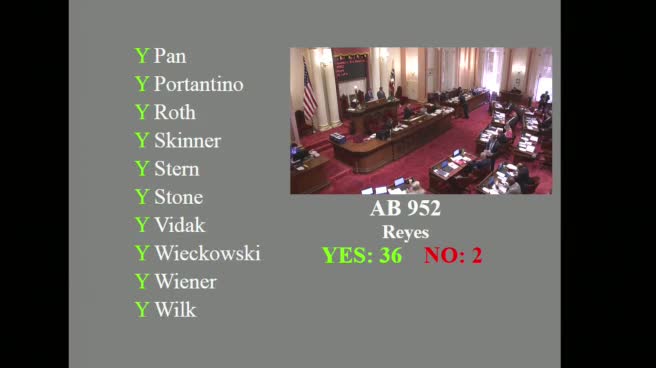 7MIN
Senate Floor
 1MIN
Assembly Floor
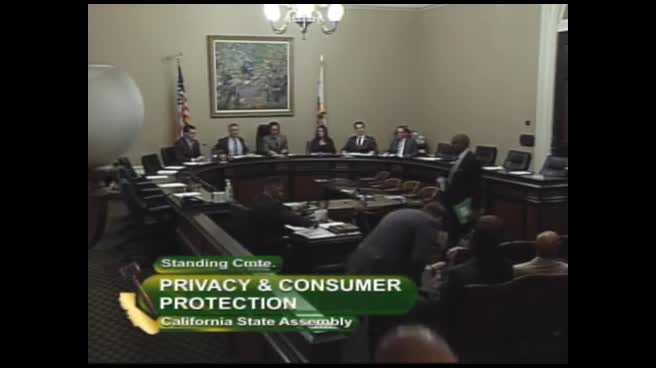 33MIN
Assembly Standing Committee on Privacy and Consumer Protection
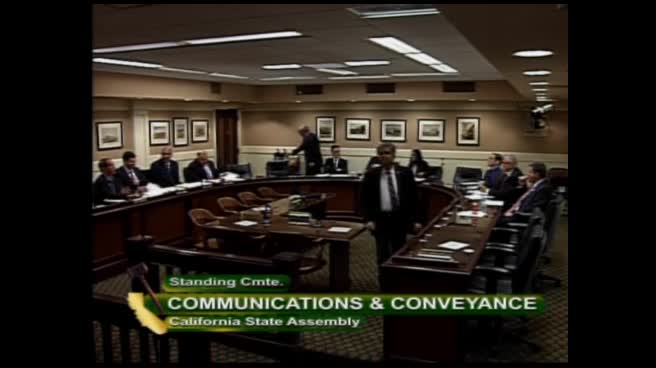 47MIN
Assembly Standing Committee on Communications and Conveyance
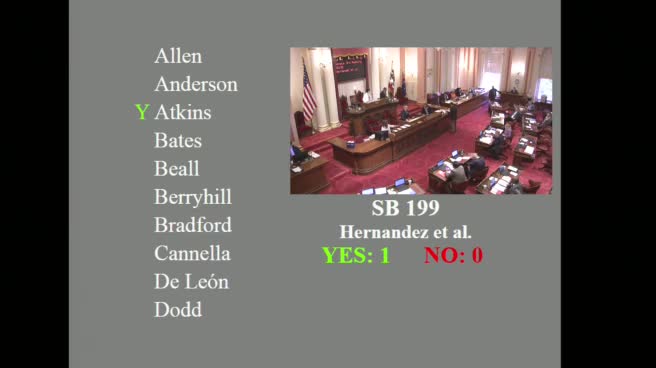 19MIN
Senate Floor
 1H
Senate Standing Committee on Judiciary
 40MIN
Senate Standing Committee on Governance and Finance
Bill Author

Bill Co-Author(s):