SB 249: Off-highway motor vehicle recreation.
- Session Year: 2017-2018
- House: Senate
- Latest Version Date: 2017-10-03
The Off-Highway Motor Vehicle Recreation Act of 2003 creates the Off-Highway Motor Vehicle Recreation Commission and the Division of Off-Highway Motor Vehicle Recreation within the Department of Parks and Recreation. The act gives the division certain duties and responsibilities, including the planning, acquisition, development, conservation, and restoration of lands in state vehicular recreation areas. Existing law requires the division to develop and implement a grant and cooperative agreement program with other agencies funded from no more than 1/2 of the revenues in the Off-Highway Vehicle Trust Fund, with specified percentages of these revenues to be available, upon appropriation, for various purposes related to off-highway vehicles. Existing law requires the remaining revenues in the Off-Highway Vehicle Trust Fund to be available for the support of the division and for the planning, acquisition, development, construction, maintenance, administration, operation, restoration, and conservation of lands in state vehicular recreation areas and certain other areas. The act is repealed on January 1, 2018.
This bill would revise and recast various provisions of the act. The bill would expand the duties of the division by requiring it to, among other things, (1) prepare and implement management and wildlife habitat protection plans for lands in, or proposed to be included in state vehicular recreation areas, as specified, (2) post on the departments Internet Web site all plans, reports, and studies related to off-highway vehicle recreation developed by the division, (3) in consultation with specified bodies and departments, review, and if deemed necessary, update the 2008 Soil Conservation Standard and Guidelines to establish a generic and measurable soil conservation standard by December 31, 2020, and subsequently review and update that standard when deemed necessary by the department, (4) monitor annually in each state vehicular recreation area to determine whether soil conservation standards are being met and the objectives of wildlife habitat protection plans are being met, and (5) protect natural, cultural, and archaeological resources within state vehicular recreation areas. The bill would require the division to take other specified measures to protect natural and cultural resources within state vehicular recreation areas, as specified. The bill would extend the operation of the acts provisions indefinitely, except for the provision establishing the Off-Highway Motor Vehicle Recreation Commission, which the bill would repeal on January 1, 2023.
The Off-Highway Motor Vehicle Recreation Act of 2003 creates the Off-Highway Motor Vehicle Recreation Commission and the Division of Off-Highway Motor Vehicle Recreation within the Department of Parks and Recreation. The act gives the division certain duties and responsibilities, including the planning, acquisition, development, conservation, and restoration of lands in state vehicular recreation areas. Existing law requires the division to develop and implement a grant and cooperative agreement program with other agencies funded from no more than 1/2 of the revenues in the Off-Highway Vehicle Trust Fund, with specified percentages of these revenues to be available, upon appropriation, for various purposes related to off-highway vehicles. Existing law requires the remaining revenues in the Off-Highway Vehicle Trust Fund to be available for the support of the division and for the planning, acquisition, development, construction, maintenance, administration, operation, restoration, and conservation of lands in state vehicular recreation areas and certain other areas. The act is repealed on January 1, 2018.
This bill would revise and recast various provisions of the act. The bill would expand the duties of the division by requiring it to, among other things, (1) prepare and implement management and wildlife habitat protection plans for lands in, or proposed to be included in state vehicular recreation areas, as specified, (2) post on the departments Internet Web site all plans, reports, and studies related to off-highway vehicle recreation developed by the division, (3) in consultation with specified bodies and departments, review and update, review, and if deemed necessary, update the 2008 Soil Conservation Standard and Guidelines to establish a generic and measurable soil conservation standard by December 31, 2020, and subsequently review and update that standard when deemed necessary by the department, (4) monitor annually in each state vehicular recreation area to determine whether soil conservation standards are being met and the objectives of wildlife habitat protection plans are being met, and (5) protect natural, cultural, and archaeological resources within state vehicular recreation areas. The bill would require the division to take other specified measures to protect natural and cultural resources within state vehicular recreation areas, as specified. The bill would extend the operation of the acts provisions indefinitely. indefinitely, except for the provision establishing the Off-Highway Motor Vehicle Recreation Commission, which the bill would repeal on January 1, 2023.
The Off-Highway Motor Vehicle Recreation Act of 2003 creates the Division of Off-Highway Motor Vehicle Recreation within the Department of Parks and Recreation. The act gives the division certain duties and responsibilities, including the planning, acquisition, development, conservation, and restoration of lands in state vehicular recreation areas. Existing law requires the division to develop and implement a grant and cooperative agreement program with other agencies funded from no more than 1/2 of the revenues in the Off-Highway Vehicle Trust Fund, with specified percentages of these revenues to be available, upon appropriation, for various purposes related to off-highway vehicles. Existing law requires the remaining revenues in the Off-Highway Vehicle Trust Fund to be available for the support of the division and for the planning, acquisition, development, construction, maintenance, administration, operation, restoration, and conservation of lands in state vehicular recreation areas and certain other areas. The act is repealed on January 1, 2018.
This bill would revise and recast various provisions of the act. The bill would expand the duties of the division by requiring it to, among other things, (1) prepare and submit program and strategic planning reports to the department and the Natural Resources Agency regarding units of the state park system, implement management and wildlife habitat protection plans for lands in, or proposed to be included in state vehicular recreation areas, as specified, (2) post on the departments Internet Web site all plans, reports, and studies related to off-highway vehicle recreation or otherwise developed pursuant to the acts provisions, as specified, by the division, (3) in consultation with specified bodies and departments, update review and update, the 2008 Soil Conservation Standard and Guidelines to establish a generic and measurable soil conservation standard by December 31, 2020, and subsequently review and, as appropriate, and update that standard every 5 years thereafter, when deemed necessary by the department, (4) implement a monitoring program, as defined, to evaluate the condition of soils, wildlife, and vegetation habitats in monitor annually in each state vehicular recreation area each year, as specified, to determine whether soil conservation standards are being met and the objectives of wildlife habitat protection plans are being met, and (5) identify and protect natural, cultural, and archaeological resources within state vehicular recreation areas. The bill would require the division to take other specified measures to protect natural and cultural resources within state vehicular recreation areas, including measures to mitigate harmful impacts to these areas and to protect them from off-highway vehicle recreation use, as specified. The bill would require the division, through a public process, to develop protocols and practices, no later than July 1, 2019, to ensure certain requirements relating to the Off-Highway Motor Vehicle Recreation Program are met. The bill would establish specified procedures for the review of the protocols and practices by the department and would, by July 1, 2020, require the director to determine whether they meet the requirements of the act and to modify any aspects that are inadequate. The bill would change the repeal date for the act to January 1, 2023, thereby extending extend the operation of the acts provisions until that date. indefinitely.
The Off-Highway Motor Vehicle Recreation Act of 2003 creates the Division of Off-Highway Motor Vehicle Recreation within the Department of Parks and Recreation. The act gives the division certain duties and responsibilities, including the planning, acquisition, development, conservation, and restoration of lands in state vehicular recreation areas. Existing law requires the division to develop and implement a grant and cooperative agreement program with other agencies funded from no more than 1/2 of the revenues in the Off-Highway Vehicle Trust Fund, with specified percentages of these revenues to be available, upon appropriation, for various purposes related to off-highway vehicles. Existing law requires the remaining revenues in the Off-Highway Vehicle Trust Fund to be available for the support of the division and for the planning, acquisition, development, construction, maintenance, administration, operation, restoration, and conservation of lands in state vehicular recreation areas and certain other areas. The act is repealed on January 1, 2018.
This bill would revise and recast various provisions of the act. The bill would expand the duties of the division by requiring it to, among other things, (1) prepare and submit program and strategic planning reports to the department and the Natural Resources Agency regarding units of the state park system, as specified, (2) post on the departments Internet Web site all plans, reports, and studies related to off-highway vehicle recreation or otherwise developed pursuant to the acts provisions, as specified, (3) in consultation with specified bodies and departments, update the 2008 Soil Conservation Standard and Guidelines to establish a generic and measurable soil conservation standard by December 31, 2020, and review and, as appropriate, update that standard every 5 years thereafter, (4) implement a monitoring program, as defined, to evaluate the condition of soils, wildlife, and vegetation habitats in each state vehicular recreation area each year, as specified, and (5) identify and protect natural, cultural, and archaeological resources within state vehicular recreation areas. The bill would require the division to take other specified measures to protect natural and cultural preserves resources within state vehicular recreation areas, including measures to mitigate harmful impacts to these areas and to protect them from off-highway vehicle recreation use, as specified. The bill would require the division, through a public process, to develop protocols and practices, no later than July 1, 2019, to ensure certain requirements relating to the Off-Highway Motor Vehicle Recreation Program are met. The bill would establish specified procedures for the review of the protocols and practices by the department and would, by July 1, 2020, require the director to determine whether they meet the requirements of the act and to modify any aspects that are inadequate. The bill would change the repeal date for the act to January 1, 2023, thereby extending the acts provisions until that date.
The Off-Highway Motor Vehicle Recreation Act of 2003 creates the Division of Off-Highway Motor Vehicle Recreation within the Department of Parks and Recreation. The act gives the division certain duties and responsibilities, including the planning, acquisition, development, conservation, and restoration of lands in state vehicular recreation areas. Existing law requires the division to develop and implement a grant and cooperative agreement program with other agencies funded from no more than 1/2 of the revenues in the Off-Highway Vehicle Trust Fund, with specified percentages of these revenues to be available, upon appropriation, for various purposes related to off-highway vehicles. Existing law requires the remaining revenues in the Off-Highway Vehicle Trust Fund to be available for the support of the division and for the planning, acquisition, development, construction, maintenance, administration, operation, restoration, and conservation of lands in state vehicular recreation areas and certain other areas. The act is repealed on January 1, 2018.
This bill would revise and recast various provisions of the act. The bill would expand the duties of the division by requiring it to, among other things, (1) prepare and submit program and strategic planning reports to the department and the Natural Resources Agency regarding units of the state park system, as specified, (2) post on the departments Internet Web site all plans, reports, and studies related to off-highway vehicle recreation or otherwise developed pursuant to the acts provisions, as specified, (3) in consultation with specified bodies and departments, update the 2008 Soil Conservation Standard and Guidelines to establish a generic and measurable soil conservation standard by December 31, 2020, and review and, as appropriate, update that standard every 5 years thereafter, (4) implement a monitoring program, as defined, to evaluate the condition of soils, wildlife, and vegetation habitats in each state vehicular recreation area each year, as specified, and (5) identify and protect natural, cultural, and archaeological resources within state vehicular recreation areas. The bill would require the division to take other specified measures to protect natural and cultural preserves within state vehicular recreation areas, including measures to mitigate harmful impacts to these areas and to protect them from off-highway vehicle recreation use, as specified. The bill would require the division, through a public process, to develop protocols and practices, no later than July 1, 2019, to ensure certain requirements relating to the management of state vehicular recreation areas and other areas of the system Off-Highway Motor Vehicle Recreation Program are met. The bill would establish specified procedures for the review of the protocols and practices by the department and would, by July 1, 2020, require the department director to determine whether they meet the requirements of the act and to modify any aspects that are inadequate. The bill would change the repeal date for the act to January 1, 2023, thereby extending the acts provisions until that date.
(2)Existing law imposes an excise tax on gasoline. Existing law requires a portion of the moneys attributable to the excise tax on gasoline related to specified off-highway motor vehicles and off-highway vehicle activities to be transferred monthly from the Motor Vehicle Fuel Account to the Off-Highway Vehicle Trust Fund and, commencing November 1, 2017, requires the portion of those moneys from a $0.12 per gallon increase, and future inflation adjustments from that increase, to be transferred to the State Parks and Recreation Fund, to be used for state parks, off-highway vehicle programs, or boating programs. Existing law requires the amount of money transferred to be based upon the percentage of total fuel tax revenues transferred for this purpose in the 200607 fiscal year, but authorizes the Department of Transportation, in cooperation with the Department of Parks and Recreation and the Department of Motor Vehicles, to adjust the amount transferred every 5 years, beginning in the 201314 fiscal year. Existing law specifies the factors to be considered in making an adjustment from the 200607 fiscal year baseline, including the number of off-highway vehicles paying identification fees, the number of registered street-legal vehicles anticipated to be used off highway, attendance at state vehicular recreation areas, and off-highway recreation use on federal lands.This bill would revise the method of calculating the gasoline excise taxes attributable to off-highway vehicle use. The bill would require an estimate to be made every 5 years of gasoline excise tax revenue paid by motor vehicles when actually used off highway for motorized recreation and by motor vehicles when actually used off highway to access nonmotorized recreation. The bill would delete the use of factors based on vehicle populations and attendance at state vehicular recreation areas. The bill would delete the reference to the 200607 fiscal year baseline.This bill would initially require all of these fuel taxes to be transferred to the State Parks and Recreation Fund. The bill, upon enactment of the Budget Act, would require the portion of fuel tax revenues allocated by the Budget Act for purposes of the Off-Highway Motor Vehicle Recreation Program to be transferred to the Off-Highway Vehicle Trust Fund. The bill would make statements of legislative intent in this regard.(1)The Off-Highway Motor Vehicle Recreation Act of 2003 creates the Division of Off-Highway Motor Vehicle Recreation within the Department of Parks and Recreation. The act gives the division certain duties and responsibilities, including the planning, acquisition, development, conservation, and restoration of lands in state vehicular recreation areas. Existing law requires the division to develop and implement a grant and cooperative agreement program with other agencies funded from no more than 1/2 of the revenues in the Off-Highway Vehicle Trust Fund, with specified percentages of these revenues to be available, upon appropriation, for various purposes related to off-highway vehicles. Existing law requires the remaining revenues in the Off-Highway Vehicle Trust Fund to be available for the support of the division and for the planning, acquisition, development, construction, maintenance, administration, operation, restoration, and conservation of lands in state vehicular recreation areas and certain other areas. The act is repealed on January 1, 2018.
This bill would revise and recast various provisions of the act. The bill would expand the duties of the division by requiring it to, among other things, (1) prepare and submit program and strategic planning reports to the department and the Natural Resources Agency regarding units of the state park system, as specified, (2) post on the departments Internet Web site all plans, reports, and studies developed pursuant to the acts provisions, as specified, (3) in consultation with specified bodies and departments, update the 2008 Soil Conservation Standard and Guidelines and Standards to establish a generic and measurable soil conservation standard by December 31, 2020, and review and, as appropriate, update that standard every 5 years thereafter, (4) implement a monitoring program, as defined, to monitor evaluate the condition of soils, wildlife, and vegetation habitats in each state vehicular recreation area each year, as specified, and (5) identify and protect sensitive natural, cultural, and archaeological resources within state vehicular recreations areas as natural and cultural preserves closed to off-highway vehicle recreation use. recreation areas. The bill would require the division to take other specified measures to protect natural and cultural preserves within state vehicular recreation areas, including measures to mitigate harmful impacts to these areas and to protect them from off-highway vehicle recreation use, as specified. The bill would require the Director of Parks and Recreation to assemble a science advisory team to advise and assist the department and the division in meeting the natural and cultural resource conservation purposes of the act, as specified. The bill would also prohibit any expansion of an existing, or development of any new, state vehicular recreation area or allocation of grant program funds for new or expanded units of the system until the science advisory team completes its review and submits its recommendations to the department, and the department implements the recommendations. the division, through a public process, to develop protocols and practices, no later than July 1, 2019, to ensure certain requirements relating to the management of state vehicular recreation areas and other areas of the system are met. The bill would establish specified procedures for the review of the protocols and practices by the department and would, by July 1, 2020, require the department to determine whether they meet the requirements of the act and to modify any aspects that are inadequate. The bill would change the repeal date for the act to January 1, 2023, thereby extending the acts provisions until that date.
(2)Existing law, until January 1, 2018, creates the Off-Highway Vehicle Trust Fund. Existing law provides for deposit of various revenues in the fund, including a portion of gasoline excise tax revenues attributable to off-highway vehicle use and $33 in annual special charges imposed, until January 1, 2018, on off-highway motor vehicles subject to identification, which charges are collected by the Department of Motor Vehicles. Existing law, until January 1, 2018, requires the moneys in the trust fund to be used for the Off-Highway Motor Vehicle Recreation Program. Existing law, until January 1, 2018, also requires an annual service fee of $7 to be paid to the Department of Motor Vehicles for deposit in the Motor Vehicle Account for the issuance or renewal of identification of off-highway motor vehicles.This bill would extend the Off-Highway Vehicle Trust Fund until January 1, 2023, and would also similarly extend the $33 annual special charge and the $7 identification fee. (3)Existing law requires any money temporarily transferred from the Off-Highway Vehicle Trust Fund to the General Fund to be reimbursed, without interest, within 2 fiscal years of the transfer. This bill would delete this provision. (4)(2)Existing law imposes an excise tax on gasoline. Existing law requires a portion of the moneys attributable to the excise tax on gasoline related to specified off-highway motor vehicles and off-highway vehicle activities to be transferred monthly from the Motor Vehicle Fuel Account to the Off-Highway Vehicle Trust Fund. Fund and, commencing November 1, 2017, requires the portion of those moneys from a $0.12 per gallon increase, and future inflation adjustments from that increase, to be transferred to the State Parks and Recreation Fund, to be used for state parks, off-highway vehicle programs, or boating programs. Existing law requires the amount of money transferred to be based upon the percentage of total fuel tax revenues transferred for this purpose in the 200607 fiscal year, but authorizes the Department of Transportation, in cooperation with the Department of Parks and Recreation and the Department of Motor Vehicles, to adjust the amount transferred every 5 years, beginning in the 201314 fiscal year. Existing law specifies the factors to be considered in making an adjustment from the 200607 fiscal year baseline, including the number of off-highway vehicles paying identification fees, the number of registered street-legal vehicles anticipated to be used off highway, attendance at state vehicular recreation areas, and off-highway recreation use on federal lands.
This bill would revise the method of calculating the gasoline excise taxes attributable to off-highway vehicle use. The bill would require an estimate to be made every 5 years of gasoline excise tax revenue paid by motor vehicles when actually used off highway for motorized recreation and by motor vehicles when actually used off highway to access nonmotorized recreation. The bill would delete the use of factors based on vehicle populations and attendance at state vehicular recreation areas. The bill would delete the reference to the 200607 fiscal year baseline.
This bill would initially require all of these fuel taxes to be transferred to the State Parks and Recreation Fund. The bill would require the Director of the Department of Parks and Recreation, in consultation with the State Park and Recreation Commission, to include, in the annual budget submitted by the Governor to the Legislature, a proposed allocation of fuel taxes for the purposes of the department, including support for state parks and the Off-Highway Motor Vehicle Recreation Program. The bill, upon enactment of the Budget Act, would require the portion of fuel tax revenues allocated by the Budget Act for purposes of the Off-Highway Motor Vehicle Recreation Program to be transferred to the Off-Highway Vehicle Trust Fund. The bill would make statements of legislative intent in this regard.
(5)This bill would declare that it is to take effect immediately as an urgency statute.(1)The Off-Highway Motor Vehicle Recreation Act of 2003 creates the Division of Off-Highway Motor Vehicle Recreation within the Department of Parks and Recreation. The act gives the division certain duties and responsibilities, including the planning, acquisition, development, conservation, and restoration of lands in state vehicular recreation areas. Existing law requires the division to develop and implement a grant and cooperative agreement program with other agencies funded from no more than 1/2 of the revenues in the Off-Highway Vehicle Trust Fund, with specified percentages of these revenues to be available, upon appropriation, for various purposes related to off-highway vehicles. Existing law requires the remaining revenues in the Off-Highway Vehicle Trust Fund to be available for the support of the division and for the planning, acquisition, development, construction, maintenance, administration, operation, restoration, and conservation of lands in state vehicular recreation areas and certain other areas. The act is repealed on January 1, 2018.
This bill would revise and recast various provisions of the act. The bill would expand the duties of the division by requiring it to, among other things, (1) prepare program and strategic planning reports regarding units of the state park system, as specified, (2) post on the departments Internet Web site all plans, reports, and studies developed pursuant to the acts provisions, as specified, (3) in consultation with specified bodies and departments, update the 2008 Soil Conservation Guidelines and Standards to establish a generic and measurable soil conservation standard by December 31, 2020, and update that standard every 5 years thereafter, (4) implement a monitoring program, as defined, to monitor the condition of soils, wildlife, and vegetation habitats in each state vehicular recreation area each year, as specified, and (5) identify and protect sensitive natural, cultural, and archaeological resources within state vehicular recreations areas as natural and cultural preserves closed to off-highway vehicle recreation use. The bill would require the division to take other specified measures to protect natural and cultural preserves within state vehicular recreation areas, including measures to mitigate harmful impacts to these areas and to protect them from off-highway vehicle recreation use, as specified. The bill would require the Director of Parks and Recreation to assemble a science advisory team to advise and assist the department and the division in meeting the natural and cultural resource conservation purposes of the act, as specified. The bill would also prohibit any expansion of an existing, or development of any new, state vehicular recreation area or allocation of grant program funds for new or expanded units of the system until the science advisory team completes its review and submits its recommendations to the department, and the department implements the recommendations. The bill would change the repeal date for the act to January 1, 2023, thereby extending the acts provisions until that date.
(2)Existing law, until January 1, 2018, creates the Off-Highway Vehicle Trust Fund. Existing law provides for deposit of various revenues in the fund, including a portion of gasoline excise tax revenues attributable to off-highway vehicle use and $33 in annual special charges imposed, until January 1, 2018, on off-highway motor vehicles subject to identification, which charges are collected by the Department of Motor Vehicles. Existing law, until January 1, 2018, requires the moneys in the trust fund to be used for the Off-Highway Motor Vehicle Recreation Program. Existing law, until January 1, 2018, also requires an annual service fee of $7 to be paid to the Department of Motor Vehicles for deposit in the Motor Vehicle Account for the issuance or renewal of identification of off-highway motor vehicles.
This bill would extend the Off-Highway Vehicle Trust Fund until January 1, 2023, and would also similarly extend the $33 annual special charge and the $7 identification fee.
(3)Existing law requires any money temporarily transferred from the Off-Highway Vehicle Trust Fund to the General Fund to be reimbursed, without interest, within 2 fiscal years of the transfer.
This bill would delete this provision.
(4)Existing law imposes an excise tax on gasoline. Existing law requires a portion of the moneys attributable to the excise tax on gasoline related to specified off-highway motor vehicles and off-highway vehicle activities to be transferred monthly from the Motor Vehicle Fuel Account to the Off-Highway Vehicle Trust Fund. Existing law requires the amount of money transferred to be based upon the percentage of total fuel tax revenues transferred for this purpose in the 200607 fiscal year, but authorizes the Department of Transportation, in cooperation with the Department of Parks and Recreation and the Department of Motor Vehicles, to adjust the amount transferred every 5 years, beginning in the 201314 fiscal year. Existing law specifies the factors to be considered in making an adjustment from the 200607 fiscal year baseline, including the number of off-highway vehicles paying identification fees, the number of registered street-legal vehicles anticipated to be used off highway, attendance at state vehicular recreation areas, and off-highway recreation use on federal lands.
This bill would revise the method of calculating the gasoline excise taxes attributable to off-highway vehicle use. The bill would require an estimate to be made every 5 years of gasoline excise tax revenue paid by motor vehicles when actually used off highway for motorized recreation and by motor vehicles when actually used off highway to access nonmotorized recreation. The bill would delete the use of factors based on vehicle populations and attendance at state vehicular recreation areas. The bill would delete the reference to the 200607 fiscal year baseline.
This bill would initially require these fuel taxes to be transferred to the State Parks and Recreation Fund. The bill would require the Director of the Department of Parks and Recreation, in consultation with the State Park and Recreation Commission, to include, in the annual budget submitted by the Governor to the Legislature, a proposed allocation of fuel taxes for the purposes of the department, including support for state parks and the Off-Highway Motor Vehicle Recreation Program. The bill, upon enactment of the Budget Act, would require the portion of fuel tax revenues allocated by the Budget Act for purposes of the Off-Highway Motor Vehicle Recreation Program to be transferred to the Off-Highway Vehicle Trust Fund. The bill would make statements of legislative intent in this regard.
(5)This bill would declare that it is to take effect immediately as an urgency statute.
Conservation and conserve mean activities, practices, and programs that protect and sustain soils, plants, wildlife, habitats, and cultural resources in accordance with the standards adopted pursuant to Section 5090.35.
SEC. 2.Section 5090.11 of the Public Resources Code is amended to read:5090.11.Restoration and restore mean, upon closure of the unit or any portion thereof, the restoration of land to the contours, the plant communities, and the plant covers comparable to those on surrounding lands or at least those that existed prior to off-highway motor vehicle use.
SEC. 3.Section 5090.13 is added to the Public Resources Code, to read:5090.13.Monitoring program means a program adopted by the department that provides periodic evaluations of the condition of resources and informs adaptive management within state vehicular recreation areas.
SEC. 4.Section 5090.14 is added to the Public Resources Code, to read:5090.14.Adaptive management means to use the results of information gathered through a monitoring program or scientific research to adjust management strategies and practices to conserve cultural resources and provide for the conservation and improvement of natural resources.
SEC. 5.Section 5090.14.1 is added to the Public Resources Code, to read:5090.14.1.State vehicular recreation area means a unit of the state park system established pursuant to Section 5090.43.
SEC. 6.Section 5090.15 of the Public Resources Code is amended to read:5090.15.(a)There is in the department the Off-Highway Motor Vehicle Recreation Commission, consisting of nine members, five of whom shall be appointed by the Governor and subject to Senate confirmation, two of whom shall be appointed by the Senate Committee on Rules, and two of whom shall be appointed by the Speaker of the Assembly.
(b)In order to be appointed to the commission, a nominee shall represent one or more of the following groups:
(1)Off-highway vehicle recreation interests.
(2)Biological or soil scientists.
(3)Groups or associations of predominantly rural landowners.
(4)Law enforcement.
(5)Environmental protection organizations.
(6)Nonmotorized recreation interests.
(c)It is the intent of the Legislature that appointees to the commission represent all of the groups delineated in paragraphs (1) to (6) of subdivision (b), inclusive, to the extent possible.
(d)Whenever a reference is made to the State Park and Recreation Commission pertaining to a duty, power, purpose, responsibility, or jurisdiction of the State Park and Recreation Commission with respect to the state vehicular recreation areas, as established by this chapter, it is a reference to, and means, the Off-Highway Motor Vehicle Recreation Commission.
(e)By December 31, 2018, the department shall convene a stakeholder process to make recommendations to the Governor and the Legislature regarding ways to implement this section. The stakeholder process may consider a variety of recommendations, including, but not limited to, ways to achieve a diverse commission, including the geographic diversity of California, as well as the diversity of all Californians, including, but not limited to, the special needs of all who participate in off-highway vehicular recreation, and ways to achieve diverse public participation in the commission process. The department shall submit these recommendations to the Governor and the Legislature on or before January 1, 2020.
(f)This section shall remain in effect only until January 1, 2023, and as of that date is repealed.
SEC. 7.Section 5090.24 of the Public Resources Code is amended to read:5090.24.The commission has the following duties and responsibilities:
(a)Be fully informed regarding all governmental activities affecting the program.
(b)Meet at least four times per year at various locations throughout the state to receive comments on the implementation of the program. Establish an annual calendar of proposed meetings at the beginning of each calendar year. The meetings shall include a public meeting, before the beginning of each grant program cycle, to collect public input concerning the program, recommendations for program improvements, and specific project needs for the system.
(c)Hold a public hearing to receive public comment regarding any proposed substantial acquisition or development project at a location in close geographic proximity to the project, unless a hearing consistent with federal law or regulation has already been held regarding the project.
(d)Consider, upon the request of any owner or tenant, whose property is in the vicinity of any land in the system, any alleged adverse impacts occurring on that persons property from the operation of off-highway motor vehicles and recommend to the division suitable measures for the prevention of any adverse impact determined by the commission to be occurring, and suitable measures for the restoration of adversely impacted property.
(e)Review and comment annually to the director on the proposed budget of expenditures from the fund.
(f)Review all plans for new and expanded local and regional vehicle recreation areas that have applied for grant funds.
(g)Review and comment on strategic plans periodically developed by the division.
(h)Prepare and submit a program report to the Governor and the appropriate policy and fiscal committees of each house of the Legislature on or before January 1, 2022, and every three years thereafter. The report required to be submitted pursuant to this subdivision shall be submitted in compliance with Section 9795 of the Government Code. The report shall be adopted by the commission after discussing the contents during two or more public meetings. One of the public meetings shall be held in northern California and one shall be held in southern California. The report shall address the status of the program and off-highway motor vehicle recreation, including all of the following:
(1)A summary of the process, standards, and plans developed pursuant to this chapter.
(2)The condition of natural and cultural resources of areas and trails receiving state off-highway motor vehicle funds and the resolution of conflicts of use in those areas and trails.
(3)The status and accomplishments of funds appropriated for restoration pursuant to paragraph (2) of subdivision (b) of Section 5090.50.
(4)A summary of resource monitoring data compiled and restoration work completed.
(5)Actions taken by the division and department since the last program report to discourage and decrease trespass of off-highway motor vehicles on private property.
(6)Other relevant program-related environmental issues that have arisen at state vehicular recreation areas since the last program report, including, but not limited to, actions undertaken to ensure compliance with federal and state Endangered Species Acts, local air quality laws and regulations, federal Clean Water Act and regional water board regulations, or permits.
(i)Make other recommendations to the deputy director regarding the off-highway motor vehicle recreation program.
SEC. 8.Section 5090.30 of the Public Resources Code is amended to read:5090.30.There is in the department the Division of Off-Highway Motor Vehicle Recreation. Whenever any reference is made to the Office of Off-Highway Motor Vehicle Recreation, it shall be deemed to be a reference to, and to mean, the division.
SEC. 9.Section 5090.31 of the Public Resources Code is amended to read:5090.31.The division shall be under the direction of a deputy director appointed by the director.
SEC. 10.Section 5090.32 of the Public Resources Code is amended to read:5090.32.The division has the following duties and responsibilities:
(a)Planning, acquisition, development, conservation, and restoration of lands in the state vehicular recreation areas.
(b)Management, maintenance, administration, and operation of lands in the state vehicular recreation areas.
(c)Provide for law enforcement and appropriate public safety activities.
(d)Implementation of all aspects of the program.
(e)Ensure program compliance with the California Environmental Quality Act (Division 13 (commencing with Section 21000)) in state vehicular recreation areas.
(f)Provide staff assistance to the commission.
(g)Prepare and implement management and wildlife habitat protection plans for lands in, or proposed to be included in, state vehicular recreation areas, including new state vehicular recreation areas. These plans shall be developed in consideration of statutorily required state and regional conservation objectives. However, a plan shall not be prepared in any instance specified in subdivision (c) of Section 5002.2. Trails may only be added or included as components of existing trail systems when developing or updating plans in state vehicular recreation areas, upon completion of full environmental review.
(h)Conduct, or cause to be conducted, surveys, and prepare, or cause to be prepared, studies that are necessary or desirable for implementing the program.
(i)Recruit and utilize volunteers to further the objectives of the program.
(j)Prepare and coordinate safety and education programs.
(k)Provide for the enforcement of Division 16.5 (commencing with Section 38000) of the Vehicle Code and other laws regulating the use or equipment of off-highway motor vehicles in all areas acquired, maintained, or operated by funds from the fund; however, the Department of the California Highway Patrol shall have responsibility for enforcement on highways.
(l)Provide for the conservation of natural and cultural resources, including appropriate mitigation.
(m)Post on the departments Internet Web site all plans, reports, and studies related to off-highway vehicle recreation developed by the division.
(n)Report on any closure implemented pursuant to Section 5090.35 at the next commission meeting following the closure.
(o)Complete other duties as determined by the director.
SEC. 11.Section 5090.34 of the Public Resources Code is amended to read:5090.34.(a)In cooperation with the commission, the division shall make available on the divisions Internet Web site information regarding off-highway motor vehicle recreation opportunities, pertinent laws and regulations, and responsible use of the system. Where practical, the Internet Web site shall include the following:
(1)The text of laws and regulations relating to the program and operation of off-highway vehicles.
(2)A statewide map and regional maps of federal, state, and local off-highway vehicle recreation areas and facilities in the state, including links to maps of federal off-highway vehicle routes resulting from the route designation process.
(3)Information concerning safety, education, and trail etiquette.
(4)Information to prevent trespass, damage to public and private property, and damage to natural resources, including penalties and liability associated with trespass and damage caused.
(b)The division may create, and update when appropriate, a guidebook of federal, state, and local off-highway vehicle recreation opportunities that includes information where current specific maps and information for each facility can be located. Contact information shall be provided and shall include available Internet Web site addresses, telephone numbers, and addresses of offices where maps can be accessed. The guidebook shall also include the address of the Internet Web site where the information in subdivision (a) may be found.
(c)The division may work with retailers of off-highway motor vehicles and off-highway recreation associations to distribute the guidebook developed under subdivision (b) and to increase awareness of the resources available on the divisions Internet Web site.
SEC. 12.Section 5090.35 of the Public Resources Code is amended to read:5090.35.(a)The protection of public safety, the appropriate utilization of lands, and the conservation of natural and cultural resources are of the highest priority in the management of the state vehicular recreation areas. Additionally, the division shall promptly repair and continuously maintain areas and trails, and anticipate and prevent accelerated and unnatural erosion and other off-highway vehicle impacts to the extent possible. The division shall take steps necessary to prevent damage to significant natural and cultural resources within state vehicular recreation areas.
(b)(1)The division, in consultation with the United States Natural Resource Conservation Service, the United States Geological Survey, the United States Forest Service, the United States Bureau of Land Management, the Department of Fish and Wildlife, and the Department of Conservation shall, by December 31, 2020, review, and if deemed necessary, update the 2008 Soil Conservation Standard and Guidelines to establish a generic and measurable soil conservation standard. The division shall subsequently review and update the standard when deemed necessary by the department.
(2)If the division determines that the soil conservation standards and habitat protection plans are not being met in any portion of any state vehicular recreation area, the division shall temporarily close the noncompliant portion to repair and prevent accelerated erosion, until the soil conservation standards are met.
(3)If the division determines that the soil conservation standards cannot be met in any portion of any state vehicular recreation area, the division shall close and restore the noncompliant portion pursuant to Section 5090.11.
(c)(1)The division shall compile and, when determined by the department to be necessary, periodically review and update an inventory of wildlife populations and prepare a wildlife habitat protection plan that conserves and improves wildlife habitats for each state vehicular recreation area. By December 31, 2030, the division shall compile an inventory of native plant communities in each state vehicular recreation area to inform future plan updates.
(2)If the division determines that the wildlife habitat protection plan is not being met in any portion of any state vehicular recreation area, the division shall close the noncompliant portion temporarily until the wildlife habitat protection plan is met.
(3)If the division determines that the wildlife habitat protection plan cannot be met in any portion of any state vehicular recreation area, the division shall close and restore the noncompliant portion pursuant to Section 5090.11.
(d)The division shall monitor annually in each state vehicular recreation area to determine whether soil conservation standards are being met and the objectives of wildlife habitat protection plans are being met.
(e)The division shall not fund trail construction unless the trail is capable of complying with the conservation specifications prescribed in this section. The division shall not fund trail construction where conservation is not feasible. The division shall not fund the maintenance of a trail unless that trail is a component of a state vehicular recreation area road and trail system.
(f)The division shall protect natural, cultural, and archaeological resources within the state vehicular recreation areas.
SEC. 13.Section 5090.39 is added to the Public Resources Code, to read:5090.39.(a)The department shall require that:
(1)Any soil conservation standard, wildlife habitat protection plan, or monitoring program, required by this chapter, applies best available science.
(2)All standards, plans, and monitoring programs subject to paragraph (1) shall provide opportunities for public comment, including, but not limited to, written comments and public meetings, as appropriate.
(b)Nothing in this chapter relieves the division from compliance with state and federal laws and regulations, including permit requirements.
SEC. 14.Section 5090.43 of the Public Resources Code is amended to read:5090.43.(a)State vehicular recreation areas consist of areas selected, developed, and operated to provide off-highway vehicle recreation opportunities. State vehicular recreation areas shall be selected for acquisition on lands where the need to establish areas to protect natural and cultural resources is minimized, the terrain is capable of withstanding motorized vehicle impacts, and where there are quality recreational opportunities for off-highway motor vehicles. Areas shall be developed, managed, and operated for the purpose of providing the fullest appropriate public use of the vehicular recreational opportunities present, in accordance with the requirements of this chapter, while providing for the conservation of cultural resources and the conservation and improvement of natural resource values over time.
(b)After January 1, 1988, no new cultural or natural preserves or state wildernesses shall be established within state vehicular recreation areas. To protect natural and cultural resource values, sensitive areas may be established within state vehicular recreation areas where determined by the department to be necessary to protect natural and cultural resources. These sensitive areas shall be managed by the division in accordance with Sections 5019.71 and 5019.74, which define the purpose and management of natural and cultural preserves.
(c)If off-highway motor vehicle use results in damage to any natural or cultural resources or damage within sensitive areas, appropriate measures shall be promptly taken to protect these lands from any further damage. These measures may include the erection of physical barriers and shall include the restoration of natural resources and the repair of damage to cultural resources.
SEC. 15.Section 5090.50 of the Public Resources Code is amended to read:5090.50.(a)The division shall develop and implement a grant and cooperative agreement program to support the planning, acquisition, development, maintenance, administration, operation, enforcement, restoration, and conservation of trails, trailheads, areas, and other facilities associated with the use of off-highway motor vehicles, and programs involving off-highway motor vehicle safety or education.
(b)When appropriated by the Legislature for grants and cooperative agreements, available funds shall be awarded in accordance with the following categories:
(1)Operation and maintenance.
(A)Fifty percent of the funds appropriated by the Legislature pursuant to subdivision (a) of Section 5090.61 shall be expended solely for grants and cooperative agreements for the acquisition, maintenance, operation, planning, development, or conservation of authorized trails and facilities associated with the use of off-highway motor vehicles for recreation or motorized access to nonmotorized recreation.
(B)Guidelines developed to implement this paragraph, pursuant to subdivision (d), shall at a minimum:
(i)Give preference to applications that sustain existing authorized off-highway motor vehicle recreation opportunities.
(ii)Give additional consideration to applications that improve facilities that provide motorized access to nonmotorized recreation opportunities.
(C)Applications that would affect lands identified as inventoried roadless areas by the Forest Service of the United States Department of Agriculture are eligible for cooperative agreements under paragraph (1) if the application is for a project that does any of the following:
(i)Realigns a forest system road or trail to prevent irreparable resource damage that arises from the design, location, use, or deterioration of a classified route and that cannot be mitigated by route maintenance.
(ii)Reconstructs a national forest system road or trail to implement a route safety improvement project on a classified route determined to be hazardous on the basis of accident experience or accident potential on that route.
(iii)Maintains a road or trail that is included in the National Forest System Roads and Trails on or before January 1, 2009.
(D)Any unencumbered funds under this paragraph shall only be used in future grant cycles for purposes consistent with this paragraph.
(2)Restoration.
(A)Twenty-five percent of the funds appropriated by the Legislature pursuant to subdivision (a) of Section 5090.61 shall be expended solely for grants and cooperative agreements for projects that restore or repair habitat damaged by either legal or illegal off-highway motor vehicle use.
(B)The division shall develop and implement, in consultation with the Wildlife Conservation Board, a competitive grant and cooperative agreement program which shall be administered in accordance with this paragraph.
(C)Funds identified in this paragraph shall be available for grants and cooperative agreements for projects that restore or repair habitat damaged by both legal and illegal off-highway motor vehicle use.
(D)Eligible projects include:
(i)Removal of a road or trail or restoration of an area associated with the rerouting and subsequent closure of a designated road or trail.
(ii)Removal of roads or trails and the restoration of damaged habitats in any area that is not designated for motorized vehicle use.
(iii)The removal of closed roads or trails, or a portion of a closed road or trail, that will help to prevent off-highway motor vehicle access to closed areas.
(iv)Scientific and cultural studies regarding the impact of off-highway motor vehicle recreation not otherwise required by state or federal laws.
(v)Planning to identify appropriate restoration techniques, strategies, and project implementation, including planning associated with environmental review.
(vi)Restoration projects that generally improve and restore the function of natural resource systems damaged by motorized activities.
(E)Eligible applicants include local, state, and federal agencies, federally or state recognized Native American tribes, educational institutions, certified community conservation corps, resource conservation districts, and other eligible nonprofit organizations.
(F)Guidelines developed to implement this paragraph shall at a minimum do all of the following:
(i)Give additional consideration to applications for projects that will restore areas that have experienced the most damage from motorized use or face the highest threat of significant environmental damage from motorized use.
(ii)Guarantee that no grant will be used for the development or maintenance of trails for motorized use.
(iii)Encourage public agencies managing lands to prepare and implement a management and enforcement plan to prevent reoccurring damage from unauthorized use.
(G)Any unencumbered funds under this paragraph shall be used only in future grant cycles for purposes consistent with this paragraph.
(3)Law enforcement.
(A)Twenty percent of the funds appropriated by the Legislature pursuant to subdivision (a) of Section 5090.61 shall be available for law enforcement grants and cooperative agreements and shall be allocated to local and federal law enforcement entities for peace officers or other personnel who have authority to issue citations or take other official law enforcement action, and related equipment. The amount of the grant or cooperative agreement shall be proportionate to the off-highway motor vehicle enforcement needs under each entitys jurisdiction.
(B)The division shall develop a method to determine the law enforcement needs for each applicant. Forty percent of law enforcement grants and cooperative agreements shall be given to local law enforcement entities, 30 percent to units of the United States Bureau of Land Management, and 30 percent to units of the United States Forest Service.
(C)The division shall develop eligibility guidelines for law enforcement projects. The guidelines, at a minimum, shall require the applicant to do all of the following:
(i)Specify formal and informal cooperation with other appropriate law enforcement entities, including any applicable federal entities.
(ii)Establish a policy on how violations of off-highway motor vehicle laws and regulations will be enforced on federal land, if the applicant is a local law enforcement entity.
(iii)Identify areas with high priority law enforcement needs because of public safety, cultural resources, and sensitive environmental habitats, including wilderness areas and areas of critical environmental concern.
(iv)Explain whether the applicant is recovering a portion of law enforcement costs directly associated with privately sponsored events where sponsors have obtained a local permit.
(v)Establish a public education program that includes information regarding safety programs offered in the area and how to report off-highway motor vehicle operation violations.
(vi)Specify how personnel is trained and educated regarding off-highway motor vehicle safety and resource and cultural protection.
(D)Notwithstanding subdivision (h), law enforcement entities that receive funds allocated pursuant to this paragraph shall be subject to a financial and performance audit at least once every five years. The audits may be conducted in a random order. As part of the audit, the department shall consider whether the law enforcement entity has spent the grant money in accordance with its application.
(E)Any unencumbered funds under this paragraph shall be used only in future grant cycles for purposes consistent with this paragraph.
(4)Education and safety.
(A)Five percent of the funds appropriated by the Legislature pursuant to subdivision (a) of Section 5090.61 shall be available for grants and cooperative agreements that either provide comprehensive education that teaches off-highway motor vehicle safety, environmental responsibility, and respect for private property, or provide safety programs associated with off-highway motor vehicle recreation.
(B)Any unencumbered funds under this paragraph shall be used only in future grant cycles for purposes consistent with this paragraph.
(c)Eligible grant and cooperative agreement applicants include:
(1)Cities, counties, and districts that have approval to apply for grant funds, in the form of a resolution from their governing body.
(2)State agencies for projects under paragraph (2) of subdivision (b).
(3)Agencies of the United States.
(4)Federally and state recognized Native American tribes.
(5)Educational institutions, certified community conservation corps, resource conservation districts, and other eligible nonprofit organizations for eligible projects described in subdivision (f).
(d)Guidelines developed to implement this program shall at a minimum do all of the following:
(1)Distribute grants and cooperative agreements on a competitive basis, except for law enforcement grants allocated in accordance with paragraph (3) of subdivision (b).
(2)Be developed with public input, including focus groups.
(3)Require applications to be in accordance with local or federal plans and the strategic plan for off-highway motor vehicle recreation prepared by the division.
(4)Require grant applicants to comply with the California Environmental Quality Act (Division 13 (commencing with Section 21000)). Applicants for cooperative agreements shall complete environmental review procedures that are at least comparable to those of the California Environmental Quality Act (Division 13 (commencing with Section 21000)).
(5)Require the applicant to agree to provide matching funds or the equivalent value of services or material used, in an amount not less than 25 percent of the total project cost, except for the category of restoration, which shall not be less than 10 percent of the total project cost.
(6)Require the applicant, if it is a city or county, to disclose how fees collected pursuant to Section 38230 of the Vehicle Code are being used and whether the use of these fees complements the applicants project.
(7)Fund all eligible applications to the extent feasible.
(e)All grants and cooperative agreements involving ground disturbing activities shall be subject to the uniform application of soil and wildlife habitat protection standards specified in Section 5090.53.
(f)Grants may be awarded to educational institutions and nonprofit organizations. Eligible projects shall be limited to scientific research, natural resource conservation activities, trail and facility maintenance, restoration, and programs involving off-highway motor vehicle safety or education. If the application for grant funds involves activities on any public lands, all of the following shall apply:
(1)The applicant shall include a work plan for the project.
(2)The applicant shall provide written permission from the appropriate land manager to conduct a project, including a description of how the project fits with the land management goals of the area.
(3)The applicant shall provide matching funds or the equivalent value of volunteer services or material used, in an amount not less than 25 percent of the total project cost, except for the category of restoration, which shall not be less than 10 percent of the total project cost.
(4)The applicant shall be fiscally responsible for adhering to the terms and conditions of the grants.
(g)The deputy director of the division shall not participate in the scoring of grants or cooperative agreements.
(h)The department shall conduct an annual financial audit of the grants and cooperative agreements program. During each year, the department shall also conduct, or cause to be conducted, an audit of the performance of a minimum of 20 percent of grant and cooperative agreement recipients.
(i)The division shall establish an administrative appeal process as part of the grants and cooperative agreements program. At a minimum, this process shall do all of the following:
(1)Give applicants the right to appeal on the following grounds:
(A)The division failed to follow regulations established for the award of grants and cooperative agreements.
(B)The division lacked sufficient factual evidence to support or deny the award of a grant or cooperative agreement.
(2)Require the applicant to first appeal to the deputy director of the division. If that appeal is denied, the applicant may then appeal to the director of the division, or the directors appointee.
(3)Require applicants to file their first appeal within 30 calendar days following the notice of award or denial of a grant or cooperative agreement. Notice of the decision or the rejection of the appeal shall be issued within 60 days following the filing of an appeal.
(4)Require applicants to exhaust these appeal rights prior to seeking other legal remedies through the courts.
(j)A grant shall not be made, nor a cooperative agreement entered into, pursuant to this section without the approval of the director.
SEC. 16.Section 5090.61 of the Public Resources Code is amended to read:5090.61.Moneys in the fund shall be available, upon appropriation by the Legislature, as follows:
(a)An amount, not to exceed 50 percent of the annual revenues to the fund, shall be available for grants and cooperative agreements pursuant to Article 5 (commencing with Section 5090.50).
(b)(1)The remainder of the annual revenues to the fund shall be available for the support of the division in implementing the off-highway motor vehicle recreation program and for the planning, acquisition, development, mitigation, construction, maintenance, administration, operation, restoration, and conservation of lands in the system.
(2)As used in this subdivision, support of the division includes functions performed outside of the division by others on behalf of the division, including a prorated share of the departments common overhead and other costs incurred on behalf of the division for personnel management and training, accounting, and fiscal analysis, records, purchasing, public information activities, consultation of professional scientists and reclamation experts for the purposes of Section 5090.35, and legal services.
SEC. 17.Section 5090.70 of the Public Resources Code is repealed.Conservation and conserve mean activities, practices, and programs that protect and sustain soils, plants, wildlife, habitats, and cultural resources in accordance with the standards adopted pursuant to Section 5090.35.
SEC. 2.Section 5090.11 of the Public Resources Code is amended to read:5090.11.Restoration and restore mean, upon closure of the unit or any portion thereof, the restoration of land to the contours, the plant communities, and the plant covers comparable to those on surrounding lands or at least those that existed prior to off-highway motor vehicle use.
SEC. 3.Section 5090.13 is added to the Public Resources Code, to read:5090.13.Monitoring program means a program adopted by the department that provides periodic evaluations of the condition of resources and informs adaptive management within state vehicular recreation areas.
SEC. 4.Section 5090.14 is added to the Public Resources Code, to read:5090.14.Adaptive management means to use the results of information gathered through a monitoring program or scientific research to adjust management strategies and practices to conserve cultural resources and provide for the conservation and improvement of natural resources.
SEC. 5.Section 5090.14.1 is added to the Public Resources Code, to read:5090.14.1.State vehicular recreation area means a unit of the state park system established pursuant to Section 5090.43.
SEC. 6.Section 5090.15 of the Public Resources Code is amended to read:5090.15.(a)There is in the department the Off-Highway Motor Vehicle Recreation Commission, consisting of nine members, five of whom shall be appointed by the Governor and subject to Senate confirmation, two of whom shall be appointed by the Senate Committee on Rules, and two of whom shall be appointed by the Speaker of the Assembly.
(b)Persons appointed to the commission shall have expertise, or work or volunteer experience, or both, in one or more of the following areas, with not more than two commissioners at any time serving under the same qualifications:(1)Off-highway vehicle recreation.(2)Biological or soil sciences.(3)Experience with rural landownership and management.(4)Law enforcement.(5)Environmental or cultural resource protection or management.(6)Nonmotorized outdoor recreation.(b)In order to be appointed to the commission, a nominee shall represent one or more of the following groups:
(1)Off-highway vehicle recreation interests.
(2)Biological or soil scientists.
(3)Groups or associations of predominantly rural landowners.
(4)Law enforcement.
(5)Environmental protection organizations.
(6)Nonmotorized recreation interests.
(c)It is the intent of the Legislature that appointees to the commission represent all of the primary qualifications groups delineated in paragraphs (1) to (6) of subdivision (b), inclusive, to the extent possible, at all times. It is further the intent of the Legislature that the commissioners reflect the geographic diversity of California as well as the diversity of all Californians, including, but not limited to, the special needs of Californians who participate in off-highway vehicular recreation pursuant to this chapter. possible.
(d)Whenever a reference is made to the State Park and Recreation Commission pertaining to a duty, power, purpose, responsibility, or jurisdiction of the State Park and Recreation Commission with respect to the state vehicular recreation areas, as established by this chapter, it is a reference to, and means, the Off-Highway Motor Vehicle Recreation Commission.
(e)By December 31, 2018, the department shall convene a stakeholder process to make recommendations to the Governor and the Legislature regarding ways to implement this section. The stakeholder process may consider a variety of recommendations, including, but not limited to, ways to achieve a diverse commission, including the geographic diversity of California, as well as the diversity of all Californians, including, but not limited to, the special needs of all who participate in off-highway vehicular recreation, and ways to achieve diverse public participation in the commission process. The department shall submit these recommendations to the Governor and the Legislature on or before January 1, 2020.
(f)This section shall remain in effect only until January 1, 2023, and as of that date is repealed.
SEC. 7.Section 5090.24 of the Public Resources Code is amended to read:5090.24.The commission has the following duties and responsibilities:
(a)Be fully informed regarding all governmental activities affecting the program.
(b)Meet at least four times per year at various locations throughout the state to receive comments on the implementation of the program. Establish an annual calendar of proposed meetings at the beginning of each calendar year. The meetings shall include a public meeting, before the beginning of each grant program cycle, to collect public input concerning the program, recommendations for program improvements, and specific project needs for the system.
(c)Hold a public hearing to receive public comment regarding any proposed substantial acquisition or development project at a location in close geographic proximity to the project, unless a hearing consistent with federal law or regulation has already been held regarding the project.
(d)Consider, upon the request of any owner or tenant, whose property is in the vicinity of any land in the system, any alleged adverse impacts occurring on that persons property from the operation of off-highway motor vehicles and recommend to the division suitable measures for the prevention of any adverse impact determined by the commission to be occurring, and suitable measures for the restoration of adversely impacted property.
(e)Review and comment annually to the director on the proposed budget of expenditures from the fund.
(f)Review all plans for new and expanded local and regional vehicle recreation areas that have applied for grant funds.
(g)Review and comment on strategic plans periodically developed by the division.
(h)Prepare and submit a program report to the Governor and the appropriate policy and fiscal committees of each house of the Legislature on or before January 1, 2022, and every three years thereafter. The report required to be submitted pursuant to this subdivision shall be submitted in compliance with Section 9795 of the Government Code. The report shall be adopted by the commission after discussing the contents during two or more public meetings. One of the public meetings shall be held in northern California and one shall be held in southern California. The report shall address the status of the program and off-highway motor vehicle recreation, including all of the following:
(1)A summary of the process, standards, and plans developed pursuant to this chapter.
(2)The condition of natural and cultural resources of areas and trails receiving state off-highway motor vehicle funds and the resolution of conflicts of use in those areas and trails.
(3)The status and accomplishments of funds appropriated for restoration pursuant to paragraph (2) of subdivision (b) of Section 5090.50.
(4)A summary of resource monitoring data compiled and restoration work completed.
(5)Actions taken by the division and department since the last program report to discourage and decrease trespass of off-highway motor vehicles on private property.
(6)Other relevant program-related environmental issues that have arisen at state vehicular recreation areas since the last program report, including, but not limited to, actions undertaken to ensure compliance with federal and state Endangered Species Acts, local air quality laws and regulations, federal Clean Water Act and regional water board regulations regulations, or permits.
(i)Make other recommendations to the deputy director regarding the off-highway motor vehicle recreation program.
SEC. 8.Section 5090.30 of the Public Resources Code is amended to read:5090.30.There is in the department the Division of Off-Highway Motor Vehicle Recreation. Whenever any reference is made to the Office of Off-Highway Motor Vehicle Recreation, it shall be deemed to be a reference to, and to mean, the division.
SEC. 9.Section 5090.31 of the Public Resources Code is amended to read:5090.31.The division shall be under the direction of a deputy director appointed by the director.
SEC. 10.Section 5090.32 of the Public Resources Code is amended to read:5090.32.The division has the following duties and responsibilities:
(a)Planning, acquisition, development, conservation, and restoration of lands in the state vehicular recreation areas.
(b)Management, maintenance, administration, and operation of lands in the state vehicular recreation areas.
(c)Provide for law enforcement and appropriate public safety activities.
(d)Implementation of all aspects of the program.
(e)Ensure program compliance with the California Environmental Quality Act (Division 13 (commencing with Section 21000)) in state vehicular recreation areas.
(f)Provide staff assistance to the commission.
(g)Prepare and implement management and wildlife habitat protection plans for lands in, or proposed to be included in, state vehicular recreation areas, including new state vehicular recreation areas. These plans shall be developed in consideration of statutorily required state and regional conservation objectives. However, a plan shall not be prepared in any instance specified in subdivision (c) of Section 5002.2. Trails may only be added or included as components of existing trail systems when developing or updating plans in state vehicular recreation areas, upon completion of full environmental review.
(h)Conduct, or cause to be conducted, surveys, and prepare, or cause to be prepared, studies that are necessary or desirable for implementing the program.
(i)Recruit and utilize volunteers to further the objectives of the program.
(j)Prepare and coordinate safety and education programs.
(k)Provide for the enforcement of Division 16.5 (commencing with Section 38000) of the Vehicle Code and other laws regulating the use or equipment of off-highway motor vehicles in all areas acquired, maintained, or operated by funds from the fund; however, the Department of the California Highway Patrol shall have responsibility for enforcement on highways.
(l)Provide for the conservation of natural and cultural resources, including appropriate mitigation.
(m)Post on the departments Internet Web site all plans, reports, and studies related to off-highway vehicle recreation developed by the division.
(n)Report on any closure implemented pursuant to Section 5090.35 at the next commission meeting following the closure.
(o)Complete other duties as determined by the director.
SEC. 11.Section 5090.34 of the Public Resources Code is amended to read:5090.34.(a)In cooperation with the commission, the division shall make available on the divisions Internet Web site information regarding off-highway motor vehicle recreation opportunities, pertinent laws and regulations, and responsible use of the system. Where practical, the Internet Web site shall include the following:
(1)The text of laws and regulations relating to the program and operation of off-highway vehicles.
(2)A statewide map and regional maps of federal, state, and local off-highway vehicle recreation areas and facilities in the state, including links to maps of federal off-highway vehicle routes resulting from the route designation process.
(3)Information concerning safety, education, and trail etiquette.
(4)Information to prevent trespass, damage to public and private property, and damage to natural resources, including penalties and liability associated with trespass and damage caused.
(b)The division may create, and update when appropriate, a guidebook of federal, state, and local off-highway vehicle recreation opportunities that includes information where current specific maps and information for each facility can be located. Contact information shall be provided and shall include available Internet Web site addresses, telephone numbers, and addresses of offices where maps can be accessed. The guidebook shall also include the address of the Internet Web site where the information in subdivision (a) may be found.
(c)The division may work with retailers of off-highway motor vehicles and off-highway recreation associations to distribute the guidebook developed under subdivision (b) and to increase awareness of the resources available on the divisions Internet Web site.
SEC. 12.Section 5090.35 of the Public Resources Code is amended to read:5090.35.(a)The protection of public safety, the appropriate utilization of lands, and the conservation of natural and cultural resources are of the highest priority in the management of the state vehicular recreation areas. Additionally, the division shall promptly repair and continuously maintain areas and trails, and anticipate and prevent accelerated and unnatural erosion and other off-highway vehicle impacts to the extent possible. The division shall take steps necessary to prevent damage to significant natural and cultural resources within state vehicular recreation areas.
(b)(1)The division, in consultation with the United States Natural Resource Conservation Service, the United States Geological Survey, the United States Forest Service, the United States Bureau of Land Management, the Department of Fish and Wildlife, and the Department of Conservation shall, by December 31, 2020, review and update, review, and if deemed necessary, update the 2008 Soil Conservation Standard and Guidelines to establish a generic and measurable soil conservation standard and standard. The division shall subsequently review and update the standard when deemed necessary by the department.
(2)If the division determines that the soil conservation standards and habitat protection plans are not being met in any portion of any state vehicular recreation area, the division shall temporarily close the noncompliant portion to repair and prevent accelerated erosion, until the soil conservation standards are met.
(3)If the division determines that the soil conservation standards cannot be met in any portion of any state vehicular recreation area, the division shall close and restore the noncompliant portion pursuant to Section 5090.11.
(c)(1)The division shall compile and, when determined by the department to be necessary, periodically review and update an inventory of wildlife populations and prepare a wildlife habitat protection plan that conserves and improves wildlife habitats for each state vehicular recreation area. By December 31, 2030, the division shall compile an inventory of native plant communities in each state vehicular recreation area to inform future plan updates.
(2)If the division determines that the wildlife habitat protection plan is not being met in any portion of any state vehicular recreation area, the division shall close the noncompliant portion temporarily until the wildlife habitat protection plan is met.
(3)If the division determines that the wildlife habitat protection plan cannot be met in any portion of any state vehicular recreation area, the division shall close and restore the noncompliant portion pursuant to Section 5090.11.
(d)The division shall monitor annually in each state vehicular recreation area to determine whether soil conservation standards are being met and the objectives of wildlife habitat protection plans are being met.
(e)The division shall not fund trail construction unless the trail is capable of complying with the conservation specifications prescribed in this section. The division shall not fund trail construction where conservation is not feasible. The division shall not fund the maintenance of a trail unless that trail is a component of a state vehicular recreation area road and trail system.
(f)The division shall protect natural, cultural, and archaeological resources within the state vehicular recreation areas.
SEC. 13.Section 5090.39 is added to the Public Resources Code, to read:5090.39.(a)The department shall require that:
(1)Any soil conservation standard, wildlife habitat protection plan, or monitoring program, required by this chapter, applies best available science.
(2)All standards, plans, and monitoring programs subject to paragraph (1) shall provide opportunities for public comment, including, but not limited to, written, comments, written comments and public meetings, as appropriate.
(b)Nothing in this chapter relieves the division from compliance with state and federal laws and regulations, including permit requirements.
SEC. 14.Section 5090.43 of the Public Resources Code is amended to read:5090.43.(a)State vehicular recreation areas consist of areas selected, developed, and operated to provide off-highway vehicle recreation opportunities. State vehicular recreation areas shall be selected for acquisition on lands where the need to establish areas to protect natural and cultural resources is minimized, the terrain is capable of withstanding motorized vehicle impacts, and where there are quality recreational opportunities for off-highway motor vehicles. Areas shall be developed, managed, and operated for the purpose of providing the fullest appropriate public use of the vehicular recreational opportunities present, in accordance with the requirements of this chapter, while providing for the conservation of cultural resources and the conservation and improvement of natural resource values over time.
(b)After January 1, 1988, no new cultural or natural preserves or state wildernesses shall be established within state vehicular recreation areas. To protect natural and cultural resource values, sensitive areas may be established within state vehicular recreation areas where determined by the department to be necessary to protect natural and cultural resources. These sensitive areas shall be managed by the division in accordance with Sections 5019.71 and 5019.74, which define the purpose and management of natural and cultural preserves.
(c)If off-highway motor vehicle use results in damage to any natural or cultural resources or damage within sensitive areas, appropriate measures shall be promptly taken to protect these lands from any further damage. These measures may include the erection of physical barriers and shall include the restoration of natural resources and the repair of damage to cultural resources.
SEC. 15.Section 5090.50 of the Public Resources Code is amended to read:5090.50.(a)The division shall develop and implement a grant and cooperative agreement program to support the planning, acquisition, development, maintenance, administration, operation, enforcement, restoration, and conservation of trails, trailheads, areas, and other facilities associated with the use of off-highway motor vehicles, and programs involving off-highway motor vehicle safety or education.
(b)When appropriated by the Legislature for grants and cooperative agreements, available funds shall be awarded in accordance with the following categories:
(1)Operation and maintenance.
(A)Fifty percent of the funds appropriated by the Legislature pursuant to subdivision (a) of Section 5090.61 shall be expended solely for grants and cooperative agreements for the acquisition, maintenance, operation, planning, development, or conservation of authorized trails and facilities associated with the use of off-highway motor vehicles for recreation or motorized access to nonmotorized recreation.
(B)Guidelines developed to implement this paragraph, pursuant to subdivision (d), shall at a minimum:
(i)Give preference to applications that sustain existing authorized off-highway motor vehicle recreation opportunities.
(ii)Give additional consideration to applications that improve facilities that provide motorized access to nonmotorized recreation opportunities.
(C)Applications that would affect lands identified as inventoried roadless areas by the Forest Service of the United States Department of Agriculture are eligible for cooperative agreements under paragraph (1) if the application is for a project that does any of the following:
(i)Realigns a forest system road or trail to prevent irreparable resource damage that arises from the design, location, use, or deterioration of a classified route and that cannot be mitigated by route maintenance.
(ii)Reconstructs a national forest system road or trail to implement a route safety improvement project on a classified route determined to be hazardous on the basis of accident experience or accident potential on that route.
(iii)Maintains a road or trail that is included in the National Forest System Roads and Trails on or before January 1, 2009.
(D)Any unencumbered funds under this paragraph shall only be used in future grant cycles for purposes consistent with this paragraph.
(2)Restoration.
(A)Twenty-five percent of the funds appropriated by the Legislature pursuant to subdivision (a) of Section 5090.61 shall be expended solely for grants and cooperative agreements for projects that restore or repair habitat damaged by either legal or illegal off-highway motor vehicle use.
(B)The division shall develop and implement, in consultation with the Wildlife Conservation Board, a competitive grant and cooperative agreement program which shall be administered in accordance with this paragraph.
(C)Funds identified in this paragraph shall be available for grants and cooperative agreements for projects that restore or repair habitat damaged by both legal and illegal off-highway motor vehicle use.
(D)Eligible projects include:
(i)Removal of a road or trail or restoration of an area associated with the rerouting and subsequent closure of a designated road or trail.
(ii)Removal of roads or trails and the restoration of damaged habitats in any area that is not designated for motorized vehicle use.
(iii)The removal of closed roads or trails, or a portion of a closed road or trail, that will help to prevent off-highway motor vehicle access to closed areas.
(iv)Scientific and cultural studies regarding the impact of off-highway motor vehicle recreation not otherwise required by state or federal laws.
(v)Planning to identify appropriate restoration techniques, strategies, and project implementation, including planning associated with environmental review.
(vi)Restoration projects that generally improve and restore the function of natural resource systems damaged by motorized activities.
(E)Eligible applicants include local, state, and federal agencies, federally or state recognized Native American tribes, educational institutions, certified community conservation corps, resource conservation districts, and other eligible nonprofit organizations.
(F)Guidelines developed to implement this paragraph shall at a minimum do all of the following:
(i)Give additional consideration to applications for projects that will restore areas that have experienced the most damage from motorized use or face the highest threat of significant environmental damage from motorized use.
(ii)Guarantee that no grant will be used for the development or maintenance of trails for motorized use.
(iii)Encourage public agencies managing lands to prepare and implement a management and enforcement plan to prevent reoccurring damage from unauthorized use.
(G)Any unencumbered funds under this paragraph shall be used only in future grant cycles for purposes consistent with this paragraph.
(3)Law enforcement.
(A)Twenty percent of the funds appropriated by the Legislature pursuant to subdivision (a) of Section 5090.61 shall be available for law enforcement grants and cooperative agreements and shall be allocated to local and federal law enforcement entities for peace officers or other personnel who have authority to issue citations or take other official law enforcement action, and related equipment. The amount of the grant or cooperative agreement shall be proportionate to the off-highway motor vehicle enforcement needs under each entitys jurisdiction.
(B)The division shall develop a method to determine the law enforcement needs for each applicant. Forty percent of law enforcement grants and cooperative agreements shall be given to local law enforcement entities, 30 percent to units of the United States Bureau of Land Management, and 30 percent to units of the United States Forest Service.
(C)The division shall develop eligibility guidelines for law enforcement projects. The guidelines, at a minimum, shall require the applicant to do all of the following:
(i)Specify formal and informal cooperation with other appropriate law enforcement entities, including any applicable federal entities.
(ii)Establish a policy on how violations of off-highway motor vehicle laws and regulations will be enforced on federal land, if the applicant is a local law enforcement entity.
(iii)Identify areas with high priority law enforcement needs because of public safety, cultural resources, and sensitive environmental habitats, including wilderness areas and areas of critical environmental concern.
(iv)Explain whether the applicant is recovering a portion of law enforcement costs directly associated with privately sponsored events where sponsors have obtained a local permit.
(v)Establish a public education program that includes information regarding safety programs offered in the area and how to report off-highway motor vehicle operation violations.
(vi)Specify how personnel is trained and educated regarding off-highway motor vehicle safety and resource and cultural protection.
(D)Notwithstanding subdivision (h), law enforcement entities that receive funds allocated pursuant to this paragraph shall be subject to a financial and performance audit at least once every five years. The audits may be conducted in a random order. As part of the audit, the department shall consider whether the law enforcement entity has spent the grant money in accordance with its application.
(E)Any unencumbered funds under this paragraph shall be used only in future grant cycles for purposes consistent with this paragraph.
(4)Education and safety.
(A)Five percent of the funds appropriated by the Legislature pursuant to subdivision (a) of Section 5090.61 shall be available for grants and cooperative agreements that either provide comprehensive education that teaches off-highway motor vehicle safety, environmental responsibility, and respect for private property, or provide safety programs associated with off-highway motor vehicle recreation.
(B)Any unencumbered funds under this paragraph shall be used only in future grant cycles for purposes consistent with this paragraph.
(c)Eligible grant and cooperative agreement applicants include:
(1)Cities, counties, and districts that have approval to apply for grant funds, in the form of a resolution from their governing body.
(2)State agencies for projects under paragraph (2) of subdivision (b).
(3)Agencies of the United States.
(4)Federally and state recognized Native American tribes.
(5)Educational institutions, certified community conservation corps, resource conservation districts, and other eligible nonprofit organizations for eligible projects described in subdivision (f).
(d)Guidelines developed to implement this program shall at a minimum do all of the following:
(1)Distribute grants and cooperative agreements on a competitive basis, except for law enforcement grants allocated in accordance with paragraph (3) of subdivision (b).
(2)Be developed with public input, including focus groups.
(3)Require applications to be in accordance with local or federal plans and the strategic plan for off-highway motor vehicle recreation prepared by the division.
(4)Require grant applicants to comply with the California Environmental Quality Act (Division 13 (commencing with Section 21000)). Applicants for cooperative agreements shall complete environmental review procedures that are at least comparable to those of the California Environmental Quality Act (Division 13 (commencing with Section 21000)).
(5)Require the applicant to agree to provide matching funds or the equivalent value of services or material used, in an amount not less than 25 percent of the total project cost, except for the category of restoration, which shall not be less than 10 percent of the total project cost.
(6)Require the applicant, if it is a city or county, to disclose how fees collected pursuant to Section 38230 of the Vehicle Code are being used and whether the use of these fees complements the applicants project.
(7)Fund all eligible applications to the extent feasible.
(e)All grants and cooperative agreements involving ground disturbing activities shall be subject to the uniform application of soil and wildlife habitat protection standards specified in Section 5090.53.
(f)Grants may be awarded to educational institutions and nonprofit organizations. Eligible projects shall be limited to scientific research, natural resource conservation activities, trail and facility maintenance, restoration, and programs involving off-highway motor vehicle safety or education. If the application for grant funds involves activities on any public lands, all of the following shall apply:
(1)The applicant shall include a work plan for the project.
(2)The applicant shall provide written permission from the appropriate land manager to conduct a project, including a description of how the project fits with the land management goals of the area.
(3)The applicant shall provide matching funds or the equivalent value of volunteer services or material used, in an amount not less than 25 percent of the total project cost, except for the category of restoration, which shall not be less than 10 percent of the total project cost.
(4)The applicant shall be fiscally responsible for adhering to the terms and conditions of the grants.
(g)The deputy director of the division shall not participate in the scoring of grants or cooperative agreements.
(h)The department shall conduct an annual financial audit of the grants and cooperative agreements program. During each year, the department shall also conduct, or cause to be conducted, an audit of the performance of a minimum of 20 percent of grant and cooperative agreement recipients.
(i)The division shall establish an administrative appeal process as part of the grants and cooperative agreements program. At a minimum, this process shall do all of the following:
(1)Give applicants the right to appeal on the following grounds:
(A)The division failed to follow regulations established for the award of grants and cooperative agreements.
(B)The division lacked sufficient factual evidence to support or deny the award of a grant or cooperative agreement.
(2)Require the applicant to first appeal to the deputy director of the division. If that appeal is denied, the applicant may then appeal to the director of the division, or the directors appointee.
(3)Require applicants to file their first appeal within 30 calendar days following the notice of award or denial of a grant or cooperative agreement. Notice of the decision or the rejection of the appeal shall be issued within 60 days following the filing of an appeal.
(4)Require applicants to exhaust these appeal rights prior to seeking other legal remedies through the courts.
(j)A grant shall not be made, nor a cooperative agreement entered into, pursuant to this section without the approval of the director.
SEC. 16.Section 5090.61 of the Public Resources Code is amended to read:5090.61.Moneys in the fund shall be available, upon appropriation by the Legislature, as follows:
(a)An amount, not to exceed 50 percent of the annual revenues to the fund, shall be available for grants and cooperative agreements pursuant to Article 5 (commencing with Section 5090.50).
(b)(1)The remainder of the annual revenues to the fund shall be available for the support of the division in implementing the off-highway motor vehicle recreation program and for the planning, acquisition, development, mitigation, construction, maintenance, administration, operation, restoration, and conservation of lands in the system.
(2)As used in this subdivision, support of the division includes functions performed outside of the division by others on behalf of the division, including a prorated share of the departments common overhead and other costs incurred on behalf of the division for personnel management and training, accounting, and fiscal analysis, records, purchasing, public information activities, consultation of professional scientists and reclamation experts for the purposes of Section 5090.35, and legal services.
SEC. 17.Section 5090.70 of the Public Resources Code is repealed.Conservation and conserve mean activities, practices, and programs that protect and sustain soils, plants, wildlife, habitats, and cultural resources in accordance with the standards adopted pursuant to Section 5090.35.
SEC. 2.Section 5090.11 of the Public Resources Code is amended to read:5090.11.Restoration and restore mean, upon closure of the unit or any portion thereof, the restoration of land to the contours, the plant communities, and the plant covers comparable to those on surrounding lands or at least those that existed prior to off-highway motor vehicle use.
SEC. 3.Section 5090.13 is added to the Public Resources Code, to read:5090.13.Monitoring program means a program adopted by the department that provides periodic evaluations of monitoring results to assess the adequacy of conservation and restoration actions to inform adaptive management strategies. A monitoring program includes, but is not limited to, all of the following at each individual system unit: the condition of resources and informs adaptive management within state vehicular recreation areas.
(a)Surveys to determine the status of natural and cultural resources.(b)Periodic assessments of the effectiveness of protection and restoration measures currently in place.(c)Progress reports on the implementation of conservation and restoration measures, the designation and management of sensitive areas with cultural and natural resources, and alternative management strategies.(d)A schedule for conducting monitoring activities.SEC. 4.Section 5090.14 is added to the Public Resources Code, to read:5090.14.Adaptive management means to use the results of information gathered through a monitoring program or scientific research and regulatory standards to adjust management strategies and practices to ensure conservation and protection of natural and cultural resources. conserve cultural resources and provide for the conservation and improvement of natural resources.
SEC. 5.Section 5090.14.1 is added to the Public Resources Code, to read:5090.14.1.State vehicular recreation area means a unit of the state park system established pursuant to Section 5090.43.
SEC. 5.SEC. 6.Section 5090.15 of the Public Resources Code is amended to read:5090.15.(a)There is in the department the Off-Highway Motor Vehicle Recreation Commission, consisting of nine members, five of whom shall be appointed by the Governor and subject to Senate confirmation, two of whom shall be appointed by the Senate Committee on Rules, and two of whom shall be appointed by the Speaker of the Assembly.
(b)Persons appointed to the commission shall have expertise, or work or volunteer experience, or both, in one or more of the following areas: areas, with not more than two commissioners at any time serving under the same qualifications:
(1)Off-highway vehicle recreation.
(2)Biological or soil sciences.
(3)Practical experience Experience with rural landownership and management.
(4)Law enforcement.
(5)Environmental and or cultural resource protection or management.
(6)Nonmotorized outdoor recreation.
(c)It is the intent of the Legislature that appointees to the commission represent all of the primary qualifications delineated in paragraphs (1) to (6) of subdivision (b), inclusive, to the extent possible, at all times. It is further the intent of the Legislature that the commissioners reflect the geographic diversity of California as well as the diversity of all Californians, including, but not limited to, the special needs of Californians who participate in off-highway vehicular recreation pursuant to this chapter.
(d)Whenever a reference is made to the State Park and Recreation Commission pertaining to a duty, power, purpose, responsibility, or jurisdiction of the State Park and Recreation Commission with respect to the state vehicular recreation areas, as established by this chapter, it is a reference to, and means, the Off-Highway Motor Vehicle Recreation Commission.
SEC. 6.SEC. 7.Section 5090.24 of the Public Resources Code is amended to read:5090.24.The commission has the following duties and responsibilities:
(a)Be fully informed regarding all governmental activities affecting the program.
(b)Meet at least four times per year at various locations throughout the state to receive comments on the implementation of the program. Establish an annual calendar of proposed meetings at the beginning of each calendar year. The meetings shall include a public meeting, before the beginning of each grant program cycle, to collect public input concerning the program, recommendations for program improvements, and specific project needs for the system.
(c)Hold a public hearing to receive public comment regarding any proposed substantial acquisition or development project at a location in close geographic proximity to the project, unless a hearing consistent with federal law or regulation has already been held regarding the project.
(d)Consider, upon the request of any owner or tenant, whose property is in the vicinity of any land in the system, any alleged adverse impacts occurring on that persons property from the operation of off-highway motor vehicles and recommend to the division suitable measures for the prevention of any adverse impact determined by the commission to be occurring, and suitable measures for the restoration of adversely impacted property.
(e)Review and comment annually to the director on the proposed budget of expenditures from the fund.
(f)Review and comment on all plans for new and expanded local and regional vehicle recreation areas that have applied for grant funds.
(g)Review and comment on strategic plans periodically developed by the division.
(h)Prepare and submit a program report to the Governor and the appropriate policy and fiscal committees of each house of the Legislature on or before January 1, 2024. 2022, and every three years thereafter. The report required to be submitted pursuant to this subdivision shall be submitted in compliance with Section 9795 of the Government Code. The report shall be adopted by the commission after discussing the contents during two or more public meetings. One of the public meetings shall be held in northern California and one shall be held in southern California. The report shall address the status of the program and off-highway motor vehicle recreation, including all of the following:
(1)A summary of the process and protocols process, standards, and plans developed pursuant to subdivision (a) of Section 5090.39. this chapter.
(2)The condition of natural and cultural resources of areas and trails receiving state off-highway motor vehicle funds and the resolution of conflicts of use in those areas and trails.
(3)The status and accomplishments of funds appropriated for restoration pursuant to paragraph (2) of subdivision (b) of Section 5090.50.
(4)A summary of resource monitoring data compiled and restoration work completed.
(5)Actions taken by the division and department since the last program report to discourage and decrease trespass of off-highway motor vehicles on private property.
(6)Other relevant program-related environmental issues that have arisen at state vehicular recreation areas since the last program report, including, but not limited to, conflicts including, but not limited to, actions undertaken to ensure compliance with federal and state Endangered Species Acts, local air quality laws and regulations, federal Clean Water Act and regional water board regulations or permits, and other environmental protection requirements. permits.
(i)Make other recommendations to the deputy director regarding the off-highway motor vehicle recreation program.
SEC. 7.SEC. 8.Section 5090.30 of the Public Resources Code is amended to read:5090.30.There is in the department the Division of Off-Highway Motor Vehicle Recreation. Whenever any reference is made to the Office of Off-Highway Motor Vehicle Recreation, it shall be deemed to be a reference to, and to mean, the division.
SEC. 8.SEC. 9.Section 5090.31 of the Public Resources Code is amended to read:5090.31.The division shall be under the direction of a deputy director appointed by the director. The deputy director shall be part of the departments management team.
SEC. 9.SEC. 10.Section 5090.32 of the Public Resources Code is amended to read:5090.32.Under the general direction of the director, the The division has the following duties and responsibilities:
(a)Planning, acquisition, development, conservation, and restoration of lands in the state vehicular recreation areas.
(b)Direct management, Management, maintenance, administration, and operation of lands in the state vehicular recreation areas.
(c)Provide for law enforcement and appropriate public safety activities.
(d)Implementation of all aspects of the program.
(e)Ensure program compliance with the California Environmental Quality Act (Division 13 (commencing with Section 21000)) in state vehicular recreation areas.
(f)Provide staff assistance to the commission.
(g)Prepare and implement management and wildlife habitat protection plans for lands in, or proposed to be included in, state vehicular recreation areas, including new state vehicular recreation areas. These plans shall be developed in consideration of statutorily required state and regional conservation objectives. However, a plan shall not be prepared in any instance specified in subdivision (c) of Section 5002.2. Trails may only be added or included as components of existing trail systems when developing or updating plans in state vehicular recreation areas, upon completion of full environmental review.
(h)Conduct, or cause to be conducted, surveys, and prepare, or cause to be prepared, studies that are necessary or desirable for implementing the program.
(i)Recruit and utilize volunteers to further the objectives of the program.
(j)Prepare and coordinate safety and education programs.
(k)Provide for the enforcement of Division 16.5 (commencing with Section 38000) of the Vehicle Code and other laws regulating the use or equipment of off-highway motor vehicles in all areas acquired, maintained, or operated by funds from the fund; however, the Department of the California Highway Patrol shall have responsibility for enforcement on highways.
(l)Ensure protection Provide for the conservation of natural and cultural resources, including by setting unit capacity limits pursuant to Sections 5001.96 and 5019.5. appropriate mitigation.
(m)Prepare and submit program and strategic planning reports to the department and the Natural Resources Agency, including annually reporting the number and type of injuries and accidents and the number and type of citations and other enforcement actions taken at system units, disaggregated by individual unit.(n)(m)Post on the departments Internet Web site all plans, reports, and studies related to off-highway vehicle recreation or otherwise developed pursuant to this chapter, including those regarding conservation, restoration, monitoring, and adaptive management of system units, disaggregated by individual unit. by the division.
(o)(n)Report on any closure implemented pursuant to Section 5090.35 at the next commission meeting following the closure.
(p)(o)Complete other duties as determined by the director.
SEC. 10.SEC. 11.Section 5090.34 of the Public Resources Code is amended to read:5090.34.(a)In cooperation with the commission, the division shall make available on the divisions Internet Web site information regarding off-highway motor vehicle recreation opportunities, pertinent laws and regulations, and responsible use of the system. Where practical, the Internet Web site shall include the following:
(1)The text of laws and regulations relating to the program and operation of off-highway vehicles.
(2)A statewide map and regional maps of federal, state, and local off-highway vehicle recreation areas and facilities in the state, including links to maps of federal off-highway vehicle routes resulting from the route designation process.
(3)Information concerning safety, education, and trail etiquette.
(4)Information to prevent trespass, damage to public and private property, and damage to natural resources, including penalties and liability associated with trespass and damage caused.
(b)The division shall may create, and update when appropriate, a guidebook of federal, state, and local off-highway vehicle recreation opportunities that includes information where current specific maps and information for each facility can be located. Contact information shall be provided and shall include available Internet Web site addresses, telephone numbers, and addresses of offices where maps can be accessed. The guidebook shall also include the address of the Internet Web site where the information in subdivision (a) may be found. The division may publish the guidebook when funds are provided in the annual budget process.
(c)The division may work with retailers of off-highway motor vehicles and off-highway recreation associations to distribute the guidebook developed under subdivision (b) and to increase awareness of the resources available on the divisions Internet Web site.
SEC. 11.SEC. 12.Section 5090.35 of the Public Resources Code is amended to read:5090.35.(a)The protection of public safety, the appropriate utilization of lands, and the conservation of natural and cultural resources are of the highest priority in the management of the state vehicular recreation areas and when providing grant funding to agencies responsible for portions of the system, as defined in Section 5090.09. Accordingly, areas. Additionally, the division shall promptly repair and continuously maintain areas and trails, and anticipate and prevent accelerated and unnatural erosion and other impacts, and restore lands damaged by erosion and other impacts. off-highway impacts to the extent possible. The division shall take steps necessary to prevent damage to significant natural and cultural resources in these within state vehicular recreation areas. When damage occurs in any portion of a state vehicular recreation area that is inconsistent with natural and cultural resources protection plans or this section, the division shall undertake protective and restoration measures which may include closure. Any area or portion of an area that is closed shall remain closed until it is repaired and effective adaptive management measures are implemented to prevent repeated or continuous damage.
(b)(1)The division, in consultation with the United States Natural Resource Conservation Service, the United States Geological Survey, the United States Forest Service, the United States Bureau of Land Management, the Department of Fish and Wildlife, and the Department of Conservation shall update shall, by December 31, 2020, review and update, the 2008 Soil Conservation Standard and Guidelines to establish a generic and measurable soil conservation standard by December 31, 2020, and shall subsequently review and, as appropriate, and update the standard at least every five years thereafter. when deemed necessary by the department.
(2)If the division determines that the soil conservation standards and habitat protection plans are not being met in any portion of any state vehicular recreation area, the division shall temporarily close the noncompliant portion to repair and prevent accelerated erosion, until the soil conservation standards are met pursuant to subdivision (a). met.
(3)If the division determines that the soil conservation standards cannot be met in any portion of any state vehicular recreation area, the division shall close and restore the noncompliant portion pursuant to Section 5090.11.
(c)(1)In consultation with the Department of Fish and Wildlife, by December 31, 2020, the division shall compile, and update at least every five years thereafter, an inventory of wildlife and native plant populations, including wildlife habitats and vegetation communities in each state vehicular recreation area and shall prepare a wildlife habitat protection plan to conserve a viable species composition specific to each state vehicular recreation area.(c)(1)The division shall compile and, when determined by the department to be necessary, periodically review and update an inventory of wildlife populations and prepare a wildlife habitat protection plan that conserves and improves wildlife habitats for each state vehicular recreation area. By December 31, 2030, the division shall compile an inventory of native plant communities in each state vehicular recreation area to inform future plan updates.
(2)If the division determines that the wildlife habitat protection plan is not being met in any portion of any state vehicular recreation area, the division shall close the noncompliant portion temporarily until the wildlife habitat protection plan is met pursuant to subdivision (a). met.
(3)If the division determines that the wildlife habitat protection plan cannot be met in any portion of any state vehicular recreation area, the division shall close and restore the noncompliant portion pursuant to Section 5090.11.
(d)The division shall implement a monitoring program to evaluate the condition of soils, wildlife, and vegetation habitats in each state vehicular recreation area each year in order to determine whether the soil conservation standards and wildlife habitat protection plans are being met. monitor annually in each state vehicular recreation area to determine whether soil conservation standards are being met and the objectives of wildlife habitat protection plans are being met.
(e)The division shall not fund trail construction unless the trail is capable of complying with the conservation specifications prescribed in this section. The division shall not fund trail construction where conservation is not feasible. The division shall not fund the maintenance of a trail unless that trail is a component of a state vehicular recreation area road and trail system.
(f)The division shall identify and protect natural, cultural, and archaeological resources within the state vehicular recreation areas.
SEC. 12.Section 5090.39 is added to the Public Resources Code, to read:5090.39.(a)The division shall ensure that the program meets the requirements of this chapter. No later than July 1, 2019, the division shall, through a public process, develop protocols and practices to ensure all of the following:(1)Soil conservation standards and measures are adequate to minimize erosion damage.(2)Wildlife and habitat assessment and inventory methodologies incorporate the best available science.(3)Soil conservation and habitat protection standards are capable of protecting, conserving, and restoring natural and cultural resources, including sensitive species.(4)Monitoring and evaluation efforts comply with this chapter, and adaptive management practices address reasonable foreseen and unanticipated circumstances that may occur at units of the system.(5)Management plans and soil conservation and wildlife habitat protection plans are consistent with other relevant resource protection plans, including, but not limited to, the state wildlife action plan, natural community conservation plans, regional conservation investment strategies, and wildlife corridor plans. Management plans and soil conservation and wildlife habitat protection plans shall appropriately consider regional land use and resource conservation plans prepared by a local agency pursuant to state law.(6)The acquisition of land intended for off-highway motor vehicle use, to the maximum extent feasible, avoids lands on which motorized recreation would be inconsistent with this chapter.(b)As part of the public process referenced in subdivision (a), the division shall conduct at least two public workshops, one in northern California and one in southern California. Thirty days prior to the workshop dates, the workshops shall be noticed on both the departments and the commissions Internet Web sites.(c)Not later than January 1, 2020, the department shall complete a review of the practices and protocols developed pursuant to subdivision (a). The director shall solicit and consider comments and recommendations from the public, scientists with expertise in related fields of investigation, and others. By July 1, 2020, the director shall either determine in writing that the protocols and practices are adequate to meet the requirements of this chapter or the director shall modify any aspects of the protocols and practices that are inadequate.(d)The director shall ensure that Section 5090.35 is implemented consistent with this chapter.SEC. 13.Section 5090.39 is added to the Public Resources Code, to read:5090.39.(a)The department shall require that:
(1)Any soil conservation standard, wildlife habitat protection plan, or monitoring program, required by this chapter, applies best available science.
(2)All standards, plans, and monitoring programs subject to paragraph (1) shall provide opportunities for public comment, including, but not limited to, written, comments, and public meetings, as appropriate.
(b)Nothing in this chapter relieves the division from compliance with state and federal laws and regulations, including permit requirements.
SEC. 13.SEC. 14.Section 5090.43 of the Public Resources Code is amended to read:5090.43.(a)State vehicular recreation areas may be established on lands where there are quality opportunities for off-highway motor vehicle recreation and shall be managed in accordance with the requirements of this chapter. Areas may be developed, managed, and operated for the purpose of providing appropriate public use of the outdoor recreational opportunities present while protecting natural and cultural resources. consist of areas selected, developed, and operated to provide off-highway vehicle recreation opportunities. State vehicular recreation areas shall be selected for acquisition on lands where the need to establish areas to protect natural and cultural resources is minimized, the terrain is capable of withstanding motorized vehicle impacts, and where there are quality recreational opportunities for off-highway motor vehicles. Areas shall be developed, managed, and operated for the purpose of providing the fullest appropriate public use of the vehicular recreational opportunities present, in accordance with the requirements of this chapter, while providing for the conservation of cultural resources and the conservation and improvement of natural resource values over time.
(b)Lands for state vehicular recreation areas shall be selected for acquisition so as to minimize the need for establishing sensitive areas to protect natural and cultural resources. (c)All unavoidable impacts to natural or cultural resources in new, expanded, and existing state vehicular recreation areas shall be mitigated by implementing appropriate mitigation measures, including permanently protecting lands that provide comparable natural and cultural resources and values. State vehicular recreation areas shall fully incorporate all mitigation and permit requirements of the Department of Fish and Wildlife, the United States Fish and Wildlife Service, and all other responsible or trustee agencies.(d)The department shall manage, or collaborate with another public entity or nonprofit organization to manage lands acquired for state vehicular recreation areas that are determined to not be appropriate for off-highway vehicle recreation. These lands shall be managed for park purposes, open space purposes, or conservation purposes. The department may dispose of, consistent with applicable provisions of law, lands acquired for state vehicular recreation areas that are determined to not be appropriate for off-highway vehicle recreation. If lands are sold, any revenue that results from the sale shall be reverted back to the fund originally used to purchase the lands.(e)(b)After January 1, 1988, no new cultural or natural preserves or state wildernesses shall be established within state vehicular recreation areas. To ensure consistent protection of protect natural and cultural resources across all state parks, including state vehicular recreation areas, resource values, sensitive areas shall may be established within state vehicular recreation areas where determined by the division department to be necessary to protect natural and cultural resources. These sensitive areas shall be managed by the division in accordance with Sections 5019.65, 5019.71, 5019.71 and 5019.74, which define the purpose and management of natural and cultural preserves. The division shall not create designations, other than sensitive areas, for lands containing natural or cultural values that the division determines need protection.
(f)(c)If off-highway motor vehicle use results in damage to any natural or cultural values resources or damage within sensitive areas, appropriate measures shall be promptly taken to protect these lands from any further damage. These measures shall include restoration of damaged lands and resources and measures to prevent future damage, which may include the erection of physical barriers. barriers and shall include the restoration of natural resources and the repair of damage to cultural resources.
SEC. 15.Section 5090.50 of the Public Resources Code is amended to read:5090.50.(a)The division shall develop and implement a grant and cooperative agreement program to support the planning, acquisition, development, maintenance, administration, operation, enforcement, restoration, and conservation of trails, trailheads, areas, and other facilities associated with the use of off-highway motor vehicles, and programs involving off-highway motor vehicle safety or education.
(b)When appropriated by the Legislature for grants and cooperative agreements, available funds shall be awarded in accordance with the following categories:
(1)Operation and maintenance.
(A)Fifty percent of the funds appropriated by the Legislature pursuant to subdivision (a) of Section 5090.61 shall be expended solely for grants and cooperative agreements for the acquisition, maintenance, operation, planning, development, or conservation of authorized trails and facilities associated with the use of off-highway motor vehicles for recreation or motorized access to nonmotorized recreation.
(B)Guidelines developed to implement this paragraph, pursuant to subdivision (d), shall at a minimum:
(i)Give preference to applications that sustain existing authorized off-highway motor vehicle recreation opportunities.
(ii)Give additional consideration to applications that improve facilities that provide motorized access to nonmotorized recreation opportunities.
(C)Applications that would affect lands identified as inventoried roadless areas by the Forest Service of the United States Department of Agriculture are eligible for cooperative agreements under paragraph (1) if the application is for a project that does any of the following:
(i)Realigns a forest system road or trail to prevent irreparable resource damage that arises from the design, location, use, or deterioration of a classified route and that cannot be mitigated by route maintenance.
(ii)Reconstructs a national forest system road or trail to implement a route safety improvement project on a classified route determined to be hazardous on the basis of accident experience or accident potential on that route.
(iii)Maintains a road or trail that is included in the National Forest Road System Roads and Trail System Trails on or before January 1, 2009.
(D)Any unencumbered funds under this paragraph shall only be used in future grant cycles for purposes consistent with this paragraph.
(2)Restoration.
(A)Twenty-five percent of the funds appropriated by the Legislature pursuant to subdivision (a) of Section 5090.61 shall be expended solely for grants and cooperative agreements for projects that provide ecological restoration or repair to restore or repair habitat damaged by either legal or illegal off-highway motor vehicle use.
(B)The division shall develop and implement, in consultation with the Wildlife Conservation Board, a competitive grant and cooperative agreement program which shall be administered in accordance with this paragraph.
(C)Funds identified in this paragraph shall be available for grants and cooperative agreements for projects that provide ecological restoration restore or repair to habitat damaged by both legal and illegal off-highway motor vehicle use.
(D)Eligible projects include:
(i)Removal of a road or trail or restoration of an area associated with the rerouting and subsequent closure of a designated road or trail.
(ii)Removal of roads or trails and the restoration of damaged habitats in any area that is not designated for motorized vehicle use.
(iii)The removal of closed roads or trails, or a portion of a closed road or trail, that will help to prevent off-highway motor vehicle access to closed areas.
(iv)Scientific and cultural studies regarding the impact of off-highway motor vehicle recreation not otherwise required by state or federal laws.
(v)Planning to identify appropriate restoration techniques, strategies, and project implementation, including planning associated with environmental review.
(vi)Restoration projects that generally improve and restore the function of natural resource systems damaged by motorized activities.
(E)Eligible applicants include local, state, and federal entities, agencies, federally or state recognized Native American tribes, educational institutions, certified community conservation corps, resource conservation districts, and other eligible nonprofit organizations.
(F)Guidelines developed to implement this paragraph shall at a minimum do all of the following:
(i)Give additional consideration to applications for projects that will restore areas that have the potential for the most significant environmental damage. experienced the most damage from motorized use or face the highest threat of significant environmental damage from motorized use.
(ii)Guarantee that no grant will be used for the development or maintenance of trails for motorized use.
(iii)Encourage public agencies managing lands to prepare and implement a management and enforcement plan to prevent reoccurring damage from unauthorized use.
(G)Any unencumbered funds under this paragraph shall be used only in future grant cycles for purposes consistent with this paragraph.
(3)Law enforcement.
(A)Twenty percent of the funds appropriated by the Legislature pursuant to subdivision (a) of Section 5090.61 shall be available for law enforcement grants and cooperative agreements and shall be allocated to local and federal law enforcement entities for peace officers or other personnel who have authority to issue citations or take other official law enforcement action, and related equipment. The amount of the grant or cooperative agreement shall be proportionate to the off-highway motor vehicle enforcement needs under each entitys jurisdiction.
(B)The division shall develop a method to determine the law enforcement needs for each applicant. Forty percent of law enforcement grants and cooperative agreements shall be given to local law enforcement entities, 30 percent to units of the United States Bureau of Land Management, and 30 percent to units of the United States Forest Service.
(C)The division shall develop eligibility guidelines for law enforcement projects. The guidelines, at a minimum, shall require the applicant to do all of the following:
(i)Specify formal and informal cooperation with other appropriate law enforcement entities, including any applicable federal entities.
(ii)Establish a policy on how violations of off-highway motor vehicle laws and regulations will be enforced on federal land, if the applicant is a local law enforcement entity.
(iii)Identify areas with high priority law enforcement needs because of public safety, cultural resources, and sensitive environmental habitats, including wilderness areas and areas of critical environmental concern.
(iv)Explain whether the applicant is recovering a portion of law enforcement costs directly associated with privately sponsored events where sponsors have obtained a local permit.
(v)Establish a public education program that includes information regarding safety programs offered in the area and how to report off-highway motor vehicle operation violations.
(vi)Specify how personnel is trained and educated regarding off-highway motor vehicle safety and resource and cultural protection.
(D)Notwithstanding subdivision (h), law enforcement entities that receive funds allocated pursuant to this paragraph shall be subject to a financial and performance audit at least once every five years. The audits may be conducted in a random order. As part of the audit, the department shall consider whether the law enforcement entity has spent the grant money in accordance with its application.
(E)Any unencumbered funds under this paragraph shall be used only in future grant cycles for purposes consistent with this paragraph.
(4)Education and safety. Five
(A)Five percent of the funds appropriated by the Legislature pursuant to subdivision (a) of Section 5090.61 shall be available for grants and cooperative agreements that either provide comprehensive education that teaches off-highway motor vehicle safety, environmental responsibility, and respect for private property, or provide safety programs associated with off-highway motor vehicle recreation.
(B)Any unencumbered funds under this paragraph shall be used only in future grant cycles for purposes consistent with this paragraph.
(c)Eligible grant and cooperative agreement applicants include:
(1)Cities, counties, and districts that have approval to apply for grant funds, in the form of a resolution from their governing body.
(2)State agencies for projects under paragraph (2) of subdivision (b).
(3)Agencies of the United States.
(4)Federally and state recognized Native American tribes.
(5)Education Educational institutions, certified community conservation corps, resource conservation districts, and other eligible nonprofit organizations for eligible projects described in subdivision (f).
(d)Guidelines developed to implement this program shall at a minimum do all of the following:
(1)Distribute grants and cooperative agreements on a competitive basis, except for law enforcement grants allocated in accordance with paragraph (3) of subdivision (b).
(2)Be developed with public input, including focus groups.
(3)Require applications to be in accordance with local or federal plans and the strategic plan for off-highway motor vehicle recreation prepared by the division.
(4)Require grant applicants to comply with the California Environmental Quality Act (Division 13 (commencing with Section 21000)). Applicants for cooperative agreements shall complete environmental review procedures that are at least comparable to those of the California Environmental Quality Act (Division 13 (commencing with Section 21000)).
(5)Require the applicant to agree to provide matching funds or the equivalent value of services or material used, in an amount not less than 25 percent of the total project cost. cost, except for the category of restoration, which shall not be less than 10 percent of the total project cost.
(6)Require the applicant, if it is a city or county, to disclose how fees collected pursuant to Section 38230 of the Vehicle Code are being used and whether the use of these fees complements the applicants project.
(7)Fund all eligible applications to the extent feasible.
(e)All grants and cooperative agreements involving ground disturbing activities shall be subject to the uniform application of soil and wildlife habitat protection standards specified in Section 5090.53.
(f)Grants may be awarded to educational institutions and nonprofit organizations. Eligible projects shall be limited to scientific research, natural resource conservation activities, trail and facility maintenance, restoration, and programs involving off-highway motor vehicle safety or education. If the application for grant funds involves activities on any public lands, all of the following shall apply:
(1)The applicant shall include a work plan for the project.
(2)The applicant shall provide written permission from the appropriate land manager to conduct a project, including a description of how the project fits with the land management goals of the area.
(3)The applicant shall provide matching funds or the equivalent value of volunteer services or material used, in an amount not less than 25 percent of the total project cost. cost, except for the category of restoration, which shall not be less than 10 percent of the total project cost.
(4)The applicant shall be fiscally responsible for adhering to the terms and conditions of the grants.
(g)The deputy director of the division shall not participate in the scoring of grants or cooperative agreements.
(h)The department shall conduct an annual financial audit of the grants and cooperative agreements program. During each year, the department shall also conduct, or cause to be conducted, an audit of the performance of a minimum of 20 percent of grant and cooperative agreement recipients.
(i)The division shall establish an administrative appeal process as part of the grants and cooperative agreements program. At a minimum, this process shall do all of the following:
(1)Give applicants the right to appeal on the following grounds:
(A)The division failed to follow regulations established for the award of grants and cooperative agreements.
(B)The division lacked sufficient factual evidence to support or deny the award of a grant or cooperative agreement.
(2)Require the applicant to first appeal to the deputy director of the division. If that appeal is denied, the applicant may then appeal to the director of the division, or the directors appointee.
(3)Require applicants to file their first appeal within 30 calendar days following the notice of award or denial of a grant or cooperative agreement. Notice of the decision or the rejection of the appeal shall be issued within 60 days following the filing of an appeal.
(4)Require applicants to exhaust these appeal rights prior to seeking other legal remedies through the courts.
(j)A grant shall not be made, nor a cooperative agreement entered into, pursuant to this section without the approval of the director.
SEC. 14.SEC. 16.Section 5090.61 of the Public Resources Code is amended to read:5090.61.Moneys in the fund shall be available, upon appropriation by the Legislature, as follows:
(a)An amount, not to exceed 50 percent of the annual revenues to the fund, shall be available for grants and cooperative agreements pursuant to Article 5 (commencing with Section 5090.50).
(b)(1)The remainder of the annual revenues to the fund shall be available for the support of the division in implementing the off-highway motor vehicle recreation program and for the planning, acquisition, development, mitigation, construction, maintenance, administration, operation, restoration, and conservation of lands in the system.
(2)As used in this subdivision, support of the division includes functions performed outside of the division by others on behalf of the division, including a prorated share of the departments common overhead and other costs incurred on behalf of the division for personnel management and training, accounting, and fiscal analysis, records, purchasing, public information activities, consultation of professional scientists and reclamation experts for the purposes of Section 5090.35, and legal services.
SEC. 15.Section 5090.70 of the Public Resources Code is amended to read:5090.70.This chapter shall remain in effect only until January 1, 2023, and as of that date is repealed, unless a later enacted statute that is enacted before January 1, 2023, deletes or extends that date.SEC. 17.Section 5090.70 of the Public Resources Code is repealed.Conservation and conserve mean activities, practices, and programs that protect and sustain soils, plants, wildlife, habitats, and cultural resources in accordance with the standards adopted pursuant to Section 5090.35.
SEC. 2.Section 5090.11 of the Public Resources Code is amended to read:5090.11.Restoration and restore mean, upon closure of the unit or any portion thereof, the restoration of land to the contours, the plant communities, and the plant covers comparable to those on surrounding lands or at least those that existed prior to off-highway motor vehicle use.
SEC. 3.Section 5090.13 is added to the Public Resources Code, to read:5090.13.Monitoring program means a program adopted by the department that provides periodic evaluations of monitoring results to assess the adequacy of conservation and restoration actions to inform adaptive management strategies. A monitoring program includes, but is not limited to, all of the following at each individual system unit:
(a)Surveys to determine the status of natural and cultural resources.
(b)Periodic assessments of the effectiveness of protection and restoration measures currently in place.
(c)Progress reports on the implementation of conservation and restoration measures, the designation and management of sensitive areas with cultural and natural resources, and alternative management strategies.
(d)A schedule for conducting monitoring activities.
SEC. 4.Section 5090.14 is added to the Public Resources Code, to read:5090.14.Adaptive management means to use the results of information gathered through a monitoring program or scientific research and regulatory standards to adjust management strategies and practices to ensure conservation and protection of natural and cultural resources.
SEC. 5.Section 5090.15 of the Public Resources Code is amended to read:5090.15.(a)There is in the department the Off-Highway Motor Vehicle Recreation Commission, consisting of nine members, five of whom shall be appointed by the Governor and subject to Senate confirmation, two of whom shall be appointed by the Senate Committee on Rules, and two of whom shall be appointed by the Speaker of the Assembly.
(b)Persons appointed to the commission shall have expertise, or work or volunteer experience, or both, in one or more of the following areas:
(1)Off-highway vehicle recreation.
(2)Biological or soil sciences.
(3)Practical experience with rural landownership and management.
(4)Law enforcement.
(5)Environmental and cultural resource protection or management.
(6)Nonmotorized outdoor recreation.
(c)It is the intent of the Legislature that appointees to the commission represent all of the primary qualifications delineated in paragraphs (1) to (6) of subdivision (b), inclusive, to the extent possible, at all times. It is further the intent of the Legislature that the commissioners reflect the geographic diversity of California as well as the diversity of all Californians, including, but not limited to, the special needs of Californians who participate in off-highway vehicular recreation pursuant to this chapter.
SEC. 6.Section 5090.24 of the Public Resources Code is amended to read:5090.24.The commission has the following duties and responsibilities:
(a)Be fully informed regarding all governmental activities affecting the program.
(b)Meet at least four times per year at various locations throughout the state to receive comments on the implementation of the program. Establish an annual calendar of proposed meetings at the beginning of each calendar year. The meetings shall include a public meeting, before the beginning of each grant program cycle, to collect public input concerning the program, recommendations for program improvements, and specific project needs for the system.
(c)Hold a public hearing to receive public comment regarding any proposed substantial acquisition or development project at a location in close geographic proximity to the project, unless a hearing consistent with federal law or regulation has already been held regarding the project.
(d)Consider, upon the request of any owner or tenant, whose property is in the vicinity of any land in the system, any alleged adverse impacts occurring on that persons property from the operation of off-highway motor vehicles and recommend to the division suitable measures for the prevention of any adverse impact determined by the commission to be occurring, and suitable measures for the restoration of adversely impacted property.
(e)Review and comment annually to the director on the proposed budget of expenditures from the fund.
(f)Review and comment on all plans for new and expanded local and regional vehicle recreation areas that have applied for grant funds.
(g)Review and comment on strategic plans periodically developed by the division.
(h)Prepare and submit a program report to the Governor and the appropriate policy and fiscal committees of each house of the Legislature on or before January 1, 2022. 2024. The report shall be adopted by the commission after discussing the contents during two or more public meetings. One of the public meetings shall be held in northern California and one shall be held in southern California. The report shall address the status of the program and off-highway motor vehicle recreation, including all of the following:
(1)A summary of the process and protocols developed pursuant to subdivision (a) of Section 5090.39.
(2)The condition of natural and cultural resources of areas and trails receiving state off-highway motor vehicle funds and the resolution of conflicts of use in those areas and trails.
(3)The status and accomplishments of funds appropriated for restoration pursuant to paragraph (2) of subdivision (b) of Section 5090.50.
(4)A summary of resource monitoring data compiled and restoration work completed.
(5)Actions taken by the division and department since the last program report to discourage and decrease trespass of off-highway motor vehicles on private property.
(6)Other relevant program-related environmental issues that have arisen since the last program report, including, but not limited to, conflicts with federal and state Endangered Species Acts, local air quality laws and regulations, federal Clean Water Act and regional water board regulations or permits, and other environmental protection requirements.
(i)Make other recommendations to the deputy director regarding the off-highway motor vehicle recreation program.
SEC. 7.Section 5090.30 of the Public Resources Code is amended to read:5090.30.There is in the department the Division of Off-Highway Motor Vehicle Recreation. Whenever any reference is made to the Office of Off-Highway Motor Vehicle Recreation, it shall be deemed to be a reference to, and to mean, the division.
SEC. 8.Section 5090.31 of the Public Resources Code is amended to read:5090.31.The division shall be under the direction of a deputy director appointed by the director. The deputy director shall be part of the departments management team.
SEC. 9.Section 5090.32 of the Public Resources Code is amended to read:5090.32.Under the general direction of the director, the division has the following duties and responsibilities:
(a)Planning, acquisition, development, conservation, and restoration of lands in the state vehicular recreation areas.
(b)Direct management, maintenance, administration, and operation of lands in the state vehicular recreation areas.
(c)Provide for law enforcement and appropriate public safety activities.
(d)Implementation of all aspects of the program.
(e)Ensure program compliance with the California Environmental Quality Act (Division 13 (commencing with Section 21000)) in state vehicular recreation areas.
(f)Provide staff assistance to the commission.
(g)Prepare, implement, and periodically update Prepare and implement plans for lands in, or proposed to be included in, state vehicular recreation areas, including new state vehicular recreation areas. However, a plan need shall not be prepared or updated in any instance specified in subdivision (c) of Section 5002.2. For purposes of subdivision (c) of Section 5002.2 and this subdivision, unauthorized or otherwise unintended off-highway trails that were not created for the purpose of emergency repair or restoration work authorized by the division, or expansion areas shall not be considered an existing facility or use.
(h)Conduct, or cause to be conducted, surveys, and prepare, or cause to be prepared, studies that are necessary or desirable for implementing the program.
(i)Recruit and utilize volunteers to further the objectives of the program.
(j)Prepare and coordinate safety and education programs.
(k)Provide for the enforcement of Division 16.5 (commencing with Section 38000) of the Vehicle Code and other laws regulating the use or equipment of off-highway motor vehicles in all areas acquired, maintained, or operated by funds from the fund; however, the Department of the California Highway Patrol shall have responsibility for enforcement on highways.
(l)Ensure protection of natural and cultural resources, including by setting unit capacity limits pursuant to Sections 5001.96 and 5019.5.
(m)Prepare and submit program and strategic planning reports to the department and the Natural Resources Agency, including annually reporting the number and type of injuries and accidents and the number and type of citations and other enforcement actions taken at system units, disaggregated by individual unit.
(n)Post on the departments Internet Web site all plans, reports, and studies related to off-highway vehicle recreation or otherwise developed pursuant to this chapter, including those regarding conservation, restoration, monitoring, and adaptive management of system units, disaggregated by individual unit.
(o)Report on any closure implemented pursuant to Section 5090.35 at the next commission meeting following the closure.
(p)Complete other duties as determined by the director.
SEC. 10.Section 5090.34 of the Public Resources Code is amended to read:5090.34.(a)In cooperation with the commission, the division shall make available on the divisions Internet Web site information regarding off-highway motor vehicle recreation opportunities, pertinent laws and regulations, and responsible use of the system. At a minimum, Where practical, the Internet Web site shall include the following:
(1)The text of laws and regulations relating to the program and operation of off-highway vehicles.
(2)A statewide map and regional maps of federal, state, and local off-highway vehicle recreation areas and facilities in the state, including links to maps of federal off-highway vehicle routes resulting from the route designation process.
(3)Information concerning safety, education, and trail etiquette.
(4)Information to prevent trespass, damage to public and private property, and damage to natural resources, including penalties and liability associated with trespass and damage caused.
(b)The division shall create, and update when appropriate, a guidebook of federal, state, and local off-highway vehicle recreation opportunities that includes information where current specific maps and information for each facility can be located. Contact information shall be provided and shall include available Internet Web site addresses, telephone numbers, and addresses of offices where maps can be accessed. The guidebook shall also include the address of the Internet Web site where the information in subdivision (a) may be found. The division may publish the guidebook when funds are provided in the annual budget process.
SEC. 11.Section 5090.35 of the Public Resources Code is amended to read:5090.35.(a)The protection of public safety, the appropriate utilization of lands, and the conservation of natural and cultural resources are of the highest priority in the management of the state vehicular recreation areas and other areas in the system, when providing grant funding to agencies responsible for portions of the system, as defined in Section 5090.09. Accordingly, the division shall promptly repair and continuously maintain areas and trails, anticipate and prevent erosion and other impacts, and restore lands damaged by erosion and other impacts. The division shall take steps necessary to prevent damage to natural and cultural resources in these areas. When damage occurs in any portion of a state vehicular recreation area that is inconsistent with natural and cultural resources protection plans or this section, the division shall undertake protective and restoration measures which may include closure. Any area or portion of an area that is closed shall remain closed until it is repaired and effective adaptive management measures are implemented to prevent repeated or continuous damage.
(b)(1)The division, in consultation with the United States Natural Resource Conservation Service, the United States Geological Survey, the United States Forest Service, the United States Bureau of Land Management, the United States Fish and Wildlife Service, the California the Department of Fish and Wildlife, and the California Department of Conservation shall update the 2008 Soil Conservation Standard and Guidelines to establish a generic and measurable soil conservation standard by December 31, 2020, and shall review and, as appropriate, update the standard at least every five years thereafter.
(2)If the division determines that the soil conservation standards and habitat protection plans are not being met in any portion of any state vehicular recreation area, the division shall temporarily close the noncompliant portion to repair and prevent erosion, until the soil conservation standards are met pursuant to subdivision (a).
(3)If the division determines that the soil conservation standards cannot be met in any portion of any state vehicular recreation area, the division shall close and restore the noncompliant portion pursuant to Section 5090.11.
(c)(1)In consultation with the Department of Fish and Wildlife, by December 31, 2020, the division shall compile, and update at least every five years thereafter, an inventory of wildlife and native plant populations, including wildlife habitats and vegetation communities in each state vehicular recreation area and shall prepare a wildlife habitat protection plan to conserve a viable species composition specific to each state vehicular recreation area.
(2)If the division determines that the wildlife habitat protection plan is not being met in any portion of any state vehicular recreation area, the division shall close the noncompliant portion temporarily until the wildlife habitat protection plan is met pursuant to subdivision (a).
(3)If the division determines that the wildlife habitat protection plan cannot be met in any portion of any state vehicular recreation area, the division shall close and restore the noncompliant portion pursuant to Section 5090.11.
(d)The division shall implement a monitoring program to evaluate the condition of soils, wildlife, and vegetation habitats in each state vehicular recreation area each year in order to determine whether the soil conservation standards and wildlife habitat protection plans are being met.
(e)The division shall not fund trail construction unless the trail is capable of complying with the conservation specifications prescribed in this section. The division shall not fund trail construction where conservation is not feasible.
(f)The division shall identify and protect natural, cultural, and archaeological resources within the state vehicular recreation areas.
SEC. 12.Section 5090.39 is added to the Public Resources Code, to read:5090.39.(a)The division shall ensure that the program meets the requirements of this chapter. No later than July 1, 2019, the division shall, through a public process, develop protocols and practices to ensure all of the following:
(1)Soil conservation standards and measures are adequate to minimize erosion damage.
(2)Wildlife and habitat assessment and inventory methodologies incorporate the best available science.
(3)Soil conservation and habitat protection standards are capable of protecting, conserving, and restoring natural and cultural resources, including sensitive species.
(4)Monitoring and evaluation efforts comply with this chapter, and adaptive management practices address reasonable foreseen and unanticipated circumstances that may occur at units of the system.
(5)Management plans and soil conservation and wildlife habitat protection plans are consistent with other relevant resource protection plans, including, but not limited to, the state wildlife action plan, natural community conservation plans, regional conservation investment strategies, and wildlife corridor plans. Management plans and soil conservation and wildlife habitat protection plans shall appropriately consider regional land use and resource conservation plans prepared by a local agency pursuant to state law.
(6)The acquisition of land intended for off-highway motor vehicle use, to the maximum extent feasible, avoids lands on which motorized recreation would be inconsistent with this chapter.
(b)As part of the public process referenced in subdivision (a), the division shall conduct at least two public workshops, one in northern California and one in southern California. Thirty days prior to the workshop dates, the workshops shall be noticed on both the departments and the commissions Internet Web sites.
(c)Not later than January 1, 2020, the department shall complete a review of the practices and protocols developed pursuant to subdivision (a). The director shall solicit and consider comments and recommendations from the public, scientists with expertise in related fields of investigation, and others. By July 1, 2020, the director shall either determine in writing that the protocols and practices are adequate to meet the requirements of this chapter or the director shall modify any aspects of the protocols and practices that are inadequate.
(d)The director shall ensure that Section 5090.35 is implemented consistent with the practices and protocols. this chapter.
SEC. 13.Section 5090.43 of the Public Resources Code is amended to read:5090.43.(a)State vehicular recreation areas may be established on lands where there are quality opportunities for off-highway motor vehicle recreation and shall be managed in accordance with the requirements of this chapter. Areas may be developed, managed, and operated for the purpose of providing appropriate public use of the outdoor recreational opportunities present while protecting natural and cultural resources.
(b)Lands for state vehicular recreation areas shall be selected for acquisition so as to minimize the need for establishing sensitive areas to protect natural and cultural resources.
(c)All unavoidable impacts to natural or cultural resources in new, expanded, and existing state vehicular recreation areas shall be fully mitigated by implementing appropriate mitigation measures, including permanently protecting lands that provide comparable natural and cultural resources and values. State vehicular recreation areas shall fully incorporate all mitigation and permit recommendations or requirements of the Department of Fish and Wildlife, the United States Fish and Wildlife Service, and all other responsible or trustee agencies.
(d)The department shall manage, or collaborate with another public entity or nonprofit organization to manage lands acquired for state vehicular recreation areas that are determined to not be appropriate for off-highway vehicle recreation. These lands shall be managed for park purposes, open space purposes, or conservation purposes. The department may dispose of, consistent with applicable provisions of law, lands acquired for state vehicular recreation areas that are determined to not be appropriate for off-highway vehicle recreation. If lands are sold, any revenue that results from the sale shall be reverted back to the fund originally used to purchase the lands.
(e)After January 1, 1988, no new cultural or natural preserves or state wildernesses shall be established within state vehicular recreation areas. To ensure consistent protection of natural and cultural resources across all state parks, including state vehicular recreation areas, sensitive areas shall be established within state vehicular recreation areas where determined by the division to be necessary to protect natural and cultural resources. These sensitive areas shall be managed by the division in accordance with Sections 5019.65, 5019.71, and 5019.74, which define the purpose and management of natural and cultural preserves. The division shall not create designations, other than sensitive areas, for lands containing natural or cultural values that the division determines need protection.
(f)If off-highway motor vehicle use results in damage to any natural or cultural values or damage within sensitive areas, appropriate measures shall be promptly taken to protect these lands from any further damage. These measures shall include restoration of damaged lands and resources and measures to prevent future damage, which may include the erection of physical barriers.
SEC. 14.Section 5090.61 of the Public Resources Code is amended to read:5090.61.Moneys in the fund shall be available, upon appropriation by the Legislature, as follows:
(a)An amount, not to exceed 50 percent of the annual revenues to the fund, shall be available for grants and cooperative agreements pursuant to Article 5 (commencing with Section 5090.50).
(b)(1)The remainder of the annual revenues to the fund shall be available for the support of the division in implementing the off-highway motor vehicle recreation program and for the planning, acquisition, development, mitigation, construction, maintenance, administration, operation, restoration, and conservation of lands in the system.
(2)As used in this subdivision, support of the division includes functions performed outside of the division by others on behalf of the division, including a prorated share of the departments common overhead and other costs incurred on behalf of the division for personnel management and training, accounting, and fiscal analysis, records, purchasing, public information activities, consultation of professional scientists and reclamation experts for the purposes of Section 5090.35, and legal services.
SEC. 15.Section 5090.70 of the Public Resources Code is amended to read:5090.70.This chapter shall remain in effect only until January 1, 2023, and as of that date is repealed, unless a later enacted statute that is enacted before January 1, 2023, deletes or extends that date.
Conservation and conserve mean activities, practices, and programs that protect and sustain soils, plants, wildlife, habitats, and cultural resources in accordance with the standards adopted pursuant to Section 5090.35.
SEC. 2.Section 5090.11 of the Public Resources Code is amended to read:5090.11.Restoration and restore mean, upon closure of the unit or any portion thereof, the restoration of land to the contours, the plant communities, and the plant covers comparable to those on surrounding lands or at least those that existed prior to off-highway motor vehicle use.
SEC. 3.Section 5090.13 is added to the Public Resources Code, to read:5090.13.Monitoring program means a program adopted by the department that provides periodic evaluations of monitoring results to assess the adequacy of conservation and restoration actions to inform adaptive management strategies. A monitoring program includes, but is not limited to, all of the following at each individual system unit:
(a)Surveys to determine the status of natural and cultural resources.
(b)Periodic assessments of the effectiveness of protection and restoration measures currently in place.
(c)Progress reports on the implementation of conservation and restoration measures, the designation and management of sensitive areas with cultural and natural preserves, resources, and alternative management strategies.
(d)A schedule for conducting monitoring activities.
SEC. 4.Section 5090.14 is added to the Public Resources Code, to read:5090.14.Adaptive management means to use the results of information gathered through a monitoring program or scientific research and regulatory standards to adjust management strategies and practices at individual system units to ensure conservation and protection of natural and cultural resources.
SEC. 5.Section 5090.15 of the Public Resources Code is amended to read:5090.15.(a)There is in the department the Off-Highway Motor Vehicle Recreation Commission, consisting of nine members, five of whom shall be appointed by the Governor and subject to Senate confirmation, two of whom shall be appointed by the Senate Committee on Rules, and two of whom shall be appointed by the Speaker of the Assembly.
(b)Persons appointed to the commission shall have expertise, or work or volunteer experience, or both, in one or more of the following areas:
(1)Off-highway vehicle recreation.
(2)Biological or soil sciences.
(3)The legal and practical aspects of Practical experience with rural landownership and management.
(4)Law enforcement.
(5)Environmental and cultural resource protection or management.
(6)Nonmotorized outdoor recreation.
(c)It is the intent of the Legislature that appointees to the commission represent all of the primary qualifications delineated in paragraphs (1) to (6) of subdivision (b), inclusive, to the extent possible, at all times. It is further the intent of the Legislature that the commissioners reflect the geographic diversity of California as well as the diversity of all Californians, including, but not limited to, the special needs of Californians who participate in off-highway vehicular recreation pursuant to this chapter.
SEC. 6.Section 5090.24 of the Public Resources Code is amended to read:5090.24.The commission has the following duties and responsibilities:
(a)Be fully informed regarding all governmental activities affecting the program.
(b)Meet at least four times per year at various locations throughout the state to receive comments on the implementation of the program. Establish an annual calendar of proposed meetings at the beginning of each calendar year. The meetings shall include a public meeting, before the beginning of each grant program cycle, to collect public input concerning the program, recommendations for program improvements, and specific project needs for the system.
(c)Hold a public hearing to receive public comment regarding any proposed substantial acquisition or development project at a location in close geographic proximity to the project, unless a hearing consistent with federal law or regulation has already been held regarding the project.
(d)Consider, upon the request of any owner or tenant, whose property is in the vicinity of any land in the system, any alleged adverse impacts occurring on that persons property from the operation of off-highway motor vehicles and recommend to the division suitable measures for the prevention of any adverse impact determined by the commission to be occurring, and suitable measures for the restoration of adversely impacted property.
(e)Review and comment annually to the director on the proposed budget of expenditures from the fund.
(f)Review and comment on all plans for new and expanded local and regional vehicle recreation areas that have applied for grant funds.
(g)Review and comment on strategic plans periodically developed by the division.
(h)Prepare and submit a program report to the Governor, the Assembly Committee on Water, Parks, and Wildlife, the Senate Committee on Natural Resources and Water, and the Committee on Appropriations Governor and the appropriate policy and fiscal committees of each house of the Legislature on or before January 1, 2022. The report shall be adopted by the commission after discussing the contents during two or more public meetings. One of the public meetings shall be held in northern California and one shall be held in southern California. The report shall address the status of the program and off-highway motor vehicle recreation, including all of the following:
(1)A summary of the process and protocols developed pursuant to subdivision (a) of Section 5090.39.
(2)The condition of natural and cultural resources of areas and trails receiving state off-highway motor vehicle funds and the resolution of conflicts of use in those areas and trails.
(3)The status and accomplishments of funds appropriated for restoration pursuant to paragraph (2) of subdivision (b) of Section 5090.50.
(4)A summary of resource monitoring data compiled and restoration work completed.
(5)Actions taken by the division and department since the last program report to discourage and decrease trespass of off-highway motor vehicles on private property.
(6)Other relevant program-related environmental issues that have arisen since the last program report. report, including, but not limited to, conflicts with federal and state Endangered Species Acts, local air quality laws and regulations, federal Clean Water Act and regional water board regulations or permits, and other environmental protection requirements.
(i)Make other recommendations to the deputy director regarding the off-highway motor vehicle recreation program.
SEC. 7.Section 5090.30 of the Public Resources Code is amended to read:5090.30.There is in the department the Division of Off-Highway Motor Vehicle Recreation. Whenever any reference is made to the Office of Off-Highway Motor Vehicle Recreation, it shall be deemed to be a reference to, and to mean, the division.
SEC. 8.Section 5090.31 of the Public Resources Code is amended to read:5090.31.The division shall be under the direction of a deputy director appointed by the director. The deputy director shall be part of the departments management team.
SEC. 9.Section 5090.32 of the Public Resources Code is amended to read:5090.32.Under the general direction of the director, the division has the following duties and responsibilities:
(a)Planning, acquisition, development, conservation, and restoration of lands in the state vehicular recreation areas.
(b)Direct management, maintenance, administration, and operation of lands in the state vehicular recreation areas.
(c)Provide for law enforcement and appropriate public safety activities.
(d)Implementation of all aspects of the program.
(e)Ensure program compliance with the California Environmental Quality Act (Division 13 (commencing with Section 21000)) in state vehicular recreation areas.
(f)Provide staff assistance to the commission.
(g)Prepare, implement, and periodically update plans for lands in, or proposed to be included in, state vehicular recreation areas, including new state vehicular recreation areas. However, a plan need not be prepared or updated in any instance specified in subdivision (c) of Section 5002.2. For purposes of subdivision (c) of Section 5002.2 and this subdivision, unauthorized or otherwise unintended off-highway trails that were not created for the purpose of emergency repair or restoration work authorized by the division, or expansion areas shall not be considered an existing facility or use.
(h)Conduct, or cause to be conducted, surveys, and prepare, or cause to be prepared, studies that are necessary or desirable for implementing the program.
(i)Recruit and utilize volunteers to further the objectives of the program.
(j)Prepare and coordinate safety and education programs.
(k)Provide for the enforcement of Division 16.5 (commencing with Section 38000) of the Vehicle Code and other laws regulating the use or equipment of off-highway motor vehicles in all areas acquired, maintained, or operated by funds from the fund; however, the Department of the California Highway Patrol shall have responsibility for enforcement on highways.
(l)Ensure protection of natural and cultural resources, including by setting unit capacity limits pursuant to Sections 5001.96 and 5019.5.
(m)Prepare and submit program and strategic planning reports to the department and the Natural Resources Agency, including annually reporting the number and type of injuries and accidents and the number and type of citations and other enforcement actions taken at system units, disaggregated by individual unit.
(n)Post on the departments Internet Web site all plans, reports, and studies related to off-highway vehicle recreation or otherwise developed pursuant to this chapter, including those regarding conservation, restoration, monitoring, and adaptive management of system units, disaggregated by individual unit.
(o)Report on any closure implemented pursuant to Section 5090.35 at the next commission meeting following the closure.
(p)Complete other duties as determined by the director.
SEC. 10.Section 5090.34 of the Public Resources Code is amended to read:5090.34.(a)In cooperation with the commission, the division shall make available on the divisions Internet Web site information regarding off-highway motor vehicle recreation opportunities, pertinent laws and regulations, and responsible use of the system. At a minimum, the Internet Web site shall include the following:
(1)The text of laws and regulations relating to the program and operation of off-highway vehicles.
(2)A statewide map and regional maps of federal, state, and local off-highway vehicle recreation areas and facilities in the state, including links to maps of federal off-highway vehicle routes resulting from the route designation process.
(3)Information concerning safety, education, and trail etiquette.
(4)Information to prevent trespass, damage to public and private property, and damage to natural resources, including penalties and liability associated with trespass and damage caused.
(b)The division shall create, and update when appropriate, a guidebook of federal, state, and local off-highway vehicle recreation opportunities that includes information where current specific maps and information for each facility can be located. Contact information shall be provided and shall include available Internet Web site addresses, telephone numbers, and addresses of offices where maps can be accessed. The guidebook shall also include the address of the Internet Web site where the information in subdivision (a) may be found. The division may publish the guidebook when funds are provided in the annual budget process.
SEC. 11.Section 5090.35 of the Public Resources Code is amended to read:5090.35.(a)The protection of public safety, the appropriate utilization of lands, and the conservation of natural and cultural resources are of the highest priority in the management of the state vehicular recreation areas and other areas in the system, as defined in Section 5090.09. Accordingly, the division shall promptly repair and continuously maintain areas and trails, anticipate and prevent erosion and other impacts, and restore lands damaged by erosion and other impacts. The division shall take steps necessary to prevent damage to natural and cultural resources in these areas. When damage occurs in any portion of a state vehicular recreation area that is inconsistent with natural and cultural resources protection plans or this section, the division shall undertake protective and restoration measures which may include closure. Any area or portion of an area that is closed shall remain closed until it is repaired and effective adaptive management measures are implemented to prevent repeated or continuous damage.
(b)(1)The division, in consultation with the United States Natural Resource Conservation Service, the United States Geological Survey, the United States Forest Service, the United States Bureau of Land Management, the United States Fish and Wildlife Service, the California Department of Fish and Wildlife, and the California Department of Conservation shall update the 2008 Soil Conservation Standard and Guidelines to establish a generic and measurable soil conservation standard by December 31, 2020, and shall review and, as appropriate, update the standard at least every five years thereafter.
(2)If the division determines that the soil conservation standards and habitat protection plans are not being met in any portion of any state vehicular recreation area, the division shall temporarily close and restore the noncompliant portion to repair and prevent erosion, until the soil conservation standards are met pursuant to subdivision (a).
(3)If the division determines that the soil conservation standards cannot be met in any portion of any state vehicular recreation area, the division shall close and restore the noncompliant portion pursuant to Section 5090.11.
(c)(1)By In consultation with the Department of Fish and Wildlife, by December 31, 2020, the division shall compile, and update at least every five years thereafter, an inventory of wildlife and native plant populations, including wildlife habitats and vegetation communities in each state vehicular recreation area and shall prepare a wildlife habitat protection plan to conserve a viable species composition specific to each state vehicular recreation area.
(2)If the division determines that the wildlife habitat protection plan is not being met in any portion of any state vehicular recreation area, the division shall close the noncompliant portion temporarily until the wildlife habitat protection plan is met pursuant to subdivision (a).
(3)If the division determines that the wildlife habitat protection plan cannot be met in any portion of any state vehicular recreation area, the division shall close and restore the noncompliant portion pursuant to Section 5090.11.
(d)The division shall implement a monitoring program to evaluate the condition of soils, wildlife, and vegetation habitats in each state vehicular recreation area each year in order to determine whether the soil conservation standards and wildlife habitat protection plans are being met.
(e)The division shall not fund trail construction unless the trail is capable of complying with the conservation specifications prescribed in this section. The division shall not fund trail construction where conservation is not feasible.
(f)The division shall identify and protect natural, cultural, and archaeological resources within the state vehicular recreation areas.
SEC. 12.Section 5090.39 is added to the Public Resources Code, to read:5090.39.(a)The division shall ensure that its management of state vehicular recreation areas and the management of other areas in the system as defined in Section 5090.09 meet the program meets the requirements of this chapter. No later than July 1, 2019, the division shall, through a public process, develop protocols and practices to ensure all of the following:
(1)Soil conservation standards and measures are adequate to minimize erosion damage.
(2)Wildlife and habitat assessment and inventory methodologies incorporate the best available science.
(3)Soil conservation and habitat protection standards are capable of protecting, conserving, and restoring natural and cultural resources, including sensitive species.
(4)Monitoring and evaluation efforts comply with this chapter, and adaptive management practices address reasonable foreseen and unanticipated circumstances that may occur at units of the system.
(5)Management plans and soil conservation and wildlife habitat protection plans are consistent with other relevant resource protection plans, including, but not limited to, the state wildlife action plan, natural community conservation plans, regional conservation investment strategies, and wildlife corridor plans, and other regional land use and resource conservation plans prepared by a local agency. plans. Management plans and soil conservation and wildlife habitat protection plans shall appropriately consider regional land use and resource conservation plans prepared by a local agency pursuant to state law.
(6)The acquisition of land intended for off-highway motor vehicle use, to the maximum extent feasible, avoids lands on which motorized recreation would be inconsistent with this chapter.
(b)As part of the public process referenced in subdivision (a), the division shall conduct at least two public workshops, one in northern California and one in southern California. Thirty days prior to the workshop dates, the workshops shall be noticed on both the departments and the commissions Internet Web sites.
(c)Not later than January 1, 2020, the department shall complete a review of the practices and protocols developed pursuant to subdivision (a). The director shall solicit and consider comments and recommendations from the public, scientists with expertise in related fields of investigation, and others. By July 1, 2020, the director shall either determine in writing that the protocols and practices are adequate to meet the requirements of this chapter or the director shall modify any aspects of the protocols and practices that are inadequate.
(d)The director shall ensure that Section 5090.35 is implemented consistent with the practices and protocols.
SEC. 13.Section 5090.43 of the Public Resources Code is amended to read:5090.43.(a)State vehicular recreation areas may be established on lands where there are quality opportunities for off-highway motor vehicle recreation and shall be managed in accordance with the requirements of this chapter. Areas may be developed, managed, and operated for the purpose of providing appropriate public use of the outdoor recreational opportunities present while protecting natural and cultural resources.
(b)Lands for state vehicular recreation areas shall be selected for acquisition so as to minimize the need for establishing sensitive areas to protect natural and cultural resources.
(c)All unavoidable impacts to natural or cultural resources in new, expanded, and existing state vehicular recreation areas shall be fully mitigated by implementing appropriate mitigation measures, including permanently protecting lands that provide comparable natural and cultural resources and values. State vehicular recreation areas shall incorporate all mitigation and permit recommendations or requirements of the Department of Fish and Wildlife, the United States Fish and Wildlife Service, and all other responsible or trustee agencies.
(d)The department shall manage, or collaborate with another public entity or nonprofit organization to manage lands acquired for state vehicular recreation areas that are determined to not be appropriate for off-highway vehicle recreation. These lands shall be managed for park purposes, open space purposes, or conservation purposes. The department may dispose of, consistent with applicable provisions of law, lands acquired for state vehicular recreation areas that are determined to not be appropriate for off-highway vehicle recreation. If lands are sold, any revenue that results from the sale shall be reverted back to the fund originally used to purchase the lands.
(e)After January 1, 1988, no new cultural or natural preserves or state wildernesses shall be established within state vehicular recreation areas. To ensure consistent protection of natural and cultural resources across all state parks, including state vehicular recreation areas, sensitive areas shall be established within state vehicular recreation areas where determined by the division to be necessary to protect natural and cultural resources. These sensitive areas shall be managed by the division in accordance with Sections 5019.65, 5019.71, and 5019.74, which define the purpose and management of natural and cultural preserves. The division shall not create designations, other than sensitive areas, for lands containing natural or cultural values that the division determines need protection.
(f)If off-highway motor vehicle use results in damage to any natural or cultural values or damage within sensitive areas, appropriate measures shall be promptly taken to protect these lands from any further damage. These measures shall include restoration of damaged lands and resources and measures to prevent future damage, which may include the erection of physical barriers.
SEC. 14.Section 5090.60 of the Public Resources Code is amended to read:5090.60.The fund consists of deposits from the following sources:(a)Revenues from fuel taxes transferred from the State Parks and Recreation Fund, pursuant to subdivision (b) of Section 8352.6 of the Revenue and Taxation Code.(b)Fees paid pursuant to subdivision (b) of Section 38225 of the Vehicle Code.(c)Unexpended service fees.(d)Fees and other proceeds collected at state vehicular recreation areas, as provided in subdivision (c) of Section 5010.(e)Reimbursements.(f)Revenues and income from any other source required by law to be deposited in the fund.SEC. 15.SEC. 14.Section 5090.61 of the Public Resources Code is amended to read:5090.61.Moneys in the fund shall be available, upon appropriation by the Legislature, as follows:
(a)An amount, not to exceed 50 percent of the annual revenues to the fund, shall be available for grants and cooperative agreements pursuant to Article 5 (commencing with Section 5090.50).
(b)(1)The remainder of the annual revenues to the fund shall be available for the support of the division in implementing the off-highway motor vehicle recreation program and for the planning, acquisition, development, mitigation, construction, maintenance, administration, operation, restoration, and conservation of lands in the system.
(2)As used in this subdivision, support of the division includes functions performed outside of the division by others on behalf of the division, including a prorated share of the departments common overhead and other costs incurred on behalf of the division for personnel management and training, accounting, and fiscal analysis, records, purchasing, public information activities, consultation of professional scientists and reclamation experts for the purposes of Section 5090.35, and legal services.
SEC. 16.SEC. 15.Section 5090.70 of the Public Resources Code is amended to read:5090.70.This chapter shall remain in effect only until January 1, 2023, and as of that date is repealed, unless a later enacted statute that is enacted before January 1, 2023, deletes or extends that date.
SEC. 17.Section 8352.6 of the Revenue and Taxation Code is amended to read:8352.6.(a)(1)Subject to Section 8352.1, and except as otherwise provided in paragraphs (2) and (3), on the first day of every month, there shall be transferred from moneys deposited to the credit of the Motor Vehicle Fuel Account to the State Parks and Recreation Fund created by Section 5010 of the Public Resources Code an amount attributable to taxes imposed upon distributions of motor vehicle fuel used in the operation of motor vehicles off highway and for which a refund has not been claimed. Transfers made pursuant to this section shall be made prior to transfers pursuant to Section 8352.2.(2)(A)The revenues attributable to the taxes imposed pursuant to subdivision (b) of Section 7360 and otherwise to be deposited in the State Parks and Recreation Fund pursuant to paragraph (1) shall instead be transferred to the General Fund.(B)Commencing November 1, 2017, the revenues attributable to the taxes imposed pursuant to subdivision (c) of Section 7360, any adjustment pursuant to subdivision (d) of Section 7360, and Section 7361.2, and deposited in the State Parks and Recreation Fund pursuant to subdivision (a), shall be used for state parks, off-highway vehicle programs, or boating programs.(3)The Controller shall withhold eight hundred thirty-three thousand dollars ($833,000) from the monthly transfer to the State Parks and Recreation Fund pursuant to paragraph (1), and transfer that amount to the General Fund.(b)Upon enactment of the Budget Act, moneys to be allocated pursuant to the budget for the purposes of the Off-Highway Motor Vehicle Recreation Program established pursuant to Chapter 1.25 (commencing with Section 5090.01) of Division 5 of the Public Resources Code shall be transferred to the Off-Highway Vehicle Trust Fund created by Section 38225 of the Vehicle Code. Fuel taxes transferred to the Off-Highway Vehicle Trust Fund shall be at least equal to the amount of fuel taxes transferred to the Off-Highway Vehicle Trust Fund pursuant to this section during the 201617 fiscal year, unless the amount transferred to the State Parks and Recreation Fund is less than that amount.(c)The amount transferred pursuant to subdivision (a) shall be equal to the motor vehicle fuel tax revenue paid by motor vehicles when actually used off highway for motorized recreation at units of the system, as defined in Section 5090.09 of the Public Resources Code, and by motor vehicles when actually used off highway to access nonmotorized recreation, whether or not that recreation is in a unit of the state park system. To calculate the amount of the transfer, an estimate shall be made every five years by the Department of Transportation, in cooperation with the Department of Parks and Recreation and the Department of Motor Vehicles, of the fuel tax revenues attributable to the following vehicles solely while in off-highway use:(1)Vehicles identified with the Department of Motor Vehicles registered as off-highway motor vehicles as required by Division 16.5 (commencing with Section 38000) of the Vehicle Code.(2)Registered street-legal vehicles used off highway for motorized recreation at units of the system, as defined in Section 5090.09 of the Public Resources Code, and registered street-legal vehicles used off highway to access nonmotorized recreation, including four-wheel drive vehicles, all-wheel drive vehicles, and dual-sport motorcycles.(3)Vehicles used off highway for motorized recreation or used off highway to access nonmotorized recreation on federal lands as indicated by the United States Forest Services National Visitor Use Monitoring Program and the United States Bureau of Land Managements Recreation Management Information System, to the extent not otherwise accounted for in paragraph (1) or (2).(d)It is the intent of the Legislature that transfers from the Motor Vehicle Fuel Account pursuant to subdivision (a) should reflect the full range of motorized vehicle use off highway for both motorized recreation on any part of the system, as defined in Section 5090.09 of the Public Resources Code, and motorized off-highway access to nonmotorized recreation.(e)It is the intent of the Legislature that the motor vehicle fuel tax revenues transferred pursuant to paragraph (1) of subdivision (a) that are associated with off-highway access to nonmotorized recreation should be used to augment funding available to the state park system for road improvements pursuant to Section 2107.7 of the Streets and Highways Code, compliance with the Americans with Disability Act of 1990 (Public Law 101-336), and to support community access to the state park system and other appropriate public recreation areas, including areas operated by local, regional or federal agencies, for underserved populations by, among other things, implementing a grant program for nonmotorized recreation trails and education opportunities.(f)In the 201415 fiscal year, the Department of Transportation, in consultation with the Department of Parks and Recreation and the Department of Motor Vehicles, shall undertake a study to determine the appropriate adjustment to the amount transferred pursuant to subdivision (c) and to update the estimate of the amount attributable to taxes imposed upon distributions of motor vehicle fuel used in the operation of motor vehicles off highway and for which a refund has not been claimed. The department shall provide a copy of this study to the Legislature no later than January 1, 2016.Conservation and conserve mean activities, practices, and programs that protect and sustain soils, plants, wildlife, habitats, and cultural resources in accordance with the standards adopted pursuant to Section 5090.35.
SEC. 2.Section 5090.11 of the Public Resources Code is amended to read:5090.11.Restoration and restore mean, upon closure of the unit or any portion thereof, the restoration of land to the contours, the plant communities, and the plant covers comparable to those on surrounding lands or at least those that existed prior to off-highway motor vehicle use.
SEC. 3.Section 5090.13 is added to the Public Resources Code, to read:5090.13.Monitoring program means a program adopted by the department that provides periodic evaluations of monitoring results to assess the adequacy of conservation and restoration actions to inform adaptive management strategies. A monitoring program includes, but is not limited to, all of the following at each individual system unit:
(a)Surveys to determine the status of natural and cultural resources.
(b)Periodic assessments of the effectiveness of protection and restoration measures currently in place.
(c)Progress reports on the implementation of conservation and restoration measures, the designation and management of cultural and natural preserves, and alternative management strategies.
(d)A schedule for conducting monitoring activities.
SEC. 4.Section 5090.14 is added to the Public Resources Code, to read:5090.14.Adaptive management means to use the results of information gathered through a monitoring program or scientific research and regulatory standards to adjust management strategies and practices at individual system units to ensure conservation and protection of natural and cultural resources.
SEC. 5.Section 5090.15 of the Public Resources Code is amended to read:5090.15.(a)There is in the department the Off-Highway Motor Vehicle Recreation Commission, consisting of nine members, five of whom shall be appointed by the Governor and subject to Senate confirmation, two of whom shall be appointed by the Senate Committee on Rules, and two of whom shall be appointed by the Speaker of the Assembly.
(b)Persons appointed to the commission shall have expertise, or work or volunteer experience, or both, in one or more of the following areas:
(1)Off-highway vehicle recreation.
(2)Biological or soil sciences.
(3)The legal and practical aspects of rural landownership and management.
(4)Law enforcement.
(5)Environmental and cultural resource protection. protection or management.
(6)Nonmotorized outdoors outdoor recreation.
(c)It is the intent of the Legislature that appointees to the commission represent all of the primary qualifications delineated in paragraphs (1) to (6) of subdivision (b), inclusive, to the extent possible, at all times and that no more than two commissioners may serve under the same qualification at any time. times. It is further the intent of the Legislature that the commissioners reflect the geographic diversity of California as well as the diversity of all Californians, including, but not limited to, the special needs of Californians who participate in off-highway vehicular recreation pursuant to this chapter.
SEC. 6.Section 5090.24 of the Public Resources Code is amended to read:5090.24.The commission has the following duties and responsibilities:
(a)Be fully informed regarding all governmental activities affecting the program.
(b)Meet periodically at least four times per year at various locations throughout the state to receive comments on the implementation of the program. Establish an annual calendar of proposed meetings at the beginning of each calendar year. The meetings shall include a public meeting, before the beginning of each grant program cycle, to collect public input concerning the program, recommendations for program improvements, and specific project needs for the system.
(c)Receive Hold a public hearing to receive public comment regarding any proposed substantial acquisition or development project at a location in close geographic proximity to the project. project, unless a hearing consistent with federal law or regulation has already been held regarding the project.
(d)Consider, upon the request of any owner or tenant, whose property is in the vicinity of any land in the system, any adverse impacts occurring on that persons property from the operation of off-highway motor vehicles and recommend to the division suitable measures for the prevention of any adverse impact determined by the commission to be occurring, and suitable measures for the restoration of adversely impacted property.
(e)Review and comment annually to the director on the proposed budget of expenditures from the fund.
(f)Review and comment on all plans for new and expanded local and regional vehicle recreation areas that have applied for grant funds.
(g)Review and comment on strategic plans periodically developed by the division.
(h)Prepare and submit a program report to the Governor, the Assembly Committee on Water, Parks, and Wildlife, the Senate Committee on Natural Resources and Water, and the Committee on Appropriations of each house of the Legislature on or before January 1, 2022. The report shall be adopted by the commission after discussing the contents during two or more public meetings. One of the public meetings shall be held in northern California and one shall be held in southern California. The report shall address the status of the program and off-highway motor vehicle recreation, including all of the following:
(1)A summary of the process and protocols developed pursuant to subdivision (a) of Section 5090.39.
(2)The condition of natural and cultural resources of areas and trails receiving state off-highway motor vehicle funds and the resolution of conflicts of use in those areas and trails.
(3)The status and accomplishments of funds appropriated for restoration pursuant to paragraph (2) of subdivision (b) of Section 5090.50.
(4)A summary of resource monitoring data compiled and restoration work completed.
(5)Actions taken by the division and department since the last program report to discourage and decrease trespass of off-highway motor vehicles on private property.
(6)Other relevant program-related environmental issues that have arisen since the last program report.
(h)(i)Make other recommendations to the deputy director regarding the off-highway motor vehicle recreation program.
SEC. 7.Section 5090.30 of the Public Resources Code is amended to read:5090.30.There is in the department the Division of Off-Highway Motor Vehicle Recreation. Whenever any reference is made to the Office of Off-Highway Motor Vehicle Recreation, it shall be deemed to be a reference to, and to mean, the division.
SEC. 8.Section 5090.31 of the Public Resources Code is amended to read:5090.31.The division shall be under the direction of a deputy director appointed by the director. The deputy director shall be part of the departments management team.
SEC. 9.Section 5090.32 of the Public Resources Code is amended to read:5090.32.Under the general direction of the department, director, the division has the following duties and responsibilities:
(a)Planning, acquisition, development, conservation, and restoration of lands in the state vehicular recreation areas.
(b)Direct management, maintenance, administration, and operation of lands in the state vehicular recreation areas.
(c)Provide for law enforcement and appropriate public safety activities.
(d)Implementation of all aspects of the program.
(e)Ensure program compliance with the California Environmental Quality Act (Division 13 (commencing with Section 21000)) in state vehicular recreation areas.
(f)Provide staff assistance to the commission.
(g)Prepare, implement, and periodically update plans for lands in, or proposed to be included in, state vehicular recreation areas, including new state vehicular recreation areas. However, a plan need not be prepared or updated in any instance specified in subdivision (c) of Section 5002.2, except for 5002.2. For purposes of subdivision (c) of Section 5002.2 and this subdivision, unauthorized or otherwise unintended off-highway trails that were not created for the purpose of emergency repair or restoration work authorized by the division, or expansion areas, which areas shall not be considered an existing facility or use under this section. use.
(h)Conduct, or cause to be conducted, surveys, and prepare, or cause to be prepared, studies that are necessary or desirable for implementing the program.
(i)Recruit and utilize volunteers to further the objectives of the program.
(j)Prepare and coordinate safety and education programs.
(k)Provide for the enforcement of Division 16.5 (commencing with Section 38000) of the Vehicle Code and other laws regulating the use or equipment of off-highway motor vehicles in all areas acquired, maintained, or operated by funds from the fund; however, the Department of the California Highway Patrol shall have responsibility for enforcement on highways.
(l)Ensure protection of natural and cultural resources, including by setting unit capacity limits pursuant to Sections 5001.96 and 5019.5.
(m)Prepare and submit program and strategic planning reports, reports to the department and the Natural Resources Agency, including annually reporting the number and type of injuries and accidents and the number and type of citations and other enforcement actions taken at system units, disaggregated by individual unit.
(n)Post on the departments Internet Web site all plans, reports, and studies developed pursuant to this chapter, including those regarding conservation, restoration, monitoring, and adaptive management of system units, disaggregated by individual unit.
(o)Report on any closure implemented pursuant to Section 5090.35 at the next commission meeting following the closure.
(o)(p)Complete other duties as determined by the director.
SEC. 10.Section 5090.34 of the Public Resources Code is amended to read:5090.34.(a)In cooperation with the commission, the division shall make available on the divisions Internet Web site information regarding off-highway motor vehicle recreation opportunities, pertinent laws and regulations, and responsible use of the system. At a minimum, the Internet Web site shall include the following:
(1)The text of laws and regulations relating to the program and operation of off-highway vehicles.
(2)A statewide map and regional maps of federal, state, and local off-highway vehicle recreation areas and facilities in the state, including links to maps of federal off-highway vehicle routes resulting from the route designation process.
(3)Information concerning safety, education, and trail etiquette.
(4)Information to prevent trespass, damage to public and private property, and damage to natural resources, including penalties and liability associated with trespass and damage caused.
(b)The division shall create, and make available for distribution, create, and update when appropriate, a guidebook of federal, state, and local off-highway vehicle recreation opportunities that includes contact information where current specific maps and information for each facility can be located. Contact information may shall be provided and shall include available Internet Web site addresses, telephone numbers, and addresses of offices where maps can be accessed. The guidebook shall also include the address of the Internet Web site where the information in subdivision (a) may be found. The division may publish the guidebook when funds are provided in the annual budget process.
SEC. 11.Section 5090.35 of the Public Resources Code is amended to read:5090.35.(a)The protection of public safety, the appropriate utilization of lands, and the conservation of natural and cultural resources are of the highest priority in the management of the state vehicular recreation areas. areas and other areas in the system, as defined in Section 5090.09. Accordingly, the division shall promptly repair and continuously maintain areas and trails, anticipate and prevent erosion and other impacts, and restore lands damaged by erosion and other impacts. The division shall take steps necessary to prevent damage to natural and cultural resources in these areas. When damage occurs in any portion of a state vehicular recreation area that is inconsistent with natural and cultural resources protection plans, plans or this section, the division shall promptly close the area. That area undertake protective and restoration measures which may include closure. Any area or portion of an area that is closed shall remain closed until it is repaired and restored and effective adaptive management measures are implemented to prevent repeated or continuous damage. The area shall be permanently closed if repeated or continuous damage cannot be prevented.
(b)(1)The division, in consultation with the United States Natural Resource Conservation Service, the United States Geological Survey, the United States Forest Service, the United States Bureau of Land Management, the United States Fish and Wildlife Service, the California Department of Fish and Wildlife, and the California Department of Conservation shall update the 2008 Soil Conservation Standard and Guidelines and Standards to establish a generic and measurable soil conservation, conservation standard by December 31, 2020, and shall review and, as appropriate, update the standard at least every five years thereafter.
(2)If the division determines that the soil conservation standards and habitat protection plans are not being met in any portion of any state vehicular recreation area, the division shall temporarily close and restore the noncompliant portion to repair and prevent erosion, until the soil conservation standards are met pursuant to subdivision (a).
(3)If the division determines that the soil conservation standards cannot be met in any portion of any state vehicular recreation area, the division shall permanently close and restore the noncompliant portion pursuant to subdivision (a). Section 5090.11.
(c)(1)The By December 31, 2020, the division shall compile, and update at least every five years thereafter, an inventory of wildlife and native plant populations, including wildlife habitats and vegetation communities in each state vehicular recreation area and shall prepare a wildlife habitat protection plan to conserve a viable species composition specific to each state vehicular recreation area consistent with recommendations of the science advisory team established pursuant to Section 5090.39. area.
(2)If the division determines that the wildlife habitat protection plan is not being met in any portion of any state vehicular recreation area, the division shall close and restore the noncompliant portion temporarily until the wildlife habitat protection plan is met pursuant to subdivision (a).
(3)If the division determines that the wildlife habitat protection plan cannot be met in any portion of any state vehicular recreation area, the division shall permanently close and restore the noncompliant portion pursuant to subdivision (a). Section 5090.11.
(d)The division shall implement a monitoring program to monitor evaluate the condition of soils, wildlife, and vegetation habitats in each state vehicular recreation area each year in order to determine whether the soil conservation standards and wildlife habitat protection plans are being met.
(e)The division shall not fund trail construction unless the trail is capable of complying with the conservation specifications prescribed in subdivisions (b) and (c). this section. The division shall not fund trail construction where conservation is not feasible.
(f)The division shall identify and protect sensitive natural, cultural, and archaeological resources within the state vehicular recreation areas as natural and cultural preserves closed to off-highway vehicle recreation use. areas.
SEC. 12.Section 5090.39 is added to the Public Resources Code, to read:5090.39.(a)The director shall assemble a science advisory team to advise and assist the department and the division in meeting the natural and cultural resource conservation purposes of this chapter. At the request of the director, the science advisory team shall convene to identify, develop, and prioritize pertinent subjects for investigation and review, compile the best readily available and applicable scientific information, and describe the gaps in that information, if any.(b)The science advisory team shall be composed of the following:(1)Staff from the department, the Department of Fish and Wildlife, the Department of Conservation, and the State Water Resources Control Board.(2)Staff from appropriate federal agencies to the extent that they are able to participate.(3)Five to seven members who are scientists with expertise in soils, geomorphology, natural resource conservation, biology, botany, ecology, historical and cultural resources, or land use management systems. These members should also be familiar with off-highway motor vehicle recreation.(c)Meetings of the science advisory team shall be open to the public and the public shall be given an opportunity to comment on the work of the team. The team shall consider relevant information from local communities, public agencies, public and nonprofit land management agencies, and other interested parties at its meetings.(d)Among other subjects, as determined by the science advisory team or the director, the team shall investigate and, using the best available science, make recommendations to the department regarding all of the following:(1)The soil conservation standards and measures necessary to avoid erosion damage.(2)Habitat and wildlife assessment protocols appropriate to ensure accurate inventories of natural resources at every individual system unit.(3)Habitat protection standards necessary for the protection, conservation, and restoration of natural and cultural resources, including sensitive species.(4)Monitoring, evaluation, and corrective action practices necessary to support necessary adaptive management changes in response to reasonably foreseen events and unforeseen circumstances at individual system units.(e)The science advisory team shall consider and recommend actions to ensure consistency in the management of system units with other resource protection plans, including, but not limited to, the state wildlife action plan, natural community conservation plans, regional conservation investment strategies, wildlife corridor plans, and other regional land use and resource conservation plans.(f)The science advisory team shall complete its initial review and submit recommendations to the director by no later than July 1, 2020.SEC. 12.Section 5090.39 is added to the Public Resources Code, to read:5090.39.(a)The division shall ensure that its management of state vehicular recreation areas and the management of other areas in the system as defined in Section 5090.09 meet the requirements of this chapter. No later than July 1, 2019, the division shall, through a public process, develop protocols and practices to ensure all of the following:
(1)Soil conservation standards and measures are adequate to minimize erosion damage.
(2)Wildlife and habitat assessment and inventory methodologies incorporate the best available science.
(3)Soil conservation and habitat protection standards are capable of protecting, conserving, and restoring natural and cultural resources, including sensitive species.
(4)Monitoring and evaluation efforts comply with this chapter, and adaptive management practices address reasonable foreseen and unanticipated circumstances that may occur at units of the system.
(5)Management plans and soil conservation and wildlife habitat protection plans are consistent with other relevant resource protection plans, including, but not limited to, the state wildlife action plan, natural community conservation plans, regional conservation investment strategies, wildlife corridor plans, and other regional land use and resource conservation plans prepared by a local agency.
(6)The acquisition of land intended for off-highway motor vehicle use, to the maximum extent feasible, avoids lands on which motorized recreation would be inconsistent with this chapter.
(b)As part of the public process referenced in subdivision (a), the division shall conduct at least two public workshops, one in northern California and one in southern California. Thirty days prior to the workshop dates, the workshops shall be noticed on both the departments and the commissions Internet Web sites.
(c)Not later than January 1, 2020, the department shall complete a review of the practices and protocols developed pursuant to subdivision (a). The director shall solicit and consider comments and recommendations from the public, scientists with expertise in related fields of investigation, and others. By July 1, 2020, the director shall either determine in writing that the protocols and practices are adequate to meet the requirements of this chapter or the director shall modify any aspects of the protocols and practices that are inadequate.
(d)The director shall ensure that Section 5090.35 is implemented consistent with the practices and protocols.
SEC. 13.Section 5090.43 of the Public Resources Code is amended to read:5090.43.(a)Lands for state vehicular recreation areas shall be selected to avoid or minimize impacts to natural or cultural resources.5090.43.(a)State vehicular recreation areas may be established on lands where there are quality opportunities for off-highway motor vehicle recreation and shall be managed in accordance with the requirements of this chapter. Areas may be developed, managed, and operated for the purpose of providing appropriate public use of the outdoor recreational opportunities present while protecting natural and cultural resources.
(b)Lands for state vehicular recreation areas shall be selected for acquisition so as to minimize the need for establishing sensitive areas to protect natural and cultural resources.
(b)(c)All unavoidable impacts to natural or cultural resources in new, expanded, and existing state vehicular recreation areas shall be fully mitigated to a level of insignificance by implementing appropriate mitigation measures, including permanently protecting lands that provide comparable natural and cultural resources and values. Section 21081 does not apply to establishing new, or expanding existing, state vehicular recreation areas. State vehicular recreation areas shall incorporate all mitigation and permit recommendations or requirements of the Department of Fish and Wildlife and Wildlife, the United States Fish and Wildlife Service. Service, and all other responsible or trustee agencies.
(c)The use of funds from the Off-Highway Vehicle Trust Fund or any other source to purchase land for a state vehicular recreation area shall not predetermine that the land is appropriate for off-highway vehicle recreation.(d)The department shall manage, or collaborate with another public entity or nonprofit organization to manage lands acquired for state vehicular recreation areas that are determined to not be appropriate for off-highway vehicle recreation. These lands shall be managed for park purposes, open space purposes, or conservation purposes. The department may dispose of, consistent with applicable provisions of law, lands acquired for state vehicular recreation areas that are determined to not be appropriate for off-highway vehicle recreation. If lands are sold, any revenue that results from the sale shall be reverted back to the fund originally used to purchase the lands.
(d)To(e)After January 1, 1988, no new cultural or natural preserves or state wildernesses shall be established within state vehicular recreation areas. To ensure consistent protection of natural and cultural resources across all state parks, including state vehicular recreation areas, cultural or natural preserves sensitive areas shall be established within state vehicular recreation areas. areas where determined by the division to be necessary to protect natural and cultural resources. These sensitive areas shall be managed by the division in accordance with Sections 5019.71 5019.65, 5019.71, and 5019.74, which define the purpose and management of natural and cultural preserves. The division shall not create designations, other than sensitive areas, for lands containing natural or cultural values that the division determines need protection.
(e)(f)If off-highway motor vehicle use results in damage to any natural or cultural preserve or values protected therein, or damage within sensitive areas, appropriate measures shall be promptly taken to protect these lands from any further damage, restore damage. These measures shall include restoration of damaged lands, lands and resources and take measures to prevent future damage, including which may include the erection of physical barriers.
SEC. 14.Section 5090.60 of the Public Resources Code is amended to read:5090.60.The fund consists of deposits from the following sources:
(a)Revenues from fuel taxes transferred from the State Parks and Recreation Fund, pursuant to subdivision (b) of Section 8352.6 of the Revenue and Taxation Code.
(b)Fees paid pursuant to subdivision (b) of Section 38225 of the Vehicle Code.
(c)Unexpended service fees.
(d)Fees and other proceeds collected at state vehicular recreation areas, as provided in subdivision (c) of Section 5010.
(e)Reimbursements.
(f)Revenues and income from any other source required by law to be deposited in the fund.
SEC. 15.Section 5090.61 of the Public Resources Code is amended to read:5090.61.Moneys in the fund shall be available, upon appropriation by the Legislature, as follows:
(a)An amount, not to exceed 50 percent of the annual revenues to the fund, shall be available for grants and cooperative agreements pursuant to Article 5 (commencing with Section 5090.50).
(b)(1)The remainder of the annual revenues to the fund shall be available for the support of the division in implementing the off-highway motor vehicle recreation program and for the planning, acquisition, development, mitigation, construction, maintenance, administration, operation, restoration, and conservation of lands in the system.
(2)As used in this subdivision, support of the division includes functions performed outside of the division by others on behalf of the division, including a prorated share of the departments common overhead and other costs incurred on behalf of the division for personnel management and training, accounting, and fiscal analysis, records, purchasing, public information activities, consultation of professional scientists and reclamation experts for the purposes of Section 5090.35, and legal services.
SEC. 16.Section 5090.70 of the Public Resources Code is amended to read:5090.70.(a)This chapter shall remain in effect only until January 1, 2023, and as of that date is repealed, unless a later enacted statute that is enacted before January 1, 2023, deletes or extends that date.
(b)No expansion of an existing, or development of any new, state vehicular recreation area or allocation of grant program funds for new or expanded units of the system shall be undertaken or approved until the science advisory team completes its initial review and submits its recommendation to the department, pursuant to Section 5090.39, and the department implements the teams recommendations.SEC. 17.Section 8352.6 of the Revenue and Taxation Code is amended to read:8352.6.(a)(1)Subject to Section 8352.1, and except as otherwise provided in paragraphs (2) and (3), on the first day of every month, there shall be transferred from moneys deposited to the credit of the Motor Vehicle Fuel Account to the State Parks and Recreation Fund created by Section 5010 of the Public Resources Code an amount attributable to taxes imposed upon distributions of motor vehicle fuel used in the operation of motor vehicles off highway and for which a refund has not been claimed. Transfers made pursuant to this section shall be made prior to transfers pursuant to Section 8352.2.(2)The revenues attributable to the taxes imposed pursuant to subdivision (b) of Section 7360 and otherwise to be deposited in the State Parks and Recreation Fund pursuant to paragraph (1) shall instead be transferred to the General Fund.(3)The Controller shall withhold eight hundred thirty-three thousand dollars ($833,000) from the monthly transfer to the State Parks and Recreation Fund pursuant to paragraph (1), and transfer that amount to the General Fund.(b)The Director of Parks and Recreation, in consultation with the State Park and Recreation Commission, shall include, in the annual budget to be submitted by the Governor to the Legislature, a proposed allocation of fuel taxes transferred to the State Parks and Recreation Fund pursuant to this section for the purposes of the department, including support for state parks and the Off-Highway Motor Vehicle Recreation Program established pursuant to Chapter 1.25 (commencing with Section 5090.01) of Division 5 of the Public Resources Code. Upon enactment of the Budget Act, moneys to be allocated pursuant to the budget for the purposes of the Off-Highway Motor Vehicle Recreation Program shall be transferred to the Off-Highway Vehicle Trust Fund created by Section 38225 of the Vehicle Code.(c)The amount transferred pursuant to subdivision (a) shall be equal to the motor vehicle fuel tax revenue paid by motor vehicles when actually used off highway for motorized recreation at units of the system, as defined in Section 5090.09 of the Public Resources Code, and by motor vehicles when actually used off highway to access nonmotorized recreation, whether or not that recreation is in a unit of the state park system. To calculate the amount of the transfer, an estimate shall be made every five years by the Department of Transportation, in cooperation with the Department of Parks and Recreation and the Department of Motor Vehicles, of the fuel tax revenues attributable to the following vehicles solely while in off-highway use:(1)Vehicles identified with the Department of Motor Vehicles as off-highway motor vehicles as required by Division 16.5 (commencing with Section 38000) of the Vehicle Code.(2)Registered street-legal vehicles used off highway for motorized recreation at units of the system, as defined in Section 5090.09 of the Public Resources Code, and registered street-legal vehicles used off highway to access nonmotorized recreation, including four-wheel drive vehicles, all-wheel drive vehicles, and dual-sport motorcycles.(3)Vehicles used off highway for motorized recreation or used off highway to access nonmotorized recreation on federal lands as indicated by the United States Forest Services National Visitor Use Monitoring and the United States Bureau of Land Managements Recreation Management Information System, to the extent not otherwise accounted for in paragraph (1) or (2).(d)It is the intent of the Legislature that transfers from the Motor Vehicle Fuel Account pursuant to subdivision (a) should reflect the full range of motorized vehicle use off highway for both motorized recreation on any part of the system, as defined in Section 5090.09 of the Public Resources Code, and motorized off-highway access to nonmotorized recreation.(e)It is the intent of the Legislature that the motor vehicle fuel tax revenues transferred pursuant to paragraph (1) of subdivision (a) that are associated with off-highway access to nonmotorized recreation should be used to augment funding available to the state park system for road improvements pursuant to Section 2107.7 of the Streets and Highways Code, and to support transportation and access to the state park system and other appropriate public recreation areas for underserved populations by, among other things, implementing a grant program for nonmotorized recreation and education opportunities.(f)In the 201415 fiscal year, the Department of Transportation, in consultation with the Department of Parks and Recreation and the Department of Motor Vehicles, shall undertake a study to determine the appropriate adjustment to the amount transferred pursuant to subdivision (c) and to update the estimate of the amount attributable to taxes imposed upon distributions of motor vehicle fuel used in the operation of motor vehicles off highway and for which a refund has not been claimed. The department shall provide a copy of this study to the Legislature no later than January 1, 2016.SEC. 18.Section 38225 of the Vehicle Code is amended to read:38225.(a)A service fee of seven dollars ($7) shall be paid to the department for the issuance or renewal of identification of off-highway motor vehicles subject to identification, except as expressly exempted under this division.(b)In addition to the service fee required by subdivision (a), a special fee of thirty-three dollars ($33) shall be paid at the time of payment of the service fee for the issuance or renewal of an identification plate or device.(c)All fees received by the department pursuant to subdivision (b) and all day use, overnight use, or annual or biennial use fees for state vehicular recreation areas received by the Department of Parks and Recreation shall be deposited in the Off-Highway Vehicle Trust Fund, which is hereby created. In addition, the moneys allocated pursuant to subdivision (b) of Section 8352.6 of the Revenue and Taxation Code for the purposes of the off-highway motor vehicle recreation program in each Budget Act shall be transferred to the fund. There shall be a separate reporting of special fee revenues by vehicle type, including four-wheeled vehicles, all-terrain vehicles, motorcycles, and snowmobiles. All money described in this subdivision shall be deposited in the fund, and, upon appropriation by the Legislature, shall be allocated according to Section 5090.61 of the Public Resources Code.(d)This section shall remain in effect only until January 1, 2023, and as of that date is repealed, unless a later enacted statute, that is enacted before January 1, 2023, deletes or extends that date. Any unencumbered funds remaining in the Off-Highway Vehicle Trust Fund on January 1, 2023, shall be transferred to the General Fund.SEC. 19.This act is an urgency statute necessary for the immediate preservation of the public peace, health, or safety within the meaning of Article IV of the California Constitution and shall go into immediate effect. The facts constituting the necessity are:In order to make necessary changes to funding mechanisms for off-highway vehicle programs and related purposes as quickly as possible, it is necessary that this act take effect immediately.SEC. 17.Section 8352.6 of the Revenue and Taxation Code is amended to read:8352.6.(a)(1)Subject to Section 8352.1, and except as otherwise provided in paragraphs (2) and (3), on the first day of every month, there shall be transferred from moneys deposited to the credit of the Motor Vehicle Fuel Account to the Off-Highway Vehicle Trust State Parks and Recreation Fund created by Section 38225 5010 of the Vehicle Public Resources Code an amount attributable to taxes imposed upon distributions of motor vehicle fuel used in the operation of motor vehicles off highway and for which a refund has not been claimed. Transfers made pursuant to this section shall be made prior to transfers pursuant to Section 8352.2.
(2)(A)Commencing July 1, 2012, the The revenues attributable to the taxes imposed pursuant to subdivision (b) of Section 7360 and otherwise to be deposited in the Off-Highway Vehicle Trust State Parks and Recreation Fund pursuant to paragraph (1) shall instead be transferred to the General Fund.
(B)Commencing November 1, 2017, the revenues attributable to the taxes imposed pursuant to subdivision (c) of Section 7360, any adjustment pursuant to subdivision (d) of Section 7360, and Section 7361.2, and otherwise to be deposited in the Off-Highway Vehicle Trust State Parks and Recreation Fund pursuant to subdivision (a), shall instead be transferred to the State Parks and Recreation Fund to be used for state parks, off-highway vehicle programs, or boating programs.
(3)The Controller shall withhold eight hundred thirty-three thousand dollars ($833,000) from the monthly transfer to the Off-Highway Vehicle Trust State Parks and Recreation Fund pursuant to paragraph (1), and transfer that amount to the General Fund.
(b)Upon enactment of the Budget Act, moneys to be allocated pursuant to the budget for the purposes of the Off-Highway Motor Vehicle Recreation Program established pursuant to Chapter 1.25 (commencing with Section 5090.01) of Division 5 of the Public Resources Code shall be transferred to the Off-Highway Vehicle Trust Fund created by Section 38225 of the Vehicle Code. Fuel taxes transferred to the Off-Highway Vehicle Trust Fund shall be at least equal to the amount of fuel taxes transferred to the Off-Highway Vehicle Trust Fund pursuant to this section during the 201617 fiscal year, unless the amount transferred to the State Parks and Recreation Fund is less than that amount.
(b)(c)The amount transferred to the Off-Highway Vehicle Trust Fund pursuant to paragraph (1) of subdivision (a), as a percentage of the Motor Vehicle Fuel Account, (a) shall be equal to the percentage transferred in the 200607 fiscal year. Every five years, starting in the 201314 fiscal year, the percentage transferred may be adjusted by the Department of Transportation in cooperation with the Department of Parks and Recreation and the Department of Motor Vehicles. Adjustments shall be based on, but not limited to, the changes in the following factors since the 200607 fiscal year or the last adjustment, whichever is more recent: motor vehicle fuel tax revenue paid by motor vehicles when actually used off highway for motorized recreation at units of the system, as defined in Section 5090.09 of the Public Resources Code, and by motor vehicles when actually used off highway to access nonmotorized recreation, whether or not that recreation is in a unit of the state park system. To calculate the amount of the transfer, an estimate shall be made every five years by the Department of Transportation, in cooperation with the Department of Parks and Recreation and the Department of Motor Vehicles, of the fuel tax revenues attributable to the following vehicles solely while in off-highway use:
(1)The number of vehicles Vehicles identified with the Department of Motor Vehicles registered as off-highway motor vehicles as required by Division 16.5 (commencing with Section 38000) of the Vehicle Code.
(2)The number of registered Registered street-legal vehicles that are anticipated to be used off highway, highway for motorized recreation at units of the system, as defined in Section 5090.09 of the Public Resources Code, and registered street-legal vehicles used off highway to access nonmotorized recreation, including four-wheel drive vehicles, all-wheel drive vehicles, and dual-sport motorcycles.
(3)Attendance at the state vehicular recreation areas.(4)Off-highway recreation use(3)Vehicles used off highway for motorized recreation or used off highway to access nonmotorized recreation on federal lands as indicated by the United States Forest Services National Visitor Use Monitoring Program and the United States Bureau of Land Managements Recreation Management Information System. System, to the extent not otherwise accounted for in paragraph (1) or (2).
(c)(d)It is the intent of the Legislature that transfers from the Motor Vehicle Fuel Account to the Off-Highway Vehicle Trust Fund pursuant to subdivision (a) should reflect the full range of motorized vehicle use off highway for both motorized recreation on any part of the system, as defined in Section 5090.09 of the Public Resources Code, and motorized off-road off-highway access to other recreation opportunities. Therefore, the Legislature finds that the fuel tax baseline established in subdivision (b), attributable to off-highway estimates of use as of the 200607 fiscal year, accounts for the three categories of vehicles that have been found over the years to be users of fuel for off-highway motorized recreation or motorized access to nonmotorized recreational pursuits. These three categories are registered off-highway motorized vehicles, registered street-legal motorized vehicles used off highway, and unregistered off-highway motorized vehicles. nonmotorized recreation.
(d)It is the intent of the Legislature that the off-highway motor vehicle recreational use to be determined by the Department of Transportation pursuant to paragraph (2) of subdivision (b) be that usage by vehicles subject to registration under Division 3 (commencing with Section 4000) of the Vehicle Code, for recreation or the pursuit of recreation on surfaces where the use of vehicles registered under Division 16.5 (commencing with Section 38000) of the Vehicle Code may occur.(e)It is the intent of the Legislature that the motor vehicle fuel tax revenues transferred pursuant to paragraph (1) of subdivision (a) that are associated with off-highway access to nonmotorized recreation should be used to augment funding available to the state park system for road improvements pursuant to Section 2107.7 of the Streets and Highways Code, compliance with the Americans with Disability Act of 1990 (Public Law 101-336), and to support community access to the state park system and other appropriate public recreation areas, including areas operated by local, regional or federal agencies, for underserved populations by, among other things, implementing a grant program for nonmotorized recreation trails and education opportunities.
(e)(f)In the 201415 fiscal year, the Department of Transportation, in consultation with the Department of Parks and Recreation and the Department of Motor Vehicles, shall undertake a study to determine the appropriate adjustment to the amount transferred pursuant to subdivision (b) (c) and to update the estimate of the amount attributable to taxes imposed upon distributions of motor vehicle fuel used in the operation of motor vehicles off highway and for which a refund has not been claimed. The department shall provide a copy of this study to the Legislature no later than January 1, 2016.
Conservation means and conserve mean activities, practices, and programs that protect and sustain soils, plants, wildlife, and their habitat habitats, and cultural resources in accordance with the standards adopted pursuant to Section 5090.35.
SEC. 2.Section 5090.11 of the Public Resources Code is amended to read:5090.11.Restoration means, and restore mean, upon closure of the unit or any portion thereof, the restoration of land to the contours, the plant communities, and the plant covers comparable to those on surrounding lands or at least those that existed prior to off-highway motor vehicle use.
SEC. 3.Section 5090.13 is added to the Public Resources Code, to read:5090.13.Monitoring program means a program adopted by the department that provides periodic evaluations of monitoring results to assess the adequacy of conservation and restoration actions to inform adaptive management strategies. A monitoring program includes, but is not limited to, all of the following at each individual system unit:
(a)Surveys to determine the status of natural and cultural resources.
(b)Periodic assessments of the effectiveness of protection and restoration measures currently in place.
(c)Progress reports on the implementation of conservation and restoration measures, the designation and management of cultural and natural preserves, and alternative management strategies.
(d)A schedule for conducting monitoring activities.
SEC. 4.Section 5090.14 is added to the Public Resources Code, to read:5090.14.Adaptive management means to use the results of information gathered through a monitoring program or scientific research and regulatory standards to adjust management strategies and practices at individual system units to ensure conservation and protection of natural and cultural resources.
SEC. 5.Section 5090.15 of the Public Resources Code is amended to read:5090.15.(a)There is in the department the Off-Highway Motor Vehicle Recreation Commission, consisting of nine members, five of whom shall be appointed by the Governor and subject to Senate confirmation, two of whom shall be appointed by the Senate Committee on Rules, and two of whom shall be appointed by the Speaker of the Assembly.
(b)In order to be Persons appointed to the commission, a nominee shall represent one or more of the following groups: commission shall have expertise, or work or volunteer experience, or both, in one or more of the following areas:
(1)Off-highway vehicle recreation interests. recreation.
(2)Biological or soil scientists. sciences.
(3)Groups or associations of predominantly rural landowners.(3)The legal and practical aspects of rural landownership and management.
(4)Law enforcement.
(5)Environmental protection organizations. and cultural resource protection.
(6)Nonmotorized recreation interests. outdoors recreation.
It(c)It is the intent of the Legislature that appointees to the commission represent all of the groups primary qualifications delineated in paragraphs (1) to (6), (6) of subdivision (b), inclusive, to the extent possible. possible, at all times and that no more than two commissioners may serve under the same qualification at any time.
(c)Whenever a reference is made to the State Park and Recreation Commission pertaining to a duty, power, purpose, responsibility, or jurisdiction of the State Park and Recreation Commission with respect to the state vehicular recreation areas, as established by this chapter, it is a reference to, and means, the Off-Highway Motor Vehicle Recreation Commission.SEC. 6.Section 5090.24 of the Public Resources Code is amended to read:5090.24.The commission has the following particular duties and responsibilities:
(a)Be fully informed regarding all governmental activities affecting the program.
(b)Meet at least four times per year periodically at various locations throughout the state to receive comments on the implementation of the program. Establish an annual calendar of proposed meetings at the beginning of each calendar year. The meetings shall include a public meeting, before the beginning of each grant program cycle, to collect public input concerning the program, recommendations for program improvements, and specific project needs for the system.
(c)Hold a public hearing to receive Receive public comment regarding any proposed substantial acquisition or development project at a location in close geographic proximity to the project, unless a hearing consistent with federal law or regulation has already been held regarding the project. project.
(d)Consider, upon the request of any owner or tenant, whose property is in the vicinity of any land in the system, any alleged adverse impacts occurring on that persons property from the operation of off-highway motor vehicles and recommend to the division suitable measures for the prevention of any adverse impact determined by the commission to be occurring, and suitable measures for the restoration of adversely impacted property.
(e)Review and comment annually to the director on the proposed budget of expenditures from the fund.
(f)Review and comment on all plans for new and expanded local and regional vehicle recreation areas that have applied for grant funds.
(g)Review and comment on the strategic plan plans periodically developed by the division pursuant to Section 5090.32. division.
(h)Prepare and submit a program report to the Governor, the Assembly Water, Parks, and Wildlife Committee, the Senate Committee on Natural Resources and Water, and the Committee on Appropriations of each house on or before January 1, 2011, and every three years thereafter. The report shall be adopted by the commission after discussing the contents during two or more public meetings. The report shall address the status of the program and off-highway motor vehicle recreation, including all of the following:(1)The results of the strategic planning process completed pursuant to subdivision (l) of Section 5090.32.(2)The condition of natural and cultural resources of areas and trails receiving state off-highway motor vehicle funds and the resolution of conflicts of use in those areas and trails.(3)The status and accomplishments of funds appropriated for restoration pursuant to paragraph (2) of subdivision (b) of Section 5090.50.(4)A summary of resource monitoring data compiled and restoration work completed.(5)Actions taken by the division and department since the last program report to discourage and decrease trespass of off-highway motor vehicles on private property.(6)Other relevant program-related environmental issues that have arisen since the last program report.(h)Make other recommendations to the deputy director regarding the off-highway motor vehicle recreation program.
SEC. 7.Section 5090.30 of the Public Resources Code is amended to read:5090.30.There is in the department the Division of Off-Highway Motor Vehicle Recreation. Whenever any reference is made to the Office of Off-Highway Motor Vehicle Recreation, it shall be deemed to be a reference to, and to mean, the division. Section 507.1 does not apply to the division.
SEC. 8.Section 5090.31 of the Public Resources Code is amended to read:5090.31.The division shall be under the direction of a deputy director appointed by the director. The deputy director shall have no responsibilities other than directing and managing the division and the program. director. The deputy director shall be part of the departments management team.
SEC. 9.Section 5090.32 of the Public Resources Code is amended to read:5090.32.The Under the general direction of the department, the division has the following duties and responsibilities:
(a)Planning, acquisition, development, conservation, and restoration of lands in the state vehicular recreation areas.
(b)Direct management, maintenance, administration, and operation of lands in the state vehicular recreation areas.
(c) Provide for law enforcement and appropriate public safety activities.
(d)Implementation of all aspects of the program.
(e)Ensure program compliance with the California Environmental Quality Act (Division 13 (commencing with Section 21000)) in state vehicular recreation areas.
(f)Provide staff assistance to the commission.
(g)Prepare and implement Prepare, implement, and periodically update plans for lands in, or proposed to be included in, state vehicular recreation areas, including new state vehicular recreation areas. However, a plan shall need not be prepared or updated in any instance specified in subdivision (c) of Section 5002.2. 5002.2, except for unauthorized or otherwise unintended off-highway trails or expansion areas, which shall not be considered an existing facility or use under this section.
(h)Conduct, or cause to be conducted, surveys, and prepare, or cause to be prepared, studies that are necessary or desirable for implementing the program.
(i)Recruit and utilize volunteers to further the objectives of the program.
(j)Prepare and coordinate safety and education programs.
(k)Provide for the enforcement of Division 16.5 (commencing with Section 38000) of the Vehicle Code and other laws regulating the use or equipment of off-highway motor vehicles in all areas acquired, maintained, or operated by funds from the fund; however, the Department of the California Highway Patrol shall have responsibility for enforcement on highways.
(l)Complete by January 1, 2009, a strategic planning process that will identify future off-highway motor vehicle recreational needs, including, but not limited to, potential off-highway motor vehicle parks in urban areas to properly direct vehicle operators away from illegal or environmentally sensitive areas. This strategic planning process shall take into consideration, at a minimum, environmental constraints, infrastructure requirements, demographic limitations, and local, state, and federal land use planning processes. The strategic plan shall be reviewed by the commission and updated periodically.(l)Ensure protection of natural and cultural resources, including by setting unit capacity limits pursuant to Sections 5001.96 and 5019.5.
(m)Prepare program and strategic planning reports, including annually reporting the number and type of injuries and accidents and the number and type of citations and other enforcement actions taken at system units, disaggregated by individual unit.
(n)Post on the departments Internet Web site all plans, reports, and studies developed pursuant to this chapter, including those regarding conservation, restoration, monitoring, and adaptive management of system units, disaggregated by individual unit.
(o)Complete other duties as determined by the director.
SEC. 10.Section 5090.34 of the Public Resources Code is amended to read:5090.34.(a)In cooperation with the commission, the division shall make available on the divisions Internet Web site information regarding off-highway motor vehicle recreation opportunities, pertinent laws and regulations, and responsible use of the system. At a minimum, the Web site shall include the following:
(1)The text of laws and regulations relating to the program and operation of off-highway vehicles.
(2)A statewide map and regional maps of federal, state, and local off-highway vehicle recreation areas and facilities in the state, including links to maps of federal off-highway vehicle routes resulting from the route designation process.
(3)Information concerning safety, education, and trail etiquette.
(4)Information to prevent trespass, damage to public and private property, and damage to natural resources, including penalties and liability associated with trespass and damage caused.
(b)The division shall create create, and make available for distribution, a guidebook of federal, state, and local off-highway vehicle recreation opportunities that includes contact information where current specific maps and information for each facility can be located. Contact information may include Internet Web site addresses, telephone numbers, and addresses of offices where maps can be accessed. The guidebook shall also include the address of the Internet Web site where the information in subdivision (a) may be found.
(c)The division shall work with retailers of off-highway motor vehicles and off-highway recreation associations to distribute the guidebook developed under subdivision (b) and to increase awareness of the resources available on the divisions Internet Web site.SEC. 11.Section 5090.35 of the Public Resources Code is amended to read:5090.35.(a)The protection of public safety, the appropriate utilization of lands, and the conservation of land natural and cultural resources are of the highest priority in the management of the state vehicular recreation areas; and, accordingly, areas. Accordingly, the division shall promptly repair and continuously maintain areas and trails, anticipate and prevent accelerated and unnatural erosion, and restore lands damaged by erosion to the extent possible. take steps necessary to prevent damage to natural and cultural resources in these areas. When damage occurs in a state vehicular recreation area that is inconsistent with natural and cultural resources protection plans, the division shall promptly close the area. That area shall remain closed until it is repaired and restored and effective adaptive management measures are implemented to prevent repeated or continuous damage. The area shall be permanently closed if repeated or continuous damage cannot be prevented.
(b)(1)The division, in consultation with the United States Natural Resource Conservation Service, the United States Geological Survey, the United States Forest Service, the United States Bureau of Land Management, the United States Fish and Wildlife Service, the California Department of Fish and Wildlife, and the California Department of Conservation shall update the 1991 2008 Soil Conservation Guidelines and Standards to establish a generic and measurable soil conservation conservation, standard by March 1, 2006, at least sufficient to allow restoration of off-highway motor vehicle areas and trails. The 1991 Soil Conservation Guidelines and Standards shall remain in effect until they are updated pursuant to this subdivision. December 31, 2020, and shall update the standard at least every five years thereafter.
(2)Upon a determination If the division determines that the soil conservation standards and habitat protection plans are not being met in any portion of any state vehicular recreation area area, the division shall temporarily close and restore the noncompliant portion to repair and prevent accelerated erosion, until the soil conservation standards are met. pursuant to subdivision (a).
(3)Upon a determination If the division determines that the soil conservation standards cannot be met in any portion of any state vehicular recreation area area, the division shall permanently close and restore the noncompliant portion pursuant to Section 5090.11. pursuant to subdivision (a).
(c)(1)The division shall make compile, and update at least every five years thereafter, an inventory of wildlife populations and their and native plant populations, including wildlife habitats and vegetation communities in each state vehicular recreation area and shall prepare a wildlife habitat protection program plan to sustain conserve a viable species composition specific to each state vehicular recreation area by July 1, 1989. consistent with recommendations of the science advisory team established pursuant to Section 5090.39.
(2)If the division determines that the wildlife habitat protection program plan is not being met in any portion of any state vehicular recreation area, the division shall close and restore the noncompliant portion temporarily until the habitat protection program is met. pursuant to subdivision (a).
(3)If the division determines that the wildlife habitat protection program plan cannot be met in any portion of any state vehicular recreation area, the division shall permanently close and restore that the noncompliant portion pursuant to Section 5090.11. pursuant to subdivision (a).
(d)The division shall implement a monitoring program to monitor the condition of soils and wildlife habitat soils, wildlife, and vegetation habitats in each state vehicular recreation area each year in order to determine whether the soil conservation standards and wildlife habitat protection programs plans are being met.
(e)The division shall not fund trail construction unless the trail is capable of complying with the conservation specifications prescribed in subdivisions (b) and (c). The division shall not fund trail construction where conservation is not feasible.
(f)The division shall monitor identify and protect cultural and sensitive natural, cultural, and archaeological resources within the state vehicular recreation areas. areas as natural and cultural preserves closed to off-highway vehicle recreation use.
SEC. 12.Section 5090.39 is added to the Public Resources Code, to read:5090.39.(a)The director shall assemble a science advisory team to advise and assist the department and the division in meeting the natural and cultural resource conservation purposes of this chapter. At the request of the director, the science advisory team shall convene to identify, develop, and prioritize pertinent subjects for investigation and review, compile the best readily available and applicable scientific information, and describe the gaps in that information, if any.
(b)The science advisory team shall be composed of the following:
(1)Staff from the department, the Department of Fish and Wildlife, the Department of Conservation, and the State Water Resources Control Board.
(2)Staff from appropriate federal agencies to the extent that they are able to participate.
(3)Five to seven members who are scientists with expertise in soils, geomorphology, natural resource conservation, biology, botany, ecology, historical and cultural resources, or land use management systems. These members should also be familiar with off-highway motor vehicle recreation.
(c)Meetings of the science advisory team shall be open to the public and the public shall be given an opportunity to comment on the work of the team. The team shall consider relevant information from local communities, public agencies, public and nonprofit land management agencies, and other interested parties at its meetings.
(d)Among other subjects, as determined by the science advisory team or the director, the team shall investigate and, using the best available science, make recommendations to the department regarding all of the following:
(1)The soil conservation standards and measures necessary to avoid erosion damage.
(2)Habitat and wildlife assessment protocols appropriate to ensure accurate inventories of natural resources at every individual system unit.
(3)Habitat protection standards necessary for the protection, conservation, and restoration of natural and cultural resources, including sensitive species.
(4)Monitoring, evaluation, and corrective action practices necessary to support necessary adaptive management changes in response to reasonably foreseen events and unforeseen circumstances at individual system units.
(e)The science advisory team shall consider and recommend actions to ensure consistency in the management of system units with other resource protection plans, including, but not limited to, the state wildlife action plan, natural community conservation plans, regional conservation investment strategies, wildlife corridor plans, and other regional land use and resource conservation plans.
(f)The science advisory team shall complete its initial review and submit recommendations to the director by no later than July 1, 2020.
SEC. 13.Section 5090.43 of the Public Resources Code is amended to read:5090.43.(a)State vehicular recreation areas shall be established on lands where there are quality recreational opportunities for off-highway motor vehicles and in accordance with the requirements of Section 5090.35. Areas shall be developed, managed, and operated for the purpose of making the fullest public use of the outdoor recreational opportunities present. The natural and cultural elements of the environment may be managed or modified to enhance the recreational experience consistent with the requirements of Section 5090.35.(b)Lands for state vehicular recreation areas shall be selected for acquisition so as to minimize the need for establishing sensitive areas.(c)After January 1, 1988, no new 5090.43.(a)Lands for state vehicular recreation areas shall be selected to avoid or minimize impacts to natural or cultural resources.
(b)All unavoidable impacts to natural or cultural resources in new, expanded, and existing state vehicular recreation areas shall be mitigated to a level of insignificance by implementing appropriate mitigation measures, including permanently protecting lands that provide comparable natural and cultural resources and values. Section 21081 does not apply to establishing new, or expanding existing, state vehicular recreation areas. State vehicular recreation areas shall incorporate all mitigation and permit recommendations or requirements of the Department of Fish and Wildlife and the United States Fish and Wildlife Service.
(c)The use of funds from the Off-Highway Vehicle Trust Fund or any other source to purchase land for a state vehicular recreation area shall not predetermine that the land is appropriate for off-highway vehicle recreation.
(d)To ensure consistent protection of natural and cultural resources across all state parks, including state vehicular recreation areas, cultural or natural preserves or state wildernesses shall be established within state vehicular recreation areas. To protect natural and cultural values, sensitive areas within state vehicular recreation areas may be designated by the division if the Off-Highway Motor Vehicle Recreation Commission holds a public hearing and makes a recommendation therefor. These sensitive areas shall be managed by the division in accordance with Sections 5019.71 and 5019.74, which define the purpose and management of natural and cultural preserves.
If(e)If off-highway motor vehicle use results in damage to any natural or cultural values, preserve or values protected therein, appropriate measures shall be promptly taken to protect these lands from any further damage. These measures may include the erection of physical barriers and shall include the restoration of natural resources and the repair of damage to cultural resources. damage, restore damaged lands, and take measures to prevent future damage, including the erection of physical barriers.
SEC. 14.Section 5090.60 of the Public Resources Code is amended to read:5090.60.The fund consists of deposits from the following sources:
(a)Revenues from fuel taxes transferred from the Motor Vehicle Fuel Account in the Transportation Tax Fund. State Parks and Recreation Fund, pursuant to subdivision (b) of Section 8352.6 of the Revenue and Taxation Code.
(b)Fees paid pursuant to subdivision (b) of Section 38225 of the Vehicle Code.
(c)Unexpended service fees.
(d)Fees and other proceeds collected at state vehicular recreation areas, as provided in subdivision (c) of Section 5010.
(e)Reimbursements.
(f)Revenues and income from any other source required by law to be deposited in the fund.
SEC. 15.Section 5090.61 of the Public Resources Code is amended to read:5090.61.Moneys in the fund shall be available, upon appropriation by the Legislature, as follows:
(a)An amount, not to exceed 50 percent of the annual revenues to the fund, shall be available for grants and cooperative agreements pursuant to Article 5 (commencing with Section 5090.50).
(b)(1)The remainder of the annual revenues to the fund shall be available for the support of the division in implementing the off-highway motor vehicle recreation program and for the planning, acquisition, development, mitigation, construction, maintenance, administration, operation, restoration, and conservation of lands in the system.
(2)As used in this subdivision, support of the division includes functions performed outside of the division by others on behalf of the division, including a prorated share of the departments common overhead and other costs incurred on behalf of the division for personnel management and training, accounting, and fiscal analysis, records, purchasing, public information activities, consultation of professional scientists and reclamation experts for the purposes of Section 5090.35, and legal services. Support of the division does not include costs incurred by, or attributable to, the director or the directors immediate staff, or their salaries.
SEC. 16.Section 5090.70 of the Public Resources Code is amended to read:5090.70.(a)This chapter shall remain in effect only until January 1, 2018, 2023, and as of that date is repealed, unless a later enacted statute, statute that is enacted before January 1, 2018, 2023, deletes or extends that date.
(b)No expansion of an existing, or development of any new, state vehicular recreation area or allocation of grant program funds for new or expanded units of the system shall be undertaken or approved until the science advisory team completes its initial review and submits its recommendation to the department, pursuant to Section 5090.39, and the department implements the teams recommendations.
SEC. 17.Section 8352.6 of the Revenue and Taxation Code is amended to read:8352.6.(a)(1)Subject to Section 8352.1, and except as otherwise provided in paragraphs (2) and (3), on the first day of every month, there shall be transferred from moneys deposited to the credit of the Motor Vehicle Fuel Account to the Off-Highway Vehicle Trust State Parks and Recreation Fund created by Section 38225 5010 of the Vehicle Public Resources Code an amount attributable to taxes imposed upon distributions of motor vehicle fuel used in the operation of motor vehicles off highway and for which a refund has not been claimed. Transfers made pursuant to this section shall be made prior to transfers pursuant to Section 8352.2.
(2)Commencing July 1, 2012, the The revenues attributable to the taxes imposed pursuant to subdivision (b) of Section 7360 and Section 7361.1 and otherwise to be deposited in the Off-Highway Vehicle Trust State Parks and Recreation Fund pursuant to paragraph (1) shall instead be transferred to the General Fund. The revenues attributable to the taxes imposed pursuant to subdivision (b) of Section 7360 and Section 7361.1 that were deposited in the Off-Highway Vehicle Trust Fund in the 201011 and 201112 fiscal years shall be transferred to the General Fund.
(3)The Controller shall withhold eight hundred thirty-three thousand dollars ($833,000) from the monthly transfer to the Off-Highway Vehicle Trust State Parks and Recreation Fund pursuant to paragraph (1), and transfer that amount to the General Fund.
(b)The Director of Parks and Recreation, in consultation with the State Park and Recreation Commission, shall include, in the annual budget to be submitted by the Governor to the Legislature, a proposed allocation of fuel taxes transferred to the State Parks and Recreation Fund pursuant to this section for the purposes of the department, including support for state parks and the Off-Highway Motor Vehicle Recreation Program established pursuant to Chapter 1.25 (commencing with Section 5090.01) of Division 5 of the Public Resources Code. Upon enactment of the Budget Act, moneys to be allocated pursuant to the budget for the purposes of the Off-Highway Motor Vehicle Recreation Program shall be transferred to the Off-Highway Vehicle Trust Fund created by Section 38225 of the Vehicle Code.
(b)(c)The amount transferred to the Off-Highway Vehicle Trust Fund pursuant to paragraph (1) of subdivision (a), as a percentage of the Motor Vehicle Fuel Account, (a) shall be equal to the percentage transferred in the 200607 fiscal year. Every five years, starting in the 201314 fiscal year, the percentage transferred may be adjusted by the Department of Transportation in cooperation with the Department of Parks and Recreation and the Department of Motor Vehicles. Adjustments shall be based on, but not limited to, the changes in the following factors since the 200607 fiscal year or the last adjustment, whichever is more recent: motor vehicle fuel tax revenue paid by motor vehicles when actually used off highway for motorized recreation at units of the system, as defined in Section 5090.09 of the Public Resources Code, and by motor vehicles when actually used off highway to access nonmotorized recreation, whether or not that recreation is in a unit of the state park system. To calculate the amount of the transfer, an estimate shall be made every five years by the Department of Transportation, in cooperation with the Department of Parks and Recreation and the Department of Motor Vehicles, of the fuel tax revenues attributable to the following vehicles solely while in off-highway use:
(1)The number of vehicles registered Vehicles identified with the Department of Motor Vehicles as off-highway motor vehicles as required by Division 16.5 (commencing with Section 38000) of the Vehicle Code.
(2)The number of registered Registered street-legal vehicles that are anticipated to be used off highway, highway for motorized recreation at units of the system, as defined in Section 5090.09 of the Public Resources Code, and registered street-legal vehicles used off highway to access nonmotorized recreation, including four-wheel drive vehicles, all-wheel drive vehicles, and dual-sport motorcycles.
(3)Attendance at the state vehicular recreation areas.(4)Off-highway recreation use(3)Vehicles used off highway for motorized recreation or used off highway to access nonmotorized recreation on federal lands as indicated by the United States Forest Services National Visitor Use Monitoring and the United States Bureau of Land Managements Recreation Management Information System System, to the extent not otherwise accounted for in paragraph (1) or (2).
(c)(d)It is the intent of the Legislature that transfers from the Motor Vehicle Fuel Account to the Off-Highway Vehicle Trust Fund pursuant to subdivision (a) should reflect the full range of motorized vehicle use off highway for both motorized recreation on any part of the system, as defined in Section 5090.09 of the Public Resources Code, and motorized off-road off-highway access to other recreation opportunities. Therefore, the Legislature finds that the fuel tax baseline established in subdivision (b), attributable to off-highway estimates of use as of the 200607 fiscal year, accounts for the three categories of vehicles that have been found over the years to be users of fuel for off-highway motorized recreation or motorized access to nonmotorized recreational pursuits. These three categories are registered off-highway motorized vehicles, registered street-legal motorized vehicles used off highway, and unregistered off-highway motorized vehicles. nonmotorized recreation.
(d)It is the intent of the Legislature that the off-highway motor vehicle recreational use to be determined by the Department of Transportation pursuant to paragraph (2) of subdivision (b) be that usage by vehicles subject to registration under Division 3 (commencing with Section 4000) of the Vehicle Code, for recreation or the pursuit of recreation on surfaces where the use of vehicles registered under Division 16.5 (commencing with Section 38000) of the Vehicle Code may occur.(e)It is the intent of the Legislature that the motor vehicle fuel tax revenues transferred pursuant to paragraph (1) of subdivision (a) that are associated with off-highway access to nonmotorized recreation should be used to augment funding available to the state park system for road improvements pursuant to Section 2107.7 of the Streets and Highways Code, and to support transportation and access to the state park system and other appropriate public recreation areas for underserved populations by, among other things, implementing a grant program for nonmotorized recreation and education opportunities.
(e)(f)In the 201415 fiscal year, the Department of Transportation, in consultation with the Department of Parks and Recreation and the Department of Motor Vehicles, shall undertake a study to determine the appropriate adjustment to the amount transferred pursuant to subdivision (b) (c) and to update the estimate of the amount attributable to taxes imposed upon distributions of motor vehicle fuel used in the operation of motor vehicles off highway and for which a refund has not been claimed. The department shall provide a copy of this study to the Legislature no later than January 1, 2016.
SEC. 18.Section 38225 of the Vehicle Code is amended to read:38225.(a)A service fee of seven dollars ($7) shall be paid to the department for the issuance or renewal of identification of off-highway motor vehicles subject to identification, except as expressly exempted under this division.
(b)In addition to the service fee required by subdivision (a), a special fee of thirty-three dollars ($33) shall be paid at the time of payment of the service fee for the issuance or renewal of an identification plate or device.
(c)All money transferred pursuant to Section 8352.6 of the Revenue and Taxation Code, all fees received by the department pursuant to subdivision (b), (b) and all day use, overnight use, or annual or biennial use fees for state vehicular recreation areas received by the Department of Parks and Recreation shall be deposited in the Off-Highway Vehicle Trust Fund, which is hereby created. In addition, the moneys allocated pursuant to subdivision (b) of Section 8352.6 of the Revenue and Taxation Code for the purposes of the off-highway motor vehicle recreation program in each Budget Act shall be transferred to the fund. There shall be a separate reporting of special fee revenues by vehicle type, including four-wheeled vehicles, all-terrain vehicles, motorcycles, and snowmobiles. All money described in this subdivision shall be deposited in the fund, and, upon appropriation by the Legislature, shall be allocated according to Section 5090.61 of the Public Resources Code.
(d)Any money temporarily transferred by the Legislature from the Off-Highway Vehicle Trust Fund to the General Fund shall be reimbursed, without interest, by the Legislature within two fiscal years of the transfer.(e)(d)This section shall remain in effect only until January 1, 2018, 2023, and as of that date is repealed, unless a later enacted statute, that is enacted before January 1, 2018, 2023, deletes or extends that date. Any unencumbered funds remaining in the Off-Highway Vehicle Trust Fund on January 1, 2018, 2023, shall be transferred to the General Fund.
SEC. 19.This act is an urgency statute necessary for the immediate preservation of the public peace, health, or safety within the meaning of Article IV of the California Constitution and shall go into immediate effect. The facts constituting the necessity are:
In order to make necessary changes to funding mechanisms for off-highway vehicle programs and related purposes as quickly as possible, it is necessary that this act take effect immediately.
|
Date
|
Status
|
|---|---|
| Oct 3, 2017 | Chaptered by Secretary of State. Chapter 459, Statutes of 2017. |
| Oct 3, 2017 | Approved by the Governor. |
| Sep 20, 2017 | Enrolled and presented to the Governor at 4 p.m. |
| Sep 14, 2017 | Assembly amendments concurred in. (Ayes 40. Noes 0.) Ordered to engrossing and enrolling. |
| Sep 14, 2017 | In Senate. Concurrence in Assembly amendments pending. |
| Sep 13, 2017 | Read third time. Passed. Ordered to the Senate. |
| Sep 8, 2017 | Read third time and amended. |
| Sep 6, 2017 | Read second time. Ordered to third reading. |
| Sep 5, 2017 | Read second time and amended. Ordered to second reading. |
| Sep 1, 2017 | From committee: Do pass as amended. (Ayes 11. Noes 0.) (September 1). |
| Aug 23, 2017 | August 23 set for first hearing. Placed on suspense file. |
| Jul 13, 2017 | Read second time and amended. Re-referred to Com. on APPR. |
| Jul 12, 2017 | From committee: Do pass as amended and re-refer to Com. on APPR. (Ayes 8. Noes 5.) (July 11). |
| Jun 26, 2017 | From committee with author's amendments. Read second time and amended. Re-referred to Com. on W.,P., & W. |
| Jun 22, 2017 | Referred to Com. on W.,P., & W. |
| Jun 1, 2017 | In Assembly. Read first time. Held at Desk. |
| Jun 1, 2017 | Read third time. Passed. (Ayes 22. Noes 16. Page 1397.) Ordered to the Assembly. |
| May 26, 2017 | Read second time and amended. Ordered to third reading. |
| May 25, 2017 | From committee: Do pass as amended. (Ayes 5. Noes 2. Page 1180.) (May 25). |
| May 19, 2017 | Set for hearing May 25. |
| May 1, 2017 | May 1 hearing: Placed on APPR. suspense file. |
| Apr 21, 2017 | Set for hearing May 1. |
| Apr 19, 2017 | From committee: Do pass and re-refer to Com. on APPR. (Ayes 8. Noes 2. Page 750.) (April 18). Re-referred to Com. on APPR. |
| Apr 4, 2017 | Set for hearing April 18. |
| Mar 14, 2017 | From committee: Do pass and re-refer to Com. on T. & H. (Ayes 7. Noes 2. Page 364.) (March 14). Re-referred to Com. on T. & H. |
| Feb 18, 2017 | Set for hearing March 14. |
| Feb 16, 2017 | Referred to Coms. on N.R. & W. and T. & H. |
| Feb 8, 2017 | From printer. May be acted upon on or after March 10. |
| Feb 7, 2017 | Introduced. To Com. on RLS. for assignment. To print. |
|
Date
|
Description
|
Location
|
Votes
|
|
|---|---|---|---|---|
| Sep 14, 2017 | Unfinished Business SB249 Allen Concurrence | Senate Floor |
Passed |
|
| Sep 13, 2017 | SB 249 Allen Senate Third Reading By EGGMAN | Assembly Floor |
Passed |
|
| Sep 1, 2017 | Do pass as amended. | Assembly Standing Committee on Appropriations |
Passed |
|
| Jul 11, 2017 | Do pass as amended and be re-referred to the Committee on [Appropriations] | Assembly Standing Committee on Water, Parks, and Wildlife |
Passed |
|
| Jun 1, 2017 | Senate 3rd Reading SB249 Allen | Senate Floor |
Passed |
|
| May 25, 2017 | Do pass as amended | Senate Standing Committee on Appropriations |
Passed |
|
| May 1, 2017 | Placed on suspense file | Senate Standing Committee on Appropriations |
Passed |
|
| Apr 18, 2017 | Do pass, but first be re-referred to the Committee on [Appropriations] | Senate Standing Committee on Transportation and Housing |
Passed |
|
| Mar 14, 2017 | Do pass, but first be re-referred to the Committee on [Transportation and Housing] | Senate Standing Committee on Natural Resources and Water |
Passed |
This list shows positions taken on this bill by organizations on the date displayed, which is linked to the original source.
Positions by individuals are not included.
Office of Senate Floor Analyses (916) 651-1520 Fax: (916) 327-4478 | SB |
UNFINISHED BUSINESS
Bill No: SB 249
:
SENATE NATURAL RES. & WATER COMMITTEE: 7-2, 3/14/17
AYES: Hertzberg, Allen, Atkins, Hueso, Jackson, Monning, Stern
NOES: Stone, Vidak
SENATE TRANS. & HOUSING COMMITTEE: 8-2, 4/18/17
AYES: Beall, Allen, Atkins, McGuire, Mendoza, Skinner, Wieckowski, Wiener
NOES: Cannella, Gaines
NO VOTE RECORDED: Bates, Morrell, Roth
SENATE APPROPRIATIONS COMMITTEE: 5-2, 5/25/17
AYES: Lara, Beall, Bradford, Hill, Wiener
NOES: Bates, Nielsen
SENATE FLOOR: 22-16, 6/1/17
AYES: Allen, Atkins, Beall, Bradford, De León, Galgiani, Glazer, Hernandez, Hertzberg, Hill, Hueso, Jackson, Lara, Leyva, Mitchell, Monning, Pan, Portantino, Skinner, Stern, Wieckowski, Wiener
NOES: Anderson, Bates, Berryhill, Cannella, Dodd, Fuller, Gaines, Moorlach, Morrell, Newman, Nguyen, Nielsen, Roth, Stone, Vidak, Wilk
NO VOTE RECORDED: McGuire, Mendoza
ASSEMBLY FLOOR: 76-0, 9/13/17 - See last page for vote
DIGEST:
This bill extends, indefinitely, the off-highway vehicle program and makes various other changes to the Off-Highway Motor Vehicle Recreation Act. There is a sunset and stakeholder process remaining in place for the off-highway vehicle commission.
Assembly Amendments
successfully completed the negotiations between the stakeholders and the Department of Parks and Recreation (DPR) and are detailed below.
ANALYSIS:
Existing law:
- Creates, through the Off-Highway Motor Vehicle Recreation Act of 2003 (Act), the Division of Off-Highway Motor Vehicle Recreation (division) within the DPR. The division plans and acquires lands in state vehicular recreation areas (SVRA) which are units with the state park system. The division also implements a grants program from revenues in the Off-Highway Vehicle Trust Fund (Fund) which by law assigns specifies percentages of those revenues for various purposes related to off-highway vehicles. The Fund is also used to support the division and to conduct its other activities. It receives a certain percentage of fuel taxes associated with off-highway vehicle activities as described below.
- Creates, the Off-Highway Vehicle Commission (commission) consisting of nine members, five of whom are appointed by the Governor, and two each are appointed by the Speaker of the Assembly and the Senate Rules Committee. Commissioners are required to represent one or more of the following interests: off-highway vehicle (OHV) recreation interests, biological or soil science, groups or associations of predominantly rural landowners, law enforcement, environmental organizations, or nonmotorized recreation interests.
- Requires that the Commission supplant the State Parks and Recreation Commission for purposes of administering the Act.
- Requires the commission to meet four times annually, and to receive public comment on development projects, as well as review and comment to the DPR director on the proposed budget of expenditures from the Fund as well as other duties including the development of strategic plans.
- Directs the director of DPR to organize and administer DPR. Section 5090.30 of the Public Resources Code exempts the division from this statute.
- Requires, in Section 8352.6 of the Revenue and Taxation Code in the 2014-15 fiscal year, that the Department of Transportation, in consultation with DPR and the Department of Motor Vehicles, undertake a study to determine the appropriate adjustment to the amount of money transferred from the fuel account to the Fund, and to update the estimate of the amount of money attributable to taxes imposed upon distribution of motor vehicle fuel related to specified off-highway motor vehicles and off-highway vehicle activities. The law required DPR to provide the study to the Legislature no later than January 1, 2016. It was provided on May 16, 2017.
- Provides that the division is headed by a deputy director who by law has no responsibilities to DPR other than management of the division.
- Provides that the division is charged with planning responsibilities for SVRAs, but general plans (that are used by DPR) are not required under certain circumstances.
- Establishes grants program for various purposes from no more than ½ of the revenues in the Off-Highway Vehicle Trust Fund, with specified percentages of these revenues available for various purposes including law enforcement and restoration. The remainder of the funds are used for administration, acquisition, operations, and other activities of the division.
- Declares public safety, the appropriate use of lands, and the conservation of lands as the highest priorities for management of SVRAs. The division is charged with the prompt repair of erosion sites and to anticipate future problems caused by erosion.
- Identifies the soil conservation standards used by the division as those developed in 1991 by federal agencies which were to be updated in 2006 to “establish a generic and measurable soil conservation standard at least sufficient to allow restoration of off-highway motor vehicle areas and trails. The 1991 guidelines are grandfathered in until they are updated.
- Requires the division to close until repaired those portions of SVRAs that are out of compliance with soil conservation standards and habitat protection standards. The division has the responsibility to inventory and monitor wildlife at SVRAs.
- Prohibits the division from funding trail construction unless the trail is capable of complying with the conservation specifications in the soil and wildlife plans.
- Emphasizes the importance of siting SVRAs at locations to “maximize the fullest public use of the outdoor recreational opportunities present.”
- Protects, at the departmental level, cultural and natural resources through the use of natural and cultural reserves. The division instead is required to minimize the need to establish “sensitive” areas and the creation of natural or cultural preserves or wilderness areas in SVRAs is prohibited. The “sensitive areas” are to be managed in accordance with the statutes that apply to cultural and natural preserves. The division is required to repair damages to any natural or cultural values.
- Deposits, into the Fund, revenues from the Motor Vehicle Fuel Account, OHV registration fees, and SVRA admission fees as well as funds required from other sources.
- Requires, pursuant to SB 1 (Beall), that a portion of the increased fuel tax be transferred to the State Parks and Recreation Fund to be used for state parks, OHV programs, or boating programs.
- Provides that fuel tax funds are transferred directly to the Fund administered by the division.
- Provides that the program sunsets on January 1, 2018.
This bill:
- Eliminates the sunset on the program.
- Requires the division within DPR to implement management and wildlife habitat protection plans for lands in, or proposed to be included in, SVRAs.
- Requires posting of all plans, reports and studies developed by the division to the DPR Web site, as specified.
- Requires the division to review and update the 2008 Soil Conservation Standard and Guidelines to establish a generic and measurable soil conservation standard by December 31, 2020, and to update and review that standard periodically. The division is also required to determine whether this standard, and the objectives of wildlife habitat protection plans, are met.
- Requires the division to protect natural, cultural, and archaeological resources within SVRAs, as specified.
- Reverts the proposed requirements and changes to the commission to existing law.
- Requires the DPR to convene, by December 31, 2018, a stakeholder process to make recommendations to the Governor and Legislature by January 1, 2020, to achieve greater diversity in the commission.
- Repeals the section pertaining to the commission as of January 1, 2023, unless a later statute is enacted. This does not impact the repeal of the sunset of the OHV program (previous amendments removed the sunset of the overall program).
- Makes other minor and technical cleanup changes.
FISCAL EFFECT: Appropriation: Fiscal Com.: Local:
According to the Assembly Appropriations Committee, unknown increased annual DPR costs, likely in the hundreds of thousands of dollars for the implementation of the additional duties required by the bill.
SUPPORT: (Verified 9/13/17)
ABATE of California, Inc.
Alameda County Board of Supervisors
American Motorcyclist Association
American Sand Association
Audubon California
Blue Ribbon Coalition / Sharetrails.org
California Department of Parks and Recreation
California Environmental Justice Alliance
California Four Wheel Drive Association, Inc.
California League of Conservation Voters
California Motorcycle Dealers Association
California Native Plant Society
California Oaks
California Off-Road Vehicle Association
California Recreation Alliance
California Releaf
California State Park Rangers Association
California Trail Users Coalition
California Wilderness Coalition
California Wildlife Foundation
Central Coast Alliance United for a Sustainable Economy
Central Coast Motorcycle Association
Community Off-Road Vehicle Watch
Council of Mexican Federations in North America
County of San Luis Obispo Health Commission
D36 American Motorcyclist Association
D37 American Motorcyclist Association
Defenders of Wildlife
East Bay Regional Park District
Ecologic Partners
Environment California
Environmental Protection Information Center
Friends of Jawbone
Friends of El Mirage
Friends of the Inyo
Klamath Forest Alliance
Los Angeles County Democratic Party
Los Padres Forest Watch
Recreational Off-Highway Vehicle Association
Regional Park Association
Safe Alternatives for our Forest Environment
Sierra Club California
San Diego Off-Road Coalition
State Park Partners Coalition
Specialty Vehicle Institute of America
The Nature Conservancy
Trust for Public Land
Morongo Basin Conservation Association.
Motorcycle Industry Council
Natural Resources Defense Council
Northcoast Environmental Center
Off Road Business Association
Outdoor Sportsmen's Coalition
United Four Wheel Drive Association, Inc.
The Wilderness Society
4x4Wire.com
OPPOSITION: (Verified 9/13/17)
None received
ARGUMENTS IN SUPPORT: According to the author, California’s Off-Highway Motor Vehicle Recreation (OHMVR) Program seeks to ensure that residents can enjoy this form of outdoor recreation in a sustainable and safe manner. The most recent reauthorization, 10 years ago, sought to improve the program’s administration, environmental protection and law enforcement via grants to non-state facilities; however more needs to be done to improve conservation and restoration efforts and minimize conflicts that frequently arise in these areas.
For example, under the current program, there is no consistent direction or process for resolving recurring resource degradation which leads to repeat restoration projects. Also, since the division operates largely independent of the DPR, natural and cultural resources in OHMVR areas are not protected with the oversight of the department.
SB 249 strengthens environmental protection measures and better integrates the program with the DPR by clearly delineating resource protection and conservation requirements, including requiring standard monitoring and adaptive management practices, and establishing a standard process for avoiding and addressing resources degradation.
An environmental coalition is in support of the bill. The coalition views the impacts of off-highway vehicles as continuous and ongoing. They are frustrated with the lack of progress in trying to work with the division to address these issues and the have turned to litigation to attempt to redress issues in coastal, desert, and inland areas that have been unacceptably affected by OHV operations.
The coalition observes that many of the proposed changes were identified in, or are consistent with, the general reforms for DPR contained in the Parks Forward Commission final report that recommended improved integration of the division into the DPR, funding for transportation across the entire parks system, and subsidized transportation grants to provide access to parks and other spaces to disadvantaged communities.
ASSEMBLY FLOOR: 76-0, 9/13/17
AYES: Acosta, Aguiar-Curry, Arambula, Baker, Berman, Bigelow, Bloom, Bocanegra, Bonta, Brough, Burke, Caballero, Calderon, Cervantes, Chau, Chávez, Chen, Chiu, Choi, Chu, Cooley, Cooper, Dababneh, Dahle, Daly, Eggman, Flora, Fong, Frazier, Friedman, Gallagher, Cristina Garcia, Eduardo Garcia, Gipson, Gloria, Gonzalez Fletcher, Gray, Grayson, Harper, Holden, Irwin, Jones-Sawyer, Kalra, Kiley, Lackey, Levine, Limón, Low, Maienschein, Mathis, Mayes, McCarty, Medina, Melendez, Mullin, Muratsuchi, Obernolte, O'Donnell, Patterson, Quirk, Quirk-Silva, Reyes, Ridley-Thomas, Rodriguez, Rubio, Salas, Santiago, Steinorth, Mark Stone, Thurmond, Ting, Voepel, Waldron, Weber, Wood, Rendon
NO VOTE RECORDED: Travis Allen, Cunningham, Nazarian
9/14/17 10:02:47
**** END ****
SENATE THIRD READING
STR Bill Id:SB 249
Author:(Allen)
As Amended Ver:September 8, 2017
Majority vote
SENATE VOTE: 22-16
Committee | Votes | Ayes | Noes |
Water | 8-5 | Eduardo Garcia, Chu, Friedman, Nazarian, Levine, Rubio, Thurmond, Wood | Gallagher, Choi, Harper, Mathis, Salas |
Appropriations | 11-0 | Gonzalez Fletcher, Bloom, Bocanegra, Bonta, Calderon, Chau, Eggman, Friedman, Eduardo Garcia, Jones-Sawyer, Reyes |
SUMMARY: This bill extends, indefinitely, the off-highway vehicle program and makes various other changes to the Off-Highway Motor Vehicle Recreation Act (Act). Among other provisions, this bill:
- Eliminates the sunset on the program.
- Requires the Division of Off-Highway Motor Vehicle Recreation (division) within the Department of Parks and Recreation (DPR) to implement management and wildlife habitat protection plans for lands in, or proposed to be included in, state vehicular recreation areas (SVRAs).
- Requires posting of all plans, reports and studies developed by the division to the DPR website, as specified.
- Requires the division to review and update the 2008 Soil Conservation Standard and Guidelines to establish a generic and measurable soil conservation standard by December 31, 2020, and to update and review that standard periodically. The division is also required to determine whether this standard, and the objectives of wildlife habitat protection plans, are met.
- Requires the division to protect natural, cultural, and archaeological resources within SVRAs, as specified.
- Reverts the proposed requirements and changes to the Off-Highway Motor Vehicle Recreation Commission (commission) to existing law.
- Requires the Department of Parks and Recreation (DPR) to convene, by December 31, 2018, a stakeholder process to make recommendations to the Governor and Legislature by January 1, 2020, to achieve greater diversity in the commission.
- Repeals the section pertaining to the commission as of January 1, 2023, unless a later statute is enacted. This does not impact the repeal of the sunset of the Off-Highway Vehicle program (previous amendments removed the sunset of the overall program).
- Makes other minor and technical cleanup changes.
EXISTING LAW:
- Creates, through the Off-Highway Motor Vehicle Recreation Act of 2003 (Act), the Division of Off-Highway Motor Vehicle Recreation (division) within the Department of Parks and Recreation (DPR). The division plans and acquires lands in state vehicular recreation areas (SVRA) which are units within the state park system. The division also implements a grants program from revenues in the Off-Highway Vehicle Trust Fund (Fund) which by law assigns specified percentages of those revenues for various purposes related to off-highway vehicles. The Fund is also used to support the division and to conduct its other activities.
- Creates, the Off-Highway Vehicle Commission (commission) consisting of nine members, five of whom are appointed by the Governor, and two each are appointed by the Speaker of the Assembly and the Senate Rules Committee. Commissioners are required to represent one or more of the following interests: off-highway vehicle (OHV) recreation interests, biological or soil science, groups or associations of predominantly rural landowners, law enforcement, environmental organizations, or non-motorized recreation interests.
- Requires that the commission supplant the State Parks and Recreation Commission for purposes of administering the Act.
- Requires the commission to meet four times annually, and to receive public comment on development projects, as well as review and comment to the DPR director on the proposed budget of expenditures from the Fund as well as other duties including the development of strategic plans.
- Directs the director of DPR to organize and administer the DPR. Public Resources Code Section 5090.30 exempts the division from this statute.
- Provides that the division is headed by a deputy director who by law has no responsibilities to the DPR other than management of the division.
- Provides that the division is charged with planning responsibilities for SVRAs, but general plans (that are used by the DPR) are not required under certain circumstances.
- Establishes a grants program for various purposes from no more than one half of the revenues in the Off-Highway Vehicle Trust Fund, with specified percentages of these revenues available for various purposes including law enforcement and restoration. The remainder of the funds may be used for administration, acquisition, operations, and other activities of the division.
- Declares public safety, the appropriate use of lands, and the conservation of lands as the highest priorities for management of SVRAs. The division is charged with the prompt repair of erosion sites and to anticipate future problems caused by erosion.
- Identifies the soil conservation standards used by the division as those developed in 1991 by federal agencies which were to be updated in 2006 to establish a generic and measurable soil conservation standard at least sufficient to allow restoration of off-highway motor vehicle areas and trails. The 1991 guidelines are grandfathered in until they are updated.
- Requires the division to close until repaired those portions of SVRAs that are out of compliance with soil conservation standards and habitat protection standards. The division has the responsibility to inventory and monitor wildlife at SVRAs.
- Prohibits the division from funding trail construction unless the trail is capable of complying with the conservation specifications in the soil and wildlife plans.
- Emphasizes the importance of siting SVRAs at locations to "maximize the fullest public use of the outdoor recreational opportunities present."
- Provides that the program sunsets on January 1, 2018.
FISCAL EFFECT: According to the Assembly Appropriations Committee: Unknown increased annual DPR costs, likely in the hundreds of thousands of dollars for the implementation of the additional duties required by the bill.
COMMENTS:
Purpose and Background. In 1971, the OHMVR Program, administered by the division, was established to manage off-highway vehicle recreation in a manner that ensures the public has access to this form of recreation while also protecting California's natural and cultural resources. The division manages nine State Vehicle Recreation Areas (SVRAs) and provides state funding support for non-state off-highway vehicle (OHV) facilities through a grants program. The division is aided in implementing the program by a nine member OHV Commission, which is appointed jointly by the Governor, the Senate and the Assembly.
The program is funded by fees collected from users of SVRAs, vehicle registration fees, and fuel taxes associated with off-highway motor vehicle recreation. These funds are deposited into the Off-Highway Vehicle Trust Fund. Upon appropriation by the Legislature, up to 50% of the fund may be used for a grants program and the remaining is generally available to the division for implementing the program and managing SVRAs.
Without legislation to continue the program, the OHMVR Program will end this year. This bill modifies the program to more closely align it with DPR's mission to protect resources and cultural sites and extends it indefinitely.
Funding. This bill extends the program, but does not extend the vehicle registration (green sticker) provisions paid by OHV owners when they register their vehicles. Those provisions are contained in SB 159 (Allen), of the current legislative session, the OHV program companion bill.
Prior and Related Legislation:
SB 159 (Allen) of the current legislative session. SB 159 is focused only on the "green sticker" provisions which are two fees paid by OHV owners when they register their vehicles. This bill recently passed the Assembly Water, Parks and Wildlife Committee.
Analysis Prepared by: Catherine Freeman / W., P., & W. / (916) 319-2096 FN: 0002122
SENATE THIRD READING
STR Bill Id:
Author:(Allen)
As Amended Ver:September 5, 2017
Majority vote
SENATE VOTE: 22-16
Committee | Votes | Ayes | Noes |
Water | 8-5 | Eduardo Garcia, Chu, Friedman, Nazarian, Levine, Rubio, Thurmond, Wood | Gallagher, Choi, Harper, Mathis, Salas |
Appropriations | 11-0 | Gonzalez Fletcher, Bloom, Bocanegra, Bonta, Calderon, Chau, Eggman, Friedman, Eduardo Garcia, Jones-Sawyer, Reyes |
|
SUMMARY: This bill extends, indefinitely, the off-highway vehicle program and makes various other changes to the Off-Highway Motor Vehicle Recreation Act (Act). Among other provisions, this bill:
- Eliminates the sunset on the program.
- Requires the Division of Off-Highway Motor Vehicle Recreation (division) within the Department of Parks and Recreation (DPR) to implement management and wildlife habitat protection plans for lands in, or proposed to be included in, state vehicular recreation areas (SVRAs).
- Requires posting of all plans, reports and studies developed by the division to the DPR website, as specified.
- Requires the division to review and update the 2008 Soil Conservation Standard and Guidelines to establish a generic and measurable soil conservation standard by December 31, 2020, and to update and review that standard periodically. The division is also required to determine whether this standard, and the objectives of wildlife habitat protection plans, are met.
- Requires the division to protect natural, cultural, and archaeological resources within SVRAs, as specified.
- Requires that not more than two commissioners of the Off Highway Motor Vehicle Recreation Commission, at a time, serve under the same qualifications.
EXISTING LAW:
- Creates, through the Off-Highway Motor Vehicle Recreation Act of 2003 (Act), the Division of Off-Highway Motor Vehicle Recreation (division) within the Department of Parks and Recreation (DPR). The division plans and acquires lands in state vehicular recreation areas (SVRA) which are units within the state park system. The division also implements a grants program from revenues in the Off-Highway Vehicle Trust Fund (Fund) which by law assigns specified percentages of those revenues for various purposes related to off-highway vehicles. The Fund is also used to support the division and to conduct its other activities.
- Creates, the Off-Highway Vehicle Commission (commission) consisting of nine members, five of whom are appointed by the Governor, and two each are appointed by the Speaker of the Assembly and the Senate Rules Committee. Commissioners are required to represent one or more of the following interests: off-highway vehicle (OHV) recreation interests, biological or soil science, groups or associations of predominantly rural landowners, law enforcement, environmental organizations, or non-motorized recreation interests.
- Requires that the commission supplant the State Parks and Recreation Commission for purposes of administering the Act.
- Requires the commission to meet four times annually, and to receive public comment on development projects, as well as review and comment to the DPR director on the proposed budget of expenditures from the Fund as well as other duties including the development of strategic plans.
- Directs the director of DPR to organize and administer the DPR. Public Resources Code Section 5090.30 exempts the division from this statute.
- Provides that the division is headed by a deputy director who by law has no responsibilities to the DPR other than management of the division.
- Provides that the division is charged with planning responsibilities for SVRAs, but general plans (that are used by the DPR) are not required under certain circumstances.
- Establishes a grants program for various purposes from no more than ½ of the revenues in the Off-Highway Vehicle Trust Fund, with specified percentages of these revenues available for various purposes including law enforcement and restoration. The remainder of the funds may be used for administration, acquisition, operations, and other activities of the division.
- Declares public safety, the appropriate use of lands, and the conservation of lands as the highest priorities for management of SVRAs. The division is charged with the prompt repair of erosion sites and to anticipate future problems caused by erosion.
- Identifies the soil conservation standards used by the division as those developed in 1991 by federal agencies which were to be updated in 2006 to "establish a generic and measurable soil conservation standard at least sufficient to allow restoration of off-highway motor vehicle areas and trails. The 1991 guidelines are grandfathered in until they are updated.
- Requires the division to close until repaired those portions of SVRAs that are out of compliance with soil conservation standards and habitat protection standards. The division has the responsibility to inventory and monitor wildlife at SVRAs.
- Prohibits the division from funding trail construction unless the trail is capable of complying with the conservation specifications in the soil and wildlife plans.
- Emphasizes the importance of siting SVRAs at locations to "maximize the fullest public use of the outdoor recreational opportunities present."
- Provides that the program sunsets on January 1, 2018.
FISCAL EFFECT: According to the Assembly Appropriations Committee: Unknown increased annual DPR costs, likely in the hundreds of thousands of dollars for the implementation of the additional duties required by the bill.
COMMENTS:
Purpose and Background. In 1971, the OHMVR Program, administered by the division, was established to manage off-highway vehicle recreation in a manner that ensures the public has access to this form of recreation while also protecting California's natural and cultural resources. The division manages nine State Vehicle Recreation Areas (SVRAs) and provides state funding support for non-state off-highway vehicle (OHV) facilities through a grants program. The division is aided in implementing the program by a nine member OHV Commission, which is appointed jointly by the Governor, the Senate and the Assembly.
The program is funded by fees collected from users of SVRAs, vehicle registration fees, and fuel taxes associated with off-highway motor vehicle recreation. These funds are deposited into the Off-Highway Vehicle Trust Fund. Upon appropriation by the Legislature, up to 50% of the fund may be used for a grants program and the remaining is generally available to the division for implementing the program and managing SVRAs.
Without legislation to continue the program, the OHMVR Program will end this year. This bill modifies the program to more closely align it with DPR's mission to protect resources and cultural sites and extends it indefinitely.
Funding. This bill extends the program, but does not extend the vehicle registration (green sticker) provisions paid by OHV owners when they register their vehicles. Those provisions are contained in SB 159 (Allen) of the current legislative session, the OHV program companion bill.
Continued Sunset. This bill originally included a five-year sunset on the program on January 1, 2023. In practice, sunsets allow the Legislature a clear path to review a program's efficacy and necessity. In the case of the division, this has, in the past, allowed lengthy, and often challenging, discussions to take place about how the division should manage lands, maintain grants, and relate to the greater DPR. The most recent amendments remove the program sunset.
Makeup of the Commission. The previous version of this bill sought to change the makeup of the commission itself by suggesting changes to how many individuals would represent each stakeholder group. These changes were removed in subsequent versions of the bill. Recent amendments require that no two members of the commission represent the same prescribed categories as specified in law.
Lawsuits Related to the OHV Division. The division has several pending lawsuits, including four over its approval of the expansion of Carnegie SVRA in Alameda County. Separately, ongoing litigation related to fugitive dust downwind of the Oceano Dunes SVRA has occurred between the DPR, the local air pollution control district, and the state. In the case of Oceano Dunes, on June 12 of this year, the San Luis Obispo Air Pollution Control Office sent a letter to the DPR warning of violations of Rule 1001, which specifically relates to fugitive dust emission standards, limitations, and prohibitions.
Prior and Related Legislation:
SB 159 (Allen) of the current legislative session. SB 159 is focuses only on the "green sticker" provisions which are two fees paid by OHV owners when they register their vehicles. This bill recently passed the Assembly Water, Parks and Wildlife Committee.
AB 1077 (O'Donnell) of the current legislative session was held in Assembly Appropriations Committee. AB 1077 would have eliminated the sunset altogether and to extend indefinitely the service fees that are transferred to the Fund under the control of the division. AB 1077 did not propose any programmatic or policy changes.
Analysis Prepared by: Catherine Freeman / W., P., & W. / (916) 319-2096 FN: 0001714
Date of Hearing: August 23, 2017
ASSEMBLY COMMITTEE ON APPROPRIATIONS
Lorena Gonzalez Fletcher, Chair
SBPCA Bill Id:SB 249
Author:(Allen) – As Amended Ver:July 13, 2017
Policy Committee: | Water, Parks and Wildlife | Vote: | 8 - 5 |
Urgency: No State Mandated Local Program: No Reimbursable: No
SUMMARY:
This bill extends the off-highway vehicle program by five years and makes various other changes to the Off-Highway Motor Vehicle Recreation Act. Among other provisions, this bill:
- Extends the sunset date from January 1, 2018, to January 1, 2023.
- Adds the protection of natural and cultural resources to the duties of the Off-Highway Vehicle Commission (OHV Commission) and adds habitat and cultural resources to the definition of conservation.
- Adds the U.S. Fish and Wildlife Service and the California Department of Fish and Wildlife to the entities to develop soil conservation guidelines, and requires those standards to be updated every five years beginning after December 31, 2020.
- Adds a provision requiring the Division of Off-Highway Motor Vehicle Recreation (Division) within the Department of Parks and Recreation (DPR) to develop protocols, through a public process, on soil conservation, wildlife protection, monitoring, and management that will be overseen by the director. Adds to the wildlife inventory an inventory of native plants, both of which shall be updated every five years and expands the monitoring programs to focus on soil erosion, wildlife, and natural and cultural resources.
- Requires annual reporting on the number and types of injuries and accidents and the number and types of citations and other enforcement actions at State Vehicular Recreation Areas (SVRAs), disaggregated by each unit
FISCAL EFFECT:
Unknown increased annual DPR costs, likely in the hundreds of thousands of dollars for the implementation of the additional duties required by the bill.
COMMENTS:
- Purpose and Background. In 1971, the OHMVR Program, administered by the Division, was established to manage off-highway vehicle recreation in a manner that ensures the public has access to this form of recreation while also protecting California’s natural and cultural resources. The Division manages 9 State Vehicle Recreation Areas (SVRAs) and provides state funding support for non-state off-highway vehicle (OHV) facilities through a grants program. The Division is aided in implementing the program by a nine member OHV Commission, which is appointed jointly by the Governor, the Senate and the Assembly.
The program is funded by fees collected from users of SVRAs, vehicle registration fees, and fuel taxes associated with off-highway motor vehicle recreation. These funds are deposited into the Off-Highway Vehicle Trust Fund. Upon appropriation by the Legislature, up to 50% of the fund may be used for a grants program and the remaining is generally available to the division for implementing the program and managing SVRAs.
Without legislation to continue the program, the OHMVR Program will end this year. This bill modifies the program to more closely align it with DPR’s mission to protect resources and cultural sites and extends it until January 1, 2023.
The author, stakeholders and the Administration are currently negotiating numerous outstanding issues as outlined in the Water, Parks and Wildlife Committee analysis.
- Funding. This bill extends the program, but does not extend the vehicle registration (green sticker) provisions paid by OHV owners when they register their vehicles. Those provisions are contained in SB 159 (Allen) which is pending in the Senate Appropriation Committee, scheduled to be heard on August 21, 2017.
Analysis Prepared by: Jennifer Galehouse / APPR. / (916) 319-2081
Date of Hearing: July 11, 2017
ASSEMBLY COMMITTEE ON WATER, PARKS, AND WILDLIFE
Eduardo Garcia, Chair
SBPCA Bill Id:SB 249
Author:(Allen) – As Amended Ver:June 26, 2017
SENATE VOTE: 22-16
SUBJECT: Off-highway motor vehicle recreation
SUMMARY: This bill extends the sunset on the off-highway vehicle program until January 1, 2023, and makes other changes to the Off-Highway Motor Vehicle Recreation Act of 2003 intended to align the Division of Off-Highway Motor Vehicle Recreation’s (division) work with the California Department of Parks and Recreation’s (DPR’s) mission to protect resources and cultural sites. Specifically, this bill:
- Adds “habitat and cultural resources” to the definition of conservation.
- Adds a monitoring component to assess the adequacy of conservation and restoration actions, and defines adaptive management strategies, going forward.
- Adds a provision that requires a report to the Legislature regarding the protocols developed for environmental protection and monitoring.
- Deletes the provision that prohibits the DPR director from organizing the division and requires the deputy director to be a part of the DPR management. Provides that the division will be under the general direction of the director.
- Adds protection of natural and cultural resources as specific duties of the Off-Highway Vehicle Commission (commission).
- Requires annual reporting on the number and types of injuries and accidents and the number and types of citations and other enforcement actions at State Vehicular Recreation Areas (SVRAs), disaggregated by each unit.
- Requires internet posting of the plans, reports, and studies developed by the commission, disaggregated by individual unit.
- Adds the U.S. Fish and Wildlife Service and the California Department of Fish and Wildlife to the entities to develop soil conservation guidelines, and requires those standards to be updated every five years beginning after December 31, 2020.
- Adds to the wildlife inventory an inventory of native plants, both of which shall be updated every five years.
- Expands the monitoring programs to focus on soil erosion, wildlife, and natural and cultural resources.
- Adds a provision requiring the division to develop protocols, through a public process, on soil conservation, wildlife protection, monitoring, and management that will be overseen by the director.
- Amends the division’s authority by prioritizing natural and cultural resources among the primary purposes of the division.
- Proposes other technical changes.
EXISTING LAW:
- Creates, through the Off-Highway Motor Vehicle Recreation Act of 2003 (Act), the Division of Off-Highway Motor Vehicle Recreation (division) within the Department of Parks and Recreation (DPR). The division plans and acquires lands in state vehicular recreation areas (SVRA) which are units within the state park system. The division also implements a grants program from revenues in the Off-Highway Vehicle Trust Fund (Fund) which by law assigns specified percentages of those revenues for various purposes related to off-highway vehicles. The Fund is also used to support the division and to conduct its other activities.
- Creates, the Off-Highway Vehicle Commission (commission) consisting of nine members, five of whom are appointed by the Governor, and two each are appointed by the Speaker of the Assembly and the Senate Rules Committee. Commissioners are required to represent one or more of the following interests: off-highway vehicle (OHV) recreation interests, biological or soil science, groups or associations of predominantly rural landowners, law enforcement, environmental organizations, or non-motorized recreation interests.
- Requires that the commission supplant the State Parks and Recreation Commission for purposes of administering the Act.
- Requires the commission to meet four times annually, and to receive public comment on development projects, as well as review and comment to the DPR director on the proposed budget of expenditures from the Fund as well as other duties including the development of strategic plans.
- Directs the director of DPR to organize and administer the DPR. Section 5090.30 of the Public Resources Code exempts the division from this statute.
- Provides that the division is headed by a deputy director who by law has no responsibilities to the DPR other than management of the division.
- Provides that the division is charged with planning responsibilities for SVRAs, but general plans (that are used by the DPR) are not required under certain circumstances.
- Establishes a grants program for various purposes from no more than ½ of the revenues in the Off-Highway Vehicle Trust Fund, with specified percentages of these revenues available for various purposes including law enforcement and restoration. The remainder of the funds may be used for administration, acquisition, operations, and other activities of the division.
- Declares public safety, the appropriate use of lands, and the conservation of lands as the highest priorities for management of SVRAs. The division is charged with the prompt repair of erosion sites and to anticipate future problems caused by erosion.
- Identifies the soil conservation standards used by the division as those developed in 1991 by federal agencies which were to be updated in 2006 to “establish a generic and measurable soil conservation standard at least sufficient to allow restoration of off-highway motor vehicle areas and trails. The 1991 guidelines are grandfathered in until they are updated.
- Requires the division to close until repaired those portions of SVRAs that are out of compliance with soil conservation standards and habitat protection standards. The division has the responsibility to inventory and monitor wildlife at SVRAs.
- Prohibits the division from funding trail construction unless the trail is capable of complying with the conservation specifications in the soil and wildlife plans.
- Emphasizes the importance of siting SVRAs at locations to “maximize the fullest public use of the outdoor recreational opportunities present.”
- Provides that the program sunsets on January 1, 2018.
FISCAL EFFECT: Unknown
COMMENTS:
Author’s Statement:
California’s Off-Highway Motor Vehicle Recreation (OHMVR) Program seeks to ensure that residents can enjoy this form of outdoor recreation in a sustainable and safe manner. The most recent reauthorization, 10 years ago, sought to improve the program’s administration, environmental protection and law enforcement via grants to non-state facilities; however more needs to be done to improve conservation and restoration efforts and minimize conflicts that frequently arise in these areas.
For example, under the current program, there is no consistent direction or process for resolving recurring resource degradation which leads to repeat restoration projects. Also, since the division operates largely independent of the Department of Parks and Recreation (DPR), natural and cultural resources in OHMVR areas are not protected with the oversight of the department.
In addition to extending the sunset, SB 249 strengthens environmental protection measures and better integrates the program with the DPR by clearly delineating resource protection and conservation requirements, including requiring standard monitoring and adaptive management practices, and establishing a standard process for avoiding and addressing resources degradation.
Background: Purpose of the Bill. Without legislation, the OHMVR Program sunsets at the end of 2017. In 1971, the OHMVR Program was established to manage off-highway vehicle recreation in a manner that ensures the public has access to this form of recreation while also protecting California’s natural and cultural resources. The program is administered by the OHMVR Division (division) within the DPR. The division manages 9 State Vehicle Recreation Areas (SVRAs) and provides state funding support for non-state off-highway vehicle (OHV) facilities through a grants program. The division is aided in implementing the program by a nine member Off-Highway Motor Vehicle Recreation Commission, which is appointed jointly by the Governor, the Senate and the Assembly.
The program is funded by fees collected from users of SVRAs, vehicle registration fees, and fuel taxes associated with off-highway motor vehicle recreation. These funds are deposited into the Off-Highway Vehicle Trust Fund. Upon appropriation by the Legislature, up to 50% of the fund may be used for a grants program and the remaining is generally available to the division for implementing the program and managing SVRAs.
The division is required to establish soil conservation standards, make an inventory of wildlife populations and their habitats, and prepare a wildlife protection program for each SVRA. There currently is no requirement to do an inventory at newer or expanded SVRAs, nor is there a requirement to periodically update a wildlife protection program.
Stakeholder Process and Movement Toward Consensus. The author has engaged in a stakeholder meeting process since the introduction of the bill. The support and opposition have met at least four times, and the author has made several changes to the bill based on the opposition’s requests. These include:
- Removing the limitation that the OHV Commission have only two members representing specific stakeholders.
- Retaining the mandatory number of OHV Commission meetings.
- Deleting the creation of a new Science Review Team and, rather, direct the OHV division to review and incorporate best science into its management program.
- Removing the proposed prohibition on the expansion of new OHV areas before best science can be gathered and included into the OHV program.
- Deleting several references to provisions that apply not only to OHV parks but to all state, local, and federal lands.
- Deleting a requirement that OHV areas comply with local ordinances, and rather makes this permissive, aligning these with other state laws.
Fundamental Issues Outstanding. There remain fundamental, outstanding issues that are still under discussion. Should this bill continue, these issues must be addressed prior to final passage of the bill, and should be returned to the respective policy committees for review. These include:
- With regard to the authority of the DPR director in relation to the division—shall the division be incorporated more completely into the DPR or remain more separate?
- If adaptive management is used as a tool to manage SVRAs, how should this be defined?
- Shall the division allow grandfathering of illegal trails? If so, how should these be defined in expansion areas?
- Shall the division be required to collect and post statistics such as accidents, injuries, citations, and law enforcement actions?
- How should the division maintain records on soil conservation and wildlife protections?
- What type of ongoing natural features monitoring program should the division maintain? Should this be in line with the requirements of other state agencies and/or generally the DPR?
- Should there be a sunset on the division or should it be granted the same status as other state divisions, such as the Division of Boating and Waterways?
A number of these outstanding, and unresolved, issues are discussed below and some are addressed in committee amendments.
Cultural and Historic Resources. The provision regarding protection of cultural and natural resources in OHV riding areas has been raised a number of times in stakeholder discussions. Opponents are concerned that this provision means that they would be required to return certain riding areas to a semi-natural state, as if it were only used for hiking or non-invasive activities, and that prioritizing this as a primary purpose of the program would reduce or eliminate the ability to use SVRAs in a reasonable way. As written, this provision is to maintain cultural and historic resources in perpetuity, for the users of the parks (in this case, SVRA users). In many state parks, by necessity and convenience, there are areas that are maintained as “not natural” – such as campgrounds, roads, trails, firebreaks, horse trails, and staging areas, among others. Because the purpose of the division and the program is to promote off-road motorized sports, this provision must inherently recognize the practical purpose of the program—and therefore allow motorized and off-road usage. However, without these provisions, certain areas of the SVRAs might not receive the same attention as without the language. For example, within the expansion of Carnegie SVRA are a set of historic mining operations including buildings, cultural resources, and historic sites. While some will see this provision as protecting these important sites for the use of those attending the park, meaning OHV riders or other park visitors, others will likely see this as a significant limitation on use.
Each SVRA is unique—and many are revered for their steep hills (Carnegie), varied terrain (Prairie City), expansiveness (Ocotillo Wells), and preserved trails (Hollister Hills). This provision seems to reinforce the significance and uniqueness of each of these areas, while respecting the natural, cultural and historic properties contained within them. As with other state parks, the concept that SVRAs include cultural and historic sites, to be reached by traveling within the state park, may be considered by some well within the mission of the program and park.
New Monitoring and Management Programs Proposed. This bill adds a new monitoring program requirement to the division that is extensive and, at its base, includes:
- Periodic evaluations of monitoring results to assess the adequacy of conservation and restoration actions to inform adaptive management strategies, as defined.
- Surveys to determine the status of natural and cultural resources.
- Periodic assessments of the effectiveness of protection and restoration measures currently in place.
- Progress reports on the implementation of conservation and restoration measures, the designation and management of sensitive areas with cultural and natural resources, and alternative management strategies.
These issues, as of this version of the bill, are not resolved. Questions remain regarding the extensiveness of the provisions, how they relate to other monitoring programs in other state agencies (including the DPR overall), and how they can be effectively implemented without impeding the primary purpose of the division—the development of specific areas for off-highway vehicle use. The implementation time of the monitoring program has also been questioned extensively—with a requirement that the program be developed and a public process be in place by January 1, 2019, and certification of the program by the DPR director by January 1, 2020.
Continued Sunset. This bill includes a five-year sunset on the program on January 1, 2023. As discussed above, this would be (should the bill pass), a short time after the new provisions of the monitoring program go into place. In practice, sunsets allow the Legislature a clear path to review a program’s efficacy and necessity. In the case of the division, this has, in the past, allowed lengthy, and often challenging, discussions to take place about how the division should manage lands, maintain grants, and relate to the greater DPR. The most recent discussion, ten years ago, laid out several changes to the division’s environmental activities as well as diversified the makeup of the commission itself.
At this time, the Legislature is faced with a question of whether the division needs continued sunsets, or whether removing the sunset would allow the division to move forward with continued legislative oversight in the budget and policy committees similar to the DPR overall. The sunset date would seem to trigger bilateral stakeholder discussions. However, in the case of the bills before the Legislature, these discussions did not start with enough lead time to get consensus on any program changes. The sunset date may also be seen as an impediment to interim, and iterative changes to the program—in effect “saving up” for a longer and more robust stakeholder discussion rather than addressing minor issues along the way. The Legislature may wish to consider either extending the program for a longer period of time (ten to fifteen years), with a specific stakeholder process built into the sunset, or removing the sunset altogether. The removal of the sunset altogether should not be seen as a removal of legislative oversight, for that is the prerogative of the Legislature at all times through its various committee processes.
Makeup of the Commission. The previous version of this bill sought to change the makeup of the commission itself by suggesting changes to how many individuals would represent each stakeholder group. These changes were removed in subsequent versions of the bill. Absent from this discussion is the notion that a new generation of riders is growing into the system—riders that may have different views from the previous generation. The youth voice and voices from disadvantaged communities are absent, formally, from the commission membership. The Legislature may wish to consider how to incorporate these viewpoints into the commission itself, to ensure a more robust and diverse commission moving forward.
Lawsuits Related to the OHV Division. The division has several pending lawsuits, including four over its approval of the expansion of Carnegie SVRA in Alameda County. Separately, ongoing litigation related to fugitive dust downwind of the Oceano Dunes SVRA has occurred between the DPR, the local air pollution control district, and the state. In the case of Oceano Dunes, on June 12 of this year, the San Luis Obispo Air Pollution Control Office sent a letter to the DPR warning of violations of Rule 1001, which specifically relates to fugitive dust emission standards, limitations, and prohibitions. On June 21, the Air Pollution Control Board voted to affirm continued support of the efforts by their Air Pollution Control Office to reduce air pollution from particulates related to Rule 1001. These actions follow numerous attempts by locals to engage the division and the DPR to reduce fugitive emissions and their inherent health impacts, from the SVRA.
Prior and Related Legislation:
SB 159 (Allen), of this session. SB 159 (Allen), amended in the Senate on June 15th, is focused only on the “green sticker” provisions which are two fees paid by OHV owners when they register their vehicles.
AB 1077 (O’Donnell), of this session, held in Assembly Appropriations Committee. This bill would have eliminated the sunset altogether and to extend indefinitely the service fees that are transferred to the Fund under the control of the division. AB 1077 (O’Donnell) does not propose any programmatic or policy changes.
Supporting Arguments. According to the author, the OHV program seeks to ensure residents can enjoy this form of outdoor recreation in a sustainable and safe manner. The most recent reauthorization, 10 years ago, sought to improve the program’s administration, environmental protection and law enforcement via grants to non-state facilities; however, supporters argue more needs to be done to improve conservation and restoration efforts and minimize conflicts that frequently arise in these areas.
An environmental coalition whose members are listed below is in support of the bill. The coalition views the impacts of off-highway vehicles as continuous and ongoing. They are frustrated with the lack of progress in trying to work with the division to address these issues and have turned to litigation to attempt to redress issues in coastal, desert, and inland areas that have been unacceptably affected by OHV operations.
The coalition observes that many of the proposed changes in this bill were identified in, or are consistent with, the general reforms for DPR contained in the Parks Forward Commission’s final report that recommended improved integration of the division into the DPR, funding for transportation across the entire parks system, and subsidized transportation grants to provide access to parks and other spaces to disadvantaged communities.
Finally, specific environmental justice concerns have been raised regarding the health hazards and lawsuit that is currently underway in San Luis Obispo County. A letter with comments from 664 supporters of SB 249 comment on health impacts related to the Oceano Dunes SVRA. These proponents would argue that health impacts of SVRAs are not clearly defined in statute and that this should be included in the legislation.
Opposing Arguments: According to the opposition, an overarching concern is the suggestion from proponents that the OHV recreational program should be held to the same environmental standards as all of the state’s system of 280 parks. They argue that the nature of this bill is to, through various re-definitions and a monitoring program that is more onerous than other state agencies, eliminate or remove the ability of OHV users to recreate within the state. Other concerns include:
- The California program is a national model that provides a statewide system of managed OHV recreational opportunities, together with a grants program, and a series of SVRAs.
- The program provides for trail maintenance, education, conservation, and enforcement that balances recreation with cultural and natural resource protection.
- The program is completely self-funded.
- The provision in the bill to have soil standards updated every 5 years constitutes “mission creep” and is burdensome.
- Current law encourages implementation of best management practices and the program is complying with that direction as contained in the law.
- Many of the proposed changes are punitive and detrimental to the future of the program.
- Some oppose the integration of the division into the DPR
- There is concern about adding protections for cultural resources, and strengthening the wildlife protections.
- Some opponents read section 13 as removing “the essence” of the OHV program by deleting the provision that the SVRAs “make the fullest public use of the outdoor recreational opportunities present.”
Committee Amendments: This bill is subject to continued discussion with stakeholders and will likely be amended in the near future as the DPR weighs in on the efficacy, in particular, of the extensive monitoring program and protocols it seeks to establish. The DPR is currently engaging with the author, and these discussions are likely to continue through the next several weeks. At this time, this committee and the author may consider the following amendments:
Page 6, Line 15:
(h) Prepare and submit a program report to the Governor and the appropriate policy and fiscal committees of each house of the Legislature on or before January 1, 2022 2024.
Page 7, Line 36:
(g) Prepare, implement, and periodically update plans for lands in, or proposed to be included in, state vehicular recreation areas, including new state vehicular recreation areas. However, a plan need not be prepared or updated in any instance specified in subdivision (c) of Section 5002.2. For purposes of subdivision (c) of Section 5002.2 and this subdivision, unauthorized or otherwise unintended off-highway trails that were not created for the purpose of emergency repair or restoration work authorized by the division, or division or that were developed as part of the previous business operations of a property before it was acquired, and unauthorized or otherwise unintended off-highway expansion areas shall not be considered an existing facility or use.
Page 8, Line 35:
5090.34. (a) In cooperation with the commission, the division shall make available on the division’s Internet Web site information regarding off-highway motor vehicle recreation opportunities, pertinent laws and regulations, and responsible use of the system. At a minimum, Where practical, the Internet Web site shall include the following:
Page 9, Line 19:
5090.35. (a) The protection of public safety, the appropriate utilization of lands, and the conservation of natural and cultural resources are of the highest priority in the management of the state vehicular recreation areas and other areas in the system when providing grant funding to agencies responsible for portions of the system, as defined in Section 5090.09.
Page 9, Line 38:
(b) (1) The division, in consultation with the United States Natural Resource Conservation Service, the United States Geological Survey, the United States Forest Service, the United States Bureau of Land Management, the United States Fish and Wildlife Service, the California Department of Fish and Wildlife, and the California Department of Conservation shall update the 2008 Soil Conservation Standard and Guidelines to establish a generic and measurable soil conservation standard by December 31, 2020, and shall review and, as appropriate, update the standard at least every five years thereafter.
Page 12, Line 11:
(d) The director shall ensure that Section 5090.35 is implemented consistent with the practices and protocols this chapter.
Page 12, Line 26:
(c) All unavoidable impacts to natural or cultural resources in new, expanded, and existing state vehicular recreation areas shall be fully mitigated by implementing appropriate mitigation measures, including permanently protecting lands that provide comparable natural and cultural resources and values. State vehicular recreation areas shall fully incorporate all mitigation and permit recommendations or requirements of the Department of Fish and Wildlife, the United States Fish and Wildlife Service, and all other responsible or trustee agencies.
Page 14, Line 23:
Repeal the sunset.
REGISTERED SUPPORT / OPPOSITION:
Support
Alameda Creek Alliance
Alliance for Responsible Recreation
Audubon California
California Environmental Justice Alliance
California League of Conservation Voters
California Native Plant Society
California Oaks
California Releaf
California Wilderness Coalition
California Wildlife Foundation
Center for Biological Diversity
Center for Sierra Nevada Conservation
Central Coast Alliance United for a Sustainable Economy
Citizens to Complete the Refuge
Community Off-Road Vehicle Watch
Defenders of Wildlife
East Bay Regional Park District
Friends of Tesla Park
Friends of the Arroyos
Morongo Basin Conservation Association
Mt. Diablo Audubon Society
Natural Resources Defense Counsel
Nature Conservancy, The
Nototomne Cultural Preservation – Northern Valley Yokut/Ohlone/Bay Miwuk
Ohlone Audubon Society
Regional Parks Association
Santa Clara Valley Audubon Society
Save Mount Diablo
SAVE THE FROGS!
Sierra Club California
Society of American Indians
SPRAWLDEF
Tesla Road Residents’ Alliance
Tri-Valley Trailblazers
Wilderness Society, The
Individuals (644)
Opposition
ABATE of California
BlueRibbon Coalition/Sharetrails.org
California 4 Wheel Drive Association
California City Police Department
California Motorcycle Dealers Association
California Sportsman’s Lobby
Creeps ‘N’ Jeeps
District 36 Motorcycle Sports Committee
Outdoor Sportsmen’s Coalition of California
Rural County Representatives
Safari Club International
Safari Club International Foundation
San Diego Off-Road Coalition
Analysis Prepared by: Catherine Freeman / W., P., & W. /
Office of Senate Floor Analyses (916) 651-1520 Fax: (916) 327-4478 | SB |
THIRD READING
Bill No: SB 249
:
SENATE NATURAL RES. & WATER COMMITTEE: 7-2, 3/14/17
AYES: Hertzberg, Allen, Atkins, Hueso, Jackson, Monning, Stern
NOES: Stone, Vidak
SENATE TRANS. & HOUSING COMMITTEE: 8-2, 4/18/17
AYES: Beall, Allen, Atkins, McGuire, Mendoza, Skinner, Wieckowski, Wiener
NOES: Cannella, Gaines
NO VOTE RECORDED: Bates, Morrell, Roth
SENATE APPROPRIATIONS COMMITTEE: 5-2, 5/25/17
AYES: Lara, Beall, Bradford, Hill, Wiener
NOES: Bates, Nielsen
DIGEST:
This bill extends the sunset on the off-highway vehicle program until January 1, 2023, and makes other changes to the Off-Highway Motor Vehicle Recreation Act of 2003 intended to more closely align the Division of Off-Highway Motor Vehicle Recreation’s work with the California Department of Parks and Recreation’s mission to protect resources and cultural sites.
Existing law:
- Creates, through the Off-Highway Motor Vehicle Recreation Act of 2003 (Act), the Division of Off-Highway Motor Vehicle Recreation (division) within the Department of Parks and Recreation (DPR). The division plans and acquires lands in state vehicular recreation areas (SVRA) which are units with the state park system. The division also implements a grants program from revenues in the Off-Highway Vehicle Trust Fund (Fund) which by law assigns specifies percentages of those revenues for various purposes related to off-highway vehicles. The Fund is also used to support the division and to conduct its other activities. It receives a certain percentage of fuel taxes associated with off-highway vehicle activities as described below.
- Creates, the Off-Highway Vehicle Commission (commission) consisting of nine members, five of whom are appointed by the Governor, and two each are appointed by the Speaker of the Assembly and the Senate Rules Committee. Commissioners are required to represent one or more of the following interests: off-highway vehicle (OHV) recreation interests, biological or soil science, groups or associations of predominantly rural landowners, law enforcement, environmental organizations, or nonmotorized recreation interests.
- Requires that the Commission supplant the State Parks and Recreation Commission for purposes of administering the Act.
- Requires the commission to meet four times annually, and to receive public comment on development projects, as well as review and comment to the DPR director on the proposed budget of expenditures from the Fund as well as other duties including the development of strategic plans.
- Directs the director of DPR to organize and administer DPR. Section 5090.30 of the Public Resources Code exempts the division from this statute.
- Requires, in Section 8352.6 of the Revenue and Taxation Code in the 2014-15 fiscal year, that the Department of Transportation, in consultation with DPR and the Department of Motor Vehicles, undertake a study to determine the appropriate adjustment to the amount of money transferred from the fuel account to the Fund, and to update the estimate of the amount of money attributable to taxes imposed upon distribution of motor vehicle fuel related to specified off-highway motor vehicles and off-highway vehicle activities. The law required DPR to provide the study to the Legislature no later than January 1, 2016. It was provided on May 16, 2017.
- Provides that the division is headed by a deputy director who by law has no responsibilities to DPR other than management of the division.
- Provides that the division is charged with planning responsibilities for SVRAs, but general plans (that are used by DPR) are not required under certain circumstances.
- Establishes grants program for various purposes from no more than ½ of the revenues in the Off-Highway Vehicle Trust Fund, with specified percentages of these revenues available for various purposes including law enforcement and restoration. The remainder of the funds are used for administration, acquisition, operations, and other activities of the division.
- Declares public safety, the appropriate use of lands, and the conservation of lands as the highest priorities for management of SVRAs. The division is charged with the prompt repair of erosion sites and to anticipate future problems caused by erosion.
- Identifies the soil conservation standards used by the division as those developed in 1991 by federal agencies which were to be updated in 2006 to “establish a generic and measurable soil conservation standard at least sufficient to allow restoration of off-highway motor vehicle areas and trails. The 1991 guidelines are grandfathered in until they are updated.
- Requires the division to close until repaired those portions of SVRAs that are out of compliance with soil conservation standards and habitat protection standards. The division has the responsibility to inventory and monitor wildlife at SVRAs.
- Prohibits the division from funding trail construction unless the trail is capable of complying with the conservation specifications in the soil and wildlife plans.
- Emphasizes the importance of siting SVRAs at locations to “maximize the fullest public use of the outdoor recreational opportunities present.”
- Protects, at the departmental level, cultural and natural resources through the use of natural and cultural reserves. The division instead is required to minimize the need to establish “sensitive” areas and the creation of natural or cultural preserves or wilderness areas in SVRAs is prohibited. The “sensitive areas” are to be managed in accordance with the statutes that apply to cultural and natural preserves. The division is required to repair damages to any natural or cultural values.
- Deposits, into the Fund, revenues from the Motor Vehicle Fuel Account, OHV registration fees, and SVRA admission fees as well as funds required from other sources.
- Requires, pursuant to SB 1 (Beall), that a portion of the increased fuel tax be transferred to the State Parks and Recreation Fund to be used for state parks, off-highway vehicle programs, or boating programs.
- Provides that fuel tax funds are transferred directly to the Fund administered by the division.
- Provides that the program sunsets on January 1, 2018.
This bill:
- Adds “habitat and cultural resources” to the definition of conservation.
- Adds a monitoring component to assess the adequacy of conservation and restoration actions that will inform adaptive management strategies. The adaptive management definition is also added.
- Changes the membership of the commission by deleting the category associated with rural landowners, and substituting a broader category defined as “the legal and practical aspects of rural landownership and management.” The environmental category is expanded to include cultural resource protection. The non-motorized recreation category is expanded to outdoors recreation. The bill declares legislative intent that the appointing authorities endeavor to have commissioners from all of the categories. The bill also adds legislative intent that the commissioners reflect the geographic diversity of California as well as those with special needs.
- Adds a provision that the commission shall review and comment on all plans for new and expanded recreational vehicle areas that have applied for grant funds.
- Adds a provision that requires a report to the Legislature regarding the protocols developed for environmental protection and monitoring.
- Deletes the provision that prohibits the DPR director from organizing the division and requires the deputy director to be a part of the DPR management.
- Provides that the division will be under the general direction of the director.
- Changes the planning provision to state that unauthorized or unintended off- highway trails or expanded areas shall not be considered an existing facility that is exempt from the planning requirements except for purposes of emergency repair or restoration work.
- Adds protection of natural and cultural resources as specific duties of the commission including a requirement to set unit capacity limits for visitors.
- Requires annual reporting on the number and types of injuries and accidents and the number and types of citations and other enforcement actions at SVRAs, disaggregated by each unit.
- Requires internet posting of the plans, reports, and studies developed by the commission, disaggregated by individual unit.
- Deletes the provision that the division shall work only with retailers of off-highway motor vehicles and offroad associations to distribute a guidebook of federal, state, and local off-highway vehicle recreation opportunities.
- Adds natural and cultural resource protection to the highest priorities of the division.
- Requires protective and restoration measures that may include closure of areas where damage has occurred that is inconsistent with natural and cultural resource protection plans.
- Adds the U.S. Fish and Wildlife Service and the California Department of Fish and Wildlife to the entities to develop soil conservation guidelines, and requires those standards to be updated every five years beginning after December 31, 2020.
- Adds to the wildlife inventory an inventory of native plants, both of which shall be updated every five years.
- Expands the monitoring programs to focus on soil erosion, wildlife, and natural and cultural resources and requires closure of preserves to off-highway vehicle use.
- Deletes existing law that SVRAs shall make the fullest public use of the outdoor recreational opportunities present.
- Adds provision to manage or dispose of lands that are acquired by determined to be inappropriate for off-highway vehicle use.
- Adds a provision requiring the division to develop protocols, through a public process, on soil conservation, wildlife protection, monitoring, and management that will be overseen by the director.
- Strengthens the division’s authority to protect natural and cultural resources, including the use of physical barriers where necessary.
- Prohibits new cultural or natural preserves and instead relies on the establishment of sensitive areas to protect natural and cultural resources.
- Shifts the transfer of fuel taxes to the State Parks and Recreation Fund.
- Allocates to the DPR a pro rata share of the division’s overhead and other costs that will be paid by the Fund.
- Establishes as a baseline for the division, its funding received in the 2016-17 Budget Act.
- Requires that the motor vehicle fuel tax that is paid by off-highway vehicles be limited to those vehicles that are actually used for off highway motorized recreation, and by motor vehicles when actually used off highway to access nonmotorized recreation.
- Allocate available funds to DPR to be used for road improvements and to support transportation and access to the state park system and other appropriate public recreation areas for underserved and other challenged populations, by implementing a grant program for nonmotorized recreation and education opportunities.
- Deletes the green sticker registration fees paid by OHV users.
- Proposes other technical changes.
FISCAL EFFECT: Appropriation: Fiscal Com.: Local:
According to the Senate Appropriations Committee, unknown, likely in the hundreds of thousands (special fund), to DPR. The analysis noted that the bill remains a work in progress. Recent amendments reduced costs by eliminating the science advisory group.
Alameda Creek Alliance
California Native Plant Society
California Wilderness Coalition
Center for Biological Diversity
Center for Sierra Nevada Conservation
Citizens to Complete the Refuge
Defenders of Wildlife
Friends of Tesla Park
Friends of the Arroyos
Mt. Diablo Audubon Society
Nototomne Cultural Preservation – Northern Valley Yokut/Ohlone/Bay Miwuk
Ohlone Audubon Society
Regional Parks Association
Santa Clara Valley Audubon Society
Save Mt. Diablo
Save the Frogs!
Sierra Club California
Society of American Indians
SPRAWLDEF
Tesla Road Residents Alliance
The Wilderness Society
Tri-Valley Trailblazers
OPPOSITION: (Verified 5/26/17)
American Motorcyclist Association
American Motorcyclist Association District 36
American Sand Association Inc.
Bay Area Riders Forum
California 4 Wheel Drive Association
California Coalition of Off-Highway Vehicle Associations
California Motorcycle Dealers Association
California Off-Road Vehicle Association
California Recreation Alliance
California Sportsman’s Lobby
4x4 Wire.com
Impact Racing
Motorcycle Industry Council
O&M Industries
Oakland Motorcycle Club
Off Road Warehouse
Off-Road Business Association
Outdoor Sportsmen’s Coalition of California
RattleSnake 4X4’s
Recreational Off-Highway Vehicle Association
Rural County Representatives of California
S & S Off Road Magazine
SCI CA Coalition
Safari Club International Coalition
San Diego Adventure Riders
San Diego Off-Road Coalition
San Diego Outback 4X4 Club
Sharetrails.org
Specialty Vehicle Institute of America
SpeedMob, Inc.
ARGUMENTS IN SUPPORT: According to the author, California’s Off-Highway Motor Vehicle Recreation (OHMVR) Program seeks to ensure that residents can enjoy this form of outdoor recreation in a sustainable and safe manner. The most recent reauthorization, 10 years ago, sought to improve the program’s administration, environmental protection and law enforcement via grants to non-state facilities; however more needs to be done to improve conservation and restoration efforts and minimize conflicts that frequently arise in these areas.
For example, under the current program, there is no consistent direction or process for resolving recurring resource degradation which leads to repeat restoration projects. Also, since the division operates largely independent of the DPR, natural and cultural resources in OHMVR areas are not protected with the oversight of the department.
In addition to extending the sunset, SB 249 strengthens environmental protection measures and better integrates the program with the DPR by clearly delineating resource protection and conservation requirements, including requiring standard monitoring and adaptive management practices, and establishing a standard process for avoiding and addressing resources degradation.
An environmental coalition is in support of the bill. The coalition views the impacts of off-highway vehicles as continuous and ongoing. They are frustrated with the lack of progress in trying to work with the division to address these issues and the have turned to litigation to attempt to redress issues in coastal, desert, and inland areas that have been unacceptably affected by OHV operations.
The coalition observes that many of the proposed changes were identified in, or are consistent with, the general reforms for DPR contained in the Parks Forward Commission final report that recommended improved integration of the division into the DPR, funding for transportation across the entire parks system, and subsidized transportation grants to provide access to parks and other spaces to disadvantaged communities.
The author is participating in the ongoing stakeholder negotiation, and has indicated that many of the remaining issues can be resolved.
ARGUMENTS IN OPPOSITION: Although author’s amendments resolved some opposition concerns, there is continuing opposition to several points, including the recent amendment that removed the urgency clause (and 2/3 vote requirement) by deleting the “green sticker” fee paid by OHV users, and an assertion that the bill’s provisions are inconsistent with the fuel tax language in SB 1 (Beall). The author has committed to continuing the negotiations on this bill including these points.
5/27/17 18:43:52
**** END ****
SENATE COMMITTEE ON
Senator Ricardo Lara, Chair
2017 - 2018 Regular Session
SB 249 (Allen) - Off-highway motor vehicle recreation
Version: | Policy Vote: |
Urgency: | Mandate: |
Hearing Date: | Consultant: |
*********** ANALYSIS ADDENDUM – SUSPENSE FILE ***********
The following information is revised to reflect amendments
adopted by the committee on May 25, 2017
Bill Summary:
SB 249, an urgency bill, makes several changes to the Off-Highway Motor Vehicle Recreation Act of 2003 (act) intended to more closely align the Division of Off-Highway Motor Vehicle Recreation’s (division) work with the California Department of Parks and Recreation’s (CDPR) mission to protect resources and cultural sites.
Among other things, the bill:
- Expands the division’s duties, and more closely aligns its activities with the CDPR’s mission to conserve natural resources.
- Extends the Off-Highway Vehicle Trust Fund (Fund), including the $33 annual special charge and the $7 identification fee, until January 1, 2023.
- Revises the method of calculating the gasoline excise taxes attributable to off-highway vehicle use.
- Requires these funds to be transferred to the State Parks and Recreation Fund.
Fiscal Impact:
Unknown, likely in the hundreds of thousands (special fund), to CDPR. The author’s amendments will reduce costs to develop and administer the science advisory group.
Author Amendments:
Make several changes to the language in the bill. The most notable policy changes include:
- Re-establishing the requirement that the division meet four times per year.
- Deleting the requirement that the director establish a science advisory council.
- Clarifying and existing language in the bill.
-- END --
SENATE COMMITTEE ON APPROPRIATIONS
Senator Ricardo Lara, Chair
2017 - 2018 Regular Session
SB 249 (Allen) - Off-highway motor vehicle recreation
Version: February 7, 2017 | Policy Vote: N.R. & W. 7 - 2, T. & H. 8 - 2 |
Urgency: Yes | Mandate: No |
Hearing Date: May 1, 2017 | Consultant: Narisha Bonakdar |
This bill meets the criteria for referral to the Suspense File.
Bill Summary:
SB 249 makes several changes to the Off-Highway Motor Vehicle Recreation Act of 2003 (act) intended to more closely align the Division of Off-Highway Motor Vehicle Recreation’s (division) work with the Department of Parks and Recreation’s (DPR) mission to protect resources and cultural sites.
Fiscal Impact:
- Unknown, likely in the hundreds of thousands (special fund), to DPR for implementation of the changes outlined in the bill. (See staff comments)
Background:
The Off-Highway Motor Vehicle Recreation Act of 2003. The act created the division within the DPR to plan and acquire lands for state vehicular recreation areas (SVRA). This program operates 9 SVRAs within the state parks system, and provides state funding to support other, non-state off-highway vehicle (OHV) facilities and funding for various enforcement activities. About $30 million is spent annually and about 80% of OHV activities occur on federal lands.
Existing law emphasizes the importance of siting SVRAs at locations that “maximize the fullest public use of the outdoor recreational opportunities present.” The division is prohibited from the creating natural or cultural preserves or wilderness areas in SVRAs and is required to minimize the need to establish “sensitive” areas. When established, “sensitive areas” must be managed in accordance with the statutes that apply to cultural and natural preserves created by DPR.
Existing law requires the division to inventory and monitor wildlife at SVRAs, and to repair damages to any natural or cultural values and close until repaired those portions of SVRAs that are out of compliance with soil conservation standards and habitat protection standards. The division is also prohibited from funding trail construction unless the trail is capable of complying with the conservation specifications in the soil and wildlife plans.
The Off-Highway Commission (commission). The commission consists of nine members, five of whom are appointed by the Governor, two appointed by the Speaker of the Assembly, and two appointed by the Senate Rules Committee. Commissioners are required to represent one or more of the following interests: OHV recreation interests, biological or soil science, groups or associations of predominantly rural landowners, law enforcement, environmental organizations, or nonmotorized recreation interests. The commission is required to meet four times annually, and to receive public comment on development projects, as well as review and comment to the DPR director on proposed budget expenditures from the fund as well as other duties including the development of strategic plans. Existing law also states that the commission supplants the State Parks and Recreation Commission for purposes of administering the act.
The fund and the fuel tax. The fund consists of revenues from the Motor Vehicle Fuel Account, OHV registration fees, and SVRA admission fees, as well as funds required from other sources. A minimum of 50% of the fund must be available for grants and cooperative agreements. The remainder must be used to support of the division. The fuel tax funds are transferred directly to the fund, which is administered by the division. The program sunsets on January 1, 2018.
In 2006, a fuel tax study revealed that the current formula used to determine the tax transfer led to nearly double the funds transferred that would have been transferred if only traditional OHVs were included. Section 8352.6 of the Revenue and Taxation Code requires the Department of Transportation (CalTrans), in consultation with DPR and the Department of Motor Vehicles (DMV), to determine the appropriate adjustment to the formula and to submit a report to the Legislature by January 1, 2016. This report has not been submitted.
Proposed Law:
This bill:
- Adds “habitat and cultural resources” to the definition of conservation.
- Adds a monitoring component to assess the adequacy of conservation and restoration actions that will inform adaptive management strategies. The adaptive management definition is also added.
- Changes the qualifications of the Commission members by deleting the category associated with rural landowners, and substituting a broader category defined as “the legal and practical aspects of rural landownership and management.” The environmental category is expanded to include cultural resource protection. The nonmotorized recreation category is expanded to outdoors recreation. The bill declares legislative intent that the appointing authorities endeavor to have commissioners from all of the categories, and prohibits more than two commissioners at a time from serving under the same qualification.
- Deletes the provision that the commission supplants the State Parks and Recreation Commission identified earlier in the Existing Law section, number 3.
- Deletes the requirement to meet 4 times annually and requires instead periodic meetings. Also deletes the requirement that a public meeting be held before the beginning of each grant cycle and authorizes the solicitation of public comments outside of the context of a meeting.
- Adds a provision that the commission shall review and comment on all plans for new and expanded recreational vehicle areas that have applied for grant funds.
- Deletes a reporting requirement.
- Adds a provision that the commission should make recommendations about the program to the deputy director.
- Deletes the provision that prohibits the DPR director from organizing the division and requires the deputy director to be a part of the DPR management.
- Provides that the division will be under the general direction of the department.
- Changes the planning provision to state that unauthorized or unintended off- highway trails or expanded areas shall not be considered an existing facility that is exempt from the planning requirements.
- Deletes an obsolete planning provision.
- Adds protection of natural and cultural resources as specific duties of the commission including a requirement to set unit capacity limits for visitors.
- Requires annual reporting on the number and types of injuries and accidents and the number and types of citations and other enforcement actions at SVRAs, disaggregated by each unit.
- Requires internet posting of the plans, reports, and studies developed by the commission, disaggregated by individual unit.
- Deletes the provision that the division shall work only with retailers of off-highway motor vehicles and offroad associations to distribute a guidebook of federal, state, and local off-highway vehicle recreation opportunities.
- Adds natural and cultural resource protection to the highest priorities of the division.
- Requires closure of areas where damage has occurred that is inconsistent with natural and cultural resource protection plans until that damage is repaired. If there is repeated or continuous damage, the area shall be permanently closed.
- Adds the U.S. Fish and Wildlife Service and the California Department of Fish and Wildlife to the entities to develop soil conservation guidelines, and requires those standards to be updated every five years beginning after December 31, 2020.
- Provides that the division shall close areas where soil conservation, wildlife, or cultural standards cannot be met.
- Adds to the wildlife inventory an inventory of native plants, both of which shall be updated every five years.
- Expands the monitoring programs to focus on soil erosion, wildlife, and natural and cultural resources and requires closure of preserves to off-highway vehicle use.
- Establishes a science advisory team composed of staff from DPR, the Department of Fish and Wildlife, the Department of Conservation, and the State Water Resources Control Board. Additional federal agency staff would be invited. Five to seven scientists from identified disciplines would be members. Science team meetings would be open to the public. Its recommendations would be based on the best available science. Topics assigned to the team include soil conservation, habitat and wildlife assessments, and monitoring and corrective actions, among others. Its initial review and recommendations would be due by July 1, 2020.
- Deletes existing law that SVRAs shall make the fullest public use of the outdoor recreational opportunities present.
- Adds requirement that mitigation measures be adopted and that a provision in CEQA that allows the division to adopt a statement of overriding consideration that avoids the otherwise applicable mitigation standards shall not be used to approve SVRAs. SVRAs would also be required to incorporate the mitigation recommendations of the state and federal wildlife agencies.
- Adds provision that the mere purchase of land does not predetermine appropriateness for off-highway vehicle recreation.
- Strengthens the division’s authority to protect natural and cultural resources, including the use of physical barriers where necessary.
- Shifts the transfer of fuel taxes to the State Parks and Recreation Fund.
- Allocates to the department a pro rata share of the division’s overhead and other costs that will be paid by the Fund.
- Prohibits expansion or new SVRAs until the department implements the recommendations of the science advisory team.
- Directs DPR, as part of the annual budget process, propose an allocation of fuel taxes between the department and the division.
- Requires that the motor vehicle fuel tax that is paid by off-highway vehicles be limited to those vehicles that are actually used for off highway motorized recreation, and by motor vehicles when actually used off highway to access nonmotorized recreation. To calculate that amount, an estimate shall be made every five years by CalTrans and DPR and the DMV of the fuel tax revenues attributable to vehicles that will be included.
- Allocate available funds to DPR to be used for road improvements and to support transportation and access to the state park system and other appropriate public recreation areas for underserved populations, by implementing a grant program for nonmotorized recreation and education opportunities.
- Authorize a separate service fee of $7 and retain a special fee of $33 to remain and those funds would go to the Fund. This separate service fee has its own sunset date, and the bill would extend that sunset to January 1, 2023.
- Proposes other technical changes.
Related Legislation:
AB 1077 (O’Donnell, 2016) deletes a sunset date of January 1, 2018, for the operation of the act, which provides for the acquisition, operation, and funding of state off-highway vehicular recreation areas and trails. This bill is pending hearing in Assembly Appropriations Committee.
Staff Comments:
At the time this analysis was drafted, DPR was unable to provide a cost estimate, in part, because the scope of certain bill provisions were unclear. Staff notes that this bill is a work in progress, and that significant amendments are expected. The author and the committee may wish to consider narrowing the scope of the bill to allow for more focused and cost-effective implementation.
-- END --
SENATE COMMITTEE ON TRANSPORTATION AND HOUSING
Senator Jim Beall, Chair
2017 - 2018 Regular
Bill No: SB 249 Hearing Date: 4/18/2017
Author: | Allen | ||
Version: | 2/7/2017 | ||
Urgency: | Yes | Fiscal: | Yes |
Consultant: | Manny Leon | ||
SUBJECT: Off-highway motor vehicle recreation.
DIGEST: This bill extends the Off-Highway Motor Vehicle Recreation Act of 2003 (Act) to January 1, 2023 and revises and recasts various provisions of the Act. This bill makes several changes to the calculation and distribution of gas tax revenue currently appropriated to the Off-Highway Motor Vehicle Recreation Program (OHV).
ANALYSIS:
Existing law:
- Establishes the Act which creates the Division of Off-Highway Motor Vehicle Recreation (Division) within the Department of Parks and Recreation (DPR). The Act further requires the Division to plan and acquire lands in state vehicular recreation areas (SVRA) which are units with the state park system and implements a grants program from revenues in the Off-Highway Vehicle Trust Fund (Fund) which assigns specified percentages of those revenues for various purposes related to the OHV.
- Declares public safety, the appropriate use of lands, and the conservation of lands as the highest priorities for management of SVRAs. Specifies that the Division is charged with the prompt repair of erosion sites and to anticipate future problems caused by erosion within SVRAs.
- Specifies the importance of siting SVRAs at locations that maximize the public use of available outdoor recreational opportunities.
- Levies a $33 annual special charge on off-highway motor vehicles to be paid every two years upon renewal of registration until January 1, 2018. Further levies a $7 annual service fee on off-highway motor vehicles until January 1, 2018.
- Provides that the fund is to sunset on January 1, 2018.
- Imposes an excise tax on gasoline. Further specifies that the moneys attributable to the excise tax on gasoline related to specified off-highway motor vehicles and off-highway motor vehicle activity be directly transferred monthly to the Fund.
- Requires the amount of gas tax revenue transferred to the Fund to be based on the percentage of total revenues transferred to the Fund in fiscal year (FY) 2006-07 and further authorizes the Department of Transportation (Caltrans) to adjust this amount every five years beginning FY 2013-14, as specified.
- Provides that the Fund consists of revenues primarily from the Motor Vehicle Fuel Account, off-highway vehicle registration fees, and SVRA admission fees.
- Requires any revenues transferred from the Fund to the General Fund to be reimbursed, without interest, within two fiscal years of the transfer.
- Specifies that a minimum of 50% of the fund shall be available for grants and cooperative agreements. The remainder of OHV revenue shall be used to support the division.
- Specifies that OHV related fuel taxes that are transferred directly to the Fund are to be administered by the division.
- Provides that the OHV program is to sunset on January 1, 2018.
This bill:
- Revises and recasts a variety of OHV provisions and extends the program until 2023.
- Extends the authorization of the Fund until January 1, 2023.
- Extends the abovementioned special charge and identification fee until January 1, 2023.
- Revises the method used for calculating the amount of gas taxes attributable to off-highway vehicle use and allocated to the Fund.
- Redirects OHV related gas tax revenue to the State Parks and Recreation Fund and requires the Director of the State Department of Parks and Recreation to include in its annual budget the proposed allocation for OHV, as specified.
COMMENTS:
- Author’s Statement. According to the author, “California’s Off-Highway Motor Vehicle Recreation Program is set to expire at the end of this year. SB 249 reauthorizes the Program for another five years and makes improvements that continue public use while better aligning the Program with the mission and general resource protection efforts of the Parks Department. The bill strengthens and clarifies protection, conservation and restoration standards for OHV areas in an effort to avoid chronic impacts that can impair recreation degrade natural resources and waste taxpayer dollars. The bill also improves monitoring and adaptive management in these areas, bringing these up to the same standards as in other conservation codes. The bill creates a Science Advisory Team to ensure the OHV system is managed according to the best current resource conservation science and aims to improve oversight and better align the program’s compliance, accountability, and goals with the Parks Department’s mission. Now is the time to better integrate this Program since the Parks Department is currently undergoing a transformation to, in part, ensure the parks system is managed as one unified system.
Finally, the bill states the intent of the Legislature that a portion of the revenue related to non-motorized recreation be used for road and trail infrastructure improvements and to provide underserved communities with access to parks (e.g., grants for education or outdoor opportunities). Currently, all the gas tax revenue generated for the Program goes directly to the OHV Division, bypassing the Parks Department. However, some of that revenue comes from non-OHV drivers, for example owners of all-wheel drive vehicles like Subarus used to go camping, backpacking, canoeing, or fishing. The bill calls for this portion of money paid by non-OHV to be used to fund park access opportunities for disadvantaged communities.
These changes will improve the way the Program is managed, reduce conflict, and increase the sustainability of these park resources so future generations can enjoy them.”
- Where does the gas tax go now? Under existing law, relative to OHV, gas tax revenue is allocated for two purposes. Base gas tax revenue (18 cents) is deposited from the Motor Vehicle Fuel Account into the fund. The amount of fuel tax transferred to the fund is based on an estimate of the amount of fuel purchased by off-highway motor vehicles and attendance at SVRAs. The portion of revenue that is generated through the price-based gas excise tax (currently 9.8 cents) is deposited from the Motor Vehicle Fuel Account into the General Fund. This bill proposes to redirect both portions of the OHV related gas tax (18 cents + 9.8 cents) to the State Parks and Recreation Fund, with the price based excise tax ultimately being transferred to the General Fund. This bill further requires the Director of the State Parks and Recreation Department to submit an annual request for a state budget appropriation for OHV funding. The provisions specified in this bill would remove the direct allocation to the fund, in turn adding a level of fiscal accountability.
This bill additionally changes the way OHV related gas tax revenues are calculated. Currently, the estimate is based on the amount of fuel purchased by off-highway motor vehicles that use or may use OHV facilities. This bill refines that formula by requiring the estimate to include only gas tax revenues from vehicle that have actually used OHV facilities.
- SB 1. Recently passed by the Legislature and awaiting the Governor’s signature, SB 1 (Beall) increased the gas tax by 12 cents starting November 1, 2017. SB 1 directs this new 12 cent increase and all associated inflation adjustments to the State Parks and Recreation Fund and would be subject to the state budget process for OHV appropriations. Accordingly, directing the base gas excise tax (18 cents) to the State Parks and Recreation Fund as provided in SB 249 would be consistent with the provisions specified in SB 1.
- Green and Red Plates. OHV vehicles are required to display a Department of Motor Vehicle-issued identification (ID) plate. A new ID plate is issued every two years upon renewal of registration and costs $33. Green ID plates are issued to 2002 year model and older. Additionally green ID plates are issued to OHVs that were previously issued a red ID plate, 2003 year model and newer OHVs that comply with California Air Resources Board (CARB) emission standards, snowmobiles, amphibians, dune/sand buggies, and golf carts, regardless of the year model. Green ID plates allow year-round use in all California OHV riding areas.
Red ID plates are issued to 2003 year model and newer OHVs not certified to meet CARB emission standards. Red ID plates allow seasonal use in California OHV riding areas. This bill preserves the $33 fee and extends this charge until January 1, 2023.
- Programmatic Changes. This bill makes a number of changes to the OHV program. While many of those policy changes are not within the jurisdiction of this committee, it is important to note that many groups remain opposed to the programmatic changes provided in this bill. Several of these concerns include, but are not limited to, State departmental changes, changes to the OHV commission oversight duties, and land management requirements.
- Double referral. This bill was also referred to the Senate Natural Resources and Water Committee where it pass out on a 7-2 vote.
Related Legislation:
AB 1077 (O’Donnell, 2017) — would deletes a sunset date of January 1, 2018, for the operation of the Off-Highway Motor Vehicle Recreation Act of 2003. This bill is currently in the Assembly Appropriations Committee.
FISCAL EFFECT: Appropriation: Fiscal Com.: Local:
POSITIONS: (Communicated to the committee before noon on Wednesday,
April 12, 2016.)
SUPPORT:
Alameda Creek Alliance
California Native Plant Society
California Wilderness Coalition
Center for Biological Diversity
Center for Sierra Nevada Conservation
Citizens to Complete the Refuge
Defenders of Wildlife
Friends of Tesla Park
Friends of the Arroyos
Mt. Diablo Audubon Society
Nototomne Cultural Preservation – Northern Valley Yokut/Ohlone/Bay Miwuk
Ohlone Audubon Society
Regional Parks Association
Santa Clara Valley Audubon Society
Save Mt. Diablo
Save the Frogs!
Sierra Club California
Society of American Indians
SPRAWLDEF
Tesla Road Residents Alliance
The Wilderness Society
Tri-Valley Trailblazers
OPPOSITION:
American Motorcyclist Association
American Motorcyclist Association District 36
American Sand Association Inc.
Bay Area Riders Forum
California 4 Wheel Drive Association
California Coalition of Off-Highway Vehicle Associations
California Motorcycle Dealers Association
California Off-Road Vehicle Association
California Sportsman’s Lobby
Impact Racing
Motorcycle Industry Council
O&M Industries
Oakland Motorcycle Club
Off Road Warehouse
Off-Road Business Association
Outdoor Sportsmen’s Coalition of California
RattleSnake 4X4’s
Recreational Off-Highway Vehicle Association
Rural County Representatives of California
S & S Off Road Magazine
Safari Club International Coalition
San Diego Adventure Riders
San Diego Off-Road Coalition
San Diego Outback 4X4 Club
Sharetrails.org
Specialty Vehicle Institute of America
SpeedMob, Inc.
56 Individuals
-- END --
SENATE COMMITTEE ON NATURAL RESOURCES AND WATER
Senator Robert Hertzberg, Chair
2017 - 2018 Regular
Bill No: SB 249 Hearing Date: March 14, 2017
Author: | |||
Version: |
| ||
Urgency: | Fiscal: | ||
Consultant: | |||
Subject: Off-highway motor vehicle recreation
BACKGROUND AND EXISTING LAW
- The Off-Highway Motor Vehicle Recreation Act of 2003 (Act) created the Division of Off-Highway Motor Vehicle Recreation (division) within the Department of Parks and Recreation (DPR). The division plans and acquires lands in state vehicular recreation areas (SVRA) which are units with the state park system. The division also implements a grants program from revenues in the Off-Highway Vehicle Trust Fund (Fund) which by law assigns specifies percentages of those revenues for various purposes related to off-highway vehicles. The Fund is also used to support the division and to conduct its other activities. It receives a certain percentage of fuel taxes associated with off-highway vehicle activities as described below.
- The Off-Highway Vehicle Commission (commission) consists of nine members, five of whom are appointed by the Governor, and two each are appointed by the Speaker of the Assembly and the Senate Rules Committee. Commissioners are required to represent one or more of the following interests: off high vehicle (OHV) recreation interests, biological or soil science, groups or associations of predominantly rural landowners, law enforcement, environmental organizations, or nonmotorized recreation interests.
- Existing law also states that the Off-Highway Vehicle Commission supplants the State Parks and Recreation Commission for purposes of administering the act.
- The Commission is required to meet four times annually, and to receive public comment on development projects, as well as review and comment to the DPR director on the proposed budget of expenditures from the Fund as well as other duties including the development of strategic plans.
- The director of DPR has statutory authority to organize and administer DPR. Section 5090.30 of the Public Resources Code exempts the division from this statute.
- Section 8352.6 of the Revenue and Taxation Code required, in the 2014-15 fiscal year, that the Department of Transportation, in consultation with DPR and the Department of Motor Vehicles, to undertake a study to determine the appropriate adjustment to the amount of money transferred from the fuel account to the Fund, and to update the estimate of the amount of money attributable to taxes imposed upon distribution of motor vehicle fuel related to specified off-highway motor vehicles and off-highway vehicle activities. The law required DPR to provide the study to the Legislature no later than January 1, 2016. This report has not been submitted.
- The division is headed by a deputy director who by law has no responsibilities to DPR other than management of the division.
- The division is charged with planning responsibilities for SVRAs, but general plans (that are used by DPR) are not required under certain circumstances.
- Existing law declares public safety, the appropriate use of lands, and the conservation of lands are the highest priorities for management of SVRAs. The division is charged with the prompt repair of erosion sites and to anticipate future problems caused by erosion.
- The soil conservation standards used by the division are identified as those developed in 1991 by federal agencies which were to be updated in 2006 to “establish a generic and measurable soil conservation standard at least sufficient to allow restoration of off-highway motor vehicle areas and trails. The 1991 guidelines are grandfathered in until they are updated.
- Existing law requires the division to close until repaired those portions of SVRAs that are out of compliance with soil conservation standards and habitat protection standards. The division has the responsibility to inventory and monitor wildlife at SVRAs.
- The division is prohibited from funding trail construction unless the trail is capable of complying with the conservation specifications in the soil and wildlife plans.
- Existing law emphasizes the importance of siting SVRAs at locations to “maximize the fullest public use of the outdoor recreational opportunities present.”
- DPR protects cultural and natural resources through the use of natural and cultural reserves. The division instead is required to minimize the need to establish “sensitive” areas and the creation of natural or cultural preserves or wilderness areas in SVRA’s is prohibited. The “sensitive areas” are to be managed in accordance with the statutes that apply to cultural and natural preserves. The division is required to repair damages to any natural or cultural values.
- The Fund consists of revenues from the Motor Vehicle Fuel Account, off- highway vehicle registration fees, and SVRA admission fees as well as funds required from other sources that are deposited into the Fund.
- A minimum of 50% of the fund shall be available for grants and cooperative agreements. The remainder shall be used for the support of the division.
- The fuel tax funds are transferred directly to the Off Highway Vehicle Trust Fund administered by the division.
- The program sunsets on January 1, 2018.
PROPOSED LAW
This urgency bill makes several changes to the act which, from the author’s perspective, are intended to more closely align the work of the division to DPR’s mission of resource and cultural site protection, to add qualifications and other criteria to the membership of the Off Highway Vehicle Commission, to strengthen the scientific integrity of the division, and to broaden the uses for the fuel taxes that fund the division so that some of those funds can be shared with the department for appropriate transportation-related expenditures across the entire department.
Specifically, this bill:
- Adds “habitat and cultural resources” to the definition of conservation.
- Adds a monitoring component to assess the adequacy of conservation and restoration actions that will inform adaptive management strategies. The adaptive management definition is also added.
- Changes the qualifications of the Commission members by deleting the category associated with rural landowners, and substituting a broader category defined as “the legal and practical aspects of rural landownership and management.” The environmental category is expanded to include cultural resource protection. The nonmotorized recreation category is expanded to outdoors recreation. The bill declares legislative intent that the appointing authorities endeavor to have commissioners from all of the categories, and prohibits more than two commissioners at a time from serving under the same qualification.
- Deletes the provision that the commission supplants the State Parks and Recreation Commission identified earlier in the Existing Law section, number 3.
- Deletes the requirement to meet 4 times annually and requires instead periodic meetings. Also deletes the requirement that a public meeting be held before the beginning of each grant cycle and authorizes the solicitation of public comments outside of the context of a meeting.
- Adds a provision that the commission shall review and comment on all plans for new and expanded recreational vehicle areas that have applied for grant funds.
- Deletes a reporting requirement.
- Adds a provision that the commission should make recommendations about the program to the deputy director.
- Deletes the provision that prohibits the DPR director from organizing the division and requires the deputy director to be a part of the DPR management.
- Provides that the division will be under the general direction of the department.
- Changes the planning provision to state that unauthorized or unintended off- highway trails or expanded areas shall not be considered an existing facility that is exempt from the planning requirements.
- Deletes an obsolete planning provision.
- Adds protection of natural and cultural resources as specific duties of the commission including a requirement to set unit capacity limits for visitors.
- Requires annual reporting on the number and types of injuries and accidents and the number and types of citations and other enforcement actions at SVRAs, disaggregated by each unit.
- Requires internet posting of the plans, reports, and studies developed by the commission, disaggregated by individual unit.
- Deletes the provision that the division shall work only with retailers of off-highway motor vehicles and offroad associations to distribute a guidebook of federal, state, and local off-highway vehicle recreation opportunities.
- Adds natural and cultural resource protection to the highest priorities of the division.
- Requires closure of areas where damage has occurred that is inconsistent with natural and cultural resource protection plans until that damage is repaired. If there is repeated or continuous damage, the area shall be permanently closed.
- Adds the U.S. Fish and Wildlife Service and the California Department of Fish and Wildlife to the entities to develop soil conservation guidelines, and requires those standards to be updated every five years beginning after December 31, 2020.
- Provides that the division shall close areas where soil conservation, wildlife, or cultural standards cannot be met.
- Adds to the wildlife inventory an inventory of native plants, both of which shall be updated every five years.
- Expands the monitoring programs to focus on soil erosion, wildlife, and natural and cultural resources and requires closure of preserves to off-highway vehicle use.
- Establishes a science advisory team composed of staff from DPR, the Department of Fish and Wildlife, the Department of Conservation, and the State Water Resources Control Board. Additional federal agency staff would be invited. Five to seven scientists from identified disciplines would be members. Science team meetings would be open to the public. Its recommendations would be based on the best available science. Topics assigned to the team include soil conservation, habitat and wildlife assessments, and monitoring and corrective actions, among others. Its initial review and recommendations would be due by July 1, 2020.
- Deletes existing law that SVRAs shall make the fullest public use of the outdoor recreational opportunities present.
- Adds requirement that mitigation measures be adopted and that a provision in CEQA that allows the division to adopt a statement of overriding consideration that avoids the otherwise applicable mitigation standards shall not be used to approve SVRAs. SVRAs would also be required to incorporate the mitigation recommendations of the state and federal wildlife agencies.
- Adds provision that the mere purchase of land does not predetermine appropriateness for off-highway vehicle recreation.
- Strengthens the division’s authority to protect natural and cultural resources, including the use of physical barriers where necessary.
- Shifts the transfer of fuel taxes to the State Parks and Recreation Fund.
- Allocates to the department a pro rata share of the division’s overhead and other costs that will be paid by the Fund.
- Prohibits expansion or new SVRAs until the department implements the recommendations of the science advisory team.
- Directs DPR, as part of the annual budget process, propose an allocation of fuel taxes between the department and the division.
- Requires that the motor vehicle fuel tax that is paid by off-highway vehicles be limited to those vehicles that are actually used for off highway motorized recreation, and by motor vehicles when actually used off highway to access nonmotorized recreation. To calculate that amount, an estimate shall be made every five years by CalTrans and DPR and the Department of Motor Vehicles of the fuel tax revenues attributable to vehicles that will be included.
- Allocate available funds to DPR to be used for road improvements and to support transportation and access to the state park system and other appropriate public recreation areas for underserved populations, by implementing a grant program for nonmotorized recreation and education opportunities.
- Authorize a separate service fee of $7 and retain a special fee of $33 to remain and those funds would go to the Fund. This separate service fee has its own sunset date, and the bill would extend that sunset to January 1, 2023.
- Proposes other technical changes.
ARGUMENTS IN SUPPORT
According to the author, California’s Off-Highway Motor Vehicle Recreation (OHMVR) Program seeks to ensure residents can enjoy this form of outdoor recreation in a sustainable and safe manner. The most recent reauthorization, 10 years ago, sought to improve the program’s administration, environmental protection and law enforcement via grants to non-state facilities; however more needs to be done to improve conservation and restoration efforts and minimize conflicts that frequently arise in these areas.
For example, under the current program, there is no requirement to consider regional conservation initiatives, critical wildlife corridors, or other conservation planning efforts in managing OHMVR areas, and there is no consistent direction or process for resolving recurring resource degradation which leads to repeat restoration projects. Also, since the Division operates largely independent of the State Parks Department, natural and cultural resources in OHMVR areas are not protected consistent with similar park areas, and fuel taxes generated to support hiking, camping, fishing and other non-motorized recreational opportunities are not reaching State Parks, but instead is being diverted to the Division to fund OHMVR access.
As the Legislature undertakes the process of examining and reauthorizing the Program, these shortcomings must be addressed. SB 249 extends the sunset date for the program until January 1, 2023, strengthens environmental protection measures and better integrates the program with the Department of Parks and Recreation by:
• Clearly delineating resource protection and conservation requirements, including requiring standard monitoring and adaptive management practices, and establishing a standard process for avoiding and addressing resources degradation.
• Creating a Science Advisory Team to ensure the system is managed according to the best current resource conservation science
• More appropriately aligning funding sources to improve oversight and ensure program goals are consistent with DPR’s mission
• States the intent of the Legislature that a portion of the revenue related to non-motorized recreation be used to provide underserved communities with access to parks (e.g., grants for education/outdoor opportunities).
An environmental coalition whose members are listed below is in support of the bill. The coalition views the impacts of off-highway vehicles as continuous and ongoing. They are frustrated with the lack of progress in trying to work with the division to address these issues and the have turned to litigation to attempt to redress issues in coastal, desert, and inland areas that have been unacceptably affected by OHV operations.
The coalition observes that many of the proposed changes were identified in, or are consistent with, the general reforms for DPR contained in the Parks Forward Commission final report that recommended improved integration of the division into the department, funding for transportation across the entire parks system, and subsidized transportation grants to provide access to parks and other spaces to disadvantaged communities.
ARGUMENTS IN OPPOSITION
Several off- highway recreation trade associations oppose the bill and the committee has also heard from perhaps 60 individuals in opposition.
Almost all of the opposition makes the same major points, including:
- The California program is a national model that provides a statewide system of managed OHV recreational opportunities, together with a grants program, and a series of SVRAs.
- The program provides for trail maintenance, education, conservation, and enforcement that balances recreation with cultural and natural resource protection.
- It is completely self-funded.
- The provision in the bill to have soil standards updated every 5 years constitutes “mission creep” and is burdensome.
- Current law encourages implementation of best management practices and the program is complying with that direction as contained in the law.
- Many of the proposed changes are punitive and detrimental to the future of the program.
- The proposed new science panel is an additional example of “mission creep” which duplicates the function of the commission.
- The program contributes an claimed $20 billion to the state economy
- Some of the opposition objects to the proposed new categories of commissioner qualifications as diluting the influence from the OHV community.
- Some oppose eliminating the 4 meetings/year requirement and the other changes to public participation.
- Some oppose the integration of the division into DPR
- Others oppose the elimination of the strategic plan requirement.
- There is concern about adding protections for cultural resources, and strengthening the wildlife protections.
- Some opponents read section 13 as removing “the essence” of the OHV program by deleting the provision that the SVRAs “make the fullest public use of the outdoor recreational opportunities present.”
COMMENTS
- This bill faces broad support on some provisions and strong opposition on others. These will serve as the basis for negotiations this legislative session. Given the march of Legislative deadlines and the pending sunset of the OHV program, the chair and committee may wish to direct a series of stakeholder meetings and to require that the legislation be brought back to this committee at a later date.
- The opposition says it would like to have been consulted early on by the supporters. The supporters are frustrated by the status quo. It is self-evident that any future negotiations must leave space for some initial venting.
- Overall, this program operates 9 SVRAs and provides state funding to support other, non-state OHV facilities through a grants program that also provides funding to various law enforcement agencies for enforcement purposes. About $30 million annually is spent. About 80% of OHV activities occur on federal lands.
- There is a related bill in the Assembly that intends to eliminate the sunset altogether and to extend indefinitely the service fees that are transferred to the Fund under the control of the division. AB 1077 (O’Donnell) does not propose any programmatic or policy changes.
- Because the bill is still subject to future amendments and a likely negotiation, staff is not recommending any amendments at this time. However, it is important to note that in the a recent hearing on the parks bond (SB 5, De Leon), many committee members supported the idea of expanding access to parks and other recreational areas to disadvantaged communities through the use of transportation funding. This bill does contain language to that effect but could be expanded to specify that competitive grants could be given to groups (NGOs, local governments, etc) where transportation funding can be aligned with educational curricula, like that developed in the environmental education initiative, and provide facilitated or guided experiences such that participants fully engage with the program and development an understanding of why natural spaces are important. Such grants could be used to cover program costs like transportation from disadvantaged communities out to these natural spaces, food and other logistical costs, or staffing. It may also be prudent, in order to make the most effective use of funds, and to best reach underserved communities, to establish a priority to fund outdoor environmental education programs that primarily provide outreach to and serve students who are eligible for free or reduced-price meals, foster youth, or students of limited English proficiency.
- The division has been sued a lot, most recently over its approval of a new SVRA in Alameda County. At least four lawsuits have been filed on that matter.
- In another situation, involving the SVRA at Pismo Beach, serious concerns about air quality have been raised. Under certain conditions, off-highway motor vehicle recreation can have negative impacts on air quality. Studies by the San Luis Obispo County Air Pollution Control District have demonstrated that fugitive dust emissions as well as likely secondary particulate matter production from OHV emissions are resulting in increased incidences of PM 10 (solid and liquid particles of pollution suspended in air less than 10 microns in diameter) and PM 2.5 (solid and liquid particles of pollution suspended in air less than 2.5 microns in diameter) pollution. Between 2010 and 2015 there have been 420 recorded exceedances of the California standards for PM 10 and PM 2.5 pollution in the downwind community of Nipomo Mesa.
According to the United States Environmental Protection Agency (US EPA), particle pollution exposure can lead to a variety of health effects including increased morbidity and mortality. Short-term exposures to PM 2.5 can lead to burning eyes and runny noses, due to penetration of the particles into the eyes and respiratory system. Short-term exposures to particles (hours or days) can also aggravate lung disease, causing asthma attacks and acute bronchitis, and may also increase susceptibility to respiratory infections.
Long-term exposures have been associated with reduced lung function and the development of chronic bronchitis, increased hospital admissions and emergency room visits —and even premature death. Some studies also suggest that long-term PM 2.5 exposures may be linked to cancer and to harmful developmental and reproductive effects, such as infant mortality and low birth weight.
To residents of that community and other supporters of the bill, a clear question s presented whether this kind of recreation should be allowed in all circumstances or whether it ought to be prohibited when it poses significant risks to public health.
- In 2006, a fuel tax study revealed that the formula determining the tax transfer based on a information from the early 1990’s including unregistered OHVs, street legal vehicles (including 4-wheel drive SUV’s), as well as tradition OHVs. The study estimated that the fuel tax using the current formula led to nearly the double the funds transferred that would have been transferred if only traditional OHVs were included. The current bill seeks to a more precise count of actual OHVs. A report on this matter was due in January from CalTrans but has not been released.
Double-referral The Rules Committee referred this bill to both the Committee on Natural Resources and Water and to the Committee on Transportation and Housing. Therefore, if this bill passes this committee, it will be referred to the Committee on Transportation and Housing, which will consider the issues within their jurisdiction.
SUPPORT
Alameda Creek Alliance
California Native Plant Society
California Wilderness Coalition
Center for Biological Diversity
Center for Sierra Nevada Conservation
Citizens to Complete the Refuge
Defenders of Wildlife
Friends of Tesla Park
Friends of the Arroyos
Mt. Diablo Audubon Society
Nototomne Cultural Preservation – Northern Valley Yokut/Ohlone/Bay Miwuk
Ohlone Audubon Society
Regional Parks Association
Santa Clara Valley Audubon Society
Save Mt. Diablo
Save the Frogs!
Sierra Club California
Society of American Indians
SPRAWLDEF
Tesla Road Residents Alliance
The Wilderness Society
Tri-Valley Trailblazers
OPPOSITION
American Motorcyclist Association
American Sand Association Inc.
California 4 Wheel Drive Association
California Coalition of Off-Highway Vehicle Associations
California Off-Road Vehicle Association
California Sportsman’s Lobby
Impact Racing
Motorcycle Industry Council
O&M Industries
Oakland Motorcycle Club
Off Road Warehouse
Off-Road Business Association
Outdoor Sportsmen’s Coalition of California
RattleSnake 4X4’s
Recreational Off-Highway Vehicle Association
Rural County Representatives of California
S & S Off Road Magazine
Safari Club International Coalition
San Diego Off-Road Coalition
Sharetrails.org
Specialty Vehicle Institute of America
SpeedMob, Inc.
56 Individuals
Discussed in Hearing
 8MIN
Senate Floor
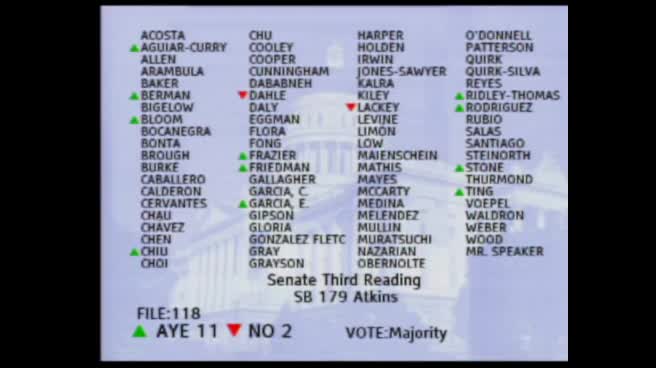 1MIN
Assembly Floor
 1H
Assembly Standing Committee on Appropriations
 46MIN
Assembly Standing Committee on Water, Parks, and Wildlife
 32MIN
Senate Floor
 48MIN
Senate Standing Committee on Appropriations
 48MIN
Senate Standing Committee on Transportation and Housing
 1H
Senate Standing Committee on Natural Resources and Water
Bill Author

Bill Co-Author(s):