SB 250: Pupil meals: Child Hunger Prevention and Fair Treatment Act of 2017.
- Session Year: 2017-2018
- House: Senate
- Latest Version Date: 2017-10-12
Existing law requires each school district or county superintendent of schools maintaining kindergarten or any of grades 1 to 12, inclusive, to provide one nutritionally adequate free or reduced-price meal for each needy pupil during each schoolday, except as specified. Existing law authorizes a school district or county office of education to use funds made available through any applicable federal or state program or to use its own funds to provide the required meals.
This bill would enact the Child Hunger Prevention and Fair Treatment Act of 2017. The act would require certain local educational agencies, as defined, that provide school meals through the federal National School Lunch Program or the federal School Breakfast Program to ensure that a pupil whose parent or guardian has unpaid school meal fees is not shamed, treated differently, or served a meal that differs from what a pupil whose parent or guardian does not have unpaid school meal fees would receive under that local educational agencys policy. The act would prohibit school personnel and volunteers at a local educational agency that serves nutritionally adequate meals to pupils during the instructional day from allowing any disciplinary action that is taken against a pupil to result in the denial or delay of a nutritionally adequate meal to that pupil. The act would require a local educational agency to notify a parent or guardian of the negative balance of a pupils school meal account no later than 10 days after the pupils school meal account has reached a negative balance. The act would require a local educational agency, before sending this notification to the parent or guardian, to exhaust all options and methods to directly certify the pupil for free or reduced-price meals. The act would require a local educational agency to reimburse school meal fees paid by a pupils parent or guardian when fees were paid or unpaid fees debt accrued when a pupil would have been determined to be eligible for free or reduced-price school meals. To the extent that these provisions would place additional requirements on local educational agencies, the bill would impose a state-mandated local program.
The California Constitution requires the state to reimburse local agencies and school districts for certain costs mandated by the state. Statutory provisions establish procedures for making that reimbursement.
This bill would provide that, if the Commission on State Mandates determines that the bill contains costs mandated by the state, reimbursement for those costs shall be made pursuant to the statutory provisions noted above.
Existing law requires each school district or county superintendent of schools maintaining kindergarten or any of grades 1 to 12, inclusive, to provide one nutritionally adequate free or reduced-price meal for each needy pupil during each schoolday, except as specified. Existing law authorizes a school district or county office of education to use funds made available through any applicable federal or state program or to use its own funds to provide the required meals.
This bill would enact the Child Hunger Prevention and Fair Treatment Act of 2017. The act would require certain local educational agencies, as defined, that provide school meals through the federal National School Lunch Program or the federal School Breakfast Program to ensure that a pupil whose parent or guardian has unpaid school meal fees is not shamed, treated differently, or served a different meal than that differs from what a pupil whose parent or guardian does not have unpaid school meal fees. fees would receive under that local educational agencys policy. The act would prohibit school personnel and volunteers at a local educational agency that serves nutritionally adequate meals to pupils during the instructional day from allowing any disciplinary action that is taken against a pupil to result in the denial or delay of a nutritionally adequate meal to that pupil. The act would require a local educational agency to notify a parent or guardian of the negative balance of a pupils school meal account no later than 10 days after the pupils school meal account has reached a negative balance. The act would require a local educational agency, before sending this notification to the parent or guardian, to exhaust all options and methods to directly certify the pupil for free or reduced-price meals. The act would require a local educational agency to reimburse school meal fees paid by a pupils parent or guardian when fees were paid or unpaid fees debt accrued when a pupil would have been determined to be eligible for free or reduced-price school meals. To the extent that these provisions would place additional requirements on local educational agencies, the bill would impose a state-mandated local program.
The California Constitution requires the state to reimburse local agencies and school districts for certain costs mandated by the state. Statutory provisions establish procedures for making that reimbursement.
This bill would provide that, if the Commission on State Mandates determines that the bill contains costs mandated by the state, reimbursement for those costs shall be made pursuant to the statutory provisions noted above.
Existing law requires each school district or county superintendent of schools maintaining kindergarten or any of grades 1 to 12, inclusive, to provide one nutritionally adequate free or reduced-price meal for each needy pupil during each schoolday, except as specified. Existing law authorizes a school district or county office of education to use funds made available through any applicable federal or state program or to use its own funds to provide the required meals.
This bill would enact the Child Hunger Prevention and Fair Treatment Act of 2017. The act would require certain local educational agencies, as defined, that provide school meals through the federal National School Lunch Program or the federal School Breakfast Program to ensure that a pupil whose parent or guardian has unpaid school meal fees is not shamed or shamed, treated differently differently, or served a different meal than a pupil whose parent or guardian does not have unpaid school meal fees. The act would prohibit school personnel and volunteers at a local educational agency required to serve free or reduced-price meals during the schoolday from taking that serves nutritionally adequate meals to pupils during the instructional day from allowing any disciplinary action that directly results in denying or delaying is taken against a pupil to result in the denial or delay of a nutritionally adequate meal to a that pupil. The act would require a local educational agency to notify a parent or guardian of the negative balance of a pupils school meal account no later than 10 days after the pupils school meal account has reached a negative balance. The act would require a local educational agency to identify families with unpaid school meal fees equal to or greater than the value of 5 full-priced school lunches and, before collecting the unpaid fees, agency, before sending this notification to the parent or guardian, to exhaust all options and methods to directly certify the pupil for free or reduced-price meals, and meals. The act would require a local educational agency to reimburse school meal fees paid by a pupils parent or guardian when fees were paid or unpaid fees debt accrued when a pupil would have been determined to be eligible for free or reduced-price school meals. To the extent that these provisions would place additional requirements on local educational agencies, the bill would impose a state-mandated local program.
The California Constitution requires the state to reimburse local agencies and school districts for certain costs mandated by the state. Statutory provisions establish procedures for making that reimbursement.
This bill would provide that, if the Commission on State Mandates determines that the bill contains costs mandated by the state, reimbursement for those costs shall be made pursuant to the statutory provisions noted above.
Existing law requires each school district or county superintendent of schools maintaining kindergarten or any of grades 1 to 12, inclusive, to provide one nutritionally adequate free or reduced-price meal for each needy pupil during each schoolday, except as specified. Existing law authorizes a school district or county office of education to use funds made available through any applicable federal or state program or to use its own funds to provide the required meals.
This bill would enact the Child Hunger Prevention and Fair Treatment Act of 2017. The act would require certain local educational agencies, as defined, to develop a plan to ensure that a pupil whose parent or guardian has unpaid school meal fees is not shamed or treated differently than a pupil whose parent or guardian does not have unpaid school meal fees. The act would prohibit school personnel and volunteers at a local educational agency required to serve free or reduced-price meals during the schoolday from taking disciplinary action that directly results in denying or delaying a nutritionally adequate meal to a pupil. The act would require a local educational agency to identify families with unpaid school meal fees equal to or greater than the value of 5 full-priced school lunches and, before collecting the unpaid fees, to exhaust all options and methods to directly certify the pupil for free or reduced-price meals, and to reimburse school meal fees paid by a pupils parent or guardian when fees were paid or unpaid fees debt accrued when a pupil would have been determined to be eligible for free or reduced-price school meals. To the extent that these provisions would place additional requirements on local educational agencies, the bill would impose a state-mandated local program.
The California Constitution requires the state to reimburse local agencies and school districts for certain costs mandated by the state. Statutory provisions establish procedures for making that reimbursement.
This bill would provide that, if the Commission on State Mandates determines that the bill contains costs mandated by the state, reimbursement for those costs shall be made pursuant to the statutory provisions noted above.
This act shall be known, and may be cited, as the Child Hunger Prevention and Fair Treatment Act of 2017.
SEC. 2.It is the intent of the Legislature to prohibit school personnel from using denial or delay of a school meal as a way to punish a child for any reason and to establish transparent rules for resolving school meal fees debt owed by the childs parent or guardian when the debt has gone unpaid.
SEC. 3.Section 49557.5 is added to the Education Code, to read:49557.5.(a)For purposes of this section, local educational agency means a school, school district, county office of education, or charter school.
(b)(1)A local educational agency, including a local educational agency in which there is a school that is required to serve a free or reduced-price meal during the schoolday pursuant to Section 49550 and at which all pupils are not eligible to be served breakfast and lunch under the Community Eligibility Provision or Provision 2 of the federal National School Lunch Act (42 U.S.C. Sec. 1751 et seq.), shall ensure that a pupil whose parent or guardian has unpaid school meal fees is not shamed, treated differently, or served a meal that differs from what a pupil whose parent or guardian does not have unpaid school meal fees would receive under that local educational agencys policy. This paragraph does not prohibit a school from serving an alternative reimbursable meal to a pupil who may need one for dietary or religious reasons.
(2)If a local educational agency is required to provide to the department or to the United States Department of Agriculture a copy of the meal charge policy required pursuant to memorandum SP 46-2016 issued by the United States Department of Agriculture, the local educational agency or governing board or body of the local educational agency, as applicable, shall make that policy public.
(c)School personnel and volunteers at a local educational agency that serves nutritionally adequate meals to pupils during the instructional day shall not allow any disciplinary action that is taken against a pupil to result in the denial or delay of a nutritionally adequate meal, as defined in Section 49553, to that pupil.
(d)A local educational agency shall not take any action directed at a pupil to collect unpaid school meal fees. A local educational agency may attempt to collect unpaid school meal fees from a parent or guardian, but shall not use a debt collector, as defined in Section 803 of the federal Consumer Credit Protection Act (15 U.S.C. Sec. 1692a).
(e)A local educational agency shall notify a parent or guardian of the negative balance of a pupils school meal account no later than 10 days after the pupils school meal account has reached a negative balance. Before sending this notification to the parent or guardian, the local educational agency shall exhaust all options and methods to directly certify the pupil for free or reduced-price meals. If the local educational agency is not able to directly certify the pupil, the local educational agency shall provide the parent or guardian with a paper copy of, or an electronic link to, an application with the notification and contact the parent or guardian to encourage application submission.
(f)To the extent that the expense is reimbursable under the federal National School Lunch Program, a local educational agency shall reimburse school meal fees paid by a pupils parent or guardian when fees were paid or unpaid fees debt accrued during any time that the pupil would have been determined, as identified by the local educational agencys review pursuant to subdivision (e), to be eligible for free or reduced-price school meals.
(g)Nothing in this section is intended to allow for the indefinite accrual of unpaid school meal fees.
(h)This section shall only apply to a local educational agency that provides school meals through the federal National School Lunch Program or the federal School Breakfast Program.
SEC. 4.If the Commission on State Mandates determines that this act contains costs mandated by the state, reimbursement to local agencies and school districts for those costs shall be made pursuant to Part 7 (commencing with Section 17500) of Division 4 of Title 2 of the Government Code.
This act shall be known, and may be cited, as the Child Hunger Prevention and Fair Treatment Act of 2017.
SEC. 2.It is the intent of the Legislature to prohibit school personnel from using denial or delay of a school meal as a way to punish a child for any reason and to establish transparent rules for resolving school meal fees debt owed by the childs parent or guardian when the debt has gone unpaid.
SEC. 3.Section 49557.5 is added to the Education Code, to read:49557.5.(a)For purposes of this section, local educational agency means a school, school district, county office of education, or charter school.
(b)(1)A local educational agency, including a local educational agency in which there is a school that is required to serve a free or reduced-price meal during the schoolday pursuant to Section 49550 and at which all pupils are not eligible to be served breakfast and lunch under the Community Eligibility Provision or Provision 2 of the federal National School Lunch Act (42 U.S.C. Sec. 1751 et seq.), shall ensure that a pupil whose parent or guardian has unpaid school meal fees is not shamed, treated differently, or served a different meal than that differs from what a pupil whose parent or guardian does not have unpaid school meal fees. fees would receive under that local educational agencys policy. This paragraph does not prohibit a school from serving an alternative reimbursable meal to a pupil who may need one for dietary or religious reasons.
(2)If a local educational agency is required to provide to the department or to the United States Department of Agriculture a copy of the meal charge policy required pursuant to memorandum SP 46-2016 issued by the United States Department of Agriculture, the local educational agency or governing board or body of the local educational agency, as applicable, shall make that policy public.
(c)School personnel and volunteers at a local educational agency that serves nutritionally adequate meals to pupils during the instructional day shall not allow any disciplinary action that is taken against a pupil to result in the denial or delay of a nutritionally adequate meal, as defined in Section 49553, to that pupil.
(d)A local educational agency shall not take any action directed at a pupil to collect unpaid school meal fees. A local educational agency may attempt to collect unpaid school meal fees from a parent or guardian, but shall not use a debt collector, as defined in Section 803 of the federal Consumer Credit Protection Act (15 U.S.C. Sec. 1692a).
(e)A local educational agency shall notify a parent or guardian of the negative balance of a pupils school meal account no later than 10 days after the pupils school meal account has reached a negative balance. Before sending this notification to the parent or guardian, the local educational agency shall exhaust all options and methods to directly certify the pupil for free or reduced-price meals. If the local educational agency is not able to directly certify the pupil, the local educational agency shall provide the parent or guardian with a paper copy of, or an electronic link to, an application with the notification and contact the parent or guardian to encourage application submission.
(f)To the extent that the expense is reimbursable under the federal National School Lunch Program, a local educational agency shall reimburse school meal fees paid by a pupils parent or guardian when fees were paid or unpaid fees debt accrued during any time that the pupil would have been determined, as identified by the local educational agencys review pursuant to subdivision (e), to be eligible for free or reduced-price school meals.
(g)Nothing in this section is intended to allow for the indefinite accrual of unpaid school meal fees.
(h)This section shall only apply to a local educational agency that provides school meals through the federal National School Lunch Program or the federal School Breakfast Program.
SEC. 4.If the Commission on State Mandates determines that this act contains costs mandated by the state, reimbursement to local agencies and school districts for those costs shall be made pursuant to Part 7 (commencing with Section 17500) of Division 4 of Title 2 of the Government Code.
This act shall be known, and may be cited, as the Child Hunger Prevention and Fair Treatment Act of 2017.
SEC. 2.It is the intent of the Legislature to prohibit school personnel from using denial or delay of a school meal as a way to punish a child for any reason and to establish transparent rules for resolving school meal fees debt owed by the childs parent or guardian when the debt has gone unpaid.
SEC. 3.Section 49557.5 is added to the Education Code, to read:49557.5.(a)(1)For purposes of this section, local educational agency means a school, school district, county office of education, or charter school.
(b)(1)A local educational agency agency, including a local educational agency in which there is a school that is required to serve a free or reduced-price meal during the schoolday pursuant to Section 49550 and at which all pupils are not eligible to be served breakfast and lunch under the Community Eligibility Provision or Provision 2 of the federal National School Lunch Act (42 U.S.C. Sec. 1751 et seq.) seq.), shall ensure that a pupil whose parent or guardian has unpaid school meal fees is not shamed or shamed, treated differently differently, or served a different meal than a pupil whose parent or guardian does not have unpaid school meal fees. This paragraph does not prohibit a school from serving an alternative reimbursable meal to a pupil who may need one for dietary or religious reasons.
If(2)If a local educational agency is required to provide to the department or to the United States Department of Agriculture a copy of the meal charge policy required pursuant to memorandum SP 46-2016 issued by the United States Department of Agriculture, the local educational agency or governing board or body of the local educational agency, as applicable, shall make that policy public.
(b)(c)School personnel and volunteers at a local educational agency required to serve a free or reduced-price meal during the schoolday pursuant to Section 49550 that serves nutritionally adequate meals to pupils during the instructional day shall not take allow any disciplinary action that directly results in denying or delaying that is taken against a pupil to result in the denial or delay of a nutritionally adequate meal, as defined in Section 49553, to a that pupil.
(c)(d)A local educational agency shall not take any action directed at a pupil to collect unpaid school meal fees. A local educational agency may attempt to collect unpaid school meal fees from a parent or guardian, but shall not use a debt collector, as defined in Section 803 of the federal Consumer Credit Protection Act (15 U.S.C. Sec. 1692a).
(d)To prevent a family from paying for a pupils unpaid school meal fees when the pupil was eligible for a free or reduced-price meal, a local educational agency shall identify families with unpaid school meal fees equal to or greater than the value of five full-priced school lunches and, before collecting the unpaid fees, shall (1) exhaust(e)A local educational agency shall notify a parent or guardian of the negative balance of a pupils school meal account no later than 10 days after the pupils school meal account has reached a negative balance. Before sending this notification to the parent or guardian, the local educational agency shall exhaust all options and methods to directly certify the pupil for free or reduced-price meals and (2), in a case where meals. If the local educational agency is not able to directly certify the pupil, the local educational agency shall provide the parent or guardian with a paper copy of, or an electronic link to, an application with the notification and contact the parent or guardian with written and oral communications to encourage application submission.
(e)(f)To the extent that the expense is reimbursable under the federal National School Lunch Program, a local educational agency shall reimburse school meal fees paid by a pupils parent or guardian when fees were paid or unpaid fees debt accrued during any time that the pupil would have been determined, as identified by the local educational agencys review pursuant to subdivision (d), (e), to be eligible for free or reduced-price school meals.
(f)For purposes of this section, local educational agency means a school, school district, or county office of education.(g)Nothing in this section is intended to allow for the indefinite accrual of unpaid school meal fees.
(h)This section shall only apply to a local educational agency that provides school meals through the federal National School Lunch Program or the federal School Breakfast Program.
SEC. 4.If the Commission on State Mandates determines that this act contains costs mandated by the state, reimbursement to local agencies and school districts for those costs shall be made pursuant to Part 7 (commencing with Section 17500) of Division 4 of Title 2 of the Government Code.
This act shall be known, and may be cited, as the Child Hunger Prevention and Fair Treatment Act of 2017.
SEC. 2.It is the intent of the Legislature to prohibit school personnel from using denial or delay of a school meal as a way to punish a child for any reason and to establish transparent rules for resolving school meal fees debt owed by the childs parent or guardian when the debt has gone unpaid.
SEC. 3.Section 49557.5 is added to the Education Code, to read:49557.5.(a)(1)A local educational agency in which there is a school that is required to serve a free or reduced-price meal during the schoolday pursuant to Section 49550 and at which all pupils are not eligible to be served breakfast and lunch under the Community Eligibility Provision or Provision 2 of the federal National School Lunch Act (42 U.S.C. Sec. 1751 et seq.) shall develop a plan to ensure that a pupil whose parent or guardian has unpaid school meal fees is not shamed or treated differently than a pupil whose parent or guardian does not have unpaid school meal fees.
(2)A local educational agencys plan shall include an explanation of how staff will be trained to ensure that the policy is carried out correctly and how the affected parents and guardians will be provided with assistance in establishing eligibility for free or reduced-price meals for their children.(3)The department shall approve in writing a local educational agencys plan. Once the department has approved the plan,If a local educational agency is required to provide to the department or to the United States Department of Agriculture a copy of the meal charge policy required pursuant to memorandum SP 46-2016 issued by the United States Department of Agriculture, the local educational agency or governing board or body of the local educational agency, as applicable, shall adopt and make the plan that policy public.
(b)School personnel and volunteers at a local educational agency required to serve a free or reduced-price meal during the schoolday pursuant to Section 49550 shall not take disciplinary action that directly results in denying or delaying a nutritionally adequate meal, as defined in Section 49553, to a pupil.
(c)A local educational agency shall not take any action directed at a pupil to collect unpaid school meal fees. A local educational agency may attempt to collect unpaid school meal fees from a parent or guardian, but shall not use a debt collector, as defined in Section 803 of the federal Consumer Credit Protection Act (15 U.S.C. Sec. 1692a).
(d)To prevent a family from paying for a pupils unpaid school meal fees when the pupil was eligible for a free or reduced-price meal, a local educational agency shall identify families with unpaid school meal fees equal to or greater than the value of five full-priced school lunches and, before collecting the unpaid fees, shall (1) exhaust all options and methods to directly certify the pupil for free or reduced-price meals and (2), in a case where the local educational agency is not able to directly certify the pupil, provide the parent or guardian with an application and contact the parent or guardian with written and oral communications to encourage application submission.
(e)To the extent that the expense is reimbursable under the federal National School Lunch Program, a local educational agency shall reimburse school meal fees paid by a pupils parent or guardian when fees were paid or unpaid fees debt accrued during any time that the pupil would have been determined, as identified by the local educational agencys review pursuant to subdivision (d), to be eligible for free or reduced-price school meals.
(f)For purposes of this section, local educational agency means a school, school district, or county office of education.
(g)Nothing in this section is intended to allow for the indefinite accrual of unpaid school meal fees.
SEC. 4.If the Commission on State Mandates determines that this act contains costs mandated by the state, reimbursement to local agencies and school districts for those costs shall be made pursuant to Part 7 (commencing with Section 17500) of Division 4 of Title 2 of the Government Code.
This act shall be known, and may be cited, as the Child Hunger Prevention and Fair Treatment Act of 2017.
SEC. 2.It is the intent of the Legislature to prohibit school personnel from using denial or delay of a school meal as a way to punish a child for any reason and to establish transparent rules for resolving school meal fees debt owed by the childs parent or guardian when the debt has gone unpaid.
SEC. 3.Section 49557.5 is added to the Education Code, to read:49557.5.(a)(1)A local educational agency in which there is a school that is required to serve a free or reduced-price meal during the schoolday pursuant to Section 49550 and at which all pupils are not eligible to be served breakfast and lunch under the Community Eligibility Provision or Provision 2 of the federal National School Lunch Act (42 U.S.C. Sec. 1751 et seq.) shall develop a plan to ensure that a pupil whose parent or guardian has unpaid school meal fees is not shamed or treated differently than a pupil whose parent or guardian does not have unpaid school meal fees.
(2)A local educational agencys plan shall include an explanation of how staff will be trained to ensure that the policy is carried out correctly and how the affected parents and guardians will be provided with assistance in establishing eligibility for free or reduced-price meals for their children.
(3)The department shall approve in writing a local educational agencys plan. Once the department has approved the plan, the local educational agency or governing board or body of the local educational agency, as applicable, shall adopt and make the plan public.
(b)School personnel and volunteers at a local educational agency required to serve a free or reduced-price meal during the schoolday pursuant to Section 49550 shall not take disciplinary action that directly results in denying or delaying a nutritionally adequate meal, as defined in Section 49553, to a pupil.
(c)A local educational agency shall not take any action directed at a pupil to collect unpaid school meal fees. A local educational agency may attempt to collect unpaid school meal fees from a parent or guardian, but shall not use a debt collector, as defined in Section 803 of the federal Consumer Credit Protection Act (15 U.S.C. Sec. 1692a).
(d)To prevent a family from paying for a pupils unpaid school meal fees when the pupil was eligible for a free or reduced-price meal, a local educational agency shall identify families with unpaid school meal fees equal to or greater than the value of five full-priced school lunches and, before collecting the unpaid fees, shall (1) exhaust all options and methods to directly certify the pupil for free or reduced-price meals and (2), in a case where the local educational agency is not able to directly certify the pupil, provide the parent or guardian with an application and contact the parent or guardian with written and oral communications to encourage application submission.
(e)To the extent that the expense is reimbursable under the federal National School Lunch Program, a local educational agency shall reimburse school meal fees paid by a pupils parent or guardian when fees were paid or unpaid fees debt accrued during any time that the pupil would have been determined, as identified by the local educational agencys review pursuant to subdivision (d), to be eligible for free or reduced-price school meals.
(f)For purposes of the this section, local educational agency means a school, school district, or county office of education.
SEC. 4.If the Commission on State Mandates determines that this act contains costs mandated by the state, reimbursement to local agencies and school districts for those costs shall be made pursuant to Part 7 (commencing with Section 17500) of Division 4 of Title 2 of the Government Code.
|
Date
|
Status
|
|---|---|
| Oct 12, 2017 | Chaptered by Secretary of State. Chapter 726, Statutes of 2017. |
| Oct 12, 2017 | Approved by the Governor. |
| Sep 20, 2017 | Enrolled and presented to the Governor at 4 p.m. |
| Sep 14, 2017 | Assembly amendments concurred in. (Ayes 40. Noes 0.) Ordered to engrossing and enrolling. |
| Sep 14, 2017 | In Senate. Concurrence in Assembly amendments pending. |
| Sep 13, 2017 | Read third time. Passed. Ordered to the Senate. |
| Sep 6, 2017 | Read second time. Ordered to third reading. |
| Sep 5, 2017 | Read second time and amended. Ordered to second reading. |
| Sep 1, 2017 | From committee: Do pass as amended. (Ayes 16. Noes 0.) (September 1). |
| Jul 19, 2017 | July 19 set for first hearing. Placed on APPR. suspense file. |
| Jun 29, 2017 | Read second time and amended. Re-referred to Com. on APPR. |
| Jun 28, 2017 | From committee: Do pass as amended and re-refer to Com. on APPR. (Ayes 6. Noes 0.) (June 21). |
| Jun 12, 2017 | Referred to Com. on ED. |
| Jun 1, 2017 | In Assembly. Read first time. Held at Desk. |
| May 31, 2017 | Read third time. Passed. (Ayes 39. Noes 0. Page 1316.) Ordered to the Assembly. |
| May 26, 2017 | Read second time and amended. Ordered to third reading. |
| May 25, 2017 | From committee: Do pass as amended. (Ayes 7. Noes 0. Page 1180.) (May 25). |
| May 19, 2017 | Set for hearing May 25. |
| Apr 3, 2017 | April 3 hearing: Placed on APPR. suspense file. |
| Mar 24, 2017 | Set for hearing April 3. |
| Mar 22, 2017 | Read second time and amended. Re-referred to Com. on APPR. |
| Mar 21, 2017 | From committee: Do pass as amended and re-refer to Com. on APPR. (Ayes 7. Noes 0. Page 370.) (March 15). |
| Feb 23, 2017 | Set for hearing March 15. |
| Feb 16, 2017 | Referred to Com. on ED. |
| Feb 8, 2017 | From printer. May be acted upon on or after March 10. |
| Feb 7, 2017 | Introduced. To Com. on RLS. for assignment. To print. |
|
Date
|
Description
|
Location
|
Votes
|
|
|---|---|---|---|---|
| Sep 14, 2017 | Unfinished Business SB250 Hertzberg et al. Concurrence | Senate Floor |
Passed |
|
| Sep 13, 2017 | SB 250 Hertzberg Senate Third Reading By MCCARTY | Assembly Floor |
Passed |
|
| Sep 1, 2017 | Do pass as amended. | Assembly Standing Committee on Appropriations |
Passed |
|
| Jun 21, 2017 | Do pass as amended and be re-referred to the Committee on [Appropriations] | Assembly Standing Committee on Education |
Passed |
|
| May 31, 2017 | Senate 3rd Reading SB250 Hertzberg | Senate Floor |
Passed |
|
| May 25, 2017 | Do pass as amended | Senate Standing Committee on Appropriations |
Passed |
|
| Apr 3, 2017 | Placed on suspense file | Senate Standing Committee on Appropriations |
Passed |
|
| Mar 15, 2017 | Do pass as amended, but first amend, and re-refer to the Committee on [Appropriations] | Senate Standing Committee on Education |
Passed |
This list shows positions taken on this bill by organizations on the date displayed, which is linked to the original source.
Positions by individuals are not included.
Office of Senate Floor Analyses (916) 651-1520 Fax: (916) 327-4478 | SB |
UNFINISHED BUSINESS
Bill No: SB 250
:
SENATE EDUCATION COMMITTEE: 7-0, 3/15/17
AYES: Allen, Wilk, Galgiani, Leyva, Mendoza, Pan, Vidak
SENATE APPROPRIATIONS COMMITTEE: 7-0, 5/25/17
AYES: Lara, Bates, Beall, Bradford, Hill, Nielsen, Wiener
SENATE FLOOR: 39-0, 5/31/17
AYES: Allen, Anderson, Atkins, Bates, Beall, Berryhill, Bradford, Cannella, De León, Dodd, Fuller, Gaines, Galgiani, Glazer, Hernandez, Hertzberg, Hill, Hueso, Jackson, Lara, Leyva, McGuire, Mendoza, Mitchell, Monning, Moorlach, Morrell, Newman, Nguyen, Nielsen, Pan, Roth, Skinner, Stern, Stone, Vidak, Wieckowski, Wiener, Wilk
NO VOTE RECORDED: Portantino
ASSEMBLY FLOOR: 77-0, 9/13/17 - See last page for vote
SOURCE: Children’s Defense Fund – California
Food Research and Action Center
MAZON – A Jewish Response to Hunger
SEIU California
Western Center on Law & Poverty
DIGEST:
This bill requires a local educational agency (LEA) to ensure that a pupil whose parent or guardian has unpaid school meal fees is not shamed, treated differently or served a meal that differs from what a pupil whose parent or guardian does not have unpaid school meal fees would receive under the LEA's policy; requires a LEA to attempt to directly certify a family for the free and reduced lunch program when a student has unpaid school meal fees and before the LEA notifies the parent or guardian within 10 days of reaching a negative balance; and, prohibits school personnel from allowing any disciplinary action that is taken against the student to result in the denial or delay of a nutritionally adequate meal, to that pupil.
Assembly Amendments
:
- Expand the definition of LEA to include charter schools and apply the provisions of the bill to all LEAs that participate in the National School Lunch Program (NSLP) or the federal School Breakfast Program.
- Clarify that a pupil whose parent or guardian has unpaid school meal fees cannot be served a meal that differs from what a pupil whose parent or guardian does not have unpaid school meal fees would receive under that LEA’s policy.
- Delete the requirement that an LEA identify families with unpaid school meal fees equal or greater than the value of five full priced school meal lunches and instead require an LEA to notify a parent or guardian of the negative balance of a pupil’s school meal account no later than 10 days after the pupil’s school meal account has reached a negative balance.
- Revise the process for an LEA to provide an application to a pupil’s parent or guardian when the LEA is unable to directly certify that pupil.
Existing federal law:
- Authorizes a universal meal service option known as the Community Eligibility Provision (CEP), which allows a LEA that directly certifies for free meals at least 40 percent of the students in either the district overall, a group of schools within the district, or an individual school, to receive meal reimbursement based on a formula that equate to 1.6x the free reimbursement rate for students directly certified for free or reduced-price meals, plus the standard reimbursement rate for paid meals. (42 USC § 1759a(a)(1)(F); 7 CFR § 245.9(f))
- Authorizes an additional universal meal service option know as Provision 2 that allows a LEA to certify children for free and reduced-price meals for up to 4 consecutive school years in the schools that serve meals at no charge to all enrolled children. (42 USC § 1759a(a)(1)(C); 7 CFR § 245.9(b))
Existing state law:
- Requires each district or county superintendent of schools maintaining any kindergarten or any of grades 1 to 12, inclusive, to provide for each needy pupil one nutritionally adequate free or reduced-price meal during each schoolday. (Education Code § 49550)
- Defines needy children as those who meet federal eligibility criteria for free and reduced-price meals (currently a family of four with an annual income of $31,590 is eligible for free meals and a family of four with an annual income of $44,955 is eligible for reduced-price meals). (EC § 49552)
- Provides that a nutritionally adequate meal for this purpose is a breakfast or lunch meeting specified requirements that qualifies for reimbursement under the federal child nutrition program regulations. (EC § 49553)
- Authorizes a school district or county office of education to use funds made available through any federal or state program the purpose of which includes the provision of meals to a pupil, including the federal School Breakfast Program, the federal NSLP, the federal Summer Food Service Program, the federal Seamless Summer Option, or the state meal program, or do so at its own expense. (EC § 49550)
- Requires the governing board of each school district and each county superintendent of schools to formulate a plan, which must be submitted to the California Department of Education (CDE) for its approval, that will ensure that children eligible to receive free or reduced-price meals and milk shall not be treated differently from other children. These plans are required to ensure each of the following:
- Unless otherwise specified, the names of the children are not published, posted, or announced in any manner, or used for any purpose other than the federal NSLP.
- There is no overt identification of any of the children by the use of special tokens or tickets or by any other means.
- The children are not required to work for their meals or milk.
- The children are not required to use a separate dining area, go through a separate serving line, enter the dining area through a separate entrance, or consume their meals or milk at a different time. (EC § 49557)
- Requires, if more than one lunch or breakfast or type of milk is offered, that the children have the same choice of meals or milk that is available to children who pay the full price for their meal or milk. (EC § 49557)
This bill requires a LEA to ensure that a pupil whose parent or guardian has unpaid school meal fees is not shamed, treated differently or served a meal that differs from what a pupil whose parent or guardian does not have unpaid school meal fees would receive under the LEA's policy; requires a LEA to attempt to directly certify a family for the free and reduced lunch program when a student has unpaid school meal fees and before the LEA notifies the parent or guardian within 10 days of reaching a negative balance; and, prohibits school personnel from allowing any disciplinary action that is taken against the student to result in the denial or delay of a nutritionally adequate meal, to that pupil. Specifically, this bill:
- Requires a LEA in which there is a school that is required to serve a free or reduced-price meal during the schoolday and at which all pupils are not eligible to be served breakfast and lunch under the CEP or Provision 2 of the federal National School Lunch Act to ensure that a pupil whose parent or guardian has unpaid school meal fees is not shamed, treated differently or served a meal that differs from what a pupil whose parent or guardian does not have unpaid school meal fees would receive under that LEA's policy; and, specifies that this requirement does not prohibit a school from serving an alternative reimbursable meal to a pupil who may need one for dietary or religious reasons.
- Provides that LEA shall notify a parent or guardian of the negative balance of a pupil’s school meal account no later than 10 days after the pupil's school meal account has reached a negative balance. Before sending this notification to the parent or guardian, the LEA shall exhaust all options and methods to directly certify the pupil for free or reduced-price meals and, in a case where the LEA is not able to directly certify the pupil, provide the parent or guardian with a paper copy of, or an electronic link to, an application with the notification and contact the parent or guardian to encourage application submission.
- Prohibits school personnel and volunteers at a LEA that serves nutritionally adequate meals to pupils during the instructional day from allowing any disciplinary action that is taken against the student to result in the denial or delay of a nutritionally adequate meal, to that pupil.
- Specifies that if a LEA is required to provide to the department or to the United States Department of Agriculture (USDA) a copy of the meal charge policy required pursuant to memorandum SP 46-2016 issued by USDA, the LEA or governing board or body of the LEA, as applicable, shall make that policy public.
- Prohibits a LEA from taking any action directed at a pupil to collect unpaid school meal fees. Specifies a LEA may attempt to collect unpaid school meal fees from a parent or guardian, but shall not use a debt collector.
- Requires a LEA, to the extent that the expense is reimbursable under the federal NSLP, to reimburse school meal fees paid by a pupil's parent or guardian when fees were paid or unpaid fees debt accrued during any time that the pupil would have been determined, as identified by the LEA’s review, to be eligible for free or reduced-price school meals.
- Specifies that nothing in this measure is intended to allow for the indefinite accrual of unpaid school meal fees.
- Specifies that this bill shall only apply to a LEA that provides school meals through the federal NSLP or the federal School Breakfast Program.
- Defines "local educational agency" to mean a school, school district, county office of education, or charter school.
- Specifies that it is the intent of the Legislature to prohibit school personnel from using denial or delay of a school meal as a way to punish a child for any reason and to establish transparent rules for resolving school meal fee debt owed by the child's parent or guardian when the debt has gone unpaid.
Comments
- Need for the bill. According to the author, “In most schools, children who do not qualify for the National School Lunch Program (NSLP) or whose parents have not applied for the program must pay for a meal at either a reduced-price or the full price. It is a common practice in school cafeterias to provide to all students who request one, even those who are not enrolled in the NSLP and arrive without money; the debt is later collected from the parent or guardian. Still, not all children in California who are eligible for assistance are enrolled and some families still find themselves without enough money to pay the modest price for school lunches. In recent years, there have been reports of students who are punished and publicly shamed for the school meal debt that went unpaid by their parent or guardian. Some schools are taking food away from students for debts as low as 30 cents. Children are left hungry and may go an entire day without food. While it is rare to find this happening in California, lack of a standard statewide policy puts children in harm’s way and puts school workers, who are often forced to make these decisions, in a bad position with little or no guidance.”
- USDA memorandum. The USDA, which administers school nutrition programs at the federal level, issued memorandum SP 46-2016 on July 8, 2016 that requires school food authorities (SFAs) participating in the NSLP and the School Breakfast Program “to institute and clearly communicate a meal charge policy, which would include, if applicable, the availability of alternate meals.” The USDA memorandum specifies that “because all students in participating schools may receive reimbursable school meals, all SFAs must have a policy in place for children who are participating at the reduced-price or paid rate, but either do not have money in their account or in hand to cover the cost of the meal at the time of service. Such a policy ensures that school food service professionals, school administrators, families, and students have a shared understanding of expectations in these situations.” The USDA memorandum gives deference to state agencies and SFAs in developing the specifics of individual policies, including the level at which the policy is developed, but does require the policy to include specifics regarding the collection of delinquent meal charge debt. Whether developed at the state or local level, the USDA memorandum gives SFAs until July 1, 2017 to have a written and clearly communicated meal charge policy. CDE has indicated that it is allowing local SFAs to develop their own policies within state-issued parameters, but CDE has not finalized its guidance.
- Alternative meals. The bill specifies that pupils with unpaid meal debt shall not be given a meal that differs from what a pupil who does not have unpaid meal debt is provided, under the district policy. Districts are authorized by federal law to have alternative meal policies for children who cannot pay for their meal. By referencing the district policy, this bill allows students to be served alternative meals. As referenced in the author's statement, it is the practice of some school districts to serve pupils with school meal debt, one-half of a cheese sandwich and four ounces of juice. By specifying that students must receive the same meal as they otherwise would, under the district policy, this means that as long as the district policy is consistent among students who don't have money to pay for their meal, children can continue to receive the same one-half of a cheese sandwich and four ounces of juice.
Related/Prior Legislation
SB 138 (McGuire, 2017) requires the CDE, in consultation with the State Department of Health Care Services, to develop and implement a process to use Medi-Cal data to directly certify children whose families meet the income criteria into the school meal program; requires school districts and county offices of education with high poverty schools and high poverty charter schools currently participating in the breakfast or lunch program to provide breakfast and lunch free of charge to all students at those schools; and, authorizes a school district, county office of education or charter school to opt-out due to fiscal hardship.
FISCAL EFFECT: Appropriation: No Fiscal Com.: Yes Local:
According to the Assembly Appropriations Committee, unknown reimbursable state mandate costs. While this bill does not explicitly require for a meal to be provided, the bill does require new activities. Districts are not prohibited by this bill to serve an alternative reimbursable meal, but they are encouraged to exhaust all options and methods to certify the pupil for free or reduced-price meals, notify parents of negative balances and reimburse parents. Additionally, while this bill no longer requires training school personnel and volunteers at LEA’s, the districts may still argue that ensuring that a pupil whose parent or guardian has unpaid school meal fees is not shamed, treated differently, or served a different meal, may still require trainings.
The bill does include the intention to not allow for the indefinite accrual of unpaid meal fees. If the pupil does not qualify for a free or reduced-price meal, the district must bill the family or absorb the costs. There are school districts with significant unpaid meal charges with statewide totals in the low millions of dollars. According to USDA, in the 2011–2012 school year, 58 percent of LEAs incurred unpaid meal costs during school year 2010–2011. Over 93 percent of these LEAs served a reimbursable school meal on credit or an alternate meal to children. Nearly all LEAs took action to recover the costs, most often by billing the families.
Children’s Defense Fund – California (co-source)
Food Research and Action Center (co-source)
MAZON – A Jewish Response to Hunger (co-source)
SEIU California (co-source)
Western Center on Law & Poverty (co-source)
Alameda County Community Food Bank
American Academy of Pediatrics
California Association of Food Banks
California School Nurses Organization
California State PTA
California Teachers Association
California WIC Association
Coalition of California Welfare Rights Organizations
Courage Campaign
Feeding San Diego
Food Access Coalition
Food Bank of Contra Costa & Solano
Health Officer’s Association of California
Hunger Action Los Angeles
Jewish Family Service of Los Angeles
National Association of Social Workers, California - Chapter
Oakland Unified School District
Orange County Food Access Coalition
SF-Marin Food Bank
OPPOSITION: (Verified 9/12/17)
None received
ASSEMBLY FLOOR: 77-0, 9/13/17
AYES: Acosta, Aguiar-Curry, Arambula, Baker, Berman, Bigelow, Bloom, Bocanegra, Bonta, Brough, Burke, Caballero, Calderon, Cervantes, Chau, Chávez, Chen, Chiu, Choi, Chu, Cooley, Cooper, Cunningham, Dababneh, Dahle, Daly, Eggman, Flora, Fong, Frazier, Friedman, Gallagher, Cristina Garcia, Eduardo Garcia, Gipson, Gloria, Gonzalez Fletcher, Gray, Grayson, Harper, Holden, Irwin, Jones-Sawyer, Kalra, Kiley, Lackey, Levine, Limón, Low, Maienschein, Mathis, Mayes, McCarty, Medina, Melendez, Mullin, Muratsuchi, Obernolte, O'Donnell, Patterson, Quirk, Quirk-Silva, Reyes, Ridley-Thomas, Rodriguez, Rubio, Salas, Santiago, Steinorth, Mark Stone, Thurmond, Ting, Voepel, Waldron, Weber, Wood, Rendon
NO VOTE RECORDED: Travis Allen, Nazarian
9/14/17 10:02:48
SENATE THIRD READING
STR Bill Id:SB 250
Author:(Hertzberg)
As Amended Ver:September 5, 2017
Majority vote
SENATE VOTE: 39-0
Committee | Votes | Ayes | Noes |
Education | 6-0 | O'Donnell, Gloria, Kiley, McCarty, Thurmond, Weber | |
Appropriations | 16-0 | Gonzalez Fletcher, Bigelow, Bloom, Bocanegra, Bonta, Brough, Calderon, Chau, Eggman, Fong, Friedman, Gallagher, Eduardo Garcia, Jones-Sawyer, Obernolte, Reyes |
|
SUMMARY: Requires a local educational agency (LEA) to ensure that a pupil whose parent or guardian has unpaid school meal fees is not shamed, treated differently or served a meal that differs from what a pupil whose parent or guardian does not have unpaid school meal fees would receive under the LEA's policy; requires a LEA to attempt to directly certify a family for the free and reduced lunch program when a student has unpaid school meal fees and before the LEA notifies the parent or guardian within 10 days of reaching a negative balance; and, prohibits school personnel from allowing any disciplinary action that is taken against the student to result in the denial or delay of a nutritionally adequate meal, to that pupil. Specifically, this bill:
- Requires a local educational agency in which there is a school that is required to serve a free or reduced-price meal during the schoolday and at which all pupils are not eligible to be served breakfast and lunch under the Community Eligibility Provision or Provision 2 of the federal National School Lunch Act to ensure that a pupil whose parent or guardian has unpaid school meal fees is not shamed, treated differently or served a meal that differs from what a pupil whose parent or guardian does not have unpaid school meal fees would receive under that local educational agency's policy; and, specifies that this requirement does not prohibit a school from serving an alternative reimbursable meal to a pupil who may need one for dietary or religious reasons.
- A local educational agency shall notify a parent or guardian of the negative balance of a pupil’s school meal account no later than 10 days after the pupil's school meal account has reached a negative balance. Before sending this notification to the parent or guardian, the local educational agency shall exhaust all options and methods to directly certify the pupil for free or reduced-price meals and, in a case where the local educational agency is not able to directly certify the pupil, provide the parent or guardian with a paper copy of, or an electronic link to, an application with the notification and contact the parent or guardian to encourage application submission.
- Prohibits school personnel and volunteers at a local educational agency that serves nutritionally adequate meals to pupils during the instructional day from allowing any disciplinary action that is taken against the student to result in the denial or delay of a nutritionally adequate meal, to that pupil.
- Specifies that if a local educational agency is required to provide to the department or to the United States Department of Agriculture a copy of the meal charge policy required pursuant to memorandum SP 46-2016 issued by the United States Department of Agriculture, the local educational agency or governing board or body of the local educational agency, as applicable, shall make that policy public.
- Prohibits a local educational agency from taking any action directed at a pupil to collect unpaid school meal fees. Specifies a local educational agency may attempt to collect unpaid school meal fees from a parent or guardian, but shall not use a debt collector.
- Requires a local educational agency, to the extent that the expense is reimbursable under the federal National School Lunch Program, to reimburse school meal fees paid by a pupil's parent or guardian when fees were paid or unpaid fees debt accrued during any time that the pupil would have been determined, as identified by the local educational agency's review, to be eligible for free or reduced-price school meals.
- Specifies that nothing in this measure is intended to allow for the indefinite accrual of unpaid school meal fees.
- Specifies that this measure shall only apply to a local educational agency that provides school meals through the federal National School Lunch Program or the federal School Breakfast Program.
- Defines "local educational agency" to mean a school, school district, county office of education, or charter school.
- Specifies that it is the intent of the Legislature to prohibit school personnel from using denial or delay of a school meal as a way to punish a child for any reason and to establish transparent rules for resolving school meal fee debt owed by the child's parent or guardian when the debt has gone unpaid.
EXISTING STATE LAW:
- Prohibits a public school district or county office of education from denying a meal from any Free or Reduced-price eligible pupils, and requires that these pupils receive the same meal as all other students. (Education Code 49550 and 49557)
- Requires each district or county superintendent of schools maintaining any kindergarten or any of grades 1 to 12, inclusive, to provide for each needy pupil one nutritionally adequate free or reduced-price meal during each schoolday. (Education Code 49550)
FISCAL EFFECT: According to the Assembly Appropriations Committee, unknown reimbursable state mandate costs. While the bill does not explicitly require for a meal to be provided, the bill does require new activities. Districts are not prohibited by this bill to serve an alternative reimbursable meal, but they are encouraged to exhaust all options and methods to certify the pupil for free or reduced-price meals, notify parents of negative balances and reimburse parents.
COMMENTS: This bill requires all school districts, county offices of education and charter schools that participate in the school breakfast or school lunch program, to ensure that students with unpaid school meal fees are not shamed, treated differently or provided a meal that differs from what a student without school meal fees would be provided under the district's policy. Further the bill specifies that students shall not be delayed or denied access to a nutritionally adequate meal due to disciplinary action.
According to the author, there is no statutory prohibition on punishing a child with denial of school meal (provided that they are not suspended) or treating children differently because of their school meal participation status. Currently, state law protects children who are enrolled in the National School Lunch Program (NSLP), but not those who are not. In recent years, there have been reports of students who are punished and publicly shamed for the school meal debt that went unpaid by their parent or guardian. Some schools are taking food away from students for debts as low as 30 cents. Children are left hungry and may go an entire day without food. There are policies in school districts in California such as Los Angeles Unified that give students with unpaid meal fees a half cheese sandwich and four ounces of juice. San Juan Unified School District has a published policy to continually stamp the hand of a child until the child is able to bring money to cover the unpaid meal fees that is legally the responsibility of their parent or guardian. A lack of a standard statewide policy puts children in harm's way and puts school workers, who are often forced to make these decisions, in a bad position with little or no guidance. This bill will ensure that the rules about what to do when a school meal debt goes unpaid are clear to the families and school nutrition workers alike and will prevent situations in which children are treated differently in a school environment as a result of their parents not paying a school lunch debt.
Alternative Meals: The bill specifies that pupils with unpaid meal debt shall not be given a meal that differs from what a pupil who does not have unpaid meal debt is provided, under the district policy. Districts are authorized by federal law to have alternative meal policies for children who cannot pay for their meal. By referencing the district policy, this bill allows students to be served alternative meals. As referenced in the author's statement, it is the practice of some school districts to serve pupils with school meal debt, one-half of a cheese sandwich and four ounces of juice. Some children receive this same lunch every day. One could argue that providing an alternative meal to children with unpaid meal debt is shaming in and of itself, as all the other students know that the child is getting a different meal. By specifying that students must receive the same meal as they otherwise would, under the district policy, this means that as long as the district policy is consistent among students who don't have money to pay for their meal, children can continue to receive the same one-half of a cheese sandwich and four ounces of juice (a meal which has been criticized as not nutritionally adequate), every single day.
Analysis Prepared by: Chelsea Kelley / ED. / (916) 319-2087 FN: 0001746
Date of Hearing: July 19, 2017
ASSEMBLY COMMITTEE ON APPROPRIATIONS
Lorena Gonzalez Fletcher, Chair
SBPCA Bill Id:SB 250
Author:(Hertzberg) – As Amended Ver:June 29, 2017
Policy Committee: | Education | Vote: | 6 - 0 |
Urgency: No State Mandated Local Program: Yes Reimbursable: Yes
SUMMARY:
This bill requires a local educational agency (LEA), that provides school meals through the federal National School Lunch Program or the federal School Breakfast Program, to ensure that a pupil whose parent or guardian has unpaid school meal fees is not shamed, treated differently or served a different meal than a pupil whose parent or guardian does not have unpaid school meal fees. Specifically, this bill:
- Requires a LEA to exhaust all options and methods to directly certify the pupil for free or reduced-price meals and notify a parent or guardian of the negative balance of a pupil’s school meal account no later than 10 days after the pupil’s school meal account has reached a negative balance.
- Prohibits school personnel from taking disciplinary action that directly results in denying or delaying a nutritionally adequate meal to a pupil.
- Requires a local educational agency to reimburse school meal fees paid by a pupil’s parent or guardian when fees were paid or unpaid fees debt accrued during any time that the pupil would have been determined to be eligible for free or reduced-price school meals.
FISCAL EFFECT:
Unknown reimbursable state mandate costs. While the bill does not explicitly require for a meal to be provided, the bill does require new activities. Districts are not prohibited by this bill to serve an alternative reimbursable meal, but they are encouraged to exhaust all options and methods to certify the pupil for free or reduced-price meals, notify parents of negative balances and reimburse parents. Additionally, while the bill no longer requires training school personnel and volunteers at LEA’s, the districts may still argue that ensuring that a pupil whose parent or guardian has unpaid school meal fees is not shamed, treated differently, or served a different meal, may still require trainings.
The bill does include the intention to not allow for the indefinite accrual of unpaid meal fees. If the pupil does not qualify for a free or reduced-price meal, the district must bill the family or absorb the costs. There are school districts with significant unpaid meal charges with statewide totals in the low millions of dollars. According to the United States Department of Agriculture, in the 2011–2012 school year, 58 percent of LEAs incurred unpaid meal costs during school year 2010–2011. Over 93 percent of these LEAs served a reimbursable school meal on credit or an alternate meal to children. Nearly all LEAs took action to recover the costs, most often by billing the families.
COMMENTS:
- Background. Existing federal law authorizes a universal meal service option know as Provision 2, which allows a local educational agency to certify children for free and reduced-price meals for up to 4 consecutive school years in the schools that serve meals at no charge to all enrolled children. Federal law also authorizes a universal meal service option known as the Community Eligibility Provision, which allows a LEA that directly certifies for free meals at least 40% of the students in either the district overall, a group of schools within the district, or an individual school, to receive meal reimbursement based on a formula that equate to 1.6x the free reimbursement rate for students directly certified for free or reduced-price meals, plus the standard reimbursement rate for paid meals.
California law prohibits a public school district or county office of education from denying a meal from any Free or Reduced-price eligible pupils, and requires that these pupils receive the same meal as all other students. The governing board of each school district and each county superintendent of schools are required to formulate a plan, which must be submitted to the California Department of Education (CDE) for its approval, that will ensure that children eligible to receive free or reduced-price meals and milk shall not be treated differently from other children.
- Purpose. According to the author, “there is no statutory prohibition on punishing a child with denial of school meal (provided that they are not suspended) or treating children differently because of their school meal participation status. Currently, state law protects children who are enrolled in the National School Lunch Program (NSLP), but not those who are not. In recent years, there have been reports of students who are punished and publicly shamed for the school meal debt that went unpaid by their parent or guardian. Some schools are taking food away from students for debts as low as 30 cents…Children are left hungry and may go an entire day without food. SB 250 clarifies a process for what LEA’s should do when a school meal debt goes unpaid.”
- Related Legislation. SB 138 (McGuire) requires LEAs with schools serving high poverty student populations to provide all pupils a free breakfast and lunch and to apply to operate a federal universal meal service program. The bill also requires CDE to share Medi-Cal participation data with LEAs to facilitate the direct certification of pupils for the federal free and reduced-price meal program. The bill is pending a hearing in Assembly Education.
Analysis Prepared by: Daisy Gonzales / APPR. / (916) 319-2081
Date of Hearing: June 21, 2017
ASSEMBLY COMMITTEE ON EDUCATION
Patrick O'Donnell, Chair
SBPCA Bill Id:SB 250
Author:(Hertzberg) – As Amended Ver:May 26, 2017
SENATE VOTE: 39-0
SUBJECT: Pupil meals: Child Hunger Prevention and Fair Treatment Act of 2017
SUMMARY: Requires a local educational agency (LEA) to ensure that a pupil whose parent or guardian has unpaid school meal fees is not shamed or treated differently than a pupil whose parent or guardian does not have unpaid school meal fees; requires a LEA to attempt to directly certify a family for the free and reduced lunch program when a family has five unpaid meals and before collecting those fees; and, prohibits school personnel from taking disciplinary action that directly results in denying or delaying a nutritionally adequate meal to a pupil. Specifically, this bill:
- Requires a local educational agency in which there is a school that is required to serve a free or reduced-price meal during the schoolday and at which all pupils are not eligible to be served breakfast and lunch under the Community Eligibility Provision or Provision 2 of the federal National School Lunch Act to ensure that a pupil whose parent or guardian has unpaid school meal fees is not shamed or treated differently than a pupil whose parent or guardian does not have unpaid school meal fees.
- Requires a local educational agency, in order to prevent a family from paying for a pupil’s unpaid school meal fees when the pupil was eligible for a free or reduced-price meal, to identify families with unpaid school meal fees equal to or greater than the value of five full-priced school lunches and, before collecting the unpaid fees, shall (1) exhaust all options and methods to directly certify the pupil for free or reduced-price meals and (2), in a case where the local educational agency is not able to directly certify the pupil, provide the parent or guardian with an application and contact the parent or guardian with written and oral communications to encourage application submission.
- Prohibits school personnel and volunteers at a local educational agency required to serve a free or reduced-price meal during the schoolday from taking disciplinary action that directly results in denying or delaying a nutritionally adequate meal, to a pupil.
- Specifies that if a local educational agency is required to provide to the department or to the United States Department of Agriculture a copy of the meal charge policy required pursuant to memorandum SP 46-2016 issued by the United States Department of Agriculture, the local educational agency or governing board or body of the local educational agency, as applicable, shall make that policy public.
- Prohibits a local educational agency from taking any action directed at a pupil to collect unpaid school meal fees. Specifies a local educational agency may attempt to collect unpaid school meal fees from a parent or guardian, but shall not use a debt collector.
- Requires a local educational agency, to the extent that the expense is reimbursable under the federal National School Lunch Program, to reimburse school meal fees paid by a pupil’s parent or guardian when fees were paid or unpaid fees debt accrued during any time that the pupil would have been determined, as identified by the local educational agency’s review, to be eligible for free or reduced-price school meals.
- Specifies that nothing in this measure is intended to allow for the indefinite accrual of unpaid school meal fees.
- Defines “local educational agency” to mean a school, school district, or county office of education.
- Specifies that it is the intent of the Legislature to prohibit school personnel from using denial or delay of a school meal as a way to punish a child for any reason and to establish transparent rules for resolving school meal fees debt owed by the child’s parent or guardian when the debt has gone unpaid.
EXISTING FEDERAL LAW:
- Authorizes a universal meal service option know as Provision 2 that allows a local educational agency to certify children for free and reduced-price meals for up to 4 consecutive school years in the schools that serve meals at no charge to all enrolled children.
- Authorizes a universal meal service option known as the Community Eligibility Provision (CEP), which allows a local educational agency that directly certifies for free meals at least 40% of the students in either the district overall, a group of schools within the district, or an individual school, to receive meal reimbursement based on a formula that equate to 1.6x the free reimbursement rate for students directly certified for free or reduced-price meals, plus the standard reimbursement rate for paid meals.
EXISTING STATE LAW:
- Prohibits a public school district or county office of education from denying a meal from any Free or Reduced-price eligible pupils, and requires that these pupils receive the same meal as all other students. (Education Code 49550 and 49557)
- Requires each district or county superintendent of schools maintaining any kindergarten or any of grades 1 to 12, inclusive, to provide for each needy pupil one nutritionally adequate free or reduced-price meal during each schoolday. (Education Code 49550)
- Requires the governing board of each school district and each county superintendent of schools to formulate a plan, which must be submitted to the California Department of Education (CDE) for its approval, that will ensure that children eligible to receive free or reduced-price meals and milk shall not be treated differently from other children. These plans are required to ensure each of the following:
- Unless otherwise specified, the names of the children are not published, posted, or announced in any manner, or used for any purpose other than the federal National School Lunch Program (NSLP).
- There is no overt identification of any of the children by the use of special tokens or tickets or by any other means.
- The children are not required to work for their meals or milk.
- The children are not required to use a separate dining area, go through a separate serving line, enter the dining area through a separate entrance, or consume their meals or milk at a different time. (Education Code 49557)
FISCAL EFFECT: According to the Senate Appropriations Committee, to the extent that this measure can be interpreted to require schools to serve meals to students without money while also prohibiting them from offering alternative meals, the bill could potentially result in a new unknown state reimbursable mandate. However, the bill includes the intention to not allow for the indefinite accrual of unpaid meals fees and does not explicitly require that meals be provided. So it is unclear if the bill would result in mandated activities. Currently, there are school districts with significant unpaid meal charges with statewide totals in the low millions.
COMMENTS: This bill requires all school districts and county offices of education that are required to provide free and reduced priced meals to students to ensure that students are not shamed or treated differently due to unpaid meal fees. Further the bill specifies that students shall not be delayed or denied access to a nutritionally adequate meal due to disciplinary action. Lastly the bill requires school districts, after the value of 5 paid meals is due, to attempt to directly certify a family for free or reduced priced meals and then attempt to collect unpaid fees.
According to the author, there is no statutory prohibition on punishing a child with denial of school meal (provided that they are not suspended) or treating children differently because of their school meal participation status. Currently, state law protects children who are enrolled in the National School Lunch Program (NSLP), but not those who are not. In recent years, there have been reports of students who are punished and publicly shamed for the school meal debt that went unpaid by their parent or guardian. Some schools are taking food away from students for debts as low as 30 cents. Children are left hungry and may go an entire day without food. There are policies in school districts in California such as Los Angeles Unified that give students with unpaid meal fees a half cheese sandwich and four ounces of juice. San Juan Unified School District has a published policy to continually stamp the hand of a child until the child is able to bring money to cover the unpaid meal fees that is legally the responsibility of their parent or guardian. A lack of a standard statewide policy puts children in harm’s way and puts school workers, who are often forced to make these decisions, in a bad position with little or no guidance. SB 250 will ensure that the rules about what to do when a school meal debt goes unpaid are clear to the families and school nutrition workers alike and will prevent situations in which children are treated differently in a school environment as a result of their parents not paying a school lunch debt.
Alternative Meals: The bill specifies that pupils with unpaid meal debt shall not be treated differently than those pupils without unpaid meal debt. In essence, this means that a pupil with unpaid meal debt cannot be served a different meal than a pupil without unpaid meal debt. As referenced in the author's statement, it is the practice of some school districts to serve pupils with school meal debt, one-half of a cheese sandwich and 4 ounces of juice. Some children receive this same lunch every day. One could argue that providing an alternative meal to children with unpaid meal debt is shaming in and of itself, as all the other students know that the child is getting a different meal. In order to clarify the meaning behind "treating a student differently," staff recommends the bill be amended to clarify that LEA's cannot provide students with unpaid meal debt a different meal.
Parent Notification: The bill specifies that a LEA may attempt to collect unpaid school meal fees only after a parent has incurred the equivalent of 5 school meals, and the LEA has provided the parent an application for the free and reduced meal program. In an effort to notify parents immediately upon the accrual of unpaid school meal fees, staff recommends the bill be amended to specify that a LEA may notify a parent as soon as they have unpaid school meal debt, and along with that notification should be an application for the free and reduced meal program.
United States Department of Agriculture (USDA) Advisory. The USDA issued a memorandum on July 8, 2016 that requires school food authorities (SFAs) participating in the NSLP and the School Breakfast Program “to institute and clearly communicate a meal charge policy, which would include, if applicable, the availability of alternate meals.” The USDA memorandum specifies that “because all students in participating schools may receive reimbursable school meals, all SFAs must have a policy in place for children who are participating at the reduced-price or paid rate, but either do not have money in their account or in hand to cover the cost of the meal at the time of service. Such a policy ensures that school food service professionals, school administrators, families, and students have a shared understanding of expectations in these situations.” The USDA memorandum gives deference to state agencies and SFAs in developing the specifics of individual policies, including the level at which the policy is developed, but does require the policy to include specifics regarding the collection of delinquent meal charge debt. Whether developed at the state or local level, the USDA memorandum gives SFAs until July 1, 2017 to have a written and clearly communicated meal charge policy. CDE has indicated that it is allowing local SFAs to develop their own policies within state-issued parameters, but CDE has not finalized its guidance.
School Meal Program Debts. In the USDA's June 2016 report to Congress, sited that a study, "conducted during school year 2011–2012, found that 58 percent of LEAs incurred unpaid meal costs during school year 2010–2011. Over 93 percent of these LEAs served a reimbursable school meal on credit or an alternate meal to children who were not certified for free meals, approved for free or reduced price meals, and were unable to pay for a meal. Nearly all LEAs that incurred unpaid meal costs took action to recover the costs, most often by billing the families. The study also found that nearly 65 percent of State agencies had not established policies or standard practices regarding the service of meals to students without the funds to pay. Only 15 percent of States had such a policy, and an additional 20 percent had a standard practice in place. Of the States with policies or standard practices, the majority indicated that they allowed individual LEAs to determine whether and how to provide a meal to students unable to pay based on local conditions. In terms of financial impact, for the LEAs that reported lost revenues as a result of unpaid meals, the average net revenue lost after recovery attempts was less than 1 percent of total expenditures for the year. However, some larger LEAs reported significant debts, indicating that the extent of the issue and the type of policy needed to address it varies. Overall, the study determined that lost revenue from unpaid meals did not appear to have a meaningful impact on the ability of the LEAs in the study to operate at the break-even level."
Committee Amendments: Staff recommends the following amendments:
- In an attempt to clarify that treating a pupil differently includes the practice of giving that pupil a different meal, amend the bill to clarify that a LEA shall ensure that a pupil whose parent or guardian has unpaid school meal fees is not shamed or served a different meal than a pupil whose parent or guardian does not have unpaid school meal fees.
- Clarify that a school district shall not take disciplinary action during the school day against any pupil that directly results in denying or delaying a nutritionally adequate meal.
- Rewrite 49557.5 (d) to say the following: A local educational agency may notify a parent or guardian of a pupil's negative balance in a school meal account. Before sending a notice to a parent or guardian, a local educational agency shall (1) exhaust all options and methods to directly certify the pupil for free or reduced-price meals and (2), in a case where the local educational agency is not able to directly certify the pupil, provide the parent or guardian with a paper copy of, or an electronic link to, an application in the notice of a pupil's negative balance in a school meal account and contact the parent or guardian to encourage application submission.
- To ensure that all California public school students are protected from shaming, the bill should be amended to include charter schools that are currently participating in the National School Lunch Program.
REGISTERED SUPPORT / OPPOSITION:
Support
California State PTA
California Teachers Association
Children's Defense Fund
Coalition of California Welfare Rights Organization
Food Research and Action Center
MAZON A Jewish Response to Hunger
National Association of Social Workers, California Chapter
Service Employees International Union
Western Center on Law and Poverty
Opposition
None on file.
Analysis Prepared by: Chelsea Kelley / ED. / (916) 319-2087
Office of Senate Floor Analyses (916) 651-1520 Fax: (916) 327-4478 | SB |
THIRD READING
Bill No: SB 250
Amended: 5/26/17
SENATE EDUCATION COMMITTEE: 7-0, 3/15/17
AYES: Allen, Wilk, Galgiani, Leyva, Mendoza, Pan, Vidak
SENATE APPROPRIATIONS COMMITTEE: 7-0, 5/25/17
AYES: Lara, Bates, Beall, Bradford, Hill, Nielsen, Wiener
SOURCE: Children’s Defense Fund – California
SEIU California
Western Center on Law & Poverty
DIGEST:
This bill requires a local educational agency with a school that is required to serve a free or reduced-price meal during the school day and that is not eligible for a universal meal service plan to ensure that any student whose parent or guardian has unpaid school meal fees is not shamed or treated differently, or delayed or denied a nutritiously adequate meal, regardless of whether the student is eligible for free or reduced-price meals.
Existing federal law:
- Authorizes a universal meal service option known as the Community Eligibility Provision (CEP), which allows a local educational agency that directly certifies for free meals at least 40 percent of the students in either the district overall, a group of schools within the district, or an individual school, to receive meal reimbursement based on a formula that equate to 1.6x the free reimbursement rate for students directly certified for free or reduced-price meals, plus the standard reimbursement rate for paid meals. (42 USC § 1759a(a)(1)(F); 7 CFR § 245.9(f))
- Authorizes an additional universal meal service option know as Provision 2 that allows a local educational agency to certify children for free and reduced-price meals for up to 4 consecutive school years in the schools that serve meals at no charge to all enrolled children. (42 USC § 1759a(a)(1)(C); 7 CFR § 245.9(b))
Existing state law:
- Requires each district or county superintendent of schools maintaining any kindergarten or any of grades 1 to 12, inclusive, to provide for each needy pupil one nutritionally adequate free or reduced-price meal during each schoolday. (Education Code § 49550)
- Defines needy children as those who meet federal eligibility criteria for free and reduced-price meals (currently a family of four with an annual income of $31,590 is eligible for free meals and a family of four with an annual income of $44,955 is eligible for reduced-price meals). (EC § 49552)
- Provides that a nutritionally adequate meal for this purpose is a breakfast or lunch meeting specified requirements that qualifies for reimbursement under the federal child nutrition program regulations. (EC § 49553)
- Authorizes a school district or county office of education to use funds made available through any federal or state program the purpose of which includes the provision of meals to a pupil, including the federal School Breakfast Program, the federal National School Lunch Program, the federal Summer Food Service Program, the federal Seamless Summer Option, or the state meal program, or do so at its own expense. (EC § 49550)
- Requires the governing board of each school district and each county superintendent of schools to formulate a plan, which must be submitted to the California Department of Education (CDE) for its approval, that will ensure that children eligible to receive free or reduced-price meals and milk shall not be treated differently from other children. These plans are required to ensure each of the following:
- Unless otherwise specified, the names of the children are not published, posted, or announced in any manner, or used for any purpose other than the federal National School Lunch Program (NSLP).
- There is no overt identification of any of the children by the use of special tokens or tickets or by any other means.
- The children are not required to work for their meals or milk.
- The children are not required to use a separate dining area, go through a separate serving line, enter the dining area through a separate entrance, or consume their meals or milk at a different time. (EC § 49557)
- Requires, if more than one lunch or breakfast or type of milk is offered, that the children have the same choice of meals or milk that is available to children who pay the full price for their meal or milk. (EC § 49557)
This bill:
- Requires a local educational agency in which there is a school that is required to serve a free or reduced-price meal during the schoolday and at which all pupils are not eligible to be served breakfast and lunch under the CEP or Provision 2 of the federal National School Lunch Act to ensure that a pupil whose parent or guardian has unpaid school meal fees is not shamed or treated differently than a pupil whose parent or guardian does not have unpaid school meal fees.
- Requires local educational agency or governing board of body of a local educational agency, if the local educational agency is required to provide the CDE or the United States Department of Agriculture (USDA) a copy of the meal charge policy required pursuant to memorandum SP 46-2016 issued by the USDA, to make the policy public.
- Prohibits school personnel and volunteers at a local educational agency required to serve a free or reduced-price meal during the schoolday from taking disciplinary action that directly results in denying or delaying a nutritionally adequate meal to a pupil.
- Prohibits a local educational agency from taking any action directed at a pupil to collect unpaid school meal fees, authorizes attempts to collect unpaid school meal fees from a parent or guardian, and prohibits the use of a debt collector.
- Requires a local educational agency, in order to prevent a family from paying for a pupil’s unpaid school meal fees when the pupil was eligible for a free or reduced-price meal, to identify families with unpaid school meal fees equal to or greater than the value of five full-priced school lunches and, before collecting the unpaid fees, to:
- Exhaust all options and methods to directly certify the pupil for free or reduced-price meals.
- In a case where the local educational agency is not able to directly certify the pupil, provide the parent or guardian with an application and contact the parent or guardian with written and oral communications to encourage application submission.
- Requires a local educational agency, to the extent that the expense is reimbursable under the federal National School Lunch Program, to reimburse school meal fees paid by a pupil’s parent or guardian when fees were paid or unpaid fees debt accrued during any time that the pupil would have been determined, as identified by the local educational agency’s review pursuant to (6) to be eligible for free or reduced-price school meals.
- States the intent of the Legislature to prohibit school personnel from using denial or delay of a school meal as a way to punish a child for any reason and to establish transparent rules for resolving school meal fees debt owed by the child’s parent or guardian when the debt has gone unpaid.
- Specifies that nothing in its provisions is intended to allow for the indefinite accrual of unpaid school meal fees.
Comments
- Need for the bill. According to the author, “In most schools, children who do not qualify for the National School Lunch Program (NSLP) or whose parents have not applied for the program must pay for a meal at either a reduced-price or the full price. It is a common practice in school cafeterias to provide to all students who request one, even those who are not enrolled in the NSLP and arrive without money; the debt is later collected from the parent or guardian. Still, not all children in California who are eligible for assistance are enrolled and some families still find themselves without enough money to pay the modest price for school lunches. In recent years, there have been reports of students who are punished and publicly shamed for the school meal debt that went unpaid by their parent or guardian. Some schools are taking food away from students for debts as low as 30 cents. Children are left hungry and may go an entire day without food. While it is rare to find this happening in California, lack of a standard statewide policy puts children in harm’s way and puts school workers, who are often forced to make these decisions, in a bad position with little or no guidance.” While committee staff recognizes there are school districts that use alternative meals, the committee may wish to consider if the apparent rarity of meal denial in California warrants statewide legislative action.
- USDA memorandum. The USDA, which administers school nutrition programs at the federal level, issued memorandum SP 46-2016 on July 8, 2016 that requires school food authorities (SFAs) participating in the NSLP and the School Breakfast Program “to institute and clearly communicate a meal charge policy, which would include, if applicable, the availability of alternate meals.” The USDA memorandum specifies that “because all students in participating schools may receive reimbursable school meals, all SFAs must have a policy in place for children who are participating at the reduced-price or paid rate, but either do not have money in their account or in hand to cover the cost of the meal at the time of service. Such a policy ensures that school food service professionals, school administrators, families, and students have a shared understanding of expectations in these situations.” The USDA memorandum gives deference to state agencies and SFAs in developing the specifics of individual policies, including the level at which the policy is developed, but does require the policy to include specifics regarding the collection of delinquent meal charge debt. Whether developed at the state or local level, the USDA memorandum gives SFAs until July 1, 2017 to have a written and clearly communicated meal charge policy. CDE has indicated that it is allowing local SFAs to develop their own policies within state-issued parameters, but CDE has not finalized its guidance.
Related/Prior Legislation
SB 138 (McGuire, 2017) requires CDE to share student Medi-Cal participation data it receives from the California Department of Health Care Services with local educational agencies, who would then be required to use that data to directly certify pupils for free and reduced-price school meals. SB 138 is pending on the Senate floor.
AB 1966 (Garcia, 2008) would have required schools that enroll more than 400 pupils and meet the qualifications of federal severe need reimbursement to offer breakfast, beginning with the 2010-11 school year. AB 1966 was held on the Assembly Appropriations Committee's suspense file.
AB 92 (Garcia, 2007) would have required schools that meet the qualifications of the federal severe need reimbursement to offer breakfast, beginning with the 2008-09 school year. AB 92 was held on the Assembly Appropriations Committee's suspense file.
FISCAL EFFECT: Appropriation: No Fiscal Com.: Yes Local:
According to the Senate Appropriations Committee, to the extent that this bill can be interpreted to require schools to serve meals to students without money while also prohibiting them from offering alternative meals, the bill could potentially result in a new unknown state reimbursable mandate. However, the bill includes the intention not to allow for the indefinite accrual of unpaid meal fees and does not explicitly require that meals be provided. So it is unclear if the bill would result in mandated activities. Currently, there are school districts with significant unpaid meal charges with statewide totals in the low millions.
Children’s Defense Fund – California (co-source)
SEIU California (co-source)
Western Center on Law & Poverty (co-source)
Alameda County Community Food Bank
American Academy of Pediatrics
California Association of Food Banks
California School Nurses Organization
California State PTA
California Teachers Association
California WIC Association
Coalition of California Welfare Rights Organizations
Courage Campaign
Feeding San Diego
Food Access Coalition
Food Bank of Contra Costa & Solano
Hunger Action Los Angeles
Jewish Family Service of Los Angeles
MAZON – A Jewish Response to Hunger
National Association of Social Workers, California - Chapter
Oakland Unified School District
Orange County Food Access Coalition
SF-Marin Food Bank
OPPOSITION: (Verified 5/25/17)
None received
5/30/17 14:36:34
**** END ****
SENATE COMMITTEE ON APPROPRIATIONS
Senator Ricardo Lara, Chair
2017 - 2018 Regular Session
SB 250 (Hertzberg) - Pupil meals: Child Hunger Prevention and Fair Treatment Act of 2017
Version: March 22, 2017 | Policy Vote: ED. 7 - 0 |
Urgency: No | Mandate: Yes |
Hearing Date: May 25, 2017 | Consultant: Lenin Del Castillo |
*********** ANALYSIS ADDENDUM – SUSPENSE FILE ***********
The following information is revised to reflect amendments
adopted by the committee on May 25, 2017
Bill Summary:
This bill requires a local educational agency (LEA) with a school that is required to serve a free or reduced-price meal during the school day and that is not eligible for a universal meal service plan to ensure that any student whose parent or guardian has unpaid school meal fees is not shamed or treated differently, or delayed or denied a nutritiously adequate meal, regardless of whether the student is eligible for free or reduced-price meals.
Fiscal Impact:
To the extent that this measure can be interpreted to require schools to serve meals to students without money while also prohibiting them from offering alternative meals, the bill could potentially result in a new unknown state reimbursable mandate. However, the bill includes the intention to not allow for the indefinite accrual of unpaid meals fees and does not explicitly require that meals be provided. So it is unclear if the bill would result in mandated activities. Currently, there are school districts with significant unpaid meal charges with statewide totals in the low millions.
Author Amendments:
Remove the bill’s requirement for LEAs to develop a plan to ensure that students with unpaid meal fees are not shamed or treated differently, and provide that if an LEA is required to provide a copy of its meal charge policy pursuant to a federal memorandum, as specified, the LEA shall make that policy public.
-- END --
SENATE COMMITTEE ON
Senator Ricardo Lara, Chair
2017 - 2018 Regular Session
SB 250 (Hertzberg) - Pupil meals: Child Hunger Prevention and Fair Treatment Act of 2017
Version: | Policy Vote: |
Urgency: | Mandate: |
Hearing Date: | Consultant: |
This bill meets the criteria for referral to the Suspense File.
Bill Summary:
This bill requires a local educational agency (LEA) with a school that is required to serve a free or reduced-price meal during the school day and that is not eligible for a universal meal service plan, to develop a plan that ensures that any student whose parent or guardian has unpaid school meal fees is not shamed or treated differently, or delayed or denied a nutritiously adequate meal, regardless of whether the student is eligible for free or reduced-price meals.
Fiscal Impact:
- Unknown state reimbursable mandated costs, potentially in the high hundreds of thousands to low millions in Proposition 98 General Fund, for LEAs to comply with the bill’s requirements to develop plans to ensure that students with unpaid meals are treated no differently from other students.
- Approximately $100,000 in one-time General Fund and $30,000 in ongoing General Fund for the California Department of Education to review and approve plans submitted by LEAs.
- Potential state reimbursable mandated costs for LEAs to provide meals to students paying full price.
Background:
Existing state law:
- Requires each district or county superintendent of schools maintaining any kindergarten or any of grades 1 to 12, inclusive, to provide for each needy pupil one nutritionally adequate free or reduced-price meal during each schoolday. (Education Code § 49550)
- Defines needy children as those who meet federal eligibility criteria for free and reduced-price meals (currently a family of four with an annual income of $31,590 is eligible for free meals and a family of four with an annual income of $44,955 is eligible for reduced-price meals). (EC § 49552)
- Provides that a nutritionally adequate meal for this purpose is a breakfast or lunch meeting specified requirements that qualifies for reimbursement under the federal child nutrition program regulations. (EC § 49553)
- Authorizes a local educational agency (LEA) to use funds made available through any federal or state program the purpose of which includes the provision of meals to a pupil, including the federal School Breakfast Program, the federal National School Lunch Program, the federal Summer Food Service Program, the federal Seamless Summer Option, or the state meal program, or do so at its own expense. (EC § 49550)
- Requires the governing board of each school district and each county superintendent of schools to formulate a plan, which must be submitted to the California Department of Education for its approval, that will ensure that children eligible to receive free or reduced-price meals and milk shall not be treated differently from other children. These plans are required to ensure each of the following:
- Unless otherwise specified, the names of the children are not published, posted, or announced in any manner, or used for any purpose other than the federal National School Lunch Program (NSLP).
- There is no overt identification of any of the children by the use of special tokens or tickets or by any other means.
- The children are not required to work for their meals or milk.
- The children are not required to use a separate dining area, go through a separate serving line, enter the dining area through a separate entrance, or consume their meals or milk at a different time. (EC § 49557)
- Requires, if more than one lunch or breakfast or type of milk is offered, that the children have the same choice of meals or milk that is available to children who pay the full price for their meal or milk. (EC § 49557)
Existing federal law:
- Authorizes a universal meal service option known as the Community Eligibility Provision (CEP), which allows a local educational agency that directly certifies for free meals at least 40% of the students in either the district overall, a group of schools within the district, or an individual school, to receive meal reimbursement based on a formula that equate to 1.6x the free reimbursement rate for students directly certified for free or reduced-price meals, plus the standard reimbursement rate for paid meals. (42 USC § 1759a(a)(1)(F); 7 CFR § 245.9(f))
- Authorizes an additional universal meal service option know as Provision 2 that allows a local educational agency to certify children for free and reduced-price meals for up to 4 consecutive school years in the schools that serve meals at no charge to all enrolled children. (42 USC § 1759a(a)(1)(C); 7 CFR § 245.9(b))
Proposed Law:
This bill requires an LEA with a school that is required to serve a free or reduced-price meal during the school day and that is not eligible for a universal meal service plan, to develop a plan that ensures that any student whose parent or guardian has unpaid school meal fees is not shamed or treated differently, or delayed or denied a nutritiously adequate meal, regardless of whether the student is eligible for free or reduced-price meals. Specifically, this bill:
- Requires a local educational agency (LEA) in which there is a school that is required to serve a free or reduced-price meal during the schoolday and at which all pupils are not eligible to be served breakfast and lunch under the Community Eligibility Provision or Provision 2 of the federal National School Lunch Act to develop a plan to ensure that a pupil whose parent or guardian has unpaid school meal fees is not shamed or treated differently than a pupil whose parent or guardian does not have unpaid school meal fees.
- Requires the plan include an explanation of how staff will be trained to ensure that the policy is carried out correctly and how the affected parents and guardians will be provided with assistance in establishing eligibility for free or reduced-price meals for their children.
- Requires the California Department of Education to approve the plan in writing and requires the local educational agency or governing board or body of the local educational agency to subsequently adopt and make the plan public.
- Prohibits school personnel and volunteers at an LEA required to serve a free or reduced-price meal during the schoolday from taking disciplinary action that directly results in denying or delaying a nutritionally adequate meal to a pupil.
- Prohibits an LEA from taking any action directed at a pupil to collect unpaid school meal fees, authorizes attempts to collect unpaid school meal fees from a parent or guardian, and prohibits the use of a debt collector.
- Requires an LEA, in order to prevent a family from paying for a pupil’s unpaid school meal fees when the pupil was eligible for a free or reduced-price meal, to identify families with unpaid school meal fees equal to or greater than the value of five full-priced school lunches and, before collecting the unpaid fees, to:
- Exhaust all options and methods to directly certify the pupil for free or reduced-price meals.
- In a case where the LEA is not able to directly certify the pupil, provide the parent or guardian with an application and contact the parent or guardian with written and oral communications to encourage application submission.
- Requires an LEA, to the extent that the expense is reimbursable under the federal National School Lunch Program, to reimburse school meal fees paid by a pupil’s parent or guardian when fees were paid or unpaid fees debt accrued during any time that the pupil would have been determined, as identified by the LEA’s review to be eligible for free or reduced-price school meals.
- Provides that the bill’s provisions are not intended to allow for the indefinite accrual of unpaid meal fees.
- States the intent of the Legislature to prohibit school personnel from using denial or delay of a school meal as a way to punish a child for any reason and to establish transparent rules for resolving school meal fees debt owed by the child’s parent or guardian when the debt has gone unpaid.
Related Legislation:
SB 138 (McGuire, 2017) requires the California Department of Education (CDE) to share with school districts the Medi-Cal participation data it receives from the California Department of Health Care Services, requires a local educational agency (LEA) that participates in a federal school meal program, commencing with the participation data of pupils in the 2017-18 school year, to use that data to directly certify pupils for free and reduced-price school meals, and requires a school district or a county superintendent of schools to provide breakfast and lunch free of charge to all pupils at each of its very high poverty schools.
Staff Comments:
LEAs will incur significant costs stemming from the bill’s requirements which will likely result in a new reimbursable state mandate. Reimbursable activities include the development of a plan, training of affected staff, assisting parents and guardians in establishing eligibility for free or reduced-price meals, identification of families with unpaid school meal fees and attempting to resolve those debts, and exhausting all options and methods to directly certify students for free or reduced-price meals. Depending on the number of affected LEAs and the staff hours necessary to perform these activities, one-time and annual reimbursable state mandated costs could be a minimum of $1 million in Proposition 98 General Fund.
Additionally, the CDE will incur additional workload to review and approve the plans submitted by LEAs. CDE indicates this would generate approximately $100,000 in one-time General Fund and $30,000 General Fund on an ongoing basis for technical assistance to LEAs.
Currently, schools are only required to provide needy children one nutritiously adequate meal. When a school satisfies this requirement through the National School Lunch Program, federal law requires the school to offer meals to all students, not just free and reduced-price students. Moreover, schools must serve reduced-price students even when reduced-price students forget or do not have money. Conversely, schools are not currently required to serve full price students who forget or do not have money but may elect to offer those full price students an alternative meal that is not reimbursable.
To the extent that this measure can be interpreted to require schools to serve meals to full price students without money while also prohibiting the schools from offering an alternative meal that is not reimbursable, the bill could potentially result in a new state reimbursable mandate. However, the bill does include the intention not to allow for the indefinite accrual of unpaid meals fees. There are currently school districts with significant unpaid meal charges, with statewide totals in the low millions.
-- END --
SENATE COMMITTEE ON EDUCATION
Senator Benjamin Allen, Chair
2017 - 2018 Regular
Bill No: Hearing Date: March 15, 2017
Author: | Hertzberg | ||
Version: |
| ||
Urgency: | Fiscal: | ||
Consultant: | |||
Subject:
SUMMARY
This bill requires a local educational agency with a school that is required to serve a free or reduced-price meal during the school day, that is not eligible for a universal meal service plan, to develop a plan that ensures that any student whose parent or guardian has unpaid school meal fees is not shamed or treated differently, or delayed or denied a nutritiously adequate meal, regardless of whether the student is eligible for free or reduced-price meals.
BACKGROUND
Existing state law:
- Requires each district or county superintendent of schools maintaining any kindergarten or any of grades 1 to 12, inclusive, to provide for each needy pupil one nutritionally adequate free or reduced-price meal during each schoolday. (Education Code § 49550)
- Defines needy children as those who meet federal eligibility criteria for free and reduced-price meals (currently a family of four with an annual income of $31,590 is eligible for free meals and a family of four with an annual income of $44,955 is eligible for reduced-price meals). (EC § 49552)
- Provides that a nutritionally adequate meal for this purpose is a breakfast or lunch meeting specified requirements that qualifies for reimbursement under the federal child nutrition program regulations. (EC § 49553)
- Authorizes a school district or county office of education to use funds made available through any federal or state program the purpose of which includes the provision of meals to a pupil, including the federal School Breakfast Program, the federal National School Lunch Program, the federal Summer Food Service Program, the federal Seamless Summer Option, or the state meal program, or do so at its own expense. (EC § 49550)
- Requires the governing board of each school district and each county superintendent of schools to formulate a plan, which must be submitted to the California Department of Education for its approval, that will ensure that children eligible to receive free or reduced-price meals and milk shall not be treated differently from other children. These plans are required to ensure each of the following:
- Unless otherwise specified, the names of the children are not published, posted, or announced in any manner, or used for any purpose other than the federal National School Lunch Program (NSLP).
- There is no overt identification of any of the children by the use of special tokens or tickets or by any other means.
- The children are not required to work for their meals or milk.
- The children are not required to use a separate dining area, go through a separate serving line, enter the dining area through a separate entrance, or consume their meals or milk at a different time. (EC § 49557)
- Requires, if more than one lunch or breakfast or type of milk is offered, that the children have the same choice of meals or milk that is available to children who pay the full price for their meal or milk. (EC § 49557)
Existing federal law:
- Authorizes a universal meal service option known as the Community Eligibility Provision (CEP), which allows a local educational agency that directly certifies for free meals at least 40% of the students in either the district overall, a group of schools within the district, or an individual school, to receive meal reimbursement based on a formula that equate to 1.6x the free reimbursement rate for students directly certified for free or reduced-price meals, plus the standard reimbursement rate for paid meals. (42 USC § 1759a(a)(1)(F); 7 CFR § 245.9(f))
- Authorizes an additional universal meal service option know as Provision 2 that allows a local educational agency to certify children for free and reduced-price meals for up to 4 consecutive school years in the schools that serve meals at no charge to all enrolled children. (42 USC § 1759a(a)(1)(C); 7 CFR § 245.9(b))
ANALYSIS
This bill requires a local educational agency with a school that is required to serve a free or reduced-price meal during the school day, that is not eligible for a universal meal service plan, to develop a plan that ensures that any student whose parent or guardian has unpaid school meal fees is not shamed or treated differently, or delayed or denied a nutritiously adequate meal, regardless of whether the student is eligible for free or reduced-price meals. Specifically, this bill:
- Requires a local educational agency in which there is a school that is required to serve a free or reduced-price meal during the schoolday and at which all pupils are not eligible to be served breakfast and lunch under the Community Eligibility Provision or Provision 2 of the federal National School Lunch Act to develop a plan to ensure that a pupil whose parent or guardian has unpaid school meal fees is not shamed or treated differently than a pupil whose parent or guardian does not have unpaid school meal fees.
- Requires the plan include an explanation of how staff will be trained to ensure that the policy is carried out correctly and how the affected parents and guardians will be provided with assistance in establishing eligibility for free or reduced-price meals for their children.
- Requires the California Department of Education to approve the plan in writing and requires the local educational agency or governing board or body of the local educational agency to subsequently adopt and make the plan public.
- Prohibits school personnel and volunteers at a local educational agency required to serve a free or reduced-price meal during the schoolday from taking disciplinary action that directly results in denying or delaying a nutritionally adequate meal to a pupil.
- Prohibits a local educational agency from taking any action directed at a pupil to collect unpaid school meal fees, authorizes attempts to collect unpaid school meal fees from a parent or guardian, and prohibits the use of a debt collector.
- Requires a local educational agency, in order to prevent a family from paying for a pupil’s unpaid school meal fees when the pupil was eligible for a free or reduced-price meal, to identify families with unpaid school meal fees equal to or greater than the value of five full-priced school lunches and, before collecting the unpaid fees, to:
- Exhaust all options and methods to directly certify the pupil for free or reduced-price meals.
- In a case where the local educational agency is not able to directly certify the pupil, provide the parent or guardian with an application and contact the parent or guardian with written and oral communications to encourage application submission.
- Requires a local educational agency, to the extent that the expense is reimbursable under the federal National School Lunch Program, to reimburse school meal fees paid by a pupil’s parent or guardian when fees were paid or unpaid fees debt accrued during any time that the pupil would have been determined, as identified by the local educational agency’s review pursuant to (6) to be eligible for free or reduced-price school meals.
- States the intent of the Legislature to prohibit school personnel from using denial or delay of a school meal as a way to punish a child for any reason and to establish transparent rules for resolving school meal fees debt owed by the child’s parent or guardian when the debt has gone unpaid.
STAFF COMMENTS
- Need for the bill. According to the author, “In most schools, children who do not qualify for the National School Lunch Program (NSLP) or whose parents have not applied for the program must pay for a meal at either a reduced-price or the full price. It is a common practice in school cafeterias to provide to all students who request one, even those who are not enrolled in the NSLP and arrive without money; the debt is later collected from the parent or guardian. Still, not all children in California who are eligible for assistance are enrolled and some families still find themselves without enough money to pay the modest price for school lunches. In recent years, there have been reports of students who are punished and publicly shamed for the school meal debt that went unpaid by their parent or guardian. Some schools are taking food away from students for debts as low as 30 cents. Children are left hungry and may go an entire day without food. While it is rare to find this happening in California, lack of a standard statewide policy puts children in harm’s way and puts school workers, who are often forced to make these decisions, in a bad position with little or no guidance.” While committee staff recognizes there are school districts that use alternative meals, the committee may wish to consider if the apparent rarity of meal denial in California warrants statewide legislative action.
- Is the bill premature? The United States Department of Agriculture (USDA), which administers school nutrition programs at the federal level, issued memorandum SP 46-2016 on July 8, 2016 (https://www.fns.usda.gov/sites/ default/files/cn/SP46-2016os.pdf), which requires school food authorities (SFAs) participating in the NSLP and the School Breakfast Program “to institute and clearly communicate a meal charge policy, which would include, if applicable, the availability of alternate meals.” The USDA memorandum specifies that “because all students in participating schools may receive reimbursable school meals, all SFAs must have a policy in place for children who are participating at the reduced-price or paid rate, but either do not have money in their account or in hand to cover the cost of the meal at the time of service. Such a policy ensures that school food service professionals, school administrators, families, and students have a shared understanding of expectations in these situations.” The USDA memorandum gives deference to state agencies and SFAs in developing the specifics of individual policies, including the level at which the policy is developed, but does require the policy to include specifics regarding the collection of delinquent meal charge debt. Whether developed at the state or local level, the USDA memorandum gives SFAs until July 1, 2017 to have a written and clearly communicated meal charge policy. The California Department of Education (CDE) has indicated that it is allowing local SFAs to develop their own policies within state-issued parameters, but CDE has not finalized its guidance. The committee may wish to consider whether it would be prudent to allow CDE and SFAs to comply with the USDA memorandum within the allotted timeframe before proceeding with statewide legislation.
- Is this an appropriate change in policy? Currently, schools are only required to provide needy children one nutritiously adequate meal. When a school satisfies this requirement through the NSLP, federal law requires the school to offer meals to all students, not just free and reduced-price students. Moreover, schools must serve reduced-price students even when reduced-price students forget or do not have money. Conversely, schools are not currently required to serve full price students who forget or do not have money. Additionally, schools may choose to offer those full price students an alternative meal that is not reimbursable. This bill would instead now require schools to serve full price students without money while also prohibiting schools from offering them an alternative meal that is not reimbursable. Such a change essentially mandates reimbursable meals to all students, even those currently paying full price. The committee may wish to consider whether the state should undertake this policy change. Committee staff recommends that the bill be amended to include the following after line 38 on page 5: “(g) Nothing in this section is intended to allow for the indefinite accrual of unpaid meal fees.”
- How large is the fiscal impact on local schools? The USDA issued a Report to Congress in June 2016 on local policies regarding meal charges and the provisions of alternate meals (https://www.fns.usda.gov/sites/default/files/cn/
unpaidmealcharges-report.pdf). The report, which based its finding in part on a 2011-12 nationwide study, found that 58% of local educational agencies incurred unpaid meal charges and over 93% of them served a reimbursable meal on credit or an alternate meal to students who were not certified for free meals, are not approved for free or reduced-price meals, and were unable to pay for meal. As the author notes “for the local educational agencies that reported lost meals as a result of unpaid meals, the net revenue lost after recovery attempts was less than 1% of total expenditures for the year.” However, that same report found that “some larger local educational agencies reported significant debts, indicating that the extent of the issue and type of policy needed to address it varies.” Ultimately though, the report found that “the study determined that lost revenue from unpaid meals did not appear to have a meaningful impact on the ability of local educational agencies in the study to operate at the break-even level.” Additionally, to the extent the expense is reimbursable under the National School Lunch Program, the bill requires local educational agencies to reimburse parents or guardians for meal fees paid when their child was not enrolled in free or reduced-price meals but is later enrolled in free or reduced-price meals. It is unclear how far back this reimbursement could go and how great of a cost it could become.
- Prior and related legislation.
RELATED LEGISLATION
SB 138 (McGuire, 2017) requires the California Department of Education to share with school districts the Medi-Cal participation data it receives from the California Department of Health Care Services, requires a local educational agency that participates in a federal school meal program, commencing with the participation data of pupils in the 2017-18 school year, to use that data to directly certify pupils for free and reduced-price school meals, and requires a school district or a county superintendent of schools to provide breakfast and lunch free of charge to all pupils at each of its very high poverty schools. SB 138 is scheduled to be heard by the Senate Committee on Education on March 15.
PRIOR LEGISLATION
AB 1966 (Garcia, 2008) would have required schools that enroll more than 400 pupils and meet the qualifications of federal severe need reimbursement to offer breakfast, beginning with the 2010-11 school year. AB 1966 was held on the Assembly Appropriations Committee's suspense file.
AB 92 (Garcia, 2007) would have required schools that meet the qualifications of the federal severe need reimbursement to offer breakfast, beginning with the 2008-09 school year. AB 92 was held on the Assembly Appropriations Committee's suspense file.
SUPPORT
Alameda County Community Food Bank
American Association of Pediatrics
California Association of Food Banks
California School Nurses Organization
Children’s Defense Fund – California
Coalition of California Welfare Rights Organizations
Courage Campaign
Feeding San Diego
Food Access Coalition
Food Bank of Contra Costa & Solano
Hunger Action Los Angeles
MAZON – A Jewish Response to Hunger
Oakland Unified School District
Western Center on Law & Poverty
OPPOSITION
None received.
-- END --
Discussed in Hearing
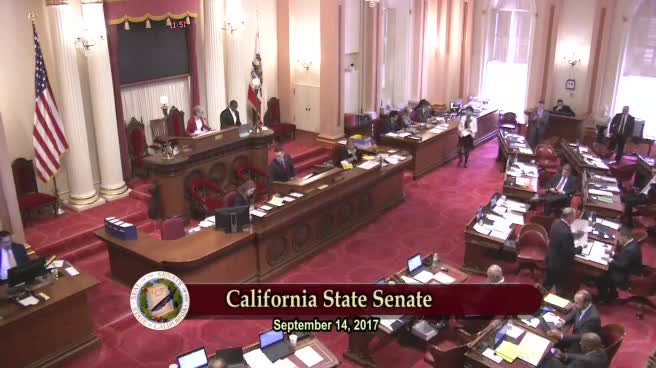 1MIN
Senate Floor
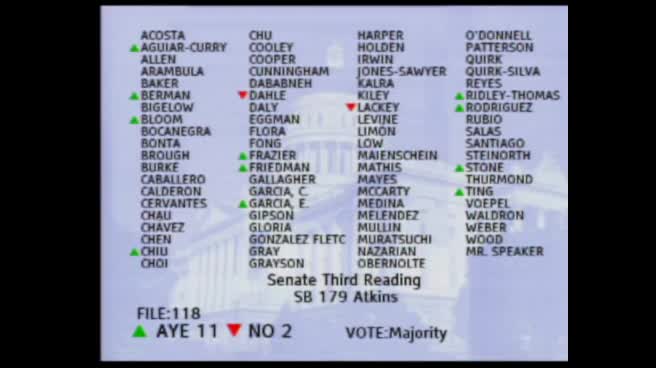 1MIN
Assembly Floor
 1H
Assembly Standing Committee on Appropriations
 7MIN
Assembly Standing Committee on Education
 3MIN
Senate Floor
 48MIN
Senate Standing Committee on Appropriations
 28SEC
Senate Standing Committee on Appropriations
 21MIN
Senate Standing Committee on Education
Bill Author











