SB 261: Common interest developments: governance.
- Session Year: 2017-2018
- House: Senate
- Latest Version Date: 2018-09-27
Existing law, the Davis-Stirling Common Interest Development Act, governs the management and operation of common interest by an association. Under existing law, an association that is required to deliver a document by individual delivery or individual notice is authorized to deliver the document by email, facsimile, or other electronic means, if the recipient has consented in writing, unless the consent is revoked in writing.
This bill would authorize the recipient to consent to that delivery and revoke that consent by email.
Existing law requires the board of an association to provide general notice of a proposed rule change at least 30 days before making the rule change.
This bill would, instead, require at least 28 days general notice before making the rule change.
Existing law provides for the regulation of insurers by the Department of Insurance. Existing law directs the Insurance Commissioner to enforce the execution of laws regulating the business of insurance. The existing Insurance Code requires various entities to submit certain reports to specified committees of the Legislature. Existing law requires that any report that is required or requested by law to be submitted by a state or local agency to the Members of the Legislature, generally, be submitted as an electronic or printed copy to the Legislative Counsel.This bill would authorize certain reports required to be submitted to a committee of the Legislature pursuant to the Insurance Code to be submitted electronically, as specified. The bill would also require that a report that is required under the Insurance Code to be submitted to a committee of the Legislature also be submitted as an electronic or printed copy to the Legislative Counsel.Existing law provides for the regulation of insurers by the Department of Insurance. Existing law directs the Insurance Commissioner to enforce the execution of laws regulating the business of insurance. The existing Insurance Code requires various entities to submit certain reports to specified committees of the Legislature. Existing law requires that any report that is required or requested by law to be submitted by a state or local agency to the Members of the Legislature, generally, be submitted as an electronic or printed copy to the Legislative Counsel.
This bill would authorize certain reports required to be submitted to a committee of the Legislature pursuant to the Insurance Code to be submitted electronically, as specified. The bill would also require that a report that is required under the Insurance Code to be submitted to a committee of the Legislature also be submitted as an electronic or printed copy to the Legislative Counsel.
Existing law provides for the regulation of insurers by the Department of Insurance. Existing law directs the Insurance Commissioner to enforce the execution of laws regulating the business of insurance. The existing Insurance Code requires various entities to submit certain reports to specified committees of the Legislature. Existing law requires that any report that is required or requested by law to be submitted by a state or local agency to the members of the Legislature, generally, be submitted as an electronic or printed copy to the Legislative Counsel.
This bill would authorize certain reports required to be submitted to a committee of the Legislature pursuant to the Insurance Code to be submitted electronically, as specified. The bill would also require that a report that is required under the Insurance Code to be submitted to a committee of the Legislature also be submitted as an electronic or printed copy to the Legislative Counsel.
(a)If a provision of this act requires that an association deliver a document by individual delivery or individual notice, the document shall be delivered by one of the following methods:
(1)First-class mail, postage prepaid, registered or certified mail, express mail, or overnight delivery by an express service carrier. The document shall be addressed to the recipient at the address last shown on the books of the association.
(2)Email, facsimile, or other electronic means, if the recipient has consented, in writing or by email, to that method of delivery. The consent may be revoked, in writing or by email, by the recipient.
(b)Upon receipt of a request by a member, pursuant to Section 5260, identifying a secondary address for delivery of notices of the following types, the association shall deliver an additional copy of those notices to the secondary address identified in the request:
(1)The documents to be delivered to the member pursuant to Article 7 (commencing with Section 5300) of Chapter 6.
(2)The documents to be delivered to the member pursuant to Article 2 (commencing with Section 5650) of Chapter 8, and Section 5710.
(c)For the purposes of this section, an unrecorded provision of the governing documents providing for a particular method of delivery does not constitute agreement by a member to that method of delivery.
SEC. 2.Section 4360 of the Civil Code is amended to read:4360.(a)The board shall provide general notice pursuant to Section 4045 of a proposed rule change at least 28 days before making the rule change. The notice shall include the text of the proposed rule change and a description of the purpose and effect of the proposed rule change. Notice is not required under this subdivision if the board determines that an immediate rule change is necessary to address an imminent threat to public health or safety or imminent risk of substantial economic loss to the association.
(b)A decision on a proposed rule change shall be made at a board meeting, after consideration of any comments made by association members.
(c)As soon as possible after making a rule change, but not more than 15 days after making the rule change, the board shall deliver general notice pursuant to Section 4045 of the rule change. If the rule change was an emergency rule change made under subdivision (d), the notice shall include the text of the rule change, a description of the purpose and effect of the rule change, and the date that the rule change expires.
(d)If the board determines that an immediate rule change is required to address an imminent threat to public health or safety, or an imminent risk of substantial economic loss to the association, it may make an emergency rule change, and no notice is required, as specified in subdivision (a). An emergency rule change is effective for 120 days, unless the rule change provides for a shorter effective period. A rule change made under this subdivision may not be readopted under this subdivision.
(a)If a provision of this act requires that an association deliver a document by individual delivery or individual notice, the document shall be delivered by one of the following methods:
(1)First-class mail, postage prepaid, registered or certified mail, express mail, or overnight delivery by an express service carrier. The document shall be addressed to the recipient at the address last shown on the books of the association.
(2)E-mail, Email, facsimile, or other electronic means, if the recipient has consented, in writing, writing or by email, to that method of delivery. The consent may be revoked, in writing, writing or by email, by the recipient.
(b)Upon receipt of a request by a member, pursuant to Section 5260, identifying a secondary address for delivery of notices of the following types, the association shall deliver an additional copy of those notices to the secondary address identified in the request:
(1)The documents to be delivered to the member pursuant to Article 7 (commencing with Section 5300) of Chapter 6.
(2)The documents to be delivered to the member pursuant to Article 2 (commencing with Section 5650) of Chapter 8, and Section 5710.
(c)For the purposes of this section, an unrecorded provision of the governing documents providing for a particular method of delivery does not constitute agreement by a member to that method of delivery.
SEC. 2.Section 4360 of the Civil Code is amended to read:4360.(a)The board shall provide general notice pursuant to Section 4045 of a proposed rule change at least 30 28 days before making the rule change. The notice shall include the text of the proposed rule change and a description of the purpose and effect of the proposed rule change. Notice is not required under this subdivision if the board determines that an immediate rule change is necessary to address an imminent threat to public health or safety or imminent risk of substantial economic loss to the association.
(b)A decision on a proposed rule change shall be made at a board meeting, after consideration of any comments made by association members.
(c)As soon as possible after making a rule change, but not more than 15 days after making the rule change, the board shall deliver general notice pursuant to Section 4045 of the rule change. If the rule change was an emergency rule change made under subdivision (d), the notice shall include the text of the rule change, a description of the purpose and effect of the rule change, and the date that the rule change expires.
(d)If the board determines that an immediate rule change is required to address an imminent threat to public health or safety, or an imminent risk of substantial economic loss to the association, it may make an emergency rule change, and no notice is required, as specified in subdivision (a). An emergency rule change is effective for 120 days, unless the rule change provides for a shorter effective period. A rule change made under this subdivision may not be readopted under this subdivision.
SECTION 1.Section 45.5 is added to the Insurance Code, to read:45.5.(a)For purposes of this section, report includes any study or audit.(b)A report required under this code to be submitted to a committee of the Legislature shall also be submitted as an electronic or printed copy to the Legislative Counsel.(c)Reports required under Sections 1063, 1872.95, 12922, 12962, and 13902 may be submitted electronically to a committee of the Legislature. This subdivision is not intended to prohibit the submission of a report electronically if authorized by any other law or the consent of any legislative committee.(d)(1)A report under this code that is submitted electronically to a committee of the Legislature may be submitted in any of the following ways:(A)Providing the committee with a digital copy of the report delivered by electronic means to a person or account designated to receive reports.(B)Providing the committee with a digital copy of the report stored on permanent media delivered by first-class mail.(C)Placing the report on the reporting entitys Internet Web site so that it is publicly available for a period of no less than three years. If a report is submitted electronically in accordance with this subparagraph, the committee shall be provided notice that the report is available that includes specific instructions on how to access the report and how to request a hard copy. The notice shall be delivered by first-class mail or by electronic means and addressed to the person or account designated to receive reports.(2)Reports and notices submitted electronically shall be provided in a standard format accessible by software or other means that is available without charge or obligation and is acceptable to the committee.(a)For purposes of this section, report includes any study or audit.
(b)A report required under this code to be submitted to a committee of the Legislature shall also be submitted as an electronic or printed copy to the Legislative Counsel.
(c)Reports required under Sections 1063, 1872.95, 11629.85, 12922, 12962, and 13902 may be submitted electronically to a committee of the Legislature. This subdivision is not intended to prohibit the submission of a report electronically if authorized by any other law or the consent of any legislative committee.
(d)(1)A report under this code that is submitted electronically to a committee of the Legislature, Legislature may be submitted in any of the following ways:
(A)Providing the committee with a digital copy of the report delivered by electronic means to a person or account designated to receive reports.
(B)Providing the committee with a digital copy of the report stored on permanent media delivered by first-class mail.
(C)Placing the report on the reporting entitys Internet Web site so that it is publicly available for a period of no less than three years. If a report is submitted electronically in accordance with this subparagraph, the committee shall be provided notice that the report is available that includes specific instructions on how to access the report and how to request a hard copy. The notice shall be delivered by first-class mail or by electronic means and addressed to the person or account designated to receive reports.
(2)Reports and notices submitted electronically shall be provided in a standard format accessible by software or other means that is available without charge or obligation and is acceptable to the committee.
(a)For purposes of this section, report includes any study or audit.
(b)A report required under this code to be submitted to a committee of the Legislature shall also be submitted as an electronic or printed copy to the Legislative Counsel.
(c)Reports required under Sections 1872.95, 11629.85, and 13902 may be submitted electronically to a committee of the Legislature. This subdivision is not intended to prohibit the submission of a report electronically if authorized by any other law or the consent of any legislative committee.
(d)(1)A report under this code that is submitted electronically to a committee of the Legislature, may be submitted in any of the following ways:
(A)Providing the committee a digital copy of the report delivered by electronic means to a person or account designated to receive reports.
(B)Providing the committee a digital copy of the report stored on permanent media delivered by first-class mail.
(C)Placing the report on the reporting entitys Internet Web site so that it is publicly available for a period of no less than three years. If a report is submitted electronically in accordance with this subparagraph, the committee shall be provided notice that the report is available that includes specific instructions on how to access the report and how to request a hard copy. The notice shall be delivered by first-class mail or by electronic means and addressed to the person or account designated to receive reports.
(2)Reports and notices submitted electronically shall be provided in a standard format accessible by software or other means that is available without charge or obligation and is acceptable to the committee.
|
Date
|
Status
|
|---|---|
| Sep 27, 2018 | Chaptered by Secretary of State. Chapter 836, Statutes of 2018. |
| Sep 27, 2018 | Approved by the Governor. |
| Sep 6, 2018 | Enrolled and presented to the Governor at 4 p.m. |
| Aug 30, 2018 | Assembly amendments concurred in. (Ayes 39. Noes 0.) Ordered to engrossing and enrolling. |
| Aug 30, 2018 | Ordered to special consent calendar. |
| Aug 29, 2018 | In Senate. Concurrence in Assembly amendments pending. |
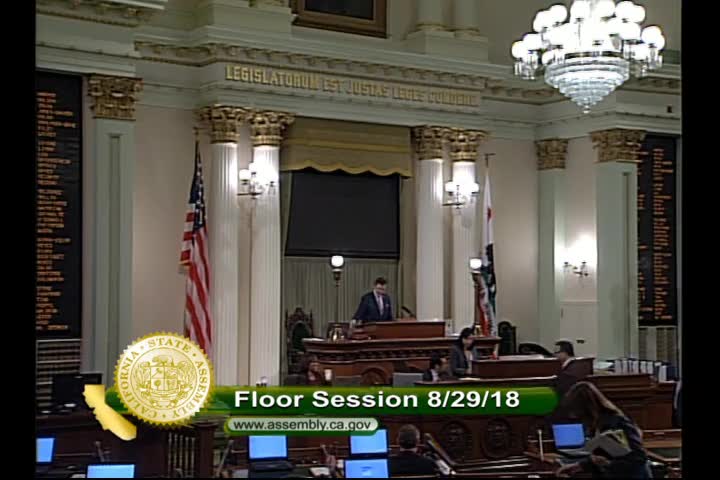
| Aug 29, 2018 | Read third time. Passed. Ordered to the Senate. |
| Aug 23, 2018 | Read third time and amended. |
| Aug 20, 2018 | From inactive file. |
| Aug 16, 2018 | Notice of intention to remove from inactive file given by Assembly Member Calderon. |
| Aug 28, 2017 | From consent calendar on motion of Assembly Member Calderon. |
| Aug 24, 2017 | Read second time. Ordered to consent calendar. |
| Aug 23, 2017 | From committee: Do pass. Ordered to consent calendar. (Ayes 15. Noes 0.) (August 23). |
| Jul 12, 2017 | From committee: Do pass and re-refer to Com. on APPR. with recommendation: To consent calendar. (Ayes 12. Noes 0.) (July 12). Re-referred to Com. on APPR. |
| May 26, 2017 | Referred to Com. on INS. |
| May 16, 2017 | In Assembly. Read first time. Held at Desk. |
| May 15, 2017 | Read third time. Passed. (Ayes 39. Noes 0. Page 1073.) Ordered to the Assembly. |
| May 9, 2017 | Read second time. Ordered to consent calendar. |
| May 8, 2017 | From committee: Be ordered to second reading pursuant to Senate Rule 28.8 and ordered to consent calendar. |
| May 4, 2017 | Set for hearing May 15. |
| May 3, 2017 | May 8 hearing postponed by committee. |
| May 1, 2017 | Set for hearing May 8. |
| Apr 27, 2017 | From committee: Do pass and re-refer to Com. on APPR. with recommendation: To consent calendar. (Ayes 9. Noes 0. Page 1100.) (April 26). Re-referred to Com. on APPR. |
| Apr 4, 2017 | From committee with author's amendments. Read second time and amended. Re-referred to Com. on INS. |
| Mar 3, 2017 | Set for hearing April 26. |
| Feb 16, 2017 | Referred to Com. on INS. |
| Feb 9, 2017 | From printer. May be acted upon on or after March 11. |
| Feb 8, 2017 | Introduced. Read first time. To Com. on RLS. for assignment. To print. |
|
Date
|
Description
|
Location
|
Votes
|
|
|---|---|---|---|---|
| Aug 30, 2018 | Unfinished Business SB261 Roth Concurrence | Senate Floor |
Passed |
|
| Aug 29, 2018 | SB 261 Roth Senate Third Reading By CERVANTES | Assembly Floor |
Passed |
|
| Aug 23, 2017 | Do pass. To Consent Calendar. | Assembly Standing Committee on Appropriations |
Passed |
|
| Jul 12, 2017 | Do pass and be re-referred to the Committee on [Appropriations] with recommendation: To Consent Calendar | Assembly Standing Committee on Insurance |
Passed |
|
| May 15, 2017 | Consent Calendar 2nd SB261 | Senate Floor |
Passed |
|
| Apr 26, 2017 | Do pass, but first be re-referred to the Committee on [Appropriations] with the recommendation: To Consent Calendar | Senate Standing Committee on Insurance |
Passed |
This list shows positions taken on this bill by organizations on the date displayed, which is linked to the original source.
Positions by individuals are not included.
Office of Senate Floor Analyses (916) 651-1520 Fax: (916) 327-4478 | SB |
UNFINISHED BUSINESS
Bill No: SB 261
:
PRIOR SENATE VOTES NOT RELEVANT
ASSEMBLY FLOOR: Not available
DIGEST:
This bill provides that a homeowner association (HOA) in a common interest development (CID) may provide a document by electronic means if the recipient has consented by email and reduces the notice requirement of a proposed rule change by the HOA board from 30 days to 28 days.
Assembly Amendments
Gut the bill to insert the current version.
Existing law:
- Requires an HOA board to provide notice of a proposed rule change, as specified, at least 30 days prior to making the rule change.
- Provides that if an HOA must deliver a document by “individual delivery” or “individual notice,” it may deliver the document by email, fax, or other electronic means if the recipient has consented in writing to that method of delivery.
This bill:
- Specifies that a recipient may consent by email to have a document delivered by the association via email, fax, or other electronic means.
- Requires a board to provide general notice, pursuant to existing law, of a proposed rule change at least 28 days before making the rule change.
Background
A CID is a form of real estate in which each homeowner has an exclusive interest in a unit or lot and a shared or undivided interest in common-area property. Condominiums, planned unit developments, stock cooperatives, community apartments, and many resident-owned mobilehome parks all fall under the umbrella of CIDs. There are more than 50,000 CIDs in California comprising over 4.8 million housing units, or approximately one-quarter of the state’s housing stock. CIDs are governed by HOAs and are established and operate under the Davis-Stirling Common Interest Development Act. In addition to the requirements of the Act, each CID is governed according to the recorded declarations, bylaws, and operating rules of the association, collectively referred to as the governing documents.
Comments
- Purpose. The author states that CIDs vary in purpose and size, from just a few units to several thousand. Larger CIDs may offer their residents significant amenities, such as golf courses, tennis and other recreational facilities, media services, and transportation services. Elected boards provide oversight for the operation and maintenance of facilities, as well as the annual budget. State law provides the framework for certain aspects of CID boards. Laguna Woods Village, sponsor of this bill, is home to more than 18,000 residents. They expect the board and management to assure that goods and services are provided in the most cost effective manner possible. To that end, Laguna Woods has identified three areas where improvements can be made: delivery of documents, notice requirements, and uncontested elections. This bill takes steps toward increased efficiency of operations by addressing two of these areas.
- Electronic notice. Existing law allows an HOA to deliver a document by email, fax, or other electronic means if the recipient has consented in writing to that method of delivery. This bill provides that a recipient may consent by email to the method of delivery. Some documents, such as annual budgets and annual policy statements, can run to hundreds of pages and can be costly to deliver in hardcopy. The sponsor notes that while residents are often reluctant to submit a written request for delivery of documents by electronic means, they are much more inclined to submit such a request via email.
- 30-day notice on rule changes. Existing law requires an HOA board to provide notice of a proposed rule change to its residents at least 30 days prior to making the change. Laguna Woods Village notes that shorter months create delays in important decisions. For example, if a board meets on the first Tuesday of each month, in short months there are not 30 days between the first Tuesday in one month and the first Tuesday in the next. Indeed, the sponsor notes that in one 12-month period, eight meetings did not meet the 30-day requirements for two of its boards and nine did not meet it for the third board, meaning that actions had to be delayed another month. To alleviate such delays, this bill reduces the notice period to 28 days.
- Déjà vu. SB 1128 (Roth) includes the same two provisions as this bill, as well as a number of provisions relating to nominations to HOA boards and circumstances under which an election by acclamation may be declared. Although there is opposition to SB 1128, opponents do not object to the two provisions included in this bill.
Related/Prior Legislation
SB 1128 (Roth, 2018) provides that an HOA in a CID may provide a document by electronic means if the recipient has consented by email; reduces the notice requirement of a proposed rule change by the HOA board from 30 days to 28 days; and provides that the nominees to a board shall be declared elected by acclamation if the number of nominees does not exceed the number of vacancies on the board, as specified. The bill is on the Assembly Floor.
SB 1265 (Wieckowski, 2018) makes several changes to the elections process held in CIDs, as well as making changes the process for handling disputes between a member and an HOA. The bill is on the Assembly Floor.
AB 1799 (Mayes, 2016) would have exempted HOAs in CIDs from election procedure requirements in uncontested elections. The bill was passed by the Senate Transportation and Housing Committee but died in the Senate Judiciary Committee.
FISCAL EFFECT: Appropriation: Fiscal Com.: Local:
Laguna Woods Village (source)
OPPOSITION: (Verified 8/28/18)
None received
ARGUMENTS IN SUPPORT: The sponsor of this bill, Laguna Woods Village, states that this bill enables two subtle efficiencies that can result in significant cost savings for their member-financed homeowners association.
8/30/18 0:10:10
**** END ****
SENATE THIRD READING
STR Bill Id:SB 261
Author:(Monning)
As Amended Ver:August 23, 2018
Majority vote
SENATE VOTE: 39-0
Committee | Votes | Ayes | Noes |
Insurance | 12-0 | Daly, Melendez, Bigelow, Caballero, Chu, Cooley, Cooper, Dababneh, Dahle, Frazier, Gipson, Voepel | |
Appropriations | 15-0 | Gonzalez Fletcher, Bigelow, Bocanegra, Bonta, Brough, Calderon, Chau, Eggman, Fong, Friedman, Gallagher, Gray, Jones-Sawyer, Obernolte, Reyes |
SUMMARY: Make several changes to the Davis Stirling Act which governs common interest developments (CIDs). Specifically, this bill:
- Specifies that an owner in a CID may consent by email to have a document delivered by the homeowners association (HOA) via email, fax, or other electronic means.
- Requires a HOA board to provide general notice, pursuant to existing law, of a proposed rule change at least 28 days, rather than 30 days, before making the rule change:
FISCAL EFFECT: None.
COMMENTS: This bill is a gut-and-amend and contains several non-controversial changes to the law governing CIDs that are in SB 1128 (Roth) of the current legislative session.
Background: There are over 52,000 CIDs in the state that comprise over six million housing units, or approximately one quarter of the state's housing stock. CIDs include condominiums, community apartment projects, housing cooperatives, and planned unit developments. They are characterized by a separate ownership of dwelling space coupled with an undivided interest in a common property, restricted by covenants and conditions that limit the use of common area and the separate ownership interests, and the management of common property and enforcement of restrictions by a HOA. CIDs are governed by the Davis-Stirling Act (the Act) as well as the governing documents of the HOA, including bylaws, declaration, and operating rules. The Act requires elections to conform to an extensive process, including double stuffed ballots and the selection of one or three independent third parties as an inspector or inspectors of elections. AB 569 (Chau), Chapter 661, Statutes of 2014, exempted HOAs from these procedures in cases where their bylaws require all of the members to serve on the board of directors.
Other proposed cost-saving measure: This bill also makes two minor changes to the Davis Stirling Act that are intended to let HOAs achieve efficiencies and save costs. First, the bill clarifies that an HOA member may use email to consent to receiving notifications by email, facsimile, or other electronic means, and the member may use email to revoke that consent as well. Existing law is not clear about whether the consent or revocation of consent can be done through email itself, and this bill clarifies that it can. Second, the bill would reduce the time period, from 30 to 28 days, between when the board provides notice of a rule change and then can make that rule change. According to the sponsor, this small two-day difference can actually prevent a two-month delay between meetings when the board is trying to schedule meetings to comply with the 30-day requirement, and narrowly misses the deadline.
Pending Related Legislation:
SB 1265 (Wieckowski) of the current legislative session would enact various changes to laws governing elections in CIDs.
SB 1228 (Roth) of the current legislative session would allow for elections in CIDs by acclamation provided specified requirements have been met and includes the changes to law governing CIDs that are also in this bill.
Prior Related Legislation. AB 1426 (Irwin) of 2018 would have allowed the board of directors of a common interest development association to be seated by acclamation if the election was uncontested, meaning, among other things, that there are at least as many board seats available as there are candidates. AB 1426 died in the Assembly Committee on Housing and Community Development.
AB 1799 (Mayes) of 2016 would have allowed the board of directors of a common interest development association to be seated by acclamation if the election is uncontested, as defined, and would have provided a procedure for an election to be declared uncontested. In addition, AB 1799 would have ensured a member in good standing who meets specified qualification requirements is not denied the right to vote or the right to be a candidate for director. AB 1799 died in the Senate Committee on Judiciary.
Analysis Prepared by: Lisa Engel / H. & C.D. / (916) 319-2085 FN: 0004314
SENATE THIRD READING
STR Bill Id:
Author:()
As Amended Ver:
Majority vote
SENATE VOTE: 39-0
Committee | Votes | Ayes | Noes |
Insurance | 12-0 | Daly, Melendez, Bigelow, Caballero, Chu, Cooley, Cooper, Dababneh, Dahle, Frazier, Gipson, Voepel | |
Appropriations | 15-0 | Gonzalez Fletcher, Bigelow, Bocanegra, Bonta, Brough, Calderon, Chau, Eggman, Fong, Friedman, Gallagher, Gray, Jones-Sawyer, Obernolte, Reyes |
SUMMARY: Establishes standards and procedures applicable to electronic copies of reports or studies required by the Insurance Code that are submitted directly to legislative committees. Specifically, this bill:
- Provides that any report required to be submitted to a legislative committee, rather than the Legislature generally, by the Insurance Code shall also be submitted to Legislative Counsel.
- Provides that specified reports may be submitted electronically.
- Requires that if a report is submitted to a committee electronically, it must be provided in one of the following ways:
- Directly to a person or an account designated by the committee to receive reports.
- On permanent media by first class mail.
- By placing it on the entity's website and notifying the committee as provided.
- Requires reports submitted electronically to be provided in a standard format accessible by software that is available without charge.
EXISTING LAW:
- Provides that any report required by law to be submitted to the Legislature generally shall instead be submitted as a printed copy to the Secretary of the Senate, as an electronic copy to the Chief Clerk of the Assembly, and as an electronic or printed copy to the Legislative Counsel.
- Requires the Legislative Counsel to publish an electronic list of all reports to be submitted to the Legislature, Governor, or both. The list shall include a description of the subject of the report, the date on which the report is to be filed, the date the report was filed with the Legislative Counsel, and a hyperlink to any reports posted on the Internet
- Requires various entities to submit certain reports directly to specified committees or officers of the Legislature, some of which are authorized to be submitted electronically.
FISCAL EFFECT: The Assembly Appropriations Committee determined that the bill would have negligible state costs.
COMMENTS:
- Purpose. According to the author, several reports required by the Insurance Code are directed at specific committees of the Legislature, rather than the Legislature generally, and are not governed under otherwise applicable statutes. This bill specifically addresses reports required by the Insurance Code that must be submitted directly to legislative committees. It provides clear guidance as to which reports may be submitted electronically and provides standards and guidelines for transmitting the document. Additionally, this bill establishes standards that reflect the different types of electronic transmission, including reports posted on an Internet site, digital report stored on permanent media (like a CD-ROM), and documents sent by electronic means such as email.
- Background. California law requires a multitude of reports from various agencies and entities. Legislative Counsel tracks those reports and posts relevant information, including the submission date, on a dedicated website at http://agencyreports.ca.gov/. The journals of each house also note receipt. But these procedures do not apply to a report submitted directly to a committee. The mechanism to track reports established by Legislative Counsel may be bypassed altogether if the report is submitted directly to the committee. This bill would require these reports to also be submitted to Legislative Counsel.
Additionally, those reporting requirements that allow or require reports to be submitted electronically do not provide standards or guidance related to how or to whom the report should be submitted. For example, a report submitted by mail is automatically processed by the appropriate committee staff whether it is addressed to that staff person or not, but email must be specifically and appropriately addressed; this bill requires that the sender to identify the staff person designated to receive the report prior to submission.
Analysis Prepared by: Mark Rakich / INS. / (916) 319-2086 FN: 0004118
Date of Hearing: August 23, 2017
ASSEMBLY COMMITTEE ON APPROPRIATIONS
Lorena Gonzalez Fletcher, Chair
SBPCA Bill Id:SB 261
Author:(Monning) – As Amended Ver:April 4, 2017
Policy Committee: | Insurance | Vote: | 12 - 0 |
Urgency: No State Mandated Local Program: No Reimbursable: No
SUMMARY:
This bill requires any report required under the Insurance Code to be submitted to a committee of the Legislature to also be submitted as an electronic or printed copy to the Legislative Counsel, and authorizes reports to legislative committees to be submitted electronically.
FISCAL EFFECT:
Negligible state costs.
COMMENTS:
- Purpose. According to the author, existing law does not provide guidance as to the format and process to submit reports required under the Insurance Code to legislative committees. Additionally, some reporting requirements permit or mandate submission by electronic means, while others require a hardcopy. This bill is a step toward establishing a consistent policy regarding electronic reports that also reflects individual committee preferences and processes.
- Prior Legislation.
SB 260 (Monning) of the 2015-16 Legislative Session, was similar to this bill, was amended to a different subject matter, and died on the Assembly inactive file.
SB 1065 (Monning), of the 2013-14 Legislative Session, was also similar to this bill and died on the Assembly inactive file.
Analysis Prepared by: Lisa Murawski / APPR. / (916) 319-2081
Date of Hearing: July 12, 2017
ASSEMBLY COMMITTEE ON INSURANCE
Tom Daly, Chair
SBPCA Bill Id:SB 261
Author:(Monning) – As Amended Ver:April 4, 2017
SENATE VOTE: 39-0
SUBJECT: Insurance: reports: electronic submission
SUMMARY: Establishes standards and procedures applicable to electronic copies of reports or studies required by the Insurance Code that are submitted directly to legislative committees. Specifically, this bill:
- Provides that any report required to be submitted to a legislative committee, rather than the Legislature generally, by the Insurance Code shall also be submitted to Legislative Counsel.
- Provides that specified reports may be submitted electronically.
- Requires that if a report is submitted to a committee electronically, it must be provided in one of the following ways:
- Directly to a person or an account designated by the committee to receive reports.
- On permanent media by first class mail.
- By placing it on the entity’s website and notifying the committee as provided.
- Requires reports submitted electronically to be provided in a standard format accessible by software that is available without charge.
EXISTING LAW:
- Provides that any report required by law to be submitted to the Legislature generally shall instead be submitted as a printed copy to the Secretary of the Senate, as an electronic copy to the Chief Clerk of the Assembly, and as an electronic or printed copy to the Legislative Counsel.
- Requires the Legislative Counsel to publish an electronic list of all reports to be submitted to the Legislature, Governor, or both. The list shall include a description of the subject of the report, the date on which the report is to be filed, the date the report was filed with the Legislative Counsel, and a hyperlink to any reports posted on the Internet
- Requires various entities to submit certain reports directly to specified committees or officers of the Legislature, some of which are authorized to be submitted electronically.
FISCAL EFFECT: This bill was referred by the Senate Appropriations Committee to the Senate Floor pursuant to Senate Rule 28.8.
COMMENTS:
- Purpose. According to the author, several reports required by the Insurance Code are directed at specific committees of the Legislature, rather than the Legislature generally, and are not governed under otherwise applicable statutes. SB 261 specifically addresses reports required by the Insurance Code that must be submitted directly to legislative committees. It provides clear guidance as to which reports may be submitted electronically and provides standards and guidelines for transmitting the document. Additionally, this bill establishes standards that reflect the different types of electronic transmission, including reports posted on an Internet site, digital report stored on permanent media (like a CD-ROM), and documents sent by electronic means such as email.
- Background. California law requires a multitude of reports from various agencies and entities. Legislative Counsel tracks those reports and posts relevant information, including the submission date, on a dedicated website at http://agencyreports.ca.gov/. The journals of each house also note receipt. But these procedures do not apply to a report submitted directly to a committee. The mechanism to track reports established by Legislative Counsel may be bypassed altogether if the report is submitted directly to the committee. This bill would require these reports to also be submitted to Legislative Counsel.
Additionally, those reporting requirements that allow or require reports to be submitted electronically do not provide standards or guidance related to how or to whom the report should be submitted. For example, a report submitted by mail is automatically processed by the appropriate committee staff whether it is addressed to that staff person or not, but email must be specifically and appropriately addressed; this bill requires that the sender to identify the staff person designated to receive the report prior to submission.
REGISTERED SUPPORT / OPPOSITION:
Support
Personal Insurance Federation of California
State Farm Mutual Automobile Insurance Company
Opposition
None received
Analysis Prepared by: Mark Rakich / INS. / (916) 319-2086
Office of Senate Floor Analyses (916) 651-1520 Fax: (916) 327-4478 | SB |
CONSENT
Bill No: SB 261
:
SENATE INSURANCE COMMITTEE: 9-0, 4/26/17
AYES: Mendoza, Gaines, Berryhill, Glazer, Hernandez, Mitchell, Newman, Portantino, Roth
SENATE APPROPRIATIONS COMMITTEE: Senate Rule 28.8
DIGEST:
This bill establishes standards and procedures applicable to electronic copies of reports or studies required by the Insurance Code that are submitted directly to legislative committees.
Existing law:
- Provides that any report required to be submitted to the Legislature generally shall instead be submitted as a printed copy to the Secretary of the Senate, as an electronic copy to the Chief Clerk of the Assembly, and as an electronic or printed copy to the Legislative Counsel. (Govt. Code § 9795.)
- Requires the Legislative Counsel to publish an electronic list of all reports to be submitted to the Legislature, Governor, or both. The list includes a description of the subject of the report, the date on which the report is to be filed, the date the report was filed with the Legislative Counsel, and a hyperlink to any reports posted on the Internet. (Govt. Code § 10242.5.)
- Requires various entities to submit certain reports directly to specified committees of the Legislature.
This bill:
- Provides that any report required to be submitted to a legislative committee, rather than the Legislature generally, by the Insurance Code shall also be submitted to Legislative Counsel.
- Provides that specified reports may be submitted to electronically.
- Requires that if a report is submitted to a committee electronically, it must be provided in one of the following ways:
- Directly to a person or an account designated by the committee to receive reports.
- On permanent media by first class mail.
- By placing it on the entity’s Web site and notifying the committee as provided.
- Requires reports submitted electronically to be provided in a standard format accessible by software that is available without charge.
Background
California law requires a multitude of reports from various agencies and entities. Legislative Counsel tracks those reports and posts relevant information, including the submission date, on a dedicated Web site at http://agencyreports.ca.gov/. The journals of each house also note receipt. But these procedures do not apply to a report submitted directly to a committee. The mechanism to track reports established by Legislative Counsel may be bypassed altogether if the report is submitted directly to the committee. This bill requires these reports to also be submitted to Legislative Counsel.
Additionally, those reporting requirements that allow or require reports to be submitted electronically do not provide standards or guidance related to how or to whom the report should be submitted. For example, a report submitted by mail is automatically processed by the appropriate committee staff whether it is addressed to that staff person or not, but email must be specifically and appropriately addressed; this bill requires the sender to identify the staff person designated to receive the report prior to submission.
FISCAL EFFECT: Appropriation: Fiscal Com.: Local:
None received
None received
ARGUMENTS IN SUPPORT: According to the author, SB 261 provides clear guidance as to which reports submitted to legislative committees may be submitted electronically and provides standards and guidelines for transmitting the document.
5/9/17 16:48:43
**** END ****
SENATE COMMITTEE ON
Senator Tony Mendoza, Chair
2017 - 2018 Regular
Bill No: Hearing Date: April 26, 2017
Author: | |||
Version: | Amended | ||
Urgency: | Fiscal: | ||
Consultant: | |||
Subject:
SUMMARY
Establishes standards and procedures applicable to electronic copies of reports or studies required by the Insurance Code that are submitted directly to legislative committees.
DIGEST
Existing law
- Provides that any report required by law to be submitted to the Legislature generally shall instead be submitted as a printed copy to the Secretary of the Senate, as an electronic copy to the Chief Clerk of the Assembly, and as an electronic or printed copy to the Legislative Counsel. (Govt. Code § 9795.)
- Requires the Legislative Counsel to publish an electronic list of all reports to be submitted to the Legislature, Governor, or both. The list includes a description of the subject of the report, the date on which the report is to be filed, the date the report was filed with the Legislative Counsel, and a hyperlink to any reports posted on the Internet. (Govt. Code § 10242.5.)
- Requires various entities to submit certain reports directly to specified committees or officers of the Legislature, some of which are authorized to be submitted electronically.
This bill
- Provides that any report required to be submitted to a legislative committee, rather than the Legislature generally, by the Insurance Code shall also be submitted to Legislative Counsel.
- Provides that specified reports may be submitted to electronically.
- Requires that if a report is submitted to a committee electronically, it must be provided in one of the following ways:
- Directly to a person or an account designated by the committee to receive reports.
- On permanent media by first class mail.
- By placing it on the entity’s website and notifying the committee as provided.
- Requires reports submitted electronically to be provided in a standard format accessible by software that is available without charge.
COMMENTS
- Purpose of the bill According to the author, several reports required by the Insurance Code are directed at specific committees of the Legislature, rather than the Legislature generally, and are not governed under otherwise applicable statutes. SB 261 specifically addresses reports required by the Insurance Code that must be submitted directly to legislative committees. It provides clear guidance as to which reports may be submitted electronically and provides standards and guidelines for transmitting the document. Additionally, this bill establishes standards that reflect the different types of electronic transmission including reports posted on an Internet site, digital report stored on permanent media (like a CD-ROM), and documents sent by electronic means such as email.
- Background California law requires a multitude of reports from various agencies and entities. Legislative Counsel tracks those reports and posts relevant information, including the submission date, on a dedicated website at http://agencyreports.ca.gov/. The journals of each house also note receipt. But these procedures do not apply to a report submitted directly to a committee. The mechanism to track reports established by Legislative Counsel may be bypassed altogether if the report is submitted directly to the committee. This bill would require these reports to also be submitted to Legislative Counsel.
Additionally, those reporting requirements that allow or require reports to be submitted electronically do not provide standards or guidance related to how or to whom the report should be submitted. For example, a report submitted by mail is automatically processed by the appropriate committee staff whether it is addressed to that staff person or not, but email must be specifically and appropriately addressed; this bill requires that the sender to identify the staff person designated to receive the report prior to submission.
- Support None received
- Opposition None received
- Prior and Related Legislation
SB 260 (Monning, 2015), as heard by the committee, would have established standards and procedures applicable to electronic copies of reports or studies required under the Insurance Code that are submitted directly to legislative committees, would have authorized specific reports to be submitted electronically to committees and any report with the consent of the committee. Died on the Assembly inactive file.
SB 1065 (Monning, 2014) would have established standards and procedures applicable to electronic copies of reports or studies required under the Insurance Code that are submitted directly to legislative committees. Died on the Assembly inactive file.
1365 (J. Perez), Chapter 192, Statutes of 2013, revised the standards and procedures related to reports required by state and local agencies that are directed to the Legislature when the report is submitted to the Legislative Counsel in electronic format.
SB 71 (Leno), Chapter 728, Statutes of 2012, modified various requirements of certain reports by requiring specified reports be placed on the Internet Web site of the reporting agency rather than submitted to the Legislature or other state agencies.
AB 1585 (Huber), Chapter 7, Statutes of 2010, eliminated obsolete reports and revised the procedure for mandatory reporting requirements. Also required reports to be submitted to the Chief Clerk of the Assembly as an electronic copy.
POSITIONS
Support
None received
Oppose
None received
-- END --


Bill Co-Author(s):