AB 1849: Foster youth: transition to independent living: health insurance coverage.
- Session Year: 2015-2016
- House: Assembly
- Latest Version Date: 2016-09-25
Existing law establishes the jurisdiction of the juvenile court, which is permitted to adjudge certain children to be dependents of the court under certain circumstances, and prescribes various hearings and other procedures for these purposes. Existing law extends certain foster care benefits to youth up to 21 years of age, known as nonminor dependents, if specified conditions are met.
Existing law requires a county social worker to develop a case plan for a minor or nonminor dependent that includes, among other things, when appropriate, for a child who is 16 years of age or older and for a nonminor dependent, a transitional independent living plan. During the 90-day period prior to the participant attaining 18 years of age or older, existing law requires a case worker or appropriate agency staff or probation officer and other representatives of the participant, as appropriate, to provide the youth or nonminor dependent with assistance and support in developing the written 90-day transition plan that is personalized at the direction of the child, and requires the plan to include, among other things, options regarding health insurance.
This bill would require, for purposes of the 90-day transition plan, information provided regarding health insurance options to include verification that the eligible youth or nonminor is enrolled in Medi-Cal and a description of the steps that have been or will be taken by the youths social worker or probation officer to ensure that the eligible youth or nonminor is transitioned into the Medi-Cal program upon case closure, as specified.
Existing law prohibits the court from terminating dependency jurisdiction over a nonminor who has attained 18 years of age until a hearing is conducted and the county welfare department has submitted a report verifying that specified information, documents, and services have been provided to the nonminor, including the written 90-day transition plan, assistance in completing an application for Medi-Cal or assistance in obtaining other health insurance, and a letter prepared by the county welfare department that includes specified information.
The bill would revise the list of information, services, and documents that are required to be provided to the nonminor to include, among other things, a Medi-Cal Benefits Identification Card and continued and uninterrupted enrollment in Medi-Cal for eligible nonminors up to 26 years of age pursuant to specified provisions of law.
By expanding the duties of counties relating to the transition of foster youth from foster care to independent living, this bill would impose a state-mandated local program.
This bill would incorporate additional changes in Section 16501.1 of the Welfare and Institutions Code proposed by AB 1067 and AB 1997, that would become operative only if this bill and either or both of those bills are chaptered and become effective on or before January 1, 2017, and this bill is chaptered last.
The California Constitution requires the state to reimburse local agencies and school districts for certain costs mandated by the state. Statutory provisions establish procedures for making that reimbursement.
This bill would provide that no reimbursement is required by this act for a specified reason.
Existing law establishes the jurisdiction of the juvenile court, which is permitted to adjudge certain children to be dependents of the court under certain circumstances, and prescribes various hearings and other procedures for these purposes. Existing law extends certain foster care benefits to youth up to 21 years of age, known as nonminor dependents, if specified conditions are met.
Existing law requires a county social worker to develop a case plan for a minor or nonminor dependent that includes, among other things, when appropriate, for a child who is 16 years of age or older and for a nonminor dependent, a transitional independent living plan. During the 90-day period prior to the participant attaining 18 years of age or older, existing law requires a case worker or appropriate agency staff or probation officer and other representatives of the participant, as appropriate, to provide the youth or nonminor dependent with assistance and support in developing the written 90-day transition plan that is personalized at the direction of the child, and requires the plan to include, among other things, options regarding health insurance.
This bill would require, for purposes of the 90-day transition plan, information provided regarding health insurance options to include verification that the eligible youth or nonminor is enrolled in Medi-Cal and a description of the steps that have been or will be taken by the youths social worker or probation officer to ensure that the eligible youth or nonminor is transitioned into the Medi-Cal program upon case closure, as specified.
Existing law prohibits the court from terminating dependency jurisdiction over a nonminor who has attained 18 years of age until a hearing is conducted and the county welfare department has submitted a report verifying that specified information, documents, and services have been provided to the nonminor, including the written 90-day transition plan, assistance in completing an application for Medi-Cal or assistance in obtaining other health insurance, and a letter prepared by the county welfare department that includes specified information.
The bill would revise the list of information, services, and documents that are required to be provided to the nonminor to include, among other things, a Medi-Cal Benefits Identification Card and continued and uninterrupted enrollment in Medi-Cal for eligible nonminors up to 26 years of age pursuant to specified provisions of law.
By expanding the duties of counties relating to the transition of foster youth from foster care to independent living, this bill would impose a state-mandated local program.
The California Constitution requires the state to reimburse local agencies and school districts for certain costs mandated by the state. Statutory provisions establish procedures for making that reimbursement.
This bill would provide that no reimbursement is required by this act for a specified reason.
Existing law establishes the jurisdiction of the juvenile court, which is permitted to adjudge certain children to be dependents of the court under certain circumstances, and prescribes various hearings and other procedures for these purposes. Existing law extends certain foster care benefits to youth up to 21 years of age, known as nonminor dependents dependents, if specified conditions are met.
Existing law requires a county social worker to develop a case plan for a minor or nonminor dependent that includes, among other things, when appropriate, for a child who is 16 years of age or older and for a nonminor dependent, a transitional independent living plan. During the 90-day period prior to the participant attaining 18 years of age or older, existing law requires a case worker or appropriate agency staff or probation officer and other representatives of the participant, as appropriate, to provide the youth or nonminor dependent with assistance and support in developing the written 90-day transition plan that is personalized at the direction of the child, and requires the plan to include, among other things, options regarding health insurance.
This bill would require, for purposes of the 90-day transition plan, options information provided regarding health insurance options to include verification that the youth or nonminor is enrolled in Medi-Cal and a description of the steps already taken and that that have been or will be taken by the youths social worker or probation officer upon case closure to ensure that the youth or nonminor is transitioned into the Medi-Cal program, program upon case closure, as specified.
Existing law prohibits the court from terminating dependency jurisdiction over a nonminor who has attained 18 years of age until a hearing is conducted and the county welfare department has submitted a report verifying that specified information, documents, and services have been provided to the nonminor, including the written 90-day transition plan, assistance in completing an application for Medi-Cal or assistance in obtaining other health insurance, and a letter prepared by the county welfare department that includes specified information.
The bill would revise the list of information, services, and documents that are required to be provided to the nonminor to include, among other things, a Medi-Cal Benefits Identification Card and written information notifying the nonminor of the availability of continued and uninterrupted enrollment in Medi-Cal coverage up to 26 years of age for eligible nonminors up to 26 years of age pursuant to specified provisions of law.
By expanding the duties of counties relating to the transition of foster youth from foster care to independent living, this bill would impose a state-mandated local program.
The California Constitution requires the state to reimburse local agencies and school districts for certain costs mandated by the state. Statutory provisions establish procedures for making that reimbursement.
This bill would provide that no reimbursement is required by this act for a specified reason.
Existing law establishes the jurisdiction of the juvenile court, which is permitted to adjudge certain children to be dependents of the court under certain circumstances, and prescribes various hearings and other procedures for these purposes. Existing law extends certain foster care benefits to youth up to 21 years of age, known as nonminor dependents if specified conditions are met.
Existing law requires a county social worker to develop a case plan for a minor or nonminor dependent that includes, among other things, when appropriate, for a child who is 16 years of age or older and for a nonminor dependent, a transitional independent living plan. During the 90-day period prior to the participant attaining 18 years of age or older, existing law requires a case worker or appropriate agency staff or probation officer and other representatives of the participant, as appropriate, to provide the youth or nonminor dependent with assistance and support in developing the written 90-day transition plan that is personalized at the direction of the child, and requires the plan to include, among other things, options regarding health insurance.
This bill would require, for purposes of the 90-day transition plan, options regarding health insurance to include verification that the youth or nonminor is enrolled in Medi-Cal and a description of the steps already taken and that will be taken by the social worker or probation officer upon case closure to ensure that the youth or nonminor is transitioned into the Medi-Cal program, as specified.
Existing law prohibits the court from terminating dependency jurisdiction over a nonminor who has attained 18 years of age until a hearing is conducted and the county welfare department has submitted a report verifying that specified information, documents, and services have been provided to the nonminor, including the written 90-day transition plan, assistance in completing an application for Medi-Cal or assistance in obtaining other health insurance, and a letter prepared by the county welfare department that includes specified information.
The bill would revise the list of information, services, and documents that are required to be provided to the nonminor to include, among other things, a Medi-Cal Benefits Identification Card and written information notifying the nonminor of the availability of continued and uninterrupted Medi-Cal coverage up to 26 years of age for eligible nonminors pursuant to specified provisions of law.
By expanding the duties of counties relating to the transition of foster youth from foster care to independent living, this bill would impose a state-mandated local program.
The California Constitution requires the state to reimburse local agencies and school districts for certain costs mandated by the state. Statutory provisions establish procedures for making that reimbursement.
This bill would provide that no reimbursement is required by this act for a specified reason.
(a)The dependency court shall not terminate jurisdiction over a nonminor unless a hearing is conducted pursuant to this section.
(b)At any hearing for a nonminor at which the court is considering termination of the jurisdiction of the juvenile court, the county welfare department shall do all of the following:
(1)Ensure that the dependent nonminor is present in court, unless the nonminor does not wish to appear in court, and elects a telephonic appearance, or document reasonable efforts made by the county welfare department to locate the nonminor when the nonminor is not available.
(2)Submit a report describing whether it is in the nonminors best interests to remain under the courts dependency jurisdiction, which includes a recommended transitional independent living case plan for the nonminor when the report describes continuing dependency jurisdiction as being in the nonminors best interest.
(3)If the county welfare department recommends termination of the courts dependency jurisdiction, submit documentation of the reasonable efforts made by the department to provide the nonminor with the assistance needed to meet or maintain eligibility as a nonminor dependent, as defined in paragraphs (1) to (5), inclusive, of subdivision (b) of Section 11403.
(4)If the nonminor has indicated that he or she does not want dependency jurisdiction to continue, the report shall address the manner in which the nonminor was advised of his or her options, including the benefits of remaining in foster care, and of his or her right to reenter foster care and to file a petition pursuant to subdivision (e) of Section 388 to resume dependency jurisdiction prior to attaining 21 years of age.
(c)(1)The court shall continue dependency jurisdiction over a nonminor who meets the definition of a nonminor dependent as described in subdivision (v) of Section 11400 unless the court finds either of the following:
(A)That the nonminor does not wish to remain subject to dependency jurisdiction.
(B)That the nonminor is not participating in a reasonable and appropriate transitional independent living case plan.
(2)In making the findings pursuant to paragraph (1), the court shall also find that the nonminor has been informed of his or her options including the benefits of remaining in foster care and the right to reenter foster care by filing a petition pursuant to subdivision (e) of Section 388 to resume dependency jurisdiction and by completing a voluntary reentry agreement pursuant to subdivision (z) of Section 11400, and has had an opportunity to confer with his or her counsel if counsel has been appointed pursuant to Section 317.
(d)(1)The court may terminate its jurisdiction over a nonminor if the court finds after reasonable and documented efforts the nonminor cannot be located.
(2)When terminating dependency jurisdiction, the court shall maintain general jurisdiction over the nonminor to allow for the filing of a petition to resume dependency jurisdiction under subdivision (e) of Section 388 until the nonminor attains 21 years of age, although no review proceedings shall be required. A nonminor may petition the court pursuant to subdivision (e) of Section 388 to resume dependency jurisdiction at any time before attaining 21 years of age.
(e)The court shall not terminate dependency jurisdiction over a nonminor who has attained 18 years of age until a hearing is conducted pursuant to this section and the department has submitted a report verifying that the following information, documents, and services have been provided to the nonminor, or in the case of a nonminor who, after reasonable efforts by the county welfare department, cannot be located, verifying the efforts made to make the following available to the nonminor:
(1)Written information concerning the nonminors case, including any known information regarding the nonminors Indian heritage or tribal connections, if applicable, his or her family history and placement history, any photographs of the nonminor or his or her family in the possession of the county welfare department, other than forensic photographs, the whereabouts of any siblings under the jurisdiction of the juvenile court, unless the court determines that sibling contact would jeopardize the safety or welfare of the sibling, directions on how to access the documents the nonminor is entitled to inspect under Section 827, and the date on which the jurisdiction of the juvenile court would be terminated.
(2)The following documents:
(A)Social security card.
(B)Certified copy of his or her birth certificate.
(C)Health and education summary, as described in subdivision (a) of Section 16010.
(D)Drivers license, as described in Section 12500 of the Vehicle Code, or identification card, as described in Section 13000 of the Vehicle Code.
(E)A letter prepared by the county welfare department that includes the following information:
(i)The nonminors name and date of birth.
(ii)The dates during which the nonminor was within the jurisdiction of the juvenile court.
(iii)A statement that the nonminor was a foster youth in compliance with state and federal financial aid documentation requirements.
(F)If applicable, the death certificate of the parent or parents.
(G)If applicable, proof of the nonminors citizenship or legal residence.
(H)An advance health care directive form.
(I)The Judicial Council form that the nonminor would use to file a petition pursuant to subdivision (e) of Section 388 to resume dependency jurisdiction.
(J)The written 90-day transition plan prepared pursuant to Section 16501.1.
(K)Written verification that the eligible nonminor is enrolled in Medi-Cal and the nonminors Medi-Cal Benefits Identification Card.
(3)Continued and uninterrupted enrollment in Medi-Cal for eligible nonminors pursuant to Section 14005.28 or 14005.285.
(4)Referrals to transitional housing, if available, or assistance in securing other housing.
(5)Assistance in obtaining employment or other financial support.
(6)Assistance in applying for admission to college or to a vocational training program or other educational institution and in obtaining financial aid, where appropriate.
(7)Assistance in maintaining relationships with individuals who are important to a nonminor who has been in out-of-home placement for six months or longer from the date the nonminor entered foster care, based on the nonminors best interests.
(8)For nonminors between 18 and 21 years of age, assistance in accessing the Independent Living Aftercare Program in the nonminors county of residence, and, upon the nonminors request, assistance in completing a voluntary reentry agreement for care and placement pursuant to subdivision (z) of Section 11400 and in filing a petition pursuant to subdivision (e) of Section 388 to resume dependency jurisdiction.
(9)Written information notifying the child that current or former dependent children who are or have been in foster care are granted a preference for student assistant or internship positions with state agencies pursuant to Section 18220 of the Government Code. The preference shall be granted to applicants up to 26 years of age.
(f)At the hearing closest to and before a dependent minors 18th birthday and every review hearing thereafter for nonminors, the department shall submit a report describing efforts toward completing the items described in paragraph (2) of subdivision (e).
(g)The Judicial Council shall develop and implement standards, and develop and adopt appropriate forms necessary to implement this provision.
SEC. 2.Section 16501.1 of the Welfare and Institutions Code is amended to read:16501.1.(a)(1)The Legislature finds and declares that the foundation and central unifying tool in child welfare services is the case plan.
(2)The Legislature further finds and declares that a case plan ensures that the child receives protection and safe and proper care and case management, and that services are provided to the child and parents or other caretakers, as appropriate, in order to improve conditions in the parents home, to facilitate the safe return of the child to a safe home or the permanent placement of the child, and to address the needs of the child while in foster care.
(3)The agency shall consider the recommendations of the child and family team, as defined in Section 16501, if any are available. The agency shall document the rationale for any inconsistencies between the case plan and the child and family team recommendations.
(b)(1)A case plan shall be based upon the principles of this section and the input from the child and family team.
(2)The case plan shall document that a preplacement assessment of the service needs of the child and family, and preplacement preventive services, have been provided, and that reasonable efforts to prevent out-of-home placement have been made. Preplacement services may include intensive mental health services in the home or a community setting and the reasonable efforts made to prevent out-of-home placement.
(3)In determining the reasonable services to be offered or provided, the childs health and safety shall be the paramount concerns.
(4)Upon a determination pursuant to paragraph (1) of subdivision (e) of Section 361.5 that reasonable services will be offered to a parent who is incarcerated in a county jail or state prison, detained by the United States Department of Homeland Security, or deported to his or her country of origin, the case plan shall include information, to the extent possible, about a parents incarceration in a county jail or the state prison, detention by the United States Department of Homeland Security, or deportation during the time that a minor child of that parent is involved in dependency care.
(5)Reasonable services shall be offered or provided to make it possible for a child to return to a safe home environment, unless, pursuant to subdivisions (b) and (e) of Section 361.5, the court determines that reunification services shall not be provided.
(6)If reasonable services are not ordered, or are terminated, reasonable efforts shall be made to place the child in a timely manner in accordance with the permanent plan and to complete all steps necessary to finalize the permanent placement of the child.
(c)If out-of-home placement is used to attain case plan goals, the case plan shall consider the recommendations of the child and family team.
(d)(1)The case plan shall include a description of the type of home or institution in which the child is to be placed, and the reasons for that placement decision. The decision regarding choice of placement shall be based upon selection of a safe setting that is the least restrictive family setting that promotes normal childhood experiences and the most appropriate setting that meets the childs individual needs and is available, in proximity to the parents home, in proximity to the childs school, and consistent with the selection of the environment best suited to meet the childs special needs and best interests. The selection shall consider, in order of priority, placement with relatives, nonrelated extended family members, and tribal members; foster family homes, resource families, and nontreatment certified homes of foster family agencies; followed by treatment and intensive treatment certified homes of foster family agencies; or multidimensional treatment foster care homes or therapeutic foster care homes; group care placements in the order of short-term residential treatment centers, group homes, community treatment facilities, and out-of-state residential treatment pursuant to Part 5 (commencing with Section 7900) of Division 12 of the Family Code.
(2)If a short-term intensive treatment center placement is selected for a child, the case plan shall indicate the needs of the child that necessitate this placement, the plan for transitioning the child to a less restrictive environment, and the projected timeline by which the child will be transitioned to a less restrictive environment. This section of the case plan shall be reviewed and updated at least semiannually.
(A)The case plan for placements in a group home, or commencing January 1, 2017, in a short-term residential treatment center, shall indicate that the county has taken into consideration Section 16010.8.
(B)After January 1, 2017, a child and family team meeting as described in Section 16501 shall be convened by the county placing agency for the purpose of identifying the supports and services needed to achieve permanency and enable the child or youth to be placed in the least restrictive family setting that promotes normal childhood experiences.
(3)On or after January 1, 2012, for a nonminor dependent, as defined in subdivision (v) of Section 11400, who is receiving AFDC-FC benefits up to 21 years of age pursuant to Section 11403, in addition to the above requirements, the selection of the placement, including a supervised independent living placement, as described in subdivision (w) of Section 11400, shall also be based upon the developmental needs of young adults by providing opportunities to have incremental responsibilities that prepare a nonminor dependent to transition to successful adulthood. If admission to, or continuation in, a group home or short-term residential treatment center placement is being considered for a nonminor dependent, the group home or short-term residential treatment center placement approval decision shall include a youth-driven, team-based case planning process, as defined by the department, in consultation with stakeholders. The case plan shall consider the full range of placement options, and shall specify why admission to, or continuation in, a group home placement is the best alternative available at the time to meet the special needs or well-being of the nonminor dependent, and how the placement will contribute to the nonminor dependents transition to successful adulthood. The case plan shall specify the treatment strategies that will be used to prepare the nonminor dependent for discharge to a less restrictive family setting that promotes normal childhood experiences, including a target date for discharge from the group home placement. The placement shall be reviewed and updated on a regular, periodic basis to ensure that continuation in the group home placement remains in the best interests of the nonminor dependent and that progress is being made in achieving case plan goals leading to successful adulthood. The group home placement planning process shall begin as soon as it becomes clear to the county welfare department or probation office that a foster child in group home placement is likely to remain in group home placement on his or her 18th birthday, in order to expedite the transition to a less restrictive family setting that promotes normal childhood experiences, if he or she becomes a nonminor dependent. The case planning process shall include informing the youth of all of his or her options, including, but not limited to, admission to or continuation in a group home placement. Consideration for continuation of existing group home placement for a nonminor dependent under 19 years of age may include the need to stay in the same placement in order to complete high school. After a nonminor dependent either completes high school or attains his or her 19th birthday, whichever is earlier, continuation in or admission to a group home placement is prohibited unless the nonminor dependent satisfies the conditions of paragraph (5) of subdivision (b) of Section 11403, and group home placement functions as a short-term transition to the appropriate system of care. Treatment services provided by the group home placement to the nonminor dependent to alleviate or ameliorate the medical condition, as described in paragraph (5) of subdivision (b) of Section 11403, shall not constitute the sole basis to disqualify a nonminor dependent from the group home placement.
(4)In addition to the requirements of paragraphs (1) to (3), inclusive, and taking into account other statutory considerations regarding placement, the selection of the most appropriate home that will meet the childs special needs and best interests shall also promote educational stability by taking into consideration proximity to the childs school of origin, and school attendance area, the number of school transfers the child has previously experienced, and the childs school matriculation schedule, in addition to other indicators of educational stability that the Legislature hereby encourages the State Department of Social Services and the State Department of Education to develop.
(e)A written case plan shall be completed within a maximum of 60 days of the initial removal of the child or of the in-person response required under subdivision (f) of Section 16501 if the child has not been removed from his or her home, or by the date of the dispositional hearing pursuant to Section 358, whichever occurs first. The case plan shall be updated, as the service needs of the child and family dictate. At a minimum, the case plan shall be updated in conjunction with each status review hearing conducted pursuant to Sections 364, 366, 366.3, and 366.31, and the hearing conducted pursuant to Section 366.26, but no less frequently than once every six months. Each updated case plan shall include a description of the services that have been provided to the child under the plan and an evaluation of the appropriateness and effectiveness of those services.
(1)It is the intent of the Legislature that extending the maximum time available for preparing a written case plan from 30 to 60 days will afford caseworkers time to actively engage families, and to solicit and integrate into the case plan the input of the child and the childs family, as well as the input of relatives and other interested parties.
(2)The extension of the maximum time available for preparing a written case plan from 30 to 60 days shall be effective 90 days after the date that the department gives counties written notice that necessary changes have been made to the Child Welfare Services/Case Management System (CWS/CMS) to account for the 60-day timeframe for preparing a written case plan.
(f)The child welfare services case plan shall be comprehensive enough to meet the juvenile court dependency proceedings requirements pursuant to Article 6 (commencing with Section 300) of Chapter 2 of Part 1 of Division 2.
(g)The case plan shall be developed considering the recommendations of the child and family team, as follows:
(1)The case plan shall be based upon an assessment of the circumstances that required child welfare services intervention. The child shall be involved in developing the case plan as age and developmentally appropriate.
(2)The case plan shall identify specific goals and the appropriateness of the planned services in meeting those goals.
(3)The case plan shall identify the original allegations of abuse or neglect, as defined in Article 2.5 (commencing with Section 11164) of Chapter 2 of Title 1 of Part 4 of the Penal Code, or the conditions cited as the basis for declaring the child a dependent of the court pursuant to Section 300, or all of these, and the other precipitating incidents that led to child welfare services intervention.
(4)The case plan shall include a description of the schedule of the placement agency contacts with the child and the family or other caretakers. The frequency of these contacts shall be in accordance with regulations adopted by the State Department of Social Services. If the child has been placed in foster care out of state, the county social worker or probation officer, or a social worker or probation officer on the staff of the agency in the state in which the child has been placed, shall visit the child in a foster family home or the home of a relative, consistent with federal law and in accordance with the departments approved state plan. For children in out-of-state group home facilities, visits shall be conducted at least monthly, pursuant to Section 16516.5. At least once every six months, at the time of a regularly scheduled placement agency contact with the foster child, the childs social worker or probation officer shall inform the child of his or her rights as a foster child, as specified in Section 16001.9. The social worker or probation officer shall provide the information to the child in a manner appropriate to the age or developmental level of the child.
(5)(A)When out-of-home services are used, the frequency of contact between the natural parents or legal guardians and the child shall be specified in the case plan. The frequency of those contacts shall reflect overall case goals, and consider other principles outlined in this section.
(B)Information regarding any court-ordered visitation between the child and the natural parents or legal guardians, and the terms and conditions needed to facilitate the visits while protecting the safety of the child, shall be provided to the childs out-of-home caregiver as soon as possible after the court order is made.
(6)When out-of-home placement is made, the case plan shall include provisions for the development and maintenance of sibling relationships as specified in subdivisions (b), (c), and (d) of Section 16002. If appropriate, when siblings who are dependents of the juvenile court are not placed together, the social worker for each child, if different, shall communicate with each of the other social workers and ensure that the childs siblings are informed of significant life events that occur within their extended family. Unless it has been determined that it is inappropriate in a particular case to keep siblings informed of significant life events that occur within the extended family, the social worker shall determine the appropriate means and setting for disclosure of this information to the child commensurate with the childs age and emotional well-being. These significant life events shall include, but shall not be limited to, the following:
(A)The death of an immediate relative.
(B)The birth of a sibling.
(C)Significant changes regarding a dependent child, unless the child objects to the sharing of the information with his or her siblings, including changes in placement, major medical or mental health diagnoses, treatments, or hospitalizations, arrests, and changes in the permanent plan.
(7)If out-of-home placement is made in a foster family home, group home, or other child care institution that is either a substantial distance from the home of the childs parent or out of state, the case plan shall specify the reasons why that placement is in the best interest of the child. When an out-of-state group home placement is recommended or made, the case plan shall, in addition, specify compliance with Section 7911.1 of the Family Code.
(8)A case plan shall ensure the educational stability of the child while in foster care and shall include both of the following:
(A)An assurance that the placement takes into account the appropriateness of the current educational setting and the proximity to the school in which the child is enrolled at the time of placement.
(B)An assurance that the placement agency has coordinated with the person holding the right to make educational decisions for the child and appropriate local educational agencies to ensure that the child remains in the school in which the child is enrolled at the time of placement or, if remaining in that school is not in the best interests of the child, assurances by the placement agency and the local educational agency to provide immediate and appropriate enrollment in a new school and to provide all of the childs educational records to the new school.
(9)(A)If out-of-home services are used, or if parental rights have been terminated and the case plan is placement for adoption, the case plan shall include a recommendation regarding the appropriateness of unsupervised visitation between the child and any of the childs siblings. This recommendation shall include a statement regarding the childs and the siblings willingness to participate in unsupervised visitation. If the case plan includes a recommendation for unsupervised sibling visitation, the plan shall also note that information necessary to accomplish this visitation has been provided to the child or to the childs siblings.
(B)Information regarding the schedule and frequency of the visits between the child and siblings, as well as any court-ordered terms and conditions needed to facilitate the visits while protecting the safety of the child, shall be provided to the childs out-of-home caregiver as soon as possible after the court order is made.
(10)If out-of-home services are used and the goal is reunification, the case plan shall describe the services to be provided to assist in reunification and the services to be provided concurrently to achieve legal permanency if efforts to reunify fail. The plan shall also consider in-state and out-of-state placements, the importance of developing and maintaining sibling relationships pursuant to Section 16002, and the desire and willingness of the caregiver to provide legal permanency for the child if reunification is unsuccessful.
(11)If out-of-home services are used, the child has been in care for at least 12 months, and the goal is not adoptive placement, the case plan shall include documentation of the compelling reason or reasons why termination of parental rights is not in the childs best interest. A determination completed or updated within the past 12 months by the department when it is acting as an adoption agency or by a licensed adoption agency that it is unlikely that the child will be adopted, or that one of the conditions described in paragraph (1) of subdivision (c) of Section 366.26 applies, shall be deemed a compelling reason.
(12)(A)Parents and legal guardians shall have an opportunity to review the case plan, and to sign it whenever possible, and then shall receive a copy of the plan. In a voluntary service or placement agreement, the parents or legal guardians shall be required to review and sign the case plan. Whenever possible, parents and legal guardians shall participate in the development of the case plan. Commencing January 1, 2012, for nonminor dependents, as defined in subdivision (v) of Section 11400, who are receiving AFDC-FC or CalWORKs assistance up to 21 years of age pursuant to Section 11403, the transitional independent living case plan, as set forth in subdivision (y) of Section 11400, shall be developed with, and signed by, the nonminor.
(B)Parents and legal guardians shall be advised that, pursuant to Section 1228.1 of the Evidence Code, neither their signature on the child welfare services case plan nor their acceptance of any services prescribed in the child welfare services case plan shall constitute an admission of guilt or be used as evidence against the parent or legal guardian in a court of law. However, they shall also be advised that the parents or guardians failure to cooperate, except for good cause, in the provision of services specified in the child welfare services case plan may be used in any hearing held pursuant to Section 366.21, 366.22, or 366.25 of this code as evidence.
(13)A child shall be given a meaningful opportunity to participate in the development of the case plan and state his or her preference for foster care placement. A child who is 12 years of age or older and in a permanent placement shall also be given the opportunity to review the case plan, sign the case plan, and receive a copy of the case plan.
(14)The case plan shall be included in the court report and shall be considered by the court at the initial hearing and each review hearing. Modifications to the case plan made during the period between review hearings need not be approved by the court if the casework supervisor for that case determines that the modifications further the goals of the plan. If out-of-home services are used with the goal of family reunification, the case plan shall consider and describe the application of subdivision (b) of Section 11203.
(15)(A)If the case plan has as its goal for the child a permanent plan of adoption or legal guardianship, it shall include a statement of the childs wishes regarding their permanent placement plan and an assessment of those stated wishes. The agency shall also include documentation of the steps the agency is taking to find an adoptive family or other permanent living arrangements for the child; to place the child with an adoptive family, an appropriate and willing relative, or a legal guardian, and to finalize the adoption or legal guardianship. At a minimum, the documentation shall include child-specific recruitment efforts, such as the use of state, regional, and national adoption exchanges, including electronic exchange systems, when the child has been freed for adoption. Regardless of whether the child has been freed for adoption, documentation shall include a description of any barriers to achieving legal permanence and the steps the agency will take to address those barriers. If the plan is for kinship guardianship, the case plan shall document how the child meets the kinship guardianship eligibility requirements.
(B)When the child is 16 years of age or older and is in another planned permanent living arrangement, the case plan shall identify the intensive and ongoing efforts to return the child to the home of the parent, place the child for adoption, place the child for tribal customary adoption in the case of an Indian child, establish a legal guardianship, or place the child nonminor dependent with a fit and willing relative, as appropriate. Efforts shall include the use of technology, including social media, to find biological family members of the child.
(16)(A)(i)For a child who is 14 or 15 years of age, the case plan shall include a written description of the programs and services that will help the child, consistent with the childs best interests, to prepare for the transition from foster care to successful adulthood. The description may be included in the document described in subparagraph (A) of paragraph (18).
(ii)When appropriate, for a child who is 16 years of age or older and, commencing January 1, 2012, for a nonminor dependent, the case plan shall include the transitional independent living plan (TILP), a written description of the programs and services that will help the child, consistent with the childs best interests, to prepare for the transition from foster care to successful adulthood, and, in addition, whether the youth has an in-progress application pending for Title XVI Supplemental Security Income benefits or for Special Immigrant Juvenile Status or other applicable application for legal residency and an active dependency case is required for that application. When appropriate, for a nonminor dependent, the transitional independent living case plan, as described in subdivision (v) of Section 11400, shall include the TILP, a written description of the programs and services that will help the nonminor dependent, consistent with his or her best interests, to prepare for transition from foster care and assist the youth in meeting the eligibility criteria set forth in paragraphs (1) to (5), inclusive, of subdivision (b) of Section 11403. If applicable, the case plan shall describe the individualized supervision provided in the supervised independent living placement as defined in subdivision (w) of Section 11400. The case plan shall be developed with the child or nonminor dependent and individuals identified as important to the child or nonminor dependent, and shall include steps the agency is taking to ensure that the child or nonminor dependent achieves permanence, including maintaining or obtaining permanent connections to caring and committed adults.
(B)During the 90-day period prior to the participant attaining 18 years of age or older as the state may elect under Section 475(8)(B)(iii) of the federal Social Security Act (42 U.S.C. Sec. 675(8)(B)(iii)), whether during that period foster care maintenance payments are being made on the childs behalf or the child is receiving benefits or services under Section 477 of the federal Social Security Act (42 U.S.C. Sec. 677), a caseworker or other appropriate agency staff or probation officer and other representatives of the participant, as appropriate, shall provide the youth or nonminor dependent with assistance and support in developing the written 90-day transition plan, that is personalized at the direction of the child, information as detailed as the participant elects that shall include, but not be limited to, options regarding housing, health insurance, education, local opportunities for mentors and continuing support services, and workforce supports and employment services, a power of attorney for health care, and information regarding the advance health care directive form. Information provided regarding health insurance options shall include verification that the eligible youth or nonminor is enrolled in Medi-Cal and a description of the steps that have been or will be taken by the youths social worker or probation officer to ensure that the eligible youth or nonminor is transitioned into the Medi-Cal program for former foster youth upon case closure with no interruption in coverage and with no new application being required, as provided in Section 14005.28.
(C)For youth 14 years of age or older, the case plan shall include documentation that a consumer credit report was requested annually from each of the three major credit reporting agencies at no charge to the youth and that any results were provided to the youth. For nonminor dependents, the case plan shall include documentation that the county assisted the nonminor dependent in obtaining his or her reports. The case plan shall include documentation of barriers, if any, to obtaining the credit reports. If the consumer credit report reveals any accounts, the case plan shall detail how the county ensured the youth received assistance with interpreting the credit report and resolving any inaccuracies, including any referrals made for the assistance.
(17)For youth 14 years of age or older and nonminor dependents, the case plan shall be developed in consultation with the youth. At the youths option, the consultation may include up to two members of the case planning team who are chosen by the youth and who are not foster parents of, or caseworkers for, the youth. The agency, at any time, may reject an individual selected by the youth to be a member of the case planning team if the agency has good cause to believe that the individual would not act in the youths best interest. One individual selected by the youth to be a member of the case planning team may be designated to be the youths adviser and advocate with respect to the application of the reasonable and prudent parent standard to the youth, as necessary.
(18)For youth in foster care 14 years of age and older and nonminor dependents, the case plan shall include both of the following:
(A)A document that describes the youths rights with respect to education, health, visitation, and court participation, the right to be annually provided with copies of his or her credit reports at no cost while in foster care pursuant to Section 10618.6, and the right to stay safe and avoid exploitation.
(B)A signed acknowledgment by the youth that he or she has been provided a copy of the document and that the rights described in the document have been explained to the youth in an age-appropriate manner.
(19)The case plan for a child or nonminor dependent who is, or who is at risk of becoming, the victim of commercial sexual exploitation, shall document the services provided to address that issue.
(h)If the court finds, after considering the case plan, that unsupervised sibling visitation is appropriate and has been consented to, the court shall order that the child or the childs siblings, the childs current caregiver, and the childs prospective adoptive parents, if applicable, be provided with information necessary to accomplish this visitation. This section does not require or prohibit the social workers facilitation, transportation, or supervision of visits between the child and his or her siblings.
(i)The case plan documentation on sibling placements required under this section shall not require modification of existing case plan forms until the Child Welfare Services/Case Management System (CWS/CMS) is implemented on a statewide basis.
(j)When a child is 10 years of age or older and has been in out-of-home placement for six months or longer, the case plan shall include an identification of individuals, other than the childs siblings, who are important to the child and actions necessary to maintain the childs relationship with those individuals, provided that those relationships are in the best interest of the child. The social worker or probation officer shall ask every child who is 10 years of age or older and who has been in out-of-home placement for six months or longer to identify individuals other than the childs siblings who are important to the child, and may ask any other child to provide that information, or may seek that information from the child and family team, as appropriate. The social worker or probation officer shall make efforts to identify other individuals who are important to the child, consistent with the childs best interests.
(k)The childs caregiver shall be provided a copy of a plan outlining the childs needs and services. The nonminor dependents caregiver shall be provided with a copy of the nonminors TILP.
(l)Each county shall ensure that the total number of visits made by caseworkers on a monthly basis to children in foster care during a federal fiscal year is not less than 95 percent of the total number of those visits that would occur if each child were visited once every month while in care and that the majority of the visits occur in the residence of the child. The county child welfare and probation departments shall comply with data reporting requirements that the department deems necessary to comply with the federal Child and Family Services Improvement Act of 2006 (Public Law 109-288) and the federal Child and Family Services Improvement and Innovation Act (Public Law 112-34).
(m)The implementation and operation of the amendments to subdivision (i) enacted at the 200506 Regular Session shall be subject to appropriation through the budget process and by phase, as provided in Section 366.35.
SEC. 2.1.Section 16501.1 of the Welfare and Institutions Code is amended to read:16501.1.(a)(1)The Legislature finds and declares that the foundation and central unifying tool in child welfare services is the case plan.
(2)The Legislature further finds and declares that a case plan ensures that the child receives protection and safe and proper care and case management, and that services are provided to the child and parents or other caretakers, as appropriate, in order to improve conditions in the parents home, to facilitate the safe return of the child to a safe home or the permanent placement of the child, and to address the needs of the child while in foster care.
(3)The agency shall consider the recommendations of the child and family team, as defined in Section 16501, if any are available. The agency shall document the rationale for any inconsistencies between the case plan and the child and family team recommendations.
(b)(1)A case plan shall be based upon the principles of this section and the input from the child and family team.
(2)The case plan shall document that a preplacement assessment of the service needs of the child and family, and preplacement preventive services, have been provided, and that reasonable efforts to prevent out-of-home placement have been made. Preplacement services may include intensive mental health services in the home or a community setting and the reasonable efforts made to prevent out-of-home placement.
(3)In determining the reasonable services to be offered or provided, the childs health and safety shall be the paramount concerns.
(4)Upon a determination pursuant to paragraph (1) of subdivision (e) of Section 361.5 that reasonable services will be offered to a parent who is incarcerated in a county jail or state prison, detained by the United States Department of Homeland Security, or deported to his or her country of origin, the case plan shall include information, to the extent possible, about a parents incarceration in a county jail or the state prison, detention by the United States Department of Homeland Security, or deportation during the time that a minor child of that parent is involved in dependency care.
(5)Reasonable services shall be offered or provided to make it possible for a child to return to a safe home environment, unless, pursuant to subdivisions (b) and (e) of Section 361.5, the court determines that reunification services shall not be provided.
(6)If reasonable services are not ordered, or are terminated, reasonable efforts shall be made to place the child in a timely manner in accordance with the permanent plan and to complete all steps necessary to finalize the permanent placement of the child.
(c)If out-of-home placement is used to attain case plan goals, the case plan shall consider the recommendations of the child and family team.
(d)(1)The case plan shall include a description of the type of home or institution in which the child is to be placed, and the reasons for that placement decision. The decision regarding choice of placement shall be based upon selection of a safe setting that is the least restrictive family setting that promotes normal childhood experiences and the most appropriate setting that meets the childs individual needs and is available, in proximity to the parents home, in proximity to the childs school, and consistent with the selection of the environment best suited to meet the childs special needs and best interests. The selection shall consider, in order of priority, placement with relatives, nonrelated extended family members, and tribal members; foster family homes, resource families, and nontreatment certified homes of foster family agencies; followed by treatment and intensive treatment certified homes of foster family agencies; or multidimensional treatment foster care homes or therapeutic foster care homes; group care placements in the order of short-term residential treatment centers, group homes, community treatment facilities, and out-of-state residential treatment pursuant to Part 5 (commencing with Section 7900) of Division 12 of the Family Code.
(2)If a short-term intensive treatment center placement is selected for a child, the case plan shall indicate the needs of the child that necessitate this placement, the plan for transitioning the child to a less restrictive environment, and the projected timeline by which the child will be transitioned to a less restrictive environment. This section of the case plan shall be reviewed and updated at least semiannually.
(A)The case plan for placements in a group home, or commencing January 1, 2017, in a short-term residential treatment center, shall indicate that the county has taken into consideration Section 16010.8.
(B)After January 1, 2017, a child and family team meeting as described in Section 16501 shall be convened by the county placing agency for the purpose of identifying the supports and services needed to achieve permanency and enable the child or youth to be placed in the least restrictive family setting that promotes normal childhood experiences.
(3)On or after January 1, 2012, for a nonminor dependent, as defined in subdivision (v) of Section 11400, who is receiving AFDC-FC benefits and who is up to 21 years of age pursuant to Section 11403, in addition to the above requirements, the selection of the placement, including a supervised independent living placement, as described in subdivision (w) of Section 11400, shall also be based upon the developmental needs of young adults by providing opportunities to have incremental responsibilities that prepare a nonminor dependent to transition to successful adulthood. If admission to, or continuation in, a group home or short-term residential treatment center placement is being considered for a nonminor dependent, the group home or short-term residential treatment center placement approval decision shall include a youth-driven, team-based case planning process, as defined by the department, in consultation with stakeholders. The case plan shall consider the full range of placement options, and shall specify why admission to, or continuation in, a group home placement is the best alternative available at the time to meet the special needs or well-being of the nonminor dependent, and how the placement will contribute to the nonminor dependents transition to successful adulthood. The case plan shall specify the treatment strategies that will be used to prepare the nonminor dependent for discharge to a less restrictive family setting that promotes normal childhood experiences, including a target date for discharge from the group home placement. The placement shall be reviewed and updated on a regular, periodic basis to ensure that continuation in the group home placement remains in the best interests of the nonminor dependent and that progress is being made in achieving case plan goals leading to successful adulthood. The group home placement planning process shall begin as soon as it becomes clear to the county welfare department or probation office that a foster child in group home placement is likely to remain in group home placement on his or her 18th birthday, in order to expedite the transition to a less restrictive family setting that promotes normal childhood experiences, if he or she becomes a nonminor dependent. The case planning process shall include informing the youth of all of his or her options, including, but not limited to, admission to or continuation in a group home placement. Consideration for continuation of existing group home placement for a nonminor dependent under 19 years of age may include the need to stay in the same placement in order to complete high school. After a nonminor dependent either completes high school or attains his or her 19th birthday, whichever is earlier, continuation in or admission to a group home placement is prohibited unless the nonminor dependent satisfies the conditions of paragraph (5) of subdivision (b) of Section 11403, and group home placement functions as a short-term transition to the appropriate system of care. Treatment services provided by the group home placement to the nonminor dependent to alleviate or ameliorate the medical condition, as described in paragraph (5) of subdivision (b) of Section 11403, shall not constitute the sole basis to disqualify a nonminor dependent from the group home placement.
(4)In addition to the requirements of paragraphs (1) to (3), inclusive, and taking into account other statutory considerations regarding placement, the selection of the most appropriate home that will meet the childs special needs and best interests shall also promote educational stability by taking into consideration proximity to the childs school of origin, and school attendance area, the number of school transfers the child has previously experienced, and the childs school matriculation schedule, in addition to other indicators of educational stability that the Legislature hereby encourages the State Department of Social Services and the State Department of Education to develop.
(e)A written case plan shall be completed within a maximum of 60 days of the initial removal of the child or of the in-person response required under subdivision (f) of Section 16501 if the child has not been removed from his or her home, or by the date of the dispositional hearing pursuant to Section 358, whichever occurs first. The case plan shall be updated, as the service needs of the child and family dictate. At a minimum, the case plan shall be updated in conjunction with each status review hearing conducted pursuant to Sections 364, 366, 366.3, and 366.31, and the hearing conducted pursuant to Section 366.26, but no less frequently than once every six months. Each updated case plan shall include a description of the services that have been provided to the child under the plan and an evaluation of the appropriateness and effectiveness of those services.
(1)It is the intent of the Legislature that extending the maximum time available for preparing a written case plan from 30 to 60 days will afford caseworkers time to actively engage families, and to solicit and integrate into the case plan the input of the child and the childs family, as well as the input of relatives and other interested parties.
(2)The extension of the maximum time available for preparing a written case plan from 30 to 60 days shall be effective 90 days after the date that the department gives counties written notice that necessary changes have been made to the Child Welfare Services/Case Management System (CWS/CMS) to account for the 60-day timeframe for preparing a written case plan.
(f)The child welfare services case plan shall be comprehensive enough to meet the juvenile court dependency proceedings requirements pursuant to Article 6 (commencing with Section 300) of Chapter 2 of Part 1 of Division 2.
(g)The case plan shall be developed considering the recommendations of the child and family team, as follows:
(1)The case plan shall be based upon an assessment of the circumstances that required child welfare services intervention. The child shall be involved in developing the case plan as age and developmentally appropriate.
(2)The case plan shall identify specific goals and the appropriateness of the planned services in meeting those goals.
(3)The case plan shall identify the original allegations of abuse or neglect, as defined in Article 2.5 (commencing with Section 11164) of Chapter 2 of Title 1 of Part 4 of the Penal Code, or the conditions cited as the basis for declaring the child a dependent of the court pursuant to Section 300, or all of these, and the other precipitating incidents that led to child welfare services intervention.
(4)The case plan shall include a description of the schedule of the placement agency contacts with the child and the family or other caretakers. The frequency of these contacts shall be in accordance with regulations adopted by the State Department of Social Services. If the child has been placed in foster care out of state, the county social worker or probation officer, or a social worker or probation officer on the staff of the agency in the state in which the child has been placed, shall visit the child in a foster family home or the home of a relative, consistent with federal law and in accordance with the departments approved state plan. For children in out-of-state group home facilities, visits shall be conducted at least monthly, pursuant to Section 16516.5. At least once every six months, at the time of a regularly scheduled placement agency contact with the foster child, and at each placement change, the childs social worker or probation officer shall inform the child, the care provider, and the child and family team, if applicable, of the childs rights as a foster child, as specified in Section 16001.9, and shall provide a written copy of the rights to the child as part of the explanation. The social worker or probation officer shall provide the information to the child in a manner appropriate to the age or developmental level of the child. The social worker or probation officer shall document in the case plan that he or she has informed the child of, and has provided the child with a written copy of, his or her rights.
(5)(A)When out-of-home services are used, the frequency of contact between the natural parents or legal guardians and the child shall be specified in the case plan. The frequency of those contacts shall reflect overall case goals, and consider other principles outlined in this section.
(B)Information regarding any court-ordered visitation between the child and the natural parents or legal guardians, and the terms and conditions needed to facilitate the visits while protecting the safety of the child, shall be provided to the childs out-of-home caregiver as soon as possible after the court order is made.
(6)When out-of-home placement is made, the case plan shall include provisions for the development and maintenance of sibling relationships as specified in subdivisions (b), (c), and (d) of Section 16002. If appropriate, when siblings who are dependents of the juvenile court are not placed together, the social worker for each child, if different, shall communicate with each of the other social workers and ensure that the childs siblings are informed of significant life events that occur within their extended family. Unless it has been determined that it is inappropriate in a particular case to keep siblings informed of significant life events that occur within the extended family, the social worker shall determine the appropriate means and setting for disclosure of this information to the child commensurate with the childs age and emotional well-being. These significant life events shall include, but shall not be limited to, the following:
(A)The death of an immediate relative.
(B)The birth of a sibling.
(C)Significant changes regarding a dependent child, unless the child objects to the sharing of the information with his or her siblings, including changes in placement, major medical or mental health diagnoses, treatments, or hospitalizations, arrests, and changes in the permanent plan.
(7)If out-of-home placement is made in a foster family home, group home, or other child care institution that is either a substantial distance from the home of the childs parent or out of state, the case plan shall specify the reasons why that placement is in the best interest of the child. When an out-of-state group home placement is recommended or made, the case plan shall, in addition, specify compliance with Section 7911.1 of the Family Code.
(8)A case plan shall ensure the educational stability of the child while in foster care and shall include both of the following:
(A)An assurance that the placement takes into account the appropriateness of the current educational setting and the proximity to the school in which the child is enrolled at the time of placement.
(B)An assurance that the placement agency has coordinated with the person holding the right to make educational decisions for the child and appropriate local educational agencies to ensure that the child remains in the school in which the child is enrolled at the time of placement or, if remaining in that school is not in the best interests of the child, assurances by the placement agency and the local educational agency to provide immediate and appropriate enrollment in a new school and to provide all of the childs educational records to the new school.
(9)(A)If out-of-home services are used, or if parental rights have been terminated and the case plan is placement for adoption, the case plan shall include a recommendation regarding the appropriateness of unsupervised visitation between the child and any of the childs siblings. This recommendation shall include a statement regarding the childs and the siblings willingness to participate in unsupervised visitation. If the case plan includes a recommendation for unsupervised sibling visitation, the plan shall also note that information necessary to accomplish this visitation has been provided to the child or to the childs siblings.
(B)Information regarding the schedule and frequency of the visits between the child and siblings, as well as any court-ordered terms and conditions needed to facilitate the visits while protecting the safety of the child, shall be provided to the childs out-of-home caregiver as soon as possible after the court order is made.
(10)If out-of-home services are used and the goal is reunification, the case plan shall describe the services to be provided to assist in reunification and the services to be provided concurrently to achieve legal permanency if efforts to reunify fail. The plan shall also consider in-state and out-of-state placements, the importance of developing and maintaining sibling relationships pursuant to Section 16002, and the desire and willingness of the caregiver to provide legal permanency for the child if reunification is unsuccessful.
(11)If out-of-home services are used, the child has been in care for at least 12 months, and the goal is not adoptive placement, the case plan shall include documentation of the compelling reason or reasons why termination of parental rights is not in the childs best interest. A determination completed or updated within the past 12 months by the department when it is acting as an adoption agency or by a licensed adoption agency that it is unlikely that the child will be adopted, or that one of the conditions described in paragraph (1) of subdivision (c) of Section 366.26 applies, shall be deemed a compelling reason.
(12)(A)Parents and legal guardians shall have an opportunity to review the case plan, and to sign it whenever possible, and then shall receive a copy of the plan. In a voluntary service or placement agreement, the parents or legal guardians shall be required to review and sign the case plan. Whenever possible, parents and legal guardians shall participate in the development of the case plan. Commencing January 1, 2012, for nonminor dependents, as defined in subdivision (v) of Section 11400, who are receiving AFDC-FC or CalWORKs assistance and who are up to 21 years of age pursuant to Section 11403, the transitional independent living case plan, as set forth in subdivision (y) of Section 11400, shall be developed with, and signed by, the nonminor.
(B)Parents and legal guardians shall be advised that, pursuant to Section 1228.1 of the Evidence Code, neither their signature on the child welfare services case plan nor their acceptance of any services prescribed in the child welfare services case plan shall constitute an admission of guilt or be used as evidence against the parent or legal guardian in a court of law. However, they shall also be advised that the parents or guardians failure to cooperate, except for good cause, in the provision of services specified in the child welfare services case plan may be used in any hearing held pursuant to Section 366.21, 366.22, or 366.25 of this code as evidence.
(13)A child shall be given a meaningful opportunity to participate in the development of the case plan and state his or her preference for foster care placement. A child who is 12 years of age or older and in a permanent placement shall also be given the opportunity to review the case plan, sign the case plan, and receive a copy of the case plan.
(14)The case plan shall be included in the court report and shall be considered by the court at the initial hearing and each review hearing. Modifications to the case plan made during the period between review hearings need not be approved by the court if the casework supervisor for that case determines that the modifications further the goals of the plan. If out-of-home services are used with the goal of family reunification, the case plan shall consider and describe the application of subdivision (b) of Section 11203.
(15)(A)If the case plan has as its goal for the child a permanent plan of adoption or legal guardianship, it shall include a statement of the childs wishes regarding their permanent placement plan and an assessment of those stated wishes. The agency shall also include documentation of the steps the agency is taking to find an adoptive family or other permanent living arrangements for the child; to place the child with an adoptive family, an appropriate and willing relative, or a legal guardian, and to finalize the adoption or legal guardianship. At a minimum, the documentation shall include child-specific recruitment efforts, such as the use of state, regional, and national adoption exchanges, including electronic exchange systems, when the child has been freed for adoption. Regardless of whether the child has been freed for adoption, documentation shall include a description of any barriers to achieving legal permanence and the steps the agency will take to address those barriers. If the plan is for kinship guardianship, the case plan shall document how the child meets the kinship guardianship eligibility requirements.
(B)When the child is 16 years of age or older and is in another planned permanent living arrangement, the case plan shall identify the intensive and ongoing efforts to return the child to the home of the parent, place the child for adoption, place the child for tribal customary adoption in the case of an Indian child, establish a legal guardianship, or place the child nonminor dependent with a fit and willing relative, as appropriate. Efforts shall include the use of technology, including social media, to find biological family members of the child.
(16)(A)(i)For a child who is 14 or 15 years of age, the case plan shall include a written description of the programs and services that will help the child, consistent with the childs best interests, to prepare for the transition from foster care to successful adulthood. The description may be included in the document described in subparagraph (A) of paragraph (18).
(ii)When appropriate, for a child who is 16 years of age or older and, commencing January 1, 2012, for a nonminor dependent, the case plan shall include the transitional independent living plan (TILP), a written description of the programs and services that will help the child, consistent with the childs best interests, to prepare for the transition from foster care to successful adulthood, and, in addition, whether the youth has an in-progress application pending for Title XVI Supplemental Security Income benefits or for Special Immigrant Juvenile Status or other applicable application for legal residency and an active dependency case is required for that application. When appropriate, for a nonminor dependent, the transitional independent living case plan, as described in subdivision (v) of Section 11400, shall include the TILP, a written description of the programs and services that will help the nonminor dependent, consistent with his or her best interests, to prepare for transition from foster care and assist the youth in meeting the eligibility criteria set forth in paragraphs (1) to (5), inclusive, of subdivision (b) of Section 11403. If applicable, the case plan shall describe the individualized supervision provided in the supervised independent living placement as defined in subdivision (w) of Section 11400. The case plan shall be developed with the child or nonminor dependent and individuals identified as important to the child or nonminor dependent, and shall include steps the agency is taking to ensure that the child or nonminor dependent achieves permanence, including maintaining or obtaining permanent connections to caring and committed adults.
(B)During the 90-day period prior to the participant attaining 18 years of age or older as the state may elect under Section 475(8)(B)(iii) of the federal Social Security Act (42 U.S.C. Sec. 675(8)(B)(iii)), whether during that period foster care maintenance payments are being made on the childs behalf or the child is receiving benefits or services under Section 477 of the federal Social Security Act (42 U.S.C. Sec. 677), a caseworker or other appropriate agency staff or probation officer and other representatives of the participant, as appropriate, shall provide the youth or nonminor dependent with assistance and support in developing the written 90-day transition plan, that is personalized at the direction of the child, information as detailed as the participant elects that shall include, but not be limited to, options regarding housing, health insurance, education, local opportunities for mentors and continuing support services, and workforce supports and employment services, a power of attorney for health care, and information regarding the advance health care directive form. Information provided regarding health insurance options shall include verification that the eligible youth or nonminor is enrolled in Medi-Cal and a description of the steps that have been or will be taken by the youths social worker or probation officer to ensure that the eligible youth or nonminor is transitioned into the Medi-Cal program for former foster youth upon case closure with no interruption in coverage and with no new application being required, as provided in Section 14005.28.
(C)For youth 14 years of age or older, the case plan shall include documentation that a consumer credit report was requested annually from each of the three major credit reporting agencies at no charge to the youth and that any results were provided to the youth. For nonminor dependents, the case plan shall include documentation that the county assisted the nonminor dependent in obtaining his or her reports. The case plan shall include documentation of barriers, if any, to obtaining the credit reports. If the consumer credit report reveals any accounts, the case plan shall detail how the county ensured the youth received assistance with interpreting the credit report and resolving any inaccuracies, including any referrals made for the assistance.
(17)For youth 14 years of age or older and nonminor dependents, the case plan shall be developed in consultation with the youth. At the youths option, the consultation may include up to two members of the case planning team who are chosen by the youth and who are not foster parents of, or caseworkers for, the youth. The agency, at any time, may reject an individual selected by the youth to be a member of the case planning team if the agency has good cause to believe that the individual would not act in the youths best interest. One individual selected by the youth to be a member of the case planning team may be designated to be the youths adviser and advocate with respect to the application of the reasonable and prudent parent standard to the youth, as necessary.
(18)For youth in foster care 14 years of age and older and nonminor dependents, the case plan shall include both of the following:
(A)A document that describes the youths rights with respect to education, health, visitation, and court participation, the right to be annually provided with copies of his or her credit reports at no cost while in foster care pursuant to Section 10618.6, and the right to stay safe and avoid exploitation.
(B)A signed acknowledgment by the youth that he or she has been provided a copy of the document and that the rights described in the document have been explained to the youth in an age-appropriate manner.
(19)The case plan for a child or nonminor dependent who is, or who is at risk of becoming, the victim of commercial sexual exploitation, shall document the services provided to address that issue.
(h)If the court finds, after considering the case plan, that unsupervised sibling visitation is appropriate and has been consented to, the court shall order that the child or the childs siblings, the childs current caregiver, and the childs prospective adoptive parents, if applicable, be provided with information necessary to accomplish this visitation. This section does not require or prohibit the social workers facilitation, transportation, or supervision of visits between the child and his or her siblings.
(i)The case plan documentation on sibling placements required under this section shall not require modification of existing case plan forms until the Child Welfare Services/Case Management System (CWS/CMS) is implemented on a statewide basis.
(j)When a child is 10 years of age or older and has been in out-of-home placement for six months or longer, the case plan shall include an identification of individuals, other than the childs siblings, who are important to the child and actions necessary to maintain the childs relationship with those individuals, provided that those relationships are in the best interest of the child. The social worker or probation officer shall ask every child who is 10 years of age or older and who has been in out-of-home placement for six months or longer to identify individuals other than the childs siblings who are important to the child, and may ask any other child to provide that information, or may seek that information from the child and family team, as appropriate. The social worker or probation officer shall make efforts to identify other individuals who are important to the child, consistent with the childs best interests.
(k)The childs caregiver shall be provided a copy of a plan outlining the childs needs and services. The nonminor dependents caregiver shall be provided with a copy of the nonminors TILP.
(l)Each county shall ensure that the total number of visits made by caseworkers on a monthly basis to children in foster care during a federal fiscal year is not less than 95 percent of the total number of those visits that would occur if each child were visited once every month while in care and that the majority of the visits occur in the residence of the child. The county child welfare and probation departments shall comply with data reporting requirements that the department deems necessary to comply with the federal Child and Family Services Improvement Act of 2006 (Public Law 109-288) and the federal Child and Family Services Improvement and Innovation Act (Public Law 112-34).
(m)The implementation and operation of the amendments to subdivision (i) enacted at the 200506 Regular Session shall be subject to appropriation through the budget process and by phase, as provided in Section 366.35.
SEC. 2.2.Section 16501.1 of the Welfare and Institutions Code is amended to read:16501.1.(a)(1)The Legislature finds and declares that the foundation and central unifying tool in child welfare services is the case plan.
(2)The Legislature further finds and declares that a case plan ensures that the child receives protection and safe and proper care and case management, and that services are provided to the child and parents or other caretakers, as appropriate, in order to improve conditions in the parents home, to facilitate the safe return of the child to a safe home or the permanent placement of the child, and to address the needs of the child while in foster care.
(3)The agency shall consider the recommendations of the child and family team, as defined in Section 16501, if any are available. The agency shall document the rationale for any inconsistencies between the case plan and the child and family team recommendations.
(b)(1)A case plan shall be based upon the principles of this section and the input from the child and family team.
(2)The case plan shall document that a preplacement assessment of the service needs of the child and family, and preplacement preventive services, have been provided, and that reasonable efforts to prevent out-of-home placement have been made. Preplacement services may include intensive mental health services in the home or a community setting and the reasonable efforts made to prevent out-of-home placement.
(3)In determining the reasonable services to be offered or provided, the childs health and safety shall be the paramount concerns.
(4)Upon a determination pursuant to paragraph (1) of subdivision (e) of Section 361.5 that reasonable services will be offered to a parent who is incarcerated in a county jail or state prison, detained by the United States Department of Homeland Security, or deported to his or her country of origin, the case plan shall include information, to the extent possible, about a parents incarceration in a county jail or the state prison, detention by the United States Department of Homeland Security, or deportation during the time that a minor child of that parent is involved in dependency care.
(5)Reasonable services shall be offered or provided to make it possible for a child to return to a safe home environment, unless, pursuant to subdivisions (b) and (e) of Section 361.5, the court determines that reunification services shall not be provided.
(6)If reasonable services are not ordered, or are terminated, reasonable efforts shall be made to place the child in a timely manner in accordance with the permanent plan and to complete all steps necessary to finalize the permanent placement of the child.
(c)If out-of-home placement is used to attain case plan goals, the case plan shall consider the recommendations of the child and family team.
(d)(1)The case plan shall include a description of the type of home or institution in which the child is to be placed, and the reasons for that placement decision. The decision regarding choice of placement shall be based upon selection of a safe setting that is the least restrictive family setting that promotes normal childhood experiences and the most appropriate setting that meets the childs individual needs and is available, in proximity to the parents home, in proximity to the childs school, and consistent with the selection of the environment best suited to meet the childs special needs and best interests. The selection shall consider, in order of priority, placement with relatives, nonrelated extended family members, and tribal members; foster family homes, resource families, and nontreatment certified homes of foster family agencies; followed by treatment and intensive treatment certified homes of foster family agencies; or multidimensional treatment foster care homes or therapeutic foster care homes; group care placements in the order of short-term residential therapeutic programs, group homes, community treatment facilities, and out-of-state residential treatment pursuant to Part 5 (commencing with Section 7900) of Division 12 of the Family Code.
(2)If a short-term residential therapeutic program placement is selected for a child, the case plan shall indicate the needs of the child that necessitate this placement, the plan for transitioning the child to a less restrictive environment, and the projected timeline by which the child will be transitioned to a less restrictive environment. This section of the case plan shall be reviewed and updated at least semiannually.
(A)The case plan for placements in a group home, or commencing January 1, 2017, in a short-term residential therapeutic program, shall indicate that the county has taken into consideration Section 16010.8.
(B)After January 1, 2017, a child and family team meeting as described in Section 16501 shall be convened by the county placing agency for the purpose of identifying the supports and services needed to achieve permanency and enable the child or youth to be placed in the least restrictive family setting that promotes normal childhood experiences.
(3)On or after January 1, 2012, for a nonminor dependent, as defined in subdivision (v) of Section 11400, who is receiving AFDC-FC benefits up to 21 years of age pursuant to Section 11403, in addition to the above requirements, the selection of the placement, including a supervised independent living placement, as described in subdivision (w) of Section 11400, shall also be based upon the developmental needs of young adults by providing opportunities to have incremental responsibilities that prepare a nonminor dependent to transition to successful adulthood. If admission to, or continuation in, a group home or short-term residential therapeutic program placement is being considered for a nonminor dependent, the group home or short-term residential therapeutic program placement approval decision shall include a youth-driven, team-based case planning process, as defined by the department, in consultation with stakeholders. The case plan shall consider the full range of placement options, and shall specify why admission to, or continuation in, a group home placement is the best alternative available at the time to meet the special needs or well-being of the nonminor dependent, and how the placement will contribute to the nonminor dependents transition to successful adulthood. The case plan shall specify the treatment strategies that will be used to prepare the nonminor dependent for discharge to a less restrictive family setting that promotes normal childhood experiences, including a target date for discharge from the group home placement. The placement shall be reviewed and updated on a regular, periodic basis to ensure that continuation in the group home placement remains in the best interests of the nonminor dependent and that progress is being made in achieving case plan goals leading to successful adulthood. The group home placement planning process shall begin as soon as it becomes clear to the county welfare department or probation office that a foster child in group home placement is likely to remain in group home placement on his or her 18th birthday, in order to expedite the transition to a less restrictive family setting that promotes normal childhood experiences, if he or she becomes a nonminor dependent. The case planning process shall include informing the youth of all of his or her options, including, but not limited to, admission to or continuation in a group home placement. Consideration for continuation of existing group home placement for a nonminor dependent under 19 years of age may include the need to stay in the same placement in order to complete high school. After a nonminor dependent either completes high school or attains his or her 19th birthday, whichever is earlier, continuation in or admission to a group home placement is prohibited unless the nonminor dependent satisfies the conditions of paragraph (5) of subdivision (b) of Section 11403, and group home placement functions as a short-term transition to the appropriate system of care. Treatment services provided by the group home placement to the nonminor dependent to alleviate or ameliorate the medical condition, as described in paragraph (5) of subdivision (b) of Section 11403, shall not constitute the sole basis to disqualify a nonminor dependent from the group home placement.
(4)In addition to the requirements of paragraphs (1) to (3), inclusive, and taking into account other statutory considerations regarding placement, the selection of the most appropriate home that will meet the childs special needs and best interests shall also promote educational stability by taking into consideration proximity to the childs school of origin, and school attendance area, the number of school transfers the child has previously experienced, and the childs school matriculation schedule, in addition to other indicators of educational stability that the Legislature hereby encourages the State Department of Social Services and the State Department of Education to develop.
(e)A written case plan shall be completed within a maximum of 60 days of the initial removal of the child or of the in-person response required under subdivision (f) of Section 16501 if the child has not been removed from his or her home, or by the date of the dispositional hearing pursuant to Section 358, whichever occurs first. The case plan shall be updated, as the service needs of the child and family dictate. At a minimum, the case plan shall be updated in conjunction with each status review hearing conducted pursuant to Sections 364, 366, 366.3, and 366.31, and the hearing conducted pursuant to Section 366.26, but no less frequently than once every six months. Each updated case plan shall include a description of the services that have been provided to the child under the plan and an evaluation of the appropriateness and effectiveness of those services.
(1)It is the intent of the Legislature that extending the maximum time available for preparing a written case plan from 30 to 60 days will afford caseworkers time to actively engage families, and to solicit and integrate into the case plan the input of the child and the childs family, as well as the input of relatives and other interested parties.
(2)The extension of the maximum time available for preparing a written case plan from 30 to 60 days shall be effective 90 days after the date that the department gives counties written notice that necessary changes have been made to the Child Welfare Services/Case Management System (CWS/CMS) to account for the 60-day timeframe for preparing a written case plan.
(f)The child welfare services case plan shall be comprehensive enough to meet the juvenile court dependency proceedings requirements pursuant to Article 6 (commencing with Section 300) of Chapter 2 of Part 1 of Division 2.
(g)The case plan shall be developed considering the recommendations of the child and family team, as follows:
(1)The case plan shall be based upon an assessment of the circumstances that required child welfare services intervention. The child shall be involved in developing the case plan as age and developmentally appropriate.
(2)The case plan shall identify specific goals and the appropriateness of the planned services in meeting those goals.
(3)The case plan shall identify the original allegations of abuse or neglect, as defined in Article 2.5 (commencing with Section 11164) of Chapter 2 of Title 1 of Part 4 of the Penal Code, or the conditions cited as the basis for declaring the child a dependent of the court pursuant to Section 300, or all of these, and the other precipitating incidents that led to child welfare services intervention.
(4)The case plan shall include a description of the schedule of the placement agency contacts with the child and the family or other caretakers. The frequency of these contacts shall be in accordance with regulations adopted by the State Department of Social Services. If the child has been placed in foster care out of state, the county social worker or probation officer, or a social worker or probation officer on the staff of the agency in the state in which the child has been placed, shall visit the child in a foster family home or the home of a relative, consistent with federal law and in accordance with the departments approved state plan. For children in out-of-state group home facilities, visits shall be conducted at least monthly, pursuant to Section 16516.5. At least once every six months, at the time of a regularly scheduled placement agency contact with the foster child, the childs social worker or probation officer shall inform the child of his or her rights as a foster child, as specified in Section 16001.9. The social worker or probation officer shall provide the information to the child in a manner appropriate to the age or developmental level of the child.
(5)(A)When out-of-home services are used, the frequency of contact between the natural parents or legal guardians and the child shall be specified in the case plan. The frequency of those contacts shall reflect overall case goals, and consider other principles outlined in this section.
(B)Information regarding any court-ordered visitation between the child and the natural parents or legal guardians, and the terms and conditions needed to facilitate the visits while protecting the safety of the child, shall be provided to the childs out-of-home caregiver as soon as possible after the court order is made.
(6)When out-of-home placement is made, the case plan shall include provisions for the development and maintenance of sibling relationships as specified in subdivisions (b), (c), and (d) of Section 16002. If appropriate, when siblings who are dependents of the juvenile court are not placed together, the social worker for each child, if different, shall communicate with each of the other social workers and ensure that the childs siblings are informed of significant life events that occur within their extended family. Unless it has been determined that it is inappropriate in a particular case to keep siblings informed of significant life events that occur within the extended family, the social worker shall determine the appropriate means and setting for disclosure of this information to the child commensurate with the childs age and emotional well-being. These significant life events shall include, but shall not be limited to, the following:
(A)The death of an immediate relative.
(B)The birth of a sibling.
(C)Significant changes regarding a dependent child, unless the child objects to the sharing of the information with his or her siblings, including changes in placement, major medical or mental health diagnoses, treatments, or hospitalizations, arrests, and changes in the permanent plan.
(7)If out-of-home placement is made in a foster family home, group home, or other child care institution that is either a substantial distance from the home of the childs parent or out of state, the case plan shall specify the reasons why that placement is in the best interest of the child. When an out-of-state group home placement is recommended or made, the case plan shall, in addition, specify compliance with Section 7911.1 of the Family Code.
(8)A case plan shall ensure the educational stability of the child while in foster care and shall include both of the following:
(A)An assurance that the placement takes into account the appropriateness of the current educational setting and the proximity to the school in which the child is enrolled at the time of placement.
(B)An assurance that the placement agency has coordinated with the person holding the right to make educational decisions for the child and appropriate local educational agencies to ensure that the child remains in the school in which the child is enrolled at the time of placement or, if remaining in that school is not in the best interests of the child, assurances by the placement agency and the local educational agency to provide immediate and appropriate enrollment in a new school and to provide all of the childs educational records to the new school.
(9)(A)If out-of-home services are used, or if parental rights have been terminated and the case plan is placement for adoption, the case plan shall include a recommendation regarding the appropriateness of unsupervised visitation between the child and any of the childs siblings. This recommendation shall include a statement regarding the childs and the siblings willingness to participate in unsupervised visitation. If the case plan includes a recommendation for unsupervised sibling visitation, the plan shall also note that information necessary to accomplish this visitation has been provided to the child or to the childs siblings.
(B)Information regarding the schedule and frequency of the visits between the child and siblings, as well as any court-ordered terms and conditions needed to facilitate the visits while protecting the safety of the child, shall be provided to the childs out-of-home caregiver as soon as possible after the court order is made.
(10)If out-of-home services are used and the goal is reunification, the case plan shall describe the services to be provided to assist in reunification and the services to be provided concurrently to achieve legal permanency if efforts to reunify fail. The plan shall also consider in-state and out-of-state placements, the importance of developing and maintaining sibling relationships pursuant to Section 16002, and the desire and willingness of the caregiver to provide legal permanency for the child if reunification is unsuccessful.
(11)If out-of-home services are used, the child has been in care for at least 12 months, and the goal is not adoptive placement, the case plan shall include documentation of the compelling reason or reasons why termination of parental rights is not in the childs best interest. A determination completed or updated within the past 12 months by the department when it is acting as an adoption agency or by a licensed adoption agency that it is unlikely that the child will be adopted, or that one of the conditions described in paragraph (1) of subdivision (c) of Section 366.26 applies, shall be deemed a compelling reason.
(12)(A)Parents and legal guardians shall have an opportunity to review the case plan, and to sign it whenever possible, and then shall receive a copy of the plan. In a voluntary service or placement agreement, the parents or legal guardians shall be required to review and sign the case plan. Whenever possible, parents and legal guardians shall participate in the development of the case plan. Commencing January 1, 2012, for nonminor dependents, as defined in subdivision (v) of Section 11400, who are receiving AFDC-FC or CalWORKs assistance up to 21 years of age pursuant to Section 11403, the transitional independent living case plan, as set forth in subdivision (y) of Section 11400, shall be developed with, and signed by, the nonminor.
(B)Parents and legal guardians shall be advised that, pursuant to Section 1228.1 of the Evidence Code, neither their signature on the child welfare services case plan nor their acceptance of any services prescribed in the child welfare services case plan shall constitute an admission of guilt or be used as evidence against the parent or legal guardian in a court of law. However, they shall also be advised that the parents or guardians failure to cooperate, except for good cause, in the provision of services specified in the child welfare services case plan may be used in any hearing held pursuant to Section 366.21, 366.22, or 366.25 of this code as evidence.
(13)A child shall be given a meaningful opportunity to participate in the development of the case plan and state his or her preference for foster care placement. A child who is 12 years of age or older and in a permanent placement shall also be given the opportunity to review the case plan, sign the case plan, and receive a copy of the case plan.
(14)The case plan shall be included in the court report and shall be considered by the court at the initial hearing and each review hearing. Modifications to the case plan made during the period between review hearings need not be approved by the court if the casework supervisor for that case determines that the modifications further the goals of the plan. If out-of-home services are used with the goal of family reunification, the case plan shall consider and describe the application of subdivision (b) of Section 11203.
(15)(A)If the case plan has as its goal for the child a permanent plan of adoption or legal guardianship, it shall include a statement of the childs wishes regarding their permanent placement plan and an assessment of those stated wishes. The agency shall also include documentation of the steps the agency is taking to find an adoptive family or other permanent living arrangements for the child; to place the child with an adoptive family, an appropriate and willing relative, or a legal guardian, and to finalize the adoption or legal guardianship. At a minimum, the documentation shall include child-specific recruitment efforts, such as the use of state, regional, and national adoption exchanges, including electronic exchange systems, when the child has been freed for adoption. Regardless of whether the child has been freed for adoption, documentation shall include a description of any barriers to achieving legal permanence and the steps the agency will take to address those barriers. If the plan is for kinship guardianship, the case plan shall document how the child meets the kinship guardianship eligibility requirements.
(B)When the child is 16 years of age or older and is in another planned permanent living arrangement, the case plan shall identify the intensive and ongoing efforts to return the child to the home of the parent, place the child for adoption, place the child for tribal customary adoption in the case of an Indian child, establish a legal guardianship, or place the child nonminor dependent with a fit and willing relative, as appropriate. Efforts shall include the use of technology, including social media, to find biological family members of the child.
(16)(A)(i)For a child who is 14 or 15 years of age, the case plan shall include a written description of the programs and services that will help the child, consistent with the childs best interests, to prepare for the transition from foster care to successful adulthood. The description may be included in the document described in subparagraph (A) of paragraph (18).
(ii)When appropriate, for a child who is 16 years of age or older and, commencing January 1, 2012, for a nonminor dependent, the case plan shall include the transitional independent living plan (TILP), a written description of the programs and services that will help the child, consistent with the childs best interests, to prepare for the transition from foster care to successful adulthood, and, in addition, whether the youth has an in-progress application pending for Title XVI Supplemental Security Income benefits or for Special Immigrant Juvenile Status or other applicable application for legal residency and an active dependency case is required for that application. When appropriate, for a nonminor dependent, the transitional independent living case plan, as described in subdivision (v) of Section 11400, shall include the TILP, a written description of the programs and services that will help the nonminor dependent, consistent with his or her best interests, to prepare for transition from foster care and assist the youth in meeting the eligibility criteria set forth in paragraphs (1) to (5), inclusive, of subdivision (b) of Section 11403. If applicable, the case plan shall describe the individualized supervision provided in the supervised independent living placement as defined in subdivision (w) of Section 11400. The case plan shall be developed with the child or nonminor dependent and individuals identified as important to the child or nonminor dependent, and shall include steps the agency is taking to ensure that the child or nonminor dependent achieves permanence, including maintaining or obtaining permanent connections to caring and committed adults.
(B)During the 90-day period prior to the participant attaining 18 years of age or older as the state may elect under Section 475(8)(B)(iii) of the federal Social Security Act (42 U.S.C. Sec. 675(8)(B)(iii)), whether during that period foster care maintenance payments are being made on the childs behalf or the child is receiving benefits or services under Section 477 of the federal Social Security Act (42 U.S.C. Sec. 677), a caseworker or other appropriate agency staff or probation officer and other representatives of the participant, as appropriate, shall provide the youth or nonminor dependent with assistance and support in developing the written 90-day transition plan, that is personalized at the direction of the child, information as detailed as the participant elects that shall include, but not be limited to, options regarding housing, health insurance, education, local opportunities for mentors and continuing support services, and workforce supports and employment services, a power of attorney for health care, and information regarding the advance health care directive form. Information provided regarding health insurance options shall include verification that the eligible youth or nonminor is enrolled in Medi-Cal and a description of the steps that have been or will be taken by the youths social worker or probation officer to ensure that the eligible youth or nonminor is transitioned into the Medi-Cal program for former foster youth upon case closure with no interruption in coverage and with no new application being required, as provided in Section 14005.28.
(C)For youth 14 years of age or older, the case plan shall include documentation that a consumer credit report was requested annually from each of the three major credit reporting agencies at no charge to the youth and that any results were provided to the youth. For nonminor dependents, the case plan shall include documentation that the county assisted the nonminor dependent in obtaining his or her reports. The case plan shall include documentation of barriers, if any, to obtaining the credit reports. If the consumer credit report reveals any accounts, the case plan shall detail how the county ensured the youth received assistance with interpreting the credit report and resolving any inaccuracies, including any referrals made for the assistance.
(17)For youth 14 years of age or older and nonminor dependents, the case plan shall be developed in consultation with the youth. At the youths option, the consultation may include up to two members of the case planning team who are chosen by the youth and who are not foster parents of, or caseworkers for, the youth. The agency, at any time, may reject an individual selected by the youth to be a member of the case planning team if the agency has good cause to believe that the individual would not act in the youths best interest. One individual selected by the youth to be a member of the case planning team may be designated to be the youths adviser and advocate with respect to the application of the reasonable and prudent parent standard to the youth, as necessary.
(18)For youth in foster care 14 years of age and older and nonminor dependents, the case plan shall include both of the following:
(A)A document that describes the youths rights with respect to education, health, visitation, and court participation, the right to be annually provided with copies of his or her credit reports at no cost while in foster care pursuant to Section 10618.6, and the right to stay safe and avoid exploitation.
(B)A signed acknowledgment by the youth that he or she has been provided a copy of the document and that the rights described in the document have been explained to the youth in an age-appropriate manner.
(19)The case plan for a child or nonminor dependent who is, or who is at risk of becoming, the victim of commercial sexual exploitation, shall document the services provided to address that issue.
(h)If the court finds, after considering the case plan, that unsupervised sibling visitation is appropriate and has been consented to, the court shall order that the child or the childs siblings, the childs current caregiver, and the childs prospective adoptive parents, if applicable, be provided with information necessary to accomplish this visitation. This section does not require or prohibit the social workers facilitation, transportation, or supervision of visits between the child and his or her siblings.
(i)The case plan documentation on sibling placements required under this section shall not require modification of existing case plan forms until the Child Welfare Services/Case Management System (CWS/CMS) is implemented on a statewide basis.
(j)When a child is 10 years of age or older and has been in out-of-home placement for six months or longer, the case plan shall include an identification of individuals, other than the childs siblings, who are important to the child and actions necessary to maintain the childs relationship with those individuals, provided that those relationships are in the best interest of the child. The social worker or probation officer shall ask every child who is 10 years of age or older and who has been in out-of-home placement for six months or longer to identify individuals other than the childs siblings who are important to the child, and may ask any other child to provide that information, or may seek that information from the child and family team, as appropriate. The social worker or probation officer shall make efforts to identify other individuals who are important to the child, consistent with the childs best interests.
(k)The childs caregiver shall be provided a copy of a plan outlining the childs needs and services. The nonminor dependents caregiver shall be provided with a copy of the nonminors TILP.
(l)Each county shall ensure that the total number of visits made by caseworkers on a monthly basis to children in foster care during a federal fiscal year is not less than 95 percent of the total number of those visits that would occur if each child were visited once every month while in care and that the majority of the visits occur in the residence of the child. The county child welfare and probation departments shall comply with data reporting requirements that the department deems necessary to comply with the federal Child and Family Services Improvement Act of 2006 (Public Law 109-288) and the federal Child and Family Services Improvement and Innovation Act (Public Law 112-34).
(m)The implementation and operation of the amendments to subdivision (i) enacted at the 200506 Regular Session shall be subject to appropriation through the budget process and by phase, as provided in Section 366.35.
SEC. 2.3.Section 16501.1 of the Welfare and Institutions Code is amended to read:16501.1.(a)(1)The Legislature finds and declares that the foundation and central unifying tool in child welfare services is the case plan.
(2)The Legislature further finds and declares that a case plan ensures that the child receives protection and safe and proper care and case management, and that services are provided to the child and parents or other caretakers, as appropriate, in order to improve conditions in the parents home, to facilitate the safe return of the child to a safe home or the permanent placement of the child, and to address the needs of the child while in foster care.
(3)The agency shall consider the recommendations of the child and family team, as defined in Section 16501, if any are available. The agency shall document the rationale for any inconsistencies between the case plan and the child and family team recommendations.
(b)(1)A case plan shall be based upon the principles of this section and the input from the child and family team.
(2)The case plan shall document that a preplacement assessment of the service needs of the child and family, and preplacement preventive services, have been provided, and that reasonable efforts to prevent out-of-home placement have been made. Preplacement services may include intensive mental health services in the home or a community setting and the reasonable efforts made to prevent out-of-home placement.
(3)In determining the reasonable services to be offered or provided, the childs health and safety shall be the paramount concerns.
(4)Upon a determination pursuant to paragraph (1) of subdivision (e) of Section 361.5 that reasonable services will be offered to a parent who is incarcerated in a county jail or state prison, detained by the United States Department of Homeland Security, or deported to his or her country of origin, the case plan shall include information, to the extent possible, about a parents incarceration in a county jail or the state prison, detention by the United States Department of Homeland Security, or deportation during the time that a minor child of that parent is involved in dependency care.
(5)Reasonable services shall be offered or provided to make it possible for a child to return to a safe home environment, unless, pursuant to subdivisions (b) and (e) of Section 361.5, the court determines that reunification services shall not be provided.
(6)If reasonable services are not ordered, or are terminated, reasonable efforts shall be made to place the child in a timely manner in accordance with the permanent plan and to complete all steps necessary to finalize the permanent placement of the child.
(c)If out-of-home placement is used to attain case plan goals, the case plan shall consider the recommendations of the child and family team.
(d)(1)The case plan shall include a description of the type of home or institution in which the child is to be placed, and the reasons for that placement decision. The decision regarding choice of placement shall be based upon selection of a safe setting that is the least restrictive family setting that promotes normal childhood experiences and the most appropriate setting that meets the childs individual needs and is available, in proximity to the parents home, in proximity to the childs school, and consistent with the selection of the environment best suited to meet the childs special needs and best interests. The selection shall consider, in order of priority, placement with relatives, nonrelated extended family members, and tribal members; foster family homes, resource families, and nontreatment certified homes of foster family agencies; followed by treatment and intensive treatment certified homes of foster family agencies; or multidimensional treatment foster care homes or therapeutic foster care homes; group care placements in the order of short-term residential therapeutic programs, group homes, community treatment facilities, and out-of-state residential treatment pursuant to Part 5 (commencing with Section 7900) of Division 12 of the Family Code.
(2)If a short-term residential therapeutic program placement is selected for a child, the case plan shall indicate the needs of the child that necessitate this placement, the plan for transitioning the child to a less restrictive environment, and the projected timeline by which the child will be transitioned to a less restrictive environment. This section of the case plan shall be reviewed and updated at least semiannually.
(A)The case plan for placements in a group home, or commencing January 1, 2017, in a short-term residential therapeutic program, shall indicate that the county has taken into consideration Section 16010.8.
(B)After January 1, 2017, a child and family team meeting as described in Section 16501 shall be convened by the county placing agency for the purpose of identifying the supports and services needed to achieve permanency and enable the child or youth to be placed in the least restrictive family setting that promotes normal childhood experiences.
(3)On or after January 1, 2012, for a nonminor dependent, as defined in subdivision (v) of Section 11400, who is receiving AFDC-FC benefits and who is up to 21 years of age pursuant to Section 11403, in addition to the above requirements, the selection of the placement, including a supervised independent living placement, as described in subdivision (w) of Section 11400, shall also be based upon the developmental needs of young adults by providing opportunities to have incremental responsibilities that prepare a nonminor dependent to transition to successful adulthood. If admission to, or continuation in, a group home or short-term residential therapeutic program placement is being considered for a nonminor dependent, the group home or short-term residential therapeutic program placement approval decision shall include a youth-driven, team-based case planning process, as defined by the department, in consultation with stakeholders. The case plan shall consider the full range of placement options, and shall specify why admission to, or continuation in, a group home placement is the best alternative available at the time to meet the special needs or well-being of the nonminor dependent, and how the placement will contribute to the nonminor dependents transition to successful adulthood. The case plan shall specify the treatment strategies that will be used to prepare the nonminor dependent for discharge to a less restrictive family setting that promotes normal childhood experiences, including a target date for discharge from the group home placement. The placement shall be reviewed and updated on a regular, periodic basis to ensure that continuation in the group home placement remains in the best interests of the nonminor dependent and that progress is being made in achieving case plan goals leading to successful adulthood. The group home placement planning process shall begin as soon as it becomes clear to the county welfare department or probation office that a foster child in group home placement is likely to remain in group home placement on his or her 18th birthday, in order to expedite the transition to a less restrictive family setting that promotes normal childhood experiences, if he or she becomes a nonminor dependent. The case planning process shall include informing the youth of all of his or her options, including, but not limited to, admission to or continuation in a group home placement. Consideration for continuation of existing group home placement for a nonminor dependent under 19 years of age may include the need to stay in the same placement in order to complete high school. After a nonminor dependent either completes high school or attains his or her 19th birthday, whichever is earlier, continuation in or admission to a group home placement is prohibited unless the nonminor dependent satisfies the conditions of paragraph (5) of subdivision (b) of Section 11403, and group home placement functions as a short-term transition to the appropriate system of care. Treatment services provided by the group home placement to the nonminor dependent to alleviate or ameliorate the medical condition, as described in paragraph (5) of subdivision (b) of Section 11403, shall not constitute the sole basis to disqualify a nonminor dependent from the group home placement.
(4)In addition to the requirements of paragraphs (1) to (3), inclusive, and taking into account other statutory considerations regarding placement, the selection of the most appropriate home that will meet the childs special needs and best interests shall also promote educational stability by taking into consideration proximity to the childs school of origin, and school attendance area, the number of school transfers the child has previously experienced, and the childs school matriculation schedule, in addition to other indicators of educational stability that the Legislature hereby encourages the State Department of Social Services and the State Department of Education to develop.
(e)A written case plan shall be completed within a maximum of 60 days of the initial removal of the child or of the in-person response required under subdivision (f) of Section 16501 if the child has not been removed from his or her home, or by the date of the dispositional hearing pursuant to Section 358, whichever occurs first. The case plan shall be updated, as the service needs of the child and family dictate. At a minimum, the case plan shall be updated in conjunction with each status review hearing conducted pursuant to Sections 364, 366, 366.3, and 366.31, and the hearing conducted pursuant to Section 366.26, but no less frequently than once every six months. Each updated case plan shall include a description of the services that have been provided to the child under the plan and an evaluation of the appropriateness and effectiveness of those services.
(1)It is the intent of the Legislature that extending the maximum time available for preparing a written case plan from 30 to 60 days will afford caseworkers time to actively engage families, and to solicit and integrate into the case plan the input of the child and the childs family, as well as the input of relatives and other interested parties.
(2)The extension of the maximum time available for preparing a written case plan from 30 to 60 days shall be effective 90 days after the date that the department gives counties written notice that necessary changes have been made to the Child Welfare Services/Case Management System (CWS/CMS) to account for the 60-day timeframe for preparing a written case plan.
(f)The child welfare services case plan shall be comprehensive enough to meet the juvenile court dependency proceedings requirements pursuant to Article 6 (commencing with Section 300) of Chapter 2 of Part 1 of Division 2.
(g)The case plan shall be developed considering the recommendations of the child and family team, as follows:
(1)The case plan shall be based upon an assessment of the circumstances that required child welfare services intervention. The child shall be involved in developing the case plan as age and developmentally appropriate.
(2)The case plan shall identify specific goals and the appropriateness of the planned services in meeting those goals.
(3)The case plan shall identify the original allegations of abuse or neglect, as defined in Article 2.5 (commencing with Section 11164) of Chapter 2 of Title 1 of Part 4 of the Penal Code, or the conditions cited as the basis for declaring the child a dependent of the court pursuant to Section 300, or all of these, and the other precipitating incidents that led to child welfare services intervention.
(4)The case plan shall include a description of the schedule of the placement agency contacts with the child and the family or other caretakers. The frequency of these contacts shall be in accordance with regulations adopted by the State Department of Social Services. If the child has been placed in foster care out of state, the county social worker or probation officer, or a social worker or probation officer on the staff of the agency in the state in which the child has been placed, shall visit the child in a foster family home or the home of a relative, consistent with federal law and in accordance with the departments approved state plan. For children in out-of-state group home facilities, visits shall be conducted at least monthly, pursuant to Section 16516.5. At least once every six months, at the time of a regularly scheduled placement agency contact with the foster child, and at each placement change, the childs social worker or probation officer shall inform the child, the care provider, and the child and family team, if applicable, of the childs rights as a foster child, as specified in Section 16001.9, and shall provide a written copy of the rights to the child as part of the explanation. The social worker or probation officer shall provide the information to the child in a manner appropriate to the age or developmental level of the child. The social worker or probation officer shall document in the case plan that he or she has informed the child of, and has provided the child with a written copy of, his or her rights.
(5)(A)When out-of-home services are used, the frequency of contact between the natural parents or legal guardians and the child shall be specified in the case plan. The frequency of those contacts shall reflect overall case goals, and consider other principles outlined in this section.
(B)Information regarding any court-ordered visitation between the child and the natural parents or legal guardians, and the terms and conditions needed to facilitate the visits while protecting the safety of the child, shall be provided to the childs out-of-home caregiver as soon as possible after the court order is made.
(6)When out-of-home placement is made, the case plan shall include provisions for the development and maintenance of sibling relationships as specified in subdivisions (b), (c), and (d) of Section 16002. If appropriate, when siblings who are dependents of the juvenile court are not placed together, the social worker for each child, if different, shall communicate with each of the other social workers and ensure that the childs siblings are informed of significant life events that occur within their extended family. Unless it has been determined that it is inappropriate in a particular case to keep siblings informed of significant life events that occur within the extended family, the social worker shall determine the appropriate means and setting for disclosure of this information to the child commensurate with the childs age and emotional well-being. These significant life events shall include, but shall not be limited to, the following:
(A)The death of an immediate relative.
(B)The birth of a sibling.
(C)Significant changes regarding a dependent child, unless the child objects to the sharing of the information with his or her siblings, including changes in placement, major medical or mental health diagnoses, treatments, or hospitalizations, arrests, and changes in the permanent plan.
(7)If out-of-home placement is made in a foster family home, group home, or other child care institution that is either a substantial distance from the home of the childs parent or out of state, the case plan shall specify the reasons why that placement is in the best interest of the child. When an out-of-state group home placement is recommended or made, the case plan shall, in addition, specify compliance with Section 7911.1 of the Family Code.
(8)A case plan shall ensure the educational stability of the child while in foster care and shall include both of the following:
(A)An assurance that the placement takes into account the appropriateness of the current educational setting and the proximity to the school in which the child is enrolled at the time of placement.
(B)An assurance that the placement agency has coordinated with the person holding the right to make educational decisions for the child and appropriate local educational agencies to ensure that the child remains in the school in which the child is enrolled at the time of placement or, if remaining in that school is not in the best interests of the child, assurances by the placement agency and the local educational agency to provide immediate and appropriate enrollment in a new school and to provide all of the childs educational records to the new school.
(9)(A)If out-of-home services are used, or if parental rights have been terminated and the case plan is placement for adoption, the case plan shall include a recommendation regarding the appropriateness of unsupervised visitation between the child and any of the childs siblings. This recommendation shall include a statement regarding the childs and the siblings willingness to participate in unsupervised visitation. If the case plan includes a recommendation for unsupervised sibling visitation, the plan shall also note that information necessary to accomplish this visitation has been provided to the child or to the childs siblings.
(B)Information regarding the schedule and frequency of the visits between the child and siblings, as well as any court-ordered terms and conditions needed to facilitate the visits while protecting the safety of the child, shall be provided to the childs out-of-home caregiver as soon as possible after the court order is made.
(10)If out-of-home services are used and the goal is reunification, the case plan shall describe the services to be provided to assist in reunification and the services to be provided concurrently to achieve legal permanency if efforts to reunify fail. The plan shall also consider in-state and out-of-state placements, the importance of developing and maintaining sibling relationships pursuant to Section 16002, and the desire and willingness of the caregiver to provide legal permanency for the child if reunification is unsuccessful.
(11)If out-of-home services are used, the child has been in care for at least 12 months, and the goal is not adoptive placement, the case plan shall include documentation of the compelling reason or reasons why termination of parental rights is not in the childs best interest. A determination completed or updated within the past 12 months by the department when it is acting as an adoption agency or by a licensed adoption agency that it is unlikely that the child will be adopted, or that one of the conditions described in paragraph (1) of subdivision (c) of Section 366.26 applies, shall be deemed a compelling reason.
(12)(A)Parents and legal guardians shall have an opportunity to review the case plan, and to sign it whenever possible, and then shall receive a copy of the plan. In a voluntary service or placement agreement, the parents or legal guardians shall be required to review and sign the case plan. Whenever possible, parents and legal guardians shall participate in the development of the case plan. Commencing January 1, 2012, for nonminor dependents, as defined in subdivision (v) of Section 11400, who are receiving AFDC-FC or CalWORKs assistance and who are up to 21 years of age pursuant to Section 11403, the transitional independent living case plan, as set forth in subdivision (y) of Section 11400, shall be developed with, and signed by, the nonminor.
(B)Parents and legal guardians shall be advised that, pursuant to Section 1228.1 of the Evidence Code, neither their signature on the child welfare services case plan nor their acceptance of any services prescribed in the child welfare services case plan shall constitute an admission of guilt or be used as evidence against the parent or legal guardian in a court of law. However, they shall also be advised that the parents or guardians failure to cooperate, except for good cause, in the provision of services specified in the child welfare services case plan may be used in any hearing held pursuant to Section 366.21, 366.22, or 366.25 of this code as evidence.
(13)A child shall be given a meaningful opportunity to participate in the development of the case plan and state his or her preference for foster care placement. A child who is 12 years of age or older and in a permanent placement shall also be given the opportunity to review the case plan, sign the case plan, and receive a copy of the case plan.
(14)The case plan shall be included in the court report and shall be considered by the court at the initial hearing and each review hearing. Modifications to the case plan made during the period between review hearings need not be approved by the court if the casework supervisor for that case determines that the modifications further the goals of the plan. If out-of-home services are used with the goal of family reunification, the case plan shall consider and describe the application of subdivision (b) of Section 11203.
(15)(A)If the case plan has as its goal for the child a permanent plan of adoption or legal guardianship, it shall include a statement of the childs wishes regarding their permanent placement plan and an assessment of those stated wishes. The agency shall also include documentation of the steps the agency is taking to find an adoptive family or other permanent living arrangements for the child; to place the child with an adoptive family, an appropriate and willing relative, or a legal guardian, and to finalize the adoption or legal guardianship. At a minimum, the documentation shall include child-specific recruitment efforts, such as the use of state, regional, and national adoption exchanges, including electronic exchange systems, when the child has been freed for adoption. Regardless of whether the child has been freed for adoption, documentation shall include a description of any barriers to achieving legal permanence and the steps the agency will take to address those barriers. If the plan is for kinship guardianship, the case plan shall document how the child meets the kinship guardianship eligibility requirements.
(B)When the child is 16 years of age or older and is in another planned permanent living arrangement, the case plan shall identify the intensive and ongoing efforts to return the child to the home of the parent, place the child for adoption, place the child for tribal customary adoption in the case of an Indian child, establish a legal guardianship, or place the child nonminor dependent with a fit and willing relative, as appropriate. Efforts shall include the use of technology, including social media, to find biological family members of the child.
(16)(A)(i)For a child who is 14 or 15 years of age, the case plan shall include a written description of the programs and services that will help the child, consistent with the childs best interests, to prepare for the transition from foster care to successful adulthood. The description may be included in the document described in subparagraph (A) of paragraph (18).
(ii)When appropriate, for a child who is 16 years of age or older and, commencing January 1, 2012, for a nonminor dependent, the case plan shall include the transitional independent living plan (TILP), a written description of the programs and services that will help the child, consistent with the childs best interests, to prepare for the transition from foster care to successful adulthood, and, in addition, whether the youth has an in-progress application pending for Title XVI Supplemental Security Income benefits or for Special Immigrant Juvenile Status or other applicable application for legal residency and an active dependency case is required for that application. When appropriate, for a nonminor dependent, the transitional independent living case plan, as described in subdivision (v) of Section 11400, shall include the TILP, a written description of the programs and services that will help the nonminor dependent, consistent with his or her best interests, to prepare for transition from foster care and assist the youth in meeting the eligibility criteria set forth in paragraphs (1) to (5), inclusive, of subdivision (b) of Section 11403. If applicable, the case plan shall describe the individualized supervision provided in the supervised independent living placement as defined in subdivision (w) of Section 11400. The case plan shall be developed with the child or nonminor dependent and individuals identified as important to the child or nonminor dependent, and shall include steps the agency is taking to ensure that the child or nonminor dependent achieves permanence, including maintaining or obtaining permanent connections to caring and committed adults.
(B)During the 90-day period prior to the participant attaining 18 years of age or older as the state may elect under Section 475(8)(B)(iii) of the federal Social Security Act (42 U.S.C. Sec. 675(8)(B)(iii)), whether during that period foster care maintenance payments are being made on the childs behalf or the child is receiving benefits or services under Section 477 of the federal Social Security Act (42 U.S.C. Sec. 677), a caseworker or other appropriate agency staff or probation officer and other representatives of the participant, as appropriate, shall provide the youth or nonminor dependent with assistance and support in developing the written 90-day transition plan, that is personalized at the direction of the child, information as detailed as the participant elects that shall include, but not be limited to, options regarding housing, health insurance, education, local opportunities for mentors and continuing support services, and workforce supports and employment services, a power of attorney for health care, and information regarding the advance health care directive form. Information provided regarding health insurance options shall include verification that the eligible youth or nonminor is enrolled in Medi-Cal and a description of the steps that have been or will be taken by the youths social worker or probation officer to ensure that the eligible youth or nonminor is transitioned into the Medi-Cal program for former foster youth upon case closure with no interruption in coverage and with no new application being required, as provided in Section 14005.28.
(C)For youth 14 years of age or older, the case plan shall include documentation that a consumer credit report was requested annually from each of the three major credit reporting agencies at no charge to the youth and that any results were provided to the youth. For nonminor dependents, the case plan shall include documentation that the county assisted the nonminor dependent in obtaining his or her reports. The case plan shall include documentation of barriers, if any, to obtaining the credit reports. If the consumer credit report reveals any accounts, the case plan shall detail how the county ensured the youth received assistance with interpreting the credit report and resolving any inaccuracies, including any referrals made for the assistance.
(17)For youth 14 years of age or older and nonminor dependents, the case plan shall be developed in consultation with the youth. At the youths option, the consultation may include up to two members of the case planning team who are chosen by the youth and who are not foster parents of, or caseworkers for, the youth. The agency, at any time, may reject an individual selected by the youth to be a member of the case planning team if the agency has good cause to believe that the individual would not act in the youths best interest. One individual selected by the youth to be a member of the case planning team may be designated to be the youths adviser and advocate with respect to the application of the reasonable and prudent parent standard to the youth, as necessary.
(18)For youth in foster care 14 years of age and older and nonminor dependents, the case plan shall include both of the following:
(A)A document that describes the youths rights with respect to education, health, visitation, and court participation, the right to be annually provided with copies of his or her credit reports at no cost while in foster care pursuant to Section 10618.6, and the right to stay safe and avoid exploitation.
(B)A signed acknowledgment by the youth that he or she has been provided a copy of the document and that the rights described in the document have been explained to the youth in an age-appropriate manner.
(19)The case plan for a child or nonminor dependent who is, or who is at risk of becoming, the victim of commercial sexual exploitation, shall document the services provided to address that issue.
(h)If the court finds, after considering the case plan, that unsupervised sibling visitation is appropriate and has been consented to, the court shall order that the child or the childs siblings, the childs current caregiver, and the childs prospective adoptive parents, if applicable, be provided with information necessary to accomplish this visitation. This section does not require or prohibit the social workers facilitation, transportation, or supervision of visits between the child and his or her siblings.
(i)The case plan documentation on sibling placements required under this section shall not require modification of existing case plan forms until the Child Welfare Services/Case Management System (CWS/CMS) is implemented on a statewide basis.
(j)When a child is 10 years of age or older and has been in out-of-home placement for six months or longer, the case plan shall include an identification of individuals, other than the childs siblings, who are important to the child and actions necessary to maintain the childs relationship with those individuals, provided that those relationships are in the best interest of the child. The social worker or probation officer shall ask every child who is 10 years of age or older and who has been in out-of-home placement for six months or longer to identify individuals other than the childs siblings who are important to the child, and may ask any other child to provide that information, or may seek that information from the child and family team, as appropriate. The social worker or probation officer shall make efforts to identify other individuals who are important to the child, consistent with the childs best interests.
(k)The childs caregiver shall be provided a copy of a plan outlining the childs needs and services. The nonminor dependents caregiver shall be provided with a copy of the nonminors TILP.
(l)Each county shall ensure that the total number of visits made by caseworkers on a monthly basis to children in foster care during a federal fiscal year is not less than 95 percent of the total number of those visits that would occur if each child were visited once every month while in care and that the majority of the visits occur in the residence of the child. The county child welfare and probation departments shall comply with data reporting requirements that the department deems necessary to comply with the federal Child and Family Services Improvement Act of 2006 (Public Law 109-288) and the federal Child and Family Services Improvement and Innovation Act (Public Law 112-34).
(m)The implementation and operation of the amendments to subdivision (i) enacted at the 200506 Regular Session shall be subject to appropriation through the budget process and by phase, as provided in Section 366.35.
SEC. 3.(a)Section 2.1 of this bill incorporates amendments to Section 16501.1 of the Welfare and Institutions Code proposed by both this bill and Assembly Bill 1067. It shall only become operative if (1) both bills are enacted and become effective on or before January 1, 2017, (2) each bill amends Section 16501.1 of the Welfare and Institutions Code, and (3) Assembly Bill 1997 is not enacted or as enacted does not amend that section, and (4) this bill is enacted after Assembly Bill 1067, in which case Sections 2, 2.2, and 2.3 of this bill shall not become operative.
(b)Section 2.2 of this bill incorporates amendments to Section 16501.1 of the Welfare and Institutions Code proposed by both this bill and Assembly Bill 1997. It shall only become operative if (1) both bills are enacted and become effective on or before January 1, 2017, (2) each bill amends Section 16501.1 of the Welfare and Institutions Code, (3) Assembly Bill 1067 is not enacted or as enacted does not amend that section, and (4) this bill is enacted after Assembly Bill 1997, in which case Sections 2, 2.1, and 2.3 of this bill shall not become operative.
(c)Section 2.3 of this bill incorporates amendments to Section 16501.1 of the Welfare and Institutions Code proposed by this bill, Assembly Bill 1067, and Assembly Bill 1997. It shall only become operative if (1) all three bills are enacted and become effective on or before January 1, 2017, (2) all three bills amend Section 16501.1 of the Welfare and Institutions Code, and (3) this bill is enacted after Assembly Bill 1067 and Assembly Bill 1997, in which case Sections 2, 2.1, and 2.2 of this bill shall not become operative.
SEC. 4.To the extent that this act has an overall effect of increasing the costs already borne by a local agency for programs or levels of service mandated by the 2011 Realignment Legislation within the meaning of Section 36 of Article XIII of the California Constitution, it shall apply to local agencies only to the extent that the state provides annual funding for the cost increase. Any new program or higher level of service provided by a local agency pursuant to this act above the level for which funding has been provided shall not require a subvention of funds by the state nor otherwise be subject to Section 6 of Article XIIIB of the California Constitution.
(a)The dependency court shall not terminate jurisdiction over a nonminor unless a hearing is conducted pursuant to this section.
(b)At any hearing for a nonminor at which the court is considering termination of the jurisdiction of the juvenile court, the county welfare department shall do all of the following:
(1)Ensure that the dependent nonminor is present in court, unless the nonminor does not wish to appear in court, and elects a telephonic appearance, or document reasonable efforts made by the county welfare department to locate the nonminor when the nonminor is not available.
(2)Submit a report describing whether it is in the nonminors best interests to remain under the courts dependency jurisdiction, which includes a recommended transitional independent living case plan for the nonminor when the report describes continuing dependency jurisdiction as being in the nonminors best interest.
(3)If the county welfare department recommends termination of the courts dependency jurisdiction, submit documentation of the reasonable efforts made by the department to provide the nonminor with the assistance needed to meet or maintain eligibility as a nonminor dependent, as defined in paragraphs (1) to (5), inclusive, of subdivision (b) of Section 11403.
(4)If the nonminor has indicated that he or she does not want dependency jurisdiction to continue, the report shall address the manner in which the nonminor was advised of his or her options, including the benefits of remaining in foster care, and of his or her right to reenter foster care and to file a petition pursuant to subdivision (e) of Section 388 to resume dependency jurisdiction prior to attaining 21 years of age.
(c)(1)The court shall continue dependency jurisdiction over a nonminor who meets the definition of a nonminor dependent as described in subdivision (v) of Section 11400 unless the court finds either of the following:
(A)That the nonminor does not wish to remain subject to dependency jurisdiction.
(B)That the nonminor is not participating in a reasonable and appropriate transitional independent living case plan.
(2)In making the findings pursuant to paragraph (1), the court shall also find that the nonminor has been informed of his or her options including the benefits of remaining in foster care and the right to reenter foster care by filing a petition pursuant to subdivision (e) of Section 388 to resume dependency jurisdiction and by completing a voluntary reentry agreement pursuant to subdivision (z) of Section 11400, and has had an opportunity to confer with his or her counsel if counsel has been appointed pursuant to Section 317.
(d)(1)The court may terminate its jurisdiction over a nonminor if the court finds after reasonable and documented efforts the nonminor cannot be located.
(2)When terminating dependency jurisdiction, the court shall maintain general jurisdiction over the nonminor to allow for the filing of a petition to resume dependency jurisdiction under subdivision (e) of Section 388 until the nonminor attains 21 years of age, although no review proceedings shall be required. A nonminor may petition the court pursuant to subdivision (e) of Section 388 to resume dependency jurisdiction at any time before attaining 21 years of age.
(e)The court shall not terminate dependency jurisdiction over a nonminor who has attained 18 years of age until a hearing is conducted pursuant to this section and the department has submitted a report verifying that the following information, documents, and services have been provided to the nonminor, or in the case of a nonminor who, after reasonable efforts by the county welfare department, cannot be located, verifying the efforts made to make the following available to the nonminor:
(1)Written information concerning the nonminors case, including any known information regarding the nonminors Indian heritage or tribal connections, if applicable, his or her family history and placement history, any photographs of the nonminor or his or her family in the possession of the county welfare department, other than forensic photographs, the whereabouts of any siblings under the jurisdiction of the juvenile court, unless the court determines that sibling contact would jeopardize the safety or welfare of the sibling, directions on how to access the documents the nonminor is entitled to inspect under Section 827, and the date on which the jurisdiction of the juvenile court would be terminated.
(2)The following documents:
(A)Social security card.
(B)Certified copy of his or her birth certificate.
(C)Health and education summary, as described in subdivision (a) of Section 16010.
(D)Drivers license, as described in Section 12500 of the Vehicle Code, or identification card, as described in Section 13000 of the Vehicle Code.
(E)A letter prepared by the county welfare department that includes the following information:
(i)The nonminors name and date of birth.
(ii)The dates during which the nonminor was within the jurisdiction of the juvenile court.
(iii)A statement that the nonminor was a foster youth in compliance with state and federal financial aid documentation requirements.
(F)If applicable, the death certificate of the parent or parents.
(G)If applicable, proof of the nonminors citizenship or legal residence.
(H)An advance health care directive form.
(I)The Judicial Council form that the nonminor would use to file a petition pursuant to subdivision (e) of Section 388 to resume dependency jurisdiction.
(J)The written 90-day transition plan prepared pursuant to Section 16501.1.
(K)Written verification that the eligible nonminor is enrolled in Medi-Cal and the nonminors Medi-Cal Benefits Identification Card.
(3)Continued and uninterrupted enrollment in Medi-Cal for eligible nonminors pursuant to Section 14005.28 or 14005.285.
(4)Referrals to transitional housing, if available, or assistance in securing other housing.
(5)Assistance in obtaining employment or other financial support.
(6)Assistance in applying for admission to college or to a vocational training program or other educational institution and in obtaining financial aid, where appropriate.
(7)Assistance in maintaining relationships with individuals who are important to a nonminor who has been in out-of-home placement for six months or longer from the date the nonminor entered foster care, based on the nonminors best interests.
(8)For nonminors between 18 and 21 years of age, assistance in accessing the Independent Living Aftercare Program in the nonminors county of residence, and, upon the nonminors request, assistance in completing a voluntary reentry agreement for care and placement pursuant to subdivision (z) of Section 11400 and in filing a petition pursuant to subdivision (e) of Section 388 to resume dependency jurisdiction.
(9)Written information notifying the child that current or former dependent children who are or have been in foster care are granted a preference for student assistant or internship positions with state agencies pursuant to Section 18220 of the Government Code. The preference shall be granted to applicants up to 26 years of age.
(f)At the hearing closest to and before a dependent minors 18th birthday and every review hearing thereafter for nonminors, the department shall submit a report describing efforts toward completing the items described in paragraph (2) of subdivision (e).
(g)The Judicial Council shall develop and implement standards, and develop and adopt appropriate forms necessary to implement this provision.
SEC. 2.Section 16501.1 of the Welfare and Institutions Code is amended to read:16501.1.(a)(1)The Legislature finds and declares that the foundation and central unifying tool in child welfare services is the case plan.
(2)The Legislature further finds and declares that a case plan ensures that the child receives protection and safe and proper care and case management, and that services are provided to the child and parents or other caretakers, as appropriate, in order to improve conditions in the parents home, to facilitate the safe return of the child to a safe home or the permanent placement of the child, and to address the needs of the child while in foster care.
(3)The agency shall consider the recommendations of the child and family team, as defined in Section 16501, if any are available. The agency shall document the rationale for any inconsistencies between the case plan and the child and family team recommendations.
(b)(1)A case plan shall be based upon the principles of this section and the input from the child and family team.
(2)The case plan shall document that a preplacement assessment of the service needs of the child and family, and preplacement preventive services, have been provided, and that reasonable efforts to prevent out-of-home placement have been made. Preplacement services may include intensive mental health services in the home or a community setting and the reasonable efforts made to prevent out-of-home placement.
(3)In determining the reasonable services to be offered or provided, the childs health and safety shall be the paramount concerns.
(4)Upon a determination pursuant to paragraph (1) of subdivision (e) of Section 361.5 that reasonable services will be offered to a parent who is incarcerated in a county jail or state prison, detained by the United States Department of Homeland Security, or deported to his or her country of origin, the case plan shall include information, to the extent possible, about a parents incarceration in a county jail or the state prison, detention by the United States Department of Homeland Security, or deportation during the time that a minor child of that parent is involved in dependency care.
(5)Reasonable services shall be offered or provided to make it possible for a child to return to a safe home environment, unless, pursuant to subdivisions (b) and (e) of Section 361.5, the court determines that reunification services shall not be provided.
(6)If reasonable services are not ordered, or are terminated, reasonable efforts shall be made to place the child in a timely manner in accordance with the permanent plan and to complete all steps necessary to finalize the permanent placement of the child.
(c)If out-of-home placement is used to attain case plan goals, the case plan shall consider the recommendations of the child and family team.
(d)(1)The case plan shall include a description of the type of home or institution in which the child is to be placed, and the reasons for that placement decision. The decision regarding choice of placement shall be based upon selection of a safe setting that is the least restrictive family setting that promotes normal childhood experiences and the most appropriate setting that meets the childs individual needs and is available, in proximity to the parents home, in proximity to the childs school, and consistent with the selection of the environment best suited to meet the childs special needs and best interests. The selection shall consider, in order of priority, placement with relatives, nonrelated extended family members, and tribal members; foster family homes, resource families, and nontreatment certified homes of foster family agencies; followed by treatment and intensive treatment certified homes of foster family agencies; or multidimensional treatment foster care homes or therapeutic foster care homes; group care placements in the order of short-term residential treatment centers, group homes, community treatment facilities, and out-of-state residential treatment pursuant to Part 5 (commencing with Section 7900) of Division 12 of the Family Code.
(2)If a short-term intensive treatment center placement is selected for a child, the case plan shall indicate the needs of the child that necessitate this placement, the plan for transitioning the child to a less restrictive environment, and the projected timeline by which the child will be transitioned to a less restrictive environment. This section of the case plan shall be reviewed and updated at least semiannually.
(A)The case plan for placements in a group home, or commencing January 1, 2017, in a short-term residential treatment center, shall indicate that the county has taken into consideration Section 16010.8.
(B)After January 1, 2017, a child and family team meeting as defined described in Section 16501 shall be convened by the county placing agency for the purpose of identifying the supports and services needed to achieve permanency and enable the child or youth to be placed in the least restrictive family setting that promotes normal childhood experiences.
(3)On or after January 1, 2012, for a nonminor dependent, as defined in subdivision (v) of Section 11400, who is receiving AFDC-FC benefits up to 21 years of age pursuant to Section 11403, in addition to the above requirements, the selection of the placement, including a supervised independent living placement, as described in subdivision (w) of Section 11400, shall also be based upon the developmental needs of young adults by providing opportunities to have incremental responsibilities that prepare a nonminor dependent to transition to successful adulthood. If admission to, or continuation in, a group home or short-term residential treatment center placement is being considered for a nonminor dependent, the group home or short-term residential treatment center placement approval decision shall include a youth-driven, team-based case planning process, as defined by the department, in consultation with stakeholders. The case plan shall consider the full range of placement options, and shall specify why admission to, or continuation in, a group home placement is the best alternative available at the time to meet the special needs or well-being of the nonminor dependent, and how the placement will contribute to the nonminor dependents transition to successful adulthood. The case plan shall specify the treatment strategies that will be used to prepare the nonminor dependent for discharge to a less restrictive family setting that promotes normal childhood experiences, including a target date for discharge from the group home placement. The placement shall be reviewed and updated on a regular, periodic basis to ensure that continuation in the group home placement remains in the best interests of the nonminor dependent and that progress is being made in achieving case plan goals leading to successful adulthood. The group home placement planning process shall begin as soon as it becomes clear to the county welfare department or probation office that a foster child in group home placement is likely to remain in group home placement on his or her 18th birthday, in order to expedite the transition to a less restrictive family setting that promotes normal childhood experiences, if he or she becomes a nonminor dependent. The case planning process shall include informing the youth of all of his or her options, including, but not limited to, admission to or continuation in a group home placement. Consideration for continuation of existing group home placement for a nonminor dependent under 19 years of age may include the need to stay in the same placement in order to complete high school. After a nonminor dependent either completes high school or attains his or her 19th birthday, whichever is earlier, continuation in or admission to a group home placement is prohibited unless the nonminor dependent satisfies the conditions of paragraph (5) of subdivision (b) of Section 11403, and group home placement functions as a short-term transition to the appropriate system of care. Treatment services provided by the group home placement to the nonminor dependent to alleviate or ameliorate the medical condition, as described in paragraph (5) of subdivision (b) of Section 11403, shall not constitute the sole basis to disqualify a nonminor dependent from the group home placement.
(4)In addition to the requirements of paragraphs (1) to (3), inclusive, and taking into account other statutory considerations regarding placement, the selection of the most appropriate home that will meet the childs special needs and best interests shall also promote educational stability by taking into consideration proximity to the childs school of origin, and school attendance area, the number of school transfers the child has previously experienced, and the childs school matriculation schedule, in addition to other indicators of educational stability that the Legislature hereby encourages the State Department of Social Services and the State Department of Education to develop.
(e)A written case plan shall be completed within a maximum of 60 days of the initial removal of the child or of the in-person response required under subdivision (f) of Section 16501 if the child has not been removed from his or her home, or by the date of the dispositional hearing pursuant to Section 358, whichever occurs first. The case plan shall be updated, as the service needs of the child and family dictate. At a minimum, the case plan shall be updated in conjunction with each status review hearing conducted pursuant to Sections 364, 366, 366.3, and 366.31, and the hearing conducted pursuant to Section 366.26, but no less frequently than once every six months. Each updated case plan shall include a description of the services that have been provided to the child under the plan and an evaluation of the appropriateness and effectiveness of those services.
(1)It is the intent of the Legislature that extending the maximum time available for preparing a written case plan from 30 to 60 days will afford caseworkers time to actively engage families, and to solicit and integrate into the case plan the input of the child and the childs family, as well as the input of relatives and other interested parties.
(2)The extension of the maximum time available for preparing a written case plan from 30 to 60 days shall be effective 90 days after the date that the department gives counties written notice that necessary changes have been made to the Child Welfare Services/Case Management System (CWS/CMS) to account for the 60-day timeframe for preparing a written case plan.
(f)The child welfare services case plan shall be comprehensive enough to meet the juvenile court dependency proceedings requirements pursuant to Article 6 (commencing with Section 300) of Chapter 2 of Part 1 of Division 2.
(g)The case plan shall be developed considering the recommendations of the child and family team, as follows:
(1)The case plan shall be based upon an assessment of the circumstances that required child welfare services intervention. The child shall be involved in developing the case plan as age and developmentally appropriate.
(2)The case plan shall identify specific goals and the appropriateness of the planned services in meeting those goals.
(3)The case plan shall identify the original allegations of abuse or neglect, as defined in Article 2.5 (commencing with Section 11164) of Chapter 2 of Title 1 of Part 4 of the Penal Code, or the conditions cited as the basis for declaring the child a dependent of the court pursuant to Section 300, or all of these, and the other precipitating incidents that led to child welfare services intervention.
(4)The case plan shall include a description of the schedule of the placement agency contacts with the child and the family or other caretakers. The frequency of these contacts shall be in accordance with regulations adopted by the State Department of Social Services. If the child has been placed in foster care out of state, the county social worker or probation officer, or a social worker or probation officer on the staff of the agency in the state in which the child has been placed, shall visit the child in a foster family home or the home of a relative, consistent with federal law and in accordance with the departments approved state plan. For children in out-of-state group home facilities, visits shall be conducted at least monthly, pursuant to Section 16516.5. At least once every six months, at the time of a regularly scheduled placement agency contact with the foster child, the childs social worker or probation officer shall inform the child of his or her rights as a foster child, as specified in Section 16001.9. The social worker or probation officer shall provide the information to the child in a manner appropriate to the age or developmental level of the child.
(5)(A)When out-of-home services are used, the frequency of contact between the natural parents or legal guardians and the child shall be specified in the case plan. The frequency of those contacts shall reflect overall case goals, and consider other principles outlined in this section.
(B)Information regarding any court-ordered visitation between the child and the natural parents or legal guardians, and the terms and conditions needed to facilitate the visits while protecting the safety of the child, shall be provided to the childs out-of-home caregiver as soon as possible after the court order is made.
(6)When out-of-home placement is made, the case plan shall include provisions for the development and maintenance of sibling relationships as specified in subdivisions (b), (c), and (d) of Section 16002. If appropriate, when siblings who are dependents of the juvenile court are not placed together, the social worker for each child, if different, shall communicate with each of the other social workers and ensure that the childs siblings are informed of significant life events that occur within their extended family. Unless it has been determined that it is inappropriate in a particular case to keep siblings informed of significant life events that occur within the extended family, the social worker shall determine the appropriate means and setting for disclosure of this information to the child commensurate with the childs age and emotional well-being. These significant life events shall include, but shall not be limited to, the following:
(A)The death of an immediate relative.
(B)The birth of a sibling.
(C)Significant changes regarding a dependent child, unless the child objects to the sharing of the information with his or her siblings, including changes in placement, major medical or mental health diagnoses, treatments, or hospitalizations, arrests, and changes in the permanent plan.
(7)If out-of-home placement is made in a foster family home, group home, or other child care institution that is either a substantial distance from the home of the childs parent or out of state, the case plan shall specify the reasons why that placement is in the best interest of the child. When an out-of-state group home placement is recommended or made, the case plan shall, in addition, specify compliance with Section 7911.1 of the Family Code.
(8)A case plan shall ensure the educational stability of the child while in foster care and shall include both of the following:
(A)An assurance that the placement takes into account the appropriateness of the current educational setting and the proximity to the school in which the child is enrolled at the time of placement.
(B)An assurance that the placement agency has coordinated with the person holding the right to make educational decisions for the child and appropriate local educational agencies to ensure that the child remains in the school in which the child is enrolled at the time of placement or, if remaining in that school is not in the best interests of the child, assurances by the placement agency and the local educational agency to provide immediate and appropriate enrollment in a new school and to provide all of the childs educational records to the new school.
(9)(A)If out-of-home services are used, or if parental rights have been terminated and the case plan is placement for adoption, the case plan shall include a recommendation regarding the appropriateness of unsupervised visitation between the child and any of the childs siblings. This recommendation shall include a statement regarding the childs and the siblings willingness to participate in unsupervised visitation. If the case plan includes a recommendation for unsupervised sibling visitation, the plan shall also note that information necessary to accomplish this visitation has been provided to the child or to the childs siblings.
(B)Information regarding the schedule and frequency of the visits between the child and siblings, as well as any court-ordered terms and conditions needed to facilitate the visits while protecting the safety of the child, shall be provided to the childs out-of-home caregiver as soon as possible after the court order is made.
(10)If out-of-home services are used and the goal is reunification, the case plan shall describe the services to be provided to assist in reunification and the services to be provided concurrently to achieve legal permanency if efforts to reunify fail. The plan shall also consider in-state and out-of-state placements, the importance of developing and maintaining sibling relationships pursuant to Section 16002, and the desire and willingness of the caregiver to provide legal permanency for the child if reunification is unsuccessful.
(11)If out-of-home services are used, the child has been in care for at least 12 months, and the goal is not adoptive placement, the case plan shall include documentation of the compelling reason or reasons why termination of parental rights is not in the childs best interest. A determination completed or updated within the past 12 months by the department when it is acting as an adoption agency or by a licensed adoption agency that it is unlikely that the child will be adopted, or that one of the conditions described in paragraph (1) of subdivision (c) of Section 366.26 applies, shall be deemed a compelling reason.
(12)(A)Parents and legal guardians shall have an opportunity to review the case plan, and to sign it whenever possible, and then shall receive a copy of the plan. In a voluntary service or placement agreement, the parents or legal guardians shall be required to review and sign the case plan. Whenever possible, parents and legal guardians shall participate in the development of the case plan. Commencing January 1, 2012, for nonminor dependents, as defined in subdivision (v) of Section 11400, who are receiving AFDC-FC or CalWORKs assistance up to 21 years of age pursuant to Section 11403, the transitional independent living case plan, as set forth in subdivision (y) of Section 11400, shall be developed with, and signed by, the nonminor.
(B)Parents and legal guardians shall be advised that, pursuant to Section 1228.1 of the Evidence Code, neither their signature on the child welfare services case plan nor their acceptance of any services prescribed in the child welfare services case plan shall constitute an admission of guilt or be used as evidence against the parent or legal guardian in a court of law. However, they shall also be advised that the parents or guardians failure to cooperate, except for good cause, in the provision of services specified in the child welfare services case plan may be used in any hearing held pursuant to Section 366.21, 366.22, or 366.25 of this code as evidence.
(13)A child shall be given a meaningful opportunity to participate in the development of the case plan and state his or her preference for foster care placement. A child who is 12 years of age or older and in a permanent placement shall also be given the opportunity to review the case plan, sign the case plan, and receive a copy of the case plan.
(14)The case plan shall be included in the court report and shall be considered by the court at the initial hearing and each review hearing. Modifications to the case plan made during the period between review hearings need not be approved by the court if the casework supervisor for that case determines that the modifications further the goals of the plan. If out-of-home services are used with the goal of family reunification, the case plan shall consider and describe the application of subdivision (b) of Section 11203.
(15)(A)If the case plan has as its goal for the child a permanent plan of adoption or legal guardianship, it shall include a statement of the childs wishes regarding their permanent placement plan and an assessment of those stated wishes. The agency shall also include documentation of the steps the agency is taking to find an adoptive family or other permanent living arrangements for the child; to place the child with an adoptive family, an appropriate and willing relative, or a legal guardian, and to finalize the adoption or legal guardianship. At a minimum, the documentation shall include child-specific recruitment efforts, such as the use of state, regional, and national adoption exchanges, including electronic exchange systems, when the child has been freed for adoption. Regardless of whether the child has been freed for adoption, documentation shall include a description of any barriers to achieving legal permanence and the steps the agency will take to address those barriers. If the plan is for kinship guardianship, the case plan shall document how the child meets the kinship guardianship eligibility requirements.
(B)When the child is 16 years of age or older and is in another planned permanent living arrangement, the case plan shall identify the intensive and ongoing efforts to return the child to the home of the parent, place the child for adoption, place the child for tribal customary adoption in the case of an Indian child, establish a legal guardianship, or place the child nonminor dependent with a fit and willing relative, as appropriate. Efforts shall include the use of technology, including social media, to find biological family members of the child.
(16)(A)(i)For a child who is 14 or 15 years of age, the case plan shall include a written description of the programs and services that will help the child, consistent with the childs best interests, to prepare for the transition from foster care to successful adulthood. The description may be included in the document described in subparagraph (A) of paragraph (18).
(ii)When appropriate, for a child who is 16 years of age or older and, commencing January 1, 2012, for a nonminor dependent, the case plan shall include the transitional independent living plan (TILP), a written description of the programs and services that will help the child, consistent with the childs best interests, to prepare for the transition from foster care to successful adulthood, and, in addition, whether the youth has an in-progress application pending for Title XVI Supplemental Security Income benefits or for Special Immigrant Juvenile Status or other applicable application for legal residency and an active dependency case is required for that application. When appropriate, for a nonminor dependent, the transitional independent living case plan, as described in subdivision (v) of Section 11400, shall include the TILP, a written description of the programs and services that will help the nonminor dependent, consistent with his or her best interests, to prepare for transition from foster care and assist the youth in meeting the eligibility criteria set forth in paragraphs (1) to (5), inclusive, of subdivision (b) of Section 11403. If applicable, the case plan shall describe the individualized supervision provided in the supervised independent living placement as defined in subdivision (w) of Section 11400. The case plan shall be developed with the child or nonminor dependent and individuals identified as important to the child or nonminor dependent, and shall include steps the agency is taking to ensure that the child or nonminor dependent achieves permanence, including maintaining or obtaining permanent connections to caring and committed adults.
(B)During the 90-day period prior to the participant attaining 18 years of age or older as the state may elect under Section 475(8)(B)(iii) of the federal Social Security Act (42 U.S.C. Sec. 675(8)(B)(iii)), whether during that period foster care maintenance payments are being made on the childs behalf or the child is receiving benefits or services under Section 477 of the federal Social Security Act (42 U.S.C. Sec. 677), a caseworker or other appropriate agency staff or probation officer and other representatives of the participant, as appropriate, shall provide the youth or nonminor dependent with assistance and support in developing the written 90-day transition plan, that is personalized at the direction of the child, information as detailed as the participant elects that shall include, but not be limited to, options regarding housing, health insurance, education, local opportunities for mentors and continuing support services, and workforce supports and employment services, a power of attorney for health care, and information regarding the advance health care directive form. Information provided regarding health insurance options shall include verification that the eligible youth or nonminor is enrolled in Medi-Cal and a description of the steps that have been or will be taken by the youths social worker or probation officer to ensure that the eligible youth or nonminor is transitioned into the Medi-Cal program for former foster youth upon case closure with no interruption in coverage and with no new application being required, as provided in Section 14005.28.
(C)For youth 14 years of age or older, the case plan shall include documentation that a consumer credit report was requested annually from each of the three major credit reporting agencies at no charge to the youth and that any results were provided to the youth. For nonminor dependents, the case plan shall include documentation that the county assisted the nonminor dependent in obtaining his or her reports. The case plan shall include documentation of barriers, if any, to obtaining the credit reports. If the consumer credit report reveals any accounts, the case plan shall detail how the county ensured the youth received assistance with interpreting the credit report and resolving any inaccuracies, including any referrals made for the assistance.
(17)For youth 14 years of age or older and nonminor dependents, the case plan shall be developed in consultation with the youth. At the youths option, the consultation may include up to two members of the case planning team who are chosen by the youth and who are not foster parents of, or caseworkers for, the youth. The agency, at any time, may reject an individual selected by the youth to be a member of the case planning team if the agency has good cause to believe that the individual would not act in the youths best interest. One individual selected by the youth to be a member of the case planning team may be designated to be the youths adviser and advocate with respect to the application of the reasonable and prudent parent standard to the youth, as necessary.
(18)For youth in foster care 14 years of age and older and nonminor dependents, the case plan shall include both of the following:
(A)A document that describes the youths rights with respect to education, health, visitation, and court participation, the right to be annually provided with copies of his or her credit reports at no cost while in foster care pursuant to Section 10618.6, and the right to stay safe and avoid exploitation.
(B)A signed acknowledgment by the youth that he or she has been provided a copy of the document and that the rights described in the document have been explained to the youth in an age-appropriate manner.
(19)The case plan for a child or nonminor dependent who is, or who is at risk of becoming, the victim of commercial sexual exploitation, shall document the services provided to address that issue.
(h)If the court finds, after considering the case plan, that unsupervised sibling visitation is appropriate and has been consented to, the court shall order that the child or the childs siblings, the childs current caregiver, and the childs prospective adoptive parents, if applicable, be provided with information necessary to accomplish this visitation. This section does not require or prohibit the social workers facilitation, transportation, or supervision of visits between the child and his or her siblings.
(i)The case plan documentation on sibling placements required under this section shall not require modification of existing case plan forms until the Child Welfare Service/Case Services/Case Management System (CWS/CMS) is implemented on a statewide basis.
(j)When a child is 10 years of age or older and has been in out-of-home placement for six months or longer, the case plan shall include an identification of individuals, other than the childs siblings, who are important to the child and actions necessary to maintain the childs relationship with those individuals, provided that those relationships are in the best interest of the child. The social worker or probation officer shall ask every child who is 10 years of age or older and who has been in out-of-home placement for six months or longer to identify individuals other than the childs siblings who are important to the child, and may ask any other child to provide that information, or may seek that information from the child and family team, as appropriate. The social worker or probation officer shall make efforts to identify other individuals who are important to the child, consistent with the childs best interests.
(k)The childs caregiver shall be provided a copy of a plan outlining the childs needs and services. The nonminor dependents caregiver shall be provided with a copy of the nonminors TILP.
(l)Each county shall ensure that the total number of visits made by caseworkers on a monthly basis to children in foster care during a federal fiscal year is not less than 95 percent of the total number of those visits that would occur if each child were visited once every month while in care and that the majority of the visits occur in the residence of the child. The county child welfare and probation departments shall comply with data reporting requirements that the department deems necessary to comply with the federal Child and Family Services Improvement Act of 2006 (Public Law 109-288) and the federal Child and Family Services Improvement and Innovation Act (Public Law 112-34).
(m)The implementation and operation of the amendments to subdivision (i) enacted at the 200506 Regular Session shall be subject to appropriation through the budget process and by phase, as provided in Section 366.35.
SEC. 2.1.Section 16501.1 of the Welfare and Institutions Code is amended to read:16501.1.(a)(1)The Legislature finds and declares that the foundation and central unifying tool in child welfare services is the case plan.
(2)The Legislature further finds and declares that a case plan ensures that the child receives protection and safe and proper care and case management, and that services are provided to the child and parents or other caretakers, as appropriate, in order to improve conditions in the parents home, to facilitate the safe return of the child to a safe home or the permanent placement of the child, and to address the needs of the child while in foster care.
(3)The agency shall consider the recommendations of the child and family team, as defined in paragraph (4) of subdivision (a) of Section 16501, if any are available. The agency shall document the rationale for any inconsistencies between the case plan and the child and family team recommendations.
(b)(1)A case plan shall be based upon the principles of this section and the input from the child and family team.
(2)The case plan shall document that a preplacement assessment of the service needs of the child and family, and preplacement preventive services, have been provided, and that reasonable efforts to prevent out-of-home placement have been made. Preplacement services may include intensive mental health services in the home or a community setting and the reasonable efforts made to prevent out-of-home placement.
(3)In determining the reasonable services to be offered or provided, the childs health and safety shall be the paramount concerns.
(4)Upon a determination pursuant to paragraph (1) of subdivision (e) of Section 361.5 that reasonable services will be offered to a parent who is incarcerated in a county jail or state prison, detained by the United States Department of Homeland Security, or deported to his or her country of origin, the case plan shall include information, to the extent possible, about a parents incarceration in a county jail or the state prison, detention by the United States Department of Homeland Security, or deportation during the time that a minor child of that parent is involved in dependency care.
(5)Reasonable services shall be offered or provided to make it possible for a child to return to a safe home environment, unless, pursuant to subdivisions (b) and (e) of Section 361.5, the court determines that reunification services shall not be provided.
(6)If reasonable services are not ordered, or are terminated, reasonable efforts shall be made to place the child in a timely manner in accordance with the permanent plan and to complete all steps necessary to finalize the permanent placement of the child.
(c)If out-of-home placement is used to attain case plan goals, the case plan shall consider the recommendations of the child and family team.
(d)(1)The case plan shall include a description of the type of home or institution in which the child is to be placed, and the reasons for that placement decision. The decision regarding choice of placement shall be based upon selection of a safe setting that is the least restrictive family setting that promotes normal childhood experiences and the most appropriate setting that meets the childs individual needs and is available, in proximity to the parents home, in proximity to the childs school, and consistent with the selection of the environment best suited to meet the childs special needs and best interests. The selection shall consider, in order of priority, placement with relatives, nonrelated extended family members, and tribal members; foster family homes, resource families, and nontreatment certified homes of foster family agencies; followed by treatment and intensive treatment certified homes of foster family agencies; or multidimensional treatment foster care homes or therapeutic foster care homes; group care placements in the order of short-term residential treatment centers, group homes, community treatment facilities, and out-of-state residential treatment pursuant to Part 5 (commencing with Section 7900) of Division 12 of the Family Code.
(2)If a short-term intensive treatment center placement is selected for a child, the case plan shall indicate the needs of the child that necessitate this placement, the plan for transitioning the child to a less restrictive environment, and the projected timeline by which the child will be transitioned to a less restrictive environment. This section of the case plan shall be reviewed and updated at least semiannually.
(A)The case plan for placements in a group home, or commencing January 1, 2017, in a short-term residential treatment center, shall indicate that the county has taken into consideration Section 16010.8.
(B)After January 1, 2017, a child and family team meeting as defined described in Section 16501 shall be convened by the county placing agency for the purpose of identifying the supports and services needed to achieve permanency and enable the child or youth to be placed in the least restrictive family setting that promotes normal childhood experiences.
(3)On or after January 1, 2012, for a nonminor dependent, as defined in subdivision (v) of Section 11400, who is receiving AFDC-FC benefits and who is up to 21 years of age pursuant to Section 11403, in addition to the above requirements, the selection of the placement, including a supervised independent living placement, as described in subdivision (w) of Section 11400, shall also be based upon the developmental needs of young adults by providing opportunities to have incremental responsibilities that prepare a nonminor dependent to transition to successful adulthood. If admission to, or continuation in, a group home or short-term residential treatment center placement is being considered for a nonminor dependent, the group home or short-term residential treatment center placement approval decision shall include a youth-driven, team-based case planning process, as defined by the department, in consultation with stakeholders. The case plan shall consider the full range of placement options, and shall specify why admission to, or continuation in, a group home placement is the best alternative available at the time to meet the special needs or well-being of the nonminor dependent, and how the placement will contribute to the nonminor dependents transition to successful adulthood. The case plan shall specify the treatment strategies that will be used to prepare the nonminor dependent for discharge to a less restrictive family setting that promotes normal childhood experiences, including a target date for discharge from the group home placement. The placement shall be reviewed and updated on a regular, periodic basis to ensure that continuation in the group home placement remains in the best interests of the nonminor dependent and that progress is being made in achieving case plan goals leading to successful adulthood. The group home placement planning process shall begin as soon as it becomes clear to the county welfare department or probation office that a foster child in group home placement is likely to remain in group home placement on his or her 18th birthday, in order to expedite the transition to a less restrictive family setting that promotes normal childhood experiences, if he or she becomes a nonminor dependent. The case planning process shall include informing the youth of all of his or her options, including, but not limited to, admission to or continuation in a group home placement. Consideration for continuation of existing group home placement for a nonminor dependent under 19 years of age may include the need to stay in the same placement in order to complete high school. After a nonminor dependent either completes high school or attains his or her 19th birthday, whichever is earlier, continuation in or admission to a group home placement is prohibited unless the nonminor dependent satisfies the conditions of paragraph (5) of subdivision (b) of Section 11403, and group home placement functions as a short-term transition to the appropriate system of care. Treatment services provided by the group home placement to the nonminor dependent to alleviate or ameliorate the medical condition, as described in paragraph (5) of subdivision (b) of Section 11403, shall not constitute the sole basis to disqualify a nonminor dependent from the group home placement.
(4)In addition to the requirements of paragraphs (1) to (3), inclusive, and taking into account other statutory considerations regarding placement, the selection of the most appropriate home that will meet the childs special needs and best interests shall also promote educational stability by taking into consideration proximity to the childs school of origin, and school attendance area, the number of school transfers the child has previously experienced, and the childs school matriculation schedule, in addition to other indicators of educational stability that the Legislature hereby encourages the State Department of Social Services and the State Department of Education to develop.
(e)A written case plan shall be completed within a maximum of 60 days of the initial removal of the child or of the in-person response required under subdivision (f) of Section 16501 if the child has not been removed from his or her home, or by the date of the dispositional hearing pursuant to Section 358, whichever occurs first. The case plan shall be updated, as the service needs of the child and family dictate. At a minimum, the case plan shall be updated in conjunction with each status review hearing conducted pursuant to Sections 364, 366, 366.3, and 366.31, and the hearing conducted pursuant to Section 366.26, but no less frequently than once every six months. Each updated case plan shall include a description of the services that have been provided to the child under the plan and an evaluation of the appropriateness and effectiveness of those services.
(1)It is the intent of the Legislature that extending the maximum time available for preparing a written case plan from 30 to 60 days will afford caseworkers time to actively engage families, and to solicit and integrate into the case plan the input of the child and the childs family, as well as the input of relatives and other interested parties.
(2)The extension of the maximum time available for preparing a written case plan from the 30 to 60 days shall be effective 90 days after the date that the department gives counties written notice that necessary changes have been made to the Child Welfare Services/Case Management System (CWS/CMS) to account for the 60-day timeframe for preparing a written case plan.
(f)The child welfare services case plan shall be comprehensive enough to meet the juvenile court dependency proceedings requirements pursuant to Article 6 (commencing with Section 300) of Chapter 2 of Part 1 of Division 2.
(g)The case plan shall be developed considering the recommendations of the child and family team, as follows:
(1)The case plan shall be based upon an assessment of the circumstances that required child welfare services intervention. The child shall be involved in developing the case plan as age and developmentally appropriate.
(2)The case plan shall identify specific goals and the appropriateness of the planned services in meeting those goals.
(3)The case plan shall identify the original allegations of abuse or neglect, as defined in Article 2.5 (commencing with Section 11164) of Chapter 2 of Title 1 of Part 4 of the Penal Code, or the conditions cited as the basis for declaring the child a dependent of the court pursuant to Section 300, or all of these, and the other precipitating incidents that led to child welfare services intervention.
(4)The case plan shall include a description of the schedule of the placement agency contacts with the child and the family or other caretakers. The frequency of these contacts shall be in accordance with regulations adopted by the State Department of Social Services. If the child has been placed in foster care out of state, the county social worker or probation officer, or a social worker or probation officer on the staff of the agency in the state in which the child has been placed, shall visit the child in a foster family home or the home of a relative, consistent with federal law and in accordance with the departments approved state plan. For children in out-of-state group home facilities, visits shall be conducted at least monthly, pursuant to Section 16516.5. At least once every six months, at the time of a regularly scheduled placement agency contact with the foster child, and at each placement change, the childs social worker or probation officer shall inform the child of his or her child, the care provider, and the child and family team, if applicable, of the childs rights as a foster child, as specified in Section 16001.9. 16001.9, and shall provide a written copy of the rights to the child as part of the explanation. The social worker or probation officer shall provide the information to the child in a manner appropriate to the age or developmental level of the child. The social worker or probation officer shall document in the case plan that he or she has informed the child of, and has provided the child with a written copy of, his or her rights.
(5)(A)When out-of-home services are used, the frequency of contact between the natural parents or legal guardians and the child shall be specified in the case plan. The frequency of those contacts shall reflect overall case goals, and consider other principles outlined in this section.
(B)Information regarding any court-ordered visitation between the child and the natural parents or legal guardians, and the terms and conditions needed to facilitate the visits while protecting the safety of the child, shall be provided to the childs out-of-home caregiver as soon as possible after the court order is made.
(6)When out-of-home placement is made, the case plan shall include provisions for the development and maintenance of sibling relationships as specified in subdivisions (b), (c), and (d) of Section 16002. If appropriate, when siblings who are dependents of the juvenile court are not placed together, the social worker for each child, if different, shall communicate with each of the other social workers and ensure that the childs siblings are informed of significant life events that occur within their extended family. Unless it has been determined that it is inappropriate in a particular case to keep siblings informed of significant life events that occur within the extended family, the social worker shall determine the appropriate means and setting for disclosure of this information to the child commensurate with the childs age and emotional well-being. These significant life events shall include, but shall not be limited to, the following:
(A)The death of an immediate relative.
(B)The birth of a sibling.
(C)Significant changes regarding a dependent child, unless the child objects to the sharing of the information with his or her siblings, including changes in placement, major medical or mental health diagnoses, treatments, or hospitalizations, arrests, and changes in the permanent plan.
(7)If out-of-home placement is made in a foster family home, group home, or other child care institution that is either a substantial distance from the home of the childs parent or out of state, the case plan shall specify the reasons why that placement is in the best interest of the child. When an out-of-state group home placement is recommended or made, the case plan shall, in addition, specify compliance with Section 7911.1 of the Family Code.
(8)A case plan shall ensure the educational stability of the child while in foster care and shall include both of the following:
(A)An assurance that the placement takes into account the appropriateness of the current educational setting and the proximity to the school in which the child is enrolled at the time of placement.
(B)An assurance that the placement agency has coordinated with the person holding the right to make educational decisions for the child and appropriate local educational agencies to ensure that the child remains in the school in which the child is enrolled at the time of placement or, if remaining in that school is not in the best interests of the child, assurances by the placement agency and the local educational agency to provide immediate and appropriate enrollment in a new school and to provide all of the childs educational records to the new school.
(9)(A)If out-of-home services are used, or if parental rights have been terminated and the case plan is placement for adoption, the case plan shall include a recommendation regarding the appropriateness of unsupervised visitation between the child and any of the childs siblings. This recommendation shall include a statement regarding the childs and the siblings willingness to participate in unsupervised visitation. If the case plan includes a recommendation for unsupervised sibling visitation, the plan shall also note that information necessary to accomplish this visitation has been provided to the child or to the childs siblings.
(B)Information regarding the schedule and frequency of the visits between the child and siblings, as well as any court-ordered terms and conditions needed to facilitate the visits while protecting the safety of the child, shall be provided to the childs out-of-home caregiver as soon as possible after the court order is made.
(10)If out-of-home services are used and the goal is reunification, the case plan shall describe the services to be provided to assist in reunification and the services to be provided concurrently to achieve legal permanency if efforts to reunify fail. The plan shall also consider in-state and out-of-state placements, the importance of developing and maintaining sibling relationships pursuant to Section 16002, and the desire and willingness of the caregiver to provide legal permanency for the child if reunification is unsuccessful.
(11)If out-of-home services are used, the child has been in care for at least 12 months, and the goal is not adoptive placement, the case plan shall include documentation of the compelling reason or reasons why termination of parental rights is not in the childs best interest. A determination completed or updated within the past 12 months by the department when it is acting as an adoption agency or by a licensed adoption agency that it is unlikely that the child will be adopted, or that one of the conditions described in paragraph (1) of subdivision (c) of Section 366.26 applies, shall be deemed a compelling reason.
(12)(A)Parents and legal guardians shall have an opportunity to review the case plan, and to sign it whenever possible, and then shall receive a copy of the plan. In a voluntary service or placement agreement, the parents or legal guardians shall be required to review and sign the case plan. Whenever possible, parents and legal guardians shall participate in the development of the case plan. Commencing January 1, 2012, for nonminor dependents, as defined in subdivision (v) of Section 11400, who are receiving AFDC-FC or CalWORKs assistance and who are up to 21 years of age pursuant to Section 11403, the transitional independent living case plan, as set forth in subdivision (y) of Section 11400, shall be developed with, and signed by, the nonminor.
(B)Parents and legal guardians shall be advised that, pursuant to Section 1228.1 of the Evidence Code, neither their signature on the child welfare services case plan nor their acceptance of any services prescribed in the child welfare services case plan shall constitute an admission of guilt or be used as evidence against the parent or legal guardian in a court of law. However, they shall also be advised that the parents or guardians failure to cooperate, except for good cause, in the provision of services specified in the child welfare services case plan may be used in any hearing held pursuant to Section 366.21, 366.22, or 366.25 of this code as evidence.
(13)A child shall be given a meaningful opportunity to participate in the development of the case plan and state his or her preference for foster care placement. A child who is 12 years of age or older and in a permanent placement shall also be given the opportunity to review the case plan, sign the case plan, and receive a copy of the case plan.
(14)The case plan shall be included in the court report and shall be considered by the court at the initial hearing and each review hearing. Modifications to the case plan made during the period between review hearings need not be approved by the court if the casework supervisor for that case determines that the modifications further the goals of the plan. If out-of-home services are used with the goal of family reunification, the case plan shall consider and describe the application of subdivision (b) of Section 11203.
(15)(A)If the case plan has as its goal for the child a permanent plan of adoption or legal guardianship, it shall include a statement of the childs wishes regarding their permanent placement plan and an assessment of those stated wishes. The agency shall also include documentation of the steps the agency is taking to find an adoptive family or other permanent living arrangements for the child; to place the child with an adoptive family, an appropriate and willing relative, or a legal guardian, and to finalize the adoption or legal guardianship. At a minimum, the documentation shall include child-specific recruitment efforts, such as the use of state, regional, and national adoption exchanges, including electronic exchange systems, when the child has been freed for adoption. Regardless of whether the child has been freed for adoption, documentation shall include a description of any barriers to achieving legal permanence and the steps the agency will take to address those barriers. If the plan is for kinship guardianship, the case plan shall document how the child meets the kinship guardianship eligibility requirements.
(B)When the child is 16 years of age or older and is in another planned permanent living arrangement, the case plan shall identify the intensive and ongoing efforts to return the child to the home of the parent, place the child for adoption, place the child for tribal customary adoption in the case of an Indian child, establish a legal guardianship, or place the child nonminor dependent with a fit and willing relative, as appropriate. Efforts shall include the use of technology, including social media, to find biological family members of the child.
(16)(A)(i)For a child who is 14 or 15 years of age, the case plan shall include a written description of the programs and services that will help the child, consistent with the childs best interests, to prepare for the transition from foster care to successful adulthood. The description may be included in the document described in subparagraph (A) of paragraph (18).
(ii)When appropriate, for a child who is 16 years of age or older and, commencing January 1, 2012, for a nonminor dependent, the case plan shall include the transitional independent living plan (TILP), a written description of the programs and services that will help the child, consistent with the childs best interests, to prepare for the transition from foster care to successful adulthood, and, in addition, whether the youth has an in-progress application pending for Title XVI Supplemental Security Income benefits or for Special Immigrant Juvenile Status or other applicable application for legal residency and an active dependency case is required for that application. When appropriate, for a nonminor dependent, the transitional independent living case plan, as described in subdivision (v) of Section 11400, shall include the TILP, a written description of the programs and services that will help the nonminor dependent, consistent with his or her best interests, to prepare for transition from foster care and assist the youth in meeting the eligibility criteria set forth in paragraphs (1) to (5), inclusive, of subdivision (b) of Section 11403. If applicable, the case plan shall describe the individualized supervision provided in the supervised independent living placement as defined in subdivision (w) of Section 11400. The case plan shall be developed with the child or nonminor dependent and individuals identified as important to the child or nonminor dependent, and shall include steps the agency is taking to ensure that the child or nonminor dependent achieves permanence, including maintaining or obtaining permanent connections to caring and committed adults.
(B)During the 90-day period prior to the participant attaining 18 years of age or older as the state may elect under Section 475(8)(B)(iii) of the federal Social Security Act (42 U.S.C. Sec. 675(8)(B)(iii)), whether during that period foster care maintenance payments are being made on the childs behalf or the child is receiving benefits or services under Section 477 of the federal Social Security Act (42 U.S.C. Sec. 677), a caseworker or other appropriate agency staff or probation officer and other representatives of the participant, as appropriate, shall provide the youth or nonminor dependent with assistance and support in developing the written 90-day transition plan, that is personalized at the direction of the child, information as detailed as the participant elects that shall include, but not be limited to, options regarding housing, health insurance, education, local opportunities for mentors and continuing support services, and workforce supports and employment services, a power of attorney for health care, and information regarding the advance health care directive form. Information provided regarding health insurance options shall include verification that the eligible youth or nonminor is enrolled in Medi-Cal and a description of the steps that have been or will be taken by the youths social worker or probation officer to ensure that the eligible youth or nonminor is transitioned into the Medi-Cal program for former foster youth upon case closure with no interruption in coverage and with no new application being required, as provided in Section 14005.28.
(C)For youth 14 years of age or older, the case plan shall include documentation that a consumer credit report was requested annually from each of the three major credit reporting agencies at no charge to the youth and that any results were provided to the youth. For nonminor dependents, the case plan shall include documentation that the county assisted the nonminor dependent in obtaining his or her reports. The case plan shall include documentation of barriers, if any, to obtaining the credit reports. If the consumer credit report reveals any accounts, the case plan shall detail how the county ensured the youth received assistance with interpreting the credit report and resolving any inaccuracies, including any referrals made for the assistance.
(17)For youth 14 years of age or older and nonminor dependents, the case plan shall be developed in consultation with the youth. At the youths option, the consultation may include up to two members of the case planning team who are chosen by the youth and who are not foster parents of, or caseworkers for, the youth. The agency, at any time, may reject an individual selected by the youth to be a member of the case planning team if the agency has good cause to believe that the individual would not act in the youths best interest. One individual selected by the youth to be a member of the case planning team may be designated to be the youths adviser and advocate with respect to the application of the reasonable and prudent parent standard to the youth, as necessary.
(18)For youth in foster care 14 years of age and older and nonminor dependents, the case plan shall include both of the following:
(A)A document that describes the youths rights with respect to education, health, visitation, and court participation, the right to be annually provided with copies of his or her credit reports at no cost while in foster care pursuant to Section 10618.6, and the right to stay safe and avoid exploitation.
(B)A signed acknowledgment by the youth that he or she has been provided a copy of the document and that the rights described in the document have been explained to the youth in an age-appropriate manner.
(19)The case plan for a child or nonminor dependent who is, or who is at risk of becoming, the victim of commercial sexual exploitation, shall document the services provided to address that issue.
(h)If the court finds, after considering the case plan, that unsupervised sibling visitation is appropriate and has been consented to, the court shall order that the child or the childs siblings, the childs current caregiver, and the childs prospective adoptive parents, if applicable, be provided with information necessary to accomplish this visitation. This section does not require or prohibit the social workers facilitation, transportation, or supervision of visits between the child and his or her siblings.
(i)The case plan documentation on sibling placements required under this section shall not require modification of existing case plan forms until the Child Welfare Service/Case Services/Case Management System (CWS/CMS) is implemented on a statewide basis.
(j)When a child is 10 years of age or older and has been in out-of-home placement for six months or longer, the case plan shall include an identification of individuals, other than the childs siblings, who are important to the child and actions necessary to maintain the childs relationship with those individuals, provided that those relationships are in the best interest of the child. The social worker or probation officer shall ask every child who is 10 years of age or older and who has been in out-of-home placement for six months or longer to identify individuals other than the childs siblings who are important to the child, and may ask any other child to provide that information, or may seek that information from the child and family team, as appropriate. The social worker or probation officer shall make efforts to identify other individuals who are important to the child, consistent with the childs best interests.
(k)The childs caregiver shall be provided a copy of a plan outlining the childs needs and services. The nonminor dependents caregiver shall be provided with a copy of the nonminors TILP.
(l)Each county shall ensure that the total number of visits made by caseworkers on a monthly basis to children in foster care during a federal fiscal year is not less than 95 percent of the total number of those visits that would occur if each child were visited once every month while in care and that the majority of the visits occur in the residence of the child. The county child welfare and probation departments shall comply with data reporting requirements that the department deems necessary to comply with the federal Child and Family Services Improvement Act of 2006 (Public Law 109-288) and the federal Child and Family Services Improvement and Innovation Act of 2011 (Public Law 112-34).
(l)
(m)The implementation and operation of the amendments to subdivision (i) enacted at the 200506 Regular Session shall be subject to appropriation through the budget process and by phase, as provided in Section 366.35.
SEC. 2.2.Section 16501.1 of the Welfare and Institutions Code is amended to read:16501.1.(a)(1)The Legislature finds and declares that the foundation and central unifying tool in child welfare services is the case plan.
(2)The Legislature further finds and declares that a case plan ensures that the child receives protection and safe and proper care and case management, and that services are provided to the child and parents or other caretakers, as appropriate, in order to improve conditions in the parents home, to facilitate the safe return of the child to a safe home or the permanent placement of the child, and to address the needs of the child while in foster care.
(3)The agency shall consider the recommendations of the child and family team, as defined in paragraph (4) of subdivision (a) of Section 16501, if any are available. The agency shall document the rationale for any inconsistencies between the case plan and the child and family team recommendations.
(b)(1)A case plan shall be based upon the principles of this section and the input from the child and family team.
(2)The case plan shall document that a preplacement assessment of the service needs of the child and family, and preplacement preventive services, have been provided, and that reasonable efforts to prevent out-of-home placement have been made. Preplacement services may include intensive mental health services in the home or a community setting and the reasonable efforts made to prevent out-of-home placement.
(3)In determining the reasonable services to be offered or provided, the childs health and safety shall be the paramount concerns.
(4)Upon a determination pursuant to paragraph (1) of subdivision (e) of Section 361.5 that reasonable services will be offered to a parent who is incarcerated in a county jail or state prison, detained by the United States Department of Homeland Security, or deported to his or her country of origin, the case plan shall include information, to the extent possible, about a parents incarceration in a county jail or the state prison, detention by the United States Department of Homeland Security, or deportation during the time that a minor child of that parent is involved in dependency care.
(5)Reasonable services shall be offered or provided to make it possible for a child to return to a safe home environment, unless, pursuant to subdivisions (b) and (e) of Section 361.5, the court determines that reunification services shall not be provided.
(6)If reasonable services are not ordered, or are terminated, reasonable efforts shall be made to place the child in a timely manner in accordance with the permanent plan and to complete all steps necessary to finalize the permanent placement of the child.
(c)If out-of-home placement is used to attain case plan goals, the case plan shall consider the recommendations of the child and family team.
(d)(1)The case plan shall include a description of the type of home or institution in which the child is to be placed, and the reasons for that placement decision. The decision regarding choice of placement shall be based upon selection of a safe setting that is the least restrictive family setting that promotes normal childhood experiences and the most appropriate setting that meets the childs individual needs and is available, in proximity to the parents home, in proximity to the childs school, and consistent with the selection of the environment best suited to meet the childs special needs and best interests. The selection shall consider, in order of priority, placement with relatives, nonrelated extended family members, and tribal members; foster family homes, resource families, and nontreatment certified homes of foster family agencies; followed by treatment and intensive treatment certified homes of foster family agencies; or multidimensional treatment foster care homes or therapeutic foster care homes; group care placements in the order of short-term residential treatment centers, therapeutic programs, group homes, community treatment facilities, and out-of-state residential treatment pursuant to Part 5 (commencing with Section 7900) of Division 12 of the Family Code.
(2)If a short-term intensive treatment center residential therapeutic program placement is selected for a child, the case plan shall indicate the needs of the child that necessitate this placement, the plan for transitioning the child to a less restrictive environment, and the projected timeline by which the child will be transitioned to a less restrictive environment. This section of the case plan shall be reviewed and updated at least semiannually.
(A)The case plan for placements in a group home, or commencing January 1, 2017, in a short-term residential treatment center, therapeutic program, shall indicate that the county has taken into consideration Section 16010.8.
(B)After January 1, 2017, a child and family team meeting as defined described in Section 16501 shall be convened by the county placing agency for the purpose of identifying the supports and services needed to achieve permanency and enable the child or youth to be placed in the least restrictive family setting that promotes normal childhood experiences.
(3)On or after January 1, 2012, for a nonminor dependent, as defined in subdivision (v) of Section 11400, who is receiving AFDC-FC benefits up to 21 years of age pursuant to Section 11403, in addition to the above requirements, the selection of the placement, including a supervised independent living placement, as described in subdivision (w) of Section 11400, shall also be based upon the developmental needs of young adults by providing opportunities to have incremental responsibilities that prepare a nonminor dependent to transition to successful adulthood. If admission to, or continuation in, a group home or short-term residential treatment center therapeutic program placement is being considered for a nonminor dependent, the group home or short-term residential treatment center therapeutic program placement approval decision shall include a youth-driven, team-based case planning process, as defined by the department, in consultation with stakeholders. The case plan shall consider the full range of placement options, and shall specify why admission to, or continuation in, a group home placement is the best alternative available at the time to meet the special needs or well-being of the nonminor dependent, and how the placement will contribute to the nonminor dependents transition to successful adulthood. The case plan shall specify the treatment strategies that will be used to prepare the nonminor dependent for discharge to a less restrictive family setting that promotes normal childhood experiences, including a target date for discharge from the group home placement. The placement shall be reviewed and updated on a regular, periodic basis to ensure that continuation in the group home placement remains in the best interests of the nonminor dependent and that progress is being made in achieving case plan goals leading to successful adulthood. The group home placement planning process shall begin as soon as it becomes clear to the county welfare department or probation office that a foster child in group home placement is likely to remain in group home placement on his or her 18th birthday, in order to expedite the transition to a less restrictive family setting that promotes normal childhood experiences, if he or she becomes a nonminor dependent. The case planning process shall include informing the youth of all of his or her options, including, but not limited to, admission to or continuation in a group home placement. Consideration for continuation of existing group home placement for a nonminor dependent under 19 years of age may include the need to stay in the same placement in order to complete high school. After a nonminor dependent either completes high school or attains his or her 19th birthday, whichever is earlier, continuation in or admission to a group home placement is prohibited unless the nonminor dependent satisfies the conditions of paragraph (5) of subdivision (b) of Section 11403, and group home placement functions as a short-term transition to the appropriate system of care. Treatment services provided by the group home placement to the nonminor dependent to alleviate or ameliorate the medical condition, as described in paragraph (5) of subdivision (b) of Section 11403, shall not constitute the sole basis to disqualify a nonminor dependent from the group home placement.
(4)In addition to the requirements of paragraphs (1) to (3), inclusive, and taking into account other statutory considerations regarding placement, the selection of the most appropriate home that will meet the childs special needs and best interests shall also promote educational stability by taking into consideration proximity to the childs school of origin, and school attendance area, the number of school transfers the child has previously experienced, and the childs school matriculation schedule, in addition to other indicators of educational stability that the Legislature hereby encourages the State Department of Social Services and the State Department of Education to develop.
(e)A written case plan shall be completed within a maximum of 60 days of the initial removal of the child or of the in-person response required under subdivision (f) of Section 16501 if the child has not been removed from his or her home, or by the date of the dispositional hearing pursuant to Section 358, whichever occurs first. The case plan shall be updated, as the service needs of the child and family dictate. At a minimum, the case plan shall be updated in conjunction with each status review hearing conducted pursuant to Sections 364, 366, 366.3, and 366.31, and the hearing conducted pursuant to Section 366.26, but no less frequently than once every six months. Each updated case plan shall include a description of the services that have been provided to the child under the plan and an evaluation of the appropriateness and effectiveness of those services.
(1)It is the intent of the Legislature that extending the maximum time available for preparing a written case plan from 30 to 60 days will afford caseworkers time to actively engage families, and to solicit and integrate into the case plan the input of the child and the childs family, as well as the input of relatives and other interested parties.
(2)The extension of the maximum time available for preparing a written case plan from the 30 to 60 days shall be effective 90 days after the date that the department gives counties written notice that necessary changes have been made to the Child Welfare Services/Case Management System (CWS/CMS) to account for the 60-day timeframe for preparing a written case plan.
(f)The child welfare services case plan shall be comprehensive enough to meet the juvenile court dependency proceedings requirements pursuant to Article 6 (commencing with Section 300) of Chapter 2 of Part 1 of Division 2.
(g)The case plan shall be developed considering the recommendations of the child and family team, as follows:
(1)The case plan shall be based upon an assessment of the circumstances that required child welfare services intervention. The child shall be involved in developing the case plan as age and developmentally appropriate.
(2)The case plan shall identify specific goals and the appropriateness of the planned services in meeting those goals.
(3)The case plan shall identify the original allegations of abuse or neglect, as defined in Article 2.5 (commencing with Section 11164) of Chapter 2 of Title 1 of Part 4 of the Penal Code, or the conditions cited as the basis for declaring the child a dependent of the court pursuant to Section 300, or all of these, and the other precipitating incidents that led to child welfare services intervention.
(4)The case plan shall include a description of the schedule of the placement agency contacts with the child and the family or other caretakers. The frequency of these contacts shall be in accordance with regulations adopted by the State Department of Social Services. If the child has been placed in foster care out of state, the county social worker or probation officer, or a social worker or probation officer on the staff of the agency in the state in which the child has been placed, shall visit the child in a foster family home or the home of a relative, consistent with federal law and in accordance with the departments approved state plan. For children in out-of-state group home facilities, visits shall be conducted at least monthly, pursuant to Section 16516.5. At least once every six months, at the time of a regularly scheduled placement agency contact with the foster child, the childs social worker or probation officer shall inform the child of his or her rights as a foster child, as specified in Section 16001.9. The social worker or probation officer shall provide the information to the child in a manner appropriate to the age or developmental level of the child.
(5)(A)When out-of-home services are used, the frequency of contact between the natural parents or legal guardians and the child shall be specified in the case plan. The frequency of those contacts shall reflect overall case goals, and consider other principles outlined in this section.
(B)Information regarding any court-ordered visitation between the child and the natural parents or legal guardians, and the terms and conditions needed to facilitate the visits while protecting the safety of the child, shall be provided to the childs out-of-home caregiver as soon as possible after the court order is made.
(6)When out-of-home placement is made, the case plan shall include provisions for the development and maintenance of sibling relationships as specified in subdivisions (b), (c), and (d) of Section 16002. If appropriate, when siblings who are dependents of the juvenile court are not placed together, the social worker for each child, if different, shall communicate with each of the other social workers and ensure that the childs siblings are informed of significant life events that occur within their extended family. Unless it has been determined that it is inappropriate in a particular case to keep siblings informed of significant life events that occur within the extended family, the social worker shall determine the appropriate means and setting for disclosure of this information to the child commensurate with the childs age and emotional well-being. These significant life events shall include, but shall not be limited to, the following:
(A)The death of an immediate relative.
(B)The birth of a sibling.
(C)Significant changes regarding a dependent child, unless the child objects to the sharing of the information with his or her siblings, including changes in placement, major medical or mental health diagnoses, treatments, or hospitalizations, arrests, and changes in the permanent plan.
(7)If out-of-home placement is made in a foster family home, group home, or other child care institution that is either a substantial distance from the home of the childs parent or out of state, the case plan shall specify the reasons why that placement is in the best interest of the child. When an out-of-state group home placement is recommended or made, the case plan shall, in addition, specify compliance with Section 7911.1 of the Family Code.
(8)A case plan shall ensure the educational stability of the child while in foster care and shall include both of the following:
(A)An assurance that the placement takes into account the appropriateness of the current educational setting and the proximity to the school in which the child is enrolled at the time of placement.
(B)An assurance that the placement agency has coordinated with the person holding the right to make educational decisions for the child and appropriate local educational agencies to ensure that the child remains in the school in which the child is enrolled at the time of placement or, if remaining in that school is not in the best interests of the child, assurances by the placement agency and the local educational agency to provide immediate and appropriate enrollment in a new school and to provide all of the childs educational records to the new school.
(9)(A)If out-of-home services are used, or if parental rights have been terminated and the case plan is placement for adoption, the case plan shall include a recommendation regarding the appropriateness of unsupervised visitation between the child and any of the childs siblings. This recommendation shall include a statement regarding the childs and the siblings willingness to participate in unsupervised visitation. If the case plan includes a recommendation for unsupervised sibling visitation, the plan shall also note that information necessary to accomplish this visitation has been provided to the child or to the childs siblings.
(B)Information regarding the schedule and frequency of the visits between the child and siblings, as well as any court-ordered terms and conditions needed to facilitate the visits while protecting the safety of the child, shall be provided to the childs out-of-home caregiver as soon as possible after the court order is made.
(10)If out-of-home services are used and the goal is reunification, the case plan shall describe the services to be provided to assist in reunification and the services to be provided concurrently to achieve legal permanency if efforts to reunify fail. The plan shall also consider in-state and out-of-state placements, the importance of developing and maintaining sibling relationships pursuant to Section 16002, and the desire and willingness of the caregiver to provide legal permanency for the child if reunification is unsuccessful.
(11)If out-of-home services are used, the child has been in care for at least 12 months, and the goal is not adoptive placement, the case plan shall include documentation of the compelling reason or reasons why termination of parental rights is not in the childs best interest. A determination completed or updated within the past 12 months by the department when it is acting as an adoption agency or by a licensed adoption agency that it is unlikely that the child will be adopted, or that one of the conditions described in paragraph (1) of subdivision (c) of Section 366.26 applies, shall be deemed a compelling reason.
(12)(A)Parents and legal guardians shall have an opportunity to review the case plan, and to sign it whenever possible, and then shall receive a copy of the plan. In a voluntary service or placement agreement, the parents or legal guardians shall be required to review and sign the case plan. Whenever possible, parents and legal guardians shall participate in the development of the case plan. Commencing January 1, 2012, for nonminor dependents, as defined in subdivision (v) of Section 11400, who are receiving AFDC-FC or CalWORKs assistance up to 21 years of age pursuant to Section 11403, the transitional independent living case plan, as set forth in subdivision (y) of Section 11400, shall be developed with, and signed by, the nonminor.
(B)Parents and legal guardians shall be advised that, pursuant to Section 1228.1 of the Evidence Code, neither their signature on the child welfare services case plan nor their acceptance of any services prescribed in the child welfare services case plan shall constitute an admission of guilt or be used as evidence against the parent or legal guardian in a court of law. However, they shall also be advised that the parents or guardians failure to cooperate, except for good cause, in the provision of services specified in the child welfare services case plan may be used in any hearing held pursuant to Section 366.21, 366.22, or 366.25 of this code as evidence.
(13)A child shall be given a meaningful opportunity to participate in the development of the case plan and state his or her preference for foster care placement. A child who is 12 years of age or older and in a permanent placement shall also be given the opportunity to review the case plan, sign the case plan, and receive a copy of the case plan.
(14)The case plan shall be included in the court report and shall be considered by the court at the initial hearing and each review hearing. Modifications to the case plan made during the period between review hearings need not be approved by the court if the casework supervisor for that case determines that the modifications further the goals of the plan. If out-of-home services are used with the goal of family reunification, the case plan shall consider and describe the application of subdivision (b) of Section 11203.
(15)(A)If the case plan has as its goal for the child a permanent plan of adoption or legal guardianship, it shall include a statement of the childs wishes regarding their permanent placement plan and an assessment of those stated wishes. The agency shall also include documentation of the steps the agency is taking to find an adoptive family or other permanent living arrangements for the child; to place the child with an adoptive family, an appropriate and willing relative, or a legal guardian, and to finalize the adoption or legal guardianship. At a minimum, the documentation shall include child-specific recruitment efforts, such as the use of state, regional, and national adoption exchanges, including electronic exchange systems, when the child has been freed for adoption. Regardless of whether the child has been freed for adoption, documentation shall include a description of any barriers to achieving legal permanence and the steps the agency will take to address those barriers. If the plan is for kinship guardianship, the case plan shall document how the child meets the kinship guardianship eligibility requirements.
(B)When the child is 16 years of age or older and is in another planned permanent living arrangement, the case plan shall identify the intensive and ongoing efforts to return the child to the home of the parent, place the child for adoption, place the child for tribal customary adoption in the case of an Indian child, establish a legal guardianship, or place the child nonminor dependent with a fit and willing relative, as appropriate. Efforts shall include the use of technology, including social media, to find biological family members of the child.
(16)(A)(i)For a child who is 14 or 15 years of age, the case plan shall include a written description of the programs and services that will help the child, consistent with the childs best interests, to prepare for the transition from foster care to successful adulthood. The description may be included in the document described in subparagraph (A) of paragraph (18).
(ii)When appropriate, for a child who is 16 years of age or older and, commencing January 1, 2012, for a nonminor dependent, the case plan shall include the transitional independent living plan (TILP), a written description of the programs and services that will help the child, consistent with the childs best interests, to prepare for the transition from foster care to successful adulthood, and, in addition, whether the youth has an in-progress application pending for Title XVI Supplemental Security Income benefits or for Special Immigrant Juvenile Status or other applicable application for legal residency and an active dependency case is required for that application. When appropriate, for a nonminor dependent, the transitional independent living case plan, as described in subdivision (v) of Section 11400, shall include the TILP, a written description of the programs and services that will help the nonminor dependent, consistent with his or her best interests, to prepare for transition from foster care and assist the youth in meeting the eligibility criteria set forth in paragraphs (1) to (5), inclusive, of subdivision (b) of Section 11403. If applicable, the case plan shall describe the individualized supervision provided in the supervised independent living placement as defined in subdivision (w) of Section 11400. The case plan shall be developed with the child or nonminor dependent and individuals identified as important to the child or nonminor dependent, and shall include steps the agency is taking to ensure that the child or nonminor dependent achieves permanence, including maintaining or obtaining permanent connections to caring and committed adults.
(B)During the 90-day period prior to the participant attaining 18 years of age or older as the state may elect under Section 475(8)(B)(iii) of the federal Social Security Act (42 U.S.C. Sec. 675(8)(B)(iii)), whether during that period foster care maintenance payments are being made on the childs behalf or the child is receiving benefits or services under Section 477 of the federal Social Security Act (42 U.S.C. Sec. 677), a caseworker or other appropriate agency staff or probation officer and other representatives of the participant, as appropriate, shall provide the youth or nonminor dependent with assistance and support in developing the written 90-day transition plan, that is personalized at the direction of the child, information as detailed as the participant elects that shall include, but not be limited to, options regarding housing, health insurance, education, local opportunities for mentors and continuing support services, and workforce supports and employment services, a power of attorney for health care, and information regarding the advance health care directive form. Information provided regarding health insurance options shall include verification that the eligible youth or nonminor is enrolled in Medi-Cal and a description of the steps that have been or will be taken by the youths social worker or probation officer to ensure that the eligible youth or nonminor is transitioned into the Medi-Cal program for former foster youth upon case closure with no interruption in coverage and with no new application being required, as provided in Section 14005.28.
(C)For youth 14 years of age or older, the case plan shall include documentation that a consumer credit report was requested annually from each of the three major credit reporting agencies at no charge to the youth and that any results were provided to the youth. For nonminor dependents, the case plan shall include documentation that the county assisted the nonminor dependent in obtaining his or her reports. The case plan shall include documentation of barriers, if any, to obtaining the credit reports. If the consumer credit report reveals any accounts, the case plan shall detail how the county ensured the youth received assistance with interpreting the credit report and resolving any inaccuracies, including any referrals made for the assistance.
(17)For youth 14 years of age or older and nonminor dependents, the case plan shall be developed in consultation with the youth. At the youths option, the consultation may include up to two members of the case planning team who are chosen by the youth and who are not foster parents of, or caseworkers for, the youth. The agency, at any time, may reject an individual selected by the youth to be a member of the case planning team if the agency has good cause to believe that the individual would not act in the youths best interest. One individual selected by the youth to be a member of the case planning team may be designated to be the youths adviser and advocate with respect to the application of the reasonable and prudent parent standard to the youth, as necessary.
(18)For youth in foster care 14 years of age and older and nonminor dependents, the case plan shall include both of the following:
(A)A document that describes the youths rights with respect to education, health, visitation, and court participation, the right to be annually provided with copies of his or her credit reports at no cost while in foster care pursuant to Section 10618.6, and the right to stay safe and avoid exploitation.
(B)A signed acknowledgment by the youth that he or she has been provided a copy of the document and that the rights described in the document have been explained to the youth in an age-appropriate manner.
(19)The case plan for a child or nonminor dependent who is, or who is at risk of becoming, the victim of commercial sexual exploitation, shall document the services provided to address that issue.
(h)If the court finds, after considering the case plan, that unsupervised sibling visitation is appropriate and has been consented to, the court shall order that the child or the childs siblings, the childs current caregiver, and the childs prospective adoptive parents, if applicable, be provided with information necessary to accomplish this visitation. This section does not require or prohibit the social workers facilitation, transportation, or supervision of visits between the child and his or her siblings.
(i)The case plan documentation on sibling placements required under this section shall not require modification of existing case plan forms until the Child Welfare Service/Case Services/Case Management System (CWS/CMS) is implemented on a statewide basis.
(j)When a child is 10 years of age or older and has been in out-of-home placement for six months or longer, the case plan shall include an identification of individuals, other than the childs siblings, who are important to the child and actions necessary to maintain the childs relationship with those individuals, provided that those relationships are in the best interest of the child. The social worker or probation officer shall ask every child who is 10 years of age or older and who has been in out-of-home placement for six months or longer to identify individuals other than the childs siblings who are important to the child, and may ask any other child to provide that information, or may seek that information from the child and family team, as appropriate. The social worker or probation officer shall make efforts to identify other individuals who are important to the child, consistent with the childs best interests.
(k)The childs caregiver shall be provided a copy of a plan outlining the childs needs and services. The nonminor dependents caregiver shall be provided with a copy of the nonminors TILP.
(l)Each county shall ensure that the total number of visits made by caseworkers on a monthly basis to children in foster care during a federal fiscal year is not less than 95 percent of the total number of those visits that would occur if each child were visited once every month while in care and that the majority of the visits occur in the residence of the child. The county child welfare and probation departments shall comply with data reporting requirements that the department deems necessary to comply with the federal Child and Family Services Improvement Act of 2006 (Public Law 109-288) and the federal Child and Family Services Improvement and Innovation Act of 2011 (Public Law 112-34).
(l)
(m)The implementation and operation of the amendments to subdivision (i) enacted at the 200506 Regular Session shall be subject to appropriation through the budget process and by phase, as provided in Section 366.35.
SEC. 2.3.Section 16501.1 of the Welfare and Institutions Code is amended to read:16501.1.(a)(1)The Legislature finds and declares that the foundation and central unifying tool in child welfare services is the case plan.
(2)The Legislature further finds and declares that a case plan ensures that the child receives protection and safe and proper care and case management, and that services are provided to the child and parents or other caretakers, as appropriate, in order to improve conditions in the parents home, to facilitate the safe return of the child to a safe home or the permanent placement of the child, and to address the needs of the child while in foster care.
(3)The agency shall consider the recommendations of the child and family team, as defined in paragraph (4) of subdivision (a) of Section 16501, if any are available. The agency shall document the rationale for any inconsistencies between the case plan and the child and family team recommendations.
(b)(1)A case plan shall be based upon the principles of this section and the input from the child and family team.
(2)The case plan shall document that a preplacement assessment of the service needs of the child and family, and preplacement preventive services, have been provided, and that reasonable efforts to prevent out-of-home placement have been made. Preplacement services may include intensive mental health services in the home or a community setting and the reasonable efforts made to prevent out-of-home placement.
(3)In determining the reasonable services to be offered or provided, the childs health and safety shall be the paramount concerns.
(4)Upon a determination pursuant to paragraph (1) of subdivision (e) of Section 361.5 that reasonable services will be offered to a parent who is incarcerated in a county jail or state prison, detained by the United States Department of Homeland Security, or deported to his or her country of origin, the case plan shall include information, to the extent possible, about a parents incarceration in a county jail or the state prison, detention by the United States Department of Homeland Security, or deportation during the time that a minor child of that parent is involved in dependency care.
(5)Reasonable services shall be offered or provided to make it possible for a child to return to a safe home environment, unless, pursuant to subdivisions (b) and (e) of Section 361.5, the court determines that reunification services shall not be provided.
(6)If reasonable services are not ordered, or are terminated, reasonable efforts shall be made to place the child in a timely manner in accordance with the permanent plan and to complete all steps necessary to finalize the permanent placement of the child.
(c)If out-of-home placement is used to attain case plan goals, the case plan shall consider the recommendations of the child and family team.
(d)(1)The case plan shall include a description of the type of home or institution in which the child is to be placed, and the reasons for that placement decision. The decision regarding choice of placement shall be based upon selection of a safe setting that is the least restrictive family setting that promotes normal childhood experiences and the most appropriate setting that meets the childs individual needs and is available, in proximity to the parents home, in proximity to the childs school, and consistent with the selection of the environment best suited to meet the childs special needs and best interests. The selection shall consider, in order of priority, placement with relatives, nonrelated extended family members, and tribal members; foster family homes, resource families, and nontreatment certified homes of foster family agencies; followed by treatment and intensive treatment certified homes of foster family agencies; or multidimensional treatment foster care homes or therapeutic foster care homes; group care placements in the order of short-term residential treatment centers, therapeutic programs, group homes, community treatment facilities, and out-of-state residential treatment pursuant to Part 5 (commencing with Section 7900) of Division 12 of the Family Code.
(2)If a short-term intensive treatment center residential therapeutic program placement is selected for a child, the case plan shall indicate the needs of the child that necessitate this placement, the plan for transitioning the child to a less restrictive environment, and the projected timeline by which the child will be transitioned to a less restrictive environment. This section of the case plan shall be reviewed and updated at least semiannually.
(A)The case plan for placements in a group home, or commencing January 1, 2017, in a short-term residential treatment center, therapeutic program, shall indicate that the county has taken into consideration Section 16010.8.
(B)After January 1, 2017, a child and family team meeting as defined described in Section 16501 shall be convened by the county placing agency for the purpose of identifying the supports and services needed to achieve permanency and enable the child or youth to be placed in the least restrictive family setting that promotes normal childhood experiences.
(3)On or after January 1, 2012, for a nonminor dependent, as defined in subdivision (v) of Section 11400, who is receiving AFDC-FC benefits and who is up to 21 years of age pursuant to Section 11403, in addition to the above requirements, the selection of the placement, including a supervised independent living placement, as described in subdivision (w) of Section 11400, shall also be based upon the developmental needs of young adults by providing opportunities to have incremental responsibilities that prepare a nonminor dependent to transition to successful adulthood. If admission to, or continuation in, a group home or short-term residential treatment center therapeutic program placement is being considered for a nonminor dependent, the group home or short-term residential treatment center therapeutic program placement approval decision shall include a youth-driven, team-based case planning process, as defined by the department, in consultation with stakeholders. The case plan shall consider the full range of placement options, and shall specify why admission to, or continuation in, a group home placement is the best alternative available at the time to meet the special needs or well-being of the nonminor dependent, and how the placement will contribute to the nonminor dependents transition to successful adulthood. The case plan shall specify the treatment strategies that will be used to prepare the nonminor dependent for discharge to a less restrictive family setting that promotes normal childhood experiences, including a target date for discharge from the group home placement. The placement shall be reviewed and updated on a regular, periodic basis to ensure that continuation in the group home placement remains in the best interests of the nonminor dependent and that progress is being made in achieving case plan goals leading to successful adulthood. The group home placement planning process shall begin as soon as it becomes clear to the county welfare department or probation office that a foster child in group home placement is likely to remain in group home placement on his or her 18th birthday, in order to expedite the transition to a less restrictive family setting that promotes normal childhood experiences, if he or she becomes a nonminor dependent. The case planning process shall include informing the youth of all of his or her options, including, but not limited to, admission to or continuation in a group home placement. Consideration for continuation of existing group home placement for a nonminor dependent under 19 years of age may include the need to stay in the same placement in order to complete high school. After a nonminor dependent either completes high school or attains his or her 19th birthday, whichever is earlier, continuation in or admission to a group home placement is prohibited unless the nonminor dependent satisfies the conditions of paragraph (5) of subdivision (b) of Section 11403, and group home placement functions as a short-term transition to the appropriate system of care. Treatment services provided by the group home placement to the nonminor dependent to alleviate or ameliorate the medical condition, as described in paragraph (5) of subdivision (b) of Section 11403, shall not constitute the sole basis to disqualify a nonminor dependent from the group home placement.
(4)In addition to the requirements of paragraphs (1) to (3), inclusive, and taking into account other statutory considerations regarding placement, the selection of the most appropriate home that will meet the childs special needs and best interests shall also promote educational stability by taking into consideration proximity to the childs school of origin, and school attendance area, the number of school transfers the child has previously experienced, and the childs school matriculation schedule, in addition to other indicators of educational stability that the Legislature hereby encourages the State Department of Social Services and the State Department of Education to develop.
(e)A written case plan shall be completed within a maximum of 60 days of the initial removal of the child or of the in-person response required under subdivision (f) of Section 16501 if the child has not been removed from his or her home, or by the date of the dispositional hearing pursuant to Section 358, whichever occurs first. The case plan shall be updated, as the service needs of the child and family dictate. At a minimum, the case plan shall be updated in conjunction with each status review hearing conducted pursuant to Sections 364, 366, 366.3, and 366.31, and the hearing conducted pursuant to Section 366.26, but no less frequently than once every six months. Each updated case plan shall include a description of the services that have been provided to the child under the plan and an evaluation of the appropriateness and effectiveness of those services.
(1)It is the intent of the Legislature that extending the maximum time available for preparing a written case plan from 30 to 60 days will afford caseworkers time to actively engage families, and to solicit and integrate into the case plan the input of the child and the childs family, as well as the input of relatives and other interested parties.
(2)The extension of the maximum time available for preparing a written case plan from the 30 to 60 days shall be effective 90 days after the date that the department gives counties written notice that necessary changes have been made to the Child Welfare Services/Case Management System (CWS/CMS) to account for the 60-day timeframe for preparing a written case plan.
(f)The child welfare services case plan shall be comprehensive enough to meet the juvenile court dependency proceedings requirements pursuant to Article 6 (commencing with Section 300) of Chapter 2 of Part 1 of Division 2.
(g)The case plan shall be developed considering the recommendations of the child and family team, as follows:
(1)The case plan shall be based upon an assessment of the circumstances that required child welfare services intervention. The child shall be involved in developing the case plan as age and developmentally appropriate.
(2)The case plan shall identify specific goals and the appropriateness of the planned services in meeting those goals.
(3)The case plan shall identify the original allegations of abuse or neglect, as defined in Article 2.5 (commencing with Section 11164) of Chapter 2 of Title 1 of Part 4 of the Penal Code, or the conditions cited as the basis for declaring the child a dependent of the court pursuant to Section 300, or all of these, and the other precipitating incidents that led to child welfare services intervention.
(4)The case plan shall include a description of the schedule of the placement agency contacts with the child and the family or other caretakers. The frequency of these contacts shall be in accordance with regulations adopted by the State Department of Social Services. If the child has been placed in foster care out of state, the county social worker or probation officer, or a social worker or probation officer on the staff of the agency in the state in which the child has been placed, shall visit the child in a foster family home or the home of a relative, consistent with federal law and in accordance with the departments approved state plan. For children in out-of-state group home facilities, visits shall be conducted at least monthly, pursuant to Section 16516.5. At least once every six months, at the time of a regularly scheduled placement agency contact with the foster child, and at each placement change, the childs social worker or probation officer shall inform the child of his or her child, the care provider, and the child and family team, if applicable, of the childs rights as a foster child, as specified in Section 16001.9. 16001.9, and shall provide a written copy of the rights to the child as part of the explanation. The social worker or probation officer shall provide the information to the child in a manner appropriate to the age or developmental level of the child. The social worker or probation officer shall document in the case plan that he or she has informed the child of, and has provided the child with a written copy of, his or her rights.
(5)(A)When out-of-home services are used, the frequency of contact between the natural parents or legal guardians and the child shall be specified in the case plan. The frequency of those contacts shall reflect overall case goals, and consider other principles outlined in this section.
(B)Information regarding any court-ordered visitation between the child and the natural parents or legal guardians, and the terms and conditions needed to facilitate the visits while protecting the safety of the child, shall be provided to the childs out-of-home caregiver as soon as possible after the court order is made.
(6)When out-of-home placement is made, the case plan shall include provisions for the development and maintenance of sibling relationships as specified in subdivisions (b), (c), and (d) of Section 16002. If appropriate, when siblings who are dependents of the juvenile court are not placed together, the social worker for each child, if different, shall communicate with each of the other social workers and ensure that the childs siblings are informed of significant life events that occur within their extended family. Unless it has been determined that it is inappropriate in a particular case to keep siblings informed of significant life events that occur within the extended family, the social worker shall determine the appropriate means and setting for disclosure of this information to the child commensurate with the childs age and emotional well-being. These significant life events shall include, but shall not be limited to, the following:
(A)The death of an immediate relative.
(B)The birth of a sibling.
(C)Significant changes regarding a dependent child, unless the child objects to the sharing of the information with his or her siblings, including changes in placement, major medical or mental health diagnoses, treatments, or hospitalizations, arrests, and changes in the permanent plan.
(7)If out-of-home placement is made in a foster family home, group home, or other child care institution that is either a substantial distance from the home of the childs parent or out of state, the case plan shall specify the reasons why that placement is in the best interest of the child. When an out-of-state group home placement is recommended or made, the case plan shall, in addition, specify compliance with Section 7911.1 of the Family Code.
(8)A case plan shall ensure the educational stability of the child while in foster care and shall include both of the following:
(A)An assurance that the placement takes into account the appropriateness of the current educational setting and the proximity to the school in which the child is enrolled at the time of placement.
(B)An assurance that the placement agency has coordinated with the person holding the right to make educational decisions for the child and appropriate local educational agencies to ensure that the child remains in the school in which the child is enrolled at the time of placement or, if remaining in that school is not in the best interests of the child, assurances by the placement agency and the local educational agency to provide immediate and appropriate enrollment in a new school and to provide all of the childs educational records to the new school.
(9)(A)If out-of-home services are used, or if parental rights have been terminated and the case plan is placement for adoption, the case plan shall include a recommendation regarding the appropriateness of unsupervised visitation between the child and any of the childs siblings. This recommendation shall include a statement regarding the childs and the siblings willingness to participate in unsupervised visitation. If the case plan includes a recommendation for unsupervised sibling visitation, the plan shall also note that information necessary to accomplish this visitation has been provided to the child or to the childs siblings.
(B)Information regarding the schedule and frequency of the visits between the child and siblings, as well as any court-ordered terms and conditions needed to facilitate the visits while protecting the safety of the child, shall be provided to the childs out-of-home caregiver as soon as possible after the court order is made.
(10)If out-of-home services are used and the goal is reunification, the case plan shall describe the services to be provided to assist in reunification and the services to be provided concurrently to achieve legal permanency if efforts to reunify fail. The plan shall also consider in-state and out-of-state placements, the importance of developing and maintaining sibling relationships pursuant to Section 16002, and the desire and willingness of the caregiver to provide legal permanency for the child if reunification is unsuccessful.
(11)If out-of-home services are used, the child has been in care for at least 12 months, and the goal is not adoptive placement, the case plan shall include documentation of the compelling reason or reasons why termination of parental rights is not in the childs best interest. A determination completed or updated within the past 12 months by the department when it is acting as an adoption agency or by a licensed adoption agency that it is unlikely that the child will be adopted, or that one of the conditions described in paragraph (1) of subdivision (c) of Section 366.26 applies, shall be deemed a compelling reason.
(12)(A)Parents and legal guardians shall have an opportunity to review the case plan, and to sign it whenever possible, and then shall receive a copy of the plan. In a voluntary service or placement agreement, the parents or legal guardians shall be required to review and sign the case plan. Whenever possible, parents and legal guardians shall participate in the development of the case plan. Commencing January 1, 2012, for nonminor dependents, as defined in subdivision (v) of Section 11400, who are receiving AFDC-FC or CalWORKs assistance and who are up to 21 years of age pursuant to Section 11403, the transitional independent living case plan, as set forth in subdivision (y) of Section 11400, shall be developed with, and signed by, the nonminor.
(B)Parents and legal guardians shall be advised that, pursuant to Section 1228.1 of the Evidence Code, neither their signature on the child welfare services case plan nor their acceptance of any services prescribed in the child welfare services case plan shall constitute an admission of guilt or be used as evidence against the parent or legal guardian in a court of law. However, they shall also be advised that the parents or guardians failure to cooperate, except for good cause, in the provision of services specified in the child welfare services case plan may be used in any hearing held pursuant to Section 366.21, 366.22, or 366.25 of this code as evidence.
(13)A child shall be given a meaningful opportunity to participate in the development of the case plan and state his or her preference for foster care placement. A child who is 12 years of age or older and in a permanent placement shall also be given the opportunity to review the case plan, sign the case plan, and receive a copy of the case plan.
(14)The case plan shall be included in the court report and shall be considered by the court at the initial hearing and each review hearing. Modifications to the case plan made during the period between review hearings need not be approved by the court if the casework supervisor for that case determines that the modifications further the goals of the plan. If out-of-home services are used with the goal of family reunification, the case plan shall consider and describe the application of subdivision (b) of Section 11203.
(15)(A)If the case plan has as its goal for the child a permanent plan of adoption or legal guardianship, it shall include a statement of the childs wishes regarding their permanent placement plan and an assessment of those stated wishes. The agency shall also include documentation of the steps the agency is taking to find an adoptive family or other permanent living arrangements for the child; to place the child with an adoptive family, an appropriate and willing relative, or a legal guardian, and to finalize the adoption or legal guardianship. At a minimum, the documentation shall include child-specific recruitment efforts, such as the use of state, regional, and national adoption exchanges, including electronic exchange systems, when the child has been freed for adoption. Regardless of whether the child has been freed for adoption, documentation shall include a description of any barriers to achieving legal permanence and the steps the agency will take to address those barriers. If the plan is for kinship guardianship, the case plan shall document how the child meets the kinship guardianship eligibility requirements.
(B)When the child is 16 years of age or older and is in another planned permanent living arrangement, the case plan shall identify the intensive and ongoing efforts to return the child to the home of the parent, place the child for adoption, place the child for tribal customary adoption in the case of an Indian child, establish a legal guardianship, or place the child nonminor dependent with a fit and willing relative, as appropriate. Efforts shall include the use of technology, including social media, to find biological family members of the child.
(16)(A)(i)For a child who is 14 or 15 years of age, the case plan shall include a written description of the programs and services that will help the child, consistent with the childs best interests, to prepare for the transition from foster care to successful adulthood. The description may be included in the document described in subparagraph (A) of paragraph (18).
(ii)When appropriate, for a child who is 16 years of age or older and, commencing January 1, 2012, for a nonminor dependent, the case plan shall include the transitional independent living plan (TILP), a written description of the programs and services that will help the child, consistent with the childs best interests, to prepare for the transition from foster care to successful adulthood, and, in addition, whether the youth has an in-progress application pending for Title XVI Supplemental Security Income benefits or for Special Immigrant Juvenile Status or other applicable application for legal residency and an active dependency case is required for that application. When appropriate, for a nonminor dependent, the transitional independent living case plan, as described in subdivision (v) of Section 11400, shall include the TILP, a written description of the programs and services that will help the nonminor dependent, consistent with his or her best interests, to prepare for transition from foster care and assist the youth in meeting the eligibility criteria set forth in paragraphs (1) to (5), inclusive, of subdivision (b) of Section 11403. If applicable, the case plan shall describe the individualized supervision provided in the supervised independent living placement as defined in subdivision (w) of Section 11400. The case plan shall be developed with the child or nonminor dependent and individuals identified as important to the child or nonminor dependent, and shall include steps the agency is taking to ensure that the child or nonminor dependent achieves permanence, including maintaining or obtaining permanent connections to caring and committed adults.
(B)During the 90-day period prior to the participant attaining 18 years of age or older as the state may elect under Section 475(8)(B)(iii) of the federal Social Security Act (42 U.S.C. Sec. 675(8)(B)(iii)), whether during that period foster care maintenance payments are being made on the childs behalf or the child is receiving benefits or services under Section 477 of the federal Social Security Act (42 U.S.C. Sec. 677), a caseworker or other appropriate agency staff or probation officer and other representatives of the participant, as appropriate, shall provide the youth or nonminor dependent with assistance and support in developing the written 90-day transition plan, that is personalized at the direction of the child, information as detailed as the participant elects that shall include, but not be limited to, options regarding housing, health insurance, education, local opportunities for mentors and continuing support services, and workforce supports and employment services, a power of attorney for health care, and information regarding the advance health care directive form. Information provided regarding health insurance options shall include verification that the eligible youth or nonminor is enrolled in Medi-Cal and a description of the steps that have been or will be taken by the youths social worker or probation officer to ensure that the eligible youth or nonminor is transitioned into the Medi-Cal program for former foster youth upon case closure with no interruption in coverage and with no new application being required, as provided in Section 14005.28.
(C)For youth 14 years of age or older, the case plan shall include documentation that a consumer credit report was requested annually from each of the three major credit reporting agencies at no charge to the youth and that any results were provided to the youth. For nonminor dependents, the case plan shall include documentation that the county assisted the nonminor dependent in obtaining his or her reports. The case plan shall include documentation of barriers, if any, to obtaining the credit reports. If the consumer credit report reveals any accounts, the case plan shall detail how the county ensured the youth received assistance with interpreting the credit report and resolving any inaccuracies, including any referrals made for the assistance.
(17)For youth 14 years of age or older and nonminor dependents, the case plan shall be developed in consultation with the youth. At the youths option, the consultation may include up to two members of the case planning team who are chosen by the youth and who are not foster parents of, or caseworkers for, the youth. The agency, at any time, may reject an individual selected by the youth to be a member of the case planning team if the agency has good cause to believe that the individual would not act in the youths best interest. One individual selected by the youth to be a member of the case planning team may be designated to be the youths adviser and advocate with respect to the application of the reasonable and prudent parent standard to the youth, as necessary.
(18)For youth in foster care 14 years of age and older and nonminor dependents, the case plan shall include both of the following:
(A)A document that describes the youths rights with respect to education, health, visitation, and court participation, the right to be annually provided with copies of his or her credit reports at no cost while in foster care pursuant to Section 10618.6, and the right to stay safe and avoid exploitation.
(B)A signed acknowledgment by the youth that he or she has been provided a copy of the document and that the rights described in the document have been explained to the youth in an age-appropriate manner.
(19)The case plan for a child or nonminor dependent who is, or who is at risk of becoming, the victim of commercial sexual exploitation, shall document the services provided to address that issue.
(h)If the court finds, after considering the case plan, that unsupervised sibling visitation is appropriate and has been consented to, the court shall order that the child or the childs siblings, the childs current caregiver, and the childs prospective adoptive parents, if applicable, be provided with information necessary to accomplish this visitation. This section does not require or prohibit the social workers facilitation, transportation, or supervision of visits between the child and his or her siblings.
(i)The case plan documentation on sibling placements required under this section shall not require modification of existing case plan forms until the Child Welfare Service/Case Services/Case Management System (CWS/CMS) is implemented on a statewide basis.
(j)When a child is 10 years of age or older and has been in out-of-home placement for six months or longer, the case plan shall include an identification of individuals, other than the childs siblings, who are important to the child and actions necessary to maintain the childs relationship with those individuals, provided that those relationships are in the best interest of the child. The social worker or probation officer shall ask every child who is 10 years of age or older and who has been in out-of-home placement for six months or longer to identify individuals other than the childs siblings who are important to the child, and may ask any other child to provide that information, or may seek that information from the child and family team, as appropriate. The social worker or probation officer shall make efforts to identify other individuals who are important to the child, consistent with the childs best interests.
(k)The childs caregiver shall be provided a copy of a plan outlining the childs needs and services. The nonminor dependents caregiver shall be provided with a copy of the nonminors TILP.
(l)Each county shall ensure that the total number of visits made by caseworkers on a monthly basis to children in foster care during a federal fiscal year is not less than 95 percent of the total number of those visits that would occur if each child were visited once every month while in care and that the majority of the visits occur in the residence of the child. The county child welfare and probation departments shall comply with data reporting requirements that the department deems necessary to comply with the federal Child and Family Services Improvement Act of 2006 (Public Law 109-288) and the federal Child and Family Services Improvement and Innovation Act of 2011 (Public Law 112-34).
(l)
(m)The implementation and operation of the amendments to subdivision (i) enacted at the 200506 Regular Session shall be subject to appropriation through the budget process and by phase, as provided in Section 366.35.
SEC. 3.(a)Section 2.1 of this bill incorporates amendments to Section 16501.1 of the Welfare and Institutions Code proposed by both this bill and Assembly Bill 1067. It shall only become operative if (1) both bills are enacted and become effective on or before January 1, 2017, (2) each bill amends Section 16501.1 of the Welfare and Institutions Code, and (3) Assembly Bill 1997 is not enacted or as enacted does not amend that section, and (4) this bill is enacted after Assembly Bill 1067, in which case Sections 2, 2.2, and 2.3 of this bill shall not become operative.
(b)Section 2.2 of this bill incorporates amendments to Section 16501.1 of the Welfare and Institutions Code proposed by both this bill and Assembly Bill 1997. It shall only become operative if (1) both bills are enacted and become effective on or before January 1, 2017, (2) each bill amends Section 16501.1 of the Welfare and Institutions Code, (3) Assembly Bill 1067 is not enacted or as enacted does not amend that section, and (4) this bill is enacted after Assembly Bill 1997, in which case Sections 2, 2.1, and 2.3 of this bill shall not become operative.
(c)Section 2.3 of this bill incorporates amendments to Section 16501.1 of the Welfare and Institutions Code proposed by this bill, Assembly Bill 1067, and Assembly Bill 1997. It shall only become operative if (1) all three bills are enacted and become effective on or before January 1, 2017, (2) all three bills amend Section 16501.1 of the Welfare and Institutions Code, and (3) this bill is enacted after Assembly Bill 1067 and Assembly Bill 1997, in which case Sections 2, 2.1, and 2.2 of this bill shall not become operative.
SEC. 3.SEC. 4.To the extent that this act has an overall effect of increasing the costs already borne by a local agency for programs or levels of service mandated by the 2011 Realignment Legislation within the meaning of Section 36 of Article XIII of the California Constitution, it shall apply to local agencies only to the extent that the state provides annual funding for the cost increase. Any new program or higher level of service provided by a local agency pursuant to this act above the level for which funding has been provided shall not require a subvention of funds by the state nor otherwise be subject to Section 6 of Article XIIIB of the California Constitution.
(a)The dependency court shall not terminate jurisdiction over a nonminor unless a hearing is conducted pursuant to this section.
(b)At any hearing for a nonminor at which the court is considering termination of the jurisdiction of the juvenile court, the county welfare department shall do all of the following:
(1)Ensure that the dependent nonminor is present in court, unless the nonminor does not wish to appear in court, and elects a telephonic appearance, or document reasonable efforts made by the county welfare department to locate the nonminor when the nonminor is not available.
(2)Submit a report describing whether it is in the nonminors best interests to remain under the courts dependency jurisdiction, which includes a recommended transitional independent living case plan for the nonminor when the report describes continuing dependency jurisdiction as being in the nonminors best interest.
(3)If the county welfare department recommends termination of the courts dependency jurisdiction, submit documentation of the reasonable efforts made by the department to provide the nonminor with the assistance needed to meet or maintain eligibility as a nonminor dependent, as defined in paragraphs (1) to (5), inclusive, of subdivision (b) of Section 11403.
(4)If the nonminor has indicated that he or she does not want dependency jurisdiction to continue, the report shall address the manner in which the nonminor was advised of his or her options, including the benefits of remaining in foster care, and of his or her right to reenter foster care and to file a petition pursuant to subdivision (e) of Section 388 to resume dependency jurisdiction prior to attaining 21 years of age.
(c)(1)The court shall continue dependency jurisdiction over a nonminor who meets the definition of a nonminor dependent as described in subdivision (v) of Section 11400 unless the court finds either of the following:
(A)That the nonminor does not wish to remain subject to dependency jurisdiction.
(B)That the nonminor is not participating in a reasonable and appropriate transitional independent living case plan.
(2)In making the findings pursuant to paragraph (1), the court shall also find that the nonminor has been informed of his or her options including the benefits of remaining in foster care and the right to reenter foster care by filing a petition pursuant to subdivision (e) of Section 388 to resume dependency jurisdiction and by completing a voluntary reentry agreement pursuant to subdivision (z) of Section 11400, and has had an opportunity to confer with his or her counsel if counsel has been appointed pursuant to Section 317.
(d)(1)The court may terminate its jurisdiction over a nonminor if the court finds after reasonable and documented efforts the nonminor cannot be located.
(2)When terminating dependency jurisdiction, the court shall maintain general jurisdiction over the nonminor to allow for the filing of a petition to resume dependency jurisdiction under subdivision (e) of Section 388 until the nonminor attains 21 years of age, although no review proceedings shall be required. A nonminor may petition the court pursuant to subdivision (e) of Section 388 to resume dependency jurisdiction at any time before attaining 21 years of age.
(e)The court shall not terminate dependency jurisdiction over a nonminor who has attained 18 years of age until a hearing is conducted pursuant to this section and the department has submitted a report verifying that the following information, documents, and services have been provided to the nonminor, or in the case of a nonminor who, after reasonable efforts by the county welfare department, cannot be located, verifying the efforts made to make the following available to the nonminor:
(1)Written information concerning the nonminors case, including any known information regarding the nonminors Indian heritage or tribal connections, if applicable, his or her family history and placement history, any photographs of the nonminor or his or her family in the possession of the county welfare department, other than forensic photographs, the whereabouts of any siblings under the jurisdiction of the juvenile court, unless the court determines that sibling contact would jeopardize the safety or welfare of the sibling, directions on how to access the documents the nonminor is entitled to inspect under Section 827, and the date on which the jurisdiction of the juvenile court would be terminated.
(2)The following documents:
(A)Social security card.
(B)Certified copy of his or her birth certificate.
(C)Health and education summary, as described in subdivision (a) of Section 16010.
(D)Drivers license, as described in Section 12500 of the Vehicle Code, or identification card, as described in Section 13000 of the Vehicle Code.
(E)A letter prepared by the county welfare department that includes the following information:
(i)The nonminors name and date of birth.
(ii)The dates during which the nonminor was within the jurisdiction of the juvenile court.
(iii)A statement that the nonminor was a foster youth in compliance with state and federal financial aid documentation requirements.
(F)If applicable, the death certificate of the parent or parents.
(G)If applicable, proof of the nonminors citizenship or legal residence.
(H)An advance health care directive form.
(I)The Judicial Council form that the nonminor would use to file a petition pursuant to subdivision (e) of Section 388 to resume dependency jurisdiction.
(J)The written 90-day transition plan prepared pursuant to Section 16501.1.
(K)Written verification that the eligible nonminor is enrolled in Medi-Cal and the nonminors Medi-Cal Benefits Identification Card.
(3)Continued and uninterrupted enrollment in Medi-Cal for eligible nonminors pursuant to Section 14005.28 or 14005.285.
(4)Referrals to transitional housing, if available, or assistance in securing other housing.
(5)Assistance in obtaining employment or other financial support.
(6)Assistance in applying for admission to college or to a vocational training program or other educational institution and in obtaining financial aid, where appropriate.
(7)Assistance in maintaining relationships with individuals who are important to a nonminor who has been in out-of-home placement for six months or longer from the date the nonminor entered foster care, based on the nonminors best interests.
(8)For nonminors between 18 and 21 years of age, assistance in accessing the Independent Living Aftercare Program in the nonminors county of residence, and, upon the nonminors request, assistance in completing a voluntary reentry agreement for care and placement pursuant to subdivision (z) of Section 11400 and in filing a petition pursuant to subdivision (e) of Section 388 to resume dependency jurisdiction.
(9)Written information notifying the child that current or former dependent children who are or have been in foster care are granted a preference for student assistant or internship positions with state agencies pursuant to Section 18220 of the Government Code. The preference shall be granted to applicants up to 26 years of age.
(f)At the hearing closest to and before a dependent minors 18th birthday and every review hearing thereafter for nonminors, the department shall submit a report describing efforts toward completing the items described in paragraph (2) of subdivision (e).
(g)The Judicial Council shall develop and implement standards, and develop and adopt appropriate forms necessary to implement this provision.
SEC. 2.Section 16501.1 of the Welfare and Institutions Code is amended to read:16501.1.(a)(1)The Legislature finds and declares that the foundation and central unifying tool in child welfare services is the case plan.
(2)The Legislature further finds and declares that a case plan ensures that the child receives protection and safe and proper care and case management, and that services are provided to the child and parents or other caretakers, as appropriate, in order to improve conditions in the parents home, to facilitate the safe return of the child to a safe home or the permanent placement of the child, and to address the needs of the child while in foster care.
(3)The agency shall consider the recommendations of the child and family team, as defined in Section 16501, if any are available. The agency shall document the rationale for any inconsistencies between the case plan and the child and family team recommendations.
(b)(1)A case plan shall be based upon the principles of this section and the input from the child and family team.
(2)The case plan shall document that a preplacement assessment of the service needs of the child and family, and preplacement preventive services, have been provided, and that reasonable efforts to prevent out-of-home placement have been made. Preplacement services may include intensive mental health services in the home or a community setting and the reasonable efforts made to prevent out-of-home placement.
(3)In determining the reasonable services to be offered or provided, the childs health and safety shall be the paramount concerns.
(4)Upon a determination pursuant to paragraph (1) of subdivision (e) of Section 361.5 that reasonable services will be offered to a parent who is incarcerated in a county jail or state prison, detained by the United States Department of Homeland Security, or deported to his or her country of origin, the case plan shall include information, to the extent possible, about a parents incarceration in a county jail or the state prison, detention by the United States Department of Homeland Security, or deportation during the time that a minor child of that parent is involved in dependency care.
(5)Reasonable services shall be offered or provided to make it possible for a child to return to a safe home environment, unless, pursuant to subdivisions (b) and (e) of Section 361.5, the court determines that reunification services shall not be provided.
(6)If reasonable services are not ordered, or are terminated, reasonable efforts shall be made to place the child in a timely manner in accordance with the permanent plan and to complete all steps necessary to finalize the permanent placement of the child.
(c)If out-of-home placement is used to attain case plan goals, the case plan shall consider the recommendations of the child and family team.
(d)(1)The case plan shall include a description of the type of home or institution in which the child is to be placed, and the reasons for that placement decision. The decision regarding choice of placement shall be based upon selection of a safe setting that is the least restrictive family setting that promotes normal childhood experiences and the most appropriate setting that meets the childs individual needs and is available, in proximity to the parents home, in proximity to the childs school, and consistent with the selection of the environment best suited to meet the childs special needs and best interests. The selection shall consider, in order of priority, placement with relatives, nonrelated extended family members, and tribal members; foster family homes, resource families, and nontreatment certified homes of foster family agencies; followed by treatment and intensive treatment certified homes of foster family agencies; or multidimensional treatment foster care homes or therapeutic foster care homes; group care placements in the order of short-term residential treatment centers, group homes, community treatment facilities, and out-of-state residential treatment pursuant to Part 5 (commencing with Section 7900) of Division 12 of the Family Code.
(2)If a short-term intensive treatment center placement is selected for a child, the case plan shall indicate the needs of the child that necessitate this placement, the plan for transitioning the child to a less restrictive environment, and the projected timeline by which the child will be transitioned to a less restrictive environment. This section of the case plan shall be reviewed and updated at least semiannually.
(A)The case plan for placements in a group home, or commencing January 1, 2017, in a short-term residential treatment center, shall indicate that the county has taken into consideration Section 16010.8.
(B)After January 1, 2017, a child and family team meeting as defined in Section 16501 shall be convened by the county placing agency for the purpose of identifying the supports and services needed to achieve permanency and enable the child or youth to be placed in the least restrictive family setting that promotes normal childhood experiences.
(3)On or after January 1, 2012, for a nonminor dependent, as defined in subdivision (v) of Section 11400, who is receiving AFDC-FC benefits up to 21 years of age pursuant to Section 11403, in addition to the above requirements, the selection of the placement, including a supervised independent living placement, as described in subdivision (w) of Section 11400, shall also be based upon the developmental needs of young adults by providing opportunities to have incremental responsibilities that prepare a nonminor dependent to transition to successful adulthood. If admission to, or continuation in, a group home or short-term residential treatment center placement is being considered for a nonminor dependent, the group home or short-term residential treatment center placement approval decision shall include a youth-driven, team-based case planning process, as defined by the department, in consultation with stakeholders. The case plan shall consider the full range of placement options, and shall specify why admission to, or continuation in, a group home placement is the best alternative available at the time to meet the special needs or well-being of the nonminor dependent, and how the placement will contribute to the nonminor dependents transition to successful adulthood. The case plan shall specify the treatment strategies that will be used to prepare the nonminor dependent for discharge to a less restrictive family setting that promotes normal childhood experiences, including a target date for discharge from the group home placement. The placement shall be reviewed and updated on a regular, periodic basis to ensure that continuation in the group home placement remains in the best interests of the nonminor dependent and that progress is being made in achieving case plan goals leading to successful adulthood. The group home placement planning process shall begin as soon as it becomes clear to the county welfare department or probation office that a foster child in group home placement is likely to remain in group home placement on his or her 18th birthday, in order to expedite the transition to a less restrictive family setting that promotes normal childhood experiences, if he or she becomes a nonminor dependent. The case planning process shall include informing the youth of all of his or her options, including, but not limited to, admission to or continuation in a group home placement. Consideration for continuation of existing group home placement for a nonminor dependent under 19 years of age may include the need to stay in the same placement in order to complete high school. After a nonminor dependent either completes high school or attains his or her 19th birthday, whichever is earlier, continuation in or admission to a group home placement is prohibited unless the nonminor dependent satisfies the conditions of paragraph (5) of subdivision (b) of Section 11403, and group home placement functions as a short-term transition to the appropriate system of care. Treatment services provided by the group home placement to the nonminor dependent to alleviate or ameliorate the medical condition, as described in paragraph (5) of subdivision (b) of Section 11403, shall not constitute the sole basis to disqualify a nonminor dependent from the group home placement.
(4)In addition to the requirements of paragraphs (1) to (3), inclusive, and taking into account other statutory considerations regarding placement, the selection of the most appropriate home that will meet the childs special needs and best interests shall also promote educational stability by taking into consideration proximity to the childs school of origin, and school attendance area, the number of school transfers the child has previously experienced, and the childs school matriculation schedule, in addition to other indicators of educational stability that the Legislature hereby encourages the State Department of Social Services and the State Department of Education to develop.
(e)A written case plan shall be completed within a maximum of 60 days of the initial removal of the child or of the in-person response required under subdivision (f) of Section 16501 if the child has not been removed from his or her home, or by the date of the dispositional hearing pursuant to Section 358, whichever occurs first. The case plan shall be updated, as the service needs of the child and family dictate. At a minimum, the case plan shall be updated in conjunction with each status review hearing conducted pursuant to Sections 364, 366, 366.3, and 366.31, and the hearing conducted pursuant to Section 366.26, but no less frequently than once every six months. Each updated case plan shall include a description of the services that have been provided to the child under the plan and an evaluation of the appropriateness and effectiveness of those services.
(1)It is the intent of the Legislature that extending the maximum time available for preparing a written case plan from 30 to 60 days will afford caseworkers time to actively engage families, and to solicit and integrate into the case plan the input of the child and the childs family, as well as the input of relatives and other interested parties.
(2)The extension of the maximum time available for preparing a written case plan from 30 to 60 days shall be effective 90 days after the date that the department gives counties written notice that necessary changes have been made to the Child Welfare Services/Case Management System (CWS/CMS) to account for the 60-day timeframe for preparing a written case plan.
(f)The child welfare services case plan shall be comprehensive enough to meet the juvenile court dependency proceedings requirements pursuant to Article 6 (commencing with Section 300) of Chapter 2 of Part 1 of Division 2.
(g)The case plan shall be developed considering the recommendations of the child and family team, as follows:
(1)The case plan shall be based upon an assessment of the circumstances that required child welfare services intervention. The child shall be involved in developing the case plan as age and developmentally appropriate.
(2)The case plan shall identify specific goals and the appropriateness of the planned services in meeting those goals.
(3)The case plan shall identify the original allegations of abuse or neglect, as defined in Article 2.5 (commencing with Section 11164) of Chapter 2 of Title 1 of Part 4 of the Penal Code, or the conditions cited as the basis for declaring the child a dependent of the court pursuant to Section 300, or all of these, and the other precipitating incidents that led to child welfare services intervention.
(4)The case plan shall include a description of the schedule of the placement agency contacts with the child and the family or other caretakers. The frequency of these contacts shall be in accordance with regulations adopted by the State Department of Social Services. If the child has been placed in foster care out of state, the county social worker or probation officer, or a social worker or probation officer on the staff of the agency in the state in which the child has been placed, shall visit the child in a foster family home or the home of a relative, consistent with federal law and in accordance with the departments approved state plan. For children in out-of-state group home facilities, visits shall be conducted at least monthly, pursuant to Section 16516.5. At least once every six months, at the time of a regularly scheduled placement agency contact with the foster child, the childs social worker or probation officer shall inform the child of his or her rights as a foster child, as specified in Section 16001.9. The social worker or probation officer shall provide the information to the child in a manner appropriate to the age or developmental level of the child.
(5)(A)When out-of-home services are used, the frequency of contact between the natural parents or legal guardians and the child shall be specified in the case plan. The frequency of those contacts shall reflect overall case goals, and consider other principles outlined in this section.
(B)Information regarding any court-ordered visitation between the child and the natural parents or legal guardians, and the terms and conditions needed to facilitate the visits while protecting the safety of the child, shall be provided to the childs out-of-home caregiver as soon as possible after the court order is made.
(6)When out-of-home placement is made, the case plan shall include provisions for the development and maintenance of sibling relationships as specified in subdivisions (b), (c), and (d) of Section 16002. If appropriate, when siblings who are dependents of the juvenile court are not placed together, the social worker for each child, if different, shall communicate with each of the other social workers and ensure that the childs siblings are informed of significant life events that occur within their extended family. Unless it has been determined that it is inappropriate in a particular case to keep siblings informed of significant life events that occur within the extended family, the social worker shall determine the appropriate means and setting for disclosure of this information to the child commensurate with the childs age and emotional well-being. These significant life events shall include, but shall not be limited to, the following:
(A)The death of an immediate relative.
(B)The birth of a sibling.
(C)Significant changes regarding a dependent child, unless the child objects to the sharing of the information with his or her siblings, including changes in placement, major medical or mental health diagnoses, treatments, or hospitalizations, arrests, and changes in the permanent plan.
(7)If out-of-home placement is made in a foster family home, group home, or other child care institution that is either a substantial distance from the home of the childs parent or out of state, the case plan shall specify the reasons why that placement is in the best interest of the child. When an out-of-state group home placement is recommended or made, the case plan shall, in addition, specify compliance with Section 7911.1 of the Family Code.
(8)A case plan shall ensure the educational stability of the child while in foster care and shall include both of the following:
(A)An assurance that the placement takes into account the appropriateness of the current educational setting and the proximity to the school in which the child is enrolled at the time of placement.
(B)An assurance that the placement agency has coordinated with the person holding the right to make educational decisions for the child and appropriate local educational agencies to ensure that the child remains in the school in which the child is enrolled at the time of placement or, if remaining in that school is not in the best interests of the child, assurances by the placement agency and the local educational agency to provide immediate and appropriate enrollment in a new school and to provide all of the childs educational records to the new school.
(9)(A)If out-of-home services are used, or if parental rights have been terminated and the case plan is placement for adoption, the case plan shall include a recommendation regarding the appropriateness of unsupervised visitation between the child and any of the childs siblings. This recommendation shall include a statement regarding the childs and the siblings willingness to participate in unsupervised visitation. If the case plan includes a recommendation for unsupervised sibling visitation, the plan shall also note that information necessary to accomplish this visitation has been provided to the child or to the childs siblings.
(B)Information regarding the schedule and frequency of the visits between the child and siblings, as well as any court-ordered terms and conditions needed to facilitate the visits while protecting the safety of the child, shall be provided to the childs out-of-home caregiver as soon as possible after the court order is made.
(10)If out-of-home services are used and the goal is reunification, the case plan shall describe the services to be provided to assist in reunification and the services to be provided concurrently to achieve legal permanency if efforts to reunify fail. The plan shall also consider in-state and out-of-state placements, the importance of developing and maintaining sibling relationships pursuant to Section 16002, and the desire and willingness of the caregiver to provide legal permanency for the child if reunification is unsuccessful.
(11)If out-of-home services are used, the child has been in care for at least 12 months, and the goal is not adoptive placement, the case plan shall include documentation of the compelling reason or reasons why termination of parental rights is not in the childs best interest. A determination completed or updated within the past 12 months by the department when it is acting as an adoption agency or by a licensed adoption agency that it is unlikely that the child will be adopted, or that one of the conditions described in paragraph (1) of subdivision (c) of Section 366.26 applies, shall be deemed a compelling reason.
(12)(A)Parents and legal guardians shall have an opportunity to review the case plan, and to sign it whenever possible, and then shall receive a copy of the plan. In a voluntary service or placement agreement, the parents or legal guardians shall be required to review and sign the case plan. Whenever possible, parents and legal guardians shall participate in the development of the case plan. Commencing January 1, 2012, for nonminor dependents, as defined in subdivision (v) of Section 11400, who are receiving AFDC-FC or CalWORKs assistance up to 21 years of age pursuant to Section 11403, the transitional independent living case plan, as set forth in subdivision (y) of Section 11400, shall be developed with, and signed by, the nonminor.
(B)Parents and legal guardians shall be advised that, pursuant to Section 1228.1 of the Evidence Code, neither their signature on the child welfare services case plan nor their acceptance of any services prescribed in the child welfare services case plan shall constitute an admission of guilt or be used as evidence against the parent or legal guardian in a court of law. However, they shall also be advised that the parents or guardians failure to cooperate, except for good cause, in the provision of services specified in the child welfare services case plan may be used in any hearing held pursuant to Section 366.21, 366.22, or 366.25 of this code as evidence.
(13)A child shall be given a meaningful opportunity to participate in the development of the case plan and state his or her preference for foster care placement. A child who is 12 years of age or older and in a permanent placement shall also be given the opportunity to review the case plan, sign the case plan, and receive a copy of the case plan.
(14)The case plan shall be included in the court report and shall be considered by the court at the initial hearing and each review hearing. Modifications to the case plan made during the period between review hearings need not be approved by the court if the casework supervisor for that case determines that the modifications further the goals of the plan. If out-of-home services are used with the goal of family reunification, the case plan shall consider and describe the application of subdivision (b) of Section 11203.
(15)(A)If the case plan has as its goal for the child a permanent plan of adoption or legal guardianship, it shall include a statement of the childs wishes regarding their permanent placement plan and an assessment of those stated wishes. The agency shall also include documentation of the steps the agency is taking to find an adoptive family or other permanent living arrangements for the child; to place the child with an adoptive family, an appropriate and willing relative, or a legal guardian, and to finalize the adoption or legal guardianship. At a minimum, the documentation shall include child-specific recruitment efforts, such as the use of state, regional, and national adoption exchanges, including electronic exchange systems, when the child has been freed for adoption. Regardless of whether the child has been freed for adoption, documentation shall include a description of any barriers to achieving legal permanence and the steps the agency will take to address those barriers. If the plan is for kinship guardianship, the case plan shall document how the child meets the kinship guardianship eligibility requirements.
(B)When the child is 16 years of age or older and is in another planned permanent living arrangement, the case plan shall identify the intensive and ongoing efforts to return the child to the home of the parent, place the child for adoption, place the child for tribal customary adoption in the case of an Indian child, establish a legal guardianship, or place the child nonminor dependent with a fit and willing relative, as appropriate. Efforts shall include the use of technology, including social media, to find biological family members of the child.
(16)(A)(i)For a child who is 14 or 15 years of age, the case plan shall include a written description of the programs and services that will help the child, consistent with the childs best interests, to prepare for the transition from foster care to successful adulthood. The description may be included in the document described in subparagraph (A) of paragraph (18).
(ii)When appropriate, for a child who is 16 years of age or older and, commencing January 1, 2012, for a nonminor dependent, the case plan shall include the transitional independent living plan (TILP), a written description of the programs and services that will help the child, consistent with the childs best interests, to prepare for the transition from foster care to successful adulthood, and, in addition, whether the youth has an in-progress application pending for Title XVI Supplemental Security Income benefits or for Special Immigrant Juvenile Status or other applicable application for legal residency and an active dependency case is required for that application. When appropriate, for a nonminor dependent, the transitional independent living case plan, as described in subdivision (v) of Section 11400, shall include the TILP, a written description of the programs and services that will help the nonminor dependent, consistent with his or her best interests, to prepare for transition from foster care and assist the youth in meeting the eligibility criteria set forth in paragraphs (1) to (5), inclusive, of subdivision (b) of Section 11403. If applicable, the case plan shall describe the individualized supervision provided in the supervised independent living placement as defined in subdivision (w) of Section 11400. The case plan shall be developed with the child or nonminor dependent and individuals identified as important to the child or nonminor dependent, and shall include steps the agency is taking to ensure that the child or nonminor dependent achieves permanence, including maintaining or obtaining permanent connections to caring and committed adults.
(B)During the 90-day period prior to the participant attaining 18 years of age or older as the state may elect under Section 475(8)(B)(iii) of the federal Social Security Act (42 U.S.C. Sec. 675(8)(B)(iii)), whether during that period foster care maintenance payments are being made on the childs behalf or the child is receiving benefits or services under Section 477 of the federal Social Security Act (42 U.S.C. Sec. 677), a caseworker or other appropriate agency staff or probation officer and other representatives of the participant, as appropriate, shall provide the youth or nonminor dependent with assistance and support in developing the written 90-day transition plan, that is personalized at the direction of the child, information as detailed as the participant elects that shall include, but not be limited to, options regarding housing, health insurance, education, local opportunities for mentors and continuing support services, and workforce supports and employment services, a power of attorney for health care, and information regarding the advance health care directive form. Information provided regarding health insurance options shall include verification that the eligible youth or nonminor is enrolled in Medi-Cal and a description of the steps that have been or will be taken by the youths social worker or probation officer to ensure that the eligible youth or nonminor is transitioned into the Medi-Cal program for former foster youth upon case closure with no interruption in coverage and without a with no new application being required, as provided in Section 14005.28.
(C)For youth 14 years of age or older, the case plan shall include documentation that a consumer credit report was requested annually from each of the three major credit reporting agencies at no charge to the youth and that any results were provided to the youth. For nonminor dependents, the case plan shall include documentation that the county assisted the nonminor dependent in obtaining his or her reports. The case plan shall include documentation of barriers, if any, to obtaining the credit reports. If the consumer credit report reveals any accounts, the case plan shall detail how the county ensured the youth received assistance with interpreting the credit report and resolving any inaccuracies, including any referrals made for the assistance.
(17)For youth 14 years of age or older and nonminor dependents, the case plan shall be developed in consultation with the youth. At the youths option, the consultation may include up to two members of the case planning team who are chosen by the youth and who are not foster parents of, or caseworkers for, the youth. The agency, at any time, may reject an individual selected by the youth to be a member of the case planning team if the agency has good cause to believe that the individual would not act in the youths best interest. One individual selected by the youth to be a member of the case planning team may be designated to be the youths adviser and advocate with respect to the application of the reasonable and prudent parent standard to the youth, as necessary.
(18)For youth in foster care 14 years of age and older and nonminor dependents, the case plan shall include both of the following:
(A)A document that describes the youths rights with respect to education, health, visitation, and court participation, the right to be annually provided with copies of his or her credit reports at no cost while in foster care pursuant to Section 10618.6, and the right to stay safe and avoid exploitation.
(B)A signed acknowledgment by the youth that he or she has been provided a copy of the document and that the rights described in the document have been explained to the youth in an age-appropriate manner.
(19)The case plan for a child or nonminor dependent who is, or who is at risk of becoming, the victim of commercial sexual exploitation, shall document the services provided to address that issue.
(h)If the court finds, after considering the case plan, that unsupervised sibling visitation is appropriate and has been consented to, the court shall order that the child or the childs siblings, the childs current caregiver, and the childs prospective adoptive parents, if applicable, be provided with information necessary to accomplish this visitation. This section does not require or prohibit the social workers facilitation, transportation, or supervision of visits between the child and his or her siblings.
(i)The case plan documentation on sibling placements required under this section shall not require modification of existing case plan forms until the Child Welfare Service/Case Management System (CWS/CMS) is implemented on a statewide basis.
(j)When a child is 10 years of age or older and has been in out-of-home placement for six months or longer, the case plan shall include an identification of individuals, other than the childs siblings, who are important to the child and actions necessary to maintain the childs relationship with those individuals, provided that those relationships are in the best interest of the child. The social worker or probation officer shall ask every child who is 10 years of age or older and who has been in out-of-home placement for six months or longer to identify individuals other than the childs siblings who are important to the child, and may ask any other child to provide that information, or may seek that information from the child and family team, as appropriate. The social worker or probation officer shall make efforts to identify other individuals who are important to the child, consistent with the childs best interests.
(k)The childs caregiver shall be provided a copy of a plan outlining the childs needs and services. The nonminor dependents caregiver shall be provided with a copy of the nonminors TILP.
(l)Each county shall ensure that the total number of visits made by caseworkers on a monthly basis to children in foster care during a federal fiscal year is not less than 95 percent of the total number of those visits that would occur if each child were visited once every month while in care and that the majority of the visits occur in the residence of the child. The county child welfare and probation departments shall comply with data reporting requirements that the department deems necessary to comply with the federal Child and Family Services Improvement Act of 2006 (Public Law 109-288) and the federal Child and Family Services Improvement and Innovation Act (Public Law 112-34).
(m)The implementation and operation of the amendments to subdivision (i) enacted at the 200506 Regular Session shall be subject to appropriation through the budget process and by phase, as provided in Section 366.35.
SEC. 3.To the extent that this act has an overall effect of increasing the costs already borne by a local agency for programs or levels of service mandated by the 2011 Realignment Legislation within the meaning of Section 36 of Article XIII of the California Constitution, it shall apply to local agencies only to the extent that the state provides annual funding for the cost increase. Any new program or higher level of service provided by a local agency pursuant to this act above the level for which funding has been provided shall not require a subvention of funds by the state nor otherwise be subject to Section 6 of Article XIIIB of the California Constitution.
(a)The dependency court shall not terminate jurisdiction over a nonminor unless a hearing is conducted pursuant to this section.
(b)At any hearing for a nonminor at which the court is considering termination of the jurisdiction of the juvenile court, the county welfare department shall do all of the following:
(1)Ensure that the dependent nonminor is present in court, unless the nonminor does not wish to appear in court, and elects a telephonic appearance, or document reasonable efforts made by the county welfare department to locate the nonminor when the nonminor is not available.
(2)Submit a report describing whether it is in the nonminors best interests to remain under the courts dependency jurisdiction, which includes a recommended transitional independent living case plan for the nonminor when the report describes continuing dependency jurisdiction as being in the nonminors best interest.
(3)If the county welfare department recommends termination of the courts dependency jurisdiction, submit documentation of the reasonable efforts made by the department to provide the nonminor with the assistance needed to meet or maintain eligibility as a nonminor dependent, as defined in paragraphs (1) to (5), inclusive, of subdivision (b) of Section 11403.
(4)If the nonminor has indicated that he or she does not want dependency jurisdiction to continue, the report shall address the manner in which the nonminor was advised of his or her options, including the benefits of remaining in foster care, and of his or her right to reenter foster care and to file a petition pursuant to subdivision (e) of Section 388 to resume dependency jurisdiction prior to attaining 21 years of age.
(c)(1)The court shall continue dependency jurisdiction over a nonminor who meets the definition of a nonminor dependent as described in subdivision (v) of Section 11400 unless the court finds either of the following:
(A)That the nonminor does not wish to remain subject to dependency jurisdiction.
(B)That the nonminor is not participating in a reasonable and appropriate transitional independent living case plan.
(2)In making the findings pursuant to paragraph (1), the court must shall also find that the nonminor has been informed of his or her options including the benefits of remaining in foster care and the right to reenter foster care by filing a petition pursuant to subdivision (e) of Section 388 to resume dependency jurisdiction and by completing a voluntary reentry agreement pursuant to subdivision (z) of Section 11400, and has had an opportunity to confer with his or her counsel if counsel has been appointed pursuant to Section 317.
(d)(1)The court may terminate its jurisdiction over a nonminor if the court finds after reasonable and documented efforts the nonminor cannot be located.
(2)When terminating dependency jurisdiction, the court shall maintain general jurisdiction over the nonminor to allow for the filing of a petition to resume dependency jurisdiction under subdivision (e) of Section 388 until the nonminor attains 21 years of age, although no review proceedings shall be required. A nonminor may petition the court pursuant to subdivision (e) of Section 388 to resume dependency jurisdiction at any time before attaining 21 years of age.
(e)The court shall not terminate dependency jurisdiction over a nonminor who has attained 18 years of age until a hearing is conducted pursuant to this section and the department has submitted a report verifying that the following information, documents, and services have been provided to the nonminor, or in the case of a nonminor who, after reasonable efforts by the county welfare department, cannot be located, verifying the efforts made to make the following available to the nonminor:
(1)Written information concerning the nonminors case, including any known information regarding the nonminors Indian heritage or tribal connections, if applicable, his or her family history and placement history, any photographs of the nonminor or his or her family in the possession of the county welfare department, other than forensic photographs, the whereabouts of any siblings under the jurisdiction of the juvenile court, unless the court determines that sibling contact would jeopardize the safety or welfare of the sibling, directions on how to access the documents the nonminor is entitled to inspect under Section 827, and the date on which the jurisdiction of the juvenile court would be terminated.
(2)The following documents:
(A)Social security card.
(B)Certified copy of his or her birth certificate.
(C)Health and education summary, as described in subdivision (a) of Section 16010.
(D)Drivers license, as described in Section 12500 of the Vehicle Code, or identification card, as described in Section 13000 of the Vehicle Code.
(E)A letter prepared by the county welfare department that includes the following information:
(i)The nonminors name and date of birth.
(ii)The dates during which the nonminor was within the jurisdiction of the juvenile court.
(iii)A statement that the nonminor was a foster youth in compliance with state and federal financial aid documentation requirements.
(iv)Verification that the nonminor is enrolled in Medi-Cal.
(F)If applicable, the death certificate of the parent or parents.
(G)If applicable, proof of the nonminors citizenship or legal residence.
(H)An advance health care directive form.
(I)The Judicial Council form that the nonminor would use to file a petition pursuant to subdivision (e) of Section 388 to resume dependency jurisdiction.
(J)The written 90-day transition plan prepared pursuant to Section 16501.1.
(K)A Written verification that the nonminor is enrolled in Medi-Cal and the nonminors Medi-Cal Benefits Identification Card.
(3)Written information notifying the nonminor of the availability of continued Continued and uninterrupted enrollment in Medi-Cal coverage up to 26 years of age for eligible nonminors pursuant to Section 14005.28 or 14005.285.
(4)Referrals to transitional housing, if available, or assistance in securing other housing.
(5)Assistance in obtaining employment or other financial support.
(6)Assistance in applying for admission to college or to a vocational training program or other educational institution and in obtaining financial aid, where appropriate.
(7)Assistance in maintaining relationships with individuals who are important to a nonminor who has been in out-of-home placement for six months or longer from the date the nonminor entered foster care, based on the nonminors best interests.
(8)For nonminors between 18 and 21 years of age, assistance in accessing the Independent Living Aftercare Program in the nonminors county of residence, and, upon the nonminors request, assistance in completing a voluntary reentry agreement for care and placement pursuant to subdivision (z) of Section 11400 and in filing a petition pursuant to subdivision (e) of Section 388 to resume dependency jurisdiction.
(9)Written information notifying the child that current or former dependent children who are or have been in foster care are granted a preference for student assistant or internship positions with state agencies pursuant to Section 18220 of the Government Code. The preference shall be granted to applicants up to 26 years of age.
(f)At the hearing closest to and before a dependent minors 18th birthday and every review hearing thereafter for nonminors, the department shall submit a report describing efforts toward completing the items described in paragraph (2) of subdivision (e).
(g)The Judicial Council shall develop and implement standards, and develop and adopt appropriate forms necessary to implement this provision.
SEC. 2.Section 16501.1 of the Welfare and Institutions Code is amended to read:16501.1.(a)(1)The Legislature finds and declares that the foundation and central unifying tool in child welfare services is the case plan.
(2)The Legislature further finds and declares that a case plan ensures that the child receives protection and safe and proper care and case management, and that services are provided to the child and parents or other caretakers, as appropriate, in order to improve conditions in the parents home, to facilitate the safe return of the child to a safe home or the permanent placement of the child, and to address the needs of the child while in foster care.
(3)The agency shall consider the recommendations of the child and family team, as defined in paragraph (4) of subdivision (a) of Section 16501, if any are available. The agency shall document the rationale for any inconsistencies between the case plan and the child and family team recommendations.
(b)(1)A case plan shall be based upon the principles of this section and the input from the child and family team.
(2)The case plan shall document that a preplacement assessment of the service needs of the child and family, and preplacement preventive services, have been provided, and that reasonable efforts to prevent out-of-home placement have been made. Preplacement services may include intensive mental health services in the home or a community setting and the reasonable efforts made to prevent out-of-home placement.
(3)In determining the reasonable services to be offered or provided, the childs health and safety shall be the paramount concerns.
(4)Upon a determination pursuant to paragraph (1) of subdivision (e) of Section 361.5 that reasonable services will be offered to a parent who is incarcerated in a county jail or state prison, detained by the United States Department of Homeland Security, or deported to his or her country of origin, the case plan shall include information, to the extent possible, about a parents incarceration in a county jail or the state prison, detention by the United States Department of Homeland Security, or deportation during the time that a minor child of that parent is involved in dependency care.
(5)Reasonable services shall be offered or provided to make it possible for a child to return to a safe home environment, unless, pursuant to subdivisions (b) and (e) of Section 361.5, the court determines that reunification services shall not be provided.
(6)If reasonable services are not ordered, or are terminated, reasonable efforts shall be made to place the child in a timely manner in accordance with the permanent plan and to complete all steps necessary to finalize the permanent placement of the child.
(c)If out-of-home placement is used to attain case plan goals, the case plan shall consider the recommendations of the child and family team.
(d)(1)The case plan shall include a description of the type of home or institution in which the child is to be placed, and the reasons for that placement decision. The decision regarding choice of placement shall be based upon selection of a safe setting that is the least restrictive family setting that promotes normal childhood experiences and the most appropriate setting that meets the childs individual needs and is available, in proximity to the parents home, in proximity to the childs school, and consistent with the selection of the environment best suited to meet the childs special needs and best interests. The selection shall consider, in order of priority, placement with relatives, nonrelated extended family members, and tribal members; foster family homes, resource families, and nontreatment certified homes of foster family agencies; followed by treatment and intensive treatment certified homes of foster family agencies; or multidimensional treatment foster care homes or therapeutic foster care homes; group care placements in the order of short-term residential treatment centers, group homes, community treatment facilities, and out-of-state residential treatment pursuant to Part 5 (commencing with Section 7900) of Division 12 of the Family Code.
(2)If a short-term intensive treatment center placement is selected for a child, the case plan shall indicate the needs of the child that necessitate this placement, the plan for transitioning the child to a less restrictive environment, and the projected timeline by which the child will be transitioned to a less restrictive environment. This section of the case plan shall be reviewed and updated at least semiannually.
(A)The case plan for placements in a group home, or commencing January 1, 2017, in a short-term residential treatment center, shall indicate that the county has taken into consideration Section 16010.8.
(B)After January 1, 2017, a child and family team meeting as defined in Section 16501 shall be convened by the county placing agency for the purpose of identifying the supports and services needed to achieve permanency and enable the child or youth to be placed in the least restrictive family setting that promotes normal childhood experiences.
(3)On or after January 1, 2012, for a nonminor dependent, as defined in subdivision (v) of Section 11400, who is receiving AFDC-FC benefits up to 21 years of age pursuant to Section 11403, in addition to the above requirements, the selection of the placement, including a supervised independent living placement, as described in subdivision (w) of Section 11400, shall also be based upon the developmental needs of young adults by providing opportunities to have incremental responsibilities that prepare a nonminor dependent to transition to successful adulthood. If admission to, or continuation in, a group home or short-term residential treatment center placement is being considered for a nonminor dependent, the group home or short-term residential treatment center placement approval decision shall include a youth-driven, team-based case planning process, as defined by the department, in consultation with stakeholders. The case plan shall consider the full range of placement options, and shall specify why admission to, or continuation in, a group home placement is the best alternative available at the time to meet the special needs or well-being of the nonminor dependent, and how the placement will contribute to the nonminor dependents transition to successful adulthood. The case plan shall specify the treatment strategies that will be used to prepare the nonminor dependent for discharge to a less restrictive family setting that promotes normal childhood experiences, including a target date for discharge from the group home placement. The placement shall be reviewed and updated on a regular, periodic basis to ensure that continuation in the group home placement remains in the best interests of the nonminor dependent and that progress is being made in achieving case plan goals leading to successful adulthood. The group home placement planning process shall begin as soon as it becomes clear to the county welfare department or probation office that a foster child in group home placement is likely to remain in group home placement on his or her 18th birthday, in order to expedite the transition to a less restrictive family setting that promotes normal childhood experiences, if he or she becomes a nonminor dependent. The case planning process shall include informing the youth of all of his or her options, including, but not limited to, admission to or continuation in a group home placement. Consideration for continuation of existing group home placement for a nonminor dependent under 19 years of age may include the need to stay in the same placement in order to complete high school. After a nonminor dependent either completes high school or attains his or her 19th birthday, whichever is earlier, continuation in or admission to a group home placement is prohibited unless the nonminor dependent satisfies the conditions of paragraph (5) of subdivision (b) of Section 11403, and group home placement functions as a short-term transition to the appropriate system of care. Treatment services provided by the group home placement to the nonminor dependent to alleviate or ameliorate the medical condition, as described in paragraph (5) of subdivision (b) of Section 11403, shall not constitute the sole basis to disqualify a nonminor dependent from the group home placement.
(4)In addition to the requirements of paragraphs (1) to (3), inclusive, and taking into account other statutory considerations regarding placement, the selection of the most appropriate home that will meet the childs special needs and best interests shall also promote educational stability by taking into consideration proximity to the childs school of origin, and school attendance area, the number of school transfers the child has previously experienced, and the childs school matriculation schedule, in addition to other indicators of educational stability that the Legislature hereby encourages the State Department of Social Services and the State Department of Education to develop.
(e)A written case plan shall be completed within a maximum of 60 days of the initial removal of the child or of the in-person response required under subdivision (f) of Section 16501 if the child has not been removed from his or her home, or by the date of the dispositional hearing pursuant to Section 358, whichever occurs first. The case plan shall be updated, as the service needs of the child and family dictate. At a minimum, the case plan shall be updated in conjunction with each status review hearing conducted pursuant to Sections 364, 366, 366.3, and 366.31, and the hearing conducted pursuant to Section 366.26, but no less frequently than once every six months. Each updated case plan shall include a description of the services that have been provided to the child under the plan and an evaluation of the appropriateness and effectiveness of those services.
(1)It is the intent of the Legislature that extending the maximum time available for preparing a written case plan from 30 to 60 days will afford caseworkers time to actively engage families, and to solicit and integrate into the case plan the input of the child and the childs family, as well as the input of relatives and other interested parties.
(2)The extension of the maximum time available for preparing a written case plan from the 30 to 60 days shall be effective 90 days after the date that the department gives counties written notice that necessary changes have been made to the Child Welfare Services/Case Management System (CWS/CMS) to account for the 60-day timeframe for preparing a written case plan.
(f)The child welfare services case plan shall be comprehensive enough to meet the juvenile court dependency proceedings requirements pursuant to Article 6 (commencing with Section 300) of Chapter 2 of Part 1 of Division 2.
(g)The case plan shall be developed considering the recommendations of the child and family team, as follows:
(1)The case plan shall be based upon an assessment of the circumstances that required child welfare services intervention. The child shall be involved in developing the case plan as age and developmentally appropriate.
(2)The case plan shall identify specific goals and the appropriateness of the planned services in meeting those goals.
(3)The case plan shall identify the original allegations of abuse or neglect, as defined in Article 2.5 (commencing with Section 11164) of Chapter 2 of Title 1 of Part 4 of the Penal Code, or the conditions cited as the basis for declaring the child a dependent of the court pursuant to Section 300, or all of these, and the other precipitating incidents that led to child welfare services intervention.
(4)The case plan shall include a description of the schedule of the placement agency contacts with the child and the family or other caretakers. The frequency of these contacts shall be in accordance with regulations adopted by the State Department of Social Services. If the child has been placed in foster care out of state, the county social worker or probation officer, or a social worker or probation officer on the staff of the agency in the state in which the child has been placed, shall visit the child in a foster family home or the home of a relative, consistent with federal law and in accordance with the departments approved state plan. For children in out-of-state group home facilities, visits shall be conducted at least monthly, pursuant to Section 16516.5. At least once every six months, at the time of a regularly scheduled placement agency contact with the foster child, the childs social worker or probation officer shall inform the child of his or her rights as a foster child, as specified in Section 16001.9. The social worker or probation officer shall provide the information to the child in a manner appropriate to the age or developmental level of the child.
(5)(A)When out-of-home services are used, the frequency of contact between the natural parents or legal guardians and the child shall be specified in the case plan. The frequency of those contacts shall reflect overall case goals, and consider other principles outlined in this section.
(B)Information regarding any court-ordered visitation between the child and the natural parents or legal guardians, and the terms and conditions needed to facilitate the visits while protecting the safety of the child, shall be provided to the childs out-of-home caregiver as soon as possible after the court order is made.
(6)When out-of-home placement is made, the case plan shall include provisions for the development and maintenance of sibling relationships as specified in subdivisions (b), (c), and (d) of Section 16002. If appropriate, when siblings who are dependents of the juvenile court are not placed together, the social worker for each child, if different, shall communicate with each of the other social workers and ensure that the childs siblings are informed of significant life events that occur within their extended family. Unless it has been determined that it is inappropriate in a particular case to keep siblings informed of significant life events that occur within the extended family, the social worker shall determine the appropriate means and setting for disclosure of this information to the child commensurate with the childs age and emotional well-being. These significant life events shall include, but shall not be limited to, the following:
(A)The death of an immediate relative.
(B)The birth of a sibling.
(C)Significant changes regarding a dependent child, unless the child objects to the sharing of the information with his or her siblings, including changes in placement, major medical or mental health diagnoses, treatments, or hospitalizations, arrests, and changes in the permanent plan.
(7)If out-of-home placement is made in a foster family home, group home, or other child care institution that is either a substantial distance from the home of the childs parent or out of state, the case plan shall specify the reasons why that placement is in the best interest of the child. When an out-of-state group home placement is recommended or made, the case plan shall, in addition, specify compliance with Section 7911.1 of the Family Code.
(8)A case plan shall ensure the educational stability of the child while in foster care and shall include both of the following:
(A)An assurance that the placement takes into account the appropriateness of the current educational setting and the proximity to the school in which the child is enrolled at the time of placement.
(B)An assurance that the placement agency has coordinated with the person holding the right to make educational decisions for the child and appropriate local educational agencies to ensure that the child remains in the school in which the child is enrolled at the time of placement or, if remaining in that school is not in the best interests of the child, assurances by the placement agency and the local educational agency to provide immediate and appropriate enrollment in a new school and to provide all of the childs educational records to the new school.
(9)(A)If out-of-home services are used, or if parental rights have been terminated and the case plan is placement for adoption, the case plan shall include a recommendation regarding the appropriateness of unsupervised visitation between the child and any of the childs siblings. This recommendation shall include a statement regarding the childs and the siblings willingness to participate in unsupervised visitation. If the case plan includes a recommendation for unsupervised sibling visitation, the plan shall also note that information necessary to accomplish this visitation has been provided to the child or to the childs siblings.
(B)Information regarding the schedule and frequency of the visits between the child and siblings, as well as any court-ordered terms and conditions needed to facilitate the visits while protecting the safety of the child, shall be provided to the childs out-of-home caregiver as soon as possible after the court order is made.
(10)If out-of-home services are used and the goal is reunification, the case plan shall describe the services to be provided to assist in reunification and the services to be provided concurrently to achieve legal permanency if efforts to reunify fail. The plan shall also consider in-state and out-of-state placements, the importance of developing and maintaining sibling relationships pursuant to Section 16002, and the desire and willingness of the caregiver to provide legal permanency for the child if reunification is unsuccessful.
(11)If out-of-home services are used, the child has been in care for at least 12 months, and the goal is not adoptive placement, the case plan shall include documentation of the compelling reason or reasons why termination of parental rights is not in the childs best interest. A determination completed or updated within the past 12 months by the department when it is acting as an adoption agency or by a licensed adoption agency that it is unlikely that the child will be adopted, or that one of the conditions described in paragraph (1) of subdivision (c) of Section 366.26 applies, shall be deemed a compelling reason.
(12)(A)Parents and legal guardians shall have an opportunity to review the case plan, and to sign it whenever possible, and then shall receive a copy of the plan. In a voluntary service or placement agreement, the parents or legal guardians shall be required to review and sign the case plan. Whenever possible, parents and legal guardians shall participate in the development of the case plan. Commencing January 1, 2012, for nonminor dependents, as defined in subdivision (v) of Section 11400, who are receiving AFDC-FC or CalWORKs assistance up to 21 years of age pursuant to Section 11403, the transitional independent living case plan, as set forth in subdivision (y) of Section 11400, shall be developed with, and signed by, the nonminor.
(B)Parents and legal guardians shall be advised that, pursuant to Section 1228.1 of the Evidence Code, neither their signature on the child welfare services case plan nor their acceptance of any services prescribed in the child welfare services case plan shall constitute an admission of guilt or be used as evidence against the parent or legal guardian in a court of law. However, they shall also be advised that the parents or guardians failure to cooperate, except for good cause, in the provision of services specified in the child welfare services case plan may be used in any hearing held pursuant to Section 366.21, 366.22, or 366.25 of this code as evidence.
(13)A child shall be given a meaningful opportunity to participate in the development of the case plan and state his or her preference for foster care placement. A child who is 12 years of age or older and in a permanent placement shall also be given the opportunity to review the case plan, sign the case plan, and receive a copy of the case plan.
(14)The case plan shall be included in the court report and shall be considered by the court at the initial hearing and each review hearing. Modifications to the case plan made during the period between review hearings need not be approved by the court if the casework supervisor for that case determines that the modifications further the goals of the plan. If out-of-home services are used with the goal of family reunification, the case plan shall consider and describe the application of subdivision (b) of Section 11203.
(15)(A)If the case plan has as its goal for the child a permanent plan of adoption or legal guardianship, it shall include a statement of the childs wishes regarding their permanent placement plan and an assessment of those stated wishes. The agency shall also include documentation of the steps the agency is taking to find an adoptive family or other permanent living arrangements for the child; to place the child with an adoptive family, an appropriate and willing relative, or a legal guardian, and to finalize the adoption or legal guardianship. At a minimum, the documentation shall include child-specific recruitment efforts, such as the use of state, regional, and national adoption exchanges, including electronic exchange systems, when the child has been freed for adoption. Regardless of whether the child has been freed for adoption, documentation shall include a description of any barriers to achieving legal permanence and the steps the agency will take to address those barriers. If the plan is for kinship guardianship, the case plan shall document how the child meets the kinship guardianship eligibility requirements.
(B)When the child is 16 years of age or older and is in another planned permanent living arrangement, the case plan shall identify the intensive and ongoing efforts to return the child to the home of the parent, place the child for adoption, place the child for tribal customary adoption in the case of an Indian child, establish a legal guardianship, or place the child nonminor dependent with a fit and willing relative, as appropriate. Efforts shall include the use of technology, including social media, to find biological family members of the child.
(16)(A)(i)For a child who is 14 or 15 years of age, the case plan shall include a written description of the programs and services that will help the child, consistent with the childs best interests, to prepare for the transition from foster care to successful adulthood. The description may be included in the document described in subparagraph (A) of paragraph (18).
(ii)When appropriate, for a child who is 16 years of age or older and, commencing January 1, 2012, for a nonminor dependent, the case plan shall include the transitional independent living plan (TILP), a written description of the programs and services that will help the child, consistent with the childs best interests, to prepare for the transition from foster care to successful adulthood, and, in addition, whether the youth has an in-progress application pending for Title XVI Supplemental Security Income benefits or for Special Immigrant Juvenile Status or other applicable application for legal residency and an active dependency case is required for that application. When appropriate, for a nonminor dependent, the transitional independent living case plan, as described in subdivision (v) of Section 11400, shall include the TILP, a written description of the programs and services that will help the nonminor dependent, consistent with his or her best interests, to prepare for transition from foster care and assist the youth in meeting the eligibility criteria set forth in paragraphs (1) to (5), inclusive, of subdivision (b) of Section 11403. If applicable, the case plan shall describe the individualized supervision provided in the supervised independent living placement as defined in subdivision (w) of Section 11400. The case plan shall be developed with the child or nonminor dependent and individuals identified as important to the child or nonminor dependent, and shall include steps the agency is taking to ensure that the child or nonminor dependent achieves permanence, including maintaining or obtaining permanent connections to caring and committed adults.
(B)During the 90-day period prior to the participant attaining 18 years of age or older as the state may elect under Section 475(8)(B)(iii) of the federal Social Security Act (42 U.S.C. Sec. 675(8)(B)(iii)), whether during that period foster care maintenance payments are being made on the childs behalf or the child is receiving benefits or services under Section 477 of the federal Social Security Act (42 U.S.C. Sec. 677), a caseworker or other appropriate agency staff or probation officer and other representatives of the participant, as appropriate, shall provide the youth or nonminor dependent with assistance and support in developing the written 90-day transition plan, that is personalized at the direction of the child, information as detailed as the participant elects that shall include, but not be limited to, options regarding housing, health insurance, education, local opportunities for mentors and continuing support services, and workforce supports and employment services, a power of attorney for health care, and information regarding the advance health care directive form. Options Information provided regarding health insurance options shall include verification that the youth or nonminor is enrolled in Medi-Cal and a description of the steps already taken and that have been or will be taken by the youths social worker or probation officer upon case closure to ensure that the youth or nonminor is transitioned into the Medi-Cal program for former foster youth without any upon case closure with no interruption in coverage and without requiring a new application pursuant to being required, as provided in Section 14005.28.
(C)For youth 14 years of age or older, the case plan shall include documentation that a consumer credit report was requested annually from each of the three major credit reporting agencies at no charge to the youth and that any results were provided to the youth. For nonminor dependents, the case plan shall include documentation that the county assisted the nonminor dependent in obtaining his or her reports. The case plan shall include documentation of barriers, if any, to obtaining the credit reports. If the consumer credit report reveals any accounts, the case plan shall detail how the county ensured the youth received assistance with interpreting the credit report and resolving any inaccuracies, including any referrals made for the assistance.
(17)For youth 14 years of age or older and nonminor dependents, the case plan shall be developed in consultation with the youth. At the youths option, the consultation may include up to two members of the case planning team who are chosen by the youth and who are not foster parents of, or caseworkers for, the youth. The agency, at any time, may reject an individual selected by the youth to be a member of the case planning team if the agency has good cause to believe that the individual would not act in the youths best interest. One individual selected by the youth to be a member of the case planning team may be designated to be the youths adviser and advocate with respect to the application of the reasonable and prudent parent standard to the youth, as necessary.
(18)For youth in foster care 14 years of age and older and nonminor dependents, the case plan shall include both of the following:
(A)A document that describes the youths rights with respect to education, health, visitation, and court participation, the right to be annually provided with copies of his or her credit reports at no cost while in foster care pursuant to Section 10618.6, and the right to stay safe and avoid exploitation.
(B)A signed acknowledgment by the youth that he or she has been provided a copy of the document and that the rights described in the document have been explained to the youth in an age-appropriate manner.
(19)The case plan for a child or nonminor dependent who is, or who is at risk of becoming, the victim of commercial sexual exploitation, shall document the services provided to address that issue.
(h)If the court finds, after considering the case plan, that unsupervised sibling visitation is appropriate and has been consented to, the court shall order that the child or the childs siblings, the childs current caregiver, and the childs prospective adoptive parents, if applicable, be provided with information necessary to accomplish this visitation. This section does not require or prohibit the social workers facilitation, transportation, or supervision of visits between the child and his or her siblings.
(i)The case plan documentation on sibling placements required under this section shall not require modification of existing case plan forms until the Child Welfare Service/Case Management System (CWS/CMS) is implemented on a statewide basis.
(j)When a child is 10 years of age or older and has been in out-of-home placement for six months or longer, the case plan shall include an identification of individuals, other than the childs siblings, who are important to the child and actions necessary to maintain the childs relationship with those individuals, provided that those relationships are in the best interest of the child. The social worker or probation officer shall ask every child who is 10 years of age or older and who has been in out-of-home placement for six months or longer to identify individuals other than the childs siblings who are important to the child, and may ask any other child to provide that information, or may seek that information from the child and family team, as appropriate. The social worker or probation officer shall make efforts to identify other individuals who are important to the child, consistent with the childs best interests.
(k)The childs caregiver shall be provided a copy of a plan outlining the childs needs and services. The nonminor dependents caregiver shall be provided with a copy of the nonminors TILP.
(l)Each county shall ensure that the total number of visits made by caseworkers on a monthly basis to children in foster care during a federal fiscal year is not less than 95 percent of the total number of those visits that would occur if each child were visited once every month while in care and that the majority of the visits occur in the residence of the child. The county child welfare and probation departments shall comply with data reporting requirements that the department deems necessary to comply with the federal Child and Family Services Improvement Act of 2006 (Public Law 109-288) and the federal Child and Family Services Improvement and Innovation Act of 2011 (Public Law 112-34).
(m)The implementation and operation of the amendments to subdivision (i) enacted at the 200506 Regular Session shall be subject to appropriation through the budget process and by phase, as provided in Section 366.35.
SEC. 3.To the extent that this act has an overall effect of increasing the costs already borne by a local agency for programs or levels of service mandated by the 2011 Realignment Legislation within the meaning of Section 36 of Article XIII of the California Constitution, it shall apply to local agencies only to the extent that the state provides annual funding for the cost increase. Any new program or higher level of service provided by a local agency pursuant to this act above the level for which funding has been provided shall not require a subvention of funds by the state nor otherwise be subject to Section 6 of Article XIIIB of the California Constitution.
(a)The dependency court shall not terminate jurisdiction over a nonminor unless a hearing is conducted pursuant to this section.
(b)At any hearing for a nonminor at which the court is considering termination of the jurisdiction of the juvenile court, the county welfare department shall do all of the following:
(1)Ensure that the dependent nonminor is present in court, unless the nonminor does not wish to appear in court, and elects a telephonic appearance, or document reasonable efforts made by the county welfare department to locate the nonminor when the nonminor is not available.
(2)Submit a report describing whether it is in the nonminors best interests to remain under the courts dependency jurisdiction, which includes a recommended transitional independent living case plan for the nonminor when the report describes continuing dependency jurisdiction as being in the nonminors best interest.
(3)If the county welfare department recommends termination of the courts dependency jurisdiction, submit documentation of the reasonable efforts made by the department to provide the nonminor with the assistance needed to meet or maintain eligibility as a nonminor dependent, as defined in paragraphs (1) to (5), inclusive, of subdivision (b) of Section 11403.
(4)If the nonminor has indicated that he or she does not want dependency jurisdiction to continue, the report shall address the manner in which the nonminor was advised of his or her options, including the benefits of remaining in foster care, and of his or her right to reenter foster care and to file a petition pursuant to subdivision (e) of Section 388 to resume dependency jurisdiction prior to attaining 21 years of age.
(c)(1)The court shall continue dependency jurisdiction over a nonminor who meets the definition of a nonminor dependent as described in subdivision (v) of Section 11400 unless the court finds either of the following:
(A)That the nonminor does not wish to remain subject to dependency jurisdiction.
(B)That the nonminor is not participating in a reasonable and appropriate transitional independent living case plan.
(2)In making the findings pursuant to paragraph (1), the court must also find that the nonminor has been informed of his or her options including the benefits of remaining in foster care and the right to reenter foster care by filing a petition pursuant to subdivision (e) of Section 388 to resume dependency jurisdiction and by completing a voluntary reentry agreement pursuant to subdivision (z) of Section 11400, and has had an opportunity to confer with his or her counsel if counsel has been appointed pursuant to Section 317.
(d)(1)The court may terminate its jurisdiction over a nonminor if the court finds after reasonable and documented efforts the nonminor cannot be located.
(2)When terminating dependency jurisdiction, the court shall maintain general jurisdiction over the nonminor to allow for the filing of a petition to resume dependency jurisdiction under subdivision (e) of Section 388 until the nonminor attains 21 years of age, although no review proceedings shall be required. A nonminor may petition the court pursuant to subdivision (e) of Section 388 to resume dependency jurisdiction at any time before attaining 21 years of age.
(e)The court shall not terminate dependency jurisdiction over a nonminor who has attained 18 years of age until a hearing is conducted pursuant to this section and the department has submitted a report verifying that the following information, documents, and services have been provided to the nonminor, or in the case of a nonminor who, after reasonable efforts by the county welfare department, cannot be located, verifying the efforts made to make the following available to the nonminor:
(1)Written information concerning the nonminors case, including any known information regarding the nonminors Indian heritage or tribal connections, if applicable, his or her family history and placement history, any photographs of the nonminor or his or her family in the possession of the county welfare department, other than forensic photographs, the whereabouts of any siblings under the jurisdiction of the juvenile court, unless the court determines that sibling contact would jeopardize the safety or welfare of the sibling, directions on how to access the documents the nonminor is entitled to inspect under Section 827, and the date on which the jurisdiction of the juvenile court would be terminated.
(2)The following documents:
(A)Social security card.
(B)Certified copy of his or her birth certificate.
(C)Health and education summary, as described in subdivision (a) of Section 16010.
(D)Drivers license, as described in Section 12500 of the Vehicle Code, or identification card, as described in Section 13000 of the Vehicle Code.
(E)A letter prepared by the county welfare department that includes the following information:
(i)The nonminors name and date of birth.
(ii)The dates during which the nonminor was within the jurisdiction of the juvenile court.
(iii)A statement that the nonminor was a foster youth in compliance with state and federal financial aid documentation requirements.
(iv)Verification that the nonminor is enrolled in Medi-Cal.
(F)If applicable, the death certificate of the parent or parents.
(G)If applicable, proof of the nonminors citizenship or legal residence.
(H)An advance health care directive form.
(I)The Judicial Council form that the nonminor would use to file a petition pursuant to subdivision (e) of Section 388 to resume dependency jurisdiction.
(J)The written 90-day transition plan prepared pursuant to Section 16501.1.
(3)Assistance in completing an application for Medi-Cal or assistance in obtaining other health insurance.
(K)A Medi-Cal Benefits Identification Card.
(3)Written information notifying the nonminor of the availability of continued and uninterrupted Medi-Cal coverage up to 26 years of age for eligible nonminors pursuant to Section 14005.28 or 14005.285.
(4)Referrals to transitional housing, if available, or assistance in securing other housing.
(5)Assistance in obtaining employment or other financial support.
(6)Assistance in applying for admission to college or to a vocational training program or other educational institution and in obtaining financial aid, where appropriate.
(7)Assistance in maintaining relationships with individuals who are important to a nonminor who has been in out-of-home placement for six months or longer from the date the nonminor entered foster care, based on the nonminors best interests.
(8)For nonminors between 18 and 21 years of age, assistance in accessing the Independent Living Aftercare Program in the nonminors county of residence, and, upon the nonminors request, assistance in completing a voluntary reentry agreement for care and placement pursuant to subdivision (z) of Section 11400 and in filing a petition pursuant to subdivision (e) of Section 388 to resume dependency jurisdiction.
(9)Written information notifying the child that current or former dependent children who are or have been in foster care are granted a preference for student assistant or internship positions with state agencies pursuant to Section 18220 of the Government Code. The preference shall be granted to applicants up to 26 years of age.
(f)At the hearing closest to and before a dependent minors 18th birthday and every review hearing thereafter for nonminors, the department shall submit a report describing efforts toward completing the items described in paragraph (2) of subdivision (e).
(g)The Judicial Council shall develop and implement standards, and develop and adopt appropriate forms necessary to implement this provision.
(h)This section shall become operative on January 1, 2012.
SEC. 2.Section 16501.1 of the Welfare and Institutions Code is amended to read:16501.1.(a)(1)The Legislature finds and declares that the foundation and central unifying tool in child welfare services is the case plan.
(2)The Legislature further finds and declares that a case plan ensures that the child receives protection and safe and proper care and case management, and that services are provided to the child and parents or other caretakers, as appropriate, in order to improve conditions in the parents home, to facilitate the safe return of the child to a safe home or the permanent placement of the child, and to address the needs of the child while in foster care.
(3)The agency shall consider the recommendations of the child and family team, as defined in paragraph (4) of subdivision (a) of Section 16501, if any are available. The agency shall document the rationale for any inconsistencies between the case plan and the child and family team recommendations.
(b)(1)A case plan shall be based upon the principles of this section and the input from the child and family team.
(2)The case plan shall document that a preplacement assessment of the service needs of the child and family, and preplacement preventive services, have been provided, and that reasonable efforts to prevent out-of-home placement have been made. Preplacement services may include intensive mental health services in the home or a community setting and the reasonable efforts made to prevent out-of-home placement.
(3)In determining the reasonable services to be offered or provided, the childs health and safety shall be the paramount concerns.
(4)Upon a determination pursuant to paragraph (1) of subdivision (e) of Section 361.5 that reasonable services will be offered to a parent who is incarcerated in a county jail or state prison, detained by the United States Department of Homeland Security, or deported to his or her country of origin, the case plan shall include information, to the extent possible, about a parents incarceration in a county jail or the state prison, detention by the United States Department of Homeland Security, or deportation during the time that a minor child of that parent is involved in dependency care.
(5)Reasonable services shall be offered or provided to make it possible for a child to return to a safe home environment, unless, pursuant to subdivisions (b) and (e) of Section 361.5, the court determines that reunification services shall not be provided.
(6)If reasonable services are not ordered, or are terminated, reasonable efforts shall be made to place the child in a timely manner in accordance with the permanent plan and to complete all steps necessary to finalize the permanent placement of the child.
(c)If out-of-home placement is used to attain case plan goals, the case plan shall consider the recommendations of the child and family team.
(d)(1)The case plan shall include a description of the type of home or institution in which the child is to be placed, and the reasons for that placement decision. The decision regarding choice of placement shall be based upon selection of a safe setting that is the least restrictive family setting that promotes normal childhood experiences and the most appropriate setting that meets the childs individual needs and is available, in proximity to the parents home, in proximity to the childs school, and consistent with the selection of the environment best suited to meet the childs special needs and best interests. The selection shall consider, in order of priority, placement with relatives, nonrelated extended family members, and tribal members; foster family homes, resource families, and nontreatment certified homes of foster family agencies; followed by treatment and intensive treatment certified homes of foster family agencies; or multidimensional treatment foster care homes or therapeutic foster care homes; group care placements in the order of short-term residential treatment centers, group homes, community treatment facilities, and out-of-state residential treatment pursuant to Part 5 (commencing with Section 7900) of Division 12 of the Family Code.
(2)If a short-term intensive treatment center placement is selected for a child, the case plan shall indicate the needs of the child that necessitate this placement, the plan for transitioning the child to a less restrictive environment, and the projected timeline by which the child will be transitioned to a less restrictive environment. This section of the case plan shall be reviewed and updated at least semiannually.
(A)The case plan for placements in a group home, or commencing January 1, 2017, in a short-term residential treatment center, shall indicate that the county has taken into consideration Section 16010.8.
(B)After January 1, 2017, a child and family team meeting as defined in Section 16501 shall be convened by the county placing agency for the purpose of identifying the supports and services needed to achieve permanency and enable the child or youth to be placed in the least restrictive family setting that promotes normal childhood experiences.
(3)On or after January 1, 2012, for a nonminor dependent, as defined in subdivision (v) of Section 11400, who is receiving AFDC-FC benefits up to 21 years of age pursuant to Section 11403, in addition to the above requirements, the selection of the placement, including a supervised independent living placement, as described in subdivision (w) of Section 11400, shall also be based upon the developmental needs of young adults by providing opportunities to have incremental responsibilities that prepare a nonminor dependent to transition to successful adulthood. If admission to, or continuation in, a group home or short-term residential treatment center placement is being considered for a nonminor dependent, the group home or short-term residential treatment center placement approval decision shall include a youth-driven, team-based case planning process, as defined by the department, in consultation with stakeholders. The case plan shall consider the full range of placement options, and shall specify why admission to, or continuation in, a group home placement is the best alternative available at the time to meet the special needs or well-being of the nonminor dependent, and how the placement will contribute to the nonminor dependents transition to successful adulthood. The case plan shall specify the treatment strategies that will be used to prepare the nonminor dependent for discharge to a less restrictive family setting that promotes normal childhood experiences, including a target date for discharge from the group home placement. The placement shall be reviewed and updated on a regular, periodic basis to ensure that continuation in the group home placement remains in the best interests of the nonminor dependent and that progress is being made in achieving case plan goals leading to successful adulthood. The group home placement planning process shall begin as soon as it becomes clear to the county welfare department or probation office that a foster child in group home placement is likely to remain in group home placement on his or her 18th birthday, in order to expedite the transition to a less restrictive family setting that promotes normal childhood experiences, if he or she becomes a nonminor dependent. The case planning process shall include informing the youth of all of his or her options, including, but not limited to, admission to or continuation in a group home placement. Consideration for continuation of existing group home placement for a nonminor dependent under 19 years of age may include the need to stay in the same placement in order to complete high school. After a nonminor dependent either completes high school or attains his or her 19th birthday, whichever is earlier, continuation in or admission to a group home placement is prohibited unless the nonminor dependent satisfies the conditions of paragraph (5) of subdivision (b) of Section 11403, and group home placement functions as a short-term transition to the appropriate system of care. Treatment services provided by the group home placement to the nonminor dependent to alleviate or ameliorate the medical condition, as described in paragraph (5) of subdivision (b) of Section 11403, shall not constitute the sole basis to disqualify a nonminor dependent from the group home placement.
(4)In addition to the requirements of paragraphs (1) to (3), inclusive, and taking into account other statutory considerations regarding placement, the selection of the most appropriate home that will meet the childs special needs and best interests shall also promote educational stability by taking into consideration proximity to the childs school of origin, and school attendance area, the number of school transfers the child has previously experienced, and the childs school matriculation schedule, in addition to other indicators of educational stability that the Legislature hereby encourages the State Department of Social Services and the State Department of Education to develop.
(e)A written case plan shall be completed within a maximum of 60 days of the initial removal of the child or of the in-person response required under subdivision (f) of Section 16501 if the child has not been removed from his or her home, or by the date of the dispositional hearing pursuant to Section 358, whichever occurs first. The case plan shall be updated, as the service needs of the child and family dictate. At a minimum, the case plan shall be updated in conjunction with each status review hearing conducted pursuant to Sections 364, 366, 366.3, and 366.31, and the hearing conducted pursuant to Section 366.26, but no less frequently than once every six months. Each updated case plan shall include a description of the services that have been provided to the child under the plan and an evaluation of the appropriateness and effectiveness of those services.
(1)It is the intent of the Legislature that extending the maximum time available for preparing a written case plan from 30 to 60 days will afford caseworkers time to actively engage families, and to solicit and integrate into the case plan the input of the child and the childs family, as well as the input of relatives and other interested parties.
(2)The extension of the maximum time available for preparing a written case plan from the 30 to 60 days shall be effective 90 days after the date that the department gives counties written notice that necessary changes have been made to the Child Welfare Services/Case Management System (CWS/CMS) to account for the 60-day timeframe for preparing a written case plan.
(f)The child welfare services case plan shall be comprehensive enough to meet the juvenile court dependency proceedings requirements pursuant to Article 6 (commencing with Section 300) of Chapter 2 of Part 1 of Division 2.
(g)The case plan shall be developed considering the recommendations of the child and family team, as follows:
(1)The case plan shall be based upon an assessment of the circumstances that required child welfare services intervention. The child shall be involved in developing the case plan as age and developmentally appropriate.
(2)The case plan shall identify specific goals and the appropriateness of the planned services in meeting those goals.
(3)The case plan shall identify the original allegations of abuse or neglect, as defined in Article 2.5 (commencing with Section 11164) of Chapter 2 of Title 1 of Part 4 of the Penal Code, or the conditions cited as the basis for declaring the child a dependent of the court pursuant to Section 300, or all of these, and the other precipitating incidents that led to child welfare services intervention.
(4)The case plan shall include a description of the schedule of the placement agency contacts with the child and the family or other caretakers. The frequency of these contacts shall be in accordance with regulations adopted by the State Department of Social Services. If the child has been placed in foster care out of state, the county social worker or probation officer, or a social worker or probation officer on the staff of the agency in the state in which the child has been placed, shall visit the child in a foster family home or the home of a relative, consistent with federal law and in accordance with the departments approved state plan. For children in out-of-state group home facilities, visits shall be conducted at least monthly, pursuant to Section 16516.5. At least once every six months, at the time of a regularly scheduled placement agency contact with the foster child, the childs social worker or probation officer shall inform the child of his or her rights as a foster child, as specified in Section 16001.9. The social worker or probation officer shall provide the information to the child in a manner appropriate to the age or developmental level of the child.
(5)(A)When out-of-home services are used, the frequency of contact between the natural parents or legal guardians and the child shall be specified in the case plan. The frequency of those contacts shall reflect overall case goals, and consider other principles outlined in this section.
(B)Information regarding any court-ordered visitation between the child and the natural parents or legal guardians, and the terms and conditions needed to facilitate the visits while protecting the safety of the child, shall be provided to the childs out-of-home caregiver as soon as possible after the court order is made.
(6)When out-of-home placement is made, the case plan shall include provisions for the development and maintenance of sibling relationships as specified in subdivisions (b), (c), and (d) of Section 16002. If appropriate, when siblings who are dependents of the juvenile court are not placed together, the social worker for each child, if different, shall communicate with each of the other social workers and ensure that the childs siblings are informed of significant life events that occur within their extended family. Unless it has been determined that it is inappropriate in a particular case to keep siblings informed of significant life events that occur within the extended family, the social worker shall determine the appropriate means and setting for disclosure of this information to the child commensurate with the childs age and emotional well-being. These significant life events shall include, but shall not be limited to, the following:
(A)The death of an immediate relative.
(B)The birth of a sibling.
(C)Significant changes regarding a dependent child, unless the child objects to the sharing of the information with his or her siblings, including changes in placement, major medical or mental health diagnoses, treatments, or hospitalizations, arrests, and changes in the permanent plan.
(7)If out-of-home placement is made in a foster family home, group home, or other child care institution that is either a substantial distance from the home of the childs parent or out of state, the case plan shall specify the reasons why that placement is in the best interest of the child. When an out-of-state group home placement is recommended or made, the case plan shall, in addition, specify compliance with Section 7911.1 of the Family Code.
(8)A case plan shall ensure the educational stability of the child while in foster care and shall include both of the following:
(A)An assurance that the placement takes into account the appropriateness of the current educational setting and the proximity to the school in which the child is enrolled at the time of placement.
(B)An assurance that the placement agency has coordinated with the person holding the right to make educational decisions for the child and appropriate local educational agencies to ensure that the child remains in the school in which the child is enrolled at the time of placement or, if remaining in that school is not in the best interests of the child, assurances by the placement agency and the local educational agency to provide immediate and appropriate enrollment in a new school and to provide all of the childs educational records to the new school.
(9)(A)If out-of-home services are used, or if parental rights have been terminated and the case plan is placement for adoption, the case plan shall include a recommendation regarding the appropriateness of unsupervised visitation between the child and any of the childs siblings. This recommendation shall include a statement regarding the childs and the siblings willingness to participate in unsupervised visitation. If the case plan includes a recommendation for unsupervised sibling visitation, the plan shall also note that information necessary to accomplish this visitation has been provided to the child or to the childs siblings.
(B)Information regarding the schedule and frequency of the visits between the child and siblings, as well as any court-ordered terms and conditions needed to facilitate the visits while protecting the safety of the child, shall be provided to the childs out-of-home caregiver as soon as possible after the court order is made.
(10)If out-of-home services are used and the goal is reunification, the case plan shall describe the services to be provided to assist in reunification and the services to be provided concurrently to achieve legal permanency if efforts to reunify fail. The plan shall also consider in-state and out-of-state placements, the importance of developing and maintaining sibling relationships pursuant to Section 16002, and the desire and willingness of the caregiver to provide legal permanency for the child if reunification is unsuccessful.
(11)If out-of-home services are used, the child has been in care for at least 12 months, and the goal is not adoptive placement, the case plan shall include documentation of the compelling reason or reasons why termination of parental rights is not in the childs best interest. A determination completed or updated within the past 12 months by the department when it is acting as an adoption agency or by a licensed adoption agency that it is unlikely that the child will be adopted, or that one of the conditions described in paragraph (1) of subdivision (c) of Section 366.26 applies, shall be deemed a compelling reason.
(12)(A)Parents and legal guardians shall have an opportunity to review the case plan, and to sign it whenever possible, and then shall receive a copy of the plan. In a voluntary service or placement agreement, the parents or legal guardians shall be required to review and sign the case plan. Whenever possible, parents and legal guardians shall participate in the development of the case plan. Commencing January 1, 2012, for nonminor dependents, as defined in subdivision (v) of Section 11400, who are receiving AFDC-FC or CalWORKs assistance up to 21 years of age pursuant to Section 11403, the transitional independent living case plan, as set forth in subdivision (y) of Section 11400, shall be developed with, and signed by, the nonminor.
(B)Parents and legal guardians shall be advised that, pursuant to Section 1228.1 of the Evidence Code, neither their signature on the child welfare services case plan nor their acceptance of any services prescribed in the child welfare services case plan shall constitute an admission of guilt or be used as evidence against the parent or legal guardian in a court of law. However, they shall also be advised that the parents or guardians failure to cooperate, except for good cause, in the provision of services specified in the child welfare services case plan may be used in any hearing held pursuant to Section 366.21, 366.22, or 366.25 of this code as evidence.
(13)A child shall be given a meaningful opportunity to participate in the development of the case plan and state his or her preference for foster care placement. A child who is 12 years of age or older and in a permanent placement shall also be given the opportunity to review the case plan, sign the case plan, and receive a copy of the case plan.
(14)The case plan shall be included in the court report and shall be considered by the court at the initial hearing and each review hearing. Modifications to the case plan made during the period between review hearings need not be approved by the court if the casework supervisor for that case determines that the modifications further the goals of the plan. If out-of-home services are used with the goal of family reunification, the case plan shall consider and describe the application of subdivision (b) of Section 11203.
(15)(A)If the case plan has as its goal for the child a permanent plan of adoption or legal guardianship, it shall include a statement of the childs wishes regarding their permanent placement plan and an assessment of those stated wishes. The agency shall also include documentation of the steps the agency is taking to find an adoptive family or other permanent living arrangements for the child; to place the child with an adoptive family, an appropriate and willing relative, or a legal guardian, and to finalize the adoption or legal guardianship. At a minimum, the documentation shall include child-specific recruitment efforts, such as the use of state, regional, and national adoption exchanges, including electronic exchange systems, when the child has been freed for adoption. Regardless of whether the child has been freed for adoption, documentation shall include a description of any barriers to achieving legal permanence and the steps the agency will take to address those barriers. If the plan is for kinship guardianship, the case plan shall document how the child meets the kinship guardianship eligibility requirements.
(B)When the child is 16 years of age or older and is in another planned permanent living arrangement, the case plan shall identify the intensive and ongoing efforts to return the child to the home of the parent, place the child for adoption, place the child for tribal customary adoption in the case of an Indian child, establish a legal guardianship, or place the child nonminor dependent with a fit and willing relative, as appropriate. Efforts shall include the use of technology, including social media, to find biological family members of the child.
(16)(A)(i)For a child who is 14 or 15 years of age, the case plan shall include a written description of the programs and services that will help the child, consistent with the childs best interests, to prepare for the transition from foster care to successful adulthood. The description may be included in the document described in subparagraph (A) of paragraph (18).
(ii)When appropriate, for a child who is 16 years of age or older and, commencing January 1, 2012, for a nonminor dependent, the case plan shall include the transitional independent living plan (TILP), a written description of the programs and services that will help the child, consistent with the childs best interests, to prepare for the transition from foster care to successful adulthood, and, in addition, whether the youth has an in-progress application pending for Title XVI Supplemental Security Income benefits or for Special Immigrant Juvenile Status or other applicable application for legal residency and an active dependency case is required for that application. When appropriate, for a nonminor dependent, the transitional independent living case plan, as described in subdivision (v) of Section 11400, shall include the TILP, a written description of the programs and services that will help the nonminor dependent, consistent with his or her best interests, to prepare for transition from foster care and assist the youth in meeting the eligibility criteria set forth in paragraphs (1) to (5), inclusive, of subdivision (b) of Section 11403. If applicable, the case plan shall describe the individualized supervision provided in the supervised independent living placement as defined in subdivision (w) of Section 11400. The case plan shall be developed with the child or nonminor dependent and individuals identified as important to the child or nonminor dependent, and shall include steps the agency is taking to ensure that the child or nonminor dependent achieves permanence, including maintaining or obtaining permanent connections to caring and committed adults.
(B)During the 90-day period prior to the participant attaining 18 years of age or older as the state may elect under Section 475(8)(B)(iii) of the federal Social Security Act (42 U.S.C. Sec. 675(8)(B)(iii)), whether during that period foster care maintenance payments are being made on the childs behalf or the child is receiving benefits or services under Section 477 of the federal Social Security Act (42 U.S.C. Sec. 677), a caseworker or other appropriate agency staff or probation officer and other representatives of the participant, as appropriate, shall provide the youth or nonminor dependent with assistance and support in developing the written 90-day transition plan, that is personalized at the direction of the child, information as detailed as the participant elects that shall include, but not be limited to, options regarding housing, health insurance, education, local opportunities for mentors and continuing support services, and workforce supports and employment services, a power of attorney for health care, and information regarding the advance health care directive form. Options regarding health insurance shall include verification that the youth or nonminor is enrolled in Medi-Cal and a description of the steps already taken and that will be taken by the social worker or probation officer upon case closure to ensure that the youth or nonminor is transitioned into the Medi-Cal program for former foster youth without any interruption in coverage and without requiring a new application pursuant to Section 14005.28.
(C)For youth 14 years of age or older, the case plan shall include documentation that a consumer credit report was requested annually from each of the three major credit reporting agencies at no charge to the youth and that any results were provided to the youth. For nonminor dependents, the case plan shall include documentation that the county assisted the nonminor dependent in obtaining his or her reports. The case plan shall include documentation of barriers, if any, to obtaining the credit reports. If the consumer credit report reveals any accounts, the case plan shall detail how the county ensured the youth received assistance with interpreting the credit report and resolving any inaccuracies, including any referrals made for the assistance.
(17)For youth 14 years of age or older and nonminor dependents, the case plan shall be developed in consultation with the youth. At the youths option, the consultation may include up to two members of the case planning team who are chosen by the youth and who are not foster parents of, or caseworkers for, the youth. The agency, at any time, may reject an individual selected by the youth to be a member of the case planning team if the agency has good cause to believe that the individual would not act in the youths best interest. One individual selected by the youth to be a member of the case planning team may be designated to be the youths adviser and advocate with respect to the application of the reasonable and prudent parent standard to the youth, as necessary.
(18)For youth in foster care 14 years of age and older and nonminor dependents, the case plan shall include both of the following:
(A)A document that describes the youths rights with respect to education, health, visitation, and court participation, the right to be annually provided with copies of his or her credit reports at no cost while in foster care pursuant to Section 10618.6, and the right to stay safe and avoid exploitation.
(B)A signed acknowledgment by the youth that he or she has been provided a copy of the document and that the rights described in the document have been explained to the youth in an age-appropriate manner.
(19)The case plan for a child or nonminor dependent who is, or who is at risk of becoming, the victim of commercial sexual exploitation, shall document the services provided to address that issue.
(h)If the court finds, after considering the case plan, that unsupervised sibling visitation is appropriate and has been consented to, the court shall order that the child or the childs siblings, the childs current caregiver, and the childs prospective adoptive parents, if applicable, be provided with information necessary to accomplish this visitation. This section does not require or prohibit the social workers facilitation, transportation, or supervision of visits between the child and his or her siblings.
(i)The case plan documentation on sibling placements required under this section shall not require modification of existing case plan forms until the Child Welfare Service/Case Management System (CWS/CMS) is implemented on a statewide basis.
(j)When a child is 10 years of age or older and has been in out-of-home placement for six months or longer, the case plan shall include an identification of individuals, other than the childs siblings, who are important to the child and actions necessary to maintain the childs relationship with those individuals, provided that those relationships are in the best interest of the child. The social worker or probation officer shall ask every child who is 10 years of age or older and who has been in out-of-home placement for six months or longer to identify individuals other than the childs siblings who are important to the child, and may ask any other child to provide that information, or may seek that information from the child and family team, as appropriate. The social worker or probation officer shall make efforts to identify other individuals who are important to the child, consistent with the childs best interests.
(k)The childs caregiver shall be provided a copy of a plan outlining the childs needs and services. The nonminor dependents caregiver shall be provided with a copy of the nonminors TILP.
(l)Each county shall ensure that the total number of visits made by caseworkers on a monthly basis to children in foster care during a federal fiscal year is not less than 95 percent of the total number of those visits that would occur if each child were visited once every month while in care and that the majority of the visits occur in the residence of the child. The county child welfare and probation departments shall comply with data reporting requirements that the department deems necessary to comply with the federal Child and Family Services Improvement Act of 2006 (Public Law 109-288) and the federal Child and Family Services Improvement and Innovation Act of 2011 (Public Law 112-34).
(l)
(m)The implementation and operation of the amendments to subdivision (i) enacted at the 200506 Regular Session shall be subject to appropriation through the budget process and by phase, as provided in Section 366.35.
SEC. 3.To the extent that this act has an overall effect of increasing the costs already borne by a local agency for programs or levels of service mandated by the 2011 Realignment Legislation within the meaning of Section 36 of Article XIII of the California Constitution, it shall apply to local agencies only to the extent that the state provides annual funding for the cost increase. Any new program or higher level of service provided by a local agency pursuant to this act above the level for which funding has been provided shall not require a subvention of funds by the state nor otherwise be subject to Section 6 of Article XIIIB of the California Constitution.
|
Date
|
Status
|
|---|---|
| Jun 15, 2016 | From committee: Amend, and do pass as amended and re-refer to Com. on APPR. (Ayes 4. Noes 0.) (June 14). |
| Sep 2, 2016 | Enrolled and presented to the Governor at 12 p.m. |
| Aug 25, 2016 | Senate amendments concurred in. To Engrossing and Enrolling. (Ayes 79. Noes 0. Page 6279.). |
| Aug 25, 2016 | Senate amendments concurred in. To Engrossing and Enrolling. |
| Aug 23, 2016 | In Assembly. Concurrence in Senate amendments pending. May be considered on or after August 25 pursuant to Assembly Rule 77. |
| Aug 22, 2016 | Read third time. Passed. Ordered to the Assembly. (Ayes 39. Noes 0. Page 5253.). |
| Aug 22, 2016 | Read third time. Passed. Ordered to the Assembly. |
| Aug 18, 2016 | Read second time. Ordered to third reading. |
| Aug 17, 2016 | Read third time and amended. Ordered to second reading. |
| Aug 3, 2016 | Read second time. Ordered to third reading. |
| Aug 2, 2016 | From committee: Do pass. (Ayes 7. Noes 0.) (August 1). |
| Jun 16, 2016 | Read second time and amended. Re-referred to Com. on APPR. |
| Feb 9, 2016 | Read first time. To print. |
| May 5, 2016 | Referred to Com. on HUMAN S. |
| Apr 21, 2016 | Read third time. Passed. Ordered to the Senate. (Ayes 79. Noes 0. Page 4462.) |
| Apr 21, 2016 | Read third time. Passed. Ordered to the Senate. |
| Apr 21, 2016 | In Senate. Read first time. To Com. on RLS. for assignment. |
| Apr 14, 2016 | Read second time. Ordered to Consent Calendar. |
| Apr 13, 2016 | From committee: Do pass. To Consent Calendar. (Ayes 20. Noes 0.) (April 13). |
| Mar 30, 2016 | From committee: Do pass and re-refer to Com. on APPR. with recommendation: To Consent Calendar. (Ayes 6. Noes 0.) (March 29). Re-referred to Com. on APPR. |
| Mar 29, 2016 | Re-referred to Com. on HUM. S. |
| Mar 28, 2016 | From committee chair, with author's amendments: Amend, and re-refer to Com. on HUM. S. Read second time and amended. |
| Feb 25, 2016 | Referred to Com. on HUM. S. |
| Feb 10, 2016 | From printer. May be heard in committee March 11. |
|
Date
|
Description
|
Location
|
Votes
|
|
|---|---|---|---|---|
| Aug 25, 2016 | AB 1849 GIPSON Concurrence in Senate Amendments | Assembly Floor |
Passed |
|
| Aug 22, 2016 | Assembly 3rd Reading AB1849 Gipson By Hancock | Senate Floor |
Passed |
|
| Aug 1, 2016 | Do pass | Senate Standing Committee on Appropriations |
Passed |
|
| Jun 14, 2016 | Do pass as amended, but first amend, and re-refer to the Committee on [Appropriations] | Senate Standing Committee on Human Services |
Passed |
|
| Apr 21, 2016 | AB 1849 GIPSON Consent Calendar Second Day Regular Session | Assembly Floor |
Passed |
|
| Apr 13, 2016 | Do pass. To Consent Calendar. | Assembly Standing Committee on Appropriations |
Passed |
|
| Mar 29, 2016 | Do pass and be re-referred to the Committee on [Appropriations] with recommendation: To Consent Calendar | Assembly Standing Committee on Human Services |
Passed |
This list shows positions taken on this bill by organizations on the date displayed, which is linked to the original source.
Positions by individuals are not included.
|
Organization
|
Position
|
Date
|
|---|---|---|
| Alliance for Children's Rights | ** Support | Aug 22, 2016 |
| ASPIRANET | ** Support | Aug 1, 2016 |
| CA Coverage and Health Initiatives | ** Support | Aug 22, 2016 |
| California Alliance Of Child And Family Services | ** Support | Aug 22, 2016 |
| California Black Health Network | ** Support | Aug 22, 2016 |
| California CASA | ** Support | Aug 22, 2016 |
| California CASA Association | ** Support | Aug 1, 2016 |
| California Pan- Ethnic Health Network | ** Support | Aug 22, 2016 |
| California Primary Care Association | ** Support | Aug 22, 2016 |
| California State PTA | ** Support | Aug 22, 2016 |
| California Youth Connection | ** Support | Aug 1, 2016 |
| Children Now | ** Support | Aug 22, 2016 |
| Children's Advocacy Institute | ** Support | Aug 22, 2016 |
| Children'S Law Center Of California | ** Support | Aug 22, 2016 |
| Community Clinic Association of Los Angeles County | ** Support | Aug 22, 2016 |
| Community College Foundation | ** Support | Aug 1, 2016 |
| East Bay Children's Law Offices | ** Support | Aug 1, 2016 |
| Families Now | ** Support | Aug 22, 2016 |
| First Place for Youth | ** Support | Aug 22, 2016 |
| FosterClub Inc., | ** Support | Aug 1, 2016 |
| Health Access California | ** Support | Aug 1, 2016 |
| Hillsides | ** Support | Aug 1, 2016 |
| Hillsides Youth Moving On | ** Support | Aug 22, 2016 |
| Journey House, Inc. | ** Support | Aug 1, 2016 |
| Junior League of San Diego | ** Support | Aug 22, 2016 |
| Just in Time for Foster Youth | ** Support | Aug 22, 2016 |
| Los Angeles County Unified School District | ** Support | Aug 1, 2016 |
| Los Angeles Unified School District | ** Support | Aug 22, 2016 |
| National Association of Social Workers - CA chapter | ** Support | Aug 22, 2016 |
| National Center for Youth Law | ** Support | Aug 22, 2016 |
| National Health Law Program | ** Support | Aug 1, 2016 |
| Orangewood Foundation | ** Support | Aug 22, 2016 |
| Public Counsel | ** Support | Aug 22, 2016 |
| Public Counsel's Children's Rights Project | ** Support | Aug 1, 2016 |
| Sanctity of Hope | ** Support | Aug 1, 2016 |
| Sanctuary of Hope | ** Support | Aug 22, 2016 |
| South Bay Community Services | ** Support | Aug 22, 2016 |
| St. Anne'S | ** Support | Aug 22, 2016 |
| The Child Abuse Prevention Center | ** Support | Aug 22, 2016 |
| The Children's Partnership | ** Support | Aug 22, 2016 |
| UCLA Bruin Guardian Scholars Program | ** Support | Aug 1, 2016 |
| United Ways Of California | ** Support | Aug 1, 2016 |
| Western Center On Law And Poverty Inc. | ** Support | Aug 1, 2016 |
| Young Minds Advocacy | ** Support | Aug 22, 2016 |
| Youth Law Center | ** Support | Aug 22, 2016 |
CONCURRENCE IN SENATE AMENDMENTS
CSA1 Bill Id:AB 1849
Author:(Gipson)
As Amended Ver:August 17, 2016
Majority vote
ASSEMBLY: | 79-0 | (April 21, 2016) | SENATE: | 39-0 | (August 22, 2016) |
Original Committee Reference: HUM. S.
SUMMARY: Adopts changes to conform to existing law mandating uninterrupted Medi-Cal coverage until age 26 for former foster youth, as specified.
The Senate amendments:
- Clarify that the provisions of this bill apply to eligible youth and nonminors.
- Make technical amendments.
- Make chaptering amendments.
EXISTING LAW:
- Permits the juvenile court to adjudge a child a dependent of the court for specified reasons, including, but not limited to, if a child has suffered or is at substantial risk of suffering serious physical harm, emotional damage, or sexual abuse, as specified. (Welfare and Institutions Code Section (WIC) 300)
- States that the purpose of foster care law is to provide maximum safety and protection for children who are currently being physically, sexually, or emotionally abused, neglected, or exploited, and to ensure the safety, protection, and physical and emotional well-being of children who are at risk of harm. (WIC 300.2)
- Declares the intent of the Legislature to, whenever possible, preserve and strengthen a child's family ties and, when a child must be removed from the physical custody of his or her parents, to give preferential consideration to placement with relatives. States the intent of the Legislature to reaffirm its commitment to children who are in out-of-home placement to live in the least restrictive family setting and as close to the child's family as possible, as specified. Further states the intent of the Legislature that all children live with a committed, permanent, nurturing family and states that services and supports should be tailored to meet the specific needs of the individual child and family being served, as specified. (WIC 16000)
- Requires out-of-home placement of a child in foster care to be based upon selection of a safe setting that is the least restrictive family setting that promotes normal childhood experiences and the most appropriate setting that meets the child's individual needs, as specified. Further requires the selection of placement to consider, in order of priority, placement with: relatives, nonrelated extended family members, and tribal members; foster family homes, resource families, and nontreatment certified homes of foster family agencies; followed by treatment and intensive treatment certified homes of foster family agencies or multidimensional treatment foster care homes or therapeutic foster care homes; group care placements in the order of short-term residential treatment centers, group homes, community treatment facilities, and out-of-state residential treatment, as specified. (WIC 16501.1(d)(1))
- Revises and expands federal funding and programs for certain foster and adopted children via the Fostering Connections to Success and Increasing Adoptions Act of 2008. (Public Law (P.L.) 110-351)
- Provides for extended foster care funding for youth until age 21, as well as adopts other changes to conform to the federal Fostering Connections to Success Act. (WIC 241.1, 303, 366.3, 388, 391, 450, 11400, 11402, 11403)
- Defines "nonminor dependent" as a current or former foster youth who is between 18 and 21 years old, in foster care under the responsibility of the county welfare department, county probation department, or Indian Tribe, and participating in a transitional independent living plan, as specified. (WIC 11400 (v))
- Prohibits the dependency court from terminating jurisdiction over a nonminor until a hearing is conducted and the county welfare department has submitted a report verifying that specified information, documents, and services have been provided, or that attempts have been made to provide them, to the nonminor. (WIC 391 (e)(1))
- Establishes requirements for the development and maintenance of a case plan for youth in the child welfare services system. (WIC 16501.1)
- Requires, pursuant to federal law as specified, an individual who was in foster care on his or her 18th birthday to receive Medi-Cal benefits until his or her 26th birthday, and to be continuously enrolled during this period without any interruption in coverage or new application required. (WIC 14005.28)
FISCAL EFFECT: According to the Senate Appropriations Committee analysis from August 1, 2016, this bill may result in potential ongoing local-assistance costs of $36,158 ($28,959 General Fund) per year to the extent that an additional 15 minutes of social worker time is needed per case to provide the required documentation for enrollment in Medi-Cal for youth who are leaving foster care and for verification of the social worker's steps in the youth's transition plan.
COMMENTS:
Child Welfare Services: The purpose of California's Child Welfare Services (CWS) system is to protect children from abuse and neglect and provide for their health and safety. When children are identified as being at risk of abuse, neglect or abandonment, county juvenile courts hold legal jurisdiction and children are served by the CWS system through the appointment of a social worker. Through this system, there are multiple opportunities for the custody of the child, or his or her placement outside of the home, to be evaluated, reviewed and determined by the judicial system, in consultation with the child's social worker, to help provide the best possible services to the child. The CWS system seeks to help children who have been removed from their homes reunify with their parents or guardians, whenever appropriate, or unite them with other individuals they consider to be family.
Extended foster care is available to youth up to the age of 21, provided certain conditions are met. As of October 1, 2015, there were 62,605 children in California's child welfare system, 7,580 of whom were between the ages of 18 and 20. In 2014, 2,500 youth ages 18 and over exited foster care, with 1,623 (65 %) of them exiting to emancipation.
Medi-Cal coverage for former foster youth: The federal Patient Protection and Affordable Care Act (ACA) allows young adults to be covered under their parents' health insurance until age 26. If a youth was in foster care on his or her 18th birthday and receiving Medicaid, and later emancipates, he or she is required to receive continued, uninterrupted health insurance coverage through Medicaid (called Medi-Cal in California), regardless of income, and with no need to complete a new application.
Need for this bill: SB 508 (Hernandez), Chapter 831, Statutes of 2014, clarified, per the ACA, that former foster youth are eligible for Medi-Cal coverage up to age 26 if the youth was in foster care on his or her 18th birthday. This bill adopts conforming changes to CWS processes to ensure that nonminors are provided continued, uninterrupted, Medi-Cal coverage.
According to the author, this bill "will clarify that child welfare and probation workers must ensure the youth have their Medi-Cal benefit cards and other information regarding their eligibility for Medi-Cal until age 26. Child welfare workers must also verify that the young person has been transitioned into the Medi-Cal program for former foster youth with no interruption in coverage and no new application. Youth aging out of foster care have disproportionately high rates of physical and behavioral health issues. It is essential that these youth have ongoing health coverage and are given information about their automatic Medi-Cal eligibility until age 26. Without access to health insurance these young people are at serious risk of ongoing health problems. The lack of conformity in existing law is a barrier to a smooth transition to continuing coverage."
PRIOR LEGISLATION:
SB 508 (Hernandez), Chapter 831, Statutes of 2014, adopted a number of changes to Medi-Cal eligibility rules to codify existing eligibility levels or clarify changes made to the program's eligibility requirements when the state expanded eligibility under the ACA, including clarifying that former foster youth are eligible for Medi-Cal coverage up to age 26 if he or she was in foster care on his or her 18th birthday, as specified.
Analysis Prepared by: Daphne Hunt / HUM. S. / (916) 319-2089 FN: 0004561
Office of Senate Floor Analyses (916) 651-1520 Fax: (916) 327-4478 | AB |
THIRD READING
Bill No: AB 1849
: 8/17/16
SENATE HUMAN SERVICES COMMITTEE: 4-0, 6/14/16
AYES: McGuire, Hancock, Liu, Nguyen
NO VOTE RECORDED: Berryhill
SENATE APPROPRIATIONS COMMITTEE: 7-0, 8/1/16
AYES: Lara, Bates, Beall, Hill, McGuire, Mendoza, Nielsen
ASSEMBLY FLOOR: 79-0, 4/21/16 (Consent) - See last page for vote
Youth Law Center
DIGEST: This bill requires a child transitioning out of foster care be provided with written verification of enrollment in Medi-Cal and a Medi-Cal Benefits Identification Card. It additionally mandates that an eligible child’s enrollment in Medi-Cal be continued and uninterrupted eligibility up to 26 years of age, and requires a description of how the youth’s case will be transitioned into the Medi-Cal program without interruption, as specified, prior to the court’s termination hearing when the youth turns 18.
Senate Floor Amendments of 8/17/16 resolve chaptering issues with AB 1067 (Gipson) and AB 1977 (Stone).
Existing law:
- Establishes a system of juvenile dependency for children who are or are at risk of being physically, sexually or emotionally abused, being neglected or being exploited to ensure their safety, protection and physical and emotional well-being. (WIC 300, et seq.)
- Requires the status of every dependent child in foster care to be reviewed no less often than once every six months, and for the court to consider the continuing necessity for placement, whether the placement is appropriate, and other factors. (WIC 366)
- Requires that a child who was in foster care on his or her 18th birthday must be enrolled to receive Medi-Cal benefits without an interruption in coverage and without requiring a new application. (WIC 14005.28)
- Requires that, to the extent federal financial participation is available pursuant to an approved state plan amendment, the Department of Health Care Services (DHCS) must exercise its option under federal law to extend Medi-Cal benefits to independent foster care adolescents, as defined, and requires semiannual reports to the legislature of these efforts. (WIC 14005.285)
- Requires that a written case plan be completed within a maximum of 60 days of the initial removal of the child, or by the date of the dispositional hearing, as specified, which shall be updated as the service needs of the child and family dictate. Requires, at a minimum, the case plan be updated once every six months, as specified, and include a description of the services that have been provided to the child and the effectiveness of those services, among other specified items. (WIC 16501.1 (e))
- Requires that for a child who is 14 or 15 years of age, the case plan shall include a written description of the programs and services that will help the child to prepare for the transition from foster care to successful adulthood, including information about housing, health insurance, educational and other options, as specified. (WIC 16501.1(g) (16))
- Establishes various steps and processes that a social worker must complete to assist a youth to prepare for transitioning from foster care at age 18, including assistance and support in developing a personalized written 90-day transition plan, options regarding housing, health insurance, education, local opportunities for mentors and continuing support services, workforce supports and employment services, information regarding the advance health care directive form, and other information. (WIC 16501.1 (e)(16)(B)
This bill:
- Deletes the requirement that prior to a court terminating dependency jurisdiction the county provide assistance in completing an application for Medi-Cal or assistance in obtaining other health insurance.
- Replaces that language with the requirement that the county provide written verification that the nonminor is enrolled in Medi-Cal and the nonminor’s Medi-Cal Benefits Identification Card.
- Prohibits the court from terminating dependency over a nonminor unless, among other documents, the county can verify continued and uninterrupted enrollment in Medi-Cal, as established in existing statute.
- Adds the requirement that information provided in a minor’s 90-day transition plan prior to his or her 18th birthday shall include verification that the youth or nonminor is enrolled in Medi-Cal and a description of the steps that have been or will be taken by the youth’s social worker or probation officer to ensure that the youth or nonminor is transitioned into the Medi-Cal program for former foster youth upon case closure, with no interruption in coverage and without a new application being required, as specified.
- Makes various non-substantial cleanup changes.
- Addresses chaptering issues with AB 1067 (Gipson) and AB 1997 (Stone), which all seek to amend WIC 16501.1.
Background
California’s county-based child welfare system is intended to protect children at risk of child abuse and neglect or exploitation by providing intensive services to families to allow children to remain in their homes, or by arranging temporary or permanent placement of the child in the safest and least restrictive environment possible. Approximately 62,000 children were in the custody of the child welfare system as of October 2015, according to the state’s child welfare case management system. About 45,000 children were placed in out-of-home situations in 2016, according to data released by California Department of Social Services with the governor’s budget.
Existing law requires young people exiting foster care to be automatically enrolled in the Medi-Cal program for former foster youth until age 26 with no interruption in coverage and with no application required. However, existing statute contains outdated instructions for social workers preparing youth to transition out of foster care requiring social workers to help youth obtain health benefits. Some sections of code still require social workers to assist the youth in completing a Medi-Cal application despite the fact that as of January 1, 2014, youth should be receiving uninterrupted and continuous coverage with no application needed.
The statutes also require social workers to provide information about options for health care coverage to youth exiting foster care, but do not explain that information about automatic Medi-Cal eligibility until age 26 should be provided. As a result, the author states some youth have been incorrectly dropped from coverage as they transition out of care or have left care without receiving information about their ongoing eligibility and/or without a copy of their Medi-Cal benefits identification card.
Health concerns. According to a 2015 report prepared by the American Academy of Pediatrics, children and adolescents involved with the child welfare system often have complex and serious physical, mental health, developmental and psychosocial problems “rooted in childhood adversity and trauma.” This is especially true of children placed in out-of-home care. Among the barriers to providing high-quality and comprehensive health coverage are the diffusion of authority among parents, child welfare professionals and the courts, a lack of health history information, consent and confidentiality barriers, the transient nature of many adolescents in foster care and the fact that health care is often provided on a crisis basis, rather than planned or preventative care.
Former Foster Care Children’s Program. Foster youth in California who have aged out of the foster care system at age 18 are eligible under the Affordable Care Act to have Medi-Cal coverage until age 26. Former foster youth who were placed out of state on their 18th birthday remain eligible for Medi-Cal. Youth who are turning 18 and still in the foster care system in their county of origin should see a seamless transition into the Former Foster Care Children’s Program and are eligible for coverage until age 26. Former foster youth may need to apply under the Former Foster Care Children’s program for benefits depending on their individual circumstances, according to an all-county letter issued by the Department Health Care Services in 2015.
SB X1 1 (Hernandez, Chapter 4, Statutes of 2014) required, to the extent federal financial participation is available, DHCS to provide Medi-Cal benefits to any individual who is in foster care on his or her 18th birthday until the individual turns age 26. In addition, SB X1 1 required DHCS to adopt the federal option to provide Medi-Cal benefits to individuals that were in foster care and enrolled in Medicaid in another state but who now live in California.
To ensure that former foster youth are not disenrolled from Medi-Cal coverage because they have moved and their redetermination form is returned in the mail as undeliverable, SB X1 1 also required DHCS to seek federal approval to institute a renewal process that allows a beneficiary to remain in fee-for-service Medi-Cal after a redetermination form is returned as undeliverable and the county is otherwise unable to establish contact.
Former foster youth additionally retain their right to Medi-Cal coverage if they move within the state, obtain a job and have an increase in income or obtain other health insurance, in which case Medi-Cal coverage would be the secondary insurer.
Related/Prior Legislation
SB 508 (Hernandez, Chapter 831, Statutes of 2014) required DHCS to implement federal provisions to provide Medi-Cal benefits to a former foster youth until his or her 26th birthday if he or she was in foster care on his or her 18th birthday. It additionally required DHCS to exercise its option under federal law to extend Medi-Cal benefits to independent foster care adolescents, as specified.
FISCAL EFFECT: Appropriation: Fiscal Com.: Local:
According to an analysis by the Senate Appropriations Committee, this bill will incur potential ongoing local-assistance cost of $36,158 ($28,959 GF)* per year to the extent that an additional 15 minutes of social worker time is needed per case to provide the required documentation for enrollment in Medi-Cal for youth who are leaving foster care and for verification of the social worker's steps in the youth's transition plan.
*Proposition 30 (November 2012) eliminated any potential mandate funding liability for any new program or higher level of service mandated on local agencies related to realigned programs, including child welfare services and foster care. Rather, legislation enacted after September 30, 2012, that has an overall effect of increasing the costs already borne by a local agency for programs or levels of service mandated by realignment only apply to local agencies to the extent that the state provides annual funding for the cost increase. Local agencies are not obligated to provide programs or levels of service required by legislation above the level for which funding has been provided.
Children Now (co-source)
Youth Law Center (co-source)
Alliance for Children's Rights
CA Coverage and Health Initiatives
California Alliance of Child and Family Services
California Black Health Network
California CASA
California Pan- Ethnic Health Network
California Primary Care Association
California State PTA
Child Abuse Prevention Center
Children's Advocacy Institute
Children’s Law Center of California
Community Clinic Association of Los Angeles County
Community Health Councils Inc.
Families Now
First Place for Youth
Hillsides Youth Moving On
John Burton Foundation
Journey House
Junior League of San Diego
Just in Time for Foster Youth
Los Angeles Unified School District
National Association of Social Workers - CA chapter
National Center for Youth Law
Orangewood Foundation
Public Counsel
Sanctuary of Hope
SEIU
South Bay Community Services
St. Anne’s
The Children's Partnership
The Community College Foundation
United Way
Western Center for Law and Poverty
Young Minds Advocacy
None received
ARGUMENTS IN SUPPORT: According to the Youth Law Center, a co-sponsor of the bill, despite the importance of former foster youth receiving uninterrupted, automatic Medi-Cal coverage, outdated provisions in the law have prevented or delayed young people receiving the coverage and care they deserve. “Existing state law requires young people existing foster care to be automatically transitioned into the Medi-Cal Program for former foster youth until age 26 with no interruption in coverage and no application required. However, several sections of the code still contain outdated instructions for social workers preparing youth to transition out of foster care.”
ASSEMBLY FLOOR: 79-0, 4/21/16
AYES: Achadjian, Alejo, Travis Allen, Arambula, Atkins, Baker, Bigelow, Bloom, Bonilla, Bonta, Brough, Brown, Burke, Calderon, Campos, Chang, Chau, Chávez, Chiu, Chu, Cooley, Cooper, Dababneh, Dahle, Daly, Dodd, Eggman, Frazier, Beth Gaines, Gallagher, Cristina Garcia, Eduardo Garcia, Gatto, Gipson, Gomez, Gonzalez, Gordon, Gray, Grove, Hadley, Harper, Roger Hernández, Holden, Irwin, Jones, Jones-Sawyer, Kim, Lackey, Levine, Linder, Lopez, Low, Maienschein, Mathis, Mayes, McCarty, Medina, Melendez, Mullin, Nazarian, Obernolte, O'Donnell, Olsen, Patterson, Quirk, Rodriguez, Salas, Santiago, Steinorth, Mark Stone, Thurmond, Ting, Wagner, Waldron, Weber, Wilk, Williams, Wood, Rendon
NO VOTE RECORDED: Ridley-Thomas
8/18/16 16:28:46
**** END ****
Office of Senate Floor Analyses (916) 651-1520 Fax: (916) 327-4478 | AB |
THIRD READING
Bill No: AB 1849
:
SENATE HUMAN SERVICES COMMITTEE: 4-0, 6/14/16
AYES: McGuire, Hancock, Liu, Nguyen
NO VOTE RECORDED: Berryhill
SENATE APPROPRIATIONS COMMITTEE: 7-0, 8/1/16
AYES: Lara, Bates, Beall, Hill, McGuire, Mendoza, Nielsen
ASSEMBLY FLOOR: 79-0, 4/21/16 (Consent) - See last page for vote
Youth Law Center
DIGEST: This bill requires a child transitioning out of foster care be provided with written verification of enrollment in Medi-Cal and a Medi-Cal Benefits Identification Card. It additionally mandates that an eligible child’s enrollment in Medi-Cal be continued and uninterrupted eligibility up to 26 years of age, and requires a description of how the youth’s case will be transitioned into the Medi-Cal program without interruption, as specified, prior to the court’s termination hearing when the youth turns 18.
Existing law:
- Establishes a system of juvenile dependency for children who are or are at risk of being physically, sexually or emotionally abused, being neglected or being exploited to ensure their safety, protection and physical and emotional well-being. (WIC 300, et seq.)
- Requires the status of every dependent child in foster care to be reviewed no less often than once every six months, and for the court to consider the continuing necessity for placement, whether the placement is appropriate, and other factors. (WIC 366)
- Requires that a child who was in foster care on his or her 18th birthday must be enrolled to receive Medi-Cal benefits without an interruption in coverage and without requiring a new application. (WIC 14005.28)
- Requires that, to the extent federal financial participation is available pursuant to an approved state plan amendment, the Department of Health Care Services (DHCS) must exercise its option under federal law to extend Medi-Cal benefits to independent foster care adolescents, as defined, and requires semiannual reports to the legislature of these efforts. (WIC 14005.285)
- Requires that a written case plan be completed within a maximum of 60 days of the initial removal of the child, or by the date of the dispositional hearing, as specified, which shall be updated as the service needs of the child and family dictate. Requires, at a minimum, the case plan be updated once every six months, as specified, and include a description of the services that have been provided to the child and the effectiveness of those services, among other specified items. (WIC 16501.1 (e))
- Requires that for a child who is 14 or 15 years of age, the case plan shall include a written description of the programs and services that will help the child to prepare for the transition from foster care to successful adulthood, including information about housing, health insurance, educational and other options, as specified. (WIC 16501.1(g) (16))
- Establishes various steps and processes that a social worker must complete to assist a youth to prepare for transitioning from foster care at age 18, including assistance and support in developing a personalized written 90-day transition plan, options regarding housing, health insurance, education, local opportunities for mentors and continuing support services, workforce supports and employment services, information regarding the advance health care directive form, and other information. (WIC 16501.1 (e)(16)(B)
This bill:
- Deletes the requirement that prior to a court terminating dependency jurisdiction the county provide assistance in completing an application for Medi-Cal or assistance in obtaining other health insurance.
- Replaces that language with the requirement that the county provide written verification that the nonminor is enrolled in Medi-Cal and the nonminor’s Medi-Cal Benefits Identification Card.
- Prohibits the court from terminating dependency over a nonminor unless, among other documents, the county can verify continued and uninterrupted enrollment in Medi-Cal, as established in existing statute.
- Adds the requirement that information provided in a minor’s 90-day transition plan prior to his or her 18th birthday shall include verification that the youth or nonminor is enrolled in Medi-Cal and a description of the steps that have been or will be taken by the youth’s social worker or probation officer to ensure that the youth or nonminor is transitioned into the Medi-Cal program for former foster youth upon case closure, with no interruption in coverage and without a new application being required, as specified.
- Makes various non-substantial cleanup changes.
Background
California’s county-based child welfare system is intended to protect children at risk of child abuse and neglect or exploitation by providing intensive services to families to allow children to remain in their homes, or by arranging temporary or permanent placement of the child in the safest and least restrictive environment possible. Approximately 62,000 children were in the custody of the child welfare system as of October 2015, according to the state’s child welfare case management system. About 45,000 children were placed in out-of-home situations in 2016, according to data released by California Department of Social Services with the governor’s budget.
Existing law requires young people exiting foster care to be automatically enrolled in the Medi-Cal program for former foster youth until age 26 with no interruption in coverage and with no application required. However, existing statute contains outdated instructions for social workers preparing youth to transition out of foster care requiring social workers to help youth obtain health benefits. Some sections of code still require social workers to assist the youth in completing a Medi-Cal application despite the fact that as of January 1, 2014, youth should be receiving uninterrupted and continuous coverage with no application needed.
The statutes also require social workers to provide information about options for health care coverage to youth exiting foster care, but do not explain that information about automatic Medi-Cal eligibility until age 26 should be provided. As a result, the author states some youth have been incorrectly dropped from coverage as they transition out of care or have left care without receiving information about their ongoing eligibility and/or without a copy of their Medi-Cal benefits identification card.
Health concerns. According to a 2015 report prepared by the American Academy of Pediatrics, children and adolescents involved with the child welfare system often have complex and serious physical, mental health, developmental and psychosocial problems “rooted in childhood adversity and trauma.” This is especially true of children placed in out-of-home care. Among the barriers to providing high-quality and comprehensive health coverage are the diffusion of authority among parents, child welfare professionals and the courts, a lack of health history information, consent and confidentiality barriers, the transient nature of many adolescents in foster care and the fact that health care is often provided on a crisis basis, rather than planned or preventative care.
Former Foster Care Children’s Program. Foster youth in California who have aged out of the foster care system at age 18 are eligible under the Affordable Care Act to have Medi-Cal coverage until age 26. Former foster youth who were placed out of state on their 18th birthday remain eligible for Medi-Cal. Youth who are turning 18 and still in the foster care system in their county of origin should see a seamless transition into the Former Foster Care Children’s Program and are eligible for coverage until age 26. Former foster youth may need to apply under the Former Foster Care Children’s program for benefits depending on their individual circumstances, according to an all-county letter issued by the Department Health Care Services in 2015.
SB X1 1 (Hernandez, Chapter 4, Statutes of 2014) required, to the extent federal financial participation is available, DHCS to provide Medi-Cal benefits to any individual who is in foster care on his or her 18th birthday until the individual turns age 26. In addition, SB X1 1 required DHCS to adopt the federal option to provide Medi-Cal benefits to individuals that were in foster care and enrolled in Medicaid in another state but who now live in California.
To ensure that former foster youth are not disenrolled from Medi-Cal coverage because they have moved and their redetermination form is returned in the mail as undeliverable, SB X1 1 also required DHCS to seek federal approval to institute a renewal process that allows a beneficiary to remain in fee-for-service Medi-Cal after a redetermination form is returned as undeliverable and the county is otherwise unable to establish contact.
Former foster youth additionally retain their right to Medi-Cal coverage if they move within the state, obtain a job and have an increase in income or obtain other health insurance, in which case Medi-Cal coverage would be the secondary insurer.
Related/Prior Legislation
SB 508 (Hernandez, Chapter 831, Statutes of 2014) required DHCS to implement federal provisions to provide Medi-Cal benefits to a former foster youth until his or her 26th birthday if he or she was in foster care on his or her 18th birthday. It additionally required DHCS to exercise its option under federal law to extend Medi-Cal benefits to independent foster care adolescents, as specified.
FISCAL EFFECT: Appropriation: Fiscal Com.: Local:
According to an analysis by the Senate Appropriations Committee, this bill will incur potential ongoing local-assistance cost of $36,158 ($28,959 GF)* per year to the extent that an additional 15 minutes of social worker time is needed per case to provide the required documentation for enrollment in Medi-Cal for youth who are leaving foster care and for verification of the social worker's steps in the youth's transition plan.
*Proposition 30 (November 2012) eliminated any potential mandate funding liability for any new program or higher level of service mandated on local agencies related to realigned programs, including child welfare services and foster care. Rather, legislation enacted after September 30, 2012, that has an overall effect of increasing the costs already borne by a local agency for programs or levels of service mandated by realignment only apply to local agencies to the extent that the state provides annual funding for the cost increase. Local agencies are not obligated to provide programs or levels of service required by legislation above the level for which funding has been provided.
Children Now (co-source)
Youth Law Center (co-source)
Alliance for Children's Rights
CA Coverage and Health Initiatives
California Alliance of Child and Family Services
California Black Health Network
California CASA
California Pan- Ethnic Health Network
California Primary Care Association
California State PTA
Child Abuse Prevention Center
Children's Advocacy Institute
Children’s Law Center of California
Community Clinic Association of Los Angeles County
Community Health Councils Inc.
Families Now
First Place for Youth
Hillsides Youth Moving On
John Burton Foundation
Journey House
Junior League of San Diego
Just in Time for Foster Youth
Los Angeles Unified School District
National Association of Social Workers - CA chapter
National Center for Youth Law
Orangewood Foundation
Public Counsel
Sanctuary of Hope
SEIU
South Bay Community Services
St. Anne’s
The Children's Partnership
The Community College Foundation
United Way
Western Center for Law and Poverty
Young Minds Advocacy
None received
ARGUMENTS IN SUPPORT: According to the Youth Law Center, a co-sponsor of the bill, despite the importance of former foster youth receiving uninterrupted, automatic Medi-Cal coverage, outdated provisions in the law have prevented or delayed young people receiving the coverage and care they deserve. “Existing state law requires young people existing foster care to be automatically transitioned into the Medi-Cal Program for former foster youth until age 26 with no interruption in coverage and no application required. However, several sections of the code still contain outdated instructions for social workers preparing youth to transition out of foster care.”
ASSEMBLY FLOOR: 79-0, 4/21/16
AYES: Achadjian, Alejo, Travis Allen, Arambula, Atkins, Baker, Bigelow, Bloom, Bonilla, Bonta, Brough, Brown, Burke, Calderon, Campos, Chang, Chau, Chávez, Chiu, Chu, Cooley, Cooper, Dababneh, Dahle, Daly, Dodd, Eggman, Frazier, Beth Gaines, Gallagher, Cristina Garcia, Eduardo Garcia, Gatto, Gipson, Gomez, Gonzalez, Gordon, Gray, Grove, Hadley, Harper, Roger Hernández, Holden, Irwin, Jones, Jones-Sawyer, Kim, Lackey, Levine, Linder, Lopez, Low, Maienschein, Mathis, Mayes, McCarty, Medina, Melendez, Mullin, Nazarian, Obernolte, O'Donnell, Olsen, Patterson, Quirk, Rodriguez, Salas, Santiago, Steinorth, Mark Stone, Thurmond, Ting, Wagner, Waldron, Weber, Wilk, Williams, Wood, Rendon
NO VOTE RECORDED: Ridley-Thomas
8/3/16 18:17:29
**** END ****
SENATE COMMITTEE ON
Senator Ricardo Lara, Chair
2015 - 2016 Regular Session
AB 1849 (Gipson) - Foster youth: transition to independent living: health insurance coverage
Version: | Policy Vote: |
Urgency: | Mandate: |
Hearing Date: | Consultant: |
This bill does not meet the criteria for referral to the Suspense File.
Bill Summary:
AB 1849 would require that written verification or enrollment in Medi-Cal and a Medi-Cal benefits card be provided to foster youth who have eligible enrollment in Medi-Cal who are preparing to transition out of foster care, and that the eligibility is continuous and uninterrupted up to 26 years of age. It additionally requires, in a youth’s or nonminor’s 90-day transition plan, a description of the steps taken to ensure that an eligible youth or nonminor is transitioned into the Medi-Cal program for former foster youth.
Fiscal Impact:
Potential ongoing local-assistance cost of $36,158 ($28,959 GF)* per year to the extent that an additional 15 minutes of social worker time is needed per case to provide the required documentation for enrollment in Medi-Cal for youth who are leaving foster care and for verification of the social worker's steps in the youth's transition plan.
*Proposition 30 (November 2012) eliminated any potential mandate funding liability for any new program or higher level of service mandated on local agencies related to realigned programs, including child welfare services and foster care. Rather, legislation enacted after September 30, 2012, that has an overall effect of increasing the costs already borne by a local agency for programs or levels of service mandated by realignment only apply to local agencies to the extent that the state provides annual funding for the cost increase. Local agencies are not obligated to provide programs or levels of service required by legislation above the level for which funding has been provided.
Background:
Under the Affordable Care Act, former foster youth who have aged out of the foster care system at age 18 are entitled to Medi-Cal coverage until age 26. This gives former foster youth the same opportunity to access health care as young adults who are able to remain covered by their parents’ health insurance until age 26. Existing law requires that youth who exit foster care on their 18th birthday who are eligible for enrollment in Medi-Cal be automatically transferred into the Medi-Cal program for former foster youth and remain continuously covered until age 26.
Welfare and Institutes Code sections 391 and 16501.1 still contain instructions for social workers to provide assistance in completing a Medi-Cal application for youth transitioning out of foster care even though youth transitioning out of foster care are no longer required to apply for Medi-Cal coverage when exiting foster care.
According to the California Department of Social Services (DSS), approximately 2,086 youth exited foster care in calendar year 2015.
Proposed Law:
This bill makes changes to the Welfare and Institutions Code to conform to existing law that requires eligible youth exiting foster care to be automatically enrolled in the Medi-Cal program for former foster youth.
Specific provisions of the bill would:
- Require the county to provide written verification that the eligible nonminor is enrolled in Medi-Cal and provide the nonminor’s Medi-Cal Benefits Card.
- Delete the requirement that prior to a court terminating dependency jurisdiction, the county provide assistance in completing an application for Medi-Cal or assistance in obtaining other health insurance.
- Prohibit the juvenile court from terminating dependency over a nonminor unless, among other documents, the county can verify continued and uninterrupted enrollment in Medi-Cal, as established in statute.
Related Legislation:
SB 508 (Hernandez, Chapter 831, Statues of 2014) requires the Department of Health Care Services to implement federal provisions to provide Medi-Cal benefits to a former foster youth until his or her 26th birthday if he or she was enrolled in foster care on his or her 18th birthday.
-- END --
SENATE COMMITTEE ON HUMAN SERVICES
Senator McGuire, Chair
2015 - 2016 Regular
Bill No: AB 1849
Author: | Gipson | ||
Version: | March 28, 2016 | Hearing Date: | June 14, 2016 |
Urgency: | No | Fiscal: | Yes |
Consultant: | Mareva Brown | ||
Subject: Foster youth: transition to independent living: health insurance coverage
SUMMARY
This bill requires that documents provided to a youth who is preparing to transition out of foster care to include written verification that the child is enrolled in Medi-Cal and a Medi-Cal Benefits Identification Card. It additionally mandates that an eligible child’s enrollment in Medi-Cal be continued and uninterrupted eligibility up to 26 years of age, and requires a description of how the youth’s case will be transitioned into the Medi-Cal program without interruption, as specified, prior to the court’s termination hearing when the youth turns 18.
ABSTRACT
Existing law:
- Establishes a system of juvenile dependency for children who are or are at risk of being physically, sexually or emotionally abused, being neglected or being exploited to ensure their safety, protection and physical and emotional well-being. (WIC 300, et seq.)
- Requires the status of every dependent child in foster care to be reviewed no less often than once every six months, and for the court to consider the continuing necessity for placement, whether the placement is appropriate, and other factors. (WIC 366)
- Requires that a child who was in foster care on his or her 18th birthday must be enrolled to receive Medi-Cal benefits without an interruption in coverage and without requiring a new application. (WIC 14005.28)
- Requires that, to the extent federal financial participation is available pursuant to an approved state plan amendment, the Department of Health Care Services (DHCS) must exercise its option under federal law to extend Medi-Cal benefits to independent foster care adolescents, as defined, and requires semiannual reports to the legislature of these efforts. (WIC 14005.285)
- Requires that a written case plan be completed within a maximum of 60 days of the initial removal of the child, or by the date of the dispositional hearing, as specified, which shall be updated as the service needs of the child and family dictate. Requires, at a minimum, the case plan be updated once every six months, as specified, and include a description of the services that have been provided to the child and the effectiveness of those services, among other specified items. (WIC 16501.1 (e))
- Requires that for a child who is 14 or 15 years of age, the case plan shall include a written description of the programs and services that will help the child to prepare for the transition from foster care to successful adulthood, including information about housing, health insurance, educational and other options, as specified. (WIC 16501.1(g) (16))
- Establishes various steps and processes that a social worker must complete to assist a youth to prepare for transitioning from foster care at age 18, including assistance and support in developing a personalized written 90-day transition plan, options regarding housing, health insurance, education, local opportunities for mentors and continuing support services, workforce supports and employment services, information regarding the advance health care directive form, and other information. (WIC 16501.1 (e)(16)(B)
This bill:
- Deletes the requirement that prior to a court terminating dependency jurisdiction the county provide assistance in completing an application for Medi-Cal or assistance in obtaining other health insurance.
- Replaces that language with the requirement that the county provide written verification that the nonminor is enrolled in Medi-Cal and the nonminor’s Medi-Cal Benefits Identification Card.
- Prohibits the court from terminating dependency over a nonminor unless, among other documents, the county can verify continued and uninterrupted enrollment in Medi-Cal, as established in existing statute.
- Adds the requirement that information provided in a minor’s 90-day transition plan prior to his or her 18th birthday shall include verification that the youth or nonminor is enrolled in Medi-Cal and a description of the steps that have been or will be taken by the youth’s social worker or probation officer to ensure that the youth or nonminor is transitioned into the Medi-Cal program for former foster youth upon case closure, with no interruption in coverage and without a new application being required, as specified.
- Makes various non-substantial cleanup changes.
FISCAL IMPACT
An analysis by the Assembly Committee on Appropriations identified minor costs to counties to include the required information.
BACKGROUND AND DISCUSSION
Purpose of the bill:
Existing law requires young people exiting foster care to be automatically enrolled in the Medi-Cal program for former foster youth until age 26 with no interruption in coverage and with no application required. However, the author points out, WIC sections 391 and 16501.1 contain outdated instructions for social workers preparing youth to transition out of foster care to help them obtain health benefits. For example, as the author additionally states, some sections of code still require social workers to assist the youth in completing a Medi-Cal application despite the fact that as of January 1, 2014, youth should be receiving uninterrupted and continuous coverage with no application needed. The statutes also require social workers to provide information about options for health care coverage to youth exiting foster care, but do not explain that information about automatic Medi-Cal eligibility until age 26 should be provided. As a result, the author states, some youth have been incorrectly dropped from coverage as they transition out of care or have left care without receiving information about their ongoing eligibility and/or without a copy of their Medi-Cal benefits identification card.
Foster Youth
California’s county-based child welfare system is intended to protect children at risk of child abuse and neglect or exploitation by providing intensive services to families to allow children to remain in their homes, or by arranging temporary or permanent placement of the child in the safest and least restrictive environment possible. Approximately 62,000 children were in the custody of the child welfare system as of October 2015, according to the state’s child welfare case management system. About 45,000 children were placed in out-of-home situations in 2016, according to data released by CDSS with the governor’s budget.
Health concerns
According to a 2015 report prepared by the American Academy of Pediatrics,[1] children and adolescents involved with the child welfare system often have complex and serious physical, mental health, developmental and psychosocial problems “rooted in childhood adversity and trauma.” This is especially true of children placed in out-of-home care. Among the barriers to providing high-quality and comprehensive health coverage are the diffusion of authority among parents, child welfare professionals and the courts, a lack of health history information, consent and confidentiality barriers, the transient nature of many adolescents in foster care and the fact that health care is often provided on a crisis basis, rather than planned or preventative care.[2]
Former Foster Care Children’s Program
Foster youth in California who have aged out of the foster care system at age 18 are eligible under the Affordable Care Act to have Medi-Cal coverage until age 26. Former foster youth who were placed out of state on their 18th birthday remain eligible for Medi-Cal.[3] Youth who are turning 18 and still in the foster care system in their county of origin should see a seamless transition into the Former Foster Care Children’s Program and are eligible for coverage until age 26. Former foster youth may need to apply under the Former Foster Care Children’s program for benefits depending on their individual circumstances, according to an all-county letter issued by the Department Health Care Services in 2015.[4]
SB X1 1 (Hernandez, Chapter 4, Statutes of 2014) required, to the extent federal financial participation is available, DHCS to provide Medi-Cal benefits to any individual who is in foster care on his or her 18th birthday until the individual turns age 26. In addition, SB X1 1 required DHCS to adopt the federal option to provide Medi-Cal benefits to individuals that were in foster care and enrolled in Medicaid in another state but who now live in California.
To ensure that former foster youth are not disenrolled from Medi-Cal coverage because they have moved and their redetermination form is returned in the mail as undeliverable, SB X1 1 also required DHCS to seek federal approval to institute a renewal process that allows a beneficiary to remain in fee-for-service Medi-Cal after a redetermination form is returned as undeliverable and the county is otherwise unable to establish contact.
Former foster youth additionally retain their right to Medi-Cal coverage if they move within the state, obtain a job and have an increase in income or obtain other health insurance (in which case Medi-Cal coverage would be the secondary insurer).
Related legislation:
SB 508 (Hernandez, Chapter 831, Statutes of 2014) required DHCS to implement federal provisions to provide Medi-Cal benefits to a former foster youth until his or her 26th birthday if he or she was in foster care on his or her 18th birthday. It additionally required DHCS to exercise its option under federal law to extend Medi-Cal benefits to independent foster care adolescents, as specified.
COMMENTS
Not every former foster child is enrolled in Medi-Cal. According to DHCS, nonminors who are incarcerated or out of state on their 18th birthday may not be enrolled. The language of this bill should clarify that the requirement to verify Medi-Cal enrollment applies to those youth who are participating in the Medi-Cal program. Staff recommends the following amendments:
WIC 391 (e) The court shall not terminate dependency jurisdiction over a nonminor who has attained 18 years of age until a hearing is conducted pursuant to this section and the department has submitted a report verifying that the following information, documents, and services have been provided to the nonminor, or in the case of a nonminor who, after reasonable efforts by the county welfare department, cannot be located, verifying the efforts made to make the following available to the nonminor:
(2) The following documents:
(K) Written verification that the eligible nonminor is enrolled in Medi-Cal, and the nonminor’s Medi-Cal Benefits Identification Card.
(3) Continued and uninterrupted enrollment in Medi-Cal for eligible nonminors pursuant to Section 14005.28 or 14005.285.
Section 16501.1 (g)(16)(B) During the 90-day period prior to the participant attaining 18 years of age or older as the state may elect under Section 475(8)(B)(iii) of the federal Social Security Act (42 U.S.C. Sec. 675(8)(B)(iii)), whether during that period foster care maintenance payments are being made on the child’s behalf or the child is receiving benefits or services under Section 477 of the federal Social Security Act (42 U.S.C. Sec. 677), a caseworker or other appropriate agency staff or probation officer and other representatives of the participant, as appropriate, shall provide the youth or nonminor dependent with assistance and support in developing the written 90-day transition plan, that is personalized at the direction of the child, information as detailed as the participant elects that shall include, but not be limited to, options regarding housing, health insurance, education, local opportunities for mentors and continuing support services, and workforce supports and employment services, a power of attorney for health care, and information regarding the advance health care directive form. Information provided regarding health insurance options shall include verification that the eligible youth or nonminor is enrolled in Medi-Cal, and a description of the steps that have been or will be taken by the youth’s social worker or probation officer to ensure that the eligible youth or nonminor is transitioned into the Medi-Cal program for former foster youth upon case closure with no interruption in coverage and without a with no new application being required, as provided in Section 14005.28.
PRIOR VOTES
Assembly Floor: | 79 - 0 |
Assembly Appropriations Committee: | 20 - 0 |
Assembly Human Services Committee: | 6 - 0 |
POSITIONS
Support:
Children Now (Co- Sponsor)
The Youth Law Center (Co-Sponsor)
California Black Health Network
California CASA Association
California Coverage and Health Initiatives
Children’s Advocacy Institute
Children’s Law Center
Community Clinic Association of Los Angeles County
Community Health Council (CHC)
Families NOW
First Place for Youth
Hillsides
Journey House, Inc.
Just in Time for Foster Youth
Los Angeles County Unified School District
National Center for Youth Law
Orangewood Foundation
Sanctity of Hope
Service Employees International Union
St. Anne’s
The Alliance for Children’s Rights
The California Alliance of Child and Family Services
The California Pan-Ethnic Health Network
The California Primary Care Association
The Child Abuse Prevention Center
The Children’s Partnership
The Community College Foundation
The John Burton Foundation for Children Without Homes
The National Association of Social Workers
United ways of California
Young Minds Advocacy
Oppose:
None
-- END --
Szilagyi, Moira, et al. Health Care Issues for Children and Adolescents in Foster Care and Kinship Care, Pedatrics, Volume 138, No. 4, October 2105 ↑
Szilagyi, et all, page 7 ↑
Medi-Cal Eligibility Division Information Letter No.: I 14-05, Department of Health Care Services, January 17, 2014 ↑
All County Welfare Directors Letter No.: 15-32, Department of Health Care Services, October 2015 ↑
Date of Hearing: April 13, 2016
ASSEMBLY COMMITTEE ON APPROPRIATIONS
Lorena Gonzalez, Chair
ABPCA Bill Id:AB 1849
Author:(Gipson) – As Amended Ver:March 28, 2016
Policy Committee: | Human Services | Vote: | 6 - 0 |
|
|
Urgency: No State Mandated Local Program: Yes Reimbursable: No
SUMMARY: This bill amends the California Child Welfare Services (CWS) system to conform to existing law mandating uninterrupted Medi-Cal coverage until age 26 for former foster youth, as specified. Specifically, this bill:
- Expands the information, documents, and services that a county welfare department must verify have been provided, or that attempts have been made to provide, to a nonminor prior to the court terminating dependency jurisdiction to include:
- Written verification that the nonminor is enrolled in Medi-Cal;
- The nonminor’s Medi-Cal Benefits Identification Card; and
- Continued and uninterrupted enrollment in Medi-Cal, as specified.
- Requires mandatory health insurance information included in a youth’s or nonminor’s 90-day transition plan to include verification that the youth or nonminor is enrolled in Medi-Cal, alongside a description of the steps that have been or will be taken to ensure that the youth or nonminor is transitioned into the Medi-Cal program for former foster youth upon case closure with no interruption in coverage and without a new application being required, as specified.
FISCAL EFFECT:
Minor costs to counties to include the required information.
COMMENTS:
- Purpose. According to the author, this bill “will clarify that child welfare and probation workers must ensure the youth have their Medi-Cal benefit cards and other information regarding their eligibility for Medi-Cal until age 26. Child welfare workers must also verify that the young person has been transitioned into the Medi-Cal program for former foster youth with no interruption in coverage and no new application. Youth aging out of foster care have disproportionately high rates of physical and behavioral health issues. It is essential that these youth have ongoing health coverage and are given information about their automatic Medi-Cal eligibility until age 26. Without access to health insurance these young people are at serious risk of ongoing health problems. The lack of conformity in existing law is a barrier to a smooth transition to continuing coverage.”
- Background. The federal Patient Protection and Affordable Care Act (ACA) allows young adults to be covered under their parents’ health insurance until age 26. If a youth was in foster care on his or her 18th birthday and receiving Medicaid, and later emancipates, he or she is required to receive continued, uninterrupted health insurance coverage through Medicaid (called Medi-Cal in California), regardless of income, and with no need to complete a new application. This bill adopts conforming changes to CWS processes to ensure that nonminors are provided continued, uninterrupted, Medi-Cal coverage.
- Prior Legislation. SB 508 (Hernandez), Chapter 831, Statutes of 2014, adopted a number of changes to Medi-Cal eligibility rules to codify existing eligibility levels or clarify changes made to the program’s eligibility requirements when the state expanded eligibility under the federal Patient Protection and Affordable Care Act, including clarifying that former foster youth are eligible for Medi-Cal coverage up to age 26 if he or she was in foster care on his or her 18th birthday, as specified.
Analysis Prepared by: Jennifer Swenson / APPR. / (916) 319-2081
Date of Hearing: March 29, 2016
ASSEMBLY COMMITTEE ON HUMAN SERVICES
Susan Bonilla, Chair
ABPCA Bill Id:AB 1849 (
Author:Gipson) – As Amended Ver:March 28, 2016
SUBJECT: Foster youth: transition to independent living: health insurance coverage
SUMMARY: Adopts changes to conform to existing law mandating uninterrupted Medi-Cal coverage until age 26 for former foster youth, as specified.
Specifically, this bill:
- Expands the information, documents, and services that a county welfare department must verify have been provided, or that attempts have been made to provide, to a nonminor prior to the court terminating dependency jurisdiction to include:
- Written verification that the nonminor is enrolled in Medi-Cal;
- The nonminor’s Medi-Cal Benefits Identification Card; and
- Continued and uninterrupted enrollment in Medi-Cal, as specified.
- Requires mandatory health insurance information included in a youth’s or nonminor’s 90-day transition plan to include verification that the youth or nonminor is enrolled in Medi-Cal, alongside a description of the steps that have been or will be taken to ensure that the youth or nonminor is transitioned into the Medi-Cal program for former foster youth upon case closure with no interruption in coverage and without a new application being required, as specified.
EXISTING LAW:
- Permits the juvenile court to adjudge a child a dependent of the court for specified reasons, including, but not limited to, if a child has suffered or is at substantial risk of suffering serious physical harm, emotional damage, or sexual abuse, as specified. (WIC 300)
- States that the purpose of foster care law is to provide maximum safety and protection for children who are currently being physically, sexually, or emotionally abused, neglected, or exploited, and to ensure the safety, protection, and physical and emotional well-being of children who are at risk of harm. (WIC 300.2)
- Declares the intent of the Legislature to, whenever possible, preserve and strengthen a child’s family ties and, when a child must be removed from the physical custody of his or her parents, to give preferential consideration to placement with relatives. States the intent of the Legislature to reaffirm its commitment to children who are in out-of-home placement to live in the least restrictive family setting and as close to the child’s family as possible, as specified. Further states the intent of the Legislature that all children live with a committed, permanent, nurturing family and states that services and supports should be tailored to meet the specific needs of the individual child and family being served, as specified. (WIC 16000)
- Requires out-of-home placement of a child in foster care to be based upon selection of a safe setting that is the least restrictive family setting that promotes normal childhood experiences and the most appropriate setting that meets the child’s individual needs, as specified. Further requires the selection of placement to consider, in order of priority, placement with: relatives, nonrelated extended family members, and tribal members; foster family homes, resource families, and nontreatment certified homes of foster family agencies; followed by treatment and intensive treatment certified homes of foster family agencies or multidimensional treatment foster care homes or therapeutic foster care homes; group care placements in the order of short-term residential treatment centers, group homes, community treatment facilities, and out-of-state residential treatment, as specified. (WIC 16501.1(d)(1))
- Revises and expands federal funding and programs for certain foster and adopted children via the Fostering Connections to Success and Increasing Adoptions Act of 2008. (P.L. 110-351)
- Provides for extended foster care funding for youth until age 21, as well as adopts other changes to conform to the federal Fostering Connections to Success Act. (WIC 241.1, 303, 366.3, 388, 391, 450, 11400, 11402, 11403)
- Defines “nonminor dependent” as a current or former foster youth who is between 18 and 21 years old, in foster care under the responsibility of the county welfare department, county probation department, or Indian Tribe, and participating in a transitional independent living plan, as specified. (WIC 11400 (v))
- Prohibits the dependency court from terminating jurisdiction over a nonminor until a hearing is conducted and the county welfare department has submitted a report verifying that specified information, documents, and services have been provided, or that attempts have been made to provide them, to the nonminor. (WIC 391 (e)(1))
- Establishes requirements for the development and maintenance of a case plan for youth in the child welfare services system. (WIC 16501.1)
- Requires, pursuant to federal law as specified, an individual who was in foster care on his or her 18th birthday to receive Medi-Cal benefits until his or her 26th birthday, and to be continuously enrolled during this period without any interruption in coverage or new application required. (WIC 14005.28)
FISCAL EFFECT: Unknown.
COMMENTS:
Child Welfare Services: The purpose of California's Child Welfare Services (CWS) system is to protect children from abuse and neglect and provide for their health and safety. When children are identified as being at risk of abuse, neglect or abandonment, county juvenile courts hold legal jurisdiction and children are served by the CWS system through the appointment of a social worker. Through this system, there are multiple opportunities for the custody of the child, or his or her placement outside of the home, to be evaluated, reviewed and determined by the judicial system, in consultation with the child's social worker, to help provide the best possible services to the child. The CWS system seeks to help children who have been removed from their homes reunify with their parents or guardians, whenever appropriate, or unite them with other individuals they consider to be family.
Extended foster care is available to youth up to the age of 21, provided certain conditions are met. As of October 1, 2015, there were 62,605 children in California’s child welfare system, 7,580 of whom were between the ages of 18 and 20. In 2014, 2,500 youth ages 18 and over exited foster care, with 1,623 (65 %) of them exiting to emancipation.
Medi-Cal coverage for former foster youth: The federal Patient Protection and Affordable Care Act (ACA) allows young adults to be covered under their parents’ health insurance until age 26. If a youth was in foster care on his or her 18th birthday and receiving Medicaid, and later emancipates, he or she is required to receive continued, uninterrupted health insurance coverage through Medicaid (called Medi-Cal in California), regardless of income, and with no need to complete a new application.
Need for this bill: SB 508 (Hernandez), Chapter 831, Statutes of 2014, clarified, per the ACA, that former foster youth are eligible for Medi-Cal coverage up to age 26 if the youth was in foster care on his or her 18th birthday. This bill adopts conforming changes to CWS processes to ensure that nonminors are provided continued, uninterrupted, Medi-Cal coverage.
According to the author, this bill “will clarify that child welfare and probation workers must ensure the youth have their Medi-Cal benefit cards and other information regarding their eligibility for Medi-Cal until age 26. Child welfare workers must also verify that the young person has been transitioned into the Medi-Cal program for former foster youth with no interruption in coverage and no new application. Youth aging out of foster care have disproportionately high rates of physical and behavioral health issues. It is essential that these youth have ongoing health coverage and are given information about their automatic Medi-Cal eligibility until age 26. Without access to health insurance these young people are at serious risk of ongoing health problems. The lack of conformity in existing law is a barrier to a smooth transition to continuing coverage.”
PRIOR LEGISLATION:
SB 508 (Hernandez), Chapter 831, Statutes of 2014, adopted a number of changes to Medi-Cal eligibility rules to codify existing eligibility levels or clarify changes made to the program’s eligibility requirements when the state expanded eligibility under the federal Patient Protection and Affordable Care Act, including clarifying that former foster youth are eligible for Medi-Cal coverage up to age 26 if he or she was in foster care on his or her 18th birthday, as specified.
REGISTERED SUPPORT / OPPOSITION:
Support
Alliance for Children’s Rights
Aspiranet
California Alliance of Child and Family Services
California Black Health Network (CBHN)
California CASA Association
California Pan-Ethic Health Network (CPEHN)
California Primary Care Association (CPCA)
California Youth Connection
Children Now
Children’s Advocacy Institute
Children’s Law Center of California (CLC)
Community Clinic Association of Los Angeles
Community College Foundation
East Bay Children’s Law Offices (EBCLO)
Families NOW
FosterClub Inc.,
Health Access California
John Burton Foundation
Journey House, Inc.
National Center for Youth Lawn (NYCL)
National Health Law Program
Orangewood Foundation
Public Counsel’s Children’s Rights Project
Sanctuary of Hope
St. Anne’s
UCLA Bruin Guardian Scholars Program
Western Center on Law and Poverty
Young Minds Advocacy
Youth Law Center
Opposition
None on file.
Analysis Prepared by: Daphne Hunt / HUM. S. / (916) 319-2089
Discussed in Hearing
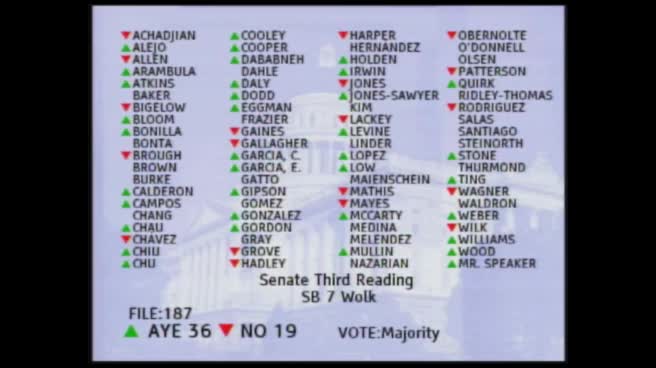 58SEC
Assembly Floor
 2MIN
Senate Floor
 3MIN
Senate Standing Committee on Appropriations
Bill Author

Bill Co-Author(s):