AB 1922: Workers' compensation policies: ancillary agreements.
- Session Year: 2015-2016
- House: Assembly
- Latest Version Date: 2016-08-31
Existing law prohibits a workers compensation insurance policy or endorsement from being issued by an insurer unless the insurer files a copy of the form or endorsement with a rating organization and 30 days have expired from the date the form or endorsement is received by the Insurance Commissioner from the rating organization without notice from the commissioner, unless the commissioner gives written approval of the form or the endorsement prior to that time.
This bill would prohibit an ancillary agreement, as defined, to a workers compensation insurance policy from being issued by an insurer to a California employer, as defined, unless the insurer files a copy of the ancillary agreement with a rating organization and 30 days have expired from the date the ancillary agreement is received by the commissioner from the rating organization without notice from the commissioner unless the commissioner gives written approval of the ancillary agreement prior to that time. The prohibition would not apply to an ancillary agreement between an insurer and a California employer issued in conjunction with a workers compensation policy or endorsement that contains a deductible obligation or retrospectively rated loss limitation and meets specified criteria. The bill would authorize an insurer to use such an ancillary agreement and would require an insurer to submit a copy of that ancillary agreement to the commissioner within 30 days of issuing the ancillary agreement. The bill would provide that the terms and conditions of a workers compensation policy and any endorsements take precedence over the provisions contained in an ancillary agreement in the case of an inconsistency or conflict between the policy or endorsement and the ancillary agreement. The bill would make additional changes relating to collateral and security agreements, as defined. The changes made by the bill would apply to ancillary agreements issued or renewed on or after January 1, 2017. The bill would also make conforming changes.
The changes made by the bill would apply only until January 1, 2022.
Existing law prohibits a workers compensation insurance policy or endorsement from being issued by an insurer unless the insurer files a copy of the form or endorsement with a rating organization and 30 days have expired from the date the form or endorsement is received by the Insurance Commissioner from the rating organization without notice from the commissioner, unless the commissioner gives written approval of the form or the endorsement prior to that time.
This bill would prohibit an ancillary agreement, as defined, to a workers compensation insurance policy from being issued by an insurer to a California employer, as defined, unless the insurer files a copy of the ancillary agreement with a rating organization and 30 days have expired from the date the ancillary agreement is received by the commissioner from the rating organization without notice from the commissioner unless the commissioner gives written approval of the ancillary agreement prior to that time. The prohibition would not apply to an ancillary agreement between an insurer and a California employer issued in conjunction with a workers compensation policy or endorsement that contains a deductible obligation or retrospectively rated loss limitation and meets specified criteria. The bill would authorize an insurer to use such an ancillary agreement and would require an insurer to submit a copy of that ancillary agreement to the commissioner within 30 days of issuing the ancillary agreement. The bill would provide that the terms and conditions of a workers compensation policy and any endorsements take precedence over the provisions contained in an ancillary agreement in the case of an inconsistency or conflict between the policy or endorsement and the ancillary agreement. The bill would make additional changes relating to collateral and security agreements, as defined. The changes made by the bill would apply to ancillary agreements issued or renewed on or after January 1, 2017. The bill would also make conforming changes.
The changes made by the bill would apply only until January 1, 2022.
Existing law prohibits a workers compensation insurance policy or endorsement from being issued by an insurer unless the insurer files a copy of the form or endorsement with a rating organization and 30 days have expired from the date the form or endorsement is received by the Insurance Commissioner from the rating organization without notice from the commissioner, unless the commissioner gives written approval of the form or the endorsement prior to that time.
This bill would prohibit, except as provided, prohibit an ancillary agreement, as defined, to a workers compensation insurance policy from being issued or renewed by an insurer to a California employer, as defined, unless the insurer files a copy of the ancillary agreement with a rating organization and 30 days have expired from the date the ancillary agreement is received by the commissioner from the rating organization without notice from the commissioner unless the commissioner gives written approval of the ancillary agreement prior to that time. The prohibition would not apply to an ancillary agreement between an insurer and a California employer issued in conjunction with a workers compensation policy or endorsement that contains a deductible obligation or retrospectively rated loss limitation and meets specified criteria. The bill would authorize an insurer to use such an ancillary agreement and would require an insurer to submit a copy of that ancillary agreement to the commissioner within 30 days of issuing the ancillary agreement. The bill would provide that the terms and conditions of a workers compensation policy and any endorsements take precedence over the provisions contained in an ancillary agreement in the case of an inconsistency or conflict between the policy or endorsement and the ancillary agreement. The bill would make additional changes relating to collateral and security agreements, as defined. The changes made by the bill would apply to ancillary agreements issued or renewed on or after January 1, 2017. The bill would also make conforming changes.
The changes made by the bill would apply only until January 1, 2022.
Existing law prohibits a workers compensation insurance policy or endorsement from being issued by an insurer unless the insurer files a copy of the form or endorsement with a rating organization and 30 days have expired from the date the form or endorsement is received by the Insurance Commissioner from the rating organization without notice from the commissioner, unless the commissioner gives written approval of the form or the endorsement prior to that time.
This bill would prohibit, except as provided, an ancillary agreement, as defined, to a workers compensation insurance policy from being issued or renewed by an insurer to a California employer, as defined, unless the insurer files a copy of the ancillary agreement with a rating organization and 30 days have expired from the date the ancillary agreement is received by the commissioner from the rating organization without notice from the commissioner unless the commissioner gives written approval of the ancillary agreement prior to that time. The bill would provide that the terms and conditions of a workers compensation policy and any endorsements take precedence over the provisions contained in an ancillary agreement in the case of an inconsistency or conflict between the policy or endorsement and the ancillary agreement. The bill would make additional changes relating to collateral and security agreements, as defined. The changes made by the bill would apply to ancillary agreements issued or renewed on or after January 1, 2017. The bill would also make conforming changes.
The changes made by the bill would apply only until January 1, 2022.
Existing law requires that prohibits a workers compensation insurance policy or endorsement not be from being issued by an insurer unless the insurer files a copy of the form or endorsement with a rating organization and 30 days have expired from the date the form or endorsement is received by the Insurance Commissioner from the rating organization without notice from the commissioner, unless the commissioner gives written approval of the form or the endorsement prior to that time.
This bill would prohibit, except as provided, an ancillary agreement agreement, as defined, to a workers compensation insurance policy from being issued or renewed by an insurer to a California employer, as defined, on or after January 1, 2017, unless the insurer files a copy of the ancillary agreement with a rating organization and 30 days have expired from the date the ancillary agreement is received by the commissioner from the rating organization without notice from the commissioner unless the commissioner gives written approval of the ancillary agreement prior to that time. The bill would define ancillary agreement to mean an agreement that is a supplementary writing or contract relating to a policy or endorsement form that adds to, subtracts from, or revises the obligations of either the insured or the insurer regarding any terms of an insurance policy, including, but not limited to, dispute resolution agreements, policy premium amounts or rates, expense or tax reimbursement or allocation, deductible amounts, policy duration, cancellation, or claims administration. The bill would provide that the terms and conditions of a workers compensation policy and any endorsements take precedence over the provisions contained in an ancillary agreement in the case of an inconsistency or conflict between the policy or endorsement and the ancillary agreement. The changes made by the bill would apply to ancillary agreements issued or renewed on or after January 1, 2017. The bill would also make conforming changes.
Existing law requires that a workers compensation insurance policy or endorsement not be issued by an insurer unless the insurer files a copy of the form or endorsement with a rating organization and 30 days have expired from the date the form or endorsement is received by the Insurance Commissioner from the rating organization without notice from the commissioner, unless the commissioner gives written approval of the form or the endorsement prior to that time.
This bill would exempt policies or endorsements offering deductibles to policyholders for all or part of benefits payable under the policy if the estimated nationwide standard premium is $250,000 or more, and documents that do not alter, amend, or otherwise provide for the payment of compensation or benefits, coverage, or rating under the policy, from filing under the above provisions.
This bill would prohibit, except as provided, an ancillary agreement to a workers compensation insurance policy from being issued or renewed by an insurer to a California employer, as defined, on or after January 1, 2017, unless the insurer files a copy of the ancillary agreement with a rating organization and 30 days have expired from the date the ancillary agreement is received by the commissioner from the rating organization without notice from the commissioner unless the commissioner gives written approval of the ancillary agreement prior to that time. The bill would define ancillary agreement to mean an agreement that is a supplementary writing or contract relating to a policy or endorsement form that adds to, subtracts from, or revises the obligations of either the insured or the insurer regarding any terms of an insurance policy, including, but not limited to, dispute resolution agreements, policy premium amounts or rates, expense or tax reimbursement or allocation, deductible amounts, policy duration, cancellation, or claims administration. The bill would also make conforming changes.
Existing law requires that a workers compensation insurance policy or endorsement not be issued by an insurer unless the insurer files a copy of the form or endorsement with a rating organization and 30 days have expired from the date the form or endorsement is received by the Insurance Commissioner from the rating organization without notice from the commissioner, unless the commissioner gives written approval of the form or the endorsement prior to that time.
This bill would exempt policies or endorsements offering deductibles to policyholders for all or part of benefits payable under the policy if the estimated nationwide standard premium is $250,000 or more, and documents that do not alter, amend, or otherwise provide for the payment of compensation or benefits, coverage, or rating under the policy, from filing under the above provisions.
(a)A workers compensation insurance policy or endorsement shall not be issued by an insurer to any person in this state unless the insurer files a copy of the form or endorsement with the rating organization pursuant to subdivision (e) of Section 11750.3 and 30 days have expired from the date the form or endorsement is received by the commissioner from the rating organization without notice from the commissioner, unless the commissioner gives written approval of the form or endorsement prior to that time.
(b)(1)An ancillary agreement shall not be issued by an insurer to a California employer unless the insurer files a copy of the ancillary agreement with the rating organization pursuant to subdivision (e) of Section 11750.3 and 30 days have expired from the date the ancillary agreement is received by the commissioner from the rating organization without notice from the commissioner unless the commissioner gives written approval of the ancillary agreement prior to that time.
(2)(A)Subdivision (a) and paragraph (1) of this subdivision do not apply to an ancillary agreement between an insurer and a California employer issued in conjunction with a workers compensation policy or endorsement that contains a deductible obligation or retrospectively rated loss limitation equal to or greater than two hundred fifty thousand dollars ($250,000), provided that, for an endorsement containing a deductible obligation, the endorsement complies with the requirements of subdivision (e) of Section 11735, or, for a retrospectively rated policy, is contained in an endorsement filed by a rating organization pursuant to Sections 11750.3 and 11753 and approved by the commissioner, and the California employer meets at least three of the following criteria:
(i)Is represented by a broker for negotiations regarding the ancillary agreement and either has a full-time risk manager involved in the evaluation of an ancillary agreement or is represented by counsel during negotiations regarding an ancillary agreement.
(ii)Has 500 or more employees.
(iii)Has an annual nationwide payroll in excess of twenty million dollars ($20,000,000).
(iv)Has a workers compensation manual standard premium on a countrywide basis in excess of one million dollars ($1,000,000).
(B)Paragraph (1) controls, and this paragraph does not apply to, an ancillary agreement between an insurer and a California employer that is either of the following:
(i)Issued pursuant to a coemployment arrangement, as defined in subdivision (g).
(ii)Negotiated, managed, or administered, in whole or in part, by a managing general agent (MGA), as defined in subdivision (c) of Section 769.81.
(3)An ancillary agreement shall not do either of the following:
(A)Amend or revise the coverage provided, any cancellation provision, any dispute resolution agreement, any premium or other costs, or the benefits payable, under a workers compensation policy unless it is filed and approved in accordance with this section.
(B)Include charges or costs as allocated loss adjustment expenses that are not defined as allocated loss adjustment expenses in the California Workers Compensation Uniform Statistical Reporting Plan - 1995, as identified in Section 2318.6 of Title 10 of the California Code of Regulations and any subsequent revisions, unless the ancillary agreement is filed and approved in accordance with this section.
(4)The terms and conditions of a workers compensation policy and any endorsements shall take precedence over the provisions contained in an ancillary agreement if there is an inconsistency or a conflict between the policy or endorsement and the ancillary agreement.
(5)Contemporaneously with any written quote to provide workers compensation coverage to a California employer, the insurer shall provide to the insurance agent or broker for the employer a draft of any ancillary agreement that the insurer reasonably expects to require the employer to sign, together with a notice that the terms of the ancillary agreement are negotiable between the insurer and the employer.
(6)An insurer may use and shall subsequently notify the insurance commissioner of an ancillary agreement described in paragraph (2) by providing a copy of the ancillary agreement to the commissioner within 30 days of the insurer issuing the ancillary agreement. The ancillary agreement shall not be subject to filing with the commissioner or rating organization or approval by the commissioner, but it shall be subject to all other authority granted to the commissioner under law.
(7)An ancillary agreement that is described in paragraph (2) shall include language stating that the ancillary agreement has not been filed with the rating organization or filed with, or approved by, the commissioner.
(8)This subdivision applies to ancillary agreements issued or renewed on or after January 1, 2017.
(c)If the commissioner notifies the insurer that a policy form, endorsement, or ancillary agreement does not comply with the requirements of law, specifying the reasons for his or her opinion, it is unlawful for the insurer to issue any policy form, endorsement, or ancillary agreement in that form.
(d)The withdrawal of a policy form, endorsement, or ancillary agreement by the commissioner pursuant to this section shall not affect the status of the policyholder as having secured payment for compensation or affect the substitution of the insurer for the policyholder in workers compensation proceedings as set forth in the provisions of Chapter 4 (commencing with Section 3700) of Part 1 of Division 4 of the Labor Code during the period of time in which the policy form, endorsement, or ancillary agreement was in effect.
(e)The terms and provisions of collateral and security agreements shall be negotiated contemporaneously with the inception or renewal of the underlying policy, and any revisions or additions to those terms subsequent to the inception or renewal of the policy shall be mutually agreed upon by the parties.
(f)This section does not apply to limited policies submitted for approval to the commissioner pursuant to Section 11657.
(g)For purposes of this section, the following definitions apply:
(1)(A)Ancillary agreement means an agreement that is a supplementary writing or contract relating to a policy or endorsement form that adds to, subtracts from, or is inconsistent with the obligations of either the insured or the insurer under an insurance policy or endorsement.
(B)Ancillary agreement does not include any of the following:
(i)Limiting and restricting endorsements.
(ii)Customized limiting and restricting endorsements.
(iii)Collateral and security agreements.
(2)California employer means an employer whose principal place of business is in California and whose California payroll constitutes the majority of the employers payroll for purposes of determining premium under the policy.
(3)Coemployment arrangement means any arrangement, under contract or otherwise, whereby an entity utilizes the services of a third party to provide workers or human resources services for a fee or other compensation, including, but not limited to:
(A)A professional employer organization.
(B)A leasing employer, as defined in Section 606.5 of the Unemployment Insurance Code.
(C)A temporary services employer, as defined in Section 606.5 of the Unemployment Insurance Code.
(D)Any employer, regardless of name or form of organization, that is in the business of providing workers to other employers.
(4)Collateral and security agreement means an agreement between a California employer and an insurer under a large deductible program, large risk-rating program, or retrospectively rated program that relates to payments and reimbursements that the insured is contractually obligated to make to the insurer and that includes one or more of the following terms or provisions:
(A)The timing, method, and conditions for making payments to the insurer for amounts imposed by any state or regulatory taxing authority that are made on the insureds behalf.
(B)The timing, method, and conditions for funding, paying, or reimbursing deductible or retrospectively rated amounts or other policy-related charges due under a policy.
(C)The type and amount of collateral the insured is required to post as security for its obligations.
(D)Payment due dates and transmittal information.
(E)Terms or provisions related to claims administration, including the method for selecting a claims administrator.
(F)Termination and dispute resolution provisions applicable to the collateral and security agreement.
(G)Terms of default under the collateral and security agreement.
(5)Customized limiting and restricting endorsement means an endorsement unique to a specific policy used under the following circumstances or for the following purposes:
(A)When the employers business is conducted in such a manner that it is impossible or impracticable to determine the nature, scope, and extent of employment covered by the insurer.
(B)To prevent the performance of work in such an extremely hazardous manner or under such hazardous conditions as would reflect a reckless disregard by the employer for the welfare of its employees.
(C)To prevent the issuance of an unrestricted policy if it would encourage an operation that is contrary to law or to the rules of a regulatory agency.
(6)Limiting and restricting endorsement means an endorsement that excludes from coverage some portion of workers compensation liability for which the employer is required to secure payment pursuant to the Labor Code that, after approval of the endorsement by the Insurance Commissioner, may be endorsed to a workers compensation policy.
(h)This section shall remain in effect only until January 1, 2022, and as of that date is repealed, unless a later enacted statute, that is enacted before January 1, 2022, deletes or extends that date.
SEC. 2.Section 11658 is added to the Insurance Code, to read:11658.(a)A workers compensation insurance policy or endorsement shall not be issued by an insurer to any person in this state unless the insurer files a copy of the form or endorsement with the rating organization pursuant to subdivision (e) of Section 11750.3 and 30 days have expired from the date the form or endorsement is received by the commissioner from the rating organization without notice from the commissioner, unless the commissioner gives written approval of the form or endorsement prior to that time.
(b)If the commissioner notifies the insurer that the filed form or endorsement does not comply with the requirements of law, specifying the reasons for his or her opinion, it is unlawful for the insurer to issue any policy or endorsement in that form.
(c)The withdrawal of a policy form or endorsement by the commissioner pursuant to this section shall not affect the status of the policyholder as having secured payment for compensation or affect the substitution of the insurer for the policyholder in workers compensation proceedings as set forth in the provisions of Chapter 4 (commencing with Section 3700) of Part 1 of Division 4 of the Labor Code during the period of time in which the policy form or endorsement was in effect.
(d)This section does not apply to limited policies submitted for approval to the commissioner pursuant to Section 11657.
(e)This section shall become operative on January 1, 2022.
SEC. 3.Section 11658.5 of the Insurance Code is amended to read:11658.5.(a)(1)An insurer that intends to use a dispute resolution or arbitration agreement to resolve disputes arising in California out of a workers compensation insurance policy, endorsement, ancillary agreement, or collateral and security agreement, as defined in Section 11658, issued to a California employer shall disclose to the employer, contemporaneously with any written quote that offers to provide insurance coverage, that choice of law and choice of venue or forum may be a jurisdiction other than California and that these terms are negotiable between the insurer and the employer. The disclosure shall be signed by the employer as evidence of receipt if the employer accepts the offer of coverage from that insurer.
(2)After compliance with paragraph (1), a dispute resolution or arbitration agreement may be negotiated by the insurer and the employer before any dispute arises.
(b)Nothing in this section is intended to interfere with any authority granted to the Insurance Commissioner under current law.
(c)Failure by the insurer to observe the requirements of subdivision (a) shall result in a default to California as the choice of law and forum for resolution of disputes arising in California.
(d)For purposes of this section, a California employer means an employer whose principal place of business is in California and whose California payroll constitutes the majority of the employers payroll for purposes of determining premium under the policy.
(e)This section shall remain in effect only until January 1, 2022, and as of that date is repealed, unless a later enacted statute, that is enacted before January 1, 2022, deletes or extends that date.
SEC. 4.Section 11658.5 is added to the Insurance Code, to read:11658.5.(a)(1)An insurer that intends to use a dispute resolution or arbitration agreement to resolve disputes arising in California out of a workers compensation insurance policy or endorsement issued to a California employer shall disclose to the employer, contemporaneously with any written quote that offers to provide insurance coverage, that choice of law and choice of venue or forum may be a jurisdiction other than California and that these terms are negotiable between the insurer and the employer. The disclosure shall be signed by the employer as evidence of receipt if the employer accepts the offer of coverage from that insurer.
(2)After compliance with paragraph (1), a dispute resolution or arbitration agreement may be negotiated by the insurer and the employer before any dispute arises.
(b)Nothing in this section is intended to interfere with any authority granted to the Insurance Commissioner under current law.
(c)Failure by the insurer to observe the requirements of subdivision (a) shall result in a default to California as the choice of law and forum for resolution of disputes arising in California.
(d)For purposes of this section, a California employer means an employer whose principal place of business is in California and whose California payroll constitutes the majority of the employers payroll for purposes of determining premium under the policy.
(e)This section shall become operative on January 1, 2022.
(a)A workers compensation insurance policy or endorsement shall not be issued by an insurer to any person in this state unless the insurer files a copy of the form or endorsement with the rating organization pursuant to subdivision (e) of Section 11750.3 and 30 days have expired from the date the form or endorsement is received by the commissioner from the rating organization without notice from the commissioner, unless the commissioner gives written approval of the form or endorsement prior to that time.
(b)(1)An ancillary agreement shall not be issued by an insurer to a California employer unless the insurer files a copy of the ancillary agreement with the rating organization pursuant to subdivision (e) of Section 11750.3 and 30 days have expired from the date the ancillary agreement is received by the commissioner from the rating organization without notice from the commissioner unless the commissioner gives written approval of the ancillary agreement prior to that time.
(2)(A)Subdivision (a) and paragraph (1) of this subdivision do not apply to an ancillary agreement between an insurer and a California employer issued in conjunction with a workers compensation policy or endorsement that contains a deductible obligation or retrospectively rated loss limitation equal to or greater than two hundred fifty thousand dollars ($250,000), provided that, for an endorsement containing a deductible obligation, the endorsement complies with the requirements of subdivision (e) of Section 11735, or, for a retrospectively rated policy, is contained in an endorsement filed by a rating organization pursuant to Sections 11750.3 and 11753 and approved by the commissioner, and the California employer meets at least three of the following criteria:
(i)Is represented by a broker for negotiations regarding the ancillary agreement and either has a full-time risk manager involved in the evaluation of an ancillary agreement or is represented by counsel during negotiations regarding an ancillary agreement.
(ii)Has 500 or more employees.
(iii)Has an annual nationwide payroll in excess of twenty million dollars ($20,000,000).
(iv)Has a workers compensation manual standard premium on a countrywide basis in excess of one million dollars ($1,000,000).
(B)Paragraph (1) controls, and this paragraph does not apply to, an ancillary agreement between an insurer and a California employer that is either of the following:
(i)Issued pursuant to a coemployment arrangement, as defined in subdivision (g).
(ii)Negotiated, managed, or administered, in whole or in part, by a managing general agent (MGA), as defined in subdivision (c) of Section 769.81.
(3)An ancillary agreement shall not do either of the following:
(A)Amend or revise the coverage provided, any cancellation provision, any dispute resolution agreement, any premium or other costs, or the benefits payable, under a workers compensation policy unless it is filed and approved in accordance with this section.
(B)Include charges or costs as allocated loss adjustment expenses that are not defined as allocated loss adjustment expenses in the California Workers Compensation Uniform Statistical Reporting Plan - 1995, as identified in Section 2318.6 of Title 10 of the California Code of Regulations and any subsequent revisions, unless the ancillary agreement is filed and approved in accordance with this section.
(4)The terms and conditions of a workers compensation policy and any endorsements shall take precedence over the provisions contained in an ancillary agreement if there is an inconsistency or a conflict between the policy or endorsement and the ancillary agreement.
(5)Contemporaneously with any written quote to provide workers compensation coverage to a California employer, the insurer shall provide to the insurance agent or broker for the employer a draft of any ancillary agreement that the insurer reasonably expects to require the employer to sign, together with a notice that the terms of the ancillary agreement are negotiable between the insurer and the employer.
(6)An insurer may use and shall subsequently notify the insurance commissioner of an ancillary agreement described in paragraph (2) by providing a copy of the ancillary agreement to the commissioner within 30 days of the insurer issuing the ancillary agreement. The ancillary agreement shall not be subject to filing with the commissioner or rating organization or approval by the commissioner, but it shall be subject to all other authority granted to the commissioner under law.
(7)An ancillary agreement that is described in paragraph (2) shall include language stating that the ancillary agreement has not been filed with the rating organization or filed with, or approved by, the commissioner.
(8)This subdivision applies to ancillary agreements issued or renewed on or after January 1, 2017.
(c)If the commissioner notifies the insurer that a policy form, endorsement, or ancillary agreement does not comply with the requirements of law, specifying the reasons for his or her opinion, it is unlawful for the insurer to issue any policy form, endorsement, or ancillary agreement in that form.
(d)The withdrawal of a policy form, endorsement, or ancillary agreement by the commissioner pursuant to this section shall not affect the status of the policyholder as having secured payment for compensation or affect the substitution of the insurer for the policyholder in workers compensation proceedings as set forth in the provisions of Chapter 4 (commencing with Section 3700) of Part 1 of Division 4 of the Labor Code during the period of time in which the policy form, endorsement, or ancillary agreement was in effect.
(e)The terms and provisions of collateral and security agreements shall be negotiated contemporaneously with the inception or renewal of the underlying policy, and any revisions or additions to those terms subsequent to the inception or renewal of the policy shall be mutually agreed upon by the parties.
(f)This section does not apply to limited policies submitted for approval to the commissioner pursuant to Section 11657.
(g)For purposes of this section, the following definitions apply:
(1)(A)Ancillary agreement means an agreement that is a supplementary writing or contract relating to a policy or endorsement form that adds to, subtracts from, or is inconsistent with the obligations of either the insured or the insurer under an insurance policy or endorsement.
(B)Ancillary agreement does not include any of the following:
(i)Limiting and restricting endorsements.
(ii)Customized limiting and restricting endorsements.
(iii)Collateral and security agreements.
(2)California employer means an employer whose principal place of business is in California and whose California payroll constitutes the majority of the employers payroll for purposes of determining premium under the policy.
(3)Coemployment arrangement means any arrangement, under contract or otherwise, whereby an entity utilizes the services of a third party to provide workers or human resources services for a fee or other compensation, including, but not limited to:
(A)A professional employer organization.
(B)A leasing employer, as defined in Section 606.5 of the Unemployment Insurance Code.
(C)A temporary services employer, as defined in Section 606.5 of the Unemployment Insurance Code.
(D)Any employer, regardless of name or form of organization, that is in the business of providing workers to other employers.
(4)Collateral and security agreement means an agreement between a California employer and an insurer under a large deductible program, large risk-rating program, or retrospectively rated program that relates to payments and reimbursements that the insured is contractually obligated to make to the insurer and that includes one or more of the following terms or provisions:
(A)The timing, method, and conditions for making payments to the insurer for amounts imposed by any state or regulatory taxing authority that are made on the insureds behalf.
(B)The timing, method, and conditions for funding, paying, or reimbursing deductible or retrospectively rated amounts or other policy-related charges due under a policy.
(C)The type and amount of collateral the insured is required to post as security for its obligations.
(D)Payment due dates and transmittal information.
(E)Terms or provisions related to claims administration, including the method for selecting a claims administrator.
(F)Termination and dispute resolution provisions applicable to the collateral and security agreement.
(G)Terms of default under the collateral and security agreement.
(5)Customized limiting and restricting endorsement means an endorsement unique to a specific policy used under the following circumstances or for the following purposes:
(A)When the employers business is conducted in such a manner that it is impossible or impracticable to determine the nature, scope, and extent of employment covered by the insurer.
(B)To prevent the performance of work in such an extremely hazardous manner or under such hazardous conditions as would reflect a reckless disregard by the employer for the welfare of its employees.
(C)To prevent the issuance of an unrestricted policy if it would encourage an operation that is contrary to law or to the rules of a regulatory agency.
(6)Limiting and restricting endorsement means an endorsement that excludes from coverage some portion of workers compensation liability for which the employer is required to secure payment pursuant to the Labor Code that, after approval of the endorsement by the Insurance Commissioner, may be endorsed to a workers compensation policy.
(h)This section shall remain in effect only until January 1, 2022, and as of that date is repealed, unless a later enacted statute, that is enacted before January 1, 2022, deletes or extends that date.
SEC. 2.Section 11658 is added to the Insurance Code, to read:11658.(a)A workers compensation insurance policy or endorsement shall not be issued by an insurer to any person in this state unless the insurer files a copy of the form or endorsement with the rating organization pursuant to subdivision (e) of Section 11750.3 and 30 days have expired from the date the form or endorsement is received by the commissioner from the rating organization without notice from the commissioner, unless the commissioner gives written approval of the form or endorsement prior to that time.
(b)If the commissioner notifies the insurer that the filed form or endorsement does not comply with the requirements of law, specifying the reasons for his or her opinion, it is unlawful for the insurer to issue any policy or endorsement in that form.
(c)The withdrawal of a policy form or endorsement by the commissioner pursuant to this section shall not affect the status of the policyholder as having secured payment for compensation or affect the substitution of the insurer for the policyholder in workers compensation proceedings as set forth in the provisions of Chapter 4 (commencing with Section 3700) of Part 1 of Division 4 of the Labor Code during the period of time in which the policy form or endorsement was in effect.
(d)This section does not apply to limited policies submitted for approval to the commissioner pursuant to Section 11657.
(e)This section shall become operative on January 1, 2022.
SEC. 3.Section 11658.5 of the Insurance Code is amended to read:11658.5.(a)(1)An insurer that intends to use a dispute resolution or arbitration agreement to resolve disputes arising in California out of a workers compensation insurance policy, endorsement, ancillary agreement, or collateral and security agreement, as defined in Section 11658, issued to a California employer shall disclose to the employer, contemporaneously with any written quote that offers to provide insurance coverage, that choice of law and choice of venue or forum may be a jurisdiction other than California and that these terms are negotiable between the insurer and the employer. The disclosure shall be signed by the employer as evidence of receipt if the employer accepts the offer of coverage from that insurer.
(2)After compliance with paragraph (1), a dispute resolution or arbitration agreement may be negotiated by the insurer and the employer before any dispute arises.
(b)Nothing in this section is intended to interfere with any authority granted to the Insurance Commissioner under current law.
(c)Failure by the insurer to observe the requirements of subdivision (a) shall result in a default to California as the choice of law and forum for resolution of disputes arising in California.
(d)For purposes of this section, a California employer means an employer whose principal place of business is in California and whose California payroll constitutes the majority of the employers payroll for purposes of determining premium under the policy.
(e)This section shall remain in effect only until January 1, 2022, and as of that date is repealed, unless a later enacted statute, that is enacted before January 1, 2022, deletes or extends that date.
SEC. 4.Section 11658.5 is added to the Insurance Code, to read:11658.5.(a)(1)An insurer that intends to use a dispute resolution or arbitration agreement to resolve disputes arising in California out of a workers compensation insurance policy or endorsement issued to a California employer shall disclose to the employer, contemporaneously with any written quote that offers to provide insurance coverage, that choice of law and choice of venue or forum may be a jurisdiction other than California and that these terms are negotiable between the insurer and the employer. The disclosure shall be signed by the employer as evidence of receipt if the employer accepts the offer of coverage from that insurer.
(2)After compliance with paragraph (1), a dispute resolution or arbitration agreement may be negotiated by the insurer and the employer before any dispute arises.
(b)Nothing in this section is intended to interfere with any authority granted to the Insurance Commissioner under current law.
(c)Failure by the insurer to observe the requirements of subdivision (a) shall result in a default to California as the choice of law and forum for resolution of disputes arising in California.
(d)For purposes of this section, a California employer means an employer whose principal place of business is in California and whose California payroll constitutes the majority of the employers payroll for purposes of determining premium under the policy.
(e)This section shall become operative on January 1, 2022.
(a)A workers compensation insurance policy or endorsement shall not be issued by an insurer to any person in this state unless the insurer files a copy of the form or endorsement with the rating organization pursuant to subdivision (e) of Section 11750.3 and 30 days have expired from the date the form or endorsement is received by the commissioner from the rating organization without notice from the commissioner, unless the commissioner gives written approval of the form or endorsement prior to that time.
(b)(1)An ancillary agreement shall not be issued by an insurer to a California employer unless the insurer files a copy of the ancillary agreement with the rating organization pursuant to subdivision (e) of Section 11750.3 and 30 days have expired from the date the ancillary agreement is received by the commissioner from the rating organization without notice from the commissioner unless the commissioner gives written approval of the ancillary agreement prior to that time.
(2)(A)This section shall Subdivision (a) and paragraph (1) of this subdivision do not apply to an ancillary agreement between an insurer and a California employer issued in conjunction with a workers compensation policy or endorsement that contains a deductible obligation or retrospectively rated loss limitation equal to or greater than two hundred fifty thousand dollars ($250,000), provided that, for an endorsement containing a deductible obligation, the endorsement complies with the requirements of subdivision (e) of Section 11735, or, for a retrospectively rated policy, is contained in an endorsement filed by a rating organization pursuant to Sections 11750.3 and 11753 and approved by the commissioner, and the California employer meets at least three of the following criteria:
(i)Is represented by a broker for negotiations regarding the ancillary agreement and either has a full-time risk manager involved in the evaluation of an ancillary agreement or is represented by counsel during negotiations regarding an ancillary agreement.
(ii)Has 500 or more employees.
(iii)Has an annual nationwide payroll in excess of twenty million dollars ($20,000,000).
(iv)Has a workers compensation manual standard premium on a countrywide basis in excess of one million dollars ($1,000,000).
(B)Paragraph (1) shall control, controls, and this paragraph shall does not apply to, an ancillary agreement between an insurer and a California employer that is either of the following:
(i)Issued pursuant to a coemployment arrangement, as defined in subdivision (g).
(ii)Negotiated, managed, or administered, in whole or in part, by a managing general agent (MGA), as defined in subdivision (c) of Section 769.81.
(3)Under no circumstances, however, may an An ancillary agreement shall not do either of the following:
(A)Amend or revise the coverage provided, or the benefits payable, under a workers compensation policy unless it is filed and approved in accordance with this section.
(B)Include charges or costs as allocated loss adjustment expenses that are not defined as allocated loss adjustment expenses in the California Workers Compensation Uniform Statistical Reporting Plan - 1995, as identified in Section 2318.6 of Title 10 of the California Code of Regulations and any subsequent revisions, unless the ancillary agreement is filed and approved in accordance with this section.
(4)The terms and conditions of a workers compensation policy and any endorsements shall take precedence over the provisions contained in an ancillary agreement if there is an inconsistency or a conflict between the policy or endorsement and the ancillary agreement.
(5)Contemporaneously with any written quote to provide workers compensation coverage to a California employer, the insurer shall provide to the insurance agent or broker for the employer a draft of any ancillary agreement that the insurer reasonably expects to require the employer to sign, together with a notice that the terms of the ancillary agreement are negotiable between the insurer and the employer.
(6)Within 30 days after execution of an ancillary agreement subject to paragraph (2), the insurer shall An insurer may use and shall subsequently notify the insurance commissioner of the agreement. The an ancillary agreement described in paragraph (2) by providing a copy of the ancillary agreement to the commissioner within 30 days of the insurer issuing the ancillary agreement. The ancillary agreement shall not be subject to filing with the commissioner or rating organization or approval by the commissioner. commissioner, but it shall be subject to all other authority granted to the commissioner under law.
(7)An ancillary agreement that is subject to described in paragraph (2) shall include language stating that the ancillary agreement has not been filed with the rating organization or filed with, or approved by, the commissioner.
(8)This subdivision shall apply applies to ancillary agreements issued or renewed on or after January 1, 2017.
(c)If the commissioner notifies the insurer that the filed a policy form, endorsement, or ancillary agreement does not comply with the requirements of law, specifying the reasons for his or her opinion, it is unlawful for the insurer to issue any policy form, endorsement, or ancillary agreement in that form.
(d)The withdrawal of a policy form, endorsement, or ancillary agreement by the commissioner pursuant to this section shall not affect the status of the policyholder as having secured payment for compensation or affect the substitution of the insurer for the policyholder in workers compensation proceedings as set forth in the provisions of Chapter 4 (commencing with Section 3700) of Part 1 of Division 4 of the Labor Code during the period of time in which the policy form, endorsement, or ancillary agreement was in effect.
(e)The terms and provisions of collateral and security agreements shall be negotiated contemporaneously with the inception or renewal of the underlying policy, and any revisions or additions to those terms subsequent to the inception or renewal of the policy shall be mutually agreed upon by the parties.
(f)This section shall does not apply to limited policies submitted for approval to the commissioner pursuant to Section 11657.
(g)For purposes of this section, the following definitions apply:
(1)(A)Ancillary agreement means an agreement that is a supplementary writing or contract relating to a policy or endorsement form that adds to, subtracts from, or is inconsistent with the obligations of either the insured or the insurer under an insurance policy or endorsement.
(B)Ancillary agreement does not include any of the following:
(i)Limiting and restricting endorsements.
(ii)Customized limiting and restricting endorsements.
(iii)Collateral and security agreements.
(2)California employer means an employer whose principal place of business is in California and whose California payroll constitutes the majority of the employers payroll for purposes of determining premium under the policy.
(3)Coemployment arrangement means any arrangement, under contract or otherwise, whereby an entity utilizes the services of a third party to provide workers or human resources services for a fee or other compensation, including, but not limited to:
(A)A professional employer organization.
(B)A leasing employer, as defined in Section 606.5 of the Unemployment Insurance Code.
(C)A temporary services employer, as defined in Section 606.5 of the Unemployment Insurance Code.
(D)Any employer, regardless of name or form of organization, that is in the business of providing workers to other employers.
(4)Collateral and security agreement means an agreement between a California employer and an insurer under a large deductible program, large risk-rating program, or retrospectively rated program that relates to payments and reimbursements that the insured is contractually obligated to make to the insurer and that includes one or more of the following terms or provisions:
(A)The timing, method, and conditions for making payments to the insurer for amounts imposed by any state or regulatory taxing authority that are made on the insureds behalf.
(B)The timing, method, and conditions for funding, paying, or reimbursing deductible or retrospectively rated amounts or other policy-related charges due under a policy.
(C)The type and amount of collateral the insured is required to post as security for its obligations.
(D)Payment due dates and transmittal information.
(E)Terms or provisions related to claims administration, including the method for selecting a claims administrator.
(F)Termination and dispute resolution provisions applicable to the collateral and security agreement.
(G)Terms of default under the collateral and security agreement.
(5)Customized limiting and restricting endorsement means an endorsement unique to a specific policy used under the following circumstances or for the following purposes:
(A)When the employers business is conducted in such a manner that it is impossible or impracticable to determine the nature, scope, and extent of employment covered by the insurer.
(B)To prevent the performance of work in such an extremely hazardous manner or under such hazardous conditions as would reflect a reckless disregard by the employer for the welfare of its employees.
(C)To prevent the issuance of an unrestricted policy if it would encourage an operation that is contrary to law or to the rules of a regulatory agency.
(6)Limiting and restricting endorsement means an endorsement that excludes from coverage some portion of workers compensation liability for which the employer is required to secure payment pursuant to the Labor Code that, after approval of the endorsement by the Insurance Commissioner, may be endorsed to a workers compensation policy.
(h)This section shall remain in effect only until January 1, 2022, and as of that date is repealed, unless a later enacted statute, that is enacted before January 1, 2022, deletes or extends that date.
SEC. 2.Section 11658 is added to the Insurance Code, to read:11658.(a)A workers compensation insurance policy or endorsement shall not be issued by an insurer to any person in this state unless the insurer files a copy of the form or endorsement with the rating organization pursuant to subdivision (e) of Section 11750.3 and 30 days have expired from the date the form or endorsement is received by the commissioner from the rating organization without notice from the commissioner, unless the commissioner gives written approval of the form or endorsement prior to that time.
(b)If the commissioner notifies the insurer that the filed form or endorsement does not comply with the requirements of law, specifying the reasons for his or her opinion, it is unlawful for the insurer to issue any policy or endorsement in that form.
(c)The withdrawal of a policy form or endorsement by the commissioner pursuant to this section shall not affect the status of the policyholder as having secured payment for compensation or affect the substitution of the insurer for the policyholder in workers compensation proceedings as set forth in the provisions of Chapter 4 (commencing with Section 3700) of Part 1 of Division 4 of the Labor Code during the period of time in which the policy form or endorsement was in effect.
(d)This section shall does not apply to limited policies submitted for approval to the commissioner pursuant to Section 11657.
(e)This section shall become operative on January 1, 2022.
SEC. 3.Section 11658.5 of the Insurance Code is amended to read:11658.5.(a)(1)An insurer that intends to use a dispute resolution or arbitration agreement to resolve disputes arising in California out of a workers compensation insurance policy, endorsement, ancillary agreement, or collateral and security agreement, as defined in Section 11658, issued to a California employer shall disclose to the employer, contemporaneously with any written quote that offers to provide insurance coverage, that choice of law and choice of venue or forum may be a jurisdiction other than California and that these terms are negotiable between the insurer and the employer. The disclosure shall be signed by the employer as evidence of receipt if the employer accepts the offer of coverage from that insurer.
(2)After compliance with paragraph (1), a dispute resolution or arbitration agreement may be negotiated by the insurer and the employer before any dispute arises.
(b)Nothing in this section is intended to interfere with any authority granted to the Insurance Commissioner under current law.
(c)Failure by the insurer to observe the requirements of subdivision (a) shall result in a default to California as the choice of law and forum for resolution of disputes arising in California.
(d)For purposes of this section, a California employer means an employer whose principal place of business is in California and whose California payroll constitutes the majority of the employers payroll for purposes of determining premium under the policy.
(e)This section shall remain in effect only until January 1, 2022, and as of that date is repealed, unless a later enacted statute, that is enacted before January 1, 2022, deletes or extends that date.
SEC. 4.Section 11658.5 is added to the Insurance Code, to read:11658.5.(a)(1)An insurer that intends to use a dispute resolution or arbitration agreement to resolve disputes arising in California out of a workers compensation insurance policy or endorsement issued to a California employer shall disclose to the employer, contemporaneously with any written quote that offers to provide insurance coverage, that choice of law and choice of venue or forum may be a jurisdiction other than California and that these terms are negotiable between the insurer and the employer. The disclosure shall be signed by the employer as evidence of receipt if the employer accepts the offer of coverage from that insurer.
(2)After compliance with paragraph (1), a dispute resolution or arbitration agreement may be negotiated by the insurer and the employer before any dispute arises.
(b)Nothing in this section is intended to interfere with any authority granted to the Insurance Commissioner under current law.
(c)Failure by the insurer to observe the requirements of subdivision (a) shall result in a default to California as the choice of law and forum for resolution of disputes arising in California.
(d)For purposes of this section, a California employer means an employer whose principal place of business is in California and whose California payroll constitutes the majority of the employers payroll for purposes of determining premium under the policy.
(e)This section shall become operative on January 1, 2022.
(a)A workers compensation insurance policy or endorsement shall not be issued by an insurer to any person in this state unless the insurer files a copy of the form or endorsement with the rating organization pursuant to subdivision (e) of Section 11750.3 and 30 days have expired from the date the form or endorsement is received by the commissioner from the rating organization without notice from the commissioner, unless the commissioner gives written approval of the form or endorsement prior to that time.
(b)(1)An ancillary agreement shall not be issued by an insurer to a California employer unless the insurer files a copy of the ancillary agreement with the rating organization pursuant to subdivision (e) of Section 11750.3 and 30 days have expired from the date the ancillary agreement is received by the commissioner from the rating organization without notice from the commissioner unless the commissioner gives written approval of the ancillary agreement prior to that time.
(2)For the purposes of this section, a California employer means an employer whose principal place of business is in California and whose California payroll constitutes the majority of the employers payroll for purposes of determining premium under the policy.
(3)(A)This
(2)(A)This section shall not apply to an ancillary agreement between an insurer and a California employer issued in conjunction with a workers compensation policy or endorsement that contains a deductible obligation or retention obligation retrospectively rated loss limitation equal to or greater than two hundred fifty thousand dollars ($250,000) ($250,000), provided that, for an endorsement containing a deductible obligation, the endorsement complies with the requirements of subdivision (e) of Section 11735, or, for a retrospectively rated policy, is contained in an endorsement filed by a rating organization pursuant to Sections 11750.3 and 11753 and approved by the commissioner, and the California employer meets at least three or more of the following criteria:(i)has
(i)Is represented by a broker for negotiations regarding the ancillary agreement and either has a full-time risk manager involved in the evaluation of an ancillary agreement; (ii) agreement or is represented by counsel during negotiations regarding an ancillary agreement; (iii) has agreement.
(ii)Has 500 or more employees; (iv) has employees.
(iii)Has an annual gross revenues nationwide payroll in excess of twenty million dollars ($20,000,000); or (v) has ($20,000,000).
(iv)Has a workers compensation manual standard premium on a countrywide basis in excess of seven hundred fifty thousand dollars ($750,000). one million dollars ($1,000,000).
(B)Paragraph (1) shall control, and paragraph (3) shall not apply, to this paragraph shall not apply to, an ancillary agreement between an insurer and a California employer that is either of the following:
(i)Issued to a coemployment arrangement, as defined in subparagraph (C). subdivision (g).
(ii)Negotiated, managed, or administered, in whole or in part, by a managing general agent (MGA), as defined in subdivision (c) of Section 769.81.
(C)Coemployment arrangement means any arrangement, under contract or otherwise, whereby an entity utilizes the services of a third party to provide workers for a fee or other compensation, including, but not limited to:
(i)A professional employer organization.
(ii)A leasing employer, as defined in Section 606.5 of the Unemployment Insurance Code.
(iii)A temporary services employer, as defined in Section 606.5 of the Unemployment Insurance Code.
(iv)Any employer, regardless of name or form of organization, that is in the business of providing workers to other employers.
(4)
(3)Under no circumstances, however, may an ancillary agreement amend do either of the following:
(A)Amend or revise the coverage provided, or the benefits payable, under a workers compensation policy unless it is filed and approved in accordance with this section. The
(B)Include charges or costs as allocated loss adjustment expenses that are not defined as allocated loss adjustment expenses in the California Workers Compensation Uniform Statistical Reporting Plan - 1995, as identified in Section 2318.6 of Title 10 of the California Code of Regulations and any subsequent revisions, unless the ancillary agreement is filed and approved in accordance with this section.
(4)The terms and conditions of a workers compensation policy and any endorsements shall take precedence over the provisions contained in an ancillary agreement if there is an inconsistency or a conflict between the policy or endorsement and the ancillary agreement.
(5)Contemporaneously with any written quote to provide workers compensation coverage to a California employer, the insurer shall provide to the insurance agent or broker for the employer a draft of any ancillary agreement that the insurer reasonably expects to require the employer to sign, together with a notice that the terms of the ancillary agreement are negotiable between the insurer and the employer.
(6)Within 30 days after execution of an ancillary agreement subject to paragraph (2), the insurer shall notify the insurance commissioner of the agreement. The ancillary agreement shall not be subject to filing with the commissioner or rating organization or approval by the commissioner.
(7)An ancillary agreement that is subject to paragraph (2) shall include language stating that the ancillary agreement has not been filed with the rating organization or filed with, or approved by, the commissioner.
(5)
(8)This subdivision shall apply to ancillary agreements issued or renewed on or after January 1, 2017.
(c)If the commissioner notifies the insurer that the filed policy form, endorsement, or ancillary agreement does not comply with the requirements of law, specifying the reasons for his or her opinion, it is unlawful for the insurer to issue any policy form, endorsement, or ancillary agreement in that form.
(d)The withdrawal of a policy form, endorsement, or ancillary agreement by the commissioner pursuant to this section shall not affect the status of the policyholder as having secured payment for compensation or affect the substitution of the insurer for the policyholder in workers compensation proceedings as set forth in the provisions of Chapter 4 (commencing with Section 3700) of Part 1 of Division 4 of the Labor Code during the period of time in which the policy form, endorsement, or ancillary agreement was in effect.
(e)Ancillary agreement means an agreement that is a supplementary writing or contract relating to a policy or endorsement form that adds to, subtracts from, or revises the obligations of either the insured or the insurer regarding any terms of an insurance policy, including, but not limited to, dispute resolution agreements, policy premium amounts or rates, expense or tax reimbursement or allocation, deductible amounts, policy duration, cancellation, or claims administration. Ancillary agreements do not include: (1) limiting and restricting endorsements as defined in subdivision (g) of this section; (2) customized limiting and restricting endorsements as defined in subdivision (h) of this section; or (3) agreements specifying only terms described in subparagraphs (A) to (F), inclusive, following, but only if those terms are disclosed and negotiated contemporaneously with the inception or renewal of the underlying policy and any revisions or additions to those terms subsequent to the inception or renewal of the policy are mutually agreed upon by the parties: (A) the method for making payments; (B) the method for funding deductible amounts or other policy-related charges due under a policy; (C) the amounts of collateral or security the insured is required to maintain for claims that do not exceed the deductible; (D) payment due dates; (E) payment transmittal information; or (F) the method of selecting a claims administrator, provided that the claims administrator may only administer claims that do not exceed the deductible.
(f)This section shall not apply to limited policies submitted for approval to the commissioner pursuant to Section 11657.
(g)Limiting and restricting endorsement means an endorsement that excludes from coverage some portion of workers compensation liability for which the employer is required to secure payment pursuant to the Labor Code that, after approval of the endorsement by the Insurance Commissioner, may be endorsed to a workers compensation policy.
(h)Customized limiting and restricting endorsement means an endorsement unique to a specific policy used (1) when the employers business is conducted in such a manner that it is impossible or impracticable to determine the nature, scope, and extent of employment covered by the insurer; or (2) to prevent the performance of work in such an extremely hazardous manner or under such hazardous conditions as would reflect a reckless disregard by the employer for the welfare of its employees; or (3) to prevent the issuance of an unrestricted policy if it would encourage an operation that is contrary to law or to the rules of a regulatory agency.
(e)The terms and provisions of collateral and security agreements shall be negotiated contemporaneously with the inception or renewal of the underlying policy, and any revisions or additions to those terms subsequent to the inception or renewal of the policy shall be mutually agreed upon by the parties.
(f)This section shall not apply to limited policies submitted for approval to the commissioner pursuant to Section 11657.
(g)For purposes of this section, the following definitions apply:
(1)(A)Ancillary agreement means an agreement that is a supplementary writing or contract relating to a policy or endorsement form that adds to, subtracts from, or is inconsistent with the obligations of either the insured or the insurer under an insurance policy or endorsement.
(B)Ancillary agreement does not include any of the following:
(i)Limiting and restricting endorsements.
(ii)Customized limiting and restricting endorsements.
(iii)Collateral and security agreements.
(2)California employer means an employer whose principal place of business is in California and whose California payroll constitutes the majority of the employers payroll for purposes of determining premium under the policy.
(3)Coemployment arrangement means any arrangement, under contract or otherwise, whereby an entity utilizes the services of a third party to provide workers or human resources services for a fee or other compensation, including, but not limited to:
(A)A professional employer organization.
(B)A leasing employer, as defined in Section 606.5 of the Unemployment Insurance Code.
(C)A temporary services employer, as defined in Section 606.5 of the Unemployment Insurance Code.
(D)Any employer, regardless of name or form of organization, that is in the business of providing workers to other employers.
(4)Collateral and security agreement means an agreement between a California employer and an insurer under a large deductible program, large risk-rating program, or retrospectively rated program that relates to payments and reimbursements that the insured is contractually obligated to make to the insurer and that includes one or more of the following terms or provisions:
(A)The timing, method, and conditions for making payments to the insurer for amounts imposed by any state or regulatory taxing authority that are made on the insureds behalf.
(B)The timing, method, and conditions for funding, paying, or reimbursing deductible or retrospectively rated amounts or other policy-related charges due under a policy.
(C)The type and amount of collateral the insured is required to post as security for its obligations.
(D)Payment due dates and transmittal information.
(E)Terms or provisions related to claims administration, including the method for selecting a claims administrator.
(F)Termination and dispute resolution provisions applicable to the collateral and security agreement.
(G)Terms of default under the collateral and security agreement.
(5)Customized limiting and restricting endorsement means an endorsement unique to a specific policy used under the following circumstances or for the following purposes:
(A)When the employers business is conducted in such a manner that it is impossible or impracticable to determine the nature, scope, and extent of employment covered by the insurer.
(B)To prevent the performance of work in such an extremely hazardous manner or under such hazardous conditions as would reflect a reckless disregard by the employer for the welfare of its employees.
(C)To prevent the issuance of an unrestricted policy if it would encourage an operation that is contrary to law or to the rules of a regulatory agency.
(6)Limiting and restricting endorsement means an endorsement that excludes from coverage some portion of workers compensation liability for which the employer is required to secure payment pursuant to the Labor Code that, after approval of the endorsement by the Insurance Commissioner, may be endorsed to a workers compensation policy.
(h)This section shall remain in effect only until January 1, 2022, and as of that date is repealed, unless a later enacted statute, that is enacted before January 1, 2022, deletes or extends that date.
SEC. 2.Section 11658 is added to the Insurance Code, to read:11658.(a)A workers compensation insurance policy or endorsement shall not be issued by an insurer to any person in this state unless the insurer files a copy of the form or endorsement with the rating organization pursuant to subdivision (e) of Section 11750.3 and 30 days have expired from the date the form or endorsement is received by the commissioner from the rating organization without notice from the commissioner, unless the commissioner gives written approval of the form or endorsement prior to that time.
(b)If the commissioner notifies the insurer that the filed form or endorsement does not comply with the requirements of law, specifying the reasons for his or her opinion, it is unlawful for the insurer to issue any policy or endorsement in that form.
(c)The withdrawal of a policy form or endorsement by the commissioner pursuant to this section shall not affect the status of the policyholder as having secured payment for compensation or affect the substitution of the insurer for the policyholder in workers compensation proceedings as set forth in the provisions of Chapter 4 (commencing with Section 3700) of Part 1 of Division 4 of the Labor Code during the period of time in which the policy form or endorsement was in effect.
(d)This section shall not apply to limited policies submitted for approval to the commissioner pursuant to Section 11657.
(e)This section shall become operative on January 1, 2022.
SEC. 3.Section 11658.5 of the Insurance Code is amended to read:11658.5.(a)(1)An insurer that intends to use a dispute resolution or arbitration agreement to resolve disputes arising in California out of a workers compensation insurance policy or endorsement policy, endorsement, ancillary agreement, or collateral and security agreement, as defined in Section 11658, issued to a California employer shall disclose to the employer, contemporaneously with any written quote that offers to provide insurance coverage, that choice of law and choice of venue or forum may be a jurisdiction other than California and that these terms are negotiable between the insurer and the employer. The disclosure shall be signed by the employer as evidence of receipt where if the employer accepts the offer of coverage from that insurer.
(2)After compliance with paragraph (1), a dispute resolution or arbitration agreement may be negotiated by the insurer and the employer before any dispute arises.
(b)Nothing in this section is intended to interfere with any authority granted to the Insurance Commissioner under current law.
(c)Failure by the insurer to observe the requirements of subdivision (a) shall result in a default to California as the choice of law and forum for resolution of disputes arising in California.
(d)For purposes of this section, a California employer means an employer whose principal place of business is in California and whose California payroll constitutes the majority of the employers payroll for purposes of determining premium under the policy.
(e)This section shall apply to workers compensation policies issued or renewed on or after July 1, 2012.
(e)This section shall remain in effect only until January 1, 2022, and as of that date is repealed, unless a later enacted statute, that is enacted before January 1, 2022, deletes or extends that date.
SEC. 4.Section 11658.5 is added to the Insurance Code, to read:11658.5.(a)(1)An insurer that intends to use a dispute resolution or arbitration agreement to resolve disputes arising in California out of a workers compensation insurance policy or endorsement issued to a California employer shall disclose to the employer, contemporaneously with any written quote that offers to provide insurance coverage, that choice of law and choice of venue or forum may be a jurisdiction other than California and that these terms are negotiable between the insurer and the employer. The disclosure shall be signed by the employer as evidence of receipt if the employer accepts the offer of coverage from that insurer.
(2)After compliance with paragraph (1), a dispute resolution or arbitration agreement may be negotiated by the insurer and the employer before any dispute arises.
(b)Nothing in this section is intended to interfere with any authority granted to the Insurance Commissioner under current law.
(c)Failure by the insurer to observe the requirements of subdivision (a) shall result in a default to California as the choice of law and forum for resolution of disputes arising in California.
(d)For purposes of this section, a California employer means an employer whose principal place of business is in California and whose California payroll constitutes the majority of the employers payroll for purposes of determining premium under the policy.
(e)This section shall become operative on January 1, 2022.
(a)A workers compensation insurance policy or endorsement shall not be issued by an insurer to any person in this state unless the insurer files a copy of the form or endorsement with the rating organization pursuant to subdivision (e) of Section 11750.3 and 30 days have expired from the date the form or endorsement is received by the commissioner from the rating organization without notice from the commissioner, unless the commissioner gives written approval of the form or endorsement prior to that time.
(b)(1)An ancillary agreement shall not be issued by an insurer to a California employer unless the insurer files a copy of the ancillary agreement with the rating organization pursuant to subdivision (e) of Section 11750.3 and 30 days have expired from the date the ancillary agreement is received by the commissioner from the rating organization without notice from the commissioner unless the commissioner gives written approval of the ancillary agreement prior to that time.
(2)For the purposes of this section, a California employer means an employer whose principal place of business is in California and whose California payroll constitutes the majority of the employers payroll for purposes of determining premium under the policy.
(3)(A)This section shall not apply to an ancillary agreement between an insurer and a California employer issued in conjunction with a workers compensation policy or endorsement that contains a deductible obligation or retention obligation equal to or greater than two hundred fifty thousand dollars ($250,000) and the California employer meets three or more of the following criteria: (A) (i) has a full-time risk manager; (B) manager involved in the evaluation of an ancillary agreement; (ii) is represented by counsel during negotiations; (C) negotiations regarding an ancillary agreement; (iii) has 500 or more employees; (D) (iv) has annual gross revenue revenues in excess of twenty million dollars ($20,000,000); or (E) (v) has a workers compensation manual standard premium on a countrywide basis in excess of seven hundred fifty thousand dollars ($750,000).
(B)Paragraph (1) shall control, and paragraph (3) shall not apply, to an ancillary agreement between an insurer and a California employer that is either of the following:
(i)Issued to a coemployment arrangement, as defined in subparagraph (C).
(ii)Negotiated, managed, or administered, in whole or in part, by a managing general agent (MGA), as defined in subdivision (c) of Section 769.81.
(C)Coemployment arrangement means any arrangement, under contract or otherwise, whereby an entity utilizes the services of a third party to provide workers for a fee or other compensation, including, but not limited to:
(i)A professional employer organization.
(ii)A leasing employer, as defined in Section 606.5 of the Unemployment Insurance Code.
(iii)A temporary services employer, as defined in Section 606.5 of the Unemployment Insurance Code.
(iv)Any employer, regardless of name or form of organization, that is in the business of providing workers to other employers.
(4)Under no circumstances, however, may an ancillary agreement amend or revise the coverage provided, or the benefits payable, under a workers compensation policy unless it is filed and approved in accordance with this section. The terms and conditions of a workers compensation policy and any endorsements shall take precedence over the provisions contained in an ancillary agreement if there is an inconsistency or a conflict between the policy or endorsement and the ancillary agreement.
(5)This subdivision shall apply to ancillary agreements issued or renewed on or after January 1, 2017.
(c)If the commissioner notifies the insurer that the filed policy form, endorsement, or ancillary agreement does not comply with the requirements of law, specifying the reasons for his or her opinion, it is unlawful for the insurer to issue any policy form, endorsement, or ancillary agreement in that form.
(d)The withdrawal of a policy form, endorsement, or ancillary agreement by the commissioner pursuant to this section shall not affect the status of the policyholder as having secured payment for compensation or affect the substitution of the insurer for the policyholder in workers compensation proceedings as set forth in the provisions of Chapter 4 (commencing with Section 3700) of Part 1 of Division 4 of the Labor Code during the period of time in which the policy form, endorsement, or ancillary agreement was in effect.
(e)Ancillary agreement means an agreement that is a supplementary writing or contract relating to a policy or endorsement form that adds to, subtracts from, or revises the obligations of either the insured or the insurer regarding any terms of an insurance policy, including, but not limited to, dispute resolution agreements, policy premium amounts or rates, expense or tax reimbursement or allocation, deductible amounts, policy duration, cancellation, or claims administration. Ancillary agreements do not include: (1) limiting and restricting endorsements as defined in subdivision (g) of this section; (2) customized limiting and restricting endorsements as defined in subdivision (h) of this section; or (3) agreements specifying only terms described in subparagraphs (A) to (F), inclusive, following, but only if those terms are disclosed and negotiated contemporaneously with the inception or renewal of the underlying policy and any revisions or additions to those terms subsequent to the inception or renewal of the policy are mutually agreed upon by the parties: (A) the method for making payments; (B) the method for funding deductible amounts or other policy-related charges due under a policy; (C) the amounts of collateral or security the insured is required to maintain for claims that do not exceed the deductible; (D) payment due dates; (E) payment transmittal information; or (F) the method of selecting a claims administrator, provided that the claims administrator may only administer claims that do not exceed the deductible.
(f)This section shall not apply to limited policies submitted for approval to the commissioner pursuant to Section 11657.
(g)Limiting and restricting endorsement means an endorsement that excludes from coverage some portion of workers compensation liability for which the employer is required to secure payment pursuant to the Labor Code that, after approval of the endorsement by the Insurance Commissioner, may be endorsed to a workers compensation policy.
(h)Customized limiting and restricting endorsement means an endorsement unique to a specific policy used (1) when the employers business is conducted in such a manner that it is impossible or impracticable to determine the nature, scope, and extent of employment covered by the insurer; or (2) to prevent the performance of work in such an extremely hazardous manner or under such hazardous conditions as would reflect a reckless disregard by the employer for the welfare of its employees; or (3) to prevent the issuance of an unrestricted policy if it would encourage an operation that is contrary to law or to the rules of a regulatory agency.
(a)A workers compensation insurance policy or endorsement shall not be issued by an insurer to any person in this state unless the insurer files a copy of the form or endorsement with the rating organization pursuant to subdivision (e) of Section 11750.3 and 30 days have expired from the date the form or endorsement is received by the commissioner from the rating organization without notice from the commissioner, unless the commissioner gives written approval of the form or endorsement prior to that time.
(b)(1)An ancillary agreement shall not be issued by an insurer to a California employer unless the insurer files a copy of the ancillary agreement with the rating organization pursuant to subdivision (e) of Section 11750.3 and 30 days have expired from the date the ancillary agreement is received by the commissioner from the rating organization without notice from the commissioner unless the commissioner gives written approval of the ancillary agreement prior to that time.
(2)For the purposes of this section, a California employer means an employer whose principal place of business is in California and whose California payroll constitutes the majority of the employers payroll for purposes of determining premium under the policy.
(3)This section shall not apply to an ancillary agreement between an insurer and a California employer issued in conjunction with a workers compensation policy or endorsement that contains a deductible obligation or retention obligation equal to or greater than two hundred fifty thousand dollars ($250,000) and the California employer meets three or more of the following criteria: (A) has a full-time risk manager; (B) is represented by counsel during negotiations; (C) has 500 or more employees; (D) has annual gross revenue in excess of twenty million dollars ($20,000,000); or (E) has a workers compensation manual standard premium on a countrywide basis in excess of seven hundred fifty thousand dollars ($750,000).
(4)Under no circumstances, however, may an ancillary agreement amend or revise the coverage provided, or the benefits payable, under a workers compensation policy unless it is filed and approved in accordance with this section.
(5)This subdivision shall apply to ancillary agreements issued or renewed on or after January 1, 2017.
(b)
(c)If the commissioner notifies the insurer that the filed form or endorsement policy form, endorsement, or ancillary agreement does not comply with the requirements of law, specifying the reasons for his or her opinion, it is unlawful for the insurer to issue any policy or endorsement form, endorsement, or ancillary agreement in that form.
(c)
(d)The withdrawal of a policy form or endorsement form, endorsement, or ancillary agreement by the commissioner pursuant to this section shall not affect the status of the policyholder as having secured payment for compensation or affect the substitution of the insurer for the policyholder in workers compensation proceedings as set forth in the provisions of Chapter 4 (commencing with Section 3700) of Part 1 of Division 4 of the Labor Code during the period of time in which the policy form or endorsement form, endorsement, or ancillary agreement was in effect.
(e)Ancillary agreement means an agreement that is a supplementary writing or contract relating to a policy or endorsement form that adds to, subtracts from, or revises the obligations of either the insured or the insurer regarding any terms of an insurance policy, including, but not limited to, dispute resolution agreements, policy premium amounts or rates, expense or tax reimbursement or allocation, deductible amounts, policy duration, cancellation, or claims administration. Ancillary agreements do not include: (1) limiting and restricting endorsements as defined in subdivision (g) of this section; (2) customized limiting and restricting endorsements as defined in subdivision (h) of this section; or (3) agreements specifying only terms described in subparagraphs (A) to (F), inclusive, following, but only if those terms are disclosed and negotiated contemporaneously with the inception or renewal of the underlying policy and any revisions or additions to those terms subsequent to the inception or renewal of the policy are mutually agreed upon by the parties: (A) the method for making payments; (B) the method for funding deductible amounts or other policy-related charges due under a policy; (C) the amounts of collateral or security the insured is required to maintain for claims that do not exceed the deductible; (D) payment due dates; (E) payment transmittal information; or (F) the method of selecting a claims administrator, provided that the claims administrator may only administer claims that do not exceed the deductible.
(d)
(f)This section shall not apply to limited policies submitted for approval to the commissioner pursuant to Section 11657.
(g)Limiting and restricting endorsement means an endorsement that excludes from coverage some portion of workers compensation liability for which the employer is required to secure payment pursuant to the Labor Code that, after approval of the endorsement by the Insurance Commissioner, may be endorsed to a workers compensation policy.
(h)Customized limiting and restricting endorsement means an endorsement unique to a specific policy used (1) when the employers business is conducted in such a manner that it is impossible or impracticable to determine the nature, scope, and extent of employment covered by the insurer; or (2) to prevent the performance of work in such an extremely hazardous manner or under such hazardous conditions as would reflect a reckless disregard by the employer for the welfare of its employees; or (3) to prevent the issuance of an unrestricted policy if it would encourage an operation that is contrary to law or to the rules of a regulatory agency.
SECTION 1.Section 11658 of the Insurance Code is amended to read:11658.(a)A workers compensation insurance policy or endorsement shall not be issued by an insurer to any person in this state unless the insurer files a copy of the form or endorsement with the rating organization pursuant to subdivision (e) of Section 11750.3 and 30 days have expired from the date the form or endorsement is received by the commissioner from the rating organization without notice from the commissioner, unless the commissioner gives written approval of the form or endorsement prior to that time.
(b)If the commissioner notifies the insurer that the filed form or endorsement does not comply with the requirements of law, specifying the reasons for his or her opinion, it is unlawful for the insurer to issue any policy or endorsement in that form.
(c)The withdrawal of a policy form or endorsement by the commissioner pursuant to this section shall not affect the status of the policyholder as having secured payment for compensation or affect the substitution of the insurer for the policyholder in workers compensation proceedings as set forth in the provisions of Chapter 4 (commencing with Section 3700) of Part 1 of Division 4 of the Labor Code during the period of time in which the policy form or endorsement was in effect.
(d)This section does not apply to limited policies submitted for approval to the commissioner pursuant to Section 11657.
(e)This section does not apply to policies or endorsements offering deductibles to policyholders for all or part of benefits payable under the policy if the estimated nationwide standard premium is two hundred fifty thousand dollars ($250,000) or more.
(f)This section does not apply to documents that do not alter, amend, or otherwise provide for the payment of compensation or benefits, coverage, or rating under the policy.
(a)A workers compensation insurance policy or endorsement shall not be issued by an insurer to any person in this state unless the insurer files a copy of the form or endorsement with the rating organization pursuant to subdivision (e) of Section 11750.3 and 30 days have expired from the date the form or endorsement is received by the commissioner from the rating organization without notice from the commissioner, unless the commissioner gives written approval of the form or endorsement prior to that time.
(b)If the commissioner notifies the insurer that the filed form or endorsement does not comply with the requirements of law, specifying the reasons for his or her opinion, it is unlawful for the insurer to issue any policy or endorsement in that form.
(c)The withdrawal of a policy form or endorsement by the commissioner pursuant to this section shall not affect the status of the policyholder as having secured payment for compensation or affect the substitution of the insurer for the policyholder in workers compensation proceedings as set forth in the provisions of Chapter 4 (commencing with Section 3700) of Part 1 of Division 4 of the Labor Code during the period of time in which the policy form or endorsement was in effect.
(d)This section shall does not apply to limited policies submitted for approval to the commissioner pursuant to Section 11657.
(e)This section does not apply to policies or endorsements offering deductibles to policyholders for all or part of benefits payable under the policy if the estimated nationwide standard premium is two hundred fifty thousand dollars ($250,000) or more.
(f)This section does not apply to documents that do not alter, amend, or otherwise provide for the payment of compensation or benefits, coverage, or rating under the policy.
|
Date
|
Status
|
|---|---|
| Aug 22, 2016 | Read third time and amended. Ordered to second reading. |
| Aug 18, 2016 | Read third time. Passed. Ordered to the Assembly. (Ayes 36. Noes 0.). |
| Aug 19, 2016 | In Assembly. Concurrence in Senate amendments pending. May be considered on or after August 21 pursuant to Assembly Rule 77. |
| Aug 22, 2016 | Action rescinded whereby the bill was read third time, passed, and to Assembly. |
| Aug 22, 2016 | In Senate. Held at Desk. |
| Aug 22, 2016 | Joint Rule 61 (b) (16) suspended. |
| Aug 22, 2016 | Joint Rule 61(b)(16) suspended. |
| Aug 22, 2016 | Joint Rule 61(b)(16) suspended. (Page 5240.) |
| Aug 22, 2016 | Ordered to the Senate. |
| Aug 22, 2016 | Ordered to third reading. |
| Aug 18, 2016 | Read third time. Passed. Ordered to the Assembly. (Ayes 36. Noes 0. Page 5122.). |
| Aug 23, 2016 | Read second time. Ordered to third reading. |
| Aug 25, 2016 | Read third time. Passed. Ordered to the Assembly. |
| Aug 25, 2016 | Read third time. Passed. Ordered to the Assembly. (Ayes 35. Noes 0. Page 5420.). |
| Aug 30, 2016 | Assembly Rule 63 suspended. |
| Aug 30, 2016 | Assembly Rule 63 suspended. (Page 6474.) |
| Aug 30, 2016 | In Assembly. Concurrence in Senate amendments pending. |
| Aug 30, 2016 | Senate amendments concurred in. To Engrossing and Enrolling. |
| Aug 30, 2016 | Senate amendments concurred in. To Engrossing and Enrolling. (Ayes 79. Noes 0. Page 6484.). |
| Sep 8, 2016 | Enrolled and presented to the Governor at 4 p.m. |
| May 27, 2016 | Read third time. Passed. Ordered to the Senate. (Ayes 67. Noes 0. Page 4959.) |
| Feb 12, 2016 | From printer. May be heard in committee March 13. |
| Feb 25, 2016 | Referred to Com. on INS. |
| Apr 28, 2016 | From committee chair, with author's amendments: Amend, and re-refer to Com. on INS. Read second time and amended. |
| May 2, 2016 | Re-referred to Com. on INS. |
| May 4, 2016 | From committee: Do pass and re-refer to Com. on APPR. (Ayes 13. Noes 0.) (May 4). Re-referred to Com. on APPR. |
| May 18, 2016 | From committee: Do pass. To Consent Calendar. (Ayes 20. Noes 0.) (May 18). |
| May 19, 2016 | Read second time. Ordered to Consent Calendar. |
| May 27, 2016 | In Senate. Read first time. To Com. on RLS. for assignment. |
| May 27, 2016 | Read third time. Passed. Ordered to the Senate. |
| Feb 11, 2016 | Read first time. To print. |
| Jun 9, 2016 | Referred to Com. on INS. |
| Jun 13, 2016 | From committee chair, with author's amendments: Amend, and re-refer to committee. Read second time, amended, and re-referred to Com. on INS. |
| Jun 27, 2016 | From committee: Amend, and do pass as amended and re-refer to Com. on APPR. (Ayes 6. Noes 0.) (June 22). |
| Jun 28, 2016 | Read second time and amended. Re-referred to Com. on APPR. |
| Aug 1, 2016 | In committee: Referred to APPR. suspense file. |
| Aug 15, 2016 | From committee: Amend, and do pass as amended. (Ayes 7. Noes 0.) (August 11). |
| Aug 16, 2016 | Read second time and amended. Ordered to third reading. |
| Aug 18, 2016 | Read third time. Passed. Ordered to the Assembly. |
|
Date
|
Description
|
Location
|
Votes
|
|
|---|---|---|---|---|
| Aug 30, 2016 | AB 1922 DALY Concurrence in Senate Amendments | Assembly Floor |
Passed |
|
| Aug 25, 2016 | Assembly 3rd Reading AB1922 Daly By Roth | Senate Floor |
Passed |
|
| Aug 18, 2016 | Assembly 3rd Reading AB1922 Daly By Roth | Senate Floor |
Passed |
|
| Aug 11, 2016 | Do pass as amended | Senate Standing Committee on Appropriations |
Passed |
|
| Aug 1, 2016 | Placed on suspense file | Senate Standing Committee on Appropriations |
Passed |
|
| Jun 22, 2016 | Do pass as amended, but first amend, and re-refer to the Committee on [Appropriations] | Senate Standing Committee on Insurance |
Passed |
|
| May 27, 2016 | AB 1922 DALY Consent Calendar Second Day | Assembly Floor |
Passed |
|
| May 18, 2016 | Do pass. To Consent Calendar. | Assembly Standing Committee on Appropriations |
Passed |
|
| May 4, 2016 | Do pass and be re-referred to the Committee on [Appropriations] | Assembly Standing Committee on Insurance |
Passed |
This list shows positions taken on this bill by organizations on the date displayed, which is linked to the original source.
Positions by individuals are not included.
|
Organization
|
Position
|
Date
|
|---|---|---|
| ACIC | * Support | Jun 22, 2016 |
| American Insurance Association | ** Support | Aug 25, 2016 |
| Asian Business Association | ** Against | Aug 25, 2016 |
| California Applicants' Attorneys Association | ** Against | Aug 25, 2016 |
| California Chamber Of Commerce | ** Support | Aug 25, 2016 |
| California Department of Insurance | ** Against | Aug 25, 2016 |
| California Small Business Association | ** Against | Aug 25, 2016 |
| Hartford Financial Services Group | ** Support | Aug 25, 2016 |
| Independent Insurance Agents & Brokers of California | ** Support | Aug 25, 2016 |
| National Association of Mutual Insurance Companies | ** Support | Aug 25, 2016 |
| Rocksborough Law Firm | * Against | Jun 22, 2016 |
| Roxborough, Pomerance, Nye & Adreani | ** Against | Aug 25, 2016 |
| Schwab Insurance Group | * Support | Jun 22, 2016 |
| Travelers | * Support | Jun 22, 2016 |
GOVERNOR'S VETO
GV Bill Id:AB 1922
Author:(Daly)
As Enrolled Ver:September 8, 2016
2/3 vote
ASSEMBLY: | 67-0 | (May 27, 2016) | SENATE: | 35-0 | (August 25, 2016) |
ASSEMBLY: | 79-0 | (August 30, 2016) |
|
|
Original Committee Reference: INS.
SUMMARY: Establishes exceptions from workers' compensation insurance policy filing requirements for large employers that purchase high deductible policies.
The Senate amendments:
- Recast and clarify the definition of the ancillary agreements that would not be subject to the filing and approval requirements of current law.
- Increase the criteria that define the large employers whose large deductible workers' compensation policy ancillary agreements are not subject to the filing and prior approval requirements of current law.
- Add a requirement that these exempted ancillary agreements be filed with the Insurance Commissioner within 30 days after execution, but specify that these filings are not subject to approval by the commissioner.
EXISTING LAW:
- Requires every employer to provide workers' compensation benefits to its employees who are injured or suffer conditions that arise out of or occur in the course of employment.
- Allows employers to satisfy this obligation by either purchasing a workers' compensation insurance policy, or obtaining a certificate of self-insurance from the Department of Industrial Relations (DIR).
- Authorizes workers' compensation insurance policies to be either standard, guaranteed premium policies, or deductible policies.
- Provides that the Workers' Compensation Insurance Rating Bureau (WCIRB) is the commissioner's designated statistical agent for workers' compensation purposes, and specifies a range of functions the WCIRB performs on behalf of and with the approval of the commissioner.
- Requires insurers to file workers' compensation insurance policies and endorsements with the WCIRB, and prohibits the use of the policy or endorsement until 30 days have passed, or the commissioner has approved the filing.
- States that it is unlawful for an insurer to use an ancillary agreement if the commissioner notifies the insurer that the agreement does not comply with the law.
- States that it is unlawful for an insurer to use a policy or endorsement if the commissioner notifies the insurer that the agreement does not comply with the law.
- Does not define "policy" or "endorsement" in statute, but the commissioner has interpreted these terms in recently adopted regulations that define "ancillary agreement" as within the filing requirement, and "limiting and restricting documents" and "customized limiting and restricting documents" as not within the filing requirement.
- Requires an insurer that uses an ancillary agreement that addresses choice of law or choice of venue to disclose to the policyholder, contemporaneously with a quote for the policy, that the choice of law or choice of venue provisions are negotiable.
- Requires, even in cases of deductible workers' compensation insurance policies where the benefits are within the deductible amount retained by the employer, the insurer to pay the benefits to the injured employee, and thereafter recover those benefits payments from the responsible employer.
FISCAL EFFECT: According to the Assembly Appropriations Committee, minor, absorbable costs to the Department of Insurance.
COMMENTS:
- Purpose. According to the author, AB 1922 is necessary because current law does not allow the Department of Insurance (DOI) sufficient discretion to adopt a regulation that is commercially reasonable. DOI plays an important role in providing consumer protection to insurance policyholders who are not sufficiently sophisticated to protect their own interests against large insurers that hold market power. However, with respect to large, sophisticated employers, the so-called consumer protection role of the DOI is worse than unnecessary – it is counter-productive.
- Policy and endorsement filing requirements. Existing statute mandates that workers' compensation insurers file policies and endorsements. The statutes do not specify what contractual arrangements constitute a "policy" or an "endorsement." There is substantial debate over the scope of this filing requirement. In an effort to provide certainty on this issue, the DOI adopted regulations earlier this year defining which "ancillary" documents are covered by the statutory mandate. A case can be made that the DOI's regulations are too broad, and sweep into the "mandatory filing" category documents that are neither a "policy" nor an "endorsement." Nonetheless, the bill adopts the definitions of "ancillary agreement" (that must be filed) and "limiting and restricting documents" and "customized limiting and restricting documents" (that need not be filed). Except for "large, sophisticated employers," the bill does not attempt to overrule the recently adopted regulations.
The filing requirements are not, and never have been, intended to be a case-by-case rule. Rather, standard forms that will be marketed to a large number of prospective policyholders are filed, and upon approval or the deemer period expiring, the policy forms may be sold in the marketplace. One of the primary issues raised by the bill is that many high deductible policies sold to large employers involve employer-specific negotiations and contractual terms. This sort of contractual relationship has never been of the class of document intended for filing under the statute.
- Large, sophisticated employers. The bill provides, in essence, that specialized contractual arrangements negotiated between an insurer and a large employer are by definition reasonable commercial transactions, and there is no reason to require DOI oversight to protect this class of "consumer." Indeed representatives of large employers argue that DOI has nothing to offer them, and the process of DOI filing and review is an actual hindrance to executing necessary commercial contractual arrangements. Assuming this to be correct, the question becomes whether or not the bill's definition of the class of employer for which filing requirements do not apply is sound.
The definition of large, sophisticated employer contained in the bill is designed to create two classes of employer – on one hand, the small to medium-sized employer for which DOI's consumer protection functions make sense, and on the other hand, large, sophisticated employers who do not need or want that "protection."
- Duty of insurer to pay. The premise of a large deductible workers' compensation insurance policy is that the policyholder wishes to be partially, but not completely, self-insured. However, even a partially self-insured employer is on the face of the contract assuming a degree of risk. At the time these arrangements were authorized by the Legislature, the law mandated that the insurer be directly responsible for paying benefits to injured workers. That mandate was not changed. Thus, even though the employer is obligated to provide the benefits to the injured worker up to the amount of the deductible, the law mandates that the insurer be responsible for paying those benefits. As a result, it is necessary for the two parties to enter into an ancillary agreement that details how repayments will be made, what duties the two parties owe to each other, how disputes will be resolved, and related matters. These are the bulk of the agreements that the DOI regulations mandate be filed, and that both large employers and workers' compensation insurers argue should not have to be filed.
- Choice of law and venue. When parties with operations in multiple states contract, it is common practice that they agree on where and how disputes will be resolved. Whether this is an arbitration clause, a provision that specifies which state's laws will apply, or a clause that specifies where court proceedings or arbitrations will occur, these provisions are normal parts of contracts between sophisticated parties entering into substantial contracts. Out of an abundance of caution, the Legislature added a specific disclosure requirement to ensure that parties to large deductible workers compensation insurance policies understand that these issues are negotiable. SB 684 (Corbett), Statutes 2011, Chapter 566 – requires the insurer to make this disclosure contemporaneously with any quote provided to a prospective policyholder if a choice of law/venue contract may be chosen.
Litigation. As with any class of contract involving substantial amounts of money, disputes have arisen between insurers and policyholders who have entered into large deductible workers' compensation insurance policies. The results of the various cases that have been litigated have been mixed. Courts have split on the question of whether these ancillary documents constitute "policies" or "endorsements" that must be filed, and they have split on the effect of an insurer not filing the documents. Some courts declared that the non-filed documents are void; others have not reached that far. But it should be noted that there is usually an underlying dispute that generates the litigation, and the validity of the ancillary agreements are actually ancillary to that underlying dispute. In this regard, both the DOI regulation, and the filing exemptions contained in this bill, should clarify many issues and reduce the risk of litigation.
I am returning Assembly Bill 1922 without my signature.
This bill exempts large employers who purchase high deductible policies from workers' compensation insurance policy filing requirements.
I am supportive of efforts to increase the ability of insurance carriers to efficiently conduct their business. This bill, however, reverses Department of Insurance regulations that have been in effect less than six months. These regulations are designed to promote consumer protection and transparency. Let's allow time for them to work.
Analysis Prepared by: Mark Rakich / INS. / (916) 319-2086 FN: 0005117
(Without Reference to File)
CONCURRENCE IN SENATE AMENDMENTS
CSA1 Bill Id:AB 1922
Author:(Daly)
As Amended Ver:August 22, 2016
Majority vote
ASSEMBLY: | 67-0 | (May 27, 2016) | SENATE: | 35-0 | (August 25, 2016) |
Original Committee Reference: INS.
SUMMARY: Establishes exceptions from workers' compensation insurance policy filing requirements for large employers that purchase high deductible policies.
The Senate amendments:
- Recast and clarify the definition of the ancillary agreements that would not be subject to the filing and approval requirements of current law.
- Increase the criteria that define the large employers whose large deductible workers' compensation policy ancillary agreements are not subject to the filing and prior approval requirements of current law.
- Add a requirement that these exempted ancillary agreements be filed with the Insurance Commissioner within 30 days after execution, but specify that these filings are not subject to approval by the commissioner.
EXISTING LAW:
- Requires every employer to provide workers' compensation benefits to its employees who are injured or suffer conditions that arise out of or occur in the course of employment.
- Allows employers to satisfy this obligation by either purchasing a workers' compensation insurance policy, or obtaining a certificate of self-insurance from the Department of Industrial Relations (DIR).
- Authorizes workers' compensation insurance policies to be either standard, guaranteed premium policies, or deductible policies.
- Provides that the Workers' Compensation Insurance Rating Bureau (WCIRB) is the commissioner's designated statistical agent for workers' compensation purposes, and specifies a range of functions the WCIRB performs on behalf of and with the approval of the commissioner.
- Requires insurers to file workers' compensation insurance policies and endorsements with the WCIRB, and prohibits the use of the policy or endorsement until 30 days have passed, or the commissioner has approved the filing.
- States that it is unlawful for an insurer to use an ancillary agreement if the commissioner notifies the insurer that the agreement does not comply with the law.
- States that it is unlawful for an insurer to use a policy or endorsement if the commissioner notifies the insurer that the agreement does not comply with the law.
- Does not define "policy" or "endorsement" in statute, but the commissioner has interpreted these terms in recently adopted regulations that define "ancillary agreement" as within the filing requirement, and "limiting and restricting documents" and "customized limiting and restricting documents" as not within the filing requirement.
- Requires an insurer that uses an ancillary agreement that addresses choice of law or choice of venue to disclose to the policyholder, contemporaneously with a quote for the policy, that the choice of law or choice of venue provisions are negotiable.
- Requires, even in cases of deductible workers' compensation insurance policies where the benefits are within the deductible amount retained by the employer, the insurer to pay the benefits to the injured employee, and thereafter recover those benefits payments from the responsible employer.
FISCAL EFFECT: According to the Assembly Appropriations Committee, minor, absorbable costs to the Department of Insurance.
COMMENTS:
- Purpose. According to the author, this bill is necessary because current law does not allow the Department of Insurance (DOI) sufficient discretion to adopt a regulation that is commercially reasonable. DOI plays an important role in providing consumer protection to insurance policyholders who are not sufficiently sophisticated to protect their own interests against large insurers that hold market power. However, with respect to large, sophisticated employers, the so-called consumer protection role of the DOI is worse than unnecessary – it is counter-productive.
- Policy and endorsement filing requirements. Existing statute mandates that workers' compensation insurers file policies and endorsements. The statutes do not specify what contractual arrangements constitute a "policy" or an "endorsement." There is substantial debate over the scope of this filing requirement. In an effort to provide certainty on this issue, the DOI adopted regulations earlier this year defining which "ancillary" documents are covered by the statutory mandate. A case can be made that the DOI's regulations are too broad, and sweep into the "mandatory filing" category documents that are neither a "policy" nor an "endorsement." Nonetheless, the bill adopts the definitions of "ancillary agreement" (that must be filed) and "limiting and restricting documents" and "customized limiting and restricting documents" (that need not be filed). Except for "large, sophisticated employers," the bill does not attempt to overrule the recently adopted regulations.
The filing requirements are not, and never have been, intended to be a case-by-case rule. Rather, standard forms that will be marketed to a large number of prospective policyholders are filed, and upon approval or the deemer period expiring, the policy forms may be sold in the marketplace. One of the primary issues raised by the bill is that many high deductible policies sold to large employers involve employer-specific negotiations and contractual terms. This sort of contractual relationship has never been of the class of document intended for filing under the statute.
- Large, sophisticated employers. The bill provides, in essence, that specialized contractual arrangements negotiated between an insurer and a large employer are by definition reasonable commercial transactions, and there is no reason to require DOI oversight to protect this class of "consumer." Indeed representatives of large employers argue that DOI has nothing to offer them, and the process of DOI filing and review is an actual hindrance to executing necessary commercial contractual arrangements. Assuming this to be correct, the question becomes whether or not the bill's definition of the class of employer for which filing requirements do not apply is sound.
The definition of large, sophisticated employer contained in the bill is designed to create two classes of employer – on one hand, the small to medium-sized employer for which DOI's consumer protection functions make sense, and on the other hand, large, sophisticated employers who do not need or want that "protection."
- Duty of insurer to pay. The premise of a large deductible workers' compensation insurance policy is that the policyholder wishes to be partially, but not completely, self-insured. However, even a partially self-insured employer is on the face of the contract assuming a degree of risk. At the time these arrangements were authorized by the Legislature, the law mandated that the insurer be directly responsible for paying benefits to injured workers. That mandate was not changed. Thus, even though the employer is obligated to provide the benefits to the injured worker up to the amount of the deductible, the law mandates that the insurer be responsible for paying those benefits. As a result, it is necessary for the two parties to enter into an ancillary agreement that details how repayments will be made, what duties the two parties owe to each other, how disputes will be resolved, and related matters. These are the bulk of the agreements that the DOI regulations mandate be filed, and that both large employers and workers' compensation insurers argue should not have to be filed.
- Choice of law and venue. When parties with operations in multiple states contract, it is common practice that they agree on where and how disputes will be resolved. Whether this is an arbitration clause, a provision that specifies which state's laws will apply, or a clause that specifies where court proceedings or arbitrations will occur, these provisions are normal parts of contracts between sophisticated parties entering into substantial contracts. Out of an abundance of caution, the Legislature added a specific disclosure requirement to ensure that parties to large deductible workers compensation insurance policies understand that these issues are negotiable. SB 684 (Corbett), Chapter 566, Statutes of 2011, requires the insurer to make this disclosure contemporaneously with any quote provided to a prospective policyholder if a choice of law/venue contract may be chosen.
- Litigation. As with any class of contract involving substantial amounts of money, disputes have arisen between insurers and policyholders who have entered into large deductible workers' compensation insurance policies. The results of the various cases that have been litigated have been mixed. Courts have split on the question of whether these ancillary documents constitute "policies" or "endorsements" that must be filed, and they have split on the effect of an insurer not filing the documents. Some courts declared that the non-filed documents are void; others have not reached that far. But it should be noted that there is usually an underlying dispute that generates the litigation, and the validity of the ancillary agreements are actually ancillary to that underlying dispute. In this regard, both the DOI regulation, and the filing exemptions contained in this bill, should clarify many issues and reduce the risk of litigation.
Analysis Prepared by: Mark Rakich / INS. / (916) 319-2086 FN: 0004956
Office of Senate Floor Analyses (916) 651-1520 Fax: (916) 327-4478 | AB |
THIRD READING
Bill No: AB 1922
:
SENATE INSURANCE COMMITTEE: 6-0, 6/22/16
AYES: Roth, Gaines, Berryhill, Glazer, Hall, Hernandez
NO VOTE RECORDED: Liu, Mitchell, Wieckowski
SENATE APPROPRIATIONS COMMITTEE: 7-0, 8/11/16
AYES: Lara, Bates, Beall, Hill, McGuire, Mendoza, Nielsen
ASSEMBLY FLOOR: 67-0, 5/27/16 (Consent) - See last page for vote
SOURCE: American Insurance Association
DIGEST: This bill codifies a definition of ancillary agreement for purposes of a workers’ compensation insurance policy; provides that the requirement to file ancillary agreements with the Insurance Commissioner (IC) prior to issuance does not apply to an ancillary agreement between an insurer and a California employer in conjunction with a workers’ compensation policy or endorsement that contains a deductible obligation equal to or greater than $250,000 if the employer meets three out of four specified criteria and the agreement does not change the benefits or coverages under the workers’ compensation policy; provides that the exemption from filing ancillary agreements does not apply to agreements issued to a co-employment arrangement, as defined, or negotiated, managed or administered in whole or in part by a managing general agent, as specified; requires the insurer to provide the IC a copy of an exempt ancillary agreement within 30 days of issuance; requires the exempt ancillary agreement to include language stating that it has not been filed with the rating organization or filed with, or approved by the IC; requires insurers that intend to use dispute resolution or arbitration agreements to resolve disputes arising in California out of an ancillary agreement or collateral and security agreement to disclose to the employer that choice of law and choice of venue or forum may be a jurisdiction other than California and that these terms are negotiable; applies only to ancillary agreements issued or renewed on or after January 1, 2017; and sunsets the changes made by the bill on January 1, 2022.
Senate Floor Amendments of 8/22/16 limit further the allowable content of an ancillary agreement exempt from filing with the IC under this bill, prohibiting inclusion of any cancellation provision, any dispute resolution agreement, any premium or other costs.
Existing law:
- Establishes a rating organization (Workers’ Compensation Insurance Rating Bureau--WCIRB) to examine policies, daily reports, endorsements or other evidences of insurance for the purpose of ascertaining whether they comply with the provisions of law and to make reasonable rules governing their submission;
- Authorizes employers to purchase "high-deductible" workers' compensation insurance policies, subject to certain conditions, whereby the employer is effectively self-insured below the deductible, even though the insurer is initially responsible for payment of benefit;
- Provides that a workers’ compensation policy or endorsement shall not be issued to any person unless the insurer files a copy of the form or endorsement with the WCIRB and 30 days have expired from the date the form or endorsement is received by the IC from the WCIRB without notice from the IC that the form or endorsement does not comply with the requirements of law, unless the IC has given written approval prior to that time;
- Requires an insurer that intends to use a dispute resolution or arbitration agreement to resolve disputes arising in California out of a workers’ compensation policy or endorsement issued to a California employer to disclose to the employer, contemporaneously with any written quote, that choice of law and choice of venue or forum may be a jurisdiction other than California and that these terms are negotiable between the insurer and the employer;
- Provides that failure of an insurer to comply with 5) above shall result in a default to California as to the choice of law and forum for resolution of disputes arising in California;
- Provides that under every workers’ compensation contract or policy an insurer shall be directly and primarily liable to pay any proper claim for compensation for which the employer is liable, subject to the terms and conditions of the policy;
- Provides that payment by the insurer of any amounts within the deductible shall be treated as an advancement of funds by the insurer to the employer and shall create a legal obligation for reimbursements, and may be secured by appropriate security;
- Requires the IC to establish, by regulation, those forms of collateral or security that an insurer may designate to secure the deductible amount of any workers’ compensation policy, and establishment of reserves and recognition of receivables;
- Allows the IC to disapprove a rate if the insurer fails to comply with rate filing requirements, or if the IC determines that the premiums charged would be inadequate to cover an insurer’s losses and expenses, unfairly discriminatory, or tend to create a monopoly in the market, as specified; and
- Prohibits an insurer from willfully withholding information from, or knowingly giving false information to, the IC which will affect the rates, rating systems or premiums for workers’ compensation insurance.
Existing regulations:
- Define a workers’ compensation “policy form” and an “endorsement” or “endorsement form” and require the forms to be approved by the IC before use;
- Define “ancillary agreement” as an agreement that is a supplementary writing or contract relating to a policy or endorsement form that adds to, subtracts from, or revises the obligations of either the insured or the insurer regarding any terms of an insurance policy including, but not limited to, dispute resolution agreements, policy premium amounts or rates, expense or tax reimbursement or allocation, deductible amounts, policy duration, cancellation, or claims administration;
- Include several exclusions from the definition of ancillary agreement including, if disclosed and negotiated contemporaneously with the inception or renewal of a policy and mutually agreed to by the parties, the method for making payments; the method for funding deductible amounts or other policy-related charges due under a policy; the amount of collateral or security the insured is required to maintain for claims that do not exceed the deductible; payment due dates; payment transmittal information; and the method of selecting a claims administrator, provided that such claims administrator may only administer claims that do not exceed the deductible; and
- Provide that an insurer shall not use a policy form, endorsement form or ancillary agreement unless attached to and made a part of the policy; and an insurer who uses a policy form, endorsement form or ancillary agreement that violates the above provisions shall be subject to revocation or suspension of its certificate of authority.
This bill:
- Defines an ancillary agreement as an agreement that is a supplementary writing or contract relating to a workers’ compensation policy or endorsement that adds to, subtracts from, or is inconsistent with the obligations of either the insured or the insurer under the policy or endorsement;
- Defines collateral and security agreement as an agreement between a California employer and an insurer under a large deductible program, large risk rating program, or retrospectively rated program that relates to payments and reimbursements that the insured is contractually obligated to make to the insurer, as specified;
- Exempts collateral and security agreements from the definition of ancillary agreement that must be filed with the WCIRB and IC;
- Provides that the requirement to file ancillary agreements with the IC prior to issuance shall not apply to an ancillary agreement between an insurer and a California employer in conjunction with a workers’ compensation policy or endorsement that contains a deductible obligation equal to or greater than $250,000 if the California employer meets three out of four criteria, as specified;
- Provides that the exemption from filing ancillary agreements under 4) above does not apply to an ancillary agreement between an insurer and a California employer that is issued to a co-employment arrangement, as defined, or negotiated, managed or administered in whole or in part by a managing general agent, as specified;
- Provides that an ancillary agreement that is not required to be filed under 4) above may not amend or revise the coverage provided, the benefits payable under the policy, any cancellation provision, any dispute resolution agreement, any premium or other costs unless is it filed and approved by the IC, or include charges or costs as allocated loss adjustment expenses as defined in the California Workers’ Compensation Uniform Statistical Reporting Plan;
- Specifies that the terms and conditions of a workers’ compensation policy and any endorsements shall take precedence over the provisions in an ancillary agreement if there is an inconsistency or conflict between the policy or endorsement and the ancillary agreement;
- Requires the insurer, contemporaneously with any written quote to provide workers’ compensation coverage, to provide to the insurance agent or broker for the employer a draft of any ancillary agreement that the insurer reasonably expects to require the employer to sign, and a notice that the terms of the ancillary agreement are negotiable between the insurer and the employer;
- Requires the insurer to provide a copy of the ancillary agreement to the IC within 30 days after the insurer issues an agreement exempt from filing and prior approval under 4) above;
- Requires the exempt ancillary agreement to include language stating that it has not been filed with the rating organization or filed with, or approved by the IC;
- Specifies that these changes apply to ancillary agreements issued or renewed on or after January 1, 2017;
- Requires insurers that intend to use a dispute resolution or arbitration agreements to resolve disputes arising in California out of an ancillary agreement or collateral and security agreement to disclose to the employer, contemporaneously with any written quote that offers to provide workers’ compensation coverage, that choice of law and choice of venue or forum may be a jurisdiction other than California and that these terms are negotiable between the insurer and the employer; and
- Sunsets the changes made by the bill on January 1, 2022.
Background
The requirement to file all workers’ compensation policies and endorsements was enacted in 1995 after California moved to “open rating” of workers’ compensation policies. The IC has interpreted the requirement to file all policies and endorsements to include ancillary agreements between the insurer and the employer that relate to issues like the method of financing the policy, collateral or security for the deductible under a large deductible policy, the type of security and the selection of claims management services that insurers had traditionally considered not to be included in the definition of policy or endorsements. New regulations took effect on April 1, 2016, that define ancillary agreements and include them in the forms that must be filed with the IC, and are subject to approval by the IC or the expiration of 30 days from the date of filing. The forms are also subject to a filing fee.
Insurers claim that this “deemed approved after 30 days” process is actually illusory because the California Department of Insurance (CDI) will say they will disapprove the form if they are not given more time for their review. They assert that the recent regulatory definition of ancillary agreement remains vague, and includes agreements that have not traditionally been considered part of the policy, such as collateral and security agreements and claims management services agreements. In addition, they argue that large employers have the sophistication and bargaining power that smaller employers do not, and can reasonably be expected to negotiate terms to their advantage with the assistance of a risk manager or attorney.
This disagreement between the CDI and insurers has resulted in extensive litigation involving employers who have sued to get out of contracts that they claim should have been filed with the CDI. Under current statute, a form that is determined to be required to be filed with the CDI, and has not been, is not valid.
Recent amendments to the bill further narrow the scope of ancillary agreements exempt from filing and approval and ensure that even if certain ancillary agreements do not require filing and approval by the IC, the insurer must still provide a copy of the agreement to the IC within 30 days after issuance.
FISCAL EFFECT: Appropriation: Fiscal Com.: Local:
According to the Senate Appropriations Committee:
- Potentially significant costs to the CDI of $181,000 in fiscal year 2016-17, $352,000 in fiscal year 2017-18, and ongoing costs of $317,000 per year for analyzing filed ancillary agreements, identifying policies exempt from filing, and ensuring compliance. (Insurance Fund)
American Insurance Association (source)
California Chamber of Commerce
California Manufacturers & Technology Association
Hartford Financial Services Group
Independent Insurance Agents & Brokers of California
Liberty Mutual Insurance
National Association of Mutual Insurance Companies
Zenith Insurance
OPPOSITION: (Verified 8/22/16)
Asian Business Association
California Applicants’ Attorneys Association
California Department of Insurance
California Small Business Association
Roxborough, Pomerance, Nye & Adreani
ARGUMENTS IN SUPPORT: The California Chamber of Commerce supports AB 1922 because it will streamline the contracting process for sophisticated parties in large, complex insurance contracts that include workers’ compensation policies by clarifying which ancillary documents must be filed with the CDI. Large and sophisticated employers negotiate complex policies with insurance companies that cover multiple insurance lines, including workers’ compensation coverage. Included in these contracts are ancillary agreements that include volumes of documents unrelated to the coverage or benefits provided in the workers’ compensation policy. The Independent Insurance Agents & Brokers of California supports AB 1922 because it strikes the proper compromise and protects the interests of the parties by creating consistency in the terms and conditions of all agreements, the proper recording of statistics and providing the information that insurance agents and brokers need to properly represent their employer clients in these transactions. The National Association of Mutual Insurance Companies supports AB 1922 because it requires appropriate disclosures in a manner that is meaningful, cost-effective, and consistent with practical business realities. The employer-insurance clients that will benefit are large employers with multi-state and/or multi-line insuring agreements, and who have the professional guidance of their own lawyers, risk managers, accountants and insurance brokers.
ARGUMENTS IN OPPOSITION: The CDI opposes AB 1922 because it creates overly broad exemptions regarding workers’ compensation contracts that would significantly weaken CDI’s role of protecting employers and California workers by reviewing insurers’ use of policy forms and endorsements. The bill will decrease transparency, weaken consumer protections and enable insurers to take advantage of businesses, predominantly small and medium size businesses. AB 1922 also eviscerates the recent changes to CDI’s workers’ compensation regulation that just took effect on April 1, 2016. Insurer compliance with the policy and endorsement form approval process is not a new problem and has been a concern of the Department since 2011. The California Applicants’ Attorneys Association opposes AB 1922 because the fact that a large employer is involved does not negate the risk to the intended beneficiaries, the injured workers, when these contracts are negotiated.
ASSEMBLY FLOOR: 67-0, 5/27/16
AYES: Achadjian, Alejo, Travis Allen, Arambula, Atkins, Baker, Bigelow, Bonilla, Bonta, Burke, Calderon, Campos, Chang, Chau, Chávez, Chu, Cooley, Cooper, Dababneh, Dahle, Daly, Eggman, Frazier, Beth Gaines, Gallagher, Cristina Garcia, Gatto, Gipson, Gomez, Gonzalez, Gordon, Gray, Harper, Roger Hernández, Holden, Irwin, Jones, Kim, Lackey, Levine, Linder, Lopez, Maienschein, Mathis, Mayes, McCarty, Medina, Mullin, Nazarian, Obernolte, Olsen, Patterson, Quirk, Ridley-Thomas, Rodriguez, Salas, Santiago, Steinorth, Mark Stone, Thurmond, Wagner, Waldron, Weber, Wilk, Williams, Wood, Rendon
NO VOTE RECORDED: Bloom, Brough, Brown, Chiu, Dodd, Eduardo Garcia, Grove, Hadley, Jones-Sawyer, Low, Melendez, O'Donnell, Ting
8/23/16 19:58:17
**** END ****
CONCURRENCE IN SENATE AMENDMENTS
CSA1 Bill Id:AB 1922
Author:(Daly)
As Amended Ver:August 16, 2016
Majority vote
ASSEMBLY: | 67-0 | (May 27, 2016) | SENATE: | 36-0 | (August 18, 2016) |
Original Committee Reference: INS.
SUMMARY: Establishes exceptions from workers' compensation insurance policy filing requirements for large employers that purchase high deductible policies.
The Senate amendments:
- Recast and clarify the definition of the ancillary agreements that would not be subject to the filing and approval requirements of current law.
- Increase the criteria that define the large employers whose large deductible workers' compensation policy ancillary agreements are not subject to the filing and prior approval requirements of current law.
- Add a requirement that these exempted ancillary agreements be filed with the Insurance Commissioner within 30 days after execution, but specify that these filings are not subject to approval by the commissioner.
EXISTING LAW:
- Requires every employer to provide workers' compensation benefits to its employees who are injured or suffer conditions that arise out of or occur in the course of employment.
- Allows employers to satisfy this obligation by either purchasing a workers' compensation insurance policy, or obtaining a certificate of self-insurance from the Department of Industrial Relations (DIR).
- Authorizes workers' compensation insurance policies to be either standard, guaranteed premium policies, or deductible policies.
- Provides that the California Workers' Compensation Coverage Inquiry Board (WCIRB) is the commissioner's designated statistical agent for workers' compensation purposes, and specifies a range of functions the WCIRB performs on behalf of and with the approval of the commissioner.
- Requires insurers to file workers' compensation insurance policies and endorsements with the WCIRB, and prohibits the use of the policy or endorsement until 30 days have passed, or the commissioner has approved the filing.
- States that it is unlawful for an insurer to use an ancillary agreement if the commissioner notifies the insurer that the agreement does not comply with the law.
- States that it is unlawful for an insurer to use a policy or endorsement if the commissioner notifies the insurer that the agreement does not comply with the law.
- Does not define "policy" or "endorsement" in statute, but the commissioner has interpreted these terms in recently adopted regulations that define "ancillary agreement" as within the filing requirement, and "limiting and restricting documents" and "customized limiting and restricting documents" as not within the filing requirement.
- Requires an insurer that uses an ancillary agreement that addresses choice of law or choice of venue to disclose to the policyholder, contemporaneously with a quote for the policy, that the choice of law or choice of venue provisions are negotiable.
- Requires, even in cases of deductible workers' compensation insurance policies where the benefits are within the deductible amount retained by the employer, the insurer to pay the benefits to the injured employee, and thereafter recover those benefits payments from the responsible employer.
FISCAL EFFECT: According to the Assembly Appropriations Committee, minor, absorbable costs to the Department of Insurance.
COMMENTS:
- Purpose. According to the author, this bill is necessary because current law does not allow the Department of Insurance (DOI) sufficient discretion to adopt a regulation that is commercially reasonable. DOI plays an important role in providing consumer protection to insurance policyholders who are not sufficiently sophisticated to protect their own interests against large insurers that hold market power. However, with respect to large, sophisticated employers, the so-called consumer protection role of the DOI is worse than unnecessary – it is counter-productive.
- Policy and endorsement filing requirements. Existing statute mandates that workers' compensation insurers file policies and endorsements. The statutes do not specify what contractual arrangements constitute a "policy" or an "endorsement." There is substantial debate over the scope of this filing requirement. In an effort to provide certainty on this issue, the DOI adopted regulations earlier this year defining which "ancillary" documents are covered by the statutory mandate. A case can be made that the DOI's regulations are too broad, and sweep into the "mandatory filing" category documents that are neither a "policy" nor an "endorsement." Nonetheless, the bill adopts the definitions of "ancillary agreement" (that must be filed) and "limiting and restricting documents" and "customized limiting and restricting documents" (that need not be filed). Except for "large, sophisticated employers," the bill does not attempt to overrule the recently adopted regulations.
The filing requirements are not, and never have been, intended to be a case-by-case rule. Rather, standard forms that will be marketed to a large number of prospective policyholders are filed, and upon approval or the deemer period expiring, the policy forms may be sold in the marketplace. One of the primary issues raised by the bill is that many high deductible policies sold to large employers involve employer-specific negotiations and contractual terms. This sort of contractual relationship has never been of the class of document intended for filing under the statute.
- Large, sophisticated employers. The bill provides, in essence, that specialized contractual arrangements negotiated between an insurer and a large employer are, by definition reasonable commercial transactions, and there is no reason to require DOI oversight to protect this class of "consumer." Indeed representatives of large employers argue that DOI has nothing to offer them, and the process of DOI filing and review is an actual hindrance to executing necessary commercial contractual arrangements. Assuming this to be correct, the question becomes whether or not the bill's definition of the class of employer for which filing requirements do not apply is sound.
The definition of large, sophisticated employer contained in the bill is designed to create two classes of employer – on one hand, the small to medium-sized employer for which DOI's consumer protection functions make sense, and on the other hand, large, sophisticated employers who do not need or want that "protection."
- Duty of insurer to pay. The premise of a large deductible workers' compensation insurance policy is that the policyholder wishes to be partially, but not completely, self-insured. However, even a partially self-insured employer is on the face of the contract assuming a degree of risk. At the time these arrangements were authorized by the Legislature, the law mandated that the insurer be directly responsible for paying benefits to injured workers. That mandate was not changed. Thus, even though the employer is obligated to provide the benefits to the injured worker up to the amount of the deductible, the law mandates that the insurer be responsible for paying those benefits. As a result, it is necessary for the two parties to enter into an ancillary agreement that details how repayments will be made, what duties the two parties owe to each other, how disputes will be resolved, and related matters. These are the bulk of the agreements that the DOI regulations mandate be filed, and that both large employers and workers' compensation insurers argue should not have to be filed.
- Choice of law and venue. When parties with operations in multiple states contract, it is common practice that they agree on where and how disputes will be resolved. Whether this is an arbitration clause, a provision that specifies which state's laws will apply, or a clause that specifies where court proceedings or arbitrations will occur, these provisions are normal parts of contracts between sophisticated parties entering into substantial contracts. Out of an abundance of caution, the Legislature added a specific disclosure requirement to ensure that parties to large deductible workers compensation insurance policies understand that these issues are negotiable. SB 684 (Corbett), Chapter 566, Statutes of 2011, – requires the insurer to make this disclosure contemporaneously with any quote provided to a prospective policyholder if a choice of law/venue contract may be chosen.
- Litigation. As with any class of contract involving substantial amounts of money, disputes have arisen between insurers and policyholders who have entered into large deductible workers' compensation insurance policies. The results of the various cases that have been litigated have been mixed. Courts have split on the question of whether these ancillary documents constitute "policies" or "endorsements" that must be filed, and they have split on the effect of an insurer not filing the documents. Some courts declared that the non-filed documents are void; others have not reached that far. But it should be noted that there is usually an underlying dispute that generates the litigation, and the validity of the ancillary agreements are actually ancillary to that underlying dispute. In this regard, both the DOI regulation, and the filing exemptions contained in this bill, should clarify many issues and reduce the risk of litigation.
Analysis Prepared by: Mark Rakich / INS. / (916) 319-2086 FN: 0004247
Office of Senate Floor Analyses (916) 651-1520 Fax: (916) 327-4478 | AB |
THIRD READING
Bill No: AB 1922
: 8
SENATE INSURANCE COMMITTEE: 6-0, 6/22/16
AYES: Roth, Gaines, Berryhill, Glazer, Hall, Hernandez
NO VOTE RECORDED: Liu, Mitchell, Wieckowski
SENATE APPROPRIATIONS COMMITTEE: 7-0, 8/11/16
AYES: Lara, Bates, Beall, Hill, McGuire, Mendoza, Nielsen
ASSEMBLY FLOOR: 67-0, 5/27/16 (Consent) - See last page for vote
SOURCE: American Insurance Association
DIGEST: This bill codifies a definition of ancillary agreement for purposes of a workers’ compensation insurance policy; provides that the requirement to file ancillary agreements with the Insurance Commissioner (IC) prior to issuance does not apply to an ancillary agreement between an insurer and a California employer in conjunction with a workers’ compensation policy or endorsement that contains a deductible obligation equal to or greater than $250,000 if the employer meets three out of four specified criteria and the agreement does not change the benefits or coverages under the workers’ compensation policy; provides that the exemption from filing ancillary agreements does not apply to agreements issued to a co-employment arrangement, as defined, or negotiated, managed or administered in whole or in part by a managing general agent, as specified; requires the insurer to provide the IC a copy of an exempt ancillary agreement within 30 days of issuance; requires the exempt ancillary agreement to include language stating that it has not been filed with the rating organization or filed with, or approved by the IC; requires insurers that intend to use dispute resolution or arbitration agreements to resolve disputes arising in California out of an ancillary agreement or collateral and security agreement to disclose to the employer that choice of law and choice of venue or forum may be a jurisdiction other than California and that these terms are negotiable; applies only to ancillary agreements issued or renewed on or after January 1, 2017; and sunsets the changes made by the bill on January 1, 2022.
Existing law:
- Requires every employer in the state to obtain a policy of workers' compensation insurance from an insurer licensed to transact this insurance in the state, or obtain a certificate of self-insurance from the Department of Industrial Relations;
- Establishes a rating organization (Workers’ Compensation Insurance Rating Bureau--WCIRB) to examine policies, daily reports, endorsements or other evidences of insurance for the purpose of ascertaining whether they comply with the provisions of law and to make reasonable rules governing their submission;
- Authorizes employers to purchase "high-deductible" workers' compensation insurance policies, subject to certain conditions, whereby the employer is effectively self-insured below the deductible, even though the insurer is initially responsible for payment of benefit;
- Provides that a workers’ compensation policy or endorsement shall not be issued to any person unless the insurer files a copy of the form or endorsement with the WCIRB and 30 days have expired from the date the form or endorsement is received by the IC from the WCIRB without notice from the IC that the form or endorsement does not comply with the requirements of law, unless the IC has given written approval prior to that time;
- Requires an insurer that intends to use a dispute resolution or arbitration agreement to resolve disputes arising in California out of a workers’ compensation policy or endorsement issued to a California employer to disclose to the employer, contemporaneously with any written quote, that choice of law and choice of venue or forum may be a jurisdiction other than California and that these terms are negotiable between the insurer and the employer;
- Provides that failure of an insurer to comply with 5) above shall result in a default to California as to the choice of law and forum for resolution of disputes arising in California;
- Provides that under every workers’ compensation contract or policy an insurer shall be directly and primarily liable to pay any proper claim for compensation for which the employer is liable, subject to the terms and conditions of the policy;
- Provides that deductible workers’ compensation policies shall not be terminated retroactively for nonpayment of deductible amounts;
- Provides that payment by the insurer of any amounts within the deductible shall be treated as an advancement of funds by the insurer to the employer and shall create a legal obligation for reimbursements, and may be secured by appropriate security;
- Requires the IC to establish, by regulation, those forms of collateral or security that an insurer may designate to secure the deductible amount of any workers’ compensation policy, and establishment of reserves and recognition of receivables;
- Allows the IC to disapprove a rate if the insurer fails to comply with rate filing requirements, or if the IC determines that the premiums charges would be inadequate to cover an insurer’s losses and expenses, unfairly discriminatory, or tend to create a monopoly in the market, as specified; and
- Prohibits an insurer from willfully withholding information from, or knowingly giving false information to, the IC which will affect the rates, rating systems or premiums for workers’ compensation insurance.
Existing regulations:
- Define a workers’ compensation “policy form” and an “endorsement” or “endorsement form” and require the forms to be approved by the IC before use;
- Define “ancillary agreement” as an agreement that is a supplementary writing or contract relating to a policy or endorsement form that adds to, subtracts from, or revises the obligations of either the insured or the insurer regarding any terms of an insurance policy including, but not limited to, dispute resolution agreements, policy premium amounts or rates, expense or tax reimbursement or allocation, deductible amounts, policy duration, cancellation, or claims administration;
- Include several exclusions from the definition of ancillary agreement including, if disclosed and negotiated contemporaneously with the inception or renewal of a policy and mutually agreed to by the parties, the method for making payments; the method for funding deductible amounts or other policy-related charges due under a policy; the amount of collateral or security the insured is required to maintain for claims that do not exceed the deductible; payment due dates; payment transmittal information; and the method of selecting a claims administrator, provided that such claims administrator may only administer claims that do not exceed the deductible; and
- Provide that an insurer shall not use a policy form, endorsement form or ancillary agreement unless attached to and made a part of the policy; and an insurer who uses a policy form, endorsement form or ancillary agreement that violates the above provisions shall be subject to revocation or suspension of its certificate of authority.
This bill:
- Defines an ancillary agreement as an agreement that is a supplementary writing or contract relating to a workers’ compensation policy or endorsement that adds to, subtracts from, or is inconsistent with the obligations of either the insured or the insurer under the policy or endorsement;
- Defines collateral and security agreement as an agreement between a California employer and an insurer under a large deductible program, large risk rating program, or retrospectively rated program that relates to payments and reimbursements that the insured is contractually obligated to make to the insurer, as specified;
- Exempts collateral and security agreements from the definition of ancillary agreement that must be filed with the WCIRB and IC;
- Provides that the requirement to file ancillary agreements with the IC prior to issuance shall not apply to an ancillary agreement between an insurer and a California employer in conjunction with a workers’ compensation policy or endorsement that contains a deductible obligation equal to or greater than $250,000 if the California employer meets three out of four specified criteria:
- Has a full time risk manager or is represented by counsel in the evaluation of the ancillary agreement;
- Has 500 or more employees;
- Has annual nationwide payroll in excess of $20 million; or
- Has workers’ compensation manual standard premium in excess of $1 million on a nationwide basis.
- Provides that the exemption from filing ancillary agreements under 4) above does not apply to an ancillary agreement between an insurer and a California employer that is issued to a co-employment arrangement, as defined, or negotiated, managed or administered in whole or in part by a managing general agent, as specified;
- Provides that an ancillary agreement that is not required to be filed under 4) above may not amend or revise the coverage provided, or the benefits payable under the policy unless is it filed and approved by the IC, or include charges or costs as allocated loss adjustment expenses as defined in the California Workers’ Compensation Uniform Statistical Reporting Plan;
- Specifies that the terms and conditions of a workers’ compensation policy and any endorsements shall take precedence over the provisions in an ancillary agreement if there is an inconsistency or conflict between the policy or endorsement and the ancillary agreement;
- Requires the insurer, contemporaneously with any written quote to provide workers’ compensation coverage, to provide to the insurance agent or broker for the employer a draft of any ancillary agreement that the insurer reasonably expects to require the employer to sign, and a notice that the terms of the ancillary agreement are negotiable between the insurer and the employer;
- Requires the insurer to provide a copy of the ancillary agreement to the IC within 30 days after the insurer issues an agreement exempt from filing and prior approval under 4) above;
- Requires the exempt ancillary agreement to include language stating that it has not been filed with the rating organization or filed with, or approved by the IC;
- Specifies that these changes apply to ancillary agreements issued or renewed on or after January 1, 2017;
- Requires insurers that intend to use a dispute resolution or arbitration agreements to resolve disputes arising in California out of an ancillary agreement or collateral and security agreement to disclose to the employer, contemporaneously with any written quote that offers to provide workers’ compensation coverage, that choice of law and choice of venue or forum may be a jurisdiction other than California and that these terms are negotiable between the insurer and the employer; and
- Sunsets the changes made by the bill on January 1, 2022.
Background
The requirement to file all workers’ compensation policies and endorsements was enacted in 1995 after California moved to “open rating” of workers’ compensation policies. The IC has interpreted the requirement to file all policies and endorsements to include ancillary agreements between the insurer and the employer that relate to issues like the method of financing the policy, collateral or security for the deductible under a large deductible policy, the type of security and the selection of claims management services that insurers had traditionally considered not to be included in the definition of policy or endorsements. New regulations took effect on April 1, 2016, that define ancillary agreements and include them in the forms that must be filed with the IC, and are subject to approval by the IC or the expiration of 30 days from the date of filing. The forms are also subject to a filing fee.
Insurers claim that this “deemed approved after 30 days” process is actually illusory because the California Department of Insurance (CDI) will say they will disapprove the form if they are not given more time for their review. They assert that the recent regulatory definition of ancillary agreement remains vague, and includes agreements that have not traditionally been considered part of the policy, such as collateral and security agreements and claims management services agreements. In addition, they argue that large employers have the sophistication and bargaining power that smaller employers do not, and can reasonably be expected to negotiate terms to their advantage with the assistance of a risk manager or attorney.
This disagreement between the CDI and insurers has resulted in extensive litigation involving employers who have sued to get out of contracts that they claim should have been filed with the CDI. Under current statute, a form that is determined to be required to be filed with the CDI, and has not been, is not valid.
Recent amendments to the bill ensure that even if certain ancillary agreements do not require filing and approval by the IC, the insurer must still provide a copy of the agreement to the IC within 30 days after issuance, and the IC retains authority to ensure the agreement does not violate statutory requirements.
FISCAL EFFECT: Appropriation: Fiscal Com.: Local:
According to the Senate Appropriations Committee:
- Potentially significant costs to the CDI of $181,000 in fiscal year 2016-17, $352,000 in fiscal year 2017-18, and ongoing costs of $317,000 per year for analyzing filed ancillary agreements, identifying policies exempt from filing, and ensuring compliance. (Insurance Fund)
American Insurance Association (source)
California Chamber of Commerce
California Manufacturers & Technology Association
Hartford Financial Services Group
Independent Insurance Agents & Brokers of California
Liberty Mutual Insurance
National Association of Mutual Insurance Companies
Zenith Insurance
OPPOSITION: (Verified 8/15/16)
Asian Business Association
California Applicants’ Attorneys Association
California Department of Insurance
California Small Business Association
Roxborough, Pomerance, Nye & Adreani
ARGUMENTS IN SUPPORT: The California Chamber of Commerce supports AB 1922 because it will streamline the contracting process for sophisticated parties in large, complex insurance contracts that include workers’ compensation policies by clarifying which ancillary documents must be filed with the CDI. Large and sophisticated employers negotiate complex policies with insurance companies that cover multiple insurance lines, including workers’ compensation coverage. Included in these contracts are ancillary agreements that include volumes of documents unrelated to the coverage or benefits provided in the workers’ compensation policy. The Independent Insurance Agents & Brokers of California supports AB 1922 because it strikes the proper compromise and protects the interests of the parties by creating consistency in the terms and conditions of all agreements, the proper recording of statistics and providing the information that insurance agents and brokers need to properly represent their employer clients in these transactions. The National Association of Mutual Insurance Companies supports AB 1922 because it requires appropriate disclosures in a manner that is meaningful, cost-effective, and consistent with practical business realities. The employer-insurance clients that will benefit are large employers with multi-state and/or multi-line insuring agreements, and who have the professional guidance of their own lawyers, risk managers, accountants and insurance brokers.
ARGUMENTS IN OPPOSITION: The CDI opposes AB 1922 because it creates overly broad exemptions regarding workers’ compensation contracts that would significantly weaken CDI’s role of protecting employers and California workers by reviewing insurers’ use of policy forms and endorsements. The bill will decrease transparency, weaken consumer protections and enable insurers to take advantage of businesses, predominantly small and medium size businesses. AB 1922 also eviscerates the recent changes to CDI’s workers’ compensation regulation that just took effect on April 1, 2016. Insurer compliance with the policy and endorsement form approval process is not a new problem and has been a concern of the Department since 2011. The California Applicants’ Attorneys Association opposes AB 1922 because the fact that a large employer is involved does not negate the risk to the intended beneficiaries, the injured workers, when these contracts are negotiated.
ASSEMBLY FLOOR: 67-0, 5/27/16
AYES: Achadjian, Alejo, Travis Allen, Arambula, Atkins, Baker, Bigelow, Bonilla, Bonta, Burke, Calderon, Campos, Chang, Chau, Chávez, Chu, Cooley, Cooper, Dababneh, Dahle, Daly, Eggman, Frazier, Beth Gaines, Gallagher, Cristina Garcia, Gatto, Gipson, Gomez, Gonzalez, Gordon, Gray, Harper, Roger Hernández, Holden, Irwin, Jones, Kim, Lackey, Levine, Linder, Lopez, Maienschein, Mathis, Mayes, McCarty, Medina, Mullin, Nazarian, Obernolte, Olsen, Patterson, Quirk, Ridley-Thomas, Rodriguez, Salas, Santiago, Steinorth, Mark Stone, Thurmond, Wagner, Waldron, Weber, Wilk, Williams, Wood, Rendon
NO VOTE RECORDED: Bloom, Brough, Brown, Chiu, Dodd, Eduardo Garcia, Grove, Hadley, Jones-Sawyer, Low, Melendez, O'Donnell, Ting
8/16/16 17:55:12
**** END ****
SENATE COMMITTEE ON
Senator Ricardo Lara, Chair
2015 - 2016 Regular Session
AB 1922 (Daly) - Workers’ compensation policies: ancillary agreements
Version: | Policy Vote: |
Urgency: | Mandate: |
Hearing Date: | Consultant: |
*********** ANALYSIS ADDENDUM – SUSPENSE FILE ***********
The following information is revised to reflect amendments
adopted by the committee on August 11, 2016
Bill Summary:
AB 1922 would codify the definition of ancillary agreement for purposes of workers’ compensation insurance and provide that the requirement to file ancillary agreements with the Insurance Commissioner (IC) prior to issuance shall not apply to an ancillary agreement between an insurer and certain California employers, as specified, if the agreement does not change the benefits or coverage under the worker’s compensation policy.
Fiscal Impact:
- Potentially significant costs to the Department of Insurance (CDI) of $181,000 in fiscal year 2016-17, $352,000 in fiscal year 2017-18, and ongoing costs of $317,000 per year for analyzing filed ancillary agreements, identifying policies exempt from filing, and ensuring compliance. (Insurance Fund)
- Unknown, but potentially significant costs to CDI for their Legal and Administrative Hearing Branches to pursue claims identified by the audit and investigation team. (Insurance Fund)
Committee Amendments:
Authorizes an insurer to use an ancillary agreement that is exempted from filing and requires the insurer to provide to the insurance commissioner a copy of the exempted ancillary agreement.
-- END --
SENATE COMMITTEE ON APPROPRIATIONS
Senator Ricardo Lara, Chair
2015 - 2016 Regular Session
AB 1922 (Daly) - Workers’ compensation policies: ancillary agreements
Version: June 28, 2016 | Policy Vote: INS. 6 - 0 |
Urgency: No | Mandate: No |
Hearing Date: August 1, 2016 | Consultant: Debra Cooper |
This bill meets the criteria for referral to the Suspense File.
Bill Summary:
AB 1922 would codify the definition of ancillary agreement for purposes of worker’s compensation insurance and provide that the requirement to file ancillary agreements with the Insurance Commissioner (IC) prior to issuance shall not apply to an ancillary agreement between an insurer and certain California employers, as specified, if the agreement does not change the benefits or coverage under the worker’s compensation policy.
Fiscal Impact:
- Potentially significant costs to the Department of Insurance (CDI) of $181,000 in fiscal year 2016-17, $352,000 in fiscal year 2017-18, and ongoing costs of $317,000 per year for analyzing filed ancillary agreements, identifying policies exempt from filing, and ensuring compliance. (Insurance Fund)
- Unknown, but potentially significant costs to CDI for their Legal and Administrative Hearing Branches to pursue claims identified by the audit and investigation team. (Insurance Fund)
Background:
Workers’ compensation is a bargain between an employer and an employee that any injuries incurred on the job will be paid for in exchange for the employee giving up the right to sue. Some employers opt for “large deductible” policies in which the employer bears more of the risk in exchange for dramatically lower premiums.
The requirement to file all workers’ compensation policies and endorsements was enacted in 1995. The IC has interpreted the requirement to include ancillary agreements between the insurer and the employer and states that filing is necessary to properly regulate the business of insurance and insurance contracts in California. Insurers have argued that the definition of ancillary agreement remains vague and includes agreements that have not traditionally been considered part of the policy to file.
After several years of discussions and negotiations, new regulations were adopted that took effect on April 1, 2016, that define ancillary agreements and include them among forms that must be filed with the IC to be approved or pass 30 days from the date of filing without being disapproved. The forms are subject to a filing fee.
Proposed Law:
This bill would:
- Define “ancillary agreement” and specify exclusions from the definition.
- Provide that the requirement to file an ancillary agreement with the IC prior to issuance shall not apply to an ancillary agreement between an insurer and a California employer in conjunction with a workers’ compensation policy or endorsement that contains a deductible obligation equal to or greater than $250,000 if the employer meets at least 3 of the following criteria:
- Is represented by a broker for negotiations regarding the ancillary agreement and either has a full-time risk manager involved in the evaluation of an ancillary agreement or is represented by counsel during negotiations regarding an ancillary agreement;
- Has 500 or more employees;
- Has an annual nationwide payroll in excess of $20 million;
- Has a workers’ compensation manual standard premium on a countrywide basis in excess of $1 million.
- Provide that the exemption from filing ancillary agreements does not apply to an ancillary agreement between an insurer and a California employer that is issued to a co-employment arrangement or that is negotiated, managed, or administered, in whole or in part, by a managing general agent.
- Provide that an ancillary agreement may not amend or revise the coverage provided, or the benefits payable, under a workers’ compensation policy, or include charges or costs as allocated loss adjustment expenses that are not defined as allocated loss adjustment expenses in the California Workers’ Compensation Uniform Statistical Reporting Plan – 1995, unless it is filed with and approved by the IC.
- Specify that the terms and conditions of a workers’ compensation policy and any endorsements shall take precedence over the provisions contained in an ancillary agreement.
- Require that with any written quote to provide workers’ compensation coverage to a California employer, the insurer must provide the insurance agent or broker for the employer a draft of any ancillary agreement that the insurer reasonably expects to require the employer to sign, together with a notice that the terms of the ancillary agreement are negotiable between the insurer and the employer.
- Require the insurer to notify the IC within 30 days after execution of an ancillary agreement and prohibit the ancillary agreement from being subject to filing with the IC or rating organization, or approval by the commissioner
- Specify that these changes apply to ancillary agreements issued or renewed on or after January 1, 2017.
- Provide that, beginning January 1, 2022, an insurer that intends to use a dispute resolution or arbitration agreement to resolve disputes arising in California out of a workers’ compensation insurance policy or endorsement issued to a California employer shall disclose to the employer, contemporaneously with any written quote that offers to provide insurance coverage, that choice of law and choice of venue or forum may be a jurisdiction other than California and that these terms are negotiable.
Related Legislation:
AB 684 (Corbett, Chapter 566, Statutes of 2011) requires an insurer that intends to use a dispute resolution or arbitration agreement to resolve disputes arising in California out of a workers’ compensation insurance policy or endorsement issued to a California employer to disclose to the employer, contemporaneously with any written quote that offers to provide insurance coverage, that choice of law and choice of venue or forum may be a jurisdiction other than California and that these terms are negotiable between the insurer and the employer.
Staff Comments:
Because insurers have only had to file ancillary agreements since the April 1, 2016, regulation change, CDI does not have an accurate estimate of the number of agreements that could be filed or would be exempt from being filed. Under this bill, CDI will also not know of ancillary agreements that qualify for the large employer exception. CDI will, however, still have the authority to request any documents it becomes aware of or audit any insurer that it suspects of engaging in illegal or unfair practices.
The recent regulations that took effect April, 1 2016, requiring filing of ancillary agreements were cited by CDI as having no direct or indirect state cost. According to CDI, since the new regulations took effect, the department received very few ancillary agreements, but some of the ancillary agreements CDI received were, in fact, deficient when compared to CA law. For these ancillary agreements, CDI worked with those insurers to modify their initial filing to ensure compliance with the law, and as a result, CDI has not had to further investigate any of these agreements.
With this bill, CDI predicts they would need an audit team of 3 (two analysts and one supervising examiner) to perform an estimated 6 examinations per year. Additionally, because the number and scope of any potential violations is unknown, it is difficult to predict the workload for CDI’s Legal and Administrative Hearing Branches as a result of information gathered from audits.
-- END --
SENATE COMMITTEE ON INSURANCE
Senator Richard Roth, Chair
2015 - 2016 Regular
Bill No: AB 1922 Hearing Date: June 22, 2016
Author: | Daly | ||
Version: | June 13, 2016 | ||
Urgency: | No | Fiscal: | Yes |
Consultant: | Erin Ryan | ||
Subject: Workers’ compensation policies: ancillary agreements
SUMMARY
This bill codifies the definition of ancillary agreement for purposes of a workers’ compensation insurance; provides that the requirement to file ancillary agreements with the Insurance Commissioner (IC) prior to issuance shall not apply to an ancillary agreement between an insurer and a California employer in conjunction with a workers’ compensation policy or endorsement that contains a deductible obligation equal to or greater than $250,000 if the California employer meets 3 out of 5 specified criteria and the agreement does not change the benefits or coverages under the workers’ compensation policy; provides that the exemption from filing ancillary agreements does not apply to an ancillary agreement between an insurer and a professional employer organization, a leasing employer, or a temporary services employer, as specified; and applies these changes to ancillary agreements issued or renewed on or after January 1, 2017.
DIGEST
Existing law
- Requires every employer in the state to obtain a policy of workers' compensation insurance from an insurer licensed to transact this insurance in the state, or obtain a certificate of self-insurance from the Department of Industrial Relations (DIR); (Labor Code §3700)
- Authorizes employers to purchase "high-deductible" workers' compensation insurance policies, subject to certain conditions, whereby the employer is effectively self-insured below the deductible, even though the insurer is initially responsible for payment of benefit;. (Ins. Code Section 11735(e))
- Provides that a workers’ compensation policy or endorsement shall not be issued to any person unless the insurer files a copy of the form or endorsement with the Workers’ Compensation Insurance Rating Bureau (WCIRB) and 30 days have expired from the date the form or endorsement is received by the IC from the WCIRB without notice from the IC that the form or endorsement does not comply with the requirements of law, unless the IC has given written approval prior to that time; (Insurance Code §11658)
- Establishes a rating organization (WCIRB) to examine policies, daily reports, endorsements or other evidences of insurance for the purpose of ascertaining whether they comply with the provisions of law and to make reasonable rules governing their submission;
- Requires an insurer that intends to use a dispute resolution or arbitration agreement to resolve disputes arising in California out of a workers’ compensation policy or endorsement issued to a California employer to disclose to the employer, contemporaneously with any written quote, that choice of law and choice of venue or forum may be a jurisdiction other than California and that these terms are negotiable between the insurer and the employer; (IC §11658.5(a)(1))
- Provides that failure of an insurer to comply with #5` shall result in a default to California as to the choice of law and forum for resolution of disputes arising in California; (IC §11658.5(c))
- Provides that under every workers’ compensation contract or policy an insurer shall be directly and primarily liable to pay any proper claim for compensation for which the employer is liable, subject to the terms and conditions of the policy; (IC §11651)
- Requires all workers’ compensation insurers to file all rates and supplementary rate information with the IC, and provides that upon the written application of the insurer and insured stating the reasons therefore, a rate in excess of that provided by the filing otherwise applicable may be used on any specific risk;
- Requires supplementary rate information for purposes of offering deductibles to policyholders for all or part of benefits payable under the policy be included in an endorsement attached to the policy and include specified requirements, including that the insurer shall pay all of the obligations of the employer for workers’ compensation benefits for injuries occurring during the policy period without regard for any deductible and an explanation of premium reductions reflecting the type and level of the deductible;
- Provides that deductible workers’ compensation policies shall not be terminated retroactively for nonpayment of deductible amounts; (IC§11735(e)(2))
- Provides that payment by the insurer of any amounts within the deductible shall be treated as an advancement of funds by the insurer to the employer and shall create a legal obligation for reimbursements, and may be secured by appropriate security; (IC §11735(e)(3))
- Requires the insurer under a deductible policy to report and record losses subject to the deductible, as specified;
- Requires the IC to establish, by regulation, those forms of collateral or security that an insurer may designate to secure the deductible amount of any workers’ compensation policy, and establishment of reserves and recognition of receivables;
- Allows the IC to disapprove a rate if the insurer fails to comply with rate filing requirements, or if the IC determines that the premiums charges would be inadequate to cover an insurer’s losses and expenses, unfairly discriminatory, or tend to create a monopoly in the market, as specified;
- Prohibits an insurer from willfully withholding information from, or knowingly giving false information to, the IC which will affect the rates, rating systems or premiums for workers’ compensation insurance.
Existing regulations
- Defines a workers’ compensation “policy form” as a form used to provide workers’ compensation coverage to an employer after the form is approved by the IC; (10 CCR §2250)
- Defines a workers’ compensation “endorsement” or “endorsement form” as a form, agreement or document that amends, adds to, subtracts from, supplements, or revises a policy form and is attached to a policy form to be effective;
- Defines a “limiting and restricting endorsement” as an endorsement that excludes from coverage some portion of workers’ compensation liability for which the employer is required to secure payment pursuant to the Labor Code that, after approval of the endorsement by the IC, may be endorsed to a workers; compensation policy;
- Defines an “ancillary agreement” as an agreement that is a supplementary writing or contract relating to a policy or endorsement form that adds to, subtracts from, or revises the obligations of either the insured or the insurer regarding any terms of an insurance policy including, but not limited to, dispute resolution agreements, policy premium amounts or rates, expense or tax reimbursement or allocation, deductible amounts, policy duration, cancellation, or claims administration;
- Specifically excludes from the definition of ancillary agreement:
- Limiting and restricting endorsements as defined;
- Customized limiting and restricting endorsements as defined;
- If disclosed and negotiated contemporaneously with the inception or renewal of a policy and mutually agreed to by the parties:
- The method for making payments;
- The method for funding deductible amounts or other policy-related charges due under a policy;
- The amount of collateral or security the insured is required to maintain for claims that do not exceed the deductible;
- Payment due dates;
- Payment transmittal information; or
- The method of selecting a claims administrator, provided that such claims administrator may only administer claims that do not exceed the deductible;
- Provides that an insurer shall not use a policy form, endorsement form or ancillary agreement unless attached to and made a part of the policy; and an insurer who uses a policy form, endorsement form or ancillary agreement that violates the above provisions shall be subject to revocation or suspension of its certificate of authority. (10 CCR §2268)
This bill
- Codifies the definition of ancillary agreement and exclusions from the definition in 10 CCR § 2250 (#4 and #5 above);
- Provides that the requirement to file ancillary agreements with the IC prior to issuance shall not apply to an ancillary agreement between an insurer and a California employer in conjunction with a workers’ compensation policy or endorsement that contains a deductible obligation equal to or greater than $250,000 if the California employer meets 3 out of 5 specified criteria:
- Has a full time risk manager involved in the evaluation of the ancillary agreement;
- Is represented by counsel during negotiations regarding an ancillary agreement;
- Has 500 or more employees;
- Has annual gross revenues in excess of $20 million; or
- Has workers’ compensation manual standard premium in excess of $750,000 on a nationwide basis;
- Provides that the exemption from filing ancillary agreements under #2 does not apply to an ancillary agreement between an insurer and a professional employer organization, a leasing employer, or a temporary services employer, as specified;
- Provides that an ancillary agreement that is not required to be filed under #2 may not amend or revise the coverage provided, or the benefits payable under the policy unless is it filed and approved by the IC, and that the terms and conditions of the workers’ compensation policy and any endorsements shall take precedence over the provisions in the ancillary agreement if there is an inconsistency or conflict;
- Specifies that these changes apply to ancillary agreements issued or renewed on or after January 1, 2017.
COMMENTS
- Purpose of the bill To exempt from filing with the CDI ancillary agreements to workers’ compensation insurance policies negotiated between large sophisticated employers and insurers, and to simplify and facilitate the negotiation and filing process for insurers.
- Background Workers’ compensation is a bargain between an employer and an employee that any injuries on the job will be paid for in exchange for the employee giving up the right to sue. The employer is required to purchase workers’ compensation insurance, or can elect to self-insure if it meets specific and detailed requirements and is approved by the DIR. Some employers opt for “large deductible” policies that have some qualities of self-insurance—the employer bears more of the risk in exchange for dramatically lower premiums-- but the insurer remains responsible for paying all claims and then seeking reimbursement from the employer for the amount of the deductible. The deductible amount applies to each claim. Generally the minimum deductible under a large deductible plan is $100,000 per accident or per employee. Under California’s Large Deductible Plan developed by the WCIRB, a minimum of $500,000 of either California or countrywide estimated annual standard workers’ compensation premium is required to be eligible for the Plan, and an irrevocable letter of credit or other security in a form acceptable to the insurer is required.
The requirement to file all workers’ compensation policies and endorsements was enacted in 1995 after California moved to “open rating” of workers’ compensation policies. When the minimum rating system was eliminated, insurers engaged in price-cutting and expansion by acquisition of weaker competitors to try and gain market share. Rates plunged nearly 50% between 1993 and 1999. At the same time, a growing workforce and higher payroll meant that there were higher potential losses. Many large carriers underpriced their insurance policies, experienced high loss ratios, faced rising health costs and benefits increases and became insolvent between 2000 and 2003. Approximately 25% of the private workers’ compensation carriers failed, creating further stress on the entire system. The surviving insurers ended the price war by sharply increasing rates. The California Insurance Guarantee Association is still paying claims related to those insolvencies.
The IC has interpreted the requirement to file all policies and endorsements to include ancillary agreements between the insurer and the employer that relate to issues like the method of financing the policy, collateral or security for the deductible under a large deductible policy, the type of security and the selection of claims management services that insurers had traditionally considered not to be included in the definition of policy or endorsements. After several years of negotiations and discussions, new regulations took effect on April 1, 2016 that define ancillary agreements and include them in the forms that must be filed with the IC, subject to approval by the IC or the expiration of 30 days from the date of filing. The forms are also subject to a filing fee. Insurers have argued that the definition of ancillary agreement remains vague, and includes agreements that have not traditionally been considered part of the policy, such as collateral and security agreements and claims management services.
Large deductible policies. Plans are sometimes designed in a way that the employer would expect to be responsible for 100% of its claims in a typical year, which could lead to undetected credit risk if the employer does not have the financial wherewithal to pay claims. One of the reasons that employers choose large deductible plans over self-insurance is because self-insurance regulations impose much more stringent requirements for securing payment of the claims, both in terms of the percentage and valuation of potential losses that must be secured by the employer as opposed to what is required under large deductible plans. According to a 2015 report by the Katie School of Insurance and Financial Services at Illinois State University on the role of large deductible policies for professional employer organizations (PEOs) in the failures of small workers’ compensation insurers, the high level of discretion in the use of large deductibles permitted for insurers and employers to negotiate such things as oversight, credit underwriting, the withholding of collateral and handling of claims provides an opportunity for fraud and abuse. It found that side agreements made outside of the policy contract may make these large deductible policies perform more like self-insurance with an excess policy. The difference between large deductible policies and excess insurance is that with large deductible policies the insurer is presumed to adjust the claims, report the loss data to statistical agents, and assume the risk of not being paid in a timely manner by the employer. With excess policies the insurer only steps in when losses occur above the agreed-upon attachment point.
The National Association of Insurance Commissioners (NAIC) and the International Association of Industrial Accident Boards (IAIABC) formed a working group (working group) to examine the use, business practices, and potential risks of large deductible policies. In its draft report of March 7, 2016, the working group found that although well managed large deductible programs are an integral component of the modern workers’ compensation insurance marketplace, large deductible programs also create added risk. They are complex arrangements, and their success depends on the employer’s fulfillment of its obligation to reimburse all claims within the deductible. If the employer has misjudged its ability to fulfill that obligation, or is simply very unlucky, the financial consequences to the employer could be catastrophic, and the employer’s inability to pay could have cascading impact on the financial health of the insurer. The report noted that insurers and regulators must have a clear understanding of the nature and size of the insurer’s exposure, and must ensure that there are adequate measures in place to limit and mitigate the risk of the employer’s failure to pay and ensure workers will receive their benefits in accordance with state law.
Co-employment organizations A PEO is a firm that provides a service under which an employer can outsource employee management tasks such as employee benefits, payroll and workers’ compensation, recruiting, risk/safety management, and training and development. The PEO hires a client company’s employees, thus becoming the employer of record for tax and insurance purposes. The client then pays a fee for this service and borrows back its employees. This practice is known as co-employment. Unlike temporary or other employment staffing services, the PEO does not typically provide new workers to the client. One of the assertions made by PEOs is that they can help small businesses reduce their workers’ compensation insurance costs by focusing on workplace risk management, safety programs and good human resources practices. Unfortunately, some PEO owners have not achieved workers’ compensation savings through value added services, but instead by using opaque, questionable, abusive and even illegal practices to limit payments to workers. In addition, the long tail nature of workers’ compensation coverage makes it attractive to gamblers who seek a quick return by underpricing the risk and then exiting the PEO business before the losses catch up to them. For these reasons, among others, PEOs and other temporary services employers are excluded from the application of this bill, and all ancillary agreements relating to their workers’ compensation policies must continue to be filed with the CDI.
Ancillary agreement regulations. The CDI has stated that the filing of all workers’ compensation agreements is a fundamental tool that is necessary to regulate properly the business of insurance and insurance contracts in California. These agreements can have a significant impact on the policy (that has been filed) and potentially affect the financial stability of both insurers and employers and increase risks of insurer insolvency or employer bankruptcy. In addition, they may contain clauses and terms that are misleading and violate rate filing, form filing and other laws. These flaws would typically be identified by the rating organization before the form is then submitted to the CDI. The forms must be filed before use, and either be approved or 30 days must pass without being disapproved. The majority of such forms are templates, not forms specific to a single employer. Insurers claim that this “deemed approved after 30 days” process is actually illusory because the CDI will say they will disapprove the form if they are not given more time for their review. Also, insurers argue that in the case of large employers, the employer is the one dictating a change to the standard form, precipitating the need to file the ancillary agreement specific to a single employer.
Insurers and the CDI have long disagreed about what forms properly must be filed, with insurers maintaining that agreements regarding deductible financing arrangements, collateral and security agreements and agreements regarding claims administrators and safety programs did not have to be filed. The IC has maintained that agreements that affect the obligations of the workers’ compensation insurer or insured must be filed. This disagreement has resulted in extensive litigation involving employers who have sued to get out of contracts that they claim should have been filed with the CDI. Under current statute, a form that is determined to be required to be filed with the CDI, and has not been, is not valid. The California Court of Appeal in Ceradyne, Inc. v. Argonaut Ins. Co. (4th App. Dist. 2009) found unfiled and unapproved side-agreements were void. Some insurers have failed to file agreements that clearly impacted the policy and were later declared fraudulent and invalid. In other cases, the insurer has prevailed. Some terms in unfiled agreements have been quite egregious and violated the law beyond simple form filing requirements.
In the matter case of Shasta Linen Supply, Inc. Before the Insurance Commissioner, the Administrative Law Judge (ALJ) found that the EquityComp Reinsurance Participation Agreement (RPA), sold to the employer ostensibly as a side agreement to a guaranteed maximum rate policy, affected the basis and rates the insured would be required to pay under the policy, modifying the obligation of either the insured or the insurer, and as such was required to be filed. The agreement also failed to inform the insured of its right to negotiate the agreement’s dispute resolution provisions as required by law. Shasta Linen was a family owned company with 63 full time employees seeking to lower its workers’ compensation premium. Shasta Linen had a guaranteed policy with a maximum rate of $322,623. At the end of the 3-year RPA Shasta Linen had been billed more than $1 million, and the insurer was seeking $290,000 more from the insured. This demand for the additional funds came after the employer decided not to renew the policy. It was determined that the RPA materially changed the terms of the guaranteed rate policy. It was clear in that case that even the employer’s broker did not fully understand the terms or implications of the RPA. That product, also sold to many other clients in California and in other states, is the subject of multiple litigation and enforcement actions. The states of Vermont and Wisconsin recently issued cease and desist orders against the insurer Applied Underwriters. EquityComp is a program designed for companies with premiums in excess of $250,000 and shifts claims risk from the insurer to the employer, similar to a large deductible program, but designed to avoid filing requirements. These programs tend to be marketed to businesses as a way to reduce premiums and financial risk by having the employer retain more of the claim exposure. Contrary to how it has been marketed, however, in many cases the product has shifted more, not less financial risk to businesses because of a lack of understanding of the complex nature of the long-duration risk associated with workers’ compensation losses.
The regulation defining ancillary agreements that must be filed with the CDI took effect on April 1, 2016. Those regulations were the subject of much discussion and comment over several years. The current version of this bill codifies the definition of ancillary agreement from the regulation. The proponents of the bill stated that although they did not necessarily like the final version of the definition, they did not want it to be subject to change by the CDI moving forward. Instead, they chose to sponsor this legislation to add a carve-out from the ancillary agreement filing requirement for agreements between insurers and “large” employers. The argument is that large employers have the sophistication and bargaining power that smaller employers do not, and can reasonably be expected to negotiate terms to their advantage with the assistance of a risk manager or attorney. Proponents argue that the bill ensures that employee benefits cannot be changed though these agreements, and recent amendments clarify that in the case of conflict or inconsistency between the terms and conditions of the policy or endorsements (which continue to be filed with the CDI) and an ancillary agreement, the policy or endorsements take precedence.
Under the bill as currently drafted, the CDI will not know of ancillary agreements that qualify for the large employer exception created by the bill. It will continue have the authority to request any documents it becomes aware of, or alternatively to audit any insurer it suspects of engaging in illegal or unfair practices. Having to investigate each and every insurance company it believes may be using unfiled and unapproved side agreements, however, would likely strain resources at the CDI currently allocated. Instead, insureds would likely have to litigate the issue of the validity of unapproved side agreements in court.
Allocated Loss Adjustment Expense. The California Workers’ Compensation Uniform Statistical Reporting Plan-1995 requires that gross incurred losses, prior to application of the deductible, be reported. Total payroll and final premium, prior to application of the deductible premium credit, must also be reported. The bill as drafted could allow such loss data from unfiled high deductible ancillary agreements to go unreported.
Dispute resolution. Current law requires that an insurer that intends to use a dispute resolution or arbitration agreement to resolve disputes arising in California out of a workers’ compensation policy or endorsement issued to a California employer disclose to the employer, contemporaneously with any written quote, that choice of law and choice of venue or forum may be a jurisdiction other than California and that these terms are negotiable between the insurer and the employer. This provision was enacted in 2011 (SB 684 Corbett, Chap. 566 Statutes of 2011). The author of that legislation argued that some workers’ compensation insurance carriers issue contracts that require resolution of disputes according to the laws of a foreign jurisdiction, and sometimes in that foreign jurisdiction or in a specified venue. As a result, the laws of another state may apply to a California employer whose employee was injured in a work-related incident in California. This can be a major hardship for California employers, especially small businesses without the resources to travel outside the state, or without offices located in the state where the dispute resolution takes place. This practice had become a major problem for businesses and a financial burden.
According to the IC at the time, employers claimed that they were unaware that the quote they were given was predicated on the acceptance of these side agreements. The disclosure created by SB 684 was intended to make them aware when the quote is given, and by requiring a signature from the employer that they recognize and are willing to negotiate such terms. The law also provides that a dispute resolution agreement may be freely and voluntarily negotiated by the insurer and the employer before any dispute arises. Any failure by the insurer to observe the disclosure requirements results in a default to California as the choice of law and venue or forum for resolution of disputes arising in California. Ancillary agreements and collateral and security agreements also frequently contain dispute resolution and arbitration provisions. As they are being defined in statute for the first time in connection to workers’ compensation policies and endorsements, it would be consistent to also require a disclosure to the employer that these terms are negotiable.
- Support The California Chamber of Commerce supports AB 1922 because it will streamline the contracting process for sophisticated parties in large, complex insurance contracts that include workers’ compensation policies by clarifying which ancillary documents must also be filed with the CDI. Large and sophisticated employers negotiate complex policies with insurance companies that cover multiple insurance lines, including workers’ compensation coverage. Included in these contracts are ancillary agreements that include volumes of documents unrelated to the coverage or benefits provided in the workers’ compensation policy. These extremely complex contracts are negotiated at arm’s length between parties with equal bargaining power and with the counsel of lawyers, brokers and risk managers.
The independent Insurance Agents & Brokers of California (IIABCal) supports AB 1922 because it strikes the proper compromise and protects the interests of the parties by creating consistency in the terms and conditions of all agreements, the proper recording of statistics and providing the information that insurance agents and brokers need to properly represent their employer clients in these transactions.
The National Association of Mutual Insurance Companies supports AB 1922 because it requires appropriate disclosures of key terms and conditions of the insuring agreement by the insurer to the employer in a manner that is meaningful, cost-effective, and consistent with the practical business realities of the professional relationship of the parties. The proposed legislation and proposed amendments are consistent with standard contract law, promote consumer transparency and appropriate regulatory oversight, and informed consumer choice in a way that does not hinder market competition or create unnecessary administrative costs and burdens for insurers and their employer clients. The employer-insurance clients that will benefit from this legislation are large employers with multi-state and/or multi-line insuring agreements, and who have the professional guidance of their own lawyers, risk managers, accountants and insurance brokers.
- Opposition The California Department of Insurance opposes AB 1922 because it creates overly broad exemptions regarding workers’ compensation contracts that would significantly weaken CDI’s role of protecting employers and California workers by reviewing insurers’ use of policy forms and endorsements. For example, CDI believes that the bill as amended on June 13 would exempt the EquityComp product described earlier from filing requirements, with serious implications for California employers. The bill will decrease transparency, weaken consumer protections and enable insurers to take advantage of businesses, predominantly small and medium size businesses. AB 1922 also eviscerates the recent changes to CDI’s workers’ compensation regulation that just took effect on April 1, 2016. Insurer compliance with the policy and endorsement form approval process is not a new problem and has been a concern of the Department since 2011. Of particular concern were provisions in unattached collateral agreements that denied businesses access to California courts and allowed workers’ compensation insurers to haul California businesses to venues in far off states and denied them protection of California laws. Unfiled changes in policies also significantly impacted other important terms of the policy contract. Instead of initiating enforcement actions, the IC decided to initiate a rulemaking to afford the insurance industry the opportunity to provide input in an open, comprehensive, public rulemaking process. After a very long process, with many changes at the request of industry, the IC believes the regulation reflects an appropriate balance between reasonable business needs and the CDI’s obligation to protect California workers and less sophisticated California employers from overreaching by insurers. This bill was introduced as a spot bill just 28 days after the new regulation became effective. In addition, the new regulation has not been in effect long enough to establish any problems with its implementation. This bill instead reduces business protective requirements for insurers writing large deductible policies at the same time as other states are increasing their requirements for insurers writing such policies, reflecting the concerns raised by the NAIC/IAIABC working group.
The California Small Business Association (CSBA) opposes AB 1922 because it will decrease transparency and harm all businesses; predominantly small and medium size businesses, as well as consumers. CSBA believes it is important that the CDI has the ability to review important policy provisions, and this bill would allow the creation of a secret workers’ compensation system that works only to the advantage of large workers’ compensation carriers and to the direct harm of all types of California businesses and consumers. It also argues the bill is premature as new rules in this area just took effect.
The California Applicants’ Attorneys Association opposes AB 1922 because the fact that a large employer is involved does not negate the risk to the intended beneficiaries, the injured workers, when these contracts are negotiated. The last thing a worker needs to experience after a serious work injury is to discover that there is a dispute between his employer and the insurer over who is responsible for paying the claim. While nothing in this bill changes the liability of the insurer or the employer, a dispute could delay acceptance, payment or settlement of a claim.
- Questions
- The question of what forms insurers are required to file has been the subject of much litigation, as noted above. This bill codifies a definition of ancillary agreement that still must be filed for all employers other than those large employers that meet the criteria of the exception. At the same time, the definition of ancillary agreement seems to be substantially similar to an endorsement in that it can add to, subtract from, or revise the obligations of either the insured or the insurer regarding any term of an insurance policy. The large employer carve out limits the non-filed agreements to those that do not amend or revise the coverage provided, or the benefits payable under the policy, and specifies that if there is an inconsistency or conflict between the policy or endorsement and the ancillary agreement, the policy or endorsement prevails. Will this bill actually eliminate the confusion and litigation over which documents must properly be filed? What kinds of agreements do not alter the benefits, coverage, financing, or collateral and security, or are not inconsistent or conflict with the terms and conditions of the policy or endorsements of a large deductible policy?
- The changes made by this bill are predicated on the idea that the employer is large enough and sophisticated enough to fully understand extremely complex terms and financing arrangements in connection with workers’ compensation policies, and have equal bargaining power with the insurer. The bill as drafted specifies that such an employer need only comply with 3 of 5 listed criteria. The minimum gross revenue required to be considered such a “sophisticated employer” is just $20 million. It is unlikely that an employer with gross revenue of $20 million has equal bargaining power as a large insurance company. According to U.S. Census data, companies with 200-499 employees averaged approximately $16 million in just payroll in 2013, and for companies with between 500 and 750 employees payroll averaged approximately $29 million. Payroll generally comprises somewhere between 35% and 50% of a company’s revenue, with the number higher for smaller and non-manufacturing enterprises. Since this bill specifically deals with insurance based on the number of employees and payroll, should the revenue criteria instead be changed to nationwide payroll in excess of $20 million?
- A second criteria for qualifying as a large sophisticated employer is that the employer has a full-time risk manager involved in evaluating the agreement or is represented by counsel in negotiating the agreement. There is no definition of “risk manager” in the bill, so an employer could potentially designate any employee as a “risk manager” for these purposes. Also, there is no requirement that the attorney have experience negotiating these highly complex agreements with experienced insurers. Is this criteria sufficient to ensure the employer is adequately represented?
- The criteria that the employer have workers’ compensation manual standard premium on a countrywide basis in excess of $750,000 would seem to be quite low for a large employer with a $250,000 deductible policy. The manual standard premium is the premium before any—generally substantial-- discounts are given for the large deductible. For example, roofers are in classification code 5552 with a pure premium rate of $39.85 per $100 in payroll. This can add up very quickly for employers with many employees in high risk categories. Should the pure premium rate be increased?
- To ensure proper reporting of loss data, should Allocated Loss Adjustment Expense (ALAE) be specifically excluded from being included in ancillary agreements unless that agreement is filed with the CDI? To ensure that all loss data, even that included under ancillary agreements, continues to be reported, language should be added to the bill to prohibit an ancillary agreement from including any charges or costs as ALAE which are not defined as ALAE in the California Workers' Compensation Uniform Statistical Reporting Plan-1995, Title 10 California Code of Regulations Section 2318.6, and any subsequent revisions, unless the ancillary agreement is filed and agreed approved in accordance with this section. This provision will protect the integrity of loss data of California employers reported to the WCIRB by insurers and that any charges for reimbursement required pursuant to an ancillary agreement are consistent with the definitions and categories of permissible charges under the Uniform Rating Plan.
- Almost all workers’ compensation policies are negotiated by a broker on behalf of the employer. Should the insurer be required to provide the broker, at the time of policy quote, any ancillary agreement the insurer reasonably expects to require the employer to sign so that the broker can adequately represent and advise the employer?
- SB 684 (Corbett Chapter 566, Statutes of 2011) prohibited insurers from including mandatory arbitration provisions in workers’ compensation policies or endorsements unless the employer has been given notice of its right to negotiate these terms, and the employer has signed a receipt of notice of the disclosure. This bill is specifically defining another form of document connected to the workers’ compensation policy, and exempts collateral and security agreements from the definition of ancillary agreement. Should ancillary agreements and collateral and security agreements be added to Insurance Code §11658.5 in addition to workers’ compensation policies and endorsements?
- Should an ancillary agreement that is not required to be filed with the CDI contain a disclosure that it has not been submitted to or approved by the CDI?
- The proponents of the bill argue that filing of these documents is not required because the CDI can request any documents at any time, and in any event routinely audits insurance companies. The argument could be made that while the CDI is able to request such an agreement, this is moot if it does not know the agreement exists. Should the insurer be required to at least notify the CDI that there is ancillary agreement to a workers’ compensation policy, without the requirement that the agreement be subject to IC approval? Would this raise red flags with the CDI, leading it to have to engage in additional audits to determine if these insurers are abiding by all aspects of the law?
- Should collateral and security agreements be excluded from the definition of ancillary agreement, and the need to file with the CDI or rating organization?
- Suggested Amendments The following are the major amendments agreed to by the proponents and proposed to be adopted by the committee. Other smaller or more minor amendments are reflected in the mock-up provided, also agreed to by the proponents.
- On page 3, line 9, replace “retention obligation” with “retrospectively rated loss limitation;
- On page 3, lines 10-19, revise the criteria for the large employer exception to the filing of ancillary agreements to reflect the employer must meet 3 out of the following 4 criteria:
- The employer is represented by a broker for purposes of negotiating the ancillary agreement and has either a full time risk manager involved in the evaluation of the ancillary agreement or is represented by counsel during negotiations regarding the ancillary agreement;
- The employer has 500 or more employees;
- The employer has annual nationwide payroll in excess of $20 million; or
- Has a workers’ compensation manual standard premium on a countrywide basis in excess of $1 million.
- On page 4, line 2, add subsection “(ii) Include charges or costs as Allocated Loss Adjustment Expense which are not defined as Allocated Loss Adjustment Expense in the California Workers’ Compensation Uniform Statistical Reporting Plan – 1995, Title 10 CCR 2318.6, and any subsequent revisions, unless such ancillary agreement is filed in accordance with this section.”
- On page 4, line 6, add “(6) Contemporaneously with any written quote to provide workers’ compensation coverage to a California employer, the insurer shall provide to the insurance agent or broker for the employer a draft of any ancillary agreement that the insurer reasonably expects to require the employer to sign, together with a notice that the terms of the ancillary agreement are negotiable between the insurer and the employer.”
(7) Within 30 days after execution of an ancillary agreement subject to subdivision (b)(2), the insurer shall notify the insurance commissioner of the agreement; such ancillary agreement shall not be subject to filing with the commissioner or rating organization, or approval by the commissioner.
(8)An ancillary agreement subject to (b)(2) shall include language stating that the ancillary agreement has not been filed with or approved by the commissioner or rating organization.
- On page 5, on line 25, add “or is inconsistent with” and delete the current definition of ancillary agreement from lines 27-40 and lines 1-7 on page 6. Exempt “collateral and security agreements” from the definition of ancillary agreement.
- On page 6, after line 26 add the following definition of “collateral and security agreements”:
- (1) For purposes of this section, “collateral and security agreements" means an agreement between a California employer and an insurer under a large deductible program, large risk rating program, or retrospectively rated program that relates to payments and reimbursements that the insured is contractually obligated to make to the insurer that includes some or all of the following terms or provisions:
- The timing, method and conditions for making payments to the insurer for amounts imposed by any state or regulatory taxing authority that are made on the insured’s behalf;
- The timing method and conditions for funding, paying or reimbursing deductible or retrospectively rated amounts or other policy related charges due under a policy;
- The type and amount of collateral the insured is required to post as security for such obligations;
- Payment due dates and transmittal information;
- Claims administration including the method for selecting a claims administrator.
- Termination and dispute resolution provisions applicable to the collateral and security agreement.
- Terms of default under the collateral and security agreement.
- The terms and provisions of such collateral and security agreements shall be negotiated contemporaneously with the inception or renewal of the underlying policy, and any revisions or additions to such terms subsequent to the inception or renewal shall be mutually agreed to by the parties.
- (1) For purposes of this section, “collateral and security agreements" means an agreement between a California employer and an insurer under a large deductible program, large risk rating program, or retrospectively rated program that relates to payments and reimbursements that the insured is contractually obligated to make to the insurer that includes some or all of the following terms or provisions:
- Add a new section to the bill amending Insurance Code §11658.5:
11658.5
(a)(1) An insurer that intends to use a dispute resolution or arbitration agreement to resolve disputes arising in California out of a workers’ compensation insurance policy, or endorsement, ancillary agreement, or collateral and security agreement as defined in Section 11658(i)(1) issued to a California employer shall disclose to the employer, contemporaneously with any written quote that offers to provide insurance coverage, that choice of law and choice of venue or forum may be a jurisdiction other than California and that these terms are negotiable between the insurer and the employer. The disclosure shall be signed by the employer as evidence of receipt where the employer accepts the offer of coverage from the insurer.
- Prior and Related Legislation SB 684 (Corbett Chapter 566, Statutes of 2011) requires an insurer that intends to use a dispute resolution or arbitration agreement to resolve disputes arising in California out of a workers' compensation insurance policy or endorsement issued to a California employer to disclose to the employer, contemporaneously with any written quote that offers to provide insurance coverage, that choice of law and choice of venue or forum may be a jurisdiction other than California and that these terms are negotiable between the insurer and the employer.
POSITIONS
Support
American Insurance Association (sponsor)
California Chamber of Commerce
California Manufacturers & Technology Association
Hartford Financial Services Group
Independent Insurance Agents & Brokers of California
Liberty Mutual Insurance
National Association of Mutual Insurance Companies
Zenith Insurance
Oppose
Asian Business Association
California Applicants’ Attorneys Association
California Department of Insurance
California Small Business Association
Roxborough, Pomerance, Nye & Adreani
-- END --
Date of Hearing: May 18, 2016
ASSEMBLY COMMITTEE ON APPROPRIATIONS
Lorena Gonzalez, Chair
ABPCA Bill Id:AB 1922
Author:(Daly) – As Amended Ver:April 28, 2016
Policy Committee: | Insurance | Vote: | 13 - 0 |
Urgency: No State Mandated Local Program: No Reimbursable: No
SUMMARY:
This bill exempts workers' compensation insurers from filing with regulators ancillary agreements, as defined, which meet specified conditions. Specifically, this bill:
- Adopt definitions that mirror definitions in recently adopted regulations, including definitions for ancillary agreements, limiting and restricting endorsements, and customized limiting and restricting endorsement.
- Requires ancillary agreements to be filed with, and reviewed by, regulators, as required in regulations.
- Exempts from filing requirements ancillary agreements between insurers and businesses of a certain size and sophistication, as specified, whose policy or endorsement contains a deductible of $250,000 or greater.
- Prohibits ancillary agreements from amending or revising coverage provided, or benefits payable, under a policy unless it is filed for review.
FISCAL EFFECT:
CDI would incur minor one-time costs to set up a process to identify policies exempt from filing and likely minor ongoing costs to ensure compliance (Insurance Fund).
CDI's recent regulations requiring filing of ancillary agreements were cited by the department as having no state fiscal impact, and reducing the number of such filings by exempting those between insurers and large employers does not appear to add significant costs.
COMMENTS:
- Purpose. The bill is intended to exempt certain documents from regulatory review. The sponsor of this bill, the American Insurance Association, indicates recently adopted regulations expand the number and type of workers' compensation policy documents required to be filed and reviewed. This bill is intended to recognize that specialized contractual agreements between an insurer and a large employer, which do not impact the underlying policy and endorsements, are reasonable commercial transactions that do not require CDI oversight.
- Background. Under current law, workers' compensation policies and endorsements must be filed with the Workers' Compensation Insurance Rating Bureau (WCIRB), an unincorporated, private, nonprofit association comprised of all companies licensed to transact workers' compensation insurance in California. WCIRB is the designated rating bureau that performs a range of functions on behalf of and with the approval of the Insurance Commissioner.
Insurers are required to submit to the WCIRB copies of all new or revised policy, endorsement, and ancillary agreement forms for preliminary examination. All documents are scrutinized by the WCIRB for both language and content and, as required, returned to the insurer for clarification or revision. Forms not previously approved by the California Department of Insurance (CDI) as to form and substance, are submitted by the WCIRB to CDI for approval. After 30 days, the forms may be used unless they are disapproved by CDI.
- Policy and endorsement filing requirements. As noted, workers' compensation policies and endorsements (additions, subtractions, or revisions) must be filed, but current law does not define these terms. There has been substantial debate over the scope of this filing requirement between the insurance industry and CDI. In an effort to provide certainty on this issue, CDI adopted regulations on December 16, 2015, defining certain terns; this regulation package defined which "ancillary" documents are covered by the statutory mandate. The definitions of some terms, as well as the requirement to file ancillary agreements, included in this bill are taken directly from the regulation package. CDI believes these documents are necessary to ensure what is filed reflects the entire policy, but industry believes the regulations capture some documents that are truly peripheral to the main policy and endorsement forms.
Policies with deductibles over $250,000, to which the proposed filing exemption would apply, are purchased by employers who wish to self-insure but only up to a limit. These policies require the insurer to pay all benefits, but the employer is financially liable for benefits under the deductible limit. Thus, ancillary agreements are used to detail how repayments will be made, what duties the two parties owe to each other, how disputes will be resolved, and related matters. This bill proposes an exemption to the filing of these ancillary agreements, which are agreements that generally do not relate to the terms of coverage or benefits payable, but instead relate to such payment and dispute resolution details, for the large-deductible policies generally purchased by large and sophisticated employers. It requires any ancillary agreement that amends or revises coverage or benefits to be filed for review.
- Support. American Insurance Association (AIA), the California Chamber of Commerce, and individuals insurers support this bill, contending that CDI's oversight of the filings proposed for exemption is unnecessary and counterproductive. They state transparency for its own sake should not be over-valued when the counter-balance is that reasonable commercial activity would be impeded.
- Opposition. Opponents to the bill, CDI and one attorney who regularly handles cases on behalf of employers suing insurers, raise issues about the bill. CDI believes the exemption in the bill is overly broad, and undermines CDI 's role in reviewing important policy documents. In CDI's view, large insurers will use the law to evade review, thereby harming public policy transparency.
Analysis Prepared by: Lisa Murawski / APPR. / (916) 319-2081
Date of Hearing: May 4, 2016
ASSEMBLY COMMITTEE ON INSURANCE
Tom Daly, Chair
ABPCA Bill Id:AB 1922 (
Author:Daly) – As Amended Ver:April 28, 2016
SUBJECT: Workers’ compensation policies
SUMMARY: Establishes exceptions from workers' compensation insurance policy filing requirements for large employers that purchase high deductible policies. Specifically, this bill:
- Defines the documents that constitute an "ancillary agreement" to a workers' compensation insurance policy.
- Defines "limiting and restricting documents" and "customized limiting and restricting documents" and specifies that this category of documents do not constitute an ancillary agreement.
- Provides that all ancillary agreements must be filed with the Workers' Compensation Insurance Rating Bureau (WCIRB), and cannot be used in the market until 30 days have passed, or the Insurance Commissioner (commissioner) has approved the documents.
- Provides that the filing rules governing ancillary agreements shall not apply to an employer that is purchasing a workers' compensation insurance policy that includes a deductible obligation of at least $250,000 if that employer meets at least 3 of the following criteria:
- Has a full time risk manager;
- Is represented by counsel during negotiations over the agreements;
- Has 500 or more employees;
- Has annual gross revenue in excess of $20,000,000; or
- Has a workers' compensation manual standard premium on a countrywide basis in excess of $750,000.
- States that it is unlawful for an insurer to use an ancillary agreement if the commissioner notifies the insurer that the agreement does not comply with the law.
- Requires the insurer to file, even in cases involving exempted large employers, any ancillary document that would alter the coverage provided by the policy, or the benefits payable under the policy.
EXISTING LAW:
- Requires every employer to provide workers' compensation benefits to its employees who are injured or suffer conditions that arise out of or occur in the course of employment.
- Allows employers to satisfy this obligation by either purchasing a workers' compensation insurance policy, or obtaining a certificate of self-insurance from the Department of Industrial Relations (DIR).
- Authorizes workers' compensation insurance policies to be either standard, guaranteed premium policies, or deductible policies.
- Provides that the WCIRB is the commissioner's designated statistical agent for workers' compensation purposes, and specifies a range of functions the WCIRB performs on behalf of and with the approval of the commissioner.
- Requires insurers to file workers' compensation insurance policies and endorsements with the WCIRB, and prohibits the use of the policy or endorsement until 30 days have passed, or the commissioner has approved the filing.
- States that it is unlawful for an insurer to use an ancillary agreement if the commissioner notifies the insurer that the agreement does not comply with the law.
- States that it is unlawful for an insurer to use a policy or endorsement if the commissioner notifies the insurer that the agreement does not comply with the law.
- Does not define "policy" or "endorsement" in statute, but the commissioner has interpreted these terms in recently adopted regulations that define "ancillary agreement" as within the filing requirement, and "limiting and restricting documents" and "customized limiting and restricting documents" as not within the filing requirement.
- Requires an insurer that uses an ancillary agreement that addresses choice of law or choice of venue to disclose to the policyholder, contemporaneously with a quote for the policy, that the choice of law or choice of venue provisions are negotiable.
- Requires, even in cases of deductible workers' compensation insurance policies where the benefits are within the deductible amount retained by the employer, the insurer to pay the benefits to the injured employee, and thereafter recover those benefits payments from the responsible employer.
FISCAL EFFECT: Undetermined.
COMMENTS:
- Purpose. According to the author, AB 1922 is necessary because current law does not allow the Department of Insurance (DOI) sufficient discretion to adopt a regulation that is commercially reasonable. DOI plays an important role in providing consumer protection to insurance policyholders who are not sufficiently sophisticated to protect their own interests against large insurers that hold market power. However, with respect to large, sophisticated employers, the so-called consumer protection role of the DOI is worse than unnecessary – it is counter-productive. In fact, there is little the DOI could do to second-guess arms-length negotiations between two sophisticated parties that would do anything but impede appropriate commercial transactions.
- Policy and endorsement filing requirements. Existing statute mandates that workers' compensation insurers file policies and endorsements. The statutes do not specify what contractual arrangements constitute a "policy" or an "endorsement." There is substantial debate over the scope of this filing requirement. In an effort to provide certainty on this issue, the DOI adopted regulations earlier this year defining which "ancillary" documents are covered by the statutory mandate. A case can be made that the DOI's regulations are too broad, and sweep into the "mandatory filing" category documents that are neither a "policy" nor an "endorsement." Nonetheless, the bill adopts the definitions directly from the regulations of "ancillary agreement" (that must be filed) and "limiting and restricting documents" and "customized limiting and restricting documents" (that need not be filed). Except for "large, sophisticated employers," the bill does not attempt to overrule the recently adopted regulations.
The filing requirements are not, and never have been, intended to be a case-by-case rule. Rather, standard forms that will be marketed to a large number of prospective policyholders are filed, and upon approval or the deemer period expiring, the policy forms may be sold in the marketplace. One of the primary issues raised by the bill is that many high deductible policies sold to large employers involve employer-specific negotiations and contractual terms. This sort of contractual relationship has never been of the class of document intended for filing under the statute. - Large, sophisticated employers. The bill provides, in essence, that specialized contractual arrangements negotiated between an insurer and a large employer are by definition reasonable commercial transactions, and there is no reason to require DOI oversight to protect this class of "consumer." Indeed representatives of large employers argue that DOI has nothing to offer them, and the process of DOI filing and review is an actual hindrance to executing necessary commercial contractual arrangements. Assuming this to be correct, the question becomes whether or not the bill's definition of the class of employer for which filing requirements do not apply is sound.
The definition of large, sophisticated employer contained in the bill is designed to create two classes of employer – on one hand, the small to medium-sized employer for which DOI's consumer protection functions make sense, and on the other hand, large, sophisticated employers who do not need or want that "protection." According to the author, the proper source for recommendation on how to draw that line is not the insurers who are proposing the exception to filing requirements, but rather the employer representatives who know best where that line ought to be drawn. As a result, the California Chamber of Commerce (Chamber), which has a broad spectrum of membership, was asked to assist in determining where the line between the two classes of employers ought to be drawn. The Chamber, which supports the bill, recommended the criteria adopted by the recent amendments to the bill. - Duty of insurer to pay. The premise of a large deductible workers' compensation insurance policy is that the policyholder wishes to be partially, but not completely, self-insured. However, even a partially self-insured employer is on the face of the contract assuming a degree of risk. At the time these arrangements were authorized by the Legislature, the law mandated that the insurer be directly responsible for paying benefits to injured workers. That mandate was not changed. Thus, even though the employer is obligated to provide the benefits to the injured worker up to the amount of the deductible, the law mandates that the insurer be responsible for paying those benefits. As a result, it is necessary for the two parties to enter into an ancillary agreement that details how repayments will be made, what duties the two parties owe to each other, how disputes will be resolved, and related matters. These are the bulk of the agreements that the DOI regulations mandate be filed, and that both large employers and workers' compensation insurers argue should not have to be filed.
- Choice of law and venue. When parties with operations in multiple states contract, it is common practice that they agree on where and how disputes will be resolved. Whether this is an arbitration clause, a provision that specifies which state's laws will apply, or a clause that specifies where court proceedings or arbitrations will occur, these provisions are normal parts of contracts between sophisticated parties entering into substantial contracts. Out of an abundance of caution, the Legislature added a specific disclosure requirement to ensure that parties to large deductible workers compensation insurance policies understand that these issues are negotiable. SB 684 (Corbett) – Statutes 2011, Chapter 566 – requires the insurer to make this disclosure contemporaneously with any quote provided to a prospective policyholder if a choice of law/venue contract may be chosen.
- Litigation. As with any class of contract involving substantial amounts of money, disputes have arisen between insurers and policyholders who have entered into large deductible workers' compensation insurance policies. The results of the various cases that have been litigated have been mixed. Courts have split on the question of whether these ancillary documents constitute "policies" or "endorsements" that must be filed, and they have split on the effect of an insurer not filing the documents. Some courts declared that the non-filed documents are void; others have not reached that far. But it should be noted that there is usually an underlying dispute that generates the litigation, and the validity of the ancillary agreements are actually ancillary to that underlying dispute. In this regard, both the DOI regulation, and the filing exemptions contained in this bill, should clarify many issues and reduce the risk of litigation.
- Opposition arguments. Opponents to the bill, the DOI and one attorney who regularly handles cases on behalf of employers suing insurers, raise several issues about the bill. DOI believes the exemption in the bill is overly broad, and undermines the DOI's role in reviewing important policy documents. In DOI's view, the bill will create a "race to the bottom" process because large insurers will use the law to evade review, "thereby harming public policy transparency." Proponents counter that transparency for its own sake should not be over-valued when the counter-balance is that reasonable commercial activity would be impeded. Litigation counsel has suggested, unfortunately in response to an earlier version of the bill that would have included much smaller employers in the filing exemption, that small and medium businesses require DOI's protection, and that the filing requirements in current law are easy and inexpensive to comply with.
REGISTERED SUPPORT / OPPOSITION:
Support
American Insurance Association (AIA)
California Chamber of Commerce
Liberty Mutual Insurance
National Association of Mutual Insurance Companies (NAMIC)
The Hartford
Opposition
California Department of Insurance (CDI)
Roxborough, Pomerance, Nye, & Adreani LLP
Analysis Prepared by: Mark Rakich / INS. / (916) 319-2086
Discussed in Hearing
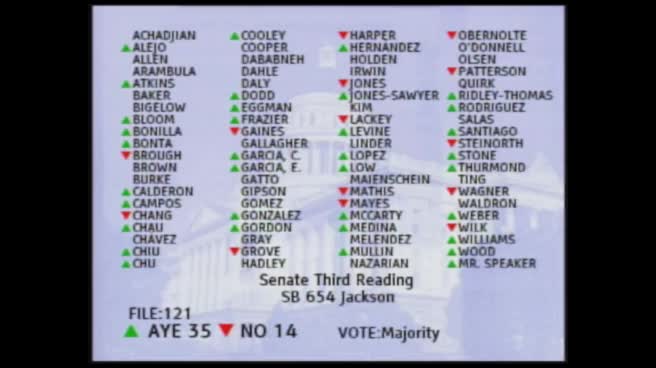 1MIN
Assembly Floor
 2MIN
Senate Floor
 3MIN
Senate Floor
 3H
Senate Standing Committee on Insurance
Bill Author

Bill Co-Author(s):