AB 2382: High-Speed Rail Authority: membership.
- Session Year: 2015-2016
- House: Assembly
- Latest Version Date: 2016-04-11
Existing law creates the High-Speed Rail Authority with specified powers and duties relative to development and implementation of a high-speed rail system. The authority is comprised of 9 members, with 5 members appointed by the Governor and 4 members appointed by the Legislature.
This bill would require at least one member appointed by the Governor beginning with an available vacancy on and after January 1, 2017, to be a person who works directly with communities in the state that are most significantly burdened by, and vulnerable to, high levels of pollution is from a disadvantaged community, as defined.
Existing law creates the High-Speed Rail Authority with specified powers and duties relative to development and implementation of a high-speed rail system. The authority is comprised of 9 members, with 5 members appointed by the Governor and 4 members appointed by the Legislature.
This bill would require at least one member appointed by the Governor to be a person who works directly with communities in the state that are most significantly burdened by, and vulnerable to, high levels of pollution.
(a)There is in the Transportation Agency a High-Speed Rail Authority.
(b)(1)The authority is composed of nine members as follows:
(A)Five members appointed by the Governor. At least one member appointed by the Governor beginning with an available vacancy on and after January 1, 2017, shall be a person person, other than a current or former elected official, who works directly with communities in the state that are most significantly burdened by, and vulnerable to, high levels of pollution, including, but not limited to, communities with diverse racial and ethnic populations and communities with low-income populations is from a disadvantaged community. Disadvantaged community means an area identified as among the most disadvantaged 25 percent of areas in the state according to the California Environmental Protection Agency, based on the latest version of the California Communities Environmental Health Screening Tool (CalEnviroScreen) scores.
(B)Two members appointed by the Senate Committee on Rules.
(C)Two members appointed by the Speaker of the Assembly.
(2)For the purposes of making appointments to the authority, the Governor, the Senate Committee on Rules, and the Speaker of the Assembly shall take into consideration geographical diversity to ensure that all regions of the state are adequately represented.
(c)Except as provided in subdivision (d), and until their successors are appointed, members of the authority shall hold office for terms of four years. A vacancy shall be filled by the appointing power making the original appointment, by appointing a member to serve the remainder of the term.
(d)(1)On and after January 1, 2001, the terms of all persons who are then members of the authority shall expire, but those members may continue to serve until they are reappointed or until their successors are appointed. In order to provide for evenly staggered terms, persons appointed or reappointed to the authority after January 1, 2001, shall be appointed to initial terms to expire as follows:
(A)Of the five persons appointed by the Governor, one shall be appointed to a term which expires on December 31, 2002, one shall be appointed to a term which expires on December 31, 2003, one shall be appointed to a term which expires on December 31, 2004, and two shall be appointed to terms which expires expire on December 31, 2005.
(B)Of the two persons appointed by the Senate Committee on Rules, one shall be appointed to a term which expires on December 31, 2002, and one shall be appointed to a term which expires on December 31, 2004.
(C)Of the two persons appointed by the Speaker of the Assembly, one shall be appointed to a term which expires on December 31, 2003, and one shall be appointed to a term which expires on December 31, 2005.
(2)Following expiration of each of the initial terms provided for in this subdivision, the term shall expire every four years thereafter on December 31.
(e)Members of the authority are subject to the Political Reform Act of 1974 (Title 9 (commencing with Section 81000)).
(f)From among its members, the authority shall elect a chairperson, who shall preside at all meetings of the authority, and a vice chairperson to preside in the absence of the chairperson. The chairperson shall serve a term of one year.
(g)Five members of the authority constitute a quorum for taking any action by the authority.
(a)There is in the Transportation Agency a High-Speed Rail Authority.
(b)(1)The authority is composed of nine members as follows:
(A)Five members appointed by the Governor. At least one member appointed by the Governor shall be a person who works directly with communities in the state that are most significantly burdened by, and vulnerable to, high levels of pollution, including, but not limited to, communities with diverse racial and ethnic populations and communities with low-income populations.
(B)Two members appointed by the Senate Committee on Rules.
(C)Two members appointed by the Speaker of the Assembly.
(2)For the purposes of making appointments to the authority, the Governor, the Senate Committee on Rules, and the Speaker of the Assembly shall take into consideration geographical diversity to ensure that all regions of the state are adequately represented.
(c)Except as provided in subdivision (d), and until their successors are appointed, members of the authority shall hold office for terms of four years. A vacancy shall be filled by the appointing power making the original appointment, by appointing a member to serve the remainder of the term.
(d)(1)On and after January 1, 2001, the terms of all persons who are then members of the authority shall expire, but those members may continue to serve until they are reappointed or until their successors are appointed. In order to provide for evenly staggered terms, persons appointed or reappointed to the authority after January 1, 2001, shall be appointed to initial terms to expire as follows:
(A)Of the five persons appointed by the Governor, one shall be appointed to a term which expires on December 31, 2002, one shall be appointed to a term which expires on December 31, 2003, one shall be appointed to a term which expires on December 31, 2004, and two shall be appointed to terms which expires on December 31, 2005.
(B)Of the two persons appointed by the Senate Committee on Rules, one shall be appointed to a term which expires on December 31, 2002, and one shall be appointed to a term which expires on December 31, 2004.
(C)Of the two persons appointed by the Speaker of the Assembly, one shall be appointed to a term which expires on December 31, 2003, and one shall be appointed to a term which expires on December 31, 2005.
(2)Following expiration of each of the initial terms provided for in this subdivision, the term shall expire every four years thereafter on December 31.
(e)Members of the authority are subject to the Political Reform Act of 1974 (Title 9 (commencing with Section 81000)).
(f)From among its members, the authority shall elect a chairperson, who shall preside at all meetings of the authority, and a vice chairperson to preside in the absence of the chairperson. The chairperson shall serve a term of one year.
(g)Five members of the authority constitute a quorum for taking any action by the authority.
|
Date
|
Status
|
|---|---|
| Feb 18, 2016 | Read first time. To print. |
| Feb 19, 2016 | From printer. May be heard in committee March 20. |
| Mar 8, 2016 | Referred to Com. on TRANS. |
| Apr 6, 2016 | In committee: Set, first hearing. Hearing canceled at the request of author. |
| Apr 11, 2016 | From committee chair, with author's amendments: Amend, and re-refer to Com. on TRANS. Read second time and amended. |
| Apr 12, 2016 | Re-referred to Com. on TRANS. |
| Apr 18, 2016 | In committee: Set, second hearing. Failed passage. Reconsideration granted. |
| Apr 19, 2016 | In committee: Set, second hearing. Failed passage. Reconsideration granted. |
|
Date
|
Description
|
Location
|
Votes
|
|
|---|---|---|---|---|
| Apr 18, 2016 | Reconsideration. | Assembly Standing Committee on Transportation |
Passed |
|
| Apr 18, 2016 | Do pass and be re-referred to the Committee on [Appropriations] | Assembly Standing Committee on Transportation |
Failed |
This list shows positions taken on this bill by organizations on the date displayed, which is linked to the original source.
Positions by individuals are not included.
Date of Hearing: April 18, 2016
ASSEMBLY COMMITTEE ON TRANSPORTATION
Jim Frazier, Chair
ABPCA Bill Id:AB 2382 (
Author:Lopez) – As Amended Ver:April 11, 2016
SUBJECT: High-Speed Rail Authority: membership
SUMMARY: Requires that at least one member of the California High-Speed Rail Authority Board of Directors (Board) appointed by the Governor be a person who is from a disadvantaged community, identified as the most disadvantaged 25% of areas in the state by CalEnvrio Screen.
EXISTING LAW:
- Creates the California High-Speed Rail Authority (Authority) with specific powers and duties relative to the development and implementation of an intercity high-speed rail system in California.
- Prescribes the membership of the Board to include nine members, with five members appointed by the Governor, two members appointed by the Senate Committee on Rules, and two members appointed by the Speaker of the Assembly.
- Defines the terms for office and filling vacancies.
- Authorizes members of the Authority to compensation for Authority business and actual travel expenses.
- Requires, pursuant to SB 535 (de León), Chapter 830, Statutes of 2012, that a minimum of 25% of the moneys available in GGRF be used to benefit disadvantaged communities.
FISCAL EFFECT: Unknown
COMMENTS: According to the author, AB 2382’s purpose is to ensure that a person from a disadvantaged community is added to Authority’s Board. The author goes on to state that, given that the high-speed rail project is the largest infrastructure project in North America spanning 520 miles, the project will affect certain segments and certain populations in California. Segments affected are mostly geographical and populations affected include, but are not limited to, disadvantaged communities. Further she contends that for those disadvantaged communities, it is essential that their unique needs and/or concerns be heard and represented at Board meetings.
Currently, the Authority’s Board provides oversight of the planning, design and construction of the high-speed rail system. The Board reviews and approves contracts entered into by the Authority and oversees ongoing work of the Authority with public and private partners. Additionally, the Board oversees the hiring of the Executive Director of the Authority, the top state executive; and the Authority’s Risk Manager and Auditor report directly to the Board to identify risks or concerns for the project.
California’s voters approved Proposition 1A in 2008 to provide $9.95 billion in General Obligation bonds for the planning, design and building of a high-speed rail system to connect San Francisco and Los Angeles through the Central Valley. In July 2012, the Legislature approved SB 1029 (Committee on Budget and Fiscal Review), Chapter 152, Statutes of 2012, which appropriated nearly $8 billion in federal funds and state bond funds to begin the construction of the Initial Operating Section (IOS) from Madera to Bakersfield. Additionally, as part of the
2014-15 state budget, 25% of cap and trade revenues were dedicated to the project. In February 2016, the Authority released its draft 2016 Business Plan which reconfigures the IOS to travel from north of Bakersfield to San Jose by 2025 at a cost of $20.9 billion with the full Phase I, from San Francisco to Los Angeles/Anaheim, projected to cost $64.2 billion.
The author notes that when cap and trade funds are used, a portion of those funds must be used to serve disadvantaged communities. Further, she states that since it is the case that funds are to be used to serve disadvantaged communities, the Board should reflect a person who is from a disadvantaged community.
Last year, AB 1288 (Atkins), Chapter 586, Statutes of 2015, added two additional members to the California Air Resources Board (ARB), who “work directly with communities in the state that are most significantly burdened by, and vulnerable to, high levels of pollution, including, but not limited to, communities with diverse racial and ethnic populations and communities with low-income populations.” These appointment criteria are consistent with other ARB Board members that are currently selected based upon specific qualifications and criteria. For example, of the twelve members appointed by the Governor, one member must have training and experience in chemistry, meteorology, or related scientific fields; and one member must be a physician and surgeon or an authority on health effects of air pollution. Additionally, the appointees must also come from a certain area of the state, such as the south coast district or the San Joaquin Valley Unified Air Pollution District.
The current requirements for appointments to the Authority Board do not include qualifications or criteria. AB 2382 would change this dynamic by requiring the appointee to come from a specific area of the state, a disadvantaged community. Unlike ARB’s Board, however, it would not apply certain qualification requirements representing other state priorities to the remaining Authority Board member positions.
Related legislation: AB 1813 (Frazier), will add one member of the California State Assembly and one member of the California State Senate to the Authority Board, as ex-officio, non-voting members.
Previous legislation: AB 1288 (Atkins), Chapter 586, Statutes of 2015, added two additional members to the ARB, one appointed by the Senate Committee on Rules and one appointed by the Speaker of the Assembly who works directly with communities that are most significantly burdened by, and vulnerable to, high levels of pollution, including, but not limited to, communities with diverse racial and ethnic populations and communities with low-income populations.
REGISTERED SUPPORT / OPPOSITION:
Support
None on file
Opposition
None on file
Analysis Prepared by: Melissa White / TRANS. / (916) 319-2093
Discussed in Hearing
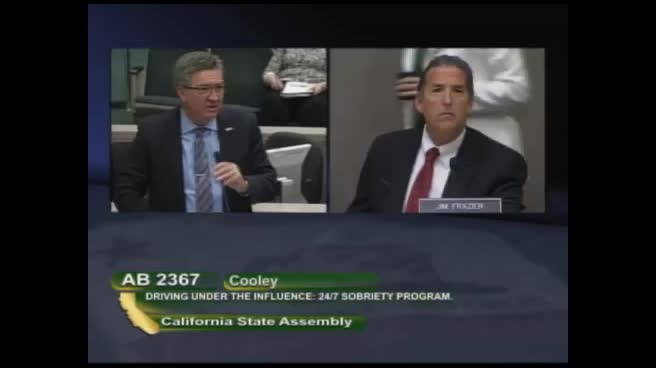 8MIN
Assembly Standing Committee on Transportation


Bill Co-Author(s):
