AB 2510: Firearms: license to carry concealed: uniform license.
- Session Year: 2015-2016
- House: Assembly
- Latest Version Date: 2016-09-26
Existing law authorizes the sheriff of a county or a chief or other head of a municipal police department of a city or a city and county to issue a license to carry a concealed firearm upon proof that the person applying for the license is of good moral character, that good cause exists for the issuance, that the applicant satisfies specified residency requirements, and that the applicant has completed a course of specified training.
Existing law requires that licenses and applications for licenses be uniform throughout the state and be submitted upon forms prescribed by the Attorney General.
This bill would require the Attorney General to develop a uniform license that may be used as indicia of proof of licensure throughout the state. The bill would require the Attorney General to approve the use of licenses issued by local agencies that contain specified information, including a recent photograph of the applicant. The bill would require the Attorney General to retain exemplars of approved licenses and maintain a list of agencies issuing local licenses. The bill would create a committee comprised of representatives from the California State Sheriffs Association, California Police Chiefs Association, and the Department of Justice to review and revise the uniform licenses, as specified.
Existing law authorizes the sheriff of a county or a chief or other head of a municipal police department of a city or a city and county to issue a license to carry a concealed firearm upon proof that the person applying for the license is of good moral character, that good cause exists for the issuance, that the applicant satisfies specified residency requirements, and that the applicant has completed a course of specified training.
Existing law requires that licenses and applications for licenses be uniform throughout the state, and to state and be submitted upon forms prescribed by the Attorney General.
This bill would require the Attorney General to develop a uniform license that may be used as indicia of proof of licensure throughout the state. The bill would require the Attorney General to approve the use of licenses issued by local agencies if they that contain specified information and information, including a recent photograph of the applicant. The bill would require the Attorney General to retain exemplars of approved licenses and maintain a list of agencies issuing local licenses. The bill would create a committee comprised of representatives from the California State Sheriffs Association, California Police Chiefs Association, and the Department of Justice to review and revise the uniform licenses, as specified.
Existing law authorizes the sheriff of a county or a chief or other head of a municipal police department of a city or a city and county to issue a license to carry a concealed firearm upon proof that the person applying for the license is of good moral character, that good cause exists for the issuance, that the applicant satisfies specified residency requirements, and that the applicant has completed a course of specified training.
Existing law requires that licenses and applications for licenses be uniform throughout the state, and to be submitted upon forms prescribed by the Attorney General.
This bill would require the Attorney General to develop a uniform license that may be used as indicia of proof of licensure throughout the state. The bill would require the Attorney General to approve the use of licenses issued by local agencies if they contain specified information and a recent photograph of the applicant. The bill would require the Attorney General to retain exemplars of approved licenses and maintain a list of agencies issuing local licenses.
(a)(1)Applications for licenses and applications for amendments to licenses under this article shall be uniform throughout the state, upon forms to be prescribed by the Attorney General.
(2)The Attorney General shall convene a committee composed of one representative of the California State Sheriffs Association, one representative of the California Police Chiefs Association, and one representative of the Department of Justice to review, and, as deemed appropriate, revise the standard application form for licenses. The committee shall meet for this purpose if two of the committees members deem that necessary.
(3)(A)The Attorney General shall develop a uniform license that may be used as indicia of proof of licensure throughout the state.
(B)The Attorney General shall approve the use of licenses issued by local agencies that contain all the information required in subdivision (i), including a recent photograph of the applicant, and are deemed to be in substantial compliance with standards developed by the committee described in subparagraph (C), if developed, as they relate to the physical dimensions and general appearance of the licenses. The Attorney General shall retain exemplars of approved licenses and shall maintain a list of agencies issuing local licenses. Approved licenses may be used as indicia of proof of licensure under this chapter in lieu of the uniform license developed by the Attorney General.
(C)A committee composed of two representatives of the California State Sheriffs Association, two representatives of the California Police Chiefs Association, and one representative of the Department of Justice shall convene to review and revise, as the committee deems appropriate, the design standard for licenses issued by local agencies that may be used as indicia of proof of licensure throughout the state, provided that the design standard meets the requirements of subparagraph (B). The committee shall meet for this purpose if two of the committees members deem it necessary.
(b)The application shall include a section summarizing the requirements of state law that result in the automatic denial of a license.
(c)The standard application form for licenses described in subdivision (a) shall require information from the applicant, including, but not limited to, the name, occupation, residence, and business address of the applicant, the applicants age, height, weight, color of eyes and hair, and reason for desiring a license to carry the weapon.
(d)Applications for licenses shall be filed in writing and signed by the applicant.
(e)Applications for amendments to licenses shall be filed in writing and signed by the applicant, and shall state what type of amendment is sought pursuant to Section 26215 and the reason for desiring the amendment.
(f)The forms shall contain a provision whereby the applicant attests to the truth of statements contained in the application.
(g)An applicant shall not be required to complete any additional application or form for a license, or to provide any information other than that necessary to complete the standard application form described in subdivision (a), except to clarify or interpret information provided by the applicant on the standard application form.
(h)The standard application form described in subdivision (a) is deemed to be a local form expressly exempt from the requirements of the Administrative Procedure Act (Chapter 3.5 (commencing with Section 11340) of Part 1 of Division 3 of Title 2 of the Government Code).
(i)Any license issued upon the application shall set forth the licensees name, occupation, residence and business address, the licensees age, height, weight, color of eyes and hair, and the reason for desiring a license to carry the weapon, and shall, in addition, contain a description of the weapon or weapons authorized to be carried, giving the name of the manufacturer, the serial number, and the caliber. The license issued to the licensee may be laminated.
(a)(1)Applications for licenses and applications for amendments to licenses under this article shall be uniform throughout the state, upon forms to be prescribed by the Attorney General.
(2)The Attorney General shall convene a committee composed of one representative of the California State Sheriffs Association, one representative of the California Police Chiefs Association, and one representative of the Department of Justice to review, and, as deemed appropriate, revise the standard application form for licenses. The committee shall meet for this purpose if two of the committees members deem that necessary.
(3)(A)The Attorney General shall develop a uniform license that may be used as indicia of proof of licensure throughout the state.
(B)The Attorney General shall approve the use of licenses issued by local agencies provided that the licenses contain all the information required in subdivision (i) and (i), including a recent photograph of the applicant. applicant, and are deemed to be in substantial compliance with standards developed by the committee described in subparagraph (C), if developed, as they relate to the physical dimensions and general appearance of the licenses. The Attorney General shall retain exemplars of approved licenses and shall maintain a list of agencies issuing local licenses. Approved licenses may be used as indicia of proof of licensure under this chapter in lieu of the uniform license developed by the Attorney General.
(C)A committee composed of two representatives of the California State Sheriffs Association, two representatives of the California Police Chiefs Association, and one representative of the Department of Justice shall convene to review and revise, as the committee deems appropriate, the design standard for licenses issued by local agencies that may be used as indicia of proof of licensure throughout the state, provided that the design standard meets the requirements of subparagraph (B). The committee shall meet for this purpose if two of the committees members deem it necessary.
(b)The application shall include a section summarizing the statutory provisions requirements of state law that result in the automatic denial of a license.
(c)The standard application form for licenses described in subdivision (a) shall require information from the applicant, including, but not limited to, the name, occupation, residence, and business address of the applicant, the applicants age, height, weight, color of eyes and hair, and reason for desiring a license to carry the weapon.
(d)Applications for licenses shall be filed in writing and signed by the applicant.
(e)Applications for amendments to licenses shall be filed in writing and signed by the applicant, and shall state what type of amendment is sought pursuant to Section 26215 and the reason for desiring the amendment.
(f)The forms shall contain a provision whereby the applicant attests to the truth of statements contained in the application.
(g)An applicant shall not be required to complete any additional application or form for a license, or to provide any information other than that necessary to complete the standard application form described in subdivision (a), except to clarify or interpret information provided by the applicant on the standard application form.
(h)The standard application form described in subdivision (a) is deemed to be a local form expressly exempt from the requirements of the Administrative Procedure Act (Chapter 3.5 (commencing with Section 11340) of Part 1 of Division 3 of Title 2 of the Government Code).
(i)Any license issued upon the application shall set forth the licensees name, occupation, residence and business address, the licensees age, height, weight, color of eyes and hair, and the reason for desiring a license to carry the weapon, and shall, in addition, contain a description of the weapon or weapons authorized to be carried, giving the name of the manufacturer, the serial number, and the caliber. The license issued to the licensee may be laminated.
(a)(1)Applications for licenses, applications for amendments to licenses, amendments to licenses, and licenses and applications for amendments to licenses under this article shall be uniform throughout the state, upon forms to be prescribed by the Attorney General.
(2)The Attorney General shall convene a committee composed of one representative of the California State Sheriffs Association, one representative of the California Police Chiefs Association, and one representative of the Department of Justice to review, and, as deemed appropriate, revise the standard application form for licenses. The committee shall meet for this purpose if two of the committees members deem that necessary.
(3)(A)The Attorney General shall develop a uniform license that may be used as indicia of proof of licensure throughout the state.
(B)The Attorney General shall approve the use of licenses issued by local agencies provided that the licenses contain all the information required in subdivision (i) and a recent photograph of the applicant. The Attorney General shall retain exemplars of approved licenses and shall maintain a list of agencies issuing local licenses. Approved licenses may be used as indicia of proof of licensure under this chapter in lieu of the uniform license developed by the Attorney General.
(b)The application shall include a section summarizing the statutory provisions of state law that result in the automatic denial of a license.
(c)The standard application form for licenses described in subdivision (a) shall require information from the applicant, including, but not limited to, the name, occupation, residence, and business address of the applicant, the applicants age, height, weight, color of eyes and hair, and reason for desiring a license to carry the weapon.
(d)Applications for licenses shall be filed in writing and signed by the applicant.
(e)Applications for amendments to licenses shall be filed in writing and signed by the applicant, and shall state what type of amendment is sought pursuant to Section 26215 and the reason for desiring the amendment.
(f)The forms shall contain a provision whereby the applicant attests to the truth of statements contained in the application.
(g)An applicant shall not be required to complete any additional application or form for a license, or to provide any information other than that necessary to complete the standard application form described in subdivision (a), except to clarify or interpret information provided by the applicant on the standard application form.
(h)The standard application form described in subdivision (a) is deemed to be a local form expressly exempt from the requirements of the Administrative Procedure Act (Chapter 3.5 (commencing with Section 11340) of Part 1 of Division 3 of Title 2 of the Government Code).
(i)Any license issued upon the application shall set forth the licensees name, occupation, residence and business address, the licensees age, height, weight, color of eyes and hair, and the reason for desiring a license to carry the weapon, and shall, in addition, contain a description of the weapon or weapons authorized to be carried, giving the name of the manufacturer, the serial number, and the caliber. The license issued to the licensee may be laminated.
|
Date
|
Status
|
|---|---|
| Jun 21, 2016 | From committee: Do pass and re-refer to Com. on APPR. (Ayes 7. Noes 0.) (June 21). Re-referred to Com. on APPR. |
| Aug 29, 2016 | Enrolled and presented to the Governor at 4 p.m. |
| Aug 22, 2016 | Senate amendments concurred in. To Engrossing and Enrolling. (Ayes 78. Noes 0. Page 6046.). |
| Aug 22, 2016 | Senate amendments concurred in. To Engrossing and Enrolling. |
| Aug 16, 2016 | In Assembly. Concurrence in Senate amendments pending. May be considered on or after August 18 pursuant to Assembly Rule 77. |
| Aug 15, 2016 | Read third time. Passed. Ordered to the Assembly. (Ayes 36. Noes 0.). |
| Aug 15, 2016 | Read third time. Passed. Ordered to the Assembly. (Ayes 36. Noes 0. Page 4988.). |
| Aug 15, 2016 | Read third time. Passed. Ordered to the Assembly. |
| Aug 9, 2016 | Read second time. Ordered to third reading. |
| Aug 8, 2016 | Read third time and amended. Ordered to second reading. |
| Aug 2, 2016 | Read second time. Ordered to third reading. |
| Aug 1, 2016 | From committee: Be placed on second reading file pursuant to Senate Rule 28.8. |
| Jun 22, 2016 | From committee: Do pass and re-refer to Com. on APPR. (Ayes 7. Noes 0.) (June 21). Re-referred to Com. on APPR. |
| Feb 19, 2016 | Introduced. To print. |
| May 19, 2016 | Referred to Com. on PUB. S. |
| May 12, 2016 | Read third time. Passed. Ordered to the Senate. (Ayes 77. Noes 0.) |
| May 12, 2016 | Read third time. Passed. Ordered to the Senate. (Ayes 77. Noes 0. Page 4775.) |
| May 12, 2016 | Read third time. Passed. Ordered to the Senate. |
| May 12, 2016 | In Senate. Read first time. To Com. on RLS. for assignment. |
| May 5, 2016 | Read second time. Ordered to third reading. |
| May 4, 2016 | From committee: Do pass. (Ayes 20. Noes 0.) (May 4). |
| Apr 20, 2016 | From committee: Do pass and re-refer to Com. on APPR. (Ayes 7. Noes 0.) (April 19). Re-referred to Com. on APPR. |
| Mar 8, 2016 | Referred to Com. on PUB. S. |
| Feb 22, 2016 | Read first time. |
| Feb 21, 2016 | From printer. May be heard in committee March 22. |
|
Date
|
Description
|
Location
|
Votes
|
|
|---|---|---|---|---|
| Aug 22, 2016 | AB 2510 LINDER Concurrence in Senate Amendments | Assembly Floor |
Passed |
|
| Aug 15, 2016 | Assembly 3rd Reading AB2510 Linder By Glazer | Senate Floor |
Passed |
|
| Jun 21, 2016 | Do pass, but first be re-referred to the Committee on [Appropriations] | Senate Standing Committee on Public Safety |
Passed |
|
| May 12, 2016 | AB 2510 LINDER Assembly Third Reading | Assembly Floor |
Passed |
|
| May 4, 2016 | Do pass. | Assembly Standing Committee on Appropriations |
Passed |
|
| Apr 19, 2016 | Do pass and be re-referred to the Committee on [Appropriations] | Assembly Standing Committee on Public Safety |
Passed |
This list shows positions taken on this bill by organizations on the date displayed, which is linked to the original source.
Positions by individuals are not included.
|
Organization
|
Position
|
Date
|
|---|---|---|
| Association of Los Angeles Deputy Sheriffs | ** Support | Aug 15, 2016 |
| California Association Of Federal Firearms Licensees, Inc. | ** Against | Aug 15, 2016 |
| California District Attorneys Association | ** Support | May 4, 2016 |
| California Police Chiefs Association | ** Support | Aug 15, 2016 |
| California Rifle And Pistol Association, Inc. | * Support | Jun 21, 2016 |
| California State Sheriffs' Association | ** Support | Aug 15, 2016 |
| Firearms Policy Coalition | ** Against | Aug 15, 2016 |
| Gun Owners of California | * Against Unless Amend | Jun 21, 2016 |
| Los Angeles County Professional Peace Officers Association | ** Support | Aug 15, 2016 |
| Los Angeles Police Protective League | ** Support | Aug 15, 2016 |
| National Rifle Association of America | ** Support | May 4, 2016 |
| PUB. S. | ** Against | May 4, 2016 |
| Rick Farinelli, District 3 Supervisor, County of Madera | ** Support | Aug 15, 2016 |
| Riverside Sheriffs' Association | ** Support | Aug 15, 2016 |
CONCURRENCE IN SENATE AMENDMENTS
CSA1 Bill Id:AB 2510
Author:(Linder)
As Amended Ver:August 8, 2016
Majority vote
ASSEMBLY: | 77-0 | (May 12, 2016) | SENATE: | 36-0 | (August 15, 2016) |
Original Committee Reference: PUB. S.
SUMMARY: Requires the Attorney General to develop a license to carry a concealed firearm (CCW), with uniform information and criteria, that may be used as indicia of proof of licensure throughout the state.
The Senate amendments create a committee comprised of representatives from the California State Sheriffs' Association, California Police Chiefs Association, and the Department of Justice to review and revise the uniform licenses.
EXISTING LAW:
- Provides a county sheriff or municipal police chief may issue a license to carry a firearm capable of being concealed upon the person upon proof that:
- The person applying is of good moral character;
- Good cause exists for the issuance;
- The person applying meets the appropriate residency requirements; and,
- The person has completed the appropriate training course.
- Provides that the license may either:
- Allow the person to carry a concealed firearm on his or her person; or,
- Allow the person to carry a loaded and exposed firearm in a county whose population is less than 200,000 persons according to the most recent federal decennial census.
- Provides that a CCW license is valid for up to two years, three years for judicial officers, or four years in the case of a reserve or auxiliary peace officer.
- Provides that a license may include any reasonable restrictions or conditions that the issuing authority deems warranted, which shall be listed on the license.
- Provides that the fingerprints of each applicant are taken and submitted to the Department of Justice (DOJ). Provides criminal penalties for knowingly filing a false application for a concealed weapon license.
- Provides that a person may lawfully possess a loaded firearm in his or her place of business or residence.
- Makes it generally unlawful to carry a concealed handgun or a loaded firearm in public and in vehicles.
- Specifies that applications for CCW licenses, applications for amendments to CCW licenses, amendments to CCW licenses, and CCW licenses under this article shall be uniform throughout the state, upon forms to be prescribed by the Attorney General.
- Provides that the Attorney General shall convene a committee composed of one representative of the California State Sheriffs' Association, one representative of the California Police Chiefs Association, and one representative of the DOJ to review, and as deemed appropriate, revise the standard application form for CCW licenses. The committee shall meet for this purpose if two of the committee's members deem that necessary.
- States that the application shall include a section summarizing the statutory provisions of state law that result in the automatic denial of a license.
AS PASSED BY THE ASSEMBLY, this bill:
- Required the Attorney General to develop a uniform CCW license that may be used as indicia of proof of licensure throughout the state.
- Required the Attorney General to approve the use of licenses issued by local agencies if they contain specified information and a recent photograph of the applicant.
- Required the Attorney General to retain exemplars of approved licenses and maintain a list of agencies issuing local licenses.
FISCAL EFFECT: According to the Senate Appropriations Committee, pursuant to Senate Rule 28.8 negligible state costs.
COMMENTS: According to the author, "As a practical matter, the current CCW license is not produced in a format that is easy to carry on one's person. In response, some sheriff offices currently provide a county identification card, which provides additional security features, and often includes a photograph of the licensee. This county-issued card cannot take the place of the standard DOJ CCW license, however, and licensees end up carrying both documents.
"It makes sense to carry one's CCW license on his or her person when armed. It also stands to reason that issuers of CCW licenses should be able to provide these documents in a more convenient way that improves public safety by allowing better identification of CCW holders. This bill simply authorizes county-issued CCW identifications to be carried in lieu of the standard DOJ form, as long as it contains all of the information currently required by law, as well as a photograph of the licensee."
Please see the policy committee analysis for a full discussion of this bill.
Analysis Prepared by: Gabriel Caswell / PUB. S. / (916) 319-3744 FN: 0003907
Office of Senate Floor Analyses (916) 651-1520 Fax: (916) 327-4478 | AB |
THIRD READING
Bill No: AB 2510
: in Senate
SENATE PUBLIC SAFETY COMMITTEE: 7-0, 6/21/16
AYES: Hancock, Anderson, Glazer, Leno, Liu, Monning, Stone
SENATE APPROPRIATIONS COMMITTEE: Senate Rule 28.8
ASSEMBLY FLOOR: 77-0, 5/12/16 - See last page for vote
SOURCE: California State Sheriffs’ Association
DIGEST: This bill (1) requires the Attorney General to develop a license to carry a concealed firearm (CCW), with uniform information and criteria, that may be used as indicia of proof of licensure throughout the state, (2) approves the use of licenses issued by local agencies if they contain specified information and a recent photograph to retain, as specified; and, (3) requires the Attorney General to exemplars of approved licenses and a list of agencies issuing local licenses, as specified.
Senate Floor Amendments of 8/8/16 (1) state that when approving the format of the license, the Attorney General Office must also deem that it is in substantial compliance with the standards developed by the committee, if developed; and, (2) create a committee composed of two representatives of the California State Sheriffs’ Association, two representatives of the California Police Chiefs Association, and one representative from the Department of Justice, to convene to review and revise, as the committee deems appropriate, the design standard for licenses issued by local agencies that may be used as indicia of proof of licensure throughout the state, provided that the design standard meets the requirements of the legislation.
Existing law:
- States that a county sheriff or municipal police chief may issue a license to carry a handgun capable of being concealed upon the person upon proof of all of the following:
- The person applying is of good moral character (Penal Code §§ 26150 and 26155(a)(1));
- Good cause exists for the issuance (Penal Code §§ 26150 and 26155(a)(2));
- The person applying meets the appropriate residency requirements (Penal Code §§ 26150 and 26155(a)(3)); and,
- The person has completed the appropriate training course, as specified. (Penal Code §§ 26150 and 26155(a)(4)).
- The person applying is of good moral character (Penal Code §§ 26150 and 26155(a)(1));
- States that a county sheriff or a chief of a municipal police department may issue a license to carry a concealed handgun in either of the following formats:
- A license to carry a concealed handgun upon his or her person (Penal Code §§ 26150 and 26155(b)(1)); or,
- A license to carry a loaded and exposed handgun if the population of the county, or the county in which the city is located, is less than 200,000 persons according to the most recent federal decennial census. (Penal Code §§ 26150 and 26155(b)(2).)
- A license to carry a concealed handgun upon his or her person (Penal Code §§ 26150 and 26155(b)(1)); or,
- Provides that a license may include any reasonable restrictions or conditions that the issuing authority deems warranted. (Penal Code § 26200.)
- Specifies that applications for CCW licenses, applications for amendments to CCW licenses, amendments to CCW licenses, and CCW licenses under this article shall be uniform throughout the state, upon forms to be prescribed by the Attorney General. (Penal Code § 26175 (a)(1).)
- Provides that the Attorney General shall convene a committee composed of one representative of the California State Sheriffs' Association, one representative of the California Police Chiefs Association, and one representative of the Department of Justice to review, and as deemed appropriate, revise the standard application form for CCW licenses. The committee shall meet for this purpose if two of the committee's members deem that necessary. (Penal Code § 26175(a)(2).)
- States that the application shall include a section summarizing the statutory provisions of state law that result in the automatic denial of a license. (Penal Code § 26175(b).)
- Provides that the standard application form for CCW licenses shall require information from the applicant, including, but not limited to, the name, occupation, residence, and business address of the applicant, the applicant's age, height, weight, color of eyes and hair, and reason for desiring a license to carry the weapon. (Penal Code § 26175(c).)
- Specifies that applications for licenses shall be filed in writing and signed by the applicant. (Penal Code § 26175(d).)
- Provides that applications for amendments to CCW licenses shall be filed in writing and signed by the applicant, and shall state what type of amendment is sought and the reason for desiring the amendment. (Penal Code § 26175(e).)
- States that the forms shall contain a provision whereby the applicant attests to the truth of statements contained in the application. (Penal Code § 26175(f).)
- Provides that an applicant shall not be required to complete any additional application or form for a license, or to provide any information other than that necessary to complete the standard application form, except to clarify or interpret information provided by the applicant on the standard application form. (Penal Code § 26175(g).)
- States that the standard application form is deemed to be a local form expressly exempt from the requirements of the Administrative Procedures Act. (Penal Code § 26175(h).)
- Provides that any CCW license issued upon the application shall set forth the licensee's name, occupation, residence and business address, the licensee's age, height, weight, color of eyes and hair, and the reason for desiring a license to carry the weapon, and shall, in addition, contain a description of the weapon or weapons authorized to be carried, giving the name of the manufacturer, the serial number, and the caliber. The license issued to the licensee may be laminated. (Penal Code § 26175(i).)
This bill:
- Requires the Attorney General to develop a uniform CCW license that may be used as indicia of proof of licensure throughout the state.
- Requires the Attorney General to approve the use of licenses issued by local agencies if they contain specified information, a recent photograph of the applicant, and are deemed in substantial compliance with the standards developed by the committee, if developed.
- Creates a committee composed of two representatives of the California State Sheriffs’ Association, two representatives of the California Police Chiefs Association, and one representative from the Department of Justice, to convene to review and revise, as the committee deems appropriate, the design standard for licenses issued by local agencies that may be used as indicia of proof of licensure throughout the state, provided that the design standard meets the requirements of the legislation. Requires the committee to meet for this purpose if two of the committee’s members deem it necessary.
- Requires the Attorney General to retain exemplars of approved licenses and maintain a list of agencies issuing local licenses.
Comments
This bill specifies that the Attorney General develop a uniform CCW license that may be used as indicia of proof of licensure throughout the state. The information on the license should be uniform and consistent. However, the bill does not require that the licenses themselves be identical in the same way that a California Driver's License is, other than the specified information. Opponents of the bill would like the information and appearance of the concealed carry license to be consistent across the state. However, the proponents of the bill are concerned that by mandating such consistency, that the costs to certain jurisdictions to update their systems to meet those requirements would be prohibitive.
The bill additionally requires the Attorney General to approve the use of licenses issued by local agencies if they contain specified information and a recent photograph of the applicant. The opponents argue that this provision will further provide for inconsistencies appearing in licenses throughout the state. The proponents of the legislation are more concerned with requiring consistent content on the licenses, and providing a card that can be carried upon the licensee easier than the paper permit. By not requiring the paper permit and permitting an identification card to be used as a CCW, proponents argue that public safety is enhanced because more people will have their license with them while they are carrying a concealed weapon.
FISCAL EFFECT: Appropriation: Fiscal Com.: Local:
California State Sheriffs’ Association (source)
Association of Los Angeles Deputy Sheriffs
California Police Chiefs Association
California Rifle and Pistol Association
Los Angeles County Professional Peace Officers Association
Los Angeles Police Protective League
National Rifle Association
Riverside Sheriffs' Association
Rick Farinelli, District 3 Supervisor, County of Madera
None received
ARGUMENTS IN SUPPORT: According to the California State Sheriffs' Association:
Existing law, Penal Code Section 26175, generally governs the process for the issuance of licenses that permit persons to lawfully carry concealed firearms. The application and the licenses themselves must be uniform throughout the state. Any license issued must include the licensee's name, occupation, residence and business address, age, height, weight, color of eyes and hair, and the reason for desiring a license to carry the weapon. The license is also required to contain a description of the weapon or weapons authorized to be carried, including the name of the manufacturer, the serial number, and the caliber.
As a practical matter, the current CCW license is not produced in a format that is easy to carry on one's person. In response, some sheriff offices currently provide a county identification card, which provides additionally security features, and often includes a photograph of the licensee. This county-issued card cannot take the place of the standard DOJ CCW license, however, and licensees end up carrying both documents.
It makes sense to carry one's CCW license on his or her person when armed. It also stands to reason that issuers of CCW licenses should be able to provide these documents in a more convenient way that improves public safety by allowing better identification of CCW holders. This bill simply authorizes county-issued CCW identification to be carried in lieu of the standard DOJ form, as long as it contains all of the information currently required by law, as well as a photograph of the licensee. Nothing in AB 2510 requires a permitting agency to do anything different than what they currently do – the bill merely provides an alternative avenue to ensure proper licensure and identification.
ASSEMBLY FLOOR: 77-0, 5/12/16
AYES: Achadjian, Alejo, Travis Allen, Arambula, Atkins, Baker, Bigelow, Bloom, Bonilla, Bonta, Brough, Brown, Calderon, Campos, Chang, Chau, Chávez, Chiu, Chu, Cooley, Cooper, Dababneh, Dahle, Daly, Dodd, Eggman, Frazier, Beth Gaines, Gallagher, Cristina Garcia, Eduardo Garcia, Gatto, Gipson, Gomez, Gonzalez, Gordon, Gray, Grove, Hadley, Harper, Roger Hernández, Holden, Irwin, Jones, Kim, Lackey, Levine, Linder, Lopez, Low, Maienschein, Mayes, McCarty, Medina, Melendez, Mullin, Nazarian, Obernolte, O'Donnell, Olsen, Patterson, Quirk, Ridley-Thomas, Rodriguez, Salas, Santiago, Steinorth, Mark Stone, Thurmond, Ting, Wagner, Waldron, Weber, Wilk, Williams, Wood, Rendon
NO VOTE RECORDED: Burke, Jones-Sawyer, Mathis
8/10/16 17:18:14
**** END ****
Office of Senate Floor Analyses (916) 651-1520 Fax: (916) 327-4478 | AB |
THIRD READING
Bill No: AB 2510
:
SENATE PUBLIC SAFETY COMMITTEE: 7-0, 6/21/16
AYES: Hancock, Anderson, Glazer, Leno, Liu, Monning, Stone
SENATE APPROPRIATIONS COMMITTEE: Senate Rule 28.8
ASSEMBLY FLOOR: 77-0, 5/12/16 - See last page for vote
SOURCE: California State Sheriffs’ Association
DIGEST: This bill (1) requires the Attorney General to develop a license to carry a concealed firearm (CCW), with uniform information and criteria, that may be used as indicia of proof of licensure throughout the state, and (2) approves the use of licenses issued by local agencies and to retain exemplars of approved licenses and a list of agencies issuing local licenses, as specified.
- States that a county sheriff or municipal police chief may issue a license to carry a handgun capable of being concealed upon the person upon proof of all of the following:
- The person applying is of good moral character (Penal Code §§ 26150 and 26155(a)(1));
- Good cause exists for the issuance (Penal Code §§ 26150 and 26155(a)(2));
- The person applying meets the appropriate residency requirements (Penal Code §§ 26150 and 26155(a)(3)); and,
- The person has completed the appropriate training course, as specified. (Penal Code §§ 26150 and 26155(a)(4)).
- The person applying is of good moral character (Penal Code §§ 26150 and 26155(a)(1));
- States that a county sheriff or a chief of a municipal police department may issue a license to carry a concealed handgun in either of the following formats:
- A license to carry a concealed handgun upon his or her person (Penal Code §§ 26150 and 26155(b)(1)); or,
- A license to carry a loaded and exposed handgun if the population of the county, or the county in which the city is located, is less than 200,000 persons according to the most recent federal decennial census. (Penal Code §§ 26150 and 26155(b)(2).)
- A license to carry a concealed handgun upon his or her person (Penal Code §§ 26150 and 26155(b)(1)); or,
- Provides that a license may include any reasonable restrictions or conditions that the issuing authority deems warranted. (Penal Code § 26200.)
- Specifies that applications for CCW licenses, applications for amendments to CCW licenses, amendments to CCW licenses, and CCW licenses under this article shall be uniform throughout the state, upon forms to be prescribed by the Attorney General. (Penal Code § 26175 (a)(1).)
- Provides that the Attorney General shall convene a committee composed of one representative of the California State Sheriffs' Association, one representative of the California Police Chiefs Association, and one representative of the Department of Justice to review, and as deemed appropriate, revise the standard application form for CCW licenses. The committee shall meet for this purpose if two of the committee's members deem that necessary. (Penal Code § 26175(a)(2).)
- States that the application shall include a section summarizing the statutory provisions of state law that result in the automatic denial of a license. (Penal Code § 26175(b).)
- Provides that the standard application form for CCW licenses shall require information from the applicant, including, but not limited to, the name, occupation, residence, and business address of the applicant, the applicant's age, height, weight, color of eyes and hair, and reason for desiring a license to carry the weapon. (Penal Code § 26175(c).)
- Specifies that applications for licenses shall be filed in writing and signed by the applicant. (Penal Code § 26175(d).)
- Provides that applications for amendments to CCW licenses shall be filed in writing and signed by the applicant, and shall state what type of amendment is sought and the reason for desiring the amendment. (Penal Code § 26175(e).)
- States that the forms shall contain a provision whereby the applicant attests to the truth of statements contained in the application. (Penal Code § 26175(f).)
- Provides that an applicant shall not be required to complete any additional application or form for a license, or to provide any information other than that necessary to complete the standard application form, except to clarify or interpret information provided by the applicant on the standard application form. (Penal Code § 26175(g).)
- States that the standard application form is deemed to be a local form expressly exempt from the requirements of the Administrative Procedures Act. (Penal Code § 26175(h).)
- Provides that any CCW license issued upon the application shall set forth the licensee's name, occupation, residence and business address, the licensee's age, height, weight, color of eyes and hair, and the reason for desiring a license to carry the weapon, and shall, in addition, contain a description of the weapon or weapons authorized to be carried, giving the name of the manufacturer, the serial number, and the caliber. The license issued to the licensee may be laminated. (Penal Code § 26175(i).)
This bill:
- Requires the Attorney General to develop a uniform CCW license that may be used as indicia of proof of licensure throughout the state.
- Requires the Attorney General to approve the use of licenses issued by local agencies if they contain specified information and a recent photograph of the applicant.
- Requires the Attorney General to retain exemplars of approved licenses and maintain a list of agencies issuing local licenses.
Comments
This bill specifies that the Attorney General develop a uniform CCW license that may be used as indicia of proof of licensure throughout the state. The information on the license should be uniform and consistent. However, the bill does not require that the licenses themselves be identical in the same way that a California Driver's License is, other than the specified information. Opponents of the bill would like the information and appearance of the concealed carry license to be consistent across the state. However, the proponents of the bill are concerned that by mandating such consistency, that the costs to certain jurisdictions to update their systems to meet those requirements would be prohibitive.
The bill additionally requires the Attorney General to approve the use of licenses issued by local agencies if they contain specified information and a recent photograph of the applicant. The opponents argue that this provision will further provide for inconsistencies appearing in licenses throughout the state. The proponents of the legislation are more concerned with requiring consistent content on the licenses, and providing a card that can be carried upon the licensee easier than the paper permit. By not requiring the paper permit and permitting an identification card to be used as a CCW, proponents argue that public safety is enhanced because more people will have their license with them while they are carrying a concealed weapon.
FISCAL EFFECT: Appropriation: Fiscal Com.: Local:
California State Sheriffs’ Association (source)
Association of Los Angeles Deputy Sheriffs
California Police Chiefs Association
California Rifle and Pistol Association
Los Angeles County Professional Peace Officers Association
Los Angeles Police Protective League
National Rifle Association
Riverside Sheriffs' Association
Rick Farinelli, District 3 Supervisor, County of Madera
California Association of Federal Firearms Licensees
Firearms Policy Coalition
ARGUMENTS IN SUPPORT: According to the California State Sheriffs' Association:
Existing law, Penal Code Section 26175, generally governs the process for the issuance of licenses that permit persons to lawfully carry concealed firearms. The application and the licenses themselves must be uniform throughout the state. Any license issued must include the licensee's name, occupation, residence and business address, age, height, weight, color of eyes and hair, and the reason for desiring a license to carry the weapon. The license is also required to contain a description of the weapon or weapons authorized to be carried, including the name of the manufacturer, the serial number, and the caliber.
As a practical matter, the current CCW license is not produced in a format that is easy to carry on one's person. In response, some sheriff offices currently provide a county identification card, which provides additionally security features, and often includes a photograph of the licensee. This county-issued card cannot take the place of the standard DOJ CCW license, however, and licensees end up carrying both documents.
It makes sense to carry one's CCW license on his or her person when armed. It also stands to reason that issuers of CCW licenses should be able to provide these documents in a more convenient way that improves public safety by allowing better identification of CCW holders. This bill simply authorizes county-issued CCW identification to be carried in lieu of the standard DOJ form, as long as it contains all of the information currently required by law, as well as a photograph of the licensee. Nothing in AB 2510 requires a permitting agency to do anything different than what they currently do – the bill merely provides an alternative avenue to ensure proper licensure and identification.
ARGUMENTS IN OPPOSITION: According to the Firearms Policy Coalition:
Current law requires that all licenses to carry in California to be uniform throughout the state. An officer who encounters a license from El Dorado County should be seeing the exact same permit as from Riverside County-- and it should be readily identifiable as such.
AB 2510 undoes this longstanding, successful scheme and creates a patchwork quilt of licenses that must be presented upon request (or sometimes even without a request, depending on local policies) to any law enforcement officer during a stop or other contact.
If all 450 or so issuing agencies (58 sheriffs and over 400 chiefs of police) were to make up their own permit, it would cause confusion, put our members and law enforcement in danger-- not only in California--but in those states that honor our licenses.
In addition, it would put Federal Firearms Licensees (FFL’s) in the awkward and criminally liable position of judging which of the 400-plus licenses are valid, in order to comply with statutory exemptions for proof of residency and firearms safety certificates at the point of sale.
Sadly, some local sheriffs have taken it upon themselves to issue local identification cards or quasi-licenses, despite the clear prohibition against it. Now, they have sponsored AB 2510 to grant themselves absolution without any respect for the purposes of the law enforcement committee that originally chose the uniform standard per the penal code.
The proponents may argue that the current unnecessary and superfluous local licenses or identification cards they issue for various non-statutory reasons are simply supplemental, simply to be easier to carry, simply more attractive, or some other rationalization --so they have come to the legislature seeking validation of their irresponsible conduct. The proponents have argued that the measure actually creates uniformity, when in fact it does just the opposite. The proponents have argued that there will be training when, in fact, there is none. The proponents have argued that it will make the license modern and more secure, but nothing in the measure points to anything related to that.
Regardless of how it is explained away, the creation of potentially 450 unique licenses is irresponsible, unnecessary, dangerous and expensive. It is akin to having hundreds of local drivers’ licenses.
In order to comply with AB 2510, the California Department of Justice (CADOJ) will have to hire or reassign multiple full time equivalent staff to implement the new state mandates; create an optional license (counter-intuitively named “uniform”), review and approve all non-uniform local licenses and retain and update the exemplars in perpetuity. In order for the system to work, they will also have to keep all FFL’s and law enforcement officers and agencies abreast – in real time—of any changes to any of the 400-something local licenses in perpetuity.
CADOJ will have to change their forms, policies and regulations to create a new, optional, tragically mis-named “uniform” license—which the local issuing authorities may use. The CADOJ then shall be forced to give their stamp of approval when any local sheriff or police chief makes a change to the size, shape, color, material, tamper resistance (if any) or logo (if any) on the card as long as it has basic information on it. To what end? Why create new mandates on a state agency to justify the whimsy of local politicians who want to leave their personal brand on what is supposed to be a statewide license?
ASSEMBLY FLOOR: 77-0, 5/12/16
AYES: Achadjian, Alejo, Travis Allen, Arambula, Atkins, Baker, Bigelow, Bloom, Bonilla, Bonta, Brough, Brown, Calderon, Campos, Chang, Chau, Chávez, Chiu, Chu, Cooley, Cooper, Dababneh, Dahle, Daly, Dodd, Eggman, Frazier, Beth Gaines, Gallagher, Cristina Garcia, Eduardo Garcia, Gatto, Gipson, Gomez, Gonzalez, Gordon, Gray, Grove, Hadley, Harper, Roger Hernández, Holden, Irwin, Jones, Kim, Lackey, Levine, Linder, Lopez, Low, Maienschein, Mayes, McCarty, Medina, Melendez, Mullin, Nazarian, Obernolte, O'Donnell, Olsen, Patterson, Quirk, Ridley-Thomas, Rodriguez, Salas, Santiago, Steinorth, Mark Stone, Thurmond, Ting, Wagner, Waldron, Weber, Wilk, Williams, Wood, Rendon
NO VOTE RECORDED: Burke, Jones-Sawyer, Mathis
Prepared by: Jessica Devencenzi / PUB. S. /
8/3/16 18:40:30
**** END ****
SENATE COMMITTEE ON PUBLIC SAFETY
Senator Loni Hancock, Chair
2015 - 2016 Regular
Bill No: AB 2510 Hearing Date: June 21, 2016
Author: | Linder | ||
Version: | February 19, 2016 | ||
Urgency: | No | Fiscal: | Yes |
Consultant: | JRD | ||
Subject: Firearms: License to Carry Concealed: Uniform License
HISTORY
Source: California State Sheriffs’ Association
Prior Legislation: None known
Support: Association of Los Angeles Deputy Sheriffs; California Police Chiefs Association; California Rifle and Pistol Association; Los Angeles County Professional Peace Officers Association; Los Angeles Police Protective League; National Rifle Association; Riverside Sheriffs' Association; Rick Farinelli, District 3 Supervisor, County of Madera
Opposition: California Association of Federal Firearms Licensees; Firearms Policy Coalition
Assembly Floor Vote: 77 - 0
PURPOSE
The purpose of this bill is to (1) require the Attorney General to develop a license to carry a concealed firearm (CCW), with uniform information and criteria, that may be used as indicia of proof of licensure throughout the state, and (2) approve the use of licenses issued by local agencies and to retain exemplars of approved licenses and a list of agencies issuing local licenses, as specified.
Existing law states that a county sheriff or municipal police chief may issue a license to carry a handgun capable of being concealed upon the person upon proof of all of the following:
- The person applying is of good moral character (Penal Code §§ 26150 and 26155(a)(1));
- Good cause exists for the issuance (Penal Code §§ 26150 and 26155(a)(2));
- The person applying meets the appropriate residency requirements (Penal Code §§ 26150 and 26155(a)(3)); and,
- The person has completed the appropriate training course, as specified. (Penal Code §§ 26150 and 26155(a)(4)).
- Good cause exists for the issuance (Penal Code §§ 26150 and 26155(a)(2));
Existing law states that a county sheriff or a chief of a municipal police department may issue a license to carry a concealed handgun in either of the following formats:
- A license to carry a concealed handgun upon his or her person (Penal Code §§ 26150 and 26155(b)(1)); or,
- A license to carry a loaded and exposed handgun if the population of the county, or the county in which the city is located, is less than 200,000 persons according to the most recent federal decennial census. (Penal Code §§ 26150 and 26155(b)(2).)
- A license to carry a concealed handgun upon his or her person (Penal Code §§ 26150 and 26155(b)(1)); or,
Existing law provides that a license may include any reasonable restrictions or conditions that the issuing authority deems warranted. (Penal Code § 26200.)
Existing law specifies that applications for CCW licenses, applications for amendments to CCW licenses, amendments to CCW licenses, and CCW licenses under this article shall be uniform throughout the state, upon forms to be prescribed by the Attorney General. (Penal Code § 26175 (a)(1).)
Existing law provides that the Attorney General shall convene a committee composed of one representative of the California State Sheriffs' Association, one representative of the California Police Chiefs Association, and one representative of the Department of Justice to review, and as deemed appropriate, revise the standard application form for CCW licenses. The committee shall meet for this purpose if two of the committee's members deem that necessary. (Penal Code § 26175(a)(2).)
Existing law states that the application shall include a section summarizing the statutory provisions of state law that result in the automatic denial of a license. (Penal Code § 26175(b).)
Existing law provides that the standard application form for CCW licenses shall require information from the applicant, including, but not limited to, the name, occupation, residence, and business address of the applicant, the applicant's age, height, weight, color of eyes and hair, and reason for desiring a license to carry the weapon. (Penal Code § 26175(c).)
Existing law specifies that applications for licenses shall be filed in writing and signed by the applicant. (Penal Code § 26175(d).)
Existing law provides that applications for amendments to CCW licenses shall be filed in writing and signed by the applicant, and shall state what type of amendment is sought and the reason for desiring the amendment. (Penal Code § 26175(e).)
Existing law states that the forms shall contain a provision whereby the applicant attests to the truth of statements contained in the application. (Penal Code § 26175(f).)
Existing law provides that an applicant shall not be required to complete any additional application or form for a license, or to provide any information other than that necessary to complete the standard application form, except to clarify or interpret information provided by the applicant on the standard application form. (Penal Code § 26175(g).)
Existing law states that the standard application form is deemed to be a local form expressly exempt from the requirements of the Administrative Procedures Act. (Penal Code § 26175(h).)
Existing law provides that any CCW license issued upon the application shall set forth the licensee's name, occupation, residence and business address, the licensee's age, height, weight, color of eyes and hair, and the reason for desiring a license to carry the weapon, and shall, in addition, contain a description of the weapon or weapons authorized to be carried, giving the name of the manufacturer, the serial number, and the caliber. The license issued to the licensee may be laminated. (Penal Code § 26175(i).)
This bill requires the Attorney General to develop a uniform CCW license that may be used as indicia of proof of licensure throughout the state.
This bill requires the Attorney General to approve the use of licenses issued by local agencies if they contain specified information and a recent photograph of the applicant.
This bill requires the Attorney General to retain exemplars of approved licenses and maintain a list of agencies issuing local licenses.
RECEIVERSHIP/OVERCROWDING CRISIS AGGRAVATION
For the past several years this Committee has scrutinized legislation referred to its jurisdiction for any potential impact on prison overcrowding. Mindful of the United States Supreme Court ruling and federal court orders relating to the state’s ability to provide a constitutional level of health care to its inmate population and the related issue of prison overcrowding, this Committee has applied its “ROCA” policy as a content-neutral, provisional measure necessary to ensure that the Legislature does not erode progress in reducing prison overcrowding.
On February 10, 2014, the federal court ordered California to reduce its in-state adult institution population to 137.5% of design capacity by February 28, 2016, as follows:
- 143% of design bed capacity by June 30, 2014;
- 141.5% of design bed capacity by February 28, 2015; and,
- 137.5% of design bed capacity by February 28, 2016.
In December of 2015 the administration reported that as “of December 9, 2015, 112,510 inmates were housed in the State’s 34 adult institutions, which amounts to 136.0% of design bed capacity, and 5,264 inmates were housed in out-of-state facilities. The current population is 1,212 inmates below the final court-ordered population benchmark of 137.5% of design bed capacity, and has been under that benchmark since February 2015.” (Defendants’ December 2015 Status Report in Response to February 10, 2014 Order, 2:90-cv-00520 KJM DAD PC, 3-Judge Court, Coleman v. Brown, Plata v. Brown (fn. omitted).) One year ago, 115,826 inmates were housed in the State’s 34 adult institutions, which amounted to 140.0% of design bed capacity, and 8,864 inmates were housed in out-of-state facilities. (Defendants’ December 2014 Status Report in Response to February 10, 2014 Order, 2:90-cv-00520 KJM DAD PC, 3-Judge Court, Coleman v. Brown, Plata v. Brown (fn. omitted).)
While significant gains have been made in reducing the prison population, the state must stabilize these advances and demonstrate to the federal court that California has in place the “durable solution” to prison overcrowding “consistently demanded” by the court. (Opinion Re: Order Granting in Part and Denying in Part Defendants’ Request For Extension of December 31, 2013 Deadline, NO. 2:90-cv-0520 LKK DAD (PC), 3-Judge Court, Coleman v. Brown, Plata v. Brown (2-10-14). The Committee’s consideration of bills that may impact the prison population therefore will be informed by the following questions:
- Whether a proposal erodes a measure which has contributed to reducing the prison population;
- Whether a proposal addresses a major area of public safety or criminal activity for which there is no other reasonable, appropriate remedy;
- Whether a proposal addresses a crime which is directly dangerous to the physical safety of others for which there is no other reasonably appropriate sanction;
- Whether a proposal corrects a constitutional problem or legislative drafting error; and
- Whether a proposal proposes penalties which are proportionate, and cannot be achieved through any other reasonably appropriate remedy.
COMMENTS
1. Need for Legislation
According to the author:
Existing law requires that licenses permitting persons to lawfully carry a concealed firearm (CCW) must be uniform throughout the state. However, the current form/license approved by the Department of Justice (DOJ) is a paper document that does not lend itself to being easily carried on one’s person. Nothing in existing law specifically permits CCW-authorizing agencies to issue its own CCW identity document in a more user-friendly format.
2. Effect of Legislation
This bill specifies that the Attorney General develop a uniform CCW license that may be used as indicia of proof of licensure throughout the state. The information on the license should be uniform and consistent. However, the bill does not require that the licenses themselves be identical in the same way that a California Driver's License is, other than the specified information. Opponents of the bill would like the information and appearance of the concealed carry license to be consistent across the state. However, the proponents of the bill are concerned that by mandating such consistency, that the costs to certain jurisdictions to update their systems to meet those requirements would be prohibitive.
The bill additionally requires the Attorney General to approve the use of licenses issued by local agencies if they contain specified information and a recent photograph of the applicant. The opponents argue that this provision will further provide for inconsistencies appearing in licenses throughout the state. The proponents of the legislation are more concerned with requiring consistent content on the licenses, and providing a card that can be carried upon the licensee easier than the paper permit. By not requiring the paper permit and permitting an identification card to be used as a CCW, proponents argue that public safety is enhanced because more people will have their license with them while they are carrying a concealed weapon.
3. Argument in Support
According to the California State Sheriffs' Association:
Existing law, Penal Code Section 26175, generally governs the process for the issuance of licenses that permit persons to lawfully carry concealed firearms. The application and the licenses themselves must be uniform throughout the state. Any license issued must include the licensee's name, occupation, residence and business address, age, height, weight, color of eyes and hair, and the reason for desiring a license to carry the weapon. The license is also required to contain a description of the weapon or weapons authorized to be carried, including the name of the manufacturer, the serial number, and the caliber.
As a practical matter, the current CCW license is not produced in a format that is easy to carry on one's person. In response, some sheriff offices currently provide a county identification card, which provides additionally security features, and often includes a photograph of the licensee. This county-issued card cannot take the place of the standard DOJ CCW license, however, and licensees end up carrying both documents.
It makes sense to carry one's CCW license on his or her person when armed. It also stands to reason that issuers of CCW licenses should be able to provide these documents in a more convenient way that improves public safety by allowing better identification of CCW holders. This bill simply authorizes county-issued CCW identification to be carried in lieu of the standard DOJ form, as long as it contains all of the information currently required by law, as well as a photograph of the licensee. Nothing in AB 2510 requires a permitting agency to do anything different than what they currently do – the bill merely provides an alternative avenue to ensure proper licensure and identification.
4. Argument in Opposition
According to the Firearms Policy Coalition:
Current law requires that all licenses to carry in California to be uniform throughout the state. An officer who encounters a license from El Dorado County should be seeing the exact same permit as from Riverside County-- and it should be readily identifiable as such.
AB 2510 undoes this longstanding, successful scheme and creates a patchwork quilt of licenses that must be presented upon request (or sometimes even without a request, depending on local policies) to any law enforcement officer during a stop or other contact.
If all 450 or so issuing agencies (58 sheriffs and over 400 chiefs of police) were to make up their own permit, it would cause confusion, put our members and law enforcement in danger-- not only in California--but in those states that honor our licenses.
In addition, it would put Federal Firearms Licensees (FFL’s) in the awkward and criminally liable position of judging which of the 400-plus licenses are valid, in order to comply with statutory exemptions for proof of residency and firearms safety certificates at the point of sale.
Sadly, some local sheriffs have taken it upon themselves to issue local identification cards or quasi-licenses, despite the clear prohibition against it. Now, they have sponsored AB 2510 to grant themselves absolution without any respect for the purposes of the law enforcement committee that originally chose the uniform standard per the penal code.
The proponents may argue that the current unnecessary and superfluous local licenses or identification cards they issue for various non-statutory reasons are simply supplemental, simply to be easier to carry, simply more attractive, or some other rationalization --so they have come to the legislature seeking validation of their irresponsible conduct. The proponents have argued that the measure actually creates uniformity, when in fact it does just the opposite. The proponents have argued that there will be training when, in fact, there is none. The proponents have argued that it will make the license modern and more secure, but nothing in the measure points to anything related to that.
Regardless of how it is explained away, the creation of potentially 450 unique licenses is irresponsible, unnecessary, dangerous and expensive. It is akin to having hundreds of local drivers’ licenses.
In order to comply with AB 2510, the California Department of Justice (CADOJ) will have to hire or reassign multiple full time equivalent staff to implement the new state mandates; create an optional license (counter-intuitively named “uniform”), review and approve all non-uniform local licenses and retain and update the exemplars in perpetuity. In order for the system to work, they will also have to keep all FFL’s and law enforcement officers and agencies abreast – in real time—of any changes to any of the 400-something local licenses in perpetuity.
CADOJ will have to change their forms, policies and regulations to create a new, optional, tragically mis-named “uniform” license—which the local issuing authorities may use. The CADOJ then shall be forced to give their stamp of approval when any local sheriff or police chief makes a change to the size, shape, color, material, tamper resistance (if any) or logo (if any) on the card as long as it has basic information on it. To what end? Why create new mandates on a state agency to justify the whimsy of local politicians who want to leave their personal brand on what is supposed to be a statewide license?
-- END –
ASSEMBLY THIRD READING
ATR Bill Id:AB 2510
Author:(Linder)
As Introduced Ver:February 19, 2016
Majority vote
Committee | Votes | Ayes | Noes |
Public Safety | 7-0 | Jones-Sawyer, Melendez, Lackey, Lopez, Low, Quirk, Santiago | |
Appropriations | 20-0 | Gonzalez, Bigelow, Bloom, Bonilla, Bonta, Calderon, Chang, Daly, Eggman, Gallagher, Eduardo Garcia, McCarty, Holden, Jones, Obernolte, Quirk, Santiago, Wagner, Weber, Wood |
SUMMARY: Requires the Attorney General to develop a license to carry a concealed firearm (CCW), with uniform information and criteria, that may be used as indicia of proof of licensure throughout the state. Specifically, this bill:
- Requires the Attorney General to develop a uniform CCW license that may be used as indicia of proof of licensure throughout the state.
- Requires the Attorney General to approve the use of licenses issued by local agencies if they contain specified information and a recent photograph of the applicant.
- Requires the Attorney General to retain exemplars of approved licenses and maintain a list of agencies issuing local licenses.
EXISTING LAW:
- Provides a county sheriff or municipal police chief may issue a license to carry a firearm capable of being concealed upon the person upon proof that:
- The person applying is of good moral character;
- Good cause exists for the issuance;
- The person applying meets the appropriate residency requirements; and,
- The person has completed the appropriate training course.
- Provides that the license may either:
- Allow the person to carry a concealed firearm on his or her person; or,
- Allow the person to carry a loaded and exposed firearm in a county whose population is less than 200,000 persons according to the most recent federal decennial census.
- Provides that a CCW license is valid for up to two years, three years for judicial officers, or four years in the case of a reserve or auxiliary peace officer.
- Provides that a license may include any reasonable restrictions or conditions that the issuing authority deems warranted, which shall be listed on the license.
- Provides that the fingerprints of each applicant are taken and submitted to the Department of Justice (DOJ). Provides criminal penalties for knowingly filing a false application for a concealed weapon license.
- Provides that a person may lawfully possess a loaded firearm in his or her place of business or residence.
- Makes it generally unlawful to carry a concealed handgun or a loaded firearm in public and in vehicles.
- Specifies that applications for CCW licenses, applications for amendments to CCW licenses, amendments to CCW licenses, and CCW licenses under this article shall be uniform throughout the state, upon forms to be prescribed by the Attorney General.
- Provides that the Attorney General shall convene a committee composed of one representative of the California State Sheriffs' Association, one representative of the California Police Chiefs Association, and one representative of the DOJ to review, and as deemed appropriate, revise the standard application form for CCW licenses. The committee shall meet for this purpose if two of the committee's members deem that necessary.
- States that the application shall include a section summarizing the statutory provisions of state law that result in the automatic denial of a license.
FISCAL EFFECT: According to the Assembly Appropriations Committee, minor absorbable cost to DOJ.
COMMENTS: According to the author, "As a practical matter, the current CCW license is not produced in a format that is easy to carry on one's person. In response, some sheriff offices currently provide a county identification card, which provides additional security features, and often includes a photograph of the licensee. This county-issued card cannot take the place of the standard DOJ CCW license, however, and licensees end up carrying both documents.
"It makes sense to carry one's CCW license on his or her person when armed. It also stands to reason that issuers of CCW licenses should be able to provide these documents in a more convenient way that improves public safety by allowing better identification of CCW holders. This bill simply authorizes county-issued CCW identifications to be carried in lieu of the standard DOJ form, as long as it contains all of the information currently required by law, as well as a photograph of the licensee."
Analysis Prepared by: Gabriel Caswell/ PUB. S. / (916) 319-3744 FN: 0002883
Date of Hearing: May 4, 2016
ASSEMBLY COMMITTEE ON APPROPRIATIONS
Lorena Gonzalez, Chair
ABPCA Bill Id:AB 2510
Author:(Linder) – As Introduced Ver:February 19, 2016
Policy Committee: | Public Safety | Vote: | 7 - 0 |
Urgency: No State Mandated Local Program: No Reimbursable: No
SUMMARY:
This bill requires the Attorney General (AG) to develop a license to carry a concealed firearm (CCW), with uniform information and criteria that may be used as indicia of proof of licensure throughout the state. Specifically, this bill:
- Requires the AG to develop a uniform CCW license that may be used as indicia of proof of licensure throughout the state.
- Requires the AG to approve the use of licenses issued by local agencies if they contain specified information and a recent photograph of the applicant.
- Requires the AG to retain exemplars of approved licenses and maintain a list of agencies issuing local licenses.
FISCAL EFFECT:
Minor absorbable cost to DOJ.
COMMENTS:
- Background/Purpose. Current law authorizes a county sheriff or municipal police chief to issue a license to carry a firearm capable of being concealed upon the person, if specified conditions are met and specific applicant personal information is provided.
According to the author, "as a practical matter, the current CCW license is not produced in a format that is easy to carry on one’s person. In response, some sheriff offices currently provide a county identification card, which provides additional security features, and often includes a photograph of the licensee. This county-issued card cannot take the place of the standard DOJ CCW license, however, and licensees end up carrying both documents.
"It makes sense to carry one’s CCW license on his or her person when armed. It also stands to reason that issuers of CCW licenses should be able to provide these documents in a more convenient way that improves public safety by allowing better identification of CCW holders. This bill simply authorizes county-issued CCW identifications to be carried in lieu of the standard DOJ form, as long as it contains all of the information currently required by law, as well as a photograph of the licensee."
- Support: According to the California State Sheriffs' Association, "This bill simply authorizes county-issued CCW identification to be carried in lieu of the standard DOJ form, as long as it contains all of the information currently required by law, as well as a photograph of the licensee. Nothing in AB 2510 requires a permitting agency to do anything different than what they currently do – the bill merely provides an alternative avenue to ensure proper licensure and identification."
- Argument in Opposition: According to the Firearms Policy Coalition , ""We feel that the solution is simple; if the state wishes to update and modernize the licenses (photo, security features, size, material, color, etc...) then it should construct a uniform, statewide policy and not force DOJ to just ratify whatever the local issuing authority prints or produces."
Analysis Prepared by: Pedro Reyes / APPR. / (916) 319-2081
Date of Hearing: April 19, 2016
Counsel: Gabriel Caswell
ASSEMBLY COMMITTEE ON
Reginald Byron Jones-Sawyer, Sr., Chair
ABPCA Bill Id:
Author:() – As Ver:
SUMMARY: Requires the Attorney General to develop a license to carry a concealed firearm (CCW), with uniform information and criteria, that may be used as indicia of proof of licensure throughout the state. Specifically, this bill:
- Requires the Attorney General to develop a uniform CCW license that may be used as indicia of proof of licensure throughout the state.
- Requires the Attorney General to approve the use of licenses issued by local agencies if they contain specified information and a recent photograph of the applicant.
- Requires the Attorney General to retain exemplars of approved licenses and maintain a list of agencies issuing local licenses.
EXISTING LAW:
- Provides a county sheriff or municipal police chief may issue a license to carry a firearm capable of being concealed upon the person upon proof that:
- The person applying is of good moral character (Penal Code § 12050, subd. (a)(1)(A));
- Good cause exists for the issuance (Pen. Code § 12050, subd. (a)(1)(A));
- The person applying meets the appropriate residency requirements (Pen. Code § 12050, subd. (a)(1)(D)); and,
- The person has completed the appropriate training course (Pen. Code § 12050, subd. (E)).
- The person applying is of good moral character (Penal Code § 12050, subd. (a)(1)(A));
- Provides that the license may either:
- Allow the person to carry a concealed firearm on his or her person (Pen. Code § 12050, subd. (a)(1)); or,
- Allow the person to carry a loaded and exposed firearm in a county whose population is less than 200,000 persons according to the most recent federal decennial census. (Pen. Code § 12050, subd. (a)(1).)
- Allow the person to carry a concealed firearm on his or her person (Pen. Code § 12050, subd. (a)(1)); or,
- Provides that a CCW license is valid for up to two years, three years for judicial officers, or four years in the case of a reserve or auxiliary peace officer. (Pen. Code § 12050, subd. (a)(2).)
- Provides that a license may include any reasonable restrictions or conditions that the issuing authority deems warranted, which shall be listed on the license. (Pen. Code § 12050, subds. (b) and (c).)
- Provides that the fingerprints of each applicant are taken and submitted to the Department of Justice. Provides criminal penalties for knowingly filing a false application for a concealed weapon license. (Pen. Code § 12051, subd. (b).)
- Provides that a person may lawfully possess a loaded firearm in his or her place of business or residence. (Pen. Code § 12031, subd. (h)(l).)
- Makes it generally unlawful to carry a concealed handgun or a loaded firearm in public and in vehicles. (Penal Code § 12025 and 12031.)
- Specifies that applications for CCW licenses, applications for amendments to CCW licenses, amendments to CCW licenses, and CCW licenses under this article shall be uniform throughout the state, upon forms to be prescribed by the Attorney General. (Pen. Code, § 26175, subd (a)(1).)
- Provides that the Attorney General shall convene a committee composed of one representative of the California State Sheriffs' Association, one representative of the California Police Chiefs Association, and one representative of the Department of Justice to review, and as deemed appropriate, revise the standard application form for CCW licenses. The committee shall meet for this purpose if two of the committee's members deem that necessary. (Pen. Code, § 26175, subd (a)(2).)
- States that the application shall include a section summarizing the statutory provisions of state law that result in the automatic denial of a license. (Pen. Code, § 26175, subd (b).)
- Provides that the standard application form for CCW licenses shall require information from the applicant, including, but not limited to, the name, occupation, residence, and business address of the applicant, the applicant's age, height, weight, color of eyes and hair, and reason for desiring a license to carry the weapon. (Pen. Code, § 26175, subd (c).)
- Specifies that applications for licenses shall be filed in writing and signed by the applicant. (Pen. Code, § 26175, subd (d).)
- Provides that applications for amendments to CCW licenses shall be filed in writing and signed by the applicant, and shall state what type of amendment is sought and the reason for desiring the amendment. (Pen. Code, § 26175, subd (e).)
- States that the forms shall contain a provision whereby the applicant attests to the truth of statements contained in the application. (Pen. Code, § 26175, subd (f).)
- Provides that an applicant shall not be required to complete any additional application or form for a license, or to provide any information other than that necessary to complete the standard application form, except to clarify or interpret information provided by the applicant on the standard application form. (Pen. Code, § 26175, subd (g).)
- States that the standard application form is deemed to be a local form expressly exempt from the requirements of the Administrative Procedures Act. (Pen. Code, § 26175, subd (h).)
- Provides that any CCW license issued upon the application shall set forth the licensee's name, occupation, residence and business address, the licensee's age, height, weight, color of eyes and hair, and the reason for desiring a license to carry the weapon, and shall, in addition, contain a description of the weapon or weapons authorized to be carried, giving the name of the manufacturer, the serial number, and the caliber. The license issued to the licensee may be laminated. (Pen. Code, § 26175, subd (i).)
FISCAL EFFECT: Unknown.
COMMENTS:
- Author's Statement: According to the author, "as a practical matter, the current CCW license is not produced in a format that is easy to carry on one’s person. In response, some sheriff offices currently provide a county identification card, which provides additional security features, and often includes a photograph of the licensee. This county-issued card cannot take the place of the standard DOJ CCW license, however, and licensees end up carrying both documents.
"It makes sense to carry one’s CCW license on his or her person when armed. It also stands to reason that issuers of CCW licenses should be able to provide these documents in a more convenient way that improves public safety by allowing better identification of CCW holders. This bill simply authorizes county-issued CCW identifications to be carried in lieu of the standard DOJ form, as long as it contains all of the information currently required by law, as well as a photograph of the licensee."
- Requires Consistent Content, Yet not Identical: This bill specifies that the Attorney General develop a uniform CCW license that may be used as indicia of proof of licensure throughout the state. The information on the license should be uniform and consistent. However, the bill does not require that the licenses themselves be identical in the same way that a California Driver's License is, other than the specified information and the photographs of the particular individuals. Opponents of the bill would like the information and appearance of the license to be more consistent in the manner of a California Driver's License. However, the proponents of the bill are concerned that by mandating such consistency, that the costs to certain jurisdictions to update their systems to meet those requirements would be prohibitive.
The bill additionally requires the Attorney General to approve the use of licenses issued by local agencies if they contain specified information and a recent photograph of the applicant. The opponents argue that this provision will further provide for inconsistencies appearing in licenses throughout the state. The proponents of the legislation are more concerned with requiring consistent content on the licenses, and providing a card that can be carried upon the licensee easier than the paper permit. By not requiring the paper permit and permitting an identification card to be used as a CCW, proponents argue that public safety is enhanced because more people will have their license with them while they are carrying a concealed weapon.
- Argument in Support: According to the California State Sheriffs' Association, "existing law, Pen. Code § 26175, generally governs the process for the issuance of licenses that permit persons to lawfully carry concealed firearms. The application and the licenses themselves must be uniform throughout the state. Any license issued must include the licensee's name, occupation, residence and business address, age, height, weight, color of eyes and hair, and the reason for desiring a license to carry the weapon. The license is also required to contain a description of the weapon or weapons authorized to be carried, including the name of the manufacturer, the serial number, and the caliber.
"As a practical matter, the current CCW license is not produced in a format that is easy to carry on one's person. In response, some sheriff offices currently provide a county identification card, which provides additionally security features, and often includes a photograph of the licensee. This county-issued card cannot take the place of the standard DOJ CCW license, however, and licensees end up carrying both documents.
"It makes sense to carry one's CCW license on his or her person when armed. It also stands to reason that issuers of CCW licenses should be able to provide these documents in a more convenient way that improves public safety by allowing better identification of CCW holders. This bill simply authorizes county-issued CCW identification to be carried in lieu of the standard DOJ form, as long as it contains all of the information currently required by law, as well as a photograph of the licensee. Nothing in AB 2510 requires a permitting agency to do anything different than what they currently do – the bill merely provides an alternative avenue to ensure proper licensure and identification."
- Argument in Opposition: According to the Firearms Policy Coalition , " On behalf of the members and supporters of Firearms Policy Coalition, I respectfully submit our opposition to Assembly Bill 2510 (Linder). However we would remove our opposition and even consider supporting AB 2510 if it were to be amended to create a modern and uniform license to carry.
"Licenses to carry in California, while still rare, have been increasing. These licenses are valid statewide. This increases the likelihood that the licensee will have law enforcement contact and want to inform the law enforcement officer of his or her license and whether or not that licensee is armed at the time of the interaction. The license should be recognizable as valid to the law enforcement officer during the contact.
"Currently, these licenses are required to be uniform throughout the state. An officer who encounters a permit from El Dorado County should be seeing the exact same permit as from Riverside County-- and it should be readily identifiable as such.
"However, it appears that some local authorities have been issuing their own local versions contrary to statute, putting their staff and licensees in harm's way. Given that there are nearly 500 issuing authorities, it is going to create chaos if these rogue licenses are not stopped. Unfortunately, AB 2510 only makes it worse.
"If all 500 issuing agencies were to make up their own permit, it would put our members and law enforcement in danger, not only in California--but in those states that honor our licenses as well.
"AB 2510 seeks to retroactively validate those unlawful and dangerous local permits by requiring the Department of Justice (DOJ) to ratify them, as well as encourage up to 500 new and distinct permits. We have raised these issues with the author and are still eager to continue the dialogue, but unless and until there is a uniform, statewide standard, we must oppose the measure.
"We feel that the solution is simple; if the state wishes to update and modernize the licenses (photo, security features, size, material, color, etc...) then it should construct a uniform, statewide policy and not force DOJ to just ratify whatever the local issuing authority prints or produces."
REGISTERED SUPPORT / OPPOSITION:
Support
California State Sheriffs' Association (Sponsor)
Association for Los Angeles Deputy Sheriffs
California District Attorneys Association
California Rifle and Pistol Association
Los Angeles Police Protective League
National Rifle Association of America
Riverside Sheriffs' Association
Opposition
California Association of Federal Firearms Licensees
Firearms Policy Coalition
Analysis Prepared by:
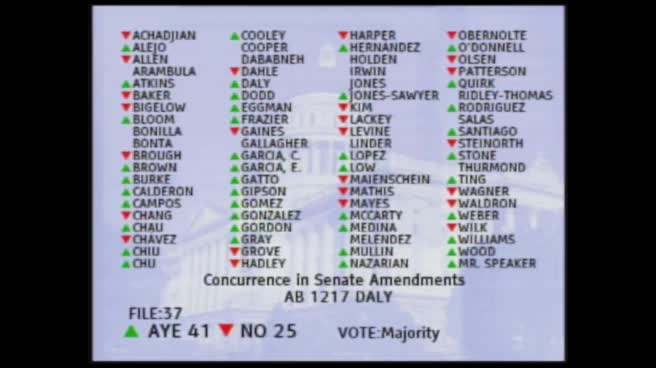
Bill Author
Bill Co-Author(s):