AB 2664: University of California: innovation and entrepreneurship expansion.
- Session Year: 2015-2016
- House: Assembly
- Latest Version Date: 2016-09-30
Existing law establishes the University of California, under the administration of the Regents of the University of California, as one of the segments of public postsecondary education in this state. The University of California comprises 10 campuses, which are located at Berkeley, Davis, Irvine, Los Angeles, Merced, Riverside, San Diego, San Francisco, Santa Barbara, and Santa Cruz.
This bill would require the University of California to make one-time expenditures for activities to expand or accelerate economic development in the state in ways that are aligned with other efforts to support innovation and entrepreneurship. The bill would identify a specific funding source in the Budget Act of 2016 appropriated for that purpose and would allocate $2,200,000 under that appropriation to each of 10 campuses of the University of California. The bill would require the regents to designate an external advisory board, as provided, to encourage the effective use of these funds through planning and oversight and would prohibit a campus from expending these funds unless the external advisory body has certified that the chancellor of that campus has made certain demonstrations, including, among others, that funds will only be used for the costs of activities that support the expansion or acceleration of economic development in the state and that private funds that at least match the amount of state funds will also be used on those activities. The bill would require the University of California to report to the Department of Finance and the Legislature on or before November 30, 2017, on the specific activities at each campus supported by these funds.
Existing law establishes the University of California, under the administration of the Regents of the University of California, as one of the segments of public postsecondary education in this state. The University of California comprises 10 campuses, which are located at Berkeley, Davis, Irvine, Los Angeles, Merced, Riverside, San Diego, San Francisco, Santa Barbara, and Santa Cruz, and other facilities operated by the university, including the Lawrence Berkeley National Laboratory (LBNL). Cruz.
This bill would require the University of California to expand the infrastructure necessary to increase innovation and entrepreneurship activities across the state for the purpose of creating economic development. The bill would specify that funds appropriated for that purpose shall be used to fund innovation and entrepreneurship programs as each of the universitys campuses, the LBNL, and in other areas of the state that may benefit from those programs, but would require the university to determine the manner in which the funding would be used, consistent with the bills provisions. In implementing these provisions, the bill would require the university to consult with public and private stakeholders and to design programs to enhance, not necessarily duplicate, the states network of innovation-based business development programs and services. make one-time expenditures for activities to expand or accelerate economic development in the state in ways that are aligned with other efforts to support innovation and entrepreneurship. The bill would identify a specific funding source in the Budget Act of 2016 appropriated for that purpose and would allocate $2,200,000 under that appropriation to each of 10 campuses of the University of California. The bill would require the regents to designate an external advisory board, as provided, to encourage the effective use of these funds through planning and oversight and would prohibit a campus from expending these funds unless the external advisory body has certified that the chancellor of that campus has made certain demonstrations, including, among others, that funds will only be used for the costs of activities that support the expansion or acceleration of economic development in the state and that private funds that at least match the amount of state funds will also be used on those activities. The bill would require the University of California to report to the Department of Finance and the Legislature annually on the use of the funding provided for purposes of the bill, as specified. The bill would make implementation of its provisions contingent on an appropriation for its purposes in the annual Budget Act. on or before November 30, 2017, on the specific activities at each campus supported by these funds.
Existing law establishes the University of California, under the administration of the Regents of the University of California, as one of the segments of public postsecondary education in this state. The University of California comprises 10 campuses, which are located at Berkeley, Davis, Irvine, Los Angeles, Merced, Riverside, San Diego, San Francisco, Santa Barbara, and Santa Cruz, and other facilities operated by the university, including the Lawrence Berkeley National Laboratory. Laboratory (LBNL).
This bill would provide funding to require the University of California to expand the infrastructure necessary to increase innovation and entrepreneurship activities across the state for the purpose of creating economic development. The bill would specify that funds appropriated for that purpose shall be used to fund innovation and entrepreneurship programs as each of the universitys campuses, the LBNL, and in other areas of the state that may benefit from those programs, but would require the university to determine the manner in which the funding provided under the bill could be used by the University of California. would be used, consistent with the bills provisions. In implementing these provisions, the bill would require the university to consult with public and private stakeholders and to design programs to enhance, not necessarily duplicate, the states network of innovation-based business development programs and services. The bill would require the University of California to report to the Department of Finance and the Legislature annually on the use of the funding provided for purposes of the bill. bill, as specified. The bill would make implementation of its provisions contingent on an appropriation for its purposes in the annual Budget Act.
The bill would appropriate $66,000,000 from the General Fund to the Regents of the University of California for allocation, for purposes of the bill, in equal amounts in the 3 fiscal years from 201718 to 201920, inclusive.
Existing law establishes the University of California, under the administration of the Regents of the University of California, as one of the segments of public postsecondary education in this state. The University of California comprises 10 campuses, which are located at Berkeley, Davis, Irvine, Los Angeles, Merced, Riverside, San Diego, San Francisco, Santa Barbara, and Santa Cruz, and other facilities operated by the university, including the Lawrence Berkeley National Laboratory.
This bill would provide funding to the University of California to expand the infrastructure necessary to increase innovation and entrepreneurship for the purpose of creating economic development. The bill would specify the manner in which funding provided under the bill could be used by the University of California. The bill would require the University of California to report to the Department of Finance and the Legislature annually on the use of the funding provided for purposes of the bill.
The bill would appropriate $66,000,000 from the General Fund to the Regents of the University of California for allocation, for purposes of the bill, in equal amounts in the 3 fiscal years from 201718 to 201920, inclusive.
Existing law, the Ortiz-Pacheco-Poochigian-Vasconcellos Cal Grant Program (Cal Grant Program), establishes the Cal Grant A and B Entitlement Awards, the California Community College Transfer Entitlement Awards, the Competitive Cal Grant A and B Awards, the Cal Grant C Awards, and the Cal Grant T Awards under the administration of the Student Aid Commission, and establishes eligibility requirements for awards under these programs for participating students attending qualifying institutions.
This bill would make a technical, nonsubstantive change to the provision that establishes the Cal Grant Program.
With respect to innovation and entrepreneurship by those connected to the University of California, the Legislature finds and declares all of the following:
(a)The State of California is well-positioned to harness the power of the University of Californias expertise to spur economic development.
(b)The University of California contributed to the launch and growth of some of Californias strongest industries, including aerospace, agriculture, biotechnology, computers and semiconductors, telecommunications, and digital media.
(c)Instruction and research at the University of California can be the genesis of tomorrows industries, companies, and commercial successes.
(d)As a public institution of higher education, the University of California is positioned to address challenges faced by entrepreneurschallenges that are particularly acute for groups such as women and minorities who are typically underrepresented in private incubators and accelerators.
(e)It is therefore the intent of the Legislature to provide one-time funds for new infrastructure at each campus to (1) enhance the states network of programs and services that support innovators, entrepreneurs, startups, investors, and industry and community partners that are locally based and committed to serving in communities across California and (2) generate commitments of private funds for these activities in an amount at least equal to the amount of state funds.
SEC. 2.Chapter 14.5 (commencing with Section 92965) is added to Part 57 of Division 9 of Title 3 of the Education Code, to read:14.5.Innovation and Entrepreneurship Expansion92965.(a)With funds appropriated in Item 6440-001-0001 of Section 2.00 of the Budget Act of 2016, the University of California shall make one-time expenditures for activities to expand or accelerate economic development in the state in ways that are aligned with other efforts to support innovation and entrepreneurship.
(b)From the funds specified in subdivision (a), two million two hundred thousand dollars ($2,200,000) shall be allocated to each of the following campuses of the University of California:
(1)Berkeley.
(2)Davis.
(3)Irvine.
(4)Los Angeles.
(5)Merced.
(6)Riverside.
(7)San Diego.
(8)San Francisco.
(9)Santa Barbara.
(10)Santa Cruz.
(c)The Regents of the University of California shall designate an external advisory body, whose members have demonstrated expertise in innovation and entrepreneurship, to encourage the effective use of the funds specified in subdivision (b) through planning and oversight.
(d)A campus shall not expend the funds specified in subdivision (b) until the external advisory body has certified that the chancellor of the campus has demonstrated all of the following:
(1)That the funds will be used only for the costs of activities that support the expansion or acceleration of economic development in the state, such as any of the following benefits for entrepreneurs:
(A)Business training.
(B)Mentorship.
(C)Proof-of-concept grants.
(D)Work space.
(E)Laboratory space.
(F)Equipment.
(2)That the funds will be spent only after the uses and beneficiaries have been determined through a transparent, inclusive, and fair process.
(3)That private funds will also be used for these activities, with the intent that the amount of private funds will be at least equal to the amount specified in subdivision (b).
(4)That any financial benefit that results from the use of these funds, including any revenues generated with these funds be accounted for and also used on these activities.
(5)That a credible plan has been developed to support any ongoing activities beyond the one-time expenditures of these funds.
(e)The external advisory body shall notify the Director of Finance and the Legislature, no fewer than 10 days before providing certification pursuant to subdivision (d) of its intent to do so.
(f)(1)On or before November 30, 2017, the Regents of the University of California shall report to the Director of Finance and the Legislature on the specific activities at each campus supported by these funds.
(2)The report shall be submitted to the Legislature pursuant to Section 9795 of the Government Code.
With respect to innovation and entrepreneurship expansion at by those connected to the University of California, the Legislature finds and declares all of the following:
(a)The State of California is well-positioned to harness the power of the University of Californias expertise to spur economic development.
(b)The University of California contributed to the foundational research breakthroughs that launched launch and growth of some of Californias strongest industries, including aerospace, agriculture, biotechnology, computers and semiconductors, telecommunications, and digital media.
(c)Research Instruction and research at the University of California continues to create new inventions that will can be the genesis of tomorrows industries, companies, and commercial successes.
(d)Innovation and entrepreneurship at the University of California create equitable economic development throughout California.
(d)As a public institution of higher education, the University of California is positioned to address challenges faced by entrepreneurschallenges that are particularly acute for groups such as women and minorities who are typically underrepresented in private incubators and accelerators.
(e)It is therefore the intent of the Legislature to provide one-time funds to establish or expand the for new infrastructure at each campus and the Lawrence Berkeley National Laboratory (LBNL) for purposes of enhancing to (1) enhance the states network of programs and services that support innovators, entrepreneurs, startups, investors, and industry and community partners that are locally based and committed to serving in communities surrounding University of California campuses, the LBNL, and across California. across California and (2) generate commitments of private funds for these activities in an amount at least equal to the amount of state funds.
SEC. 2.Chapter 14.5 (commencing with Section 92965) is added to Part 57 of Division 9 of Title 3 of the Education Code, to read:14.5.Innovation and Entrepreneurship Expansion92965.(a)With funds appropriated for purposes of this chapter, in Item 6440-001-0001 of Section 2.00 of the Budget Act of 2016, the University of California shall increase innovation and entrepreneurship activities across the state for the purpose of creating economic development. make one-time expenditures for activities to expand or accelerate economic development in the state in ways that are aligned with other efforts to support innovation and entrepreneurship.
(b)The funds referenced in subdivision (a) shall be used to fund innovation and entrepreneurship programs at each campus of the University of California, the Lawrence Berkeley National Laboratory (LBNL), and in other areas of the state that may benefit from these programs.
(c)The manner in which the funds provided for purposes of this chapter will be used shall be determined by the University of California. These uses may include, but shall not necessarily be limited to, the establishment of programs or projects and the purchase of equipment to facilitate innovation-based economic development in communities surrounding the 10 campuses of the University of California, the LBNL, and other locations across California for purposes such as any of the following:
(1)Providing business training and resources to reduce common barriers to success for entrepreneurs and startup companies.
(2)Offering subsidized work and laboratory space to startups for prototype development, proof-of-concept research, or both.
(3)Providing proof-of-concept funding to increase the likelihood that entrepreneurs and startup companies will attract venture or corporate capital backing.
(4)Providing mentorship, including mentorship to individuals from population groups who have historically been underrepresented in science and innovation-based industries.
(5)Coordinating and aligning innovation functions at a campus of the university or at the LBNL, and building relationships between the university environment and successful, independent enterprises to facilitate the rollout of products to the market and the public.
(d)In implementing this chapter, the University of California shall design programs to enhance, not necessarily duplicate, the states network of innovation-based business development programs and services. The University of California shall also consult with public and private stakeholders when implementing this chapter in order to ensure programs authorized by this chapter strengthen the states entrepreneurial capacity and global competitiveness. This may include new partnerships and initiatives with public and private economic development entities, including, but not limited to, local and regional economic development corporations, small business development centers, business accelerators, and Innovation Hubs.
(b)From the funds specified in subdivision (a), two million two hundred thousand dollars ($2,200,000) shall be allocated to each of the following campuses of the University of California:
(1)Berkeley.
(2)Davis.
(3)Irvine.
(4)Los Angeles.
(5)Merced.
(6)Riverside.
(7)San Diego.
(8)San Francisco.
(9)Santa Barbara.
(10)Santa Cruz.
(c)The Regents of the University of California shall designate an external advisory body, whose members have demonstrated expertise in innovation and entrepreneurship, to encourage the effective use of the funds specified in subdivision (b) through planning and oversight.
(d)A campus shall not expend the funds specified in subdivision (b) until the external advisory body has certified that the chancellor of the campus has demonstrated all of the following:
(1)That the funds will be used only for the costs of activities that support the expansion or acceleration of economic development in the state, such as any of the following benefits for entrepreneurs:
(A)Business training.
(B)Mentorship.
(C)Proof-of-concept grants.
(D)Work space.
(E)Laboratory space.
(F)Equipment.
(2)That the funds will be spent only after the uses and beneficiaries have been determined through a transparent, inclusive, and fair process.
(3)That private funds will also be used for these activities, with the intent that the amount of private funds will be at least equal to the amount specified in subdivision (b).
(4)That any financial benefit that results from the use of these funds, including any revenues generated with these funds be accounted for and also used on these activities.
(5)That a credible plan has been developed to support any ongoing activities beyond the one-time expenditures of these funds.
(e)The external advisory body shall notify the Director of Finance and the Legislature, no fewer than 10 days before providing certification pursuant to subdivision (d) of its intent to do so.
(f)(1)On or before November 30, 2017, the Regents of the University of California shall report to the Director of Finance and the Legislature on the specific activities at each campus supported by these funds.
(2)The report shall be submitted to the Legislature pursuant to Section 9795 of the Government Code.
92966.(a)The University of California shall report to the Department of Finance and the Legislature annually on the use of the funding provided for purposes of this chapter.
(b)(1)The annual report shall include, at a minimum, all of the following:
(A)The number of businesses and entrepreneurs assisted.
(B)The industry sectors of the businesses and entrepreneurs assisted.
(C)The cities in which the businesses and entrepreneurs assisted are located. For businesses or entrepreneurs assisted in cities with a population of less than 250,000, only the county shall be listed.
(D)The number of total employees employed by the businesses and entrepreneurs assisted at the time those businesses and entrepreneurs were assisted, based on the following categories, whichever is the most appropriate:
(i)No employees.
(ii)Five employees or fewer.
(iii)Twenty employees or fewer.
(iv)Under 50 employees.
(v)Under 100 employees.
(vi)Under 500 employees.
(E)The number of jobs created and the number of jobs retained.
(F)The amount of capital infusion, in both debt and equity, obtained by businesses and entrepreneurs assisted.
(2)Subparagraphs (D) to (F), inclusive, shall be reported on an aggregated basis.
(c)The annual report shall comply with Section 9795 of the Government Code.
92967.This chapter shall not be implemented unless funds are appropriated for its purposes in the annual Budget Act.
With respect to innovation and entrepreneurship expansion at the University of California, the Legislature finds and declares all of the following:
(a)The State of California is well-positioned to harness the power of the University of Californias expertise to spur economic development.
(b)The University of California contributed to the foundational research breakthroughs that launched some of Californias strongest industries, including aerospace, agriculture, biotechnology, computers and semiconductors, telecommunications, and digital media.
(c)Research at the University of California continues to create new inventions that will be the genesis of tomorrows industries, companies, and commercial successes.
(d)Innovation and entrepreneurship at the University of California create equitable economic development throughout California.
(e)It is therefore the intent of the Legislature to provide funds to establish or expand the infrastructure at each campus and the Lawrence Berkeley National Laboratory (LBNL) to expand infrastructure necessary to build a network of for purposes of enhancing the states network of programs and services that support innovators, entrepreneurs, startups, investors, and industry and community partners to spur innovation and economic development in communities surrounding University of California campuses, the LBNL, and across California.
SEC. 2.Chapter 14.5 (commencing with Section 92965) is added to Part 57 of Division 9 of Title 3 of the Education Code, to read:14.5.Innovation and Entrepreneurship Expansion92965.(a)Moneys to be appropriated for this chapter shall be used by With funds appropriated for purposes of this chapter, the University of California to expand the infrastructure necessary to shall increase innovation and entrepreneurship activities across the state for the purpose of creating economic development.
(b)The funds referenced in subdivision (a) shall be used to fund innovation and entrepreneurship programs at each campus of the University of California and California, the Lawrence Berkeley National Laboratory (LBNL). (LBNL), and in other areas of the state that may benefit from these programs.
(c)The manner in which the funds provided for purposes of this chapter will be used shall be determined by the University of California. These uses may include, but shall not necessarily be limited to, the establishment of programs or projects and the purchase of equipment to facilitate innovation-based economic development in communities surrounding the 10 campuses of the University of California, the LBNL, and other locations across California for purposes such as any of the following:
(1)Providing business training and resources to reduce common barriers to success for entrepreneurs and startup companies.
(2)Offering subsidized work and laboratory space to startups for prototype development, proof-of-concept research, or both.
(3)Providing proof-of-concept funding to increase the likelihood that entrepreneurs and startup companies will attract venture or corporate capital backing.
(4)Providing mentorship to the underrepresented interested in entrepreneurial pursuits. mentorship, including mentorship to individuals from population groups who have historically been underrepresented in science and innovation-based industries.
(5)Coordinating and aligning innovation functions at a campus of the university or at the LBNL, and building relationships between the university environment and successful, independent enterprises to facilitate the rollout of products to the market and the public.
(d)In implementing this chapter, the University of California shall design programs to enhance, not necessarily duplicate, the states network of innovation-based business development programs and services. The University of California shall also consult with public and private stakeholders when implementing this chapter in order to ensure programs authorized by this chapter strengthen the states entrepreneurial capacity and global competitiveness. This may include new partnerships and initiatives with public and private economic development entities, including, but not limited to, local and regional economic development corporations, small business development centers, business accelerators, and Innovation Hubs.
92966.(a)The University of California shall report to the Department of Finance and the Legislature annually on the use of the funding provided for purposes of this chapter. This(b)(1)The annual report shall include, at a minimum, all of the following:
(A)The number of businesses and entrepreneurs assisted.
(B)The industry sectors of the businesses and entrepreneurs assisted.
(C)The cities in which the businesses and entrepreneurs assisted are located. For businesses or entrepreneurs assisted in cities with a population of less than 250,000, only the county shall be listed.
(D)The number of total employees employed by the businesses and entrepreneurs assisted at the time those businesses and entrepreneurs were assisted, based on the following categories, whichever is the most appropriate:
(i)No employees.
(ii)Five employees or fewer.
(iii)Twenty employees or fewer.
(iv)Under 50 employees.
(v)Under 100 employees.
(vi)Under 500 employees.
(E)The number of jobs created and the number of jobs retained.
(F)The amount of capital infusion, in both debt and equity, obtained by businesses and entrepreneurs assisted.
(2)Subparagraphs (D) to (F), inclusive, shall be reported on an aggregated basis.
(c)The annual report shall comply with Section 9795 of the Government Code.
92967.This chapter shall not be implemented unless funds are appropriated for its purposes in the annual Budget Act.
SEC. 3.The sum of sixty-six million dollars ($66,000,000) is appropriated from the General Fund to the Regents of the University of California for allocation, for purposes of Chapter 14.5 (commencing with Section 92965) of Part 57 of Division 9 of Title 3 of the Education Code, in accordance with the following schedule:
(a)Twenty-two million dollars ($22,000,000) for expenditure for the 201718 fiscal year.
(b)Twenty-two million dollars ($22,000,000) for expenditure for the 201819 fiscal year.
(c)Twenty-two million dollars ($22,000,000) for expenditure for the 201920 fiscal year.
With respect to innovation and entrepreneurship expansion at the University of California, the Legislature finds and declares all of the following:
(a)The State of California is well-positioned to harness the power of the University of Californias expertise to spur economic development.
(b)The University of California contributed to the foundational research breakthroughs that launched some of Californias strongest industries, including aerospace, agriculture, biotechnology, computers and semiconductors, telecommunications, and digital media.
(c)Research at the University of California continues to create new inventions that will be the genesis of tomorrows industries, companies, and commercial successes.
(d)Innovation and entrepreneurship at the University of California create equitable economic development throughout California.
(e)It is therefore the intent of the Legislature to provide funds to establish or expand the infrastructure at each campus and the Lawrence Berkeley National Laboratory (LBNL) to expand infrastructure necessary to build a network of innovators, entrepreneurs, startups, investors, and industry and community partners to spur innovation and economic development in communities surrounding University of California campuses, the LBNL, and across California.
SEC. 2.Chapter 14.5 (commencing with Section 92965) is added to Part 57 of Division 9 of Title 3 of the Education Code, to read:14.5.Innovation and Entrepreneurship Expansion92965.(a)Moneys to be appropriated for this chapter shall be used by the University of California to expand the infrastructure necessary to increase innovation and entrepreneurship for the purpose of creating economic development.
(b)The funds referenced in subdivision (a) shall be used to fund innovation and entrepreneurship programs at each campus of the University of California and the Lawrence Berkeley National Laboratory (LBNL).
(c)The manner in which the funds provided for purposes of this chapter will be used shall be determined by the University of California. These uses may include, but shall not necessarily be limited to, the establishment of programs or projects to facilitate economic development in communities surrounding the 10 campuses of the University of California, the LBNL, and other locations across California for purposes such as any of the following:
(1)Providing business training and resources to reduce common barriers to success for entrepreneurs and startup companies.
(2)Offering subsidized work and laboratory space to startups for prototype development, proof-of-concept research, or both.
(3)Providing proof-of-concept funding to increase the likelihood that entrepreneurs and startup companies will attract venture or corporate capital backing.
(4)Providing mentorship to the underrepresented interested in entrepreneurial pursuits.
(5)Coordinating and aligning innovation functions at a campus of the university or at the LBNL, and building relationships between the university environment and successful, independent enterprises to facilitate the rollout of products to the market and the public.
92966.The University of California shall report to the Department of Finance and the Legislature annually on the use of the funding provided for purposes of this chapter. This annual report shall comply with Section 9795 of the Government Code.
SEC. 3.The sum of sixty-six million dollars ($66,000,000) is appropriated from the General Fund to the Regents of the University of California for allocation, for purposes of Chapter 14.5 (commencing with Section 92965) of Part 57 of Division 9 of Title 3 of the Education Code, in accordance with the following schedule:
(a)Twenty-two million dollars ($22,000,000) for expenditure for the 201718 fiscal year.
(b)Twenty-two million dollars ($22,000,000) for expenditure for the 201819 fiscal year.
(c)Twenty-two million dollars ($22,000,000) for expenditure for the 201920 fiscal year.
SECTION 1.Section 69431 of the Education Code is amended to read:69431.There is hereby established the Ortiz-Pacheco-Poochigian-Vasconcellos Cal Grant Program, which may be referred to as the Cal Grant Program.
There is hereby established the Ortiz-Pacheco-Poochigian-Vasconcellos Cal Grant Program, which may also be referred to as the Cal Grant Program.
|
Date
|
Status
|
|---|---|
| May 31, 2016 | Read third time. Passed. Ordered to the Senate. (Ayes 80. Noes 0.) |
| Sep 2, 2016 | Enrolled and presented to the Governor at 12 p.m. |
| Aug 24, 2016 | Senate amendments concurred in. To Engrossing and Enrolling. (Ayes 80. Noes 0. Page 6199.). |
| Aug 24, 2016 | Senate amendments concurred in. To Engrossing and Enrolling. |
| Aug 19, 2016 | In Assembly. Concurrence in Senate amendments pending. May be considered on or after August 21 pursuant to Assembly Rule 77. |
| Aug 18, 2016 | Read third time. Passed. Ordered to the Assembly. (Ayes 38. Noes 0.). |
| Aug 18, 2016 | Read third time. Passed. Ordered to the Assembly. (Ayes 38. Noes 0. Page 5114.). |
| Aug 18, 2016 | Read third time. Passed. Ordered to the Assembly. |
| Aug 15, 2016 | Read second time. Ordered to third reading. |
| Aug 11, 2016 | From committee: Do pass. (Ayes 7. Noes 0.) (August 11). |
| Aug 1, 2016 | In committee: Referred to APPR. suspense file. |
| Jun 29, 2016 | From committee: Do pass and re-refer to Com. on APPR. (Ayes 9. Noes 0.) (June 29). Re-referred to Com. on APPR. |
| Jun 22, 2016 | From committee chair, with author's amendments: Amend, and re-refer to committee. Read second time, amended, and re-referred to Com. on ED. |
| Jun 13, 2016 | In committee: Hearing postponed by committee. |
| Jun 9, 2016 | Referred to Com. on ED. |
| Jun 1, 2016 | In Senate. Read first time. To Com. on RLS. for assignment. |
| Feb 19, 2016 | Introduced. To print. |
| May 31, 2016 | Read third time. Passed. Ordered to the Senate. (Ayes 80. Noes 0. Page 5041.) |
| May 31, 2016 | Read third time. Passed. Ordered to the Senate. |
| May 27, 2016 | Read second time. Ordered to third reading. |
| May 27, 2016 | From committee: Do pass. (Ayes 20. Noes 0.) (May 27). |
| May 11, 2016 | In committee: Set, first hearing. Referred to APPR. suspense file. |
| Apr 27, 2016 | Re-referred to Com. on APPR. |
| Apr 26, 2016 | Read second time and amended. |
| Apr 25, 2016 | From committee: Amend, and do pass as amended and re-refer to Com. on APPR. (Ayes 9. Noes 0.) (April 19). |
| Apr 13, 2016 | From committee: Do pass and re-refer to Com. on J., E.D., & E. (Ayes 12. Noes 1.) (April 12). Re-referred to Com. on J., E.D., & E. |
| Mar 28, 2016 | Re-referred to Com. on HIGHER ED. |
| Mar 17, 2016 | Referred to Coms. on HIGHER ED. and J., E.D., & E. |
| Mar 17, 2016 | From committee chair, with author's amendments: Amend, and re-refer to Com. on HIGHER ED. Read second time and amended. |
| Feb 22, 2016 | Read first time. |
| Feb 21, 2016 | From printer. May be heard in committee March 22. |
|
Date
|
Description
|
Location
|
Votes
|
|
|---|---|---|---|---|
| Aug 24, 2016 | AB 2664 IRWIN Concurrence in Senate Amendments | Assembly Floor |
Passed |
|
| Aug 18, 2016 | Assembly 3rd Reading AB2664 Irwin By Roth | Senate Floor |
Passed |
|
| Aug 11, 2016 | Do pass | Senate Standing Committee on Appropriations |
Passed |
|
| Aug 1, 2016 | Placed on suspense file | Senate Standing Committee on Appropriations |
Passed |
|
| Jun 29, 2016 | Do pass, but first be re-referred to the Committee on [Appropriations] | Senate Standing Committee on Education |
Passed |
|
| May 31, 2016 | AB 2664 IRWIN Assembly Third Reading | Assembly Floor |
Passed |
|
| May 27, 2016 | Do pass. | Assembly Standing Committee on Appropriations |
Passed |
|
| Apr 19, 2016 | Do pass as amended and be re-referred to the Committee on [Appropriations] | Assembly Standing Committee on Jobs, Economic Development, and the Economy |
Passed |
|
| Apr 12, 2016 | Do pass and be re-referred to the Committee on [Jobs, Economic Development, and the Economy] | Assembly Standing Committee on Higher Education |
Passed |
This list shows positions taken on this bill by organizations on the date displayed, which is linked to the original source.
Positions by individuals are not included.
|
Organization
|
Position
|
Date
|
|---|---|---|
| 23ANDME | ** Support | May 11, 2016 |
| Aduro Biotech | ** Support | May 11, 2016 |
| Aptitude Medical | ** Support | May 11, 2016 |
| Arduro Biotech | ** Support | May 11, 2016 |
| Bay Area Science and Innovation Consortium | ** Support | May 11, 2016 |
| Bayer | ** Support | May 11, 2016 |
| Breakout Labs | ** Support | May 11, 2016 |
| Calaveras Creek Capital | ** Support | May 11, 2016 |
| California Chamber Of Commerce | ** Support | Aug 18, 2016 |
| California Manufacturers And Technology Association | ** Support | Aug 18, 2016 |
| Center of Seed Excellence and Innovation | ** Support | May 11, 2016 |
| Chamber of Commerce Alliance of Ventura and Santa Barbara County | * Indeterminate | Jun 29, 2016 |
| City of Goleta | ** Support | May 11, 2016 |
| Computing Technology Industry Association | ** Support | Aug 18, 2016 |
| Data Collective | ** Support | May 11, 2016 |
| Gavin Newsom, Lieutenant Governor | ** Support | May 11, 2016 |
| Gerson Bakar Foundation | ** Support | May 11, 2016 |
| Goleta Entrepreneurial Magnet | ** Support | May 11, 2016 |
| Inevitable Ventures | ** Support | May 11, 2016 |
| InterPacific | ** Support | May 11, 2016 |
| Lake Tahoe South Shore Chamber of Commerce | ** Support | Aug 18, 2016 |
| Los Angeles Business Council | ** Support | May 11, 2016 |
| Manitou Ventures | ** Support | May 11, 2016 |
| Mars Incorporated | * Indeterminate | Jun 29, 2016 |
| McCue and Koepke | * Support | May 11, 2016 |
| Monterey County Business Council | ** Support | May 11, 2016 |
| Next Energy Technologies | ** Support | May 11, 2016 |
| Pfizer Inc. | ** Support | May 11, 2016 |
| Professor Alan Heeger, UCSB | ** Support | May 11, 2016 |
| Professor Shuji Nakamura, UCSB | ** Support | May 11, 2016 |
| San Francisco Chamber of Commerce | ** Support | May 11, 2016 |
| San Francisco Global Trade Council | ** Support | May 11, 2016 |
| Santa Cruz, City Of | ** Support | May 11, 2016 |
| Solano Economic Development Corporation | ** Support | May 11, 2016 |
| Stanford Bio-X program | ** Support | May 11, 2016 |
| Synergenics | ** Support | May 11, 2016 |
| Technet | ** Support | Aug 18, 2016 |
| The InterPacific Group | ** Support | May 11, 2016 |
| u None received. | ** Against | Jun 29, 2016 |
| University of California | ** Support | Aug 18, 2016 |
| Velocity Venture Capital | ** Support | May 11, 2016 |
| Vio Com | * Support | May 11, 2016 |
CONCURRENCE IN SENATE AMENDMENTS
CSA1 Bill Id:AB 2664
Author:(Irwin)
As Amended Ver:June 22, 2016
Majority vote
ASSEMBLY: | 80-0 | (May 31, 2016) | SENATE: | 38-0 | (August 18, 2016) |
Original Committee Reference: HIGHER ED.
SUMMARY: Requires the University of California (UC) to make one-time expenditures on activities, using the $22 million General Fund provided in the Budget Act of 2016, to expand or accelerate economic development in the state in ways that support innovation and entrepreneurship.
The Senate amendments do all of the following:
- Identify a specific funding source in the Budget Act of 2016 and allocates $2 million from that source to each of the 10 campuses of the UC.
- Require the UC Regents to designate an external advisory body, whose members have demonstrated expertise innovation and entrepreneurship, to encourage the effective use of specified funds through planning and oversight; and specify that the external advisory body must notify the Director of Finance and the Legislature of its intent to certify, no fewer than 10 days before providing certification.
- Prohibit a campus from expending funds until the external advisory body has certified that the chancellor of the campus has demonstrated all of the following:
- That the funds will be used only for the costs of activities that support the expansion or acceleration of economic development in the state benefitting entrepreneurs, such as any of the following:
- Business training;
- Mentorship;
- Proof-of-concept grants;
- Work space;
- Laboratory space; and,
- Equipment
- That funds will be spent only after the uses and beneficiaries have been determined through a transparent, inclusive and fair process;
- That private funds will also be used for the specified activities, with the intent that the amount of private funds will be at least equal to the amount of state funds;
- That any financial benefit that results from the use of these funds be accounted for and also used on the specified activities, as described; and,
- That a credible plan has been developed to support any ongoing activities beyond the one-time expenditures of these funds.
- That the funds will be used only for the costs of activities that support the expansion or acceleration of economic development in the state benefitting entrepreneurs, such as any of the following:
- Require the UC to report to the Department of Finance and the Legislature on or before November 30, 2017, on the specific activities at each campus, as specified.
EXISTING LAW:
- Establishes the Donahoe Higher Education, setting forth the mission of the UC (Education Code (EC) Section 66010, et seq.).
- Grants the UC Regents regulatory authority over the UC (EC Section 92440, et seq.).
FISCAL EFFECT: According to the Senate Appropriations Committee:
- The Budget Act of 2016 provides $22 million one-time General Fund for innovation and entrepreneurship programs. This bill provides implementation language for those funds.
- Potential campus-level cost pressure to the extent the advisory body overseeing the use of funds is unable to certify that a chancellor of a campus has demonstrated that private funds will be used for these activities, with the intent that the amount of private funds will be at least $2.2 million. It is unclear whether expenditure of the campus' state allocation is permissible without certification of this level of private funds.
COMMENTS: Background. As the research arm of the state, the UC has driven innovation and economic growth. According to the UC, it is now the world's academic leader in the number or research inventions, with 1,700 reported in 2014. The UC continues to be the launching platform for a numerous startup companies that stimulate the economic and job growth in California.
The state, in 2000, created the California Institutes for Science and Innovation (Cal-ISIs) through the budget and legislation (AB 2883, (Villaraigosa), Chapter 79, Statutes of 2000) to speed up business growth in the state, develop research and innovations to meet California's needs, and train future scientists.
The state provided start-up funds of $400 million for the Cal-ISIs and the UC provide a 2-to-1 match from a combination of business and federal sources. The state continues to reap the benefits of its original investment.
What is needed for continued growth? According to the UC, specific investments are needed so that the pace can be maintained to keep up with the demand for innovation and entrepreneurial infrastructure, resources, and support programs. The UC contends that the investments will leverage UC research in two ways: 1) provide researchers with the necessary tools to turn their ideas into job-providing companies; and, 2) organize research systemwide in order to address the various challenges facing California.
Expanding the infrastructure for UC innovation and entrepreneurship to create innovation and economic development in the surrounding communities of UC campuses and across California will not happen overnight. The UC has a three-year investment of $2 million per year for each of the 10 UC campuses and the Lawrence Berkeley National Laboratory.
This measure calls for the appropriation of $22 million for fiscal years 2017-18, 2018-19 and 2019-20 inclusive, to be used by the UC in order for the UC to expand the infrastructure necessary to increase innovation and entrepreneurship for the purpose of creating economic development for California.
Purpose of this measure. According to the author, in 2014, active UC startups based in California employed over 19,000 Californians and brought in more than $14 billion in revenue. The author contends that in order to maximize the transformative power of UC's research engine, the UC innovation ecosystem needs to expand throughout the State. The author states, "The UC's ability to provide entrepreneurial services is at capacity. The demand for startup seed funding is rising, and workspace demand consistently exceeds capacity. While UC-fostered entrepreneurship is increasing, entrepreneurship in the state of California is declining. The number of new adults becoming entrepreneurs per month slipped from a high of 440 out of every 100,000 Californian adults in 2012, to 390 in 2015; a troubling trend as young companies are the primary source for all net new jobs created annually."
This measure seeks to build upon the successful model that the state created in 2000.
Analysis Prepared by: Jeanice Warden / HIGHER ED. / (916) 319-3960 FN: 0004238
Office of Senate Floor Analyses (916) 651-1520 Fax: (916) 327-4478 | AB |
THIRD READING
Bill No: AB 2664
:
SENATE EDUCATION COMMITTEE: 9-0, 6/29/16
AYES: Liu, Block, Hancock, Huff, Leyva, Mendoza, Monning, Pan, Vidak
SENATE APPROPRIATIONS COMMITTEE: 7-0, 8/11/16
AYES: Lara, Bates, Beall, Hill, McGuire, Mendoza, Nielsen
ASSEMBLY FLOOR: 80-0, 5/31/16 - See last page for vote
DIGEST: This bill requires the University of California (UC) to make one-time expenditures, with funds appropriated in Budget Act of 2016, for activities to expand or accelerate economic development in the state in ways that are aligned with efforts to support innovation and entrepreneurship.
Existing law:
- Establishes the UC, a public trust to be administered by the Regents of the UC and grants the Regents full powers of organization and government, subject only to such legislative control as may be necessary to insure security of its funds, compliance with the terms of its endowments, statutory requirements around competitive bidding and contracts, sales of property and the purchase of materials, goods and services. (Article IX, Section (9)(a) of the California Constitution)
- Establishes the Donahoe Higher Education, setting forth the mission and function of the UC designates, among other things, UC as the primary state-supported academic agency for research. (EC § 66010.4)
This bill requires the UC to make one-time expenditures, with funds appropriated in the Budget Act of 2016, for activities to expand or accelerate economic development in the state in ways that are aligned with efforts to support innovation and entrepreneurship. Specifically, it:
- Identifies a specific funding source in the Budget Act of 2016 and allocates $2 million from that source to each of the 10 campuses of the UC.
- Requires the Regents of the UC to designate an external advisory body, whose members have demonstrated expertise innovation and entrepreneurship, to encourage the effective use of specified funds through planning and oversight. The external advisory body must notify the Director of Finance and the Legislature of its intent to certify, no fewer than 10 days before providing certification.
- Prohibits a campus from expending funds until the external advisory body has certified that the chancellor of the campus has demonstrated all of the following:
- That the funds will be used only for the costs of activities that support the expansion or acceleration of economic development in the state benefitting entrepreneurs, such as any of the following:
- Business training.
- Mentorship.
- Proof-of-concept grants.
- Work space.
- Laboratory space.
- Equipment.
- That funds will be spent only after the uses and beneficiaries have been determined through a transparent, inclusive and fair process.
- That private funds will also be used for the specified activities, with the intent that the amount of private funds will be at least equal to the amount of state funds.
- That any financial benefit that results from the use of these funds be accounted for and also used on the specified activities, as described.
- That a credible plan has been developed to support any ongoing activities beyond the one-time expenditures of these funds.
- That the funds will be used only for the costs of activities that support the expansion or acceleration of economic development in the state benefitting entrepreneurs, such as any of the following:
- Requires the UC to report to the Department of Finance and the Legislature on or before November 30, 2017, on the specific activities at each campus, as specified.
- Makes various findings and declarations relative to the UC’s position in addressing challenges faced by entrepreneurs that are particularly acute for underrepresented groups and the state’s ability to harness the power of the UC’s expertise in this field to spur economic development.
- States that it is the intent of the Legislature to:
- Provide one-time funds for new infrastructure at each campus.
- Enhance the state’s network of programs and services that support innovators, entrepreneurs, startups, investors, and industry and community partners that are locally based and committed to serving in communities across California.
- Generate commitments of private funds for these activities in the amount at least equal to the amount of state funds.
Comments
- Need for the bill. The Budget bill, SB 826 (Leno, Budget Act of 2016), provides $22 million for innovation and entrepreneurship efforts at the UC. This bill provides implementation language for that purpose. According to the author, “the goal of the funding is to aid researchers who have innovations that can be taken to market by providing the institutional resources and expertise needed to get it to the next level.” The author contends that entrepreneurship in California is declining and investments are needed in order to keep pace with the demand for innovation and entrepreneurial infrastructure, resources and support programs. This bill seeks to leverage UC research to spur economic development in the state by laying a foundation for innovation and entrepreneurship at each UC campus.
- Related activities at the UC. The UC system, as the research arm of the state, has historically played a significant and foundational role within California's innovation-based industries. In 2000, the state through AB 2883 (Villaraigosa, Chapter 79, Statutes of 2000) established the California Institutes for Science and Innovation (Cal-ISIs) at the UC for the purpose of accelerating business growth in the state, developing research and innovations to meet California’s needs and training future scientist. At that time, the state provided start-up funds of $400 million for the Cal-ISIs with the UC providing a 2-to-1 match from a combination of business and federal sources. Four centers were established as a result of this investment, which include the following:
- Center for Information Technology Research in the Interests of Society (CITRIS) which is headquartered at UC, Berkeley with partnerships and collaborations to researchers at UC, Santa Cruz, UC, Davis, UC, Merced and over 60 corporations. It creates information technology solutions for pressing social, environmental and healthcare problems. Research at CITRIS focuses on four core initiatives: Energy, Health Care, Intelligent Infrastructure, and Data and Democracy.
- California Nanosystems Institute at UC, Los Angeles and UC, Berkeley seeks technological breakthroughs by understanding of how to manipulate, control and manufacture at the nanometer scale. Control of material at this scale allows for compact, complex and multifunctional systems at the macro-scale that can dramatically improve present-day communications, computation, medical therapies and environmental remediation.
- California Institute for Telecom and Information Technology at UC, San Diego and UC, Irvine focuses its research on Enabling Technologies (Wireless, Photonics, Cyber infrastructure, Nanotechnology/MEMS) to realize the goals of its socially relevant Application Thrusts (Culture, Energy, Environment, Health).
- California Institute for Quantitative Biosciences (QB3) at UC, Berkeley, UC, San Francisco, UC, Santa Cruz and UC, Davis covers the “quantitative biosciences,” meeting challenges in molecular biology using the techniques of physics, chemistry, and computer sciences. This enables UC to convert life science research into solutions for better health, a sustainable environment, and a dynamic economy. QB3 has built a matrix of support for entrepreneurs that include a renowned incubator network and a venture capital fund.
The state continues to reap the benefits of this original investment. For example the QB3 program has helped to incorporated over 250 companies, provided work space for over 100 companies and raised $36 million in seed venture funds. In 2014, active UC startups based in California employed over 19,000 Californians and brought in more than $14 million in revenue.
In addition to using state funds for similar activities, this bill requires UC to generate commitments of private monies and encourages that the amount of private funds match the amount of state funds.
- Related budget activity. The Budget Act of 2016 includes $22 million on a one-time basis for innovation and entrepreneurship. As noted, this bill provides implementation language for those funds.
Related/Prior Legislation
SB 826 (Leno, Budget Act of 2016) provides $22 million in a one-time basis for innovation and entrepreneurship programs pursuant to legislation enacted in the 2015–16 legislative session.
AB 2883 (Villaraigosa, Chapter 79, Statutes of 2000) authorized the UC and established three, competitively bid, Cal-ISIs, which would be devoted to basic and applied cross-disciplinary research, focusing on problems of significant scale and on scientific advances that may provide the underpinnings of future economic activity in California.
FISCAL EFFECT: Appropriation: Fiscal Com.: Local:
According to the Senate Appropriations Committee, the Budget Act of 2016 provides $22 million one-time General Fund for innovation and entrepreneurship programs. This bill provides implementation language for those funds. There is potential campus-level cost pressure to the extent the advisory body overseeing the use of funds is unable to certify that a chancellor of a campus has demonstrated that private funds will be used for these activities, with the intent that the amount of private funds will be at least $2.2 million. It is unclear whether expenditure of the campus’ state allocation is permissible without certification of this level of private funds.
California Chamber of Commerce
California Manufacturers and Technology Association
Computing Technology Industry Association
Lake Tahoe South Shore Chamber of Commerce
TechNet
University of California
OPPOSITION: (Verified 8/11/16)
None received
ASSEMBLY FLOOR: 80-0, 5/31/16
AYES: Achadjian, Alejo, Travis Allen, Arambula, Atkins, Baker, Bigelow, Bloom, Bonilla, Bonta, Brough, Brown, Burke, Calderon, Campos, Chang, Chau, Chávez, Chiu, Chu, Cooley, Cooper, Dababneh, Dahle, Daly, Dodd, Eggman, Frazier, Beth Gaines, Gallagher, Cristina Garcia, Eduardo Garcia, Gatto, Gipson, Gomez, Gonzalez, Gordon, Gray, Grove, Hadley, Harper, Roger Hernández, Holden, Irwin, Jones, Jones-Sawyer, Kim, Lackey, Levine, Linder, Lopez, Low, Maienschein, Mathis, Mayes, McCarty, Medina, Melendez, Mullin, Nazarian, Obernolte, O'Donnell, Olsen, Patterson, Quirk, Ridley-Thomas, Rodriguez, Salas, Santiago, Steinorth, Mark Stone, Thurmond, Ting, Wagner, Waldron, Weber, Wilk, Williams, Wood, Rendon
8/15/16 20:22:29
**** END ****
SENATE COMMITTEE ON
Senator Ricardo Lara, Chair
2015 - 2016 Regular Session
AB 2664 (Irwin) - University of California: innovation and entrepreneurship expansion
Version: | Policy Vote: |
Urgency: | Mandate: |
Hearing Date: | Consultant: |
This bill meets the criteria for referral to the Suspense File.
Bill Summary:
This bill requires University of California (UC) to make one-time expenditures on activities, using the $22 million General Fund provided in the Budget Act of 2016, to expand or accelerate economic development in the state in ways that support innovation and entrepreneurship.
Fiscal Impact:
- The Budget Act of 2016 provides $22 million one-time General Fund for innovation and entrepreneurship programs. This bill provides implementation language for those funds.
- Potential campus-level cost pressure to the extent the advisory body overseeing the use of funds is unable to certify that a chancellor of a campus has demonstrated that private funds will be used for these activities, with the intent that the amount of private funds will be at least $2.2 million. It is unclear whether expenditure of the campus’ state allocation is permissible without certification of this level of private funds.
Background:
Existing law establishes the UC as the primary state-supported academic agency for research. According to the UC, as of June 30, 2014, it has almost 12,000 active inventions, almost 4,500 active U.S. patents; generated $118 million in royalty and fee income for the fiscal year, and 843 companies were founded based on UC technologies. UC startups employ over 19,000 people and brought in $14 billion in revenue in the 2013-14 fiscal year.
In 2000, the state established the California Institutes for Science and Innovation, through AB 2883 (Villaraigosa, Chapter 79, Statutes of 2000). The state provided start-up funds of $400 million with the UC providing a two-to-one match from federal and private sources. The four institutes are jointly operated by multiple UC campuses and focus research in a number of areas including, information technology, telecommunications, nanotechnology, quantitative biosciences, and health and health care delivery.
Proposed Law:
This bill requires that $2.2 million within the UC’s General Fund budget appropriation provided in the Budget Act of 2016 be allocated to each of its 10 campuses for one-time activities to expand or accelerate economic development in the state in ways that support innovation and entrepreneurship.
The UC is required to designate an external advisory body to encourage the effective use of funds through planning and oversight. In order for a campus to spend its allocation the advisory body must certify the campus has demonstrated all of the following:
- That funds will be used only for the costs of activities that support expansion or acceleration of economic development in the state, as specified;
- That funds will be spent only after the uses and beneficiaries have been determined through a transparent, inclusive, and fair process;
- That private funds will also be used for these activities, with the intent that the amount will be at least equal to the campus’ state allocation of $2.2 million;
- That any financial benefit that results from the use of these funds be accounted for and also used on these activities; and
- That a credible plan has been developed to support any ongoing activities beyond the one-time expenditures of these funds.
The advisory body is required to notify the Director of Finance and the Legislature before providing certification of the above elements. By November 30, 2017, the UC Regents must report to the Director of Finance and the Legislature on the specific activities at each campus supported by these funds.
Staff Comments:
According to the author, “the goal of the funding is to aid researchers who have innovations that can be taken to market by providing the institutional resources and expertise needed to get it to the next level.”
Specifically, these funds would be used to support the creation of startups amongst students, faculty, and other innovators based on research already completed. This bill authorizes the use of funds on business training, mentorship, proof-of-concept grants, work space, laboratory space, and equipment.
This bill also requires the advisory body to certify that each chancellor of a campus has demonstrated a number of things, including that a credible plan has been developed to support any ongoing activities beyond the one-time expenditure of state funds. This requirement mitigates state pressure to fund ongoing activities.
-- END --
SENATE COMMITTEE ON EDUCATION
Senator Carol Liu, Chair
2015 - 2016 Regular
Bill No:
Author: | Irwin | ||
Version: | Hearing Date: June 29, 2016 | ||
Urgency: | Fiscal: | ||
Consultant: | |||
Subject:
SUMMARY
This bill requires the University of California (UC) to make one-time expenditures, with funds appropriated in Budget Act of 2016, for activities to expand or accelerate economic development in the state in ways that are aligned with efforts to support innovation and entrepreneurship.
BACKGROUND
The California Constitution establishes the UC, a public trust to be administered by the Regents of the UC and grants the Regents full powers of organization and government, subject only to such legislative control as may be necessary to insure security of its funds, compliance with the terms of its endowments, statutory requirements around competitive bidding and contracts, sales of property and the purchase of materials, goods and services. (Article IX, Section (9)(a) of the California Constitution)
Existing law establishes the Donahoe Higher Education, setting forth the mission and function of the University of California designates, among other things, UC as the primary state-supported academic agency for research. (EC § 66010.4)
ANALYSIS
This bill requires the UC to make one-time expenditures, with funds appropriated in the Budget Act of 2016, for activities to expand or accelerate economic development in the state in ways that are aligned with efforts to support innovation and entrepreneurship. Specifically it:
- Identifies a specific funding source in the Budget Act of 2016 and allocates $2 million from that source to each of the 10 campuses of the UC.
- Requires the Regents of the UC to designate an external advisory body, whose members have demonstrated expertise innovation and entrepreneurship, to encourage the effective use of specified funds through planning and oversight. The external advisory body must notify the Director of Finance and the Legislature of its intent to certify, no fewer than 10 days before providing certification.
- Prohibits a campus from expending funds until the external advisory body has certified that the chancellor of the campus has demonstrated all of the following:
- That the funds will be used only for the costs of activities that support the
expansion or acceleration of economic development in the state
benefitting entrepreneurs, such as any of the following:
- Business training.
- Mentorship.
- Proof-of-concept grants.
- Work space.
- Laboratory space.
- Equipment.
- That funds will be spent only after the uses and beneficiaries have been
determined through a transparent, inclusive and fair process.
- That private funds will also be used for the specified activities, with the
intent that the amount of private funds will be at least equal to the amount of state funds.
- That any financial benefit that results from the use of these funds be
accounted for and also used on the specified activities, as described.
- That a credible plan has been developed to support any ongoing activities
beyond the one-time expenditures of these funds.
- Requires the University of California (UC) to report to the Department of Finance and the Legislature on or before November 30, 2017, on the specific activities at each campus as specified.
- Makes various findings and declarations relative to the UC’s position in addressing challenges faced by entrepreneurs that are particularly acute for underrepresented groups and the state’s ability to harness the power of the UC’s expertise in this field to spur economic development.
- States that it is the intent of the Legislature to:
- Provide one-time funds for new infrastructure at each campus.
- Enhance the state’s network of programs and services that support innovators, entrepreneurs, startups, investors, and industry and community partners that are locally based and committed to serving in communities across California.
- Generate commitments of private funds for these activities in the amount
at least equal to the amount of state funds.
STAFF COMMENTS
- Need for the bill. The Budget bill, SB 826 (Leno, Budget Act of 2016), provides $22 million for innovation and entrepreneurship efforts at University of California (UC). This bill provides implementation language for that purpose. According to the author, “the goal of the funding is to aid researchers who have innovations that can be taken to market by providing the institutional resources and expertise needed to get it to the next level.” The author contends that entrepreneurship in California is declining and investments are needed in order to keep pace with the demand for innovation and entrepreneurial infrastructure, resources and support programs. This bill seeks to leverage UC research to spur economic development in the state by laying a foundation for innovation and entrepreneurship at each UC campus.
- Related activities at University of California.
The UC system, as the research arm of the state, has historically played a significant and foundational role within California's innovation-based industries. In 2000, the state through AB 2883 (Villaraigosa, Chapter 79, Statutes of 2000) established the California Institutes for Science and Innovation (Cal-ISIs) at the UC for the purpose of accelerating business growth in the state, developing research and innovations to meet California’s needs and training future scientist. At that time, the state provided start-up funds of $400 million for the Cal-ISIs with the UC providing a 2-to-1 match from a combination of business and federal sources. Four centers were established as a result of this investment, which include the following:
- Center for Information Technology Research in the Interests of Society (CITRIS) which is headquartered at UC, Berkeley with partnerships and collaborations to researchers at UC, Santa Cruz, UC, Davis, UC Merced and over 60 corporations. It creates information technology solutions for pressing social, environmental and healthcare problems. Research at CITRIS focuses on four core initiatives: Energy, Health Care, Intelligent Infrastructure, and Data and Democracy.
- California Nanosystems Institute at UC, Los Angeles and UC, Berkeley seeks technological breakthroughs by understanding of how to manipulate, control and manufacture at the nanometer scale. Control of material at this scale allows for compact, complex and multifunctional systems at the macro-scale that can dramatically improve present-day communications, computation, medical therapies and environmental remediation.
- California Institute for Telecom and Information Technology at UC, San Diego and UC, Irvine focuses its research on Enabling Technologies (Wireless, Photonics, Cyber infrastructure, Nanotechnology/MEMS) to realize the goals of its socially relevant Application Thrusts (Culture, Energy, Environment, Health).
- California Institute for Quantitative Biosciences (QB3) at UC, Berkeley, UC, San Francisco, UC, Santa Cruz and UC, Davis covers the “quantitative biosciences,” meeting challenges in molecular biology using the techniques of physics, chemistry, and computer sciences. This enables UC to convert life science research into solutions for better health, a sustainable environment, and a dynamic economy. QB3 has built a matrix of support for entrepreneurs that include a renowned incubator network and a venture capital fund.
The state continues to reap the benefits of this original investment. For example the QB3 program has helped to incorporated over 250 companies, provided work space for over 100 companies and raised $36 million in seed venture funds. In 2014, active UC startups based in California employed over 19,000 Californians and brought in more than $14 million in revenue.
In addition to using state funds for similar activities, this bill requires UC to generate commitments of private monies and encourages that the amount of private funds match the amount of state funds.
- Related budget activity. The Budget Act of 2016 includes $22 million on a one-time basis for innovation and entrepreneurship. As noted, this bill provides implementation language for those funds.
- Prior and related legislation.
SB 826 (Leno, Budget Act of 2016) provides $22 million in a one-time basis for innovation and entrepreneurship programs pursuant to legislation enacted in the 2015–16 legislative session.
AB 2883 (Villaraigosa, Chapter 79, Statutes of 2000) authorized the University of California and established three, competitively bid, California Institutes for Science and Innovation, which would be devoted to basic and applied cross-disciplinary research, focusing on problems of significant scale and on scientific advances that may provide the underpinnings of future economic activity in California.
SUPPORT
California Chamber of Commerce
California Manufacturer and Technology Association
Computing Technology Industry Association (CompTIA)
Late Tahoe South Shore Chamber of Commerce TechNet
University of California
OPPOSITION
None received.
-- END --
ASSEMBLY THIRD READING
ATR Bill Id:AB 2664
Author:(Irwin)
As Amended Ver:April 26, 2016
Majority vote
Committee | Votes | Ayes | Noes |
Higher Education | 12-1 | Medina, Baker, Bloom, Chávez, Irwin, Jones-Sawyer, Levine, Low, Olsen, Santiago, Weber, Williams | Linder |
Jobs | 9-0 | Eduardo Garcia, Kim, Achadjian, Brough, Brown, Chau, Chu, Gipson, Irwin | |
Appropriations | 20-0 | Gonzalez, Bigelow, Bloom, Bonilla, Bonta, Calderon, Chang, Daly, Eggman, Gallagher, Eduardo Garcia, Roger Hernández, Holden, Jones, Obernolte, Quirk, Santiago, Wagner, Weber, Wood |
|
SUMMARY: Requires the University of California (UC), subject to appropriation by the Legislature, to fund innovation and entrepreneurship programs at each UC campus and at the Lawrence Berkeley National Laboratory (LBNL), and in other areas of the state that may benefit from these programs.
EXISTING LAW:
- Establishes the Donahoe Higher Education, setting forth the mission of the UC (Education Code (EC) Section 66010, et seq.).
- Grants the UC Regents regulatory authority over the UC (EC Section 92440, et seq.).
FISCAL EFFECT: According to the Assembly Appropriations Committee, General Fund cost pressure, at least in the low tens of millions of dollars to fund activities at 10 UC campuses and the LBNL, and potentially other areas of the state. A prior version of this bill included at $66 million General Fund appropriation, to be available in equal increments over three fiscal years, equivalent to $2 million per year to each of the 11 UC sites.
COMMENTS: Background. As the research arm of the state, the UC has driven innovation and economic growth. According to the UC, it is now the world's academic leader in the number or research inventions, with 1,700 reported in 2014. The UC continues to be the launching platform for a numerous startup companies that stimulate the economic and job growth in California.
The state, in 2000, created the California Institutes for Science and Innovation (Cal-ISIs) through the budget and legislation (AB 2883, (Villaraigosa), Chapter 79, Statutes of 2000) to speed up business growth in the state, develop research and innovations to meet California's needs, and train future scientists.
The state provided start-up funds of $400 million for the Cal-ISIs and the UC provide a 2-to-1 match from a combination of business and federal sources. The state continues to reap the benefits of its original investment.
What is needed for continued growth? According to the UC, specific investments are needed so that the pace can be maintained to keep up with the demand for innovation and entrepreneurial infrastructure, resources, and support programs. The UC contends that the investments will leverage UC research in two ways: 1) provide researchers with the necessary tools to turn their ideas into job-providing companies; and, 2) organize research systemwide in order to address the various challenges facing California.
Expanding the infrastructure for UC innovation and entrepreneurship to create innovation and economic development in the surrounding communities of UC campuses and across California will not happen overnight. The UC has a three-year investment of $2 million per year for each of the 10 UC campuses and the Lawrence Berkeley National Laboratory.
This measure calls for the appropriation of $22 million for fiscal years 2017-18, 2018-19 and 2019-20 inclusive, to be used by the UC in order for the UC to expand the infrastructure necessary to increase innovation and entrepreneurship for the purpose of creating economic development for California.
Purpose of this measure. According to the author, in 2014, active UC startups based in California employed over 19,000 Californians and brought in more than $14 billion in revenue. The author contends that in order to maximize the transformative power of UC's research engine, the UC innovation ecosystem needs to expand throughout the State. The author states, "The UC's ability to provide entrepreneurial services is at capacity. The demand for startup seed funding is rising, and workspace demand consistently exceeds capacity. While UC-fostered entrepreneurship is increasing, entrepreneurship in the state of California is declining. The number of new adults becoming entrepreneurs per month slipped from a high of 440 out of every 100,000 Californian adults in 2012, to 390 in 2015; a troubling trend as young companies are the primary source for all net new jobs created annually."
This measure seeks to build upon the successful model that the state created in 2000.
Analysis Prepared by: Jeanice Warden / HIGHER ED. / (916) 319-3960 FN: 0003243
Date of Hearing: May 11, 2016
ASSEMBLY COMMITTEE ON APPROPRIATIONS
Lorena Gonzalez, Chair
ABPCA Bill Id:AB 2664
Author:(Irwin) – As Amended Ver:April 26, 2016
Policy Committee: | Higher Education | Vote: | 12 - 1 |
Jobs, Economic Development, and the Economy | 9 - 0 |
Urgency: No State Mandated Local Program: No Reimbursable: No
SUMMARY:
This bill requires the University of California (UC), subject to appropriation by the Legislature, to fund innovation and entrepreneurship programs at each UC campus and at the Lawrence Berkeley National Laboratory (LBNL), and in other areas of the state that may benefit from these programs.
FISCAL EFFECT:
General Fund cost pressure, at least in the low tens of millions of dollars to fund activities at 10 UC campuses and the LBNL, and potentially other areas of the state. A prior version of this bill included at $66 million General Fund appropriation, to be available in equal increments over three fiscal years, equivalent to $2 million per year to each of the 11 UC sites.
COMMENTS:
Purpose. As the research arm of the state, the UC has driven innovation and economic growth. According to the UC, it is now the world's academic leader in the number or research inventions, with 1,700 reported in 2014. The UC continues to be the launching platform for a numerous startup companies that stimulate the economic and job growth in California.
According to the UC, specific investments are needed so that the pace can be maintained to keep up with the demand for innovation and entrepreneurial infrastructure, resources, and support programs. The UC contends that the investments will leverage UC research in two ways: by providing researchers with the necessary tools to turn their ideas into job-providing companies; and by organizing research systemwide in order to address the various challenges facing California.
Analysis Prepared by: Chuck Nicol / APPR. / (916) 319-2081
Date of Hearing: April 19, 2016
ASSEMBLY COMMITTEE ON JOBS, ECONOMIC DEVELOPMENT, AND THE ECONOMY
Eduardo Garcia, Chair
ABPCA Bill Id:AB 2664 (
Author:Irwin) – As Amended Ver:March 17, 2016
Committee | Votes | Ayes | Noes |
SUBJECT: University of California: innovation and entrepreneurship expansion
SUMMARY: Provides funding to the University of California (UC) to establish and expand programs and services to support innovation and entrepreneurship activities near its campuses and throughout the state. Specifically, this bill:
- Finds and declares the following of the Legislature, with respect to innovation and entrepreneurship expansion at the UC:
- California is well-positioned to harness the power and expertise of the UC to spur economic development;
- The UC contributed to the foundational research breakthroughs that launched some of California’s strongest industries, including aerospace, agriculture, biotechnology, computers and semiconductors, telecommunications, and digital media;
- Research at the UC continues to create new inventions that will be the genesis of tomorrow’s industries, companies, and commercial successes;
- Innovation and entrepreneurship at the UC create equitable economic development throughout California; and,
- It is therefore the intent of the Legislature to provide funds to establish or expand the infrastructure at each campus and the Lawrence Berkeley National Laboratory (LBNL) to build a network of innovators, entrepreneurs, startups, investors, and industry and community partners to spur innovation and economic development in communities surrounding UC campuses, the LBNL, and across California.
- Establishes a new Chapter within the Education Code on "Innovation and Entrepreneurship." Moneys appropriated pursuant to the new chapter are required to be used by the UC to:
- Expand the infrastructure necessary to increase innovation and entrepreneurship for the purpose of creating economic development; and
- Fund innovation and entrepreneurship programs at each campus of the UC and the LBNL.
- Provides that the specific manner in which the funds are used shall be determined by the UC. These uses may include, but are not necessarily limited to, the establishment of programs or projects to facilitate economic development in communities surrounding the 10 campuses of the UC, the LBNL, and other locations across California for any of the following purposes:
- Providing business training and resources to reduce common barriers to success for entrepreneurs and startup companies;
- Offering subsidized work and laboratory space to startups for prototype development, proof-of-concept research, or both;
- Providing proof-of-concept funding to increase the likelihood that entrepreneurs and startup companies will attract venture or corporate capital backing;
- Providing mentorship to the underrepresented interested in entrepreneurial pursuits; and,
- Coordinating and aligning innovation functions at a campus of the university or at the LBNL, and building relationships between the university environment and successful, independent enterprises to facilitate the rollout of products to the market and the public.
- Requires the UC to report to the Department of Finance and the Legislature annually on the use of the funding, as specified.
- Appropriates $66 million from the General Fund to the UC Regents for allocation, as specified, in accordance with the following schedule:
- $22 million for expenditure for the 2017–18 fiscal year (FY);
- $22 million for expenditure for the 2018-19 FY; and,
- $22 million for expenditure for the 2019-20 FY.
FISCAL EFFECT: The bill appropriates $66 million over three fiscal years to the UC. A more specific fiscal analysis will be provided by the Assembly Appropriations Committee, should the measure pass and be referred.
POLICY ISSUE FRAME
The UC system has historically played a significant and foundational role within California's innovation-based industries. In 2000, California began a process for establishing three new centers of innovation, which would bring together the research capacity of the UC system, with business and industry. In announcing the California Institutes for Science and Innovation initiative, Governor Gray Davis said, "Fifty years ago, there was no Silicon Valley. Thirty years ago there was no biotech industry. Ten years ago, there was no Internet. Who knows what enterprises will be created or what medical breakthroughs will result of our institutions? But this we know: Breakthroughs occur. And I want to make sure they occur right here in California."
Since their inception, these institutes have played key roles in the development and commercialization of new technologies and processes that benefit the California economy. This measure expands and funds the UC's ability to take lessons learned from these institutes and other UC innovation-related activities to support local economic development activities. The focus of this new work is to establish stronger ties with the innovation-based business community and to allow start-ups and other entrepreneurs to leverage UC resources to launch their businesses.
The analysis includes background on the California economy, California Institutes for Science and Innovation initiative, and other start-up and small business development resources available in California. Amendments are discussed in Comment #4, including the need to clarify the relationship and the difference between the proposed expansion of UC infrastructure and existing business accelerators and services.
COMMENTS:
- Technical Assistance to Start-ups and Small Businesses: California's dominance in many economic areas is based, in part, on the significant role small businesses, including start-ups, play in the state's $2.3 trillion economy. Research shows that net new job growth is strongest among businesses with less than 20 employees, and that small businesses have historically led the state's local and regional economies out of recessions. Among other advantages, these smaller size firms are crucial to the state's international competitiveness and are an important means for dispersing the positive economic impacts of trade within the California economy.
Nonemployer firms make up the single largest component of businesses in California, 2.9 million out of an estimated 3.6 million firms in 2012, representing over $149 billion in revenues with the highest number of businesses in the professional, scientific, and technical services industry sector.
As these nonemployer businesses grow, they continue to serve as an important component of California's dynamic economy. Excluding nonemployer firms, businesses with less than 20 employees comprise nearly 90% of all businesses and employ 19% of all workers. These non-employer and small employer firms create jobs, generate taxes, and revitalize communities.
Their small size, however, results in certain challenges in raising capital, meeting regulatory requirements, obtaining information on intellectual property rights, establishing key mentor relationships, gaining access to expensive high tech equipment, and marketing their goods and services. California has an established network of programs and services to assist business, including start-ups, address these challenges including access to quality training, one-on-one counseling, mentoring, marketing data, and other business development resources.
Innovation-based businesses have their own specialized services, in recognition to the unique challenges of new technology firms. The Governor's Office of Business and Economic Development (GO-Biz), as an example, has a specific unit dedicated to supporting tech-based entrepreneurs. Under the auspices of the Innovation and Entrepreneurship unit, GO-Biz also sponsors a statewide network of 15 Innovation Hubs, generally structured around industry clusters. These Innovation Hubs are required to include key academic partners, including public and private universities, economic development organizations, government entities, businesses, and investment networks that can help to accelerate investment and economic development.
The federal government also provides a range of business assistance through its small business technical assistance centers, some of which specialize in assisting businesses in accessing venture capital, preparing and implementing federal Small Business Innovation Research Grants, and designing business development strategies. As one example, the Tech Futures Group offers a business development advisory service to technology companies within the Northern California/Bay Area region. Their free-of-charge assistance is provided by a group of experienced advisors who help start-ups and small, established technology companies "grow, thrive and reach the next level." The success of this federal program is measured by client outcomes relative to capital infusion, jobs created, and revenue. Since its inception through the end of 2014, The Tech Futures Group has helped companies raise $49 million in capital and create over 270 jobs.
AB 2664 could be a valuable addition to the state's existing network of innovation-focused business development programs. It is important, however, that the $66 million be used to develop local business accelerators that complement, enhance, and provide unique features to the state's current programs. Given the quality of UC research and education, as well as its experience with the Institutes for Science and Innovation, the UC is fully capable of becoming a powerful new community-based business development partner that, working in collaboration with existing partners, can help California start-ups and small businesses reach new levels of success.
- California Institutes for Science and Innovation: The UC system is designated by the 1960 Master Plan for Higher Education as the primary state-supported academic agency for research. In 2000, Governor Gray Davis and the Legislature committed to the development to three new world class research institutions to support California's growing economic position in the 21st Century. The institutions would be collectively referred to as the California Institutes for Science and Innovation, with each one combining technological and scientific research with the training and education of future scientists and technology leaders.
The institutions were to be chosen on a competitive basis. Each institute was envisioned to develop programs in cooperation with the private sector and in collaboration with the California's other public and private colleges and universities. The Legislature passed and the Governor signed legislation to provide a framework for the development of the institutions and included $75 million in the 2000-2001 Budget Bill, AB 2883 (Villaraigosa) Chapter 79, Statutes of 2000, and AB 1740 (Assembly Budget Committee) Chapter 52, Statutes of 2000.
One of the statutory requirements for the development of the institutes was that state funding for the construction of the facilities would be matched on a two-to-one basis with federal and private funds. A commitment was also made to provide up to $300 million over four years to complete the project. Operating costs for the institutes was to be annually appropriated through the regular budget review and adoption process.
Six applications were submitted, from which four centers were selected including:
- California Institute for Bioengineering, Biotechnology, and Quantitative Biosciences: This institute, also referred to as a QB3, applies quantitative sciences, including mathematics, physics, chemistry and engineering, to biomedical research that promises to improve human health and create dynamic new technologies. Among its many advantages, the institute maintains state of the art research equipment, such as genome sequencers and super computers, that would be too expensive for a single lab to acquire and maintain. The QB3 is jointly hosted by UC San Francisco, Berkeley, and Santa Cruz.
- California Institute for Telecommunications and Information Technology: This institute, also referred to as Calit2, links UC faculty, researchers, and students with California companies to develop scientific and technological components to create a "new Internet" that can support innovations in transportation, health care, e-commerce, and education. Calit2 is jointly hosted by UC San Diego and Irvine.
- California NanoSystems Institute: This institute, also referred to as CNSI, serves as a catalyst for the development of techniques to manipulate structures atom-by-atom for the purpose of engineering new materials, devices, and systems that can revolutionize the delivery of health care and information technology. CNSI is jointly hosted by UCLA and UC Santa Barbara.
- Center for Information Technology Research in the Interest of Society: This institute, also referred to as CITRIS, examines new ways to use information technology to solve complex issues, including transportation, education, emergency preparedness, and the environment. This fourth institute was not initially funded and Governor Davis had to identify supplemental funding for it to be established. CITRIS is jointly hosted by UC Berkeley, Santa Cruz, Davis, and Merced.
Today, each of these institutes facilitate and encourage the development of new products and processes, as well as providing a focus for deeper primary and applied research. Their initial development, however, was not without its challenges. The Legislative Analyst, in particular, expressed concerns over the cost of the institutes and in 2007 opposed a $20 million appropriation to expand the California Institutes for Science and Innovation and build a petascale supercomputer.
- Profile of California's Innovation Dominated Economy: California is home to over 39 million people, providing the state with one of the most diverse populations in the world, often comprising the single largest concentration of nationals outside their native country. In 2014, this diverse group of business owners and workers produced $2.3 trillion in goods and services; $174.1 billion of which were exported to over 220 countries around the world.
If California were a country, its 2014 GDP would place it 8th among nations, ranking as follows: United States ($17.41 trillion), China ($10.38 trillion), Japan ($4.61 trillion), Germany ($3.86 trillion), France ($2.84 trillion), Brazil ($2.35 trillion), California ($2.31 trillion); Italy ($2.14 trillion), India ($2.05 trillion), and Russia ($1.85 trillion). The Department of Finance will not release the 2015 GDP for California until June 2016, so for comparisons 2014 data is primarily being used in this analysis.
Historically, a number of factors have contributed to California's significant positon within the global marketplace, including its strategic west coast location, the size of its consumer base, the strength of its dominant and emerging industry sectors, its economically diverse regional economies, its skilled workforce, and its culture of innovation and entrepreneurship, particularly in the area of technology. California's 29 million working age individuals comprise the single largest workforce in the nation, are comparatively younger, and have an educational achievement level above the national average.
Many policy makers and economists describe California as having not a single economy, but having a highly integrated network of a dozen or so regional economies. While biotech has a comparative advantage in some regions, information technology drives growth in others. This economic diversity contributed to California's ability to aggressively move out of the recession, ranking number two in the nation by Business Insider for fastest growing economy in the nation in August 2014 and being named as having the fourth best overall economy in March 2015.
Research and development, and the drive to constantly push for new and more innovative methods and technologies play a key role to maintaining California's competitiveness between other areas of the state and around the world. Chart 1 displays information from the U.S. Census Bureau on California's private industry sectors based on its contribution to the state's GDP. In 2014, the finance and insurance sector provided the largest economic contribution to the state's overall GDP, $484 billion of the $2.3 trillion. Firms in this industry sector include entities that raise funds, pool risk, and facilitate financial transactions including real estate. The strength of this sector forms a foundation for the continued growth of other industry sectors.
Chart 2, developed using data provided by the California Employment Development Department, shows California's largest industry sectors based on employment. In 2014, the trade, transportation, and utilities sector was largest, employing 2.8 million (18.4% of California jobs). Jobs in this sector  also support employment in other industry sectors including Manufacturing (8.1%), Professional Services (15.6%), and Financial Activities (5.0%).

Many of the jobs associated with these major industry sectors are also associated with high wages. Manufacturing is considered the "gold standard" for jobs because of its high wages, inclusion of small businesses within its global supply chains, and having a high multiplier effect on related jobs. The Milken Institute estimates that for every job created in manufacturing, 2.5 jobs are created in other sectors. In some industry sectors, such as electronic computer manufacturing, the multiplier effect is 16:1.
Advances in transportation and communication technologies are encouraging the development of previously undeveloped markets and expanding multinational business opportunities for California firms. Today, four of California's top five exports include component parts, which leave the state to be assembled and/or partially assembled before returning. Supporting a pipeline of business start-ups and evolving collaborative relationships is key to California's economic growth.
These trade related industry sectors comprise a majority of what EDD has designated as the state's "economic base" sectors, which include professional services, manufacturing, and transportation, among others. Employment in these economic base industries represents 37.3% of the state’s total employment, and employment growth within these sectors grew at twice the pace of the overall state economy.
- Suggested Amendments: The bill could offer an enhancement to the state's local and regional technical assistance and business accelerator network. In moving forward with the bill, the Committee may wish to:
- Clarify the UC's collaboration with existing public and private entities that have similar missions, including GO-Biz, local and regional economic development organizations, and other public and private technology innovation centers;
- Clarify the differences between the programs and services provided through the new UC funding and those currently available through technology-focused small business development centers; and
- Clarify that the reporting be consistent with other business assistance programs, including business, size, industry sectors, and impact.
- Clarify the UC's collaboration with existing public and private entities that have similar missions, including GO-Biz, local and regional economic development organizations, and other public and private technology innovation centers;
In addition, the author has requested that the Committee amend the bill to specify that implementation of the measure is contingent upon appropriation in the budget act.
- Related Legislation: Below is a list of the related bills.
- AB 250 (Holden and V. Manuel Pérez) Codification of California Innovation Hubs: This bill codifies and expands the California Innovation Hub Program at GO-Biz for the purpose of stimulating economic development and job creation through the regional coordination of federal, state, and local innovation-supporting resources. Status: Signed by the Governor, Chapter 530, Statutes of 2013.
- AB 285 (Brown) Scope of Practice for the California Workforce Investment Board: This bill would have required the California Workforce Investment Board to make recommendations and provide technical assistance on entrepreneurial training opportunities that could be made available through local workforce investment boards. The bill would have also deleted certain required duties of the California Workforce Investment Board and made changes to the definition of microenterprise. Status: Vetoed by the Governor, 2013. "This bill, like SB 118, deals with the California Workforce Investment Board and various aspects of job training. Unlike SB 118, it is overly prescriptive in the way it directs the Board to provide technical assistance for entrepreneurial training and to make recommendations. I believe this unduly infringes on the Board's authority and discretion."
- AB 1740 (Assembly Budget) 2000-2001 Budget Bill: Authorized $75 million for the UC to implement AB 2883 (see below). The UC stated at the time that the UC System would require $75 million for each of four years in order to establish the institutes. Status: Signed by the Governor, Chapter 52, Statutes of 2000.
- AB 2883 (Villaraigosa) UC Research Facilities: This bill authorized the University of California and established three, competitively bid, California Institutes for Science and Innovation, which would be devoted to basic and applied cross-disciplinary research, focusing on problems of significant scale and on scientific advances that may provide the underpinnings of future economic activity in California. Status: Signed by the Governor, Chapter 79, Statutes of 2000.
- Double Referral: This measure has been double referred to the Assembly Committee on Higher Education and Assembly Committee on Jobs, Economic Development, and the Economy. The vote in the Higher Education Committee was 12 to 1.
REGISTERED SUPPORT / OPPOSITION:
Support
University of California (sponsor)
Aptitude Medical
Arduro Biotech
Bay Area Science and Innovation Consortium
Bayer
Calaveras Creek Capital
Center of Seed Excellence and Innovation
City of Goleta
City of Santa Cruz
The InterPacific Group
Gavin Newsom, Lieutenant Governor
Gerson Bakar Foundation
Goleta Entrepreneurial Magnet
Los Angeles Business Council
Manitou Ventures
Monterey County Business Council
Next Energy Technologies
Nixon Peabody LLP
Pfizer Inc
Professor Alan Heeger, UCSB
Professor Shuji Nakamura, UCSB
Ryan Coonerty, Santa Cruz County Board of Supervisors, District 3
Solano Economic Development Corporation
Stanford Bio-X program
Synergenics
*The Committee also received 14 letters from individuals
Opposition
None Received
Analysis Prepared by: Toni Symonds / J., E.D., & E. / (916) 319-2090
Date of Hearing: April 12, 2016
ASSEMBLY COMMITTEE ON HIGHER EDUCATION
Jose Medina, Chair
ABPCA Bill Id:AB 2664 (
Author:Irwin) – As Amended Ver:March 17, 2016
[Note: This bill is double referred to the Assembly Jobs, Economic Development, and the Economy Committee and will be heard as it relates to issues under its jurisdiction.]
SUBJECT: University of California: innovation and entrepreneurship expansion
SUMMARY: Provides funding to the University of California (UC) to expand the infrastructure necessary to increase innovation and entrepreneurship for the purpose of creating economic development for the State of California. Specifically, this bill:
- Finds and declares the following of the Legislature, with respect to innovation and entrepreneurship expansion at the UC:
- The State of California is well-positioned to harness the power of the expertise of the UC to spur economic development;
- The UC contributed to the foundational research breakthroughs that launched some of California’s strongest industries, including aerospace, agriculture, biotechnology, computers and semiconductors, telecommunications, and digital media;
- Research at the UC continues to create new inventions that will be the genesis of tomorrow’s industries, companies, and commercial successes;
- Innovation and entrepreneurship at the UC create equitable economic development throughout California; and,
- It is therefore the intent of the Legislature to provide funds to establish or expand the infrastructure at each campus and the Lawrence Berkeley National Laboratory (LBNL) to expand infrastructure necessary to build a network of innovators, entrepreneurs, startups, investors, and industry and community partners to spur innovation and economic development in communities surrounding UC campuses, the LBNL, and across California.
- Specifies that monies appropriate, as specified, shall be used by the UC to expand the infrastructure necessary to increase innovation and entrepreneurship for the purpose of creating economic development.
- Stipulates that specified funds shall be used to fund innovation and entrepreneurship programs at each campus of the UC and the LBNL.
- Requires that the manner in which the specified funds may be used, shall be determined by the UC; and, authorizes the funds may be used, but shall not necessarily be limited to, the establishment of programs or projects to facilitate economic development in communities surrounding the 10 campuses of the UC, the LBNL, and other locations across California for purposes such as any of the following:
- Providing business training and resources to reduce common barriers to success for entrepreneurs and startup companies;
- Offering subsidized work and laboratory space to startups for prototype development, proof-of-concept research, or both;
- Providing proof-of-concept funding to increase the likelihood that entrepreneurs and startup companies will attract venture or corporate capital backing;
- Providing mentorship to the underrepresented interested in entrepreneurial pursuits; and,
- Coordinating and aligning innovation functions at a campus of the university or at the LBNL, and building relationships between the university environment and successful, independent enterprises to facilitate the rollout of products to the market and the public.
- Requires the UC to report to the Department of Finance and the Legislature annually on the use of the funding, as specified.
- Allocates $66 million from the General Fund (GF) to the UC Regents for allocation, as specified, in accordance with the following schedule:
- $22 million for expenditure for the 2017–18 fiscal year (FY);
- $22 million for expenditure for the 2018-19 FY; and,
- $22 million for expenditure for the 2019-20 FY.
EXISTING LAW:
- Establishes the Donahoe Higher Education, setting forth the mission of the UC (Education Code (EC) Section 66010, et seq.).
- Grants the UC Regents regulatory authority over the UC (EC Section 92440, et seq.).
FISCAL EFFECT: $66 million from the GF over three years.
COMMENTS: Background. As the research arm of the state, the UC has driven innovation and economic growth. According to the UC, it is now the world's academic leader in the number or research inventions, with 1,700 reported in 2014. The UC continues to be the launching platform for a numerous startup companies that stimulate the economic and job growth in California.
The state, in 2000, created the California Institutes for Science and Innovation (Cal-ISIs) through the budget and legislation (AB 2883, Villaraigosa, Chapter 79) to speed up business growth in the state, develop research and innovations to meet California’s needs, and train future scientists.
The state provided start-up funds of $400 million for the Cal-ISIs and the UC provide a 2-to-1 match from a combination of business and federal sources. The state continues to reap the benefits of its original investment.
What is needed for continued growth? According to the UC, specific investments are needed so that the pace can be maintained to keep up with the demand for innovation and entrepreneurial infrastructure, resources, and support programs. The UC contends that the investments will leverage UC research in two ways: a) provide researchers with the necessary tools to turn their ideas into job-providing companies; and, b) organize research systemwide in order to address the various challenges facing California.
Expanding the infrastructure for UC innovation and entrepreneurship to create innovation and economic development in the surrounding communities of UC campuses and across California will not happen overnight. The UC has a three-year investment of $2 million per year for each of the 10 UC campuses and the Lawrence Berkeley National Laboratory.
This measure calls for the appropriation of $22 million for FYs 2017-18, 2018-19 and 2019-20 inclusive, to be used by the UC in order for the UC to expand the infrastructure necessary to increase innovation and entrepreneurship for the purpose of creating economic development for California.
Purpose of this measure. According to the author, in 2014, active UC startups based in California employed over 19,000 Californians and brought in more than $14 billion in revenue. The author contends that in order to maximize the transformative power of UC’s research engine, the UC innovation ecosystem needs to expand throughout the State. The author states, "The UC’s ability to provide entrepreneurial services is at capacity. The demand for startup seed funding is rising, and workspace demand consistently exceeds capacity. While UC-fostered entrepreneurship is increasing, entrepreneurship in the state of California is declining. The number of new adults becoming entrepreneurs per month slipped from a high of 440 out of every 100,000 Californian adults in 2012, to 390 in 2015; a troubling trend as young companies are the primary source for all net new jobs created annually."
This measure seeks to build upon the successful model that the state created in 2000.
REGISTERED SUPPORT / OPPOSITION:
Support
23andMe
Aduro Biotech
Bayer
Breakout Labs
California Chamber of Commerce
California Manufacturers and Technology Association
City of Santa Cruz
Computing Technology Industry Association
Data Collective
Foley & Lardner, LLP
Gerson Bakar Foundation
Inevitable Ventures
InterPacific
Manitou Ventures
Monterey County Business Council
Pfizer, Inc.
San Francisco Chamber of Commerce
San Francisco Global Trade Council
Synergenics
TechNet
University of California
Velocity Venture Capital
4 Individuals
Opposition
None on file.
Analysis Prepared by: Jeanice Warden / HIGHER ED. / (916) 319-3960
Discussed in Hearing
 57SEC
Assembly Floor
 1MIN
Senate Floor
 2MIN
Senate Standing Committee on Appropriations
 4MIN
Senate Standing Committee on Education
 1MIN
Assembly Floor
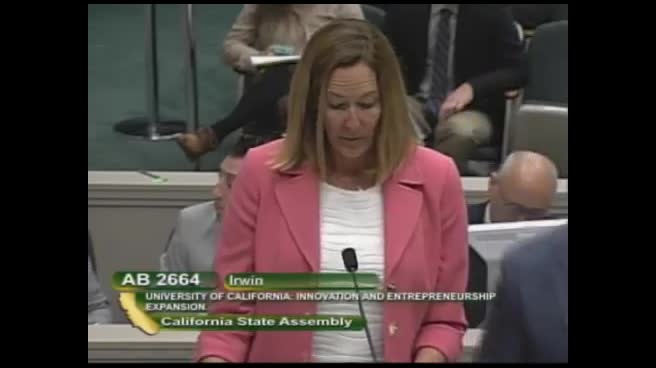 2MIN
Assembly Standing Committee on Appropriations
Bill Author

Bill Co-Author(s):