AB 348: Long-term health care facilities: complaints: investigations.
- Session Year: 2015-2016
- House: Assembly
- Latest Version Date: 2015-07-08
Existing law provides for the licensure and regulation by the State Department of Public Health of long-term health care facilities, as defined. Existing law establishes procedures to be followed when the department receives a written or oral complaint about a long-term health care facility. A complaint is defined to mean any notice to the department, other than a report from the facility, of an alleged violation of applicable requirements of state or federal law or any alleged facts that might constitute a violation. Existing law establishes the time period for which an investigation of a complaint is required to be completed, and authorizes an extension of that time period under extenuating circumstances.
This bill would require the department to apply the existing time periods for the investigation, inspection, and issuance of a citation under these provisions to a report from the facility of an alleged violation of applicable requirements of state or federal law or any alleged facts that might constitute a violation of those requirements. The bill would also require the department to analyze its compliance with the time periods for investigations on a quarterly basis and post those findings on its Internet Web site. The bill would make other technical changes to these provisions, as specified.
Existing law provides for the licensure and regulation by the State Department of Public Health of health care facilities, including long-term health care facilities, as defined. Existing law establishes procedures to be followed when the department receives a written or oral complaint about a long-term health care facility. A complaint is defined to mean any notice to the department, other than a report from the facility, of an alleged violation of applicable requirements of state or federal law or any alleged facts that might constitute a violation. Existing law establishes the time period for which an investigation of a complaint is required to be completed, and authorizes an extension of that time period under extenuating circumstances.
This bill would require, effective January 1, 2018, the department to complete its investigation of a complaint or a report from a long-term health facility within 45 working days of its receipt, except that this period may be extended up to an additional 30 working days if the department has diligently attempted, but has not been able, to obtain necessary evidence related to the investigation. The bill would require the department, if it extends an investigation beyond 45 working days, to notify the complainant, in writing, of the basis for the extension. The bill would require, effective July 1, 2016, that the departments written determination provide specific findings concerning each alleged violation and include a summary of the evidence upon which the determination is based. require the department to apply the existing time periods for the investigation, inspection, and issuance of a citation under these provisions to a report from the facility of an alleged violation of applicable requirements of state or federal law or any alleged facts that might constitute a violation of those requirements. The bill would also require the department to analyze its compliance with the timeframes time periods for investigations on a quarterly basis and post those findings on its Internet Web site. The bill would make other technical changes to these provisions, as specified.
Existing law provides the complainant with 5 business days after receipt of the notice of the departments determination in which to request an informal conference, as specified.
This bill would instead provide the complainant with 15 days after receipt of the notice in which to request an informal conference.
Existing law requires the department, when it receives a complaint or report involving a general acute care hospital, acute psychiatric hospital, or special hospital, that indicates a specified level of danger, to complete an investigation of the complaint or report within 45 days. Existing law also requires the department to submit to the Legislature, and publish on its Internet Web site, a staffing and systems analysis that includes the number and timeliness of complaint investigations, among other things.
This bill would authorize a 30-day extension to the time period to complete the investigation if the department has diligently attempted, but has not been able, to obtain necessary evidence related to the investigation. The bill would require the department, if it extends an investigation beyond 45 days, to notify the complainant, in writing, of the basis for the extension. The bill would also require the staffing and systems analysis prepared by the department to include data regarding the departments compliance with these requirements.
Existing law provides for the licensure and regulation by the State Department of Public Health of health care facilities, including long-term health care facilities, as defined. Existing law establishes procedures to be followed when the department receives a written or oral complaint about a long-term health care facility. A complaint is defined to mean any notice to the department, other than a report from the facility, of an alleged violation of applicable requirements of state or federal law or any alleged facts that might constitute a violation.
This bill would require require, effective January 1, 2018, the department to complete its investigation of the a complaint or a report from a long-term health facility within 45 working days of its receipt, except that this period may be extended up to an additional 30 working days if the department has diligently attempted, but has not been able, to obtain necessary evidence related to the investigation. The bill would require the department, if it extends an investigation beyond 45 working days, to notify the complainant, in writing, of the basis for the extension. The bill would require, effective July 1, 2016, that the departments written determination provide specific findings concerning each alleged violation and include a summary of the evidence upon which the determination is based. The bill would require the department to comply with those specified time periods established for investigations and inspections of complaints from a facility of an alleged violation of applicable requirements of state or federal law or any alleged facts that may constitute an alleged violation of these requirements. The bill would also require the department to analyze its compliance with the timeframes for investigations on a quarterly basis and post those findings on its Internet Web site.
Existing law provides the complainant with 5 business days after receipt of the notice of the departments determination in which to request an informal conference, as specified.
This bill would instead provide the complainant with 15 days after receipt of the notice in which to request an informal conference.
Existing law requires the department, when it receives a complaint or report involving a general acute care hospital, acute psychiatric hospital, or special hospital, that indicates a specified level of danger, to complete an investigation of the complaint or report within 45 days. Existing law also requires the department to submit to the Legislature, and publish on its Internet Web site, a staffing and systems analysis that includes the number and timeliness of complaint investigations, among other things.
This bill would authorize a 30-day extension to the time period to complete the investigation if the department has diligently attempted, but has not been able, to obtain necessary evidence related to the investigation. The bill would require the department, if it extends an investigation beyond 45 days, to notify the complainant, in writing, of the basis for the extension. The bill would also require the staffing and systems analysis prepared by the department to include data regarding the departments compliance with these requirements.
(1)Existing
Existing law provides for the licensure and regulation by the State Department of Public Health of health care facilities, including long-term health care facilities, as defined. Existing law establishes procedures to be followed when the department receives a written or oral complaint about a long-term health care facility. A complaint is defined to mean any notice to the department, other than a report from the facility, of an alleged violation of applicable requirements of state or federal law or any alleged facts that might constitute a violation.
This bill would require the department to complete its investigation of the complaint within 40 45 working days of its receipt, except that this period may be extended up to an additional 30 working days if the department has diligently attempted, but has not been able, to obtain, obtain necessary evidence related to the investigation. The bill would require the department, if it extends an investigation beyond 40 45 working days, to notify the complainant, in writing, of the basis for the extension. The bill would require, effective July 1, 2016, that the departments written determination provide specific findings concerning each alleged violation and include a summary of the evidence upon which the determination is based. The bill would require the department to comply with those specified time periods established for investigations and inspections of complaints from a facility of an alleged violation of applicable requirements of state or federal law or any alleged facts that may constitute an alleged violation of these requirements. The bill would also require the department to analyze its compliance with the timeframes for investigations on a quarterly basis and post those findings on its Internet Web site.
(2)Existing
Existing law provides the complainant with 5 business days after receipt of the notice of the departments determination in which to request an informal conference, as specified.
This bill would instead provide the complainant with 15 days after receipt of the notice in which to request an informal conference.
Existing law requires the department, when it receives a complaint or report involving a general acute care hospital, acute psychiatric hospital, or special hospital, that indicates a specified level of danger, to complete an investigation of the complaint or report within 45 days. Existing law also requires the department to submit to the Legislature, and publish on its Internet Web site, a staffing and systems analysis that includes the number and timeliness of complaint investigations, among other things.
This bill would authorize a 30-day extension to the time period to complete the investigation if the department has diligently attempted, but has not been able, to obtain necessary evidence related to the investigation. The bill would require the department, if it extends an investigation beyond 45 days, to notify the complainant, in writing, of the basis for the extension. The bill would also require the staffing and systems analysis prepared by the department to include data regarding the departments compliance with these requirements.
(1)Existing law provides for the licensure and regulation by the State Department of Public Health of health care facilities, including long-term health care facilities, as defined. Existing law establishes procedures to be followed when the department receives a written or oral complaint about a long-term health care facility. A complaint is defined to mean any notice to the department, other than a report from the facility, of an alleged violation of applicable requirements of state or federal law or any alleged facts that might constitute a violation.
This bill would require the department to complete its investigation of the complaint within 40 working days of its receipt, except that this period may be extended up to an additional 30 working days if the department has diligently attempted, but has not been able to obtain, necessary evidence related to the investigation. The bill would require the department, if it extends an investigation beyond 40 working days, to notify the complainant, in writing, of the basis for the extension. The bill would require, effective July 1, 2016, that the departments written determination provide specific findings concerning each alleged violation, violation and include a summary of the evidence upon which the determination is based. The bill would require the department to comply with those specified time periods established for investigations and inspections of complaints from a facility of an alleged violation of applicable requirements of state or federal law or any alleged facts that may constitute an alleged violation of these requirements. The bill would also require the department to analyze its compliance with the timeframes for investigations on a quarterly basis and post those findings on its Internet Web site.
(2)Existing law provides the complainant with 5 business days after receipt of the notice of the departments determination in which to request an informal conference, as specified.
This bill would instead provide the complainant with 15 days after receipt of the notice in which to request an informal conference.
(1)Existing law provides for the licensure and regulation by the State Department of Public Health of health care facilities, including long-term health care facilities, as defined. Existing law establishes procedures to be followed when the department receives a written or oral complaint about a long-term health care facility. A complaint is defined to mean any notice to the department, other than a report from the facility, of an alleged violation of applicable requirements of state or federal law or any alleged facts that might constitute a violation.
This bill, on or before July 1, 2016, would require the department to set a performance benchmark for completing its investigations within a defined number of days after receiving the complaint, not to exceed 60 working days. The bill would require the department, if it extends an investigation beyond the number of days specified in the benchmark, to notify the complainant, in writing, of the basis for the extension. The bill would require, effective July 1, 2016, and upon request of the complainant, that the department provide specific findings concerning an alleged violation, and include a summary of the evidence upon which the determination is based. The bill would require the department to comply with those specified time periods established for investigations and inspections of complaints from a facility of an alleged violation of applicable requirements of state or federal law or any alleged facts that may constitute an alleged violation of these requirements. The bill would require the department to analyze its compliance with the benchmark in its annual system and staffing analysis, to make that analysis available to the relevant fiscal and policy committees of the Legislature, and to post it on the departments Internet Web site.
(2)Existing law provides the complainant with 5 business days after receipt of the notice of the departments determination in which to request an informal conference.
This bill would, instead, provide the complainant with 15 days after receipt of the notice in which to request an informal conference.
This bill would require the department to complete its investigation of the complaint within 40 working days of its receipt, except that this period may be extended up to an additional 30 days if the department has diligently attempted, but has not been able to obtain, necessary evidence related to the investigation. The bill would require the department, if it extends an investigation beyond 40 working days, to notify the complainant, in writing, of the basis for the extension. The bill would require, effective July 1, 2016, that the departments written determination provide specific findings concerning each alleged violation, and include a summary of the evidence upon which the determination is based. The bill would require the department to comply with those specified time periods established for investigations and inspections of complaints from a facility of an alleged violation of applicable requirements of state or federal law or any alleged facts that may constitute an alleged violation of these requirements.
(2)Existing law provides the complainant with 5 business days after receipt of the notice of the departments determination in which to request an informal conference, as specified.
This bill would instead provide the complainant with 15 days after receipt of the notice in which to request an informal conference.
(1)Existing law provides for the licensure and regulation by the State Department of Public Health of health care facilities, including long-term health care facilities, as defined. Existing law establishes procedures to be followed when the department receives a written or oral complaint about a long-term health care facility. A complaint is defined to mean any notice to the department, other than a report from the facility, of an alleged violation of applicable requirements of state or federal law or any alleged facts that might constitute a violation.
This bill, on or before July 1, 2016, would require the department to set a performance benchmark for completing its investigations within a defined number of days after receiving the complaint, not to exceed 60 working days. The bill would require the department, if it extends an investigation beyond the number of days specified in the benchmark, to notify the complainant, in writing, of the basis for the extension. The bill would require, effective July 1, 2016, and upon request of the complainant, that the department provide specific findings concerning an alleged violation, and include a summary of the evidence upon which the determination is based. The bill would require the department to comply with those specified time periods established for investigations and inspections of complaints from a facility of an alleged violation of applicable requirements of state or federal law or any alleged facts that may constitute an alleged violation of these requirements. The bill would require the department to analyze its compliance with the benchmark in its annual system and staffing analysis, to make that analysis available to the relevant fiscal and policy committees of the Legislature, and to post it on the departments Internet Web site.
(2)Existing law provides the complainant with 5 business days after receipt of the notice of the departments determination in which to request an informal conference.
This bill would, instead, provide the complainant with 15 days after receipt of the notice in which to request an informal conference.
(a) (1) Upon receipt of a written or oral complaint, the state department shall assign an inspector to make a preliminary review of the complaint and shall notify the complainant within two working days of the receipt of the complaint of the name of the inspector. Unless the state department determines that the complaint is willfully intended to harass a licensee or is without any reasonable basis, it shall make an onsite inspection or investigation within 10 working days of the receipt of the complaint. In any case in which the complaint involves a threat of imminent danger of death or serious bodily harm, the state department shall make an onsite inspection or investigation within 24 hours of the receipt of the complaint. In any event, the complainant shall be promptly informed of the state departments proposed course of action and of the opportunity to accompany the inspector on the inspection or investigation of the facility. Upon the request of either the complainant or the state department, the complainant or his or her representative, or both, may be allowed to accompany the inspector to the site of the alleged violations during his or her tour of the facility, unless the inspector determines that the privacy of any patient would be violated thereby.
(2) When conducting an onsite inspection or investigation pursuant to this section, the state department shall collect and evaluate all available evidence and may issue a citation based upon, but not limited to, all of the following:
(A) Observed conditions.
(B) Statements of witnesses.
(C) Facility records.
(3)(A)For a complaint that involves a threat of imminent danger of death or serious bodily harm that is received on or after July 1, 2016, the state department shall complete an investigation of the complaint within 90 days of receipt of the complaint. At the completion of the complaint investigation, the state department shall notify the complainant and licensee in writing of the state departments determination as a result of the inspection or investigation.
(B)The time period described in subparagraph (A) may be extended up to an additional 60 days if the investigation cannot be completed due to extenuating circumstances. The state department shall document these circumstances and notify the facility and the complainant in writing of the basis for the extension and the estimated completion date.
(4)(A)For a complaint that does not involve a threat of imminent danger of death or serious bodily harm pursuant to paragraph (3) and that is received on or after July 1, 2017, and prior to July 1, 2018, the state department shall complete an investigation of the complaint within 90 days of receipt of the complaint. At the completion of the complaint investigation, the state department shall notify the complainant and licensee in writing of the state departments determination as a result of the inspection or investigation.
(B)The time period described in subparagraph (A) may be extended up to an additional 90 days if the investigation cannot be completed due to extenuating circumstances. The state department shall document these circumstances and notify the facility and the complainant in writing of the basis for the extension and the estimated completion date.
(5)(A)For a complaint that is received on or after July 1, 2018, the state department shall complete an investigation of the complaint within 60 days of receipt of the complaint. At the completion of the complaint investigation, the state department shall notify the complainant and licensee in writing of the state departments determination as a result of the inspection or investigation.
(B)The time period described in subparagraph (A) may be extended up to an additional 60 days if the investigation cannot be completed due to extenuating circumstances. The state department shall document these circumstances and notify the facility and the complainant in writing of the basis for the extension and the estimated completion date.
(b) Upon being notified of the state departments determination as a result of the inspection or investigation, a complainant who is dissatisfied with the state departments determination, regarding a matter which would pose a threat to the health, safety, security, welfare, or rights of a resident, shall be notified by the state department of the right to an informal conference, as set forth in this section. The complainant may, within five business days after receipt of the notice, notify the director in writing of his or her request for an informal conference. The informal conference shall be held with the designee of the director for the county in which the long-term health care facility which is the subject of the complaint is located. The long-term health care facility may participate as a party in this informal conference. The directors designee shall notify the complainant and licensee of his or her determination within 10 working days after the informal conference and shall apprise the complainant and licensee in writing of the appeal rights provided in subdivision (c).
(c) If the complainant is dissatisfied with the determination of the directors designee in the county in which the facility is located, the complainant may, within 15 days after receipt of this determination, notify in writing the Deputy Director of the Licensing and Certification Division of the state department, who shall assign the request to a representative of the Complainant Appeals Unit for review of the facts that led to both determinations. As a part of the Complainant Appeals Units independent investigation, and at the request of the complainant, the representative shall interview the complainant in the district office where the complaint was initially referred. Based upon this review, the Deputy Director of the Licensing and Certification Division of the state department shall make his or her own determination and notify the complainant and the facility within 30 days.
(d) Any citation issued as a result of a conference or review provided for in subdivision (b) or (c) shall be issued and served upon the facility within 30 days of the final determination. Service shall be effected either personally or by registered or certified mail. A copy of the citation shall also be sent to each complainant by registered or certified mail.
(e) A miniexit conference shall be held with the administrator or his or her representative upon leaving the facility at the completion of the investigation to inform him or her of the status of the investigation. The state department shall also state the items of noncompliance and compliance found as a result of a complaint and those items found to be in compliance, provided the disclosure maintains the anonymity of the complainant. In any matter in which there is a reasonable probability that the identity of the complainant will not remain anonymous, the state department shall also notify the facility that it is unlawful to discriminate or seek retaliation against a resident, employee, or complainant.
(f)Any citation issued as a result of the complaint investigation provided for in paragraph (3), (4), or (5) of subdivision (a), and in compliance with Section 1423, shall be issued and served upon the facility within 30 days of the completion of the complaint investigation.
(g)The department shall apply the time periods for investigation, inspection, and issuance of a citation established in this section to a report from the facility of an alleged violation of applicable requirements of state or federal law or any alleged facts that might constitute a violation of those requirements.
(h)The department shall analyze its compliance with the time periods for investigations established in this section on a quarterly basis, and shall, on a quarterly basis, post findings from the analysis on its Internet Web site. The analysis shall provide data on the departments performance, and shall include, at a minimum, all of the following data elements:
(1)The number of open investigations.
(2)The number of completed investigations.
(3)The number and percentage of investigations completed within the initial time period established in paragraph (3), (4), or (5) of subdivision (a).
(4)The number and percentage of investigations that required an extension authorized in paragraph (3), (4), or (5) of subdivision (a).
(5)The number and percentage of investigations that required an extension and were completed within the extended time period authorized in paragraph (3), (4), or (5) of subdivision (a).
(6)The average length of time to complete an investigation.
(7)The average length of time to complete an investigation that was not completed by the end of the extended time period authorized in paragraph (3), (4), or (5) of subdivision (a).
(i)For purposes of this section, complaint means any oral or written notice to the state department, other than a report from the facility, of an alleged violation of applicable requirements of state or federal law or any alleged facts that might constitute such a violation.
(j)Nothing in this section shall be interpreted to diminish the state departments authority and obligation to investigate any alleged violation of applicable requirements of state or federal law, or any alleged facts that might constitute a violation of applicable requirements of state or federal law, and to enforce applicable requirements of law.
(a) (1) Upon receipt of a written or oral complaint, the state department shall assign an inspector to make a preliminary review of the complaint and shall notify the complainant within two working days of the receipt of the complaint of the name of the inspector. Unless the state department determines that the complaint is willfully intended to harass a licensee or is without any reasonable basis, it shall make an onsite inspection or investigation within 10 working days of the receipt of the complaint. In any case in which the complaint involves a threat of imminent danger of death or serious bodily harm, the state department shall make an onsite inspection or investigation within 24 hours of the receipt of the complaint. In any event, the complainant shall be promptly informed of the state departments proposed course of action and of the opportunity to accompany the inspector on the inspection or investigation of the facility. Upon the request of either the complainant or the state department, the complainant or his or her representative, or both, may be allowed to accompany the inspector to the site of the alleged violations during his or her tour of the facility, unless the inspector determines that the privacy of any patient would be violated thereby.
(2) When conducting an onsite inspection or investigation pursuant to this section, the state department shall collect and evaluate all available evidence and may issue a citation based upon, but not limited to, all of the following:
(A) Observed conditions.
(B) Statements of witnesses.
(C) Facility records.
(3)(A)For a complaint that involves a threat of imminent danger of death or serious bodily harm that is received on or after July 1, 2016, the state department shall complete an investigation of the complaint within 90 days of receipt of the complaint. At the completion of the complaint investigation, the state department shall notify the complainant and licensee in writing of the state departments determination as a result of the inspection or investigation.
(B)The time period described in subparagraph (A) may be extended up to an additional 60 days if the investigation cannot be completed due to extenuating circumstances. The state department shall document these circumstances in its final determination and notify the facility and the complainant in writing of the basis for the extension and the estimated completion date.
(4)(A)For a complaint that does not involve a threat of imminent danger of death or serious bodily harm pursuant to paragraph (3) and that is received on or after July 1, 2017, and prior to July 1, 2018, the state department shall complete an investigation of the complaint within 90 days of receipt of the complaint. At the completion of the complaint investigation, the state department shall notify the complainant and licensee in writing of the state departments determination as a result of the inspection or investigation.
(B)The time period described in subparagraph (A) may be extended up to an additional 90 days if the investigation cannot be completed due to extenuating circumstances. The state department shall document these circumstances in its final determination and notify the facility and the complainant in writing of the basis for the extension and the estimated completion date.
(5)(A)For a complaint that is received on or after July 1, 2018, the state department shall complete an investigation of the complaint within 60 days of receipt of the complaint. At the completion of the complaint investigation, the state department shall notify the complainant and licensee in writing of the state departments determination as a result of the inspection or investigation.
(B)The time period described in subparagraph (A) may be extended up to an additional 60 days if the investigation cannot be completed due to extenuating circumstances. The state department shall document these circumstances in its final determination and notify the facility and the complainant in writing of the basis for the extension and the estimated completion date.
(b) Upon being notified of the state departments determination as a result of the inspection or investigation, a complainant who is dissatisfied with the state departments determination, regarding a matter which would pose a threat to the health, safety, security, welfare, or rights of a resident, shall be notified by the state department of the right to an informal conference, as set forth in this section. The complainant may, within five business days after receipt of the notice, notify the director in writing of his or her request for an informal conference. The informal conference shall be held with the designee of the director for the county in which the long-term health care facility which is the subject of the complaint is located. The long-term health care facility may participate as a party in this informal conference. The directors designee shall notify the complainant and licensee of his or her determination within 10 working days after the informal conference and shall apprise the complainant and licensee in writing of the appeal rights provided in subdivision (c).
(c) If the complainant is dissatisfied with the determination of the directors designee in the county in which the facility is located, the complainant may, within 15 days after receipt of this determination, notify in writing the Deputy Director of the Licensing and Certification Division of the state department, who shall assign the request to a representative of the Complainant Appeals Unit for review of the facts that led to both determinations. As a part of the Complainant Appeals Units independent investigation, and at the request of the complainant, the representative shall interview the complainant in the district office where the complaint was initially referred. Based upon this review, the Deputy Director of the Licensing and Certification Division of the state department shall make his or her own determination and notify the complainant and the facility within 30 days.
(d) Any citation issued as a result of a conference or review provided for in subdivision (b) or (c) shall be issued and served upon the facility within 30 days of the final determination. Service shall be effected either personally or by registered or certified mail. A copy of the citation shall also be sent to each complainant by registered or certified mail.
(e) A miniexit conference shall be held with the administrator or his or her representative upon leaving the facility at the completion of the investigation to inform him or her of the status of the investigation. The state department shall also state the items of noncompliance and compliance found as a result of a complaint and those items found to be in compliance, provided the disclosure maintains the anonymity of the complainant. In any matter in which there is a reasonable probability that the identity of the complainant will not remain anonymous, the state department shall also notify the facility that it is unlawful to discriminate or seek retaliation against a resident, employee, or complainant.
(f)Any citation issued as a result of the complaint investigation provided for in paragraph (3), (4), or (5) of subdivision (a), and in compliance with Section 1423, shall be issued and served upon the facility within 30 days of the completion of the complaint investigation.
(g)The department shall apply the time periods for investigation, inspection, and issuance of a citation established in this section to a report from the facility of an alleged violation of applicable requirements of state or federal law or any alleged facts that might constitute a violation of those requirements.
(h)The department shall analyze its compliance with the time periods for investigations established in this section on a quarterly basis, and shall, on a quarterly basis, post findings from the analysis on its Internet Web site. The analysis shall provide data on the departments performance, and shall include, at a minimum, all of the following data elements:
(1)The number of open investigations.
(2)The number of completed investigations.
(3)The number and percentage of investigations completed within the initial time period established in paragraph (3), (4), or (5) of subdivision (a).
(4)The number and percentage of investigations that required an extension authorized in paragraph (3), (4), or (5) of subdivision (a).
(5)The number and percentage of investigations that required an extension and were completed within the extended time period authorized in paragraph (3), (4), or (5) of subdivision (a).
(6)The average length of time to complete an investigation.
(7)The average length of time to complete an investigation that was not completed by the end of the extended time period authorized in paragraph (3), (4), or (5) of subdivision (a).
(g)
(i)For purposes of this section, complaint means any oral or written notice to the state department, other than a report from the facility department of an alleged violation of applicable requirements of state or federal law or any alleged facts that might constitute such a violation.
(h)
(j)Nothing in this section shall be interpreted to diminish the state departments authority and obligation to investigate any alleged violation of applicable requirements of state or federal law, or any alleged facts that might constitute a violation of applicable requirements of state or federal law, and to enforce applicable requirements of law.
All matter omitted in this version of the bill appears in the bill as amended in the Senate, May 28, 2015. (JR11)(a)The Licensing and Certification Division shall be supported entirely by federal funds and special funds by no earlier than the beginning of the 200910 fiscal year unless otherwise specified in statute, or unless funds are specifically appropriated from the General Fund in the annual Budget Act or other enacted legislation. For the 200708 fiscal year, General Fund support shall be provided to offset licensing and certification fees in an amount of not less than two million seven hundred eighty-two thousand dollars ($2,782,000).
(b)(1)The Licensing and Certification Program fees for the 200607 fiscal year shall be as follows:
Type of Facility | Fee | |
General Acute Care Hospitals | $134.10 | per bed |
Acute Psychiatric Hospitals | $134.10 | per bed |
Special Hospitals | $134.10 | per bed |
Chemical Dependency Recovery Hospitals | $123.52 | per bed |
Skilled Nursing Facilities | $202.96 | per bed |
Intermediate Care Facilities | $202.96 | per bed |
Intermediate Care Facilities- Developmentally Facilities-Developmentally Disabled | $592.29 | per bed |
Intermediate Care Facilities- Developmentally Facilities-Developmentally Disabled-Habilitative | $1,000.00 | per facility |
Intermediate Care Facilities- Developmentally Facilities-Developmentally Disabled-Nursing | $1,000.00 | per facility |
Home Health Agencies | $2,700.00 | per facility |
Referral Agencies | $5,537.71 | per facility |
Adult Day Health Centers | $4,650.02 | per facility |
Congregate Living Health Facilities | $202.96 | per bed |
Psychology Clinics | $600.00 | per facility |
Primary Clinics- Community Primary Clinics-Community and Free | $600.00 | per facility |
Specialty Clinics- Rehab Specialty Clinics-Rehab Clinics (For profit) | $2,974.43 | per facility |
(Nonprofit) | $500.00 | per facility |
Specialty Clinics- Surgical Specialty Clinics-Surgical and Chronic | $1,500.00 | per facility |
Dialysis Clinics | $1,500.00 | per facility |
Pediatric Day Health/Respite Care | $142.43 | per bed |
Alternative Birthing Centers | $2,437.86 | per facility |
Hospice | $1,000.00 | per provider |
Correctional Treatment Centers | $590.39 | per bed |
(2)(A)In the first year of licensure for intermediate care facility/developmentally disabled-continuous nursing (ICF/DD-CN) facilities, the licensure fee for those facilities shall be equivalent to the licensure fee for intermediate care facility/developmentally disabled-nursing facilities during the same year. Thereafter, the licensure fee for ICF/DD-CN facilities shall be established pursuant to the same procedures described in this section.
(B)In the first year of licensure for hospice facilities, the licensure fee shall be equivalent to the licensure fee for congregate living health facilities during the same year. Thereafter, the licensure fee for hospice facilities shall be established pursuant to the same procedures described in this section.
(c)Commencing February 1, 2007, and every February 1 thereafter, the department shall publish a list of estimated fees pursuant to this section. The calculation of estimated fees and the publication of the report and list of estimated fees shall not be subject to the rulemaking requirements of Chapter 3.5 (commencing with Section 11340) of Part 1 of Division 3 of Title 2 of the Government Code.
(d)Notwithstanding Section 10231.5 of the Government Code, by February 1 of each year, the department shall prepare the following reports and shall make those reports, and the list of estimated fees required to be published pursuant to subdivision (c), available to the public by submitting them to the Legislature and posting them on the departments Internet Web site:
(1)A report of all costs for activities of the Licensing and Certification Program. At a minimum, this report shall include a narrative of all baseline adjustments and their calculations, a description of how each category of facility was calculated, descriptions of assumptions used in any calculations, and shall recommend Licensing and Certification Program fees in accordance with the following:
(A)Projected workload and costs shall be grouped for each fee category, including workload costs for facility categories that have been established by statute and for which licensing regulations and procedures are under development.
(B)Cost estimates, and the estimated fees, shall be based on the appropriation amounts in the Governors proposed budget for the next fiscal year, with and without policy adjustments to the fee methodology.
(C)The allocation of program, operational, and administrative overhead, and indirect costs to fee categories shall be based on generally accepted cost allocation methods. Significant items of costs shall be directly charged to fee categories if the expenses can be reasonably identified to the fee category that caused them. Indirect and overhead costs shall be allocated to all fee categories using a generally accepted cost allocation method.
(D)The amount of federal funds and General Fund moneys to be received in the budget year shall be estimated and allocated to each fee category based upon an appropriate metric.
(E)The fee for each category shall be determined by dividing the aggregate state share of all costs for the Licensing and Certification Program by the appropriate metric for the category of licensure. Amounts actually received for new licensure applications, including change of ownership applications, and late payment penalties, pursuant to Section 1266.5, during each fiscal year shall be calculated and 95 percent shall be applied to the appropriate fee categories in determining Licensing and Certification Program fees for the second fiscal year following receipt of those funds. The remaining 5 percent shall be retained in the fund as a reserve until appropriated.
(2)(A)A staffing and systems analysis to ensure efficient and effective utilization of fees collected, proper allocation of departmental resources to licensing and certification activities, survey schedules, complaint investigations, enforcement and appeal activities, data collection and dissemination, surveyor training, and policy development.
(B)The analysis under this paragraph shall be made available to interested persons and shall include all of the following:
(i)The number of surveyors and administrative support personnel devoted to the licensing and certification of health care facilities.
(ii)The percentage of time devoted to licensing and certification activities for the various types of health facilities.
(iii)The number of facilities receiving full surveys and the frequency and number of followup visits.
(iv)The number and timeliness of complaint investigations, including data on the departments compliance with the requirements of Section 1279.2.
(v)Data on deficiencies and citations issued, and numbers of citation review conferences and arbitration hearings.
(vi)Other applicable activities of the licensing and certification division.
(3)The annual program fee report described in subdivision (d) of Section 1416.36.
(e)The reports required pursuant to subdivision (d) shall be submitted in compliance with Section 9795 of the Government Code.
(f)(1)The department shall adjust the list of estimated fees published pursuant to subdivision (c) if the annual Budget Act or other enacted legislation includes an appropriation that differs from those proposed in the Governors proposed budget for that fiscal year.
(2)The department shall publish a final fee list, with an explanation of any adjustment, by the issuance of an all facilities letter, by posting the list on the departments Internet Web site, and by including the final fee list as part of the licensing application package, within 14 days of the enactment of the annual Budget Act. The adjustment of fees and the publication of the final fee list shall not be subject to the rulemaking requirements of Chapter 3.5 (commencing with Section 11340) of Part 1 of Division 3 of Title 2 of the Government Code.
(g)(1)Fees shall not be assessed or collected pursuant to this section from any state department, authority, bureau, commission, or officer, unless federal financial participation would become available by doing so and an appropriation is included in the annual Budget Act for that state department, authority, bureau, commission, or officer for this purpose. Fees shall not be assessed or collected pursuant to this section from any clinic that is certified only by the federal government and is exempt from licensure under Section 1206, unless federal financial participation would become available by doing so.
(2)For the 200607 state fiscal year, a fee shall not be assessed or collected pursuant to this section from any general acute care hospital owned by a health care district with 100 beds or less.
(h)The Licensing and Certification Program may change annual license expiration renewal dates to provide for efficiencies in operational processes or to provide for sufficient cashflow to pay for expenditures. If an annual license expiration date is changed, the renewal fee shall be prorated accordingly. Facilities shall be provided with a 60-day notice of any change in their annual license renewal date.
SEC. 2.Section 1279.2 of the Health and Safety Code is amended to read:1279.2.(a)(1)In any case in which the department receives a report from a facility pursuant to Section 1279.1, or a written or oral complaint involving a health facility licensed pursuant to subdivision (a), (b), or (f) of Section 1250, that indicates an ongoing threat of imminent danger of death or serious bodily harm, the department shall make an onsite inspection or investigation within 48 hours or two business days, whichever is greater, of the receipt of the report or complaint and shall complete that investigation within 45 days.
(2)Until the department has determined by onsite inspection that the adverse event has been resolved, the department shall, not less than once a year, conduct an unannounced inspection of any health facility that has reported an adverse event pursuant to Section 1279.1.
(b)In any case in which the department is able to determine from the information available to it that there is no threat of imminent danger of death or serious bodily harm to that patient or other patients, the department shall complete an investigation of the report within 45 days.
(c)The 45-day period may be extended up to an additional 30 days if the department has diligently attempted, but has not been able, to obtain necessary evidence related to the investigation. If the department extends an investigation beyond 45 days, it shall notify the complainant, in writing, of the basis for the extension, and shall include in the notice any outstanding evidence and the sources from which the evidence has been sought, and the anticipated completion date.
(d)The department shall notify the complainant and licensee in writing of the departments determination as a result of an inspection or report.
(e)For purposes of this section, complaint means any oral or written notice to the department, other than a report from the health facility, of an alleged violation of applicable requirements of state or federal law or an allegation of facts that might constitute a violation of applicable requirements of state or federal law.
(f)The costs of administering and implementing this section shall be paid from funds derived from existing licensing fees paid by general acute care hospitals, acute psychiatric hospitals, and special hospitals.
(g)In enforcing this section and Sections 1279 and 1279.1, the department shall take into account the special circumstances of small and rural hospitals, as defined in Section 124840, in order to protect the quality of patient care in those hospitals.
(h)In preparing the staffing and systems analysis required pursuant to Section 1266, the department shall also report regarding the number and timeliness of investigations of adverse events initiated in response to reports of adverse events.
SEC. 3.Section 1420 of the Health and Safety Code is amended to read:1420.(a)(1)Upon receipt of a written or oral complaint, the department shall assign an inspector to make a preliminary review of the complaint and shall notify the complainant within two working days of the receipt of the complaint of the name of the inspector. Unless the department determines that the complaint is willfully intended to harass a licensee or is without any reasonable basis, it shall make an onsite inspection or investigation within 10 working days of the receipt of the complaint. In any case in which the complaint involves a threat of imminent danger of death or serious bodily harm, the department shall make an onsite inspection or investigation as soon as practicable, and in no case more than 24 hours of the receipt of the complaint. In any event, the complainant shall be promptly informed of the departments proposed course of action and of the opportunity to accompany the inspector on the inspection or investigation of the facility. Upon the request of either the complainant or the department, the complainant or his or her representative, or both, may be allowed to accompany the inspector to the site of the alleged violations during his or her tour of the facility, unless the inspector determines that the privacy of any patient would be violated thereby.
(2)When conducting an onsite inspection or investigation pursuant to this section, the department shall collect and evaluate all available evidence and may issue a citation based upon, but not limited to, all of the following:
(A)Observed conditions.
(B)Statements of witnesses.
(C)Facility records.
(3)The Effective January 1, 2018, the department shall complete its investigation within 45 working days from receipt of the complaint. The 45-working-day period may be extended up to an additional 30 working days if the department has diligently attempted, but has not been able, to obtain necessary evidence related to the investigation.
(4)If Effective January 1, 2018, if the department extends an investigation beyond 45 working days, it shall notify the complainant, in writing, of the basis for the extension, and shall include in the notice any outstanding evidence and the sources from which the evidence has been sought, and the anticipated completion date.
(5)Within 10 working days of the completion of the complaint investigation, the department shall notify the complainant and licensee, in writing, of the departments determination as a result of the inspection or investigation.
(6)Effective July 1, 2016, the departments written determination shall provide specific findings concerning each alleged violation, and shall include a summary of the evidence upon which the determination is made. The written determination shall not disclose the names of individual residents.
(b)Upon being notified of the departments determination as a result of the inspection or investigation, a complainant who is dissatisfied with the departments determination, regarding a matter which would pose a threat to the health, safety, security, welfare, or rights of a resident, shall be notified by the department of the right to an informal conference, as set forth in this section. The complainant may, within 15 days after receipt of the notice, notify the director in writing of his or her request for an informal conference. The informal conference shall be held with the designee of the director for the county in which the long-term health care facility that is the subject of the complaint is located. The long-term health care facility may participate as a party in this informal conference. The directors designee shall notify the complainant and licensee of his or her determination within 10 working days after the informal conference and shall apprise the complainant and licensee in writing of the appeal rights provided in subdivision (c).
(c)If the complainant is dissatisfied with the determination of the directors designee in the county in which the facility is located, the complainant may, within 15 days after receipt of this determination, notify in writing the Deputy Director of the Licensing and Certification Division of the department, who shall assign the request to a representative of the Complainant Appeals Unit for review of the facts that led to both determinations. As a part of the Complainant Appeals Units independent investigation, and at the request of the complainant, the representative shall interview the complainant in the district office where the complaint was initially referred. Based upon this review, the Deputy Director of the Licensing and Certification Division of the department shall make his or her own determination and notify the complainant and the facility within 30 days.
(d)Any citation issued as a result of a conference or review provided for in subdivision (b) or (c) shall be issued and served upon the facility within three working days of the final determination, unless the licensee agrees in writing to an extension of this time. Service shall be effected either personally or by registered or certified mail. A copy of the citation shall also be sent to each complainant by registered or certified mail.
(e)A miniexit conference shall be held with the administrator or his or her representative upon leaving the facility at the completion of the investigation to inform him or her of the status of the investigation. The department shall also state the items of noncompliance and compliance found as a result of a complaint and those items found to be in compliance, provided the disclosure maintains the anonymity of the complainant. In any matter in which there is a reasonable probability that the identity of the complainant will not remain anonymous, the department shall also notify the facility that it is unlawful to discriminate or seek retaliation against a resident, employee, or complainant.
(f)For purposes of this section, complaint means any oral or written notice to the department, other than a report from the facility, of an alleged violation of applicable requirements of state or federal law or any alleged facts that might constitute a violation of these requirements.
(g)The department shall apply the timeframes for investigation or inspection established in this section to a report from the facility of an alleged violation of applicable requirements of state or federal law or any alleged facts that might constitute a violation of those requirements.
(h)The department shall analyze its compliance with the timeframes for investigations established in this section on a quarterly basis, and shall, on a quarterly basis, post findings from the analysis on its Internet Web site. The analysis shall provide data on the departments performance, and shall include, at a minimum, all of the following data elements:
(1)The number of open investigations.
(2)The number of completed investigations.
(3)The number and percentage of investigations completed within the 45-working-day timeframe.
(4)The number and percentage of investigations that required a 30-working-day extension.
(5)The number and percentage of investigations that required a 30-working-day extension and were completed within the extended time period.
(6)The average length of time to complete an investigation.
(7)The average length of time to complete an investigation that was not completed by the end of the 30-working-day extended time period.
(i)Nothing in this section shall be interpreted to diminish the departments authority and obligation to investigate any alleged violation of applicable requirements of state or federal law, or any alleged facts that might constitute a violation of applicable requirements of state or federal law, and to enforce applicable requirements of law.
(a)The Licensing and Certification Division shall be supported entirely by federal funds and special funds by no earlier than the beginning of the 200910 fiscal year unless otherwise specified in statute, or unless funds are specifically appropriated from the General Fund in the annual Budget Act or other enacted legislation. For the 200708 fiscal year, General Fund support shall be provided to offset licensing and certification fees in an amount of not less than two million seven hundred eighty-two thousand dollars ($2,782,000).
(b)(1)The Licensing and Certification Program fees for the 200607 fiscal year shall be as follows:
Type of Facility | Fee | |
General Acute Care Hospitals | $134.10 | per bed |
Acute Psychiatric Hospitals | $134.10 | per bed |
Special Hospitals | $134.10 | per bed |
Chemical Dependency Recovery Hospitals | $123.52 | per bed |
Skilled Nursing Facilities | $202.96 | per bed |
Intermediate Care Facilities | $202.96 | per bed |
Intermediate Care Facilities- Developmentally Disabled | $592.29 | per bed |
Intermediate Care Facilities- Developmentally Disabled-Habilitative | $1,000.00 | per facility |
Intermediate Care Facilities- Developmentally Disabled-Nursing | $1,000.00 | per facility |
Home Health Agencies | $2,700.00 | per facility |
Referral Agencies | $5,537.71 | per facility |
Adult Day Health Centers | $4,650.02 | per facility |
Congregate Living Health Facilities | $202.96 | per bed |
Psychology Clinics | $600.00 | per facility |
Primary Clinics- Community and Free | $600.00 | per facility |
Specialty Clinics- Rehab Clinics (For profit) | $2,974.43 | per facility |
(Nonprofit) | $500.00 | per facility |
Specialty Clinics- Surgical and Chronic | $1,500.00 | per facility |
Dialysis Clinics | $1,500.00 | per facility |
Pediatric Day Health/Respite Care | $142.43 | per bed |
Alternative Birthing Centers | $2,437.86 | per facility |
Hospice | $1,000.00 | per provider |
Correctional Treatment Centers | $590.39 | per bed |
(2)(A)In the first year of licensure for intermediate care facility/developmentally disabled-continuous nursing (ICF/DD-CN) facilities, the licensure fee for those facilities shall be equivalent to the licensure fee for intermediate care facility/developmentally disabled-nursing facilities during the same year. Thereafter, the licensure fee for ICF/DD-CN facilities shall be established pursuant to the same procedures described in this section.
(B)In the first year of licensure for hospice facilities, the licensure fee shall be equivalent to the licensure fee for congregate living health facilities during the same year. Thereafter, the licensure fee for hospice facilities shall be established pursuant to the same procedures described in this section.
(c)Commencing February 1, 2007, and every February 1 thereafter, the department shall publish a list of estimated fees pursuant to this section. The calculation of estimated fees and the publication of the report and list of estimated fees shall not be subject to the rulemaking requirements of Chapter 3.5 (commencing with Section 11340) of Part 1 of Division 3 of Title 2 of the Government Code.
(d)Notwithstanding Section 10231.5 of the Government Code, by February 1 of each year, the department shall prepare the following reports and shall make those reports, and the list of estimated fees required to be published pursuant to subdivision (c), available to the public by submitting them to the Legislature and posting them on the departments Internet Web site:
(1)A report of all costs for activities of the Licensing and Certification Program. At a minimum, this report shall include a narrative of all baseline adjustments and their calculations, a description of how each category of facility was calculated, descriptions of assumptions used in any calculations, and shall recommend Licensing and Certification Program fees in accordance with the following:
(A)Projected workload and costs shall be grouped for each fee category, including workload costs for facility categories that have been established by statute and for which licensing regulations and procedures are under development.
(B)Cost estimates, and the estimated fees, shall be based on the appropriation amounts in the Governors proposed budget for the next fiscal year, with and without policy adjustments to the fee methodology.
(C)The allocation of program, operational, and administrative overhead, and indirect costs to fee categories shall be based on generally accepted cost allocation methods. Significant items of costs shall be directly charged to fee categories if the expenses can be reasonably identified to the fee category that caused them. Indirect and overhead costs shall be allocated to all fee categories using a generally accepted cost allocation method.
(D)The amount of federal funds and General Fund moneys to be received in the budget year shall be estimated and allocated to each fee category based upon an appropriate metric.
(E)The fee for each category shall be determined by dividing the aggregate state share of all costs for the Licensing and Certification Program by the appropriate metric for the category of licensure. Amounts actually received for new licensure applications, including change of ownership applications, and late payment penalties, pursuant to Section 1266.5, during each fiscal year shall be calculated and 95 percent shall be applied to the appropriate fee categories in determining Licensing and Certification Program fees for the second fiscal year following receipt of those funds. The remaining 5 percent shall be retained in the fund as a reserve until appropriated.
(2)(A)A staffing and systems analysis to ensure efficient and effective utilization of fees collected, proper allocation of departmental resources to licensing and certification activities, survey schedules, complaint investigations, enforcement and appeal activities, data collection and dissemination, surveyor training, and policy development.
(B)The analysis under this paragraph shall be made available to interested persons and shall include all of the following:
(i)The number of surveyors and administrative support personnel devoted to the licensing and certification of health care facilities.
(ii)The percentage of time devoted to licensing and certification activities for the various types of health facilities.
(iii)The number of facilities receiving full surveys and the frequency and number of followup visits.
(iv)The number and timeliness of complaint investigations, including data on the departments compliance with the requirements of Section 1279.2.
(v)Data on deficiencies and citations issued, and numbers of citation review conferences and arbitration hearings.
(vi)Other applicable activities of the licensing and certification division.
(3)The annual program fee report described in subdivision (d) of Section 1416.36.
(e)The reports required pursuant to subdivision (d) shall be submitted in compliance with Section 9795 of the Government Code.
(f)(1)The department shall adjust the list of estimated fees published pursuant to subdivision (c) if the annual Budget Act or other enacted legislation includes an appropriation that differs from those proposed in the Governors proposed budget for that fiscal year.
(2)The department shall publish a final fee list, with an explanation of any adjustment, by the issuance of an all facilities letter, by posting the list on the departments Internet Web site, and by including the final fee list as part of the licensing application package, within 14 days of the enactment of the annual Budget Act. The adjustment of fees and the publication of the final fee list shall not be subject to the rulemaking requirements of Chapter 3.5 (commencing with Section 11340) of Part 1 of Division 3 of Title 2 of the Government Code.
(g)(1)Fees shall not be assessed or collected pursuant to this section from any state department, authority, bureau, commission, or officer, unless federal financial participation would become available by doing so and an appropriation is included in the annual Budget Act for that state department, authority, bureau, commission, or officer for this purpose. Fees shall not be assessed or collected pursuant to this section from any clinic that is certified only by the federal government and is exempt from licensure under Section 1206, unless federal financial participation would become available by doing so.
(2)For the 200607 state fiscal year, a fee shall not be assessed or collected pursuant to this section from any general acute care hospital owned by a health care district with 100 beds or less.
(h)The Licensing and Certification Program may change annual license expiration renewal dates to provide for efficiencies in operational processes or to provide for sufficient cashflow to pay for expenditures. If an annual license expiration date is changed, the renewal fee shall be prorated accordingly. Facilities shall be provided with a 60-day notice of any change in their annual license renewal date.
SEC. 2.Section 1279.2 of the Health and Safety Code is amended to read:1279.2.(a)(1)In any case in which the department receives a report from a facility pursuant to Section 1279.1, or a written or oral complaint involving a health facility licensed pursuant to subdivision (a), (b), or (f) of Section 1250, that indicates an ongoing threat of imminent danger of death or serious bodily harm, the department shall make an onsite inspection or investigation within 48 hours or two business days, whichever is greater, of the receipt of the report or complaint and shall complete that investigation within 45 days.
(2)Until the department has determined by onsite inspection that the adverse event has been resolved, the department shall, not less than once a year, conduct an unannounced inspection of any health facility that has reported an adverse event pursuant to Section 1279.1.
(b)In any case in which the department is able to determine from the information available to it that there is no threat of imminent danger of death or serious bodily harm to that patient or other patients, the department shall complete an investigation of the report within 45 days.
(c)The 45-day period may be extended up to an additional 30 days if the department has diligently attempted, but has not been able, to obtain necessary evidence related to the investigation. If the department extends an investigation beyond 45 days, it shall notify the complainant, in writing, of the basis for the extension, and shall include in the notice any outstanding evidence and the sources from which the evidence has been sought, and the anticipated completion date.
(c)
(d)The department shall notify the complainant and licensee in writing of the departments determination as a result of an inspection or report.
(d)
(e)For purposes of this section, complaint means any oral or written notice to the department, other than a report from the health facility, of an alleged violation of applicable requirements of state or federal law or an allegation of facts that might constitute a violation of applicable requirements of state or federal law.
(e)
(f)The costs of administering and implementing this section shall be paid from funds derived from existing licensing fees paid by general acute care hospitals, acute psychiatric hospitals, and special hospitals.
(f)
(g)In enforcing this section and Sections 1279 and 1279.1, the department shall take into account the special circumstances of small and rural hospitals, as defined in Section 124840, in order to protect the quality of patient care in those hospitals.
(g)
(h)In preparing the staffing and systems analysis required pursuant to Section 1266, the department shall also report regarding the number and timeliness of investigations of adverse events initiated in response to reports of adverse events.
SECTION 1.SEC. 3.Section 1420 of the Health and Safety Code is amended to read:1420.(a)(1)Upon receipt of a written or oral complaint, the department shall assign an inspector to make a preliminary review of the complaint and shall notify the complainant within two working days of the receipt of the complaint of the name of the inspector. Unless the department determines that the complaint is willfully intended to harass a licensee or is without any reasonable basis, it shall make an onsite inspection or investigation within 10 working days of the receipt of the complaint. In any case in which the complaint involves a threat of imminent danger of death or serious bodily harm, the department shall make an onsite inspection or investigation as soon as practicable, and in no case more than 24 hours of the receipt of the complaint. In any event, the complainant shall be promptly informed of the departments proposed course of action and of the opportunity to accompany the inspector on the inspection or investigation of the facility. Upon the request of either the complainant or the department, the complainant or his or her representative, or both, may be allowed to accompany the inspector to the site of the alleged violations during his or her tour of the facility, unless the inspector determines that the privacy of any patient would be violated thereby.
(2)When conducting an onsite inspection or investigation pursuant to this section, the department shall collect and evaluate all available evidence and may issue a citation based upon, but not limited to, all of the following:
(A)Observed conditions.
(B)Statements of witnesses.
(C)Facility records.
(3)The department shall complete its investigation within 40 45 working days from receipt of the complaint. The 40-working-day 45-working-day period may be extended up to an additional 30 working days if the department has diligently attempted, but has not been able, to obtain, obtain necessary evidence related to the investigation.
(4)If the department extends an investigation beyond 40 45 working days, it shall notify the complainant, in writing, of the basis for the extension, and shall include in the notice any outstanding evidence and the sources from which the evidence has been sought, and the anticipated completion date.
(5)Within 10 working days of the completion of the complaint investigation, the department shall notify the complainant and licensee, in writing, of the departments determination as a result of the inspection or investigation.
(6)Effective July 1, 2016, the departments written determination shall provide specific findings concerning each alleged violation, and shall include a summary of the evidence upon which the determination is made. The written determination shall not disclose the names of individual residents.
(b)Upon being notified of the departments determination as a result of the inspection or investigation, a complainant who is dissatisfied with the departments determination, regarding a matter which would pose a threat to the health, safety, security, welfare, or rights of a resident, shall be notified by the department of the right to an informal conference, as set forth in this section. The complainant may, within 15 days after receipt of the notice, notify the director in writing of his or her request for an informal conference. The informal conference shall be held with the designee of the director for the county in which the long-term health care facility that is the subject of the complaint is located. The long-term health care facility may participate as a party in this informal conference. The directors designee shall notify the complainant and licensee of his or her determination within 10 working days after the informal conference and shall apprise the complainant and licensee in writing of the appeal rights provided in subdivision (c).
(c)If the complainant is dissatisfied with the determination of the directors designee in the county in which the facility is located, the complainant may, within 15 days after receipt of this determination, notify in writing the Deputy Director of the Licensing and Certification Division of the department, who shall assign the request to a representative of the Complainant Appeals Unit for review of the facts that led to both determinations. As a part of the Complainant Appeals Units independent investigation, and at the request of the complainant, the representative shall interview the complainant in the district office where the complaint was initially referred. Based upon this review, the Deputy Director of the Licensing and Certification Division of the department shall make his or her own determination and notify the complainant and the facility within 30 days.
(d)Any citation issued as a result of a conference or review provided for in subdivision (b) or (c) shall be issued and served upon the facility within three working days of the final determination, unless the licensee agrees in writing to an extension of this time. Service shall be effected either personally or by registered or certified mail. A copy of the citation shall also be sent to each complainant by registered or certified mail.
(e)A miniexit conference shall be held with the administrator or his or her representative upon leaving the facility at the completion of the investigation to inform him or her of the status of the investigation. The department shall also state the items of noncompliance and compliance found as a result of a complaint and those items found to be in compliance, provided the disclosure maintains the anonymity of the complainant. In any matter in which there is a reasonable probability that the identity of the complainant will not remain anonymous, the department shall also notify the facility that it is unlawful to discriminate or seek retaliation against a resident, employee, or complainant.
(f)For purposes of this section, complaint means any oral or written notice to the department, other than a report from the facility, of an alleged violation of applicable requirements of state or federal law or any alleged facts that might constitute a violation of these requirements.
(g)The department shall apply the timeframes for investigation or inspection established in this section to a report from the facility of an alleged violation of applicable requirements of state or federal law or any alleged facts that might constitute a violation of those requirements.
(h)The department shall analyze its compliance with the timeframes for investigations established in this section on a quarterly basis, and shall, on a quarterly basis, post findings from the analysis on its Internet Web site. The analysis shall provide data on the departments performance, and shall include, at a minimum, all of the following data elements:
(1)The number of open investigations.
(2)The number of completed investigations.
(3)The number and percentage of investigations completed within the 40-working-day 45-working-day timeframe.
(4)The number and percentage of investigations that required a 30-working-day extension.
(5)The number and percentage of investigations that required a 30-working-day extension and were completed within the extended time period.
(6)The average length of time to complete an investigation.
(7)The average length of time to complete an investigation that was not completed by the end of the 30-working-day extended time period.
(i)Nothing in this section shall be interpreted to diminish the departments authority and obligation to investigate any alleged violation of applicable requirements of state or federal law, or any alleged facts that might constitute a violation of applicable requirements of state or federal law, and to enforce applicable requirements of law.
(a)(1)Upon receipt of a written or oral complaint, the department shall assign an inspector to make a preliminary review of the complaint and shall notify the complainant within two working days of the receipt of the complaint of the name of the inspector. Unless the department determines that the complaint is willfully intended to harass a licensee or is without any reasonable basis, it shall make an onsite inspection or investigation within 10 working days of the receipt of the complaint. In any case in which the complaint involves a threat of imminent danger of death or serious bodily harm, the department shall make an onsite inspection or investigation as soon as practicable, and in no case more than 24 hours of the receipt of the complaint. In any event, the complainant shall be promptly informed of the departments proposed course of action and of the opportunity to accompany the inspector on the inspection or investigation of the facility. Upon the request of either the complainant or the department, the complainant or his or her representative, or both, may be allowed to accompany the inspector to the site of the alleged violations during his or her tour of the facility, unless the inspector determines that the privacy of any patient would be violated thereby.
(2)When conducting an onsite inspection or investigation pursuant to this section, the department shall collect and evaluate all available evidence and may issue a citation based upon, but not limited to, all of the following:
(A)Observed conditions.
(B)Statements of witnesses.
(C)Facility records.
(3)The department shall complete its investigation within 40 working days from receipt of the complaint. The 40-working-day period may be extended up to an additional 30 working days if the department has diligently attempted, but has not been able to obtain, necessary evidence related to the investigation. The department shall analyze its compliance with this requirement in its annual system and staffing analysis prepared pursuant to subparagraph (B) of paragraph (2) of subdivision (d) of Section 1266.
(4)If the department extends an investigation beyond 40 working days, it shall notify the complainant, in writing, of the basis for the extension, and shall include in the notice any outstanding evidence and the sources from which the evidence has been sought, and the anticipated completion date.
(5)Within 10 working days of the completion of the complaint investigation, the department shall notify the complainant and licensee, in writing, of the departments determination as a result of the inspection or investigation.
(6)Effective July 1, 2016, the departments written determination shall provide specific findings concerning each alleged violation, and shall include a summary of the evidence upon which the determination is made. The written determination shall not disclose the names of individual residents.
(b)Upon being notified of the departments determination as a result of the inspection or investigation, a complainant who is dissatisfied with the departments determination, regarding a matter which would pose a threat to the health, safety, security, welfare, or rights of a resident, shall be notified by the department of the right to an informal conference, as set forth in this section. The complainant may, within 15 days after receipt of the notice, notify the director in writing of his or her request for an informal conference. The informal conference shall be held with the designee of the director for the county in which the long-term health care facility that is the subject of the complaint is located. The long-term health care facility may participate as a party in this informal conference. The directors designee shall notify the complainant and licensee of his or her determination within 10 working days after the informal conference and shall apprise the complainant and licensee in writing of the appeal rights provided in subdivision (c).
(c)If the complainant is dissatisfied with the determination of the directors designee in the county in which the facility is located, the complainant may, within 15 days after receipt of this determination, notify in writing the Deputy Director of the Licensing and Certification Division of the department, who shall assign the request to a representative of the Complainant Appeals Unit for review of the facts that led to both determinations. As a part of the Complainant Appeals Units independent investigation, and at the request of the complainant, the representative shall interview the complainant in the district office where the complaint was initially referred. Based upon this review, the Deputy Director of the Licensing and Certification Division of the department shall make his or her own determination and notify the complainant and the facility within 30 days.
(d)Any citation issued as a result of a conference or review provided for in subdivision (b) or (c) shall be issued and served upon the facility within three working days of the final determination, unless the licensee agrees in writing to an extension of this time. Service shall be effected either personally or by registered or certified mail. A copy of the citation shall also be sent to each complainant by registered or certified mail.
(e)A miniexit conference shall be held with the administrator or his or her representative upon leaving the facility at the completion of the investigation to inform him or her of the status of the investigation. The department shall also state the items of noncompliance and compliance found as a result of a complaint and those items found to be in compliance, provided the disclosure maintains the anonymity of the complainant. In any matter in which there is a reasonable probability that the identity of the complainant will not remain anonymous, the department shall also notify the facility that it is unlawful to discriminate or seek retaliation against a resident, employee, or complainant.
(f)For purposes of this section, complaint means any oral or written notice to the department, other than a report from the facility, of an alleged violation of applicable requirements of state or federal law or any alleged facts that might constitute a violation of these requirements.
(g)The department shall apply the timeframes for investigation or inspection established in this section to a report from the facility of an alleged violation of applicable requirements of state or federal law or any alleged facts that might constitute a violation of those requirements.
(h)The department shall analyze its compliance with the timeframes for investigations established in this section on a quarterly basis, and shall, on a quarterly basis, post findings from the analysis on its Internet Web site. The analysis shall provide data on the departments performance, and shall include, at a minimum, all of the following data elements:
(1)The number of open investigations.
(2)The number of completed investigations.
(3)The number and percentage of investigations completed within the 40-working-day timeframe.
(4)The number and percentage of investigations that required a 30-working-day extension.
(5)The number and percentage of investigations that required a 30-working-day extension and were completed within the extended time period.
(6)The average length of time to complete an investigation.
(7)The average length of time to complete an investigation that was not completed by the end of the 30-working-day extended time period.
(h)
(i)Nothing in this section shall be interpreted to diminish the departments authority and obligation to investigate any alleged violation of applicable requirements of state or federal law, or any alleged facts that might constitute a violation of applicable requirements of state or federal law, and to enforce applicable requirements of law.
(a)(1)Upon receipt of a written or oral complaint, the state department shall assign an inspector to make a preliminary review of the complaint and shall notify the complainant within two working days of the receipt of the complaint of the name of the inspector. Unless the state department determines that the complaint is willfully intended to harass a licensee or is without any reasonable basis, it shall make an onsite inspection or investigation within 10 working days of the receipt of the complaint. In any case in which the complaint involves a threat of imminent danger of death or serious bodily harm, the state department shall make an onsite inspection or investigation within as soon as practicable, and in no case more than 24 hours of the receipt of the complaint. In any event, the complainant shall be promptly informed of the state departments proposed course of action and of the opportunity to accompany the inspector on the inspection or investigation of the facility. Upon the request of either the complainant or the state department, the complainant or his or her representative, or both, may be allowed to accompany the inspector to the site of the alleged violations during his or her tour of the facility, unless the inspector determines that the privacy of any patient would be violated thereby.
(2)When conducting an onsite inspection or investigation pursuant to this section, the state department shall collect and evaluate all available evidence and may issue a citation based upon, but not limited to, all of the following:
(A)Observed conditions.
(B)Statements of witnesses.
(C)Facility records.
(3)The department shall complete its investigation within 40 working days from receipt of the complaint. The 40-working-day period may be extended up to an additional 30 days if the department has diligently attempted, but has not been able to obtain, necessary evidence related to the investigation. The department shall analyze its compliance with this requirement in its annual system and staffing analysis prepared pursuant to subparagraph (B) of paragraph (2) of subdivision (d) of Section 1266.
(4)If the department extends an investigation beyond 40 working days, it shall notify the complainant, in writing, of the basis for the extension, and shall include in the notice any outstanding evidence and the sources from which the evidence has been sought, and the anticipated completion date.
(3)
(5)Within 10 working days of the completion of the complaint investigation, the state department shall notify the complainant and licensee licensee, in writing writing, of the departments determination as a result of the inspection or investigation.
(6)Effective July 1, 2016, the departments written determination shall provide specific findings concerning each alleged violation, and shall include a summary of the evidence upon which the determination is made. The written determination shall not disclose the names of individual residents.
(b)Upon being notified of the state departments determination as a result of the inspection or investigation, a complainant who is dissatisfied with the state departments determination, regarding a matter which would pose a threat to the health, safety, security, welfare, or rights of a resident, shall be notified by the state department of the right to an informal conference, as set forth in this section. The complainant may, within five business 15 days after receipt of the notice, notify the director in writing of his or her request for an informal conference. The informal conference shall be held with the designee of the director for the county in which the long-term health care facility which that is the subject of the complaint is located. The long-term health care facility may participate as a party in this informal conference. The directors designee shall notify the complainant and licensee of his or her determination within 10 working days after the informal conference and shall apprise the complainant and licensee in writing of the appeal rights provided in subdivision (c).
(c)If the complainant is dissatisfied with the determination of the directors designee in the county in which the facility is located, the complainant may, within 15 days after receipt of this determination, notify in writing the Deputy Director of the Licensing and Certification Division of the state department, who shall assign the request to a representative of the Complainant Appeals Unit for review of the facts that led to both determinations. As a part of the Complainant Appeals Units independent investigation, and at the request of the complainant, the representative shall interview the complainant in the district office where the complaint was initially referred. Based upon this review, the Deputy Director of the Licensing and Certification Division of the state department shall make his or her own determination and notify the complainant and the facility within 30 days.
(d)Any citation issued as a result of a conference or review provided for in subdivision (b) or (c) shall be issued and served upon the facility within three working days of the final determination, unless the licensee agrees in writing to an extension of this time. Service shall be effected either personally or by registered or certified mail. A copy of the citation shall also be sent to each complainant by registered or certified mail.
(e)A miniexit conference shall be held with the administrator or his or her representative upon leaving the facility at the completion of the investigation to inform him or her of the status of the investigation. The department shall also state the items of noncompliance and compliance found as a result of a complaint and those items found to be in compliance, provided the disclosure maintains the anonymity of the complainant. In any matter in which there is a reasonable probability that the identity of the complainant will not remain anonymous, the state department shall also notify the facility that it is unlawful to discriminate or seek retaliation against a resident, employee, or complainant.
(f)For purposes of this section, complaint means any oral or written notice to the state department, other than a report from the facility facility, of an alleged violation of applicable requirements of state or federal law or any alleged facts that might constitute such a violation. violation of these requirements.
(g)The department shall apply the timeframes for investigation or inspection established in this section to a report from the facility of an alleged violation of applicable requirements of state or federal law or any alleged facts that might constitute a violation of those requirements.
(h)Nothing in this section shall be interpreted to diminish the departments authority and obligation to investigate any alleged violation of applicable requirements of state or federal law, or any alleged facts that might constitute a violation of applicable requirements of state or federal law, and to enforce applicable requirements of law.
SECTION 1.Section 1420 of the Health and Safety Code is amended to read:1420.(a)(1)Upon receipt of a written or oral complaint, the department shall assign an inspector to make a preliminary review of the complaint and shall notify the complainant within two working days of the receipt of the complaint of the name of the inspector. Unless the department determines that the complaint is willfully intended to harass a licensee or is without any reasonable basis, it shall make an onsite inspection or investigation within 10 working days of the receipt of the complaint. In any case in which the complaint involves a threat of imminent danger of death or serious bodily harm, the department shall make an onsite inspection or investigation as soon as practicable, and in no case more than 24 hours of the receipt of the complaint. In any event, the complainant shall be promptly informed of the departments proposed course of action and of the opportunity to accompany the inspector on the inspection or investigation of the facility. Upon the request of either the complainant or the department, the complainant or his or her representative, or both, may be allowed to accompany the inspector to the site of the alleged violations during his or her tour of the facility, unless the inspector determines that the privacy of any patient would be violated thereby.
(2)When conducting an onsite inspection or investigation pursuant to this section, the department shall collect and evaluate all available evidence and may issue a citation based upon, but not limited to, all of the following:
(A)Observed conditions.
(B)Statements of witnesses.
(C)Facility records.
(3)On or before July 1, 2016, the department shall set a performance benchmark for completing its investigation within a defined number of days after receiving the complaint. The performance benchmark may be less than, but shall not exceed, 60 working days.
(4)If the department extends an investigation beyond the number of days specified in the performance benchmark, it shall notify the complainant, in writing, of the basis for the extension, and shall include in the notice the status of the investigation and the anticipated completion date. The department shall, thereafter, complete the investigation as expeditiously as possible.
(5)Within 10 working days of the completion of the complaint investigation, the department shall notify the complainant and licensee, in writing, of the departments determination as a result of the inspection or investigation.
(6)Effective July 1, 2016, upon request of the complainant, the department shall provide specific findings concerning an alleged violation, and shall include a summary of the evidence upon which the determination is made. The written determination shall not disclose the names of individual residents.
(b)Upon being notified of the departments determination as a result of the inspection or investigation, a complainant who is dissatisfied with the departments determination, regarding a matter which would pose a threat to the health, safety, security, welfare, or rights of a resident, shall be notified by the department of the right to an informal conference, as set forth in this section. The complainant may, within 15 days after receipt of the notice, notify the director in writing of his or her request for an informal conference. The informal conference shall be held with the designee of the director for the county in which the long-term health care facility that is the subject of the complaint is located. The long-term health care facility may participate as a party in this informal conference. The directors designee shall notify the complainant and licensee of his or her determination within 10 working days after the informal conference and shall apprise the complainant and licensee in writing of the appeal rights provided in subdivision (c).
(c)If the complainant is dissatisfied with the determination of the directors designee in the county in which the facility is located, the complainant may, within 15 days after receipt of this determination, notify in writing the Deputy Director of the Licensing and Certification Division of the department, who shall assign the request to a representative of the Complainant Appeals Unit for review of the facts that led to both determinations. As a part of the Complainant Appeals Units independent investigation, and at the request of the complainant, the representative shall interview the complainant in the district office where the complaint was initially referred. Based upon this review, the Deputy Director of the Licensing and Certification Division of the department shall make his or her own determination and notify the complainant and the facility within 30 days.
(d)Any citation issued as a result of a conference or review provided for in subdivision (b) or (c) shall be issued and served upon the facility within three working days of the final determination, unless the licensee agrees in writing to an extension of this time. Service shall be effected either personally or by registered or certified mail. A copy of the citation shall also be sent to each complainant by registered or certified mail.
(e)A miniexit conference shall be held with the administrator or his or her representative upon leaving the facility at the completion of the investigation to inform him or her of the status of the investigation. The department shall also state the items of noncompliance and compliance found as a result of a complaint and those items found to be in compliance, provided the disclosure maintains the anonymity of the complainant. In any matter in which there is a reasonable probability that the identity of the complainant will not remain anonymous, the department shall also notify the facility that it is unlawful to discriminate or seek retaliation against a resident, employee, or complainant.
(f)For purposes of this section, complaint means any oral or written notice to the department, other than a report from the facility, of an alleged violation of applicable requirements of state or federal law or any alleged facts that might constitute a violation of these requirements.
(g)The department shall apply the timeframes for investigation or inspection established in this section to a report from the facility of an alleged violation of applicable requirements of state or federal law or any alleged facts that might constitute a violation of those requirements.
(h)It is the intent of the Legislature in enacting the amendments that added this subdivision that the department endeavor to complete investigations of complaints within the benchmark established pursuant to this section.
(i)The department shall analyze its compliance with the benchmark developed pursuant to paragraph (3) of subdivision (a) in its annual system and staffing analysis prepared pursuant to paragraph (2) of subdivision (d) of Section 1266. The analysis required pursuant to this subdivision shall be made available to the relevant fiscal and policy committees of the Legislature and shall be posted on the departments Internet Web site. The analysis shall provide data on the departments performance and shall include, at a minimum, a tabulation of all of the following:
(1)Open investigations.
(2)Completed investigations.
(3)Number and percentage of investigations that meet the benchmark.
(4)Average length of time to complete an investigation.
(j)Nothing in this section shall be interpreted to diminish the departments authority and obligation to investigate and enforce any alleged violation of applicable requirements of state or federal law, or any alleged facts that might constitute a violation of applicable requirements of state or federal law.
(a)(1)Upon receipt of a written or oral complaint, the state department shall assign an inspector to make a preliminary review of the complaint and shall notify the complainant within two working days of the receipt of the complaint of the name of the inspector. Unless the state department determines that the complaint is willfully intended to harass a licensee or is without any reasonable basis, it shall make an onsite inspection or investigation within 10 working days of the receipt of the complaint. In any case in which the complaint involves a threat of imminent danger of death or serious bodily harm, the state department shall make an onsite inspection or investigation within as soon as practicable, and in no case more than 24 hours of the receipt of the complaint. In any event, the complainant shall be promptly informed of the state departments proposed course of action and of the opportunity to accompany the inspector on the inspection or investigation of the facility. Upon the request of either the complainant or the state department, the complainant or his or her representative, or both, may be allowed to accompany the inspector to the site of the alleged violations during his or her tour of the facility, unless the inspector determines that the privacy of any patient would be violated thereby.
(2)When conducting an onsite inspection or investigation pursuant to this section, the state department shall collect and evaluate all available evidence and may issue a citation based upon, but not limited to, all of the following:
(A)Observed conditions.
(B)Statements of witnesses.
(C)Facility records.
(3)On or before July 1, 2016, the department shall set a performance benchmark for completing its investigation within a defined number of days after receiving the complaint. The performance benchmark may be less than, but shall not exceed, 60 working days.
(4)If the department extends an investigation beyond the number of days specified in the performance benchmark, it shall notify the complainant, in writing, of the basis for the extension, and shall include in the notice the status of the investigation and the anticipated completion date. The department shall, thereafter, complete the investigation as expeditiously as possible.
(3)
(5)Within 10 working days of the completion of the complaint investigation, the state department shall notify the complainant and licensee licensee, in writing writing, of the departments determination as a result of the inspection or investigation.
(6)Effective July 1, 2016, upon request of the complainant, the department shall provide specific findings concerning an alleged violation, and shall include a summary of the evidence upon which the determination is made. The written determination shall not disclose the names of individual residents.
(b)Upon being notified of the state departments determination as a result of the inspection or investigation, a complainant who is dissatisfied with the state departments determination, regarding a matter which would pose a threat to the health, safety, security, welfare, or rights of a resident, shall be notified by the state department of the right to an informal conference, as set forth in this section. The complainant may, within five business 15 days after receipt of the notice, notify the director in writing of his or her request for an informal conference. The informal conference shall be held with the designee of the director for the county in which the long-term health care facility which that is the subject of the complaint is located. The long-term health care facility may participate as a party in this informal conference. The directors designee shall notify the complainant and licensee of his or her determination within 10 working days after the informal conference and shall apprise the complainant and licensee in writing of the appeal rights provided in subdivision (c).
(c)If the complainant is dissatisfied with the determination of the directors designee in the county in which the facility is located, the complainant may, within 15 days after receipt of this determination, notify in writing the Deputy Director of the Licensing and Certification Division of the state department, who shall assign the request to a representative of the Complainant Appeals Unit for review of the facts that led to both determinations. As a part of the Complainant Appeals Units independent investigation, and at the request of the complainant, the representative shall interview the complainant in the district office where the complaint was initially referred. Based upon this review, the Deputy Director of the Licensing and Certification Division of the state department shall make his or her own determination and notify the complainant and the facility within 30 days.
(d)Any citation issued as a result of a conference or review provided for in subdivision (b) or (c) shall be issued and served upon the facility within three working days of the final determination, unless the licensee agrees in writing to an extension of this time. Service shall be effected either personally or by registered or certified mail. A copy of the citation shall also be sent to each complainant by registered or certified mail.
(e)A miniexit conference shall be held with the administrator or his or her representative upon leaving the facility at the completion of the investigation to inform him or her of the status of the investigation. The department shall also state the items of noncompliance and compliance found as a result of a complaint and those items found to be in compliance, provided the disclosure maintains the anonymity of the complainant. In any matter in which there is a reasonable probability that the identity of the complainant will not remain anonymous, the state department shall also notify the facility that it is unlawful to discriminate or seek retaliation against a resident, employee, or complainant.
(f)For purposes of this section, complaint means any oral or written notice to the state department, other than a report from the facility facility, of an alleged violation of applicable requirements of state or federal law or any alleged facts that might constitute such a violation. violation of these requirements.
(g)The department shall apply the timeframes for investigation or inspection established in this section to a report from the facility of an alleged violation of applicable requirements of state or federal law or any alleged facts that might constitute a violation of those requirements.
(h)It is the intent of the Legislature in enacting the amendments that added this subdivision that the department endeavor to complete investigations of complaints within the benchmark established pursuant to this section.
(i)The department shall analyze its compliance with the benchmark developed pursuant to paragraph (3) of subdivision (a) in its annual system and staffing analysis prepared pursuant to paragraph (2) of subdivision (d) of Section 1266. The analysis required pursuant to this subdivision shall be made available to the relevant fiscal and policy committees of the Legislature and shall be posted on the departments Internet Web site. The analysis shall provide data on the departments performance and shall include, at a minimum, a tabulation of all of the following:
(1)Open investigations.
(2)Completed investigations.
(3)Number and percentage of investigations that meet the benchmark.
(4)Average length of time to complete an investigation.
(j)Nothing in this section shall be interpreted to diminish the departments authority and obligation to investigate and enforce any alleged violation of applicable requirements of state or federal law, or any alleged facts that might constitute a violation of applicable requirements of state or federal law.
|
Date
|
Status
|
|---|---|
| May 20, 2015 | In committee: Set, first hearing. Referred to APPR. suspense file. |
| Aug 27, 2015 | In committee: Held under submission. |
| Aug 17, 2015 | In committee: Referred to APPR. suspense file. |
| Jul 16, 2015 | From committee: Do pass and re-refer to Com. on APPR. (Ayes 9. Noes 0.) (July 15). Re-referred to Com. on APPR. |
| Jul 8, 2015 | From committee chair, with author's amendments: Amend, and re-refer to committee. Read second time, amended, and re-referred to Com. on HEALTH. |
| Jul 6, 2015 | From committee chair, with author's amendments: Amend, and re-refer to committee. Read second time, amended, and re-referred to Com. on HEALTH. |
| Jun 18, 2015 | Referred to Com. on HEALTH. |
| Jun 3, 2015 | Read third time. Passed. Ordered to the Senate. (Ayes 80. Noes 0. Page 1856.) |
| Jun 3, 2015 | Read third time. Passed. Ordered to the Senate. |
| Jun 3, 2015 | In Senate. Read first time. To Com. on RLS. for assignment. |
| Jun 1, 2015 | Read second time. Ordered to third reading. |
| May 28, 2015 | Read second time and amended. Ordered returned to second reading. |
| May 28, 2015 | From committee: Amend, and do pass as amended. (Ayes 17. Noes 0.) (May 28). |
| Feb 17, 2015 | Read first time. To print. |
| May 20, 2015 | In committee: Set, first hearing. Referred to suspense file. |
| Apr 28, 2015 | Re-referred to Com. on APPR. |
| Apr 27, 2015 | Read second time and amended. |
| Apr 23, 2015 | From committee: Amend, and do pass as amended and re-refer to Com. on APPR. (Ayes 7. Noes 0.) (April 21). |
| Apr 15, 2015 | Re-referred to Com. on AGING & L.T.C. |
| Apr 14, 2015 | Read second time and amended. |
| Apr 13, 2015 | From committee: Amend, and do pass as amended and re-refer to Com. on AGING & L.T.C. (Ayes 18. Noes 0.) (April 7). |
| Mar 19, 2015 | Re-referred to Com. on HEALTH. |
| Mar 18, 2015 | From committee chair, with author's amendments: Amend, and re-refer to Com. on HEALTH. Read second time and amended. |
| Mar 2, 2015 | Referred to Coms. on HEALTH and AGING & L.T.C. |
| Feb 18, 2015 | From printer. May be heard in committee March 20. |
|
Date
|
Description
|
Location
|
Votes
|
|
|---|---|---|---|---|
| Aug 17, 2015 | Placed on suspense file | Senate Standing Committee on Appropriations |
Passed |
|
| Jul 15, 2015 | Do pass, but first be re-referred to the Committee on [Appropriations] | Senate Standing Committee on Health |
Passed |
|
| Jun 3, 2015 | AB 348 BROWN Assembly Third Reading | Assembly Floor |
Passed |
|
| May 28, 2015 | Do pass as amended. | Assembly Standing Committee on Appropriations |
Passed |
|
| Apr 21, 2015 | Do pass as amended and be re-referred to the Committee on [Appropriations] | Assembly Standing Committee on Aging and Long-Term Care |
Passed |
|
| Apr 7, 2015 | Do pass as amended and be re-referred to the Committee on [Aging and Long-Term Care] | Assembly Standing Committee on Health |
Passed |
This list shows positions taken on this bill by organizations on the date displayed, which is linked to the original source.
Positions by individuals are not included.
|
Organization
|
Position
|
Date
|
|---|---|---|
| AARP | ** Support | Jul 15, 2015 |
| American Federation of State, County and Municipal Employees | ** Support | Jul 15, 2015 |
| Arc and United Cerebral Palsy California Foundation | ** Support | Jul 15, 2015 |
| Asian Law Alliance | ** Support | May 20, 2015 |
| Bet Tzedek Legal Services | ** Support | Jul 15, 2015 |
| California Advocates for Nursing Home Reform | * Support | Aug 17, 2015 |
| California Association Of Area Agencies On Aging | ** Support | Jul 15, 2015 |
| California Association Of Health Facilities | ** Support | Jul 15, 2015 |
| California Commission on Aging | ** Support | Jul 15, 2015 |
| California Communities United Institute | ** Support | Jul 15, 2015 |
| California Continuing Care Residents Association | ** Support | Jul 15, 2015 |
| California Hospital Association | ** Support | Jul 15, 2015 |
| California Retired Teachers Association | ** Support | Jul 15, 2015 |
| California Senior Legislature | ** Support | Jul 15, 2015 |
| California State Retirees | ** Support | Jul 15, 2015 |
| Consumer Attorneys Of California | ** Support | Jul 15, 2015 |
| Consumer Federation Of California | ** Support | Jul 15, 2015 |
| Disability Rights California | * Support | Jul 15, 2015 |
| Disability Rights California | * Indeterminate | Jul 15, 2015 |
| Huntington Hospital Pasadena | ** Support | Jul 15, 2015 |
| Leading Age California | ** Support | Jul 15, 2015 |
| National Association of Social Workers -California Chapter | ** Support | May 20, 2015 |
| National Association Of Social Workers, California Chapter | ** Support | May 20, 2015 |
| Office of the State Long-Term Care Ombudsman | ** Support | Jul 15, 2015 |
| Office of the State Long-Term Care Ombusman | * Indeterminate | Jul 15, 2015 |
| Tenet Healthcare - Support if Amended | ** Support | May 20, 2015 |
| Tenet Healthcare Co. | ** Support | May 20, 2015 |
AB 348 (Brown) Page 3 of 3
SENATE COMMITTEE ON APPROPRIATIONS
Senator Ricardo Lara, Chair
2015 - 2016 Regular Session
AB 348 (Brown) - Long-term health care facilities: complaints: investigations
|
|
Version: July 8, 2015 |
Policy Vote: HEALTH 9 - 0 |
Urgency: No |
Mandate: No |
Hearing Date: August 17, 2015 |
Consultant: Brendan McCarthy |
This bill meets the criteria for referral to the Suspense File.
Bill Summary:
AB 348 would require the Department of Public Health to meet the same deadlines for investigating incidents reported by long-term health care facilities that the Department is required to meet when investigating incidents reported to the Department by members of the public.
Fiscal Impact:
Ongoing costs of $18 million per year, for additional staff to meet the required timelines for investigating incidents reported by facilities (General Fund and Licensing and Certification Fund). Under current practice, the Department of Public Health closes about 70% of entity reported incidents outside of Los Angeles County and not occurring in state-owned facilities within 90 days. In Los Angeles County, about 40% of investigations are completed within 90 days. For state-owned facilities, about 55% of investigations are completed within 90 days. To complete all investigations of entity reported incidents within 90 days, the Department anticipates that it will need 123 additional positions (including positions under contract with Los Angeles County). Most of those costs would be recovered by licensing fees imposed on private facilities. However, about $2.5 million of the total cost will come from the General Fund, as it represents the costs to regulate state-owned facilities.
Unknown potential impact to the Medi-Cal program and the General Fund due to potential impacts on the “quality assurance fee” assessed on long-term care facilities. Under current law, long-term health care facility operators are assessed a quality assurance fee, which is used by the state to draw down additional funding for the long-term care services provided by the Medi-Cal program and to provide General Fund savings related to Medi-Cal. Federal law limits the amount of any quality assurance fee (including other fees assessed by the states). The Department of Public Health indicates that the fee increases necessary to pay for the increased costs of this bill may limit the state’s ability to collect quality assurance fees (or limit the Department’s ability to raise fee revenue sufficient to pay for the costs of this bill).
Background:
Under current law, the Department of Public Health licenses and regulates various health care facilities, including long-term health care facilities such as skilled nursing facilities, intermediate care facilities, and other facility types. Under current law and regulation, licensed operators of long-term health care facilities are required to report to the Department all incidents of alleged or suspected abuse of a resident. These reports from facilities are referred to as “entity reported incidents”. In addition, any member of the public can report a complaint to the Department. If the Department determines that there is a reasonable basis to believe that there was a violation of state law or regulation, the Department begins an investigation.
In recent years, issues have been raised about the Department’s ability to investigate complaints from the public and entity reported incidents in a timely and effective way. An audit by the Bureau of State Audits completed in 2014 indicates that the Department has a very large number of open investigations, the Department lacks data on the status of investigations, and the Department has not established formal procedures or timelines for completing investigations.
As part of the 2015 Budget Act, the Department received a budget augmentation of $30 million to add 237 additional staff in its Licensing and Certification Division ($30 million is the projected cost in 2016-17 when all the new positions are filled). These additional positions were proposed by the Administration to reduce the existing backlog of open complaints and make quality improvements in the Licensing and Certification Program. The Legislature also adopted trailer bill language requiring the Department to meet specified timelines when investigating complaints to the Department from the public. Specifically, the trailer bill language requires: (1) investigations of complaints that involve a threat of imminent danger received after July 1, 2016 to be completed within 90 days; (2) investigations of complaints that do not involve a threat of imminent danger received after July 1, 2017 must be completed within 90 days, and (3) investigations of all complaints received after July 1, 2018 must be completed within 60 days. The Department indicated at that time that the additional positions would be sufficient to allow it to meet the new timelines for investigations of complaints made by the public. The trailer bill language does not apply to entity reported incidents.
Complaints from the public represent about 25% of the notifications received by the Department in this area. About 75% of reports to the Department come from long-term health care facilities themselves.
Proposed Law:
AB 348 would require the Department of Public Health to meet the same deadlines for investigating incidents reported by long-term health care facilities that the Department is required to meet when investigating incidents reported to the Department by members of the public.
The bill would require the Department to report quarterly on its compliance with timelines for investigations and post that information on its website.
Related Legislation:
AB 1816 (Yamada, 2014) would have required the Department of Public Health to set a performance benchmark of 60 days for completing investigations of complaints against long-term health care facilities. That bill was held on this committee’s Suspense File.
AB 799 (Negrete-McCleod, 2011) would have required the Department to complete investigations of complaints against long-term health care facilities within 90 days. That bill was held on this committee’s Suspense File.
Staff Comments:
As noted above, there is uncertainty about whether the fee increases on long-term care providers that would be necessary to pay for the costs of this bill can be assessed on long-term care facilities without impacting the quality assurance fee assessed on long-term care facilities.
-- END --
AB 348 (Brown) Page 7 of 7
SENATE COMMITTEE ON HEALTH
Senator Ed Hernandez, O.D., Chair
BILL NO: AB 348
AUTHOR: |
Brown |
||
VERSION: |
July 8, 2015 |
||
HEARING DATE: |
July 15, 2015 |
|
|
CONSULTANT: |
Vince Marchand |
||
SUBJECT: Long-term health care facilities: complaints: investigations.
SUMMARY:
Requires the Department of Public Health (DPH) to apply the same time periods that are required for complaint investigations, inspections, and issuance of citations, to reports from licensed long-term health care facilities, and requires DPH to analyze its compliance on a quarterly basis with the time periods for investigations that were recently established by budget trailer bill language for complaints and expanded by this bill to facility reports.
Existing law:
Provides for the licensure and regulation of long-term health care facilities by the Licensing and Certification Division (L&C) of DPH. Long-term health care facilities include skilled nursing facilities, intermediate care facilities, congregate living health facilities, nursing facilities, and pediatric day health and respite facilities.
Requires DPH upon receipt of a written or oral complaint against a long-term health care facility, to notify the complainant of the name of the assigned inspector within two working days of receipt of the complaint and to make an onsite inspection or investigation of the complaint within ten working days of receipt of the complaint. If a complaint involves the threat of imminent danger of death or serious bodily harm, DPH is required to make an onsite inspection or investigation of the facility within 24 hours of receipt of the complaint.
Requires DPH, when conducting an onsite inspection or investigation, to collect and evaluate all available evidence, and allows the department to issue a citation based upon specified factors, including observed conditions, statements of witnesses, and facility records.
Requires DPH, for complaints involving a threat of imminent danger of death or serious bodily harm received on or after July 1, 2016, to complete an investigation within 90 days of receipt of the complaint. Permits this time period to be extended up to an additional 60 days if the investigation cannot be completed due to extenuating circumstances, which are required to be documented.
Requires DPH, for complaints that do not involve a threat of imminent danger of death or serious bodily harm and that is received on or after July 1, 2017, and prior to July 1, 2018, to complete an investigation within 90 days of receipt of the complaint, but permits this time period to be extend by up to an additional 90 days due to extenuating circumstances.
Requires DPH, for complaints received after July 1, 2018, to complete an investigation within 60 days of receipt of the complaint, but permits this time period to be extended by up to an additional 60 days if the investigation cannot be completed due to extenuating circumstances.
Requires DPH to notify the complainant and the facility licensee, in writing, of its determinations upon completion completion of the investigation. If a complainant is dissatisfied with the department’s determinations, DPH is required to notify the complainant of his or her right to an informal conference, and provides the complainant five days to request such a conference.
Defines “complaint,” for purposes of the above provisions of law pertaining to long-term care facility complaint investigations, as any oral or written notice to DPH, other than a report from the facility, of an alleged violation of applicable requirements of state or federal law or any alleged facts that might constitute such a violation.
Requires DPH to prepare an annual staffing and systems analysis to, among other things, ensure the effective and efficient utilization of licensing and certification fees, and proper allocation of department resources to licensing and certification activities. The analysis must contain specified information, including the number and timeliness of complaint investigations, including data on DPH’s compliance with the time periods for investigations recently established by trailer bill language.
This bill:
Requires DPH to apply the same time periods that are required for complaint investigations, inspections, and issuance of citations, to reports from licensed long-term health care facilities of an alleged violation of law.
Requires DPH to analyze its compliance on a quarterly basis with the time periods for investigations that were recently established by budget trailer bill language for complaints and expanded by this bill to facility reports, and to post findings from this analysis on its Internet Web site.
Requires the analysis required in 2) above to provide data on DPH’s performance, and to include, at a minimum, all of the following data elements:
The number of open investigations;
The number of completed investigations;
The number and percentage of investigations completed within the initial time periods established in specified provisions of law;
The number and percentage of investigations that required an extension of the time period as authorized under specified provisions of law;
The number and percentage of investigations that required an extension and were completed within the extended time period;
The average length of time to complete an investigation; and,
The average length of time to complete an investigation that was not completed by the end of the extended time period authorized under specified provisions of existing law.
Makes technical, clarifying changes relating to the requirement that DPH document the extenuating circumstances necessitating any extensions of an investigation time period.
FISCAL EFFECT:
The Assembly Appropriations Committee analysis is not relevant as the bill, while retaining the same subject matter, has substantially changed in the Senate.
PRIOR VOTES:
Assembly Floor: |
80 - 0 |
Assembly Appropriations Committee: |
17 - 0 |
Assembly Health Committee: |
18 - 0 |
COMMENTS:
Author’s statement. According to the author, California’s long-term health care facilities, or "nursing homes," are subject to comprehensive state and federal mandates governing all aspects of resident care and facility operations. DPH’s L&C personnel, also known as "surveyors," perform annual inspections, or surveys, of all state licensed long-term health care facilities to enforce both state and federal quality standards. Annual surveys include observations of resident care; interviews of residents, family members, staff or other individuals; and, inspection of medical records and other documents. DPH surveyors also investigate complaints submitted by consumers. Complaint investigations include inspections that are shorter than certification inspections, although they are also carried out pursuant to dual mandates from both federal and state laws and regulations. Under California and federal law, DPH must begin an onsite investigation of a complaint within 10 working days of receipt. If the complaint involves a threat of imminent danger of death, or serious bodily harm, state law requires DPH to investigate onsite within 24 hours of receipt of the complaint. Historically, DPH has failed to assess the true personnel needs of the licensing and certification unit, thus starving consumers of the accurate and timely information they need to make informed choices about the facility they wish to choose for their loved one. Budget action this year thankfully addressed this deficiency, but during the tense negotiations failed to include the thousands of Entity Reported Incidents (ERIs) into the timelines required for investigation. Without the inclusion of ERIs, thousands of injuries and other deprivations of personal and human rights may go unacknowledged. AB 348 makes a small change to the work the Budget Committees brilliantly achieved, including ERIs in the same timelines established for complaint investigation.
Difference between complaints and facility reports. Under existing law, DPH is required to establish a centralized consumer response unit within L&C to respond to consumer inquiries and complaints. The consumer response unit is required to initiate onsite investigations in response to oral or written complaints made if it determines that there is a reasonable basis to believe that the allegations in the complaints describe one or more violations of state law by a long-term care facility. “Complaints” are defined to mean any oral or written notice to DPH, other than a report from the facility, of an alleged violation of applicable requirements of state or federal law or any alleged facts that might constitute such a violation. Separately from the complaint process, existing law requires long-term health care facilities to report all incidents of alleged abuse or suspected abuse of a resident of the facility to DPH immediately, or within 24 hours. Because these “facility reports,” which are also referred to as ERIs, are specifically excluded from the definition of a complaint, and because the recently enacted time limits for investigations only refer to complaints, this bill is extending those time limits to facility reports.
History of poor performance. There have been long-standing concerns about the L&C program, with multiple legislative oversight hearings, audits, and media reports. In 2005, the California Advocates for Nursing Home Reform (CANHR) and two consumers sued DPH (technically, they sued Department of Health Services, which was DPH’s predecessor) to force DPH to comply with the requirement that the initial onsite investigation of a complaint happen within 10 days of receipt of a complaint. The lawsuit included a quote from a newspaper article in which the individual in charge of DPH’s L&C acknowledged that DPH often failed to meet the 10-day requirement because DPH did not have enough inspectors. The court issued an order as a result of this lawsuit in 2006, which established several performance benchmarks, including onsite investigations being conducted within ten days for 80% of new complaints through April of 2007, and 100% compliance for new complaints beginning in May of 2007. The court also ordered DPH to clear the entire backlog of complaints by September of 2006.
In April of 2007, the Bureau of State Audits (BSA) released its report concerning DPH’s oversight of skilled nursing facilities. BSA concluded that DPH struggled to initiate and close complaint investigations and communicate with complainants in a timely manner, and did not correctly prioritize certain complaints it received. BSA found that DPH’s data on complaints were of undetermined reliability, but according to this data, DPH promptly initiated investigations for only 51% of the complaints for which it began investigations, and promptly completed investigations only 39% of the time.
In October of 2014, BSA released another audit report, entitled California Department of Public Health: It Has Not Effectively Managed Investigations of Complaints Related to Long-Term Health Care Facilities. The findings from this report include:
DPH’s oversight of complaints processing is inadequate and has contributed to the large number of open complaints and entity reported incidents, with more than 11,000 complaints and entity-reported incidents open for an average of nearly a year;
DPH does not have accurate data about the status of investigations into complaints against individuals;
DPH has not established formal policies and procedures for ensuring prompt completion of investigations of complaints related to facilities or to the individuals it certifies; and,
DPH did not consistently meeting certain time frames for initiating complaints and entity-reported incidents.
Federal 60-day benchmark. In May 2012, the federal Centers for Medicare and Medicaid Services (CMS) informed DPH that a portion ($1,565,384) of the allocation that it provides to DPH to perform CMS surveys and certification of long-term care facilities was being withheld, and would be released only if DPH met certain benchmarks. According to CMS, DPH had a backlog of over 8,500 complaint investigations that had not been completed in 2012 and more than 2,200 additional complaints that it had not even begun to investigate. These benchmarks, among other things, required DPH to hire new staff as part of a process toward achieving a full complement of staff, ensure managers received specified training, and establish, use, monitor and evaluate a statewide tracking system for its workload. These benchmarks also required DPH to develop policies and procedures for the investigation of complaints in CMS-certified long-term care facilities, provide complaint investigation training to all staff, and to investigate and close complaints against long-term care facilities within 60 days. In December 2013, DPH responded to CMS on its progress in meeting its benchmarks, and stated that it met 38 out of 39 benchmarks. The only benchmark that DPH failed to meet was related to completing investigations within 60 days. DPH reported that instead of the required benchmark of closing 95% of complaints within 60 days, the compliance rate for this benchmark was only 64%.
2015-16 Budget increased funding, established investigation time limits. According to agenda items from the Senate Budget Subcommittee #3 on Health and Human Services, during the 2014-15 budget subcommittee process, DPH indicated that it understood the concerns about its L&C program, and was in the process of conducting a complete evaluation of its program. In response to CMS’s concerns, L&C contracted with Hubbert Systems Consulting for an organizational assessment of its effectiveness and performance, which provided 21 recommendations for program improvement. For the current 2015-16 budget year, $2 million was approved to implement quality improvement projects recommended by Hubbert Systems Consulting. In addition, 237 permanent positions were added to the L&C program in order to reduce the number of open complaints and decrease the average number of days to close complaints. Similarly, more funding was approved for a contract with Los Angeles County, which performs licensing and certification activities on behalf of DPH in Los Angeles County. The additional funds are intended to enable Los Angeles County to hire 32 additional positions, and allow the County to fill currently authorized positions that are vacant due to insufficient funding in the contract.
Beyond the additional funds, the current budget includes trailer bill language, enacted as part of SB 75 (Committee on Budget and Fiscal Review, Chapter 18, Statutes of 2015.) This trailer bill required, beginning on July 1, 2016, that all investigations of complaints of long-term health care facilities involving danger of death or serious bodily harm be completed within 90 days, with an additional 60 day extension for extenuating circumstances. Complaints not involving risk of death or bodily injury are also required to be completed within 90 days, but not beginning until July 1, 2017, and these complaints can be extended for an additional 90 days for extenuating circumstances. Finally, beginning on July 1, 2018 (after all backlogs should have been eliminated), all complaints are required to be completed within 60 days, with an extension of another 60 days for extenuating circumstances.
Quarterly reporting requirement vs. existing reporting requirement. This bill requires DPH to analyze its compliance with the recently enacted time periods on a quarterly basis, and to post findings from this analysis on its Internet Web site, also on a quarterly basis. This bill specifies several data points that must be included in this analysis, such as the number and percentage of investigations completed within the initial time period, and within the extended time period. However, the recently enacted trailer bill also amended an existing requirement that DPH annually post on the Internet a staffing and systems analysis by requiring this analysis to include data on DPH’s compliance with the time periods for investigation. This existing report is an annual report, as opposed to the quarterly requirement in this bill, and does detail the specific data elements that are specified by this bill. According to the author, DPH has already been voluntarily posting investigation data on a quarterly basis, and this bill just places this into statute.
Related legislation. SB 75 (Committee on Budget and Fiscal Review),was the omnibus health trailer bill, and contained changes to implement the 2015-16 Budget. Among the provisions of this bill were requirements that investigations of long-term health care facilities be completed within 90 days, as specified, until July 1, 2018, at which point investigations would have to be completed within 60 days.
Prior legislation. AB 1816 (Yamada, 2014), would have required DPH to set a performance benchmark of at least within 60 days for completing investigations of complaints against long-term health care facilities. AB 1816 was held in the Senate Appropriations Committee.
AB 1710 (Yamada, Chapter 672, Statutes of 2012), revised how nursing home administrator licensing fees are adjusted so that fee revenue is sufficient to cover the regulatory costs to CDPH, and revised and increased CDPH reporting requirements regarding the Nursing Home Administrator Program.
SB 799 (Negrete-McLeod, 2011) would have required CDPH to complete long-term care facility complaint investigations within a 90-working day period. SB 799 was held on the Senate Appropriations Committee suspense file.
AB 399 (Feuer, 2007), would have established a 40-day timeframe in which CDPH must complete a long-term care facility complaint investigation. AB 399 was vetoed by Governor Schwarzenegger, who stated that while he believed this bill was well-intentioned, it was premature to place additional investigation requirements on this program as it continues to demonstrate progress in meeting its mandated state and federal workload.
SB
1312 (Alquist, Chapter 895, Statutes of 2006),
required
inspections and investigations of long-term care facilities certified
by CMS to determine compliance with federal standards and California
statutes and regulations.
AB 1629 (Frommer, Chapter 875,
Statutes of 2004), established a quality assurance fee on skilled
nursing facilities.
AB 358 (Jackson, 2003), would have required DHS to complete a final determination of each long-term health care facility complaint within 65 working days of receipt of the complaint with a 30-day extension for good cause. The provisions of this bill were deleted and replaced with new provisions unrelated to long-term health care facilities.
AB 1731 (Shelley, Chapter 451, Statutes of 2000), increased nursing home oversight and enforcement, including specific procedures and timeframes relating to handling of complaints.
Support. This bill is sponsored by CANHR, which states that this is a simple but powerful bill that would build upon SB 75’s breakthrough to require DPH to complete nursing home complaint investigations within reasonable timelines. CANHR states that originally, this bill would have established identical timelines for investigating nursing home complaints filed by the public and facility reported incidents of abuse and neglect. However, now that the Governor has signed SB 75, which contains new timelines for public complaints, this bill has been amended to establish the same timelines for completing investigations of facility reports. This bill is supported by numerous other organizations. The Office of the State Long-Term Care Ombudsman states in support that DPH often takes years to investigate complaints of abuse and neglect, and that timely investigation of complaints will help prevent further mistreatment. The California Retired Teachers Association states that this bill will strengthen and improve the oversight and enforcement process for long-term care facilities, making important strides to ensure the safety of California’s seniors. Bet Tzedek states in support that the timeline enacted through SB 75 will not apply to incidents of abuse and neglect reported by nursing homes, which number about 20,000 per year, and that this is simply unacceptable.
Support with recommendation. The California Association of Health Facilities (CAHF) states that it supports this bill, but would recommend that the author consider requiring DPH to develop clear statewide criteria and guidelines on what constitutes an entity-reported incident and how DPH investigates those facility self-reported incidents. According to CAHF, as of now, there is inconsistency by DPH and discrepancies with these standards and this creates confusion and frustration among CAHF members, as well as adds to the backlog of investigation inside DPH.
SUPPORT AND OPPOSITION:
Support:
California Advocates for Nursing Home Reform (sponsor)
AARP
Advisory Council of the Central Coast Commission for Senior Citizens Area Agency on Aging
American Federation of State, County and Municipal Employees
Arc and United Cerebral Palsy California Foundation
Bet Tzedek Legal Services
California Association of Area Agencies on Aging
California Association of Health Facilities
California Chapter of the National Association of Social Workers
California Commission on Aging
California Communities United Institute
California Continuing Care Residents Association
California Hospital Association
California Long-Term Care Ombudsman Association
California Retired Teachers Association
California Senior Legislature
California State Council of the Service Employees International Union
California State Retirees
Coalition of California Welfare Rights Organizations, Inc.
Consumer Attorneys of California
Consumer Federation of California
Disability Rights California
Elder and Dependent Adult Abuse Prevention Council of Santa Barbara County
Huntington Hospital Pasadena
Leading Age California
Office of the State Long-Term Care Ombudsman
Numerous individuals
Oppose:
None received
-- END --
AB 348
Page 3
ASSEMBLY THIRD READING
AB 348
(Brown)
As Amended May 28, 2015
Majority vote
Committee |
Votes |
Ayes |
Noes |
Health |
18-0 |
Bonta, Maienschein, Bonilla, Burke, Chávez, Chiu, Gomez, Gonzalez, Roger Hernández, Lackey, Nazarian, Patterson, Ridley-Thomas, Rodriguez, Santiago, Thurmond, Waldron, Wood |
|
Aging |
7-0 |
Brown, Hadley, Gipson, Gray, Levine, Lopez, Mathis |
|
Appropriations |
17-0 |
Gomez, Bigelow, Bonta, Calderon, Chang, Daly, Eggman, Gallagher, Eduardo Garcia, Gordon, Holden, Jones, Quirk, Rendon, Wagner, Weber, Wood |
|
SUMMARY:
Establishes a 45-working-day timeframe by which the Department of Public Health (DPH) would be required to complete investigations of long-term health care facility complaints or reports. Specifically, this bill:
Requires DPH to complete its investigation of a long-term health care facility complaint or report within 45 working days of its receipt, and authorizes DPH to extend the 45-working-day timeframe by an additional 30 days if DPH has diligently attempted, but has not been able to obtain necessary evidence related to the investigation.
Requires DPH, in the case that it extends an investigation beyond 45 working days, to notify the complainant, in writing, of the basis for the extension, any outstanding evidence sought to complete the investigation, the source of the outstanding evidence, and the anticipated completion date.
Effective January 1, 2018, applies the 45-working-day, and 30-day extension timeframes to investigations of entity-reported incidents (ERIs), which are incidents such as epidemics, outbreaks, disasters, fires, disruptions of services, major accidents, or other unusual occurrences that long-term health care facilities are required to self-report to DPH.
Effective January 1, 2018, requires long-term health care facilities that self-report to DPH pursuant to existing law, in the case that they extend an investigation beyond 45 working days, to notify the complainant, in writing, of the basis for the extension, any outstanding evidence sought to complete the investigation, the source of the outstanding evidence, and the anticipated completion date.
Requires DPH, effective July 1, 2016, to include in its written notice of investigation determinations, specific findings concerning each alleged violation, and a summary of the evidence upon which its determination is made. Prohibits the written determination from disclosing the names of individual residents.
Grants complainants 15 days, rather than five days, to request an informal conference with DPH if the complainant does not agree with the findings of the investigation.
Requires DPH to analyze its compliance with the complaint and ERI investigation timeframes in its annual system and staffing analysis.
Provides that none of the provisions proposed in this bill are to be interpreted to diminish the DPH’s authority and obligation to investigate any alleged violation of state or federal law, or to enforce applicable state and federal requirements.
FISCAL EFFECT: According to the Assembly Appropriations Committee:
Assuming the significant backlog of complaints is cleared by 2018, ongoing costs may be in the range of $1 million to $2 million beginning in 2018.
Unknown one-time costs to develop policies and procedures for, and for training on, the requirement to include a summary of the evidence upon which the determination is made. This provision would also result in significant ongoing costs, potentially in the range of $1 million overall (Licensing and Certification Program special fund).
Additional minor costs to DPH to expand notification pursuant to the bill's requirements and report specified data.
COMMENTS: According to the author, DPH is charged with protecting nursing home residents from harmful events and with investigating complaints filed by the public and facilities. However, the author contends that, by any measure, DPH’s system of investigation is not functioning as expected. The author states that in 2009, DPH eliminated its policy calling for complaint investigations to be completed within 40 days, and now has no specific time frames for completing investigations of nursing home complaints. Despite the elimination of this policy, the author cites numerous reports issued by federal and state agencies, private organizations, and the media documenting DPH’s failures to investigate nursing home complaints in a timely manner. The author also states that DPH has been the subject of two recent lawsuits for failing to investigate nursing home complaints with timeliness. The author concludes by stating that legislation to improve timeliness of complaint investigations is critically needed.
Supporters of this bill state this bill is critical to establish meaningful complaint investigation deadlines, that the timely investigation of nursing home complaints is a matter of life and death for nursing home residents, and that by improving complaint investigation standards, this bill will help restore public confidence in California’s nursing home oversight system. Other supporters state that this bill will provide certainty about DPH’s responsiveness and dedication to completing investigations, thereby strengthening and improving the state’s nursing home oversight and enforcement process. Other supporters state that, due to chronic understaffing within the Licensing and Certification Program, health facility evaluator nurses have not had the ability to consistently complete and close investigations, resulting in a serious backlog of complaints.
There is no known opposition to this bill.
Analysis Prepared by: An-Chi Tsou / HEALTH / (916) 319-2097 FN: 0000851
AB 348
Page 3
Date of Hearing: May 6, 2015
ASSEMBLY COMMITTEE ON APPROPRIATIONS
Jimmy Gomez, Chair
AB 348
(Brown) – As Amended April 14, 2015
Policy Committee: |
Health |
Vote: |
18 - 0 |
|
Aging and Long Term Care |
|
7 - 0 |
|
|
|
|
Urgency: No State Mandated Local Program: No Reimbursable: No
SUMMARY:
This bill establishes requirements for complaint investigations conducted by the Department of Public Health (DPH). Specifically, this bill:
Requires DPH to complete investigations of complaints in long-term care facilities within 45 working days from receipt of the complaint, and allows extension of this time frame under specified circumstances.
Establishes notification requirements if the time frame is extended, and requires each determination as a result of an investigation to include specific findings concerning each alleged violation, and a summary of the evidence upon which the determination is made.
Allows complaint timelines for hospital-related complaints to be extended beyond the 45-day period specified in current law, under specified circumstances.
FISCAL EFFECT:
Additional staff costs in the range of $15 million annually, for the first one to two years, to DPH to meet the tighter time frames for completion of investigations (Licensing and Certification (L&C) Fund, paid for by facility licensing fees). Of this amount, about 6.5% ($1 million) is attributable to state-run facilities, whose licensure fees are paid for with GF dollars.
Once the significant backlog of complaints is cleared, ongoing annual costs associated with the 45-day requirement are expected to be much smaller, but it is unclear what level of program resources are sufficient to establish a steady state, where complaints can be processed on a smooth and expeditious basis. Work has been piling up for years, leading to long time lags between complaint and resolution, providing little basis for imagining what a steady state would look like. However, according to the 2015-16 Licensing and Certification Program estimate, complaint workload is calculated by multiplying two factors: (1) number of complaints, times (2) standard average hours per complaint. Neither of these factors are materially increased by shortening the time frame to 45 days. It does not appear to take more work per complaint to process it faster—it is the same workload whether it is done over the course of 45 days or 90 days, or six months. Arguably, it may be more efficient to process an investigation faster, as it may be more difficult to ascertain truth if an investigation takes place months after an incident. Thus, once a sufficient level of staff is established and the backlog is cleared, the ongoing costs logically do not appear all that significant.
Unknown one-time costs to develop policies and procedures for, and for training on, the requirement to include a summary of the evidence upon which the determination is made. This provision would also result in significant ongoing costs, potentially in the range of $1 million overall (L&C special fund).
Additional minor costs to DPH to expand notification pursuant to the bill's requirements and report specified data.
COMMENTS:
Purpose. According to the author, timely investigations are critical to reduce risk by identifying and acting to protect dependent adults from dangerous situations. The author indicates DPH struggles to meet its workload demands and often does not complete investigations of complaints in a timely manner. This bill is intended to address this issue by establishing a 45-day limit on the length of an investigation, with allowable extensions for difficult conditions.
Background. Existing law requires DPH Licensing and Certification (L&C) division to issue state licenses and to certify a number of facility types meet federal requirements for participation in Medicare and Medicaid. The department's duties include inspecting facilities to verify compliance with licensing and certification standards, citing and penalizing facilities that fail to meet requirements, investigating alleged complaints, certifying and investigating related personnel, and conducting various quality improvement programs. Although DPH L&C is responsible for a wide variety of facility types and personnel, the majority of staff time is devoted to inspections and complaint investigations of long-term care facilities. DPH L&C is funded through facility license fees, which are based on the staff time devoted to different facility types.
Complaints. The timeliness of L&C complaint investigation has been a subject of criticism by advocates, as well as long-term care facilities themselves, for several years. Information provided by DPH indicates the department receives about 5,500 complaints per year. Over the last several years, about half were resolved within 90 days. The department does appear to be making progress in resolving more cases within a 90-day time frame.
Recent Oversight. Numerous oversight hearings and audit reports have been conducted on L&C's performance. In October 2014, the California State Auditor released its report regarding the L&C Program citing ineffective management of nursing home complaint investigations, among other deficiencies. The audit report stated, among other findings, that DPH should establish timeframes for complaint investigations. DPH is in the process of implementing most of the State Auditor’s recommendations, but disagrees with the recommendation to establish a timeframe to complete investigations of nursing home complaints.
The 2015-16 budget proposes funding to support the implementation of the quality improvement recommendations made by a private consultant and funds to improve oversight of its LA County contract, as well as funding to fill and add new LA County positions. The Governor proposes 237 new L&C positions and increased expenditure authority to reduce complaint volume and decrease investigation time. With these added positions, DPH estimates that it will take four years to complete pending, back-logged investigation workload while keeping up with new workload and avoiding backlogs.
Staff Comments. This bill establishes an expectation for DPH to go from a status quo where over 40% of complaints take longer than 90 days to complete, to a process where the vast majority are completed within 45 days. DPH is likely to be out of compliance with this standard immediately.
In addition, staff notes the L&C division has many competing priorities, including timely licensing and certification inspections of long-term care facilities and other facility types, as well as personnel. Placing time and documentation constraints on certain aspects of L&C duties may be desirable, but any new mandate should be considered in context of the universe of L&C priorities. The relative importance of speedy complaint investigations could differ depending on L&C performance in other areas. For example, placing greater emphasis on speedy resolution of new cases may conflict with addressing a backlog of older cases or allocating staff to meet federally mandated time frames for annual certification. It is certainly possible to prioritize certain areas over others, or set higher expectations for certain functions, but trade-offs in terms of higher resource levels and/or the possibility of deprioritizing other functions should be considered.
Prior Legislation. AB 1816 (Yamada) was very similar to this bill. It was amended out of this Committee to, instead of imposing a statutory timeline, require DPH to create and follow a performance benchmark for length of time for completing investigations and specified the performance benchmark may not exceed 60 working days. The bill was dropped by the author in the Senate Appropriations committee.
Analysis Prepared by: Lisa Murawski / APPR. / (916) 319-2081
AB 348
Page 8
Date of Hearing: April 7, 2015
ASSEMBLY COMMITTEE ON HEALTH
Bonta, Chair
AB 348
(Brown) – As amended March 18, 2015
SUBJECT:
Long-term health care facilities.
SUMMARY:
Establishes a 40-working-day timeframe by which the Department of Public Health (DPH) would be required to complete investigations of long-term health care facility complaints. Specifically, this bill:
Requires DPH to complete its investigation of a long-term health care facility complaint within 40 working days of its receipt, and authorizes DPH to extend the 40-working-day timeframe by an additional 30 days if DPH has diligently attempted, but has not been able to obtain necessary evidence related to the investigation.
Requires DPH, in the case that it extends an investigation beyond 40 working days, to notify the complainant, in writing, of the basis for the extension, any outstanding evidence sought to complete the investigation, the source of the outstanding evidence, and the anticipated completion date.
Applies the 40-working-day, and 30-day extension timeframes to investigations of entity-reported incidents (ERIs), which are incidents such as epidemics, outbreaks, disasters, fires, disruptions of services, major accidents, or other unusual occurrences that long-term health care facilities are required to self-report to DPH.
Requires DPH, effective July 1, 2016, to include in its written notice of investigation determinations, specific findings concerning each alleged violation, and a summary of the evidence upon which its determination is made. Prohibits the written determination from disclosing the names of individual residents.
Grants complainants 15 days, rather than five days, to request an informal conference with DPH if the complainant does not agree with the findings of the investigation.
Requires DPH to analyze its compliance with the complaint and ERI investigation timeframes in its annual system and staffing analysis.
Provides that none of the provisions proposed in this bill are to be interpreted to diminish the DPH’s authority and obligation to investigate any alleged violation of state or federal law, or to enforce applicable state and federal requirements.
EXISTING LAW:
Establishes specified timeframes relating to the investigation of complaints against long-term health care facilities made to DPH. Specifically, DPH is required to:
Assign an inspector to make a preliminary review of the complaint and notify the complainant of the name of the assigned inspector within two working days of receipt of the complaint;
Make an onsite inspection or investigation within 10 working days of the receipt of the complaint. If the complaint involves a threat of imminent danger of death or serious bodily harm, then DPH must make an onsite inspection within 24 hours of receipt of the complaint; and,
Notify the complainant and licensee, in writing, of DPH’s determination within 10 working days of the completion of the complaint investigation.
Requires DPH to notify a complainant of his or her right to an informal conference if that complainant is dissatisfied with DPH’s investigation determinations, and grants the complainant five business days after receipt of the notice to request an informal conference. Requires DPH to notify the complainant and license of its determination within 10 working days after the informal conference.
Requires, under existing regulations, long-term health care facilities to self-report ERIs to DPH.
Requires DPH to perform a staffing and systems analysis to ensure proper allocation of departmental resources to complaint investigations and other licensing and certification activities and to make the analysis available to the public by submitting it to the Legislature and posting it on their Website.
FISCAL EFFECT: This bill has not yet been analyzed by a fiscal committee.
COMMENTS:
PURPOSE OF THIS BILL. According to the author, DPH is charged with protecting nursing home residents from harmful events and with investigating complaints filed by the public and facilities. However, the author contends that, by any measure, DPH’s system of investigation is not functioning as expected. The author states that in 2009, DPH eliminated its policy calling for complaint investigations to be completed within 40 days, and now has no specific time frames for completing investigations of nursing home complaints. Despite the elimination of this policy, the author cites numerous reports issued by federal and state agencies, private organizations, and the media documenting DPH’s failures to investigate nursing home complaints in a timely manner. The author also states that DPH has been the subject of two recent lawsuits for failing to investigate nursing home complaints with timeliness. The author concludes by stating that legislation to improve timeliness of complaint investigations is critically needed.
BACKGROUND. DPH’s Licensing and Certification (L&C) Program is the DPH’s largest program and is responsible for the regulatory oversight of over 7,500 licensed health care facilities, 2,500 of which are long-term health care facilities such as skilled nursing facilities (SNFs) and intermediate care facilities. Additionally, the federal Centers for Medicare and Medicaid Services (CMS) contracts with L&C to evaluate facilities accepting payments from Medicare and Medi-Cal, the state’s Medicaid program, to ensure that they meet federal requirements. The L&C Program evaluates health care facilities for compliance with state and federal laws and regulations through a variety of required tasks, including initial and re-licensure surveys, federal certification surveys, and investigations of complaints and ERIs.
The L&C Program has a field operations branch that oversees 15 district offices, which are divided between five geographic areas throughout the state. The majority of L&C activities are performed by health facility evaluator nurses (HFENs). HFENs must be licensed as registered nurses, and must undergo extensive training to properly and independently perform L&C duties and ensure uniform application and enforcement of state and federal laws, rules, and regulations pertaining to patient care.
Rather than directly performing L&C activities in Los Angeles (LA) County, DPH contracts with LA County’s Department of Public Health, Health Facilities Investigation Division to perform these activities on its behalf. Pursuant to this contract, county staff are responsible for performing the same L&C activities that would otherwise be performed by state L&C staff, for approximately 385 nursing homes operating within the county. This contracting arrangement has been in place for decades. The current contract is set to expire at the end of June 2015. According to DPH, the department is currently in negotiations with LA County to renew the contract.
Additionally, the L&C Program’s Professional Certifications Branch (PCB) certifies nurse assistants (a key classification of nursing home employees), home health aides, and hemodialysis technicians. The PCB is responsible for investigating complaints against and enforcing disciplinary action against the personnel it certifies.
Complaint and ERI investigations. Investigations of nursing home complaints and ERIs are carried out pursuant to both federal and state mandates. Current law requires DPH to make an onsite investigation of a complaint against a nursing home within 10 working days of receipt. If the complaint is an immediate jeopardy complaint, meaning that it involves a threat of imminent danger of death or serious bodily harm, DPH is required to make an onsite investigation within 24 hours of receipt. However, current law does not specify the length of time required to complete complaint investigations.
Longstanding concerns and complaints about the manner in which the L&C program managed complaint and ERI investigations have persisted for many years. In 2006, the Legislative Analyst’s Office reported that only one-half of all complaints not classified as immediate jeopardy were investigated within the required10-day timeframe. Further, in 2007, the California State Auditor issued a report finding that the Department of Health Services (now referred to as DPH) struggled to initiate and close complaint investigations and communicate with complainants in a timely manner. In July 2012, CMS sent a letter to DPH expressing concern with their ability to meet many of its L&C responsibilities, including timely complaint investigations. The state was in jeopardy of losing $1 million in federal funds if certain benchmarks were not met. Ultimately, $138,123 in federal funding was withheld.
In March 2014, concerns came to light regarding DPH’s oversight of its contract with LA County after an investigative reporter uncovered evidence that the county had an unofficial policy to close certain nursing home complaints without fully investigating them. As a result, DPH performed a review of the county’s compliance with state and federal complaint investigation requirements, and directed the county to cease its unsanctioned policy of case closures without proper investigation. The LA County Board of Supervisors requested an audit by the LA County Department of Auditor-Controller. The LA County Auditor released two audit reports, concluding, in part, that the county had a significant workload backlog and lacked a mechanism to effectively track and managed its workload. The LA County Auditor also found that complaints and ERIs were not always prioritized in accordance with state guidelines, resulting in delays in initiating investigations.
In August 2014, DPH published the findings of a comprehensive assessment of the L&C Program that was performed per a 2012 request from CMS. DPH contracted with a private contractor, Hubbert Systems Consulting, to perform the assessment. In summary, the assessment found numerous deficiencies within the L&C Program, including timeliness of investigation closures, and set forth 21 recommendations to remediate deficiencies identified in its assessment. Included among these recommendations were the restructure of L&C to improve performance, establishing performance indicators, and improving oversight of LA County workload and management. DPH has accepted all 21 of the recommendations, and has developed a work plan to fully implement the recommendations within two years.
In October 2014, the California State Auditor released another report regarding the L&C Program citing ineffective management of nursing home complaint investigations. The key findings of that report included:
As of April 2014, there were more than 11,000 open complaints and ERIs backlogged, many of which had relatively high priorities, and had remained open for an average of nearly a year;
Despite backlogs and lengthy investigations, L&C does not have any policies or procedures to ensure prompt completion of complaint/ERI investigations and in many cases did not meet statutory timeframes for initiating complaint investigations;
There was no staffing analysis for any of its district offices to determine how much staff is needed to complete workload. Most of the L&C district offices visited by audit staff reported not having the resources needed to investigate complaints properly, and having to work overtime in order to try to keep pace with workload; and,
DPH failed to report all statutorily required information to the Legislature in certain years by omitting information related to the timeliness of complaint investigations in their 2012 and 2013 reports to the Legislature.
The State Auditor made numerous recommendations to DPH, including that DPH establish timeframes to complete complaints and ERI investigations. According to the State Auditor, DPH did not always lack timeframes for completing investigations. The State Auditor cited departmental policies and procedures from 2004, which set forth a goal that district offices complete investigations of facility-related complaints within 40 days of receipt. DPH reported to the State Auditor that it eliminated the 40-day goal because district offices were unable to meet the timeline for various reasons. For example, DPH cited investigations involving the death of residents that could not be completed pending receipt of coroner reports. The State Auditor disagreed with DPH’s decision to eliminate the 40-day timeframe, stating that, while there may be instances in which district offices cannot comply with established timeframes for valid reasons, a lack of accountability has contributed to its failure to complete investigations within reasonable periods.
DPH is in the process of implementing some of the State Auditor’s recommendations, but disagrees with the recommendation to establish a timeframe to complete investigations. According to DPH, they recognize the importance of the timeliness in completing complaint and ERI investigations and is committed to reducing the average time to complete these investigations through enhanced monitoring of workload activities, public reporting of workload performance, and improved district office implementation.
In October 2014, DPH began to release quarterly data regarding the volume, timeliness, and disposition of long-term health care facility complaints and ERIs. According to most recent data released, as of December 31, 2014, the total number of open complaints and ERIs, including LA County cases and complaints against PCB-certified personnel, was 12,814. The data indicate that between July and December 2014, DPH completed 70% of complaint investigations and 77% of ERI investigations in 90 days or less.
Governor’s budget proposal. For the 2015-16 budget year, the Governor proposes funding to support the implementation of the quality improvement recommendations made by Hubbert Systems Consulting, special funds to improve oversight of its LA County contract, as well as funding to fill and add new LA County positions. The Governor proposes 237 new L&C positions and increased expenditure authority to reduce complaint/ERI volume, and decrease investigation time. With these added positions, DPH estimates that it will take four years to complete current pending investigation workload while keeping up with new workload and avoiding backlogs.
SUPPORT. California Advocates for Nursing Home Reform (CANHR) supports this bill, stating that it presents an historic opportunity to restore integrity to California’s nursing home complaint investigation system. CANHR states that this bill is critical to establish meaningful complaint investigation deadlines, that the timely investigation of nursing home complaints is a matter of life and death for nursing home residents, and that by improving complaint investigation standards, this bill will help restore public confidence in California’s nursing home oversight system. Other supporters state that this bill will provide certainty about DPH’s responsiveness and dedication to completing investigations, thereby strengthening and improving the state’s nursing home oversight and enforcement process.
The California State Council of the Service Employees International Union (SEIU California), which represents the state’s HFENs who perform nursing home complaint investigations, states that, due to chronic understaffing within L&C, HFENs have not had the ability to consistently complete and close investigations, resulting in a serious backlog of complaints. SEIU California states that the status quo does a disservice to nursing home residents, their families, providers, and L&C staff struggling to keep up with their workload, and that this bill will provide a timeframe by which to monitor DPH’s accuracy in assessing appropriate staffing levels in the L&C program and the LA County contract.
Tenet Healthcare supports this bill if amended to include language to allow for a 30-day extension of the current complaint investigation timeframe set for general acute care hospitals. Tenet states that current law sets a timeframe by which L&C must complete investigations of complaints against general acute care hospitals, and supports the establishment of a timeframe for long-term health care facilities. Tenet states that the 30-day extension provided for in this bill allows more time to accommodate complex investigations where additional evidence has to be considered in order to make thorough and accurate assessments. As such, Tenet argues that a similar extension should be allowed for complaint investigations against hospitals, and symmetry in timelines for these facility types would be for the protection of patients regardless of the setting in which they receive care.
RELATED LEGISLATION. AB 927 (McCarty) expands disclosure requirements regarding nursing home ownership, expands the type of information posted on DPH’s website to include information regarding nursing home ownership, and modifies provisions that prohibit certain persons from governing or owning a beneficial interest in a SNF by providing for the denial of an application by L&C for a SNF license under circumstances in which a person named in the application has governed or owned a facility that has violated the law during the preceding seven years. AB 927 is pending in the Assembly Health Committee.
PREVIOUS LEGISLATION.
AB 1816 (Yamada) of 2014 would have required DPH to set a performance benchmark for completing nursing home complaints within 60 working days of receipt; authorized DPH to extend its investigation beyond 60 days and required written notice to the complainant explaining the basis of the extension and the anticipated completion date; and, following an extension beyond the 60-day performance benchmark, required DPH to complete its investigation as expeditiously as possible. AB 1816 was held in the Senate Appropriations Committee.
AB 1996 (Brown) of 2014 would have increased the frequency of routine inspections of long-term health care facilities from once every two years to once every year and authorized a facility inspector to refer facilities for the appointment of a temporary manager or receiver if the inspector finds it is necessary. AB 1996 was referred to the Assembly Health Committee, but not heard.
AB 1710 (Yamada), Chapter 672, Statutes of 2012, revises how nursing home administrator licensing fees are adjusted so that fee revenue is sufficient to cover the regulatory costs to DPH and revises and increases DPH reporting requirements regarding the Nursing Home Administrator Program.
SB 799 (Negrete-McLeod) of 2011 would have required DPH to complete long-term care facility complaint investigations within a 90-working day period. SB 799 was held on the suspense file in Senate Appropriations.
AB 399 (Feuer) of 2007 contained provisions that are substantially similar to this bill. AB 399 was vetoed by Governor Schwarzenegger with the following message: "While I believe this bill is well-intended, it is premature to place additional investigation requirements on this program as it continues to demonstrate progress in meeting its mandated state and federal workload."
AB 1807 (Committee on Budget), Chapter 74, Statutes of 2006, was the health trailer bill for the Budget Act of 2006. Among other changes, AB 1807 establishes a new fee structure for health facilities that licensed and/or certified by L&C: fees must be calculated based on: i) specified workload data provided by DPH to the Legislature and made available to the public on their website; ii) any General Fund support appropriated by the Legislature; iii) any federal grant funds received for this purpose; and iv) any policy adjustments as proposed by the Administration and as adopted by the Legislature. States intent that L&C become entirely supported by fees and federal funds by no later than July 1, 2009.
SB 1312 (Alquist), Chapter 895, Statutes of 2006, requires inspections and investigations of long-term care facilities certified by the Medicare or Medicaid program to determine compliance with federal standards and California statutes and regulations.
AB 1731 (Shelley), Chapter 451, Statutes of 2000, enacts major reforms for SNFs and intermediate care facilities, including the expansion of citations and penalties, an increase in disclosure requirements and inspections, requires DPH to provide specified notice to complainants within specified timeframes, and requires initial onsite investigations within 24 hours in response to complaints where there is a serious threat of imminent danger of death or serious bodily harm.
POLICY COMMENTS. Committee may wish to bolster compliance analysis and reporting requirements. This bill would require DPH to analyze its compliance with the timeframe requirements set forth in its annual system and staffing analysis. However, given that DPH currently reports data regarding the volume, timeliness, and disposition of complaints and ERIs on a quarterly basis, the Committee may wish to amend this bill to require DPH to analyze and report on its compliance quarterly rather than annually.
Additionally, the Committee may wish to amend the bill to more clearly specify the elements DPH should analyze and report on, including the number and percentage of complaints and ERI investigations completed within the 40-day timeframe, the number and percentage of complaints and ERI investigations requiring an extension, and the number and percentage of complaints and ERI investigations that were not completed within required timeframes, the average length of time to complete an investigation, and the average length of time to complete investigations which exceed the timeframes set forth in this bill.
REGISTERED SUPPORT / OPPOSITION:
Support
AARP
Asian Law Alliance
California Advocates for Nursing Home Reform
California Association of Health Facilities
California Communities United Institute
California Hospital Association
California Long-Term Care Ombudsman Association
California Retired Teachers Association
Coalition of California Welfare Rights Organizations, Inc.
Consumer Attorneys of California
Disability Rights California
Leading Age California
National Association of Social Workers, California Chapter
SEIU California
Tenet Healthcare (if amended)
Several individuals
Opposition
None on file.
Analysis Prepared by:
Kelly Green / HEALTH / (916) 319-2097
Discussed in Hearing
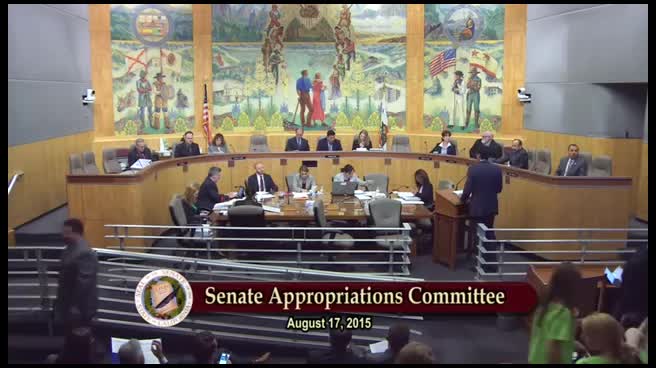 7MIN
Senate Standing Committee on Appropriations
 8MIN
Senate Standing Committee on Health
 1MIN
Assembly Floor
 5MIN
Assembly Standing Committee on Appropriations
Bill Author


