AB 931: Taxation: credit: hiring.
- Session Year: 2015-2016
- House: Assembly
- Latest Version Date: 2015-09-09
The Personal Income Tax Law and the Corporation Tax Law allow various credits against the taxes imposed by those laws, including, for taxable years beginning on or after January 1, 2014, and before January 1, 2021, a credit for hiring qualified full-time employees within specified economic development areas. Existing law defines qualified full-time employee to include an individual who is a veteran who separated from service in the Armed Forces of the United States within the 12 months preceding commencement of employment with the qualified taxpayer.
This bill would, under both laws for taxable years beginning on or after January 1, 2016, revise this definition of a qualified full-time employee to include a person who, upon commencement of employment with the qualified taxpayer, is a veteran that separated from service in the Armed Forces of the United States within the 36 months preceding commencement of employment with the qualified taxpayer.
Existing law also allows a credit against tax under both laws for each taxable year beginning on or after January 1, 2014, and before January 1, 2025, in an amount as provided in a written agreement between the Governors Office of Business and Economic Development and the taxpayer, agreed upon by the California Competes Tax Credit Committee, and based on specified factors, including the number of jobs the taxpayer will create or retain in the state and the amount of investment in the state by the taxpayer. Existing law limits the aggregate amount of credits allocated to taxpayers to a specified sum per fiscal year and provides that the amount available for these credits will decrease based in part, on how much credit is allowed under the hiring credit that would be expanded by this bill.
This bill would include a change in state statute that would result in a taxpayer paying a higher tax within the meaning of Section 3 of Article XIIIA of the California Constitution, and thus would require for passage the approval of 2/3 of the membership of each house of the Legislature.
This bill would take effect immediately as a tax levy.
The Personal Income Tax Law and the Corporation Tax Law allow various credits against the taxes imposed by those laws, including, for taxable years beginning on or after January 1, 2014, and before January 1, 2021, a credit for hiring qualified full-time employees within specified economic development areas. Existing law defines qualified full-time employee to include an individual who is a veteran who separated from service in the Armed Forces of the United States within the 12 months preceding commencement of employment with the qualified taxpayer.
This bill would, under both laws for taxable years beginning on or after January 1, 2016, revise this definition of a qualified full-time employee to include a person who, upon commencement of employment with the qualified taxpayer, is a veteran that separated from service in the Armed Forces of the United States within the 36 months preceding commencement of employment with the qualified taxpayer and was unemployed for the six months immediately preceding employment with the qualified taxpayer.
Existing law also allows a credit against tax under both laws for each taxable year beginning on or after January 1, 2014, and before January 1, 2025, in an amount as provided in a written agreement between the Governors Office of Business and Economic Development and the taxpayer, agreed upon by the California Competes Tax Credit Committee, and based on specified factors, including the number of jobs the taxpayer will create or retain in the state and the amount of investment in the state by the taxpayer. Existing law limits the aggregate amount of credits allocated to taxpayers to a specified sum per fiscal year and provides that the amount available for these credits will decrease based in part, on how much credit is allowed under the hiring credit that would be expanded by this bill.
This bill would include a change in state statute that would result in a taxpayer paying a higher tax within the meaning of Section 3 of Article XIIIA of the California Constitution, and thus would require for passage the approval of 2/3 of the membership of each house of the Legislature.
This bill would take effect immediately as a tax levy.
The Personal Income Tax Law and the Corporation Tax Law allow various credits against the taxes imposed by those laws, including, for taxable years beginning on or after January 1, 2014, and before January 1, 2021, a credit for hiring qualified full-time employees within specified economic development areas. Existing law defines qualified full-time employee to include an individual who is a veteran who separated from service in the Armed Forces of the United States within the 12 months preceding commencement of employment with the qualified taxpayer.
This bill would, under both laws for taxable years beginning on or after January 1, 2016, revise this definition of a qualified full-time employee to include a person who, upon commencement of employment with the qualified taxpayer, is a veteran that separated from service in the Armed Forces of the United States within the 36 months preceding commencement of employment with the qualified taxpayer. taxpayer and was unemployed for the six months immediately preceding employment with the qualified taxpayer.
Existing law also allows a credit against tax under both laws for each taxable year beginning on or after January 1, 2014, and before January 1, 2025, in an amount as provided in a written agreement between the Governors Office of Business and Economic Development and the taxpayer, agreed upon by the California Competes Tax Credit Committee, and based on specified factors, including the number of jobs the taxpayer will create or retain in the state and the amount of investment in the state by the taxpayer. Existing law limits the aggregate amount of credits allocated to taxpayers to a specified sum per fiscal year and provides that the amount available for these credits will decrease based in part, on how much credit is allowed under the hiring credit that would be expanded by this bill.
This bill would include a change in state statute that would result in a taxpayer paying a higher tax within the meaning of Section 3 of Article XIIIA of the California Constitution, and thus would require for passage the approval of 2/3 of the membership of each house of the Legislature.
This bill would take effect immediately as a tax levy.
The Personal Income Tax Law and the Corporation Tax Law allow various credits against the taxes imposed by those laws, including, for taxable years beginning on or after January 1, 2014, and before January 1, 2021, a credit for hiring qualified full-time employees within specified economic development areas. Existing law defines qualified full-time employee to include an individual who is a veteran who separated from service in the Armed Forces of the United States within the 12 months preceding commencement of employment with the qualified taxpayer.
This bill would, under both laws for taxable years beginning on or after January 1, 2015, 2016, revise this definition of a qualified full-time employee to include a person who, upon commencement of employment with the qualified taxpayer, is a veteran that separated from service in the Armed Forces of the United States within the 24 36 months preceding commencement of employment with the qualified taxpayer.
Existing law also allows a credit against tax under both laws for each taxable year beginning on or after January 1, 2014, and before January 1, 2025, in an amount as provided in a written agreement between the Governors Office of Business and Economic Development and the taxpayer, agreed upon by the California Competes Tax Credit Committee, and based on specified factors, including the number of jobs the taxpayer will create or retain in the state and the amount of investment in the state by the taxpayer. Existing law limits the aggregate amount of credits allocated to taxpayers to a specified sum per fiscal year and provides that the amount available for these credits will decrease based in part, on how much credit is allowed under the hiring credit that would be expanded by this bill.
This bill would include a change in state statute that would result in a taxpayer paying a higher tax within the meaning of Section 3 of Article XIIIA of the California Constitution, and thus would require for passage the approval of 2/3 of the membership of each house of the Legislature.
This bill would take effect immediately as a tax levy.
The Personal Income Tax Law and the Corporation Tax Law allow various credits against the taxes imposed by those laws, including, for taxable years beginning on or after January 1, 2014, and before January 1, 2021, a credit for hiring qualified full-time employees within specified economic development areas. Existing law defines qualified full-time employee to include an individual who is a veteran who separated from service in the Armed Forces of the United States within the 12 months preceding commencement of employment with the qualified taxpayer.
This bill would, under both laws for taxable years beginning on or after January 1, 2015, revise this definition of a qualified full-time employee to include a person who, upon commencement of employment with the qualified taxpayer, is a veteran that separated from service in the Armed Forces of the United States within the 24 months preceding commencement of employment with the qualified taxpayer.
Existing law also allows a credit against tax under both laws for each taxable year beginning on or after January 1, 2014, and before January 1, 2025, in an amount as provided in a written agreement between the Governors Office of Business and Economic Development and the taxpayer, agreed upon by the California Competes Tax Credit Committee, and based on specified factors, including the number of jobs the taxpayer will create or retain in the state and the amount of investment in the state by the taxpayer. Existing law limits the aggregate amount of credits allocated to taxpayers to a specified sum per fiscal year and provides that the amount available for these credits will decrease based in part, on how much credit is allowed under the hiring credit that would be expanded by this bill.
This bill would include a change in state statute that would result in a taxpayer paying a higher tax within the meaning of Section 3 of Article XIIIA of the California Constitution, and thus would require for passage the approval of 2/3 of the membership of each house of the Legislature.
This bill would take effect immediately as a tax levy.
(a)(1)For each taxable year beginning on or after January 1, 2014, and before January 1, 2021, there shall be allowed to a qualified taxpayer that hires a qualified full-time employee and pays or incurs qualified wages attributable to work performed by the qualified full-time employee in a designated census tract or economic development area, and that receives a tentative credit reservation for that qualified full-time employee, a credit against the net tax, as defined in Section 17039, in an amount calculated under this section.
(2)The amount of the credit allowable under this section for a taxable year shall be equal to the product of the tentative credit amount for the taxable year and the applicable percentage for the taxable year.
(3)(A)If a qualified taxpayer relocates to a designated census tract or economic development area, the qualified taxpayer shall be allowed a credit with respect to qualified wages for each qualified full-time employee who is employed within the new location only if the qualified taxpayer provides each employee at the previous location or locations a written offer of employment at the new location in the designated census tract or economic development area with comparable compensation.
(B)For purposes of this paragraph, relocates to a designated census tract or economic development area means an increase in the number of qualified full-time employees, employed by a qualified taxpayer, within a designated census tract or tracts or economic development areas within a 12-month period in which there is a decrease in the number of full-time employees, employed by the qualified taxpayer in this state, but outside of designated census tracts or economic development areas.
(C)This paragraph shall not apply to a small business.
(4)The credit allowed by this section may be claimed only on a timely filed original return of the qualified taxpayer and only with respect to a qualified full-time employee for whom the qualified taxpayer has received a tentative credit reservation.
(b)For purposes of this section:
(1)The tentative credit amount for a taxable year shall be equal to the product of the applicable credit percentage for each qualified full-time employee and the qualified wages paid by the qualified taxpayer during the taxable year to that qualified full-time employee.
(2)The applicable percentage for a taxable year shall be equal to a fraction, the numerator of which is the net increase in the total number of full-time employees employed in this state during the taxable year, determined on an annual full-time equivalent basis, as compared with the total number of full-time employees employed in this state during the base year, determined on the same basis, and the denominator of which shall be the total number of qualified full-time employees employed in this state during the taxable year. The applicable percentage shall not exceed 100 percent.
(3)The applicable credit percentage means the credit percentage for the calendar year during which a qualified full-time employee was first employed by the qualified taxpayer. The applicable credit percentage for all calendar years shall be 35 percent.
(4)Base year means the 2013 taxable year, except in the case of a qualified taxpayer who first hires a qualified full-time employee in a taxable year beginning on or after January 1, 2015, the base year means the taxable year immediately preceding the taxable year in which the qualified full-time employee was first hired by the qualified taxpayer.
(5)Acquired includes any gift, inheritance, transfer incident to divorce, or any other transfer, whether or not for consideration.
(6)Annual full-time equivalent means either of the following:
(A)In the case of a full-time employee paid hourly qualified wages, annual full-time equivalent means the total number of hours worked for the qualified taxpayer by the employee, not to exceed 2,000 hours per employee, divided by 2,000.
(B)In the case of a salaried full-time employee, annual full-time equivalent means the total number of weeks worked for the qualified taxpayer by the employee divided by 52.
(7)Designated census tract means a census tract within the state that is determined by the Department of Finance to have a civilian unemployment rate that is within the top 25 percent of all census tracts within the state and has a poverty rate within the top 25 percent of all census tracts within the state, as prescribed in Section 13073.5 of the Government Code.
(8)Economic development area means either of the following:
(A)A former enterprise zone. For purposes of this section, former enterprise zone means an enterprise zone designated and in effect as of December 31, 2011, any enterprise zone designated during 2012, and any revision of an enterprise zone prior to June 30, 2013, under former Chapter 12.8 (commencing with Section 7070) of Division 7 of Title 1 of the Government Code, as in effect on December 31, 2012, excluding any census tract within an enterprise zone that is identified by the Department of Finance pursuant to Section 13073.5 of the Government Code as a census tract within the lowest quartile of census tracts with the lowest civilian unemployment and poverty.
(B)A local agency military base recovery area designated as of the effective date of the act adding this subparagraph, in accordance with Section 7114 of the Government Code.
(9)Minimum wage means the wage established pursuant to Chapter 1 (commencing with Section 1171) of Part 4 of Division 2 of the Labor Code.
(10)(A)Qualified full-time employee means an individual who meets all of the following requirements:
(i)Performs at least 50 percent of his or her services for the qualified taxpayer during the taxable year in a designated census tract or economic development area.
(ii)Receives starting wages that are at least 150 percent of the minimum wage.
(iii)Is hired by the qualified taxpayer on or after January 1, 2014.
(iv)Is hired by the qualified taxpayer after the date the Department of Finance determines that the census tract referred to in clause (i) is a designated census tract or that the census tracts within a former enterprise zone are not census tracts with the lowest civilian unemployment and poverty.
(v)Satisfies either of the following conditions:
(I)Is paid qualified wages by the qualified taxpayer for services not less than an average of 35 hours per week.
(II)Is a salaried employee and was paid compensation during the taxable year for full-time employment, within the meaning of Section 515 of the Labor Code, by the qualified taxpayer.
(vi)Upon commencement of employment with the qualified taxpayer, satisfies any of the following conditions:
(I)Was unemployed for the six months immediately preceding employment with the qualified taxpayer. In the case of an individual who completed a program of study at a college, university, or other postsecondary educational institution, received a baccalaureate, postgraduate, or professional degree, and was unemployed for the six months immediately preceding employment with the qualified taxpayer, that individual must have completed that program of study at least 12 months prior to the individuals commencement of employment with the qualified taxpayer.
(II)(ia)For each taxable year beginning on or after January 1, 2014, and before January 1, 2016, is a veteran who separated from service in the Armed Forces of the United States within the 12 months preceding commencement of employment with the qualified taxpayer.
(ib)For each taxable year beginning on or after January 1, 2016, is a veteran who separated from service in the Armed Forces of the United States within the 36 months preceding commencement of employment with the qualified taxpayer.
(III)Was a recipient of the credit allowed under Section 32 of the Internal Revenue Code, relating to earned income, as applicable for federal purposes, for the previous taxable year.
(IV)Is an ex-offender previously convicted of a felony.
(V)Is a recipient of either CalWORKs, in accordance with Article 2 (commencing with Section 11250) of Chapter 2 of Part 3 of Division 9 of the Welfare and Institutions Code, or general assistance, in accordance with Section 17000.5 of the Welfare and Institutions Code.
(B)An individual may be considered a qualified full-time employee only for the period of time commencing with the date the individual is first employed by the qualified taxpayer and ending 60 months thereafter.
(11)(A)Qualified taxpayer means a person or entity engaged in a trade or business within a designated census tract or economic development area that, during the taxable year, pays or incurs qualified wages.
(B)In the case of any pass-thru entity, the determination of whether a taxpayer is a qualified taxpayer under this section shall be made at the entity level and any credit under this section or Section 23626 shall be allowed to the pass-thru entity and passed through to the partners and shareholders in accordance with applicable provisions of this part or Part 11 (commencing with Section 23001). For purposes of this subdivision, the term pass-thru entity means any partnership or S corporation.
(C)Qualified taxpayers shall not include any of the following:
(i)Employers that provide temporary help services, as described in Code 561320 of the North American Industry Classification System (NAICS) published by the United States Office of Management and Budget, 2012 edition.
(ii)Employers that provide retail trade services, as described in Sector 44-45 of the North American Industry Classification System (NAICS) published by the United States Office of Management and Budget, 2012 edition.
(iii)Employers that are primarily engaged in providing food services, as described in Code 711110, 722511, 722513, 722514, or 722515 of the North American Industry Classification System (NAICS) published by the United States Office of Management and Budget, 2012 edition.
(iv)Employers that are primarily engaged in services as described in Code 713210, 721120, or 722410 of the North American Industry Classification System (NAICS) published by the United States Office of Management and Budget, 2012 edition.
(v)(I)An employer that is a sexually oriented business.
(II)For purposes of this clause:
(ia)Sexually oriented business means a nightclub, bar, restaurant, or similar commercial enterprise that provides for an audience of two or more individuals live nude entertainment or live nude performances where the nudity is a function of everyday business operations and where nudity is a planned and intentional part of the entertainment or performance.
(ib)Nude means clothed in a manner that leaves uncovered or visible, through less than fully opaque clothing, any portion of the genitals or, in the case of a female, any portion of the breasts below the top of the areola of the breasts.
(D)Subparagraph (C) shall not apply to a taxpayer that is a small business.
(12)Qualified wages means those wages that meet all of the following requirements:
(A)(i)Except as provided in clause (ii), that portion of wages paid or incurred by the qualified taxpayer during the taxable year to each qualified full-time employee that exceeds 150 percent of minimum wage, but does not exceed 350 percent of minimum wage.
(ii)(I)In the case of a qualified full-time employee employed in a designated pilot area, that portion of wages paid or incurred by the qualified taxpayer during the taxable year to each qualified full-time employee that exceeds ten dollars ($10) per hour or an equivalent amount for salaried employees, but does not exceed 350 percent of the minimum wage. For qualified full-time employees described in the preceding sentence, clause (ii) of subparagraph (A) of paragraph (10) is modified by substituting ten dollars ($10) per hour or an equivalent amount for salaried employees for 150 percent of the minimum wage.
(II)For purposes of this clause:
(ia)Designated pilot area means an area designated as a designated pilot area by the Governors Office of Business and Economic Development.
(ib)Areas that may be designated as a designated pilot area are limited to areas within a designated census tract or an economic development area with average wages less than the statewide average wages, based on information from the Labor Market Division of the Employment Development Department, and areas within a designated census tract or an economic development area based on high poverty or high unemployment.
(ic)The total number of designated pilot areas that may be designated is limited to five, one or more of which must be an area within five or fewer designated census tracts within a single county based on high poverty or high unemployment or an area within an economic development area based on high poverty or high unemployment.
(id)The designation of a designated pilot area shall be applicable for a period of four calendar years, commencing with the first calendar year for which the designation of a designated pilot area is effective. The applicable period of a designated pilot area may be extended, in the sole discretion of the Governors Office of Business and Economic Development, for an additional period of up to three calendar years. The applicable period, and any extended period, shall not extend beyond December 31, 2020.
(III)The designation of an area as a designated pilot area and the extension of the applicable period of a designated pilot area shall be at the sole discretion of the Governors Office of Business and Economic Development and shall not be subject to administrative appeal or judicial review.
(B)Wages paid or incurred during the 60-month period beginning with the first day the qualified full-time employee commences employment with the qualified taxpayer. In the case of any employee who is reemployed, including a regularly occurring seasonal increase, in the trade or business operations of the qualified taxpayer, this reemployment shall not be treated as constituting commencement of employment for purposes of this section.
(C)Except as provided in paragraph (3) of subdivision (n), qualified wages shall not include any wages paid or incurred by the qualified taxpayer on or after the date that the Department of Finances redesignation of designated census tracts is effective, as provided in paragraph (2) of subdivision (g), so that a census tract is no longer a designated census tract.
(13)Seasonal employment means employment by a qualified taxpayer that has regular and predictable substantial reductions in trade or business operations.
(14)(A)Small business means a trade or business that has aggregate gross receipts, less returns and allowances reportable to this state, of less than two million dollars ($2,000,000) during the previous taxable year.
(B)(i)For purposes of this paragraph, gross receipts, less returns and allowances reportable to this state, means the sum of the gross receipts from the production of business income, as defined in subdivision (a) of Section 25120, and the gross receipts from the production of nonbusiness income, as defined in subdivision (d) of Section 25120.
(ii)In the case of any trade or business activity conducted by a partnership or an S corporation, the limitations set forth in subparagraph (A) shall be applied to the partnership or S corporation and to each partner or shareholder.
(C)(i)Small business shall not include a sexually oriented business.
(ii)For purposes of this subparagraph:
(I)Sexually oriented business means a nightclub, bar, restaurant, or similar commercial enterprise that provides for an audience of two or more individuals live nude entertainment or live nude performances where the nudity is a function of everyday business operations and where nudity is a planned and intentional part of the entertainment or performance.
(II)Nude means clothed in a manner that leaves uncovered or visible, through less than fully opaque clothing, any portion of the genitals or, in the case of a female, any portion of the breasts below the top of the areola of the breasts.
(15)An individual is unemployed for any period for which the individual is all of the following:
(A)Not in receipt of wages subject to withholding under Section 13020 of the Unemployment Insurance Code for that period.
(B)Not a self-employed individual (within the meaning of Section 401(c)(1)(B) of the Internal Revenue Code, relating to self-employed individual) for that period.
(C)Not a registered full-time student at a high school, college, university, or other postsecondary educational institution for that period.
(c)The net increase in full-time employees of a qualified taxpayer shall be determined as provided by this subdivision:
(1)(A)The net increase in full-time employees shall be determined on an annual full-time equivalent basis by subtracting from the amount determined in subparagraph (C) the amount determined in subparagraph (B).
(B)The total number of full-time employees employed in the base year by the taxpayer and by any trade or business acquired by the taxpayer during the current taxable year.
(C)The total number of full-time employees employed in the current taxable year by the taxpayer and by any trade or business acquired during the current taxable year.
(2)For taxpayers who first commence doing business in this state during the taxable year, the number of full-time employees for the base year shall be zero.
(d)For purposes of this section:
(1)All employees of the trades or businesses that are treated as related under Section 267, 318, or 707 of the Internal Revenue Code shall be treated as employed by a single taxpayer.
(2)In determining whether the taxpayer has first commenced doing business in this state during the taxable year, the provisions of subdivision (f) of Section 17276.20, without application of paragraph (7) of that subdivision, shall apply.
(e)(1)To be eligible for the credit allowed by this section, a qualified taxpayer shall, upon hiring a qualified full-time employee, request a tentative credit reservation from the Franchise Tax Board within 30 days of complying with the Employment Development Departments new hire reporting requirements as provided in Section 1088.5 of the Unemployment Insurance Code, in the form and manner prescribed by the Franchise Tax Board.
(2)To obtain a tentative credit reservation with respect to a qualified full-time employee, the qualified taxpayer shall provide necessary information, as determined by the Franchise Tax Board, including the name, social security number, the start date of employment, the rate of pay of the qualified full-time employee, the qualified taxpayers gross receipts, less returns and allowances, for the previous taxable year, and whether the qualified full-time employee is a resident of a targeted employment area, as defined in former Section 7072 of the Government Code, as in effect on December 31, 2013.
(3)The qualified taxpayer shall provide the Franchise Tax Board an annual certification of employment with respect to each qualified full-time employee hired in a previous taxable year, on or before the 15th day of the third month of the taxable year. The certification shall include necessary information, as determined by the Franchise Tax Board, including the name, social security number, start date of employment, and rate of pay for each qualified full-time employee employed by the qualified taxpayer.
(4)A tentative credit reservation provided to a taxpayer with respect to an employee of that taxpayer shall not constitute a determination by the Franchise Tax Board with respect to any of the requirements of this section regarding a taxpayers eligibility for the credit authorized by this section.
(f)The Franchise Tax Board shall do all of the following:
(1)Approve a tentative credit reservation with respect to a qualified full-time employee hired during a calendar year.
(2)Determine the aggregate tentative reservation amount and the aggregate small business tentative reservation amount for a calendar year.
(3)A tentative credit reservation request from a qualified taxpayer with respect to a qualified full-time employee who is a resident of a targeted employment area, as defined in former Section 7072 of the Government Code, as in effect on December 31, 2013, shall be expeditiously processed by the Franchise Tax Board. The residence of a qualified full-time employee in a targeted employment area shall have no other effect on the eligibility of an individual as a qualified full-time employee or the eligibility of a qualified taxpayer for the credit authorized by this section.
(4)Notwithstanding Section 19542, provide as a searchable database on its Internet Web site, for each taxable year beginning on or after January 1, 2014, and before January 1, 2021, the employer names, amounts of tax credit claimed, and number of new jobs created for each taxable year pursuant to this section and Section 23626.
(g)(1)The Department of Finance shall, by January 1, 2014, and by January 1 of every fifth year thereafter, provide the Franchise Tax Board with a list of the designated census tracts and a list of census tracts with the lowest civilian unemployment rate.
(2)The redesignation of designated census tracts and lowest civilian unemployment census tracts by the Department of Finance as provided in Section 13073.5 of the Government Code shall be effective, for purposes of this credit, one year after the date that the Department of Finance redesignates the designated census tracts.
(h)For purposes of this section:
(1)All employees of the trades or businesses that are treated as related under Section 267, 318, or 707 of the Internal Revenue Code shall be treated as employed by a single taxpayer.
(2)All employees of trades or businesses that are not incorporated, and that are under common control, shall be treated as employed by a single taxpayer.
(3)The credit, if any, allowable by this section with respect to each trade or business shall be determined by reference to its proportionate share of the expense of the qualified wages giving rise to the credit, and shall be allocated to that trade or business in that manner.
(4)Principles that apply in the case of controlled groups of corporations, as specified in subdivision (h) of Section 23626, shall apply with respect to determining employment.
(5)If an employer acquires the major portion of a trade or business of another employer, hereinafter in this paragraph referred to as the predecessor, or the major portion of a separate unit of a trade or business of a predecessor, then, for purposes of applying this section, other than subdivision (i), for any taxable year ending after that acquisition, the employment relationship between a qualified full-time employee and an employer shall not be treated as terminated if the employee continues to be employed in that trade or business.
(i)(1)If the employment of any qualified full-time employee, with respect to whom qualified wages are taken into account under subdivision (a), is terminated by the qualified taxpayer at any time during the first 36 months after commencing employment with the qualified taxpayer, whether or not consecutive, the tax imposed by this part for the taxable year in which that employment is terminated shall be increased by an amount equal to the credit allowed under subdivision (a) for that taxable year and all prior taxable years attributable to qualified wages paid or incurred with respect to that employee.
(2)Paragraph (1) shall not apply to any of the following:
(A)A termination of employment of a qualified full-time employee who voluntarily leaves the employment of the qualified taxpayer.
(B)A termination of employment of a qualified full-time employee who, before the close of the period referred to in paragraph (1), becomes disabled and unable to perform the services of that employment, unless that disability is removed before the close of that period and the qualified taxpayer fails to offer reemployment to that employee.
(C)A termination of employment of a qualified full-time employee, if it is determined that the termination was due to the misconduct, as defined in Sections 1256-30 to 1256-43, inclusive, of Title 22 of the California Code of Regulations, of that employee.
(D)A termination of employment of a qualified full-time employee due to a substantial reduction in the trade or business operations of the qualified taxpayer, including reductions due to seasonal employment.
(E)A termination of employment of a qualified full-time employee, if that employee is replaced by other qualified full-time employees so as to create a net increase in both the number of employees and the hours of employment.
(F)A termination of employment of a qualified full-time employee, when that employment is considered seasonal employment and the qualified employee is rehired on a seasonal basis.
(3)For purposes of paragraph (1), the employment relationship between the qualified taxpayer and a qualified full-time employee shall not be treated as terminated by reason of a mere change in the form of conducting the trade or business of the qualified taxpayer, if the qualified full-time employee continues to be employed in that trade or business and the qualified taxpayer retains a substantial interest in that trade or business.
(4)Any increase in tax under paragraph (1) shall not be treated as tax imposed by this part for purposes of determining the amount of any credit allowable under this part.
(j)In the case of an estate or trust, both of the following apply:
(1)The qualified wages for any taxable year shall be apportioned between the estate or trust and the beneficiaries on the basis of the income of the estate or trust allocable to each.
(2)Any beneficiary to whom any qualified wages have been apportioned under paragraph (1) shall be treated, for purposes of this part, as the employer with respect to those wages.
(k)In the case where the credit allowed by this section exceeds the net tax, the excess may be carried over to reduce the net tax in the following year, and the succeeding four years if necessary, until the credit is exhausted.
(l)The Franchise Tax Board may prescribe rules, guidelines, or procedures necessary or appropriate to carry out the purposes of this section, including any guidelines regarding the allocation of the credit allowed under this section. Chapter 3.5 (commencing with Section 11340) of Part 1 of Division 3 of Title 2 of the Government Code shall not apply to any rule, guideline, or procedure prescribed by the Franchise Tax Board pursuant to this section.
(m)(1)Upon the effective date of this section, the Department of Finance shall estimate the total dollar amount of credits that will be claimed under this section with respect to each fiscal year from the 201314 fiscal year to the 2020 21 fiscal year, inclusive.
(2)The Franchise Tax Board shall annually provide to the Joint Legislative Budget Committee, by no later than March 1, a report of the total dollar amount of the credits claimed under this section with respect to the relevant fiscal year. The report shall compare the total dollar amount of credits claimed under this section with respect to that fiscal year with the departments estimate with respect to that same fiscal year. If the total dollar amount of credits claimed for the fiscal year is less than the estimate for that fiscal year, the report shall identify options for increasing annual claims of the credit so as to meet estimated amounts.
(n)(1)This section shall remain in effect only until December 1, 2024, and as of that date is repealed.
(2)Notwithstanding paragraph (1) of subdivision (a), this section shall continue to be operative for taxable years beginning on or after January 1, 2021, but only with respect to qualified full-time employees who commenced employment with a qualified taxpayer in a designated census tract or economic development area in a taxable year beginning before January 1, 2021.
(3)This section shall remain operative for any qualified taxpayer with respect to any qualified full-time employee after the designated census tract is no longer designated or an economic development area ceases to be an economic development area, as defined in this section, for the remaining period, if any, of the 60-month period after the original date of hiring of an otherwise qualified full-time employee and any wages paid or incurred with respect to those qualified full-time employees after the designated census tract is no longer designated or an economic development area ceases to be an economic development area, as defined in this section, shall be treated as qualified wages under this section, provided the employee satisfies any other requirements of paragraphs (10) and (12) of subdivision (b), as if the designated census tract was still designated and binding or the economic development area was still in existence.
SEC. 2.Section 23626 of the Revenue and Taxation Code is amended to read:23626.(a)(1)For each taxable year beginning on or after January 1, 2014, and before January 1, 2021, there shall be allowed to a qualified taxpayer that hires a qualified full-time employee and pays or incurs qualified wages attributable to work performed by the qualified full-time employee in a designated census tract or economic development area, and that receives a tentative credit reservation for that qualified full-time employee, a credit against the tax, as defined by Section 23036, in an amount calculated under this section.
(2)The amount of the credit allowable under this section for a taxable year shall be equal to the product of the tentative credit amount for the taxable year and the applicable percentage for the taxable year.
(3)(A)If a qualified taxpayer relocates to a designated census tract or economic development area, the qualified taxpayer shall be allowed a credit with respect to qualified wages for each qualified full-time employee who is employed within the new location only if the qualified taxpayer provides each employee at the previous location or locations a written offer of employment at the new location in the designated census tract or economic development area with comparable compensation.
(B)For purposes of this paragraph, relocates to a designated census tract or economic development area means an increase in the number of qualified full-time employees, employed by a qualified taxpayer, within a designated census tract or tracts or economic development areas within a 12-month period in which there is a decrease in the number of full-time employees, employed by the qualified taxpayer in this state, but outside of designated census tracts or economic development areas.
(C)This paragraph shall not apply to a small business.
(4)The credit allowed by this section may be claimed only on a timely filed original return of the qualified taxpayer and only with respect to a qualified full-time employee for whom the qualified taxpayer has received a tentative credit reservation.
(b)For purposes of this section:
(1)The tentative credit amount for a taxable year shall be equal to the product of the applicable credit percentage for each qualified full-time employee and the qualified wages paid by the qualified taxpayer during the taxable year to that qualified full-time employee.
(2)The applicable percentage for a taxable year shall be equal to a fraction, the numerator of which is the net increase in the total number of full-time employees employed in this state during the taxable year, determined on an annual full-time equivalent basis, as compared with the total number of full-time employees employed in this state during the base year, determined on the same basis, and the denominator of which shall be the total number of qualified full-time employees employed in this state during the taxable year. The applicable percentage shall not exceed 100 percent.
(3)The applicable credit percentage means the credit percentage for the calendar year during which a qualified full-time employee was first employed by the qualified taxpayer. The applicable credit percentage for all calendar years shall be 35 percent.
(4)Base year means the 2013 taxable year, except in the case of a qualified taxpayer who first hires a qualified full-time employee in a taxable year beginning on or after January 1, 2015, the base year means the taxable year immediately preceding the taxable year in which the qualified full-time employee was first hired by the qualified taxpayer.
(5)Acquired includes any gift, inheritance, transfer incident to divorce, or any other transfer, whether or not for consideration.
(6)Annual full-time equivalent means either of the following:
(A)In the case of a full-time employee paid hourly qualified wages, annual full-time equivalent means the total number of hours worked for the qualified taxpayer by the employee, not to exceed 2,000 hours per employee, divided by 2,000.
(B)In the case of a salaried full-time employee, annual full-time equivalent means the total number of weeks worked for the qualified taxpayer by the employee divided by 52.
(7)Designated census tract means a census tract within the state that is determined by the Department of Finance to have a civilian unemployment rate that is within the top 25 percent of all census tracts within the state and has a poverty rate within the top 25 percent of all census tracts within the state, as prescribed in Section 13073.5 of the Government Code.
(8)Economic development area means either of the following:
(A)A former enterprise zone. For purposes of this section, former enterprise zone means an enterprise zone designated and in effect as of December 31, 2011, any enterprise zone designated during 2012, and any revision of an enterprise zone prior to June 30, 2013, under former Chapter 12.8 (commencing with Section 7070) of Division 7 of Title 1 of the Government Code, as in effect on December 31, 2012, excluding any census tract within an enterprise zone that is identified by the Department of Finance pursuant to Section 13073.5 of the Government Code as a census tract within the lowest quartile of census tracts with the lowest civilian unemployment and poverty.
(B)A local agency military base recovery area designated as of the effective date of the act adding this subparagraph, in accordance with Section 7114 of the Government Code.
(9)Minimum wage means the wage established pursuant to Chapter 1 (commencing with Section 1171) of Part 4 of Division 2 of the Labor Code.
(10)(A)Qualified full-time employee means an individual who meets all of the following requirements:
(i)Performs at least 50 percent of his or her services for the qualified taxpayer during the taxable year in a designated census tract or economic development area.
(ii)Receives starting wages that are at least 150 percent of the minimum wage.
(iii)Is hired by the qualified taxpayer on or after January 1, 2014.
(iv)Is hired by the qualified taxpayer after the date the Department of Finance determines that the census tract referred to in clause (i) is a designated census tract or that the census tracts within a former enterprise zone are not census tracts with the lowest civilian unemployment and poverty.
(v)Satisfies either of the following conditions:
(I)Is paid qualified wages by the qualified taxpayer for services not less than an average of 35 hours per week.
(II)Is a salaried employee and was paid compensation during the taxable year for full-time employment, within the meaning of Section 515 of the Labor Code, by the qualified taxpayer.
(vi)Upon commencement of employment with the qualified taxpayer, satisfies any of the following conditions:
(I)Was unemployed for the six months immediately preceding employment with the qualified taxpayer. In the case of an individual who completed a program of study at a college, university, or other postsecondary educational institution, received a baccalaureate, postgraduate, or professional degree, and was unemployed for the six months immediately preceding employment with the qualified taxpayer, that individual must have completed that program of study at least 12 months prior to the individuals commencement of employment with the qualified taxpayer.
(II)(ia)For each taxable year beginning on or after January 1, 2014, and before January 1, 2016, is a veteran who separated from service in the Armed Forces of the United States within the 12 months preceding commencement of employment with the qualified taxpayer.
(ib)For each taxable year beginning on or after January 1, 2016, is a veteran who separated from service in the Armed Forces of the United States within the 36 months preceding commencement of employment with the qualified taxpayer.
(III)Was a recipient of the credit allowed under Section 32 of the Internal Revenue Code, relating to earned income, as applicable for federal purposes, for the previous taxable year.
(IV)Is an ex-offender previously convicted of a felony.
(V)Is a recipient of either CalWORKs, in accordance with Article 2 (commencing with Section 11250) of Chapter 2 of Part 3 of Division 9 of the Welfare and Institutions Code, or general assistance, in accordance with Section 17000.5 of the Welfare and Institutions Code.
(B)An individual may be considered a qualified full-time employee only for the period of time commencing with the date the individual is first employed by the qualified taxpayer and ending 60 months thereafter.
(11)(A)Qualified taxpayer means a corporation engaged in a trade or business within a designated census tract or economic development area that, during the taxable year, pays or incurs qualified wages.
(B)In the case of any pass-thru entity, the determination of whether a taxpayer is a qualified taxpayer under this section shall be made at the entity level and any credit under this section or Section 17053.73 shall be allowed to the pass-thru entity and passed through to the partners and shareholders in accordance with applicable provisions of this part or Part 10 (commencing with Section 17001). For purposes of this subdivision, the term pass-thru entity means any partnership or S corporation.
(C)Qualified taxpayers shall not include any of the following:
(i)Employers that provide temporary help services, as described in Code 561320 of the North American Industry Classification System (NAICS) published by the United States Office of Management and Budget, 2012 edition.
(ii)Employers that provide retail trade services, as described in Sector 44-45 of the North American Industry Classification System (NAICS) published by the United States Office of Management and Budget, 2012 edition.
(iii)Employers that are primarily engaged in providing food services, as described in Code 711110, 722511, 722513, 722514, or 722515 of the North American Industry Classification System (NAICS) published by the United States Office of Management and Budget, 2012 edition.
(iv)Employers that are primarily engaged in services as described in Code 713210, 721120, or 722410 of the North American Industry Classification System (NAICS) published by the United States Office of Management and Budget, 2012 edition.
(v)(I)An employer that is a sexually oriented business.
(II)For purposes of this clause:
(ia)Sexually oriented business means a nightclub, bar, restaurant, or similar commercial enterprise that provides for an audience of two or more individuals live nude entertainment or live nude performances where the nudity is a function of everyday business operations and where nudity is a planned and intentional part of the entertainment or performance.
(ib)Nude means clothed in a manner that leaves uncovered or visible, through less than fully opaque clothing, any portion of the genitals or, in the case of a female, any portion of the breasts below the top of the areola of the breasts.
(D)Subparagraph (C) shall not apply to a taxpayer that is a small business.
(12)Qualified wages means those wages that meet all of the following requirements:
(A)(i)Except as provided in clause (ii), that portion of wages paid or incurred by the qualified taxpayer during the taxable year to each qualified full-time employee that exceeds 150 percent of the minimum wage, but does not exceed 350 percent of the minimum wage.
(ii)(I)In the case of a qualified full-time employee employed in a designated pilot area, that portion of wages paid or incurred by the qualified taxpayer during the taxable year to each qualified full-time employee that exceeds ten dollars ($10) per hour or an equivalent amount for salaried employees, but does not exceed 350 percent of the minimum wage. For qualified full-time employees described in the preceding sentence, clause (ii) of subparagraph (A) of paragraph (10) is modified by substituting ten dollars ($10) per hour or an equivalent amount for salaried employees for 150 percent of the minimum wage.
(II)For purposes of this clause:
(ia)Designated pilot area means an area designated as a designated pilot area by the Governors Office of Business and Economic Development.
(ib)Areas that may be designated as a designated pilot area are limited to areas within a designated census tract or an economic development area with average wages less than the statewide average wages, based on information from the Labor Market Division of the Employment Development Department, and areas within a designated census tract or an economic development area based on high poverty or high unemployment.
(ic)The total number of designated pilot areas that may be designated is limited to five, one or more of which must be an area within five or fewer designated census tracts within a single county based on high poverty or high unemployment or an area within an economic development area based on high poverty or high unemployment.
(id)The designation of a designated pilot area shall be applicable for a period of four calendar years, commencing with the first calendar year for which the designation of a designated pilot area is effective. The applicable period of a designated pilot area may be extended, in the sole discretion of the Governors Office of Business and Economic Development, for an additional period of up to three calendar years. The applicable period, and any extended period, shall not extend beyond December 31, 2020.
(III)The designation of an area as a designated pilot area and the extension of the applicable period of a designated pilot area shall be at the sole discretion of the Governors Office of Business and Economic Development and shall not be subject to administrative appeal or judicial review.
(B)Wages paid or incurred during the 60-month period beginning with the first day the qualified full-time employee commences employment with the qualified taxpayer. In the case of any employee who is reemployed, including a regularly occurring seasonal increase, in the trade or business operations of the qualified taxpayer, this reemployment shall not be treated as constituting commencement of employment for purposes of this section.
(C)Except as provided in paragraph (3) of subdivision (m), qualified wages shall not include any wages paid or incurred by the qualified taxpayer on or after the date that the Department of Finances redesignation of designated census tracts is effective, as provided in paragraph (2) of subdivision (g), so that a census tract is no longer a designated census tract.
(13)Seasonal employment means employment by a qualified taxpayer that has regular and predictable substantial reductions in trade or business operations.
(14)(A)Small business means a trade or business that has aggregate gross receipts, less returns and allowances reportable to this state, of less than two million dollars ($2,000,000) during the previous taxable year.
(B)(i)For purposes of this paragraph, gross receipts, less returns and allowances reportable to this state, means the sum of the gross receipts from the production of business income, as defined in subdivision (a) of Section 25120, and the gross receipts from the production of nonbusiness income, as defined in subdivision (d) of Section 25120.
(ii)In the case of any trade or business activity conducted by a partnership or an S corporation, the limitations set forth in subparagraph (A) shall be applied to the partnership or S corporation and to each partner or shareholder.
(iii)For taxpayers that are required to be included in a combined report under Section 25101 or authorized to be included in a combined report under Section 25101.15, the dollar amount specified in subparagraph (A) shall apply to the aggregate gross receipts of all taxpayers that are required to be or authorized to be included in a combined report.
(C)(i)Small business shall not include a sexually oriented business.
(ii)For purposes of this subparagraph:
(I)Sexually oriented business means a nightclub, bar, restaurant, or similar commercial enterprise that provides for an audience of two or more individuals live nude entertainment or live nude performances where the nudity is a function of everyday business operations and where nudity is a planned and intentional part of the entertainment or performance.
(II)Nude means clothed in a manner that leaves uncovered or visible, through less than fully opaque clothing, any portion of the genitals or, in the case of a female, any portion of the breasts below the top of the areola of the breasts.
(15)An individual is unemployed for any period for which the individual is all of the following:
(A)Not in receipt of wages subject to withholding under Section 13020 of the Unemployment Insurance Code for that period.
(B)Not a self-employed individual (within the meaning of Section 401(c)(1)(B) of the Internal Revenue Code, relating to self-employed individual) for that period.
(C)Not a registered full-time student at a high school, college, university, or other postsecondary educational institution for that period.
(c)The net increase in full-time employees of a qualified taxpayer shall be determined as provided by this subdivision:
(1)(A)The net increase in full-time employees shall be determined on an annual full-time equivalent basis by subtracting from the amount determined in subparagraph (C) the amount determined in subparagraph (B).
(B)The total number of full-time employees employed in the base year by the taxpayer and by any trade or business acquired by the taxpayer during the current taxable year.
(C)The total number of full-time employees employed in the current taxable year by the taxpayer and by any trade or business acquired during the current taxable year.
(2)For taxpayers who first commence doing business in this state during the taxable year, the number of full-time employees for the base year shall be zero.
(d)For purposes of this section:
(1)All employees of the trades or businesses that are treated as related under Section 267, 318, or 707 of the Internal Revenue Code shall be treated as employed by a single taxpayer.
(2)In determining whether the taxpayer has first commenced doing business in this state during the taxable year, the provisions of subdivision (g) of Section 24416.20, without application of paragraph (7) of that subdivision, shall apply.
(e)(1)To be eligible for the credit allowed by this section, a qualified taxpayer shall, upon hiring a qualified full-time employee, request a tentative credit reservation from the Franchise Tax Board within 30 days of complying with the Employment Development Departments new hire reporting requirements as provided in Section 1088.5 of the Unemployment Insurance Code, in the form and manner prescribed by the Franchise Tax Board.
(2)To obtain a tentative credit reservation with respect to a qualified full-time employee, the qualified taxpayer shall provide necessary information, as determined by the Franchise Tax Board, including the name, social security number, the start date of employment, the rate of pay of the qualified full-time employee, the qualified taxpayers gross receipts, less returns and allowances, for the previous taxable year, and whether the qualified full-time employee is a resident of a targeted employment area, as defined in former Section 7072 of the Government Code, as in effect on December 31, 2013.
(3)The qualified taxpayer shall provide the Franchise Tax Board an annual certification of employment with respect to each qualified full-time employee hired in a previous taxable year, on or before the 15th day of the third month of the taxable year. The certification shall include necessary information, as determined by the Franchise Tax Board, including the name, social security number, start date of employment, and rate of pay for each qualified full-time employee employed by the qualified taxpayer.
(4)A tentative credit reservation provided to a taxpayer with respect to an employee of that taxpayer shall not constitute a determination by the Franchise Tax Board with respect to any of the requirements of this section regarding a taxpayers eligibility for the credit authorized by this section.
(f)The Franchise Tax Board shall do all of the following:
(1)Approve a tentative credit reservation with respect to a qualified full-time employee hired during a calendar year.
(2)Determine the aggregate tentative reservation amount and the aggregate small business tentative reservation amount for a calendar year.
(3)A tentative credit reservation request from a qualified taxpayer with respect to a qualified full-time employee who is a resident of a targeted employment area, as defined in former Section 7072 of the Government Code, as in effect on December 31, 2013, shall be expeditiously processed by the Franchise Tax Board. The residence of a qualified full-time employee in a targeted employment area shall have no other effect on the eligibility of an individual as a qualified full-time employee or the eligibility of a qualified taxpayer for the credit authorized by this section.
(4)Notwithstanding Section 19542, provide as a searchable database on its Internet Web site, for each taxable year beginning on or after January 1, 2014, and before January 1, 2021, the employer names, amounts of tax credit claimed, and number of new jobs created for each taxable year pursuant to this section and Section 17053.73.
(g)(1)The Department of Finance shall, by January 1, 2014, and by January 1 of every fifth year thereafter, provide the Franchise Tax Board with a list of the designated census tracts and a list of census tracts with the lowest civilian unemployment rate.
(2)The redesignation of designated census tracts and lowest civilian unemployment census tracts by the Department of Finance as provided in Section 13073.5 of the Government Code shall be effective, for purposes of this credit, one year after the date that the Department of Finance redesignates the designated census tracts.
(h)(1)For purposes of this section:
(A)All employees of the trades or businesses that are treated as related under Section 267, 318, or 707 of the Internal Revenue Code shall be treated as employed by a single qualified taxpayer.
(B)All employees of all corporations that are members of the same controlled group of corporations shall be treated as employed by a single qualified taxpayer.
(C)The credit, if any, allowable by this section to each member shall be determined by reference to its proportionate share of the expense of the qualified wages giving rise to the credit, and shall be allocated in that manner.
(D)If a qualified taxpayer acquires the major portion of a trade or business of another taxpayer, hereinafter in this paragraph referred to as the predecessor, or the major portion of a separate unit of a trade or business of a predecessor, then, for purposes of applying this section for any taxable year ending after that acquisition, the employment relationship between a qualified full-time employee and a qualified taxpayer shall not be treated as terminated if the employee continues to be employed in that trade or business.
(2)For purposes of this subdivision, controlled group of corporations means a controlled group of corporations as defined in Section 1563(a) of the Internal Revenue Code, except that:
(A)More than 50 percent shall be substituted for at least 80 percent each place it appears in Section 1563(a)(1) of the Internal Revenue Code.
(B)The determination shall be made without regard to subsections (a)(4) and (e)(3)(C) of Section 1563 of the Internal Revenue Code.
(3)Rules similar to the rules provided in Sections 46(e) and 46(h) of the Internal Revenue Code, as in effect on November 4, 1990, shall apply to both of the following:
(A)An organization to which Section 593 of the Internal Revenue Code applies.
(B)A regulated investment company or a real estate investment trust subject to taxation under this part.
(i)(1)If the employment of any qualified full-time employee, with respect to whom qualified wages are taken into account under subdivision (a), is terminated by the qualified taxpayer at any time during the first 36 months after commencing employment with the qualified taxpayer, whether or not consecutive, the tax imposed by this part for the taxable year in which that employment is terminated shall be increased by an amount equal to the credit allowed under subdivision (a) for that taxable year and all prior taxable years attributable to qualified wages paid or incurred with respect to that employee.
(2)Paragraph (1) shall not apply to any of the following:
(A)A termination of employment of a qualified full-time employee who voluntarily leaves the employment of the qualified taxpayer.
(B)A termination of employment of a qualified full-time employee who, before the close of the period referred to in paragraph (1), becomes disabled and unable to perform the services of that employment, unless that disability is removed before the close of that period and the qualified taxpayer fails to offer reemployment to that employee.
(C)A termination of employment of a qualified full-time employee, if it is determined that the termination was due to the misconduct, as defined in Sections 1256-30 to 1256-43, inclusive, of Title 22 of the California Code of Regulations, of that employee.
(D)A termination of employment of a qualified full-time employee due to a substantial reduction in the trade or business operations of the qualified taxpayer, including reductions due to seasonal employment.
(E)A termination of employment of a qualified full-time employee, if that employee is replaced by other qualified full-time employees so as to create a net increase in both the number of employees and the hours of employment.
(F)A termination of employment of a qualified full-time employee, when that employment is considered seasonal employment and the qualified employee is rehired on a seasonal basis.
(3)For purposes of paragraph (1), the employment relationship between the qualified taxpayer and a qualified full-time employee shall not be treated as terminated by reason of a mere change in the form of conducting the trade or business of the qualified taxpayer, if the qualified full-time employee continues to be employed in that trade or business and the qualified taxpayer retains a substantial interest in that trade or business.
(4)Any increase in tax under paragraph (1) shall not be treated as tax imposed by this part for purposes of determining the amount of any credit allowable under this part.
(j)In the case where the credit allowed by this section exceeds the tax, the excess may be carried over to reduce the tax in the following year, and the succeeding four years if necessary, until the credit is exhausted.
(k)The Franchise Tax Board may prescribe rules, guidelines, or procedures necessary or appropriate to carry out the purposes of this section, including any guidelines regarding the allocation of the credit allowed under this section. Chapter 3.5 (commencing with Section 11340) of Part 1 of Division 3 of Title 2 of the Government Code shall not apply to any rule, guideline, or procedure prescribed by the Franchise Tax Board pursuant to this section.
(l)(1)Upon the effective date of this section, the Department of Finance shall estimate the total dollar amount of credits that will be claimed under this section with respect to each fiscal year from the 201314 fiscal year to the 2020 21 fiscal year, inclusive.
(2)The Franchise Tax Board shall annually provide to the Joint Legislative Budget Committee, by no later than March 1, a report of the total dollar amount of the credits claimed under this section with respect to the relevant fiscal year. The report shall compare the total dollar amount of credits claimed under this section with respect to that fiscal year with the departments estimate with respect to that same fiscal year. If the total dollar amount of credits claimed for the fiscal year is less than the estimate for that fiscal year, the report shall identify options for increasing annual claims of the credit so as to meet estimated amounts.
(m)(1)This section shall remain in effect only until December 1, 2024, and as of that date is repealed.
(2)Notwithstanding paragraph (1) of subdivision (a), this section shall continue to be operative for taxable years beginning on or after January 1, 2021, but only with respect to qualified full-time employees who commenced employment with a qualified taxpayer in a designated census tract or economic development area in a taxable year beginning before January 1, 2021.
(3)This section shall remain operative for any qualified taxpayer with respect to any qualified full-time employee after the designated census tract is no longer designated or an economic development area ceases to be an economic development area, as defined in this section, for the remaining period, if any, of the 60-month period after the original date of hiring of an otherwise qualified full-time employee and any wages paid or incurred with respect to those qualified full-time employees after the designated census tract is no longer designated or an economic development area ceases to be an economic development area, as defined in this section, shall be treated as qualified wages under this section, provided the employee satisfies any other requirements of paragraphs (10) and (12) of subdivision (b), as if the designated census tract was still designated and binding or the economic development area was still in existence.
SEC. 3.This act provides for a tax levy within the meaning of Article IV of the Constitution and shall go into immediate effect.
(a)(1)For each taxable year beginning on or after January 1, 2014, and before January 1, 2021, there shall be allowed to a qualified taxpayer that hires a qualified full-time employee and pays or incurs qualified wages attributable to work performed by the qualified full-time employee in a designated census tract or economic development area, and that receives a tentative credit reservation for that qualified full-time employee, a credit against the net tax, as defined in Section 17039, in an amount calculated under this section.
(2)The amount of the credit allowable under this section for a taxable year shall be equal to the product of the tentative credit amount for the taxable year and the applicable percentage for the taxable year.
(3)(A)If a qualified taxpayer relocates to a designated census tract or economic development area, the qualified taxpayer shall be allowed a credit with respect to qualified wages for each qualified full-time employee who is employed within the new location only if the qualified taxpayer provides each employee at the previous location or locations a written offer of employment at the new location in the designated census tract or economic development area with comparable compensation.
(B)For purposes of this paragraph, relocates to a designated census tract or economic development area means an increase in the number of qualified full-time employees, employed by a qualified taxpayer, within a designated census tract or tracts or economic development areas within a 12-month period in which there is a decrease in the number of full-time employees, employed by the qualified taxpayer in this state, but outside of designated census tracts or economic development areas.
(C)This paragraph shall not apply to a small business.
(4)The credit allowed by this section may be claimed only on a timely filed original return of the qualified taxpayer and only with respect to a qualified full-time employee for whom the qualified taxpayer has received a tentative credit reservation.
(b)For purposes of this section:
(1)The tentative credit amount for a taxable year shall be equal to the product of the applicable credit percentage for each qualified full-time employee and the qualified wages paid by the qualified taxpayer during the taxable year to that qualified full-time employee.
(2)The applicable percentage for a taxable year shall be equal to a fraction, the numerator of which is the net increase in the total number of full-time employees employed in this state during the taxable year, determined on an annual full-time equivalent basis, as compared with the total number of full-time employees employed in this state during the base year, determined on the same basis, and the denominator of which shall be the total number of qualified full-time employees employed in this state during the taxable year. The applicable percentage shall not exceed 100 percent.
(3)The applicable credit percentage means the credit percentage for the calendar year during which a qualified full-time employee was first employed by the qualified taxpayer. The applicable credit percentage for all calendar years shall be 35 percent.
(4)Base year means the 2013 taxable year, except in the case of a qualified taxpayer who first hires a qualified full-time employee in a taxable year beginning on or after January 1, 2015, the base year means the taxable year immediately preceding the taxable year in which the qualified full-time employee was first hired by the qualified taxpayer.
(5)Acquired includes any gift, inheritance, transfer incident to divorce, or any other transfer, whether or not for consideration.
(6)Annual full-time equivalent means either of the following:
(A)In the case of a full-time employee paid hourly qualified wages, annual full-time equivalent means the total number of hours worked for the qualified taxpayer by the employee, not to exceed 2,000 hours per employee, divided by 2,000.
(B)In the case of a salaried full-time employee, annual full-time equivalent means the total number of weeks worked for the qualified taxpayer by the employee divided by 52.
(7)Designated census tract means a census tract within the state that is determined by the Department of Finance to have a civilian unemployment rate that is within the top 25 percent of all census tracts within the state and has a poverty rate within the top 25 percent of all census tracts within the state, as prescribed in Section 13073.5 of the Government Code.
(8)Economic development area means either of the following:
(A)A former enterprise zone. For purposes of this section, former enterprise zone means an enterprise zone designated and in effect as of December 31, 2011, any enterprise zone designated during 2012, and any revision of an enterprise zone prior to June 30, 2013, under former Chapter 12.8 (commencing with Section 7070) of Division 7 of Title 1 of the Government Code, as in effect on December 31, 2012, excluding any census tract within an enterprise zone that is identified by the Department of Finance pursuant to Section 13073.5 of the Government Code as a census tract within the lowest quartile of census tracts with the lowest civilian unemployment and poverty.
(B)A local agency military base recovery area designated as of the effective date of the act adding this subparagraph, in accordance with Section 7114 of the Government Code.
(9)Minimum wage means the wage established pursuant to Chapter 1 (commencing with Section 1171) of Part 4 of Division 2 of the Labor Code.
(10)(A)Qualified full-time employee means an individual who meets all of the following requirements:
(i)Performs at least 50 percent of his or her services for the qualified taxpayer during the taxable year in a designated census tract or economic development area.
(ii)Receives starting wages that are at least 150 percent of the minimum wage.
(iii)Is hired by the qualified taxpayer on or after January 1, 2014.
(iv)Is hired by the qualified taxpayer after the date the Department of Finance determines that the census tract referred to in clause (i) is a designated census tract or that the census tracts within a former enterprise zone are not census tracts with the lowest civilian unemployment and poverty.
(v)Satisfies either of the following conditions:
(I)Is paid qualified wages by the qualified taxpayer for services not less than an average of 35 hours per week.
(II)Is a salaried employee and was paid compensation during the taxable year for full-time employment, within the meaning of Section 515 of the Labor Code, by the qualified taxpayer.
(vi)Upon commencement of employment with the qualified taxpayer, satisfies any of the following conditions:
(I)Was unemployed for the six months immediately preceding employment with the qualified taxpayer. In the case of an individual who completed a program of study at a college, university, or other postsecondary educational institution, received a baccalaureate, postgraduate, or professional degree, and was unemployed for the six months immediately preceding employment with the qualified taxpayer, that individual must have completed that program of study at least 12 months prior to the individuals commencement of employment with the qualified taxpayer.
(II) Is a veteran who separated from service in the Armed Forces of the United States within the 12 months preceding commencement of employment with the qualified taxpayer.
(III)For each taxable year beginning on or after January 1, 2016, is a veteran who separated from service in the Armed Forces of the United States within the 36 months preceding commencement of employment with the qualified taxpayer and was unemployed for the six months immediately preceding employment with the qualified taxpayer.
(II)(ia)For each taxable year beginning on or after January 1, 2014, and before January 1, 2016, is a veteran who separated from service in the Armed Forces of the United States within the 12 months preceding commencement of employment with the qualified taxpayer.
(ib)For each taxable year beginning on or after January 1, 2016, is a veteran who separated from service in the Armed Forces of the United States within the 36 months preceding commencement of employment with the qualified taxpayer.
(IV)
(III)Was a recipient of the credit allowed under Section 32 of the Internal Revenue Code, relating to earned income, as applicable for federal purposes, for the previous taxable year.
(V)
(IV)Is an ex-offender previously convicted of a felony.
(VI)
(V)Is a recipient of either CalWORKs, in accordance with Article 2 (commencing with Section 11250) of Chapter 2 of Part 3 of Division 9 of the Welfare and Institutions Code, or general assistance, in accordance with Section 17000.5 of the Welfare and Institutions Code.
(B)An individual may be considered a qualified full-time employee only for the period of time commencing with the date the individual is first employed by the qualified taxpayer and ending 60 months thereafter.
(11)(A)Qualified taxpayer means a person or entity engaged in a trade or business within a designated census tract or economic development area that, during the taxable year, pays or incurs qualified wages.
(B)In the case of any pass-thru entity, the determination of whether a taxpayer is a qualified taxpayer under this section shall be made at the entity level and any credit under this section or Section 23626 shall be allowed to the pass-thru entity and passed through to the partners and shareholders in accordance with applicable provisions of this part or Part 11 (commencing with Section 23001). For purposes of this subdivision, the term pass-thru entity means any partnership or S corporation.
(C)Qualified taxpayers shall not include any of the following:
(i)Employers that provide temporary help services, as described in Code 561320 of the North American Industry Classification System (NAICS) published by the United States Office of Management and Budget, 2012 edition.
(ii)Employers that provide retail trade services, as described in Sector 44-45 of the North American Industry Classification System (NAICS) published by the United States Office of Management and Budget, 2012 edition.
(iii)Employers that are primarily engaged in providing food services, as described in Code 711110, 722511, 722513, 722514, or 722515 of the North American Industry Classification System (NAICS) published by the United States Office of Management and Budget, 2012 edition.
(iv)Employers that are primarily engaged in services as described in Code 713210, 721120, or 722410 of the North American Industry Classification System (NAICS) published by the United States Office of Management and Budget, 2012 edition.
(v)(I)An employer that is a sexually oriented business.
(II)For purposes of this clause:
(ia)Sexually oriented business means a nightclub, bar, restaurant, or similar commercial enterprise that provides for an audience of two or more individuals live nude entertainment or live nude performances where the nudity is a function of everyday business operations and where nudity is a planned and intentional part of the entertainment or performance.
(ib)Nude means clothed in a manner that leaves uncovered or visible, through less than fully opaque clothing, any portion of the genitals or, in the case of a female, any portion of the breasts below the top of the areola of the breasts.
(D)Subparagraph (C) shall not apply to a taxpayer that is a small business.
(12)Qualified wages means those wages that meet all of the following requirements:
(A)(i)Except as provided in clause (ii), that portion of wages paid or incurred by the qualified taxpayer during the taxable year to each qualified full-time employee that exceeds 150 percent of minimum wage, but does not exceed 350 percent of minimum wage.
(ii)(I)In the case of a qualified full-time employee employed in a designated pilot area, that portion of wages paid or incurred by the qualified taxpayer during the taxable year to each qualified full-time employee that exceeds ten dollars ($10) per hour or an equivalent amount for salaried employees, but does not exceed 350 percent of the minimum wage. For qualified full-time employees described in the preceding sentence, clause (ii) of subparagraph (A) of paragraph (10) is modified by substituting ten dollars ($10) per hour or an equivalent amount for salaried employees for 150 percent of the minimum wage.
(II)For purposes of this clause:
(ia)Designated pilot area means an area designated as a designated pilot area by the Governors Office of Business and Economic Development.
(ib)Areas that may be designated as a designated pilot area are limited to areas within a designated census tract or an economic development area with average wages less than the statewide average wages, based on information from the Labor Market Division of the Employment Development Department, and areas within a designated census tract or an economic development area based on high poverty or high unemployment.
(ic)The total number of designated pilot areas that may be designated is limited to five, one or more of which must be an area within five or fewer designated census tracts within a single county based on high poverty or high unemployment or an area within an economic development area based on high poverty or high unemployment.
(id)The designation of a designated pilot area shall be applicable for a period of four calendar years, commencing with the first calendar year for which the designation of a designated pilot area is effective. The applicable period of a designated pilot area may be extended, in the sole discretion of the Governors Office of Business and Economic Development, for an additional period of up to three calendar years. The applicable period, and any extended period, shall not extend beyond December 31, 2020.
(III)The designation of an area as a designated pilot area and the extension of the applicable period of a designated pilot area shall be at the sole discretion of the Governors Office of Business and Economic Development and shall not be subject to administrative appeal or judicial review.
(B)Wages paid or incurred during the 60-month period beginning with the first day the qualified full-time employee commences employment with the qualified taxpayer. In the case of any employee who is reemployed, including a regularly occurring seasonal increase, in the trade or business operations of the qualified taxpayer, this reemployment shall not be treated as constituting commencement of employment for purposes of this section.
(C)Except as provided in paragraph (3) of subdivision (n), qualified wages shall not include any wages paid or incurred by the qualified taxpayer on or after the date that the Department of Finances redesignation of designated census tracts is effective, as provided in paragraph (2) of subdivision (g), so that a census tract is no longer a designated census tract.
(13)Seasonal employment means employment by a qualified taxpayer that has regular and predictable substantial reductions in trade or business operations.
(14)(A)Small business means a trade or business that has aggregate gross receipts, less returns and allowances reportable to this state, of less than two million dollars ($2,000,000) during the previous taxable year.
(B)(i)For purposes of this paragraph, gross receipts, less returns and allowances reportable to this state, means the sum of the gross receipts from the production of business income, as defined in subdivision (a) of Section 25120, and the gross receipts from the production of nonbusiness income, as defined in subdivision (d) of Section 25120.
(ii)In the case of any trade or business activity conducted by a partnership or an S corporation, the limitations set forth in subparagraph (A) shall be applied to the partnership or S corporation and to each partner or shareholder.
(C)(i)Small business shall not include a sexually oriented business.
(ii)For purposes of this subparagraph:
(I)Sexually oriented business means a nightclub, bar, restaurant, or similar commercial enterprise that provides for an audience of two or more individuals live nude entertainment or live nude performances where the nudity is a function of everyday business operations and where nudity is a planned and intentional part of the entertainment or performance.
(II)Nude means clothed in a manner that leaves uncovered or visible, through less than fully opaque clothing, any portion of the genitals or, in the case of a female, any portion of the breasts below the top of the areola of the breasts.
(15)An individual is unemployed for any period for which the individual is all of the following:
(A)Not in receipt of wages subject to withholding under Section 13020 of the Unemployment Insurance Code for that period.
(B)Not a self-employed individual (within the meaning of Section 401(c)(1)(B) of the Internal Revenue Code, relating to self-employed individual) for that period.
(C)Not a registered full-time student at a high school, college, university, or other postsecondary educational institution for that period.
(c)The net increase in full-time employees of a qualified taxpayer shall be determined as provided by this subdivision:
(1)(A)The net increase in full-time employees shall be determined on an annual full-time equivalent basis by subtracting from the amount determined in subparagraph (C) the amount determined in subparagraph (B).
(B)The total number of full-time employees employed in the base year by the taxpayer and by any trade or business acquired by the taxpayer during the current taxable year.
(C)The total number of full-time employees employed in the current taxable year by the taxpayer and by any trade or business acquired during the current taxable year.
(2)For taxpayers who first commence doing business in this state during the taxable year, the number of full-time employees for the base year shall be zero.
(d)For purposes of this section:
(1)All employees of the trades or businesses that are treated as related under Section 267, 318, or 707 of the Internal Revenue Code shall be treated as employed by a single taxpayer.
(2)In determining whether the taxpayer has first commenced doing business in this state during the taxable year, the provisions of subdivision (f) of Section 17276.20, without application of paragraph (7) of that subdivision, shall apply.
(e)(1)To be eligible for the credit allowed by this section, a qualified taxpayer shall, upon hiring a qualified full-time employee, request a tentative credit reservation from the Franchise Tax Board within 30 days of complying with the Employment Development Departments new hire reporting requirements as provided in Section 1088.5 of the Unemployment Insurance Code, in the form and manner prescribed by the Franchise Tax Board.
(2)To obtain a tentative credit reservation with respect to a qualified full-time employee, the qualified taxpayer shall provide necessary information, as determined by the Franchise Tax Board, including the name, social security number, the start date of employment, the rate of pay of the qualified full-time employee, the qualified taxpayers gross receipts, less returns and allowances, for the previous taxable year, and whether the qualified full-time employee is a resident of a targeted employment area, as defined in former Section 7072 of the Government Code, as in effect on December 31, 2013.
(3)The qualified taxpayer shall provide the Franchise Tax Board an annual certification of employment with respect to each qualified full-time employee hired in a previous taxable year, on or before the 15th day of the third month of the taxable year. The certification shall include necessary information, as determined by the Franchise Tax Board, including the name, social security number, start date of employment, and rate of pay for each qualified full-time employee employed by the qualified taxpayer.
(4)A tentative credit reservation provided to a taxpayer with respect to an employee of that taxpayer shall not constitute a determination by the Franchise Tax Board with respect to any of the requirements of this section regarding a taxpayers eligibility for the credit authorized by this section.
(f)The Franchise Tax Board shall do all of the following:
(1)Approve a tentative credit reservation with respect to a qualified full-time employee hired during a calendar year.
(2)Determine the aggregate tentative reservation amount and the aggregate small business tentative reservation amount for a calendar year.
(3)A tentative credit reservation request from a qualified taxpayer with respect to a qualified full-time employee who is a resident of a targeted employment area, as defined in former Section 7072 of the Government Code, as in effect on December 31, 2013, shall be expeditiously processed by the Franchise Tax Board. The residence of a qualified full-time employee in a targeted employment area shall have no other effect on the eligibility of an individual as a qualified full-time employee or the eligibility of a qualified taxpayer for the credit authorized by this section.
(4)Notwithstanding Section 19542, provide as a searchable database on its Internet Web site, for each taxable year beginning on or after January 1, 2014, and before January 1, 2021, the employer names, amounts of tax credit claimed, and number of new jobs created for each taxable year pursuant to this section and Section 23626.
(g)(1)The Department of Finance shall, by January 1, 2014, and by January 1 of every fifth year thereafter, provide the Franchise Tax Board with a list of the designated census tracts and a list of census tracts with the lowest civilian unemployment rate.
(2)The redesignation of designated census tracts and lowest civilian unemployment census tracts by the Department of Finance as provided in Section 13073.5 of the Government Code shall be effective, for purposes of this credit, one year after the date that the Department of Finance redesignates the designated census tracts.
(h)For purposes of this section:
(1)All employees of the trades or businesses that are treated as related under Section 267, 318, or 707 of the Internal Revenue Code shall be treated as employed by a single taxpayer.
(2)All employees of trades or businesses that are not incorporated, and that are under common control, shall be treated as employed by a single taxpayer.
(3)The credit, if any, allowable by this section with respect to each trade or business shall be determined by reference to its proportionate share of the expense of the qualified wages giving rise to the credit, and shall be allocated to that trade or business in that manner.
(4)Principles that apply in the case of controlled groups of corporations, as specified in subdivision (h) of Section 23626, shall apply with respect to determining employment.
(5)If an employer acquires the major portion of a trade or business of another employer, hereinafter in this paragraph referred to as the predecessor, or the major portion of a separate unit of a trade or business of a predecessor, then, for purposes of applying this section, other than subdivision (i), for any taxable year ending after that acquisition, the employment relationship between a qualified full-time employee and an employer shall not be treated as terminated if the employee continues to be employed in that trade or business.
(i)(1)If the employment of any qualified full-time employee, with respect to whom qualified wages are taken into account under subdivision (a), is terminated by the qualified taxpayer at any time during the first 36 months after commencing employment with the qualified taxpayer, whether or not consecutive, the tax imposed by this part for the taxable year in which that employment is terminated shall be increased by an amount equal to the credit allowed under subdivision (a) for that taxable year and all prior taxable years attributable to qualified wages paid or incurred with respect to that employee.
(2)Paragraph (1) shall not apply to any of the following:
(A)A termination of employment of a qualified full-time employee who voluntarily leaves the employment of the qualified taxpayer.
(B)A termination of employment of a qualified full-time employee who, before the close of the period referred to in paragraph (1), becomes disabled and unable to perform the services of that employment, unless that disability is removed before the close of that period and the qualified taxpayer fails to offer reemployment to that employee.
(C)A termination of employment of a qualified full-time employee, if it is determined that the termination was due to the misconduct, as defined in Sections 1256-30 to 1256-43, inclusive, of Title 22 of the California Code of Regulations, of that employee.
(D)A termination of employment of a qualified full-time employee due to a substantial reduction in the trade or business operations of the qualified taxpayer, including reductions due to seasonal employment.
(E)A termination of employment of a qualified full-time employee, if that employee is replaced by other qualified full-time employees so as to create a net increase in both the number of employees and the hours of employment.
(F)A termination of employment of a qualified full-time employee, when that employment is considered seasonal employment and the qualified employee is rehired on a seasonal basis.
(3)For purposes of paragraph (1), the employment relationship between the qualified taxpayer and a qualified full-time employee shall not be treated as terminated by reason of a mere change in the form of conducting the trade or business of the qualified taxpayer, if the qualified full-time employee continues to be employed in that trade or business and the qualified taxpayer retains a substantial interest in that trade or business.
(4)Any increase in tax under paragraph (1) shall not be treated as tax imposed by this part for purposes of determining the amount of any credit allowable under this part.
(j)In the case of an estate or trust, both of the following apply:
(1)The qualified wages for any taxable year shall be apportioned between the estate or trust and the beneficiaries on the basis of the income of the estate or trust allocable to each.
(2)Any beneficiary to whom any qualified wages have been apportioned under paragraph (1) shall be treated, for purposes of this part, as the employer with respect to those wages.
(k)In the case where the credit allowed by this section exceeds the net tax, the excess may be carried over to reduce the net tax in the following year, and the succeeding four years if necessary, until the credit is exhausted.
(l)The Franchise Tax Board may prescribe rules, guidelines, or procedures necessary or appropriate to carry out the purposes of this section, including any guidelines regarding the allocation of the credit allowed under this section. Chapter 3.5 (commencing with Section 11340) of Part 1 of Division 3 of Title 2 of the Government Code shall not apply to any rule, guideline, or procedure prescribed by the Franchise Tax Board pursuant to this section.
(m)(1)Upon the effective date of this section, the Department of Finance shall estimate the total dollar amount of credits that will be claimed under this section with respect to each fiscal year from the 201314 fiscal year to the 2020 21 fiscal year, inclusive.
(2)The Franchise Tax Board shall annually provide to the Joint Legislative Budget Committee, by no later than March 1, a report of the total dollar amount of the credits claimed under this section with respect to the relevant fiscal year. The report shall compare the total dollar amount of credits claimed under this section with respect to that fiscal year with the departments estimate with respect to that same fiscal year. If the total dollar amount of credits claimed for the fiscal year is less than the estimate for that fiscal year, the report shall identify options for increasing annual claims of the credit so as to meet estimated amounts.
(n)(1)This section shall remain in effect only until December 1, 2024, and as of that date is repealed.
(2)Notwithstanding paragraph (1) of subdivision (a), this section shall continue to be operative for taxable years beginning on or after January 1, 2021, but only with respect to qualified full-time employees who commenced employment with a qualified taxpayer in a designated census tract or economic development area in a taxable year beginning before January 1, 2021.
(3)This section shall remain operative for any qualified taxpayer with respect to any qualified full-time employee after the designated census tract is no longer designated or an economic development area ceases to be an economic development area, as defined in this section, for the remaining period, if any, of the 60-month period after the original date of hiring of an otherwise qualified full-time employee and any wages paid or incurred with respect to those qualified full-time employees after the designated census tract is no longer designated or an economic development area ceases to be an economic development area, as defined in this section, shall be treated as qualified wages under this section, provided the employee satisfies any other requirements of paragraphs (10) and (12) of subdivision (b), as if the designated census tract was still designated and binding or the economic development area was still in existence.
SEC. 2.Section 23626 of the Revenue and Taxation Code is amended to read:23626.(a)(1)For each taxable year beginning on or after January 1, 2014, and before January 1, 2021, there shall be allowed to a qualified taxpayer that hires a qualified full-time employee and pays or incurs qualified wages attributable to work performed by the qualified full-time employee in a designated census tract or economic development area, and that receives a tentative credit reservation for that qualified full-time employee, a credit against the tax, as defined by Section 23036, in an amount calculated under this section.
(2)The amount of the credit allowable under this section for a taxable year shall be equal to the product of the tentative credit amount for the taxable year and the applicable percentage for the taxable year.
(3)(A)If a qualified taxpayer relocates to a designated census tract or economic development area, the qualified taxpayer shall be allowed a credit with respect to qualified wages for each qualified full-time employee who is employed within the new location only if the qualified taxpayer provides each employee at the previous location or locations a written offer of employment at the new location in the designated census tract or economic development area with comparable compensation.
(B)For purposes of this paragraph, relocates to a designated census tract or economic development area means an increase in the number of qualified full-time employees, employed by a qualified taxpayer, within a designated census tract or tracts or economic development areas within a 12-month period in which there is a decrease in the number of full-time employees, employed by the qualified taxpayer in this state, but outside of designated census tracts or economic development areas.
(C)This paragraph shall not apply to a small business.
(4)The credit allowed by this section may be claimed only on a timely filed original return of the qualified taxpayer and only with respect to a qualified full-time employee for whom the qualified taxpayer has received a tentative credit reservation.
(b)For purposes of this section:
(1)The tentative credit amount for a taxable year shall be equal to the product of the applicable credit percentage for each qualified full-time employee and the qualified wages paid by the qualified taxpayer during the taxable year to that qualified full-time employee.
(2)The applicable percentage for a taxable year shall be equal to a fraction, the numerator of which is the net increase in the total number of full-time employees employed in this state during the taxable year, determined on an annual full-time equivalent basis, as compared with the total number of full-time employees employed in this state during the base year, determined on the same basis, and the denominator of which shall be the total number of qualified full-time employees employed in this state during the taxable year. The applicable percentage shall not exceed 100 percent.
(3)The applicable credit percentage means the credit percentage for the calendar year during which a qualified full-time employee was first employed by the qualified taxpayer. The applicable credit percentage for all calendar years shall be 35 percent.
(4)Base year means the 2013 taxable year, except in the case of a qualified taxpayer who first hires a qualified full-time employee in a taxable year beginning on or after January 1, 2015, the base year means the taxable year immediately preceding the taxable year in which the qualified full-time employee was first hired by the qualified taxpayer.
(5)Acquired includes any gift, inheritance, transfer incident to divorce, or any other transfer, whether or not for consideration.
(6)Annual full-time equivalent means either of the following:
(A)In the case of a full-time employee paid hourly qualified wages, annual full-time equivalent means the total number of hours worked for the qualified taxpayer by the employee, not to exceed 2,000 hours per employee, divided by 2,000.
(B)In the case of a salaried full-time employee, annual full-time equivalent means the total number of weeks worked for the qualified taxpayer by the employee divided by 52.
(7)Designated census tract means a census tract within the state that is determined by the Department of Finance to have a civilian unemployment rate that is within the top 25 percent of all census tracts within the state and has a poverty rate within the top 25 percent of all census tracts within the state, as prescribed in Section 13073.5 of the Government Code.
(8)Economic development area means either of the following:
(A)A former enterprise zone. For purposes of this section, former enterprise zone means an enterprise zone designated and in effect as of December 31, 2011, any enterprise zone designated during 2012, and any revision of an enterprise zone prior to June 30, 2013, under former Chapter 12.8 (commencing with Section 7070) of Division 7 of Title 1 of the Government Code, as in effect on December 31, 2012, excluding any census tract within an enterprise zone that is identified by the Department of Finance pursuant to Section 13073.5 of the Government Code as a census tract within the lowest quartile of census tracts with the lowest civilian unemployment and poverty.
(B)A local agency military base recovery area designated as of the effective date of the act adding this subparagraph, in accordance with Section 7114 of the Government Code.
(9)Minimum wage means the wage established pursuant to Chapter 1 (commencing with Section 1171) of Part 4 of Division 2 of the Labor Code.
(10)(A)Qualified full-time employee means an individual who meets all of the following requirements:
(i)Performs at least 50 percent of his or her services for the qualified taxpayer during the taxable year in a designated census tract or economic development area.
(ii)Receives starting wages that are at least 150 percent of the minimum wage.
(iii)Is hired by the qualified taxpayer on or after January 1, 2014.
(iv)Is hired by the qualified taxpayer after the date the Department of Finance determines that the census tract referred to in clause (i) is a designated census tract or that the census tracts within a former enterprise zone are not census tracts with the lowest civilian unemployment and poverty.
(v)Satisfies either of the following conditions:
(I)Is paid qualified wages by the qualified taxpayer for services not less than an average of 35 hours per week.
(II)Is a salaried employee and was paid compensation during the taxable year for full-time employment, within the meaning of Section 515 of the Labor Code, by the qualified taxpayer.
(vi)Upon commencement of employment with the qualified taxpayer, satisfies any of the following conditions:
(I)Was unemployed for the six months immediately preceding employment with the qualified taxpayer. In the case of an individual who completed a program of study at a college, university, or other postsecondary educational institution, received a baccalaureate, postgraduate, or professional degree, and was unemployed for the six months immediately preceding employment with the qualified taxpayer, that individual must have completed that program of study at least 12 months prior to the individuals commencement of employment with the qualified taxpayer.
(II)Is a veteran who separated from service in the Armed Forces of the United States within the 12 months preceding commencement of employment with the qualified taxpayer.
(III)For each taxable year beginning on or after January 1, 2016, is a veteran who separated from service in the Armed Forces of the United States within the 36 months preceding commencement of employment with the qualified taxpayer and was unemployed for the six months immediately preceding employment with the qualified taxpayer.
(II)(ia)For each taxable year beginning on or after January 1, 2014, and before January 1, 2016, is a veteran who separated from service in the Armed Forces of the United States within the 12 months preceding commencement of employment with the qualified taxpayer.
(ib)For each taxable year beginning on or after January 1, 2016, is a veteran who separated from service in the Armed Forces of the United States within the 36 months preceding commencement of employment with the qualified taxpayer.
(IV)
(III)Was a recipient of the credit allowed under Section 32 of the Internal Revenue Code, relating to earned income, as applicable for federal purposes, for the previous taxable year.
(V)
(IV)Is an ex-offender previously convicted of a felony.
(VI)
(V)Is a recipient of either CalWORKs, in accordance with Article 2 (commencing with Section 11250) of Chapter 2 of Part 3 of Division 9 of the Welfare and Institutions Code, or general assistance, in accordance with Section 17000.5 of the Welfare and Institutions Code.
(B)An individual may be considered a qualified full-time employee only for the period of time commencing with the date the individual is first employed by the qualified taxpayer and ending 60 months thereafter.
(11)(A)Qualified taxpayer means a corporation engaged in a trade or business within a designated census tract or economic development area that, during the taxable year, pays or incurs qualified wages.
(B)In the case of any pass-thru entity, the determination of whether a taxpayer is a qualified taxpayer under this section shall be made at the entity level and any credit under this section or Section 17053.73 shall be allowed to the pass-thru entity and passed through to the partners and shareholders in accordance with applicable provisions of this part or Part 10 (commencing with Section 17001). For purposes of this subdivision, the term pass-thru entity means any partnership or S corporation.
(C)Qualified taxpayers shall not include any of the following:
(i)Employers that provide temporary help services, as described in Code 561320 of the North American Industry Classification System (NAICS) published by the United States Office of Management and Budget, 2012 edition.
(ii)Employers that provide retail trade services, as described in Sector 44-45 of the North American Industry Classification System (NAICS) published by the United States Office of Management and Budget, 2012 edition.
(iii)Employers that are primarily engaged in providing food services, as described in Code 711110, 722511, 722513, 722514, or 722515 of the North American Industry Classification System (NAICS) published by the United States Office of Management and Budget, 2012 edition.
(iv)Employers that are primarily engaged in services as described in Code 713210, 721120, or 722410 of the North American Industry Classification System (NAICS) published by the United States Office of Management and Budget, 2012 edition.
(v)(I)An employer that is a sexually oriented business.
(II)For purposes of this clause:
(ia)Sexually oriented business means a nightclub, bar, restaurant, or similar commercial enterprise that provides for an audience of two or more individuals live nude entertainment or live nude performances where the nudity is a function of everyday business operations and where nudity is a planned and intentional part of the entertainment or performance.
(ib)Nude means clothed in a manner that leaves uncovered or visible, through less than fully opaque clothing, any portion of the genitals or, in the case of a female, any portion of the breasts below the top of the areola of the breasts.
(D)Subparagraph (C) shall not apply to a taxpayer that is a small business.
(12)Qualified wages means those wages that meet all of the following requirements:
(A)(i)Except as provided in clause (ii), that portion of wages paid or incurred by the qualified taxpayer during the taxable year to each qualified full-time employee that exceeds 150 percent of the minimum wage, but does not exceed 350 percent of the minimum wage.
(ii)(I)In the case of a qualified full-time employee employed in a designated pilot area, that portion of wages paid or incurred by the qualified taxpayer during the taxable year to each qualified full-time employee that exceeds ten dollars ($10) per hour or an equivalent amount for salaried employees, but does not exceed 350 percent of the minimum wage. For qualified full-time employees described in the preceding sentence, clause (ii) of subparagraph (A) of paragraph (10) is modified by substituting ten dollars ($10) per hour or an equivalent amount for salaried employees for 150 percent of the minimum wage.
(II)For purposes of this clause:
(ia)Designated pilot area means an area designated as a designated pilot area by the Governors Office of Business and Economic Development.
(ib)Areas that may be designated as a designated pilot area are limited to areas within a designated census tract or an economic development area with average wages less than the statewide average wages, based on information from the Labor Market Division of the Employment Development Department, and areas within a designated census tract or an economic development area based on high poverty or high unemployment.
(ic)The total number of designated pilot areas that may be designated is limited to five, one or more of which must be an area within five or fewer designated census tracts within a single county based on high poverty or high unemployment or an area within an economic development area based on high poverty or high unemployment.
(id)The designation of a designated pilot area shall be applicable for a period of four calendar years, commencing with the first calendar year for which the designation of a designated pilot area is effective. The applicable period of a designated pilot area may be extended, in the sole discretion of the Governors Office of Business and Economic Development, for an additional period of up to three calendar years. The applicable period, and any extended period, shall not extend beyond December 31, 2020.
(III)The designation of an area as a designated pilot area and the extension of the applicable period of a designated pilot area shall be at the sole discretion of the Governors Office of Business and Economic Development and shall not be subject to administrative appeal or judicial review.
(B)Wages paid or incurred during the 60-month period beginning with the first day the qualified full-time employee commences employment with the qualified taxpayer. In the case of any employee who is reemployed, including a regularly occurring seasonal increase, in the trade or business operations of the qualified taxpayer, this reemployment shall not be treated as constituting commencement of employment for purposes of this section.
(C)Except as provided in paragraph (3) of subdivision (m), qualified wages shall not include any wages paid or incurred by the qualified taxpayer on or after the date that the Department of Finances redesignation of designated census tracts is effective, as provided in paragraph (2) of subdivision (g), so that a census tract is no longer a designated census tract.
(13)Seasonal employment means employment by a qualified taxpayer that has regular and predictable substantial reductions in trade or business operations.
(14)(A)Small business means a trade or business that has aggregate gross receipts, less returns and allowances reportable to this state, of less than two million dollars ($2,000,000) during the previous taxable year.
(B)(i)For purposes of this paragraph, gross receipts, less returns and allowances reportable to this state, means the sum of the gross receipts from the production of business income, as defined in subdivision (a) of Section 25120, and the gross receipts from the production of nonbusiness income, as defined in subdivision (d) of Section 25120.
(ii)In the case of any trade or business activity conducted by a partnership or an S corporation, the limitations set forth in subparagraph (A) shall be applied to the partnership or S corporation and to each partner or shareholder.
(iii)For taxpayers that are required to be included in a combined report under Section 25101 or authorized to be included in a combined report under Section 25101.15, the dollar amount specified in subparagraph (A) shall apply to the aggregate gross receipts of all taxpayers that are required to be or authorized to be included in a combined report.
(C)(i)Small business shall not include a sexually oriented business.
(ii)For purposes of this subparagraph:
(I)Sexually oriented business means a nightclub, bar, restaurant, or similar commercial enterprise that provides for an audience of two or more individuals live nude entertainment or live nude performances where the nudity is a function of everyday business operations and where nudity is a planned and intentional part of the entertainment or performance.
(II)Nude means clothed in a manner that leaves uncovered or visible, through less than fully opaque clothing, any portion of the genitals or, in the case of a female, any portion of the breasts below the top of the areola of the breasts.
(15)An individual is unemployed for any period for which the individual is all of the following:
(A)Not in receipt of wages subject to withholding under Section 13020 of the Unemployment Insurance Code for that period.
(B)Not a self-employed individual (within the meaning of Section 401(c)(1)(B) of the Internal Revenue Code, relating to self-employed individual) for that period.
(C)Not a registered full-time student at a high school, college, university, or other postsecondary educational institution for that period.
(c)The net increase in full-time employees of a qualified taxpayer shall be determined as provided by this subdivision:
(1)(A)The net increase in full-time employees shall be determined on an annual full-time equivalent basis by subtracting from the amount determined in subparagraph (C) the amount determined in subparagraph (B).
(B)The total number of full-time employees employed in the base year by the taxpayer and by any trade or business acquired by the taxpayer during the current taxable year.
(C)The total number of full-time employees employed in the current taxable year by the taxpayer and by any trade or business acquired during the current taxable year.
(2)For taxpayers who first commence doing business in this state during the taxable year, the number of full-time employees for the base year shall be zero.
(d)For purposes of this section:
(1)All employees of the trades or businesses that are treated as related under Section 267, 318, or 707 of the Internal Revenue Code shall be treated as employed by a single taxpayer.
(2)In determining whether the taxpayer has first commenced doing business in this state during the taxable year, the provisions of subdivision (g) of Section 24416.20, without application of paragraph (7) of that subdivision, shall apply.
(e)(1)To be eligible for the credit allowed by this section, a qualified taxpayer shall, upon hiring a qualified full-time employee, request a tentative credit reservation from the Franchise Tax Board within 30 days of complying with the Employment Development Departments new hire reporting requirements as provided in Section 1088.5 of the Unemployment Insurance Code, in the form and manner prescribed by the Franchise Tax Board.
(2)To obtain a tentative credit reservation with respect to a qualified full-time employee, the qualified taxpayer shall provide necessary information, as determined by the Franchise Tax Board, including the name, social security number, the start date of employment, the rate of pay of the qualified full-time employee, the qualified taxpayers gross receipts, less returns and allowances, for the previous taxable year, and whether the qualified full-time employee is a resident of a targeted employment area, as defined in former Section 7072 of the Government Code, as in effect on December 31, 2013.
(3)The qualified taxpayer shall provide the Franchise Tax Board an annual certification of employment with respect to each qualified full-time employee hired in a previous taxable year, on or before the 15th day of the third month of the taxable year. The certification shall include necessary information, as determined by the Franchise Tax Board, including the name, social security number, start date of employment, and rate of pay for each qualified full-time employee employed by the qualified taxpayer.
(4)A tentative credit reservation provided to a taxpayer with respect to an employee of that taxpayer shall not constitute a determination by the Franchise Tax Board with respect to any of the requirements of this section regarding a taxpayers eligibility for the credit authorized by this section.
(f)The Franchise Tax Board shall do all of the following:
(1)Approve a tentative credit reservation with respect to a qualified full-time employee hired during a calendar year.
(2)Determine the aggregate tentative reservation amount and the aggregate small business tentative reservation amount for a calendar year.
(3)A tentative credit reservation request from a qualified taxpayer with respect to a qualified full-time employee who is a resident of a targeted employment area, as defined in former Section 7072 of the Government Code, as in effect on December 31, 2013, shall be expeditiously processed by the Franchise Tax Board. The residence of a qualified full-time employee in a targeted employment area shall have no other effect on the eligibility of an individual as a qualified full-time employee or the eligibility of a qualified taxpayer for the credit authorized by this section.
(4)Notwithstanding Section 19542, provide as a searchable database on its Internet Web site, for each taxable year beginning on or after January 1, 2014, and before January 1, 2021, the employer names, amounts of tax credit claimed, and number of new jobs created for each taxable year pursuant to this section and Section 17053.73.
(g)(1)The Department of Finance shall, by January 1, 2014, and by January 1 of every fifth year thereafter, provide the Franchise Tax Board with a list of the designated census tracts and a list of census tracts with the lowest civilian unemployment rate.
(2)The redesignation of designated census tracts and lowest civilian unemployment census tracts by the Department of Finance as provided in Section 13073.5 of the Government Code shall be effective, for purposes of this credit, one year after the date that the Department of Finance redesignates the designated census tracts.
(h)(1)For purposes of this section:
(A)All employees of the trades or businesses that are treated as related under Section 267, 318, or 707 of the Internal Revenue Code shall be treated as employed by a single qualified taxpayer.
(B)All employees of all corporations that are members of the same controlled group of corporations shall be treated as employed by a single qualified taxpayer.
(C)The credit, if any, allowable by this section to each member shall be determined by reference to its proportionate share of the expense of the qualified wages giving rise to the credit, and shall be allocated in that manner.
(D)If a qualified taxpayer acquires the major portion of a trade or business of another taxpayer, hereinafter in this paragraph referred to as the predecessor, or the major portion of a separate unit of a trade or business of a predecessor, then, for purposes of applying this section for any taxable year ending after that acquisition, the employment relationship between a qualified full-time employee and a qualified taxpayer shall not be treated as terminated if the employee continues to be employed in that trade or business.
(2)For purposes of this subdivision, controlled group of corporations means a controlled group of corporations as defined in Section 1563(a) of the Internal Revenue Code, except that:
(A)More than 50 percent shall be substituted for at least 80 percent each place it appears in Section 1563(a)(1) of the Internal Revenue Code.
(B)The determination shall be made without regard to subsections (a)(4) and (e)(3)(C) of Section 1563 of the Internal Revenue Code.
(3)Rules similar to the rules provided in Sections 46(e) and 46(h) of the Internal Revenue Code, as in effect on November 4, 1990, shall apply to both of the following:
(A)An organization to which Section 593 of the Internal Revenue Code applies.
(B)A regulated investment company or a real estate investment trust subject to taxation under this part.
(i)(1)If the employment of any qualified full-time employee, with respect to whom qualified wages are taken into account under subdivision (a), is terminated by the qualified taxpayer at any time during the first 36 months after commencing employment with the qualified taxpayer, whether or not consecutive, the tax imposed by this part for the taxable year in which that employment is terminated shall be increased by an amount equal to the credit allowed under subdivision (a) for that taxable year and all prior taxable years attributable to qualified wages paid or incurred with respect to that employee.
(2)Paragraph (1) shall not apply to any of the following:
(A)A termination of employment of a qualified full-time employee who voluntarily leaves the employment of the qualified taxpayer.
(B)A termination of employment of a qualified full-time employee who, before the close of the period referred to in paragraph (1), becomes disabled and unable to perform the services of that employment, unless that disability is removed before the close of that period and the qualified taxpayer fails to offer reemployment to that employee.
(C)A termination of employment of a qualified full-time employee, if it is determined that the termination was due to the misconduct, as defined in Sections 1256-30 to 1256-43, inclusive, of Title 22 of the California Code of Regulations, of that employee.
(D)A termination of employment of a qualified full-time employee due to a substantial reduction in the trade or business operations of the qualified taxpayer, including reductions due to seasonal employment.
(E)A termination of employment of a qualified full-time employee, if that employee is replaced by other qualified full-time employees so as to create a net increase in both the number of employees and the hours of employment.
(F)A termination of employment of a qualified full-time employee, when that employment is considered seasonal employment and the qualified employee is rehired on a seasonal basis.
(3)For purposes of paragraph (1), the employment relationship between the qualified taxpayer and a qualified full-time employee shall not be treated as terminated by reason of a mere change in the form of conducting the trade or business of the qualified taxpayer, if the qualified full-time employee continues to be employed in that trade or business and the qualified taxpayer retains a substantial interest in that trade or business.
(4)Any increase in tax under paragraph (1) shall not be treated as tax imposed by this part for purposes of determining the amount of any credit allowable under this part.
(j)In the case where the credit allowed by this section exceeds the tax, the excess may be carried over to reduce the tax in the following year, and the succeeding four years if necessary, until the credit is exhausted.
(k)The Franchise Tax Board may prescribe rules, guidelines, or procedures necessary or appropriate to carry out the purposes of this section, including any guidelines regarding the allocation of the credit allowed under this section. Chapter 3.5 (commencing with Section 11340) of Part 1 of Division 3 of Title 2 of the Government Code shall not apply to any rule, guideline, or procedure prescribed by the Franchise Tax Board pursuant to this section.
(l)(1)Upon the effective date of this section, the Department of Finance shall estimate the total dollar amount of credits that will be claimed under this section with respect to each fiscal year from the 201314 fiscal year to the 2020 21 fiscal year, inclusive.
(2)The Franchise Tax Board shall annually provide to the Joint Legislative Budget Committee, by no later than March 1, a report of the total dollar amount of the credits claimed under this section with respect to the relevant fiscal year. The report shall compare the total dollar amount of credits claimed under this section with respect to that fiscal year with the departments estimate with respect to that same fiscal year. If the total dollar amount of credits claimed for the fiscal year is less than the estimate for that fiscal year, the report shall identify options for increasing annual claims of the credit so as to meet estimated amounts.
(m)(1)This section shall remain in effect only until December 1, 2024, and as of that date is repealed.
(2)Notwithstanding paragraph (1) of subdivision (a), this section shall continue to be operative for taxable years beginning on or after January 1, 2021, but only with respect to qualified full-time employees who commenced employment with a qualified taxpayer in a designated census tract or economic development area in a taxable year beginning before January 1, 2021.
(3)This section shall remain operative for any qualified taxpayer with respect to any qualified full-time employee after the designated census tract is no longer designated or an economic development area ceases to be an economic development area, as defined in this section, for the remaining period, if any, of the 60-month period after the original date of hiring of an otherwise qualified full-time employee and any wages paid or incurred with respect to those qualified full-time employees after the designated census tract is no longer designated or an economic development area ceases to be an economic development area, as defined in this section, shall be treated as qualified wages under this section, provided the employee satisfies any other requirements of paragraphs (10) and (12) of subdivision (b), as if the designated census tract was still designated and binding or the economic development area was still in existence.
SEC. 3.This act provides for a tax levy within the meaning of Article IV of the Constitution and shall go into immediate effect.
(a)(1)For each taxable year beginning on or after January 1, 2014, and before January 1, 2021, there shall be allowed to a qualified taxpayer that hires a qualified full-time employee and pays or incurs qualified wages attributable to work performed by the qualified full-time employee in a designated census tract or economic development area, and that receives a tentative credit reservation for that qualified full-time employee, a credit against the net tax, as defined in Section 17039, in an amount calculated under this section.
(2)The amount of the credit allowable under this section for a taxable year shall be equal to the product of the tentative credit amount for the taxable year and the applicable percentage for the taxable year.
(3)(A)If a qualified taxpayer relocates to a designated census tract or economic development area, the qualified taxpayer shall be allowed a credit with respect to qualified wages for each qualified full-time employee who is employed within the new location only if the qualified taxpayer provides each employee at the previous location or locations a written offer of employment at the new location in the designated census tract or economic development area with comparable compensation.
(B)For purposes of this paragraph, relocates to a designated census tract or economic development area means an increase in the number of qualified full-time employees, employed by a qualified taxpayer, within a designated census tract or tracts or economic development areas within a 12-month period in which there is a decrease in the number of full-time employees, employed by the qualified taxpayer in this state, but outside of designated census tracts or economic development areas.
(C)This paragraph shall not apply to a small business.
(4)The credit allowed by this section may be claimed only on a timely filed original return of the qualified taxpayer and only with respect to a qualified full-time employee for whom the qualified taxpayer has received a tentative credit reservation.
(b)For purposes of this section:
(1)The tentative credit amount for a taxable year shall be equal to the product of the applicable credit percentage for each qualified full-time employee and the qualified wages paid by the qualified taxpayer during the taxable year to that qualified full-time employee.
(2)The applicable percentage for a taxable year shall be equal to a fraction, the numerator of which is the net increase in the total number of full-time employees employed in this state during the taxable year, determined on an annual full-time equivalent basis, as compared with the total number of full-time employees employed in this state during the base year, determined on the same basis, and the denominator of which shall be the total number of qualified full-time employees employed in this state during the taxable year. The applicable percentage shall not exceed 100 percent.
(3)The applicable credit percentage means the credit percentage for the calendar year during which a qualified full-time employee was first employed by the qualified taxpayer. The applicable credit percentage for all calendar years shall be 35 percent.
(4)Base year means the 2013 taxable year, except in the case of a qualified taxpayer who first hires a qualified full-time employee in a taxable year beginning on or after January 1, 2015, the base year means the taxable year immediately preceding the taxable year in which the qualified full-time employee was first hired by the qualified taxpayer.
(5)Acquired includes any gift, inheritance, transfer incident to divorce, or any other transfer, whether or not for consideration.
(6)Annual full-time equivalent means either of the following:
(A)In the case of a full-time employee paid hourly qualified wages, annual full-time equivalent means the total number of hours worked for the qualified taxpayer by the employee, not to exceed 2,000 hours per employee, divided by 2,000.
(B)In the case of a salaried full-time employee, annual full-time equivalent means the total number of weeks worked for the qualified taxpayer by the employee divided by 52.
(7)Designated census tract means a census tract within the state that is determined by the Department of Finance to have a civilian unemployment rate that is within the top 25 percent of all census tracts within the state and has a poverty rate within the top 25 percent of all census tracts within the state, as prescribed in Section 13073.5 of the Government Code.
(8)Economic development area means either of the following:
(A)A former enterprise zone. For purposes of this section, former enterprise zone means an enterprise zone designated and in effect as of December 31, 2011, any enterprise zone designated during 2012, and any revision of an enterprise zone prior to June 30, 2013, under former Chapter 12.8 (commencing with Section 7070) of Division 7 of Title 1 of the Government Code, as in effect on December 31, 2012, excluding any census tract within an enterprise zone that is identified by the Department of Finance pursuant to Section 13073.5 of the Government Code as a census tract within the lowest quartile of census tracts with the lowest civilian unemployment and poverty.
(B)A local agency military base recovery area designated as of the effective date of the act adding this subparagraph, in accordance with Section 7114 of the Government Code.
(9)Minimum wage means the wage established pursuant to Chapter 1 (commencing with Section 1171) of Part 4 of Division 2 of the Labor Code.
(10)(A)Qualified full-time employee means an individual who meets all of the following requirements:
(i)Performs at least 50 percent of his or her services for the qualified taxpayer during the taxable year in a designated census tract or economic development area.
(ii)Receives starting wages that are at least 150 percent of the minimum wage.
(iii)Is hired by the qualified taxpayer on or after January 1, 2014.
(iv)Is hired by the qualified taxpayer after the date the Department of Finance determines that the census tract referred to in clause (i) is a designated census tract or that the census tracts within a former enterprise zone are not census tracts with the lowest civilian unemployment and poverty.
(v)Satisfies either of the following conditions:
(I)Is paid qualified wages by the qualified taxpayer for services not less than an average of 35 hours per week.
(II)Is a salaried employee and was paid compensation during the taxable year for full-time employment, within the meaning of Section 515 of the Labor Code, by the qualified taxpayer.
(vi)Upon commencement of employment with the qualified taxpayer, satisfies any of the following conditions:
(I)Was unemployed for the six months immediately preceding employment with the qualified taxpayer. In the case of an individual who completed a program of study at a college, university, or other postsecondary educational institution, received a baccalaureate, postgraduate, or professional degree, and was unemployed for the six months immediately preceding employment with the qualified taxpayer, that individual must have completed that program of study at least 12 months prior to the individuals commencement of employment with the qualified taxpayer.
(II)(ia)For each taxable year beginning on or after January 1, 2014, and before January 1, 2016, is a veteran who separated from service in the Armed Forces of the United States within the 12 months preceding commencement of employment with the qualified taxpayer.
(II) Is a veteran who separated from service in the Armed Forces of the United States within the 12 months preceding commencement of employment with the qualified taxpayer.
(ib)
(III)For each taxable year beginning on or after January 1, 2016, is a veteran who separated from service in the Armed Forces of the United States within the 36 months preceding commencement of employment with the qualified taxpayer. taxpayer and was unemployed for the six months immediately preceding employment with the qualified taxpayer.
(III)
(IV)Was a recipient of the credit allowed under Section 32 of the Internal Revenue Code, relating to earned income, as applicable for federal purposes, for the previous taxable year.
(IV)
(V)Is an ex-offender previously convicted of a felony.
(V)
(VI)Is a recipient of either CalWORKs, in accordance with Article 2 (commencing with Section 11250) of Chapter 2 of Part 3 of Division 9 of the Welfare and Institutions Code, or general assistance, in accordance with Section 17000.5 of the Welfare and Institutions Code.
(B)An individual may be considered a qualified full-time employee only for the period of time commencing with the date the individual is first employed by the qualified taxpayer and ending 60 months thereafter.
(11)(A)Qualified taxpayer means a person or entity engaged in a trade or business within a designated census tract or economic development area that, during the taxable year, pays or incurs qualified wages.
(B)In the case of any pass-thru entity, the determination of whether a taxpayer is a qualified taxpayer under this section shall be made at the entity level and any credit under this section or Section 23626 shall be allowed to the pass-thru entity and passed through to the partners and shareholders in accordance with applicable provisions of this part or Part 11 (commencing with Section 23001). For purposes of this subdivision, the term pass-thru entity means any partnership or S corporation.
(C)Qualified taxpayers shall not include any of the following:
(i)Employers that provide temporary help services, as described in Code 561320 of the North American Industry Classification System (NAICS) published by the United States Office of Management and Budget, 2012 edition.
(ii)Employers that provide retail trade services, as described in Sector 44-45 of the North American Industry Classification System (NAICS) published by the United States Office of Management and Budget, 2012 edition.
(iii)Employers that are primarily engaged in providing food services, as described in Code 711110, 722511, 722513, 722514, or 722515 of the North American Industry Classification System (NAICS) published by the United States Office of Management and Budget, 2012 edition.
(iv)Employers that are primarily engaged in services as described in Code 713210, 721120, or 722410 of the North American Industry Classification System (NAICS) published by the United States Office of Management and Budget, 2012 edition.
(v)(I)An employer that is a sexually oriented business.
(II)For purposes of this clause:
(ia)Sexually oriented business means a nightclub, bar, restaurant, or similar commercial enterprise that provides for an audience of two or more individuals live nude entertainment or live nude performances where the nudity is a function of everyday business operations and where nudity is a planned and intentional part of the entertainment or performance.
(ib)Nude means clothed in a manner that leaves uncovered or visible, through less than fully opaque clothing, any portion of the genitals or, in the case of a female, any portion of the breasts below the top of the areola of the breasts.
(D)Subparagraph (C) shall not apply to a taxpayer that is a small business.
(12)Qualified wages means those wages that meet all of the following requirements:
(A)(i)Except as provided in clause (ii), that portion of wages paid or incurred by the qualified taxpayer during the taxable year to each qualified full-time employee that exceeds 150 percent of minimum wage, but does not exceed 350 percent of minimum wage.
(ii)(I)In the case of a qualified full-time employee employed in a designated pilot area, that portion of wages paid or incurred by the qualified taxpayer during the taxable year to each qualified full-time employee that exceeds ten dollars ($10) per hour or an equivalent amount for salaried employees, but does not exceed 350 percent of the minimum wage. For qualified full-time employees described in the preceding sentence, clause (ii) of subparagraph (A) of paragraph (10) is modified by substituting ten dollars ($10) per hour or an equivalent amount for salaried employees for 150 percent of the minimum wage.
(II)For purposes of this clause:
(ia)Designated pilot area means an area designated as a designated pilot area by the Governors Office of Business and Economic Development.
(ib)Areas that may be designated as a designated pilot area are limited to areas within a designated census tract or an economic development area with average wages less than the statewide average wages, based on information from the Labor Market Division of the Employment Development Department, and areas within a designated census tract or an economic development area based on high poverty or high unemployment.
(ic)The total number of designated pilot areas that may be designated is limited to five, one or more of which must be an area within five or fewer designated census tracts within a single county based on high poverty or high unemployment or an area within an economic development area based on high poverty or high unemployment.
(id)The designation of a designated pilot area shall be applicable for a period of four calendar years, commencing with the first calendar year for which the designation of a designated pilot area is effective. The applicable period of a designated pilot area may be extended, in the sole discretion of the Governors Office of Business and Economic Development, for an additional period of up to three calendar years. The applicable period, and any extended period, shall not extend beyond December 31, 2020.
(III)The designation of an area as a designated pilot area and the extension of the applicable period of a designated pilot area shall be at the sole discretion of the Governors Office of Business and Economic Development and shall not be subject to administrative appeal or judicial review.
(B)Wages paid or incurred during the 60-month period beginning with the first day the qualified full-time employee commences employment with the qualified taxpayer. In the case of any employee who is reemployed, including a regularly occurring seasonal increase, in the trade or business operations of the qualified taxpayer, this reemployment shall not be treated as constituting commencement of employment for purposes of this section.
(C)Except as provided in paragraph (3) of subdivision (n), qualified wages shall not include any wages paid or incurred by the qualified taxpayer on or after the date that the Department of Finances redesignation of designated census tracts is effective, as provided in paragraph (2) of subdivision (g), so that a census tract is no longer a designated census tract.
(13)Seasonal employment means employment by a qualified taxpayer that has regular and predictable substantial reductions in trade or business operations.
(14)(A)Small business means a trade or business that has aggregate gross receipts, less returns and allowances reportable to this state, of less than two million dollars ($2,000,000) during the previous taxable year.
(B)(i)For purposes of this paragraph, gross receipts, less returns and allowances reportable to this state, means the sum of the gross receipts from the production of business income, as defined in subdivision (a) of Section 25120, and the gross receipts from the production of nonbusiness income, as defined in subdivision (d) of Section 25120.
(ii)In the case of any trade or business activity conducted by a partnership or an S corporation, the limitations set forth in subparagraph (A) shall be applied to the partnership or S corporation and to each partner or shareholder.
(C)(i)Small business shall not include a sexually oriented business.
(ii)For purposes of this subparagraph:
(I)Sexually oriented business means a nightclub, bar, restaurant, or similar commercial enterprise that provides for an audience of two or more individuals live nude entertainment or live nude performances where the nudity is a function of everyday business operations and where nudity is a planned and intentional part of the entertainment or performance.
(II)Nude means clothed in a manner that leaves uncovered or visible, through less than fully opaque clothing, any portion of the genitals or, in the case of a female, any portion of the breasts below the top of the areola of the breasts.
(15)An individual is unemployed for any period for which the individual is all of the following:
(A)Not in receipt of wages subject to withholding under Section 13020 of the Unemployment Insurance Code for that period.
(B)Not a self-employed individual (within the meaning of Section 401(c)(1)(B) of the Internal Revenue Code, relating to self-employed individual) for that period.
(C)Not a registered full-time student at a high school, college, university, or other postsecondary educational institution for that period.
(c)The net increase in full-time employees of a qualified taxpayer shall be determined as provided by this subdivision:
(1)(A)The net increase in full-time employees shall be determined on an annual full-time equivalent basis by subtracting from the amount determined in subparagraph (C) the amount determined in subparagraph (B).
(B)The total number of full-time employees employed in the base year by the taxpayer and by any trade or business acquired by the taxpayer during the current taxable year.
(C)The total number of full-time employees employed in the current taxable year by the taxpayer and by any trade or business acquired during the current taxable year.
(2)For taxpayers who first commence doing business in this state during the taxable year, the number of full-time employees for the base year shall be zero.
(d)For purposes of this section:
(1)All employees of the trades or businesses that are treated as related under Section 267, 318, or 707 of the Internal Revenue Code shall be treated as employed by a single taxpayer.
(2)In determining whether the taxpayer has first commenced doing business in this state during the taxable year, the provisions of subdivision (f) of Section 17276.20, without application of paragraph (7) of that subdivision, shall apply.
(e)(1)To be eligible for the credit allowed by this section, a qualified taxpayer shall, upon hiring a qualified full-time employee, request a tentative credit reservation from the Franchise Tax Board within 30 days of complying with the Employment Development Departments new hire reporting requirements as provided in Section 1088.5 of the Unemployment Insurance Code, in the form and manner prescribed by the Franchise Tax Board.
(2)To obtain a tentative credit reservation with respect to a qualified full-time employee, the qualified taxpayer shall provide necessary information, as determined by the Franchise Tax Board, including the name, social security number, the start date of employment, the rate of pay of the qualified full-time employee, the qualified taxpayers gross receipts, less returns and allowances, for the previous taxable year, and whether the qualified full-time employee is a resident of a targeted employment area, as defined in former Section 7072 of the Government Code, as in effect on December 31, 2013.
(3)The qualified taxpayer shall provide the Franchise Tax Board an annual certification of employment with respect to each qualified full-time employee hired in a previous taxable year, on or before the 15th day of the third month of the taxable year. The certification shall include necessary information, as determined by the Franchise Tax Board, including the name, social security number, start date of employment, and rate of pay for each qualified full-time employee employed by the qualified taxpayer.
(4)A tentative credit reservation provided to a taxpayer with respect to an employee of that taxpayer shall not constitute a determination by the Franchise Tax Board with respect to any of the requirements of this section regarding a taxpayers eligibility for the credit authorized by this section.
(f)The Franchise Tax Board shall do all of the following:
(1)Approve a tentative credit reservation with respect to a qualified full-time employee hired during a calendar year.
(2)Determine the aggregate tentative reservation amount and the aggregate small business tentative reservation amount for a calendar year.
(3)A tentative credit reservation request from a qualified taxpayer with respect to a qualified full-time employee who is a resident of a targeted employment area, as defined in former Section 7072 of the Government Code, as in effect on December 31, 2013, shall be expeditiously processed by the Franchise Tax Board. The residence of a qualified full-time employee in a targeted employment area shall have no other effect on the eligibility of an individual as a qualified full-time employee or the eligibility of a qualified taxpayer for the credit authorized by this section.
(4)Notwithstanding Section 19542, provide as a searchable database on its Internet Web site, for each taxable year beginning on or after January 1, 2014, and before January 1, 2021, the employer names, amounts of tax credit claimed, and number of new jobs created for each taxable year pursuant to this section and Section 23626.
(g)(1)The Department of Finance shall, by January 1, 2014, and by January 1 of every fifth year thereafter, provide the Franchise Tax Board with a list of the designated census tracts and a list of census tracts with the lowest civilian unemployment rate.
(2)The redesignation of designated census tracts and lowest civilian unemployment census tracts by the Department of Finance as provided in Section 13073.5 of the Government Code shall be effective, for purposes of this credit, one year after the date that the Department of Finance redesignates the designated census tracts.
(h)For purposes of this section:
(1)All employees of the trades or businesses that are treated as related under Section 267, 318, or 707 of the Internal Revenue Code shall be treated as employed by a single taxpayer.
(2)All employees of trades or businesses that are not incorporated, and that are under common control, shall be treated as employed by a single taxpayer.
(3)The credit, if any, allowable by this section with respect to each trade or business shall be determined by reference to its proportionate share of the expense of the qualified wages giving rise to the credit, and shall be allocated to that trade or business in that manner.
(4)Principles that apply in the case of controlled groups of corporations, as specified in subdivision (h) of Section 23626, shall apply with respect to determining employment.
(5)If an employer acquires the major portion of a trade or business of another employer, hereinafter in this paragraph referred to as the predecessor, or the major portion of a separate unit of a trade or business of a predecessor, then, for purposes of applying this section, other than subdivision (i), for any taxable year ending after that acquisition, the employment relationship between a qualified full-time employee and an employer shall not be treated as terminated if the employee continues to be employed in that trade or business.
(i)(1)If the employment of any qualified full-time employee, with respect to whom qualified wages are taken into account under subdivision (a), is terminated by the qualified taxpayer at any time during the first 36 months after commencing employment with the qualified taxpayer, whether or not consecutive, the tax imposed by this part for the taxable year in which that employment is terminated shall be increased by an amount equal to the credit allowed under subdivision (a) for that taxable year and all prior taxable years attributable to qualified wages paid or incurred with respect to that employee.
(2)Paragraph (1) shall not apply to any of the following:
(A)A termination of employment of a qualified full-time employee who voluntarily leaves the employment of the qualified taxpayer.
(B)A termination of employment of a qualified full-time employee who, before the close of the period referred to in paragraph (1), becomes disabled and unable to perform the services of that employment, unless that disability is removed before the close of that period and the qualified taxpayer fails to offer reemployment to that employee.
(C)A termination of employment of a qualified full-time employee, if it is determined that the termination was due to the misconduct, as defined in Sections 1256-30 to 1256-43, inclusive, of Title 22 of the California Code of Regulations, of that employee.
(D)A termination of employment of a qualified full-time employee due to a substantial reduction in the trade or business operations of the qualified taxpayer, including reductions due to seasonal employment.
(E)A termination of employment of a qualified full-time employee, if that employee is replaced by other qualified full-time employees so as to create a net increase in both the number of employees and the hours of employment.
(F)A termination of employment of a qualified full-time employee, when that employment is considered seasonal employment and the qualified employee is rehired on a seasonal basis.
(3)For purposes of paragraph (1), the employment relationship between the qualified taxpayer and a qualified full-time employee shall not be treated as terminated by reason of a mere change in the form of conducting the trade or business of the qualified taxpayer, if the qualified full-time employee continues to be employed in that trade or business and the qualified taxpayer retains a substantial interest in that trade or business.
(4)Any increase in tax under paragraph (1) shall not be treated as tax imposed by this part for purposes of determining the amount of any credit allowable under this part.
(j)In the case of an estate or trust, both of the following apply:
(1)The qualified wages for any taxable year shall be apportioned between the estate or trust and the beneficiaries on the basis of the income of the estate or trust allocable to each.
(2)Any beneficiary to whom any qualified wages have been apportioned under paragraph (1) shall be treated, for purposes of this part, as the employer with respect to those wages.
(k)In the case where the credit allowed by this section exceeds the net tax, the excess may be carried over to reduce the net tax in the following year, and the succeeding four years if necessary, until the credit is exhausted.
(l)The Franchise Tax Board may prescribe rules, guidelines, or procedures necessary or appropriate to carry out the purposes of this section, including any guidelines regarding the allocation of the credit allowed under this section. Chapter 3.5 (commencing with Section 11340) of Part 1 of Division 3 of Title 2 of the Government Code shall not apply to any rule, guideline, or procedure prescribed by the Franchise Tax Board pursuant to this section.
(m)(1)Upon the effective date of this section, the Department of Finance shall estimate the total dollar amount of credits that will be claimed under this section with respect to each fiscal year from the 201314 fiscal year to the 2020 21 fiscal year, inclusive.
(2)The Franchise Tax Board shall annually provide to the Joint Legislative Budget Committee, by no later than March 1, a report of the total dollar amount of the credits claimed under this section with respect to the relevant fiscal year. The report shall compare the total dollar amount of credits claimed under this section with respect to that fiscal year with the departments estimate with respect to that same fiscal year. If the total dollar amount of credits claimed for the fiscal year is less than the estimate for that fiscal year, the report shall identify options for increasing annual claims of the credit so as to meet estimated amounts.
(n)(1)This section shall remain in effect only until December 1, 2024, and as of that date is repealed.
(2)Notwithstanding paragraph (1) of subdivision (a), this section shall continue to be operative for taxable years beginning on or after January 1, 2021, but only with respect to qualified full-time employees who commenced employment with a qualified taxpayer in a designated census tract or economic development area in a taxable year beginning before January 1, 2021.
(3)This section shall remain operative for any qualified taxpayer with respect to any qualified full-time employee after the designated census tract is no longer designated or an economic development area ceases to be an economic development area, as defined in this section, for the remaining period, if any, of the 60-month period after the original date of hiring of an otherwise qualified full-time employee and any wages paid or incurred with respect to those qualified full-time employees after the designated census tract is no longer designated or an economic development area ceases to be an economic development area, as defined in this section, shall be treated as qualified wages under this section, provided the employee satisfies any other requirements of paragraphs (10) and (12) of subdivision (b), as if the designated census tract was still designated and binding or the economic development area was still in existence.
SEC. 2.Section 23626 of the Revenue and Taxation Code is amended to read:23626.(a)(1)For each taxable year beginning on or after January 1, 2014, and before January 1, 2021, there shall be allowed to a qualified taxpayer that hires a qualified full-time employee and pays or incurs qualified wages attributable to work performed by the qualified full-time employee in a designated census tract or economic development area, and that receives a tentative credit reservation for that qualified full-time employee, a credit against the tax, as defined by Section 23036, in an amount calculated under this section.
(2)The amount of the credit allowable under this section for a taxable year shall be equal to the product of the tentative credit amount for the taxable year and the applicable percentage for the taxable year.
(3)(A)If a qualified taxpayer relocates to a designated census tract or economic development area, the qualified taxpayer shall be allowed a credit with respect to qualified wages for each qualified full-time employee who is employed within the new location only if the qualified taxpayer provides each employee at the previous location or locations a written offer of employment at the new location in the designated census tract or economic development area with comparable compensation.
(B)For purposes of this paragraph, relocates to a designated census tract or economic development area means an increase in the number of qualified full-time employees, employed by a qualified taxpayer, within a designated census tract or tracts or economic development areas within a 12-month period in which there is a decrease in the number of full-time employees, employed by the qualified taxpayer in this state, but outside of designated census tracts or economic development areas.
(C)This paragraph shall not apply to a small business.
(4)The credit allowed by this section may be claimed only on a timely filed original return of the qualified taxpayer and only with respect to a qualified full-time employee for whom the qualified taxpayer has received a tentative credit reservation.
(b)For purposes of this section:
(1)The tentative credit amount for a taxable year shall be equal to the product of the applicable credit percentage for each qualified full-time employee and the qualified wages paid by the qualified taxpayer during the taxable year to that qualified full-time employee.
(2)The applicable percentage for a taxable year shall be equal to a fraction, the numerator of which is the net increase in the total number of full-time employees employed in this state during the taxable year, determined on an annual full-time equivalent basis, as compared with the total number of full-time employees employed in this state during the base year, determined on the same basis, and the denominator of which shall be the total number of qualified full-time employees employed in this state during the taxable year. The applicable percentage shall not exceed 100 percent.
(3)The applicable credit percentage means the credit percentage for the calendar year during which a qualified full-time employee was first employed by the qualified taxpayer. The applicable credit percentage for all calendar years shall be 35 percent.
(4)Base year means the 2013 taxable year, except in the case of a qualified taxpayer who first hires a qualified full-time employee in a taxable year beginning on or after January 1, 2015, the base year means the taxable year immediately preceding the taxable year in which the qualified full-time employee was first hired by the qualified taxpayer.
(5)Acquired includes any gift, inheritance, transfer incident to divorce, or any other transfer, whether or not for consideration.
(6)Annual full-time equivalent means either of the following:
(A)In the case of a full-time employee paid hourly qualified wages, annual full-time equivalent means the total number of hours worked for the qualified taxpayer by the employee, not to exceed 2,000 hours per employee, divided by 2,000.
(B)In the case of a salaried full-time employee, annual full-time equivalent means the total number of weeks worked for the qualified taxpayer by the employee divided by 52.
(7)Designated census tract means a census tract within the state that is determined by the Department of Finance to have a civilian unemployment rate that is within the top 25 percent of all census tracts within the state and has a poverty rate within the top 25 percent of all census tracts within the state, as prescribed in Section 13073.5 of the Government Code.
(8)Economic development area means either of the following:
(A)A former enterprise zone. For purposes of this section, former enterprise zone means an enterprise zone designated and in effect as of December 31, 2011, any enterprise zone designated during 2012, and any revision of an enterprise zone prior to June 30, 2013, under former Chapter 12.8 (commencing with Section 7070) of Division 7 of Title 1 of the Government Code, as in effect on December 31, 2012, excluding any census tract within an enterprise zone that is identified by the Department of Finance pursuant to Section 13073.5 of the Government Code as a census tract within the lowest quartile of census tracts with the lowest civilian unemployment and poverty.
(B)A local agency military base recovery area designated as of the effective date of the act adding this subparagraph, in accordance with Section 7114 of the Government Code.
(9)Minimum wage means the wage established pursuant to Chapter 1 (commencing with Section 1171) of Part 4 of Division 2 of the Labor Code.
(10)(A)Qualified full-time employee means an individual who meets all of the following requirements:
(i)Performs at least 50 percent of his or her services for the qualified taxpayer during the taxable year in a designated census tract or economic development area.
(ii)Receives starting wages that are at least 150 percent of the minimum wage.
(iii)Is hired by the qualified taxpayer on or after January 1, 2014.
(iv)Is hired by the qualified taxpayer after the date the Department of Finance determines that the census tract referred to in clause (i) is a designated census tract or that the census tracts within a former enterprise zone are not census tracts with the lowest civilian unemployment and poverty.
(v)Satisfies either of the following conditions:
(I)Is paid qualified wages by the qualified taxpayer for services not less than an average of 35 hours per week.
(II)Is a salaried employee and was paid compensation during the taxable year for full-time employment, within the meaning of Section 515 of the Labor Code, by the qualified taxpayer.
(vi)Upon commencement of employment with the qualified taxpayer, satisfies any of the following conditions:
(I)Was unemployed for the six months immediately preceding employment with the qualified taxpayer. In the case of an individual who completed a program of study at a college, university, or other postsecondary educational institution, received a baccalaureate, postgraduate, or professional degree, and was unemployed for the six months immediately preceding employment with the qualified taxpayer, that individual must have completed that program of study at least 12 months prior to the individuals commencement of employment with the qualified taxpayer.
(II)(ia)For each taxable year beginning on or after January 1, 2014, and before January 1, 2016, is a veteran who separated from service in the Armed Forces of the United States within the 12 months preceding commencement of employment with the qualified taxpayer.
(II)Is a veteran who separated from service in the Armed Forces of the United States within the 12 months preceding commencement of employment with the qualified taxpayer.
(ib)
(III)For each taxable year beginning on or after January 1, 2016, is a veteran who separated from service in the Armed Forces of the United States within the 36 months preceding commencement of employment with the qualified taxpayer. taxpayer and was unemployed for the six months immediately preceding employment with the qualified taxpayer.
(III)
(IV)Was a recipient of the credit allowed under Section 32 of the Internal Revenue Code, relating to earned income, as applicable for federal purposes, for the previous taxable year.
(IV)
(V)Is an ex-offender previously convicted of a felony.
(V)
(VI)Is a recipient of either CalWORKs, in accordance with Article 2 (commencing with Section 11250) of Chapter 2 of Part 3 of Division 9 of the Welfare and Institutions Code, or general assistance, in accordance with Section 17000.5 of the Welfare and Institutions Code.
(B)An individual may be considered a qualified full-time employee only for the period of time commencing with the date the individual is first employed by the qualified taxpayer and ending 60 months thereafter.
(11)(A)Qualified taxpayer means a corporation engaged in a trade or business within a designated census tract or economic development area that, during the taxable year, pays or incurs qualified wages.
(B)In the case of any pass-thru entity, the determination of whether a taxpayer is a qualified taxpayer under this section shall be made at the entity level and any credit under this section or Section 17053.73 shall be allowed to the pass-thru entity and passed through to the partners and shareholders in accordance with applicable provisions of this part or Part 10 (commencing with Section 17001). For purposes of this subdivision, the term pass-thru entity means any partnership or S corporation.
(C)Qualified taxpayers shall not include any of the following:
(i)Employers that provide temporary help services, as described in Code 561320 of the North American Industry Classification System (NAICS) published by the United States Office of Management and Budget, 2012 edition.
(ii)Employers that provide retail trade services, as described in Sector 44-45 of the North American Industry Classification System (NAICS) published by the United States Office of Management and Budget, 2012 edition.
(iii)Employers that are primarily engaged in providing food services, as described in Code 711110, 722511, 722513, 722514, or 722515 of the North American Industry Classification System (NAICS) published by the United States Office of Management and Budget, 2012 edition.
(iv)Employers that are primarily engaged in services as described in Code 713210, 721120, or 722410 of the North American Industry Classification System (NAICS) published by the United States Office of Management and Budget, 2012 edition.
(v)(I)An employer that is a sexually oriented business.
(II)For purposes of this clause:
(ia)Sexually oriented business means a nightclub, bar, restaurant, or similar commercial enterprise that provides for an audience of two or more individuals live nude entertainment or live nude performances where the nudity is a function of everyday business operations and where nudity is a planned and intentional part of the entertainment or performance.
(ib)Nude means clothed in a manner that leaves uncovered or visible, through less than fully opaque clothing, any portion of the genitals or, in the case of a female, any portion of the breasts below the top of the areola of the breasts.
(D)Subparagraph (C) shall not apply to a taxpayer that is a small business.
(12)Qualified wages means those wages that meet all of the following requirements:
(A)(i)Except as provided in clause (ii), that portion of wages paid or incurred by the qualified taxpayer during the taxable year to each qualified full-time employee that exceeds 150 percent of the minimum wage, but does not exceed 350 percent of the minimum wage.
(ii)(I)In the case of a qualified full-time employee employed in a designated pilot area, that portion of wages paid or incurred by the qualified taxpayer during the taxable year to each qualified full-time employee that exceeds ten dollars ($10) per hour or an equivalent amount for salaried employees, but does not exceed 350 percent of the minimum wage. For qualified full-time employees described in the preceding sentence, clause (ii) of subparagraph (A) of paragraph (10) is modified by substituting ten dollars ($10) per hour or an equivalent amount for salaried employees for 150 percent of the minimum wage.
(II)For purposes of this clause:
(ia)Designated pilot area means an area designated as a designated pilot area by the Governors Office of Business and Economic Development.
(ib)Areas that may be designated as a designated pilot area are limited to areas within a designated census tract or an economic development area with average wages less than the statewide average wages, based on information from the Labor Market Division of the Employment Development Department, and areas within a designated census tract or an economic development area based on high poverty or high unemployment.
(ic)The total number of designated pilot areas that may be designated is limited to five, one or more of which must be an area within five or fewer designated census tracts within a single county based on high poverty or high unemployment or an area within an economic development area based on high poverty or high unemployment.
(id)The designation of a designated pilot area shall be applicable for a period of four calendar years, commencing with the first calendar year for which the designation of a designated pilot area is effective. The applicable period of a designated pilot area may be extended, in the sole discretion of the Governors Office of Business and Economic Development, for an additional period of up to three calendar years. The applicable period, and any extended period, shall not extend beyond December 31, 2020.
(III)The designation of an area as a designated pilot area and the extension of the applicable period of a designated pilot area shall be at the sole discretion of the Governors Office of Business and Economic Development and shall not be subject to administrative appeal or judicial review.
(B)Wages paid or incurred during the 60-month period beginning with the first day the qualified full-time employee commences employment with the qualified taxpayer. In the case of any employee who is reemployed, including a regularly occurring seasonal increase, in the trade or business operations of the qualified taxpayer, this reemployment shall not be treated as constituting commencement of employment for purposes of this section.
(C)Except as provided in paragraph (3) of subdivision (m), qualified wages shall not include any wages paid or incurred by the qualified taxpayer on or after the date that the Department of Finances redesignation of designated census tracts is effective, as provided in paragraph (2) of subdivision (g), so that a census tract is no longer a designated census tract.
(13)Seasonal employment means employment by a qualified taxpayer that has regular and predictable substantial reductions in trade or business operations.
(14)(A)Small business means a trade or business that has aggregate gross receipts, less returns and allowances reportable to this state, of less than two million dollars ($2,000,000) during the previous taxable year.
(B)(i)For purposes of this paragraph, gross receipts, less returns and allowances reportable to this state, means the sum of the gross receipts from the production of business income, as defined in subdivision (a) of Section 25120, and the gross receipts from the production of nonbusiness income, as defined in subdivision (d) of Section 25120.
(ii)In the case of any trade or business activity conducted by a partnership or an S corporation, the limitations set forth in subparagraph (A) shall be applied to the partnership or S corporation and to each partner or shareholder.
(iii)For taxpayers that are required to be included in a combined report under Section 25101 or authorized to be included in a combined report under Section 25101.15, the dollar amount specified in subparagraph (A) shall apply to the aggregate gross receipts of all taxpayers that are required to be or authorized to be included in a combined report.
(C)(i)Small business shall not include a sexually oriented business.
(ii)For purposes of this subparagraph:
(I)Sexually oriented business means a nightclub, bar, restaurant, or similar commercial enterprise that provides for an audience of two or more individuals live nude entertainment or live nude performances where the nudity is a function of everyday business operations and where nudity is a planned and intentional part of the entertainment or performance.
(II)Nude means clothed in a manner that leaves uncovered or visible, through less than fully opaque clothing, any portion of the genitals or, in the case of a female, any portion of the breasts below the top of the areola of the breasts.
(15)An individual is unemployed for any period for which the individual is all of the following:
(A)Not in receipt of wages subject to withholding under Section 13020 of the Unemployment Insurance Code for that period.
(B)Not a self-employed individual (within the meaning of Section 401(c)(1)(B) of the Internal Revenue Code, relating to self-employed individual) for that period.
(C)Not a registered full-time student at a high school, college, university, or other postsecondary educational institution for that period.
(c)The net increase in full-time employees of a qualified taxpayer shall be determined as provided by this subdivision:
(1)(A)The net increase in full-time employees shall be determined on an annual full-time equivalent basis by subtracting from the amount determined in subparagraph (C) the amount determined in subparagraph (B).
(B)The total number of full-time employees employed in the base year by the taxpayer and by any trade or business acquired by the taxpayer during the current taxable year.
(C)The total number of full-time employees employed in the current taxable year by the taxpayer and by any trade or business acquired during the current taxable year.
(2)For taxpayers who first commence doing business in this state during the taxable year, the number of full-time employees for the base year shall be zero.
(d)For purposes of this section:
(1)All employees of the trades or businesses that are treated as related under Section 267, 318, or 707 of the Internal Revenue Code shall be treated as employed by a single taxpayer.
(2)In determining whether the taxpayer has first commenced doing business in this state during the taxable year, the provisions of subdivision (g) of Section 24416.20, without application of paragraph (7) of that subdivision, shall apply.
(e)(1)To be eligible for the credit allowed by this section, a qualified taxpayer shall, upon hiring a qualified full-time employee, request a tentative credit reservation from the Franchise Tax Board within 30 days of complying with the Employment Development Departments new hire reporting requirements as provided in Section 1088.5 of the Unemployment Insurance Code, in the form and manner prescribed by the Franchise Tax Board.
(2)To obtain a tentative credit reservation with respect to a qualified full-time employee, the qualified taxpayer shall provide necessary information, as determined by the Franchise Tax Board, including the name, social security number, the start date of employment, the rate of pay of the qualified full-time employee, the qualified taxpayers gross receipts, less returns and allowances, for the previous taxable year, and whether the qualified full-time employee is a resident of a targeted employment area, as defined in former Section 7072 of the Government Code, as in effect on December 31, 2013.
(3)The qualified taxpayer shall provide the Franchise Tax Board an annual certification of employment with respect to each qualified full-time employee hired in a previous taxable year, on or before the 15th day of the third month of the taxable year. The certification shall include necessary information, as determined by the Franchise Tax Board, including the name, social security number, start date of employment, and rate of pay for each qualified full-time employee employed by the qualified taxpayer.
(4)A tentative credit reservation provided to a taxpayer with respect to an employee of that taxpayer shall not constitute a determination by the Franchise Tax Board with respect to any of the requirements of this section regarding a taxpayers eligibility for the credit authorized by this section.
(f)The Franchise Tax Board shall do all of the following:
(1)Approve a tentative credit reservation with respect to a qualified full-time employee hired during a calendar year.
(2)Determine the aggregate tentative reservation amount and the aggregate small business tentative reservation amount for a calendar year.
(3)A tentative credit reservation request from a qualified taxpayer with respect to a qualified full-time employee who is a resident of a targeted employment area, as defined in former Section 7072 of the Government Code, as in effect on December 31, 2013, shall be expeditiously processed by the Franchise Tax Board. The residence of a qualified full-time employee in a targeted employment area shall have no other effect on the eligibility of an individual as a qualified full-time employee or the eligibility of a qualified taxpayer for the credit authorized by this section.
(4)Notwithstanding Section 19542, provide as a searchable database on its Internet Web site, for each taxable year beginning on or after January 1, 2014, and before January 1, 2021, the employer names, amounts of tax credit claimed, and number of new jobs created for each taxable year pursuant to this section and Section 17053.73.
(g)(1)The Department of Finance shall, by January 1, 2014, and by January 1 of every fifth year thereafter, provide the Franchise Tax Board with a list of the designated census tracts and a list of census tracts with the lowest civilian unemployment rate.
(2)The redesignation of designated census tracts and lowest civilian unemployment census tracts by the Department of Finance as provided in Section 13073.5 of the Government Code shall be effective, for purposes of this credit, one year after the date that the Department of Finance redesignates the designated census tracts.
(h)(1)For purposes of this section:
(A)All employees of the trades or businesses that are treated as related under Section 267, 318, or 707 of the Internal Revenue Code shall be treated as employed by a single qualified taxpayer.
(B)All employees of all corporations that are members of the same controlled group of corporations shall be treated as employed by a single qualified taxpayer.
(C)The credit, if any, allowable by this section to each member shall be determined by reference to its proportionate share of the expense of the qualified wages giving rise to the credit, and shall be allocated in that manner.
(D)If a qualified taxpayer acquires the major portion of a trade or business of another taxpayer, hereinafter in this paragraph referred to as the predecessor, or the major portion of a separate unit of a trade or business of a predecessor, then, for purposes of applying this section for any taxable year ending after that acquisition, the employment relationship between a qualified full-time employee and a qualified taxpayer shall not be treated as terminated if the employee continues to be employed in that trade or business.
(2)For purposes of this subdivision, controlled group of corporations means a controlled group of corporations as defined in Section 1563(a) of the Internal Revenue Code, except that:
(A)More than 50 percent shall be substituted for at least 80 percent each place it appears in Section 1563(a)(1) of the Internal Revenue Code.
(B)The determination shall be made without regard to subsections (a)(4) and (e)(3)(C) of Section 1563 of the Internal Revenue Code.
(3)Rules similar to the rules provided in Sections 46(e) and 46(h) of the Internal Revenue Code, as in effect on November 4, 1990, shall apply to both of the following:
(A)An organization to which Section 593 of the Internal Revenue Code applies.
(B)A regulated investment company or a real estate investment trust subject to taxation under this part.
(i)(1)If the employment of any qualified full-time employee, with respect to whom qualified wages are taken into account under subdivision (a), is terminated by the qualified taxpayer at any time during the first 36 months after commencing employment with the qualified taxpayer, whether or not consecutive, the tax imposed by this part for the taxable year in which that employment is terminated shall be increased by an amount equal to the credit allowed under subdivision (a) for that taxable year and all prior taxable years attributable to qualified wages paid or incurred with respect to that employee.
(2)Paragraph (1) shall not apply to any of the following:
(A)A termination of employment of a qualified full-time employee who voluntarily leaves the employment of the qualified taxpayer.
(B)A termination of employment of a qualified full-time employee who, before the close of the period referred to in paragraph (1), becomes disabled and unable to perform the services of that employment, unless that disability is removed before the close of that period and the qualified taxpayer fails to offer reemployment to that employee.
(C)A termination of employment of a qualified full-time employee, if it is determined that the termination was due to the misconduct, as defined in Sections 1256-30 to 1256-43, inclusive, of Title 22 of the California Code of Regulations, of that employee.
(D)A termination of employment of a qualified full-time employee due to a substantial reduction in the trade or business operations of the qualified taxpayer, including reductions due to seasonal employment.
(E)A termination of employment of a qualified full-time employee, if that employee is replaced by other qualified full-time employees so as to create a net increase in both the number of employees and the hours of employment.
(F)A termination of employment of a qualified full-time employee, when that employment is considered seasonal employment and the qualified employee is rehired on a seasonal basis.
(3)For purposes of paragraph (1), the employment relationship between the qualified taxpayer and a qualified full-time employee shall not be treated as terminated by reason of a mere change in the form of conducting the trade or business of the qualified taxpayer, if the qualified full-time employee continues to be employed in that trade or business and the qualified taxpayer retains a substantial interest in that trade or business.
(4)Any increase in tax under paragraph (1) shall not be treated as tax imposed by this part for purposes of determining the amount of any credit allowable under this part.
(j)In the case where the credit allowed by this section exceeds the tax, the excess may be carried over to reduce the tax in the following year, and the succeeding four years if necessary, until the credit is exhausted.
(k)The Franchise Tax Board may prescribe rules, guidelines, or procedures necessary or appropriate to carry out the purposes of this section, including any guidelines regarding the allocation of the credit allowed under this section. Chapter 3.5 (commencing with Section 11340) of Part 1 of Division 3 of Title 2 of the Government Code shall not apply to any rule, guideline, or procedure prescribed by the Franchise Tax Board pursuant to this section.
(l)(1)Upon the effective date of this section, the Department of Finance shall estimate the total dollar amount of credits that will be claimed under this section with respect to each fiscal year from the 201314 fiscal year to the 2020 21 fiscal year, inclusive.
(2)The Franchise Tax Board shall annually provide to the Joint Legislative Budget Committee, by no later than March 1, a report of the total dollar amount of the credits claimed under this section with respect to the relevant fiscal year. The report shall compare the total dollar amount of credits claimed under this section with respect to that fiscal year with the departments estimate with respect to that same fiscal year. If the total dollar amount of credits claimed for the fiscal year is less than the estimate for that fiscal year, the report shall identify options for increasing annual claims of the credit so as to meet estimated amounts.
(m)(1)This section shall remain in effect only until December 1, 2024, and as of that date is repealed.
(2)Notwithstanding paragraph (1) of subdivision (a), this section shall continue to be operative for taxable years beginning on or after January 1, 2021, but only with respect to qualified full-time employees who commenced employment with a qualified taxpayer in a designated census tract or economic development area in a taxable year beginning before January 1, 2021.
(3)This section shall remain operative for any qualified taxpayer with respect to any qualified full-time employee after the designated census tract is no longer designated or an economic development area ceases to be an economic development area, as defined in this section, for the remaining period, if any, of the 60-month period after the original date of hiring of an otherwise qualified full-time employee and any wages paid or incurred with respect to those qualified full-time employees after the designated census tract is no longer designated or an economic development area ceases to be an economic development area, as defined in this section, shall be treated as qualified wages under this section, provided the employee satisfies any other requirements of paragraphs (10) and (12) of subdivision (b), as if the designated census tract was still designated and binding or the economic development area was still in existence.
SEC. 3.This act provides for a tax levy within the meaning of Article IV of the Constitution and shall go into immediate effect.
(a)(1)For each taxable year beginning on or after January 1, 2014, and before January 1, 2021, there shall be allowed to a qualified taxpayer that hires a qualified full-time employee and pays or incurs qualified wages attributable to work performed by the qualified full-time employee in a designated census tract or economic development area, and that receives a tentative credit reservation for that qualified full-time employee, a credit against the net tax, as defined in Section 17039, in an amount calculated under this section.
(2)The amount of the credit allowable under this section for a taxable year shall be equal to the product of the tentative credit amount for the taxable year and the applicable percentage for that the taxable year.
(3)(A)If a qualified taxpayer relocates to a designated census tract or economic development area, the qualified taxpayer shall be allowed a credit with respect to qualified wages for each qualified full-time employee who is employed within the new location only if the qualified taxpayer provides each employee at the previous location or locations a written offer of employment at the new location in the designated census tract or economic development area with comparable compensation.
(B)For purposes of this paragraph, relocates to a designated census tract or economic development area means an increase in the number of qualified full-time employees, employed by a qualified taxpayer, within a designated census tract or tracts or economic development areas within a 12-month period in which there is a decrease in the number of full-time employees, employed by the qualified taxpayer in this state, but outside of designated census tracts or economic development areas.
(C)This paragraph shall not apply to a small business.
(4)The credit allowed by this section may be claimed only on a timely filed original return of the qualified taxpayer and only with respect to a qualified full-time employee for whom the qualified taxpayer has received a tentative credit reservation.
(b)For purposes of this section:
(1)The tentative credit amount for a taxable year shall be equal to the product of the applicable credit percentage for each qualified full-time employee and the qualified wages paid by the qualified taxpayer during the taxable year to that qualified full-time employee.
(2)The applicable percentage for a taxable year shall be equal to a fraction, the numerator of which is the net increase in the total number of full-time employees employed in this state during the taxable year, determined on an annual full-time equivalent basis, as compared with the total number of full-time employees employed in this state during the base year, determined on the same basis, and the denominator of which shall be the total number of qualified full-time employees employed in this state during the taxable year. The applicable percentage shall not exceed 100 percent.
(3)The applicable credit percentage means the credit percentage for the calendar year during which a qualified full-time employee was first employed by the qualified taxpayer. The applicable credit percentage for all calendar years shall be 35 percent.
(4)Base year means the 2013 taxable year, except in the case of a qualified taxpayer who first hires a qualified full-time employee in a taxable year beginning on or after January 1, 2015, the base year means the taxable year immediately preceding the taxable year in which a the qualified full-time employee was first hired by the qualified taxpayer.
(5)Acquired includes any gift, inheritance, transfer incident to divorce, or any other transfer, whether or not for consideration.
(6)Annual full-time equivalent means either of the following:
(A)In the case of a full-time employee paid hourly qualified wages, annual full-time equivalent means the total number of hours worked for the qualified taxpayer by the employee, not to exceed 2,000 hours per employee, divided by 2,000.
(B)In the case of a salaried full-time employee, annual full-time equivalent means the total number of weeks worked for the qualified taxpayer by the employee divided by 52.
(7)Designated census tract means a census tract within the state that is determined by the Department of Finance to have a civilian unemployment rate that is within the top 25 percent of all census tracts within the state and has a poverty rate within the top 25 percent of all census tracts within the state, as prescribed in Section 13073.5 of the Government Code.
(8)Economic development area means either of the following:
(A)A former enterprise zone. For purposes of this section, former enterprise zone means an enterprise zone designated and in effect as of December 31, 2011, any enterprise zone designated during 2012, and any revision of an enterprise zone prior to June 30, 2013, under former Chapter 12.8 (commencing with Section 7070) of Division 7 of Title 1 of the Government Code, as in effect on December 31, 2012, excluding any census tract within an enterprise zone that is identified by the Department of Finance pursuant to Section 13073.5 of the Government Code as a census tract within the lowest quartile of census tracts with the lowest civilian unemployment and poverty.
(B)A local agency military base recovery area designated as of the effective date of the act adding this subparagraph, in accordance with Section 7114 of the Government Code.
(9)Minimum wage means the wage established pursuant to Chapter 1 (commencing with Section 1171) of Part 4 of Division 2 of the Labor Code.
(10)(A)Qualified full-time employee means an individual who meets all of the following requirements:
(i)Performs at least 50 percent of his or her services for the qualified taxpayer during the taxable year in a designated census tract or economic development area.
(ii)Receives starting wages that are at least 150 percent of the minimum wage.
(iii)Is hired by the qualified taxpayer on or after January 1, 2014.
(iv)Is hired by the qualified taxpayer after the date the Department of Finance determines that the census tract referred to in clause (i) is a designated census tract or that the census tracts within a former enterprise zone are not census tracts with the lowest civilian unemployment and poverty.
(v)Satisfies either of the following conditions:
(I)Is paid qualified wages by the qualified taxpayer for services not less than an average of 35 hours per week.
(II)Is a salaried employee and was paid compensation during the taxable year for full-time employment, within the meaning of Section 515 of the Labor Code, by the qualified taxpayer.
(vi)Upon commencement of employment with the qualified taxpayer, satisfies any of the following conditions:
(I)Was unemployed for the six months immediately preceding employment with the qualified taxpayer. In the case of an individual that who completed a program of study at a college, university, or other postsecondary educational institution, received a baccalaureate, postgraduate, or professional degree, and was unemployed for the six months immediately preceding employment with the qualified taxpayer, that individual must have completed that program of study at least 12 months prior to the individuals commencement of employment with the qualified taxpayer.
(II)(ia)For taxable years each taxable year beginning on or after January 1, 2014, and before January 1, 2015, 2016, is a veteran who separated from service in the Armed Forces of the United States within the 12 months preceding commencement of employment with the qualified taxpayer.
(ib)For taxable years each taxable year beginning on or after January 1, 2015, 2016, is a veteran who separated from service in the Armed Forces of the United States within the 24 36 months preceding commencement of employment with the qualified taxpayer.
(III)Was a recipient of the credit allowed under Section 32 of the Internal Revenue Code, relating to earned income, as applicable for federal purposes, for the previous taxable year.
(IV)Is an ex-offender previously convicted of a felony.
(V)Is a recipient of either CalWORKs, in accordance with Article 2 (commencing with Section 11250) of Chapter 2 of Part 3 of Division 9 of the Welfare and Institutions Code, or general assistance, in accordance with Section 17000.5 of the Welfare and Institutions Code.
(B)An individual may be considered a qualified full-time employee only for the period of time commencing with the date the individual is first employed by the qualified taxpayer and ending 60 months thereafter.
(11)(A)Qualified taxpayer means a person or entity engaged in a trade or business within a designated census tract or economic development area that, during the taxable year, pays or incurs qualified wages.
(B)In the case of any pass-thru entity, the determination of whether a taxpayer is a qualified taxpayer under this section shall be made at the entity level and any credit under this section or Section 23626 shall be allowed to the pass-thru entity and passed through to the partners and shareholders in accordance with applicable provisions of this part or Part 11 (commencing with Section 23001). For purposes of this subdivision, the term pass-thru entity means any partnership or S corporation.
(C)Qualified taxpayers shall not include any of the following:
(i)Employers that provide temporary help services, as described in Code 561320 of the North American Industry Classification System (NAICS) published by the United States Office of Management and Budget, 2012 edition.
(ii)Employers that provide retail trade services, as described in Sector 44-45 of the North American Industry Classification System (NAICS) published by the United States Office of Management and Budget, 2012 edition.
(iii)Employers that are primarily engaged in providing food services, as described in Code 711110, 722511, 722513, 722514, or 722515 of the North American Industry Classification System (NAICS) published by the United States Office of Management and Budget, 2012 edition.
(iv)Employers that are primarily engaged in services as described in Code 713210, 721120, or 722410 of the North American Industry Classification System (NAICS) published by the United States Office of Management and Budget, 2012 edition.
(v)(I)An employer that is a sexually oriented business.
(II)For purposes of this clause:
(aa)
(ia)Sexually oriented business means a nightclub, bar, restaurant, or similar commercial enterprise that provides for an audience of two or more individuals live nude entertainment or live nude performances where the nudity is a function of everyday business operations and where nudity is a planned and intentional part of the entertainment or performance.
(ab)
(ib)Nude means clothed in a manner that leaves uncovered or visible, through less than fully opaque clothing, any portion of the genitals or, in the case of a female, any portion of the breasts below the top of the areola of the breasts.
(D)Subparagraph (C) shall not apply to a taxpayer that is a small business.
(12)Qualified wages means those wages that meet all of the following requirements:
(A)(i)Except as provided in clause (ii), that portion of wages paid or incurred by the qualified taxpayer during the taxable year to each qualified full-time employee that exceeds 150 percent of minimum wage, but does not exceed 350 percent of minimum wage.
(ii)(I)In the case of a qualified full-time employee employed in a designated pilot area, that portion of wages paid or incurred by the qualified taxpayer during the taxable year to each qualified full-time employee that exceeds ten dollars ($10) per hour or an equivalent amount for salaried employees, but does not exceed 350 percent of the minimum wage. For qualified full-time employees described in the preceding sentence, clause (ii) of subparagraph (A) of paragraph (10) is modified by substituting ten dollars ($10) per hour or an equivalent amount for salaried employees for 150 percent of the minimum wage.
(II)For purposes of this clause:
(aa)
(ia)Designated pilot area means an area designated as a designated pilot area by the Governors Office of Business and Economic Development.
(ab)
(ib)Areas that may be designated as a designated pilot area are limited to areas within a designated census tract or an economic development area with average wages less than the statewide average wages, based on information from the Labor Market Division of the Employment Development Department, and areas within a designated census tract or an economic development area based on high poverty or high unemployment.
(ac)
(ic)The total number of designated pilot areas that may be designated is limited to five, one or more of which must be an area within five or fewer designated census tracts within a single county based on high poverty or high unemployment or an area within an economic development area based on high poverty or high unemployment.
(ad)
(id)The designation of a designated pilot area shall be applicable for a period of four calendar years, commencing with the first calendar year for which the designation of a designated pilot area is effective. The applicable period of a designated pilot area may be extended, in the sole discretion of the Governors Office of Business and Economic Development, for an additional period of up to three calendar years. The applicable period, and any extended period, shall not extend beyond December 31, 2020.
(III)The designation of an area as a designated pilot area and the extension of the applicable period of a designated pilot area shall be at the sole discretion of the Governors Office of Business and Economic Development and shall not be subject to administrative appeal or judicial review.
(B)Wages paid or incurred during the 60-month period beginning with the first day the qualified full-time employee commences employment with the qualified taxpayer. In the case of any employee who is reemployed, including a regularly occurring seasonal increase, in the trade or business operations of the qualified taxpayer, this reemployment shall not be treated as constituting commencement of employment for purposes of this section.
(C)Except as provided in paragraph (3) of subdivision (n), qualified wages shall not include any wages paid or incurred by the qualified taxpayer on or after the date that the Department of Finances redesignation of designated census tracts is effective, as provided in paragraph (2) of subdivision (g), so that a census tract is no longer a designated census tract.
(13)Seasonal employment means employment by a qualified taxpayer that has regular and predictable substantial reductions in trade or business operations.
(14)(A)Small business means a trade or business that has aggregate gross receipts, less returns and allowances reportable to this state, of less than two million dollars ($2,000,000) during the previous taxable year.
(B)(i)For purposes of this paragraph, gross receipts, less returns and allowances reportable to this state, means the sum of the gross receipts from the production of business income, as defined in subdivision (a) of Section 25120, and the gross receipts from the production of nonbusiness income, as defined in subdivision (d) of Section 25120.
(ii)In the case of any trade or business activity conducted by a partnership or an S corporation, the limitations set forth in subparagraph (A) shall be applied to the partnership or S corporation and to each partner or shareholder.
(C)(i)Small business shall not include a sexually oriented business.
(ii)For purposes of this subparagraph:
(I)Sexually oriented business means a nightclub, bar, restaurant, or similar commercial enterprise that provides for an audience of two or more individuals live nude entertainment or live nude performances where the nudity is a function of everyday business operations and where nudity is a planned and intentional part of the entertainment or performance.
(II)Nude means clothed in a manner that leaves uncovered or visible, through less than fully opaque clothing, any portion of the genitals or, in the case of a female, any portion of the breasts below the top of the areola of the breasts.
(15)An individual is unemployed for any period for which the individual is all of the following:
(A)Not in receipt of wages subject to withholding under Section 13020 of the Unemployment Insurance Code for that period.
(B)Not a self-employed individual (within the meaning of Section 401(c)(1)(B) of the Internal Revenue Code, relating to self-employed individual) for that period.
(C)Not a registered full-time student at a high school, college, university, or other postsecondary educational institution for that period.
(c)The net increase in full-time employees of a qualified taxpayer shall be determined as provided by this subdivision:
(1)(A)The net increase in full-time employees shall be determined on an annual full-time equivalent basis by subtracting from the amount determined in subparagraph (C) the amount determined in subparagraph (B).
(B)The total number of full-time employees employed in the base year by the taxpayer and by any trade or business acquired by the taxpayer during the current taxable year.
(C)The total number of full-time employees employed in the current taxable year by the taxpayer and by any trade or business acquired during the current taxable year.
(2)For taxpayers who first commence doing business in this state during the taxable year, the number of full-time employees for the base year shall be zero.
(d)For purposes of this section:
(1)All employees of the trades or businesses that are treated as related under Section 267, 318, or 707 of the Internal Revenue Code shall be treated as employed by a single taxpayer.
(2)In determining whether the taxpayer has first commenced doing business in this state during the taxable year, the provisions of subdivision (f) of Section 17276.20, without application of paragraph (7) of that subdivision, shall apply.
(e)(1)To be eligible for the credit allowed by this section, a qualified taxpayer shall, upon hiring a qualified full-time employee, request a tentative credit reservation from the Franchise Tax Board within 30 days of complying with the Employment Development Departments new hire reporting requirements as provided in Section 1088.5 of the Unemployment Insurance Code, in the form and manner prescribed by the Franchise Tax Board.
(2)To obtain a tentative credit reservation with respect to a qualified full-time employee, the qualified taxpayer shall provide necessary information, as determined by the Franchise Tax Board, including the name, social security number, the start date of employment, the rate of pay of the qualified full-time employee, the qualified taxpayers gross receipts, less returns and allowances, for the previous taxable year, and whether the qualified full-time employee is a resident of a targeted employment area, as defined in former Section 7072 of the Government Code, as in effect on December 31, 2013.
(3)The qualified taxpayer shall provide the Franchise Tax Board an annual certification of employment with respect to each qualified full-time employee hired in a previous taxable year, on or before, before the 15th day of the third month of the taxable year. The certification shall include necessary information, as determined by the Franchise Tax Board, including the name, social security number, start date of employment, and rate of pay for each qualified full-time employee employed by the qualified taxpayer.
(4)A tentative credit reservation provided to a taxpayer with respect to an employee of that taxpayer shall not constitute a determination by the Franchise Tax Board with respect to any of the requirements of this section regarding a taxpayers eligibility for the credit authorized by this section.
(f)The Franchise Tax Board shall do all of the following:
(1)Approve a tentative credit reservation with respect to a qualified full-time employee hired during a calendar year.
(2)Determine the aggregate tentative reservation amount and the aggregate small business tentative reservation amount for a calendar year.
(3)A tentative credit reservation request from a qualified taxpayer with respect to a qualified full-time employee who is a resident of a targeted employment area, as defined in former Section 7072 of the Government Code, as in effect on December 31, 2013, shall be expeditiously processed by the Franchise Tax Board. The residence of a qualified full-time employee in a targeted employment area shall have no other effect on the eligibility of an individual as a qualified full-time employee or the eligibility of a qualified taxpayer for the credit authorized by this section.
(4)Notwithstanding Section 19542, provide as a searchable database on its Internet Web site, for each taxable year beginning on or after January 1, 2014, and before January 1, 2021, the employer names, amounts of tax credit claimed, and number of new jobs created for each taxable year pursuant to this section and Section 23626.
(g)(1)The Department of Finance shall, by January 1, 2014, and by January 1 of every fifth year thereafter, provide the Franchise Tax Board with a list of the designated census tracts and a list of census tracts with the lowest civilian unemployment rate.
(2)The redesignation of designated census tracts and lowest civilian unemployment census tracts by the Department of Finance as provided in Section 13073.5 of the Government Code shall be effective, for purposes of this credit, one year after the date that the Department of Finance redesignates the designated census tracts.
(h)For purposes of this section:
(1)All employees of the trades or businesses that are treated as related under Section 267, 318, or 707 of the Internal Revenue Code shall be treated as employed by a single taxpayer.
(2)All employees of trades or businesses that are not incorporated, and that are under common control, shall be treated as employed by a single taxpayer.
(3)The credit, if any, allowable by this section with respect to each trade or business shall be determined by reference to its proportionate share of the expense of the qualified wages giving rise to the credit, and shall be allocated to that trade or business in that manner.
(4)Principles that apply in the case of controlled groups of corporations, as specified in subdivision (h) of Section 23626, shall apply with respect to determining employment.
(5)If an employer acquires the major portion of a trade or business of another employer, hereinafter in this paragraph referred to as the predecessor, or the major portion of a separate unit of a trade or business of a predecessor, then, for purposes of applying this section, other than subdivision (i), for any taxable year ending after that acquisition, the employment relationship between a qualified full-time employee and an employer shall not be treated as terminated if the employee continues to be employed in that trade or business.
(i)(1)If the employment of any qualified full-time employee, with respect to whom qualified wages are taken into account under subdivision (a), is terminated by the qualified taxpayer at any time during the first 36 months after commencing employment with the qualified taxpayer, whether or not consecutive, the tax imposed by this part for the taxable year in which that employment is terminated shall be increased by an amount equal to the credit allowed under subdivision (a) for that taxable year and all prior taxable years attributable to qualified wages paid or incurred with respect to that employee.
(2)Paragraph (1) shall not apply to any of the following:
(A)A termination of employment of a qualified full-time employee who voluntarily leaves the employment of the qualified taxpayer.
(B)A termination of employment of a qualified full-time employee who, before the close of the period referred to in paragraph (1), becomes disabled and unable to perform the services of that employment, unless that disability is removed before the close of that period and the qualified taxpayer fails to offer reemployment to that employee.
(C)A termination of employment of a qualified full-time employee, if it is determined that the termination was due to the misconduct, as defined in Sections 1256-30 to 1256-43, inclusive, of Title 22 of the California Code of Regulations, of that employee.
(D)A termination of employment of a qualified full-time employee due to a substantial reduction in the trade or business operations of the qualified taxpayer, including reductions due to seasonal employment.
(E)A termination of employment of a qualified full-time employee, if that employee is replaced by other qualified full-time employees so as to create a net increase in both the number of employees and the hours of employment.
(F)A termination of employment of a qualified full-time employee, when that employment is considered seasonal employment and the qualified employee is rehired on a seasonal basis.
(3)For purposes of paragraph (1), the employment relationship between the qualified taxpayer and a qualified full-time employee shall not be treated as terminated by reason of a mere change in the form of conducting the trade or business of the qualified taxpayer, if the qualified full-time employee continues to be employed in that trade or business and the qualified taxpayer retains a substantial interest in that trade or business.
(4)Any increase in tax under paragraph (1) shall not be treated as tax imposed by this part for purposes of determining the amount of any credit allowable under this part.
(j)In the case of an estate or trust, both of the following apply:
(1)The qualified wages for any taxable year shall be apportioned between the estate or trust and the beneficiaries on the basis of the income of the estate or trust allocable to each.
(2)Any beneficiary to whom any qualified wages have been apportioned under paragraph (1) shall be treated, for purposes of this part, as the employer with respect to those wages.
(k)In the case where the credit allowed by this section exceeds the net tax, the excess may be carried over to reduce the net tax in the following year, and the succeeding four years if necessary, until the credit is exhausted.
(l)The Franchise Tax Board may prescribe rules, guidelines, or procedures necessary or appropriate to carry out the purposes of this section, including any guidelines regarding the allocation of the credit allowed under this section. Chapter 3.5 (commencing with Section 11340) of Part 1 of Division 3 of Title 2 of the Government Code shall not apply to any rule, guideline, or procedure prescribed by the Franchise Tax Board pursuant to this section.
(m)(1)Upon the effective date of this section, the Department of Finance shall estimate the total dollar amount of credits that will be claimed under this section with respect to each fiscal year from the 201314 fiscal year to the 2020 21 fiscal year, inclusive.
(2)The Franchise Tax Board shall annually provide to the Joint Legislative Budget Committee, by no later than March 1, a report of the total dollar amount of the credits claimed under this section with respect to the relevant fiscal year. The report shall compare the total dollar amount of credits claimed under this section with respect to that fiscal year with the departments estimate with respect to that same fiscal year. If the total dollar amount of credits claimed for the fiscal year is less than the estimate for that fiscal year, the report shall identify options for increasing annual claims of the credit so as to meet estimated amounts.
(n)(1)This section shall remain in effect only until December 1, 2024, and as of that date is repealed.
(2)Notwithstanding paragraph (1) of subdivision (a), this section shall continue to be operative for taxable years beginning on or after January 1, 2021, but only with respect to qualified full-time employees who commenced employment with a qualified taxpayer in a designated census tract or economic development area in a taxable year beginning before January 1, 2021.
(3)This section shall remain operative for any qualified taxpayer with respect to any qualified full-time employee after the designated census tract is no longer designated or an economic development area ceases to be an economic development area, as defined in this section, for the remaining period, if any, of the 60-month period after the original date of hiring of an otherwise qualified full-time employee and any wages paid or incurred with respect to those qualified full-time employees after the designated census tract is no longer designated or an economic development area ceases to be an economic development area, as defined in this section, shall be treated as qualified wages under this section, provided the employee satisfies any other requirements of paragraphs (10) and (12) of subdivision (b), as if the designated census tract was still designated and binding or the economic development area was still in existence.
SEC. 2.Section 23626 of the Revenue and Taxation Code is amended to read:23626.(a)(1)For each taxable year beginning on or after January 1, 2014, and before January 1, 2021, there shall be allowed to a qualified taxpayer that hires a qualified full-time employee and pays or incurs qualified wages attributable to work performed by the qualified full-time employee in a designated census tract or economic development area, and that receives a tentative credit reservation for that qualified full-time employee, a credit against the tax, as defined by Section 23036, in an amount calculated under this section.
(2)The amount of the credit allowable under this section for a taxable year shall be equal to the product of the tentative credit amount for the taxable year and the applicable percentage for the taxable year.
(3)(A)If a qualified taxpayer relocates to a designated census tract or economic development area, the qualified taxpayer shall be allowed a credit with respect to qualified wages for each qualified full-time employee who is employed within the new location only if the qualified taxpayer provides each employee at the previous location or locations a written offer of employment at the new location in the designated census tract or economic development area with comparable compensation.
(B)For purposes of this paragraph, relocates to a designated census tract or economic development area means an increase in the number of qualified full-time employees, employed by a qualified taxpayer, within a designated census tract or tracts or economic development areas within a 12-month period in which there is a decrease in the number of full-time employees, employed by the qualified taxpayer in this state, but outside of designated census tracts or economic development areas.
(C)This paragraph shall not apply to a small business.
(4)The credit allowed by this section may only be claimed only on a timely filed original return of the qualified taxpayer and only with respect to a qualified full-time employee for whom the qualified taxpayer has received a tentative credit reservation.
(b)For purposes of this section:
(1)The tentative credit amount for a taxable year shall be equal to the product of the applicable credit percentage for each qualified full-time employee and the qualified wages paid by the qualified taxpayer during the taxable year to that qualified full-time employee.
(2)The applicable percentage for a taxable year shall be equal to a fraction, the numerator of which is the net increase in the total number of full-time employees employed in this state during the taxable year, determined on an annual full-time equivalent basis, as compared with the total number of full-time employees employed in this state during the base year, determined on the same basis, and the denominator of which shall be the total number of qualified full-time employees employed in this state during the taxable year. The applicable percentage shall not exceed 100 percent.
(3)The applicable credit percentage means the credit percentage for the calendar year during which a qualified full-time employee was first employed by the qualified taxpayer. The applicable credit percentage for all calendar years shall be 35 percent.
(4)Base year means the 2013 taxable year, or except in the case of a qualified taxpayer who first hires a qualified full-time employee in a taxable year beginning on or after January 1, 2015, the base year means the taxable year immediately preceding the taxable year in which the qualified full-time employee was hired first hired by the qualified taxpayer.
(5)Acquired includes any gift, inheritance, transfer incident to divorce, or any other transfer, whether or not for consideration.
(6)Annual full-time equivalent means either of the following:
(A)In the case of a full-time employee paid hourly qualified wages, annual full-time equivalent means the total number of hours worked for the qualified taxpayer by the employee (not employee, not to exceed 2,000 hours per employee) employee, divided by 2,000.
(B)In the case of a salaried full-time employee, annual full-time equivalent means the total number of weeks worked for the qualified taxpayer by the employee divided by 52.
(7)Designated census tract means a census tract within the state that is determined by the Department of Finance to have a civilian unemployment rate that is within the top 25 percent of all census tracts within the state and has a poverty rate within the top 25 percent of all census tracts within the state, as prescribed in Section 13073.5 of the Government Code.
(8)Economic development area means either of the following:
(A)A former enterprise zone. For purposes of this section, former enterprise zone means an enterprise zone designated and in effect as of December 31, 2011, any enterprise zone designated during 2012, and any revision of an enterprise zone prior to June 30, 2013, under former Chapter 12.8 (commencing with Section 7070) of Division 7 of Title 1 of the Government Code, as in effect on December 31, 2012, excluding any census tract within an enterprise zone that is identified by the Department of Finance pursuant to Section 13073.5 of the Government Code as a census tract within the lowest quartile of census tracts with the lowest civilian unemployment and poverty.
(B)A local agency military base recovery area designated as of the effective date of the act adding this subparagraph, in accordance with Section 7114 of the Government Code.
(9)Minimum wage means the wage established pursuant to Chapter 1 (commencing with Section 1171) of Part 4 of Division 2 of the Labor Code.
(10)(A)Qualified full-time employee means an individual who meets all of the following requirements:
(i)Performs at least 50 percent of his or her services for the qualified taxpayer during the taxable year in a designated census tract or economic development area.
(ii)Receives starting wages that are at least 150 percent of the minimum wage.
(iii)Is hired by the qualified taxpayer on or after January 1, 2014.
(iv)Is hired by the qualified taxpayer after the date the Department of Finance determines that the census tract referred to in clause (i) is a designated census tract or that the census tracts within a former enterprise zone are not census tracts with the lowest civilian unemployment and poverty.
(v)Satisfies either of the following conditions:
(I)Is paid qualified wages by the qualified taxpayer for services not less than an average of 35 hours per week.
(II)Is a salaried employee and was paid compensation during the taxable year for full-time employment, within the meaning of Section 515 of the Labor Code, by the qualified taxpayer.
(vi)Upon commencement of employment with the qualified taxpayer, satisfies any of the following conditions:
(I)Was unemployed for the six months immediately preceding employment with the qualified taxpayer. In the case of an individual who completed a program of study at a college, university, or other postsecondary educational institution, received a baccalaureate, postgraduate, or professional degree, and was unemployed for the six months immediately preceding employment with the qualified taxpayer, that individual must have completed that program of study at least 12 months prior to the individuals commencement of employment with the qualified taxpayer.
(II)(ia)For taxable years each taxable year beginning on or after January 1, 2014, and before January 1, 2015, 2016, is a veteran who separated from service in the Armed Forces of the United States within the 12 months preceding commencement of employment with the qualified taxpayer.
(ib)For taxable years each taxable year beginning on or after January 1, 2015, 2016, is a veteran who separated from service in the Armed Forces of the United States within the 24 36 months preceding commencement of employment with the qualified taxpayer.
(III)Was a recipient of the credit allowed under Section 32 of the Internal Revenue Code, relating to earned income, as applicable for federal purposes, for the previous taxable year.
(IV)Is an ex-offender previously convicted of a felony.
(V)Is a recipient of either CalWORKs, in accordance with Article 2 (commencing with Section 11250) of Chapter 2 of Part 3 of Division 9 of the Welfare and Institutions Code, or general assistance, in accordance with Section 17000.5 of the Welfare and Institutions Code.
(B)An individual may only be considered a qualified full-time employee only for the period of time commencing with the date the individual is first employed by the qualified taxpayer and ending 60 months thereafter.
(11)(A)Qualified taxpayer means a corporation engaged in a trade or business within a designated census tract or economic development area that, during the taxable year, pays or incurs qualified wages.
(B)In the case of any pass-thru entity, the determination of whether a taxpayer is a qualified taxpayer under this section shall be made at the entity level and any credit under this section or Section 17053.73 shall be allowed to the pass-thru entity and passed through to the partners and shareholders in accordance with applicable provisions of this part or Part 10 (commencing with Section 17001). For purposes of this subdivision, the term pass-thru entity means any partnership or S corporation.
(C)Qualified taxpayer taxpayers shall not include any of the following:
(i)Employers that provide temporary help services, as described in Code 561320 of the North American Industry Classification System (NAICS) published by the United States Office of Management and Budget, 2012 edition.
(ii)Employers that provide retail trade services, as described in Sector 44-45 of the North American Industry Classification System (NAICS) published by the United States Office of Management and Budget, 2012 edition.
(iii)Employers that are primarily engaged in providing food services, as described in Code 711110, 722511, 722513, 722514, or 722515 of the North American Industry Classification System (NAICS) published by the United States Office of Management and Budget, 2012 edition.
(iv)Employers that are primarily engaged in services as described in Code 713210, 721120, or 722410 of the North American Industry Classification System (NAICS) published by the United States Office of Management and Budget, 2012 edition.
(v)(I)An employer that is a sexually oriented business.
(II)For purposes of this clause:
(aa)
(ia)Sexually oriented business means a nightclub, bar, restaurant, or similar commercial enterprise that provides for an audience of two or more individuals live nude entertainment or live nude performances where the nudity is a function of everyday business operations and where nudity is a planned and intentional part of the entertainment or performance.
(ab)
(ib)Nude means clothed in a manner that leaves uncovered or visible, through less than fully opaque clothing, any portion of the genitals or, in the case of a female, any portion of the breasts below the top of the areola of the breasts.
(D)Subparagraph (C) shall not apply to a taxpayer that is a small business.
(12)Qualified wages means those wages that meet all of the following requirements:
(A)(i)Except as provided in clause (ii), that portion of wages paid or incurred by the qualified taxpayer during the taxable year to each qualified full-time employee that exceeds 150 percent of the minimum wage, but does not exceed 350 percent of the minimum wage.
(ii)(I)In the case of a qualified full-time employee employed in a designated pilot area, that portion of wages paid or incurred by the qualified taxpayer during the taxable year to each qualified full-time employee that exceeds ten dollars ($10) per hour or an equivalent amount for salaried employees, but does not exceed 350 percent of the minimum wage. For qualified full-time employees described in the preceding sentence, clause (ii) of subparagraph (A) of paragraph (10) is modified by substituting ten dollars ($10) per hour or an equivalent amount for salaried employees for 150 percent of the minimum wage.
(II)For purposes of this clause:
(aa)
(ia)Designated pilot area means an area designated as a designated pilot area by the Governors Office of Business and Economic Development.
(ab)
(ib)Areas that may be designated as a designated pilot area are limited to areas within a designated census tract or an economic development area with average wages less than the statewide average wages, based on information from the Labor Market Division of the Employment Development Department, and areas within a designated census tract or an economic development area based on high poverty or high unemployment.
(ac)
(ic)The total number of designated pilot areas that may be designated is limited to five, one or more of which must be an area within five or fewer designated census tracts within a single county based on high poverty or high unemployment or an area within an economic development area based on high poverty or high unemployment.
(ad)
(id)The designation of a designated pilot area shall be applicable for a period of four calendar years, commencing with the first calendar year for which the designation of a designated pilot area is effective. The applicable period of a designated pilot area may be extended, in the sole discretion of the Governors Office of Business and Economic Development, for an additional period of up to three calendar years. The applicable period, and any extended period, shall not extend beyond December 31, 2020.
(III)The designation of an area as a designated pilot area and the extension of the applicable period of a designated pilot area shall be at the sole discretion of the Governors Office of Business and Economic Development and shall not be subject to administrative appeal or judicial review.
(B)Wages paid or incurred during the 60-month period beginning with the first day the qualified full-time employee commences employment with the qualified taxpayer. In the case of any employee who is reemployed, including a regularly occurring seasonal increase, in the trade or business operations of the qualified taxpayer, this reemployment shall not be treated as constituting commencement of employment for purposes of this section.
(C)Except as provided in paragraph (3) of subdivision (m), qualified wages shall not include any wages paid or incurred by the qualified taxpayer on or after the date that the Department of Finances redesignation of designated census tracts is effective, as provided in paragraph (2) of subdivision (g), so that a census tract is no longer determined to be a designated census tract.
(13)Seasonal employment means employment by a qualified taxpayer that has regular and predictable substantial reductions in trade or business operations.
(14)(A)Small business means a trade or business that has aggregate gross receipts, less returns and allowances reportable to this state, of less than two million dollars ($2,000,000) during the previous taxable year.
(B)(i)For purposes of this paragraph, gross receipts, less returns and allowances reportable to this state, means the sum of the gross receipts from the production of business income, as defined in subdivision (a) of Section 25120, and the gross receipts from the production of nonbusiness income, as defined in subdivision (d) of Section 25120.
(ii)In the case of any trade or business activity conducted by a partnership or an S corporation, the limitations set forth in subparagraph (A) shall be applied to the partnership or S corporation and to each partner or shareholder.
(iii)For taxpayers that are required to be included in a combined report under Section 25101 or authorized to be included in a combined report under Section 25101.15, the dollar amount specified in subparagraph (A) shall apply to the aggregate gross receipts of all taxpayers that are required to be or authorized to be included in a combined report.
(C)(i)Small business shall not include a sexually oriented business.
(ii)For purposes of this subparagraph:
(I)Sexually oriented business means a nightclub, bar, restaurant, or similar commercial enterprise that provides for an audience of two or more individuals live nude entertainment or live nude performances where the nudity is a function of everyday business operations and where nudity is a planned and intentional part of the entertainment or performance.
(II)Nude means clothed in a manner that leaves uncovered or visible, through less than fully opaque clothing, any portion of the genitals or, in the case of a female, any portion of the breasts below the top of the areola of the breasts.
(15)An individual is unemployed for any period for which the individual is all of the following:
(A)Not in receipt of wages subject to withholding under Section 13020 of the Unemployment Insurance Code for that period.
(B)Not a self-employed individual (within the meaning of Section 401(c)(1)(B) of the Internal Revenue Code, relating to self-employed individual) for that period.
(C)Not a registered full-time student at a high school, college, university, or other postsecondary educational institution for that period.
(c)The net increase in full-time employees of a qualified taxpayer shall be determined as provided by this subdivision:
(1)(A)The net increase in full-time employees shall be determined on an annual full-time equivalent basis by subtracting from the amount determined in subparagraph (C) the amount determined in subparagraph (B).
(B)The total number of full-time employees employed in the base year by the taxpayer and by any trade or business acquired by the taxpayer during the current taxable year.
(C)The total number of full-time employees employed in the current taxable year by the taxpayer and by any trade or business acquired during the current taxable year.
(2)For taxpayers who first commence doing business in this state during the taxable year, the number of full-time employees for the base year shall be zero.
(d)For purposes of this section:
(1)All employees of the trades or businesses that are treated as related under Section 267, 318, or 707 of the Internal Revenue Code shall be treated as employed by a single taxpayer.
(2)In determining whether the taxpayer has first commenced doing business in this state during the taxable year, the provisions of subdivision (g) of Section 24416.20, without application of paragraph (7) of that subdivision, shall apply.
(e)(1)To be eligible for the credit allowed by this section, a qualified taxpayer shall, upon hiring a qualified full-time employee, request a tentative credit reservation from the Franchise Tax Board within 30 days of complying with the Employment Development Departments new hire reporting requirement requirements as provided in Section 1088.5 of the Unemployment Insurance Code, in the form and manner prescribed by the Franchise Tax Board.
(2)To obtain a tentative credit reservation with respect to a qualified full-time employee, the qualified taxpayer shall provide necessary information, as determined by the Franchise Tax Board, including the name, the social security number, the start date of employment, the rate of pay of the qualified full-time employee, the qualified taxpayers gross receipts, less returns and allowances, for the previous taxable year, and whether the qualified full-time employee is a resident of a targeted employment area, as defined in former Section 7072 of the Government Code, as in effect on December 31, 2013.
(3)The qualified taxpayer shall provide the Franchise Tax Board an annual certification of employment with respect to each qualified full-time employee hire hired in a previous taxable year, on or before the 15th day of the third month of the taxable year. The certification shall include necessary information, as determined by the Franchise Tax Board, including the name, social security number, start date of employment, and rate of pay for each qualified full-time employee employed by the qualified taxpayer.
(4)A tentative credit reservation provided to a taxpayer with respect to an employee of that taxpayer shall not constitute a determination by the Franchise Tax Board with respect to any of the requirements of this section regarding a taxpayers eligibility for the credit authorized by this section.
(f)The Franchise Tax Board shall do all of the following:
(1)Approve a tentative credit reservation with respect to a qualified full-time employee hired during a calendar year.
(2)Determine the aggregate tentative reservation amount and the aggregate small business tentative reservation amount for a calendar year.
(3)A tentative credit reservation request from a qualified taxpayer with respect to a qualified full-time employee who is a resident of a targeted employment area, as defined in former Section 7072 of the Government Code, as in effect on December 31, 2013, shall be expeditiously processed by the Franchise Tax Board. The residence of a qualified full-time employee in a targeted employment area shall have no other effect on the eligibility of an individual as a qualified full-time employee or the eligibility of a qualified taxpayer for the credit authorized by this section.
(4)Notwithstanding Section 19542, provide as a searchable database on its Internet Web site, for each taxable year beginning on or after January 1, 2014, and before January 1, 2021, the employer names, amounts of tax credit claimed, and number of new jobs created for each taxable year pursuant to this section and Section 17053.73.
(g)(1)The Department of Finance shall, by January 1, 2014, and by January 1 of every fifth year thereafter, provide the Franchise Tax Board with a list of the designated census tracts and a list of census tracts with the lowest civilian unemployment rate.
(2)The redesignation of designated census tracts and lowest civilian unemployment census tracts by the Department of Finance as provided in Section 13073.5 of the Government Code shall be effective, for purposes of this credit, one year after the date that the Department of Finance redesignates the designated census tracts.
(h)(1)For purposes of this section:
(A)All employees of the trades or businesses that are treated as related under Section 267, 318, or 707 of the Internal Revenue Code shall be treated as employed by a single qualified taxpayer.
(B)All employees of all corporations that are members of the same controlled group of corporations shall be treated as employed by a single qualified taxpayer.
(C)The credit, if any, allowable by this section to each member shall be determined by reference to its proportionate share of the expense of the qualified wages giving rise to the credit, and shall be allocated in that manner.
(D)If a qualified taxpayer acquires the major portion of a trade or business of another taxpayer, hereinafter in this paragraph referred to as the predecessor, or the major portion of a separate unit of a trade or business of a predecessor, then, for purposes of applying this section for any taxable year ending after that acquisition, the employment relationship between a qualified full-time employee and a qualified taxpayer shall not be treated as terminated if the employee continues to be employed in that trade or business.
(2)For purposes of this subdivision, controlled group of corporations means a controlled group of corporations as defined in Section 1563(a) of the Internal Revenue Code, except that:
(A)More than 50 percent shall be substituted for at least 80 percent each place it appears in Section 1563(a)(1) of the Internal Revenue Code.
(B)The determination shall be made without regard to subsections (a)(4) and (e)(3)(C) of Section 1563 of the Internal Revenue Code.
(3)Rules similar to the rules provided in Sections 46(e) and 46(h) of the Internal Revenue Code, as in effect on November 4, 1990, shall apply to both of the following:
(A)An organization to which Section 593 of the Internal Revenue Code applies.
(B)A regulated investment company or a real estate investment trust subject to taxation under this part.
(i)(1)If the employment of any qualified full-time employee, with respect to whom qualified wages are taken into account under subdivision (a), is terminated by the qualified taxpayer at any time during the first 36 months after commencing employment with the qualified taxpayer, whether or not consecutive, the tax imposed by this part for the taxable year in which that employment is terminated shall be increased by an amount equal to the credit allowed under subdivision (a) for that taxable year and all prior taxable years attributable to qualified wages paid or incurred with respect to that employee.
(2)Paragraph (1) shall not apply to any of the following:
(A)A termination of employment of a qualified full-time employee who voluntarily leaves the employment of the qualified taxpayer.
(B)A termination of employment of a qualified full-time employee who, before the close of the period referred to in paragraph (1), becomes disabled and unable to perform the services of that employment, unless that disability is removed before the close of that period and the qualified taxpayer fails to offer reemployment to that employee.
(C)A termination of employment of a qualified full-time employee, if it is determined that the termination was due to the misconduct, as defined in Sections 1256-30 to 1256-43, inclusive, of Title 22 of the California Code of Regulations, of that employee.
(D)A termination of employment of a qualified full-time employee due to a substantial reduction in the trade or business operations of the qualified taxpayer, including reductions due to seasonal employment.
(E)A termination of employment of a qualified full-time employee, if that employee is replaced by other qualified full-time employees so as to create a net increase in both the number of employees and the hours of employment.
(F)A termination of employment of a qualified full-time employee, when that employment is considered seasonal employment and the qualified employee is rehired on a seasonal basis.
(3)For purposes of paragraph (1), the employment relationship between the qualified taxpayer and a qualified full-time employee shall not be treated as terminated by reason of a mere change in the form of conducting the trade or business of the qualified taxpayer, if the qualified full-time employee continues to be employed in that trade or business and the qualified taxpayer retains a substantial interest in that trade or business.
(4)Any increase in tax under paragraph (1) shall not be treated as tax imposed by this part for purposes of determining the amount of any credit allowable under this part.
(j)In the case where the credit allowed by this section exceeds the tax, the excess may be carried over to reduce the tax in the following year, and the succeeding four years if necessary, until the credit is exhausted.
(k)The Franchise Tax Board may prescribe rules, guidelines, or procedures necessary or appropriate to carry out the purposes of this section, including any guidelines regarding the allocation of the credit allowed under this section. Chapter 3.5 (commencing with Section 11340) of Part 1 of Division 3 of Title 2 of the Government Code shall not apply to any rule, guideline, or procedure prescribed by the Franchise Tax Board pursuant to this section.
(l)(1)Upon the effective date of this section, the Department of Finance shall estimate the total dollar amount of credits that will be claimed under this section with respect to each fiscal year from the 201314 fiscal year to the 2020 21 fiscal year, inclusive.
(2)The Franchise Tax Board shall annually provide to the Joint Legislative Budget Committee, by no later than March 1, a report of the total dollar amount of the credits claimed under this section with respect to the relevant fiscal year. The report shall compare the total dollar amount of credits claimed under this section with respect to that fiscal year with the departments estimate with respect to that same fiscal year. If the total dollar amount of credits claimed for the fiscal year is less than the estimate for that fiscal year, the report shall identify options for increasing annual claims of the credit so as to meet estimated amounts.
(m)(1)This section shall remain in effect only until December 1, 2024, and as of that date is repealed.
(2)Notwithstanding paragraph (1) of subdivision (a), this section shall continue to be operative for taxable years beginning on or after January 1, 2021, but only with respect to qualified full-time employees who commenced employment with a qualified taxpayer in a designated census tract or economic development area in a taxable year beginning before January 1, 2021.
(3)This section shall remain operative for any qualified taxpayer with respect to any qualified full-time employee after the designated census tract is no longer designated or an economic development area ceases to be an economic development area, as defined in this section, for the remaining period, if any, of the 60-month period after the original date of hiring of an otherwise qualified full-time employee and any wages paid or incurred with respect to those qualified full-time employees after the designated census tract is no longer designated or an economic development area ceases to be an economic development area, as defined in this section, shall be treated as qualified wages under this section, provided the employee satisfies any other requirements of paragraphs (10) and (12) of subdivision (b), as if the designated census tract was still designated and binding or the economic development area was still in existence.
SEC. 3.This act provides for a tax levy within the meaning of Article IV of the Constitution and shall go into immediate effect.
(a)(1)For each taxable year beginning on or after January 1, 2014, and before January 1, 2021, there shall be allowed to a qualified taxpayer that hires a qualified full-time employee and pays or incurs qualified wages attributable to work performed by the qualified full-time employee in a designated census tract or economic development area, and that receives a tentative credit reservation for that qualified full-time employee, a credit against the net tax, as defined in Section 17039, in an amount calculated under this section.
(2)The amount of the credit allowable under this section for a taxable year shall be equal to the product of the tentative credit amount for the taxable year and the applicable percentage for that taxable year.
(3)(A)If a qualified taxpayer relocates to a designated census tract or economic development area, the qualified taxpayer shall be allowed a credit with respect to qualified wages for each qualified full-time employee employed within the new location only if the qualified taxpayer provides each employee at the previous location or locations a written offer of employment at the new location in the designated census tract or economic development area with comparable compensation.
(B)For purposes of this paragraph, relocates to a designated census tract or economic development area means an increase in the number of qualified full-time employees, employed by a qualified taxpayer, within a designated census tract or tracts or economic development areas within a 12-month period in which there is a decrease in the number of full-time employees, employed by the qualified taxpayer in this state, but outside of designated census tracts or economic development areas.
(C)This paragraph shall not apply to a small business.
(4)The credit allowed by this section may be claimed only on a timely filed original return of the qualified taxpayer and only with respect to a qualified full-time employee for whom the qualified taxpayer has received a tentative credit reservation.
(b)For purposes of this section:
(1)The tentative credit amount for a taxable year shall be equal to the product of the applicable credit percentage for each qualified full-time employee and the qualified wages paid by the qualified taxpayer during the taxable year to that qualified full-time employee.
(2)The applicable percentage for a taxable year shall be equal to a fraction, the numerator of which is the net increase in the total number of full-time employees employed in this state during the taxable year, determined on an annual full-time equivalent basis, as compared with the total number of full-time employees employed in this state during the base year, determined on the same basis, and the denominator of which shall be the total number of qualified full-time employees employed in this state during the taxable year. The applicable percentage shall not exceed 100 percent.
(3)The applicable credit percentage means the credit percentage for the calendar year during which a qualified full-time employee was first employed by the qualified taxpayer. The applicable credit percentage for all calendar years shall be 35 percent.
(4)Base year means the 2013 taxable year, except in the case of a qualified taxpayer who first hires a qualified full-time employee in a taxable year beginning on or after January 1, 2015, the base year means the taxable year immediately preceding the taxable year in which a qualified full-time employee was first hired by the qualified taxpayer.
(5)Acquired includes any gift, inheritance, transfer incident to divorce, or any other transfer, whether or not for consideration.
(6)Annual full-time equivalent means either of the following:
(A)In the case of a full-time employee paid hourly qualified wages, annual full-time equivalent means the total number of hours worked for the qualified taxpayer by the employee, not to exceed 2,000 hours per employee, divided by 2,000.
(B)In the case of a salaried full-time employee, annual full-time equivalent means the total number of weeks worked for the qualified taxpayer by the employee divided by 52.
(7)Designated census tract means a census tract within the state that is determined by the Department of Finance to have a civilian unemployment rate that is within the top 25 percent of all census tracts within the state and has a poverty rate within the top 25 percent of all census tracts within the state, as prescribed in Section 13073.5 of the Government Code.
(8)Economic development area means either of the following:
(A)A former enterprise zone. For purposes of this section, former enterprise zone means an enterprise zone designated and in effect as of December 31, 2011, any enterprise zone designated during 2012, and any revision of an enterprise zone prior to June 30, 2013, under former Chapter 12.8 (commencing with Section 7070) of Division 7 of Title 1 of the Government Code, as in effect on December 31, 2012, excluding any census tract within an enterprise zone that is identified by the Department of Finance pursuant to Section 13073.5 of the Government Code as a census tract within the lowest quartile of census tracts with the lowest civilian unemployment and poverty.
(B)A local agency military base recovery area designated as of the effective date of the act adding this subparagraph, in accordance with Section 7114 of the Government Code.
(9)Minimum wage means the wage established pursuant to Chapter 1 (commencing with Section 1171) of Part 4 of Division 2 of the Labor Code.
(10)(A)Qualified full-time employee means an individual who meets all of the following requirements:
(i)Performs at least 50 percent of his or her services for the qualified taxpayer during the taxable year in a designated census tract or economic development area.
(ii)Receives starting wages that are at least 150 percent of the minimum wage.
(iii)Is hired by the qualified taxpayer on or after January 1, 2014.
(iv)Is hired by the qualified taxpayer after the date the Department of Finance determines that the census tract referred to in clause (i) is a designated census tract or that the census tracts within a former enterprise zone are not census tracts with the lowest civilian unemployment and poverty.
(v)Satisfies either of the following conditions:
(I)Is paid qualified wages by the qualified taxpayer for services not less than an average of 35 hours per week.
(II)Is a salaried employee and was paid compensation during the taxable year for full-time employment, within the meaning of Section 515 of the Labor Code, by the qualified taxpayer.
(vi)Upon commencement of employment with the qualified taxpayer, satisfies any of the following conditions:
(I)Was unemployed for the six months immediately preceding employment with the qualified taxpayer. In the case of an individual that completed a program of study at a college, university, or other postsecondary educational institution, received a baccalaureate, postgraduate, or professional degree, and was unemployed for the six months immediately preceding employment with the qualified taxpayer, that individual must have completed that program of study at least 12 months prior to the individuals commencement of employment with the qualified taxpayer.
(II)Is (ia)For taxable years beginning on or after January 1, 2014, and before January 1, 2015, is a veteran who separated from service in the Armed Forces of the United States within the 12 months preceding commencement of employment with the qualified taxpayer.
(ib)For taxable years beginning on or after January 1, 2015, is a veteran who separated from service in the Armed Forces of the United States within the 24 months preceding commencement of employment with the qualified taxpayer.
(III)Was a recipient of the credit allowed under Section 32 of the Internal Revenue Code, relating to earned income, as applicable for federal purposes, for the previous taxable year.
(IV)Is an ex-offender previously convicted of a felony.
(V)Is a recipient of either CalWORKs, in accordance with Article 2 (commencing with Section 11250) of Chapter 2 of Part 3 of Division 9 of the Welfare and Institutions Code, or general assistance, in accordance with Section 17000.5 of the Welfare and Institutions Code.
(B)An individual may be considered a qualified full-time employee only for the period of time commencing with the date the individual is first employed by the qualified taxpayer and ending 60 months thereafter.
(11)(A)Qualified taxpayer means a person or entity engaged in a trade or business within a designated census tract or economic development area that, during the taxable year, pays or incurs qualified wages.
(B)In the case of any pass-thru entity, the determination of whether a taxpayer is a qualified taxpayer under this section shall be made at the entity level and any credit under this section or Section 23626 shall be allowed to the pass-thru entity and passed through to the partners and shareholders in accordance with applicable provisions of this part or Part 11 (commencing with Section 23001). For purposes of this subdivision, the term pass-thru entity means any partnership or S corporation.
(C)Qualified taxpayers shall not include any of the following:
(i)Employers that provide temporary help services, as described in Code 561320 of the North American Industry Classification System (NAICS) published by the United States Office of Management and Budget, 2012 edition.
(ii)Employers that provide retail trade services, as described in Sector 44-45 of the North American Industry Classification System (NAICS) published by the United States Office of Management and Budget, 2012 edition.
(iii)Employers that are primarily engaged in providing food services, as described in Code 711110, 722511, 722513, 722514, or 722515 of the North American Industry Classification System (NAICS) published by the United States Office of Management and Budget, 2012 edition.
(iv)Employers that are primarily engaged in services as described in Code 713210, 721120, or 722410 of the North American Industry Classification System (NAICS) published by the United States Office of Management and Budget, 2012 edition.
(v)(I)An employer that is a sexually oriented business.
(II)For purposes of this clause:
(aa)Sexually oriented business means a nightclub, bar, restaurant, or similar commercial enterprise that provides for an audience of two or more individuals live nude entertainment or live nude performances where the nudity is a function of everyday business operations and where nudity is a planned and intentional part of the entertainment or performance.
(ab)Nude means clothed in a manner that leaves uncovered or visible, through less than fully opaque clothing, any portion of the genitals or, in the case of a female, any portion of the breasts below the top of the areola of the breasts.
(D)Subparagraph (C) shall not apply to a taxpayer that is a small business.
(12)Qualified wages means those wages that meet all of the following requirements:
(A)(i)Except as provided in clause (ii), that portion of wages paid or incurred by the qualified taxpayer during the taxable year to each qualified full-time employee that exceeds 150 percent of minimum wage, but does not exceed 350 percent of minimum wage.
(ii)(I)In the case of a qualified full-time employee employed in a designated pilot area, that portion of wages paid or incurred by the qualified taxpayer during the taxable year to each qualified full-time employee that exceeds ten dollars ($10) per hour or an equivalent amount for salaried employees, but does not exceed 350 percent of minimum wage. For qualified full-time employees described in the preceding sentence, clause (ii) of subparagraph (A) of paragraph (10) is modified by substituting ten dollars ($10) per hour or an equivalent amount for salaried employees for 150 percent of the minimum wage.
(II)For purposes of this clause:
(aa)Designated pilot area means an area designated as a designated pilot area by the Governors Office of Business and Economic Development.
(ab)Areas that may be designated as a designated pilot area are limited to areas within a designated census tract or an economic development area with average wages less than the statewide average wages, based on information from the Labor Market Division of the Employment Development Department, and areas within a designated census tract or an economic development area based on high poverty or high unemployment.
(ac)The total number of designated pilot areas that may be designated is limited to five, one or more of which must be an area within five or fewer designated census tracts within a single county based on high poverty or high unemployment or an area within an economic development area based on high poverty or high unemployment.
(ad)The designation of a designated pilot area shall be applicable for a period of four calendar years, commencing with the first calendar year for which the designation of a designated pilot area is effective. The applicable period of a designated pilot area may be extended, in the sole discretion of the Governors Office of Business and Economic Development, for an additional period of up to three calendar years. The applicable period, and any extended period, shall not extend beyond December 31, 2020.
(III)The designation of an area as a designated pilot area and the extension of the applicable period of a designated pilot area shall be at the sole discretion of the Governors Office of Business and Economic Development and shall not be subject to administrative appeal or judicial review.
(B)Wages paid or incurred during the 60-month period beginning with the first day the qualified full-time employee commences employment with the qualified taxpayer. In the case of any employee who is reemployed, including a regularly occurring seasonal increase, in the trade or business operations of the qualified taxpayer, this reemployment shall not be treated as constituting commencement of employment for purposes of this section.
(C)Except as provided in paragraph (3) of subdivision (n), qualified wages shall not include any wages paid or incurred by the qualified taxpayer on or after the date that the Department of Finances redesignation of designated census tracts is effective, as provided in paragraph (2) of subdivision (g), so that a census tract is no longer a designated census tract.
(13)Seasonal employment means employment by a qualified taxpayer that has regular and predictable substantial reductions in trade or business operations.
(14)(A)Small business means a trade or business that has aggregate gross receipts, less returns and allowances reportable to this state, of less than two million dollars ($2,000,000) during the previous taxable year.
(B)(i)For purposes of this paragraph, gross receipts, less returns and allowances reportable to this state, means the sum of the gross receipts from the production of business income, as defined in subdivision (a) of Section 25120, and the gross receipts from the production of nonbusiness income, as defined in subdivision (d) of Section 25120.
(ii)In the case of any trade or business activity conducted by a partnership or an S corporation, the limitations set forth in subparagraph (A) shall be applied to the partnership or S corporation and to each partner or shareholder.
(C)(i)Small business shall not include a sexually oriented business.
(ii)For purposes of this subparagraph:
(I)Sexually oriented business means a nightclub, bar, restaurant, or similar commercial enterprise that provides for an audience of two or more individuals live nude entertainment or live nude performances where the nudity is a function of everyday business operations and where nudity is a planned and intentional part of the entertainment or performance.
(II)Nude means clothed in a manner that leaves uncovered or visible, through less than fully opaque clothing, any portion of the genitals or, in the case of a female, any portion of the breasts below the top of the areola of the breasts.
(15)An individual is unemployed for any period for which the individual is all of the following:
(A)Not in receipt of wages subject to withholding under Section 13020 of the Unemployment Insurance Code for that period.
(B)Not a self-employed individual (within the meaning of Section 401(c)(1)(B) of the Internal Revenue Code, relating to self-employed individual) for that period.
(C)Not a registered full-time student at a high school, college, university, or other postsecondary educational institution for that period.
(c)The net increase in full-time employees of a qualified taxpayer shall be determined as provided by this subdivision:
(1)(A)The net increase in full-time employees shall be determined on an annual full-time equivalent basis by subtracting from the amount determined in subparagraph (C) the amount determined in subparagraph (B).
(B)The total number of full-time employees employed in the base year by the taxpayer and by any trade or business acquired by the taxpayer during the current taxable year.
(C)The total number of full-time employees employed in the current taxable year by the taxpayer and by any trade or business acquired during the current taxable year.
(2)For taxpayers who first commence doing business in this state during the taxable year, the number of full-time employees for the base year shall be zero.
(d)For purposes of this section:
(1)All employees of the trades or businesses that are treated as related under Section 267, 318, or 707 of the Internal Revenue Code shall be treated as employed by a single taxpayer.
(2)In determining whether the taxpayer has first commenced doing business in this state during the taxable year, the provisions of subdivision (f) of Section 17276.20, without application of paragraph (7) of that subdivision, shall apply.
(e)(1)To be eligible for the credit allowed by this section, a qualified taxpayer shall, upon hiring a qualified full-time employee, request a tentative credit reservation from the Franchise Tax Board within 30 days of complying with the Employment Development Departments new hire reporting requirements as provided in Section 1088.5 of the Unemployment Insurance Code, in the form and manner prescribed by the Franchise Tax Board.
(2)To obtain a tentative credit reservation with respect to a qualified full-time employee, the qualified taxpayer shall provide necessary information, as determined by the Franchise Tax Board, including the name, social security number, the start date of employment, the rate of pay of the qualified full-time employee, the qualified taxpayers gross receipts, less returns and allowances, for the previous taxable year, and whether the qualified full-time employee is a resident of a targeted employment area, as defined in former Section 7072 of the Government Code, as in effect on December 31, 2013.
(3)The qualified taxpayer shall provide the Franchise Tax Board an annual certification of employment with respect to each qualified full-time employee hired in a previous taxable year, on or before, the 15th day of the third month of the taxable year. The certification shall include necessary information, as determined by the Franchise Tax Board, including the name, social security number, start date of employment, and rate of pay for each qualified full-time employee employed by the qualified taxpayer.
(4)A tentative credit reservation provided to a taxpayer with respect to an employee of that taxpayer shall not constitute a determination by the Franchise Tax Board with respect to any of the requirements of this section regarding a taxpayers eligibility for the credit authorized by this section.
(f)The Franchise Tax Board shall do all of the following:
(1)Approve a tentative credit reservation with respect to a qualified full-time employee hired during a calendar year.
(2)Determine the aggregate tentative reservation amount and the aggregate small business tentative reservation amount for a calendar year.
(3)A tentative credit reservation request from a qualified taxpayer with respect to a qualified full-time employee who is a resident of a targeted employment area, as defined in former Section 7072 of the Government Code, as in effect on December 31, 2013, shall be expeditiously processed by the Franchise Tax Board. The residence of a qualified full-time employee in a targeted employment area shall have no other effect on the eligibility of an individual as a qualified full-time employee or the eligibility of a qualified taxpayer for the credit authorized by this section.
(4)Notwithstanding Section 19542, provide as a searchable database on its Internet Web site, for each taxable year beginning on or after January 1, 2014, and before January 1, 2021, the employer names, amounts of tax credit claimed, and number of new jobs created for each taxable year pursuant to this section and Section 23626.
(g)(1)The Department of Finance shall, by January 1, 2014, and by January 1 of every fifth year thereafter, provide the Franchise Tax Board with a list of the designated census tracts and a list of census tracts with the lowest civilian unemployment rate.
(2)The redesignation of designated census tracts and lowest civilian unemployment census tracts by the Department of Finance as provided in Section 13073.5 of the Government Code shall be effective, for purposes of this credit, one year after the date the Department of Finance redesignates the designated census tracts.
(h)For purposes of this section:
(1)All employees of the trades or businesses that are treated as related under Section 267, 318, or 707 of the Internal Revenue Code shall be treated as employed by a single taxpayer.
(2)All employees of trades or businesses that are not incorporated, and that are under common control, shall be treated as employed by a single taxpayer.
(3)The credit, if any, allowable by this section with respect to each trade or business shall be determined by reference to its proportionate share of the expense of the qualified wages giving rise to the credit, and shall be allocated to that trade or business in that manner.
(4)Principles that apply in the case of controlled groups of corporations, as specified in subdivision (h) of Section 23626, shall apply with respect to determining employment.
(5)If an employer acquires the major portion of a trade or business of another employer, hereinafter in this paragraph referred to as the predecessor, or the major portion of a separate unit of a trade or business of a predecessor, then, for purposes of applying this section, other than subdivision (i), for any taxable year ending after that acquisition, the employment relationship between a qualified full-time employee and an employer shall not be treated as terminated if the employee continues to be employed in that trade or business.
(i)(1)If the employment of any qualified full-time employee, with respect to whom qualified wages are taken into account under subdivision (a), is terminated by the qualified taxpayer at any time during the first 36 months after commencing employment with the qualified taxpayer, whether or not consecutive, the tax imposed by this part for the taxable year in which that employment is terminated shall be increased by an amount equal to the credit allowed under subdivision (a) for that taxable year and all prior taxable years attributable to qualified wages paid or incurred with respect to that employee.
(2)Paragraph (1) shall not apply to any of the following:
(A)A termination of employment of a qualified full-time employee who voluntarily leaves the employment of the qualified taxpayer.
(B)A termination of employment of a qualified full-time employee who, before the close of the period referred to in paragraph (1), becomes disabled and unable to perform the services of that employment, unless that disability is removed before the close of that period and the qualified taxpayer fails to offer reemployment to that employee.
(C)A termination of employment of a qualified full-time employee, if it is determined that the termination was due to the misconduct, as defined in Sections 1256-30 to 1256-43, inclusive, of Title 22 of the California Code of Regulations, of that employee.
(D)A termination of employment of a qualified full-time employee due to a substantial reduction in the trade or business operations of the qualified taxpayer, including reductions due to seasonal employment.
(E)A termination of employment of a qualified full-time employee, if that employee is replaced by other qualified full-time employees so as to create a net increase in both the number of employees and the hours of employment.
(F)A termination of employment of a qualified full-time employee, when that employment is considered seasonal employment and the qualified employee is rehired on a seasonal basis.
(3)For purposes of paragraph (1), the employment relationship between the qualified taxpayer and a qualified full-time employee shall not be treated as terminated by reason of a mere change in the form of conducting the trade or business of the qualified taxpayer, if the qualified full-time employee continues to be employed in that trade or business and the qualified taxpayer retains a substantial interest in that trade or business.
(4)Any increase in tax under paragraph (1) shall not be treated as tax imposed by this part for purposes of determining the amount of any credit allowable under this part.
(j)In the case of an estate or trust, both of the following apply:
(1)The qualified wages for any taxable year shall be apportioned between the estate or trust and the beneficiaries on the basis of the income of the estate or trust allocable to each.
(2)Any beneficiary to whom any qualified wages have been apportioned under paragraph (1) shall be treated, for purposes of this part, as the employer with respect to those wages.
(k)In the case where the credit allowed by this section exceeds the net tax, the excess may be carried over to reduce the net tax in the following year, and the succeeding four years if necessary, until the credit is exhausted.
(l)The Franchise Tax Board may prescribe rules, guidelines, or procedures necessary or appropriate to carry out the purposes of this section, including any guidelines regarding the allocation of the credit allowed under this section. Chapter 3.5 (commencing with Section 11340) of Part 1 of Division 3 of Title 2 of the Government Code shall not apply to any rule, guideline, or procedure prescribed by the Franchise Tax Board pursuant to this section.
(m)(1)Upon the effective date of this section, the Department of Finance shall estimate the total dollar amount of credits that will be claimed under this section with respect to each fiscal year from the 201314 fiscal year to the 2020 21 fiscal year, inclusive.
(2)The Franchise Tax Board shall annually provide to the Joint Legislative Budget Committee, by no later than March 1, a report of the total dollar amount of the credits claimed under this section with respect to the relevant fiscal year. The report shall compare the total dollar amount of credits claimed under this section with respect to that fiscal year with the departments estimate with respect to that same fiscal year. If the total dollar amount of credits claimed for the fiscal year is less than the estimate for that fiscal year, the report shall identify options for increasing annual claims of the credit so as to meet estimated amounts.
(n)(1)This section shall remain in effect only until December 1, 2024, and as of that date is repealed.
(2)Notwithstanding paragraph (1) of subdivision (a), this section shall continue to be operative for taxable years beginning on or after January 1, 2021, but only with respect to qualified full-time employees who commenced employment with a qualified taxpayer in a designated census tract or economic development area in a taxable year beginning before January 1, 2021.
(3)This section shall remain operative for any qualified taxpayer with respect to any qualified full-time employee after the designated census tract is no longer designated or an economic development area ceases to be an economic development area, as defined in this section, for the remaining period, if any, of the 60-month period after the original date of hiring of an otherwise qualified full-time employee and any wages paid or incurred with respect to those qualified full-time employees after the designated census tract is no longer designated or an economic development area ceases to be an economic development area, as defined in this section, shall be treated as qualified wages under this section, provided the employee satisfies any other requirements of paragraphs (10) and (12) of subdivision (b), as if the designated census tract was still designated and binding or the economic development area was still in existence.
SEC. 2.Section 23626 of the Revenue and Taxation Code is amended to read:23626.(a)(1)For each taxable year beginning on or after January 1, 2014, and before January 1, 2021, there shall be allowed to a qualified taxpayer that hires a qualified full-time employee and pays or incurs qualified wages attributable to work performed by the qualified full-time employee in a designated census tract or economic development area, and that receives a tentative credit reservation for that qualified full-time employee, a credit against the tax, as defined by Section 23036, in an amount calculated under this section.
(2)The amount of the credit allowable under this section for a taxable year shall be equal to the product of the tentative credit amount for the taxable year and the applicable percentage for the taxable year.
(3)(A)If a qualified taxpayer relocates to a designated census tract or economic development area, the qualified taxpayer shall be allowed a credit with respect to qualified wages for each qualified full-time employee who is employed within the new location only if the qualified taxpayer provides each employee at the previous location or locations a written offer of employment at the new location in the designated census tract or economic development area with comparable compensation.
(B)For purposes of this paragraph, relocates to a designated census tract or economic development area means an increase in the number of qualified full-time employees, employed by a qualified taxpayer, within a designated census tract or tracts or economic development areas within a 12-month period in which there is a decrease in the number of full-time employees, employed by the qualified taxpayer in this state, but outside of designated census tracts or economic development areas.
(C)This paragraph shall not apply to a small business.
(4)The credit allowed by this section may only be claimed on a timely filed original return of the qualified taxpayer and only with respect to a qualified full-time employee for whom the qualified taxpayer has received a tentative credit reservation.
(b)For purposes of this section:
(1)The tentative credit amount for a taxable year shall be equal to the product of the applicable credit percentage for each qualified full-time employee and the qualified wages paid by the qualified taxpayer during the taxable year to that qualified full-time employee.
(2)The applicable percentage for a taxable year shall be equal to a fraction, the numerator of which is the net increase in the total number of full-time employees employed in this state during the taxable year, determined on an annual full-time equivalent basis, as compared with the total number of full-time employees employed in this state during the base year, determined on the same basis, and the denominator of which shall be the total number of qualified full-time employees employed in this state during the taxable year. The applicable percentage shall not exceed 100 percent.
(3)The applicable credit percentage means the credit percentage for the calendar year during which a qualified full-time employee was first employed by the qualified taxpayer. The applicable credit percentage for all calendar years shall be 35 percent.
(4)Base year means the 2013 taxable year, or in the case of a qualified taxpayer who first hires a qualified full-time employee in a taxable year beginning on or after January 2015, the taxable year immediately preceding the taxable year in which the qualified full-time employee was hired.
(5)Acquired includes any gift, inheritance, transfer incident to divorce, or any other transfer, whether or not for consideration.
(6)Annual full-time equivalent means either of the following:
(A)In the case of a full-time employee paid hourly qualified wages, annual full-time equivalent means the total number of hours worked for the qualified taxpayer by the employee (not to exceed 2,000 hours per employee) divided by 2,000.
(B)In the case of a salaried full-time employee, annual full-time equivalent means the total number of weeks worked for the qualified taxpayer by the employee divided by 52.
(7)Designated census tract means a census tract within the state that is determined by the Department of Finance to have a civilian unemployment rate that is within the top 25 percent of all census tracts within the state and has a poverty rate within the top 25 percent of all census tracts within the state, as prescribed in Section 13073.5 of the Government Code.
(8)Economic development area means either of the following:
(A)A former enterprise zone. For purposes of this section, former enterprise zone means an enterprise zone designated and in effect as of December 31, 2011, any enterprise zone designated during 2012, and any revision of an enterprise zone prior to June 30, 2013, under former Chapter 12.8 (commencing with Section 7070) of Division 7 of Title 1 of the Government Code, as in effect on December 31, 2012, excluding any census tract within an enterprise zone that is identified by the Department of Finance pursuant to Section 13073.5 of the Government Code as a census tract within the lowest quartile of census tracts with the lowest civilian unemployment and poverty.
(B)A local agency military base recovery area designated as of the effective date of the act adding this subparagraph, in accordance with Section 7114 of the Government Code.
(9)Minimum wage means the wage established pursuant to Chapter 1 (commencing with Section 1171) of Part 4 of Division 2 of the Labor Code.
(10)(A)Qualified full-time employee means an individual who meets all of the following requirements:
(i)Performs at least 50 percent of his or her services for the qualified taxpayer during the taxable year in a designated census tract or economic development area.
(ii)Receives starting wages that are at least 150 percent of the minimum wage.
(iii)Is hired by the qualified taxpayer on or after January 1, 2014.
(iv)Is hired by the qualified taxpayer after the date the Department of Finance determines that the census tract referred to in clause (i) is a designated census tract or that the census tracts within a former enterprise zone are not census tracts with the lowest civilian unemployment and poverty.
(v)Satisfies either of the following conditions:
(I)Is paid qualified wages by the qualified taxpayer for services not less than an average of 35 hours per week.
(II)Is a salaried employee and was paid compensation during the taxable year for full-time employment, within the meaning of Section 515 of the Labor Code, by the qualified taxpayer.
(vi)Upon commencement of employment with the qualified taxpayer, satisfies any of the following conditions:
(I)Was unemployed for the six months immediately preceding employment with the qualified taxpayer. In the case of an individual who completed a program of study at a college, university, or other postsecondary educational institution, received a baccalaureate, postgraduate, or professional degree, and was unemployed for the six months immediately preceding employment with the qualified taxpayer, that individual must have completed that program of study at least 12 months prior to the individuals commencement of employment with the qualified taxpayer.
(II)Is (ia)For taxable years beginning on or after January 1, 2014, and before January 1, 2015, is a veteran who separated from service in the Armed Forces of the United States within the 12 months preceding commencement of employment with the qualified taxpayer.
(ib)For taxable years beginning on or after January 1, 2015, is a veteran who separated from service in the Armed Forces of the United States within the 24 months preceding commencement of employment with the qualified taxpayer.
(III)Was a recipient of the credit allowed under Section 32 of the Internal Revenue Code, relating to earned income, as applicable for federal purposes, for the previous taxable year.
(IV)Is an ex-offender previously convicted of a felony.
(V)Is a recipient of either CalWORKs, in accordance with Article 2 (commencing with Section 11250) of Chapter 2 of Part 3 of Division 9 of the Welfare and Institutions Code, or general assistance, in accordance with Section 17000.5 of the Welfare and Institutions Code.
(B)An individual may only be considered a qualified full-time employee for the period of time commencing with the date the individual is first employed by the qualified taxpayer and ending 60 months thereafter.
(11)(A)Qualified taxpayer means a corporation engaged in a trade or business within designated census tract or economic development area that, during the taxable year, pays or incurs qualified wages.
(B)In the case of any pass-thru entity, the determination of whether a taxpayer is a qualified taxpayer under this section shall be made at the entity level and any credit under this section or Section 17053.73 shall be allowed to the pass-thru entity and passed through to the partners and shareholders in accordance with applicable provisions of this part or Part 10 (commencing with Section 17001). For purposes of this subdivision, the term pass-thru entity means any partnership or S corporation.
(C)Qualified taxpayer shall not include any of the following:
(i)Employers that provide temporary help services, as described in Code 561320 of the North American Industry Classification System (NAICS) published by the United States Office of Management and Budget, 2012 edition.
(ii)Employers that provide retail trade services, as described in Sector 44-45 of the North American Industry Classification System (NAICS) published by the United States Office of Management and Budget, 2012 edition.
(iii)Employers that are primarily engaged in providing food services, as described in Code 711110, 722511, 722513, 722514, or 722515 of the North American Industry Classification System (NAICS) published by the United States Office of Management and Budget, 2012 edition.
(iv)Employers that are primarily engaged in services as described in Code 713210, 721120, or 722410 of the North American Industry Classification System (NAICS) published by the United States Office of Management and Budget, 2012 edition.
(v)(I)An employer that is a sexually oriented business.
(II)For purposes of this clause:
(aa)Sexually oriented business means a nightclub, bar, restaurant, or similar commercial enterprise that provides for an audience of two or more individuals live nude entertainment or live nude performances where the nudity is a function of everyday business operations and where nudity is a planned and intentional part of the entertainment or performance.
(ab)Nude means clothed in a manner that leaves uncovered or visible, through less than fully opaque clothing, any portion of the genitals or, in the case of a female, any portion of the breasts below the top of the areola of the breasts.
(D)Subparagraph (C) shall not apply to a taxpayer that is a small business.
(12)Qualified wages means those wages that meet all of the following requirements:
(A)(i)Except as provided in clause (ii), that portion of wages paid or incurred by the qualified taxpayer during the taxable year to each qualified full-time employee that exceeds 150 percent of minimum wage, but does not exceed 350 percent of the minimum wage.
(ii)(I)In the case of a qualified full-time employee employed in a designated pilot area, that portion of wages paid or incurred by the qualified taxpayer during the taxable year to each qualified full-time employee that exceeds ten dollars ($10) per hour or an equivalent amount for salaried employees, but does not exceed 350 percent of the minimum wage. For qualified full-time employees described in the preceding sentence, clause (ii) of subparagraph (A) of paragraph (10) is modified by substituting ten dollars ($10) per hour or an equivalent amount for salaried employees for 150 percent of the minimum wage.
(II)For purposes of this clause:
(aa)Designated pilot area means an area designated as a designated pilot area by the Governors Office of Business and Economic Development.
(ab)Areas that may be designated as a designated pilot area are limited to areas within a designated census tract or an economic development area with average wages less than the statewide average wages, based on information from the Labor Market Division of the Employment Development Department, and areas within a designated census tract or an economic development area based on high poverty or high unemployment.
(ac)The total number of designated pilot areas that may be designated is limited to five, one or more of which must be an area within five or fewer designated census tracts within a single county based on high poverty or high unemployment or an area within an economic development area based on high poverty or high unemployment.
(ad)The designation of a designated pilot area shall be applicable for a period of four calendar years, commencing with the first calendar year for which the designation of a designated pilot area is effective. The applicable period of a designated pilot area may be extended, in the sole discretion of the Governors Office of Business and Economic Development, for an additional period of up to three calendar years. The applicable period, and any extended period, shall not extend beyond December 31, 2020.
(III)The designation of an area as a designated pilot area and the extension of the applicable period of a designated pilot area shall be at the sole discretion of the Governors Office of Business and Economic Development and shall not be subject to administrative appeal or judicial review.
(B)Wages paid or incurred during the 60-month period beginning with the first day the qualified full-time employee commences employment with the qualified taxpayer. In the case of any employee who is reemployed, including regularly occurring seasonal increase, in the trade or business operations of the qualified taxpayer, this reemployment shall not be treated as constituting commencement of employment for purposes of this section.
(C)Except as provided in paragraph (3) of subdivision (m), qualified wages shall not include any wages paid or incurred by the qualified taxpayer on or after the date that the Department of Finances redesignation of designated census tracts is effective, as provided in paragraph (2) of subdivision (g), so that a census tract is no longer determined to be a designated census tract.
(13)Seasonal employment means employment by a qualified taxpayer that has regular and predictable substantial reductions in trade or business operations.
(14)(A)Small business means a trade or business that has aggregate gross receipts, less returns and allowances reportable to this state, of less than two million dollars ($2,000,000) during the previous taxable year.
(B)(i)For purposes of this paragraph, gross receipts, less returns and allowances reportable to this state, means the sum of the gross receipts from the production of business income, as defined in subdivision (a) of Section 25120, and the gross receipts from the production of nonbusiness income, as defined in subdivision (d) of Section 25120.
(ii)In the case of any trade or business activity conducted by a partnership or an S corporation, the limitations set forth in subparagraph (A) shall be applied to the partnership or S corporation and to each partner or shareholder.
(iii)For taxpayers that are required to be included in a combined report under Section 25101 or authorized to be included in a combined report under Section 25101.15, the dollar amount specified in subparagraph (A) shall apply to the aggregate gross receipts of all taxpayers that are required to be or authorized to be included in a combined report.
(C)(i)Small business shall not include a sexually oriented business.
(ii)For purposes of this subparagraph:
(I)Sexually oriented business means a nightclub, bar, restaurant, or similar commercial enterprise that provides for an audience of two or more individuals live nude entertainment or live nude performances where the nudity is a function of everyday business operations and where nudity is a planned and intentional part of the entertainment or performance.
(II)Nude means clothed in a manner that leaves uncovered or visible, through less than fully opaque clothing, any portion of the genitals or, in the case of a female, any portion of the breasts below the top of the areola of the breasts.
(15)An individual is unemployed for any period for which the individual is all of the following:
(A)Not in receipt of wages subject to withholding under Section 13020 of the Unemployment Insurance Code for that period.
(B)Not a self-employed individual (within the meaning of Section 401(c)(1)(B) of the Internal Revenue Code, relating to self-employed individual) for that period.
(C)Not a registered full-time student at a high school, college, university, or other postsecondary educational institution for that period.
(c)The net increase in full-time employees of a qualified taxpayer shall be determined as provided by this subdivision:
(1)(A)The net increase in full-time employees shall be determined on an annual full-time equivalent basis by subtracting from the amount determined in subparagraph (C) the amount determined in subparagraph (B).
(B)The total number of full-time employees employed in the base year by the taxpayer and by any trade or business acquired by the taxpayer during the current taxable year.
(C)The total number of full-time employees employed in the current taxable year by the taxpayer and by any trade or business acquired during the current taxable year.
(2)For taxpayers who first commence doing business in this state during the taxable year, the number of full-time employees for the base year shall be zero.
(d)For purposes of this section:
(1)All employees of the trades or businesses that are treated as related under Section 267, 318, or 707 of the Internal Revenue Code shall be treated as employed by a single taxpayer.
(2)In determining whether the taxpayer has first commenced doing business in this state during the taxable year, the provisions of subdivision (g) of Section 24416.20, without application of paragraph (7) of that subdivision, shall apply.
(e)(1)To be eligible for the credit allowed by this section, a qualified taxpayer shall, upon hiring a qualified full-time employee, request a tentative credit reservation from the Franchise Tax Board within 30 days of complying with the Employment Development Departments new hire reporting requirement as provided in Section 1088.5 of the Unemployment Insurance Code, in the form and manner prescribed by the Franchise Tax Board.
(2)To obtain a tentative credit reservation with respect to a qualified full-time employee, the qualified taxpayer shall provide necessary information, as determined by the Franchise Tax Board, including the name, the social security number, the start date of employment, the rate of pay of the qualified full-time employee, the qualified taxpayers gross receipts, less returns and allowances, for the previous taxable year, and whether the qualified full-time employee is a resident of a targeted employment area, as defined in former Section 7072 of the Government Code, as in effect on December 31, 2013.
(3)The qualified taxpayer shall provide the Franchise Tax Board an annual certification of employment with respect to each qualified full-time employee hire in a previous taxable year, on or before the 15th day of the third month of the taxable year. The certification shall include necessary information, as determined by the Franchise Tax Board, including the name, social security number, start date of employment, and rate of pay for each qualified full-time employee employed by the qualified taxpayer.
(4)A tentative credit reservation provided to a taxpayer with respect to an employee of that taxpayer shall not constitute a determination by the Franchise Tax Board with respect to any of the requirements of this section regarding a taxpayers eligibility for the credit authorized by this section.
(f)The Franchise Tax Board shall do all of the following:
(1)Approve a tentative credit reservation with respect to a qualified full-time employee hired during a calendar year.
(2)Determine the aggregate tentative reservation amount and the aggregate small business tentative reservation amount for a calendar year.
(3)A tentative credit reservation request from a qualified taxpayer with respect to a qualified full-time employee who is a resident of a targeted employment area, as defined in former Section 7072 of the Government Code, as in effect on December 31, 2013, shall be expeditiously processed by the Franchise Tax Board. The residence of a qualified full-time employee in a targeted employment area shall have no other effect on the eligibility of an individual as a qualified full-time employee or the eligibility of a qualified taxpayer for the credit authorized by this section.
(4)Notwithstanding Section 19542, provide as a searchable database on its Internet Web site, for each taxable year beginning on or after January 1, 2014, and before January 1, 2021, the employer names, amounts of tax credit claimed, and number of new jobs created for each taxable year pursuant to this section and Section 17053.73.
(g)(1)The Department of Finance shall, by January 1, 2014, and by January 1 of every fifth year thereafter, provide the Franchise Tax Board with a list of the designated census tracts and a list of census tracts with the lowest civilian unemployment rate.
(2)The redesignation of designated census tracts and lowest civilian unemployment census tracts by the Department of Finance as provided in Section 13073.5 of the Government Code shall be effective, for purposes of this credit, one year after the date that the Department of Finance redesignates the designated census tracts.
(h)(1)For purposes of this section:
(A)All employees of the trades or businesses that are treated as related under Section 267, 318, or 707 of the Internal Revenue Code shall be treated as employed by a single qualified taxpayer.
(B)All employees of all corporations that are members of the same controlled group of corporations shall be treated as employed by a single qualified taxpayer.
(C)The credit, if any, allowable by this section to each member shall be determined by reference to its proportionate share of the expense of the qualified wages giving rise to the credit, and shall be allocated in that manner.
(D)If a qualified taxpayer acquires the major portion of a trade or business of another taxpayer, hereinafter in this paragraph referred to as the predecessor, or the major portion of a separate unit of a trade or business of a predecessor, then, for purposes of applying this section for any taxable year ending after that acquisition, the employment relationship between a qualified full-time employee and a qualified taxpayer shall not be treated as terminated if the employee continues to be employed in that trade or business.
(2)For purposes of this subdivision, controlled group of corporations means a controlled group of corporations as defined in Section 1563(a) of the Internal Revenue Code, except that:
(A)More than 50 percent shall be substituted for at least 80 percent each place it appears in Section 1563(a)(1) of the Internal Revenue Code.
(B)The determination shall be made without regard to subsections (a)(4) and (e)(3)(C) of Section 1563 of the Internal Revenue Code.
(3)Rules similar to the rules provided in Sections 46(e) and 46(h) of the Internal Revenue Code, as in effect on November 4, 1990, shall apply to both of the following:
(A)An organization to which Section 593 of the Internal Revenue Code applies.
(B)A regulated investment company or a real estate investment trust subject to taxation under this part.
(i)(1)If the employment of any qualified full-time employee, with respect to whom qualified wages are taken into account under subdivision (a), is terminated by the qualified taxpayer at any time during the first 36 months after commencing employment with the qualified taxpayer, whether or not consecutive, the tax imposed by this part for the taxable year in which that employment is terminated shall be increased by an amount equal to the credit allowed under subdivision (a) for that taxable year and all prior taxable years attributable to qualified wages paid or incurred with respect to that employee.
(2)Paragraph (1) shall not apply to any of the following:
(A)A termination of employment of a qualified full-time employee who voluntarily leaves the employment of the qualified taxpayer.
(B)A termination of employment of a qualified full-time employee who, before the close of the period referred to in paragraph (1), becomes disabled and unable to perform the services of that employment, unless that disability is removed before the close of that period and the qualified taxpayer fails to offer reemployment to that employee.
(C)A termination of employment of a qualified full-time employee, if it is determined that the termination was due to the misconduct, as defined in Sections 1256-30 to 1256-43, inclusive, of Title 22 of the California Code of Regulations, of that employee.
(D)A termination of employment of a qualified full-time employee due to a substantial reduction in the trade or business operations of the qualified taxpayer, including reductions due to seasonal employment.
(E)A termination of employment of a qualified full-time employee, if that employee is replaced by other qualified full-time employees so as to create a net increase in both the number of employees and the hours of employment.
(F)A termination of employment of a qualified full-time employee, when that employment is considered seasonal employment and the qualified employee is rehired on a seasonal basis.
(3)For purposes of paragraph (1), the employment relationship between the qualified taxpayer and a qualified full-time employee shall not be treated as terminated by reason of a mere change in the form of conducting the trade or business of the qualified taxpayer, if the qualified full-time employee continues to be employed in that trade or business and the qualified taxpayer retains a substantial interest in that trade or business.
(4)Any increase in tax under paragraph (1) shall not be treated as tax imposed by this part for purposes of determining the amount of any credit allowable under this part.
(j)In the case where the credit allowed by this section exceeds the tax, the excess may be carried over to reduce the tax in the following year, and the succeeding four years if necessary, until exhausted.
(k)The Franchise Tax Board may prescribe rules, guidelines, or procedures necessary or appropriate to carry out the purposes of this section, including any guidelines regarding the allocation of the credit allowed under this section. Chapter 3.5 (commencing with Section 11340) of Part 1 of Division 3 of Title 2 of the Government Code shall not apply to any rule, guideline, or procedure prescribed by the Franchise Tax Board pursuant to this section.
(l)(1)Upon the effective date of this section, the Department of Finance shall estimate the total dollar amount of credits that will be claimed under this section with respect to each fiscal year from the 201314 fiscal year to the 2020 21 fiscal year, inclusive.
(2)The Franchise Tax Board shall annually provide to the Joint Legislative Budget Committee, by no later than March 1, a report of the total dollar amount of the credits claimed under this section with respect to the relevant fiscal year. The report shall compare the total dollar amount of credits claimed under this section with respect to that fiscal year with the departments estimate with respect to that same fiscal year. If the total dollar amount of credits claimed for the fiscal year is less than the estimate for that fiscal year, the report shall identify options for increasing annual claims of the credit so as to meet estimated amounts.
(m)(1)This section shall remain in effect only until December 1, 2024, and as of that date is repealed.
(2)Notwithstanding paragraph (1) of subdivision (a), this section shall continue to be operative for taxable years beginning on or after January 1, 2021, but only with respect to qualified full-time employees who commenced employment with a qualified taxpayer in a designated census tract or economic development area in a taxable year beginning before January 1, 2021.
(3)This section shall remain operative for any qualified taxpayer with respect to any qualified full-time employee after the designated census tract is no longer designated or an economic development area ceases to be an economic development area, as defined in this section, for the remaining period, if any, of the 60-month period after the original date of hiring of an otherwise qualified full-time employee and any wages paid or incurred with respect to those qualified full-time employees after the designated census tract is no longer designated or an economic development area ceases to be an economic development area, as defined in this section, shall be treated as qualified wages under this section, provided the employee satisfies any other requirements of paragraphs (10) and (12) of subdivision (b), as if the designated census tract was still designated and binding or the economic development area was still in existence.
SEC. 3.This act provides for a tax levy within the meaning of Article IV of the Constitution and shall go into immediate effect.
|
Date
|
Status
|
|---|---|
| Sep 4, 2015 | Assembly Rule 77 suspended. |
| Jul 1, 2015 | From committee chair, with author's amendments: Amend, and re-refer to committee. Read second time, amended, and re-referred to Com. on GOV. & F. |
| Jul 8, 2015 | From committee: Do pass and re-refer to Com. on APPR. (Ayes 7. Noes 0.) (July 8). Re-referred to Com. on APPR. |
| Aug 17, 2015 | In committee: Referred to APPR. suspense file. |
| Aug 27, 2015 | From committee: Do pass. (Ayes 7. Noes 0.) (August 27). |
| Aug 31, 2015 | Read second time. Ordered to third reading. |
| Sep 3, 2015 | In Assembly. Concurrence in Senate amendments pending. May be considered on or after September 5 pursuant to Assembly Rule 77. |
| Sep 3, 2015 | Read third time. Passed. Ordered to the Assembly. |
| Sep 3, 2015 | Read third time. Passed. Ordered to the Assembly. (Ayes 39. Noes 0. Page 2457.). |
| Jun 24, 2015 | In committee: Hearing postponed by committee. |
| Sep 4, 2015 | Assembly Rule 77 suspended. (Page 2915.) |
| Sep 4, 2015 | Senate amendments concurred in. To Engrossing and Enrolling. |
| Sep 4, 2015 | Senate amendments concurred in. To Engrossing and Enrolling. (Ayes 80. Noes 0. Page 2919.). |
| Sep 4, 2015 | Senate amendments concurred in. To Engrossing and Enrolling. (Ayes 80. Noes 0.). |
| Sep 16, 2015 | Enrolled and presented to the Governor at 4 p.m. |
| Oct 10, 2015 | Vetoed by Governor. |
| Jan 15, 2016 | Consideration of Governor's veto stricken from file. |
| Feb 26, 2015 | Read first time. To print. |
| Jun 16, 2015 | In committee: Set, first hearing. Hearing canceled at the request of author. |
| Jun 11, 2015 | Referred to Com. on GOV. & F. |
| Jun 1, 2015 | Read third time. Passed. Ordered to the Senate. (Ayes 79. Noes 0. Page 1689.) |
| Jun 1, 2015 | Read third time. Passed. Ordered to the Senate. |
| Jun 1, 2015 | In Senate. Read first time. To Com. on RLS. for assignment. |
| May 28, 2015 | Read second time. Ordered to third reading. |
| May 27, 2015 | From committee: Do pass. (Ayes 17. Noes 0.) (May 27). |
| May 21, 2015 | Re-referred to Com. on APPR. |
| May 20, 2015 | Read second time and amended. |
| May 19, 2015 | From committee: Amend, and do pass as amended and re-refer to Com. on APPR. (Ayes 9. Noes 0.) (May 18). |
| May 4, 2015 | In committee: Set, first hearing. Referred to suspense file. |
| Apr 7, 2015 | Re-referred to Com. on REV. & TAX. |
| Apr 6, 2015 | From committee chair, with author's amendments: Amend, and re-refer to Com. on REV. & TAX. Read second time and amended. |
| Mar 16, 2015 | Referred to Com. on REV. & TAX. |
| Feb 27, 2015 | From printer. May be heard in committee March 29. |
|
Date
|
Description
|
Location
|
Votes
|
|
|---|---|---|---|---|
| Sep 4, 2015 | AB 931 IRWIN Concurrence in Senate Amendments | Assembly Floor |
Passed |
|
| Sep 3, 2015 | Assembly 3rd Reading AB931 Irwin By Hertzberg | Senate Floor |
Passed |
|
| Aug 27, 2015 | Do pass | Senate Standing Committee on Appropriations |
Passed |
|
| Aug 17, 2015 | Placed on suspense file | Senate Standing Committee on Appropriations |
Passed |
|
| Jul 8, 2015 | Do pass, but first be re-referred to the Committee on [Appropriations] | Senate Standing Committee on Governance and Finance |
Passed |
|
| Jun 1, 2015 | AB 931 IRWIN Assembly Third Reading | Assembly Floor |
Passed |
|
| May 27, 2015 | Do pass. | Assembly Standing Committee on Appropriations |
Passed |
|
| May 18, 2015 | Do pass as amended and be re-referred to the Committee on [Appropriations] | Assembly Standing Committee on Revenue and Taxation |
Passed |
This list shows positions taken on this bill by organizations on the date displayed, which is linked to the original source.
Positions by individuals are not included.
|
Organization
|
Position
|
Date
|
|---|---|---|
| American Legion - Department of California | ** Support | Sep 3, 2015 |
| AMVETS - Department of California | ** Support | Sep 3, 2015 |
| California Association of County Veterans Services Officers | ** Support | Sep 3, 2015 |
| California Council of Chapters | ** Support | Sep 3, 2015 |
| California State Commanders Veterans Council | ** Support | Sep 3, 2015 |
| Council Of California Goodwill Industries | ** Support | May 27, 2015 |
| Goodwill of California | ** Support | Sep 3, 2015 |
| The Military Officers Association of America | ** Support | Sep 3, 2015 |
| VFW Department of California | ** Support | Sep 3, 2015 |
| Vietnam Veterans of America - California State Council | ** Support | Sep 3, 2015 |
GOVERNOR'S VETO
AB 931
(Irwin)
As Enrolled September 9, 2015
2/3 vote
ASSEMBLY: |
79-0 |
(June 1, 2015) |
SENATE: |
39-0 |
(September 3, 2015) |
ASSEMBLY: |
80-0 |
(September 4, 2015) |
|
|
|
Original Committee Reference: REV. & TAX.
SUMMARY: Revises, under the Corporation Tax (CT) and the Personal Income Tax (PIT) Law, the definition of a "qualified full-time employee" to include a veteran who separated from service in the United States Armed Forces within 36 months preceding commencement of employment with a qualified taxpayer, for purposes of qualifying for a hiring tax credit.
The Senate amendments:
Revise the definition of a "qualified full-time employee," for taxable years beginning on or after January 1, 2014, and before January 1, 2016, to include a veteran who separated from service in the Armed Forces of the United States within the 12 months preceding commencement of employment with the qualified taxpayer.
Revise the definition of a "qualified full-time employee," for taxable years beginning on or after January 1, 2016, to include a veteran who separated from service in the Armed Forces of the United States within the 36 months preceding commencement of employment with the qualified taxpayer.
AS PASSED BY THE ASSEMBLY, this bill:
Revised, under the CT and the PIT Law, on or after January 1, 2016, the definition of a "qualified full-time employee" to include a veteran who separated from service in the Armed Forces within 36 months and was unemployed for the six months immediately preceding commencement of employment with the qualified taxpayer.
Took effect immediate as a tax levy.
FISCAL EFFECT: According to the Senate Appropriations Committee, the Franchise Tax Board (FTB) estimates that this bill would result in General Fund losses of $20,000 in fiscal year (FY) 2015-16, $150,000 in FY 2016-17, and $250,000 in FY 2017-18. The bill would not impact FTB's administration costs.
COMMENTS:
Author's Statement: The author has provided the following statement in support of this bill:
AB 931 will expand the timeframe for veterans who have separated from active duty to be eligible for a hiring tax credit which makes them a more attractive hire for potential employers. This bill will also increase the total amount of veterans in California who are included in this group which will help employers identify more unemployed veterans.
California is home to a growing population of over 1.8 million veterans. As two overseas operations are concluding, the employment needs for veterans in California will continue to increase. According to a Congressional Joint Economic Committee report, the unemployment rate for California's veterans continues to be substantially larger than the national average. The state's unemployment rate is also higher for post-9/11 veterans.
There is not yet sufficient tax data on the effectiveness of the New Employment Credit because it began on January 1, 2014. However, based on early project based on tax reservation the hiring tax credit appears to be going underutilized. Less than 50 employers in the state have applied for tax reservation for hiring a veteran eligible for the tax credit.
AB 931 will address this by allowing more veterans to be hired under the New Employment Credit. This tax credit also ensures that those hired are paid at least 150% of the minimum wage and for no less than 35 hours per week. This bill will increase incentives for employers to connect Veterans with quality, high-paying jobs.
What is a "tax expenditure": Existing law provides various credits, deductions, exclusions, and exemptions for particular taxpayer groups. In the late 1960s, United States Treasury officials began arguing that these features of the tax law should be referred to as "expenditures," since they are generally enacted to accomplish some governmental purpose and there is a determinable cost associated with each (in the form of foregone revenues). This bill would modify the existing hiring tax credit program by expanding eligible veterans that qualify for the program.
How is a tax expenditure different from a direct expenditure? As the Department of Finance notes in its annual Tax Expenditure Report, there are several key differences between tax expenditures and direct expenditures. First, tax expenditures are reviewed less frequently than direct expenditures once they are put in place. Second, there is generally no control over the amount of revenue losses associated with any given tax expenditure. Finally, it should also be noted that, once enacted, it generally takes a two-thirds vote to rescind an existing tax expenditure absent a sunset date. This effectively results in a "one-way ratchet" whereby tax expenditures can be conferred by majority vote, but cannot be rescinded, irrespective of their efficacy, without a supermajority vote.
Background: AB 93 (Budget Committee), Chapter 69, Statutes of 2013, phased out and replaced the California Enterprise Zone tax credits with three new economic development incentives: a) hiring tax credit, b) partial sales and use tax exemption, and c) a negotiated incentive administered by the Governor's Office of Business and Economic Development (GO-Biz). The new hiring tax credit incentivizes additional hiring of certain individuals within specified geographic areas of California. In general, a business is allowed to claim the hiring tax credit for wages paid to a qualifying employee performing work in an economic development area or certified census tract. As a way of encouraging the hiring of veterans, the hiring tax credit specifically provides that a taxpayer may claim a credit for hiring a veteran who has separated from service in the Armed Forces within the last 12 months. Despite the incentive, only 35 companies have claimed a credit for hiring a veteran1. The author hopes to address the underutilization of the hiring tax credit by adding veterans who have separated from service in the Armed Forces within 36 months and are unemployed for the six months immediately preceding commencement of employment with a qualified taxpayer.
Do Hiring Tax Credits Work? In previous years, some have advocated job creation tax credits as a means of revitalizing the struggling economy. The question, however, is whether such credits actually work, and whether they are an appropriate tool in light of substantial declines in unemployment over the last five years. Daniel Wilson, Assistant Director of the Center for the Study of Innovation and Productivity at the Federal Reserve Bank of San Francisco, attempted to answer this question. In a paper co-authored with Robert Chirinko of the University of Illinois at Chicago, Wilson examined the period between January 1990 and August 2009 and found that among states where employers could qualify for credits immediately after enactment of the credit legislation there was a slight employment increase of 0.12%. These findings suggest that hiring credits, at least at the state level, have some impact but appear to be very a blunt tool for stimulating job growth. Additionally, it is unclear if the hiring tax credit provides an incentive or reward. The state's unemployment rate has been steadily declining over the last few years to a rate of 6.5%. An improved economy is more likely to lead to additional hiring of all individuals in all industries, irrespective of state incentives such as a hiring tax credit. As a result, this hiring tax credit could potentially provide an employer with a windfall for actions that would have already taken place because of improvements in the economy and job market.
I am returning the following nine bills without my signature:
Assembly Bill 35
Assembly Bill 88
Assembly Bill 99
Assembly Bill 428
Assembly Bill 437
Assembly Bill 515
Assembly Bill 931
Senate Bill 251
Senate Bill 377
Each of these bills creates a new tax credit or expands an existing tax credit.
Despite strong revenue performance over the past few years, the state's budget has remained precariously balanced due to unexpected costs and the provision of new services. Now, without the extension of the managed care organization tax that I called for in special session, next year's budget faces the prospect of over $1 billion in cuts.
Given these financial uncertainties, I cannot support providing additional tax credits that will make balancing the state's budget even more difficult. Tax credits, like new spending on programs, need to be considered comprehensively as part of the budget deliberations.
Analysis Prepared by: Carlos Anguiano / REV. & TAX. / (916) 319-2098 FN: 0002537
1 The FTB has provided information indicating that only 35 companies have requested a tentative new employment tax credit reservation for a veteran. However, FTB's research department also notes that most of the companies applying for reservations have been marking all of the categories. As such, the data may not be representative of the actual number of employees that qualify as veterans.
AB 931
Page 3
CONCURRENCE IN SENATE AMENDMENTS
AB 931
(Irwin)
As Amended July 1, 2015
2/3 vote. Tax levy
ASSEMBLY: |
79-0 |
(June 1, 2015) |
SENATE: |
39-0 |
(September 3, 2015) |
Original Committee Reference: REV. & TAX.
SUMMARY: Revises, under the Corporation Tax (CT) and the Personal Income Tax (PIT) Law, the definition of a "qualified full-time employee" to include a veteran who separated from service in the United States Armed Forces within 36 months preceding commencement of employment with a qualified taxpayer, for purposes of qualifying for a hiring tax credit.
The Senate amendments:
Revise the definition of a "qualified full-time employee," for taxable years beginning on or after January 1, 2014, and before January 1, 2016, to include a veteran who separated from service in the Armed Forces of the United States within the 12 months preceding commencement of employment with the qualified taxpayer.
Revise the definition of a "qualified full-time employee," for taxable years beginning on or after January 1, 2016, to include a veteran who separated from service in the Armed Forces of the United States within the 36 months preceding commencement of employment with the qualified taxpayer.
AS PASSED BY THE ASSEMBLY, this bill:
Revised, under the CT and the PIT Law, on or after January 1, 2016, the definition of a "qualified full-time employee" to include a veteran who separated from service in the Armed Forces within 36 months and was unemployed for the six months immediately preceding commencement of employment with the qualified taxpayer.
Takes effect immediate as a tax levy.
FISCAL EFFECT: According to the Senate Appropriations Committee, the Franchise Tax Board (FTB) estimates that this bill would result in General Fund losses of $20,000 in fiscal year (FY) 2015-16, $150,000 in FY 2016-17, and $250,000 in FY 2017-18. The bill would not impact FTB’s administration costs.
COMMENTS:
Author's Statement: The author has provided the following statement in support of this bill:
AB 931 will expand the timeframe for veterans who have separated from active duty to be eligible for a hiring tax credit which makes them a more attractive hire for potential employers. This bill will also increase the total amount of veterans in California who are included in this group which will help employers identify more unemployed veterans.
California is home to a growing population of over 1.8 million veterans. As two overseas operations are concluding, the employment needs for veterans in California will continue to increase. According to a Congressional Joint Economic Committee report, the unemployment rate for California's veterans continues to be substantially larger than the national average. The state's unemployment rate is also higher for post-9/11 veterans.
There is not yet sufficient tax data on the effectiveness of the New Employment Credit because it began on January 1, 2014. However, based on early project based on tax reservation the hiring tax credit appears to be going underutilized. Less than 50 employers in the state have applied for tax reservation for hiring a veteran eligible for the tax credit.
AB 931 will address this by allowing more veterans to be hired under the New Employment Credit. This tax credit also ensures that those hired are paid at least 150% of the minimum wage and for no less than 35 hours per week. This bill will increase incentives for employers to connect Veterans with quality, high-paying jobs.
What is a "tax expenditure": Existing law provides various credits, deductions, exclusions, and exemptions for particular taxpayer groups. In the late 1960s, United States Treasury officials began arguing that these features of the tax law should be referred to as "expenditures," since they are generally enacted to accomplish some governmental purpose and there is a determinable cost associated with each (in the form of foregone revenues). This bill would modify the existing hiring tax credit program by expanding eligible veterans that qualify for the program.
How is a tax expenditure different from a direct expenditure? As the Department of Finance notes in its annual Tax Expenditure Report, there are several key differences between tax expenditures and direct expenditures. First, tax expenditures are reviewed less frequently than direct expenditures once they are put in place. Second, there is generally no control over the amount of revenue losses associated with any given tax expenditure. Finally, it should also be noted that, once enacted, it generally takes a two-thirds vote to rescind an existing tax expenditure absent a sunset date. This effectively results in a "one-way ratchet" whereby tax expenditures can be conferred by majority vote, but cannot be rescinded, irrespective of their efficacy, without a supermajority vote.
Background: AB 93 (Budget Committee), Chapter 69, Statutes of 2013, phased out and replaced the California Enterprise Zone tax credits with three new economic development incentives: a) hiring tax credit, b) partial sales and use tax exemption, and c) a negotiated incentive administered by the Governor's Office of Business and Economic Development (GO-Biz). The new hiring tax credit incentivizes additional hiring of certain individuals within specified geographic areas of California. In general, a business is allowed to claim the hiring tax credit for wages paid to a qualifying employee performing work in an economic development area or certified census tract. As a way of encouraging the hiring of veterans, the hiring tax credit specifically provides that a taxpayer may claim a credit for hiring a veteran who has separated from service in the Armed Forces within the last 12 months. Despite the incentive, only 35 companies have claimed a credit for hiring a veteran1. The author hopes to address the underutilization of the hiring tax credit by adding veterans who have separated from service in the Armed Forces within 36 months and are unemployed for the six months immediately preceding commencement of employment with a qualified taxpayer.
Do Hiring Tax Credits Work? In previous years, some have advocated job creation tax credits as a means of revitalizing the struggling economy. The question, however, is whether such credits actually work, and whether they are an appropriate tool in light of substantial declines in unemployment over the last five years. Daniel Wilson, Assistant Director of the Center for the Study of Innovation and Productivity at the Federal Reserve Bank of San Francisco, attempted to answer this question. In a paper co-authored with Robert Chirinko of the University of Illinois at Chicago, Wilson examined the period between January 1990 and August 2009 and found that among states where employers could qualify for credits immediately after enactment of the credit legislation there was a slight employment increase of 0.12%. These findings suggest that hiring credits, at least at the state level, have some impact but appear to be very a blunt tool for stimulating job growth. Additionally, it is unclear if the hiring tax credit provides an incentive or reward. The state's unemployment rate has been steadily declining over the last few years to a rate of 6.5%. An improved economy is more likely to lead to additional hiring of all individuals in all industries, irrespective of state incentives such as a hiring tax credit. As a result, this hiring tax credit could potentially provide an employer with a windfall for actions that would have already taken place because of improvements in the economy and job market.
Analysis Prepared by: Carlos Anguiano / REV. & TAX. / (916) 319-2098 FN: 0001730
1 The FTB has provided information indicating that only 35 companies have requested a tentative new employment tax credit reservation for a veteran. However, FTB's research department also notes that most of the companies applying for reservations have been marking all of the categories. As such, the data may not be representative of the actual number of employees that qualify as veterans.
AB 931
Page 5
|
Office of Senate Floor Analyses (916) 651-1520 Fax: (916) 327-4478 |
THIRD READING
Bill No: AB 931
Amended: 7/1/15 in Senate
SENATE GOVERNANCE & FIN. COMMITTEE: 7-0, 7/8/15
AYES: Hertzberg, Nguyen, Beall, Hernandez, Lara, Moorlach, Pavley
SENATE APPROPRIATIONS COMMITTEE: 7-0, 8/27/15
AYES: Lara, Bates, Beall, Hill, Leyva, Mendoza, Nielsen
ASSEMBLY FLOOR: 79-0, 6/1/15 - See last page for vote
SUBJECT: Taxation: credit: hiring
DIGEST: This bill extends the separation period from military service for veterans to qualify their employers for a hiring tax credit from 12 months to 36 months.
Existing law:
Allows various income tax credits, deductions, and sales and use tax exemptions to provide incentives to compensate taxpayers that incur certain expenses, such as child adoption, or to influence behavior, including business practices and decisions, such as research and development credits.
Allows a tax credit for wages paid by taxpayers to qualified employees within former enterprise zones, and other areas that suffer from high levels of poverty and unemployment (AB 93, Committee on Budget, Chapter 69, Statutes of 2013). The credit lasts from the 2014 taxable year until the 2019 taxable year.
Requires taxpayers be engaged in specified industries and have a net increase in full-time employment within census areas designated by the Department of Finance (DOF) with unemployment and poverty rates within the top 25% of all census tracts within the state, in a former enterprise zone unless its unemployment and poverty rates are within the bottom quartile statewide, or a former local agency military base recovery area (LAMBRA), to claim the wage credit.
Sets the value of the credit as 35% of qualified wages paid to qualified employees, defined as employees who meets all of the following criteria:
Performs at least 50% of the work within the census tract, former enterprise zone, or former LAMBRA,
Is paid wages that exceed 150% of the minimum wage,
Is hired on or after January 1, 2014,
Is hired after the date which DOF determines that the census tract in which his or her work is performed has unemployment and poverty rates within the top 25% of all census tracts within the state, or within a former enterprise zone that DOF determines doesn’t have unemployment and poverty rates within the bottom quartile statewide,
Is either paid wages for at least 35 hours per week, or is a fulltime salaried employee,
Was either unemployed for the past six months, was a veteran separated from service in the last 12 months, was a recipient of the federal earned income tax credit, was an ex-offender formerly convicted of a felony, or was a CalWORKs (California Work Opportunity and Responsibility to Kids) or general assistance recipient.
This bill allows veterans separated from military service within the last 36 months to qualify their employers for credit, commencing in the 2016 taxable year.
Background
In 2013, the Legislature enacted AB 93 (Committee on Budget), which reformed California’s economic development policies by eliminating enterprise zones and other geographically-targeted economic development areas, and replaced them with three new tax benefits:
Tax credits for wages paid by taxpayers to qualified employees within former enterprise zones, and other areas that suffer from high levels of poverty and unemployment. The credit lasts from the 2014 taxable year until the 2019 taxable year. For calendar year 2014, there were 8,828 reservations with a tentative credit amount of $14,707,832, with most reservation claims coming in November and December.
A sales and use tax exemption on purchases of manufacturing equipment made by taxpayers within specific North American Industrial Classification System codes, capped at $200 million annually per taxpayer, effective July 1, 2014, and ending July 1, 2022.
The California Competes Tax Credit, where taxpayers apply to the California Competes Tax Credit Committee, who can then award various tax credits up to an annually capped amount. The Committee can grant $30 million in tax credits in 2013-14, $150 million in 2014-15, and $200 million for the 2015-16, 2016-17, and 2017-18 fiscal years, plus unallocated or recaptured credits from previous years.
Veterans separated from military service within the last 12 months qualify their employers for the hiring credit, so long as they meet all the other requirements in the law. However, veterans with longer separation periods are often unemployed or underemployed, but don’t qualify their employers for the credit under current law.
Comments
Tax benefits directed for specific purposes do two things: First, they reward behavior that would have occurred without the subsidy, so-called “deadweight loss.” Some firms will hire veterans separated from the military for more than a year because they’re the best candidate for the position, or because it’s the right thing to do. In these instances, the state receives no marginal benefit, and transfers wealth from purposes it would otherwise spend money on for government purposes to the firm. Second, this bill may lead to more veterans being employed in California that wouldn’t have occurred but for the credit; the financial incentive provides enough of a marginal benefit for the taxpayer to hire the veteran. A successful tax credit leads to higher employment rates for veterans separated from the military for more than a year at the margin than its deadweight loss, but no tax credit has yet conclusively demonstrated that its benefits outweigh its costs.
FISCAL EFFECT: Appropriation: No Fiscal Com.: Yes Local: No
According to the Senate Appropriations Committee, the Franchise Tax Board (FTB) estimates that this bill will result in General Fund losses of $20,000 in 2015-16, $150,000 in 2016-17, and $250,000 in 2017-18. This bill will not impact FTB’s administration costs.
American Legion – Department of California
AMVETS – Department of California
California Association of County Veterans Services Officers
California Council of Chapters
California State Commanders Veterans Council
Goodwill of California
Military Officers Association of America
VFW Department of California
Vietnam Veterans of America – California State Council
OPPOSITION: (Verified 8/28/15)
None received
ARGUMENTS IN SUPPORT: According to the author, “AB 931 will expand the timeframe for Veterans who have separated from active duty to be eligible for a hiring tax credit which makes them a more attractive hire for potential employers. This bill will also increase the total amount of veterans in California who are included in this group which will help employers identify more unemployed veterans. California is home to a growing population of over 1.8 million veterans. As two overseas operations are concluding, the employment needs for veterans in California will continue to increase. According to a Congressional Joint Economic Committee report, the unemployment rate for California’s veterans continues to be substantially larger than the national average. The state’s unemployment rate is also higher for post-9/11 veterans. There is not yet sufficient tax data on the effectiveness of the New Employment Credit because it began on January 1, 2014. However, based on early project based on tax reservation the hiring tax credit appears to be going underutilized. Less than 50 employers in the state have applied for tax reservation for hiring a veteran eligible for the tax credit. AB 931 will address this by allowing more veterans to be hired under the New Employment Credit. This tax credit also ensures that those hired are paid at least 150% of the minimum wage and for no less than 35 hours per week. This bill will increase incentives for employers to connect Veterans with quality, high-paying jobs.”
ASSEMBLY FLOOR: 79-0, 6/1/15
AYES: Achadjian, Alejo, Travis Allen, Baker, Bigelow, Bloom, Bonilla, Bonta, Brough, Brown, Burke, Calderon, Campos, Chang, Chau, Chávez, Chiu, Chu, Cooley, Cooper, Dababneh, Dahle, Daly, Dodd, Eggman, Frazier, Beth Gaines, Gallagher, Cristina Garcia, Eduardo Garcia, Gatto, Gipson, Gomez, Gonzalez, Gordon, Gray, Grove, Hadley, Harper, Roger Hernández, Holden, Irwin, Jones, Jones-Sawyer, Kim, Lackey, Levine, Linder, Low, Maienschein, Mathis, Mayes, McCarty, Medina, Melendez, Mullin, Nazarian, Obernolte, O'Donnell, Olsen, Patterson, Perea, Quirk, Rendon, Ridley-Thomas, Rodriguez, Salas, Santiago, Steinorth, Mark Stone, Thurmond, Ting, Wagner, Waldron, Weber, Wilk, Williams, Wood, Atkins
NO VOTE RECORDED: Lopez
Prepared by: Colin Grinnell / GOV. & F. / (916) 651-4119
8/31/15 9:06:06
**** END ****
AB 931 (Irwin) Page 2 of 2
SENATE COMMITTEE ON APPROPRIATIONS
Senator Ricardo Lara, Chair
2015 - 2016 Regular Session
AB 931 (Irwin) - Taxation: credit: hiring
|
|
Version: July 1, 2015 |
Policy Vote: GOV. & F. 7 - 0 |
Urgency: No |
Mandate: No |
Hearing Date: August 17, 2015 |
Consultant: Robert Ingenito |
This bill meets the criteria for referral to the Suspense File.
Bill Summary:
AB 931 would permit veterans separated from military service for a longer period of time to qualify their employers for the AB 93 hiring tax credit.
Fiscal Impact:
The Franchise Tax Board (FTB) estimates that this bill would result in General Fund losses of $20,000 in 2015-16, $150,000 in 2016-17, and $250,000 in 2017-18. The bill would not impact FTB’s administration costs.
Background:
In 2013, the Legislature enacted AB 93 (Committee on Budget), which reformed California’s economic development policies by (1) eliminating enterprise zones and other geographically-targeted economic development areas, and (2) replacing them with three new tax benefits, whose aggregate fiscal impact is designed to be revenue netural:
Tax credits for wages paid by taxpayers to qualified employees within former enterprise zones, and other areas that suffer from high levels of poverty and unemployment. The credit lasts from taxable 2014 to taxable year 2019. In For 2014, there were 8,828 reservations with a tentative credit amount of $14.7 million, with most of the activity coming in the final two months of the year.
A sales and use tax exemption on purchases of manufacturing equipment made by taxpayers within specific North American Industrial Classification System codes, capped at $200 million annually per taxpayer, effective July 1, 2014 through July 1, 2022.
The California Competes Tax Credit, where taxpayers apply to the California Competes Tax Credit Committee, who can then award various tax credits up to an annually capped amount to ensure revenue neutrality. The Committee can grant $30 million in tax credits in 2013-14, $150 million in 2014-15, and $200 million for the 2015-16, 2016-17, and 2017-18 fiscal years, plus unallocated or recaptured credits from previous years.
For the wage credit, taxpayers in specified industries with a net increase in full-time employment within specified census areas and unemployment/poverty rates, or in a former enterprise zone with specified exceptions may claim a tax credit equal to 35 percent of qualified wages paid to qualified employees, defined as employees who meet specified criteria, one of which pertains to military veterans. Specifically, veterans separated from service in the last twelve months qualify their employers for the hiring credit, so long as they meet all the other requirements under current law. Veterans with longer separation periods are often unemployed or underemployed. This bill would permit veterans with up to 36-month separation periods to also qualify their employers for the wage credit.
Proposed Law:
This bill would allow veterans separated from military service within the last 36 months to qualify their employers for the AB 93 hiring tax credit, commencing in taxable year 2016.
Staff Comments:
It is estimated that $17.7 million in credits have been reserved for the hiring credit for the 2014 taxable year. Using data from the Department of Veterans Affairs and Bureau of Labor Statistics, 5 percent of the amount of credit reserved is attributed to qualified veterans. By allowing veterans separated for up to 36 months, FTB estimates that 15 percent would be new hires. The estimate includes a 3 percent reduction each year for attrition. This results in a revenue loss of $100,000 for taxable year 2016. The additional credit usage will peak when there is a five year combined period in 2020, at approximately $600,000.
-- END --
AB 931 (Irwin) 6/30/15 Page 3 of 3
SENATE COMMITTEE ON GOVERNANCE AND FINANCE
Senator Robert M. Hertzberg, Chair
2015 - 2016 Regular
Bill No: |
AB 931 |
Hearing Date: |
7/8/15 |
Author: |
Irwin |
Tax Levy: |
Yes |
Version: |
6/30/15 |
Fiscal: |
Yes |
Consultant: |
Grinnell |
||
TAXATION: CREDIT: HIRING
Allows veterans separated from military service for a longer period of time to also qualify their employers for the AB 93 hiring credit.
Background and Existing Law
California law allows various income tax credits, deductions, and sales and use tax exemptions to provide incentives to compensate taxpayers that incur certain expenses, such as child adoption, or to influence behavior, including business practices and decisions, such as research and development credits. The Legislature typically enacts such tax incentives to encourage taxpayers to do something that but for the tax credit, they would not do. The Department of Finance is required to annually publish a list of tax expenditures, currently totaling around $51 billion per year.
In 2013, the Legislature enacted AB 93 (Committee on Budget), which reformed California’s economic development policies by eliminating enterprise zones and other geographically-targeted economic development areas, and replaced them with three new tax benefits:
Tax credits for wages paid by taxpayers to qualified employees within former enterprise zones, and other areas that suffer from high levels of poverty and unemployment. The credit lasts from the 2014 taxable year until the 2019 taxable year. For calendar year 2014, there were 8,828 reservations with a tentative credit amount of $14,707,832, with most reservation claims coming in November and December.
A sales and use tax exemption on purchases of manufacturing equipment made by taxpayers within specific North American Industrial Classification System codes, capped at $200 million annually per taxpayer, effective July 1, 2014, and ending July 1, 2022.
The California Competes Tax Credit, where taxpayers apply to the California Competes Tax Credit Committee, who can then award various tax credits up to an annually capped amount. The Committee can grant $30 million in tax credits in 2013-14, $150 million in 2014-15, and $200 million for the 2015-16, 2016-17, and 2017-18 fiscal years, plus unallocated or recaptured credits from previous years.
For the wage credit, taxpayers in specified industries with a net increase in full-time employment within census areas designated by the Department of Finance with unemployment and poverty rates within the top 25% of all census tracts within the state, or in a former enterprise zone unless its unemployment and poverty rates are within the bottom quartile statewide, or a former local agency military base recovery area (LAMBRA), may claim a tax credit equal to 35% of qualified wages paid to qualified employees, defined as employees who meets all of the following criteria:
Performs at least 50% of the work within the census tract, former enterprise zone, or former LAMBRA,
Is paid wages that exceed 150% of the minimum wage,
Is hired on or after January 1, 2014,
Is hired after the date which the Department of Finance determines that the census tract in which his or her work is performed has unemployment and poverty rates within the top 25% of all census tracts within the state, or within a former enterprise zone that DOF determines doesn’t have unemployment and poverty rates within the bottom quartile statewide,
Is either paid wages for at least 35 hours per week, or is a fulltime salaried employee,
Was either unemployed for the past six months, was a veteran separated from service in the last twelve months, was a recipient of the federal earned income tax credit, was an ex-offender formerly convicted of a felony, or was a Cal-Works or general assistance recipient.
Veterans separated from military service within the last twelve months qualify their employers for the hiring credit, so long as they meet all the other requirements in the law. Veterans with longer separation periods are often unemployed or underemployed. The author wants to allow veterans with 36 month separation periods to also qualify their employers for the credit.
Proposed Law
Assembly Bill 931 allows veterans separated from military service within the last 36 months to qualify their employers for the AB 93 hiring credit, commencing in the 2016 taxable year.
State Revenue Impact
According to Franchise Tax Board, AB 931 results in revenue losses of $12,000 in 2015-16, $70,000 in 2016-17, and $100,000 in 2017-18.
Comments
1. Purpose of the bill. According to the author, “AB 931 will expand the timeframe for Veterans who have separated from active duty to be eligible for a hiring tax credit which makes them a more attractive hire for potential employers. This bill will also increase the total amount of veterans in California who are included in this group which will help employers identify more unemployed veterans. California is home to a growing population of over 1.8 million veterans. As two overseas operations are concluding, the employment needs for veterans in California will continue to increase. According to a Congressional Joint Economic Committee report, the unemployment rate for California’s veterans continues to be substantially larger than the national average. The state’s unemployment rate is also higher for post-9/11 veterans. There is not yet sufficient tax data on the effectiveness of the New Employment Credit because it began on January 1, 2014. However, based on early project based on tax reservation the hiring tax credit appears to be going underutilized. Less than 50 employers in the state have applied for tax reservation for hiring a veteran eligible for the tax credit. AB 931 will address this by allowing more veterans to be hired under the New Employment Credit. This tax credit also ensures that those hired are paid at least 150% of the minimum wage and for no less than 35 hours per week. This bill will increase incentives for employers to connect Veterans with quality, high-paying jobs.”
2. Sure, but will it work? Tax benefits directed for specific purposes do two things: First, they reward behavior that would have occurred without the subsidy, so-called “deadweight loss.” Some firms will hire veterans separated from the military for more than a year because they’re the best candidate for the position, or because it’s the right thing to do. In these instances, the state receives no marginal benefit, and transfers wealth from purposes it would otherwise spend money on for government purposes to the firm. Second, the bill may lead to more veterans being employed in California that wouldn’t have occurred but for the credit; the financial incentive provides enough of a marginal benefit for the taxpayer to hire the veteran. A successful tax credit leads to higher employment rates for veterans separated from the military for more than a year at the margin than its deadweight loss, but no tax credit has yet conclusively demonstrated that its benefits outweigh its costs. The Committee may wish to consider whether AB 931 will increase veterans’ employment sufficiently to justify its cost.
Assembly Actions
Assembly
Floor 79-0
Assembly Appropriations 17-0
Assembly
Revenue and Taxation 9-0
Support and Opposition
(7/2/15)
Support: The American Legion - Department of California; AMVETS – Department of California; California Assessors Association; California Association of County Veterans’ Service Officers; California Council of Chapters; California State Commanders Veterans Council; Military Officers Association of America; VFW Department of California; Vietnam Veterans of America – California State Council.
Opposition: None received.
-- END --
AB 931
Page 3
ASSEMBLY THIRD READING
AB 931
(Irwin)
As Amended May 20, 2015
2/3 vote. Tax levy
Committee |
Votes |
Ayes |
Noes |
Revenue & Taxation |
9-0 |
Ting, Brough, Dababneh, Gipson, Roger Hernández, Mullin, Patterson, Quirk, Wagner |
|
Appropriations |
17-0 |
Gomez, Bigelow, Bonta, Calderon, Chang, Daly, Eggman, Gallagher, Eduardo Garcia, Gordon, Holden, Jones, Quirk, Rendon, Wagner, Weber, Wood |
|
SUMMARY: Revises the definition of a "qualified full-time employee" to include a veteran who separated from service in the United States Armed Forces within 36 months and was unemployed for the six months immediately preceding commencement of employment with a qualified taxpayer, as specified. Specifically, this bill:
Revises, under the Corporation Tax (CT) and the Personal Income Tax (PIT) Law, on or after January 1, 2016, the definition of a "qualified full-time employee" to include a veteran who separated from service in the Armed Forces within 36 months and was unemployed for the six months immediately preceding commencement of employment with the qualified taxpayer.
Takes effect immediate as a tax levy.
FISCAL EFFECT: According to the Assembly Appropriations Committee:
1) Insignificant costs to Franchise Tax Board (FTB) to administer the changes to procedures and systems.
2) Estimated General Fund revenue decreases of $12,000, $70,000, and $100,000 in Fiscal Year (FY) 2015-16, FY 2016-17, and FY 2017-18, respectively.
COMMENTS:
Author's Statement: The author has provided the following statement in support of this bill:
AB 931 will expand the timeframe for veterans who have separated from active duty to be eligible for a hiring tax credit which makes them a more attractive hire for potential employers. This bill will also increase the total amount of veterans in California who are included in this group which will help employers identify more unemployed veterans.
California is home to a growing population of over 1.8 million veterans. As two overseas operations are concluding, the employment needs for veterans in California will continue to increase. According to a Congressional Joint Economic Committee report, the unemployment rate for California's veterans continues to be substantially larger than the national average. The state's unemployment rate is also higher for post-9/11 veterans.
There is not yet sufficient tax data on the effectiveness of the New Employment Credit because it began on January 1, 2014. However, based on early project based on tax reservation the hiring tax credit appears to be going underutilized. Less than 50 employers in the state have applied for tax reservation for hiring a veteran eligible for the tax credit.
AB 931 will address this by allowing more veterans to be hired under the New Employment Credit. This tax credit also ensures that those hired are paid at least 150% of the minimum wage and for no less than 35 hours per week. This bill will increase incentives for employers to connect Veterans with quality, high-paying jobs.
Arguments in Support: According to the Council of California Goodwill Industries, "[t]he employment needs for veterans will continue to increase in California. By increasing, from 12 to 36 months, the allowable timeframe for qualification for the New Employment Credit, more veterans will be desired candidates for employers. Veterans hired under this credit will be assured stability in a job that will pay at least 150% of the minimum wage and no less than 35 hours per week."
Arguments in Opposition: None on file.
What is a "tax expenditure": Existing law provides various credits, deductions, exclusions, and exemptions for particular taxpayer groups. In the late 1960s, United States Treasury officials began arguing that these features of the tax law should be referred to as "expenditures," since they are generally enacted to accomplish some governmental purpose and there is a determinable cost associated with each (in the form of foregone revenues). This bill would modify the existing hiring tax credit program by expanding eligible veterans that qualify for the program.
How is a tax expenditure different from a direct expenditure? As the Department of Finance notes in its annual Tax Expenditure Report, there are several key differences between tax expenditures and direct expenditures. First, tax expenditures are reviewed less frequently than direct expenditures once they are put in place. Second, there is generally no control over the amount of revenue losses associated with any given tax expenditure. Finally, it should also be noted that, once enacted, it generally takes a two-thirds vote to rescind an existing tax expenditure absent a sunset date. This effectively results in a "one-way ratchet" whereby tax expenditures can be conferred by majority vote, but cannot be rescinded, irrespective of their efficacy, without a supermajority vote.
Background: AB 93 (Budget Committee), Chapter 69, Statutes of 2013, phased out and replaced the California Enterprise Zone tax credits with three new economic development incentives: a) hiring tax credit, b) partial sales and use tax exemption, and c) a negotiated incentive administered by the Governor's Office of Business and Economic Development (GO-Biz). The new hiring tax credit incentivizes additional hiring of certain individuals within specified geographic areas of California. In general, a business is allowed to claim the hiring tax credit for wages paid to a qualifying employee performing work in an economic development area or certified census tract. As a way of encouraging the hiring of veterans, the hiring tax credit specifically provides that a taxpayer may claim a credit for hiring a veteran who has separated from service in the Armed Forces within the last 12 months. Despite the incentive, only 35 companies have claimed a credit for hiring a veteran1. The author hopes to address the underutilization of the hiring tax credit by adding veterans who have separated from service in the Armed Forces within 36 months and are unemployed for the six months immediately preceding commencement of employment with a qualified taxpayer.
Do Hiring Tax Credits Work? In previous years, some have advocated job creation tax credits as a means of revitalizing the struggling economy. The question, however, is whether such credits actually work, and whether they are an appropriate tool in light of substantial declines in unemployment over the last five years. Daniel Wilson, Assistant Director of the Center for the Study of Innovation and Productivity at the Federal Reserve Bank of San Francisco, attempted to answer this question. In a paper co-authored with Robert Chirinko of the University of Illinois at Chicago, Wilson examined the period between January 1990 and August 2009 and found that among states where employers could qualify for credits immediately after enactment of the credit legislation there was a slight employment increase of 0.12%. These findings suggest that hiring credits, at least at the state level, have some impact but appear to be very a blunt tool for stimulating job growth. Additionally, it is unclear if the hiring tax credit provides an incentive or reward. The state's unemployment rate has been steadily declining over the last few years to a rate of 6.5%. An improved economy is more likely to lead to additional hiring of all individuals in all industries, irrespective of state incentives such as a hiring tax credit. As a result, this hiring tax credit could potentially provide an employer with a windfall for actions that would have already taken place because of improvements in the economy and job market.
Analysis Prepared by: Carlos Anguiano / REV. & TAX. / (916) 319-2098 FN: 0000544
1 The FTB has provided information indicating that only 35 companies have requested a tentative new employment tax credit reservation for a veteran. However, FTB's research department also notes that most of the companies applying for reservations have been marking all of the categories. As such, the data may not be representative of the actual number of employees that qualify as veterans.
AB 931
Page 1
Date of Hearing: May 27, 2015
ASSEMBLY COMMITTEE ON APPROPRIATIONS
Jimmy Gomez, Chair
AB 931
(Irwin) – As Amended May 20, 2015
Policy Committee: |
Revenue and Taxation |
Vote: |
9 - 0 |
Urgency: Yes State Mandated Local Program: No Reimbursable: No
SUMMARY:
This bill revises the definition of "qualified full-time employee" under the personal income and corporate tax laws to include a veteran who separated from service in the armed forces within the 36 months, and was unemployed for the 6 months, immediately preceding commencement of employment with the qualified taxpayer. As a result, certain employers will be able to claim a new employment credit for hiring certain unemployed veterans separated within 36 months in addition to the current allowance for veterans separated within 12 months.
FISCAL EFFECT:
1) Insignificant costs to Franchise Tax Board (FTB) to administer the changes to procedures and systems.
2) Estimated GF revenue decreases of $12,000, $70,000, and $100,000 in FY 2015-16, FY 2016-17, and FY 2017-18, respectively.
COMMENTS:
1) Purpose. According to the author, California is home to 1.8 million veterans, and with two overseas operations likely concluding in the coming years, employment needs for veterans in the state are likely to increase. This bill is designed to lengthen the time veterans who have separated from active duty remain eligible for a hiring tax credit, making them more attractive to potential employers, and increase the number of veterans who qualify.
Although there is not yet sufficient data on the effectiveness of the new employment credit because it has only been in operation since January 1, 2014, the author believes initial indications are the tax credit is underutilized, with fewer than 50 employers in the state having applied for an eligible veterans hiring credit. Veterans hired under the credit are ensured a job for at least 35 hours a week that pays at least 150% of the minimum wage.
2) Incentive vs Reward. Hiring tax credits are often proposed as a means of enhancing economic growth. A recent academic study focusing on 20 years of state hiring credits found the credits were responsible for a slight increase in employment, about 0.12%, but were otherwise a blunt tool for stimulating job growth. In most cases, it appears the credit is more of a reward than an incentive. With unemployment currently falling in California, additional hiring credits may result in windfalls to businesses that would have otherwise hired instead of stimulating new hiring.
Analysis Prepared by: Joel Tashjian / APPR. / (916) 319-2081
AB 931
Page 4
Date of Hearing: May 18, 2015
ASSEMBLY COMMITTEE ON REVENUE AND TAXATION
Philip Ting, Chair
AB 931 (
Irwin) – As Amended April 6, 2015
SUSPENSE
2/3 vote. Tax levy. Fiscal committee.
SUBJECT: Taxation: credit: hiring.
SUMMARY: Revises the definition of a "qualified full-time employee" to include a veteran who separated from service in the United States Armed Forces within 36 months preceding commencement of employment, as specified. Specifically, this bill:
Revises, under the Corporation Tax (CT) and the Personal Income Tax (PIT) Law, on or after January 1, 2016, the definition of a "qualified full-time employee" to include a veteran who separated from service in the Armed Forces within 36 months preceding commencement of employment with the qualified taxpayer.
Takes effect immediate as a tax levy.
EXISTING LAW:
Allows, under the CT and the PIT Law, a New Employment Credit to qualified taxpayers that hire a qualified full-time employee, have an overall net increase in employment, and pay qualified wages attributable to work performed by a qualified full-time employee in a designated census tract or former Enterprise Zone. The qualified taxpayer must receive a tentative credit reservation from the Franchise Tax Board (FTB) for the qualified full-time employee.
Provides that a qualified full-time employee must meet at least one of the following conditions upon commencement of employment:
Unemployed for six months immediately preceding employment;
Veteran separated from the Armed Forces in the preceding 12 months;
Recipient of the Earned Income Tax Credit in the previous taxable year;
Ex-offender convicted of a felony; and,
Current recipient of California Work Opportunity and Responsibilities to Kids (CalWORKS) or general assistance.
FISCAL EFFECT: The FTB estimates General Fund revenue loss of $20,000 in fiscal year (FY) 2015-16, $150,000 in FY 2016-17, and $250,000 in FY 2017-18.
COMMENTS:
Author's Statement: The author has provided the following statement in support of this bill:
AB 931 will expand the timeframe for Veterans who have separated from active duty to be eligible for a hiring tax credit which makes them a more attractive hire for potential employers. This bill will also increase the total amount of veterans in California who are included in this group which will help employers identify more unemployed veterans.
California is home to a growing population of over 1.8 million veterans. As two overseas operations are concluding, the employment needs for veterans in California will continue to increase. According to a Congressional Joint Economic Committee report, the unemployment rate for California’s veterans continues to be substantially larger than the national average. The state’s unemployment rate is also higher for post-9/11 veterans.
There is not yet sufficient tax data on the effectiveness of the New Employment Credit because it began on January 1, 2014. However, based on early project based on tax reservation the hiring tax credit appears to be going underutilized. Less than 50 employers in the state have applied for tax reservation for hiring a veteran eligible for the tax credit.
AB 931 will address this by allowing more veterans to be hired under the New Employment Credit. This tax credit also ensures that those hired are paid at least 150% of the minimum wage and for no less than 35 hours per week. This bill will increase incentives for employers to connect Veterans with quality, high-paying jobs.
Arguments in Support: According to the Council of California Goodwill Industries, "[t]he employment needs for veterans will continue to increase in California. By increasing, from 12 to 36 months, the allowable timeframe for qualification for the New Employment Credit, more veterans will be desired candidates for employers. Veterans hired under this credit will be assured stability in a job that will pay at least 150% of the minimum wage and no less than 35 hours per week."
What is a "tax expenditure": Existing law provides various credits, deductions, exclusions, and exemptions for particular taxpayer groups. In the late 1960s, U.S. Treasury officials began arguing that these features of the tax law should be referred to as "expenditures," since they are generally enacted to accomplish some governmental purpose and there is a determinable cost associated with each (in the form of foregone revenues). This bill would modify the existing hiring tax credit program by expanding eligible veterans that qualify for the program.
How is a tax expenditure different from a direct expenditure? As the Department of Finance notes in its annual Tax Expenditure Report, there are several key differences between tax expenditures and direct expenditures. First, tax expenditures are reviewed less frequently than direct expenditures once they are put in place. Second, there is generally no control over the amount of revenue losses associated with any given tax expenditure. Finally, it should also be noted that, once enacted, it generally takes a two-thirds vote to rescind an existing tax expenditure absent a sunset date. This effectively results in a "one-way ratchet" whereby tax expenditures can be conferred by majority vote, but cannot be rescinded, irrespective of their efficacy, without a supermajority vote.
Background: AB 93 (Committee on Budget), Chapter 69, Statutes of 2013, phased out and replaced the California Enterprise Zone tax credits with three new economic development incentives: (a) hiring tax credit, (b) partial sales and use tax exemption, and (c) a negotiated incentive administered by the Governor's Office of Business and Economic Development (GO-Biz). The new hiring tax credit incentivizes additional hiring of certain individuals within specified geographic areas of California. In general, a business is allowed to claim the hiring tax credit for wages paid to a qualifying employee performing work in an economic development area or certified census tract. As a way of encouraging the hiring of veterans, the hiring tax credit specifically provides that a taxpayer may claim a credit for hiring a veteran who has separated from service in the Armed Forces within the last 12 months. Despite the incentive, only 35 companies have claimed a credit for hiring a veteran1. The author hopes to address the underutilization of the hiring tax credit for veterans by increasing the time a veteran has separated from the Armed Forces from 12 to 36 months.
Do Hiring Tax Credits Work? In previous years, some have advocated job creation tax credits as a means of revitalizing the struggling economy. The question, however, is whether such credits actually work, and whether they are an appropriate tool in light of substantial declines in unemployment over the last five years. Daniel Wilson, assistant director of the Center for the Study of Innovation and Productivity at the Federal Reserve Bank of San Francisco, attempted to answer this question. In a paper co-authored with Robert Chirinko of the University of Illinois at Chicago, Wilson examined the period between January 1990 and August 2009 and found that among states where employers could qualify for credits immediately after enactment of the credit legislation there was a slight employment increase of 0.12%. These findings suggest that hiring credits, at least at the state level, have some impact but appear to be very a blunt tool for stimulating job growth. Additionally, it is unclear if the hiring tax credit provides an incentive or reward. The state's unemployment rate has been steadily declining over the last few years to a rate of 6.5%. An improved economy is more likely to lead to additional hiring of all individuals in all industries, irrespective of state incentives such as a hiring tax credit. As a result, this hiring tax credit could potentially provide an employer with a windfall for actions that would have already taken place because of improvements in the economy and job market.
Veterans Do Not need to be Unemployed: As noted above, for an individual to be considered a "qualified full-time employee," the individual must be, among other things, a veteran who separated from service in the Armed Forces within the preceding 12 months. The author and supporters of this bill focus on the unemployment rate of veterans as the reason for this bill; and although there is a provision incentivizing the hiring of individuals who have been unemployed for the last six months, a veteran is not required to be unemployed upon commencement of employment. If the goal of this bill is to help unemployed veterans find employment, the author may wish to modify the language to specifically target unemployed veterans.
REGISTERED SUPPORT / OPPOSITION:
Support
Council of California Goodwill Industries
Opposition
None on file
Analysis Prepared by: Carlos Anguiano / REV. & TAX. / (916) 319-2098
1 The FTB has provided information indicating that only 35 companies have requested a tentative new employment tax credit reservation for a veteran. However, FTB's research department also notes that most of the companies applying for reservations have been marking all of the categories. As such, the data may not be representative of the actual number of employees that qualify as veterans.
AB 931
Page 4
Date of Hearing: May 4, 2015
ASSEMBLY COMMITTEE ON REVENUE AND TAXATION
Philip Ting, Chair
AB 931
(Irwin) – As Amended April 6, 2015
2/3 vote. Tax levy. Fiscal committee.
SUBJECT: Taxation: credit: hiring
SUMMARY: Revises the definition of a "qualified full-time employee" to include a veteran who separated from service in the United States Armed Forces within 36 months preceding commencement of employment, as specified. Specifically, this bill:
Revises, under the Corporation Tax (CT) and the Personal Income Tax (PIT) Law, on or after January 1, 2016, the definition of a "qualified full-time employee" to include a veteran who separated from service in the Armed Forces within 36 months preceding commencement of employment with the qualified taxpayer.
Takes effect immediate as a tax levy.
EXISTING LAW:
Allows, under the CT and the PIT Law, a New Employment Credit to qualified taxpayers that hire a qualified full-time employee, have an overall net increase in employment, and pay qualified wages attributable to work performed by a qualified full-time employee in a designated census tract or former Enterprise Zone. The qualified taxpayer must receive a tentative credit reservation from the Franchise Tax Board (FTB) for the qualified full-time employee.
Provides that a qualified full-time employee must meet at least one of the following conditions upon commencement of employment:
Unemployed for six months immediately preceding employment;
Veteran separated from the Armed Forces in the preceding 12 months;
Recipient of the Earned Income Tax Credit in the previous taxable year;
Ex-offender convicted of a felony; and,
Current recipient of California Work Opportunity and Responsibilities to Kids (CalWORKS) or general assistance.
FISCAL EFFECT: The FTB estimates General Fund revenue loss of $20,000 in fiscal year (FY) 2015-16, $150,000 in FY 2016-17, and $250,000 in FY 2017-18.
COMMENTS:
Author's Statement: The author has provided the following statement in support of this bill:
AB 931 will expand the timeframe for Veterans who have separated from active duty to be eligible for a hiring tax credit which makes them a more attractive hire for potential employers. This bill will also increase the total amount of veterans in California who are included in this group which will help employers identify more unemployed veterans.
California is home to a growing population of over 1.8 million veterans. As two overseas operations are concluding, the employment needs for veterans in California will continue to increase. According to a Congressional Joint Economic Committee report, the unemployment rate for California’s veterans continues to be substantially larger than the national average. The state’s unemployment rate is also higher for post-9/11 veterans.
There is not yet sufficient tax data on the effectiveness of the New Employment Credit because it began on January 1, 2014. However, based on early project based on tax reservation the hiring tax credit appears to be going underutilized. Less than 50 employers in the state have applied for tax reservation for hiring a veteran eligible for the tax credit.
AB 931 will address this by allowing more veterans to be hired under the New Employment Credit. This tax credit also ensures that those hired are paid at least 150% of the minimum wage and for no less than 35 hours per week. This bill will increase incentives for employers to connect Veterans with quality, high-paying jobs.
Arguments in Support: According to the Council of California Goodwill Industries, "[t]he employment needs for veterans will continue to increase in California. By increasing, from 12 to 36 months, the allowable timeframe for qualification for the New Employment Credit, more veterans will be desired candidates for employers. Veterans hired under this credit will be assured stability in a job that will pay at least 150% of the minimum wage and no less than 35 hours per week."
What is a "tax expenditure": Existing law provides various credits, deductions, exclusions, and exemptions for particular taxpayer groups. In the late 1960s, U.S. Treasury officials began arguing that these features of the tax law should be referred to as "expenditures," since they are generally enacted to accomplish some governmental purpose and there is a determinable cost associated with each (in the form of foregone revenues). This bill would modify the existing hiring tax credit program by expanding eligible veterans that qualify for the program.
How is a tax expenditure different from a direct expenditure?: As the Department of Finance notes in its annual Tax Expenditure Report, there are several key differences between tax expenditures and direct expenditures. First, tax expenditures are reviewed less frequently than direct expenditures once they are put in place. Second, there is generally no control over the amount of revenue losses associated with any given tax expenditure. Finally, it should also be noted that, once enacted, it generally takes a two-thirds vote to rescind an existing tax expenditure absent a sunset date. This effectively results in a "one-way ratchet" whereby tax expenditures can be conferred by majority vote, but cannot be rescinded, irrespective of their efficacy, without a supermajority vote.
Background: AB 93 (Committee on Budget), Chapter 69, Statutes of 2013, phased out and replaced the California Enterprise Zone tax credits with three new economic development incentives: (a) hiring tax credit, (b) partial sales and use tax exemption, and (c) a negotiated incentive administered by the Governor's Office of Business and Economic Development (GO-Biz). The new hiring tax credit incentivizes additional hiring of certain individuals within specified geographic areas of California. In general, a business is allowed to claim the hiring tax credit for wages paid to a qualifying employee performing work in an economic development area or certified census tract. As a way of encouraging the hiring of veterans, the hiring tax credit specifically provides that a taxpayer may claim a credit for hiring a veteran who has separated from service in the Armed Forces within the last 12 months. Despite the incentive, only 35 companies have claimed a credit for hiring a veteran1. The author hopes to address the underutilization of the hiring tax credit for veterans by increasing the time a veteran has separated from the Armed Forces from 12 to 36 months.
Do Hiring Tax Credits Work? In previous years, some have advocated job creation tax credits as a means of revitalizing the struggling economy. The question, however, is whether such credits actually work, and whether they are an appropriate tool in light of substantial declines in unemployment over the last five years. Daniel Wilson, assistant director of the Center for the Study of Innovation and Productivity at the Federal Reserve Bank of San Francisco, attempted to answer this question. In a paper co-authored with Robert Chirinko of the University of Illinois at Chicago, Wilson examined the period between January 1990 and August 2009 and found that among states where employers could qualify for credits immediately after enactment of the credit legislation there was a slight employment increase of 0.12%. These findings suggest that hiring credits, at least at the state level, have some impact but appear to be very a blunt tool for stimulating job growth. Additionally, it is unclear if the hiring tax credit provides an incentive or reward. The state's unemployment rate has been steadily declining over the last few years to a rate of 6.5%. An improved economy is more likely to lead to additional hiring of all individuals in all industries, irrespective of state incentives such as a hiring tax credit. As a result, this hiring tax credit could potentially provide an employer with a windfall for actions that would have already taken place because of improvements in the economy and job market.
Veterans Do Not need to be Unemployed: As noted above, for an individual to be considered a "qualified full-time employee," the individual must be, among other things, a veteran who separated from service in the Armed Forces within the preceding 12 months. The author and supporters of this bill focus on the unemployment rate of veterans as the reason for this bill; and although there is a provision incentivizing the hiring of individuals who have been unemployed for the last six months, a veteran is not required to be unemployed upon commencement of employment. If the goal of this bill is to help unemployed veterans find employment, the author may wish to modify the language to specifically target unemployed veterans.
REGISTERED SUPPORT / OPPOSITION:
Support
Council of California Goodwill Industries
Opposition
None on file
Analysis Prepared by: Carlos Anguiano / REV. & TAX. / (916) 319-2098
1 The FTB has provided information indicating that only 35 companies have requested a tentative new employment tax credit reservation for a veteran. However, FTB's research department also notes that most of the companies applying for reservations have been marking all of the categories. As such, the data may not be representative of the actual number of employees that qualify as veterans.
Discussed in Hearing
 1MIN
Assembly Floor
 3MIN
Senate Floor
 48SEC
Senate Standing Committee on Appropriations
 5MIN
Senate Standing Committee on Governance and Finance
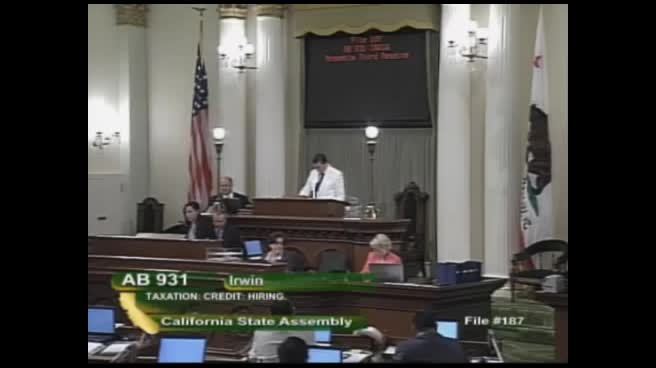 1MIN
Assembly Floor
 1MIN
Assembly Standing Committee on Appropriations
 2MIN
Assembly Standing Committee on Revenue and Taxation
Bill Author

Bill Co-Author(s):