SB 1332: Firearms.
- Session Year: 2015-2016
- House: Senate
- Latest Version Date: 2016-08-29
Existing law requires the Attorney General to maintain a registry of all firearm owners consisting of the name, address, identification of, place of birth, complete telephone number, occupation, sex, description, and all legal names and aliases used by the owner of a particular firearm as listed on the Dealers Record of Sale or other specified reports.
Existing law establishes the Firearms Safety and Enforcement Special Fund and makes the revenue deposited into that fund available for expenditure by the department upon appropriation by the Legislature for purposes relating to the regulation of firearms.
This bill would, commencing January 1, 2019, require the Department of Justice to modify its registration form so that both spouses or both domestic partners may register as the owners of the firearm and would require the department to maintain both names on the firearms registry. The bill would additionally make the revenue in the Firearms Safety and Enforcement Special Fund available for the purpose of implementing this registration process.
Existing law also requires the Attorney General to maintain information regarding firearms from certain other reports pertaining to firearms transactions and authorizes specified officers, including peace officers, to disseminate information from specified reports if certain conditions are satisfied, including if the subject of the record has been arraigned for a crime.
This bill would additionally require the Attorney General to maintain the information supplied to the Department of Justice in certain forms submitted by persons who take possession of a firearm pursuant to a specified exception to the general requirement that firearms transactions be completed through a licensed firearms dealer and would authorize information in those forms to be disseminated pursuant to the above provisions.
Existing law requires the loan of a firearm to be conducted through a licensed firearms dealer. Existing law makes a violation of this requirement a crime.
The bill would create exceptions to the dealer requirement for a loan of a firearm in which the firearm is being stored in the receivers residence or in an enclosed structure on the receivers private property, if certain criteria are met.
This bill would incorporate changes to Section 11106 of the Penal Code proposed by both this bill and AB 857, which would become operative only if both bills are enacted and become effective on or before January 1, 2017, and this bill is chaptered last.
Existing law requires the Attorney General to maintain a registry of all firearm owners consisting of the name, address, identification of, place of birth, complete telephone number, occupation, sex, description, and all legal names and aliases used by the owner of a particular firearm as listed on the Dealers Dealers Record of Sale or other specified reports.
Existing law establishes the Firearms Safety and Enforcement Special Fund and makes the revenue deposited into that fund available for expenditure by the department upon appropriation by the Legislature for purposes relating to the regulation of firearms.
This bill would, commencing January 1, 2019, require the Department of Justice to modify its registration form so that both spouses or both domestic partners may register as the owners of the firearm and would require the department to maintain both names on the firearms registry. The bill would additionally make the revenue in the Firearms Safety and Enforcement Special Fund available for the purpose of implementing this registration process.
Existing law also requires the Attorney General to maintain information regarding firearms from certain other reports pertaining to firearms transactions and authorizes specified officers, including peace officers, to disseminate information from specified reports if certain conditions are satisfied, including if the subject of the record has been arraigned for a crime.
This bill would additionally require the Attorney General to maintain the information supplied to the Department of Justice in certain forms submitted by persons who take possession of a firearm pursuant to a specified exception to the general requirement that firearms transactions be completed through a licensed firearms dealer and would authorize information in those forms to be disseminated pursuant to the above provisions.
Existing law requires the loan of a firearm to be conducted through a licensed firearms dealer. Existing law makes a violation of this requirement a crime.
The bill would create exceptions to the dealer requirement for a loan of a firearm that occurs at the individual receiving the firearm and lenders shared residence or private property and for a loan in which the firearm is being stored in the receivers residence or in an enclosed structure on the receivers private property, if certain criteria are met.
This bill would incorporate changes to Section 11106 of the Penal Code proposed by both this bill and AB 857, which would become operative only if both bills are enacted and become effective on or before January 1, 2017, and this bill is chaptered last.
Existing law requires the Attorney General to maintain a registry of all firearm owners consisting of the name, address, identification of, place of birth, complete telephone number, occupation, sex, description, and all legal names and aliases used by the owner of a particular firearm as listed on the Dealers Record of Sale or other specified reports.
Existing law establishes the Firearms Safety and Enforcement Special Fund and makes the revenue deposited into that fund available for expenditure by the department upon appropriation by the Legislature for purposes relating to the regulation of firearms.
This bill would, commencing January 1, 2019, require the Department of Justice to modify its registration form so that both spouses or both domestic partners may register as the owners of the firearm and would require the department to maintain both names on the firearms registry. The bill would additionally make the revenue in the Firearms Safety and Enforcement Special Fund available for the purpose of implementing this registration process.
Existing law also requires the Attorney General to maintain information regarding firearms from certain other reports pertaining to firearms transactions and authorizes specified officers, including peace officers, to disseminate information from specified reports if certain conditions are satisfied, including if the subject of the record has been arraigned for a crime.
This bill would additionally require the Attorney General to maintain the information supplied to the Department of Justice in certain forms submitted by persons who take possession of a firearm pursuant to a specified exception to the general requirement that firearms transactions be completed through a licensed firearms dealer and would authorize information in those forms to be disseminated pursuant to the above provisions.
Existing law requires the loan of a firearm to be conducted through a licensed firearms dealer. Existing law makes a violation of this requirement a crime.
The bill would create exceptions to the dealer requirement for a loan of a firearm that occurs at the individual receiving the firearm and lenders shared residence or private property and for a loan in which the firearm is being stored in the receivers residence or in an enclosed structure on the receivers private property, if certain criteria are met.
This bill would incorporate changes to Section 11106 of the Penal Code proposed by both this bill and AB 857, which would become operative only if both bills are enacted and become effective on or before January 1, 2017, and this bill is chaptered last.
Existing law requires the Attorney General to maintain a registry of all firearm owners consisting of the name, address, identification of, place of birth, complete telephone number, occupation, sex, description, and all legal names and aliases used by the owner of a particular firearm as listed on the Dealers Record of Sale or other specified reports.
This bill would, commencing January 1, 2019, require the Department of Justice to modify its registration form so that both spouses or both domestic partners may register as the owners of the firearm and would require the department to maintain both names on the firearms registry.
Existing law also requires the Attorney General to maintain information regarding firearms from certain other reports pertaining to firearms transactions. transactions and authorizes specified officers, including peace officers, to disseminate information from specified reports if certain conditions are satisfied, including if the subject of the record has been arraigned for a crime.
This bill would additionally require the Attorney General to maintain the information supplied to the Department of Justice in certain forms submitted by persons who take possession of a firearm pursuant to a specified exception to the general requirement that firearms transactions be completed through a licensed firearms dealer. dealer and would authorize information in those forms to be disseminated pursuant to the above provisions.
Existing law requires the loan of a firearm to be conducted through a licensed firearms dealer. Existing law makes a violation of this requirement a crime.
The bill would create exceptions to the dealer requirement for a loan of a firearm that occurs at the individual receiving the firearm and lenders shared residence or private property and for a loan in which the firearm is being stored in the receivers residence or in an enclosed structure on the receivers private property, if certain criteria are met.
This bill would incorporate changes to Section 11106 of the Penal Code proposed by both this bill and AB 857, which would become operative only if both bills are enacted and become effective on or before January 1, 2017, and this bill is chaptered last.
Existing law requires the Attorney General to maintain a registry of all firearm owners consisting of the name, address, identification of, place of birth, complete telephone number, occupation, sex, description, and all legal names and aliases used by the owner of a particular firearm as listed on the Dealers Record of Sale or other specified reports.
This bill would would, commencing January 1, 2019, require the Department of Justice to modify its registration form so that both spouses or both domestic partners may register as the owners of the firearm and would require the department to maintain both names on the firearms registry. The bill would make related findings and declarations and would require the Attorney General to submit a report to the Legislature on or before January 1, 2018, regarding joint registration of firearms, as specified.
Existing law also requires the Attorney General to maintain information regarding firearms from certain other reports pertaining to firearms transactions.
This bill would additionally require the Attorney General to maintain the information supplied to the Department of Justice in certain forms submitted by persons who take possession of a firearm pursuant to a specified exception to the general requirement that firearms transactions be completed through a licensed firearms dealer.
Existing law requires the loan of a firearm to be conducted through a licensed firearms dealer. Other existing law excepts from this requirement certain loans of firearms between persons who are personally known to each other if certain criteria are met, including that the loan does not exceed 30 days. Existing law makes a violation of this requirement a crime.
This bill would instead make that provision applicable only when the loan does not exceed 10 days in duration. By expanding the scope of an existing crime, this bill would impose a state-mandated local program.
The bill would also create additional exceptions to the dealer requirement for a loan of a firearm that occurs at the lenders individual receiving the firearm and lenders shared residence or private property and for a loan in which the firearm is being stored in the receivers residence or in an enclosed structure on the receivers private property, if certain criteria are met.
The California Constitution requires the state to reimburse local agencies and school districts for certain costs mandated by the state. Statutory provisions establish procedures for making that reimbursement.
This bill would provide that no reimbursement is required by this act for a specified reason.
Existing law requires the Attorney General to maintain a registry of all firearm owners consisting of the name, address, identification of, place of birth, complete telephone number, occupation, sex, description, and all legal names and aliases used by the owner of a particular firearm as listed on the Dealers Record of Sale or other specified reports.
This bill would require the Department of Justice to modify its registration form so that both spouses or both domestic partners may register as the owners of the firearm and would require the department to maintain both names on the firearms firearms registry. The bill would make related findings and declarations and would require the Attorney General to submit a report to the Legislature on or before January 1, 2018, regarding joint registration of firearms, as specified.
Existing law also requires the Attorney General to maintain information regarding firearms from certain other reports pertaining to firearms transactions.
This bill would additionally require the Attorney General to maintain the information supplied to the Department of Justice in certain forms submitted by persons who take possession of a firearm pursuant to a specified exception to the general requirement that firearms transactions be completed through a licensed firearms dealer.
Existing law requires the loan of a firearm to be conducted through a licensed firearms dealer. Other existing law excepts from this requirement certain loans of firearms between persons who are personally known to each other if certain criteria are met, including that the loan does not exceed 30 days. Existing law makes a violation of this requirement a crime.
This bill would instead make that provision applicable only when the loan does not exceed 10 days in duration. By expanding the scope of an existing crime, this bill would impose a state-mandated local program.
The bill would also create additional exceptions to the dealer requirement for a loan of a firearm that occurs at the lenders residence or private property and for a loan in which the firearm is being stored in the receivers residence or in an enclosed structure on the receivers private property, if certain criteria are met.
The California Constitution requires the state to reimburse local agencies and school districts for certain costs mandated by the state. Statutory provisions establish procedures for making that reimbursement.
This bill would provide that no reimbursement is required by this act for a specified reason.
Existing law requires the Attorney General to maintain a registry of all firearm owners consisting of the name, address, identification of, place of birth, complete telephone number, occupation, sex, description, and all legal names and aliases used by the owner of a particular firearm as listed on the Dealers Record of Sale or other specified reports.
This bill would require the Department of Justice to modify its registration form so that both spouses or both domestic partners may register as the owners of the firearm and would require the department to maintain both names on the firearms registry. The bill would make related findings and declarations and would require the Attorney General to submit a report to the Legislature on or before January 1, 2018, regarding joint registration of firearms, as specified.
Existing law also requires the Attorney General to maintain information regarding firearms from certain other reports pertaining to firearms transactions.
This bill would additionally require the Attorney General to maintain the information supplied to the Department of Justice in certain forms submitted by persons who take possession of a firearm pursuant to a specified exception to the general requirement that firearms transactions be completed through a licensed firearms dealer.
Existing law requires the loan of a firearm to be conducted through a licensed firearms dealer. Other existing law excepts from this requirement certain loans of firearms between persons who are personally known to each other if certain criteria are met, including that the loan does not exceed 30 days. Existing law makes a violation of this requirement a crime.
This bill would instead make that provision applicable only when the loan does not exceed 10 days in duration. By expanding the scope of an existing crime, this bill would impose a state-mandated local program.
The bill would also create additional exceptions to the dealer requirement for a loan of a firearm that occurs at the lenders residence or private property and for a loan in which the firearm is being stored in the receivers residence or in an enclosed structure on the receivers private property, if certain criteria are met.
The California Constitution requires the state to reimburse local agencies and school districts for certain costs mandated by the state. Statutory provisions establish procedures for making that reimbursement.
This bill would provide that no reimbursement is required by this act for a specified reason.
(a)The Legislature finds and declares all of the following:
(1)Under current state procedures, the initial acquisition process to acquire a firearm includes, among other requirements, a background check, a firearm safety certificate, and, upon completion of the process, registration of that firearm to that person in the centralized registry as set forth in Section 11106 of the Penal Code.
(2)The current background check and registration process allows only one person to initially acquire and be the registered owner of that firearm.
(3)The California Constitution provides that property owned before marriage or acquired during marriage by gift, will, or inheritance is separate property.
(4)Community property rights are protected through the Due Process Clause and other clauses of the California Constitution.
(5)On July 20, 2015, the California Supreme Court in the case In re Marriage of Davis (2015) 61 Cal.4th 846 confirmed that Section 760 of the Family Code specifically allows property acquired by the spouses during the marriage not to be treated as community property where otherwise provided by statute.
(6)Allowing property acquired by spouses during the marriage not to be treated as community property where otherwise provided by statute was foreshadowed by the decision of the Court of Appeals in Crosby v. H.L.C. Properties LTD (2014) 223 Cal.App.4th 597, 609, fn. 10.
(7)Under current law, a person who is licensed to carry a handgun in public is licensed to carry a specific handgun, and in many jurisdictions licensing authorities license both spouses to carry the same handgun, but in other jurisdictions licenses to carry will not be issued unless the handgun is first registered to the applicant.
(8)Because carry license information is reported to the Department of Justice and is required to be included in the centralized registry, joint registration is occurring today, albeit under the carry license system.
(9)Joint family firearm registration is expressly allowed for assault weapons and .50 BMG rifles.
(10)Joint spousal firearm registration exists in Hawaii, Maryland, and New York.
(11)Firearms initially constituting separate property may be jointly registered to a spouse via the transmutation process and via the operation of law procedures set forth in subdivision (g) of Section 16990 and paragraph (2) of subdivision (a) of Section 27920 of the Penal Code, without being processed through a state-licensed firearms dealer. The clear intent of those provisions is to allow joint spousal registration via that process but not to otherwise permit joint registration. The amendments to Section 11106 of the Penal Code made by the act that added this section, insofar as relevant, are designed to effectuate that intent.
(12)Also via the operation of law process, separate property of one spouse may be transmuted to another spouse as separate property.
(13)Firearms brought into this state by new residents which were acquired outside of this state by such persons when residents of that other state are being allowed to be jointly registered in effect to both spouses pursuant to the procedures set forth in Section 27560 of the Penal Code, without being processed through a state-licensed firearms dealer. The amendments made to Section 11106 of the Penal Code by the act that added this section, insofar as relevant, are designed to allow that to continue if it is occurring now.
(14)The Department of Justice, pursuant to Section 28000 of the Penal Code, allows a person to deregister a firearm if certain conditions are met, including, among other conditions, providing the department with official documentation that the firearm has, in fact, been disposed of. The amendments made to Section 11106 of the Penal Code by the act that added this section, insofar as relevant, are designed to allow that to continue if it is occurring now.
(15)The process of deregistering a firearm by filing a form pursuant to Section 28000 of the Penal Code detailing the disposal of a firearm because the firearm was transferred to another requires submission to the department of a formal department-generated document stating that the firearm was reregistered. If the disposition form is not submitted pursuant to Section 28000 of the Penal Code, then a firearm may in effect be technically listed as being registered to both parties involved in the transfer.
(16)There are legitimate concerns that if joint firearm registration is explicitly allowed by virtue of the amendments made to Section 11106 of the Penal Code by the act that added this section, it may create a number of issues regarding third-party rights when the time comes to dispose of those jointly registered firearms. Those concerns exist now as to jointly registered .50 BMG rifles and assault weapons.
(b)It is the intent of the Legislature, if joint firearm registration does not occur pursuant to the amendments made to Section 11106 of the Penal Code by the act that added this section, to enact legislation that will go into effect prior to January 1, 2019, to implement an explicit joint firearm registration system in a user-friendly manner that protects public safety and does not complicate the disposition of firearms that are jointly registered.
(c)It is also the intent of the Legislature that the Department of Justice make available on its Internet Web site, in an editable public display format, the form referred to in Section 27882 of the Penal Code.
SEC. 2.Section 11106 of the Penal Code is amended to read:11106.(a)(1)In order to assist in the investigation of crime, the prosecution of civil actions by city attorneys pursuant to paragraph (3) of subdivision (b), the arrest and prosecution of criminals, and the recovery of lost, stolen, or found property, the Attorney General shall keep and properly file a complete record of all of the following:
(A)All copies of fingerprints.
(B)Copies of licenses to carry firearms issued pursuant to Section 26150, 26155, 26170, or 26215.
(C)Information reported to the Department of Justice pursuant to Section 26225, 27875, 27920, 27966, or 29830.
(D)Dealers records of sales of firearms.
(E)Reports provided pursuant to Article 1 (commencing with Section 27500) of Chapter 4 of Division 6 of Title 4 of Part 6, or pursuant to any provision listed in subdivision (a) of Section 16585.
(F)Forms provided pursuant to Section 12084, as that section read prior to being repealed on January 1, 2006.
(G)Reports provided pursuant to Article 1 (commencing with Section 26700) and Article 2 (commencing with Section 26800) of Chapter 2 of Division 6 of Title 4 of Part 6, that are not dealers records of sales of firearms.
(H)Information provided pursuant to Section 28255.
(I)Reports of stolen, lost, found, pledged, or pawned property in any city or county of this state.
(2)The Attorney General shall, upon proper application therefor, furnish the information to the officers referred to in Section 11105.
(b)(1)The Attorney General shall permanently keep and properly file and maintain all information reported to the Department of Justice pursuant to the following provisions as to firearms and maintain a registry thereof:
(A)Article 1 (commencing with Section 26700) and Article 2 (commencing with Section 26800) of Chapter 2 of Division 6 of Title 4 of Part 6.
(B)Article 1 (commencing with Section 27500) of Chapter 4 of Division 6 of Title 4 of Part 6.
(C)Chapter 5 (commencing with Section 28050) of Division 6 of Title 4 of Part 6.
(D)Any provision listed in subdivision (a) of Section 16585.
(E)Former Section 12084.
(F)Section 28255.
(G)Any other law.
(2)The registry shall consist of all of the following:
(A)The name, address, identification of, place of birth (state or country), complete telephone number, occupation, sex, description, and all legal names and aliases ever used by the owner or person being loaned the particular firearm as listed on the information provided to the department on the Dealers Record of Sale, the Law Enforcement Firearms Transfer (LEFT), as defined in former Section 12084, or reports made to the department pursuant to any provision listed in subdivision (a) of Section 16585, Section 28255, or any other law.
(B)The name and address of, and other information about, any person (whether a dealer or a private party) from whom the owner acquired or the person being loaned the particular firearm and when the firearm was acquired or loaned as listed on the information provided to the department on the Dealers Record of Sale, the LEFT, or reports made to the department pursuant to any provision listed in subdivision (a) of Section 16585 or any other law.
(C)Any waiting period exemption applicable to the transaction which resulted in the owner of or the person being loaned the particular firearm acquiring or being loaned that firearm.
(D)The manufacturers name if stamped on the firearm, model name or number if stamped on the firearm, and, if applicable, the serial number, other number (if more than one serial number is stamped on the firearm), caliber, type of firearm, if the firearm is new or used, barrel length, and color of the firearm, or, if the firearm is not a handgun and does not have a serial number or any identification number or mark assigned to it, that shall be noted.
(E)Commencing January 1, 2019, the name of the person and his or her spouse or domestic partner if the firearm is registered to both persons. The department shall modify its registration forms to the extent necessary, if it has not already done so, so that both spouses or both domestic partners may register as the owners of the firearm. This subparagraph shall not require the department to change the Dealers Record of Sale form.
(3)Information in the registry referred to in this subdivision shall, upon proper application therefor, be furnished to the officers referred to in Section 11105, to a city attorney prosecuting a civil action, solely for use in prosecuting that civil action and not for any other purpose, or to the person listed in the registry as the owner or person who is listed as being loaned the particular firearm.
(4)If any person is listed in the registry as the owner of a firearm through a Dealers Record of Sale prior to 1979, and the person listed in the registry requests by letter that the Attorney General store and keep the record electronically, as well as in the records existing photographic, photostatic, or nonerasable optically stored form, the Attorney General shall do so within three working days of receipt of the request. The Attorney General shall, in writing, and as soon as practicable, notify the person requesting electronic storage of the record that the request has been honored as required by this paragraph.
(c)(1)If the conditions specified in paragraph (2) are met, any officer referred to in paragraphs (1) to (6), inclusive, of subdivision (b) of Section 11105 may disseminate the name of the subject of the record, the number of the firearms listed in the record, and the description of any firearm, including the make, model, and caliber, from the record relating to any firearms sale, transfer, registration, or license record, or any information reported to the Department of Justice pursuant to any of the following:
(A)Section 26225, 27875, 27920, or 27966.
(B)Article 1 (commencing with Section 26700) and Article 2 (commencing with Section 26800) of Chapter 2 of Division 6 of Title 4 of Part 6.
(C)Article 1 (commencing with Section 27500) of Chapter 4 of Division 6 of Title 4 of Part 6.
(D)Chapter 5 (commencing with Section 28050) of Division 6 of Title 4 of Part 6.
(E)Article 2 (commencing with Section 28150) of Chapter 6 of Division 6 of Title 4 of Part 6.
(F)Article 5 (commencing with Section 30900) of Chapter 2 of Division 10 of Title 4 of Part 6.
(G)Chapter 2 (commencing with Section 33850) of Division 11 of Title 4 of Part 6.
(H)Any provision listed in subdivision (a) of Section 16585.
(2)Information may be disseminated pursuant to paragraph (1) only if all of the following conditions are satisfied:
(A)The subject of the record has been arraigned for a crime in which the victim is a person described in Section 6211 of the Family Code and is being prosecuted or is serving a sentence for the crime, or the subject of the record is the subject of an emergency protective order, a temporary restraining order, or an order after hearing, which is in effect and has been issued by a family court under the Domestic Violence Protection Act set forth in Division 10 (commencing with Section 6200) of the Family Code.
(B)The information is disseminated only to the victim of the crime or to the person who has obtained the emergency protective order, the temporary restraining order, or the order after hearing issued by the family court.
(C)Whenever a law enforcement officer disseminates the information authorized by this subdivision, that officer or another officer assigned to the case shall immediately provide the victim of the crime with a Victims of Domestic Violence card, as specified in subparagraph (H) of paragraph (9) of subdivision (c) of Section 13701.
(3)The victim or person to whom information is disseminated pursuant to this subdivision may disclose it as he or she deems necessary to protect himself or herself or another person from bodily harm by the person who is the subject of the record.
SEC. 2.5.Section 11106 of the Penal Code is amended to read:11106.(a)(1)In order to assist in the investigation of crime, the prosecution of civil actions by city attorneys pursuant to paragraph (3) of subdivision (b), the arrest and prosecution of criminals, and the recovery of lost, stolen, or found property, the Attorney General shall keep and properly file a complete record of all of the following:
(A)All copies of fingerprints.
(B)Copies of licenses to carry firearms issued pursuant to Section 26150, 26155, 26170, or 26215.
(C)Information reported to the Department of Justice pursuant to Section 26225, 27875, 27920, 27966, 29180, or 29830.
(D)Dealers records of sales of firearms.
(E)Reports provided pursuant to Article 1 (commencing with Section 27500) of Chapter 4 of Division 6 of Title 4 of Part 6, or pursuant to any provision listed in subdivision (a) of Section 16585.
(F)Forms provided pursuant to Section 12084, as that section read prior to being repealed on January 1, 2006.
(G)Reports provided pursuant to Article 1 (commencing with Section 26700) and Article 2 (commencing with Section 26800) of Chapter 2 of Division 6 of Title 4 of Part 6, that are not dealers records of sales of firearms.
(H)Information provided pursuant to Section 28255.
(I)Reports of stolen, lost, found, pledged, or pawned property in any city or county of this state.
(2)The Attorney General shall, upon proper application therefor, furnish the information to the officers referred to in Section 11105.
(b)(1)The Attorney General shall permanently keep and properly file and maintain all information reported to the Department of Justice pursuant to the following provisions as to firearms and maintain a registry thereof:
(A)Article 1 (commencing with Section 26700) and Article 2 (commencing with Section 26800) of Chapter 2 of Division 6 of Title 4 of Part 6.
(B)Article 1 (commencing with Section 27500) of Chapter 4 of Division 6 of Title 4 of Part 6.
(C)Chapter 5 (commencing with Section 28050) of Division 6 of Title 4 of Part 6.
(D)Any provision listed in subdivision (a) of Section 16585.
(E)Former Section 12084.
(F)Section 28255.
(G)Section 29180.
(H)Any other law.
(2)The registry shall consist of all of the following:
(A)The name, address, identification of, place of birth (state or country), complete telephone number, occupation, sex, description, and all legal names and aliases ever used by the owner or person being loaned the particular firearm as listed on the information provided to the department on the Dealers Record of Sale, the Law Enforcement Firearms Transfer (LEFT), as defined in former Section 12084, or reports made to the department pursuant to any provision listed in subdivision (a) of Section 16585, Section 28255 or 29180, or any other law.
(B)The name and address of, and other information about, any person (whether a dealer or a private party) from whom the owner acquired or the person being loaned the particular firearm and when the firearm was acquired or loaned as listed on the information provided to the department on the Dealers Record of Sale, the LEFT, or reports made to the department pursuant to any provision listed in subdivision (a) of Section 16585 or any other law.
(C)Any waiting period exemption applicable to the transaction which resulted in the owner of or the person being loaned the particular firearm acquiring or being loaned that firearm.
(D)The manufacturers name if stamped on the firearm, model name or number if stamped on the firearm, and, if applicable, the serial number, other number (if more than one serial number is stamped on the firearm), caliber, type of firearm, if the firearm is new or used, barrel length, and color of the firearm, or, if the firearm is not a handgun and does not have a serial number or any identification number or mark assigned to it, that shall be noted.
(E)Commencing January 1, 2019, the name of the person and his or her spouse or domestic partner if the firearm is registered to both persons. The department shall modify its registration forms to the extent necessary, if it has not already done so, so that both spouses or both domestic partners may register as the owners of the firearm. This subparagraph shall not require the department to change the Dealers Record of Sale form.
(3)Information in the registry referred to in this subdivision shall, upon proper application therefor, be furnished to the officers referred to in Section 11105, to a city attorney prosecuting a civil action, solely for use in prosecuting that civil action and not for any other purpose, or to the person listed in the registry as the owner or person who is listed as being loaned the particular firearm.
(4)If any person is listed in the registry as the owner of a firearm through a Dealers Record of Sale prior to 1979, and the person listed in the registry requests by letter that the Attorney General store and keep the record electronically, as well as in the records existing photographic, photostatic, or nonerasable optically stored form, the Attorney General shall do so within three working days of receipt of the request. The Attorney General shall, in writing, and as soon as practicable, notify the person requesting electronic storage of the record that the request has been honored as required by this paragraph.
(c)(1)If the conditions specified in paragraph (2) are met, any officer referred to in paragraphs (1) to (6), inclusive, of subdivision (b) of Section 11105 may disseminate the name of the subject of the record, the number of the firearms listed in the record, and the description of any firearm, including the make, model, and caliber, from the record relating to any firearms sale, transfer, registration, or license record, or any information reported to the Department of Justice pursuant to any of the following:
(A)Section 26225, 27875, 27920, or 27966.
(B)Article 1 (commencing with Section 26700) and Article 2 (commencing with Section 26800) of Chapter 2 of Division 6 of Title 4 of Part 6.
(C)Article 1 (commencing with Section 27500) of Chapter 4 of Division 6 of Title 4 of Part 6.
(D)Chapter 5 (commencing with Section 28050) of Division 6 of Title 4 of Part 6.
(E)Article 2 (commencing with Section 28150) of Chapter 6 of Division 6 of Title 4 of Part 6.
(F)Article 5 (commencing with Section 30900) of Chapter 2 of Division 10 of Title 4 of Part 6.
(G)Chapter 2 (commencing with Section 33850) of Division 11 of Title 4 of Part 6.
(H)Any provision listed in subdivision (a) of Section 16585.
(2)Information may be disseminated pursuant to paragraph (1) only if all of the following conditions are satisfied:
(A)The subject of the record has been arraigned for a crime in which the victim is a person described in Section 6211 of the Family Code and is being prosecuted or is serving a sentence for the crime, or the subject of the record is the subject of an emergency protective order, a temporary restraining order, or an order after hearing, which is in effect and has been issued by a family court under the Domestic Violence Protection Act set forth in Division 10 (commencing with Section 6200) of the Family Code.
(B)The information is disseminated only to the victim of the crime or to the person who has obtained the emergency protective order, the temporary restraining order, or the order after hearing issued by the family court.
(C)Whenever a law enforcement officer disseminates the information authorized by this subdivision, that officer or another officer assigned to the case shall immediately provide the victim of the crime with a Victims of Domestic Violence card, as specified in subparagraph (H) of paragraph (9) of subdivision (c) of Section 13701.
(3)The victim or person to whom information is disseminated pursuant to this subdivision may disclose it as he or she deems necessary to protect himself or herself or another person from bodily harm by the person who is the subject of the record.
SEC. 3.Section 17060 of the Penal Code is amended to read:17060.(a)As used in Section 25135, residence means any structure intended or used for human habitation, including, but not limited to, houses, condominiums, rooms, motels, hotels, time-shares, and recreational or other vehicles where human habitation occurs.
(b)As used in Section 27882, residence means any structure intended or used for human habitation, including, but not limited to, houses, condominiums, rooms, motels, hotels, and time-shares, but does not include a recreational or other vehicle where human habitation occurs.
SEC. 4.Section 26600 of the Penal Code is amended to read:26600.(a)Section 26500 does not apply to any sale, delivery, transfer, or loan of firearms made to an authorized law enforcement representative of any city, county, city and county, or state, or of the federal government, for exclusive use by that governmental agency if, prior to the sale, delivery, transfer, or loan of these firearms, written authorization from the head of the agency authorizing the transaction is presented to the person from whom the purchase, delivery, transfer, or loan is being made.
(b)Proper written authorization is defined as verifiable written certification from the head of the agency by which the purchaser or transferee is employed, identifying the employee as an individual authorized to conduct the transaction, and authorizing the transaction for the exclusive use of the agency by which that person is employed.
(c)Within 10 days of the date a firearm is acquired or received by the agency pursuant to this section, a record of the same shall be entered as an institutional weapon into the Automated Firearms System (AFS) via the California Law Enforcement Telecommunications System (CLETS) by the law enforcement or state agency. Any agency without access to AFS shall arrange with the sheriff of the county in which the agency is located to input this information via this system.
SEC. 5.Section 27050 of the Penal Code is amended to read:27050.(a)Article 1 (commencing with Section 26700) and Article 2 (commencing with Section 26800) do not apply to any sale, delivery, transfer, or loan of firearms made to an authorized law enforcement representative of any city, county, city and county, or state, or of the federal government, for exclusive use by that governmental agency if, prior to the sale, delivery, transfer, or loan of these firearms, written authorization from the head of the agency authorizing the transaction is presented to the person from whom the purchase, delivery, transfer, or loan is being made.
(b)Proper written authorization is defined as verifiable written certification from the head of the agency by which the purchaser, recipient, or transferee is employed, identifying the employee as an individual authorized to conduct the transaction, and authorizing the transaction for the exclusive use of the agency by which that person is employed.
(c)Within 10 days of the date a firearm is acquired or received by the agency pursuant to this section, a record of the same shall be entered as an institutional weapon into the Automated Firearms System (AFS) via the California Law Enforcement Telecommunications System (CLETS) by the law enforcement or state agency. Any agency without access to AFS shall arrange with the sheriff of the county in which the agency is located to input this information via this system.
SEC. 6.Section 27600 of the Penal Code is amended to read:27600.(a)Article 1 (commencing with Section 27500) does not apply to any sale, delivery, transfer, or loan of firearms made to, or the importation of firearms by, an authorized law enforcement representative of any city, county, city and county, or state, or of the federal government, for exclusive use by that governmental agency if, prior to the sale, delivery, transfer, loan, or importation of these firearms, written authorization from the head of the agency authorizing the transaction is presented to the person from whom the purchase, delivery, transfer, or loan is being made or from whom the firearm is being imported.
(b)Proper written authorization is defined as verifiable written certification from the head of the agency by which the purchaser, recipient, or transferee is employed, identifying the employee as an individual authorized to conduct the transaction, and authorizing the transaction for the exclusive use of the agency by which that person is employed.
(c)Within 10 days of the date a firearm is acquired or received by the agency pursuant to this section, a record of the same shall be entered as an institutional weapon into the Automated Firearms System (AFS) via the California Law Enforcement Telecommunications System (CLETS) by the law enforcement or state agency. Any agency without access to the AFS shall arrange with the sheriff of the county in which the agency is located to input this information via this system.
(d)Any agency that is the registered owner of an institutional weapon in accordance with subdivision (c) that subsequently destroys that weapon shall enter information that the weapon has been destroyed into the Automated Firearms System (AFS) via the California Law Enforcement Telecommunications System (CLETS) within 10 days of the destruction in accordance with procedures prescribed by the Department of Justice. Any agency without access to the AFS shall arrange with the sheriff of the county in which the agency is located to input this information via this system.
SEC. 7.Section 27882 is added to the Penal Code, to read:27882.Section 27545 does not apply to the loan of a firearm provided all of the following are met:
(a)The firearm being loaned is registered to the person making the loan pursuant to Section 11106.
(b)The firearm being loaned is stored in the receivers place of residence or in an enclosed structure on the receivers private property, which is not zoned for commercial, retail, or industrial activity.
(c)The firearm at all times stays within the receivers place of residence or in an enclosed structure on the receivers private property, which is not zoned for commercial, retail, or industrial activity.
(d)The individual receiving the firearm is not prohibited by state or federal law from possessing, receiving, owning, or purchasing a firearm.
(e)The individual receiving the firearm is 18 years of age or older.
(f)The individual receiving the firearm has a valid firearm safety certificate, except that if the firearm being loaned is a handgun, the individual may instead have an unexpired handgun safety certificate.
(g)One of the following applies:
(1)The firearm is maintained within a locked container.
(2)The firearm is disabled by a firearm safety device.
(3)The firearm is maintained within a locked gun safe.
(4)The firearm is locked with a locking device, as defined in Section 16860, which has rendered the firearm inoperable.
(h)The loan does not exceed 30 days in duration.
(i)The loan is made without consideration.
(j)There is writing in a format prescribed by the Department of Justice that explains the obligations imposed by this section that is signed by both the party loaning the firearm for storage and the person receiving the firearm.
(k)Both parties to the loan have signed copies of the writing required by subdivision (j).
SEC. 8.Section 28300 of the Penal Code is amended to read:28300.(a)The Firearms Safety and Enforcement Special Fund is hereby established in the State Treasury and shall be administered by the Department of Justice.
(b)The Department of Justice may require firearms dealers to charge each person who obtains a firearm a fee not to exceed five dollars ($5) for each transaction, except that the fee may be increased at a rate not to exceed any increase in the California Consumer Price Index as compiled and reported by the Department of Industrial Relations, and not to exceed the reasonable cost of regulation to the department. Revenues from this fee shall be deposited in the Firearms Safety and Enforcement Special Fund.
(c)Revenue deposited into the Firearms Safety and Enforcement Special Fund shall be available for expenditure by the Department of Justice upon appropriation by the Legislature for all of the following:
(1)Implementing and enforcing the provisions of Article 2 (commencing with Section 31610) of Chapter 4 of Division 10.
(2)Enforcing Section 830.95.
(3)Implementing subparagraph (E) of paragraph (2) of subdivision (b) of Section 11106.
(4)Enforcing Title 2 (commencing with Section 12001) of Part 4.
(5)Enforcing Sections 16000 to 16960, inclusive.
(6)Enforcing Sections 16970 to 17230, inclusive.
(7)Enforcing Sections 17240 to 21390, inclusive.
(8)Enforcing Sections 21590 to 34370, inclusive.
(9)The establishment, maintenance, and upgrading of equipment and services necessary for firearms dealers to comply with Article 2 (commencing with Section 28150).
SEC. 9.Section 31705 of the Penal Code is amended to read:31705.(a)Subdivision (a) of Section 31615 does not apply to any sale, delivery, transfer, or loan of firearms made to an authorized law enforcement representative of any city, county, city and county, or state, or of the federal government, for exclusive use by that governmental agency if, prior to the sale, delivery, transfer, or loan of these firearms, written authorization from the head of the agency authorizing the transaction is presented to the person from whom the purchase, delivery, transfer, or loan is being made.
(b)Proper written authorization is defined as verifiable written certification from the head of the agency by which the purchaser, recipient, or transferee is employed, identifying the employee as an individual authorized to conduct the transaction, and authorizing the transaction for the exclusive use of the agency by which that person is employed.
(c)Within 10 days of the date a firearm is acquired or received by the agency pursuant to this section, a record of the same shall be entered as an institutional weapon into the Automated Firearms System (AFS) via the California Law Enforcement Telecommunications System (CLETS) by the law enforcement or state agency. Any agency without access to AFS shall arrange with the sheriff of the county in which the agency is located to input this information via this system.
SEC. 10.The Legislature finds and declares that the amendments made to Sections 26600, 27050, 27600, and 31705 of the Penal Code by this act are declaratory of existing law.
SEC. 11.Section 2.5 of this bill incorporates amendments to Section 11106 of the Penal Code proposed by both this bill and Assembly Bill 857. It shall only become operative if (1) both bills are enacted and become effective on or before January 1, 2017, (2) each bill amends Section 11106 of the Penal Code, and (3) this bill is enacted after Assembly Bill 857, in which case Section 2 of this bill shall not become operative.
(a)The Legislature finds and declares all of the following:
(1)Under current state procedures, the initial acquisition process to acquire a firearm includes, among other requirements, a background check, a firearm safety certificate, and, upon completion of the process, registration of that firearm to that person in the Centralized Registry centralized registry as set forth in Section 11106 of the Penal Code.
(2)The current background check and registration process allows only one person to initially acquire and be the registered owner of that firearm.
(3)The California Constitution provides that property owned before marriage or acquired during marriage by gift, will, or inheritance is separate property.
(4)Community property rights are protected through the Due Process Clause and other clauses of the California Constitution.
(5)On July 20, 2015, the California Supreme Court in the case In re Marriage of Davis (2015) 61 Cal.4th 846 confirmed that Section 760 of the Family Code specifically allows property acquired by the spouses during the marriage not to be treated as community property where otherwise provided by statute.
(6)Allowing property acquired by spouses during the marriage not to be treated as community property where otherwise provided by statute was foreshadowed by the decision of the Court of Appeals in Crosby v. H.L.C. Properties LTD (2014) 223 Cal.App.4th 597, 609, fn. 10.
(7)Under current law, a person who is licensed to carry a handgun in public is licensed to carry a specific handgun, and in many jurisdictions licensing authorities license both spouses to carry the same handgun, but in other jurisdictions licenses to carry will not be issued unless the handgun is first registered to the applicant.
(8)Because carry license information is reported to the Department of Justice and is required to be included in the Centralized Registry, centralized registry, joint registration is occurring today, albeit under the carry license system.
(9)Joint family firearm registration is expressly allowed for assault weapons and .50 BMG rifles.
(10)Joint spousal firearm registration exists in Hawaii, Maryland, and New York.
(11)Firearms initially constituting separate property may be jointly registered to a spouse via the transmutation process and via the operation of law procedures set forth in subdivision (g) of Section 16990 and paragraph (2) of subdivision (a) of Section 27920 of the Penal Code, without being processed through a state-licensed firearms dealer. The clear intent of those provisions is to allow joint spousal registration via that process but not to otherwise permit joint registration. The amendments to Section 11106 of the Penal Code made by the act that added this section, insofar as relevant, are designed to effectuate that intent.
(12)Also via the operation of law process, separate property of one spouse may be transmuted to another spouse as separate property.
(13)Firearms brought into this state by new residents which were acquired outside of this state by such persons when residents of that other state are being allowed to be jointly registered in effect to both spouses pursuant to the procedures set forth in Section 27560 of the Penal Code, without being processed through a state-licensed firearms dealer. The amendments made to Section 11106 of the Penal Code by the act that added this section, insofar as relevant, are designed to allow that to continue if it is occurring now.
(14)The Department of Justice, pursuant to Section 28000 of the Penal Code, allows a person to deregister a firearm if certain conditions are met, including, among other conditions, providing the department with official documentation that the firearm has, in fact, been disposed of. The amendments made to Section 11106 of the Penal Code by the act that added this section, insofar as relevant, are designed to allow that to continue if it is occurring now.
(15)The process of deregistering a firearm by filing a form pursuant to Section 28000 of the Penal Code detailing the disposal of a firearm because the firearm was transferred to another requires submission to the department of a formal department-generated document stating that the firearm was reregistered. If the disposition form is not submitted pursuant to Section 28000 of the Penal Code, then a firearm may in effect be technically listed as being registered to both parties involved in the transfer.
(16)There are legitimate concerns that if joint firearm registration is explicitly allowed by virtue of the amendments made to Section 11106 of the Penal Code by the act that added this section, it may create a number of issues regarding third-party rights when the time comes to dispose of those jointly registered firearms. Those concerns exist now as to jointly registered .50 BMG rifles and assault weapons.
(b)It is the intent of the Legislature, if joint firearm registration does not occur pursuant to the amendments made to Section 11106 of the Penal Code by the act that added this section, to enact legislation that will go into effect prior to January 1, 2019, to implement an explicit joint firearm registration system in a user-friendly manner that protects public safety and does not complicate the disposition of firearms that are jointly registered.
(c)It is also the intent of the Legislature that the Department of Justice make available on its Internet Web site, in an editable public display format, the form referred to in Section 27882 of the Penal Code.
SEC. 2.Section 11106 of the Penal Code is amended to read:11106.(a)(1)In order to assist in the investigation of crime, the prosecution of civil actions by city attorneys pursuant to paragraph (3) of subdivision (b), the arrest and prosecution of criminals, and the recovery of lost, stolen, or found property, the Attorney General shall keep and properly file a complete record of all of the following:
(A)All copies of fingerprints.
(B)Copies of licenses to carry firearms issued pursuant to Section 26150, 26155, 26170, or 26215.
(C)Information reported to the Department of Justice pursuant to Section 26225, 27875, 27920, 27966, or 29830.
(D)Dealers records of sales of firearms.
(E)Reports provided pursuant to Article 1 (commencing with Section 27500) of Chapter 4 of Division 6 of Title 4 of Part 6, or pursuant to any provision listed in subdivision (a) of Section 16585.
(F)Forms provided pursuant to Section 12084, as that section read prior to being repealed on January 1, 2006.
(G)Reports provided pursuant to Article 1 (commencing with Section 26700) and Article 2 (commencing with Section 26800) of Chapter 2 of Division 6 of Title 4 of Part 6, that are not dealers records of sales of firearms.
(H)Information provided pursuant to Section 28255.
(I)Reports of stolen, lost, found, pledged, or pawned property in any city or county of this state.
(2)The Attorney General shall, upon proper application therefor, furnish the information to the officers referred to in Section 11105.
(b)(1)The Attorney General shall permanently keep and properly file and maintain all information reported to the Department of Justice pursuant to the following provisions as to firearms and maintain a registry thereof:
(A)Article 1 (commencing with Section 26700) and Article 2 (commencing with Section 26800) of Chapter 2 of Division 6 of Title 4 of Part 6.
(B)Article 1 (commencing with Section 27500) of Chapter 4 of Division 6 of Title 4 of Part 6.
(C)Chapter 5 (commencing with Section 28050) of Division 6 of Title 4 of Part 6.
(D)Any provision listed in subdivision (a) of Section 16585.
(E)Former Section 12084.
(F)Section 28255.
(G)Any other law.
(2)The registry shall consist of all of the following:
(A)The name, address, identification of, place of birth (state or country), complete telephone number, occupation, sex, description, and all legal names and aliases ever used by the owner or person being loaned the particular firearm as listed on the information provided to the department on the Dealers Record of Sale, the Law Enforcement Firearms Transfer (LEFT), as defined in former Section 12084, or reports made to the department pursuant to any provision listed in subdivision (a) of Section 16585, Section 28255, or any other law.
(B)The name and address of, and other information about, any person (whether a dealer or a private party) from whom the owner acquired or the person being loaned the particular firearm and when the firearm was acquired or loaned as listed on the information provided to the department on the Dealers Record of Sale, the LEFT, or reports made to the department pursuant to any provision listed in subdivision (a) of Section 16585 or any other law.
(C)Any waiting period exemption applicable to the transaction which resulted in the owner of or the person being loaned the particular firearm acquiring or being loaned that firearm.
(D)The manufacturers name if stamped on the firearm, model name or number if stamped on the firearm, and, if applicable, the serial number, other number (if more than one serial number is stamped on the firearm), caliber, type of firearm, if the firearm is new or used, barrel length, and color of the firearm, or, if the firearm is not a handgun and does not have a serial number or any identification number or mark assigned to it, that shall be noted.
(E)Commencing January 1, 2019, the name of the person and his or her spouse or domestic partner if the firearm is registered to both persons. The department shall modify its registration forms to the extent necessary, if it has not already done so, so that both spouses or both domestic partners may register as the owners of the firearm. This subparagraph shall not require the department to change the Dealers Dealers Record of Sale form.
(3)Information in the registry referred to in this subdivision shall, upon proper application therefor, be furnished to the officers referred to in Section 11105, to a city attorney prosecuting a civil action, solely for use in prosecuting that civil action and not for any other purpose, or to the person listed in the registry as the owner or person who is listed as being loaned the particular firearm.
(4)If any person is listed in the registry as the owner of a firearm through a Dealers Record of Sale prior to 1979, and the person listed in the registry requests by letter that the Attorney General store and keep the record electronically, as well as in the records existing photographic, photostatic, or nonerasable optically stored form, the Attorney General shall do so within three working days of receipt of the request. The Attorney General shall, in writing, and as soon as practicable, notify the person requesting electronic storage of the record that the request has been honored as required by this paragraph.
(c)(1)If the conditions specified in paragraph (2) are met, any officer referred to in paragraphs (1) to (6), inclusive, of subdivision (b) of Section 11105 may disseminate the name of the subject of the record, the number of the firearms listed in the record, and the description of any firearm, including the make, model, and caliber, from the record relating to any firearms sale, transfer, registration, or license record, or any information reported to the Department of Justice pursuant to any of the following:
(A)Section 26225, 27875, 27920, or 27966.
(B)Article 1 (commencing with Section 26700) and Article 2 (commencing with Section 26800) of Chapter 2 of Division 6 of Title 4 of Part 6.
(C)Article 1 (commencing with Section 27500) of Chapter 4 of Division 6 of Title 4 of Part 6.
(D)Chapter 5 (commencing with Section 28050) of Division 6 of Title 4 of Part 6.
(E)Article 2 (commencing with Section 28150) of Chapter 6 of Division 6 of Title 4 of Part 6.
(F)Article 5 (commencing with Section 30900) of Chapter 2 of Division 10 of Title 4 of Part 6.
(G)Chapter 2 (commencing with Section 33850) of Division 11 of Title 4 of Part 6.
(H)Any provision listed in subdivision (a) of Section 16585.
(2)Information may be disseminated pursuant to paragraph (1) only if all of the following conditions are satisfied:
(A)The subject of the record has been arraigned for a crime in which the victim is a person described in Section 6211 of the Family Code and is being prosecuted or is serving a sentence for the crime, or the subject of the record is the subject of an emergency protective order, a temporary restraining order, or an order after hearing, which is in effect and has been issued by a family court under the Domestic Violence Protection Act set forth in Division 10 (commencing with Section 6200) of the Family Code.
(B)The information is disseminated only to the victim of the crime or to the person who has obtained the emergency protective order, the temporary restraining order, or the order after hearing issued by the family court.
(C)Whenever a law enforcement officer disseminates the information authorized by this subdivision, that officer or another officer assigned to the case shall immediately provide the victim of the crime with a Victims of Domestic Violence card, as specified in subparagraph (H) of paragraph (9) of subdivision (c) of Section 13701.
(3)The victim or person to whom information is disseminated pursuant to this subdivision may disclose it as he or she deems necessary to protect himself or herself or another person from bodily harm by the person who is the subject of the record.
SEC. 2.5.Section 11106 of the Penal Code is amended to read:11106.(a)(1)In order to assist in the investigation of crime, the prosecution of civil actions by city attorneys pursuant to paragraph (3) of subdivision (b), the arrest and prosecution of criminals, and the recovery of lost, stolen, or found property, the Attorney General shall keep and properly file a complete record of all of the following:
(A)All copies of fingerprints.
(B)Copies of licenses to carry firearms issued pursuant to Section 26150, 26155, 26170, or 26215.
(C)Information reported to the Department of Justice pursuant to Section 26225, 27875, 27920, 27966, 29180, or 29830.
(D)Dealers records of sales of firearms.
(E)Reports provided pursuant to Article 1 (commencing with Section 27500) of Chapter 4 of Division 6 of Title 4 of Part 6, or pursuant to any provision listed in subdivision (a) of Section 16585.
(F)Forms provided pursuant to Section 12084, as that section read prior to being repealed on January 1, 2006.
(G)Reports provided pursuant to Article 1 (commencing with Section 26700) and Article 2 (commencing with Section 26800) of Chapter 2 of Division 6 of Title 4 of Part 6, that are not dealers records of sales of firearms.
(H)Information provided pursuant to Section 28255.
(I)Reports of stolen, lost, found, pledged, or pawned property in any city or county of this state.
(2)The Attorney General shall, upon proper application therefor, furnish the information to the officers referred to in Section 11105.
(b)(1)The Attorney General shall permanently keep and properly file and maintain all information reported to the Department of Justice pursuant to the following provisions as to firearms and maintain a registry thereof:
(A)Article 1 (commencing with Section 26700) and Article 2 (commencing with Section 26800) of Chapter 2 of Division 6 of Title 4 of Part 6.
(B)Article 1 (commencing with Section 27500) of Chapter 4 of Division 6 of Title 4 of Part 6.
(C)Chapter 5 (commencing with Section 28050) of Division 6 of Title 4 of Part 6.
(D)Any provision listed in subdivision (a) of Section 16585.
(E)Former Section 12084.
(F)Section 28255.
(G)Section 29180.
(H)Any other law.
(2)The registry shall consist of all of the following:
(A)The name, address, identification of, place of birth (state or country), complete telephone number, occupation, sex, description, and all legal names and aliases ever used by the owner or person being loaned the particular firearm as listed on the information provided to the department on the Dealers Record of Sale, the Law Enforcement Firearms Transfer (LEFT), as defined in former Section 12084, or reports made to the department pursuant to any provision listed in subdivision (a) of Section 16585, Section 28255 or 29180, or any other law.
(B)The name and address of, and other information about, any person (whether a dealer or a private party) from whom the owner acquired or the person being loaned the particular firearm and when the firearm was acquired or loaned as listed on the information provided to the department on the Dealers Record of Sale, the LEFT, or reports made to the department pursuant to any provision listed in subdivision (a) of Section 16585 or any other law.
(C)Any waiting period exemption applicable to the transaction which resulted in the owner of or the person being loaned the particular firearm acquiring or being loaned that firearm.
(D)The manufacturers name if stamped on the firearm, model name or number if stamped on the firearm, and, if applicable, the serial number, other number (if more than one serial number is stamped on the firearm), caliber, type of firearm, if the firearm is new or used, barrel length, and color of the firearm, or, if the firearm is not a handgun and does not have a serial number or any identification number or mark assigned to it, that shall be noted.
(E)Commencing January 1, 2019, the name of the person and his or her spouse or domestic partner if the firearm is registered to both persons. The department shall modify its registration forms to the extent necessary, if it has not already done so, so that both spouses or both domestic partners may register as the owners of the firearm. This subparagraph shall not require the department to change the Dealers Dealers Record of Sale form.
(3)Information in the registry referred to in this subdivision shall, upon proper application therefor, be furnished to the officers referred to in Section 11105, to a city attorney prosecuting a civil action, solely for use in prosecuting that civil action and not for any other purpose, or to the person listed in the registry as the owner or person who is listed as being loaned the particular firearm.
(4)If any person is listed in the registry as the owner of a firearm through a Dealers Record of Sale prior to 1979, and the person listed in the registry requests by letter that the Attorney General store and keep the record electronically, as well as in the records existing photographic, photostatic, or nonerasable optically stored form, the Attorney General shall do so within three working days of receipt of the request. The Attorney General shall, in writing, and as soon as practicable, notify the person requesting electronic storage of the record that the request has been honored as required by this paragraph.
(c)(1)If the conditions specified in paragraph (2) are met, any officer referred to in paragraphs (1) to (6), inclusive, of subdivision (b) of Section 11105 may disseminate the name of the subject of the record, the number of the firearms listed in the record, and the description of any firearm, including the make, model, and caliber, from the record relating to any firearms sale, transfer, registration, or license record, or any information reported to the Department of Justice pursuant to any of the following:
(A)Section 26225, 27875, 27920, or 27966.
(B)Article 1 (commencing with Section 26700) and Article 2 (commencing with Section 26800) of Chapter 2 of Division 6 of Title 4 of Part 6.
(C)Article 1 (commencing with Section 27500) of Chapter 4 of Division 6 of Title 4 of Part 6.
(D)Chapter 5 (commencing with Section 28050) of Division 6 of Title 4 of Part 6.
(E)Article 2 (commencing with Section 28150) of Chapter 6 of Division 6 of Title 4 of Part 6.
(F)Article 5 (commencing with Section 30900) of Chapter 2 of Division 10 of Title 4 of Part 6.
(G)Chapter 2 (commencing with Section 33850) of Division 11 of Title 4 of Part 6.
(H)Any provision listed in subdivision (a) of Section 16585.
(2)Information may be disseminated pursuant to paragraph (1) only if all of the following conditions are satisfied:
(A)The subject of the record has been arraigned for a crime in which the victim is a person described in Section 6211 of the Family Code and is being prosecuted or is serving a sentence for the crime, or the subject of the record is the subject of an emergency protective order, a temporary restraining order, or an order after hearing, which is in effect and has been issued by a family court under the Domestic Violence Protection Act set forth in Division 10 (commencing with Section 6200) of the Family Code.
(B)The information is disseminated only to the victim of the crime or to the person who has obtained the emergency protective order, the temporary restraining order, or the order after hearing issued by the family court.
(C)Whenever a law enforcement officer disseminates the information authorized by this subdivision, that officer or another officer assigned to the case shall immediately provide the victim of the crime with a Victims of Domestic Violence card, as specified in subparagraph (H) of paragraph (9) of subdivision (c) of Section 13701.
(3)The victim or person to whom information is disseminated pursuant to this subdivision may disclose it as he or she deems necessary to protect himself or herself or another person from bodily harm by the person who is the subject of the record.
SEC. 3.Section 17060 of the Penal Code is amended to read:17060.(a)As used in Section 25135, residence means any structure intended or used for human habitation, including, but not limited to, houses, condominiums, rooms, motels, hotels, time-shares, and recreational or other vehicles where human habitation occurs.
(b)As used in Section 27881, resides within the same residence means that the individuals reside within the same structure intended or used for human habitation, including, but not limited to, houses, condominiums, and rooms, where human habitation occurs, but does not mean individuals who reside within discrete units of an apartment building, apartment complex, duplex, or other similar complex.
(c)
(b)As used in Section 27882, residence means any structure intended or used for human habitation, including, but not limited to, houses, condominiums, rooms, motels, hotels, and time-shares, but does not include a recreational or other vehicle where human habitation occurs.
SEC. 4.Section 26600 of the Penal Code is amended to read:26600.(a)Section 26500 does not apply to any sale, delivery, transfer, or loan of firearms made to an authorized law enforcement representative of any city, county, city and county, or state, or of the federal government, for exclusive use by that governmental agency if, prior to the sale, delivery, transfer, or loan of these firearms, written authorization from the head of the agency authorizing the transaction is presented to the person from whom the purchase, delivery, transfer, or loan is being made.
(b)Proper written authorization is defined as verifiable written certification from the head of the agency by which the purchaser or transferee is employed, identifying the employee as an individual authorized to conduct the transaction, and authorizing the transaction for the exclusive use of the agency by which that person is employed.
(c)Within 10 days of the date a firearm is acquired or received by the agency pursuant to this section, a record of the same shall be entered as an institutional weapon into the Automated Firearms System (AFS) via the California Law Enforcement Telecommunications System (CLETS) by the law enforcement or state agency. Any agency without access to AFS shall arrange with the sheriff of the county in which the agency is located to input this information via this system.
SEC. 5.Section 27050 of the Penal Code is amended to read:27050.(a)Article 1 (commencing with Section 26700) and Article 2 (commencing with Section 26800) do not apply to any sale, delivery, transfer, or loan of firearms made to an authorized law enforcement representative of any city, county, city and county, or state, or of the federal government, for exclusive use by that governmental agency if, prior to the sale, delivery, transfer, or loan of these firearms, written authorization from the head of the agency authorizing the transaction is presented to the person from whom the purchase, delivery, transfer, or loan is being made.
(b)Proper written authorization is defined as verifiable written certification from the head of the agency by which the purchaser, recipient, or transferee is employed, identifying the employee as an individual authorized to conduct the transaction, and authorizing the transaction for the exclusive use of the agency by which that person is employed.
(c)Within 10 days of the date a firearm is acquired or received by the agency pursuant to this section, a record of the same shall be entered as an institutional weapon into the Automated Firearms System (AFS) via the California Law Enforcement Telecommunications System (CLETS) by the law enforcement or state agency. Any agency without access to AFS shall arrange with the sheriff of the county in which the agency is located to input this information via this system.
SEC. 6.Section 27600 of the Penal Code is amended to read:27600.(a)Article 1 (commencing with Section 27500) does not apply to any sale, delivery, transfer, or loan of firearms made to, or the importation of firearms by, an authorized law enforcement representative of any city, county, city and county, or state, or of the federal government, for exclusive use by that governmental agency if, prior to the sale, delivery, transfer, loan, or importation of these firearms, written authorization from the head of the agency authorizing the transaction is presented to the person from whom the purchase, delivery, transfer, or loan is being made or from whom the firearm is being imported.
(b)Proper written authorization is defined as verifiable written certification from the head of the agency by which the purchaser, recipient, or transferee is employed, identifying the employee as an individual authorized to conduct the transaction, and authorizing the transaction for the exclusive use of the agency by which that person is employed.
(c)Within 10 days of the date a firearm is acquired or received by the agency pursuant to this section, a record of the same shall be entered as an institutional weapon into the Automated Firearms System (AFS) via the California Law Enforcement Telecommunications System (CLETS) by the law enforcement or state agency. Any agency without access to the AFS shall arrange with the sheriff of the county in which the agency is located to input this information via this system.
(d)Any agency that is the registered owner of an institutional weapon in accordance with subdivision (c) that subsequently destroys that weapon shall enter information that the weapon has been destroyed into the Automated Firearms System (AFS) via the California Law Enforcement Telecommunications System (CLETS) within 10 days of the destruction in accordance with procedures prescribed by the Department of Justice. Any agency without access to the AFS shall arrange with the sheriff of the county in which the agency is located to input this information via this system.
SEC. 7.Section 27881 is added to the Penal Code, to read:27881.Section 27545 does not apply to the loan of a firearm provided all of the following are met:
(a)The firearm being loaned is registered to the person making the loan pursuant to Section 11106.
(b)The loan occurs within the individual receiving the firearm and lenders shared place of residence or private property, which is not zoned for commercial, retail, or industrial activity.
(c)The firearm at all times stays within the individual receiving the firearm and lenders shared place of residence or private property, which is not zoned for commercial, retail, or industrial activity.
(d)The individual receiving the firearm is not prohibited by state or federal law from possessing, receiving, owning, or purchasing a firearm.
(e)The individual receiving the firearm is 18 years of age or older.
(f)The individual receiving the firearm has a valid firearm safety certificate, except that if the firearm being loaned is a handgun, the individual may instead have an unexpired handgun safety certificate.
(g)The person being loaned the firearm resides within the same residence as the lender.
SEC. 8. SEC. 7.Section 27882 is added to the Penal Code, to read:27882.Section 27545 does not apply to the loan of a firearm provided all of the following are met:
(a)The firearm being loaned is registered to the person making the loan pursuant to Section 11106.
(b)The firearm being loaned is stored in the receivers place of residence or in an enclosed structure on the receivers private property, which is not zoned for commercial, retail, or industrial activity.
(c)The firearm at all times stays within the receivers place of residence or in an enclosed structure on the receivers private property, which is not zoned for commercial, retail, or industrial activity.
(d)The individual receiving the firearm is not prohibited by state or federal law from possessing, receiving, owning, or purchasing a firearm.
(e)The individual receiving the firearm is 18 years of age or older.
(f)The individual receiving the firearm has a valid firearm safety certificate, except that if the firearm being loaned is a handgun, the individual may instead have an unexpired handgun safety certificate.
(g)One of the following applies:
(1)The firearm is maintained within a locked container.
(2)The firearm is disabled by a firearm safety device.
(3)The firearm is maintained within a locked gun safe.
(4)The firearm is locked with a locking device, as defined in Section 16860, which has rendered the firearm inoperable.
(h)The loan does not exceed 30 days in duration.
(i)The loan is made without consideration.
(j)There is writing in a format prescribed by the Department of Justice that explains the obligations imposed by this section that is signed by both the party loaning the firearm for storage and the person receiving the firearm.
(k)Both parties to the loan have signed copies of the writing required by subdivision (j).
SEC. 9. SEC. 8.Section 28300 of the Penal Code is amended to read:28300.(a)The Firearms Safety and Enforcement Special Fund is hereby established in the State Treasury and shall be administered by the Department of Justice.
(b)The Department of Justice may require firearms dealers to charge each person who obtains a firearm a fee not to exceed five dollars ($5) for each transaction, except that the fee may be increased at a rate not to exceed any increase in the California Consumer Price Index as compiled and reported by the Department of Industrial Relations, and not to exceed the reasonable cost of regulation to the department. Revenues from this fee shall be deposited in the Firearms Safety and Enforcement Special Fund.
(c)Revenue deposited into the Firearms Safety and Enforcement Special Fund shall be available for expenditure by the Department of Justice upon appropriation by the Legislature for all of the following:
(1)Implementing and enforcing the provisions of Article 2 (commencing with Section 31610) of Chapter 4 of Division 10.
(2)Enforcing Section 830.95.
(3)Implementing subparagraph (E) of paragraph (2) of subdivision (b) of Section 11106.
(4)Enforcing Title 2 (commencing with Section 12001) of Part 4.
(5)Enforcing Sections 16000 to 16960, inclusive.
(6)Enforcing Sections 16970 to 17230, inclusive.
(7)Enforcing Sections 17240 to 21390, inclusive.
(8)Enforcing Sections 21590 to 34370, inclusive.
(9)The establishment, maintenance, and upgrading of equipment and services necessary for firearms dealers to comply with Article 2 (commencing with Section 28150).
SEC. 10. SEC. 9.Section 31705 of the Penal Code is amended to read:31705.(a)Subdivision (a) of Section 31615 does not apply to any sale, delivery, transfer, or loan of firearms made to an authorized law enforcement representative of any city, county, city and county, or state, or of the federal government, for exclusive use by that governmental agency if, prior to the sale, delivery, transfer, or loan of these firearms, written authorization from the head of the agency authorizing the transaction is presented to the person from whom the purchase, delivery, transfer, or loan is being made.
(b)Proper written authorization is defined as verifiable written certification from the head of the agency by which the purchaser, recipient, or transferee is employed, identifying the employee as an individual authorized to conduct the transaction, and authorizing the transaction for the exclusive use of the agency by which that person is employed.
(c)Within 10 days of the date a firearm is acquired or received by the agency pursuant to this section, a record of the same shall be entered as an institutional weapon into the Automated Firearms System (AFS) via the California Law Enforcement Telecommunications System (CLETS) by the law enforcement or state agency. Any agency without access to AFS shall arrange with the sheriff of the county in which the agency is located to input this information via this system.
SEC. 11. SEC. 10.The Legislature finds and declares that the amendments made to Sections 26600, 27050, 27600, and 31705 of the Penal Code by this act are declaratory of existing law.
SEC. 12. SEC. 11.Section 2.5 of this bill incorporates amendments to Section 11106 of the Penal Code proposed by both this bill and Assembly Bill 857. It shall only become operative if (1) both bills are enacted and become effective on or before January 1, 2017, (2) each bill amends Section 11106 of the Penal Code, and (3) this bill is enacted after Assembly Bill 857, in which case Section 2 of this bill shall not become operative.
(a)The Legislature finds and declares all of the following:
(1)Under current state procedures, the initial acquisition process to acquire a firearm includes, among other requirements, a background check, a firearm safety certificate, and, upon completion of the process, registration of that firearm to that person in the Centralized Registry as set forth in Section 11106 of the Penal Code.
(2)The current background check and registration process allows only one person to initially acquire and be the registered owner of that firearm.
(3)The California Constitution provides that property owned before marriage or acquired during marriage by gift, will, or inheritance is separate property.
(4)Community property rights are protected through the Due Process Clause and other clauses of the California Constitution.
(5)On July 20, 2015, the California Supreme Court in the case In re Marriage of Davis (2015) 61 Cal.4th 846 confirmed that Section 760 of the Family Code specifically allows property acquired by the spouses during the marriage not to be treated as community property where otherwise provided by statute.
(6)Allowing property acquired by spouses during the marriage not to be treated as community property where otherwise provided by statute was foreshadowed by the decision of the Court of Appeals in Crosby v. H.L.C. Properties LTD (2014) 223 Cal.App.4th 597, 609, fn. 10.
(7)Under current law, a person who is licensed to carry a handgun in public is licensed to carry a specific handgun, and in many jurisdictions licensing authorities license both spouses to carry the same handgun, but in other jurisdictions licenses to carry will not be issued unless the handgun is first registered to the applicant.
(8)Because carry license information is reported to the Department of Justice and is required to be included in the Centralized Registry, joint registration is occurring today, albeit under the carry license system.
(9)Joint family firearm registration is expressly allowed for assault weapons and .50 BMG rifles.
(10)Joint spousal firearm registration exists in Hawaii, Maryland, and New York.
(11)Firearms initially constituting separate property may be jointly registered to a spouse via the transmutation process and via the operation of law procedures set forth in subdivision (g) of Section 16990 and paragraph (2) of subdivision (a) of Section 27920 of the Penal Code, without being processed through a state-licensed firearms dealer. The clear intent of those provisions is to allow joint spousal registration via that process but not to otherwise permit joint registration. The amendments to Section 11106 of the Penal Code made by the act that added this section, insofar as relevant, are designed to effectuate that intent.
(12)Also via the operation of law process, separate property of one spouse may be transmuted to another spouse as separate property.
(13)Firearms brought into this state by new residents which were acquired outside of this state by such persons when residents of that other state are being allowed to be jointly registered in effect to both spouses pursuant to the procedures set forth in Section 27560 of the Penal Code, without being processed through a state-licensed firearms dealer. The amendments made to Section 11106 of the Penal Code by the act that added this section, insofar as relevant, are designed to allow that to continue if it is occurring now.
(14)The Department of Justice, pursuant to Section 28000 of the Penal Code, allows a person to deregister a firearm if certain conditions are met, including, among other conditions, providing the department with official documentation that the firearm has, in fact, been disposed of. The amendments made to Section 11106 of the Penal Code by the act that added this section, insofar as relevant, are designed to allow that to continue if it is occurring now.
(15)The process of deregistering a firearm by filing a form pursuant to Section 28000 of the Penal Code detailing the disposal of a firearm because the firearm was transferred to another requires submission to the department of a formal department-generated document stating that the firearm was reregistered. If the disposition form is not submitted pursuant to Section 28000 of the Penal Code, then a firearm may in effect be technically listed as being registered to both parties involved in the transfer.
(16)There are legitimate concerns that if joint firearm registration is explicitly allowed by virtue of the amendments made to Section 11106 of the Penal Code by the act that added this section, it may create a number of issues regarding third-party rights when the time comes to dispose of those jointly registered firearms. Those concerns exist now as to jointly registered .50 BMG rifles and assault weapons.
(b)It is the intent of the Legislature, if joint firearm registration does not occur pursuant to the amendments made to Section 11106 of the Penal Code by the act that added this section, to enact legislation that will go into effect prior to January 1, 2019, to implement an explicit joint firearm registration system in a user-friendly manner that protects public safety and does not complicate the disposition of firearms that are jointly registered.
(c)It is also the intent of the Legislature that the Department of Justice make available on its Internet Web site, in an editable public display format, the form referred to in Section 27882 of the Penal Code.
SEC. 2.Section 11106 of the Penal Code is amended to read:11106.(a)(1)In order to assist in the investigation of crime, the prosecution of civil actions by city attorneys pursuant to paragraph (3) of subdivision (b), the arrest and prosecution of criminals, and the recovery of lost, stolen, or found property, the Attorney General shall keep and properly file a complete record of all of the following:
(A)All copies of fingerprints.
(B)Copies of licenses to carry firearms issued pursuant to Section 26150, 26155, 26170, or 26215.
(C)Information reported to the Department of Justice pursuant to Section 26225, 27875, 27920, 27966, or 29830.
(D)Dealers records of sales of firearms.
(E)Reports provided pursuant to Article 1 (commencing with Section 27500) of Chapter 4 of Division 6 of Title 4 of Part 6, or pursuant to any provision listed in subdivision (a) of Section 16585.
(F)Forms provided pursuant to Section 12084, as that section read prior to being repealed on January 1, 2006.
(G)Reports provided pursuant to Article 1 (commencing with Section 26700) and Article 2 (commencing with Section 26800) of Chapter 2 of Division 6 of Title 4 of Part 6, that are not dealers records of sales of firearms.
(H)Information provided pursuant to Section 28255.
(I)Reports of stolen, lost, found, pledged, or pawned property in any city or county of this state.
(2)The Attorney General shall, upon proper application therefor, furnish the information to the officers referred to in Section 11105.
(b)(1)The Attorney General shall permanently keep and properly file and maintain all information reported to the Department of Justice pursuant to the following provisions as to firearms and maintain a registry thereof:
(A)Article 1 (commencing with Section 26700) and Article 2 (commencing with Section 26800) of Chapter 2 of Division 6 of Title 4 of Part 6.
(B)Article 1 (commencing with Section 27500) of Chapter 4 of Division 6 of Title 4 of Part 6.
(C)Chapter 5 (commencing with Section 28050) of Division 6 of Title 4 of Part 6.
(D)Any provision listed in subdivision (a) of Section 16585.
(E)Former Section 12084.
(F)Section 28255.
(G)Any other law.
(2)The registry shall consist of all of the following:
(A)The name, address, identification of, place of birth (state or country), complete telephone number, occupation, sex, description, and all legal names and aliases ever used by the owner or person being loaned the particular firearm as listed on the information provided to the department on the Dealers Record of Sale, the Law Enforcement Firearms Transfer (LEFT), as defined in former Section 12084, or reports made to the department pursuant to any provision listed in subdivision (a) of Section 16585, Section 28255, or any other law.
(B)The name and address of, and other information about, any person (whether a dealer or a private party) from whom the owner acquired or the person being loaned the particular firearm and when the firearm was acquired or loaned as listed on the information provided to the department on the Dealers Record of Sale, the LEFT, or reports made to the department pursuant to any provision listed in subdivision (a) of Section 16585 or any other law.
(C)Any waiting period exemption applicable to the transaction which resulted in the owner of or the person being loaned the particular firearm acquiring or being loaned that firearm.
(D)The manufacturers name if stamped on the firearm, model name or number if stamped on the firearm, and, if applicable, the serial number, other number (if more than one serial number is stamped on the firearm), caliber, type of firearm, if the firearm is new or used, barrel length, and color of the firearm, or, if the firearm is not a handgun and does not have a serial number or any identification number or mark assigned to it, that shall be noted.
(E)Commencing January 1, 2019, the name of the person and his or her spouse or domestic partner if the firearm is registered to both persons. The department shall modify its registration forms to the extent necessary, if it has not already done so, so that both spouses or both domestic partners may register as the owners of the firearm. This subparagraph shall not require the department to change the Dealers Record of Sale form.
(3)Information in the registry referred to in this subdivision shall, upon proper application therefor, be furnished to the officers referred to in Section 11105, to a city attorney prosecuting a civil action, solely for use in prosecuting that civil action and not for any other purpose, or to the person listed in the registry as the owner or person who is listed as being loaned the particular firearm.
(4)If any person is listed in the registry as the owner of a firearm through a Dealers Record of Sale prior to 1979, and the person listed in the registry requests by letter that the Attorney General store and keep the record electronically, as well as in the records existing photographic, photostatic, or nonerasable optically stored form, the Attorney General shall do so within three working days of receipt of the request. The Attorney General shall, in writing, and as soon as practicable, notify the person requesting electronic storage of the record that the request has been honored as required by this paragraph.
(c)(1)If the conditions specified in paragraph (2) are met, any officer referred to in paragraphs (1) to (6), inclusive, of subdivision (b) of Section 11105 may disseminate the name of the subject of the record, the number of the firearms listed in the record, and the description of any firearm, including the make, model, and caliber, from the record relating to any firearms sale, transfer, registration, or license record, or any information reported to the Department of Justice pursuant to any of the following:
(A)Section 26225, 27875, 27920, or 27966.
(B)Article 1 (commencing with Section 26700) and Article 2 (commencing with Section 26800) of Chapter 2 of Division 6 of Title 4 of Part 6.
(C)Article 1 (commencing with Section 27500) of Chapter 4 of Division 6 of Title 4 of Part 6.
(D)Chapter 5 (commencing with Section 28050) of Division 6 of Title 4 of Part 6.
(E)Article 2 (commencing with Section 28150) of Chapter 6 of Division 6 of Title 4 of Part 6.
(F)Article 5 (commencing with Section 30900) of Chapter 2 of Division 10 of Title 4 of Part 6.
(G)Chapter 2 (commencing with Section 33850) of Division 11 of Title 4 of Part 6.
(H)Any provision listed in subdivision (a) of Section 16585.
(2)Information may be disseminated pursuant to paragraph (1) only if all of the following conditions are satisfied:
(A)The subject of the record has been arraigned for a crime in which the victim is a person described in Section 6211 of the Family Code and is being prosecuted or is serving a sentence for the crime, or the subject of the record is the subject of an emergency protective order, a temporary restraining order, or an order after hearing, which is in effect and has been issued by a family court under the Domestic Violence Protection Act set forth in Division 10 (commencing with Section 6200) of the Family Code.
(B)The information is disseminated only to the victim of the crime or to the person who has obtained the emergency protective order, the temporary restraining order, or the order after hearing issued by the family court.
(C)Whenever a law enforcement officer disseminates the information authorized by this subdivision, that officer or another officer assigned to the case shall immediately provide the victim of the crime with a Victims of Domestic Violence card, as specified in subparagraph (H) of paragraph (9) of subdivision (c) of Section 13701.
(3)The victim or person to whom information is disseminated pursuant to this subdivision may disclose it as he or she deems necessary to protect himself or herself or another person from bodily harm by the person who is the subject of the record.
SEC. 2.5.Section 11106 of the Penal Code is amended to read:11106.(a)(1)In order to assist in the investigation of crime, the prosecution of civil actions by city attorneys pursuant to paragraph (3) of subdivision (b), the arrest and prosecution of criminals, and the recovery of lost, stolen, or found property, the Attorney General shall keep and properly file a complete record of all of the following:
(A)All copies of fingerprints.
(B)Copies of licenses to carry firearms issued pursuant to Section 26150, 26155, 26170, or 26215.
(C)Information reported to the Department of Justice pursuant to Section 26225, 27875, 27920, 27966, 29180, or 29830.
(D)Dealers records of sales of firearms.
(E)Reports provided pursuant to Article 1 (commencing with Section 27500) of Chapter 4 of Division 6 of Title 4 of Part 6, or pursuant to any provision listed in subdivision (a) of Section 16585.
(F)Forms provided pursuant to Section 12084, as that section read prior to being repealed on January 1, 2006.
(G)Reports provided pursuant to Article 1 (commencing with Section 26700) and Article 2 (commencing with Section 26800) of Chapter 2 of Division 6 of Title 4 of Part 6, that are not dealers records of sales of firearms.
(H)Information provided pursuant to Section 28255.
(I)Reports of stolen, lost, found, pledged, or pawned property in any city or county of this state.
(2)The Attorney General shall, upon proper application therefor, furnish the information to the officers referred to in Section 11105.
(b)(1)The Attorney General shall permanently keep and properly file and maintain all information reported to the Department of Justice pursuant to the following provisions as to firearms and maintain a registry thereof:
(A)Article 1 (commencing with Section 26700) and Article 2 (commencing with Section 26800) of Chapter 2 of Division 6 of Title 4 of Part 6.
(B)Article 1 (commencing with Section 27500) of Chapter 4 of Division 6 of Title 4 of Part 6.
(C)Chapter 5 (commencing with Section 28050) of Division 6 of Title 4 of Part 6.
(D)Any provision listed in subdivision (a) of Section 16585.
(E)Former Section 12084.
(F)Section 28255.
(G)Section 29180.
(H)Any other law.
(2)The registry shall consist of all of the following:
(A)The name, address, identification of, place of birth (state or country), complete telephone number, occupation, sex, description, and all legal names and aliases ever used by the owner or person being loaned the particular firearm as listed on the information provided to the department on the Dealers Record of Sale, the Law Enforcement Firearms Transfer (LEFT), as defined in former Section 12084, or reports made to the department pursuant to any provision listed in subdivision (a) of Section 16585, Section 28255 or 29180, or any other law.
(B)The name and address of, and other information about, any person (whether a dealer or a private party) from whom the owner acquired or the person being loaned the particular firearm and when the firearm was acquired or loaned as listed on the information provided to the department on the Dealers Record of Sale, the LEFT, or reports made to the department pursuant to any provision listed in subdivision (a) of Section 16585 or any other law.
(C)Any waiting period exemption applicable to the transaction which resulted in the owner of or the person being loaned the particular firearm acquiring or being loaned that firearm.
(D)The manufacturers name if stamped on the firearm, model name or number if stamped on the firearm, and, if applicable, the serial number, other number (if more than one serial number is stamped on the firearm), caliber, type of firearm, if the firearm is new or used, barrel length, and color of the firearm, or, if the firearm is not a handgun and does not have a serial number or any identification number or mark assigned to it, that shall be noted.
(E)Commencing January 1, 2019, the name of the person and his or her spouse or domestic partner if the firearm is registered to both persons. The department shall modify its registration forms to the extent necessary, if it has not already done so, so that both spouses or both domestic partners may register as the owners of the firearm. This subparagraph shall not require the department to change the Dealers Record of Sale form.
(3)Information in the registry referred to in this subdivision shall, upon proper application therefor, be furnished to the officers referred to in Section 11105, to a city attorney prosecuting a civil action, solely for use in prosecuting that civil action and not for any other purpose, or to the person listed in the registry as the owner or person who is listed as being loaned the particular firearm.
(4)If any person is listed in the registry as the owner of a firearm through a Dealers Record of Sale prior to 1979, and the person listed in the registry requests by letter that the Attorney General store and keep the record electronically, as well as in the records existing photographic, photostatic, or nonerasable optically stored form, the Attorney General shall do so within three working days of receipt of the request. The Attorney General shall, in writing, and as soon as practicable, notify the person requesting electronic storage of the record that the request has been honored as required by this paragraph.
(c)(1)If the conditions specified in paragraph (2) are met, any officer referred to in paragraphs (1) to (6), inclusive, of subdivision (b) of Section 11105 may disseminate the name of the subject of the record, the number of the firearms listed in the record, and the description of any firearm, including the make, model, and caliber, from the record relating to any firearms sale, transfer, registration, or license record, or any information reported to the Department of Justice pursuant to any of the following:
(A)Section 26225, 27875, 27920, or 27966.
(B)Article 1 (commencing with Section 26700) and Article 2 (commencing with Section 26800) of Chapter 2 of Division 6 of Title 4 of Part 6.
(C)Article 1 (commencing with Section 27500) of Chapter 4 of Division 6 of Title 4 of Part 6.
(D)Chapter 5 (commencing with Section 28050) of Division 6 of Title 4 of Part 6.
(E)Article 2 (commencing with Section 28150) of Chapter 6 of Division 6 of Title 4 of Part 6.
(F)Article 5 (commencing with Section 30900) of Chapter 2 of Division 10 of Title 4 of Part 6.
(G)Chapter 2 (commencing with Section 33850) of Division 11 of Title 4 of Part 6.
(H)Any provision listed in subdivision (a) of Section 16585.
(2)Information may be disseminated pursuant to paragraph (1) only if all of the following conditions are satisfied:
(A)The subject of the record has been arraigned for a crime in which the victim is a person described in Section 6211 of the Family Code and is being prosecuted or is serving a sentence for the crime, or the subject of the record is the subject of an emergency protective order, a temporary restraining order, or an order after hearing, which is in effect and has been issued by a family court under the Domestic Violence Protection Act set forth in Division 10 (commencing with Section 6200) of the Family Code.
(B)The information is disseminated only to the victim of the crime or to the person who has obtained the emergency protective order, the temporary restraining order, or the order after hearing issued by the family court.
(C)Whenever a law enforcement officer disseminates the information authorized by this subdivision, that officer or another officer assigned to the case shall immediately provide the victim of the crime with a Victims of Domestic Violence card, as specified in subparagraph (H) of paragraph (9) of subdivision (c) of Section 13701.
(3)The victim or person to whom information is disseminated pursuant to this subdivision may disclose it as he or she deems necessary to protect himself or herself or another person from bodily harm by the person who is the subject of the record.
SEC. 3.Section 17060 of the Penal Code is amended to read:17060.(a)As used in Section 25135, residence means any structure intended or used for human habitation, including, but not limited to, houses, condominiums, rooms, motels, hotels, time-shares, and recreational or other vehicles where human habitation occurs.
(b)As used in Section 27881, resides within the same residence means that the individuals reside within the same structure intended or used for human habitation, including, but not limited to, houses, condominiums, and rooms, where human habitation occurs, but does not mean individuals who reside within discrete units of an apartment building, apartment complex, duplex, or other similar complex.
(c)As used in Section 27882, residence means any structure intended or used for human habitation, including, but not limited to, houses, condominiums, rooms, motels, hotels, and time-shares, but does not include a recreational or other vehicle where human habitation occurs.
SEC. 4.Section 26600 of the Penal Code is amended to read:26600.(a)Section 26500 does not apply to any sale, delivery, transfer, or loan of firearms made to an authorized law enforcement representative of any city, county, city and county, or state, or of the federal government, for exclusive use by that governmental agency if, prior to the sale, delivery, transfer, or loan of these firearms, written authorization from the head of the agency authorizing the transaction is presented to the person from whom the purchase, delivery, transfer, or loan is being made.
(b)Proper written authorization is defined as verifiable written certification from the head of the agency by which the purchaser or transferee is employed, identifying the employee as an individual authorized to conduct the transaction, and authorizing the transaction for the exclusive use of the agency by which that person is employed.
(c)Within 10 days of the date a firearm is acquired or received by the agency pursuant to this section, a record of the same shall be entered as an institutional weapon into the Automated Firearms System (AFS) via the California Law Enforcement Telecommunications System (CLETS) by the law enforcement or state agency. Any agency without access to AFS shall arrange with the sheriff of the county in which the agency is located to input this information via this system.
SEC. 5.Section 27050 of the Penal Code is amended to read:27050.(a)Article 1 (commencing with Section 26700) and Article 2 (commencing with Section 26800) do not apply to any sale, delivery, transfer, or loan of firearms made to an authorized law enforcement representative of any city, county, city and county, or state, or of the federal government, for exclusive use by that governmental agency if, prior to the sale, delivery, transfer, or loan of these firearms, written authorization from the head of the agency authorizing the transaction is presented to the person from whom the purchase, delivery, transfer, or loan is being made.
(b)Proper written authorization is defined as verifiable written certification from the head of the agency by which the purchaser, recipient, or transferee is employed, identifying the employee as an individual authorized to conduct the transaction, and authorizing the transaction for the exclusive use of the agency by which that person is employed.
(c)Within 10 days of the date a firearm is acquired or received by the agency pursuant to this section, a record of the same shall be entered as an institutional weapon into the Automated Firearms System (AFS) via the California Law Enforcement Telecommunications System (CLETS) by the law enforcement or state agency. Any agency without access to AFS shall arrange with the sheriff of the county in which the agency is located to input this information via this system.
SEC. 6.Section 27600 of the Penal Code is amended to read:27600.(a)Article 1 (commencing with Section 27500) does not apply to any sale, delivery, transfer, or loan of firearms made to, or the importation of firearms by, an authorized law enforcement representative of any city, county, city and county, or state, or of the federal government, for exclusive use by that governmental agency if, prior to the sale, delivery, transfer, loan, or importation of these firearms, written authorization from the head of the agency authorizing the transaction is presented to the person from whom the purchase, delivery, transfer, or loan is being made or from whom the firearm is being imported.
(b)Proper written authorization is defined as verifiable written certification from the head of the agency by which the purchaser, recipient, or transferee is employed, identifying the employee as an individual authorized to conduct the transaction, and authorizing the transaction for the exclusive use of the agency by which that person is employed.
(c)Within 10 days of the date a firearm is acquired or received by the agency pursuant to this section, a record of the same shall be entered as an institutional weapon into the Automated Firearms System (AFS) via the California Law Enforcement Telecommunications System (CLETS) by the law enforcement or state agency. Any agency without access to the AFS shall arrange with the sheriff of the county in which the agency is located to input this information via this system.
(d)Any agency that is the registered owner of an institutional weapon in accordance with subdivision (c) that subsequently destroys that weapon shall enter information that the weapon has been destroyed into the Automated Firearms System (AFS) via the California Law Enforcement Telecommunications System (CLETS) within 10 days of the destruction in accordance with procedures prescribed by the Department of Justice. Any agency without access to the AFS shall arrange with the sheriff of the county in which the agency is located to input this information via this system.
SEC. 7.Section 27881 is added to the Penal Code, to read:27881.Section 27545 does not apply to the loan of a firearm provided all of the following are met:
(a)The firearm being loaned is registered to the person making the loan pursuant to Section 11106.
(b)The loan occurs within the individual receiving the firearm and lenders shared place of residence or private property, which is not zoned for commercial, retail, or industrial activity.
(c)The firearm at all times stays within the individual receiving the firearm and lenders shared place of residence or private property, which is not zoned for commercial, retail, or industrial activity.
(d)The individual receiving the firearm is not prohibited by state or federal law from possessing, receiving, owning, or purchasing a firearm.
(e)The individual receiving the firearm is 18 years of age or older.
(f)The individual receiving the firearm has a valid firearm safety certificate, except that if the firearm being loaned is a handgun, the individual may instead have an unexpired handgun safety certificate.
(g)The person being loaned the firearm resides within the same residence as the lender.
SEC. 8.Section 27882 is added to the Penal Code, to read:27882.Section 27545 does not apply to the loan of a firearm provided all of the following are met:
(a)The firearm being loaned is registered to the person making the loan pursuant to Section 11106.
(b)The firearm being loaned is stored in the receivers place of residence or in an enclosed structure on the receivers private property, which is not zoned for commercial, retail, or industrial activity.
(c)The firearm at all times stays within the receivers place of residence or in an enclosed structure on the receivers private property, which is not zoned for commercial, retail, or industrial activity.
(d)The individual receiving the firearm is not prohibited by state or federal law from possessing, receiving, owning, or purchasing a firearm.
(e)The individual receiving the firearm is 18 years of age or older.
(f)The individual receiving the firearm has a valid firearm safety certificate, except that if the firearm being loaned is a handgun, the individual may instead have an unexpired handgun safety certificate.
(g)One of the following applies:
(1)The firearm is maintained within a locked container.
(2)The firearm is disabled by a firearm safety device.
(3)The firearm is maintained within a locked gun safe.
(4)The firearm is locked with a locking device, as defined in Section 16860, which has rendered the firearm inoperable.
(h)The loan does not exceed 30 days in duration.
(i)The loan is made without consideration.
(j)There is writing in a format prescribed by the Department of Justice that explains the obligations imposed by this section that is signed by both the party loaning the firearm for storage and the person receiving the firearm.
(k)Both parties to the loan have signed copies of the writing required by subdivision (j).
SEC. 9.Section 28300 of the Penal Code is amended to read:28300.(a)The Firearms Safety and Enforcement Special Fund is hereby established in the State Treasury and shall be administered by the Department of Justice.
(b)The Department of Justice may require firearms dealers to charge each person who obtains a firearm a fee not to exceed five dollars ($5) for each transaction, except that the fee may be increased at a rate not to exceed any increase in the California Consumer Price Index as compiled and reported by the Department of Industrial Relations, and not to exceed the reasonable cost of regulation to the department. Revenues from this fee shall be deposited in the Firearms Safety and Enforcement Special Fund.
(c)Revenue deposited into the Firearms Safety and Enforcement Special Fund shall be available for expenditure by the Department of Justice upon appropriation by the Legislature for the purpose of implementing all of the following:
(1)Implementing and enforcing the provisions of Article 2 (commencing with Section 31610) of Chapter 4 of Division 10, enforcing 10.
(2)Enforcing Section 830.95, Title 830.95.
(3)Implementing subparagraph (E) of paragraph (2) of subdivision (b) of Section 11106.
(4)Enforcing Title 2 (commencing with Section 12001) of Part 4, 4.
(5)Enforcing Sections 16000 to 16960, inclusive, inclusive.
(6)Enforcing Sections 16970 to 17230, inclusive, inclusive.
(7)Enforcing Sections 17240 to 21390, inclusive, and inclusive.
(8)Enforcing Sections 21590 to 34370, inclusive, and for the inclusive.
(9)The establishment, maintenance, and upgrading of equipment and services necessary for firearms dealers to comply with Article 2 (commencing with Section 28150).
SEC. 9.SEC. 10.Section 31705 of the Penal Code is amended to read:31705.(a)Subdivision (a) of Section 31615 does not apply to any sale, delivery, transfer, or loan of firearms made to an authorized law enforcement representative of any city, county, city and county, or state, or of the federal government, for exclusive use by that governmental agency if, prior to the sale, delivery, transfer, or loan of these firearms, written authorization from the head of the agency authorizing the transaction is presented to the person from whom the purchase, delivery, transfer, or loan is being made.
(b)Proper written authorization is defined as verifiable written certification from the head of the agency by which the purchaser, recipient, or transferee is employed, identifying the employee as an individual authorized to conduct the transaction, and authorizing the transaction for the exclusive use of the agency by which that person is employed.
(c)Within 10 days of the date a firearm is acquired or received by the agency pursuant to this section, a record of the same shall be entered as an institutional weapon into the Automated Firearms System (AFS) via the California Law Enforcement Telecommunications System (CLETS) by the law enforcement or state agency. Any agency without access to AFS shall arrange with the sheriff of the county in which the agency is located to input this information via this system.
SEC. 10.SEC. 11.The Legislature finds and declares that the amendments made to Sections 26600, 27050, 27600, and 31705 of the Penal Code by this act are declaratory of existing law.
SEC. 11.SEC. 12.Section 2.5 of this bill incorporates amendments to Section 11106 of the Penal Code proposed by both this bill and Assembly Bill 857. It shall only become operative if (1) both bills are enacted and become effective on or before January 1, 2017, (2) each bill amends Section 11106 of the Penal Code, and (3) this bill is enacted after Assembly Bill 857, in which case Section 2 of this bill shall not become operative.
(a)The Legislature finds and declares all of the following:
(1)Under current state procedures, the initial acquisition process to acquire a firearm includes, among other requirements, a background check, a Firearm Safety Certificate, firearm safety certificate, and, upon completion of the process, registration of that firearm to that person in the Centralized Registry as set forth in Section 11106 of the Penal Code.
(2)The current background check and registration process allows only one person to initially acquire and be the registered owner of that firearm.
(3)The California Constitution provides that property owned before marriage or acquired during marriage by gift, will, or inheritance is separate property.
(4)Community property rights are protected through the Due Process Clause and other clauses of the California Constitution.
(5)On July 20, 2015, the California Supreme Court in the case In re Marriage of Davis (2015) 61 Cal.4th 846 confirmed that Section 760 of the Family Code specifically allows property acquired by the spouses during the marriage not to be treated as community property where otherwise provided by statute.
(6)Allowing property acquired by spouses during the marriage not to be treated as community property where otherwise provided by statute was foreshadowed by the decision of the Court of Appeals in Crosby v. H.L.C. Properties LTD (2014) 223 Cal.App.4th 597, 609, fn. 10.
(7)Under current law, a person who is licensed to carry a handgun in public is licensed to carry a specific handgun, and in many jurisdictions licensing authorities license both spouses to carry the same handgun, but in other jurisdictions licenses to carry will not be issued unless the handgun is first registered to the applicant.
(8)Because carry license information is reported to the Department of Justice and is required to be included in the Centralized Registry, joint registration is occurring today, albeit under the carry license system.
(9)Joint family firearm registration is expressly allowed for assault weapons and .50 BMG rifles.
(10)Joint spousal firearm registration exists in Hawaii, Maryland, and New York.
(11)Firearms initially constituting separate property may be jointly registered to a spouse via the transmutation process and via the operation of law procedures set forth in subdivision (g) of Section 16990 and paragraph (2) of subdivision (a) of Section 27920 of the Penal Code, without being processed through a state-licensed firearms dealer. The clear intent of those provisions is to allow joint spousal registration via that process but not to otherwise permit joint registration. The amendments to Section 11106 of the Penal Code made by the act that added this section, insofar as relevant, are designed to effectuate that intent.
(12)Also via the operation of law process, separate property of one spouse may be transmuted to another spouse as separate property.
(13)Firearms brought into this state by new residents which were acquired outside of this state by such persons when residents of that other state are being allowed to be jointly registered in effect to both spouses pursuant to the procedures set forth in Section 27560 of the Penal Code, without being processed through a state-licensed firearms dealer. The amendments made to Section 11106 of the Penal Code by the act that added this section, insofar as relevant, are designed to allow that to continue if it is occurring now.
(14)The Department of Justice, pursuant to Section 28000 of the Penal Code, allows a person to deregister a firearm if certain conditions are met, including, among other conditions, providing the department with official documentation that the firearm has, in fact, been disposed of. The amendments made to Section 11106 of the Penal Code by the act that added this section, insofar as relevant, are designed to allow that to continue if it is occurring now.
(15)The process of deregistering a firearm by filing a form pursuant to Section 28000 of the Penal Code detailing the disposal of a firearm because the firearm was transferred to another requires submission to the department of a formal department-generated document stating that the firearm was reregistered. If the disposition form is not submitted pursuant to Section 28000 of the Penal Code, then a firearm may in effect be technically listed as being registered to both parties involved in the transfer.
(16)There are legitimate concerns that if joint firearm registration is explicitly allowed by virtue of the amendments made to Section 11106 of the Penal Code by the act that added this section, it may create a number of issues regarding third-party rights when the time comes to dispose of those jointly registered firearms. Those concerns exist now as to jointly registered .50 BMG rifles and assault weapons.
(b)It is the intent of the Legislature, if joint firearm registration does not occur pursuant to the amendments made to Section 11106 of the Penal Code by the act that added this section, to enact legislation that will go into effect prior to January 1, 2019, to implement an explicit joint firearm registration system in a user-friendly manner that protects public safety and does not complicate the disposition of firearms that are jointly registered.
(c)It is also the intent of the Legislature that the Department of Justice make available on its Internet Web site, in an editable public display format, the form referred to in Section 27882 of the Penal Code.
SEC. 2.Section 11106 of the Penal Code is amended to read:11106.(a)(1)In order to assist in the investigation of crime, the prosecution of civil actions by city attorneys pursuant to paragraph (3) of subdivision (b), the arrest and prosecution of criminals, and the recovery of lost, stolen, or found property, the Attorney General shall keep and properly file a complete record of all of the following:
(A)All copies of fingerprints.
(B)Copies of licenses to carry firearms issued pursuant to Section 26150, 26155, 26170, or 26215.
(C)Information reported to the Department of Justice pursuant to Section 26225, 27875, 27920, 27966, or 29830.
(D)Dealers records of sales of firearms.
(E)Reports provided pursuant to Article 1 (commencing with Section 27500) of Chapter 4 of Division 6 of Title 4 of Part 6, or pursuant to any provision listed in subdivision (a) of Section 16585.
(F)Forms provided pursuant to Section 12084, as that section read prior to being repealed on January 1, 2006.
(G)Reports provided pursuant to Article 1 (commencing with Section 26700) and Article 2 (commencing with Section 26800) of Chapter 2 of Division 6 of Title 4 of Part 6, that are not dealers records of sales of firearms.
(H)Information provided pursuant to Section 28255.
(I)Reports of stolen, lost, found, pledged, or pawned property in any city or county of this state.
(2)The Attorney General shall, upon proper application therefor, furnish the information to the officers referred to in Section 11105.
(b)(1)The Attorney General shall permanently keep and properly file and maintain all information reported to the Department of Justice pursuant to the following provisions as to firearms and maintain a registry thereof:
(A)Article 1 (commencing with Section 26700) and Article 2 (commencing with Section 26800) of Chapter 2 of Division 6 of Title 4 of Part 6.
(B)Article 1 (commencing with Section 27500) of Chapter 4 of Division 6 of Title 4 of Part 6.
(C)Chapter 5 (commencing with Section 28050) of Division 6 of Title 4 of Part 6.
(D)Any provision listed in subdivision (a) of Section 16585.
(E)Former Section 12084.
(F)Section 28255.
(G)Any other law.
(2)The registry shall consist of all of the following:
(A)The name, address, identification of, place of birth (state or country), complete telephone number, occupation, sex, description, and all legal names and aliases ever used by the owner or person being loaned the particular firearm as listed on the information provided to the department on the Dealers Record of Sale, the Law Enforcement Firearms Transfer (LEFT), as defined in former Section 12084, or reports made to the department pursuant to any provision listed in subdivision (a) of Section 16585, Section 28255, or any other law.
(B)The name and address of, and other information about, any person (whether a dealer or a private party) from whom the owner acquired or the person being loaned the particular firearm and when the firearm was acquired or loaned as listed on the information provided to the department on the Dealers Record of Sale, the LEFT, or reports made to the department pursuant to any provision listed in subdivision (a) of Section 16585 or any other law.
(C)Any waiting period exemption applicable to the transaction which resulted in the owner of or the person being loaned the particular firearm acquiring or being loaned that firearm.
(D)The manufacturers name if stamped on the firearm, model name or number if stamped on the firearm, and, if applicable, the serial number, other number (if more than one serial number is stamped on the firearm), caliber, type of firearm, if the firearm is new or used, barrel length, and color of the firearm, or, if the firearm is not a handgun and does not have a serial number or any identification number or mark assigned to it, that shall be noted.
(E)Commencing January 1, 2019, the name of the person and his or her spouse or domestic partner if the firearm is registered to both individuals. persons. The department shall modify its registration forms to the extent necessary, if it has not already done so, so that both spouses or both domestic partners may register as the owners of the firearm. This subparagraph shall not require the department to change the Dealers Record of Sale form.
(3)Information in the registry referred to in this subdivision shall, upon proper application therefor, be furnished to the officers referred to in Section 11105, to a city attorney prosecuting a civil action, solely for use in prosecuting that civil action and not for any other purpose, or to the person listed in the registry as the owner or person who is listed as being loaned the particular firearm.
(4)If any person is listed in the registry as the owner of a firearm through a Dealers Record of Sale prior to 1979, and the person listed in the registry requests by letter that the Attorney General store and keep the record electronically, as well as in the records existing photographic, photostatic, or nonerasable optically stored form, the Attorney General shall do so within three working days of receipt of the request. The Attorney General shall, in writing, and as soon as practicable, notify the person requesting electronic storage of the record that the request has been honored as required by this paragraph.
(c)(1)If the conditions specified in paragraph (2) are met, any officer referred to in paragraphs (1) to (6), inclusive, of subdivision (b) of Section 11105 may disseminate the name of the subject of the record, the number of the firearms listed in the record, and the description of any firearm, including the make, model, and caliber, from the record relating to any firearms sale, transfer, registration, or license record, or any information reported to the Department of Justice pursuant to any of the following:
(A)Section 26225, 27875, or 27920. 27920, or 27966.
(B)Article 1 (commencing with Section 26700) and Article 2 (commencing with Section 26800) of Chapter 2 of Division 6 of Title 4 of Part 6.
(C)Article 1 (commencing with Section 27500) of Chapter 4 of Division 6 of Title 4 of Part 6.
(D)Chapter 5 (commencing with Section 28050) of Division 6 of Title 4 of Part 6.
(E)Article 2 (commencing with Section 28150) of Chapter 6 of Division 6 of Title 4 of Part 6.
(F)Article 5 (commencing with Section 30900) of Chapter 2 of Division 10 of Title 4 of Part 6.
(G)Chapter 2 (commencing with Section 33850) of Division 11 of Title 4 of Part 6.
(H)Any provision listed in subdivision (a) of Section 16585.
(2)Information may be disseminated pursuant to paragraph (1) only if all of the following conditions are satisfied:
(A)The subject of the record has been arraigned for a crime in which the victim is a person described in Section 6211 of the Family Code and is being prosecuted or is serving a sentence for the crime, or the subject of the record is the subject of an emergency protective order, a temporary restraining order, or an order after hearing, which is in effect and has been issued by a family court under the Domestic Violence Protection Act set forth in Division 10 (commencing with Section 6200) of the Family Code.
(B)The information is disseminated only to the victim of the crime or to the person who has obtained the emergency protective order, the temporary restraining order, or the order after hearing issued by the family court.
(C)Whenever a law enforcement officer disseminates the information authorized by this subdivision, that officer or another officer assigned to the case shall immediately provide the victim of the crime with a Victims of Domestic Violence card, as specified in subparagraph (H) of paragraph (9) of subdivision (c) of Section 13701.
(3)The victim or person to whom information is disseminated pursuant to this subdivision may disclose it as he or she deems necessary to protect himself or herself or another person from bodily harm by the person who is the subject of the record.
SEC. 2.5.Section 11106 of the Penal Code is amended to read:11106.(a)(1)In order to assist in the investigation of crime, the prosecution of civil actions by city attorneys pursuant to paragraph (3) of subdivision (b), the arrest and prosecution of criminals, and the recovery of lost, stolen, or found property, the Attorney General shall keep and properly file a complete record of all of the following:
(A)All copies of fingerprints.
(B)Copies of licenses to carry firearms issued pursuant to Section 26150, 26155, 26170, or 26215.
(C)Information reported to the Department of Justice pursuant to Section 26225, 27875, 27920, 27966, 29180, or 29830.
(D)Dealers records of sales of firearms.
(E)Reports provided pursuant to Article 1 (commencing with Section 27500) of Chapter 4 of Division 6 of Title 4 of Part 6, or pursuant to any provision listed in subdivision (a) of Section 16585.
(F)Forms provided pursuant to Section 12084, as that section read prior to being repealed on January 1, 2006.
(G)Reports provided pursuant to Article 1 (commencing with Section 26700) and Article 2 (commencing with Section 26800) of Chapter 2 of Division 6 of Title 4 of Part 6, that are not dealers records of sales of firearms.
(H)Information provided pursuant to Section 28255.
(I)Reports of stolen, lost, found, pledged, or pawned property in any city or county of this state.
(2)The Attorney General shall, upon proper application therefor, furnish the information to the officers referred to in Section 11105.
(b)(1)The Attorney General shall permanently keep and properly file and maintain all information reported to the Department of Justice pursuant to the following provisions as to firearms and maintain a registry thereof:
(A)Article 1 (commencing with Section 26700) and Article 2 (commencing with Section 26800) of Chapter 2 of Division 6 of Title 4 of Part 6.
(B)Article 1 (commencing with Section 27500) of Chapter 4 of Division 6 of Title 4 of Part 6.
(C)Chapter 5 (commencing with Section 28050) of Division 6 of Title 4 of Part 6.
(D)Any provision listed in subdivision (a) of Section 16585.
(E)Former Section 12084.
(F)Section 28255.
(G)Section 29180.
(G)
(H)Any other law.
(2)The registry shall consist of all of the following:
(A)The name, address, identification of, place of birth (state or country), complete telephone number, occupation, sex, description, and all legal names and aliases ever used by the owner or person being loaned the particular firearm as listed on the information provided to the department on the Dealers Record of Sale, the Law Enforcement Firearms Transfer (LEFT), as defined in former Section 12084, or reports made to the department pursuant to any provision listed in subdivision (a) of Section 16585, Section 28255, 28255 or 29180, or any other law.
(B)The name and address of, and other information about, any person (whether a dealer or a private party) from whom the owner acquired or the person being loaned the particular firearm and when the firearm was acquired or loaned as listed on the information provided to the department on the Dealers Record of Sale, the LEFT, or reports made to the department pursuant to any provision listed in subdivision (a) of Section 16585 or any other law.
(C)Any waiting period exemption applicable to the transaction which resulted in the owner of or the person being loaned the particular firearm acquiring or being loaned that firearm.
(D)The manufacturers name if stamped on the firearm, model name or number if stamped on the firearm, and, if applicable, the serial number, other number (if more than one serial number is stamped on the firearm), caliber, type of firearm, if the firearm is new or used, barrel length, and color of the firearm, or, if the firearm is not a handgun and does not have a serial number or any identification number or mark assigned to it, that shall be noted.
(E)Commencing January 1, 2019, the name of the person and his or her spouse or domestic partner if the firearm is registered to both persons. The department shall modify its registration forms to the extent necessary, if it has not already done so, so that both spouses or both domestic partners may register as the owners of the firearm. This subparagraph shall not require the department to change the Dealers Record of Sale form.
(3)Information in the registry referred to in this subdivision shall, upon proper application therefor, be furnished to the officers referred to in Section 11105, to a city attorney prosecuting a civil action, solely for use in prosecuting that civil action and not for any other purpose, or to the person listed in the registry as the owner or person who is listed as being loaned the particular firearm.
(4)If any person is listed in the registry as the owner of a firearm through a Dealers Record of Sale prior to 1979, and the person listed in the registry requests by letter that the Attorney General store and keep the record electronically, as well as in the records existing photographic, photostatic, or nonerasable optically stored form, the Attorney General shall do so within three working days of receipt of the request. The Attorney General shall, in writing, and as soon as practicable, notify the person requesting electronic storage of the record that the request has been honored as required by this paragraph.
(c)(1)If the conditions specified in paragraph (2) are met, any officer referred to in paragraphs (1) to (6), inclusive, of subdivision (b) of Section 11105 may disseminate the name of the subject of the record, the number of the firearms listed in the record, and the description of any firearm, including the make, model, and caliber, from the record relating to any firearms sale, transfer, registration, or license record, or any information reported to the Department of Justice pursuant to any of the following:
(A)Section 26225, 27875, or 27920. 27920, or 27966.
(B)Article 1 (commencing with Section 26700) and Article 2 (commencing with Section 26800) of Chapter 2 of Division 6 of Title 4 of Part 6.
(C)Article 1 (commencing with Section 27500) of Chapter 4 of Division 6 of Title 4 of Part 6.
(D)Chapter 5 (commencing with Section 28050) of Division 6 of Title 4 of Part 6.
(E)Article 2 (commencing with Section 28150) of Chapter 6 of Division 6 of Title 4 of Part 6.
(F)Article 5 (commencing with Section 30900) of Chapter 2 of Division 10 of Title 4 of Part 6.
(G)Chapter 2 (commencing with Section 33850) of Division 11 of Title 4 of Part 6.
(H)Any provision listed in subdivision (a) of Section 16585.
(2)Information may be disseminated pursuant to paragraph (1) only if all of the following conditions are satisfied:
(A)The subject of the record has been arraigned for a crime in which the victim is a person described in subdivisions (a) to (f), inclusive, of Section 6211 of the Family Code and is being prosecuted or is serving a sentence for the crime, or the subject of the record is the subject of an emergency protective order, a temporary restraining order, or an order after hearing, which is in effect and has been issued by a family court under the Domestic Violence Protection Act set forth in Division 10 (commencing with Section 6200) of the Family Code.
(B)The information is disseminated only to the victim of the crime or to the person who has obtained the emergency protective order, the temporary restraining order, or the order after hearing issued by the family court.
(C)Whenever a law enforcement officer disseminates the information authorized by this subdivision, that officer or another officer assigned to the case shall immediately provide the victim of the crime with a Victims of Domestic Violence card, as specified in subparagraph (H) of paragraph (9) of subdivision (c) of Section 13701.
(3)The victim or person to whom information is disseminated pursuant to this subdivision may disclose it as he or she deems necessary to protect himself or herself or another person from bodily harm by the person who is the subject of the record.
SEC. 3.Section 17060 of the Penal Code is amended to read:17060.(a)As used in Section 25135, residence means any structure intended or used for human habitation, including, but not limited to, houses, condominiums, rooms, motels, hotels, time-shares, and recreational or other vehicles where human habitation occurs.
(b)As used in Section 27881, resides within the same residence means that the individuals reside within the same structure intended or used for human habitation, including, but not limited to, houses, condominiums, and rooms, where human habitation occurs, but does not mean individuals who reside within discrete units of an apartment building, apartment complex, duplex, or other similar complex.
(c)As used in Section 27882, residence means any structure intended or used for human habitation, including, but not limited to, houses, condominiums, rooms, motels, hotels, and time-shares, but does not include a recreational or other vehicle where human habitation occurs.
SEC. 4.Section 26600 of the Penal Code is amended to read:26600.(a)Section 26500 does not apply to any sale, delivery, or transfer transfer, or loan of firearms made to an authorized law enforcement representative of any city, county, city and county, or state, or of the federal government, for exclusive use by that governmental agency if, prior to the sale, delivery, or transfer transfer, or loan of these firearms, written authorization from the head of the agency authorizing the transaction is presented to the person from whom the purchase, delivery, or transfer transfer, or loan is being made.
(b)Proper written authorization is defined as verifiable written certification from the head of the agency by which the purchaser or transferee is employed, identifying the employee as an individual authorized to conduct the transaction, and authorizing the transaction for the exclusive use of the agency by which that person is employed.
(c)Within 10 days of the date a handgun, and commencing January 1, 2014, any firearm, is acquired by the agency, firearm is acquired or received by the agency pursuant to this section, a record of the same shall be entered as an institutional weapon into the Automated Firearms System (AFS) via the California Law Enforcement Telecommunications System (CLETS) by the law enforcement or state agency. Any agency without access to AFS shall arrange with the sheriff of the county in which the agency is located to input this information via this system.
SEC. 5.Section 27050 of the Penal Code is amended to read:27050.(a)Article 1 (commencing with Section 26700) and Article 2 (commencing with Section 26800) do not apply to any sale, delivery, or transfer transfer, or loan of firearms made to an authorized law enforcement representative of any city, county, city and county, or state, or of the federal government, for exclusive use by that governmental agency if, prior to the sale, delivery, or transfer transfer, or loan of these firearms, written authorization from the head of the agency authorizing the transaction is presented to the person from whom the purchase, delivery, or transfer transfer, or loan is being made.
(b)Proper written authorization is defined as verifiable written certification from the head of the agency by which the purchaser purchaser, recipient, or transferee is employed, identifying the employee as an individual authorized to conduct the transaction, and authorizing the transaction for the exclusive use of the agency by which that person is employed.
(c)Within 10 days of the date a handgun, and commencing January 1, 2014, any firearm, is acquired by the agency, firearm is acquired or received by the agency pursuant to this section, a record of the same shall be entered as an institutional weapon into the Automated Firearms System (AFS) via the California Law Enforcement Telecommunications System (CLETS) by the law enforcement or state agency. Any agency without access to AFS shall arrange with the sheriff of the county in which the agency is located to input this information via this system.
SEC. 6.Section 27600 of the Penal Code is amended to read:27600.(a)Article 1 (commencing with Section 27500) does not apply to any sale, delivery, or transfer transfer, or loan of firearms made to, or the importation of firearms by, an authorized law enforcement representative of any city, county, city and county, or state, or of the federal government, for exclusive use by that governmental agency if, prior to the sale, delivery, transfer, loan, or importation of these firearms, written authorization from the head of the agency authorizing the transaction is presented to the person from whom the purchase, delivery, or transfer transfer, or loan is being made or from whom the firearm is being imported.
(b)Proper written authorization is defined as verifiable written certification from the head of the agency by which the purchaser purchaser, recipient, or transferee is employed, identifying the employee as an individual authorized to conduct the transaction, and authorizing the transaction for the exclusive use of the agency by which that person is employed.
(c)Within 10 days of the date a firearm is acquired by the agency, acquired or received by the agency pursuant to this section, a record of the same shall be entered as an institutional weapon into the Automated Firearms System (AFS) via the California Law Enforcement Telecommunications System (CLETS) by the law enforcement or state agency. Any agency without access to the AFS shall arrange with the sheriff of the county in which the agency is located to input this information via this system.
(d)Any agency that is the registered owner of an institutional weapon in accordance with subdivision (c) that subsequently destroys that weapon shall enter information that the weapon has been destroyed into the Automated Firearms System (AFS) via the California Law Enforcement Telecommunications System (CLETS) within 10 days of the destruction in accordance with procedures prescribed by the Department of Justice. Any agency without access to the AFS shall arrange with the sheriff of the county in which the agency is located to input this information via this system.
SEC. 4.SEC. 7.Section 27881 is added to the Penal Code, to read:27881.Section 27545 does not apply to the loan of a firearm provided all of the following are met:
(a)The firearm being loaned is registered to the person making the loan pursuant to Section 11106.
(b)The loan occurs within the individual receiving the firearm and lenders shared place of residence or private property, which is not zoned for commercial, retail, or industrial activity.
(c)The firearm at all times stays within the individual receiving the firearm and lenders shared place of residence or private property, which is not zoned for commercial, retail, or industrial activity.
(d)The individual receiving the firearm is not prohibited by state or federal law from possessing, receiving, owning, or purchasing a firearm.
(e)The individual receiving the firearm is 18 years of age or older.
(f)The individual receiving the firearm has a valid firearm safety certificate, except that if the firearm being loaned is a handgun, the individual may instead have an unexpired handgun safety certificate.
(g)The person being loaned the firearm resides within the same residence as the lender.
SEC. 5.SEC. 8.Section 27882 is added to the Penal Code, to read:27882.Section 27545 does not apply to the loan of a firearm provided all of the following are met:
(a)The firearm being loaned is registered to the person making the loan pursuant to Section 11106.
(b)The firearm being loaned is stored in the receivers place of residence or in an enclosed structure on the receivers private property, which is not zoned for commercial, retail, or industrial activity.
(c)The firearm at all times stays within the receivers place of residence or in an enclosed structure on the receivers private property, which is not zoned for commercial, retail, or industrial activity.
(d)The individual receiving the firearm is not prohibited by state or federal law from possessing, receiving, owning, or purchasing a firearm.
(e)The individual receiving the firearm is 18 years of age or older.
(f)The individual receiving the firearm has a valid firearm safety certificate, except that if the firearm being loaned is a handgun, the individual may instead have an unexpired handgun safety certificate.
(g)One of the following applies:
(1)The firearm is maintained within a locked container.
(2)The firearm is disabled by a firearm safety device.
(3)The firearm is maintained within a locked gun safe.
(4)The firearm is locked with a locking device, as defined in Section 16860, which has rendered the firearm inoperable.
(h)The loan does not exceed 30 days in duration.
(i)The loan is made without consideration.
(j)There is writing in a format prescribed by the Department of Justice that explains the obligations imposed by this section that is signed by both the party loaning the firearm for storage and the person receiving the firearm.
(k)Both parties to the loan have signed copies of the writing required by subdivision (j).
SEC. 9.Section 31705 of the Penal Code is amended to read:31705.(a)Subdivision (a) of Section 31615 does not apply to any sale, delivery, or transfer transfer, or loan of firearms made to an authorized law enforcement representative of any city, county, city and county, or state, or of the federal government, for exclusive use by that governmental agency if, prior to the sale, delivery, or transfer transfer, or loan of these firearms, written authorization from the head of the agency authorizing the transaction is presented to the person from whom the purchase, delivery, or transfer transfer, or loan is being made.
(b)Proper written authorization is defined as verifiable written certification from the head of the agency by which the purchaser purchaser, recipient, or transferee is employed, identifying the employee as an individual authorized to conduct the transaction, and authorizing the transaction for the exclusive use of the agency by which that person is employed.
(c)Within 10 days of the date a handgun, and commencing January 1, 2014, any firearm, is acquired by the agency, firearm is acquired or received by the agency pursuant to this section, a record of the same shall be entered as an institutional weapon into the Automated Firearms System (AFS) via the California Law Enforcement Telecommunications System (CLETS) by the law enforcement or state agency. Any agency without access to AFS shall arrange with the sheriff of the county in which the agency is located to input this information via this system.
SEC. 10.The Legislature finds and declares that the amendments made to Sections 26600, 27050, 27600, and 31705 of the Penal Code by this act are declaratory of existing law.
SEC. 11.Section 2.5 of this bill incorporates amendments to Section 11106 of the Penal Code proposed by both this bill and Assembly Bill 857. It shall only become operative if (1) both bills are enacted and become effective on or before January 1, 2017, (2) each bill amends Section 11106 of the Penal Code, and (3) this bill is enacted after Assembly Bill 857, in which case Section 2 of this bill shall not become operative.
(a)The Legislature finds and declares all of the following:
(1)Under current state procedures, the initial acquisition process to acquire a firearm includes, among other requirements, a background check, a Firearm Safety Certificate, and and, upon completion of the process, registration of that firearm to that person in the Centralized Registry as set forth in Section 11106 of the Penal Code.
(2)The current background check and registration process allows only one person to initially acquire and be the registered owner of that firearm.
(3)The California Constitution provides that property owned before marriage or acquired during marriage by gift, will, or inheritance is separate property.
(4)Community property rights are protected through the Due Process Clause and other clauses of the California Constitution.
(5)On July 20, 2015, the California Supreme Court in the case In re Marriage of Davis (2015) 61 Cal.4th 846 confirmed that Section 760 of the Family Code specifically allows property acquired by the spouses during the marriage not to be treated as community property where otherwise provided by statute.
(6)Allowing property acquired by spouses during the marriage not to be treated as community property where otherwise provided by statute was foreshadowed by the decision of the Court of Appeals in Crosby v. H.L.C. Properties LTD (2014) 223 Cal.App.4th 597, 609, fn. 10.
(7)Under current law, a person who is licensed to carry a handgun in public is licensed to carry a specific handgun, and in many jurisdictions licensing authorities license both spouses to carry the same handgun, but in other jurisdictions licenses to carry will not be issued unless the handgun is first registered to the applicant.
(8)Because carry license information is reported to the Department of Justice and is required to be included in the Centralized Registry, joint registration is occurring today, albeit under the carry license system.
(9)Joint family firearm registration is expressly allowed for assault weapons and .50 BMG rifles.
(10)Joint spousal firearm registration exists in Hawaii, Maryland, and New York.
(11)Firearms initially constituting separate property may be jointly registered to a spouse via the transmutation process and via the operation of law procedures set forth in subdivision (g) of Section 16990 and paragraph (2) of subdivision (a) of Section 27920 of the Penal Code, without being processed through a state-licensed firearms dealer. The clear intent of those provisions is to allow joint spousal registration via that process but not to otherwise permit joint registration. The amendments to Section 11106 of the Penal Code made by the act that added this section section, insofar as relevant relevant, are designed to effectuate that intent.
(12)Also via the operation of law process, separate property of one spouse may be transmuted to another spouse as separate property.
(13)Firearms brought into this state by new residents which were acquired outside of this state by such persons when residents of that other state are being allowed to be jointly registered in effect to both spouses pursuant to the procedures set forth in Section 27560 of the Penal Code, without being processed through a state-licensed firearms dealer. The amendments made to Section 11106 of the Penal Code by the act that added this section section, insofar as relevant relevant, are designed to allow that to continue if it is occurring now.
(14)The Department of Justice, pursuant to Section 28000 of the Penal Code, allows a person to de-register deregister a firearm if certain conditions are met, including, among other conditions, providing the department with official documentation that the firearm has, in fact, been disposed of. The amendments made to Section 11106 of the Penal Code by the act that added this section section, insofar as relevant relevant, are designed to allow that to continue if it is occurring now.
(15)The process of de-registering deregistering a firearm by filing a form pursuant to Section 28000 of the Penal Code detailing the disposal of a firearm because the firearm was transferred to another requires submission to the department of a formal department-generated document stating that the firearm was re-registered. reregistered. If the disposition form is not submitted pursuant to Section 28000 of the Penal Code, then a firearm may in effect be technically listed as being registered to both parties involved in the transfer.
(16)There are legitimate concerns that if joint firearm registration is explicitly allowed by virtue of the amendments made to Section 11106 of the Penal Code by the act that added this section, it may create a number of issues regarding third-party rights when the time comes to dispose of those jointly registered firearms. Those concerns exist now as to jointly registered .50 BMG rifles and assault weapons.
(b)It is the intent of the Legislature, if joint firearm registration does not occur pursuant to the amendments made to Section 11106 of the Penal Code by the act that added this section, to enact legislation that will go into effect prior to January 1, 2019, to implement an explicit joint firearm registration system in a user-friendly manner that protects public safety and does not complicate the disposition of firearms that are jointly registered.
(c)It is also the intent of the Legislature that the Department of Justice make available on its Internet Web site, in an editable public display format, the form referred to in Section 27882 of the Penal Code.
SEC. 2.Section 11106 of the Penal Code is amended to read:11106.(a)(1)In order to assist in the investigation of crime, the prosecution of civil actions by city attorneys pursuant to paragraph (3) of subdivision (b), the arrest and prosecution of criminals, and the recovery of lost, stolen, or found property, the Attorney General shall keep and properly file a complete record of all of the following:
(A)All copies of fingerprints.
(B)Copies of licenses to carry firearms issued pursuant to Section 26150, 26155, 26170, or 26215.
(C)Information reported to the Department of Justice pursuant to Section 26225, 27875, 27920, 27966, or 29830.
(D)Dealers records of sales of firearms.
(E)Reports provided pursuant to Article 1 (commencing with Section 27500) of Chapter 4 of Division 6 of Title 4 of Part 6, or pursuant to any provision listed in subdivision (a) of Section 16585.
(F)Forms provided pursuant to Section 12084, as that section read prior to being repealed on January 1, 2006.
(G)Reports provided pursuant to Article 1 (commencing with Section 26700) and Article 2 (commencing with Section 26800) of Chapter 2 of Division 6 of Title 4 of Part 6, that are not dealers records of sales of firearms.
(H)Information provided pursuant to Section 28255.
(I)Reports of stolen, lost, found, pledged, or pawned property in any city or county of this state.
(2)The Attorney General shall, upon proper application therefor, furnish the information to the officers referred to in Section 11105.
(b)(1)The Attorney General shall permanently keep and properly file and maintain all information reported to the Department of Justice pursuant to the following provisions as to firearms and maintain a registry thereof:
(A)Article 1 (commencing with Section 26700) and Article 2 (commencing with Section 26800) of Chapter 2 of Division 6 of Title 4 of Part 6.
(B)Article 1 (commencing with Section 27500) of Chapter 4 of Division 6 of Title 4 of Part 6.
(C)Chapter 5 (commencing with Section 28050) of Division 6 of Title 4 of Part 6.
(D)Any provision listed in subdivision (a) of Section 16585.
(E)Former Section 12084.
(F)Section 28255.
(G)Any other law.
(2)The registry shall consist of all of the following:
(A)The name, address, identification of, place of birth (state or country), complete telephone number, occupation, sex, description, and all legal names and aliases ever used by the owner or person being loaned the particular firearm as listed on the information provided to the department on the Dealers Record of Sale, the Law Enforcement Firearms Transfer (LEFT), as defined in former Section 12084, or reports made to the department pursuant to any provision listed in subdivision (a) of Section 16585, Section 28255, or any other law.
(B)The name and address of, and other information about, any person (whether a dealer or a private party) from whom the owner acquired or the person being loaned the particular firearm and when the firearm was acquired or loaned as listed on the information provided to the department on the Dealers Record of Sale, the LEFT, or reports made to the department pursuant to any provision listed in subdivision (a) of Section 16585 or any other law.
(C)Any waiting period exemption applicable to the transaction which resulted in the owner of or the person being loaned the particular firearm acquiring or being loaned that firearm.
(D)The manufacturers name if stamped on the firearm, model name or number if stamped on the firearm, and, if applicable, the serial number, other number (if more than one serial number is stamped on the firearm), caliber, type of firearm, if the firearm is new or used, barrel length, and color of the firearm, or, if the firearm is not a handgun and does not have a serial number or any identification number or mark assigned to it, that shall be noted.
(E)The Commencing January 1, 2019, the name of the person and his or her spouse or domestic partner if the firearm is registered to both individuals. The department shall modify its registration forms to the extent necessary, if it has not already done so, so that both spouses or both domestic partners may register as the owners of the firearm. This subparagraph shall not require the department to change the Dealers Record of Sale form.
(3)Information in the registry referred to in this subdivision shall, upon proper application therefor, be furnished to the officers referred to in Section 11105, to a city attorney prosecuting a civil action, solely for use in prosecuting that civil action and not for any other purpose, or to the person listed in the registry as the owner or person who is listed as being loaned the particular firearm.
(4)If any person is listed in the registry as the owner of a firearm through a Dealers Record of Sale prior to 1979, and the person listed in the registry requests by letter that the Attorney General store and keep the record electronically, as well as in the records existing photographic, photostatic, or nonerasable optically stored form, the Attorney General shall do so within three working days of receipt of the request. The Attorney General shall, in writing, and as soon as practicable, notify the person requesting electronic storage of the record that the request has been honored as required by this paragraph.
(c)(1)If the conditions specified in paragraph (2) are met, any officer referred to in paragraphs (1) to (6), inclusive, of subdivision (b) of Section 11105 may disseminate the name of the subject of the record, the number of the firearms listed in the record, and the description of any firearm, including the make, model, and caliber, from the record relating to any firearms sale, transfer, registration, or license record, or any information reported to the Department of Justice pursuant to any of the following:
(A)Section 26225, 27875, or 27920.
(B)Article 1 (commencing with Section 26700) and Article 2 (commencing with Section 26800) of Chapter 2 of Division 6 of Title 4 of Part 6.
(C)Article 1 (commencing with Section 27500) of Chapter 4 of Division 6 of Title 4 of Part 6.
(D)Chapter 5 (commencing with Section 28050) of Division 6 of Title 4 of Part 6.
(E)Article 2 (commencing with Section 28150) of Chapter 6 of Division 6 of Title 4 of Part 6.
(F)Article 5 (commencing with Section 30900) of Chapter 2 of Division 10 of Title 4 of Part 6.
(G)Chapter 2 (commencing with Section 33850) of Division 11 of Title 4 of Part 6.
(H)Any provision listed in subdivision (a) of Section 16585.
(2)Information may be disseminated pursuant to paragraph (1) only if all of the following conditions are satisfied:
(A)The subject of the record has been arraigned for a crime in which the victim is a person described in Section 6211 of the Family Code and is being prosecuted or is serving a sentence for the crime, or the subject of the record is the subject of an emergency protective order, a temporary restraining order, or an order after hearing, which is in effect and has been issued by a family court under the Domestic Violence Protection Act set forth in Division 10 (commencing with Section 6200) of the Family Code.
(B)The information is disseminated only to the victim of the crime or to the person who has obtained the emergency protective order, the temporary restraining order, or the order after hearing issued by the family court.
(C)Whenever a law enforcement officer disseminates the information authorized by this subdivision, that officer or another officer assigned to the case shall immediately provide the victim of the crime with a Victims of Domestic Violence card, as specified in subparagraph (H) of paragraph (9) of subdivision (c) of Section 13701.
(3)The victim or person to whom information is disseminated pursuant to this subdivision may disclose it as he or she deems necessary to protect himself or herself or another person from bodily harm by the person who is the subject of the record.
SEC. 3.Section 11106.5 is added to the Penal Code, to read:11106.5.(a)The Attorney General shall prepare and submit to the Legislature on or before January 1, 2018, a report concerning all of the following:
(1)What process is occurring now as to the joint registration of firearms between spouses and registered domestic partners pursuant to the operation of law procedures by virtue of the amendments made to Section 11106 of the Penal Code by the act that added this section.
(2)Any issues that have arisen as to joint family registration of .50 BMG rifles and assault weapons.
(3)The barriers that exist, if any, to joint registration of firearms between spouses and registered domestic partners that are not obviated by the amendments made to Section 11106 of the Penal Code by the act that added this section.
(4)The feasibility and costs of explicitly implementing a joint firearm registration system beyond the provisions of this act made by the amendments made to Section 11106 of the Penal Code by the act that added this section without disrupting the current Dealer Record of Sale system.
(5)The overall costs of creating and maintaining, and the costs to the individuals of using, a joint firearm registration system beyond those changes made by the amendments made to Section 11106 of the Penal Code by the act that added this section.
(6)The effect of an explicit joint firearm registration system on overall efforts by the Department of Justice in terms of information and computerized upgrades that the department is currently undertaking.
(7)Recommendations for the disposition of jointly registered firearms that protect public safety, the registrants, and third parties.
(8)Proposals for any specific statutory changes necessary to implement the recommendations identified pursuant to paragraph (7), if any.
(b)The report required by subdivision (a) shall be submitted pursuant to Section 9795 of the Government Code.
(c)This section shall remain in effect only until January 1, 2018, and as of that date is repealed, unless a later enacted statute, that is enacted before January 1, 2018, deletes or extends that date.
SEC. 4.SEC. 3.Section 17060 of the Penal Code is amended to read:17060.(a)As used in Section 25135, residence means any structure intended or used for human habitation, including, but not limited to, houses, condominiums, rooms, motels, hotels, time-shares, and recreational or other vehicles where human habitation occurs.
(b)As used in Section 27881, resides within the same residence means that the individuals reside within the same structure intended or used for human habitation, including, but not limited to, houses, condominiums, and rooms, where human habitation occurs, but does not mean individuals who reside within discrete units of an apartment building, apartment complex, duplex, or other similar complex.
(b)
(c)As used in Section 27882, residence means any structure intended or used for human habitation, including, but not limited to, houses, condominiums, rooms, motels, hotels, and time-shares, but does not include a recreational or other vehicle where human habitation occurs.
SEC. 5.Section 27880 of the Penal Code is amended to read:27880.Section 27545 does not apply to the loan of a firearm between persons who are personally known to each other, if all of the following requirements are satisfied:
(a)The loan is infrequent, as defined in Section 16730.
(b)The loan is for any lawful purpose.
(c)The loan does not exceed 10 days in duration.
(d)Until January 1, 2015, if the firearm is a handgun, the individual being loaned the firearm shall have a valid handgun safety certificate. Commencing January 1, 2015, for any firearm, the individual being loaned the firearm shall have a valid firearm safety certificate, except that in the case of a handgun, an unexpired handgun safety certificate may be used.
SEC. 6.SEC. 4.Section 27881 is added to the Penal Code, to read:27881.Section 27545 does not apply to the loan of a firearm provided all of the following are met:
(a)The firearm being loaned is registered to the person making the loan pursuant to Section 11106.
(b)The loan occurs within the lenders individual receiving the firearm and lenders shared place of residence or private property, which is not zoned for commercial, retail, or industrial activity.
(c)The firearm at all times stays within the lenders individual receiving the firearm and lenders shared place of residence or private property, which is not zoned for commercial, retail, or industrial activity.
(d)The individual receiving the firearm is not prohibited by state or federal law from possessing, receiving, owning, or purchasing a firearm.
(e)The individual receiving the firearm is 18 years of age or older.
(f)The individual receiving the firearm has a valid firearm safety certificate, except that if the firearm being loaned is a handgun, the individual may instead have an unexpired handgun safety certificate.
(g)The person being loaned the firearm resides within the same residence as the lender.
SEC. 7.SEC. 5.Section 27882 is added to the Penal Code, to read:27882.Section 27545 does not apply to the loan of a firearm provided all of the following are met:
(a)The firearm being loaned is registered to the person making the loan pursuant to Section 11106.
(b)The firearm being loaned is stored in the receivers place of residence or in an enclosed structure on the receivers private property, which is not zoned for commercial, retail, or industrial activity.
(c)The firearm at all times stays within the receivers place of residence or in an enclosed structure on the receivers private property, which is not zoned for commercial, retail, or industrial activity.
(d)The individual receiving the firearm is not prohibited by state or federal law from possessing, receiving, owning, or purchasing a firearm.
(e)The individual receiving the firearm is 18 years of age or older.
(f)The individual receiving the firearm has a valid firearm safety certificate, except that if the firearm being loaned is a handgun, the individual may instead have an unexpired handgun safety certificate.
(g)One of the following applies:
(1)The firearm is maintained within a locked container.
(2)The firearm is disabled by a firearm safety device.
(3)The firearm is maintained within a locked gun safe.
(4)The firearm is locked with a locking device, as defined in Section 16860, which has rendered the firearm inoperable.
(h)The loan does not exceed 30 days in duration.
(i)The loan is made without consideration.
(j)There is writing in a format prescribed by the Department of Justice that explains the obligations imposed by this section that is signed by both the party loaning the firearm for storage and the person receiving the firearm.
(k)Both parties to the loan have signed copies of the writing required by subdivision (j).
SEC. 8.No reimbursement is required by this act pursuant to Section 6 of Article XIIIB of the California Constitution because the only costs that may be incurred by a local agency or school district will be incurred because this act creates a new crime or infraction, eliminates a crime or infraction, or changes the penalty for a crime or infraction, within the meaning of Section 17556 of the Government Code, or changes the definition of a crime within the meaning of Section 6 of Article XIIIB of the California Constitution.
(a)The Legislature finds and declares all of the following:
(1)Under current state procedures, the initial acquisition process to acquire a firearm includes, among other requirements, a background check, a Firearm Safety Certificate, and upon completion of the process, registration of that firearm to that person in the Centralized Registry as set forth in Section 11106 of the Penal Code.
(2)The current background check and registration process allows only one person to initially acquire and be the registered owner of that firearm.
(3)The California Constitution provides that property owned before marriage or acquired during marriage by gift, will, or inheritance is separate property.
(4)Community property rights are protected through the Due Process Clause and other clauses of the California Constitution.
(5)On July 20, 2015, the California Supreme Court in the case In re Marriage of Davis (2015) 61 Cal.4th 846 confirmed that Section 760 of the Family Code specifically allows property acquired by the spouses during the marriage not to be treated as community property where otherwise provided by statute.
(6)Allowing property acquired by spouses during the marriage not to be treated as community property where otherwise provided by statute was foreshadowed by the decision of the Court of Appeals in Crosby v. H.L.C. Properties LTD (2014) 223 Cal.App.4th 597, 609, fn. 10.
(7)Under current law, a person who is licensed to carry a handgun in public is licensed to carry a specific handgun, and in many jurisdictions licensing authorities license both spouses to carry the same handgun, but in other jurisdictions licenses to carry will not be issued unless the handgun is first registered to the applicant.
(8)Because carry license information is reported to the Department of Justice and is required to be included in the Centralized Registry, joint registration is occurring today, albeit under the carry license system.
(9)Joint family firearm registration is expressly allowed for assault weapons and .50 BMG rifles.
(10)Joint spousal firearm registration exists in Hawaii, Maryland, and New York.
(11)Firearms initially constituting separate property may be jointly registered to a spouse via the transmutation process and via the operation of law procedures set forth in subdivision (g) of Section 16990 and paragraph (2) of subdivision (a) of Section 27920 of the Penal Code, without being processed through a state-licensed firearms dealer. The clear intent of those provisions is to allow joint spousal registration via that process but not to otherwise permit joint registration. The amendments to Section 11106 of the Penal Code made by the act that added this section in so far as relevant are designed to effectuate that intent.
(12)Also via the operation of law process, separate property of one spouse may be transmuted to another spouse as separate property.
(13)Firearms brought into this state by new residents which were acquired outside of this state by such persons when residents of that other state are being allowed to be jointly registered in effect to both spouses pursuant to the procedures set forth in Section 27560 of the Penal Code, without being processed through a state-licensed firearms dealer. The amendments made to Section 11106 of the Penal Code by the act that added this section in so far as relevant are designed to allow that to continue if it is occurring now.
(14)The Department of Justice, pursuant to Section 28000 of the Penal Code, allows a person to de-register a firearm if certain conditions are met, including, among other conditions, providing the department with official documentation that the firearm has, in fact, been disposed of. The amendments made to Section 11106 of the Penal Code by the act that added this section in so far as relevant are designed to allow that to continue if it is occurring now.
(15)The process of de-registering a firearm by filing a form pursuant to Section 28000 of the Penal Code detailing the disposal of a firearm because the firearm was transferred to another requires submission to the department of a formal department-generated document stating that the firearm was re-registered. If the disposition form is not submitted pursuant to Section 28000 of the Penal Code, then a firearm may in effect be technically listed as being registered to both parties involved in the transfer.
(16)There are legitimate concerns that if joint firearm registration is explicitly allowed by virtue of the amendments made to Section 11106 of the Penal Code by the act that added this section, it may create a number of issues regarding third-party rights when the time comes to dispose of those jointly registered firearms. Those concerns exist now as to jointly registered .50 BMG rifles and assault weapons.
(b)It is the intent of the Legislature, if joint firearm registration does not occur pursuant to the amendments made to Section 11106 of the Penal Code by the act that added this section, to enact legislation that will go into effect prior to January 1, 2019, to implement an explicit joint firearm registration system in a user-friendly manner that protects public safety and does not complicate the disposition of firearms that are jointly registered.
(c)It is also the intent of the Legislature that the Department of Justice make available on its Internet Web site, in an editable public display format, the form referred to in Section 27882 of the Penal Code.
SECTION 1.SEC. 2.Section 11106 of the Penal Code is amended to read:11106.(a)(1)In order to assist in the investigation of crime, the prosecution of civil actions by city attorneys pursuant to paragraph (3) of subdivision (b), the arrest and prosecution of criminals, and the recovery of lost, stolen, or found property, the Attorney General shall keep and properly file a complete record of all of the following:
(A)All copies of fingerprints.
(B)Copies of licenses to carry firearms issued pursuant to Section 26150, 26155, 26170, or 26215.
(C)Information reported to the Department of Justice pursuant to Section 26225, 27875, 27920, 27966, or 29830.
(D)Dealers records of sales of firearms.
(E)Reports provided pursuant to Article 1 (commencing with Section 27500) of Chapter 4 of Division 6 of Title 4 of Part 6, or pursuant to any provision listed in subdivision (a) of Section 16585.
(F)Forms provided pursuant to Section 12084, as that section read prior to being repealed on January 1, 2006.
(G)Reports provided pursuant to Article 1 (commencing with Section 26700) and Article 2 (commencing with Section 26800) of Chapter 2 of Division 6 of Title 4 of Part 6, that are not dealers records of sales of firearms.
(H)Information provided pursuant to Section 28255.
(I)Reports of stolen, lost, found, pledged, or pawned property in any city or county of this state.
(2)The Attorney General shall, upon proper application therefor, furnish the information to the officers referred to in Section 11105.
(b)(1)The Attorney General shall permanently keep and properly file and maintain all information reported to the Department of Justice pursuant to the following provisions as to firearms and maintain a registry thereof:
(A)Article 1 (commencing with Section 26700) and Article 2 (commencing with Section 26800) of Chapter 2 of Division 6 of Title 4 of Part 6.
(B)Article 1 (commencing with Section 27500) of Chapter 4 of Division 6 of Title 4 of Part 6.
(C)Chapter 5 (commencing with Section 28050) of Division 6 of Title 4 of Part 6.
(D)Any provision listed in subdivision (a) of Section 16585.
(E)Former Section 12084.
(F)Section 28255.
(G)Any other law.
(2)The registry shall consist of all of the following:
(A)The name, address, identification of, place of birth (state or country), complete telephone number, occupation, sex, description, and all legal names and aliases ever used by the owner or person being loaned the particular firearm as listed on the information provided to the department on the Dealers Record of Sale, the Law Enforcement Firearms Transfer (LEFT), as defined in former Section 12084, or reports made to the department pursuant to any provision listed in subdivision (a) of Section 16585, Section 28255, or any other law.
(B)The name and address of, and other information about, any person (whether a dealer or a private party) from whom the owner acquired or the person being loaned the particular firearm and when the firearm was acquired or loaned as listed on the information provided to the department on the Dealers Record of Sale, the LEFT, or reports made to the department pursuant to any provision listed in subdivision (a) of Section 16585 or any other law.
(C)Any waiting period exemption applicable to the transaction which resulted in the owner of or the person being loaned the particular firearm acquiring or being loaned that firearm.
(D)The manufacturers name if stamped on the firearm, model name or number if stamped on the firearm, and, if applicable, the serial number, other number (if more than one serial number is stamped on the firearm), caliber, type of firearm, if the firearm is new or used, barrel length, and color of the firearm, or, if the firearm is not a handgun and does not have a serial number or any identification number or mark assigned to it, that shall be noted.
(E)The name of the person and his or her spouse or domestic partner if the firearm is registered to both individuals. The department shall modify its registration forms to the extent necessary, if it has not already done so, so that both spouses or both domestic partners may register as the owners of the firearm. This subparagraph shall not require the department to change the Dealers Record of Sale form.
(3)Information in the registry referred to in this subdivision shall, upon proper application therefor, be furnished to the officers referred to in Section 11105, to a city attorney prosecuting a civil action, solely for use in prosecuting that civil action and not for any other purpose, or to the person listed in the registry as the owner or person who is listed as being loaned the particular firearm.
(4)If any person is listed in the registry as the owner of a firearm through a Dealers Record of Sale prior to 1979, and the person listed in the registry requests by letter that the Attorney General store and keep the record electronically, as well as in the records existing photographic, photostatic, or nonerasable optically stored form, the Attorney General shall do so within three working days of receipt of the request. The Attorney General shall, in writing, and as soon as practicable, notify the person requesting electronic storage of the record that the request has been honored as required by this paragraph.
(c)(1)If the conditions specified in paragraph (2) are met, any officer referred to in paragraphs (1) to (6), inclusive, of subdivision (b) of Section 11105 may disseminate the name of the subject of the record, the number of the firearms listed in the record, and the description of any firearm, including the make, model, and caliber, from the record relating to any firearms sale, transfer, registration, or license record, or any information reported to the Department of Justice pursuant to any of the following:
(A)Section 26225, 27875, or 27920.
(B)Article 1 (commencing with Section 26700) and Article 2 (commencing with Section 26800) of Chapter 2 of Division 6 of Title 4 of Part 6.
(C)Article 1 (commencing with Section 27500) of Chapter 4 of Division 6 of Title 4 of Part 6.
(D)Chapter 5 (commencing with Section 28050) of Division 6 of Title 4 of Part 6.
(E)Article 2 (commencing with Section 28150) of Chapter 6 of Division 6 of Title 4 of Part 6.
(F)Article 5 (commencing with Section 30900) of Chapter 2 of Division 10 of Title 4 of Part 6.
(G)Chapter 2 (commencing with Section 33850) of Division 11 of Title 4 of Part 6.
(H)Any provision listed in subdivision (a) of Section 16585.
(2)Information may be disseminated pursuant to paragraph (1) only if all of the following conditions are satisfied:
(A)The subject of the record has been arraigned for a crime in which the victim is a person described in Section 6211 of the Family Code and is being prosecuted or is serving a sentence for the crime, or the subject of the record is the subject of an emergency protective order, a temporary restraining order, or an order after hearing, which is in effect and has been issued by a family court under the Domestic Violence Protection Act set forth in Division 10 (commencing with Section 6200) of the Family Code.
(B)The information is disseminated only to the victim of the crime or to the person who has obtained the emergency protective order, the temporary restraining order, or the order after hearing issued by the family court.
(C)Whenever a law enforcement officer disseminates the information authorized by this subdivision, that officer or another officer assigned to the case shall immediately provide the victim of the crime with a Victims of Domestic Violence card, as specified in subparagraph (H) of paragraph (9) of subdivision (c) of Section 13701.
(3)The victim or person to whom information is disseminated pursuant to this subdivision may disclose it as he or she deems necessary to protect himself or herself or another person from bodily harm by the person who is the subject of the record.
SEC. 3.Section 11106.5 is added to the Penal Code, to read:11106.5.(a)The Attorney General shall prepare and submit to the Legislature on or before January 1, 2018, a report concerning all of the following:
(1)What process is occurring now as to the joint registration of firearms between spouses and registered domestic partners pursuant to the operation of law procedures by virtue of the amendments made to Section 11106 of the Penal Code by the act that added this section.
(2)Any issues that have arisen as to joint family registration of .50 BMG rifles and assault weapons.
(3)The barriers that exist, if any, to joint registration of firearms between spouses and registered domestic partners that are not obviated by the amendments made to Section 11106 of the Penal Code by the act that added this section.
(4)The feasibility and costs of explicitly implementing a joint firearm registration system beyond the provisions of this act made by the amendments made to Section 11106 of the Penal Code by the act that added this section without disrupting the current Dealer Record of Sale system.
(5)The overall costs of creating and maintaining, and the costs to the individuals of using, a joint firearm registration system beyond those changes made by the amendments made to Section 11106 of the Penal Code by the act that added this section.
(6)The effect of an explicit joint firearm registration system on overall efforts by the Department of Justice in terms of information and computerized upgrades that the department is currently undertaking.
(7)Recommendations for the disposition of jointly registered firearms that protect public safety, the registrants, and third parties.
(8)Proposals for any specific statutory changes necessary to implement the recommendations identified pursuant to paragraph (7), if any.
(b)The report required by subdivision (a) shall be submitted pursuant to Section 9795 of the Government Code.
(c)This section shall remain in effect only until January 1, 2018, and as of that date is repealed, unless a later enacted statute, that is enacted before January 1, 2018, deletes or extends that date.
SEC. 2.SEC. 4.Section 17060 of the Penal Code is amended to read:17060.(a)As used in Section 25135, residence means any structure intended or used for human habitation, including, but not limited to, houses, condominiums, rooms, motels, hotels, time-shares, and recreational or other vehicles where human habitation occurs.
(b)As used in Section 27882, residence means any structure intended or used for human habitation, including, but not limited to, houses, condominiums, rooms, motels, hotels, and time-shares, but does not include a recreational or other vehicle where human habitation occurs.
SEC. 3.SEC. 5.Section 27880 of the Penal Code is amended to read:27880.Section 27545 does not apply to the loan of a firearm between persons who are personally known to each other, if all of the following requirements are satisfied:
(a)The loan is infrequent, as defined in Section 16730.
(b)The loan is for any lawful purpose.
(c)The loan does not exceed 10 days in duration.
(d)Until January 1, 2015, if the firearm is a handgun, the individual being loaned the firearm shall have a valid handgun safety certificate. Commencing January 1, 2015, for any firearm, the individual being loaned the firearm shall have a valid firearm safety certificate, except that in the case of a handgun, an unexpired handgun safety certificate may be used.
SEC. 4.SEC. 6.Section 27881 is added to the Penal Code, to read:27881.Section 27545 does not apply to the loan of a firearm provided all of the following are met:
(a)If the The firearm being loaned is a handgun or semiautomatic center fire rifle, the handgun or rifle is registered to the person making the loan pursuant to Section 11106.
(b)The loan occurs within the lenders place of residence or private property, which is not zoned for commercial, retail, or industrial activity.
(c)The firearm at all times stays within the lenders place of residence or private property, which is not zoned for commercial, retail, or industrial activity.
(d)The individual receiving the firearm is not prohibited by state or federal law from possessing, receiving, owning, or purchasing a firearm.
(e)The individual receiving the firearm is 18 years of age or older.
(f)The individual receiving the firearm has a valid firearm safety certificate, except that if the firearm being loaned is a handgun, the individual may instead have an unexpired handgun safety certificate.
SEC. 5.SEC. 7.Section 27882 is added to the Penal Code, to read:27882.Section 27545 does not apply to the loan of a firearm provided all of the following are met:
(a)If the The firearm being loaned is a handgun or semiautomatic center fire rifle, the handgun or rifle is registered to the person making the loan pursuant to Section 11106.
(b)The firearm being loaned is stored in the receivers place of residence or in an enclosed structure on the receivers private property, which is not zoned for commercial, retail, or industrial activity.
(c)The firearm at all times stays within the receivers place of residence or in an enclosed structure on the receivers private property, which is not zoned for commercial, retail, or industrial activity.
(d)The individual receiving the firearm is not prohibited by state or federal law from possessing, receiving, owning, or purchasing a firearm.
(e)The individual receiving the firearm is 18 years of age or older.
(f)The individual receiving the firearm has a valid firearm safety certificate, except that if the firearm being loaned is a handgun, the individual may instead have an unexpired handgun safety certificate.
(g)One of the following applies:
(1)The firearm is maintained within a locked container.
(2)The firearm is disabled by a firearm safety device.
(3)The firearm is maintained within a locked gun safe.
(4)The firearm is locked with a locking device, as defined in Section 16860, which has rendered the firearm inoperable.
(h)The loan does not exceed 30 days in duration.
(i)The loan is made without consideration.
(j)There is writing in a format prescribed by the Department of Justice that explains the obligations imposed by this section that is signed by both the party loaning the firearm for storage and the person receiving the firearm.
(k)Both parties to the loan have signed copies of the writing required by subdivision (j).
SEC. 6.(a)The Legislature finds and declares all of the following:
(1)Under current state procedures, the initial acquisition process to acquire a firearm includes, among other requirements, a background check, a Firearm Safety Certificate, and upon completion of the process, registration of that firearm to that person in the Centralized Registry set forth in Section 11106 of the Penal Code.
(2)The current background check and registration process allows only one person to initially acquire and be the registered owner of that firearm.
(3)The California Constitution provides that property owned before marriage or acquired during marriage by gift, will, or inheritance is separate property.
(4)Community property rights are protected through the Due Process Clause and other clauses of the California Constitution.
(5)On July 20, 2015, the California Supreme Court in the case In re Marriage of Davis (2015) 61 Cal.4th 846 confirmed that Section 760 of the Family Code specifically allows property acquired by the spouses during the marriage not to be treated as community property where otherwise provided by statute.
(6)Allowing property acquired by spouses during the marriage not to be treated as community property where otherwise provided by statute was foreshadowed by the decision of the Court of Appeals in Crosby v. H.L.C. Properties LTD (2014) 223 Cal.App.4th 597, 609, fn. 10.
(7)Under current law, a person who is licensed to carry a handgun in public is licensed to carry a specific handgun, and in many jurisdictions licensing authorities license both spouses to carry the same handgun, but in other jurisdictions licenses to carry will not be issued unless the handgun is first registered to the applicant.
(8)Because carry license information is reported to the Department of Justice and is required to be included in the Centralized Registry, joint registration is occurring today, albeit under the carry license system.
(9)Joint family firearm registration is expressly allowed for assault weapons and .50 BMG rifles.
(10)Joint spousal firearm registration exists in Hawaii, Maryland, and New York.
(11)Firearms initially constituting separate property may be jointly registered to a spouse via the transmutation process and via the operation of law procedures set forth in subdivision (g) of Section 16990 and paragraph (2) of subdivision (a) of Section 27920 of the Penal Code, without being processed through a state-licensed firearms dealer. The clear intent of those provisions is to allow joint spousal registration via that process but not to otherwise permit joint registration. The amendments made to Section 11106 of the Penal Code made by the act that added this section in so far as relevant are designed to effectuate that intent.
(12)Also via the operation of law process, separate property of one spouse may be transmuted to another spouse as separate property.
(13)Firearms brought into this state by new residents which were acquired outside of this state by such persons when residents of that other state are being allowed to be jointly registered in effect to both spouses pursuant to the procedures set forth in of Section 27560 of the Penal Code, without being processed through a state-licensed firearms dealer. The amendments made to Section 11106 of the Penal Code by the act that added this section in so far as relevant are designed to allow that to continue if it is occurring now.
(14)The Department of Justice, pursuant to Section 28000 of the Penal Code, allows a person to de-register a firearm if certain conditions are met, including, among other conditions, providing the department with official documentation that the firearm has, in fact, been disposed of. The amendments made to Section 11106 of the Penal Code by the act that added this section in so far as relevant are designed to allow that to continue if it is occurring now.
(15)The process of de-registering a firearm by filing a form pursuant to Section 28000 of the Penal Code detailing the disposal of a firearm because the firearm was transferred to another requires submission to the department of a formal department-generated document stating that the firearm was re-registered. If the disposition form is not submitted pursuant to Section 28000 of the Penal Code, then a firearm may in effect be technically listed as being registered to both parties involved in the transfer.
(16)There are legitimate concerns that if joint firearm registration is explicitly allowed by virtue of the amendments made to Section 11106 of the Penal Code by the act that added this section, it may create a number of issues regarding third-party rights when the time comes to dispose of those jointly registered firearms. Those concerns exist now as to jointly registered .50 BMG rifles and assault weapons.
(b)The Attorney General shall prepare and submit to the Legislature on or before January 1, 2018, a report concerning all of the following:
(1)What process is occurring now as to the joint registration of firearms between spouses and registered domestic partners pursuant to the operation of law procedures by virtue of the amendments made to Section 11106 of the Penal Code by the act that added this section.
(2)Any issues that have arisen as to joint family registration of .50 BMG rifles and assault weapons.
(3)The barriers that exist, if any, to joint registration of firearms between spouses and registered domestic partners that are not obviated by the amendments made to Section 11106 of the Penal Code by the act that added this section.
(4)The feasibility and costs of explicitly implementing a joint firearm registration system beyond the provisions of this act made by the amendments made to Section 11106 of the Penal Code by the act that added this section without disrupting the current Dealer Record of Sale system.
(5)The overall costs of creating and maintaining, and the costs to the individuals of using, a joint firearm registration system beyond those changes made by the amendments made to Section 11106 of the Penal Code by the act that added this section.
(6)The effect of an explicit joint firearm registration system on overall efforts by the Department of Justice in terms of information and computerized upgrades that the department is currently undertaking.
(7)Recommendations for the disposition of jointly registered firearms that protect public safety, the registrants, and third parties.
(8)Proposals for any specific statutory changes necessary to implement the recommendations identified pursuant to paragraph (7), if any.
(c)The report required by subdivision (b) shall be submitted pursuant to Section 9795 of the Government Code.
(d)It is the intent of the Legislature, if joint firearm registration does not occur pursuant to the amendments made to Section 11106 of the Penal Code by the act that added this section, to enact legislation that will go into effect prior to January 1, 2019, to implement an explicit joint firearm registration system in a user-friendly manner that protects public safety and does not complicate the disposition of firearms that are jointly registered.
SEC. 7.It is the intent of the Legislature that the Department of Justice make available on its Internet Web site, in an editable public display format, the form referred to in Section 27882 of the Penal Code.
SEC. 8.No reimbursement is required by this act pursuant to Section 6 of Article XIIIB of the California Constitution because the only costs that may be incurred by a local agency or school district will be incurred because this act creates a new crime or infraction, eliminates a crime or infraction, or changes the penalty for a crime or infraction, within the meaning of Section 17556 of the Government Code, or changes the definition of a crime within the meaning of Section 6 of Article XIIIB of the California Constitution.
(a)(1)In order to assist in the investigation of crime, the prosecution of civil actions by city attorneys pursuant to paragraph (3) of subdivision (b), the arrest and prosecution of criminals, and the recovery of lost, stolen, or found property, the Attorney General shall keep and properly file a complete record of all of the following:
(A)All copies of fingerprints.
(B)Copies of licenses to carry firearms issued pursuant to Section 26150, 26155, 26170, or 26215.
(C)Information reported to the Department of Justice pursuant to Section 26225, 27875, 27920, 27966, or 29830.
(D)Dealers records of sales of firearms.
(E)Reports provided pursuant to Article 1 (commencing with Section 27500) of Chapter 4 of Division 6 of Title 4 of Part 6, or pursuant to any provision listed in subdivision (a) of Section 16585.
(F)Forms provided pursuant to Section 12084, as that section read prior to being repealed on January 1, 2006.
(G)Reports provided pursuant to Article 1 (commencing with Section 26700) and Article 2 (commencing with Section 26800) of Chapter 2 of Division 6 of Title 4 of Part 6, that are not dealers records of sales of firearms.
(H)Information provided pursuant to Section 28255.
(I)Reports of stolen, lost, found, pledged, or pawned property in any city or county of this state.
(2)The Attorney General shall, upon proper application therefor, furnish the information to the officers referred to in Section 11105.
(b)(1)The Attorney General shall permanently keep and properly file and maintain all information reported to the Department of Justice pursuant to the following provisions as to firearms and maintain a registry thereof:
(A)Article 1 (commencing with Section 26700) and Article 2 (commencing with Section 26800) of Chapter 2 of Division 6 of Title 4 of Part 6.
(B)Article 1 (commencing with Section 27500) of Chapter 4 of Division 6 of Title 4 of Part 6.
(C)Chapter 5 (commencing with Section 28050) of Division 6 of Title 4 of Part 6.
(D)Any provision listed in subdivision (a) of Section 16585.
(E)Former Section 12084.
(F)Section 28255.
(G)Any other law.
(2)The registry shall consist of all of the following:
(A)The name, address, identification of, place of birth (state or country), complete telephone number, occupation, sex, description, and all legal names and aliases ever used by the owner or person being loaned the particular firearm as listed on the information provided to the department on the Dealers Record of Sale, the Law Enforcement Firearms Transfer (LEFT), as defined in former Section 12084, or reports made to the department pursuant to any provision listed in subdivision (a) of Section 16585, Section 28255, or any other law.
(B)The name and address of, and other information about, any person (whether a dealer or a private party) from whom the owner acquired or the person being loaned the particular firearm and when the firearm was acquired or loaned as listed on the information provided to the department on the Dealers Record of Sale, the LEFT, or reports made to the department pursuant to any provision listed in subdivision (a) of Section 16585 or any other law.
(C)Any waiting period exemption applicable to the transaction which resulted in the owner of or the person being loaned the particular firearm acquiring or being loaned that firearm.
(D)The manufacturers name if stamped on the firearm, model name or number if stamped on the firearm, and, if applicable, the serial number, other number (if more than one serial number is stamped on the firearm), caliber, type of firearm, if the firearm is new or used, barrel length, and color of the firearm, or, if the firearm is not a handgun and does not have a serial number or any identification number or mark assigned to it, that shall be noted.
(E)The name of the person and his or her spouse or domestic partner if the firearm is registered to both individuals. The department shall modify its registration forms to the extent necessary, if it has not already done so, so that both spouses or both domestic partners may register as the owners of the firearm. This subparagraph shall not require the department to change the Dealers Record of Sale form.
(3)Information in the registry referred to in this subdivision shall, upon proper application therefor, be furnished to the officers referred to in Section 11105, to a city attorney prosecuting a civil action, solely for use in prosecuting that civil action and not for any other purpose, or to the person listed in the registry as the owner or person who is listed as being loaned the particular firearm.
(4)If any person is listed in the registry as the owner of a firearm through a Dealers Record of Sale prior to 1979, and the person listed in the registry requests by letter that the Attorney General store and keep the record electronically, as well as in the records existing photographic, photostatic, or nonerasable optically stored form, the Attorney General shall do so within three working days of receipt of the request. The Attorney General shall, in writing, and as soon as practicable, notify the person requesting electronic storage of the record that the request has been honored as required by this paragraph.
(c)(1)If the conditions specified in paragraph (2) are met, any officer referred to in paragraphs (1) to (6), inclusive, of subdivision (b) of Section 11105 may disseminate the name of the subject of the record, the number of the firearms listed in the record, and the description of any firearm, including the make, model, and caliber, from the record relating to any firearms sale, transfer, registration, or license record, or any information reported to the Department of Justice pursuant to any of the following:
(A)Section 26225, 27875, or 27920.
(B)Article 1 (commencing with Section 26700) and Article 2 (commencing with Section 26800) of Chapter 2 of Division 6 of Title 4 of Part 6.
(C)Article 1 (commencing with Section 27500) of Chapter 4 of Division 6 of Title 4 of Part 6.
(D)Chapter 5 (commencing with Section 28050) of Division 6 of Title 4 of Part 6.
(E)Article 2 (commencing with Section 28150) of Chapter 6 of Division 6 of Title 4 of Part 6.
(F)Article 5 (commencing with Section 30900) of Chapter 2 of Division 10 of Title 4 of Part 6.
(G)Chapter 2 (commencing with Section 33850) of Division 11 of Title 4 of Part 6.
(H)Any provision listed in subdivision (a) of Section 16585.
(2)Information may be disseminated pursuant to paragraph (1) only if all of the following conditions are satisfied:
(A)The subject of the record has been arraigned for a crime in which the victim is a person described in subdivisions (a) to (f), inclusive, of Section 6211 of the Family Code and is being prosecuted or is serving a sentence for the crime, or the subject of the record is the subject of an emergency protective order, a temporary restraining order, or an order after hearing, which is in effect and has been issued by a family court under the Domestic Violence Protection Act set forth in Division 10 (commencing with Section 6200) of the Family Code.
(B)The information is disseminated only to the victim of the crime or to the person who has obtained the emergency protective order, the temporary restraining order, or the order after hearing issued by the family court.
(C)Whenever a law enforcement officer disseminates the information authorized by this subdivision, that officer or another officer assigned to the case shall immediately provide the victim of the crime with a Victims of Domestic Violence card, as specified in subparagraph (H) of paragraph (9) of subdivision (c) of Section 13701.
(3)The victim or person to whom information is disseminated pursuant to this subdivision may disclose it as he or she deems necessary to protect himself or herself or another person from bodily harm by the person who is the subject of the record.
SEC. 2.Section 17060 of the Penal Code is amended to read:17060.(a)As used in Section 25135, residence means any structure intended or used for human habitation, including, but not limited to, houses, condominiums, rooms, motels, hotels, time-shares, and recreational or other vehicles where human habitation occurs.
(b)As used in Section 27882, residence means any structure intended or used for human habitation, including, but not limited to, houses, condominiums, rooms, motels, hotels, and time-shares, but does not include a recreational or other vehicle where human habitation occurs.
SEC. 3.Section 27880 of the Penal Code is amended to read:27880.Section 27545 does not apply to the loan of a firearm between persons who are personally known to each other, if all of the following requirements are satisfied:
(a)The loan is infrequent, as defined in Section 16730.
(b)The loan is for any lawful purpose.
(c)The loan does not exceed 30 10 days in duration.
(d)Until January 1, 2015, if the firearm is a handgun, the individual being loaned the firearm shall have a valid handgun safety certificate. Commencing January 1, 2015, for any firearm, the individual being loaned the firearm shall have a valid firearm safety certificate, except that in the case of a handgun, an unexpired handgun safety certificate may be used.
SEC. 4.Section 27881 is added to the Penal Code, to read:27881.Section 27545 does not apply to the loan of a firearm provided all of the following are met:
(a)If the firearm being loaned is a handgun or semiautomatic center fire rifle, the handgun or rifle is registered to the person making the loan pursuant to Section 11106.
(b)The loan occurs within the lenders place of residence or private property, which is not zoned for commercial, retail, or industrial activity.
(c)The firearm at all times stays within the lenders place of residence or private property, which is not zoned for commercial, retail, or industrial activity.
(d)The individual receiving the firearm is not prohibited by state or federal law from possessing, receiving, owning, or purchasing a firearm.
(e)The individual receiving the firearm is 18 years of age or older.
(f)The individual receiving the firearm has a valid firearm safety certificate, except that if the firearm being loaned is a handgun, the individual may instead have an unexpired handgun safety certificate.
SEC. 5.Section 27882 is added to the Penal Code, to read:27882.Section 27545 does not apply to the loan of a firearm provided all of the following are met:
(a)If the firearm being loaned is a handgun or semiautomatic center fire rifle, the handgun or rifle is registered to the person making the loan pursuant to Section 11106.
(b)The firearm being loaned is stored in the receivers place of residence or in an enclosed structure on the receivers private property, which is not zoned for commercial, retail, or industrial activity.
(c)The firearm at all times stays within the receivers place of residence or in an enclosed structure on the receivers private property, which is not zoned for commercial, retail, or industrial activity.
(d)The individual receiving the firearm is not prohibited by state or federal law from possessing, receiving, owning, or purchasing a firearm.
(e)The individual receiving the firearm is 18 years of age or older.
(f)The individual receiving the firearm has a valid firearm safety certificate, except that if the firearm being loaned is a handgun, the individual may instead have an unexpired handgun safety certificate.
(g)One of the following applies:
(1)The firearm is maintained within a locked container.
(2)The firearm is disabled by a firearm safety device.
(3)The firearm is maintained within a locked gun safe.
(4)The firearm is locked with a locking device, as defined in Section 16860, which has rendered the firearm inoperable.
(h)The loan does not exceed 30 days in duration.
(i)The loan is made without consideration.
(j)There is writing in a format prescribed by the Department of Justice that explains the obligations imposed by this section that is signed by both the party loaning the firearm for storage and the person receiving the firearm.
(k)Both parties to the loan have signed copies of the writing required by subdivision (j).
SEC. 6.(a)The Legislature finds and declares all of the following:
(1)Under current state procedures, the initial acquisition process to acquire a firearm includes, among other requirements, a background check, a Firearm Safety Certificate, and upon completion of the process, registration of that firearm to that person in the Centralized Registry set forth in Section 11106 of the Penal Code.
(2)The current background check and registration process allows only one person to initially acquire and be the registered owner of that firearm.
(3)The California Constitution provides that property owned before marriage or acquired during marriage by gift, will, or inheritance is separate property.
(4)Community property rights are protected through the Due Process Clause and other clauses of the California Constitution.
(5)On July 20, 2015, the California Supreme Court in the case In re Marriage of Davis (2015) 61 Cal.4th 846 confirmed that Section 760 of the Family Code specifically allows property acquired by the spouses during the marriage not to be treated as community property where otherwise provided by statute.
(6)Allowing property acquired by spouses during the marriage not to be treated as community property where otherwise provided by statute was foreshadowed by the decision of the Court of Appeals in Crosby v. H.L.C. Properties LTD (2014) 223 Cal.App.4th 597, 609, fn. 10.
(7)Under current law, a person who is licensed to carry a handgun in public is licensed to carry a specific handgun, and in many jurisdictions licensing authorities license both spouses to carry the same handgun, but in other jurisdictions licenses to carry will not be issued unless the handgun is first registered to the applicant.
(8)Because carry license information is reported to the Department of Justice and is required to be included in the Centralized Registry, joint registration is occurring today, albeit under the carry license system.
(9)Joint family firearm registration is expressly allowed for assault weapons and .50 BMG rifles.
(10)Joint spousal firearm registration exists in Hawaii, Maryland, and New York.
(11)Firearms initially constituting separate property may be jointly registered to a spouse via the transmutation process and via the operation of law procedures set forth in subdivision (g) of Section 16990 and paragraph (2) of subdivision (a) of Section 27920 of the Penal Code, without being processed through a state-licensed firearms dealer. The clear intent of those provisions is to allow joint spousal registration via that process but not to otherwise permit joint registration. The amendments made to Section 11106 of the Penal Code made by the act that added this section in so far as relevant are designed to effectuate that intent.
(12)Also via the operation of law process, separate property of one spouse may be transmuted to another spouse as separate property.
(13)Firearms brought into this state by new residents which were acquired outside of this state by such persons when residents of that other state are being allowed to be jointly registered in effect to both spouses pursuant to the procedures set forth in of Section 27560 of the Penal Code, without being processed through a state-licensed firearms dealer. The amendments made to Section 11106 of the Penal Code by the act that added this section in so far as relevant are designed to allow that to continue if it is occurring now.
(14)The Department of Justice, pursuant to Section 28000 of the Penal Code, allows a person to de-register a firearm if certain conditions are met, including, among other conditions, providing the department with official documentation that the firearm has, in fact, been disposed of. The amendments made to Section 11106 of the Penal Code by the act that added this section in so far as relevant are designed to allow that to continue if it is occurring now.
(15)The process of de-registering a firearm by filing a form pursuant to Section 28000 of the Penal Code detailing the disposal of a firearm because the firearm was transferred to another requires submission to the department of a formal department-generated document stating that the firearm was re-registered. If the disposition form is not submitted pursuant to Section 28000 of the Penal Code, then a firearm may in effect be technically listed as being registered to both parties involved in the transfer.
(16)There are legitimate concerns that if joint firearm registration is explicitly allowed by virtue of the amendments made to Section 11106 of the Penal Code by the act that added this section, it may create a number of issues regarding third-party rights when the time comes to dispose of those jointly registered firearms. Those concerns exist now as to jointly registered .50 BMG rifles and assault weapons.
(b)The Attorney General shall prepare and submit to the Legislature on or before January 1, 2018, a report concerning all of the following:
(1)What process is occurring now as to the joint registration of firearms between spouses and registered domestic partners pursuant to the operation of law procedures by virtue of the amendments made to Section 11106 of the Penal Code by the act that added this section.
(2)Any issues that have arisen as to joint family registration of .50 BMG rifles and assault weapons.
(3)The barriers that exist, if any, to joint registration of firearms between spouses and registered domestic partners that are not obviated by the amendments made to Section 11106 of the Penal Code by the act that added this section.
(4)The feasibility and costs of explicitly implementing a joint firearm registration system beyond the provisions of this act made by the amendments made to Section 11106 of the Penal Code by the act that added this section without disrupting the current Dealer Record of Sale system.
(5)The overall costs of creating and maintaining, and the costs to the individuals of using, a joint firearm registration system beyond those changes made by the amendments made to Section 11106 of the Penal Code by the act that added this section.
(6)The effect of an explicit joint firearm registration system on overall efforts by the Department of Justice in terms of information and computerized upgrades that the department is currently undertaking.
(7)Recommendations for the disposition of jointly registered firearms that protect public safety, the registrants, and third parties.
(8)Proposals for any specific statutory changes necessary to implement the recommendations identified pursuant to paragraph (7), if any.
(c)The report required by subdivision (b) shall be submitted pursuant to Section 9795 of the Government Code.
(d)It is the intent of the Legislature, if joint firearm registration does not occur pursuant to the amendments made to Section 11106 of the Penal Code by the act that added this section, to enact legislation that will go into effect prior to January 1, 2019, to implement an explicit joint firearm registration system in a user-friendly manner that protects public safety and does not complicate the disposition of firearms that are jointly registered.
SEC. 7.It is the intent of the Legislature that the Department of Justice make available on its Internet Web site, in an editable public display format, the form referred to in Section 27882 of the Penal Code.
SEC. 8.No reimbursement is required by this act pursuant to Section 6 of Article XIIIB of the California Constitution because the only costs that may be incurred by a local agency or school district will be incurred because this act creates a new crime or infraction, eliminates a crime or infraction, or changes the penalty for a crime or infraction, within the meaning of Section 17556 of the Government Code, or changes the definition of a crime within the meaning of Section 6 of Article XIIIB of the California Constitution.
|
Date
|
Status
|
|---|---|
| Aug 19, 2016 | Read third time and amended. |
| Jun 13, 2016 | Referred to Com. on PUB. S. |
| Jun 28, 2016 | From committee: Do pass and re-refer to Com. on APPR. (Ayes 5. Noes 2.) (June 28). Re-referred to Com. on APPR. |
| Aug 1, 2016 | From committee with author's amendments. Read second time and amended. Re-referred to Com. on APPR. |
| Aug 3, 2016 | August 3 set for first hearing. Placed on APPR. suspense file. |
| Aug 12, 2016 | From committee: Do pass as amended. (Ayes 14. Noes 6.) (August 11). |
| Aug 15, 2016 | Read second time and amended. Ordered to second reading. |
| Aug 16, 2016 | Read second time. Ordered to third reading. |
| Aug 19, 2016 | Ordered to third reading. |
| Jun 2, 2016 | Read third time. Passed. (Ayes 25. Noes 13.) Ordered to the Assembly. |
| Aug 19, 2016 | Read third time and amended. (Ayes 73. Noes 0. Page 5965.) |
| Aug 23, 2016 | In Senate. Concurrence in Assembly amendments pending. |
| Aug 23, 2016 | Read third time. Passed. Ordered to the Senate. |
| Aug 23, 2016 | Read third time. Passed. (Ayes 47. Noes 30. Page 6108.) Ordered to the Senate. |
| Aug 25, 2016 | Assembly amendments concurred in. (Ayes 24. Noes 13.) Ordered to engrossing and enrolling. |
| Aug 25, 2016 | Assembly amendments concurred in. (Ayes 25. Noes 13. Page 5409.) Ordered to engrossing and enrolling. |
| Aug 31, 2016 | Enrolled and presented to the Governor at 6 p.m. |
| Feb 19, 2016 | Introduced. To Com. on RLS. for assignment. To print. |
| Jun 2, 2016 | Read third time. Passed. (Ayes 25. Noes 13. Page 4128.) Ordered to the Assembly. |
| Jun 2, 2016 | In Assembly. Read first time. Held at Desk. |
| May 31, 2016 | Read second time and amended. Ordered to third reading. |
| May 27, 2016 | From committee: Do pass as amended. (Ayes 5. Noes 2.) (May 27). |
| May 27, 2016 | From committee: Do pass as amended. (Ayes 5. Noes 2. Page 4008.) (May 27). |
| May 20, 2016 | Set for hearing May 27. |
| Apr 25, 2016 | April 25 hearing: Placed on APPR. suspense file. |
| Apr 15, 2016 | Set for hearing April 25. |
| Apr 12, 2016 | Read second time and amended. Re-referred to Com. on APPR. |
| Apr 11, 2016 | From committee: Do pass as amended and re-refer to Com. on APPR. (Ayes 5. Noes 2.) (April 5). |
| Apr 11, 2016 | From committee: Do pass as amended and re-refer to Com. on APPR. (Ayes 5. Noes 2. Page 3395.) (April 5). |
| Mar 15, 2016 | Set for hearing April 5. |
| Mar 3, 2016 | Referred to Com. on PUB. S. |
| Feb 22, 2016 | Read first time. |
| Feb 22, 2016 | From printer. May be acted upon on or after March 23. |
|
Date
|
Description
|
Location
|
Votes
|
|
|---|---|---|---|---|
| Aug 25, 2016 | Unfinished Business SB1332 Mendoza Concurrence | Senate Floor |
Passed |
|
| Aug 23, 2016 | SB 1332 Mendoza Senate Third Reading By JONES-SAWYER | Assembly Floor |
Passed |
|
| Aug 19, 2016 | SB 1332 Mendoza Senate Third Reading Amendment Set #1 | Assembly Floor |
Passed |
|
| Aug 11, 2016 | Do pass as amended. | Assembly Standing Committee on Appropriations |
Passed |
|
| Jun 28, 2016 | Do pass and be re-referred to the Committee on [Appropriations] | Assembly Standing Committee on Public Safety |
Passed |
|
| Jun 2, 2016 | Senate 3rd Reading SB1332 Mendoza | Senate Floor |
Passed |
|
| May 27, 2016 | Do pass as amended | Senate Standing Committee on Appropriations |
Passed |
|
| Apr 25, 2016 | Placed on suspense file | Senate Standing Committee on Appropriations |
Passed |
|
| Apr 5, 2016 | Do pass as amended, but first amend, and re-refer to the Committee on [Appropriations] | Senate Standing Committee on Public Safety |
Passed |
This list shows positions taken on this bill by organizations on the date displayed, which is linked to the original source.
Positions by individuals are not included.
|
Organization
|
Position
|
Date
|
|---|---|---|
| California Chapters of Safari Club International | ** Against | Aug 23, 2016 |
| California Sportsman's Lobby, Inc. | ** Against | Aug 23, 2016 |
| Courage Campaign | ** Support | Jun 28, 2016 |
| Firearms Policy Coalition | ** Against | Aug 23, 2016 |
| Gun Owners of California | ** Against | Jun 28, 2016 |
| Law Center to Prevent Gun Violence | * For If Amend | Apr 5, 2016 |
| Outdoor Sportsmen'S Coalition Of California | ** Against | Aug 23, 2016 |
| Peace Officers Research Association Of California | ** Support | Aug 23, 2016 |
Office of Senate Floor Analyses (916) 651-1520 Fax: (916) 327-4478 | SB |
VETO
Bill No: SB 1332
:
SENATE PUBLIC SAFETY COMMITTEE: 5-2, 4/5/16
AYES: Hancock, Glazer, Leno, Liu, Monning
NOES: Anderson, Stone
SENATE APPROPRIATIONS COMMITTEE: 5-2, 5/27/16
AYES: Lara, Beall, Hill, McGuire, Mendoza
NOES: Bates, Nielsen
SENATE FLOOR: 25-13, 6/2/16
AYES: Allen, Beall, Block, De León, Galgiani, Glazer, Hall, Hancock, Hernandez, Hertzberg, Hill, Hueso, Jackson, Lara, Leno, Leyva, Liu, McGuire, Mendoza, Mitchell, Monning, Pan, Pavley, Wieckowski, Wolk
NOES: Anderson, Bates, Berryhill, Fuller, Gaines, Huff, Moorlach, Morrell, Nguyen, Nielsen, Roth, Stone, Vidak
NO VOTE RECORDED: Cannella, Runner
SENATE FLOOR: 25-13, 8/25/16
AYES: Allen, Beall, Block, De León, Galgiani, Glazer, Hall, Hancock, Hernandez, Hertzberg, Hill, Hueso, Jackson, Lara, Leno, Leyva, Liu, McGuire, Mendoza, Mitchell, Monning, Pan, Pavley, Wieckowski, Wolk
NOES: Anderson, Bates, Berryhill, Fuller, Gaines, Huff, Moorlach, Morrell, Nguyen, Nielsen, Roth, Stone, Vidak
NO VOTE RECORDED: Cannella
ASSEMBLY FLOOR: 47-30, 8/23/16 - See last page for vote
DIGEST: This bill provides for the joint registration of firearms between spouses and domestic partners, as specified, and modifies existing firearm loan provisions.
Existing law:
- States, in order to assist in the investigation of crime, the prosecution of civil actions by city attorneys, the arrest and prosecution of criminals, and the recovery of lost, stolen, or found property, the Attorney General shall keep and properly file a complete record of all copies of fingerprints, copies of licenses to carry firearms issued as provided, information reported to the Department of Justice (DOJ) as specified, dealers’ records of sales of firearms, specified forms and reports, that are not dealers’ records of sales of firearms, other specified information, and reports of stolen, lost, found, pledged, or pawned property in any city or county of this state, and shall, upon proper application therefor, furnish this information to the officers authorized to receive state summary criminal history information. (Penal Code § 11106(a).)
- Requires the Attorney General to permanently keep and properly file and maintain all information reported to DOJ pursuant to specified provisions of law as to firearms and maintain a registry thereof. (Penal Code § 11106 (b).)
- Provides that any officer referred to in provisions of law related to who may receive state summary criminal history information may disseminate the name of the subject of the record, the number of the firearms listed in the record, and the description of any firearm, including the make, model, and caliber, from the record relating to any firearm’s sale, transfer, registration, or license record, or any information reported to DOJ if certain conditions are met. (Penal Code § 11106(c)(1).)
- Requires licensed firearms dealers, before they may deliver a firearm to a purchaser, to perform a background check on the purchaser through the federal National Instant Criminal Background Check System (“NICS”). (18 U.S.C §§ 921, et seq.)
- Requires that, except as specified, all sales, loans, and transfers of firearms to be processed through or by a state-licensed firearms dealer or a local law enforcement agency. (Penal Code § 27545.)
- Provides that there is a 10-day waiting period when purchasing a firearm through a firearms dealer. During which time, a background check is conducted and, if the firearm is a handgun, a handgun safety certificate is required prior to delivery of the firearm. (Penal Code §§ 26815, 26840(b) and 27540.)
- Creates numerous exceptions to a variety of different and specified firearms transfer requirements, including penal code section 27545, for loans of firearms under a variety of different circumstances. The general categories of these exceptions are:
- For target shooting at target facility. (Penal Code § 26545.)
- To entertainment production. (Penal Code § 26580.)
- Several exceptions relating to law enforcement officers and government agencies (Penal Code §§ 2660, et seq.)
- For infrequent loan of non-handgun; curio or relic (Penal Code § 27966) [commencing January 1, 2014]
- To a consultant-evaluator. (Penal Code § 27005.)
- To minors. (Penal Code § 27505.)
- Infrequent loans to persons known to each other. (Penal Code § 27880.)
- Where the firearm stays within the presence of the owner. (Penal Code § 27885.)
- To a licensed hunter. (Penal Code § 27950.)
This bill:
- Provides for the joint registration of firearms between spouses and domestic partners, as specified, and modifies existing firearm loan provisions.
- Requires, commencing January 1, 2019, the Department of Justice (DOJ) to permanently keep and properly file and maintain the name of the person and his or her spouse or domestic partner, if the firearm is registered to both individuals, as specified.
- Requires, commencing January 1, 2019, DOJ to modify its registration forms, if it has not already done so, so that both spouses or both domestic partners may register as the owners of the firearm, as specified.
- Provides that requirements that a loan of a firearm must go through a licensed firearms dealer does not apply to the loan of a firearm provided all of the following are met (loans outside a single place of residence for purposes of storage):
- If the firearm being loaned is registered to the person making the loan
- The firearm being loaned is stored in the receiver's place of residence or in an enclosed structure on the receiver's private property, which is not zoned for commercial, retail, or industrial activity;
- The firearm at all times stays within the receiver's place of residence or in an enclosed structure on the receiver's private property, which is not zoned for commercial, retail, or industrial activity;
- The individual receiving the firearm is not prohibited by state or federal law from possessing, receiving, owning, or purchasing a firearm;
- The individual receiving the firearm is 18 years of age or older;
- The individual receiving the firearm has a valid firearm safety certificate, except that if the firearm being loaned is a handgun, the individual may instead have an unexpired handgun safety certificate;
- One of the following applies:
- The firearm is maintained within a locked container;
- The firearm is disabled by a firearm safety device;
- The firearm is maintained within a locked gun safe; or
- The firearm is locked with a locking device, as defined in Penal Code Section 16860, which has rendered the firearm inoperable.
- The loan does not exceed 30 days in duration;
- The loan is made without consideration;
- There is writing in a format prescribed by the DOJ that explains the obligations imposed by this section that is signed by both the party loaning the firearm for storage and the person receiving the firearm; and
- Both parties to the loan have signed copies of the writing, as specified.
- Defines "residence" for purposes of this legislation and "resides within the same residence," as specified.
- Specifies that the revenue deposited into the Firearms Safety and Enforcement Special Fund may be utilized to implement the joint spousal registration provisions of this legislation.
- Double joins this bill with AB 857 (Cooper) of the current legislative session, to prevent chaptering out issues.
FISCAL EFFECT: Appropriation: Fiscal Com.: Local:
According to the Assembly Appropriations Committee, first-year cost of $1.1 million and second year cost of $1.3 million to DOJ (Firearm Safety and Enforcement Special Fund) to enable joint firearms registration. This cost includes automation modifications to the existing firearms registration system, development of revised regulations, and staff overtime; there are also ongoing costs of $150,000 for new registrations.
One-time minor costs (same Special Fund) to the DOJ to develop and post an editable form on its Web site to be signed and retained by parties seeking a specified exception to firearm loan requirements.
Peace Officers Research Association of California
OPPOSITION: (Verified 10/11/16)
California Chapters of Safari Club International
California Sportsman’s Lobby
Firearms Policy Coalition
Outdoor Sportsmen’s Coalition of California
ARGUMENTS IN SUPPORT:
According to the Author:
California gun laws do not currently permit joint registration and ownership of a firearm. Joint registration has been occurring by default as a result of some local jurisdictions issuing a license to carry to both spouses for the same handgun. The local jurisdiction then transmits this information to the California Department of Justice (DOJ). Additionally, joint registration has been occurring when a firearm is brought into California from a state where joint registration is allowed. Joint spousal firearm registration exists in Hawaii, Maryland, and New York. Allowing for joint spousal registration in California will bring consistency to law for a practice that is already occurring in the state. Joint spousal registration is especially important if one spouse dies, in which case, the firearm would remain safely in the possession of the surviving spouse.
Too many preventable incidents occur in which injury is caused by irresponsible firearm use. In 2014, there were a total of 33,599 firearm deaths in the United States, 10,945 of which were homicides, according to the Centers for Disease Control (CDC). In California specifically, there were 2,942 firearm deaths and 1,813 homicides. In 2015, there were approximately 278 unintentional shootings by children aged 17 and under in the United States, resulting in 88 deaths. Because of existing loan exemptions, individuals who are personally known to each other may enter into a firearm loan transfer without going through a licensed firearm dealer and background check, if the loan does not exceed 30 days. This exception provides an opportunity of up to a month for a firearm to be in the possession of individuals who are legally prohibited from carrying one. Reducing the loan to 10 days decreases the chance of crimes being committed with the firearm, while still allowing for a loan in case there is necessity for it, including during a time of need for emergency protection.
According to the Bureau of Justice Statistics (BJS), about 1.4 million firearms were stolen during household burglaries and other property crimes between 2005 and 2010. A 2010 audit conducted by the San Jose Police Department reported that around 300 of its firearms could not be accounted for, some of which may have been stolen from officer’s homes. Graham Barlowe, Agent of the U.S. Bureau of Alcohol, Tobacco, Firearms, and Explosives, Sacramento Office, stated that “In this day and age of technology, most of the electronics don’t really have any value at all… the firearms do. Even an old firearm is still valuable” (NBC Bay Area, 2015). Although reports vary, stolen guns may account for roughly 15% of guns used in crimes, thus it is essential that a safekeeping program is available when a gun owner leaves their property.
This bill will create greater safeguards to prevent firearms from falling into the wrong hands.
ARGUMENTS IN OPPOSITION:
According to the Firearms Policy Coalition:
SB 1332 addresses the loaning of firearms with several new passages about hyper-nuanced events that are all covered under current state and federal law, rendering these provisions redundant and unnecessary. In addition, also creates new classes of criminals for these mundane and lawful activities, which is unacceptable. . .
This coupled with the numerous legislative findings, in an area of law that occupies a significant portion of the penal code, is how the California Law Revision Commission ended up being tasked with revising it in the first place (ACR 73- McCarthy of 2006).
We have no position on the concept of joint registration, as long as it voluntary and minimally impacts the Department of Justice’s ability to carry out its basic tasks - which is questionable - and minimally impacts the special funds whose coffers are filled solely by firearms purchasers.
GOVERNOR'S VETO MESSAGE:
I am returning Senate Bill 1332 without my signature.
This bill provides for the joint registration of firearms between spouses and domestic partners and modifies existing firearm loan provisions.
This bill creates millons of dollars in new and ongoing costs for the Department of Justice. The Department is already tasked with enforcing the many existing requirements of California firearms law. I do not believe that this additional burden and cost comes with a commensurate public safety benefit.
ASSEMBLY FLOOR: 47-30, 8/23/16
AYES: Alejo, Atkins, Bloom, Bonilla, Bonta, Brown, Burke, Calderon, Campos, Chau, Chiu, Chu, Dababneh, Daly, Dodd, Eggman, Cristina Garcia, Eduardo Garcia, Gatto, Gipson, Gomez, Gonzalez, Gordon, Roger Hernández, Holden, Irwin, Jones-Sawyer, Levine, Lopez, Low, McCarty, Medina, Mullin, Nazarian, O'Donnell, Quirk, Ridley-Thomas, Rodriguez, Salas, Santiago, Mark Stone, Thurmond, Ting, Weber, Williams, Wood, Rendon
NOES: Achadjian, Travis Allen, Arambula, Baker, Bigelow, Brough, Chang, Chávez, Dahle, Frazier, Beth Gaines, Gallagher, Grove, Hadley, Harper, Jones, Kim, Lackey, Linder, Maienschein, Mathis, Mayes, Melendez, Obernolte, Olsen, Patterson, Steinorth, Wagner, Waldron, Wilk
NO VOTE RECORDED: Cooley, Cooper, Gray
Prepared by: Jessica Devencenzi / PUB. S. /
10/25/16 14:29:25
**** END ****
Office of Senate Floor Analyses (916) 651-1520 Fax: (916) 327-4478 | SB |
UNFINISHED BUSINESS
Bill No: SB 1332
:
SENATE PUBLIC SAFETY COMMITTEE: 5-2, 4/5/16
AYES: Hancock, Glazer, Leno, Liu, Monning
NOES: Anderson, Stone
SENATE APPROPRIATIONS COMMITTEE: 5-2, 5/27/16
AYES: Lara, Beall, Hill, McGuire, Mendoza
NOES: Bates, Nielsen
SENATE FLOOR: 25-13, 6/2/16
AYES: Allen, Beall, Block, De León, Galgiani, Glazer, Hall, Hancock, Hernandez, Hertzberg, Hill, Hueso, Jackson, Lara, Leno, Leyva, Liu, McGuire, Mendoza, Mitchell, Monning, Pan, Pavley, Wieckowski, Wolk
NOES: Anderson, Bates, Berryhill, Fuller, Gaines, Huff, Moorlach, Morrell, Nguyen, Nielsen, Roth, Stone, Vidak
NO VOTE RECORDED: Cannella, Runner
ASSEMBLY FLOOR: 47-30, 8/23/16 - See last page for vote
DIGEST: This bill provides for the joint registration of firearms between spouses and domestic partners, as specified, and modifies existing firearm loan provisions.
Assembly Amendments provide that the costs associated with joint registration will be paid for by the Firearms Safety and Enforcement Special Fund. The amendments, additionally, delete one of the loan exemptions and add double jointing language.
Existing law:
- States, in order to assist in the investigation of crime, the prosecution of civil actions by city attorneys, the arrest and prosecution of criminals, and the recovery of lost, stolen, or found property, the Attorney General shall keep and properly file a complete record of all copies of fingerprints, copies of licenses to carry firearms issued as provided, information reported to the Department of Justice (DOJ) as specified, dealers’ records of sales of firearms, specified forms and reports, that are not dealers’ records of sales of firearms, other specified information, and reports of stolen, lost, found, pledged, or pawned property in any city or county of this state, and shall, upon proper application therefor, furnish this information to the officers authorized to receive state summary criminal history information. (Penal Code § 11106(a).)
- Requires the Attorney General to permanently keep and properly file and maintain all information reported to DOJ pursuant to specified provisions of law as to firearms and maintain a registry thereof. (Penal Code § 11106 (b).)
- Provides that any officer referred to in provisions of law related to who may receive state summary criminal history information may disseminate the name of the subject of the record, the number of the firearms listed in the record, and the description of any firearm, including the make, model, and caliber, from the record relating to any firearm’s sale, transfer, registration, or license record, or any information reported to DOJ if certain conditions are met. (Penal Code § 11106(c)(1).)
- Requires licensed firearms dealers, before they may deliver a firearm to a purchaser, to perform a background check on the purchaser through the federal National Instant Criminal Background Check System (“NICS”). (18 U.S.C §§ 921, et seq.)
- Requires that, except as specified, all sales, loans, and transfers of firearms to be processed through or by a state-licensed firearms dealer or a local law enforcement agency. (Penal Code § 27545.)
- Provides that there is a 10-day waiting period when purchasing a firearm through a firearms dealer. During which time, a background check is conducted and, if the firearm is a handgun, a handgun safety certificate is required prior to delivery of the firearm. (Penal Code §§ 26815, 26840(b) and 27540.)
- Creates numerous exceptions to a variety of different and specified firearms transfer requirements, including penal code section 27545, for loans of firearms under a variety of different circumstances. The general categories of these exceptions are:
- For target shooting at target facility. (Penal Code § 26545.)
- To entertainment production. (Penal Code § 26580.)
- Several exceptions relating to law enforcement officers and government agencies (Penal Code §§ 2660, et seq.)
- For infrequent loan of non-handgun; curio or relic (Penal Code § 27966) [commencing January 1, 2014]
- To a consultant-evaluator. (Penal Code § 27005.)
- To minors. (Penal Code § 27505.)
- Infrequent loans to persons known to each other. (Penal Code § 27880.)
- Where the firearm stays within the presence of the owner. (Penal Code § 27885.)
- To a licensed hunter. (Penal Code § 27950.)
This bill:
- Provides for the joint registration of firearms between spouses and domestic partners, as specified, and modifies existing firearm loan provisions.
- Requires, commencing January 1, 2019, the DOJ to permanently keep and properly file and maintain the name of the person and his or her spouse or domestic partner, if the firearm is registered to both individuals, as specified.
- Requires, commencing January 1, 2019, DOJ to modify its registration forms, if it has not already done so, so that both spouses or both domestic partners may register as the owners of the firearm, as specified.
- Provides that requirements that a loan of a firearm must go through a licensed firearms dealer does not apply to the loan of a firearm provided all of the following are met (loans outside a single place of residence for purposes of storage):
- If the firearm being loaned is registered to the person making the loan;
- The firearm being loaned is stored in the receiver's place of residence or in an enclosed structure on the receiver's private property, which is not zoned for commercial, retail, or industrial activity;
- The firearm at all times stays within the receiver's place of residence or in an enclosed structure on the receiver's private property, which is not zoned for commercial, retail, or industrial activity;
- The individual receiving the firearm is not prohibited by state or federal law from possessing, receiving, owning, or purchasing a firearm;
- The individual receiving the firearm is 18 years of age or older;
- The individual receiving the firearm has a valid firearm safety certificate, except that if the firearm being loaned is a handgun, the individual may instead have an unexpired handgun safety certificate;
- One of the following applies:
- The firearm is maintained within a locked container;
- The firearm is disabled by a firearm safety device;
- The firearm is maintained within a locked gun safe; or
- The firearm is locked with a locking device, as defined in Penal Code Section 16860, which has rendered the firearm inoperable.
- The loan does not exceed 30 days in duration;
- The loan is made without consideration;
- There is writing in a format prescribed by the DOJ that explains the obligations imposed by this section that is signed by both the party loaning the firearm for storage and the person receiving the firearm; and
- Both parties to the loan have signed copies of the writing, as specified.
- Defines "residence" for purposes of this bill and "resides within the same residence," as specified.
- Specifies that the revenue deposited into the Firearms Safety and Enforcement Special Fund may be utilized to implement the joint spousal registration provisions of this legislation.
- Double-joints this bill with AB 857 (Cooper) of the current legislative session, to prevent chaptering out issues.
FISCAL EFFECT: Appropriation: Fiscal Com.: Local: No
According to the Assembly Appropriations Committee, first-year cost of $1.1 million and second year cost of $1.3 million to DOJ (Firearm Safety and Enforcement Special Fund) to enable joint firearms registration. This cost includes automation modifications to the existing firearms registration system, development of revised regulations, and staff overtime; there are also ongoing costs of $150,000 for new registrations.
One-time minor costs (same Special Fund) to the DOJ to develop and post an editable form on its Web site to be signed and retained by parties seeking a specified exception to firearm loan requirements.
Peace Officers Research Association of California
OPPOSITION: (Verified 8/22/16)
California Chapters of Safari Club International
California Sportsman’s Lobby
Firearms Policy Coalition
Outdoor Sportsmen’s Coalition of California
ARGUMENTS IN SUPPORT: According to the Author:
California gun laws do not currently permit joint registration and ownership of a firearm. Joint registration has been occurring by default as a result of some local jurisdictions issuing a license to carry to both spouses for the same handgun. The local jurisdiction then transmits this information to the California Department of Justice (DOJ). Additionally, joint registration has been occurring when a firearm is brought into California from a state where joint registration is allowed. Joint spousal firearm registration exists in Hawaii, Maryland, and New York. Allowing for joint spousal registration in California will bring consistency to law for a practice that is already occurring in the state. Joint spousal registration is especially important if one spouse dies, in which case, the firearm would remain safely in the possession of the surviving spouse.
Too many preventable incidents occur in which injury is caused by irresponsible firearm use. In 2014, there were a total of 33,599 firearm deaths in the United States, 10,945 of which were homicides, according to the Centers for Disease Control (CDC). In California specifically, there were 2,942 firearm deaths and 1,813 homicides. In 2015, there were approximately 278 unintentional shootings by children aged 17 and under in the United States, resulting in 88 deaths. Because of existing loan exemptions, individuals who are personally known to each other may enter into a firearm loan transfer without going through a licensed firearm dealer and background check, if the loan does not exceed 30 days. This exception provides an opportunity of up to a month for a firearm to be in the possession of individuals who are legally prohibited from carrying one. Reducing the loan to 10 days decreases the chance of crimes being committed with the firearm, while still allowing for a loan in case there is necessity for it, including during a time of need for emergency protection.
According to the Bureau of Justice Statistics (BJS), about 1.4 million firearms were stolen during household burglaries and other property crimes between 2005 and 2010. A 2010 audit conducted by the San Jose Police Department reported that around 300 of its firearms could not be accounted for, some of which may have been stolen from officer’s homes. Graham Barlowe, Agent of the U.S. Bureau of Alcohol, Tobacco, Firearms, and Explosives, Sacramento Office, stated that “In this day and age of technology, most of the electronics don’t really have any value at all… the firearms do. Even an old firearm is still valuable” (NBC Bay Area, 2015). Although reports vary, stolen guns may account for roughly 15% of guns used in crimes, thus it is essential that a safekeeping program is available when a gun owner leaves their property.
This bill will create greater safeguards to prevent firearms from falling into the wrong hands.
ARGUMENTS IN OPPOSITION: According to the Firearms Policy Coalition:
SB 1332 addresses the loaning of firearms with several new passages about hyper-nuanced events that are all covered under current state and federal law, rendering these provisions redundant and unnecessary. In addition, also creates new classes of criminals for these mundane and lawful activities, which is unacceptable. . .
This coupled with the numerous legislative findings, in an area of law that occupies a significant portion of the penal code, is how the California Law Revision Commission ended up being tasked with revising it in the first place (ACR 73- McCarthy of 2006).
We have no position on the concept of joint registration, as long as it voluntary and minimally impacts the Department of Justice’s ability to carry out its basic tasks - which is questionable - and minimally impacts the special funds whose coffers are filled solely by firearms purchasers.
ASSEMBLY FLOOR: 47-30, 8/23/16
AYES: Alejo, Atkins, Bloom, Bonilla, Bonta, Brown, Burke, Calderon, Campos, Chau, Chiu, Chu, Dababneh, Daly, Dodd, Eggman, Cristina Garcia, Eduardo Garcia, Gatto, Gipson, Gomez, Gonzalez, Gordon, Roger Hernández, Holden, Irwin, Jones-Sawyer, Levine, Lopez, Low, McCarty, Medina, Mullin, Nazarian, O'Donnell, Quirk, Ridley-Thomas, Rodriguez, Salas, Santiago, Mark Stone, Thurmond, Ting, Weber, Williams, Wood, Rendon
NOES: Achadjian, Travis Allen, Arambula, Baker, Bigelow, Brough, Chang, Chávez, Dahle, Frazier, Beth Gaines, Gallagher, Grove, Hadley, Harper, Jones, Kim, Lackey, Linder, Maienschein, Mathis, Mayes, Melendez, Obernolte, Olsen, Patterson, Steinorth, Wagner, Waldron, Wilk
NO VOTE RECORDED: Cooley, Cooper, Gray
8/23/16 19:54:34
**** END ****
SENATE THIRD READING
STR Bill Id:SB 1332
Author:(Mendoza)
As Amended Ver:August 19, 2016
Majority vote
SENATE VOTE: 25-13
Committee | Votes | Ayes | Noes |
Public Safety | 5-2 | Jones-Sawyer, Lopez, Low, Quirk, Santiago | Melendez, Lackey |
Appropriations | 14-6 | Gonzalez, Bloom, Bonilla, Bonta, Calderon, Daly, Eggman, Eduardo Garcia, Holden, Quirk, Santiago, Weber, Wood, McCarty | Bigelow, Chang, Gallagher, Jones, Obernolte, Wagner |
SUMMARY: Provides for the joint registration of firearms between spouses and domestic partners, as specified, and modifies existing firearm loan provisions. Specifically, this bill:
- Requires, commencing January 1, 2019, the Department of Justice (DOJ) to permanently keep and properly file and maintain the name of the person and his or her spouse or domestic partner, if the firearm is registered to both individuals, as specified.
- Requires, commencing January 1, 2019, DOJ to modify its registration forms, if it has not already done so, so that both spouses or both domestic partners may register as the owners of the firearm, as specified.
- Provides that requirements that a loan of a firearm must go through a licensed firearms dealer does not apply to the loan of a firearm provided all of the following are met (loans outside a single place of residence for purposes of storage):
- If the firearm being loaned is registered to the person making the loan;
- The firearm being loaned is stored in the receiver's place of residence or in an enclosed structure on the receiver's private property, which is not zoned for commercial, retail, or industrial activity;
- The firearm at all times stays within the receiver's place of residence or in an enclosed structure on the receiver's private property, which is not zoned for commercial, retail, or industrial activity;
- The individual receiving the firearm is not prohibited by state or federal law from possessing, receiving, owning, or purchasing a firearm;
- The individual receiving the firearm is 18 years of age or older;
- The individual receiving the firearm has a valid firearm safety certificate, except that if the firearm being loaned is a handgun, the individual may instead have an unexpired handgun safety certificate;
- One of the following applies:
- The firearm is maintained within a locked container;
- The firearm is disabled by a firearm safety device;
- The firearm is maintained within a locked gun safe; or
- The firearm is locked with a locking device, as defined in Penal Code Section 16860, which has rendered the firearm inoperable.
- The loan does not exceed 30 days in duration;
- The loan is made without consideration;
- There is writing in a format prescribed by the DOJ that explains the obligations imposed by this section that is signed by both the party loaning the firearm for storage and the person receiving the firearm; and
- Both parties to the loan have signed copies of the writing, as specified.
- Defines "residence" for purposes of this legislation and "resides within the same residence," as specified.
- Specifies that the revenue deposited into the Firearms Safety and Enforcement Special Fund may be utilized to implement the joint spousal registration provisions of this legislation.
- Double joins this bill with AB 857 (Cooper) of the current legislative session, to prevent chaptering out issues.
EXISTING LAW:
- States, in order to assist in the investigation of crime, the prosecution of civil actions by city attorneys, the arrest and prosecution of criminals, and the recovery of lost, stolen, or found property, the Attorney General shall keep and properly file a complete record of all copies of fingerprints, copies of licenses to carry firearms issued as provided, information reported to the DOJ as specified, dealers' records of sales of firearms, specified forms and reports, that are not dealers' records of sales of firearms, other specified information, and reports of stolen, lost, found, pledged, or pawned property in any city or county of this state, and shall, upon proper application therefor, furnish this information to the officers authorized to receive state summary criminal history information.
- Requires the Attorney General to permanently keep and properly file and maintain all information reported to DOJ pursuant to specified provisions of law as to firearms and maintain a registry thereof.
FISCAL EFFECT: According to the Assembly Appropriations Committee, first-year cost of $1.1 million and second year cost of $1.3 million to DOJ (Firearm Safety and Enforcement Special Fund) to enable joint firearms registration. This cost includes automation modifications to the existing firearms registration system, development of revised regulations, and staff overtime; there are also ongoing costs of $150,000 for new registrations.
One-time minor costs (same Special Fund) to the DOJ to develop and post an editable form on its Web site to be signed and retained by parties seeking a specified exception to firearm loan requirements.
COMMENTS: According to the author, "According to the Bureau of Justice Statistics (BJS), about 1.4 million firearms were stolen during household burglaries and other property crimes between 2005 and 2010. A 2010 audit conducted by the San Jose Police Department reported that around 300 of its firearms could not be accounted for, some of which may have been stolen from officers' homes. Graham Barlowe, Agent of the U.S. [United States] Bureau of Alcohol, Tobacco, Firearms, and Explosives, Sacramento Office, stated that 'In this day and age of technology, most of the electronics don't really have any value at all… the firearms do. Even an old firearm is still valuable' (NBC Bay Area, 2015).
"As an overview, per the provisions of the Federal Gun Control Act of 1968 and implementing regulations, a federal firearms licensee may not allow a firearm to leave that licensee's licensed premises in the possession of a person who is not licensed as a federal firearms licensee unless a federal form 4473 is completed. And since 1998, save in two cases a NICS [National Instant Criminal Background Check System] background check must be done as well before the gun leaves the premises. Those two exceptions are for persons with Brady permits (18 USC 922(t)(3)) and authorized law enforcement personnel (18 USC 925(a)(1)). The FBI [Federal Bureau of Investigation] in implementing NICS has very stringent requirements for granting a Brady Permit which is why most states do not have licenses/permits that qualify. [[1]] In California only a FEP qualifies as a Brady-NICS permit though with the APPS Program I would argue our license to carry should be deemed a Brady-NICS Permit.
"In addition to strengthening gun laws, it is also critical that laws regarding firearms are consistent and uniform. One of the underlying issues in gun loans is intra-spouse 'loans' where the gun in reality is probably viewed as jointly owned. California gun laws do not currently expressly permit spousal joint registration and ownership of a firearm save for .50 BMG rifles and assault weapons.
"Joint registration has been occurring by default for several reasons. First, as a result of some local jurisdictions issuing a license to carry to both spouses for the same handgun. In the case of carry licenses, the local jurisdiction then transmits this information to the California Department of Justice (DOJ).
"This bill seeks to create greater safeguards to prevent guns from falling into the wrong hands and to bring consistency to California's firearms laws."
Please see the policy committee analysis for a full discussion of this bill.
Analysis Prepared by: Gabriel Caswell / PUB. S. / (916) 319-3744 FN: 0004589
To be considered a qualifying permit, the permit must be issued pursuant to a background check with continual review of the person’s eligibility being run through NICS. ↑
SENATE THIRD READING
STR Bill Id:SB 1332
Author:(Mendoza)
As Amended Ver:August 15, 2016
Majority vote
SENATE VOTE: 25-13
Committee | Votes | Ayes | Noes |
Public Safety | 5-2 | Jones-Sawyer, Lopez, Low, Quirk, Santiago | Melendez, Lackey |
Appropriations | 14-6 | Gonzalez, Bloom, Bonilla, Bonta, Calderon, Daly, Eggman, Eduardo Garcia, Holden, Quirk, Santiago, Weber, Wood, McCarty | Bigelow, Chang, Gallagher, Jones, Obernolte, Wagner |
SUMMARY: Provides for the joint registration of firearms between spouses and domestic partners, as specified, and modifies existing firearm loan provisions. Specifically, this bill:
- Requires, commencing January 1, 2019, the Department of Justice (DOJ) to permanently keep and properly file and maintain the name of the person and his or her spouse or domestic partner, if the firearm is registered to both individuals, as specified.
- Requires, commencing January 1, 2019, DOJ to modify its registration forms, if it has not already done so, so that both spouses or both domestic partners may register as the owners of the firearm, as specified.
- Provides that requirements that a loan of a firearm must go through a licensed firearms dealer does not apply to the loan of a firearm provided all of the following are met (loans within a single residence):
- If the firearm being loaned is registered to the person making the loan;
- The loan occurs within the individual receiving the firearm and the lender's place of residence or private property, which is not zoned for commercial, retail, or industrial activity;
- The firearm at all times stays within the individual receiving the firearm and the lender's place of residence or private property, which is not zoned for commercial, retail, or industrial activity;
- The individual receiving the firearm is not prohibited by state or federal law from possessing, receiving, owning, or purchasing a firearm;
- The individual receiving the firearm is 18 years of age or older;
- The individual receiving the firearm has a valid firearm safety certificate, except that if the firearm being loaned is a handgun, the individual may instead have an unexpired handgun safety certificate; and
- The person being loaned the firearm resides within the same residence as the lender.
- Provides that requirements that a loan of a firearm must go through a licensed firearms dealer does not apply to the loan of a firearm provided all of the following are met (loans outside a single place of residence for purposes of storage):
- If the firearm being loaned is registered to the person making the loan;
- The firearm being loaned is stored in the receiver's place of residence or in an enclosed structure on the receiver's private property, which is not zoned for commercial, retail, or industrial activity;
- The firearm at all times stays within the receiver's place of residence or in an enclosed structure on the receiver's private property, which is not zoned for commercial, retail, or industrial activity;
- The individual receiving the firearm is not prohibited by state or federal law from possessing, receiving, owning, or purchasing a firearm;
- The individual receiving the firearm is 18 years of age or older;
- The individual receiving the firearm has a valid firearm safety certificate, except that if the firearm being loaned is a handgun, the individual may instead have an unexpired handgun safety certificate;
- One of the following applies:
- The firearm is maintained within a locked container;
- The firearm is disabled by a firearm safety device;
- The firearm is maintained within a locked gun safe; or
- The firearm is locked with a locking device, as defined in Penal Code Section 16860, which has rendered the firearm inoperable.
- The loan does not exceed 30 days in duration;
- The loan is made without consideration;
- There is writing in a format prescribed by the DOJ that explains the obligations imposed by this section that is signed by both the party loaning the firearm for storage and the person receiving the firearm; and
- Both parties to the loan have signed copies of the writing, as specified.
- Defines "residence" for purposes of this legislation and "resides within the same residence," as specified.
- Specifies that the revenue deposited into the Firearms Safety and Enforcement Special Fund may be utilized to implement the joint spousal registration provisions of this legislation.
- Double joins this bill with AB 857 (Cooper) of the current legislative session, to prevent chaptering out issues.
EXISTING LAW:
- States, in order to assist in the investigation of crime, the prosecution of civil actions by city attorneys, the arrest and prosecution of criminals, and the recovery of lost, stolen, or found property, the Attorney General shall keep and properly file a complete record of all copies of fingerprints, copies of licenses to carry firearms issued as provided, information reported to the DOJ as specified, dealers' records of sales of firearms, specified forms and reports, that are not dealers' records of sales of firearms, other specified information, and reports of stolen, lost, found, pledged, or pawned property in any city or county of this state, and shall, upon proper application therefor, furnish this information to the officers authorized to receive state summary criminal history information.
- Requires the Attorney General to permanently keep and properly file and maintain all information reported to DOJ pursuant to specified provisions of law as to firearms and maintain a registry thereof.
FISCAL EFFECT: According to the Assembly Appropriations Committee, first-year cost of $1.1 million and second year cost of $1.3 million to DOJ (Firearm Safety and Enforcement Special Fund) to enable joint firearms registration. This cost includes automation modifications to the existing firearms registration system, development of revised regulations, and staff overtime; there are also ongoing costs of $150,000 for new registrations.
One-time minor costs (same Special Fund) to the DOJ to develop and post an editable form on its website to be signed and retained by parties seeking a specified exception to firearm loan requirements.
COMMENTS: According to the author, "According to the Bureau of Justice Statistics (BJS), about 1.4 million firearms were stolen during household burglaries and other property crimes between 2005 and 2010. A 2010 audit conducted by the San Jose Police Department reported that around 300 of its firearms could not be accounted for, some of which may have been stolen from officers' homes. Graham Barlowe, Agent of the U.S. [United States] Bureau of Alcohol, Tobacco, Firearms, and Explosives, Sacramento Office, stated that 'In this day and age of technology, most of the electronics don't really have any value at all… the firearms do. Even an old firearm is still valuable' (NBC Bay Area, 2015).
"As an overview, per the provisions of the Federal Gun Control Act of 1968 and implementing regulations, a federal firearms licensee may not allow a firearm to leave that licensee's licensed premises in the possession of a person who is not licensed as a federal firearms licensee unless a federal form 4473 is completed. And since 1998, save in two cases a NICS [National Instant Criminal Background Check System] background check must be done as well before the gun leaves the premises. Those two exceptions are for persons with Brady permits (18 USC 922(t)(3)) and authorized law enforcement personnel (18 USC 925(a)(1)). The FBI [Federal Bureau of Investigation] in implementing NICS has very stringent requirements for granting a Brady Permit which is why most states do not have licenses/permits that qualify. [[1]] In California only a FEP qualifies as a Brady-NICS permit though with the APPS Program I would argue our license to carry should be deemed a Brady-NICS Permit.
"In addition to strengthening gun laws, it is also critical that laws regarding firearms are consistent and uniform. One of the underlying issues in gun loans is intra-spouse 'loans' where the gun in reality is probably viewed as jointly owned. California gun laws do not currently expressly permit spousal joint registration and ownership of a firearm save for .50 BMG rifles and assault weapons.
"Joint registration has been occurring by default for several reasons. First, as a result of some local jurisdictions issuing a license to carry to both spouses for the same handgun. In the case of carry licenses, the local jurisdiction then transmits this information to the California Department of Justice (DOJ).
"This bill seeks to create greater safeguards to prevent guns from falling into the wrong hands and to bring consistency to California's firearms laws."
Please see the policy committee analysis for a full discussion of this bill.
Analysis Prepared by: Gabriel Caswell / PUB. S. / (916) 319-3744 FN: 0004076
To be considered a qualifying permit, the permit must be issued pursuant to a background check with continual review of the person’s eligibility being run through NICS. ↑
Date of Hearing: August 3, 2016
ASSEMBLY COMMITTEE ON APPROPRIATIONS
Lorena Gonzalez, Chair
SBPCA Bill Id:SB 1332
Author:(Mendoza) – As Amended Ver:August 1, 2016
Policy Committee: | Public Safety | Vote: | 5 - 2 |
Urgency: No State Mandated Local Program: No Reimbursable: No
SUMMARY:
This bill provides, beginning January 1, 2019, for the joint registration with the Department of Justice (DOJ) of firearms between spouses and domestic partners, as specified, and modifies existing firearm loan provisions.
FISCAL EFFECT:
First-year cost of $1.1 million and second year cost of $1.3 million to DOJ (Firearm Safety and Enforcement Special Fund) to enable joint firearms registration. This cost includes automation modifications to the existing firearms registration system, development of revised regulations, and staff overtime; there are also ongoing costs of $150,000 for new registrations.
One-time minor costs (same Special Fund) to the DOJ to develop and post an editable form on its website to be signed and retained by parties seeking a specified exception to firearm loan requirements.
COMMENTS:
- Background. California gun laws do not explicitly permit joint registration and ownership of a firearm. Joint registration has been occurring by default as a result of some local jurisdictions issuing a license to carry to both spouses for the same handgun. The local jurisdiction then transmits this information to the California Department of Justice (DOJ). It also occurs by default via the new resident process and the operation of law process. Joint spousal firearm registration exists in Hawaii, Maryland, and New York. Joint spousal registration will impact the operation of law if one spouse dies, in which case, the firearm would remain in lawful possession of the surviving spouse.
- Purpose. According to the author, "In addition to strengthening gun laws, it is also critical that laws regarding firearms are consistent and uniform. One of the underlying issues in gun loans is intra-spouse 'loans' where the gun in reality is probably viewed as jointly owned. California gun laws do not currently expressly permit spousal joint registration and ownership of a firearm save for .50 BMG rifles and assault weapons.”
This bill requires the loaning of firearms in two distinct scenarios. Generally, under existing law, the loan of a firearm must be processed through a state-licensed firearms dealer. This bill creates exemptions to this requirement under two scenarios. The first scenario is between two persons who reside in the same residence. The second scenario is the loaning of a firearm to another person for the purpose of safely storing the firearm.
This bill also exempts law enforcement personnel of a governmental agency from the existing transfer and loan registration requirements under specified conditions, such as when the transfer or loan occurs for the exclusive use of that governmental agency.
- Related Legislation. AB 1511 (Santiago) Chapter 41 of 2016, specifies that the infrequent loan of a firearm may only be made to family members.
- Support.: According to Peace Officers Research Association of California, "This bill would require the Department of Justice to modify its registration form so that both spouses or both domestic partners may register as the owners of the firearm and would require the department to maintain both names on the firearm's registry. The bill would make related findings and declarations…PORAC supports this bill."
- Opposition. According to Safari Club International, "Although joint registration of firearms for spouses or domestic partners is desirable, it does not outweigh our concerns with the provision of the bill that would require all firearms that are loaned pursuant to the proposed loan provisions to be registered with the Department of Justice in order to qualify for an exemption to the existing law that requires loans be processed through a licensed firearms dealer."
Analysis Prepared by: Pedro Reyes / APPR. / (916) 319-2081
Date of Hearing: June 28, 2016
Counsel: Gabriel Caswell
ASSEMBLY COMMITTEE ON PUBLIC SAFETY
Reginald Byron Jones-Sawyer, Sr., Chair
SBPCA Bill Id:SB 1332
Author:(Mendoza) – As Amended Ver:May 31, 2016
SUMMARY: Provides for the joint registration of firearms between spouses and domestic partners, as specified, and modifies existing firearm loan provisions. Specifically, this bill:
- Requires, commencing January 1, 2019, the Department of Justice (DOJ) to permanently keep and properly file and maintain the name of the person and his or her spouse or domestic partner, if the firearm is registered to both individuals, as specified.
- Requires, commencing January 1, 2019, DOJ to modify its registration forms, if it has not already done so, so that both spouses or both domestic partners may register as the owners of the firearm, as specified.
- Provides that requirements that a loan of a firearm must go through a licensed firearms dealer does not apply to the loan of a firearm provided all of the following are met (loans within a single residence):
- If the firearm being loaned is registered to the person making the loan;
- The loan occurs within the individual receiving the firearm and the lender’s place of residence or private property, which is not zoned for commercial, retail, or industrial activity;
- The firearm at all times stays within the individual receiving the firearm and the lender’s place of residence or private property, which is not zoned for commercial, retail, or industrial activity;
- The individual receiving the firearm is not prohibited by state or federal law from possessing, receiving, owning, or purchasing a firearm;
- The individual receiving the firearm is 18 years of age or older;
- The individual receiving the firearm has a valid firearm safety certificate, except that if the firearm being loaned is a handgun, the individual may instead have an unexpired handgun safety certificate; and
- The person being loaned the firearm resides within the same residence as the lender.
- Provides that requirements that a loan of a firearm must go through a licensed firearms dealer does not apply to the loan of a firearm provided all of the following are met (loans outside a single place of residence for purposes of storage):
- If the firearm being loaned is registered to the person making the loan;
- The firearm being loaned is stored in the receiver’s place of residence or in an enclosed structure on the receiver’s private property, which is not zoned for commercial, retail, or industrial activity;
- The firearm at all times stays within the receiver’s place of residence or in an enclosed structure on the receiver’s private property, which is not zoned for commercial, retail, or industrial activity;
- The individual receiving the firearm is not prohibited by state or federal law from possessing, receiving, owning, or purchasing a firearm;
- The individual receiving the firearm is 18 years of age or older;
- The individual receiving the firearm has a valid firearm safety certificate, except that if the firearm being loaned is a handgun, the individual may instead have an unexpired handgun safety certificate;
- One of the following applies:
- The firearm is maintained within a locked container;
- The firearm is disabled by a firearm safety device;
- The firearm is maintained within a locked gun safe; or
- The firearm is locked with a locking device, as defined in Section 16860, which has rendered the firearm inoperable.
- The loan does not exceed 30 days in duration;
- The loan is made without consideration;
- There is writing in a format prescribed by the DOJ that explains the obligations imposed by this section that is signed by both the party loaning the firearm for storage and the person receiving the firearm; and
- Both parties to the loan have signed copies of the writing, as specified.
- Defines “residence” for purposes of this legislation and “resides within the same residence,” as specified.
EXISTING LAW:
- States, in order to assist in the investigation of crime, the prosecution of civil actions by city attorneys, the arrest and prosecution of criminals, and the recovery of lost, stolen, or found property, the Attorney General shall keep and properly file a complete record of all copies of fingerprints, copies of licenses to carry firearms issued as provided, information reported to the Department of Justice (DOJ) as specified, dealers’ records of sales of firearms, specified forms and reports, that are not dealers’ records of sales of firearms, other specified information, and reports of stolen, lost, found, pledged, or pawned property in any city or county of this state, and shall, upon proper application therefor, furnish this information to the officers authorized to receive state summary criminal history information. (Pen. Code, § 11106, subd. (a).)
- Requires the Attorney General to permanently keep and properly file and maintain all information reported to DOJ pursuant to specified provisions of law as to firearms and maintain a registry thereof. (Pen. Code, § 11106, subd. (b).)
- Provides that any officer referred to in provisions of law related to who may receive state summary criminal history information may disseminate the name of the subject of the record, the number of the firearms listed in the record, and the description of any firearm, including the make, model, and caliber, from the record relating to any firearm’s sale, transfer, registration, or license record, or any information reported to DOJ if certain conditions are met. (Pen. Code, § 11106, subd. (c)(1).)
- Requires licensed firearms dealers, before they may deliver a firearm to a purchaser, to perform a background check on the purchaser through the federal National Instant Criminal Background Check System (“NICS”). (18 U.S.C §§ 921, et seq.)
- Requires that, except as specified, all sales, loans, and transfers of firearms to be processed through or by a state-licensed firearms dealer or a local law enforcement agency. (Pen. Code, § 27545.)
- Provides that there is a 10-day waiting period when purchasing a firearm through a firearms dealer. During which time, a background check is conducted and, if the firearm is a handgun, a handgun safety certificate is required prior to delivery of the firearm. (Pen. Code, §§ 26815, 26840, subd. (b) & 27540.)
- Creates numerous exceptions to a variety of different and specified firearms transfer requirements, including penal code section 27545, for loans of firearms under a variety of different circumstances. The general categories of these exceptions are:
- For target shooting at target facility. (Pen. Code, § 26545.)
- To entertainment production. (Pen. Code, § 26580.)
- Several exceptions relating to law enforcement officers and government agencies (Pen. Code, §§ 2660, et seq.)
- For infrequent loan of non-handgun; curio or relic (Pen. Code, § 27966) [commencing January 1, 2014]
- To a consultant-evaluator. (Pen. Code, § 27005.)
- To minors. (Pen. Code, § 27505.)
- Infrequent loans to persons known to each other. (Pen. Code, § 27880.)
- Where the firearm stays within the presence of the owner. (Pen. Code, § 27885.)
- To a licensed hunter. (Pen. Code, § 27950.)
FISCAL EFFECT: Unknown.
COMMENTS:
- Author's Statement: According to the author, "According to the Bureau of Justice Statistics (BJS), about 1.4 million firearms were stolen during household burglaries and other property crimes between 2005 and 2010. A 2010 audit conducted by the San Jose Police Department reported that around 300 of its firearms could not be accounted for, some of which may have been stolen from officers’ homes. Graham Barlowe, Agent of the U.S. Bureau of Alcohol, Tobacco, Firearms, and Explosives, Sacramento Office, stated that “In this day and age of technology, most of the electronics don’t really have any value at all… the firearms do. Even an old firearm is still valuable” (NBC Bay Area, 2015).
"As an overview, per the provisions of the Federal Gun Control Act of 1968 and implementing regulations, a federal firearms licensee may not allow a firearm to leave that licensee’s licensed premises in the possession of a person who is not licensed as a federal firearms licensee unless a federal form 4473 is completed. And since 1998, save in two cases a NICS background check must be done as well before the gun leaves the premises. Those two exceptions are for persons with Brady permits (18 USC 922(t)(3)) and authorized law enforcement personnel (18 USC 925(a)(1)). The FBI in implementing NICS has very stringent requirements for granting a Brady Permit which is why most states do not have licenses/permits that qualify. [[1]] In California only a FEP qualifies as a Brady-NICS permit though with the APPS Program I would argue our license to carry should be deemed a Brady-NICS Permit.
"In addition to strengthening gun laws, it is also critical that laws regarding firearms are consistent and uniform. One of the underlying issues in gun loans is intra-spouse 'loans' where the gun in reality is probably viewed as jointly owned. California gun laws do not currently expressly permit spousal joint registration and ownership of a firearm save for .50 BMG rifles and assault weapons.
"Joint registration has been occurring by default for several reasons. First, as a result of some local jurisdictions issuing a license to carry to both spouses for the same handgun. In the case of carry licenses, the local jurisdiction then transmits this information to the California Department of Justice (DOJ).
"This bill seeks to create greater safeguards to prevent guns from falling into the wrong hands and to bring consistency to California’s firearms laws."
- Joint Registration by Spouses and Domestic Partners: California gun laws do not explicitly permit joint registration and ownership of a firearm. Joint registration has been occurring by default as a result of some local jurisdictions issuing a license to carry to both spouses for the same handgun. The local jurisdiction then transmits this information to the California Department of Justice (DOJ). It also occurs by default via the new resident process and the operation of law process. Joint spousal firearm registration exists in Hawaii, Maryland, and New York. Joint spousal registration will impact the operation of law if one spouse dies, in which case, the firearm would remain in lawful possession of the surviving spouse.
- Loaning of Firearms: This bill requires the loaning of firearms in two distinct scenarios. Generally, under existing law, the loan of a firearm must be processed through a state-licensed firearms dealer. This bill creates exemptions to this requirement under two scenarios. The first scenario is between two persons who reside in the same residence. The second scenario is the loaning of a firearm to another person for the purpose of safely storing the firearm.
- Loan to a Person in the Same Residence: Under this bill, loaning a firearm to a person who resides in the same location will be exempted from having to go through a licensed firearms dealer if all of the following conditions are met:
- The firearm being loaned is registered to the person making the loan;
- The loan occurs within the individual receiving the firearm and the lender’s place of residence or private property, which is not zoned for commercial, retail, or industrial activity;
- The firearm at all times stays within the individual receiving the firearm and the lender’s place of residence or private property, which is not zoned for commercial, retail, or industrial activity;
- The individual receiving the firearm is not prohibited by state or federal law from possessing, receiving, owning, or purchasing a firearm;
- The individual receiving the firearm is 18 years of age or older;
- The individual receiving the firearm has a valid firearm safety certificate, except that if the firearm being loaned is a handgun, the individual may instead have an unexpired handgun safety certificate; and
- The person being loaned the firearm resides within the same residence as the lender.
- The firearm being loaned is registered to the person making the loan;
- Loan to a Person for Safe Storage: Under this bill, loaning a firearm to another person for the purpose of safe storage will be exempted from having to go through a licensed firearms dealer if all of the following conditions are met:
- If the firearm being loaned is registered to the person making the loan.
- The firearm being loaned is stored in the receiver’s place of residence or in an enclosed structure on the receiver’s private property, which is not zoned for commercial, retail, or industrial activity.
- The firearm at all times stays within the receiver’s place of residence or in an enclosed structure on the receiver’s private property, which is not zoned for commercial, retail, or industrial activity.
- The individual receiving the firearm is not prohibited by state or federal law from possessing, receiving, owning, or purchasing a firearm.
- The individual receiving the firearm is 18 years of age or older.
- The individual receiving the firearm has a valid firearm safety certificate, except that if the firearm being loaned is a handgun, the individual may instead have an unexpired handgun safety certificate.
- One of the following applies:
- The firearm is maintained within a locked container.
- The firearm is disabled by a firearm safety device.
- The firearm is maintained within a locked gun safe.
- The firearm is locked with a locking device, as defined in Section 16860, which has rendered the firearm inoperable.
- The loan does not exceed 30 days in duration.
- The loan is made without consideration.
- There is writing in a format prescribed by the DOJ that explains the obligations imposed by this section that is signed by both the party loaning the firearm for storage and the person receiving the firearm.
- Both parties to the loan have signed copies of the writing, as specified.
- Loan to a Person in the Same Residence: Under this bill, loaning a firearm to a person who resides in the same location will be exempted from having to go through a licensed firearms dealer if all of the following conditions are met:
- Stolen Firearms: According to the Bureau of Justice Statistics (BJS), about 1.4 million firearms were stolen during household burglaries and other property crimes between 2005 and 2010. A 2010 audit conducted by the San Jose Police Department reported that around 300 of its firearms could not be accounted for, some of which may have been stolen from officer’s homes. Graham Barlowe, Agent of the U.S. Bureau of Alcohol, Tobacco, Firearms, and Explosives, Sacramento Office, stated that “In this day and age of technology, most of the electronics don’t really have any value at all… the firearms do. Even an old firearm is still valuable” (NBC Bay Area, 2015). Although reports vary, stolen guns may account for roughly 15% of guns used in crimes, thus it is essential that a safekeeping program is available when a gun owner leaves their property.
- Argument in Support: According to Peace Officers Research Association of California, "This bill would require the Department of Justice to modify its registration form so that both spouses or both domestic partners may register as the owners of the firearm and would require the department to maintain both names on the firearm's registry. The bill would make related findings and declarations…PORAC supports this bill."
- Argument in Opposition: According to Safari Club International, "Although joint registration of firearms for spouses or domestic partners is desirable, it does not outweigh our concerns with the provision of the bill that would require all firearms that are loaned pursuant to the proposed loan provisions to be registered with the Department of Justice in order to qualify for an exemption to the existing law that requires loans be processed through a licensed firearms dealer."
- Related Legislation: AB 1551 (Santiago), specifies that the infrequent loan of a firearm may only be made to family members. AB 1551 was passed by this committee on June 21, 2016 and is currently awaiting a vote on the Assembly Floor.
REGISTERED SUPPORT / OPPOSITION:
Support
Courage Campaign
Peace Officers Research Association of California
Opposition
California Sportsman's Lobby
Gun Owners of California
Outdoor Sportsmen's Coalition of California
Safari Club International
Analysis Prepared by: Gabriel Caswell / PUB. S. / (916) 319-3744
To be considered a qualifying permit, the permit must be issued pursuant to a background check with continual review of the person’s eligibility being run through NICS. ↑
Office of Senate Floor Analyses (916) 651-1520 Fax: (916) 327-4478 | SB |
THIRD READING
Bill No: SB 1332
: 5/31/16
SENATE PUBLIC SAFETY COMMITTEE: 5-2, 4/5/16
AYES: Hancock, Glazer, Leno, Liu, Monning
NOES: Anderson, Stone
SENATE APPROPRIATIONS COMMITTEE: 5-2, 5/27/16
AYES: Lara, Beall, Hill, McGuire, Mendoza
NOES: Bates, Nielsen
DIGEST: This bill provides for the joint registration of firearms between spouses and domestic partners, as specified, and modifies existing firearm loan provisions.
Existing law:
- States, in order to assist in the investigation of crime, the prosecution of civil actions by city attorneys, the arrest and prosecution of criminals, and the recovery of lost, stolen, or found property, the Attorney General shall keep and properly file a complete record of all copies of fingerprints, copies of licenses to carry firearms issued as provided, information reported to the Department of Justice (DOJ) as specified, dealers’ records of sales of firearms, specified forms and reports, that are not dealers’ records of sales of firearms, other specified information, and reports of stolen, lost, found, pledged, or pawned property in any city or county of this state, and shall, upon proper application therefor, furnish this information to the officers authorized to receive state summary criminal history information. (Penal Code § 11106(a).)
- Requires the Attorney General to permanently keep and properly file and maintain all information reported to DOJ pursuant to specified provisions of law as to firearms and maintain a registry thereof. (Penal Code § 11106 (b).)
- Provides that any officer referred to in provisions of law related to who may receive state summary criminal history information may disseminate the name of the subject of the record, the number of the firearms listed in the record, and the description of any firearm, including the make, model, and caliber, from the record relating to any firearm’s sale, transfer, registration, or license record, or any information reported to DOJ if certain conditions are met. (Penal Code § 11106(c)(1).)
- Requires licensed firearms dealers, before they may deliver a firearm to a purchaser, to perform a background check on the purchaser through the federal National Instant Criminal Background Check System (“NICS”). (18 U.S.C §§ 921, et seq.)
- Requires that, except as specified, all sales, loans, and transfers of firearms to be processed through or by a state-licensed firearms dealer or a local law enforcement agency. (Penal Code § 27545.)
- Provides that there is a 10-day waiting period when purchasing a firearm through a firearms dealer. During which time, a background check is conducted and, if the firearm is a handgun, a handgun safety certificate is required prior to delivery of the firearm. (Penal Code §§ 26815, 26840(b) and 27540.)
- Creates numerous exceptions to a variety of different and specified firearms transfer requirements, including penal code section 27545, for loans of firearms under a variety of different circumstances. The general categories of these exceptions are:
- For target shooting at target facility. (Penal Code § 26545.)
- To entertainment production. (Penal Code § 26580.)
- Several exceptions relating to law enforcement officers and government agencies (Penal Code §§ 2660, et seq.)
- For infrequent loan of non-handgun; curio or relic (Penal Code § 27966) [commencing January 1, 2014]
- To a consultant-evaluator. (Penal Code § 27005.)
- To minors. (Penal Code § 27505.)
- Infrequent loans to persons known to each other. (Penal Code § 27880.)
- Where the firearm stays within the presence of the owner. (Penal Code § 27885.)
- To a licensed hunter. (Penal Code § 27950.)
This bill:
- Makes a variety of legislative findings relating to joint spousal registration.
- Requires, commencing January 1, 2019, DOJ to permanently keep and properly file and maintain the name of the person and his or her spouse or domestic partner, if the firearm is registered to both individuals, as specified.
- Requires, commencing January 1, 2019, DOJ to modify its registration forms, if it has not already done so, so that both spouses or both domestic partners may register as the owners of the firearm, as specified.
- Provides that section 27545 does not apply to the loan of a firearm provided all of the following are met:
- If the firearm being loaned is registered to the person making the loan pursuant to Section 11106;
- The loan occurs within the individual receiving the firearm and the lender’s place of residence or private property, which is not zoned for commercial, retail, or industrial activity;
- The firearm at all times stays within the individual receiving the firearm and the lender’s place of residence or private property, which is not zoned for commercial, retail, or industrial activity;
- The individual receiving the firearm is not prohibited by state or federal law from possessing, receiving, owning, or purchasing a firearm;
- The individual receiving the firearm is 18 years of age or older;
- The individual receiving the firearm has a valid firearm safety certificate, except that if the firearm being loaned is a handgun, the individual may instead have an unexpired handgun safety certificate; and
- The person being loaned the firearm resides within the same residence as the lender.
- Provides that Section 27545 does not apply to the loan of a firearm provided all of the following are met:
- If the firearm being loaned is registered to the person making the loan pursuant to Section 11106.
- The firearm being loaned is stored in the receiver’s place of residence or in an enclosed structure on the receiver’s private property, which is not zoned for commercial, retail, or industrial activity.
- The firearm at all times stays within the receiver’s place of residence or in an enclosed structure on the receiver’s private property, which is not zoned for commercial, retail, or industrial activity.
- The individual receiving the firearm is not prohibited by state or federal law from possessing, receiving, owning, or purchasing a firearm.
- The individual receiving the firearm is 18 years of age or older.
- The individual receiving the firearm has a valid firearm safety certificate, except that if the firearm being loaned is a handgun, the individual may instead have an unexpired handgun safety certificate.
- One of the following applies:
- The firearm is maintained within a locked container.
- The firearm is disabled by a firearm safety device.
- The firearm is maintained within a locked gun safe.
- The firearm is locked with a locking device, as defined in Section 16860, which has rendered the firearm inoperable.
- The loan does not exceed 30 days in duration.
- The loan is made without consideration.
- There is writing in a format prescribed by the DOJ that explains the obligations imposed by this section that is signed by both the party loaning the firearm for storage and the person receiving the firearm.
- Both parties to the loan have signed copies of the writing, as specified.
- Defines “residence” for purposes of this legislation and “resides within the same residence,” as specified.
FISCAL EFFECT: Appropriation: Fiscal Com.: Local: No
According to the Senate Appropriations Committee:
- Joint firearms registration system: One-time and ongoing costs (Special Fund*) to enable joint firearms registration of $1.1 million in FY 2016-17, $1.3 million in FY 2017-18, and $150,000 annually thereafter. One-time costs include automation modifications to the existing firearms registration system, development of revised regulations, and staff overtime.
- Electronic form: One-time minor costs (Special Fund*) to the DOJ to develop and post an editable form on its website to be signed and retained by parties seeking a specified exception to firearm loan requirements.
*Firearm Safety and Enforcement Special Fund
Peace Officers Research Association of California
OPPOSITION: (Verified 5/31/16)
California Chapters of Safari Club International
California Sportsman’s Lobby
Firearms Policy Coalition
Outdoor Sportsmen’s Coalition of California
ARGUMENTS IN SUPPORT: According to the Author:
California gun laws do not currently permit joint registration and ownership of a firearm. Joint registration has been occurring by default as a result of some local jurisdictions issuing a license to carry to both spouses for the same handgun. The local jurisdiction then transmits this information to the California Department of Justice (DOJ). Additionally, joint registration has been occurring when a firearm is brought into California from a state where joint registration is allowed. Joint spousal firearm registration exists in Hawaii, Maryland, and New York. Allowing for joint spousal registration in California will bring consistency to law for a practice that is already occurring in the state. Joint spousal registration is especially important if one spouse dies, in which case, the firearm would remain safely in the possession of the surviving spouse.
Too many preventable incidents occur in which injury is caused by irresponsible firearm use. In 2014, there were a total of 33,599 firearm deaths in the United States, 10,945 of which were homicides, according to the Centers for Disease Control (CDC). In California specifically, there were 2,942 firearm deaths and 1,813 homicides. In 2015, there were approximately 278 unintentional shootings by children aged 17 and under in the United States, resulting in 88 deaths. Because of existing loan exemptions, individuals who are personally known to each other may enter into a firearm loan transfer without going through a licensed firearm dealer and background check, if the loan does not exceed 30 days. This exception provides an opportunity of up to a month for a firearm to be in the possession of individuals who are legally prohibited from carrying one. Reducing the loan to 10 days decreases the chance of crimes being committed with the firearm, while still allowing for a loan in case there is necessity for it, including during a time of need for emergency protection.
According to the Bureau of Justice Statistics (BJS), about 1.4 million firearms were stolen during household burglaries and other property crimes between 2005 and 2010. A 2010 audit conducted by the San Jose Police Department reported that around 300 of its firearms could not be accounted for, some of which may have been stolen from officer’s homes. Graham Barlowe, Agent of the U.S. Bureau of Alcohol, Tobacco, Firearms, and Explosives, Sacramento Office, stated that “In this day and age of technology, most of the electronics don’t really have any value at all… the firearms do. Even an old firearm is still valuable” (NBC Bay Area, 2015). Although reports vary, stolen guns may account for roughly 15% of guns used in crimes, thus it is essential that a safekeeping program is available when a gun owner leaves their property.
This bill will create greater safeguards to prevent firearms from falling into the wrong hands.
ARGUMENTS IN OPPOSITION: According to the Firearms Policy Coalition:
SB 1332 addresses the loaning of firearms with several new passages about hyper-nuanced events that are all covered under current state and federal law, rendering these provisions redundant and unnecessary. In addition, also creates new classes of criminals for these mundane and lawful activities, which is unacceptable. . .
This coupled with the numerous legislative findings, in an area of law that occupies a significant portion of the penal code, is how the California Law Revision Commission ended up being tasked with revising it in the first place (ACR 73- McCarthy of 2006).
We have no position on the concept of joint registration, as long as it voluntary and minimally impacts the Department of Justice’s ability to carry out its basic tasks - which is questionable - and minimally impacts the special funds whose coffers are filled solely by firearms purchasers.
5/31/16 20:45:24
**** END ****
SENATE COMMITTEE ON
Senator Ricardo Lara, Chair
2015 - 2016 Regular Session
SB 1332 (Mendoza) - Firearms
Version: | Policy Vote: |
Urgency: | Mandate: |
Hearing Date: | Consultant: |
Bill Summary:
SB 1332 would provide for the joint registration of firearms between spouses and domestic partners, as specified, and would modify and add to existing firearm loan provisions of law. This bill would require the Attorney General to submit a report to the Legislature on or before January 1, 2018, regarding the joint registration of firearms, as specified.
*********** ANALYSIS ADDENDUM – SUSPENSE FILE ***********
The following information is revised to reflect amendments
adopted by the committee on May 27, 2016
Fiscal Impact:
- Joint firearms registration system: One-time and ongoing costs (Special Fund*) to enable joint firearms registration of $1.1 million in FY 2016-17, $1.3 million in FY 2017-18, and $150,000 annually thereafter. One-time costs include automation modifications to the existing firearms registration system, development of revised regulations, and staff overtime.
- Electronic form: One-time minor costs (Special Fund*) to the DOJ to develop and post an editable form on its website to be signed and retained by parties seeking a specified exception to firearm loan requirements.
*Firearm Safety and Enforcement Special Fund
Author Amendments:
Amend to delay joint firearms registration requirement to January 1, 2019, revert firearms loan period to up to 30 days, and tighten new loan exemption created in the bill to specify loans within shared residences, as defined.
Committee Amendments:
Strike the DOJ reporting requirement.
-- END --
SENATE COMMITTEE ON APPROPRIATIONS
Senator Ricardo Lara, Chair
2015 - 2016 Regular Session
SB 1332 (Mendoza) - Firearms
Version: April 12, 2016 | Policy Vote: PUB. S. 5 - 2 |
Urgency: No | Mandate: Yes |
Hearing Date: April 25, 2016 | Consultant: Jolie Onodera |
This bill meets the criteria for referral to the Suspense File.
Bill Summary:
SB 1332 would provide for the joint registration of firearms between spouses and domestic partners, as specified, and would modify and add to existing firearm loan provisions of law. This bill would require the Attorney General to submit a report to the Legislature on or before January 1, 2018, regarding the joint registration of firearms, as specified.
Fiscal Impact:
- Joint firearms registration system: One-time and ongoing costs (Special Fund*) to enable joint firearms registration of $1.1 million in FY 2016-17, $1.4 million in FY 2017-18, and $150,000 annually thereafter. One-time costs include automation modifications to the existing firearms registration system, development of revised regulations, preparation of the legislative report, and staff overtime.
- Modified firearm loan provisions: Unknown net impact on non-reimbursable local costs and state costs (General Fund) for greater or fewer misdemeanor and felony violations of firearm loan requirements due to reducing the loan period to 10 days and adding two new loan exemption provisions.
- Electronic form: One-time minor costs (Special Fund*) to the DOJ to develop and post an editable form on its website to be signed and retained by parties seeking a specified exception to firearm loan requirements.
*Firearm Safety and Enforcement Special Fund
Background:
Existing law requires the Attorney General to maintain a registry of all firearms owners including the name, address, identification of, place of birth, telephone number, occupation, sex, description, and all legal names and aliases ever used by the owner or person being loaned the particular firearm as listed on the information provided to the DOJ on the Dealers’ Record of Sale (DROS) or other reports made to the DOJ. The registry must also include information on any person from whom the owner acquired or the person being loaned the firearm, firearm manufacturer’s name, model, serial number, caliber, type of firearm, and other details specific to the firearm, as well as any waiting period exemption applicable. (PC § 11106.)
Existing law requires that, except as specified, all sales, loans, and transfers of firearms are to be processed through or by a state-licensed firearms dealer or local law enforcement agency. (PC § 27545.) A violation of this provision is a misdemeanor, unless the violation involves a handgun, in which case the violation is alternate felony/misdemeanor, punishable by imprisonment in a county jail for up to one year or as a felony punishable by imprisonment for 16 months, two years, or three years in county jail, or state prison if specified circumstances are met, by a fine of up to $1,000, or by both that fine and imprisonment. (PC § 27590 (a),(c)(5).)
Existing law provides for an exception to the requirement to process firearms loans through a licensed firearms dealer or law enforcement agency for the loan of a firearm between persons who are personally known to each other if all of the following requirements are met:
- The loan is infrequent, as specified.
- The loan is for any lawful purpose.
- The loan does not exceed 30 days in duration.
- The individual being loaned the firearm shall have a valid firearm safety certificate, or in the case of a handgun, an unexpired handgun safety certificate. (PC § 27880.)
Proposed Law:
This bill would provide for the joint registration of firearms between spouses and domestic partners, as specified. This bill would require the Attorney General to submit a report to the Legislature on or before January 1, 2018, concerning all of the following:
- What process is occurring now as to the joint registration of firearms between spouses and registered domestic partners pursuant to the operation of law procedures by virtue of the amendments made to PC § 11106 by this bill.
- Any issues that have arisen as to joint family registration of .50 BMG rifles and assault weapons.
- The barriers that exist, if any, to joint registration of firearms between spouses and registered domestic partners that are not obviated by the amendments made to PC § 11106 by this bill.
- The feasibility and costs of explicitly implementing a joint firearm registration system beyond the provisions of this act made by the amendments made to PC § 11106 by the act that added this section without disrupting the current Dealer Record of Sale system.
- The overall costs of creating and maintaining, and the costs to the individuals of using, a joint firearm registration system beyond those changes made by the amendments made to PC § 11106 by this bill.
- The effect of an explicit joint firearm registration system on overall efforts by the DOJ in terms of information and computerized upgrades that the department is currently undertaking.
- Recommendations for the disposition of jointly registered firearms that protect public safety, the registrants, and third parties.
- Proposals for any specific statutory changes necessary to implement the recommendations identified.
This bill would modify and add to existing firearm loan provisions of law, as follows:
- In the case of infrequent loans between persons known to each other, reduces the duration of the allowable loan from 30 days to 10 days.
- Adds two exceptions to the requirement to process firearms transactions through a licensed dealer or law enforcement agency.
This bill includes numerous uncodified legislative findings and declarations, including but not limited to the following intent language:
- “It is the intent of the Legislature, if joint firearm registration does not occur pursuant to the amendments made to Section 11106 of the Penal Code by the act that added this section, to enact legislation that will go into effect prior to January 1, 2019, to implement an explicit joint firearm registration system in a user-friendly manner that protects public safety and does not complicate the disposition of firearms that are jointly registered.”
- “It is also the intent of the Legislature that the DOJ make available on its Internet Web site, in an editable public display format, the form referred to in Section 27882 of the Penal Code.”
Staff Comments: The DOJ has indicated significant one-time costs to develop and implement a formal joint spousal/domestic partner registration system. The components of the total costs reflected in the Fiscal Impact section of this analysis include automation modifications to the existing firearms registration system, development of revised regulations, preparation of the legislative report, and staff overtime.
As noted in the legislative findings and declarations of this measure, “Because carry license information is reported to the DOJ and is required to be included in the Centralized Registry, joint registration is occurring today, albeit under the carry license system. Additionally, joint family firearm registration is expressly allowed for assault weapons and .50 BMG rifles.” While joint registration may be occurring through various existing processes, the DOJ does not currently operate a centralized, formal process for joint registration. This bill seeks to bring consistency to a practice that is currently available under various provisions of existing law.
-- END --
SENATE COMMITTEE ON PUBLIC SAFETY
Senator Loni Hancock, Chair
2015 - 2016 Regular
Bill No: SB 1332 Hearing Date: April 5, 2016
Author: | Mendoza | ||
Version: | February 19, 2016 | ||
Urgency: | No | Fiscal: | Yes |
Consultant: | JRD | ||
Subject: Firearms
HISTORY
Source: Author
Prior Legislation: None known
Support: Peace Officers Research Association of California; California Sportsman’s Lobby; Outdoor Sportsmen’s Coalition of California; California Chapters of Safari Club International
Opposition: Unknown
PURPOSE
The purpose of this bill is to: (1) provide for joint spousal registration in California, as specified; and (2) modify the firearm loan provisions, as specified.
Joint Spousal Registration
Existing law states, in order to assist in the investigation of crime, the prosecution of civil actions by city attorneys, the arrest and prosecution of criminals, and the recovery of lost, stolen, or found property, the Attorney General shall keep and properly file a complete record of all copies of fingerprints, copies of licenses to carry firearms issued as provided, information reported to the Department of Justice (DOJ) as specified, dealers’ records of sales of firearms, specified forms and reports, that are not dealers’ records of sales of firearms, other specified information, and reports of stolen, lost, found, pledged, or pawned property in any city or county of this state, and shall, upon proper application therefor, furnish this information to the officers authorized to receive state summary criminal history information. (Penal Code § 11106(a).)
Existing law requires the Attorney General to permanently keep and properly file and maintain all information reported to DOJ pursuant to specified provisions of law as to firearms and maintain a registry thereof. (Penal Code § 11106 (b).)
Existing law provides that any officer referred to in provisions of law related to who may receive state summary criminal history information may disseminate the name of the subject of the record, the number of the firearms listed in the record, and the description of any firearm, including the make, model, and caliber, from the record relating to any firearm’s sale, transfer, registration, or license record, or any information reported to DOJ if certain conditions are met. (Penal Code § 11106(c)(1).)
This bill would require the Attorney General to permanently keep and properly file and maintain the name of the person and his or her spouse or domestic partner, if the firearm is registered to both individuals, as specified.
This bill requires the department to modify its registration forms, if it has not already done so, so that both spouses or both domestic partners may register as the owners of the firearm, as specified.
This bill makes a number of findings relating to joint spousal registration, including:
- There are legitimate concerns that if joint firearm registration is explicitly allowed by virtue of the amendments made to Section 11106 of the Penal Code by the act that added this section, it may create a number of issues regarding third-party rights when the time comes to dispose of those jointly registered firearms. Those concerns exist now as to jointly registered .50 BMG rifles and assault weapons.
- Requiring the Attorney General to prepare and submit to the Legislature on or before January 1, 2018, a report concerning all of the following:
- What process is occurring now as to the joint registration of firearms between spouses and registered domestic partners pursuant to the operation of law procedures by virtue of the amendments made to Section 11106 of the Penal Code by the act that added this section.
- Any issues that have arisen as to joint family registration of .50 BMG rifles and assault weapons.
- The barriers that exist, if any, to joint registration of firearms between spouses and registered domestic partners that are not obviated by the amendments made to Section 11106 of the Penal Code by the act that added this section.
- The feasibility and costs of explicitly implementing a joint firearm registration system beyond the provisions of this act made by the amendments made to Section 11106 of the Penal Code by the act that added this section without disrupting the current Dealer Record of Sale system.
- The overall costs of creating and maintaining, and the costs to the individuals of using, a joint firearm registration system beyond those changes made by the amendments made to Section 11106 of the Penal Code by the act that added this section.
- The effect of an explicit joint firearm registration system on overall efforts by DOJ in terms of information and computerized upgrades that the department is currently undertaking.
- Recommendations for the disposition of jointly registered firearms that protect public safety, the registrants, and third parties.
- Proposals for any specific statutory changes necessary to implement the recommendations identified, as specified
- It is the intent of the Legislature, if joint firearm registration does not occur pursuant to the amendments made to Section 11106 of the Penal Code by the act that added this section, to enact legislation that will go into effect prior to January 1, 2019, to implement an explicit joint firearm registration system in a user-friendly manner that protects public safety and does not complicate the disposition of firearms that are jointly registered.
- It is the intent of the Legislature that the DOJ make available on its Internet Web site, in an editable public display format, the form referred to in Section 27882 of the Penal Code.
Loan Provisions of this Bill
Current federal law requires licensed firearms dealers, before they may deliver a firearm to a purchaser, to perform a background check on the purchaser through the federal National Instant Criminal Background Check System (“NICS”). (18 U.S.C §§ 921, et seq.)
Existing law requires that, except as specified, all sales, loans, and transfers of firearms to be processed through or by a state-licensed firearms dealer or a local law enforcement agency. (Penal Code § 27545.)
Existing law provides that there is a 10-day waiting period when purchasing a firearm through a firearms dealer. During which time, a background check is conducted and, if the firearm is a handgun, a handgun safety certificate is required prior to delivery of the firearm. (Penal Code §§ 26815, 26840(b) and 27540.)
Existing law creates numerous exceptions to a variety of different and specified firearms transfer requirements, including penal code section 27545, for loans of firearms under a variety of different circumstances. The general categories of these exceptions are:
- For target shooting at target facility. (Penal Code § 26545.)
- To entertainment production. (Penal Code § 26580.)
- Several exceptions relating to law enforcement officers and government agencies (Penal Code §§ 2660, et seq.)
- For infrequent loan of non-handgun; curio or relic (Penal Code § 27966) [commencing January 1, 2014]
- To a consultant-evaluator. (Penal Code § 27005.)
- To minors. (Penal Code § 27505.)
- Infrequent loans to persons known to each other. (Penal Code § 27880.)
- Where the firearm stays within the presence of the owner. (Penal Code § 27885.)
- To a licensed hunter. (Penal Code § 27950.)
Existing law that provides for infrequent loans to person known to each other, as specified in penal code section 27880, allows for the loan of a firearm between persons known to each other, if the following requirements are met:
- The loan is infrequent, as defined in Section 16730;
- The loan is for any lawful purpose;
- The loan does not exceed 30 days in duration; and
- Until January 1, 2015, if the firearm is a handgun, the individual being loaned the firearm shall have a valid handgun safety certificate. Commencing January 1, 2015, for any firearm, the individual being loaned the firearm shall have a valid firearm safety certificate, except that in the case of a handgun, an unexpired handgun safety certificate may be used.
This bill would limit the duration of the infrequent loans to person known to each other to ten days, as specified.
This bill provides that section 27545 does not apply to the loan of a firearm provided all of the following are met:
- If the firearm being loaned is a handgun or semiautomatic center fire rifle, the handgun or rifle is registered to the person making the loan pursuant to Section 11106;
- The loan occurs within the lender’s place of residence or private property, which is not zoned for commercial, retail, or industrial activity;
- The firearm at all times stays within the lender’s place of residence or private property, which is not zoned for commercial, retail, or industrial activity;
- The individual receiving the firearm is not prohibited by state or federal law from possessing, receiving, owning, or purchasing a firearm;
- The individual receiving the firearm is 18 years of age or older; and
- The individual receiving the firearm has a valid firearm safety certificate, except that if the firearm being loaned is a handgun, the individual may instead have an unexpired handgun safety certificate.
This bill provides that Section 27545 does not apply to the loan of a firearm provided all of the following are met:
- If the firearm being loaned is a handgun or semiautomatic center fire rifle, the handgun or rifle is registered to the person making the loan pursuant to Section 11106.
- The firearm being loaned is stored in the receiver’s place of residence or in an enclosed structure on the receiver’s private property, which is not zoned for commercial, retail, or industrial activity.
- The firearm at all times stays within the receiver’s place of residence or in an enclosed structure on the receiver’s private property, which is not zoned for commercial, retail, or industrial activity.
- The individual receiving the firearm is not prohibited by state or federal law from possessing, receiving, owning, or purchasing a firearm.
- The individual receiving the firearm is 18 years of age or older.
- The individual receiving the firearm has a valid firearm safety certificate, except that if the firearm being loaned is a handgun, the individual may instead have an unexpired handgun safety certificate.
- One of the following applies:
- The firearm is maintained within a locked container.
- The firearm is disabled by a firearm safety device.
- The firearm is maintained within a locked gun safe.
- The firearm is locked with a locking device, as defined in Section 16860, which has rendered the firearm inoperable.
- The loan does not exceed 30 days in duration.
- The loan is made without consideration.
- There is writing in a format prescribed by the Department of Justice that explains the obligations imposed by this section that is signed by both the party loaning the firearm for storage and the person receiving the firearm.
- Both parties to the loan have signed copies of the writing, as specified.
RECEIVERSHIP/OVERCROWDING CRISIS AGGRAVATION
For the past several years this Committee has scrutinized legislation referred to its jurisdiction for any potential impact on prison overcrowding. Mindful of the United States Supreme Court ruling and federal court orders relating to the state’s ability to provide a constitutional level of health care to its inmate population and the related issue of prison overcrowding, this Committee has applied its “ROCA” policy as a content-neutral, provisional measure necessary to ensure that the Legislature does not erode progress in reducing prison overcrowding.
On February 10, 2014, the federal court ordered California to reduce its in-state adult institution population to 137.5% of design capacity by February 28, 2016, as follows:
- 143% of design bed capacity by June 30, 2014;
- 141.5% of design bed capacity by February 28, 2015; and,
- 137.5% of design bed capacity by February 28, 2016.
In December of 2015 the administration reported that as “of December 9, 2015, 112,510 inmates were housed in the State’s 34 adult institutions, which amounts to 136.0% of design bed capacity, and 5,264 inmates were housed in out-of-state facilities. The current population is 1,212 inmates below the final court-ordered population benchmark of 137.5% of design bed capacity, and has been under that benchmark since February 2015.” (Defendants’ December 2015 Status Report in Response to February 10, 2014 Order, 2:90-cv-00520 KJM DAD PC, 3-Judge Court, Coleman v. Brown, Plata v. Brown (fn. omitted).) One year ago, 115,826 inmates were housed in the State’s 34 adult institutions, which amounted to 140.0% of design bed capacity, and 8,864 inmates were housed in out-of-state facilities. (Defendants’ December 2014 Status Report in Response to February 10, 2014 Order, 2:90-cv-00520 KJM DAD PC, 3-Judge Court, Coleman v. Brown, Plata v. Brown (fn. omitted).)
While significant gains have been made in reducing the prison population, the state must stabilize these advances and demonstrate to the federal court that California has in place the “durable solution” to prison overcrowding “consistently demanded” by the court. (Opinion Re: Order Granting in Part and Denying in Part Defendants’ Request For Extension of December 31, 2013 Deadline, NO. 2:90-cv-0520 LKK DAD (PC), 3-Judge Court, Coleman v. Brown, Plata v. Brown (2-10-14). The Committee’s consideration of bills that may impact the prison population therefore will be informed by the following questions:
- Whether a proposal erodes a measure which has contributed to reducing the prison population;
- Whether a proposal addresses a major area of public safety or criminal activity for which there is no other reasonable, appropriate remedy;
- Whether a proposal addresses a crime which is directly dangerous to the physical safety of others for which there is no other reasonably appropriate sanction;
- Whether a proposal corrects a constitutional problem or legislative drafting error; and
- Whether a proposal proposes penalties which are proportionate, and cannot be achieved through any other reasonably appropriate remedy.
COMMENTS
1. Need for This Bill
According to the author:
California gun laws do not currently permit joint registration and ownership of a firearm. Joint registration has been occurring by default as a result of some local jurisdictions issuing a license to carry to both spouses for the same handgun. The local jurisdiction then transmits this information to the California Department of Justice (DOJ). Additionally, joint registration has been occurring when a firearm is brought into California from a state where joint registration is allowed. Joint spousal firearm registration exists in Hawaii, Maryland, and New York. Allowing for joint spousal registration in California will bring consistency to law for a practice that is already occurring in the state. Joint spousal registration is especially important if one spouse dies, in which case, the firearm would remain safely in the possession of the surviving spouse.
Too many preventable incidents occur in which injury is caused by irresponsible firearm use. In 2014, there were a total of 33,599 firearm deaths in the United States, 10,945 of which were homicides, according to the Centers for Disease Control (CDC). In California specifically, there were 2,942 firearm deaths and 1,813 homicides. In 2015, there were approximately 278 unintentional shootings by children aged 17 and under in the United States, resulting in 88 deaths. Because of existing loan exemptions, individuals who are personally known to each other may enter into a firearm loan transfer without going through a licensed firearm dealer and background check, if the loan does not exceed 30 days. This exception provides an opportunity of up to a month for a firearm to be in the possession of individuals who are legally prohibited from carrying one. Reducing the loan to 10 days decreases the chance of crimes being committed with the firearm, while still allowing for a loan in case there is necessity for it, including during a time of need for emergency protection.
According to the Bureau of Justice Statistics (BJS), about 1.4 million firearms were stolen during household burglaries and other property crimes between 2005 and 2010. A 2010 audit conducted by the San Jose Police Department reported that around 300 of its firearms could not be accounted for, some of which may have been stolen from officer’s homes. Graham Barlowe, Agent of the U.S. Bureau of Alcohol, Tobacco, Firearms, and Explosives, Sacramento Office, stated that “In this day and age of technology, most of the electronics don’t really have any value at all… the firearms do. Even an old firearm is still valuable” (NBC Bay Area, 2015). Although reports vary, stolen guns may account for roughly 15% of guns used in crimes, thus it is essential that a safekeeping program is available when a gun owner leaves their property.
This bill will create greater safeguards to prevent firearms from falling into the wrong hands.
2. Effect of This Bill
This bill: (1) provides for joint spousal registration in California; and (2) modifies the firearm loan provisions.
The provisions of current law which allow for firearms to be infrequently loaned to a person known to the owner, authorizes a firearm to be loaned between persons who are personally known to each other, if all of the following requirements are satisfied:
- The loan is infrequent, meaning, for handguns, less than six transactions per calendar year and for firearms other than handguns, occasional and without regularity.
- The loan is for any lawful purpose.
- The loan does not exceed 30 days in duration.
- If the firearm is a handgun, the individual being loaned the handgun shall have a valid handgun safety certificate.
(Penal Code § 27880)
This bill limits that duration of the loan to 10 days and adds additional loan provisions. The additional loan provisions would allow a person to loan a handgun or centerfire rifle in certain circumstances. Members may wish to consider an amendment expanding these exceptions to all firearms.
This legislation, additionally, requires that the Department of Justice report a variety of information relating to spousal registration by January 1, 2018. This requirement is in the bill’s intent language. Members may wish to consider recommending that this requirement be codified to ensure that the department is aware that it needs to report to the Legislature in 2018.
-- END –
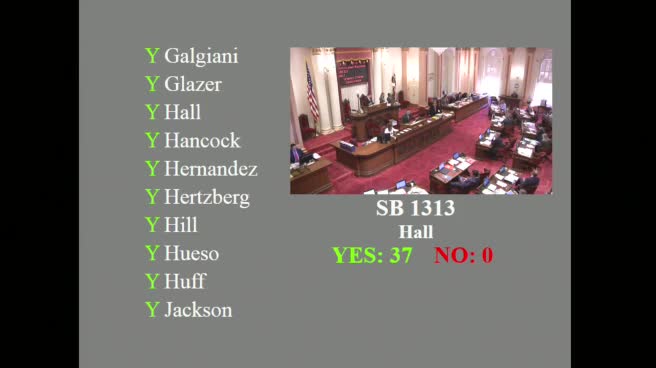
Bill Author
Bill Co-Author(s):