SB 170: Unmanned aircraft systems: correctional facilities.
- Session Year: 2015-2016
- House: Senate
- Latest Version Date: 2015-09-08
Existing federal law, the Federal Aviation Administration Modernization and Reform Act of 2012, provides for the integration of civil unmanned aircraft systems, commonly known as drones, into the national airspace system by September 30, 2015. Existing federal law requires the Administrator of the Federal Aviation Administration to develop and implement operational and certification requirements for the operation of public unmanned aircraft systems in the national airspace system by December 31, 2015.
Existing state law generally prohibits a person from bringing, possessing, distributing, or selling certain devices and substances, including, among other things, alcoholic beverages, controlled substances, and deadly weapons, in state prison or a jail. Existing law also prohibits unauthorized communication with inmates in state prison or a jail. Existing law provides criminal penalties for violations of these provisions.
This bill would make a person who knowingly and intentionally operates an unmanned aircraft system on or above the grounds of a state prison or a jail guilty of a misdemeanor. The bill would make these misdemeanor provisions inapplicable to a person employed by the prison or jail acting within the scope of his or her employment, or a person who receives prior permission from the Department of Corrections and Rehabilitation or the county sheriff. The bill would also make these misdemeanor provisions inapplicable to any entity that is authorized by the Federal Aviation Administration to use an unmanned aircraft system and operates it in accordance with the terms and conditions of the authorization. By creating new crimes, the bill would impose a state-mandated local program.
The California Constitution requires the state to reimburse local agencies and school districts for certain costs mandated by the state. Statutory provisions establish procedures for making that reimbursement.
This bill would provide that no reimbursement is required by this act for a specified reason.
Existing federal law, the Federal Aviation Administration Modernization and Reform Act of 2012, provides for the integration of civil unmanned aircraft systems, commonly known as drones, into the national airspace system by September 30, 2015. Existing federal law requires the Administrator of the Federal Aviation Administration to develop and implement operational and certification requirements for the operation of public unmanned aircraft systems in the national airspace system by December 31, 2015.
Existing state law generally prohibits a person from bringing, possessing, distributing, or selling certain devices and substances, including, among other things, alcoholic beverages, controlled substances, and deadly weapons, in state prison or a jail. Existing law also prohibits unauthorized communication with inmates in state prison or a jail. Existing law provides criminal penalties for violations of these provisions.
This bill would make a person who knowingly and intentionally operates an unmanned aircraft system below the navigable airspace, as those terms are defined, overlaying on or above the grounds of a state prison or a jail guilty of a misdemeanor. The bill would make these misdemeanor provisions inapplicable to a person employed by the prison or jail acting within the scope of his or her employment, or a person who receives prior permission from the Department of Corrections and Rehabilitation or the county sheriff. By creating new crimes, the bill would impose a state-mandated local program.
The California Constitution requires the state to reimburse local agencies and school districts for certain costs mandated by the state. Statutory provisions establish procedures for making that reimbursement.
This bill would provide that no reimbursement is required by this act for a specified reason.
Existing federal law, the Federal Aviation Administration Modernization and Reform Act of 2012, provides for the integration of civil unmanned aircraft systems, commonly known as drones, into the national airspace system by September 30, 2015. Existing federal law requires the Administrator of the Federal Aviation Administration to develop and implement operational and certification requirements for the operation of public unmanned aircraft systems in the national airspace system by December 31, 2015.
Existing state law generally prohibits a person from bringing, possessing, distributing, or selling certain devices and substances, including, among other things, alcoholic beverages, controlled substances, and deadly weapons, in state prison or a jail. Existing law also prohibits unauthorized communication with inmates in state prison or a jail. Existing law provides criminal penalties for violations of these provisions.
This bill would make a person who uses an unmanned aircraft system, as defined, in violation of specified provisions, subject to a doubled fine, as specified, in addition to any other penalty provided by law. The bill would also require that the use of an unmanned aircraft system in violation of specified provisions be considered a factor in aggravation in sentencing for purposes of a felony conviction under those provisions.
This bill would make a person who knowingly and intentionally operates an unmanned aircraft system below the navigable airspace airspace, as those terms are defined, overlaying a state prison or a jail guilty of a misdemeanor. The bill would make these misdemeanor provisions inapplicable to a person employed by the prison or jail acting within the scope of his or her employment, or a person who receives prior permission from the Department of Corrections and Rehabilitation or the county sheriff. By creating new crimes, the bill would impose a state-mandated local program.
The California Constitution requires the state to reimburse local agencies and school districts for certain costs mandated by the state. Statutory provisions establish procedures for making that reimbursement.
This bill would provide that no reimbursement is required by this act for a specified reason.
Existing federal law, the Federal Aviation Administration Modernization and Reform Act of 2012, provides for the integration of civil unmanned aircraft systems, commonly known as drones, into the national airspace system by September 30, 2015. Existing federal law requires the Administrator of the Federal Aviation Administration to develop and implement operational and certification requirements for the operation of public unmanned aircraft systems in the national airspace system by December 31, 2015.
Existing state law generally prohibits a person from bringing, possessing, distributing, or selling certain devices and substances, including, among other things, alcoholic beverages, controlled substances, and deadly weapons, in state prison or a jail. Existing law also prohibits unauthorized communication with inmates in state prison or a jail. Existing law provides criminal penalties for violations of these provisions.
This bill would make a person who uses an unmanned aircraft system, as defined, to commit a in violation of those specified provisions, subject to the imposition of a sentence of one year of imprisonment or a doubled fine, as specified, in addition to any other penalty provided by law. The bill would also require that the use of an unmanned aircraft system in violation of specified provisions be considered a factor in aggravation in sentencing for purposes of a felony conviction under those provisions.
This bill would make a person who knowingly and intentionally operates an unmanned aircraft system below the navigable airspace overlaying a state prison or a jail guilty of a misdemeanor. The bill would make these misdemeanor provisions inapplicable to a person employed by the prison or jail acting within the scope of his or her employment, or a person who receives prior permission from the Department of Corrections and Rehabilitation or the county sheriff. By creating new crimes, the bill would impose a state-mandated local program.
The California Constitution requires the state to reimburse local agencies and school districts for certain costs mandated by the state. Statutory provisions establish procedures for making that reimbursement.
This bill would provide that no reimbursement is required by this act for a specified reason.
Existing federal law, the Federal Aviation Administration Modernization and Reform Act of 2012, provides for the integration of civil unmanned aircraft systems, commonly known as drones, into the national airspace system by September 30, 2015. Existing federal law requires the Administrator of the Federal Aviation Administration to develop and implement operational and certification requirements for the operation of public unmanned aircraft systems in the national airspace system by December 31, 2015.
Existing state law generally prohibits a person from bringing, possessing, distributing, or selling certain devices and substances, including, among other things, alcoholic beverages, controlled substances, and deadly weapons, in state prison or a jail. Existing law also prohibits unauthorized communication with inmates in state prison or a jail. Existing law provides criminal penalties for violations of these provisions.
This bill would make a person who uses an unmanned aircraft system, as defined, to commit a violation of those provisions, guilty of a felony, and would require subject to the imposition of a sentence of one year of imprisonment or a doubled fine, as specified, in addition to any other penalty provided by law.
This bill would make a person who knowingly and intentionally operates an unmanned aircraft system below the navigable airspace overlaying a state prison or a jail guilty of a misdemeanor. The bill would also make a person who knowingly and intentionally captures images or data of a state prison through the operation of an unmanned aircraft system guilty of a misdemeanor. The bill would make these misdemeanor provisions inapplicable to a person employed by the prison or jail acting within the scope of his or her employment, or a person who receives prior permission from the Department of Corrections and Rehabilitation or the county sheriff. By creating new crimes, the bill would impose a state-mandated local program.
The California Constitution requires the state to reimburse local agencies and school districts for certain costs mandated by the state. Statutory provisions establish procedures for making that reimbursement.
This bill would provide that no reimbursement is required by this act for a specified reason.
Existing federal law, the Federal Aviation Administration Modernization and Reform Act of 2012, provides for the integration of civil unmanned aircraft systems, commonly known as drones, into the national airspace system by September 30, 2015. Existing federal law requires the Administrator of the Federal Aviation Administration to develop and implement operational and certification requirements for the operation of public unmanned aircraft systems in the national airspace system by December 31, 2015.
Existing state law generally prohibits a person from bringing, possessing, distributing, or selling certain devices and substances, including, among other things, alcoholic beverages, controlled substances, and deadly weapons, in state prison or a jail. Existing law also prohibits unauthorized communication with inmates in state prison or a jail. Existing law provides criminal penalties for violations of these provisions.
This bill would make a person who uses an unmanned aircraft system, as defined, to commit a violation of those provisions, guilty of a felony, and would require the imposition of a sentence of one year of imprisonment in addition to any other penalty provided by law.
This bill would make a person who knowingly and intentionally operates an unmanned aircraft system below the navigable airspace overlaying a state prison guilty of a misdemeanor. The bill would also make a person who knowingly and intentionally captures images or data of a state prison through the operation of an unmanned aircraft system guilty of a misdemeanor. The bill would make these misdemeanor provisions inapplicable to a person employed by the prison acting within the scope of his or her employment, or a person who receives prior permission from the Department of Corrections and Rehabilitation. By creating new crimes, the bill would impose a state-mandated local program.
The California Constitution requires the state to reimburse local agencies and school districts for certain costs mandated by the state. Statutory provisions establish procedures for making that reimbursement.
This bill would provide that no reimbursement is required by this act for a specified reason.
Existing law defines slander as a false and unprivileged publication, communicated orally or by radio, mechanical, or other means, which causes specified damages.
This bill would make technical, nonsubstantive changes to this provision.
Existing law defines slander as a false and unprivileged publication, communicated orally or by radio, mechanical, or other means, which causes specified damages.
This bill would make technical, nonsubstantive changes to this provision.
(a)Except as provided in subdivisions (b), (c), and (d), a person who knowingly and intentionally operates an unmanned aircraft system on or above the grounds of a state prison or a jail is guilty of a misdemeanor.
(b)This section does not apply to a person employed by the prison who operates the unmanned aircraft system within the scope of his or her employment, or a person who receives prior permission from the Department of Corrections and Rehabilitation to operate the unmanned aircraft system over the prison.
(c)This section does not apply to a person employed by the jail who operates the unmanned aircraft system within the scope of his or her employment, or a person who receives prior permission from the county sheriff to operate the unmanned aircraft system over the jail.
(d)This section does not apply to any entity for which the Federal Aviation Administration has authorized the use of the unmanned aircraft system and the unmanned aircraft system is operated in accordance with the terms and conditions of the authorization.
(e)For purposes of this section, the following definitions apply:
(1)Unmanned aircraft means an aircraft that is operated without the possibility of direct human intervention from within or on the aircraft.
(2)Unmanned aircraft system means an unmanned aircraft and associated elements, including, but not limited to, communication links and the components that control the unmanned aircraft that are required for the pilot in command to operate safely and efficiently in the national airspace system.
SEC. 2.No reimbursement is required by this act pursuant to Section 6 of Article XIIIB of the California Constitution because the only costs that may be incurred by a local agency or school district will be incurred because this act creates a new crime or infraction, eliminates a crime or infraction, or changes the penalty for a crime or infraction, within the meaning of Section 17556 of the Government Code, or changes the definition of a crime within the meaning of Section 6 of Article XIIIB of the California Constitution.
(a)Except as provided in subdivisions (b) and (c), subdivisions (b), (c), and (d), a person who knowingly and intentionally operates an unmanned aircraft system on or above the grounds of a state prison or a jail is guilty of a misdemeanor.
(b)This section does not apply to a person employed by the prison who operates the unmanned aircraft system within the scope of his or her employment, or a person who receives prior permission from the Department of Corrections and Rehabilitation to operate the unmanned aircraft system over the prison.
(c)This section does not apply to a person employed by the jail who operates the unmanned aircraft system within the scope of his or her employment, or a person who receives prior permission from the county sheriff to operate the unmanned aircraft system over the jail.
(d)This section does not apply to any entity for which the Federal Aviation Administration has authorized the use of the unmanned aircraft system and the unmanned aircraft system is operated in accordance with the terms and conditions of the authorization.
(d)
(e)For purposes of this section, the following definitions apply:
(1)Unmanned aircraft means an aircraft that is operated without the possibility of direct human intervention from within or on the aircraft.
(2)Unmanned aircraft system means an unmanned aircraft and associated elements, including, but not limited to, communication links and the components that control the unmanned aircraft that are required for the pilot in command to operate safely and efficiently in the national airspace system.
SEC. 2.No reimbursement is required by this act pursuant to Section 6 of Article XIIIB of the California Constitution because the only costs that may be incurred by a local agency or school district will be incurred because this act creates a new crime or infraction, eliminates a crime or infraction, or changes the penalty for a crime or infraction, within the meaning of Section 17556 of the Government Code, or changes the definition of a crime within the meaning of Section 6 of Article XIIIB of the California Constitution.
(a)Except as provided in subdivisions (b) and (c), a person who knowingly and intentionally operates an unmanned aircraft system below the navigable airspace, as defined in Section 42102 of Title 49 of the United States Code, overlaying on or above the grounds of a state prison or a jail is guilty of a misdemeanor.
(b)This section does not apply to a person employed by the prison who operates the unmanned aircraft system within the scope of his or her employment, or a person who receives prior permission from the Department of Corrections and Rehabilitation to operate the unmanned aircraft system over the prison.
(c)This section does not apply to a person employed by the jail who operates the unmanned aircraft system within the scope of his or her employment, or a person who receives prior permission from the county sheriff to operate the unmanned aircraft system over the jail.
(d)For purposes of this section, the following definitions apply:
(1)Unmanned aircraft means an aircraft that is operated without the possibility of direct human intervention from within or on the aircraft.
(2)Unmanned aircraft system means an unmanned aircraft and associated elements, including, but not limited to, communication links and the components that control the unmanned aircraft that are required for the pilot in command to operate safely and efficiently in the national airspace system.
SEC. 2.No reimbursement is required by this act pursuant to Section 6 of Article XIIIB of the California Constitution because the only costs that may be incurred by a local agency or school district will be incurred because this act creates a new crime or infraction, eliminates a crime or infraction, or changes the penalty for a crime or infraction, within the meaning of Section 17556 of the Government Code, or changes the definition of a crime within the meaning of Section 6 of Article XIIIB of the California Constitution.
(a)(1)When a person uses an unmanned aircraft system to commit a felony violation of this chapter, the use of the unmanned aircraft system shall be considered a factor in aggravation in sentencing.
(2)When a person uses an unmanned aircraft system to commit a violation of Section 4575 or 4576, the maximum or prescribed amounts of fines for offenses in those sections shall be doubled in addition to any other penalty provided by law.
(3)This subdivision does not apply to a violation of Section 4578 or 4579.
(b)For purposes of this chapter, the following definitions apply:
(1)Unmanned aircraft means an aircraft that is operated without the possibility of direct human intervention from within or on the aircraft.
(2)Unmanned aircraft system means an unmanned aircraft and associated elements, including, but not limited to, communication links and the components that control the unmanned aircraft that are required for the pilot in command to operate safely and efficiently in the national airspace system.
SEC. 2.SECTION 1.Section 4578 4577 is added to the Penal Code, to read:4578. 4577.(a)Except as provided in subdivisions (b) and (c), a person who knowingly and intentionally operates an unmanned aircraft system below the navigable airspace, as defined in Section 42102 of Title 49 of the United States Code, overlaying a state prison or a jail is guilty of a misdemeanor.
(b)This section does not apply to a person employed by the prison who operates the unmanned aircraft system within the scope of his or her employment, or a person who receives prior permission from the Department of Corrections and Rehabilitation to operate the unmanned aircraft system over the prison.
(c)This section does not apply to a person employed by the jail who operates the unmanned aircraft system within the scope of his or her employment, or a person who receives prior permission from the county sheriff to operate the unmanned aircraft system over the jail.
(d)For purposes of this section, the following definitions apply:
(1)Unmanned aircraft means an aircraft that is operated without the possibility of direct human intervention from within or on the aircraft.
(2)Unmanned aircraft system means an unmanned aircraft and associated elements, including, but not limited to, communication links and the components that control the unmanned aircraft that are required for the pilot in command to operate safely and efficiently in the national airspace system.
SEC. 3.SEC. 2.No reimbursement is required by this act pursuant to Section 6 of Article XIIIB of the California Constitution because the only costs that may be incurred by a local agency or school district will be incurred because this act creates a new crime or infraction, eliminates a crime or infraction, or changes the penalty for a crime or infraction, within the meaning of Section 17556 of the Government Code, or changes the definition of a crime within the meaning of Section 6 of Article XIIIB of the California Constitution.
(a)(1)When a person uses an unmanned aircraft system to commit a felony violation of this chapter, excluding Section 4575 or 4576, a sentence of one year of imprisonment shall be imposed in addition to any other penalty provided by law the use of the unmanned aircraft system shall be considered a factor in aggravation in sentencing.
(2)When a person uses an unmanned aircraft system to commit a violation of Section 4575 or 4576, the maximum or prescribed amounts of fines for offenses in those sections shall be doubled in addition to any other penalty provided by law.
(3)This subdivision does not apply to a violation of Section 4578 or 4579.
(b)For purposes of this chapter, the following definitions apply:
(1)Unmanned aircraft means an aircraft that is operated without the possibility of direct human intervention from within or on the aircraft.
(2)Unmanned aircraft system means an unmanned aircraft and associated elements, including, but not limited to, communication links and the components that control the unmanned aircraft that are required for the pilot in command to operate safely and efficiently in the national airspace system.
SEC. 2.Section 4578 is added to the Penal Code, to read:4578.(a)Except as provided in subdivisions (b) and (c), a person who knowingly and intentionally operates an unmanned aircraft system below the navigable airspace, as defined in Section 42102 of Title 49 of the United States Code, overlaying a state prison or a jail is guilty of a misdemeanor.
(b)This section does not apply to a person employed by the prison who operates the unmanned aircraft system within the scope of his or her employment, or a person who receives prior permission from the Department of Corrections and Rehabilitation to operate the unmanned aircraft system over the prison.
(c)This section does not apply to a person employed by the jail who operates the unmanned aircraft system within the scope of his or her employment, or a person who receives prior permission from the county sheriff to operate the unmanned aircraft system over the jail.
SEC. 3.No reimbursement is required by this act pursuant to Section 6 of Article XIIIB of the California Constitution because the only costs that may be incurred by a local agency or school district will be incurred because this act creates a new crime or infraction, eliminates a crime or infraction, or changes the penalty for a crime or infraction, within the meaning of Section 17556 of the Government Code, or changes the definition of a crime within the meaning of Section 6 of Article XIIIB of the California Constitution.
(a)(1)When a person uses an unmanned aircraft system to commit a violation of this chapter, the person is guilty of a felony and excluding Section 4575 or 4576, a sentence of one year of imprisonment shall be imposed in addition to any other penalty provided by law.
(2)When a person uses an unmanned aircraft system to commit a violation of Section 4575 or 4576, the maximum or prescribed amounts of fines for offenses in those sections shall be doubled in addition to any other penalty provided by law.
(2)
(3)This subdivision does not apply to a violation of Section 4578 or 4579.
(b)For purposes of this chapter, the following definitions apply:
(1)Unmanned aircraft means an aircraft that is operated without the possibility of direct human intervention from within or on the aircraft.
(2)Unmanned aircraft system means an unmanned aircraft and associated elements, including, but not limited to, communication links and the components that control the unmanned aircraft that are required for the pilot in command to operate safely and efficiently in the national airspace system.
SEC. 2.Section 4578 is added to the Penal Code, to read:4578.(a)Except as provided in subdivision (b), subdivisions (b) and (c), a person who knowingly and intentionally operates an unmanned aircraft system below the navigable airspace, as defined in Section 42102 of Title 49 of the United States Code, overlaying a state prison or a jail is guilty of a misdemeanor.
(b)This section does not apply to a person employed by the prison who operates the unmanned aircraft system within the scope of his or her employment, or a person who receives prior permission from the Department of Corrections and Rehabilitation to operate the unmanned aircraft system over the prison.
(c)This section does not apply to a person employed by the jail who operates the unmanned aircraft system within the scope of his or her employment, or a person who receives prior permission from the county sheriff to operate the unmanned aircraft system over the jail.
SEC. 3.Section 4579 is added to the Penal Code, to read:4579.(a)Except as provided in subdivision (b), a person who knowingly and intentionally captures images or data of a state prison through the operation of an unmanned aircraft system is guilty of a misdemeanor.
(b)This section does not apply to a person employed by the prison who captures images or data of a state prison through the operation of an unmanned aircraft system within the scope of his or her employment, or a person who receives prior permission from the Department of Corrections and Rehabilitation to capture images or data of a state prison through the operation of an unmanned aircraft system.
SEC. 4.SEC. 3.No reimbursement is required by this act pursuant to Section 6 of Article XIIIB of the California Constitution because the only costs that may be incurred by a local agency or school district will be incurred because this act creates a new crime or infraction, eliminates a crime or infraction, or changes the penalty for a crime or infraction, within the meaning of Section 17556 of the Government Code, or changes the definition of a crime within the meaning of Section 6 of Article XIIIB of the California Constitution.
(a)(1)When a person uses an unmanned aircraft system to commit a violation of this chapter, the person is guilty of a felony and a sentence of one year of imprisonment shall be imposed in addition to any other penalty provided by law.
(2)This subdivision does not apply to a violation of Section 4578 or 4579.
(b)For purposes of this chapter, the following definitions apply:
(1)Unmanned aircraft means an aircraft that is operated without the possibility of direct human intervention from within or on the aircraft.
(2)Unmanned aircraft system means an unmanned aircraft and associated elements, including, but not limited to, communication links and the components that control the unmanned aircraft that are required for the pilot in command to operate safely and efficiently in the national airspace system.
SEC. 2.Section 4578 is added to the Penal Code, to read:4578.(a)Except as provided in subdivision (b), a person who knowingly and intentionally operates an unmanned aircraft system below the navigable airspace, as defined in Section 42102 of Title 49 of the United States Code, overlaying a state prison is guilty of a misdemeanor.
(b)This section does not apply to a person employed by the prison who operates the unmanned aircraft system within the scope of his or her employment, or a person who receives prior permission from the Department of Corrections and Rehabilitation to operate the unmanned aircraft system.
SEC. 3.Section 4579 is added to the Penal Code, to read:4579.(a)Except as provided in subdivision (b), a person who knowingly and intentionally captures images or data of a state prison through the operation of an unmanned aircraft system is guilty of a misdemeanor.
(b)This section does not apply to a person employed by the prison who captures images or data of a state prison through the operation of an unmanned aircraft system within the scope of his or her employment, or a person who receives prior permission from the Department of Corrections and Rehabilitation to capture images or data of a state prison through the operation of an unmanned aircraft system.
SEC. 4.No reimbursement is required by this act pursuant to Section 6 of Article XIIIB of the California Constitution because the only costs that may be incurred by a local agency or school district will be incurred because this act creates a new crime or infraction, eliminates a crime or infraction, or changes the penalty for a crime or infraction, within the meaning of Section 17556 of the Government Code, or changes the definition of a crime within the meaning of Section 6 of Article XIIIB of the California Constitution.
SECTION 1.Section 46 of the Civil Code is amended to read:46.Slander is a false and unprivileged publication communicated orally, or by radio, mechanical, or other means, which does any of the following:
(a)Charges a person with a crime, or with having been indicted, convicted, or punished for a crime.
(b)Imputes in him or her the present existence of an infectious, contagious, or loathsome disease.
(c)Tends directly to injure him or her in respect to his or her office, profession, trade or business, either by imputing to him or her general disqualification in those respects which the office or other occupation peculiarly requires, or by imputing something with reference to his or her office, profession, trade, or business that has a natural tendency to lessen its profits.
(d)Imputes to him or her impotence or a want of chastity.
(e)By natural consequence causes actual damage.
Slander is a false and unprivileged publication, orally uttered, and also communications by radio or any mechanical publication communicated orally, or by radio, mechanical, or other means means, which does any of the following:
1.
(a)Charges any a person with a crime, or with having been indicted, convicted, or punished for crime; a crime.
2.
(b)Imputes in him or her the present existence of an infectious, contagious, or loathsome disease; disease.
3.
(c)Tends directly to injure him or her in respect to his or her office, profession, trade or business, either by imputing to him or her general disqualification in those respects which the office or other occupation peculiarly requires, or by imputing something with reference to his or her office, profession, trade, or business that has a natural tendency to lessen its profits; profits.
4.
(d)Imputes to him or her impotence or a want of chastity; or chastity.
5. Which, by
(e)By natural consequence, consequence causes actual damage.
|
Date
|
Status
|
|---|---|
| Sep 3, 2015 | In Senate. Concurrence in Assembly amendments pending. |
| Jun 29, 2015 | From committee with author's amendments. Read second time and amended. Re-referred to Com. on P. & C.P. |
| Jul 8, 2015 | From committee: Do pass and re-refer to Com. on PUB. S. (Ayes 11. Noes 0.) (July 7). Re-referred to Com. on PUB. S. |
| Jul 14, 2015 | From committee: Do pass and re-refer to Com. on APPR. (Ayes 7. Noes 0.) (July 14). Re-referred to Com. on APPR. |
| Aug 19, 2015 | From committee: Do pass. Ordered to consent calendar. (Ayes 17. Noes 0.) (August 19). |
| Aug 20, 2015 | Read second time. Ordered to consent calendar. |
| Aug 24, 2015 | From consent calendar on motion of Assembly Member Cristina Garcia. |
| Aug 24, 2015 | Ordered to third reading. |
| Sep 1, 2015 | Ordered to third reading. |
| Sep 1, 2015 | Read third time and amended. |
| Jun 11, 2015 | Referred to Coms. on P. & C.P. and PUB. S. |
| Sep 3, 2015 | Read third time. Passed. Ordered to the Senate. |
| Sep 3, 2015 | Read third time. Passed. (Ayes 80. Noes 0. Page 2844.) Ordered to the Senate. |
| Sep 4, 2015 | Assembly amendments concurred in. (Ayes 39. Noes 0. Page 2495.) Ordered to engrossing and enrolling. |
| Sep 4, 2015 | Assembly amendments concurred in. (Ayes 39. Noes 0.) Ordered to engrossing and enrolling. |
| Sep 10, 2015 | Enrolled and presented to the Governor at 3:30 p.m. |
| Oct 3, 2015 | In Senate. Consideration of Governor's veto pending. |
| Oct 3, 2015 | Vetoed by the Governor. |
| Apr 25, 2016 | Last day to consider Governors veto pursuant to Joint Rule 58.5. |
| Apr 25, 2016 | Last day to consider Governor’s veto pursuant to Joint Rule 58.5. |
| Apr 24, 2015 | Set for hearing May 4. |
| Feb 6, 2015 | From printer. May be acted upon on or after March 8. |
| Feb 19, 2015 | Referred to Com. on RLS. |
| Mar 11, 2015 | From committee with author's amendments. Read second time and amended. Re-referred to Com. on RLS. |
| Mar 18, 2015 | Re-referred to Com. on PUB. S. |
| Mar 20, 2015 | Set for hearing April 14. |
| Apr 7, 2015 | From committee with author's amendments. Read second time and amended. Re-referred to Com. on PUB. S. |
| Apr 21, 2015 | From committee: Do pass as amended and re-refer to Com. on APPR. (Ayes 6. Noes 0. Page 594.) (April 14). |
| Apr 21, 2015 | From committee: Do pass as amended and re-refer to Com. on APPR. (Ayes 6. Noes 0.) (April 14). |
| Apr 22, 2015 | Read second time and amended. Re-referred to Com. on APPR. |
| Feb 5, 2015 | Introduced. Read first time. To Com. on RLS. for assignment. To print. |
| May 4, 2015 | May 4 hearing: Placed on APPR. suspense file. |
| May 23, 2015 | Set for hearing May 28. |
| Jun 1, 2015 | From committee: Do pass as amended. (Ayes 7. Noes 0. Page 1148.) (May 28). |
| Jun 1, 2015 | From committee: Do pass as amended. (Ayes 7. Noes 0.) (May 28). |
| Jun 2, 2015 | Read second time and amended. Ordered to third reading. |
| Jun 4, 2015 | In Assembly. Read first time. Held at Desk. |
| Jun 4, 2015 | Read third time. Passed. (Ayes 40. Noes 0. Page 1330.) Ordered to the Assembly. |
| Jun 4, 2015 | Read third time. Passed. (Ayes 40. Noes 0.) Ordered to the Assembly. |
|
Date
|
Description
|
Location
|
Votes
|
|
|---|---|---|---|---|
| Sep 4, 2015 | Unfinished Business SB170 Gaines Concurrence | Senate Floor |
Passed |
|
| Sep 3, 2015 | SB 170 Gaines Senate Third Reading By GATTO | Assembly Floor |
Passed |
|
| Aug 19, 2015 | Do pass. To Consent Calendar. | Assembly Standing Committee on Appropriations |
Passed |
|
| Jul 14, 2015 | Do pass and be re-referred to the Committee on [Appropriations] | Assembly Standing Committee on Public Safety |
Passed |
|
| Jul 7, 2015 | Do pass and be re-referred to the Committee on [Public Safety] | Assembly Standing Committee on Privacy and Consumer Protection |
Passed |
|
| Jun 4, 2015 | Senate 3rd Reading SB170 Gaines | Senate Floor |
Passed |
|
| May 28, 2015 | Do pass as amended | Senate Standing Committee on Appropriations |
Passed |
|
| May 4, 2015 | Placed on suspense file | Senate Standing Committee on Appropriations |
Passed |
|
| Apr 14, 2015 | Do pass as amended, but first amend, and re-refer to the Committee on [Appropriations] | Senate Standing Committee on Public Safety |
Passed |
This list shows positions taken on this bill by organizations on the date displayed, which is linked to the original source.
Positions by individuals are not included.
|
Organization
|
Position
|
Date
|
|---|---|---|
| California Attorneys For Criminal Justice | ** Against | Sep 3, 2015 |
| California Correctional Peace Officers Association | ** Support | Sep 3, 2015 |
| California Police Chiefs Association | ** Support | Sep 3, 2015 |
| California State Lodge, Fraternal Order of Police | ** Support | Jul 7, 2015 |
| California State Sheriffs' Association | ** Support | Sep 3, 2015 |
| Long Beach Police Officers Association | ** Support | Jul 7, 2015 |
| Los Angeles County Professional Peace Officers Association | ** Support | Jul 7, 2015 |
| PUB. S. | ** Against | Sep 1, 2015 |
| Sacramento County Deputy Sheriffs' Association | ** Support | Jul 7, 2015 |
| Silicon Valley Chapter of the Association of Unmanned Vehicles | * Neutral | Jul 7, 2015 |
SB 170
Page 5
|
Office of Senate Floor Analyses (916) 651-1520 Fax: (916) 327-4478 |
SB 170 |
VETO
Bill No: SB 170
Amended: 9/1/15
SENATE PUBLIC SAFETY COMMITTEE: 6-0, 4/14/15
AYES: Hancock, Anderson, Leno, McGuire, Monning, Stone
NO VOTE RECORDED: Liu
SENATE APPROPRIATIONS COMMITTEE: 7-0, 5/28/15
AYES: Lara, Bates, Beall, Hill, Leyva, Mendoza, Nielsen
SENATE FLOOR: 40-0, 6/4/15
AYES: Allen, Anderson, Bates, Beall, Berryhill, Block, Cannella, De León, Fuller, Gaines, Galgiani, Glazer, Hall, Hancock, Hernandez, Hertzberg, Hill, Hueso, Huff, Jackson, Lara, Leno, Leyva, Liu, McGuire, Mendoza, Mitchell, Monning, Moorlach, Morrell, Nguyen, Nielsen, Pan, Pavley, Roth, Runner, Stone, Vidak, Wieckowski, Wolk
SENATE FLOOR: 39-0, 9/4/15
AYES: Allen, Anderson, Bates, Beall, Berryhill, Block, Cannella, De León, Fuller, Gaines, Galgiani, Glazer, Hall, Hancock, Hernandez, Hertzberg, Hill, Hueso, Huff, Lara, Leno, Leyva, Liu, McGuire, Mendoza, Mitchell, Monning, Moorlach, Morrell, Nguyen, Nielsen, Pan, Pavley, Roth, Runner, Stone, Vidak, Wieckowski, Wolk
NO VOTE RECORDED: Jackson
ASSEMBLY FLOOR: 80-0, 9/3/15 - See last page for vote
SUBJECT: Unmanned aircraft systems: correctional facilities
DIGEST: This bill prohibits a person from knowingly and intentionally operating an unmanned aircraft system (UAS) over a state prison or county jail.
Existing federal law, the Aviation Administration Modernization and Reform Act of 2012, requires the Secretary of Transportation to develop a comprehensive plan to safely accelerate the integration of civil unmanned aircraft systems into the national airspace system. The plan is required to provide for safe integration of civil unmanned aircraft systems into national airspace as soon as practicable, not later than September 30, 2015. (112 P.L. 95, 332.)
Existing state law:
Prohibits wiretapping or eavesdropping on confidential communications. (Penal Code § 630.)
Makes it a crime for a person, intentionally, and without requisite consent, to eavesdrop on a confidential communication by means of any electronic amplifying or recording device. (Penal Code § 632.)
Makes a person liable for “physical invasion of privacy” for knowingly entering onto the land of another person or otherwise committing a trespass in order to physically invade the privacy of another person with the intent to capture any type of visual image, sound recording, or other physical impression of that person engaging in a personal or familial activity, and the physical invasion occurs in a manner that is offensive to a reasonable person. (Civil Code § 1708.8 (a).)
Makes a person liable for “constructive invasion of privacy” for attempting to capture, in a manner highly offensive to a reasonable person, any type of visual image, sound recording, or other physical impression of another person engaging in a personal or familial activity under circumstances in which the plaintiff had a reasonable expectation of privacy, through the use of a visual or auditory enhancing device, regardless of whether there was a physical trespass, if the image or recording could not have been achieved without a trespass unless the visual or auditory enhancing device was used. (Civil Code § 1708.8 (b).)
Provides that a person who commits an invasion of privacy for a commercial purpose shall, in addition to any other damages or remedies provided, be subject to disgorgement to the plaintiff of any proceeds or other consideration obtained as a result of the violation of this section. Existing law defines “commercial purpose” to mean any act done with the expectation of sale, financial gain, or other consideration. (Civil Code § 1708.8 (d), (k).)
Makes it a felony for smuggling a controlled substance into prison or jail. (Penal Code §4573.)
Makes it a felony to bring drugs or alcoholic beverages into a penal institution. (Penal Code § 4573.5)
Makes it a felony to possess controlled substances where prisoners are kept. (Penal Code §4573.6)
Makes it a felony to possess drugs or paraphernalia in prison or jail. (Penal Code § 4573.8)
Makes it a felony to sell or give drugs to a person in custody in State Prison or Institution. (Penal Code §4573.9)
Makes it a felony for smuggling firearms, deadly weapons or tear gas into prison or jail. (Penal Code §4574.)
Makes it a misdemeanor to possess a wireless communication device including a cell phone, pager, etcetera in a local correctional facility is a misdemeanor. (Penal Code § 4575.(a).)
Makes it an infraction to possess any tobacco products in a local correctional facility. (Penal Code § 4575.(b).)
Makes it a misdemeanor to possess with the intent to deliver a wireless communication device in a prison. (Penal Code §4576)
This bill:
Makes it a misdemeanor for a person to knowingly and intentionally operate a UAS on or above the grounds of a state prison or jail, except as provided.
Exempts from the prohibition a prison employee operating within the scope of his or her employment, or a person with the prior permission of the Department of Corrections and Rehabilitation.
Exempts from the prohibition a jail employee operating within the scope of his or her employment, or a person with the prior permission of the county sheriff.
Defines the terms "unmanned aircraft" and "unmanned aircraft system" consistent with Federal Aviation Administration (FAA) regulation.
Provides that no reimbursement is required because the only costs that may be incurred by a local agency or school district will be incurred because this bill creates a new crime or infraction, eliminates a crime or infraction, changes the penalty for a crime or infraction, or changes the definition of a crime.
FISCAL EFFECT: Appropriation: No Fiscal Com.: Yes Local: Yes
According to the Assembly Appropriations Committee, minor nonreimbursable costs to counties for enforcement, offset to some extent by fine revenues.
California Correctional Peace Officers Association
California Police Chiefs Association
California State Sheriffs’ Association
OPPOSITION: (Verified 10/27/15)
California Attorneys for Criminal Justice
GOVERNOR'S VETO MESSAGE:
I am returning the following nine bills without my signature:
Assembly Bill 144
Assembly Bill 849
Senate Bill 168
Senate Bill 170
Senate Bill 271
Senate Bill 333
Senate Bill 347
Senate Bill 716
Senate Bill 722
Each of these bills creates a new crime - usually by finding a novel way to characterize and criminalize conduct that is already proscribed. This multiplication and particularization of criminal behavior creates increasing complexity without commensurate benefit.
Over the last several decades, California's criminal code has grown to more than 5,000 separate provisions, covering almost every conceivable form of human misbehavior. During the same period, our jail and prison populations have exploded.
Before we keep going down this road, I think we should pause and reflect on how our system of criminal justice could be made more human, more just and more cost-effective.
ASSEMBLY FLOOR: 80-0, 9/3/15
AYES: Achadjian, Alejo, Travis Allen, Baker, Bigelow, Bloom, Bonilla, Bonta, Brough, Brown, Burke, Calderon, Campos, Chang, Chau, Chávez, Chiu, Chu, Cooley, Cooper, Dababneh, Dahle, Daly, Dodd, Eggman, Frazier, Beth Gaines, Gallagher, Cristina Garcia, Eduardo Garcia, Gatto, Gipson, Gomez, Gonzalez, Gordon, Gray, Grove, Hadley, Harper, Roger Hernández, Holden, Irwin, Jones, Jones-Sawyer, Kim, Lackey, Levine, Linder, Lopez, Low, Maienschein, Mathis, Mayes, McCarty, Medina, Melendez, Mullin, Nazarian, Obernolte, O'Donnell, Olsen, Patterson, Perea, Quirk, Rendon, Ridley-Thomas, Rodriguez, Salas, Santiago, Steinorth, Mark Stone, Thurmond, Ting, Wagner, Waldron, Weber, Wilk, Williams, Wood, Atkins
Prepared by: Mary Kennedy / PUB. S. /
11/4/15 14:08:38
**** END ****
SB 170
Page 4
|
Office of Senate Floor Analyses (916) 651-1520 Fax: (916) 327-4478 |
UNFINISHED BUSINESS
Bill No: SB 170
Amended: 9/1/15
SENATE PUBLIC SAFETY COMMITTEE: 6-0, 4/14/15
AYES: Hancock, Anderson, Leno, McGuire, Monning, Stone
NO VOTE RECORDED: Liu
SENATE APPROPRIATIONS COMMITTEE: 7-0, 5/28/15
AYES: Lara, Bates, Beall, Hill, Leyva, Mendoza, Nielsen
SENATE FLOOR: 40-0, 6/4/15
AYES: Allen, Anderson, Bates, Beall, Berryhill, Block, Cannella, De León, Fuller, Gaines, Galgiani, Glazer, Hall, Hancock, Hernandez, Hertzberg, Hill, Hueso, Huff, Jackson, Lara, Leno, Leyva, Liu, McGuire, Mendoza, Mitchell, Monning, Moorlach, Morrell, Nguyen, Nielsen, Pan, Pavley, Roth, Runner, Stone, Vidak, Wieckowski, Wolk
ASSEMBLY FLOOR: 80-0, 9/3/15 - See last page for vote
SUBJECT: Unmanned aircraft systems: correctional facilities
DIGEST: This bill prohibits a person from knowingly and intentionally operating an unmanned aircraft system (UAS) over a state prison or county jail.
Assembly Amendments deleted a reference to navigable airspace as defined by the United States code and instead prohibits the flying of a UAS above the grounds of a prison.
Existing Law:
Federal law, the Aviation Administration Modernization and Reform Act of 2012, requires the Secretary of Transportation to develop a comprehensive plan to safely accelerate the integration of civil unmanned aircraft systems into the national airspace system. The plan is required to provide for safe integration of civil unmanned aircraft systems into national airspace as soon as practicable, not later than September 30, 2015. (112 P.L. 95, 332.)
Prohibits wiretapping or eavesdropping on confidential communications. (Penal Code § 630.)
Makes it a crime for a person, intentionally, and without requisite consent, to eavesdrop on a confidential communication by means of any electronic amplifying or recording device. (Penal Code § 632.)
Makes a person liable for “physical invasion of privacy” for knowingly entering onto the land of another person or otherwise committing a trespass in order to physically invade the privacy of another person with the intent to capture any type of visual image, sound recording, or other physical impression of that person engaging in a personal or familial activity, and the physical invasion occurs in a manner that is offensive to a reasonable person. (Civil Code § 1708.8 (a).)
Makes a person liable for “constructive invasion of privacy” for attempting to capture, in a manner highly offensive to a reasonable person, any type of visual image, sound recording, or other physical impression of another person engaging in a personal or familial activity under circumstances in which the plaintiff had a reasonable expectation of privacy, through the use of a visual or auditory enhancing device, regardless of whether there was a physical trespass, if the image or recording could not have been achieved without a trespass unless the visual or auditory enhancing device was used. (Civil Code § 1708.8 (b).)
Provides that a person who commits an invasion of privacy for a commercial purpose shall, in addition to any other damages or remedies provided, be subject to disgorgement to the plaintiff of any proceeds or other consideration obtained as a result of the violation of this section. Existing law defines “commercial purpose” to mean any act done with the expectation of sale, financial gain, or other consideration. (Civil Code § 1708.8 (d), (k).)
Makes it a felony for smuggling a controlled substance into prison or jail. (Penal Code §4573.)
Makes it a felony to bring drugs or alcoholic beverages into a penal institution. (Penal Code § 4573.5)
Makes it a felony to possess controlled substances where prisoners are kept. (Penal Code §4573.6)
Makes it a felony to possess drugs or paraphernalia in prison or jail. (Penal Code § 4573.8)
Makes it a felony to sell or give drugs to a person in custody in State Prison or Institution. (Penal Code §4573.9)
Makes it a felony for smuggling firearms, deadly weapons or tear gas into prison or jail. (Penal Code §4574.)
Makes it a misdemeanor to possess a wireless communication device including a cell phone, pager, etcetera in a local correctional facility is a misdemeanor. (Penal Code § 4575.(a).)
Makes it an infraction to possess any tobacco products in a local correctional facility. (Penal Code § 4575.(b).)
Makes it a misdemeanor to possess with the intent to deliver a wireless communication device in a prison. (Penal Code §4576)
This bill:
Makes it a misdemeanor for a person to knowingly and intentionally operate a UAS on or above the grounds of a state prison or jail, except as provided.
Exempts from the prohibition a prison employee operating within the scope of his or her employment, or a person with the prior permission of the Department of Corrections and Rehabilitation.
Exempts from the prohibition a jail employee operating within the scope of his or her employment, or a person with the prior permission of the county sheriff.
Defines the terms "unmanned aircraft" and "unmanned aircraft system" consistent with Federal Aviation Administration (FAA) regulation.
Provides that no reimbursement is required because the only costs that may be incurred by a local agency or school district will be incurred because this bill creates a new crime or infraction, eliminates a crime or infraction, changes the penalty for a crime or infraction, or changes the definition of a crime.
FISCAL EFFECT: Appropriation: No Fiscal Com.: Yes Local: Yes
According to the Assembly Appropriations Committee, minor nonreimbursable costs to counties for enforcement, offset to some extent by fine revenues.
California Correctional Peace Officers Association
California Police Chiefs Association
California State Sheriffs’ Association
California Attorneys for Criminal Justice
ASSEMBLY FLOOR: 80-0, 9/03/15
AYES: Achadjian, Alejo, Travis Allen, Baker, Bigelow, Bloom, Bonilla, Bonta, Brough, Brown, Burke, Calderon, Campos, Chang, Chau, Chávez, Chiu, Chu, Cooley, Cooper, Dababneh, Dahle, Daly, Dodd, Eggman, Frazier, Beth Gaines, Gallagher, Cristina Garcia, Eduardo Garcia, Gatto, Gipson, Gomez, Gonzalez, Gordon, Gray, Grove, Hadley, Harper, Roger Hernández, Holden, Irwin, Jones, Jones-Sawyer, Kim, Lackey, Levine, Linder, Lopez, Low, Maienschein, Mathis, Mayes, McCarty, Medina, Melendez, Mullin, Nazarian, Obernolte, O'Donnell, Olsen, Patterson, Perea, Quirk, Rendon, Ridley-Thomas, Rodriguez, Salas, Santiago, Steinorth, Mark Stone, Thurmond, Ting, Wagner, Waldron, Weber, Wilk, Williams, Wood, Atkins
Prepared by: Mary Kennedy / PUB. S. /
9/3/15 15:40:52
**** END ****
SB 170
Page 2
SENATE THIRD READING
SB 170
(Gaines)
As Amended September 1, 2015
Majority vote
SENATE VOTE: 40-0
Committee |
Votes |
Ayes |
Noes |
Privacy |
11-0 |
Gatto, Wilk, Baker, Calderon, Chang, Chau, Cooper, Dababneh, Dahle, Gordon, Low |
|
Public Safety |
7-0 |
Quirk, Melendez, Jones-Sawyer, Lackey, Lopez, Low, Santiago |
|
Appropriations |
17-0 |
Gomez, Bigelow, Bloom, Bonta, Calderon, Chang, Daly, Eggman, Gallagher, Eduardo Garcia, Holden, Jones, Quirk, Rendon, Wagner, Weber, Wood |
|
SUMMARY: Prohibits a person from knowingly and intentionally operating an unmanned aircraft system (UAS) over a state prison or county jail. Specifically, this bill:
Makes it a misdemeanor for a person to knowingly and intentionally operate a UAS on or above the grounds of a state prison or jail, except as provided.
Exempts from the prohibition a prison employee operating within the scope of his or her employment, or a person with the prior permission of the Department of Corrections and Rehabilitation.
Exempts from the prohibition a jail employee operating within the scope of his or her employment, or a person with the prior permission of the county sheriff.
Exempts from the prohibition entities authorized by the Federal Aviation Administration (FAA) to use UAS, if the UAS is operated in accordance with the terms and conditions of the authorization.
Defines the terms "unmanned aircraft" and "unmanned aircraft system" consistent with FAA regulation.
Provides that no reimbursement is required because the only costs that may be incurred by a local agency or school district will be incurred because this bill creates a new crime or infraction, eliminates a crime or infraction, changes the penalty for a crime or infraction, or changes the definition of a crime.
FISCAL EFFECT: According to the Assembly Appropriations Committee, minor nonreimbursable costs to counties for enforcement, offset to some extent by fine revenues.
COMMENTS: This bill is intended to improve prison and jail security by making it a misdemeanor to operate a UAS in the airspace over the grounds of a state prison or county jail. This bill is author-sponsored.
Commercial applications for UAS are growing exponentially. UAS gives the news media economical and environmentally-friendly access to aerial views of traffic, storms, and other events when compared to the current use of helicopters and other manned aircraft. UAS is used in the agricultural industry to observe and measure crops while conserving resources and avoiding the use of heavy equipment. And UAS may be the future delivery system for mail order and Internet companies.
However, the concern about drone overflight of correctional facilities is not just a theoretical exercise, as there are multiple examples of people attempting to use UAS to introduce contraband into prisons in the United States, including a recent attempt in August to smuggle drugs, tobacco and pornography into a maximum-security prison in Maryland. Ireland, Britain, Australia, and Canada have reported similar UAS incidents at prisons. UAS can also crash because of low battery power or operator error, putting inmates and prison employees at risk.
Recent amendments clarify that the bill does not apply to UAS operators who have FAA authorization to use UAS, as long as the UAS is operated in accordance with the terms and conditions of the FAA authorization.
Analysis Prepared by: Jennie Bretschneider / P. & C.P. / (916) 319-2200 FN: 0001854
SB 170
Page 2
SENATE THIRD READING
SB 170
(Gaines)
As Amended June 29, 2015
Majority vote
SENATE VOTE: 40-0
Committee |
Votes |
Ayes |
Noes |
Privacy |
11-0 |
Gatto, Wilk, Baker, Calderon, Chang, Chau, Cooper, Dababneh, Dahle, Gordon, Low |
|
Public Safety |
7-0 |
Quirk, Melendez, Jones-Sawyer, Lackey, Lopez, Low, Santiago |
|
Appropriations |
17-0 |
Gomez, Bigelow, Bloom, Bonta, Calderon, Chang, Daly, Eggman, Gallagher, Eduardo Garcia, Holden, Jones, Quirk, Rendon, Wagner, Weber, Wood |
|
SUMMARY: Prohibits a person from knowingly and intentionally operating an unmanned aircraft system (UAS) over a state prison or county jail. Specifically, this bill:
Makes it a misdemeanor for a person to knowingly and intentionally operate a UAS on or above the grounds of a state prison or jail, except as provided.
Exempts from the prohibition a prison employee operating within the scope of his or her employment, or a person with the prior permission of the Department of Corrections and Rehabilitation.
Exempts from the prohibition a jail employee operating within the scope of his or her employment, or a person with the prior permission of the county sheriff.
Defines the terms "unmanned aircraft" and "unmanned aircraft system" consistent with Federal Aviation Administration (FAA) regulation.
Provides that no reimbursement is required because the only costs that may be incurred by a local agency or school district will be incurred because this bill creates a new crime or infraction, eliminates a crime or infraction, changes the penalty for a crime or infraction, or changes the definition of a crime.
FISCAL EFFECT: According to the Assembly Appropriations Committee, minor nonreimbursable costs to counties for enforcement, offset to some extent by fine revenues.
COMMENTS: This bill is intended to improve prison and jail security by making it a misdemeanor to operate a UAS in the airspace over the grounds of a state prison or county jail. This bill is author-sponsored.
Commercial applications for UAS are growing exponentially. UAS gives the news media economical and environmentally-friendly access to aerial views of traffic, storms, and other events when compared to the current use of helicopters and other manned aircraft. UAS is used in the agricultural industry to observe and measure crops while conserving resources and avoiding the use of heavy equipment. And UAS may be the future delivery system for mail order and Internet companies.
The concern about drone overflight of correctional facilities to prevent smuggling is not just a theoretical exercise, as there are multiple examples of people attempting to use UAS to introduce contraband into prisons, including a recent attempt in August to smuggle drugs, tobacco and pornography into a maximum-security prison in Maryland. Ireland, Britain, Australia and Canada have reported similar UAS incidents at prisons. UAS can also crash as a result of low battery power or operator error, putting inmates and prison employees at risk.
Analysis Prepared by: Jennie Bretschneider / P. & C.P. / (916) 319-2200 FN: 0001530
Date of Hearing: August 19, 2015
ASSEMBLY COMMITTEE ON APPROPRIATIONS
Jimmy Gomez, Chair
SB 170
(Gaines) – As Amended June 29, 2015
Policy Committee: |
Privacy and Consumer Protection |
Vote: |
11 - 0 |
|
Public Safety |
|
7 - 0 |
|
|
|
|
Urgency: No State Mandated Local Program: Yes Reimbursable: No
SUMMARY:
This bill makes it a misdemeanor to knowingly and intentionally operate an unmanned aircraft system (drone) on or above the grounds of a state prison or jail. This prohibition would not apply to someone employed by, or given prior permission by, the California Department of Corrections and Rehabilitation (CDCR) or the jail, respectively.
FISCAL EFFECT:
Minor nonreimbursable costs to counties for enforcement, offset to some extent by fine revenues.
COMMENTS:
Purpose. According to the author, "Keeping contraband out of prison and jails is essential to running safe and orderly facilities. Studies show that the presence of contraband increases the risk of violence or disruptive behavior. However, even with the close monitoring of individuals and mail coming into prisons and jails, creating contraband-free facilities has always been a challenge.
"With public access to drones increasing, this issue is escalating. As drones become smaller and easier to operate, virtually anyone will be able to use the devise to drop contraband into a prison or jail. Already there have been instances in South Carolina, Georgia, and Canada of attempts to use drones to drop contraband into prisons. It is imperative that California’s penal code addresses this reality by limiting the use of drones over prisons and jails.
"Additionally, drones can be used to gather sensitive information from inside prison and jail walls. This information can be used for a variety of dangerous exploits, including inmate escapes and prison riots. Placing restrictions on the use of drones over prisons and jails helps prevent these situations."
Related Legislation. AB 56 (Quirk), pending in Senate Appropriations, regulates the use of unmanned aircraft systems by public agencies.
AB 271 (Gaines), also on today's committee agenda, prohibits the unauthorized use of an unmanned aircraft system on a school grounds during school hours or to capture images of the school grounds during school hours.
SB 142 (Jackson), pending in the Assembly, makes it a trespass to operate an unmanned aircraft system less than 350 feet above ground over private property without the consent of the owner.
Analysis Prepared by: Chuck Nicol / APPR. / (916) 319-2081
SB 170
Page 4
Date of Hearing: July 14, 2015
Chief Counsel: Gregory Pagan
ASSEMBLY COMMITTEE ON PUBLIC SAFETY
Bill Quirk, Chair
SB 170
(Gaines) – As Amended June 29, 2015
SUMMARY:
Makes it a misdemeanor to operate an unmanned aircraft system on or
above the grounds of a state prison or jail, except as specified.
Specifically, this bill:
Provides that any person who knowingly and intentionally operates an unmanned aircraft system on or above the grounds of a state prison is guilty of a misdemeanor punishable by a term of imprisonment not to exceed six month, by a fine not to exceed $1,000, or by both.
Exempts a person employed by the prison who operates an unmanned aircraft system within the scope of his or her employment, or a person who receives prior permission from the California Department of Corrections (CDCR) to operate the unmanned aircraft system over the prison.
Exempts a person employed by the jail who operates an unmanned aircraft system within the scope of his or her employment, or a person who receives prior permission from the sheriff to operate the unmanned aircraft system over the jail.
Defines "unmanned aircraft" as an aircraft that is operated without the possibility of direct human intervention from within or on the aircraft.
Defines "unmanned aircraft system" to mean an unmanned aircraft and associated elements including, but not limited to, communications links and the components that control the unmanned aircraft that are required for the pilot in command to operate safely and efficiently in the national airspace system.
EXISTING LAW:
Establishes the Aviation Administration Modernization Reform Act of 2012 which requires the Secretary of Transportation to develop a comprehensive plan to safely accelerate the integration of civil unmanned aircraft systems into the national airspace system. The plan is required to provide for safe integration of civil unmanned aircraft into national airspace as soon as practicable, but not later than September 30, 2015. (112 P.L. 95, 332.)
Provides that any person in a local correctional facility who possesses a wireless communication device, including, but not limited to, a cellular telephone, pager, or wireless Internet device, who is not authorized to possess that item is guilty of a misdemeanor, punishable by a fine of not more than $1,000. (Pen. Code, § 4575, subd. (a).)
States that it is a misdemeanor, punishable by imprisonment in the county jail not exceeding six months, a fine not to exceed $5,000 for each device, or both that fine and imprisonment, for a person who possesses with the intent to deliver, or delivers, to an inmate or ward in the custody of the California Department of Corrections and Rehabilitation (CDCR) any cellular telephone or other wireless communication device or any component thereof, except as specified. (Pen. Code, § 4576, subd. (a).)
States if a person visiting an inmate or ward in the custody of CDCR, upon being searched or subjected to a metal detector, is found to be in possession of a cellular telephone or other wireless communication device or any component thereof, that device or component shall be subject to confiscation but shall be returned on the same day the person visits the inmate or ward, unless the cellular telephone or other wireless communication device or any component thereof is held as evidence in a case where the person is cited for a violation of the above provision. (Pen. Code, § 4576, subd. (b)(1).)
Provides, if, upon investigation, it is determined that no prosecution will take place, the cellular telephone or other wireless communication device or any component thereof shall be returned to the owner at the owner’s expense. (Pen. Code, § 4576, subd. (b)(2).)
Requires notice of this provision shall be posted in all areas where visitors are searched prior to visitation with an inmate or ward in the custody of CDCR. (Pen. Code, § 4576, subd. (b)(3).)
States any inmate who is found to be in possession of a wireless communication device shall be subject to time credit denial or loss of up to 90 days. (Pen. Code, § 4576, subd. (c).)
Provides that a person who brings, without authorization, a wireless communication device within the secure perimeter of any prison or institution housing offenders under the jurisdiction of CDCR is deemed to have given his or her consent to CDCR using available technology to prevent that wireless device from sending or receiving telephone calls or other forms of electronic communication. Notice of this provision shall be posted at all public entry gates of the prison or institution. (Pen. Code, § 4576, subd. (d).)
Makes it a felony for smuggling a controlled substance into prison or jail. (Pen. Code, § 4573.)
States it is a felony to bring drugs or alcoholic beverages into a penal institution. (Pen. Code, § 4573.5.)
Makes it a felony to possess controlled substances where prisoners are kept. (Pen. Code, § 4573.6.)
States it is a felony to possess drugs or paraphernalia in prison or jail. (Penal Code § 4573.8.)
Makes it a felony to sell or give drugs to a person in custody in state prison or other institution under the jurisdiction of CDCR. (Pen. Code, § 4573.9.)
FISCAL EFFECT: Unknown
COMMENTS:
Author's Statement: According to the author, "Keeping contraband out of prison and jails is essential to running safe and orderly facilities. Studies show that the presence of contraband increases the risk of violence or disruptive behavior. However, even with the close monitoring of individuals and mail coming into prisons and jails, creating contraband-free facilities has always been a challenge.
"With public access to drones increasing, this issue is escalating. As drones become smaller and easier to operate, virtually anyone will be able to use the devise to drop contraband into a prison or jail. Already there have been instances in South Carolina, Georgia, and Canada of attempts to use drones to drop contraband into prisons. It is imperative that California’s penal code addresses this reality by limiting the use of drones over prisons and jails.
"Additionally, drones can be used to gather sensitive
information from inside prison and jail walls. This information can
be used for a variety of dangerous exploits, including inmate escapes
and prison riots. Placing restrictions on the use of drones over
prisons and jails helps prevent these situations.
Argument in Support: The California Police Chiefs Association states, "As unmanned aircraft become more publicly accessible, virtually anyone will be able to use the device to drop contraband into a prison or county jail. Additionally unmanned aircraft systems can be used to gather sensitive information from inside of prisons and jails. This information can be used for a variety of dangerous exploits, including inmate escapes and prison riots. Placing restrictions on the use of unmanned aircraft over prisons and jails helps prevent these situations."
Argument in Opposition: The California Attorneys for Criminal Justice argue, "The proposed Penal Code section 4577 would prohibit the use of unmanned aircraft on or above the grounds of a state prison or jail, even when not committing crimes related to the furnishing of contraband. The proposed legislation would impermissibly shield the prison system from the public eye. Given the California's prison system's history of deplorable conditions, this law would promote an air of secrecy in and around the prison's walls."
Related Legislation:
AB 56 (Quirk) regulates the use of unmanned aircraft systems by public agencies. AB 56 is pending hearing in the Senate Appropriations Committee.
AB 271 (Gaines) prohibits the unauthorized use of an unmanned aircraft system on a school grounds during school hours or to capture images of the school grounds during school hours. AB 56 is pending hearing in the Assembly Education Committee.
SB 142 (Jackson) makes it a trespass to operate an unmanned aircraft system less than 350 feet above ground over private property without the consent of the owner. SB 142 is pending hearing in the Assembly Judiciary Committee.
REGISTERED SUPPORT / OPPOSITION:
Support
California
Correctional Peace Officers Association
California Police Chiefs Association
Opposition
California Attorneys for Criminal Justice
Analysis Prepared by: Gregory Pagan / PUB. S. / (916) 319-3744
SB 170
Page 6
Date of Hearing: July 7, 2015
ASSEMBLY COMMITTEE ON PRIVACY AND CONSUMER PROTECTION
Mike Gatto, Chair
SB 170
(Gaines) – As Amended June 29, 2015
SENATE VOTE: 40-0
SUBJECT: Unmanned aircraft systems: correctional facilities.
SUMMARY: Prohibits a person from knowingly and intentionally operating an unmanned aircraft system (UAS) over a state prison or county jail. Specifically, this bill:
Makes it a misdemeanor for a person to knowingly and intentionally operate a UAS on or above the grounds of a state prison or jail, except as provided.
Exempts from the prohibition a prison employee operating within the scope of his or her employment, or a person with the prior permission of the Department of Corrections and Rehabilitation.
Exempts from the prohibition a jail employee operating within the scope of his or her employment, or a person with the prior permission of the county sheriff.
Defines the terms "unmanned aircraft" and "unmanned aircraft system" consistent with Federal Aviation Administration (FAA) regulation.
Provides that no reimbursement is required because the only costs that may be incurred by a local agency or school district will be incurred because this bill creates a new crime or infraction, eliminates a crime or infraction, changes the penalty for a crime or infraction, or changes the definition of a crime.
EXISTING LAW:
Requires, under the Federal Aviation Administration (FAA) Modernization and Reform Act of 2012, the FAA to integrate UAS into the national airspace system by September 30, 2015, and to develop and implement certification requirements for the operation of UAS in the national airspace system by December 31, 2015. (Public Law Number 112-095)
Makes it a misdemeanor to communicate with or bring or take a letter, writing, literature or reading matter to or from a person in custody in a prison or jail. (Penal Code (PC) Section 4570.
Makes it a misdemeanor to possess or possess with the intent to deliver a wireless communication device (i.e., cell phone, pager, etc.) in a jail. (PC 4574(a), 4576)
Makes it a felony to smuggle, sell or give controlled substances or bring drugs or alcohol to a person in custody in a prison or jail. (PC 4573, 4573.5, 4573.9)
Makes it a felony to possess controlled substances, drugs or drug paraphernalia in a prison or jail. (PC 4573.6, 4573.8)
Makes it a felony to smuggle firearms, deadly weapons or tear gas into a prison or jail. (PC 4574)
Makes it an infraction to possess tobacco products in a jail. (PC 4575(b))
FISCAL EFFECT: According to the Senate Appropriations Committee: Non-reimbursable local costs for enforcement and incarceration, offset to a degree by fine revenue for the new misdemeanor.
COMMENTS:
Purpose of this bill. This bill is intended to improve prison and jail security by making it a misdemeanor to operate a UAS in the airspace over the grounds of a prison or jail. This bill is author-sponsored.
Author's statement. According to the author, “keeping contraband out of prison and jails is essential to running safe and orderly facilities. Studies show that the presence of contraband increases the risk of violence or disruptive behavior. However, even with the close monitoring of individuals and mail coming into prisons and jails, creating contraband-free facilities has always been a challenge.
“With public access to drones increasing, this issue is escalating. As drones become smaller and easier to operate, virtually anyone will be able to use the [UAS] to drop contraband into a prison or jail. Already there have been instances in South Carolina, Georgia, and Canada of attempts to use drones to drop contraband into prisons. It is imperative that California’s penal code address this reality by limiting the use of drones over prisons and jails.
“Additionally, drones can be used to gather sensitive information from inside prison and jail walls. This information can be used for a variety of dangerous exploits, including inmate escapes and prison riots. Placing restrictions on the use of drones over prisons and jails helps prevent these situations.”
The many uses of UAS. The FAA defines a UAS as an unmanned aircraft system and all of the associated support equipment, control stations, data links, telemetry, and communications and navigation equipment necessary to operate the unmanned aircraft. A UAS is flown either by a pilot via a ground control system or autonomously through use of an on-board computer. UAS are widely available to the public. Retail UAS devices outfitted with cameras now range from roughly $300 to $1,500.
Commercial applications for UAS are growing exponentially. UAS gives the news media economical and environmentally-friendly access to aerial views of traffic, storms, and other events when compared to the current use of helicopters and other manned aircraft. UAS is used in the agricultural industry to observe and measure crops while conserving resources and avoiding the use of heavy equipment. And UAS may be the future delivery system for mail order and Internet companies. In fact, Amazon, the largest Internet-based retailer in the United States, plans to seek FAA approval for “PrimeAir” – a new delivery system that uses small UAS to deliver packages instead of using mail trucks. According to the Amazon.com website, the company has UAS delivery development and testing centers in the United States, the United Kingdom and Israel, but has no immediate plans for roll out.
FAA Regulation of UAS. In 2012, Congress passed the FAA Modernization and Reform Act of 2012 (Act). The Act required the FAA to establish a framework for safely integrating UAS into the national airspace no later than September 30, 2015, and authorized the FAA establish interim requirements for the commercial operation of UAS. Under the interim rules, UAS operators must meet certain standards and apply for a commercial use exemption and an FAA Certificate of Authorization (COA) to operate in in “navigable airspace,” which is generally above 500 feet for manned flights (airplanes, helicopters, etc.).
Under a 1981 FAA advisory circular (AC 91-57), the FAA authorized the use of small UAS for recreational purposes without a COA as long as the UAS is operated below 400 feet and at least five miles from an airport.
However, on February 15, 2015, the FAA released proposed a new framework of regulations to allow the use of “small” UAS (under 55 pounds) from the ground up to 500 feet. If enacted, the proposed rules would limit flights to non-recreational, daylight uses and would require the UAS pilot to maintain a visual line of sight with the UAS. The FAA has stated it may create a less strict regulatory framework for “micro” UAS (under 4.4 pounds).
Once the FAA has finished promulgating regulations governing the use of UAS, a future court may find that those regulations preempt certain state laws, but this remains uncertain.
Recent drone incidents involving prisons. The concern about drone overflight of prisons to prevent smuggling is not just a theoretical exercise, as there are multiple examples of people attempting to use UAS to introduce contraband to prisons. According to a recent New York Times article, “some would-be smugglers are experimenting with [UAS] as an alternative to established methods like paying off officers, hiding contraband in incoming laundry and throwing packages disguised as rocks over fences into recreational yards.” (“Airmail Via Drones Is Vexing For Prisons,” New York Times, April 22, 2015)
In Georgia, four people were arrested for dropping several pounds of tobacco into a prison yard. (“Drone Crew Caught Attempting to Deliver Smokes to Prison Inmates,” Ars Technica, November 27, 2013)
In South Carolina, authorities made an arrest following a failed attempt to deliver contraband into a prison. (“Delivery Drone Carrying Marijuana, Cellphones and Tobacco Crashed Outside A S.C. Prison,” Washington Post, July 31, 2014) There have also been reports of similar incidents at prisons in Ireland, Britain, Australia and Canada.
Privacy issues? The California Attorneys for Criminal Justice (CACJ) previously opposed an earlier version of this bill, which dealt with capturing images of prisons using a UAS. However, those provisions have since been removed from the bill, and CACJ is now neutral on the bill.
Prior actions by this Committee. Earlier this year, this Committee passed AB 56 (Quirk) requiring a public hearing process and local policy development before local law enforcement deployment of UAS to fight crime. This Committee also passed AB 856 (Calderon), which permits a civil action for physical invasion of privacy for the use of UAS over private property to capture images of people.
In addition to this bill, this Committee will hear two other UAS
bills on July 7, 2015: SB 142 (Jackson), which creates a trespass
action for the use of UAS over private property without permission,
and SB 271 (Gaines), limiting the use of UAS over schools. While
those bills create a 350-foot ceiling, above which UAS use would be
permitted, this bill creates no such ceiling.
As noted
above, if this bill becomes law, a court may find that FAA
regulations preempt this bill, at least as to manned and unmanned
flights above 500 feet. If that occurs, the Legislature could amend
the law to limit this bill to a 500-foot ceiling. Until then,
however, Committee staff recommends and the author’s office agrees
that placing a limit of 350 feet, or even 500 feet, could undermine
the bill’s purpose by leaving a zone of airspace in which drones
could legally fly, and potentially drop contraband onto prison
grounds.
Arguments in support. According to the California Correctional Peace Officers Association (CCPOA), this bill “updates current prohibitions on bringing, possessing, distributing, or selling certain devices (such as alcoholic beverages, controlled substances and deadly weapons) in state prisons or county jails….to make it clear that the use of drones to accomplish any of the above activities is also unlawful. The measure updates existing laws to reflect this new technology rather than wait for the issue to arise and become a source of litigation.”
The California Police Chiefs Association states, “as unmanned aircraft become more publically accessible, virtually anyone will be able to use the device to drop contraband into a prison or county jail. Additionally, unmanned aircraft systems can be used to gather sensitive information from inside of prisons and jails. This information can be used for a variety of dangerous exploits including inmate escapes and prison riots. Placing restrictions on the use of unmanned aircraft over prisons and jails helps prevent these situations.”
Related legislation. AB 14 (Waldron) creates the Unmanned Aircraft Systems Task Force, comprised of 10 members. AB 14 failed passage in the Assembly Transportation Committee on a 5-9 vote.
AB 56 (Quirk) regulates the use of UAS by public agencies, including
law enforcement. AB 56 passed the Assembly on a 61-12 vote and
will be heard in the Senate Public Safety Committee on July 7, 2015.
AB 856 (Calderon) expands the scope of the cause of action in existing law for physical invasion of privacy by making a person liable for physical invasion of privacy when the person knowingly enters “into the airspace” above the land of another person without permission. AB 856 passed the Assembly on a 78-0 vote and is currently pending in the Senate Judiciary Committee.
SB 142 (Jackson) extends liability for
wrongful occupation of real property and damages to a person who
without permission operates a UAS below 350 feet over the real
property. SB 142 passed the Senate on a 24-9 vote and will be heard
in the Assembly Privacy and Consumer Protection Committee on July 7,
2015.
SB 271 (Gaines) prohibits the use of a UAS at or less than 350 feet above a public school campus or to use a UAS to capture images of school campus during school hours without the written permission of the school principal. SB 271 passed the Senate on a 37-0 vote and will be heard in the Assembly Privacy and Consumer Protection Committee on July 7, 2015.
SB 262 (Galgiani) authorizes a law
enforcement agency to use a UAS if it complies with the U.S.
Constitution and the California Constitution, federal law applicable
to the use of UAS by a law enforcement agency, state law applicable
to a law enforcement agency’s use of surveillance technology that
can be attached to a UAS, and if the local governing board approves
the use. SB 262 is sponsored by the California Police Chief’s
Association. SB 262 was held in the Senate Judiciary Committee and
is a two-year bill.
Prior legislation. AB 1256 (Bloom), Chapter 852, Statutes of 2014, created a cause of action for the capture of a visual image or sound recording of another person with the use of an enhanced visual or audio device liable for "constructive" invasion of privacy, and made it illegal, and subject to civil liability, to attempt to obstruct, intimidate, or otherwise interfere with a person who is attempting to enter or exit a school, medical facility, or lodging, as defined.
AB 2306 (Chau), Chapter 858, Statutes of 2014, expanded a person’s
potential liability for constructive invasion of privacy, by removing
the limitation that the person use a visual or auditory enhancing
device, and instead made the person liable when using any device to
engage in the specified unlawful activity.
SB 606 (De Leon), Chapter 348, Statutes of 2013, increased the penalties for the intentional harassment of a child or ward of another person because of that person's employment and it specified that conduct occurring during the attempt to capture a child's image or voice may constitute harassment if specified conditions occur.
SB 15 (Padilla) of 2013 would have imposed a search warrant requirement on law enforcement agency use of a UAS in certain circumstances, would have applied existing civil and criminal law to prohibited activities with devices or instrumentalities affixed to, or contained within a UAS, and would have prohibited equipping a UAS with a weapon, and would have prohibited using a UAS to invade a person's privacy. SB 15 failed passage in the Assembly Public Safety Committee.
AB 2479 (Bass), Chapter 685, Statutes of 2010, provided that a person who commits “false imprisonment” with the intent to capture any type of visual image, sound recording, or other physical impression of a plaintiff is subject to liability under the civil invasion of privacy statute and, as such, liable for damages and remedies available pursuant to that statute. This bill also amended the Vehicle Code to create heightened penalties for persons who engaged in unlawful forms of reckless driving while attempting to capture a visual image of another person.
AB 524 (Bass), Chapter 499, Statutes of 2009, amended the "invasion of privacy" statute so that a person who sells, transmits, publishes, or broadcasts an image, recording, or physical impression of someone engaged in a personal or familial activity violates the state's "invasion of privacy" statute. Previously, the statute had only applied to the person who wrongfully obtained the image, recording, or physical impression, but not necessarily the entity that sold or published the image, recording, or impression.
Double-referral. This bill is double-referred to the Assembly Public Safety Committee, where it will be heard if passed by this Committee.
REGISTERED SUPPORT / OPPOSITION:
Support
California Correctional Peace Officers Association
California Police Chiefs Association
California State Lodge, Fraternal Order of Police
California State Sheriffs’ Association
Long Beach Police Officers Association
Los Angeles County Professional Peace Officers Association
Sacramento County Deputy Sheriffs’ Association
Opposition
None on file.
Analysis Prepared by: Jennie Bretschneider / P. & C.P. / (916) 319-2200
SB 170
Page 4
|
Office of Senate Floor Analyses (916) 651-1520 Fax: (916) 327-4478 |
THIRD READING
Bill No: SB 170
Amended: 6/2/15
SENATE PUBLIC SAFETY COMMITTEE: 6-0, 4/14/15
AYES: Hancock, Anderson, Leno, McGuire, Monning, Stone
NO VOTE RECORDED: Liu
SENATE APPROPRIATIONS COMMITTEE: 7-0, 5/28/15
AYES: Lara, Bates, Beall, Hill, Leyva, Mendoza, Nielsen
SUBJECT: Unmanned aircraft systems: correctional facilities
DIGEST: This bill is to make the intentional operation of an unmanned aircraft system in airspace over laying a prison or jail a misdemeanor.
Existing federal law, the Aviation Administration Modernization and Reform Act of 2012, requires the Secretary of Transportation to develop a comprehensive plan to safely accelerate the integration of civil unmanned aircraft systems into the national airspace system. The plan is required to provide for safe integration of civil unmanned aircraft systems into national airspace as soon as practicable, not later than September 30, 2015. (112 P.L. 95, 332.)
This bill makes it a misdemeanor to intentionally operate an unmanned aircraft system below the navigable airspace overlying a state prison or jail without prior permission.
Background
This bill uses the term “unmanned aircraft systems,” as defined, to reference what are commonly known as drones. That term, also used by the Federal Aviation Administration (FAA), would be defined to include the unmanned aircraft itself (the drone) and the associated elements (which include the components that control the aircraft). Regarding the types of aircraft that may be considered unmanned aircraft systems, the FAA’s fact sheet notes:
Unmanned Aircraft Systems (UAS) come in a variety of shapes and sizes and serve diverse purposes. They may have a wingspan as large as a Boeing 737 or smaller than a radio-controlled model airplane. Regardless of size, the responsibility to fly safely applies equally to manned and unmanned aircraft operations.
Because they are inherently different from manned aircraft, introducing UAS into the nation’s airspace is challenging for both the FAA and aviation community. UAS must be integrated into a National Airspace System (NAS) that is evolving from ground-based navigation aids to a GPS-based system in NextGen. Safe integration of UAS involves gaining a better understanding of operational issues, such as training requirements, operational specifications and technology considerations.
Although not always thought of when the word “drone” is used, hobby-size airplanes and helicopters that are equipped with digital cameras are becoming more and more affordable for the average consumer. Those hobby aircraft may be used for pure novelty, surveying one’s yard, or even checking to see the condition of a roof. With respect to the treatment of model aircraft as an unmanned aircraft system, the FAA has issued the following clarification:
The current FAA policy for UAS operations is that no person may operate a UAS in the National Airspace System without specific authority. For UAS operating as public aircraft the authority is the [Certificate of Waiver or Authorization], for UAS operating as civil aircraft the authority is special airworthiness certificates, and for model aircraft the authority is AC 91-57 [(the model aircraft operating standards)].
The FAA recognizes that people and companies other than modelers might be flying UAS with the mistaken understanding that they are legally operating under the authority of AC 91-57. AC 91-57 only applies to modelers, and thus specifically excludes its use by persons or companies for business purposes.
This bill makes it a misdemeanor to fly an unmanned aircraft system (drone) over a prison or jail without permission. The penalty would be up to six month in jail or by a fine not exceeding $1,000.
FISCAL EFFECT: Appropriation: No Fiscal Com.: Yes Local: Yes
According the Senate Appropriations Committee:
Non-reimbursable local costs for enforcement and incarceration offset to a degree by fine revenue for the new misdemeanor.
California Correctional Peace Officers Association
California Police Chiefs Association
California State Sheriffs’ Association
California Attorneys for Criminal Justice
ARGUMENTS IN SUPPORT:
The California Police Chiefs Association supports this bill stating:
As unmanned aircraft become more publically accessible, virtually anyone will be able to use the devise to drop contraband into a prison or county jail. Additionally, unmanned aircraft systems can be used to gather sensitive information from inside of prisons and jails. This information can be used for a variety of dangerous exploits including inmate escapes and prison riots. Placing restrictions on the use of unmanned aircraft over prisons and jails helps prevent these situations
.
ARGUMENTS IN OPPOSITION:
California Attorneys for Criminal Justice oppose this bill stating:
The Proposed section 4578 would prohibit the use of unmanned aircraft below navigable airspace overlaying a state prison or jail, even when not committing the contraband crimes set forth in the rest of the chapter. The proposed legislation would impermissibly shield the prison from the public eye. Given the California prison system’s recent history of deplorable conditions, this law would promote an air of secrecy in and around the prison’s walls.
Prepared by: Mary Kennedy / PUB. S. /
6/2/15 14:03:39
**** END ****
SB 170 (Gaines) Page 3 of 3
SENATE COMMITTEE ON APPROPRIATIONS
Senator Ricardo Lara, Chair
2015 - 2016 Regular Session
SB 170 (Gaines) - Unmanned aircraft systems: correctional facilities
|
|
Version: April 22, 2015 |
Policy Vote: PUB. S. 6 - 0 |
Urgency: No |
Mandate: Yes |
Hearing Date: May 28, 2015 |
Consultant: Jolie Onodera |
SUSPENSE FILE. AS AMENDED.
Bill Summary:
SB 170 would do the following:
Provide that the use of an unmanned aircraft system (drone), as defined, to commit any of enumerated felony violations for bringing contraband into a prison or jail shall be considered a factor in aggravation in sentencing.
Provide that a person who uses a drone to commit an infraction or misdemeanor violation for bringing contraband into a prison jail be subject to a doubled fine, as specified.
Provide that intentionally operating a drone below the navigable airspace overlying a state prison or county jail without permission, subject to specified exceptions, is a misdemeanor.
Fiscal Impact (as approved May 28, 2015):
Non-reimbursable local costs for enforcement and incarceration, offset to a degree by fine revenue for the new misdemeanor.
Background:
Existing state law generally prohibits a person from bringing, possessing, distributing, or selling certain devices and substances, including but not limited to alcoholic beverages, controlled substances, and deadly weapons, in state prison or a jail. Existing law also prohibits unauthorized communication with inmates in state prison or a jail. Existing law provides for a range of criminal penalties for violations of these provisions, with felony violations generally punishable by two, three, or four years in county jail or state prison, as specified.
This bill seeks to place enhanced penalties for violations of any of the aforementioned provisions that are committed with the use of a drone.
Proposed Law:
This bill would do the following:
Provide that the use of a drone to commit any of enumerated felony violations of bringing contraband into a prison or jail shall be considered a factor in aggravation in sentencing.
Provide that a person who uses a drone to commit an infraction or misdemeanor violation of bringing contraband into a prison jail be subject to a doubled fine, as specified.
Provide that intentionally operating a drone below the navigable airspace, as defined in federal law, overlying a state prison or county jail without consent, subject to specified exceptions for state prison or county jail personnel, as specified, is a misdemeanor.
Related Legislation:
SB 271 (Gaines) 2015 would make it an infraction to operate an unmanned aircraft system on or above the grounds of a public school during school hours, as defined, and without the written permission of a specified school official.
Prior Legislation: SB 15 (Padilla) 2014 would have clarified the circumstances in which a law enforcement agency would be required to obtain a warrant to use a drone and that a drone could not be used in a manner to invade a person's privacy. This bill failed in the Assembly Committee on Public Safety.
AB 1327 (Gorell) 2014 would have prohibited law enforcement from using a drone without obtaining a search warrant. This bill was vetoed by the Governor with the following message:
I am returning Assembly Bill 1327 without my signature. This bill prohibits law enforcement from using a drone without obtaining a search warrant, except in limited circumstances. There are undoubtedly circumstances where a warrant is appropriate. The bill's exceptions, however, appear to be too narrow and could impose requirements beyond what is required by either the 4th Amendment or the privacy provisions in the California Constitution.
Staff Comments:
By requiring that the use of a drone be considered a factor in aggravation in sentencing for felony violations involving bringing contraband into a prison or jail, this bill could potentially result in a minor increase in costs to state and local agencies for longer sentences served in state prison and county jail. To the extent the use of a drone involving contraband-related offenses could potentially be considered a factor in aggravation in sentencing under existing law, the potential fiscal impact is expected to be minor.
The felonies relevant to this measure are generally punishable by imprisonment pursuant to PC §1170(h) for two, three, or four years. DOJ statistics indicate on average over 2,400 convictions annually for contraband-related felonies in state prison and county jail over the last three years. CDCR data indicates nearly 300 admissions to state prison in 2014 for contraband-related felonies. To the extent two cases are impacted due to the provisions of this bill would exceed $50,000 in any one year.
Staff notes that bringing contraband into a jail or prison is a crime under existing law. Pursuant to Proposition 30 (2012), legislation enacted after September 30, 2012, that has an overall effect of increasing the costs already borne by a local agency for programs or levels of service mandated by the 2011 Realignment Legislation apply to local agencies only to the extent that the state provides annual funding for the cost increase. Although Proposition 30 specifies that legislation defining a new crime or changing the definition of an existing crime is not subject to this provision, changing the penalty for a crime is not specifically exempted and could potentially require a subvention of funds from the state. While it is not known with certainty, to the extent the added factor in aggravation to be considered in these cases is determined to change the penalty for this crime, any increase in costs to local agencies attributable to provisions of this legislation could potentially require annual funding from the State.
The Three-Judge Court has ordered the State to reduce its prison population to 137.5 percent of the prison system’s design capacity by February 28, 2016. Pursuant to its February 10, 2014 order, the Court has ordered the CDCR to implement several population reduction measures, prohibited an increase in the population of inmates housed in out-of-state facilities, and indicated the Court will maintain jurisdiction over the State for as long as necessary to ensure that the State’s compliance with the 137.5 percent final benchmark is durable, and that such durability is firmly established. Any future increases to the State's prison population challenge the ability of the State to reach and maintain such a “durable solution,” and could require the State to pursue one of several options, including contracting-out for additional bed space or releasing current inmates early onto parole.
Committee amendments (as adopted May 28, 2015): Delete Section 1 of the bill, which provided for an added factor in aggravation for felony violations of bringing contraband into a prison through the use of a drone and provided for doubled fines.
-- END --
SB 170 (Gaines) Page 3 of 3
SENATE COMMITTEE ON APPROPRIATIONS
Senator Ricardo Lara, Chair
2015 - 2016 Regular Session
SB 170 (Gaines) - Unmanned aircraft systems: correctional facilities
|
|
Version: April 22, 2015 |
Policy Vote: PUB. S. 6 - 0 |
Urgency: No |
Mandate: Yes |
Hearing Date: May 4, 2015 |
Consultant: Jolie Onodera |
This bill meets the criteria for referral to the Suspense File.
Bill Summary:
SB 170 would do the following:
Provide that the use of an unmanned aircraft system (drone), as defined, to commit any of enumerated felony violations for bringing contraband into a prison or jail shall be considered a factor in aggravation in sentencing.
Provide that a person who uses a drone to commit an infraction or misdemeanor violation for bringing contraband into a prison jail be subject to a doubled fine, as specified.
Provide that intentionally operating a drone below the navigable airspace overlying a state prison or county jail without permission, subject to specified exceptions, is a misdemeanor.
Fiscal Impact:
State prison: Potential minor future increase in state costs (General Fund) to the extent the added factor in aggravation for felony convictions would result in longer prison sentences. CDCR data indicates nearly 300 admissions to state prison in 2014 for contraband-related felonies. To the extent two cases are impacted due to the provisions of this bill would exceed $50,000 in any one year.
Local jails: Potential minor future increase in non-reimbursable local costs (Local or General Fund*) to the extent the added factor in aggravation for felony convictions would result in longer jail sentences.
Doubled fines: Unknown, potential future increase in fine and penalty revenues (Local/State) to the extent assessed and collected.
New misdemeanor: Non-reimbursable local costs for enforcement and incarceration, offset to a degree by fine revenue.
*Proposition 30 (2012) provides that legislation enacted after September 30, 2012, that has an overall effect of increasing the costs already borne by a local agency, as specified, apply to local agencies only to the extent the State provides annual funding for the cost increase. Although legislation creating a new crime or revising the definition of an existing crime is exempt from Proposition 30 state funding requirements, legislation that changes the penalty for an existing crime is not similarly specifically exempt. Bringing contraband into a prison or jail is an existing crime, irrespective of the method in which it is brought in. To the extent the added factor in aggravation to be considered in these cases is determined to change the penalty for this crime, any increase in costs to local agencies attributable to provisions of this legislation could potentially require annual funding from the State.
Background:
Existing state law generally prohibits a person from bringing, possessing, distributing, or selling certain devices and substances, including but not limited to alcoholic beverages, controlled substances, and deadly weapons, in state prison or a jail. Existing law also prohibits unauthorized communication with inmates in state prison or a jail. Existing law provides for a range of criminal penalties for violations of these provisions, with felony violations generally punishable by two, three, or four years in county jail or state prison, as specified.
This bill seeks to place enhanced penalties for violations of any of the aforementioned provisions that are committed with the use of a drone.
Proposed Law:
This bill would do the following:
Provide that the use of a drone to commit any of enumerated felony violations of bringing contraband into a prison or jail shall be considered a factor in aggravation in sentencing.
Provide that a person who uses a drone to commit an infraction or misdemeanor violation of bringing contraband into a prison jail be subject to a doubled fine, as specified.
Provide that intentionally operating a drone below the navigable airspace, as defined in federal law, overlying a state prison or county jail without consent, subject to specified exceptions for state prison or county jail personnel, as specified, is a misdemeanor.
Related Legislation:
SB 271 (Gaines) 2015 would make it an infraction to operate an unmanned aircraft system on or above the grounds of a public school during school hours, as defined, and without the written permission of a specified school official.
Prior Legislation: SB 15 (Padilla) 2014 would have clarified the circumstances in which a law enforcement agency would be required to obtain a warrant to use a drone and that a drone could not be used in a manner to invade a person's privacy. This bill failed in the Assembly Committee on Public Safety.
AB 1327 (Gorell) 2014 would have prohibited law enforcement from using a drone without obtaining a search warrant. This bill was vetoed by the Governor with the following message:
I am returning Assembly Bill 1327 without my signature. This bill prohibits law enforcement from using a drone without obtaining a search warrant, except in limited circumstances. There are undoubtedly circumstances where a warrant is appropriate. The bill's exceptions, however, appear to be too narrow and could impose requirements beyond what is required by either the 4th Amendment or the privacy provisions in the California Constitution.
Staff Comments:
By requiring that the use of a drone be considered a factor in aggravation in sentencing for felony violations involving bringing contraband into a prison or jail, this bill could potentially result in a minor increase in costs to state and local agencies for longer sentences served in state prison and county jail. To the extent the use of a drone involving contraband-related offenses could potentially be considered a factor in aggravation in sentencing under existing law, the potential fiscal impact is expected to be minor.
The felonies relevant to this measure are generally punishable by imprisonment pursuant to PC §1170(h) for two, three, or four years. DOJ statistics indicate on average over 2,400 convictions annually for contraband-related felonies in state prison and county jail over the last three years. CDCR data indicates nearly 300 admissions to state prison in 2014 for contraband-related felonies. To the extent two cases are impacted due to the provisions of this bill would exceed $50,000 in any one year.
Staff notes that bringing contraband into a jail or prison is a crime under existing law. Pursuant to Proposition 30 (2012), legislation enacted after September 30, 2012, that has an overall effect of increasing the costs already borne by a local agency for programs or levels of service mandated by the 2011 Realignment Legislation apply to local agencies only to the extent that the state provides annual funding for the cost increase. Although Proposition 30 specifies that legislation defining a new crime or changing the definition of an existing crime is not subject to this provision, changing the penalty for a crime is not specifically exempted and could potentially require a subvention of funds from the state. While it is not known with certainty, to the extent the added factor in aggravation to be considered in these cases is determined to change the penalty for this crime, any increase in costs to local agencies attributable to provisions of this legislation could potentially require annual funding from the State.
The Three-Judge Court has ordered the State to reduce its prison population to 137.5 percent of the prison system’s design capacity by February 28, 2016. Pursuant to its February 10, 2014 order, the Court has ordered the CDCR to implement several population reduction measures, prohibited an increase in the population of inmates housed in out-of-state facilities, and indicated the Court will maintain jurisdiction over the State for as long as necessary to ensure that the State’s compliance with the 137.5 percent final benchmark is durable, and that such durability is firmly established. Any future increases to the State's prison population challenge the ability of the State to reach and maintain such a “durable solution,” and could require the State to pursue one of several options, including contracting-out for additional bed space or releasing current inmates early onto parole.
Recommended Amendments: As drafted, this bill makes a reference to PC § 4579, which does not exist. As a result, staff recommends the following technical amendment:
On page 2, in line 13, delete “or 4579”.
-- END --
SB 170 (Gaines ) Page 5 of 5
SENATE COMMITTEE ON PUBLIC SAFETY
Senator Loni Hancock, Chair
2015 - 2016 Regular
Bill No: SB 170 Hearing Date: April 14, 2015
Author: |
Gaines |
||
Version: |
April 7, 2015 |
||
Urgency: |
No |
Fiscal: |
Yes |
Consultant: |
MK |
||
Subject: Unmanned Aircraft Systems: Correctional Facilities
HISTORY
Source: Author
Prior Legislation: SB 15 (Padilla) - failed Assembly Public Safety, 2014
AB 1327 (Gorell) - Vetoed, 2014
Support: California State Sheriffs’ Association
Opposition: California Attorneys for Criminal Justice
PURPOSE
The purpose of this bill is to make the intentional operation of an unmanned aircraft system in airspace over laying a prison or jail a misdemeanor, and to create an enhancement for using an unmanned aircraft system to deliver contraband into a prison or jail.
Existing federal law, the Aviation Administration Modernization and Reform Act of 2012, requires the Secretary of Transportation to develop a comprehensive plan to safely accelerate the integration of civil unmanned aircraft systems into the national airspace system. The plan is required to provide for safe integration of civil unmanned aircraft systems into national airspace as soon as practicable, not later than September 30, 2015. (112 P.L. 95, 332.)
Existing law prohibits wiretapping or eavesdropping on confidential communications. (Penal Code § 630.)
Existing law makes it a crime for a person, intentionally, and without requisite consent, to eavesdrop on a confidential communication by means of any electronic amplifying or recording device. (Penal Code § 632.)
Existing law makes a person liable for “physical invasion of privacy” for knowingly entering onto the land of another person or otherwise committing a trespass in order to physically invade the privacy of another person with the intent to capture any type of visual image, sound recording, or other physical impression of that person engaging in a personal or familial activity, and the physical invasion occurs in a manner that is offensive to a reasonable person. (Civil Code § 1708.8 (a).)
Existing law makes a person liable for “constructive invasion of privacy” for attempting to capture, in a manner highly offensive to a reasonable person, any type of visual image, sound recording, or other physical impression of another person engaging in a personal or familial activity under circumstances in which the plaintiff had a reasonable expectation of privacy, through the use of a visual or auditory enhancing device, regardless of whether there was a physical trespass, if the image or recording could not have been achieved without a trespass unless the visual or auditory enhancing device was used. (Civil Code § 1708.8 (b).)
Existing law provides that a person who commits an invasion of privacy for a commercial purpose shall, in addition to any other damages or remedies provided, be subject to disgorgement to the plaintiff of any proceeds or other consideration obtained as a result of the violation of this section. Existing law defines “commercial purpose” to mean any act done with the expectation of sale, financial gain, or other consideration. (Civil Code § 1708.8 (d), (k).)
Existing law makes it a felony for smuggling a controlled substance into prison or jail. (Penal Code §4573.)
Existing law makes it a felony to bring drugs or alcoholic beverages into a penal institution. (Penal Code § 4573.5)
Existing law makes it a felony to possess controlled substances where prisoners are kept. (Penal Code §4573.6)
Existing law makes it a felony to possess drugs or paraphernalia in prison or jail. (Penal Code § 4573.8)
Existing law makes it a felony to sell or give drugs to a person in custody in State Prison or Institution. (Penal Code §4573.9)
Existing law makes it a felony for smuggling firearms, deadly weapons or tear gas into prison or jail. (Penal Code §4574.)
Existing law makes it a misdemeanor to possess a wireless communication device including a cell phone, pager, etcetera in a local correctional facility is a misdemeanor. (Penal Code § 4575.(a).)
Existing law makes it an infraction to possess any tobacco products in a local correctional facility. (Penal Code § 4575.(b).)
Existing law makes it a misdemeanor to possess with the intent to deliver a wireless communication device in a prison. (Penal Code §4576)
This bill would add an enhancement of one year on any felony, or double the fine for any infraction or misdemeanor, if the contraband is brought into a prison or jail by use of an unmanned aircraft device.
This bill also makes it a misdemeanor to intentionally operate an unmanned aircraft system below the navigable airspace overlying a state prison or jail without prior permission.
RECEIVERSHIP/OVERCROWDING CRISIS AGGRAVATION
For the past eight years, this Committee has scrutinized legislation referred to its jurisdiction for any potential impact on prison overcrowding. Mindful of the United States Supreme Court ruling and federal court orders relating to the state’s ability to provide a constitutional level of health care to its inmate population and the related issue of prison overcrowding, this Committee has applied its “ROCA” policy as a content-neutral, provisional measure necessary to ensure that the Legislature does not erode progress in reducing prison overcrowding.
On February 10, 2014, the federal court ordered California to reduce its in-state adult institution population to 137.5% of design capacity by February 28, 2016, as follows:
143% of design bed capacity by June 30, 2014;
141.5% of design bed capacity by February 28, 2015; and,
137.5% of design bed capacity by February 28, 2016.
In February of this year the administration reported that as “of February 11, 2015, 112,993 inmates were housed in the State’s 34 adult institutions, which amounts to 136.6% of design bed capacity, and 8,828 inmates were housed in out-of-state facilities. This current population is now below the court-ordered reduction to 137.5% of design bed capacity.”( Defendants’ February 2015 Status Report In Response To February 10, 2014 Order, 2:90-cv-00520 KJM DAD PC, 3-Judge Court, Coleman v. Brown, Plata v. Brown (fn. omitted).
While significant gains have been made in reducing the prison population, the state now must stabilize these advances and demonstrate to the federal court that California has in place the “durable solution” to prison overcrowding “consistently demanded” by the court. (Opinion Re: Order Granting in Part and Denying in Part Defendants’ Request For Extension of December 31, 2013 Deadline, NO. 2:90-cv-0520 LKK DAD (PC), 3-Judge Court, Coleman v. Brown, Plata v. Brown (2-10-14). The Committee’s consideration of bills that may impact the prison population therefore will be informed by the following questions:
Whether a proposal erodes a measure which has contributed to reducing the prison population;
Whether a proposal addresses a major area of public safety or criminal activity for which there is no other reasonable, appropriate remedy;
Whether a proposal addresses a crime which is directly dangerous to the physical safety of others for which there is no other reasonably appropriate sanction;
Whether a proposal corrects a constitutional problem or legislative drafting error; and
Whether a proposal proposes penalties which are proportionate, and cannot be achieved through any other reasonably appropriate remedy.
COMMENTS
1. Need for This Bill
According to the author:
Keeping contraband out of prison is essential to running a safe and orderly facility. Studies show that the presence of contraband increases the risk of violence or disruptive behavior. However, even with the close monitoring of individuals and mail coming into prisons, creating contraband-free facilities has always been a challenge.
With public access to drones increasing, this issue is escalating. As drones become smaller and easier to operate, virtually anyone will be able to use the devise to drop contraband into a prison. Already there have been instances in South Carolina, George, and Canada of attempts to use drones to drop contraband into prisons. It is imperative that California’s penal code addresses this reality and creates a penalty for people who commit this action.
Additionally, drones can be used to gather sensitive information from inside the prison walls. This information can be used for a variety of dangerous exploits, including inmate escapes and prison riots. Placing restrictions on the use of drones over prisons and the capturing of images helps prevent these situations.
2. Unmanned Aircraft Systems
This bill would use the term “unmanned aircraft systems,” as defined, to reference what are commonly known as drones. That term, also used by the Federal Aviation Administration (FAA), would be defined to include the unmanned aircraft itself (the drone) and the associated elements (which include the components that control the aircraft). Regarding the types of aircraft that may be considered unmanned aircraft systems, the FAA’s fact sheet notes:
Unmanned Aircraft Systems (UAS) come in a variety of shapes and sizes and serve diverse purposes. They may have a wingspan as large as a Boeing 737 or smaller than a radio-controlled model airplane. Regardless of size, the responsibility to fly safely applies equally to manned and unmanned aircraft operations.
Because they are inherently different from manned aircraft, introducing UAS into the nation’s airspace is challenging for both the FAA and aviation community. UAS must be integrated into a National Airspace System (NAS) that is evolving from ground-based navigation aids to a GPS-based system in NextGen. Safe integration of UAS involves gaining a better understanding of operational issues, such as training requirements, operational specifications and technology considerations.
Although not always thought of when the word “drone” is used, hobby-size airplanes and helicopters that are equipped with digital cameras are becoming more and more affordable for the average consumer. Those hobby aircraft may be used for pure novelty, surveying one’s yard, or even checking to see the condition of a roof. With respect to the treatment of model aircraft as an unmanned aircraft system, the FAA has issued the following clarification:
The current FAA policy for UAS operations is that no person may operate a UAS in the National Airspace System without specific authority. For UAS operating as public aircraft the authority is the [Certificate of Waiver or Authorization], for UAS operating as civil aircraft the authority is special airworthiness certificates, and for model aircraft the authority is AC 91-57 [(the model aircraft operating standards)].
The FAA recognizes that people and companies other than modelers might be flying UAS with the mistaken understanding that they are legally operating under the authority of AC 91-57. AC 91-57 only applies to modelers, and thus specifically excludes its use by persons or companies for business purposes.
3. Misdemeanor for Flying Over a Prison or Jail
This bill makes it a misdemeanor to fly an unmanned aircraft system (drone) over a prison or jail without permission. The penalty would be up to six month in jail or by a fine not exceeding $1,000.
4. Enhancement for Delivering Contraband by Drone
This bill would create an enhancement for delivering contraband to a prison or jail by drone. If the underlying contraband provision is a felony then this bill would add one year to the underlying sentence. If the underlying contraband provision is an infraction or misdemeanor the fines for those offenses would be doubled.
Are enhancements an effective means of deterrent? Is an enhancement appropriate in this circumstance?
-- END –
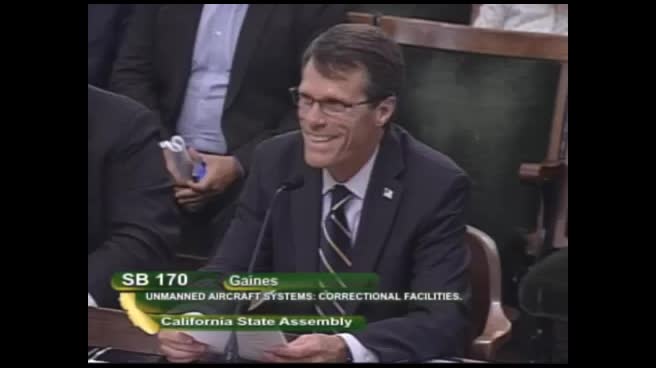
Bill Author