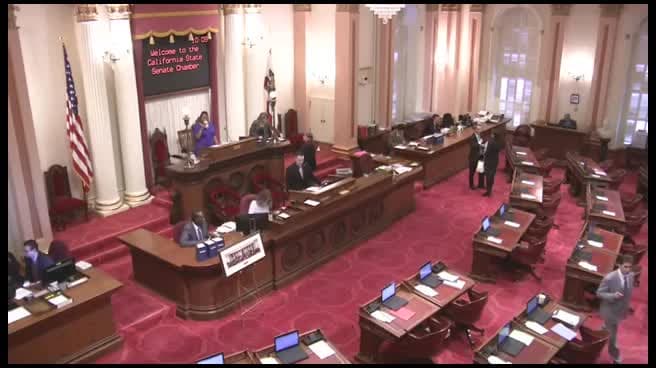
SB 215: Public Utilities Commission.
- Session Year: 2015-2016
- House: Senate
- Latest Version Date: 2016-09-29
(1)The California Constitution establishes the Public Utilities Commission, with jurisdiction over all public utilities. The California Constitution grants the commission certain general powers over all public utilities, subject to control by the Legislature. Existing law requires the commission, upon initiating a hearing, to assign one or more commissioners to oversee the case and an administrative law judge, when appropriate. Existing law requires the commission to adopt procedures on the disqualification of administrative law judges due to bias or prejudice similar to those of other state agencies and superior courts.
This bill would require the commission to additionally adopt procedures on the disqualification of commissioners due to bias or prejudice similar to those of other state agencies and superior courts. For ratesetting or adjudicatory proceedings, the bill would require a commissioner or an administrative law judge to be disqualified for bias or prejudice based on specified criteria. The bill would prohibit commission procedures from authorizing a commissioner or administrative law judge to rule on a motion made by a party to a proceeding to disqualify the commissioner or administrative law judge due to bias or prejudice.
(2)The Public Utilities Act requires the commission to determine whether a proceeding requires a hearing and, if so, to determine whether the matter requires a quasi-legislative, adjudication, or ratesetting hearing. Existing law regulates communications in matters before the commission and defines an ex parte communication as any oral or written communication between a decisionmaker and a person with an interest in a matter before the commission concerning substantive, but not procedural, issues that does not occur in a public hearing, workshop, or other public proceeding, or on the official record of the proceeding on the matter. Existing law requires the commission, by regulation, to adopt and publish any requirements for written reporting of ex parte communications and appropriate sanctions for noncompliance with any rule proscribing ex parte communications. The act provides that ex parte communications are prohibited in adjudication and ratesetting cases, with certain exceptions. The act requires that ex parte communications be permitted in quasi-legislative cases, without any restrictions.
This bill would recast the laws relating to ex parte communications in regard to commission proceedings.
(3)The Political Reform Act of 1974 (PRA) provides for the regulation of the lobbying industry, including defining the term lobbyist and regulating the conduct of lobbyists.
This bill would state that it is the intent of the Legislature that the commission, and any entity or person seeking to influence actions taken by the commission, be subject to all applicable ethical standards, including any applicable obligations under the PRA, including applicable lobbying obligations.
(4)Under existing law, a violation of the Public Utilities Act or any order, decision, rule, direction, demand, or requirement of the commission is a crime.
Because the provisions of this bill would be a part of the act and because a violation of an order or decision of the commission implementing its requirements would be a crime, the bill would impose a state-mandated local program by expanding the application of a crime.
(5)The California Constitution requires the state to reimburse local agencies and school districts for certain costs mandated by the state. Statutory provisions establish procedures for making that reimbursement.
This bill would provide that no reimbursement is required by this act for a specified reason.