SB 541: Public Utilities Commission: for-hire transportation carriers: enforcement.
- Session Year: 2015-2016
- House: Senate
- Latest Version Date: 2015-10-09
(1)The California Constitution establishes the Public Utilities Commission, with jurisdiction over the transportation of passengers and property by transportation companies, to the extent not preempted by federal law. The Household Goods Carriers Act and the Passenger Charter-party Carriers Act contain statements of the purposes of those acts and the use of the public highways pursuant to those acts.
This bill would specify activities to be undertaken by the commission to achieve these purposes. The bill would require the commission to hire an independent entity for not more than $250,000 to, in consultation with carrier trade associations for industries under the jurisdiction of the commission, assess the commissions capabilities to carry out the specified activities and to report to the Legislature no later than January 1, 2017, which report would be required to contain an analysis of current capabilities and deficiencies, and recommendations to overcome any deficiencies identified.
(2)A passenger stage corporation, as defined, which operates between fixed termini or over a regular route, is a common carrier subject to regulation by the commission pursuant to the Public Utilities Act. The Public Utilities Act, with certain exceptions, requires that a passenger stage corporation obtain a certificate of public convenience and necessity from the commission to operate on any public highway in the state and requires it to display an identifying symbol issued by the commission. The Public Utilities Act makes any public utility that violates the Public Utilities Act, or that fails to comply with any part of any order, decision, rule, direction, demand, or requirement of the commission guilty of a crime and makes it a misdemeanor for a person or corporation to hold out to the public that the person or corporation is in operation as a passenger stage corporation without having a valid certificate issued by the commission. The Public Utilities Act authorizes the commission to impose various fines and penalties for any violation of the act or an order, decision, rule, direction, demand, or requirement of the commission. The Public Utilities Act provides that the Department of the California Highway Patrol (CHP) has the primary responsibility for regulating the safety of operation of passenger stage corporations and requires the commission to cooperate with the CHP to ensure safe operation of these carriers.
A charter-party carrier of passengers, as defined, is subject to the jurisdiction and control of the commission under the Passenger Charter-party Carriers Act. The Passenger Charter-party Carriers Act requires a charter-party carrier of passengers to (A) obtain a certificate of public convenience and necessity or a permit issued by the commission, (B) operate within the state on a prearranged basis, as defined, (C) comply with specified vehicle identification requirements, and (D) comply with accident liability protection requirements. The Passenger Charter-party Carriers Act additionally prohibits a charter-party carrier of passengers from advertising its services, or in any manner representing its services, as being a taxicab or taxi service. The Passenger Charter-party Carriers Act makes violation of these requirements a crime. The Passenger Charter-party Carriers Act authorizes the commission to impose fines and penalties for violations of the act.
This bill would authorize peace officers, as defined, to enforce and assist in the enforcement of criminal violations of the Public Utilities Act, with respect to passenger stage corporations, and the Passenger Charter-party Carriers Act, with respect to charter-party carriers of passengers. The bill would require the commission to coordinate enforcement of those acts with peace officers through educational outreach and establishing lines of communication so that the commission is notified if an action is commenced so that the commission may take appropriate action to enforce the fine and penalty provisions of the acts. The bill would require the commission to ensure that the Passenger Charter-party Carriers Act is enforced and obeyed and that violations are promptly prosecuted and that penalty moneys due to the state are recovered and collected. The bill would authorize the Attorney General, a district attorney, or a city attorney to institute and prosecute actions or proceedings for the violation of the Passenger Charter-party Carriers Act.
(3)The Passenger Charter-party Carriers Act authorizes a CHP officer to impound a bus of a charter-party carrier of passengers for 30 days if the officer determines that (A) the driver was operating the bus when the carrier did not have a permit or certificate issued by the commission or the carriers permit or certificate was suspended, or (B) the driver was operating the bus without having a current and valid drivers license of the proper class, a passenger vehicle endorsement, or the required certificate. A provision of the Vehicle Code also authorizes a CHP officer to impound a bus of a charter-party carrier of passengers for 30 days if the officer makes any of the determinations described above.
This bill would authorize a peace officer, as defined, to impound a bus or limousine, as defined, of a charter-party carrier of passengers, except as specified, for 30 days in those circumstances. The bill would revise the Vehicle Code to authorize a peace officer, identically defined, to impound a bus or limousine of a charter-party carrier of passengers, except as specified, for 30 days in those circumstances and authorize a peace officer to impound a bus or limousine belonging to a passenger stage corporation for 30 days if the officer determines (A) the driver was operating the bus or limousine when the passenger stage corporation did not have a required certificate of public convenience and necessity issued by the commission, (B) the driver was operating the bus or limousine when the operating rights or certificate of public convenience and necessity of a passenger stage corporation was suspended, canceled, or revoked, or (C) the driver was operating the bus or limousine without having a current and valid drivers license of the proper class.
(4)A household goods carrier, as defined, which transports household goods and personal effects over any public highway in the state for compensation, is subject to regulation by the commission pursuant to the Household Goods Carriers Act. The Household Goods Carriers Act requires that a household goods carrier obtain a permit from the commission to transport household goods entirely within the state and obtain a valid operating authority issued by the Federal Motor Carrier Safety Administration to transport household goods and personal effects from this state to another or from another state to this state. The Household Goods Carriers Act additionally requires a household goods carrier to comply with specified vehicle identification requirements and comply with accident liability protection requirements. The Household Goods Carriers Act makes a violation of the requirements of the act a misdemeanor, authorizes the commission to impose fines and penalties for violations of the act, and requires the commission to ensure that the act is enforced and obeyed, that violations are promptly prosecuted and that penalty moneys due to the state are recovered and collected.
This bill would authorize peace officers, as defined, to enforce and assist in the enforcement of criminal violations of the Household Goods Carriers Act. The bill would require the commission to coordinate enforcement of the Household Goods Carriers Act with peace officers through educational outreach and establishing lines of communication so that peace officers can notify the commission if an action is commenced so that the commission may take appropriate action to enforce the fine and penalty provisions of the Household Goods Carriers Act.
(5)This bill would incorporate additional changes in Section 5387 of the Public Utilities Code proposed by SB 697 that would become operative only if SB 697 and this bill are both chaptered and become effective on or before January 1, 2016, and this bill is chaptered last.
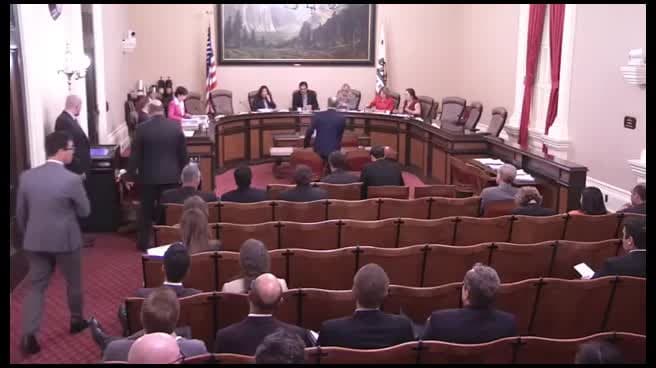
Discussed in Hearing
 56SEC
56SECSenate Floor
 1MIN
1MINAssembly Floor
 1MIN
1MINAssembly Floor
 9MIN
9MINAssembly Standing Committee on Utilities and Commerce
 1MIN
1MINSenate Floor
 5MIN
5MIN