SB 549: Charitable raffles.
- Session Year: 2015-2016
- House: Senate
- Latest Version Date: 2015-10-05
The California Constitution authorizes the Legislature to permit private, nonprofit, eligible organizations to conduct raffles as a funding mechanism to support beneficial and charitable works, if, among other conditions, at least 90% of the gross receipts from the raffle go directly to beneficial or charitable purposes in California. The California Constitution further authorizes the Legislature to amend the percentage of gross receipts required to be dedicated to beneficial or charitable purposes by a statute passed by a 2/3 vote of each house of the Legislature. Existing statutory law implements those provisions and requires the Department of Justice to administer and enforce those provisions.
This bill would authorize a major league sports raffle at a home game conducted by an eligible organization, as defined, for the purpose of directly supporting specified beneficial or charitable purposes in California, or financially supporting another private, nonprofit, eligible organization, as defined, that performs those purposes if, among other requirements, each ticket sold contains a unique and matching identifier, 50% of the gross receipts generated from the sale of raffle tickets are used to benefit or provide support for beneficial or charitable purposes, as defined, the other 50% is paid to the winner, and the winners of the prizes are determined by a manual draw, as specified. The bill would authorize an electronic device to be used to sell tickets. The bill would prohibit the use of a random number generator for the manual draw or sale of tickets. This bill would define an eligible organization as a private, nonprofit organization established by, or affiliated with, a team from specified sports organizations that has been qualified to conduct business in California for at least one year before conducting a raffle and is exempt from taxation pursuant to specified provisions of federal and California law.
The bill would require, if an eligible organization conducts a raffle for purposes of financially supporting another private, nonprofit, eligible organization, the eligible organization conducting the raffle to distribute to the other eligible organization all proceeds not paid out to the winners within 15 days of conducting the raffle. The bill would require an eligible organization to disclose to all ticket purchasers the designated private, nonprofit organization for which the raffle is being conducted.
This bill would also prohibit an eligible organization from conducting a raffle, and a manufacturer or distributor of raffle-related products or services from conducting business with an eligible organization for purposes of conducting a raffle pursuant to these provisions, without first having obtained and thereafter maintained a registration from the Department of Justice, as specified. Once registered, the bill would require an eligible organization to file annually thereafter with the department a report that includes specified information for each of the eligible organizations last 3 fiscal years, and would require the department to make those reports available online, as provided. This bill would require the department to adopt, on or before June 1, 2016, regulations to enforce these provisions, would authorize the department to assess annual registration fees, as specified, to be deposited in the General Fund to cover the reasonable costs of establishing and operating this registration system, and would require the department to maintain a database of registrants and conduct specified proceedings in compliance with the Administrative Procedure Act. The bill would repeal its provisions on December 31, 2018.
The California Constitution authorizes the Legislature to permit private, nonprofit, eligible organizations to conduct raffles as a funding mechanism to support beneficial and charitable works, if, among other conditions, at least 90% of the gross receipts from the raffle go directly to beneficial or charitable purposes in California. The California Constitution further authorizes the Legislature to amend the percentage of gross receipts required to be dedicated to beneficial or charitable purposes by a statute passed by a 2/3 vote of each house of the Legislature. Existing statutory law implements those provisions and requires the Department of Justice to administer and enforce those provisions.
This bill would authorize a major league sports raffle at a home game conducted by an eligible organization, as defined, for the purpose of directly supporting specified beneficial or charitable purposes in California, or financially supporting another private, nonprofit, eligible organization, as defined, that performs those purposes if, among other requirements, each ticket sold contains a unique and matching identifier, 50% of the gross receipts generated from the sale of raffle tickets are used to benefit or provide support for beneficial or charitable purposes, as defined, the other 50% is paid to the winner, and the winners of the prizes are determined by a manual draw, as specified. The bill would authorize an electronic device to be used to sell tickets. The bill would prohibit the use of a random number generator for the manual draw or sale of tickets. This bill would define an eligible organization as a private, nonprofit organization established by, or affiliated with, a team from specified sports organizations that has been qualified to conduct business in California for at least one year before conducting a raffle and is exempt from taxation pursuant to specified provisions of federal and California law.
The bill would require, if an eligible organization conducts a raffle for purposes of financially supporting another private, nonprofit, eligible organization, the eligible organization conducting the raffle to distribute to the other eligible organization all proceeds not paid out to the winners within 15 days of conducting the raffle. The bill would require an eligible organization to disclose to all ticket purchasers the designated private, nonprofit organization for which the raffle is being conducted.
This bill would also prohibit an eligible organization from conducting a raffle, and a manufacturer or distributor of raffle-related products or services from conducting business with an eligible organization for purposes of conducting a raffle pursuant to these provisions, without first having obtained and thereafter maintained a registration from the Department of Justice, as specified. Once registered, the bill would require an eligible organization to file annually thereafter with the department a report that includes specified information for each of the eligible organizations last 3 fiscal years, and would require the department to make those reports available online, as provided. This bill would authorize require the department to issue adopt, on or before June 1, 2016, regulations to enforce these provisions, would authorize the department to assess annual registration fees, as specified, to be deposited in the General Fund to cover the reasonable costs of establishing and operating this registration system, and would require the department to maintain a database of registrants and conduct specified proceedings in compliance with the Administrative Procedure Act. The bill would repeal its provisions on December 31, 2020. 2018.
The California Constitution authorizes the Legislature to permit private, nonprofit, eligible organizations to conduct raffles as a funding mechanism to support beneficial and charitable works, if, among other conditions, at least 90% of the gross receipts from the raffle go directly to beneficial or charitable purposes in California. The California Constitution further authorizes the Legislature to amend the percentage of gross receipts required to be dedicated to beneficial or charitable purposes by a statute passed by a 2/3 vote of each house of the Legislature. Existing statutory law implements those provisions and requires the Department of Justice to administer and enforce those provisions.
This bill would authorize a raffle major league sports raffle at a home game conducted by an eligible organization, as defined, for the purpose of directly supporting specified beneficial or charitable purposes in California, or financially supporting another private, nonprofit, eligible organization, as defined, that performs those purposes if, among other requirements, each ticket sold contains a unique and matching identifier, 50% of the gross receipts generated from the sale of raffle tickets are used to benefit or provide support for beneficial or charitable purposes, as defined, the other 50% is paid to the winner, and the winners of the prizes are determined by a manual draw, as specified. The bill would authorize an electronic device to be used to sell tickets. The bill would prohibit the use of a random number generator for the manual draw or sale of tickets. This bill would define an eligible organization as a private, nonprofit organization established by, or affiliated with, a team from specified sports organizations that has been qualified to conduct business in California for at least one year prior to before conducting a raffle and is exempt from taxation pursuant to specified provisions of federal and California law.
The bill would require, if an eligible organization conducts a raffle for purposes of financially supporting another private, nonprofit, eligible organization, the eligible organization conducting the raffle to distribute to the other eligible organization all proceeds not paid out to the winners within 15 days of conducting the raffle. The bill would require an eligible organization to disclose to all ticket purchasers the designated private, nonprofit organization for which the raffle is being conducted.
This bill would also prohibit an eligible organization from conducting a raffle, and a manufacturer or distributor of raffle-related products or services from conducting business with an eligible organization for purposes of conducting a raffle pursuant to these provisions, without first having obtained and thereafter maintained a registration from the Department of Justice, as specified. This bill would authorize the department to issue regulations to enforce these provisions, to assess annual registration fees, as specified, to be deposited in the General Fund to cover the reasonable costs of establishing and operating this registration system, and would require the department to maintain a database of registrants and conduct specified proceedings in compliance with the Administrative Procedure Act. The bill would repeal its provisions on December 31, 2020.
The California Constitution authorizes the Legislature to permit private, nonprofit, eligible organizations to conduct raffles as a funding mechanism to support beneficial and charitable works, if, among other conditions, at least 90% of the gross receipts from the raffle go directly to beneficial or charitable purposes in California. The California Constitution further authorizes the Legislature to amend the percentage of gross receipts required to be dedicated to beneficial or charitable purposes by a statute passed by a 2/3 vote of each house of the Legislature. Existing statutory law implements those provisions and requires the Department of Justice to administer and enforce those provisions.
This bill would authorize a raffle conducted by an eligible organization, as defined, for the purpose of directly supporting specified beneficial or charitable purposes in California, or financially supporting another private, nonprofit, eligible organization, as defined, that performs those purposes if, among other requirements, each ticket sold contains a unique and matching identifier, 50% of the gross receipts generated from the sale of raffle tickets are used to benefit or provide support for beneficial or charitable purposes, as defined, the other 50% is paid to the winner, and the winners of the prizes are determined by a manual draw, as specified. The bill would authorize an electronic device to be used to sell tickets. This bill would define an eligible organization as a private, nonprofit organization established by, or affiliated with, a team from specified sports organizations that has been qualified to conduct business in California for at least one year prior to conducting a raffle and is exempt from taxation pursuant to specified provisions of federal and California law.
The bill would require, if an eligible organization conducts a raffle for purposes of financially supporting another private, nonprofit, eligible organization, the eligible organization conducting the raffle to distribute to the other eligible organization all proceeds not paid out to the winners within 15 days of conducting the raffle. The bill would require an eligible organization to disclose to all ticket purchasers the designated private, nonprofit organization for which the raffle is being conducted.
This bill would also prohibit an eligible organization from conducting a raffle, and a manufacturer or distributor of raffle-related products or services from conducting business with an eligible organization for purposes of conducting a raffle pursuant to these provisions, without first having obtained and thereafter maintained a registration from the Department of Justice, as specified. This bill would authorize the department to issue regulations to enforce these provisions, to assess an annual registration fee of $10 fees, as specified, to be deposited in the General Fund to cover the reasonable costs of establishing and operating this registration system, and would require the department to maintain a database of registrants, with specified exemptions, registrants and conduct specified proceedings in compliance with the Administrative Procedure Act. The bill would repeal its provisions on December 31, 2020.
The California Constitution authorizes the Legislature to permit private, nonprofit, eligible organizations to conduct raffles as a funding mechanism to support beneficial and charitable works, if, among other conditions, at least 90% of the gross receipts from the raffle go directly to beneficial or charitable purposes in California. The California Constitution further authorizes the Legislature to amend the percentage of gross receipts required to be dedicated to beneficial or charitable purposes by a statute passed by a 2/3 vote of each house of the Legislature. Existing statutory law implements those provisions and requires the Department of Justice to administer and enforce those provisions.
This bill would authorize a raffle conducted by an eligible organization, as defined, for the purpose of directly supporting specified beneficial or charitable purposes in California, or financially supporting another private, nonprofit, eligible organization, as defined, that performs those purposes if, among other requirements, each ticket sold contains a unique and matching identifier, 50% of the gross receipts generated from the sale of raffle tickets are used to benefit or provide support for beneficial or charitable purposes, as defined, the other 50% is paid to the winner, and the winners of the prizes are determined by a manual draw, as specified. The bill would authorize an electronic device to be used to sell tickets. This bill would define an eligible organization as a private, nonprofit organization established by, or affiliated with, a team from specified sports organizations that has been qualified to conduct business in California for at least one year prior to conducting a raffle and is exempt from taxation pursuant to specified provisions of federal and California law.
The bill would require, if an eligible organization conducts a raffle for purposes of financially supporting another private, nonprofit, eligible organization, the eligible organization conducting the raffle to distribute to the other eligible organization all proceeds not paid out to the winners within 15 days of conducting the raffle. The bill would require an eligible organization to disclose to all ticket purchasers the designated private, nonprofit organization for which the raffle is being conducted.
This bill would also prohibit an eligible organization from conducting a raffle without first having obtained and thereafter maintained a registration from the Department of Justice, as specified. This bill would authorize the department to issue regulations to enforce these provisions, to assess an annual registration fee of $10 to be deposited in the General Fund to cover the reasonable costs of establishing and operating this registration system, and would require the department to maintain a database of registrants, with specified exemptions, and conduct specified proceedings in compliance with the Administrative Procedure Act. The bill would repeal its provisions on December 31, 2020.
(a)Notwithstanding Section 320.5, this section shall apply to an eligible organization, as defined in subdivision (c).
(b)A raffle conducted by an eligible organization, as defined in subdivision (c), for the purpose of directly supporting beneficial or charitable purposes or financially supporting another private, nonprofit eligible organization, as defined in subdivision (c) of Section 320.5, that performs beneficial or charitable purposes may be conducted in accordance with this section.
(c)For purposes of this section, eligible organization means a private, nonprofit organization established by, or affiliated with, a team from the Major League Baseball, National Hockey League, National Basketball Association, National Football League, Womens National Basketball Association, or Major League Soccer, or a private, nonprofit organization established by the Professional Golfers Association of America, Ladies Professional Golf Association, or National Association for Stock Car Auto Racing that has been qualified to conduct business in California for at least one year before conducting a raffle, is qualified for an exemption under Section 501(c)(3) of the Internal Revenue Code, and is exempt from taxation pursuant to Section 23701a, 23701b, 23701d, 23701e, 23701f, 23701g, 23701k, 23701l, 23701t, or 23701w of the Revenue and Taxation Code.
(d)For purposes of this section, raffle means a scheme for the distribution of prizes by chance among persons who have paid money for paper tickets that provide the opportunity to win these prizes, in which all of the following are true:
(1)Each ticket sold contains a unique and matching identifier.
(2)(A)Winners of the prizes are determined by a manual draw from tickets described in paragraph (1) that have been sold for entry in the manual draw.
(B)An electronic device may be used to sell tickets. The ticket receipt issued by the electronic device to the purchaser may include more than one unique and matching identifier, representative of and matched to the number of tickets purchased in a single transaction.
(C)A random number generator is not used for the manual draw or to sell tickets.
(D)The prize paid to the winner is comprised of one-half or 50 percent of the gross receipts generated from the sale of raffle tickets for a raffle.
(3)The manual draw is conducted in California under the supervision of a natural person who meets all of the following requirements:
(A)The person is 18 years of age or older.
(B)The person is affiliated with the eligible organization conducting the raffle.
(C)The person is registered with the Department of Justice pursuant to paragraph (4) of subdivision (o).
(4)(A) Fifty percent of the gross receipts generated from the sale of raffle tickets for any given manual draw are used by the eligible organization conducting the raffle to benefit or provide support for beneficial or charitable purposes, or used to benefit another private, nonprofit organization, provided that an organization receiving these funds is itself an eligible organization as defined in subdivision (c) of Section 320.5. As used in this section, beneficial purposes excludes purposes that are intended to benefit officers, directors, or members, as defined by Section 5056 of the Corporations Code, of the eligible organization. Funds raised by raffles conducted pursuant to this section shall not be used to fund any beneficial, charitable, or other purpose outside of California. This section does not preclude an eligible organization from using funds from sources other than the sale of raffle tickets to pay for the administration or other costs of conducting a raffle.
(B)An employee of an eligible organization who is a direct seller of raffle tickets shall not be treated as an employee for purposes of workers compensation under Section 3351 of the Labor Code if the following conditions are satisfied:
(i)Substantially all of the remuneration, whether or not paid in cash, for the performance of the service of selling raffle tickets is directly related to sales rather than to the number of hours worked.
(ii)The services performed by the person are performed pursuant to a written contract between the seller and the eligible organization and the contract provides that the person will not be treated as an employee with respect to the selling of raffle tickets for workers compensation purposes.
(C)For purposes of this section, an employee selling raffle tickets shall be deemed to be a direct seller as described in Section 650 of the Unemployment Insurance Code as long as he or she meets the requirements of that section.
(e)A person who receives compensation in connection with the operation of the raffle shall be an employee of the eligible organization that is conducting the raffle, and in no event may compensation be paid from revenues required to be dedicated to beneficial or charitable purposes.
(f)A raffle ticket shall not be sold in exchange for Bitcoin or any other cryptocurrency.
(g)A raffle otherwise permitted under this section shall not be conducted by means of, or otherwise utilize, any gaming machine that meets the definition of slot machine contained in Section 330a, 330b, or 330.1.
(h)(1)A raffle otherwise permitted under this section shall not be conducted, nor may tickets for a raffle be sold, within an operating satellite wagering facility or racetrack inclosure licensed pursuant to the Horse Racing Law (Chapter 4 (commencing with Section 19400) of Division 8 of the Business and Professions Code) or within a gambling establishment licensed pursuant to the Gambling Control Act (Chapter 5 (commencing with Section 19800) of Division 8 of the Business and Professions Code).
(2)A raffle shall not be operated or conducted in any manner over the Internet, nor may raffle tickets be sold, traded, or redeemed over the Internet. For purposes of this paragraph, an eligible organization shall not be deemed to operate or conduct a raffle over the Internet, or sell raffle tickets over the Internet, if the eligible organization advertises its raffle on the Internet or permits others to do so. Information that may be conveyed on an Internet Web site pursuant to this paragraph includes, but is not limited to, all of the following:
(A)Lists, descriptions, photographs, or videos of the raffle prizes.
(B)Lists of the prize winners.
(C)The rules of the raffle.
(D)Frequently asked questions and their answers.
(E)Raffle entry forms, which may be downloaded from the Internet Web site for manual completion by raffle ticket purchasers, but shall not be submitted to the eligible organization through the Internet.
(F)Raffle contact information, including the eligible organizations name, address, telephone number, facsimile number, or email address.
(i)An individual, corporation, partnership, or other legal entity shall not hold a financial interest in the conduct of a raffle, except the eligible organization that is itself authorized to conduct that raffle, and any private, nonprofit, eligible organizations receiving financial support from that charitable organization pursuant to subdivisions (b) and (d).
(j)(1)An eligible organization may conduct a major league sports raffle only at a home game.
(2)An eligible organization shall not conduct more than one major league sports raffle per home game.
(k)An employee shall not sell raffle tickets in any seating area designated as a family section.
(l)An eligible organization shall disclose to all ticket purchasers the designated private, nonprofit, eligible organization for which the raffle is being conducted.
(m)An eligible organization that conducts a raffle to financially support another private, nonprofit eligible organization, as defined in subdivision (c) of Section 320.5, shall distribute all proceeds not paid out to the winners of the prizes to the private, nonprofit organization within 15 days of conducting the raffle, in accordance with this section.
(n)Any raffle prize remaining unclaimed by a winner at the end of the season for a team with an affiliated eligible organization that conducted a raffle to financially support another private, nonprofit eligible organization, as defined in subdivision (c) of Section 320.5, shall be donated within 30 days from the end of the season by the eligible organization to the designated private, nonprofit organization for which the raffle was conducted.
(o)(1)(A)An eligible organization shall not conduct a raffle authorized under this section, unless it has a valid registration issued by the Department of Justice. The department shall furnish a registration form via the Internet or upon request to eligible nonprofit organizations. The department shall, by regulation, collect only the information necessary to carry out the provisions of this section on this form. This information shall include, but is not limited to, the following:
(i)The name and address of the eligible organization.
(ii)The federal tax identification number, the corporate number issued by the Secretary of State, the organization number issued by the Franchise Tax Board, or the California charitable trust identification number of the eligible organization.
(iii)The name and title of a responsible fiduciary of the organization.
(B)(i)The department may require an eligible organization to pay a minimum annual registration fee of five thousand dollars ($5,000) to cover the reasonable costs of the department to administer and enforce this section.
(ii)An eligible organization shall pay, in addition to the annual registration application fee, one hundred dollars ($100) for every individual raffle conducted at an eligible location to cover the reasonable costs of the department to administer and enforce this section. This fee shall be submitted in conjunction with the annual registration form.
(2)(A)A manufacturer or distributor of raffle-related products or services shall not conduct business with an eligible organization for purposes of conducting a raffle pursuant to this section unless the manufacturer or distributor has a valid annual registration issued by the department.
(B)The department may require a manufacturer or distributor of raffle-related products or services to pay a minimum annual registration fee of five thousand dollars ($5,000) to cover the reasonable costs of the department to administer and enforce this section.
(3)An eligible organization shall register the equipment used in the sale and distribution of raffle tickets, and shall have the equipment tested by an independent gaming testing lab.
(4)(A)A person affiliated with an eligible organization who conducts the manual draw shall annually register with the department.
(B)The department may require a person affiliated with an eligible organization who conducts the manual draw to pay a minimum annual registration fee of ten dollars ($10) to cover the reasonable costs of the department to administer and enforce this section.
(5)The department may, by regulation, adjust the annual registration fees described in this section as needed to ensure that revenues will fully offset, but not exceed, the reasonable costs incurred by the department pursuant to this section. The fees shall be deposited by the department into the General Fund.
(6)The department shall receive moneys for the costs incurred pursuant to this section subject to an appropriation by the Legislature.
(7)The department shall adopt, on or before June 1, 2016, regulations necessary to effectuate this section, including emergency regulations, pursuant to the Administrative Procedure Act (Chapter 3.5 (commencing with Section 11340) of Part 1 of Division 3 of Title 2 of the Government Code).
(8)The department shall maintain an automated database of all registrants.
(9)A local law enforcement agency shall notify the department of any arrests or investigation that may result in an administrative or criminal action against a registrant.
(10)The department may investigate all suspected violations of this section or any regulation adopted pursuant to this section, or any activity that the registrant has engaged in that is not in the best interests of the publics health, safety, or general welfare as it pertains to charitable raffles.
(11)The department may audit the records and other documents of a registrant to ensure compliance with this section, and may charge a registrant the direct costs associated with an audit conducted pursuant to this paragraph.
(12)(A)Once registered, an eligible organization shall file annually thereafter with the department a report that includes all of the following information for each of the eligible organizations last three fiscal years:
(i)The aggregate gross receipts from the operation of raffles.
(ii)The aggregate direct costs incurred by the eligible organization from the operation of raffles.
(iii)The charitable or beneficial purposes for which proceeds of the raffles were used.
(iv)The aggregate distributions of proceeds from the operation of raffles made to directly support beneficial or charitable purposes, other than beneficial or charitable purposes undertaken by the eligible organization, or eligible recipient organizations, under subdivision (c) of Section 320.5.
(v)The aggregate distributions of proceeds from the operation of raffles made to raffle winners.
(vi)The aggregate distributions of proceeds from the operation of raffles made to any other organizations, or for any other purposes, other than those included in clauses (ii), (iv), and (v).
(vii)A schedule of distributions of proceeds from the operation of raffles, by individual raffle, made to eligible recipient organizations under subdivision (c) of Section 320.5 that are not affiliated with the eligible organization.
(viii)A schedule of distributions of proceeds from the operation of raffles, by individual raffle, made to eligible recipient organizations under subdivision (c) of Section 320.5 that are affiliated with the eligible organization.
(ix)A schedule of distributions of proceeds from the operation of raffles, by individual raffle, made to any other organization not included under clause (vii) or (viii), or for beneficial or charitable purposes undertaken by the eligible organization.
(x)The aggregate gross receipts from activities other than the operation of raffles.
(xi)The aggregate costs incurred by the eligible organization from activities other than the operation of raffles.
(xii)The aggregate distributions of funds other than proceeds from the operation of raffles made to directly support beneficial or charitable purposes or eligible recipient organizations under subdivision (c) of Section 320.5.
(xiii)The aggregate distributions of funds other than proceeds from the operation of raffles for purposes other than those listed in clauses (xi) and (xii).
(xiv)A schedule of distributions of funds other than proceeds from the operation of raffles made to eligible recipient organizations under subdivision (c) of Section 320.5 that are not affiliated with the eligible organization.
(xv)A schedule of distributions of funds other than proceeds from the operation of raffles made to any other organization not included under clause (xiv), or for beneficial or charitable purposes undertaken by the eligible organization.
(B)Failure to submit the annual report to the department as required in this paragraph shall be grounds for denial of an annual registration.
(C)The department shall make the reports required by this paragraph available to the public via the online search portal of the Attorney Generals Registry of Charitable Trusts maintained pursuant to Section 12584 of the Government Code.
(13)The department shall annually furnish to registrants a form to collect this information.
(p)The department may take legal action against a registrant if it determines that the registrant has violated this section or a regulation adopted pursuant to this section, or that the registrant has engaged in any conduct that is not in the best interests of the publics health, safety, or general welfare. An action taken pursuant to this subdivision does not prohibit the commencement of an administrative or criminal action by the Attorney General, a district attorney, city attorney, or county counsel.
(q)An action and hearing conducted to deny, revoke, or suspend a registry, or other administrative action taken against a registrant, shall be conducted pursuant to the Administrative Procedure Act (Chapters 4.5 (commencing with Section 11400) and 5 (commencing with Section 11500) of Part 1 of Division 3 of Title 2 of the Government Code). The department may seek civil remedies, including imposing fines, for violations of this section, and may seek recovery of the costs incurred in investigating or prosecuting an action against a registrant or applicant in accordance with those procedures specified in Section 125.3 of the Business and Professions Code. A proceeding conducted under this subdivision is subject to judicial review pursuant to Section 1094.5 of the Code of Civil Procedure. A violation of this section shall not constitute a crime.
(r)This section shall remain in effect only until December 31, 2018, and as of that date is repealed, unless a later enacted statute, that is enacted before December 31, 2018, deletes or extends that date.
(a)Notwithstanding Section 320.5, this section shall apply to an eligible organization, as defined in subdivision (c).
(b)A raffle conducted by an eligible organization, as defined in subdivision (c), for the purpose of directly supporting beneficial or charitable purposes or financially supporting another private, nonprofit eligible organization, as defined in subdivision (c) of Section 320.5, that performs beneficial or charitable purposes may be conducted in accordance with this section.
(c)For purposes of this section, eligible organization means a private, nonprofit organization established by, or affiliated with, a team from the Major League Baseball, National Hockey League, National Basketball Association, National Football League, Womens National Basketball Association, or Major League Soccer, or a private, nonprofit organization established by the Professional Golfers Association of America, Ladies Professional Golf Association, or National Association for Stock Car Auto Racing that has been qualified to conduct business in California for at least one year before conducting a raffle, is qualified for an exemption under Section 501(c)(3) of the Internal Revenue Code, and is exempt from taxation pursuant to Section 23701a, 23701b, 23701d, 23701e, 23701f, 23701g, 23701k, 23701l, 23701t, or 23701w of the Revenue and Taxation Code.
(d)For purposes of this section, raffle means a scheme for the distribution of prizes by chance among persons who have paid money for paper tickets that provide the opportunity to win these prizes, in which all of the following are true:
(1)Each ticket sold contains a unique and matching identifier.
(2)(A)Winners of the prizes are determined by a manual draw from tickets described in paragraph (1) that have been sold for entry in the manual draw.
(B)An electronic device may be used to sell tickets. The ticket receipt issued by the electronic device to the purchaser may include more than one unique and matching identifier, representative of and matched to the number of tickets purchased in a single transaction.
(C)A random number generator is not used for the manual draw or to sell tickets.
(D)The prize paid to the winner is comprised of one-half or 50 percent of the gross receipts generated from the sale of raffle tickets for a raffle.
(3)The manual draw is conducted in California under the supervision of a natural person who meets all of the following requirements:
(A)The person is 18 years of age or older.
(B)The person is affiliated with the eligible organization conducting the raffle.
(C)The person is registered with the Department of Justice pursuant to paragraph (4) of subdivision (o).
(4)(A) Fifty percent of the gross receipts generated from the sale of raffle tickets for any given manual draw are used by the eligible organization conducting the raffle to benefit or provide support for beneficial or charitable purposes, or used to benefit another private, nonprofit organization, provided that an organization receiving these funds is itself an eligible organization as defined in subdivision (c) of Section 320.5. As used in this section, beneficial purposes excludes purposes that are intended to benefit officers, directors, or members, as defined by Section 5056 of the Corporations Code, of the eligible organization. Funds raised by raffles conducted pursuant to this section shall not be used to fund any beneficial, charitable, or other purpose outside of California. This section does not preclude an eligible organization from using funds from sources other than the sale of raffle tickets to pay for the administration or other costs of conducting a raffle.
(B)An employee of an eligible organization who is a direct seller of raffle tickets shall not be treated as an employee for purposes of workers compensation under Section 3351 of the Labor Code if the following conditions are satisfied:
(i)Substantially all of the remuneration, whether or not paid in cash, for the performance of the service of selling raffle tickets is directly related to sales rather than to the number of hours worked.
(ii)The services performed by the person are performed pursuant to a written contract between the seller and the eligible organization and the contract provides that the person will not be treated as an employee with respect to the selling of raffle tickets for workers compensation purposes.
(C)For purposes of this section, an employee selling raffle tickets shall be deemed to be a direct seller as described in Section 650 of the Unemployment Insurance Code as long as he or she meets the requirements of that section.
(e)A person who receives compensation in connection with the operation of the raffle shall be an employee of the eligible organization that is conducting the raffle, and in no event may compensation be paid from revenues required to be dedicated to beneficial or charitable purposes.
(f)A raffle ticket shall not be sold in exchange for Bitcoin or any other cryptocurrency.
(g)A raffle otherwise permitted under this section shall not be conducted by means of, or otherwise utilize, any gaming machine that meets the definition of slot machine contained in Section 330a, 330b, or 330.1.
(h)(1)A raffle otherwise permitted under this section shall not be conducted, nor may tickets for a raffle be sold, within an operating satellite wagering facility or racetrack inclosure licensed pursuant to the Horse Racing Law (Chapter 4 (commencing with Section 19400) of Division 8 of the Business and Professions Code) or within a gambling establishment licensed pursuant to the Gambling Control Act (Chapter 5 (commencing with Section 19800) of Division 8 of the Business and Professions Code).
(2)A raffle shall not be operated or conducted in any manner over the Internet, nor may raffle tickets be sold, traded, or redeemed over the Internet. For purposes of this paragraph, an eligible organization shall not be deemed to operate or conduct a raffle over the Internet, or sell raffle tickets over the Internet, if the eligible organization advertises its raffle on the Internet or permits others to do so. Information that may be conveyed on an Internet Web site pursuant to this paragraph includes, but is not limited to, all of the following:
(A)Lists, descriptions, photographs, or videos of the raffle prizes.
(B)Lists of the prize winners.
(C)The rules of the raffle.
(D)Frequently asked questions and their answers.
(E)Raffle entry forms, which may be downloaded from the Internet Web site for manual completion by raffle ticket purchasers, but shall not be submitted to the eligible organization through the Internet.
(F)Raffle contact information, including the eligible organizations name, address, telephone number, facsimile number, or email address.
(i)An individual, corporation, partnership, or other legal entity shall not hold a financial interest in the conduct of a raffle, except the eligible organization that is itself authorized to conduct that raffle, and any private, nonprofit, eligible organizations receiving financial support from that charitable organization pursuant to subdivisions (b) and (d).
(j)(1)An eligible organization may conduct a major league sports raffle only at a home game.
(2)An eligible organization shall not conduct more than one major league sports raffle per home game.
(k)An employee shall not sell raffle tickets in any seating area designated as a family section.
(l)An eligible organization shall disclose to all ticket purchasers the designated private, nonprofit, eligible organization for which the raffle is being conducted.
(m)An eligible organization that conducts a raffle to financially support another private, nonprofit eligible organization, as defined in subdivision (c) of Section 320.5, shall distribute all proceeds not paid out to the winners of the prizes to the private, nonprofit organization within 15 days of conducting the raffle, in accordance with this section.
(n)Any raffle prize remaining unclaimed by a winner at the end of the season for a team with an affiliated eligible organization that conducted a raffle to financially support another private, nonprofit eligible organization, as defined in subdivision (c) of Section 320.5, shall be donated within 30 days from the end of the season by the eligible organization to the designated private, nonprofit organization for which the raffle was conducted.
(o)(1)(A)An eligible organization shall not conduct a raffle authorized under this section, unless it has a valid registration issued by the Department of Justice. The department shall furnish a registration form via the Internet or upon request to eligible nonprofit organizations. The department shall, by regulation, collect only the information necessary to carry out the provisions of this section on this form. This information shall include, but is not limited to, the following:
(i)The name and address of the eligible organization.
(ii)The federal tax identification number, the corporate number issued by the Secretary of State, the organization number issued by the Franchise Tax Board, or the California charitable trust identification number of the eligible organization.
(iii)The name and title of a responsible fiduciary of the organization.
(B)(i)The department may require an eligible organization to pay a minimum annual registration fee of five thousand dollars ($5,000) to cover the reasonable costs of the department to administer and enforce this section.
(ii)An eligible organization shall pay, in addition to the annual registration application fee, one hundred dollars ($100) for every individual raffle conducted at an eligible location to cover the reasonable costs of the department to administer and enforce this section. This fee shall be submitted in conjunction with the annual registration form.
(2)(A)A manufacturer or distributor of raffle-related products or services shall not conduct business with an eligible organization for purposes of conducting a raffle pursuant to this section unless the manufacturer or distributor has a valid annual registration issued by the department.
(B)The department may require a manufacturer or distributor of raffle-related products or services to pay a minimum annual registration fee of five thousand dollars ($5,000) to cover the reasonable costs of the department to administer and enforce this section.
(3)An eligible organization shall register the equipment used in the sale and distribution of raffle tickets, and shall have the equipment tested by an independent gaming testing lab.
(4)(A)A person affiliated with an eligible organization who conducts the manual draw shall annually register with the department.
(B)The department may require a person affiliated with an eligible organization who conducts the manual draw to pay a minimum annual registration fee of ten dollars ($10) to cover the reasonable costs of the department to administer and enforce this section.
(5)The department may, by regulation, adjust the annual registration fees described in this section as needed to ensure that revenues will fully offset, but not exceed, the reasonable costs incurred by the department pursuant to this section. The fees shall be deposited by the department into the General Fund.
(6)The department shall receive moneys for the costs incurred pursuant to this section subject to an appropriation by the Legislature.
(7)The department shall adopt adopt, on or before June 1, 2016, regulations necessary to effectuate this section, including emergency regulations, pursuant to the Administrative Procedure Act (Chapter 3.5 (commencing with Section 11340) of Part 1 of Division 3 of Title 2 of the Government Code).
(8)The department shall maintain an automated database of all registrants.
(9)A local law enforcement agency shall notify the department of any arrests or investigation that may result in an administrative or criminal action against a registrant.
(10)The department may investigate all suspected violations of this section or any regulation adopted pursuant to this section, or any activity that the registrant has engaged in that is not in the best interests of the publics health, safety, or general welfare as it pertains to charitable raffles.
(11)The department may audit the records and other documents of a registrant to ensure compliance with this section, and may charge a registrant the direct costs associated with an audit conducted pursuant to this paragraph.
(12)(A)Once registered, an eligible organization shall file annually thereafter with the department a report that includes all of the following: following information for each of the eligible organizations last three fiscal years:
(i)The aggregate gross receipts from the operation of raffles.
(ii)The aggregate direct costs incurred by the eligible organization from the operation of raffles.
(iii)The charitable or beneficial purposes for which proceeds of the raffles were used, or the identity of the eligible recipient organization to which proceeds were directed, and the amount of those proceeds. used.
(iv)The aggregate distributions of proceeds from the operation of raffles made to directly support beneficial or charitable purposes, other than beneficial or charitable purposes undertaken by the eligible organization, or eligible recipient organizations, under subdivision (c) of Section 320.5.
(v)The aggregate distributions of proceeds from the operation of raffles made to raffle winners.
(vi)The aggregate distributions of proceeds from the operation of raffles made to any other organizations, or for any other purposes, other than those included in clauses (ii), (iv), and (v).
(vii)A schedule of distributions of proceeds from the operation of raffles, by individual raffle, made to eligible recipient organizations under subdivision (c) of Section 320.5 that are not affiliated with the eligible organization.
(viii)A schedule of distributions of proceeds from the operation of raffles, by individual raffle, made to eligible recipient organizations under subdivision (c) of Section 320.5 that are affiliated with the eligible organization.
(ix)A schedule of distributions of proceeds from the operation of raffles, by individual raffle, made to any other organization not included under clause (vii) or (viii), or for beneficial or charitable purposes undertaken by the eligible organization.
(x)The aggregate gross receipts from activities other than the operation of raffles.
(xi)The aggregate costs incurred by the eligible organization from activities other than the operation of raffles.
(xii)The aggregate distributions of funds other than proceeds from the operation of raffles made to directly support beneficial or charitable purposes or eligible recipient organizations under subdivision (c) of Section 320.5.
(xiii)The aggregate distributions of funds other than proceeds from the operation of raffles for purposes other than those listed in clauses (xi) and (xii).
(xiv)A schedule of distributions of funds other than proceeds from the operation of raffles made to eligible recipient organizations under subdivision (c) of Section 320.5 that are not affiliated with the eligible organization.
(xv)A schedule of distributions of funds other than proceeds from the operation of raffles made to any other organization not included under clause (xiv), or for beneficial or charitable purposes undertaken by the eligible organization.
(B)Failure to submit the annual report to the department as required in this paragraph shall be grounds for denial of an annual registration.
(C)The department shall make the reports required by this paragraph available to the public via the online search portal of the Attorney Generals Registry of Charitable Trusts maintained pursuant to Section 12584 of the Government Code.
(13)The department shall annually furnish to registrants a form to collect this information.
(p)The department may take legal action against a registrant if it determines that the registrant has violated this section or a regulation adopted pursuant to this section, or that the registrant has engaged in any conduct that is not in the best interests of the publics health, safety, or general welfare. An action taken pursuant to this subdivision does not prohibit the commencement of an administrative or criminal action by the Attorney General, a district attorney, city attorney, or county counsel.
(q)An action and hearing conducted to deny, revoke, or suspend a registry, or other administrative action taken against a registrant, shall be conducted pursuant to the Administrative Procedure Act (Chapters 4.5 (commencing with Section 11400) and 5 (commencing with Section 11500) of Part 1 of Division 3 of Title 2 of the Government Code). The department may seek civil remedies, including imposing fines, for violations of this section, and may seek recovery of the costs incurred in investigating or prosecuting an action against a registrant or applicant in accordance with those procedures specified in Section 125.3 of the Business and Professions Code. A proceeding conducted under this subdivision is subject to judicial review pursuant to Section 1094.5 of the Code of Civil Procedure. A violation of this section shall not constitute a crime.
(r)This section shall remain in effect only until December 31, 2020, 2018, and as of that date is repealed, unless a later enacted statute, that is enacted before December 31, 2020, 2018, deletes or extends that date.
(a)Notwithstanding Section 320.5, this section shall apply to an eligible organization, as defined in subdivision (c).
(b)A raffle conducted by an eligible organization, as defined in subdivision (c), for the purpose of directly supporting beneficial or charitable purposes or financially supporting another private, nonprofit eligible organization, as defined in subdivision (c) of Section 320.5, that performs beneficial or charitable purposes may be conducted in accordance with this section.
(c)For purposes of this section, eligible organization means a private, nonprofit organization established by, or affiliated with, a team from the Major League Baseball, National Hockey League, National Basketball Association, National Football League, Womens National Basketball Association, or Major League Soccer, or a private, nonprofit organization established by the Professional Golfers Association of America, Ladies Professional Golf Association, or National Association for Stock Car Auto Racing that has been qualified to conduct business in California for at least one year prior to before conducting a raffle, is qualified for an exemption under Section 501(c)(3) of the Internal Revenue Code, and is exempt from taxation pursuant to Section 23701a, 23701b, 23701d, 23701e, 23701f, 23701g, 23701k, 23701l, 23701t, or 23701w of the Revenue and Taxation Code.
(d)For purposes of this section, raffle means a scheme for the distribution of prizes by chance among persons who have paid money for paper tickets that provide the opportunity to win these prizes, in which all of the following are true:
(1)Each ticket sold contains a unique and matching identifier.
(2)(A)Winners of the prizes are determined by a manual draw from tickets described in paragraph (1) that have been sold for entry in the manual draw.
(B)An electronic device may be used to sell tickets. The ticket receipt issued by the electronic device to the purchaser may include more than one unique and matching identifier, representative of and matched to the number of tickets purchased in a single transaction.
(C)
(C)A random number generator is not used for the manual draw or to sell tickets.
(D)The prize paid to the winner is comprised of one-half or 50 percent of the gross receipts generated from the sale of raffle tickets for a raffle.
(3)The manual draw is conducted in California under the supervision of a natural person who meets all of the following requirements:
(A)The person is 18 years of age or older.
(B)The person is affiliated with the eligible organization conducting the raffle.
(C)The person is registered with the Department of Justice pursuant to paragraph (4) of subdivision (o).
(4)(A) Fifty percent of the gross receipts generated from the sale of raffle tickets for any given manual draw are used by the eligible organization conducting the raffle to benefit or provide support for beneficial or charitable purposes, or used to benefit another private, nonprofit organization, provided that an organization receiving these funds is itself an eligible organization as defined in subdivision (c) of Section 320.5. As used in this section, beneficial purposes excludes purposes that are intended to benefit officers, directors, or members, as defined by Section 5056 of the Corporations Code, of the eligible organization. Funds raised by raffles conducted pursuant to this section shall not be used to fund any beneficial, charitable, or other purpose outside of California. This section does not preclude an eligible organization from using funds from sources other than the sale of raffle tickets to pay for the administration or other costs of conducting a raffle.
(B)An employee of an eligible organization who is a direct seller of raffle tickets shall not be treated as an employee for purposes of workers compensation under Section 3351 of the Labor Code if the following conditions are satisfied:
(i)Substantially all of the remuneration, whether or not paid in cash, for the performance of the service of selling raffle tickets is directly related to sales rather than to the number of hours worked.
(ii)The services performed by the person are performed pursuant to a written contract between the seller and the eligible organization and the contract provides that the person will not be treated as an employee with respect to the selling of raffle tickets for workers compensation purposes.
(C)For purposes of this section, an employee selling raffle tickets shall be deemed to be a direct seller as described in Section 650 of the Unemployment Insurance Code as long as he or she meets the requirements of that section.
(e)A person who receives compensation in connection with the operation of the raffle shall be an employee of the eligible organization that is conducting the raffle, and in no event may compensation be paid from revenues required to be dedicated to beneficial or charitable purposes.
(f)A raffle ticket shall not be sold in exchange for Bitcoin or any other cryptocurrency.
(g)A raffle otherwise permitted under this section shall not be conducted by means of, or otherwise utilize, any gaming machine that meets the definition of slot machine contained in Section 330a, 330b, or 330.1.
(h)(1)A raffle otherwise permitted under this section shall not be conducted, nor may tickets for a raffle be sold, within an operating satellite wagering facility or racetrack inclosure licensed pursuant to the Horse Racing Law (Chapter 4 (commencing with Section 19400) of Division 8 of the Business and Professions Code) or within a gambling establishment licensed pursuant to the Gambling Control Act (Chapter 5 (commencing with Section 19800) of Division 8 of the Business and Professions Code).
(2)A raffle shall not be operated or conducted in any manner over the Internet, nor may raffle tickets be sold, traded, or redeemed over the Internet. For purposes of this paragraph, an eligible organization shall not be deemed to operate or conduct a raffle over the Internet, or sell raffle tickets over the Internet, if the eligible organization advertises its raffle on the Internet or permits others to do so. Information that may be conveyed on an Internet Web site pursuant to this paragraph includes, but is not limited to, all of the following:
(A)Lists, descriptions, photographs, or videos of the raffle prizes.
(B)Lists of the prize winners.
(C)The rules of the raffle.
(D)Frequently asked questions and their answers.
(E)Raffle entry forms, which may be downloaded from the Internet Web site for manual completion by raffle ticket purchasers, but shall not be submitted to the eligible organization through the Internet.
(F)Raffle contact information, including the eligible organizations name, address, telephone number, facsimile number, or email address.
(i)An individual, corporation, partnership, or other legal entity shall not hold a financial interest in the conduct of a raffle, except the eligible organization that is itself authorized to conduct that raffle, and any private, nonprofit, eligible organizations receiving financial support from that charitable organization pursuant to subdivisions (b) and (d).
(j)
(j)(1)An eligible organization may conduct a major league sports raffle only at a home game.
(2)An eligible organization shall not conduct more than one major league sports raffle per home game.
(k)An employee shall not sell raffle tickets in any seating area designated as a family section.
(l)An eligible organization shall disclose to all ticket purchasers the designated private, nonprofit, eligible organization for which the raffle is being conducted.
(m)An eligible organization that conducts a raffle to financially support another private, nonprofit eligible organization, as defined in subdivision (c) of Section 320.5, shall distribute all proceeds not paid out to the winners of the prizes to the private, nonprofit organization within 15 days of conducting the raffle, in accordance with this section.
(n)Any raffle prize remaining unclaimed by a winner at the end of the season for a team with an affiliated eligible organization that conducted a raffle to financially support another private, nonprofit eligible organization, as defined in subdivision (c) of Section 320.5, shall be donated within 30 days from the end of the season by the eligible organization to the designated private, nonprofit organization for which the raffle was conducted.
(o)(1)(A)An eligible organization shall not conduct a raffle authorized under this section, unless it has a valid registration issued by the Department of Justice. The department shall furnish a registration form via the Internet or upon request to eligible nonprofit organizations. The department shall, by regulation, collect only the information necessary to carry out the provisions of this section on this form. This information shall include, but is not limited to, the following:
(i)The name and address of the eligible organization.
(ii)The federal tax identification number, the corporate number issued by the Secretary of State, the organization number issued by the Franchise Tax Board, or the California charitable trust identification number of the eligible organization.
(iii)The name and title of a responsible fiduciary of the organization.
(B)(i)The department may require an eligible organization to pay a minimum annual registration fee of five thousand dollars ($5,000) to cover the reasonable costs of the department to administer and enforce this section.
(ii)An eligible organization shall pay, in addition to the annual registration application fee, one hundred dollars ($100) for every individual raffle conducted at an eligible location to cover the reasonable costs of the department to administer and enforce this section. This fee shall be submitted in conjunction with the annual registration form.
(2)(A)A manufacturer or distributor of raffle-related products or services shall not conduct business with an eligible organization for purposes of conducting a raffle pursuant to this section unless the manufacturer or distributor has a valid annual registration issued by the department.
(B)The department may require a manufacturer or distributor of raffle-related products or services to pay a minimum annual registration fee of five thousand dollars ($5,000) to cover the reasonable costs of the department to administer and enforce this section.
(3)An eligible organization shall register the equipment used in the sale and distribution of raffle tickets, and shall have the equipment tested by an independent gaming testing lab.
(4)(A)A person affiliated with an eligible organization who conducts the manual draw shall annually register with the department.
(B)The department may require a person affiliated with an eligible organization who conducts the manual draw to pay a minimum annual registration fee of ten dollars ($10) to cover the reasonable costs of the department to administer and enforce this section.
(5)The department may, by regulation, adjust the annual registration fees described in this section as needed to ensure that revenues will fully offset, but not exceed, the reasonable costs incurred by the department pursuant to this section. The fees shall be deposited by the department into the General Fund.
(6)The department shall receive moneys for the costs incurred pursuant to this section subject to an appropriation by the Legislature.
(7)The department shall adopt regulations necessary to effectuate this section, including emergency regulations, pursuant to the Administrative Procedure Act (Chapter 3.5 (commencing with Section 11340) of Part 1 of Division 3 of Title 2 of the Government Code).
(8)The department shall maintain an automated database of all registrants.
(9)A local law enforcement agency shall notify the department of any arrests or investigation that may result in an administrative or criminal action against a registrant.
(10)The department may investigate all suspected violations of this section or any regulation adopted pursuant to this section, or any activity that the registrant has engaged in that is not in the best interests of the publics health, safety, or general welfare as it pertains to charitable raffles.
(11)The department may audit the records and other documents of a registrant to ensure compliance with this section, and may charge a registrant the direct costs associated with an audit conducted pursuant to this paragraph.
(12)(A)Once registered, an eligible organization shall file annually thereafter with the department a report that includes the following:
(i)The aggregate gross receipts from the operation of raffles.
(ii)The aggregate direct costs incurred by the eligible organization from the operation of raffles.
(iii)The charitable or beneficial purposes for which proceeds of the raffles were used, or identify the identity of the eligible recipient organization to which proceeds were directed, and the amount of those proceeds.
(B)Failure to submit the annual report to the department as required in this paragraph shall be grounds for denial of an annual registration.
(13)The department shall annually furnish to registrants a form to collect this information.
(p)The department may take legal action against a registrant if it determines that the registrant has violated this section or a regulation adopted pursuant to this section, or that the registrant has engaged in any conduct that is not in the best interests of the publics health, safety, or general welfare. An action taken pursuant to this subdivision does not prohibit the commencement of an administrative or criminal action by the Attorney General, a district attorney, city attorney, or county counsel.
(q)An action and hearing conducted to deny, revoke, or suspend a registry, or other administrative action taken against a registrant, shall be conducted pursuant to the Administrative Procedure Act (Chapters 4.5 (commencing with Section 11400) and 5 (commencing with Section 11500) of Part 1 of Division 3 of Title 2 of the Government Code). The department may seek civil remedies, including imposing fines, for violations of this section, and may seek recovery of the costs incurred in investigating or prosecuting an action against a registrant or applicant in accordance with those procedures specified in Section 125.3 of the Business and Professions Code. A proceeding conducted under this subdivision is subject to judicial review pursuant to Section 1094.5 of the Code of Civil Procedure. A violation of this section shall not constitute a crime.
(r)This section shall remain in effect only until December 31, 2020, and as of that date is repealed, unless a later enacted statute, that is enacted before December 31, 2020, deletes or extends that date.
(a)Notwithstanding Section 320.5, this section shall apply to an eligible organization, as defined in subdivision (c).
(b)A raffle conducted by an eligible organization, as defined in subdivision (c), for the purpose of directly supporting beneficial or charitable purposes or financially supporting another private, nonprofit eligible organization, as defined in subdivision (c) of Section 320.5, that performs beneficial or charitable purposes may be conducted in accordance with this section.
(c)For purposes of this section, eligible organization means a private, nonprofit organization established by, or affiliated with, a team from the Major League Baseball, National Hockey League, National Basketball Association, National Football League, Womens National Basketball Association, or Major League Soccer, or a private, nonprofit organization established by the Professional Golfers Association, Golfers Association of America, Ladies Professional Golfers Golf Association, or National Association for Stock Car Auto Racing that has been qualified to conduct business in California for at least one year prior to conducting a raffle, is qualified for an exemption under Section 501(c)(3) of the Internal Revenue Code, and is exempt from taxation pursuant to Section 23701a, 23701b, 23701d, 23701e, 23701f, 23701g, 23701k, 23701l, 23701t, or 23701w of the Revenue and Taxation Code.
(d)For purposes of this section, raffle means a scheme for the distribution of prizes by chance among persons who have paid money for paper tickets that provide the opportunity to win these prizes, in which all of the following are true:
(1)Each ticket sold contains a unique and matching identifier.
(2)(A)Winners of the prizes are determined by a manual draw from tickets described in paragraph (1) that have been sold for entry in the manual draw.
(B)An electronic device may be used to sell tickets. The ticket receipt issued by the electronic device to the purchaser may include more than one unique and matching identifier, representative of and matched to the number of tickets purchased in a single transaction.
(C)The prize paid to the winner is comprised of one-half or 50 percent of the gross receipts generated from the sale of raffle tickets for a raffle.
(3)The manual draw is conducted in California under the supervision of a natural person who meets all of the following requirements:
(A)The person is 18 years of age or older.
(B)The person is affiliated with the eligible organization conducting the raffle.
(C)The person is registered with the Department of Justice pursuant to paragraph (4) of subdivision (o).
(4)(A) Fifty percent of the gross receipts generated from the sale of raffle tickets for any given manual draw are used by the eligible organization conducting the raffle to benefit or provide support for beneficial or charitable purposes, or used to benefit another private, nonprofit organization, provided that an organization receiving these funds is itself an eligible organization as defined in subdivision (c) of Section 320.5. As used in this section, beneficial purposes excludes purposes that are intended to benefit officers, directors, or members, as defined by Section 5056 of the Corporations Code, of the eligible organization. Funds raised by raffles conducted pursuant to this section shall not be used to fund any beneficial, charitable, or other purpose outside of California. This section does not preclude an eligible organization from using funds from sources other than the sale of raffle tickets to pay for the administration or other costs of conducting a raffle.
(B)An employee of an eligible organization who is a direct seller of raffle tickets shall not be treated as an employee for purposes of workers compensation under Section 3351 of the Labor Code if the following conditions are satisfied:
(i)Substantially all of the remuneration, whether or not paid in cash, for the performance of the service of selling raffle tickets is directly related to sales rather than to the number of hours worked.
(ii)The services performed by the person are performed pursuant to a written contract between the seller and the eligible organization and the contract provides that the person will not be treated as an employee with respect to the selling of raffle tickets for workers compensation purposes.
(C)For purposes of this section, an employee selling raffle tickets shall be deemed to be a direct seller as described in Section 650 of the Unemployment Insurance Code as long as he or she meets the requirements of that section.
(e)A person who receives compensation in connection with the operation of the raffle shall be an employee of the eligible organization that is conducting the raffle, and in no event may compensation be paid from revenues required to be dedicated to beneficial or charitable purposes.
(f)A raffle ticket shall not be sold in exchange for Bitcoin or any other cryptocurrency.
(g)A raffle otherwise permitted under this section shall not be conducted by means of, or otherwise utilize, any gaming machine that meets the definition of slot machine contained in Section 330a, 330b, or 330.1.
(h)(1)A raffle otherwise permitted under this section shall not be conducted, nor may tickets for a raffle be sold, within an operating satellite wagering facility or racetrack inclosure licensed pursuant to the Horse Racing Law (Chapter 4 (commencing with Section 19400) of Division 8 of the Business and Professions Code) or within a gambling establishment licensed pursuant to the Gambling Control Act (Chapter 5 (commencing with Section 19800) of Division 8 of the Business and Professions Code).
(2)A raffle shall not be operated or conducted in any manner over the Internet, nor may raffle tickets be sold, traded, or redeemed over the Internet. For purposes of this paragraph, an eligible organization shall not be deemed to operate or conduct a raffle over the Internet, or sell raffle tickets over the Internet, if the eligible organization advertises its raffle on the Internet or permits others to do so. Information that may be conveyed on an Internet Web site pursuant to this paragraph includes, but is not limited to, all of the following:
(A)Lists, descriptions, photographs, or videos of the raffle prizes.
(B)Lists of the prize winners.
(C)The rules of the raffle.
(D)Frequently asked questions and their answers.
(E)Raffle entry forms, which may be downloaded from the Internet Web site for manual completion by raffle ticket purchasers, but shall not be submitted to the eligible organization through the Internet.
(F)Raffle contact information, including the eligible organizations name, address, telephone number, facsimile number, or email address.
(i)An individual, corporation, partnership, or other legal entity shall not hold a financial interest in the conduct of a raffle, except the eligible organization that is itself authorized to conduct that raffle, and any private, nonprofit, eligible organizations receiving financial support from that charitable organization pursuant to subdivisions (b) and (d).
(j)An eligible organization shall not conduct more than one major league sports raffle per home game.
(k)An employee shall not sell raffle tickets in any seating area designated as a family section.
(l)An eligible organization shall disclose to all ticket purchasers the designated private, nonprofit, eligible organization for which the raffle is being conducted.
(m)An eligible organization that conducts a raffle to financially support another private, nonprofit eligible organization, as defined in subdivision (c) of Section 320.5, shall distribute all proceeds not paid out to the winners of the prizes to the private, nonprofit organization within 15 days of conducting the raffle, in accordance with this section.
(n)Any raffle prize remaining unclaimed by a winner at the end of the season for a team with an affiliated eligible organization that conducted a raffle to financially support another private, nonprofit eligible organization, as defined in subdivision (c) of Section 320.5, shall be donated within 30 days from the end of the season by the eligible organization to the designated private, nonprofit organization for which the raffle was conducted.
(o)(1)(A)An eligible organization shall not conduct a raffle authorized under this section, unless it has a valid registration issued by the Department of Justice. The department shall furnish a registration form via the Internet or upon request to eligible nonprofit organizations. The department shall, by regulation, collect only the information necessary to carry out the provisions of this section on this form. This information shall include, but is not limited to, the following:
(i)The name and address of the eligible organization.
(ii)The federal tax identification number, the corporate number issued by the Secretary of State, the organization number issued by the Franchise Tax Board, or the California charitable trust identification number of the eligible organization.
(iii)The name and title of a responsible fiduciary of the organization.
(B)(i)The department may require an eligible organization to pay a minimum annual registration fee of two thousand five hundred dollars ($2,500) five thousand dollars ($5,000) to cover the reasonable costs of the department to administer and enforce this section.
(ii)An eligible organization shall pay, in addition to the annual registration application fee, one hundred dollars ($100) for every individual raffle conducted at an eligible location to cover the reasonable costs of the department to administer and enforce this section. This fee shall be submitted in conjunction with the annual registration form.
(2)(A)A manufacturer or distributor of raffle-related products or services shall not conduct business with an eligible organization for purposes of conducting a raffle pursuant to this section unless the manufacturer or distributor has a valid annual registration issued by the department.
(B)The department may require a manufacturer or distributor of raffle-related products or services to pay a minimum annual registration fee of five thousand dollars ($5,000) to cover the reasonable costs of the department to administer and enforce this section.
(3)An eligible organization shall register the equipment used in the sale and distribution of raffle tickets, and shall have the equipment tested by an independent gaming testing lab.
(4)(A)A person affiliated with an eligible organization who conducts the manual draw shall annually register with the department.
(B)The department may require a person affiliated with an eligible organization who conducts the manual draw to pay a minimum annual registration fee of ten dollars ($10) to cover the reasonable costs of the department to administer and enforce this section.
(5)The department may, by regulation, adjust the annual registration fees described in this section as needed to ensure that revenues will fully offset, but not exceed, the reasonable costs incurred by the department pursuant to this section. The fees shall be deposited by the department into the General Fund.
(6)The department shall receive moneys for the costs incurred pursuant to this section subject to an appropriation by the Legislature.
(7)The department shall adopt regulations necessary to effectuate this section, including emergency regulations, pursuant to the Administrative Procedure Act (Chapter 3.5 (commencing with Section 11340) of Part 1 of Division 3 of Title 2 of the Government Code).
(8)The department shall maintain an automated database of all registrants.
(9)A local law enforcement agency shall notify the department of any arrests or investigation that may result in an administrative or criminal action against a registrant.
(10)The department may investigate all suspected violations of this section or any regulation adopted pursuant to this section, or any activity that the registrant has engaged in that is not in the best interests of the publics health, safety, or general welfare as it pertains to charitable raffles.
(11)The department may audit the records and other documents of a registrant to ensure compliance with this section, and may charge a registrant the direct costs associated with an audit conducted pursuant to this paragraph.
(12)(A)Once registered, an eligible organization shall file annually thereafter with the department a report that includes the following:
(i)The aggregate gross receipts from the operation of raffles.
(ii)The aggregate direct costs incurred by the eligible organization from the operation of raffles.
(iii)The charitable or beneficial purposes for which proceeds of the raffles were used, or identify the eligible recipient organization to which proceeds were directed, and the amount of those proceeds.
(B)Failure to submit the annual report to the department as required in this paragraph shall be grounds for denial of an annual registration.
(13)The department shall annually furnish to registrants a form to collect this information.
(p)The department may take legal action against a registrant if it determines that the registrant has violated this section or a regulation adopted pursuant to this section, or that the registrant has engaged in any conduct that is not in the best interests of the publics health, safety, or general welfare. An action taken pursuant to this subdivision does not prohibit the commencement of an administrative or criminal action by the Attorney General, a district attorney, city attorney, or county counsel.
(q)An action and hearing conducted to deny, revoke, or suspend a registry, or other administrative action taken against a registrant, shall be conducted pursuant to the Administrative Procedure Act (Chapters 4.5 (commencing with Section 11400) and 5 (commencing with Section 11500) of Part 1 of Division 3 of Title 2 of the Government Code). The department may seek civil remedies, including imposing fines, for violations of this section, and may seek recovery of the costs incurred in investigating or prosecuting an action against a registrant or applicant in accordance with those procedures specified in Section 125.3 of the Business and Professions Code. A proceeding conducted under this subdivision is subject to judicial review pursuant to Section 1094.5 of the Code of Civil Procedure. A violation of this section shall not constitute a crime.
(r)This section shall remain in effect only until December 31, 2020, and as of that date is repealed, unless a later enacted statute, that is enacted before December 31, 2020, deletes or extends that date.
(a)Notwithstanding Section 320.5, this section shall apply to an eligible organization, as defined in subdivision (c).
(b)A raffle conducted by an eligible organization, as defined in subdivision (c), for the purpose of directly supporting beneficial or charitable purposes or financially supporting another private, nonprofit eligible organization, as defined in subdivision (c) of Section 320.5, that performs beneficial or charitable purposes may be conducted in accordance with this section.
(c)For purposes of this section, eligible organization means a private, nonprofit organization established by, or affiliated with, a team from the Major League Baseball, National Hockey League, National Basketball Association, National Football League, Womens National Basketball Association, or Major League Soccer, or a private, nonprofit organization established by the Professional Golfers Association, Ladies Professional Golfers Association, or National Association for Stock Car Auto Racing that has been qualified to conduct business in California for at least one year prior to conducting a raffle, is qualified for an exemption under Section 501(3)(c) 501(c)(3) of the Internal Revenue Code, and is exempt from taxation pursuant to Section 23701a, 23701b, 23701d, 23701e, 23701f, 23701g, 23701k, 23701l, 23701l, 23701t, or 23701w of the Revenue and Taxation Code.
(d)For purposes of this section, raffle means a scheme for the distribution of prizes by chance among persons who have paid money for paper tickets that provide the opportunity to win these prizes, in which all of the following are true:
(1)Each ticket sold contains a unique and matching identifier.
(2)(A)Winners of the prizes are determined by a manual draw from tickets described in paragraph (1) that have been sold for entry in the manual draw.
(B)An electronic device may be used to sell tickets. The ticket receipt issued by the electronic device to the purchaser may include more than one unique and matching identifier, representative of and matched to the number of tickets purchased in a single transaction.
(C)The prize paid to the winner is comprised of one-half or 50 percent of the gross receipts generated from the sale of raffle tickets for a raffle.
(3)The manual draw is conducted in California under the supervision of a natural person who is meets all of the following requirements:
(A)The person is 18 years of age or older.
(B)The person is affiliated with the eligible organization conducting the raffle.
(C)The person is registered with the Department of Justice pursuant to paragraph (4) of subdivision (o).
(4)(A) Fifty percent of the gross receipts generated from the sale of raffle tickets for any given manual draw are used by the eligible organization conducting the raffle to benefit or provide support for beneficial or charitable purposes, or used to benefit another private, nonprofit organization, provided that an organization receiving these funds is itself an eligible organization as defined in subdivision (c) of Section 320.5. As used in this section, beneficial purposes excludes purposes that are intended to benefit officers, directors, or members, as defined by Section 5056 of the Corporations Code, of the eligible organization. Funds raised by raffles conducted pursuant to this section shall not be used to fund any beneficial, charitable, or other purpose outside of California. This section does not preclude an eligible organization from using funds from sources other than the sale of raffle tickets to pay for the administration or other costs of conducting a raffle.
(B)An employee of an eligible organization who is a direct seller of raffle tickets shall not be treated as an employee for purposes of workers compensation under Section 3351 of the Labor Code if the following conditions are satisfied:
(i)Substantially all of the remuneration, whether or not paid in cash, for the performance of the service of selling raffle tickets is directly related to sales rather than to the number of hours worked.
(ii)The services performed by the person are performed pursuant to a written contract between the seller and the eligible organization and the contract provides that the person will not be treated as an employee with respect to the selling of raffle tickets for workers compensation purposes.
(C)For purposes of this section, an employee selling raffle tickets shall be deemed to be a direct seller as described in Section 650 of the Unemployment Insurance Code as long as he or she meets the requirements of that section.
(e)A person who receives compensation in connection with the operation of the raffle shall be an employee of the eligible organization that is conducting the raffle, and in no event may compensation be paid from revenues required to be dedicated to beneficial or charitable purposes.
(f)A raffle ticket shall not be sold in exchange for Bitcoin or any other cryptocurrency.
(g)A raffle otherwise permitted under this section shall not be conducted by means of, or otherwise utilize, any gaming machine that meets the definition of slot machine contained in Section 330a, 330b, or 330.1.
(h)(1)A raffle otherwise permitted under this section shall not be conducted, nor may tickets for a raffle be sold, within an operating satellite wagering facility or racetrack inclosure licensed pursuant to the Horse Racing Law (Chapter 4 (commencing with Section 19400) of Division 8 of the Business and Professions Code) or within a gambling establishment licensed pursuant to the Gambling Control Act (Chapter 5 (commencing with Section 19800) of Division 8 of the Business and Professions Code).
(2)A raffle shall not be operated or conducted in any manner over the Internet, nor may raffle tickets be sold, traded, or redeemed over the Internet. For purposes of this paragraph, an eligible organization shall not be deemed to operate or conduct a raffle over the Internet, or sell raffle tickets over the Internet, if the eligible organization advertises its raffle on the Internet or permits others to do so. Information that may be conveyed on an Internet Web site pursuant to this paragraph includes, but is not limited to, all of the following:
(A)Lists, descriptions, photographs, or videos of the raffle prizes.
(B)Lists of the prize winners.
(C)The rules of the raffle.
(D)Frequently asked questions and their answers.
(E)Raffle entry forms, which may be downloaded from the Internet Web site for manual completion by raffle ticket purchasers, but shall not be submitted to the eligible organization through the Internet.
(F)Raffle contact information, including the eligible organizations name, address, telephone number, facsimile number, or email address.
(i)An individual, corporation, partnership, or other legal entity shall not hold a financial interest in the conduct of a raffle, except the eligible organization that is itself authorized to conduct that raffle, and any private, nonprofit, eligible organizations receiving financial support from that charitable organization pursuant to subdivisions (b) and (d).
(j)An eligible organization shall not conduct more than one major league sports raffle per home game.
(k)An employee shall not sell raffle tickets in any seating area designated as a family section.
(l)An eligible organization shall disclose to all ticket purchasers the designated private, nonprofit, eligible organization for which the raffle is being conducted.
(m)An eligible organization that conducts a raffle to financially support another private, nonprofit eligible organization, as defined in subdivision (c) of Section 320.5, shall distribute all proceeds not paid out to the winners of the prizes to the private, nonprofit organization within 15 days of conducting the raffle, in accordance with this section.
(n)Any raffle prize remaining unclaimed by a winner at the end of the season for a team with an affiliated eligible organization that conducted a raffle to financially support another private, nonprofit eligible organization, as defined in subdivision (c) of Section 320.5, shall be donated within 30 days from the end of the season by the eligible organization to the designated private, nonprofit organization for which the raffle was conducted.
(o)(1)(A)An eligible organization shall not conduct a raffle authorized under this section, unless it registers annually with has a valid registration issued by the Department of Justice. The department shall furnish a registration form via the Internet or upon request to eligible nonprofit organizations. The department shall, by regulation, collect only the information necessary to carry out the provisions of this section on this form. This information shall include, but is not limited to, the following:
(A)
(i)The name and address of the eligible organization.
(B)
(ii)The federal tax identification number, the corporate number issued by the Secretary of State, the organization number issued by the Franchise Tax Board, or the California charitable trust identification number of the eligible organization.
(C)
(iii)The name and title of a responsible fiduciary of the organization.
(2)
(B)The department may require an eligible organization to pay an a minimum annual registration fee of ten dollars ($10) two thousand five hundred dollars ($2,500) to cover the reasonable costs of the department to administer and enforce this section. The department may, by regulation, adjust the annual registration fee as needed to ensure that revenues will fully offset, but do not exceed, the reasonable costs incurred by the department pursuant to this section. The fee shall be deposited by the department into the General Fund.
(2)(A)A manufacturer or distributor of raffle-related products or services shall not conduct business with an eligible organization for purposes of conducting a raffle pursuant to this section unless the manufacturer or distributor has a valid annual registration issued by the department.
(B)The department may require a manufacturer or distributor of raffle-related products or services to pay a minimum annual registration fee of five thousand dollars ($5,000) to cover the reasonable costs of the department to administer and enforce this section.
(3)An eligible organization shall register the equipment used in the sale and distribution of raffle tickets, and shall have the equipment tested by an independent gaming testing lab.
(4)(A)A person affiliated with an eligible organization who conducts the manual draw shall annually register with the department.
(B)The department may require a person affiliated with an eligible organization who conducts the manual draw to pay a minimum annual registration fee of ten dollars ($10) to cover the reasonable costs of the department to administer and enforce this section.
(5)The department may, by regulation, adjust the annual registration fees described in this section as needed to ensure that revenues will fully offset, but not exceed, the reasonable costs incurred by the department pursuant to this section. The fees shall be deposited by the department into the General Fund.
(3)
(6)The department shall receive moneys for the costs incurred pursuant to this section subject to an appropriation by the Legislature.
(4)
(7)The department shall adopt regulations necessary to effectuate this section, including emergency regulations, pursuant to the Administrative Procedure Act (Chapter 3.5 (commencing with Section 11340) of Part 1 of Division 3 of Title 2 of the Government Code).
(5)
(8)The department shall maintain an automated database of all registrants. Each
(9)A local law enforcement agency shall notify the department of any arrests or investigation that may result in an administrative or criminal action against a registrant. The
(10)The department may investigate all suspected violations of this section or any regulation adopted pursuant to this section, or any activity that the registrant has engaged in that is not in the best interests of the publics health, safety, or general welfare as it pertains to charitable raffles.
(11)The department may audit the records and other documents of a registrant to ensure compliance with this section. section, and may charge a registrant the direct costs associated with an audit conducted pursuant to this paragraph.
(6)
(12)(A)Once registered, an eligible organization must shall file annually thereafter with the department a report that includes the following:
(A)
(i)The aggregate gross receipts from the operation of raffles.
(B)
(ii)The aggregate direct costs incurred by the eligible organization from the operation of raffles.
(C)
(iii)The charitable or beneficial purposes for which proceeds of the raffles were used, or identify the eligible recipient organization to which proceeds were directed, and the amount of those proceeds.
(B)Failure to submit the annual report to the department as required in this paragraph shall be grounds for denial of an annual registration.
(7)
(13)The department shall annually furnish to registrants a form to collect this information.
(8)The registration and reporting provisions of this section do not apply to any religious corporation sole or other religious corporation or organization that holds property for religious purposes, to a cemetery corporation regulated under Chapter 19 (commencing with Section 9600) of Division 3 of the Business and Professions Code, or to any committee as defined in Section 82013 of the Government Code that is required to and does file any statement pursuant to the provisions of Article 2 (commencing with Section 84200) of Chapter 4 of Title 9 of the Government Code, or to a charitable corporation organized and operated primarily as a religious organization, educational institution, hospital, or a health care service plan licensed pursuant to Section 1349 of the Health and Safety Code.
(p)The department may take legal action against a registrant if it determines that the registrant has violated this section or a regulation adopted pursuant to this section, or that the registrant has engaged in any conduct that is not in the best interests of the publics health, safety, or general welfare. An action taken pursuant to this subdivision does not prohibit the commencement of an administrative or criminal action by the Attorney General, a district attorney, city attorney, or county counsel.
(q)An action and hearing conducted to deny, revoke, or suspend a registry, or other administrative action taken against a registrant, shall be conducted pursuant to the Administrative Procedure Act (Chapters 4.5 (commencing with Section 11400) and 5 (commencing with Section 11500) of Part 1 of Division 3 of Title 2 of the Government Code). The department may seek civil remedies, including imposing fines, for violations of this section, and may seek recovery of the costs incurred in investigating or prosecuting an action against a registrant or applicant in accordance with those procedures specified in Section 125.3 of the Business and Professions Code. A proceeding conducted under this subdivision is subject to judicial review pursuant to Section 1094.5 of the Code of Civil Procedure. A violation of this section shall not constitute a crime.
(r)This section shall remain in effect only until December 31, 2020, and as of that date is repealed, unless a later enacted statute, that is enacted before December 31, 2020, deletes or extends that date.
(a)Notwithstanding Section 320.5, this section shall apply to an eligible organization, as defined in subdivision (c).
(b)A raffle conducted by an eligible organization, as defined in subdivision (c), for the purpose of directly supporting beneficial or charitable purposes or financially supporting another private, nonprofit eligible organization, as defined in subdivision (c) of Section 320.5, that performs beneficial or charitable purposes may be conducted in accordance with this section.
(c)For purposes of this section, eligible organization means a private, nonprofit organization established by, or affiliated with, a team from the Major League Baseball, National Hockey League, National Basketball Association, National Football League, Womens National Basketball Association, or Major League Soccer, or a private, nonprofit organization established by the Professional Golfers Association, Ladies Professional Golfers Association, or National Association for Stock Car Auto Racing that has been qualified to conduct business in California for at least one year prior to conducting a raffle, is qualified for an exemption under Section 501(3)(c) of the Internal Revenue Code, and is exempt from taxation pursuant to Section 23701a, 23701b, 23701d, 23701e, 23701f, 23701g, 23701k, 23701l, 23701t, or 23701w of the Revenue and Taxation Code.
(d)For purposes of this section, raffle means a scheme for the distribution of prizes by chance among persons who have paid money for paper tickets that provide the opportunity to win these prizes, in which all of the following are true:
(1)Each ticket sold contains a unique and matching identifier.
(2)(A)Winners of the prizes are determined by a manual draw from tickets described in paragraph (1) that have been sold for entry in the manual draw.
(B)An electronic device may be used to sell tickets. The ticket receipt issued by the electronic device to the purchaser may include more than one unique and matching identifier, representative of and matched to the number of tickets purchased in a single transaction.
(C)The prize paid to the winner is comprised of one-half or 50 percent of the gross receipts generated from the sale of raffle tickets for a raffle.
(3)The manual draw is conducted in California under the supervision of a natural person who is 18 years of age or older.
(4)(A) Fifty percent of the gross receipts generated from the sale of raffle tickets for any given manual draw are used by the eligible organization conducting the raffle to benefit or provide support for beneficial or charitable purposes, or used to benefit another private, nonprofit organization, provided that an organization receiving these funds is itself an eligible organization as defined in subdivision (c) of Section 320.5. As used in this section, beneficial purposes excludes purposes that are intended to benefit officers, directors, or members, as defined by Section 5056 of the Corporations Code, of the eligible organization. Funds raised by raffles conducted pursuant to this section shall not be used to fund any beneficial, charitable, or other purpose outside of California. This section does not preclude an eligible organization from using funds from sources other than the sale of raffle tickets to pay for the administration or other costs of conducting a raffle.
(B)An employee of an eligible organization who is a direct seller of raffle tickets shall not be treated as an employee for purposes of workers compensation under Section 3351 of the Labor Code if the following conditions are satisfied:
(i)Substantially all of the remuneration, whether or not paid in cash, for the performance of the service of selling raffle tickets is directly related to sales rather than to the number of hours worked.
(ii)The services performed by the person are performed pursuant to a written contract between the seller and the eligible organization and the contract provides that the person will not be treated as an employee with respect to the selling of raffle tickets for workers compensation purposes.
(C)For purposes of this section, an employee selling raffle tickets shall be deemed to be a direct seller as described in Section 650 of the Unemployment Insurance Code as long as he or she meets the requirements of that section.
(e)A person who receives compensation in connection with the operation of the raffle shall be an employee of the eligible organization that is conducting the raffle, and in no event may compensation be paid from revenues required to be dedicated to beneficial or charitable purposes.
(f)A raffle ticket shall not be sold in exchange for Bitcoin or any other cryptocurrency.
(g)A raffle otherwise permitted under this section shall not be conducted by means of, or otherwise utilize, any gaming machine that meets the definition of slot machine contained in Section 330a, 330b, or 330.1.
(h)(1)A raffle otherwise permitted under this section shall not be conducted, nor may tickets for a raffle be sold, within an operating satellite wagering facility or racetrack inclosure licensed pursuant to the Horse Racing Law (Chapter 4 (commencing with Section 19400) of Division 8 of the Business and Professions Code) or within a gambling establishment licensed pursuant to the Gambling Control Act (Chapter 5 (commencing with Section 19800) of Division 8 of the Business and Professions Code).
(2)A raffle shall not be operated or conducted in any manner over the Internet, nor may raffle tickets be sold, traded, or redeemed over the Internet. For purposes of this paragraph, an eligible organization shall not be deemed to operate or conduct a raffle over the Internet, or sell raffle tickets over the Internet, if the eligible organization advertises its raffle on the Internet or permits others to do so. Information that may be conveyed on an Internet Web site pursuant to this paragraph includes, but is not limited to, all of the following:
(A)Lists, descriptions, photographs, or videos of the raffle prizes.
(B)Lists of the prize winners.
(C)The rules of the raffle.
(D)Frequently asked questions and their answers.
(E)Raffle entry forms, which may be downloaded from the Internet Web site for manual completion by raffle ticket purchasers, but shall not be submitted to the eligible organization through the Internet.
(F)Raffle contact information, including the eligible organizations name, address, telephone number, facsimile number, or email address.
(i)An individual, corporation, partnership, or other legal entity shall not hold a financial interest in the conduct of a raffle, except the eligible organization that is itself authorized to conduct that raffle, and any private, nonprofit, eligible organizations receiving financial support from that charitable organization pursuant to subdivisions (b) and (d).
(j)An eligible organization shall not conduct more than one major league sports raffle per home game.
(k)An employee shall not sell raffle tickets in any seating area designated as a family section.
(l)An eligible organization shall disclose to all ticket purchasers the designated private, nonprofit, eligible organization for which the raffle is being conducted.
(m)An eligible organization that conducts a raffle to financially support another private, nonprofit eligible organization, as defined in subdivision (c) of Section 320.5, shall distribute all proceeds not paid out to the winners of the prizes to the private, nonprofit organization within 15 days of conducting the raffle, in accordance with this section.
(n)Any raffle prize remaining unclaimed by a winner at the end of the season for a team with an affiliated eligible organization that conducted a raffle to financially support another private, nonprofit eligible organization, as defined in subdivision (c) of Section 320.5, shall be donated within 30 days from the end of the season by the eligible organization to the designated private, nonprofit organization for which the raffle was conducted.
(o)(1)An eligible organization shall not conduct a raffle authorized under this section, unless it registers annually with the Department of Justice. The department shall furnish a registration form via the Internet or upon request to eligible nonprofit organizations. The department shall, by regulation, collect only the information necessary to carry out the provisions of this section on this form. This information shall include, but is not limited to, the following:
(A)The name and address of the eligible organization.
(B)The federal tax identification number, the corporate number issued by the Secretary of State, the organization number issued by the Franchise Tax Board, or the California charitable trust identification number of the eligible organization.
(C)The name and title of a responsible fiduciary of the organization.
(2)The department may require an eligible organization to pay an annual registration fee of ten dollars ($10) to cover the reasonable costs of the department to administer and enforce this section. The department may, by regulation, adjust the annual registration fee as needed to ensure that revenues will fully offset, but do not exceed, the reasonable costs incurred by the department pursuant to this section. The fee shall be deposited by the department into the General Fund.
(3)The department shall receive moneys for the costs incurred pursuant to this section subject to an appropriation by the Legislature.
(4)The department shall adopt regulations necessary to effectuate this section, including emergency regulations, pursuant to the Administrative Procedure Act (Chapter 3.5 (commencing with Section 11340) of Part 1 of Division 3 of Title 2 of the Government Code).
(5)The department shall maintain an automated database of all registrants. Each local law enforcement agency shall notify the department of any arrests or investigation that may result in an administrative or criminal action against a registrant. The department may audit the records and other documents of a registrant to ensure compliance with this section.
(6)Once registered, an eligible organization must file annually thereafter with the department a report that includes the following:
(A)The aggregate gross receipts from the operation of raffles.
(B)The aggregate direct costs incurred by the eligible organization from the operation of raffles.
(C)The charitable or beneficial purposes for which proceeds of the raffles were used, or identify the eligible recipient organization to which proceeds were directed, and the amount of those proceeds.
(7)The department shall annually furnish to registrants a form to collect this information.
(8)The registration and reporting provisions of this section do not apply to any religious corporation sole or other religious corporation or organization that holds property for religious purposes, to a cemetery corporation regulated under Chapter 19 (commencing with Section 9600) of Division 3 of the Business and Professions Code, or to any committee as defined in Section 82013 of the Government Code that is required to and does file any statement pursuant to the provisions of Article 2 (commencing with Section 84200) of Chapter 4 of Title 9 of the Government Code, or to a charitable corporation organized and operated primarily as a religious organization, educational institution, hospital, or a health care service plan licensed pursuant to Section 1349 of the Health and Safety Code.
(p)The department may take legal action against a registrant if it determines that the registrant has violated this section or a regulation adopted pursuant to this section, or that the registrant has engaged in any conduct that is not in the best interests of the publics health, safety, or general welfare. An action taken pursuant to this subdivision does not prohibit the commencement of an administrative or criminal action by the Attorney General, a district attorney, city attorney, or county counsel.
(q)An action and hearing conducted to deny, revoke, or suspend a registry, or other administrative action taken against a registrant, shall be conducted pursuant to the Administrative Procedure Act (Chapters 4.5 (commencing with Section 11400) and 5 (commencing with Section 11500) of Part 1 of Division 3 of Title 2 of the Government Code). The department may seek recovery of the costs incurred in investigating or prosecuting an action against a registrant or applicant in accordance with those procedures specified in Section 125.3 of the Business and Professions Code. A proceeding conducted under this subdivision is subject to judicial review pursuant to Section 1094.5 of the Code of Civil Procedure.
(r)This section shall remain in effect only until December 31, 2020, and as of that date is repealed, unless a later enacted statute, that is enacted before December 31, 2020, deletes or extends that date.
|
Date
|
Status
|
|---|---|
| Sep 2, 2015 | In Senate. Concurrence in Assembly amendments pending. |
| Jun 4, 2015 | In Assembly. Read first time. Held at Desk. |
| Jun 18, 2015 | Referred to Com. on G.O. |
| Jun 23, 2015 | From committee with author's amendments. Read second time and amended. Re-referred to Com. on G.O. |
| Jul 9, 2015 | From committee: Do pass and re-refer to Com. on APPR. (Ayes 18. Noes 0.) (July 8). Re-referred to Com. on APPR. |
| Aug 19, 2015 | August 19 set for first hearing. Placed on APPR. suspense file. |
| Aug 28, 2015 | From committee: Do pass as amended. (Ayes 17. Noes 0.) (August 27). |
| Aug 28, 2015 | Read second time and amended. Ordered to second reading. |
| Aug 31, 2015 | Read second time. Ordered to third reading. |
| Jun 3, 2015 | Read third time. Passed. (Ayes 38. Noes 0.) Ordered to the Assembly. |
| Sep 2, 2015 | Read third time. Passed. Ordered to the Senate. |
| Sep 2, 2015 | Read third time. Passed. (Ayes 64. Noes 7. Page 2783.) Ordered to the Senate. |
| Sep 3, 2015 | Assembly amendments concurred in. (Ayes 35. Noes 2.) Ordered to engrossing and enrolling. |
| Sep 3, 2015 | Assembly amendments concurred in. (Ayes 37. Noes 2. Page 2444.) Ordered to engrossing and enrolling. |
| Sep 9, 2015 | Enrolled and presented to the Governor at 4:30 p.m. |
| Oct 5, 2015 | Approved by the Governor. |
| Oct 5, 2015 | Chaptered by Secretary of State. Chapter 509, Statutes of 2015. |
| Apr 28, 2015 | May 4 set for first hearing canceled at the request of author. |
| Feb 27, 2015 | From printer. May be acted upon on or after March 29. |
| Mar 12, 2015 | Referred to Coms. on G.O. and PUB. S. |
| Mar 17, 2015 | Set for hearing April 14. |
| Apr 14, 2015 | From committee: Do pass and re-refer to Com. on PUB. S. (Ayes 10. Noes 0. Page 592.) (April 14). Re-referred to Com. on PUB. S. |
| Apr 20, 2015 | Re-referred to Com. on APPR. |
| Apr 20, 2015 | Withdrawn from committee. |
| Apr 24, 2015 | Set for hearing May 4. |
| Apr 28, 2015 | From committee with author's amendments. Read second time and amended. Re-referred to Com. on APPR. |
| Feb 26, 2015 | Introduced. Read first time. To Com. on RLS. for assignment. To print. |
| May 1, 2015 | Set for hearing May 11. |
| May 11, 2015 | May 11 hearing: Placed on APPR. suspense file. |
| May 23, 2015 | Set for hearing May 28. |
| Jun 1, 2015 | From committee: Do pass as amended. (Ayes 7. Noes 0. Page 1156.) (May 28). |
| Jun 1, 2015 | From committee: Do pass as amended. (Ayes 7. Noes 0.) (May 28). |
| Jun 2, 2015 | Read second time and amended. Ordered to third reading. |
| Jun 3, 2015 | Read third time. Passed. (Ayes 38. Noes 0. Page 1298.) Ordered to the Assembly. |
|
Date
|
Description
|
Location
|
Votes
|
|
|---|---|---|---|---|
| Sep 3, 2015 | Unfinished Business SB549 Hall Concurrence | Senate Floor |
Passed |
|
| Sep 2, 2015 | SB 549 Hall Senate Third Reading By JONES-SAWYER | Assembly Floor |
Passed |
|
| Aug 27, 2015 | Do pass as amended. | Assembly Standing Committee on Appropriations |
Passed |
|
| Jul 8, 2015 | Do pass and be re-referred to the Committee on [Appropriations] | Assembly Standing Committee on Governmental Organization |
Passed |
|
| Jun 3, 2015 | Senate 3rd Reading SB549 Hall | Senate Floor |
Passed |
|
| May 28, 2015 | Do pass as amended | Senate Standing Committee on Appropriations |
Passed |
|
| May 11, 2015 | Placed on suspense file | Senate Standing Committee on Appropriations |
Passed |
|
| Apr 14, 2015 | Do pass, but first be re-referred to the Committee on [Public Safety] | Senate Standing Committee on Governmental Organization |
Passed |
This list shows positions taken on this bill by organizations on the date displayed, which is linked to the original source.
Positions by individuals are not included.
|
Organization
|
Position
|
Date
|
|---|---|---|
| American Legion - Department of California | ** Support | Sep 2, 2015 |
| AMVETS - Department of California | ** Support | Sep 2, 2015 |
| Anaheim Ducks Foundation | ** Support | Sep 2, 2015 |
| Anaheim Ducks Hockey Club | ** Support | Sep 2, 2015 |
| Anaheim Ducks Learn to Play | ** Support | Sep 2, 2015 |
| Anaheim Ducks S.C.O.R.E. | ** Support | Sep 2, 2015 |
| Angels Baseball Foundation | ** Support | Sep 2, 2015 |
| Auto Club Speedway | ** Support | Sep 2, 2015 |
| California Coalition Against Gambling Expansion | ** Against | Sep 2, 2015 |
| California Council of Chapters | ** Support | Sep 2, 2015 |
| California Society of Association Executive | ** Support | Sep 2, 2015 |
| California Society Of Association Executives | ** Against | Sep 2, 2015 |
| California State Commanders Veterans Council | ** Support | Sep 2, 2015 |
| California Tribal Business Alliance | ** Against | Sep 2, 2015 |
| CalNonprofits | ** Against | Sep 2, 2015 |
| Children's Hospital of Orange County | ** Support | Jun 3, 2015 |
| Children's Hospital of Orange County at Mission | ** Support | Jun 3, 2015 |
| Children'S Law Center Of California | ** Support | Sep 2, 2015 |
| CHOC at Mission | ** Support | Sep 2, 2015 |
| CHOC Children's Hospital | ** Support | Sep 2, 2015 |
| City Year Los Angeles | ** Support | Sep 2, 2015 |
| Clippers Foundation | ** Support | Sep 2, 2015 |
| College Tract | ** Support | Sep 2, 2015 |
| Donor Network West | ** Support | Sep 2, 2015 |
| G.O. | ** Against | Jul 8, 2015 |
| Giants Community Fund | ** Support | Sep 2, 2015 |
| Girls Incorporated of Orange County | ** Support | Sep 2, 2015 |
| Habematolel Pomo Of Upper Lake | ** Against | Sep 2, 2015 |
| Impact Foundation | ** Support | Sep 2, 2015 |
| Impact Foundatoin | ** Support | Jun 3, 2015 |
| Jewish War Veterans Department of California | ** Support | Sep 2, 2015 |
| Junior Blind | ** Support | Sep 2, 2015 |
| Junior Blind Of America | ** Support | Jun 3, 2015 |
| Kings Care Foundation | ** Support | Sep 2, 2015 |
| LA Clippers | ** Support | Sep 2, 2015 |
| LA Galaxy | ** Support | Sep 2, 2015 |
| LA Galaxy Foundation | ** Support | Sep 2, 2015 |
| LA Kings | ** Support | Sep 2, 2015 |
| LEAP | ** Support | Sep 2, 2015 |
| Los Angeles Angels of Anaheim | ** Support | Sep 2, 2015 |
| Los Angeles Boys and Girls Club | ** Support | Sep 2, 2015 |
| Los Angeles Clippers | ** Support | Jul 8, 2015 |
| Los Angeles Dodgers | ** Support | Sep 2, 2015 |
| Los Angeles Dodgers Foundation | ** Support | Sep 2, 2015 |
| Los Angeles Fund for Public Education | ** Support | Sep 2, 2015 |
| Los Angeles Galaxy | ** Support | Jun 3, 2015 |
| Los Angeles Galaxy Foundation | ** Support | Jun 3, 2015 |
| Los Angeles Kings | ** Support | Jun 3, 2015 |
| Lytton Rancheria of California | ** Against | Sep 2, 2015 |
| Michael Ottolini AMVETS Post 40 of Sonoma County | ** Support | Jul 8, 2015 |
| Michael Ottolini AMVETS Post 40 Sonoma County | ** Support | Sep 2, 2015 |
| Military Officers Association of America, Alta Chapter | ** Support | Sep 2, 2015 |
| Military Officers Association of America, Solano County Chapter | ** Support | Sep 2, 2015 |
| Military Officers Association of American | ** Support | Sep 2, 2015 |
| Orangewood Children'S Foundation | ** Support | Sep 2, 2015 |
| Orthopaedic Institute for Children | ** Support | Sep 2, 2015 |
| P.F. Breese Foundation | ** Support | Sep 2, 2015 |
| Pacific Club IMPACT Foundation | ** Support | Jul 8, 2015 |
| Padres Foundation | ** Support | Sep 2, 2015 |
| Pala Band Of Mission Indians | ** Against | Sep 2, 2015 |
| Rancho Cordova Police Activities League | ** Support | Sep 2, 2015 |
| Sacramento Kings | ** Support | Sep 2, 2015 |
| Sacramento Kings Foundation | ** Support | Sep 2, 2015 |
| Sacramento Republic Football Club | ** Support | Sep 2, 2015 |
| San Diego Padres | ** Support | Sep 2, 2015 |
| San Francisco Giants | ** Support | Sep 2, 2015 |
| San Francisco Giants Community Fund | ** Support | Sep 2, 2015 |
| San Jose Sharks Foundation | ** Support | Sep 2, 2015 |
| South County Outreach | ** Support | Sep 2, 2015 |
| Spark Los Angeles | ** Support | Sep 2, 2015 |
| Teach for America - Los Angeles | ** Support | Sep 2, 2015 |
| The Veterans Of Foreign Wars, Department Of California | ** Support | Sep 2, 2015 |
| TLCS | * Support | Apr 14, 2015 |
| Underground Service Alert Of Southern California | * Support | Apr 14, 2015 |
| United Way California Capital Region | ** Support | Sep 2, 2015 |
| University Of Southern California The | ** Support | Sep 2, 2015 |
| Veteran Tickets Foundation | ** Support | Sep 2, 2015 |
| Veterans of Foreign War Post 2275 | ** Support | Sep 2, 2015 |
| Veterans of Foreign Wars | ** Support | Jun 3, 2015 |
| Veterans of Foreign Wars of California 1st District | ** Support | Sep 2, 2015 |
| Veterans of Foreign Wars Post 2275, El Cajon | ** Support | Jul 8, 2015 |
| VFW - Department of California | ** Support | Sep 2, 2015 |
| VFW Post 3787, Mission Valley San Diego | ** Support | Sep 2, 2015 |
| VFW Post 5431 | ** Support | Sep 2, 2015 |
| Viejas Band of Kumeyaay Indians | ** Against | Sep 2, 2015 |
| Vietnam Veterans of America - California State Council | ** Support | Sep 2, 2015 |
| Vietnam Veterans of America, Chapter #223 | ** Support | Sep 2, 2015 |
| Vision to Learn | ** Support | Sep 2, 2015 |
| Yocha Dehe Wintun Nation | ** Against | Sep 2, 2015 |
SB 549
Page 11
|
Office of Senate Floor Analyses (916) 651-1520 Fax: (916) 327-4478 |
UNFINISHED BUSINESS
Bill No: SB 549
Amended: 8/28/15
SENATE GOVERNMENTAL ORG. COMMITTEE: 10-0, 4/14/15
AYES: Hall, Berryhill, Block, Gaines, Galgiani, Hernandez, Hill, Lara, McGuire, Vidak
NO VOTE RECORDED: Hueso
SENATE APPROPRIATIONS COMMITTEE: 7-0, 5/28/15
AYES: Lara, Bates, Beall, Hill, Leyva, Mendoza, Nielsen
SENATE FLOOR: 38-0, 6/3/15
AYES: Allen, Anderson, Bates, Beall, Berryhill, Block, Cannella, De León, Fuller, Gaines, Galgiani, Glazer, Hall, Hancock, Hernandez, Hertzberg, Hill, Hueso, Huff, Lara, Leno, Leyva, Liu, McGuire, Mendoza, Mitchell, Monning, Moorlach, Morrell, Nielsen, Pan, Pavley, Roth, Runner, Stone, Vidak, Wieckowski, Wolk
NO VOTE RECORDED: Jackson, Nguyen
ASSEMBLY FLOOR: 64-7, 9/2/15 - See last page for vote
SOURCE: American Legion - Department of California
AMVETS – Department of California
California Council of Chapters
California State Commanders Veterans Council
Jewish War Veterans Department of California
Military Officers Association of American
VFW – Department of California
Vietnam Veterans of America – California State Council
DIGEST: This bill authorizes an eligible organization, as defined, to conduct a 50/50 raffle for the purpose of directly supporting a specified beneficial or charitable purpose in California, or financially supporting another private, nonprofit, eligible organization.
Assembly Amendments decrease the sunset from five to three years. In addition, the amendments require an eligible organization, once registered, to annually file with the Department of Justice (DOJ) a report that includes specified information for each of the eligible organization’s last three fiscal years, and require the DOJ to make those reports available online, as provided. Finally, the amendments require the DOJ to adopt, on or before June 1, 2016, regulations to enforce the provisions of this bill.
Existing law:
Authorizes, under the California Constitution, to permit private, nonprofit, eligible organizations to conduct raffles as a funding mechanism to support beneficial and charitable works if at least 90% of the gross receipts from the raffle go directly to beneficial or charitable purposes in California.
Prohibits any raffle to be conducted by means of, or otherwise utilize any gaming machine, apparatus, or device, whether or not that machine, apparatus, or device meets the definition of a slot machine as currently defined in California law.
Authorizes, under the California Constitution, for the Legislature to amend the percentage of gross receipts required to be dedicated to beneficial or charitable purposes by a statute passed by a 2/3 vote of each house of the Legislature.
This bill:
Authorizes an eligible organization, as defined, to conduct a 50/50 raffle for the purpose of directly supporting specified beneficial or charitable purposes in California, or financially supporting another private, nonprofit, eligible organization.
Defines an “eligible organization” as a private, nonprofit organization established by, or affiliated with, a team from the Major League Baseball, National Hockey League, National Basketball Association, National Football League, Women’s National Basketball Association, or Major League Soccer; or a private, nonprofit organization established by the Professional Golfers’ Association of America, Ladies Professional Golf Association; or National Association for Stock Car Auto Racing that has been qualified to conduct business in California for at least one year prior to conducting a raffle, is qualified for an exemption under section 501 (c)(3) of the Internal Revenue Code, and is exempt from taxation as specified.
Defines “raffle” as a scheme for the distribution of prizes by chance among persons who have paid money for paper tickets that provide the opportunity to win these prizes, as specified.
Specifies that a beneficial purpose excludes purposes that are intended to benefit officers, directors, or members and specifies that funds raised by 50/50 raffles shall not be used to fund any beneficial, charitable, or other purpose outside of California. An eligible organization is allowed to use funds from sources other than the sale of raffle tickets to pay for the administration or other costs of conducting a raffle.
Specifies that an employee of an eligible organization who is a direct seller of raffle tickets shall not be treated as an employee for purposes of workers’ compensation if certain specified conditions are satisfied.
Specifies that an employee selling raffle tickets shall be deemed to be a direct seller, as described.
Specifies that a person who receives compensation in connection with the operation of the raffle shall be an employee of the eligible organization that is conducting the raffle, and in no event may compensation be paid from revenues required to be dedicated to beneficial or charitable purposes.
Specifies that a raffle ticket shall not be sold in exchange for Bitcoin or any other cryptocurrency.
Specifies that a raffle otherwise permitted under this section shall not be conducted by means of, or otherwise utilize, any gaming machine that meets the definition of a slot machine, as defined.
Specifies that a raffle otherwise permitted under this section shall not be conducted, nor may tickets for a raffle be sold, within an operating satellite wagering facility or racetrack inclosure.
Specifies that a raffle shall not be operated or conducted in any manner over the Internet, nor may raffle tickets be sold, traded, or redeemed over the Internet. An eligible organization shall not be deemed to operate or conduct a raffle over the Internet, or sell raffle tickets over the Internet, if the eligible organization advertises its raffle on the Internet or permits others to do so.
Specifies that an individual, corporation, partnership, or other legal entity shall not hold a financial interest in the conduct of a raffle, except the eligible organization that is itself authorized to conduct that raffle, and any private, nonprofit, eligible organizations receiving financial support from that charitable organization.
Prohibits an eligible organization from conducting more than one raffle per home game.
Prohibits the sale of raffle tickets in any seating area designated as a family section.
Requires the eligible organization to disclose to all ticket purchasers the designated private, nonprofit, eligible organization for which the raffle is being conducted.
Specifies that an eligible organization that conducts a raffle to financially support another private, nonprofit eligible organization shall distribute all proceeds not paid out to the winners of the prizes to the private, nonprofit organization within 15 days of conducting the raffle.
Specifies that any raffle prize remaining unclaimed by a winner at the end of the season for a team with an affiliated eligible organization that conducted a raffle to financially support another private, nonprofit eligible organization shall be donated within 30 days from the end of the season by the eligible organization to the designated private, nonprofit organization for which the raffle was conducted.
Provides that an eligible organization shall not conduct a raffle unless it has a valid registration issued by DOJ. The DOJ shall furnish a registration form via the Internet or upon request to eligible nonprofit organizations. The DOJ shall, by regulation, collect only the information necessary to carry out the provisions of this bill.
Specifies that DOJ may require an eligible organization to pay a minimum annual registration fee of $5,000 to cover the reasonable costs of DOJ to administer and enforce the provisions of this bill.
Specifies that an eligible organization shall pay, in addition to the annual registration fee, $100 for every individual raffle conducted at an eligible location to cover the reasonable costs of DOJ to administer and enforce the provisions of this bill. This fee shall be submitted in conjunction with the annual registration form.
Specifies that a manufacturer or distributor of raffle-related products or services shall not conduct business with an eligible organization for purposes of conducting a raffle unless the manufacturer or distributor has a valid annual registration issued by DOJ.
Specifies that DOJ may require a manufacturer or distributor of raffle-related products or services to pay a minimum annual registration fee of $5,000 to cover the reasonable costs of DOJ to administer and enforce the provisions of this bill.
Requires an eligible organization to register the equipment used in the sale and distribution of raffle tickets, and shall have the equipment tested by an independent gaming tested lab.
Requires a person affiliated with an eligible organization who conducts the manual draw to annually register with DOJ.
Specifies that DOJ may require a person affiliated with an eligible organization who conducts the manual draw to pay a minimum annual registration fee of $10 to cover the reasonable costs of DOJ to administer and enforce the provisions of this bill.
Specifies that DOJ may, by regulation, adjust the annual registration fees as needed to ensure that revenues will fully offset, but not exceed, the reasonable costs incurred by DOJ pursuant to the provisions of this bill. The fees shall be deposited by DOJ into the General Fund.
Specifies that DOJ shall receive the moneys for the costs incurred by the provisions of this bill by an appropriation by the Legislature.
Specifies that DOJ shall adopt, on or before June 1, 2016, regulations necessary to effectuate the provisions of this bill, including emergency regulations.
Requires DOJ to maintain an automated database of all registrants. Each local law enforcement agency shall notify DOJ of any arrests or investigation that may result in an administrative or criminal action against a registrant. DOJ may audit the records and other documents of a registrant to ensure compliance with the provisions of this bill and may charge a registrant the direct costs associated with an audit.
Specifies that DOJ may investigate all suspected violations or any activity that the registrant has engaged in that is not in the best interests of the public’s health, safety, or general welfare as it pertains to charitable raffles.
Requires an eligible organization, once registered, to annually file with the DOJ a report that includes specified information for each of the eligible organization’s last three fiscal years and requires the DOJ to make those reports available online, as provided. Failure to submit the annual report to DOJ shall be grounds for denial of an annual registration.
Requires DOJ to annually furnish to registrants a form to collect this information.
Specifies that DOJ may take legal action against a registrant if it determines that the registrant has violated provisions of this bill or a regulation adopted, or that the registrant has engaged in any conduct that is not in the best interests of the public’s health, safety, or general welfare. An action taken by DOJ does not prohibit the commencement of an administrative or criminal action by the Attorney General, or district attorney, city attorney, or county counsel.
Specifies that an action and hearing conducted to deny, revoke, or suspend a registry, or other administrative action taken against a registrant shall be conducted pursuant to the Administrative Procedure Act. The DOJ may seek civil remedies, including imposing fines and may seek recovery of the costs incurred in investigating or prosecuting an action against a registrant or applicant.
Specifies that the provisions of this bill shall remain in effect only until December 31, 2018, and as of that date is repealed, unless a later enacted statute, that is enacted before December 31, 2018, deletes or extends that date.
Background
Purpose of the bill: According to the author, across the United States more than 100 professional sports franchises are successfully operating 50/50 charitable raffles at sporting events in order to maximize donations to local charities. These types of charitable raffles are raffles in which 50% of the proceeds go to the winner, and 50% of the proceeds go to the local charities designated by the professional sports team for that particular event. According to the author the results of 50/50 charitable raffles in other states have been stellar, and are now being held in more than 29 states and 10 Canadian provinces. This bill provides an opportunity for fans who attend professional sporting events to voluntarily participate in a raffle directly benefiting charities in their local communities.
History: Charitable raffles have been legal in the State of California since July 1, 2001, with the successful passage of SB 639 (McPherson, Chapter 778) in the 1999-2000 legislative session and voter approval of Proposition 17.
Despite their previous illegality, raffles had long been a popular fundraising tool used by various nonprofit organizations. Thus in 2000, local law enforcement authorities and members of the nonprofit community decided to sponsor legislation to legalize some raffles and bring the then illegal raffles out of the shadows and provide for regulation to these types of raffles.
Because a constitutional amendment was needed, Proposition 17 in 2000 was approved by California voters with 59% of the vote to exempt charitable raffles from the prohibition against lotteries provided that the Legislature established reasonable statutory regulations and that 90% of the gross receipts from raffles go directly to beneficial or charitable purposes.
Proposition 17 also authorized the Legislature to change the percentages of gross receipts that must go directly to charitable purposes with a two-thirds vote of the Legislature and approval by the Governor.
Prior/Related Legislation
AB 1691 (Jones-Sawyer, 2014) would have authorized an eligible organization to conduct a 50/50 raffle for the purpose of directly supporting specified beneficial or charitable purposes in California, or financially supporting another private, nonprofit, eligible organization. (Held in Assembly Appropriations Committee)
FISCAL EFFECT: Appropriation: No Fiscal Com.: Yes Local: No
According to the Assembly Appropriations Committee, ongoing
General Fund costs to the DOJ's Bureau of Gambling Control for
administration and enforcement of approximately $575,000 per year.
Over time, those costs may be recovered, in whole or in part, through
annual and per-raffle registration fees.
American Legion - Department of California (co-source)
AMVETS – Department of California (co-source)
California Council of Chapters (co-source)
California State Commanders Veterans Council (co-source)
Jewish War Veterans Department of California (co-source)
Military Officers Association of American (co-source)
VFW – Department of California (co-source)
Vietnam Veterans of America – California State Council (co-source)
AEG
Anaheim Ducks Foundation
Anaheim Ducks Hockey Club
Anaheim Ducks Learn to Play
Anaheim Ducks S.C.O.R.E.
Angels Baseball Foundation
Auto Club Speedway
CHOC Children’s Hospital
CHOC at Mission
Children’s Law Center of California
City Year Los Angeles
Clippers Foundation
College Tract
Donor Network West
Giants Community Fund
Girls Incorporated of Orange County
Impact Foundation
Junior Blind
Kings Care Foundation
LA Clippers
LA Galaxy
LA Galaxy Foundation
LA Kings
LEAP
Los Angeles Angels of Anaheim
Los Angeles Boys and Girls Club
Los Angeles Dodgers
Los Angeles Dodgers Foundation
Los Angeles Fund for Public Education
Michael Ottolini AMVETS Post 40 Sonoma County
Military Officers Association of America, Alta Chapter
Military Officers Association of America, Solano County Chapter
Orangewood Children’s Foundation
Orthopaedic Institute for Children
The Pacific Club IMPACT Foundation
Padres Foundation
P.F. Breese Foundation
Rancho Cordova Police Activities League
Sacramento Kings
Sacramento Kings Foundation
Sacramento Republic Football Club
San Diego Padres
San Francisco Giants
San Francisco Giants Community Fund
San Jose Sharks
San Jose Sharks Foundation
Spark Los Angeles
South County Outreach
Teach for America – Los Angeles
United Way California Capital Region
University of Southern California
Veterans of Foreign Wars of California 1st District
Veterans of Foreign Wars, Department of California
Veterans of Foreign War Post 2275
Veteran Tickets Foundation
VFW Post 3787, Mission Valley San Diego
VFW Post 5431
Vietnam Veterans of America, Chapter #223
Vision to Learn
Weave, Inc.
California Coalition Against Gambling Expansion
California Society of Association Executives
California Tribal Business Alliance
CalNonprofits
Habematolel Pomo of Upper Lake
Lytton Rancheria of California
Pala Band of Mission Indians
Yocha Dehe Wintun Nation
Viejas Band of Kumeyaay Indians
ARGUMENTS IN SUPPORT: According to supporters of this bill, currently more than 100 professional sports franchises operate 50/50 charitable raffles at sporting events in order to maximize donations to community philanthropic causes. Supporters argue that the results have been overwhelmingly successful for teams, fans and charities alike. Using cutting-edge, transparent and secure in-game technologies, sports franchises across the country have documented a significant and immediate increase in philanthropic contributions to charitable foundations. Supporters argue that due to a restriction in law passed before these technologies existed, California teams face an uneven playing field when it comes to charitable raffles.
ARGUMENTS IN OPPOSITION: According to CalNonprofits, SB 549 creates a carve-out with special rules for an exclusive set of nonprofit organizations affiliated with major league sports teams while all other charities, such as school bands, churches, and garden clubs, would be limited to the current 90/10 rule. CalNonprofits further argues that current law ensures that the primary purpose of any charitable raffle is to benefit a charity and that raffles with the 50/50 split move away from that intent, and may inadvertently put more focus on gambling to win a cash prize.
ASSEMBLY FLOOR: 64-7, 9/2/15
AYES: Achadjian, Travis Allen, Baker, Bigelow, Bloom, Bonilla, Bonta, Brown, Burke, Calderon, Campos, Chang, Chávez, Chiu, Chu, Cooley, Cooper, Dababneh, Dahle, Daly, Dodd, Eggman, Beth Gaines, Gallagher, Cristina Garcia, Eduardo Garcia, Gipson, Gomez, Gray, Grove, Hadley, Roger Hernández, Irwin, Jones, Jones-Sawyer, Kim, Levine, Linder, Lopez, Low, Mathis, Mayes, McCarty, Medina, Melendez, Mullin, Obernolte, O'Donnell, Olsen, Patterson, Perea, Quirk, Ridley-Thomas, Rodriguez, Salas, Steinorth, Mark Stone, Thurmond, Wagner, Waldron, Weber, Wilk, Wood, Atkins
NOES: Gatto, Gonzalez, Gordon, Lackey, Maienschein, Ting, Williams
NO VOTE RECORDED: Alejo, Brough, Chau, Frazier, Harper, Holden, Nazarian, Rendon, Santiago
Prepared by: Felipe Lopez / G.O. / (916) 651-1530
9/15/15 9:13:49
SB 549
Page 5
SENATE THIRD READING
SB 549
(Hall)
As Amended August 28, 2015
2/3 vote
SENATE VOTE: 38-0
Committee |
Votes |
Ayes |
Noes |
Governmental Organization |
18-0 |
Gray, Linder, Achadjian, Alejo, Bigelow, Campos, Cooley, Cooper, Daly, Eduardo Garcia, Jones-Sawyer, Levine, Mayes, Perea, Salas, Steinorth, Waldron, Wilk |
|
Appropriations |
17-0 |
Gomez, Bigelow, Bloom, Bonta, Calderon, Chang, Nazarian, Eggman, Gallagher, Eduardo Garcia, Holden, Jones, Quirk, Rendon, Wagner, Weber, Wood |
|
SUMMARY: Authorizes an eligible organization, as defined, to conduct a 50/50 raffle for the purpose of directly supporting a specified beneficial or charitable purpose in California, or financially supporting another private, nonprofit, eligible organization until December 31, 2018. Specifically, this bill:
Authorizes a private, nonprofit organization established by, or affiliated with, a team from the Major League Baseball, National Hockey League, National Basketball Association, National Football League, Women's National Basketball Association, or Major League Soccer, or a private, nonprofit organization established by the Professional Golfers' Association of America, Ladies Professional Golf Association, or National Association for Stock Car Auto Racing to conduct a raffle where 50% of the gross receipts are paid to winners, and 50% are used to benefit a charity organization or private, nonprofit organization.
Provides that tickets sales may be conducted by the use of an electronic device, but prohibits any sales over the Internet.
Provides a random number generator is not used for the manual draw or to sell tickets.
Requires each ticket sold to contain a unique and matching identifier, and declares that winners must be determined by a manual draw.
Provides that a person who receives compensation in connection with the operation of the raffle shall be an employee of the eligible organization that is conducting the raffle, and in no event may compensation be paid from revenues required to be dedicated to beneficial or charitable purposes.
Provides that the manual draw must be conducted under the supervision of a natural person who is at least 18 years of age, is affiliated with the organization conducting the raffle, and is annually registered with the Department of Justice (DOJ), paying a minimum fee of $10.
Prohibits the use of Bitcoin or other crypto currency in the sales of raffle tickets; prohibits the use of any gaming machine that meets the definition of slot machine; and prohibits the sale of raffle tickets within an operating satellite wagering facility or racetrack inclosure.
Provides that an eligible organization may post specified items on the Internet Web site such as descriptions of prizes, lists of winners, rules of the raffle, contact information, frequently asked questions (FAQs), and entry forms that may be downloaded and printed but not submitted online.
Limits the number of raffles held to one at each major league home game.
Prohibits the sale of raffle tickets in any seating area designated as a family section, and requires the disclosure of the designated private, nonprofit, eligible organization to all ticket purchasers.
Requires the distribution of proceeds to the nonprofit organization within 15 days of conducting the raffle.
Requires each eligible organization to register annually with DOJ and requires the department to furnish a registration form via the Internet or upon request from an eligible organization.
States DOJ may require an eligible organization to pay a minimum annual registration fee of
Requires a manufacturer or distributor of raffle-related products or services to pay a minimum annual registration fee of $5,000 to cover the reasonable administrative and enforcement costs. All equipment must be registered and tested by an independent gaming-testing lab.
Requires DOJ to adopt regulations, on or before June 1, 2016, pursuant to this 50/50 raffle authorization.
Requires DOJ to maintain an automated database of all registrants, and for local law enforcement agencies to notify the department of any arrests or investigation that may result in an administrative or criminal action against a registrant.
Requires each registered eligible organization to file an annual report with DOJ that includes information for each of the eligible organization' last three fiscal year; the aggregate gross receipts from the operation of raffles; and the aggregate direct costs incurred, and include additional detail to reporting requirements on raffle fundraising and charities benefitted, and team and foundation charitable giving from activities other than raffles.
Authorizes DOJ to investigate all suspected violations, and to audit records to ensure compliance. The department may charge a registrant the direct costs associated with an audit.
Authorizes the DOJ to seek civil remedies against a registrant for violations of this 50/50 authority or regulations, as specified, and authorizes the department to seek recovery of the costs incurred in investigating or prosecuting an action against a registrant.
Specifies that DOJ shall make reports available to the public via the online search portal of the Attorney General's Registry of Charitable Trust.
Contains a December 31, 2018, sunset date.
EXISTING LAW:
1) Authorizes, under the California Constitution, to permit private, nonprofit, eligible organizations to conduct raffles as a funding mechanism to support beneficial and charitable works if at least 90% of the gross receipts from the raffle go directly to beneficial or charitable purposes in California.
2) Prohibits any raffle to be conducted by means of, or otherwise utilize any gaming machine, apparatus, or device, whether or not that machine, apparatus, or device meets the definition of a slot machine as currently defined in California law.
3) Defines a "raffle" as a scheme for the distribution of prizes by chance among persons who have paid money for paper tickets that provide the opportunity to win these prizes and where specified conditions are met.
4) Defines an "eligible organization" as a private, nonprofit organization that has been qualified to conduct business in California for at least one year prior to conducting a raffle and is exempt from taxation by the Internal Revenue Service.
5) Authorizes, under the California Constitution, for the Legislature to amend the percentage of gross receipts required to be dedicated to beneficial or charitable purposes by a statute passed by a two-thirds vote of each house of the Legislature.
FISCAL EFFECT: According to the Assembly Appropriations Committee, ongoing General Fund costs to the DOJ's Bureau of Gambling Control for administration and enforcement of approximately $575,000 per year. Over time, those costs may be recovered, in whole or in part, through annual and per-raffle registration fees.
COMMENTS:
Purpose of this bill. According to the author, across the United States more than 100 professional sports franchises are successfully operating 50/50 charitable raffles at sporting events in order to maximize donations to local charities. These types of charitable raffles are raffles in which 50% of the proceeds go to the winner, and 50% of the proceeds go to the local charities designated by the professional sports team for that particular event.
The author further argues that results of 50/50 charitable raffles in other states have been stellar, and are now being held in more than 29 states and 10 Canadian provinces. This bill provides an opportunity for fans who attend professional sporting events to voluntarily participate in a raffle directly benefiting charities in their local communities.
Background. Charitable raffles have been legal in the State of California since July 1, 2001, with the successful passage of SB 639 (McPherson), Chapter 778, Statutes of 2000, and voter approval of Proposition 17 (2000).
Despite their previous illegality, raffles had long been a popular fundraising tool used by various nonprofit organizations. Thus in 2000, local law enforcement authorities and members of the nonprofit community decided to sponsor legislation to legalize some raffles and bring the then illegal raffles out of the shadows and provide for regulation to these types of raffles.
Because a constitutional amendment was needed, Proposition 17, was approved by California voters with 59% of the vote to exempt charitable raffles from the prohibition against lotteries provided that the Legislature established reasonable statutory regulations and that 90% of the gross receipts from raffles go directly to beneficial or charitable purposes.
The breakdown of 90/10 would ensure that these charitable raffles were conducted for the sole purpose of charitable giving. Proposition 17 also authorized the Legislature to change the percentages of gross receipts that must go directly to charitable purposes with a two-thirds vote of the Legislature and approval by the Governor. Since the passage of both Proposition 17 and SB 639, there have been various attempts to change the percentage allocated for charitable purposes but the legislation always failed passage.
In support. According to supporters of this bill, currently more than 100 professional sports franchises operate 50/50 charitable raffles at sporting events in order to maximize donations to community philanthropic causes. Supporters argue that the results have been overwhelmingly successful for teams, fans and charities alike. Using cutting-edge, transparent and secure in-game technologies, sports franchises across the country have documented a significant and immediate increase in philanthropic contributions to charitable foundations. Supporters argue that due to a restriction in law passed before these technologies existed; California teams face an uneven playing field when it comes to charitable raffles.
In opposition. According to CalNonprofits, this bill would create special fundraising rules for select set of sports charities and those that choose to affiliate with those charities. Furthermore, the bill would dilute or undermines the value of charitable giving by shifting the focus toward gambling. The opponents argue current law ensures the primary purpose of charitable raffles is the benefit to the charity, and treats all charities equally.
Prior Legislation. AB 1691 (Jones-Sawyer) of 2014, would have authorized an eligible organization to conduct a 50/50 raffle for the purpose of directly supporting specified beneficial or charitable purposes in California, or financially supporting another private, nonprofit, eligible organization. (Held in Assembly Appropriations Committee)
SB 200 (Correa), Chapter 38, Statutes of 2009. Authorized eligible organizations to advertise raffles over the Internet.
AB 1588 (Soto) of 2007. AB 1588 would have decreased the percentage of gross receipts from the sale of raffle tickets required to go to beneficial or charitable purposes from 90% to 50% for a 50/50 raffle and from 90% to 60% for a dream home raffle, as defined. (Never heard in Assembly Governmental Organization Committee)
SB 1369 (Cedillo), Chapter 748, Statutes of 2008. Authorized remote caller bingo as a game in which specific tax-exempt organizations, as defined, may use audio or video technology to link designated in-state facilities for playing bingo pursuant to a local ordinance and state regulation and oversight. The bill provided that remote caller bingo could only be played using traditional paper or other tangible bingo cards and daubers, and shall not be played using electronic devices. In addition, the bill provided that prizes for remote caller bingo could not exceed 37% of the gross receipts of the game and overhead may not exceed 20%, as defined.
AB 423 (Longville) of 2003. AB 423 would have decreased the percentage of gross receipts from the sale of raffle tickets required to go to beneficial or charitable purposes from 90% to 50% for a 50/50 cash raffle. (Never heard in Assembly Governmental Organization Committee)
SB 639 (McPherson), Chapter 778, Statutes of 2000. Permitted raffles to be conducted by private, nonprofit organizations, for the purposes of providing financial support for beneficial charitable works if, among other criteria, at least 90% of the gross receipts from the sale of raffle tickets are used to benefit or provide support for the charitable or beneficial purposes of the conducting nonprofit.
SCA 4 (McPherson), Resolution Chapter 123, Statutes of 1999. Placed Proposition 17 on the March 2000 ballot, which was approved by the voters to authorize charitable raffles in California, provided that at least 90% of the Gross receipts from the raffle go directly to beneficial or charitable purposes, as defined.
Analysis Prepared by: Eric Johnson / G.O. / (916) 319-2531 FN: 0001733
Date of Hearing: August 19, 2015
ASSEMBLY COMMITTEE ON APPROPRIATIONS
Jimmy Gomez, Chair
SB 549
(Hall) – As Amended June 23, 2015
Policy Committee: |
Governmental Organization |
Vote: |
18 - 0 |
Urgency: No State Mandated Local Program: No Reimbursable: No
SUMMARY:
This bill:
Authorizes a private, nonprofit organization established by, or affiliated with, a professional sports club or organization to conduct a 50/50 raffle to directly support charitable purposes in California. The bill requires 50% of gross receipts from the sale of raffle tickets to be used to benefit a charitable organization or purpose and 50% of the gross receipts be paid to the prize winner, and requires the sports organizations to provide aggregate data on gross receipts, direct costs, and beneficial uses of raffle proceeds to the Department of Justice.
Allows the DOJ to impose minimum annual fees of $5,000 on each eligible sports team or organization; minimum annual fees of $5,000 on each manufacturer or distributor of raffle-related products or services; and $100 on each eligible sports team or organization for each raffle, subject to adjustment by the DOJ to ensure amounts collected fully offset actual costs.
Includes a December 31, 2020 sunset provision. Because SB 549 amends the percentage of gross receipts from a raffle required to be dedicated to beneficial or charitable purposes, the California Constitution requires a 2/3 vote of each house of the Legislature.
FISCAL EFFECT:
Ongoing General Fund costs to the DOJ's Bureau of Gambling Control for administration and enforcement of approximately $575,000 per year. Over time, those costs may be recovered, in whole or in part, through annual and per-raffle registration fees.
COMMENTS:
1) Purpose. According to the author, there are more than 100 professional sports franchises operating 50/50 charitable raffles at sporting events throughout the United States and Canada. SB 549 is intended to make charitable raffles more attractive to participants, raising additional contribution money for charitable causes compared with the current 90/10 restriction.
2) Existing 90/10 Raffles. The California Constitution permits charitable organizations to conduct raffles to raise contribution money if at least 90% of the gross receipts from the raffle go directly to the beneficial or charitable purposes in California. The Constitution permits the Legislature to amend the percentage of gross receipts required by statute only if enacted with a 2/3 vote of each house.
3) 50/50 Raffles. Gross receipts for 50/50 charitable raffles at major and minor league sports teams in the United States and Canada range from as low as $1,000 for minor league games to more than $100,000 for certain major league games. Half of those proceeds are distributed to raffle winners, and half are distributed to charities. The growth in 50/50 charitable raffles at sporting events coincides with advances in raffle technology that permit secure, real-time transactions and auditing. The technology has proven popular in several other states and has facilitated considerable growth in professional sports charitable raffles of the type proposed in this bill.
California has 18 major league professional sports clubs, 23 minor league professional sports clubs, and several regular golf and racing events that could host raffles under this bill, resulting in as many as 1,600 raffles in the state per year.
4) Nonprofit Opposition. While this bill enjoys support from a number of diverse charitable organizations, the bill is opposed by CalNonprofits, an alliance of approximately 10,000 organizations. The nonprofits have raised two primary objections to SB 549: (1) it creates special fundraising rules for select set of sports charities and those that choose to affiliate with those charities; and (2) it dilutes or undermines the value of charitable giving by shifting the focus toward gambling. The opponents argue current law ensures the primary purpose of charitable raffles is the benefit to the charity, and treats all charities equally.
5) Prior Legislation. AB 1691 (Jones-Sawyer) of 2014 was substantially similar to this bill and would have created a 50/50 charitable raffles exemption for professional sports teams and their affiliates. AB 1691 was held on the Suspense File of this committee.
Analysis Prepared by: Joel Tashjian / APPR. / (916) 319-2081
SB 549
Page 6
Date of Hearing: July 8, 2015
ASSEMBLY COMMITTEE ON GOVERNMENTAL ORGANIZATION
Adam Gray, Chair
SB 549
(Hall) – As Amended June 23, 2015
SENATE VOTE: 38-0
SUBJECT: Charitable raffles.
SUMMARY: Authorizes an eligible organization, as defined, to conduct a 50/50 raffle for the purpose of directly supporting a specified beneficial or charitable purpose in California, or financially supporting another private, nonprofit, eligible organization until December 31, 2020. Specifically, this bill:
1) Authorizes a private, nonprofit organization established by, or affiliated with, a team from the Major League Baseball, National Hockey League, National Basketball Association, National Football League, Women’s National Basketball Association, or Major League Soccer, or a private, nonprofit organization established by the Professional Golfers’ Association of America, Ladies Professional Golf Association, or National Association for Stock Car Auto Racing to conduct a raffle where 50 percent of the gross receipts are paid to winners, and 50 percent are used to benefit a charity organization or private, nonprofit organization.
2) Provides that tickets sales may be conducted by the use of an electronic device, but prohibits any sales over the Internet.
3) Provides a random number generator is not used for the manual draw or to sell tickets.
4) Requires each ticket sold to contain a unique and matching identifier, and declares that winners must be determined by a manual draw.
5) Provides that a person who receives compensation in connection with the operation of the raffle shall be an employee of the eligible organization that is conducting the raffle, and in no event may compensation be paid from revenues required to be dedicated to beneficial or charitable purposes.
6) Provides that the manual draw must be conducted under the supervision of a natural person who is at least 18 years of age, is affiliated with the organization conducting the raffle, and is annually registered with the Department of Justice, paying a minimum fee of $10.
7) Prohibits the use of Bitcoin or other crypto currency in the sales of raffle tickets; prohibits the use of any gaming machine that meets the definition of slot machine; and prohibits the sale of raffle tickets within an operating satellite wagering facility or racetrack inclosure.
8) Provides that an eligible organization may post specified items on the Internet Web site such as descriptions of prizes, lists of winners, rules of the raffle, contact information, FAQs, and entry forms that may be downloaded and printed but not submitted online.
9) Limits the number of raffles held to one at each major league home game.
10) Prohibits the sale of raffle tickets in any seating area designated as a family section, and requires the disclosure of the designated private, nonprofit, eligible organization to all ticket purchasers.
11) Requires the distribution of proceeds to the nonprofit organization within 15 days of conducting the raffle.
12) Requires each eligible organization to register annually with the Department of Justice (DOJ) and requires DOJ to furnish a registration form via the Internet or upon request from an eligible organization.
13) States DOJ
may require an eligible organization to pay a minimum annual
registration fee of five thousand dollars ($5,000)
to cover the reasonable costs of the department to administer and
offset cots. An eligible organization shall pay, in addition to the
annual registration application fee, one hundred dollars ($100) for
every individual raffle conducted at an eligible location to cover
the reasonable costs of DOJ for administration and enforcement.
This fee shall be submitted in conjunction with the annual
registration form.
14) Requires a manufacturer or distributor of raffle-related products or services to pay a minimum annual registration fee of $5,000 to cover the reasonable administrative and enforcement costs. All equipment must be registered and tested by an independent gaming-testing lab.
15) Requires DOJ to adopt regulations pursuant to this 50/50 raffle authorization.
16) Requires DOJ to maintain an automated database of all registrants, and for local law enforcement agencies to notify the department of any arrests or investigation that may result in an administrative or criminal action against a registrant.
17) Requires each registered eligible organization to file an annual report with DOJ that includes the aggregate gross receipts from the operation of raffles, the aggregate direct costs incurred, and the charitable or beneficial purposes for which proceeds of the raffles were used.
18) Authorizes DOJ to investigate all suspected violations, and to audit records to ensure compliance. The department may charge a registrant the direct costs associated with an audit.
19) Authorizes the DOJ to seek civil remedies against a registrant for violations of this 50/50 authority or regulations, as specified, and authorizes the department to seek recovery of the costs incurred in investigating or prosecuting an action against a registrant.
20) Contains a December 31, 2020 sunset date.
EXISTING LAW:
1) Authorizes, under the California Constitution, to permit private, nonprofit, eligible organizations to conduct raffles as a funding mechanism to support beneficial and charitable works if at least 90% of the gross receipts from the raffle go directly to beneficial or charitable purposes in California.
2) Prohibits any raffle to be conducted by means of, or otherwise utilize any gaming machine, apparatus, or device, whether or not that machine, apparatus, or device meets the definition of a slot machine as currently defined in California law.
3) Defines a “raffle” as a scheme for the distribution of prizes by chance among persons who have paid money for paper tickets that provide the opportunity to win these prizes and where specified conditions are met.
4) Defines an “eligible organization” as a private, nonprofit organization that has been qualified to conduct business in California for at least one year prior to conducting a raffle and is exempt from taxation by the Internal Revenue Service.
5) Authorizes, under the California Constitution, for the Legislature to amend the percentage of gross receipts required to be dedicated to beneficial or charitable purposes by a statute passed by a 2/3 vote of each house of the Legislature.
FISCAL EFFECT: Unknown
COMMENTS:
Purpose of the bill. According to the author, across the United States more than 100 professional sports franchises are successfully operating 50/50 charitable raffles at sporting events in order to maximize donations to local charities. These types of charitable raffles are raffles in which 50% of the proceeds go to the winner, and 50% of the proceeds go to the local charities designated by the professional sports team for that particular event.
The author further argues that results of 50/50 charitable raffles in other states have been stellar, and are now being held in more than 29 states and 10 Canadian provinces. This bill provides an opportunity for fans who attend professional sporting events to voluntarily participate in a raffle directly benefiting charities in their local communities.
Background. Charitable raffles have been legal in the State of California since July 1, 2001, with the successful passage of SB 639 (McPherson, Chapter 778) in the 1999-2000 legislative session and voter approval of Proposition 17.
Despite their previous illegality, raffles had long been a popular fundraising tool used by various nonprofit organizations. Thus in 2000, local law enforcement authorities and members of the nonprofit community decided to sponsor legislation to legalize some raffles and bring the then illegal raffles out of the shadows and provide for regulation to these types of raffles.
Because a constitutional amendment was needed, Proposition 17 in 2000 was approved by California voters with 59% of the vote to exempt charitable raffles from the prohibition against lotteries provided that the Legislature established reasonable statutory regulations and that 90% of the gross receipts from raffles go directly to beneficial or charitable purposes.
The breakdown of 90/10 would ensure that these charitable raffles were conducted for the sole purpose of charitable giving. Proposition 17 also authorized the Legislature to change the percentages of gross receipts that must go directly to charitable purposes with a two-thirds vote of the Legislature and approval by the Governor. Since the passage of both Proposition 17 and SB 639 (McPherson), there have been various attempts to change the percentage allocated for charitable purposes but the legislation always failed passage.
In support. According to supporters of this bill, currently more than 100 professional sports franchises operate 50/50 charitable raffles at sporting events in order to maximize donations to community philanthropic causes. Supporters argue that the results have been overwhelmingly successful for teams, fans and charities alike. Using cutting-edge, transparent and secure in-game technologies, sports franchises across the country have documented a significant and immediate increase in philanthropic contributions to charitable foundations. Supporters argue that due to a restriction in law passed before these technologies existed; California teams face an uneven playing field when it comes to charitable raffles.
In opposition. According to CalNonprofits, this bill creates a carve-out with special rules for an exclusive set of nonprofit organizations affiliated with major league sports teams while all other charities – the overwhelming majority of the 72,000 nonprofit organizations in California – would be required to follow the 90/10 rules. CalNonprofits further argues that current law ensures that the primary purpose of any charitable raffle is to benefit a charity and that raffles with the 50/50 split move away from that intent, and may inadvertently put more focus on gambling to win a cash prize.
Prior Legislation. AB 1691 (Jones-Sawyer), 2013-2014 Legislative Session. Would have authorized an eligible organization to conduct a 50/50 raffle for the purpose of directly supporting specified beneficial or charitable purposes in California, or financially supporting another private, nonprofit, eligible organization. (Held in Assembly Appropriations Committee)
SB 200 (Correa), Chapter 38, Statutes of 2009. Authorized eligible organizations to advertise raffles over the Internet.
AB 1588 (Soto), 2007-2008 Legislative Session. The bill would have decreased the percentage of gross receipts from the sale of raffle tickets required to go to beneficial or charitable purposes from 90% to 50% for a 50/50 raffle and from 90% to 60% for a dream home raffle, as defined. (Never heard in Assembly Governmental Organization Committee)
SB 1369 (Cedillo), Chapter 748, Statutes of 2008. Authorized remote caller bingo as a game in which specific tax-exempt organizations, as defined, may use audio or video technology to link designated in-state facilities for playing bingo pursuant to a local ordinance and state regulation and oversight. The bill provided that remote caller bingo could only be played using traditional paper or other tangible bingo cards and daubers, and shall not be played using electronic devices. In addition, the bill provided that prizes for remote caller bingo could not exceed 37% of the gross receipts of the game and overhead may not exceed 20%, as defined.
AB 423 (Longville) 2003-2005 Legislative Session. The bill would have decreased the percentage of gross receipts from the sale of raffle tickets required to go to beneficial or charitable purposes from 90% to 50% for a 50/50 cash raffle. (Never heard in Assembly Governmental Organization Committee)
SB 639 (McPherson), Chapter 778, Statutes of 2000. Permitted raffles to be conducted by private, nonprofit organizations, for the purposes of providing financial support for beneficial charitable works if, among other criteria, at least 90% of the gross receipts from the sale of raffle tickets are used to benefit or provide support for the charitable or beneficial purposes of the conducting nonprofit.
SCA 4 (McPherson), Resolution Chapter 123, Statutes of 1999. Placed Proposition 17 on the March 2000 ballot, which was approved by the voters to authorize charitable raffles in California, provided that at least 90% of the Gross receipts from the raffle go directly to beneficial or charitable purposes, as defined.
REGISTERED SUPPORT / OPPOSITION:
Support
AEG
American Legion-Department of California
AMVETS- Department of California
Anaheim Duck Hockey Club/ Anaheim Ducks Foundation
Anaheim Ducks Learn to Play program
Anaheim Ducks S.C.O.R.E program
Auto Club Speedway
California State Commanders Veterans Council
CHOC at Mission
CHOC Children's Hospital
Donor Network West
Girls Incorporated of Orange County
Junior Blind
LA Galaxy/LA Galaxy Foundation
LA Kings/ Kings Care Foundation
Los Angeles Angels of Anaheim/ Angels Baseball Foundation
Los Angeles Clippers/Clippers Foundation
Michael Ottolini AMVETS Post 40 of Sonoma County
Military Officers Association of America, Alta Chapter
Military Officers Association of America, California Council of Chapters
Military Officers Association of America, Solano County Chapter
Orangewood Children's Foundation
Pacific Club IMPACT Foundation
Rancho Cordova Police Activities League
Sacramento Kings/Sacramento Kings Foundation
Sacramento Republic Football Club
San Diego Padres/Padres Foundation
San Francisco Giants/ San Francisco Giants Community Fund
San Jose Sharks/ Sharks Foundation
South County Outreach
The Los Angeles Dodgers/Los Angeles Dodgers Foundation
United Way California Capitol Region
University of Southern California
Veteran Tickets Foundation
Veterans of Foreign Wars of California 1st District
Veterans of Foreign Wars Post 2275, El Cajon
Veterans of Foreign Wars, Department of California
VFW Post 3787, Mission Valley San Diego
VFW Post 5431
VFW-Department of California
Vietnam Veterans of America – California State Council
Vietnam Veterans of America, Chapter #223
Opposition
California Society of Association Executives
CalNonprofits
Analysis Prepared by: Eric Johnson / G.O. / (916) 319-2531
SB 549
Page 11
|
Office of Senate Floor Analyses (916) 651-1520 Fax: (916) 327-4478 |
THIRD READING
Bill No: SB 549
Amended: 6/2/15
SENATE GOVERNMENTAL ORG. COMMITTEE: 10-0, 4/14/15
AYES: Hall, Berryhill, Block, Gaines, Galgiani, Hernandez, Hill, Lara, McGuire, Vidak
NO VOTE RECORDED: Hueso
SENATE APPROPRIATIONS COMMITTEE: 7-0, 5/28/15
AYES: Lara, Bates, Beall, Hill, Leyva, Mendoza, Nielsen
SOURCE: American Legion - Department of California
AMVETS – Department of California
California Council of Chapters
California State Commanders Veterans Council
Jewish War Veterans Department of California
Military Officers Association of American
VFW – Department of California
Vietnam Veterans of America – California State Council
DIGEST: This bill authorizes an eligible organization, as defined, to conduct a 50/50 raffle for the purpose of directly supporting a specified beneficial or charitable purpose in California, or financially supporting another private, nonprofit, eligible organization.
ANALYSIS:
Existing law:
Authorizes, under the California Constitution, to permit private, nonprofit, eligible organizations to conduct raffles as a funding mechanism to support beneficial and charitable works if at least 90% of the gross receipts from the raffle go directly to beneficial or charitable purposes in California.
Prohibits any raffle to be conducted by means of, or otherwise utilize any gaming machine, apparatus, or device, whether or not that machine, apparatus, or device meets the definition of a slot machine as currently defined in California law.
Defines a “raffle” as a scheme for the distribution of prizes by chance among persons who have paid money for paper tickets that provide the opportunity to win these prizes and where specified conditions are met.
Defines an “eligible organization” as a private, nonprofit organization that has been qualified to conduct business in California for at least one year prior to conducting a raffle and is exempt from taxation by the Internal Revenue Service.
Authorizes, under the California Constitution, for the Legislature to amend the percentage of gross receipts required to be dedicated to beneficial or charitable purposes by a statute passed by a 2/3 vote of each house of the Legislature.
This bill:
Authorizes an eligible organization, as defined, to conduct a 50/50 raffle for the purpose of directly supporting specified beneficial or charitable purposes in California, or financially supporting another private, nonprofit, eligible organization.
Defines an “eligible organization” as a private, nonprofit organization established by, or affiliated with, a team from the Major League Baseball, National Hockey League, National Basketball Association, National Football League, Women’s National Basketball Association, or Major League Soccer; or a private, nonprofit organization established by the Professional Golfers’ Association of America, Ladies Professional Golf Association; or National Association for Stock Car Auto Racing that has been qualified to conduct business in California for at least one year prior to conducting a raffle, is qualified for an exemption under section 501 (c)(3) of the Internal Revenue Code, and is exempt from taxation as specified.
Defines “raffle” as a scheme for the distribution of prizes by chance among persons who have paid money for paper tickets that provide the opportunity to win these prizes, in which all of the following are true:
Each ticket sold maintains a unique and matching identifier.
Winners of the prizes are determined by a manual draw from tickets that have been sold for entry in the manual draw. An electronic device may be used to sell tickets. The ticket receipt issued by the electronic device to the purchaser may include more than one unique and matching identifier, representative of and matched to the number of tickets purchased in a single transaction. The prize paid to the winner is comprised of one-half or 50 percent of the gross receipts generated from the sale of raffle tickets for a raffle.
The manual draw is conducted in California under the supervision of a natural person who meets all of the following requirements:
The person is 18 years of age or older.
The person is affiliated with the eligible organization conducting the raffle.
The person is registered with the Department of Justice (DOJ).
Fifty percent of the gross receipts generated from the sale of raffle tickets for any given manual draw are used by the eligible organization conducting the raffle to benefit or provide support for beneficial or charitable purposes, or used to benefit another private, nonprofit organization.
Specifies that a beneficial purpose excludes purposes that are intended to benefit officers, directors, or members and specifies that funds raised by 50/50 raffles shall not be used to fund any beneficial, charitable, or other purpose outside of California. An eligible organization is allowed to use funds from sources other than the sale of raffle tickets to pay for the administration or other costs of conducting a raffle.
Specifies that an employee of an eligible organization who is a direct seller of raffle tickets shall not be treated as an employee for purposes of workers’ compensation if the following conditions are satisfied:
Substantially all of the remuneration, whether or not paid in cash, for the performance of the service of selling raffle tickets is directly related to sales rather than the number of hours worked.
The services performed by the person are performed pursuant to a written contract between the seller and the eligible organization and the contract provides that the person will not be treated as an employee with respect to the selling of raffle tickets for workers’ compensation purposes.
Specifies that an employee selling raffle tickets shall be deemed to be a direct seller, as described.
Specifies that a person who receives compensation in connection with the operation of the raffle shall be an employee of the eligible organization that is conducting the raffle, and in no event may compensation be paid from revenues required to be dedicated to beneficial or charitable purposes.
Specifies that a raffle ticket shall not be sold in exchange for Bitcoin or any other cryptocurrency.
Specifies that a raffle otherwise permitted under this section shall not be conducted by means of, or otherwise utilize, any gaming machine that meets the definition of a slot machine, as defined.
Specifies that a raffle otherwise permitted under this section shall not be conducted, nor may tickets for a raffle be sold, within an operating satellite wagering facility or racetrack inclosure.
Specifies that a raffle shall not be operated or conducted in any manner over the Internet, nor may raffle tickets be sold, traded, or redeemed over the Internet. An eligible organization shall not be deemed to operate or conduct a raffle over the Internet, or sell raffle tickets over the Internet, if the eligible organization advertises its raffle on the Internet or permits others to do so. Information that may be conveyed on an Internet Web site includes, but is not limited to, all of the following:
Lists, descriptions, photographs, or videos of the raffle prizes.
Lists of the prize winners.
The rules of the raffle.
Frequently asked questions and their answers.
Raffle entry forms, which may be downloaded from the Internet Web site for manual completion by raffle ticket purchasers, but shall not be submitted to the eligible organization through the Internet.
Raffle contact information, partnership, including the eligible organization’s name, address, telephone number, facsimile number, or email address.
Specifies that an individual, corporation, partnership, or other legal entity shall not hold a financial interest in the conduct of a raffle, except the eligible organization that is itself authorized to conduct that raffle, and any private, nonprofit, eligible organizations receiving financial support from that charitable organization.
Prohibits an eligible organization from conducting more than one raffle per home game.
Prohibits the sale of raffle tickets in any seating area designated as a family section.
Requires the eligible organization to disclose to all ticket purchasers the designated private, nonprofit, eligible organization for which the raffle is being conducted.
Specifies that an eligible organization that conducts a raffle to financially support another private, nonprofit eligible organization shall distribute all proceeds not paid out to the winners of the prizes to the private, nonprofit organization within 15 days of conducting the raffle.
Specifies that any raffle prize remaining unclaimed by a winner at the end of the season for a team with an affiliated eligible organization that conducted a raffle to financially support another private, nonprofit eligible organization shall be donated within 30 days from the end of the season by the eligible organization to the designated private, nonprofit organization for which the raffle was conducted.
An eligible organization shall not conduct a raffle unless it has a valid registration issued by DOJ. The DOJ shall furnish a registration form via the Internet or upon request to eligible nonprofit organizations. The DOJ shall, by regulation, collect only the information necessary to carry out the provisions of this bill. This information shall include, but is not limited to, the following:
The name and address of the eligible organization.
The federal tax identification number, the corporate number issued by the Secretary of State, the organization number issued by the Franchise Tax Board, or the California charitable trust identification number of the eligible organization.
The name and title of a responsible fiduciary of the organization.
Specifies that DOJ may require an eligible organization to pay a minimum annual registration fee of $5,000 to cover the reasonable costs of DOJ to administer and enforce the provisions of this bill.
Specifies that an eligible organization shall pay, in addition to the annual registration fee, $100 for every individual raffle conducted at an eligible location to cover the reasonable costs of DOJ to administer and enforce the provisions of this bill. This fee shall be submitted in conjunction with the annual registration form.
Specifies that a manufacturer or distributor of raffle-related products or services shall not conduct business with an eligible organization for purposes of conducting a raffle unless the manufacturer or distributor has a valid annual registration issued by DOJ.
Specifies that DOJ may require a manufacturer or distributor of raffle-related products or services to pay a minimum annual registration fee of $5,000 to cover the reasonable costs of DOJ to administer and enforce the provisions of this bill.
Requires an eligible organization to register the equipment used in the sale and distribution of raffle tickets, and shall have the equipment tested by an independent gaming tested lab.
Requires a person affiliated with an eligible organization who conducts the manual draw to annually register with DOJ.
Specifies that DOJ may require a person affiliated with an eligible organization who conducts the manual draw to pay a minimum annual registration fee of $10 to cover the reasonable costs of DOJ to administer and enforce the provisions of this bill.
Specifies that DOJ may, by regulation, adjust the annual registration fees as needed to ensure that revenues will fully offset, but not exceed, the reasonable costs incurred by DOJ pursuant to the provisions of this bill. The fees shall be deposited by DOJ into the General Fund.
Specifies that DOJ shall receive the moneys for the costs incurred by the provisions of this bill by an appropriation by the Legislature.
Specifies that DOJ shall adopt regulations necessary to effectuate the provisions of this bill, including emergency regulations.
Requires DOJ to maintain an automated database of all registrants. Each local law enforcement agency shall notify DOJ of any arrests or investigation that may result in an administrative or criminal action against a registrant. DOJ may audit the records and other documents of a registrant to ensure compliance with the provisions of this bill and may charge a registrant the direct costs associated with an audit.
Specifies that DOJ may investigate all suspected violations or any activity that the registrant has engaged in that is not in the best interests of the public’s health, safety, or general welfare as it pertains to charitable raffles.
Requires an eligible organization, once registered, to annually file with DOJ a report that includes the following:
The aggregate gross receipts from the operation of raffles.
The aggregate direct costs incurred by the eligible organization from the operation of raffles.
The charitable or beneficial purposes for which proceeds of the raffles were used, or identify the eligible recipient organization to which proceeds were directed, and the amount of those proceeds.
Specifies that failure to submit the annual report to DOJ shall be grounds for denial of an annual registration.
Requires DOJ to annually furnish to registrants a form to collect this information.
Specifies that DOJ may take legal action against a registrant if it determines that the registrant has violated provisions of this bill or a regulation adopted, or that the registrant has engaged in any conduct that is not in the best interests of the public’s health, safety, or general welfare. An action taken by DOJ does not prohibit the commencement of an administrative or criminal action by the Attorney General, or district attorney, city attorney, or county counsel.
Specifies that an action and hearing conducted to deny, revoke, or suspend a registry, or other administrative action taken against a registrant shall be conducted pursuant to the Administrative Procedure Act. The DOJ may seek civil remedies, including imposing fines and may seek recovery of the costs incurred in investigating or prosecuting an action against a registrant or applicant. A violation of this section shall not constitute a crime.
Specifies that the provisions of this bill shall remain in effect only until December 31, 2020, and as of that date is repealed, unless a later enacted statute, that is enacted before December 31, 2020, deletes or extends that date.
Background
Purpose of the bill. According to the author, across the United States more than 100 professional sports franchises are successfully operating 50/50 charitable raffles at sporting events in order to maximize donations to local charities. These types of charitable raffles are raffles in which 50% of the proceeds go to the winner, and 50% of the proceeds go to the local charities designated by the professional sports team for that particular event.
The author further argues that results of 50/50 charitable raffles in other states have been stellar, and are now being held in more than 29 states and 10 Canadian provinces. This bill provides an opportunity for fans who attend professional sporting events to voluntarily participate in a raffle directly benefiting charities in their local communities.
History. Charitable raffles have been legal in the State of California since July 1, 2001, with the successful passage of SB 639 (McPherson, Chapter 778) in the 1999-2000 legislative session and voter approval of Proposition 17.
Despite their previous illegality, raffles had long been a popular fundraising tool used by various nonprofit organizations. Thus in 2000, local law enforcement authorities and members of the nonprofit community decided to sponsor legislation to legalize some raffles and bring the then illegal raffles out of the shadows and provide for regulation to these types of raffles.
Because a constitutional amendment was needed, Proposition 17 in 2000 was approved by California voters with 59% of the vote to exempt charitable raffles from the prohibition against lotteries provided that the Legislature established reasonable statutory regulations and that 90% of the gross receipts from raffles go directly to beneficial or charitable purposes.
The breakdown of 90/10 would ensure that these charitable raffles were conducted for the sole purpose of charitable giving. Proposition 17 also authorized the Legislature to change the percentages of gross receipts that must go directly to charitable purposes with a two-thirds vote of the Legislature and approval by the Governor. Since the passage of both Proposition 17 and SB 639 (McPherson), there have been various attempts to change the percentage allocated for charitable purposes but the legislation always failed passage.
Prior/Related Legislation
AB 1691 (Jones-Sawyer, 2014) would have authorized an eligible organization to conduct a 50/50 raffle for the purpose of directly supporting specified beneficial or charitable purposes in California, or financially supporting another private, nonprofit, eligible organization. (Held in Assembly Appropriations Committee)
FISCAL EFFECT: Appropriation: No Fiscal Com.: Yes Local: No
According to the Senate Appropriations Committee, annual costs of approximately $2.9 million for investigations and enforcement to DOJ (General Fund). Additionally, the first year costs would include approximately $576,000 for software changes to accommodate the new license type, and configuration and testing of existing software changes. These costs will be partially offset by fee revenue.
SUPPORT:
(Verified 6/1/15)
American Legion - Department of California (co-source)
AMVETS – Department of California (co -source)
California Council of Chapters (co -source)
California State Commanders Veterans Council (co -source)
Jewish War Veterans Department of California (co -source)
Military Officers Association of American (co -source)
VFW – Department of California (co -source)
Vietnam Veterans of America – California State Council (co -source)
AEG
Anaheim Ducks Hockey Club
Anaheim Ducks Foundation
Anaheim Ducks Learn to Play Program
Anaheim Ducks S.C.O.R.E.
Angels Baseball Foundation
Auto Club Speedway
Children’s Hospital of Orange County
Children’s Hospital of Orange County at Mission
Clippers Foundation
Donor Network West
Giants Community Fund
Girls Incorporated of Orange County
Impact Foundatoin
Junior Blind of America
Kings Care Foundation
Los Angeles Angels of Anaheim
Los Angeles Dodgers
Los Angeles Dodgers Foundation
Los Angeles Galaxy
Los Angeles Galaxy Foundation
Los Angeles Kings
Military Officers Association of America, Alta Chapter
Orangewood Children’s Foundation
Pacific Club IMPACT Foundation
Padres Foundation
Rancho Cordova Police Activities Leagues
Sacramento Kings
Sacramento Kings Foundation
Sacramento Republic Football Club
San Diego Padres
San Francisco Giants
San Francisco Giants Community Fund
San Jose Sharks
San Jose Sharks Foundation
South County Outreach
University of Southern California
Veterans of Foreign Wars
Veteran Tickets Foundation
OPPOSITION: (Verified 6/1/15)
California Coalition Against Gambling Expansion
California Tribal Business Alliance
CalNonprofits
Pala Band of Mission Indians
Viejas Band of Kumeyaay Indians
Yocha Dehe Wintun Nation
ARGUMENTS IN SUPPORT: According to supporters of this bill, currently more than 100 professional sports franchises operate 50/50 charitable raffles at sporting events in order to maximize donations to community philanthropic causes. Supporters argue that the results have been overwhelmingly successful for teams, fans and charities alike. Using cutting-edge, transparent and secure in-game technologies, sports franchises across the country have documented a significant and immediate increase in philanthropic contributions to charitable foundations. Supporters argue that due to a restriction in law passed before these technologies existed, California teams face an uneven playing field when it comes to charitable raffles.
ARGUMENTS IN OPPOSITION: According to CalNonprofits, this bill creates a carve-out with special rules for an exclusive set of nonprofit organizations affiliated with major league sports teams while all other charities, such as school bands, churches, and garden clubs, would be limited to the current 90/10 rule. CalNonprofits further argues that current law ensures that the primary purpose of any charitable raffle is to benefit a charity and that raffles with the 50/50 split move away from that intent, and may inadvertently put more focus on gambling to win a cash prize.
Prepared by: Felipe Lopez / G.O. / (916) 651-1530
6/2/15 22:21:34
**** END ****
SB 549 (Hall) Page 4 of 4
SENATE COMMITTEE ON APPROPRIATIONS
Senator Ricardo Lara, Chair
2015 - 2016 Regular Session
SB 549 (Hall) - Charitable raffles
|
|
Version: April 28, 2015 |
Policy Vote: G.O. 10 - 0 |
Urgency: No |
Mandate: No |
Hearing Date: May 28, 2015 |
Consultant: Maureen Ortiz |
SUSPENSE FILE. AS AMENDED.
Bill Summary:
SB 549 authorizes an eligible organization, as defined, to conduct a 50/50 raffle for the purpose of directly supporting a specified beneficial or charitable purpose, or financially supporting another private, nonprofit, eligible corporation until December 31, 2020.
Fiscal Impact (As approved on May 28, 2015):
Annual costs of approximately $2.9 million for investigations and enforcement to the Department of Justice (General Fund)
The Department of Justice (DOJ) indicates the need for 21 new positions as follows: 5 Special Agents, 8 field Representatives, 6 Staff Management Auditors, and 2 Program Technicians. Additionally, the first year costs would include approximately $576,000 for software changes to accommodate the new license type, and for configuration and testing of existing software changes. These costs will be partially offset by fee revenue. Licensees will be required to pay an annual fee of $2,500 would result in revenue of $150,000 if sixty organizations register with the DOJ. There will be additional minor revenue from the registration of individuals associated with the draw of $10 each.
Background:
The California Constitution authorizes private, nonprofit, eligible organizations to conduct raffles as a funding mechanism to support beneficial and charitable works if at least 90% of the gross receipts from the raffle go directly to beneficial or charitable purposes in California. A “raffle” is defined as a scheme for the distribution of prizes by chance among persons who have paid money for paper tickets that provide the opportunity to win these prizes and where specified conditions are met.
The Legislature is authorized to amend the percentage of gross receipts required to be dedicated to beneficial or charitable purposes by a statute passed by a 2/3 vote of each house of the Legislature.
SB 639 (McPherson, Chapter 778, Statutes of 2000), and the voter approval of Proposition 17 in 2000 required DOJ to report to the Legislature on the impact of charitable raffles in California by December 31, 2003. The report found that from the first to second year of the program, the number of organizations registered with DOJ increased substantially from 762 organizations registered in the first year, to 1,016 in the second year.
In that first year 324 of the organizations filed reports with DOJ, indicating that 656 raffles were conducted. The reports indicate $4,049,792 in gross receipts from ticket sales for all raffles reported. The amount of money raised by each raffle varied widely, ranging from a low of five dollars to a high of $398,929. The average amount of money per raffle raised from ticket sales was $6,173. The amount to charity in the first year was $3,560,901.
In the second year, 379 of the registered organizations filed reports indicating that 652 raffles were conducted. The reports indicated $5,936,054 in gross receipts from ticket sales for all raffles reported. The amount of money raised by each raffle varied widely, ranging from a low of eight dollars to a high of $2,392,861. The average amount of money raised per raffle from ticket sales was $9,104. It is important to note that this average was highly elevated by one raffle which brought in well over 2 million dollars in ticket sales. The amount to charity in the second year was $5,455,803.
Across the United States more than 100 professional sports franchises are successfully operating 50/50 charitable raffles at sporting events in order to maximize donations to local charities. These types of charitable raffles are raffles in which 50% of the proceeds go to the winner, and 50% of the proceeds go to the local charities designated by the professional sports team for that particular event.
Proposed Law:
SB 549 does the following:
1) Authorizes a private, nonprofit organization established by, or affiliated with, a team from the Major League Baseball, National Hockey League, National Basketball Association, National Football League, Women’s National Basketball Association, or Major League Soccer, or a private, nonprofit organization established by the Professional Golfers Association, Ladies Professional Golfers Association, or National Association for Stock Car Auto Racing to conduct a raffle where 50 percent of the gross receipts are paid to winners, and 50 percent are used to benefit a charity organization or private, nonprofit organization.
2) Provides that tickets sales may be conducted by the use of an electronic device, but prohibits any sales over the Internet.
3) Requires each ticket sold to contain a unique and matching identifier, and declares that winners must be determined by a manual draw.
4) Provides that a person who receives compensation in connection with the operation of the raffle shall be an employee of the eligible organization that is conducting the raffle, and in no event may compensation be paid from revenues required to be dedicated to beneficial or charitable purposes.
5) Provides that the manual draw must be conducted under the supervision of a natural person who is at least 18 years of age, is affiliated with the organization conducting the raffle, and is annually registered with the Department of Justice, paying a minimum fee of $10.
6) Prohibits the use of Bitcoin or other crypto currency in the sales of raffle tickets; prohibits the use of any gaming machine that meets the definition of slot machine; and prohibits the sale of raffle tickets within an operating satellite wagering facility or racetrack inclosure.
7) Provides that an eligible organization may post specified items on the Internet Web site such as descriptions of prizes, lists of winners, rules of the raffle, contact information, FAQs, and entry forms which may be downloaded and printed but not submitted online.
8) Limits the number of raffles held to one at each major league home game.
9) Prohibits the sale of raffle tickets in any seating area designated as a family section, and requires the disclosure of the designated private, nonprofit, eligible organization to all ticket purchasers.
10) Requires the distribution of proceeds to the nonprofit organization within 15 days of conducting the raffle.
11) Requires each eligible organization to register annually with the Department of Justice (DOJ) and requires DOJ to furnish a registration form via the Internet or upon request from an eligible organization.
12) Authorizes DOJ to collect a minimum annual registration fee of $2,500 from each eligible organization for administration and enforcement costs, but also authorizes the department to adjust the fee as needed to ensure that revenue offsets all costs.
13) Requires a manufacturer or distributor of raffle-related products or services to pay a minimum annual registration fee of $5,000 to cover the reasonable administrative and enforcement costs. All equipment must be registered and tested by an independent gaming testing lab.
14) Requires DOJ to adopt regulations pursuant to this 50/50 raffle authorization.
15) Requires DOJ to maintain an automated database of all registrants, and for local law enforcement agencies to notify the department of any arrests or investigation that may result in an administrative or criminal action against a registrant.
16) Requires each registered eligible organization to file an annual report with DOJ that includes the aggregate gross receipts from the operation of raffles, the aggregate direct costs incurred, and the charitable or beneficial purposes for which proceeds of the raffles were used.
17) Authorizes DOJ to investigate all suspected violations, and to audit records to ensure compliance. The department may charge a registrant the direct costs associated with an audit.
18) Authorizes the DOJ to seek civil remedies against a registrant for violations of this 50/50 authority or regulations, as specified, and authorizes the department to seek recovery of the costs incurred in investigating or prosecuting an action against a registrant.
Staff Comments:
SB 549 is intended to encourage more raffles at sporting events which will generate money for charitable purposes. Many major league sports organizations have provided local benefits to their community such as youth organizations and conducting 50/50 raffles will undoubtedly expand on this community charity giving.
The provisions of SB 549 will sunset December 31, 2020.
Amendments (as adopted May 28, 2015): Increases the annual license fee to $5,000 per eligible organization, and requires a $100 fee per raffle game.
-- END --
SB 549 (Hall) Page 4 of 4
SENATE COMMITTEE ON APPROPRIATIONS
Senator Ricardo Lara, Chair
2015 - 2016 Regular Session
SB 549 (Hall) - Charitable raffles
|
|
Version: April 28, 2015 |
Policy Vote: G.O. 10 - 0 |
Urgency: No |
Mandate: No |
Hearing Date: May 11, 2015 |
Consultant: Maureen Ortiz |
This bill meets the criteria for referral to the Suspense File.
Bill Summary:
SB 549 authorizes an eligible organization, as defined, to conduct a 50/50 raffle for the purpose of directly supporting a specified beneficial or charitable purpose, or financially supporting another private, nonprofit, eligible corporation until December 31, 2020.
Fiscal Impact:
Annual costs of approximately $2.9 million for investigations and enforcement to the Department of Justice (General Fund)
The Department of Justice (DOJ) indicates the need for 21 new positions as follows: 5 Special Agents, 8 field Representatives, 6 Staff Management Auditors, and 2 Program Technicians. Additionally, the first year costs would include approximately $576,000 for software changes to accommodate the new license type, and for configuration and testing of existing software changes. These costs will be partially offset by fee revenue. Licensees will be required to pay an annual fee of $2,500 would result in revenue of $150,000 if sixty organizations register with the DOJ. There will be additional minor revenue from the registration of individuals associated with the draw of $10 each.
Background:
The California Constitution authorizes private, nonprofit, eligible organizations to conduct raffles as a funding mechanism to support beneficial and charitable works if at least 90% of the gross receipts from the raffle go directly to beneficial or charitable purposes in California. A “raffle” is defined as a scheme for the distribution of prizes by chance among persons who have paid money for paper tickets that provide the opportunity to win these prizes and where specified conditions are met.
The Legislature is authorized to amend the percentage of gross receipts required to be dedicated to beneficial or charitable purposes by a statute passed by a 2/3 vote of each house of the Legislature.
SB 639 (McPherson, Chapter 778, Statutes of 2000), and the voter approval of Proposition 17 in 2000 required DOJ to report to the Legislature on the impact of charitable raffles in California by December 31, 2003. The report found that from the first to second year of the program, the number of organizations registered with DOJ increased substantially from 762 organizations registered in the first year, to 1,016 in the second year.
In that first year 324 of the organizations filed reports with DOJ, indicating that 656 raffles were conducted. The reports indicate $4,049,792 in gross receipts from ticket sales for all raffles reported. The amount of money raised by each raffle varied widely, ranging from a low of five dollars to a high of $398,929. The average amount of money per raffle raised from ticket sales was $6,173. The amount to charity in the first year was $3,560,901.
In the second year, 379 of the registered organizations filed reports indicating that 652 raffles were conducted. The reports indicated $5,936,054 in gross receipts from ticket sales for all raffles reported. The amount of money raised by each raffle varied widely, ranging from a low of eight dollars to a high of $2,392,861. The average amount of money raised per raffle from ticket sales was $9,104. It is important to note that this average was highly elevated by one raffle which brought in well over 2 million dollars in ticket sales. The amount to charity in the second year was $5,455,803.
Across the United States more than 100 professional sports franchises are successfully operating 50/50 charitable raffles at sporting events in order to maximize donations to local charities. These types of charitable raffles are raffles in which 50% of the proceeds go to the winner, and 50% of the proceeds go to the local charities designated by the professional sports team for that particular event.
Proposed Law:
SB 549 does the following:
1) Authorizes a private, nonprofit organization established by, or affiliated with, a team from the Major League Baseball, National Hockey League, National Basketball Association, National Football League, Women’s National Basketball Association, or Major League Soccer, or a private, nonprofit organization established by the Professional Golfers Association, Ladies Professional Golfers Association, or National Association for Stock Car Auto Racing to conduct a raffle where 50 percent of the gross receipts are paid to winners, and 50 percent are used to benefit a charity organization or private, nonprofit organization.
2) Provides that tickets sales may be conducted by the use of an electronic device, but prohibits any sales over the Internet.
3) Requires each ticket sold to contain a unique and matching identifier, and declares that winners must be determined by a manual draw.
4) Provides that a person who receives compensation in connection with the operation of the raffle shall be an employee of the eligible organization that is conducting the raffle, and in no event may compensation be paid from revenues required to be dedicated to beneficial or charitable purposes.
5) Provides that the manual draw must be conducted under the supervision of a natural person who is at least 18 years of age, is affiliated with the organization conducting the raffle, and is annually registered with the Department of Justice, paying a minimum fee of $10.
6) Prohibits the use of Bitcoin or other crypto currency in the sales of raffle tickets; prohibits the use of any gaming machine that meets the definition of slot machine; and prohibits the sale of raffle tickets within an operating satellite wagering facility or racetrack inclosure.
7) Provides that an eligible organization may post specified items on the Internet Web site such as descriptions of prizes, lists of winners, rules of the raffle, contact information, FAQs, and entry forms which may be downloaded and printed but not submitted online.
8) Limits the number of raffles held to one at each major league home game.
9) Prohibits the sale of raffle tickets in any seating area designated as a family section, and requires the disclosure of the designated private, nonprofit, eligible organization to all ticket purchasers.
10) Requires the distribution of proceeds to the nonprofit organization within 15 days of conducting the raffle.
11) Requires each eligible organization to register annually with the Department of Justice (DOJ) and requires DOJ to furnish a registration form via the Internet or upon request from an eligible organization.
12) Authorizes DOJ to collect a minimum annual registration fee of $2,500 from each eligible organization for administration and enforcement costs, but also authorizes the department to adjust the fee as needed to ensure that revenue offsets all costs.
13) Requires a manufacturer or distributor of raffle-related products or services to pay a minimum annual registration fee of $5,000 to cover the reasonable administrative and enforcement costs. All equipment must be registered and tested by an independent gaming testing lab.
14) Requires DOJ to adopt regulations pursuant to this 50/50 raffle authorization.
15) Requires DOJ to maintain an automated database of all registrants, and for local law enforcement agencies to notify the department of any arrests or investigation that may result in an administrative or criminal action against a registrant.
16) Requires each registered eligible organization to file an annual report with DOJ that includes the aggregate gross receipts from the operation of raffles, the aggregate direct costs incurred, and the charitable or beneficial purposes for which proceeds of the raffles were used.
17) Authorizes DOJ to investigate all suspected violations, and to audit records to ensure compliance. The department may charge a registrant the direct costs associated with an audit.
18) Authorizes the DOJ to seek civil remedies against a registrant for violations of this 50/50 authority or regulations, as specified, and authorizes the department to seek recovery of the costs incurred in investigating or prosecuting an action against a registrant.
Staff Comments:
SB 549 is intended to encourage more raffles at sporting events which will generate money for charitable purposes. Many major league sports organizations have provided local benefits to their community such as youth organizations and conducting 50/50 raffles will undoubtedly expand on this community charity giving.
The provisions of SB 549 will sunset December 31, 2020.
-- END --
SB 549 (Hall) Page 12 of 12
SENATE COMMITTEE ON GOVERNMENTAL ORGANIZATION
Senator Isadore Hall, III
Chair
2015 - 2016 Regular
Bill No: SB 549 Hearing Date: 4/14/2015
Author: |
Hall |
||
Version: |
2/26/2015 |
||
Urgency: |
No |
Fiscal: |
Yes |
Consultant: |
Felipe Lopez |
||
SUBJECT: Charitable raffles
DIGEST: This bill authorizes an eligible organization, as defined, to conduct a 50/50 raffle for the purpose of directly supporting a specified beneficial or charitable purpose in California, or financially supporting another private, nonprofit, eligible organization.
ANALYSIS:
Existing law:
Authorizes, under the California Constitution, to permit private, nonprofit, eligible organizations to conduct raffles as a funding mechanism to support beneficial and charitable works if at least 90% of the gross receipts from the raffle go directly to beneficial or charitable purposes in California.
Prohibits any raffle to be conducted by means of, or otherwise utilize any gaming machine, apparatus, or device, whether or not that machine, apparatus, or device meets the definition of a slot machine as currently defined in California law.
Defines a “raffle” as a scheme for the distribution of prizes by chance among persons who have paid money for paper tickets that provide the opportunity to win these prizes and where specified conditions are met.
Defines an “eligible organization” as a private, nonprofit organization that has been qualified to conduct business in California for at least one year prior to conducting a raffle and is exempt from taxation by the Internal Revenue Service.
Authorizes, under the California Constitution, for the Legislature to amend the percentage of gross receipts required to be dedicated to beneficial or charitable purposes by a statute passed by a 2/3 vote of each house of the Legislature.
Requires the Department of Justice (DOJ) to conduct a study and report to the Legislature by December 31, 2003 on the impact of charitable raffles in California. The study is required to include information on whether the number of raffles had increased, the amount of money raised through raffles and whether this amount increased, whether there were consumer complaints, and whether there is increased fraud in the operations of raffles.
This bill:
Authorizes an eligible organization, as defined, to conduct a 50/50 raffle for the purpose of directly supporting specified beneficial or charitable purposes in California, or financially supporting another private, nonprofit, eligible organization.
Defines an “eligible organization” as a private, nonprofit organization established by, or affiliated with, a team from the Major League Baseball, National Hockey League, National Basketball Association, National Football League, Women’s National Basketball Association, or Major League Soccer; or a private, nonprofit organization established by the Professional Golfers Association, Ladies Professional Golfers Association; or National Association for Stock Car Auto Racing that has been qualified to conduct business in California for at least one year prior to conducting a raffle, is qualified for an exemption under section 501 (c)(3) of the Internal Revenue Code, and is exempt from taxation as specified.
Defines “raffle” as a scheme for the distribution of prizes by chance among persons who have paid money for paper tickets that provide the opportunity to win these prizes, in which all of the following are true:
Each ticket sold maintains a unique and matching identifier.
Winners of the prizes are determined by a manual draw from tickets that have been sold for entry in the manual draw. An electronic device may be used to sell tickets. The ticket receipt issued by the electronic device to the purchaser may include more than one unique and matching identifier, representative of and matched to the number of tickets purchased in a single transaction. The prize paid to the winner is comprised of one-half or 50 percent of the gross receipts generated from the sale of raffle tickets for a raffle.
The manual draw is conducted in California under the supervision of a natural person who is 18 years of age or older.
Fifty percent of the gross receipts generated from the sale of raffle tickets for any given manual draw are used by the eligible organization conducting the raffle to benefit or provide support for beneficial or charitable purposes, or used to benefit another private, nonprofit organization.
Specifies that a beneficial purpose excludes purposes that are intended to benefit officers, directors, or members and specifies that funds raised by 50/50 raffles shall not be used to fund any beneficial, charitable, or other purpose outside of California. An eligible organization is allowed to use funds from sources other than the sale of raffle tickets to pay for the administration or other costs of conducting a raffle.
Specifies that an employee of an eligible organization who is a direct seller of raffle tickets shall not be treated as an employee for purposes of workers’ compensation if the following conditions are satisfied:
Substantially all of the remuneration, whether or not paid in cash, for the performance of the service of selling raffle tickets is directly related to sales rather than the number of hours worked.
The services performed by the person are performed pursuant to a written contract between the seller and the eligible organization and the contract provides that the person will not be treated as an employee with respect to the selling of raffle tickets for workers’ compensation purposes.
Specifies that an employee selling raffle tickets shall be deemed to be a direct seller, as described.
Specifies that a person who receives compensation in connection with the operation of the raffle shall be an employee of the eligible organization that is conducting the raffle, and in no event may compensation be paid from revenues required to be dedicated to beneficial or charitable purposes.
Specifies that a raffle ticket shall not be sold in exchange for Bitcoin or any other cryptocurrency.
Specifies that a raffle otherwise permitted under this section shall not be conducted by means of, or otherwise utilize, any gaming machine that meets the definition of a slot machine, as defined.
Specifies that a raffle otherwise permitted under this section shall not be conducted, nor may tickets for a raffle be sold, within an operating satellite wagering facility or racetrack inclosure.
Specifies that a raffle shall not be operated or conducted in any manner over the Internet, nor may raffle tickets be sold, traded, or redeemed over the Internet. An eligible organization shall not be deemed to operate or conduct a raffle over the Internet, or sell raffle tickets over the Internet, if the eligible organization advertises its raffle on the Internet or permits others to do so. Information that may be conveyed on an Internet Web site includes, but is not limited to, all of the following:
Lists, descriptions, photographs, or videos of the raffle prizes.
Lists of the prize winners.
The rules of the raffle.
Frequently asked questions and their answers.
Raffle entry forms, which may be downloaded from the Internet Web site for manual completion by raffle ticket purchasers, but shall not be submitted to the eligible organization through the Internet.
Raffle contact information, partnership, including the eligible organization’s name, address, telephone number, facsimile number, or email address.
Specifies that an individual, corporation, partnership, or other legal entity shall not hold a financial interest in the conduct of a raffle, except the eligible organization that is itself authorized to conduct that raffle, and any private, nonprofit, eligible organizations receiving financial support from that charitable organization.
Prohibits an eligible organization from conducting more than one raffle per home game.
Prohibits the sale of raffle tickets in any seating area designated as a family section.
Requires the eligible organization to disclose to all ticket purchasers the designated private, nonprofit, eligible organization for which the raffle is being conducted.
Specifies that an eligible organization that conducts a raffle to financially support another private, nonprofit eligible organization shall distribute all proceeds not paid out to the winners of the prizes to the private, nonprofit organization within 15 days of conducting the raffle.
Specifies that any raffle prize remaining unclaimed by a winner at the end of the season for a team with an affiliated eligible organization that conducted a raffle to financially support another private, nonprofit eligible organization shall be donated within 30 days from the end of the season by the eligible organization to the designated private, nonprofit organization for which the raffle was conducted.
An eligible organization shall not conduct a raffle unless it registers annually with the DOJ. The DOJ shall furnish a registration form via the Internet or upon request to eligible nonprofit organizations. The DOJ shall, by regulation, collect only the information necessary to carry out the provisions of this bill. This information shall include, but is not limited to, the following:
The name and address of the eligible organization.
The federal tax identification number, the corporate number issued by the Secretary of State, the organization number issued by the Franchise Tax Board, or the California charitable trust identification number of the eligible organization.
The name and title of a responsible fiduciary of the organization.
Specifies that DOJ may require an eligible organization to pay an annual registration fee of $10 dollars to cover the reasonable costs of the department to administer and enforce the provisions of this bill. The DOJ may, by regulation, adjust the annual registration fee as needed to ensure that revenues will fully offset, but do not exceed, the reasonable costs incurred by DOJ. The fee shall be deposited into the General Fund.
Specifies that DOJ shall receive the moneys for the costs incurred by the provisions of this bill by an appropriation by the Legislature.
Specifies that DOJ shall adopt regulations necessary to effectuate the provisions of this bill, including emergency regulations.
Requires DOJ to maintain an automated database of all registrants. Each local law enforcement agency shall notify DOJ of any arrests or investigation that may result in an administrative or criminal action against a registrant. The department may audit the records and other documents of a registrant to ensure compliance with the provisions of this bill.
Requires an eligible organization, once registered, to annually file with DOJ a report that includes the following:
The aggregate gross receipts from the operation of raffles.
The aggregate direct costs incurred by the eligible organization from the operation of raffles.
The charitable or beneficial purposes for which proceeds of the raffles were used, or identify the eligible recipient organization to which proceeds were directed, and the amount of those proceeds.
Requires DOJ to annually furnish to registrants a form to collect this information.
Specifies that the registration and reporting provisions of this bill do not apply to any religious corporation sole or other religious corporation or organization that holds property for religious purposes, to a cemetery corporation, or a charitable corporation organized and operated primarily as a religious organization, educational institutional, hospital, or health care service plan, as defined.
Specifies that DOJ may take legal action against a registrant if it determines that the registrant has violated provisions of this bill or a regulation adopted, or that the registrant has engaged in any conduct that is not in the best interests of the public’s health, safety, or general welfare. An action taken by DOJ does not prohibit the commencement of an administrative or criminal action by the Attorney General, or district attorney, city attorney, or county counsel.
Specifies that an action and hearing conducted to deny, revoke, or suspend a registry, or other administrative action taken against a registrant shall be conducted pursuant to the Administrative Procedure Act. The DOJ may seek recovery of costs incurred in investigating or prosecuting an action against a registrant or applicant, as specified.
Specifies that the provisions of this bill shall remain in effect only until December 31, 2020, and as of that date is repealed, unless a later enacted statute, that is enacted before December 31, 2020, deletes or extends that date.
Background
Purpose of the bill: According to the author, across the United States more than 100 professional sports franchises are successfully operating 50/50 charitable raffles at sporting events in order to maximize donations to local charities. These types of charitable raffles are raffles in which 50% of the proceeds go to the winner, and 50% of the proceeds go to the local charities designated by the professional sports team for that particular event.
The author further argues that results of 50/50 charitable raffles in other states have been stellar, and are now being held in more than 29 states and 10 Canadian provinces. This bill provides an opportunity for fans who attend professional sporting events to voluntarily participate in a raffle directly benefiting charities in their local communities.
The author concludes that SB 549 does not change underlying protections of Proposition 17 of 2000, and maintains protections against individuals, corporations, partnerships or other legal entities conducting raffles. Charitable organizations holding 50/50 raffles will be required to register, report, and be regulated by DOJ.
History: Charitable raffles have been legal in the State of California since July 1, 2001, with the successful passage of SB 639 (McPherson) in the 1999-2000 legislative session and voter approval of Proposition 17.
Despite their previous illegality, raffles had long been a popular fundraising tool used by various nonprofit organizations. Thus in 2000, local law enforcement authorities and members of the nonprofit community decided to sponsor legislation to legalize some raffles and bring the then illegal raffles out of the shadows and provide for regulation to these types of raffles.
Because a constitutional amendment was needed, Proposition 17 in 2000 was approved by California voters with 59% of the vote to exempt charitable raffles from the prohibition against lotteries provided that the Legislature established reasonable statutory regulations and that 90% of the gross receipts from raffles go directly to beneficial or charitable purposes.
The breakdown of 90/10 would ensure that these charitable raffles were conducted for the sole purpose of charitable giving. Proposition 17 also authorized the Legislature to change the percentages of gross receipts that must go directly to charitable purposes with a two-thirds vote of the Legislature and approval by the Governor. Since the passage of both Proposition 17 and SB 639 (McPherson), there have been various attempts to change the percentage allocated for charitable purposes but have always failed passage.
Money raised through 50/50 raffles: The amount of money that has been raised in other states through 50/50 raffles has been quite large. The Phoenix Coyotes, a professional sports hockey team that plays in a venue that seats roughly 18,000 people, conducted various 50/50 raffles throughout the 2013-14 season. Only three times did the gross ticket sales fall below $10,000 dollars and actually grossed over $38,000 dollars on one occasion. Overall, the Phoenix Coyotes averaged around $18,000 per 50/50 raffle, meaning that on average, the 50/50 raffles that were conducted at their home games resulted in a prize for the winner of $9,000 and $9,000 raised for charity. These numbers are sure to increase in larger venues such as in baseball and football stadiums. As an example the largest gross receipts for the Arizona Diamondbacks was approximately $100,000, meaning that a particular charity was able to raise $50,000.
DOJ report to the Legislature: As previously stated, SB 639 (McPherson) required DOJ to report to the Legislature on the impact of charitable raffles in California by December 31, 2003. The report found that from the first to second year of the program, the number of organizations registered with DOJ increased substantially. In the first year, 762 organizations registered. In the second year, there were 1,016 organizations that registered.
In that first year 324 of the organizations filed reports with DOJ, indicating that 656 raffles were conducted. The reports filed indicate $4,049,792 in gross receipts from ticket sales for all raffles reported. The amount of money raised by each raffle varied widely, ranging from a low of five dollars to a high of $398,929. The average amount of money per raffle raised from ticket sales was $6,173. The amount to charity in the first year was $3,560,901.
In the second year, 379 of the registered organizations filed reports indicating that 652 raffles were conducted. The reports indicated $5,936,054 in gross receipts from ticket sales for all raffles reported. The amount of money raised by each raffle varied widely, ranging from a low of eight dollars to a high of $2,392,861. The average amount of money raised per raffle from ticket sales was $9,104. It is important to note that this average was highly elevated by one raffle which brought in well over 2 million dollars in ticket sales. The amount to charity in the second year was $5,455,803.
Prior/Related Legislation
AB 1691 (Jones-Sawyer), 2013-2014 Legislative Session. The bill would have authorized an eligible organization to conduct a 50/50 raffle for the purpose of directly supporting specified beneficial or charitable purposes in California, or financially supporting another private, nonprofit, eligible organization. (Held in Assembly Appropriations Committee)
SB 200 (Correa), Chapter 38, Statutes of 2009. The bill authorized eligible organizations to advertise raffles over the Internet.
AB 1588 (Soto), 2007-2008 Legislative Session. The bill would have decreased the percentage of gross receipts from the sale of raffle tickets required to go to beneficial or charitable purposes form 90% to 50% for a 50/50 raffle and from 90% to 60% for a dream home raffle, as defined. (Never Heard in Assembly Governmental Organization Committee)
SB 1369 (Cedillo), Chapter 748, Statutes of 2008. The bill authorized remote caller bingo as a game in which specific tax-exempt organizations, as defined, may use audio or video technology to link designated in-state facilities for playing bingo pursuant to a local ordinance and state regulation and oversight. The bill provided that remote caller bingo could only be played using traditional paper or other tangible bingo cards and daubers, and shall not be played using electronic devices. In addition, the bill provided that prizes for remote caller bingo could not exceed 37% of the gross receipts of the game and overhead may not exceed 20%, as defined.
AB 423 (Longville) 2003-2004 Legislative Session. The bill would have decreased the percentage of gross receipts from the sale of raffle tickets required to go to beneficial or charitable purposes from 90% to 50% for a 50/50 raffle. (Never heard in Assembly Governmental Organization Committee)
SB 639 (McPherson), Chapter 778, Statutes of 2000. The bill permitted raffles to be conducted by private, nonprofit organizations, for the purposes of providing financial support for beneficial charitable works if, among other criteria, at least 90% of the gross receipts from the sale of raffle tickets are used to benefit or provide support for the charitable or beneficial purposes of the conducting nonprofit.
SCA 4 (McPherson), Resolution Chapter 123, Statutes of 1999. This bill placed Proposition 17 on the March 2000 ballot, which was approved by the voters to authorize charitable raffles in California, provided that at least 90% of the gross receipts from the raffle go directly to beneficial or charitable purposes, as defined.
FISCAL EFFECT: Appropriation: No Fiscal Com.: Yes Local: No
SUPPORT:
American Legion - Department of California (Co-sponsor)
AMVETS – Department of California (Co-sponsor)
California State Commanders Veterans Council (Co-sponsor)
Military Officers Association of American (Co-sponsor)
California Council of Chapters (Co-sponsor)
Jewish War Veterans Department of California (Co-sponsor)
VFW – Department of California (Co-sponsor)
Vietnam Veterans of America – California State Council (Co-sponsor)
Anaheim Ducks Hockey Club
Anaheim Ducks Foundation
Anaheim Ducks Learn to Play Program
Anaheim Ducks S.C.O.R.E.
Angels Baseball Foundation
Auto Club Speedway
Children’s Hospital of Orange County
Children’s Hospital of Orange County at Mission
Giants Community Fund
Junior Blind of America
Kings Care Foundation
Los Angeles Angels of Anaheim
Los Angeles Dodgers
Los Angeles Dodgers Foundation
Los Angeles Galaxy
Los Angeles Galaxy Foundation
Los Angeles Kings
Orangewood Children’s Foundation
Sacramento Kings
Sacramento Kings Foundation
Sacramento Republic Football Club
San Francisco Giants
San Jose Sharks
San Jose Sharks Foundation
University of Southern California
Veteran Tickets Foundation
OPPOSITION:
California Coalition Against Gambling Expansion
CalNonprofits
Viejas Band of Kumeyaay Indians
Yocha Dehe Wintun Nation
ARGUMENTS IN SUPPORT: According to supporters of the bill, currently more than 100 professional sports franchises operate 50/50 charitable raffles at sporting events in order to maximize donations to community philanthropic causes. Supporters argue that the results have been overwhelmingly successful for teams, fans and charities alike. Using cutting-edge, transparent and secure in-game technologies, sports franchises across the country have documented a significant and immediate increase in philanthropic contributions to charitable foundations. Supporters argue that due to a restriction in law passed before these technologies existed, California teams face an uneven playing field when it comes to charitable raffles.
Many of the supporters argue that while they are already providing an abundance of charitable contributions to their local charities, they feel that passage of this bill will give them the opportunity to do much more to benefit their local charities and organizations in need.
ARGUMENTS IN OPPOSITION: According to CalNonprofits, SB 549 would create a carve-out with special rules for an exclusive set of nonprofit organizations affiliated with major league sports teams while all other charities, such as school bands, churches, and garden clubs, would be limited to the current 90/10 rule. CalNonprofits further argues that current law ensures that the primary purpose of any charitable raffle is to benefit a charity and that raffles with the 50/50 split move away from that intent, and may inadvertently put more focus on gambling to win a cash prize.
According to the California Coalition Against Gambling Expansion (CAGE), the past Legislative Sessions have seen a long laundry list of gambling expansion legislation of every conceivable form, from a slew of bills to lift specific cardroom limits, to authorizing off-track betting parlors for horse racing, to permit call-in bingo games, to allow our Lottery to go national, be privatized and remove many of the promised restrictions made to voters, to expand the number of tribal slot machines, to authorize online poker, and the list goes on and on. CAGE believes that before policymakers consider authoring or supporting more bills to expand gambling activities, they ought to consider the social, economic, and moral impact that more legalized gambling will have on our State and its citizenry.
CAGE argues that while this bill overtly deals with “charitable raffles,” by reducing the current requirement of 90% of gross receipts down to 50% that must go to the charitable organization, there will be an increased incentive for individuals and businesses seeking profits via raffle game management to increase the number and scope of raffle contests.
DUAL REFERRAL: Senate Public Safety Committee
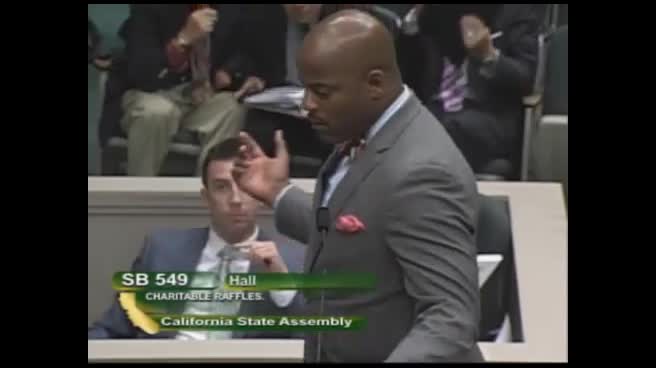
Bill Author