AB 1083: Transportation electrification: electric vehicle charging infrastructure: state parks and beaches.
- Session Year: 2017-2018
- House: Assembly
- Latest Version Date: 2017-10-10
Under existing law, the Public Utilities Commission (PUC) has regulatory authority over public utilities, including electrical corporations and gas corporations. Existing law requires the PUC, in consultation with the State Energy Resources Conservation and Development Commission (Energy Commission), the State Air Resources Board (state board), electrical corporations, and the motor vehicle industry, to evaluate policies to develop infrastructure sufficient to overcome any barriers to the widespread deployment and use of plug-in hybrid and electric vehicles and, by July 1, 2011, to adopt rules that address specified issues. Existing law requires the PUC, in cooperation with the Energy Commission, the state board, air quality management districts and air pollution control districts, electrical and gas corporations, and the motor vehicle industry, to evaluate and implement policies to promote the development of equipment and infrastructure needed to facilitate the use of electric power and natural gas to fuel low-emission vehicles. Existing law, enacted as part of the Clean Energy and Pollution Reduction Act of 2015, requires the PUC, in consultation with the Energy Commission and state board, to direct electrical corporations to file applications for programs and investments to accelerate widespread transportation electrification to reduce dependence on petroleum, meet air quality standards, achieve the goals set forth in the Charge Ahead California Initiative, and reduce emissions of greenhouse gases to 40% below 1990 levels by 2030 and to 80% below 1990 levels by 2050.
Existing law vests with the Department of Parks and Recreation control over the state park system, and requires the department to take various actions to develop, operate, and maintain units of the state park system.
This bill would authorize an electrical corporation, in consultation with the department, PUC, Energy Commission, and state board, to file with the PUC, by July 30, 2018, a pilot program proposal for the installation of electric vehicle charging stations at state parks and beaches within its service territory. The bill would require the PUC to review, modify if appropriate, and decide whether to approve a pilot program proposal filed by an electrical corporation by December 31, 2018. The bill would require the department to determine which state parks or beaches are suitable for charging stations. The bill would require that the approved pilot program include a reasonable mechanism for cost recovery by the electrical corporation if the PUC makes specified findings. The bill would require an electrical corporation to prioritize in its proposal those state parks and beaches that serve residents of disadvantaged communities, as defined. The bill would require that state parks and beaches receiving charging stations pursuant to the approved pilot program participate in a time-variant rate approved by the PUC.
Under existing law, a violation of the Public Utilities Act or any order, decision, rule, direction, demand, or requirement of the PUC is a crime.
Because the provisions of this bill are within the act and require action by the PUC to implement its requirements, a violation of which would be a crime, this bill would impose a state-mandated local program by creating a new crime.
The California Constitution requires the state to reimburse local agencies and school districts for certain costs mandated by the state. Statutory provisions establish procedures for making that reimbursement.
This bill would provide that no reimbursement is required by this act for a specified reason.
Under existing law, the Public Utilities Commission (PUC) has regulatory authority over public utilities, including electrical corporations and gas corporations. Existing law requires the PUC, in consultation with the State Energy Resources Conservation and Development Commission (Energy Commission), the State Air Resources Board (state board), electrical corporations, and the motor vehicle industry, to evaluate policies to develop infrastructure sufficient to overcome any barriers to the widespread deployment and use of plug-in hybrid and electric vehicles and, by July 1, 2011, to adopt rules that address specified issues. Existing law requires the PUC, in cooperation with the Energy Commission, the state board, air quality management districts and air pollution control districts, electrical and gas corporations, and the motor vehicle industry, to evaluate and implement policies to promote the development of equipment and infrastructure needed to facilitate the use of electric power and natural gas to fuel low-emission vehicles. Existing law, enacted as part of the Clean Energy and Pollution Reduction Act of 2015, requires the PUC, in consultation with the Energy Commission and state board, to direct electrical corporations to file applications for programs and investments to accelerate widespread transportation electrification to reduce dependence on petroleum, meet air quality standards, achieve the goals set forth in the Charge Ahead California Initiative, and reduce emissions of greenhouse gases to 40% below 1990 levels by 2030 and to 80% below 1990 levels by 2050.
Existing law vests with the Department of Parks and Recreation control over the state park system, and requires the department to take various actions to develop, operate, and maintain units of the state park system.
This bill would authorize a large electrical corporation, defined as an electrical corporation with 100,000 or more service connections in California, an electrical corporation, in consultation with the department, PUC, Energy Commission, and state board, to file with the PUC, by July 30, 2018, a pilot program proposal for the installation of electric vehicle charging stations at state parks and beaches within its service territory. The bill would require the PUC to review, modify if appropriate, and decide whether to approve a pilot program proposal filed by a large an electrical corporation by December 31, 2018. The bill would require the department to determine which state parks or beaches are suitable for charging stations. The bill would require that the approved pilot program include a reasonable mechanism for cost recovery by the large electrical corporation if the commission PUC makes specified findings. The bill would authorize an electrical corporation with less than 100,000 service connections in California to file a pilot program proposal for the installation of electric vehicle charging stations at state parks and beaches within its service territory. The bill would require an electrical corporation to prioritize in its proposal those state parks and beaches that serve residents of disadvantaged communities, as defined. The bill would require that state parks and beaches receiving charging stations pursuant to the approved pilot program participate in a time-variant rate approved by the commission. PUC.
Under existing law, a violation of the Public Utilities Act or any order, decision, rule, direction, demand, or requirement of the commission PUC is a crime.
Because the provisions of this bill are within the act and require action by the commission PUC to implement its requirements, a violation of which would be a crime, this bill would impose a state-mandated local program by creating a new crime.
The California Constitution requires the state to reimburse local agencies and school districts for certain costs mandated by the state. Statutory provisions establish procedures for making that reimbursement.
This bill would provide that no reimbursement is required by this act for a specified reason.
Under existing law, the Public Utilities Commission (PUC) has regulatory authority over public utilities, including electrical corporations and gas corporations. Existing law requires the PUC, in consultation with the State Energy Resources Conservation and Development Commission (Energy Commission), the State Air Resources Board (state board), electrical corporations, and the motor vehicle industry, to evaluate policies to develop infrastructure sufficient to overcome any barriers to the widespread deployment and use of plug-in hybrid and electric vehicles and, by July 1, 2011, to adopt rules that address specified issues. Existing law requires the PUC, in cooperation with the Energy Commission, the state board, air quality management districts and air pollution control districts, electrical and gas corporations, and the motor vehicle industry, to evaluate and implement policies to promote the development of equipment and infrastructure needed to facilitate the use of electric power and natural gas to fuel low-emission vehicles. Existing law, enacted as part of the Clean Energy and Pollution Reduction Act of 2015, requires the PUC, in consultation with the Energy Commission and state board, to direct electrical corporations to file applications for programs and investments to accelerate widespread transportation electrification to reduce dependence on petroleum, meet air quality standards, achieve the goals set forth in the Charge Ahead California Initiative, and reduce emissions of greenhouse gases to 40% below 1990 levels by 2030 and to 80% below 1990 levels by 2050.
Existing law vests with the Department of Parks and Recreation control over the state park system, and requires the department to take various actions to develop, operate, and maintain units of the state park system.
This bill would require each authorize a large electrical corporation, defined as an electrical corporation with 100,000 or more service connections in California, in consultation with the department, PUC, Energy Commission, and state board, to file with the PUC, by July 30, 2018, a pilot program proposal for the installation of electric vehicle charging stations at state parks and beaches within its service territory. The bill would require the PUC to review and approve, or modify and approve, the review, modify if appropriate, and decide whether to approve a pilot program proposal filed by the a large electrical corporation by December 31, 2018. The bill would require the department to determine which state parks or beaches are suitable for charging stations. The bill would require the large electrical corporation to install, own, operate, and maintain the electric vehicle charging equipment and would require that the approved pilot program include a reasonable mechanism for cost recovery by the large electrical corporation. corporation if the commission makes specified findings. The bill would authorize an electrical corporation with less than 100,000 service connections in California to file a pilot program proposal for the installation of electric vehicle charging stations at state parks and beaches within its service territory. The bill would require an electrical corporation to prioritize in its proposal those state parks and beaches that serve residents of disadvantaged communities, as defined. The bill would require that state parks and beaches receiving charging stations pursuant to the approved pilot program participate in a time-variant rate approved by the commission.
Under existing law, a violation of the Public Utilities Act or any order, decision, rule, direction, demand, or requirement of the commission is a crime.
Because the provisions of this bill are within the act and require action by the commission to implement its requirements, a violation of which would be a crime, this bill would impose a state-mandated local program by creating a new crime.
The California Constitution requires the state to reimburse local agencies and school districts for certain costs mandated by the state. Statutory provisions establish procedures for making that reimbursement.
This bill would provide that no reimbursement is required by this act for a specified reason.
Under existing law, the Public Utilities Commission (PUC) has regulatory authority over public utilities, including electrical corporations and gas corporations. Existing law requires the PUC, in consultation with the State Energy Resources Conservation and Development Commission (Energy Commission), the State Air Resources Board (state board), electrical corporations, and the motor vehicle industry, to evaluate policies to develop infrastructure sufficient to overcome any barriers to the widespread deployment and use of plug-in hybrid and electric vehicles and, by July 1, 2011, to adopt rules that address specified issues. Existing law requires the PUC, in cooperation with the Energy Commission, the state board, air quality management districts and air pollution control districts, electrical and gas corporations, and the motor vehicle industry, to evaluate and implement policies to promote the development of equipment and infrastructure needed to facilitate the use of electric power and natural gas to fuel low-emission vehicles. Existing law, enacted as part of the Clean Energy and Pollution Reduction Act of 2015, requires the PUC, in consultation with the Energy Commission and state board, to direct electrical corporations to file applications for programs and investments to accelerate widespread transportation electrification to reduce dependence on petroleum, meet air quality standards, achieve the goals set forth in the Charge Ahead California Initiative, and reduce emissions of greenhouse gases to 40% below 1990 levels by 2030 and to 80% below 1990 levels by 2050.
Existing law vests with the Department of Parks and Recreation control over the state park system, and requires the department to take various actions to develop, operate, and maintain units of the state park system.
This bill would require each large electrical corporation, defined as an electrical corporation with 100,000 or more service connections in California, in consultation with the department, PUC, Energy Commission, and state board, to develop a plan to create a robust charging network at all state parks and beaches within its service territory by July 31, 2018. The bill would require the department to determine which state parks or beaches are suitable for charging stations. The bill would require a large electrical corporation to file with the PUC, by September July 30, 2018, a program proposal for the installation of electric vehicle charging stations at state parks and beaches. beaches within its service territory. The bill would require the PUC to review and approve, or modify and approve, the program proposal filed by the large electrical corporation by December 31, 2018. The bill would require the department to determine which state parks or beaches are suitable for charging stations. The bill would require the large electrical corporation to install, own, operate, and maintain the electric vehicle charging equipment and would require that the approved program include a reasonable mechanism for cost recovery by the large electrical corporation. The bill would authorize an electrical corporation with less than 100,000 service connections in California to file a program proposal for the installation of electric vehicle charging stations at state parks and beaches within its service territory. The bill would require an electrical corporation to prioritize in its proposal those state parks and beaches that serve residents of disadvantaged communities, as defined. The bill would require that state parks and beaches receiving charging stations pursuant to the approved program participate in a time-variant rate approved by the commission.
Under existing law, a violation of the Public Utilities Act or any order, decision, rule, direction, demand, or requirement of the commission is a crime.
Because the provisions of this bill are within the act and require action by the commission to implement its requirements, a violation of which would be a crime, this bill would impose a state-mandated local program by creating a new crime.
The California Constitution requires the state to reimburse local agencies and school districts for certain costs mandated by the state. Statutory provisions establish procedures for making that reimbursement.
This bill would provide that no reimbursement is required by this act for a specified reason.
Under existing law, the Public Utilities Commission (PUC) has regulatory authority over public utilities, including electrical corporations and gas corporations. Existing law requires the PUC, in consultation with the State Energy Resources Conservation and Development Commission (Energy Commission), the State Air Resources Board (state board), electrical corporations, and the motor vehicle industry, to evaluate policies to develop infrastructure sufficient to overcome any barriers to the widespread deployment and use of plug-in hybrid and electric vehicles and, by July 1, 2011, to adopt rules that address specified issues. Existing law requires the PUC, in cooperation with the Energy Commission, the state board, air quality management districts and air pollution control districts, electrical and gas corporations, and the motor vehicle industry, to evaluate and implement policies to promote the development of equipment and infrastructure needed to facilitate the use of electric power and natural gas to fuel low-emission vehicles. Existing law, enacted as part of the Clean Energy and Pollution Reduction Act of 2015, requires the PUC, in consultation with the Energy Commission and state board, to direct electrical corporations to file applications for programs and investments to accelerate widespread transportation electrification to reduce dependence on petroleum, meet air quality standards, achieve the goals set forth in the Charge Ahead California Initiative, and reduce emissions of greenhouse gases to 40% below 1990 levels by 2030 and to 80% below 1990 levels by 2050.
Existing law vests with the Department of Parks and Recreation control over the state park system, and requires the department to take various actions to develop, operate, and maintain units of the state park system.
This bill would require each large electrical corporation, defined as an electrical corporation with 100,000 or more service connections in California, in consultation with the department, PUC, Energy Commission, and state board, to develop a plan to create a robust charging network at all state parks and beaches within its service territory by July 31, 2018. The bill would require the department to determine which state parks or beaches are suitable for charging stations. The bill would require a large electrical corporation to file with the PUC, by September 30, 2018, a program proposal for the installation of electric vehicle charging stations at state parks and beaches. The bill would require the PUC to review and approve, or modify and approve, the program proposal filed by the large electrical corporation by December 31, 2018. The bill would require the large electrical corporation to install, own, operate, and maintain the electric vehicle charging equipment and would require that the approved program include a reasonable mechanism for cost recovery by the large electrical corporation. The bill would authorize an electrical corporation with less than 100,000 service connections in California to file a program proposal for the installation of electric vehicle charging stations at state parks and beaches within its service territory. The bill would require that state parks and beaches receiving charging stations pursuant to the approved program participate in a time-variant rate approved by the commission.
Under existing law, a violation of the Public Utilities Act or any order, decision, rule, direction, demand, or requirement of the commission is a crime.
Because the provisions of this bill are within the act and require action by the commission to implement its requirements, a violation of which would be a crime, this bill would impose a state-mandated local program by creating a new crime.
The California Constitution requires the state to reimburse local agencies and school districts for certain costs mandated by the state. Statutory provisions establish procedures for making that reimbursement.
This bill would provide that no reimbursement is required by this act for a specified reason.
Under existing law, the Public Utilities Commission (PUC) has regulatory authority over public utilities, including electrical corporations and gas corporations. Existing law requires the PUC, in consultation with the State Energy Resources Conservation and Development Commission (Energy Commission), the State Air Resources Board (state board), electrical corporations, and the motor vehicle industry, to evaluate policies to develop infrastructure sufficient to overcome any barriers to the widespread deployment and use of plug-in hybrid and electric vehicles and, by July 1, 2011, to adopt rules that address specified issues. Existing law requires the PUC, in cooperation with the Energy Commission, the state board, air quality management districts and air pollution control districts, electrical and gas corporations, and the motor vehicle industry, to evaluate and implement policies to promote the development of equipment and infrastructure needed to facilitate the use of electric power and natural gas to fuel low-emission vehicles. Existing law, enacted as part of the Clean Energy and Pollution Reduction Act of 2015, requires the PUC, in consultation with the Energy Commission and state board, to direct electrical corporations to file applications for programs and investments to accelerate widespread transportation electrification to reduce dependence on petroleum, meet air quality standards, achieve the goals set forth in the Charge Ahead California Initiative, and reduce emissions of greenhouse gases to 40% below 1990 levels by 2030 and to 80% below 1990 levels by 2050.
This bill would require each large electrical corporation, corporation, defined as an electrical corporation with 100,000 or more service connections in California, in consultation with the PUC, Energy Commission, and state board, to develop a plan to create a robust charging network at all state parks and beaches within its service territory by July 31, 2018. The bill would require an a large electrical corporation to file with the PUC, by September 30, 2018, a program proposal for the installation of electric vehicle charging stations at state parks and beaches. The bill would require the PUC to review and approve, or modify and approve, the program proposal filed by the large electrical corporation by December 31, 2018. The bill would require the large electrical corporation to install, own, operate, and maintain the electric vehicle charging equipment and would require that the approved program include a reasonable mechanism for cost recovery by the large electrical corporation. The bill would authorize an electrical corporation with less than 100,000 service connections in California to file a program proposal for the installation of electric vehicle charging stations at state parks and beaches within its service territory. The bill would require that state parks and beaches receiving charging stations pursuant to the approved program participate in a time-variant rate approved by the commission.
Under existing law, a violation of the Public Utilities Act or any order, decision, rule, direction, demand, or requirement of the commission is a crime.
Because the provisions of this bill are within the act and require action by the commission to implement its requirements, a violation of which would be a crime, this bill would impose a state-mandated local program by creating a new crime.
The California Constitution requires the state to reimburse local agencies and school districts for certain costs mandated by the state. Statutory provisions establish procedures for making that reimbursement.
This bill would provide that no reimbursement is required by this act for a specified reason.
Under existing law, the Public Utilities Commission (PUC) has regulatory authority over public utilities, including electrical corporations and gas corporations. Existing law requires the PUC, in consultation with the State Energy Resources Conservation and Development Commission (Energy Commission), the State Air Resources Board (state board), electrical corporations, and the motor vehicle industry, to evaluate policies to develop infrastructure sufficient to overcome any barriers to the widespread deployment and use of plug-in hybrid and electric vehicles and, by July 1, 2011, to adopt rules that address specified issues. Existing law requires the PUC, in cooperation with the Energy Commission, the state board, air quality management districts and air pollution control districts, electrical and gas corporations, and the motor vehicle industry, to evaluate and implement policies to promote the development of equipment and infrastructure needed to facilitate the use of electric power and natural gas to fuel low-emission vehicles. Existing law, enacted as part of the Clean Energy and Pollution Reduction Act of 2015, requires the PUC, in consultation with the Energy Commission and state board, to direct electrical corporations to file applications for programs and investments to accelerate widespread transportation electrification to reduce dependence on petroleum, meet air quality standards, achieve the goals set forth in the Charge Ahead California Initiative, and reduce emissions of greenhouse gases to 40% below 1990 levels by 2030 and to 80% below 1990 levels by 2050.
This bill would require each electrical corporation, in consultation with the PUC, Energy Commission, and state board, to develop a plan to create a robust charging network at all state parks and beaches within its service territory by July 31, 2018. The bill would require an electrical corporation to file with the PUC, by September 30, 2018, a program proposal for the installation of electric vehicle charging stations at state parks and beaches. The bill would require the PUC to review and approve, or modify and approve, the program proposal filed by the electrical corporation by December 31, 2018. The bill would require the electrical corporation to install, own, operate, and maintain the electric vehicle charging equipment and would require that the approved program include a reasonable mechanism for cost recovery by the electrical corporation. The bill would require that state parks and beaches receiving charging stations pursuant to the approved program participate in a time-variant rate approved by the commission.
Under existing law, a violation of the Public Utilities Act or any order, decision, rule, direction, demand, or requirement of the commission is a crime.
Because the provisions of this bill are within the act and require action by the commission to implement its requirements, a violation of which would be a crime, this bill would impose a state-mandated local program by creating a new crime.
The California Constitution requires the state to reimburse local agencies and school districts for certain costs mandated by the state. Statutory provisions establish procedures for making that reimbursement.
This bill would provide that no reimbursement is required by this act for a specified reason.
The Legislature finds and declares all of the following:
(a)It is the policy of the state and the intent of the Legislature to encourage transportation electrification as described in Section 740.12 of the Public Utilities Code.
(b)To reach the aggressive goals for reducing emissions of greenhouse gases set forth in subparagraph (D) of paragraph (1) of subdivision (a) of Section 740.12 of the Public Utilities Code, the entire state motor vehicle fleet, both public and private, will need to make a dramatic transition to transportation electrification.
(c)The state is behind schedule in attaining the Governors 2015 goal that all major cities in California have adequate infrastructure to support the goal of 1.5 million zero-emission vehicles by 2025. The 2020 goal of establishing adequate infrastructure to support one million zero-emission vehicles is also behind schedule. More needs to be done to install electric vehicle charging infrastructure to support and enable these critical electric vehicle goals.
SEC. 2.Section 740.14 is added to the Public Utilities Code, to read:740.14.(a)By July 30, 2018, in consultation with the Department of Parks and Recreation, Public Utilities Commission, Energy Commission, and State Air Resources Board, each electrical corporation may file with the commission a pilot program proposal for the installation of electrical grid integrated charging stations at state parks and beaches within its service territory. By December 31, 2018, the commission shall review, modify if appropriate, and decide whether to approve a pilot program proposal filed by an electrical corporation. The Department of Parks and Recreation shall determine which state parks or beaches are suitable for charging stations.
(b)The approved pilot program shall include a reasonable mechanism for cost recovery by an electrical corporation if the commission finds all of the following are true:
(1)The costs to be recovered are consistent with a cost limitation approved by the commission for the pilot program.
(2)The pilot program seeks to minimize overall costs and maximize overall benefits.
(3)The pilot program does not unfairly compete with nonutility enterprises as required under Section 740.3.
(4)The pilot program includes performance accountability measures for the electrical corporation or, for charging equipment installed and maintained by a nonutility enterprise, performance accountability measures for the nonutility enterprise.
(5)The pilot program is in the interests of ratepayers, as defined in Section 740.8.
(c)Charging stations installed pursuant to a pilot program approved by the commission pursuant to this section shall be installed and maintained by the utility workforce, or by workers who are paid the prevailing wage for all program-related work. The Director of Industrial Relations shall determine the prevailing wage in accordance with the standards set forth in Article 2 (commencing with Section 1770) of Chapter 1 of Part 7 of Division 2 of the Labor Code. A nonutility enterprise installing or maintaining charging equipment pursuant to a pilot program approved by the commission shall submit wage schedules to the commission as part of its application and shall make all payroll records available to the commission for enforcement purposes pursuant to this part. Certified payrolls submitted to the commission shall be public records.
(d)State parks and beaches receiving charging stations pursuant to the approved pilot program shall participate in a time-variant rate approved by the commission.
(e)An electrical corporation shall prioritize in its proposal those state parks and beaches that serve residents of disadvantaged communities. For these purposes, disadvantaged communities means communities identified by the California Environmental Protection Agency pursuant to the Greenhouse Gas Reduction Fund Investment Plan and Communities Revitalization Act (Chapter 4.1 (commencing with Section 39710) of Part 2 of Division 26 of the Health and Safety Code).
(f)Except for costs incurred in determining park and beach suitability pursuant to subdivision (a) and potential liability under the Government Claims Act (Division 3.6 (commencing with Section 810) of Title 1 of the Government Code), the Department of Parks and Recreation shall not be required to incur any costs or liability related to the installation, use, or maintenance of the charging stations for the pilot programs duration.
SEC. 3.No reimbursement is required by this act pursuant to Section 6 of Article XIIIB of the California Constitution because the only costs that may be incurred by a local agency or school district will be incurred because this act creates a new crime or infraction, eliminates a crime or infraction, or changes the penalty for a crime or infraction, within the meaning of Section 17556 of the Government Code, or changes the definition of a crime within the meaning of Section 6 of Article XIIIB of the California Constitution.
The Legislature finds and declares all of the following:
(a)It is the policy of the state and the intent of the Legislature to encourage transportation electrification as described in Section 740.12 of the Public Utilities Code.
(b)To reach the aggressive goals for reducing emissions of greenhouse gases set forth in subparagraph (D) of paragraph (1) of subdivision (a) of Section 740.12 of the Public Utilities Code, the entire state motor vehicle fleet, both public and private, will need to make a dramatic transition to transportation electrification.
(c)The state is behind schedule in attaining the Governors 2015 goal that all major cities in California have adequate infrastructure to support the goal of 1.5 million zero-emission vehicles by 2025. The 2020 goal of establishing adequate infrastructure to support one million zero-emission vehicles is also behind schedule. More needs to be done to install electric vehicle charging infrastructure to support and enable these critical electric vehicle goals.
SEC. 2.Section 740.14 is added to the Public Utilities Code, to read:740.14.(a)By July 30, 2018, in consultation with the Department of Parks and Recreation, Public Utilities Commission, Energy Commission, and State Air Resources Board, each electrical corporation may file with the commission a pilot program proposal for the installation of electrical grid integrated charging stations at state parks and beaches within its service territory. By December 31, 2018, the commission shall review, modify if appropriate, and decide whether to approve a pilot program proposal filed by an electrical corporation. The Department of Parks and Recreation shall determine which state parks or beaches are suitable for charging stations.
(b)The approved pilot program shall include a reasonable mechanism for cost recovery by an electrical corporation if the commission finds all of the following are true:
(1)The costs to be recovered are consistent with a cost limitation approved by the commission for the pilot program.
(2)The pilot program seeks to minimize overall costs and maximize overall benefits.
(3)The pilot program does not unfairly compete with nonutility enterprises as required under Section 740.3.
(4)The pilot program includes performance accountability measures for the electrical corporation or, for charging equipment installed and maintained by a nonutility enterprise, performance accountability measures for the nonutility enterprise.
(5)The pilot program is in the interests of ratepayers, as defined in Section 740.8.
(c)Charging stations installed pursuant to a pilot program approved by the commission pursuant to this section shall be installed and maintained by the utility workforce, or by workers who are paid the prevailing wage for all program-related work. The Director of Industrial Relations shall determine the prevailing wage in accordance with the standards set forth in Article 2 (commencing with Section 1770) of Chapter 1 of Part 7 of Division 2 of the Labor Code. A nonutility enterprise installing or maintaining charging equipment pursuant to a pilot program approved by the commission shall submit wage schedules to the commission as part of its application and shall make all payroll records available to the commission for enforcement purposes pursuant to this part. Certified payrolls submitted to the commission shall be public records.
(d)State parks and beaches receiving charging stations pursuant to the approved pilot program shall participate in a time-variant rate approved by the commission.
(e)An electrical corporation shall prioritize in its proposal those state parks and beaches that serve residents of disadvantaged communities. For these purposes, disadvantaged communities means communities identified by the California Environmental Protection Agency pursuant to the Greenhouse Gas Reduction Fund Investment Plan and Communities Revitalization Act (Chapter 4.1 (commencing with Section 39710) of Part 2 of Division 26 of the Health and Safety Code).
(f)Except for costs incurred in determining park and beach suitability pursuant to subdivision (a), (a) and potential liability under the Government Claims Act (Division 3.6 (commencing with Section 810) of Title 1 of the Government Code), the Department of Parks and Recreation shall not be required to incur any costs or liability related to the pilot program installation, use, or maintenance of the charging stations for the pilot programs duration.
SEC. 3.No reimbursement is required by this act pursuant to Section 6 of Article XIIIB of the California Constitution because the only costs that may be incurred by a local agency or school district will be incurred because this act creates a new crime or infraction, eliminates a crime or infraction, or changes the penalty for a crime or infraction, within the meaning of Section 17556 of the Government Code, or changes the definition of a crime within the meaning of Section 6 of Article XIIIB of the California Constitution.
The Legislature finds and declares all of the following:
(a)It is the policy of the state and the intent of the Legislature to encourage transportation electrification as described in Section 740.12 of the Public Utilities Code.
(b)To reach the aggressive goals for reducing emissions of greenhouse gases set forth in subparagraph (D) of paragraph (1) of subdivision (a) of Section 740.12 of the Public Utilities Code, the entire state motor vehicle fleet, both public and private, will need to make a dramatic transition to transportation electrification.
(c)The state is behind schedule in attaining the Governors 2015 goal that all major cities in California have adequate infrastructure to support the goal of 1.5 million zero-emission vehicles by 2025. The 2020 goal of establishing adequate infrastructure to support one million zero-emission vehicles is also behind schedule. More needs to be done to install electric vehicle charging infrastructure to support and enable these critical electric vehicle goals.
SEC. 2.Section 740.14 is added to the Public Utilities Code, to read:740.14.(a)By July 30, 2018, in consultation with the Department of Parks and Recreation, Public Utilities Commission, Energy Commission, and State Air Resources Board, each large electrical corporation may file with the commission a pilot program proposal for the installation of electrical grid integrated charging stations at state parks and beaches within its service territory. By December 31, 2018, the commission shall review, modify if appropriate, and decide whether to approve a pilot program proposal filed by a large an electrical corporation. The Department of Parks and Recreation shall determine which state parks or beaches are suitable for charging stations.
(b)The approved pilot program shall include a reasonable mechanism for cost recovery by the large an electrical corporation if the commission finds all of the following are true:
(1)The costs to be recovered are consistent with a cost limitation approved by the commission for the pilot program.
(2)The pilot program seeks to minimize overall costs and maximize overall benefits.
(3)The pilot program does not unfairly compete with nonutility enterprises as required under Section 740.3.
(4)The pilot program includes performance accountability measures. measures for the electrical corporation or, for charging equipment installed and maintained by a nonutility enterprise, performance accountability measures for the nonutility enterprise.
(5)The pilot program is in the interests of ratepayers, as defined in Section 740.8.
(c)Charging stations installed pursuant to a pilot program approved by the commission pursuant to this section shall be installed and maintained by the utility workforce, or by workers who are paid the prevailing wage for all program-related work. The Director of Industrial Relations shall determine the prevailing wage in accordance with the standards set forth in Article 2 (commencing with Section 1770) of Chapter 1 of Part 7 of Division 2 of the Labor Code. A nonutility enterprise installing or maintaining charging equipment pursuant to a pilot program approved by the commission shall submit wage schedules to the commission as part of its application and shall make all payroll records available to the commission for enforcement purposes pursuant to this part. Certified payrolls submitted to the commission shall be public records.
(c)(d)State parks and beaches receiving charging stations pursuant to the approved pilot program shall participate in a time-variant rate approved by the commission.
(d)(1)For purposes of this section, a large electrical corporation is an electrical corporation with 100,000 or more service connections in California.(2)An electrical corporation with less than 100,000 service connections in California may file with the commission a pilot program proposal for the installation of electrical grid integrated charging stations at state parks and beaches.(e)An electrical corporation shall prioritize in its proposal those state parks and beaches that serve residents of disadvantaged communities. For these purposes, disadvantaged communities means communities identified by the California Environmental Protection Agency pursuant to the Greenhouse Gas Reduction Fund Investment Plan and Communities Revitalization Act (Chapter 4.1 (commencing with Section 39711) 39710) of Part 2 of Division 26 of the Health and Safety Code).
(f)Except for costs incurred in determining park and beach suitability pursuant to subdivision (a), the Department of Parks and Recreation shall not be required to incur any costs or liability related to the pilot program for the pilot programs duration.
SEC. 3.No reimbursement is required by this act pursuant to Section 6 of Article XIIIB of the California Constitution because the only costs that may be incurred by a local agency or school district will be incurred because this act creates a new crime or infraction, eliminates a crime or infraction, or changes the penalty for a crime or infraction, within the meaning of Section 17556 of the Government Code, or changes the definition of a crime within the meaning of Section 6 of Article XIIIB of the California Constitution.
The Legislature finds and declares all of the following:
(a)It is the policy of the state and the intent of the Legislature to encourage transportation electrification as described in Section 740.12 of the Public Utilities Code.
(b)To reach the aggressive goals for reducing emissions of greenhouse gases set forth in subparagraph (D) of paragraph (1) of subdivision (a) of Section 740.12 of the Public Utilities Code, the entire state motor vehicle fleet, both public and private, will need to make a dramatic transition to transportation electrification.
(c)The state is behind schedule in attaining the Governors 2015 goal that all major cities in California have adequate infrastructure to support the goal of 1.5 million zero-emission vehicles by 2025. The 2020 goal of establishing adequate infrastructure to support one million zero-emission vehicles is also behind schedule. More needs to be done to install electric vehicle charging infrastructure to support and enable these critical electric vehicle goals.
SEC. 2.Section 740.14 is added to the Public Utilities Code, to read:740.14.(a)By July 30, 2018, in consultation with the Department of Parks and Recreation, Public Utilities Commission, Energy Commission, and State Air Resources Board, each large electrical corporation shall may file with the commission a pilot program proposal for the installation of electrical grid integrated level-two charging stations at state parks and beaches within its service territory. By December 31, 2018, the commission shall review and approve, or modify and approve, the review, modify if appropriate, and decide whether to approve a pilot program proposal filed by each a large electrical corporation. The Department of Parks and Recreation shall determine which state parks or beaches are suitable for charging stations.
(b)The large electrical corporation shall install, own, operate, and maintain the electric vehicle charging equipment.(c)(b)The approved pilot program shall include a reasonable mechanism for cost recovery by the large electrical corporation. corporation if the commission finds all of the following are true:
(1)The costs to be recovered are consistent with a cost limitation approved by the commission for the pilot program.
(2)The pilot program seeks to minimize overall costs and maximize overall benefits.
(3)The pilot program does not unfairly compete with nonutility enterprises as required under Section 740.3.
(4)The pilot program includes performance accountability measures.
(5)The pilot program is in the interests of ratepayers, as defined in Section 740.8.
(d)(c)State parks and beaches receiving charging stations pursuant to the approved pilot program shall participate in a time-variant rate approved by the commission.
(e)(d)(1)For purposes of this section, a large electrical corporation is an electrical corporation with 100,000 or more service connections in California.
(2)An electrical corporation with less than 100,000 service connections in California may file with the commission a pilot program proposal for the installation of electrical grid integrated level-two charging stations at state parks and beaches.
(f)(e)An electrical corporation shall prioritize in its proposal those state parks and beaches that serve residents of disadvantaged communities. For these purposes, disadvantaged communities means communities identified by the California Environmental Protection Agency pursuant to the Greenhouse Gas Reduction Fund Investment Plan and Communities Revitalization Act (Chapter 4.1 (commencing with Section 39711) of Part 2 of Division 26 of the Health and Safety Code).
SEC. 3.No reimbursement is required by this act pursuant to Section 6 of Article XIIIB of the California Constitution because the only costs that may be incurred by a local agency or school district will be incurred because this act creates a new crime or infraction, eliminates a crime or infraction, or changes the penalty for a crime or infraction, within the meaning of Section 17556 of the Government Code, or changes the definition of a crime within the meaning of Section 6 of Article XIIIB of the California Constitution.
The Legislature finds and declares all of the following:
(a)It is the policy of the state and the intent of the Legislature to encourage transportation electrification as described in Section 740.12 of the Public Utilities Code.
(b)To reach the aggressive goals for reducing emissions of greenhouse gases set forth in subparagraph (D) of paragraph (1) of subdivision (a) of Section 740.12 of the Public Utilities Code, the entire state motor vehicle fleet, both public and private, will need to make a dramatic transition to transportation electrification.
(c)The state is behind schedule in attaining the Governors 2015 goal that all major cities in California have adequate infrastructure to support the goal of 1.5 million zero-emission vehicles by 2025. The 2020 goal of establishing adequate infrastructure to support one million zero-emission vehicles is also behind schedule. More needs to be done to install electric vehicle charging infrastructure to support and enable these critical electric vehicle goals.
SEC. 2.Section 740.14 is added to the Public Utilities Code, to read:740.14.(a)By July 31, 30, 2018, in consultation with the Department of Parks and Recreation, Public Utilities Commission, Energy Commission, and State Air Resources Board, each large electrical corporation shall develop a plan to create a robust charging network at all file with the commission a program proposal for the installation of electrical grid integrated level-two charging stations at state parks and beaches within its service territory. By December 31, 2018, the commission shall review and approve, or modify and approve, the program proposal filed by each large electrical corporation. The Department of Parks and Recreation shall determine which state parks or beaches are suitable for charging stations.
(b)By September 30, 2018, a large electrical corporation shall file with the commission a program proposal for the installation of electrical grid integrated level-two charging stations at state parks and beaches. By December 31, 2018, the commission shall review and approve, or modify and approve, the program proposal filed by the large electrical corporation.(c)(b)The large electrical corporation shall install, own, operate, and maintain the electric vehicle charging equipment.
(d)(c)The approved program shall include a reasonable mechanism for cost recovery by the large electrical corporation.
(e)(d)State parks and beaches receiving charging stations pursuant to the approved program shall participate in a time-variant rate approved by the commission.
(f)(e)(1)For purposes of this section, a large electrical corporation is an electrical corporation with 100,000 or more service connections in California.
(2)An electrical corporation with less than 100,000 service connections in California may file with the commission a program proposal for the installation of electrical grid integrated level-two charging stations at state parks and beaches.
(f)An electrical corporation shall prioritize in its proposal those state parks and beaches that serve residents of disadvantaged communities. For these purposes, disadvantaged communities means communities identified by the California Environmental Protection Agency pursuant to the Greenhouse Gas Reduction Fund Investment Plan and Communities Revitalization Act (Chapter 4.1 (commencing with Section 39711) of Part 2 of Division 26 of the Health and Safety Code).
SEC. 3.No reimbursement is required by this act pursuant to Section 6 of Article XIIIB of the California Constitution because the only costs that may be incurred by a local agency or school district will be incurred because this act creates a new crime or infraction, eliminates a crime or infraction, or changes the penalty for a crime or infraction, within the meaning of Section 17556 of the Government Code, or changes the definition of a crime within the meaning of Section 6 of Article XIIIB of the California Constitution.
The Legislature finds and declares all of the following:
(a)It is the policy of the state and the intent of the Legislature to encourage transportation electrification as described in Section 740.12 of the Public Utilities Code.
(b)To reach the aggressive goals for reducing emissions of greenhouse gases set forth in subparagraph (D) of paragraph (1) of subdivision (a) of Section 740.12 of the Public Utilities Code, the entire state motor vehicle fleet, both public and private, will need to make a dramatic transition to transportation electrification.
(c)The state is behind schedule in attaining the Governors 2015 goal that all major cities in California have adequate infrastructure to support the goal of 1.5 million zero-emission vehicles by 2025. The 2020 goal of establishing adequate infrastructure to support one million zero-emission vehicles is also behind schedule. More needs to be done to install electric vehicle charging infrastructure to support and enable these critical electric vehicle goals.
SEC. 2.Section 740.14 is added to the Public Utilities Code, to read:740.14.(a)By July 31, 2018, in consultation with the Department of Parks and Recreation, Public Utilities Commission, Energy Commission, and State Air Resources Board, each large electrical corporation shall develop a plan to create a robust charging network at all state parks and beaches within its service territory. The Department of Parks and Recreation shall determine which state parks or beaches are suitable for charging stations.
(b)By September 30, 2018, a large electrical corporation shall file with the commission a program proposal for the installation of electrical grid integrated level-two charging stations at state parks and beaches. By December 31, 2018, the commission shall review and approve, or modify and approve, the program proposal filed by the large electrical corporation.
(c)The large electrical corporation shall install, own, operate, and maintain the electric vehicle charging equipment.
(d)The approved program shall include a reasonable mechanism for cost recovery by the large electrical corporation.
(e)State parks and beaches receiving charging stations pursuant to the approved program shall participate in a time-variant rate approved by the commission.
(f)(1)For purposes of this section, a large electrical corporation is an electrical corporation with 100,000 or more service connections in California.
(2)An electrical corporation with less than 100,000 service connections in California may file with the commission a program proposal for the installation of electrical grid integrated level-two charging stations at state parks and beaches.
SEC. 3.No reimbursement is required by this act pursuant to Section 6 of Article XIIIB of the California Constitution because the only costs that may be incurred by a local agency or school district will be incurred because this act creates a new crime or infraction, eliminates a crime or infraction, or changes the penalty for a crime or infraction, within the meaning of Section 17556 of the Government Code, or changes the definition of a crime within the meaning of Section 6 of Article XIIIB of the California Constitution.
The Legislature finds and declares all of the following:
(a)It is the policy of the state and the intent of the Legislature to encourage transportation electrification as described in Section 740.12 of the Public Utilities Code.
(b)To reach the aggressive goals for reducing emissions of greenhouse gases set forth in subparagraph (D) of paragraph (1) of subdivision (a) of Section 740.12 of the Public Utilities Code, the entire state motor vehicle fleet, both public and private, will need to make a dramatic transition to transportation electrification.
(c)The state is behind schedule in attaining the Governors 2015 goal that all major cities in California have adequate infrastructure to support the goal of 1.5 million zero-emission vehicles by 2025. The 2020 goal of establishing adequate infrastructure to support one million zero-emission vehicles is also behind schedule. More needs to be done to install electric vehicle charging infrastructure to support and enable these critical electric vehicle goals.
SEC. 2.Section 740.14 is added to the Public Utilities Code, to read:740.14.(a)By July 31, 2018, in consultation with the Public Utilities Commission, Energy Commission, and State Air Resources Board, each large electrical corporation shall develop a plan to create a robust charging network at all state parks and beaches within its service territory.
(b)By September 30, 2018, an a large electrical corporation shall file with the commission a program proposal for the installation of electrical grid integrated level-two charging stations at state parks and beaches. By December 31, 2018, the commission shall review and approve, or modify and approve, the program proposal filed by the large electrical corporation.
(c)The large electrical corporation shall install, own, operate, and maintain the electric vehicle charging equipment.
(d)The approved program shall include a reasonable mechanism for cost recovery by the large electrical corporation.
(e)State parks and beaches receiving charging stations pursuant to the approved program shall participate in a time-variant rate approved by the commission.
(f)(1)For purposes of this section, a large electrical corporation is an electrical corporation with 100,000 or more service connections in California.
(2)An electrical corporation with less than 100,000 service connections in California may file with the commission a program proposal for the installation of electrical grid integrated level-two charging stations at state parks and beaches.
SEC. 3.No reimbursement is required by this act pursuant to Section 6 of Article XIIIB of the California Constitution because the only costs that may be incurred by a local agency or school district will be incurred because this act creates a new crime or infraction, eliminates a crime or infraction, or changes the penalty for a crime or infraction, within the meaning of Section 17556 of the Government Code, or changes the definition of a crime within the meaning of Section 6 of Article XIIIB of the California Constitution.
The Legislature finds and declares all of the following:
(a)It is the policy of the state and the intent of the Legislature to encourage transportation electrification as described in Section 740.12 of the Public Utilities Code.
(b)To reach the aggressive goals for reducing emissions of greenhouse gases set forth in subparagraph (D) of paragraph (1) of subdivision (a) of Section 740.12 of the Public Utilities Code, the entire state motor vehicle fleet, both public and private, will need to make a dramatic transition to transportation electrification.
(c)The state is behind schedule in attaining the Governors 2015 goal that all major cities in California have adequate infrastructure to support the goal of 1.5 million zero-emission vehicles by 2025. The 2020 goal of establishing adequate infrastructure to support one million zero-emission vehicles is also behind schedule. More needs to be done to install electric vehicle charging infrastructure to support and enable these critical electric vehicle goals.
SEC. 2.Section 740.14 is added to the Public Utilities Code, to read:740.14.(a)By July 31, 2018, in consultation with the Public Utilities Commission, Energy Commission, and State Air Resources Board, each electrical corporation shall develop a plan to create a robust charging network at all state parks and beaches within its service territory.
(b)By September 30, 2018, an electrical corporation shall file with the commission a program proposal for the installation of electrical grid integrated level-two charging stations at state parks and beaches. By December 31, 2018, the commission shall review and approve, or modify and approve, the program proposal filed by the electrical corporation.
(c)The electrical corporation shall install, own, operate, and maintain the electric vehicle charging equipment.
(d)The approved program shall include a reasonable mechanism for cost recovery by the electrical corporation.
(e)State parks and beaches receiving charging stations pursuant to the approved program shall participate in a time-variant rate approved by the commission.
SEC. 3.No reimbursement is required by this act pursuant to Section 6 of Article XIIIB of the California Constitution because the only costs that may be incurred by a local agency or school district will be incurred because this act creates a new crime or infraction, eliminates a crime or infraction, or changes the penalty for a crime or infraction, within the meaning of Section 17556 of the Government Code, or changes the definition of a crime within the meaning of Section 6 of Article XIIIB of the California Constitution.
REVISIONS: HeadingLine 2.|
Date
|
Status
|
|---|---|
| Oct 10, 2017 | Chaptered by Secretary of State - Chapter 638, Statutes of 2017. |
| Oct 10, 2017 | Approved by the Governor. |
| Sep 25, 2017 | Enrolled and presented to the Governor at 12 p.m. |
| Sep 14, 2017 | Senate amendments concurred in. To Engrossing and Enrolling. |
| Sep 14, 2017 | Senate amendments concurred in. To Engrossing and Enrolling. (Ayes 55. Noes 22. Page 3379.). |
| Sep 13, 2017 | Assembly Rule 77(a) suspended. |
| Sep 13, 2017 | In Assembly. Concurrence in Senate amendments pending. May be considered on or after September 15 pursuant to Assembly Rule 77. |
| Sep 12, 2017 | Read third time. Passed. Ordered to the Assembly. |
| Sep 11, 2017 | Read second time. Ordered to third reading. |
| Sep 8, 2017 | Read third time and amended. Ordered to second reading. |
| Sep 5, 2017 | Read second time. Ordered to third reading. |
| Sep 1, 2017 | From committee: Amend, and do pass as amended. (Ayes 5. Noes 2.) (September 1). |
| Aug 21, 2017 | In committee: Referred to APPR. suspense file. |
| Jul 19, 2017 | Read second time and amended. Re-referred to Com. on APPR. |
| Jul 18, 2017 | From committee: Amend, and do pass as amended and re-refer to Com. on APPR. (Ayes 6. Noes 1.) (July 11). |
| Jul 10, 2017 | From committee: Do pass and re-refer to Com. on N.R. & W. (Ayes 9. Noes 2.) (July 10). Re-referred to Com. on N.R. & W. |
| Jun 29, 2017 | In committee: Hearing postponed by committee. |
| Jun 20, 2017 | From committee chair, with author's amendments: Amend, and re-refer to committee. Read second time, amended, and re-referred to Com. on E., U. & C. |
| Jun 14, 2017 | Referred to Coms. on E., U. & C. and N.R. & W. |
| Jun 1, 2017 | In Senate. Read first time. To Com. on RLS. for assignment. |
| May 31, 2017 | Read third time. Passed. Ordered to the Senate. (Ayes 52. Noes 19. Page 1988.) |
| May 30, 2017 | Read second time and amended. Ordered returned to second reading. |
| May 26, 2017 | From committee: Amend, and do pass as amended. (Ayes 12. Noes 5.) (May 26). |
| May 17, 2017 | In committee: Set, first hearing. Referred to APPR. suspense file. |
| May 10, 2017 | Re-referred to Com. on APPR. |
| May 9, 2017 | From committee chair, with author's amendments: Amend, and re-refer to Com. on APPR. Read second time and amended. |
| Apr 26, 2017 | From committee: Do pass and re-refer to Com. on APPR. (Ayes 9. Noes 4.) (April 25). Re-referred to Com. on APPR. |
| Apr 6, 2017 | From committee: Do pass and re-refer to Com. on W.,P., & W. (Ayes 10. Noes 3.) (April 5). Re-referred to Com. on W.,P., & W. |
| Mar 29, 2017 | Coauthors revised. |
| Mar 13, 2017 | Referred to Coms. on C. & C. and W.,P., & W. |
| Feb 17, 2017 | From printer. May be heard in committee March 19. |
| Feb 16, 2017 | Read first time. To print. |
|
Date
|
Description
|
Location
|
Votes
|
|
|---|---|---|---|---|
| Sep 14, 2017 | AB 1083 BURKE Concurrence in Senate Amendments | Assembly Floor |
Passed |
|
| Sep 12, 2017 | Assembly 3rd Reading AB1083 Burke et al. By Bradford | Senate Floor |
Passed |
|
| Sep 1, 2017 | Do pass as amended | Senate Standing Committee on Appropriations |
Passed |
|
| Aug 21, 2017 | Placed on suspense file | Senate Standing Committee on Appropriations |
Passed |
|
| Jul 11, 2017 | Do pass as amended, but first amend, and re-refer to the Committee on [Appropriations] | Senate Standing Committee on Natural Resources and Water |
Passed |
|
| Jul 10, 2017 | Do pass, but first be re-referred to the Committee on [Natural Resources and Water] | Senate Standing Committee on Energy, Utilities and Communications |
Passed |
|
| May 31, 2017 | AB 1083 BURKE Assembly Third Reading | Assembly Floor |
Passed |
|
| May 26, 2017 | Do pass as amended. | Assembly Standing Committee on Appropriations |
Passed |
|
| Apr 25, 2017 | Do pass and be re-referred to the Committee on [Appropriations] | Assembly Standing Committee on Water, Parks, and Wildlife |
Passed |
|
| Apr 5, 2017 | Do pass and be re-referred to the Committee on [Water, Parks, and Wildlife] | Assembly Standing Committee on Communications and Conveyance |
Passed |
This list shows positions taken on this bill by organizations on the date displayed, which is linked to the original source.
Positions by individuals are not included.
|
Organization
|
Position
|
Date
|
|---|---|---|
| Airport Area Chamber of Commerce | ** Support | Sep 12, 2017 |
| Alliance Of Automobile Manufacturers | ** Support | Sep 12, 2017 |
| American Lung Association in California | ** Support | Sep 12, 2017 |
| ARGUMENTS IN | ** Support | Jul 7, 2017 |
| Association of Global Automakers | ** Support | Sep 12, 2017 |
| California Electric Transportation Coalition | ** Support | Sep 12, 2017 |
| California Greenworks, Inc. | ** Support | Jul 10, 2017 |
| California State Association Of Electrical Workers | ** Support | Sep 12, 2017 |
| California State Pip Trades Council | ** Support | Apr 4, 2017 |
| Charge Ahead California Campaign | ** Support | Sep 12, 2017 |
| charge ahead california campaign , if amended | ** Support | Jul 7, 2017 |
| ChargePoint | ** Support | Sep 12, 2017 |
| City of Santa Monica | ** Support | Jul 10, 2017 |
| clean fuel connection, inc. | ** Support | Sep 12, 2017 |
| Coalition For Clean Air | ** Support | Jul 10, 2017 |
| Coalition of California Utility Employees | ** Support | Sep 12, 2017 |
| Communities for a Better Environment | ** Support | Jul 10, 2017 |
| East Bay Regional Park District | ** Support | Sep 12, 2017 |
| Electric Vehicle Charging Association | ** Support | Sep 12, 2017 |
| Electric Vehicle Charging Network | ** Against | Jul 10, 2017 |
| Elmhurst Community Prep Middle School | * Support | Apr 5, 2017 |
| Environment California | ** Support | Jul 10, 2017 |
| evgo | ** Support | Sep 12, 2017 |
| Ford Motor Company | ** Support | Sep 12, 2017 |
| Global Automakers | * Support | Apr 5, 2017 |
| Inglewood | ** Support | Sep 12, 2017 |
| Natural Resources Defense Council | ** Support | Jul 10, 2017 |
| OPPOSITION : | ** Support | Jul 7, 2017 |
| Orange County Coastkeeper | ** Support | Sep 12, 2017 |
| Pacific Gas And Electric Company | ** Support | Sep 12, 2017 |
| Plug In America | ** Support | Sep 12, 2017 |
| Rural County Representatives of California | ** Support | Sep 12, 2017 |
| San Diego Coastkeeper | ** Support | Sep 12, 2017 |
| San Diego Gas & Electric Company | ** Support | Sep 12, 2017 |
| Sierra Club | * Support | Apr 25, 2017 |
| South Coast Air Quality Management District | ** Support | Sep 12, 2017 |
| south coast air quality management district's legislative committee | ** Support | Apr 21, 2017 |
| South Coast Air Quality Management Districts Legislative Committee | ** Support | Apr 21, 2017 |
| Southern California Edison | ** Support | Sep 12, 2017 |
| surfrider foundations | ** Support | Sep 12, 2017 |
| Technet-Technology Network | * Indeterminate | Apr 5, 2017 |
| The Greenlining Institute | ** Support | Jul 10, 2017 |
| The Utility Reform Network | ** Against | Sep 12, 2017 |
| Volta | ** Support | Sep 12, 2017 |
| Western States Council Of Sheet Metal Workers | ** Support | Apr 4, 2017 |
CONCURRENCE IN SENATE AMENDMENTS
CSA1 Bill Id:AB 1083
Author:(Burke)
As Amended Ver:September 8, 2017
Majority vote
ASSEMBLY: | 52-19 | (May 31, 2017) | SENATE: | 28-10 | (September 12, 2017) |
Original Committee Reference: C. & C.
SUMMARY: Authorizes an electrical corporation to file with the California Public Utilities Commission (CPUC) a pilot program proposal for the installation of electric charging stations at state parks and beaches.
The Senate amendments:
- Authorizes an electrical corporation to file with the CPUC a pilot program proposal for the installation of electrical grid integrated charging stations at state parks and beaches within its service territory by July 30, 2018, as specified.
- Requires the CPUC to review, modify if appropriate, and decide whether to approve a pilot program proposal filed by an electrical corporation by December 31, 2018.
- Requires the approved specified pilot program to include a reasonable mechanism for cost recovery by an electrical corporation if the CPUC finds all of the following are true:
- The costs to be recovered are consistent with a cost limitation approved by the CPUC for the pilot program;
- The pilot program seeks to minimize overall costs and maximize overall benefits;
- The pilot program does not unfairly compete with nonutility enterprises, as specified;
- The pilot program includes performance accountability measures for the electrical corporation or, for charging equipment installed and maintained by a nonutility enterprise, performance accountability measures for the nonutility enterprise; and,
- The pilot program is in the interests of ratepayers, as specified.
- Requires specified charging stations to be installed and maintained by the utility workforce, or by workers who are paid the prevailing wage for all program-related work, as specified. Requires a nonutility enterprise installing or maintaining charging equipment pursuant to a pilot program approved by the CPUC to submit wage schedules to the CPUC as part of its application and to make all payroll records available to the CPUC for enforcement purposes, as specified. Certified payrolls submitted to the CPUC shall be public records.
- Deletes the provision requiring the electrical corporation to install, own, operate, and maintain the specified charging equipment.
- Requires an electrical corporation to prioritize in its proposal those state parks and beaches that serve residents of disadvantaged communities, as specified.
- Specifies that the Department of Parks and Recreation shall not be required to incur any costs or liability related to the installation, use, or maintenance of the charging stations for the pilot program's duration, as specified.
- Makes additional technical changes.
EXISTING LAW:
- Establishes the CPUC's regulatory authority over public utilities, including electrical corporations and gas corporations. (Public Utilities Code (PUC) Section 216)
- Requires the CPUC, in consultation with the California Energy Commission (CEC), the California Air Resources Board (CARB), electrical corporations, and the motor vehicle industry, to evaluate policies to develop infrastructure sufficient to overcome any barriers to the widespread deployment and use of plug-in hybrid and electric vehicles. (PUC Section 740.2)
- Requires the CPUC, in cooperation with the CEC, CARB, air quality management districts and air pollution control districts, electrical and gas corporations, and the motor vehicle industry, to evaluate and implement policies to promote the development of equipment and infrastructure needed to facilitate the use of electric power and natural gas to fuel low-emission vehicles. (PUC Section 740.3)
- Requires the CPUC, in consultation with the CEC, and CARB, to direct electrical corporations to file applications for programs and investments to accelerate widespread transportation electrification to reduce dependence on petroleum, meet air quality standards, achieve the goals set forth in the Charge Ahead California Initiative, and reduce emissions of greenhouse gases (GHG) to 40% below 1990 levels by 2030 and to 80%below 1990 levels by 2050. (PUC Section 740.12)
- Requires the CPUC to establish rates using cost allocation principles that fairly and reasonably assign to different customer classes the costs of providing service to those customer classes, consistent with the policies of affordability and conservation. (PUC Section 739.6)
FISCAL EFFECT: According to the Senate Appropriations Committee, this bill would have one-time costs of $25,000 and ongoing costs of $491,389 annually to the CPUC. In addition, this bill would have significant unknown cost pressures to fund electric vehicle installations at state parks and beaches. Furthermore, this bill could have potential costs to the Department of Parks and Recreation resulting from pressure to participate in the program.
COMMENTS:
- Authors Statement: "Given that the transportation sector represents a significant percentage of California's [GHG] emissions and that these emissions result in serious health issues with many Californians, we have led the nation with our policies, investments, and our ambitious goal of 1.5 million [zero emissions vehicles] ZEVs on our roads by the year 2025. Our policies have driven investments in technologies which have made owning a ZEV a reality for many Californians. Unfortunately, there are still barriers to consumers for the adoption of ZEVs including cost, financing, and range anxiety as a result of a lack of an adequate charging network. AB 1083 is a critical piece for lessening consumers' concerns over range anxiety."
- Background: AB 32 (Nunez) Chaptered 488, Statutes of 2006, required CARB to adopt rules and regulations that would reduce GHG emissions in the state to 1990 levels by 2020. Transportation emissions represent approximately 37% of the states GHG emission, 83% of its NOx emissions, and 95% of its diesel emissions. In implementing AB 32, CARB found that efficient, ZEVs using low carbon fuels are a vital component of the state's effort to reach its GHG emission reduction goals. CARB estimates that by mid-century, 87% of cars on the road will need to be full ZEVs, putting California on the path to reducing GHG emission by 80% by 2050.
In 2012, Governor Brown signed Executive Order B-16-12 which directed the CPUC and other state agencies to help accelerate the market for ZEVs to support the adoption of 1.5 million ZEVs on California roads by 2025 and the integration of plug-in electric vehicle charging into the state's electricity grid by 2020.
- Barriers to ZEV Adoption: Since 2012, California's ZEV market has grown significantly through the expansion of rebates and incentives. The average California drives less than 40 miles per day, well within the range of available ZEV models. Because ZEVs require longer charge times, range anxiety caused by the lack of infrastructure continues to impede the adoption of ZEVs in rural areas or for drivers seeking to make longer trips.
As battery and charging technology continue to advance, greater access to charging infrastructure will promote greater adoption of ZEVs. Locating ZEVs in areas where drivers park for long durations could help mitigate some concerns associated with ZEV adoption. In addition, the continue development of faster chargers combined with grid-integrated rates, can provide drivers with more flexibility in determining when to charge their vehicles, and at times that best support conditions of the state's electricity grid throughout the day.
- California State Parks: California's state park system includes over 280 separate park units covering over 340 miles of coastline, 970 miles of lake and river frontage, 15,000 campsites and 4,500 miles of trails. The State Park System includes State Parks, State Natural Reserves, State Historic Parks, State Historic Monuments, State beaches, State Recreation Areas, State Vehicular Recreation Areas, State Seashores and State Marine Parks. The system allows travelers to visit Natural and Cultural Preserves, lakes and reservoirs, coastal beaches, historic homes, Spanish era adobe buildings, lighthouses, ghost towns, museums, visitor centers, conference centers, and off-highway vehicle recreation areas.
This bill authorizes an electrical corporation to file with the CPUC a pilot program proposal for the installation of electric charging stations at state parks and beaches, as specified.
Analysis Prepared by: Edmond Cheung / C. & C. / (916) 319-2637 FN: 0002316
Office of Senate Floor Analyses (916) 651-1520 Fax: (916) 327-4478 | AB |
THIRD READING
Bill No: AB 1083
:
SENATE ENERGY, U. & C. COMMITTEE: 9-2, 7/10/17
AYES: Hueso, Bradford, Cannella, Hertzberg, Hill, McGuire, Skinner, Stern, Wiener
NOES: Morrell, Vidak
SENATE NATURAL RES. & WATER COMMITTEE: 6-1, 7/11/17
AYES: Hertzberg, Allen, Atkins, Hueso, Jackson, Monning
NOES: Stone
NO VOTE RECORDED: Stern, Vidak
SENATE APPROPRIATIONS COMMITTEE: 5-2, 9/1/17
AYES: Lara, Beall, Bradford, Hill, Wiener
NOES: Bates, Nielsen
ASSEMBLY FLOOR: 52-19, 5/31/17 - See last page for vote
DIGEST:
This bill authorizes electrical corporation to file with the California Public Utilities Commission (CPUC) a pilot program proposal for the installation of electric vehicle charging stations at state parks and beaches within its service territory, with specified conditions.
Senate Floor Amendments of 9/8/17 clarify the provisions related to injury liability of the State Department of Parks and Recreation regarding the electric vehicle charging stations funded under the pilot programs proposed in the bill.
Existing law:
- Establishes the CPUC with regulatory authority over public utilities, including electrical corporations and gas corporations. (Public Utilities Code (PUC) §216)
- Establishes that the ownership, control, operation, or management of a facility that supplies electricity to the public only for the use to charge light duty plug-in electric vehicles does not make the corporation or persona public utility within the meaning of this section solely because of that ownership, control, operation, or management. (PUC §216(i))
- Requires the CPUC, in consultation with the California Energy Commission (CEC), the California Air Resources Board (ARB), electrical corporations, and the motor vehicle industry, to evaluate policies to develop infrastructure sufficient to overcome any barriers to the widespread deployment and use of plug-in hybrid and electric vehicles and, by July 1, 2011, to adopt rules that address specified issues. (PUC §740.2)
- Requires the CPUC, in cooperation with the CEC, ARB, air quality management districts and air pollution control districts, electrical and gas corporations, and the motor vehicle industry, to evaluate and implement policies to promote the development of equipment and infrastructure needed to facilitate the use of electric power and natural gas to fuel low-emission vehicles. (PUC §740.3)
- Requires the CPUC, in consultation with the CEC, and ARB, to direct electrical corporations to file applications for programs and investments to accelerate widespread transportation electrification to reduce dependence on petroleum, meet air quality standards, achieve the goals set forth in the Charge Ahead California Initiative, and reduce emissions of greenhouse gases (GHG) to 40 percent below 1990 levels by 2030 and to 80 percent below 1990 levels by 2050. Requires the CPUC to approve, or modify and approve, programs and investments that deploy charging infrastructure, through a reasonable cost recovery mechanism, if they are consistent with purposes of the this section, do not unfairly compete with nonutility enterprises, include performance accountability measures, and are in the interests of ratepayers. (PUC §740.12)
- Defines “interests” of ratepayers in Public Utilities Code §§740.3 and 740.12 to mean direct benefits that are specific to ratepayers, consistent with both safer and more reliable service or less costly gas or electrical service including due to either improved use of the electric system or improved integration of renewable energy generation and any one five other benefits, as specified. (Public Utilities Code §740.8)
- Requires the CPUC to establish rates using cost allocation principles that fairly and reasonably assign to different customer classes the costs of providing service to those customer classes, consistent with the policies of affordability and conservation. (PUC §739.6)
- Governs how claims against public entities, employees and properties for injuries and other liability are addressed. (Government Code commencing § 810)
This bill:
- Authorizes by July 30, 2018, in consultation with the Department of Parks and Recreation, CPUC, CEC, and ARB, each electrical corporation to file with the CPUC a program proposal for the installation of electrical grid integrated charging stations at state parks and beaches within its service territory.
- Requires the CPUC, by December 30, 2018, to review, modify if appropriate, and decide whether to approve a pilot program proposal filed by an electrical corporation.
- Requires the Department of Parks and Recreation to determine which state parks or beaches are suitable for charging stations.
- Requires the approved program to include a reasonable mechanism for cost recovery by the electrical corporation, if the CPUC makes specified findings: including:
- Prohibits the pilot program from unfairly competing with nonutility enterprises as required under current law.
- Requires the pilot program to include performance accountability measures for the utility or charging equipment installed by a nonutility enterprise.
- Requires the pilot program to be in the interests of ratepayers.
- Requires state parks and beaches receiving charging infrastructure to participate in a time-variant rate approved by the CPUC.
- Requires an electrical corporation to prioritize in its proposal those state parks and beaches that serve residents of disadvantaged communities, as defined in statute.
- Prohibits the Department of Parks and Recreation from incurring costs or liability related to the pilot program, except for those related to determining eligible locations.
- Requires the charging equipment to be installed and maintained by the utility workforce, or by workers who are paid the prevailing wage. Requires a nonutility enterprise installing or maintaining charging equipment to submit wage schedules to the CPUC.
Background
Zero Emission Vehicles (ZEVs). ZEVs run on electricity stored in batteries instead of fossil fuels. ZEV technologies include hydrogen fuel cell electric vehicles (FCEVs) and plug-in electric vehicles (PEVs), which include both pure battery electric vehicles (BEVs) and plug-in hybrid electric vehicles (PHEVs). Range anxiety is often cited as a main hurdle to more widespread adoption of EVs. Increasing electric vehicle charging infrastructure in residential, commercial and other areas is seen as a solution to address concerns about range anxiety.
Impacts to the electric grid. While the electrification of our transportation system is a policy that the state is actively pursuing, it’s important to acknowledge that the greater use of electric vehicles will result increased electricity load and demands of the electric grid. If EVs are charged at peak times, then each EV added to a neighborhood is about the equivalent of an additional household worth of electric load added to that neighborhood. Such increases in electric demand could require distribution upgrades, as well as additional stress on distribution equipment, and the construction of additional generation capacity and transmission upgrades. Achieving the governor’s target with an equal number of battery electric vehicles and plug-in hybrid electric vehicles would represent an additional load of 7,000 megawatts on the grid, roughly 16 percent of the summer peak load. On the other hand, if EV owners can be encouraged to charge during off-peak times, then the stress and risk on the distribution system will be much less. The encouraging news for now is that most EV owners are charging at night, due to pricing signals, driving patterns and work schedules [Vehicle Grid Integration: A Vision for Zero-Emission Transportation Interconnected throughout California’s Electricity System. CPUC Energy Division. March 2014.]. Time variant pricing, as is proposed in this bill, may also help, although still remains to be seen how effective such efforts would be with widespread deployment of EVs. This is a particular challenge during the day time when most people may not have the vehicle charging infrastructure on their own property and therefore, they may have less control and ability to respond to the changing price signals.
Vehicle grid integration. As EVs begin to proliferate, California regulators are attempting to support harnessing the usage characteristics of and technologies within EVs to allow them to serve as an electric grid asset that would reduce operating costs for facility and vehicle owners, the utilities’ distribution maintenance requirements, and energy prices in the wholesale market. There is hope that the demand of EVs could reduce curtailment of generation resources in times of over-generation. However, the efforts in this area are very nascent and still in pilot stage. While some studies show some promise regarding what the future may hold, it is premature to assume that the addition of large volumes of EVs to the system will be a benefit to ratepayers and the electric grid. The primary purpose for EVs is for personal mobility, therefore, ownership is distributed, and their size is small relative to other resources. As such, EVs pose some unique challenges that must be overcome, in order for them to be an asset to the electric gird. California regulators are actively preparing and initiating pilots in an attempt to mitigate the potential impacts, but, again, these efforts are in the early stage.
Investor-owned electric utility transportation electrification efforts. While there had been a prohibition that prevented the investor-owned utilities (IOUs) from owning PEV charging infrastructure, in 2014, CPUC Decision 14-12-079 determined that a case-specific approach would be used to evaluate whether the IOUs could own EV charging infrastructure. Proposed utility programs would be evaluated based on the facts of specific requests, and use the balancing test which weighs the benefits of utility ownership of the EV charging infrastructure against the competitive limitation that may result from that ownership. Today, PG&E, SCE, and SDG&E are now implementing pilot programs to install infrastructure to support EV charging at multi-unit dwellings, workplaces, and public interest destinations. The three utility pilots will install the infrastructure to support up to 12,500 charging stations with total budgets up to $197 million. SDG&E’s pilot program began last year and the other utilities’ pilots are just now starting. Additionally, the CPUC is currently considering $1 billion worth of charging infrastructure programs proposed by the state’s IOUs as required under SB 350 (De León, Chapter 547, Statutes of 2015) provisions for transportation electrification. SB 350 orders the CPUC to direct the six investor-owned electric utilities in the state to file applications for programs that “accelerate widespread transportation electrification.” The pending proposals include supporting charging infrastructure for a wide variety of sectors, including heavy-duty freight, taxi, car sharing, ride-hailing, school buses, and many others.
Why state parks and beaches? This bill proposes EV charging programs specifically for state parks and beaches. However, the utilities are already authorized to propose such an effort to the CPUC. It’s unclear why that has not, or is not occurring. State parks and beaches may be good locations for EV charging infrastructure generally. These can be remote places where individuals visit for extended amounts of time that could support battery charging. However, there are already efforts to provide this infrastructure at some of the state’s 12 most visited state parks and at some of the state’s beaches. Specifically, the CEC has already approved funding for EV charging infrastructure, along with matching funds from numerous organizations. These EV chargers are offered fee-free to park visitors at the following 12 state parks: Old Town San Diego State Historic Park, Crystal Cove State Park, Huntington State Beach, Bolsa Chica State Beach, Will Rogers State Historic Park, Los Angeles State Historic Park, Hearst San Simeon State Historic Monument, Henry Cowell State Park, Ano Nuevo State Park, Sonoma Coast State Park, and Fort Ross State Historic Park. The same organization organizing those chargers has also deployed charging infrastructure at Point Reyes, Leo Carrillo, and a few other beaches. There are questions as to how many other prime state parks and beaches would be ideal locations for these chargers, especially since many beaches may lack parking lots or adequate space for charging equipment.
Liability. The amendments modify language included by the author to address concerns by the State Department of Parks and Recreation (DPR) that explicitly and broadly exempted DPR from any liability associated with the electric vehicle charging stations funded by the proposed pilot program in this bill. Specifically, the new language clarifies that DPR is only exempted from the liability associated with the installation, use, or maintenance of the charging stations and DPR’s liability beyond that is as currently stated in statute under Government Code commencing Section 810.
Related/Prior Legislation
SB 350 (De León, Chapter 547, Statutes of 2015) directed the CPUC to consider applications for greater transportation electrification from the IOUs while considering impact to ratepayers and competitiveness of the market.
SB 1275 (De León, Chapter 530, Statutes of 2014) established the Charge Ahead California Initiative to provide incentives that increase the availability of ZEV and NZEV vehicles, particularly in disadvantaged and low-and-moderate-income communities.
SB 626 (Kehoe, Chapter 355, Statutes of 2009) required the CPUC to adopt rules to address the development of electric vehicle infrastructure to support the expansion of EV and plug-in hybrid usage to achieve goals of GHG reduction.
AB 32 (Núñez, Chapter 488, Statutes of 2006) required ARB to adopt rules and regulations that would reduce GHG emissions in the state to 1990s by 2020.
FISCAL EFFECT: Appropriation: Fiscal Com.: Local:
According to the Senate Appropriations Committee:
- One-time costs of $25,000 and ongoing costs of $491,389 annually (Utilities Reimbursement Account) to the CPUC.
- Significant, unknown cost pressures to fund EV installations at state parks and beaches.
- Potential costs to the Department of Parks and Recreation (General Fund or Parks and Recreation resulting from pressure to participate in the program.
Alliance of Automobile Manufacturers
American Lung Association in California
Association of Global Automakers
California Electric Transportation Coalition
California State Association of Electrical Workers
Charge Ahead California Campaign (Coalition for Clean Air, Communities for a Better Environment, Environment California, The Greenlining Institute, Natural Resources Defense Council)
ChargePoint
Clean Fuel Connection, Inc.
Coalition of California Utility Employees
East Bay Regional Park District
Electric Vehicle Charging Association
EVgo
Ford Motor Company
Inglewood / Airport Area Chamber of Commerce
Orange County Coastkeeper
Pacific Gas and Electric Company
Plug In America
Rural County Representatives of California
San Diego Coastkeeper
San Diego Gas & Electric Company
South Coast Air Quality Management District
Southern California Edison
Surfrider Foundations
Volta
OPPOSITION: (Verified 9/12/17)
The Utility Reform Network
ARGUMENTS IN SUPPORT: According to the author, “Given that the transportation sector represents a significant percentage of California’s GHG emissions and local criteria pollutants which result in serious health issues for many Californians, our state has chosen to lead the nation with our policies, investments, and our ambitious goal of 1.5 million ZEVs on our roads by the year 2025. Our policies have driven investments in technologies which have made owning a ZEV a reality for many Californians. Unfortunately, there are still barriers to consumers for the adoption of ZEVs including cost, financing, and range anxiety as a result of a lack of an adequate charging network. AB 1083 is a critical for lessening consumers’ concerns over range anxiety and fostering tourism throughout our state.”
ARGUMENTS IN OPPOSITION: Most of the concerns raised by the opposition stem from the impacts to ratepayers and competing nonutility businesses of the language in the bill prior to it being heard in the Senate. However, the author has since accepted several proposed committee amendments to address concerns to ratepayers and impacts to nonutility enterprises which may have addressed most, if not all, of the opposition’s concerns.
ASSEMBLY FLOOR: 52-19, 5/31/17
AYES: Aguiar-Curry, Arambula, Baker, Bloom, Bocanegra, Bonta, Burke, Calderon, Cervantes, Chau, Chiu, Chu, Cooley, Cooper, Dababneh, Daly, Flora, Frazier, Friedman, Cristina Garcia, Eduardo Garcia, Gipson, Gloria, Gomez, Gonzalez Fletcher, Grayson, Holden, Irwin, Jones-Sawyer, Kalra, Limón, Low, Mayes, McCarty, Medina, Muratsuchi, Nazarian, O'Donnell, Quirk, Quirk-Silva, Reyes, Ridley-Thomas, Rodriguez, Rubio, Salas, Santiago, Mark Stone, Thurmond, Ting, Weber, Wood, Rendon
NOES: Acosta, Travis Allen, Bigelow, Caballero, Chávez, Cunningham, Dahle, Fong, Gallagher, Harper, Kiley, Lackey, Levine, Maienschein, Mathis, Obernolte, Patterson, Steinorth, Voepel
NO VOTE RECORDED: Berman, Brough, Chen, Choi, Eggman, Gray, Melendez, Mullin, Waldron
9/12/17 13:21:25
**** END ****
SENATE COMMITTEE ON APPROPRIATIONS
Senator Ricardo Lara, Chair
2017 - 2018 Regular Session
AB 1083 (Burke) - Transportation electrification: electric vehicle charging infrastructure: state parks and beaches
Version: September 1, 2017 | Policy Vote: E., U., & C. 9 - 2, N.R. & W. 6 - 1 |
Urgency: No | Mandate: Yes |
Hearing Date: September 1, 2017 | Consultant: Narisha Bonakdar |
Bill Summary:
AB 1083 authorizes each large electrical corporation, in consultation with the Department of Parks and Recreation (Parks), the California Public Utilities Commission (CPUC), California Energy Commission (CEC), and State Air Resources Board (ARB), to file with the CPUC a pilot program proposal for the installation of electrical grid integrated charging stations at state parks and beaches within its service territory.
*********** ANALYSIS ADDENDUM – SUSPENSE FILE ***********
The following information is revised to reflect amendments
adopted by the committee on September 1, 2017
Fiscal Impact:
- One-time costs of $25,000 and ongoing costs of $491,389 annually (Utilities Reimbursement Account) to the CPUC.
- Significant, unknown cost pressures to fund the installation of electric vehicle charging stations at state parks and beaches.
- Potential costs the Department of Parks and Recreation (General Fund) resulting from pressure to participate in the program.
Author Amendments:
- Require that prevailing wage is paid to all nonutility workers installing charging stations.
-- END --
Office of Senate Floor Analyses (916) 651-1520 Fax: (916) 327-4478 | AB |
THIRD READING
Bill No: AB 1083
:
SENATE ENERGY, U. & C. COMMITTEE: 9-2, 7/10/17
AYES: Hueso, Bradford, Cannella, Hertzberg, Hill, McGuire, Skinner, Stern, Wiener
NOES: Morrell, Vidak
SENATE NATURAL RES. & WATER COMMITTEE: 6-1, 7/11/17
AYES: Hertzberg, Allen, Atkins, Hueso, Jackson, Monning
NOES: Stone
NO VOTE RECORDED: Stern, Vidak
SENATE APPROPRIATIONS COMMITTEE: 5-2, 9/1/17
AYES: Lara, Beall, Bradford, Hill, Wiener
NOES: Bates, Nielsen
ASSEMBLY FLOOR: 52-19, 5/31/17 - See last page for vote
DIGEST:
This bill authorizes electrical corporation to file with the California Public Utilities Commission (CPUC) a pilot program proposal for the installation of electric vehicle charging stations at state parks and beaches within its service territory, with specified conditions.
Existing law:
- Establishes the CPUC with regulatory authority over public utilities, including electrical corporations and gas corporations. (Public Utilities Code §216)
- Establishes that the ownership, control, operation, or management of a facility that supplies electricity to the public only for the use to charge light duty plug-in electric vehicles does not make the corporation or persona public utility within the meaning of this section solely because of that ownership, control, operation, or management. (Public Utilities Code §216(i))
- Requires the CPUC, in consultation with the California Energy Commission (CEC), the California Air Resources Board (ARB), electrical corporations, and the motor vehicle industry, to evaluate policies to develop infrastructure sufficient to overcome any barriers to the widespread deployment and use of plug-in hybrid and electric vehicles and, by July 1, 2011, to adopt rules that address specified issues. (Public Utilities Code §740.2)
- Requires the CPUC, in cooperation with the CEC, ARB, air quality management districts and air pollution control districts, electrical and gas corporations, and the motor vehicle industry, to evaluate and implement policies to promote the development of equipment and infrastructure needed to facilitate the use of electric power and natural gas to fuel low-emission vehicles. (Public Utilities Code §740.3)
- Requires the CPUC, in consultation with the CEC, and ARB, to direct electrical corporations to file applications for programs and investments to accelerate widespread transportation electrification to reduce dependence on petroleum, meet air quality standards, achieve the goals set forth in the Charge Ahead California Initiative, and reduce emissions of greenhouse gases (GHG) to 40 percent below 1990 levels by 2030 and to 80 percent below 1990 levels by 2050. Requires the CPUC to approve, or modify and approve, programs and investments that deploy charging infrastructure, through a reasonable cost recovery mechanism, if they are consistent with purposes of the this section, do not unfairly compete with nonutility enterprises, include performance accountability measures, and are in the interests of ratepayers. (Public Utilities Code §740.12)
- Defines “interests” of ratepayers in Public Utilities Code §§740.3 and 740.12 to mean direct benefits that are specific to ratepayers, consistent with both safer and more reliable service or less costly gas or electrical service including due to either improved use of the electric system or improved integration of renewable energy generation and any one five other benefits, as specified. (Public Utilities Code §740.8)
- Requires the CPUC to establish rates using cost allocation principles that fairly and reasonably assign to different customer classes the costs of providing service to those customer classes, consistent with the policies of affordability and conservation. (Public Utilities Code §739.6)
This bill:
- Finds and declares it is the policy of the state and intent of the Legislature to encourage transportation electrification, that in order to reach the state’s GHG emissions goals the entire state motor vehicle fleet will need to make a dramatic transition to the transportation electrification, and that more needs to be done to install electric vehicle (EV) charging infrastructure to support the state’s goals for deploying 1.5 million zero-emission vehicles by 2025.
- Authorizes by July 30, 2018, in consultation with the Department of Parks and Recreation, CPUC, CEC, and ARB, each electrical corporation to file with the CPUC a program proposal for the installation of electrical grid integrated charging stations at state parks and beaches within its service territory.
- Requires the CPUC, by December 30, 2018, to review, modify if appropriate, and decide whether to approve a pilot program proposal filed by an electrical corporation.
- Requires the Department of Parks and Recreation to determine which state parks or beaches are suitable for charging stations.
- Requires the approved program to include a reasonable mechanism for cost recovery by the electrical corporation, if the CPUC makes specified findings: including:
- Prohibits the pilot program from unfairly competing with nonutility enterprises as required under current law.
- Requires the pilot program to include performance accountability measures for the utility or charging equipment installed by a nonutility enterprise.
- Requires the pilot program to be in the interests of ratepayers.
- Requires state parks and beaches receiving charging infrastructure to participate in a time-variant rate approved by the CPUC.
- Requires an electrical corporation to prioritize in its proposal those state parks and beaches that serve residents of disadvantaged communities, as defined in statute.
- Prohibits the Department of Parks and Recreation from incurring costs or liability related to the pilot program, except for those related to determining eligible locations.
- Requires the charging equipment to be installed and maintained by the utility workforce, or by workers who are paid the prevailing wage. Requires a nonutility enterprise installing or maintaining charging equipment to submit wage schedules to the CPUC.
Background
Zero Emission Vehicles (ZEVs). ZEVs run on electricity stored in batteries instead of fossil fuels. ZEV technologies include hydrogen fuel cell electric vehicles (FCEVs) and plug-in electric vehicles (PEVs), which include both pure battery electric vehicles (BEVs) and plug-in hybrid electric vehicles (PHEVs). Range anxiety is often cited as a main hurdle to more widespread adoption of EVs. Increasing electric vehicle charging infrastructure in residential, commercial and other areas is seen as a solution to address concerns about range anxiety.
ZEV and California’s climate goals. With transportation accounting for about 37 percent of California’s GHG emissions, transforming California’s transportation system away from gasoline to ZEVs is a fundamental part of the state’s efforts to reduce GHG emissions and meet the state’s goals to reduce GHG emissions 40 percent below 1990 levels by 2030. In 2012, Governor Brown issued Executive Order B-16-12 directing state government to help accelerate the market for ZEVs in California. This Executive Order calls for 1.5 million ZEVs in California by 2025 and establishes several milestones on the pathway toward this target, including a benchmark that by 2015 the state’s major metropolitan areas will be able to accommodate ZEVs with infrastructure plans and streamlined permitting. The Administration’s 2013 ZEV Action Plan then identified specific actions state government would take to meet the milestones of the Executive Order. The Legislature has also supported these efforts with passage of the California Charge Ahead Initiative via SB 1275 (De León, Chapter 530, Statutes of 2014) which sets a goal and policies to achieve one million zero and near-zero emission vehicles by 2023
Impacts to the electric grid. While the electrification of our transportation system is a policy that the state is actively pursuing, it’s important to acknowledge that the greater use of electric vehicles will result increased electricity load and demands of the electric grid. If EVs are charged at peak times, then each EV added to a neighborhood is about the equivalent of an additional household worth of electric load added to that neighborhood. Such increases in electric demand could require distribution upgrades, as well as additional stress on distribution equipment, and the construction of additional generation capacity and transmission upgrades. Achieving the governor’s target with an equal number of battery electric vehicles and plug-in hybrid electric vehicles would represent an additional load of 7,000 megawatts on the grid, roughly 16 percent of the summer peak load. On the other hand, if EV owners can be encouraged to charge during off-peak times, then the stress and risk on the distribution system will be much less. The encouraging news for now is that most EV owners are charging at night, due to pricing signals, driving patterns and work schedules [Vehicle Grid Integration: A Vision for Zero-Emission Transportation Interconnected throughout California’s Electricity System. CPUC Energy Division. March 2014.]. Time variant pricing, as is proposed in this bill, may also help, although still remains to be seen how effective such efforts would be with widespread deployment of EVs. This is a particular challenge during the day time when most people may not have the vehicle charging infrastructure on their own property and therefore, they may have less control and ability to respond to the changing price signals.
Vehicle grid integration. As EVs begin to proliferate, California regulators are attempting to support harnessing the usage characteristics of and technologies within EVs to allow them to serve as an electric grid asset that would reduce operating costs for facility and vehicle owners, the utilities’ distribution maintenance requirements, and energy prices in the wholesale market. There is hope that the demand of EVs could reduce curtailment of generation resources in times of over-generation. However, the efforts in this area are very nascent and still in pilot stage. While some studies show some promise regarding what the future may hold, it is premature to assume that the addition of large volumes of EVs to the system will be a benefit to ratepayers and the electric grid. The primary purpose for EVs is for personal mobility, therefore, ownership is distributed, and their size is small relative to other resources. As such, EVs pose some unique challenges that must be overcome, in order for them to be an asset to the electric gird. California regulators are actively preparing and initiating pilots in an attempt to mitigate the potential impacts, but, again, these efforts are in the early stage.
Investor-owned electric utility transportation electrification efforts. While there had been a prohibition that prevented the investor-owned utilities (IOUs) from owning PEV charging infrastructure, in 2014, CPUC Decision 14-12-079 determined that a case-specific approach would be used to evaluate whether the IOUs could own EV charging infrastructure. Proposed utility programs would be evaluated based on the facts of specific requests, and use the balancing test which weighs the benefits of utility ownership of the EV charging infrastructure against the competitive limitation that may result from that ownership. Today, PG&E, SCE, and SDG&E are now implementing pilot programs to install infrastructure to support EV charging at multi-unit dwellings, workplaces, and public interest destinations. The three utility pilots will install the infrastructure to support up to 12,500 charging stations with total budgets up to $197 million. SDG&E’s pilot program began last year and the other utilities’ pilots are just now starting. Additionally, the CPUC is currently considering $1 billion worth of charging infrastructure programs proposed by the state’s IOUs as required under SB 350 (De León, Chapter 547, Statutes of 2015) provisions for transportation electrification. SB 350 orders the CPUC to direct the six investor-owned electric utilities in the state to file applications for programs that “accelerate widespread transportation electrification.” The pending proposals include supporting charging infrastructure for a wide variety of sectors, including heavy-duty freight, taxi, car sharing, ride-hailing, school buses, and many others.
Why state parks and beaches? This bill proposes EV charging programs specifically for state parks and beaches. However, the utilities are already authorized to propose such an effort to the CPUC. It’s unclear why that has not, or is not occurring. State parks and beaches may be good locations for EV charging infrastructure generally. These can be remote places where individuals visit for extended amounts of time that could support battery charging. However, there are already efforts to provide this infrastructure at some of the state’s 12 most visited state parks and at some of the state’s beaches. Specifically, the CEC has already approved funding for EV charging infrastructure, along with matching funds from numerous organizations. These EV chargers are offered fee-free to park visitors at the following 12 state parks: Old Town San Diego State Historic Park, Crystal Cove State Park, Huntington State Beach, Bolsa Chica State Beach, Will Rogers State Historic Park, Los Angeles State Historic Park, Hearst San Simeon State Historic Monument, Henry Cowell State Park, Ano Nuevo State Park, Sonoma Coast State Park, and Fort Ross State Historic Park. The same organization organizing those chargers has also deployed charging infrastructure at Point Reyes, Leo Carrillo, and a few other beaches. There are questions as to how many other prime state parks and beaches would be ideal locations for these chargers, especially since many beaches may lack parking lots or adequate space for charging equipment.
Related/Prior Legislation
SB 350 (De León, Chapter 547, Statutes of 2015) directed the CPUC to consider applications for greater transportation electrification from the IOUs while considering impact to ratepayers and competitiveness of the market.
SB 1275 (De León, Chapter 530, Statutes of 2014) established the Charge Ahead California Initiative to provide incentives that increase the availability of ZEV and NZEV vehicles, particularly in disadvantaged and low-and-moderate-income communities.
SB 626 (Kehoe, Chapter 355, Statutes of 2009) required the CPUC to adopt rules to address the development of electric vehicle infrastructure to support the expansion of EV and plug-in hybrid usage to achieve goals of GHG reduction.
AB 32 (Núñez, Chapter 488, Statutes of 2006) required ARB to adopt rules and regulations that would reduce GHG emissions in the state to 1990s by 2020.
FISCAL EFFECT: Appropriation: Fiscal Com.: Local:
According to the Senate Appropriations Committee:
- One-time costs of $25,000 and ongoing costs of $491,389 annually (Utilities Reimbursement Account) to the CPUC.
- Significant, unknown cost pressures to fund EV installations at state parks and beaches.
- Potential costs to the Department of Parks and Recreation (General Fund or Parks and Recreation resulting from pressure to participate in the program.
Alliance of Automobile Manufacturers
American Lung Association in California
Association of Global Automakers
California Electric Transportation Coalition
California State Association of Electrical Workers
Charge Ahead California Campaign (Coalition for Clean Air, Communities for a Better Environment, Environment California, The Greenlining Institute, Natural Resources Defense Council)
Coalition of California Utility Employees
East Bay Regional Park District
Ford Motor Company
Inglewood / Airport Area Chamber of Commerce
Orange County Coastkeeper
Plug In America
Rural County Representatives of California
San Diego Coastkeeper
San Diego Gas & Electric Company
South Coast Air Quality Management District
Southern California Edison
Surfrider Foundations
ChargePoint
Clean Fuel Connection, Inc.
EVgo
The Utility Reform Network
Volta
ARGUMENTS IN SUPPORT: According to the author:
Given that the transportation sector represents a significant percentage of California’s GHG emissions and local criteria pollutants which result in serious health issues for many Californians, our state has chosen to lead the nation with our policies, investments, and our ambitious goal of 1.5 million ZEVs on our roads by the year 2025. Our policies have driven investments in technologies which have made owning a ZEV a reality for many Californians. Unfortunately, there are still barriers to consumers for the adoption of ZEVs including cost, financing, and range anxiety as a result of a lack of an adequate charging network. AB 1083 is a critical for lessening consumers’ concerns over range anxiety and fostering tourism throughout our state.
ARGUMENTS IN OPPOSITION: Most of the concerns raised by the opposition stem from the impacts to ratepayers and competing nonutility businesses of the language in the bill prior to it being heard in the Senate. However, the author has since accepted several proposed committee amendments to address concerns to ratepayers and impacts to nonutility enterprises which may have addressed most, if not all, of the opposition’s concerns.
ASSEMBLY FLOOR: 52-19, 5/31/17
AYES: Aguiar-Curry, Arambula, Baker, Bloom, Bocanegra, Bonta, Burke, Calderon, Cervantes, Chau, Chiu, Chu, Cooley, Cooper, Dababneh, Daly, Flora, Frazier, Friedman, Cristina Garcia, Eduardo Garcia, Gipson, Gloria, Gomez, Gonzalez Fletcher, Grayson, Holden, Irwin, Jones-Sawyer, Kalra, Limón, Low, Mayes, McCarty, Medina, Muratsuchi, Nazarian, O'Donnell, Quirk, Quirk-Silva, Reyes, Ridley-Thomas, Rodriguez, Rubio, Salas, Santiago, Mark Stone, Thurmond, Ting, Weber, Wood, Rendon
NOES: Acosta, Travis Allen, Bigelow, Caballero, Chávez, Cunningham, Dahle, Fong, Gallagher, Harper, Kiley, Lackey, Levine, Maienschein, Mathis, Obernolte, Patterson, Steinorth, Voepel
NO VOTE RECORDED: Berman, Brough, Chen, Choi, Eggman, Gray, Melendez, Mullin, Waldron
9/4/17 12:40:46
**** END ****
SENATE COMMITTEE ON APPROPRIATIONS
Senator Ricardo Lara, Chair
2017 - 2018 Regular Session
AB 1083 (Burke) - Transportation electrification: electric vehicle charging infrastructure: state parks and beaches
Version: July 19, 2017 | Policy Vote: E., U., & C. 9 - 2, N.R. & W. 6 - 1 |
Urgency: No | Mandate: Yes |
Hearing Date: August 21, 2017 | Consultant: Narisha Bonakdar |
This bill meets the criteria for referral to the Suspense File.
Bill Summary:
AB 1083 authorizes each large electrical corporation, in consultation with the Department of Parks and Recreation (Parks), the California Public Utilities Commission (CPUC), California Energy Commission (CEC), and State Air Resources Board (ARB, to file with the CPUC a pilot program proposal for the installation of electrical grid integrated charging stations at state parks and beaches within its service territory. By December 31, 2018, the commission shall review, modify if appropriate, and decide whether to approve a pilot program proposal filed by a large electrical corporation. The Department of Parks and Recreation shall determine which state parks or beaches are suitable for charging stations.
Fiscal Impact:
- One-time costs of $25,000 and ongoing costs of $491,389 annually (Utilities Reimbursement Account) to the CPUC. (see staff comments)
- Significant, unknown cost pressures to fund EV installations at state parks and beaches.
- Potential costs the Department of Parks and Recreation (General Fund or Parks and Recreation resulting from pressure to participate in the program.
Background:
Zero-Emissions Vehicles (ZEVs) and California’s Climate Goals. Transportation accounts for about 37 percent of California’s greenhouse gas (GHG) emissions. As such, transforming California’s transportation system away from gasoline to zero-emission vehicles (purely battery operated or plug-in hybrid hydrogen fuel cell electric vehicles and plug-in electric vehicles) is a critical to achieving the state’s goal to reduce GHG emissions 40 percent below 1990 levels by 2030. Concerns about the limited range per charge (discussed below) are often cited as a main hurdle to more widespread adoption of EVs. To address these concerns, state policymakers have enacted several laws intended to increase EV charging infrastructure.
In 2012, Governor Brown issued Executive Order B-16-12 which calls for 1.5 million ZEVs in California by 2025 and establishes several milestones. The Administration’s 2013 ZEV Action Plan then identified specific actions state government would take to meet the milestones outlined in the Executive Order. The Legislature supported these efforts with passage of the California Charge Ahead Initiative via SB 1275 (De León, Chapter 530, Statutes of 2014) which set a goal and policy to achieve one million zero and near-zero emission vehicles by 2023.
Other legislation directed the CPUC, in consultation with relevant state and local government entities and impacted private entities, to take steps to remove barriers to the widespread use of plug-in hybrid and electric vehicles and to implement policies that promote the infrastructure development necessary for the widespread deployment of low-emission vehicles. Additionally, state law requires electrical corporations to file applications for programs and investments to accelerate transportation electrification to help achieve state air quality standards and GHG emissions reduction goals. The CPUC must approve, or modify and approve, programs and investments that deploy charging infrastructure, through a reasonable cost recovery mechanism, if they are consistent with state goals, do not unfairly compete with nonutility enterprises, include performance accountability measures, and are in the interests of ratepayers.
Charging stations and range. Level 1 charging uses an ordinary 120 volt household outlet and, for a Nissan Leaf, charges at a rate of about 4.5 miles of range per hour, or about 22 hours for a full charge. Level 2 charging supplies 240 volts and allows for a wide range of charging speeds, up to 19.2 kilowatts (kW), or about 70 miles of range per hour of charging. For a Nissan Leaf, with a 3.3 kW Level 2 charging limit, a Level 2 charge takes about eight hours from empty to full. EV manufacturers and dealers often recommend that EV owners install a Level 2 charging station at home, roughly $2,000 cost plus installation. Commercial Level 2 typical installs run around $10,000 for a charging station that is connected to a network and capable of billing the user. DC fast chargers (which can cost about $100,000) provide charging services at much quicker speeds. None of these chargers necessarily work between light-duty vehicles and school buses, as is envisioned in this bill.
In the “Interest” of Ratepayers. State energy efficiency program are generally ratepayer funded and must be in the “interest” of ratepayers—provide direct benefits that are specific to ratepayers, consistent with both safer and more reliable service or less costly gas or electrical service including due to either improved use of the electric system or improved integration of renewable energy generation and any one five other benefits, as specified. The CPUC is required to establish rates using cost allocation principles that fairly and reasonably assign to different customer classes the costs of providing service to those customer classes, consistent with the policies of affordability and conservation.
Proposed Law:
This bill:
- Makes findings and declarations.
- Authorizes each large electrical corporation, by July 31, 2017 and in consultation with the Department of Parks and Recreation (Parks), the California Public Utilities Commission (CPUC), California Energy Commission (CEC), and State Air Resources Board (ARB), to file with the CPUC a pilot program proposal for the installation of electrical grid integrated charging stations at state parks and beaches within its service territory.
- Requires the CPUC, to review, modify if appropriate, and decide whether to approve a pilot program proposal by December 31, 2018filed by a large electrical corporation.
- Specifies that the Parks must determine which state parks or beaches are suitable for charging stations.
- Specifies that an approved pilot program must include a reasonable mechanism for cost recovery by the large electrical corporation if the CPUC finds all of the following are true:
- The costs to be recovered are consistent with a cost limitation approved by the CPUC for the pilot program.
- The pilot program seeks to minimize overall costs and maximize overall benefits.
- The pilot program does not unfairly compete with nonutility enterprises as required under Section 740.3.
- The pilot program includes performance accountability measures.
- The pilot program is in the interests of ratepayers, as defined.
- State parks and beaches receiving charging stations pursuant to the approved pilot program must participate in a time-variant rate approved by the CPUC.
- Clarifies that an electrical corporation with less than 100,000 service connections in California can file a pilot program proposal with the CPUC as allowed under this bill.
- Requires the electrical corporation to prioritize in its proposal those state parks and beaches that serve residents of disadvantaged communities
- Defines a “large electrical corporation” and “disadvantaged communities”.
Related Legislation:
SB 350 (De León, Chapter 547, Statutes of 2015) directed the CPUC to consider applications for greater transportation electrification from the IOUs while considering impact to ratepayers and competitiveness of the market.
SB 626 (Kehoe, Chapter 355, Statutes of 2009) required the CPUC to adopt rules to address the development of electric vehicle infrastructure to support the expansion of electric vehicle and plug-in hybrid usage to achieve goals of greenhouse gas reduction.
SB 1275 (De León, Chapter 530, Statutes of 2014) established the Charge Ahead California Initiative to provide incentives that increase the availability of ZEV and NZEV vehicles, particularly in disadvantaged and low-and-moderate-income communities.
AB 32 (Núñez, Chapter 488, Statutes of 2006) required ARB to adopt rules and regulations that would reduce GHG emissions in the state to 1990s by 2020.
Staff Comments:
Why Parks? Efforts are currently underway to install EV infrastructure at some of the state’s most visited state parks and at some of the state’s beaches. The CEC has approved funding for EV charging infrastructure, along with matching funds from numerous organizations. These EV chargers are offered fee-free to park visitors at the following 12 state parks: Old Town San Diego State Historic Park, Crystal Cove State Park, Huntington State Beach, Bolsa Chica State Beach, Will Rogers State Historic Park, Los Angeles State Historic Park, Hearst San Simeon State Historic Monument, Henry Cowell State Park, Ano Nuevo State Park, Sonoma Coast State Park, and Fort Ross State Historic Park. The same organization organizing those chargers has also deployed charging infrastructure at Point Reyes, Leo Carrillo, and a few other beaches. Given current efforts, which targeted the most visited parks and beaches and the fact that its declaratory of existing law, the additional value created by this bill is unclear. However, staff notes potential benefits to having EV charging infrastructure in remote “long-charge” locations, such as attracting customers who would n difference customer class, protecting public safety, among other
CPUC Fiscal. The CPUC estimates one-time costs of $25,000 for travel and outreach expenses and the need for three additional staff: a Program and Project Supervisor (PPS), a Public Utilities Regulatory Analyst (PURA) III and an Administrative Law Judge (ALJ) II.
The PPS would be responsible for overseeing, managing, and coordinating analytical and advisory work in support of multiple proceedings and approved programs aimed at installing electric vehicle charging infrastructure across California. The PURA III would conduct quantitative and qualitative analysis to support AB 1082’s goals, coordinate its analytical and advisory work with the other PURAs focused on transportation electrification and ensure programs approved under this bill are in line with other programs being reviewed and implemented other proceedings. The PURA III would also oversee the multi-year programs approved pursuant to this bill. The ALJ would open the required proceeding and oversee any follow-up refinements or petitions to modify that might occur to address complexities that could not be resolved during the initial five-month proceeding.
State mandate not reimbursable. This bill constitutes a state mandate. However, under the California Constitution, cost associated with the following are not reimbursable (1) legislation defining a new crime or changing an existing definition of a crime; (2) mandates on local agencies or school districts because have the authority to levy service charges, fees, or assessments sufficient to pay for the program or level of service mandated; or (3) legislative mandates requested by the local affected agency.
SENATE COMMITTEE ON NATURAL RESOURCES AND WATER
Senator Robert Hertzberg, Chair
2017 - 2018 Regular
Bill No: AB 1083 Hearing Date: July 11, 2017
Author: | |||
Version: |
| ||
Urgency: | Fiscal: | ||
Consultant: | |||
Subject: Transportation electrification: electric vehicle charging infrastructure: state parks and beaches
BACKGROUND AND EXISTING LAW
***SENATE ENERGY COMMITTEE AMENDMENTS TO BE TAKEN IN THIS COMMITTEE ARE INCLUDED IN THE COMMENTS***
- Existing law establishes the Department of Parks and Recreations (State Parks) in the Natural Resources Agency. Existing law requires State Parks to take various actions to develop, operate, and maintain units of the state park system. State Parks oversees approximately 280 state parks, including beaches, trails, wildlife areas, open spaces, off-highway vehicle areas, and historic sites. These “contain the finest and most diverse collection of natural, cultural, and recreational resources to be found within California,” and include about one-third of the state’s coastline.
- Existing law establishes the Public Utilities Commission (PUC) with regulatory authority over public utilities, including electrical corporations and gas corporations.
- Existing law requires the PUC, in consultation with the State Energy Resources Conservation and Development Commission (Energy Commission), the Air Resources Board (ARB), electrical corporations, and the motor vehicle industry, to evaluate policies to develop infrastructure sufficient to overcome any barriers to the widespread deployment and use of plug-in hybrid and electric vehicles, and to adopt rules that address specified issues.
- Existing law requires the PUC, in cooperation with the Energy Commission, ARB, air quality management districts and air pollution control districts, electrical and gas corporations, and the motor vehicle industry, to evaluate and implement policies to promote the development of equipment and infrastructure needed to facilitate the use of electric power and natural gas to fuel low-emission vehicles.
- Existing law, enacted as part of the Clean Energy and Pollution Reduction Act of 2015, requires the PUC, in consultation with the Energy Commission and ARB, to direct electrical corporations to file applications for programs and investments to accelerate widespread transportation electrification to reduce dependence on petroleum, meet air quality standards, achieve the goals set forth in the Charge Ahead California Initiative, and reduce emissions of greenhouse gases to 40% below 1990 levels by 2030 (see SB 350 (de León, c. 547, Stats. 2015), SB 32 (Pavley, c. 249, Stats. 2016)).
- According to the Assembly Water, Parks and Wildlife Committee, transportation emissions represent approximately 40% of the state’s greenhouse gas emissions, and high fractions of both direct criteria pollutant (such as NO2) emissions as well as of the precursors to secondary criteria pollutants. These pollutants are known to impact human and environmental health. In implementing California’s greenhouse gas emissions reduction laws, ARB determined that efficient, zero emission vehicles (ZEVs) using low carbon fuels are a critical component of the state’s effort to reach its greenhouse gas emission reduction goals. In 2012, Governor Brown issued executive order B-16-2012 requiring California to accommodate 1.5 million ZEVs on the state’s roads by 2025, among other things. ARB declared that ZEV and “transitional” ZEV sales would need to comprise more than 15% of the new vehicle sales market in 2025 in order to meet this goal. By 2050, ARB estimates that almost 90% of the cars in use on the state’s roads would have to be ZEVs.
- The Governor’s Interagency Working Group on ZEVs released its 2016 ZEV Action Plan in October 2016. The 2016 ZEV Action Plan provides an updated roadmap for the state to reach its ZEV goals. In particular, certain priorities for ZEV development and adoption are highlighted by the plan, including raising consumer awareness and education about ZEVs, ensuring ZEVs are accessible to a broad range of Californians, and making ZEV technologies commercially viable in targeted sectors, among other things.
- In the last five years, the state’s ZEV market has grown considerably through the use of rebates and incentives offered by the state and the large investor-owned utilities serving the state. These large utilities are currently implementing pilot programs to install 12,500 electric vehicle charging stations in multi-unit dwellings, workplaces, and public interest destinations, with a certain number of charging stations designated in disadvantaged communities.
- The average Californian drives less than 40 miles per day, well within the range of available ZEV models. Although battery technology will likely continue to advance, the lack of ZEV charging infrastructure continues to impede ZEV adoption. Because ZEVs require longer charge times, the lack of infrastructure impedes the adoption of ZEVs in rural areas or for drivers seeking to make longer trips. According to the Natural Resources Defense Council, the number of publicly accessible charging stations must increase from approximately 10,000 today by at least a factor of 10 by 2020 and more by 2025 in order to support the necessary penetration of ZEVs onto the state’s roads.
PROPOSED LAW
This bill would require the PUC to approve a program for electrical corporations to install charging equipment for electric vehicles (EVs) at state parks and beaches. Specifically, this bill would:
- Require each large electrical corporation, in consultation with State Parks, the PUC, Energy Commission and ARB, to file with the PUC a proposal for the installation of EV (“electrical grid integrated level-two”) charging stations at state parks and beaches within its territory by July 1, 2018.
- Define a “large electrical corporation” to mean an electrical corporation with 100,000 or more service connections in the state.
- Electrical corporations with fewer service connections may also participate in the program, as specified.
- Require the PUC to review and approve or modify and approve the proposal filed by each large electrical corporation by December 31, 2018.
- State Parks shall determine which state parks or beaches are suitable for charging stations.
- Require the large electrical corporation to install, own, operate, and maintain the EV charging equipment.
- Require the approved proposal to include a reasonable mechanism for cost recovery by the large electrical corporation.
- Require the state parks and beaches receiving charging stations pursuant to this program to participate in a time-variant electrical rate approved by the PUC.
- Require an electrical corporation’s proposal to prioritize those state parks and beaches that serve residents of disadvantaged communities, as specified.
- Make appropriate and relevant legislative findings, and specify that no reimbursement is required for local costs.
ARGUMENTS IN SUPPORT
According to the author, “[g]iven that the transportation sector represents a significant percentage of California’s greenhouse gas emissions and local criteria pollutants which result in serious health issues for many Californians, our state has chosen to lead the nation with our policies, investments, and our ambitious goal of 1.5 million ZEVs on our roads by the year 2025. Our policies have driven investments in technologies which have made owning a ZEV a reality for many Californians. Unfortunately, there are still barriers to consumers for the adoption of ZEVs including cost, financing, and range anxiety as a result of a lack of an adequate charging network. AB 1083 would help promote greater adoption of EVs by lessening consumers’ concerns regarding lack of charging, mitigate negative impacts to the duck curve from widespread adoption of EVs and foster tourism throughout our state.”
(The “duck curve” is a reference to a graph of power generation demand less renewable energy production over the course of a day that “shows the timing imbalance between peak demand and renewable energy production.” This graph looks somewhat like the neck of a duck with the maximum value reached after sunset.)
ARGUMENTS IN OPPOSITION
In a joint sign-on letter in opposition, ChargePoint writes that its group is concerned that AB 1083 (Burke) revises “SB 350 rules to require the CPUC to allow investor owned utilities (IOUs) to use ratepayer dollars to own and operate charging stations in a manner that threatens competition, innovation, and customer choice.” They further state that they support the intent of the bill to help deploy EV charging stations at state parks and beaches, among other locations, and welcome the opportunity to partner with utilities, pursuant to SB 350 and the CPUC processes currently underway.
The opponents of the bill all generally echo these concerns and suggest amendments to avoid changing the SB 350 language.
COMMENTS
This is the second committee of the bill’s referral. This bill was double-referred by the Senate Rules Committee to the Senate Energy, Utilities and Communications Committee and then to this committee. Subject matter under the jurisdiction of the Senate Energy, Utilities and Communications Committee is included here for completeness and context only. The focus here is the role of State Parks and similar matters under this committee’s jurisdiction.
Senate Energy, Utilities and Communications Committee amendments. In order to ensure that this Committee received this bill in sufficient time to hear it, amendments committed to in the Senate Energy, Utilities and Communications Committee will be taken in this Committee. These include:
- Revising the reference to the Energy Commission to its formal name – the state’s Energy Resources Conservation and Development Commission.
- Provide discretion to the PUC to deny applications.
- Authorize ownership of charging infrastructure consistent with SB 350.
- Allow cost recovery only as it provides direct benefits to ratepayers consistent with SB 350.
These amendments appear to address concerns raised by opponents to this bill as noted above.
Electric vehicle charging stations at State Parks. State parks and beaches, where an EV may have at least several hours to charge while the driver recreates, can be good locations for EV charging stations. According to State Parks, it is partnering with Adopt a Charger, the recipient of Energy Commission grant funds to install and maintain a minimum of 61 EV charging stations in up to 12 State Park units. Sixteen EV chargers in total have already been installed through this partnership so far. These EV chargers are located at Will Rogers State Historic Park, Kenneth Hahn State Recreation Area, Fort Ross State Historic Park, and Old Town San Diego State Historic Park. Additional program locations may include Los Angeles State Historic Park, Hearst Castle, Armstrong Woods State Park, Henry Cowell State Park, and Seacliff State Beach. State Parks has indicated that this partnership ensures that State Parks will not incur any costs for these particular EV chargers. These EV chargers will be provided free to park visitors. According to news reports, there are also charging stations in Hendy Woods State Park, Russian Gulch State Park, Malibu Creek, Leo Carrillo State Beach, and other state and local parks.
State Parks’ partnership with Adopt a Charger is part of the “Cool Parks” initiative by State Parks to respond to climate change and identify and address emerging environmental threats to the state park system.
Recent related legislation
SB 1082 (Burke, 2017) would institute a similar program to the one in this bill for schools. (This bill is pending before the Senate Energy, Utilities and Communications Committee at the time of this writing.)
SB 350 (de León, c. 547, Stats. 2015) set requirements to accelerate widespread transportation electrification, among other things, including that programs and investments to do so are in the interests of ratepayers.
AB 1236 (Chiu, c. 548, Stats. 2015) requires local entities to approve electric vehicle charging stations, as provided.
SUGGESTED AMENDMENTS
AMENDMENT 1
As proposed by the Senate Energy, Utilities, and Communications Committee and noted above.
SUPPORT
Alliance of Automobile Manufacturers
American Lung Association in California
Association of Global Automakers
California Electric Transportation Coalition
California Greenworks, Inc.
California State Association of Electrical Workers
Coalition for Clean Air
Coalition of California Utility Employees
Communities for a Better Environment
East Bay Regional Park District
Environment California
Ford Motor Company
The Greenlining Institute
Inglewood / Airport Area Chamber of Commerce
Natural Resources Defense Council
Plug In America (if amended)
Orange County Coastkeeper
Rural County Representatives of California
San Diego Coastkeeper
San Diego Gas & Electric Company
City of Santa Monica
Southern California Edison
Surfrider Foundation
OPPOSITION
TURN (oppose unless amended)
ChargePoint (oppose unless amended)
Electric Vehicle Charging Network (oppose unless amended)
EVgo (oppose unless amended)
Volta (oppose unless amended)
Clean Fuels Connections (oppose unless amended)
SENATE COMMITTEE ON ENERGY, UTILITIES AND COMMUNICATIONS
Senator Ben Hueso, Chair
2017 - 2018 Regular
Bill No: AB 1083 Hearing Date: 7/10/2017
Author: | Burke | ||
Version: | 6/20/2017 As Amended | ||
Urgency: | No | Fiscal: | Yes |
Consultant: | Nidia Bautista | ||
SUBJECT: Transportation electrification: electric vehicle charging infrastructure: state parks and beaches
DIGEST: This bill would require each large electrical corporation, as defined, to file with the CPUC a program proposal for the installation of electric vehicle charging stations at state parks and beaches within its service territory that the electrical corporation would own, operate, and maintain and provide the electrical corporation with cost recovery.
ANALYSIS:
Existing law:
- Establishes the California Public Utilities Commission (CPUC) with regulatory authority over public utilities, including electrical corporations and gas corporations. (Public Utilities Code §216)
- Establishes that the ownership, control, operation, or management of a facility that supplies electricity to the public only for the use to charge light duty plug-in electric vehicles does not make the corporation or persona public utility within the meaning of this section solely because of that ownership, control, operation, or management. (Public Utilities Code §216(i))
- Requires the CPUC, in consultation with the California Energy Commission (CEC), the California Air Resources Board (ARB), electrical corporations, and the motor vehicle industry, to evaluate policies to develop infrastructure sufficient to overcome any barriers to the widespread deployment and use of plug-in hybrid and electric vehicles and, by July 1, 2011, to adopt rules that address specified issues. (Public Utilities Code §740.2)
- Requires the CPUC, in cooperation with the CEC, ARB, air quality management districts and air pollution control districts, electrical and gas corporations, and the motor vehicle industry, to evaluate and implement policies to promote the development of equipment and infrastructure needed to facilitate the use of electric power and natural gas to fuel low-emission vehicles. (Public Utilities Code §740.3)
- Requires the CPUC, in consultation with the CEC, and ARB, to direct electrical corporations to file applications for programs and investments to accelerate widespread transportation electrification to reduce dependence on petroleum, meet air quality standards, achieve the goals set forth in the Charge Ahead California Initiative, and reduce emissions of greenhouse gases (GHG) to 40 percent below 1990 levels by 2030 and to 80 percent below 1990 levels by 2050. Requires the CPUC to approve, or modify and approve, programs and investments that deploy charging infrastructure, through a reasonable cost recovery mechanism, if they are consistent with purposes of the this section, do not unfairly compete with nonutility enterprises, include performance accountability measures, and are in the interests of ratepayers. (Public Utilities Code §740.12)
- Defines “interests” of ratepayers in Public Utilities Code §§740.3 and 740.12 to mean direct benefits that are specific to ratepayers, consistent with both safer and more reliable service or less costly gas or electrical service including due to either improved use of the electric system or improved integration of renewable energy generation and any one five other benefits, as specified. (Public Utilities Code §740.8)
- Requires the CPUC to establish rates using cost allocation principles that fairly and reasonably assign to different customer classes the costs of providing service to those customer classes, consistent with the policies of affordability and conservation. (Public Utilities Code §739.6)
This bill:
- Finds and declares it is the policy of the state and intent of the Legislature to encourage transportation electrification, that in order to reach the state’s GHG emissions goals the entire state motor vehicle fleet will need to make a dramatic transition to the transportation electrification, and that more needs to be done to install electric vehicle (EV) charging infrastructure to support the state’s goals for deploying 1.5 million zero-emission vehicles by 2025.
- Requires by July 30, 2018, in consultation with the Department of Parks and Recreation, CPUC, CEC, and ARB, each large electrical corporation to file with the CPUC a program proposal for the installation of electrical grid integrated Level 2 charging stations at state parks and beaches within its service territory.
- Requires the CPUC, by December 30, 2018, to review and approve, or modify and approve, the program proposal filed by each large electrical corporation.
- Requires the Department of Parks and Recreation to determine which state parks or beaches are suitable for charging stations.
- Requires the large electrical corporation to install, own, operate, and maintain the EV charging equipment.
- Requires the approved program to include a reasonable mechanism for cost recovery by the large electrical corporation.
- Requires state parks and beaches receiving charging infrastructure to participate in a time-variant rate approved by the CPUC.
- Defines a large electrical corporation as an electrical corporation with 100,000 or more service connections in California.
- Authorizes an electrical corporation with less than 100,000 service connections in California to file with the CPUC a program proposal for the installation of electrical grid integrated Level 2 charging stations at state parks and beaches.
- Requires an electrical corporation to prioritize in its proposal those state parks and beaches that serve residents of disadvantaged communities, as defined in statute.
Background
Zero Emission Vehicles. Zero Emissions Vehicles (ZEVs) run on electricity stored in batteries instead of fossil fuels. ZEV technologies include hydrogen fuel cell electric vehicles (FCEVs) and plug-in electric vehicles (PEVs), which include both pure battery electric vehicles (BEVs) and plug-in hybrid electric vehicles (PHEVs). Range anxiety is often cited as a main hurdle to more widespread adoption of EVs. Increasing electric vehicle charging infrastructure in residential, commercial and other areas is seen as a solution to address concerns about range anxiety.
ZEV and California’s Climate Goals. With transportation accounting for about 37 percent of California’s GHG emissions, transforming California’s transportation system away from gasoline to ZEVs is a fundamental part of the state’s efforts to reduce GHG emissions and meet the state’s goals to reduce GHG emissions 40 percent below 1990 levels by 2030. In 2012, Governor Brown issued Executive Order B-16-12 directing state government to help accelerate the market for ZEVs in California. This Executive Order calls for 1.5 million ZEVs in California by 2025 and establishes several milestones on the pathway toward this target, including a benchmark that by 2015 the state’s major metropolitan areas will be able to accommodate ZEVs with infrastructure plans and streamlined permitting. The Administration’s 2013 ZEV Action Plan then identified specific actions state government would take to meet the milestones of the Executive Order. The Legislature has also supported these efforts with passage of the California Charge Ahead Initiative via SB 1275 (De León, Chapter 530, Statutes of 2014) which sets a goal and policies to achieve one million zero and near-zero emission vehicles by 2023
Impacts to the Electric Grid. While the electrification of our transportation system is a policy that the state is actively pursuing, it’s important to acknowledge that the greater use of PEVs will result in greater load and demands of the electric grid. If EVs are charged at peak times, then each one EV added to a neighborhood is about the equivalent of an additional household worth of load added to that neighborhood. Such increases in electric demand could require distribution upgrades, as well as additional stress on distribution equipment, and the construction of additional generation capacity and transmission upgrades. Achieving the governor’s target with an equal number of BEVs and PHEVs would represent an additional load of 7,000 megawatts on the grid, roughly 16 percent of the summer peak load. On the other hand, if EV owners can be induced to charge during off-peak times, then the stress and risk on the distribution system will be much less. The encouraging news for now is that most EV owners are charging at night, due to pricing signals, driving patterns and work schedules[1]. Time variant pricing, as is proposed in this bill, may also help, although still remains to be seen how effective such efforts would be with widespread deployment of EVs. This is a particular challenge during the day time when most people may not have the vehicle charging infrastructure on their own property and therefore, they may have less control and ability to respond to the changing price signals.
Vehicle Grid Integration. As EVs begin to proliferate, California regulators are attempting to support harnessing the usage characteristics of and technologies within PEVs to allow them to serve as a grid asset that would reduce operating costs for facility and vehicle owners, the utilities’ distribution maintenance requirements, and energy prices in the wholesale market. Certainly, there is hope that the demand of EVs could reduce curtailment of generation resources in times of over-generation. However, the efforts in this area are very nascent and still in pilot stage. While some studies are promising regarding what the future may hold, it is premature to assume that it would be a given that the addition of large volumes of EVs to the system will be a benefit to ratepayers and the electric grid. Due to the primary purpose for EVs is for personal mobility, therefore, ownership is distributed, and their size is small relative to other resources, EVs pose some unique challenges that must be overcome, in order for them to be a grid asset. California regulators are actively preparing and initiating pilots in an attempt to mitigate the potential impacts, but, again, these are early efforts.
Charging Speeds. Level 1 charging is plugging an EV into an ordinary 120 volt household outlet. For a Nissan Leaf, this level of charging would be about 4.5 miles of range per hour of charging, or about 22 hours for a full charge. However, it may be rare for a vehicle owner to need to do a full charge from empty to full. Level 2 charging supplies 240 volts and allows for a wide range of charging speeds, all the way up to 19.2 kilowatts (kW), or about 70 miles of range per hour of charging. For a Nissan Leaf, with a 3.3 kW Level 2 charging limit, a Level 2 charge takes about eight hours from empty to full. EV manufacturers and dealers often recommend that EV owners install a Level 2 charging station at home, roughly $2,000 cost plus installation. Commercial Level 2 typical installs run around $10,000 for a charging station that is connected to a network and capable of billing the user. There is also DC fast chargers which can be about $100,000 but provide charging services at much quicker speeds.
Investor Owned Electric Utility Transportation Electrification Efforts. While there had been a prohibition that prevented the investor-owned utilities (IOUs) from owning PEV charging infrastructure, in 2014, CPUC Decision 14-12-079 determined that a case-specific approach would be used to evaluate whether the IOUs could own EV charging infrastructure. Proposed utility programs would be evaluated based on the facts of specific requests, and use the balancing test which weighs the benefits of utility ownership of the EV charging infrastructure against the competitive limitation that may result from that ownership. Today, PG&E, SCE, and SDG&E are now implementing pilot programs to install infrastructure to support EV charging at multi-unit dwellings, workplaces, and public interest destinations. The three utility pilots will install the infrastructure to support up to 12,500 charging stations with total budgets up to $197 million. SDG&E’s pilot program began last year and the other utilities’ pilots are just now starting. Additionally, the CPUC is currently considering $1 billion worth of charging infrastructure programs proposed by the state’s IOUs as required under SB 350 (De León, Chapter 547, Statutes of 2015) provisions for transportation electrification. SB 350 orders the CPUC to direct the six investor-owned electric utilities in the state to file applications for programs that “accelerate widespread transportation electrification.” The pending proposals include supporting charging infrastructure for a wide variety of sectors, including heavy-duty freight, taxi, car sharing, ride-hailing, school buses, and many others.
Why State Parks and Beaches? This bill proposes to EV charging programs specifically for state parks and beaches. However, the utilities are already authorized to propose such an effort to the CPUC. It’s unclear why that has not, or is not occurring. State parks and beaches may be good locations for EV charging infrastructure generally. These can be remote places where individuals visit for extended amounts of time that can allow for charging time. However, there are already efforts to provide this infrastructure at some of the state’s 12 most visited state parks and at some of the state’s beaches. Specifically, the CEC has already approved funding for EV charging infrastructure, along with matching funds from numerous organizations. These EV chargers are offered fee-free to park visitors at the following 12 state parks: Old Town San Diego State Historic Park, Crystal Cove State Park, Huntington State Beach, Bolsa Chica State Beach, Will Rogers State Historic Park, Los Angeles State Historic Park, Hearst San Simeon State Historic Monument, Henry Cowell State Park, Ano Nuevo State Park, Sonoma Coast State Park, and Fort Ross State Historic Park. The same organization organizing those chargers has also deployed charging infrastructure at Point Reyes, Leo Carrillo, and a few other beaches. There are questions as to how many other prime state parks and beaches would be ideal locations for these chargers, especially since many beaches lack their own parking lots or adequate space.
Effects on Ratepayers. If charging infrastructure is approved at parks and beach locations with ratepayers shouldering the costs, there is the potential for stranded and/or unutilized assets that ratepayers would continue to pay for. In this case, the utility would continue to recover their full costs, but ratepayers would be left paying for the infrastructure with little to no benefit.
Amendments Needed. The author and committee may wish to amend this bill to address issues related to ensuring protection for ratepayers, CPUC discretion to deny applications that may not make sense for utility-funded projects, cap spending on these pilot projects, if approved, authorize the CPUC to determine the ownership model and charging infrastructure on a case-by-case basis, as they do now. (The mock -up of amendments is drafted below.)
Double Referral. Should this bill be approved by this committee, it will be re-referred to the Senate Committee on Natural Resources and Water for its consideration.
Prior/Related Legislation
SB 350 (De León, Chapter 547, Statutes of 2015) directed the CPUC to consider applications for greater transportation electrification from the IOUs while considering impact to ratepayers and competitiveness of the market.
SB 626 (Kehoe, Chapter 355, Statutes of 2009) required the CPUC to adopt rules to address the development of electric vehicle infrastructure to support the expansion of EV and plug-in hybrid usage to achieve goals of GHG reduction.
SB 1275 (De León, Chapter 530, Statutes of 2014) established the Charge Ahead California Initiative to provide incentives that increase the availability of ZEV and NZEV vehicles, particularly in disadvantaged and low-and-moderate-income communities.
AB 32 (Núñez, Chapter 488, Statutes of 2006) required ARB to adopt rules and regulations that would reduce GHG emissions in the state to 1990s by 2020.
FISCAL EFFECT: Appropriation: No Fiscal Com.: Yes Local: Yes
SUPPORT:
Alliance of Automobile Manufacturers
American Lung Association in California
Association of Global Automakers
California Electric Transportation Coalition
California State Association of Electrical Workers
Charge Ahead California Campaign (Coalition for Clean Air, Communities for a Better Environment, Environment California, The Greenlining Institute, Natural Resources Defense Council), if amended
Coalition of California Utility Employees
East Bay Regional Park District
Ford Motor Company
Inglewood / Airport Area Chamber of Commerce
Orange County Coastkeeper
Plug In America, if amended
Rural County Representatives of California
San Diego Coastkeeper
San Diego Gas & Electric Company
South Coast Air Quality Management District
Southern California Edison
Surfrider Foundations
OPPOSITION (unless amended):
ChargePoint
Clean Fuel Connection, Inc.
EVgo
The Utility Reform Network
Volta
ARGUMENTS IN SUPPORT: According to the author:
Given that the transportation sector represents a significant percentage of California’s GHG emissions and local criteria pollutants which result in serious health issues for many Californians, our state has chosen to lead the nation with our policies, investments, and our ambitious goal of 1.5 million ZEVs on our roads by the year 2025. Our policies have driven investments in technologies which have made owning a ZEV a reality for many Californians. Unfortunately, there are still barriers to consumers for the adoption of ZEVs including cost, financing, and range anxiety as a result of a lack of an adequate charging network. AB 1083 is a critical for lessening consumers’ concerns over range anxiety and fostering tourism throughout our state.
ARGUMENTS IN OPPOSITION:
The Utility Reform Network (TURN) expresses opposition to this bill due to the potential to significantly increase, with no spending limits, the amount shouldered by ratepayers for investments in EV charging infrastructure. TURN states its supports for EVs, but believes other funding sources, not those recovered by ratepayers, should be pursued, including funding from the Volkswagen Settlement, CEC grant funding, and others.
The EV charging station companies, Chargepoint, Clean Fuel Connection, Inc., EVgo, and Volta, oppose this bill due to the provisions that require the CPUC to allow electric utilities to “install, own, operate and maintain the charging equipment.” The EV charging companies argue that these provisions change what is allowed under SB 350, a process for transportation electrification that allows for a full range of proposals and business models. They claim this bill predetermines the utility business model in a manner that will stifle innovation and discourage competition.
-- END --
Text of Proposed Amendments:
SECTION 1.
The Legislature finds and declares all of the following:
(a) It is the policy of the state and the intent of the Legislature to encourage transportation electrification as described in Section 740.12 of the Public Utilities Code.
(b) To reach the aggressive goals for reducing emissions of greenhouse gases set forth in subparagraph (D) of paragraph (1) of subdivision (a) of Section 740.12 of the Public Utilities Code, the entire state motor vehicle fleet, both public and private, will need to make a dramatic transition to transportation electrification.
(c) The state is behind schedule in attaining the Governor’s 2015 goal that all major cities in California have adequate infrastructure to support the goal of 1.5 million zero-emission vehicles by 2025. The 2020 goal of establishing adequate infrastructure to support one million zero-emission vehicles is also behind schedule. More needs to be done to install electric vehicle charging infrastructure to support and enable these critical electric vehicle goals.
SEC. 2.
Section 740.14 is added to the Public Utilities Code, to read:
740.14.
(a) By July 30, 2018, in consultation with the Department of Parks and Recreation, Public Utilities Commission, Energy Commission, and State Air Resources Board, each large electrical corporation shall may file with the commission a pilot program proposal for the installation of electrical grid integrated level-two charging stations at state parks and beaches within its service territory. By December 31, 2018, the commission shall review and approve, or modify and approve, review, modify if appropriate, and decide whether to approve the pilot program proposal filed by each large electrical corporation. The Department of Parks and Recreation shall determine which state parks or beaches are suitable for charging stations.
(b) The large electrical corporation shall install, own, operate, and maintain the electric vehicle charging equipment. The commission shall make a determination as to the ownership business model of the electric charging infrastructure for approved pilot programs pursuant to this section, consistent with the requirements in 740.3 and 740.12.
(c) The approved program shall include a reasonable mechanism for cost recovery by the large electrical corporation, if found to be in the interest of ratepayers, pursuant to 740.12 and 740.8, and if consistent with a spending cap adopted by the commission for the pilot program.
(d) State parks and beaches receiving charging stations pursuant to the approved program shall participate in a time-variant rate approved by the commission.
(e) (1) For purposes of this section, a “large electrical corporation” is an electrical corporation with 100,000 or more service connections in California.
(2) An electrical corporation with less than 100,000 service connections in California may file with the commission a program proposal for the installation of electrical grid integrated level-two charging stations at state parks and beaches.
(f) An electrical corporation shall prioritize in its proposal those state parks and beaches that serve residents of disadvantaged communities. For these purposes, “disadvantaged communities” means communities identified by the California Environmental Protection Agency pursuant to the Greenhouse Gas Reduction Fund Investment Plan and Communities Revitalization Act (Chapter 4.1 (commencing with Section 39711) of Part 2 of Division 26 of the Health and Safety Code).
SEC. 3.
No reimbursement is required by this act pursuant to Section 6 of Article XIII B of the California Constitution because the only costs that may be incurred by a local agency or school district will be incurred because this act creates a new crime or infraction, eliminates a crime or infraction, or changes the penalty for a crime or infraction, within the meaning of Section 17556 of the Government Code, or changes the definition of a crime within the meaning of Section 6 of Article XIII B of the California Constitution.
Vehicle Grid Integration: A Vision for Zero-Emission Transportation Interconnected throughout California’s Electricity System. CPUC Energy Division. March 2014. ↑
ASSEMBLY THIRD READING
ATR Bill Id:AB 1083
Author:(Burke)
As Amended Ver:May 30, 2017
Majority vote
Committee | Votes | Ayes | Noes |
Communications | 10-3 | Santiago, Bonta, Cervantes, Dababneh, Eduardo Garcia, Holden, Low, Maienschein, Rodriguez, Wood | Obernolte, Lackey, Patterson |
Water | 9-4 | Eduardo Garcia, Chu, Friedman, Gloria, Bocanegra, Rubio, Salas, Thurmond, Wood | Gallagher, Choi, Harper, Mathis |
Appropriations | 12-5 | Gonzalez Fletcher, Bloom, Bocanegra, Bonta, Calderon, McCarty, Quirk, Friedman, Eduardo Garcia, Gray, Muratsuchi, Reyes | Bigelow, Brough, Fong, Gallagher, Obernolte |
SUMMARY: Requires a large electrical corporation to file with, and the California Public Utilities Commission (CPUC) to approve, a program proposal for the installation of electric charging stations at state parks and beaches. Specifically, this bill:
- Requires a large electrical corporation to file with CPUC a program proposal for the installation of electrical grid integrated level-two charging stations at state parks and beaches, by September 30, 2018.
- Defines a "large electrical corporation" as an electrical corporation with 100,000 or more service connections in California. Specifies that an electrical corporation with less than 100,000 service connections in California may file with CPUC a program proposal for the installation of electrical grid integrated level-two charging stations at state parks and beaches.
- Requires each large electrical corporation, in consultation with, the Department of Parks and Recreation (DPR), CPUC, the California Energy Commission (CEC), and the California Air Resources Board (CARB), to develop a plan to create a robust charging network at all state parks and beaches within its service territory, by July 31, 2018.
- Requires DPR to determine which state parks or beaches are suitable for charging stations.
- Requires CPUC to review and approve, or modify and approve, the specified program proposal filed by the large electrical corporation, by December 31, 2018.
- Requires the large electrical corporation to install, own, operate, and maintain the electric vehicle charging equipment.
- Requires the approved specified program to include a reasonable mechanism for cost recovery by the large electrical corporation.
- Requires state parks and beaches receiving charging stations pursuant to the approved specified program to participate in a time-variant rate approved by CPUC.
FISCAL EFFECT: According to the Assembly Appropriations Committee, this bill would have increased annual ongoing administrative CPUC costs of approximately $230,000.
In addition, this bill requires the investor-owned-utilities (IOUs) to submit applications by September 30, 2018 and for CPUC to open a proceeding, review, and approve the applications to install electric vehicle charging infrastructure and charging stations at school facilities within three months. The CPUC is currently reviewing nearly $1 billion in proposals for transportation electrification projects filed to meet the requirements of SB 350 (De Leon), Chapter 457, Statutes of 2015. The SB 350 proceeding is expected to last into 2018, hence, additional staff is necessary to implement this bill. Furthermore, this bill would have unknown increased DPR costs, as well as absorbable CEC and CARB costs.
COMMENTS:
- Authors Statement: "Given that the transportation sector represents a significant percentage of California's greenhouse gas [GHG] emissions and that these emissions result in serious health issues with many Californians, we have led the nation with our policies, investments, and our ambitious goal of 1.5 million ZEVs on our roads by the year 2025. Our policies have driven investments in technologies which have made owning a ZEV a reality for many Californians. Unfortunately, there are still barriers to consumers for the adoption of ZEVs including cost, financing, and range anxiety as a result of a lack of an adequate charging network. AB 1083 is a critical piece for lessening consumers' concerns over range anxiety."
- Background: AB 32 (Nunez) Chaptered 488, Statutes of 2006, required CARB to adopt rules and regulations that would reduce greenhouse gas (GHG) emissions in the state to 1990 levels by 2020. Transportation emissions represent approximately 37 percent of the states GHG emission, 83 percent of its NOx emissions, and 95 percent of its diesel emissions. In implementing AB 32, CARB found that efficient, ZEVs using low carbon fuels are a vital component of the state's effort to reach its GHG emission reduction goals. CARB estimates that by mid-century, 87% of cars on the road will need to be full ZEVs, putting California on the path to reducing GHG emission by 80% by 2050.
In 2012, Governor Brown signed Executive Order B-16-12 which directed CPUC and other state agencies to help accelerate the market for ZEVs to support the adoption of 1.5 million ZEVs on California roads by 2025 and the integration of plug-in electric vehicle charging into the state's electricity grid by 2020.
- Barriers to ZEV Adoption: Since 2012, California's ZEV market has grown significantly through the expansion of rebates and incentives. The average California drives less than 40 miles per day, well within the range of available ZEV models. Because ZEVs require longer charge times, range anxiety caused by the lack of infrastructure continues to impede the adoption of ZEVs in rural areas or for drivers seeking to make longer trips.
As battery and charging technology continue to advance, greater access to charging infrastructure will promote greater adoption of ZEVs. Locating ZEVs in areas where drivers park for long durations could help mitigate some concerns associated with ZEV adoption. The development of level 2 chargers can now allow drivers to charge ZEVs from 12 to 20 miles per hour. The continue development of faster chargers combined with grid-integrated rates, can provide drivers with more flexibility in determining when to charge their vehicles, and at times that best support conditions of the state's electricity grid throughout the day.
- California State Parks: California's state park system includes over 280 separate park units covering over 340 miles of coastline, 970 miles of lake and river frontage, 15,000 campsites and 4,500 miles of trails. The State Park System includes State Parks, State Natural Reserves, State Historic Parks, State Historic Monuments, State beaches, State Recreation Areas, State Vehicular Recreation Areas, State Seashores and State Marine Parks. The system allows travelers to visit Natural and Cultural Preserves, lakes and reservoirs, coastal beaches, historic homes, Spanish era adobe buildings, lighthouses, ghost towns, museums, visitor centers, conference centers, and off-highway vehicle recreation areas.
This bill requires a large electrical corporation to file with, and CPUC to approve, a program proposal for the installation of electric charging stations at state parks and beaches, as specified.
Analysis Prepared by: Edmond Cheung / C. & C. / (916) 319-2637 FN: 0000777
Date of Hearing: May 17, 2017
ASSEMBLY COMMITTEE ON APPROPRIATIONS
Lorena Gonzalez Fletcher, Chair
ABPCA Bill Id:AB 1083
Author:(Burke) – As Amended Ver:May 9, 2017
Policy Committee: | Communications and Conveyance | Vote: | 10 - 3 |
Water, Parks and Wildlife | 9 - 4 | ||
|
|
Urgency: No State Mandated Local Program: Yes Reimbursable: No
SUMMARY:
This bill requires a large electrical corporation to file a proposal with the California Public Utilities Commission (PUC) for the installation of electric charging stations at state parks and beaches. Specifically, this bill:
- Requires a large electrical corporation to file with the PUC, a program proposal for the installation of electrical grid integrated level-two charging stations at state parks and beaches, by September 30, 2018. Specifies a large electrical corporation as one with 100,000 or more service connections. Allows an electrical corporation with 100,000 service connections or less the same ability to file with the PUC.
- Requires each large electrical corporation, in consultation with the PUC, the California Energy Commission (CEC), and the California Air Resources Board (ARB), to develop a plan to create a robust charging network at all state parks and beaches within its service territory, by July 31, 2018.
- Requires the PUC to review and approve, or modify and approve, the program proposal filed by the electrical corporation, by December 31, 2018.
- Requires the electrical corporation to install, own, operate, and maintain the charging equipment. Requires the approved program to include a reasonable mechanism for cost recovery by the electrical corporation.
- Requires parks receiving charging stations pursuant to the approved program to participate in a time-variant rate approved by the PUC.
FISCAL EFFECT:
- Increased annual ongoing administrative PUC costs of approximately $230,000 (Public Utilities Reimbursement Account).
This bill requires the investor-owned-utilities (IOUs) to submit applications by September 30, 2018 and for the PUC to open a proceeding, review, and approve the applications to install electric vehicle charging infrastructure and charging stations at school facilities within three months. The PUC is currently reviewing nearly $1 billion in proposals for transportation electrification projects filed to meet the requirements of SB 350 (de Leon, 2015), Chapter 457, Statutes of 2015. The SB 350 proceeding is expected to last into 2018, so additional staff is necessary to implement this bill (See comment #5).
- Unknown increased Department of Parks and Recreation (DPR) costs. (GF), likely in the millions of dollars.
Americans with Disability Act (ADA) Compliance for the charging stations is estimated to cost roughly $100,000 per space. It is unclear if these costs would be the DPR's responsibility. Additionally, according to DPR, there will be challenges finding suitable locations for charging station parking spaces within a reasonable proximity to the park resources visitors want to access.
The most significant (and costly) challenge will be getting electricity to the charging station sites. Electrical grids throughout the state park system are not equipped to handle the amount of electricity required to operate charging stations. This may require the entire electrical system for many park facilities to be upgraded in order to accommodate the charging station electrical needs.
While the electrical corporations would be responsible for installation costs, costs for upgrading park facilities would be DPR's responsibility. Additionally, in order to facilitate the installations, utility easements may be necessary for each location.
- Absorbable CEC and ARB costs.
COMMENTS:
- Purpose. According to the author, "Given that the transportation sector represents a significant percentage of California’s [GHG] emissions and that these emissions result in serious health issues with many Californians, we have led the nation with our policies, investments, and our ambitious goal of 1.5 million ZEVs on our roads by the year 2025. Our policies have driven investments in technologies which have made owning a ZEV a reality for many Californians. Unfortunately, there are still barriers to consumers for the adoption of ZEVs including cost, financing, and range anxiety as a result of a lack of an adequate charging network. AB 1083 is a critical piece for lessening consumers’ concerns over range anxiety."
- Background. AB 32 (Nunez) Chaptered 488, Statutes of 2006, requires California Air Resources Board (ARB) to adopt rules and regulations that would reduce greenhouse gas (GHG) emissions to 1990 levels by 2020. Transportation emissions represent approximately 37% of the states GHG emission, 83% of its NOx emissions, and 95% of diesel emissions. In implementing AB 32, ARB found that efficient, ZEVs using low carbon fuels are a vital component of the state’s effort to reach its GHG emission reduction goals. ARB estimates that by mid-century, 87% of cars on the road will need to be full ZEVs, putting California on the path to reducing GHG emission by 80% by 2050.
In 2012, Governor Brown signed Executive Order B-16-12 which directed the PUC and other state agencies to help accelerate the market for ZEVs to support the adoption of 1.5 million ZEVs on California roads by 2025 and the integration of plug-in electric vehicle charging into the state’s electricity grid by 2020. This initiative is referred to as Charge Ahead Califorina.
- Barriers to ZEV adoption. The average Californian drives less than 40 miles per day, well within the range of available ZEV models. However, because ZEVs require longer charge times, the lack of infrastructure impedes the adoption of ZEVs in rural areas or for drivers seeking to make longer trips.
As battery and charging technologies continue to advance, greater access to charging infrastructure will promote greater adoption of ZEVs. Locating ZEVs in areas where drivers park for long durations, such as parks and beaches, mitigates some concerns associated with ZEV adoption. The development of level 2 chargers (supplies 240 volts) can now allow drivers to charge ZEVs from 12 to 20 miles per hour. The continued development of faster chargers combined with grid-integrated rates, can provide drivers with more flexibility in determining when to charge their vehicles, and at times that best support conditions of the state’s electricity grid throughout the day.
- California State Parks. California’s state park system includes over 280 separate park units covering over 340 miles of coastline, 970 miles of lake and river frontage, 15,000 campsites and 4,500 miles of trails. The state park system includes state parks, state natural reserves, state historic parks, state historic monuments, state beaches, state recreation areas, state vehicular recreation areas, state seashores and state marine parks. The system allows travelers to visit Natural and Cultural Preserves, lakes and reservoirs, coastal beaches, historic homes, Spanish era adobe buildings, lighthouses, ghost towns, museums, visitor centers, conference centers, and off-highway vehicle recreation areas.
DPR is partnering with Adopt a Charger, who received California Energy Commission grant funds to install and maintain a minimum of 61 EV chargers in up to 12 state park units.
This bill requires large electrical corporations to consult with ARB and CEC, however, it does not require them to consult with state parks and beaches in their services territories.
- Existing PUC Proceeding. Among other things, SB 350 (de Leon), Chapter 547, Statutes of 2015, requires the PUC, in consultation with the ARB and the California Energy Commission (CEC), to direct investor-owned utilities (IOUs) to propose multiyear programs and investments to accelerate widespread transportation electrification to reduce dependence on petroleum, meet air quality standards, achieve the goals set forth in the Charge Ahead California Initiative. SB 350 requires the PUC to approve programs and investments that deploy charging infrastructure as distribution system costs.
To meet this requirement, the PUC modified an existing proceeding. The existing proceeding, Rulemaking (R.) 13-11-007 was opened on November 14, 2013. The Rulemaking was opened to address the issues relating to expanding the use of alternative-fueled vehicles in California. This Rulemaking continues the work that began in R.09-08-009 in which the PUC initiated activities to support Executive Order B-16-2012.
In 2016, following the enactment of SB 350, an assigned Commissioner’s Ruling was issued on September 14, 2016 directing the large and small electrical corporations to file transportation electrification (TE) applications. The three large electrical corporations were directed to file their applications by January 20, 2017 under this order and R.13-11-007.
This bill is duplicative of work that is already happening under this proceeding.
- Related Legislation: There are currently ten bills pending before this Committee, including this bill, to provide clean vehicle incentives as follows:
AB 33 (Quirk) requires the California Public Utilities Commission (PUC) by March 30, 2018, to authorize IOUs to offer programs and investments in residential electric vehicle service equipment. AB 33 requires rates to be given at a grid-integrated rate levels.
AB 188 (Salas) requires ARB to update the Enhanced Fleet Modernization Program (EFMP) guidelines to allow participants to replace their vehicle with light-duty trucks so long as they are retiring a pickup truck and the replacement truck meets the fuel efficiency standards for minivans.
AB 193 (Cervantes) establishes a Clean Vehicle Rebate Program (CVRP) program for used vehicles. Incentives may also be used for the replacement or refurbishment of a battery or an extended service warranty to cover repair costs associated with “unique problems” in eligible used vehicles. Eligibility is restricted to low- and moderate-income customers in disadvantaged communities and who live in either a nonattainment air basin or has received minimal amounts from the CVRP program in the past.
AB 544 (Bloom) creates a new program (upon expiration of the existing program) to allow super ultra-low emission vehicles and transitional zero-emission vehicles access to high-occupancy vehicle lanes for an approximately four-year period, regardless of vehicle occupancy level.
AB 964 (Gomez) creates the California Affordable Clean Vehicle Program (loan guarantee program) at the California Pollution Control Financing Authority to assist low-income or high risk individuals in the purchase of low-emission vehicles.
AB 1081 (Burke) provides a sales tax exemption for the value of a vehicle traded in to purchase a clean vehicle.
AB 1082 (Burke) requires investor-owned utilities (IOUs) to develop a program for the installation of vehicle charging stations at school facilities for the use by faculty, students, and parents. Electricity will be provided at time-of-use rates.
AB 1083 (Burke) requires investor-owned utilities (IOUs) to create a charging network at all state parks and beaches by July 31, 2018. Electricity will be provided at time-of-use rates.
AB 1259 (Calderon) creates a Capital Access Loan Program at the Pollution Control Financing Authority to assist low- and middle-income families with the purchase or lease of electric vehicles.
AB 1341 (Calderon) excludes up to $40,000 from state sales tax on the purchase of used near-zero emission or zero-emission vehicles for low-income purchasers. Allows a personal income tax credit (ranging $1,500-$5,000) for the purchase of certain plug-in hybrid vehicles and all battery electric and hydrogen fuel cell vehicles, with an additional $500 credit allowed for low-income purchasers. The tax credit may be assigned to a financing entity.
Analysis Prepared by: Jennifer Galehouse / APPR. / (916) 319-2081
Date of Hearing: April 25, 2017
ASSEMBLY COMMITTEE ON WATER, PARKS, AND WILDLIFE
Eduardo Garcia, Chair
ABPCA Bill Id:AB 1083 (
Author:Burke) – As Introduced Ver:February 16, 2017
SUBJECT: Transportation electrification: electric vehicle charging infrastructure: state parks and beaches
SUMMARY: Requires an electrical corporation to file with, and the California Public Utilities Commission (CPUC) to approve, a program proposal for the installation of electric charging stations at state parks and beaches. Specifically, this bill:
- Requires an electrical corporation to file with the CPUC a program proposal for the installation of electrical grid integrated level-two charging stations at state parks and beaches, by September 30, 2018.
- Requires each electrical corporation, in consultation with the CPUC, the California Energy Commission, and the California Air Resources Board (CARB), to develop a plan to create a robust charging network at all state parks and beaches within its service territory, by July 31, 2018.
- Requires the CPUC to review and approve, or modify and approve, the program proposal filed by the electrical corporation, by December 31, 2018.
- Requires the electrical corporation to install, own, operate, and maintain the electric vehicle charging equipment.
- Requires the approved program to include a reasonable mechanism for cost recovery by the electrical corporation.
- Requires state parks and beaches receiving charging stations pursuant to the approved program to participate in a time-variant rate approved by the CPUC.
EXISTING LAW:
- Establishes the California Department of Parks and Recreation (DPR) that operates and maintains the state park system and is responsible for administering, protecting, developing and providing visitor interpretation and other services for the use and enjoyment of the public. The system currently has 279 state parks. The DPR also has law enforcement responsibility at state parks.
- Requires CARB to adopt rules and regulations that would reduce the state’s greenhouse gas (GHG) emission levels to 1990 levels by 2020.
- Establishes the California Renewables Portfolio Standard Program which requires retail sellers of electricity to procure 33 percent of retail sales of electricity, by 2013, and 50 percent by 2030, from eligible renewable energy resources.
- Requires each electrical corporation to propose a cost recovery plan to the CPUC for the recovery of the uneconomic costs of an electrical corporation’s generation-related assets and obligations, as specified.
- Requires the CPUC to establish rates using cost allocation principles that fairly and reasonably assign to different customer classes the costs of providing service to those customer classes, consistent with the policies of affordability and conservation.
- Provides CARB with primary responsibility for control of mobile source air pollution, including adoption of rules for reducing vehicle emissions and the specification of vehicular fuel composition.
- Requires CARB to adopt and implement motor vehicle emission standards, in-use performance standards, and motor vehicle fuel specifications for the control of air contaminants and sources of air pollution which CARB has found to be necessary, cost effective, and technologically feasible, to carry out specified purposes.
- Requires CARB, in consultation with CPUC and with input from relevant state agencies and the public, to develop and publish a study on barriers for low-income customers to zero-emission and near-zero-emission transportation options, including those in disadvantaged communities, as well as recommendations on how to increase access to zero-emission and near-zero-emission transportation options to low-income customers, including those in disadvantaged communities, by January 1, 2017.
FISCAL EFFECT: Unknown
COMMENTS:
Author’s Statement:
Given that the transportation sector represents a significant percentage of California’s [GHG] emissions and that these emissions result in serious health issues with many Californians, we have led the nation with our policies, investments, and our ambitious goal of 1.5 million ZEVs on our roads by the year 2025. Our policies have driven investments in technologies which have made owning a ZEV a reality for many Californians. Unfortunately, there are still barriers to consumers for the adoption of ZEVs including cost, financing, and range anxiety as a result of a lack of an adequate charging network. AB 1083 is a critical piece for lessening consumers’ concerns over range anxiety.
Background: Zero Emission Vehicles (ZEVs) run on electricity stored in batteries instead of fossil fuels, such as pure battery plug-in electric vehicles, plug in hybrid vehicles and hydrogen fuel cell electric vehicles. In 2006, the Legislature enacted AB 32 (Nunez), Chapter 488, Statutes of 2006, which required CARB to adopt rules and regulations that would reduce GHG emissions in the state to 1990 levels by 2020. In addition, in 2015, the Legislature enacted SB 350 (De Leon) Chapter 547, Statutes of 2015, which established new energy efficiency and renewable electricity targets to support the state’s climate goals. Transportation emissions represent approximately 37 percent of the state’s GHG emission, 83 percent of its NOx emissions, and 95 percent of its diesel emissions. In implementing AB 32, CARB found that efficient, ZEVs using low carbon fuels are a vital component of the state’s effort to reach its GHG emission reduction goals. CARB estimates that by mid-century, 87% of cars on the road will need to be full ZEVs, putting California on the path to reducing GHG emission by 80% by 2050.
California’s ZEV Action Plan. In 2012, Governor Brown signed Executive Order B-16-12 which directed the CPUC and other state agencies to help accelerate the market for ZEVs to support the adoption of 1.5 million ZEVs on California roads by 2025 and the integration of plug-in electric vehicle charging into the state’s electricity grid by 2020. As of the summer of 2016, Californians drive 47% of all ZEVs on the road in the US, with Los Angeles and Santa Clara County being the largest ZEV metropolitan adoption regions in the state. In October 2016, the Governor’s Interagency Working Group on ZEVs released its 2016 ZEV Action Plan, which provides an updated roadmap towards reaching the state’s ZEV goals. The plan highlighted certain priorities for ZEV development and adoption, including raising consumer awareness and education about ZEVs, ensuring ZEVs are accessible to a broad range of Californians, making ZEV technologies commercially viable in targeted sectors, and aiding ZEV market growth beyond California.
Investments in ZEV Infrastructure. Since 2012, California’s ZEV market has grown significantly through the expansion of rebates and incentives. California’s three investor-owned utilities (IOUs) provide rebates to plug-in electric vehicle drivers, including Pacific Gas & Electric’s Clean Fuel Rebate, San Diego Gas & Electric’s (SDG&E) Electric Vehicle Climate Credit, and Southern California Edison’s Clean Fuel Rewards. Customers who purchase electric vehicles may also be eligible for rebates through the state’s Clean Vehicle Rebate Project which has issued nearly $350 million in rebates since 2009. In addition, the IOUs are currently implementing pilot programs to install 12,500 electric vehicle charging stations in multi-unit dwellings, workplaces, and public interest destinations at a cost of $197 million, with a certain number of charging stations designated in disadvantaged communities.
Barriers to ZEV Adoption. The average California drives less than 40 miles per day, well within the range of available ZEV models. However, achieving the states climate goals requires multiple approaches toward transportation electrification. Although battery technology will continue to advance, the lack of ZEV charging infrastructure continues to impede ZEV adoption. Because ZEVs require longer charge times, the lack of infrastructure impedes the adoption of ZEVs in rural areas or for drivers seeking to make longer trips.
California State Parks. California’s state park system includes over 280 separate park units covering over 340 miles of coastline, 970 miles of lake and river frontage, 15,000 campsites and 4,500 miles of trails. The state park system includes state parks, state natural reserves, state historic parks, state historic monuments, state beaches, state recreation areas, state vehicular recreation areas, state seashores and state marine parks. The system allows travelers to visit Natural and Cultural Preserves, lakes and reservoirs, coastal beaches, historic homes, Spanish era adobe buildings, lighthouses, ghost towns, museums, visitor centers, conference centers, and off-highway vehicle recreation areas.
This bill requires an electrical corporation to file with, and the CPUC, to approve, a program proposal for the installation of electric charging stations at state parks and beaches. The development of more ZEV charging stations in long-dwell locations, such as state parks and beaches, could provide an additional incentive for drivers to adopt ZEVs.
Electric Vehicle Charging Stations in State Parks. The Department is partnering with Adopt a Charger, who received California Energy Commission grant funds to install and maintain a minimum of 61 EV chargers in up to 12 state park units. The following list identifies the locations of sixteen EV chargers that have been installed through this partnership. Some potential additional locations identified for EV chargers include: LA State Historic Park, Hearst Castle, Armstrong Woods, Henry Cowell, and Seacliff State Beach. Other parks have benefitted from donated EV chargers.
- Will Rogers state historic park: Two level-two chargers installed.
- Kenneth Hahn State Recreation Area: Four level-two chargers installed.
- Fort Ross State Historic Park: Two level-two chargers installed.
- Old Town San Diego State Historic Park: Four level-two chargers, and four level-one volt plugs installed.
Arguments in Support: According to San Diego Gas and Electric, Co., “Widespread installation of electric vehicle charging stations is an essential ingredient to meeting the State’s goal of installing sufficient charging infrastructure to support 1.5 million [ZEVs] on the road by 2025. State parks and beaches represent a unique opportunity to encourage ZEV use while also supporting local community efforts to clean up the air and combat climate change. More charging infrastructure is needed and California’s state parks and beaches will not only give tourists, park rangers and staff another location to charge electric vehicles, but it will also encourage the use of our beaches and parks.”
Arguments in Opposition: According to The Utility Reform Network, “This bill asks ratepayers to shoulder the cost of a new infrastructure initiative for EV charging stations at state parks and beaches that may not ever benefit the constituency that is being asked to pay. While EV infrastructure development is important, it is equally important to ensure that facilities that are open to the general public are not being funded by only a portion of the public. Considering an alternative funding mechanism or other sources of revenue for this initiative would relieve the burden that ratepayers already have to bear.”
REGISTERED SUPPORT / OPPOSITION:
Support
Coalition of California Utility Employees
California State Association of Electrical Workers
South Coast Air Quality Management District’s Legislative Committee
Southern California Edison
Opposition
None on file
Analysis Prepared by: Catherine Freeman / W., P., & W. /
Date of Hearing: April 5, 2017
ASSEMBLY COMMITTEE ON COMMUNICATIONS AND CONVEYANCE
Miguel Santiago, Chair
ABPCA Bill Id:AB 1083 (
Author:Burke) – As Introduced Ver:February 16, 2017
SUBJECT: Transportation electrification: electric vehicle charging infrastructure: state parks and beaches
SUMMARY: Requires an electrical corporation to file with, and the California Public Utilities Commission (CPUC) to approve, a program proposal for the installation of electric charging stations at state parks and beaches. Specifically, this bill:
- Requires an electrical corporation to file with the CPUC a program proposal for the installation of electrical grid integrated level-two charging stations at state parks and beaches, by September 30, 2018.
- Requires each electrical corporation, in consultation with the CPUC, the California Energy Commission, and the California Air Resources Board (CARB), to develop a plan to create a robust charging network at all state parks and beaches within its service territory, by July 31, 2018.
- Requires the CPUC to review and approve, or modify and approve, the program proposal filed by the electrical corporation, by December 31, 2018.
- Requires the electrical corporation to install, own, operate, and maintain the electric vehicle charging equipment.
- Requires the approved program to include a reasonable mechanism for cost recovery by the electrical corporation.
- Requires state parks and beaches receiving charging stations pursuant to the approved program to participate in a time-variant rate approved by the CPUC.
EXISTING LAW:
- Requires CARB to adopt rules and regulations that would reduce the states greenhouse gas (GHG) emission levels to 1990 levels by 2020. (Health and Safety Code (HSC) Section 38500 et seq.)
- Establishes the California Renewables Portfolio Standard Program which requires retail sellers of electricity to procure 33 percent of retails sales of electricity, by 2013, and 50 percent by 2030, from eligible renewable energy resources. (Public Utilities Code (PUC) Section 399.11, et seq.)
- Requires each electrical corporation to propose a cost recovery plan to the CPUC for the recovery of the uneconomic costs of an electrical corporation’s generation-related assets and obligations, as specified. (PUC Section 368)
- Requires the CPUC to establish rates using cost allocation principles that fairly and reasonably assign to different customer classes the costs of providing service to those customer classes, consistent with the policies of affordability and conservation. (PUC Section 739.6)
- Provides CARB with primary responsibility for control of mobile source air pollution, including adoption of rules for reducing vehicle emissions and the specification of vehicular fuel composition. (HSC Section 39000, et seq., and Section 39500, et seq.)
- Requires CARB to adopt and implement motor vehicle emission standards, in-use performance standards, and motor vehicle fuel specifications for the control of air contaminants and sources of air pollution which CARB has found to be necessary, cost effective, and technologically feasible, to carry out specified purposes. (HSC Section 43013, et seq.)
- Requires CARB, in consultation with CPUC and with input from relevant state agencies and the public, to develop and publish a study on barriers for low-income customers to zero-emission and near-zero-emission transportation options, including those in disadvantaged communities, as well as recommendations on how to increase access to zero-emission and near-zero-emission transportation options to low-income customers, including those in disadvantaged communities, by January 1, 2017. (Public Resources Code Section 25327)
FISCAL EFFECT: Unknown. This bill is keyed fiscal by the Legislative Counsel.
COMMENTS:
- Authors Statement: “Given that the transportation sector represents a significant percentage of California’s [GHG] emissions and that these emissions result in serious health issues with many Californians, we have led the nation with our policies, investments, and our ambitious goal of 1.5 million ZEVs on our roads by the year 2025. Our policies have driven investments in technologies which have made owning a ZEV a reality for many Californians. Unfortunately, there are still barriers to consumers for the adoption of ZEVs including cost, financing, and range anxiety as a result of a lack of an adequate charging network. AB 1083 is a critical piece for lessening consumers’ concerns over range anxiety.”
- Background: ZEVs run on electricity stored in batteries instead of fossil fuels, such as pure battery plug-in electric vehicles, plug in hybrid vehicles and hydrogen fuel cell electric vehicles. In 2006, the Legislature enacted AB 32 (Nunez) Chaptered 488, Statutes of 2006, which required CARB to adopt rules and regulations that would reduce GHG emissions in the state to 1990s by 2020. In addition, in 2015, the Legislature enacted SB 350 (De Leon) Chapter 547, Statutes of 2015, which established new energy efficiency and renewable electricity targets to support the state’s climate goals. Transportation emissions represent approximately 37 percent of the states GHG emission, 83 percent of its NOx emissions, and 95 percent of its diesel emissions. In implementing AB 32, CARB found that efficient, ZEVs using low carbon fuels are a vital component of the state’s effort to reach its GHG emission reduction goals. CARB estimates that by mid-century, 87% of cars on the road will need to be full ZEVs, putting California on the path to reducing GHG emission by 80% by 2050.
- California’s ZEV Action Plan: In 2012, Governor Brown signed Executive Order B-16-12 which directed the CPUC and other state agencies to help accelerate the market for ZEVs to support the adoption of 1.5 million ZEVs on California roads by 2025 and the integration of plug-in electric vehicle charging into the state’s electricity grid by 2020. As of the summer of 2016, Californians drive 47% of all ZEVs on the road in the US with Los Angeles and Santa Clara County being the largest ZEV metropolitan adoption regions in the state. In October 2016, the Governor’s Interagency Working Group on ZEVs released its 2016 ZEV Action Plan, which provides an updated roadmap towards reaching the states ZEV goals. The plan highlighted certain priorities for ZEV development and adoption including, raising consumer awareness and education about ZEVs; ensuring ZEVs are accessible to a broad range of Californians, making ZEV technologies commercially viable in targeted sectors, and aiding ZEV market growth beyond California.
- Investments in ZEV Infrastructure: Since 2012, California’s ZEV market has grown significantly through the expansion of rebates and incentives. California’s three investor owned utilities (IOUs) provide rebates to plug-in electric vehicle drivers, including Pacific Gas & Electric’s Clean Fuel Rebate, San Diego Gas & Electric’s (SDG&E) Electric Vehicle Climate Credit, and Southern California Edison’s Clean Fuel Rewards. Customers who purchase electric vehicles may also be eligible for rebates through the states Clean Vehicle Rebate Project which has issued nearly $350 million in rebates since 2009. In addition, the IOUs are currently implementing pilot programs to install 12,500 electric vehicle charging stations in multi-unit dwellings, workplaces, and public interest destinations at a cost of $197 million, with a certain number of charging stations designated in disadvantaged communities.
- Barriers to ZEV Adoption: The average California drives less than 40 miles per day, well within the range of available ZEV models. However, achieving the states climate goals requires multiple approaches toward transportation electrification. Although battery technology will continue to advance, the lack of ZEV charging infrastructure continue to impede ZEV adoption. Because ZEVs require longer charge times, the lack of infrastructure impedes the adoption of ZEVs in rural areas or for drivers seeking to make longer trips.
California’s state park system includes over 280 separate park units covering over 340 miles of coastline, 970 miles of lake and river frontage, 15,000 campsites and 4,500 miles of trails. The State Park System includes State Parks, State Natural Reserves, State Historic Parks, State Historic Monuments, State beaches, State Recreation Areas, State Vehicular Recreation Areas, State Seashores and State Marine Parks. The system allows travelers to visit Natural and Cultural Preserves, lakes and reservoirs, coastal beaches, historic homes, Spanish era adobe buildings, lighthouses, ghost towns, museums, visitor centers, conference centers, and off-highway vehicle recreation areas.
This bill requires an electrical corporation to file with, and the CPUC, to approve, a program proposal for the installation of electric charging stations at state parks and beaches. The development of more ZEV charging stations in long-dwell locations, such as state parks and beaches, could provide an additional incentive for drivers to adopt ZEVs.
- Arguments in Support: According to SDG&E, “Widespread installation of electric vehicle charging stations is an essential ingredient to meeting the State’s goal of installing sufficient charging infrastructure to support 1.5 million [ZEVs] on the road by 2025 […] State parks and beaches represent a unique opportunity to encourage ZEV use while also supporting local community efforts to clean up the air and combat climate change […] More charging infrastructure is needed and California’s state parks and beaches will not only give tourists, park rangers and staff another location to charge electric vehicles, but it will also encourage the use of our beaches and parks.”
- Arguments in Opposition: According to The Utility Reform Network, “This bill asks ratepayers to shoulder the cost of a new infrastructure initiative for EV charging stations at state parks and beaches that may not ever benefit the constituency that is being asked to pay. While EV infrastructure development is important, it is equally important to ensure that facilities that are open to the general public are not being funded by only a portion of the public. Considering an alternative funding mechanism or other sources of revenue for this initiative would relieve the burden that ratepayer already have to bear.”
- Double-referral: This bill is double referred, and if passed by this Committee, will be referred to the Assembly Committee on Water, Parks, and Wildlife.
REGISTERED SUPPORT / OPPOSITION:
Support
American Lung Association
Association of Global Automakers
California Greenworks
California State Association of Electrical Workers
California State Pip Trades Council
Ford Motor Company
Orange County Coastkeeper
San Diego Gas & Electric
Western States Council of Sheet Metal Workers
Opposition
The Utility Reform Network (unless amended)
Analysis Prepared by: Edmond Cheung / C. & C. /
Discussed in Hearing
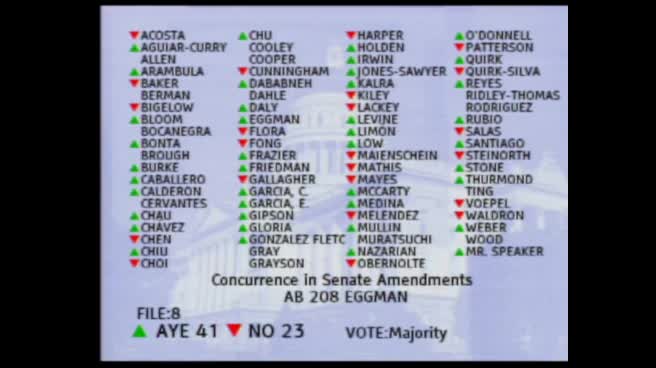 1MIN
Assembly Floor
 3MIN
Senate Floor
 1H
Senate Standing Committee on Appropriations
 5MIN
Senate Standing Committee on Energy, Utilities and Communications
 2MIN
Assembly Floor
 1H
Assembly Standing Committee on Appropriations
 15MIN
Assembly Standing Committee on Water, Parks, and Wildlife
 5MIN
Assembly Standing Committee on Communications and Conveyance
Bill Author


