AB 1110: Pupil health: eye and vision examinations.
- Session Year: 2017-2018
- House: Assembly
- Latest Version Date: 2017-04-18
Existing law requires a pupils vision to be appraised by a school nurse or other authorized person in the pupils kindergarten year or upon first enrollment in elementary school, and in grades 2, 5, and 8, unless the appraisal is waived by the pupils parents upon presentation of a certificate from a physician and surgeon, a physician assistant, or an optometrist. Existing law requires the State Department of Education to adopt guidelines to implement those provisions.
This bill would require, during the kindergarten year or upon first enrollment or entry at an elementary school, including a charter school, a pupils eyes and vision to be examined by a physician, optometrist, or ophthalmologist in accordance with specified provisions, unless the pupils parent or guardian submits a written waiver to the school or charter school. The bill would require, in a pupils kindergarten year or upon first enrollment or entry in at an elementary school, school that is not a charter school, the pupils vision to be appraised in accordance with the above-specified provisions only if the pupils parent or guardian fails to provide the results of an the eye and vision examination conducted by a physician, optometrist, or ophthalmologist in accordance with specified provisions, unless the pupils parent or guardian submits a written waiver to the school. examination. The bill would require a school or charter school to notify parents and guardians of the examination requirement and waiver option. option, as specified. By imposing additional duties on schools, schools and charter schools, the bill would impose a state-mandated local program. The bill would prohibit a school or charter school from denying admission to, or taking adverse action against, a pupil if his or her parent or guardian fails to provide the results of the eye and vision examination. The bill would require the department to adopt regulations, rather than guidelines, to implement these provisions.
The California Constitution requires the state to reimburse local agencies and school districts for certain costs mandated by the state. Statutory provisions establish procedures for making that reimbursement.
This bill would provide that, if the Commission on State Mandates determines that the bill contains costs mandated by the state, reimbursement for those costs shall be made pursuant to the statutory provisions noted above.
Existing law requires a pupils vision to be appraised by a school nurse or other authorized person in the pupils kindergarten year or upon first enrollment in elementary school, and in grades 2, 5, and 8, unless the appraisal is waived by the pupils parents upon presentation of a certificate from a physician and surgeon, a physician assistant, or an optometrist. Existing law requires the State Department of Education to adopt guidelines to implement those provisions.
This bill would require a require, in a pupils kindergarten year or upon first enrollment or entry in elementary school, the pupils vision to be appraised in accordance with the above-specified provisions only if the pupils parent or guardian fails to provide the results of a an eye and vision examination conducted by a physician, optometrist, or ophthalmologist in accordance with specified provisions. provisions, unless the pupils parent or guardian submits a written waiver to the school. The bill would require a school to notify parents and guardians of the examination requirement and waiver option. By imposing additional duties on schools, the bill would impose a state-mandated local program. The bill would prohibit a school from denying admission to, or taking adverse action against, a pupil if his or her parent or guardian fails to provide the results of the eye and vision examination. The bill would require the department to adopt regulations, rather than guidelines, to implement these provisions.
The California Constitution requires the state to reimburse local agencies and school districts for certain costs mandated by the state. Statutory provisions establish procedures for making that reimbursement.
This bill would provide that, if the Commission on State Mandates determines that the bill contains costs mandated by the state, reimbursement for those costs shall be made pursuant to the statutory provisions noted above.
Existing law requires a pupils vision to be appraised by a school nurse or other authorized person in the pupils kindergarten year or upon first enrollment in elementary school, and in grades 2, 5, and 8, unless the appraisal is waived by the pupils parents upon presentation of a certificate from a physician and surgeon, a physician assistant, or an optometrist. Existing law requires the State Department of Education to adopt guidelines to implement those provisions.
This bill would require a pupils vision to be appraised in accordance with the above-specified provisions only if the pupils parent or guardian fails to provide the results of a vision examination conducted by a physician, optometrist, or ophthalmologist in accordance with specified provisions. The bill would prohibit a school from denying admission to, or taking adverse action against, a pupil if his or her parent or guardian fails to provide the results of the vision examination. The bill would require the department to adopt regulations, rather than guidelines, to implement these provisions.
(a)(1)During the kindergarten year or upon first enrollment or entry in a California school district of a pupil at an elementary school, including a charter school, the pupils eyes and vision shall be examined by a physician, optometrist, or ophthalmologist, unless the pupils parent or guardian submits a written waiver to the school. school or charter school. This examination shall include tests for monocular distance and binocular near visual acuity, binocular vision skills, including eye teaming and convergence, accommodation, and depth perception, color vision, pupil evaluation, measurement of refractive error, and eye health evaluations. The parent or guardian of the pupil shall provide results of the eye and vision examination to the school. school or charter school.
(2)A school or charter school shall not deny admission to a pupil or take any other adverse action against a pupil if his or her parent or guardian fails to provide the results of the eye and vision examination to the school. school or charter school.
(3)If the results of the eye and vision examination are not provided to the school, then during the kindergarten year or upon first enrollment or entry, the pupils vision shall be appraised by the school nurse or other person authorized under Section 49452. This paragraph shall not apply to a pupil enrolled in a charter school.
(4)A school or charter school shall notify parents and guardians of the examination requirement and waiver option described in this subdivision. A school or charter school shall include plain language in the notification stating that the eye and vision examination described in paragraph (1) is purely voluntary. A school that is not a charter school shall also include plain language in the notification stating that if the parent or guardian chooses to not have his or her childs vision examined by a physician, optometrist, or ophthalmologist in accordance with paragraph (1), the pupils vision will be screened by the school nurse or other authorized person during the pupils kindergarten year or upon first enrollment or entry pursuant to paragraph (3).
(b)(1)In grades 2, 5, and 8, a pupils vision shall be appraised by the school nurse or other person authorized under Section 49452.
(2)The appraisal may be waived, if the pupils parent or guardian so desires, by presenting a certificate from a physician and surgeon, a physician assistant practicing in compliance with Chapter 7.7 (commencing with Section 3500) of Division 2 of the Business and Professions Code, or an optometrist setting out the results of a determination of the pupils vision, including visual acuity and color vision.
(3)A pupil whose first enrollment or entry occurs in grade 4 or 7 shall not be required to be appraised in the year immediately following the pupils first enrollment or entry.
(c)(1)An appraisal performed pursuant to paragraph (3) of subdivision (a) or paragraph (1) of subdivision (b) shall include tests for visual acuity, including near vision and color vision. However, color vision shall be appraised once and only on male pupils, and the results of the appraisal shall be entered in the health record of the pupil. Color vision appraisal need not begin until the male pupil has reached grade 1.
(2)A pupils vision may be appraised by using an eye chart or any other scientifically validated photoscreening test. Photoscreening tests shall be performed under an agreement with, or the supervision of, an optometrist or ophthalmologist, by the school nurse, or by a trained individual who meets requirements established by the department.
(d)Continual and regular observation of the pupils eyes, appearance, behavior, visual performance, and perception that may indicate vision difficulties shall be done by the school nurse and the classroom teacher.
(e)This section shall not apply to a pupil whose parent or guardian files with the principal of the school in which the pupil is enrolling, a statement in writing that they adhere to the faith or teachings of any well-recognized religious sect, denomination, or organization and in accordance with its creed, tenets, or principles depend for healing upon prayer in the practice of their religion.
(f)Subdivisions (b) to (e), inclusive, shall not apply to a charter school.
(f)(g)The department shall adopt regulations to implement this section, including regulations addressing training requirements and the notification requirement described in paragraph (4) of subdivision (a).
SEC. 2.If the Commission on State Mandates determines that this act contains costs mandated by the state, reimbursement to local agencies and school districts for those costs shall be made pursuant to Part 7 (commencing with Section 17500) of Division 4 of Title 2 of the Government Code.
(a)(1)During the kindergarten year or upon first enrollment or entry in a California school district of a pupil at an elementary school, and at least every second year thereafter until the pupil has completed grade 8, the pupils eyes and vision shall be examined by a physician, optometrist, or ophthalmologist. ophthalmologist, unless the pupils parent or guardian submits a written waiver to the school. This examination shall include tests for monocular distance and binocular near visual acuity, eye tracking, binocular vision skills, including both eye teaming and convergence, accommodation, and depth perception, color vision, depth perception, intraocular pressure, pupil evaluation, objective and subjective refraction, measurement of refractive error, and eye health evaluations. The parent or guardian of the pupil shall provide results of the eye and vision examination to the school.
(b)(2)A school shall not deny admission to a pupil or take any other adverse action against a pupil if his or her parent or guardian fails to provide the results of the eye and vision examination to the school.
(c)(1)If(3)If the results of the eye and vision examination are not provided to the school, then during the kindergarten year or upon first enrollment or entry, and in grades 2, 5, and 8, the pupils vision shall be appraised by the school nurse or other person authorized under Section 49452.
(4)A school shall notify parents and guardians of the examination requirement and waiver option described in this subdivision.
(b)(1)In grades 2, 5, and 8, a pupils vision shall be appraised by the school nurse or other person authorized under Section 49452.
(2)The appraisal may be waived, if the pupils parent or guardian so desires, by presenting a certificate from a physician and surgeon, a physician assistant practicing in compliance with Chapter 7.7 (commencing with Section 3500) of Division 2 of the Business and Professions Code, or an optometrist setting out the results of a determination of the pupils vision, including visual acuity and color vision.
(2)(3)A pupil whose first enrollment or entry occurs in grade 4 or 7 shall not be required to be appraised in the year immediately following the pupils first enrollment or entry.
(3)The(c)(1)An appraisal performed pursuant to paragraph (3) of subdivision (a) or paragraph (1) of subdivision (b) shall include tests for visual acuity, including near vision and color vision. However, color vision shall be appraised once and only on male pupils, and the results of the appraisal shall be entered in the health record of the pupil. Color vision appraisal need not begin until the male pupil has reached grade 1.
(4)(2)A pupils vision may be appraised by using an eye chart or any other scientifically validated photoscreening test. Photoscreening tests shall be performed under an agreement with, or the supervision of, an optometrist or ophthalmologist, by the school nurse, or by a trained individual who meets requirements established by the department.
(d)Continual and regular observation of the pupils eyes, appearance, behavior, visual performance, and perception that may indicate vision difficulties shall be done by the school nurse and the classroom teacher.
(e)This section shall not apply to a pupil whose parents parent or guardian file files with the principal of the school in which the pupil is enrolling, a statement in writing that they adhere to the faith or teachings of any well-recognized religious sect, denomination, or organization and in accordance with its creed, tenets, or principles depend for healing upon prayer in the practice of their religion.
(f)The department shall adopt regulations to implement this section, including regulations addressing training requirements, and shall provide participation data. requirements and the notification requirement described in paragraph (4) of subdivision (a).
SEC. 2.If the Commission on State Mandates determines that this act contains costs mandated by the state, reimbursement to local agencies and school districts for those costs shall be made pursuant to Part 7 (commencing with Section 17500) of Division 4 of Title 2 of the Government Code.
(a) (1) During the kindergarten year or upon first enrollment or entry in a California school district of a pupil at an elementary school, and in grades 2, 5, and at least every second year thereafter until the pupil has completed grade 8, the pupils vision shall be appraised examined by a physician, optometrist, or ophthalmologist. This examination shall include tests for distance and near visual acuity, eye tracking, binocular vision skills, including both eye teaming and convergence, accommodation, color vision, depth perception, intraocular pressure, pupil evaluation, objective and subjective refraction, and eye health evaluations. The parent or guardian of the school nurse or other authorized person under Section 49452. pupil shall provide results of the vision examination to the school.
(b)A school shall not deny admission to a pupil or take any other adverse action against a pupil if his or her parent or guardian fails to provide the results of the vision examination to the school.
(c)(1)If the results of the vision examination are not provided to the school, then during the kindergarten year or upon first enrollment or entry, and in grades 2, 5, and 8, the pupils vision shall be appraised by the school nurse or other person authorized under Section 49452.
(2)A pupil whose first enrollment or entry occurs in grade 4 or 7 shall not be required to be appraised in the year immediately following the pupils first enrollment or entry.
(b)(3)The appraisal shall include tests for visual acuity, including near vision, vision and color vision; however, vision. However, color vision shall be appraised once and only on male pupils, and the results of the appraisal shall be entered in the health record of the pupil. Color vision appraisal need not begin until the male pupil has reached the first grade. grade 1.
(c)The appraisal may be waived, if the pupils parents so desire, by their presenting of a certificate from a physician and surgeon, a physician assistant practicing in compliance with Chapter 7.7 (commencing with Section 3500) of Division 2 of the Business and Professions Code, or an optometrist setting out the results of a determination of the pupils vision, including visual acuity and color vision. (d)(4)A pupils vision may be appraised by using an eye chart or any other scientifically validated photoscreening test. Photoscreening tests shall be performed, performed under an agreement with, or the supervision of, an optometrist or ophthalmologist, by the school nurse nurse, or by a trained individual who meets requirements established by the department.
(e)(d)Continual and regular observation of the pupils eyes, appearance, behavior, visual performance, and perception that may indicate vision difficulties shall be done by the school nurse and the classroom teacher.
(f)(e)This section shall not apply to a pupil whose parents or guardian file with the principal of the school in which the pupil is enrolling, a statement in writing that they adhere to the faith or teachings of any well-recognized religious sect, denomination, or organization and in accordance with its creed, tenets, or principles depend for healing upon prayer in the practice of their religion.
(g)(f)The department shall adopt guidelines regulations to implement this section, including training requirements requirements, and a method of testing for near vision. shall provide participation data.
|
Date
|
Status
|
|---|---|
| Feb 1, 2018 | From committee: Filed with the Chief Clerk pursuant to Joint Rule 56. |
| Jan 31, 2018 | Died pursuant to Art. IV, Sec. 10(c) of the Constitution. |
| May 26, 2017 | In committee: Held under submission. |
| May 3, 2017 | In committee: Set, first hearing. Referred to APPR. suspense file. |
| Apr 19, 2017 | Re-referred to Com. on APPR. |
| Apr 18, 2017 | Read second time and amended. |
| Apr 17, 2017 | From committee: Amend, and do pass as amended and re-refer to Com. on APPR. (Ayes 5. Noes 1.) (April 5). |
| Mar 28, 2017 | Re-referred to Com. on ED. |
| Mar 27, 2017 | From committee chair, with author's amendments: Amend, and re-refer to Com. on ED. Read second time and amended. |
| Mar 9, 2017 | Referred to Com. on ED. |
| Feb 19, 2017 | From printer. May be heard in committee March 21. |
| Feb 17, 2017 | Read first time. To print. |
|
Date
|
Description
|
Location
|
Votes
|
|
|---|---|---|---|---|
| Apr 5, 2017 | Do pass as amended and be re-referred to the Committee on [Appropriations] | Assembly Standing Committee on Education |
Passed |
This list shows positions taken on this bill by organizations on the date displayed, which is linked to the original source.
Positions by individuals are not included.
|
Organization
|
Position
|
Date
|
|---|---|---|
| American Academy Of Ophthalmology | ** Against | Apr 3, 2017 |
| American Academy of Pediatrics | ** Against | Apr 3, 2017 |
| American Association for Pediatric Ophthalmology and Strabismus | ** Against | Apr 3, 2017 |
| California Academy of Eye Physicians and Surgeons | ** Against | Apr 3, 2017 |
| California Association Of Health Plans | ** Against | Apr 3, 2017 |
| California Black Health Network | ** Support | Apr 3, 2017 |
| California Chamber Of Commerce | ** Against | Apr 3, 2017 |
| California Medical Association | ** Against | Apr 3, 2017 |
| California Oaks Vision Center of Optometry | ** Support | Apr 3, 2017 |
| California Optometric Association | ** Support | Apr 3, 2017 |
| California School Nurses Organization | ** Against | Apr 3, 2017 |
| California State Board of Optometry | * Support | Apr 5, 2017 |
| California State PTA | ** Support | Apr 3, 2017 |
| Disability Rights California | ** Support | Apr 3, 2017 |
| FirstSight Vision Services, Inc. | ** Support | Apr 3, 2017 |
| Kaiser Permanente | ** Against | Apr 3, 2017 |
| National Association Of Social Workers, California Chapter | * Support | Apr 5, 2017 |
| National Vision, Inc. | ** Support | Apr 3, 2017 |
| Numerous individuals | ** Support | Apr 3, 2017 |
| Service Employees International Union | ** Support | Apr 3, 2017 |
| United Food and Commercial Workers | * Support | Apr 5, 2017 |
| VSP Vision Care | ** Support | Apr 3, 2017 |
| Western University of Health Sciences, College of Optometry | ** Support | Apr 3, 2017 |
Date of Hearing: May 3, 2017
ASSEMBLY COMMITTEE ON APPROPRIATIONS
Lorena Gonzalez Fletcher, Chair
ABPCA Bill Id:AB 1110
Author:(Burke) – As Amended Ver:April 18, 2017
Policy Committee: | Education | Vote: | 5 - 1 |
Urgency: No State Mandated Local Program: Yes Reimbursable: Yes
SUMMARY:
This bill requires parents to provide results of an eye and vision examination upon a pupil’s first enrollment in elementary school, prohibits a school district from denying admission to a pupil if the parent fails to provide the examination results, and authorizes vision screening by the school nurse or other authorized individual for those pupils who have not received such an examination. This bill also requires appraisal of pupil’s vision, by the school nurse or other authorized personnel, in grades 2, 5, and 8 unless the parent provides a certificate setting out the results of a determination of the pupil’s vision, including visual acuity and color vision. In addition, CDE is required to develop implementing regulations, including training and notification requirements.
FISCAL EFFECT:
- One-time costs of $25,000 General fund, and $6,000 on-going to CDE, for developing implementing regulations, including training and notification requirements.
- Potential reimbursable state-mandate costs for activities imposed on schools such as: tracking students that have taken a comprehensive exam and those that need to be screened at the school site and staff training on the bill’s new requirements.
- Increased costs to Medi-Cal in the millions. To the extent student’s shift from having their vision appraised by a school nurse or other person, as authorized in current law, to having a more expansive examination conducted by a physician, optometrist, or ophthalmologist, this bill could potentially drive significant costs to the state through the Medi-Cal program. Approximately, one-half of the children in the state are covered by Medi-Cal and there are approximately 2.8 million students enrolled in kindergarten through grade 5. Assuming just 25 percent of these students are examined as prescribed by this bill, and an average exam of $50, Medi-Cal costs could increase by about $35 million (General Fund/Federal Funds).
COMMENTS:
- Background. Current law requires a parent or guardian of a first grade student, within the first 90 days, to provide a certificate, signed by a medical professional, documenting that the child has received a health check-up within the last 18 months. This required health examination for school entry, includes a vision screening, completed by the child’s regular healthcare provider. State law also allows the parent or guardian to submit a signed waiver stating they are unwilling or unable to obtain a health screening for the child. School districts are required to exclude children from school for up to five days, if the parent has not provided the health documentation or waiver.
- Purpose. According to the author, “AB 1110 will increase access to comprehensive eye exams provided by a physician, optometrist, or ophthalmologist upon elementary school entry for all California’s students. The comprehensive eye exam will include evaluation of visual acuity, binocular function, as well as refraction and eye health evaluation, as consistent with the most current standard adopted by the American Academy of Pediatrics, American Academy of Ophthalmology, or the American Optometric Association.Binocular function has a great impact on a child’s ability to read, making learning difficult for those who go undetected after the basic eye screening –currently performed at schools. A comprehensive eye exam is a preventative measure that will provide all children with the opportunity to succeed in school…AB 1110 seeks to implement a comprehensive eye exam as a preventative measure that will provide all children with the opportunity to succeed in school.”
- Relevant Legislation. SB 402 (Mitchell) of the 2015-16 Legislative Session, was virtually identical to this bill. It was held in Senate Appropriations.
Analysis Prepared by: Daisy Gonzales / APPR. / (916) 319-2081
Date of Hearing: April 5, 2017
ASSEMBLY COMMITTEE ON EDUCATION
Patrick O'Donnell, Chair
ABPCA Bill Id:AB 1110 (
Author:Burke) – As Amended Ver:March 27, 2017
SUBJECT: Pupil health: eye and vision examinations
SUMMARY: Requires parents to provide results of an eye and vision examination upon a pupil’s first enrollment in elementary school, prohibits a school district from denying admission to a pupil if the parent fails to provide the examination results, and authorizes vision screening for those pupils who have not received such an examination, by the school nurse or other authorized individual. Specifically, this bill:
- Requires the parent or guardian, upon initial enrollment of a pupil in kindergarten or another grade in an elementary school of a school district, to provide the school with the result of a pupil’s eyes and vision examination conducted by a physician, optometrist, or ophthalmologist, unless waived in writing by the pupil’s parent or guardian.
- Requires the examination to include tests for monocular distance and binocular near visual acuity, binocular vision skills, including eye teaming and convergence, accommodation, and depth perception, color vision, pupil evaluation, measurement of refractive error, and eye health evaluations.
- Prohibits a school from denying admission to a pupil, or taking any other adverse action against a pupil, if his or her parent or guardian fails to provide the results of the eye and vision examination to the school.
- Requires the school nurse, or other authorized person, to appraise a pupil’s vision during the kindergarten year, or upon first entry in elementary school, if the parent or guardian does not provide results of the eye and vision examinations to the school.
- Requires schools to notify parents and guardians of the eye and visual examination requirement and waiver option.
- Requires appraisal of pupil’s vision, by the school nurse or other authorized personnel, in grades 2, 5, and 8 unless the parent provides a certificate setting out the results of a determination of the pupil’s vision, including visual acuity and color vision.
- Requires CDE to develop implementing regulations, including training and notification requirements.
EXISTING LAW:
- Requires a pupil’s vision to be appraised by the school nurse or other authorized person during the kindergarten year or upon first enrollment or entry in a California school district of a pupil at an elementary school, and in grades 2, 5, and 8. (EC 49455)
- Specifies that a pupil whose first enrollment occurs in grade 4 or 7 is not required to be appraised in the year immediately following the pupil’s first enrollment or entry.
- Requires the appraisal to include tests for visual acuity, including near vision, and color vision; (color vision is to be appraised once for male pupils only once they reach first grade), and the results of the appraisal shall be entered in the health record of the pupil.
- Specifies that the vision appraisal may be waived, if the pupil’s parents so desire, by their presenting of a certificate from a physician and surgeon, a physician assistant, or an optometrist setting out the results of a determination of the pupil’s vision, including visual acuity and color vision.
- Specifies that a pupil’s vision may be appraised by using an eye chart or any other scientifically validated photoscreening test. Requires that photoscreening tests be performed, under an agreement with, or the supervision of, an optometrist or ophthalmologist, by the school nurse or a trained individual who meets requirements established by CDE.
- Requires continual and regular observation of the pupil’s eyes, appearance, behavior, visual performance, and perception that may indicate vision difficulties by the school nurse and the classroom teacher.
- Exempts a pupil from the vision appraisal, if the parents or guardian provides a statement in writing that they adhere to the faith or teachings of any well-recognized religious sect, denomination, or organization and in accordance with its creed, tenets, or principles depend for healing upon prayer in the practice of their religion.
- Requires CDE to adopt guidelines on vision screening, including training requirements and a method of testing for near vision.
- Requires the governing board of any school district to provide for the testing of the sight and hearing of each pupil enrolled in the schools of the district. The test shall be adequate in nature and shall be given only by duly qualified supervisors of health employed by the district; or by certificated employees of the district or of the county superintendent of schools who possess the qualifications prescribed by the Commission for Teacher Preparation and Licensing; or by contract with an agency duly authorized to perform those services by the county superintendent of schools of the county in which the district is located, under guidelines established by the State Board of Education; or accredited schools or colleges of optometry, osteopathic medicine, or medicine. (EC 49452)
- Requires a parent or guardian to provide, within 90 days of entrance into the first grade, a certificate signed by a health professional, documenting that the child has received the appropriate health screening and evaluation services (including vision screening) within the previous 18 months, unless the parent or guardian signs a waiver indicating they do not want or are unable to obtain the health screening. (HSC 124085)
- Requires the governing board of a school district to exclude from school, for not more than five days, any first grade pupil who has not provided a signed health certificate or waiver, on or before the 90th day after the pupil’s entrance into first grade. (HSC 124105)
FISCAL EFFECT: The Office of Legislative Counsel has keyed this as a state-mandated local program.
COMMENTS:
Need for the bill: According to the author,
“AB 1110 will increase access to comprehensive eye exams provided by a physician, optometrist, or ophthalmologist upon elementary school entry for all California’s students. The comprehensive eye exam will include evaluation of visual acuity, binocular function, as well as refraction and eye health evaluation, as consistent with the most current standard adopted by the American Academy of Pediatrics, American Academy of Ophthalmology, or the American Optometric Association.
Binocular function has a great impact on a child’s ability to read, making learning difficult for those who go undetected after the basic eye screening –currently performed at schools. A comprehensive eye exam is a preventative measure that will provide all children with the opportunity to succeed in school.
The type of childhood vision screenings required under current California law misses one out of three children with significant vision and eye health problems that can result in impaired learning. AB 1110 seeks to implement a comprehensive eye exam as a preventative measure that will provide all children with the opportunity to succeed in school.”
Importance of vision in school success. The American Optometric Association notes that good vision is key to a student’s success in school. Reading, writing, computer work and viewing material on classroom screens or chalkboards are some of the visual tasks students perform daily. As children progress in school, demands on their visual abilities increases as the size of print in their schoolbooks becomes smaller and they are required to spend more time on homework. Children with visual skill deficits may avoid reading, experience lower levels of comprehension, or suffer from fatigue, discomfort and a shorter attention span.
Prevalence of visual disorders in U.S. children. A 2016 report, Children’s Vision and Eye Health: A Snapshot of Current National Issues, produced by the National Center for Children’s Vision and Eye Health, included the following statistics on eye disorders among children between 5 and 17 years of age:
- 9% have myopia or nearsightedness, which results in defective vision of distant objects. This varies by race/ethnicity with Asian (19%) and Hispanic (13%) children having significantly higher rates of myopia.
- 13% have hyperopia, or farsightedness, which results in defective vision of near objects. Again, this varies by race/ethnicity, with the greatest prevalence among Non-Hispanic White (20%) children.
- Between 15 to 28% have astigmatism, an irregularity in the shape of the cornea or lens that causes blurry vision at all distances if not corrected.
Importance of vision screening. According to the American Academy of Opthamology, “Good vision is key to a child’s physical development, success in school and overall well-being. Upon entering school, or whenever a problem is suspected, children’s eyes should be screened for visual acuity and alignment by a pediatrician, family doctor, ophthalmologist, optometrist, orthoptist or person trained in vision assessment of school-aged children, such as a school nurse. Nearsightedness (myopia) is the most common refractive error in this age group and can be corrected with eyeglasses. If an alignment problem or other eye health issues is suspected, the child should have a comprehensive exam by an Eye M.D.”
CDE’s 2005 document, A Guide For Vision Testing In California Public Schools, notes that a vision testing program meets state requirements when it is provided under the direction of qualified personnel and has the following objectives:
- to prevent the development of a vision difficulty that may affect the student’s health and potential for learning
- to identify students with certain vision liabilities through administration of selected vision tests and planned procedures of observation
- to notify parents of each student identified as having a possible vision liability and to encourage further examination through a professional vision evaluation
- to establish follow-up procedures that will ensure that each identified student will receive appropriate care
- to inform teachers of students who have vision liabilities about vision specialists’ recommendations and assist them in planning for needed adjustments in the T
- to train staff to recognize visual deficiencies and determine whether students are adjusting to school work.
What’s the difference between vision screening and an eye exam? The American Association for Pediatric Ophthalmology and Strabismus notes,
“vision screening is an efficient and cost-effective method to identify children with visual impairment or eye conditions that are likely to lead to vision loss so that a referral can be made to an appropriate eye care professional for further evaluation and treatment. Pediatricians, family practitioners, nurses and technicians can perform vision screening at regular well care office visits. In addition, many day care programs, churches, schools and health departments offer vision screening programs for children.
Vision screening is more efficient and cost effective (which allows many more children to be examined) than a complete examination on every child. Only about 2 to 4% of children have an eye problem that requires treatment, so it is not practical to perform a comprehensive eye examination on every child. In addition, some problems are missed on a one-time comprehensive eye examination, so it is preferable to have several screenings performed over time. Also, mandated comprehensive eye examinations likely result in glasses being prescribed unnecessarily for many children.
Nevertheless, if a child has known risk factors for eye disease, if there is a family history of pediatric eye disease, or if a child has signs or symptoms suspicious for a vision problem, it is reasonable and appropriate for a child to have a comprehensive eye examination.”
The American Academy of Ophthalmology advises parents to seek a comprehensive eye exam if the child fails a vision screening or the vision screening is inconclusive or cannot be performed; is referred by a pediatrician or school nurse; has a vision complaint or observed abnormal visual behavior, or is at risk for developing eye problems; or has a learning disability, developmental delay, neuropsychological condition or behavioral issue.
Vision screening currently required for school entry. Current law requires a parent or guardian of a first grade student, within the first 90 days, to provide a certificate, signed by a medical professional, documenting that the child has received a health check-up within the last 18 months. This required health examination for school entry, includes a vision screening, completed by the child’s regular healthcare provider.
The parent or guardian may submit a signed waiver stating they are unwilling or unable to obtain a health screening for the child. School districts are required to exclude children from school for up to five days, if the parent has not provided the health documentation or waiver.
This bill requires a comprehensive eye and vision examination for every child. This bill requires that every pupil upon initial enrollment in an elementary school in a school district, receive an eye and vision examination by a physician, optometrist, or ophthalmologist, including tests for the following:
- Monocular distance and binocular near visual acuity
- Binocular vision skills, including eye teaming and convergence, accommodation and depth perception
- Color vision
- Pupil evaluation
- Measurement of refractive error
- Eye health evaluations
The parent or guardian is required to provide the results of the eye and vision examination to the school, unless they submit a written waiver to the school. The bill also requires the school to notify the parent and guardian of the examination requirement and waiver option.
The bill specifies that the school cannot deny admission, or take any other adverse action against the pupil, if the parent or guardian does not provide the results of the examination. The committee may wish to consider whether there is a need for the bill to make it clearer to parents that they have a choice as to whether or not to seek this comprehensive eye and vision examination for their child prior to school entry.
If the committee votes to pass the bill, staff recommends the bill be amended to clarify that the notification that the school must provide regarding the eye and vision examination requirement and waiver option, include plain language stating that this examination is purely voluntary, and that if the parent or guardian chooses not to have their child undergo this examination, the pupil’s vision will be screened by the school nurse, or other authorized person, during the kindergarten year or upon first enrollment.
Arguments in support. Supporters state that the current school vision screening process is not working and too many of California’s children are slipping through the cracks. They estimate that these screenings fail to detect one in three children with significant vision and eye health problems, such as binocular vision deficiencies, that can impede reading.
Children’s learning is diminished when they cannot see a blackboard or tablet screen clearly, and many students still struggle to read even after passing a school eye test. Clear vision, good visual functioning, and eye health are crucial components of success in students’ learning, as up to 80% of learning happens through the eyes and visual system.
The California Optometric Association reports that the organization has a long-standing position that all children should have a comprehensive eye exam provided by an optometrist or ophthalmologist prior to starting school. A typical school vision screening is insufficient to ensure optimal vision and eye health.
By encouraging, but not requiring parents to seek a comprehensive eye and vision examination by an outside medical professional, the burden on schools to screen pupils’ vision will be reduced as they will only be responsible for conducting vision screenings for those pupils who do not receive the outside examinations.
Supporters also note that the Affordable Care Act guarantees children a no-cost comprehensive eye exam, covered through their private or public health insurance plans and that many parents are unaware of this benefit. They believe that this bill will help parents utilize this benefit and understand that eye exams play an important role in their child’s overall health.
Arguments in opposition. Opponents state that routine comprehensive professional eye examinations performed on normal asymptomatic children have no proven medical benefit and are not recommended. Visions screening by the school nurse, as is the current California practice, very successfully already identifies the 2 to 4% of children with medical conditions affecting the eyes as well as the children with refractive errors who would benefit from eyeglasses. They argue that it is unnecessary for the vision screenings to be performed by physicians, optometrists, or ophthalmologists, as these tests can be performed capably and for far lesser expense by trained school nurses or physician assistants.
Opponents also point to the American Academy of Ophthalmology’s Policy Statement: Frequency of Ocular Examinations, which states: “school-age children should be evaluated regularly for visual acuity and ocular alignment (approximately every 1 to 2 years) during primary health care visits, in schools, or at public screenings.” The vision screening program in California schools screen students prior to school entry and every third year thereafter for visual acuity and color vision.
They conclude that comprehensive examinations should be reserved for children who fail screenings, as well as those with identified medical conditions that have associated ophthalmic conditions or family histories of hereditary eye disease and those identified by their teachers and family as having possible or diagnosed reading difficulties or learning disabilities, such as dyslexia.
Finally, opponents contend that the requirement to seek outside vision testing would inconvenience working families who have neither the time nor the money to take their children to unnecessary, burdensome, and costly appointments that may conflict with their children’s school hours or their own working hours. Opponents question whether the key issue is a lack of follow-through by parents as a result of referrals arising out of vision screening conducted in schools, rather than a failing of the vision screening process itself.
Prior legislation. SB 402 (Mitchell) of the 2015-16 Session, was virtually identical to this bill. It was held in Senate Appropriations.
AB 1840 (Campos), Chapter 803, Statutes of 2014 authorizes a child’s vision to be appraised by using an eye chart or any scientifically validated photoscreening test and requires photoscreening tests to be performed, under an agreement with, or the supervision of an optometrist or ophthalmologist, by the school nurse or trained individual authorized by CDE.
SB 430 (Wright) of the 2013-14 Session, would have deleted an existing requirement that upon first enrollment in a California school district of a child at an elementary school, and at least every third year thereafter until the child has completed the eighth grade, the child’s vision to be appraised by the school nurse or other authorized person, and replaces it with a requirement that, upon first enrollment in a private or public elementary school, a pupil receive a vision examination from a physician, optometrist, or ophthalmologist and requires that screening to include a test for binocular function, refraction, and eye health. This bill was held in Assembly Health.
SB 1172 (Steinberg), Chapter 925 of the 2013- 2014 Session deleted the prior existing vision screening requirements and instead, requires, during the kindergarten year or upon first enrollment or entry in a California school district of a pupil at an elementary school, and in grades 2, 5, and 8, the pupil’s vision to be appraised by the school nurse or other authorized person by using an eye chart or any other scientifically validated photoscreening test; requires continual and regular observation of the pupil’s eyes, appearance, behavior, visual performance, and perception that may indicate vision difficulties to be done by the school nurse and the classroom teacher; states legislative finding that access to vision care has been expanded with implementation of the federal Patient Protection and Affordable Care Act.
AB 1453 (Monning), Chapter 854, Statutes of 2012 established California's Essential Health Benefits (EHB) benchmark, which requires an individual or small group health plan contract or health insurance policy issued, amended, or renewed on or after January 1, 2014 to, at a minimum, include coverage for EHBs, including, among other things, pediatric vision care.
REGISTERED SUPPORT / OPPOSITION:
Support
California State Board of Optometry (Sponsor)
California Black Health Network
California Oaks Vision Center of Optometry
California Optometric Association
California State PTA
Disability Rights California
FirstSight Vision Services, Inc.
Marshall B. Ketchum University, Southern California College of Optometry
National Vision, Inc.
Service Employees International Union (SEIU)
United Food and Commercial Workers (UFCW) Union
VSP Vision Care
Western University of Health Sciences, College of Optometry
Numerous individuals
Opposition
American Academy of Ophthalmology
American Academy of Pediatrics
American Association for Pediatric Ophthalmology and Strabismus
California Academy of Eye Physicians and Surgeons
California Association of Health Plans
California Chamber of Commerce
California Medical Association
California School Nurses Organization
Kaiser Permanente
Analysis Prepared by: Debbie Look / ED. / (916) 319-2087
Discussed in Hearing
 1H
Assembly Standing Committee on Appropriations
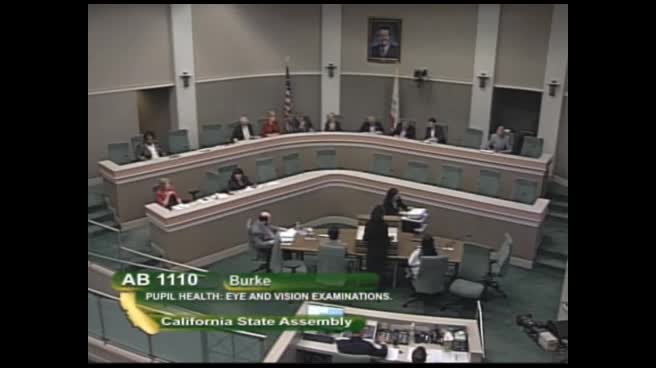 26MIN
Assembly Standing Committee on Education
Bill Author



